Ancient State of the Strand—Butcher Row—Death of Lee, the
dramatic Poet—Johnson at an Eating-House—Essex Street—House
and History of the favourite Earl of Essex—Spenser's Visit there—Essex,
General of the Parliament—Essex Head Club—Devereux
Court—Grecian Coffee-House—Twining, the accomplished Scholar—St.
Clement Danes—Clement's Inn—Falstaff and Shallow—Norfolk,
Arundel, Surrey, and Howard Streets—Norfolk House—Essex's
Ring and the Countess of Nottingham—William Penn—Birch—Dr.
Brocklesby—Congreve, and his Will—Voltaire's Visit
to him—Mrs. Bracegirdle—Tragical End of Mountford the Player—Ancient
Cross—Maypole—New Church of St. Mary-le-Strand—Old
Somerset House—Henrietta Maria and her French Household—Waller's
Mishap at Somerset Stairs—New Somerset House—Royal
Society, Antiquarian Society, and Royal Academy—Death of
Dr. King—Exeter Street—Johnson's first Lodging in London—Art
of living in London—Catherine Street—Unfortunate Women—Wimbledon
House—Lyceum and Beef-steak Club—Exeter Change—Bed
and Baltimore—The Savoy—Anecdotes of the Duchess of
Albemarle—Beaufort Buildings—Lillie, the Perfumer—Aaron Hill—Fielding—Southampton
Street—Cecil and Salisbury Streets—Durham
House—Raleigh—Pennant on the Word Place or Palace—New
Exchange—Don Pantaleon Sa—The White Milliner—Adelphi—Garrick
and his Wife—Beauclerc—Society of Arts, and Mr. Barry—Bedford
Street—George, Villiers, and Buckingham Streets—York
House and Buildings—Squabble between the Spanish and French
Ambassadors—Hungerford Market—Craven Street—Franklin—Northumberland
House—Duplicity of Henry, Earl of Northampton—Violence
of Lord Herbert of Cherbury—Percy, Bishop of
Dromore—Pleasant mistake of Goldsmith.
In going through Fleet Street and the Strand,
we seldom think that the one is named
after a rivulet, now running under ground,
and the other from its being on the banks
of the river Thames. As little do most
of us fancy that there was once a line of
noblemen's houses on the one side, and
that, at the same time, all beyond the
other side, to Hampstead or Highgate, was open country, with
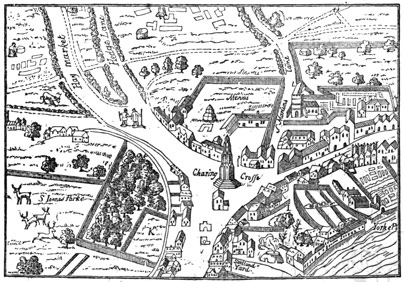
the little hamlet of St. Giles's in a copse. So late as the
reign of Henry VIII. we have a print containing the vill a
of Charing. Citizens used to take an evening stroll to the
well now in St. Clement's Inn.
In the reign of Edward III. the Strand was an open country
road, with a mansion here and there, on the banks of the river
Thames, most probably a castle or stronghold. In this state
it no doubt remained during the greater part of the York and
Lancaster period. From Henry VII.'s time the castles most
likely began to be exchanged for mansions of a more peaceful
character. These gradually increased; and in the reign of
Edward VI. the Strand consisted, on the south side, of a line
of mansions with garden walls; and on the north, of a single
row of houses, behind which all was field. The reader is to
imagine wall all the way from Temple Bar to Whitehall, on
his left hand, like that of Kew Palace, or a succession of
Burlington Gardens; while the line of humbler habitations
stood on the other side, like a row of servants in waiting.
As wealth increased, not only the importance of rank
diminished, and the nobles were more content to recollect
James's advice of living in the country (where, he said, they
looked like ships in a river, instead of ships at sea), but the
value of ground about London, especially on the river side,
was so much augmented, that the proprietors of these princely
mansions were not unwilling to turn the premises into money.
The civil wars had given another jar to the stability of their
abodes in the metropolis; and in Charles the Second's time
the great houses finally gave way, and were exchanged for
streets and wharfs. An agreeable poet of the last century lets
us know that he used to think of this great change in going
up the Strand.
"Come, Fortescue, sincere, experienc'd friend,
Thy briefs, thy deeds, and e'en thy fees suspend;
Come, let us leave the Temple's silent walls;
Me, business to my distant lodging calls;
Through the long Strand together let us stray;
With thee conversing, I forget the way.
Behold that narrow street which steep descends,
Whose building to the slimy shore extends;
Here Arundel's fam'd structure rear'd its fame:
The street alone retains the empty name.
Where Titian's glowing paint the canvass warmed,
And Raphael's fair design with judgment charmed,
Now hangs the bellman's song; and pasted here
The coloured prints of Overton appear.
Where statues breathed, the works of Phidias' hands,
A wooden pump, or lonely watch-house stands.
There Essex's stately pile adorned the shore,
There Cecil's, Bedford's, Villiers',—now no more."[127]
As the aspect in this quarter is so different from what it
was, and the quarter is one of the most important in the
metropolis, we may add what Pennant has written on the
subject:—
"In the year 1353, that fine street the Strand was an open highway,
with here and there a great man's house, with gardens to the
water's side. In that year it was so ruinous, that Edward III., by
an ordinance, directed a tax to be raised upon wool, leather, wine,
and all goods carried to the staple at Westminster, from Temple Bar
to Westminster Abbey, for the repair of the road; and that all owners
of houses adjacent to the highway should repair as much as lay before
their doors. Mention is also made of a bridge to be erected near the
royal palace at Westminster, for the conveniency of the said staple;
but the last probably meant no more than stairs for the landing of the
goods, which I find sometimes went by the name of a bridge.
"There was no continued street here till about the year 1533;
before that it entirely cut off Westminster from London, and nothing
intervened except the scattered houses, and a village, which afterwards
gave name to the whole. St. Martin's stood literally in the
fields. But about the year 1560 a street was formed, loosely built, for
all the houses on the south side had great gardens to the river, were
called by their owners' names, and in after times gave name to the
several streets that succeeded them, pointing down to the Thames;
each of them had stairs for the conveniency of taking boat, of which
many to this day bear the names of the houses. As the court was
for centuries either at the palace at Westminster, or Whitehall, a
boat was the customary conveyance of the great to the presence of
their sovereign. The north side was a mere line of houses from
Charing-cross to Temple Bar; all beyond was country. The gardens
which occupied part of the site of Covent Garden were bounded by
fields, and St. Giles's was a distant country village. These are circumstances
proper to point out, to show the vast increase of our
capital in little more than two centuries."[128]
The aspect of the Strand, on emerging through Temple
Bar, is very different from what it was forty years ago. "A
stranger who had visited London in 1790, would on his
return in 1804," says Mr. Malcolm, "be astonished to find a
spacious area (with the church nearly in the centre) on the
site of Butcher Row, and some other passages undeserving of
the name of streets, which were composed of those wretched
fabrics, overhanging their foundations, the receptacles of dirt
in every corner of their projecting stories, the bane of ancient
London, where the plague, with all its attendant horrors,
frowned destruction on the miserable inhabitants, reserving
its forces for the attacks of each returning summer."[129]
The site of Butcher Row, thus advantageously thrown
open, is called Pickett Street, after the alderman who projected
the improvements. Unfortunately they turned out to
be on too large a scale; that is to say, the houses were found
to be too large and expensive for the right side of the Strand
in this quarter; the tide of traffic between the city and Westminster
flowing the other side of the way. The consequence
is, that the houses are under-let, and that something of the old
squalid look remains in the turning towards Clement's Inn, in
spite of the pillared entrance.
Butcher Row, however squalid, contained houses worth
eating and drinking in. Johnson frequented an eating-house
there; and, according to Oldys, it was "in returning from
the Bear and Harrow in Butcher Row, through Clare Market,
to his lodgings in Duke Street, that Lee, the dramatic poet,
overladen with wine, fell down (on the ground, as some say—according
to others, on a bulk), and was killed, or stifled in
the snow. He was buried in the parish church of St. Clement
Danes, aged about thirty-five years."[130] "He was a very handsome
as well as ingenious man," says Oldys, "but given to
debauchery, which necessitated a milk diet. When some of
his university comrades visited him, he fell to drinking out of
all measure, which, flying up into his head, caused his face to
break out into those carbuncles which were afterwards observed
there; and also touched his brain, occasioning that madness
so much lamented in so rare a genius. Tom Brown says,
he wrote, while he was in Bedlam, a play of twenty-five acts;
and Mr. Bowman tells me that, going once to visit him there,
Lee showed him a scene, 'in which,' says he, 'I have done a
miracle for you.' 'What's that?' said Bowman. 'I have
made you a good priest.'"
Oldys mentions another of his mad sayings, but does not
tell us with whom it passed.
"I've seen an unscrewed spider spin a thought,
And walk away upon the wings of angels!"
"What say you to that, doctor?" "Ah, marry, Mr. Lee, that's
superfine indeed. The thought of a winged spider may catch sublime
readers of poetry sooner than his web, but it will need a commentary
in prose to render it intelligible to the vulgar."[131]
Lee's madness does not appear to have been melancholy,
otherwise these anecdotes would not bear repeating. There
are various stories of the origin of it; but, most probably,
he had an over-sanguine constitution, which he exasperated
by intemperance. Though he died so young, the author of
A Satyr on the Poets gives us to understand that he was corpulent.
"Pembroke loved tragedy, and did provide
For the butchers' dogs, and for the whole Bank-side:
The bear was fed; but dedicating Lee
Was thought to have a greater paunch than he."[132]
This Pembroke, who loved a bear-garden, was the seventh
earl of that title. His daughter married the son of Jefferies.
Lee, on a visit to the earl at Wilton, is said to have drunk so
hard, that "the butler feared he would empty the cellar."
The madness of Lee is almost visible in his swelling and overladen
dramas; in which, however, there is a good deal of true
poetic fire, and a vein of tenderness that makes us heartily
pity the author.
The social Boswell, in speaking of Johnson's eating-house
in Butcher Row, does not approve of establishments of that
sort. We shall see, by and by, that he was wrong.
"Happening to dine," says he, "at Clifton's eating-house in
Butcher Row, I was surprised to see Johnson come in and take his
seat at another table. The mode of dining, or rather being fed, at
such houses in London, is well known to many to be peculiarly
unsocial, as there is no ordinary or united company, but each person
has his own mess, and is under no obligation to hold any intercourse
with any one. A liberal and full-minded man, however, who loves to
talk, will break through this churlish and unsocial restraint. Johnson
and an Irish gentleman got into a dispute concerning the cause of
some part of mankind being black. 'Why, sir (said Johnson), it has
been accounted for in three ways: either by supposing that they are
the posterity of Ham, who was cursed; or that God at first created
two kinds of men, one black and another white; or that, by the heat
of the sun, the skin is scorched, and so acquires a sooty hue. This
matter has been much canvassed among naturalists, but has never
been brought to any certain issue.' What the Irishman said is totally
obliterated from my mind; but I remember that he became very warm
and intemperate in his expressions; upon which Johnson rose, and
quietly walked away. When he had retired, his antagonist took his
revenge, as he thought, by saying, 'He has a most ungainly figure,
and an affectation of pomposity unworthy of a man of genius.'"[133]
The ungainly figure might have been pardoned by the
Irishman; who, we suppose, was equally fiery and elegant.
As to Johnson's pompous manner, the most excusable part of
it originated, doubtless, in his having decided opinions. The
rest may have been an instinct of self-defence, arising from
the "ungainly figure," not without a sense of the dignity of
his calling. He certainly lost nothing by it, upon the whole.
At all events, one is willing to think the best of what was
accompanied by so much excellence. Affectation it was not;
for nobody despised pretension of any kind more than he did.
Johnson was a sort of born bishop in his way, with high
judgments and cathedral notions lording it in his mind; and
ex cathedrâ he accordingly spoke.
In Butcher Row, one day, Johnson met, in advanced life, a
fellow-collegian, of the name of Edwards, whom he had not
seen since they were at the university. Edwards annoyed
him by talking of their age. "Don't let us discourage one
another," said Johnson. It was this Edwards, a dull but good
man, who made that naïve remark, which was pronounced by
Burke and others to be an excellent trait of character:—"You
are a philosopher, Dr. Johnson," said he: "I have tried in
my time to be a philosopher; but, I don't know how, cheerfulness
was always breaking in."[134]
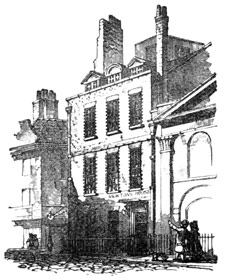
Before we come to St. Clement's, we arrive, on the left-hand
side of the way, at Essex Street; a spot once famous
for the residence of the favourite Earl of Essex. We have
mentioned an Outer Temple, which originally formed a companion
to the Inner and Middle Temples, the whole constituting
the tenements of the knights. This Outer Temple
stretched beyond Temple Bar into the ground now occupied
by Essex Street and Devereux Court; and after being possessed
(Dugdale supposes) by the Prior and Canons of the
Holy Sepulchre, was transferred by them, in the time of
Edward III., to the Bishops of Exeter, who occupied it till
the reign of Henry VI., and called it Exeter House. Sir
William Paget (afterwards Lord Paget) then had it, and did
"re-edify the same," calling it Paget Place. After this it
was occupied by the Duke of Norfolk, who was executed for
his dealings with Mary, Queen of Scots; then by Dudley,
Earl of Leicester, the favourite, who called it Leicester House,
and bequeathed it to his "son, Sir Robert;" and then by the
other favourite, Leicester's son-in-law, Essex, from whom it
retained the name of Essex House. It was occasionally
tenanted by men of rank till some time after the Restoration,
when it was pulled down, and the site converted into the present
street and court. The only remnant of it supposed to
exist is the present Unitarian Chapel, which, before it became
such, was called Essex House, and latterly contained an
auction room.[135]
The repose enjoyed in this precinct since the Restoration
has been like silence after a succession of storms, for the
house was of a turbulent reputation. The first bishop who
had it after the Templars, being a favourite of Edward II.,
was seized by the mob, hurried to Cheapside, where they
beheaded him, and then carried back a corpse, and buried
in a heap of sand at his door. Lord Paget got into trouble,
together with his friend the Duke of Somerset, who was
accused of intending to assassinate Northumberland and others
at this house. Norfolk possessed it while he formed his
designs on Mary, Queen of Scots, for which he was brought
to the scaffold; Leicester was always having some ill design
or other—perhaps poisoned a visitor or so occasionally (for
he is said to have thought nothing of that gentle expediency);
and Essex made the house famous by standing a siege in it
against the troops of his mistress. The siege was not long,
nor any of his actions in the business very wise, though he
was a man of an exalted nature. Essex got into his troubles
partly from heat and ambition, partly from the inferior and
more cunning nature of some of his rivals at court. There is
no doubt that all these causes, together with his confidence in
Elizabeth's inability to proceed to extremities, conspired to
lead him into rebellion. His first offence that we hear of,
next to a general petulance of manner, which the Queen's own
mixture of fondness and petulance was calculated enough to
provoke, was a quarrel with some young lords for her favour;
the second, his joining the expedition to Cadiz without leave;
and the third, his marriage with the daughter of Sir Francis
Walsingham: for Elizabeth never thought it proper that her
favourites should be married to any thing but her "fair
idea."
His next dispute with her, which was on the subject of an
assistant in the affairs of Ireland, to which he was going as
lord deputy, terminated in the singular catastrophe of his
receiving from her a box on the ear, with the encouraging
addition of bidding him "Go, and be hanged." It is said to
have been occasioned by his turning his back upon her. He
clapped his hand to his sword, and swore he would not have
put up with such an insult from her father. His fall is
generally dated from this circumstance, and it is thought he
never forgave it. But surely this is not a correct judgment:
for the blow which might have been intolerable from the hand
of a king, implied, in its very extravagance, something not
without flattery and self-abasement from that of a princess.
It was as if Elizabeth had put herself into the situation
of a termagant wife. The quarrel preceded the violence.
Essex went to Ireland against the rebels, but apparently with
great unwillingness, calling it, in a letter to the Queen, the
"cursedest of all islands," and insinuating that the best thing
that could happen both to please her and himself was the loss
of his life in battle. The conclusion of this letter is a remarkable
instance of the mixture of romance with real life in those
days. It is in verse, terminating with the following pastoral
sentiment. Essex wishes he could live like a hermit, "in
some unhaunted desert most obscure"—
"From all society, from love and hate
Of worldly folk; then should he sleep secure,
Then wake again, and yield God every praise,
Content with hips and hawes, and bramble-berry;
In contemplation parting out his days,
And change of holy thoughts to make him merry.
Who when he dies, his tomb may be a bush,
Where harmless robin dwells with gentle thrush.
Your Majesty's exiled servant,
"Robert Essex."
Think of this being a letter from a lord lieutenant of
Ireland to his sovereign! Warton says, from the evidence of
some sonnets preserved in the British Museum, that although
Essex was "an ingenious and elegant writer of prose," he
was no poet. There is an ungainliness in the lines we have
just quoted, and he was probably too much given to action to
be a poet; but there is something in him that relished of
the truth and directness of poetry, when he had to touch
upon any actual emotion. Poetry is nothing but the voluntary
power to get at the inner spirit of what is felt, with
imagination to embody it. It was supposed that Essex's
enemies first got him into the office of lord lieutenant, and
then took advantage of his impatience under it to ruin him.
He was accused of tampering with the rebels, and meditating
his return into England with the troops under his charge;
with a view to which object he is said to have described his
army as a force with which he "would make the earth to
tremble as he went." He came over, with the passion of an
injured man, and presented himself before the Queen, who
gave him a tolerable reception, but afterwards confined him
to the house of the lord keeper. It was then, according to
his confession before his death, that he first contemplated
violent measures against the throne, though always short of
treason. Before his liberation, he was soured by his ineffectual
attempts to renew his facility of admission to the presence
chamber; and he let fall an expression which his enemies
greedily seized at, to wit, that the "Queen grew old and
cankered, and that her mind was become as crooked as her
carcase." This was exactly in his style, which was off-hand
and energetic, with a gusto of truth in it. Meantime he
began to have his friends about him more than ever, and to
affect a necessity for it; and a summons being sent him to
attend the council, he was driven by anger and fear to decline
it, and to fortify himself in his house. His chief and most
generous companion on this occasion was Henry, Earl of
Southampton, the friend of Shakspeare. There was some
little resistance; and the Lord Keeper, with the Lord Chief
Justice and the Earl of Worcester, coming to summon him
to his allegiance, he locked them up in a room, on pretence
of taking care of their persons, and then sallied through
Fleet Street into the city, where he expected a rising in his
favour; for he was the most popular noble, perhaps, that
England had ever seen, and the city had been disgusted by
repeated levies on its purse, under pretence of invasions from
Spain: though, according to Essex, Spain had never been so
much in favour. The levies, in truth, were made against
himself. He was disappointed: heard himself proclaimed a
traitor by sound of trumpet in Gracechurch Street, and after
a little more scuffling on the part of his adherents, returned
by water from Queenhithe, and surrendered himself; being
partly moved, he said, by the "cries of ladies." It is clear
that he did not know what to be at. He expected, most
likely, every moment, that the Queen's tenderness would
interfere, fearful of seeing her once beloved favourite in
danger. But the Cecils and others aided her good sense in
keeping her quiet. Essex had certainly acted in a way incompatible
with the duty of a subject, and such as no
sovereign could tolerate. He was tried in Westminster Hall,
and convicted of an intention to seize the court and the
Tower, to surprise the Queen in her apartments, and then to
summon a parliament for a "redress of grievances;" which,
he said, should give his enemies "a fair trial." Southampton
was acquitted, no doubt from a sense that he intended nothing
but a romantic adherence to his friend.
How a man of Essex's understanding could give into these
preposterous attempts, it would be difficult to conceive, if
every day's experience did not show how powerful a succession
of little circumstances is to bring people into situations
which themselves might have least looked for. Essex evidently
expected pardon to the last. When Lord Grey's name
was read over among the peers who were to try him, he
smiled and jogged the elbow of Southampton, for offending
whom Grey had been punished. He was at his ease throughout
the trial. He said to the Attorney-General (Coke), who
had told him in the course of his speech that he should be
"Robert the Last" of an earldom, instead of "Robert the
First" of a kingdom—"Well, Mr. Attorney, I thank God
you are not my judge this day, you are so uncharitable."
"Coke. Well, my lord, we shall prove you anon, what you are;
which your pride of heart, and aspiring mind, hath brought you unto.
Essex. Ah, Mr. Attorney, lay your hand upon your heart, and
pray to God to forgive us both."[136]
And when sentence was passed, though it is not true that
he refused to ask for mercy, for he did it after the best
fashion of his style, "kneeling (he said) upon the very knees
of his heart," yet he seemed to threaten Elizabeth, in a tender
way, with his resolution to die. She left him, like a politic
sovereign, to his fate; but is thought never to have recovered
it, as a friend. The romantic story of her visiting the
Countess of Nottingham, who had kept back a ring which
Essex sent her after his condemnation, of her shaking her on
her deathbed, and crying out that "God might forgive, but
she could not," is more and more credited as documents
transpire. The ring, it is said, had been given to Essex,
with a promise that it should serve him in need under any
circumstances, if he did but send it. It is supposed that the
non-appearance of it hurt the proud heart of Elizabeth, and
finally allowed her to let him die. Yet she was a great
sovereign, and might have suffered the law to take its course,
with whatever sorrow. She was jealous of her reputation
with the old and cool-headed lords about her. When the
death, however, had taken place, she might have fancied
otherwise. Something preyed strongly on her mind towards
her decease, which happened within two years after his
execution. She refused to go to bed for ten days and
nights before her death, lying upon the carpet with cushions
about her, and absorbed in the profoundest melancholy. To
be sure, this may have been disease. A princess like
Elizabeth, possessed of sovereign power, which had been
sharply exercised on some doubtful occasions, might have
had misgivings when going to die. Two certain causes of
regret she must have had for Essex. She must have been
well aware that she had alternately encouraged and irritated
him over much; and she must have known that he was a
better man than many who assisted in his overthrow, and
that if he had been less worthy of regard, he probably would
have survived her, as they did.
It may easily be imagined that Essex was a man for whom
a strong affection might be entertained. He excited interest
by his character, and could maintain it by his language. In
everything he did there was a certain excess, but on the
liberal side. When a youth, he plunged into the depths of
rural pleasures and books; he was lavish of his money and
good words for his friends; he said everything that came
uppermost, but then it was worth saying, only his enemies
were not as well pleased with it as his friends, and they never
forgot it: in fine, he was romantic, brave, and impassioned.
He is so like a preux chevalier, that till we call to mind other
gallant knights who have not been handsome, we are somewhat
surprised to hear that he was not well made, and that
nothing is said of his face but that it looked reserved—a
seeming anomaly, which deep thought sometimes produces
in the countenances of open-hearted men. These were no
hindrances, however, to the admiration entertained of him
by the ladies; and he was so popular with authors and with
the public, that Warton says he could bring evidence of his
scarcely ever quitting England or even the metropolis, on the
most frivolous enterprise, without a pastoral or other poetical
praise of him, which was sold and sung in the streets. He
was the friend of Spenser, most likely of Shakspeare too.
being the friend of Southampton. Spenser was well acquainted
with Essex House. In his 'Prothalamion,' published in 1596,
he has left interesting evidence of his having visited Leicester
there; and he follows up the record with a panegyric on
Leicester's successor, which was probably his first hint to
Essex that he was still in want of such assistance as he had
received from his father-in-law. The two passages taken
together render the hint rather broad, and such as would
make one a little jealous for the dignity of the great poet,
were not the manners of that time different in this respect
from what they are now. Speaking of the Temple, in the
lines quoted in our last chapter, he goes on to say—
"Next whereunto there stands a stately place,
Where oft I gayned giftes and goodly grace
Of that great lord, which therein wont to dwell.
Whose want too well now feels my friendless case:
But, ah! here fits not well
Olde woes, but ioyes, to tell
Against the bridale daye, which is not long:
Sweet Themmes! runne softly till I end my song.
Yet therein now doth lodge a noble peer,
Great England's glory, and the world's wide wonder,
Whose dreadful name late through all Spaine did thunder,
And Hercules' two pillars standing near
Did make to quake and feare:
Faire branch of honour, flower of chevalrie;
That fillest England with thy triumph's fame,
Joy have thou of thy noble victorie."
Essex no doubt took the poet at his word, both for his panegyric
and his hint: for it was he that gave Spenser his funeral
in Westminster, and he was not of a spirit to treat a great poet,
as poets have sometimes been treated—with neglect in their
lifetime, and self-complacent monuments to them after their
death.
We shall close this notice (in which we have endeavoured
to concentrate all the interest we could) of the once great and
applauded Essex, whose memory long retained its popularity,
and gave rise to several tragedies, with a letter of his to the
Lord Keeper Egerton, in which there is one of his finest sentiments
expressed with his most passionate felicity. Egerton's
eldest son had accompanied Essex into Ireland, and died there,
which is the subject of the letter. As Spenser's death also
happened just before the earl set out for that country, at a
moment when he might have been of political as well as
poetical use to him (for Spenser was a politician, and had
been employed in the affairs of Ireland), Mr. Todd thinks,
that among the friends alluded to, part of the regret may have
been for him:
"Whatt can you receave from a cursed country butt vnfortunate
newes? whatt can be my stile (whom heaven and earth are agreed to
make a martyr) butt a stile of mourning? nott for myself thatt I
smart, for I wold I had in my hart the sorow of all my frends, but I
mourn that my destiny is to overlive my deerest frendes. Of yr losse
yt is neither good for me to write nor you to reade. But I protest I
felt myself sensibly dismembered, when I lost my frend. Shew
yr strength in lyfe. Lett me, yf yt be God's will, shew yt in taking
leave of the world, and hasting after my frends. Butt I will live
and dy
"More yr lp's then any
"man's living,
"Essex.
"Arbrachan, this last day of August" [1599].
"Little,"[137] says Mr. Todd, "did the generous but unfortunate Essex
then imagine, that the learned statesman, to whom this letter of condolence
was addressed, would be directed very soon afterwards to
issue an order for his execution. The original warrant, to which the
name of Elizabeth is prefixed, is now in the possession of the Marquis
of Stafford; and the queen has written her name, not with the firmness
observable in numerous documents existing in the same and
other collections, but with apparent tremor and hesitation."
In Essex House was born another Robert, Earl of Essex,
son of the preceding, well known in history as general of the
Parliament. He was a child when his father died; and was
in the hands, first, of his grandmother, Lady Walsingham,
and, secondly, of Henry Saville (afterwards Sir Henry), under
whose severe discipline he was educated at Eton. We mention
these circumstances, because they tended to keep him in
that Presbyterian interest, which his father patronised out of
a love of toleration and popularity. Perhaps, also, they did
him no good with his wives; for he married two, and was
singularly unfortunate in both. To the first, Lady Frances
Howard, he was betrothed when a boy. He travelled, returned,
and married her, with little love on his own side, and
none on hers. Her connection with Car, Earl of Somerset,
and all the infamy, crime, and wretchedness it brought upon
her, are well known. Her best excuse, which is the ordinary
one in cases of great wickedness (and it is a comfort to human
nature that it is so), is, that she was a great fool. Her dislike
of her first husband was not, perhaps, the least excusable part
of her conduct, first, because she was a child like himself
when they were betrothed; and secondly, because his second
wife appears to have liked him no better. The latter was
divorced also. After this, Essex took to a country retirement,
and subsequently to an active part in the Civil Wars,
during which his love of justice and affability to his inferiors
rendered him extremely popular. He was of equivocal service,
however, to the Parliament. He was a better general
than politician, not of a commanding genius in any respect,
and was suspected, not without reason, of an overweening
desire to accommodate matters too much, partly out of
ignorance of what the nature of the quarrel demanded, and
partly from an affectation of playing the part of an amicable
dictator for his own aggrandisement. So the Parliament got
rid of him by the famous self-denying ordinance. Clarendon
says, that when he resigned his commission, the whole Parliament
went the day following to Essex House, to return him
thanks for his great services; but a late historian of the
commonwealth says, there is no trace of this compliment on
the journals.[138] Next year they attended him to his grave.
Essex's character was a prose-copy of his father's, with the
love and romance left out.
Dr. Johnson, the year before he died, founded in Essex
Street one of his minor clubs. The Literary Club did not
meet often enough for his want of society, was too distant, and
perhaps had now become too much for his conversational
ambition. He wanted a mixture of inferior intellects to be
at ease with. Accordingly, this club, which was held at the
Essex Head, then kept by a servant of Mr. Thrale, was of a
more miscellaneous nature than the other, and made no pretension
to expense. One cannot help smiling at the modest
and pensive tone of the letter which Johnson sent to Sir
Joshua, inviting him to join it. "The terms are lax, and the
expenses light. We meet thrice a-week; and he who misses,
forfeits two-pence."[139] This stretch of philosophy seems to
have startled the fashionable painter, who declined to become
a member. When we find, however, in the list the names
of Brocklesby, Horsley, Daines Barrington, and Windham,
Boswell has reason to say that Sir John Hawkins's charge of
its being a "low ale-house association" appears to be sufficiently
obviated. But the names might have been subscribed
out of civility without any further intention. The club,
nevertheless, was in existence when Boswell wrote, and went
on, he says, happily. Johnson said of him, when he was proposed,
"Boswell is a very clubable man."
In Devereux Court, through which there is a passage round
into the Temple, is the Grecian Coffee House, supposed to be
the oldest in London. We should rather say the revival of
the oldest, for the premises were burnt down and rebuilt.
The Grecian was the house from which Steele proposed to
date his learned articles in the Tatler.
In this court are the premises of the eminent tea-dealers,
Messrs. Twining, the front of which, surmounted with its
stone figures of Chinese, has an elegant appearance in the
Strand. We notice the house, not only on this account, but
because the family have to boast of a very accomplished
scholar, the translator of the Poetics of Aristotle. Mr.
Twining was contemporary with Gray and Mason at Cambridge;
and besides his acquirements as a linguist (for, in
addition to his knowledge of Greek and Latin, he wrote
French and Italian with idiomatic accuracy), was a musician
so accomplished as to lead the concerts and oratorios that
were performed during term-time, when Bate played the organ
and harpsichord. He was also a lively companion, full of
wit and playfulness, yet so able to content himself with
country privacy, and so exemplary a clergyman, that for the
last forty years of his life he scarcely allowed himself to be
absent from his parishioners more than a fortnight in a
year.
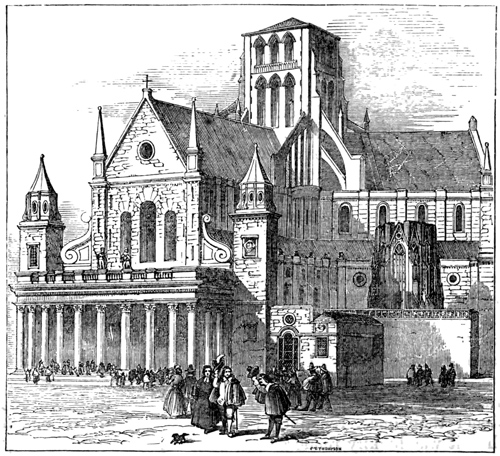
The church of St. Clement Danes, which unworthily occupies
the open part of the Strand, to the west of Essex Street,
was the one most frequented by Dr. Johnson. It is not
known why this church was called St. Clement Danes.
Some think because there was a massacre of the Danes thereabouts;
others because Harold Harefoot was buried there;
and others, because the Danes had the quarter given them to
live in, when Alfred the Great drove them out of London,
the monarch at the same time building the church, in order
to assist their conversion to Christianity. The name St.
Clement has been derived with probability from the patron
saint of Pope Clement III., a great friend of the Templars, to
whom the church at one time belonged. St. Clement's was
rebuilt towards the end of the century before last by Edward
Pierce, under the direction of Sir Christopher Wren, but is a
very incongruous ungainly edifice. Its best aspect is at
night-time in winter, when the deformities of its body are not
seen, and the pale steeple rises with a sort of ghastliness of
grandeur through the cloudy atmosphere. The chimes may
still be heard at midnight, as Falstaff describes having heard
them with Justice Shallow. If they did not execute one of
Handel's psalm-tunes, we should take them to be the very
same he speaks of, and conclude that they had grown hoarse
with age and sitting-up; for to our knowledge they have lost
some of their notes these twenty years, and the rest are
falling away. A steeple should set a better example.
A few years back, when the improvements on the north
side, in this quarter, had not been followed by those on the
south, Gay's picture of the avenue between the church and
the houses was true in all its parts. We remember the
"combs dangling in our faces," and almost mourned their
loss for the sake of the poet.
"Where the fair columns of St. Clement stand,
Whose straiten'd bounds encroach upon the Strand;
Where the low penthouse bows the walker's head,
And the rough pavement wounds the yielding tread;
Where not a post protects the narrow space,
And, strung in twines, combs dangle in thy face;
Summon at once thy courage, rouse thy care,
Stand firm, look back, be resolute, beware.
Forth issuing from steep lanes, the collier's steeds
Drag the black load; another cart succeeds;
Team follows team, crowds heap'd on crowds appear,
And wait impatient till the road grow clear."
Everybody can testify to the truth of this description. A
little patience, however, is well repaid by the sight of the
noble creatures dragging up the loads. The horses of the
colliers and brewers of London are worth notice at all times
for the magnificence of their build. Gay proceeds to other
particulars, now no longer to be encountered. He cautions
you how you lose your sword; and adds a pleasant mode of
theft, practised in those times:—
"Nor is the flaxen wig with safety worn:
High on the shoulder, in a basket borne,
Lurks the sly boy, whose hands, to rapine bred,
Plucks off the curling honours of thy head."[140]
Clement's Inn is named from the church. The device over
the gate, of an anchor and the letter C, is supposed to allude
to the martyrdom of St. Clement, who is said to have been
tied to an anchor and thrown into the sea, by order of the
Emperor Trajan.
"The hall is situated on the south side of a neat but small
quadrangle. It is a Tuscan diminutive building, with a very large
Corinthian door, and arched windows, erected in 1715. Another
irregular area is surrounded by convenient houses, in which are the
possessor's chambers. Part of this is a pretty garden, with a kneeling
African, of considerable merit, supporting a dial, on the eastern
side."[141]
In Knox's Elegant Extracts are some lines on this negro,
which have often been repeated:—
"In vain, poor sable son of woe,
Thou seek'st the tender tear;
For thee in vain with pangs they flow;
For mercy dwells not here.
From cannibals thou fledst in vain;
Lawyers less quarter give;
The first won't eat you till you're slain,
The last will do't alive."
This inn, like all the other inns of court, is of great
antiquity. Dugdale states it to have been an inn of Chancery
in the reign of Edward II. Some have conjectured, according
to Mr. Moser, "that near this spot stood an inn, as far
back as the time of King Ethelred, for the reception of
penitents who came to St. Clement's Well; that a religious
house was in process of time established, and that the church
rose in consequence." Be this as it may, the holy brotherhood
was probably removed to some other institution; the
Holy Lamb, an inn on the west side of the lane, received the
guests; and the monastery was converted, or rather perverted,
from the purposes of the gospel to those of the law, and was
probably, in this profession, considered as a house of considerable
antiquity in the days of Shakspeare; for he, who with
respect to this kind of chronology may be safely quoted,
makes in the second act of Henry IV. one of his justices a
member of that society:—
"He must to the Inns of Court. I was of Clement's once myself,
where they talk of Mad Shallow still."
A pump now covers St. Clement's Well. Fitzstephen, in
his description of London, in the reign of Henry II., speaks
of certain "excellent springs at a small distance" from the
city, "whose waters are sweet, salubrious, and clear, and
whose runnels murmur o'er the shining stones: among these,"
he continues, "Holywell, Clerkenwell, and St. Clement's
Well may be esteemed the principal, as being much the most
frequented, both by the scholars from the school (Westminster)
and the youth from the city, when on a summer's
evening they are disposed to take an airing."
Six hundred years and upwards have elapsed since Fitzstephen
wrote. It is pleasant to think that the well has lasted
so long, and that the place is still quiet.
The Clare family, who have left their name to Clare
Market, appear to have occupied Clement's Inn during part
of the reign of the Tudors. From their hands it reverted to
those of the law. It is an appendage to the Inner Temple.
We are not aware of any greater legal personage having
been bred there, than the one just mentioned. Shallow takes
delight in his local recollections, particularly of this inn.
In one of the masterly scenes of this kind, Falstaff's
corroboration of a less pleasant recollection, and Shallow's
anger against the cause of it, after such a lapse of time, are
very ludicrous.
"Shallow. Oh, Sir John, do you remember since we lay all night in
the windmill in St. George's Fields?
"Fals. No more of that, good Master Shallow, no more of that.
"Shal. Ha, it was a merry night. And is Jane Nightwork alive?
"Fals. She lives, Master Shallow.
"Shal. She never could away with me.
"Fals. Never, never; she would always say she could not abide
Master Shallow.
"Shal. By the mass. I could anger her to the heart. She was then
a bonaroba. Doth she hold her own well?—and had Robin Nightwork
by old Nightwork, before I came to Clement's Inn.
"Silence. That's fifty-five years ago.
"Shal. Ha, Cousin Silence, that thou hadst seen that that this
knight and I have seen! Ah, Sir John, said I well?
"Fals. We have heard the chimes at midnight, Master Shallow.
"Shal. That we have, that we have, that we have; in faith, Sir
John, we have; our watchword was, Hem, boys! Come, let's to
dinner: come, let's to dinner: Oh, the days that we have seen!
Come, come."[142]
The sites of Arundel, Norfolk, Surrey, and Howard Streets
(the last of which crosses the others), were formerly occupied
by the house and grounds originally constituting the town
residence of the Bishop of Bath and Wells, then of the Lord
High Admiral Seymour, and afterwards of the Howards Earls
of Arundel, from whom it came into possession of the Duke of
Norfolk. It was successively called Bath's Inn (Hampton
Place, according to some, but we know not why), Seymour
Place, Arundel House, and Norfolk House. It was a wide low
house, but according to Sully, who lodged in it when he was
ambassador to James I., very convenient, on account of the
multitude of rooms on the same floor.
In this house the Lord High Admiral, Thomas Seymour,
brother of the Protector Somerset, in the reign of Edward VI.,
contrived to place the Princess (afterwards Queen) Elizabeth,
with a design of possessing her person, and sharing her succession
to the Crown. No doubt is entertained of these views
by the historians. Elizabeth was not averse to him, though
he had lately married the Queen Dowager (Catherine Parr);
and some gossipping stories transpired of the evidences of
their good-will. Catherine's death increased the suspicion,
and she herself expressed it on her death-bed. Seymour's
ambition, however, shortly brought him to the scaffold, and
saved us from a King Thomas I., who would probably, as
Pennant thinks, have been a very bad one.
We have mentioned the Countess of Nottingham who withheld
from Elizabeth the ring sent her by Essex. It was in
this house she died. Her husband was a Howard, and, probably,
she was on a visit there. We take an opportunity,
therefore, of relating the particulars of that romantic story,
as collected by the accurate Dr. Birch, and repeated in the
Memoirs of the Peers of England during the reign of James I.
"The following curious story," says the compiler of this work,
"was frequently told by Lady Elizabeth Spelman, great grand-daughter
of Sir Robert Carey, brother of Lady Nottingham,
and afterwards Earl of Monmouth, whose curious memoirs of
himself were published a few years ago by Lord Corke."
"When Catherine, Countess of Nottingham, was dying (as she did,
according to his lordship's own account, about a fortnight before
Queen Elizabeth), she sent to her Majesty to desire that she might
see her, in order to reveal something to her Majesty without the
discovery of which she could not die in peace. Upon the Queen's
coming, Lady Nottingham told her, that, while the Earl of Essex lay
under sentence of death, he was desirous of asking her Majesty's
mercy, in the manner prescribed by herself, during the height of his
favour; the Queen having given him a ring, which being sent to her
as a token of his distress, might entitle him to her protection. But
the earl, jealous of those about him, and not caring to trust any of
them with it, as he was looking out of his window one morning,
saw a boy, with whose appearance he was pleased; and engaging him
by money and promises, directed him to carry the ring, which he
took from his finger and threw down, to Lady Scroope, a sister of the
Countess of Nottingham, and a friend of his lordship, who attended upon
the Queen; and to beg of her that she would present it to her Majesty.
The boy, by mistake, carried it to Lady Nottingham, who showed it
to her husband, the admiral, an enemy of Lord Essex, in order to
take his advice. The admiral forbid her to carry it, or return any
answer to the message; but insisted upon her keeping the ring.
"The Countess of Nottingham, having made this discovery, begged
the Queen's forgiveness; but her Majesty answered, 'God may forgive
you, but I never can,' and left the room with great emotion. Her mind
was so struck with the story that she never went into bed, nor took
any sustenance from that instant, for Camden is of opinion, that her
chief reason for suffering the earl to be executed, was his supposed
obstinacy in not applying to her for mercy."[143]
"In confirmation of the time of the countess's death," continues
the compiler, "it now appears from the parish register of Chelsea,
extracted by Mr. Lysons (Environs of London, vol. ii., p. 120), that
she died at Arundel House, London, February 25, and was buried the
28th, 1603. Her funeral was kept at Chelsea, March 21st; and Queen
Elizabeth died three days afterwards."
Clarendon gives a singular character of this house and its
master when it was in possession of Thomas Howard, Earl of
Arundel. He says that the earl
"Seemed to live, as it were, in another nation, his house being a
place to which all people resorted, who resorted to no other place;
strangers, or such as affected to look like strangers, and dressed
themselves accordingly. He was willing to be thought a scholar, and
to understand the most mysterious parts of antiquity, because he
made a wonderful and costly purchase of excellent statues whilst in
Italy and in Rome (some whereof he could never obtain permission to
remove out of Rome, though he had paid for them), and had a rare
collection of medals. As to all parts of learning, he was almost
illiterate, and thought no other part of history so considerable as
what related to his own family, in which, no doubt, there had been
some very memorable persons. It cannot be denied that he had in
his own person, in his aspect and countenance, the appearance of a
great man, which he preserved in his gait and motion. He wore and
affected a habit very different from that of the time, such as men had
only beheld in pictures of the most considerable men; all which drew
the eyes of most, and the reverence of many, towards him, as the
image and representative of the ancient nobility, and native gravity
of the nobles, when they had been most venerable; but this was
only his outside, his nature and true humour being much disposed to
levity and delights, which indeed were very despicable and childish."
The marbles here mentioned, now at Oxford, were collected
at Arundel House. This character from the pen of Clarendon
has been thought too severe. Perhaps the earl had given the
noble historian a repulse when he was nothing but plain
Mr. Hyde; for personal resentments of this sort are apparent
in his writings. The last Duke of Norfolk but one, who
wrote anecdotes on the Howard family, asks how the man
who collected the Oxford marbles could be the slave of such
family self-love as Clarendon describes, and how it was that
he held the first places in the state, and the most important
commissions abroad. It is well-known, however, that a man
may do all this, and yet be more fortunate than wise.
Arundel was certainly proud, if not dull; and the proudest
men are not apt to be the brightest. It was he that, in a
dispute with Lord Spenser, in the Upper House, when the
latter spoke of the treason of the earl's ancestors, said, "My
lord, my lord, while my ancestors were plotting treason,
yours were keeping sheep." He little thought that his
marbles would help to bring about a time, when an historian,
by no means indifferent to rank and title, should regard a
romantic poem as the "brightest jewel" in a ducal coronet,
and that coronet be a Spenser's.[144]
At the south-west corner of Norfolk Street lived at one
time the famous Penn, who from being a coxcomb in his
youth became a Quaker and a founder of a state. However,
his coxcombry was a falling-off from early seriousness. His
father was a rough admiral, who could not for the life of him
conceive why his son should relapse into a preciseness so
unlike the rest of the world, and so unfitted to succeed at
court. Voltaire says,[145] that young Penn (for he was little
more than twenty years of age) appeared suddenly before his
father in a Quaker dress, and to the old man's astonishment
and indignation said, without moving his hat, "Friend Penn,
how dost thee do?" But, according to more serious biographers,
the change was not so sudden. The hat, however,
was a great matter of contention between them, the admiral
wishing to stipulate that his son should uncover to the King
(Charles II.), the King's brother, and himself; but Penn
having recourse to "fasting and supplication," found that
his hat was not to be moved. These were the weaknesses of
a young enthusiast. His enthusiasm remained for greater
purposes; but he is understood to have grown wiser with
regard to the rest, though he continued a Quaker for life.
Penn, though a legislator, never seems to have given up a
taste for good living. His appearance in the portraits of
him, notwithstanding his garb, is fat and festive; and he
died of apoplexy.
In the same house, we believe, that had been occupied by
Penn[146], resided an author who must not be passed over in a
work of this kind; to wit, the indefatigable and honest
antiquary, Dr. Birch. He came of a Quaker stock. Birch
astonished his friends by going a great deal into company;
but the secret of his uniting sociality with labour, was his
early rising. This, which appears to be one of the main
secrets of longevity, ought to have kept him older, for he died
at the age of sixty-one: but he was probably festive as well
social, and should have taken more exercise. Being a bad
horseman, he was thrown on the Hampstead road, and killed
on the spot; but the doctors were uncertain whether apoplexy
had not a hand in the disaster. In speaking of Birch, nobody
should omit a charming billet, written to him by his first
wife, almost in the article of death. The death took place
within a year after their marriage, and was accelerated by
childbed.
"This day I return you, my dearest life, my sincere hearty thanks
for every favour bestowed on your most faithful and obedient wife.
"July 31, 1729."
"Hannah Birch."[147]
In Norfolk Street, for upwards of thirty years, lived
Dr. Brocklesby, the friend and physician of Dr. Johnson.
Physicians of this class may, par excellence, be styled the
friends of men of letters. They partake of their accomplishments,
understand their infirmities, sympathise with their
zeal to do good, and prolong their lives by the most delicate
and disinterested attentions. Between no two professions
has a more liberal and cordial intimacy been maintained than
between literature and medicine. Brocklesby was an honour
to the highest of his calling.
"In the course of his practice," we are told that "his advice, as
well as his purse, was ever accessible to the poor, as well as to men
of merit who stood in need of either. Besides giving his advice
to the poor of all descriptions, which he did with an active and
unwearied benevolence, he had always upon his list two or three
poor widows, to whom he granted small annuities; and who, on
the quarter-day of receiving their stipends, always partook of the
hospitalities of his table. To his relations, who wanted his assistance
in their business or professions, he was not only liberal, but
so judicious in his liberalities as to supersede the necessity of a repetition
of them. To his friend Dr Johnson (when it was in agitation
amongst his friends to procure an enlargement of his pension, the
better to enable him to travel for the benefit of his health), he offered
an establishment of one hundred pounds per year during his life; and
upon Dr. Johnson's declining it (which he did in the most affectionate
terms of gratitude and friendship), he made him a second
offer of apartments in his own house, for the more immediate benefit
of medical advice. To his old and intimate friend Edmund Burke,
he had many years back bequeathed by will the sum of one thousand
pounds; but recollecting that this event might take place (which it
afterwards did) when such a legacy could be of no service to him, he,
with that judicious liberality for which he was always distinguished,
gave it to him in advance, 'ut pignus amicitæ:' it was accepted as
such by Mr. Burke, accompanied with a letter, which none but a
man feeling the grandeur and purity of friendship like him could
dictate."[148]
If it be dangerous in the present condition of society, to
incur pecuniary obligations, particularly for those who are
more qualified to think than to act, and who may ultimately
startle to find themselves in positions in which they can
neither prove the benefit done them, nor the good feelings
which allowed them to receive it, nobody can doubt the
generosity of such a man as Brocklesby; who, so far from
being a mere patron, jealous of being obliged himself, was
equally as prepared to receive kindness as to show it.
Proposing just before he died to go down to Burke's
house at Beaconsfield, and somebody hinting to him the
danger of being fatigued, and of lying out of his own bed,
he replied with his usual calmness, "My good friend, I perfectly
understand your hint, and am thankful to you for it;
but where's the difference, whether I die at a friend's house,
at an inn, or in a postchaise? I hope I am every way prepared
for such an event, and perhaps it is as well to elude the
expectation of it." This was said like a man, and a friend.
Brocklesby was not one who would cant about giving trouble
at such a moment—the screen of those who hate to be troubled;
neither would he grudge a friend the melancholy satisfaction
of giving him a bed to die in. He better understood the first
principles which give light and life to the world, and left
jealousy and misgiving to the vulgar.
Dr. Brocklesby died at his house in the street above mentioned,
and was buried in the churchyard. Lee was buried,
"at St. Clement Danes;" probably, therefore, in the churchyard
also. There are now in that spot some trees, by far
the best things about the church. The reader may imagine
them to shade the places where the poet and the physician lie.
Arundel or Norfolk House, after the great fire, became the
temporary place of meeting for the Royal Society, previously
to its return to Gresham College. It was pulled down on
their leaving it, the century before last, and the streets before
mentioned built in its room. They appear to have been
favourite places of residence with persons connected with the
drama. Congreve lived in Surrey Street, Mountford the
player in Norfolk Street, Mrs. Bracegirdle in Howard Street,
and Mrs. Barry somewhere near her.
Congreve died where he had lived (Jan. 29, 1728-9), after
having been for several years afflicted with blindness and
gout; of which, however, he seems to have made the best he
could, by the help of good sense and naturally good spirits.
If his wits ever failed him, it was in the propensity to a love of
rank and fashion, which, in spite of all that he had seen in the
world, never forsook him. It originated probably in the need
he thought he had of them, when he first set out in life. The
finest sense of men of his cast does not rise above a graceful
selfishness. It was most probably in Surrey Street (for he
had come to the "verge of life"), that he had a visit paid
him by Voltaire, who has recorded the disgust given him by
an ebullition of his foppery: for the Frenchman had a great
admiration of him as a writer. "Congreve spoke of his
works," says Voltaire, "as of trifles that were beneath him;
and hinted to me, in our first conversation, that I should visit
him upon no other foot than upon that of a gentleman, who
led a life of plainness and simplicity. I answered, that had he
been so unfortunate as to be a mere gentleman, I should never
have come to see him; and I was very much disgusted at so
unseasonable a piece of vanity."[149] Our readers will admire
the fineness of this rebuke.
But the most glaring instance of this propensity was his
leaving the bulk of his fortune to a duchess, when he had
poor relations in want of it.
"Having lain in state," says Johnson, "in the Jerusalem Chamber,
he was buried in Westminster Abbey, where a monument is erected
to his memory by Henrietta, Duchess of Marlborough, to whom, for
reasons either not known or not mentioned, he bequeathed a legacy of
about ten thousand pounds, the accumulation of attentive parsimony,
which, though to her superfluous and useless, might have given great
assistance to the ancient family from which he descended; at that
time, by the imprudence of his relation, reduced to difficulties and
distress."[150]
"Congreve," says Dr. Young, "was very intimate for years with
Mrs. Bracegirdle, who lived in the same street—his house very near
hers; until his acquaintance with the young Duchess of Marlborough.
He then quitted that house. The duchess showed me a diamond
necklace (which Lady Di. used afterwards to wear), that cost seven
thousand pounds, and was purchased with the money Congreve left
her. How much better would it have been to have given it to poor
Mrs. Bracegirdle!"[151]
Yet this dramatist, throughout his life, had had the good
word of everybody. All parties praised him: all parties kept
him in office (he had some places that are said to have produced
him twelve hundred a year): Pope dedicated his Iliad
to him; called him, after his death, Ultimus Romanorum; and
added that "Garth, Vanbrugh, and he were the three most
honest-hearted, real good men of the Kit-Kat Club!"[152]
The secret of this is, that Congreve loved above all things
to be at ease, and spoke politicly of everybody. He had a
bad opinion of mankind, as we may see by his comedies;
and he made the best of it, by conversing with them as if he
took heed of their claws. The only person, we believe, that
he ever opposed, was Collier, who attacked the stage with
more spirit than elegance, and who was at enmity with the
whole world of wit and fashion. We are far from thinking
with Collier, that the abuses of the stage outweigh the benefit
it does to the world; nor do we think the world by any
means so bad as Congreve supposed it, nor himself either:
but it is useful to know the tendencies of those who have a
habit of thinking otherwise.
Congreve's bequest created a good deal of gossip. Curll,
the principal scandal-monger of those times, got up a catch-penny
life of him, professing to be written by "Charles
Wilson, Esq.," but supposed to be the work of Oldmixon.
There is no relying upon Charles Wilson; but, from internal
evidence, we may take his word occasionally; and we may
believe him when he says that the duchess and her friends
were alarmed at the threatened book. The picture which he
draws of her manner has also an air like a woman of quality.
She had demanded a sight of the documents on which the
book was founded; and being refused, asked what authority
they had, and what pieces contained in it were genuine.
"Upon being civilly told there would be found several essays,
letters, and characters of that gentleman's writing," says
Mr. Wilson, "she, with a most affected, extraordinary,
dramatic drawl, cried out, 'Not one single sheet of paper, I
dare to swear.'"[153] Mr. Wilson's own grand air in return is
very amusing. He speaks of Arbuthnot's coming with "expresses,"
probably to Curll's; and adds, that if he be
despatched with any more, "he may, if he please, come to
me, who am as easily to be found in Great Russell Street,
Bloomsbury, when in town, as he is in Burlington Gardens.—Cha.
Wilson."
Mr. Wilson's book opens with a copy of the will, in which
500l. are left among the Congreves; about 500l. more to
friends and domestics, &c. (not omitting 200l. to Mrs. Bracegirdle);
and all the rest (with power to annul or increase the
complimentary part of the legacies) to the Duchess of
Marlborough. We know not that anybody could have
brought forward grounds for objecting to this will, had the
duchess been poor herself; for his relations may or may not
have had claims upon him—relations, as such, not
being of necessity friends, though it is generally fit that they
should partake of the family prosperity. We except, of
course, a man's immediate kindred, particularly those whom
he has brought into the world. But here was a woman,
rolling in wealth, and relatives neither entirely forgotten, nor
yet, it seems, properly assisted. The bequest must, therefore,
either have been a mere piece of vanity, or the consequence of
habitual subjection to a woman's humours. The duchess was
not ungrateful to his memory. She raised him, as we have
seen, a monument; and it is related in Cibber's Lives of the
the Poets,[154] we know not on what authority, that she missed
his company so much, as to cause "an image of him to be
placed every day on her toilet-table, to which she would talk
as to the living Mr. Congreve, with all the freedom of the
most polite and unreserved conversation." There is something
very ludicrous in this way of putting a case, which might
otherwise be affecting. It is as if there had been a sort of
polite mania on both sides.
Congreve's plays are exquisite of their kind, and the excessive
heartlessness and duplicity of some of his characters are
not to be taken without allowance for the ugly ideal. There
is something not natural, both in his characters and wit; and
we read him rather to see how entertaining he can make his
superfine ladies and gentlemen, and what a pack of sensual
busybodies they are, like insects over a pool, than from any
true sense of them as "men and women." As a companion
he must have been exquisite to a woman of fashion. We can
believe that the duchess, in ignorance of any tragic emotion
but what was mixed with his loss, would really talk with a
waxen image of him in a peruke, and think the universe contained
nothing better. It was carrying wit and politeness
beyond the grave. Queen Constance in Shakspeare makes
grief put on the pretty looks of her lost child: the Duchess
of Marlborough made it put on a wig and jaunty air, such as
she had given her friend in his monument in Westminster
Abbey. No criticism on his plays could be more perfect.
Congreve's serious poetry is a refreshment, from its extreme
insipidity and common-place. Everybody is innocent in some
corner of the mind, and has faith in something. Congreve
had no faith in his fellow-creatures, but he had a scholar's
(not a poet's) belief in nymphs and weeping fauns; and he
wrote elegies full of them, upon queens and marquisses. If
it be true that he wrote the character of Aspasia (Lady
Elizabeth Hastings), in the Tatler (No. 42), he had indeed
faith in something better; for in that paper is not only given
an admiring account of a person of very exalted excellence,
but the author has said of her one of the finest things that a
sincere heart could utter; namely, that "to love her was a
liberal education." We cannot help thinking, however, that
the generous and trusting hand of Steele is very visible
throughout this portrait; and in the touch just mentioned, in
particular.
The engaging manners of Mrs. Bracegirdle gave rise to a
tragical circumstance in Howard Street—the death of Mountford
her fellow-player. Mrs. Bracegirdle, one of the most
popular actresses of that time, was a brunette, not remarkable
for her beauty, but so much so for the attractiveness superior
to beauty, that Cibber calls her the "darling of the stage,"
and says it was a kind of fashion for the young men about
town to have a tenderness for her. This general regard she
preserved by setting a value on herself, not so common with
actresses at that time as it has been since. Accordingly, some
made honourable proposals, which were then still more remarkable.
In Rowe's poems, there is a bantering epistle to
an Earl of S——, advising him not to care for what people
might think, but to pursue his inclinations to that effect.
Among others a Captain Hill made desperate love, professing
the same intentions; but he was a man of bad character,
and the lady would have nothing to say to him. The captain,
like a proper coxcomb, took it into his head that nothing
could have prevented his success, but some other person; and
he fixed upon Mountford as the happy man. Mountford was
the best lover and finest gentleman then on the stage, as
Mrs. Bracegirdle was the most charming heroine; but it does
not appear that Hill had any greater ground for his suspicion
than their frequent performance in the same play, which,
however, to a jealous man, must have been extremely provoking.
They used to act Alexander and Statira together. In
Mountford's Alexander, according to Cibber, there were seen
"the great, the tender, the penitent, the despairing, the transported,
and the amiable, in the highest perfection;" and "if
anything," he said, "could excuse that desperate extravagance
of love, that almost frantic passion," it was when Mrs.
Bracegirdle was the Statira. Imagine a dark-souled fellow in
the pit thinking himself in love with this Statira, and that
the passion between her and the Alexander was real. This
play was acted a few nights before the catastrophe which we
are about to relate.
Hill was intimate with another man of bad character, Lord
Mohun; who agreed to assist him in carrying off Mrs. Bracegirdle.
The captain had often said that he would be
"revenged" upon Mountford; and dining with Lord Mohun
on the day when they attempted the execution of their
plot, he said, further, that he would "stab" him "if he
resisted;" upon which Mohun said that he would "stand by
his friend."
Mohun and Hill met at the playhouse at six o'clock,
changed clothes there, and waited some time for Mrs. Bracegirdle;
but not finding her come, they took a coach which
they had ordered to be ready, drove towards her lodgings in
Howard Street, and then back to Drury Lane, where they
directed the coach to stop near Lord Clare's house (by the
present Craven Buildings). Mrs. Bracegirdle had been
supping at a Mr. Page's, in Princess Street, Drury Lane.
She came out, accompanied by her mother, brother, and
Mr. Page, and was seized by Hill, who, with the aid of a
number of soldiers, endeavoured to force her into the coach.
In the coach was Lord Mohun, with seven or eight pistols.
Old Mrs. Bracegirdle threw her arms round her daughter's
waist; her other friends, and at length the passengers,
interfered; and our heroine succeeded in getting into her
lodgings in Howard Street, Hill and Mohun following them
on foot. When they all came to the door, Hill would have
spoken with Page, but the latter refused; and the door was
shut. A witness, at the trial of Lord Mohun, deposed, that
they knocked several times at the door, and then the captain
entreated to beg pardon of Mrs. Bracegirdle for having
affronted her, but in vain.
Hill and Mohun remained in the street. They sent to a
tavern for a bottle of wine, and perambulated before the door
with drawn swords. Mrs. Browne, the mistress of the house,
came out to know what they did there; upon which Hill
said that he would light upon Mountford some day or other,
and that he would be revenged on him. The people in-doors,
upon this, sent to Mountford's house in Norfolk Street, to
inform his wife; and she despatched messengers to all the
places where he was likely to be found, to warn him of his
danger, but they could not meet with him. Meanwhile the
constables and watchmen come up and ask the strangers
what they mean. They say they are drinking a bottle of
wine. Lord Mohun adds that he is ready to put up his
sword, remarking, withal, that he is a "peer of the realm."
Upon asking why the other gentleman did not put up his,
his lordship tells them, that his friend had lost the scabbard.
The watchmen, like "ancient and quiet watchmen," go away
to the tavern to "examine who they are;" and in the
meantime Mountford makes his appearance coming up the
street. Mountford lived in Norfolk Street, but he turned out
of the path that led to his own house, and was coming
towards Mrs. Bracegirdle's—whether to her house, or to any
other, does not appear. By this time two hours had elapsed.
Mrs. Browne, who seems to have remained watching at the
door, caught sight of Mountford, and hastened to warn him
how he advanced. She was either not quick enough, or
Mountford (which appears most likely) pressed on in spite of
what she said, and, according to her statement, the following
dialogue took place between him and Lord Mohun:—
"Your humble servant, my lord."
"Your servant, Mr. Mountford. I have a great respect for you,
Mr. Mountford, and would have no difference between us; but there
is a thing fallen out between Mr. Hill and Mrs. Bracegirdle."
"My lord, has my wife disobliged your lordship? if she has, she
shall ask your pardon. But Mrs. Bracegirdle is no concern of mine:
I know nothing of this matter; I come here by accident. But I hope
your lordship will not vindicate Hill in such actions as these are."
Upon this, according to Mrs. Browne's statement, Hill bade
Mountford draw; which the other said he would; but whether
he received his wound before or after she could not tell, owing
to its being night-time.
Another female witness, who lived next door, gives the
dialogue as follows. Lord Mohun begins:—
"Mr. Mountford, your humble servant. I am glad to see you"
(embracing him).
"Who is this? my Lord Mohun?"
"Yes, it is."
"What bringeth your lordship here at this time of night?"
"I suppose you were sent for, Mr. Mountford?"
"No, indeed; I came by chance."
"You have heard of the business of Mrs. Bracegirdle?"
Hill (interfering). "Pray, my lord, hold your tongue, This is
not a convenient time to discuss this business." (On saying which,
the witness adds, that he would have drawn Mohun away.)
Mountford. "I am very sorry, my lord, to see that your lordship
should assist Captain Hill in so ill an action as this: pray let me
desire your lordship to forbear."
As soon as he had uttered these words Hill, according to
the witness, came up and struck Mountford a box on the ear;
upon which the latter demanded with an oath, "what that
was for;" and then she gives a confused account of the
result, which was the receipt of a mortal wound by the
poor actor. It was agreed that Mountford's sword was not
drawn in the first instance, and that Hill's was; and the
question was settled by the dying deposition of Mountford,
who stated several times over, that Lord Mohun offered him
no violence, but that Hill struck him with his left hand, and
then ran him through the body, before he had time to draw
in defence.
Mountford died next day. Hill fled at the time, and we
hear no more of him. Mohun was tried for his life, but
acquitted, for want of evidence, of malice prepense. The
truth is, he was a great fool, and Hill appears to have been
another. The captain himself, probably, did not know what
he intended, though his words would have hung him had he
been caught. They were a couple of box-lobby swaggerers,
who had heated themselves with wine; and Hill, who told the
constables "they might knock him down if they liked," and
was for drawing Mohun away on Mountford's appearance,
was most likely overcome with rage and jealousy at hearing
the latter speak of him with rebuke. Mohun was at that time
very young. He never ceased, however, hankering after this
sort of excitement to his dulness, till he got killed in a duel
about an estate with the Duke of Hamilton, who was at the
same time mortally wounded. Swift, in a letter about it, calls
Mohun a "dog." Pennant says, that when his body was
taken home bleeding (to his house in Gerrard Street), "Lady
Mohun was very angry at its being flung upon the best
bed."[155]
In front of the spot now occupied by St. Mary-le-Strand,
commonly called the New Church, anciently stood a cross, at
which, says Stowe, "in the year 1294, and other times, the
justices itinerant sat without London." In the place of this
cross was set up a May-pole, by a blacksmith named John
Clarges, whose daughter Ann became the wife of Monk, Duke
of Albemarle. It was for a long time in a state of decay, and
having been taken down in 1713, a new one was erected
opposite Somerset House. This second May-pole had two
gilt balls and a vane on the summit, and was decorated on
holidays with flags and garlands. The races in the "Dunciad"
take place
"Where the tall May-pole overlook'd the Strand."
It was removed in 1718, probably being thought in the
way of the new church, which was then being finished.
Sir Isaac Newton begged it of the parish, and afterwards
sent it to the Rector of Wanstead, who set it up in
Wanstead Park to support the then largest telescope in
Europe. The gift of John Clarges came a day too late. In
old times, May had been a great holiday in the streets of
London. We shall speak further of it when we come to the
parish of St. Andrew Undershaft, so called from a May-pole
higher than the church. But though the holiday returned
with the Restoration, it never properly recovered the disuse
occasioned by the civil wars, and the contempt thrown on it
by the spirit of puritanism. We gained too many advantages
by the thoughtfulness generated in those times to quarrel with
their mistakes; and have no doubt that the progress of knowledge
to which they gave an impulse, will bring back the
advantages they omitted by the way.[156]
The New Church, or, more properly, the Church of
St. Mary-le-Strand, was built by Gibbs, the architect of
St. Martin-in-the-Fields. It was one of the "fifty," improperly
so called, that are said to have been built in the reign
of Queen Anne; for though fifty were ordered, the number
was not completed. The old church in this quarter, which
stood at a little distance to the south, was removed by the
Protector Somerset, to make way for Somerset House, and has
never been restored. The parishioners went to the neighbouring
churches. The New Church is in the pretty, over-ornamented
style, very different from that of St. Martin's with its
noble front: and though far better than St. Clement's, and as
superior to many places of worship built lately[157] as art is
superior to ignorance, yet it surely is not worthy of its advantageous
situation. It is one of those toys of architecture
which have been said to require glass cases. For the superfluous
height of the steeple, Gibbs offered an excuse. A
column was to have been erected near the church in honour
of Queen Anne, but, as the Queen died, she was no longer
thought deserving the column, and the architect was ordered
to make a steeple with the materials, whereas he had intended
only a belfry. Now, to render the steeple fitting, the church
should have had a wider base; but the structure was already
begun, and there was no changing the plan of it. It might be
still argued, that the steeple should not have been made so
high: but then, what was to be done with the stones? This,
in the mouth of parish virtù, was a triumphant reply. After
all, however, the artist need not have spoilt his church with
ornament. He said, that being situated in a very public place,
"the parishioners" spared no cost to beautify it; but to beautify
a church is not to make it a piece of confectionery.[158]
Somerset House occupies the site of a princely mansion
built by Somerset the Protector, brother of Lady Jane
Seymour, and uncle to King Edward VI. His character is
not sufficiently marked to give any additional interest to the
spot. He was great by accident; lost and gained his greatness,
according as others acted upon it; and ultimately
resigned it on the scaffold. The house he left became the
property of the Crown, and was successively in possession of
Queen Elizabeth and of the queens of James I., Charles I., and
Charles II.
The rooms in this house witnessed many joyous scenes and
many anxious ones. Somerset had not long inhabited it when
he was taken to the scaffold. Elizabeth, in her wise economy,
lent it to her cousin Lord Hunsdon, whom she frequently
visited within its walls.
During its occupation by James's queen, Anne of Denmark
(from whose family it was called Denmark House), Wilson
says, that a constant masquerade was going on, the Queen and
her ladies, "like so many sea-nymphs, or nereids," appearing
in various dresses, "to the ravishment of the beholders."[159]
Here began the struggle for mastery between Charles I. and
Henrietta Maria, which terminated in favour of the latter,
though the King behaved himself manfully at first. Henrietta
had brought over with her a meddling French household
which, after repeated grievances, his Majesty was obliged to
send "packing." He summoned them all together one evening
in the house, and addressed them as follows:—
"Gentlemen and ladies,
"I am driven to that extremity, as I am personally come to acquaint
you, that I very earnestly desire your return into France. True it is,
the deportment of some amongst you hath been very inoffensive to
me; but others again have so dallied with my patience, and so highly
affronted me, as I cannot, and will not, longer endure it."[160]
"The King's address, implicating no one, was immediately followed
by a volley of protestations of innocence. An hour after he had
delivered his commands, Lord Conway announced to the foreigners,
that early in the morning carriages and carts and horses would be
ready for them and their baggage. Amidst a scene of confusion, the
young Bishop (he was scarcely of age) protested that this was impossible;
that they owed debts in London, and that much was due to
them. On the following day, the procureur-general of the Queen flew
to the keeper of the great seal at the privy council, requiring an
admission to address his Majesty, then present at his council, on
matters important to himself and the Queen. This being denied, he
exhorted them to maintain the Queen in all her royal prerogatives;
and he was answered, 'So we do.'
"Their prayers and disputes served to postpone their departure.
Their conduct during this time was not very decorous. It appears,
by a contemporary letter-writer, that they flew to take possession of
the Queen's wardrobe and jewels. They did not leave her a change
of linen, since it was with difficulty her Majesty procured one.
Everyone now looked to lay his hand on what he might call his own.
Everything he could touch was a perquisite. One extraordinary
expedient was that of inventing bills to the amount of ten thousand
pounds, for articles and other engagements in which they had entered
for the service of the Queen, which her Majesty acknowledged, but
afterwards confessed that the debts were fictitious."[161]
"In truth," continues the writer, "the breaking up of this
French establishment was ruinous to the individuals who had
purchased their places at the rate of life annuities." Charles
now grew indignant, and sent the following letter to Buckingham:—
"Steenie,[162]
"I have receaved your letter by Dic Greame (Sir Richard Grahame).
This is my answer: I command you to send all the French away to-morrow
out of the towne, if you can by fair meanes (but stike not
long in disputing), otherways force them away, dryving them away
lyke so manie wilde beastes, until ye have shipped them, and so the
devil goe with them. Let me heare no answer, but of the performance
of my command. So I rest,
"Your faithful, constant, loving friend,
"C. R."
"Oaking,
"The seventh of August, 1626."
"This order put an end to the delay, but the King paid the debts,
the fictitious ones and all—at the cost, as it appears, of fifty thousand
pounds. Even the haughty beauty, Madame St. George, was presented
by the king on her dismission with several thousand pounds
and jewels."
Still the French could not go quietly. "The French
bishop," says D'Israeli, "and the whole party having contrived
all sorts of delays to avoid the expulsion, the yeomen
of the guard were sent to turn them out of Somerset House,
whence the juvenile prelate, at the same time making his
protest and mounting the steps of the coach, took his departure
'head and shoulders.' In a long procession of near
forty coaches, after four days' tedious travelling, they reached
Dover; but the spectacle of these impatient foreigners so
reluctantly quitting England, gesticulating their sorrows or
their quarrels, exposed them to the derision, and stirred up
the prejudices, of the common people. As Madame St. George,
whose vivacity is always described as extremely French, was
stepping into the boat, one of the mob could not resist the
satisfaction of flinging a stone at her French cap. An English
courtier who was conducting her, instantly quitted his charge,
ran the fellow through the body, and quietly returned to the
boat. The man died on the spot, but no further notice appears
to have been taken of the inconsiderate gallantry of the
English courtier."
Henrietta had a magnificent Catholic chapel in Somerset
House, and a cloister of Capuchins. The former has given
occasion to some interesting descriptions of papal show and
spectacle in the commentaries just quoted.[163]
Cromwell's body lay in state at Somerset House, as Monk's
did afterwards, probably on that account.
Pepys, the prince of gossips, gives an edifying picture of
the presence chamber in this palace, when the queens of the
two Charleses were there together, a little after the Restoration:
"Meeting Mr. Pierce the chyrurgeon," says he, "he took me into
Somerset House, and there carried me into the Queene-mother's
presence chamber, where she was with our own queene sitting on her
left hand, whom I did never see before, and though she be not very
charming, yet she hath a good, modest, and innocent look, which is
pleasing. Here I also saw Madame Castlemaine; and, which pleased
me most, Mr. Crofts, the King's bastard, a most pretty sparke of
about fifteen years old, who, I perceive, do hang much upon my Lady
Castlemaine, and is always with her; and, I hear, the queenes both
are mighty kind to him. By and by, in comes the King, and anon the
duke and his duchesse; so that they being all together, was such a
sight, as I never could almost have happened to see, with so much
ease and leisure. They staid till it was dark and then went away;
the King and his Queene, and my Lady Castlemaine and young
Crofts, in one coach, and the rest in other coaches. Here were great
stores of great ladies, but very few handsome. The King and Queene
were very merry; and he would have made the Queene-mother
believe that his Queene was with child, and said that she said so,
and the young Queene answered, 'You lye;' which was the first
English word that I ever heard her say: which made the King good
sport."[164]
After this we shall not wonder at the following:—
"30th (Dec., 1662). Visited Mrs. Ferrer and staid talking with
her a good while, there being a little proud, ugly, talking little lady
there, that was much crying up the Queene-mother's court at
Somerset House above our own Queene's; there being before her no
allowance of laughing and the mirth that is at others; and, indeed,
it is observed that the greatest court now-a-days is there."[165]
The following print represents Old Somerset House, as it
appeared in the reign of Charles II. We have seen, but in
vain endeavoured to procure for this book, a scarce one by
Hollar, in which the towers in the back ground mark out the
front in the Strand, and a tall May-pole to the right was the
May-pole of John Clarges. The front, looking on the river,
was added by Charles II. Inigo Jones was the architect.
In Hollar's print it gives us a taste of the banqueting room
at Whitehall in its elevation, and in the harmonies of the
windows and pilasters. Below is a portico; and there is
another to the right. The chapel, with an enclosure to the
left, was the Catholic one; the houses by it, the cloisters of
the Capuchins. There was a figure walking in the chapel
garden, whom, by his gesticulating arm, we might imagine
to be the queen's confessor, studying his to-morrow's sermon,
or thinking how he shall get the start of the king's chaplain
in saying grace. A curious scene of this kind is worth
extracting. "Once," Mr. D'Israeli informs us, "when the
king and queen were dining together in the presence, Hacket
being to say grace, the queen's confessor would have anticipated
him, and an indecorous race was run between the
Catholic priest and the Protestant chaplain, till the latter
shoved him aside, and the king pulling the dishes to him,
the carvers performed their office. Still the confessor, standing
by the queen, was on the watch to be before Hacket for
the after-grace, but Hacket again got the start. The confessor,
however, resounded the grace louder than the chaplain,
and the king, in great passion, instantly rose, taking the
queen by the hand." The bowling-green that we read of is
probably between the two rows of trees to the right, in front
of the right portico (the left, if considered from the house).
The garden is in the most formal style of the parterre,
where
—— "each alley has its brother,
And half the platform just reflects the other;"
a style, however, not without its merits, particularly in
admitting so many walks among the flowers, and inviting a
pace up and down between the trees. Milton, though he
made a different garden for his Eden, spoke of "trim
gardens," as enjoyed by "retired leisure." In this back
front were the apartments of the court. The scene we have
just been reading in Pepys must have passed in one of them.
Here Charles the First's widow lived with her supposed
husband, the Earl of St. Albans; though she was not so
constant to the place as Waller prophesied she would be.
She had been used to too much power as a queen, and found
she had too little as a dowager. Poor Catherine remained as
long as she could. She lived here till she returned to
Portugal, in the reign of William III. Speaking of Waller,
we must not quit the premises without noticing a catastrophe
that befel him at the water-gate, or Somerset-stairs (also, by
the way, the work of Inigo Jones). Waller, according to
Aubrey, had but "a tender weak body, but was always very
temperate." —— (we know not who this is) "made him
damnable drunk at Somerset House, where, at the water
stayres, he fell down, and had a cruel fall. 'Twas a pity to
use such a sweet swan so inhumanly."[166] Waller, who, notwithstanding
his weak body, lived to be old, was a water-drinker;
but he had a poet's wine in his veins, and was
excellent company. Saville said, "that nobody should keep
him company without drinking, but Ned Waller."
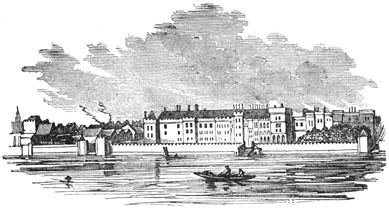
Subsequently to Catherine's departure, old Somerset House
was chiefly used as a residence for princes from other countries
when on a visit. It was pulled down towards the end of the
last century, and the present structure erected by Sir William
Chambers, but left unfinished. The unfinished part, which
is towards the east, is now in a state of completion, as the
King's College. The only memorial remaining of the old
palace and its outhouses is in the wall of a house in the Strand,
where the sign of a lion still survives a number of other
signs, noticed in a list made at the time, and common at that
period to houses of all descriptions.
The area of New Somerset House occupies a large space
of ground, the basement of the back-front being in the river.
Three sides of it are appropriated to a variety of public offices,
connected with trade, commerce, and civil economy; and the
front was lately dignified by the occupancy of the Royal and
Antiquarian Societies and the Royal Academy of Painting.
The structure was an ambitious one on the part of the
architect, and upon the whole is elegant but timid. There is
a look of fragility in it. It has the extent, but not the
majesty, of a national emporium. Rules are violated in some
instances for the sake of trifles, as is the case of pillars
"standing on nothing and supporting nothing;" and in
others, it would seem out of a dread of the result, as in the
instance of the huge basement over the water, supporting a
cupola, which is petty in the comparison. Sir William did
well in wishing to have an imposing front towards the river;
but he might have had another towards the Strand, nobler
than the present one. The lower part is nothing better than
a pillared coachway. However, the front of the story is,
perhaps, the best part of the whole building. It present a
graceful harmony in the proportions.
The Royal Society, which originated in the college rooms
of Dr. Wilkins, afterwards bishop of Chester, met, when it
was incorporated, at Old Gresham College in Aldersgate
Street; then at Arundel House (on account of the fire); then
returned to Gresham College; and, after a variety of other
experiments upon lodging, was settled by the late king in
New Somerset House. This society, on its foundation, was
much ridiculed by the wits. Though its ends were great, it
naturally busied itself with little things; pragmatical and
pedantic persons naturally enough got mixed up with it;
some of its members had foibles of enthusiasm and pedantry,
which were easily confounded with their capacities; and the
jokes were most likely encouraged by the king (Charles II.),
who, though fond of scientific experiments, and wearing a
grave face in presence of the learned body (of which he
declared himself a member), was not a man to forego such an
opportunity of jesting. Wilkins wrote a book to show that
a man might go to the moon; and the ethical common-places
of Boyle (who was as great a natural philosopher as he was a
poor moralist) were the origin of Swift's Essays on the Tritical
Faculties of the Mind. Then there was the good Evelyn
with his hard words, wondering sentimentally at every thing;
and jolly Pepys marvelling like Sancho Panza. The readers
of Pepys' Diary have been surprised at his not liking
Hudibras. Perhaps one reason was, that Butler was the
greatest of the jesters against the society. It was impossible
not to laugh at the jokes, in which he charges them with
attempting to
"Search the moon by her own light;
To take an inventory of all
Her real estate and personal;—
To measure wind, and weigh the air,
And turn a circle to a square;
And in the braying of an ass,
Find out the treble and the bass;
If mares neigh alto, and a cow
In double diapason low."[167]
Evelyn got angry, and pretended to be calm. Cowley expressed
his anger with a generous indignation. The following
passage in his Ode to the Society concludes with a fine,
appropriate simile. "Mischief and true dishonour," says he,
—— "fall on those
Who would to laughter and to scorn expose
So virtuous and so noble a design,
So human for its use, for knowledge so divine.
The things which these proud men despise and call
Impertinent, and vain, and small,
Those smallest things of Nature let me know,
Rather than all their greatest actions do!
Whoever would deposed Truth advance
Into the throne usurped from it,
Must feel at first the blows of Ignorance,
And the sharp points of envious Wit.
So, when, by various turns of the celestial dance
In many thousand years
A star, so long unknown, appears,
Though Heaven itself more beauteous by it grow,
It troubles and alarms the world below,
Does to the wise a star, to fools a meteor, show."[168]
Perhaps a part of the jealousy against the Royal Society
arose from a notion which has since become not uncommon,
that bodies of this nature, incorporated by kings, are calculated
rather to limit inquiry, than to enlarge it. Without
stopping to discuss this point, we shall merely observe, that
the real greatness of all such bodies, like those of nations
themselves, must arise from the greatness of individuals; and
that whether the bodies give any lustre to them or not, there
is no denying that the individuals give lustre to the bodies.
When Sir Isaac Newton became president, jesting ceased.
It is pleasant to think, while passing Somerset House, in
the midst of the noise of a great thoroughfare, that philosophical
speculation is, perhaps, going on within those graceful
walls; that in the midst of all sorts of new things, sight is not
lost of the venerable beauties of old; and that art, as well as
philosophy, is considering what it shall do for our use and
entertainment. The Antiquarian Society originated as far
back as the sixteenth century (about the year 1580), and held
its first sittings in a room in the Herald's College; but it did
not receive a charter till the year 1751. Neither Elizabeth
nor James would give it one, fearful, perhaps, of bringing up
discussions on matters connected with politics and religion.
Elizabeth has now become one of the most interesting of its
heroines. There is no society, we think, more likely to increase
with age, and to outgrow half-witted objection. The
growth of time adds daily to its stock; and as reflecting men
become interested in behalf of ages to come, they naturally
turn with double sympathy towards the periods that have
gone by, and to the multitudes of beating hearts that have
become dust. We should like to see the society in a venerable
building of its own, raised in some quiet spot, with trees
about it, and with painted windows reflecting light through
old heraldry.
The Royal Academy of Painters, now removed to Trafalgar
Square, first met in Saint Martin's Lane, under the title of
the Society of Artists of Great Britain. They had a division
among them, which gave rise to the establishment as it now
stands; and are a flourishing body, we believe, in point of
funds. Of the deceased members who have done them honour,
we shall speak when we come to their abodes.
The Turk's Head Coffeehouse, near Somerset House, was
frequented by Dr. Johnson.
In a lodging opposite Somerset House, died the facetious
Dr. King, whom we have mentioned in speaking of Doctors'
Commons. He had been residing in the house of a friend in
the garden-grounds between Lambeth and Vauxhall, where
he stuck so close to his books and bottle, that he began to
decline with the autumn, and shut himself up from his friends.
Lord Clarendon, who resided in Somerset House, and was his
relation, sent his sister to fetch him to a lodging he had prepared
for him over the way, where he died before the lapse of
many hours, while all the world were busy with the meats
and mince-pies he had so often celebrated; for it was
Christmas-day. Dr. King was the author of an Art of Cookery,
in which he pleasantly bantered a learned Kitchener of his
time; though no man had a livelier relish of their subjects
than he. But he wished the relish to be lively in others. At
least, he wished them to be leviter in modo, if graviter in re.
Though occasionally coarse, he had the right style of banter,
and was of use to the Tories. In return, they would have
been of use to him, if his habits would have let them. Swift
procured him the place of Gazetteer; but he soon got rid
of it.
The precinct called the Savoy was anciently the seat of
Peter, Earl of Savoy, who came into England to visit his niece
Eleanor, Queen to Henry III. It is not known whether the
house was built or appointed for him, but on his death it
became the property of the queen, who gave it to her second
son Edmund, afterwards Earl of Lancaster; and from his
time the Savoy was reckoned part and parcel of the earldom
and honour of Lancaster, afterwards the duchy. Henry VII.
converted the palace into an hospital for the poor; and it
remained so till the time of Charles II.; though the master
and other officers, by an abuse which grew into a custom,
appear to have had no regular inmates, except themselves.
The poor were to apply, as it might happen; and what they
got depended on the generosity of the master. In answer to a
question put by Government in the reign of Queen Anne, it
was stated by the lawyer and four chaplains, that "the statutes
relating to the reception of the poor had not been observed
within the memory of man."[169] Charles II. put wounded
soldiers and sailors into the hospital; and since his time it
appears to have been used for the reception of soldiers and
prisoners. Latterly, it was a prison for deserters.
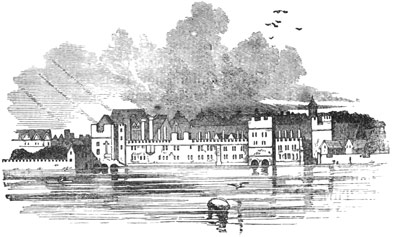
The Savoy was the scene of a conference in Charles II.'s
reign, between the Church and the Presbyterians, in which
possession was proved to be nine points of the Gospel, as well
as law. The Presbyterians thought so when it was their turn
to rule, and would have thought so again; and the progress
of genuine Christianity has been a gainer by the mild sway of
the Church of England.
In the chapel was buried old Gawen Douglas, the Chaucer
of Scotland; and Anne Killegrew, celebrated by Dryden's ode
for her poetry and painting. She was the daughter of one of
the masters, Dr. Henry Killegrew, brother of the famous
jester, and himself a man of talent.
Mrs. Anne Killegrew,
A grace for beauty, and a muse for wit,
had probably the honour, some day, of dining with her
washerwoman's daughter, in the guise of Duchess of
Albemarle; for John Clarges, the blacksmith, who lived in
the Savoy, had a wife who was a washerwoman, and the
washerwoman had a daughter, who took linen to Monk, when
he was in the Tower, and married him. It is not commonly
known that the validity of this marriage was contested.
Upon the trial of an action at law between the representatives
of Monk and Clarges, some curious particulars, says an article
in the Gentleman's Magazine, came out respecting the family
of the duchess.
"It appeared that she was the daughter of John Clarges, a farrier,
in the Savoy, and farrier to Colonel Monk, in 1632. She was married
in the church of St. Lawrence Pountney, to Thomas Ratford, son of
Thomas Ratford, late a farrier, servant to Prince Charles, and resident
in the Mews. She had a daughter who was born in 1634, and died in
1638. Her husband and she 'lived at the Three Spanish Gypsies, in
the New Exchange, and sold wash-balls, powder, gloves, and such
things, and she taught girls plain work. About 1647, she, being a
sempstress to Colonel Monk, used to carry him linen.' In 1648 her
father and mother died. In 1649, she and her husband 'fell out and
parted.' But no certificate from any parish register appears, reciting
his burial. In 1652, she was married in the church of St. George,
Southwark, to 'General George Monk;' and in the following year
was delivered of a son, Christopher, (afterwards the second and last
Duke of Albemarle), who was suckled by Honour Mills, who sold
apples, herbs, oysters, &c. One of the plaintiff's witnesses swore,
'that a little before the sickness, Thomas Ratford demanded and
received of him the sum of twenty shillings; that his wife saw Ratford
again after the sickness, and a second time after the Duke and
Duchess of Albemarle were dead.' A woman swore, 'she saw him
on the day his wife (then called Duchess of Albemarle) was put into
her coffin, which was after the death of the duke her second husband,
who died the 3rd of January, 1669-70.' And a third witness swore,
that he saw Ratford about July, 1660.' In opposition to this evidence,
it was alleged, that 'all along, during the lives of Duke George and
Duke Christopher, this matter was never questioned,' that the latter
was universally received as only son of the former, and that 'this
matter had been thrice before tried at the bar of the King's Bench,
and the defendant had three verdicts.' A witness swore that he
owed Ratford five or six pounds, which he had never demanded.
And a man, who had married a cousin to the Duke of Albemarle,
had been told by his wife, that Ratford died five or six years before the
duke married. Lord Chief Justice Holt told the jury, 'If you are
certain that Duke Christopher was born while Thomas Ratford was
living, you must find for the plaintiff. If you believe he was born
after Ratford was dead, or that nothing appears what became of him
after Duke George married his wife, you must find for the defendant.'
A verdict was given for the defendant, who was only son to Sir
Thomas Clarges, knight, brother to the illustrious duchess in question,
who was created a baronet October 30, 1674, and was ancestor to the
baronets of his name."[170]
It does not appear on which of these accounts the jury
found a verdict for the defendant—whether because Ratford
was dead, or because nothing had been heard of him; so that
the duchess, after all, might have been no duchess. However,
she carried it with as high a hand as if she had never been
anything else, and Monk had been a blacksmith. There are
some amusing notices of her in Pepys.
"8th (March, 1661-2). At noon, Sir W. Batten, Col. Slingsby,
and I, by coach to the Tower, to Sir John Robinson's, to dinner,
where great good cheer. High company, and among others the
Duchess of Albemarle, who is ever a plain homely dowdy."[171]
"9th (Dec. 1665). My Lord Brouncker and I dined with the
Duke of Albemarle. At table, the duchess, a very ill-looked woman,
complaining of her lord's going to sea next year, said these cursed
words:—'If my lord had been a coward, he had gone to sea no more;
it may be then he might have been excused, and made an ambassador,'
(meaning my Lord Sandwich). This made me mad, and I believe
she perceived my countenance change, and blushed herself very
much. I was in hopes others had not minded it, but my Lord
Brouncker, after we came away, took notice of the words to me with
displeasure."[172]
Lord Sandwich, the famous admiral, who has such light
repute with posterity, was a relation of Pepys, and much connected
with him in affairs. There does not appear to have
been the least foundation for the duchess's charge; except,
perhaps, that Sandwich had brains enough to know the
danger which he braved, while Monk knew nothing but how
to fight and lie.
"4th (Nov. 1666)." Pepys says that Mr. Cooling tells him, "the
Duke of Albemarle is grown a drunken sot, and drinks with nobody
but Troutbecke, whom nobody else will keep company with. Of
whom he told me this story; that once the Duke of Albemarle in his
drink taking notice, as of a wonder, that Nan Hide should ever come
to be Duchess of York: 'Nay,' says Troutbecke, 'ne'er wonder at
that, for if you will give me another bottle of wine, I will tell you as
great, if not greater, miracle.' And what was that, but that our
dirty Besse (meaning his duchess) should come to be Duchess of
Albemarle."[173]
"4th (April, 1667). I find the Duke of Albemarle at dinner with
sorry company, some of his officers of the army; dirty dishes and a
nasty wife at table, and bad meat, of which I made but an ill dinner.
Colonel Howard asking how the Prince (Rupert) did (in the last
fight); the Duke of Albemarle answering, 'Pretty well,' the other
replied, 'but not so well as to go to sea again.'—'How!' says the
duchess, 'what should he go for, if he were well, for there are no
ships for him to command? And so you have brought your hogs to
a fair market,' said she."[174]
"29th (March 1667-8). I do hear by several, that Sir W. Pen's
going to sea do dislike the Parliament mightily, and that they have
revived the Committee of Miscarriages, to find something to prevent
it; and that he being the other day with the Duke of Albemarle, to
ask his opinion touching his going to sea, the duchess overheard and
came into him; and asked W. Pen how he durst have the confidence
to go to sea again to the endangering of the nation, when he knew
himself such a coward as he was; which, if true, is very severe."[175]
The habit of charging cowardice against the first officers of
the time, which was not confined to the Duchess, is characteristic
of the grossness of that period, the refinements of
which were entirely artificial and modish. No people talked
or acted more grossly than the finest gentlemen of the day, or
believed more ill of one another; and it was not to be expected
that the uneducated should be behindhand with them.
The Duchess of Albemarle is supposed to have had a considerable
hand in the Restoration. She was a great loyalist,
and Monk was afraid of her; so that it is likely enough she
influenced his gross understanding, when it did not exactly
know what to be at. Aubrey says, that her mother was one
of the "five women barbers." How these awful personages
came up we know not—but he has quoted a ballad upon
them:—
"Did you ever hear the like,
Or ever hear the fame,
Of five women barbers,
That lived in Drury Lane?"[176]
After all, the father, John Clarges, must have been a man
of substance in his trade, to be enabled to set up the enormous
May-pole which we see in the picture. But this did
not prevent the daughter from growing up vulgar and foul-mouthed,
and a very different person from the Belles Ferronières
of old.
The Savoy, on the one side, with its Gothic gate and flint
wall, and the splendid mansion called Exeter House on the
other, appear in former times to have narrowed the highway
hereabouts, as much as Exeter 'Change did lately.
At the corner of Beaufort Buildings flourished Mr. Lillie,
the perfumer so often mentioned in the Tatler. He was secretary
to Mr. Bickerstaff's Court of Honour, in Shire Lane,
where people had actions brought against them for pulling out
their watches while their superiors were talking; and for
brushing feathers off a gentleman's coat, with a cane "value
fivepence." Lillie published two volumes of Contributions,
of which the Tatler had made no use. We believe they had
no merit. In Beaufort Buildings lived Aaron Hill, and at
one time Fielding.
Southampton Street, a little to the west, on the other side of
the way, has been much inhabited by wits and theatrical
people. Congreve once lived there, Mrs. Bracegirdle, and
Garrick. It was called Southampton Street from the noble
family of that title, who are allied to the Bedford family, the
proprietors.
On the ground of Cecil and Salisbury Streets, opposite
Southampton Street, stood the mansion of Robert Cecil, first
Earl of Salisbury, the cunning son of a wise father. It was
he who, contriving to keep up to the last his interest with the
queen Elizabeth, and to oust his rivals, Essex and others,
was the first to make secret terms with her successor James,
and to prepare the way for his reception in England: of which,
perhaps, Elizabeth was aware, when she lay moaning on the
ground.
Where the Adelphi now stands, was Durham Place, originally
a palace of the Bishops of Durham, who resigned it to
Henry VIII. Henry made it the scene of magnificent tournaments.
The Lord High Admiral Seymour caused the Mint
to be established in this house, with a view to coin money for
his designs on the throne. It was afterwards inhabited by
Dudley, Earl of Northumberland, who here married his son
to Lady Jane Grey. But its most illustrious tenant was
Raleigh, to whom it was lent by Queen Elizabeth, and who
lived in it during the attempt made at Essex House. The
four turrets of the mansion, under the roof of which lived
and speculated that romantic but equivocal person, have been
marked out in an engraving from Hollar. Durham Place,
though it got into royal hands during the fluctuation of religious
opinions, never seems to have been reckoned out of the
pale of the bishopric of Durham; for Lord Pembroke bought
it of that see in 1640, and pulled it down for the erection of
houses on its site.
"Be it known," says the lively Pennant, speaking of the word
'place,' as applied to great mansions, and interpreted by him to mean
palace, "that the word is only applicable to the habitations of princes,
or princely persons, and that it is with all the impropriety of vanity
bestowed on the houses of those who have luckily acquired money
enough to pile on one another a greater quantity of stones or bricks
than their neighbours. How many imaginary parks have been formed
within precincts where deer were never seen! And how many houses
misnamed halls, which never had attached to them the privilege of a
manor."[177]
This is true; but unless the words palazzo and piazza are
traceable to the same root, palatium (as perhaps they are),
place does not of necessity mean palace; and palace certainly
does not mean exclusively the habitation of princes or princely
persons (that is to say, supposing princeliness to exclude
riches,) for in Italy, whence it comes, any large mansion may
be called a palace; and many old palaces there were built
by merchants. Palatium, it is true, with the old Romans,
though it may have originally meant any house on Mount
Palatine, yet in consequence of that place becoming the court
end of the city, and containing the imperial palace, may have
come ultimately to mean only a princely residence. Ovid
uses it in that sense in his Metamorphoses.[178] But custom is
everything in these matters. Place is now used as a variety
of term, either for a large house or street. Perhaps in both
cases it ought to imply something of the look of a palace, or
at least an openness of aspect analogous to that of a square—square
in England, corresponding with place, piazza, and plaça
on the Continent. The Piazza in Covent Garden, properly
means the place itself, and not the portico.
"To the north of Durham Place, fronting the street," says Pennant,
"stood the New Exchange, which was built under the auspices of our
monarch in 1608, out of the rubbish of the old stables of Durham
House. The King, Queen, and Royal Family, honoured the opening
with their presence, and named it Britaine's Burse. It was built
somewhat on the model of the Royal Exchange, with cellars beneath,
a walk above, and rows of shops over that, filled chiefly with milliners,
sempstresses, and the like. This was a fashionable place of resort.
In 1654, a fatal affair happened here. Mr. Gerard, a young gentleman,
at that time engaged in a plot against Cromwell, was amusing
himself in a walk beneath, when he was insulted by Don Pantaleon
de Saa, brother to the Ambassador of Portugal, who, disliking the
return he met with, determined on revenge. He came there the next
day with a set of bravoes, who, mistaking another gentleman for
Mr. Gerard, instantly put him to death, as he was walking with his
sister in one hand and his mistress in the other. Don Pantaleon was
tried, and with impartial justice condemned to the axe. Mr. Gerard,
who about the same time was detected in the conspiracy, was likewise
condemned to die. By singular chance, both the rivals suffered on the
scaffold, within a few hours of each other: Mr. Gerard with intrepid
dignity; the Portuguese with all the pusillanimity of an assassin.
"Above stairs," continues Pennant, "sat, in the character of a
milliner, the reduced Duchess of Tyrconnel, wife to Richard Talbot,
Lord Deputy of Ireland, under James II.; a bigoted Papist, and fit
instrument of the designs of the infatuated prince, who had created
him Earl before his abdication, and after that, Duke of Tyrconnel.
A female, suspected to have been his duchess, after his death, supported
herself for a few days (till she was known and otherwise
provided for) by the little trade of this place; but had delicacy
enough to wish not to be detected. She sat in a white mask, and a
white dress, and was known by the name of the White Widow. This
Exchange has long since given way to a row of good houses, with
uniform front, engraved in Mr. Nichols's Progresses of Queen Elizabeth,
which form a part of the street."[179]
The houses in the quarter behind these, built by the Earl
of Pembroke, made way, sixty years back, for the present
handsome set of buildings called the Adelphi, from the Messrs.
Adam, brothers, who built it.[180] The principal front faces the
Thames, and is almost the only public walk left for the inhabitants
of London on the river side. The centre house was
purchased when new, by Garrick in 1771, and was his town
house for the rest of his life. He died there about nine years
after; but Mrs. Garrick possessed it till a late period.
Mrs. Garrick had been a dancer in her youth, with a name as
vernal as need be—Mademoiselle Violette: she died a venerable
old lady, at the age of ninety odd. Boswell has recorded
a delightful day spent with Johnson and others at her house,
the first time she re-opened it after Garrick's death. Sir
Joshua Reynolds was there, Mrs. Carter, Mrs. Boscawen, and
others. "She looked well," says Boswell; "talked of her
husband with complacency; and while she cast her eyes at
his portrait, which was hung over the chimney-piece, said,
that 'death was now the most agreeable object to her.'"[181] It
is no dishonour to her, that her constitution was too good for
her melancholy. She spoke enthusiastically of her husband
to the last, and used to decide on theatrical subjects, by right
of being his representative.
On the same terrace had lived their common friend
Beauclerc. On coming away after the party just mentioned,
Boswell tells us that Johnson and he stopped a little while by
the rails of the Adelphi, looking on the Thames; "and I said
to him," says Boswell, "with some emotion, that I was now
thinking of two friends we had lost, who once lived in the
buildings behind us, Beauclerc and Garrick." "Ay, sir,"
said he tenderly, "and two such friends as cannot be supplied."[182]
When Beauclerc was labouring under the illness that carried
him off, Johnson said to Boswell, in a faltering voice,
that he "would walk to the extent of the diameter of the
earth to save him." It does not appear what Beauclerc had
in his nature to excite this tenderness; but it is observable,
that Johnson had a kind of speculative regard for rakes and
men of the town, if he thought them not essentially vicious.
He seemed willing to regard them as evidences of the natural
virtue of all men, bad as well as good, and of the excuse
furnished for irregularity by animal spirits. It is not impossible
even that he might have thought them rather conventionally
than abstractedly vicious. He had a similar regard
for Hervey, a great rake, who was very kind to him. "Sir,"
said he, "if you call a dog 'Hervey,' I shall love him." At
the same time it is not to be forgotten, that these rakes were
fine gentlemen and men of birth; representatives, in some
respect, of the license assumed by authority. Beauclerc,
however, like Hervey, had a taste for better things than he
practised, and could love scrupulous men. Boswell has given
an interesting account of his first intimacy with Johnson.
Langton and Beauclerc had become intimate at Oxford.
"Their opinions and mode of life," we are told, "were so
different, that it seemed utterly impossible they should at all
agree;" but Beauclerc "had so ardent a love of literature, so
acute an understanding, such elegance of manners, and so
well discerned the excellent qualities of Mr. Langton, a gentleman
eminent not only for worth and learning, but for an inexhaustible
fund of entertaining conversation, that they became
intimate friends."
"Johnson, soon after this acquaintance began, passed a considerable
time at Oxford. He at first thought it strange that Langton
should associate so much with one who had the character of being
loose, both in his principles and practice, but by degrees, he himself
was fascinated. Mr. Beauclerc's being of the St. Albans family, and
having, in some particulars, a resemblance to Charles the Second,
contributed, in Johnson's imagination, to throw a lustre upon his
other qualities; and, in a short time, the moral, pious Johnson, and
the gay, dissipated Beauclerc were companions. 'What a coalition!'
said Garrick, when he heard of this: 'I shall have my old friend to
bail out of the round-house.' But I can bear testimony that it was
a very agreeable association. Beauclerc was too polite, and valued
learning and wit too much, to offend Johnson by sallies of infidelity
or licentiousness; and Johnson delighted in the good qualities of
Beauclerc, and hoped to correct the evil. Innumerable were the
scenes in which Johnson was amused by these young men. Beauclerc
could take more liberty with him than any body with whom I
ever saw him; but, on the other hand, Beauclerc was not spared by
his respectable companion, when reproof was proper. Beauclerc had
such a propensity to satire, that at one time, Johnson said to him,
'You never open your mouth but with intention to give pain, and
you have often given me pain, not from the power of what you said,
but from seeing your intention.' At another time, applying to him,
with a slight alteration, a line of Pope, he said—
'Thy love of folly, and thy scorn of fools'—
Every thing thou dost shows the one, and every thing thou say'st the
other.' At another time he said to him, 'Thy body is all vice, and
thy mind all virtue.' Beauclerc not seeming to relish the compliment,
Johnson said, 'Nay, sir, Alexander the Great, marching in
triumph into Babylon, could not have desired to have had more said
to him.'"[183]
The streets in the Adelphi—John, Robert, Adam, &c.—are
named from the builders. In this instance, the names are well
bestowed; but the "fond attempt," on the part of bricklayers
and builders in general to give a "deathless lot" to their
names in the same way, is very idle. Wherever we go now-a-days,
among the new buildings, especially in the suburbs,
we meet with names that nobody knows anything about, nor
ever will know. Probably, as knowledge increases, this custom
will go out. With this exception, streets in the British metropolis
have hitherto been named after royalty or nobility, or
from local circumstances, or from saints. Saints went out
with popery. The reader of the Spectator will recollect the
dilemma which Sir Roger de Coverley underwent in his youth,
from not knowing whether to ask for Marylebone or Saint
Marylebone. In Paris they have streets named after men of
letters. There is the Quai de Voltaire; and one of the most
frequented thoroughfares in that metropolis, for it contains the
Post-Office, is Jean Jacques Rousseau Street. It is not unlikely
that a similar custom will take place in England before long.
A nobleman, eminent for his zeal in behalf of the advancement
of society, has called a road in his neighbourhood,
Addison Road.[184]
In John Street, Adelphi, are the rooms of the Society for the
Encouragement of Arts, Manufactures, and Commerce. This
society originated in 1753, at the suggestion of Mr. Shipley,
an artist, and, as the title implies, is very miscellaneous in its
object; perhaps too much so to make sufficient impression. It
gives rewards for discoveries of all sorts, and for performances
of youth in the fine arts. It is, however, one of those combinations
of zealous and intelligent men, which have marked the
progress of latter times, and which will have an incalculable
effect on posterity. Its great room is adorned with the celebrated
pictures of Mr. Barry, which he painted in order to
refute the opinion that Englishmen had no genius for the
higher department of art, no love of music, &c., nor a proper
relish of anything, "even life itself." The statement of these
positions was not so discreet as the paintings were clever.
Mr. Barry was one of those impatient, self-willed men who,
with a portion of genuine power, think it greater than it is,
and will not take the pains to make themselves masters of
their own weapons. His pictures in the Adelphi, which are
illustrations of the progress of society, are striking, ingenious,
with great elegance here and there, and now and then an
evidence of the highest feeling; as in the awful pity of the
retributive angel who presides over the downfall of the wicked
and tyrannical. But the colouring is bad and "foxy;" his
Elysium is deformed with the heterogeneous dresses of all ages,
William Penn talking in a wig and hat with Lycurgus, &c.
(which, however philosophically such things might be regarded
in another world, are not fitly presented to the eye in
this); and by way of disproving the bad taste of the English
in music, he has put Dr. Burney in a coat and toupee, floating
among the water nymphs! The consequence is, that although
these pictures are, perhaps, the best ever exhibited together
in England by one artist, they fall short of what he intended
to establish by them, as far as England is concerned.
Between Adam Street and George Street, on the other side
of the Strand, is Bedford Street, the site of an old mansion of
the Earls and Dukes of Bedford.
With George Street commence the precincts of an ancient
"Inn," or palace, originally belonging to the Bishops of
Norwich; then to Charles Brandon, Duke of Suffolk; then to
the Archbishops of York, from whom it was called York
House; then to the Crown, who let it to Lord Chancellor
Egerton and to Bacon; then to the Duke of Buckingham,
the favourite, who rebuilt it with great magnificence, and at
whose death it was let to the Earl of Northumberland; and
finally to the second Duke of Buckingham, who pulled it
down and converted it into the present streets and alleys, the
names of which contain his designation at full length, even to
the sign of the genitive case, for there is an "Of Alley:" so
that we have George, Villiers, Duke, Of, Buckingham.
Brandon, Duke of Suffolk, was the man who, on his
marriage with Henry VIII.'s sister, appeared at a tournament
on a horse that had a cloth half frieze and half gold,
with that touching motto—
Cloth of gold, do not thou despise,
Though thou be matched with cloth of frize:
Cloth of frize, be not thou too bold,
Though thou be matched with cloth of gold.
Bacon belongs to Gray's Inn, and the second Duke of
Buckingham to Wallingford House, where he chiefly resided
(on the site of the present Admiralty): but the reader,
who should go down Buckingham Street, and contemplate the
spot which Inigo Jones and the trees have beautified, will not
fail to be struck with the many different spirits that have
passed through this spot—the romantic Suffolk; the correct
Egerton; the earth-moving Bacon; the first Buckingham with
a spirit equal to his fortunes; the second, witty but selfish,
who lavished them away; and all the visitors, of so many
different qualities, which these men must have had, crowding
or calmly moving to the gate across the water, in quiet or
in jollity, clients, philosophers, poets, courtiers, mistresses,
gallant masques, the romance of Charles the First's reign,
and the gaudy revelry of Charles II. A little spot remains,
with a few trees, and a graceful piece of art, and the river
flowing as calmly as meditation.
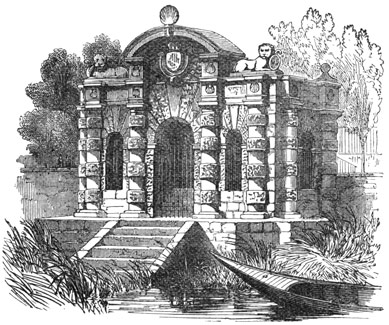
WATER-GATE OF YORK HOUSE.
The only vestige now remaining of the splendid mansion of
the Buckinghams is the Water-Gate at the end of Buckingham
Street, called York Stairs,[185] and built by Inigo Jones. It has
been much admired, and must have admitted, in its time, the
entrance of many extraordinary persons.
York Buildings affords us another name, not unworthy to
be added to the most useful and delightful of these, Richard
Steele, who lived here just before he retired into Wales. The
place in his time was celebrated for a concert-room. We must
not omit the termination of a curious dispute at the gate of
York House, to which Pepys was a witness.
"30th (September 1661). This morning up by moonshine, at five
o'clock," (here was one of the great secrets of the animal spirits of
those times), "to Whitehall, to meet Mr. More at the Privy Seale,
and there I heard of a fray between the two embassadors of Spaine
and France, and that this day being the day of the entrance of an
embassador from Sweeden, they intended to fight for the precedence.
Our King, I heard, ordered that no Englishman should meddle in the
business, but let them do what they would. And to that end, all the
soldiers in town were in arms all the day long, and some of the train
bands in the city, and a great bustle through the city all the day.
Then we took coach (which was the business I came for) to Chelsey,
to my Lord Privy Seale, and there got him to seal the business.
Here I saw by daylight two very fine pictures in the gallery, that a
little while ago I saw by night; and did also go all over the house,
and found it to be the prettiest contrived house that ever I saw in my
life. So back again; and at Whitehall light, and saw the soldiers and
people running up and down the streets. So I went to the Spanish
embassador's and the French, and there saw great preparations on
both sides; but the French made the most noise and ranted most, but
the other made no stir almost at all; so that I was afraid the other
would have too great a conquest over them. Then to the wardrobe
and dined there; and then abroad, and in Cheapside hear, that the
Spanish hath got the best of it, and killed three of the French coach-horses
and several men, and is gone through the city next to our King's
coach; at which, it is strange to see how all the city did rejoice. And,
indeed, we do naturally all love the Spanish and hate the French. But
I, as I am in all things curious, presently got to the water side, and
there took oars to Westminster Palace, and ran after them through
all the dirt, and the streets full of people; till at last, in the Mews, I
saw the Spanish coach go with fifty drawn swords at least to guard
it, and our soldiers shouting for joy. And so I followed the coach,
and then met it at York House, where the embassador lies; and there
it went in with great state. So then I went to the French house,
where I observe still, that there is no men in the world of a more
insolent spirit where they do well, nor before they begin a matter, and
more abject if they do miscarry, than these people are; for they all
look like dead men, and not a word among them, but shake their
heads. The truth is, the Spaniards were not only observed to fight
more desperately, but also they did outwitt them; first in lining their
own harnesse with chains of iron that they could not be cut, then in
setting their coach in the most advantageous place, and to appoint
men to guard every one of their horses, and others for to guard the
coach, and others the coachman. And, above all, in setting upon the
French horses and killing them, for by that means the French were
not able to stir. There were several men slaine of the French, and
one or two of the Spaniards, and one Englishman by a bullet. Which
is very observable, the French were at least four to one in number,
and had near one hundred cases of pistols among them, and the
Spaniards had not one gun among them, which is for their honour for
ever, and the others' disgrace. So having been very much daubed
with dirt, I got a coach and home; where I vexed my wife in telling
her of this story, and pleading for the Spaniards against the French."[186]
In James the Second's time, the French embassy had the
house of their rival, and drew the town to see Popish devices
in wax-work.
"The fourth of April," says Evelyn (1672), "I went to see the
fopperies of the Papists at Somerset House and York House, where
now the French ambassador had caused to be represented our Blessed
Saviour at the Pascal Supper with his disciples, in figures and puppets
made as big as the life, of wax-work, curiously clad and sitting round
a large table, the room nobly hung, and shining with innumerable
lamps and candles; this was exposed to all the world; all the city
came to see it: such liberty had the Roman Catholicks at this time
obtained."[187]
They have obtained more liberty since, and can dispense
with these "fopperies." At least they would do well to
think so.
Hungerford Market takes its name from an old Wiltshire
family, who had a mansion here in the time of Charles II.,
which they parted with, like others, to the encroachments of
trade. It used to be an inconvenient and disagreeable place,
little frequented, but has lately been converted into a handsome
market, and put an end to the monopoly of Billingsgate.
No. 7 in Craven Street is celebrated as having been, at one
time, the residence of Franklin. What a change along the
shore of the Thames in a few years (for two centuries are less
than a few in the lapse of time), from the residence of a set of
haughty nobles, who never dreamt that a tradesman could be
anything but a tradesman, to that of a yeoman's son, and a
printer, who was one of the founders of a great state!
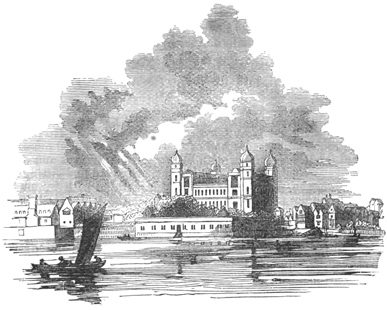
OLD NORTHUMBERLAND HOUSE.
Northumberland House is the only one remaining of all the
great mansions which lorded it on the river side. It was
built by Henry Howard, Earl of Northampton, son of the
famous Henry Howard, Earl of Surrey, the poet; but a very
unworthy son, except in point of capacity. He was one of
those men, who, wanting a sense of moral beauty, are in
every other respect wise in vain, and succeed only to become
despised and unhappy. He was the grossest of flatterers;
paid court to the most opposite rivals, in the worst manner;
and seems to have stuck at nothing to obtain his ends. His
perception of what was great, extrinsically, led him to build
this princely abode; and his worship of success and court
favour degraded him into an accomplice of Carr, Earl of
Somerset. It is thought by the historians, that he died just
in time to save him from the disgraceful consequences of the
murder of Sir Thomas Overbury.[188]
Northumberland House was built upon the site of the old
hospital of St. Mary Roncesvaux—Osborne says, with Spanish
gold. "Part of the present mansion," says the Londinium
Redivivum, "is from the designs of Bernard Jansen, and the
frontispiece or gateway from those of Gerard Christmas.
This gateway cannot possibly be described correctly, as the
ornaments are scattered in the utmost profusion, from the
base to the attic, which supports a copy of Michael Angelo's
celebrated lion. Double ranges of grotesque pilasters inclose
eight niches on the sides, and there are a bow window and an
open arch above the gate. The basement of the whole front
contains fourteen niches, with ancient weapons crossed within
them; and the upper stories have twenty-four windows, in two
ranges, with pierce battlements. Each wing terminates in a
cupola, and the angles have rustic quoins. The quadrangle
within the gate is in a better style of building, but rather
distinguished by simplicity than grandeur; and the garden
next the Thames, with many trees, serves to screen the mansion
from those disagreeable objects which generally bound
the shores of the river in this vast trading city."
"Northumberland House was discovered to be on fire, March 18,
1780, at five o'clock in the morning, which raged from that hour till
eight, when the whole front next the Strand was completely destroyed.
Dr. Percy's apartments were consumed; but great part of his library
escaped the general ruin."[189]
We have been the more particular in laying this extract
before our readers, because, though the house still exists, the
public see little of it. All they behold, indeed, is the screen
or advanced guard, which is no very fine sight, and only
serves to narrow the way. Of the quadrangle inside the
public know nothing; and thousands pass every day without
suspecting that there is such a thing as a tree on the premises.
The Percys had this house in consequence of a marriage
with the daughter of the Earl of Suffolk, who was Northampton's
nephew. During the Earl's possession it was called
Suffolk House, and furnished an escape to a person of the
name of Emerson from one of the mad pranks of Lord
Herbert of Cherbury, who was for fighting everybody. His
lordship had had sundry fits of ague, which brought him at
last to be "so lean and yellow, that scarce any man," he says,
"did know him."
"It happened," he continues, "during this sickness, that I walked
abroad one day towards Whitehall, where, meeting with one Emerson,
who spoke very disgraceful words of Sir Robert Harley, being then
my dear friend, my weakness could not hinder me to be sensible of
my friend's dishonour; shaking him, therefore, by a long beard he
wore, I stept a little aside, and drew my sword in the street; Captain
Thomas Scrivan, a friend of mine, not being far off on one side, and
divers friends of his on the other side. All that saw me wondered
how I could go, being so weak and consumed as I was, but much
more that I would offer to fight; howsoever, Emerson, instead of
drawing his sword, ran away into Suffolk House, and afterwards informed
the Lords of the Council of what I had done; who, not long
after sending for me, did not so much reprehend my taking part with
my friend, as that I would adventure to fight, being in such a bad
condition of health."[190]
The disgraceful words spoken by Emerson were very likely
nothing at all, except to his lordship's ultra-chivalrous fancy;
but this is a curious scene to imagine at the entrance of the
present quiet Northumberland House—Emerson slipping into
the gate with horror in his looks, and the lean and yellow
ghost of the knight-errant behind him, sword in hand.
Mr. Malcolm has spoken of the apartments of Dr. Percy.
This was Dr. Percy, Bishop of Dromore, who gave an impulse
to the spirit of the modern muse by his Reliques of
Ancient English Poetry. He was a kinsman of the Northumberland
family. We believe it was in Northumberland House
that his friend Goldsmith, stammering out a fine speech of
thanks to a personage in a splendid dress whom he took for
the Duke, was informed, when he had done, that it was his
Grace's "gentleman."
A little way up Catherine Street is Exeter Street, where
Johnson first lodged when he came to town. His lodgings
were at the house of Mr. Morris, a stay-maker. He dined at
the Pine-apple in New Street, "for eightpence, with very
good company." Several of them, he told Boswell, had
travelled. "They expected to meet every day; but did not
know one another's names." The rest of his information is a
curious and interesting specimen of his disposition. "It
used," said he, "to cost the rest a shilling, for they drank
wine: but I had a cut of meat for sixpence, and bread for a
penny, and gave the waiter a penny; so that I was quite as
well served, nay, better than the rest, for they gave the waiter
nothing." Johnson drank at this time no fermented liquors.
Boswell supposes that he had gained a knowledge of the art of
living in London from an Irish painter, whom he knew at
Birmingham, and of whom he gave this account.
"Thirty pounds a year," according to this economical philosopher,
"was enough to enable a man to live there without being contemptible.
He allowed ten pounds for clothes and linen. He said a man might
live in a garret at eighteen pence a week; few people would inquire
where he lodged: and if they did, it was easy to say, 'Sir, I am to be
found at such a place.' By spending three pence at a coffee-house,
he might be for some hours every day in very good company; he
might dine for sixpence, breakfast on bread and milk for a penny,
and do without supper. On clean shirt day he went abroad and paid
visits."[191]
The Strand end of Catherine Street is mentioned in Gay's
"Trivia" for a notoriety which it now unfortunately shares
with too many places to render it remarkable. His picture
of one of the women he speaks of possesses a literal truth,
the characteristic of the whole of this curious poem.
"'Tis she who nightly strolls with sauntering pace;
No stubborn stays her yielding shape embrace;
Beneath the lamp her tawdry ribands glare,
The new scower'd manteau, and the slattern air;
High draggled petticoats her travels show,
And hollow cheeks with artful blushes glow.
In riding-hood, near tavern door she plies,
Or muffled pinners hide her livid eyes.
With empty band-box she delights to range,
And feigns a distant errand from the 'Change."
Gay contents himself with a picture, and a warning. In
our times, we have learnt to pity the human beings, and to
think what can be done to remedy the first causes of the evil.
The houses between Catherine Street and Burleigh Street
stand upon ground formerly occupied by Wimbledon House,
a mansion built by Sir Edward Cecil, whom Charles I. created
Viscount Wimbledon. It was burnt down; and Stow says,
that the day before, his lordship's country house at Wimbledon
was blown up.
The late Lyceum was built about the year 1765, as an
academy and exhibition-room, in anticipation of the royal one
then contemplated. It did not succeed; and part of it was
converted into a theatre for musical performances. It then
became a place of exhibition for large panoramic pictures,
among which we remember with pleasure the battle pieces of
Robert Ker Porter (Seringapatam, Acre, &c.) A species of
entertainment then took place in it, which has justly been
called "useful and liberal," presenting, on a regular stage,
pictures or scenes of famous places, while a person read
accounts of them from a desk. We remember the Ægyptiana,
or description of Ægypt, and, if we mistake not, an attempt,
not quite so well founded, to illustrate the scenes of Milton's
Allegro and Penseroso. Neither of the attempts met with
success; but the former, perhaps, might be tried again with
advantage, now that information and the thirst for it have so
wonderfully increased. The panorama, however, may have
realised all that can be done in this way. Visitors to those
admirable contrivances may be almost said to become
travellers; and a reader at hand might disturb them, like
an impertinence. We recollect being so early one morning
at a panorama, that we had the place to ourselves. The room
was without a sound, and the scene Florence; and when we
came out, the noise and crowd of the streets had an effect on
us, as if we had been suddenly transported out of an Italian
solitude. The Lyceum has since been handsomely rebuilt
as a new English Opera House, under the management of
Mr. Arnold, who has done much to cultivate a love of music
in this country. Over the former theatre, we believe, was a
room built by him for the members of the famous Beef-Steak
Club, equally celebrated for loving their steaks and roasting
one another.[192]
The little crowded nest of shop-counters and wild beasts,
called Exeter Change, which has lately been pulled down,
took its name from a mansion belonging to the Bishop of
Exeter, whether on the south or north side of the street does
not appear. It is not necessary that the spot should have
been the same. Any connection with a large mansion, or its
neighbourhood, is sufficient to give name to a new house.
Pennant thinks, we know not on what authority, that the
great Lord Burleigh had a mansion on the spot; and he adds,
that he died here. Exeter Change was supposed to have
been built in the reign of William and Mary, as a speculation.
The lower story, at the beginning of the last century, was
appropriated to the shops of milliners; and upholsterers had
the upper. In the year 1721, the town were invited to this
place to look at a bed.
"Mr. Normond Cony," saith the historian, "exhibited a singular
bed for two shillings and sixpence each person, the product of his own
ingenuity; the curtains of which were woven in the most ingenious
manner, with feathers of the greatest variety and beauty he could
procure; the ground represented white damask, mixed with silver
and ornaments of various descriptions, supporting vases of flowers
and fruits. Each curtain had a purple border a foot in breadth,
branched with flowers shaded with scarlet, the valence and bases the
same. The bed was eighteen feet in height; and from the description
must have been a superior effort of genius, equally original with the
works of the South Sea Islanders, whose cloaks, mantles, and caps,
grace the collection formed by Captain Cook, now preserved in the
British Museum."[193]
This was a gentle exhibition enough. Sixty years ago,
instead of the bed, was presented the right honourable body
of Lord Baltimore, a personage who ran away with young
ladies against their will. The body lay "in state," previously
to its interment at Epsom. Lord Baltimore was succeeded by
the wild beasts, who kept possession in their narrow unhealthy
cages till the death of the poor elephant in 1826, which conspiring
with the new spirit of improvement to call final attention
to this excresence in the Strand, it was adjudged to be
rooted out. The death of this unfortunate animal, who seems
to have had just reason enough to grow mad, had its proper
effect, in exciting the public to guard against similar evils;
nor is it likely that these intelligent and noble creatures, nor
indeed any others, will
undergo such a monstrous
state of existence
again.
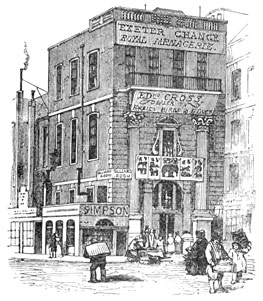
Passing one day by
Exeter Change, we beheld
a sight strange
enough to witness in a
great thoroughfare—a
fine horse startled,
and pawing the ground,
at the roar of lions and
tigers. It was at the
time, we suppose, when
the beasts were being
fed.