Elephas Indicus. Cuv.
The opportune arrival of a beautiful little Elephant, an
animal which has for some time been a desideratum to
the Menagerie, fortunately enables us to add to our list
of subjects that which in all probability presents the
most generally attractive spectacle among the whole
class of Mammiferous Quadrupeds. The strong and
peculiar interest which the Elephant possesses above all
other beasts arises in fact not so much from his gigantic
bulk and immense muscular power, as from the high
opinion usually entertained of those intellectual qualities
with which he has long been supposed to be preeminently
endowed, and which have rendered him a
theme of exaggerated encomium to the careless observer,
while even in some philosophic minds they have furnished
the groundwork on which perverted ingenuity
has built up theory after theory as baseless and imaginary
as the foundation on which they have been made
to rest, the reason and reflection of a brute.
It is on this account that we feel it incumbent upon
us, notwithstanding all that has been written on the
subject, to dwell with some little detail on the natural
history of this singular animal; but we shall nevertheless
endeavour to compress our observations within the smallest
possible compass. We shall commence as usual with
his zoological characters, and shall then take a glance at
his habits, such as they appear in a pure state of nature,
unfettered by any laws but those of necessity, and
uncontrolled except by the inevitable influence of the
circumstances in which he is placed. And lastly we
shall view him when under the control of man, and
reduced to that half-domesticated condition to which
even his stubborn nature is bowed by the application of
those means which man alone can employ, and by which
he maintains his ascendancy as undisputed lord of the
creation over the mightiest even more effectually than
over the meanest of its works.
The Elephants belong to the Pachydermatous order,
in which they constitute a family readily distinguishable
from the other enormous beasts which form part of it,
the Hippopotamus and the Rhinoceros, by a combination
of characters of the most remarkable description. To the
immense size and clumsy figure of the two last named
animals, which indeed they commonly surpass in both
those particulars, they add the following distinctive
zoological characters. Their teeth consist of two formidable
tusks, which, occupying the place of the incisors
of the upper jaw, project forwards in a nearly horizontal
direction, generally with a slight curvature upwards;
and of one or occasionally two cheek teeth of considerable
magnitude on each side of each jaw, formed of
vertical layers of bony matter surrounded by enamel,
and connected together by a third substance called cortical.
These latter are not, as in almost all the other
Mammalia, renewed for one only time and at a certain
age by the growth of others to supply their places from
the cavity of the jaw beneath them; but, on the contrary,
are pushed forwards by the advance of those which are
destined to replace them from behind, and are renewed,
according to the statement of Mr. Corse, no less than
eight times at different periods of the animal’s existence.
On each successive change the number of laminæ of
which they are composed is increased, the earliest not
offering more than four, while the later ones frequently
exceed twenty; and it is in consequence of the new teeth
generally making their appearance for some time prior
to the total failure of their predecessors that their number
occasionally appears to be double its proper and
more usual amount. The tusks on the contrary admit
but of a single displacement and renewal; the first or
milk pair seldom exceeding two inches in length, and
falling out between the first and second year. The permanent
ones which succeed are much larger and more
powerful in the adult male than in the female, and not
unfrequently project as much as two feet. They are
well known as furnishing one of the most beautiful and
ornamental productions which the animal kingdom
affords, as well as a valuable article of commerce, in the
pure and polished ivory of which they are formed. They
have been known to weigh as much as one hundred and
fifty pounds, but their usual average is from fifty to
seventy.
The ears of the Elephant are large, not elevated like
those of other quadrupeds so as to form a kind of trumpet
for the reception of sound, but flattened down upon
the side of the head, and forming a broad and uninterruptedly
expanded surface. His eyes, remarkably small
in proportion to his bulk, are sheltered above by a cluster
of long hairs, which, with a few others scattered over the
head and still more rarely on the body, and a kind of
brush at the extremity of the tail, constitute the only
covering, if covering it may be called, with which he
is provided. His skin in fact is throughout nearly destitute
of hair; but in return it is, as in the rest of the
order, of excessive thickness and extreme tenacity, insomuch
as to be capable of repelling a common musket
ball, which scarcely makes the slightest impression upon
its surface. His feet are enveloped by a large hoof of a
callous and almost horny consistence, and are divided,
in the skeleton at least, into five toes, the extremities
only of which, rendered obvious by the nails by which
they are surmounted, are externally visible. On the
hind feet the number of apparent toes varies from three
to four.
But of all the peculiarities by which the Elephant is
distinguished, the most singular and at the same time
the most useful is the projection which is formed by the
blending and extension of the nose and upper lip into
an elongated and tapering tube, considerably longer than
the head, and truncated at the extremity, where it is
surrounded by a slightly elevated margin, which is prolonged
anteriorly and superiorly into a finger-like appendage
of various and invaluable use. This trunk or
proboscis, as it is called, is divided throughout its whole
extent into two equal cavities, which are continuous with
the nostrils, but appear to have no other connexion with
the organ of smell than as being the medium of the
passage of odours to the olfactory apparatus, which is
confined within the bones of the head, and is indeed
seated much higher than usual in consequence of the
large space occupied by the roots of the tusks and by
the cavities of the maxillary bones. The real uses of
the trunk are far higher and more important; and it
is to this unique and unexampled structure that the
Elephant owes whatever superiority he possesses over
other beasts. In general capacity he is inferior to most,
and the intellectual qualities of a dog or a horse are
unquestionably of a far more elevated order; but with
the assistance of this curious organ, with some little
sagacity, a tolerable memory, and a certain degree of
docility, the Elephant is enabled to execute such a
variety of actions, either of his own accord or at the
command of his keeper, as have gained him the credit
not only of being the cleverest of brutes, but of possessing
qualities of a superior cast and even the divine gift
of reason itself.
The structure of the trunk is entirely muscular, and
the fibres of which it is composed are arranged in such
a manner that it is capable of being inflected in almost
any direction; but to twist itself spirally inwards appears
to be its most natural action. In this manner it will
grasp with the utmost firmness, for its strength is fully
equal to its flexibility, whatever it may seize; and it is
by this means that the Elephant conveys his food to his
mouth. Being purely herbivorous, but encumbered with
a head and appendages so weighty as to require all the
support to be derived from an excessively short and
almost unyielding neck, it would be utterly impossible
for him to browse upon the herbage from which his
sustenance is chiefly derived, and he would consequently
run no small risk of absolute starvation, were it not for
this admirable provision, by means of which he collects
and enfolds his food, and conveys it to his mouth with
as much ease and precision as a Monkey would execute
the same motions with his hands. In drinking too the
trunk offers the same facilities and performs the same
useful and necessary office. Placing its extremity in the
fluid which he is about to drink, the Elephant pumps
up, or rather inhales, a sufficient quantity to fill its
cavities, and then transferring it to his mouth pours its
contents quietly down his throat. When his thirst is
satisfied he will frequently continue the same process of
filling his trunk for the purpose of discharging the liquid
contained in it over his body, an indulgence in which he
appears to take no little pleasure; and will even sometimes
amuse himself by directing the fluid to other
objects.
The Asiatic Elephant was until very lately considered
as forming one species with the African, the clear and
obvious distinctions which exist between them never
having been noticed until pointed out by M. Cuvier,
notwithstanding that both have been familiarly known
for more than two thousand years to the nations of
Europe, the former having formed an important part of
the armament with which Porus withstood the conquering
arms of Alexander, and having been subsequently
introduced even into Italy by Pyrrhus; and the latter,
as we may fairly presume, furnishing those individuals
which were employed in the warlike array of the Carthaginians.
The Asiatic animal appears when fully grown
to attain a larger size than the African, the females
commonly measuring from seven to eight, and the males
from eight to ten feet in height, and sometimes weighing
six or seven thousand pounds. His head is more oblong,
and his forehead presents in the centre a deep concavity
between two lateral and rounded elevations; that of the
African being round and convex in all its parts. The
teeth of the former are composed of transverse vertical
laminæ of equal breadth, while those of the latter form
rhomboidal or lozenge-shaped divisions. The ears of the
Asiatic are also smaller and descend no lower than his
neck, and he exhibits four distinct toes on his hind feet:
the African on the contrary is furnished with ears of
much greater size, descending to his legs, and no more
than three toes are visible on his posterior extremities.
These differences are so striking and important, and
indeed, so far as regards the form of the head and the
structure of the teeth, so essential, that it is impossible
not to adopt the division which has been founded upon
them, and to consider the natives of the two continents
as originally and specifically distinct.
The Asiatic Elephants themselves vary considerably
in several minor particulars, such as the comparative
length and thickness of their trunks and of their tusks,
the latter of which are sometimes, even in the males, of
very small dimensions. But these variations are evidently
the result of locality and other fortuitous circumstances,
the species appearing gradually to degenerate
as it recedes from the tropics, and to improve as it
advances towards the line. The Elephants of Ceylon
are consequently in the highest esteem for size, beauty,
and hardihood, and those of Pegu are but little inferior
to them; while those of the northern districts of India
are held in comparatively trifling estimation.
These animals are by nature sociable, and congregate
together in herds, which frequently amount to more
than a hundred. The imposing spectacle furnished by
such a collection of these immense masses of animated
matter may well be imagined. They generally seek the
shade of the forest, in which they find additional means
of subsistence in the young shoots of the trees, which
supply the place of other and more congenial herbs.
They frequently issue from it, however, in quest of the
latter, and also to indulge in a propensity possessed by
them in common with all those animals which like them
are furnished with thick and almost naked, or with
bristly, skins, that of bathing in the water or wallowing
in the mud. It is for this reason that they are usually
met with in the neighbourhood of large streams, which
their great size and the quantity of fat with which they
are commonly loaded enable them to swim with facility.
Their trunk is also extremely serviceable in this operation,
as it enables them to bury as it were the whole of
their body beneath the water, retaining above the surface
no more than the extremity of that organ for the admission
and expulsion of the air. After having been for
some time in the water, it is said that their skin loses the
dusky hue by which it is usually distinguished in consequence
of the dirt and other matters with which it is
incrusted, and assumes a perfect flesh-colour marked
with numerous round and blackish spots. This natural
colour is, however, lost almost immediately on their
reaching the land, when they uniformly scatter themselves
all over by means of their trunk with the mud or
dust which first falls in their way. So fond are they of
this process that they commonly recur to it whenever
an opportunity offers. The bathing appears to be absolutely
necessary in order to keep their skins to a certain
extent supple and flexible; for which purpose their
keepers, in captivity, occasionally have recourse to the
smearing them with oil as a substitute.
Like other herbivorous quadrupeds they are, generally
speaking, quiet and harmless, intent solely upon providing
for their wants, and never attacking man or other
animals unless provoked or when under the influence of
excitement. In this latter case they make use not only
of their proboscis, which they wield with great dexterity
as a weapon of offence, but also of their tusks, with
which they inflict the most tremendous wounds. Their
speed in pursuit corresponds rather with the cumbrousness
than with the magnitude of their frame, the excessive
weight of which soon renders them weary, and
compels them to slacken their pace; which, when urged
to the utmost, is barely equal to that of a horse of moderate
fleetness. They will sometimes penetrate in quest
of food into the rice fields and sugar plantations, in
which they commit the most extensive ravages, not so
much by the quantity which they consume as by that
which they destroy. The solitary individuals, which are
occasionally met with separate from the general herd,
indulge perhaps more frequently in these excesses than
the community, which generally avoids as much as possible
the habitations of man. It has commonly been
imagined that these stray Elephants were the younger
and weaker males, who had been driven from the herd
by their more powerful fellows; but the fact that they
are usually adults of the largest size completely negatives
this supposition, and proves that it is of their own
free will that they wander thus alone. They attain their
full growth between the ages of eighteen and twenty-four,
and well authenticated instances have occurred in
which they have reached the age of a hundred and thirty
years. Indeed there is reason to believe that their life
may be sometimes prolonged to two centuries.
The usual mode of catching the wild Elephants for the
purpose of domestication has been so often described that
it would be superfluous to repeat it here. It may be sufficient
to observe that a herd of them having been driven
by the hunters into an enclosure surrounded by palisades
and ditches, and provided only with a narrow pass
by way of egress, they are there made prisoners one after
the other, and attached to the tame elephants, which are
employed on such occasions partly as decoys and partly
as guards over their captive brethren. The necessity of
having recourse to this mode of supplying the wants, or
rather of ministering to the pride, of the sovereigns of
the East, both native and European, who alike regard
these animals as the indispensable appendages of their
rank, arises from the circumstance of the breed being
very rarely propagated in captivity; the Hindoos being
either too ignorant or too careless to adopt the requisite
measures for securing its continuance, and relying upon
the certainty of being enabled by their hunting to keep
up a sufficient supply. But there can be little doubt,
from what we observe in other animals, that had a
domesticated breed of Elephants existed from the times
when their services were first made available to man,
they would have been far superior both in sagacity and
docility to the half-reclaimed individuals at present employed.
It may readily be supposed that the taming of these
wild and unwieldy creatures is a task of no little difficulty
and delicacy: but the experienced keepers by
whom it is undertaken seldom fail to execute it with
success. It is effected partly by reducing the strength
of the animal by restricting him in the quantity of his
food, by the employment of caresses or of castigation
according to the dispositions he may manifest, by occasionally
indulging him in sweetmeats or in other dainty
fare, and by subjecting him to the control of the tame
elephants, and especially of the females, which are more
commonly employed for this purpose. By the application
of these means the space of a fortnight is generally
sufficient to reduce him to a certain degree of tameness,
and in less than six months he is trained to the various
exercises which it is intended that he should perform,
and his education is regarded as complete. They do not,
however, always become familiar and habituated to their
new mode of life even within this period of time; for,
according to the statement of Mr. Corse, Elephants have
been known to stand twelve months at their pickets
without lying down to sleep; and this is regarded as a
certain sign of want of confidence in their keepers and of
a longing desire to regain their liberty. It is probably
to some such circumstance as this that we are indebted
for the erroneous idea so generally prevalent that these
animals always sleep standing; whereas the truth is,
that when perfectly at ease and reconciled to their fate,
they lie down on their sides and sleep like other beasts.
The purposes for which they are commonly employed
are rather those of pomp, of luxury, and of ostentation,
than of utility. As a means of warlike offence they have
been, since the introduction of firearms, absolutely disused;
and it is only as beasts of burden that they are
turned to any useful account. In this respect the services
of a single Elephant are equal to those of five or
six horses, as they will carry from fifteen to twenty hundred
weight, and travel from forty to fifty miles a day.
They generally consume a hundred weight and a half
or two hundred weight of solid food, and thirty or forty
gallons of fluid, in the course of the day. They are fond
of wine, spirits, and other intoxicating articles, by the
attraction of which they are frequently induced to exert
their powers, and to perform various feats of dexterity,
when all other methods have failed to render them tractable.
They become strongly attached to their keepers;
but, if irritated by ill usage, their hatred is as violent as
their affection, and is carefully stored up until a favourable
opportunity occurs, when they seldom fail to remember
an insult or an injury, even at very distant periods
of time.
With regard to their sagacity much has been written,
and many exaggerated and many incredible stories have
been told; but it would appear that those who have
attributed to the Elephant a degree of intelligence
superior to every other beast, have been misled by
outward appearances, and by the natural prepossession
arising from his gigantic and imposing figure. Without
his trunk, upon the singular and admirable structure of
which most of that skill and dexterity which have been
regarded as the result of mental reflection is entirely
dependent, he would be, in all probability, as very a
brute as the rhinoceros, the hippopotamus, or the hog.
By means of that organ, however, he unquestionably
acquires the capacity of performing feats of which other
animals are incapable; but here his superiority ends.
In intelligence, as in docility, he is far inferior to the
dog; and many other quadrupeds might fairly compete
with him in both. Thus to turn a key in a lock, to push
back a bolt, to untie a rope, to uncork a bottle, to search
in the pockets of his keepers for apples or oranges, these
and many other tricks of a similar kind, for which he
is famous, are evidently nothing more than mechanical
actions, to the performance of which he is stimulated,
like other beasts, at first by the promise of reward or the
fear of chastisement, and afterwards by the mere force of
habit. In like manner the dexterity with which he learns
to load and unload himself, or to place a man or child
upon his back by means of his trunk, without offering
them the slightest injury; and on the other hand the
precision with which he is made to execute the will of
the Asiatic despot on the unhappy victims of his displeasure,
by seizing them and casting them beneath his
feet, to be there dispatched, according to the tenor of the
orders which he receives, either with a single crush, or
with all the horrors of a lingering death; these also are
actions of no higher order than many other animals are
equally capable of in a moral point of view, although
not so well fitted for them by physical conformation.
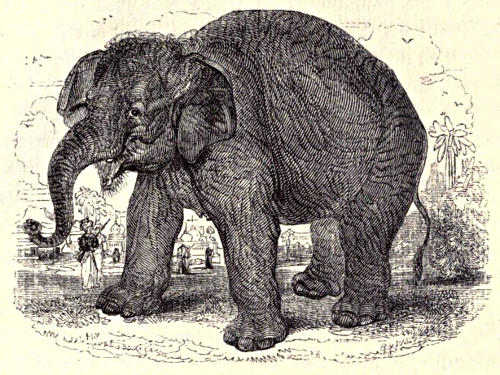
In conclusion we have only to add that the fine little
Elephant from which our figure was taken appears from
his dimensions and from the very small size of his tusks
to be little more than three years old. He is extremely
good tempered, and became reconciled to his situation
almost from the very moment of his arrival.