L ’Histoire
Du Bon Chevalier, Sans Paour et Sans Reproche, Gentil
Seigneur De Bayart, gives some account of Bayard’s combats in the
lists. The Chevalier was born in 1476 and died in 1524, and his first
fights on foot and on horseback took place when he was a raw, growing
stripling of eighteen. This was on the occasion when the Burgundian
Chevalier, Claude de Vauldray, came to Lyons in 1494 to accomplish
a deed of arms—“à course de lance et coups de hache”; and the
young Bayard, though without possessing an equipment for the joust or
means of procuring one, conceived the idea of engaging this redoubted
champion in combat. The difficulty as to horse and armour was solved
by the coming forward of a kinsman, L’Abbe d’Esnay, with the necessary
cash. After several chevaliers of the French court had encountered De
Vauldray, Bayard entered the lists to do battle. No particulars of the
combat itself are given by the chronicler, but the account states that
the youngster bore himself right gallantly; and the verdict of the
ladies on the stand erected for their accommodation, expressed in the
Lyonese dialect, “Vey-vo cestou malotru, il a mieulx fay que tous los
autres.”
Soon the young Bayard, advancing towards fame and fortune, caused a
proclamation to be made for a pas d’armes to be held at the town of
Ayre, in Picardy, on the 20th July, 1494, Pour l’amour des dames.
The articles of combat provided that “hoasting” armour be worn, and on
the first day three courses be run with rebated lances and afterwards
twelve strokes exchanged with the sword, all on horseback; on the
morrow the combats to be on foot at barriers, high as the nombril,
with lances and later with axes. Prizes were offered to the successful
competitors as follows:—For the first day a bracelet of gold,
enamelled with Bayard’s device, of the value of thirty ecus; and for
the second day a diamond worth forty ecus. The proclamation runs:—
“Pierre de Bayart, jeune gentil-homme et apprentif des
armes, natif de Daulphiné, des ordonnances du roy de France, soubz
la charge et conduicte de hault et puissant Seigneur monseigneur
de Ligny, faisoit crier et publier ung tourney au dehors de la ville
d’Ayre, et joignant les murailles à tous venans, au vingtiesme jour de
juillet, de trois coups de lance sans lice, à fer esmolu, et en harnoys
de guerre; et douze coups d’espée, le tout à cheval. Et au mieulx
faisant donnoit ung brasselet d’or esmaillé de sa livrée, et du prix de
trente escuz. Le lendemain seriot combatu à pied, a poux de lance, à
une barrière de la halteur du nombril; et après la lance rompue à coups
de hache, jusques à la discrétion des juges et de ceulx qui garderoient
le camp. Et au mieulx faisoit donnoit ung dyamant du pris de quarante escus.”
On the first day, on the trumpet sounding, le bon Chevalier presented
himself for the first course, his adversary being a neighbour from
Dauphiny named Tartarin, in which the latter broke his lance within
six inches of the head, thus forfeiting a point; and jousting between
other cavaliers lasted until evening. On the second day Bayard fought
at barriers against a Messire Honotin de Sucre, first with lances and
afterwards with axes. Bayard struck his adversary two heavy blows over
the region of the ear, the second of which bore him to the ground.
Other foot encounters followed, after which the prizes for the two
days were awarded by the judges to le bon Chevalier, as having done
the best on both days, but he refused to accept them, and they were
adjudged to other champions who came next in order of merit.[191]
The Chevalier’s next tourney was at Carignan, in Italy, at which he gained
the prize.[192]
Chapter XXII tells how le bon Chevalier fought at barriers at Andre
with Don Alonce de Soto-Majori. Bayard had wished the combat to be on
horseback, owing to some trouble in his legs which hindered locomotion;
but the Spaniard insisted all the more on fighting on foot, and this
was finally arranged to take place. The weapons selected were estocs
and daggers, and the fight commenced with an exchange of thrusts with
the former, in which Soto-Majori was slightly wounded in the face; then
Bayard, making a feint, thrust his sword right through the neck of his
adversary, inflicting a fatal wound. The Spaniard, in his death agony,
clutched the body of the Frenchman with his arms and both combatants
fell to the ground. Bayard then drew his dagger, crying, “Rendez vous,
Seigneur Alonce, ou vous estes mort”; but he had hardly uttered the
words when the Spaniard expired. The Chevalier then knelt down and
thanked God for his victory.
The Chevalier’s next combat was at Monervyne, in the Kingdom of
Naples, thirteen Spaniards against the same number of Frenchmen,
which took place during a truce between the two armies, the leaders
of this encounter being the Seigneur d’Oroze and le bon Chevalier
respectively. A condition of the articles of combat was that any
cavalier on being unhorsed should render himself a prisoner to the side
opposing him. The fight began, and the Spaniards unchivalrously aimed
their lances at the horses of their adversaries instead of at their
riders; but, in spite of this dishonourable ruse, the honours of the
battle are stated to have lain with the Frenchmen.
Other examples of Bayard’s prowess and chivalry in the tournament are
given in the chronicle. The dates given by chroniclers of jousts and
pas d’armes are apt to vary somewhat, partly owing to the different
methods of computing the regnant years of a king.
A manuscript in the College of Arms, London, gives an account of
the pas d’armes held at Westminster in honour of the marriage of
Katharine of Arragon with Prince Arthur, the heir to the throne, in the
seventeenth year of King Henry VII (1501). This narration is apparently
the work of an official present at the meeting, and an abridged account
of it follows here. Besides jousts and mêlées, there were fights
at barriers, pageants, and mummeries most splendid, costly, fanciful and
elaborate. A tilt was erected in the open space before Westminster
Hall, and adjoining the lists were gaily decorated stands and galleries
for the king, court and other spectators. For the knights, nobles and
esquires taking part there were within the lists pavilions, which
were removed before the jousting began. The first jousting is thus
described:—
“And at furst curse ran the Duke of Bokyngham and
the Lord Marquyes; and the duke brake his staff right well, and wt
great sleight and stringht, upon the Lord Marquyes; and at the secunde
curse the Lord Marquyes brake his staff oppon the Duke in like wise;
and then the residue of the Lords and Knights ranne orderly togiders,
and, for the most parte at every curse, other the on staf, other
the other, or moost comonly bothe, were goodly and wt great art and
strength, brokyn of meny pecys; that such a feld, and justs ryall, so
noble and valiantly doon, have not been sene ne hard; the which goodly
feats, and those of the descripcion apperyth weil pleynn, and more
opyn, in the bokys of the Harolds of Armys.”
There is nothing said of the lances employed in the first day’s
jousting, as to whether they were rebated or not, but the courses which
follow on the succeeding days are expressly stated to have been run
with pointed lances “at the large.”[193]
We may thus assume that the running of the first day was at the tilt
(else why its erection at all?), and that lances with coronals were
employed. Afterwards there was a mêlée, the weapons being “armyng
swords” (i.e. estocs). On the fourth day jousting was again followed
by a tourney (mêlée).[194]
The lances were tipped with coronals, and the weapons in the tourney
were estocs, as before. Many of the cavaliers were unhorsed in the
jousting and in the mêlée: “Sume of their swords were brokyn in two
peces, and sume other their harneis was heuen off from their body, and
felle into the feld.” Then the prizes, consisting of diamonds, rubies
and rings of gold, were awarded.
In 1502 a “Solemne Triumphe” was held in the Tower of London.
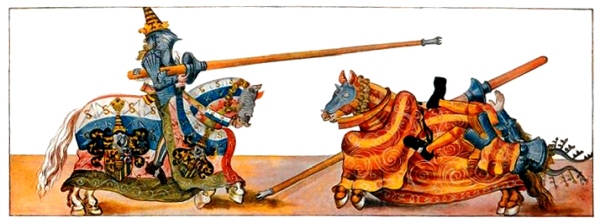
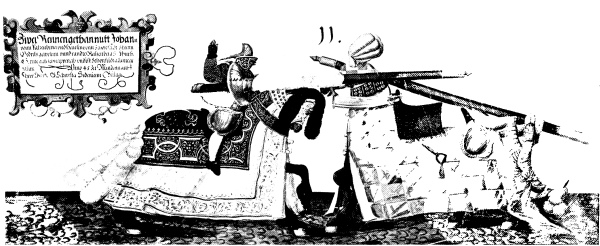
Plate 118 in Das Turnierbuch Johan des Beständigen, Kurfürst
of Saxony, depicts a course with sharp lances, run at Naumburg in 1505,
between Duke Hans of Saxony and Georg von Brandestein. The duke keeps
his seat, but his opponent is unhorsed. The armour is of the kind
usually employed in this course (Scharfrennen).
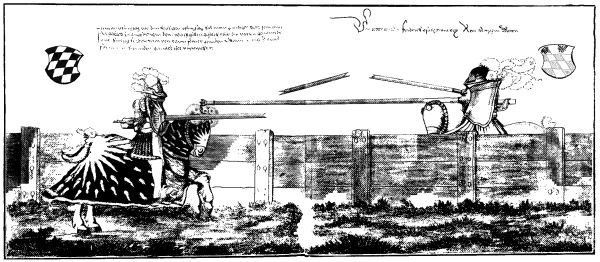
In the Turnierhuch of Duke William of Bavaria is a picture of an
Anzogenrennen, held in the year 1512. The body-armour employed is
that used in all the varieties of Rennen, though the shield in
this course is much larger than in the others, extending up to the
ocularium of the jousting-salade, thus covering the face. This shield
has been described under the heading Anzogenrennen. The armour with
the shield is illustrated by Boeheim.[195]
There was jousting at Paris in 1513, at which the Duc de Valois was the
chief tenant, and many courses were run.[196]
Jousts were held at Lille, in the same year, in a large hall paved
with black marble, and the horses were shod with felt to prevent their
slipping.[197]
In 1515, in honour of the marriage of the king, jousts took place at
Paris, which had been proclaimed by the Dauphin, as follows:—
“Nemelie, that he with nine aides should answer
all commers, being gentlemen of name and armes. First, to run fiue
courses at the tilt with péeces of advantage[198];
after fiue courses at random[199]
with sharpe speares, and twelue strokes with sharpe swords; and that
doone, he and his aids to fight at the barriers with all gentlemen of
name and armes. First, six foins with hand speares, and after that
eight strokes to the most aduantage if the speares so long held, and
after that twelue strokes with the sword; and if any man be vnhorsed or
felled with fighting on foot, then his horse and armour to be rendered
to the officer of armes; and eueri man of this challenge must set vp
his armes and name vpon an arch triumphant, which shalbe made at the
place where the iusts shalbe, and further shall write to what point he
will answer, to one or all.”
When this fête d’armes was proclaimed in England, “the duke of
Suffolke, the marquis of Dorset and his four brethrern, the lord
Clinton, sir Edward Neuille, sir Giles Capell, Thomas Cheneie
and others sued the king to be at the chalenge, which request he
gratiouslie granted.” “The Dolphin desired the duke of Suffolke and the
marquess Dorset to be two of his immediate aids, which they thereto
assented.” Four shields were set up—viz. silver, gold, black and
tawny—under which the venans were to write their names, electing, in
their order, whether to run at the tilt, in the open with sharp lances,
to fight on foot with one-handed swords, or lastly, with two-handers.
This pas d’armes continued over three days, during which 305
cavaliers each ran five courses, some with sharp lances, and several
were killed. In the joust in the open the Duke of Suffolk wounded an
antagonist almost to the death. The Dauphin was wounded in the hand,
so that he was unable to take further part. Many other particulars and
details of this passage of arms are given by Holinshed.[200]
Among the Ashmolean MSS. is one relating to the proclamation of
jousts to be held at a later date and to letters of safeguard issued
to intending venans. The document is of the year 1520, and runs as follows:—
“The lettres of savegarde given by the said King
of England [Henry VIII] unto Thomas Walle al’s Norrey King of Armes,
for the proclamacōn of the same Ioustes in the parties of Almayn and
the contrye of Germania, wch Norrey proclaimed thē welle in French for
the lowe contreys, as in High Dutch as hereafter followeth &c.”[201]
In foot contests there was a rule that no one who had seen a challenger
fight on foot on any previous occasion was allowed to engage him. It is
difficult to understand the reason for this condition, and it was often
waived on permission being given by an intended opponent.
Charles V, in January, 1518, two years before he became emperor, took
part in a tournament at which twelve horses were killed; and in another
in the March following, when seven cavaliers lost their lives.[202]
Henry VIII, like his friend Maximilian of Austria, took great delight
in the tourney and in the pageantry so frequently combined with it, and
much money and labour was expended in staging the many functions of
the kind held during his reign. Henry greatly encouraged these martial
games and frequently took part in them; indeed, Hall remarks “that the
king was not minded to see young gentlemen inexpert in martial feats.”
This chronicler positively revels in picturing these brilliant scenes,
devoting himself more especially to their spectacular aspect, and
giving full details of the dresses and equipment of those taking part,
together with particulars of the general surroundings, though little
is said of the martial games themselves. The pageantry and mummeries
associated with the tournament were often of almost incredible
puerility, and they detracted greatly from the dignity of these warlike
sports. There were many childish conceits at these gatherings, all
showing that the tourney had reached an advanced stage of its decline.
Such costly shows went greatly out of fashion after the death of Henry VIII.
Jousts, combined with pageants, were held in honour of the coronation
of the king, and Holinshed thus describes them:—“For the more honour
and innobling of the triumphant coronation, there were prepared both
iusts and turneis to be doone in the palace of Westminster, where, for
the king’s grace and the queen’s, was framed a faire house, couered
with tapestrie, and hanged with rich clothe of Arras, and in the said
palace was made a curious founteine and ouer it a castell, on the top
thereof a great crowne imperiall, all the imbatelling with roses and
pomgranats gilded,” and many other conceits.
The tenans in the jousting on this occasion were Thomas, Lord Howard;
his brother, Sir Edward Howard; Lord Richard, the Admiral; Lord
Richard, brother to the Marquis of Dorset; Sir Edmund Howard; Sir
Thomas Knevit and Charles Brandon, Esquire. Their bases and trappers
were of green velvet, charged with roses and pomegranates of gold
fringed with damask gilded.
The venans were Sir John Pechie, Sir Edward Neville, Sir Edward
Guildford, Sir John Carr, Sir William Parr, Sir Giles Capell, Sir
Griffith Dun and Sir Roulande. Their bases and trappers were of tissue,
cloth of gold, silver and velvet.
The second day was devoted to the mêlée. No details of the jousting
itself or of the tourney are given. Both Hall and Holinshed describe
this meeting.
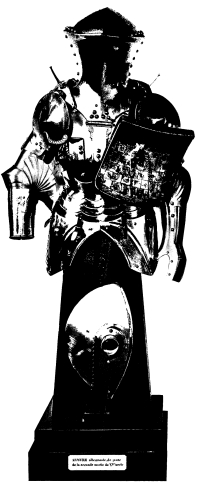
PLATE IX
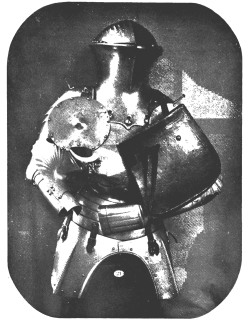
A HARNESS FOR
THE GERMAN JOUST.
WALLACE COLLECTION
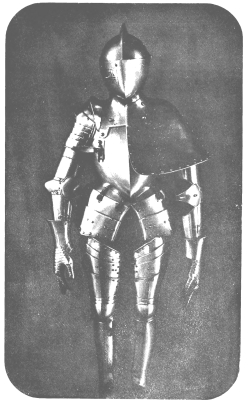
SUIT IN THE
WALLACE COLLECTION FOR
JOUSTING AT THE TILT
On the twelfth of January following jousts were held in the park at
Richmond “vnknown to the kynges grace, whereof, he beyng secretly
informed, caused hymself and one of his priue chambre, called Willyā
Compton to be secretly armed, and so came into the Iustes vnknowen
to all persones and vnloked for. The kyng ranne neuer openly before,
and there were broken many staues, and greate praise geuen to the two
straungers, but specially to one, whiche was the kyng.” “Master Compton
was sore hurte and likely to dye.”[203]
Holinshed tells us that in May, 1510, the king with his aides
challenged all comers to fight at barriers at Greenwich, viz. casting
the spear and twelve strokes with two-handed swords. Henry much
distinguished himself by his great strength and judgment.
On the 13th November in the same year Henry, with Charles Brandon and
“Mayster” Compton, answered all comers for two days, the first at the
tilt, the second at the tourney. “At these iusts the king brake more
staves than any other, and therefore had the pryse: at the Turney in
likewyse the honor was his.”[204]
The original Roll of the “Iusts” held at Westminster on the 13th
February, 1511, in honour of Queen “Katherin” on the birth of Prince
Henry, is now in the College of Arms, London. It is of parchment, 14½
inches broad, the figures of the combatants and others being from seven
to eight inches in height; and the whole is in an excellent state of
preservation. The roll is headed with the words “Viue le noble Roy H.
VIII,” followed by a large device of a rose and pomegranates surmounted
by a crown, impaled with the letters H and K. Some of the figures are
armed at all points, while others are in civil dress, thus constituting
an invaluable record of the costumes of the day.
The picture of the procession to the lists is headed by “Le Maistre
de Armurerye du Roy,” in civil dress, with his guard, and immediately
after him follow the sergeant-at-arms, holding his crowned bâton of
office; then five trumpeters, one of them a negro. In their order march
after them a band of courtiers, and “Les Officiers d’Armes,” being
heralds and pursuivants, in tabard-shaped surcoats. Then come the four
tenans, each riding under a “Pauilion,” with their varlets. Two led
horses immediately follow the king, and they afford a good opportunity
for observing the saddles employed in jousting at the tilt. After them
ride “Les pages du Roy,” the marshal of the lists, “Le grant Escuyer,”
and “Le maistre des Pages.” The tenans are seen approaching the
gaily-decorated stand, in which the queen and her court are seated,
and the venans are reaching it on the other side. The picture closes
with the king on horseback in civil dress—“Le Roy desarmey”—holding
a broken lance in his hand. He is preceded by his helm-bearer, on
horseback, carrying the head-piece of his majesty on a truncheon.
The helm is surmounted by a royal crown, enriched with gold, pearls,
diamonds and rubies.
The roll concludes with a poem, in which the name of the king figures
among a band of heroes, the others being Hector, Cæsar, Judas
Maccabæus, Joshua, Charlemagne, King Arthur, Alexander, David and
Codefroi de Bouillon.
The “tenantz” were—
| His Grace the King |
(Cœur Loyal), |
| Lord William of Devon |
(Bon Vouloir), |
| Sir Thomas Knevit |
(Valliant Desyr), |
| Sir Edward Nevyle |
(Joyeulx Penser). |
They all subscribed to the articles of combat, which follow here—
“And for as moche as after the order & Honnor of Arms hyt is not
lefull for any man to enterpryse Arms in so high a presens without hys
Stocke and name be of Nobles dyscended. In consyderation theis four
Knights be of so fer & straunge partes. they shall present themselff wt
their names and Arms portend [pictured] in their shylde.
Item these four Knights shall present themselves in the feyld at the
paleys of Rychmond or elles where hyt shall please the Kynges Grace. at
the tyme of Candelmas next or nigh theirupon in harneys for the tylt wt
out tache or breket, wolant pece on the hedde[205]
Rondell on the garde rest. aduntag (sic). fraude. deceyt or any malengyne.
Item to every comer shall be Runne six courses pvyed [provided]
allway yf the comers be of sush greate number that they cannot
reasonably be for on [one] day Hyt shallbe lefull for the four
challengers to enter the felde the Second day and so to answere all the
comers to the full nomber be served of soche as be noble of name or of
Armes and wt out report.
Item all speres to be garnished and brought to the ffeyld at the
pvision and chardge of the Chalengers, of the wch speres the answerers
to have the Choice.
Item yf yt happe any Man as God defend to kyll his fellows Horse by
way of fowle Runnyng. He shallbe bound yf so doth to give the horse
yt he rydeth on to his felow or the pryse of the Horse so kyld at the
dyscresion of the Iudges.
Item who stryketh his felow beneth the wast or in the sadell with
full course be [by] way of fowle Runnynge he shallbe dysalowed for two
speres before broken.
Item who stryketh his felow uncharged & disgarnyshed of his speare
he shallbe disalowed at the descression of the Iudges.
Item who breaketh his spere above the Charnell [coronal] to be
allowed[206]
two speres well broken after the old custom of Arms.
Item who breaketh his spere morme to morme [coronal to coronal] to
be allow’d three Speres after the Custome of Arms.
Item who breaketh most speres ys [is] bette worthey the pryse.
Item who stryketh Down Horse and Man is better worthe the pryse.
Item who stryketh his felow clene out of the Sadell is best worthe
the pryse. Item if any Gentleman chalenger or defender breake a staff
on the Tylt to be disalowed a staff.
Item yf yt is the pleasurs of the Kynge our most Dred Souaigne
Lorde, the Queens Grace and the Ladies with the advice of the Noble
and dyscret Iuges to give pryses after their deservings unto both the
Parties.
Item that every Gentleman answerer do Subscrybe his name to the
Artycalles.”
Hall’s florid account of this meeting, in a much abridged form, is as
follows:—The jousting was combined with a pageant picturing a forest
in which stood a castle of gold, and before it sat a gentleman weaving
a garland of roses for the prize. Jousting began on the twelfth, and on
the morrow there was a grand procession to the lists. The king was on
horseback, armed at all points, riding under a “Pauilion” of cloth of
gold and purple velvet, embroidered and powdered over with the letters
“H” and “K” of fine gold, surmounted by an imperial golden crown and
valanced with hanging wire of the same precious metal. The king’s bases
and the trapper of his charger were of cloth of gold, fretted with
damask gold; his crinet and chamfron were of steel, and on the latter
was a plume garnished with golden spangles. Then followed his three
aides, each riding under a “Pauilion” of crimson damask and purple,
powdered over with the letters “H” and “K” in fine gold, valanced and
fringed with damask gold, and on the top of each canopy a great “K”
of goldsmith’s work. After them marched a number of gentlemen and
yeomen on foot, clad in russet and yellow cloth; then twelve children
of honour, mounted on great coursers richly caparisoned. Then in the
counterpart rode the “venantz,” headed by Sir Charles Brandon,[207]
who appears first on horseback in a long robe of russet satin, like
a recluse, and he petitions the queen for permission to joust in her
presence. His request having been granted, he doffed his cloak and
appeared in full armour, with rich bases, and his horse nobly trapped
for running at the tilt. In attendance on him were divers men clad in
russet satin. Next came young Henry Guilford, Esquire, himself and
horse in russet cloth of gold and cloth of silver, embroidered with a
device like a castle or turret, and all his men in russet satin and
white, with hose of the same and bonnets of a like colour; and he also
petitioned the queen for permission to run. After him rode the Marquis
of Dorset and Sir Thomas Bulleyn,[208]
dressed as pilgrims in tabards of black velvet, with palmer’s hats over
their helmets and long Jacob’s staffs in their hands. Their horses
were trapped in black velvet, which, like their hats and tabards, was
garnished with scallop shells of fine gold; their servants were in
black satin, with the same kind of shells pinned to their breasts. Then
came Lord Henry of Buckingham, Earl of Wiltshire, himself and his horse
draped in cloth of silver, embroidered with a “posye” of golden arrows
and roses, and above the flowers the figure of a greyhound in silver
holding a tree of pomegranates in gold. Then entered Sir Giles Capell,
Sir Roulande and many other knights, richly armed and apparelled.
The jousting began and was gallantly achieved, the prize being awarded
to the king. The proceedings were followed by music and the dance,
closing with a pageant.[209]
What a contrast between this passage of arms and the tournament held in
1278, temp. Edward I, as described in Chapter II.
Ashmole, No. 1116, fol. 109-10b, runs as follows:—“Iustes holden at
Westminster the XIIth daie of February by the Kinges grace called Cueur
Loyal, the Lord William of Devon Bon Voloir, Sir Thomas Knevit Valiant
Desire, and Edward Nevell Joyous Penser, with the articles and courses
of the said Iustes,” etc. The articles begin thus—“The noble lady
Renowne considering the good and gracious fortune....” The “courses”
(checques) were tilting tablets for recording the scores for two days
(Wednesday and Thursday, February 12th, 13th, 1511), marked with
strokes, and accounts of the “best Ioustres.”
In the tournament illustrated on the Herald’s College Roll it is stated
that 264 courses were run at the tilt and but 129 attaints made.
The tenans scored seventy-seven of these, the king himself making
thirty-eight hits out of fifty-two courses. Of the venans, one made no
hits at all and six only struck once in six courses.[210]
Another meeting took place on the 1st May following, at which the
tenans were the king, Sir Edward Howard, Charles Brandon and Sir Edward
Nevil; the venans being the Earl of Essex, the Earl of Devon, the
Marquis of Dorset and Lord Howard.[211]
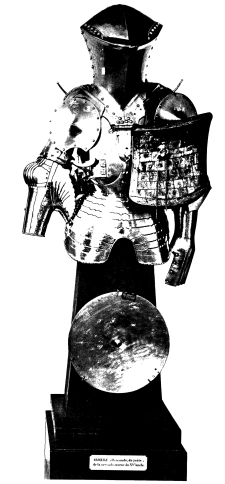
PLATE X
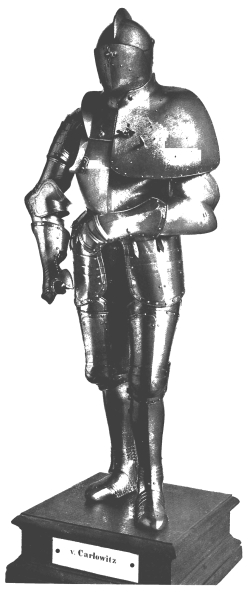
GERMAN ARMOUR FOR
JOUSTING AT THE TILT.
AT DRESDEN.
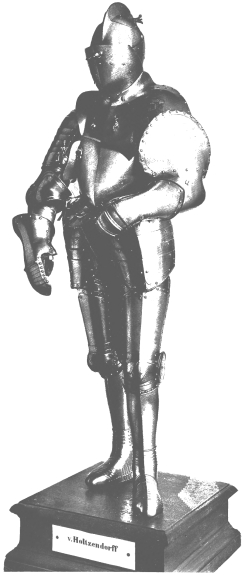
AN ARMOUR FOR
FREITURNIER.
AT DRESDEN.
In the fourth year of King Henry’s reign—
“the King had a solempne iust at
Grenewiche in Iune: first came in ladies all in White and Red silke,
set vpon Coursers trapped in the same suite, freated ouer with gold,
after which folowed a Fountain curiously made of Russet sattin, with
eight Gargilles spoutyng water, within the fountain sat a knight armed
at all peces. After the Fountain folowed a lady all in black silke
dropped with fine siluer, on a courser trapped in the same. After
folowed a knight in a horse litter, the Coursers and litter apparareled
in blacke velvet with siluer droppes. When the Fountain came to the
tilt, the Ladies rode rounde aboute, and so did the Fountain and the
knight within the litter. And after them wer brought twoo goodly
Coursers appareled for the iusts: and when they came to the tiltes
ende, the twoo knightes mounted on the two Coursers, abidyng all
commers. The king was in the fountain and Sir Charles Brandon was in
the litter. Then suddenly with great noyse of the Trompets, entered
Sir Thomas Kneuit in a castle of cole blacke, and ouer the castell was
written, ‘The dolorous Castle,’ and so he and the erle of Essex, the
lorde Haward and other ran their courses, with the King and Sir Charles
Brandon and euer the king brake moste speres.”[212]
There were royal jousts held in October, 1513, the king and Lord Lisle
answering all comers. His Majesty was attended by twenty-four knights
clad in robes of purple velvet and cloth of gold, and many lances were
broken.[213]
In 1515 Henry, with the Marquis of Dorset, challenged all comers to a
joust, and the king “brake three and twentie speres beside attaints and
bare downe to ground a man of armes and his horse.”[214]
In the same year on twelfth-night the king held a Scharmützel, being
the attack and defence of a mock fortress, at Eltham.[215]
Royal jousts were held again in June, 1519, at which 506 lances were
splintered.[216]
Royal jousts in March, 1520.[217]
In the eighth year of his reign the king proclaimed solemn jousts in
honour of his sister, the Queen of Scotland,[218] to extend over two
days. The tenans on the first day were the king himself, the Duke of
Suffolk, the Earl of Essex and Nicholas Carew, Esquire. The venans
numbered twelve. On the second day the king ran against Sir William
Kingston, a tall and strong knight, and unhorsed him. The apparel of
the tenans and their horses “was blacke velvet, covered all over with
braunches of honey suckels of fine flat gold of damaske, of lose worke,
every lefe of the braunch moving, the embroudery was very conning and
sumptuous.”[219]
[220]
There was another passage of arms in the year following, at which 506
lances were splintered.[221]
The following documents occur among the Harleian MSS.:—“Justs at
Greenwich, the 20th daie of Maye, the 8th yeare of the Raigne of our
Soveraigne Ld. K. Henry VIII.” The score of each jouster is given.
“Coppye de Chapitres (ou Articles) des certaine Faits d’Armes, tant a
Pied, comme a Cheval, qui par deux Gentilmomes d’Almaigne touchant une
certaine Emprise.”[222]
The jousts and tourneys of the Field of the Cloth of Gold were held
on a truly magnificent scale, and, indeed, everything was done to
make them a triumphant spectacular success. The cavaliers of the
two nations, like the ladies present, vied with each other in the
richness of their dresses and appointments, and the two monarchs
greatly distinguished themselves in the tiltyard. The lists themselves
are stated to have been 150 paces long, and were placed in a plain
surrounded by a ditch. Stands were erected for the officials and
spectators, and pavilions were pitched for the use of the cavaliers
taking part. The jousting was with blunted lances, each challenger to
run eight courses. The two kings entered the enclosure on June 11th,
1520, armed at all points, at the time appointed. The horse of his
Majesty of France was trapped with purple satin broached with gold and
embroidered with raven’s plumes hatched with gold, and on his helm he
wore a lady’s sleeve. The trapper of the King of England was of cloth
of gold tissue, fringed with damask and knitted together with golden
points. In attendance on King Henry were Sir Henry Guilford, Master of
the Horse; Sir John Pechie, Governor of Calais; Sir Edmund Guilford,
General of the Forces; and Monsieur Morel, attached to his suite by
King Francis. They all wore the royal livery.
The jousting began, the onset was sounded, and King Henry ran against
Monsieur Grandevile, and the helm of the Frenchman was fractured. The
Duc de Vendôme ran five courses against the Duke of Suffolk, each
breaking his lance on the other’s body. After many more jousts had been
accomplished the signal to cease for the day was given, the heralds
crying “Desarmée” and the trumpets sounded à l’hostel
(to lodgings).
On Tuesday, the 12th, ten gentlemen of the French king’s Swiss Guard
tilted against eleven of the band of Monsieur de Tremouille.
On Wednesday, the 13th, the King of France, with his aides, and King
Henry, with his following, rode at the tilt, after which there was much
jousting between the knights of France and England; and towards evening
King Francis left for Ard and the English monarch departed for his
castle of Guisnes.
On the Thursday the French king tilted with the Earl of Devonshire
and others, and King Henry ran against Monsieur Montmorencie and Rafe
Brooke. On the Friday there was fighting at barriers, and on the
Saturday a banquet was given by the French king and his suite at the
Castle of Guisnes. A Frenchman was killed when fighting on foot.
On the Monday the fêtes were in abeyance, owing to a great storm, but
on the Tuesday the two kings came to the lists, armed at all points,
and jousting was resumed. Wednesday and Thursday were devoted to the
mêlée, and on Friday, June 22nd, “the two kings with their retinues
did battle on foot at barriers.”[223]
The French cavaliers wore doublets of cloth of silver and purple
velvet, while those of the English were of cloth of gold and russet
velvet. The weapons were spears and swords.
On Saturday, after a banquet, there was again fighting at barriers,
first with spears and afterwards with two-handed swords.
The pas d’armes was followed by masks, more banqueting and the dance.
Both Hall and Holinshed describe this historic meeting.
Among the Ashmolean MSS. are the following concerning the Field of
the Cloth of Gold:—“Ce sont les noms des princes, prellatz, et
grans seigneurs de France, qui estoient en la compaignie de Roy de
France quant le Roy [Henry VIII] Dengleterre et led’ sr le Roy
[François] sentrevyrent et ordonnerent les Iousts et Tournoys qui
sensuyvent.” Prefixed to the title is a stanza of five lines inviting
to the jousts.
“The proclamacōn in Frenche of the Articles of the Iustes and other
feates of armes at the meeting of the aforesaid Kinges [Henry and
François] at Guisnes, proclaimed throughout the realme of France
by Thomas Benolt al’s Clarencieux King of Armes. Comme ainsi soit
louange.”[224]
Imperial royal jousts were run in the month of March of the thirteenth
year of the reign, of which Hall gives an account; and there were
others in the year following.
On March 10th, 1524, King Henry ran a great risk of losing his life
in the tiltyard, for when jousting with Brandon, Duke of Suffolk, he
forgot to shut and clasp down the visor of his helmet. Brandon, who was
short-sighted, did not perceive this, and in his career aimed his lance
at that part of the king’s head-piece, striking it at the side of the
face, unhelming his Majesty, though without causing him any injury. As
already mentioned, in a joust held on Shrove Tuesday in the year 1525
Sir Charles Bryan nearly lost an eye from a somewhat similar cause.
King Henry, like his friend Maximilian of Austria, is always
represented as the successful jouster, and, although his strength,
skill and good fortune are generally admitted, some explanation is
required to account for his invariable success. It has been suggested
that it may have been due in some measure to the prerogative of the
queen, by which a joust could be stopped if there should be any
probability of the king’s defeat.[225]
“On May-day anno 1536 was a great jousting held at Greenwich, at
which the chief challenger was the Lord Rochford, the queen’s brother;
and the defendant was one Henry Norris, of the king’s bed-chamber, with
others. They managed their arms with great dexterity, and every course
which they ran came off with the loud applause of the people.”[226]
“Another solemne Challenge was proclaimed and
perfourmed by certaine English Knights, viz. Sir John
Dudley,[227]
Sir Thomas Seimer, Sir Francis Poynings, Sir
George Carew, Anthony Kingston and Richard Cromwel. Anno 1540.”
Royal jousts were run on the thirty-first year of the reign, in
celebration of the king’s marriage with Anne of Clѐves.
Lacroix, in Military and Religious Life in the Middle Ages, pictures
the degradation of a knight convicted of dishonourable conduct, copied
from a wood-cut bearing the initials “J. A.” (Jost Amman). The culprit
is exposed on a scaffold, clad only in his shirt, his armour is broken
in pieces before him and thrown at his feet, and his spurs are cast
upon a dunghill. His shield is dragged by a cart-horse through the
mire, and the tail of his destrier cut off. A herald-at-arms cries
three times, “Who is there?” and each time the name of the knight is
given. The herald then cries, “No, it is not so; I see no knight, but
only a false coward.” The culprit is borne on a litter into a church,
where the burial service is read over him, and the world of chivalry
knows him no more.
There is no record of any royal jousts on the accession of Edward VI
to the throne, and such pastimes would seem to have been greatly in
abeyance during that short reign.
The same would seem to have been the case during the reign of Queen
Mary; but there were fights at barriers in 1554, when Philip II arrived
in England. The challengers, against all comers, were Don
Fredericke de Toledo, the Lord Strange, Don Ferdinando de Toledo,
Don Francisco de Mendoça, and Garsulace de la Vega.
The prizes were as follows, viz.:—
“1. He who cometh forth most gallantly, though without
superfluities, shall have a rich brooch.
2. The best stroke with the pike shall have a
ring with a ruby.
3. The best stroke with the sword shall have a
ring with a diamond.
4. He that fighteth most valiantly shall have a
ring with a diamond.
5. The prize of all together in rank at the foyle
was a ring of gold with a rich diamond.
He that giveth a stroke with a pike from the
girdle downwards shall win no prize.
He that shall have a close gauntlet or anything
to fasten his sword to his hand shall win no prize.
He whose sword falls out of his hand shall win no
prize.
He that striketh his hand in fight on the
barriers shall win no prize.
Whosoever shall fight and not show his sword to
the judges shall win no prize.”
The prizes were thus awarded by the judges, in
the above order, to:—
- Don Fredericke de Toledo.
- Don Diego Ortado di Mendoça.
- Sir John Parrat.
- Ruygomez.[228]And
- King Philip, in highest honour.[229]
During the reign of Queen Elizabeth vigorous efforts were made to
revive the ancient glories of the tournament, which were for a time not
without a certain measure of success, under the auspices of the maiden
queen. Sir Henry Lee rode as the queen’s champion until advancing years
caused him to relinquish the self-imposed office in favour of the Earl
of Cumberland, who wore a glove of her Majesty’s on his helmet.
A drawing, from a MS., of tilting, tourney and barriers is reproduced
in Lord Dillon’s paper in the Archæological Journal, Vol. LV, which
affords a good deal of information regarding the detail of such combats
during the reign.
There were jousts and barriers on the accession of Queen Elizabeth
to the throne in 1558, in which the Duke of Norfolk and the earls of
Surrey, Warwick and Leicester took part.[230]
The fête d’armes at which Henri II of France was fatally injured
was held at Paris in 1559. The tenans on the occasion were the king, the
Prince of Ferrera, the Duke of Guise and others. The course in which
the accident befel was an extra one, run in the face of remonstrances
on the part of the other challengers. The cause of the injury would
seem to have been that the Comte de Montgomeri, Captain of the Scottish
Guard, failed to drop his shivered lance immediately after impact, as
he ought to have done, and the jagged end striking the king’s visor,
a splinter passed through the slit for vision and pierced his brain.
The king’s case was hopeless from the first, though he lingered in
agony for nearly a week. The king’s accidental death was not avenged
on Montgomeri at the time, but Catherine de Medici had him executed
fifteen years later. Lacroix, in Military and Religious Life in the
Middle Ages, gives a picture of this fatal encounter, copied from an
engraving of the sixteenth century.
Viscount Dillon, in his paper “Barriers and Foot Combats,” reproduces
a picture of Spanish officers “At Barriers” in Brussels, 1569 (after
Hogenberg). The details are interesting as showing the manner of
fighting on foot at the time.
As stated in the Ashmolean MS., No. 837, fol. 245, a tournament
was proclaimed at Hampton Court by Clarencieulx, King of Arms,
on Twelfth-night, anno 1570, to take place in the month of May
following. The MS. begins with a preamble, being a general exhortation
to revive the tournament, which “had of late fallen a sleepe.” Next
come the chapitres d’armes (the articles) for the tilt, tourney and
barriers. A copy of the document follows here:—
“For as much most noble Queene, as ther ar within this yoʳ maᵗⁱᵉˢ
Courte a greate nombre of noble menne and gentlemenne excellent men
of Armes, and yet (as it wer) of late fallen a sleepe from eny kinde
of such exercyse: Therfore by your maᵗⁱᵉˢ lycense, to revyve theim
withall, ther ar fower Knightes Errant which haue thought goode to
challenge all commers at Shrovetyde next as followeth. Videlicet.
Tilt
Vpon Shrouesonday at the Tylt, six courses a pece. And who so doth
best of the Defendanntes in those six courses, shall have for his prize
a cheyne of gold.
Tourney
Vpon Shrovemonday at the Tourney, two blowes at the passage, and
tenne at the ioyninge. All grypes, shockes, and fowle playes forbidden.
And who so doth best of the Defendantes at that feate, shall haue a Diamonde.
Barriours
Vpon Shrouetuesday at the Barriours, three pusshes with the short
pyke, and tenne blowes with the sworde with open gauntlet: no Barriours
to be layde hande vpon, nor eny weopen to be taken holde of. And he of
the Defendantes that doth best ther at, shall haue a Rubie.
[The entire page is scored out. On the back of the page, which is
written by Glover, a second hand has written, the other way up:—]
The proclemacion that was procleamed at hampton court by
Clarencieulx Kyng of armes on twelffe daye at nyght in Aᵒ/1570/ the
chalengers names was the erle of Oxfford Charles howard Sʳ henry Lee
and christoffer hatton a pencioner.
Theys excercyses was not Fulffylled tyle maye deye next after on
which daye was the tylte at westmynster and the second daye of maye the
torney and on Sonday byeing the vj of maye the barrioures.”
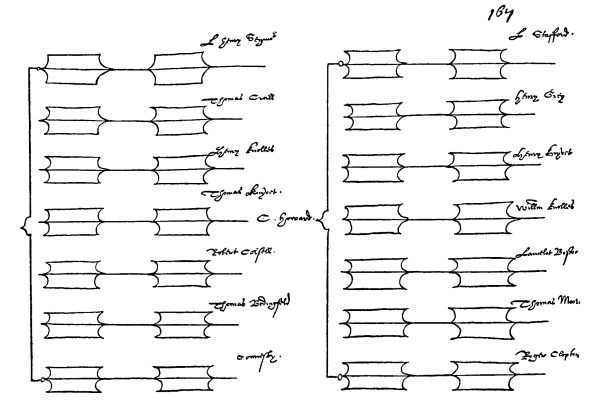
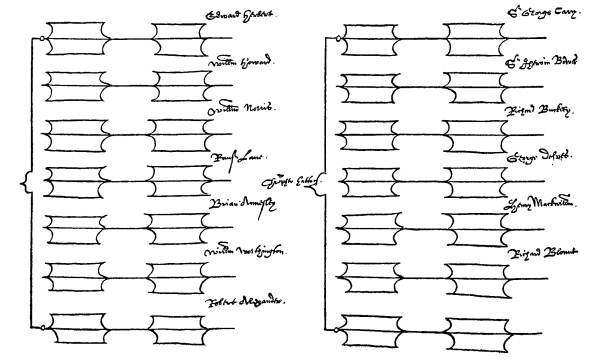
Another MS. in the same collection (No. 845, fol. 164)
gives a list of the participants, with their “checques” (which are tablets for
recording the scores made). Examples of these registers are given here,
under the heading of the document in question:—
[Endorsed:—Tournay.
Two blowes at the passage: and tenne at the ioyninge:
All gryppes shockes and foule playe forbidden.]
[A list of names is also on folio 164 b.]
[fol. 164.]
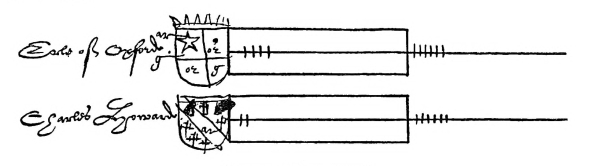
Scoring “Cheques.”
[54 more, as above, 25 without arms.]
The tenans on the occasion were the Earl of Oxford, Lord Charles
Howard, Sir Henry Lee, and Christopher Hatton, a “pencioner,” and
a list of their opponents, with their “Checques,” is given in the
Ashmolean MS. No. 845, fol. 167. (See page 128.)
The prize for the best lance among the tilters was “a cheyne of gold,”
which fell to the Earl of Oxford, who ran forty-two courses and
splintered thirty-two lances, a very good performance. The prize for
the tourney was a “Diamonde”; that for “barriours” a “Rubie,” which was
won by Thomas Cecil, one of the venans.
PLATE XI
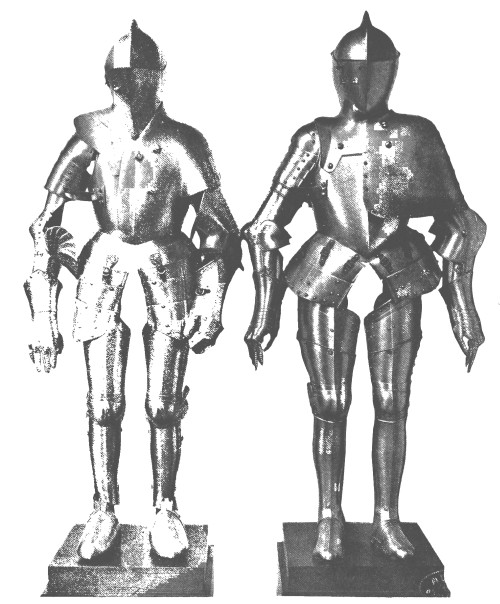
HARNESSES FOR JOUSTING AT THE TILT.
AT PARIS.
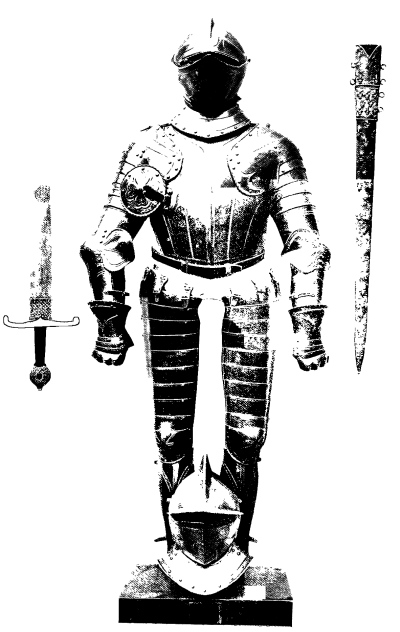
FIELD HARNESS OF
ANNE DE MONTMORENCY.
In 1590, after the siege of Paris had been raised, King Henri IV
challenged the Duc de Mayenne to single combat, in order that by a
decisive result the calamities of France might be stayed, but nothing
came of it.
A tournament was held at Westminster under the leadership of Walter,
Earl of Essex, which is chiefly remarkable from the fact of its
having taken place during the night. It was on the occasion when Anne
de Montmorency, Constable of France, came to London to receive the
Order of the Garter, in June, 1572. Queen Elizabeth gave a supper in
celebration of the event, at which she presided, and in due time she
retired to her apartments. The weather being warm, however, it pleased
her Majesty to walk from her chamber on to the open terrace of the
palace, where the French duke and his suite were assembled, with many
of the English courtiers. The Earl of Essex entered the terrace quite
suddenly, accompanied by twelve gentlemen armed at all points and well
mounted.
“The Earl and his horse were furnished with white cloth of siluer,
and the rest in white sattin, who after reuerence done to her Maiesty,
marched to the east side of the Court, and there in troope, stood
firme. Forthwith entered Edward Earle of Rutland, with a like number,
in like sort armed and apparelled all in blew; and hauing presented his
reuerence, stayed on the west end. Before either of these bands, one
Chariot was drawen, and therein a faire Damsell, conducted by an armed
Knight, who pronounced certain speeches in the French tongue, vnto
her Maiestie. These Ceremonies passed, the Queene commanded the armed
men to fall vnto fight, which they performed with great courage, and
commendation, chiefly in the Earl of Essex, a noble personage, valorous
in armes, and all other wayes of great vertue.
Of the Actors names in this Triumph (it seemeth) no note is kept:
yet are many of them still liuing.”
The ordinances and regulations which controlled the routine of a
tournament, some of them compiled for general use and others framed for
particular contests, have been repeatedly referred to in these pages;
but the method of the keeping of scores is nowhere clearly indicated,
and, indeed, is but rarely mentioned. The score was marked in strokes
by a king of arms, sometimes by a pursuivant,[231]
on a scoring tablet, termed a “checque,” which was tricked with
a shield of the arms of the owner, as shown on page 127. The
scoring-board itself was in the form of a parallelogram, with three
horizontal lines, the middle line projecting some distance beyond the
others, and on the projection of this middle line the number of courses
run (usually from two to eight) were registered. The attaints were
noted on the top line; and they were often differentiated as hits on
the body or head, which had a different value in the tale.[232]
The middle line inside the parallelogram was for the staves well
broken, and the bottom line for those “ill-broken”—that is, broken
within a foot of the head of the lance or on the tilt, on the
adversary’s saddle, etc.—these being deducted from the score or
disallowed. The proportion in the number of attaints varied greatly,
though on the average it would appear that the misses made in jousting
at the tilt (i.e. when the jousters failed to touch each other in
their careers) were greater in number than the hits made; while in
jousting “at the wide” the proportion of attaints was much greater. The
registration was done by vertical strokes on the horizontal lines.
As many as ten jousting cheques have been found, which help to a
knowledge as to how the scoring was managed, though more light is
needed on the subject.
The rules and regulations concerning the conducting of tournaments in
Tudor times were based on those framed in 1466 by John Tiptoft, Earl of
Worcester, Constable of England, which are given in our Chapter IV;
but there is no rule among them directly mentioned concerning the method
of scoring the points. There are, however, pictures of the scoring
cheques, reproduced by Mr. ffoulkes in his paper in Archæologia,
Vol. LXIII, Plate IV, Nos. 2, 3, which appear at the ends of two of
the versions of the Tiptoft rules; viz. those in Harl. MS. 2413, fol.
16, and Ashmole MS. 763, fol. 149. Two cheques out of the fifty-six in
Ashmole MS. 845, fol. 164, are reproduced on our Fig. 1. They are those
of the Earl of Oxford and Charles Howard, being registers of their
scores at the passage of arms which was proclaimed by Clarencieulx in
1570.
This somewhat intricate subject can only be lightly touched upon in
these pages; but we may refer any of our readers who may wish to pursue
the subject further to Lord Dillon’s paper, “Tilting in Tudor Times,”
published in the Archæological Journal, Vol. LV, and to that written
by Mr. Charles ffoulkes in Archæologia, LXIII, entitled “Jousting
Cheques of the Sixteenth Century.”
Three writers on certain features in the routine of a tournament are
mentioned in the last-named monograph, The Romance of Three King’s
Sons, written about the end of the fifteenth century,[233]
from which the following extract is given:—
“All these thinges donne thei were embatailed
eche ageynste the othir and the corde drawen ageynste eche partie, and
whan the tyme was, the cordes were cutte and the Trumpettis blew up
for euery man to do his deuoir. And for to assertayne you more of the
Tournay there was on eche side a stake, and at eache stake two Kynges
of Armes, with penne, and Inke, and paper, to write the names of all of
them that were yolden, for they shold no more Tournay.”
This refers to the mêlée, not the joust.
King René d’Anjou, in Traicte de la forme et Devis d’ung Tournoi,
gives an illustration of a mêlée in which the attendants are seen
cutting the cords with axes, but there are no kings of arms present
noting the score.
Another reference occurs in the account given in the Landsdowne MS.
285 of the combat between the Bastard of Burgundy and Lord Scales in
1466, a contest which has been already described on these pages. It is
entitled The Ordinaunce of kepyng of the Feelde, and runs—
“... At ev’y corner a Kyng of Armes crownyd and
an Harauld or Pursevaunte within the seide feelde, for reporte makyng
of actes doon within the same: Garter and othir Kynges of Armes and
Hauraldes to be sett in the scaffolde before the Kyng on the right
hande of the staire of the Kynges place judiciall’ to make report
generall’ and to marke all that should be doon in the seide feelde.”
And we may infer that a score of the points, for and against, was kept
on the occasion.[234]
Hall, in his narrative of the Field of the Cloth of Gold, states
definitely that the scores of the combatants were marked down by the
proper officials, English and French.
The Duc d’Alençon and three French gentlemen, with the earls of Sussex
and Leicester, challenged all comers, in 1551, to fight at barriers,
and they had forty-five opponents.[235]
Jousts were run at Westminster, in conjunction with a great pageant,
on January 22nd, 1581, in the presence of Queen Elizabeth. The fêtes
extended over several days, and many lances were broken at the tilting.
The crowd was so great at the pageant that many citizens were maimed
and some killed. Those taking part in the tilting were Henry Gray,
Sir Thomas Perot, Anthony Cooke, Thomas Radcliffe, Robert and Francis
Knolles, Rafe Bowes, Thomas Kelwaie, George Goring, William Tresham,
Robert Alexander, Edward Dennie, Hercules Meantus, Edward Moore,
Richard Skipwith, Richard Ward, Edward Digbie, Henry Nowell and Henry
Brunkerd. During the running Sir Henry Lee entered the tiltyard as The
Unknown and, after breaking six lances, retired again. The challengers
each ran six courses against all comers. A Scharmützel, being the
attack and defence of a mock fortress on which cannon were mounted,
took place later, and this was followed by the tourney and barriers.
Taking part in these were the Earl of Arundel, Lord Windsor, Sir Philip
Sidney and Fulke Greville, Esquire.[236]
A tournament was held on the 15th May following, as mentioned
in Ashmole MS. No. 845, fol. 166, a copy of which follows:—
“The Tournay holden at Westminster on monday the 15.
of May. 1581. when as the prince dolphine of Auuergne and other the
frenche commissioners were here.
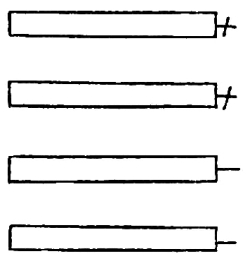
This mark at the end signifyeth that that party hath
perfourmed his blowes at the passage and at the joyninge.”
(46 more figures like this, with a line at the right end.
They are arranged in two columns.)
The challengers were Monsieur the brother of the French King, the
Prince Delphine,[237]
the earls of Sussex and Leicester, the Count S. Aignon, Messires Chamuallan
and Bacqueuile. The venans were led by Lord Thomas Howard.
Another tournament took place at Westminster
on November 17th in the same year, and a list of names of those taking
part is given in Ashmole MS. No. 845, fol. 165:—
| “1581. 24. R. R. Elizabeth |
| Therle of Arundell |
)____ |
The Lord Windesore |
| Henry Greye |
)____ |
Henry Windesore |
| Sʳ Henry Lee |
)____ |
Phellip Sidney |
| Sʳ Thomas Perot |
)____ |
Thomas Ratclyff |
| Foulke Grevill |
)____ |
Rawffe Bowes |
| Edward Norrys |
)____ |
Thomas Knevet |
| Anthony Cooke |
)____ |
John Pagingeton |
| George Gyfford |
)____ |
Thomas Kailloway |
| Robart Alexander |
)____ |
George Goringe |
| Edward More |
)____ |
Henry Bronkard |
| William Tresham |
)____ |
Rychard Warde |
| Everard Digby |
)____ |
Tyrrell |
| Storry |
)____ |
|
| William Knolles |
)____ |
Robart Knolles.
|
These be the names of the noblemen and gentlemen,
that for the honour of the Queenes Majestie did their endevour at the
Tylt at Westminster on the xvijᵗʰ day of Nouember, beinge the first day
of the xxiiijᵗʰ yere of the reigne of queene Elizabeth, whome God of
his greate mercy longe contynue to reigne over this sinnefull realme of
England. Amen.”
In 1585 there is what is described as “the last joust on the Thames,”
but which was really a form of water quintain:—
“From ech end of the riuer came a bote running
with six ores, in the stern of which on the top stood a man armed in a
red wastcote, with a staffe in his reste, hauing a but end of corke;
now ech meeting other with their staues, both fell into the water,
where spare botes were redi to succour them, for ouer went their
horsses.”[238]
Ashmole MS. No. 1109, fol. 154b, gives a list of names of persons
taking part in a tournament held at Windsor on November 17th, 1593.
“[In Officio Armorum Lib.] M. 4: Justes. fo: 42
Course at Feild at Windsor the 17ᵗʰ of Nov: 1593. Aᵒ regni Reginæ 36.
| The Earle of Cumberland |
The Earle of Southampton. |
| The Earle of Essex |
Robert Knowles. |
| The Lord Fitzwalter |
Cary Reynolds. |
| The Lord Compton |
Henry Nowell. |
| Sʳ Charles Blount |
Sʳ Tho. Gerrard. |
| Sʳ Vnknowen |
Robert Dudley. |
| The E. of Essex [sic] |
Sʳ William Knowles. |
| |
| |
Judges |
 |
The Earle of Worcester |
| The Lord Sandes |
| Lord North |
| The Lord Norrys” |
In 1606, in the reign of James I, there was a fight at barriers in
celebration of the ill-fated marriage of the Earl of Essex. Sixteen
combatants fought on each side, first singly and then in threes. One
party was led by the Duke of Lennox, the other by the Earl of Sussex.[239]
Another fight at barriers took place on Twelfth-night, 1610, when
Henry Prince of Wales, with six aides, met sixty-five defendants at
Whitehall. The weapons were pikes and single swords, and the prince,
then in his sixteenth year, is stated to have greatly distinguished
himself.[240]
Harleian MS., III, 215, 4888, 20, is a general challenge at tilt,
tourney, and barriers, “signed Lenox, Southampton, Pembroke,
Montgumbray,” dated 1612. It was in defence of these propositions—“1.
That in Service of Ladyes, Knights have no free-will. 2. That it is
Beautie maintains the World in valour. 3. That noe fare Ladie was ever
false. 4. That none can be perfectlye wife but Lover.” The challenge
was addressed, “To all honourable men, Men at Armes, and Knight
Adventurers of hereditarie note, & examplarie noblesse, that for most
memorable actions doe wield either Sword or Launce in quest of glorie.”
Ashmole MS. No. 837, fol. 129-32, gives a long account of “The manner
of first cominge into the Tiltyard” of Charles Prince of Wales in the
year 1619. It is interesting from many points of view, and we reproduce
it here nearly in extenso. Like all accounts of the tournament of
the period but little information is given of the martial sports
themselves, though a great deal is written concerning the dresses,
etc. This MS. affords abundant evidence that the last stage of the
tournament had been reached.
“The manner of the first cominge into the Tiltyard of the Most high
and mighty Prince Charles Prince of Wales sonne and heir apparent of
our Souereign Lo: Kinge James on Friday the xxiiijᵗʰ of March 1619 wͨͪ
was in the most princely and Royall manner that had been sene many
yeares before.
[fol. 129 b]
The day and tyme drawing neare the Tiltyard at Whitehall was
prepared wᵗʰ many scaffoldes on both sides & the vpper end where stood
his Majestie himself wᵗʰ many other great estates and on the one side
sate in a place prepared of purpose at the vpper end the Embassadors
on the other side next to Sᵗ James parke gate was erected a most rich
& stately Pauillion of green yellow & white damaske laid on wᵗʰ broad
lace of siluer & gold wᵗʰ a very deep valence of cloth of silver
frendged about wᵗʰ a deep freng of gold & siluer garnished about wᵗʰ
The princes Armes & badges. on the top of it was set an Eglet in her
nest loking vp at the sonne wᵗʰ this motto at it Nec Degener heres. All
wᵗʰ being ready & exceedingly well cleared & ordered by Sʳ Edw; Zouch
Kᵗ Marshall. The E: of Arrundell being appointed to be Erle Marshall
of England for that day about 12 of the clok came into the Tiltyard on
horseback attended by diuers of his owne gent on foot wᵗʰ truncheons
in their handes on whome likewise attended the Kᵗ Marshall & all the
officers of Armes in their Coates of Armes on horseback vntill his
Majestie was ready to come thither. All things beinge / in a readines
& the tiltyard in a very good order his Lordship attended wᵗʰ the Kt
Marshall Clarenceux & Norry & all the heralds & pursuiantes of armes
rode to Denmarke house to fetch the Prince his highnes and let him
vnderstand that his Majestie were [sic] redy & expected his coming
wherevpon he proceeded in manner followinge.
First marched on foote all the Princes band of his Artillery yard
led by their captaine, Mʳ Conisby. next to them went many of the Kᵗ
Marshalls men well suited wᵗʰ truncheons in their handes before their
Master who for the most part coasted vp & downe to keep the street &
passage clene from people. /
The reason why the Princes trumpets did intercede betw:
the officers of Armes and the Prince and had place of them & the Kinges
trompetts was because they were part of the Princes Show, and therefore
not thought fitt to be diuided.
Then six of the Kings Trumpetters sounding the sergᵗ
Trumpeter wᵗʰ his mace before them riding.
Next to them the pursuiantes & heraldes of Armes wᵗʰ the two
provinciall kings of Armes Clarenceux & Norry vnto all whome the
Prince his highnes had very bountefully distributed to euery of them
9 yardes of rich taffata of his coullors vist 3 yardes of white 3
yardes of yellow & three yardes of green all fringed very richly wᵗʰ a
deep frenge of silver & gold spangled and likewise to each of them a
white Bever hatt wᵗʰ a fair gold & siluer band and larg plumes of his
coullors. /
Then followed 6 of the Princes Trumpettes very richly clad in grene
veluet coats laid wᵗʰ gold & silure lace & white Beruers & fethers
[fol. 130 a]
Next them rode his 3 pages one after another brauely mounted very
richly clad aleso in grene sattin suits laid exceding thich [sic]
wᵗʰ gold & siluer lace white beuers & plumes, & their horses in rich
caparasans of greene velvet embrodered wᵗʰ gold & siluer each of them / of
[sic] attended by querries in rich suites of the Princes coullors on foot.
Next rode the Erie Marshall wᵗʰ his marshalls rod
Then the Prince his highnes alone all armed in white armour &
bravely mounted on horseback wᵗʰ wonderfull rich caparisans & plumes
attended by diuers of his cheife gent on foot most richly araied in
greine suites of sattin laid very thick wᵗʰ siluer & gold lace white
bevers & fethers each of them carying in their handes one of the
Princes staues / After the Prince rode Sʳ Tho: Howard Master of the
Princes horse.
And after him followed 3 spare horses wᵗʰ plumes & rich embrodered
caparisans of his coullors: / led by Querryes or officers of the
stable. /:
In this manner they proceeded from Denmark howse to the Tiltyard
gate where the artillery men first made a stand & deui(d)ed themselues
in a lane for the Prince to passe When his highnes came at the vpper
end of the tiltyard he alighted & went into his pavillion to sitt &
repose himself whilst the other Tilters were brought in who tarried at
the mewes vntil the Kᵗ Marshall & the officers of Armes came for them
who proceded in manner following every one in his rank the officers of
Armes going before the new runners.
[fol. 130 b]
euery one in his rank
| Thus appointed to Runn. |
| new |
The Prince |
& The E: of Dorset |
| new |
Marquess Bucks |
& Sʳ Sigismond Alexander |
| new |
Marquess Hamilton |
& E: of Warwick |
| new |
E: of Oxford |
& The lo: walden |
| |
E of Rutland |
& E of Salsbury new / |
| |
E of Montgomery |
& Sʳ Thomas Somerset |
| |
E of Desmond |
& Sʳ Hen Riche |
| |
The lo: Gerard |
& Mʳ Hen: Alexander |
it is to be noted that because the: E of Montgomery was hurt in the
arme in practisinge about 3 dayes before Mr Cary 2 sonn to Sʳ Robt Cary
the Princes chamberlein was appointed to Runn for him at wͨͪ tyme it
was concluded that hereafter if at any tyme any man shold be hurt that
he could not run himself but that he appointed another to run for him
(if he were inferior to him hurt and desyred to run in his place) he
should come into the tilt wᵗʰ his beuer close or if he would haue his
beuer open he should then come in the due of his place. /
| Judges./. |
| [fol. 131 a] |
The Prince brake |
______ |
staues |
| |
The E: of Dorset |
______ |
|
| |
The Marques of Buck |
______ |
|
| |
The marquess Hamilton |
______ |
|
After all was done the Prince and all the Tilters once passing round
the tilt passt round on alonge before the Prince and so attended him to
Somerset howse again.
Fees giuen to the officers of Armes
Of the Prince in scarfes of his coullors each scarfe coat 9 yards
of rich taffata fringed wᵗʰ deep frenge of gold & siluer, and 12 white
beuer hats wᵗʰ gold & siluer bandes and faire fethers of his coullors
yellow white & grene. And 20ˡⁱ money for his fee
| of the marquess Buck |
______ |
13ˡⁱ 6ˢ 8 for his fee |
| of the E: o(f) Oxford |
______ |
10ˡⁱ for his fee |
| of the E: of Salsbury |
______ |
10 for his fee & scarfes of his coullors |
| [fol-131 b] |
xxiiij⁹ Martij Aᵒ dni 1620./ |
| |
Aᵒ Regni Regis Jacobi i9 |
| |
| |
The Prince |
The E: of Dorsett |
| |
Marquess of Buckingham |
The marquess Hamilton |
| new |
The E: of Lincolne |
Sʳ Sigismond Alexander |
| |
The E of Desmond |
Lo: Walden |
| new |
The lo: Compton |
Lo: Gerard |
| new |
The lo: Scroope |
Sʳ Tho: Somerset |
| |
Sʳ Hen: Riche |
Mʳ Hen: Alexander |
| |
Sʳ Hen. Mildmay |
Sʳ Sigismond Alexander |
| Judges: |
| |
The E: of Bridgwater |
| |
The viscount Doncaster |
| |
The viscount Falkland |
| |
Sʳ Fulk Greville |
| |
T: Arrundell |
At this tyme the Prince his highnes came from Denmark howse to the
Tiltyard through the Strand as followeth /
First went the band of Artillerymen marching along vntill they came
to the gate of the Tiltyard and there made a stand & deuided themselves
in a lane for the Princes highnes to pass through
The seriant Trompetour and the K. Trompettes.
Next followed on horsback the officers of Armes in their coates.
Then the Princes Trumpetes richly clad in coates of grene velvet
laid wᵗʰ gold lace /
Then the Princes 3 pages one after another bravely mounted & most
richly clothed. /
Then the Prince his highnes alone armed wᵗʰ [Blank] of his gent on
foot carrying his staves most richely arayed going on both sides./
Then followed Sʳ Tho: Howard master of the Princes horse on
horsback
After whom followed seuerall spare horses led by the Querryes or
officers of the stable and in this manner they preceeded into the
Tiltyard and at the vpper end of the tiltyard by the parke gate was set
vp a pauillion of yellow & grene damask laced wᵗʰ gold & siluer lace
where the Prince reposed himself vntill the rest of the runners were
brought in who stand at the mewes in a redines vntill they were sent
for by the Kt marshall & the officers of Armes. and then they cam in
according to their degrees two & two together before the E: of Lincolne
being a new runner went 4 officers of Armes & 4 before the lo: Compton
& two before Sʳ Henry Mildmay being allso new runners.
The E: of Lincolne gaue to the officers of Armes 10¹ and fouer
scarfes of his coullors of 3¹ prise & fethers each of them
The lo: Compton gaue them 6 13ˢ 9ᵈ & 4 scarfes of like valew &
fethers
[‘This is an original paper, with notes and corrections by one of
the Heralds. This art. is recorded in the Heralds’ MS. M. 3, f. 1-3ᵇ.
Ashm. Catal.]”
One more illustration of a tournament of the seventeenth century
is afforded by Ashmole MS. No. 1127, fol. 196-99b, and it aptly
illustrates the advanced stage of degeneration now reached by these
once brilliant and chivalrous martial games:—
“Extracted out of P. Boitells Generall history of
all that hapned most remarkeable as well in France as in other forrain
Country’s in the yeares 1618: 1619: 1620. Printed at Paris in the year. 1620.
p. 87, 88
The Colours of the Madame are Blew Incarnate, White & Amaranthus,
the Blew represents heavenly & exalted thoughts, the Incarnate chast
and honest Inclinations, the White purity & sincerity of faith, the
Amaranthus Constancy.
p. 90
The Knight of the Royall Amaranthus sends his Challenge abroad for
the Celebrating of a solemn Turneament, the Princesses & Lady’s of the
court had scaffolds erected for them, & for judges of the Combatt were
chosen the Count Guy St George, the Count de la Bassie, & the Count de
la Valdisere.
p. 92
[fol. 198b p. 92]
The trompetts beginning to sound from the new palace, there
appeared presently after 12. trompeters clad in Blew, Incarnate White
& Amaranthus representing yᵉ winds after whom a Camell was led by
fowr African Moores, habited in the same livery & bearing lances
cover’d with blew damask, twelv Lackey’s follow’d clad after the same
manner & after them 12 Pages upon spanish Genetts richly harness’t &
representing the 12 houres of the day, their cloakes were of the same
colours, their heads cover’d with perrukes compos’d of golden threads
with crowns composed of flowrs de Lyses / roses, heyacynthusses &
Amaranthusses beneath each of which there seem’d to shine a Great Sun
made of plates of Gold & at their shovlders they had two wings of
silver. In their left hands they carry’d sheilds which had devises
painted on them, & the name of yᵉ Knight written, & in their hands
silver lances with bannerolls of the same colour.
p. 93
After which came six winged coursers drawing slowly a tryumphall
Charriott wͨͪ signify’d the Charriott of the morning, it was of a great
heigth & vast biggness adorn’d all about with paintings, & built with
rare workmanship. On the top of this Charriott was plac’t Aurora or the
Morning quaintly attir’d & accompany’d with joy & Laughter who playing
upon the Lute & the Theorbo, after they had taken a round about the
place, address’d themselves at length to the Infanta’s, & both of them
together joining in Consort with Aurora sung certain Italian verses.
p. 94
After the tryumphall Charriott follow’d six peers magnificently
attir’d, with a great number of Heron’s plumes & Jewells about their
hose, & scarfs of the same colour, & these were the Marquese of Lullin,
the Marquese of Vogueres, the Baron of St George, the Marques of
Caraglio, the Marquese of Pallavicini, & Mounsieur de Lodes.
[fol. 199]
At Length the Prince enter’d the lists as Challenger as being of the
most active address & most skillfull of his weapon of all the rest, &
the Combatants were these following knights.
p. 95
[fol. 199b]
Mounsieur de St Reran, under the name of Almidour the Constant,
the Count de Montué, Sirnamed Fulginart without fear, Mounsieur de
Cavorrett stlled the Fierce Dragon, Mounsieur de Maserez call’d
Palmiades the faithfull, Mounsieur de Roussillon tearmed Learques the
Couragious, Don Astanio Bobba named Primislas the Strong, Mounsieur
de Druent entitled Cloridant the brave, Fulvio Delle Lanze, stiled
Altomar the bloody, the Knight d’Aglie with the title of Prodicles
the warriour, the Count de Ferrusasque titled Termodont the angry,
the Marquese Formo call’d Erolind the Cruell, this noble troop made
their Entry three & three in a rank, their livery consisting of all yᵉ
fowr colours, but the Prince made choice cheifly of the Amaranthus, &
therefore his plume of that colour shew’d it self eminently above the
rest, his mantle was of cloth of silver, & under it he had a rich suit
of armour made after the manner of the ancients with breeches of silk
made after yᵉ same fashion, sprinkled all about with pearles & Jewells,
he was mounted upon a stout prancing horse, cover’d with stately
capparisons of the same livrie, with / the laces fringes & tassells
of silver, & all inrich’t with floures & roses of the same mettall he
enter’d in between two knights whereof the one was clad in blew, the
other in Incarnate.
After the severall Combats were ended the prise was adjudg’d to the
Knight of the royall Amaranthus, which donne the trompettes sounded a
retreat, & then the Knights each of them retir’d in their Order to the
new palace.
p. 85
This Ceremony was celebrated by the Prince of Savoy, upon occasion
of the marriage between him & Christina the sister of Lewis the just
King of France at his return to Turin from Rivolles where Inviting the
Lady’s to a Ball he Instituted a Turneament under the title of the
Knight of the Royall Amaranthus fighting under the Colours of Madame,
the Princess.”
The tournament lingered long in Germany.
The decline of armour had become acute by the close of the sixteenth
century, and to this there were many contributory causes. Far too much
stress has been laid on the extended use of firearms as being the main
reason for this, though the ever-increasing penetrative force of the
musket-ball had tended greatly to diminish the value of steel harness
as a sure means of defence. As a matter of fact, full armour could not
be constantly worn during a long campaign without injury to health,
besides being a great clog to mobility on the march and in the field.
Another potent factor towards the disuse of armour lay in the fact that
harness for the soldiery was made in certain standard or arbitrary
sizes, each piece being numbered, so that the suits rarely fitted
individual cases. They were thus apt to chafe the bodies of the wearers
and to cause sores beyond endurance, so that pieces of armour were
frequently cast away on the march, all penalties notwithstanding. The
man-at-arms of an earlier age became the pistolier, Landsknecht and
cuirassier of later times.
Early in the seventeenth century another decided change took place in
the form of the breastplate, which followed the cut of the doublet of
civil life, in the gradual shortening of the waist, and body-armour
became stumpy and inelegant.
The latest phase of cap-à-pie armour is well illustrated by a harness
in the Musée d’Artillerie, Paris, which was presented by the Republic
of Venice to Louis XIV, in 1688. It is very uncouth in form. During the
last half of the century plate-armour gradually disappears, the pikemen
being the last infantry arm to employ it. A “pair of plates” were the
last pieces worn, and, except in the case of the cuirassiers, they also
were abandoned in favour of the buff coat pure and simple.
After a career of six centuries, the tourney had practically run its
course, and had now become almost a thing of the past. Its influence on
the ages had been in the main for good, in restraining the licence of
troublous times and in inculcating a respect for women. It had fostered
a spirit of courtesy, honour and chivalry, sentiments which extended
themselves far beyond its borders, Sainte-Palaye remarks, “Chevalerie
est la fontaine de courtoisie, ce qui arrose le reste du monde”;
but as the means for luxury increased, and as time rolled on, the
old simplicity fell away and corruption set in, and though the forms
remained the spirit had fled. All raisons d’être for the tourney
beyond those of exercise and pastime had long since passed away,
through the continuous decline in the importance of the man-at-arms in
warfare, the ever-increasing efficiency of firearms, and the necessity
for greater mobility of armies in the field.
The history of the tournament would not be
complete without some account of the revivals attempted in the
nineteenth and twentieth centuries. They lack, however, a sense of
reality, being, in fact, merely more or less well-staged plays.
The Eglington Tournament, held in Ayrshire in 1839, though a good deal
based on Sir Walter Scott’s legend, the “Gentle and Joyous Passage of
Arms of Ashby de la Zouche,”[241]
was, in many respects, also a revival of a pas d’armes of Tudor
times. It was carried through in the face of some ridicule, much
discouragement and many difficulties; but all obstacles were gallantly
surmounted by the enthusiasm, tenacity and liberality of the Earl of
Eglingtoun and his coadjutors. The very elements were against it, for
torrents of rain fell frequently during its course, converting the
lists into a pond, spoiling the decorations of the stands, and wrecking
the temporary banqueting-hall erected at the castle. The training
of the horses in so short a time presented the greatest practical
difficulty, for here the promoters were at a great disadvantage
as against the early and persistent drilling of the chargers for
employment in the fêtes d’armes of the olden times. The lists at
Eglington Park measured 600 yards by 250, the tilt or barrier being 300
yards long, running down the centre. A handsome pavilion was pitched
for the use and comfort of the Queen of Beauty (Lady Seymour) and her
train of ladies. There were other tents for the accommodation of the
knights taking part, and a grand stand was erected for the presiding
queen, her maidens, and the guests of the promoters. Seats were placed
at the eastern end of the arena for about two thousand spectators.
Thirty-five knights took part in this passage of arms, and among them
were Prince Louis Napoleon, the Marquis of Waterford, Earls Eglingtoun,
Craven and Cassilis, Lords Alford, Glenyon, Cranstoun, A. Seymour, W.
Beresford, Drumlanrig and Maidstone. Lord Gage and Sir Charles Lamb
acted as Marshals of the List, the rôle of King of Arms being sustained
by the Marquis of Londonderry. There were several rehearsals, the
last of which took place on July 13th. The first to joust at the tilt
on that occasion were the Earl of Eglingtoun and the Lord Cranstoun.
Several courses were run by these champions and two lances were broken.
Other encounters followed with varying fortune. The “Lord of the
Tournament” was the Earl of Eglingtoun; the Judge of the Lists, Lord
Saltoun; and the inevitable Jester, a Mr. M’Ian from London.
The procession was arranged by Sir Charles Lamb and Lord Saltoun. The
tournament began on August 28th, 1839. The morning was fine, and by one
o’clock some ten thousand persons had assembled, and crowds continued
to arrive. A pitiless rain much delayed the starting of the procession
from the castle, and it was sadly shorn of its fair proportions;
for the Queen of Beauty and her maidens had to betake themselves to
carriages instead of riding on horseback as intended. The procession
reached the lists in the afternoon, about three, in a much bedraggled
condition, and the presiding queen, her attendants and the castle
house-party, took their seats on the grand stand prepared for them.
After flourishes of trumpets, the rules, regulations and limitations
for the guidance of the proceedings were proclaimed by a herald. The
number of courses to be run by each pair of jousters was settled at
three, or at most four. The harnesses employed, some of them collected
in England, the rest abroad, varied greatly in regard to period: the
armour of the Earl of Craven is amusingly stated to have been worn
by an ancestor of the Earl’s (Baron Hilton) at the field of Cressy.
Reinforcing pieces were employed.
On the weather clearing a little, the scene presented was a brilliant
one. There were the knights armed at all points, and their horses
gaily trapped in cloth painted in rich colours with their arms and
devices. Merging with the rich dresses of the ladies, they offered
a fine and moving spectacle. The pas d’armes commenced with the
quintain, after which jousting at the tilt began. The tilting was far
from satisfactory, for the attaints achieved were very few in number.
This was owing to the lack of skill on the part of the riders, the
insufficient training of the horses, and the mistaken notion that the
careers were to be run at the gallop instead of at an amble. The first
joust was run between the “Knight of the Swan” (the Hon. Mr.
Jerningham) and the “Knight of the Golden Lion” (Captain J. O.
Fairlie). They took up positions for their careers, and the trumpets
sounded the onset. There were no attaints in the first three courses,
but in the fourth the Knight of the Golden Lion broke his lance on
the shield of his adversary. The second challenge was by the Earl of
Eglingtoun to the Marquis of Waterford, and in the first course both
lances were splintered. There was no attaint in the second, but in the
third the Earl again splintered his lance. The third joust was between
Sir Francis Hopkins and R. J. Lechmere, Esq. In the first encounter Sir
Francis shivered his lance, and in the second both lances were broken,
but that of Sir Francis was disallowed as being “ill-broken.” In the
fourth career Sir Francis again shivered his lance. The fourth tilt
was between the Lords Glenlyon and Alford. There were no attaints in
the first two courses, but in the third Lord Alford broke his spear.
Next came combats on foot at barriers with two-handed swords, after
which jousting was resumed. The last joust of the day was between the
Marquis of Waterford and Lord Alford. The first course was without
attaint, and in the second a hit was disallowed, the lance breaking
just above the head; but in the third the Marquis shivered his lance
“as it ought to be broken.” During all this the rain fell at intervals
and with increasing violence, which sadly marred the brilliancy of the
scene, and the banquet had to be abandoned owing to the wrecking of
the temporary banqueting-hall by the storm. In the evening there were
combats with broadswords in the drawing-room of the castle, and a duel
between Prince Louis Napoleon and Mr. Lamb is stated to have afforded
some excellent sword-play. The tournament was to have been continued
on the following Thursday, but the weather was so boisterous that the
completion of the pas d’armes was postponed to Friday, August 30th.
The weather was fine and sunny, and the procession to the lists was
this time complete in all its parts, the queen and her ladies being on
horseback. The first tilt of the day was between the Lords Glenlyon and
Alford, and there was but one attaint in the three courses. The Earl of
Craven and Captain Fairlie then took up positions for their careers.
Both lances were shivered in the first course, in the second there was
no attaint, but in the third the Earl again shivered his lance. This
was the best joust of the tournament. To be brief, there were six more
jousts, making altogether nineteen courses, and but two attaints.
Running at the Ring followed, and a mêlée brought the tournament to
a close. The combatants in the latter were—The Lord of the Tournament
(Earl of Eglingtoun), the Knight of the Dragon (Marquis of Waterford),
the Black Knight (W. L. Gilmour, Esq.), and the Knight of the Gael
(Lord Glenlyon): against the Knight of the Black Lion (Viscount
Alford), the Knight of the Red Rose (R. J. Lechmere, Esq.), the
Knight of the White Rose (Charles Lamb, Esq.), and the Knight of the
Swan (Hon. H. Jerningham). Mr. Jerningham was hurt in the wrist by
a sword-stroke in the mêlée, but this was the only casualty worth
recording during the tournament. Several of the knights were unseated,
and in one case both horse and rider fell, a few bruises resulting.
The prize was awarded to the Earl of Eglingtoun. It was a coronet,
with which the Queen of Beauty gracefully crowned him, in the manner
of the Lady Rowena in the lists at Ashby de la Zouche. There was a
banquet in the evening, at which Lord Eglingtoun expressed the hope
that this attempt at a revival of the tournament might result in its
being continued among the nobility and gentry of these islands. This
pious wish, however, failed to be realised, the very ethics of the
institution being so totally at variance with the sentiment prevailing
in modern times. The banquet was followed by a dance.
In marked contrast to the Eglingtoun Tournament, in the way of
accuracy of detail and historic truth, was the pas d’armes in the
Rathausplatz, at Brussels, in 1905, held nearly three-quarters of a
century later. This revival in what was once Burgundian territory was
most appropriate, the more so as it took place in Brussels itself.
It was in the Rathausplatz there, one of the most striking sites in
Europe, that the Comte de Charolais, afterwards Charles the Bold,
ran in his first tournament in 1452. The Comte was then but eighteen
years of age, and tilted in as many courses on that occasion, breaking
sixteen lances “as they ought to be broken”—a very good performance,
viz. sixteen attaints out of eighteen runs. It was this tournament,
held in the city of Brussels some four and a half centuries before, in
the reign of Philippe le Bon, that was selected for reconstruction in
the months of July and August, 1905.[242]
Charles was born in November, 1433, and the tournament in question was
held in commemoration of the anniversary of his birthday. He was killed
in battle on the fatal field of Nancy in 1477. In the month of August
of the same year his daughter and heiress, the Princess Maria, was
wedded to Maximilian of Austria, and the brilliant traditions of the
tournament passed over to his court.
The collection of illuminated MSS. in the Burgundian Library, now
transferred to the National Library at Brussels, with the Armorial
de la Toison d’Or and other Burgundian records, now in the National
Library at Paris,[243]
furnish reliable and inexhaustible material for the correct staging of
a modern revival of a tournament on the lines of one of the fifteenth
century. It is thus no wonder that the reconstruction, in the summer
of 1905, of the pas d’armes of 1452 was attended by such success
as to prove of great educational value. The middle of the fifteenth
century was, perhaps, the most picturesque period of the tourney: its
rich weapons and armour, the caparisons of the horses, the arms of the
champions and others, the lists, the music, and even the very musical
instruments of the period, together with the sumptuous accessories of
the brilliant Burgundian Court, were reproduced in 1905 to a marvel.
The reconstruction, as presented at Brussels, began with the entry of
Duke Philip of Burgundy into the lists in the Rathausplatz, with a
splendid train of the ladies of his court, the Marshal of the Lists,
the King of Arms (Jean Lefébre de Saint-Remy, the reputed writer of the
Armorial de la Toison d’Or), the Comte de Charolais, with his five
jousting associates and many historic figures of the camp and tourney
throughout Christendom, the four judges of the tournament, heralds,
pursuivants, etc. The Duke having taken his seat as supreme umpire on
the gaily decked tribune prepared for him, the trumpets sounded and the
jousting began. Many courses were run in character. This was followed
by the quintain, and afterwards by combats on foot and a mêlée;
then the prizes were presented. Figures of the knights of 1452, such
as those of the Comte de Charolais, Jacques de Lalain and Fredrich
de Renesse, were faithfully reproduced in all their details. Some
excellent post-cards were published in Belgium, picturing some of the
principal scenes of the tournament. Plate XII (1) depicts the Comte de
Charolais armed at all points for the mêlée, and Plate XII (2)
Jean de Clèves. The fêtes d’armes and its rehearsals extended over several weeks.
The object of the promoters of this revival was to reproduce an
Elizabethan tournament of about the year 1580, such an one as is
described in this chapter. This idea was very creditably carried out,
though falling short of the Brussels reproduction of 1905 in the
matters of technique and minuteness and correctness of detail. It
must be remembered, however, that in 1580 the tournament, then itself
a revival in England, had reached an advanced stage of decadence,
and that the materials available for reconstruction are scanty and
uncertain, as contrasted with the ample records of the century
preceding. The Earl’s Court reproduction is stated to have been devised
by Mrs. George Cornwallis-West and Mr. Seymour Lucas, r.a.,
with the technical assistance of Mr. (now Sir) Guy Laking. The stage
management of the play was in the competent hands of Mr. (now Sir)
Frank R. Benson. It is interesting to see so many historic names and
titles, corresponding with those of Tudor times, borne by the jousters
at Earl’s Court. The rôle of Marshal of the Lists was sustained by Lord
Lonsdale, and the judges were Lords Shrewsbury and Talbot, Essex, and
Dudley, with Major-General Brocklehurst. The Queen of Beauty was the
Viscountess Curzon.
The procession to the arena was headed by
trumpeters and four pursuivants, marching on foot; then rode the
marshal, armed at all points, with the herald (Sir F. R. Benson). The
four judges, clad in black robes, followed, their esquire (Sir Guy
Laking) bearing the umpire’s bâton. After their entry into the lists
the trumpets again sounded and the Queen of Beauty, with her train of
maidens, all mounted on palfreys, gaily decorated with roses, each
led by a henchman, rode into the arena. The Queen was attended by an
esquire, and her palfrey was caparisoned in silk. She was clad in a
ruff, a robe sparkling with diamonds, and a long mantle.
PLATE XII
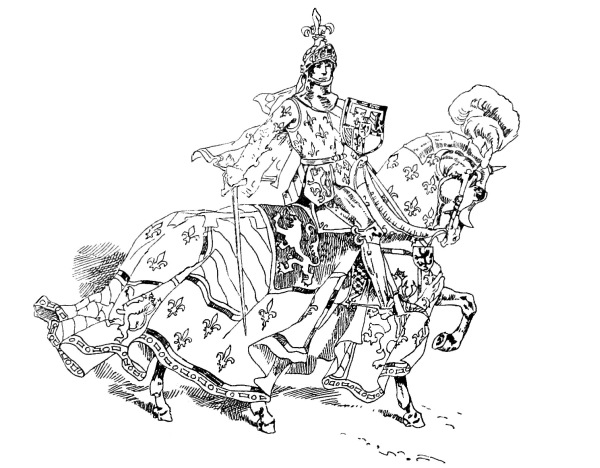
THE COMTE DE CHAROLAIS, As
REPRESENTED AT BRUSSELS IN 1905
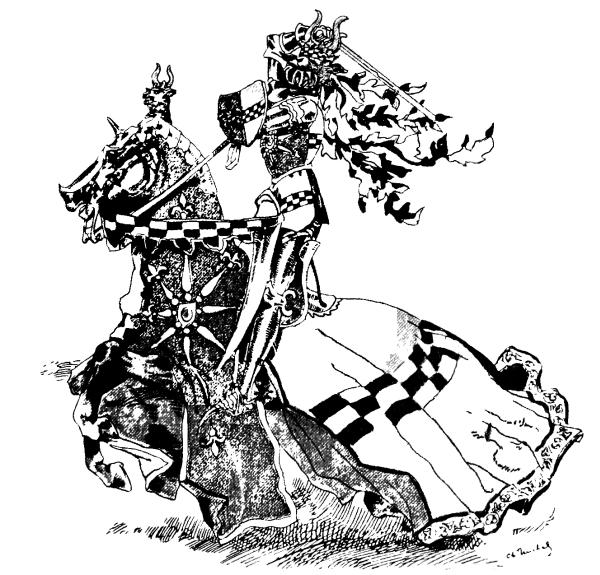
JEAN DE CLÈVES, AS REPRESENTED
AT BRUSSELS IN 1905
The knights were arranged in trios, each cavalier preceded by an
esquire, bearing his lance, and followed by other esquires. The
first champion was the Duke of Marlborough; his motto was Fiel pero
desdichado, his colours a dark blue, and his proof armour was etched
with gold. The second was Lord Craven; his motto was Virtus in actione
consistet, his colours green, and he wore the famous armour made for
Philip II of Spain. Lord Compton completed the first trio, and his
motto was Je ne cherche qu’un. The second trio followed, and all
did homage to the Queen of Beauty, now seated on her throne. The herald
then proclaimed that the six knights would joust at the tilt, for a
rich and noble prize. The Lord Chrichton and the Duke of Marlborough
were the first to joust, and five courses were run by each pair. On
completion the verdict of the Queen of Beauty was that the Duke had
well jousted, but that Lord Ashby St. Ledgers, whose motto was Ferro
non gladio, had jousted best, and he received the prize, viz. a gold
cup of the value of £600, from her hands. The tilt was then removed and
a mêlée followed, in which twelve knights were engaged. There was,
of course, a banquet in the evening followed by a dance.
There was also a revival at Rome.
There now only remains the judicial duel to be described, an
institution which had much affinity with the tournament, and which,
indeed, formed an integral part of it, both in sentiment and fact. This
important branch of the subject is dealt with at some length in the
next chapter.