Manos and Metates
As heretofore, manos far outnumber metates in the deposit. An explanation
of this inequitable representation of milling stones has already been
discussed in some detail (Treganza and Malamud, 1950; p. 140), viz.,
that the more rapid wear of the nether stone periodically called for manos
of somewhat varying shapes to conform to the changing contour of the
metate throughout its serviceable life. Proof to substantiate this thesis
is lacking, but it appears to be a reasonable possibility. Also, the
practice of pecking manos to increase the effectiveness of their grinding
surfaces must have resulted in considerable breakage, as judged by the
large number of fragments.
Of 2,556 manos and 329 metates, whole and fragmentary, 962 and 79
respectively, were classifiable. The descriptive categories derived from
the 1947 data proved adequate in defining the limits of variability and
patterning displayed by our recent acquisitions. Some pieces exhibit
technological refinement of types earlier described.
Metates
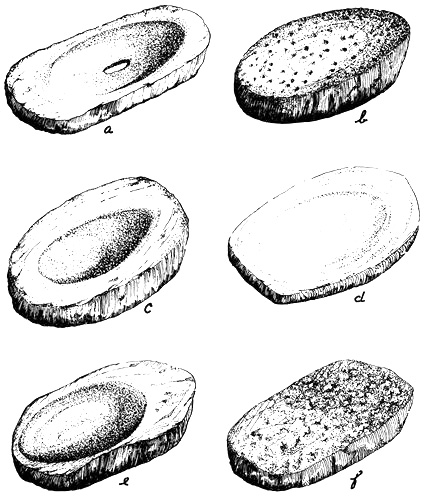
Metates are of three types, called here deep basin, shallow basin, and
flat slab. As was true last season, the material is predominantly
sandstone for all three forms.
Type I, deep basin (fig. 5, a, c, e).—These are the most abundant.
Fifteen complete specimens and seventeen fragments were recovered. In both
form and size there exists a close parallel between this type and those
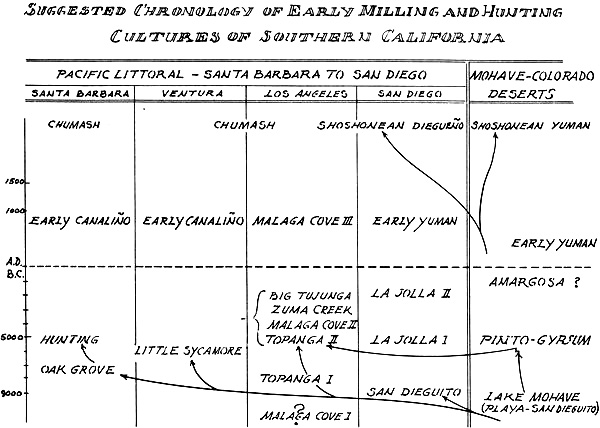
associated with the Oak Grove Culture of the Santa Barbara area.
Type II, shallow basin (fig. 5, b, d; pl. 18, c right).—This type is
represented by fifteen complete and eleven fragments.
Type III, slab (fig. 5, f; pl. 18, c).—Like type II, the slab metate is
less common, being known only through eleven complete and ten fragmentary
specimens.
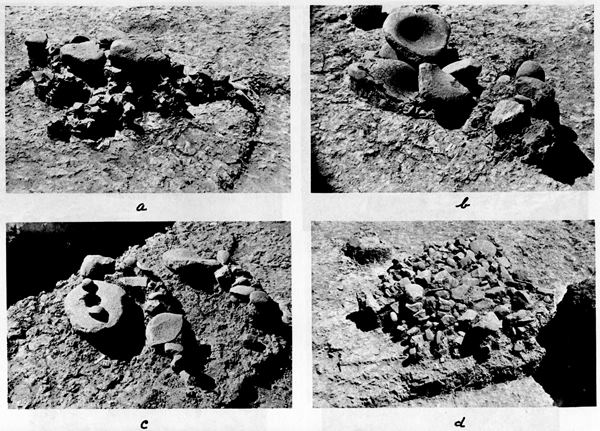
The distribution of metates through the deposit was not as random as that
of manos. Many of the complete specimens occur among features or with
burials. Fragments were encountered throughout the excavation, but were
most highly concentrated in features consisting of large aggregates of
stone. No depth table has been presented for metates, as it is assumed
that the mano distribution reflects a more complete picture for these
related tools; however, the deep-basin form seems to occur at the greatest
depth.
Manos
Manos and mano fragments were so common in the occupational debris that
their association in features or with burials had little or no
significance. With the exception of scraper planes they were the most
frequent artifact group encountered. Their depth distribution (table 5)
suggests several noteable points. The highest frequency occurs in the
6-to-12-inch level, being represented by some 349 examples. From
0-to-36-inches there are 960 specimens but from 36-to-54-inches there are
only 2 examples. This would seem to indicate then that the early history
of the Tank Site was characterized mainly by a flake-and-core industry
with the mano-metate complex being exhibited only lightly at first and
then gaining considerable importance toward the latter periods of Phase I.
Excavations at LAn-2 would also indicate that the trait began to wane
toward Phase II and was gradually replaced by a mortar-pestle complex,
which continues to be characteristic on into historic times.
Manos have been typed largely on the basis of the number of faces that
exhibit wear, the nature of the worked or worn surfaces, and the general
form. Some eight types have been recognized.
Table 5
Mano Types
| |
Occurrence by depth (in in.) |
|
| Types |
0-6 |
6-12 |
12-18 |
18-24 |
24-30 |
30-36 |
36-42 |
42-48 |
48-54 |
Total |
| IA |
28 |
25 |
17 |
10 |
1 |
... |
... |
... |
1 |
82 |
| IB |
12 |
26 |
12 |
8 |
2 |
... |
... |
... |
... |
60 |
| IC |
10 |
13 |
10 |
6 |
3 |
... |
... |
... |
... |
42 |
| IIA |
31 |
51 |
19 |
9 |
4 |
2 |
... |
... |
... |
116 |
| IIB |
54 |
106 |
76 |
31 |
11 |
2 |
... |
... |
... |
280 |
| IIC |
82 |
89 |
68 |
31 |
10 |
3 |
1 |
... |
... |
285 |
| IID |
13 |
15 |
11 |
4 |
2 |
2 |
... |
... |
... |
47 |
| III |
9 |
24 |
16 |
2 |
... |
... |
... |
... |
... |
51 |
| Total |
239 |
349 |
229 |
101 |
33 |
9 |
1 |
0 |
1 |
962 |
| |
|
| |
|
Fragments not typable |
1,556 |
| |
|
2,518 |
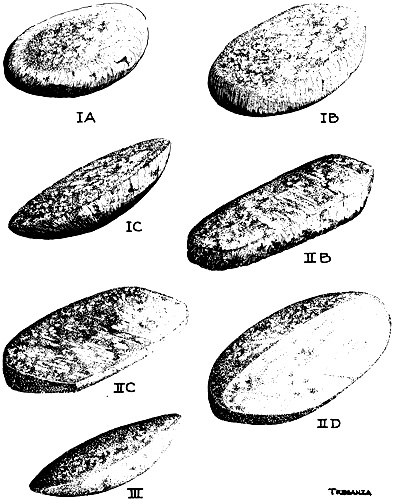
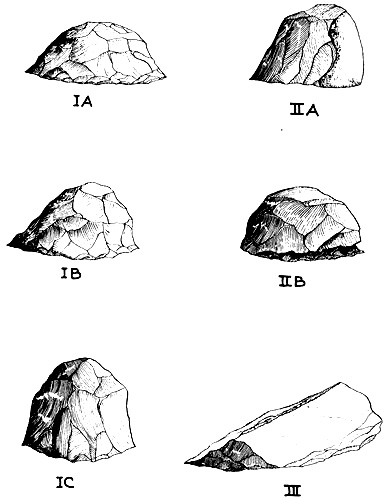
Figure 6. Mano Types
I. Unifaced
IA. Natural cobbles with wear on one surface. Cobbles range from
symmetrical to irregular in shape: circular to ovoid in outline.
IB. Extended form of type IA, showing excessive wear. Forms all tend
toward symmetry.
IC. Elongated “sugar-loaf” in cross section. Entire back surface
completely smoothed.
II. Bifaced
IIA. Natural cobbles with wear on two surfaces. Symmetrical forms
range from oblate spheroids to ovoid disks, others are symmetrical. In
cross section wear surfaces are parallel to lenticular. Grades into
type IIB.
IIB. Same as IIA, but forms are elongated (length always much greater
than the breadth).
IIC. Wedge-shaped, ovoid to elongate cobbles. Angle between wear
surfaces ranges from 5 degrees to 45 degrees.
IID. Same as type IIC, but one surface is keeled as a result of
superimposed wear pattern.
III. Trifaced
III. Long, narrow, triangular cross section.
Mortars
Newly acquired mortars are represented but by three fragmentary pieces.
Only one is of sufficient size to suggest an outer diameter of
approximately 12 inches, and all three appear to be of the cobble type
similar to the complete specimen collected in 1947 (Treganza and Malamud
1950, pl. 24, a). Considering the area excavated and the very small
number of both mortars and pestles that were recovered, it would be safe
to assume this complex was of little significance in the history of the
Tank Site. Their function was probably concerned primarily with something
other than the food economy, such as grinding pigments or functioning in
some specific capacity. Wooden mortars and pestles can not be totally
excluded, but the great preponderance of manos and metates would probably
preclude any serious assumption that mortars and pestles ever played any
important roll at the Tank Site.
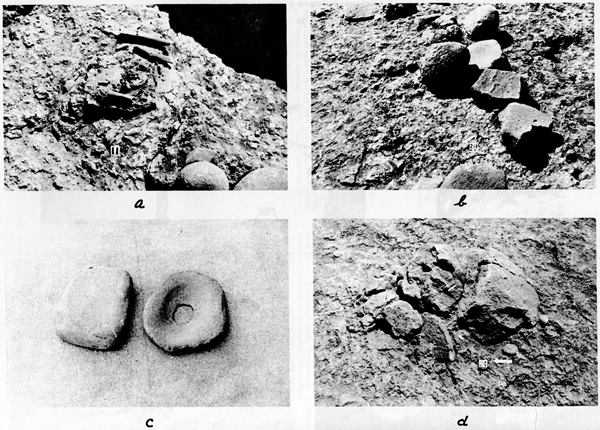
Included in feature 18 was a spherical cobble 8 inches in diameter, marked
by a well-defined, shallow, circular depression. Its surface bears the
marks of shaping by pecking and some rubbing; the depression is
well-smoothed, as if worn down by constant use. We can not say whether the
piece is completed, as such; or whether, possibly, it represents a small
mortar in an arrested state of manufacture.
Pestles
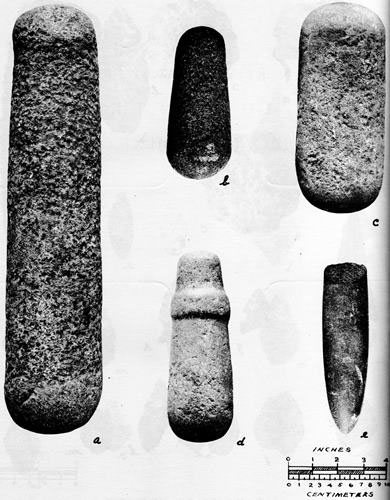
Five complete pestles were recovered, providing a total of nine for the
two seasons. The specimens this year differ from those already known in
being more stylized, i.e., four are almost perfectly cylindrical and show
wear at both ends. All are made of sandstone and have gently rounded
pounding surfaces. Specimens 1, 2, and 4, as listed below, were found in a
single cache.
1. Shaped over-all by pecking, forming a slightly tapered cylinder,
somewhat bulbed at either extremity. Both ends evidence use. This example,
by far the largest recovered from the Tank Site, compares in many respects
to pestles associated with later cultures of the coast and interior.
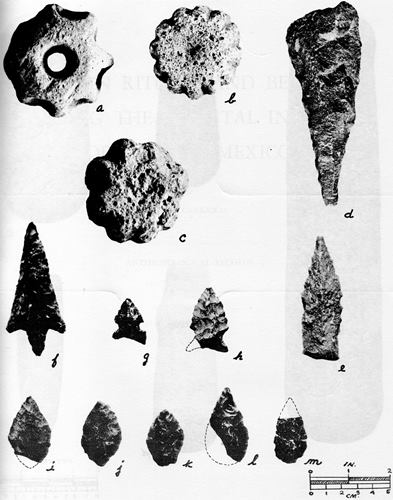
Length, 31.5 cm.; average diameter, 6.9 cm. (pl. 24, a).
2. Entirely shaped by pecking and grinding. Two opposite sides somewhat
flattened by abrasion as if used as a mano on a slab metate, and resulting
in a somewhat flattened cylinder form. Both ends used. Length, 13.5 cm.;
average diameter, 6.8 cm. (pl. 24, c).
3. Similar to specimen 2, though more nearly circular in cross section and
surface shows no grinding. Length 16.5 cm.; average diameter, 7 cm.
4. Completely worked by pecking and grinding. Cylindrical form distorted
by slight tapering and dorsoventral flattening. Used at both ends. Length,
15.2 cm.; average diameter, 6.5 cm.
5. This specimen is composed of a highly weathered sandstone so that the
surface treatment is no longer discernable. Shaped to a truncated conoid
and apparently used only on the larger end. Length, 18.5 cm.; greatest
diameter, 8.5 cm.
These five specimens were localized in the southeast sector of the
deposit, and none occurred deeper than the 12-to-18-inch level. Numerous
Phase II projectile points came from this same general area of the site
and therefore there is some inclination to assign these specimens to a
late position in the Phase I with the probability that they are Phase II.
Abrading Stones
Two broad classes of abrading stones have been differentiated on the basis
of form and inferred function (Treganza and Malamud 1950, p. 147):
I. Those that could be held in the hand and rubbed against some
article being finished. These have smoothed, even-abrading surfaces
that are gently concave to convex. They are clearly distinguishable
from manos by their reduced average proportions, and the near
consistent lack of pecking as a sharpening measure. That this latter
characteristic does not hold without exception seems to be due simply
to the fact that some of the abrading stones appear to be reused manos.
One of the examples in the above category, originally a broken bifaced
mano, has small, half-inch deep depressions at either end. These
evidently served as finger-holds, for they effect a good grip on the
tool.
II. Those that, though quite varied in size, bear one or more grooves
on their faces. The furrows vary in breadth and depth and appear to be
a function, essentially, of the amount and kind of wear to which the artifact was subjected.
Many of these specimens, especially those with narrow, V-shaped
longitudinal grooves, would be classed as awl sharpeners had they
occurred in sites of later origin. However, bone awls or pointed,
worked bone in any form is absent in the Tank Site. It would suggest,
then, that this class of abrading stones were involved in conjunction
with wood working, the tangible evidence having been lost to us.
Cog Stones
Cog stones, because of their unique forms and restricted distribution, may
be useful as diagnostic elements for future comparative studies. As yet we
know little about their function or cultural associations in the rest of
southern California. Their temporal position appears to be a middle one,
as none occur in positive association with late or historic sites, and
conversely, none have been reported for Lake Mohave, coastal San Dieguito,
or Oak Grove. The Tank Site specimens represent the earliest known
occurrence, and even here their exact position as to Phase I or Phase II
is not fully known. Most of our specimens occur in the top levels (0-18
inches), though a single example was found as deep as 32 inches (pl. 23,
b).
We have suggested cog stones in southern California may constitute the
counterpart of the spindle charm stones of central California with the
south boundary of the Chumash marking the near southern limit of the
spindle forms. Material out of which cog stones have been made is of some
interest. The Tank Site specimens range through volcanic tuff, siliceous
sinter, escoriated basalt, to a fine-grained basalt. From other areas the
same materials are present plus sandstone, granite, and granodiorite.
Steatite, one of the most easily worked stones, appears to be absent.
Obviously the hardness and type of stone were of little importance. The
appearance of the finished product likewise varied. Some specimens are a
product of perfection, others of the roughest sort. Perforated specimens
might suggest hafting, but few are of this type.
The suggestion of a ceremonial usage of cog stones is not solely lacking
in evidence. In 1936-1937, under the Works Progress Administration, Mr. J.
W. Winterbourne excavated two sites in Orange County known as the Banning
Site and the Norris Site. The following are excerpts from a letter dated
April 13, 1939, to Edwin F. Walker from J. W. Winterbourne (we are
indebted to Mr. H. Eberhart for providing this data from his manuscript on
cog stones):
“I am enclosing some data on cog stones that one of the clerks gathered
from the field notes.... We have noticed several peculiarities regarding
this cogged discoidal. First, that the Banning Estate Site seems to have
produced as many of these stones as all the other sites where they are
found combined; second, that the stones in most cases are found in the
clay completely below the camp debris; third, that rarely have they been
found in association with other artifacts except the discoidal; fourth,
that they seem never to have served a utilitarian purpose as they are not
pitted or polished and rarely broken; fifth, if broken, in almost every
case the Indians attempted to mend them with asphalt; sixth, that the
material used in their manufacture is with few exceptions a vesicular
basalt which is found in outcrops in the San Joaquin Hills and at various
points in the Santa Ana Mountains; seventh, that the number of cogs or
depressions may vary three to twenty-five or thirty-eight, that the stone
may be perforated near the center of the planes or it may not be, but that
usually there is a depression near the center of both obverse and reverse
planes.”
The following excerpts are from the same letter and contain more detailed
information regarding archaeological occurrences: “A decomposed burial was
uncovered four feet east of a cog stone and at the same depth.... Three
fine specimens were found close together under four oblong slabs of
fossilized limestone, a pectin shell and a blue piece of granite.... A cog
stone was uncovered twenty-five inches below the surface, 19 inches
northeast by north from a large metate, in plot #10-b. Upon further
investigation, the metate proved to be resting on the stones of a
fireplace from which a few broken human bones protruded. Twelve inches
north of the fireplace ... a mano was found with the cog stone.”
The above excerpts were from the Banning Site. The following are from the
Norris Site: “Three cog stones, #39, #40, #41, were found at a depth of
39 inches. These cog stones rested in the clay on edge. Flat surfaces
parallel to each other. These cog stones were found close to a fireplace
about two feet square and also close to a burial ... two cog stones were
uncovered. These cog stones were one on top of the other and rested on the
clay which underlies the kitchen midden. A cog stone was found in test
hole #14 at a depth of 3½ feet, 8 inches below the bottom of the
excavations in a pit. Abalone shell covered the top of the cog stone ...
three cog stones one on top of the other.... This is the first fragment of
a cog stone ever encountered in our excavation. We found a few with cogs
or pieces broken from them but the Indians generally made an attempt to
mend them. This would seem to indicate a ceremonial rather than a
practical use.”
These instances serve to indicate such objects were held in high esteem at
least for the two sites mentioned. None of the Tank Site specimens was
patched nor did any two occur in the same immediate area; however,
parallels exist in the forms, materials, the near association of metates,
and at least two burial forms. Also, we recognize no utilitarian role in
which these curious objects could have functioned.
Last season’s cog stones were all fragmentary. This year three complete
specimens were found.
1. Beveled disk, biconically drilled. The specimen is indented at even
intervals, resembling somewhat a perforated metal tapered gear or a
fish vertebra. Height, 3.8 cm.; diameter at base, 8.8 cm. Material a
fine-grained basalt (pl. 23, a).
2. Slightly beveled disk. The periphery is grooved at even intervals
producing a cog effect. Both the flat surfaces are slightly pitted at
the center of the disk. Height, 4.7 cm.; average diameter, 8.5 cm.
Material a rough escoriated basalt (pl. 23, c).
3. Slightly beveled disk like the above specimen only more refined and
with more grooves. Slightly pitted on both surfaces. Grooves appear to
have first been made by a sawing technique and then later smoothed
down. Height, 3 cm.; average diameter, 7.3 cm. Material is volcanic
tuff (pl. 23, b).
Stone Disks
Discoids, like cogged stones, do not appear to have been utility items.
That there may be some relationship between these two groups in a
functional complex is attested by their direct association in the Banning
Site as reported by Winterbourne. Eventually they may prove to be as
important as cog stones in terms of cultural time-markers, though at
present little is known concerning their distribution.
Stone disks have been divided into two gross categories: (I) those with
flat to convex faces; (II) those on which one or both faces are concave.
In either group the sides may be beveled or straight (for illustrations,
cf. Treganza and Malamud 1950, pl. 24, c, d, f, i).
The three specimens recovered this season fall into the first group. All
are characterized by flat faces and all are made of sandstone.
1. Sides beveled with the lower or larger face battered about the
entire periphery. Height, 4 cm.; diameter, 6.5 cm. to 9 cm.
2. Fragmentary specimen with straight sides and slight central
depression on one face. Height, 4.2 cm.; diameter, 7.7 cm.
3. Fragmentary specimen with vertical sides. Height, 3 cm.; diameter
undetermined.
A barrel-shaped object of sandstone was recovered which, if it is a
finished product, should not be classed here as a stone disk. However,
there is some possibility that it represents a discoid in the initial
stages of manufacture, and as such it is without parallel in the
collection. Height, 6 cm.; diameter 5.9 cm. at ends; 6.8 cm. at middle.
There is no reason to assume that any of our specimens are in any way
related to the so-called “bowling” stones reported for southern California
in late prehistoric or historic times.
Rubbing Stones
This class includes small flat cobbles, showing abrasive wear on one or
both faces. They may be distinguished from manos by their reduced size
though many appear to look like “little” manos. None shows any shaping
other than through continued wear from use.
A minority of these pieces, thirty-four, are distinguished by the
development of a small centralized pit on one or both smoothed faces. In
some instances there is a single pit on one surface and two on the other.
Many of these pitted examples have been battered on their peripheral
edges, suggesting they were either reused rubbing stones or they served a
dual function of both smoothing and pecking. We are hesitant to call them
“pitted hammerstones” since many are made from a soft sandstone and would
be ill adapted to this function. It is of some interest to note that this
general type of stone implement occurs in central and northern California
throughout most of the entire cultural history of the more advanced
industries. It has been suggested that such an artifact may have been used
as an “acorn anvil” or in some way related to the preparation of the acorn
in the hulling process. Should this prove to be correct, then one might
expect it to be an ancient element in native California.
For future comparative work it may prove advantageous to make further
subdivisions by differentiating between pitted and non-pitted forms. We
have made no attempt to do so at the present time.
Core Hammerstones
Some investigators tend to place core hammerstones in a class with flaked
tools, but in the present paper they are classed as an artifact of pecked
stone. It is the great quantity of their occurrence which appears
significant, rather than how they are classed.
Hammerstones may be conceived as having two quite distinct functions: (1)
those whose function is primarily to remove a large flake through the
percussion method, such as the production of a core itself or a rough
blade, and (2) those hammerstones having sharp or semisharp projections
used to reduce to some desired shape rocks of a nonconcoidal nature, such
as pecking down the surface humps on a mortar or pestle in order to
develop symmetry; or the function may not necessarily be one of shaping
but merely to periodically rough up a grinding surface on a metate or
mano. There naturally remains the possibility that once a specimen of the
latter type had lost all of its sharp projections it could then assume the
role of the first type and continue as a useful tool (Treganza and
Valdivia, 1955, p. 20).
One problem of classification arises when we combine the process of
manufacture and the concept of use. If we assume a rough piece of source
material was purposely flaked down to produce a core to be used solely as
a hammerstone, the artifact by definition becomes a flaked tool. However,
at this point it bears no resemblance to a hammerstone, but looks more
like a chopper or just a plain core and frequently may be classed as such.
Once this core is used as a percussion instrument and has its sharp
margins battered back, it begins to take on the characteristics of a
hammerstone or a used core tool. If battering continues, the final result
is an angular nodule whose irregular, worn margins mark the former
presence of sharp bifacial flake edges. A well-worn core hammerstone is
also a worn-out specimen, at least in the light of its original function.
Of the 1,478 specimens from the Tank Site it is our opinion that their
resultant form is derived through means of their own function—that of
pecking. That such an implement was much in demand is evidenced by the
pecked surfaces of numerous grinding tools. We doubt seriously if
hammerstones of this type were manufactured as such, but rather we assume
any suitable core, rejected scraper plane, or chopper could have served as
a starting point, and an over-all examination of our specimens supports
such a thesis.
Emergent is the correlation of core hammerstones and the presence of manos
and metates. Noteably both these grinding elements are rare in the coastal
San Dieguito and in the Lake Mohave area but do occur among the Shoshonean
and Yuman groups who occupied the areas corresponding to these ancient
lithic cultures.
Cobble Hammerstones
Cobble hammerstones tend to be oval or egg-shaped and exhibit abrasion on
one or both ends. None exceeds fist size, and many are slightly smaller. A
number evidence additional use as a rubbing stone.
A varient of this form is slightly thinner and contains small bifacial
depressions that have been pecked into the more flattened sides and
presumably served as finger grips.
Slate Pendants
To date, worked slate was represented only by three nonperforated,
lozenge-shaped specimens, one of which displays a faint, crude rectilinear
design. The second season’s activity produced no comparable examples,
though it added six pieces to the collection. These can be broken down
into three descriptive categories:
1. Four examples, none over 2 mm. in thickness, too fragmentary to
warrent reconstruction. Judging by the striations on their surfaces
and edges, they were shaped by grinding. On each, one end tapers to a
blunt point.
2. A lozenge-shaped specimen containing three broken-out peripheral
biconical drilled holes. Average length, 6 cm.; average width, 4.5
cm.; 3 mm. thick.
3. A single trapezoidal specimen with no perforation or abrasive
marks, but shaped at its narrow end by chipping. Length, 12 cm.;
width, 6 cm.; 3 mm. thick.
Miscellaneous Artifacts
Here, as in the first report, are included objects that constitute part of
the total cultural inventory, but as small or unassociated occurrences,
they require individual descriptions.
Objects of Stone
1. A smooth, symmetric piece of fine-grained sandstone that, though
incomplete, is recognizably spindle-shaped. In all probability it is a
fragment of pseudomorphic belemnite cast, but appears to be
analagous to the spindle-shaped charm stones of the Santa Barbara
Hunting Culture or to those of central California or to the single
specimen recovered at the Little Sycamore Site in Ventura County
(Wallace, 1954, fig. 38B, p. 114; pl. 24 e).
2. Six clusters of quartz crystals, apparently segments of geodes,
were recovered. Whether collected as a curiosity or whether they
functioned as would a single large crystal for purposes of anamatistic
power, as in central California, can only be conjectured. In 1947 a
very small, terminated crystal was found in direct burial association,
so there remains the possibility that at least single specimens had
some ceremonial significance.
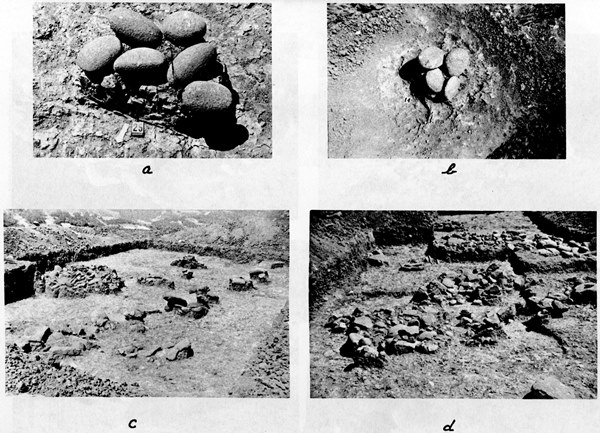
3. Spheroidal cobbles of varying sizes were encountered, especially in
association with features. None appears to have been artificially
shaped either by pecking or grinding, and hence we assume they
represent highly selected specimens collected from the numerous
conglomerate exposures found in Topanga Canyon. Circumstances
surrounding their occurrence offer no clue as to their possible use.
4. Half of a biconically drilled chlorite-schist bead, 1.5 cm. long,
and about 1 cm. in diameter. Both ends appear to be roughly serrated,
but this feature may be accidental. That the bead was at one time worn
on a string appears evident from the high luster at the juncture of
the two conical drill holes.
5. A perforated tip of a fossil shark tooth, on which the enamel is
largely lacking.
BONE IMPLEMENTS
It can be said with certainty that bone tools in any form were not
characteristic of the Tank Site in either Phase I or Phase II.
From both season’s work were recovered a single fragment of a bone awl, a
small section of polished bone containing a light drill pit, and the tip
ends of six antlertine flakers. The antler specimens all occurred in the
0- to 12-inch level and probably should be assigned to Phase II since
their distribution would coincide with the pressure-flaked projectile
points.
This near-complete lack of bone artifacts is a pronounced contrast with
later coastal and interior sites. In part it can be suggested that wooden
objects were manufactured at the Tank Site as a substitute for bone.
OTHER REMAINS
Unworked Bone and Shell
The nonhuman bone recovered consisted primarily of highly fragmented
cannon bones, none of which lent itself to positive identification. The
total bulk of such refuse was surprisingly low. We can make no claim that
mammal bone has disintegrated and disappeared in the course of time, for
human bone, though by no means well preserved, was relatively abundant in
small pieces (see features).
As has been pointed out, this scarcity of faunal remains lends support to
the thesis that at least large game animals did not serve as significant
staples. Smaller, lighter bones of rodents were even more rare, and even
these could have been postoccupation, since burrowing mammals were present
when we excavated. Only two pieces of bird bone were noted and both of
these were under an inverted metate.
In the deeper part of the deposit (below 12 inches) identifiable shell
remains were absent. Occasional small flecks of calcareous residue might
suggest the former presence of highly altered shell remains, but as yet we
lack a microscopic analysis to confirm this. In the extreme upper limits
(0-6 inches) a few obvious shell fragments were collected, but even here
such occurrences were rare.
Fossil Remains
Previously mentioned were a possible belemnite cast, which may have served
as a charm stone, and a perforated shark’s tooth, probably used as a
pendant. Last season we observed numerous remains of some unidentified
fossil vertebrate and several marine shells.
Whether these remains indicate merely the former presence of an aboriginal
fossil collector, or whether they played some functional role, will never
be known to us. A large fossil fish vertebra is known to have constituted
part of a Yokuts rainmaker shaman’s kit (records of the University of
California Archaeological Survey), and fossil horse teeth occur with
historic Wintu burials (Treganza, 1954), but the temporal separation
between these two historic groups and the Topanga Culture is too great to
offer any likely suggestions.
Pigments
Numerous mineral pigment sticks and granules indicate the considerable use
of such items, but other than the occurrence of hematite in moderate to
light form with some burials, little is known of possible additional uses.
As for body paint or surface decoration on perishable material, the
evidence of such use would not be preserved.
None of the pigment sticks was formed as a result of molding ground
materials into a paddy or brick, as is sometimes noted for California, but
rather, a good grade of mineral was originally selected, and, as pigment
was desired, it was ground from this parent source. Gradually, either long
angular or rounded forms resulted. Of these sticks of pigment 13 were
hematite, showing a color range from brick red to brown; 33 were limonite,
ranging from pale yellow to a rich orange yellow. Occasionally sticks of a
pink mudstone occurred.