CHAP. I.
DESCRIPTION OF KARAKAKOOA BAY.—VAST CONCOURSE OF THE
NATIVES.—POWER OF THE CHIEFS OVER THE INFERIOR PEOPLE.—VISIT
FROM KOAH, A PRIEST AND WARRIOR.—THE
MORAI AT KAKOOA DESCRIBED.—CEREMONIES AT THE LANDING
OF CAPTAIN COOK.—OBSERVATORIES ERECTED.—POWERFUL
OPERATION OF THE TABOO.—METHOD OF SALTING PORK
IN TROPICAL CLIMATES.—SOCIETY OF PRIESTS DISCOVERED.—THEIR
HOSPITALITY AND MUNIFICENCE.—RECEPTION OF
CAPTAIN COOK.—ARTIFICE OF KOAH.—ARRIVAL OF TERREEOBOO,
KING OF THE ISLAND.—SINGULAR CEREMONY.—VISIT
FROM THE KING.—RETURNED BY CAPTAIN COOK.
Karakakooa Bay is situated on the west side of the
island of Owhyhee, in a district called Akona. It is
about a mile in depth, and bounded by two low points
of land, at the distance of half a league, and bearing
south south-east and north north-west from each
other. On the north point, which is flat and barren,
stands the village of Kowrowa; and in the bottom of
the bay, near a grove of tall cocoa-nut trees, there is
4another village of a more considerable size, called
Kakooa: between them, runs a high rocky cliff, inaccessible
from the sea shore. On the south side,
the coast, for about a mile inland, has a rugged appearance;
beyond which the country rises with a
gradual ascent, and is overspread with cultivated inclosures
and groves of cocoa-nut trees, where the
habitations of the natives are scattered in great numbers.
The shore, all around the bay, is covered with
a black coral rock, which makes the landing very
dangerous in rough weather; except at the village of
Kakooa, where there is a fine sandy beach, with a
Morai, or burying-place, at one extremity, and a
small well of fresh water at the other. This bay appearing
to Captain Cook a proper place to refit the
ships, and lay in an additional supply of water and
provisions, we moored on the north side, about a
quarter of a mile from the shore, Kowrowa bearing
north-west.
As soon as the inhabitants perceived our intention
of anchoring in the bay, they came off from the shore
in astonishing numbers, and expressed their joy by
singing and shouting, and exhibiting a variety of wild
and extravagant gestures. The sides, the decks, and
rigging of both ships were soon completely covered
with them; and a multitude of women and boys, who
had not been able to get canoes, came swimming
round us in shoals; many of whom, not finding room
on board, remained the whole day playing in the
water.
Among the chiefs who came on board the Resolution,
was a young man, called Pareea, whom we soon
perceived to be a person of great authority. On presenting
himself to Captain Cook, he told him, that he
was Jakanee[1] to the king of the island, who was at
that time engaged on a military expedition at Mowee,
5and was expected to return within three or four days.
A few presents from Captain Cook attached him entirely
to our interests, and he became exceedingly
useful to us in the management of his countrymen,
as we had soon occasion to experience. For we had
not been long at anchor, when it was observed that
the Discovery had such a number of people hanging
on one side, as occasioned her to heel considerably:
and that the men were unable to keep off the crowds
which continued pressing into her. Captain Cook,
being apprehensive that she might suffer some injury,
pointed out the danger to Pareea, who immediately
went to their assistance, cleared the ship of its incumbrances,
and drove away the canoes that surrounded
her.
The authority of the chiefs over the inferior people
appeared, from this incident, to be of the most
despotic kind. A similar instance of it happened the
same day on board the Resolution; where the crowd
being so great, as to impede the necessary business
of the ship, we were obliged to have recourse to the
assistance of Kaneena, another of their chiefs, who
had likewise attached himself to Captain Cook. The
inconvenience we laboured under being made known,
he immediately ordered his countrymen to quit the
vessel; and we were not a little surprized to see them
jump overboard, without a moment’s hesitation; all
except one man, who loitering behind, and showing
some unwillingness to obey, Kaneena took him up in
his arms, and threw him into the sea.
Both these chiefs were men of strong and well-proportioned
bodies, and of countenances remarkably
pleasing. Kaneena especially, whose portrait Mr.
Webber has drawn, was one of the finest men I ever
saw. He was about six feet high, had regular and
expressive features, with lively, dark eyes; his carriage
was easy, firm, and graceful.
It has been already mentioned, that during our
long cruize off this island, the inhabitants had always
6behaved with great fairness and honesty in their dealings,
and had not shown the slightest propensity to
theft; which appeared to us the more extraordinary,
because those with whom we had hitherto held any
intercourse, were of the lowest rank, either servants
or fishermen. We now found the case exceedingly
altered. The immense crowd of islanders, which
blocked up every part of the ships, not only afforded
frequent opportunity of pilfering without risk of discovery,
but our inferiority in number held forth a
prospect of escaping with impunity in case of detection.
Another circumstance, to which we attributed
this alteration in their behaviour, was the presence
and encouragement of their chiefs; for generally
tracing the booty into the possession of some men of
consequence, we had the strongest reason to suspect
that these depredations were committed at their instigation.
Soon after the Resolution had got into her station,
our two friends, Pareea and Kaneena, brought on
board a third chief, named Koah, who, we were told,
was a priest, and had been, in his youth, a distinguished
warrior. He was a little old man, of an emaciated
figure; his eyes exceedingly sore and red, and his
body covered with a white leprous scurf, the effects
of an immoderate use of the ava. Being led into the
cabin, he approached Captain Cook with great veneration,
and threw over his shoulders a piece of red
cloth, which he had brought along with him. Then
stepping a few paces back, he made an offering of a
small pig, which he held in his hand, whilst he pronounced
a discourse that lasted for a considerable
time. This ceremony was frequently repeated during
our stay at Owhyhee, and appeared to us, from
many circumstances, to be a sort of religious adoration.
Their idols we found always arrayed with red
cloth, in the same manner as was done to Captain
Cook; and a small pig was their usual offering to the
Eatooas. Their speeches, or prayers, were uttered
7too with a readiness and volubility that indicated them
to be according to some formulary.
When this ceremony was over, Koah dined with
Captain Cook, eating plentifully of what was set before
him; but, like the rest of the inhabitants of the
islands in these seas, could scarcely be prevailed on
to taste a second time our wine or spirits. In the
evening, Captain Cook, attended by Mr. Bayly and
myself, accompanied him on shore. We landed at
the beach, and were received by four men, who carried
wands tipt with dogs’ hair, and marched before
us, pronouncing with a loud voice a short sentence,
in which we could only distinguish the word Orono.[2]
The crowd, which had been collected on the shore,
retired at our approach; and not a person was to be
seen, except a few lying prostrate on the ground,
near the huts of the adjoining village.
Before I proceed to relate the adoration that was
paid to Captain Cook, and the peculiar ceremonies
with which he was received on this fatal island, it
will be necessary to describe the Morai, situated, as
I have already mentioned, at the south side of the
beach at Kakooa. It was a square solid pile of
stones, about forty yards long, twenty broad, and
fourteen in height. The top was flat and well paved,
and surrounded by a wooden rail, on which were
fixed the sculls of the captives, sacrificed on the
death of their chiefs. In the centre of the area,
stood a ruinous old building of wood, connected with
the rail on each side, by a stone wall, which divided
the whole space into two parts. On the side next
the country, were five poles, upward of twenty feet
8high, supporting an irregular kind of scaffold; on
the opposite side, toward the sea, stood two small
houses, with a covered communication.
We were conducted by Koah to the top of this
pile by an easy ascent, leading from the beach to the
north-west corner of the area. At the entrance, we
saw two large wooden images, with features violently
distorted, and a long piece of carved wood, of a conical
form inverted, rising from the top of their heads;
the rest was without form, and wrapped round with
red cloth. We were here met by a tall young man
with a long beard, who presented Captain Cook to
the images, and after chanting a kind of hymn, in
which he was joined by Koah, they led us to that end
of the Morai, where the five poles were fixed. At
the foot of them were twelve images ranged in a
semicircular form, and before the middle figure,
stood a high stand or table, exactly resembling the
Whatta[3] of Otaheite, on which lay a putrid hog, and
under it pieces of sugar-cane, cocoa-nuts, bread-fruit,
plantains, and sweet potatoes. Koah having placed
the Captain under this stand, took down the hog,
and held it toward him; and after having a second
time addressed him in a long speech, pronounced
with much vehemence and rapidity, he let it fall on
the ground, and led him to the scaffolding, which
they began to climb together, not without great risk
of falling. At this time we saw, coming in solemn
procession, at the entrance of the top of the Morai,
ten men carrying a live hog, and a large piece of red
cloth. Being advanced a few paces, they stopped,
and prostrated themselves; and Kaireekeea, the
young man above-mentioned, went to them, and
receiving the cloth, carried it to Koah, who wrapped
it round the Captain, and afterward offered him the
hog, which was brought by Kaireekeea with the
same ceremony.
9Whilst Captain Cook was aloft, in this awkward
situation, swathed round with red cloth, and with
difficulty keeping his hold amongst the pieces of
rotten scaffolding, Kaireekeea and Koah began their
office, chanting sometimes in concert, and sometimes
alternately. This lasted a considerable time; at
length Koah let the hog drop, when he and the
Captain descended together. He then led him to
the images before mentioned, and having said something
to each in a sneering tone, snapping his fingers
at them as he passed, he brought him to that in the
centre, which, from its being covered with red cloth,
appeared to be in greater estimation than the rest.
Before this figure he prostrated himself, and kissed
it, desiring Captain Cook to do the same; who suffered
himself to be directed by Koah throughout the
whole of this ceremony.
We were now led back into the other division of
the Morai, where there was a space, ten or twelve
feet square, sunk about three feet below the level of
the area. Into this we descended, and Captain Cook
was seated between two wooden idols, Koah supporting
one of his arms, whilst I was desired to support
the other. At this time, arrived a second procession
of natives, carrying a baked hog, and a pudding,
some bread-fruit, cocoa-nuts, and other vegetables.
When they approached us, Kaireekeea put himself
at their head, and presenting the pig to Captain
Cook in the usual manner, began the same kind of
chant as before, his companions making regular
responses. We observed, that after every response,
their parts became gradually shorter, till, toward the
close, Kaireekeea’s consisted of only two or three
words, which the rest answered by the word Orono.
When this offering was concluded, which lasted a
quarter of an hour, the natives sat down, fronting us,
and began to cut up the baked hog, to peel the
vegetables, and break the cocoa-nuts; whilst others
employed themselves in brewing the ava; which is
10done, by chewing it in the same manner as at the
Friendly Islands. Kaireekeea then took part of the
kernel of a cocoa-nut, which he chewed, and wrapping
it in a piece of cloth, rubbed with it the
Captain’s face, head, hands, arms, and shoulders.
The ava was then handed round, and after we had
tasted it, Koah and Pareea began to pull the flesh
of the hog in pieces, and to put it into our mouths.
I had no great objection to being fed by Pareea, who
was very cleanly in his person; but Captain Cook,
who was served by Koah, recollecting the putrid
hog, could not swallow a morsel; and his reluctance,
as may be supposed, was not diminished, when the
old man, according to his own mode of civility, had
chewed it for him.
When this last ceremony was finished, which
Captain Cook put an end to as soon as he decently
could, we quitted the Morai, after distributing
amongst the people some pieces of iron and other
trifles, with which they seemed highly gratified.
The men with wands conducted us to the boats,
repeating the same words as before. The people
again retired, and the few that remained, prostrated
themselves as we passed along the shore. We immediately
went on board, our minds full of what we
had seen, and extremely well satisfied with the good
dispositions of our new friends. The meaning of
the various ceremonies, with which we had been
received, and which, on account of their novelty and
singularity, have been related at length, can only be
the subject of conjectures, and those uncertain and
partial: they were, however, without doubt, expressive
of high respect on the part of the natives; and,
as far as related to the person of Captain Cook, they
seemed approaching to adoration.
The next morning I went on shore with a guard
of eight marines, including the corporal and lieutenant,
having orders to erect the observatory in
such a situation as might best enable me to superintend
11and protect the waterers, and the other working
parties that were to be on shore. As we were viewing
a spot conveniently situated for this purpose, in
the middle of the village, Pareea, who was always
ready to show both his power and his good-will,
offered to pull down some houses that would have
obstructed our observations. However, we thought
it proper to decline this offer, and fixed on a field of
sweet potatoes adjoining to the Morai, which was
readily granted us; and the priests, to prevent the
intrusion of the natives, immediately consecrated the
place, by fixing their wands round the wall by which
it was inclosed.
This sort of religious interdiction they call taboo;
a word we heard often repeated during our stay
amongst these islanders, and found to be of very
powerful and extensive operation. A more particular
explanation of it will be given in the general
account of these islands, under the article of religion;
at present it is only necessary to observe, that it procured
us even more privacy than we desired. No
canoes ever presumed to land near us; the natives
sat on the wall, but none offered to come within the
tabooed space, till he had obtained our permission.
But though the men, at our request, would come
across the field with provisions, yet not all our endeavours
could prevail on the women to approach
us. Presents were tried, but without effect; Pareea
and Koah were tempted to bring them, but in vain;
we were invariably answered, that the Eatooa and
Terreeoboo (which was the name of their king)
would kill them. This circumstance afforded no
small matter of amusement to our friends on board,
where the crowds of people, and particularly of
women, that continued to flock thither, obliged them
almost every hour to clear the vessel, in order to
have room to do the necessary duties of the ship.
On these occasions, two or three hundred women
12were frequently made to jump into the water at once,
where they continued swimming and playing about,
till they could again procure admittance.
From the 19th to the 24th, when Pareea and
Koah left us to attend Terreeoboo, who had landed
on some other part of the island, nothing very material
happened on board. The caulkers were set
to work on the sides of the ships, and the rigging
was carefully overhauled and repaired. The salting
of hogs for sea-store was also a constant, and one of
the principal objects of Captain Cook’s attention.
As the success we met with in this experiment,
during our present voyage, was much more complete
than it had been in any former attempt of the same
kind, it may not be improper to give an account of
the detail of the operation.
It has generally been thought impracticable to
cure the flesh of animals by salting, in tropical
climates; the progress of putrefaction being so
rapid, as not to allow time for the salt to take (as
they express it) before the meat gets a taint, which
prevents the effect of the pickle. We do not find
that experiments relative to this subject have been
made by the navigators of any nation before Captain
Cook. In his first trials, which were made in 1774,
during his second voyage to the Pacific Ocean, the
success he met with, though very imperfect, was yet
sufficient to convince him of the error of the received
opinion. As the voyage, in which he was now engaged,
was likely to be protracted a year beyond
the time for which the ships had been victualled, he
was under the necessity of providing, by some such
means, for the subsistence of the crews, or of relinquishing
the further prosecution of his discoveries.
He therefore lost no opportunity of renewing his
attempts, and the event answered his most sanguine
expectations.
The hogs, which we made use of for this purpose,
13were of various sizes, weighing from four to twelve
stone.[4] The time of slaughtering was always in the
afternoon; and as soon as the hair was scalded off,
and the entrails removed, the hog was divided into
pieces of four or eight pounds each, and the bones
of the legs and chine taken out; and, in the larger
sort, the ribs also. Every piece then being carefully
wiped and examined, and the veins cleared of the
coagulated blood, they were handed to the salters,
whilst the flesh remained still warm. After they had
been well rubbed with salt, they were placed in a
heap, on a stage raised in the open air, covered with
planks, and pressed with the heaviest weights we
could lay on them. In this situation they remained
till the next evening, when they were again well
wiped and examined, and the suspicious parts taken
away. They were then put into a tub of strong
pickle, where they were always looked over once or
twice a day, and if any piece had not taken the salt,
which was readily discovered by the smell of the
pickle, they were immediately taken out, re-examined,
and the sound pieces put to fresh pickle. This,
however, after the precautions before used, seldom
happened. After six days, they were taken out,
examined for the last time, and being again slightly
pressed, they were packed in barrels, with a thin
layer of salt between them. I brought home with
me some barrels of this pork, which was pickled at
Owhyhee in January 1779, and was tasted by several
persons in England, about Christmas 1780, and found
perfectly sound and wholesome.[5]
14I shall now return to our transactions on shore at
the observatory, where we had not been long settled,
before we discovered, in our neighbourhood, the
habitations of a society of priests, whose regular
attendance at the Morai had excited our curiosity.
Their huts stood round a pond of water, and were
surrounded by a grove of cocoa-nut trees, which
separated them from the beach and the rest of the
village, and gave the place an air of religious retirement.
On my acquainting Captain Cook with these
circumstances, he resolved to pay them a visit; and
as he expected to be received in the same manner as
before, he brought Mr. Webber with him to make a
drawing of the ceremony.
On his arrival at the beach, he was conducted to
a sacred building called Harre-no-Orono, or the
house of Orono, and seated before the entrance, at
the foot of a wooden idol, of the same kind with
those on the Morai. I was here again made to support
one of his arms, and after wrapping him in
red cloth, Kaireekeea, accompanied by twelve priests,
made an offering of a pig with the usual solemnities.
The pig was then strangled, and a fire being kindled,
it was thrown into the embers, and after the hair was
singed off, it was again presented, with a repetition
of the chanting, in the manner before described.
The dead pig was then held for a short time under
the Captain’s nose; after which it was laid, with a
cocoa-nut, at his feet, and the performers sat down.
15The ava was then brewed, and handed round; a fat
hog, ready dressed, was brought in; and we were
fed as before.
During the rest of the time we remained in the
bay, whenever Captain Cook came on shore, he was
attended by one of these priests, who went before
him, giving notice that the Orono had landed, and
ordering the people to prostrate themselves. The
same person also constantly accompanied him on the
water, standing in the bow of the boat, with a wand
in his hand, and giving notice of his approach to the
natives, who were in canoes, on which they immediately
left off paddling, and lay down on their faces
till he had passed. Whenever he stopped at the
observatory, Kaireekeea and his brethren immediately
made their appearance with hogs, cocoa-nuts,
bread-fruit, &c. and presented them with the usual
solemnities. It was on these occasions that some of
the inferior chiefs frequently requested to be permitted
to make an offering to the Orono. When
this was granted, they presented the hog themselves,
generally with evident marks of fear in their countenances;
whilst Kaireekeea and the priests chanted
their accustomed hymns.
The civilities of this society were not, however,
confined to mere ceremony and parade. Our party
on shore received from them, every day, a constant
supply of hogs and vegetables, more than sufficient
for our subsistence; and several canoes loaded with
provisions were sent to the ships with the same
punctuality. No return was ever demanded, or
even hinted at in the most distant manner. Their
presents were made with a regularity, more like the
discharge of a religious duty, than the effect of mere
liberality; and when we enquired at whose charge
all this munificence was displayed, we were told, it
was at the expence of a great man called Kaoo, the
chief of the priests, and grandfather to Kaireekeea,
16who was at that time absent attending the king of
the island.
As every thing relating to the character and behaviour
of this people must be interesting to the reader,
on account of the tragedy that was afterwards acted
here, it will be proper to acquaint him, that we had
not always so much reason to be satisfied with the
conduct of the warrior chiefs, or Earees, as with that
of the priests. In all our dealings with the former,
we found them sufficiently attentive to their own interests;
and besides their habit of stealing, which
may admit of some excuse, from the universality of
the practice amongst the islanders of these seas, they
made use of other artifices equally dishonourable. I
shall only mention one instance, in which we discovered,
with regret, our friend Koah to be a party
principally concerned. As the chiefs, who brought
us presents of hogs, were always sent back handsomely
rewarded, we had generally a greater supply
than we could make use of. On these occasions,
Koah, who never failed in his attendance on us, used
to beg such as we did not want, and they were always
given to him. It one day happened, that a pig was
presented us by a man whom Koah himself introduced
as a chief, who was desirous of paying his respects,
and we recollected the pig to be the same that had
been given to Koah just before. This leading us to
suspect some trick, we found, on further enquiry, the
pretended chief to be an ordinary person; and on
connecting this with other circumstances, we had
reason to suspect, that it was not the first time we had
been the dupes of the like imposition.
Things continued in this state till the 24th, when
we were a good deal surprised to find that no canoes
were suffered to put off from the shore, and that the
natives kept close to their houses. After several
hours’ suspense, we learned that the bay was tabooed,
and all intercourse with us interdicted, on account of
17the arrival of Terreeoboo. As we had not foreseen
an accident of this sort, the crews of both ships were
obliged to pass the day without their usual supply of
vegetables. The next morning, therefore, they endeavoured,
both by threats and promises, to induce
the natives to come alongside; and as some of them
were at last venturing to put off, a chief was observed
attempting to drive them away. A musket was immediately
fired over his head, to make him desist,
which had the desired effect, and refreshments were
soon after purchased as usual. In the afternoon,
Terreeoboo arrived, and visited the ships in a private
manner, attended only by one canoe, in which were
his wife and children. He staid on board till near
ten o’clock, when he returned to the village of
Kowrowa.
The next day, about noon, the king, in a large
canoe, attended by two others, set out from the village,
and paddled toward the ships in great state.
Their appearance was grand and magnificent. In
the first canoe was Terreeoboo and his chiefs, dressed
in their rich feathered cloaks and helmets, and armed
with long spears and daggers; in the second came
the venerable Kaoo, the chief of the priests, and his
brethren, with their idols displayed on red cloth.
These idols were busts of a gigantic size, made of
wicker-work, and curiously covered with small feathers
of various colours, wrought in the same manner
with their cloaks. Their eyes were made of large
pearl oysters, with a black nut fixed in the centre;
their mouths were set with a double row of the fangs
of dogs, and, together with the rest of their features,
were strangely distorted. The third canoe was filled
with hogs and various sorts of vegetables. As they
went along, the priests in the centre canoe sung their
hymns with great solemnity; and after paddling
round the ships, instead of going on board, as was expected,
they made toward the shore at the beach
where we were stationed.
18As soon as I saw them approaching, I ordered out
our little guard to receive the king; and Captain
Cook, perceiving that he was going on shore, followed
him, and arrived nearly at the same time. We
conducted them into the tent, where they had scarcely
been seated, when the king rose up, and in a very
graceful manner threw over the Captain’s shoulders
the cloak he himself wore, put a feathered helmet on
his head, and a curious fan into his hand. He also
spread at his feet five or six other cloaks, all exceedingly
beautiful, and of the greatest value. His attendants
then brought four very large hogs, with
sugar-canes, cocoa-nuts, and bread-fruit; and this
part of the ceremony was concluded by the king’s exchanging
names with Captain Cook, which amongst
all the islanders of the Pacific Ocean, is esteemed the
strongest pledge of friendship. A procession of
priests, with a venerable old personage at their head,
now appeared, followed by a long train of men leading
large hogs, and others carrying plantains, sweet potatoes,
&c. By the looks and gestures of Kaireekeea,
I immediately knew the old man to be the chief of
the priests before mentioned, on whose bounty we
had so long subsisted. He had a piece of red cloth
in his hands, which he wrapped round Captain Cook’s
shoulders, and afterward presented him with a small
pig in the usual form. A seat was then made for
him, next to the king, after which, Kaireekeea and
his followers began their ceremonies, Kaoo and the
chiefs joining in the responses.
I was surprised to see, in the person of this king,
the same infirm and emaciated old man, that came on
board the Resolution when we were off the north-east
side of the island of Mowee; and we soon discovered
amongst his attendants most of the persons who at
that time had remained with us all night. Of this
number were the two younger sons of the king, the
eldest of whom was sixteen years of age, and his
nephew Maiha-Maiha, whom at first we had some
19difficulty in recollecting, his hair being plastered over
with a dirty brown paste and powder, which was no
mean heightening to the most savage face I ever
beheld.
As soon as the formalities of the meeting were over,
Captain Cook carried Terreeoboo, and as many chiefs
as the pinnace could hold, on board the Resolution.
They were received with every mark of respect that
could be shown them; and Captain Cook, in return
for the feathered cloak, put a linen shirt on the king,
and girt his own hanger round him. The ancient
Kaoo, and about half a dozen more old chiefs, remained
on shore, and took up their abode at the priests’
houses. During all this time, not a canoe was seen
in the bay, and the natives either kept within their
huts, or lay prostrate on the ground. Before the
king left the Resolution, Captain Cook obtained
leave for the natives to come and trade with the ships
as usual; but the women, for what reason we could
not learn, still continued under the effects of the
taboo; that is, were forbidden to stir from home, or
to have any communication with us.
CHAP. II.
20
FARTHER ACCOUNT OF TRANSACTIONS WITH THE NATIVES.—THEIR
HOSPITALITY.—PROPENSITY TO THEFT.—DESCRIPTION
OF A BOXING MATCH.—DEATH OF ONE OF OUR SEAMEN.—BEHAVIOUR
OF THE PRIESTS AT HIS FUNERAL.—THE
WOOD WORK AND IMAGES ON THE MORAI PURCHASED.—THE
NATIVES INQUISITIVE ABOUT OUR DEPARTURE.—THEIR
OPINION ABOUT THE DESIGN OF OUR VOYAGE.—MAGNIFICENT
PRESENTS OF TERREEOBOO TO CAPTAIN
COOK.—THE SHIPS LEAVE THE ISLAND.—THE RESOLUTION
DAMAGED IN A GALE, AND OBLIGED TO RETURN.
The quiet and inoffensive behaviour of the natives
having taken away every apprehension of danger,
we did not hesitate to trust ourselves amongst them
at all times, and in all situations. The officers of
both ships went daily up the country in small parties,
or even singly, and frequently remained out the
whole night. It would be endless to recount all the
instances of kindness and civility which we received
upon those occasions. Wherever we went, the
people flocked about us, eager to offer every assistance
in their power, and highly gratified if their
services were accepted. Various little arts were
practised to attract our notice, or to delay our departure.
The boys and girls ran before, as we
walked through their villages, and stopped us at
every opening, where there was room to form a group
for dancing. At one time, we were invited to accept
a draught of cocoa-nut milk, or some other refreshment,
under the shade of their huts; at another,
we were seated within a circle of young women, who
exerted all their skill and agility to amuse us with
songs and dances.
The satisfaction we derived from their gentleness
and hospitality, was, however, frequently interrupted
by that propensity to stealing, which they have in
21common with all the other islanders of these seas.
This circumstance was the more distressing, as it
sometimes obliged us to have recourse to acts of severity,
which we should willingly have avoided, if
the necessity of the case had not absolutely called
for them. Some of their most expert swimmers were
one day discovered under the ships, drawing out
the filling nails of the sheathing, which they performed
very dexterously by means of a short stick,
with a flint stone fixed in the end of it. To put a
stop to this practice, which endangered the very existence
of the vessels, we at first fired small shot at
the offenders; but they easily got out of our reach
by diving under the ship’s bottom. It was therefore
found necessary to make an example, by flogging
one of them on board the Discovery.
About this time, a large party of gentlemen, from
both ships, set out on an excursion into the interior
parts of the country, with a view of examining its
natural productions. An account of this journey
will be given in a subsequent part of our narrative.
It is, therefore, only necessary at present to observe,
that it afforded Kaoo a fresh opportunity of showing
his attention and generosity. For as soon as he was
informed of their departure, he sent a large supply
of provisions after them, together with orders, that
the inhabitants of the country through which they
were to pass, should give them every assistance in
their power. And, to complete the delicacy and
disinterestedness of his conduct, even the people he
employed could not be prevailed on to accept the
smallest present. After remaining out six days, our
officers returned, without having been able to penetrate
above twenty miles into the island; partly
from want of proper guides, and partly from the
impracticability of the country.
The head of the Resolution’s rudder being found
exceedingly shaken, and most of the pintles either
loose or broken, it was unhung, and sent on shore, on
22the 27th in the morning, to undergo a thorough repair.
At the same time, the carpenters were sent
into the country, under conduct of some of Kaoo’s
people, to cut planks for the head rail work, which
was also entirely decayed and rotten.
On the 28th, Captain Clerke, whose ill health confined
him, for the most part, on board, paid Terreeoboo
his first visit, at his hut on shore. He was received
with the same formalities as were observed
with Captain Cook; and, on his coming away,
though the visit was quite unexpected, he received
a present of thirty large hogs, and as much fruit
and roots as his crew could consume in a week.
As we had not yet seen any thing of their sports
or athletic exercises, the natives, at the request of
some of our officers, entertained us this evening
with a boxing-match. Though these games were
much inferior, as well in point of solemnity and
magnificence, as in the skill and powers of the combatants,
to what we had seen exhibited at the Friendly
Islands; yet, as they differed in some particulars,
it may not be improper to give a short account of
them. We found a vast concourse of people assembled
on a level spot of ground, at a little distance
from our tents. A long space was left vacant in
the midst of them, at the upper end of which sat
the judges, under three standards, from which hung
slips of cloth of various colours, the skins of two
wild geese, a few small birds, and bunches of feathers.
When the sports were ready to begin, the signal was
given by the judges, and immediately two combatants
appeared. They came forward slowly, lifting
up their feet very high behind, and drawing their
hands along the soles. As they approached, they
frequently eyed each other from head to foot, in a
contemptuous manner, casting several arch looks at
the spectators, straining their muscles, and using
a variety of affected gestures. Being advanced
within reach of each other, they stood with both
23arms held out straight before their faces, at which
part all their blows were aimed. They struck, in
what appeared to our eyes an awkward manner, with
a full swing of the arm; made no attempt to parry,
but eluded their adversary’s attack by an inclination
of the body, or by retreating. The battle was quickly
decided; for if either of them was knocked down,
or even fell by accident, he was considered as vanquished,
and the victor expressed his triumph by a
variety of gestures, which usually excited, as was intended,
a loud laugh among the spectators. He then
waited for a second antagonist; and if again victorious,
for a third, till he was, at last, in his turn
defeated. A singular rule observed in these combats
is, that whilst any two are preparing to fight,
a third person may step in, and choose either of
them for his antagonist, when the other is obliged to
withdraw. Sometimes three or four followed each
other in this manner, before the match was settled.
When the combat proved longer than usual, or appeared
too unequal, one of the chiefs generally
stepped in, and ended it by putting a stick between
the combatants. The same good humour was preserved
throughout, which we before so much admired
in the Friendly Islanders. As these games
were given at our desire, we found it was universally
expected, that we should have borne our part in
them; but our people, though much pressed by the
natives, turned a deaf ear to their challenge, remembering
full well the blows they got at the
Friendly Islands.
This day died William Watman, a seaman of the
gunner’s crew; an event which I mention the more
particularly, as death had hitherto been very rare
amongst us. He was an old man, and much respected
on account of his attachment to Captain
Cook. He had formerly served as a marine twenty-one
years; after which he entered as a seaman on
board the Resolution in 1772, and served with Captain
24Cook in his voyage toward the South Pole.
At their return, he was admitted into Greenwich
hospital, through the Captain’s interest, at the same
time with himself; and being resolved to follow
throughout the fortunes of his benefactor, he also
quitted it along with him, on his being appointed
to the command of the present expedition. During
the voyage, he had frequently been subject to slight
fevers, and was a convalescent when we came into
the bay, where, being sent on shore for a few days,
he conceived himself perfectly recovered, and, at
his own desire, returned on board; but the day following,
he had a paralytic stroke, which in two days
more carried him off.
At the request of the king of the island, he was
buried on the Morai, and the ceremony was performed
with as much solemnity as our situation
permitted. Old Kaoo and his brethren were spectators,
and preserved the most profound silence and
attention, whilst the service was reading. When we
began to fill up the grave, they approached it with
great reverence, threw in a dead pig, some cocoa-nuts,
and plantains; and, for three nights afterward,
they surrounded it, sacrificing hogs, and performing
their usual ceremonies of hymns and prayers, which
continued till day-break.
At the head of the grave, we erected a post, and
nailed upon it a square piece of board, on which was
inscribed the name of the deceased, his age, and the
day of his death. This they promised not to remove;
and we have no doubt, but that it will be suffered to
remain, as long as the frail materials of which it is
made will permit.
The ships being in great want of fuel, the Captain
desired me, on the 2d of February, to treat with the
priests, for the purchase of the rail that surrounded
the top of the Morai. I must confess I had, at first,
some doubt about the decency of this proposal, and
was apprehensive, that even the bare mention of it
25might be considered by them as a piece of shocking
impiety. In this, however, I found myself mistaken.
Not the smallest surprize was expressed at the application,
and the wood was readily given, even without
stipulating for any thing in return. Whilst the
sailors were taking it away, I observed one of them
carrying off a carved image; and, on further inquiry,
I found that they had conveyed to the boats the
whole[6] semicircle. Though this was done in the
presence of the natives, who had not shown any mark
of resentment at it, but had even assisted them in the
removal, I thought it proper to speak to Kaoo on
the subject; who appeared very indifferent about the
matter, and only desired that we would restore the
centre image I have mentioned before, which he
carried into one of the priest’s houses.
Terreeoboo, and his chiefs, had, for some days
past, been very inquisitive about the time of our departure.
This circumstance had excited in me a
great curiosity to know what opinion this people had
formed of us, and what were their ideas respecting
the cause and objects of our voyage. I took some
pains to satisfy myself on these points; but could never
learn any thing farther, than that they imagined we
came from some country where provisions had failed;
and that our visit to them was merely for the purpose
of filling our bellies. Indeed, the meagre appearance
of some of our crew, the hearty appetites with which
we sat down to their fresh provisions, and our great
anxiety to purchase and carry off as much as we
were able, led them, naturally enough, to such a conclusion.
To these may be added, a circumstance
which puzzled them exceedingly, our having no women
with us; together with our quiet conduct, and
unwarlike appearance. It was ridiculous enough to
see them stroking the sides, and patting the bellies of
the sailors (who were certainly much improved in the
26sleekness of their looks, during our short stay in the
island), and telling them, partly by signs, and partly
by words, that it was time for them to go; but if
they would come again the next bread-fruit season,
they should be better able to supply their wants.
We had now been sixteen days in the bay; and
if our enormous consumption of hogs and vegetables
be considered, it need not be wondered, that they
should wish to see us take our leave. It is very probable,
however, that Terreeoboo had no other view
in his inquiries, at present, than a desire of making
sufficient preparation for dismissing us with presents,
suitable to the respect and kindness with which he
had received us. For, on our telling him we should
leave the island on the next day but one, we observed,
that a sort of proclamation was immediately made
through the villages, to require the people to bring
in their hogs, and vegetables, for the king to present
to the Orono on his departure.
We were this day much diverted, at the beach, by
the buffooneries of one of the natives. He held in
his hand an instrument of the sort described in the
last volume[7]; some bits of sea-weed were tied round
his neck; and round each leg, a piece of strong netting,
about nine inches deep, on which a great number
of dog’s teeth were loosely fastened in rows. His
style of dancing was entirely burlesque, and accompanied
with strange grimaces, and pantomimical distortions
of the face; which, though at times inexpressibly
ridiculous, yet, on the whole, was without much
meaning, or expression. Mr. Webber thought it
worth his while to make a drawing of this person, as
exhibiting a tolerable specimen of the natives; the
manner in which the maro is tied; the figure of the
instrument before mentioned, and of the ornaments
round the legs, which, at other times, we also saw
used by their dancers.
27In the evening, we were again entertained with
wrestling and boxing matches; and we displayed, in
return, the few fireworks we had left. Nothing could
be better calculated to excite the admiration of these
islanders, and to impress them with an idea of our
great superiority, than an exhibition of this kind.
Captain Cook has already described the extraordinary
effects of that which was made at Hapaee; and though
the present was, in every respect, infinitely inferior,
yet the astonishment of the natives was not less.
I have before mentioned, that the carpenters from
both ships had been sent up the country to cut
planks, for the head rail-work of the Resolution.
This was the third day since their departure; and
having received no intelligence from them, we began
to be very anxious for their safety. We were communicating
our apprehensions to old Kaoo, who appeared
as much concerned as ourselves, and were
concerting measures with him for sending after them,
when they arrived all safe. They had been obliged
to go farther into the country than was expected,
before they met with trees fit for their purpose; and
it was this circumstance, together with the badness
of the roads, and the difficulty of bringing back the
timber, which had detained them so long. They
spoke in high terms of their guides, who both supplied
them with provisions, and guarded their tools
with the utmost fidelity.
The next day being fixed for our departure, Terreeoboo
invited Captain Cook and myself to attend
him, on the 3d, to the place where Kaoo resided.
On our arrival, we found the ground covered with
parcels of cloth; a vast quantity of red and yellow
feathers, tied to the fibres of cocoa-nut husks; and a
great number of hatchets, and other pieces of iron-ware,
that had been got in barter from us. At a
little distance from these lay an immense quantity
of vegetables, of every kind, and near them was a
large herd of hogs. At first, we imagined the whole
28to be intended as a present for us, till Kaireekeea informed
me, that it was a gift, or tribute, from the
people of that district to the king; and, accordingly,
as soon as we were seated, they brought all the
bundles, and laid them severally at Terreeoboo’s feet;
spreading out the cloth, and displaying the feathers
and iron-ware before him. The king seemed much
pleased with this mark of their duty; and having selected
about a third part of the iron-ware, the same
proportion of feathers, and a few pieces of cloth, these
were set aside by themselves; and the remainder of
the cloth, together with all the hogs and vegetables,
were afterward presented to Captain Cook, and myself.
We were astonished at the value and magnitude
of this present, which far exceeded every thing of the
kind we had seen, either at the Friendly or Society
Islands. Boats were immediately sent, to carry them
on board; the large hogs were picked out, to be
salted for sea-store; and upwards of thirty smaller
pigs, and the vegetables were divided between the
two crews.
The same day, we quitted the Morai, and got the
tents and astronomical instruments on board. The
charm of the taboo was now removed; and we had
no sooner left the place, than the natives rushed in
and searched eagerly about, in expectation of finding
something of value that we might have left behind.
As I happened to remain the last on shore, and waited
for the return of the boat, several came crowding
about me, and having made me sit down by them, began
to lament our separation. It was, indeed, not
without difficulty I was able to quit them. And
here, I hope, I may be permitted to relate a trifling
occurrence, in which I was principally concerned.
Having had the command of the party on shore, during
the whole time we were in the bay, I had an opportunity
of becoming better acquainted with the
natives, and of being better known to them, than
those whose duty required them to be generally on
29board. As I had every reason to be satisfied with
their kindness in general, so I cannot too often, nor
too particularly, mention the unbounded and constant
friendship of their priests.
On my part, I spared no endeavours to conciliate
their affections, and gain their esteem; and I had the
good fortune to succeed so far, that, when the time
of our departure was made known, I was strongly
solicited to remain behind, not without offers of the
most flattering kind. When I excused myself, by
saying that Captain Cook would not give his consent,
they proposed, that I should retire into the
mountains; where, they said, they would conceal me,
till after the departure of the ships; and, on my farther
assuring them, that the Captain would not leave
the bay without me, Terreeoboo and Kaoo waited
upon Captain Cook, whose son they supposed I was,
with a formal request, that I might be left behind.
The Captain, to avoid giving a positive refusal to an
offer so kindly intended, told them, that he could
not part with me at that time, but that he should return
to the island next year, and would then endeavour
to settle the matter to their satisfaction.
Early in the morning of the 4th, we unmoored,
and sailed out of the bay, with the Discovery in company,
and were followed by a great number of canoes.
Captain Cook’s design was to finish the survey of
Owhyhee, before he visited the other islands, in hopes
of meeting with a road better sheltered than the bay
we had just left; and in case of not succeeding here,
he purposed to take a view of the south-east part of
Mowee, where the natives informed us we should
find an excellent harbour.
We had calm weather all this and the following
day, which made our progress to the northward very
slow. We were accompanied by a great number of
the natives in their canoes; and Terreeoboo gave a
fresh proof of his friendship to Captain Cook, by
a large present of hogs and vegetables, that was sent
after him.
30In the night of the 5th, having a light breeze off
the land, we made some way to the northward; and
in the morning of the 6th, having passed the westernmost
point of the island, we found ourselves abreast
of a deep bay, called by the natives Toe-yah-yah.
We had great hopes that this bay would furnish
us with a safe and commodious harbour, as we
saw, to the north-east, several fine streams of water;
and the whole had the appearance of being well sheltered.
These observations agreeing with the accounts
given us by Koah, who accompanied Captain Cook,
and had changed his name, out of compliment to us,
into Britannee, the pinnace was hoisted out, and the
master, with Britannee for his guide, was sent to examine
the bay, whilst the ships worked up after them.
In the afternoon, the weather became gloomy, and
the gusts of wind that blew off the land were so
violent, as to make it necessary to take in all the sails,
and bring to, under the mizen stay-sail. All the
canoes left us at the beginning of the gale; and Mr.
Bligh, on his return, had the satisfaction of saving an
old woman, and two men, whose canoe had been
overset by the violence of the wind, as they were endeavouring
to gain the shore. Besides these distressed
people, we had a great many women on board,
whom the natives had left behind, in their hurry, to
shift for themselves.
The master reported to Captain Cook, that he had
landed at the only village he saw on the north side
of the bay, where he was directed to some wells of
water, but found they would by no means answer
our purpose; that he afterward proceeded farther into
the bay, which runs inland to a great depth, and
stretches toward the foot of a very conspicuous high
mountain, situated on the north-west end of the
island; but that instead of meeting with safe anchorage,
as Britannee had taught him to expect, he found
the shores low and rocky, and a flat bed of coral rocks
31running along the coast, and extending upward of a
mile from the land; on the outside of which, the depth
of water was twenty fathoms, over a sandy bottom;
and that, in the mean time, Britannee had contrived
to slip away, being afraid of returning, as we
imagined, because his information had not proved
true and successful.
In the evening, the weather being more moderate,
we again made sail; but about midnight it blew so
violently, as to split both the fore and main-topsails.
On the morning of the 7th, we bent fresh sails, and
had fair weather, and a light breeze. At noon, the
latitude, by observation, was 20° 1ʹ north, the west
point of the island bearing south, 7° east, and the
north-west point north, 38° east. As we were, at
this time, four or five leagues from the shore, and the
weather very unsettled, none of the canoes would
venture out, so that our guests were obliged to remain
with us, much indeed to their dissatisfaction;
for they were all sea-sick, and many of them had left
young children behind them.
In the afternoon, though the weather was still
squally, we stood in for the land, and being about
three leagues from it, we saw a canoe, with two men
paddling toward us, which we immediately conjectured
had been driven off the shore by the late
boisterous weather; and therefore stopped the ship’s
way, in order to take them in. These poor wretches
were so entirely exhausted with fatigue, that had not
one of the natives on board, observing their weakness,
jumped into the canoe to their assistance, they would
scarcely have been able to fasten it to the rope we
had thrown out for that purpose. It was with difficulty
we got them up the ship’s side, together with a
child, about four years old, which they had lashed
under the thwarts of the canoe, where it had lain
with only its head above water. They told us, they
had left the shore the morning before, and had been,
from that time, without food or water. The usual
32precautions were taken in giving them victuals, and
the child being committed to the care of one of the
women, we found them all next morning perfectly
recovered.
At midnight, a gale of wind came on, which
obliged us to double reef the topsails, and get down
the top-gallant yards. On the 8th, at day-break, we
found, that the foremast had again given way, the
fishes which were put on the head, in King George’s
or Nootka Sound, on the coast of America, being
sprung, and the parts so very defective, as to make
it absolutely necessary to replace them, and, of course,
to unstep the mast. In this difficulty, Captain Cook
was for some time in doubt, whether he should run
the chance of meeting with a harbour in the islands
to leeward, or return to Karakakooa. That bay was
not so remarkably commodious, in any respect, but
that a better might probably be expected, both for
the purpose of repairing the masts, and for procuring
refreshments, of which, it was imagined, that the
neighbourhood of Karakakooa had been already pretty
well drained. On the other hand, it was considered
as too great a risk to leave a place that was tolerably
sheltered, and which, once left, could not be regained,
for the mere hopes of meeting with a better; the
failure of which might perhaps have left us without
resource.
We therefore continued standing on toward the
land, in order to give the natives an opportunity of
releasing their friends on board from their confinement;
and, at noon, being within a mile of the shore,
a few canoes came off to us, but so crowded with
people, that there was not room in them for any of
our guests; we therefore hoisted out the pinnace to
carry them on shore; and the master, who went with
them, had directions to examine the south coasts of
the bay for water; but returned without finding any.
The winds being variable, and a current setting
strong to the northward, we made but little progress
33in our return; and at eight o’clock in the evening of
the 9th, it began to blow very hard from the south-east,
which obliged us to close reef the topsails; and
at two in the morning of the 10th, in a heavy squall,
we found ourselves close in with the breakers, that
lie to the northward of the west point of Owhyhee.
We had just room to haul off, and avoid them, and
fired several guns to apprize the Discovery of the
danger.
In the forenoon, the weather was more moderate,
and a few canoes came off to us, from which we learnt,
that the late storms had done much mischief; and
that several large canoes had been lost. During the
remainder of the day we kept beating to windward,
and, before night, we were within a mile of the bay;
but not choosing to run on, while it was dark, we
stood off and on till day-light next morning, when
we dropt anchor nearly in the same place as before.
CHAP. III.
34
SUSPICIOUS BEHAVIOUR OF THE NATIVES, ON OUR RETURN TO
KARAKAKOOA BAY.—THEFT ON BOARD THE DISCOVERY, AND
ITS CONSEQUENCES.—THE PINNACE ATTACKED, AND THE
CREW OBLIGED TO QUIT HER.—CAPTAIN COOK’S OBSERVATIONS
ON THE OCCASION.—ATTEMPT AT THE OBSERVATORY.—THE
CUTTER OF THE DISCOVERY STOLEN.—MEASURES
TAKEN BY CAPTAIN COOK FOR ITS RECOVERY.—GOES ON
SHORE, TO INVITE THE KING ON BOARD.—THE KING, BEING
STOPPED BY HIS WIFE AND THE CHIEFS, A CONTEST ARISES.—NEWS
ARRIVE OF ONE OF THE CHIEFS BEING KILLED BY
ONE OF OUR PEOPLE.—FERMENT ON THIS OCCASION.—ONE
OF THE CHIEFS THREATENS CAPTAIN COOK, AND IS SHOT
BY HIM.—GENERAL ATTACK BY THE NATIVES.—DEATH OF
CAPTAIN COOK.—ACCOUNT OF THE CAPTAIN’S SERVICES, AND
A SKETCH OF HIS CHARACTER.
We were employed the whole of the 11th and part
of the 12th, in getting out the foremast, and sending
it with the carpenters, on shore. Besides the damage
which the head of the mast had sustained, we found
the heel exceedingly rotten, having a large hole up
the middle of it, capable of holding four or five cocoa-nuts.
It was not, however, thought necessary to
shorten it; and fortunately, the logs of red toa-wood,
which had been cut at Eimeo, for anchor-stocks, were
found fit to replace the sprung parts of the fishes. As
these repairs were likely to take up several days, Mr.
Bayly and myself got the astronomical apparatus on
shore, and pitched our tents on the Morai; having
with us a guard of a corporal and six marines. We
renewed our friendly correspondence with the priests,
who, for the greater security of the workmen, and
their tools, tabooed the place where the mast lay,
sticking their wands round it, as before. The sail-makers
were also sent on shore, to repair the damages
35which had taken place in their department during
the late gales. They were lodged in a house adjoining
to the Morai, that was lent us by the priests.
Such were our arrangements on shore. I shall now
proceed to the account of those other transactions
with the natives, which led, by degrees, to the fatal
catastrophe of the 14th.
Upon coming to anchor, we were surprised to find
our reception very different from what it had been on
our first arrival; no shouts, no bustle, no confusion;
but a solitary bay, with only here and there a canoe
stealing close along the shore. The impulse of curiosity,
which had before operated to so great a degree,
might now indeed be supposed to have ceased;
but the hospitable treatment we had invariably met
with, and the friendly footing on which we parted,
gave us some reason to expect, that they would again
have flocked about us with great joy, on our return.
We were forming various conjectures upon the
occasion of this extraordinary appearance, when our
anxiety was at length relieved by the return of a boat,
which had been sent on shore, and brought us word,
that Terreeoboo was absent, and had left the bay
under the taboo. Though this account appeared very
satisfactory to most of us; yet others were of opinion,
or rather, perhaps, have been led, by subsequent
events, to imagine, that there was something at this
time very suspicious in the behaviour of the natives;
and that the interdiction of all intercourse with us, on
pretence of the king’s absence, was only to give him
time to consult with his chiefs in what manner it
might be proper to treat us. Whether these suspicions
were well founded, or the account given by the
natives was the truth, we were never able to ascertain.
For though it is not improbable that our sudden return,
for which they could see no apparent cause, and
the necessity of which we afterward found it very difficult
to make them comprehend, might occasion
some alarm; yet the unsuspicious conduct of Terreeoboo,
36who, on his supposed arrival, the next
morning, came immediately to visit Captain Cook,
and the consequent return of the natives to their
former friendly intercourse with us, are strong proofs
that they neither meant nor apprehended any change
of conduct.
In support of this opinion, I may add the account
of another accident, precisely of the same kind,
which happened to us on our first visit, the day before
the arrival of the king. A native had sold a hog
on board the Resolution, and taken the price agreed
on, when Pareea passing by, advised the man not
to part with the hog without an advanced price.
For this he was sharply spoken to, and pushed
away; and the taboo being soon after laid on the bay,
we had at first no doubt, but that it was in consequence
of the offence given to the chief. Both
these accidents serve to show how very difficult it is
to draw any certain conclusion from the actions of
people, with whose customs, as well as language, we
are so imperfectly acquainted; at the same time, some
idea may be formed from them of the difficulties, at
the first view, perhaps, not very apparent, which
those have to encounter, who, in all their transactions
with these strangers, have to steer their course amidst
so much uncertainty, where a trifling error may be
attended with even the most fatal consequences.
However true or false our conjectures may be, things
went on in their usual quiet course, till the afternoon
of the 13th.
Toward the evening of that day, the officer who
commanded the watering-party of the Discovery
came to inform me, that several chiefs had assembled
at the well near the beach, driving away the natives
whom he had hired to assist the sailors in rolling down
the casks to the shore. He told me, at the same
time, that he thought their behaviour extremely suspicious,
and that they meant to give him some farther
disturbance. At his request, therefore, I sent a marine
37along with him, but suffered him to take only his
side-arms. In a short time the officer returned, and,
on his acquainting me that the islanders had armed
themselves with stones and were growing very tumultuous,
I went myself to the spot, attended by a marine,
with his musket. Seeing us approach, they
threw away their stones, and, on my speaking to
some of the chiefs, the mob were driven away, and
those who chose it, were suffered to assist in filling
the casks. Having left things quiet here, I went to
meet Captain Cook, whom I saw coming on shore,
in the pinnace. I related to him what had just passed;
and he ordered me, in case of their beginning to
throw stones, or behave insolently, immediately to
fire a ball at the offenders. I accordingly gave orders
to the corporal, to have the pieces of the sentinels
loaded with ball, instead of small shot.
Soon after our return to the tents, we were alarmed
by a continued fire of muskets from the Discovery,
which we observed to be directed at a canoe, that we
saw paddling toward the shore in great haste, pursued
by one of our small boats. We immediately
concluded, that the firing was in consequence of some
theft, and Captain Cook ordered me to follow him
with a marine armed, and to endeavour to seize the
people as they came on shore. Accordingly we ran
toward the place where we supposed the canoe would
land, but were too late; the people having quitted
it, and made their escape into the country before our
arrival.
We were at this time ignorant, that the goods had
been already restored; and as we thought it probable,
from the circumstances we had at first observed, that
they might be of importance, were unwilling to relinquish
our hopes of recovering them. Having
therefore inquired of the natives, which way the
people had fled, we followed them till it was near
dark, when judging ourselves to be about three miles
from the tents, and suspecting that the natives, who
38frequently encouraged us in the pursuit, were amusing
us with false information, we thought it in vain to
continue our search any longer, and returned to the
beach.
During our absence, a difference of a more serious
and unpleasant nature had happened. The officer,
who had been sent in the small boat, and was returning
on board with the goods which had been restored,
observing Captain Cook and me engaged in
the pursuit of the offenders, thought it his duty to
seize the canoe, which was left drawn up on the
shore. Unfortunately, this canoe belonged to Pareea,
who arriving, at the same moment, from on board
the Discovery, claimed his property, with many protestations
of his innocence. The officer refusing to
give it up, and being joined by the crew of the pinnace,
which was waiting for Captain Cook, a scuffle
ensued, in which Pareea was knocked down by a
violent blow on the head with an oar. The natives,
who were collected about the spot, and had hitherto
been peaceable spectators, immediately attacked our
people with such a shower of stones as forced them
to retreat with great precipitation, and swim off to
a rock, at some distance from the shore. The pinnace
was immediately ransacked by the islanders;
and, but for the timely interposition of Pareea, who
seemed to have recovered from the blow, and forgot
it at the same instant, would soon have been entirely
demolished. Having driven away the crowd, he
made signs to our people, that they might come and
take possession of the pinnace, and that he would endeavour
to get back the things which had been taken
out of it. After their departure, he followed them
in his canoe, with a midshipman’s cap, and some
other trifling articles of the plunder, and, with much
apparent concern at what had happened, asked, if the
Orono would kill him, and whether he would permit
him to come on board the next day? On being assured
that he should be well received, he joined
39noses (as their custom is) with the officers, in token
of friendship, and paddled over to the village of
Kowrowa.
When Captain Cook was informed of what had
passed, he expressed much uneasiness at it, and as
we were returning on board, “I am afraid,” said he,
“that these people will oblige me to use some violent
measures; for,” he added, “they must not be
left to imagine that they have gained an advantage
over us.” However, as it was too late to take any
steps this evening, he contented himself with giving
orders, that every man and woman on board should
be immediately turned out of the ship. As soon as
this order was executed I returned on shore; and
our former confidence in the natives being now much
abated, by the events of the day, I posted a double
guard on the Morai, with orders to call me, if they
saw any men lurking about the beach. At about
eleven o’clock, five islanders were observed creeping
round the bottom of the Morai; they seemed very
cautious in approaching us, and, at last, finding
themselves discovered, retired out of sight. About
midnight, one of them venturing up close to the observatory,
the sentinel fired over him; on which the
men fled, and we passed the remainder of the night
without farther disturbance.
Next morning, at day-light, I went on board the
Resolution for the time-keeper, and, in my way, was
hailed by the Discovery, and informed that their
cutter had been stolen during the night from the
buoy where it was moored.
When I arrived on board, I found the marines arming,
and Captain Cook loading his double-barrelled
gun. Whilst I was relating to him what had happened
to us in the night, he interrupted me with
some eagerness, and acquainted me with the loss of
the Discovery’s cutter, and with the preparations he
was making for its recovery. It had been his usual
practice, whenever any thing of consequence was
40lost at any of the islands in this ocean, to get the
king, or some of the principal Erees, on board, and
to keep them as hostages till it was restored. This
method, which had been always attended with success,
he meant to pursue on the present occasion;
and, at the same time, had given orders to stop all
the canoes that should attempt to leave the bay,
with an intention of seizing and destroying them, if
he could not recover the cutter by peaceable means.
Accordingly the boats of both ships, well manned
and armed, were stationed across the bay; and, before
I left the ship, some great guns had been fired
at two large canoes, that were attempting to make
their escape.
It was between seven and eight o’clock when we
quitted the ship together; Captain Cook in the pinnace,
having Mr. Phillips and nine marines with
him; and myself in the small boat. The last orders
I received from him were, to quiet the minds of the
natives, on our side of the bay, by assuring them
they should not be hurt; to keep my people together;
and to be on my guard. We then parted; the captain
went toward Kowrowa, where the king resided;
and I proceeded to the beach. My first care, on
going ashore, was to give strict orders to the marines
to remain within their tent, to load their pieces with
ball, and not to quit their arms. Afterward I took a walk
to the huts of old Kaoo, and the priests, and explained
to them, as well as I could, the object of the
hostile preparations, which had exceedingly alarmed
them. I found, that they had already heard of the
cutter’s being stolen, and I assured them, that
though Captain Cook was resolved to recover it, and
to punish the authors of the theft, yet that they, and
the people of the village on our side, need not be
under the smallest apprehension of suffering any evil
from us. I desired the priests to explain this to the
people, and to tell them not to be alarmed, but to
continue peaceable and quiet. Kaoo asked me, with
41great earnestness, if Terreeoboo was to be hurt? I
assured him, he was not; and both he and the rest
of his brethren seemed much satisfied with this assurance.
In the mean time, Captain Cook having called
off the launch, which was stationed at the north
point of the bay, and taken it along with him, proceeded
to Kowrowa, and landed with the lieutenant
and nine marines. He immediately marched into
the village, where he was received with the usual
marks of respect; the people prostrating themselves
before him, and bringing their accustomed offerings
of small hogs. Finding that there was no suspicion
of his design, his next step was to inquire for Terreeoboo
and the two boys, his sons, who had been
his constant guests on board the Resolution. In a
short time, the boys returned along with the natives,
who had been sent in search of them, and immediately
led Captain Cook to the house where the king
had slept. They found the old man just awoke from
sleep; and after a short conversation about the loss
of the cutter, from which Captain Cook was convinced
that he was in no wise privy to it, he invited
him to return in the boat, and spend the day on
board the Resolution. To this proposal the king
readily consented, and immediately got up to accompany
him.
Things were in this prosperous train, the two boys
being already in the pinnace, and the rest of the
party having advanced near the water-side, when an
elderly woman called Kaneekabareea, the mother of
the boys, and one of the king’s favourite wives, came
after him, and with many tears and entreaties, besought
him not to go on board. At the same time,
two chiefs who came along with her, laid hold of
him, and insisting that he should go no farther,
forced him to sit down. The natives, who were collecting
in prodigious numbers along the shore, and
had probably been alarmed by the firing of the great
42guns, and the appearances of hostility in the bay,
began to throng round Captain Cook and their king.
In this situation, the lieutenant of marines observing
that his men were huddled close together in the
crowd, and thus incapable of using their arms, if
any occasion should require it, proposed to the captain
to draw them up along the rocks, close to the
water’s edge; and the crowd readily making way for
them to pass, they were drawn up in a line, at the
distance of about thirty yards from the place where
the king was sitting.
All this time the old king remained on the ground,
with the strongest marks of terror and dejection in
his countenance. Captain Cook, not willing to
abandon the object for which he had come on shore,
continuing to urge him, in the most pressing manner,
to proceed; whilst, on the other hand, whenever
the king appeared inclined to follow him, the
chiefs, who stood round him, interposed at first with
prayers and entreaties, but afterward, having recourse
to force and violence, insisted on his staying
where he was. Captain Cook, therefore, finding that
the alarm had spread too generally, and that it was
in vain to think any longer of getting him off without
bloodshed, at last gave up the point; observing
to Mr. Phillips, that it would be impossible to compel
him to go on board, without the risk of killing
a great number of the inhabitants.
Though the enterprise which had carried Captain
Cook on shore had now failed, and was abandoned,
yet his person did not appear to have been
in the least danger, till an accident happened, which
gave a fatal turn to the affair. The boats which
had been stationed across the bay, having fired at
some canoes that were attempting to get out, unfortunately
had killed a chief of the first rank. The
news of his death arrived at the village where Captain
Cook was, just as he had left the king, and was
walking slowly toward the shore. The ferment it
43occasioned was very conspicuous; the women and
children were immediately sent off; and the men
put on their war-mats, and armed themselves with
spears and stones. One of the natives, having in
his hands a stone, and a long iron spike (which they
call a pahooa), came up to the Captain, flourishing
his weapon, by way of defiance, and threatening to
throw the stone. The Captain desired him to desist;
but the man persisting in his insolence, he was
at length provoked to fire a load of small-shot. The
man having his mat on, which the shot were not able
to penetrate, this had no other effect than to irritate
and encourage them. Several stones were thrown
at the marines; and one of the Erees attempted to
stab Mr. Phillips with his pahooa, but failed in the
attempt, and received from him a blow with the butt
end of his musket. Captain Cook now fired his
second barrel, loaded with ball, and killed one of
the foremost of the natives. A general attack with
stones immediately followed, which was answered
by a discharge of musketry from the marines, and
the people in the boats. The islanders, contrary to
the expectations of every one, stood the fire with
great firmness; and before the marines had time to
re-load, they broke in upon them with dreadful shouts
and yells. What followed was a scene of the utmost
horror and confusion.
Four of the marines were cut off amongst the
rocks in their retreat, and fell a sacrifice to the fury
of the enemy; three more were dangerously wounded;
and the Lieutenant, who had received a stab
between the shoulders with a pahooa, having fortunately
reserved his fire, shot the man who had
wounded him just as he was going to repeat his
blow. Our unfortunate Commander, the last time
he was seen distinctly, was standing at the water’s
edge, and calling out to the boats to cease firing,
and to pull in. If it be true, as some of those who
were present have imagined, that the marines and
44boat-men had fired without his orders, and that he
was desirous of preventing any further bloodshed,
it is not improbable that his humanity, on this occasion,
proved fatal to him. For it was remarked,
that whilst he faced the natives, none of them had
offered him any violence, but that having turned
about, to give his orders to the boats, he was stabbed
in the back, and fell with his face into the water.
On seeing him fall, the islanders set up a great
shout, and his body was immediately dragged on
shore, and surrounded by the enemy, who snatching
the daggers out of each other’s hands, shewed a
savage eagerness to have a share in his destruction.
Thus fell our great and excellent Commander!
After a life of so much distinguished and successful
enterprise, his death, as far as regards himself, cannot
be reckoned premature; since he lived to finish
the great work for which he seems to have been designed;
and was rather removed from the enjoyment,
than cut off from the acquisition of glory. How
sincerely his loss was felt and lamented by those
who had so long found their general security in his
skill and conduct, and every consolation, under their
hardships, in his tenderness and humanity, it is
neither necessary nor possible for me to describe;
much less shall I attempt to paint the horror with
which we were struck, and the universal dejection
and dismay which followed so dreadful and unexpected
a calamity. The reader will not be
displeased to turn from so sad a scene, to the contemplation
of his character and virtues, whilst I am
paying my last tribute to the memory of a dear and
honoured friend, in a short history of his life, and
public services.
Captain James Cook was born near Whitby, in
Yorkshire, in the year 1727; and, at an early age,
was put apprentice to a shopkeeper in a neighbouring
village. His natural inclination not having been
consulted on this occasion, he soon quitted the
45counter from disgust, and bound himself, for nine
years, to the master of a vessel in the coal trade.
At the breaking out of the war in 1755, he entered
into the king’s service on board the Eagle, at that
time commanded by Captain Hamer, and afterward
by Sir Hugh Palliser, who soon discovered his merit,
and introduced him on the quarter-deck.
In the year 1758, we find him master of the Northumberland,
the flag-ship of Lord Colville, who
had then the command of the squadron stationed on
the coast of America. It was here, as I have often
heard him say, that, during a hard winter, he first
read Euclid, and applied himself to the study of
mathematics and astronomy, without any other assistance,
than what a few books and his own industry
afforded him. At the same time that he
thus found means to cultivate and improve his mind
and to supply the deficiencies of an early education,
he was engaged in most of the busy and active
scenes of the war in America. At the siege of
Quebec, Sir Charles Saunders committed to his
charge the execution of services of the first importance
in the naval department. He piloted the
boats to the attack of Montmorency; conducted the
embarkation to the Heights of Abraham; examined
the passage, and laid buoys for the security of the
large ships in proceeding up the river. The courage
and address with which he acquitted himself in
these services, gained him the warm friendship of
Sir Charles Saunders and Lord Colville, who continued
to patronize him during the rest of their
lives with the greatest zeal and affection. At the
conclusion of the war, he was appointed, through
the recommendation of Lord Colville and Sir Hugh
Palliser, to survey the Gulf of St. Lawrence, and
the coasts of Newfoundland. In this employment
he continued till the year 1767, when he was fixed
on by Sir Edward Hawke, to command an expedition
to the South Seas; for the purpose of observing
46the transit of Venus, and prosecuting discoveries in
that part of the globe.
From this period, as his services are too well known
to require a recital here, so his reputation has proportionably
advanced to a height too great to be
affected by my panegyric. Indeed, he appears to
have been most eminently and peculiarly qualified
for this species of enterprize. The earliest habits
of his life, the course of his services, and the constant
application of his mind, all conspired to fit him
for it, and gave him a degree of professional knowledge,
which can fall to the lot of very few.
The constitution of his body was robust, inured
to labour, and capable of undergoing the severest
hardships. His stomach bore, without difficulty, the
coarsest and most ungrateful food. Indeed, temperance
in him was scarcely a virtue; so great was
the indifference with which he submitted to every
kind of self-denial. The qualities of his mind were
of the same hardy, vigorous kind with those of his
body. His understanding was strong and perspicacious.
His judgment, in whatever related to the
services he was engaged in, quick and sure. His
designs were bold and manly; and both in the conception,
and in the mode of execution, bore evident
marks of a great original genius. His courage was cool
and determined, and accompanied with an admirable
presence of mind in the moment of danger. His
manners were plain and unaffected. His temper
might perhaps have been justly blamed as subject
to hastiness and passion had not these been disarmed
by a disposition the most benevolent and humane.
Such were the outlines of Captain Cook’s character;
but its most distinguishing feature was that
unremitting perseverance in the pursuit of his object,
which was not only superior to the opposition of
dangers, and the pressure of hardships, but even exempt
from the want of ordinary relaxation. During
the long and tedious voyages in which he was engaged,
47his eagerness and activity were never in the
least abated. No incidental temptation could detain
him for a moment; even those intervals of recreation,
which sometimes unavoidably occurred, and were
looked for by us with a longing, that persons who
have experienced the fatigues of service will readily
excuse, were submitted to by him with a certain impatience,
whenever they could not be employed in
making further provision for the more effectual prosecution
of his designs.
It is not necessary, here, to enumerate the instances
in which these qualities were displayed,
during the great and important enterprizes in which
he was engaged. I shall content myself with stating
the result of those services, under the two principal
heads to which they may be referred, those of
geography and navigation, placing each in a separate
and distinct point of view.
Perhaps no science ever received greater additions
from the labour of a single man, than geography has
done from those of Captain Cook. In his first voyage
to the South Seas, he discovered the Society Islands;
determined the insularity of New Zealand; discovered
the straits which separate the two islands,
and are called after his name; and made a complete
survey of both. He afterward explored the eastern
coast of New Holland, hitherto unknown; an extent
of twenty-seven degrees of latitude, or upward of two
thousand miles.
In his second expedition, he resolved the great
problem of a southern continent; having traversed
that hemisphere between the latitudes of 40° and
70°, in such a manner as not to leave a possibility
of its existence, unless near the pole, and out of the
reach of navigation. During this voyage he discovered
New Caledonia, the largest island in the
Southern Pacific, except New Zealand; the island
of Georgia; and an unknown coast, which he named
48Sandwich Land, the thule of the Southern hemisphere;
and having twice visited the tropical seas, he
settled the situations of the old, and made several
new discoveries.
But the voyage we are now relating is distinguished
above all the rest by the extent and importance
of its discoveries. Besides several smaller
islands in the Southern Pacific, he discovered, to
the north of the equinoctial line, the group called
the Sandwich Islands; which, from their situation
and productions, bid fairer for becoming an object
of consequence, in the system of European navigation,
than any other discovery in the South Sea.
He afterward explored what had hitherto remained
unknown of the western coast of America, from the
latitude of 43° to 70° north, containing an extent of
three thousand five hundred miles; ascertained the
proximity of the two great continents of Asia and
America; passed the straits between them, and
surveyed the coast, on each side, to such a height of
northern latitude, as to demonstrate the impracticability
of a passage in that hemisphere, from the
Atlantic into the Pacific Ocean, either by an eastern
or a western course. In short, if we except the sea
of Amur, and the Japanese Archipelago, which still
remain imperfectly known to Europeans, he has completed
the hydrography of the habitable globe.
As a navigator, his services were not perhaps less
splendid; certainly not less important and meritorious.
The method which he discovered, and so
successfully pursued of preserving the health of seamen,
forms a new æra in navigation, and will transmit
his name to future ages amongst the friends and
benefactors of mankind.
Those who are conversant in naval history need
not be told at how dear a rate the advantages which
have been sought through the medium of long
voyages at sea have always been purchased. That
49dreadful disorder which is peculiar to this service,
and whose ravages have marked the tracks of discoverers
with circumstances almost too shocking to
relate, must, without exercising an unwarrantable
tyranny over the lives of our seamen, have proved
an insuperable obstacle to the prosecution of such
enterprizes. It was reserved for Captain Cook to
show the world, by repeated trials, that voyages
might be protracted to the unusual length of three
or even four years, in unknown regions, and under
every change and rigour of climate, not only without
affecting the health, but even without diminishing
the probability of life in the smallest degree. The
method he pursued has been fully explained by himself
in a paper which was read before the Royal
Society, in the year 1776[8]; and whatever improvements
the experience of the present voyage has suggested,
are mentioned in their proper places.
With respect to his professional abilities, I shall
leave them to the judgment of those who are best
acquainted with the nature of the services in which
he was engaged. They will readily acknowledge,
that to have conducted three expeditions of so much
danger and difficulty, of so unusual a length, and in
such a variety of situation, with uniform and invariable
success, must have required not only a
thorough and accurate knowledge of his business,
but a powerful and comprehensive genius, fruitful
in resources, and equally ready in the application of
whatever the higher and inferior calls of the service
required.
Having given the most faithful account I have
been able to collect, both from my own observation,
and the relations of others, of the death of my ever-honoured
friend, and also of his character and services;
50I shall now leave his memory to the gratitude
and admiration of posterity; accepting, with a melancholy
satisfaction, the honour, which the loss of him
hath procured me, of seeing my name joined with
his; and of testifying that affection and respect for
his memory, which, whilst he lived, it was no less my
inclination, than my constant study, to show him.
CHAP. IV.
51
TRANSACTIONS AT OWHYHEE SUBSEQUENT TO THE DEATH
OF CAPTAIN COOK.—GALLANT BEHAVIOUR OF THE LIEUTENANT
OF MARINES.—DANGEROUS SITUATION OF THE
PARTY AT THE MORAI.—BRAVERY OF ONE OF THE NATIVES.—CONSULTATION
RESPECTING FUTURE MEASURES.—DEMAND
OF THE BODY OF CAPTAIN COOK.—EVASIVE
AND INSIDIOUS CONDUCT OF KOAH, AND THE CHIEFS.—INSOLENT
BEHAVIOUR OF THE NATIVES.—PROMOTION
OF OFFICERS.—ARRIVAL OF TWO PRIESTS WITH PART OF
THE BODY.—EXTRAORDINARY BEHAVIOUR OF TWO BOYS.—BURNING
OF THE VILLAGE OF KAKOOA.—UNFORTUNATE
DESTRUCTION OF THE DWELLINGS OF THE PRIESTS.—RECOVERY
OF THE BONES OF CAPTAIN COOK.—DEPARTURE
FROM KARAKAKOOA BAY.
It has been already related that four of the marines
who attended Captain Cook were killed by the
islanders on the spot. The rest, with Mr. Philips,
their lieutenant, threw themselves into the water,
and escaped, under cover of a smart fire from the
boats. On this occasion, a remarkable instance of
gallant behaviour, and of affection for his men, was
shown by that officer. For he had scarcely got into
the boat, when, seeing one of the marines, who was
a bad swimmer, struggling in the water, and in
danger of being taken by the enemy, he immediately
jumped into the sea to his assistance, though much
wounded himself; and after receiving a blow on the
head from a stone, which had nearly sent him to the
bottom, he caught the man by the hair, and brought
him safe off.
Our people continued for some time to keep up a
constant fire from the boats (which, during the whole
transaction, were not more than twenty yards from
the land), in order to afford their unfortunate companions,
52if any of them should still remain alive, an
opportunity of escaping. These efforts, seconded
by a few guns, that were fired at the same time,
from the Resolution, having forced the natives at
last to retire, a small boat, manned by five of our
young midshipmen, pulled toward the shore, where
they saw the bodies, without any signs of life, lying
on the ground; but judging it dangerous to attempt
to bring them off, with so small a force, and their
ammunition being nearly expended, they returned to
the ships, leaving them in possession of the islanders,
together with ten stands of arms.
As soon as the general consternation, which the
news of this calamity occasioned throughout both
crews, had a little subsided, their attention was
called to our party at the Morai, where the mast
and sails were on shore, with a guard of only six
marines. It is impossible for me to describe the
emotions of my own mind, during the time these
transactions had been carrying on at the other side
of the bay. Being at the distance only of a short
mile from the village of Kowrowa, we could see
distinctly an immense crowd collected on the spot
where Captain Cook had just before landed. We
heard the firing of the musketry, and could perceive
some extraordinary bustle and agitation in the multitude.
We afterward saw the natives flying, the
boats retire from the shore, and passing and repassing,
in great stillness, between the ships. I must confess
that my heart soon misgave me. Where a life so
dear and valuable was concerned, it was impossible
not to be alarmed, by appearances both new and
threatening. But, besides this, I knew that a long
and uninterrupted course of success, in his transactions
with the natives of these seas, had given the
Captain a degree of confidence, that I was always
fearful might, at some unlucky moment, put him too
much off his guard; and I now saw all the dangers to
which that confidence might lead, without receiving
53much consolation from considering the experience
that had given rise to it.
My first care, on hearing the muskets fired, was,
to assure the people, who were assembled in considerable
numbers round the wall of our consecrated
field, and seemed equally at a loss with ourselves how
to account for what they had seen and heard, that
they should not be molested; and that, at all events,
I was desirous of continuing on peaceable terms with
them. We remained in this posture, till the boats had
returned on board, when Captain Clerke, observing,
through his telescope, that we were surrounded by
the natives, and apprehending they meant to attack
us, ordered two four pounders to be fired at them.
Fortunately these guns, though well aimed, did no
mischief, and yet gave the natives a convincing proof
of their power. One of the balls broke a cocoa-nut
tree in the middle, under which a party of them were
sitting; and the other shivered a rock, that stood in
an exact line with them. As I had, just before, given
them the strongest assurances of their safety, I was
exceedingly mortified at this act of hostility; and, to
prevent a repetition of it, immediately dispatched a
boat to acquaint Captain Clerke, that, at present, I
was on the most friendly terms with the natives; and
that, if occasion should hereafter arise for altering my
conduct toward them, I would hoist a jack, as a signal
for him to afford us all the assistance in his power.
We expected the return of the boat with the utmost
impatience; and after remaining a quarter of an
hour under the most torturing anxiety and suspense,
our fears were at length confirmed, by the arrival of
Mr. Bligh, with orders to strike the tents as quickly
as possible, and to send the sails, that were repairing,
on board. Just at the same moment, our friend
Kaireekeea having also received intelligence of the
death of Captain Cook from a native, who had arrived
from the other side of the bay, came to me
54with great sorrow and dejection in his countenance,
to inquire if it was true?
Our situation was, at this time, extremely critical
and important. Not only our own lives, but the event
of the expedition, and the return of at least one of
the ships, being involved in the same common danger.
We had the mast of the Resolution, and the
greatest part of our sails, on shore, under the protection
of only six marines: their loss would have been
irreparable; and though the natives had not as yet
shown the smallest disposition to molest us, yet it was
impossible to answer for the alteration which the
news of the transaction at Kowrowa might produce.
I therefore thought it prudent to dissemble my belief
of the death of Captain Cook, and to desire
Kaireekeea to discourage the report; lest either the
fear of our resentment, or the successful example of
their countrymen, might lead them to seize the favourable
opportunity, which at this time offered itself
of giving us a second blow. At the same time I advised
him to bring old Kaoo, and the rest of the priests,
into a large house that was close to the Morai; partly
out of regard to their safety, in case it should have
been found necessary to proceed to extremities; and
partly to have him near us, in order to make use of
his authority with the people, if it could be instrumental
in preserving peace.
Having placed the marines on the top of the Morai,
which formed a strong and advantageous post, and
left the command with Mr. Bligh, giving him the
most positive directions to act entirely on the defensive,
I went on board the Discovery, in order to represent
to Captain Clerke the dangerous situation of
our affairs. As soon as I quitted the spot, the natives
began to annoy our people with stones; and I had
scarcely reached the ship, before I heard the firing of
the marines. I therefore returned instantly on shore,
where I found things growing every moment more
55alarming. The natives were arming, and putting on
their mats; and their numbers increased very fast.
I could also perceive several large bodies marching
toward us, along the cliff which separates the village
of Kakooa from the north side of the bay, where the
village of Kowrowa is situated.
They began, at first, to attack us with stones from
behind the walls of their inclosures, and finding no
resistance on our part, they soon grew more daring.
A few resolute fellows, having crept along the beach,
under cover of the rocks, suddenly made their
appearance at the foot of the Morai, with a design,
as it seemed, of storming it on the side next the sea,
which was its only accessible part; and were not
dislodged, till after they had stood a considerable
number of shot, and seen one of their party fall.
The bravery of one of these assailants well deserves
to be particularly mentioned; for having returned to
carry off his companion, amidst the fire of our whole
party, a wound which he received made him quit the
body and retire; but, in a few minutes, he again appeared,
and being again wounded, he was obliged a
second time to retreat. At this moment I arrived at
the Morai, and saw him return the third time, bleeding
and faint; and being informed of what had happened,
I forbade the soldiers to fire, and he was suffered to
carry off his friend; which he was just able to perform,
and then fell down himself and expired.
About this time, a strong reinforcement from both
ships having landed, the natives retreated behind
their walls; which giving me access to our friendly
priests, I sent one of them to endeavour to bring
their countrymen to some terms, and to propose to
them, that if they would desist from throwing stones,
I would not permit our men to fire. This truce was
agreed to, and we were suffered to launch the mast,
and carry off the sails, and our astronomical apparatus,
unmolested. As soon as we had quitted the
56Morai, they took possession of it, and some of them
threw a few stones; but without doing us any mischief.
It was half an hour past eleven o’clock when I got
on board the Discovery, where I found no decisive
plan had been adopted for our future proceedings.
The restitution of the boat, and the recovery of the
body of Captain Cook, were the objects which, on all
hands, we agreed to insist on; and it was my opinion
that some vigorous steps should be taken, in case the
demand of them was not immediately complied with.
Though my feelings, on the death of a beloved and
honoured friend, may be suspected to have had some
share in this opinion, yet there were certainly other
reasons, and those of the most serious kind, that had
considerable weight with me. The confidence which
their success in killing our chief, and forcing us to
quit the shore, must naturally have inspired; and the
advantage, however trifling, which they had obtained
over us the preceding day; would, I had no doubt,
encourage them to make some further dangerous
attempts; and the more especially, as they had little
reason, from what they had hitherto seen, to dread
the effects of our fire-arms. Indeed, contrary to the
expectations of every one, this sort of weapon had
produced no signs of terror in them. On our side, such
was the condition of the ships, and the state of discipline
amongst us, that, had a vigorous attack been
made on us in the night, it would have been impossible
to answer for the consequences.
In these apprehensions, I was supported by the
opinion of most of the officers on board; and nothing
seemed to me so likely to encourage the natives to
make the attempt, as the appearance of our being
inclined to an accommodation, which they could
only attribute to weakness or fear.
In favour of more conciliatory measures, it was
justly urged, that the mischief was done, and irreparable;
57that the natives had a strong claim to our
regard, on account of their former friendship and
kindness; and the more especially, as the late melancholy
accident did not appear to have arisen from
any premeditated design; that, on the part of Terreeoboo,
his ignorance of the theft, his readiness to
accompany Captain Cook on board, and his having
actually sent his two sons into the boat, must free
him from the smallest degree of suspicion; that the
conduct of his women and the Erees might easily be
accounted for, from the apprehensions occasioned by
the armed force with which Captain Cook came on
shore, and the hostile preparations in the bay; appearances
so different from the terms of friendship and
confidence, in which both parties had hitherto lived,
that the arming of the natives was evidently with a
design to resist the attempt, which they had some reason
to imagine would be made, to carry off their king
by force, and was naturally to be expected from a people
full of affection and attachment to their chiefs.
To these motives of humanity, others of a prudential
nature were added; that we were in want of
water, and other refreshments; that our foremast
would require six or eight days’ work before it could
be stepped; that the spring was advancing apace;
and that the speedy prosecution of our next northern
expedition ought now to be our sole object; that
therefore to engage in a vindictive contest with the
inhabitants, might not only lay us under the imputation
of unnecessary cruelty, but would occasion an
unavoidable delay in the equipment of the ships.
In this latter opinion Captain Clerke concurred;
and though I was convinced, that an early display of
vigorous resentment would more effectually have answered
every object both of prudence and humanity,
I was not sorry that the measures I had recommended
were rejected. For though the contemptuous behaviour
of the natives, and their subsequent opposition
to our necessary operations on shore, arising, I have
58no doubt, from a misconstruction of our lenity, compelled
us at last to have recourse to violence in our
own defence; yet I am not so sure that the circumstances
of the case would, in the opinion of the world,
have justified the use of force on our part in the first
instance. Cautionary rigour is at all times invidious,
and has this additional objection to it, that the severity
of a preventive course, when it best succeeds,
leaves its expediency the least apparent.
During the time we were thus engaged, in concerting
some plan for our future conduct, a prodigious
concourse of natives still kept possession of
the shore; and some of them came off in canoes,
and had the boldness to approach within pistol-shot
of the ships, and to insult us by various marks of
contempt and defiance. It was with great difficulty
we could restrain the sailors from the use of their
arms on these occasions; but as pacific measures
had been resolved on, the canoes were suffered to
return unmolested.
In pursuance of this plan, it was determined that
I should proceed toward the shore, with the boats of
both ships well manned and armed, with a view to
bring the natives to a parley, and, if possible, to obtain
a conference with some of the chiefs.
If this attempt succeeded, I was to demand the
dead bodies, and particularly that of Captain Cook;
to threaten them with our vengeance in case of a
refusal; but, by no means, to fire unless attacked;
and not to land on any account whatever. These
orders were delivered to me before the whole party,
and in the most positive manner.
I left the ships about four o’clock in the afternoon;
and, as we approached the shore, I perceived
every indication of a hostile reception. The whole
crowd of natives was in motion; the women and children
retiring; the men putting on their war mats, and
arming themselves with long spears and daggers.
We also observed, that, since the morning, they had
59thrown up stone breast-works along the beach, where
Captain Cook had landed, probably in expectation
of an attack at that place; and, as soon as we were
within reach, they began to throw stones at us with
slings, but without doing any mischief. Concluding,
therefore, that all attempts to bring them to a parley
would be in vain, unless I first gave them some
ground for mutual confidence; I ordered the armed
boats to stop, and went on, in the small boat, alone,
with a white flag in my hand, which, by a general
cry of joy from the natives, I had the satisfaction
to find was instantly understood. The women immediately
returned from the side of the hill, whither
they had retired; the men threw off their mats; and
all sat down together by the water-side, extending
their arms, and inviting me to come on shore.
Though this behaviour was very expressive of a
friendly disposition, yet I could not help entertaining
some suspicions of its sincerity. But when I
saw Koah, with a boldness and assurance altogether
unaccountable, swimming off toward the boat, with
a white flag in his hand, I thought it necessary to
return this mark of confidence, and therefore received
him into the boat, though armed; a circumstance
which did not tend to lessen my suspicions.
I must confess, I had long harboured an unfavourable
opinion of this man. The priests had always
told us, that he was of a malicious disposition, and
no friend of ours; and the repeated detections of
his fraud and treachery, had convinced us of the
truth of their representations. Add to all this, the
shocking transaction of the morning, in which he
was seen acting a principal part, made me feel the
utmost horror at finding myself so near him; and
as he came up to me with feigned tears, and embraced
me, I was so distrustful of his intentions, that
I could not help taking hold of the point of the
pahooah, which he held in his hand, and turning
it from me. I told him, that I had come to demand
60the body of Captain Cook; and to declare war
against them, unless it was instantly restored. He
assured me this should be done as soon as possible;
and that he would go himself for that purpose; and,
after begging of me a piece of iron, with much
assurance, as if nothing extraordinary had happened,
he leaped into the sea, and swam ashore, calling out
to his countrymen, that we were all friends again.
We waited near an hour, with great anxiety for
his return; during which time, the rest of the boats
had approached so near the shore, as to enter into
conversation with a party of the natives, at some
distance from us; by whom they were plainly given
to understand, that the body had been cut to pieces
and carried up the country; but of this circumstance
I was not informed till our return to the
ships.
I began now to express some impatience at Koah’s
delay; upon which the chiefs pressed me exceedingly
to come on shore; assuring me, that if I would
go myself to Terreeoboo, the body would certainly
be restored to me. When they found they could
not prevail on me to land, they attempted, under a
pretence of wishing to converse with more ease, to
decoy our boat among some rocks, where they would
have had it in their power to cut us off from the
rest. It was no difficult matter to see through these
artifices; and I was, therefore, strongly inclined to
break off all further communication with them, when
a chief came to us, who was the particular friend
of Captain Clerke, and of the officers of the Discovery,
on board which ship he had sailed, when we
last left the bay, intending to take his passage to
Mowee. He told us, he came from Terreeoboo to
acquaint us, that the body was carried up the country;
but that it should be brought to us the next
morning. There appeared a great deal of sincerity
in his manner; and being asked, if he told a falsehood,
he hooked his two fore-fingers together,
61which is understood amongst these islanders as the
sign of truth; in the use of which they are very
scrupulous.
As I was now at a loss in what manner to proceed,
I sent Mr. Vancouver to acquaint Captain
Clerke with all that had passed; that my opinion
was, they meant not to keep their word with us, and
were so far from being sorry at what had happened,
that, on the contrary, they were full of spirits and
confidence on account of their late success, and
sought only to gain time, till they could contrive
some scheme for getting us into their power. Mr.
Vancouver came back with orders for me to return on
board; having first given the natives to understand,
that if the body was not brought the next morning,
the town should be destroyed.
When they saw that we were going off, they endeavoured
to provoke us by the most insulting and
contemptuous gestures. Some of our people said,
they could distinguish several of the natives parading
about in the clothes of our unfortunate comrades;
and, among them, a chief brandishing Captain
Cook’s hanger, and a woman holding the
scabbard. Indeed, there can be no doubt, but
that our behaviour had given them a mean opinion
of our courage; for they could have but little notion
of the motives of humanity that directed it.
In consequence of the report I made to Captain
Clerke, of what I conceived to be the present temper
and disposition of the islanders, the most effectual
measures were taken to guard against any attack
they might make in the night. The boats were
moored with top-chains; additional sentinels were
posted on both ships; and guard-boats were stationed
to row round them, in order to prevent the natives
from cutting the cables. During the night we observed
a prodigious number of lights on the hills,
which made some of us imagine they were removing
their effects back into the country, in consequence
62of our threats. But I rather believed them to have
been the sacrifices that were performing on account
of the war, in which they imagined themselves about
to be engaged; and most probably the bodies of our
slain countrymen were at that time burning. We
afterward saw fires of the same kind, as we passed
the island of Morotoi; and which, we were told by
some natives then on board, were made on account
of the war they had declared against a neighbouring
island. And this agrees with what we learned amongst
the Friendly and Society Isles, that, previous to any
expedition against an enemy, the chiefs always endeavoured
to animate and inflame the courage of the
people by feasts and rejoicings in the night.
We remained the whole night undisturbed, except
by the howlings and lamentations which were heard
on shore: and early the next morning, Koah came
along-side the Resolution, with a present of cloth,
and a small pig, which he desired leave to present to
me. I have mentioned before, that I was supposed
by the natives to be the son of Captain Cook; and
as he, in his life-time, had always suffered them to
believe it, I was probably considered as the chief,
after his death. As soon as I came on deck, I
questioned him about the body; and, on his returning
me nothing but evasive answers, I refused to accept
his presents; and was going to dismiss him, with
some expressions of anger and resentment, had not
Captain Clerke, judging it best, at all events, to keep
up the appearance of friendship, thought it more
proper that he should be treated with the usual
respect.
This treacherous fellow came frequently to us
during the course of the forenoon, with some trifling
present or other; and as I always observed him eyeing
every part of the ship with great attention, I took
care he should see we were well prepared for our
defence.
He was exceedingly urgent, both with Captain
63Clerke and myself, to go on shore, laying all the
blame of the detention of the bodies on the other
chiefs; and assuring us, that every thing might be
settled to our satisfaction, by a personal interview
with Terreeoboo. However, his conduct was too
suspicious to make it prudent to comply with this
request; and indeed a fact came afterward to our
knowledge, which proved the entire falsehood of his
pretensions. For we were told, that immediately
after the action in which Captain Cook was killed,
the old king had retired to a cave in the steep part
of the mountain, that hangs over the bay, which was
accessible only by the help of ropes, and where he
remained for many days, having his victuals let down
to him by cords.
When Koah returned from the ships, we could
perceive that his countrymen, who had been collected
by break of day in vast crowds on the shore,
thronged about him with great eagerness, as if to
learn the intelligence he had acquired, and what was
to be done in consequence of it. It is very probable,
that they expected we should attempt to put our
threats in execution; and they seemed fully resolved
to stand their ground. During the whole morning,
we heard conchs blowing in different parts of the
coast; large parties were seen marching over the hills;
and, in short, appearances were so alarming, that we
carried out a stream anchor, to enable us to haul the
ship abreast of the town, in case of an attack; and
stationed boats off the north point of the bay, to
prevent a surprise from that quarter.
The breach of their engagement to restore the
bodies of the slain, and the warlike posture in which
they at this time appeared, occasioned fresh debates
amongst us concerning the measures next to be pursued.
It was at last determined, that nothing should
be suffered to interfere with the repair of the mast,
and the preparations for our departure; but that we
64should, nevertheless, continue our negociations for
the recovery of the bodies.
The greatest part of the day was taken up in
getting the fore-mast into a proper situation on deck,
for the carpenters to work upon it; and in making
the necessary alterations in the commissions of the
officers. The command of the expedition having
devolved on Captain Clerke, he removed on board
the Resolution, appointed Lieutenant Gore to be
Captain of the Discovery, and promoted Mr. Harvey,
a midshipman, who had been with Captain Cook in
his two last voyages, to the vacant lieutenancy.
During the whole day, we met with no interruption
from the natives; and, at night, the launch was
again moored with a top-chain; and guard-boats
stationed round both ships as before.
About eight o’clock, it being very dark, a canoe
was heard paddling toward the ship; and as soon as
it was seen, both the sentinels on deck fired into it.
There were two persons in the canoe, and they immediately
roared out “Tinnee” (which was the way
in which they pronounced my name), and said they
were friends, and had something for me belonging
to Captain Cook. When they came on board, they
threw themselves at our feet, and appeared exceedingly
frightened. Luckily neither of them was
hurt, notwithstanding the balls of both pieces had
gone through the canoe. One of them was the person,
whom I have before mentioned under the name
of the Taboo man, who constantly attended Captain
Cook with the circumstances of ceremony I have already
described; and who, though a man of rank in
the island, could scarcely be hindered from performing
for him the lowest offices of a menial servant.
After lamenting, with abundance of tears, the loss of
the Orono, he told us that he had brought us a part
of his body. He then presented to us a small bundle,
wrapped up in cloth, which he brought under his
65arm; and it is impossible to describe the horror
which seized us, on finding in it a piece of human
flesh, about nine or ten pounds’ weight. This, he
said, was all that remained of the body; that the rest
was cut to pieces, and burnt; but that the head and
all the bones, except what belonged to the trunk,
were in the possession of Terreeoboo, and the other
Erees: that what we saw had been allotted to Kaoo,
the chief of the priests, to be made use of in some
religious ceremony; and that he had sent it as a
proof of his innocence and attachment to us.
This afforded an opportunity of informing ourselves,
whether they were cannibals; and we did not
neglect it. We first tried, by many indirect questions,
put to each of them apart, to learn in what
manner the rest of the bodies had been disposed of;
and finding them very constant in one story, that,
after the flesh had been cut off, it was all burnt; we
at last put the direct question, Whether they had not
ate some of it? They immediately showed as much
horror at the idea, as any European would have done;
and asked, very naturally, if that was the custom
amongst us? They afterward asked us, with great
earnestness and apparent apprehension, “When the
Orono would come again? and what he would do to
them on his return?” The same inquiry was frequently
made afterward by others; and this idea
agrees with the general tenor of their conduct toward
him, which showed that they considered him
as a being of a superior nature.
We pressed our two friendly visitors to remain on
board till morning, but in vain. They told us, that
if this transaction should come to the knowledge of
the king, or chiefs, it might be attended with the
most fatal consequences to their whole society; in
order to prevent which, they had been obliged to
come off to us in the dark; and that the same precaution
would be necessary in returning on shore.
They informed us farther, that the chiefs were eager
66to revenge the death of their countrymen: and, particularly,
cautioned us against trusting Koah, who
they said was our mortal and implacable enemy;
and desired nothing more ardently, than an opportunity
of fighting us; to which the blowing of the
conchs we had heard in the morning was meant as
a challenge.
We learned from these men, that seventeen of
their countrymen were killed in the first action at
Kowrowa, of whom five were chiefs; and that Kaneena
and his brother, our very particular friends,
were unfortunately of that number. Eight, they
said, were killed at the observatory; three of whom
were also of the first rank.
About eleven o’clock, our two friends left us, and
took the precaution to desire that our guard-boat
might attend them, till they had passed the Discovery,
lest they should again be fired upon, which
might alarm their countrymen on shore, and expose
them to the danger of being discovered. This request
was complied with; and we had the satisfaction
to find, that they got safe and undiscovered to
land.
During the remainder of this night, we heard the
same loud howling and lamentations, as in the preceding
one. Early in the morning, we received
another visit from Koah. I must confess, I was a
little piqued to find, that, notwithstanding the most
evident marks of treachery in his conduct, and the
positive testimony of our friends the priests, he should
still be permitted to carry on the same farce, and to
make us at least appear to be the dupes of his hypocrisy.
Indeed our situation was become extremely
awkward and unpromising; none of the purposes for
which this pacific course of proceeding had been
adopted, having hitherto been in the least forwarded
by it. No satisfactory answer whatever had been
given to our demands; we did not seem to be at all
advanced toward a reconciliation with the islanders;
67they still kept in force on the shore, as if determined
to resist any attempts we might make to land; and
yet the attempt was become absolutely necessary, as
the completing our supply of water would not admit
of any longer delay.
However it must be observed, in justice to the
conduct of Captain Clerke, that it was very probable,
from the great numbers of the natives, and from the
resolution with which they seemed to expect us, an
attack could not have been made without some danger;
and that the loss of a very few men might have
been severely felt by us, during the remaining course
of our voyage. Whereas the delaying the execution
of our threats, though, on the one hand, it lessened
their opinion of our prowess, had the effect of causing
them to disperse, on the other. For this day about
noon, finding us persist in our inactivity, great bodies
of them, after blowing their conchs, and using every
mode of defiance, marched off over the hills and
never appeared afterward. Those, however, who
remained, were not the less daring and insolent. One
man had the audacity to come within musket-shot,
a-head of the ship; and, after slinging several stones
at us, he waved Captain Cook’s hat over his head,
whilst his countrymen on shore were exulting, and
encouraging his boldness. Our people were all in a
flame at this insult, and coming in a body on the
quarter-deck, begged they might no longer be obliged
to put up with these repeated provocations; and requested
me to obtain permission for them, from Captain
Clerke, to avail themselves of the first fair occasion
of revenging the death of their commander. On
my acquainting him with what was passing, he gave
orders for some great guns to be fired at the natives
on shore; and promised the crew, that if they should
meet with any molestation at the watering-place the
next day, they should then be left at liberty to chastise
them.
68It is somewhat remarkable, that, before we could
bring our guns to bear, the islanders had suspected
our intentions, from the stir they saw in the ship,
and had retired behind their houses and walls. We
were therefore obliged to fire, in some measure, at
random; notwithstanding which, our shot produced
all the effects that could have been desired. For,
soon after, we saw Koah paddling toward us, with
extreme haste, and, on his arrival, we learned that
some people had been killed, and amongst the rest
Maiha-maiha, a principal chief, and a near relation
of the king.[9]
Soon after the arrival of Koah, two boys swam off
from the Morai toward the ships, having each a
long spear in his hand; and after they had approached
pretty near, they began to chant a song, in
a very solemn manner: the subject of which, from
their often mentioning the word Orono, and pointing
to the village where Captain Cook was killed, we
concluded to be the late calamitous disaster. Having
sung in a plaintive strain for about twelve or fifteen
minutes, during the whole of which time they remained
in the water, they went on board the Discovery,
and delivered their spears; and, after making
a short stay, returned on shore. Who sent them, or
what was the object of this ceremony, we were never
able to learn.
At night, the usual precautions were taken for the
security of the ships; and as soon as it was dark, our
two friends, who had visited us the night before,
came off again. They assured us, that though the
effects of our great guns this afternoon had terrified
the chiefs exceedingly, they had by no means
laid aside their hostile intentions, and advised us to
be on our guard.
69The next morning, the boats of both ships were
sent ashore for water; and the Discovery was warped
close to the beach, in order to cover that service.
We soon found that the intelligence which the priests
had sent us was not without foundation; and that
the natives were resolved to take every opportunity
of annoying us, when it could be done without
much risk.
Throughout all this group of islands, the villages
for the most part are situated near the sea; and the
adjacent ground is inclosed with stone walls about
three feet high. These, we at first imagined, were
intended for the division of property; but we now
discovered, that they served, and probably were
principally designed, for a defence against invasion.
They consist of loose stones, and the inhabitants are
very dexterous in shifting them, with great quickness,
to such situations, as the direction of the attack may
require. In the sides of the mountain, which hangs
over the bay, they have also little holes, or caves, of
considerable depth, the entrance of which is secured
by a fence of the same kind. From behind both
these defences the natives kept perpetually harassing
our waterers with stones; nor could the small force
we had on shore, with the advantage of muskets,
compel them to retreat.
In this exposed situation our people were so taken
up in attending to their own safety, that they employed
the whole forenoon in filling only one ton of
water. As it was therefore impossible to perform
this service, till their assailants were driven to a
greater distance, the Discovery was ordered to dislodge
them, with her great guns; which being effected
by a few discharges, the men landed without
molestation. However, the natives soon after made
their appearance again, in their usual mode of attack;
and it was now found absolutely necessary to burn
down some straggling houses, near the wall, behind
which they had taken shelter. In executing these
70orders, I am sorry to add, that our people were hurried
into acts of unnecessary cruelty and devastation.
Something ought certainly to be allowed to their resentment
of the repeated insults, and contemptuous
behaviour of the islanders, and to the natural desire
of revenging the loss of their commander. But, at
the same time, their conduct served strongly to convince
me, that the utmost precaution is necessary in
trusting, though but for a moment, the discretionary
use of arms, in the hands of private seamen, or soldiers,
on such occasions. The rigour of discipline,
and the habits of obedience, by which their force is
kept directed to its proper objects, lead them naturally
enough to conceive, that whatever they have
the power, they have also the right to do. Actual
disobedience being almost the only crime for which
they are accustomed to expect punishment, they
learn to consider it as the only measure of right and
wrong; and hence are apt to conclude, that what
they can do with impunity, they may do with justice
and honour. So that the feelings of humanity, which
are inseparable from us all, and that generosity toward
an unresisting enemy, which, at other times, is
the distinguishing mark of brave men, become but
weak restraints to the exercise of violence, when opposed
to the desire they naturally have of showing
their own independence and power.
I have already mentioned, that orders had been
given to burn only a few straggling huts, which afforded
shelter to the natives. We were therefore a
good deal surprized to see the whole village on fire;
and before a boat that was sent to stop the progress
of the mischief could reach the shore, the houses of
our old and constant friends the priests were all in
flames. I cannot enough lament the illness that confined
me on board this day. The priests had always
been under my protection; and, unluckily, the officers
who were then on duty, having been seldom
on shore at the Morai, were not much acquainted
71with the circumstances of the place. Had I been
present myself, I might probably have been the
means of saving their little society from destruction.
Several of the natives were shot, in making their
escape from the flames; and our people cut off the
heads of two of them, and brought them on board.
The fate of one poor islander was much lamented by
us all. As he was coming to the well for water, he
was shot at by one of the marines. The ball struck
his calibash, which he immediately threw from him
and fled. He was pursued into one of the caves I
have before described, and no lion could have defended
his den with greater courage and fierceness;
till at last, after having kept two of our people at bay
for a considerable time, he expired, covered with
wounds. It was this accident, that first brought us
acquainted with the use of these caverns.
At this time, an elderly man was taken prisoner,
bound, and sent on board in the same boat with the
heads of his two countrymen. I never saw horror so
strongly pictured as in the face of this man, nor so
violent a transition to extravagant joy, as when he
was untied, and told he might go away in safety.
He showed us he did not want gratitude, as he frequently
afterward returned with presents of provisions;
and also did us other services.
Soon after the village was destroyed, we saw,
coming down the hill, a man, attended by fifteen or
twenty boys, holding pieces of white cloth, green
boughs, plantains, &c. in their hands. I knew not
how it happened, that this peaceful embassy, as soon
as they were within reach, received the fire of a party
of our men. This, however, did not stop them.
They continued their procession; and the officer on
duty came up in time to prevent a second discharge.
As they approached nearer, it was found to be our
much-esteemed friend Kaireekeea, who had fled on
our first setting fire to the village, and had now
72returned, and desired to be sent on board the Resolution.
When he arrived, we found him exceedingly grave
and thoughtful. We endeavoured to make him understand
the necessity we were under of setting fire
to the village, by which his house, and those of his
brethren, were unintentionally consumed. He expostulated
a little with us on our want of friendship,
and on our ingratitude. And, indeed, it was not till
now that we learnt the whole extent of the injury
we had done them. He told us, that, relying on the
promises I had made them, and on the assurances
they had afterward received from the men, who had
brought us the remains of Captain Cook, they had
not removed their effects back into the country, with
the rest of the inhabitants, but had put every thing
that was valuable of their own, as well as what they
had collected from us, into a house close to the
Morai, where they had the mortification to see it all
set on fire by ourselves.
On coming on board, he had seen the heads of his
countrymen lying on the deck, at which he was exceedingly
shocked, and desired, with great earnestness,
that they might be thrown overboard. This
request Captain Clerke instantly ordered to be complied
with.
In the evening, the watering party returned on
board, having met with no farther interruption. We
passed a gloomy night; the cries and lamentations
we heard on shore being far more dreadful than ever.
Our only consolation was, the hope that we should
have no occasion in future for a repetition of such
severities.
It is very extraordinary, that, amidst all these disturbances,
the women of the island, who were on
board, never offered to leave us, nor discovered the
smallest apprehensions either for themselves or their
friends ashore. So entirely unconcerned did they
73appear, that some of them, who were on deck when
the town was in flames, seemed to admire the sight,
and frequently cried out, that it was maitai, or very
fine.
The next morning Koah came off as usual to the
ships. As there existed no longer any necessity for
keeping terms with him, I was allowed to have my
own way. When he approached toward the side of
the ship, singing his song, and offering me a hog, and
some plantains, I ordered him to keep off, cautioning
him never to appear again without Captain Cook’s
bones, lest his life should pay the forfeit of his frequent
breach of promise. He did not appear much
mortified with this reception, but went immediately
on shore, and joined a party of his countrymen, who
were pelting the waterers with stones. The body of
the young man, who had been killed the day before,
was found this morning, lying at the entrance of the
cave; and some of our people went and threw a mat
over it. Soon after which they saw some men carrying
him off on their shoulders, and could hear them
singing, as they marched, a mournful song.
The natives, being at last convinced that it was
not the want of ability to punish them, which had
hitherto made us tolerate their provocations, desisted
from giving us any farther molestation; and, in the
evening, a chief called Eappo, who had seldom
visited us, but whom we knew to be a man of the
very first consequence, came with presents from
Terreeoboo to sue for peace. These presents were
received, and he was dismissed with the same answer
which had before been given, that, until the remains
of Captain Cook should be restored, no peace would
be granted. We learned from this person, that the
flesh of all the bodies of our people, together with the
bones of the trunks, had been burnt; that the limb
bones of the marines had been divided amongst the
inferior chiefs; and that those of Captain Cook had
been disposed of in the following manner: the head
74to a great chief, called Kahoo-opeon; the hair to
Maia-maia; and the legs, thighs, and arms to
Terreeoboo. After it was dark, many of the inhabitants
came off with roots and other vegetables; and
we also received two large presents of the same
articles from Kaireekeea.
The 19th was chiefly taken up in sending and
receiving the messages which passed between Captain
Clerke and Terreeoboo. Eappo was very pressing,
that one of our officers should go on shore; and,
in the mean time, offered to remain as an hostage on
board. This request, however, it was not thought
proper to comply with; and he left us with a promise
of bringing the bones the next day. At the beach,
the waterers did not meet with the least opposition
from the natives; who, notwithstanding our cautious
behaviour, came amongst us again, without the smallest
appearance of diffidence or apprehension.
Early in the morning of the 20th, we had the satisfaction
of getting the fore-mast stepped. It was an
operation attended with great difficulty, and some
danger; our ropes being so exceedingly rotten, that
the purchase gave way several times.
Between ten and eleven o’clock, we saw a great
number of people descending the hill, which is over
the beach, in a kind of procession, each man carrying
a sugar-cane or two on his shoulders, and bread-fruit,
taro, and plantains in his hand. They were preceded
by two drummers who, when they came to the
water-side, sat down by a white flag, and began to
beat their drums, while those who had followed them,
advanced one by one; and, having deposited the
presents they had brought, retired in the same order.
Soon after, Eappo came in sight, in his long feathered
cloak, bearing something with great solemnity in his
hands; and having placed himself on a rock, he made
signs for a boat to be sent him.
Captain Clerke, conjecturing that he had brought
the bones of Captain Cook, which proved to be the
75fact, went himself in the pinnace, to receive them;
and ordered me to attend him in the cutter. When
we arrived at the beach, Eappo came into the pinnace,
and delivered to the captain the bones wrapped
up in a large quantity of fine new cloth, and covered
with a spotted cloak of black and white feathers.
He afterward attended us to the Resolution, but
could not be prevailed upon to go on board; probably
not choosing, from a sense of decency, to be
present at the opening of the bundle. We found in
it both the hands of Captain Cook entire, which were
well known from a remarkable scar on one of them,
that divided the thumb from the fore-finger, the
whole length of the metacarpal bone; the skull, but
with the scalp separated from it, and the bones that
form the face wanting; the scalp, with the hair upon
it cut short, and the ears adhering to it; the bones
of both arms, with the skin of the fore-arms hanging
to them; the thigh and leg-bones joined together,
but without the feet. The ligaments of the joints
were entire; and the whole bore evident marks of
having been in the fire, except the hands, which had
the flesh left upon them, and were cut in several
places, and crammed with salt, apparently with an
intention of preserving them. The scalp had a cut
in the back part of it, but the skull was free from any
fracture. The lower jaw and feet, which were wanting,
Eappo told us, had been seized by different
chiefs, and that Terreeoboo was using every means
to recover them.
The next morning, Eappo, and the king’s son,
came on board, and brought with them the remaining
bones of Captain Cook; the barrels of his gun, his
shoes, and some other trifles that belonged to him.
Eappo took great pains to convince us, that
Terreeoboo, Maiha-maiha, and himself were most
heartily desirous of peace; that they had given us
the most convincing proof of it in their power; and
that they had been prevented from giving it sooner
76by the other chiefs, many of whom were still our
enemies. He lamented, with the greatest sorrow,
the death of six chiefs we had killed, some of whom,
he said, were amongst our best friends. The cutter,
he told us, was taken away by Pareea’s people; very
probably in revenge for the blow that had been given
him; and that it had broken up the next day. The
arms of the marines, which we had also demanded,
he assured us, had been carried off by the common
people, and were irrecoverable; the bones of the
chief alone having been preserved, as belonging to
Terreeoboo and the Erees.
Nothing now remained but to perform the last
offices to our great and unfortunate commander.
Eappo was dismissed with orders to taboo all the bay;
and, in the afternoon, the bones having been put into
a coffin, and the service read over them, they were
committed to the deep with the usual military
honours. What our feelings were on this occasion,
I leave the world to conceive; those who were present
know, that it is not in my power to express
them.
During the forenoon of the 22d, not a canoe was
seen paddling in the bay; the taboo, which Eappo
had laid on it the day before, at our request, not
being yet taken off. At length Eappo came off to
us. We assured him, that we were now entirely
satisfied; and that, as the Orono was buried, all
remembrance of what had passed was buried with
him. We afterward desired him to take off the taboo,
and to make it known, that the people might bring
their provisions as usual. The ships were soon surrounded
with canoes, and many of the chiefs came
on board, expressing great sorrow at what happened,
and their satisfaction at our reconciliation. Several
of our friends, who did not visit us, sent presents of
large hogs, and other provisions. Amongst the rest
came the old treacherous Koah, but was refused
admittance.
77As we had now every thing ready for sea, Captain
Clerke imagining that if the news of our proceedings
should reach the islands to leeward before us, it
might have a bad effect, gave orders to unmoor.
About eight in the evening we dismissed all the natives;
and Eappo, and the friendly Kaireekeea, took an
affectionate leave of us. We immediately weighed,
and stood out of the bay. The natives were collected
on the shore in great numbers; and, as we passed
along, received our last farewells with every mark of
affection and good-will.
CHAP. V.
78
DEPARTURE FROM KARAKAKOOA IN SEARCH OF AN HARBOUR
ON THE SOUTH-EAST SIDE OF MOWEE.—DRIVEN TO LEEWARD
BY THE EASTERLY WINDS AND CURRENT.—PASS THE
ISLAND OF TAHOOROWA—DESCRIPTION OF THE SOUTH-WEST
SIDE OF MOWEE.—RUN ALONG THE COASTS OF RANAI AND
MOROTOI TO WOAHOO.—DESCRIPTION OF THE NORTH-EAST
COAST OF WOAHOO.—UNSUCCESSFUL ATTEMPT TO WATER.—PASSAGE
TO ATOOI.—ANCHOR IN WYMOA BAY.—DANGEROUS
SITUATION OF THE WATERING PARTY ON SHORE.—CIVIL
DISSENSIONS IN THE ISLANDS.—VISIT FROM THE CONTENDING
CHIEFS.—ANCHOR OFF ONEEHEOW.—FINAL DEPARTURE
FROM THE SANDWICH ISLANDS.
We got clear of the land about ten; and, hoisting
in the boats, stood to the northward, with an intention
of searching for an harbour on the south-east
side of Mowee, which we had heard frequently mentioned
by the natives. The next morning we found
ourselves driven to the leeward by a heavy swell
from the north-east; and a fresh gale springing up
from the same quarter carried us still farther to the
westward. At midnight we tacked, and stood to
the south for four hours, in order to keep clear of
the land; and, at day-break, we found ourselves
standing toward a small barren island, called
Tahoorowa, which lies seven or eight miles to the
south-west of Mowee.
All prospect of examining more nearly the south-east
parts of Mowee being now destroyed, we bore
away, and ran along the south-east side of
Tahoorowa. As we were steering close round its
western extremity, with an intention of fetching the
west side of Mowee, we suddenly shoaled our water,
and observed the sea breaking on some detached
rocks, almost right a-head. This obliged us to keep
79away a league and a half, when we again steered to
the northward; and, after passing over a bank, with
nineteen fathoms’ water, stood for a passage between
Mowee and an island called Ranai. At noon, the
latitude was, by observation, 20° 42ʹ north, and the
longitude 203° 22ʹ east; the southern extremity of
Mowee bearing east south-east, quarter east; the
southern extremity of Ranai west north-west,
quarter west; Morotoi, north-west and by north;
and the western extremity of Tahoorowa, south by
east, seven miles distant. Our longitude was accurately
deduced from observations made by the time-keeper
before and after noon, compared with the
longitude found by a great many distances of the
moon from the sun and stars, which were also
observed the same day.
In the afternoon, the weather being calm, with
light airs from the west, we stood on to the north
north-west; but, at sun-set, observing a shoal,
which appeared to stretch to a considerable distance
from the west point of Mowee, toward the middle of
the passage, and the weather being unsettled, we
tacked, and stood toward the south.
The south-west side of this island, which we now
had passed without being able to get near the shore,
forms the same distant view with the north-east, as
seen on our return from the north, in November
1778; the mountainous parts, which are connected
by a low, flat isthmus, appearing at first like two separate
islands. This deception continued on the
south-west side, till we approached within eight or
ten leagues of the coast, which, bending inward, to a
great depth, formed a fine capacious bay. The
westernmost point, off which the shoal we have just
mentioned runs, is made remarkable by a small
hillock, to the southward of which there is a fine
sandy bay, with several huts on the shore, and a
number of cocoa-nut trees growing about them.
During the course of the day, we were visited by
80several of the natives, who came off to sell provisions;
and we soon found, that they had heard of our late
unfortunate transactions at Owhyhee. They were
very curious to learn the particulars from a woman
who had concealed herself on board the Resolution,
in order to take her passage to Atooi; inquiring
eagerly after Pareea, and some other chiefs, and
appearing much shocked at the death of Kaneena,
and his brother. We had, however, the satisfaction
to find, that in whatever light the woman might have
represented this business, it had no bad effect on
their behaviour, which was remarkably civil and submissive.
The weather continued variable during the night;
but in the morning of the 25th, having the wind at
east, we ran along the south side of Ranai, till near
noon; after which, we had calms and baffling winds
till evening, when we steered, with a light easterly
breeze, for the west part of Morotoi. In the course
of the day, the current, which, from the time we left
Karakakooa Bay, had set from the north-east,
changed its direction to the south-east.
During the night the wind was again variable;
but early next morning, it settled at east, and blew
so fresh as to oblige us to double-reef the topsails.
At seven, on hauling round the west point of
Morotoi, we opened a small bay, at the distance of
about two leagues, with a fine sandy beach; but
seeing no appearance of fresh water, we stood on to
the north, in order to get to the windward of
Woahoo, an island which we had seen at our first
visit, in January 1778.
At two in the afternoon, we saw the land, bearing
west by north, eight leagues distant; and having
tacked as soon as it was dark, we again bore away at
day-light on the 27th; and at half past ten, were
within a league of the shore, near the middle of the
north-east side of the island.
The coast, to the northward, is formed of detached
81hills, rising perpendicularly from the sea, with ragged
and broken summits; the sides covered with wood,
and the valleys between them of a fertile and well
cultivated appearance. To the southward, we saw
an extensive bay, bounded by a low point of land to
the south-east which was covered with cocoa-nut
trees; and off it stood a high insulated rock, about a
mile from the shore. The haziness of the weather
prevented our seeing distinctly the land to the southward
of the point; we could only perceive that it
was high and broken.
As the wind continued to blow very fresh, we
thought it dangerous to entangle ourselves with a
lee-shore; and therefore did not attempt to examine
the bay, but hauled up, and steered to the northward,
in the direction of the coast. At noon, we
were abreast of the north point of the island, about
two leagues from the land, which is low and flat, and
has a reef stretching off it to the distance of near a
mile and a half. The latitude, by observation, 21°
50ʹ north, longitude 202° 15ʹ east; the extreme
parts of the island in sight, bearing south south-east,
quarter east, and south-west by south, three-quarters
west.
Between the north point and a distant headland,
which we saw to the south-west, the land bends inward
considerably, and appeared likely to afford a
good road. We therefore directed our course along
the shore, at the distance of about a mile, carrying
regular soundings from twenty to thirteen fathoms.
At a quarter past two, the sight of a fine river, running
through a deep valley, induced us to come to an
anchor in thirteen fathoms water, with a sandy bottom;
the extreme points of the bay bearing south-west
by west half west, and north-east by east
three-quarters east; and the mouth of the river
south-east half east, one mile distant. In the afternoon,
I attended the two captains on shore, where
we found but few of the natives, and those mostly
82women; the men, they told us, were gone to
Morotoi to fight Tahyterree; but that their chief
Perreeoranee, who had stayed behind, would certainly
visit us, as soon as he heard of our arrival.
We were much disappointed to find the water had
a brackish taste for two hundred yards up the river,
owing to the marshy ground through which it empties
itself into the sea. Beyond this, it was perfectly
fresh, and formed a fine running stream, along the
side of which I walked, till I came to the conflux of
two small rivulets, that branched off to the right and
left of a remarkably steep and romantic mountain.
The banks of this river, and indeed the whole we
saw of the north-west part of Woahoo, are well cultivated,
and full of villages; and the face of the
country is uncommonly beautiful and picturesque.
As the watering at this place would have been attended
with great labour, I was sent to examine the
coast to leeward; but not being able to land, on account
of a reef of coral, which stretched along the
shore to the distance of half a mile, Captain Clerke
determined, without farther loss of time, to proceed
to Atooi. At eight in the morning we weighed, and
stood to the northward, till day-light on the 28th,
when we bore away for that island, which we were in
sight of by noon; and about sunset, were off its
eastern extremity, which shews itself in a fine, green,
flat point.
It being too late to run for the road, on the south-west
side of the island, where we had been the last
year, we passed the night in plying on and off, and at
nine the next morning, came to an anchor in twenty-five
fathoms water, and moored with the best bower
in thirty-eight fathoms, the bluff-head, on the west
side of the village, bearing north-east by north
three-quarters east, two miles distant; the extremes
of the island, north-west by west three-quarters
west, and south-east by east half east; the island
of Oneheow west by south half west. In running
83down to the road, from the south-east point of the
island, we saw the appearance of shoal water, in
several places, at a considerable distance from the
land; and when we were about two miles to the
eastward of the anchoring-place and two or three
miles from the shore, we got into four and half
fathoms water, although our soundings had usually
been seven and eight fathoms.
We had no sooner anchored in our old station,
than several canoes came along side of us; but we
could observe, that they did not welcome us with the
same cordiality in their manner, and satisfaction in
their countenances, as when we were here before.
As soon as they got on board, one of the men began
to tell us, that we had left a disorder amongst their
women, of which several persons of both sexes had
died. He was himself afflicted with the venereal
disease, and gave a very full and minute account of
the various symptoms with which it had been attended.
As there was not the slightest appearance of that
disorder amongst them on our first arrival, I am
afraid it is not to be denied, that we were the authors
of this irreparable mischief.
Our principal object here was to water the ships
with the utmost expedition; and I was sent on shore
early in the afternoon, with the pinnace and launch
laden with casks. The gunner of the Resolution
accompanied me to trade for provisions; and we had
a guard of five marines. We found a considerable
number of people collected upon the beach, who
received us at first with great kindness; but as soon
as we had got the casks on shore, began to be exceedingly
troublesome. Former experience having taught
me how difficult it was to repress this disposition,
without having recourse to the authority of their
chiefs, I was very sorry to find, that they were all at
another part of the island. Indeed we soon felt the
want of their assistance; for it was with great difficulty
I was able to form a circle, according to our
84usual practice, for the convenience and security of
the trading party; and had no sooner done it, and
posted guards to keep off the crowd, than I saw a
man laying hold of the bayonet of one of the soldiers’
muskets, and endeavouring, with all his force, to
wrench it out of his hand. On my coming up to
them, the native let go his hold and retired; but returned
in a moment with a spear in one hand, and
dagger in the other; and his countrymen had much
ado to restrain him from trying his prowess with the
soldier. This fray was occasioned by the latter’s
having given the man a slight prick with his bayonet,
in order to make him keep without the line.
I now perceived, that our situation required great
circumspection and management; and accordingly
gave the strictest orders, that no one should fire, nor
have recourse to any other act of violence, without
positive commands. As soon as I had given these
directions, I was called to the assistance of the watering
party, where I found the natives equally inclined
to mischief. They had demanded from our people
a large hatchet for every cask of water; and this not
being complied with, they would not suffer the sailors
to roll them down to the boats.
I had no sooner joined them, than one of the
natives advanced up to me, with great insolence, and
made the same claim. I told him, that, as a friend,
I was very willing to present him with a hatchet, but
that I should certainly carry off the water without
paying any thing for it; and I immediately ordered
the pinnace men to proceed in their business, and
called three marines from the traders to protect
them.
Though this shew of spirit succeeded so far as to
make the natives desist from any open attempt to interrupt
us, they still continued to behave in the most
teasing and provoking manner. Whilst some of them,
under pretence of assisting the men in rolling down
the casks, turned them out of their course, and gave
85them a wrong direction, others were stealing the
hats from off the sailors’ heads, pulling them backward
by their clothes, or tripping up their heels; the
whole crowd all this time shouting and laughing,
with a strange mixture of childishness and malice.
They afterward found means to steal the cooper’s
bucket, and took away his bag by force; but the
objects they were most eager to possess themselves
of, were the muskets of the marines, who were
every instant complaining of their attempts to force
them out of their hands. Though they continued,
for the most part, to pay great deference and respect
to me, yet they did not suffer me to escape without
contributing my share to their stock of plunder.
One of them came up to me with a familiar air, and
with great management diverted my attention, whilst
another, wrenching the hanger which I held carelessly
in my hand, from me, ran off with it like lightning.
It was in vain to think of repelling this insolence
by force; guarding therefore against its effects, in
the best manner we were able, we had nothing to do
but to submit patiently to it. My apprehensions
were, however, a little alarmed, by the information I
soon after received from the serjeant of marines, who
told me, that, turning suddenly round, he saw a man
behind me holding a dagger in the position of
striking. In this he might possibly be mistaken;
yet our situation was certainly alarming and critical,
and the smallest error on our side might have been
fatal to us. As our people were separated into three
small parties, one at the lake, filling casks, another
rolling them down to the shore, and the third, at
some distance, purchasing provisions, it had once
occurred to me, that it might be proper to collect
them all together, and to execute and protect one
duty at a time. But on second thoughts, I judged
it more advisable to let them continue as they were.
In case of a real attack, our whole force, however
86advantageously disposed, could have made but a poor
resistance. On the other hand, I thought it of some
consequence to shew the natives, that we were under
no fears; and, what was still more material, the
crowd was, by this means, kept divided, and a considerable
part of them fully employed in bartering
provisions.
It is probable that their dread of the effects of our
arms, was the principal cause of their backwardness
in attacking us; and indeed the confidence we
appeared to place in this advantage, by opposing only
five marines to their whole force, must have raised in
them a very high idea of our superiority. It was our
business to keep up this opinion as much as possible;
and in justice to the whole party, I must observe,
that no men could possibly behave better, for the
purpose of strengthening these impressions. Whatever
could be taken in jest, they bore with the utmost
temper and patience; and whenever any serious
attempt was made to interrupt them, they opposed
it with bold looks and menaces. By this management,
we succeeded so far, as to get all the casks
down to the water side, without any material accident.
While we were getting them into the launch, the
natives, perceiving the opportunity of plundering
would soon be over, became every moment more
daring and insolent. On this occasion, I was indebted
to the serjeant of marines for suggesting to me, the
advantage that would arise from sending off his party
first into the boats; by which means, the muskets
of the soldiers, which, as I have already mentioned,
were the objects the islanders had principally in view,
would be removed out of their reach; and in case of
an attack, the marines themselves might be employed
more effectually in our defence, than if they were on
shore.
We had now got every thing into the boats, and
only Mr. Anderson the gunner, a seaman of the boat’s
87crew, and myself, remained on shore. As the pinnace
lay beyond the surf, through which we were
obliged to swim, I told them to make the best of
their way to it, and that I should follow them.
With this order I was surprised to find them both
refuse to comply; and the consequence was a contest
amongst us who should be the last on shore. It
seems, that some hasty words I had just before used
to the sailor, which he thought reflected on his
courage, was the cause of this odd fancy in him; and
the old gunner, finding a point of honour started,
thought he could not well avoid taking a part in it.
In this ridiculous situation we might have remained
some time, had not our dispute been soon settled by
the stones that began to fly about us, and by the cries
of the people from the boats, to make haste, as the
natives were following us into the water with clubs
and spears. I reached the side of the pinnace first,
and finding Mr. Anderson was at some distance
behind, and not yet entirely out of danger, I called
out to the marines to fire one musket. In the hurry
of executing my orders, they fired two; and when I
got into the boat, I saw the natives running away,
and one man, with a woman sitting by him, left
behind on the beach. The man made several attempts
to rise, without being able; and it was with much
regret, I perceived him to be wounded in the groin.
The natives soon after returned, and surrounded the
wounded man, brandishing their spears and daggers
at us, with an air of threatening and defiance; but
before we reached the ships, we saw some persons,
whom we supposed to be the chiefs, now arrived,
driving them away from the shore.
During our absence, Captain Clerke had been
under the greatest anxiety for our safety. And these
apprehensions were considerably increased, from his
having entirely mistaken the drift of the conversation
he had held with some natives who had been on board.
88The frequent mention of the name of Captain Cook,
with other strong and circumstantial descriptions of
death and destruction, made him conclude, that the
knowledge of the unfortunate events at Owhyhee
had reached them, and that these were what they
alluded to; whereas all they had in view was, to make
known to him the wars that had arisen, in consequence
of the goats that Captain Cook had left at
Oneeheow, and the slaughter of the poor goats
themselves, during the struggle for the property of
them. Captain Clerke, applying this earnestness of
conversation, and these terrible representations, to
our calamitous transactions at Owhyhee, and to an
indication of revenge, kept his telescope fixed upon
us, and the moment he saw the smoke of the muskets,
ordered the boats to be manned and armed, and to
put off to our assistance.
The next morning I was again ordered on shore
with the watering party. The risk we had run the
preceding day, determined Captain Clerke to send
a considerable force from both ships for our guard,
amounting in all to forty men under arms. This precaution,
however, was now unnecessary; for we found
the beach left entirely to ourselves, and the ground
between the landing place and the lake, tabooed, with
small white flags. We concluded, from this appearance,
that some of the chiefs had certainly visited
this quarter; and that, not being able to stay, they
had kindly and considerately taken this step, for our
greater security and convenience. We saw several
men armed with long spears and daggers on the
other side of the river, on our right; but they did not
offer to give us the least molestation. Their women
came over, and sat down on the banks close by us,
and at noon we prevailed on some of the men to bring
hogs and roots for our people, and to dress them for
us. As soon as we had left the beach, they came
down to the sea side, and one of them threw a stone
89at us; but his conduct seeming to be highly disapproved
of by all the rest, we did not think it proper
to show any resentment.
The next day we completed our watering without
meeting with any material difficulty. On our return
to the ships, we found that several chiefs had been on
board, and had made excuses for the behaviour of
their countrymen, attributing their riotous conduct
to the quarrels which subsisted at that time amongst
the principal people of the island, and which had
occasioned a general want of order and subordination
amongst them. The government of Atooi was in
dispute between Toneoneo, who had the supreme
power when we were here last year, and a boy named
Teavee. They are both, by different fathers, the
grandsons of Pereeorannee, king of Woahoo, who
had given the government of Atooi to the former,
and that of Oneeheow to the latter. The quarrel
had arisen about the goats we had left at Oneeheow
the last year: the right of property in which was
claimed by Toneoneo, on the pretence of that island’s
being a dependency of his. The friends of Teavee
insisting on the right of possession, both parties
prepared to maintain their pretensions by force; and
a few days before our arrival, a battle had been fought,
in which Toneoneo had been worsted. The consequence
of this victory was likely to affect Toneoneo
in a much deeper manner than by the mere loss of
the objects in dispute; for the mother of Teavee,
having married a second husband, who was a chief
of Atooi, and at the head of a powerful faction there,
he thought that the present opportunity was not to be
neglected of driving Toneoneo entirely out of the island,
and of advancing his son-in-law to the government.
I have already had occasion to mention that
the goats, which had increased to the number of six,
and would probably in a few years have stocked all
these islands, were destroyed in the contest.
On the 4th, the mother and sister of the young
90prince and his father-in-law, with many other chiefs
of that party, came on board the Resolution, and
made several curious and valuable presents to Captain
Clerke. Amongst the former, were some fish-hooks,
which they assured us were made of the bones of our
old friend Terreeoboo’s father, who had been killed
in an unsuccessful descent upon the island of Woahoo;
and a fly flap, presented to him by the prince’s sister,
the handle of which was a human bone, that had
been given her as a trophy by her father-in-law.
Young Teavee was not of the company, being engaged,
as we were told, in performing some religious
ceremonies, in consequence of the victory he had
obtained, which were to last twenty days.
This and the two following days were employed
on shore in completing the Discovery’s water; and
the carpenters were busy on board, in caulking the
ships, and in making other preparations for our next
cruise. The natives desisted from giving us any
further disturbance; and we procured from them a
plentiful supply of pork and vegetables.
At this time, an Indian brought a piece of iron on
board the Discovery, to be fashioned into the shape of
pahooa. It was carefully examined both by the
officers and men, and appeared to be the bolt of some
large ship timbers. They were not able to discover
to what nation it belonged; but from the pale colour[10]
of the iron, and its not corresponding in shape to our
bolts, they concluded that it certainly was not English.
This led them to make a strict inquiry of the native,
when and where he got it; and if they comprehended
him right, it had been taken out of a piece of timber,
larger than the cable bit, to which he pointed. This
piece of wood, they farther understood from him,
to have been driven upon their island, since we
were here in January 1778.
91On the 7th, we were surprised with a visit from
Toneoneo. When he heard the dowager princess
was in the ship, it was with great difficulty we could
prevail on him to come on board, not from any apprehension
that he appeared to entertain of his safety,
but from an unwillingness to see her. Their meeting
was with sulky and lowering looks on both sides.
He staid but a short time, and seemed much dejected;
but we remarked, with some surprise, that the women,
both at his coming and going away, prostrated themselves
before him; and that he was treated by all
the natives on board with the respect usually paid to
those of his rank. Indeed, it must appear somewhat
extraordinary, that a person, who was at this time in
a state of actual hostility with Teavee’s party, and
was even prepared for another battle, should trust
himself almost alone within the power of his enemies.
It is therefore to be observed, that the civil dissentions,
which are very frequent throughout all the
South Sea Islands, seem to be carried on without
much acrimony or bloodshed; and that the deposed
governor still continues to enjoy the rank of an Eree,
and is left to make use of such means as may arise
for the regaining his lost consequence. But I shall
have occasion to speak more particularly on this subject
in the next chapter; in which the best account
will be given, which we were able to collect, of the
political state of those countries.
On the 8th, at nine in the morning, we weighed,
and sailed toward Oneeheow; and at three in the
afternoon, anchored in twenty fathoms water, nearly
on the same spot as in the year 1778. We moored
with the other anchor in twenty-six fathoms’ water.
The high bluff, on the south end of the island, bore
east south-east; the north point of the road, north half
east; and a bluff head to the south of it, north-east by
north. During the night we had a strong gale from
the eastward; and, in the morning of the 9th, found
the ship had driven a whole cable’s length, and
92brought both anchors almost ahead. We shortened
in the best bower cable; but the wind blowing too
fresh to unmoor, we were obliged to remain this and
the two following days, with the anchors still ahead.
On the 12th, the weather being moderate, the
master was sent to the north-west side of the island
to look for a more convenient place for anchoring.
He returned in the evening, having found, close
round the west point of the road where we now lay,
which is also the westernmost point of the island, a
fine bay, with good anchorage, in eighteen fathoms’
water, a clear sandy bottom, not a mile from the
beach, on which the surf beats, but not so as to hinder
landing. The direction of the points of the bay
were north by east, and south by west; and, in
that line, the soundings seven, eight, and nine fathoms.
On the north side of the bay was a small village;
and a quarter of a mile to the eastward, were four
small wells of good water; the road to them level,
and fit for rolling casks. Mr. Bligh went afterward
so far to the north as to satisfy himself, that Oreehoua
was a separate island from Oneeheow; and that there
was a passage between them; which, before, we only
conjectured to exist.
In the afternoon we hoisted in all the boats, and
made ready for going to sea in the morning.
CHAP. VI.
93
GENERAL ACCOUNT OF THE SANDWICH ISLANDS.—THEIR NUMBER,
NAMES, AND SITUATION.—OWHYHEE.—ITS EXTENT
AND DIVISION INTO DISTRICTS.—ACCOUNT OF ITS COASTS,
AND THE ADJACENT COUNTRY.—VOLCANIC APPEARANCES.—SNOWY
MOUNTAINS.—THEIR HEIGHT DETERMINED.—ACCOUNT
OF A JOURNEY INTO THE INTERIOR PARTS OF THE
COUNTRY.—MOWEE.—TAHOOROWA.—MOROTOI.—RANAI.—WOAHOO.—ATOOI.—ONEEHEOW.—OREEHOUA.—TAHOORA.—CLIMATE.—WINDS—CURRENTS—TIDES.—ANIMALS
AND VEGETABLES.—ASTRONOMICAL OBSERVATIONS.
As we are now about to take our final leave of the
Sandwich Islands, it will not be improper to introduce
here some general account of their situation and
natural history, and of the manners and customs of
the inhabitants.
This subject has indeed been, in some measure,
pre-occupied by persons far more capable of doing it
justice, than I can pretend to be. Had Captain Cook
and Mr. Anderson lived to avail themselves of the
advantages which we enjoyed by a return to these
islands, it cannot be questioned, that the public
would have derived much additional information from
the skill and diligence of two such accurate observers.
The reader will therefore lament with me our common
misfortune, which hath deprived him of the
labours of such superior abilities, and imposed on
me the task of presenting him with the best supplementary
account the various duties of my station
permitted me to furnish.
This group consists of eleven islands, extending in
latitude from 18° 54ʹ to 22° 15ʹ north; and in longitude
from 199° 36ʹ to 205° 06ʹ east. They are
called by the natives; 1. Owhyhee. 2. Mowee. 3.
94Ranai, or Oranai. 4. Morotinnee, or Morokinnee.
5. Kahowrowee, or Tahoorowa. 6. Morotoi, or
Morokoi. 7. Woahoo, or Oahoo. 8. Atooi, Atowi,
or Towi, and sometimes Kowi.[11] 9. Neeheehow, or
Oneeheow. 10. Oreehoua, or Reehoua; and, 11.
Tahoora; and are all inhabited, excepting Morotinnee
and Tahoora. Besides the islands above
enumerated, we were told by the Indians, that there
is another called Modoopapapa[12], or Komodoopapapa,
lying to the west south-west of Tahoora,
which is low and sandy, and visited only for the
purpose of catching turtle and sea-fowl; and, as I
could never learn that they knew of any others, it is
probable that none exist in their neighbourhood.
They were named by Captain Cook the Sandwich
Islands, in honour of the Earl of Sandwich, under
whose administration he had enriched geography
with so many splendid and important discoveries;
a tribute justly due to that noble person for the
liberal support these voyages derived from his power,
in whatever could extend their utility, or promote
their success; for the zeal with which he seconded
the views of that great navigator; and if I may be
allowed to add the voice of private gratitude, for the
generous protection, which, since the death of their
unfortunate commander, he has afforded all the officers
that served under him.
Owhyhee, the easternmost, and by much the largest,
of these islands, is of a triangular shape, and nearly
equilateral. The angular points make the north,
east, and south extremities, of which the northern
is in latitude 20° 17ʹ north, longitude 204° 02ʹ east:
the eastern in latitude 19° 34ʹ north, longitude 205°
06ʹ east: and the southern extremity in latitude
18° 54ʹ north, longitude 204° 15ʹ east. Its greatest
95length, which lies in a direction nearly north and
south, is
281⁄2
leagues; its breadth is 24 leagues; and
it is about 255 geographical, or 293 English miles,
in circumference. The whole island is divided into
six large districts; Amakooa and Aheedoo, which
lie on the north-east side; Apoona and Kaoo on
the south-east; Akona and Kooarra on the west.
The districts of Amakooa and Aheedoo are separated
by a mountain, called Mouna Kaah (or the
mountain Kaah), which rises in three peaks, perpetually
covered with snow, and may be clearly seen
at 40 leagues’ distance.
To the north of this mountain the coast consists
of high and abrupt cliffs, down which fall many beautiful
cascades of water. We were once flattered with
the hopes of meeting with a harbour round a bluff
head, in latitude 20° 10ʹ north, and longitude 204°
26ʹ east; but, on doubling the point, and standing
close in, we found it connected by a low valley
with another high head to the north-west. The
country rises inland with a gentle ascent, is intersected
by deep narrow glens, or rather chasms, and
appeared to be well cultivated and sprinkled over
with a number of villages. The snowy mountain is
very steep and the lower part of it covered with
wood.
The coast of Aheedoo, which lies to the south of
Mouna Kaah, is of a moderate height, and the interior
parts appear more even than the country to the north-west,
and less broken by ravines. Off these two
districts we cruized for almost a month; and, whenever
our distance from shore would permit it, were
sure of being surrounded by canoes laden with all
kinds of refreshments. We had frequently a very
heavy sea, and great swell on this side of the island,
and as we had no soundings, and could observe much
foul ground off the shore, we never approached nearer
the land than two or three leagues, excepting on the
occasion already mentioned.
96The coast to the north-east of Apoona, which
forms the eastern extremity of the island, is low and
flat; the acclivity of the inland parts is very gradual,
and the whole country covered with cocoa-nut and
bread-fruit trees. This, as far as we could judge, is
the finest part of the island, and we were afterward
told that the king had a place of residence here. At
the south-west extremity the hills rise abruptly
from the sea side, leaving but a narrow border of low
ground toward the beach. We were pretty near the
shore at this part of the island, and found the sides
of the hills covered with a fine verdure; but the country
seemed to be very thinly inhabited. On doubling
the east point of the island, we came in sight of
another snowy mountain, called Mouna Roa (or the
extensive mountain), which continued to be a very
conspicuous object all the while we were sailing along
the south-east side. It is flat at the top, making
what is called by mariners table-land: the summit
was constantly buried in snow, and we once saw its
sides also slightly covered for a considerable way
down; but the greatest part of this disappeared
again in a few days.
According to the tropical line of snow, as determined
by Mr. Condamine, from observations taken
on the Cordilleras, this mountain must be at least
16,020 feet high, which exceeds the height of the
Pico de Teyde, or Peak of Teneriffe, by 724 feet,
according to Dr. Heberden’s computation, or 3680,
according to that of the Chevalier de Borda. The
peaks of Mouna Kaah appeared to be about half a
mile high; and as they are entirely covered with
snow, the altitude of their summits cannot be less
than 18,400 feet. But it is probable that both these
mountains may be considerably higher. For, in insular
situations, the effects of the warm sea air must
necessarily remove the line of snow, in equal latitudes,
to a greater height than where the atmosphere is
97chilled on all sides by an immense tract of perpetual
snow.
The coast of Kaoo presents a prospect of the most
horrid and dreary kind: the whole country appearing
to have undergone a total change from the effects of
some dreadful convulsion. The ground is every
where covered with cinders, and intersected in many
places with black streaks, which seem to mark the
course of a lava that has flowed, not many ages back,
from the mountain Roa to the shore. The southern
promontory looks like the mere dregs of a volcano.
The projecting head-land is composed of broken and
craggy rocks, piled irregularly on one another, and
terminating in sharp points.
Notwithstanding the dismal aspect of this part of
the island, there are many villages scattered over it;
and it certainly is much more populous than the verdant
mountains of Apoona. Nor is this circumstance
hard to be accounted for. As these islanders have
no cattle, they have consequently no use for pasturage,
and therefore naturally prefer such ground, as
either lies more convenient for fishing, or is best
suited to the cultivation of yams and plantains. Now,
amidst these ruins, there are many patches of rich
soil, which are carefully laid out in plantations, and
the neighbouring sea abounds with a variety of most
excellent fish, with which, as well as with other provisions,
we were always plentifully supplied. Off this
part of the coast, we could find no ground at less than
a cable’s length from the shore, with a hundred and
sixty fathoms of line, excepting in a small bight to
the eastward of the south point, where we had regular
soundings of fifty and fifty-eight fathoms over
a bottom of fine sand. Before we proceed to the
western districts, it may be necessary to remark,
that the whole coast side of the island, from the
northern to the southern extremity, does not afford
the smallest harbour, or shelter for shipping.
98The south-west parts of Akona are in the same
state with the adjoining district of Kaoo; but farther
to the north, the country has been cultivated with
great pains, and is extremely populous.
In this part of the island is situated Karakakooa
Bay, which has been already described. Along the
coast nothing is seen but large masses of slag, and
the fragments of black scorched rocks; behind which,
the ground rises gradually for about two miles and a
half, and appears to have been formerly covered with
loose burnt stones. These the natives have taken the
pains of clearing away, frequently to the depth of
three feet and upward; which labour, great as it is,
the fertility of the soil amply repays. Here, in a rich
ashy mould, they cultivate sweet potatoes, and the
cloth-plant. The fields are inclosed with stone-fences,
and are interspersed with groves of cocoa-nut
trees. On the rising ground beyond these, the bread-fruit
trees are planted, and flourish with the greatest
luxuriance.
Koaara extends from the westernmost point to the
northern extremity of the island; the whole coast
between them forming an extensive bay, called
Toe-yah-yah, which is bounded to the north by two
very conspicuous hills. Toward the bottom of this
bay there is foul, corally ground, extending upward
of a mile from the shore, without which the soundings
are regular, with good anchorage, in twenty fathoms.
The country, as far as the eye could reach, seemed
fruitful and well inhabited, the soil being in appearance
of the same kind with the district of Kaoo; but
no fresh water is to be got here.
I have hitherto confined myself to the coasts of
this island, and the adjacent country, which is all
that I had an opportunity of being acquainted with
from my own observation. The only account I can
give of the interior parts, is from the information I
obtained from a party who set out on the afternoon
99of the 26th of January, on an expedition up the
country, with an intention of penetrating as far as
they could; and principally of reaching, if possible,
the snowy mountains.
Having procured two natives to serve them as
guides, they left the village about four o’clock in the
afternoon, directing their course a little to the southward
of the east. To the distance of three or four
miles from the bay, they found the country as before
described; the hills afterward rose with a more sudden
ascent, which brought them to the extensive
plantations, that terminate the view of the country,
as seen from the ships.
These plantations consist of the[13] tarrow or eddy
root, and the sweet potatoe, with plants of the cloth-tree,
neatly set out in rows. The walls that separate
them are made of the loose burnt stones, which are
got in clearing the ground; and, being entirely concealed
by sugar-canes, planted close on each side,
make the most beautiful fences that can be conceived.
The party stopped for the night at the second hut
they found amongst the plantations, where they
judged themselves to be about six or seven miles from
the ships. They described the prospect from this
spot as very delightful; they saw the ships in the
bay before them; to the left, a continued range of
100villages, interspersed with groves of cocoa-nut trees
spreading along the sea-shore; a thick wood stretching
out of sight behind them; and to the right, an
extent of ground laid out in regular and well cultivated
plantations, as far as the eye could reach.
Near this spot, at a distance from any other dwelling,
the natives pointed out to them the residence of
an hermit, who, they said, had formerly been a great
chief and warrior, but had long ago quitted the shores
of the island, and now never stirred from his cottage.
They prostrated themselves as they approached him,
and afterward presented to him a part of such provisions
as they had brought with them. His behaviour
was easy and cheerful; he scarce shewed any marks
of astonishment at the sight of our people, and though
pressed to accept some of our curiosities, he declined
the offer, and soon withdrew to his cottage. He was
described as by far the oldest person any of the party
had ever seen, and judged to be, by those who computed
his age at the lowest, upward of 100 years old.
As our people had imagined the mountain not to
be more than ten or twelve miles from the bay, and
consequently, that they should reach it with ease
early the next morning, an error into which its great
height had probably led them, they were now much
surprised to find the distance scarce perceptibly diminished.
This circumstance, together with the
uninhabited state of the country they were going to
enter, made it necessary to procure a supply of provisions;
and for that purpose they dispatched one of
their guides back to the village. Whilst they were
waiting his return, they were joined by some of
Kaoo’s servants, whom that benevolent old man had
sent after them, as soon as he heard of their journey,
laden with refreshments, and authorized, as their
route lay through his grounds, to demand and take
away whatever they might have occasion for.
Our travellers were much astonished to find the
cold here so intense; but having no thermometer with
101them, could judge of it only by their feelings; which,
from the warm atmosphere they had left, must have
been a very fallacious measure. They found it, however,
so cold that they could get but little sleep, and
the natives none at all; both parties being
disturbed the whole night by continued coughing.
As they could not at this time be at any very considerable
height, the distance from the sea being
only six or seven miles, and part of the road on a
very moderate ascent, this extraordinary degree of
cold must be ascribed to the easterly wind blowing
fresh over the snowy mountains.
Early on the 27th they set out again, and filled
their calibashes at an excellent well, about half a
mile from their hut. Having passed the plantations,
they came to a thick wood, which they entered by a
path made for the convenience of the natives, who go
thither to fetch the wild or horse plantain, and to
catch birds. Their progress now became very slow,
and attended with much labour; the ground being
either swampy, or covered with large stones; the
path narrow, and frequently interrupted by trees
lying across it, which it was necessary to climb over,
the thickness of the under-wood on both sides making
it impossible to pass round them. In these woods
they observed, at small distances, pieces of white
cloth fixed on poles, which they supposed to be landmarks
for the division of property, as they only met
with them where the wild plantains grew. The trees,
which are of the same kind with those we called the
spice-tree at New Holland, were lofty and straight,
and from two to four feet in circumference.
After they had advanced about ten miles in the
wood, they had the mortification to find themselves
on a sudden within sight of the sea, and at no great
distance from it; the path having turned imperceptibly
to the southward, and carried them to the right
of the mountain, which it was their object to reach.
Their disappointment was greatly increased by the
102uncertainty they were now under of its true bearings,
since they could not, at this time, get a view of it
from the top of the highest trees. They, therefore,
found themselves obliged to walk back six or seven
miles to an unoccupied hut, where they had left three
of the natives, and two of their own people, with the
small stock that remained of their provisions. Here
they spent the second night; and the air was so very
sharp and so little to the liking of their guides, that,
by the morning, they had all taken themselves off,
except one.
The want of provisions now making it necessary to
return to some of the cultivated parts of the island,
they quitted the wood by the same path they had
entered it; and, on their arrival at the plantations,
were surrounded by the natives, of whom they purchased
a fresh stock of necessaries; and prevailed
upon two of them to supply the place of the guides
that were gone away. Having obtained the best
information in their power, with regard to the direction
of their road, the party being now nine in number,
marched along the skirts of the wood for six or seven
miles, and then entered it again by a path that bore
to the eastward. For the first three miles they passed
through a forest of lofty spice-trees, growing on a
strong rich loam; at the back of which they found
an equal extent of low shrubby trees, with much
thick underwood, on a bottom of loose burnt stones.
This led them to a second forest of spice-trees, and
the same rich brown soil, which was again succeeded
by a barren ridge of the same nature with the former.
This alternate succession may, perhaps, afford matter
of curious speculation to naturalists. The only additional
circumstance I could learn relating to it, was,
that these ridges appeared, as far as they could be
seen, to run in directions parallel to the sea shore,
and to have Mouna Roa for their centre.
In passing through the woods, they found many
canoes half finished, and here and there a hut; but
103saw none of the inhabitants. Having penetrated
near three miles into the second wood, they came to
two huts, where they stopped, exceedingly fatigued
with the day’s journey, having walked not less than
twenty miles, according to their own computation.
As they had met with no springs from the time they
left the plantation-ground, and began to suffer much
from the violence of their thirst, they were obliged,
before the night came on, to separate into parties, and
go in search of water; and at last found some left
by rain in the bottom of an unfinished canoe; which,
though of the colour of red wine, was to them no unwelcome
discovery. In the night, the cold was still
more intense than they had found it before; and,
though they had wrapped themselves up in mats and
cloths of the country, and kept a large fire between
the two huts, they could yet sleep but very little;
and were obliged to walk about the greatest part of
the night.
Their elevation was now probably pretty considerable,
as the ground on which they had travelled, had
been generally on the ascent.
On the 29th, at day break, they set out, intending
to make their last and utmost effort to reach the
snowy mountain; but their spirits were much depressed,
when they found they had expended the
miserable pittance of water, they had found the night
before. The path, which extended no farther than
where canoes had been built, was now at an end; and
they were therefore obliged to make their way as well
as they could; every now and then climbing up into
the highest trees to explore the country round. At
eleven o’clock, they came to a ridge of burnt stones,
from the top of which they saw the snowy mountain,
appearing to be about twelve or fourteen miles from
them.
It was here deliberated whether they should proceed
any further, or rest satisfied with the view
they now had of Mouna Roa. The road, ever since
104the path ceased, had become exceedingly fatiguing;
and every moment they advanced, was growing still
more so. The deep chinks, with which the ground
was every where broken, being slightly covered with
moss, made them stumble at almost every step; and
the intermediate space was a surface of loose burnt
stones, which broke under their feet like potsherds.
They threw stones into several of these chinks;
which, by the noise they made, seemed to fall to a
considerable depth, and the ground sounded hollow
under their feet. Besides these discouraging circumstances,
they found their guides so averse to
going on, that they believed, whatever their own
determinations might have been, they could not have
prevailed on them to remain out another night.
They, therefore, at last agreed to return to the ships,
after taking a view of the country from the highest
trees which the place afforded. From this elevation
they saw themselves surrounded on all sides with
wood toward the sea; they could not distinguish, in
the horizon, the sky from the water; and between
them and the snowy mountain, was a valley about
seven or eight miles broad, above which the mountain
appeared only as a hill of a moderate size.
They rested this night at a hut in the second wood,
and on the 30th, before noon, they had got clear of
the first, and found themselves about nine miles to
the north-east of the ships, toward which they directed
their march through the plantations. As they
passed along, they did not observe a single spot of
ground that was capable of improvement, left unplanted;
and, indeed, it appeared, from their account,
hardly possible for the country to be cultivated to
greater advantage for the purposes of the inhabitants,
or made to yield them a larger supply of necessaries
for their subsistence. They were surprised to meet
with several fields of hay; and on inquiring to what
uses it was applied, were told it was designed to
cover the young tarrow grounds, in order to preserve
105them from being scorched by the sun. They saw a
few scattered huts amongst the plantations, which served
for occasional shelter to the labourers; but no
villages at a greater distance than four or five miles
from the sea. Near one of them, about four miles
from the bay, they found a cave forty fathoms long,
three broad, and of the same height. It was open at
both ends; the sides were fluted, as if wrought with
a chissel, and the surface glazed over, probably by the
action of fire.
Having given this account of the most material
circumstances that occurred on the expedition to the
snowy mountain, I shall now return to the other
islands that remain to be described.
The island next in size, and nearest in situation, to
Owhyhee, is Mowee; which lies at the distance of
eight leagues north north-west from the former,
and is 140 geographical miles in circumference. A
low isthmus divides it into two circular peninsulas, of
which that to the east is called Whamadooa, and is
double the size of the western peninsula, called
Owhyrookoo. The mountains in both rise to an exceeding
great height, having been seen by us at the
distance of upward of thirty leagues. The northern
shores, like those of Owhyhee, afford no soundings;
and the country presents the same appearance of verdure
and fertility. To the south-east, between this
and the adjacent isles, we had regular depths, with a
hundred and fifty fathoms, with a sandy bottom.
From the west point, which is low, runs a shoal,
stretching out toward Ranai, to a considerable distance;
and to the southward of this is a fine spacious
bay, with a sandy beach, shaded with cocoa-nut trees.
It is probable that good anchorage might be found
here, with shelter from the prevailing winds, and that
the beach affords a convenient place for landing.
The country behind presents a most romantic appearance.
The hills rise almost perpendicularly, in a
great variety of peaked forms; and their steep sides,
106and the deep chasms between them, are covered with
trees, amongst which those of the bread-fruit were
observed particularly to abound. The tops of these
hills are entirely bare, and of a reddish brown colour.
We were informed by the natives, that there is an
harbour to the southward of the east point, which
they affirmed to be superior to that of Karakakooa;
and we were also told, that, on the north-west side,
there was another harbour, called Keepoo-keepoo.
Tahoorowa is a small island lying off the south-west
part of Mowee, from which it is distant three
leagues. This island is destitute of wood, and the
soil seems to be sandy and barren. Between Tahowrowa
and Mowee, lies the small uninhabited island
Morrotinnee.
Morotoi is only two leagues and a half from
Mowee to the west north-west. The south-western
coast, which was the only part near which we approached,
is very low; but the land rises backward
to a considerable height; and, at the distance from
which we saw it, appeared to be entirely without
wood. Its produce, we were told, consists chiefly of
yams. It may, probably, have fresh water; and, on
the south and west sides, the coast forms several bays,
that promise good shelter from the trade winds.
Ranai is about three leagues distant from Mowee
and Morotoi, and lies to the south-west of the passage
between these islands. The country to the
south is high and craggy; but the other parts of the
island had a better aspect, and appeared to be well inhabited.
We were told that it produces very few
plantains and bread-fruit trees; but that it abounds
in roots, such as yams, sweet potatoes, and tarrow.
Woahoo lies to the north-west of Morotoi, at the
distance of about seven leagues. As far as we could
judge, from the appearance of the north-east and
north-west parts (for we saw nothing of the southern
side), it is by far the finest island of the whole group.
Nothing can exceed the verdure of the hills, the variety
107of wood and lawn, and rich cultivated valleys,
which the whole face of the country displayed.
Having already given a description of the bay, formed
by the north and west extremities, in which we
came to anchor, I have only to observe, that in the
bight of the bay, to the south of the anchoring-place,
we found rocky foul ground, two miles from the
shore. Should the ground tackling of a ship be weak,
and the wind blow strong from the north, to which
quarter the road is entirely open, this circumstance
might be attended with some danger; but with good
cables there would be little risk, as the ground from
the anchoring-place, which is opposite to the valley
through which the river runs to the north point, is
a fine sand.
Atooi lies to the north-west of Woahoo, and is
distant from it about twenty-five leagues. The face
of the country to the north-east and north-west is
broken and ragged; but to the south it is more even;
the hills rise with a gentle slope from the sea side,
and, at some distance back, are covered with wood.
Its productions are the same with those of the other
islands; but the inhabitants far surpass all the neighbouring
islanders in the management of their plantations.
In the low grounds, adjoining to the bay
where we lay at anchor, these plantations were
divided by deep and regular ditches; the fences were
made with a neatness approaching to elegance, and
the roads through them were thrown up and finished,
in a manner that would have done credit to any European
engineer.
Oneeheow lies five leagues to the westward of
Atooi. The eastern coast is high, and rises abruptly
from the sea, but the rest of the island consists of low
ground; excepting a round bluff head on the south-east
point. It produces abundance of yams, and of
the sweet root called Tee; but we got from it no
other sort of provisions.
108Oreehoua and Tahoora are two small islands in
the neighbourhood of Oneeheow. The former is a
single high hummock, joined by a reef of coral rocks,
to the northern extremity of Oneeheow. The latter
lies to the south-east, and is uninhabited.
The climate of the Sandwich Islands differs very
little from that of the West India Islands, which lie
in the same latitude. Upon the whole, perhaps, it
may be rather more temperate. The thermometer
on shore in Karakakooa Bay never rose higher than
88°, and that but one day; its mean height, at noon,
was 83°. In Wymoa Bay, its mean height at noon
was 76°, and when out at sea, 75°. The mean height
of the thermometer at noon, in Jamaica, is about 86°,
at sea 80°.
Whether they be subject to the same violent winds
and hurricanes, we could not discover, as we were
not there in any of the stormy months. However,
as the natives gave us no positive testimony of the
fact, and no traces of their effects were any where
visible, it is probable that, in this respect, they resemble
the Society and Friendly Islands, which are in
a great measure free from these dreadful visitations.
During the four winter months that we remained
amongst these islands, there was more rain, especially
in the interior parts, than usually fall during the dry
season, in the islands of the West Indies. We generally
saw clouds collecting round the tops of the
hills, and producing rain to leeward; but after they
are separated from the land by the wind, they disperse,
and are lost, and others succeed in their place. This
happened daily at Owhyhee: the mountainous parts
being generally enveloped in a cloud; successive
showers falling in the inland country; with fine weather,
and a clear sky at the sea shore.
The winds in general were, from east south-east
to north-east; though this sometimes varied a few
points each way to the north and south; but these
109were light, and of short duration. In the harbour of
Karakakooa, we had a constant land and sea breeze
every day and night.
The currents seemed very uncertain, sometimes
setting to windward, and at other times to leeward,
without any regularity. They did not appear to be
governed by the winds, nor any other cause that I
can assign: they frequently set to windward against
a fresh breeze.
The tides are very regular, flowing and ebbing six
hours each. The flood comes from the eastward;
and it is high water at the full and change of the
moon, forty-five minutes past three, apparent time.
Their greatest rise is two feet seven inches: and we
always observed the water to be four inches higher
when the moon was above the horizon than when it
was below.
The quadrupeds in these, as in all the other islands
that have been discovered in the South Sea, are confined
to three sorts, dogs, hogs, and rats. The dogs
are of the same species with those of Otaheite, having
short crooked legs, long backs, and pricked ears. I
did not observe any variety in them, except in their
skins; some having long and rough hair, and others
being quite smooth. They are about the size of a
common turnspit; exceedingly sluggish in their nature;
though perhaps this may be more owing to the
manner in which they are treated, than to any natural
disposition in them. They are, in general, fed and
left to herd with the hogs; and I do not recollect
one instance in which a dog was made a companion,
in the manner we do in Europe. Indeed, the custom
of eating them is an insuperable bar to their admission
into society; and, as there are neither beasts of
prey in the island, nor objects of chace, it is probable,
that the social qualities of the dog, its fidelity, attachment,
and sagacity, will remain unknown to the
natives.
110The number of dogs in these islands did not appear
to be nearly equal, in proportion, to those in Otaheite.
But, on the other hand, they abound much
more in hogs; and the breed is of a larger and weightier
kind. The supply of provisions of this kind,
which we got from them, was really astonishing.
We were near four months, either cruising off the
coast, or in harbour at Owhyhee. During all this
time, a large allowance of fresh pork was constantly
served to both crews; so that our consumption was
computed at about sixty puncheons of five hundred
weight each. Besides this, and the incredible waste
which, in the midst of such plenty, was not to be
guarded against, sixty puncheons more were salted
for sea store. The greatest part of this supply was
drawn from the island of Owhyhee alone, and yet we
could not perceive that it was at all drained, or even
that the abundance had any way decreased.
The birds of these islands are as beautiful as any we
have seen during the voyage, and are numerous,
though not various. There are four, which seem to
belong to the trochili, or honeysuckers of Linnæus;
one of which is something larger than a bullfinch;
its colour is a fine glossy black, the rump-vent and
thighs a deep yellow. It is called by the natives
hoohoo. Another is of an exceeding bright scarlet
colour; the wings black, and edged with white, and
the tail black; its native name is eeeeve. A third,
which seems to be either a young bird, or a variety
of the foregoing, is variegated with red, brown, and
yellow. The fourth is entirely green, with a tinge
of yellow, and is called akaiearooa. There is a species
of thrush, with a grey breast; and a small bird of
the flycatcher kind; a rail, with very short wings and
no tail, which on that account, we named rallus ecaudotus.
Ravens are found here, but they are very
scarce; their colour is dark brown, inclining to black;
and their note is different from the European. Here
111are two small birds, both of one genus, that are very
common; one is red, and generally seen about the
cocoa-nut trees, particularly when they are in flower,
from whence it seems to derive great part of its subsistence;
the other is green; the tongues of both are
long and ciliated, or fringed at the tip. A bird with
a yellow head, which, from the structure of its beak,
we called a perroquet, is likewise very common. It,
however, by no means belongs to that tribe, but
greatly resembles the lexia flavicans, or yellowish
cross-bill of Linnæus.
Here are also owls, plovers of two sorts, one very
like the whistling plover of Europe; a large white
pigeon; a bird with a long tail, whose colour is black,
the vent and feathers under the wing (which is much
longer than is usually seen in the generality of birds,
except the birds of paradise) are yellow; and the
common water or darker hen.
Their vegetable productions are nearly the same
with the rest of the South Sea islands. I have before
mentioned, that the tarrow root is much superior to
any we had before tasted, and that we attributed this
excellence to the dry method of cultivating it. The
bread-fruit trees thrive here, not in such abundance,
but produce double the quantity of fruit, they do on
the rich plains of Otaheite. The trees are nearly of
the same height, but the branches begin to strike out
from the trunk much lower, and with greater luxuriance.
Their sugar-canes are also of a very unusual
size. One of them was brought to us at Atooi,
measuring eleven inches and a quarter in circumference,
and having fourteen feet eatable.
At Oneeheow, they brought us several large roots
of a brown colour, shaped like a yam, and from six to
ten pounds in weight. The juice, which it yields in
great abundance, is very sweet, and of a pleasant
taste, and was found to be an excellent substitute for
sugar. The natives are very fond of it, and use it as
112an article of their common diet; and our people also
found it very palatable and wholesome. We could
not learn to what species of plant it belonged, having
never been able to procure the leaves; but it was
supposed by our botanists to be the root of some kind
of fern.
Agreeably to the practice of Captain Cook, I shall
subjoin an abstract of the astronomical observations
which were made at the observatory in Karakakooa
Bay, for determining its latitude and longitude, and
for finding the rate and error of the time-keeper.
To these are subjoined the mean variation of the
compass, the dip of the magnetic needle, and a table
of the latitude and longitude of the Sandwich Islands.
| The latitude of the observatory,
deduced from meridian zenith distances of the sun, eleven
stars to the south, and four stars to the north of the zenith |
19° |
28ʹ |
0ʺ |
north. |
| The longitude of the observatory,
deduced from 253 sets of lunar observations; each set
consisting of six observed distances of the sun from the moon, or stars;
fourteen of the above sets were only taken at the observatory, 105 sets
being taken whilst cruizing off Owhyhee; and 134 sets, when
at Atooi and Oneeheow; all these being reduced to the observatory,
by means of the time-keeper |
204° |
0ʹ |
0ʺ |
east. |
| The longitude of the observatory,
by the time-keeper, on the 19th January, 1779, according
to its rate, as found at Greenwich |
214° |
7ʹ |
15ʺ |
east. |
| The longitude of the observatory,
by the time-keeper, on the 19th January, 1779, according
to its rate, corrected at different places, and last at
Samganoodha Harbour, in Oonalaschka |
203° |
37ʹ |
22ʺ |
east. |
| 113
The daily rate of the time-keeper
losing on mean time, was 9ʺ, 6; and on the 2d
February, 1779, it was 14h 41ʹ 1ʺ slow for mean time. |
|
| The variation of the compass, by
azimuths observed on shore, with four different compasses |
8° |
6ʹ |
0ʺ |
east. |
| The variation of the compass, by
azimuths, observed on board the Resolution, with four different
compasses |
7° |
32ʹ |
0ʺ |
east. |
| |
|
|
|
| Dip of the north pole of the magnetic
needle on shore, with |
|
Balanced needle |
40° |
22ʹ |
30ʺ |
|
| Unbalanced or plain needle |
40° |
41ʹ |
15ʺ |
|
| |
|
|
|
| Dip of the north pole of the magnetic
needle on board, with |
|
Balanced needle |
41° |
50ʹ |
0ʺ |
|
| Unbalanced needle |
40° |
30ʹ |
45ʺ |
|
A Table of the Latitude and Longitude of the Sandwich Islands.
| |
|
|
Latitude. |
Longitude. |
| Owhyhee |
|
The North point |
20° |
17ʹ |
204° |
2ʹ |
| South point |
18° |
54ʹ |
204° |
15ʹ |
| East point |
19° |
34ʹ |
205° |
6ʹ |
| Karakakooa Bay |
19° |
28ʹ |
204° |
0ʹ |
| |
|
|
| Mowee |
|
East point |
20° |
50ʹ |
204° |
4ʹ |
| South point |
20° |
34ʹ |
203° |
48ʹ |
| West point |
20° |
54ʹ |
203° |
24ʹ |
| Morokinnee |
20° |
39ʹ |
203° |
33ʹ |
| Tahoorowa |
20° |
38ʹ |
203° |
27ʹ |
| Ranai. South point |
20° |
46ʹ |
203° |
8ʹ |
| 114Morotoi. West point |
21° |
10ʹ |
202° |
46ʹ |
| Woahoo. Anchoring-place |
21° |
43ʹ |
202° |
9ʹ |
| Atooi. Wymoa Bay |
21° |
57ʹ |
200° |
20ʹ |
| Oneeheow. Anchoring-place |
21° |
50ʹ |
199° |
45ʹ |
| Oreehoua |
22° |
2ʹ |
199° |
52ʹ |
| Tahoora |
21° |
43ʹ |
199° |
36ʹ |
CHAP. VII.
115
GENERAL ACCOUNT OF THE SANDWICH ISLANDS CONTINUED.—OF
THE INHABITANTS.—THEIR ORIGIN.—PERSONS.—PERNICIOUS
EFFECTS OF THE AVA.—NUMBERS.—DISPOSITION
AND MANNERS.—REASONS FOR SUPPOSING THEM NOT CANNIBALS.—DRESS
AND ORNAMENTS.—VILLAGES AND HOUSES.—FOOD.—OCCUPATIONS
AND AMUSEMENTS.—ADDICTED TO
GAMING.—THEIR EXTRAORDINARY DEXTERITY IN SWIMMING.—ARTS
AND MANUFACTURES.—CURIOUS SPECIMENS
OF THEIR SCULPTURE.—KIPPAREE, OR METHOD OF PAINTING
CLOTH.—MATS.—FISHING-HOOKS.—CORDAGE.—SALT-PANS.—WARLIKE
INSTRUMENTS.
The inhabitants of the Sandwich Islands are undoubtedly
of the same race with those of New Zealand,
the Society and Friendly Islands, Easter Island, and
the Marquesas; a race that possesses, without any
intermixture, all the known lands between the latitudes
of 47° south, and 20° north, and between the
longitudes of 184° and 260 east. This fact, which,
extraordinary as it is, might be thought sufficiently
proved by the striking similarity of their manners and
customs, and the general resemblance of their persons,
is established, beyond all controversy, by the absolute
identity of their language.
From what continent they originally emigrated,
and by what steps they have spread through so vast
a space, those who are curious in disquisitions of this
nature, may perhaps not find it very difficult to conjecture.
It has been already observed, that they
bear strong marks of affinity to some of the Indian
tribes, that inhabit the Ladrones and Caroline Islands;
and the same affinity may again be traced amongst
the Battas and the Malays. When these events happened,
is not so easy to ascertain; it was probably
not very lately, as they are extremely populous, and
116have no tradition of their own origin, but what is
perfectly fabulous; whilst, on the other hand, the
unadulterated state of their general language, and the
simplicity which still prevails in their customs and
manners, seem to indicate, that it could not have
been at any very distant period.
The natives of these islands are, in general, above
the middle size, and well made; they walk very
gracefully, run nimbly, and are capable of bearing
great fatigue; though, upon the whole, the men are
somewhat inferior, in point of strength and activity,
to the Friendly Islanders, and the women less delicately
limbed than those of Otaheite. Their complexion
is rather darker than that of the Otaheiteans,
and they are not altogether so handsome a people.
However, many of both sexes had fine open countenances;
and the women, in particular, had good
eyes and teeth, and a sweetness and sensibility of
look, which rendered them very engaging. Their
hair is of a brownish black, and neither uniformly
straight, like that of the Indians of America, nor
uniformly curling, as amongst the African negroes,
but varying, in this respect, like the hair of Europeans.
One striking peculiarity, in the features of every
part of this great nation, I do not remember to have
seen any where mentioned; which is, that, even in
the handsomest faces, there is always a fulness of the
nostril, without any flatness or spreading of the nose,
that distinguishes them from Europeans. It is not
improbable that this may be the effect of their usual
mode of salutation, which is performed by pressing
the ends of their noses together.
The same superiority that is observable in the persons
of the Erees, through all the other islands, is
found also here. Those whom we saw were, without
exception, perfectly well formed; whereas the lower
sort, besides their general inferiority, are subject to
all the variety of make and figure that is seen in the
populace of other countries. Instances of deformity
117are more frequent here, than in any of the other
islands. Whilst we were cruising off Owhyhee, two
dwarfs came on board, one an old man, four feet two
inches high, but exactly proportioned, and the other
a woman, nearly of the same height. We afterward
saw three natives, who were hump-backed, and a
young man, born without hands or feet. Squinting
is also very common amongst them; and a man, who,
they said, had been born blind, was brought to us to
be cured. Besides these particular imperfections,
they are, in general, very subject to boils and ulcers,
which we attributed to the great quantity of salt they
eat with their flesh and fish. The Erees are very
free from these complaints; but many of them suffer
still more dreadful effects from the immoderate use
of the ava. Those who were the most affected by it,
had their bodies covered with a white scurf, their
eyes red and inflamed, their limbs emaciated, the
whole frame trembling and paralytic, accompanied
with a disability to raise the head. Though this
drug does not appear universally to shorten life, as
was evident from the cases of Terreeoboo, Kaoo, and
some other chiefs, who were very old men; yet it
invariably brings on an early and decrepid old age.
It is fortunate, that the use of it is made one of the
peculiar privileges of the chiefs. The young son of
Terreeoboo, who was about twelve years old, used to
boast of his being admitted to drink ava, and showed
us, with great triumph, a small spot in his side that
was growing scaly.
There is something very singular in the history of
this pernicious drug. When Captain Cook first
visited the Society Islands, it was very little known
among them. On his second voyage, he found the
use of it very prevalent at Ulietea; but it had still
gained very little ground at Otaheite. When we
were last there, the dreadful havock it had made was
beyond belief, insomuch that the Captain scarce
knew many of his old acquaintances. At the Friendly
118Islands, it is also constantly drunk by the chiefs, but
so much diluted with water, that it does not appear
to produce any bad effects. At Atooi, also, it is
used with great moderation, and the chiefs are, in
consequence, a much finer set of men there, than in
any of the neighbouring islands. We remarked, that,
by discontinuing the use of this root, the noxious
effects of it soon wore off. Our good friends,
Kaireekeea and old Kaoo, were persuaded by us to
refrain from it; and they recovered amazingly
during the short time we afterward remained in the
island.
It may be thought extremely difficult to form any
probable conjectures respecting the population of
islands, with many parts of which we are but imperfectly
acquainted. There are, however, two circumstances,
that take away much of this objection; the
first is, that the interior parts of the country are
entirely uninhabited; so that, if the number of
the inhabitants along the coast be known, the whole
will be pretty accurately determined. The other is,
that there are no towns of any considerable size, the
habitations of the natives being pretty equally dispersed
in small villages, round all their coasts. It is
on this ground, that I shall venture at a rough
calculation of the number of persons in this group of
islands.
The bay of Karakakooa, in Owhyhee, is three
miles in extent, and contains four villages of about
eighty houses each; upon an average, in all three
hundred and twenty; besides a number of straggling
houses; which may make the whole amount to three
hundred and fifty. From the frequent opportunities
I had of informing myself on this head, I am convinced,
that six persons to a house is a very moderate
allowance; so that, on this calculation, the country
about the bay contains two thousand one hundred
souls. To these may be added, fifty families, or three
hundred persons, which I conceive to be nearly the
119number employed in the interior parts of the country,
amongst their plantations; making in all two thousand
four hundred. If, therefore, this number be
applied to the whole extent of coast round the island,
deducting a quarter for the uninhabited parts, it will
be found to contain one hundred and fifty thousand.
By the same mode of calculation, the rest of the
islands will be found to contain the following numbers:
| Owhyhee, |
150,000 |
| Mowee, |
65,400 |
| Woahoo, |
60,200 |
| Atooi, |
54,000 |
| Morotoi, |
36,000 |
| Oneeheow, |
10,000 |
| Ranai, |
20,400 |
| Oreehoua, |
4,000 |
| Total of inhabitants, |
400,000 |
I am pretty confident, that, in this calculation, I
have not exceeded the truth in the total amount. If
we compare the numbers supposed to be in Owhyhee,
with the population of Otaheite, as settled by Dr.
Foster, this computation will be found very low. The
proportion of coast, in the latter island, is, to that of
Owhyhee, only as one to three: the number of inhabitants
in Otaheite, he states to be one hundred and
twenty-one thousand five hundred; though, according
to his own principles, it should be double that
amount. Again, if we compare it with the medium
population of the countries in Europe, the proportion
will be in favour of the latter nearly as two to one.
Notwithstanding the irreparable loss we suffered
from the sudden resentment and violence of these
people, yet, in justice to their general conduct, it
must be acknowledged, that they are of the most mild
and affectionate disposition; equally remote from the
120extreme levity and fickleness of the Otaheiteans, and
the distant gravity and reserve of the inhabitants of
the Friendly Islands. They appear to live in the
utmost harmony and friendship with one another.
The women, who had children, were remarkable for
their tender and constant attention to them; and the
men would often lend their assistance in those
domestic offices, with a willingness that does credit to
their feelings.
It must, however, be observed, that they fall very
short of the other islanders, in that best test of civilization,
the respect paid to the women. Here they
are not only deprived of the privilege of eating with
the men, but the best sorts of food are tabooed, or
forbidden them. They are not allowed to eat pork,
turtle, several kinds of fish, and some species of the
plantains; and we were told that a poor girl got a
terrible beating, for having eaten, on board our ship,
one of these interdicted articles. In their domestic
life, they appear to live almost entirely by themselves,
and though we did not observe any instances of personal
ill-treatment, yet it was evident they had little
regard or attention paid them.
The great hospitality and kindness with which we
were received by them, have been already frequently
remarked; and indeed they make the principal part
of our transactions with them. Whenever we came
on shore, there was a constant struggle who should
be most forward in making us little presents, bringing
refreshments, or showing some other mark of their
respect. The whole people never failed of receiving
us with tears of joy; seemed highly gratified with
being allowed to touch us, and were constantly making
comparisons between themselves and us, with the
strongest marks of humility. The young women were
not less kind and engaging, and, till they found, notwithstanding
our utmost endeavours to prevent it,
that they had reason to repent of our acquaintance,
attached themselves to us without the least reserve.
121In justice, however, to the sex, it must be observed,
that these ladies were probably all of the lower class
of the people; for I am strongly inclined to believe,
that, excepting the few, whose names are mentioned
in the course of our narrative, we did not see any
woman of rank, during our stay amongst them.
Their natural capacity seems, in no respect, below
the common standard of mankind. Their improvements
in agriculture, and the perfection of their
manufactures, are certainly adequate to the circumstances
of their situation, and the natural advantages
they enjoy. The eager curiosity with which they
attended the armourer’s forge, and the many expedients
they had invented, even before we left the islands,
for working the iron they had procured from us, into
such forms as were best adapted to their purposes,
were strong proofs of docility and ingenuity.
Our unfortunate friend, Kaneena, possessed a degree
of judicious curiosity, and a quickness of conception,
which was rarely met with amongst these people.
He was very inquisitive after our customs and manners;
asked after our king; the nature of our
government; our numbers; the method of building
our ships; our houses; the produce of our country;
whether we had wars; with whom; and on what
occasions; and in what manner they were carried
on; who was our God; and many other questions of
the same nature, which indicated an understanding
of great comprehension.
We met with two instances of persons disordered
in their minds, the one a man at Owhyhee, the other
a woman at Oneeheow. It appeared, from the particular
attention and respect paid to them, that the
opinion of their being inspired by the Divinity, which
obtains among most of the nations of the east, is also
received here.
Though the custom of eating the bodies of their
enemies be not known, by positive evidence, to exist
in any of the South Sea Islands, except New Zealand,
122yet it is extremely probable, that it was originally
prevalent in them all. The sacrificing human victims,
which seems evidently to be a relic of this horrid
practice, still obtains universally amongst these islanders;
and it is easy to conceive, why the New Zealanders
should retain the repast, which was probably the
last act of these shocking rites, longer than the rest of
their tribe, who were situated in more mild and fruitful
climates. As the inhabitants of the Sandwich
Islands certainly bear a nearer resemblance to those
of New Zealand, both in their persons and dispositions
than to any other people of this family, so it was
strongly suspected, by Mr. Anderson, that, like them,
they still continue to feast on human flesh. The
evidence on which he founds this opinion, has been
stated very fully in the tenth chapter of the third
book[14]; but, as I always entertained great doubts of
the justice of his conclusions, it may not be improper
to take this occasion of mentioning the grounds on
which I venture to differ from him. With respect to
the information derived from the natives themselves,
I shall only observe, that great pains were taken, by
almost every officer on board, to come at the knowledge
of so curious a circumstance; and that, except
in the two instances mentioned by Mr. Anderson,
we found them invariably denying the existence of any
such custom amongst them. It must be allowed,
that Mr. Anderson’s knowledge of their language,
which was superior to that of any other person in
either ship, ought certainly to give his opinion great
weight; at the same time, I must beg leave to remark,
that, being present when he examined the man who
had the small piece of salted flesh wrapped in cloth,
it struck me very forcibly, that the signs he made use
of meant nothing more, than that it was intended to be
ate, and that it was very pleasant or wholesome to the
stomach. In this opinion, I was confirmed by a circumstance
123which came to our knowledge, after the
death of my worthy and ingenious friend, viz. that
almost every native of these islands carried about
with him, either in his calibash, or wrapped up in a
piece of cloth, and tied about his waist, a small piece
of raw pork, highly salted, which they considered as
a great delicacy, and used now and then to taste of.
With respect to the confusion the young lad was in
(for he was not more than sixteen or eighteen years
of age), no one could have been surprized at it who
had seen the eager and earnest manner in which Mr.
Anderson questioned him.
The argument drawn from the instrument made
with shark’s teeth, and which is nearly of the same
form with those used at New Zealand for cutting up
the bodies of their enemies, is much more difficult to
controvert. I believe it to be an undoubted fact,
that this knife, if it may be so called, is never used
by them in cutting the flesh of other animals. However,
as the custom of offering human sacrifices, and
of burning the bodies of the slain, is still prevalent
here, it is not improbable, that the use of this instrument
is retained in those ceremonies. Upon the
whole, I am strongly inclined to think, and particularly
from this last circumstance, that the horrid
practice in question has but lately ceased amongst
these and other islands of the South Sea. Omai,
when pressed on this subject, confessed, that, in the
rage and fury of revenge, they would sometimes tear
the flesh of their enemies, that were slain, with their
teeth; but positively denied that they ever eat it. This
was certainly approaching as near the fact as could be;
but, on the other hand, the denial is a strong proof
that the practice has actually ceased; since in New
Zealand, where it still exists, the inhabitants never
made the smallest scruple of confessing it.
The inhabitants of these islands differ from those
of the Friendly Isles, in suffering, almost universally,
their beards to grow. There were, indeed, a few,
124amongst whom was the old king, that cut it off entirely;
and others that wore it only upon the upper lip.
The same variety in the manner of wearing the hair
is also observable here, as among the other islanders
of the South Sea; besides which, they have a fashion,
as far as we know, peculiar to themselves. They
cut it close on each side the head, down to the ears,
leaving a ridge, of about a small hand’s breadth, running
from the forehead to the neck; which, when the
hair is thick and curling, has the form of the crest of
the ancient helmet. Others wear large quantities of
false hair, flowing down their backs in long ringlets,
like the figure of the inhabitants of Horn Island, as
seen in Dalrymple’s Voyages; and others, again, tie
it into a single round bunch on the top of the head,
almost as large as the head itself; and some into five
or six distinct bunches. They daub their hair with
a grey clay, mixed with powdered shells, which they
keep in balls, and chew into a kind of soft paste,
when they have occasion to make use of it. This
keeps the hair smooth; and, in time, changes it to a
pale yellow colour.
Both sexes wear necklaces, made of strings of
small variegated shells; and an ornament, in the form
of the handle of a cup, about two inches long, and
half an inch broad, made of wood, stone, or ivory,
finely polished, which is hung about the neck, by
fine threads of twisted hair, doubled sometimes an
hundred fold. Instead of this ornament, some of
them wear, on their breast, a small human figure,
made of bone, suspended in the same manner.
The fan, or fly-flap, is also an ornament used by
both sexes. The most ordinary kind are made of the
fibres of the cocoa-nut, tied loose, in bunches, to the
top of a smooth polished handle. The tail-feathers
of the cock, and of the tropic-bird, are also used in
the same manner; but the most valuable are those
which have the handle made of the arm or leg bones
of an enemy slain in battle, and which are preserved
125with great care, and handed down, from father to son,
as trophies of inestimable value.
The custom of tattowing the body, they have in
common with the rest of the natives of the South Sea
Islands; but it is only at New Zealand and the Sandwich
Islands that they tattow the face. There is
also this difference between the two last, that, in the
former, it is done in elegant spiral volutes, and in the
latter, in straight lines, crossing each other at right
angles. The hands and arms of the women are also
very neatly marked, and they have a singular custom
amongst them, the meaning of which we could never
learn, that of tattowing the tip of the tongues of the
females.
From some information we received, relative to the
custom of tattowing, we were inclined to think that it
is frequently intended as a sign of mourning on the
death of a chief, or any other calamitous event.
For we were often told, that such a particular mark
was in memory of such a chief; and so of the rest.
It may be here, too, observed, that the lowest class
are often tattowed with a mark that distinguishes
them as the property of the several chiefs to whom
they belong.
The dress of the men generally consists only of a
piece of thick cloth called the maro, about ten or
twelve inches broad, which they pass between the
legs, and tie round the waist. This is the common
dress of all ranks of people. Their mats, some of
which are beautifully manufactured, are of various
sizes, but mostly about five feet long, and four broad.
These they throw over their shoulders, and bring
forward before; but they are seldom used, except in
time of war, for which purpose they seem better
adapted than for ordinary use, being of a thick and
cumbersome texture, and capable of breaking the
blow of a stone, or any blunt weapon. Their feet
are generally bare, except when they have occasion
to travel over the burnt stones, when they secure
126them with a sort of sandal, made of cords, twisted
from the fibres of the cocoa-nut. Such is the ordinary
dress of these islanders; but they have another,
appropriated to their chiefs, and used on ceremonious
occasions, consisting of a feathered cloak and helmet,
which, in point of beauty and magnificence, is perhaps
nearly equal to that of any nation in the world. As
this dress has been already described with great accuracy
and minuteness, I have only to add, that these
cloaks are made of different lengths, in proportion to
the rank of the wearer, some of them reaching no
lower than the middle, others trailing on the ground.
The inferior chiefs have also a short cloak, resembling
the former, made of the long tail-feathers of the cock,
the tropic and man-of-war birds, with a broad border
of the small red and yellow feathers, and a collar of
the same. Others again are made of feathers entirely
white, with variegated borders. The helmet has a
strong lining of wicker-work, capable of breaking the
blow of any warlike instrument, and seems evidently
designed for that purpose.
These feathered dresses seemed to be exceedingly
scarce, appropriated to persons of the highest rank,
and worn by the men only. During the whole time
we lay in Karakakooa Bay, we never saw them used
but on three occasions: in the curious ceremony of
Terreeoboo’s first visit to the ships; by some chiefs
who were seen among the crowd on shore when
Captain Cook was killed; and afterward when
Eappo brought his bones to us.
The exact resemblance between this habit, and the
cloak and helmet formerly worn by the Spaniards,
was too striking not to excite our curiosity to inquire
whether there were any probable grounds for supposing
it to have been borrowed from them. After
exerting every means in our power of obtaining information
on this subject, we found that they had no
immediate knowledge of any other nation whatever;
nor any tradition remaining among them of these
127islands having been ever visited before by such ships
as ours. But notwithstanding the result of these inquiries,
the uncommon form of this habit appears to
me a sufficient proof of its European origin; especially
when added to another circumstance, that it is
a singular deviation from the general resemblance in
dress which prevails amongst all the branches of this
tribe, dispersed through the South Sea. We were
driven indeed, by this conclusion, to a supposition of
the shipwreck of some Buccaneer, or Spanish ship
in the neighbourhood of these islands. But when it
is recollected, that the course of the Spanish trade
from Acapulco to the Manillas is but a few degrees
to the southward of the Sandwich Islands, in their
passage out, and to the northward, on their return,
this supposition will not appear in the least improbable.
The common dress of the women bears a close resemblance
to that of the men. They wrap round the
waist a piece of cloth, that reaches half way down
the thighs; and sometimes, in the cool of the evening,
they appeared with loose pieces of fine cloth
thrown over their shoulders, like the women of Otaheite.
The pau is another dress very frequently
worn by the younger part of the sex. It is made of
the thinnest and finest sort of cloth, wrapt several
times round the waist, and descending to the leg;
so as to have exactly the appearance of a full short
petticoat. Their hair is cut short behind, and turned
up before, as is the fashion among the Otaheiteans
and New Zealanders; all of whom differ, in this respect,
from the women of the Friendly Islands, who
wear their hair long. We saw, indeed, one woman
in Karakakooa Bay, whose hair was arranged in a
very singular manner; it was turned up behind, and
brought over the forehead, and then doubled back,
so as to form a sort of shade to the face, like a small
bonnet.
Their necklaces are made of shells, or of a hard,
128shining red berry. Besides which, they wear wreaths
of dried flowers of the Indian mallow; and another
beautiful ornament called eraie, which is generally
put about the neck, but is sometimes tied like a garland
round the hair, and sometimes worn in both
these ways at once. It is a ruff of the thickness of
a finger, made, in a curious manner, of exceedingly
small feathers, woven so close together as to form a
surface as smooth as that of the richest velvet. The
ground was generally of a red colour, with alternate
circles of green, yellow, and black. Their bracelets,
which were also of great variety, and very peculiar
kinds, have been already described.
At Atooi, some of the women wore little figures
of the turtle, neatly formed of wood or ivory, tied
on their fingers in the manner we wear rings. Why
this animal is thus particularly distinguished, I leave
to the conjectures of the curious. There is also an
ornament made of shells, fastened in rows on a
ground of strong netting, so as to strike each other,
when in motion; which both men and women, when
they dance, tie either round the arm or the ankle, or
below the knee. Instead of shells, they sometimes
make use of dogs’ teeth, and a hard red berry, resembling
that of the holly.
There remains to be mentioned another ornament,
if such it may be called. It is a kind of mask, made
of a large gourd, with holes cut in it for the eyes
and nose. The top was stuck full of small green
twigs, which, at a distance, had the appearance of
an elegant waving plume: and from the lower part
hung narrow stripes of cloth, resembling a beard.
We never saw these masks worn but twice, and both
times by a number of people together in a canoe,
who came to the side of the ship laughing and drolling,
with an air of masquerading. Whether they
may not likewise be used as a defence for the head
against stones, for which they seem best designed,
or in some of their public games, or be merely intended
129for the purposes of mummery, we could never
inform ourselves.
It has already been remarked, in a few instances,
that the natives of the Sandwich Islands approach
nearer to the New Zealanders, in their manners and
customs, than to either of their less distant neighbours
of the Society or Friendly Islands. This is in
nothing more observable, than in their method of
living together in small towns or villages, containing
from about one hundred to two hundred houses, built
pretty close together, without any order, and having
a winding path leading through them. They are
generally flanked, toward the sea, with loose detached
walls, which probably are meant both for the purposes
of shelter and defence. The figure of their
houses has been already described. They are of different
sizes, from eighteen feet by twelve, to forty-five
by twenty-four. There are some of a larger
kind; being fifty feet long and thirty broad, and
quite open at one end. These, they told us, were
designed for travellers or strangers, who were only
making a short stay.
In addition to the furniture of their houses, which
has been accurately described by Captain Cook, I
have only to add, that at one end are mats on which
they sleep, with wooden pillows, or sleeping stools,
exactly like those of the Chinese. Some of the better
sort of houses have a court-yard before them, neatly
railed in, with smaller houses built round it, for
their servants. In this area they generally eat, and
sit during the day-time. In the sides of the hills,
and among the steep rocks, we also observed several
holes or caves, which appeared to be inhabited; but
as the entrance was defended with wicker work, and
we also found, in the only one that was visited, a
stone fence running across it within, we imagine they
are principally designed for places of retreat, in case
of an attack from an enemy.
The food of the lower class of people consists
130principally of fish, and vegetables; such as yams,
sweet potatoes, tarrow, plantains, sugar-canes, and
bread-fruit. To these, the people of a higher rank
add the flesh of hogs and dogs, dressed in the same
manner as at the Society Islands. They also eat
fowls of the same domestic kind with ours; but
they are neither plentiful, nor much esteemed by
them. It is remarked by Captain Cook, that the
bread-fruit and yams appeared scarce amongst them,
and were reckoned great rarities. We found this
not to be the case on our second visit; and it is
therefore most probable, that, as these vegetables
were generally planted in the interior parts of the
country, the natives had not had time to bring them
down to us, during the short stay we made in Wymoa
Bay. Their fish they salt, and preserve in gourd-shells;
not, as we at first imagined, for the purpose
of providing against any temporary scarcity, but
from the preference they give to salted meats. For
we also found, that the Erees used to pickle pieces
of pork in the same manner, and esteemed it a great
delicacy.
Their cookery is exactly of the same sort with that
already described, in the accounts that have been
published of the other South Sea islands: and though
Captain Cook complains of the sourness of their tarrow
puddings, yet, in justice to the many excellent
meals they afforded us in Karakakooa Bay, I must
be permitted to rescue them from this general censure,
and to declare, that I never eat better, even
in the Friendly Islands. It is however remarkable,
that they had not got the art of preserving the bread-fruit,
and making the sour paste of it called Maihee,
as at the Society Islands; and it was some satisfaction
to us, in return for their great kindness and hospitality,
to have it in our power to teach them this
useful secret. They are exceedingly cleanly at their
meals; and their mode of dressing both their animal
and vegetable food, was universally allowed to be
131greatly superior to ours. The chiefs constantly
begin their meal with a doze of the extract of pepper-root,
brewed after the usual manner. The women
eat apart from the men, and are tabooed, or forbidden,
as has been already mentioned, the use of pork, turtle,
and particular kinds of plantains. However, they
would eat pork with us in private; but we could never
prevail upon them to touch the two last articles.
The way of spending their time appears to be very
simple, and to admit of little variety.
They rise with the sun; and, after enjoying the
cool of the evening, retire to rest a few hours after
sun-set. The making of canoes and mats forms the
occupations of the Erees; the women are employed
in manufacturing cloth; and the Towtows are principally
engaged in the plantations and fishing. Their
idle hours are filled up with various amusements.
Their young men and women are fond of dancing;
and, on more solemn occasions, they have boxing
and wrestling matches, after the manner of the
Friendly Islands; though, in all these respects, they
are much inferior to the latter.
Their dances have a much nearer resemblance to
those of the New Zealanders, than of the Otaheiteans
or Friendly Islanders. They are prefaced with a
slow, solemn song, in which all the party join, moving
their legs, and gently striking their breasts, in a
manner, and with attitudes, that are perfectly easy
and graceful; and so far they are the same with the
dances of the Society Islands. When this has lasted
about ten minutes, both the tune and the motions
gradually quicken, and end only by their inability
to support their fatigue; which part of the performance
is the exact counterpart of that of the New Zealanders;
and (as it is among them) the person who
uses the most violent action, and holds out the longest,
is applauded as the best dancer. It is to be observed,
that, in this dance, the women only take a
part, and that the dancing of the men is nearly of
132the same kind with what we saw of the small parties
at the Friendly Islands; and which may, perhaps,
with more propriety, be called the accompaniment
of songs, with corresponding and graceful motions
of the whole body. Yet as we were spectators of
boxing exhibitions, of the same kind with those we
were entertained with at the Friendly Islands, it is probable
that they had likewise their grand ceremonious
dances, in which numbers of both sexes assisted.
Their music is also of a ruder kind, having neither
flutes or reeds, nor instruments of any other sort,
that we saw, except drums of various sizes. But their
songs, which they sung in parts[15], and accompany
133with a gentle motion of the arms, in the same manner
as the Friendly Islanders, had a very pleasing
effect.
It is very remarkable, that the people of these
islands are great gamblers. They have a game very
much like our draughts; but, if one may judge from
the number of squares, it is much more intricate.
The board is about two feet long, and is divided into
two hundred and thirty-eight squares, of which there
are fourteen in a row, and they make use of black
and white pebbles, which they move from square to
square.
There is another game, which consists in hiding a
stone under a piece of cloth, which one of the parties
spreads out, and rumples in such a manner, that
the place where the stone lies is difficult to be distinguished.
The antagonist, with a stick, then strikes
the part of the cloth where he imagines the stone to
be; and as the chances are, upon the whole, considerably
against his hitting it, odds, of all degrees,
varying with the opinion of the skill of the parties,
are laid on the side of him who hides.
Besides these games, they frequently amuse themselves
with racing-matches between the boys and
134girls; and here again they wager with great spirit.
I saw a man in a most violent rage, tearing his hair,
and beating his breast, after losing three hatchets at
one of these races which he had just before purchased
from us with half his substance.
Swimming is not only a necessary art, in which
both their men and women are more expert than any
people we had hitherto seen, but a favourite diversion
amongst them. One particular mode, in which
they sometimes amused themselves with this exercise
in Karakakooa Bay, appeared to us most perilous
and extraordinary, and well deserving a distinct
relation.
The surf, which breaks on the coast round the bay,
extends to the distance of about one hundred and
fifty yards from the shore, within which space, the
surges of the sea, accumulating from the shallowness
of the water, are dashed against the beach with prodigious
violence. Whenever, from stormy weather,
or any extraordinary swell at sea, the impetuosity of
the surf is increased to its utmost height, they choose
that time for this amusement, which is performed in
the following manner: twenty or thirty of the natives,
taking each a long narrow board, rounded at
the ends, set out together from the shore. The first
wave they meet, they plunge under, and suffering it
to roll over them, rise again beyond it, and make the
best of their way, by swimming, out into the sea.
The second wave is encountered in the same manner
with the first; the great difficulty consisting in
seizing the proper moment of diving under it, which,
if missed, the person is caught by the surf and
driven back again with great violence; and all his
dexterity is then required to prevent himself from
being dashed against the rocks. As soon as they
have gained, by these repeated efforts, the smooth
water beyond the surf, they lay themselves at length
on their board, and prepare for their return. As the
surf consists of a number of waves, of which every
135third is remarked to be always much larger than the
others, and to flow higher on the shore, the rest
breaking in the intermediate space, their first object
is to place themselves on the summit of the largest
surge, by which they are driven along with amazing
rapidity toward the shore. If by mistake they should
place themselves on one of the smaller waves, which
breaks before they reach the land, or should not be
able to keep their plank in a proper direction on the
top of the swell, they are left exposed to the fury of
the next, and, to avoid it, are obliged again to dive
and regain the place from which they set out. Those
who succeed in their object of reaching the shore,
have still the greatest danger to encounter. The
coast being guarded by a chain of rocks, with, here
and there, a small opening between them, they are
obliged to steer their board through one of these, or,
in case of failure, to quit it, before they reach the
rocks, and, plunging under the wave, make the best
of their way back again. This is reckoned very disgraceful,
and is also attended with the loss of the
board, which I have often seen, with great terror,
dashed to pieces, at the very moment the islander
quitted it. The boldness and address with which
we saw them perform these difficult and dangerous
manœuvres, was altogether astonishing, and is scarcely
to be credited.[16]
An accident, of which I was a near spectator,
shews at how early a period they are so far familiarized
to the water, as both to lose all fears of it, and
to set its dangers at defiance. A canoe being overset,
in which was a woman with her children, one of
them an infant, who, I am convinced, was not more
than four years old, seemed highly delighted with
what had happened, swimming about at its ease, and
136playing a hundred tricks, till the canoe was put to
rights again.
Besides the amusements I have already mentioned,
the young children have one which was much played
at, and shewed no small degree of dexterity. They
take a short stick, with a peg sharpened at both ends,
running through one extremity of it, and extending
about an inch on each side; and throwing up a ball
made of green leaves moulded together, and secured
with twine, they catch it on the point of the peg;
and immediately throwing it up again from the peg,
they turn the stick round, and thus keep catching it
on each peg alternately, without missing it, for a
considerable time. They are not less expert at another
game of the same nature, tossing up in the air
and catching in their turns a number of these balls;
so that we frequently saw little children thus keep
in motion five at a time. With this latter play the
young people likewise divert themselves at the
Friendly Islands.
The great resemblance which prevails in the mode
of agriculture and navigation amongst all the inhabitants
of the South Sea islands, leaves me very little
to add on those heads. Captain Cook has already
described the figure of the canoes we saw at Atooi.
Those of the other islands were precisely the same;
and the largest we saw was a double canoe belonging
to Terreeoboo, which measured seventy feet in length,
three and half in depth, and twelve in breadth; and
each was hollowed out of one tree.
The progress they have made in sculpture, their
skill in painting cloth and the manufacturing of
mats, have been all particularly described. The most
curious specimens of the former which we saw during
our second visit, are the bowls in which the chiefs
drink ava. These are usually about eight or ten
inches in diameter, perfectly round, and beautifully
polished. They are supported by three, and sometimes
137four small human figures, in various attitudes.
Some of them rest on the hands of their supporters,
extended over the head, others on the head and
hands, and some on the shoulders. The figures, I
am told, are accurately proportioned and neatly
finished, and even the anatomy of the muscles in
supporting the weight well expressed.
Their cloth is made of the same materials and in
the same manner as at the Friendly and Society
Islands. That which is designed to be painted is of
a thick and strong texture, several folds being beat
and incorporated together; after which it is cut in
breadths about two or three feet wide, and is painted
in a variety of patterns, with a comprehensiveness
and regularity of design that bespeaks infinite taste
and fancy. The exactness with which the most intricate
patterns are continued is the more surprising,
when we consider that they have no stamps, and that
the whole is done by the eye with pieces of bamboo
cane dipped in paint, the hand being supported by
another piece of the cane, in the manner practised
by our painters. Their colours are extracted from
the same berries and other vegetable substances as
at Otaheite, which have been already described by
former voyagers.
The business of painting belongs entirely to the
women, and is called kipparee; and it is remarkable,
that they always gave the same name to our writing.
The young women would often take the pen out of
our hands, and show us that they knew the use of it
as well as we did; at the same time telling us that
our pens were not so good as theirs. They looked
upon a sheet of written paper, as a piece of cloth
striped after the fashion of our country; and it was
not without the utmost difficulty, that we could make
them understand, that our figures had a meaning in
them which theirs had not.
Their mats are made of the leaves of the pandanus;
and, as well as their cloths, are beautifully worked in
138a variety of patterns, and stained of different colours.
Some have a ground of pale green, spotted with
squares, or rhomboids of red; others are of a straw
colour, spotted with green; and others are worked
with beautiful stripes, either in straight or waving
lines of red and brown. In this article of manufacture,
whether we regard the strength, fineness, or
beauty, they certainly excel the whole world.
Their fishing-hooks are made of mother-of-pearl,
bone, or wood, pointed and barbed with small bones,
or tortoise-shell. They are of various sizes and
forms; but the most common are about two or three
inches long, and made in the shape of a small fish,
which serves as a bait, having a bunch of feathers tied
to the head or tail. Those with which they fish for
sharks, are of a very large size, being generally six or
eight inches long. Considering the materials of
which these hooks are made, their strength and neatness
are really astonishing; and in fact we found
them upon trial much superior to our own.
The line which they use for fishing, for making nets,
and for other domestic purposes, is of different degrees
of fineness, and is made of the bark of the touta,
or cloth tree, neatly and evenly twisted, in the same
manner as our common twine; and may be continued
to any length. They have a finer sort, made of the
bark of a small shrub called areemah; and the finest
is made of human hair; but this last is chiefly used
for things of ornament. They also make cordage of
a stronger kind, for the rigging of their canoes, from
the fibrous coatings of the cocoa-nuts. Some of this
we purchased for our own use, and found it well
adapted to the smaller kinds of running rigging.
They likewise make another sort of cordage, which
is flat, and exceedingly strong, and used principally in
lashing the roofing of their houses, or whatever they
wish to fasten tight together. This last is not twisted
like the former sorts, but is made of the fibrous strings
of the cocoa-nut’s coat, plaited with the fingers, in
139the manner our sailors make their points for the reefing
of sails.
The gourds, which grow to so enormous a size, that
some of them are capable of containing from ten to
twelve gallons, are applied to all manner of domestic
purposes; and in order to fit them the better to their
respective uses, they have the ingenuity to give them
different forms, by tying bandages round them during
their growth. Thus, some of them are of a long,
cylindrical form, as best adapted to contain their
fishing-tackle; others are of a dish form, and these
serve to hold their salt, and salted provisions, their
puddings, vegetables, &c.; which two sorts have
neat close covers, made likewise of the gourd; others
again are exactly the shape of a bottle with a long
neck, and in these they keep their water. They
have likewise a method of scoring them with a heated
instrument, so as to give them the appearance of
being painted, in a variety of neat and elegant designs.
Amongst their arts, we must not forget that of
making salt, with which we were amply supplied,
during our stay at these islands, and which was perfectly
good of its kind. Their salt pans are made of
earth, lined with clay; being generally six or eight
feet square, and about eight inches deep. They are
raised upon a bank of stones near the high water
mark, from whence the salt water is conducted to the
foot of them, in small trenches, out of which they are
filled, and the sun quickly performs the necessary
process of evaporation. The salt we procured at
Atooi and Oneeheow, on our first visit, was of a
brown and dirty sort; but that which we afterward
got in Karakakooa Bay, was white, and of a most
excellent quality, and in great abundance. Besides
the quantity we used in salting pork, we filled all our
empty casks, amounting to sixteen puncheons, in the
Resolution only.
Their instruments of war are spears; daggers,
140called pahooas; clubs, and slings. The spears are
of two sorts, and made of a hard solid wood, which
has much the appearance of mahogany. One sort is
from six to eight feet in length, finely polished, and
gradually increasing in thickness from the extremity
till within about half a foot of the point, which tapers
suddenly, and is furnished with four or six rows of
barbs. It is not improbable, that these might be
used in the way of darts. The other sort, with
which we saw the warriors at Owhyhee and Atooi
mostly armed, are twelve or fifteen feet long, and
instead of being barbed, terminate toward the point,
like their daggers.
The dagger, or pahooa, is made of heavy black
wood, resembling ebony. Its length is from one to
two feet, with a string passing through the handle,
for the purpose of suspending it to the arm.
The clubs are made indifferently of several sorts of
wood. They are of rude workmanship, and of a
variety of shapes and sizes.
The slings have nothing singular about them; and
in no respect differ from our common slings, except
that the stone is lodged on a piece of matting instead
of leather.
CHAP. VIII.
141
GENERAL ACCOUNT OF THE SANDWICH ISLANDS CONTINUED.—GOVERNMENT.—PEOPLE
DIVIDED INTO THREE CLASSES.—POWER
OF EREE-TABOO.—GENEALOGY OF THE KINGS OF
OWHYHEE AND MOWEE.—POWER OF THE CHIEFS.—STATE
OF THE INFERIOR CLASS.—PUNISHMENT OF CRIMES.—RELIGION.—SOCIETY
OF PRIESTS.—THE ORONO.—THEIR
IDOLS.—SONGS CHANTED BY THE CHIEFS, BEFORE THEY
DRINK AVA.—HUMAN SACRIFICES.—CUSTOM OF KNOCKING
OUT THE FORE-TEETH.—NOTIONS WITH REGARD TO A FUTURE
STATE.—MARRIAGES.—REMARKABLE INSTANCE OF
JEALOUSY.—FUNERAL RITES.
The people of these islands are manifestly divided
into three classes. The first are the Erees, or chiefs,
of each district; one of whom is superior to the rest,
and is called at Owhyhee Eree-taboo, and Eree Moee.
By the first of these words they express his absolute
authority; and by the latter, that all are obliged to
prostrate themselves (or put themselves to sleep, as
the word signifies) in his presence. The second class
are those who appear to enjoy a right of property,
without authority. The third are the towtows, or servants,
who have neither rank nor property.
It is not possible to give any thing like a systematical
account of the subordination of these classes to
each other, without departing from that strict veracity,
which, in works of this nature, is more satisfactory
than conjectures, however ingenious. I will therefore
content myself with relating such facts, as we
were witnesses to ourselves, and such accounts as we
thought could be depended upon; and shall leave
the reader to form, from them, his own ideas of the
nature of their government.
142The great power and high rank of Terreeoboo, the
Eree-taboo of Owhyhee, was very evident, from the
manner in which he was received at Karakakooa on
his first arrival. All the natives were seen prostrated
at the entrance of their houses; and the canoes, for
two days before, were tabooed, or forbidden to go out
till he took off the restraint. He was, at this time,
just returned from Mowee, for the possession of which
he was contending in favor of his son Teewarro, who
had married the daughter and only child of the late
king of that island, against Taheeterree, his surviving
brother. He was attended in this expedition by
many of his warriors; but whether their service was
voluntary, or the condition on which they hold their
rank and property, we could not learn.
That he collects tribute from the subordinate
chiefs, we had a very striking proof in the instance
of Kaoo, which has been already related in our
transactions of the 2d and 3d of February.
I have before mentioned, that the two most powerful
chiefs of these islands are Terreeoboo of Owhyhee,
and Perreeorannee of Woahoo; the rest of the
smaller isles being subject to one or other of these;
Mowee, and its dependencies, being, at this time,
claimed, as we have just observed, by Terreeoboo
for Teewarro his son and intended successor; Atooi
and Oneeheow being governed by the grandsons of
Perreeorannee.
The following genealogy of the Owhyhee and
Mowee kings, which I collected from the priests,
during our residence at the Morai in Karakakooa
Bay, contains all the information I could procure
relative to the political history of these islands.
This account reaches to four chiefs, predecessors
of the present; all of whom they represent to
have lived to an old age. Their names and successions
are as follow:
First, Poorahoo Awhykaia was king of Owhyhee,
143and had an only son, called Neerooagooa. At this
time Mowee was governed by Mokoakea; who had
also an only son, named Papikaneeou.
Secondly, Neerooagooa had three sons, the eldest
named Kahavee; and Papikaneeou, of the Mowee
race, had an only son, named Kaowreeka.
Thirdly, Kahavee had an only son, Kayenewee a
mummow; and Kaowreeka, the Mowee king, had
two sons, Maiha-maiha, and Taheeterree; the latter
of whom is now, by one party, acknowledged Chief
of Mowee.
Fourthly, Kayenewee a mummow had two sons,
Terreeoboo and Kaihooa; and Maiha-maiha, king of
Mowee, had no son, but left a daughter, called
Roaho.
Fifthly, Terreeoboo, the present king of Owhyhee,
had a son named Teewarro, by Rora-rora, the widow
of Maiha-maiha, late king of Mowee; and this son
has married Roaho, his half sister, in whose right he
claims Mowee and its appendages.
Taheeterree, the brother of the late king, supported
by a considerable party, who were not willing
that the possessions should go into another family,
took up arms, and opposed the rights of his niece.
When we were first off Mowee, Terreeoboo was
there with his warriors to support the claims of his
wife, his son, and daughter-in-law, and had fought a
battle with the opposite party, in which Taheeterree
was worsted. We afterward understood, that matters
had been compromised, and that Taheeterree is to
have the possession of the three neighbouring islands
during his life; that Teewarro is acknowledged the
chief of Mowee, and will also succeed to the kingdom
of Owhyhee on the death of Terreeoboo; and
also to the sovereignty of the three islands, contiguous
to Mowee, on the death of Taheeterree.
Teewarro has been lately married to his half sister;
and should he die without issue, the government of
these islands descends to Maiha-maiha, whom we
144have often had occasion to mention, he being the son
of Kaihooa, the deceased brother of Terreeoboo.
Should he also die without issue, they could not tell
who would succeed; for the two youngest sons of
Terreeoboo, one of whom he appears to be exceedingly
fond of, being born of a woman of no rank, would,
from this circumstance, be debarred all right of succession.
We had not an opportunity of seeing queen
Rora-rora, whom Terreeoboo had left behind at
Mowee; but we have already had occasion to take
notice, that he was accompanied by Kanee Kaberaia,
the mother of the two youths, to whom he was very
much attached.
From this account of the genealogy of the Owhyhee
and Mowee monarchs, it is pretty clear that the
government is hereditary; which also makes it very
probable, that the inferior titles, and property itself,
descend in the same course. With regard to
Perreeorannee, we could only learn, that he is an
Eree-taboo; that he was invading the possession of
Taheeterree, but on what pretence we were not
informed; and that his grandsons governed the
islands to leeward.
The power of the Erees over the inferior classes of
people appears to be very absolute. Many instances
of this occurred daily during our stay amongst them,
and have been already related. The people, on the
other hand, pay them the most implicit obedience;
and this state of servility has manifestly had a great
effect in debasing both their minds and bodies. It
is, however, remarkable, that the chiefs were never
guilty, as far at least as came within my knowledge,
of any acts of cruelty or injustice, or even of insolent
behaviour toward them; though, at the same time,
they exercised their power over one another in the
most haughty and oppressive manner. Of this I shall
give two instances. A chief of the lower order had
behaved with great civility to the master of the ship,
when he went to examine Karakakooa bay, the day
145before the ship first arrived there; and, in return, I
afterward carried him on board, and introduced him
to Captain Cook, who invited him to dine with us.
While we were at table, Pareea entered, whose face
but too plainly manifested his indignation, at seeing
our guest in so honourable a situation. He immediately
seized him by the hair of the head, and was
proceeding to drag him out of the cabin, when the
captain interfered; and, after a great deal of altercation,
all the indulgence we could obtain, without
coming to a quarrel with Pareea, was, that our guest
should be suffered to remain, being seated upon the
floor, whilst Pareea filled his place at the table. At
another time, when Terreeoboo first came on board
the Resolution, Maiha-maiha, who attended him,
finding Pareea on deck, turned him out of the ship
in the most ignominious manner; and yet Pareea,
we certainly knew, to be a man of the first consequence.
How far the property of the lower class is secured
against the rapacity and despotism of the great
chiefs, I cannot say; but it should seem, that it is
sufficiently protected against private theft, or mutual
depredation. For not only their plantations, which
are spread over the whole country, but also their
houses, their hogs, and their cloth, were left unguarded,
without the smallest apprehensions. I have
already remarked, that they not only separate their
possessions by walls in the plain country, but that, in
the woods likewise, wherever the horse-plantains
grow, they make use of small white flags, in the same
manner, and for the same purpose of discriminating
property, as they do bunches of leaves at Otaheite.
All which circumstances, if they do not amount to
proofs, are strong indications that the power of the
chiefs, where property is concerned, is not arbitrary;
but, at least, so far circumscribed and ascertained, as
to make it worth the while for the inferior orders to
146cultivate the soil, and to occupy their possessions distinct
from each other.
With respect to the administration of justice, all
the information we could collect was very imperfect
and confined. Whenever any of the lowest class of
people had a quarrel amongst themselves, the matter
in dispute was referred to the decision of some chief,
probably the chief of the district, or the person to
whom they appertained. If an inferior chief had
given cause of offence to one of a higher rank, the
feelings of the latter at the moment seemed the only
measure of his punishment. If he had the good fortune
to escape the first transports of his superior’s
rage, he generally found means, through the mediation
of some third person, to compound for his
crime by a part or the whole of his property and
effects. These were the only facts that came to our
knowledge on this head.
The religion of these people resembles, in most of
its principal features, that of the Society and Friendly
Islands. Their Morais, their Whattas, their idols,
their sacrifices, and their sacred songs, all of which
they have in common with each other, are convincing
proofs, that their religious notions are derived from
the same source. In the length and number of their
ceremonies, this branch indeed far exceeds the rest;
and, though in all these countries, there is a certain
class of men, to whose care the performance of their
religious rights is committed; yet we had never met
with a regular society of priests, till we discovered
the cloisters of Kakooa in Karakakooa Bay. The
head of this order was called Orono; a title which
we imagined to imply something highly sacred, and
which, in the person of Omeeah, was honoured
almost to adoration. It is probable, that the privilege
of entering into this order (at least as to the
principal offices in it), is limited to certain families.
Omeeah, the Orono, was the son of Kaoo, and the
147uncle of Kaireekeea; which last presided, during the
absence of his grandfather, in all religious ceremonies
at the Morai. It was also remarked, that the child
of Omeeah, an only son, about five years old, was
never suffered to appear without a number of attendants,
and such other marks of care and solicitude, as
we saw no other like instance of. This seemed to
indicate, that his life was an object of the greatest
moment, and that he was destined to succeed to the
high rank of his father.
It has been mentioned, that the title of Orono, with
all its honours, was given to Captain Cook; and it is
also certain, that they regarded us, generally, as a
race of people superior to themselves; and used often
to say, that great Eatooa dwelled in our country.
The little image, which we have before described, as
the favourite idol on the Morai in Karakakooa Bay,
they call Koonooraekaiee, and said it was Terreeoboo’s
god; and that he also resided amongst us.
There are found an infinite variety of these images,
both on the Morais, and within and without their
houses, to which they gave different names; but it
soon became obvious to us in how little estimation
they were held, from their frequent expressions of
contempt of them, and from their even offering them
to sale for trifles. At the same time, there seldom
failed to be some one particular figure in favour, to
which, whilst this performance lasted, all their
adoration was addressed. This consisted in arraying
it in red cloth; beating their drums, and singing
hymns before it; laying bunches of red feathers, and
different sorts of vegetables, at its feet; and exposing
a pig, or a dog, to rot on the whatta that stood
near it.
In a bay to the southward of Karakakooa, a party
of our gentlemen were conducted to a large house,
in which they found the black figure of a man, resting
on his fingers and toes, with his head inclined
backward; the limbs well formed and exactly proportioned,
148and the whole beautifully polished. This
figure the natives called Maee; and round it were
placed thirteen others of rude and distorted shapes,
which they said were the Eatooas of several deceased
chiefs, whose names they recounted. The place was
full of whattas, on which lay the remains of their
offerings. They likewise give a place in their houses
to many ludicrous and some obscene idols, like the
Priapus of the ancients.
It hath been remarked, by former voyagers, that
both among the Society and Friendly Islanders, an
adoration is paid to particular birds; and I am led
to believe, that the same custom prevails here; and
that, probably, the raven is the object of it, from
seeing two of these birds tame at the village of
Kakooa, which they told me were Eatooas; and,
refusing every thing I offered for them, cautioned
me, at the same time, not to hurt or offend them.
Amongst their religious ceremonies may be reckoned
the prayers and offerings made by the priests
before their meals. Whilst the ava is chewing, of
which they always drink before they begin their
repast, the person of the highest rank takes the lead
in a sort of hymn, in which he is presently joined by
one, two, or more of the company; the rest moving
their bodies, and striking their hands gently together,
in concert with the singers. When the ava is ready,
cups of it are handed about to those who do not join
in the song, which they keep in their hands till it is
ended; when, uniting in one loud response, they
drink off their cup. The performers of the hymn are
then served with ava, who drink it after a repetition
of the same ceremony; and, if there be present one
of a very superior rank, a cup is, last of all, presented
to him, which, after chanting some time alone, and
being answered by the rest, and pouring a little out
on the ground, he drinks off. A piece of the flesh
that is dressed is next cut off, without any selection
of the part of the animal; which, together with some
149of the vegetables, being deposited at the foot of the
image of the Eatooa, and a hymn chanted, their meal
commences. A ceremony of much the same kind is
also performed by the chiefs, whenever they drink
ava, between their meals.
Human sacrifices are more frequent here, according
to the account of the natives themselves, than in
any other islands we visited. These horrid rites are
not only had recourse to upon the commencement of
war and preceding great battles, and other signal
enterprizes; but the death of any considerable chief
calls for a sacrifice of one or more Towtows, according
to his rank; and we were told, that ten men were
destined to suffer on the death of Terreeoboo. What
may (if any thing possibly can) lessen, in some small
degree, the horror of this practice, is, that the unhappy
victims have not the most distant intimation of
their fate. Those who are fixed upon to fall, are set
upon with clubs wherever they happen to be; and,
after being dispatched, are brought dead to the place
where the remainder of the rites are completed. The
reader will here call to his remembrance the skulls
of the captives, that had been sacrificed at the death
of some great chief, and which were fixed on the rails
round the top of the Morai at Kakooa. We got a farther
piece of intelligence upon this subject at the
village of Kowrowa; where, on our inquiring into
the use of a small piece of ground, inclosed with a
stone fence, we were told that it was an Here-eere,
or burying-ground of a chief; and there, added our
informer, pointing to one of the corners, lie the
tangata and waheene taboo, or the man and woman
who were sacrificed at his funeral.
To this class of their customs may also be referred
that of knocking out their fore-teeth. Scarce any of
the lower people, and very few of the chiefs, were
seen, who had not lost one or more of them; and we
always understood, that this voluntary punishment,
like the cutting off the joints of the finger at the Friendly
150Islands, was not inflicted on themselves from the
violence of grief, on the death of their friends, but
was designed as a propitiatory sacrifice to the Eatooa,
to avert any danger or mischief to which they might
be exposed.
We were able to learn but little of their notions with
regard to a future state. Whenever we asked them,
whither the dead were gone? we were always
answered, that the breath, which they appeared to
consider as the soul, or immortal part, was gone to
the Eatooa; and, on pushing our inquiries farther,
they seemed to describe some particular place, where
they imagined the abode of the deceased to be; but
we could not perceive, that they thought, in this
state, either rewards or punishments awaited them.
Having promised the reader, in the first chapter,
an explanation of what was meant by the word taboo,
I shall, in this place, lay before him the particular
instances that fell under our observation, of its application
and effects. On our inquiring into the reasons
of the interdiction of all intercourse between us and
the natives, the day preceding the arrival of Terreeoboo,
we were told, that the bay was tabooed. The
same restriction took place at our request, the day
we interred the bones of Captain Cook. In these
two instances the natives paid the most implicit and
scrupulous obedience; but whether on any religious
principle, or merely in deference to the civil authority
of their chiefs, I cannot determine. When the
ground near our observatories, and the place where
our masts lay, were tabooed, by sticking small wands
round them, this operated in a manner not less efficacious.
But though this mode of consecration was
performed by the priests only, yet still, as the men
ventured to come within the space, when invited by
us, it should seem, that they were under no religious
apprehensions; and that their obedience was limited
to our refusal only. The women could, by no means,
be induced to come near us; but this was probably
151on account of the Morai adjoining; which they are
prohibited, at all times, and in all the islands of those
seas, from approaching. Mention hath been already
made, that women are always tabooed, or forbidden
to eat certain kind of meats. We also frequently saw
several at their meals, who had the meat put into
their mouths by others; and, on our asking the reason
of this singularity, were told that they were tabooed or
forbidden to feed themselves. This prohibition, we understood,
was always laid on them, after they had assisted
at any funeral, or touched a dead body, and also on
other occasions. It is necessary to observe, that, on
these occasions, they apply the word taboo indifferently
both to persons and things. Thus they say,
the natives were tabooed, or the bay was tabooed, and
so of the rest. This word is also used to express any
thing sacred, or eminent, or devoted. Thus the king
of Owhyhee was called Eree-taboo; a human victim
tangata-taboo; and, in the same manner, among the
Friendly Islanders, Tonga, the island where the king
resides, is named Tonga-taboo.
Concerning their marriages, I can afford the reader
little farther satisfaction than informing him that
such a relation or compact exists amongst them. I
have already had occasion to mention, that at the
time Terreeoboo had left his queen Rora-rora at
Mowee, he was attended by another woman, by
whom he had children, and to whom he was very
much attached; but how far polygamy, properly
speaking, is allowed, or how far it is mixed with concubinage,
either with respect to the king, the chiefs,
or among the inferior orders, too few facts came to
our knowledge to justify any conclusions. It hath
also been observed, that, except Kainee Kabareea,
and the wife of the Orono, with three women whom
I shall have occasion hereafter to mention, we never
saw any female of high rank.
From what I had an opportunity of observing of
the domestic concerns of the lowest class, the house
152seemed to be under the direction of one man and
woman, and the children in the like state of subordination
as in civilized countries.
It will not be improper in this place to take notice,
that we were eye-witnesses of a fact, which, as
it was the only instance we saw of any thing like
jealousy among them, shows at the same time that not
only fidelity but a degree of reserve is required from
the married women of consequence. At one of the
entertainments of boxing, Omeeah was observed to
rise from his place two or three times, and to go up
to his wife with strong marks of displeasure, ordering
her, as it appeared to us from his manner, to withdraw.
Whether it was, that being very handsome
he thought she drew too much of our attention; or
without being able to determine what other reason
he might have for his conduct, it is but justice to say
that there existed no real cause of jealousy. However,
she kept her place; and when the entertainment
was over joined our party, and soliciting some
trifling presents, was given to understand that we had
none about us, but that if she would accompany us
toward our tent she should return with such as she
liked best. She was accordingly walking along with
us, which Omeeah observing, followed in a violent
rage, and seizing her by the hair began to inflict with
his fists a severe corporal punishment. This sight,
especially as we had innocently been the cause of it,
gave us much concern, and yet we were told that it
would be highly improper to interfere between man
and wife of such high rank. We were, however, not
left without the consolation of seeing the natives at
last interpose; and had the farther satisfaction of
meeting them together the next day, in perfect good
humour with each other; and what is still more singular,
the lady would not suffer us to remonstrate
with her husband on his treatment of her, which we
were much inclined to do, and plainly told us that
he had done no more than he ought.
153Whilst I was ashore at the observatory at Karakakooa
Bay, I had twice an opportunity of seeing a
considerable part of their funeral rites. Intelligence
was brought me of the death of an old chief in a
house near our observatories, soon after the event
happened. On going to the place, I found a number
of people assembled and seated round a square area,
fronting the house in which the deceased lay, whilst
a man in a red-feathered cap advanced from an interior
part of the house to the door, and putting out
his head, at almost every moment uttered a most lamentable
howl, accompanied with the most singular
grimaces and violent distortions of his face that can
be conceived. After this had passed a short time,
a large mat was spread upon the area, and two men
and thirteen women came out of the house and
seated themselves down upon it, in three equal rows,
the two men and three of the women being in front.
The necks and hands of the women were decorated
with feathered ruffs, and broad green leaves, curiously
scolloped, were spread over their shoulders. At one
corner of this area, near a small hut, were half a dozen
boys waving small white banners, and the tufted
wands or taboo sticks which have been often mentioned
in the former chapters, who would not permit
us to approach them. This led me to imagine that
the dead body might be deposited in this little hut;
but I afterward understood that it was in the house
where the man in the red cap opened the rites, by
playing his tricks at the door. The company just
mentioned being seated on the mat, began to sing a
melancholy tune, accompanied with a slow and gentle
motion of the body and arms. When this had continued
some time, they raised themselves on their
knees, and in a posture between kneeling and sitting,
began by degrees to move their arms and their bodies
with great rapidity, the tune always keeping pace
with their motions. As these last exertions were too
violent to continue long, they resumed at intervals
154their slower movements; and after this performance
had lasted an hour, more mats were brought and
spread upon the area, and four or five elderly women,
amongst whom I was told was the dead chief’s wife,
advanced slowly out of the house, and seating themselves
in the front of the first company, began to cry
and wail most bitterly, the women in the three rows
behind joining them, whilst the two men inclined their
heads over them in a very melancholy and pensive
attitude. At this period of the rites, I was obliged
to leave them to attend at the observatory, but returning
within half an hour found them in the same
situation. I continued with them till late in the
evening, and left them proceeding with little variation,
as just described, resolving, however, to attend
early in the morning to see the remainder of the ceremony.
On my arrival at the house, as soon as it
was day, I found to my mortification the crowd dispersed
and every thing quiet, and was given to understand
that the corpse was removed, nor could I
learn in what manner it was disposed of. I was interrupted
in making farther inquiries for this purpose
by the approach of three women of rank, who,
whilst their attendants stood near them with their
fly-flaps, sat down by us, and entering into conversation
soon made me comprehend that our presence
was a hindrance to the performance of some necessary
rites. I had hardly got out of sight before I
heard their cries and lamentations; and meeting them
a few hours afterward, I found they had painted the
lower part of their faces perfect black.
The other opportunity I had of observing these
ceremonies was in the case of an ordinary person,
when, on hearing some mournful female cries issue
from a miserable-looking hut, I ventured into it, and
found an old woman with her daughter weeping
over the body of an elderly man who had but just
expired, being still warm. The first step they took
was to cover the body with cloth, after which, lying
155down by it, they drew the cloth over themselves,
and then began a mournful kind of song, frequently
repeating, Aweh medoaah! Aweh tanee! Oh my father!
Oh my husband! A younger daughter was
also at the same time lying prostrate in a corner of
the house, covered over with black cloth, repeating
the same words. On leaving this melancholy scene,
I found at the door a number of their neighbours
collected together, and listening to their cries with
profound silence. I was resolved not to miss this
opportunity of seeing in what manner they dispose
of the body; and therefore, after satisfying myself
before I went to bed that it was not then removed,
I gave orders that the sentries should walk backward
and forward before the house, and in case they suspected
any measures were taking for the removal of
the body, to give me immediate notice. However,
the sentries had not kept a good look-out, for in the
morning I found the body was gone. On inquiring
what they had done with it? they pointed toward the
sea, indicating most probably thereby that it had
been committed to the deep, or perhaps that it had
been carried beyond the bay, to some burying-ground
in another part of the country. The chiefs are interred
in the Morais, or Heree-erees, with the men
sacrificed on the occasion by the side of them; and
we observed that the Morai where the chief had
been buried, who, as I have already mentioned, was
killed in the cave after so stout a resistance, was hung
round with red cloth.
CHAP. I.
DEPARTURE FROM ONEEHEOW.—FRUITLESS ATTEMPT TO DISCOVER
MODOOPAPAPPA.—COURSE STEERED FOR AWATSKA
BAY.—OCCURRENCES DURING THAT PASSAGE.—SUDDEN
CHANGE FROM HEAT TO COLD.—DISTRESS OCCASIONED BY
THE LEAKING OF THE RESOLUTION.—VIEW OF THE COAST
OF KAMTSCHATKA.—EXTREME RIGOUR OF THE CLIMATE.—LOSE
SIGHT OF THE DISCOVERY.—THE RESOLUTION
ENTERS THE BAY OF AWATSK.—PROSPECT OF THE TOWN OF
SAINT PETER AND SAINT PAUL.—PARTY SENT ASHORE.—THEIR
RECEPTION BY THE COMMANDING OFFICER OF THE
PORT.—MESSAGE DISPATCHED TO THE COMMANDER AT BOLCHERETSK.—ARRIVAL
OF THE DISCOVERY.—RETURN OF
THE MESSENGERS FROM THE COMMANDER.—EXTRAORDINARY
MODE OF TRAVELLING.—VISIT FROM A MERCHANT,
AND A GERMAN SERVANT BELONGING TO THE COMMANDER.
On the 15th of March, at seven in the morning, we
weighed anchor, and passing to the north of Tahoora,
stood on to the south-west, in hopes of falling in with
the island of Modoopapappa, which, we were told by
the natives, lay in that direction, about five hours
sail from Tahoora. At four in the afternoon, we
157were overtaken by a stout canoe, with ten men, who
were going from Oneeheow to Tahoora, to kill tropic
and man-of-war birds, with which that place was said
to abound. It has been mentioned before, that the
feathers of these birds are in great request, being
much used in making their cloaks, and other ornamental
parts of their dress.
At eight, having seen nothing of the island, we
hauled the wind to the northward, till midnight, and
then tacked, and stood on a wind to the south-east,
till day-light next morning, at which time Tahoora
bore east north-east, five or six leagues distant. We
afterward steered west south-west, and made the Discovery’s
signal to spread four miles upon our starboard
beam. At noon, our latitude was 21° 27ʹ, and
our longitude 198° 42ʹ; and having stood on till five
in the same direction, we made the Discovery’s signal
to come under our stern, and gave over all hopes
of seeing Modoopapappa. We conceived, that it
might probably lie in a more southerly direction from
Tahoora, than that in which we had steered; though,
after all, it is possible, that we might have passed it
in the night, as the islanders described it to be very
small, and almost even with the surface of the sea.
The next day, we steered west; it being Captain
Clerke’s intention to keep as near as possible in the
same parallel of latitude, till we should make the longitude
of Awatska Bay, and afterward to steer due
north for the harbour of Saint Peter and Saint Paul
in that bay; which was also appointed for our rendezvous,
in case of separation. This track was
chosen on account of its being, as far as we knew,
unexplored; and we were not without hopes of falling
in with some new islands on our passage.
We had scarcely seen a bird, since our losing sight
of Tahoora, till the 18th in the afternoon, when,
being in the latitude of 21° 12ʹ, and the longitude of
194° 45ʹ, the appearance of a great many boobies,
158and some man-of-war birds, made us keep a sharp
look-out for land. Toward evening, the wind lessened,
and the north-east swell, which, on the 16th and 17th,
had been so heavy as to make the ships labour exceedingly,
was much abated. The next day, we saw
no appearance of land; and at noon, we steered a
point more to the southward, viz. west by south, in
the hopes of finding the trade-winds (which blew
almost invariably from the east by north) fresher as
we advanced within the tropic. It is somewhat singular,
that though we saw no birds in the forenoon,
yet toward evening we had again a number of
boobies and man-of-war birds about us. This seemed
to indicate, that we had passed the land from whence
the former flights had come, and that we were
approaching some other low island.
The wind continued very moderate, with fine
weather, till the 23d, when it freshened from the
north-east by east, and increased to a strong gale,
which split some of our old sails, and made the running
rigging very frequently give way. This gale
lasted twelve hours; it then became more moderate,
and continued so, till the 25th at noon, when we
entirely lost it, and had only a very light air.
On the 26th in the morning, we thought we saw
land to the west south-west, but, after running about
sixteen leagues in that direction, we found our mistake;
and night coming on, we again steered west.
Our latitude, at this time, was 19° 45ʹ, which was the
greatest southing we made in this run; our longitude
was 183°, and variation 12° 45ʹ E. We continued
in this course, with little alteration in the wind, till
the 29th, when it shifted to the south-east and south
south-east, and, for a few hours in the night, it was
in the west; the weather being dark and cloudy,
with much rain. We had met, for some days past,
several turtles, one of which was the smallest I ever
saw, not exceeding three inches in length. We were
159also accompanied by man-of-war birds, and boobies
of an unusual kind, being quite white (except the tip
of the wing, which was black), and easily mistaken,
at first sight, for gannets.
The light winds which we had met with for some
time past, with the present unsettled state of the
weather, and the little appearance of any change for
the better, induced Captain Clerke to alter his plan
of keeping within the tropical latitudes; and accordingly,
at six this evening, we began to steer north-west
by north, at which time our latitude was 20°
23ʹ, and our longitude 180° 40ʹ. During the continuance
of the light winds, which prevailed almost
constantly ever since our departure from the Sandwich
Islands, the weather was very close, and the air
hot and sultry; the thermometer being generally at
80°, and sometimes at 83°. All this time, we had a
considerable swell from the north-east; and in no
period of the voyage did the ships roll and strain so
violently.
In the morning of the 1st of April, the wind
changed from the south-east to the north-east by
east, and blew a fresh breeze, till the morning of the
4th, when it altered two points more to the east, and
by noon increased to a strong gale, which lasted till
the afternoon of the 5th, attended with hazy weather.
It then again altered its direction to the south-east,
became more moderate, and was accompanied by
heavy showers of rain. During all this time, we
kept steering to the north-west, against a slow but
regular current from that quarter, which caused a
constant variation from our reckoning by the log, of
fifteen miles a day. On the 4th, being then in the
latitude 26° 17ʹ, and longitude 173° 30ʹ, we passed
prodigious quantities of what sailors call Portuguese
men-of-war (holothuria physalis), and were also
accompanied with a great number of sea birds,
amongst which we observed, for the first time, the
albatross and sheerwater.
160On the 6th, at noon, we lost the trade-wind, and
were suddenly taken a-back, with the wind from the
north north-west. At this time, our latitude was
29° 50ʹ, and our longitude 170° 1ʹ. As the old running-ropes
were constantly breaking in the late gales,
we reeved what new ones we had left, and made
such other preparations, as were necessary for the
very different climate with which we were now
shortly to encounter. The fine weather we met with
between the tropics, had not been idly spent. The
carpenters found sufficient employment in repairing
the boats. The best bower-cable had been so much
damaged by the foul ground in Karakakooa Bay, and
whilst we were at anchor off Oneeheow, that we were
obliged to cut forty fathoms from it; in converting
of which, with other old cordage, into spun-yarn, and
applying it to different uses, a considerable part of
the people were kept constantly employed by the
boatswain. The airing of sails and other stores,
which, from the leakiness of the decks and sides of
the ships, were perpetually subject to be wet, had
now become a frequent as well as a laborious and
troublesome part of our duty.
Besides these cares, which had regard only to the
ships themselves, there were others, which had for
their object the preservation of the health of the
crews, that furnished a constant occupation to a great
number of our hands. The standing orders, established
by Captain Cook, of airing the bedding,
placing fires between decks, washing them with
vinegar, and smoking them with gunpowder, were
observed without any intermission. For some time
past, even the operation of mending the sailors’ old
jackets had risen into a duty both of difficulty and
importance. It may be necessary to inform those
who are unacquainted with the disposition and habits
of seamen, that they are so accustomed in ships of
war to be directed in the care of themselves by their
officers, that they lose the very idea of foresight, and
161contract the thoughtlessness of infants. I am sure,
that if our people had been left to their own discretion
alone, we should have had the whole crew
naked, before the voyage had been half finished. It
was natural to expect that their experience, during
our voyage to the north last year, would have made
them sensible of the necessity of paying some
attention to these matters; but if such reflections
ever occurred to them, their impression was so transitory,
that, upon our return to the tropical climates,
their fur jackets, and the rest of their cold country
clothes, were kicked about the decks as things of no
value; though it was generally known, in both ships,
that we were to make another voyage toward the
pole. They were, of course, picked up by the
officers; and, being put into casks, restored about
this time to the owners.
In the afternoon, we observed some of the sheathing
floating by the ship; and, on examination, found
that twelve or fourteen feet had been washed off
from under the larboard-bow, where we supposed the
leak to have been, which, ever since our leaving
Sandwich Islands, had kept the people almost constantly
at the pumps, making twelve inches water an
hour. This day we saw a number of small crabs, of
a pale blue colour; and had again, in company, a
few albatrosses and sheerwaters. The thermometer,
in the night-time, sunk eleven degrees; and although
it still remained as high as 59°, yet we suffered much
from the cold; our feelings being, as yet, by no
means reconciled to that degree of temperature.
The wind continued blowing fresh from the north,
till the eighth, in the morning, when it became more
moderate, with fair weather, and gradually changed
its direction to the east, and afterward to the south.
On the ninth, at noon, our latitude was 32° 16ʹ;
our longitude 166° 40ʹ; and the variation 8° 30ʹ E.
And on the tenth, having crossed the track of the
162Spanish galleons from the Manillas to Acapulco, we
expected to have fallen in with the Island of Rica de
Plata, which, according to De Lisle’s chart, in which
the route of those ships is laid down, ought to have
been in sight; its latitude, as there given, being
33° 30ʹ N., and its longitude 166° E. Notwithstanding
we were so far advanced to the northward,
we saw this day a tropic bird, and also several other
kinds of sea-birds; such as puffins, sea-parrots, sheerwaters,
and albatrosses.
On the eleventh, at noon, we were in latitude 35°
30ʹ, longitude 165° 45ʹ; and during the course of the
day, had sea-birds, as before, and passed several
bunches of sea-weed. About the same time, the
Discovery passed a log of wood; but no other signs
of land were seen.
The next day the wind came gradually round to
the east, and increased to so strong a gale, as obliged
us to strike our top-gallant yards, and brought us
under the lower sails, and the main top-sail close
reefed. Unfortunately we were upon that tack,
which was the most disadvantageous for our leak.
But, as we had always been able to keep it under
with the hand-pumps, it gave us no great uneasiness,
till the 13th, about six in the afternoon, when we
were greatly alarmed by a sudden inundation, that
deluged the whole space between decks. The water,
which had lodged in the coal-hole, not finding a sufficient
vent into the well, had forced up the platforms
over it, and in a moment set every thing afloat. Our
situation was indeed exceedingly distressing; nor did
we immediately see any means of relieving ourselves.
A pump, through the upper decks into the coal-hole,
could answer no end, as it would very soon have
been choked up by the small coals; and, to bale the
water out with buckets, was become impracticable,
from the number of bulky materials that were washed
out of the gunner’s store-room into it, and which, by
the ship’s motion, were tossed violently from side to
163side. No other method was therefore left, but to cut
a hole through the bulk-head (or partition) that
separated the coal hole from the fore-hold, and by
that means to make a passage for the body of water
into the well. However, before that it could be
done, it was necessary to get the casks of dry provisions
out of the fore-hold, which kept us employed
the greatest part of the night; so that the carpenters
could not get at the partition till the next morning.
As soon as a passage was made, the greatest part
of the water emptied itself into the well, and enabled
us to get out the rest with buckets. But the leak
was now so much increased, that we were obliged to
keep one half of the people constantly pumping and
baleing, till the noon of the 15th. Our men bore,
with great cheerfulness, this excessive fatigue, which
was much increased by their having no dry place to
sleep in; and, on this account, we began to serve
their full allowance of grog.
The weather now becoming more moderate, and
the swell less heavy, we were enabled to clear away
the rest of the casks from the fore-hold, and to open
a sufficient passage for the water to the pumps.
This day we saw a greenish piece of drift-wood, and
fancying the water coloured, we sounded, but got no
bottom with a hundred and sixty fathoms of line.
Our latitude, at noon this day, was 41° 52ʹ, longitude
161° 15ʹ; variation 6° 30ʹ east; and the wind soon
after veering to the northward, we altered our course
three points to the west.
On the 16th, at noon, we were in the latitude of
42° 12ʹ, and in the longitude of 160° 5ʹ; and as we
were now approaching the place where a great extent
of land is said to have been seen by De Gama, we
were glad of the opportunity which the course we
were steering gave, of contributing to remove the
doubts, if any should be still entertained, respecting
the falsehood of this pretended discovery. For it is
164to be observed, that no one has ever yet been able to
find who John de Gama was, when he lived, or what
year this pretended discovery was made.
According to Mr. Muller, the first account of it
given to the public was in a chart published by
Texeira, a Portuguese geographer, in 1649, who
places it in ten or twelve degrees to the north-east of
Japan, between the latitudes of 44° and 45°; and
announces it to be land seen by John de Gama, the
Indian, in a voyage from China to New Spain. On
what grounds the French geographers have since
removed it five degrees to the eastward, does not
appear; except we suppose it to have been in order
to make room for another discovery of the same kind
made by the Dutch, called Company’s Land; of
which we shall have occasion to speak hereafter.
During the whole day, the wind was exceedingly
unsettled, being seldom steady to two or three points;
and blowing in fresh gusts, which were succeeded by
dead calms. These were not unpromising appearances;
but, after standing off and on, the whole of
this day, without seeing any thing of the land, we
again steered to the northward, not thinking it worth
our while to lose time in search of an object, the
opinion of whose existence had been already pretty
generally exploded. Our people were employed the
whole of the 16th, in getting their wet things to dry,
and in airing the ship below.
We now began to feel very sharply the increasing
inclemency of the northern climate. In the morning
of the 18th, our latitude being 45° 40ʹ, and our longitude
160° 25ʹ, we had snow and sleet, accompanied
with strong gales from the south-west. This circumstance
will appear very remarkable, if we consider
the season of the year, and the quarter from which
the wind blew. On the 19th, the thermometer, in
the day-time, remained at the freezing point, and at
four in the morning fell to 29°. If the reader will
165take the trouble to compare the degree of heat,
during the hot sultry weather we had at the beginning
of this month, with the extreme cold which we
now endured, he will conceive how severely so rapid
a change must have been felt by us.
In the gale of the 18th, we had split almost all the
sails we had bent, which being our second best suit,
we were now reduced to make use of our last and
best set. To add to Captain Clerke’s difficulties, the
sea was in general so rough, and the ships so leaky,
that the sail-makers had no place to repair the sails
in, except his apartments, which, in his declining
state of health, was a serious inconvenience to him.
On the 20th, at noon, being in latitude 49° 45ʹ N.
and longitude 161° 15ʹ E.; and eagerly expecting to
fall in with the coast of Asia, the wind shifted suddenly
to the north, and continued in the same quarter
the following day. However, although it retarded
our progress, yet the fair weather it brought was no
small refreshment to us. In the forenoon of the
21st, we saw a whale, and a land-bird; and, in the
afternoon, the water looking muddy, we sounded,
but got no ground with an hundred and forty
fathoms of line. During the three preceding days,
we saw large flocks of wild-fowl, of a species resembling
ducks. This is usually considered as a proof
of the vicinity of land; but we had no other signs of
it, since the 16th; in which time we had run upward
of an hundred and fifty leagues.
On the 22d, the wind shifted to the north-east,
attended with misty weather. The cold was exceedingly
severe, and the ropes were so frozen, that it
was with difficulty we could force them through the
blocks. At noon, the latitude, by account, was 51°
38ʹ, longitude 160° 7ʹ; and on comparing our present
position with that given to the southern parts of
Kamtschatka, in the Russian charts, Captain Clerke
did not think it prudent to run on toward the land
all night. We therefore tacked at ten; and, having
166sounded, had ground agreeably to our conjectures,
with seventy fathoms of line.
On the 23d, at six in the morning, being in latitude
52° 09ʹ, and longitude 160° 07ʹ, on the fog
clearing away, the land appeared in mountains covered
with snow; and extending from north three quarters
east, to south-west, a high conical rock, bearing south-west,
three quarters west, at three or four leagues
distance. We had no sooner taken this imperfect
view, than we were again covered with a thick fog.
Being now, according to our maps, only eight leagues
from the entrance of Awatska Bay, as soon as the
weather cleared up, we stood in to take a nearer view
of the land; and a more dismal and dreary prospect
I never beheld. The coast appears straight and uniform,
having no inlets or bays; the ground, from the
shore, rises in hills of a moderate elevation, behind
which are ranges of mountains, whose summits were
lost in the clouds. The whole scene was entirely
covered with snow, except the sides of some of the
cliffs, which rose too abruptly from the sea for the
snow to lie upon them.
The wind continued blowing very strong from the
north-east, with thick hazy weather and sleet, from
the 24th till the 28th. During the whole time, the
thermometer was never higher than
301⁄2°.
The ship
appeared to be a complete mass of ice; the shrowds
were so incrusted with it, as to measure in circumference
more than double their usual size; and, in
short, the experience of the oldest seaman among us,
had never met with any thing like the continued
showers of sleet, and the extreme cold, which we now
encountered. Indeed, the severity of the weather,
added to the great difficulty of working the ships,
and the labour of keeping the pumps constantly
going, rendered the service too hard for many of the
crew, some of whom were frost-bitten, and others
laid up with bad colds. We continued all this time
standing four hours on each tack, having generally
167soundings of sixty fathoms, when about three leagues
from the land; but none at twice that distance. On
the 25th, we had a transient view of the entrance of
Awatska Bay; but, in the present state of the
weather, we were afraid of venturing into it. Upon
our standing off again, we lost sight of the Discovery;
but, as we were now so near the place of rendezvous,
this gave us no great uneasiness.
On the 28th, in the morning, the weather at last
cleared, and the wind fell to a light breeze from the
same quarter as before. We had a fine warm day,
and as we now began to expect a thaw, the men
were employed in breaking the ice from off the rigging,
masts, and sails, in order to prevent its falling
on our heads. At noon, being in the latitude of 52°
44ʹ, and the longitude of 159°, the entrance of
Awatska Bay bore north-west, distant three or four
leagues; and about three in the afternoon a fair wind
sprung up from the southward, with which we stood
in, having regular soundings from twenty-two to
seven fathoms.
The mouth of the bay opens in a north-north-west
direction. The land on the south side is of a
moderate height; to the northward it rises into a
bluff head, which is the highest part of the coast.
In the channel between them, near the north-east
side, lie three remarkable rocks; and farther in,
near the opposite coast, a single detached rock of a
considerable size. On the north head there is a
look-out house, which, when the Russians expect any
of their ships upon the coast, is used as a light-house.
There was a flag-staff on it, but we saw no sign of
any person being there.
Having passed the mouth of the bay, which is
about four miles long, we opened a large circular
bason of twenty-five miles in circumference, and at
half past four came to an anchor in six fathoms’ water,
being afraid of running foul on a shoal, or some
168sunk rocks, which are said by Muller[17] to lie in the
channel of the harbour of St. Peter and St. Paul.
The middle of the bay was full of loose ice, drifting
with the tide, but the shores were still entirely
blocked up with it. Great flocks of wild-fowl were
seen of various species; likewise ravens, eagles, and
large flights of Greenland pigeons. We examined
every corner of the bay with our glasses, in search
of the town of St. Peter and St. Paul, which, according
to the accounts given us at Oonalashka, we had
conceived to be a place of some strength and consideration.
At length we discovered on a narrow
point of land to the north-north-east a few miserable
log-houses and some conical huts, raised on poles,
amounting in all to about thirty, which from their
situation, notwithstanding all the respect we wished
to entertain for a Russian ostrog, we were under the
necessity of concluding to be Petropaulowska. However,
in justice to the generous and hospitable treatment
we found here, I shall beg leave to anticipate
the reader’s curiosity, by assuring him that our disappointment
proved to be more of a laughable than
a serious nature. For in this wretched extremity of
the earth, situated beyond every thing that we conceived
to be most barbarous and inhospitable, and as
it were out of the very reach of civilization, barricadoed
with ice and covered with summer snow, in a
poor miserable port far inferior to the meanest of our
fishing towns, we met with feelings of humanity,
joined to a greatness of mind and elevation of sentiment,
which would have done honour to any nation
or climate.
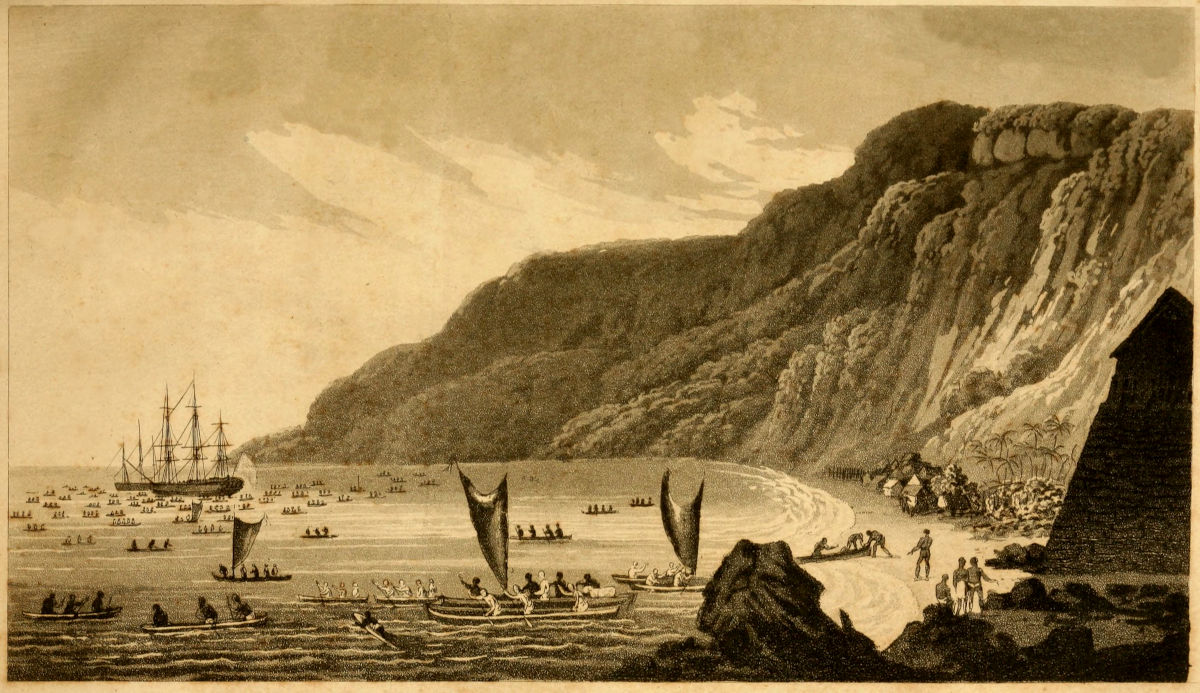
View of Karakakooa in Owhyhee.
During the night, much ice drifted by us with the
tide, and at day-light I was sent with the boats to
examine the bay, and deliver the letters we had
169brought from Oonalashka to the Russian commander.
We directed our course toward the village I have
just mentioned; and having proceeded as far as we
were able, with the boats, we got upon the ice, which
extended near half a mile from the shore. Mr. Webber
and two of the seamen accompanied me, whilst
the master took the pinnace and cutter to finish the
survey, leaving the jolly-boat behind to carry us
back.
I believe the inhabitants had not yet seen either
the ship or the boats, for even after we had got on
the ice we could not perceive any signs of a living
creature in the town. By the time we had advanced
a little way on the ice, we observed a few men hurrying
backward and forward, and presently after a
sledge drawn by dogs, with one of the inhabitants in
it, came down to the sea-side, opposite to us. Whilst
we were gazing at this unusual sight, and admiring
the great civility of this stranger which we imagined
had brought him to our assistance, the man, after
viewing us for some time very attentively, turned
short round and went off with great speed toward
the ostrog. We were not less chagrined than disappointed
at this abrupt departure, as we began to
find our journey over the ice attended not only with
great difficulty but even with danger. We sunk at
every step almost knee-deep in the snow, and though
we found tolerable footing at the bottom, yet the
weak parts of the ice not being discoverable, we
were constantly exposed to the risk of breaking
through it. This accident at last actually happened
to myself; for stepping on quickly over a suspicious
spot, in order to press with less weight upon it, I
came upon a second before I could stop myself,
which broke under me, and in I fell. Luckily I rose
clear of the ice, and a man that was a little way behind
with a boat-hook throwing it to me, I laid it
across some loose pieces near me, and by that means
was enabled to get upon firm ice again.
170As we approached the shore we found the ice,
contrary to our expectations, more broken than it
had been before. We were, however, again comforted
by the sight of another sledge coming toward
us, but instead of proceeding to our relief the driver
stopt short, and began to call out to us. I immediately
held up to him Ismyloff’s letters; upon which
he turned about and set off back again full speed,
followed, I believe, not with the prayers of any of
our party. Being at a great loss what conclusions to
draw from this unaccountable behaviour, we continued
our march toward the ostrog with great circumspection,
and when we had arrived within a quarter of a
mile of it, we perceived a body of armed men
marching toward us. That we might give them as
little alarm and have as peaceable an appearance as
possible, the two men who had boat-hooks in their
hands were ordered into the rear, and Mr. Webber
and myself marched in front. The Russian party,
consisting of about thirty soldiers, was headed by a
decent-looking person, with a cane in his hand. He
halted within a few yards of us, and drew up his
men in a martial and good order. I delivered to him
Ismyloff’s letters, and endeavoured to make him understand,
as well as I could (though I afterward
found in vain), that we were English, and had
brought them papers from Oonalashka. After having
examined us attentively, he began to conduct us
toward the village in great silence and solemnity,
frequently halting his men to form them in different
manners, and making them perform several parts of
their manual exercise, probably with a view to show
us that if we had the temerity to offer any violence,
we should have to deal with men who were not ignorant
of their business.
Though I was all this time in my wet clothes,
shivering with cold and sufficiently inclined to the
most unconditional submission, without having my
fears violently alarmed, yet it was impossible not to
171be diverted with this military parade, notwithstanding
it was attended with the most unseasonable delay.
At length we arrived at the house of the commanding
officer of the party, into which we were ushered,
and after no small stir in giving orders, and disposing
of the military without doors, our host made his appearance,
accompanied by another person, whom
we understood to be the secretary of the port. One
of Ismyloff’s letters was now opened, and the other
sent off by a special messenger to Bolcheretsk, a town
on the west side of the peninsula of Kamtschatka,
where the Russian commander of this province usually
resides.
It is very remarkable that they had not seen the
ship the preceding day, when we came to anchor in
the bay, nor indeed this morning till our boats were
pretty near the ice. The panic with which the discovery
had struck them we found had been very considerable.
The garrison was immediately put under
arms. Two small field-pieces were placed at the entrance
of the commander’s house, and pointed toward
our boats, and shot, powder, and lighted matches
were all ready at hand.
The officer in whose house we were at present entertained
was a serjeant, and the commander of the
ostrog. Nothing could exceed the kindness and hospitality
of his behaviour, after he had recovered from
the alarm occasioned by our arrival. We found the
house insufferably hot, but exceedingly neat and
clean. After I had changed my clothes, which the
serjeant’s civility enabled me to do by furnishing me
with a complete suit of his own, we were invited to
sit down to dinner, which I have no doubt was the
best he could procure, and considering the shortness
of time he had to provide it, was managed with some
ingenuity. As there was not time to prepare soup
and bouilli, we had in their stead some cold beef
sliced, with hot water poured over it. We had next
a large bird roasted, of a species with which I was
172unacquainted, but of a very excellent taste. After
having eaten a part of this it was taken off, and we
were served with fish dressed two different ways, and
soon after the bird again made its appearance, in savoury
and sweet pâtés. Our liquor, of which I shall
have to speak hereafter, was of the kind called by
the Russians quass, and was much the worse part of
the entertainment. The serjeant’s wife brought in
several of the dishes herself, and was not permitted
to sit down at table. Having finished our repast,
during which it is hardly necessary to remark that
our conversation was confined to a few bows, and
other signs of mutual respect, we endeavoured to
open to our host the cause and objects of our visit to
this port. As Ismyloff had probably written to them
on the same subject in the letters we had before delivered,
he appeared very readily to conceive our
meaning; but as there was unfortunately no one in
the place that could talk any other language except
Russian or Kamtschatdale, we found the utmost difficulty
in comprehending the information he meant to
convey to us. After some time spent in these endeavours
to understand one another, we conceived
the sum of the intelligence we had procured to be,
that though no supply either of provisions or naval
stores were to be had at this place, yet that these
articles were in great plenty at Bolcheretsk. That
the commander would most probably be very willing
to give us what we wanted; but that till the serjeant
had received orders from him, neither he nor his
people, nor the natives, could even venture to go on
board the ship.
It was now time for us to take our leave, and as
my clothes were still too wet to put on, I was obliged
to have recourse again to the serjeant’s benevolence,
for his leave to carry those I had borrowed of him
on board. This request was complied with very
cheerfully, and a sledge drawn by five dogs, with a
driver, was immediately provided for each of our
173party. The sailors were highly delighted with this
mode of conveyance; and what diverted them still
more was, that the two boat-hooks had also a sledge
appropriated to themselves. These sledges are so light,
and their construction so well adapted to the purposes
for which they are intended, that they went
with great expedition and perfect safety over the
ice, which it would have been impossible for us with
all our caution to have passed on foot.
On our return we found the boats towing the ship
toward the village, and at seven we got close to the
ice, and moored with the small bower to the north-east
and best bower to the south-west, the entrance
of the bay bearing south by east and south three
quarters east, and the ostrog north one quarter east,
distant one mile and a half. The next morning the
casks and cables were got upon the quarter-deck, in
order to lighten the ship forward, and the carpenters
were set to work to stop the leak, which had given
us so much trouble during our last run. It was
found to have been occasioned by the falling of some
sheathing from the larboard-bow, and the oakum
between the planks having been washed out. The
warm weather we had in the middle of the day began
to make the ice break away very fast, which drifting
with the tide had almost filled up the entrance of the
bay. Several of our gentlemen paid their visits to
the serjeant, by whom they were received with great
civility; and Captain Clerke sent him two bottles of
rum, which he understood would be the most acceptable
present he could make him, and received in
return some fine fowls of the grouse kind, and twenty
trouts. Our sportsmen met with but bad success;
for though the bay swarmed with flocks of ducks of
various kinds and Greenland pigeons, yet they were
so shy that they could not come within shot of them.
In the morning of the 1st of May, seeing the Discovery
standing into the bay, a boat was immediately
sent to her assistance, and in the afternoon she
174moored close by us. They told us that after the
weather cleared up on the 28th, the day on which
she had parted company, they found themselves to
leeward of the bay, and that when they got abreast
of it the following day and saw the entrance choked
up with ice, they stood off after firing guns, concluding
we could not be here; but finding afterward it
was only loose drift-ice, they had ventured in. The
next day the weather was so very unsettled, attended
with heavy showers of snow, that the carpenters were
not able to proceed in their work. The thermometer
stood at 28° in the evening, and the frost was exceedingly
severe in the night.
The following morning, on our observing two
sledges drive into the village, Captain Clerke sent
me on shore to inquire whether any message was arrived
from the commander of Kamtschatka, which,
according to the serjeant’s account, might now be
expected, in consequence of the intelligence that
had been sent of our arrival. Bolcheretsk by the
usual route is about one hundred and thirty-five
English miles from St. Peter and St. Paul’s. Our
dispatches were sent off in a sledge drawn by dogs,
on the 29th about noon. And the answer arrived,
as we afterward found, early this morning, so that
they were only a little more than three days and a
half in performing a journey of two hundred and
seventy miles.
The return of the commander’s answer was, however,
concealed from us for the present, and I was
told on my arrival at the serjeant’s, that we should
hear from him the next day. Whilst I was on shore
the boat which had brought me, together with another
belonging to the Discovery, were set fast in the
ice, which a southerly wind had driven from the other
side of the bay. On seeing them entangled, the
Discovery’s launch had been sent to their assistance,
but soon shared the same fate, and in a short time
the ice had surrounded them near a quarter of a mile
175deep. This obliged us to stay on shore till evening,
when finding no prospect of getting the boats off,
some of us went in sledges to the edge of the ice,
and were taken off by boats sent from the ship, and
the rest staid on shore all night.
It continued to freeze hard during the night, but
before morning on the 4th a change of wind drifted
away the floating ice, and set the boats at liberty,
without their having sustained the smallest damage.
About ten o’clock in the forenoon, we saw several
sledges driving down the edge of the ice, and sent a
boat to conduct the persons who were in them on
board. One of these was a Russian merchant from
Bolcheretsk named Fedositsch, and the other a German
called Port, who had brought a letter from
Major Behm, the commander of Kamtschatka, to
Captain Clerke. When they got to the edge of the
ice, and saw distinctly the size of the ships which
lay within about two hundred yards from them, they
appeared to be exceedingly alarmed, and before they
would venture to embark, desired two of our boat’s
crew might be left on shore as hostages for their
safety. We afterward found that Ismyloff, in his
letter to the commander, had misrepresented us, for
what reasons we could not conceive, as two small
trading boats; and that the serjeant, who had only
seen the ships at a distance, had not in his dispatches
rectified the mistake.
When they arrived on board, we still found, from
their cautious and timorous behaviour, that they were
under some unaccountable apprehensions; and an
uncommon degree of satisfaction was visible in their
countenances, on the German’s finding a person
amongst us, with whom he could converse. This was
Mr. Webber, who spoke that language perfectly well;
and at last, though with some difficulty, convinced
them, that we were Englishmen, and friends. M.
Port being introduced to Captain Clerke, delivered
176to him the Commander’s letter, which was written in
German, and was merely complimental, inviting him
and his officers to Bolcheretsk, to which place the
people, who brought it, were to conduct us. M.
Port at the same time, acquainted him, that the Major
had conceived a very wrong idea of the size of the
ships, and of the service we were engaged in; Ismyloff
in his letter, having represented us as two small
English packet-boats, and cautioned him to be on
his guard; insinuating, that he suspected us to be no
better than pirates. In consequence of this letter,
he said there had been various conjectures formed
about us at Bolcheretsk: that the Major thought it
most probable we were on a trading scheme, and for
that reason had sent down a merchant to us; but
that the officer, who was second in command, was of
opinion we were French, and come with some hostile
intention, and were for taking measures accordingly.
It had required, he added, all the Major’s authority
to keep the inhabitants from leaving the town, and
retiring up into the country; to so extraordinary a
pitch had their fears risen, from their persuasion that
we were French.
Their extreme apprehensions of that nation were
principally occasioned, by some circumstances attending
an insurrection that had happened at Bolcheretsk
a few years before, in which the commander had lost
his life. We were informed, that an exiled Polish
officer, named Beniowski, taking advantage of the
confusion into which the town was thrown, had seized
upon a galliot, then lying at the entrance of the
Bolchoireka, and had forced on board a number of
Russian sailors, sufficient to navigate her: that he
had put on shore a part of the crew at the Kourile
Islands; and, among the rest, Ismyloff, who, as the
reader will recollect, had puzzled us exceedingly at
Oonalashka, with the history of this transaction;
though, for want of understanding his language, we
177could not then make out all the circumstances attending
it: that he passed in sight of Japan; made
Luconia; and was there directed how to steer to
Canton; that arriving there, he had applied to the
French, and had got a passage in one of their India
ships to France: and that most of the Russians
had likewise returned to Europe in French ships;
and had afterward found their way to Petersburg.
We met with three of Beniowski’s crew in the harbour
of Saint Peter and Saint Paul; and from them
we learnt the circumstances of the above story.
On our arrival at Canton, we received a farther
corroboration of the facts, from the gentlemen of the
English factory, who told us, that a person had arrived
there in a Russian galliot, who said he came
from Kamtschatka; and that he had been furnished
by the French factory with a passage to Europe.[18]
We could not help being much diverted with the
fears and apprehensions of these good people, and
particularly with the account M. Port gave us of the
serjeant’s wary proceedings the day before. On
seeing me come on shore, in company with some
other gentlemen, he had made him and the merchant,
who arrived in the sledges we had seen come in the
morning, hide themselves in his kitchen, and listen
to our conversation with one another, in hopes that,
by this means, they might discover whether we were
really English or not.
As we concluded, from the commission and dress
of M. Port, that he might probably be the commander’s
secretary, he was received as such, and invited,
with his companion, the merchant, to dine with
Captain Clerke: and though we soon began to suspect,
from the behaviour of the latter toward him,
178that he was only a common servant, yet this being
no time to sacrifice our little comforts to our pride,
we prevented an explanation, by not suffering the
question to be put to him; and, in return for the
satisfaction we reaped from his abilities as a linguist,
we continued to let him live on a footing of equality
with us.
CHAP. II.
179
SCARCITY OF PROVISIONS AND STORES AT THE HARBOUR OF
SAINT PETER AND SAINT PAUL.—A PARTY SET OUT TO VISIT
THE COMMANDER AT BOLCHERETSK.—PASSAGE UP THE
RIVER AWATSKA.—ACCOUNT OF THEIR RECEPTION BY THE
TOION OF KARATCHIN.—DESCRIPTION OF A KAMTSCHADALE
DRESS.—JOURNEY ON SLEDGES.—DESCRIPTION OF THIS
MODE OF TRAVELLING.—ARRIVAL AT NATCHEEKIN.—ACCOUNT
OF HOT SPRINGS.—EMBARK ON THE BOLCHOIREKA.—RECEPTION
AT THE CAPITAL.—GENEROUS AND HOSPITABLE
CONDUCT OF THE COMMANDER AND THE GARRISON.—DESCRIPTION
OF BOLCHERETSK.—PRESENTS FROM THE COMMANDER.—RUSSIAN
AND KAMTSCHADALE DANCING.—AFFECTING
DEPARTURE FROM BOLCHERETSK.—RETURN
TO SAINT PETER AND SAINT PAUL’S, ACCOMPANIED BY
MAJOR BEHM, WHO VISITS THE SHIPS.—GENEROSITY OF
THE SAILORS.—DISPATCHES SENT BY MAJOR BEHM TO
PETERSBURG.—HIS DEPARTURE AND CHARACTER.
Being now enabled to converse with the Russians,
by the aid of our interpreter, with tolerable facility,
our first inquires were directed to the means of procuring
a supply of fresh provisions, and naval stores;
from the want of which latter article, in particular,
we had been for some time in great distress. On
inquiry, it appeared, that the whole stock of live
cattle, which the country about the bay could furnish,
amounted only to two heifers; and these the serjeant
very readily promised to procure us. Our applications
were next made to the merchant, but we found the
terms upon which he offered to serve us, so exorbitant,
that Captain Clerke thought it necessary to send an
officer to visit the commander at Bolcheretsk, and to
inquire into the price of stores at that place. As soon as
this determination was communicated to M. Port, he
dispatched an express to the commander, to inform
180him of our intentions, and at the same time, to clear
us from the suspicions that were entertained with
respect to the designation and purposes of our
voyage.
Captain Clerke having thought proper to fix on me
for this service, I received orders, together with Mr.
Webber, who was to accompany me as interpreter,
to be ready to set out the next day. It proved, however,
too stormy, as did also the 6th, for beginning
a journey through so wild and desolate a country;
but, on the 7th, the weather appearing more favourable,
we set out early in the morning in the ship’s
boats, with a view to reach the entrance of the Awatska
at high water, on account of the shoals with
which the mouth of that river abounds: here the country
boats were to meet us, and carry us up the stream.
Captain Gore was now added to our party, and we
were attended by Messrs. Port and Fedositsch, with
two Cossacks, and were provided, by our conductors,
with warm furred clothing; a precaution
which we soon found very necessary, as it began to
snow briskly just after we set out. At eight o’clock,
being stopped by shoal water, about a mile from the
mouth of the river, some small canoes, belonging to
the Kamtschadales, took up us and our baggage, and
carried us over a spit of sand, which is thrown up by
the rapidity of the river, and which, they told us, was
continually shifting. When we had crossed this shoal,
the water again deepened; and here we found a commodious
boat, built and shaped like a Norway yawl,
ready to convey us up the river, together with canoes
for our baggage.
The mouth of the Awatska is about a quarter of a
mile broad; and as we advanced, it narrowed very
gradually. After we had proceeded a few miles, we
passed several branches, which we were told emptied
themselves into other parts of the bay; and that some
of those on the left hand flowed into the Paratounca
river. Its general direction from the bay, for the first
181ten miles, is to the north, after which it turns to the
westward: this bend excepted, it preserves, for the
most part, a straight course; and the country through
which it flows, to the distance of near thirty miles
from the sea, is low and flat, and subject to frequent
inundations. We were pushed forward by six men,
with long poles, three at each end of the boat; two
of whom were Cossacks, the others Kamtschadales;
and advanced against a strong stream, at the rate, as
well as I could judge, of about three miles an hour.
Our Kamtschadales bore this severe labour, with great
stoutness, for ten hours; during which we stopped
only once, and that for a short time, whilst they took
some little refreshment. As we had been told, at our
first setting out in the morning, that we should easily
reach an ostrog, called Karatchin, the same night,
we were much disappointed to find ourselves, at sun-set,
fifteen miles from that place. This we attributed
to the delay occasioned in passing the shoals we had
met with, both at the entrance of the river, and in
several other places, as we proceeded up it; for our
boat being the first that had passed up the river, the
guides were not acquainted with the situation of the
shifting sand-banks, and unfortunately the snow not
having yet begun to melt, the shallowness of the river
was at its extreme.
The fatigue our men had already undergone, and
the difficulty of navigating the river, which would
have been much increased by the darkness of the
night, obliged us to give up all thoughts of continuing
our journey that evening. Having therefore
found a place tolerably sheltered, and cleared it of
the snow, we erected a small marquée, which we had
brought with us; and, by the assistance of a brisk
fire, and some good punch, passed the night not very
unpleasantly. The only inconvenience we laboured
under was, the being obliged to make the fire at some
distance from us. For, although the ground was, to
all appearance, dry enough before, yet when the fire
182was lighted, it soon thawed all the parts round it into
an absolute puddle. We admired much the alertness
and expedition with which the Kamtschadales erected
our marquée, and cooked our provisions; but what was
most unexpected, we found they had brought with
them their tea-kettles, considering it as the greatest of
hardships not to drink tea two or three times a day.
We set out as soon as it was light in the morning,
and had not advanced far, before we were met by the
Toion, or chief of Karatchin, who had been apprized
of our coming, and had provided canoes that were
lighter, and better contrived for navigating the higher
parts of the river. A commodious vessel, consisting
of two canoes, lashed close together with cross spars,
lined with bear-skins, and furnished with fur cloaks,
was also provided for us. We now went on very
rapidly, the Toion’s people being both stout and fresh,
and remarkable for their expertness in this business.
At ten we got to the ostrog, the seat of his command,
where we were received at the water-side by the Kamtschadale
men and women, and some Russian servants
belonging to Fedositsch, who were employed in making
canoes. They were all drest out in their best clothes.
Those of the women were pretty and gay, consisting
of a full loose robe of white nankeen, gathered close
round the neck, and fastened with a collar of coloured
silk. Over this they wore a short jacket, without
sleeves, made of different coloured nankeens, and
petticoats of a slight Chinese silk. Their shifts,
which had sleeves down to the wrists, were also of
silk; and coloured silk handkerchiefs were bound
round their heads, concealing entirely the hair of the
married women, whilst those who were unmarried,
brought the handkerchief under the hair, and suffered
it to flow loose behind.
This ostrog was pleasantly situated by the side of
the river; and consisted of three log-houses; three
jourts, or houses made under ground; and nineteen
balagans, or summer habitations. We were conducted
183to the dwelling of the Toion, who was a plain decent
man, born of a Russian woman, by a Kamtschadale
father. His house, like all the rest in this country,
was divided into two apartments. A long narrow
table, with a bench round it, was all the furniture we
saw in the outer; and the household stuff of the
inner, which was the kitchen, was not less simple and
scanty. But the kind attention of our host, and the
hearty welcome we received, more than compensated
for the poverty of his lodgings.
His wife proved an excellent cook; and served us
with fish and game of different sorts, and various
kinds of heath-berries, that had been kept since the
last year. Whilst we were at dinner in this miserable
hut, the guests of a people, with whose existence we
had before been scarce acquainted, and at the extremity
of the habitable globe, a solitary, half-worn pewter
spoon, whose shape was familiar to us, attracted
our attention; and, on examination, we found it
stamped on the back with the word London. I cannot
pass over this circumstance in silence, out of
gratitude for the many pleasant thoughts, the anxious
hopes, and tender remembrances it excited in us.
Those who have experienced the effects that long
absence and extreme distance from their native country
produce on the mind, will readily conceive the
pleasure such trifling incidents can give. To the philosopher
and the politician they may perhaps suggest
reflections of a different nature.
We were now to quit the river, and perform the
next part of our journey on sledges; but the thaw
had been too powerful in the day-time, to allow us
to set out till the cold of the evening had again made
the surface of the snow hard and firm. This gave us
an opportunity of walking about the village, which
was the only place we had yet seen free from snow,
since we landed in this country. It stood upon a well
wooded flat, of about a mile and a half in circumference.
The leaves were just budding, and the
184verdure of the whole scene was strongly contrasted
with the sides of the surrounding hills, which were
still covered with snow. As the soil appeared to me
very capable of producing all the common sorts of
garden vegetables, I was greatly surprized not to find
the smallest spot any where cultivated. If to this,
we add that none of the inhabitants were possessed
of cattle of any sort, nothing can be well conceived
more wretched than their situation must be during
the winter months. They were at this time removing
from their jourts into their balagans, which afforded
us an opportunity of examining both these sorts of
habitations; and they will be hereafter more particularly
described. The people invited us into their
houses with great good humour; a general air of
cheerfulness and content was every where visible, to
which the approaching change of season might probably
not a little contribute.
On our return to the Toion’s, we found supper
prepared for us, which differed in nothing from our former
repast; and concluded with our treating the Toion
and his wife with some of the spirits we had brought
with us, made into punch. Captain Gore, who had
great generosity on all occasions, having afterward
made them some valuable presents, they retired to
the kitchen, leaving us in possession of the outward
room, where spreading our bear-skins on the benches,
we were glad to get a little repose; having settled
with our conductors to resume our journey as soon as
the ground should be judged fit for travelling.
About nine o’clock the same evening, we were
awakened by the melancholy howlings of the dogs,
which continued all the time our baggage was lashing
upon the sledges; but, as soon as they were yoked,
and we were all prepared to set out, this changed
into a light cheerful yelping, which entirely ceased
the instant they marched off. But, before we set out,
the reader may expect to be made more particularly
acquainted with this curious mode of travelling.
185I brought over with me one of these sledges, which
is now in the possession of Sir Ashton Lever. The
body is about four feet and a half long, and a foot
wide, made in the form of a crescent, of light tough
wood, strongly bound together with wicker work; which
in those belonging to the better sort of people is elegantly
stained of a red and blue colour, and the seat
covered with bear-skins, or other furs. It is supported
by four legs about two feet high, which rest on
two long flat pieces of wood, five or six inches broad,
extending a foot at each end beyond the body of the
sledge. These are turned up before in the manner
of a skate, and shod with the bone of some sea animal.
The fore-part of the carriage is ornamented
with thongs of leather and tassels of coloured cloth;
and from the cross bar, to which the harness is joined,
are hung links of iron, or small bells, the jingling of
which they conceive to be encouraging to the dogs.
They are seldom used to carry more than one person
at a time, who sits aside, resting his feet on the lower
part of the sledge, and carrying his provisions and
other necessaries, wrapped up in a bundle behind
him. The dogs are usually five in number, yoked
two and two, with a leader. The reins not being
fastened to the head of the dogs, but to the collar,
have little power over them, and are therefore generally
hung upon the sledge, whilst the driver depends
entirely on their obedience to his voice for the direction
of them. With this view, the leader is always
trained up with a particular degree of care and attention,
some of them rising to a most extraordinary
value on account of their docility and steadiness;
insomuch, that for one of these, I am well assured,
forty roubles (or ten pounds) was no unusual price.
The driver is also provided with a crooked stick,
which answers the purpose both of whip and reins;
as by striking it into the snow, he is enabled to
moderate the speed of the dogs, or even to stop them
entirely; and when they are lazy, or otherwise inattentive
186to his voice, he chastizes them by throwing
it at them. Upon these occasions, their dexterity in
picking it up again is very remarkable, and forms the
principal difficulty of their art. But it is indeed not
surprising, that they should labour to be skilful in a
practice upon which their safety so materially depends.
For they say, that if the driver should happen to lose
his stick, the dogs will instantly perceive it; and unless
their leader be of the most sober and resolute
kind, they will immediately run ahead full speed,
and never stop till they are quite spent. But as that
will not be the case soon, it generally happens that
either the carriage is overturned, and dashed to pieces
against the trees; or they hurry down some precipice,
and all are buried in the snow. The accounts that
were given us of the speed of these dogs, and of
their extraordinary patience of hunger and fatigue,
were scarcely credible, if they had not been supported
by the best authority. We were indeed ourselves
witnesses of the great expedition with which
the messenger who had been dispatched to Bolcheretsk
with the news of our arrival, returned to the harbour
of St. Peter and St. Paul, though the snow was at this
time exceedingly soft. But I was informed by the
commander of Kamtschatka, that this journey was
generally performed in two days and a half; and that
he had once received an express from the latter place
in twenty-three hours.
The dogs are fed during the winter on the offals
of dried and stinking fish; but are always deprived
of this miserable food a day before they set out on a
journey, and never suffered to eat before they reach
the end of it. We were also told, that it was not
unusual for them to continue thus fasting two entire
days, in which time they would perform a journey of
one hundred and twenty miles.[19] These dogs are in
187shape somewhat like the Pomeranian breed, but
considerably larger.
As we did not choose to trust to our own skill, we
had each of us a man to drive and guide the sledge,
which, from the state the roads were now in, proved
a very laborious business. For, as the thaw had
advanced very considerably in the valleys through
which our road lay, we were under the necessity of
keeping along the sides of the hills; and this obliged
our guides, who were provided with snow-shoes for
that purpose, to support the sledges, on the lower
side, with their shoulders, for several miles together.
I had a very good-humoured Cossack to attend me,
who was, however, so very unskilful in his business,
that we were overturned almost every minute, to the
great entertainment of the rest of the company.
Our party consisted, in all, of ten sledges; that in
which Captain Gore was carried, was made of two
lashed together, and abundantly provided with furs
and bear-skins; it had ten dogs, yoked four abreast;
as had also some of those that were heavy laden with
baggage.
When we had proceeded about four miles, it began
to rain; which, added to the darkness of the night,
threw us all into confusion. It was at last agreed,
that we should remain where we were till day-light;
and accordingly we came to anchor in the snow (for
I cannot better express the manner in which the
188sledges were secured), and wrapping ourselves up in
our furs, waited patiently for the morning. About
three o’clock we were called on to set out, our guides
being apprehensive, that if we waited longer, we
might be stopped by the thaw, and neither be able to
proceed, nor to return. After encountering many
difficulties, which were principally occasioned by the
bad condition of the road, at two in the afternoon,
we got safe to an ostrog, called Natcheekin, situated
on the side of a small stream, which falls into the
Bolchoireka, a little way below the town. The distance
between Karatchin and Natcheekin is thirty-eight
wersts (or twenty-five miles); and had the hard
frost continued, we should not, by their account,
have been more than four hours in performing it;
but the snow was so soft, that the dogs, almost at
every step, sunk up to their bellies; and I was indeed
much surprised at their being at all able to overcome
the difficulties of so fatiguing a journey.
Natcheekin is a very inconsiderable ostrog, having
only one log-house, the residence of the Toion; five
balagans, and one jourt. We were received here
with the same formalities, and in the same hospitable
manner, as at Karatchin; and in the afternoon we
went to visit a remarkable hot spring, which is near
this village. We saw, at some distance, the steam
rising from it, as from a boiling caldron; and as we
approached, perceived the air had a strong sulphureous
smell. The main spring forms a bason of
about three feet in diameter; besides which, there
are a number of lesser springs, of the same degree of
heat, in the adjacent ground; so that the whole spot,
to the extent of near an acre, was so hot, that we
could not stand two minutes in the same place. The
water flowing from these springs is collected in a
small bathing pond, and afterward forms a little
rivulet; which, at the distance of about an hundred
and fifty yards, falls into the river. The bath, they
told us, had wrought great cures in several disorders,
189such as rheumatisms, swelled and contracted joints,
and scorbutic ulcers. In the bathing-place the thermometer
stood at 100°, or blood heat; but in the
spring, after being immersed two minutes, it was 1°
above boiling spirits. The thermometer in the air,
at this time, was 34°; in the river 40°; and in the
Toion’s house 64°. The ground where these springs
break out, is on a gentle ascent; behind which there
is a green hill of a moderate size. I am sorry I was
not sufficiently skilled in botany to examine the
plants, which seemed to thrive here with great luxuriance;
the wild garlic, indeed, forced itself on our
notice, and was at this time springing up very
vigorously.
The next morning, we embarked on the Bolchoireka
in canoes; and, having the stream with us,
expected to be at our journey’s end the day following.
The town of Bolcheretsk is about eighty miles
from Natcheekin; and we were informed, that, in
the summer season, when the river has been full and
rapid, from the melting of snow on the mountains,
the canoes had often gone down in a single day; but
that, in its present state, we should probably be much
longer, as the ice had broken up only three days before
we arrived; and that our’s would be the first
boat that had attempted to pass. This intelligence
proved but too true. We found ourselves greatly
impeded by the shallows; and though the stream in
many places ran with great rapidity, yet every half
mile, we had ripplings and shoals, over which we
were obliged to haul the boats. The country on
each side was very romantic, but unvaried; the river
running between mountains of the most craggy and
barren aspect, where there was nothing to diversify
the scene; but now and then the sight of a bear, and
the flights of wild-fowl. So uninteresting a passage
leaves me nothing farther to say, than that this and
the following night we slept on the banks of the
river, under our marquée; and suffered very much
190from the severity of the weather, and the snow which
still remained on the ground.
At day-light on the 12th, we found we had got
clear of the mountains, and were entering a low extensive
plain, covered with shrubby trees. About
nine in the forenoon, we arrived at an ostrog, called
Opatchin, which is computed to be fifty miles from
Natcheekin, and is nearly of the same size as Karatchin.
We found here a serjeant with four Russian
soldiers, who had been two days waiting for our
arrival; and who immediately dispatched a light
boat to Bolcheretsk, with intelligence of our approach.
We were now put into the trammels of formality; a
canoe, furnished with skins and furs, and equipped in
a magnificent manner, was prepared for our reception,
in which we were accommodated much at our ease,
but to the exclusion of the rest of our fellow-travellers.
It was with much regret we found ourselves
obliged to separate from our old companion Monsieur
Port, whom we had observed to grow every day more
shy and distant, as we drew nearer the end of our
journey. Indeed, he had himself told us, before we
set out, that we paid him a respect he had no title
to; but as we found him a very modest and discreet
man, we had insisted on his living with us during
the whole of our journey. The remainder of our
passage was performed with great facility and expedition,
the river growing more rapid as we descended,
and less obstructed by shoals.
As we approached the capital, we were sorry to
observe, from an appearance of much stir and bustle,
that we were to be received in form. Decent clothes
had been, for some time, a scarce commodity amongst
us; and our travelling dresses were made up of a
burlesque mixture of European, Indian, and Kamtschatdale
fashions. We therefore thought it would
be too ridiculous to make a parade in this trim
through the metropolis of Kamtschatka; and as we
saw a crowd collected on the banks of the river, and
191were told the commander would be at the water-side
to receive us, we stopped short at a soldier’s house,
about a quarter of a mile from the town, from whence
we sent Port with a message to his Excellency, acquainting
him, that the moment we had put off our
travelling dresses, we would pay our respects to him
at his own house; and to beg he would not think of
waiting to conduct us. Finding, however, that he
persisted in his intentions of paying us this compliment,
we lost no farther time in attiring ourselves,
but made all the haste in our power to join him at
the entrance of the town. I observed my companions
to be as awkward as I felt myself, in making
our first salutations; bowing and scraping being
marks of good-breeding that we had now, for two
years and a half, been totally unaccustomed to.
The manner in which we were received by the commander,
was the most engaging that could be conceived,
and increased my mortification, at finding,
that he had almost entirely forgot the French language;
so that the satisfaction of conversing with
him was wholly confined to Mr. Webber, who spoke
the German, his native tongue.
In company with Major Behm, was Captain
Shmaleff; the second in command, and another officer
with the whole body of the merchants of the place.
They conducted us to the commander’s house,
where we were received by his lady with great civility,
and found tea and other refreshments prepared for
us. After the first compliments were over, Mr.
Webber was desired to acquaint the Major with the
object of our journey, with our want of naval stores,
flour, and fresh provisions, and other necessaries for
the ships’ crews; and at the same time to assure him,
that we were sensible, from what we had already seen
of the condition of the country about Awatska Bay,
we could not expect much assistance from him in
that quarter; that the impossibility of sending heavy
stores across the peninsula, during the present season
192of the year, was but too apparent, from the difficulties
we had met with in our journey; and that, long
before any material change could take place, we
should be under the necessity of proceeding on our
voyage. We were here interrupted by the commander,
who observed, that we did not yet know
what they were capable of doing; that at least it
was not his business to think of the difficulties of
supplying our wants, but only to learn what were the
articles we stood in need of, and the longest time we
could allow him for procuring them. After expressing
our sense of his obliging disposition, we gave him
a list of the naval stores, the number of cattle, and
the quantity of flour, we were directed to purchase,
and told him, that we purposed recommencing our
voyage about the 5th of June.
Our conversation afterward turned upon different
subjects; and it will naturally be supposed, that our
inquiries were principally directed to the obtaining
some information respecting our own country.
Having now been absent three years, we had flattered
ourselves with the certainty of receiving intelligence
from Major Behm, which could not fail of being
interesting; and I cannot express the disappointment
we felt, on finding, that he had no news to communicate
of a much later date than that of our departure
from England.
About seven o’clock, the commander, conceiving
we might be fatigued with our journey, and desirous
of taking some repose, begged he might conduct us
to our lodgings. It was in vain that we protested
against a compliment which we had certainly no title
to expect, but that of being strangers; a circumstance
which seemed, in the opinion of this generous
Livonian, to counterbalance every other consideration.
In our way, we passed by two guard-houses,
where the men were turned out under arms, in compliment
to Captain Gore; and were afterward brought
to a very neat and decent house, which the major
193gave us to understand was to be our residence, during
our stay. Two sentinels were posted at the door;
and in a house adjoining, there was a serjeant’s guard.
Having shown us into our apartments, the major
took his leave, with a promise to see us the next day;
and we were left to find out, at our leisure, all the
conveniences that he had most amply provided for
us. A soldier, called a putpropersckack, whose rank
is between that of a serjeant and corporal, along with
our fellow-traveller Port, were appointed to be our
male domestics; besides whom, there was a housekeeper
and a cook, who had orders to obey Port’s
directions in dressing us a supper, according to our
own mode of cookery. We received many civil
messages, in the course of the evening, from the
principal people of the town, purporting, that they
would not add to our fatigues, by paying their
respects to us at that time, but would wait on us in the
morning. Such well-supported politeness and attention
in a country so desolate and uncultivated, formed
a contrast exceedingly favourable to its inhabitants;
and to finish the piece as it began, at sun-set the
serjeant came with the report of his guard to Captain
Gore.
Early in the morning, we received the compliments
of the commander, of Captain Shmaleff, and of the
principal inhabitants of the town, who all honoured
us with visits soon after. The two first having sent
for Port, after we were gone to rest, and inquired of
him, what articles we seemed to be most in want of
on board the ships; we found them prepared to insist
on our sharing with the garrison under their command,
in what little stock of provisions they had
remaining. At the same time they lamented, that
we had arrived at a season of the year, when there
was always the greatest scarcity of every thing
amongst them; the sloops not being yet arrived,
with their annual supply, from Okotsk.
We agreed to accept the liberality of these hospitable
194strangers, with the best grace we could; but on
condition, that we might be made acquainted with
the price of the articles we were to be supplied with;
and that Captain Clerke should give bills to the
amount, upon the Victualling-Office in London.
This the major positively refused; and whenever it
was afterward urged, stopped us short, by telling us,
he was certain, that he could not oblige his mistress
more, than in giving every assistance in his power to
her good friends and allies the English; and that it
would be a particular satisfaction to her, to hear, that
in so remote a part of the world, her dominions had
afforded any relief to ships engaged in such services
as ours; that he could not therefore act so contrary
to the character of his empress, as to accept of any
bills; but that, to accommodate the matter, he would
take a bare attestation of the particulars, with which
we might be furnished; and that this he should transmit
to his court, as a certificate of having performed
his duty. I shall leave (he continued) to the two
courts, all farther acknowledgments; but cannot
consent to accept any thing of the kind alluded to.
When this matter was adjusted, he began to inquire
about our private wants, saying he should consider
himself as ill-used if we had any dealings with the
merchants, or applied to any other person except
himself.
In return for such singular generosity, we had little
to bestow but our admiration and our thanks. Fortunately,
however, Captain Clerke had sent by me a
set of prints and maps belonging to the last voyage
of Captain Cook, which he desired me to present in
his name to the commander, who being an enthusiast
in every thing relating to discoveries, received it with
a satisfaction which showed that, though a trifle,
nothing could have been more acceptable. Captain
Clerke had likewise entrusted me with a discretionary
power of showing him a chart of the discoveries
made in the present voyage; and as I judged
195that a person in his situation and of his turn of mind
would be exceedingly gratified by a communication
of this sort, though out of delicacy he had forborne
to ask more than a few general questions on the subject,
I made no scruple to repose in him a confidence
of which his whole conduct showed him to be deserving.
I had the pleasure to find that he felt this compliment
as I hoped he would, and was much struck at
seeing in one view the whole of that coast, as well
on the side of Asia as on that of America, of which
his countrymen had been so many years employed in
acquiring a partial and imperfect knowledge.[20]
Excepting this mark of confidence, and the set of
prints I have already mentioned, we had brought
nothing with us that was in the least worth his acceptance;
for it scarce deserves noticing that I prevailed
on his son, a young boy, to accept of a silver
watch I happened to have about me, and I made his
little daughter very happy with two pair of ear-rings,
of French paste. Besides these trifles, I left with
Captain Shmaleff the thermometer I had used on my
journey, and he promised me to keep an exact register
of the temperature of the air for one year, and
to transmit it to Mr. Muller, with whom he had the
pleasure of being acquainted.
We dined this day at the commander’s, who, studious
on every occasion to gratify our curiosity, had,
196besides a number of dishes dressed in our own way,
prepared a great variety of others, after the Russian
and Kamtschadale manner. The afternoon was employed
in taking a view of the town and the adjacent
country. Bolcheretsk is situated in a low swampy
plain, that extends to the sea of Okotsk, being about
forty miles long, and of a considerable breadth. It
lies on the north side of the Bolchoi-reka (or great
river), between the mouth of the Gottsofka and the
Bistraia, which here empty themselves into this river;
and the peninsula on which it stands has been separated
from the continent by a large canal, the work
of the present commander, which has not only added
much to its strength as a fortress, but has made it
much less liable than it was before to inundations.
Below the town the river is from six to eight feet
deep, and about a quarter of a mile broad. It empties
itself into the sea of Okotsk, at the distance of
twenty-two miles, where, according to Krasheninicoff,
it is capable of admitting vessels of a considerable size.
There is no corn of any species cultivated in this part
of the country, and Major Behm informed me, that
his was the only garden that had yet been planted.
The ground was for the most part covered with
snow; that which was free from it appeared full of
small hillocks, of a black turfy nature. I saw about
twenty or thirty cows, and the major had six stout
horses. These and their dogs are the only tame animals
they possess; the necessity they are under in
the present state of the country of keeping great
numbers of the latter, making it impossible to bring
up any cattle that are not in size and strength a
match for them. For during the summer season
their dogs are entirely let loose, and left to provide
for themselves, which makes them so exceedingly
ravenous that they will sometimes even attack the
bullocks.
The houses in Bolcheretsk are all of one fashion,
being built of logs and thatched. That of the commander
197is much larger than the rest, consisting of
three rooms of a considerable size, neatly papered,
and which might have been reckoned handsome if
the talc with which the windows were covered had
not given them a poor and disagreeable appearance.
The town consists of several rows of low buildings,
each consisting of five or six dwellings connected
together, with a long common passage running the
length of them, on one side of which is the kitchen
and store-house, and on the other the dwelling apartments.
Besides these are barracks for the Russian
soldiers and Cossacks, a well-looking church, and a
court-room; and at the end of the town a great number
of balagans, belonging to the Kamtschadales.
The inhabitants taken altogether amount to between
five and six hundred. In the evening the major
gave a handsome entertainment, to which the principal
people of the town of both sexes were invited.
The next morning we applied privately to the
merchant Fedositsch, to purchase some tobacco for
the sailors, who had now been upward of a twelvemonth
without this favourite commodity. However
this, like all our other transactions of the same kind,
came immediately to the major’s knowledge, and we
were soon after surprised to find in our house four
bags of tobacco, weighing upward of a hundred
pounds each, which he begged might be presented,
in the name of himself and the garrison under his
command, to our sailors. At the same time they
had sent us twenty loaves of fine sugar, and as many
pounds of tea, being articles they understood we were
in great want of, which they begged to be indulged
in presenting to the officers. Along with these,
Madame Behm had also sent a present for Captain
Clerke, consisting of fresh butter, honey, figs, rice,
and some other little things of the same kind, attended
with many wishes that, in his infirm state of health,
they might be of service to him. It was in vain we
tried to oppose this profusion of bounty, which I was
198really anxious to restrain, being convinced that they
were giving away not a share but almost the whole
stock of the garrison. The constant answer the
major returned us on those occasions was, that we
had suffered a great deal, and that we must needs be
in distress. Indeed, the length of time we had been
out since we touched at any known port, appeared
to them so very incredible, that it required the testimony
of our maps, and other corroborating circumstances,
to gain their belief. Amongst the latter
was a very curious fact which Major Behm related to
us this morning, and which he said but for our arrival
he should have been totally at a loss to account
for.
It is well known, that the Tschutski are the only
people of the north of Asia, who have maintained
their independence, and resisted all the attempts that
have been made by the Russians to reduce them.
The last expedition against them was undertaken in
the year 1750, and terminated, after various success,
in the retreat of the Russian forces, and the loss of
the commanding officer. Since that time, the Russians
had removed their frontier fortress from the Anadyr
to the Ingiga, a river that empties itself into the
northern extremity of the sea of Okotsk, and gives
its name to a gulf, situated to the west of that of
Penshinsk. From this fort, Major Behm had received
dispatches the day of our arrival at Bolcheretsk,
containing intelligence, that a tribe, or party, of the
Tschutski, had arrived at that place with propositions
of friendship, and a voluntary offer of tribute; that
on enquiring into the cause of this unexpected alteration
in their sentiments, they had informed his people,
that toward the latter end of the last summer, they
had been visited by two very large Russian boats;
that they had been treated by the people who were in
them with the greatest kindness, and had entered
into a league of friendship and amity with them; and
that relying on this friendly disposition, they were
199now come to the Russian fort, in order to settle a
treaty, on such terms as might be acceptable to both
nations. This extraordinary history had occasioned
much speculation, both at Ingiginsk and Bolcheretsk;
and had we not furnished them with a key to it,
must have remained perfectly unintelligible. We
felt no small satisfaction in having, though accidentally,
shown the Russians, in this instance, the only
true way of collecting tribute, and extending their
dominions; and in the hopes that the good understanding
which this event hath given rise to, may rescue
a brave people from the future invasions of such
powerful neighbours.
We dined this day with Captain Shmaleff, and in
the afternoon, in order to vary our amusements, he
treated us with an exhibition of the Russian and
Kamtschadale dancing. No description can convey
an adequate idea of this rude and uncouth entertainment.
The figure of the Russian dance was much
like those of our hornpipes, and was danced either
single, or by two or four persons at a time. Their
steps were short and quick, with the feet scarce raised
from the ground; the arms were fixed close to the
sides; the body being all the while kept upright and
immoveable, excepting when the parties passed each
other, at which time the hand was raised with a quick
and awkward motion. But if the Russian dance was
at the same time both unmeaning and ridiculous, the
Kamtschadale joined to the latter quality the most
whimsical idea that ever entered into any people’s
heads. It is intended to represent the awkward and
clumsy gestures of the bear, which these people have
frequent opportunities of observing in a great variety
of situations. It will scarcely be expected that I
should give a minute description of all the strange
postures which were exhibited on these occasions;
and I shall therefore only mention, that the body was
always bowed, and the knees bent, whilst the arms
200were used in imitating the tricks and attitudes of that
animal.
As our journey to Bolcheretsk had taken up more
time than we expected, and we were told that our
return might prove still more difficult and tedious, we
were under the necessity of acquainting the commander,
this evening, with our intention of setting
out the next day. It was not without the utmost regret
we thought of leaving our new acquaintance;
and were therefore most agreeably surprised, when
the Major told us, that if we could stay one day longer,
he would accompany us. He had, he said, made
up his dispatches, and resigned the command of Kamtschatka
to his successor Captain Shmaleff, and had
prepared every thing for his departure to Okotsk,
which was to take place in a few days; but that he
should feel great pleasure in putting off his journey
a little longer, and returning with us to Saint Peter
and Saint Paul’s, that he might himself be a witness of
every thing being done for us, that it was in their
power to do.
In return for the few trifles I had given to the
children of Major Behm, I was next morning, the
15th, presented by his little boy, with a most magnificent
Kamtschadale dress, which shall be described
in its proper place. It was of the kind worn by the
principal Toions of the country, on occasions of great
ceremony; and, as I was afterwards told by Fedositsch,
could not have been purchased for one hundred
and twenty roubles. At the same time, I had a present
from his daughter of a handsome sable muff.
We afterward dined with the commander, who, in
order to let us see as much of the manners of the inhabitants,
and of the customs of the country as our time
would permit, invited the whole of the better sort of
people in the village, to his house this evening. All the
women appeared very splendidly dressed after the
Kamtschadale fashion. The wives of Captain
201Shmaleff, and the other officers of the garrison,
were prettily dressed, half in the Siberian, and half
in the European mode; and Madame Behm, in order
to make the stronger contrast, had unpacked part of
her baggage, and put on a rich European dress. I
was much struck with the richness and variety of the
silks which the women wore, and the singularity of
their habits. The whole was like some enchanted
scene, in the midst of the wildest and most dreary
country in the world. Our entertainment again consisted
of dancing and singing.
The next morning being fixed for our departure,
we retired early to our lodgings, where the first things
we saw were three travelling dresses, made after the
fashion of the country, which the major had provided
for us, who came himself to our house soon after,
to see all our things packed up, and properly taken
care of. Indeed, what with his liberal presents, and
the kindness of Captain Shmaleff, and many other
individuals, who all begged to throw in their mite,
together with the ample stock of provisions he had
sent us for our journey, we had amassed no inconsiderable
load of baggage.
Early in the morning, every thing being ready for
our departure, we were invited to call on Madame
Behm, in our way to the boats, and take our leave of
her. Impressed, as our minds were, with sentiments
of the warmest gratitude, by the attentive, benevolent,
and generous treatment we had met with at
Bolcheretsk, they were greatly heightened, by the
affecting scene which presented itself to us, on
leaving our lodgings. All the soldiers and Cossacks
belonging to the garrison, were drawn up on one
hand, and the male inhabitants of the town,
dressed out in their best clothes, on the other; and,
as soon as we came out of the house, the whole body
of the people joined in a melancholy song, which, the
major told us, it was usual, in that country, to sing
202on taking leave of their friends. In this manner we
marched down to the commander’s house, preceded
by the drums and music of the garrison, where we
were received by Madame Behm, attended by the
ladies, who were dressed in long silk cloaks, lined
with very valuable furs of different colours, which
made a most magnificent appearance. After partaking
of some refreshment, that was prepared for
us, we went down to the water side, accompanied by
the ladies, who now joined the song with the rest of
the inhabitants; and as soon as we had taken leave
of Madame Behm, and assured her of the grateful
sense we should ever retain of the hospitality of Bolcheretsk,
we found ourselves too much affected, not
to hasten into the boats with all the expedition we
could. When we put off, the whole company gave
us three cheers, which we returned from the boat;
and, as we were doubling a point, where for the last
time we saw our friendly entertainers, they took their
farewell in another cheer.
We found the stream, on our return, so exceedingly
rapid that notwithstanding the Cossacks and
Kamtschadales used their utmost exertions, we did
not reach the first village, Opatchin, till the evening
of the 17th, which was at the rate of about twenty
miles a-day. We got to Natcheekin on the 19th;
and on the 20th, we crossed the plain to Karatchin.
We found the road much better than when we had
passed it before, there having been a smart frost on
the night of the 19th. On the 21st, we proceeded
down the Awatska River; and, before it was dark,
got over the shoals which lie at the entrance of the
bay. During the whole course of our journey, we
were much pleased with the great good-will with
which the Toions, and their Kamtschadales, afforded
us their assistance, at the different ostrogs through
which we passed; and I could not but observe the
pleasure that appeared in their countenances, on
203seeing the major, and their strong expressions of
sorrow, on hearing he was so soon going to leave
them.
We had dispatched a messenger to Captain Clerke,
from Bolcheretsk, with an account of our reception,
and of the major’s intention of returning with us; at
the same time, apprizing him of the day he might
probably expect to see us. We were therefore very
well pleased to observe, as we approached the harbour,
all the boats of the two ships coming toward us,
the men clean, and the officers as well dressed as the
scarcity of our clothing would permit. The major
was much struck at the robust and healthy appearance
of the boats’ crews, and still more at seeing most
of them without any other covering than a shirt and
trowsers, although at the very moment it actually
snowed.
As Major Behm had expressed his intentions of
visiting the ships before he landed, as soon as we
arrived off the town, I desired to receive his commands;
when remarking, that from the account we
had given of the very bad state of Captain Clerke’s
health, it might be imprudent to disturb him at so
late an hour (it being now past nine o’clock), he
thought it, he said, most adviseable to remain that
night on shore. Accordingly, after attending him to
the serjeant’s house, I took my leave for the present,
and went on board to acquaint Captain Clerke with
my proceedings at Bolcheretsk. It was with the
utmost concern I found, that in the fortnight we had
been absent, this excellent officer was much altered
for the worse, instead of reaping that advantage we
flattered ourselves he might, from the repose of the
harbour, and the milk and vegetable diet with which
he was supplied.
As soon as I had dispatched this business, I returned
to the major, and the next morning conducted
him to the ships; where, on his arrival, he was saluted
with thirteen guns, and received with every other mark
204of distinction that it was in our power to pay him.
He was attended by the commander of one of the
Russian galliots, the master of a sloop that lay in the
harbour, two merchants from Bolcheretsk, and the
priest of the neighbouring village of Paratounca, for
whom he appeared to entertain the highest respect,
and whom I shall hereafter have occasion to mention,
on account of his great kindness to Captain Clerke.
After visiting the captain, and taking a view of
both the ships, he returned to dinner on board the
Resolution; and, in the afternoon, the various curiosities
we had collected in the course of our voyage,
were shown him, and a complete assortment of every
article presented to him by Captain Clerke. On this
occasion I must not pass over an instance of great
generosity and gratitude in the sailors of both ships;
who, when they were told of the handsome present
of tobacco that was made them by the major, desired,
entirely of their own accord, that their grog might
be stopped, and their allowance of spirits presented,
on their part, to the garrison of Bolcheretsk, as they
said they had reason to conclude that brandy was
scarce in the country, and would be very acceptable
to them, since the soldiers on shore had offered four
roubles a bottle for it. We, who knew how much
the sailors always felt, whenever their allowance of
grog was stopped, which was generally done in warm
weather, that they might have it in a greater proportion
in cold, and that this offer would deprive them
of it during the inclement season we had to expect in
our next expedition to the north, could not but admire
so extraordinary a sacrifice; and that they might not
suffer by it, Captain Clerke, and the rest of the
officers, substituted in the room of the very small
quantity the major could be prevailed on to accept
the same quantity of rum. This, with a dozen or
two of Cape wine, for Madame Behm, and such
other little presents as were in our power to bestow,
were accepted in the most obliging manner. The
205next morning the tobacco was divided between the
crews of the two ships, three pounds being allotted
to every man that chewed or smoked tobacco, and
one pound to those that did not.
I have before mentioned, that Major Behm had
resigned the command of Kamtschatka, and intended
to set out in a short time for Petersburg; and he now
offered to charge himself with any dispatches we
might trust to his care. This was an opportunity not
to be neglected; and accordingly Captain Clerke
acquainted him, that he would take the liberty of
sending by him some papers relating to our voyage,
to be delivered to our ambassador at the Russian
court. Our first intentions were to send only a small
journal of our proceedings; but afterward Captain
Clerke being persuaded that the whole account of
our discoveries might safely be trusted to a person
who had given such striking proofs both of his public
and private virtues; and considering that we had a
very hazardous part of the voyage still to undertake,
determined to send, by him, the whole of the journal
of our late commander, with that part of his own,
which completed the period from Captain Cook’s
death, till our arrival at Kamtschatka; together with
a chart of all our discoveries. Mr. Bayly and myself,
thought it also proper to send a general account of
our proceedings to the board of longitude; by which
precautions, if any misfortune had afterward befallen
us, the Admiralty would have been in possession of a
complete history of the principal facts of our voyage.
It was also determined, that a smaller packet should be
sent by an express from Okotsk, which, the major said,
if he was fortunate in his passage to that port, would
reach Petersburg by December, and that he himself
should be there in February or March.
During the three following days, the major was
entertained alternately in the two ships, in the best
manner we were able. On the 25th, he took his
leave, and was saluted with thirteen guns; and the
206sailors, at their own desire, gave him three cheers.
The next morning, Mr. Webber and myself attended
him a few miles up the Awatska River, where we
met the Russian priest, his wife and children, who
were waiting to take the last farewell of their commander.
It was hard to say, whether the good priest and
his family, or ourselves, were most affected on taking
our leave of Major Behm. Short as our acquaintance
had been, his noble and disinterested conduct had
inspired us with the highest respect and esteem for
him; and we could not part with a person to whom
we were under such obligations, and whom we had
little prospect of ever seeing again, without feeling
the most tender concern. The intrinsic value of
the private presents we received from him, exclusive
of the stores which might be carried to a public
account, must have amounted, according to the current
price of articles in that country, to upward of
two hundred pounds. But this generosity, extraordinary
as it must appear in itself, was exceeded by
the delicacy with which all his favours were conferred,
and the artful manner in which he endeavoured
to prevent our feeling the weight of obligations,
which he knew we had no means of requiting. If
we go a step further, and consider him as supporting
a public character, and maintaining the honour of a
great sovereign, we shall find a still higher subject of
admiration, in the just and enlarged sentiments by
which he was actuated. “The service in which you
are employed,” he would often say, “is for the general
advantage of mankind, and therefore gives you
a right, not merely to the offices of humanity, but to
the privileges of citizens, in whatever country you
may be thrown. I am sure I am acting agreeably to
the wishes of my mistress, in affording you all the
relief in our power; and I cannot forget either her
character, or my own honour, so much, as to barter
for the performance of a duty.” At other times, he
207would tell us, that he was particularly desirous of
setting a good example to the Kamtschadales, who,
he said, were but just emerging from a state of barbarism;
that they looked up to the Russians as their
patterns in every thing; and that he had hopes they
might in future look upon it as a duty incumbent
upon them to assist strangers to the utmost of their
power, and believe, that such was the universal
practice of civilized nations. To all this must be
added, that, after having relieved, to the utmost of
his abilities, all our present distresses, he showed
himself not much less mindful of our future wants;
and, as he supposed it more than probable we should
not discover the passage we were in search of, and
therefore should return to Kamschatka in the fall of
the year, he made Captain Clerke give him a list of
what cordage and flour we should want, and promised
they should be sent from Okotsk, and wait
our arrival. For the same purpose, he gave Captain
Clerke a paper, enjoining all the subjects of the empress,
whom we might happen to meet, to give us
every assistance in their power.
CHAP. III.
208
CONTINUATION OF TRANSACTIONS IN THE HARBOUR OF ST.
PETER AND ST. PAUL.—ABUNDANCE OF FISH.—DEATH
OF A SEAMAN BELONGING TO THE RESOLUTION.—THE
RUSSIAN HOSPITAL PUT UNDER THE CARE OF THE SHIPS’
SURGEONS.—SUPPLY OF FLOUR AND CATTLE.—CELEBRATION
OF THE KING’S BIRTH-DAY.—DIFFICULTIES IN
SAILING OUT OF THE BAY.—ERUPTION OF A VOLCANO.—STEER
TO THE NORTHWARD.—CHEEPOONSKOI NOSS.—ERRORS
OF THE RUSSIAN CHARTS.—KAMTSCHATSKOI NOSS.—OLUTORSKOI
NOSS.—TSCHUKOTSKOI NOSS.—ISLAND OF
ST. LAURENCE.—VIEW, FROM THE SAME POINT, OF THE
COASTS OF ASIA AND AMERICA, AND THE ISLANDS OF ST.
DIOMEDE.—VARIOUS ATTEMPTS TO GET TO THE NORTH,
BETWEEN THE TWO CONTINENTS.—OBSTRUCTED BY IMPENETRABLE
ICE.—SEA-HORSES AND WHITE BEARS KILLED.—CAPTAIN
CLERKE’S DETERMINATION, AND FUTURE DESIGNS.
Having concluded the last chapter with an account
of our return from Bolcheretsk, accompanied by
Major Behm, the Commander of Kamtschatka, and
of his departure; I shall proceed to relate the transactions
that passed in the harbour of St. Peter and St.
Paul during our absence. On the 7th of May, soon
after we had left the bay, a large piece of ice drove
across the cut-water of the Resolution, and brought
home the small bower anchor. This obliged them to
weigh the other anchor, and moor again. The carpenters,
who were employed in stopping the leak,
were obliged to take off a great part of the sheathing
from the bows, and found many of the trunnels so
very loose and rotten, as to be easily drawn out with
the fingers.
209On the 11th they had heavy gales from the north-east,
which obliged both the ships to strike yards and
topmasts; but in the afternoon, the weather being
more moderate, and the ice having drifted away as
far as the mouth of the harbour of St. Peter and St.
Paul, they warped close to the shore for the greater
convenience of watering and wooding, and again
moored as before, the town bearing north half west,
half a mile distant, and the mouth of the bay shut in
by the southernmost point of Rakowina harbour,
south.
The next day, a party was sent on shore to cut
wood, but made little progress on account of the
snow, which still covered the ground. A convenient
spot was cleared away abreast of the ships, where
there was a fine run of water, and a tent being erected
for the cooper, the empty casks were landed, and the
sail-makers sent on shore.
On the 15th, the beach being clear of ice, the
people were sent to haul the seine, and caught an
abundant supply of fine flat fish for both the ships’
companies. Indeed from this time, during the whole
of our stay in the harbour, we were absolutely overpowered
with the quantities of fish which came in
from every quarter. The Toions both of this town
and of Paratounca, a village in the neighbourhood,
had received orders from Major Behm to employ all
the Kamtschadales in our service, so that we frequently
could not take into the ships the presents
that were sent us. They consisted in general of flat
fish, cod, trout, and herring. These last, which were
in their full perfection, and of a delicious flavour,
were exceedingly abundant in this bay. The Discovery’s
people surrounded at one time so great a
quantity in their seine, that they were obliged to
throw a vast number out, lest the net should be
broken to pieces; and the cargo they landed was
afterward so plentiful, that besides a sufficient store
for immediate use, they filled as many casks as they
210could spare for salting; and after sending to the Resolution
a sufficient quantity for the same purpose,
they left several bushels behind on the beach.
The snow now began to disappear very rapidly,
and abundance of wild garlic, celery, and nettle-tops
were gathered for the use of the crews, which being
boiled with wheat and portable soup, made them a
wholesome and comfortable breakfast, and with this
they were supplied every morning. The birch trees
were also tapped, and the sweet juice, which they
yielded in great quantities, was constantly mixed
with the men’s allowance of brandy.
The next day, a small bullock, which had been
procured for the ships’ companies by the serjeant,
was killed, and weighed two hundred and seventy-two
pounds. It was served out to both crews for
their Sunday’s dinner, being the first piece of fresh
beef they had tasted since our departure from the
Cape of Good Hope in December, 1776, a period of
near two years and a half.
This evening died John Macintosh, the carpenter’s
mate, after having laboured under a dysentery ever
since our departure from the Sandwich Islands: he
was a very hard-working quiet man, and much regretted
by his mess-mates. He was the fourth person
we lost by sickness during the voyage, but the first
who could be said, from his age and the constitutional
habits of his body, to have had on our setting
out an equal chance with the rest of his comrades:
Watman we supposed to be about sixty years of age;
and Roberts and Mr. Anderson, from the decay
which had evidently commenced before we left
England, could not, in all probability, under any circumstances,
have lived a greater length of time than
they did.
I have already mentioned that Captain Clerke’s
health continued daily to decline, notwithstanding
the salutary change of diet which the country of
Kamtschatka afforded him. The priest of Paratounca,
211as soon as he heard of the infirm state he
was in, supplied him every day with bread, milk,
fresh butter, and fowls, though his house was sixteen
miles from the harbour where we lay.
On our first arrival, we found the Russian hospital,
which is near the town of St. Peter and St. Paul, in
a condition truly deplorable. All the soldiers were,
more or less, affected by the scurvy, and a great
many in the last stage of that disorder. The rest of
the Russian inhabitants were also in the same condition;
and we particularly remarked that our friend
the serjeant, by making too free with the spirits we
gave him, had brought on himself in the course of a
few days, some of the most alarming symptoms of
that malady. In this lamentable state, Captain
Clerke put them all under the care of our surgeons,
and ordered a supply of sour krout, and malt for
wort, to be furnished for their use. It was astonishing
to observe the alteration in the figures of almost
every person we met on our return from Bolcheretsk;
and I was informed by our surgeons that they attributed
their speedy recovery principally to the effects
of the sweet wort.
On the 1st of June we got on board two hundred
and fifty poods, or nine thousand pounds’ weight of
rye flour, with which we were supplied from the
stores of St. Peter and St. Paul’s, and the Discovery
had a proportional quantity. The men were immediately
put on full allowance of bread, which they
had not been indulged in since our leaving the Cape
of Good Hope. The same day our watering was
completed, having got on board sixty-five tons.
On the 4th we had fresh breezes and hard rain,
which disappointed us in our design of dressing the
ships, and obliged us to content ourselves with firing
twenty-one guns in honour of the day, and celebrating
it in other respects in the best manner we were
able. Port, who was left with us on account of his
skill in languages, behaved himself with so much
212modesty and discretion, that as soon as his master
was gone he was no longer Jean Port, but Monsieur
Port, the interpreter, and partook, as well as the
serjeant (in his capacity of commander of the place),
of the entertainment of the day. Our worthy friend
the priest of Paratounca having got intelligence of
its being our king’s birth-day, gave also a sumptuous
feast, at which some of our gentlemen were present,
who seemed highly delighted with their entertainment,
which consisted of abundance of good eating
and drinking, together with dancing.
On the 6th, twenty head of cattle were sent us by
the commander’s orders from the Verchnei ostrog,
which is situated on the river Kamtschatka, at the
distance of near a hundred miles from this place, in
a direct line. They were of a moderate size; and,
notwithstanding the Kamtschadales had been seventeen
days in driving them down to the harbour, arrived
in good condition. The four following days were
employed in making ready for sea, and on the 11th,
at two in the morning, we began to unmoor; but before
we had got one anchor up, it blew so strong a gale
from the north-east, that we kept fast, and moored
again, conjecturing, from the position of the entrance
of the bay, that the current of wind would set up
the channel. Accordingly, the pinnace being sent
out to examine the passage, returned with an account
that the wind blew strong from the south-east, with
a great swell, setting into the bay, which would have
made any attempt to get to sea very hazardous.
Our friend Port now took his leave of us, and carried
with him the box with our journals, which was to
go by the major, and the packet that was to be sent
express. On the 12th, the weather being moderate,
we began to unmoor again; but, after breaking the
messenger, and reeving a running purchase with a
six-inch hawser, which also broke three times, we
were obliged at last, to heave a strain at low water,
and wait for the flowing of the tide to raise the anchor.
213This project succeeded; but not without damaging
the cable in the wake of the hawse. At three, we
weighed the best bower, and set sail; and, at eight,
having little wind, and the tide making against us,
we dropped anchor again in ten fathoms, off the
mouth of Rakowina harbour; the ostrog bearing
north by east half east, two miles and a half distant;
the needle rocks on the east side of the passage south
south-east half east, and the high rock, on the west
side of the passage, south.
On the 13th, at four in the morning, we got under
weigh with the ebb tide; and, there being a dead
calm, the boats were sent ahead to tow the ships.
At ten, the wind springing up from the south-east by
south, and the tide having turned, we were again
obliged to drop anchor in seven fathoms; the Three
Needle Rocks bearing south half east; and the ostrog
north half east, at the distance of one mile from the
nearest land. After dinner, I went with Captain
Gore on shore, on the east side of the passage,
where we saw, in two different places, the remains of
extensive villages; and on the side of the hill, an old
ruined parapet, with four or five embrasures. It
commanded the passage up the mouth of the bay;
and, in Beering’s time, as he himself mentions, had
guns mounted on it. Near this place, were the ruins
of some caverns under ground, which we supposed to
have been magazines.
At six in the afternoon we weighed with the ebb
tide, and turned to windward; but at eight, a thick
fog arising, we were obliged to bring-to, as our
soundings could not afford us a sufficient direction
for steering between several sunk rocks, which lie on
each side of the passage we had to make. In the
morning of the 14th, the fog clearing away, we
weighed as soon as the tide began to ebb; and, having
little wind, sent the boats ahead to tow; but,
at ten o’clock, both the wind and tide set in so strong
from the sea, that we were again obliged to drop
214anchor in thirteen fathoms, the high rock bearing
west one quarter south, distant three quarters of a
mile. We remained fast for the rest of the day, the
wind blowing fresh into the mouth of the bay; and,
toward evening, the weather had a very unusual appearance,
being exceedingly dark and cloudy, with
an unsettled shifting wind.
Before day-light on the 15th, we were surprised
with a rumbling noise, resembling distant hollow
thunder; and when the day broke, we found the
decks and sides of the ships covered with a fine dust
like emery, near an inch thick. The air, at the same
time, continued loaded and darkened with this substance;
and, toward the volcano mountain, situated
to the north of the harbour, it was so thick and black,
that we could not distinguish the body of the hill.
About twelve o’clock, and, during the afternoon, the
explosions became louder, and were followed by
showers of cinders, which were, in general, about the
size of peas; though many were picked up from the
deck larger than a hazel-nut. Along with the cinders
fell several small stones, which had undergone
no change from the action of fire. In the evening
we had dreadful thunder and lightning, which, with
the darkness of the atmosphere, and the sulphureous
smell of the air, produced altogether a most awful
and terrifying effect. We were, at this time, about
eight leagues from the foot of the mountain.
On the 16th, at day-light, we again weighed anchor,
and stood out of the bay; but the ebb-tide
setting across the passage upon the eastern shore, and
the wind falling, we were driven very near the Three
Needle Rocks, which lie on that side of the entrance,
and obliged to hoist out the boats, in order to tow
the ships clear of them. At noon we were two
leagues from the land, and had soundings with forty-three
fathoms of line, over a bottom of small stones,
of the same kind with those which fell on our decks,
after the eruption of the volcano; but whether they
215had been left there by the last, or by some former
eruptions, we were not able to determine.
The aspect of the country was now very different
from what it had been on our first arrival. The
snow, excepting what remained on the tops of some
very high mountains, had disappeared; and the sides
of the hills, which, in many parts, were well wooded,
were covered with a beautiful verdure.
As it was Captain Clerke’s intention to keep as
much in sight of the coast of Kamtschatka as the
weather would permit, in order to determine its position,
we continued steering to the north north-east,
with light and variable winds, till the 18th. The
volcano was still seen throwing up immense volumes
of smoke; and we had no soundings with one hundred
and fifty fathoms, at the distance of four leagues
from the shore.
On the 18th, the wind freshening from the south,
the weather became so thick and hazy, as to make it
imprudent to attempt any longer to keep in sight of
the land. But that we might be ready to resume
our survey, whenever the fogs should disperse, we
ran on in the direction of the coast, as laid down in
the Russian charts, and fired signal guns for the Discovery
to steer the same course. At eleven o’clock,
just before we lost sight of the land, Cheepoonskoi
Noss, so called by the Russians (a description of
which, as well as the coast between it and Awatska
Bay, will be given hereafter), bore north north-east,
distant seven or eight leagues.
On the 20th, at three in the morning, the weather
having cleared up, we stood in toward the land; and
in an hour’s time saw it ahead, extending from north-west
to north north-east, distant about five leagues.
The north part we took to be Kronotskoi Noss; its
position in the Russian charts agreeing nearly with
our reckoning as to its latitude, which was 54° 42ʹ;
but in longitude we differed from them considerably,
they placing it 1° 48ʹ E. of Awatska; whereas, our
216reckoning, corrected by the time-keepers and lunar
observations, makes it 3° 34ʹ E. of that place, or
162° 17ʹ E. from Greenwich. The land about this
cape is very high, and the inland mountains were still
covered with snow. The shore breaks off in steep
cliffs, and the coast is without any appearance of
inlets or bays. We had not been long gratified with
this sight of the land, when the wind freshened from the
south-west, and brought on a thick fog, which obliged
us to stand off to the north-east by east. The weather
clearing up again at noon, we steered toward the
land, expecting to fall in with Kamtschatskoi Noss,
and had sight of it at day-break of the 21st.
The southerly wind was soon after succeeded by a
light breeze blowing off the land, which prevented our
approaching the coast sufficiently near to describe its
aspect, or ascertain with accuracy, its direction. At
noon, our latitude, by observation, was 55° 52ʹ,
and longitude (deduced from a comparison of many
lunar observations, taken near this time, with the
time-keepers), 163° 50ʹ; the extremities of the land
bearing N. W. by W. three quarters W., and N. by
W. three quarters W., the nearest part about eight
leagues distant. At nine o’clock in the evening,
having approached about two leagues nearer the
coast, we found it formed a projecting peninsula,
extending about twelve leagues in a direction nearly
N. and S. It is level and of a moderate height,
the southern extremity terminating in a low sloping
point; that to the north forming a steep bluff head;
and between them, about four leagues to the southward
of the northern cape, there is a considerable
break in the land. On each side of this break the
land is quite low; beyond the opening rises a remarkable
saddle-like hill; and a chain of high mountains
covered with snow, ranges along the back of the
whole peninsula.
As the coast runs in an even direction, we were at
a great loss where to place Kamtschatskoi Noss, which,
217according to Muller, forms a projecting point about
the middle of the peninsula, and which certainly
does not exist; but I have since found, that in the
general map published by the Academy of Petersburgh
in 1776, that name is given to the southern
cape. This was found by several accurate observations,
to be in latitude 56° 3ʹ, longitude 163° 20ʹ; the
difference in longitude from the Russian charts, being
the same as at Kronotskoi Noss. The variation of
the compass at this time was 10° E. To the southward
of this peninsula the great river Kamtschatka
falls into the sea.
As the season was too far advanced to admit of our
making an accurate survey of the coast of Kamtschatka,
it was Captain Clerke’s plan, in our run to
Beering’s Straits, to determine principally the positions
of the projecting points of the coast. We
therefore directed our course across an extensive bay,
laid down between Kamtschatskoi Noss and Olutorskoi
Noss, intending to make the latter; which, according
to the Russian geographers, terminates the
peninsula called Kamtschatka, and becomes the
southern boundary of the Koriaki country.
On the 22d, we passed a dead whale, which emitted
a horrid stench, perceivable at upward of a
league’s distance; it was covered with a great number
of sea-birds, that were feasting on it.
On the 24th, the wind, which had varied round
the compass, the three preceding days, fixed at S. W.
and brought clear weather, with which we continued
our course to the N. E. by N., across the bay, without
any land in sight.
This day we saw a great number of gulls, and were
witnesses to the disgusting mode of feeding of the
arctic gull, which, has procured it the name of the
parasite, and which, if the reader is not already
acquainted with it, he will find in the note below.[21]
218On the 25th, at one o’clock in the afternoon, being
in latitude 59° 12ʹ, longitude 168° 35ʹ, the wind
freshening from the same quarter, a thick fog succeeded;
and this unfortunately just at the time we
expected to see Olutorskoi Noss; which, if Muller
places it right in latitude 59° 30ʹ, and in longitude
167° 36ʹ, could only have then been twelve leagues
from us; at which distance land of a moderate height
might easily have been seen. But if the same error
in longitude prevails here, which we have hitherto
invariably found, it would have been much nearer
us, even before the fog came on; and as we saw no
appearance of land at that time, it must either have
been very low, or there must be some mistake of
latitude in Muller’s account. We tried soundings,
but had no ground with one hundred and sixty fathoms
of line.
The weather still thickening, and preventing a
nearer approach to the land, at five we steered E. by
N., which is somewhat more easterly than the Russian
charts lay down the trending of the coast from
Olutorskoi Noss. The next day we had a fresh gale
from the S. W., which lasted till the 27th at noon,
when the fogs clearing away, we stood to the northward,
in order to make the land. The latitude at
noon, by observation, was 59° 49ʹ, longitude 175°
43ʹ. Notwithstanding we saw shags in the forenoon,
which are supposed never to go far from land,
yet there was no appearance of it this day; but on
the 28th, at six in the morning, we got sight of it
to the N. W. The coast shows itself in hills of a
moderate height; but inland, others are seen to rise
considerably. We could observe no wood, and the
snow lying upon them in patches, gave the whole a
very barren appearance. At nine, we were about ten
219miles from the shore, the southern extremity bearing
W. by S., six leagues distant, beyond which the coast
appeared to trend to the westward. This point being
in latitude 61° 48ʹ, longitude 174° 48ʹ, lies, according
to the Russian charts, near the mouth of the river
Opuka. At the same time, the northern extreme
bore N. by W.; between which and a hill bearing
N. W. by W. a quarter W., and at this distance appearing
to us like an island, the coast seemed to bend
to the westward, and form a deep bay.
About eight miles from land, we perceived ourselves
in a strong rippling; and being apprehensive
of foul ground, we bore away to the N. E., along the
shore; notwithstanding, on heaving the lead, we found
regular soundings of twenty-four fathoms, over a
gravelly bottom; from whence we concluded, that
this appearance was occasioned by a tide, at that time
running to the southward. At noon, the extremes
of the land bearing W. S. W. three quarters W., and
N. N. E. three quarters E., distant from the nearest
shore four leagues, we were abreast of the low land,
which we now perceived to join the two points, where
we had before expected to find a deep bay. The
coast bends a little to the westward, and has a small
inlet, which may probably be the mouth of some
trifling stream. Our latitude, by observation, was
61° 56ʹ, and longitude 175° 43ʹ, and the variation of
the compass 17° 30ʹ E.
We continued during the afternoon to run along
the shore, at the distance of four or five leagues,
with a moderate westerly breeze, carrying regular
soundings from twenty-eight to thirty-six fathoms.
The coast presented the same barren aspect as to the
southward, the hills rising considerably inland, but to
what height the clouds on their tops put it out of our
power to determine. At eight in the evening, land
was thought to have been seen to the east by north,
on which we steered to the southward of east, but it
turned out to be only a fog-bank. At midnight, the
220extreme point bearing north-east a quarter east, we
supposed it to be Saint Thadeus’s Noss; to the southward
of which the land trends to the westward, and
forms a deep bight, wherein, according to the Russian
charts, lies the river Katirka.
On the 29th the weather was unsettled and variable,
with the wind from the north-east. At noon
of the 30th, our latitude by observation was 61° 48ʹ,
and longitude 180° 0ʹ, at which time Saint Thadeus’s
Noss bore north-north-west, twenty-three leagues distant,
and beyond it we observed the coast stretching
almost directly north. The most easterly point of
the Noss is in latitude 62° 50ʹ, and longitude 179° 0ʹ,
being
31⁄2°
more to the east than what the Russians
make it. The land about it must be of a considerable
height, from its being seen at so great a distance.
During the two last days, we saw numbers of whales,
large seals, and sea-horses; also gulls, sea-parrots,
and albatrosses. We took the advantage of a little
calm weather to try for fish, and caught abundance
of fine cod. The depth of water from sixty-five to
seventy-five fathoms.
On the 1st of July at noon, Mr. Bligh having
moored a small keg with the deep-sea lead in seventy-five
fathoms, found the ship made a course north by
east half a mile an hour. This he attributed to the
effect of a long southerly swell, and not to that of
any current. The wind freshening from the south-east
toward evening, we shaped our course to the
north-east by east for the point called in Beering’s
chart Tschukotskoi Noss, which we had observed on
the 4th of September last year, at the same time that
we saw to the south-east the island of Saint Laurence.
This Cape and Saint Thadeus’s Noss form
the north-east and south-west extremities of the large
and deep Gulf of Anadir, into the bottom of which
the river of that name empties itself, dividing as it
passes, the country of the Koriacs from that of
Tschutski.
221On the 3d at noon the latitude, by observation,
was 63° 33ʹ, and the longitude 186° 45ʹ; half an
hour after which we got sight of the Tschukotskoi
Noss, bearing north half west, thirteen or fourteen
leagues distant, and at five in the afternoon saw the
island of St. Laurence, bearing east three quarters
north; and another island a little to the eastward of
it, which we supposed to be between Saint Laurence
and Anderson’s Island, about six leagues east-south-east
of the former. As we had no certain account
of this island, Captain Clerke was desirous of a
nearer prospect, and immediately hauled the wind
toward it; but unfortunately we were not able to
weather the island of Saint Laurence, and were
therefore under the necessity of bearing up again,
and passing them all to the leeward.
We had a better opportunity of settling the longitude
of the island Saint Laurence when we last saw
it, than now. But seeing it at that time but once,
and to the southward, we could only determine its
latitude so far as we could judge of distances,
whereas now the noon observations enabled us to
ascertain it correctly, which is 63° 47ʹ. Its longitude
was found to be 188° 15ʹ, as before. This island, if
its boundaries were at this time within our view, is
about three leagues in circuit. The north part may
be seen at the distance of ten or twelve leagues; but
as it falls in low land to the south-east, the extent of
which we could not see, some of us conjectured that
it might probably be joined to the land to the eastward
of it; this, however, the haziness of the weather
prevented our ascertaining. These islands, as well
as the land about the Tschukotskoi Noss, were covered
with snow, and presented us with a most dreary
picture. At midnight, Saint Laurence bore south-south-east,
five or six miles distant, and our depth of
water was eighteen fathoms. We were accompanied
by various kinds of sea fowl, and saw several small
crested hawks.
222The weather still continuing to thicken, we lost
all sight of land till the 5th, when it appeared both
to the north-east and north-west. Our latitude, by
account, was at this time 65° 24ʹ, longitude 189° 14ʹ.
As the islands of Saint Diomede, which lie between
the two continents in Beering’s Strait, were determined
by us last year to be in latitude 65° 48ʹ, we
could not reconcile the land to the north-east with
the situation of those islands. We therefore stood
toward the land till three in the afternoon, when we
were within four miles of it, and finding it to be two
islands, were pretty well satisfied of their being the
same; but the weather still continuing hazy, to make
sure of our situation, we stood over to the coast of
Asia till seven in the evening, at which time we were
within two or three leagues of the east cape of that
continent.
This cape is a high round head of land, extending
four or five miles from north to south, forming a peninsula,
and connected with the continent by a narrow
neck of low land. Its shore is bold, and off its
north part are three high detached spiral rocks. At
this time it was covered with snow, and the beach
surrounded with ice. We were now convinced that
we had been under the influence of a strong current
setting to the north, that had caused an error in our
latitude at noon of twenty miles. In passing this
strait the last year, we had experienced the same
effect.
Being at length sure of our position, we held on
to the north by east. At ten at night the weather
becoming clear, we had an opportunity of seeing at
the same moment the remarkable peaked hill near
Cape Prince of Wales, on the coast of America, and
the east Cape of Asia, with the two connecting
islands of Saint Diomede between them.
At noon on the 6th, the latitude, by account, was
67° N., and the longitude 191° 6ʹ E. Having already
passed a considerable number of large masses of ice,
223and observed that it still adhered in several places to
the shore on the continent of Asia, we were not
much surprised to fall in, at three in the afternoon,
with an extensive body of it, stretching away to the
westward. This sight gave great discouragement to
our hopes of advancing much farther northward this
year than we had done the preceding.
Having little wind in the afternoon, we hoisted
out the boats in pursuit of the sea-horses, which were
in great numbers on the detached pieces of ice;
but they soon returned without success; these animals
being exceedingly shy, and before they could come
within gun-shot, always making their retreat into the
water.
At seven in the evening, we hoisted in the boats,
and the wind freshening from the southward, we
stood on to the N. E., with a view of exploring the
continent of America, between the latitudes of 68°
and 69°, which, owing to the foggy weather last year,
we had not been able to examine. In this attempt
we were again in part disappointed. For on the 7th,
at six in the morning, we were stopped by a large
field of ice stretching from N. W. to S. E., but soon
after the horizon becoming clear, we had sight of the
coast of America at about ten leagues distance,
extending from north-east by east to east, and lying,
by observation, between the 68° and 68° 20ʹ of latitude.
As the weather was clear, and the ice not high,
we were enabled to see over a great extent of it.
The whole presented a solid and compact surface not
in the smallest degree thawed, and appeared to us
likewise to adhere to the land.
The weather soon after changing to hazy, we saw
no more of the land; and there not remaining a possibility
of approaching nearer to it, we stood to the
north north-west, keeping the ice close on board, and
got round its western extremity by noon, when we
found it trending nearly north. Our latitude at this
time was, by account, 68° 22ʹ, and longitude 192° 34ʹ.
224We continued our course to the north north-east,
along the edge of the ice, during the remaining part
of the day, passing through many loose pieces that
had been broken off from the main body, and against
which, notwithstanding all our caution, the ships were
driven with great violence. At eight o’clock in the
evening we passed some drift wood, and at midnight
the wind shifted to the north-west; the thermometer
fell from 38° to 31°, and we had continued showers of
snow and sleet.
On the 8th, at five in the morning, the wind coming
still more to the northward, we could no longer keep
on the same tack, on account of the ice, but were
obliged to stand to the westward. At this time our
soundings had decreased to nineteen fathoms, from
which, on comparing it with our observations on the
depth of water last year, we concluded that we were
not at a greater distance from the American shore
than six or seven leagues; but our view was confined
within a much shorter compass by a violent fall of
snow. At noon, the latitude by account was 69° 21ʹ,
longitude 192° 42ʹ. At two in the afternoon the
weather cleared up, and we found ourselves close to
an expanse of what appeared from the deck solid ice;
but from the mast head it was discovered to be composed
of huge compact bodies, close and united
toward the outer edge, but in the interior parts
several pieces were seen floating in vacant spaces of
the water. It extended from north-east by the north
to west south-west. We bore away by the edge of it
to the southward, that we might get into clearer
water; for the strong northerly winds had drifted
down such quantities of loose pieces, that we had
been for some time surrounded by them, and could
not avoid striking against several, notwithstanding we
reefed the topsails and stood under an easy sail.
On the 9th we had a fresh gale from the north
north-west, with heavy showers of snow and sleet.
The thermometer was in the night-time 28°, and at
225noon 30°. We continued to steer west south-west as
before, keeping as near the large body of ice as we
could, and had the misfortune to rub off some of the
sheathing from the bows against the drift pieces, and
to damage the cutwater. Indeed the shocks we could
not avoid receiving, were frequently so severe as to
be attended with considerable danger. At noon, the
latitude by account was 69° 12ʹ, and longitude 188°
5ʹ. The variation in the afternoon was found to be
29° 30ʹ E.
As we had now sailed near forty leagues to the
westward, along the edge of the ice, without seeing
any opening, or a clear sea to the northward beyond
it, and had therefore no prospect of advancing farther
north for the present, Captain Clerke resolved to bear
away to the south by east, (the only quarter that was
clear) and to wait till the season was more advanced,
before he made any farther efforts to penetrate through
the ice. The intermediate time he proposed to spend
in examining the bay of St. Laurence, and the coast
to the southward of it; as a harbour so near, in case
of future damage from the ice, would be very desirable.
We also wished to pay another visit to our
Tschutski friends; and particularly since the accounts
we had heard of them from the commander of
Kamtschatka.
We therefore stood on to the southward till the
noon of the 10th, at which time we passed great
quantities of drift-ice, and the wind fell to a perfect
calm. The latitude by observation was 68° 1ʹ, longitude
188° 30ʹ. We passed several whales in the
forenoon, and in the afternoon hoisted out the boats,
and sent them in pursuit of the sea-horses, which
were in great numbers on the pieces of ice that surrounded
us. Our people were more successful than
they had been before, returning with three large ones
and a young one; besides killing and wounding
several others. The gentlemen who went on this
party were witnesses of several remarkable instances
226of parental affection in those animals. On the approach
of our boats toward the ice, they all took their
cubs under their fins, and endeavoured to escape
with them into the sea. Several, whose young were
killed or wounded and left floating on the surface,
rose again and carried them down, sometimes just as
our people were going to take them up into the boat;
and might be traced bearing them to a great distance
through the water, which was coloured with their
blood: we afterward observed them bringing them at
times above the surface, as if for air, and again diving
under it with a dreadful bellowing. The female in
particular whose young had been destroyed and taken
into the boat, became so enraged that she attacked
the cutter, and struck her two tusks through the
bottom of it.
At eight in the evening a breeze sprung up to the
eastward, with which we still continued our course
to the southward, and at twelve fell in with numerous
large bodies of ice. We endeavoured to push through
them with an easy sail, for fear of damaging the ship;
and having got a little farther to the southward,
nothing was to be seen but one compact field of ice,
stretching to the south-west south-east and north-east,
as far as the eye could reach. This unexpected
and formidable obstacle put an end to Captain Clerke’s
plan of visiting the Tschutski; for no space remained
open but back again to the northward. Accordingly
at three in the morning of the 11th, we tacked and
stood to that quarter. At noon the latitude, by observation,
was 67° 49ʹ, and longitude 188° 47ʹ.
On the 12th, we had light winds, with thick hazy
weather; and, on trying the current, we found it set
to the north-west, at the rate of half a knot an hour.
We continued to steer northward, with a moderate
southerly breeze, and fair weather, till the 13th, at
ten in the forenoon, when we again found ourselves
close in with a solid field of ice, to which we could
see no limits from the mast head. This at once
227dashed all our hopes of penetrating farther; which
had been considerably raised, by having now advanced
near ten leagues through a space, which, on
the 9th, we had found occupied by impenetrable ice.
Our latitude, at this time, was 69° 37ʹ; our position
nearly in the mid channel between the two continents;
and the field of ice extending from east
north-east, to west south-west.
As there did not remain the smallest prospect of
getting farther north in the part of the sea where we
now were, Captain Clerke resolved to make one more
and final attempt on the American coast, for Baffin’s
Bay, since we had been able to advance the farthest
on this side last year. Accordingly, we kept working
the remaining part of the day, to the windward,
with a fresh easterly breeze. We saw several fulmars
and arctic gulls, and passed two trees, both appearing
to have lain in the water a long time. The larger
was about ten feet in length, and three in circumference,
without either bark or branches, but with
the roots remaining attached.
On the 14th, we stood on to the eastward, with
thick and foggy weather, our course being nearly
parallel to that we steered the 8th and 9th, but six
leagues more to the northward. On the 15th, the
wind freshened from the westward, and having in a
great measure, dispersed the fog, we immediately
stood to the northward, that we might take a nearer
view of the ice; and in an hour were close in with it
extending from north north-west, to north-east. We
found it to be compact and solid; the outer parts
were ragged, and of different heights; the interior
surface was even; and, we judged, from eight to ten
feet above the level of the sea. The weather becoming
moderate for the remaining part of the day, we
directed our course according to the trending of the
ice, which in many parts formed deep bays.
In the morning of the 16th, the wind freshened,
228and was attended with thick and frequent showers of
snow. At eight in the forenoon, it blew a strong
gale from the west south-west, and brought us under
double-reefed top-sails; when, the weather clearing
a little, we found ourselves embayed; the ice having
taken a sudden turn to the south-east, and in one
compact body surrounding us on all sides, except on
the south quarter. We therefore hauled our wind to
the southward, being at this time in latitude 70° 8ʹ N.
and in twenty-six fathoms’ water; and, as we supposed,
about twenty-five leagues from the coast of
America. The gale increasing, at four in the afternoon
we close reefed the fore and main-top-sails,
furled the mizen-top-sail, and got the top-gallant-yards
down upon deck. At eight, finding the depth
of water had decreased to twenty-two fathoms, which
we considered as a proof of our near approach to the
American coast, we tacked and stood to the north.
We had blowing weather, accompanied with snow,
through the night; but next morning, it became
clear and moderate; and, at eight in the forenoon,
we got the top-gallant-yards across, and made sail
with the wind still at west south-west. At noon, we
were in latitude, by observation, 69° 55ʹ, longitude
194° 80ʹ. Toward evening, the wind slackened, and
at midnight it was a calm.
On the 18th, at five in the morning, a light breeze
sprung up from the east north-east, with which we
continued our course to the north, in order to regain
the ice as soon as possible. We passed some small
logs of drift-wood, and saw abundance of sea-parrots,
and the small ice-birds, and likewise a number of
whales. At noon, the latitude, by observation, was
70° 26ʹ, and longitude 194° 54ʹ; the depth of water
twenty-three fathoms; the ice stretched from north
to east north-east, and was distant about three miles.
At one in the afternoon, finding that we were close
in with a firm united field of it, extending from west
229north-west to east, we tacked, and the wind coming
round to the westward, stood on to the eastward,
along its edge, till eleven at night. At that time a
very thick fog coming on, and the water shoaling to
nineteen fathoms, we hauled our wind to the south.
The variation observed this day was 31° 20ʹ E. It is
remarkable, that though we saw no sea-horses on the
body of the ice, yet they were in herds, and in greater
numbers on the detached fragments, than we had
ever observed before. About nine in the evening, a
white bear was seen swimming close by the Discovery;
it afterward made to the ice, on which were
also two others.
On the 19th, at one in the morning, the weather
clearing up, we again steered to the north-east, till
two, when we were a second time so completely
embayed, that there was no opening left, but to the
south; to which quarter we accordingly directed our
course, returning through a remarkably smooth
water, and with very favourable weather, by the same
way we had come in. We were never able to penetrate
farther north than at this time, when our
latitude was 70° 33ʹ; and this was five leagues short
of the point to which we advanced last season. We
held on to the south south-west, with light winds
from the north-west, by the edge of the main ice,
which lay on our left hand, and stretched between us
and the continent of America. Our latitude, by observation
at noon, was 70° 11ʹ, our longitude 196° 15ʹ
and the depth of water sixteen fathoms. From this
circumstance, we judged that the Icy Cape was now
only at seven or eight leagues’ distance; but, though
the weather was in general clear, it was at the same
time hazy in the horizon; so that we could not expect
to see it.
In the afternoon, we saw two white bears in the
water, to which we immediately gave chase in the
jolly boat, and had the good fortune to kill them
230both. The larger, which probably was the dam of
the younger, being shot first, the other would not
quit it, though it might easily have escaped on the
ice, whilst the men were reloading, but remained
swimming about, till, after being fired upon several
times, it was shot dead.
The dimensions of the larger were as follow:
| |
Feet. |
Inches. |
| From the snout to the end of the tail |
7 |
2 |
| From the snout to the shoulder-bone |
2 |
3 |
| Height of the shoulder |
4 |
3 |
| Circumference near the fore-legs |
4 |
10 |
| Breadth of the fore-paw |
0 |
10 |
| |
lb. |
| Weight of the four quarters |
436 |
| Weight of the four quarters of the smallest |
256 |
On comparing the dimensions of this with Lord
Mulgrave’s white bear, they were found almost
exactly the same, except in the circumference, where
our’s fell exceedingly short.
These animals afforded us a few excellent meals of
fresh meat. The flesh had indeed a strong fishy
taste, but was, in every respect, infinitely superior to
that of the sea-horse; which, nevertheless, our people
were again persuaded, without much difficulty, to
prefer to their salted provisions.
At six in the morning of the 20th, a thick fog
coming on, we lost sight of the ice for two hours;
but the weather clearing, we saw the main body
again to the south south-east, when we hauled our
wind, which was easterly, toward it, in the expectation
of making the American coast to the south-east,
and which we effected at half past ten. At
noon, the latitude, by account, was 69° 33ʹ, and longitude
194° 53ʹ, and the depth of water nineteen
fathoms. The land extended from south by east, to
south south-west half west, distant eight or ten
231leagues, being the same we had seen last year; but it
was now much more covered with snow than at that
time; and, to all appearance, the ice adhered to the
shore. We continued, in the afternoon, sailing through
a sea of loose ice, and standing toward the land,
as near as the wind, which was east south-east, would
admit. At eight, the wind lessening, there came on
a thick fog; and, on perceiving a rippling in the
water, we tried the current, which we found to set
to the east north-east, at the rate of a mile an hour,
and therefore determined to steer, during the night,
before the wind, in order to stem it, and to oppose
the large fragments of loose ice, that were setting us
on toward the land. The depth of the water, at midnight,
was twenty fathoms.
At eight in the morning of the 21st, the wind
freshening, and the fog clearing away, we saw the
American coast to the south-east, at the distance of
eight or ten leagues, and hauled in for it; but were
stopped again by the ice, and obliged to bear away
to the westward, along the edge of it. At noon, the
latitude, by account, was 69° 34ʹ and longitude 193°,
and the depth of water twenty-four fathoms.
Thus, a connected, solid field of ice, rendering
every effort we could make to a nearer approach to
the land fruitless, and joining, as we judged, to it,
we took a last farewell of a north-east passage to Old
England. I shall beg leave to give, in Captain
Clerke’s own words, the reasons of this his final determination,
as well as of his future plans; and this the
rather, as it is the last transaction his health permitted
him to write down.
“It is now impossible to proceed the least farther
to the northward upon this coast (America); and it
is equally as improbable that this amazing mass of ice
should be dissolved by the few remaining summer-weeks
which will terminate this season; but it will
continue, it is to be believed, as it now is, an insurmountable
232barrier to every attempt we can possibly
make. I, therefore, think it the best step that can
be taken, for the good of the service, to trace the sea
over to the Asiatic coast, and to try if I can find any
opening, that will admit me farther north; if not, to
see what more is to be done upon that coast; where
I hope, yet cannot much flatter myself, to meet with
better success; for the sea is now so choked with
ice, that a passage, I fear, is totally out of the question.”
CHAP. IV.
233
FRUITLESS ATTEMPTS TO PENETRATE THROUGH THE ICE TO
THE NORTH-WEST.—DANGEROUS SITUATION OF THE DISCOVERY.—SEA-HORSES
KILLED.—FRESH OBSTRUCTIONS
FROM THE ICE.—REPORT OF DAMAGES RECEIVED BY THE
DISCOVERY.—CAPTAIN CLERKE’S DETERMINATION TO PROCEED
TO THE SOUTHWARD.—JOY OF THE SHIPS’ CREWS
ON THAT OCCASION.—PASS SERDZE KAMEN.—RETURN
THROUGH BEERING’S STRAITS.—INQUIRY INTO THE EXTENT
OF THE NORTH-EAST COAST OF ASIA.—REASONS FOR
REJECTING MULLER’S MAP OF THE PROMONTORY OF THE
TSCHUTSKI.—REASONS FOR BELIEVING THE COAST DOES
NOT REACH A HIGHER LATITUDE THAN
701⁄2°
NORTH.—GENERAL
OBSERVATIONS ON THE IMPRACTICABILITY OF A
NORTH-EAST, OR NORTH-WEST PASSAGE FROM THE ATLANTIC
INTO THE PACIFIC OCEAN.—COMPARATIVE VIEW OF THE
PROGRESS MADE IN THE YEARS 1778 AND 1779.—REMARKS
ON THE SEA, AND SEA COASTS, NORTH OF BEERING’S
STRAITS.—HISTORY OF THE VOYAGE RESUMED.—PASS
THE ISLAND OF SAINT LAURENCE.—THE ISLAND OF MEDNOI.—DEATH
OF CAPTAIN CLERKE.—SHORT ACCOUNT OF
HIS SERVICES.
Captain Clerke having determined, for the reasons
assigned at the conclusion of the last chapter, to
give up all farther attempts on the coast of America,
and to make his last efforts in search of a passage on
the coast of the opposite continent, we continued,
during the afternoon of the 21st of July, to steer to
the west north-west, through much loose ice. At ten
at night, discovering the main body of it through the
fog, right ahead, and almost close to us, and being
unwilling to take a southerly course, so long as we
could possibly avoid it, we hauled our wind, which
was easterly, and stood to the northward; but, in an
hour after, the weather clearing up, and finding ourselves
234surrounded by a compact field of ice, on every
side, except to the south south-west, we tacked,
and stood on in that direction, in order to get clear
of it.
At noon of the 22d, our latitude, by observation,
was 69° 30ʹ, and longitude 187° 30ʹ. In the afternoon,
we again came up with the ice, which extended
to the north-west and south-west, and obliged us to
continue our course to the southward, in order to
weather it.
It may be remarked, that since the 8th of this
month, we had twice traversed this sea, in lines
nearly parallel with the run we had just now made;
that in the first of those traverses, we were not able to
penetrate so far north, by eight or ten leagues, as in
the second; and that in the last we had again found
an united body of ice, generally about five leagues to
the southward of its position in the preceding run.
As this proves that the large compact fields of ice
which we saw were moveable, or diminishing, at the
same time, it does not leave any well-founded expectation
of advancing much farther in the most favourable
seasons.
At seven in the evening, the weather being hazy,
and no ice in sight, we bore away to the westward;
but, at half past eight the fog dispersing, we found
ourselves in the midst of loose ice, and close in with
the main body; we therefore stood upon a wind,
which was still easterly, and kept beating to windward
during the night, in hopes of weathering the
loose pieces, which the freshness of the wind kept
driving down upon us in such quantities, that we
were in manifest danger of being blocked up by
them.
In the morning of the 23d, the clear water, in
which we continued to stand to and fro, did not exceed
a mile and a half, and was every instant lessening.
At length, after using our utmost endeavours
to clear the loose ice, we were driven to the necessity
235of forcing a passage to the southward, which at
half past seven, we accomplished, but not without
subjecting the ship to some very severe shocks. The
Discovery was less successful. For, at eleven, when,
they had nigh got clear out, she became so entangled
by several large pieces, that her way was stopped,
and immediately dropping bodily to leeward, she fell,
broadside foremost, on the edge of a considerable
body of ice; and having, at the same time, an open
sea to windward, the surf caused her to strike violently
upon it. This mass at length either so far
broke, or moved, as to set them at liberty to make
another trial to escape; but, unfortunately, before
the ship gathered way enough to be under command,
she again fell to leeward on another fragment; and
the swell making it unsafe to lie to windward, and
finding no chance of getting clear, they pushed into
a small opening, furled their sails, and made fast with
ice-hooks.
In this dangerous situation we saw them at noon,
about three miles from us, bearing north-west, a fresh
gale from the south-east driving more ice to the
north-west, and increasing the body that lay between
us. Our latitude, by account, was 69° 8ʹ, the longitude
187°, and the depth of water twenty-eight
fathoms. To add to the gloomy apprehensions which
began to force themselves on us, at half past four in
the afternoon, the weather becoming thick and hazy,
we lost sight of the Discovery; but, that we might
be in a situation to afford her every assistance in our
power, we kept standing on close by the edge of the
ice. At six, the wind happily coming round to the
north, gave us some hopes, that the ice might drift
away and release her; and in that case, as it was uncertain
in what condition she might come out, we
kept firing a gun every half hour, in order to prevent
a separation. Our apprehensions for her safety did
not cease till nine, when we heard her guns in
answers to ours; and soon after, being hailed by her,
236were informed, that upon the change of the wind the
ice began to separate; and that, setting all their
sails, they forced a passage through it. We learned
farther, that whilst they were encompassed by it,
they found the ship drift, with the main body, to the
north-east, at the rate of half a mile an hour. We
were sorry to find, that the Discovery had rubbed
off a great deal of the sheathing from the bows, and
was become very leaky, from the strokes she had received
when she fell upon the edge of the ice.
On the 24th, we had fresh breezes from south-west,
with hazy weather, and kept running to the south-east
till eleven in the forenoon, when a large body of
loose ice, extending from north north-east, round by
the east, to south south-east, and to which (though
the weather was tolerably clear) we could see no
end, again obstructed our course. We therefore
kept working to windward, and at noon, our latitude,
by observation, was 68° 53ʹ, longitude 188°; the
variation of the compass 22° 30ʹ E. At four in the
afternoon it became calm, and we hoisted out the
boats in pursuit of the sea-horses, which were in
prodigious herds on every side of us. We killed ten
of them, which were as many as we could make use
of for eating, or for converting into lamp oil. We
kept on with the wind, from the south-west, along
the edge of the ice, which extended in a direction
almost due east and west, till four in the morning of
the 25th, when observing a clear sea beyond it, to
the south-east, we made sail that way, with a view
of forcing through it. By six we had cleared it, and
continued the remainder of the day running to the
south-east, without any ice in sight. At noon, our
latitude, by observation, was 68° 38ʹ, longitude 189°
9ʹ, and the depth of water thirty fathoms. At
midnight, we tacked, and stood to the westward,
with a fresh gale from the south; and at ten in the
forenoon of the 26th, the ice again showed itself, extending
from north-west to south. It appeared loose,
237and drifting, by the force of the wind, to the northward.
At noon, our latitude, by observation, was
68° N., longitude 188° 10ʹ E.; and we had soundings
with twenty-eight fathoms. For the remaining part of
the day and till noon of the 27th, we kept standing
backward and forward, in order to clear ourselves of
different bodies of ice. At noon, we were in latitude,
by observation, 67° 47ʹ, longitude 188°. At two in the
afternoon, we saw the continent to the south by east;
and at four, having run, since noon, with a south
south-east wind to the south-west, we were surrounded
by loose masses of ice, with the firm body
of it in sight, stretching in a north by west, and a
south by east direction, as far as the eye could reach;
beyond which we saw the coast of Asia, bearing
south, and south by east.
As it was now necessary to come to some determination
with respect to the course we were next to
steer, Captain Clerke sent a boat, with the carpenters,
on board the Discovery, to inquire into the
particulars of the damage she had sustained. They
returned, in the evening, with the report of Captain
Gore, and of the carpenters of both ships, that the
damages they had received were of a kind that would
require three weeks to repair; and that it would
be necessary, for that purpose, to go into some
port.
Thus, finding a farther advance to the northward,
as well as a nearer approach to either continent,
obstructed by a sea blocked up with ice, we judged
it both injurious to the service, by endangering the
safety of the ships, as well as fruitless, with respect
to the design of our voyage, to make any farther
attempts toward a passage. This, therefore, added
to the representations of Captain Gore, determined
Captain Clerke not to lose more time in what he
concluded to be an unattainable object, but to sail
for Awatska Bay, to repair our damages there; and,
238before the winter should set in, and render all other
efforts toward discovery impracticable, to explore the
coast of Japan.
I will not endeavour to conceal the joy that brightened
the countenance of every individual, as soon as
Captain Clerke’s resolutions were made known. We
were all heartily sick of a navigation full of danger,
and in which the utmost perseverance had not been
repaid with the smallest probability of success. We
therefore turned our faces toward home, after an
absence of three years, with a delight and satisfaction,
which, notwithstanding the tedious voyage we
had still to make, and the immense distance we had
to run, were as freely entertained, and perhaps as
fully enjoyed, as if we had been already in sight of
the Land’s-end.
On the 28th, we kept working to windward with a
fresh breeze from the south-east, having the coast of
Asia still in sight. At four in the morning, the
cape, which, on the authority of Muller, we have
called Serdze Kamen, bore south south-west, distant
six or seven leagues. We saw, in different places,
upon the tops of the hills, which rise inland on both
sides of the cape, protuberances of a considerable
height, which had the appearance of huge rocks, or
pillars of stone.
On the 29th, the wind still continuing contrary,
we made but slow progress to the southward. At
midnight, we had thick foggy weather, accompanied
with a breeze from the north north-west, with which
we directed our course to the south south-east,
through the straits, and had no land in sight till seven
in the evening of the 30th; when the fog clearing
away, we saw Cape Prince of Wales bearing south
by east, distant about six leagues; and the island St.
Diomede south-west by west. We now altered our
course to the west, and at eight made the east cape,
which, at midnight, bore west by north, distant four
239leagues. In the night we steered to the south south-west,
with a fresh west north-westerly breeze; and,
at four in the morning of the 31st, the east cape bore
north north-east, and the north-east part of the bay
of St. Laurence (where we anchored the last year)
west by south, its distance being four leagues. As
we could not have worked up to windward without
a greater waste of time, than the object appeared to
deserve, we ran across the bay, regretting much, as
we passed along, the loss of this opportunity of
paying a second visit to the Tschutski. At noon our
latitude, by observation, was 65° 6ʹ, and longitude
189°. The south point of the bay of St. Laurence
bore north by west one quarter west, and was distant
seven or eight leagues. In the afternoon the variation
was found to be 22° 50ʹ east.
Having now passed Beering’s Straits, and taken
our final leave of the north-east coast of Asia, it may
not be improper, on this occasion, to state the grounds
on which we have ventured to adopt two general
conclusions respecting its extent, in opposition to the
opinions of Mr. Muller. The first, that the promontory
named East Cape is actually the easternmost
point of that quarter of the globe; or, in other words,
that no part of the continent extends in longitude
beyond 190° 22ʹ E.: the second, that the latitude
of the north-easternmost extremity falls to the southward
of 70° N. With respect to the former, if such
land exist, it must necessarily be to the north of
latitude 69°, where the discoveries made in the
present voyage terminate; and, therefore, the probable
direction of the coast, beyond this point, is the
question I shall endeavour, in the first place, to investigate.
As the Russian is the only nation that has hitherto
navigated these seas, all our information respecting
the situation of the coast to the northward of Cape
North, must necessarily be derived from the charts
240and journals of the persons who have been employed
at various times, in ascertaining the limits of that
empire; and these are, for the most part, so imperfect,
so confused and contradictory, that it is not
easy to form any distinct idea of their pretended,
much less to collect the amount of their real discoveries.
It is on this account, that the extent and form
of the peninsula, inhabited by the Tschutski, still
remains a point, on which the Russian geographers
are much divided. Mr. Muller, in his map, published
in the year 1754, supposes this country to extend
toward the north-east, to the 75° of latitude, and in
longitude 190° east of Greenwich, and to terminate
in a round cape, which he calls Tschukotskoi Noss.
To the southward of this cape he conceives the coast
to form a bay to the westward, bounded in latitude
67° 18ʹ, by Serdze Kamen, the northernmost point
seen by Beering in his expedition in the year 1728.
The map published by the Academy of St. Petersburg,
in the year 1776, gives the whole peninsula
entirely a new form, placing its north easternmost
extremity in the latitude 73°, longitude 178° 30ʹ.
The easternmost point in latitude 65° 30ʹ, longitude
189° 30ʹ. All the other maps we saw, both
printed and in manuscript, vary between these
two, apparently more according to the fancy of the
compiler, than on any grounds of more accurate
information. The only point in which there is a
general coincidence, without any considerable variation,
is in the position of the east Cape, in latitude 66°.
The form of the coast, both to the south and north
of this cape, in the map of the academy, is exceedingly
erroneous, and may be totally disregarded.
In that of Mr. Muller, the coast to the northward
bears a considerable resemblance to our survey, as far
as the latter extends, except that it does not trend
sufficiently to the westward; receding only about 5°
of longitude, between the latitude of 66° and 69°;
241whereas, in reality, it recedes near ten. Between
the latitude 69° and 74°, he makes the coast bend
round to the north and north-east, and to form a
considerable promontory. On what authority, now
remains to be examined.
Mr. Coxe, whose accurate researches into this
subject, give his opinion great weight, is persuaded
that the extremity of the Noss in question was
never passed but by Deshneff and his party, who
sailed from the river Kovyma in the year 1648, and
are supposed to have got round it into the Anadyr.
As the account of this expedition, the substance of
which the reader will find in Mr. Coxe’s account of
Russian discoveries, contains no geographical delineation
of the coast along which they sailed, its
position must be conjectured from incidental circumstances;
and from these it appears very manifest,
that the Tschukotskoi Noss of Deshneff is no other
than the promontory called by Captain Cook
the East Cape. Speaking of the Noss, he says,
“One might sail from the isthmus to the river
Anadyr, with a fair wind, in three days and three
nights.” This exactly coincides with the situation
of the East Cape, which is about one hundred and
twenty leagues from the mouth of the Anadyr; and
as there is no other isthmus to the northward between
that and the latitude of 69°, it is obvious, that, by
this description, he must intend either the cape in
question, or some other to the southward of it. In
another place he says, “Over against the isthmus
there are two islands in the sea, upon which were seen
people of the Tschutski nation through whose lips
were run pieces of the teeth of the sea-horse.” This
again perfectly agrees with the two islands situated
to the south-east of the East Cape. We saw indeed
no inhabitants on them; but it is not at all improbable,
that a party of the Americans, from the opposite
continent, whom this description accurately suits,
might, at that time, have been accidentally there: and
242whom it was natural enough for him to mistake for
a tribe of the Tschutski.[22]
These two circumstances are of so striking and unequivocal
a nature, that they appear to me conclusive
on the point of the Tschukotskoi Noss, notwithstanding
there are others of a more doubtful kind,
which we have from the same authority, and which
now remain to be considered. “To go,” says Deshneff
in another account, “from the Kovyma to
the Anadyr, a great promontory must be doubled,
which stretches very far into the sea; and afterward,
this promontory stretches between north and north-east.”
It was probably from the expressions contained
in these passages, that Mr. Muller was induced
to give the country of the Tschutski the form we find
in his map; but had he been acquainted with the
situation of the East Cape, as ascertained by Captain
Cook, and the remarkable coincidence between it and
their promontory or isthmus (for it must be observed
that Deshneff appears to be all along speaking of the
same thing), in the circumstances already mentioned,
I am confident he would not have thought those
expressions merely by themselves, of sufficient weight
243to warrant him in extending the north-eastern extremity
of Asia either so far to the north or to the
eastward. For after all these expressions are not irreconcileable
with the opinion we have adopted, if we
suppose Deshneff to have taken these bearings from
the small bight which lies to the westward of the
cape.
The deposition of the Cossac Popoff, taken at the
Anadirskoi ostrog in the year 1711, seems to have
been the next authority on which Mr. Muller has
proceeded; and beside these two I am not acquainted
with any other. This Cossac, together with several
others, was sent by land to demand tribute from the
independent Tschutski tribes, who lived about the
Noss. The first circumstance in the account of this
journey that can lead to the situation of Tschukotskoi
Noss is its distance from Anadirsk; and this is stated
to be ten weeks’ journey with loaded rein-deer; on
which account, it is added, their day’s journey was but
very small. It is impossible to conclude much from
so vague an account; but as the distance between
the east cape and the ostrog is upward of two hundred
leagues in a straight line, and therefore may be
supposed to allow twelve or fifteen miles a day; its
situation cannot be reckoned incompatible with
Popoff’s calculation. The next circumstance mentioned
in this deposition is, that their route lay by the
foot of a rock called Matkol, situated at the bottom
of a great gulf. This gulf Muller supposes to be the
bay he had laid down between latitude 66° and 72°;
and accordingly places the rock Matkol in the centre
of it; but it appears equally probable, even if we had
not so many reasons to doubt the existence of that
bay, that it might be some part of the gulf of Anadir,
which they would undoubtedly touch upon in their
road from the ostrog to the East Cape.
But what seems to put this matter beyond all dispute,
and to prove that the cape visited by Popoff
cannot be to the northward of 69° latitude, is that
244part of his deposition which I have already quoted,
relative to the island lying off the Noss, from whence
the opposite continent might be seen. For as the two
continents in latitude 69°, have diverged so far as to
be more than three hundred miles distant, it is highly
improbable that the Asiatic coast should again trend
in such a manner to the eastward, as to come nearly
within sight of the coast of America.
If these arguments should be deemed conclusive
against the existence of the peninsula of the Tschutski,
as laid down by Muller, it will follow that the East Cape
of the Tschukotskoi Noss of the[23] more early Russian
navigators, and consequently that the undescribed coast
from the latitude of 69° to the mouth of the river Kovyma,
must uniformly trend more or less to the westward.
As an additional proof of this, it may be remarked
that the Tschukotskoi Noss is always represented as
dividing the sea of Kovyma from that of Anadir,
which could not be the case if any considerable cape
had projected to the north-east in the higher latitudes.
Thus, in the depositions taken at Anadirsk, it is
related “that opposite the Noss, on both sides, as
well in the sea of Kovyma as in that of Anadir, an
island is said to be seen at a great distance, which
the Tschutski call a large country; and say that
people dwell there who have large teeth put in their
mouths that project through their cheeks.” Then
follows a description of these people and their country,
exactly corresponding with our accounts of the opposite
continent.
The last question that arises is, to what degree of
northern latitude this coast extends, before it trends
more directly to the westward. If the situation of
the mouth of the Kovyma, both with respect to its
245latitude and longitude, were accurately determined,
it would perhaps not be very difficult to form a probable
conjecture upon this point. Captain Cook was
always strongly of opinion that the northern coast of
Asia from the Indigirka eastward, has hitherto been
generally laid down more than two degrees to the
northward of its true position; and he has therefore,
on the authority of a map that was in his possession,
and on the information he received at Oonalashka,
placed the mouth of the river Kovyma, in his chart
of the north-west coast of America and the north-east
coast of Asia, in the latitude of 68°. Should he be
right in this conjecture, it is probable, for the reasons
that have been already stated, that the Asiatic coast
does not any where exceed 70° before it trends to the
westward; and consequently that we were within 1°
of its north-eastern extremity. For if the continent
be supposed to stretch any where to the northward
of Shelatskoi Noss, it is scarcely possible that so extraordinary
a circumstance should not have been
mentioned by the Russian navigators; and we have
already shown that they make mention of no remarkable
promontory between the Kovyma and the Anadir,
except the East Cape. Another circumstance related
by Deshneff, may perhaps be thought a further confirmation
of this opinion, namely, that he met with
no impediment from ice in navigating round the
north-east extremity of Asia; though he adds that
this sea is not always so free from it; as indeed is
manifest from the failure of his first expedition, and
since that, from the unsuccessful attempts of Shalauroff,
and the obstacles we met with, in two different
years, in our present voyage.
The continent left undetermined in our chart, between
Cape North and the mouth of the Kovyma, is
in longitudinal extent one hundred and twenty-five
leagues. One third or about forty leagues of this
distance, from the Kovyma eastward, was explored
in the year 1723 by a Sinbojarskoi of Jakutz, whose
246name was Fedot Amossoff, by whom Mr. Muller was
informed that its direction was to the eastward. It
is said to have been since accurately surveyed by
Shalauroff, whose chart makes it trend to the north-east
by east as far as the Shelatskoi Noss, which he
places about forty-three leagues to the eastward of
the Kovyma. The space between this Noss and Cape
North, about eighty-two leagues, is therefore the
only part of the Russian empire that now remains
unascertained.
But if the river Kovyma be erroneously situated
with respect to its longitude as well as in its latitude,
a supposition for which probable grounds are not
wanting, the extent of the unexplored coast will become
proportionably diminished. The reasons which
incline me to believe that the mouth of this river is
placed in the Russian charts much too far to the
westward, are as follow: First, because the accounts
that are given of the navigation of the Frozen Sea
from that river round the north-east point of Asia to
the gulf of Anadir, do not accord with the supposed
distance between those places. Secondly, because
the distance over land from the Kovyma to the Anadir,
is represented by the early Russian travellers as
a journey easily performed, and of no very extraordinary
length. Thirdly, because the coast from the
Shelatskoi Noss of Shalauroff[24] seems to trend directly
south-east to the East Cape. If this be so, it will
follow, that as we were probably not more than 1° to
the southward of Shelatskoi Noss, only sixty miles
of the Asiatic coast remained unascertained.
Had Captain Cook lived to this period of our
voyage, and experienced, in a second attempt, the
impracticability of a north-east or north-west passage
from the Pacific to the Atlantic Ocean, he would
doubtless have laid before the public, in one connected
view, an account of the obstacles which defeated
247this, the primary object of our expedition,
together with his observations on a subject of such
magnitude, and which had engaged the attention and
divided the opinions of philosophers and navigators
for upward of two hundred years. I am very sensible
how unequal I am to the task of supplying this
deficiency; but that the expectations of the reader
may not be wholly disappointed, I must beg his
candid acceptance of the following observations, as
well as of those I have already ventured to offer him,
relative to the extent of the north-east coast of Asia.
The evidence that has been so fully and judiciously
stated in the introduction, amounts to the highest
degree of probability that a north-west passage from
the Atlantic into the Pacific Ocean, cannot exist to
the southward of 65° of latitude. If then there
exists a passage, it must be either through Baffin’s
Bay, or round by the north of Greenland, in the
western hemisphere; or else through the Frozen
Ocean, to the northward of Siberia, in the eastern;
and on which ever side it lies, the navigator must
necessarily pass through Beering’s Straits. The impracticability
of penetrating into the Atlantic on
either side, through this strait, is therefore all that
remains to be submitted to the consideration of the
public.
As far as our experience went, it appears, that the
sea to the north of Beering’s Strait is clearer of ice
in August than in July, and perhaps in a part of
September it may be still more free. But after the
equinox, the days shorten so fast, that no farther thaw
can be expected; and we cannot rationally allow so
great an effect to the warm weather in the first half
of September, as to imagine it capable of dispersing
the ice from the most northern parts of the American
coast. But admitting this to be possible, it must at
least be granted, that it would be madness to attempt
to run from the Icy Cape to the known parts of
Baffin’s Bay (a distance of four hundred and twenty
248leagues), in so short a time as that passage can be
supposed to continue open.
Upon the Asiatic side, there appears still less probability
of success, both from what came to our own
knowledge with respect to the state of the sea to the
southward of Cape North, and also from what we
learn from the experience of the[25] lieutenants under
Beering’s direction, and the journal of Shalauroff, in
regard to that on the north of Siberia.
The voyage of Deshneff, if its truth be admitted,
proves undoubtedly the possibility of passing round
the north-east point of Asia; but when the reader
reflects, that near a century and a half has elapsed
since the time of that navigator, during which, in an
age of great curiosity and enterprise, no man has yet
been able to follow him, he will not entertain very
sanguine expectations of the public advantages that
can be derived from it. But let us even suppose,
that in some singularly favourable season a ship has
found a clear passage round the coast of Siberia, and
is safely arrived at the mouth of the Lena, still there
remains the Cape of Taimura, stretching to the 78°
of latitude, which the good fortune of no single
voyager has hitherto doubled.
It is, however, contended, that there are strong
reasons for believing that the sea is more free from
ice the nearer we approach to the pole; and that all
the ice we saw in the lower latitudes was formed in
the great rivers of Siberia and America, the breaking
up of which had filled the intermediate sea. But
even if that supposition be true, it is equally so that
there can be no access to those open seas, unless
this great mass of ice is so far dissolved in the summer,
as to admit of a ship’s getting through it. If
this be the fact, we have taken a wrong time of the
year for attempting to find this passage, which should
have been explored in April and May, before the
249rivers were broken up. But how many reasons may
be given against such a supposition? Our experience
at Saint Peter and Saint Paul enabled us to judge
what might be expected farther north; and upon
that ground we had reason to doubt, whether the
continents might not in winter be even joined by the
ice; and this agreed with the stories we heard in
Kamtschatka, that on the Siberian coast they go out
from the shore in winter, upon the ice, to greater
distances than the breadth of the sea is, in some
parts, from one continent to the other.
In the depositions referred to above, the following
remarkable circumstance is related. Speaking of the
land seen from the Tschukotskoi Noss, it is said,
“that in summer time they sail in one day to the
land in baidares, a sort of vessel constructed of whalebone,
and covered with seal-skins; and in winter
time, going swift with rein-deer, the journey may
likewise be made in a day.” A sufficient proof that
the two countries were usually joined together by
the ice.
The account given by Mr. Muller of one of the
expeditions undertaken to discover a supposed island
in the Frozen Sea, is still more remarkable. “In the
year 1714, a new expedition was prepared from
Jakutzk for the same place, under the command of
Alexei Markoff, who was to sail from the mouth of
the Jana; and if the Schitiki were not fit for sea-voyages,
he was to construct, at a proper place, vessels
fit for prosecuting the discoveries without danger.
“On his arrival at Ust-janskoe Simovie, the port at
which he was to embark, he sent an account dated
February 2. 1715, to the chancery of Jakutzk, mentioning
that it was impossible to navigate the sea, as
it was continually frozen both in summer and winter;
and that consequently the intended expedition was
no otherwise to be carried on but with sledges drawn
by dogs. In this manner he accordingly set out with
nine persons on the 10th of March the same year,
250and returned on the 3d of April to Ust-janskoe Simovie.
The account of his journey is as follows:
that he went seven days as fast as his dogs could draw
him, (which in good ways and weather is eighty or
a hundred wersts in a day,) directly toward the
north upon the ice, without discovering any island:
that it had not been possible for him to proceed any
farther, the ice rising there in the sea like mountains;
that he had climbed to the top of some of them,
whence he was able to see to a great distance round
about him, but could discern no appearance of land;
and that at last wanting food for his dogs, many of
them died, which obliged them to return.”
Beside these arguments, which proceed upon an
admission of the hypothesis that the ice in those seas
comes from the rivers, there are others which give
great room to suspect the truth of the hypothesis itself.
Captain Cook, whose opinion respecting the
formation of ice had formerly coincided with that of
the theorists we are now controverting, found abundant
reason in the present voyage for changing his
sentiments. We found the coast of each continent
to be low, the soundings gradually decreasing toward
them, and a striking resemblance between the two;
which, together with the description Mr. Hearne gives
of the Coppermine river, afford reason to conjecture
that whatever rivers may empty themselves into the
Frozen Sea from the American continent, are of the
same nature with those on the Asiatic side; which
are represented to be so shallow at the entrance as to
admit only small vessels; whereas the ice we have
seen, rises above the level of the sea to a height
equal to the depth of those rivers; so that its entire
height must be at least ten times greater.
The curious reader will also in this place be led
naturally to reflect on another circumstance, which
appears very incompatible with the opinion of those
who imagine land to be necessary for the formation of
ice; I mean the different state of the sea about
251Spitzbergen, and to the north of Beering’s Straits.
It is incumbent on them to explain how it comes to
pass that in the former quarter, and in the vicinity
of much known land, the navigator annually penetrates
to near 80° north latitude; whereas, on the
other side, his utmost efforts have not been able to
carry him beyond 71°; where, moreover, the continents
diverge nearly east and west, and where there is no
land yet known to exist near the pole. For the farther
satisfaction of the reader on this point, I shall beg
leave to refer him to Observations made during a
Voyage round the World, by Dr. Forster, where he will
find the question of the formation of ice fully and
satisfactorily discussed, and the probability of open
polar seas disproved by a variety of powerful arguments.
I shall conclude these remarks with a short comparative
view of the progress we made to the northward,
at the two different seasons we were engaged
in that pursuit, together with a few general observations
relative to the sea, and the coast of the two
continents which lie to the north of Beering’s Straits.
It may be observed, that in the year 1778 we did
not meet with the ice till we advanced to the latitude
of 70°, on August 17th; and that then we found it
in compact bodies, extending as far as the eye could
reach, and of which a part or the whole was moveable,
since, by its drifting down upon us, we narrowly
escaped being hemmed in between it and the land.
After experiencing both how fruitless and dangerous
it would be to attempt to penetrate farther north,
between the ice and the land, we stood over toward
the Asiatic side, between the latitude of 69° and 70°,
frequently encountering in this tract large and extensive
fields of ice; and though, by reason of the fogs
and thickness of the weather, we were not able absolutely
and entirely to trace a connected line of it
across, yet we were sure to meet with it before we
reached the latitude of 70°, whenever we attempted
252to stand to the northward. On the 26th of August,
in latitude
693⁄4°,
and longitude 184°, we were obstructed
by it in such quantities, as made it impossible
for us to pass either to the north or west, and obliged
us to run along the edge of it to the south south-west
till we saw land, which we afterward found to
be the coast of Asia. With the season thus far advanced,
the weather setting in with snow and sleet,
and other signs of approaching winter, we abandoned
our enterprize for that time.
In this second attempt we could do little more than
confirm the observations we had made in the first;
for we were never able to approach the continent of
Asia higher than the latitude of 67°, nor that of
America in any parts, excepting a few leagues between
the latitude of 68° and 68° 20ʹ, that were not
seen the last year. We were now obstructed by ice
3° lower, and our endeavours to push farther to the
northward were principally confined to the mid-space
between the two coasts. We penetrated near 3° farther
on the American side than on the Asiatic, meeting
with the ice both years sooner, and in greater
quantities on the latter coast. As we advanced north,
we still found the ice more compact and solid; yet as
in our different traverses from side to side, we passed
over spaces which had before been covered with it, we
conjectured that most of what we saw was moveable.
Its height on a medium, we took to be from eight
to ten feet, and that of the highest to have been sixteen
or eighteen. We again tried the currents twice,
and found them unequal, but never to exceed one
mile an hour. By comparing the reckoning with the
observations, we also found the current to set different
ways, yet more from the south-west than any other
quarter; but whatever their direction might be, their
effect was so trifling that no conclusions respecting
the existence of any passage to the northward, could
be drawn from them. We found the month of July
to be infinitely colder than that of August. The
253thermometer in July was once at 28°, and very commonly
at 30°; whereas the last year, in August,
it was very rare to have it so low as the freezing
point.
In both seasons we had some high winds, all of
which came from the south-west. We were subject
to fogs whenever the wind was moderate, from whatever
quarter, but they attended southerly winds more
constantly than contrary ones.
The straits between the two continents, at their
nearest approach, in latitude 66°, were ascertained to
be thirteen leagues, beyond which they diverge to
N. E. by E. and W. N. W.; and in latitude 69°, they
become 14° of longitude or about one hundred leagues
asunder. A great similarity is observable in the appearance
of the two countries to the northward of
the straits. Both are destitute of wood. The shores
are low, with mountains rising to a great height farther
up the country. The depth of water in the
mid-way between them was twenty-nine and thirty
fathoms, decreasing gradually as we approached
either continent, with the difference of being somewhat
shoaler on the American than on the Asiatic
coast, at the same distance from land. The bottom
in the middle was a soft slimy mud; and on drawing
near to either shore, a brown sand, intermixed with
small fragments of bones, and a few shells. We observed
but little tide or current; what there was
came from the westward.
But it is now time to resume the narrative of our
voyage, which was broken off on the 31st of July,
on which day at noon we had advanced eighteen
leagues to the southward of the East Cape.
We had light airs from the south-west till noon of
the 1st of August, at which time our latitude, by
observation, was 64° 23ʹ, longitude 189° 15ʹ, the
coast of Asia, extended from north-west by west to
west half south, distant about twelve leagues; and
the land to the eastward of St. Laurence bore south
254half west. On the 2d, the weather becoming clear,
we saw the same land at noon, bearing from west-south-west
half west to south-east, making in a number
of high hummocks, which had the appearance
of separate islands; the latitude, by observation,
was 64° 3ʹ longitude 189° 28ʹ, and depth of water
seventeen fathoms. We did not approach this land
sufficiently near to determine whether it was one
island, or composed of a cluster together. Its westernmost
part we passed July 3d, in the evening, and
then supposed to be the island of Saint Laurence;
the easternmost we ran close by in September last
year, and this we named Clerke’s Island, and found
it to consist of a number of high cliffs, joined together
by very low land. Though we mistook, the last
year, those cliffs for separate islands, till we approached
very near the shore, I should still conjecture
that the island Saint Laurence was distinct from
Clerke’s island, since there appeared a considerable
space between them, where we could not perceive the
smallest rising of ground. In the afternoon, we also
saw what bore the appearance of a small island, to
the north-east of the land, which was seen at noon,
and which from the haziness of the weather we had
only sight of once. We estimated its distance to be
nineteen leagues from the island of Saint Laurence,
in a north-east by east half east direction. On the
3d, we had light variable winds, and directed our
course round the north-west point of the island of
Saint Laurence. On the 4th at noon, our latitude,
by account, was 64° 8ʹ, longitude 188°; the island
Saint Laurence bearing south one quarter east, distant
seven leagues. In the afternoon, a fresh breeze
springing up from the east, we steered to the south-south-west,
and soon lost sight of Saint Laurence.
On the 7th, at noon, the latitude, by observation, was
59° 38ʹ, longitude 183°. In the afternoon it fell
calm, and we got a great number of cod in seventy-eight
fathoms of water. The variation was found to
255be 19° E. From this time to the 17th, we were
making the best of our way to the south, without
any occurrence worth remarking, except that the
wind, coming from the western quarter, forced us
farther to the eastward than we wished, as it was our
intention to make Beering’s Island.
On the 17th, at half past four in the morning, we
saw land to the north-west, which we could not approach,
the wind blowing from that quarter. At
noon, the latitude, by observation, was 53° 49ʹ, longitude
168° 5ʹ, and variation 10° E. The land in
sight bore north by west, twelve or fourteen leagues
distant. This land we take to be the island Mednoi,
laid down in the Russian charts to the south-east of
Beering’s Island. It is high land, and appeared
clear of snow. We place it in the latitude 54° 28ʹ,
longitude 167° 52ʹ. We got no soundings with one
hundred and fifty fathoms of line.
Captain Clerke was now no longer able to get out
of his bed; he therefore desired that the officers
would receive their orders from me, and directed
that we should proceed with all speed to Awatska
Bay. The wind continuing westerly, we stood on to
the south till early on the morning of the 19th, when,
after a few hours rain, it blew from the eastward, and
freshened to a strong gale. We accordingly made
the most of it whilst it lasted, by standing to the
westward under all the sail we could carry. On the
20th, the wind shifting to the south-west, our course
was to the west-north-west. At noon, the latitude
by observation was 53° 7ʹ, longitude 162° 49ʹ. On
the 21st, at half past five in the morning, we saw a
very high-peaked mountain on the coast of Kamtschatka,
called Cheepoonskoi Mountain, from its
lying behind the Noss, bearing north-west by north,
twenty-five or thirty leagues distant. At noon, the
coast extended from north by east to west, with a
very great haziness upon it, and distant about twelve
256leagues. We had light airs the remaining part of this
and the following day, and got no soundings with
one hundred and forty fathoms of line.
On the 22d of August, 1779, at nine o’clock in
the morning, departed this life Captain Charles
Clerke, in the thirty-eighth year of his age. He
died of a consumption, which had evidently commenced
before he left England, and of which he had
lingered during the whole voyage. His very gradual
decay had long made him a melancholy object to his
friends; yet the equanimity with which he bore it,
the constant flow of good spirits, which continued
to the last hour, and a cheerful resignation to his
fate, afforded them some consolation. It was impossible
not to feel a more than common degree of compassion
for a person whose life had been a continued
scene of those difficulties and hardships to which a
seaman’s occupation is subject, and under which he
at last sunk. He was brought up to the navy from
his earliest youth, and had been in several actions
during the war which began in 1756, particularly
in that between the Bellona and Courageux, where,
being stationed in the mizen-top, he was carried
overboard with the mast, but was taken up without
having received any hurt. He was midshipman in
the Dolphin, commanded by Commodore Byron, on
her first voyage round the world, and afterward
served on the American station. In 1768, he made
his second voyage round the world, in the Endeavour,
as master’s mate, and by the promotion which took
place during the expedition, he returned a lieutenant.
His third voyage round the world was in the Resolution,
of which he was appointed the second lieutenant:
and soon after his return, in 1775, he was promoted
to the rank of master and commander. When
the present expedition was ordered to be fitted out,
he was appointed to the Discovery, to accompany
Captain Cook; and by the death of the latter succeeded,
257as has been already mentioned, to the chief
command.
It would be doing his memory extreme injustice
not to say, that during the short time the expedition
was under his direction, he was most zealous and
anxious for its success. His health, about the time
the principal command devolved upon him, began to
decline very rapidly, and was every way unequal to
encounter the rigours of a high northern climate.
But the vigour and activity of his mind had in no
shape suffered by the decay of his body: and though
he knew, that by delaying his return to a warmer
climate, he was giving up the only chance that remained
for his recovery, yet, careful and jealous to
the last degree that a regard to his own situation
should never bias his judgment to the prejudice of
the service, he persevered in the search of a passage
till it was the opinion of every officer in both ships
that it was impracticable, and that any farther attempts
would not only be fruitless but dangerous.
CHAP. V.
258
RETURN TO THE HARBOUR OF SAINT PETER AND SAINT PAUL.—PROMOTION
OF OFFICERS.—FUNERAL OF CAPTAIN CLERKE.—DAMAGES
OF THE DISCOVERY REPAIRED.—VARIOUS
OTHER OCCUPATIONS OF THE SHIPS’ CREWS.—LETTERS
FROM THE COMMANDER.—SUPPLY OF FLOUR AND NAVAL
STORES FROM A RUSSIAN GALLIOT.—ACCOUNT OF AN
EXILE.—BEAR-HUNTING AND FISHING PARTIES.—DISGRACE
OF THE SERJEANT.—CELEBRATION OF THE KING’S
CORONATION-DAY, AND VISIT FROM THE COMMANDER.—THE
SERJEANT REINSTATED.—A RUSSIAN SOLDIER PROMOTED
AT OUR REQUEST.—REMARKS ON THE DISCIPLINE
OF THE RUSSIAN ARMY.—CHURCH AT PARATOUNCA.—METHOD
OF BEAR-HUNTING.—FARTHER ACCOUNT OF THE
BEARS AND KAMTSCHADALES.—INSCRIPTION TO THE MEMORY
OF CAPTAIN CLERKE.—SUPPLY OF CATTLE.—ENTERTAINMENTS
ON THE EMPRESS’S NAME-DAY.—PRESENT
FROM THE COMMANDER.—ATTEMPT OF A MARINE TO DESERT.—WORK
OUT OF THE BAY.—NAUTICAL AND GEOGRAPHICAL
DESCRIPTION OF AWATSKA BAY.—ASTRONOMICAL
TABLES, AND OBSERVATIONS.
I sent Mr. Williamson to acquaint Captain Gore
with the death of Captain Clerke, and received a
letter from him, ordering me to use all my endeavours
to keep in company with the Discovery; and,
in case of a separation, to make the best of my way
to the harbour of St. Peter and St. Paul. At noon,
we were in latitude 53° 8ʹ N., longitude 160° 40ʹ E.,
with Cheepoonskoi Noss bearing west. We had
light airs in the afternoon, which lasted through the
forenoon of the 23d. At noon, a fresh breeze springing
up from the eastward, we stood in for the entrance
of Awatska Bay; and at six in the evening,
saw it bearing west-north-west half west, distant five
leagues. At eight, the light-house, in which we
now found a good light, bore north-west by west,
259three miles distant. The wind about this time died
away; but the tide being in our favour, we sent the
boats ahead, and towed beyond the narrow parts of
the entrance; and at one o’clock in the morning of
the 24th, the ebb-tide setting against us, we dropped
anchor. At nine, we weighed, and turned up the
bay with light airs, and the boats still ahead till one;
when, by the help of a fresh breeze, we anchored,
before three in the afternoon, in the harbour of Saint
Peter and Saint Paul, with our ensign half-staff up,
on account of our carrying the body of our late
Captain; and were soon after followed by the Discovery.
We had no sooner anchored, than our old friend,
the serjeant, who was still the commander of the
place, came on board with a present of berries, intended
for our poor deceased captain. He was
exceedingly affected when we told him of his death,
and showed him the coffin that contained his body.
And as it was Captain Clerke’s particular request to
be buried on shore, and, if possible, in the church of
Paratounca, we took the present opportunity of
explaining this matter to the serjeant, and consulting
with him about the proper steps to be taken on the
occasion. In the course of our conversation, which,
for want of an interpreter, was carried on but imperfectly,
we learned that professor de L’Isle, and
several Russian gentlemen, who died here, had been
buried in the ground near the barracks, at the ostrog
of St. Peter and St. Paul; and that this place would
be preferable to Paratounca, as the church was to be
removed thither the next year. It was therefore
determined, that we should wait for the arrival of the
priest of Paratounca, whom the serjeant advised us
to send for, as the only person that could satisfy our
inquiries on this subject. The serjeant having, at
the same time, signified his intentions of sending off
an express to the commander at Bolcheretsk, to
acquaint him with our arrival, Captain Gore availed
260himself of that occasion of writing him a letter, in
which he requested that sixteen head of black cattle
might be sent with all possible expedition; and
because the commander did not understand any language
except his own, the nature of our request
was made known to the serjeant, who readily undertook
to send, along with our letter, an explanation of
its contents.
We could not help remarking, that, although the
country was much improved in its appearance since
we were last here, the Russians looked, if possible,
worse now than they did then. It is to be owned,
they observed, that this was also the case with us;
and as neither party seemed to like to be told of
their bad looks, we found mutual consolation in
throwing the blame upon the country, whose green
and lively complexion, we agreed, cast a deadness
and sallowness upon our own.
The irruption of the volcano, which was so violent
when we sailed out of the bay, we found had done no
damage here, notwithstanding stones had fallen at
the ostrog, of the size of a goose’s egg. This was all
the news we had to inquire after, and all they had to
tell; excepting that of the arrival of Soposnikoff
from Oonalashka, who took charge of the packet
Captain Cook had sent to the Admiralty, and which,
it gave us much satisfaction to find, had been forwarded.
In the morning of the 25th, Captain Gore made
out the new commissions, in consequence of Captain
Clerke’s death; appointing himself to the command
of the Resolution, and me to the command of the
Discovery; and Mr. Lanyan, master’s mate of the
Resolution, who had served in that capacity on board
the Adventure in the former voyage, was promoted to
the vacant lieutenancy. These promotions produced
the following farther arrangements; Lieutenants
Burney and Rickman were removed from the Discovery,
to be first and second lieutenants of the
261Resolution; and Lieutenant Williamson was appointed
first lieutenant of the Discovery, Captain Gore also
permitted me to take into the Discovery four midshipmen,
who had made themselves useful to me in
astronomical calculations, and whose assistance was
now particularly necessary, as we had no ephemeris
for the present year. And, that astronomical observations
might continue to be made in both ships,
Mr. Bayley took my place in the Resolution. The
same day we were visited by the Pope Romanoff
Vereshagen, the worthy priest of Paratounca. He
expressed his sorrow at the death of Captain Clerke
in a manner that did honour to his feelings, and confirmed
the account given by the serjeant, respecting
the intended removal of the church to the harbour;
adding, that the timber was actually preparing, but
leaving the choice of either place entirely to Captain
Gore.
The Discovery, as has been mentioned, had suffered
great damage from the ice, particularly on the
23d day of July; and having, ever since, been
exceedingly leaky, it was imagined that some of her
timbers had started. Captain Gore therefore sent
the carpenters of the Resolution to assist our own in
repairing her; and accordingly, the forehold being
cleared, to lighten her forward, they were set to
work to rip the damaged sheathing from the larboard
bow. This operation discovered, that three feet of
the third strake, under the wale, were staved, and
the timbers within started. A tent was next erected
for the accommodation of such of our people as were
employed on shore; and a party were sent a mile
into the country, to the northward of the harbour, to
fell timber. The observatories were erected at the
west end of the village, near a tent, in which Captain
Gore and myself took up our abode.
The farther we proceeded in removing the sheathing,
the more we discovered of the decayed state of
the ship’s hull. The next morning, eight feet of a
262plank in the wale were found to be so exceedingly
rotten, as to make it necessary to shift it. This left
us for some time at a stand, as nothing was to be
found, in either ship, wherewith to replace it, unless
we chose to cut up a top-mast; an expedient not to
be had recourse to, till all others failed. The carpenters
were therefore sent on shore in the afternoon
in search of a tree big enough for the purpose.
Luckily they found a birch, which I believe was the
only one of sufficient size in the whole neighbourhood
of the bay, and which had been sawed down by
us when we were last here; so that it had the
advantage of having lain some time to season. This
was shaped on the spot, and brought on board the
next morning.
As the season was now so far advanced, I was
fearful lest any delay or hindrance should arise, on
our parts, to Captain Gore’s farther views of discovery,
and therefore gave orders that no more
sheathing should be ripped off, than was absolutely
necessary for repairing the damages sustained by the
ice. This I did, being apprehensive of their meeting
with more decayed planks, which, I judged, had
much better remain in that state, than be filled up
with green birch, upon a supposition that such was to
be had. All hands were at present, busily employed
in separate duties, that every thing might be in
readiness for sea, against the time our carpenters
should have finished their work. We set apart four
men to haul the seine for salmon, which were caught
in great abundance, and found to be of an excellent
quality. After supplying the immediate wants of
both ships, we salted down near a hogshead a-day.
The invalids, who were four in number, were employed
in gathering greens, and in cooking for the
parties on shore. Our powder was also landed, in
order to be dried; and the sea-horse blubber, with
which both ships, in our passage to the north (as has
been before related), had stored themselves, was now
263boiled down for oil, which was become a necessary
article, our candles having long since been expended.
The cooper was fully engaged in his department:
and in this manner were both ships’ companies employed
in their several occupations, till Saturday
afternoon, which was given up to all our men, except
the carpenters, for the purpose of washing their linen
and getting their clothes in some little order, that
they might make a decent appearance on Sunday.
In the afternoon of that day, we paid the last
offices to Captain Clerke. The officers and men of
both ships walked in procession to the grave, whilst
the ships fired minute-guns; and the service being
ended, the marines fired three vollies. He was
interred under a tree, which stands on rising ground,
in the valley to the north side of the harbour, where
the hospital and store-houses are situated; Captain
Gore having judged this situation most agreeable to
the last wishes of the deceased, for the reasons above-mentioned;
and the priest of Paratounca having
pointed out a spot for his grave, which, he said,
would be as near as he could guess, in the centre of
the new church. This reverend pastor walked in
the procession, along with the gentleman who read
the service; and all the Russians in the garrison
were assembled, and attended with great respect and
solemnity.
On the 30th, the different parties returned to their
respective employments, as mentioned in the course
of the preceding week; and on the 2d of September,
the carpenters having shifted the rotten and damaged
planks, and repaired and calked the sheathing of
the larboard bow, proceeded to rip off the sheathing
that had been injured by the ice, from the starboard
side. Here, again, they discovered four feet of a
plank, in the third strake under the wale, so shaken,
as to make it necessary to be replaced. This was
accordingly done, and the sheathing repaired on the
3d. In the afternoon of the same day, we got on
264board some ballast, unhung the rudder, and sent it
on shore, the lead of the pintles being found entirely
worn away, and a great part of the sheathing rubbed
off. As the carpenters of the Resolution were not
yet wanted, we got this set to rights the next day,
but finding the rudder out of all proportion heavy,
even heavier than that of the Resolution, we let it
remain on shore, in order to dry and lighten.
The same day, an ensign arrived from Bolcheretsk
with a letter from the commander to Captain Gore,
which we put into the serjeant’s hands, and, by his
assistance, were made to understand, that orders had
been given about the cattle; and that they might be
expected here in a few days; and, moreover, that
Captain Shmaleff, the present commander, would
himself pay us a visit immediately on the arrival of
a sloop which was daily expected from Okotzk.
The young officer, who brought the letter, was the
son of the Captain-lieutenant Synd, who commanded
an expedition on discovery, between Asia and
America, eleven years ago, and resided at this time at
Okotzk.[26] He informed us, that he was sent to
receive our directions, and to take care to get us
supplied with whatever our service might require;
265and that he should remain with us, till the commander
was himself able to leave Bolcheretsk; after which
he was to return, that the garrison there might not be
left without an officer.
On the 5th, the parties that were on shore returned
on board, and were employed in scrubbing the
ship’s bottom, and getting in eight tons of shingle
ballast. We also got up two of our guns, that had
been stowed in the fore-hold, and mounted them on
the deck, being now about to visit nations, our
receptions amongst whom might a good deal depend
on the respectability of our appearance.
The Resolution hauled on shore on the 8th, to
repair some damages, which she had also received
among the ice, in her cutwater; and our carpenters,
in their turn, were sent to her assistance.
About this time we began to brew a strong decoction
of a species of dwarf-pine that grows here in
great abundance, thinking that it might hereafter be
useful in making beer, and that we should probably be
able to procure sugar or molasses to ferment with it
at Canton. At all events, I was sure it would be
serviceable as a medicine for the scurvy; and was
more particularly desirous of supplying myself with
as much of it as I could procure, because most of
the preventives we had brought out, were either used
or spoiled by keeping. By the time we had prepared
a hogshead of it, the ship’s copper was discovered
to be very thin, and cracked in many places.
This obliged me to desist, and to give orders, that it
should be used as sparingly, for the future as possible.
It might, perhaps, be an useful precaution for
those who may hereafter be engaged in long voyages
of this kind, either to provide themselves with a
266spare copper, or to see that the copper usually
furnished be of the strongest kind. The various
extra-services, in which it will be found necessary to
employ them, and especially the important one of
making anti-scorbutic decoctions, seem absolutely to
require some such provision; and I should rather
recommend the former on account of the additional
quantity of fuel that would be consumed in heating
thick coppers.
In the morning of the 10th, the boats from both
ships were sent to tow into the harbour a Russian
galliot from Okotzk. She had been thirty-five days
on her passage, and had been seen from the light-house
a fortnight ago, beating up toward the mouth
of the bay. At that time, the crew had sent their
only boat on shore for water, of which they now
began to be in great want; and the wind freshening,
the boat was lost on its return; and the galliot, being
driven out to sea again, had suffered exceedingly.
There were fifty soldiers in her, with their wives
and children; and several other passengers, besides
the crew, which consisted of twenty-five; so that
they had upward of an hundred souls on board; a
great number for a vessel of eighty tons; and that
was also heavy laden with stores and provisions.
Both this galliot, and the sloop we saw here in May,
are built like the Dutch doggers. Soon after she
had come to anchor, we received a visit from a Put-parouchick,
or sub-lieutenant, who was passenger in
the galliot, and sent to take the command of this
place. Part of the soldiers, we understood, were
also designed to reinforce the garrison; and two
pieces of small cannon were landed, as an additional
defence to the town. It should seem, from these
circumstances, that our visit here had drawn the
attention of the Russian commanders in Siberia to
the defenceless situation of the place; and I was
told by the honest serjeant, with many significant
shrugs, that, as we had found our way into it, other
267nations might do the same, some of whom might not
be altogether so welcome.
Next morning the Resolution hauled off from the
shore, having repaired the damages she had sustained
by the ice; and in the course of the day, we got
from the galliot a small quantity of pitch, tar, cordage,
and twine; canvas was the only thing we asked
for, with which their scanty store did not put it into
their power to supply us. We also received from her
an hundred and forty skins of flour, amounting to
13,782 pounds English, after deducting five pounds
for the weight of each bag.
We had a constant course of dry weather till this
day, when there came on a heavy rain, accompanied
with strong squalls of wind, which obliged us to
strike our yards and top-masts.
The 12th, being Sunday, was kept as a day of rest;
but the weather unfortunately continuing foul, our
men could not derive the advantage from it we
wished, by gathering the berries that grew in great
quantities and varieties on the coast; and taking
other pastime on shore. The same day, Ensign
Synd left us to return to Bolcheretsk with the remainder
of the soldiers that came in the galliot. He
had been our constant guest during his stay. Indeed,
we could not but consider him, on his father’s account,
as in some measure belonging to us, and
entitled, as one of the family of discoverers, to a share
in our affections.
We had hitherto admitted the serjeant to our tables,
in consideration of his being commander of the
place; and, moreover, because he was a quick sensible
man, and comprehended better than any other
the few Russian words we had learned. Ensign
Synd had very politely suffered him to enjoy the
same privileges during his stay; but, on the arrival
of the new commander from Okotzk, the serjeant,
for some cause or other, which we could not learn,
fell into disgrace, and was no longer suffered to sit
268down in the company of his own officers. It was in
vain to think of making any attempt to obtain an
indulgence, which, though it would have been highly
agreeable to us, was doubtless incompatible with
their discipline.
On Wednesday we had finished the stowage of the
holds; got on board all our wood and water; and
were ready to put to sea at a day’s notice. It is
however necessary to observe, that though every
thing was in this degree of readiness on board, the
cattle were not yet arrived from Verchnei; and as
fresh provisions were the most important article of
our wants, and in a great measure necessary for the
health of the men, we could not think of taking our
departure without them. We, therefore, thought this
a favourable opportunity (especially as there was an
appearance of fine weather) of taking some amusement
on shore, and acquiring a little knowledge of
the country. Accordingly, Captain Gore proposed
a party of bear-hunting, which we all very readily
came into.
We did not set out on this expedition till Friday
the 17th, in order to give a day’s rest to the Hospodin
Ivaskin, a new acquaintance, that was to be of
our party, and who came down here on Wednesday.
This gentleman, who, we understood, usually resides
at Verchnei, had been desired by Major Behm to
attend us on our return to the harbour, in order to
be our interpreter; and the accounts we had heard
of him, before his arrival, had excited in us a great
curiosity to see him.
He is of a considerable family in Russia. His
father was a general in the empress’s service; and
he himself, after having received his education partly
in France, and partly in Germany, had been page to
the Empress Elizabeth, and an ensign in her guards.
At the age of sixteen he was knowted, had his nose
slit, and was banished first to Siberia and afterward
to Kamtschatka, where he had now lived thirty-one
269years. He was a very tall thin man, with a face all
over furrowed with deep wrinkles; and bore, in his
whole figure, the strongest marks of old age, though
he had scarcely reached his fifty-fourth year.
To our very great disappointment, he had so
totally forgotten both his German and French, as
not to be able to speak a sentence, nor readily to
understand what was said to him, in either of these
languages. We found ourselves thus unfortunately
deprived of what we flattered ourselves would have
turned out a favourable opportunity of getting farther
information relative to this country. We had also
promised ourselves much pleasure from the history
of this extraordinary man, which he probably would
have been induced to relate to strangers, who might
perhaps be of some little service to him, but who
could have no inducement to take advantage, from
any thing he might say, to do him an injury. No
one here knew the cause of his banishment; but
they took it for granted, that it must have been for
something very atrocious; particularly, as two or
three commanders of Kamtschatka have endeavoured
to get him recalled, since the present empress’s reign;
but far from succeeding in this, they have not been
even able to get the place of his banishment changed.
He told us that, for twenty years, he had not tasted
bread, nor had been allowed subsistence of any kind
whatsoever; but that, during this period, he had
lived among the Kamtschadales, on what his own
activity and toil in the chace had furnished. That
afterward he had a small pension granted; and that
since Major Behm came to the command, his situation
had been infinitely mended. The notice that
worthy man had taken of him, and his having often
invited him to become his guest, had been the
occasion of others following his example; besides
which, he had been the means of getting his pension
increased to one hundred roubles a-year; which is the
common pay of an ensign in all parts of the empress’s
270dominions, except in this province, where the pay of
all the officers is double. Major Behm told us, that
he had obtained permission to take him to Okotzk,
which was to be the place of his residence in future;
but that he should leave him behind for the present,
on an idea, that he might, on our return to the bay,
be useful to us as an interpreter.
Having given orders to the first lieutenants of
both ships, to let the rigging have such a repair as
the supply of stores, we had lately received, would
permit, we set out on our hunting party, under the
direction of the corporal of the Kamtschadales, intending,
before we began to look for our game, to proceed
straight to the head of Behm’s Harbour. It is
an inlet on the west side of the bay (which we had
named after that officer, from its being a favourite
place of his, and having been surveyed by himself),
and is called by the natives Tareinska.
In our way toward this harbour, we met the Toion
of Saint Peter and Saint Paul, in a canoe, with his
wife and two children, and another Kamtschadale.
He had killed two seals upon a round island, that
lies in the entrance of the harbour, with which, and
a great quantity of berries that he had gathered, he
was returning home. As the wind had veered to
the south-west, we now changed our route, by his
advice; and instead of going up the harbour, directed
our course to the northward, toward a pool of
water that lies near the mouth of the river Paratounca,
and which was a known haunt of the bears.
We had scarce landed, when unfortunately the wind
changed to the eastward, and a second time destroyed
all hopes of coming up with our game; for the
Kamtschadales assured us, that it was in vain to
expect to meet with bears, whilst we were to the
windward; owing to their being possessed of an
uncommon acuteness in scenting their pursuers,
which enabled them, under such circumstances, to
avoid the danger, whilst it is yet at a very great distance.
271We returned, therefore, to the boat, and
passed the night on the beach, having brought a
tent with us for that purpose; and the next day, by
the advice of our guides, crossed the bay, and went
to the head of Rakoweena Harbour.
Having here secured the boats, we proceeded with
all our luggage on foot, and, after a walk of five or
six miles, came to the sea side, a league to the northward
of the Light-house Head. From hence, as far
as we could see toward Cheepoonskoi Noss, there is
a continued narrow border of low level ground
adjoining to the sea, which is covered with heath,
and produces great abundance of berries, particularly
those called partridge and crow-berries. We were
told, we should not fail to meet with a number of
bears, feeding upon these berries; but that the
weather being showery, was unfavourable for us.
Accordingly, we directed our course along this
plain; and though we saw several bears at a distance,
we could never, with all our management, contrive
to get within shot of them. Our diversion was therefore
changed to spearing of salmon, which we saw
pushing, in great numbers, through the surf into a
small river. I could not help observing, how much
inferior our Kamtschadales were at this method of
fishing, to the people at Oonalashka; nor were their
instruments, although pointed with iron, near so
good for the purpose, nor to be compared in neatness
to those of the Americans, though pointed only
with bone. On inquiring into the reason of this
inferiority, I was informed by the corporal, who had
lived many years amongst the Americans, that formerly
the Kamtschadales made use of the same kind
of darts and spears with the Americans, headed and
barbed with bone, and were not less dexterous in the
management of them than the latter. We could not
understand one another sufficiently for me to learn
the cause of this change; probably it was one of the
not unusual effects of a forced and imperfect state
272of improvement. It fell out very opportunely, that
the water afforded us a little prey; for besides our
ill success in the chase by land, we had also been
disappointed in our expectations of shooting wild
fowl, on a supply of which we had in some measure
depended for our subsistence; and on its failure,
began to think that we had been full long absent
from head-quarters.
Our Kamtschadales now discovered, that the want
of success, in not meeting with game, was owing to
the party being too large, and to the unavoidable
noise that was the consequence of it. We, therefore,
agreed to separate; Ivaskin, the corporal, and myself,
forming one party; Captain Gore and the rest
of the company, the other.
Accordingly, after passing the night under our
tent, we set out on the morning of the 19th, by different
routes, meaning to take a circuit round the
country, and meet at Saint Peter and Saint Paul.
The party to which I belonged took the course of
the river, at the mouth of which we had fished for
the salmon; and, after being thoroughly soaked by
the heavy rains that fell all the morning, we came
about three in the afternoon to some old balagans,
where a Kamtschadale village had been formerly
situated, without meeting with a single bear during
the whole of a long and tedious walk. It was our
first intention to have remained here all night, in
order to have resumed our chace early the next
morning; but the weather clearing, and at the same
time a fresh breeze springing up from a quarter unfavourable
to our designs, the Hospodin, whom
former sufferings had made very unfit to bear much
fatigue, and who seemed at present more particularly
distressed from having emptied his snuff-box, began
to be very importunate with us to return home. It
was some time before the old corporal consented,
alleging, that we were at a great distance from the
harbour; and that, on account of the badness of the
273way, the night would probably overtake us before we
reached the end of our journey. At length, however,
he yielded to Ivaskin’s entreaties, and conducted
us along the side of a number of small lakes, with
which the flat part of this country seems much to
abound. These lakes are from half a mile to two
miles in length, and about half a mile broad; the
water is fresh and clear, and they are full of a red-coloured
fish, resembling, both in shape and size, a
small salmon; of which a more particular description
will be given hereafter. The banks of these lakes
were covered with the fragments of fish that the
bears had half eaten, and which caused an intolerable
stench. We often came upon the spots which the
bears had just left, but were never able even to
come within sight of them.
It was night before we reached the ships, and we
had then been twelve hours upon our legs. Poor
Ivaskin found himself exceedingly tired, and overcome
with fatigue; probably he was more sensible of
it, for want of a supply of snuff; for every step he
took, his hand dived mechanically into his pocket,
and drew out his huge empty box. We had scarcely
got into the tent, when the weather set in exceedingly
rough and wet. We congratulated ourselves
that we had not stayed out another day, the Hospodin’s
box was replenished, and we forgot the fatigues
and ill success of our expedition over a good supper.
I was exceedingly sorry, on being told the next
day, that our friend the serjeant had undergone corporal
punishment, during our absence, by command
of the old Put-parouchick. None of our people had
been able to learn what was the cause of his displeasure;
but it was imagined to have arisen from
some little jealousy subsisting between them on account
of the civility which we had shown to the
former. However, having every reason to believe
that the offence, whatever it might be, did not call
for so disgraceful a chastisement, we could not help
274being both sorry and much provoked at it, as the
terms on which we had lived with him, and the interest
we were known to take in his affairs, made the
affront in some measure personal to ourselves. For
it has not yet been mentioned, that we had consulted
with the late worthy commander, Major Behm, who
was also his friend, by what means we might be most
likely to succeed in doing him some service, for the
good order he had kept in the ostrog during our stay,
and for his readiness, on all occasions, to oblige us.
The major advised a letter of recommendation to the
governor-general, which Captain Clerke had accordingly
given him, and which, backed with his own
representations, he had no doubt would get the serjeant
advanced a step higher in his profession.
We did not choose to make any remonstrance on
this subject, till the arrival of Captain Shmaleff. Indeed
our inability, from the want of language, to
enter into any discussion of the business, made it
advisable to come to this determination. However,
when the Put-parouchick paid us his next visit, we
could not help testifying our chagrin, by receiving
him very coolly.
The 22d, being the anniversary of his Majesty’s
coronation, twenty-one guns were fired, and the
handsomest feast our situation would allow of was
prepared, in honour of the day. As we were sitting
down to dinner, the arrival of Captain Shmaleff was
announced. This was a most agreeable surprise; in
the first place, because he arrived so opportunely to
partake of the good fare and festivity of the occasion;
and, in the next, because, in our last accounts
of him, we were given to understand, that the effects
of a severe illness had made him unequal to the
journey. We were glad to find this had been merely
an excuse; that, in fact, he was ashamed of coming
empty-handed, knowing we must be in great want of
tea, sugar, &c. &c.; and that, therefore, he had deferred
his setting out, in daily expectation of the
275sloop from Okotsk; but having no tidings of her,
and dreading lest we should sail without his having
paid us a visit, he was determined to set out, though
with nothing better to present to us than apologies
for the poverty of Bolcheretsk. At the same time
he acquainted us, that our not having received the
sixteen head of black cattle, we had desired might
be sent down, was owing to the very heavy rains at
Verchnei, which had prevented their setting out.
We made the best answer we were able, to so much
politeness and generosity; and the next day, on
coming on board the Resolution, he was saluted with
eleven guns. Specimens of all our curiosities were
presented to him; and Captain Gore added to them
a gold watch and a fowling-piece.
The next day, he was entertained on board the
Discovery; and on the 25th, he took leave of us to
return to Bolcheretsk. He could not be prevailed
on to lengthen his visit, having some expectations, as
he told us, that the sub-governor-general, who was at
this time making a tour through all the provinces of
the governor-general of Jakutsk, might arrive in the
sloop that was daily expected from Okotsk. Before
his departure, and without any interference of ours,
he reinstated the serjeant in the command of this
place, having determined to take the Put-parouchick
along with him; at the same time, we understood
that he was highly displeased with him, on account
of the punishment that had been inflicted on the serjeant,
and for which there did not appear to be the
slightest grounds.
Captain Shmaleff’s great readiness to give us every
possible proof of his desire to oblige us, encouraged
us to ask a small favour, for another of our Kamtschadale
friends. It was to requite an old soldier,
whose house had been, at all times, open to the inferior
officers, and who had done both them, and all
the crew, a thousand good offices. The captain most
obligingly complied with our request, and dubbed
276him (which was all he wished for) a corporal upon
the spot; and ordered him to thank the English officers
for his great promotion. It may not here be
improper to observe, that, in the Russian army, the
inferior class of officers enjoy a degree of pre-eminence
above the private men, with which we, in our
service, are in a great measure unacquainted. It was
no small astonishment to us, to see a serjeant keep
up all the state, and exact all the respect, from all
beneath him, belonging to a field-officer. It may be
farther remarked, that there are many more gradations
of rank amongst them, than are to be met with
in other countries. Between a serjeant and a private
man, there are not less than four intermediate steps;
and I have no doubt, but that the advantages arising
from this system are found to be very considerable.
The salutary effects of little subordinate ranks in
our sea-service, cannot be questioned. It gives rise
to great emulation, and the superior officers are
enabled to bestow, on almost every possible degree
of merit, a reward proportioned to it.
Having been incidentally led into this subject, I
shall beg leave to add but one observation more,
namely, that the discipline of the Russian army,
though at this distance from the seat of government,
is of the strictest and severest kind; from which even
the commissioned officers are not exempt. The
punishment of the latter for small offences is imprisonment,
and a bread-and-water diet. An ensign, a
good friend of ours at this place, told us, that for
having been concerned in a drunken riot, he was
confined in the black-hole for three months, and fed
upon bread and water, which, he said, so shattered
his nerves, that he had never since had spirits for a
common convivial meeting.
I accompanied Captain Shmaleff to the entrance
of Awatska river, and, having bid him farewell, took
this opportunity of paying a visit to the priest of Paratounca.
On Sunday the 26th, I attended him to
277church. The congregation consisted of his own family,
three Kamtschadale men, and three boys, who
assisted in singing part of the service, the whole of
which was performed in a very solemn and edifying
manner. The church is of wood, and by far the best
building either in this town, or in that of Saint Peter
and Saint Paul. It is ornamented with many paintings,
particularly with two pictures of Saint Peter
and Saint Paul, presented by Beering; and which,
in the real richness of their drapery, would carry off
the prize from the first of our European performances;
for all the principal parts of it are made of
thick plate of solid silver, fastened to the canvass,
and fashioned into the various foldings of the robes
with which the figures were clothed.
The next day, I set on foot another hunting party,
and put myself under the direction of the clerk of
the parish, who was a celebrated bear-hunter. We
arrived, by sun-set, at the side of one of the larger
lakes. The next step was to conceal ourselves as
much as possible; and this we were able to do very
effectually, among some long grass and brush-wood,
that grew close to the water’s edge. We had not
lain long in ambush, before we had the pleasure to
hear the growlings of bears in different parts round
about us; and our expectations were soon gratified
by the sight of one of them in the water, which
seemed to be swimming directly to the place where
we lay hid. The moon, at this time, gave a considerable
light; and when the animal had advanced
about fifteen yards, three of us fired at it, pretty
nearly at the same time. The beast immediately
turned short on one side, and set up a noise, which
could not properly be called roaring, nor growling,
nor yelling, but was a mixture of all three, and horrible
beyond description. We plainly saw that it
was severely wounded, and that with difficulty it
gained the bank, and retreated to some thick bushes
at a little distance. It still continued to make the
278same loud and terrible noise; and though the Kamtschadales
were persuaded it was mortally wounded,
and could get no farther, yet they thought it most
advisable not to rouse it again for the present. It
was at this time past nine o’clock, and the night becoming
overcast, and threatening a change of weather,
we thought it most prudent to return home,
and defer the gratification of our curiosity till morning,
when we returned to the spot, and found the
bear dead in the place to which it had been watched.
It proved to be a female, and beyond the common
size.
As the account of our first hunting-party will be
apt to give the reader a wrong idea of the method
in which this sport is usually conducted, it may not
be amiss to add a few more words on the subject;
and which I am the better able to do since this last
expedition.
When the natives come to the ground frequented
by the bears, which they contrive to reach about
sun-set, the first step is to look for their tracks, to
examine which are the freshest, and the best situated
with a view to concealment, and taking aim at the
beast, either as he is passing by or advancing in
front, or going from them. These tracks are found
in the greatest numbers, leading from the woods
down to the lakes, and among the long sedgy grass
and brakes by the edge of the water. The place of
ambuscade being determined upon, the hunters next
fix in the ground the crutches, upon which their firelocks
are made to rest, pointing them in the direction
they mean to make their shot. This done, they
kneel or lie down, as the circumstances of the cover
require, and, with their bear-spears by their side,
wait for their game. These precautions, which are
chiefly taken in order to make sure of their mark,
are, on several accounts, highly expedient. For, in
the first place, ammunition is so dear at Kamtschatka,
that the price of a bear will not purchase more of it
279than is sufficient to load a musket four or five times;
and what is more material, if the bear be not rendered
incapable of pursuit by the first shot, the consequences
are often fatal. He immediately makes
toward the place from whence the noise and smoke
issue, and attacks his adversaries with great fury. It
is impossible for them to reload, as the animal is
seldom at more than twelve or fifteen yards distance
when he is fired at: so that, if he does not fall, they
immediately put themselves in a posture to receive
him upon their spears; and their safety greatly depends
on their giving him a mortal stab, as he first
comes upon them. If he parries the thrust (which,
by the extraordinary strength and agility of their
paws, they are often enabled to do), and thereby
breaks in upon his adversaries, the conflict becomes
very unequal, and it is well if the life of one of the
party alone suffice to pay the forfeit.
There are two seasons of the year when this diversion,
or occupation as it may be rather called, is more
particularly dangerous: in the spring, when the
bears first come forth, after having subsisted, as is
universally asserted here, on sucking their paws
through the winter; and especially if the frost
happen to be severe, and the ice not to be broken up
in the lake at that time, by which means they are
deprived of their ordinary and expected food. Under
these circumstances they soon become exceedingly
famished, and fierce and savage in proportion. They
will pursue the natives by the scent; and, as they
now prowl about out of their usual tracks, frequently
come upon them unawares; and when this happens,
as the Kamtschadales have not the smallest notion of
shooting flying, nor even at an animal running, or in
any way except with their piece on a rest, the bear-hunters
often fall a sacrifice to their hunger. The
other season in which it is dangerous to come in their
way, is at the time of their copulation, which is generally
about this time of the year.
280An extraordinary instance of natural affection in
these animals hath been already mentioned. The
chace affords a variety of a similar nature, and not
less affecting; many of which were related to me.
The Kamtschadales derive great advantage in hunting,
from this circumstance. They never venture to
fire upon a young bear, when the mother is near:
for, if the cub drop, she becomes enraged to a degree
little short of madness; and if she get sight of
the enemy, will only quit her revenge with her life.
On the contrary, if the dam be shot, the cubs will
not leave her side, even after she has been dead a
long time; but continue about her, showing, by a
variety of affecting actions and gestures, marks of
the deepest affliction, and thus become an easy prey
to the hunters.
Nor is the sagacity of the bears, if the Kamtschadales
are to be credited, less extraordinary, or less
worthy to be remarked, than their natural affection.
Of this they have a thousand stories to relate. I
shall content myself with mentioning one instance,
which the natives speak of as a well-known fact; and
that is, the stratagem they have recourse to, in order
to catch the bareins, which are considerably too swift
of foot for them. These animals keep together in
large herds; they frequent mostly the low grounds,
and love to browse at the feet of rocks and precipices.
The bear hunts them by scent till he come
in sight, when he advances warily, keeping above
them, and concealing himself amongst the rocks, as
he makes his approaches, till he gets immediately
over them, and nigh enough for his purpose. He
then begins to push down, with his paws, pieces of
the rock amongst the herd below. This manœuvre
is not followed by any attempt to pursue, until he
find he has maimed one of the flock, upon which a
course immediately ensues, that proves successful,
or otherwise, according to the hurt the barein has
received.
281I cannot conclude this digression without observing,
that the Kamtschadales very thankfully acknowledge
their obligations to the bears for what little
advancement they have hitherto made, either in the
sciences or polite arts. They confess that they owe
to them all their skill both in physic and surgery; that
by remarking with what herbs these animals rub the
wounds they have received, and what they have recourse
to when sick and languid, they have become
acquainted with most of the simples in use among
them, either in the way of internal medicine, or external
application. But what will appear somewhat
more singular is, they acknowledge the bears likewise
for their dancing-masters. Indeed, the evidence
of one’s senses puts this out of dispute; for the bear-dance
of the Kamtschadales is an exact counterpart
of every attitude and gesture peculiar to this animal,
through its various functions; and this is the foundation
and ground-work of all their other dances, and
what they value themselves most upon.
I returned to the ships on the 28th, very well
pleased with my excursion, as it had afforded me an
opportunity of seeing a little more of the country,
and of observing the manners and behaviour of the
Kamtschadales, when freed from that constraint
which they evidently lie under in the company of the
Russians.
No occurrence worth mentioning took place till
the 30th, when Captain Gore went to Paratounca, to
put up in the church there an escutcheon, prepared
by Mr. Webber, with an inscription upon it, setting
forth Captain Clerke’s age and rank, and the object
of the expedition in which he was engaged at the
time of his decease. We also affixed to the tree
under which he was buried a board, with an inscription
upon it to the same effect.
Before his departure, Captain Gore left orders with
me to get the ships out of the harbour into the bay,
to be in readiness to sail. We were prevented from
282doing this by a violent gale of wind, which lasted the
whole day of the 1st of October. However, on the
2d, both ships warped out of the harbour, clear of
the narrow passage, and came to anchor in seven
fathoms, a quarter of a mile from the ostrog.
The day before we went out of the harbour, the
cattle arrived from Verchnei; and that the men
might receive the full benefit of this capital and
much-longed-for supply, by consuming it fresh, Captain
Gore came to a determination of staying five or
six days longer. Nor was this time idly employed.
The boats, pumps, sails, and rigging of both ships,
thereby received an additional repair. And Captain
Gore sparing me some molasses, and the use of the
Resolution’s copper, I was enabled to brew a fortnight’s
beer for the crew, and to make a farther provision
of ten puncheons of strong spruce essence.
The present supply was the more acceptable, as our
last cask of spirits, except a small quantity left in reserve
for cases of necessity, was now serving out.
The 3d was the name-day of the empress, and we
could want no inducement to show it every possible
respect. Accordingly, Captain Gore invited the
priest of Paratounca, Ivaskin, and the serjeant, to
dinner; and an entertainment was also provided for
the inferior officers of the garrison, for the two Toions
of Paratounca, and Saint Peter and Saint Paul, and
for the other better sort of Kamtschadale inhabitants.
The rest of the natives, of every description, were
invited to partake with the ships’ companies, who had
a pound of good fat beef served out to each man;
and what remained of our spirits was made into grog,
and divided amongst them. A salute of twenty-one
guns was fired at the usual hour; and the whole was
conducted (considering the part of her dominions it
was in,) in a manner not unworthy so renowned and
magnificent an empress.
On the 5th, we received from Bolcheretsk a fresh
supply of tea, sugar, and tobacco. This present had
283met Captain Shmaleff on his return, and was accompanied
by a letter from him, in which he informed
us, that the sloop from Okotsk had arrived during
his absence, and that Madame Shmaleff, who was
entirely in our interests, had lost no time in dispatching
a courier, with the few presents, of which our
acceptance was requested.
The appearance of foul weather, on the 6th and
7th, prevented our unmooring; but on the morning
of the 8th, we sailed out toward the mouth of the
bay, and hoisted in all the boats; when the wind,
veering to the southward, stopped our farther progress,
and obliged us to drop anchor in ten fathoms;
the ostrog bearing due north, half a league distant.
The weather being foggy, and the wind from the
same quarter during the forenoon of the 9th, we
continued in our station. At four in the afternoon,
we again unmoored; but whilst we were, with great
difficulty, weighing our last anchor, I was told that
the drummer of the marines had left the boat, which
had just returned from the village, and that he was
last seen with a Kamtschadale woman, to whom his
messmates knew he had been much attached, and
who had often been observed persuading him to stay
behind. Though this man had been long useless to
us, from a swelling in his knee, which rendered him
lame, yet this made me the more unwilling he should
be left behind, to become a miserable burthen, both
to the Russians and himself. I therefore got the
serjeant to send parties of soldiers in different directions,
in search of him, whilst some of our sailors
went to a well-known haunt of his in the neighbourhood,
where they found him with his woman. On
the return of this party, with our deserter, we
weighed, and followed the Resolution out of the
bay.
Having at length taken our leave of Saint Peter
and Saint Paul, I shall conclude this chapter with a
particular description of Awatska bay, and the
284coast adjoining; not only because (its three inlets
included) it constitutes perhaps the most extensive
and safest harbour that has yet been discovered, but
because it is the only port in this part of the world,
capable of admitting ships of any considerable burthen.
The term bay, indeed, is perhaps not applicable,
properly speaking, to a place so well sheltered as
Awatska; but then it must be observed, that from
the loose, undistinguishing manner, in which navigators
have denominated certain situations of sea and
land, with respect to each other, bays, roads, sounds,
harbours, &c. we have no defined and determinate
ideas affixed to these words, sufficient to warrant
us in changing a popular name, for one that may
appear more proper.
The entrance into this bay, is in 52° 51ʹ N. latitude,
and 158° 48ʹ E. longitude, and lies in the bight of
another exterior bay, formed by Cheepoonskoi Noss,
to the north, and Cape Gavareea to the south. The
former of these head-lands bears from the latter
north-east by north, three quarters east, and is distant
thirty-two leagues. The coast, from Cape Gavareea
to the entrance of Awatska Bay, takes a direction
nearly north, and is eleven leagues in extent. It
consists of a chain of high, ragged cliffs, with detached
rocks frequently lying off them. This coast,
at a distance, presents in many parts, an appearance
of bays or inlets, but on a nearer approach, the
head-lands were found connected by low ground.
Cheepoonskoi Noss bears from the entrance of the
bay, east north-east a quarter east, and is seventeen
leagues distant. On this side, the shore is low and
flat, with hills rising behind, to a considerable height.
In the latitude of Cape Gavareea, there is an error
of twenty-one miles in the Russian charts; its true
latitude being 52° 21ʹ.
This striking difference of the land on each side of
Awatska Bay, with their different bearings, are the
best guides to steer for it, in coming from the southward:
285and, in approaching it from the northward,
Cheepoonskoi Noss will make itself very conspicuous;
for it is a high projecting head-land, with a considerable
extent of level ground, lower than the Noss,
uniting it to the continent. It presents the same
appearance, whether viewed from the north or south,
and will warn the mariner not to be deceived, in
imagining Awatska Bay to lie in the bight, which
the coast forms to the northward of this Noss, and
which might be the case, from the striking resemblance
there is between a conical hill within this
bight or bay, and one to the south of Awatska Bay.
I have been thus particular, in giving a minute
description of this coast, from our own experience of
the want of it. For had we been furnished with a
tolerable account of the form of the coast, on each
side of Awatska Bay, we should on our first arrival
upon it, have got safely within the bay two days
before we did, and thereby have avoided part of the
stormy weather, which came on when we were plying
off the mouth of the harbour. Besides, from the
prevalence of fogs in these seas, it must frequently
happen, that an observation for ascertaining the
latitude cannot be got; to which we may add, that
the deceptive appearances land makes, when covered
with snow, and when viewed through an hazy atmosphere,
both which circumstances prevail here, during
the greatest part of the year, render the knowledge
of a variety of discriminating objects the more
necessary.
Should, however, the weather be clear enough to
admit a view of the mountains on the coast in its
neighbourhood, these will serve to point out the
situation of Awatska Bay, with a great deal of precision.
For to the south of it are two high mountains;
that which is nearest the bay, is shaped like a sugar-loaf;
the other, which is farther inland, does not
appear so high, and is flat at the top. To the north
of the bay, are three very conspicuous mountains;
286the westernmost is, to appearance, the highest; the
next is the volcano mountain, which may be known
from the smoke that issues from its top, and likewise
from some high table-hills connected with it, and
stretching to the northward: these two are somewhat
peaked. The third, and the most northerly, might
perhaps be more properly called a cluster of mountains,
as it presents to the sight several flat tops.
When the navigator has got within the capes, and
into the outward bay, a perpendicular head-land,
with a light-house erected upon it, will point out
the entrance of the bay of Awatska to the northward.
To the eastward of this head-land lie many
sunken rocks, stretching into the sea, to the distance
of two or three miles; and which will show themselves,
if there be but a moderate sea or swell. Four
miles to the south of the entrance lies a small round
island, very distinguishable from being principally
composed of high pointed rocks, with one of them
strikingly remarkable, as being much larger, more
peaked and perpendicular than the rest.
It is no way necessary to be equally particular in
the description of the bay itself, as of its approaches
and environs; since no words can give the mariner
so perfect an idea of it, as the annexed plan. From
this it will appear, that the entrance is at first near
three miles wide, and in the narrowest part one mile
and a half, and four miles long, in a north north-west
direction. Within the mouth is a noble bason
of twenty-five miles circuit, with the capacious harbours
of Tarcinska to the west, of Rakoweena to the
east, and the small one of Saint Peter and Saint Paul,
where we lay, to the north.
Tarcinska harbour is about three miles in breadth,
and twelve in length; it stretches to the east-south-east,
and is separated from the sea, at the bottom, by
a narrow neck of land. The road into this harbour
is perfectly free from rocks or shoals. We had never
less than seven fathoms’ water, as far as our survey
287extended; for we were not able to get to the bottom
of the harbour on account of the ice.
The harbour of Rakoweena would deserve the preference
over the other two, if its entrance were not
impeded by a shoal lying in the middle of the channel,
which, in general, will make it necessary to warp
in, unless there be a leading wind. It is from one
mile to half a mile in width, and three miles long,
running at first in a south-east, and afterward in an
easterly direction. Its depth is from thirteen to three
fathoms.
Saint Peter and Saint Paul’s is one of the most
convenient little harbours I ever saw. It will hold
conveniently half a dozen ships, moored head and
stern, and is fit for giving them any kind of repairs.
The south side is formed by a low sandy neck, exceedingly
narrow, on which the ostrog is built, and
whose point may almost be touched by ships going
in, having three fathoms’ water close in with it. In
the mid-channel, which is no more than two hundred
and seventy-eight feet across, there are six fathoms
and a half; the deepest water within is seven fathoms;
and in every part over a muddy bottom. We
found some inconvenience from the toughness of
the ground, which constantly broke the messenger,
and gave us a great deal of trouble in getting up the
anchors. There is a watering-place at the head of the
harbour.
The plan will likewise point out the shoal that is
to be avoided, lying off the eastern harbour, as well
as the spit within the entrance, stretching from the
south-west shore, and over which there is only three
fathoms’ water. In order to steer clear of the latter,
a small island, or perhaps it may rather be called a
large detached rock, lying on the west shore of the entrance,
is to be shut in with the land to the south of
it; and, to steer clear of the former, the Three
Needle Rocks, which lie on the east shore of the entrance
near the light-house head, are to be kept open
288with the head-lands (or bluff heads) that rise to the
northward of the first small bay, or bending, observable
on the east side of the entrance. When arrived
to the north of the north head-land of the eastern
harbour, the shoal is past.
In sailing into the harbour of Saint Peter and
Saint Paul, and approaching the village, it is necessary
to keep in close to the eastern shore, in order to
avoid a spit, which runs from the head-land to the
south-west of the town.
Before I proceed to give a table of the result of
our astronomical observations at this place, it may be
proper to acquaint the reader, that the time-keeper
we had on board the Resolution, which was an exact
copy of that invented by Mr. Harrison, and executed
by Mr. Kendal, stopped on the 27th of April, a few
days before we first came into Awatska Bay. It had
been always kept with the most scrupulous care
during the voyage, having never been trusted for a
moment into any other hands than those of Captain
Cook and mine. No accident could, therefore, have
happened to it, to which we could attribute its stopping;
nor could it have arisen from the effects of intense
cold, as the thermometer was very little below
the freezing point. As soon as the discovery was
made, I consulted with Captain Clerke what course
it was best to pursue; whether to let it remain as it
was, entirely useless to us, for the purpose of satisfying
the curious at home, where it was sure of being
examined by proper judges, or suffer it to be inspected
by a seaman on board, who had served a regular
apprenticeship to a watchmaker in London;
and appeared sufficiently knowing in the business,
from his success in cleaning and repairing several
watches since we had been out. The advantages
we had derived from its accuracy made us extremely
unwilling to be deprived of its use during the remaining
part of the voyage; and that object appeared
to us of much greater importance than the
289small degree of probability, which we understood
was all that could be expected, of obtaining any material
knowledge respecting its mechanism, by deferring
the inspection of it. At the same time, it should
be remembered, that the watch had already had a
sufficient trial, both in the former voyage, and during
the three years we had now had it on board, to ascertain
its utility. On these considerations, we took the
opportunity of the first clear day, after our arrival in
Awatska Bay, of opening the watch, which was done
in the captain’s cabin, and in our presence. The
watchmaker found no part of the work broken; but
not being able to set it agoing, he proceeded to take
off the cock and balance, and cleaned both the pivot-holes,
which he found very foul, and the rest of the
work rather dirty; he also took off the dial-plate;
and, between two teeth of the wheel that carries
the second-hand, found a piece of dirt, which he
imagined to be the principal cause of its stopping.
Having afterward put the work together, and oiled
it as sparingly as possible, the watch appeared to go
free and well.
Having received orders the next day to go to Bolcheretsk,
the time-keeper was left in the care of Mr.
Bayly, to compare it with his watch and clock, in
order to get its rate. On my return, I was told it
had gone for some days with tolerable regularity,
losing only from fifteen to seventeen seconds a-day,
when it stopped a second time. It was again opened,
and the cause of its stopping appeared to be owing
to the man having put some part of the work badly
together when he first opened it. Being again adjusted,
it was found to gain above a minute a-day;
and, in the attempt to alter the regulator and balance-spring,
he broke the latter. He afterward made a
new spring; but the watch now went so irregularly,
that we made no farther use of it. The poor fellow
was not less chagrined than we were, at our bad
290success; which, however, I am convinced was more
owing to the miserable tools he was obliged to work
with, and the stiffness his hands had contracted from
his ordinary occupation, than to his want of skill.
For the satisfaction of those who may wish to have
a general view of its rate of going, I have added the
following table.
The first and second columns contain the dates
when, and the names of the places where, its rate
was observed. The third column contains the daily
error of its rate, so found from mean time. The
fourth column has the longitude of each place, according
to the Greenwich rate; that is, calculated
on a supposition that the time-keeper had not varied
its rate from the time it left Greenwich. But as we
had frequent opportunities of ascertaining the variation
of its daily error, or finding its new rate, the fifth
column has the longitude, according to its last rate,
calculated from the true longitude of the place last
departed from. The sixth is the true longitude of
the place, deduced from astronomical observations
made by ourselves, and compared with those made
by others, whenever such could be obtained. The
seventh column shows the difference between the
fourth column and the sixth in space; and the eighth
the same difference in time. The ninth shows the
number of months and days in which the error, thus
determined, had been accumulating. The difference
between the fifth and sixth columns is found in the
tenth, and shows the error of the time-keeper, according
to its rate last found in space; and the
eleventh, the same error in time. The twelfth contains
the time elapsed in sailing from the place where
the rate was last taken, to the place whose longitude
is last determined. The thirteenth and fourteenth
contain the state of the air at the time of each observation.
As persons, unaccustomed to calculations of this
291sort, may find some difficulty in comprehending the
nature of the table, the two following instances will
more clearly explain it.
Thus, on the 24th October, 1776 (first column),
at the Cape of Good Hope (second column), we
found the daily error in the rate of its going, to be
2ʺ,26 (third column). The longitude of that place
calculated on a supposition, that the rate of the time-keeper
had continued the same from the time of our
leaving Greenwich, that is, had a regular daily error
of 1ʺ,21, is found to be 18° 26ʹ 30ʺ E. (fourth column).
And as its rate at Greenwich is, in this instance,
its latest rate, the longitude thus found is the
same (fifth column). The true longitude of the place
is 18° 23ʹ 15ʺ (sixth column). From whence it appears,
that, in our run from Greenwich to the Cape,
the watch would have led us into an error only of
3ʹ 15ʺ (seventh column), or three miles one quarter;
or had varied 13ʺ of time (eighth column), in four
months twenty-three days (ninth column), the period
between our leaving Greenwich and our arrival at
the Cape. As the Greenwich is the latest error, the
tenth, eleventh, and twelfth columns will be the same
with the seventh and ninth.
But, on the 22d of February, 1777 (first column),
at Queen Charlotte’s Sound, New Zealand (second
column), the daily error of its rate was found to be
2ʺ,91 (third column). The longitude of this place,
according to the Greenwich rate, is 175° 25ʹ (fourth
column). But having found, at the Cape, that it had
altered its rate from a daily error of 1ʹ,21 to 2ʹ,26,
the longitude corrected by this new rate is found to
be 174° 54ʹ 23ʺ (fifth column). The true longitude
of the place being 174° 23ʹ 31ʺ (sixth column); it
appears, that, in our run from Greenwich to New
Zealand, the error would have been only 1° 1ʹ 29ʺ
(seventh column), or sixty-one miles and a half, even
if we had not had an opportunity of correcting its
292daily error; or, in other words, that the watch had
varied 4ʹ 6ʺ (eighth column), in eight months eleven
days (ninth column). But the longitude, as given by
its new rate, leaves an error of only 30ʹ 54ʺ (tenth
column), near thirty-one miles, or, in time, 2ʹ 3ʺ,6
(eleventh column), which has been accumulating
during our run from the Cape to New Zealand, or in
three months, 28° (twelfth column). The thirteenth
and fourteenth columns require no explanation.
293TABLE of the Rate and Error of Mr. Kendal’s Watch, on board the Resolution.
| I. |
II. |
III. |
IV. |
V. |
VI. |
VII. |
VIII. |
IX. |
X. |
XI. |
XII. |
XIII. |
XIV. |
| TIME. |
PLACE. |
Error of daily Rate. |
Longitude
by Greenwich Rate. |
Longitude
by new Rate. |
True Longitude |
Accumulated Error By Greenwich Rate. |
Length of Time. |
Error by new Rate. |
Length of Time |
Thermometer. |
Barometer. |
| in Space. |
in Time. |
in Space. |
in Time. |
great. |
least |
| Height |
| |
|
ʺ |
° |
ʹ |
ʺ |
° |
ʹ |
ʺ |
° |
ʹ |
ʺ |
° |
ʹ |
ʺ |
H. |
ʹ |
ʺ |
M. |
D. |
° |
ʹ |
ʺ |
H. |
ʹ |
ʺ |
M. |
D. |
|
|
|
| 1776. |
|
|
|
|
|
|
|
|
|
|
|
|
|
|
| June 11. |
Greenwich. |
-1,21 |
0 |
0 |
0E. |
0 |
0 |
0E. |
0 |
0 |
0E. |
|
|
|
|
|
|
|
|
|
|
|
|
|
|
|
|
|
|
|
|
| Oct. 24. |
Cape of Good Hope |
-2,26 |
18 |
26 |
30 |
18 |
26 |
30 |
18 |
23 |
15 |
+0 |
3 |
15 |
0 |
0 |
13,0 |
4 |
23 |
+0 |
3 |
15 |
0 |
0 |
13,0 |
4 |
23 |
84 |
63 |
30, |
0 |
| 1777. |
|
|
|
|
|
|
|
|
|
|
|
|
|
|
| Feb. 22. |
Queen Charlotte’s Sound, New Zealand |
-2,91 |
175 |
25 |
0 |
174 |
54 |
25 |
174 |
23 |
31 |
1 |
1 |
29 |
0 |
4 |
5,3 |
9 |
4 |
+0 |
30 |
54 |
0 |
2 |
3,6 |
4 |
9 |
73 |
53 |
30, |
0 |
| May 7. |
Annamooka |
+0,52 |
186 |
13 |
26 |
186 |
13 |
15 |
185 |
11 |
18 |
1 |
2 |
8 |
0 |
4 |
8,5 |
11 |
22 |
+1 |
1 |
57 |
0 |
4 |
7,8 |
2 |
18 |
83 |
74 |
30, |
1 |
| June 7. |
Annamooka |
-0,54 |
186 |
8 |
28 |
186 |
12 |
43 |
185 |
11 |
18 |
0 |
57 |
10 |
0 |
3 |
48,6 |
12 |
25 |
+1 |
1 |
25 |
0 |
4 |
5,6 |
1 |
3 |
79 |
73 |
30, |
15 |
| July 1. |
Tongataboo |
-1,78 |
185 |
48 |
50 |
184 |
53 |
0 |
184 |
55 |
18 |
0 |
53 |
32 |
0 |
3 |
34,1 |
13 |
21 |
-0 |
2 |
18 |
0 |
0 |
9,2 |
0 |
24 |
85 |
69 |
30, |
15 |
| Sept. 1. |
Otaheite |
-1,54 |
211 |
41 |
26 |
210 |
39 |
8 |
210 |
22 |
28 |
1 |
18 |
58 |
0 |
5 |
15,8 |
15 |
27 |
+0 |
16 |
40 |
0 |
1 |
6,6 |
2 |
6 |
90 |
70 |
30, |
1 |
| Oct. 17. |
Huaheine |
-2,30 |
210 |
14 |
52 |
208 |
50 |
24 |
208 |
52 |
24 |
1 |
22 |
28 |
0 |
5 |
29,8 |
17 |
17 |
-0 |
2 |
0 |
0 |
0 |
8,0 |
1 |
18 |
901⁄2 |
72 |
29, |
9 |
| Nov. 7. |
Ulietea |
-1,52 |
209 |
42 |
54 |
208 |
25 |
22 |
208 |
25 |
22 |
1 |
17 |
32 |
0 |
5 |
10,1 |
18 |
10 |
0 |
0 |
0 |
0 |
0 |
0,0 |
0 |
21 |
92 |
70 |
29, |
7 |
| 1778. |
|
|
|
|
|
|
|
|
|
|
|
|
|
|
| April 16. |
Nootka |
-7, 0 |
235 |
32 |
45 |
233 |
56 |
0 |
233 |
17 |
8 |
2 |
15 |
27 |
0 |
9 |
1,8 |
24 |
2 |
+0 |
28 |
42 |
0 |
2 |
34,8 |
5 |
20 |
65 |
41 |
30, |
0 |
| Oct. 14. |
Samganoodha |
-8, 8 |
197 |
44 |
15 |
193 |
12 |
35 |
193 |
31 |
20 |
4 |
12 |
55 |
0 |
16 |
51,6 |
30 |
15 |
-0 |
18 |
45 |
0 |
1 |
15,0 |
6 |
13 |
57 |
36 |
30, |
15 |
| 1779. |
|
|
|
|
|
|
|
|
|
|
|
|
|
|
| Feb. 2. |
Owhyhee |
-9, 6 |
214 |
7 |
35 |
203 |
37 |
22 |
204 |
0 |
0 |
10 |
7 |
35 |
0 |
40 |
30,3 |
34 |
14 |
-0 |
22 |
38 |
0 |
1 |
30,5 |
3 |
27 |
88 |
70 |
29, |
8 |
| May 1. |
Saint Peter and Saint Paul, Kamtschatka |
T. K. stopt. |
173 |
36 |
0 |
159 |
20 |
0 |
158 |
43 |
16 |
14 |
52 |
44 |
0 |
59 |
30,9 |
37 |
18 |
-0 |
36 |
44 |
0 |
2 |
16,9 |
3 |
4 |
|
|
|
|
| I. |
II. |
III. |
IV. |
| TIME. |
PLACE. |
Error of daily Rate. |
Longitude
by Greenwich Rate. |
| |
|
ʺ |
° |
ʹ |
ʺ |
| 1776. |
|
|
|
| June 11. |
Greenwich. |
-1,21 |
0 |
0 |
0E. |
| Oct. 24. |
Cape of Good Hope |
-2,26 |
18 |
26 |
30 |
| 1777. |
|
|
|
| Feb. 22. |
Queen Charlotte’s Sound, New Zealand |
-2,91 |
175 |
25 |
0 |
| May 7. |
Annamooka |
+0,52 |
186 |
13 |
26 |
| June 7. |
Annamooka |
-0,54 |
186 |
8 |
28 |
| July 1. |
Tongataboo |
-1,78 |
185 |
48 |
50 |
| Sept. 1. |
Otaheite |
-1,54 |
211 |
41 |
26 |
| Oct. 17. |
Huaheine |
-2,30 |
210 |
14 |
52 |
| Nov. 7. |
Ulietea |
-1,52 |
209 |
42 |
54 |
| 1778. |
|
|
|
| April 16. |
Nootka |
-7, 0 |
235 |
32 |
45 |
| Oct. 14. |
Samganoodha |
-8, 8 |
197 |
44 |
15 |
| 1779. |
|
|
|
| Feb. 2. |
Owhyhee |
-9, 6 |
214 |
7 |
35 |
| May 1. |
Saint Peter and Saint Paul, Kamtschatka |
T. K. stopt. |
173 |
36 |
0 |
| I. |
V. |
VI. |
| TIME. |
Longitude
by new Rate. |
True Longitude |
| |
° |
ʹ |
ʺ |
° |
ʹ |
ʺ |
| 1776. |
|
|
| June 11. |
0 |
0 |
0E. |
0 |
0 |
0E. |
| Oct. 24. |
18 |
23 |
15 |
+0 |
3 |
15 |
| 1777. |
|
|
| Feb. 22. |
174 |
54 |
25 |
174 |
23 |
31 |
| May 7. |
186 |
13 |
15 |
185 |
11 |
18 |
| June 7. |
186 |
12 |
43 |
185 |
11 |
18 |
| July 1. |
184 |
53 |
0 |
184 |
55 |
18 |
| Sept. 1. |
210 |
39 |
8 |
210 |
22 |
28 |
| Oct. 17. |
208 |
50 |
24 |
208 |
52 |
24 |
| Nov. 7. |
208 |
25 |
22 |
208 |
25 |
22 |
| 1778. |
|
|
| April 16. |
233 |
56 |
0 |
233 |
17 |
8 |
| Oct. 14. |
193 |
12 |
35 |
193 |
31 |
20 |
| 1779. |
|
|
| Feb. 2. |
203 |
37 |
22 |
204 |
0 |
0 |
| May 1. |
159 |
20 |
0 |
158 |
43 |
16 |
| I. |
VII. |
VIII. |
IX. |
| TIME. |
Accumulated Error By Greenwich Rate. |
Length of Time. |
| in Space. |
in Time. |
| |
° |
ʹ |
ʺ |
H. |
ʹ |
ʺ |
M. |
D. |
| 1776. |
|
|
|
| June 11. |
|
|
|
|
|
|
|
|
| Oct. 24. |
+0 |
3 |
15 |
0 |
0 |
13,0 |
4 |
23 |
| 1777. |
|
|
|
| Feb. 22. |
1 |
1 |
29 |
0 |
4 |
5,3 |
9 |
4 |
| May 7. |
1 |
2 |
8 |
0 |
4 |
8,5 |
11 |
22 |
| June 7. |
0 |
57 |
10 |
0 |
3 |
48,6 |
12 |
25 |
| July 1. |
0 |
53 |
32 |
0 |
3 |
34,1 |
13 |
21 |
| Sept. 1. |
1 |
18 |
58 |
0 |
5 |
15,8 |
15 |
27 |
| Oct. 17. |
1 |
22 |
28 |
0 |
5 |
29,8 |
17 |
17 |
| Nov. 7. |
1 |
17 |
32 |
0 |
5 |
10,1 |
18 |
10 |
| 1778. |
|
|
|
| April 16. |
2 |
15 |
27 |
0 |
9 |
1,8 |
24 |
2 |
| Oct. 14. |
4 |
12 |
55 |
0 |
16 |
51,6 |
30 |
15 |
| 1779. |
|
|
|
| Feb. 2. |
10 |
7 |
35 |
0 |
40 |
30,3 |
34 |
14 |
| May 1. |
14 |
52 |
44 |
0 |
59 |
30,9 |
37 |
18 |
| I. |
X. |
XI. |
| TIME. |
Error by new Rate. |
| in Space. |
in Time. |
| |
° |
ʹ |
ʺ |
H. |
ʹ |
ʺ |
| 1776. |
|
|
| June 11. |
|
|
|
|
|
|
| Oct. 24. |
+0 |
3 |
15 |
0 |
0 |
13,0 |
| 1777. |
|
|
| Feb. 22. |
+0 |
30 |
54 |
0 |
2 |
3,6 |
| May 7. |
+1 |
1 |
57 |
0 |
4 |
7,8 |
| June 7. |
+1 |
1 |
25 |
0 |
4 |
5,6 |
| July 1. |
-0 |
2 |
18 |
0 |
0 |
9,2 |
| Sept. 1. |
+0 |
16 |
40 |
0 |
1 |
6,6 |
| Oct. 17. |
-0 |
2 |
0 |
0 |
0 |
8,0 |
| Nov. 7. |
0 |
0 |
0 |
0 |
0 |
0,0 |
| 1778. |
|
|
| April 16. |
+0 |
28 |
42 |
0 |
2 |
34,8 |
| Oct. 14. |
-0 |
18 |
45 |
0 |
1 |
15,0 |
| 1779. |
|
|
| Feb. 2. |
-0 |
22 |
38 |
0 |
1 |
30,5 |
| May 1. |
-0 |
36 |
44 |
0 |
2 |
16,9 |
| I. |
XII. |
XIII. |
XIV. |
| TIME. |
Length of Time |
Thermometer. |
Barometer. |
| great. |
least |
| Height |
| |
M. |
D. |
|
|
|
| 1776. |
|
|
|
|
| June 11. |
|
|
|
|
|
|
| Oct. 24. |
4 |
23 |
84 |
63 |
30, |
0 |
| 1777. |
|
|
|
|
| Feb. 22. |
4 |
9 |
73 |
53 |
30, |
0 |
| May 7. |
2 |
18 |
83 |
74 |
30, |
1 |
| June 7. |
1 |
3 |
79 |
73 |
30, |
15 |
| July 1. |
0 |
24 |
85 |
69 |
30, |
15 |
| Sept. 1. |
2 |
6 |
90 |
70 |
30, |
1 |
| Oct. 17. |
1 |
18 |
901⁄2 |
72 |
29, |
9 |
| Nov. 7. |
0 |
21 |
92 |
70 |
29, |
7 |
| 1778. |
|
|
|
|
| April 16. |
5 |
20 |
65 |
41 |
30, |
0 |
| Oct. 14. |
6 |
13 |
57 |
36 |
30, |
15 |
| 1779. |
|
|
|
|
| Feb. 2. |
3 |
27 |
88 |
70 |
29, |
8 |
| May 1. |
3 |
4 |
|
|
|
|
294From this view of the time-keeper it appears,
that, for near two years, it altered its rate very
inconsiderably, and therefore, that its error, according
to the Greenwich rate, if we had had
no opportunities of correcting it, would have
amounted only to
21⁄4°.
That afterward, at King
George’s Sound, or Nootka, it was found to have
varied exceedingly; of course, the longitude, by
its Greenwich rate, was becoming considerably
erroneous. About this time, it should be remarked,
the thermometer was varying from 65° to 41°.
The greatest alteration we ever observed in the
watch was, during the three weeks we were cruizing
to the north; in which interval, it gave the
longitude of the East Cape with a difference of
twenty-eight miles. I have marked the longitude
of Saint Peter and Saint Paul, as given by the
time-keeper, notwithstanding it stopped a few days
before we arrived there; this I was enabled to
do, from comparing the longitude it gave the
day before it stopped, with that given by Mr.
Bayley’s watch, and allowing for the error of the
latter.
The use of so accurate a measure of time is sufficiently
evident, from its furnishing in itself the means
of approximating to the longitude at sea, as may be
seen in the above table. But, besides this, we were
enabled, by the same means, to give a degree of
accuracy to the lunar observations, which they cannot
otherwise pretend to; and, at the same time, by
reducing a number of those observations to one
time, obtain results approaching still nearer the
truth. In surveying coasts, and ascertaining the true
position of capes and head-lands, it reaches the
utmost degree of practical exactness. On the other
hand, it is to be observed, that lunar observations, in
their turn, are absolutely necessary, in order to reap
the greatest possible advantages from the time-keeper;
since, by ascertaining the true longitude
295of places, they discover the error of its rate. The
original observations, that were made in the course
of this voyage, have been published by order of
the board of longitude; and to those I must refer
the reader, for his further information on this
subject.
N. B.—The observatories were placed on the
west side of the village of Saint Peter and Saint
Paul.
| Latitude deduced from meridian zenith distances of the sun, and of five stars to the south, and five to the north of the zenith |
53° |
0ʹ |
38ʺ |
north. |
| |
| Longitude deduced from one hundred and forty-six sets of lunar observations |
158° |
43ʹ |
16ʺ |
east. |
| |
| Longitude by time-keeper, according to its Greenwich rate |
173° |
36ʹ |
0ʺ |
|
| |
| Longitude by time-keeper, according to its rate found at Owhyhee |
159° |
20ʹ |
0ʺ |
|
| |
| Variation of the compass, by azimuths taken with three compasses, made by Knight, Gregory, and Martin |
6° |
18ʹ |
40ʺ |
east. |
| |
| Dip of the north pole of the magnetic needle, being a mean of the observations taken in June and September |
63° |
5ʹ |
0ʺ |
|
It was high water, on the full and change of the
moon, at thirty-six minutes past four, and the
296greatest rise was five feet eight inches. The tides
were very regular every twelve hours. On the
coast, near the bay, the flood came from the south,
and the time of high-water was near two hours
sooner than in the harbour of Saint Peter and
Saint Paul.
CHAP. VI. — Birds. — Water Fowl.
297
GENERAL ACCOUNT OF KAMTSCHATKA.—GEOGRAPHICAL DESCRIPTION.—RIVERS.—SOIL.—CLIMATE.—VOLCANOES.—HOT
SPRINGS.—PRODUCTIONS.—VEGETABLES.—ANIMALS.—BIRDS.—FISH.
Kamtschatka is the name of a peninsula situated
on the eastern coast of Asia, running nearly north
and south, from 52° to 61° north latitude; the
longitude of its southern extremity being 156° 45ʹ E.
The isthmus, which joins it to the continent on the
north, lies between the gulf of Olutorsk and the
gulf of Penshinsk. Its southern extremity is Cape
Lopatka, a word signifying the blade-bone of a man,
and is so called from its supposed resemblance to it.
The shape of the whole peninsula is not unlike that
of a shoe, widening from the toe (which we may
suppose to be Cape Lopatka) toward the middle, and
narrowing again toward the heel, the neck of land
above-mentioned connecting it with the continent.
Its greatest breadth is from the mouth of the river
Tigil to that of Kamtschatka, and is computed to be
two hundred and thirty-six miles, from whence it
narrows very gradually toward each extremity.
It is bounded on the north by the country of the
Koriacks; to the south and east, by the north Pacific
Ocean; and to the west, by the sea of Okotsk. A
chain of high mountains stretches the whole length
of the country, from north to south, dividing it
nearly into two equal parts, from whence a great
number of rivers take their rise, and empty themselves,
on each side, into the Pacific Ocean and the
sea of Okotsk.
There are three rivers of much greater magnitude
298than the rest; the Bolchoireka, or Great River, so
called from bolchoia, which signifies great, and reka, a
river; the river Kamtschatka, and the Awatska. The
first empties itself into the sea of Okotsk, and is navigable
for the Russian galliots upward of five leagues
from its mouth, or within nine miles of Bolcheretsk,
a town situated at the conflux of the Goltsoffka and
the Bistraia, which here lose themselves in the Bolchoireka.
The Bistraia itself is no inconsiderable
river. It derives its source from the same mountain
with the river Kamtschatka, and, by taking a direct
contrary course, affords the Kamtschadales the means
of transporting their goods by water, in small canoes,
almost across the whole peninsula. The river Kamtschatka,
after maintaining a course of near three
hundred miles from south to north, winds round to
the eastward, in which direction it empties itself into
the ocean, a little to the southward of Kamtschatkoi
Noss. Near the mouth of the Kamtschatka, to the
north-west, lies the great lake called Nerpitsch, from
nerpi, a Kamtschadale word signifying a seal, with
which this lake abounds. About twenty miles up
the river, reckoning from the mouth of the lake, is
a fort called Nishnei Kamtschatska ostrog, where the
Russians have built an hospital and barracks, and
which, we were informed, is become the principal
mart in this country.
The river Awatska arises from the mountains
situated between the Bolchoireka and the Bistraia, and
running, from north-west to south-east, a course of
one hundred miles, falls into the bay of Awatska.
The Tigil is likewise a river of considerable size,
rising amidst some very high mountains, which lie
under the same parallel with Kamtschatkoi Noss, and,
running in an even course from south-east to north-west,
falls into the sea of Okotsk. All the other
rivers of this peninsula, which are almost infinite in
number, are too small to deserve a particular enumeration.
299If I may judge of the soil from what I saw of its
vegetable productions, I should not hesitate in pronouncing
it barren in the extreme. Neither in the
neighbourhood of the bay, nor in the country I traversed
on my journey to Bolcheretsk, nor in any of
our hunting expeditions, did I ever meet with the
smallest spot of ground that resembled what in England
is called a good green turf, or that seemed as if
it could be turned to any advantage, either in the
way of pasturage, or other mode of cultivation. The
face of the country in general was thinly covered
with stunted trees, having a bottom of moss, mixed
with low weak heath. The whole bore a more striking
resemblance to Newfoundland than to any other
part of the world I had ever seen.
It must however be observed, that I saw at Paratounca
three or four stacks of sweet and very fine-looking
hay; and Major Behm informed me, that many parts
of the peninsula, particularly the banks of the river
Kamtschatka and the Bistraia, produce grass of great
height and strength, which they cut twice in the summer
and that the hay is of a succulent quality, and
particularly well adapted to the fattening of cattle.
Indeed it should appear, from the size and fatness of
the thirty-six head that were sent down to us from
the Verchnei ostrog, and which we were told were
bred and fattened in the neighbourhood, that they
must have had the advantage of both good pastures
and meadows. For it is worth our notice, that the
first supply we received, consisting of twenty, came
to us just at the close of the winter, and before the
snow was off the ground, and therefore probably had
tasted nothing but hay for the seven preceding
months. And this agrees with what is related by
Krascheninicoff, that there is no part of the country
equal in fertility to that which borders on the river
Kamtschatka; and that to the north and south it is
much inferior, both in point of soil and climate. He
relates, that repeated experiments have been made
300in the culture of oats, barley, and rye, in different
quarters near this river, which have generally succeeded;
that, in particular, some persons belonging
to the convent of Jakutsk, who had settled in that
part of the country, had sown barley there, which
had yielded an extraordinary increase; and he has
no doubt but that wheat, in many parts, particularly
near the source of the Bistraia and Kamtschatka,
would grow as well as in the generality of countries
situated in the same latitude. Perhaps the superior
fertility of the country here spoken of may, in a great
measure, be accounted for, from its lying in that part
of the peninsula which is by much the widest, and
consequently farthest removed from the sea, on each
side. The moist chilling fogs, and drizzling weather,
which prevail almost perpetually along the coast,
must necessarily render the parts adjacent very unfit
for all the purposes of agriculture.
It is natural to suppose, that the severity of the
climate must be in due proportion to the general
sterility of the soil, of which it is probably the cause.
The first time we saw this country was in the beginning
of May, 1779, when the whole face of it was
covered with snow, from six to eight feet deep. On
the 6th we had snow, with the wind from the north-east.
On the 8th of May, at noon, the thermometer
stood at 32°; and the same day, some of our men
were sent on shore to try to cut wood; but the snow
was still so deep on the ground, as to render all their
attempts fruitless. Nor was it found practicable to
proceed in this necessary business, with all the efforts
of a very stout party, till the 12th, at which time
the thaw began to advance gradually. The sides of
the hills were now in some places free from snow;
and by the beginning of June, it was generally
melted from the low lands. On the 15th of June,
the day we sailed out of the harbour, the thermometer
had never risen higher than 58°, nor the barometer
than 30° 04ʹ. The winds blew almost invariably
301from the eastward during our stay, and the south-east
was more prevalent than any other.
On our return, the 24th of August, the foliage of
the trees, and all other sorts of vegetation, seemed to
be in the utmost state of perfection. For the remainder
of this month, and through September, the
weather was very changeable, but in no respect severe.
The winds, at the beginning of the month,
were for the most part easterly, after which they got
round to the west. The greatest height of the thermometer
was 65°, the lowest 40°. The barometer’s
greatest height 30°, its lowest 29° 3ʹ. So that upon
the whole, during this month, an equal and moderate
degree of temperature prevailed. But at the beginning
of October, the tops of the hills were again covered
with new-fallen snow, the wind continuing
westerly.
In computing the seasons, the spring ought certainly
not to be taken into the account. From the
middle of June to the middle of September may be
properly said to constitute the summer. October
may be considered as an autumnal month; from
thence till the middle of June it is perfect winter.
It was toward the end of May that we made our
journey, between Bolcheretsk and Awatska, over the
snow in sledges.
It is said that the climate, in the country adjoining
to the river Kamtschatka, is not less serene and temperate
than in many parts of Siberia that are under
the same latitude. This variation is probably owing
to the same causes, to which the superior fertility of
the soil in those parts has been before attributed.
But it is not in the sterility of the ground alone that
the Kamtschadales feel the unfavourable temperature
of their climate. The uncertainty of the summer
season sometimes prevents their laying up a sufficient
stock of dried fish for their winter’s provision, and
the moisture of the air causes worms to breed in them,
which not unfrequently destroy the greatest part.
302I do not remember that we had either thunder or
lightning during our stay, excepting on the night of
the eruption of the volcano; and, from the account
of the inhabitants, they are very seldom troubled
with storms of this kind, and never but in a slight
degree. The general severity of the winter, as well
as the dreadful hurricanes of wind and snow that
season brings along with it, cannot be questioned,
from the subterraneous habitations the natives are
under a necessity of retiring to, for warmth and security.
Major Behm told us, that the cold and inclemency
of the winter of 1779 was such, that, for
several weeks, all intercourse between the inhabitants
was entirely stopped, every one being afraid to stir,
even from one house to another, for fear of being
frost-bitten. This extraordinary rigour of climate,
in so low a latitude, may be accounted for, from its
being situated to the east of an immense uncultivated
tract of country, and from the prevalence of the
westerly winds, blowing over so extensive and cold
a continent. The extraordinary violence and impetuosity
of the winds, is attributed to the subterraneous
fires, the sulphureous exhalations, and the general
volcanic disposition of the country.
This peninsula abounds in volcanos, of which only
three have, for some past, been subject to eruptions.
We have already mentioned that which is situated in
the neighbourhood of Awatska. Besides this, there
are others not less remarkable, according to the account
given of them by Krascheninicoff.
The volcano of Tolbatchick is situated on a neck
of ground between the river of Kamtschatka and Tolbatchick.
The mountain, from the summit of which
the eruptions proceed, is of a considerable height,
and terminates in pointed rocks. In the beginning
of the year 1739, there issued from it a whirlwind of
flames, which reduced to ashes the forests of the
neighbouring mountains. This was succeeded by a
cloud of smoke, which spread over and darkened the
303whole country, till it was dissipated by a shower of
cinders, that covered the ground to the distance of
thirty miles. M. Krascheninicoff, who was at this
time on a journey from Bolchoireka to the Kamtschatka
ostrog, at no great distance from the mountain,
relates, that the eruption was preceded by an
alarming sound in the woods, which he thought the
forerunner of some dreadful storm or hurricane, till
three shocks of an earthquake, at about a minute’s
interval each, convinced him of its real cause; but
that he was hindered from approaching nearer the
mountain by the cinders that fell, and prevented
him from proceeding on his journey.
The third volcano is on the top of the mountain of
Kamtschatka, which is mentioned as by far the
highest in the peninsula. A thick smoke never ceases
to ascend from its summit, and it has frequent eruptions
of the most violent and dreadful kind, some of
which were much talked of, and seemed to be fresh
in the memories of the Kamtschadales.
The country is likewise said to contain numerous
springs of hot water. The only one that I had an
opportunity of seeing was at Natchikin ostrog, and
hath been already described. Krascheninicoff makes
mention of several others, and also of two very extraordinary
pits or wells, at the bottom of which the
water is seen to boil as in a caldron, with prodigious
force and impetuosity; at the same time a dreadful
noise issues out of them, and so thick a vapour, that
a man cannot be seen through it.
Of the trees which fell under our notice, the principal
are the birch, the poplar, the alder (with the
bark of which they stain their leather), many species
of the willow, but all small; and two sorts of dwarfish
pines or cedars.[27] One of these grows upon the
coast, creeping along the ground, and seldom exceeds
304two feet in height. It was of this sort we made our
essence for beer, and found it excellent for the purpose.
The other grows on the mountains, to a greater
height, and bears a small nut or apple. We were
told by the old Toion at Saint Peter and Saint Paul,
that Beering, during the time he lay in that harbour,
first taught them the use of the decoction of these
pines, and that it had proved a most excellent remedy
for the scurvy; but, whether from the great
scarcity of sugar, or from what other cause we could
not learn, we were sorry to find that it was no longer
in use amongst them.
The birch was by far the most common tree we
saw, and of this we remarked three sorts. Two of
them fit for timber, and differing only in the texture
and colour of the bark; the third of a dwarfish kind.
This tree is applied to a great variety of uses by the
inhabitants. The liquor, which, on tapping, it yields
in great abundance, they drink without mixture, or
any preparation, as we had frequent opportunities of
observing, upon our journey to Bolcheretsk, and
found it ourselves pleasant and refreshing, but somewhat
purgative. The bark they convert into vessels,
for almost all their domestic and kitchen purposes;
and it is of the wood of this tree the sledges and
canoes are also made.[28]
The birch, and every other kind of tree in the
neighbourhood of the bay, were small and stunted;
and they are obliged to go many miles up into the
country for wood of a proper size to work into canoes,
for the principal timbers of their balagans, and
the like uses.
Besides the trees above-mentioned, Krascheninicoff
relates, that the larch grows on the banks of the river
305Kamtschatka, and of those that fall into it, but no
where else, and that there are firs in the neighbourhood
of the river Berezowa; that there is likewise
the service-tree (padus foliis annuis); and two species
of the white-thorn, one bearing a red, the other
a black berry.
Of the shrub kind, as junipers, the mountain-ash,
wild rose-trees, and raspberry-bushes, the country produces
great abundance, together with a variety of
berries; blue-berries of two sorts, round and oval;
partridge-berries, cran-berries, crow-berries, and
black-berries. These the natives gather at proper
seasons, and preserve, by boiling them into a thick
jam, without sugar. They make no inconsiderable
part of their winter provisions, and are used as sauce
to their dried and salt fish, of which kind of food
they are unquestionably excellent correctives. They
likewise eat them by themselves, in puddings and
various other ways, and make decoctions of them for
their ordinary liquor.
We met with several wholesome vegetables in a
wild state, and in great quantities, such as wild celery,
angelica, chervil, garlic, and onions. Upon
some few patches of ground in the valleys, we found
excellent turnips, and turnip-radishes. The garden
cultivation went no farther; yet from hence I am led
to conclude, that many of the hardy sorts of vegetables
(such at least as push their roots downward,)
like carrots, parsnips, and beet, and perhaps potatoes,
would thrive tolerably well. Major Behm told me,
that some other sorts of kitchen vegetables had been
tried, but did not answer; that neither any of the
cabbage or lettuce kind would ever head; and that
peas and beans shot up very vigorous stalks, flowered
and podded, but the pods never filled. He likewise
told me, that in the experiments made by himself at
Bolcheretsk, with different sorts of farinaceous grain,
there generally came up a very high and strong blade,
which eared, but that the ears never yielded flour.
306This short account of the vegetable productions
reaches to such parts of the country only as fell within
our notice. In the neighbourhood of the Kamtschatka
river, where (as has been observed) both the soil and
climate is by much the best in the whole peninsula,
garden culture is attended to, and probably with
great success, as appears from our having received
at the same time, with a second drove of cattle from
Verchnei, a present of cucumbers, of very large fine
turnips, celery, and some other garden-stuff, of which
I do not recollect the kinds.
There are two plants, which, from the great use
made of them, merit a particular mention and description.
The first is called by the natives the sarana;
and by botanists, Lilium Kamtskatiense flore atro
rubente.[29] The stem is about the thickness of that of
the tulip, and grows to the height of five inches, is
of a purple colour toward the bottom, and green
higher up, and hath growing from it two tier of
leaves of an oval figure, the lower consisting of three
leaves, the uppermost of four, in the form of a cross:
from the top of the stalk grows a single flower, of an
exceedingly dark red colour, in shape resembling the
flower of the narcissus, only much smaller: from the
centre of the flower rises a style of a triangular form,
and obtuse at the end, which is surrounded by six
white stamina, whose extremities are yellow. The
root is of the bulbous kind, and resembles in shape
that of garlic, being much of the same size, but
rounder, and having, like that, four or five cloves
hanging together. The plant grows wild, and in
considerable abundance: the women are employed
in collecting the roots at the beginning of August,
which are afterward dried in the sun, and then laid
up for use. On our second arrival, this harvest was
just over, and had fallen much short of its usual produce.
307It is a common observation amongst the
Kamtschadales, that the bounty of Providence never
fails them; for that such seasons as are most hurtful
to the sarana, are always the most favourable for
fishing; and that, on the contrary, a bad fishing
month is always made up by the exuberance of the
sarana harvest. It is used in cookery in various
ways. When roasted in embers, it supplies the place
of bread, better than any thing the country affords.
After being baked in an oven, and pounded, it becomes
an excellent substitute for flour and meal of
every sort, and in this form is mixed in all their
soups, and most of their other dishes. It is esteemed
extremely nourishing, has a pleasant bitter taste, and
may be eaten every day without cloying. We used
to boil these roots, and eat them as potatoes, either
alone or with our meat, and found them very wholesome
and pleasant. It has been already mentioned,
that this useful plant grows also at Oonalashka, where
the roots of it are used, and constitute a considerable
part of their food, in like manner as in Kamtschatka.
The other plant alluded to is called the sweet grass;
the botanical description is, Heracleum Sibericum
foliis pinnatis, foliolis quinis, intermediis sessilibus,
corollulis uniformibus. Hort. Upsal. 65. The time
I took particular notice of it was in May, when it
was about a foot and a half high, had much the appearance
of sedge, and was covered with a white
down, or dust, which looked exceedingly like the
hoar-frost hanging upon it, and might be rubbed off:
it tasted as sweet as sugar, but was hot and pungent.
The stalk is hollow, and consists of three or four
joints, from each of which arise large leaves, and,
when at its full growth, is six feet high.
This plant was formerly a principal ingredient in
the cookery of most of the Kamtschadale dishes; but
since the Russians got possession of the country, it
has been almost entirely appropriated to the purpose
of distillation. The manner in which it is gathered,
308prepared, and afterward distilled, is as follows: having
cut such stalks as have leaves growing on them, of a
proper age (the principal stem, by the time the plant
has attained its full growth, having become too dry
for their purpose), and scraped off with shells the
downy substance on their surface, they are laid in
small heaps, till they begin to sweat and smell. On
growing dry again, they put them into sacks made of
matting; where, after remaining a few days, they are
gradually covered with a sweet saccharine powder,
which exudes from the hollow of the stalk. From
thirty-six pounds of the plant, in this state, they obtain
no more than a quarter of a pound of powder.
The women, whose province it is to collect and prepare
the materials, are obliged to defend their hands
with gloves whilst they are scraping the stalks, the
rind they remove being of so acrid a quality, as to
blister and even ulcerate whatever it touches.
The spirit is drawn from the plant in this state by
the following process. After steeping bundles of it
in hot water, they promote its fermentation in a
small vessel, by the help of berries of the gimolost[30],
or of the golubitsa[31], being careful to close up well
the mouth of the vessel, and to keep it in a warm
place whilst the fermentation is going on, which is
generally so violent as to occasion a considerable
noise, and to agitate the vessel in which it is contained.
After drawing off this first liquor, they pour
on more hot water, and make a second in the same
manner. They then pour both liquor and herbs into
a copper still, and draw off the spirit after the usual
method. The liquor, thus obtained, is of the strength
of brandy; and is called by the natives raka. Two
pood (seventy-two pounds) of the plant yield generally
one vedro (twenty-five pints) of raka.
Steller says, that the spirit distilled from this
309plant, unscraped, is exceedingly prejudicial to the
health, and produces the most sudden and terrible
nervous effects.
Besides these, Krascheninicoff mentions a variety
of other plants, from whence the inhabitants prepare
several decoctions; and which, being mixed with
their fish, make palatable and wholesome ragouts.
Such as the kipri[32], with which is brewed a pleasant
common beverage; and, by boiling this plant and
the sweet herb together, in the proportion of one to
five of the latter, and fermenting the liquor in the
ordinary way, is obtained a strong and excellent
vinegar. The leaves of it are used instead of tea;
and the pith is dried and mixed in many of their
dishes; the morkovai[33] which is very like angelica;
the kotkorica[34], the root of which they eat indifferently,
green or dried; the ikoum[35]; the utchichlei[36],
which is much eaten with fish; with many others.
It is said, that the Kamtschadales (before their
acquaintance with fire-arms), poisoned their spears
and arrows with the juice of the root of the zgate[37];
and that wounds inflicted by them are equally
destructive to land and marine animals. The Tschutski
are reported to use the same drug for this
purpose at present.
I shall conclude this part of the natural history of
Kamtschatka with an account, from the same author,
of three plants, which furnish the materials of all
their manufactures. The first is the triticum radice
perenni spiculis binis lanuginosis[38], which grows in
abundance along the coast. Of the straw of this
grass they make a strong sort of matting, which they
use not only for their floors, but for sacks, bed-clothes,
310curtains, and a variety of other domestic purposes.
Of the same materials, they also make very neat little
bags and baskets, of different forms, and for various
uses.
The plant called bolotnaia, which grows in the
marshes, and resembles cyperoides, is gathered in the
autumn, and carded like wool, with a comb made of
the bones of the sea-swallow; with this, in lieu of
linen and woollen clothes, they swath their new-born
infants, and use it for a covering next the skin whilst
they are young. It is also made into a kind of wadding,
and used for the purpose of giving additional
warmth to various parts of their clothing.
There remains still a vulgar and well-known plant,
which, as it contributes more effectually to their
subsistence than all the rest put together, must not be
passed over in silence. This is the nettle; which, as
the country produces neither hemp nor flax, supplies
the materials of which are made their fishing-nets;
and without which they could not possibly subsist.
For this purpose they cut it down in August, and,
after hanging it up in bundles in the shade, under
their balagans, the remainder of the summer, treat it
like hemp. They then spin it into thread with their
fingers, and twist it round a spindle; after which
they twine several threads together, according to
the different purposes for which it may be designed.
Though there is little doubt but that many parts
of this peninsula would admit of such cultivation as
might contribute considerably to the comfort of the
inhabitants, yet its real riches must always consist
in the number of wild animals it produces; and no
labour can ever be turned to so good account as what
is employed upon their furrieries. The animals,
therefore, which supply these, come next to be considered:
and these are, the common fox; the stoat
or ermine; the zibeline or sable; the isatis or arctic
fox; the varying hare; the mountain rat or earless
marmot; the weasel; the glutton or wolverene;
311the argali or wild sheep; rein-deer, bears, wolves,
dogs.
The fox[39] is the most general object of the chace;
and they are found in great numbers, and of variety
of colours. The most common is the same in species
with the European, with this variation, that the
colours are more bright and shining; some are of
a dark chesnut, others are striped with dark-coloured
bars; others have the belly black, and the rest of the
body of a light chesnut. Some again are of a very
dark brown, some black, others of a stone colour;
and there are a few quite white; but these last are
very scarce. Their fur is exceedingly thick and
fine, and of a quality much superior to those either of
Siberia or America. A variety of artifices are made
use of by the hunters to catch this animal, which,
in all climates, seems to preserve the same character
of craftiness and cunning. Traps of different sorts,
some calculated to fall upon them, others to catch
them by the feet, others by the head, are amongst
the most common; to which may be added, several
ingenious contrivances for taking them in nets.
Poisoned baits are likewise in use; and the nux
vomica is the drug principally employed for this purpose.
Before their knowledge of the Russians, by
which they became acquainted with fire arms, they
also carried bows and arrows to the chace. But
since that period, almost every Kamtschadale is provided
with a rifle-barrel gun; and, though far from
being dexterous in the use of it, its superiority over
the former instruments he is ready to acknowledge.
The sables[40] of Kamtschatka are said to be considerably
larger than those of Siberia, and their fur
much thicker and brighter, though not of so good a
black as those in the neighbourhood of the Olekma
and the Vitime[41], a circumstance which depreciates
312their value much more than their superiority in other
respects enhances it. The sables of the Tigil and
Ouka are counted the best in Kamtschatka; and a
pair of these sometimes sell for thirty roubles (five
pounds sterling). The worst are those of the southern
extremity. The apparatus of the sable hunters consist
of a rifle-barrel gun of an exceedingly small
bore, a net, and a few bricks: with the first they
shoot them when they see them on the trees; the
net is to surround the hollow trees in which, when
pursued, they take refuge; and the bricks are heated
and put into the cavities, in order to smoke them
out.
I must refer the reader for an account of the
isatis[42] or arctic fox, to Mr. Pennant’s Arctic
Zoology, as I never saw either the animal or the skin,
which I understand they set no value upon. The
varying hare[43] is also neglected on the same account.
They are in great abundance; and, as is always the
case with this species, turn quite white during the
winter. Our shooting parties saw several of this
colour the beginning of May, but found them so shy,
that they were not able to get within gun-shot.
The mountain-rat or earless marmot[44], is a
beautiful little animal, considerably smaller than a
squirrel, and, like it, feeds upon roots, berries, the
cedar apple, &c. which it eats sitting upon its hind-legs,
and holding them up to its mouth with the
paws. Its skin is much valued by the Kamtschadales,
is both warm and light, and of a bright shining colour,
forming like the plumage of some birds, various
colours when viewed in different lights.
The stoat or ermine[45] is here held in no estimation,
and, consequently never engages the attention
of the hunters, because, as I have heard, its fur is
of an ordinary kind. I saw many of these little
animals running about; and we bought several of
313their skins, which were of a bad white, and of a dirty
yellow toward the belly. The common weasel[46] is
also neglected, and for the same reason.
On the contrary, the skin of the glutton or wolverene[47],
is here in the highest repute; insomuch, that a
Kamtschadale looks upon himself as most richly
attired, when a small quantity of this fur is seen upon
him. The women adorn their hair with its pats,
which are white, and considered as an extraordinary
piece of finery; and they have a superstitious opinion
that the angels are clad with the skins of those
animals. It is said, that this creature is easily tamed,
and taught a number of pleasant tricks.[48]
Having already had occasion to speak as fully as
my own knowledge enables me of the bears, and the
method of killing them, I shall only here observe,
that all those I saw were of a dun brown colour;
that they are generally seen in companies of four or
five together; that the time they are most abroad is
during the season that the fish (which is their principal
food) are pushing up from the sea into the
rivers, and that they are seldom visible in the winter
months.[49]
Their skins are exceedingly useful. They make
both excellent warm mattrasses, and coverings for
their beds; comfortable bonnets and gloves, and
good collars for the dogs’ harness. Their flesh, and
particularly the fat, is considered as great delicacies.
314The wolves are only seen in the winter; at which
season they prowl about, as I was told, in large companies,
in search of prey.
There are rein-deer, both wild and tame, in
several parts of the peninsula, but none in the neighbourhood
of Awatska. It is somewhat singular, that
this nation should never have used the rein-deer for
the purposes of carriage, in the same manner as their
neighbours, both to the north and the eastward. Their
dogs, indeed, seem fully sufficient for all the demands
of the natives in their present state; and the
breed of Russian horses will, probably, increase with
the future necessities of the country. But when it
is recollected, that the use of dogs, in a great measure,
precludes them from the advantage of bringing
up any other domestic animals, it will appear the
more extraordinary that they should not have adopted
the services of an animal so much more gentle as
well as powerful.
The argali, or wild mountain sheep[50], an animal,
I believe, unknown in Europe (except in Corsica and
Sardinia), is here in great plenty. Its skin is like
the deer’s, but in gait and general appearance, it
partakes more of the goat. It has two large twisted
horns, sometimes weighing, when at full growth,
from twenty-five to thirty pounds, which in running,
it rests upon its back. These creatures are
exceedingly nimble and swift, haunt only the most
craggy and mountainous parts, and make their way
among the steepest rocks with an agility that is astonishing.
The natives work their horns into spoons
and small cups and platters; and have frequently
one of a smaller size hanging to a belt, which serves
them to drink out of in their hunting expeditions.
This animal is gregarious. I frequently tasted the
flesh of them, and thought it had a very sweet and
delicate flavour; but never had an opportunity of
315seeing one alive. I must, therefore, refer the reader
for a particular description of this beautiful animal
(for such it is said to be), to the Memoirs of the
Academy of Petersburg, tom. iv. tab. xiii.
I have already observed, that the dogs of this
country are, in shape and mien, exceedingly like the
Pomeranian, with this difference, that they are a great
deal larger, and the hair somewhat coarser. They
are of a variety of colours; but the most general is
a light dun, or dirty cream colour. Toward the end
of May they are all turned loose, and left to provide
for themselves through the summer, being sure to
return to their respective homes when the snow begins
to fall. Their food in the winter consists entirely of
the head, entrails, and back bones of salmon, which
are put aside, and dried for that purpose; and with
this diet they are fed but sparingly. The number of
dogs must needs be very great, since five are yoked
to a sledge, and a sledge carries but one person; so
that, on our journey to Bolcheretsk, we required no
fewer than an hundred and thirty-nine, at the two
stages of Karatchin and Natchikin. It is also to be
remarked, that they never make use of bitches for
the draft, nor dogs but those that are cut. The
whelps are trained to this business, by being tied to
stakes with light leathern thongs, which are made to
stretch, and having their victuals placed at a proper
distance out of their reach; so that, by constantly
pulling and labouring, in order to come at their food,
they acquire both the strength of limbs and the
habit of drawing, that are necessary for their future
destination.
The coast and bays of this country are frequented
by almost every kind of northern sea-fowl; and
amongst the rest are the sea-eagles, but not, as at
Oonalashka, in great numbers. The rivers inland
(if I may judge from what I saw in our journey to
Bolcheretsk), are stored with numerous flocks of
wild-ducks, of various species, one kind of which,
316in particular, has a most beautiful plumage, and is
called by the natives a-an-gitche, a word intended to
express its cry, which is not less singular than agreeable,
consisting of three distinct notes, rising at equal
intervals above each other.[51]
There is another species called the mountain-duck[52],
which, Steller says, is peculiar to Kamtschatka. The
drake is covered with plumage of extraordinary
beauty. Besides these, we observed a variety of
other water-fowl, which from their size seemed to be
of the wild-goose kind.
In the woods through which we passed, were seen
several eagles of a prodigious size, but of what species
they were I cannot pretend to determine. These are
said to be of three different sorts; the black eagle,
with a white head, tail, and legs[53], of which the
eaglets are as white as snow; the white eagle, so
called, though in fact it is of a light grey; and the
lead, or stone-coloured eagle[54], which is the most
common; and probably those I saw were of this sort.
Of the hawk, falcon, and bustard kind, there are
great numbers.
This country likewise affords woodcocks, snipes,
and two sorts of grouse, or moor-game. Swans are
also said to be in great plenty; and in their entertainments
generally to make a part of the repast,
though I do not remember to have seen one on any
occasion. The vast abundance of wild-fowl with
which the country is stored, was manifest from the
317numerous presents we received from the Toion of
Saint Peter and Saint Paul, and which sometimes
consisted of twenty brace.
We met with no amphibious sea-animals on the
coast, except seals, with which the bay of Awatska
swarmed; as they were, at this time, in pursuit of
the salmon that were collecting in shoals, and ready
to ascend the rivers. Some of them are said to pursue
the fish into the fresh water, and to be found in
most of the lakes which communicate with the sea.
The sea-otters[55] are exactly the same with those
we met with at Nootka Sound, which have been already
fully described, and where they are in great
plenty. They are also said to have been formerly in
equal abundance here; but, since the Russians have
opened a trade for their skins to China, where they
are sold at a price much beyond that of any other
kind of fur, they have been hunted almost entirely
out of the country. Amongst the Kurile islands
they are still caught, though in no great numbers;
but are of a superior quality to those of Kamtschatka,
or the American coast.
We are informed, that on Mednoi and Beering’s
Island, scarce a sea-otter is now to be found; though
it appears from Muller[56], that in his time they were
exceedingly plentiful.
The Russian voyagers make mention of a great
variety of amphibious sea-animals, which are said to
frequent these coasts: the reason why we saw no
other kinds might be, that this was the season of
their migration.
Not having it in my power to treat these articles
more fully, I conclude them with the less regret,
since the ingenious Mr. Pennant has a work, almost
ready for publication, entitled, Arctic Zoology; in
which the learned will receive full information concerning
the animals of this peninsula. This gentleman
has very obligingly communicated to me his
318Catalogue of Arctic Animals, with references to his
work, and permission to insert it. It will be found
at the end of this chapter; and I feel myself extremely
happy in laying it before the reader, and
thereby presenting him with what could have been
furnished from no other quarter, one entire view of
Kamtschadale zoology.
Fish may be considered as the staple article of food
with which Providence hath supplied the inhabitants
of this peninsula, who in general must never expect
to draw any considerable part of their sustenance
either from grain or cattle. It is true, the soil, as
has been remarked, affords some good and nourishing
roots, and every part of the country abounds in
berries; but though these alone would be insufficient
for the support of the people, yet, at the same time,
they are necessary correctives of the putrescent quality
of their dried fish. In short, fish may, with
much greater justice, be here called the staff of life,
than bread is in other countries; since it appears,
that neither the inhabitants, nor the only domestic
animal they have, the dog, could exist without it.
Whales are frequently seen, both in the sea of
Okotsk and on the side of the eastern ocean, and
when caught are turned to a variety of uses. Of the
skin they make the soles of their shoes, and straps
and thongs for various other purposes. The flesh they
eat, and the fat, is carefully stored, both for kitchen
use and for their lamps. The whiskers are found to
be the best materials for sewing together the seams
of their canoes; they likewise make nets of them for
the larger kind of fish; and, with the under jaw-bones,
their sledges are shod. They likewise work the bones
into knives; and formerly the chains with which their
dogs are tied were made of that material, though at
present iron ones are generally used. The intestines
they clean, then blow and dry like bladders, and it
is in these their oil and grease is stored; and of the
nerves and veins, which are both strong and slip
readily, they make excellent snares; so that there is
319no part of the whale which here does not find
its use.
From the middle of May till our departure on the
24th of June, we caught great quantities of excellent
flat-fish, trout, and herrings. Upward of three hundred
of the former, besides a number of sea-trout, were
dragged out at one haul of the seine, the 15th of
May. These flat-fish are firm, and of a good flavour,
studded upon the back with round prickly knobs,
like turbot, and streaked with dark brown lines,
running from the head toward the tail. About the
end of May the first herring season begins. They
approach in great shoals, but do not remain long on
the coast. They had entirely left the bay before we
sailed out of it the first time, but were beginning to
revisit it again in October. It has been already
mentioned, that the herrings were remarkably fine
and large, and that we filled a great part of our
empty casks with them. The beginning of June,
large quantities of excellent cod were taken, a part
of which were likewise salted. We caught too, at
different times, numbers of small fish, much resembling
a smelt, and once drew out a wolf-fish.
Notwithstanding this abundance of flat-fish, cod,
and herring, it is on the salmon fishery alone that the
Kamtschadales depend for their winter provisions.
Of these, it is said by naturalists, there are to be
found on this coast all the different species that are
known to exist, and which the natives formerly characterized
by the different months in which they
ascend the rivers. They say, too, that though the
shoals of different sorts are seen to mount the rivers
at the same time, yet they never mix with each other;
that they always return to the same river in which
they were bred, but not till the third summer; that
neither the male nor female live to regain the sea;
that certain species frequent certain rivers, and are
never found in others, though they empty themselves
nearly at the same place.
320The first shoals of salmon begin to enter the
mouth of the Awatska about the middle of May;
and this kind, which is called by the Kamtschadales
Tchavitsi, is the largest and most valued. Their
length is generally about three feet and a half: they
are very deep in proportion, and their average weight
is from thirty to forty pounds. The tail is not forked,
but straight. The back is of a dark blue, spotted
with black; in other respects they are much like our
common salmon. They ascend the river with extraordinary
velocity, insomuch that the water is
sensibly agitated by their motion; and the Kamtschadales,
who are always on the watch for them about
the time they are expected, judge of their approach
by this circumstance, and immediately let drop their
nets before them. We were presented with one of
the first that was caught, and given to understand
that it was the greatest compliment that could be
paid us. Krascheninicoff relates, that formerly the
Kamtschadales made a point of eating the first fish
they took, with great rejoicings, and a variety of
superstitious ceremonies; and that after the Russians
became their masters, it was for a long time a constant
subject of quarrel between them, to whom the
first should belong. The season for fishing, for this
species, lasts from the middle of May till the end of
June.
The other sort is of a smaller kind, weighing only
from eight to sixteen pounds; they are known by
the general name of the red fish, and begin to collect
in the bays, and at the mouths of the rivers, the beginning
of June; from which time, till the end of
September, they are caught in great quantities both
upon the eastern and western coast, where any fresh
water falls into the sea, and likewise all along the
course of the rivers, to their very source. The manner
in which they draw their nets within the bay of
Awatska, is as follows: they tie one end of the net
to a large stone at the water’s edge, they then push
321off in a canoe about twenty yards in a right line,
dropping their net as they advance, after which they
turn and run out the remainder of the net in a line
parallel to the shore; in this position they wait, concealing
themselves very carefully in the boat, and
keeping a sharp look-out for the fish, which always
direct their course close in with the shore, and whose
approach is announced by a rippling in the water, till
they find that the shoal has advanced beyond the
boat, when they shoot the canoe to shore in a direct
line, and never fail of enclosing their prey. Seldom
more than two men are employed to a net, who hawl
with facility, in this manner, seines larger than ours,
to which we appoint a dozen. We at first met with
very poor success in our own method of hawling; but
after the Kamtschadales had very kindly put us in
the way, we were not less successful than themselves.
In the rivers, they shoot one net across, and hawl
another down the stream to it.
The lakes that have a communication with the
sea, which was the case of all those that I saw, abound
with fish, that have very much the resemblance of
small salmon, and are from four to six pounds’ weight.
I could not understand that the inhabitants thought
it worth their while to fish for them. As these lakes
are not deep, they become an easy prey to the bears
and dogs during the summer; and if I might judge
from the quantity of bones to be seen upon the banks,
they devour vast numbers of them.
The inhabitants, for the most part, dry their salmon,
and salt very little of it. Each fish is cut into
three pieces, the belly-piece being first taken off, and
afterward a slice along each side the back-bone. The
former of these are dried and smoked, and esteemed
the finest part of the fish, and sold, when we were at
Saint Peter’s and Saint Paul’s, at the rate of one hundred
for a rouble. The latter are dried in the air,
and either eaten whole as bread, or reduced to powder,
322of which they make paste and cakes, that are
not unpleasant to the taste. The head, tail, and
bones, are hung up and dried for winter provision
for the dogs.
List of the Animals found in Kamtschatka, communicated by Mr. Pennant.
[57]
| ** |
Argali, wild sheep, |
Arct. Zool. vol. i. p. 12 |
Capra ammon, |
Lyn. Sist. 97 |
| |
Ibex, or wild goat |
16 |
Capra ibex |
90 |
| ** |
Rein |
22 |
Cervus tarandus |
93 |
| ** |
Wolf |
38 |
Canis lupus |
58 |
| ** |
Dog |
40 |
|
|
| ** |
Arctic fox |
42 |
Canis lagopus |
59 |
| ** |
European fox |
45 |
Canis vulpes |
ib. |
| |
a. black |
46 |
|
|
| |
b. cross |
ib. |
|
|
| ** |
Polar bear, in the frozen sea only |
55 |
Ursus arctos |
69 |
| ** |
Bear |
57 |
Ursus arctos. |
|
| ** |
Wolverene |
66 |
Ursus luscus |
71 |
| ** |
Common weasel |
75 |
Mustela nivalis |
69 |
| ** |
Stoat, or ermine |
ib. |
Mustela erminea |
68 |
| ** |
Sable |
79 |
Mustela zibellina |
ib. |
| |
Common otter |
86 |
Mustela lutra |
66 |
| ** |
Sea otter |
88 |
Mustela lutris |
ib. |
| ** |
Varying hare |
94 |
Lepus timidus. |
|
| |
Alpine hare |
97 |
|
|
| ** |
Earless marmot |
113 |
Mus citellus |
113 |
| |
Bobak marmot |
115 |
|
|
| |
Water rat |
130 |
Mus amphibius |
82 |
| |
Common mouse |
131 |
Mus musculus |
83 |
| |
Oeconomic mouse |
134 |
|
|
| |
Red mouse |
136 |
|
|
| |
Ichelag mouse |
138 |
|
|
| |
Fœtid shrew |
139 |
Sorex araneus |
74 |
| ** |
Walrus. Icy sea |
144 |
Trichechus rosmarus |
49 |
| ** |
Common seal |
151 |
Phoca vitulina |
56 |
| |
Great seal |
159 |
|
|
| |
Leporine seal |
161 |
|
|
| 323 |
Harp seal |
163 |
|
|
| |
Rubbon seal. Kurile isles |
165 |
|
|
| |
Ursine seal |
ib. |
Phoca ursina |
58 |
| |
Leonine seal |
172 |
|
|
| ** |
Whale-tailed manati |
177 |
|
|
There were no domestic animals in Kamtschatka, till they were
introduced by the Russians. The dogs, which seem to be of
wolfish descent, are aboriginal.
| I. |
Sea eagle. |
Vol. II. p. 194 |
Falco ossifragus |
124 |
| ** |
Cinereous eagle |
214 |
Vultur albiulla |
123 |
| ** |
White-headed eagle |
196 |
Falco leucocephalus |
ib. |
| |
Crying eagle |
215 |
|
|
| |
Osprey |
199 |
Falco haliætus |
129 |
| |
Peregrine falcon |
202 |
|
[58]73 |
| |
Goshawk |
204 |
Falco palumbarius |
130 |
| II. |
Eagle owl |
228 |
Strix bubo |
131 |
| |
Snowy owl |
233 |
Strix nyctea |
132 |
| III. |
Raven |
246 |
Corvus corax |
155 |
| |
Magpie |
147 |
Corvus pica |
157 |
| |
Nutcracker |
252 |
Corvus caryocatactes |
ib. |
| IV. |
Cuckoo |
266 |
Cuculus canorus |
168 |
| V. |
Wryneck |
267 |
Jynx Torquilla |
172 |
| VI. |
Nuthatch |
281 |
Sitta Europea |
177 |
| VII. |
White grous |
308 |
Tetrao lagopus |
274 |
| |
Wood grous |
312 |
Tetrao urogallus |
273 |
| VIII. |
Water ouzel |
332 |
Sturnus cinclus. |
|
| IX. |
Fieldfare |
340 |
Turdus pilaris |
291 |
| |
Redwing thrush |
341 |
Turdus iliacus |
292 |
| |
Kamtschatkan |
343 |
(Latham, iii. 28.) |
|
| X. |
Greenfinch |
353 |
Loxia chloris |
304 |
| XI. |
Golden bunting |
367 |
(Latham, ii. 201.) |
|
| XII. |
Lesser red-headed linnet |
379 |
(Latham, ii. 305.) |
|
| XIII. |
Dun fly-catcher |
390 |
(Latham, ii. 351.) |
|
| XIV. |
Sky-lark |
394 |
A. Alauda arvensis |
287 |
| |
Wood lark |
395 |
B. Alauda arborea |
ib. |
| XV. |
White wagtail |
396 |
E. Motacilla alba |
331 |
| |
Yellow wagtail |
ib. |
F. Motacilla flava |
ib. |
| |
Tschutski wagtail |
397 |
H. |
|
| XVI. |
Yellow wren |
413 |
Motacilla trochilus |
338 |
| 324 |
Redstart |
416 |
Motacilla phœnicurus |
335 |
| |
Longbilled |
420 |
|
|
| |
Stapazina |
421 |
Motacilla stapazina |
331 |
| |
Awatska |
422 |
|
|
| XVII. |
Marsh titmouse |
427 |
Parus palustris |
341 |
| XVIII. |
Chimney swallow |
429 |
Hirundo rustica |
343 |
| |
Martin |
430 |
Hirundo urbica |
344 |
| |
Sand martin |
ib. |
Hirundo riparia |
ib. |
| XIX. |
European goatsucker |
437 |
Caprimulgus Europeus |
346 |
CLOVEN-FOOTED WATER FOWL.
| |
Great tern |
No. 448 |
Sterna hirundo. |
|
| |
Kamtschatkan |
P. 525 A. |
|
|
| |
Black-headed gull |
No. 455 |
Larus ridibundus |
225 |
| |
Kittiwake gull |
No. 456 |
Larus rissa |
224 |
| |
Ivory gull |
No. 457 |
|
|
| |
Arctic gull |
No. 459 |
|
|
| |
Tarrock |
P. 533 D. |
Larus tridactylus |
224 |
| |
Red-legged |
No. ib. E. |
|
|
| |
Fulmar petrel |
No. 464 |
Procellaria glacialis |
213 |
| |
Stormy petrel |
No. ib. |
Procellaria pelagica |
212 |
| |
Kurile petrel |
P. 536 A. |
|
|
| |
Blue petrel.[59] |
Preface. |
|
|
| |
Goosander merganser |
No. 465 |
Mergus merganser |
208 |
| |
Smew |
No. 468 |
Mergus albellus |
209 |
| |
Whistling swan |
No. 469 |
Anas Cygnus ferus |
194 A. |
| |
Great goose |
P. 570 |
|
|
| |
Chinese goose |
P. 571 |
Anas cygnoides |
ib. B. |
| |
Snow goose |
No. 477 |
|
|
| |
Brent goose |
No. 478 |
Anas bernicla |
198 |
| |
Eider duck |
No. 480 |
Anas mollissima |
ib. |
| |
Black duck |
No. 483 |
Anas spectabilis |
195 |
| |
Velvet duck |
No. 481 |
Anas fusca |
196 |
| |
Shoveler |
No. 485 |
Anas clypeata |
200 |
| |
Golden eye |
No. 486 |
Anas clangula |
201 |
| |
Harlequin |
No. 490 |
Anas histrionica |
204 |
| |
Mallard |
No. 494 |
Anas boschas |
205 |
| ** |
Western |
No. 497 |
|
|
| |
Pintail |
No. 500 |
Anas acuta |
202 |
| ** |
Longtailed |
No. 501 |
Anas glacialis |
203 |
| |
Mouillon |
P. 573 F. |
Anas glaucion |
201 |
| |
Shieldrake |
P. 572 D. |
Anas tadorna |
195 |
| 325 |
Tufted |
P. 573 G. |
Anas fuligula |
207 |
| |
Falcated |
P. 574 I. |
|
|
| |
Gargany |
P. 576 O. |
Anas querquedula |
263 |
| |
Teal |
P. 577 P. |
Anas crecia |
204 |
| |
Corvorant |
No. 509 |
Pelecanus carvo |
216 |
| |
Violet corvorant |
P. 584 B. |
|
|
| |
Red-faced corvorant |
ib. C. |
|
|
| |
Crane |
P. 453 A. |
Ardea grus |
334 |
| |
Curlew |
P. 462 A. |
Scolopax arquata |
242 |
| |
Whimbrel |
P. 462 B. |
Scolopax phœopus |
243 |
| |
Common sandpiper |
No. 388 |
Tringa hypoleucos |
250 |
| |
Gambet |
No. 394 |
Tringa gambetta |
248 |
| |
Golden plover |
No. 399 |
Charadrius pluvialis |
254 |
| |
Pied oyster-catcher |
No. |
Hæmatopus ostralegus |
257 |
| Wandering albatross |
No. 423 |
Diomedea exulans |
214 |
| Razor-bill auk. |
No. 425 |
Alca torda |
210 |
| Puffin |
No. 427 |
Alca arctica |
211 |
| Antient |
No. 430 |
|
|
| Pygmy |
No. 431 |
|
|
| Tufted |
No. 432 |
|
|
| Parroquet |
No. 433 |
|
|
| Crested |
No. 434 |
|
|
| Dusky |
No. 435 |
|
|
| Foolish guillemot |
No. 436 |
Colymbus troille |
220 |
| Black guillemot |
No. 437 |
Colymbus grylle |
ib. |
| Marbled guillemot |
No. 438 |
|
|
| Imber diver |
No. 440 |
Colymbus immer |
222 |
| Speckled diver |
No. 441 |
|
|
| Red-throated diver |
No. 443 |
Colymbus septentrionalis |
220 |
CHAP. VII.
326
GENERAL ACCOUNT OF KAMTSCHATKA CONTINUED.—OF THE
INHABITANTS.—ORIGIN OF THE KAMTSCHADALES.—DISCOVERED
BY THE RUSSIANS.—ABSTRACT OF THEIR HISTORY.—NUMBERS.—PRESENT
STATE.—OF THE RUSSIAN
COMMERCE IN KAMTSCHATKA.—OF THE KAMTSCHADALE
HABITATIONS AND DRESS.—OF THE KURILE ISLANDS.—THE
KOREKI.—THE TSCHUTSKI.
The present inhabitants of Kamtschatka are of
three sorts. The natives, or Kamtschadales; the
Russians and Cossacks; and a mixture of these two
by marriage.
Mr. Steller, who resided some time in this country,
and seems to have taken great pains to gain information
on this subject, is persuaded, that the true
Kamtschadales are a people of great antiquity, and
have for many ages inhabited this peninsula; and
that they are originally descended from the Mungalians,
and not either from the Tongusian Tartars, as
some, or the Japanese, as others, have imagined.
The principal arguments, by which he supports
these opinions, are; that there exists not among them
the trace of a tradition of their having migrated from
any other country; that they believe themselves to
have been created and placed in this very spot by
their god Koutkou; that they are the most favoured
of his creatures; the most fortunate and happy of
beings; and that their country is superior to all
others, affording means of gratification far beyond
what are any where else to be met with; that they
have a perfect knowledge of all the plants of the
country, their virtues and uses, which could not be
acquired in a short time; that their instruments and
327household utensils differ greatly from those of any
other nation, and are made with an extraordinary degree
of neatness and dexterity, which implies that
they are both of their own invention, and have been
long in arriving at so great perfection; that antecedently
to the arrival of the Russians and Cossacks
among them, they had not the smallest knowledge of
any people except the Koreki; that it is but of late
they had an intercourse with the Kuriles, and still
later (and happened by means of a vessel being shipwrecked
on their coast) that they knew any thing of
the Japanese; and, lastly, that the country was
very populous, at the time the Russians first got
footing in it.
The reasons he alleges for supposing them to be
originally descended from the Mungalians are; that
many words in their language have terminations similar
to those of the Mungalian Chinese, such as, ong,
ing, oing, tching, tcha, tchoing, ksi, ksung, &c.; and
moreover, that the same principle of inflexion or
derivation obtains in both languages; that they are
in general under-sized, as are the Mungalians; that
their complexion, like theirs, is swarthy; that they
have black hair, little beard, the face broad, the nose
short and flat, the eyes small and sunk, the eye-brows
thin, the belly pendant, the legs small; all which are
peculiarities that are to be found among the Mungalians.
From the whole of which he draws this
conclusion, that they fled for safety to this peninsula,
from the rapid advances of the eastern conquerors;
as the Laplanders, the Samoides, &c. were compelled
to retreat to the extremities of the north, by the
Europeans.
The Russians having extended their conquests,
and established posts and colonies along that immense
extent of coast of the frozen sea, from the
Jenesei to the Anadir, appointed commissaries for
the purpose of exploring and subjecting the countries
still farther eastward. They soon became acquainted
328with the wandering Koriacs inhabiting the north and
north-east coast of the sea of Okotsk, and without
difficulty made them tributary. These being the
immediate neighbours of the Kamtschadales, and
likewise in the habit of bartering with them, a
knowledge of Kamtschatka followed of course.
The honour of the first discovery is given to Feodot
Alexeieff, a merchant, who is said to have sailed
from the river Kovyma round the peninsula of the
Tschutski, in company with seven other vessels,
about the year 1648. The tradition goes, that being
separated from the rest by a storm, near the Tschukotskoi
Noss, he was driven upon the coast of Kamtschatka,
where he wintered; and the summer following
coasted round the promontory of Lopatka, into
the sea of Okotsk, and entered the mouth of the
Tigil; but that he and his companions were cut off
by the Koriacs, in endeavouring to pass from thence
by land to the Anadirsk. This in part is corroborated
by the accounts of Simeon Deshneff, who commanded
one of the seven vessels, and was thrown on shore at
the mouth of the Anadir. Be this as it may, since
these discoveries, if such they were, he did not live
to make any report of what they had done. Volodimir
Atlassoff, a Cossack, stands for the first acknowledged
discoverer of Kamtschatka.[60]
This person was sent, in the year 1697, from the
fort Jakutsk to the Anadirsk, in the quality of commissary,
with instructions to call in the assistance of
the Koriacs, with a view to the discovery of countries
beyond theirs, and to the subjecting them to a
tribute. In 1699, he penetrated, with about sixty
Russian soldiers, and the same number of Cossacks,
into the heart of the peninsula, gained the Tigil, and
329from thence, levying a tribute in furs, in his progress
crossed over to the river Kamtschatka, on which he
built the higher Kamtschatka ostrog, called Verchnei,
where he left a garrison of sixteen Cossacks, and returned
to Jakutsk in 1700, with an immense quantity
of rare and valuable tributary furs. These he had
the good sense and policy to accompany to Moscow,
and, in recompence for his services, was appointed
commander of the fort of Jakutsk, with farther orders
to repair again to Kamtschatka, having first drawn
from the garrison at Tolbolsk a reinforcement of a
hundred Cossacks, with ammunition, and whatever
else could give efficacy to the completion and settlement
of his late discoveries. Advancing with this
force toward the Anadirsk, he fell in with a bark on
the river[61] Tunguska, laden with Chinese merchandize,
which he pillaged; and, in consequence of a
remonstrance from the sufferers to the Russian court,
he was seized upon at Jakutsk, and thrown into
prison.
In the mean time, Potop Serioukoff, who had been
left by Atlassoff, kept peaceable possession of the
garrison of Verchnei; and though he had not a sufficient
force to compel the payment of a tribute from
the natives, yet, by his management and conciliating
disposition, he continued to carry on an advantageous
traffic with them as a merchant. On his return to
the Anadirsk, with the general good-will of the natives
of Kamtschatka, himself and party were attacked
by the Koriacs, and unfortunately all cut off. This
happened about 1703; and several other successive
commissaries were sent into Kamtschatka, with
various success, during the disgrace and trial of
Atlassoff.
In 1706, Atlassoff was reinstated in his command,
and appointed to conduct a second expedition into
Kamtschatka, with instructions to gain upon the natives
330by all peaceable means, but on no pretence to
have recourse to force and compulsion; but, instead
of attending to his orders, he not only, by repeated
acts of cruelty and injustice, made the natives exceedingly
hostile and averse to their new governors,
but likewise so far alienated the affections of his own
people, that it ended in a mutiny of the Cossacks,
and their demand of another commander. The Cossacks
having carried their point in displacing Atlassoff,
seized upon his effects; and after once tasting
the sweets of plunder, and of living without discipline
or control, in vain did his successors attempt to
reduce them to military discipline and subjection.
Three successive commanders were assassinated in
their turn; and the Cossacks, being thus in open
rebellion to the Russian government, and with arms
in their hands, were let loose upon the natives. The
history of this country from that period, till the grand
revolt of the Kamtschadales in 1731, presents one
unvaried detail of massacres, revolts, and savage and
sanguinary rencounters between small parties, from
one end of the peninsula to the other.
What led to this revolt, was the discovery of a
passage from Okotsk to the Bolchoireka, which was
first made by Cosmo Sokoloff, in the year 1715.
Hitherto the Russians had no entrance into the
country, but on the side of Anadirsk; so that the
natives had frequent opportunities of both plundering
the tribute, as it was carried by so long a journey out
of the peninsula, and harassing the troops in their
march into it. But, by the discovery of this communication,
there existed a safe and speedy means, as
well of exporting the tribute, as of importing troops
and military stores into the very heart of the country;
which the natives easily saw gave the Russians so
great an advantage, as must soon confirm their dominion,
and therefore determined them to make one
grand and immediate struggle for their liberty. The
moment resolved upon for carrying their designs into
331execution, was when Beering should have set sail,
who was at this time on the coast with a small
squadron, and had dispatched all the troops that
could well be spared from the country, to join Powloutski,
in an expedition against the Tschutski. The
opportunity was well chosen; and it is altogether
surprising that this conspiracy, which was so general,
that every native in the peninsula is said to have had
his share in it, was at the same time conducted with
such secrecy, that the Russians had not the smallest
suspicion that any thing hostile to their interests was
in agitation. Their other measures were equally well
taken. They had a strong body in readiness to cut
off all communication with the fort Anadirsk; and
the eastern coast was likewise lined with detached
parties, with a view of seizing on any Russians that
might by accident arrive from Okotsk. Things were
in this state, when the commissary Cheekaerdin
marched from Verchnei with his tribute, escorted by
the troops of the fort, for the mouth of the Kamtschatka
river, where a vessel was lying to convey
them to the Anadir. Besides waiting for the departure
of Beering, the revolt was to be suspended
till this vessel should be out at sea, notice of which
was to be given to the different chiefs. Accordingly,
the moment she was out of sight, they began to
massacre every Russian and Cossack that came in
their way, and to set fire to their houses. A large
body ascended the river Kamtschatka, made themselves
masters of the fort and ostrog the commissary
had just quitted, put to death all that were in it, and,
except the church and fort, reduced the whole to
ashes. Here it was that they first learned that the
Russian vessel, in which the commissary had embarked,
was still on the coast, which determined them
to defend themselves in the fort. The wind fortunately
soon brought the vessel back to the harbour;
for had she proceeded in her voyage, nothing probably
could have prevented the utter extirpation of
332the Russians. The Cossacks finding, on their landing,
that their houses had been burnt to the ground,
and their wives and children either massacred or carried
off prisoners, were enraged to madness. They
marched directly to the fort, which they attacked
with great fury, and the natives as resolutely defended,
till at length, the powder-magazine taking
fire, the fort was blown up, together with most of
those that were in it. Various rencounters succeeded
to this event, in which much blood was spilled on
both sides. At length, two of the principal leaders
being slain, and the third (after dispatching his wife
and children, to prevent their falling into the enemy’s
hand) having put an end to himself, peace was
established.
From that period every thing went on very peaceably,
till the year 1740, when a few Russians lost
their lives in a tumult which was attended with no
farther consequences; and, except the insurrection
at Bolcheretsk in 1770, (which hath been already
noticed), there has been no disturbance since.
Though the quelling the rebellion of 1731 was
attended with the loss of a great number of inhabitants,
yet I was informed, that the country had
recovered itself, and was become more populous than
ever, when, in the year 1767, the small-pox, brought
by a soldier from Okotsk, broke out among them for
the first time, marking its progress with ravages not
less dreadful than the plague, and seeming to threaten
their entire extirpation. They compute, that near
twenty thousand died of this disorder in Kamtschatka,
the Koreki country, and the Kurile Islands. The
inhabitants of whole villages were swept away. Of
this we had sufficient proofs before our eyes. There
are no less than eight ostrogs scattered about the bay
of Awatska, all which, we were informed, had been
fully inhabited, but are now entirely desolate, except
Saint Peter and Saint Paul, and even that contains
no more than seven Kamtschadales, who are tributary.
333At Paratounca ostrog there are but thirty-six native
inhabitants, men, women, and children, which, before
it was visited by the small-pox, we were told, contained
three hundred and sixty. In our road to Bolcheretsk,
we passed four extensive ostrogs, with not
an inhabitant in them. In the present diminished
state of the natives, with fresh supplies of Russians
and Cossacks perpetually pouring in, and who intermix
with them by marriage, it is probable that in
less than half a century there will be very few of
them left. By Major Behm’s account, there are not
now more than three thousand who pay tribute, the
Kurile islanders included.
I understood that there are at this time, of the
military, in the five forts of Nichnei, Verchnei, Tigil,
Bolcheretsk, and Saint Peter and Saint Paul, about
four hundred Russians and Cossacks, and near the
same number at Ingiga, which, though to the north
of the peninsula, is, I learned, at present under the
commander of Kamtschatka. To these may be added
the Russian traders and emigrants, whose numbers
are not very considerable.
The Russian government established over this
country is mild and equitable, considered as a military
one, in a very high degree. The natives are
permitted to choose their own magistrates from
among themselves, in the way and with the same
powers they had ever been used. One of these,
under the title of Toion, presides over each ostrog;
is the referee in all differences; imposes fines, and
inflicts punishments for all crimes and misdemeanors;
referring to the governor of Kamtschatka such only
as he does not choose, from their intricacy or heinousness,
to decide upon himself. The Toion has likewise
the appointment of a civil officer, called a
corporal, who assists him in the execution of his office,
and in his absence acts as his deputy.
By an edict of the present empress, no crime
whatsoever can be punished with death. But we
334were informed, that in cases of murder (of which
there are very few), the punishment of the knout is
administered with such severity, that the offender
for the most part dies under it.
The only tribute exacted (which can be considered
as little more than an acknowledgment of the Russian
dominion over them) consists, in some districts,
of a fox’s skin; in others of a sable’s; and in the Kurile
isles of a sea-otter’s; but as this is much the
most valuable, one skin serves to pay the tribute of
several persons. The Toions collect the tribute in
their respective districts. Besides the mildness of
their government, the Russians have a claim to every
praise for the pains they have bestowed, and which
have been attended with great success, in converting
them to Christianity, there remaining, at present,
very few idolaters among them. If we may judge
of the other missionaries, from the hospitable and
benevolent pastor of Paratounca (who is a native on
the mother’s side), more suitable persons could not
be set over this business. It is needless to add, that
the religion taught is that of the Greek church.
Schools are likewise established in many of the
ostrogs, where the children of both the natives and
Cossacks are gratuitously instructed in the Russian
language.
The commerce of this country, as far as concerns
the exports, is entirely confined to furs, and carried
on principally by a company of merchants, instituted
by the present empress. This company originally
consisted of twelve, and three have been lately added
to it. They are indulged with certain privileges,
and distinguished by wearing a golden medal, as a
mark of the empress’s encouragement and protection
of the fur trade. Besides these, there are many inferior
traders (particularly of the Cossacks) scattered
through the country. The principal merchants, for
the time they are here, reside at Bolcheretsk, or the
Nishnei ostrog, in which two places the trade almost
335wholly centres. Formerly this commerce was altogether
carried on in the way of barter; but of late years
every article is bought and sold for ready money
only; and we were surprized at the quantity of specie
in circulation in so poor a country. The furs sell at
a high price, and the situation and habits of life of
the natives call for few articles in return. Our
sailors brought a great number of furs with them
from the coast of America, and were not less astonished
than delighted with the quantity of silver
the merchants paid down for them; but on finding
neither gin-shops to resort to, nor tobacco, or any
thing else that they cared for, to be had for money,
the roubles soon became troublesome companions,
and I often observed them kicking them about the
deck. The merchant I have already had occasion to
mention, gave our men at first thirty roubles for a
sea-otter’s skin, and for others in proportion; but
finding that they had considerable quantities to dispose
of, and that he had men to deal with who did
not know how to keep up the market, he afterward
bought them for much less.
The articles of importation are principally European,
but not confined to Russian manufactures;
many are English and Dutch; several likewise come
from Siberia, Bucharia, the Calmucs, and China.
They consist of coarse woollen and linen cloths,
yarn stockings, bonnets, and gloves; thin Persian
silks, cottons, and pieces of nankeen, silk and cotton
handkerchiefs; brass coppers and pans, iron stoves,
files, guns, powder and shot; hardware, such as
hatchets, bills, knives, scissars, needles, looking-glasses,
flour, sugar, tanned hides, boots, &c.
We had an opportunity of seeing a great many of
these articles in the hands of a merchant, who came
in the empress’s galliot from Okotsk; and I shall
only observe generally, that they sold for treble the
price they might have been purchased for in England.
And though the merchants have so large a profit
336upon these imported goods, they have still a larger
upon the furs at Kiachta, upon the frontiers of China,
which is the great market for them. The best sea-otter
skins sell generally in Kamtschatka for about
thirty roubles a-piece. The Chinese merchant at
Kiachta purchases them at more than double that
price, and sells them again at Pekin at a great advance,
where a farther profitable trade is made with
some of them to Japan. If, therefore, a skin is
worth thirty roubles in Kamtschatka, to be transported
first to Okotsk, thence to be conveyed by land
to Kiachta, a distance of one thousand three hundred
and sixty-four miles, thence on to Pekin, seven hundred
and sixty miles more, and after this to be transported
to Japan, what a prodigiously advantageous
trade might be carried on between this place and
Japan, which is but about a fortnight’s, at most
three weeks’ sail from it?
All furs exported from hence across the sea of
Okotsk, pay a duty of ten per cent., and sables a duty
of twelve. And all sorts of merchandize, of whatever
denomination, imported from Okotsk, pay half a
rouble for every pood.[62]
The duties arising from the exports and imports,
of which I could not learn the amount, are paid at
Okotsk: but the tribute is collected at Bolcheretsk;
and, I was informed by Major Behm, amounted in
value to ten thousand roubles annually.
There are six vessels (of forty to fifty tons burthen)
employed by the empress between Okotsk and Bolcheretsk,
five of which are appropriated to the transporting
of stores and provisions from Okotsk to Bolcheretsk;
except that once in two or three years,
some of them go round to Awatska, and the Kamtschatka
river; the sixth is only used as a packet-boat,
and always kept in readiness, and properly
equipped for conveying dispatches. Besides these,
337there are about fourteen vessels employed by the
merchants in the fur trade, amongst the islands to
the eastward. One of these we found frozen up in
the harbour of Saint Peter and Saint Paul, which was
to sail on a trading voyage to Oonalashka, as soon as
the season would permit.
It is here to be observed, that the most considerable
and valuable part of the fur-trade is carried on
with the islands that lie between Kamtschatka and
America. These were first discovered by Beering,
in 1741, and being found to abound with sea-otters,
the Russian merchants became exceedingly eager in
searching for the other islands seen by that navigator,
to the south-east of Kamtschatka, called, in Muller’s
map, the Islands of Seduction, St. Abraham, &c.
In these expeditions they fell in with three groups of
islands. The first, about fifteen degrees to the east
of Kamtschatka, in 53° N. latitude; the second,
about twelve degrees to the eastward of the former;
and the third, Oonalashka, and the islands in its
neighbourhood. These trading adventurers advanced
also as far east as Shumagin’s Islands (so called by
Beering), the largest of which is named Kodlak. But
here, as well as on the continent at Alaska, they met
with so warm a reception, in their attempts to
compel the payment of a tribute, that they never
afterward ventured so far. However, they conquered
and made tributary the three groups before
mentioned.
In the Russian charts, the whole sea between
Kamtschatka and America is covered with islands;
for the adventurers in these expeditions frequently
falling in with land, which they imagined did not
agree with the situation of other laid down by preceding
voyagers, immediately concluded it must be
a new discovery, and reported it as such on their
return; and since the vessels employed in these expeditions
were usually out three or four years, and
oftentimes longer, these mistakes were not in the
338way of being soon rectified. It is, however, now
pretty certain, that the islands already enumerated
are all that have yet been discovered by the Russians
in that sea to the southward of 60° of latitude.
It is from these islands that the sea-otter skins,
the most valuable article of the fur trade, are for the
most part drawn; and as they are brought completely
under the Russian dominion, the merchants have
settlements upon them where their factors reside, for
the purpose of bartering with the natives. It was
with a view to the farther increase and extension of
this trade, that the admiralty of Okotsk fitted out
an expedition for the purpose of making discoveries
to the north and north-east of the islands above
mentioned, and gave the command of it, as I have
already observed, to Lieutenant Synd. This gentleman,
having directed his course too far to the northward,
failed in the object of his voyage; for, as we
never saw the sea-otter to the northward of Bristol
Bay, it seems probable that they shun those latitudes
where the larger kind of amphibious sea animals
abound. This was the last expedition undertaken
by the Russians for prosecuting discoveries to the
eastward; but they will undoubtedly make a proper
use of the advantages we have opened to them, by
the discovery of Cook’s river.
Notwithstanding the general intercourse that, for
the last forty years, hath taken place between the
natives, the Russians, and Cossacks, the former are
not more distinguished from the latter by their
features and general figure, than by their habits and
cast of mind. Of the persons of the natives, a description
hath been already given, and I shall only
add, that their stature is much below the common
size. This Major Behm attributes, in a great measure,
to their marrying so early; both sexes generally
entering into the conjugal state at the age of thirteen
or fourteen. Their industry is abundantly conspicuous,
without being contrasted with the laziness of
339their Russian and Cossack inmates, who are fond of
intermarrying with them, and, as it should seem, for
no other reason but that they may be supported in
sloth and inactivity. To this want of bodily exertion
may be attributed those dreadful scorbutic complaints
which none of them escape; whilst the natives, by
constant exercise and toil in the open air, are entirely
free from them.
Referring the reader for an account of the manners,
customs, and superstitions of the Kamtschadales at
the time the Russians became first acquainted with
this country to Krascheninicoff, I shall proceed to a
description of their habitations and dress.
The houses (if they may be allowed that name)
are of three distinct sorts, jourts, balagans, and log-houses,
called here isbas. The first are their winter;
the second their summer habitations; the third are
altogether of Russian introduction, and inhabited
only by the better and wealthier sort.
The jourts, or winter habitations, are constructed
in the following manner: An oblong square of dimensions
proportioned to the number of persons for
whom it is intended, (for it is proper to observe, that
several families live together in the same jourt,) is
dug in the earth to the depth of about six feet.
Within this space strong posts, or wooden pillars, are
fastened in the ground, at proper distances from
each other, on which are extended the beams for the
support of the roof, which is formed by joists, resting
on the ground with one end, and on the beams with
the other. The interstices between the joists are
filled up with a strong wicker-work, and the whole
covered with turf; so that a jourt has externally the
appearance of a round squat hillock. A hole is left
in the centre, which serves for chimney, window,
and entrance, and the inhabitants pass in and out by
means of a strong pole (instead of a ladder), notched
just deep enough to afford a little holding to the toe.
There is likewise another entrance in the side, even
340with the ground, for the convenience of the women;
but if a man makes use of it, he subjects himself to
the same disgrace and derision as a sailor would,
who descends through lubbers’ hole. The jourt consists
of one apartment of the form of an oblong
square. Along the sides are extended broad platforms,
made of boards, and raised about six inches
from the ground, which they use as seats, and on
which they go to rest, after strewing them with mats
and skins. On one side is the fire-place, and the
side opposite is entirely set apart for the stowage of
provisions and kitchen utensils. At their feasts and
ceremonious entertainments, the hotter the jourts are
made for the reception of the guests the greater the
compliment. We found them at all times so hot, as
to make any length of stay in them to us intolerable.
They betake themselves to the jourts the middle of
October; and, for the most part, continue in them
till the middle of May.
The balagans are raised upon nine posts, fixed
into the earth in three rows, at equal distances from
one another, and about thirteen feet high from the
surface. At the height of between nine and ten
feet, rafters are passed from post to post, and firmly
secured by strong ropes. On these rafters are laid
the joists, and the whole being covered with turf,
constitutes the platform or floor of the balagan. On
this is raised a roof of a conical figure, by means of
tall poles, fastened down to the rafters at one end,
and meeting together in a point at the top, and thatched
over with strong coarse grass. The balagans have
two doors placed opposite each other, and they ascend
to them by the same sort of ladders they use in the
jourts. The lower part is left entirely open; and
within it they dry their fish, roots, vegetables, and
other articles of winter consumption. The proportion
of jourts to balagans is as one to six; so that six
families generally live together in one jourt.
The loghouses (isbas) are raised with long timbers
341piled horizontally, the ends being let into one another,
and the seams calked with moss. The roof is sloping
like that of our common cottage houses, and thatched
with coarse grass or rushes. The inside consists of
three apartments. At one end is what may be called
the entry, which runs the whole width and height of
the house, and is the receptacle of their sledges,
harness, and other more bulky gears and household
stuff. This communicates with the middle and best
apartment, furnished with broad benches for the
purpose, as hath been above mentioned, of both eating
and sleeping upon. Out of this is a door into
the kitchen, one half of which is taken up by the
oven or fire-place, so contrived, by being let into the
wall that separates the kitchen and the middle apartment,
as to warm both at the same time. Over the
middle apartment and kitchen are two lofts, to which
they ascend by a ladder placed in the entry. There
are two small windows in each apartment made of
talc, and, in the houses of the poorer sort, of fish-skin.
The beams and boards of the ceiling are
dubbed smooth with a hatchet (for they are unacquainted
with the plane); and, from the effects of the
smoke, are as black and shining as jet.
A town of Kamtschatka is called an ostrog, and
consists of several of the three sorts of houses above
described; but of which balagans are much the most
numerous; and I must observe, that I never met
with a house of any kind detached from an ostrog.
Saint Peter and Saint Paul consists of seven log-houses,
or isbas, nineteen balagans, and three jourts.
Paratounca is of about the same size. Karatchin
and Natchekin contain fewer log-houses, but full as
many jourts and balagans as the former; from
whence I conclude, that such is the usual size of the
ostrogs.
Having already had occasion to mention the dress
of the Kamtschadale women, I shall here confine
myself to a description of that of the men.
342The outermost garment is of the shape of a carter’s
frock. Those worn in summer are of nankeen; in
winter they are made of skins, most commonly of the
deer or dog, tanned on one side, the hair being left
on the other, which is worn innermost. Under this
is a close jacket of nankeen, or other cotton stuffs;
and beneath that a shirt of thin Persian silk, of a
blue, red, or yellow colour. The remaining part of
their dress consists of a pair of tight trowsers, or long
breeches, of leather, reaching down to the calf of
the leg; of a pair of dog or deer-skin boots, with
the hair innermost; and of a fur cap, with two
flaps, which are generally tied up close to the
head, but in bad weather are let to fall round the
shoulders.
The fur dress presented to me by a son of Major
Behm (as already mentioned) is one of those worn
by the Toions, on ceremonious occasions. The form
exactly resembles that of the common exterior garment
just described. It is made of small triangular
pieces of fur, chequered brown and white, and joined
so neatly as to appear to be one skin. A border of
six inches breadth, wrought with threads of different
coloured leather, and producing a rich effect, surrounds
the bottom, to which is suspended a broad
edging of the sea-otter skin. The sleeves are turned
up with the same materials; and there is likewise an
edging of it round the neck, and down the opening
at the breast. The lining is of a smooth white skin.
A cap, a pair of gloves, and boots, wrought with the
utmost degree of neatness, and made of the same
materials, constitute the remainder of this suit. The
Russians in Kamtschatka wear the European dress;
and the uniform of the troops quartered here is of a
dark green, faced with red.
As the people situated to the north and south of
this country are yet imperfectly known, I shall conclude
the account of Kamtschatka with such information
343concerning the Kurile islands, and the Koreki
and Tschutski, as I have been able to acquire.
The chain of islands, running in a south-west
direction from the southern promontory of Kamtschatka
to Japan, extending from latitude 51°
to 45°, are called the Kuriles. They obtained this
name from the inhabitants of the neighbourhood of
Lopatka, who being themselves called Kuriles, gave
their own name to these islands, on first becoming
acquainted with them. They are, according to
Spanberg, twenty-two in number, without reckoning
the very small ones. The northernmost, called
Shoomska, is not more than three leagues from the
promontory Lopatka, and its inhabitants are a mixture
of natives and Kamtschadales. The next to the
south, called Paramousir, is much larger than Shoomska,
and inhabited by the true natives; their ancestors,
according to a tradition among them, having
come from an island a little farther to the south,
called Onecutan. Those two islands were first visited
by the Russians in 1713, and at the same time
brought under their dominion.
The others in order, are at present made tributary
down to Ooshesheer inclusive, as I am informed by
the worthy pastor of Paratounca, who is their missionary,
and visits them once in three years, and
speaks of the islanders in terms of the highest commendation,
representing them as a friendly, hospitable,
generous, humane race of people, and excelling
their Kamtschadale neighbours, not less in
the formation of their bodies, than in docility and
quickness of understanding. Though Ooshesheer is
the southernmost island that the Russians have yet
brought under their dominion, yet I understand that
they trade to Ooroop, which is the eighteenth; and,
according to their accounts, the only one where there
is a good harbour for ships of burthen. Beyond this,
to the south, lies Nadeegsda, which was represented
344to us by the Russians as inhabited by a race of men
remarkably hairy, and who, like those of Ooroop,
live in a state of entire independence.[63]
In the same direction, but inclining somewhat
more to the westward, lie a group of islands, which
the Japanese call Jeso; a name which they also give
to the whole chain of islands between Kamtschatka
and Japan. The southernmost, called Matmai, hath
been long subject to the Japanese, and is fortified
and garrisoned on the side toward the continent.
The two islands to the north-east of Matmai, Kunashir,
and Zellany, and likewise the three still farther
to the north-east, called the Three Sisters, are perfectly
independent.
A trade of barter is carried on between Matmai
and the islands last-mentioned; and between those
again and the Kuriles, to the northward; in which,
for furs, dried fish, and oil, the latter get silk, cotton,
iron, and Japanese articles of furniture.[64]
345The inhabitants of as many of the islands as are
brought under the Russian dominion, are at present
converted to Christianity. And probably the time is
not very distant, when a friendly and profitable intercourse
will be brought about between Kamtschatka
and the whole of this chain of islands; and which
will draw after it a communication with Japan itself.
This may eventually be greatly facilitated by a circumstance
related to me by Major Behm, that several
Russians, who had been taught the Japanese language
by two men belonging to a vessel of that
nation, which had been[65] shipwrecked on the coast
346of Kamtschatka, had been sent among those
islands.
The advantages that would accrue to the Russians
by an immediate trade to Japan, have been already
adverted to, and are too many, and too obvious, to
need insisting upon.
The Koreki country includes two distinct nations,
called the Wandering and Fixed Koriacs.
The former inhabit the northern part of the isthmus
of Kamtschatka, and the whole coast of the Eastern
Ocean, from thence to the Anadir.
The country of the Wandering Koriacs stretches
along the north-east of the sea of Okotsk to the river
Penskina, and westward toward the river Kovyma.
The Fixed Koriacs have a strong resemblance to
the Kamtschadales, and, like them, depend altogether
on fishing for subsistence. Their dress and habitations
are of the same kind. They are tributary to
the Russians, and under the district of the Ingiga.
The Wandering Koriacs occupy themselves entirely
in breeding and pasturing deer, of which they are
said to possess immense numbers; and that it is no
unusual thing for an individual chief to have a herd
of four or five thousand. They despise fish, and live
entirely on deer. They have no balagans; and their
347only habitations are like the Kamtschadale jourts,
with this difference, that they are covered with raw
deer-skins in winter, and tanned ones in summer.
Their sledges are drawn by deer, and never by dogs;
which, like the latter, are likewise always spayed, in
order to be trained to this business. The draft-deer
pasture in company with the others; and when they
are wanted, the herdsmen make use of a certain cry,
which they instantly obey, by coming out of the
herd.
The priest of Paratounca informed me, that the
two nations of the Koriacs, and the Tschutski speak
different dialects of the same language; and that it
bears not the smallest resemblance to the Kamtschadale.
The country of the Tschutski is bounded on the
south by the Anadir, and extends along the coast to
the Tschutskoi Noss. Like the Wandering Koriacs,
their attention is principally confined to their deer,
of which their country affords great numbers, both
tame and wild. They are a stout, well-made, bold,
warlike race of people; redoubtable neighbours to
both nations of the Koriacs, who often feel the
effects of their depredatory incursions. The Russians
have, for many years, been using their endeavours
to bring them under their dominion; and, after
losing a great many men in their different expeditions
for this purpose, have not been able to effect it.
I shall here conclude this article; since all we can
say of this people, on our own knowledge, hath been
laid before the reader in the preceding volume.
CHAP. VIII.
348
PLAN OF OUR FUTURE PROCEEDINGS.—COURSE TO THE
SOUTHWARD, ALONG THE COAST OF KAMTSCHATKA.—CAPE
LOPATKA.—PASS THE ISLANDS SHOOMSKA AND PARAMOUSIR.—DRIVEN
TO THE EASTWARD OF THE KURILES.—SINGULAR
SITUATION WITH RESPECT TO THE PRETENDED
DISCOVERIES OF FORMER NAVIGATORS.—FRUITLESS ATTEMPTS
TO REACH THE ISLANDS NORTH OF JAPAN.—GEOGRAPHICAL
CONCLUSIONS.—VIEW OF THE COAST OF JAPAN.—RUN
ALONG THE EAST SIDE.—PASS TWO JAPANESE
VESSELS.—DRIVEN OFF THE COAST BY CONTRARY WINDS.—EXTRAORDINARY
EFFECT OF CURRENTS.—STEER FOR THE
BASHEES.—PASS LARGE QUANTITIES OF PUMICE STONE.—DISCOVER
SULPHUR ISLAND.—PASS THE PRATAS.—ISLES
OF LEMA, AND LADRON ISLAND.—CHINESE PILOT
TAKEN ON BOARD THE RESOLUTION.—JOURNALS OF THE
OFFICERS AND MEN SECURED.
Our instructions from the Board of Admiralty
having left a discretionary power with the commanding
officer of the expedition, in case of failure in the
search of a passage from the Pacific into the Atlantic
Ocean, to return to England, by whatever route he
should think best for the farther improvement of
geography, Captain Gore demanded of the principal
officers their sentiments, in writing, respecting the
manner in which these orders might most effectually
be obeyed. The result of our opinions, which he had
the satisfaction to find unanimous, and entirely coinciding
with his own, that the condition of the ships,
of the sails and cordage, made it unsafe to attempt,
at so advanced a season of the year, to navigate the
sea between Japan and Asia, which would otherwise
have afforded the largest field for discovery; that it
was therefore adviseable to keep to the eastward of
349that island, and in our way thither to run along the
Kuriles, and examine more particularly the islands
that lie nearest the northern coast of Japan, which
are represented as of a considerable size, and independent
of the Russian and Japanese governments.
Should we be so fortunate as to find in
these any safe and commodious harbours, we conceived
they might be of importance, either as places
of shelter for any future navigators, who may be
employed in exploring the seas, or as the means of
opening a commercial intercourse among the neighbouring
dominions of the two empires. Our next
object was to survey the coast of the Japanese
Islands, and afterward to make the coast of China,
as far to the northward as we were able, and run
along it to Macao.
This plan being adopted, I received orders from
Captain Gore, in case of separation, to proceed
immediately to Macao; and at six o’clock in the
evening of the 9th of October, having cleared the
entrance of Awatska Bay, we steered to the south-east,
with the wind north-west and by west. At
midnight, we had a dead calm, which continued
till noon of the 10th; the light-house, at this time,
bearing north half west, distant five leagues, and
Cape Gavareea south by west half west. Being
luckily in soundings of sixty and seventy fathoms’
water, we employed our time very profitably in
catching cod, which were exceedingly fine and
plentiful; and at three in the afternoon a breeze
sprung up from the west, with which we stood
along the coast to the southward. A head-land
bearing south by west, now opened, with Cape
Gavareea, lying about seven leagues beyond it.
Between them are two narrow but deep inlets, which
may probably unite behind what appears to be an
high island. The coast of these inlets is steep and
cliffy. The hills break abruptly, and form chasms
and deep valleys, which are well wooded. Between
350Cape Gavareea (which lies in latitude 52° 21ʹ,
longitude 158° 38ʹ) and Awatska Bay, there are
appearances of several inlets, which at first sight
may flatter the mariner with hopes of finding
shelter and safe anchorage: but the Russian pilots
assured us, that there are none capable of admitting
vessels of the smallest size, as the low land fills up
the spaces that appear vacant between the high
projecting head-lands. Toward evening, it again
became calm; but at midnight we had a light breeze
from the north, which increased gradually to a
strong gale; and at noon the next day, we found
ourselves in latitude 52° 4ʹ, longitude 158° 31ʹ, when
Cape Gavareea bore north by west one quarter
west; the south extreme south-west half west.
We were at this time distant from the nearest
shore about three leagues, and saw the whole
country inland covered with snow. A point of
land to the southward, which we place in latitude
51° 54ʹ, formed the north side of a deep bay, called
Achachinskoi, in the distant bottom of which we
supposed a large river to empty itself, from the land
behind being so unusually low. South of Achachinskoi
Bay, the land is not so rugged and barren
as that part of the country which we had before
passed.
During the night, we had variable winds and
rain; but at four in the morning of the 12th, it
began to blow so strong from the north-east, as
to oblige us to double-reef the top-sails, and make
it prudent to stand more off the shore. At six,
the weather becoming more moderate and fair,
we again made sail, and stood in for the land.
At noon, our latitude was 51° 0ʹ, longitude 157° 25ʹ.
The northernmost land in sight, being the point we
have mentioned as first opening with Cape Gavareea,
bore north north-east. A head-land with a flat top,
which is in latitude 51° 27ʹ, and makes the south
point of an inlet, called Girowara, bore north one
351quarter east, and the southernmost land in sight
west three quarters north, distant six leagues. At
this time we could just perceive low land stretching
from the southern extreme; but the wind veering
round to the north-west, we could not get a nearer
view of it. At six in the afternoon, we saw from
the mast-head, Cape Lopatka, the southernmost
extremity of Kamtschatka. It is a very low flat
cape, sloping gradually from the high level land
that we saw at noon, and bore west half north,
about five leagues distant; and the high land north-west
by west half west. As this point of land
forms so marked an object in the geography of
the eastern coast of Asia, we were glad to be able,
by an accurate observation, and several good angles,
to determine its precise situation, which is in latitude
51° 0ʹ, longitude 156° 45ʹ. To the north-west
of it we saw a remarkable high mountain, the top
of which loses itself in the clouds; and, at the same
time, the first of the Kurile Islands, called Shoomska,
appeared in sight, bearing west half south.
The passage between this island and Cape Lopatka,
the Russians describe as being three miles broad,
and very dangerous, on account of the rapidity of
the tides, and the sunk rocks that are off the Cape.
From Cape Gavareea to Lopatka, the coast trends
south-east, south of Achachinskoi, the land is not
so high and broken as between that bay and the
mouth of Awatska, being only of a moderate elevation
toward the sea, with hills gradually rising
farther back in the country. The coast is steep
and bold, and full of white chalky patches.
At noon, the weather falling again to a calm,
afforded us an opportunity of catching some fine
cod. We were at this time, in forty fathoms’ water,
and about five or six leagues from Cape Lopatka.
Both in the fore and afternoon, we had observations,
with different compasses, for the variation, and
found it to be 5° 20ʹ E.
352We stood on all night, under an easy sail, to the
south south-west, having the wind westerly. At
midnight we sounded, and had sixty fathoms; and
at day-break of the 13th, we saw the second of the
Kurile Islands (called by the Russians Paramousir),
extending from north-west by west, to west half
south. This land is very high, and almost entirely
covered with snow. At noon, the extremes bore
from north north-west half west, to west north-west
half west; and a high-peaked mountain, from which
some thought they saw smoke issuing, north-west
by west half west, about twelve or fourteen leagues
distant. At this time our latitude, by observation,
was 49° 49ʹ, and our longitude 157° 0ʹ. In the
course of the day we saw many gulls and albatrosses,
and several whales.
Paramousir is the largest of the Kuriles under
the dominion of Russia, and well deserves a more
accurate survey, than we were at this time allowed
to take. For, in the afternoon, the gale increasing
from the west, we were never able to approach it
nearer than we had done at noon; and were,
therefore, obliged to be contented with endeavouring
to ascertain its situation at that distance. We
place the south end of the island in latitude 49° 58ʹ;
the north end in latitude 50° 46ʹ, and in longitude
10ʹW. of Lopatka; and as this position is found
not to differ materially from that given by the
Russians, it is probably very near the truth. Whilst
we were abreast of this island, we had a very heavy
swell from the north-east, though the wind had, for
some time, been from the westward; a circumstance
which we have already remarked more than once
during the course of our voyage. In the night we
tried for soundings, but found no ground with fifty
fathoms of line.
On the 14th and 15th, the wind blowing steadily
and fresh from the westward, we were obliged to
stand to the southward; and consequently hindered
353from seeing any more of the Kurile islands. At
noon of the 16th, the latitude, by observation, was
45° 27ʹ; the longitude, deduced from a number of
lunar observations taken during the three days past,
155° 30ʹ. The variation 4° 30ʹE. In this situation,
we were almost surrounded by the supposed discoveries
of former navigators, and uncertain to
which we should turn ourselves. To the southward
and the south-west were placed, in the French charts,
a group of five islands, called the Three Sisters,
Zellany and Kunashir. We were about ten leagues,
according to the same maps, to the westward of the
land of De Gama, which we had passed to the eastward
in April last, at a distance rather less than this,
without seeing any appearance of it; from which circumstance
we may now conclude, that, if such land
exist at all, it must be an island of a very inconsiderable
size.[66] On the other hand, if we give credit to the
original position of this land, fixed by Texiera[67], it
lay to the west by south; and as the Company’s
Land[68], Staten Island[69], and the famous land of Jeso[70],
354were also supposed to lie nearly in the same direction,
together with the group first mentioned,
according to the Russian charts, we thought this
coast deserved the preference, and accordingly
355hauled round to the westward, the wind having
shifted in the afternoon to the northward. During
this day, we saw large flocks of gulls, several albatrosses,
fulmars, and a number of fish, which our
sailors called grampuses; but, as far as we could
judge, from the appearance of those that passed close
by the ships, we imagined them to be the kasatka,
or sword-fish, described by Krascheninicoff, to whom
I refer the reader, for a curious account of the
manner in which they attack the whales. In the
evening, a visit from a small land bird, about the
size of a goldfinch, and resembling that bird in shape
and plumage, made us keep a good look out for land.
However, at midnight, on trying for soundings, we
found no ground with forty-five fathoms of line.
On the 17th, at noon, we were in latitude 45° 7ʹ,
by observation, longitude 154° 0ʹ. The wind now
again coming to the westward, obliged us to steer a
more southerly course; and, at midnight, it blew
from that quarter a fresh gale, accompanied with
heavy rain. In the morning, we saw another land
bird, and many flocks of gulls and peterels bending
their course to the south-west. The heavy north-east
swell, with which we had constantly laboured
since our departure from Lopatka, now ceased, and
changed suddenly to the south-east. In the forenoon
of the 18th, we passed great quantities of rock-weed,
from which, and the flights of birds above mentioned,
we conjectured we were at no great distance from
the southernmost of the Kuriles; and, at the same
time, the wind coming round to the south, enabled
us to stand in for it. At two, we set studding-sails,
356and steered west; but the wind increasing to a gale,
soon obliged us to double reef the top-sails; and, at
midnight, we judged it necessary to try for soundings.
Accordingly we hove to; but finding no
bottom at seventy-five fathoms, we were encouraged
to persevere, and again bore away west, with the
wind at south-east. This course we kept till two in
the morning, when the weather becoming thick, we
hauled our wind and steered to the south-west
till five, when a violent storm reduced us to our
courses.
Notwithstanding the unfavourable state of the
weather left us little prospect of making the land,
we still kept this object anxiously in view; and at
day-light, ventured to steer west by south, and
continued to stand on in this direction till ten in
the forenoon, when the wind suddenly shifting
to the south-west, brought with it clear weather.
Of this we had scarcely taken advantage, by setting
the top-sails, and letting out the reefs, when it began
to blow so strong from this quarter, that we were
forced to close reef again; and at noon, the wind
shifting two points to the west, rendered it vain to
keep any longer on this tack. We, therefore, put
about, and steered to the southward. At this time,
our latitude, by observation, was 44° 12ʹ, and longitude
150° 40ʹ; so that, after all our efforts, we
had the mortification to find ourselves, according
to the Russian charts, upon a meridian with Nadeegsda,
which they make the southernmost of the
Kurile islands, and about twenty leagues to the
southward.
But, though the violent and contrary winds we
had met with during the last six days, prevented
our getting in with these islands, yet the course we
had been obliged to hold, is not without its geographical
advantages. For the group of Islands,
consisting of the Three Sisters, Kunashir, and
Zellany, which, in D’Anville’s maps, are placed in
357the track we had just crossed; being, by this means,
demonstratively removed from that situation, an
additional proof is obtained of their lying to the
westward, where Spanberg actually places them,
between the longitude 142° and 147°. But as this
space is occupied in the French charts by part of
the supposed land of Jeso and Staten Island, Mr.
Muller’s opinion becomes extremely probable, that
they are all the same lands; and as no reasons
appear for doubting Spanberg’s accuracy, we have
ventured, in our general map, to reinstate the Three
Sisters, Zellany, and Kunashir, in their proper situation,
and have entirely omitted the rest. When
the reader recollects the manner in which the
Russians have multiplied the islands of the Northern
Archipelago, from the want of accuracy in determining
their real situation, and the desire men
naturally feel of propagating new discoveries, he
will not be surprised, that the same causes should
produce the same effects. It is thus that the
Jesoian lands, which appear, both from the accounts
of the Japanese, and the earliest Russian traditions,
to be no other than the southern Kurile islands,
have been supposed distinct from the latter. The
land of De Gama is next on record, and was
originally placed nearly in the same situation with
those just mentioned; but was removed, as has
been already suggested, to make room for Staten
Island, and the Company’s Land; and as Jeso, and
the southernmost of the Kuriles, had also possession
of this space, that nothing might be lost, they were
provided for, the former a little to the westward,
and the latter to the eastward.
As the islands of Zellany and Kunashir, according
to the Russian charts, were still to the
southward, we were not without hopes of being
able to make them, and therefore kept our head
as much to the westward as the wind would permit.
On the 20th, at noon, we were in latitude 43° 47ʹ,
358and longitude 150° 30ʹ; and steering west by south,
with a moderate breeze from south-east, and probably
not more than twenty-four leagues to the
eastward of Zellany, when our good fortune again
deserted us. For, at three o’clock in the afternoon,
the wind veering round to the north-west, began to
blow so strong, that we were brought under our
foresail and mizen stay-sail. We had very heavy
squalls, and hard rain during the next twenty-four
hours; after which, the horizon clearing a little,
and the weather growing moderate, we were enabled
to set the topsails; but the wind still continuing to
blow from the north-west, baffled all our endeavours
to make the land, and obliged us at last to give up
all further thoughts of discovery to the north of
Japan. We submitted to this disappointment with
the greater reluctance, as the accounts that are
given of the inhabitants of these islands mentioned
at the end of the last chapter, had excited in us the
greater curiosity to visit them.
In the afternoon the leach-rope of the Resolution’s
fore-top-sail gave way, and split the sail.
As this accident had often happened to us in
Captain Cook’s life-time, he had ordered the foot
and leach-ropes of the top-sails to be taken out, and
larger fixed in their stead; and as these also proved
unequal to the strain that was on them, it is evident
that the proper proportion of strength between
those ropes and the sail, is exceedingly miscalculated
in our service. This day a land-bird perched on
the rigging, and was taken; it was larger than a
sparrow, but in other respects very like one.
The gale now abated gradually, so that in the
morning of the 22d, we let out the reefs of the
top-sails, and made more sail. At noon, we were
in latitude 40° 58ʹ, and longitude 148° 17ʹ; the
variation 3° E. In the afternoon, another little
wanderer from the land pitched on the ship, and
was so worn out with fatigue, that it suffered itself
359to be taken immediately, and died a few hours
afterward. It was not bigger than a wren, had a
tuft of yellow feathers on its head, and the rest of
its plumage like that of the linnet. The sparrow,
being stronger, lived a long time. These birds
plainly indicating, that we could not be at any great
distance from the land, and the wind, after varying a
little, fixing in the evening at north, our hopes of
making the land, again revived, and we hauled up
to the west north-west, in which direction, the
southernmost islands seen by Spanberg, and said to
be inhabited by hairy men, lay at the distance of
about fifty leagues. But the wind not keeping pace
with our wishes, blew in such light airs, that we
made little way, till eight the next morning, when
we had a fresh breeze from the south south-west,
with which we continued to steer west north-west
till the evening. At noon, we were in latitude 40°
35ʹ, longitude 146° 45ʹ; the latter deduced from
several lunar observations taken during the night.
The variation of the needle we found to be 17ʹ E.
In the evening, we had strong squally gales attended
with rain, and having passed in the course of the
day, several patches of green grass, and seen a shag,
many small land birds, and flocks of gulls, it was not
thought prudent, with all these signs of the vicinity
of land, to stand on during the whole night. We
therefore tacked at midnight, and steered a few
hours to the south-east, and at four in the morning
of the 24th, again directed our course to the west
north-west, and carried a press of sail till seven in
the evening, when the wind shifted from south
south-west to north, and blew a fresh gale. At this
time we were in the latitude of 40° 57ʹ, and the
longitude of 145° 20ʹ.
This second disappointment, in our endeavours
to get to the north-west, together with the boisterous
weather we had met with, and the little
likelihood, at this time of the year, of its becoming
360more favourable to our views, were Captain Gore’s
motives for now finally giving up all farther search
for the islands to the north of Japan, and for
shaping a course west south-west, for the north part
of that island. In the night, the wind shifted to the
north-east, and blew a fresh gale, with hard rain
and hazy weather, which, by noon of the 25th,
brought us to the latitude of 40° 18ʹ, in the longitude
144° 0ʹ. To-day we saw flights of wild
ducks; a pigeon lighted on our rigging, and many
birds like linnets flew about us with a degree of
vigour that seemed to prove they had not been long
upon the wing. We also passed patches of long
grass, and a piece either of sugar-cane or bamboo.
These signs, that land was at no great distance,
induced us to try for soundings, but we found no
ground with ninety fathoms of line. Toward evening,
the wind by degrees shifted round to the south, with
which we still kept on to the west south-west; and at
day-break of the 26th, we had the pleasure of descrying
high land to the westward, which proved to be
Japan. At eight it extended from north-west to
south by west, distant three or four leagues. A low
flat cape bore north-west three-quarters west, and
seemed to make the south part of the entrance of a
bay. Toward the south extreme, a conical shaped
hill bore south by west three-quarters west. To the
northward of this hill there appeared to be a very
deep inlet, the north side of the entrance into
which is formed by a low point of land; and, as well
as we could judge by our glasses, has a small island
near it to the southward.
We stood on till nine, when we were within two
leagues of the land, bearing west three quarters
south, and had soundings of fifty-eight fathoms, with
a bottom of very fine sand. We now tacked and
stood off; but the wind dying away, at noon we had
got no farther than three leagues from the coast,
which extended from north-west by north three
361quarters west, to south half east, and was, for the
most part, bold and cliffy. The low cape to the
northward bore north-west by west, six leagues
distant; and the north point of the inlet south, three-quarters
west. The latitude, by observation, was
40° 5ʹ, and longitude 142° 28ʹ. The northernmost
land in sight we judged to be the northern extremity
of Japan.[71] It is lower than any other part; and,
from the range of the high lands that were seen over
it from the mast-head, the coast appeared evidently
to incline round to the westward. The north point
of the inlet we supposed to be Cape Nambu, and the
town to be situated in a break of the high land,
toward which the inlet seemed to direct itself.[72]
The country is of a moderate height, consists of a
double range of mountains; it abounds with wood,
and has a pleasing variety of hills and dales. We
saw the smoke of several towns or villages, and
many houses near the shore, in pleasant and cultivated
situations.
During the calm, being willing to make the
best use of our time, we put our fishing lines overboard
in ten fathoms’ water, but without any success.
As this was the only amusement our circumstances
admitted, the disappointment was always very sensibly
felt, and made us look back with regret to the
cod-banks of the dreary regions we had left, which
had supplied us with so many wholesome meals, and,
by the diversion they afforded, had given a variety
to the wearisome succession of gales and calms, and
362the tedious repetition of the same nautical observations.
At two in the afternoon, the breeze freshened
from the southward, and by four had brought us
under close-reefed topsails, and obliged us to stand
off to the south-east. In consequence of this course,
and the haziness of the weather, the land soon disappeared.
We kept on all night, and till eight the
next morning, when the wind coming round to the
north, and growing moderate, we made sail, and
steered west south-west, toward the land; but did
not make it till three in the afternoon, when it extended
from north-west half west to west. The
northernmost extreme being a continuation of the
high land, which was the southernmost we had seen
the day before; the land to the west we conceived
to be the Hofe Tafel Berg (the High Table Hill) of
Jansen. Between the two extremes, the coast was
low and scarcely perceptible, except from the mast-head.
We stood on toward the coast till eight, when
we were about five leagues distant; and having
shortened sail for the night, steered to the southward,
sounding every four hours; but never found
ground with one hundred and sixty fathoms of line.
On the 28th, at six in the morning, we again saw
land twelve leagues to the southward of that seen the
preceding day, extending from west south-west to
west by north. We steered south-west obliquely
with the shore; and, at ten, saw more land open to
the south-west. To the westward of this land, which
is low and flat, are two islands, as we judged, though
some doubts were entertained whether they might
not be connected with the adjacent low ground. The
hazy weather, joined to our distance, prevented us
also from determining whether there are any inlets
or harbours between the projecting points, which
seem here to promise good shelter. At noon, the
north extreme bore north-west by north, and a high-peaked
hill, over a steep head-land, west by north,
distant five leagues. Our latitude at this time, by
363observation, was 38° 16ʹ, longitude 142° 9ʹ. The
mean of the variation, from observations taken both
in the fore and afternoon, was 1° 20ʹ E.
At half past three in the afternoon, we lost sight
of the land; and, from its breaking off so suddenly,
conjectured that what we had seen this day is an
island, or perhaps a cluster of islands, lying off the
main land of Japan; but as the islands, called by
Jansen the Schildpads, and by Mr. D’Anville Matsima,
though laid down nearly in the same situation,
are not equal in extent to the land seen by us, we
must leave this point undecided. Having kept a
south-west course during the remaining part of the
day, we found ourselves, at midnight, in seventy
fathoms’ water, over a bottom of fine dark brown
sand. We therefore hauled up to the eastward till
morning, when we saw the land again, about eleven
leagues to the southward of that which we had seen
the day before; and at eight we were within six or
seven miles of the shore, having carried in regular
soundings from sixty-five to twenty fathoms, over
coarse sand and gravel. Unluckily there was a haze
over the land, which hindered our distinguishing
small objects on it. The coast is straight and unbroken,
and runs nearly in a north and south direction.
Toward the sea the ground is low, but rises
gradually into hills of a moderate height, whose tops
are tolerably even, and covered with wood.
At nine o’clock, the wind shifting to the southward,
and the sky lowering, we tacked and stood off
to the east, and soon after we saw a vessel close in
with the land, standing along the shore to the northward,
and another in the offing, coming down on us
before the wind. Objects of any kind belonging to
a country so famous, and yet so little known, it will
be easily conceived, must have excited a general
curiosity; and, accordingly, every soul on board was
upon deck in an instant to gaze at them. As the
vessel to windward approached us, she hauled farther
364off shore; upon which, fearing that we should alarm
them by the appearance of a pursuit, we brought the
ships to, and she passed ahead of us, at the distance
of about half a mile. It would have been easy for us
to have spoken with them; but perceiving, by their
manœuvres, that they were much frightened, Captain
Gore was not willing to augment their terrors; and,
thinking that we should have many better opportunities
of communication with this people, suffered them
to go off without interruption. Our distance did
not permit us to remark any particulars regarding the
men on board, who seemed to be about six in number,
especially as the haziness of the weather precluded
the use of our glasses. According to the best conjectures
we were able to form, the vessel was about
forty tons burthen. She had but one mast, on which
was hoisted a square sail, extended by a yard aloft,
the braces of which worked forward. Half way
down the sail came three pieces of black cloth at
equal distances from each other. The vessel was
higher at each end than in the midship; and we
imagined, from her appearance and form, that it was
impossible for her to sail any otherwise than large.
At noon the wind freshened, and brought with it
a good deal of rain; by three it had increased so
much, that we were reduced to our courses; at the
same time, the sea ran as high as any one on board
ever remembered to have seen it. If the Japanese
vessels are, as Kæmpfer describes them, open in the
stern, it would not have been possible for those we
saw to have survived the fury of this storm; but as
the appearance of the weather all the preceding part
of the day, foretold its coming, and one of the sloops
had, notwithstanding, stood far out to sea, we may
safely conclude that they are perfectly capable of
bearing a gale of wind. Spanberg indeed describes
two kinds of Japanese vessels; one answering to the
above description of Kæmpfer; the other, which he
calls busses, and in which he says they make their
365voyages to the neighbouring islands, exactly corresponds
with those we saw.[73]
At eight in the evening, the gale shifted to the
west without abating the least in violence, and by
raising a sudden swell in a contrary direction to that
which prevailed before, occasioned the ships to strain
and labour exceedingly. During the storm several
of the sails were split on board the Resolution. Indeed
they had been so long bent, and were worn so
thin, that this accident had of late happened to us
almost daily in both ships; especially, when being
stiff and heavy with the rain, they became less able
to bear the shocks of the violent and variable winds
we at this time experienced. The gale at length
growing moderate, and settling to the west, we kept
upon a wind to the southward; and at nine in the
morning of the 30th we saw the land at the distance
of about fifteen leagues, bearing from west by north
to north-west one quarter west. It appeared in detached
parts; but whether they were small islands
or parts of Japan, our distance did not enable us to
determine. At noon it extended from north-west to
west, the nearest land being about thirteen leagues
distant, beyond which the coast seemed to run in a
westerly direction. The latitude, by observation,
was 36° 41ʹ, longitude 142° 6ʹ. The point to the
northward, which was supposed to be near the southernmost
land seen the day before, we conjectured to
be Cape de Kennis, and the break to the southward
of this point, to be the mouth of the river on which
the town of Gissima is said to be situated. The next
cape is probably that called in the Dutch charts
Boomtje’s Point, and the southernmost, off which we
were abreast at noon, we suppose to be near Low
Point[74], and that we were at too great a distance to
366see the low land, in which it probably terminates, to
the eastward.
In the afternoon, the wind veering round to the
north-east, we stood to the southward, at the distance
of about eighteen leagues from the shore,
trying for soundings, as we went along, but finding
none with one hundred and fifteen fathoms of line.
At two the next morning it shifted to west, attended
with rain and lightning, and blowing in heavy squalls.
During the course of the day, we had several small
birds of a brown plumage, resembling linnets, flying
about us, which had been forced off the land by the
strong westerly gales; but toward the evening, the
wind coming to the north-west, we shaped our
course, along with them, to west south-west, in
order to regain the coast. In the morning of the
1st of November, the wind again shifted to south-east,
and bringing with it fair weather, we got forty-two
sets of distances of the moon from the sun and
stars, with four different quadrants, each set consisting
of six observations. These agreeing pretty
nearly with each other, fix our situation at noon the
same day, with great accuracy, in longitude 141° 32ʹ,
the latitude, by observation, was 35° 17ʹ. We found
an error of latitude in our reckonings of the preceding
day, of eight miles, and in this day’s of
seventeen, from whence, and from our being much
more to the eastward than we expected, we concluded
that there had been a strong current from
the south-west.
At two in the afternoon, we again made the land
to the westward, at the distant of about twelve
leagues; the southernmost land in sight, which we
supposed to be White Point[75], bore west south-west half
west; a hummock to the northward, which had the
appearance of being an island, bore north north-west
half west, within which we saw from the mast-head low
367land, which we took to be Sand-down Point.[76] We
stood in toward the land, till half past five, when we
hauled our wind to the southward. At this time we
saw a number of Japanese vessels, close in with the
land, several seemingly engaged in fishing, and others
standing along shore. We now discovered to the
westward a remarkably high mountain, with a round
top, rising far inland. There is no high ground
near it, the coast being of a moderate elevation, and,
as far as we could judge, from the haziness of the
horizon, much broken by small inlets. But to the
southward of the hummock island before mentioned,
there appeared, at a great distance, within the
country, a ridge of hills, stretching in a direction
toward the mountain, and probably joining with it.
As this is the most remarkable hill on the coast, we
could have wished to have settled its situation exactly;
but having only had this single view, were
obliged to be contented with such accuracy as our
circumstances would allow. Its latitude, therefore,
we conceive to be 35° 20ʹ; its longitude, estimated
by its distance from the ships, at this time fifteen
leagues, 140° 26ʹ.
As the Dutch charts make the coast of Japan
extend about ten leagues to the south-west of White
Point, at eight we tacked, and stood off to the eastward,
in order to weather the point. At midnight,
we again tacked to the south-west, expecting to fall
in with the coast to the southward, but were surprized,
in the morning at eight to see the hummock,
at the distance only of three leagues, bearing west
north-west. We began at first to doubt the evidence
of our senses, and afterward to suspect some deception
from a similarity of land; but, at noon, we
found ourselves, by observation, to be actually in
latitude 35° 43ʹ, at a time when our reckonings gave
us 34° 48ʹ. So that, during the eight hours in which
368we supposed we had made a course of nine leagues
to the south-west, we had in reality been carried
eight leagues from the position we left, in a direction
diametrically opposite; which made, on the whole,
in that short space of time, a difference, in our reckoning,
of seventeen leagues. From this error, we
calculated, that the current had set to the north-east
by north, at the rate of at least five miles an hour.
Our longitude at this time was 141° 16ʹ.
The weather having now the same threatening
appearance as on the 29th of October, which was
followed by so sudden and severe a gale, and the
wind continuing at south south-east, it was thought
prudent to leave the shore, and stand off to the eastward,
to prevent our being entangled with the land.
Nor were we wrong in our prognostications; for it
soon afterward began, and continued till next day,
to blow a heavy gale, accompanied with hazy and
rainy weather. In the morning of the 3d, we found
ourselves, by our reckoning, upward of fifty leagues
from the land; which circumstance, together with
the very extraordinary effect of currents we had
before experienced, the late season of the year, the
unsettled state of the weather, and the little likelihood
of any change for the better, made Captain
Gore resolve to leave Japan altogether, and prosecute
our voyage to China; hoping, that as the track he
meant to pursue had never yet been explored, he
should be able to make amends, by some new discovery,
for the disappointments we had met with on
this coast.
If the reader should be of opinion that we quitted
this object too hastily, in addition to the facts already
stated, it ought to be remarked, Kæmpfer describes
the coast of Japan as the most dangerous in the whole
world[77]; that it would have been equally dangerous,
in case of distress, to run into any of their harbours,
369where we know, from the best authorities, that the
aversion of the inhabitants to any intercourse with
strangers has led them to commit the most atrocious
barbarities; that our ships were in a leaky condition;
that our sails were worn out, and unable to withstand
a gale of wind; and that the rigging was so rotten
as to require constant and perpetual repairs.
As the strong currents which set along the eastern
coast of Japan, may be of dangerous consequence to
the navigator, who is not aware of their extraordinary
rapidity, I shall take leave of this island, with a summary
account of their force and direction, as observed
by us from the 1st to the 8th of November. On the
1st, at which time we were about eighteen leagues to
the eastward of White Point, the current set north-east
and by north, at the rate of three miles an hour;
on the 2d, as we approached the shore, we found it
continuing in the same direction, but increased in
its rapidity to five miles an hour; as we left the shore,
it again became more moderate and inclined to the
eastward; on the 3d, at the distance of sixty leagues,
it set to the east north-east, three miles an hour; on
the 4th and 5th, it turned to the southward, and at
one hundred and twenty leagues from the land, its
direction was south-east, and its rate not more than a
mile and a half an hour: on the 6th and 7th, it again
shifted round to the north-east, its force gradually
diminishing till the 8th; when we could no longer
perceive any at all.
During the 4th and 5th, we continued our course
to the south-east, having very unsettled weather,
attended with much lightning and rain. On both
days we passed great quantities of pumice-stone,
several pieces of which we took up, and found to
weigh from one ounce to three pounds. We conjectured
that these stones had been thrown into the
sea, by eruptions of various dates, as many of them
were covered with barnacles, and others quite bare.
At the same time, we saw two wild ducks, and several
370small land birds, and had many porpusses playing
round us.
On the 6th, at day-light, we altered our course to
the south-south-west; but at eight in the evening we
were taken back, and obliged to steer to the south-east.
On the 7th, at noon, we saw a small land bird,
our latitude, by observation at this time, being 33° 52ʹ
and longitude 148° 42ʹ. On the 9th, we were in
latitude 31° 46ʹ, longitude 146° 20ʹ, when we again
saw a small land bird, a tropic bird, porpusses, flying-fishes,
and had a great swell from the east-south-east.
We continued our course to the south-west, having
the winds from the northward, without any remarkable
occurrence, till the 12th, when we had a most
violent gale of wind from the same quarter, which
reduced us to the fore-sail, and mizen-stay-sail; and,
as the weather was so hazy that we were not able to
see a cable’s length before us, and many shoals and
small islands are laid down in our charts, in this part
of the ocean, we brought-to, with our heads to the
south-west. At noon, the latitude, by account, was
27° 36ʹ, longitude 144° 25ʹ. In the morning of the
13th, the wind shifting round to the north-west,
brought with it fair weather; but though we were at
this time nearly in the situation given to the island
of St. Juan, we saw no appearance of land. We now
bore away to the south-west, and set the top-sails,
the gale still continuing with great violence. At
noon, the latitude, by observation, was 26° 0ʹ, longitude
143° 40ʹ, and variation 3° 50ʹ E. In the afternoon,
we saw flying-fish and dolphins, also tropic
birds and albatrosses. We still continued to pass
much pumice-stone; indeed, the prodigious quantities
of this substance which float in the sea, between
Japan and the Bashee Islands, seem to indicate, that
some great volcanic convulsion must have happened
in this part of the Pacific Ocean; and, consequently,
give some degree of probability to the opinion of
Mr. Muller, which I have already had occasion to
371mention, respecting the separation of the continent
of Jeso, and the disappearance of Company’s Land,
and Staten Island.
At six in the afternoon we altered our course to
the west-south-west, Captain Gore judging it useless
to steer any longer to the south-south-west, as we
were near the meridian of the Ladrones, or Marianne
Islands, and at no great distance from the track of
the Manilla ships. In the morning of the 14th, the
weather became fine, and the wind, which was moderate,
gradually shifted to the north-east, and proved
to be the trade-wind. At ten, Mr. Trevenen, one
of the young gentlemen who came along with me
into the Discovery, saw land, appearing like a peaked
mountain, and bearing south-west. At noon, the
latitude, by observation, was 24° 37ʹ, longitude
142° 2ʹ. The land, which we now discovered to be
an island, bore south-west half west, distant eight or
ten leagues; and at two in the afternoon, we saw
another to the west-north-west. This second island,
when seen at a distance, has the appearance of two;
the south point consisting of a high conical hill,
joined by a narrow neck to the northern land, which
is of a moderate height. As this was evidently of
greater extent than the island to the south, we altered
our course toward it. At four, it bore north-west
by west; but, not having day-light sufficient to
examine the coast, we stood upon our tacks during
the night.
On the 15th, at six in the morning, we bore away
for the south point of the larger island, at which
time we discovered another high island, bearing
north three-quarters west, the south island being on
the same rhomb line, and the south point of the
island ahead, west by north. At nine, we were
abreast, and within a mile of the middle island, but
Captain Gore, finding that a boat could not land
without some danger from the great surf that broke
on the shore, kept on his course to the westward.
372At noon, our latitude, by observation, was 24° 50ʹ,
longitude 140° 56ʹ E.
This island is about five miles long, in a north-north-east
and south-south-west direction. The south
point is a high barren hill, flattish at the top, and
when seen from the west-south-west, presents an evident
volcanic crater. The earth, rock, or sand, for
it was not easy to distinguish of which its surface
is composed, exhibited various colours, and a considerable
part we conjectured to be sulphur, both
from its appearance to the eye, and the strong sulphureous
smell which we perceived, as we approached
the point. Some of the officers on board the Resolution,
which passed nearer the land, thought they saw
steams rising from the top of the hill. From these
circumstances, Captain Gore gave it the name of
Sulphur Island. A low, narrow, neck of land connects
this hill with the south end of the island, which
spreads out into a circumference of three or four
leagues, and is of a moderate height. The part near
the isthmus has some bushes on it, and has a green
appearance; but those to the north-east are very
barren, and full of large detached rocks, many of
which were exceedingly white. Very dangerous
breakers extend two miles and a half to the east,
and two miles to the west, off the middle part of the
island, on which the sea broke with great violence.
The north and south islands appeared to us as
single mountains, of a considerable height; the
former peaked, and of a conical shape; the latter
more square, and flat at the top. Sulphur Island we
place in latitude 24° 48ʹ, longitude 141° 12ʹ. The
north island in latitude 25° 14ʹ, longitude 141° 10ʹ.
The south island in latitude 24° 22ʹ, and longitude
141° 20ʹ. The variation observed was 3° 30ʹ E.
Captain Gore now directed his course to the west-south-west,
for the Bashee Islands, hoping to procure
at them such a supply of refreshments as would help
to shorten his stay in Macao. These islands were
373visited by Dampier, who gives a very favourable account,
both of the civility of the inhabitants, and of
the plenty of hogs and vegetables, with which the
country abounds; they were afterward seen by Byron
and Wallis, who passed them without landing.
In order to extend our view in the day-time, the
ships spread between two and three leagues from each
other, and during the night we went under an easy
sail; so that it was scarcely possible to pass any land
that lay in the neighbourhood of our course. In this
manner we proceeded, without any occurrence worth
remarking, with a fresh breeze from the north-east,
till the 22d, when it increased to a strong gale, with
violent squalls of wind and rain, which brought us
under close-reefed top-sails.
At noon of the 23d, the latitude, by account, was
21° 5ʹ, and longitude 123° 20ʹ; at six in the evening,
being now only twenty-one leagues from the Bashee
islands, according to the situation in Mr. Dalrymple’s
map, and the weather squally, attended with a thick
haze, we hauled our wind to the north north-west,
and handed the fore top-sail.
During the whole of the 24th it rained incessantly,
and the wind still blew a storm; a heavy sea rolled
down on us from the north, and in the afternoon we
had violent flashes of lightning from the same quarter.
We continued upon a wind to the north north-west
till nine o’clock, when we tacked and stood to the
south south-east till four in the morning of the 25th,
and then wore. During the night there was an
eclipse of the moon, but the rain prevented our
making any observation; unfortunately, at the time
of the greatest darkness, a seaman, in stowing the
main top-mast stay-sail, fell over board, but laying
hold of a rope which providentially was hanging out
of the fore-chains into the water, and the ship being
quickly brought in the wind, he was got on board
without any other hurt than a slight bruise on his
shoulder. At eight, the weather clearing, we bore
374away, but the wind blew still so strong, that we
carried no other sail than the fore-sail, and the main
top-sail close reefed. About this time we saw a land
bird resembling a thrush, and a sugar cane; at noon
the latitude, by observation, was 21° 35ʹ, and longitude
121° 35ʹ.
As our situation in longitude was now to the west
of the Bashee, according to Mr. Dalrymple’s maps,
I perceived that Captain Gore was governed, in the
course he was steering, by the opinions of Commodore
Byron and Captain Wallis, with whom he sailed when
they passed these islands. The former placing it
near four degrees to the westward, or in longitude
118° 14ʹ. In consequence of this opinion, at two we
stood to the southward, with a view of getting into
the same parallel of latitude with the islands before
we ran down our longitude. At six we were nearly
in that situation, and consequently ought to have
been in sight of land, according to Mr. Wallis’s account,
who places the Bashees near three degrees
more to the eastward than Mr. Byron. The gale at
this time had not in the least abated; and Captain
Gore, still conceiving that the islands must undoubtedly
lie to the westward, brought the ships to, with
their heads to the north-west, under the fore-sail and
balanced mizen.
At six in the morning of the 26th, the wind having
considerably abated, we bore away west, set the topsails,
and let out the reefs. At noon the latitude,
by observation, was 21° 12ʹ, and longitude 120° 25ʹ.
We saw, this day, a flock of ducks and many tropic
birds, also dolphins and porpusses, and still continued
to pass several pumice-stones. We spent the night
upon our tacks; and at six in the morning of the
27th again bore away west in search of the Bashees.
I now began to be a little apprehensive, lest, in
searching for those islands, we should get so much
to the southward as to be obliged to pass to leeward
of the Pratas. In this case it might have been exceedingly
375difficult for such bad sailing ships as ours
to fetch Macao, particularly should the wind continue
to blow as it now did, from the north north-east and
north. As I had some doubts whether Mr. Dalrymple’s
charts were on board the Resolution, I made
sail and hailed her; and having acquainted Captain
Gore with the position of these shoals, and my apprehensions
of being driven to the southward, he
informed me that he should continue on his course
for the day, as he was still in hopes of finding
Admiral Byron’s longitude right; and, therefore,
ordered me to spread a few miles to the south.
At noon the weather became hazy; the latitude,
by reckoning, was 21° 2ʹ, and longitude 118° 30ʹ;
and at six, having got to the westward of the Bashees,
by Mr. Byron’s account, Captain Gore hauled his
wind to the north-west under an easy sail, the wind
blowing very strong, and there being every appearance
of a dirty boisterous night. At four in the
morning of the 28th, we saw the Resolution, then
half a mile ahead of us, wear, and immediately perceived
breakers close under our lee. At day-light
we saw the island of Prata; and at half past six we
wore again, and stood toward the shoal, and finding
we could not weather it, bore away and ran to leeward.
As we passed the south side, within a mile of
the reef, we observed two remarkable patches on the
edges of the breakers that looked like wrecks. At
noon, the latitude found by double altitudes was 20°
39ʹ, longitude 116° 45ʹ. The island bore north three
quarters east, distant three or four leagues. On
the south-west side of the reef, and near the south
end of the island, we thought we saw from the mast-head
openings in the reef, which promised safe
anchorage.
The Prata shoal is of a considerable extent, being
six leagues from north to south, and stretching three
or four leagues to the eastward of the island; its limit to
the westward we were not in a situation to determine.
376The north-east extremity we place in latitude 20°
58ʹ, and longitude 117°; and the south-west in latitude
20° 45ʹ, and longitude 116° 44ʹ.
For the remaining part of the day we carried a
press of sail, and kept the wind, which was north-east
by north, in order to secure our passage to Macao.
It was fortunate that, toward evening, the wind
favoured us by changing two points more to the
east; for, had the wind and weather continued, the
same as during the preceding week, I doubt whether
we could have fetched that port, in which case we
must have borne away for Batavia; a place we all
dreaded exceedingly, from the sad havoc the unhealthiness
of the climate had made in the crews of
the former ships that had been out on discovery, and
had touched there.
In the forenoon of the 29th, we passed several
Chinese fishing-boats, who eyed us with great indifference.
They fish with a large dredge-net, shaped
like a hollow cone, having a flat iron rim fixed to the
lower part of its mouth. The net is made fast with
cords to the head and stern of the boat, which being
left to drive with the wind, draws the net after it,
with the iron part dragging along the bottom. We
were sorry to find the sea covered with the wrecks
of boats that had been lost, as we conjectured, in the
late boisterous weather. At noon we were in latitude,
by observation, 22° 1ʹ, having run one hundred
and ten miles upon a north-west course since the
preceding noon. Being now nearly in the latitude
of the Lema Islands, we bore away west by north,
and, after running twenty-two miles, saw one of them
nine or ten leagues to the westward. At six, the extremes
of the islands in sight bore north north-west
half west, and west north-west half west; distant
from the nearest four or five leagues; the depth of
water twenty-two fathoms, over a soft muddy bottom.
We now shortened sail, and kept upon our tacks for
the night. By Mr. Bayly’s time-keeper, the Grand
377Lema bore from the Prata Island north 60° W. one
hundred and fifty-three miles; and by our run, north
57° W. one hundred and forty-six miles.
In the morning of the 30th, we ran along the
Lema Isles, which, like all the other islands on this
coast, are without wood, and, as far as we could
observe, without cultivation. At seven o’clock, we
had precisely the same view of these islands, as is
represented in a plate of Lord Anson’s voyage. At
nine o’clock, a Chinese boat, which had been before
with the Resolution, came alongside, and wanted to
put on board us a pilot, which however we declined,
as it was our business to follow our consort. We
soon after passed the rock marked R, in Lord Anson’s
plate; but, instead of hauling up to the northward
of the grand Ladrone Island, as was done in the
Centurion, we proceeded to leeward.
It is hardly necessary to caution the mariner not
to take this course, as the danger is sufficiently
obvious; for, should the wind blow strong, and the
current set with it, it will be extremely difficult to
fetch Macao. Indeed we might, with great safety,
by the direction of Mr. Dalrymple’s map, have gone
either entirely to the north of the Lema Isles, or
between them, and made the wind fair for Macao.
Our fears of missing this port, and being forced to
Batavia, added to the strong and eager desires of
hearing news from Europe, made us rejoice to see the
Resolution soon after fire a gun, and hoist her colours
as a signal for a pilot. On repeating the signal, we
saw an excellent race between four Chinese boats;
and Captain Gore having engaged with the man who
arrived first, to carry the ship to the Typa for thirty
dollars, sent me word, that, as we could easily follow,
that expence might be saved to us. Soon after, a
second pilot getting on board the Resolution, insisted
on conducting the ship, and, without further
ceremony, laid hold of the wheel, and began to order
the sails to be trimmed. This occasioned a violent
378dispute, which at last was compromised, by their
agreeing to go shares in the money. At noon, the
latitude, by observation, was 21° 57ʹ N., and longitude
114° 2ʹ E.; the grand Ladrone Island extending
from north-west half north, to north half west, distant
four miles. The land of which the bearings are
here given, we conceived to be one island; but
afterward found the western part to be the island
marked z in Mr. Dalrymple’s chart of part of the
coast of China, &c. which, at that time, we unfortunately
had not on board.
In obedience to the instructions given to Captain
Cook by the Board of Admiralty, it now became
necessary to demand of the officers and men their
journals, and what other papers they might have in
their possession, relating to the history of our
voyage. The execution of these orders seemed to
require some delicacy, as well as firmness. I could
not be ignorant, that the greatest part of our officers,
and several of the seaman, had amused themselves
with writing accounts of our proceedings for their
own private satisfaction, or that of their friends,
which they might be unwilling, in their present form,
to have submitted to the inspection of strangers.
On the other hand, I could not, consistently with
the instructions we had received, leave in their
custody papers, which, either from carelessness or
design, might fall into the hands of printers, and give
rise to spurious and imperfect accounts of the voyage,
to the discredit of our labours, and perhaps to the
prejudice of officers, who, though innocent, might
be suspected of having been the authors of such
publications. As soon, therefore, as I had assembled
the ship’s company on deck, I acquainted them with
the orders we had received, and the reasons which I
thought ought to induce them to yield a ready
obedience. At the same time, I told them, that any
papers which they were desirous not to have sent to
the Admiralty, should be sealed up in their presence,
379and kept in my own custody, till the intentions of
the Board, with regard to the publication of the
history of the voyage, were fulfilled; after which,
they should faithfully be restored back to them.
It is with the greatest satisfaction I can relate,
that my proposals met with the approbation and the
cheerful compliance both of the officers and men;
and I am persuaded, that every scrap of paper, containing
any transactions relating to the voyage, were
given up. Indeed it is doing bare justice to the
seaman of this ship to declare, that they were the
most obedient, and the best disposed men I ever
knew, though almost all of them were very young, and
had never before served in a ship of war.
CHAP. IX. — Price of Provisions at Canton, 1780.
380
WORKING UP TO MACAO.—A CHINESE COMPRADOR.—SENT
ON SHORE TO VISIT THE PORTUGUEZE GOVERNOR.—EFFECTS
OF THE INTELLIGENCE WE RECEIVED FROM EUROPE.—ANCHOR
IN THE TYPA.—PASSAGE UP TO CANTON.—BOCCA
TYGRIS.—WAMPÛ.—DESCRIPTION OF A SAMPANE.—RECEPTION
AT THE ENGLISH FACTORY.—INSTANCE OF THE
SUSPICIOUS CHARACTER OF THE CHINESE.—OF THEIR
MODE OF TRADING.—OF THE CITY OF CANTON.—ITS
SIZE.—POPULATION.—NUMBER OF SAMPANES.—MILITARY
FORCE.—OF THE STREETS AND HOUSES.—VISIT TO
A CHINESE.—RETURN TO MACAO.—GREAT DEMAND FOR
THE SEA-OTTER SKINS.—PLAN OF A VOYAGE FOR OPENING
A FUR TRADE ON THE WESTERN COAST OF AMERICA,
AND PROSECUTING FURTHER DISCOVERIES IN THE NEIGHBOURHOOD
OF JAPAN.—DEPARTURE FROM MACAO.—PRICE
OF PROVISIONS IN CHINA.
We kept working to windward till six in the
evening, when we came to anchor, by the direction
of the Chinese pilot on board the Resolution, who
imagined the tide was setting against us. In this,
however, he was much deceived; as we found, upon
making the experiment, that it set to the northward
till ten o’clock. The next morning he fell into a
similar mistake; for, at five, on the appearance of
slack water, he gave orders to get under weigh; but
the ignorance he had discovered, having put us on
our guard, we chose to be convinced, by our own
observations, before we weighed; and, on trying the
tide, we found a strong under-tow, which obliged us
to keep fast till eleven o’clock. From these circumstances
it appears, that the tide had run down twelve
hours.
During the afternoon, we kept standing on our
tacks, between the island of Potoe, and the grand
381Ladrone, having passed to the eastward of the former.
At nine o’clock the tide beginning to ebb, we
again came to anchor in six fathoms’ water; the
town of Macao bearing north west, three leagues
distant, and the island of Potoe south half-west, two
leagues distant. This island lies two leagues to the
north north-west of the island marked Z in Mr. Dalrymple’s
chart, which we at first took to be part of the
grand Ladrone. It is small and rocky; and off the
west end there is said to be foul ground, though we
passed near it without perceiving any.
In the forenoon of the 2d, one of the Chinese
contractors, who are called Compradors, went on
board the Resolution, and sold to Captain Gore two
hundred pounds’ weight of beef, together with a considerable
quantity of greens, oranges, and eggs.
A proportionable share of these articles was sent to
the Discovery; and an agreement made with the
man to furnish us with a daily supply, for which,
however, he insisted on being paid beforehand.
Our pilot pretending he could carry the ships
no farther, Captain Gore was obliged to discharge
him, and we were left to our own guidance.
At two in the afternoon, the tide flowing, we
weighed, and worked to windward; and at seven
anchored in three and a half fathoms of water,
Macao bearing west, three miles distant. This
situation was, indeed, very ineligible, being exposed
to the north-east, and having shoal water, not
more than two fathoms and a half deep, to leeward;
but as no nautical description is given in Lord Anson’s
voyage of the harbour in which the Centurion
anchored, and Mr. Dalrymple’s general map, which
was the only one on board, was on too small a scale
to serve for our direction, the ships were obliged to
remain there all night.
In the evening, Captain Gore sent me on shore to
visit the Portugueze governor, and to request his
assistance in procuring refreshments for our crews,
382which he thought might be done on more reasonable
terms than the Comprador would undertake to furnish
them. At the same time I took a list of the
naval stores, of which both vessels were greatly in
want, with an intention of proceeding immediately to
Canton, and applying to the servants of the East India
Company, who were at that time, resident there.
On my arrival at the citadel, the fort-major informed
me that the governor was sick, and not able to see
company; but that we might be assured of receiving
every assistance in their power. This, however, I
understood would be very inconsiderable, as they
were entirely dependent on the Chinese, even for
their daily subsistence. Indeed, the answer returned
to the first request I made, gave me a sufficient proof
of the fallen state of the Portugueze power; for, on
my acquainting the Major with my desire of proceeding
immediately to Canton, he told me, that
they could not venture to furnish me with a boat,
till leave was obtained from the Hoppo, or officer of
the customs; and that the application for this purpose
must be made to the Chinese government at
Canton.
The mortification I felt at meeting with this unexpected
delay, could only be equalled by the extreme
impatience with which we had so long waited
for an opportunity of receiving intelligence from
Europe. It often happens, that, in the eager pursuit
of an object, we overlook the easiest and most obvious
means of attaining it. This was actually my
case at present; for I was returning under great
dejection to the ship, when the Portugueze officer,
who attended me asked me, if I did not mean to visit
the English gentlemen at Macao. I need not add
with what transport I received the information this
question conveyed to me; nor the anxious hopes and
fears, the conflict between curiosity and apprehension
which passed in my mind, as we walked toward the
house of one of our countrymen.
383In this state of agitation, it was not surprising,
that our reception, though no way deficient in civility
or kindness, should appear cold and formal. In
our inquiries, as far as they related to objects of private
concern, we met, as was indeed to be expected,
with little or no satisfaction; but the events of a
public nature, which had happened since our departure,
and now, for the first time, burst all at once
upon us, overwhelmed every other feeling, and left
us for some time, almost without the power of reflection.
For several days we continued questioning
each other about the truth of what we had heard, as
if desirous of seeking, in doubt and suspense, for
that relief and consolation, which the reality of our
calamities appeared totally to exclude. These sensations
were succeeded by the most poignant regret
at finding ourselves cut off at such a distance from
the scene, where, we imagined, the fate of fleets and
armies was every moment deciding.
The intelligence we had just received of the state
of affairs in Europe, made us the more exceedingly
anxious to hasten our departure as much as possible;
and I therefore renewed my attempt to procure a
passage to Canton, but without effect. The difficulty
arising from the established policy of the country,
I was now told, would probably be much increased
by an incident that had happened a few weeks before
our arrival. Captain Panton, in the Seahorse, a ship
of war of twenty-five guns, had been sent from
Madras, to urge the payment of a debt owing by
the Chinese merchants of Canton to private British
subjects in the East Indies and Europe, which, including
the principal and compound interest,
amounted, I understood, to near a million sterling.
For this purpose, he had orders to insist on an
audience with the viceroy of Canton, which, after
some delay, and not without recourse being had to
threats, was at length obtained. The answer he
384received on the subject of his mission, was fair and
satisfactory; but, immediately after his departure,
an edict was stuck up on the houses of the Europeans,
and in the public places of the city, forbidding all
foreigners, on any pretence, to lend money to the
subjects of the emperor.
This measure had occasioned very serious alarms
at Canton. The Chinese merchants, who had incurred
the debt, contrary to the commercial laws of
their own country, and denied, in part, the justice of
the demand, were afraid that intelligence of this
would be carried to Pekin, and that the emperor,
who has the character of a just and rigid prince,
might punish them with the loss of their fortunes,
if not of their lives. On the other hand, the Select
Committee, to whom the cause of the claimants was
strongly recommended by the Presidency of Madras,
were extremely apprehensive lest they should
embroil themselves with the Chinese government at
Canton; and by that means, bring, perhaps, irreparable
mischief on the Company’s affairs in China.
For I was further informed, that the Mandarines
were always ready to take occasion, even on the
slightest grounds, to put a stop to their trading;
and that it was often with great difficulty, and never
without certain expence, that they could get such
restraints taken off. These impositions were daily
increasing; and, indeed, I found it a prevailing
opinion, in all the European factories, that they should
soon be reduced either to quit the commerce of that
country, or to bear the same indignities to which the
Dutch are subjected in Japan.
The arrival of the Resolution and Discovery at
such a time, could not fail of occasioning fresh
alarms; and, therefore, finding there was no probability
of my proceeding to Canton, I dispatched a
letter to the English supercargoes, to acquaint them
with the cause of our putting into the Tygris, to
385request their assistance in procuring me a passport,
and in forwarding the stores we wanted, of which I
sent them a list, as expeditiously as possible.
The next morning I was accompanied on board by
our countryman, who pointing out to us the situation
of the Typa, we weighed at half past six, and stood
toward it; but the wind failing, we came to, at eight,
in three and a half fathoms’ water; Macao, bearing
west north-west, three miles distant; the Grand
Ladrone south-east by south. The Resolution here
saluted the Portugueze fort with eleven guns, which
were returned by the same number. Early on the
4th, we again weighed, and stood into the Typa,
and moored with the stream anchor and cable to the
westward.
The Comprador whom we at first engaged with,
having disappeared with a small sum of money, which
had been given him to purchase provisions, we contracted
with another, who continued to supply both
ships, during our whole stay. This was done secretly,
and in the night time, under pretence that it was
contrary to the regulations of the port; but we suspected
all this caution to have been used with a view
either of enhancing the price of the articles he furnished,
or of securing to himself the profits of his
employment, without being obliged to share them
with the Mandarines.
On the 9th Captain Gore received an answer from
the Committee of the English supercargoes at Canton,
in which they assured him that their best endeavours
should be used to procure the supplies we stood in
need of, as expeditiously as possible; and that a passport
should be sent for one of his officers, hoping at
the same time, that we were sufficiently acquainted
with the character of the Chinese government, to
attribute any delays, that might unavoidably happen,
to their true cause.
The day following, an English merchant, from one
of our settlements in the East Indies, applied to
386Captain Gore for the assistance of a few hands to
navigate a vessel he had purchased at Macao, up to
Canton. Captain Gore, judging this a good opportunity
for me to proceed to that place, gave orders
that I should take along with me my second
lieutenant, the lieutenant of marines, and ten seamen.
Though this was not precisely the mode in which I
could have wished to visit Canton, yet as it was very
uncertain when the passport might arrive, and my
presence might contribute materially to the expediting
of our supplies, I did not hesitate to put myself
on board, having left orders with Mr. Williamson
to get the Discovery ready for sea as soon as possible,
and to make such additions and alterations in
her upper works, as might contribute to make her
more defensible. That the series of our astronomical
observations might suffer no interruption by
my absence, I entrusted the care of continuing them
to Mr. Trevenen, in whose abilities and diligence I
could repose an entire confidence.
We left the harbour of Macao on the 11th of
December, and sailing round the south-eastern extremity
of the island, we steered to the northward,
leaving as we passed along, Lantao Lintin, and
several smaller islands, to the right. All these islands,
as well as that of Macao, which lie to the left, are
entirely without wood; the land is high and barren,
and uninhabited, except occasionally by fishermen.
As we approached the Bocca Tygris, which is thirteen
leagues from Macao, the Chinese coast appears
to the eastward in steep white cliffs; the two forts
commanding the mouth of the river, are exactly in
the same state as when Lord Anson was here; that
on the left is a fine old castle, surrounded by a grove
of trees, and has an agreeable romantic appearance.
We were here visited by an officer of the customs;
on which occasion the owner of the vessel, being
apprehensive that, if we were discovered on board,
it would occasion some alarm, and might be attended
387with disagreeable consequences, begged us to retire
into the cabin below.
The breadth of the river above these forts is
variable, the banks being low and flat, and subject
to be overflowed by the tide to a great extent. The
ground on each side is level, and laid out in rice
fields; but, as we advanced, it rose gradually into
hills of considerable declivity, the sides of which are
cut into terraces, and planted with sweet potatoes,
sugar-canes, yams, plantains, and the cotton-tree.
We saw many lofty pagodas, scattered over the
country, and several towns at a distance, some of
which appeared to be of a considerable size.
We did not arrive at Wampû, which is only nine
leagues from the Bocca Tygris, till the 18th, our
progress having been retarded by contrary winds
and the lightness of the vessel. Wampû is a small
Chinese town, off which the ships of the different
nations who trade here lie, in order to take in their
lading. The river, higher up, is said by M. Sonnerat
not to be deep enough to admit heavy laden vessels,
even if the policy of the Chinese had suffered the
Europeans to navigate them up to Canton; but this
circumstance I cannot take upon me to decide on,
as no stranger I believe has been permitted to inform
himself with certainty of the truth. The small
islands that lie opposite to the town, are allotted to
the several factories who have built warehouses for
the reception of the merchandise that is brought
down from Canton.
From Wampû I immediately proceeded in a
sampane, or Chinese boat, to Canton, which is about
two leagues and a half higher up the river. These
boats are the neatest and most convenient for passengers
I ever saw. They are of various sizes, almost
flat at the bottom, very broad upon the beam, and
narrow at the head and stern, which are raised and
ornamented; the middle, where we sat, was arched
388over with a roof of bamboo, which may be raised or
lowered at pleasure; in the sides were small windows
with shutters, and the apartment was furnished with
handsome mats, chairs, and tables. In the stern was
placed a small waxen idol, in a case of gilt leather,
before which stood a pot containing lighted tapers
made of dry chips or matches, and gum. The hire
of this boat was a Spanish dollar.
I reached Canton a little after it was dark, and
landed at the English factory, where, though my
arrival was very unexpected, I was received with
every mark of attention and civility. The select
committee, at this time, consisted of Mr. Fitzhugh
the president, Mr. Bevan, and Mr. Rapier. They
immediately gave me an account of such stores as
the India ships were able to afford us; and though I
have not the smallest doubt that the commanders
were desirous of assisting us with every thing they
could spare, consistently with a regard to their own
safety, and the interest of their employers, yet it was
a great disappointment to me to find in their list
scarcely any articles of cordage or canvass, of both
which we stood principally in need. It was, however,
some consolation to understand that the stores were
in readiness for shipping, and that the provisions we
required might be had at a day’s notice. Wishing
therefore to make my stay here as short as possible, I
requested the gentlemen to procure junks or boats
for me the next day, with an intention of leaving
Canton the following one; but I was soon informed
that a business of that kind was not to be transacted
so rapidly in this country; that leave must be first
procured from the viceroy; that the Hoppo, or
principal officer of the customs must be applied to
for chops or permits; and that these favours were
not granted without mature deliberation; in short,
that patience was an indispensable virtue in China;
and that they hoped to have the pleasure of making
389the factory agreeable to me, for a few days longer
than I seemed willing to favour them with my company.
Though I was not much disposed to relish this
compliment, yet I could not help being diverted
with an incident that occurred very opportunely to
convince me of the truth of their representations, and
of the suspicious character of the Chinese. The
reader will recollect that it was now about fifteen
days since Captain Gore had written to the factory,
to desire their assistance in procuring leave for one
of his officers to pass to Canton. In consequence of
this application, they had engaged one of the principal
Chinese merchants of the place, to interest
himself in our favour, and to solicit the business with
the viceroy. This person came to visit the president
whilst we were talking on the subject, and with great
satisfaction and complacency in his countenance acquainted
him, that he had at last succeeded in his
applications, and that a passport for one of the
officers of the Ladrone ship (or pirate) would be
ready in a few days. The president immediately
told him not to give himself any farther trouble, as
the officer, pointing to me, was already arrived. It
is impossible to describe the terror which seized the
old man on hearing this intelligence. His head sunk
upon his breast, and the sofa on which he was sitting
shook from the violence of his agitation. Whether
the Ladrone ship was the object of his apprehensions,
or his own government, I could not discover; but
after continuing in this deplorable state a few minutes,
Mr. Bevan bade him not despair, and recounted to
him the manner in which I had passed from Macao,
the reasons of my journey to Canton, and my wishes
to leave it as soon as possible. This last circumstance
seemed particularly agreeable to him, and gave me
hopes that I should find him equally disposed to
hasten my departure; and yet, as soon as he had
recovered the courage to speak, he began to recount
390the unavoidable delays that would occur in my
business, the difficulty of gaining admittance to the
viceroy, the jealousies and suspicions of the Mandarines
respecting our real designs, which had risen,
he said, to an extraordinary height, from the strange
account we had given of ourselves.
After waiting several days with great impatience
for the event of our application, without understanding
that the matter was at all advanced toward a
conclusion, I applied to the commander of an
English country ship, who was to sail on the 25th,
and who offered to take the men and stores on
board, and to lie to if the weather should permit, off
Macao, till we could send boats to take them out of
his ship. At the same time he apprized me of the
danger there might be of his being driven with them
out to sea. Whilst I was doubting what measures to
pursue, the commander of another country ship
brought me a letter from Captain Gore, in which he
acquainted me that he had engaged him to bring us
down from Canton, and to deliver the stores we had
procured, at his own risk, in the Typa. All our difficulties
being thus removed, I had leisure to attend
to the purchase of our provisions and stores, which
was completed on the 26th; and the day following
the whole stock was sent on board.
As Canton was likely to be the most advantageous
market for furs, I was desired by Captain Gore to
carry with me about twenty sea-otter skins, chiefly
the property of our deceased commanders, and to
dispose of them at the best price I could procure;
a commission which gave me an opportunity of becoming
a little acquainted with the genius of the
Chinese for trade. Having acquainted some of the
English supercargoes with these circumstances, I desired
them to recommend me to some Chinese merchant
of credit and reputation, who would at once
offer me a fair and reasonable price. I was accordingly
directed to a member of the Hong, a society
391of the principal merchants of the place, who being
fully informed of the nature of the business, appeared
sensible of the delicacy of my situation; assured me
I might depend on his integrity; and that, in a case
of this sort, he should consider himself merely as an
agent, without looking for any profit to himself.
Having laid my goods before him, he examined them
with great care over and over again, and at last told
me that he could not venture to offer more than three
hundred dollars for them. As I knew from the price
our skins had sold for in Kamtschatka that he had
not offered me one half their value, I found myself
under the necessity of driving a bargain, in my
turn I therefore demanded one thousand; my Chinese
then advanced to five hundred; then offered me a
private present of tea and porcelain, amounting to
one hundred more; then the same sum in money;
and, lastly, rose to seven hundred dollars, on which I
fell to nine hundred. Here, each side declaring he
would not recede, we parted; but the Chinese soon
returned with a list of India goods, which he now
proposed I should take in exchange, and which, I
was afterward told, would have amounted in value,
if honestly delivered, to double the sum he had before
offered. Finding I did not choose to deal in
this mode, he proposed as his ultimatum, that we
should divide the difference, which, being tired of
the contest, I consented to, and received the eight
hundred dollars.
The ill health, which at this time I laboured
under, left me little reason to lament the very
narrow limits, within which the policy of the
Chinese obliges every European at Canton to confine
his curiosity. I should otherwise have felt
exceedingly tantalized with living under the walls
of so great a city, full of objects of novelty, without
being able to enter it. The account given of this
place by Pères le Comte and Du Halde, are in
every one’s hand. The authors have lately been
392accused of great exaggeration by M. Sonnerat; for
which reason the following observations, collected
from the information with which I have been
obligingly furnished by several English gentlemen,
who were a long time resident at Canton, may not
be unacceptable to the public.
Canton, including the old and new town, and the
suburbs, is about ten miles in circuit. With respect
to its population, if one may judge of the whole,
from what is seen in the suburbs, I should conceive
it to fall considerably short of an European town of
the same magnitude. Le Comte estimated the
number of inhabitants at one million five hundred
thousand; Du Halde at one million; and M.
Sonnerat says he has ascertained them to be no
more than seventy-five thousand[78]: but, as this
gentleman has not favoured us with the grounds on
which his calculation was founded; and, besides,
appears as desirous of depreciating every thing that
relates to the Chinese, as the Jesuits may be of
magnifying, his opinion certainly admits of some
doubt. The following circumstances may perhaps
lead the reader to form a judgment with tolerable
accuracy on this subject.
A Chinese house undoubtedly occupies more
space than is usually taken up by houses in Europe;
but the proportion suggested by M. Sonnerat, of
four or five to one, certainly goes much beyond the
truth. To this should be added, that a great many
houses in the suburbs of Canton, are occupied for
commercial purposes only, by merchants and rich
tradesmen, whose families live entirely within the
city. On the other hand, a Chinese family appears
to consist, on an average, of more persons than an
European. A Mandarine, according to his rank
and substance, has from five to twenty wives. A
393merchant, from three to five. One of this class at
Canton, had indeed, twenty-five wives, and thirty-six
children; but this was mentioned to me as a very
extraordinary instance. An opulent tradesman has
usually two; and the lower class of people very
rarely more than one. Their servants are at least
double in number to those employed by persons of
the same condition in Europe. If, then, we suppose
a Chinese family one-third larger, and an European
house two-thirds less, than each other, a Chinese
city will contain only half the number of inhabitants
contained in an European town of the same size.
According to these data, the city and suburbs of
Canton may probably contain about one hundred
and fifty thousand.
With respect to the number of inhabited sampanes,
I found different opinions were entertained;
but none placing them lower than forty thousand.
They are moored in rows close to each other, with
a narrow passage, at intervals, for the boats to pass
up and down the river. As the Tygris at Canton
is somewhat wider than the Thames at London,
and the whole river is covered in this manner for
the extent of at least a mile, this account of their
number does not appear to me, in the least, exaggerated;
and, if it be allowed, the number of
inhabitants in the sampanes alone (for each of them
contains one family), must amount to nearly three
times the number supposed by M. Sonnerat to be in
the whole city.
The military force of the province, of which
Canton is the capital, amounts to fifty thousand
men. It is said that twenty thousand are stationed
in and about the city; and, as a proof of this, I was
assured, that, on the occasion of some disturbance
that had happened at Canton, thirty thousand men
were drawn together within the space of a few
hours.
394The streets are long, and most of them narrow
and irregular; but well paved with large stones;
and, for the most part, kept exceedingly clean.
The houses are built of brick, one story high,
having generally two or three courts backward, in
which are the warehouses for merchandize, and, in
the houses within the city, the apartments for the
women. A very few of the meanest sort are built
of wood.
The houses belonging to the European factors,
are built on a handsome quay, with a regular façade
of two stories toward the river, and disposed, within,
partly after the European and partly after the
Chinese manner. Adjoining to these are a number
of houses, belonging to the Chinese, and hired out
to the commanders of ships, and merchants, who
make an occasional stay. As no European is allowed
to bring his wife to Canton, the English
supercargoes live together, at a common table,
which is kept by the company, and have each a
separate apartment, consisting of three or four
rooms. The time of their residence seldom exceeds
eight months annually; and as they are pretty constantly
employed, during that time, in the service
of the Company, they may submit, with the less
regret, to the restraints they are kept under. They
very rarely pay any visits within the walls of Canton,
except on public occasions. Indeed, nothing gave
me so unfavourable an idea of the character of the
Chinese, as to find, that amongst so many persons of
liberal minds and amiable manners, some of whom
have resided in that country for near fifteen years
together, they have never formed any friendship or
social connection. As soon as the last ship quits
Wampû, they are all obliged to retire to Macao;
but as a proof of the excellent police of the country,
they leave all the money they possess in specie
behind them, which, I was told, sometimes amounted
395to one hundred thousand pounds sterling, and for
which they had no other security than the seals of
the merchants of the Hong, the viceroy, and Mandarines.
During my stay at Canton, I was carried by one
of the English gentlemen, to visit a person of the
first consequence in the place. We were received
in a long room or gallery, at the upper end of
which stood a table, with a large chair behind it,
and a row of chairs extending from it on each side
down the room. Being previously instructed, that
the point of civility consisted in remaining as
long unseated as possible, I readily acquitted
myself of this piece of etiquette; after which we
were entertained with tea, and some preserved
and fresh fruits. Our host was very fat, with a
heavy dull countenance, and of great gravity in
his deportment. He spoke a little broken English
and Portugueze; and, after we had taken our
refreshment, he carried us about his house and
garden; and having shown us all the improvements
he was making, we took our leave.
Having procured an account of the price of provisions
at Canton, as settled for the year 1780, which
the reader will find at the end of this chapter, I have
only to observe, that the different articles are supposed
to be the best of the kind; and that the
natives purchase the same for nearly one-third less
than the price, which in the list is fixed only for
strangers.
I had hitherto intended, as well to avoid the
trouble and delay of applying for passports, as to save
the unnecessary expence of hiring a sampane, which
I understood amounted at least to twelve pounds
sterling, to go along with the stores to Macao, in
the country merchant’s ship I have before mentioned;
but having received an invitation from two English
gentlemen, who had obtained passports for four, I
accepted, along with Mr. Philips, their offer of places
396in a Chinese boat, and left Mr. Lannyon to take care
of the men and stores, which were to sail the next
day. In the evening of the 26th, I took my leave
of the supercargoes, having thanked them for their
many obliging favours; amongst which I must not
forget to mention an handsome present of tea, for
the use of the ships’ companies, and a large collection
of English periodical publications. The latter we
found a valuable acquisition, as they both served to
amuse our impatience, during our tedious voyage
home, and enabled us to return not total strangers to
what had been transacting in our native country.
At one o’clock the next morning we left Canton,
and arrived at Macao about the same hour the day
following, having passed down a channel which lies
to the westward of that by which we had come up.
During our absence, a brisk trade had been carrying
on with the Chinese for the sea-otter skins, which
had every day been rising in their value. One of
our seamen sold his stock alone for eight hundred
dollars; and a few prime skins, which were clean,
and had been well preserved, were sold for one hundred
and twenty each. The whole amount of the
value, in specie and goods, that was got for the furs,
in both ships, I am confident did not fall short of two
thousand pounds sterling; and it was generally supposed,
that at least two-thirds of the quantity we had
originally got from the Americans, were spoiled and
worn out, or had been given away, and otherwise disposed
of, in Kamtschatka. When, in addition to
these facts, it is remembered, that the furs were at
first collected without our having any idea of their
real value; that the greatest part had been worn by
the Indians, from whom we purchased them; that
they were afterward preserved with little care, and
frequently used for bed-clothes, and other purposes,
during our cruize to the north; and that, probably,
we had never got the full value for them in China;
the advantages that might be derived from a voyage
397to that part of the American coast, undertaken with
commercial views, appear to me of a degree of importance
sufficient to call for the attention of the
public.
The rage with which our seamen were possessed
to return to Cook’s River, and, by another cargo of
skins, to make their fortunes at one time, was not far
short of mutiny; and I must own, I could not help
indulging myself in a project, which the disappointment
we had suffered, in being obliged to leave the
Japanese Archipelago, and the northern coast of
China unexplored, first suggested; and, by what I
conceived, that object might still be happily accomplished,
through means of the East-India Company,
not only without expense, but even with the prospect
of very considerable advantages. Though the situation
of affairs at home, or perhaps greater difficulties
in the execution of my scheme than I had foreseen,
have hitherto prevented its being carried into effect,
yet, as I find the plan in my journal, and still retain
my partiality for it, I hope it will not be entirely
foreign to the nature of this work, if I beg leave
to insert it here.
I proposed then, that the Company’s China ships
should carry an additional complement of men each,
making in all one hundred. Two vessels, one of two
hundred and the other of one hundred and fifty tons,
might, I was told, with proper notice, be readily purchased
at Canton; and, as victualling is not dearer
there than in Europe, I calculate that they might be
completely fitted out for sea, with a year’s pay and
provision, for six thousand pounds, including the
purchase. The expense of the necessary articles for
barter is scarcely worth mentioning. I would, by all
means recommend, that each ship should have five
ton of unwrought iron, a forge, and an expert smith,
with a journeyman and apprentice, who might be
ready to forge such tools, as it should appear the
Indians were most desirous of. For, though six of
398the finest skins purchased by us were got for a dozen
large green glass beads, yet it is well known, that the
fancy of these people for articles of ornament, is
exceedingly capricious; and that iron is the only
sure commodity for their market. To this might be
added, a few gross of large pointed case-knives, some
bales of coarse woollen cloth (linen they would not
accept of from us), and a barrel or two of copper and
glass trinkets.
I have here proposed two ships, not only for the
greater security of the expedition, but because I
think single ships ought never to be sent out on
discoveries. For where risks are to be run, and
doubtful and hazardous experiments tried, it cannot
be expected that single ships should venture so far,
as where there is some security provided against an
untoward accident.
The vessels being now ready for sea, will sail with
the first south-westerly monsoon, which generally
sets in about the beginning of April. With this wind
they will steer to the northward, along the coast of
China, beginning a more accurate survey from the
mouth of the river Kayana, or the Nankin River, in
latitude 30°, which I believe is the utmost limit of
this coast hitherto visited by European ships. As the
extent of that deep gulf called Whang Hay, or the
Yellow Sea, is at present unknown, it must be left to
the discretion of the commander, to proceed up it
as far as he may judge prudent; but he must be
cautious not to entangle himself too far in it, lest he
should want time for the prosecution of the remaining
part of his enterprize. The same discretion
must be used, when he arrives in the straits of
Tessoi, with respect to the islands of Jeso, which, if
the wind and weather be favourable, he will not
lose the opportunity of exploring.
Having proceeded to the latitude of 51° 40ʹ, where
he will make the southernmost point of the island of
Sagaleen, beyond which the sea of Okotsk is sufficiently
399known, he will steer to the southward, probably
in the beginning of June, and endeavour to fall in
with the southernmost of the Kurile Islands. Ouroop
or Nadeschda, according to the accounts of the
Russians, will furnish the ships with a good harbour,
where they may wood and water, and take in such
other refreshments as the place may afford. Toward
the end of June, they will shape their course for the
Shummagins, and from thence to Cook’s River,
purchasing, as they proceed, as many skins as they
are able, without losing too much time, since they
ought to steer again to the southward, and trace the
coast with great accuracy from the latitude of 56° to
50°, the space from which we were driven out of
sight of land by contrary winds. It should here be
remarked, that I consider the purchase of skins, in
this expedition, merely as a secondary object, for
defraying the expence; and it cannot be doubted,
from our experience in the present voyage, that two
hundred and fifty skins, worth one hundred dollars
each, may be procured without any loss of time;
especially as it is probable they will be met with
along the coast to the southward of Cook’s River.
Having spent three months on the coast of America,
they will set out on their return to China early
in the month of October, avoiding in their route, as
much as possible, the tracks of former navigators.
I have now only to add, that if the fur trade should
become a fixed object of Indian commerce, frequent
opportunities will occur of completing whatever may
be left unfinished, in the voyage of which I have here
ventured to delineate the outlines.
The barter which had been carrying on with the
Chinese for our sea-otter skins, had produced a very
whimsical change in the dress of all our crew. On
our arrival in the Typa, nothing could exceed the
ragged appearance both of the younger officers and
seamen; for, as our voyage had already exceeded,
400by near a twelvemonth, the time it was at first
imagined we should remain at sea, almost the whole
of our original stock of European clothes had been
long worn out, or patched up with skins, and the
various manufactures we had met with in the course
of our discoveries. These were now again mixed
and eked out with the gaudiest silks and cottons of
China.
On the 30th, Mr. Lannyon arrived with the stores
and provisions, which were immediately stowed in
due proportion on board the two ships. The next
day, agreeably to a bargain made by Captain Gore,
I sent our sheet anchor to the country ship, and
received in return the guns, which she before rode
by.
Whilst we lay in the Typa, I was shown a garden
belonging to an English gentleman at Macao, the
rock, under which, as the tradition there goes, the
poet Camoens used to sit and compose his Lusiad.
It is a lofty arch, of one solid stone, and forms the
entrance of a grotto dug out of the rising ground
behind it. The rock is overshaded by large spreading
trees, and commands an extensive and magnificent
view of the sea, and the interspersed islands.
On the 11th of January, two seamen belonging to
the Resolution found means to run off with a six-oared
cutter, and notwithstanding diligent search
was made, both that and the following day, we were
never able to learn any tidings of her. It was supposed,
that these people had been seduced by the
prevailing notion of making a fortune, by returning
to the fur islands.
As we heard nothing, during our stay in the
Typa, of the measurement of the ships, it may be
concluded, that the point so strongly contested by
the Chinese, in Lord Anson’s time, has, in consequence
of his firmness and resolution, never since
been insisted on.
401The following nautical observations were made
while we lay here:
| Harbour of Macao, |
|
Lat. |
22° |
12ʹ |
0ʺ |
N. |
| Long. |
113 |
47 |
0 |
E. |
| |
|
|
| Anchoring-place in the Typa, |
|
Lat. |
22 |
9 |
20 |
N. |
| Long. |
113 |
48 |
34 |
E. |
| Mean dip of the north pole of the magnetic needle |
|
|
21 |
1 |
0 |
|
| Variation of the compass, |
|
0 |
19 |
0 |
W. |
On the full and change days, it was high water in
the Typa at 5h 15m, and in Macao harbour at 5h 50m.
The greatest rise was six feet one inch. The flood
appeared to come from the south eastward; but we
could not determine this point with certainty, on
account of the great number of islands which lie off
the mouth of the river of Canton.
| |
£ |
s. |
d. |
|
| Ananas |
0 |
4 |
0 |
a score. |
| Arrack |
0 |
0 |
8 |
per bottle. |
| Butter |
0 |
2 |
44⁄5 |
per catty.[79] |
| Beef, Canton |
0 |
0 |
23⁄4 |
|
| Ditto, Macao |
0 |
0 |
51⁄5 |
|
| Birds-nests |
3 |
6 |
8 |
|
| Biscuit |
0 |
0 |
4 |
|
| Beache de Mar |
0 |
2 |
04⁄5 |
|
| Calf |
1 |
6 |
93⁄5 |
each. |
| Caravances, dried |
0 |
0 |
22⁄5 |
per catty. |
| Cabbage, Nankeen |
0 |
0 |
44⁄5 |
|
| Curry stuff |
0 |
1 |
4 |
|
| Coffee |
0 |
1 |
4 |
|
| Cocoa-nuts |
0 |
0 |
4 |
each. |
| Charcoal |
0 |
3 |
4 |
per pecul. |
| Coxice |
0 |
1 |
4 |
per catty. |
| 402Canton nuts |
0 |
0 |
4 |
|
| Chesnuts |
0 |
0 |
22⁄5 |
|
| Cockles |
0 |
0 |
31⁄5 |
|
| Ducks |
0 |
0 |
51⁄5 |
|
| Ditto, wild |
0 |
1 |
04⁄5 |
each. |
| Deers’ sinews |
0 |
2 |
13⁄5 |
per catty. |
| Eels |
0 |
0 |
62⁄5 |
|
| Eggs |
0 |
2 |
0 |
per hundred. |
| Fish, common |
0 |
0 |
31⁄5 |
per catty. |
| Ditto, best |
0 |
0 |
62⁄5 |
|
| Ditto salted, Nankeen |
0 |
0 |
93⁄5 |
|
| Fruit |
0 |
0 |
13⁄5 |
|
| Ditto, Nankeen |
0 |
2 |
0 |
|
| Frogs |
0 |
0 |
62⁄5 |
|
| Flour |
0 |
0 |
1-76/100 |
|
| Fowls, capons, &c. |
0 |
0 |
71⁄5 |
|
| Fish maws |
0 |
2 |
13⁄5 |
|
| Geese |
0 |
0 |
62⁄5 |
|
| Greens |
0 |
0 |
13⁄4 |
|
| Grass |
0 |
0 |
22⁄5 |
per bundle. |
| Grapes |
0 |
1 |
04⁄5 |
per catty. |
| Ham |
0 |
1 |
22⁄5 |
|
| Hartshorn |
0 |
1 |
4 |
|
| Hogs’ Lard |
0 |
0 |
72⁄5 |
|
| Hog, alive |
0 |
0 |
43⁄4 |
|
| Kid, alive |
0 |
0 |
43⁄4 |
|
| Limes |
0 |
0 |
04⁄5 |
|
| Litchis, dried |
0 |
0 |
22⁄5 |
|
| Locksoy |
0 |
0 |
62⁄5 |
|
| Lobchocks |
0 |
0 |
53⁄5 |
per catty. |
| Lamp oil |
0 |
0 |
53⁄5 |
|
| Lamp wick |
0 |
0 |
8 |
|
| Melons |
0 |
0 |
44⁄5 |
each. |
| Milk |
0 |
0 |
11⁄4 |
per catty. |
| Ditto, Macao |
0 |
0 |
31⁄5 |
|
| Mustard seed |
0 |
0 |
62⁄5 |
|
| Mushrooms, pickled |
0 |
2 |
8 |
|
| Ditto, fresh |
0 |
1 |
4 |
|
| 403Oysters |
0 |
3 |
4 |
per pecul. |
| Onions, dried |
0 |
0 |
22⁄5 |
per catty. |
| Pork |
0 |
0 |
71⁄7 |
|
| Pig |
0 |
0 |
53⁄5 |
|
| Paddy |
0 |
0 |
04⁄5 |
|
| Pepper |
0 |
1 |
04⁄5 |
|
| Pheasants |
0 |
5 |
4 |
each. |
| Partridges |
0 |
0 |
93⁄5 |
|
| Pigeons |
0 |
0 |
51⁄5 |
|
| Pomegranates |
0 |
0 |
22⁄5 |
|
| Quails |
0 |
0 |
13⁄5 |
|
| Rabbits |
0 |
1 |
4 |
|
| Rice |
0 |
0 |
2 |
per catty. |
| Ditto, red |
0 |
0 |
22⁄5 |
|
| Ditto, coarse |
0 |
0 |
11⁄5 |
|
| Ditto, Japan |
0 |
0 |
8 |
|
| Raisins |
0 |
2 |
0 |
|
| Sheep |
3 |
6 |
8 |
each. |
| Snipes |
0 |
0 |
11⁄2 |
per catty. |
| Sturgeon |
0 |
4 |
93⁄5 |
|
| Ditto, small |
0 |
2 |
44⁄5 |
|
| Sugar |
0 |
0 |
31⁄5 |
|
| Salt |
0 |
0 |
13⁄5 |
|
| Saltpetre |
0 |
2 |
13⁄5 |
|
| Soy |
0 |
0 |
13⁄5 |
|
| Spices |
0 |
16 |
8 |
|
| Sweet-meats |
0 |
0 |
62⁄5 |
per catty. |
| Sago |
0 |
0 |
31⁄5 |
|
| Sallad |
0 |
0 |
22⁄5 |
|
| Sharks’ fins |
0 |
2 |
13⁄5 |
|
| Samsui soy |
0 |
0 |
22⁄5 |
|
| Teal |
0 |
0 |
62⁄5 |
each. |
| Turtle |
0 |
0 |
93⁄5 |
per catty. |
| Tea |
0 |
2 |
0 |
|
| Turmeric |
0 |
0 |
22⁄5 |
|
| Tamarinds |
0 |
0 |
8 |
|
| Vinegar |
0 |
0 |
13⁄5 |
|
| Vermicelli |
0 |
0 |
31⁄5 |
|
| 404Wax candles |
0 |
3 |
0 |
|
| Walnuts |
0 |
0 |
44⁄5 |
|
| Wood |
0 |
1 |
4 |
per pecul. |
| Water |
0 |
6 |
8 |
per 100 Bs. |
| |
£ |
s. |
d. |
|
| Rent of Poho Factory |
400 |
0 |
0 |
per annum. |
| ---- of Lunsoon |
316 |
13 |
4 |
|
| Servants’ rice |
0 |
8 |
0 |
per month. |
| Ditto, wages |
0 |
19 |
22⁄5 |
per month for resiants. |
| |
Doll. |
|
| Servants’ wages for the season |
20 |
|
| Stewards’ wages |
80 |
per annum. |
| Butlers’ ditto |
80 |
|
| |
£ |
s. |
d. |
|
| A coolee, or porter |
0 |
0 |
8 |
per day. |
| A taylor |
0 |
0 |
5 |
and rice. |
| A handicraftsman |
0 |
0 |
8 |
|
| A common labourer, from |
0 |
0 |
3d. |
to 5d. |
| A woman’s labour considerably cheaper. |
|
|
|
|
CHAP. X.
405
LEAVE THE TYPA.—ORDERS OF THE COURT OF FRANCE RESPECTING
CAPTAIN COOK.—RESOLUTIONS IN CONSEQUENCE
THEREOF.—STRIKE SOUNDINGS ON THE MACCLESFIELD
BANKS.—PASS PULO SAPATA.—STEER FOR PULO CONDORE.—ANCHOR
AT PULO CONDORE.—TRANSACTIONS DURING
OUR STAY.—JOURNEY TO THE PRINCIPAL TOWN.—RECEIVE
A VISIT FROM A MANDARIN.—EXAMINE HIS LETTERS.—REFRESHMENTS
TO BE PROCURED.—DESCRIPTION AND
PRESENT STATE OF THE ISLAND.—ITS PRODUCE.—AN
ASSERTION OF M. SONNERAT REFUTED.—ASTRONOMICAL
AND NAUTICAL OBSERVATIONS.
On the 12th of January, 1780, at noon, we unmoored,
and scaled the guns, which, on board my ship, now
amounted to ten; so that, by means of four additional
ports, we could, if occasion required, fight seven on
a side. In like manner, the Resolution had increased
the number of her guns from twelve to sixteen;
and, in both ships, a stout barricade was
carried round their upper works, and every other
precaution taken to give our small force as respectable
an appearance as possible.
We thought it our duty to provide ourselves with
these means of defence, though we had some reason
to believe, that the generosity of our enemies had,
in a great measure, rendered them superfluous. We
were informed at Canton, that the public prints,
which had arrived last from England, made mention
of instructions having been found on board all the
French ships of war, captured in Europe, directing
their commanders, in case of falling in with the ships
that sailed under the command of Captain Cook, to
suffer them to proceed on their voyage without molestation.
The same orders were also said to have
been given by the American Congress to the vessels
406employed in their service. As this intelligence was
farther confirmed by private letters of several of the
supercargoes, Captain Gore thought himself bound,
in return for the liberal exceptions made in our
favour, to refrain from availing himself of any opportunities
of capture, which these might afford, and
to preserve, throughout his voyage, the strictest neutrality.
At two in the afternoon, having got under sail, the
Resolution saluted the fort of Macao with eleven
guns, which was returned with the same number.
At five, the wind dropping, the ship missed stays,
and drove into shallow water; but, by carrying out
an anchor, she was hauled off without receiving the
smallest damage. The weather continuing calm, we
were obliged to warp out into the entrance of the
Typa, which we gained by eight o’clock, and lay
there till nine the next morning; when by the help
of a fresh breeze from the east, we stood to the
southward between Potoe and Wungboo.
At noon, we were saluted by a Swedish ship as she
passed us on her way to Europe. At four, the Ladrone
bore east, distant two leagues. We now
steered south half-east, with a fresh breeze from the
east-north-east, without any occurrence worth remarking,
till noon of the 15th; when, being in latitude
18° 57ʹ, and longitude 114° 13ʹ, the wind veering to
the north, we directed our course half a point more
to the eastward, in order to strike soundings over the
Macclesfield Bank. This we effected at eight in the
evening of the 16th, and found the depth of water
to be fifty fathoms, over a bottom of white sand and
shells. This part of the Macclesfield shoals we
placed in latitude 15° 51ʹ, and longitude 114° 20ʹ;
which agrees very exactly with the position given in
Mr. Dalrymple’s map, whose general accuracy, if it
stood in need of any support, was confirmed, in this
instance, by a great number of lunar observations,
which we had an opportunity of making every day
407since we left the Typa. The variation was found to
be, in the forenoon, 0° 39ʹ W.
On the 17th, we had heavy gales from the east by
north, with a rough tumbling sea, and the weather
overcast and boisterous. On the 18th, the wind still
continued to blow strong, and the sea to run high,
we altered our course to south-west, by south; and,
at noon, being in latitude 12° 34ʹ, longitude 132°,
we began to steer a point more to the westward for
Pulo Sapata, which we saw on the 19th, at four in
the afternoon, bearing north-west by west, about four
leagues distant. This small, high, barren island is
called Sapata, from its resemblance of a shoe. Our
observations, compared with Mr. Bayly’s time-keeper,
place it in latitude 10° 4ʹ N., longitude 109° 10ʹ
E. The gale had, at this time, increased with such
violence, and the sea ran so high, as to oblige us to
close-reef the top-sails. During the last three days,
the ships had outrun their reckoning at the rate of
twenty miles a-day; and as we could not attribute the
whole of this to the effects of a following sea, we imputed
it in part to a current, which, according to
my own calculations, had set forty-two miles to the
south south-west, between the noon of the 19th and
the noon of the 20th; and is taken into the account
in determining the situation of the island.
After passing Sapata, we steered to the westward;
and at midnight sounded, and had ground with fifty
fathoms of line, over a fine sandy bottom. In the
morning of the 20th, the wind becoming more moderate,
we let out the reefs, and steered west by south
for Pulo Condore. At noon the latitude was 8° 46ʹ
N., longitude 106° 45ʹ E.; and, at half-past twelve,
we got sight of the island, bearing west. At four,
the extremes of Pulo Condore, and the islands that
lie off it, bore south-east and south-west by west;
our distance from the nearest islands being two miles.
We kept to the north of the islands, and stood for
the harbour on the south-west end of Condore, which
408having its entrance from the north-west, is the best
sheltered during the north-east monsoon. At six we
anchored, with the best bower, in six fathoms, veered
away two-thirds of the cable, and kept the ship steady
with a stream anchor and cable to the south-east.
When moored, the extremes of the entrance of the
harbour bore north by west, and west north-west one
quarter west; the opening at the upper end south-east
by east, three quarters east; our distance from
the nearest shore a quarter of a mile.
As soon as we were come to anchor, Captain Gore
fired a gun, with a view of apprising the natives of
our arrival, and drawing them toward the shore, but
without effect. Early in the morning of the 21st,
parties were sent to cut wood, which was Captain
Gore’s principal motive for coming hither. In the
afternoon, a sudden gust of wind broke the stream-cable,
by which the Discovery was riding, and
obliged us to moor with the bower anchors.
None of the natives having yet made their appearance,
notwithstanding a second gun had been
fired, Captain Gore thought it advisable to land and
go in search of them, that no time might be lost in
opening a trade for such provisions as the place
could afford. With this view he appointed me to accompany
him in the morning of the 22d; and, as
the wind at this time blew strong from the east, we
did not think it prudent to coast in our boats to the
town, which is situated in the east side of the island,
but rowed round the north point of the harbour.
We had proceeded about two miles along the shore,
when observing a road that led into a wood, we
landed. Here I quitted Captain Gore, taking with
me a midshipman and four armed sailors, and pursued
the path which seemed to point directly across
the island. We proceeded through a thick wood up
a steep hill, to the distance of a mile, when, after
descending through a wood of the same extent, on
the other side, we came out into a flat, open, sandy
409country, interspersed with cultivated spots of rice
and tobacco, and groves of cabbage palm-trees, and
cocoa-nut trees. We here spied two huts situated
on the edge of the wood, to which we directed our
course; and before we came up to them were descried
by two men, who immediately ran away from us,
notwithstanding all the peaceable and supplicating
gestures we could devise.
On reaching the huts I ordered the party to stay
without, lest the sight of so many armed men should
terrify the inhabitants, whilst I entered and reconnoitred
alone. I found in one of the huts an elderly
man who was in a great fright, and preparing to
make off with the most valuable of his effects that he
could carry. However, I was fortunate enough, in
a very little time, so entirely to dispel his fears, that
he came out and called to the two men who were
running away to return. The old man and I now
soon came to a perfect understanding. A few signs,
particularly that most significant one of holding out
a handful of dollars, and then pointing to a herd of
buffaloes, and the fowls that were running about the
huts in great numbers, left him without any doubts
as to the real objects of our visit. He pointed toward
a place where the town stood, and made us
comprehend that, by going thither, all our wants
would be supplied. By this time the young men
who had fled were returned, and the old man ordered
one of them to conduct us to the town as soon as an
obstacle should be removed, of which we were not
aware. On our first coming out of the wood, a herd
of buffaloes, to the number of twenty at least, came
running toward us, tossing up their heads, snuffing the
air, and roaring in a hideous manner. They had
followed us to the huts, and stood drawn up in a
body at a little distance; and the old man made us
understand that it would be exceedingly dangerous
for us to move till they were driven into the woods;
but so enraged were the animals grown at the sight
of us, that this was not effected without a good deal
410of time and difficulty. The men not being able to
accomplish it, we were surprized to see them call to
their assistance a few little boys who soon drove
them out of sight. Afterward we had occasion to
observe, that in driving these animals and securing
them, which is done by putting a rope through a hole
which is made in their nostrils, little boys were always
employed, who could stroke and handle them
with impunity at times when the men durst not approach
them. Having got rid of the buffaloes, we
were conducted to the town, which was at a mile’s
distance, the road to it lying through a deep white
sand. It is situated near the sea-side, at the bottom
of a retired bay, which must afford a safe road-stead
during the prevalence of the south-west monsoons.
This town consists of between twenty and thirty
houses, built close together; besides six or seven
others that are scattered about the beach. The
roof, the two ends, and the side fronting the country,
are neatly constructed of reeds; the opposite side,
facing the sea, is entirely open; but, by means of a
sort of bamboo screens, they can exclude or let in as
much of the sun and air as they please. We observed
likewise other large screens or partitions for the
purpose of dividing, as occasion required, the single
room of which the house, properly speaking, consists,
into separate apartments.
We were conducted to the largest house in the
town belonging to their chief, or, as they called him,
their captain. This house had a room at each end,
separated by a partition of reeds from the middle
space, which was open on both sides, and provided
with partition-screens like the others. It had, besides,
a penthouse projecting four or five feet beyond
the roof, and running the whole length on each
side. At each end of the middle room were hung
some Chinese paintings, representing men and women
in ludicrous attitudes. In this apartment we were
civilly desired to seat ourselves on mats, and betel
was presented to us.
411By means of my money, and pointing at different
objects in sight, I had no difficulty in making a man,
who seemed to be the principal person of the company,
comprehend the main business of our errand;
and I as readily understood from him that the chief
or captain was absent, but would soon return, and
that, without his consent, no purchases of any kind
could be made. We availed ourselves of the opportunity
which this circumstance afforded us to walk
about the town; and did not forget to search, though
in vain, for the remains of a fort, which had been
built by our countrymen near the spot we were now
upon in 1702.[80]
On returning to the captain’s house, we were
sorry to find that he was not yet arrived, and the
more so, as the time was almost elapsed which Captain
Gore had fixed for our return to the boat. The
natives were desirous we should lengthen our stay;
they even proposed our passing the night there, and
offered to accommodate us in the best manner in
their power. I had observed when we were in the
house before, and now remarked it the more, that
the man I have mentioned above, frequently retired
into one of the end rooms, and staid there some little
time before he answered the questions that were put
to him; which led me to suspect that the captain
was all the time there, though, for reasons best
known to himself, he did not choose to appear; and
I was confirmed in this opinion by being stopped as
412I was attempting to go into the room. At length, it
clearly appeared that my suspicions were well founded;
for, on our preparing to depart, the person who had
so often passed in and out, came from the room with
a paper in his hand, and gave it to me to read; and
I was not a little surprised to find it a sort of certificate
in French as follows:
Pierre Joseph George, Evêque d’Adran, Vicaire Apost. de Cochin China, &c. &c.
Le petit Mandarin, porteur de cet écrit, est
véritablement envoyé de la cour à Pulo Condore,
pour y attendre et recevoir tout vaisseau Européen
qui auroit sa destination d’approcher ici. Le capitaine,
en consequence, pourroit se fier ou pour
conduire le vaisseau au port, ou pour faire passer
les nouvelles qu’il pourroit croire nécessaire.
PIERRE JOSEPH GEORGE,
Evêque d’Adran.
A Sai-Gon,
10 d’Août, 1779.
We returned the paper, with many protestations
of our being the Mandarin’s good friends; begging
he might be informed that we hoped he would do
us the favour to visit the ships, that we might convince
him of it. We now took our leave, well
satisfied, on the whole, with what had passed, but
full of conjectures about this extraordinary French
paper. Three of the natives offered their services
to accompany us back, which we readily accepted,
and returned by the way we came. Captain Gore
felt peculiar satisfaction at seeing us; for, as we
had exceeded our time near an hour, he began to be
alarmed for our safety, and was preparing to march
after us. He and his party had, during our absence,
been profitably employed in loading the boat with
the cabbage-palm, which abounds in this bay. Our
guides were made exceedingly happy, on our presenting
413them with a dollar each for their trouble, and
intrusting to their care a bottle of rum for the Mandarin.
One of them chose to accompany us on board.
At two in the afternoon we joined the ships, and
several of our shooting parties returned about the
same time from the woods, having had little success,
though they saw a great variety of birds and
animals, some of which will be hereafter noticed.
At five, a proa with six men rowed up to the
ship, from the upper end of the harbour, and a
decent-looking personage introduced himself to
Captain Gore with an ease and good breeding,
which convinced us his time had been spent in
other company than what this island afforded. He
brought with him the French paper above transcribed,
and said he was the Mandarin mentioned in
it. He spoke a few Portugueze words, but as none of
us were acquainted with this language, we were
obliged to have recourse to a black man on board, who
could speak the Malay, which is the general language
of these islanders, and was understood by the Mandarin.
After a little previous conversation, he declared
to us, that he was a Christian, and had been baptized
by the name of Luco; that he had been sent hither
in August last, from Sai-gon, the capital of Cochin
China, and had since waited in expectation of some
French ships, which he was to pilot to a safe port,
not more than a day’s sail hence, upon the coast of
Cochin China. We acquainted him, that we were
not French, but English, and asked him whether he
did not know that these two nations were now at
war with one another? He made answer in the
affirmative; but, at the same time, signified to us,
that it was indifferent to him to what nation the
ships he was instructed to wait for belonged, provided
their object was to trade with the people
of Cochin China. He here produced another
paper, which he desired us to read. This was a
letter sealed and directed, “To the captains
414of any European vessels that may touch at Condore.”
Although we apprehended that this letter
was designed for French ships in particular,
yet as the direction included all European captains,
and as Luco was desirous of our perusing it, we
broke the seal, and found it to be written by the
bishop who wrote the certificate. Its contents were
as follows: “That having reason to expect, by
some late intelligence from Europe, that a vessel
would soon come to Cochin China, he had, in consequence
of this news, got the court to send a Mandarin
(the bearer) to Pulo Condore, to wait its
arrival; that if the vessel should put in there, the
commander might either send by the bearer an
account to him of his arrival, or trust himself to the
Mandarin, who would pilot him into a well-sheltered
port in Cochin China, not more than a day’s sail
from Condore; that should he choose to remain in
Condore, till the return of the messenger, proper
interpreters would be sent back, and any other
assistance, which a letter should point out, be furnished;
that it was unnecessary to be more particular,
of which the captain himself must be
sensible.” This letter had the same date as the
certificate, and was returned to Luco again, without
any copy being taken.
From this letter, and the whole of Luco’s conversation,
there remained little doubt that it was a
French ship he was to expect. At the same time, we
found he would be glad not to lose his errand, and
had no objection to become our pilot. We could
not discover from the Mandarin, the exact object
and business which the vessel he was waiting for
intended to prosecute in Cochin China. It is true,
that our interpreter, the black, was extremely dull
and stupid; and I should, therefore, be sorry, with
such imperfect means of information, to run the
risk of misleading the reader by any conjectures of
my own, respecting the object of Luco’s visit to
415this island. I shall only add, that he told us the
French ships might perhaps have put into Tirnon,
and from thence sail to Cochin China; and, as
he had received no intelligence of them, he thought
this most likely to have been the case.
Captain Gore’s inquiries were next directed to
find out what supplies could be obtained from the
island. Luco said, that he had two buffaloes of
his own, which were at our service; and that there
were plenty on the island, which might be purchased
for four or five dollars a head; but finding that
Captain Gore thought that sum exceedingly moderate,
and would willingly give for them a much
greater, the price was afterwards raised upon us to
seven and eight dollars.
Early in the morning of the 23d, the launches of
both ships were sent to the town, to fetch the
buffaloes which we had given orders to be purchased;
but they were obliged to wait, till it was
high-water, as they could at no other time get
through the opening at the head of the harbour.
On their arrival at the village, they found the surf
breaking on the beach with such force, that it was
with the utmost difficulty each launch brought a
buffalo on board in the evening, and the officers,
who were sent on this service, gave it as their
opinion, that between the violence of the surf, and
the fierceness of the buffaloes, it would be extremely
imprudent to attempt bringing any more off in this
way. We had purchased eight, and were now at a
loss in what manner to proceed to get them on
board. We could kill no more than was just necessary
for the consumption of one day, as in this
climate meat will not keep till the next. After
consulting with Luco, it was concluded, that the
remainder should be driven through the wood, and
over the hill down to the bay, where Captain Gore
and I had landed the day before, which being
sheltered from the wind, was more free from surf.
This plan was accordingly put in execution, but the
416untractableness and prodigious strength of the buffaloes,
rendered it a tedious and difficult operation.
The method of conducting them was, by passing
ropes through their nostrils, and round their horns;
but having been once enraged at the sight of our
men, they became so furious, that they sometimes
broke the trees, to which we were often under the
necessity of tying them; sometimes they tore
asunder the cartilage of the nostril, through which
the ropes ran, and got loose. On these occasions,
all the exertions of our men to recover them, would
have been ineffectual, without the assistance of some
young boys, whom these animals would permit to
approach them, and by whose little managements
their rage was soon appeased. And, when at length
they were got down to the beach, it was by their
aid, in twisting ropes round their legs, in the manner
they were directed, that we were enabled to
throw them down, and by that means to get them
into the boats. A circumstance, respecting these
animals, which I thought no less singular than this
gentleness toward, and, as it should seem, affection
for little children, was, that they had not been
twenty-four hours on board, before they became the
tamest of all creatures. I kept two of them, a male
and female, for a considerable time, which became
great favourites with the sailors; and thinking that
a breed of animals of such strength and size, some
of them weighing, when dressed, seven hundred
pounds’ weight, would be a valuable acquisition, I
was inclined to have brought them with me to
England; but my intention was frustrated by an
incurable hurt that one of them received at sea.
It was not till the 28th, that the buffaloes were
all got on board; however, there was no reason to
regret the time taken up by this service, since, in the
interim, two wells of excellent water had been discovered,
of which, as also of wood, part of the ships’
companies had been employed in laying in a good
supply; so that a shorter stop would be necessary for
417replenishing our stock of these articles, in the Strait
of Sunda. A party had likewise been occupied in
drawing the seine at the head of the harbour, where
they took a great many good fish; and another party
in cutting down the cabbage-palm, which was boiled,
and served out with the meat. Besides this, having
been able to procure only a scanty supply of cordage at
Macao, the repairing of our rigging was become an
object of constant attention, and demanded all our
spare time.
Pulo Condore is high and mountainous, and surrounded
by several smaller islands, some of which
are less than one, and others two miles distant. It
takes its name from two Malay words, Pulo, signifying
an island, and Condore, a calabash, of which it
produces great quantities. It is of the form of a
crescent, extending near eight miles from the southernmost
point, in a north-east direction; but its
breadth no where exceeds two miles. From the
westernmost extremity, the land trends to the south-east
for about four miles; and opposite to this part
of the coast there is an island, called by Monsieur
D’Après[81] Little Condore, which runs two miles in
the same direction. This position of the two islands
affords a safe and commodious harbour, the entrance
into which is from the north-west. The distance
between the two opposite coasts is three-quarters of
a mile, exclusive of a border of coral rock, which
runs down along each side, extending about one
hundred yards from the shore. The anchorage is
very good, from eleven to five fathoms’ water, but
the bottom is so soft and clayey, that we found great
difficulty in weighing our anchors. Toward the bottom
of the harbour there is shallow water for about
half a mile, beyond which the two islands approach
so near each other, as to leave only a passage at high
water for boats. The most convenient place for
418watering is at a beach on the eastern side, where
there is a small stream which furnished us with fourteen
or fifteen tons of water a-day.
This island, both with respect to animal and vegetable
productions, is considerably improved since the
time when Dampier visited it. Neither that writer,
nor the compiler of the East India Directory, make
mention of any other quadrupeds than hogs, which
are said to be very scarce, lizards, and the guanoes;
and the latter, on the authority of Monsieur Dedier,
a French engineer, who surveyed the island about
the year 1720, says, that none of the fruits and esculent
plants, so common in the other parts of India,
are to be found here, except water-melons, a few
potatoes, small gourds, chibbols (a small species of
onion), and little black beans. At present, besides
the buffaloes, of which we understood there were
several large herds, we purchased from the natives
some remarkably fine fat hogs, of the Chinese breed.
They brought us three or four of a wild sort; and
our sportsmen reported, that they frequently met
with their tracks in the woods, which also abound
with monkeys and squirrels, but so shy, that it was
difficult to shoot them. One species of the squirrel
was of a beautiful shining black colour, and another
species striped brown and white. This is called the
flying-squirrel, from being provided with a thin membrane,
resembling a bat’s wing, extending on each
side the belly, from the neck to the thighs, which,
on stretching out their legs, spreads, and enables
them to fly from tree to tree, at a considerable distance.
Lizards were in great abundance; but I do
not know that any of us saw the guano, and another
animal, described by Dampier[82] as resembling the
guano, only much larger.
Amongst its vegetable improvements, I have already
mentioned the fields of rice we passed through;
419and plantains, various kinds of pompions, cocoa-nuts,
oranges, shaddocks, and pomegranates, were also met
with; though, except the plantains and shaddocks,
in no great abundance.
It is probable, from what has been already said
relative to the bishop of Adran, that the French have
introduced these improvements, into the island, for
the purpose of making it a more convenient refreshing
station for any of their ships that may be bound
for Cambodia, or Cochin China. Should they have
made, or intend to make, any settlement in those
countries, it is certainly well situated for that purpose,
or for annoying the trade of their enemies,
in case of war.
Our sportsmen were very unsuccessful in their
pursuit of the feathered game, with which the woods
are well stocked. One of our gentlemen had the
good fortune to shoot a wild hen; and all the shooting
parties agreed that they heard the crowing of the
cocks on every side, which they described to be like
that of our common cock, but shriller; that they
saw several of them on the wing, but that they were
exceedingly shy. The hen that was shot was of a
speckled colour, and of the same shape, though not
quite so large, as a full grown pullet of this country.
Monsieur Sonnerat has entered into a long dissertation,
to prove that he was the first person who determined
the country to which this most beautiful
and useful bird belongs, and denies that Dampier met
with it here.
The land in the neighbourhood of the harbour is a
continued high hill, richly adorned with a variety of
fine tall trees, from the summit to the water’s edge.
Among others, we observed what Dampier calls the
tar-tree[83]; but observed none that were tapped in
the manner he describes.
The inhabitants, who are fugitives from Cambodia
420and Cochin China, are not numerous. They are of
a short stature, and very swarthy, and of a weak and
unhealthy aspect; but, as far as we could judge, of
a gentle disposition.
We remained here till the 28th of January; and,
at taking leave of the Mandarin, Captain Gore, at
his own request, gave him a letter of recommendation
to the commanders of any other ships that
might put in here; to which he added a handsome
present. He likewise gave him a letter for the
bishop of Adran, together with a telescope, which
he begged might be presented to him as a compliment
for the services he had received through his
means at Condore.
| The harbour at Pulo Condore is in latitude |
8° |
40ʹ |
00ʺ |
N. |
| Longitude, deduced from a great number of lunar observations, |
106 |
18 |
46 |
E. |
| Dip of the north pole of the magnetic needle, |
2 |
1 |
0 |
|
| Variation of the compass, |
0 |
14 |
0 |
W. |
| High water at the full and change of the moon, 4h 16m apparent time. |
From this time, the water continued for twelve
hours without any visible alteration, viz. till 16h
15m apparent time, when it began to ebb; and at
22h 15m apparent time, it was low water. The change
from ebbing to flowing was very quick, or in less
than 5m. The water rose and fell seven feet four
inches perpendicular; and every day the same whilst
we continued there.
CHAP. XI.
421
DEPARTURE FROM PULO CONDORE.—PASS THE STRAITS OF
BANCA.—VIEW OF THE ISLAND OF SUMATRA.—STRAITS
OF SUNDA.—OCCURRENCES THERE.—DESCRIPTION OF THE
ISLAND OF CRACATOA.—PRINCE’S ISLAND.—EFFECTS OF
THE CLIMATE OF JAVA.—RUN TO THE CAPE OF GOOD
HOPE.—TRANSACTIONS THERE.—DESCRIPTION OF FALSE
BAY.—PASSAGE TO THE ORKNEYS.—GENERAL REFLECTIONS.
On the 28th day of January 1780, we unmoored;
and, as soon as we were clear of the harbour, steered
south south-west for Pulo Timoan. On the 30th, at
noon, the latitude, by observation, being 5° 0ʹ N.,
and longitude 104° 45ʹ E. we altered our course to
south three quarters west, having a moderate breeze
from the north-east, accompanied by fair weather.
At two in the morning of the 31st, we had soundings
of forty-five fathoms, over a bottom of fine white
sand; at which time our latitude was 4° 4ʹ N., longitude
104° 29ʹ E., and the variation of the compass
0° 31ʹ E.
At one in the afternoon, we saw Pulo Timoan;
and, at three, it bore south south-west, three quarters
west, distant ten miles. This island is high and
woody, and has several small ones lying off to the
westward. At five, Pulo Puisang was seen bearing
south by east three quarters east; and, at nine, the
weather being thick and hazy, and having out-run
our reckoning from the effect of some current, we
were close upon Pulo Aor, in latitude 2° 46ʹ N.,
longitude 104° 37ʹ E., before we were well aware of
it, which obliged us to haul the wind to the east
south-east. We kept this course till midnight, and then
bore away south south-east for the Straits of Banca.
On the 1st of February, at noon, our latitude, by
observation, was 1° 20ʹ N., and the longitude, deduced
422from a great number of lunar observations
taken in the course of the preceding twelve hours,
105° E. At the same time, the longitude, by Mr.
Bayly’s time-keeper, corrected, was 105° 15ʹ E. We
now steered south by east; and, at sun-set, having
fine clear weather, saw Pulo Panjang; the body of
the island bearing west north-west, and the small
islands, lying on the south-east of it, west half south,
seven leagues distant. Our latitude, at this time,
was 0° 53ʹ N.
On the 2d, at eight in the morning, we tried for
soundings, continuing to do the same every hour,
till we had passed the Straits of Sunda, and found
the bottom with twenty-three fathoms of line. At
noon, being in latitude, by observation, 0° 22ʹ S.,
longitude 105° 14ʹ E., and our soundings twenty
fathoms, we came in sight of the little islands called
Dominis, which lie off the eastern part of Lingen;
and which bore from north 62° W., to north 80° W.,
five leagues distant. At this time we passed a great
deal of wood, drifting on the sea; and, at one o’clock,
we saw Pulo Taya, bearing south-west by west, distant
seven leagues. It is a small high island, with
two round peaks, and two detached rocks lying off it
to the northward. When abreast of this island, we
had soundings of fifteen fathoms. During this and
the preceding day, we saw great quantities of a reddish
coloured scum or spawn, floating on the water,
in a southerly direction.
At day-light, on the 3d, we came in sight of the
Three Islands; and, soon after, of Monopin Hill, on
the island of Banca. At noon, this hill, which
forms the north-east point of the entrance of the
Straits, bore south-east half south, distant six
leagues; our latitude, by observation, being 1° 48ʹ
S., and longitude 105° 3ʹ E., the soundings seventeen
fathoms, and no perceivable variation in the compass.
Having got to the westward of the shoal, called
423Frederick Endric, at half past two we entered the
Straits, and bore away to the southward; and, in
the afternoon, Monopin Hill bearing due east, we
determined its latitude to be 2° 3ʹ S., the same as in
Mons. D’Après’ map, and its longitude 105° 18ʹ E.
At nine, a boat came off from the Banca shore, and
having rowed round the ships, went away again.
We hailed her in the Malay tongue to come on
board, but received no answer. At midnight, finding
a strong tide against us, we anchored in twelve
fathoms, Monopin Hill bearing north 29° W.
On the 4th, in the morning, after experiencing
some difficulty in weighing our anchors, owing to
the stiff tenacious quality of the ground, we proceeded
with the tide down the Straits; the little
wind we had from the northward dying away as the
day advanced. At noon, there being a perfect calm,
and the tide making against us, we dropt our anchor
in thirteen fathoms’ water, about three miles from
what is called the Third Point, on the Sumatra,
shore; Monopin Hill bearing N. 54° W. The
latitude, by observation, was 2° 22ʹ S., longitude
105° 38ʹ E. At three, in the afternoon, we weighed
and stood on through the Straits with a light breeze;
and, at eight, were abreast of the second point, and
passed it within two miles, in seventeen fathoms’
water, a sufficient proof, that this point may be
bordered upon with safety. At midnight, we again
came to anchor, on account of the tide, in thirteen
fathoms, Mount Permissang, on the island of Banca,
bearing N. 7° E., and the First Point S. 54° E., distant
about three leagues.
In the morning of the 5th, we weighed, and kept
on to the south-east; and, at ten, passed a small
shoal, lying in a line with Lusepara and the First
Point, at the distance of five miles from the latter.
At noon, the island of Lusepara, bearing S.
571⁄2°
E.,
four miles distant, we determined its latitude to be
3°
101⁄2ʹ
S., and longitude 106° 15ʹ E. The difference
424of longitude between the island Lusepara, which lies
in the south entrance of the Straits of Banca, and
Monopin Hill, which forms one side of the entrance
from the north, we found to be 55ʹ, which is only
two miles less than what is given in D’Après’
chart.
In passing these Straits, the coast of Sumatra may
be approached somewhat closer than that of Banca.
At the distance of two or three miles from the
shore, there are ten, eleven, twelve, or thirteen
fathoms, free from rocks or shoals; however, the
lead is the surest guide. The country is covered
with wood down to the water’s edge, and the shores
are so low, that the sea overflows the land, and
washes the trunks of the trees. To this flat and
marshy situation of the shore, we may attribute those
thick fogs and vapours, which we perceived every
morning, not without dread and horror, hanging over
the island, till they were dispersed by the rays of the
sun. The shores of Banca are much bolder, and the
country inland rises to a moderate height, and appears
to be well wooded throughout. We often saw
fires on this island during the night time; but none
on the opposite shore. The tide runs through the
Straits at the rate of between two and three knots
an hour.
In the morning of the 6th, we passed to the
westward of Lusepara, at the distance of four or
five miles; generally carrying soundings of five and
six fathoms’ water, and never less than four. We
afterward steered south by east; and having brought
Lusepara to bear due north, and deepened our water
to seven fathoms, we altered our course to south by
west, keeping the lead going, and hauling out a little,
whenever we shoaled our water. The soundings on
the Sumatra side we still found to be regular, and
gradually shoaling, as we approached the shore. At
five in the afternoon we saw the Three Sisters, bearing
south by west half west; and, at seven, we came
425to an anchor in ten fathoms, about eight miles to the
north of the islands. The weather was close and
sultry, with light winds, generally from the north-west;
but sometimes varying round as far as the
north-east; and, during the night, we observed much
lightning over Sumatra.
We weighed the next morning at five, and at
eight were close in with the Sisters. These are two
very small islands, well covered with wood, lying
in latitude 5°
01⁄2ʹ
S., longitude 106° 12ʹ E., nearly
north and south from each other, and surrounded by
a reef of coral rocks; the whole circumference of
which is about four or five miles. At noon we got
sight of the island of Java to the southward; the
north-west extremity of which (Cape St. Nicholas)
bore south; North Island, on the Sumatra shore,
S. 27° W., and the Sisters north, 27° E., distant
four leagues; our latitude was 5° 21ʹ S., longitude
105° 57ʹ E.
At four in the afternoon, we saw two sail in the
Straits of Sundy; one lying at anchor near the Mid-channel
Island; the other nearer the Java shore.
Not knowing to what nation they might belong, we
cleared our ships for action; and at six came to an
anchor in twenty-five fathoms, four miles east by
south from North Island. Here we lay all night, and
had very heavy thunder and lightning to the north-west;
from which quarter the wind blew in light
breezes, accompanied with hard rain.
At eight o’clock the next morning, we weighed,
and proceeded through the Straits, the tide setting
to the southward, as it had done all night; but about
ten the breeze failing, we came to again in thirty-five
fathoms; a high island, or rather rock, called the
Grand Toque, bearing south by east. We were, at
this time, not more than two miles from the ships,
which now hoisting Dutch colours, Captain Gore
sent a boat on board for intelligence. The rain still
continued with thunder and lightning.
426Early in the afternoon, the boat returned with an
account that the large ship was a Dutch East-Indiaman,
bound for Europe; and the other a packet
from Batavia, with orders for the several ships lying
in the Straits. It is the custom for the Dutch ships,
as soon as their lading is nearly completed, to leave
Batavia, on account of its extreme unwholesomeness,
and proceed to some of the more healthy islands in
the Straits, where they wait for the remainder of
their cargo, and their dispatches. Notwithstanding
this precaution, the Indiaman had lost, since her departure
from Batavia, four men, and had as many
more whose recovery was despaired of. She had lain
here a fortnight, and was now about to proceed to
water at Cracatoa, having just received final orders
by the packet.
At seven in the morning of the 9th, we weighed,
and stood on through the Straits to the south-west,
keeping pretty close in with the islands on the
Sumatra shore, in order to avoid a rock near Mid-channel
Island, which lay on our left. At half after
ten, I received orders from Captain Gore to make
sail toward a Dutch ship which now hove in sight to
the southward, and which we supposed to be from
Europe; and, according to the nature of the intelligence
we could procure from her, either to join him
at Cracatoa, where he intended to stop, for the purpose
of supplying the ships with arrack, or to proceed
to the south-east end of Prince’s Island, and there
take in our water, and wait for him.
I accordingly bore down toward the Dutch ship,
which, soon after, came to an anchor to the eastward;
when the wind slackening, and the current still
setting very strong through the strait to the south-west,
we found it impossible to fetch her, and having,
therefore, got as near her as the tide would permit,
we also dropped anchor. I immediately dispatched
Mr. Williamson, in the cutter, with orders to get on
board her if possible; but as she lay near a mile off,
427and the tide ran with great rapidity, we soon perceived,
that the boat was dropping fast astern. We
therefore made the signal to return, and immediately
began to veer away the cable, and sent out a buoy
astern, in order to assist him in getting on board
again. Our poverty, in the article of cordage, was
here very conspicuous; for we had not a single coil
of rope, in the store-room, to fix to the buoy, but
were obliged to set about unreeving the studding-sail
gear, the top-sail-halliards, and tackle-falls, for
that purpose; and the boat was at this time driving
to the southward so fast, that it was not before we
had veered away two cables, and almost all our
running rigging, that she could fetch the buoy.
I was now under the necessity of waiting till the
strength of the tide should abate, which did not
happen till the next morning, when Mr. Williamson
got on board the ship, and learnt, that she
had been seven months from Europe, and three
from the Cape of Good Hope; that before she
sailed, France and Spain had declared war against
Great Britain; and that she left Sir Edward Hughes,
with a squadron of men-of-war, and a fleet of East-India
ships, at the Cape. Mr. Williamson having, at
the same time, been informed, that the water at
Cracatoa was very good, and always preferred, by the
Dutch ships, to that of Prince’s Island, I resolved to
rejoin the Resolution at the former place; and a fair
breeze springing up, we weighed and stood over
toward the island, where we soon after saw her at
anchor; but the wind falling, and the tide setting
strong against us, I was obliged to drop anchor, at
the distance of about five miles from the Resolution,
and immediately sent a boat on board, to acquaint
Captain Gore with the intelligence we had received.
As soon as the Resolution saw us preparing to
come to, she fired her guns, and hoisted an English
jack at the ensign staff, the signal at sea to lead
ahead. This we afterward understood was intended
428to prevent our anchoring, on account of the foul
ground, which the maps she had on board placed
here. However, as we found none, having a muddy
bottom, and good holding ground, in sixty fathoms
water, we kept fast till the return of the boat, which
brought orders to proceed the next morning to
Prince’s Island. We were at this time two miles
distant from the shore; the peak of Cracatoa bore
north-west by north; Bantam Point east north-east
half east; Prince’s Island south-west by west.
The island of Cracatoa is the southernmost of a
group situated in the entrance of the Straits of Sunda.
It has a high-peaked hill on the south end[84], which
lies in latitude 6° 9ʹ S., and longitude 105° 15ʹ
E.; the whole circuit of the island is not more than
three leagues. Off the north-east end lies a small
island, which forms the road where the Resolution
anchored; and within a reef that runs off the south
end of the latter, there is good shelter against all
northerly winds, with eighteen fathoms water near
the reef, and twenty-seven in the mid-channel. To
the north-west, there is a narrow pass for boats
between the two islands.
The shore, which forms the western side of the
road, is in a north-west direction, and has a bank
of coral stretching into the sea, about one third of
a cable’s length, which makes the landing difficult
for boats, except at high water; but the anchoring
ground is very good, and free from rocks. The place
where the Resolution watered is a small spring,
situated abreast of the south end of the small island,
at a short distance from the water-side. A little to
the southward, there is a very hot spring, which is
used by the natives as a bath. Whilst we were lying
429off the south end of this island, we sent a boat
with the Master on shore, to look for water; but
after having landed with some difficulty, he returned
unsuccessful.
Cracatoa is esteemed very healthy, in comparison
of the neighbouring countries. It consists of high
land, rising gradually on all sides from the sea; and
the whole is covered with trees, except a few spots
which the natives have cleared for rice fields. The
number of people on the island is very inconsiderable.
Their chief, as are those of all the other
islands in the Straits, is subject to the king of
Bantam. The coral reefs afford plenty of small
turtles; but other refreshments are very scarce, and
sold at an enormous price.
| Latitude of the road where the Resolution anchored, |
8° |
6ʹ |
south. |
| Longitude, by Mr. Bayly’s time-keeper, |
104 |
48 |
east. |
| Ditto, by observation |
105 |
36 |
east. |
| Dip of the south end of the magnetic needle |
26 |
3 |
|
| Variation of the compass, |
1 |
0 |
west. |
On the full and change days, it is high-water at
7h in the morning. The water rises three feet two
inches perpendicular.
At eight o’clock in the evening, it began to blow
fresh from the westward, with violent thunder,
lightning, and rain; and at three the next morning,
we weighed and stood over for Prince’s Island, but
the westerly wind dying away, was succeeded by a
breeze from the south-east, and, at the same time, a
strong tide setting to the south-west prevented our
fetching the island, and obliged us, at two in the
afternoon, to drop anchor in sixty-five fathoms,
over a muddy bottom, at three leagues distance from
430it; the high hill bearing south-west by south, and
the peak on Cracatoa north by east. We had light
airs and calms till six next morning, when we
weighed and made sail, having, in our endeavours
to heave the anchor out of the ground, twice broken
the old messenger, and afterward a new one, cut
out of our best hawser. This, however, was entirely
owing to the wretched state of our cordage, as the
strain was not very considerable, and we had besides
assisted the cable in coming in, by clapping the cat-tackle
on it. The wind continuing fair, at noon we
came to an anchor off the south-east end of Prince’s
Island, in twenty-six fathoms, over a sandy bottom;
the east end of the island bearing north north-east,
the southernmost point in sight south-west by south,
the high peak north-west half west, distant from the
nearest shore half a mile.
As soon as we had come to anchor, Lieutenant
Lannyon, who had been here before with Captain
Cook, in the year 1770 was sent along with the
master, to look for the watering-place. The brook
from which, according to the best of his recollection,
the Endeavour had been supplied, was found quite
salt. Further inland, they saw a dry bed, where the
water seemed to have lodged in rainy seasons; and,
about a cable’s length below, another run, supplied
from an extensive pool, the bottom of which, as well
as the surface, was covered with dead leaves. This,
though a little brackish, being much preferable to
the other, we began watering here early the next
morning, and finished the same day.
The natives, who came to us soon after we
anchored, brought a plentiful supply of large fowls,
and some turtles; but the last were for the most part
very small. In the course of the night we had heavy
rain; and on the 14th, at day-light, we saw the
Resolution to the northward, standing toward the
island, and at two in the afternoon, she dropt
431anchor close to us. In the course of the day, we
heeled the ship, and scrubbed and hogged her bottom,
which was very foul; and got ready for sea.
The next day, Captain Gore not having completed
his stock of water at Cracatoa, sent his men on shore,
who now found the brook that was first mentioned,
rendered perfectly sweet by the rain, and flowing in
great abundance. This being too valuable a treasure
to be neglected, I gave orders, that all the casks we
had filled before should be started, and replenished
with the fresh water, which was accordingly done
before noon the next day; and in the evening, we
cleared the decks, and both ships were ready for sea.
In the forenoon of the 18th, we had heavy rains,
and variable winds, which prevented our getting
under weigh till two in the afternoon, when a light
wind sprung up from the northward; but this soon
after leaving us, we were obliged to drop our anchor
again at eight o’clock that night, in fifty fathoms’
water, and wait till the same hour the next morning.
At that time, being favoured by a breeze from the
north-west, we broke ground, to our inexpressible
satisfaction, for the last time in the Straits of Sunda,
and, the next day, had entirely lost sight of Prince’s
Island.
This island having been already described by
Captain Cook, in the history of a former voyage,
I shall only add, that we were exceedingly struck
with the great general resemblance of the natives,
both in figure, colour, manners, and even language,
to the nations we had been so much conversant with,
in the South Seas. The effects of the Javanese
climate, and I did not escape without my full share
of it, made me incapable of pursuing the comparison
so minutely as I could have wished.
The country abounds with wood to such a degree,
that notwithstanding the quantity cut down every
year by the ships which put into the road, there is
no appearance of its diminution. We were well supplied
432with small turtle and fowls of a moderate size;
the last were sold at the rate of ten for a Spanish
dollar. The natives also brought us many hog-deer,
and a prodigious number of monkeys, to our great
annoyance, as most of our sailors provided themselves
with one, if not two of these troublesome animals.
As we should have met with some difficulty in
finding the watering-place, if Mr. Lannyon had not
been with us, it may be worth while, for the use of
future navigators, to describe its situation more particularly.
The peaked hill on the island bears from
it north-west by north; a remarkable tree growing
upon a coral reef, and quite detached from the neighbouring
shrubs, stands just to the northward; and,
close by it, there is a small plot of reedy grass, the
only piece of the kind that can be seen hereabout.
These marks will show the place where the pool
empties itself into the sea; but the water here is
generally salt as well as that which is in the pool.
The casks must, therefore, be filled about fifty yards
higher up; where, in dry seasons, the fresh water
that comes down from the hills is lost among the
leaves, and must be searched for by clearing them
away.
| The latitude of the anchoring-place at Prince’s Island was, |
6° |
36ʹ |
15ʺ |
S. |
| Longitude, |
105 |
17 |
30 |
E. |
| Dip of the south pole of the magnetic needle, |
28 |
15 |
0 |
|
| Variation of the compass, |
0 |
54 |
0 |
W. |
| Mean of the thermometer, |
83 |
01⁄2 |
0 |
|
From the time of our entering the Straits of Banca,
we began to experience the powerful effects of this
pestilential climate. Two of our people fell dangerously
ill of malignant putrid fevers; which, however,
we prevented from spreading, by putting the patients
apart from the rest, in the most airy births. Many
433were attacked with teazing coughs; others complained
of violent pains in the head; and even the healthiest
among us felt a sensation of suffocating heat, attended
by an insufferable languor, and a total loss of appetite.
But though our situation was, for a time, thus
uneasy and alarming, we had, at last, the singular
satisfaction of escaping from these fatal seas without
the loss of a single life; a circumstance which was
probably owing in part to the vigorous health of the
crews when we first arrived here, as well as to the
strict attention now become habitual in our men, to
the salutary regulations introduced amongst us by
Captain Cook.
On our leaving Prince’s Island, and during the
whole time of our run from thence to the Cape of
Good Hope, the crew of the Resolution was in a
much more sickly state than that of the Discovery;
for, though many of us continued for some time complaining
of the effects of the noxious climate we had
left, yet happily we all recovered from them. Of the
two who had been ill of fevers, one, after being
seized with violent convulsions on the 12th of February,
which made us despair of his life, was relieved
by the application of blisters, and was soon after out
of danger. The other recovered, but more slowly.
On board the Resolution, besides the obstinate
coughs and fevers under which they very generally
laboured, a great many were afflicted with fluxes, the
number of whom, contrary to our expectations, continued
increasing till our arrival at the Cape.
Captain Gore attributed this difference in part,
and probably with some reason, to the Discovery
having her fire-place between decks; the heat and
smoke of which he conceived might help to mitigate
the bad effects of the damp night air. But I am
rather inclined to believe that we escaped the flux
by the precautions that were taken to prevent our
catching it from others. For if some kinds of fluxes
be, as I apprehend there is no doubt they are, contagious,
434it is not improbable that the Resolution
caught this disorder from the Dutch ships at Cracatoa.
In order to avoid this danger, when Mr. Williamson
was sent to the Indiaman in the entrance of the
Straits of Sunda, he had the strictest orders not to
suffer any of our people, on any account whatever,
to go on board; and whenever we had afterward occasion
to have any communication with the Resolution,
the same caution was constantly observed.
We were no sooner clear of Prince’s Island, than
we had a gentle breeze from the west north-west;
but this did not last long; for the following day the
wind became again variable, and continued so till
the noon of the 25th, when it blew squally, and blew
fresh from the north.
On the 22d at noon, being in latitude 10° 28ʹ S.,
and longitude 104° 14ʹ, we saw great quantities of
boobies and other fowls that seldom go far from
land; from which, we conjectured that we were near
some small unknown island.
In the evening of the 25th, the wind changed suddenly
to the southward, accompanied with heavy
rains, and began to blow with great violence. During
the night, almost every sail we had bent gave way,
and most of them were split to rags; our rigging
also suffered materially, and we were, the next day,
obliged to bend our last suit of sails, and to knot and
splice the rigging, our cordage being all expended.
This sudden storm we attributed to the change from
the monsoon to the regular trade-wind; our latitude
was about 13° 10ʹ S. and we had made by our
reckoning about
41⁄2°
of longitude west from Java
head.
From the 26th of this month to the 28th of March,
we had a regular trade-wind from the south-east to
east by south, with fine weather; and, being in an
old beaten track, met no occurrence that deserved
the smallest notice.
In the morning of the 28th of March, being in
435latitude 31° 42ʹ S., and longitude 35° 26ʹ E., the trade-wind
left us in a violent thunder-storm. From this
time to the 3d of April, when our latitude was 35° 1ʹ
S., and longitude 26° 3ʹ E. the winds were moderate,
and generally from the south quarter. A fresh
breeze then sprung up from the eastward, which continued
till the afternoon of the 4th; after which, we
had a calm that lasted the two following days.
It had hitherto been Captain Gore’s intention to
proceed directly to St. Helena, without stopping at
the Cape; but the rudder of the Resolution having
been for some time complaining, and, on being examined,
reported to be in a dangerous state, he resolved
to steer immediately for the Cape, as the most
eligible place, both for the recovery of his sick, and
for procuring a new main-piece to the rudder.
From the 21st of March, when we were in latitude
27° 22ʹ S., longitude 52° 25ʹ E., to the 5th of April,
when we had got into latitude 36° 12ʹ S., longitude
22° 7ʹ E., we were strongly affected by the currents,
which set to the south south-west, and south-west
by west, sometimes at the rate of eighty knots a
day. On the 6th, having got under the lee of the
African coast, we lost them entirely.
In the morning of the 6th, a sail was seen to the
south-west standing toward us; and, as the wind
soon after rose from the same quarter, we cleared
our ships for action. We now discovered, from the
mast-head, five sail more on our lee-bow, standing
to the eastward; but the weather coming on hazy,
we lost sight of them all in an hour’s time. Our
latitude at noon was 35° 49ʹ S., longitude 21° 32ʹ E.
At seven o’clock the next morning (the seventh),
we made the land to the northward at a considerable
distance.
On the 8th, the weather was squally, and blew
fresh from the north-west; the following day it
settled to the west, and we passed pretty close to
the sail seen on the 6th, but did not hail her. She
436was clumsy in figure, and, to appearance, unskilfully
managed; yet she out-sailed us exceedingly. The
colours which she hoisted were different from any
we had seen; some supposed them to be Portugueze,
others Imperial.
At day-light the next morning, the land again appeared
to the north north-west, and, in the forenoon,
a snow was seen bearing down to us, which proved
to be an English East-India packet, that had left
Table Bay three days before, and was cruizing with
orders for the China fleet, and other India ships.
She told us, that about three weeks before, Mons.
Trongoller’s squadron, consisting of six ships, had
sailed from the Cape, and was gone to cruize off
St. Helena, for our East-India fleet. This intelligence
made us conjecture, that the five sail we had
seen standing to the eastward must have been the
French squadron, who, in that case, had given over
their cruize, and were probably proceeding to the
Mauritius. Having informed the packet of our
conjectures, and also of the time we understood the
China ships were to sail from Canton, we left them,
and proceeded toward the Cape.
In the evening of the 10th, the Gunner’s Quoin
bore north by east, and False Cape east north-east;
but the wind being at south-west, and variable, prevented
our getting into False Bay, till the evening
of the 12th, when we dropt anchor abreast of
Simon’s Bay. We found a strong current setting to
the westward, round the Cape, which, for some time,
we could but just stem, with a breeze that would
have carried us four knots an hour. The next
morning, we stood into Simon’s Bay; and at eight
came to anchor, and moored a cable each way; the
best bower to the east south-east, and small bower
west north-west; the south-east point of the bay
bearing south by east, Table Mountain north-east
half north; distant from the nearest shore one-third
of a mile. We found lying here, the Nassau and
437Southampton East-Indiamen, waiting for convoy
for Europe. The Resolution saluted the fort with
eleven guns, and the same number was returned.
Mr. Brandt, the governor of this place, came to
visit us, as soon as we had anchored. This gentleman
had conceived a great affection for Captain
Cook, who had been his constant guest, the many
times he had visited the Cape; and though he had
received the news of his melancholy fate some time
before, he was exceedingly affected at the sight of
our ships returning without their old commander.
He appeared much surprized to see our crew in so
stout and healthy a condition, as the Dutch ship
that had left Macao on our arrival there, and had
touched at the Cape some time before, reported,
that we were in a most wretched state, having only
fourteen hands left on board the Resolution, and
seven on board the Discovery. It is not easy to
conceive the motive these people could have had
for propagating so wanton and malicious a falsehood.
On the 15th, I accompanied Captain Gore to
Cape Town; and the next morning, we waited on
Baron Plettenberg, the governor, by whom we were
received with every possible attention and civility.
He had also conceived a great personal affection for
Captain Cook, as well as the highest admiration of
his character, and heard the recital of his misfortune,
with many expressions of unaffected sorrow.
In one of the principal apartments of the governor’s
house, he shewed us two pictures, of Van Tromp
and De Ruyter, with a vacant space left between
them, which he said he meant to fill up with the
portrait of Captain Cook; and for that purpose, he
requested our assistance when we should arrive in
England, in purchasing one for him, at any price.
We were afterward informed by the governor, that
all the powers at this time at war with England had
given orders to their cruizers to let us pass unmolested.
This, as far as related to the French, we
438had sufficient reason to think true; as Mr. Brandt
had already delivered to Captain Gore, a letter from
Mr. Stephens, inclosing a copy of Mons. de Sartine’s
orders, taken on board the Licorne. With respect
to the Americans, the matter still rested on report;
but Baron Plettenberg assured us, that he had been
expressly told, by the commander of a Spanish ship,
which had touched at the Cape, that he, and all the
officers of his nation, had received orders to the same
effect. These assurances confirmed Captain Gore
in the resolution he had taken, of maintaining on
his part, a neutral conduct; and accordingly, when,
on the arrival of the Sybil, to convoy the India ships
home, it was proposed to him to accompany them
on their passage, he thought proper to decline an
offer, the acceptance of which might, in case we
had fallen in with any of the enemies’ ships, have
brought him into a very difficult and embarrassing
situation.
During our stay at the Cape, we met with every
proof of the most friendly disposition toward us,
both in the governor and principal persons of the
place, as well Africans as Europeans. At our first
arrival, Colonel Gordon, the commander of the
Dutch forces, with whom, on our former visit here,
I had the happiness of being on a footing of
intimacy and friendship, was absent on a journey
into the interior parts of Africa, but returned before
our departure. He had, on this occasion, penetrated
farther up the country than any other traveller
had done before him, and made great additions to
the valuable collection of natural curiosities with
which he has enriched the Museum of the Prince of
Orange. Indeed, a long residence at the Cape, and
the powerful assistance he has derived from his rank
and situation there, joined to an active and indefatigable
spirit, and an eager thirst after knowledge,
have enabled him to acquire a more intimate and
perfect knowledge of this part of Africa than could
439have fallen to the lot of any other person; and it is
with great pleasure I can congratulate the public on
the information I have received of his intentions to
give the world, from his own hand, a history of his
travels.
False Bay, situated to the eastward of the Cape of
Good Hope, is frequented by shipping during the
prevalence of the north-west winds, which begin to
blow in May, and make it dangerous to lie in Table
Bay. It is terminated on the west by the Cape of
Good Hope, and on the eastward by False Cape.
The entrance of the bay is six leagues wide, the
two capes bearing from each other due east and west.
About eleven miles from the Cape of Good Hope,
on the west side, is situated Simon’s Bay, the only
convenient station for ships to lie in; for although
the road without it affords good anchorage, it is too
open, and but ill circumstanced for procuring necessaries,
the town being small, and supplied with provisions
from Cape Town, which is about twenty-four
miles distant. To the north north-east of Simon’s
Bay there are several others, from which it may be
easily distinguished, by a remarkable sandy way to
the northward of the town, which makes a striking
object. In steering for the harbour, along the west
shore, there is a small flat rock, called Noah’s Ark;
and, about a mile to the north-east of it, several
others, called the Roman Rocks. These lie one mile
and a half from the anchoring place; and either between
them, or to the northward of the Roman
Rocks, there is a safe passage into the bay. When
the north-west gales are set in, the following bearings
will direct the mariner to a safe and commodious
birth; Noah’s Ark, S. 51° E., and the centre of the
hospital S. 53° W. in seven fathoms. But if the
south-east winds have not done blowing, it is better
to stay further out in eight or nine fathoms. The
bottom is sandy, and the anchors settle considerably
440before they get hold. All the north part of the bay
is low sandy land, but the east side is very high.
About six miles east of Noah’s Ark lies Seal Island,
the south part of which is said to be dangerous, and
not to be approached, with safety, nearer than in
twenty-two fathoms. Off the Cape of Good Hope,
are many sunk rocks, some of which appear at low
water; and others have breakers constantly on
them.
| The latitude of the anchoring-place in Simon’s Bay, by observation, |
34° |
20ʹ |
S. |
| The longitude, |
18 |
29 |
E. |
| Dip of the south end of the magnetic needle, |
46 |
47 |
|
| Variation of the compass, |
22 |
16 |
W. |
On the full and change days, it was high-water at
5h 55m apparent time; the tide rose and fell five feet
five inches; at the neap tides, it rose four feet one
inch.
From the observations taken by Mr. Bayly and
myself, on the 11th of this month, when the Cape of
Good Hope bore due west, we found its latitude to
be 34° 23ʹ S., which is 4ʹ to the northward of its
position, as determined by the Abbé de la Caille.
Having completed our victualling, and furnished
ourselves with the necessary supply of naval stores,
we sailed out of the bay on the 9th of May, and on
the 14th we got into the south-east trade-wind, and
steered to the westward of the islands of St. Helena
and Ascension. On the 31st, being in latitude 12°
48ʹ S., longitude 15° 40ʹ W., the magnetic needle
was found to have no dip.
On the 12th of June, we passed the equator for the
fourth time during this voyage, in longitude 26° 16ʹ
W. We now began to perceive the effects of a current
setting north by east, half a knot an hour. It
441continued in this direction till the middle of July,
when it began to set a little to the southward of the
west.
On the 12th of August, we made the western
coast of Ireland, and, after a fruitless attempt to get
into Port Galway, from whence it was Captain
Gore’s intention to have sent the journals and maps
of our voyage to London, we were obliged, by
strong southerly winds, to steer to the northward.
Our next object was to put into Lough Swilly; but
the wind continuing in the same quarter, we stood
on to the northward of Lewis Island; and on the
22d of August, at eleven in the morning, both ships
came to an anchor at Stromness. From hence, I was
dispatched by Captain Gore, to acquaint the Board
of Admiralty with our arrival; and on the 4th day
of October the ships arrived safe at the Nore, after
an absence of four years, two months, and twenty-two
days.
On quitting the Discovery at Stromness, I had the
satisfaction of leaving the whole crew in perfect
health; and at the same time, the number of convalescents
on board the Resolution, did not exceed
two or three, of whom only one was incapable of
service. In the course of our voyage, the Resolution
lost but five men by sickness, three of whom were in
a precarious state of health at our departure from
England; the Discovery did not lose a man. An
unremitting attention to the regulations established
by Captain Cook, with which the world is already
acquainted, may be justly considered as the principal
cause, under the blessing of Divine Providence, of
this singular success. But the baneful effects of salt
provisions might perhaps, in the end, have been
felt, notwithstanding these salutary precautions, if
we had not assisted them, by availing ourselves of
every substitute, our situation at various times afforded.
These frequently consisting of articles
442which our people had not been used to consider
as food for men, and being sometimes exceedingly
nauseous, it required the joint aid of persuasion,
authority, and example to conquer their prejudices
and disgusts.
The preventives we principally relied on were
sour krout and portable soup. As to the anti-scorbutic
remedies, with which we were amply supplied,
we had no opportunity of trying their effects,
as there did not appear the slightest symptoms of
the scurvy, in either ship, during the whole voyage.
Our malt and hops had also been kept as a resource,
in case of actual sickness, and on examination at
the Cape of Good Hope, were found entirely spoiled.
About the same time, were opened some casks of
biscuit, flour, malt, peas, oatmeal, and grots,
which, by way of experiment, had been put up in
small casks, lined with tinfrail, and found all, except
the peas, in a much better state than could have
been expected, in the usual manner of package.
I cannot neglect this opportunity of recommending
to the consideration of government, the necessity
of allowing a sufficient quantity of Peruvian bark,
to such of his majesty’s ships as may be exposed
to the influence of unwholesome climates. It happened
very fortunately in the Discovery, that only
one of the men that had fevers in the Straits of
Sunda, stood in need of this medicine, as he alone
consumed the whole quantity usually carried out
by surgeons, in such vessels as ours. Had more
been affected in the same manner, they would
probably all have perished, from the want of the
only remedy capable of affording them effectual
relief.
Another circumstance attending this voyage,
which, if we consider its duration, and the nature of
the service in which we were engaged, will appear
scarcely less singular than the extraordinary healthiness
443of the crews, was, that the two ships never
lost sight of each other for a day together, except
twice; which was owing, the first time, to an accident
that happened to the Discovery off the coast of
Owhyhee; and the second, to the fogs we met
with at the entrance of Awatska Bay. A stronger
proof cannot be given of the skill and vigilance of
our subaltern officers, to whom this share of merit
almost entirely belongs.