The Three Voyages of Captain James Cook Round the World. Vol VI. Being the Second of the Third Voyage
Whole book · 30 sections
THE THREE VOYAGES OF CAPTAIN JAMES COOK ROUND THE WORLD. COMPLETE In Seven Volumes. WITH MAP AND OTHER PLATES. VOL. VI. BEING THE SECOND OF THE THIRD VOYAGE.
The cover image was created by the transcriber and is placed in the public domain.
ii
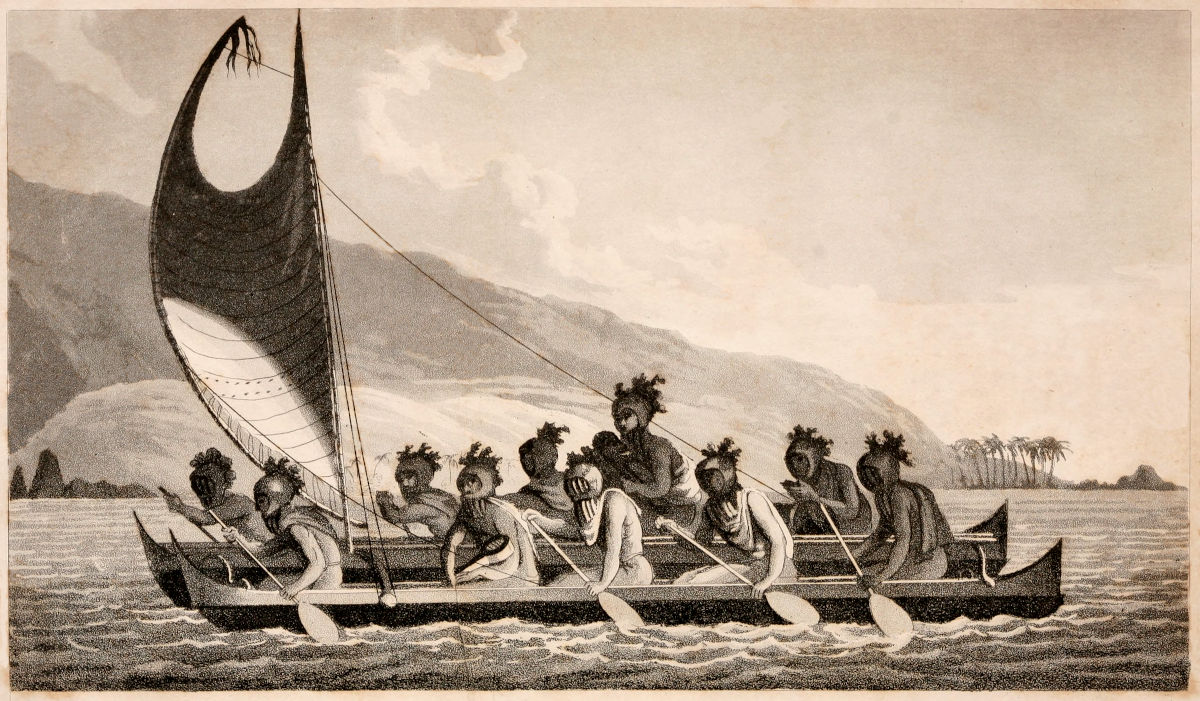
Canoe of the Sandwich Islands, the rowers masked.
iii
LONDON:
PRINTED FOR
LONGMAN, HURST, REES, ORME, AND BROWN,
PATERNOSTER-ROW.
1821.
CONTENTS OF THE SIXTH VOLUME . THIRD VOYAGE.
iv
BOOK III.
Transactions at Otaheite, and the Society Islands; and Prosecution of the Voyage to the Coast of North America.
An Eclipse of the Moon observed.—The Island Toobouai discovered.—Its Situation, Extent, and Appearance.—Intercourse with its Inhabitants.—Their Persons, Dresses, and Canoes, described.—Arrival in Oheitepeha Bay at Otaheite.—Omai’s Reception, and imprudent Conduct.—Account of Spanish Ships twice visiting the Island.—Interview with the Chief of this District.—The Olla, or God, of Bolabola.—A mad Prophet, Arrival in Matavai Bay
Interview with Otoo, King of the Island.—Imprudent Conduct of Omai.—Employments on Shore.—European Animals landed.—Particulars about a Native who had visited Lima.—About Oedidee.—A Revolt in Eimeo.—War with that Island determined upon, in a Council of Chiefs.—A human Sacrifice on that Account.—A particular Relation of the Ceremonies at the great Morai, where the Sacrifice was offered.—Other barbarous Customs of this people
Conference with Towha.—Heevas described.—Omai and Oedidee give Dinners.—Fireworks exhibited.—A remarkable Present of Cloth.—Manner of preserving the Body of a dead Chief.—Another human Sacrifice.—Riding on Horseback.—Otoo’s Attention to supply Provisions, and prevent Thefts.—Animals given to him.—Etary and the Deputies of a Chief have Audiences.—A Mock-fight of two War Canoes.—Naval Strength of these Islands.—Manner of Conducting a War
The Day of sailing fixed.—Peace made with Eimeo.—Debates about it, and Otoo’s Conduct blamed.—A Solemnity at the Morai on the Occasion, described by Mr. King.—Observations upon it.—Instance of Otoo’s Art.—Omai’s War Canoe, and Remarks upon his Behaviour.—Otoo’s Present, and Message to the King of Great Britain.—Reflections on our Manner of Traffic, and on the good Treatment we met with at Otaheite.—Account of the Expedition of the Spaniards.—Their Fictions to depreciate the English.—Wishes expressed that no Settlement may be made.—Omai’s jealousy of another Traveller
Arrival at Eimeo.—Two Harbours there, and an Account of them.—Visit from Maheine, Chief of the Island.—His Person described.—A Goat stolen, and sent back with the Thief.—Another Goat stolen, and secreted.—Measures taken on the Occasion.—Expedition cross the Island.—Houses and Canoes burnt.—The Goat delivered up, and Peace restored.—Some Account of the Island, &c.
Arrival at Huaheine.—Council of the Chiefs.—Omai’s Offerings, and Speech to the Chiefs.—His Establishment in this Island agreed to.—A House built, and Garden planted for him.—Singularity of his Situation.—Measures taken to insure his Safety.—Damage done by Cock-roaches, on board the Ships.—A Thief detected and punished.—Fireworks exhibited.—Animals left with Omai.—His Family.—Weapons.—Inscriptions on his House.—His Behaviour on the Ships leaving the Island.—Summary View of his Conduct and Character.—Account of the two New Zealand Youths
Arrival at Ulietea.—Astronomical Observations.—A Marine deserts, and is delivered up.—Intelligence from Omai.—Instructions to Captain Clerke.—Another Desertion of a Midshipman and a Seaman.—Three of the Chief Persons of the Island confined on that Account.—A Design to seize Captains Cook and Clerke, discovered.—The two Deserters brought back, and the Prisoners released.—The Ships sail.—Refreshments received at Ulietea.—Present and former State of that Island.—Account of its dethroned King, and of the late Regent of Huaheine
Arrival at Bolabola.—Interview with Opoony.—Reasons for purchasing Monsieur Bougainville’s Anchor.—Departure from the Society Islands.—Particulars about Bolabola.—History of the Conquest of Otaha and Ulietea.—High Reputation of the Bolabola Men.—Animals left there, and at Ulietea.—Plentiful Supply of Provisions, and Manner of salting Pork on board.—Various Reflections relative to Otaheite, and the Society Islands.—Astronomical and Nautical Observations made there
Accounts of Otaheite still imperfect.—The prevailing Winds.—Beauty of the Country.—Cultivation.—Natural Curiosities.—The Persons of the Natives.—Diseases.—General Character.—Love of Pleasure.—Language.—Surgery and Physic.—Articles of Food.—Effects of drinking Ava.—Times and Manner of Eating.—Connections with the Females.—Circumcision.—System of Religion.—Notions about the Soul and a future Life.—Various Superstitions.—Traditions about the Creation.—An Historical Legend.—Honours paid to the King.—Distinction of Ranks.—Punishment of Crimes.—Peculiarities of the neighbouring Islands.—Names of their Gods.—Names of Islands they visit.—Extent of their Navigation
Progress of the Voyage, after leaving the Society Islands.—Christmas Island discovered, and Station of the Ships there.—Boats sent ashore.—Great Success in catching Turtle.—An Eclipse of the Sun observed.—Distress of two Seamen who had lost their Way.—Inscription left in a Bottle.—Account of the Island.—Its Soil.—Trees and Plants.—Birds.—Its Size.—Form.—Situation.—Anchoring-ground
viiiSome Islands discovered.—Account of the Natives of Atooi, who come off to the Ships, and their Behaviour on going on board.—One of them killed.—Precautions used to prevent Intercourse with the Females.—A Watering-place found.—Reception upon landing.—Excursion into the Country.—A Morai visited and described.—Graves of the Chiefs, and of the human Sacrifices there buried.—Another Island, called Oneehow, visited.—Ceremonies performed by the Natives, who go off to the Ships.—Reasons for believing that they are Cannibals.—A Party sent ashore, who remain two Nights.—Account of what passed on landing.—The Ships leave the Islands, and proceed to the North
The Situation of the Islands now discovered.—Their Names.—Called the Sandwich Islands.—Atooi described.—The Soil.—Climate.—Vegetable Productions.—Birds.—Fish.—Domestic Animals.—Persons of the Inhabitants.—Their Disposition.—Dress—Ornaments.—Habitations.—Food.—Cookery.—Amusements.—Manufactures.—Working-tools.—Knowledge of Iron accounted for.—Canoes.—Agriculture.—Account of one of their Chiefs.—Weapons.—Customs agreeing with those of Tongataboo, and Otaheite.—Their Language the same.—Extent of this Nation throughout the Pacific Ocean.—Reflections on the useful Situation of the Sandwich Islands
Observations made at the Sandwich Islands, on the Longitude, Variation of the Compass and Tides.—Prosecution of the Voyage.—Remarks on the Mildness of the Weather, as far as the Latitude 44° North.—Paucity of Sea Birds, in the Northern Hemisphere.—Small Sea Animals described.—Arrival on the Coast of America.—Appearance of the Country.—Unfavourable Winds, and boisterous Weather.—Remarks on Martin d’Aguillar’s River, and Juan de Fuca’s pretended Strait.—An Inlet discovered, where the Ships anchor.—Behaviour of the Natives
233
BOOK IV.
Transactions amongst the Natives of North America; Discoveries along that Coast and the Eastern Extremity of Asia, Northward to Icy Cape; and Return Southward to the Sandwich Islands.
ixThe Ships enter the Sound, and moor in a Harbour.—Intercourse with the Natives.—Articles brought to barter.—Thefts committed.—The Observatories erected, and Carpenters set to work.—Jealousy of the Inhabitants of the Sound to prevent other Tribes having Intercourse with the Ships.—Stormy and rainy Weather.—Progress round the Sound.—Behaviour of the Natives at their Villages.—Their Manner of drying Fish, &c.—Remarkable Visit from Strangers, and introductory Ceremonies.—A second Visit to one of the Villages.—Leave to cut Grass, purchased.—The Ships sail.—Presents given and received at parting
The Name of the Sound, and Directions for sailing into it.—Account of the adjacent Country.—Weather.—Climate.—Trees.—Other vegetable Productions.—Quadrupeds, whose Skins were brought for Sale.—Sea Animals.—Description of a Sea Otter.—Birds.—Water Fowl.—Fish.—Shell-fish, &c.—Reptiles.—Insects.—Stones, &c.—Persons of the Inhabitants.—Their Colour.—Common Dress and Ornaments.—Occasional Dresses and monstrous Decorations of Wooden Masks.—Their general Dispositions.—Songs.—Musical Instruments.—Their Eagerness to possess Iron and other Metals
Manner of building the Houses in Nootka Sound.—Inside of them described.—Furniture and Utensils.—Wooden Images.—Employments of the Men.—Of the Women.—Food, Animal and Vegetable.—Manner of preparing it.—Weapons.—Manufactures and Mechanic Arts.—Carving and Painting.—Canoes.—Implements for Fishing and Hunting.—Iron Tools.—Manner of procuring that Metal.—Remarks on their Language, and a Specimen of it.—Astronomical and Nautical Observations made in Nootka Sound
A Storm after sailing from Nootka Sound.—Resolution springs a Leak.—Pretended Strait of Admiral de Fonte passed unexamined.—Progress along the Coast of America.—Beering’s Bay.—Kaye’s Island.—Account of it.—The Ships come to Anchor.—Visited by the Natives.—Their Behaviour.—Fondness for Beads and Iron.—Attempt to plunder the Discovery.—Resolution’s Leak stopped.—Progress up the Sound.—Messrs. Gore and Roberts sent to examine its Extent.—Reasons against a Passage to the North through it.—The Ships proceed down it, to the open Sea
xThe Inlet called Prince William’s Sound.—Its Extent.—Persons of the Inhabitants described.—Their Dress.—Incision of their under Lip.—Various other Ornaments.—Their Boats.—Weapons, fishing and hunting Instruments.—Utensils.—Tools.—Uses Iron is applied to.—Food.—Language, and a Specimen of it.—Animals.—Birds.—Fish.—Iron and Beads, whence received
Progress along the Coast.—Cape Elizabeth.—Cape St. Hermogenes.—Accounts of Beering’s Voyage very defective.—Point Banks.—Cape Douglas.—Cape Bede.—Mount St. Augustin.—Hopes of finding a Passage up an Inlet.—The Ships proceed up it.—Indubitable Marks of its being a River.—Named Cook’s River.—The Ships return down it.—Various Visits from the Natives.—Lieutenant King lands, and takes possession of the Country.—His Report.—The Resolution runs aground on a Shoal.—Reflections on the Discovery of Cook’s River.—The considerable Tides in it accounted for
Discoveries after leaving Cook’s River.—Island of St. Hermogenes.—Cape Whitsunday.—Cape Greville.—Cape Barnabas.—Two-headed Point.—Trinity Island.—Beering’s Foggy Island.—A beautiful Bird described.—Kodiak, and the Schumagin Islands.—A Russian Letter brought on board by a Native.—Conjectures about it.—Rock Point.—Halibut Island.—A Volcano Mountain.—Providential Escape.—Arrival of the Ships at Oonalaschka.—Intercourse with the Natives there.—Another Russian Letter.—Samganoodha Harbour described
Progress northward, after leaving Oonalashka.—The Islands Oonella and Acootan.—Ooneemak.—Shallowness of the Water along the Coast.—Bristol Bay.—Round Island.—Calm Point.—Cape Newenham.—Lieutenant Williamson lands, and his Report.—Bristol Bay, and its extent.—The Ships obliged to return, on account of Shoals.—Natives come off to the Ships.—Death of Mr. Anderson; his Character; and Island named after him.—Point Rodney.—Sledge Island, and Remarks on landing there.—King’s Island.—Cape Prince of Wales, the western Extreme of America.—Course westward.—Anchor in a Bay on the Coast of Asia
xiBehaviour of the Natives, the Tschutski, on seeing the Ships.—Interview with some of them.—Their Weapons.—Persons.—Ornaments.—Clothing.—Winter and Summer Habitations.—The Ships cross the Strait to the Coast of America.—Progress northward.—Cape Mulgrave.—Appearance of Fields of Ice.—Situation of Icy Cape.—The Sea blocked up with Ice.—Sea-horses killed, and used as Provisions.—These Animals described.—Dimensions of one of them.—Cape Lisburne.—Fruitless Attempts to get through the Ice, at a Distance from the Coast.—Observations on the Formation of this Ice.—Arrival on the Coast of Asia.—Cape North.—The Prosecution of the Voyage deferred to the ensuing Year
Return from Cape North, along the Coast of Asia.—Views of the Country.—Burney’s Island.—Cape Serdze Kamen, the northern Limit of Beering’s Voyage.—Pass the East Cape of Asia.—Description and Situation of it.—Observations on Muller.—The Tschutski.—Bay of St. Laurence.—Two other Bays, and Habitations of the Natives.—Beering’s Cape Tschukotskoi.—Beering’s Position of this Coast accurate.—Island of Saint Laurence.—Pass to the American Coast.—Cape Darby.—Bald Head.—Cape Denbigh, on a Peninsula.—Besborough Island.—Wood and Water procured.—Visits from the Natives.—Their Persons and Habitations.—Produce of the Country.—Marks that the Peninsula had formerly been surrounded by the Sea.—Lieutenant King’s Report.—Norton Sound.—Lunar Observations there.—Stæhlin’s Map proved to be erroneous.—Plan of future Operations
Discoveries after leaving Norton Sound.—Stuart’s Island.—Cape Stephens.—Point Shallow-water.—Shoals on the American Coast.—Clerke’s Island.—Gore’s Island.—Pinnacle Island.—Arrival at Oonalashka.—Intercourse with the Natives and Russian Traders.—Charts of the Russian Discoveries, communicated by Mr. Ismyloff.—Their Errors pointed out.—Situation of the Islands visited by the Russians.—Account of their Settlement at Oonalashka.—Of the Natives of the Island.—Their Persons.—Dress.—Ornaments.—Food.—Houses, and domestic Utensils.—Manufactures.—Manner of producing Fire.—Canoes.—Fishing and hunting Implements.—Fishes, and Sea Animals.—Sea and Water Fowls, and Land Birds.—Land Animals and Vegetables.—Manner of burying their Dead.—Resemblance of the Natives on this Side of America to the Greenlanders and Esquimaux.—Tides.—Observations for determining the Longitude of Oonalashka
Departure from Oonalashka, and future Views.—The Island Amoghta.—Situation of a remarkable Rock.—The Strait between Oonalashka and Oonella repassed.—Progress to the South.—Melancholy Accident on board the Discovery.—Mowee, one of the Sandwich Islands discovered.—Intercourse with the Natives.—Visit from Terreeoboo.—Another Island, called Owhyhee, discovered.—The Ships ply to windward to get round it.—An Eclipse of the Moon observed.—The Crew refuse to drink Sugar-cane Beer.—Cordage deficient in Strength.—Commendation of the Natives of Owhyhee.—The Resolution gets to windward of the Island.—Her Progress down the South-east Coast.—Views of the Country, and Visits from the Natives.—The Discovery joins.—Slow Progress westward.—Karakakooa Bay examined by Mr. Bligh.—Vast Concourse of the Natives.—The Ships anchor in the Bay
481
1A
VOYAGE
TO THE
PACIFIC OCEAN,
TO DETERMINE
THE POSITION AND EXTENT OF THE WEST SIDE OF NORTH AMERICA;
ITS DISTANCE FROM ASIA; AND THE PRACTICABILITY
OF A NORTHERN PASSAGE TO EUROPE.
PERFORMED UNDER THE DIRECTION OF
CAPTAINS COOK, CLERKE, AND GORE,
IN HIS MAJESTY’S SHIPS THE RESOLUTION AND DISCOVERY,
IN THE YEARS 1776, 1777, 1778, 1779, AND 1780.
VOL. II.
WRITTEN BY CAPTAIN COOK.
2A
VOYAGE
TO
THE PACIFIC OCEAN.
BOOK III.
TRANSACTIONS AT OTAHEITE, AND THE SOCIETY
ISLANDS; AND PROSECUTION OF THE VOYAGE TO
THE COAST OF NORTH AMERICA.
CHAP. I.
AN ECLIPSE OF THE MOON OBSERVED.—THE ISLAND
TOOBOUAI DISCOVERED.—ITS SITUATION, EXTENT, AND
APPEARANCE.—INTERCOURSE WITH ITS INHABITANTS.—THEIR
PERSONS, DRESSES, AND CANOES DESCRIBED.—ARRIVAL
IN OHEITEPEHA BAY AT OTAHEITE.—OMAI’S
RECEPTION, AND IMPRUDENT CONDUCT.—ACCOUNT OF
SPANISH SHIPS TWICE VISITING THE ISLAND.—INTERVIEW
WITH THE CHIEF OF THIS DISTRICT.—THE OLLA,
OR GOD, OF BOLABOLA.—A MAD PROPHET.—ARRIVAL IN
MATAVAI BAY.
Having, as before related[1], taken our final leave
of the Friendly Islands, I now resume my narrative
of the voyage. In the evening of the 17th of July,
at eight o’clock, the body of Eaoo bore north-east
by north, distant three or four leagues. The wind
was now at east, and blew a fresh gale. With it I
stood to the south, till half an hour past six o’clock
the next morning, when a sudden squall from the
4same direction took our ship aback; and before the
ships could be trimmed, on the other tack, the main-sail
and the top-gallant sails were much torn.
The wind kept between the south-west, and south-east,
on the 19th and 20th; afterward it veered to
the east, north-east, and north. The night between
the 20th and 21st, an eclipse of the moon was
observed as follows; being then in the latitude of 22°
571⁄2ʹ
south:
Apparent time, A. M.
H.
M.
S.
Beginning, by
Mr. King, at
0
32
50
Mean long. 186° 571⁄2ʹ.
Mr. Bligh, at
0
33
25
Myself, at
0
33
35
End, by
Mr. King, at
1
44
56
Mean long. 186° 281⁄2ʹ. Time keep. 186° 581⁄2ʹ.
Mr. Bligh, at
1
44
6
Myself, at
1
44
56
The latitude and longitude are those of the ship,
at 8h 56m A. M., being the time when the sun’s altitude
was taken for finding the apparent time. At the beginning
of the eclipse, the moon was in the zenith;
so that it was found most convenient to make use of
the sextants; and to make the observations by the
reflected image, which was brought down to a convenient
altitude. The same was done at the end;
except by Mr. King, who observed with a night telescope.
Although the greatest difference between
our several observations is more than fifty seconds,
it, nevertheless, appeared to me, that two observers
might differ more than double that time, in both the
beginning and end. And though the times are noted
to seconds, no such accuracy was pretended to. The
odd seconds, set down above, arose by reducing the
time, as given by the watch, to apparent time.
I continued to stretch to the east south-east, with
the wind at north-east and north, without meeting
with any thing worthy of note, till seven o’clock in
the evening of the 29th; when we had a sudden and
5very heavy squall of wind from the north. At this
time, we were under single-reefed top-sails, courses,
and stay-sails. Two of the latter were blown to
pieces; and it was with difficulty that we saved the
other sails. After this squall, we observed several
lights moving about on board the Discovery; by which
we concluded that something had given way; and,
the next morning, we saw that her main-top-mast
had been lost. Both wind and weather continued
very unsettled till noon, this day, when the latter
cleared up, and the former settled in the north-west
quarter. At this time, we were in the latitude of
28° 6ʹ south, and our longitude was 198° 23ʹ east.
Here we saw some pintado birds, being the first since
we left the land.
On the 31st, at noon, Captain Clerke made a signal
to speak with me. By the return of the boat,
which I sent on board his ship, he informed me, that
the head of the main-mast had been discovered to be
sprung, in such a manner, as to render the rigging
of another top-mast very dangerous; and that, therefore,
he must rig something lighter in its place. He
also informed me, that he had lost his main-top-gallantyard;
and that he neither had another, nor a
spar to make one, on board. The Resolution’s sprit-sail
top-sail-yard, which I sent him, supplied this
want. The next day, we got up a jury top-mast, on
which he set a mizen-top-sail; and this enabled him to
keep way with the Resolution.
The wind was fixed in the western board; that is,
from the north, round by the west to south, and I
steered east, and north-east, without meeting with
any thing remarkable, till eleven o’clock in the morning
of the 8th of August, when the land was seen,
bearing north north-east, nine or ten leagues distant.
At first, it appeared in detached hills, like so many
separate islands; but as we drew nearer, we found
that they were all connected, and belonged to one and
the same island. I steered directly for it, with a fine
6gale at south-east by south; and at half-past six o’clock
in the afternoon, it extended from north by east, to
north north-east
3⁄4
east, distant three or four leagues.
The night was spent standing off and on; and, at
day-break, the next morning, I steered for the north-west,
or lee-side of the island; and, as we stood
round its south, or south-west part, we saw it every
where guarded by a reef of coral rock, extending,
in some places, a full mile from the land, and a high
surf breaking upon it. Some thought that they saw
land to the southward of this island; but, as that
was to the windward, it was left undetermined. As
we drew near, we saw people on several parts of the
coast, walking, or running along shore; and, in
a little time, after we had reached the lee-side of the
island, we saw them launch two canoes, into which
above a dozen men got, and paddled toward us.
I now shortened sail, as well to give these canoes
time to come up with us, as to sound for anchorage.
At the distance of about half a mile from the reef,
we found from forty to thirty-five fathoms’ water, over
a bottom of fine sand. Nearer in, the bottom was
strewed with coral rocks. The canoes having advanced
to about the distance of a pistol-shot from the
ship, there stopped. Omai was employed, as he
usually had been on such occasions, to use all his
eloquence to prevail upon the men in them to come
nearer; but no intreaties could induce them to trust
themselves within our reach. They kept eagerly
pointing to the shore with their paddles, and calling
to us to go thither; and several of their countrymen,
who stood upon the beach, held up something white,
which we considered also as an invitation to land.
We could very well have done this, as there was
good anchorage without the reef, and a break or
opening in it, from whence the canoes had come out,
which had no surf upon it, and where, if there was
not water for the ships, there was more than sufficient
for the boats. But I did not think proper to
7risk losing the advantage of a fair wind, for the sake
of examining an island that appeared to be of little
consequence. We stood in no need of refreshments,
if I had been sure of meeting with them there; and
having already been so unexpectedly delayed in
my progress to the Society Islands, I was desirous of
avoiding every possibility of farther retardment. For
this reason, after making several unsuccessful attempts
to induce these people to come alongside, I made
sail to the north, and left them; but not without
getting from them, during their vicinity to our ship,
the name of their island, which they called Toobouai.
It is situated in the latitude of 22° 15ʹ south; and
in 210° 37ʹ east longitude. Its greatest extent, in
any direction, exclusive of the reef, is not above five
or six miles. On the north-west side, the reef appears
in detached pieces, between which, the sea
seems to break in upon the shore. Small as the island
is, there are hills in it of a considerable elevation.
At the foot of the hills, is a narrow border of flat
land, running quite round it, edged with a white
sand beach. The hills are covered with grass, or some
other herbage, except a few steep, rocky cliffs at one
part, with patches of trees interspersed to their summits.
But the plantations are more numerous in some of
the valleys; and the flat border is quite covered with
high, strong trees, whose different kinds we could
not discern, except some cocoa-palms, and a few of the
etoa. According to the information of the men in
the canoes, their island is stocked with hogs and
fowls; and produces the several fruits and roots that
are found at the other islands in this part of the Pacific
Ocean.
We had an opportunity, from the conversation we
had with those who came off to us, of satisfying ourselves,
that the inhabitants of Toobouai speak the
Otaheite language; a circumstance that indubitably
proves them to be of the same nation. Those of
them whom we saw in the canoes, were a stout copper-coloured
8people, with straight black hair, which
some of them wore tied in a bunch on the crown of
the head, and others, flowing about the shoulders.
Their faces were somewhat round and full, but the
features, upon the whole, rather flat; and their
countenances seemed to express some degree of natural
ferocity. They had no covering but a piece of
narrow stuff wrapped about the waist, and made to
pass between the thighs, to cover the adjoining parts;
but some of those whom we saw upon the beach,
where about a hundred persons had assembled, were
entirely clothed with a kind of white garment. We
could observe, that some of our visitors, in the canoes,
wore pearl shells, hung about the neck, as an ornament.
One of them kept blowing a large conch-shell,
to which a reed, near two feet long, was fixed; at
first, with a continued tone of the same kind; but he,
afterward, converted it into a kind of musical instrument,
perpetually repeating two or three notes, with
the same strength. What the blowing the conch
portended, I cannot say; but I never found it the
messenger of peace.
Their canoes appeared to be about thirty feet long,
and two feet above the surface of the water as they
floated. The forepart projected a little, and had a
notch cut across, as if intended to represent the
mouth of some animal. The afterpart rose with a
gentle curve to the height of two or three feet,
turning gradually smaller, and, as well as the upper
part of the sides, was carved all over. The rest
of the sides, which were perpendicular, were curiously
incrusted with flat, white shells, disposed nearly
in concentric semicircles, with the curve upward.
One of the canoes carried seven, and the other eight,
men; and they were managed with small paddles,
whose blades were nearly round. Each of them had
a pretty long outrigger; and they sometimes paddled
with the two opposite sides together so close, that they
seemed to be one boat with two outriggers; the rowers
9turning their faces occasionally to the stern, and pulling
that way, without paddling the canoes round. When
they saw us determined to leave them, they stood up
in their canoes, and repeated something very loudly
in concert; but we could not tell whether this was
meant as a mark of their friendship or enmity. It is
certain, however, that they had no weapons with
them; nor could we perceive, with our glasses, that
those on shore had any.
After leaving this island, from the discovery of
which future navigators may possibly derive some
advantage, I steered to the north, with a fresh gale
at E. by S., and at day-break in the morning of
the 12th, we saw the island of Maitea. Soon
after, Otaheite made its appearance; and at noon it
extended from S. W. by W. to W. N. W.; the point of
Oheitepeha Bay bearing W., about four leagues distant.
I steered for this bay, intending to anchor
there, in order to draw what refreshments I could
from the south-east part of the island, before I went
down to Matavai; from the neighbourhood of which
station I expected my principal supply. We had a
fresh gale easterly, till two o’clock in the afternoon;
when, being about a league from the bay, the wind
suddenly died away, and was succeeded by baffling,
light airs from every direction, and calms by turns.
This lasted about two hours. Then we had sudden
squalls, with rain, from the east. These carried us
before the bay, where we got a breeze from the land,
and attempted in vain to work in to gain the anchoring
place. So that, at last, about nine o’clock, we
were obliged to stand out, and to spend the night at
sea.
When we first drew near the island, several canoes
came off to the ship, each conducted by two or three
men; but as they were common fellows, Omai took
no particular notice of them, nor they of him. They
did not even seem to perceive that he was one of
their countrymen, although they conversed with him
10for some time. At length, a chief whom I had
known before, named Ootee, and Omai’s brother-in-law,
who chanced to be now at this corner of the island,
and three or four more persons, all of whom knew
Omai before he embarked with Captain Furneaux,
came on board. Yet there was nothing either tender
or striking in their meeting. On the contrary, there
seemed to be a perfect indifference on both sides, till
Omai, having taken his brother down into the cabin,
opened the drawer where he kept his red feathers,
and gave him a few. This being presently known
amongst the rest of the natives upon deck, the face
of affairs was entirely turned, and Ootee, who would
hardly speak to Omai before, now begged that they
might be tayos[2], and exchange names. Omai accepted
of the honour, and confirmed it with a present
of red feathers; and Ootee, by way of return, sent
ashore for a hog. But it was evident to every one of
us, that it was not the man, but his property they were
in love with. Had he not shown them his treasure of
red feathers, which is the commodity in greatest estimation
at the island, I question much whether they
would have bestowed even a cocoa-nut upon him.
Such was Omai’s first reception among his countrymen.
I own, I never expected it would be otherwise;
but still, I was in hopes that the valuable
cargo of presents with which the liberality of his
friends in England had loaded him, would be the
means of raising him into consequence, and of
making him respected, and even courted by the
first persons throughout the extent of the Society
Islands. This could not but have happened, had
he conducted himself with any degree of prudence;
but instead of it, I am sorry to say, that he paid too
little regard to the repeated advice of those who
wished him well, and suffered himself to be duped by
every designing knave.
11From the natives who came off to us in the course
of this day, we learnt that two ships had twice been
in Oheitepeha Bay since my last visit to this island in
1774, and that they had left animals there, such as
we had on board. But, on farther inquiry, we found
they were only hogs, dogs, goats, one bull, and the
male of some other animal, which, from the imperfect
description now given us, we could not find out.
They told us that these ships had come from a place
called Reema; by which we guessed that Lima, the
capital of Peru, was meant, and that these late
visitors were Spaniards. We were informed, that the
first time they came, they built a house and left four
men behind them, viz. two priests, a boy or servant,
and a fourth person called Mateema, who was much
spoken of at this time; carrying away with them,
when they sailed, four of the natives; that in about
ten months, the same two ships returned, bringing
back two of the islanders, the other two having died
at Lima; and that, after a short stay, they took away
their own people; but that the house which they had
built was left standing.
The important news of red feathers being on board
our ships, having been conveyed on shore by Omai’s
friends, day had no sooner begun to break next
morning, than we were surrounded by a multitude of
canoes crowded with people, bringing hogs and
fruit to market. At first, a quantity of feathers,
not greater than what might be got from a tomtit,
would purchase a hog of forty or fifty
pounds’ weight. But as almost every body in the
ships was possessed of some of this precious article in
trade, it fell in its value above five hundred per cent.
before night. However, even then, the balance
was much in our favour; and red feathers continued
to preserve their superiority over every other commodity.
Some of the natives would not part with
a hog, unless they received an axe in exchange; but
nails, and beads, and other trinkets, which, during
12our former voyages had so great a run at this island,
were now so much despised, that few would deign so
much as to look at them.
There being but little wind all the morning, it
was nine o’clock before we could get to an anchor in
the bay; where we moored with two bowers. Soon
after we had anchored, Omai’s sister came on board
to see him. I was happy to observe, that, much to
the honour of them both, their meeting was marked
with expressions of the tenderest affection, easier to
be conceived than to be described.
This moving scene having closed, and the ship
being properly moored, Omai and I went ashore.
My first object was to pay a visit to a man whom my
friend represented as a very extraordinary personage
indeed, for he said that he was the god of Bolabola.
We found him seated under one of those small awnings
which they usually carry in their larger canoes.
He was an elderly man, and lost the use of his limbs,
so that he was carried from place to place upon a hand-barrow.
Some called him Olla or Orra, which is the
name of the god of Bolabola; but his own proper
name was Etary. From Omai’s account of this person,
I expected to have seen some religious adoration
paid to him. But, excepting some plantain
trees that lay before him, and upon the awning
under which he sat, I could observe nothing by which
he might be distinguished from their other chiefs.
Omai presented to him a tuft of red feathers, tied to
the end of a small stick; but, after a little conversation
on indifferent matters with this Bolabola man,
his attention was drawn to an old woman, the sister
of his mother. She was already at his feet, and had
bedewed them plentifully with tears of joy.
I left him with the old lady in the midst of a number
of people who had gathered round him, and
went to take a view of the house said to be built by
the strangers who had lately been here. I found it
standing at a small distance from the beach. The
13wooden materials of which it was composed seemed
to have been brought hither ready prepared, to be set
up occasionally, for all the planks were numbered.
It was divided into two small rooms; and in the
inner one were, a bedstead, a table, a bench, some
old hats, and other trifles, of which the natives
seemed to be very careful, as also of the house itself,
which had suffered no hurt from the weather, a shed
having been built over it. There were scuttles all
around which served as air-holes; and, perhaps, they
were also meant to fire from, with muskets, if ever
this should be found necessary. At a little distance
from the front stood a wooden cross, on
the transverse part of which was cut the following
inscription:
Christus vincit.
And, on the perpendicular part (which confirmed our
conjecture, that the two ships were Spanish,)
Carolus III. imperat. 1774.
On the other side of the post, I preserved the memory
of the prior visits of the English, by inscribing,
Georgius tertius Rex,
Annis 1767,
1769, 1773, 1774, & 1777.
The natives pointed out to us, near the foot of the
cross, the grave of the commodore of the two ships,
who had died here, while they lay in the bay the first
time. His name, as they pronounced it, was Oreede.
Whatever the intentions of the Spaniards in visiting
this island might be, they seemed to have taken
great pains to ingratiate themselves with the inhabitants,
who, upon every occasion, mentioned them
with the strongest expressions of esteem and veneration.
14I met with no chief of any considerable note on
this occasion, excepting the extraordinary personage
above described. Waheiadooa, the sovereign of
Tiaraboo (as this part of the island is called,) was
now absent; and I afterwards found, that he was
not the same person, though of the same name with
the chief whom I had seen here during my last voyage;
but his brother, a boy of about ten years of age,
who had succeeded upon the death of the elder Waheiadooa,
about twenty months before our arrival.
We also learned, that the celebrated Oberea was dead;
but that Otoo, and all our other friends, were living.
When I returned from viewing the house and cross
erected by the Spaniards, I found Omai holding forth
to a large company; and it was with some difficulty
that he could be got away, to accompany me on
board; where I had an important affair to settle.
As I knew that Otaheite and the neighbouring
islands could furnish us with a plentiful supply of
cocoa-nuts, the liquor of which is an excellent succedaneum
for any artificial beverage, I was desirous
of prevailing upon my people to consent to be abridged,
during our stay here, of their stated allowance of
spirits to mix with water. But as this stoppage of
a favourite article, without assigning some reason,
might have occasioned a general murmur, I thought
it most prudent to assemble the ship’s company, and
to make known to them the intent of the voyage, and
the extent of our future operations. To induce
them to undertake which with cheerfulness and perseverance,
I took notice of the rewards offered by
Parliament to such of his Majesty’s subjects, as shall
first discover a communication between the Atlantic
and Pacific Oceans, in any direction whatever, in the
northern hemisphere: and also to such as shall first
penetrate beyond the 89th degree of northern latitude.
I made no doubt, I told them, that I should
find them willing to co-operate with me in attempting,
15as far as might be possible, to become entitled
to one or both these rewards; but that, to give us
the best chance of succeeding, it would be necessary
to observe the utmost economy in the expenditure
of our stores and provisions, particularly the latter,
as there was no probability of getting a supply any
where after leaving these islands. I strengthened
my argument, by reminding them, that our voyage
must last at least a year longer than had been originally
supposed, by our having already lost the opportunity
of getting to the North this summer. I begged
them to consider the various obstructions and difficulties
we might still meet with, and the aggravated
hardships they would labour under, if it should be
found necessary to put them to short allowance of
any species of provisions in a cold climate. For
these very substantial reasons, I submitted to them,
whether it would not be better to be prudent in time,
and rather than to run the risk of having no spirits
left, when such a cordial would be most wanted, to
consent to be without their grog now, when we had
so excellent a liquor as that of cocoa-nuts to substitute
in its place; but that, after all, I left the determination
entirely to their own choice.
I had the satisfaction to find, that this proposal did
not remain a single moment under consideration;
being unanimously approved of, immediately, without
any objection. I ordered Captain Clerke to make
the same proposal to his people; which they also
agreed to. Accordingly, we stopped serving grog,
except on Saturday nights, when the companies of
both ships had full allowance of it, that they might
drink the healths of their female friends in England;
lest these, amongst the pretty girls of Otaheite, should
be wholly forgotten.
The next day we began some necessary operations;
to inspect the provisions that were in the main
and forehold; to get the casks of beef and pork, and
the coals out of the ground tier; and to put some
16ballast in their place. The caulkers were set to work
to caulk the ship, which she stood in great need of;
having, at times, made much water on our passage
from the Friendly Islands. I also put on shore the
bull, cows, horses, and sheep, and appointed two men
to look after them while grazing; for I did not intend
to leave any of them at this part of the island.
During the two following days, it hardly ever
ceased raining. The natives, nevertheless, came to
us from every quarter, the news of our arrival having
rapidly spread. Waheiadooa, though at a distance,
had been informed of it; and, in the afternoon of the
16th, a chief, named Etorea, under whose tutorage
he was, brought me two hogs as a present from him;
and acquainted me, that he himself would be with us
the day after. And so it proved; for I received a
message from him the next morning, notifying his
arrival, and desiring I would go ashore to meet him.
Accordingly, Omai and I prepared to pay him a formal
visit. On this occasion, Omai, assisted by some
of his friends, dressed himself, not after the English
fashion, nor that of Otaheite, nor that of Tongataboo,
nor in the dress of any country upon earth, but in a
strange medley of all that he was possessed of.
Thus equipped, on our landing, we first visited
Etary; who, carried on a hand barrow, attended us
to a large house, where he was set down; and we
seated ourselves on each side of him. I caused a
piece of Tongataboo-cloth to be spread out before
us, on which I laid the presents I intended to make.
Presently the young chief came, attended by his
mother, and several principal men, who all seated
themselves, at the other end of the cloth, facing us.
Then a man who sat by me, made a speech, consisting
of short and separate sentences; part of which was
dictated by those about him. He was answered by
one from the opposite side, near the chief. Etary
spoke next; then Omai; and both of them were
answered from the same quarter. These orations
were entirely about my arrival, and connections with
17them. The person who spoke last, told me, amongst
other things, that the men of Reema, that is, the
Spaniards, had desired them not to suffer me to come
into Oheitepeha Bay, if I should return any more to
the island, for that it belonged to them; but that
they were so far from paying any regard to this request,
that he was authorised now to make a formal
surrender of the province of Tiaraboo to me, and of
every thing in it; which marks very plainly, that these
people are no strangers to the policy of accommodating
themselves to present circumstances. At length,
the young chief was directed, by his attendants, to
come and embrace me; and, by way of confirming
this treaty of friendship, we exchanged names. The
ceremony being closed, he and his friends accompanied
me on board to dinner.
Omai had prepared a maro, composed of red and
yellow feathers, which he intended for Otoo, the
king of the whole island; and, considering where we
were, it was a present of very great value. I said all
that I could to persuade him not to produce it now,
wishing him to keep it on board till an opportunity
should offer of presenting it to Otoo, with his own
hands. But he had too good an opinion of the honesty
and fidelity of his countrymen to take my advice.
Nothing would serve him, but to carry it
ashore, on this occasion, and to give it to Waheiadooa,
to be by him forwarded to Otoo, in order to its being
added to the royal maro. He thought, by this
management, that he should oblige both chiefs;
whereas he highly disobliged the one, whose favour
was of the most consequence to him, without gaining
any reward from the other. What I had foreseen
happened. For Waheiadooa kept the maro for
himself, and only sent to Otoo a very small piece of
feathers; not the twentieth part of what belonged to
the magnificent present.
On the 19th, this young chief made me a present
of ten or a dozen hogs, a quantity of fruit, and some
18cloth. In the evening we played off some fireworks,
which both astonished and entertained the
numerous spectators.
This day, some of our gentlemen, in their walks,
found, what they were pleased to call, a Roman Catholic
chapel. Indeed, from their account, this was
not to be doubted; for they described the altar and
every other constituent part of such a place of worship.
However, as they mentioned, at the same time,
that two men, who had the care of it, would not suffer
them to go in, I thought that they might be mistaken,
and had the curiosity to pay a visit to it myself.
The supposed chapel proved to be a toopapaoo,
in which the remains of the late Waheiadooa lay, as
it were, in state. It was in a pretty large house,
which was inclosed with a low pallisade. The toopapaoo
was uncommonly neat, and resembled one of
those little houses, or awnings, belonging to their
large canoes. Perhaps it had originally been employed
for that purpose. It was covered, and hung
round, with cloth and mats of different colours, so as
to have a pretty effect. There was one piece of scarlet
broad-cloth, four or five yards in length, conspicuous
among the other ornaments; which, no doubt,
had been a present from the Spaniards. This cloth,
and a few tassels of feathers, which our gentlemen
supposed to be silk, suggested to them the idea of a
chapel; for whatever else was wanting to create a
resemblance, their imagination supplied; and if they
had not previously known, that there had been Spaniards
lately here, they could not possibly have made
the mistake. Small offerings of fruit and roots seemed
to be daily made at this shrine, as some pieces were
quite fresh. These were deposited upon a whatta,
or altar, which stood without the pallisades; and
within these we were not permitted to enter. Two
men constantly attended, night and day, not only to
watch over the place, but also to dress and undress
the toopapaoo. For when I first went to survey it,
19the cloth and its appendages were all rolled up; but,
at my request, the two attendants hung it out in order,
first dressing themselves in clean white robes. They
told me, that the chief had been dead twenty months.
Having taken in a fresh supply of water, and
finished all our other necessary operations, on the 22d,
I brought off the cattle and sheep, which had been
put on shore here to graze; and made ready for sea.
In the morning of the 23d, while the ships were
unmooring, Omai and I landed, to take leave of the
young chief. While we were with him, one of those
enthusiastic persons, whom they call Eatooas, from a
persuasion that they are possessed with the spirit of
the Divinity, came and stood before us. He had all
the appearance of a man not in his right senses; and
his only dress was a large quantity of plantain leaves,
wrapped round his waist. He spoke in a low, squeaking
voice, so as hardly to be understood; at least,
not by me. But Omai said, that he comprehended
him perfectly, and that he was advising Waheiadooa
not to go with me to Matavai; an expedition which
I had never heard he intended, nor had I ever made
such a proposal to him. The Eatooa also foretold,
that the ships would not get to Matavai that day.
But in this he was mistaken; though appearances
now rather favoured his prediction, there not being
a breath of wind in any direction. While he was
prophesying, there fell a very heavy shower of rain,
which made every one run for shelter but himself,
who seemed not to regard it. He remained squeaking
by us about half an hour, and then retired. No
one paid any attention to what he uttered; though
some laughed at him. I asked the Chief, what he
was, whether an Earee, or Towtow? and the answer
I received was, that he was taato eno; that is, a bad
man. And yet, notwithstanding this, and the little
notice any of the natives seemed to take of the mad
prophet, superstition has so far got the better of their
reason, that they firmly believe such persons to be
20possessed with the spirit of the Eatooa. Omai seemed
to be very well instructed about them. He said, that,
during the fits that came upon them, they knew nobody,
not even their most intimate acquaintances; and that,
if any one of them happens to be a man of property,
he will very often give away every moveable he is
possessed of, if his friends do not put them out of his
reach; and, when he recovers, will inquire what had
become of those very things, which he had, but just
before, distributed; not seeming to have the least remembrance
of what he had done while the fit was
upon him.
As soon as I got on board, a light breeze springing
up at east, we got under sail, and steered for Matavai
Bay[3]; where the Resolution anchored the same
evening. But the Discovery did not get in till the
next morning; so that half of the man’s prophecy
was fulfilled.
CHAP. II.
21
INTERVIEW WITH OTOO, KING OF THE ISLAND.—IMPRUDENT
CONDUCT OF OMAI.—EMPLOYMENTS ON SHORE.—EUROPEAN
ANIMALS LANDED.—PARTICULARS ABOUT A
NATIVE WHO HAD VISITED LIMA—ABOUT OEDIDEE.—A
REVOLT IN EIMEO.—WAR WITH THAT ISLAND DETERMINED
UPON, IN A COUNCIL OF CHIEFS.—A HUMAN SACRIFICE
ON THAT ACCOUNT.—A PARTICULAR RELATION OF
THE CEREMONIES AT THE GREAT MORAI, WHERE THE SACRIFICE
WAS OFFERED.—OTHER BARBAROUS CUSTOMS OF
THIS PEOPLE.
About nine o’clock in the morning, Otoo, the king
of the whole island, attended by a great number of
canoes full of people, came from Oparre, his place
of residence, and having landed on Matavai Point,
sent a message on board, expressing his desire to see
me there. Accordingly I landed, accompanied by
Omai, and some of the officers. We found a prodigious
number of people assembled on this occasion,
and in the midst of them was the king, attended by
his father, his two brothers, and three sisters. I went
up first and saluted him, being followed by Omai,
who kneeled and embraced his legs. He had prepared
himself for this ceremony, by dressing himself
in his very best suit of clothes, and behaved with a
great deal of respect and modesty. Nevertheless,
very little notice was taken of him. Perhaps envy had
some share in producing this cold reception. He made
the chief a present of a large piece of red feathers,
and about two or three yards of gold cloth; and I
gave him a suit of fine linen, a gold-laced hat, some
tools, and, what was of more value than all the other
articles, a quantity of red feathers, and one of the
bonnets in use at the Friendly Islands.
After the hurry of this visit was over, the king
and the whole royal family accompanied me on
22board, followed by several canoes, laden with all
kind of provisions, in quantity sufficient to have served
the companies of both ships for a week. Each of
the family owned, or pretended to own, a part; so
that I had a present from every one of them; and
every one of them had a separate present in return
from me; which was the great object in view. Soon
after, the king’s mother, who had not been present
at the first interview, came on board, bringing with
her a quantity of provisions and cloth, which she divided
between me and Omai; for, although he was
but little noticed at first by his countrymen, they
no sooner gained the knowledge of his riches, than
they began to court his friendship. I encouraged
this as much as I could: for it was my wish to fix
him with Otoo. As I intended to leave all my European
animals at this island, I thought he would be
able to give some instruction about the management
of them, and about their use. Besides, I knew and
saw, that the farther he was from his native island,
he would be the better respected. But, unfortunately,
poor Omai rejected my advice, and conducted
himself in so imprudent a manner, that he soon lost
the friendship of Otoo, and of every other person of
note in Otaheite. He associated with none but vagabonds
and strangers, whose sole views were to
plunder him; and, if I had not interfered, they
would not have left him a single article worth the
carrying from the island. This necessarily drew
upon him the ill-will of the principal chiefs; who
found that they could not procure, from any one in
the ships, such valuable presents as Omai bestowed
on the lowest of the people, his companions.
As soon as we had dined, a party of us accompanied
Otoo to Oparre, taking with us the poultry, with
which we were to stock the island. They consisted
of a peacock and hen (which Lord Besborough was
so kind as to send me for this purpose a few days
before I left London); a turkey-cock and hen; one
23gander, and three geese; a drake, and four ducks.
All these I left at Oparre, in the possession of Otoo;
and the geese and ducks began to breed, before we
sailed. We found there, a gander, which the natives
told us, was the same that Captain Wallis had
given to Oberea ten years before; several goats; and
the Spanish bull, whom they kept tied to a tree, near
Otoo’s house. I never saw a finer animal of his kind.
He was now the property of Etary, and had been
brought from Oheitepeha to this place, in order to be
shipped for Bolabola. But it passes my comprehension,
how they can contrive to carry him in one of
their canoes. If we had not arrived, it would have
been of little consequence who had the property of
him, as, without a cow, he could be of no use; and
none had been left with him. Though the natives
told us that there were cows on board the Spanish
ships, and that they took them away with them, I
cannot believe this; and should rather suppose, that
they had died in the passage from Lima. The next
day, I sent the three cows, that I had on board, to this
bull; and the bull, which I had brought, the horse
and mare, and sheep, I put ashore at Matavai.
Having thus disposed of these passengers, I found
myself lightened of a very heavy burthen. The
trouble and vexation that attended the bringing of
this living cargo thus far, is hardly to be conceived.
But the satisfaction that I felt, in having been so fortunate
as to fulfil his Majesty’s humane design, in
sending such valuable animals, to supply the wants
of two worthy nations, sufficiently recompensed me
for the many anxious hours I had passed, before this
subordinate object of my voyage could be carried
into execution.
As I intended to make some stay here, we set up
the two observatories on Matavai Point. Adjoining
to them, two tents were pitched for the reception of
a guard, and of such people as it might be necessary
to leave on shore, in different departments. At this
24station, I intrusted the command to Mr. King; who,
at the same time, attended the observations for
ascertaining the going of the time-keeper, and other
purposes. During our stay, various necessary
operations employed the crews of both ships. The
Discovery’s main-mast was carried ashore, and made
as good as ever. Our sails and water-casks were repaired;
the ships were caulked; and the rigging all
overhauled. We also inspected all the bread that we
had on board in casks; and had the satisfaction to
find, that but little of it was damaged.
On the 26th, I had a piece of ground cleared for
a garden, and planted it with several articles; very
few of which, I believe, the natives will ever look
after. Some melons, potatoes, and two pine-apple
plants, were in a fair way of succeeding, before we
left the place. I had brought from the Friendly
Islands several shaddock-trees. These I also planted
here; and they can hardly fail of success, unless their
growth should be checked by the same premature
curiosity, which destroyed a vine planted by the
Spaniards at Oheitepeha. A number of the natives
got together, to taste the first fruit it bore; but, as
the grapes were still sour, they considered it as little
better than poison, and it was unanimously determined,
to tread it under foot. In that state, Omai
found it by chance, and was overjoyed at the discovery.
For he had a full confidence, that, if he had
but grapes, he could easily make wine. Accordingly,
he had several slips cut from off the tree, to carry away
with him; and we pruned and put in order the remains
of it. Probably, grown wise by Omai’s instructions,
they may now suffer the fruit to grow to
perfection, and not pass so hasty a sentence upon
it again.
We had not been eight-and-forty hours at anchor
in Matavai Bay, before we were visited by our old
friends, whose names are recorded in the account of
my last voyage. Not one of them came empty-handed;
25so that we had more provisions than we
knew what to do with. What was still more, we
were under no apprehensions of exhausting the island,
which presented to our eyes every mark of the most
exuberant plenty, in every article of refreshment.
Soon after our arrival here, one of the natives,
whom the Spaniards had carried with them to Lima,
paid us a visit; but, in his external appearance, he
was not distinguishable from the rest of his countrymen.
However, he had not forgot some Spanish
words which he had acquired, though he pronounced
them badly. Amongst them, the most frequent were,
si Sennor; and, when a stranger was introduced to
him, he did not fail to rise up and accost him, as well
as he could.
We also found here the young man whom we called
Oedidee, but whose real name is Heete-heete. I had
carried him from Ulietea in 1773, and brought him
back in 1774; after he had visited the Friendly
Islands, New Zealand, Easter Island, and the Marqueses,
and been on board my ship, in that extensive
navigation, about seven months. He was, at least,
as tenacious of his good breeding, as the man who
had been at Lima; and yes, Sir, or if you please, Sir,
were as frequently repeated by him, as si Sennor, was
by the other. Heete-heete, who is a native of Bolabola,
had arrived in Otaheite about three months
before, with no other intention, that we could learn,
than to gratify his curiosity, or, perhaps, some other
favourite passion; which are, very often, the only
object of the pursuit of other travelling gentlemen.
It was evident, however, that he preferred the modes,
and even garb, of his countrymen, to ours. For,
though I gave him some clothes, which our Admiralty
Board had been pleased to send for his use,
(to which I added a chest of tools, and a few other
articles, as a present from myself,) he declined wearing
them, after a few days. This instance, and that
of the person who had been at Lima, may be urged
26as a proof of the strong propensity natural to man,
of returning to habits acquired at an early age, and
only interrupted by accident. And, perhaps, it may
be concluded, that even Omai, who had imbibed almost
the whole English manners, will, in a very
short time after our leaving him, like Oedidee, and
the visitor of Lima, return to his own native garments.
In the morning of the 27th, a man came from
Oheitepeha, and told us that two Spanish ships had
anchored in that bay the night before; and, in confirmation
of this intelligence, he produced a piece of
coarse blue cloth, which he said he got out of one
of the ships; and which, indeed, in appearance, was
almost quite new. He added, that Mateema was in
one of the ships; and that they were to come down
to Matavai in a day or two. Some other circumstances
which he mentioned, with the foregoing ones,
gave the story so much the air of truth, that I dispatched
Lieutenant Williamson in a boat, to look
into Oheitepeha bay; and, in the mean time, I put the
ships into a proper posture of defence. For, though
England and Spain were in peace when I left Europe,
for aught I knew, a different scene might, by this
time, have opened. However, on farther inquiry,
we had reason to think that the fellow who brought
the intelligence had imposed upon us; and this was
put beyond all doubt, when Mr. Williamson returned
next day; who made his report to me, that he had
been at Oheitepeha, and found that no ships were
there now, and that none had been there since we left
it. The people of this part of the island, where we
now were, indeed, told us, from the beginning, that
it was a fiction invented by those of Tiaraboo. But
what view they could have, we were at a loss to conceive,
unless they supposed, that the report would
have some effect in making us quit the island, and,
by that means, deprive the people of Otaheite-nooe
of the advantages they might reap from our ships
27continuing there; the inhabitants of the two parts of
the island being inveterate enemies to each other.
From the time of our arrival at Matavai, the weather
had been very unsettled, with more or less rain
every day, till the 29th; before which we were not
able to get equal altitudes of the sun for ascertaining
the going of the time-keeper. The same
cause also retarded the caulking, and other necessary
repairs of the ships.
In the evening of this day, the natives made a
precipitate retreat, both from on board the ships, and
from our station on shore. For what reason, we
could not, at first, learn; though, in general, we
guessed it arose from their knowing that some theft
had been committed, and apprehending punishment
on that account. At length, I understood what had
happened. One of the surgeon’s mates had been in
the country to purchase curiosities, and had taken
with him four hatchets for that purpose. Having
employed one of the natives to carry them for him,
the fellow took an opportunity to run off with so valuable
a prize. This was the cause of the sudden
flight, in which Otoo himself, and his whole family,
had joined; and it was with difficulty that I stopped
them, after following them two or three miles. As
I had resolved to take no measures for the recovery
of the hatchets, in order to put my people upon their
guard against such negligence for the future, I found
no difficulty in bringing the natives back, and in restoring
every thing to its usual tranquillity.
Hitherto, the attention of Otoo and his people had
been confined to us; but, next morning, a new scene
of business opened, by the arrival of some messengers
from Eimeo, or (as it is much oftener called by
the natives) Morea[4], with intelligence that the people
in that island were in arms; and that Otoo’s
28partizans there had been worsted, and obliged to retreat
to the mountains. The quarrel between the two
islands, which commenced in 1774, as mentioned in
the account of my last voyage, had, it seems, partly subsisted
ever since. The formidable armament which
I saw, at that time, and described[5], had sailed soon
after I then left Otaheite; but the malcontents of
Eimeo had made so stout a resistance, that the fleet
had returned without effecting much; and now another
expedition was necessary.
On the arrival of these messengers, all the chiefs,
who happened to be at Matavai, assembled at Otoo’s
house, where I actually was at the time, and had the
honour to be admitted into their council. One of the
messengers opened the business of the assembly, in
a speech of considerable length. But I understood
little of it, besides its general purport, which was to
explain the situation of affairs in Eimeo; and to excite
the assembled chiefs of Otaheite to arm on the
occasion. This opinion was combated by others,
who were against commencing hostilities; and the
debate was carried on with great order; no more than
one man speaking at a time. At last they became
very noisy, and I expected that our meeting would
have ended like a Polish diet. But the contending
great men cooled as fast as they grew warm, and
order was soon restored. At length, the party for
war prevailed; and it was determined that a strong
force should be sent to assist their friends in Eimeo.
But this resolution was far from being unanimous.
Otoo, during the whole debate, remained silent; except
that, now and then, he addressed a word or two
to the speakers. Those of the council, who were for
prosecuting the war, applied to me for my assistance;
and all of them wanted to know what part I would
take. Omai was sent for to be my interpreter; but,
as he could not be found, I was obliged to speak for
29myself, and told them, as well as I could, that as I
was not thoroughly acquainted with the dispute, and
as the people of Eimeo had never offended me, I
could not think myself at liberty to engage in hostilities
against them. With this declaration they either
were, or seemed, satisfied. The assembly then
broke up; but, before I left them, Otoo desired me
to come to him in the afternoon, and to bring Omai
with me.
Accordingly, a party of us waited upon him at the
appointed time; and we were conducted by him to
his father, in whose presence the dispute with Eimeo
was again talked over. Being very desirous of devising
some method to bring about an accommodation,
I sounded the old chief on that head, but we
found him deaf to any such proposal, and fully determined
to prosecute the war. He repeated the solicitations
which I had already resisted, about giving
them my assistance. On our inquiring into the cause
of the war, we were told, that, some years ago, a
brother of Waheadooa, of Tieraboo, was sent to
Eimeo, at the request of Maheine, a popular chief
of that island, to be their king; but that he had not
been there a week before Maheine, having caused
him to be killed, set up for himself, in opposition to
Tierataboonooe, his sister’s son, who became the
lawful heir; or else had been pitched upon, by the
people of Otaheite, to succeed to the government on
the death of the other.
Towha, who is a relation of Otoo, and chief of
the district of Tettaha, a man of much weight in the
island, and who had been commander-in-chief of the
armament fitted out against Eimeo in 1774, happened
not to be at Matavai at this time; and, consequently,
was not present at any of these consultations. It,
however, appeared that he was no stranger to what
was transacted; and that he entered with more spirit
into the affair than any other chief; for, early in the
morning of the 1st of September, a messenger arrived
30from him to acquaint Otoo, that he had killed
a man to be sacrificed to Eatooa, to implore the assistance
of the god against Eimeo. This act of worship
was to be performed at the great Morai at Attahooroo;
and Otoo’s presence, it seems, was absolutely
necessary on that solemn occasion.
That the offering of human sacrifices is part of the
religious institutions of this island, had been mentioned
by Mons. Bougainville, on the authority of
the native whom he carried with him to France.
During my last visit to Otaheite, and while I had
opportunities of conversing with Omai on the subject,
I had satisfied myself that there was too much
reason to admit, that such a practice, however inconsistent
with the general humanity of the people,
was here adopted. But as this was one of those extraordinary
facts, about which many are apt to retain
doubts, unless the relater himself has had ocular
proof to confirm what he had heard from others, I
thought this a good opportunity of obtaining the
highest evidence of its certainty, by being present
myself at the solemnity; and, accordingly, proposed
to Otoo that I might be allowed to accompany him.
To this he readily consented; and we immediately
set out in my boat, with my old friend Potatou, Mr.
Anderson, and Mr. Webber; Omai following in a
canoe.
In our way we landed upon a little island, which
lies off Tettaha, where we found Towha and his retinue.
After some little conversation between the
two chiefs, on the subject of the war, Towha addressed
himself to me, asking my assistance. When
I excused myself, he seemed angry; thinking it
strange that I, who had always declared myself to
be the friend of their island, would not now go and
fight against its enemies. Before we parted, he gave
to Otoo two or three red feathers, tied up in a tuft;
and a lean, half-starved dog was put into a canoe
that was to accompany us. We then embarked again,
31taking on board a priest who was to assist at the solemnity.
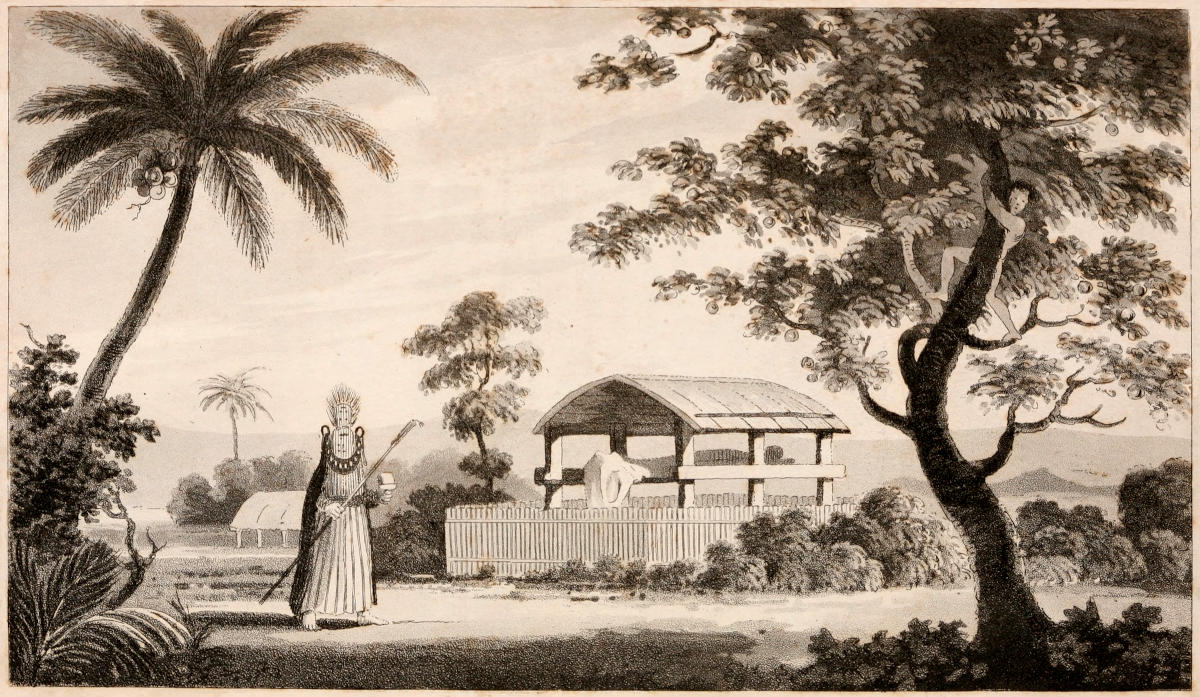
A Morai, or Burying Place, at Otaheite.
As soon as we landed at Attahooroo, which was
about two o’clock in the afternoon, Otoo expressed
his desire that the seamen might be ordered to remain
in the boat; and that Mr. Anderson, Mr.
Webber, and myself, might take off our hats, as soon
as we should come to the morai, to which we immediately
proceeded, attended by a great many men
and some boys; but not one woman. We found
four priests, and their attendants or assistants, waiting
for us. The dead body, or sacrifice, was in a
small canoe that lay on the beach, and partly in the
wash of the sea, fronting the morai. Two of the
priests, with some of their attendants, were sitting
by the canoe; the others at the morai. Our company
stopped about twenty or thirty paces from the
priests. Here Otoo placed himself; we, and a few
others, standing by him; while the bulk of the people
remained at a greater distance.
The ceremonies now began. One of the priest’s
attendants brought a young plantain tree, and laid it
down before Otoo. Another approached with a small
tuft of red feathers, twisted on some fibres of the
cocoa-nut-husk, with which he touched one of the
king’s feet, and then retired with it to his companions.
One of the priests, seated at the morai,
facing those who were upon the beach, now began a
long prayer; and, at certain times, sent down young
plantain-trees, which were laid upon the sacrifice.
During this prayer, a man, who stood by the officiating
priest, held in his hands two bundles, seemingly
of cloth. In one of them, as we afterwards
found, was the royal maro; and the other, if I may
be allowed the expression, was the ark of the Eatooa.
As soon as the prayer was ended, the priests at the
morai, with their attendants, went and sat down by
those upon the beach, carrying with them the two
bundles. Here they renewed their prayers; during
32which the plantain-trees were taken, one by one, at
different times, from off the sacrifice; which was
partly wrapped up in cocoa leaves and small
branches. It was now taken out of the canoe, and
laid upon the beach, with the feet to the sea. The
priests placed themselves around it, some sitting and
others standing; and one or more of them, repeated
sentences for about ten minutes. The dead body
was now uncovered, by removing the leaves and
branches, and laid in a parallel direction with the seashore.
One of the priests then, standing at the feet
of it, pronounced a long prayer, in which he was, at
times, joined by the others; each holding in his hand
a tuft of red feathers. In the course of this prayer,
some hair was pulled off the head of the sacrifice,
and the left eye taken out; both of which were presented
to Otoo, wrapped up in a green leaf. He did
not, however, touch it; but gave to the man who
presented it the tuft of feathers which he had received
from Towha. This, with the hair and eye,
was carried back to the priests. Soon after, Otoo
sent to them another piece of feathers, which he had
given me in the morning to keep in my pocket.
During some part of this last ceremony, a king-fisher
making a noise in the trees, Otoo turned to me, saying,
“That is the Eatooa;” and seemed to look
upon it to be a good omen.
The body was then carried a little way with its
head towards the morai, and laid under a tree, near
which were fixed three broad thin pieces of wood,
differently but rudely carved. The bundles of cloth
were laid on a part of the morai, and the tufts of red
feathers were placed at the feet of the sacrifice,
round which the priests took their stations; and we
were now allowed to go as near as we pleased. He
who seemed to be the chief priest sat at a small distance
and spoke for a quarter of an hour, but with
different tones and gestures, so that he seemed often
to expostulate with the dead person, to whom he constantly
33addressed himself; and sometimes asked several
questions, seemingly with respect to the propriety
of his having been killed. At other times he made several
demands, as if the deceased either now had power
himself, or interest with the divinity to engage him
to comply with such requests. Amongst which, we
understood, he asked him to deliver Eimeo Maheine,
its chief, the hogs, women, and other things of the
island, into their hands; which was, indeed, the express
intention of the sacrifice. He then chanted
a prayer, which lasted half an hour, in a whining,
melancholy tone, accompanied by two other priests;
and in which Potatou and some others joined. In
the course of this prayer, some more hair was
plucked by a priest from the head of the corpse, and
put upon one of the bundles. After this, the chief
priest prayed alone, holding in his hand the feathers
which came from Towha. When he had finished, he
gave them to another, who prayed in like manner.
Then all the tufts of feathers were laid upon the
bundles of cloth; which closed the ceremony at this
place.
The corpse was then carried up to the most conspicuous
part of the morai, with the feathers, the
two bundles of cloth, and the drums; the last of
which beat slowly. The feathers and bundles were
laid against the pile of stones, and the corpse at the
foot of them. The priests having again seated
themselves round it, renewed their prayers; while
some of the attendants dug a hole about two feet
deep, into which they threw the unhappy victim,
and covered it with earth and stones. While they
were putting him into the grave, a boy squeaked
aloud, and Omai said to me, that it was the Eatooa.
During this time, a fire having been made, the dog
before mentioned was produced and killed, by twisting
his neck and suffocating him. The hair was
singed off and the entrails taken out and thrown into
the fire, where they were left to consume. But the
34heart, liver, and kidneys were only roasted, by being
laid on the stones for a few minutes; and the body
of the dog, after being besmeared with the blood
which had been collected in a cocoa-nut shell, and
dried over the fire, was, with the liver, &c. carried
and laid down before the priests, who sat praying
round the grave. They continued their ejaculations
over the dog for some time, while two men, at intervals,
beat on two drums very loud; and a boy
screamed as before, in a loud shrill voice, three different
times. This, as we were told, was to invite
the Eatooa to feast on the banquet that they had
prepared for him. As soon as the priests had ended
their prayers, the carcase of the dog, with what belonged
to it, were laid on a whatta, or scaffold, about
six feet high, that stood close by, on which lay the
remains of two other dogs, and of two pigs which
had lately been sacrificed, and at this time emitted
an intolerable stench. This kept us at a greater distance
than would otherwise have been required of
us. For after the victim was removed from the seaside
toward the morai, we were allowed to approach
as near as we pleased. Indeed, after that, neither
seriousness nor attention were much observed by the
spectators. When the dog was put upon the whatta,
the priests and attendants gave a kind of shout, which
closed the ceremonies for the present. The day
being now also closed, we were conducted to a house
belonging to Potatou, where we were entertained
and lodged for the night. We had been told that
the religious rites were to be renewed in the morning;
and I would not leave the place, while any
thing remained to be seen.
Being unwilling to lose any part of the solemnity,
some of us repaired to the scene of action pretty
early, but found nothing going forward. However,
soon after, a pig was sacrificed, and laid upon the
same whatta with the others. About eight o’clock,
Otoo took us again to the morai, where the priests
and a great number of men were by this time assembled.
35The two bundles occupied the place in which
we had seen them deposited the preceding evening;
the two drums stood in the front of the morai, but
somewhat nearer it than before; and the priests were
beyond them. Otoo placed himself between the two
drums, and desired me to stand by him.
The ceremony began as usual, with bringing a
young plantain-tree, and laying it down at the king’s
feet. After this a prayer was repeated by the
priests, who held in their hands several tufts of red
feathers, and also a plume of ostrich feathers, which
I had given to Otoo on my first arrival, and had
been consecrated to this use. When the priests
had made an end of the prayer, they changed
their station, placing themselves between us and
the morai, and one of them, the same person
who had acted the principal part the day before, began
another prayer, which lasted about half an hour.
During the continuance of this, the tufts of feathers
were, one by one, carried and laid upon the ark of the
Eatooa.
Some little time after, four pigs were produced; one
of which was immediately killed, and the others were
taken to a stye hard by, probably reserved for some
future occasion of sacrifice. One of the bundles was
now untied, and it was found, as I have before observed,
to contain the maro, with which these people
invest their kings, and which seems to answer, in
some degree, to the European ensigns of royalty. It
was carefully taken out of the cloth in which it had
been wrapped up, and spread at full length upon the
ground before the priests. It is a girdle about five
yards long and fifteen inches broad, and, from its
name, seems to be put on in the same manner as is
the common maro, or piece of cloth used by these people
to wrap round the waist. It was ornamented
with red and yellow feathers, but mostly with the
latter, taken from a dove found upon the island. The
one end was bordered with eight pieces, each about
36the size and shape of a horse-shoe having their edges
fringed with black feathers. The other end was
forked, and the points were of different lengths. The
feathers were in square compartments, ranged in two
rows, and otherwise so disposed as to produce a pleasing
effect. They had been first pasted or fixed upon
some of their own country cloth, and then sewed to
the upper end of the pendant which Captain Wallis
had displayed, and left flying ashore, the first time
that he landed at Matavai. This was what they told
us; and we had no reason to doubt it, as we could
easily trace the remains of an English pendant.
About six or eight inches square of the maro was
unornamented, there being no feathers upon that
space, except a few that had been sent by Waheadooa,
as already mentioned. The priests made a
long prayer relative to this part of the ceremony;
and, if I mistook not, they called it the prayer of the
maro. When it was finished, the badge of royalty
was carefully folded up, put into the cloth, and deposited
again upon the morai.
The other bundle, which I have distinguished by
the name of the ark, was next opened at one end. But
we were not allowed to go near enough to examine
its mysterious contents. The information we received
was, that the Eatooa, to whom they had been
sacrificing, and whose name is Ooro, was concealed
in it; or rather, what is supposed to represent him.
This sacred repository is made of the twisted fibres of
the husk of the cocoa-nut, shaped somewhat like a
large fid or sugar-loaf, that is, roundish, with one end
much thicker than the other. We had very often
got small ones from different people, but never knew
their use before.
By this time the pig that had been killed, was cleaned,
and the entrails taken out. These happened to have
a considerable share of those convulsive motions,
which often appear in different parts after an animal
is killed, and this was considered by the spectators as
a very favourable omen to the expedition, on account
37of which the sacrifices had been offered. After being
exposed for some time, that those who chose might
examine their appearances, the entrails were carried
to the priests and laid down before them. While one
of their number prayed, another inspected the entrails
more narrowly and kept turning them gently with
a stick. When they had been sufficiently examined,
they were thrown into the fire and left to consume.
The sacrificed pig, and its liver, &c. were now put
upon the whatta, where the dog had been deposited
the day before; and then all the feathers, except the
ostrich-plume, were inclosed with the Eatooa in the
ark; and the solemnity finally closed.
Four double canoes lay upon the beach, before the
place of sacrifice, all the morning. On the fore-part
of each of these was fixed a small platform covered
with palm-leaves tied in mysterious knots; and this
also is called a morai. Some cocoa-nuts, plantains,
pieces of bread-fruit, fish, and other things, lay upon
each of these naval morais. We were told that they
belonged to the Eatooa, and that they were to attend
the fleet designed to go against Eimeo.
The unhappy victim offered to the object of
their worship upon this occasion, seemed to be a
middle-aged man, and, as we were told, was a
towtow, that is, one of the lowest class of the people.
But, after all my inquiries, I could not learn that he
had been pitched upon on account of any particular
crime committed by him meriting death. It is certain,
however, that they generally make choice of
such guilty persons for their sacrifice, or else of common
low fellows, who stroll about from place to place
and from island to island, without having any fixed
abode, or any visible way of getting an honest livelihood,
of which description of men enough are to be
met with at these islands. Having had an opportunity
of examining the appearance of the body of the
poor sufferer now offered up, I could observe that it
was bloody about the head and face, and a good deal
38bruised upon the right temple; which marked the
manner of his being killed. And we were told, that
he had been privately knocked on the head with a
stone.
Those who are devoted to suffer, in order to perform
this bloody act of worship, are never apprized of
their fate till the blow is given that puts an end to
their existence. Whenever any one of the great chiefs
thinks a human sacrifice necessary on any particular
emergency, he pitches upon the victim. Some of
his trusty servants are then sent, who fall upon him
suddenly, and put him to death with a club or by
stoning him. The king is next acquainted with it,
whose presence at the solemn rites that follow is, as
I was told, absolutely necessary; and, indeed, on
the present occasion, we could observe that Otoo
bore a principal part. The solemnity itself is called
Poore Eree, or chief’s prayer; and the victim who
is offered up Taata-taboo, or consecrated man. This
is the only instance where we have heard the word
taboo used at this island, where it seems to have the
same mysterious signification as at Tonga, though it
is there applied to all cases where things are not to
be touched. But at Otaheite, the word raa serves
the same purpose, and is full as extensive in its
meaning.
The morai (which, undoubtedly, is a place of worship,
sacrifice, and burial, at the same time), where
the sacrifice was now offered, is that where the
supreme chief of the whole island is always buried,
and is appropriated to his family and some of
the principal people. It differs little from the common
ones, except in extent. Its principal part is a
large oblong, pile of stones, lying loosely upon each
other, about twelve or fourteen feet high, contracted
towards the top, with a square area on each side
loosely paved with pebble stones, under which the
bones of the chiefs are buried. At a little distance
from the end nearest the sea, is the place where the
39sacrifices are offered; which, for a considerable extent
is also loosely paved. There is here a very
large scaffold or whatta, on which the offerings of
fruits and other vegetables are laid. But the animals
are deposited on a smaller one already mentioned,
and the human sacrifices are buried under different
parts of the pavement. There are several other relics
which ignorant superstition had scattered about
this place, such as small stones raised in different
parts of the pavement, some with bits of cloth tied
round them, others covered with it; and, upon the
side of the large pile which fronts the area, are placed
a great many pieces of carved wood, which are supposed
to be sometimes the residence of their divinities,
and, consequently, held sacred. But one place,
more particular than the rest, is a heap of stones at
one end of the large whatta, before which the sacrifice
was offered, with a kind of platform at one side.
On this are laid the skulls of all the human sacrifices,
which are taken up after they have been several
months under ground. Just above them are placed
a great number of the pieces of wood; and it was also
here where the maro, and the other bundle supposed
to contain the god Ooro (and which I call the ark),
were laid during the ceremony; a circumstance
which denotes its agreement with the altar of other
nations.
It is much to be regretted, that a practice so
horrid in its own nature and so destructive of that inviolable
right of self-preservation, which every one is
born with, should be found still existing; and (such
is the power of superstition to counteract the first
principles of humanity!) existing amongst a people
in many other respects emerged from the brutal
manners of savage life. What is still worse, it is
probable that these bloody rites of worship are
prevalent throughout all the wide extended islands
of the Pacific Ocean. The similarity of customs and
language, which our late voyages have enabled us to
40trace between the most distant of these islands,
makes it not unlikely that some of the most important
articles of their religious institutions should
agree. And, indeed, we have the most authentic
information that human sacrifices continue to be
offered at the Friendly Islands. When I described
the Natche at Tonge-taboo, I mentioned that, on the
approaching sequel of that festival, we had been told
that ten men were to be sacrificed. This may give
us an idea of the extent of this religious massacre in
that island. And though we should suppose that
never more than one person is sacrificed, on any
single occasion at Otaheite, it is more than probable
that these occasions happen so frequently, as to make
a shocking waste of the human race; for I counted
no less than forty-nine skulls of former victims lying
before the morai, where we saw one more added to
the number. And as none of those skulls had as yet
suffered any considerable change from the weather,
it may hence be inferred, that no great length of time
had elapsed, since, at least, this considerable number
of unhappy wretches had been offered upon this altar
of blood.
The custom, though no consideration can make
it cease to be abominable, might be thought less
detrimental, in some respects, if it served to impress
any awe for the divinity or reverence for religion, upon
the minds of the multitude. But this is so far from
being the case, that though a great number of people
had assembled at the morai on this occasion, they
did not seem to show any proper reverence for what
was doing or saying during the celebration of the
rites. And Omai happening to arrive after they had
begun, many of the spectators flocked round him,
and were engaged the remainder of the time in
making him relate some of his adventures, which
they listened to with great attention, regardless of
the solemn offices performing by their priests. Indeed,
the priests themselves, except the one who
41chiefly repeated the prayers, either from their being
familiarized to such objects, or from want of confidence
in the efficacy of their institutions, observed
very little of that solemnity, which is necessary to
give to religious performances their due weight.
Their dress was only an ordinary one; they conversed
together without scruple; and the only attempt
made by them to preserve any appearance of decency,
was by exerting their authority to prevent the people
from coming upon the very spot where the ceremonies
were performed, and to suffer us, as strangers,
to advance a little forward. They were, however,
very candid in their answers to any questions that
were put to them concerning the institution. And
particularly, on being asked what the intention of it
was? they said that it was an old custom, and was
agreeable to their god, who delighted in, or, in other
words, came and fed upon the sacrifices; in consequence
of which, he complied with their petitions.
Upon its being objected that he could not feed on
these, as he was neither seen to do it, nor were the
bodies of the animals quickly consumed; and that, as
to the human victim, they prevented his feeding on
him, by burying him. But to all this they answered,
that he came in the night, but invisibly, and fed only
on the soul or immaterial part, which, according to
their doctrine, remains about the place of sacrifice,
until the body of the victim be entirely wasted by
putrefaction.
It were much to be wished that this deluded
people may learn to entertain the same horror of
murdering their fellow-creatures, in order to furnish
such an invisible banquet to their god, as they now
have of feeding, corporeally, on human flesh themselves.
And, yet, we have great reason to believe, that
there was a time when they were cannibals. We were
told (and, indeed, partly saw it), that it is a necessary
ceremony, when a poor wretch is sacrificed, for the
priest to take out the left eye. This he presents to the
42king, holding it to his mouth, which he desires him
to open; but, instead of putting it in, immediately
withdraws it. This they call “eating the man,” or,
“food for the chief;” and, perhaps, we may observe
here some traces of former times, when the dead
body was really feasted upon.
But not to insist upon this; it is certain, that human
sacrifices are not the only barbarous custom we
find still prevailing amongst this benevolent, humane
people. For, besides cutting out the jaw-bones of
their enemies slain in battle, which they carry about
as trophies, they, in some measure, offer their dead
bodies as a sacrifice to the Eatooa. Soon after a
battle, in which they have been victors, they collect
all the dead that have fallen into their hands, and
bring them to the morai, where, with a great deal of
ceremony, they dig a hole, and bury them all in it,
as so many offerings to the gods; but their skulls are
never after taken up.
Their own great chiefs, that fall in battle, are treated
in a different manner. We were informed, that their
late king Tootaha, Tubourai-tamaide, and another
chief, who fell with them in the battle, fought with
those of Tiaraboo, and were brought to this morai, at
Attahooroo. There their bowels were cut out by the
priests, before the great altar, and the bodies afterwards
buried in three different places, which were
pointed out to us, in the great pile of stones, that compose
the most conspicuous part of this morai. And
their common men, who also fell in this battle, were
all buried in one hole, at the foot of the pile. This,
Omai, who was present, told me was done the day
after the battle, with much pomp and ceremony, and
in the midst of a great concourse of people, as a
thanksgiving-offering to the Eatooa, for the victory
they had obtained; while the vanquished had taken
refuge in the mountains. There they remained a
week, or ten days, till the fury of the victors was
over, and a treaty set on foot, by which it was
43agreed, that Otoo should be declared king of the
whole island; and the solemnity of investing him
with the maro, was performed at the same morai, with
great pomp, in the presence of all the principal men
of the country.
CHAP. III.
44
CONFERENCE WITH TOWHA.—HEEVAS DESCRIBED.—OMAI
AND OEDIDEE GIVE DINNERS.—FIREWORKS EXHIBITED.—A
REMARKABLE PRESENT OF CLOTH.—MANNER OF PRESERVING
THE BODY OF A DEAD CHIEF.—ANOTHER HUMAN
SACRIFICE.—RIDING ON HORSEBACK.—OTOO’S ATTENTION
TO SUPPLY PROVISIONS AND PREVENT THEFTS.—ANIMALS
GIVEN TO HIM.—ETARY, AND THE DEPUTIES
OF A CHIEF HAVE AUDIENCES.—A MOCK-FIGHT OF TWO
WAR CANOES.—NAVAL STRENGTH OF THESE ISLANDS.—MANNER
OF CONDUCTING A WAR.
The close of the very singular scene exhibited at
the morai, which I have faithfully described in the
last chapter, leaving us no other business in Attahooroo,
we embarked about noon, in order to return
to Matavai; and, in our way, visited Towha, who
had remained on the little island, where we met him
the day before. Some conversation passed between
Otoo and him, on the present posture of public affairs;
and then the latter solicited me, once more, to
join them in their war against Eimeo. By my positive
refusal I entirely lost the good graces of this chief.
Before we parted, he asked us, if the solemnity, at
which we had been present, answered our expectations;
what opinion we had of its efficacy; and
whether we performed such acts of worship in our
own country? During the celebration of the horrid
ceremony, we had preserved a profound silence; but,
as soon as it was closed, had made no scruple in expressing
our sentiments very freely about it, to Otoo,
and those who attended him; of course, therefore, I
did not conceal my detestation of it, in this conversation
with Towha. Besides the cruelty of the bloody
custom, I strongly urged the unreasonableness of it;
telling the chief, that such a sacrifice, far from making
the Eatooa propitious to their nation, as they ignorantly
45believed, would be the means of drawing
down his vengeance; and that, from this very circumstance,
I took upon me to judge, that their
intended expedition against Maheine would be unsuccessful.
This was venturing pretty far upon conjecture;
but still, I thought, that there was little
danger of being mistaken. For I found, that there
were three parties in the island, with regard to this
war; one extremely violent for it, another perfectly
indifferent about the matter; and the third openly
declaring themselves friends to Maheine, and his
cause. Under these circumstances of disunion distracting
their councils, it was not likely that such a
plan of military operations would be settled, as could
insure even a probability of success. In conveying
our sentiments to Towha, on the subject of the late
sacrifice, Omai was made use of as our interpreter;
and he entered into our arguments with so much spirit,
that the chief seemed to be in great wrath; especially
when he was told, that if he had put a man to
death in England, as he had done here, his rank
would not have protected him from being hanged for
it. Upon this, he exclaimed, Maeno! maeno! [vile!
vile!] and would not hear another word. During
this debate, many of the natives were present, chiefly
the attendants and servants of Towha himself; and
when Omai began to explain the punishment that
would be inflicted in England upon the greatest
man, if he killed the meanest servant, they seemed
to listen with great attention; and were, probably,
of a different opinion from that of their master, on
this subject.
After leaving Towha, we proceeded to Oparre,
where Otoo pressed us to spend the night. We landed
in the evening; and, on our road to his house,
had an opportunity of observing in what manner these
people amuse themselves, in their private heevas.
About a hundred of them were found sitting in a
house; and in the midst of them were two women,
46with an old man behind each of them, beating
very gently upon a drum; and the women, at intervals,
singing in a softer manner, than I ever heard
at their other diversions. The assembly listened with
great attention; and were, seemingly, almost absorbed
in the pleasure the music gave them; for few
took any notice of us, and the performers never once
stopped. It was almost dark before we reached
Otoo’s house, where we were entertained with one
of their public heevas, or plays, in which his three
sisters appeared as the principal characters. This
was what they call a heeva raä, which is of such a
nature, that nobody is to enter the house or area,
where it is exhibited. When the royal sisters are
the performers, this is always the case. Their dress,
on this occasion, was truly picturesque and elegant;
and they acquitted themselves, in their parts, in a
very distinguished manner; though some comic interludes,
performed by four men, seemed to yield
greater pleasure to the audience, which was numerous.
The next morning we proceeded to Matavai,
leaving Otoo at Oparre; but his mother, sisters, and
several other women, attended me on board, and
Otoo himself followed me soon after.
While Otoo and I were absent from the ships, they
had been sparingly supplied with fruit, and had few
visitors. After our return, we again overflowed with
provisions, and with company.
On the 14th, a party of us dined ashore with
Omai, who gave excellent fare, consisting of fish,
fowls, pork, and puddings. After dinner, I attended
Otoo, who had been one of the party, back to his
house, where I found all his servants very busy, getting
a quantity of provisions ready for me. Amongst
other articles, there was a large hog, which they
killed in my presence. The entrails were divided
into eleven portions, in such a manner that each of
them contained a bit of every thing. These portions
were distributed to the servants, and some dressed
47theirs in the same oven with the hog, while others
carried off, undressed, what had come to their share.
There was also a large pudding, the whole process in
making which I saw. It was composed of bread-fruit,
ripe plantains, taro, and palm or pandanus
nuts, each rasped, scraped, or beat up fine, and baked
by itself. A quantity of juice, expressed from cocoa-nut
kernels, was put into a large tray, or wooden
vessel. The other articles, hot from the oven, were
deposited in this vessel; and a few hot stones were
also put in, to make the contents simmer. Three or
four men made use of sticks to stir the several ingredients,
till they were incorporated one with another,
and the juice of the cocoa-nut was turned to oil; so
that the whole mass, at last, became of the consistency
of a hasty-pudding. Some of these puddings
are excellent; and few that we make in England
equal them. I seldom, or never dined without one,
when I could get it; which was not always the case.
Otoo’s hog being baked, and the pudding, which I
have described, being made, they, together with two
living hogs, and a quantity of bread-fruit and cocoa-nuts
were put into a canoe, and sent on board my
ship, followed by myself, and all the royal family.
The following evening, a young ram of the Cape
breed, that had been lambed, and, with great care,
brought up on board the ship, was killed by a dog.
Incidents are of more or less consequence, as connected
with situation. In our present situation, desirous
as I was to propagate this useful race amongst
these islands, the loss of the ram was a serious misfortune;
as it was the only one I had of that breed;
and I had only one of the English breed left.
In the evening of the 7th, we played off some fireworks
before a great concourse of people. Some
were highly entertained with the exhibition; but by
far the greater number of spectators were terribly
frightened; insomuch that it was with difficulty we
could prevail upon them to keep together to see the
48end of the show. A table-rocket was the last. It
flew off the table, and dispersed the whole crowd in
a moment; even the most resolute among them fled
with precipitation.
The next day a party of us dined with our former
ship-mate, Oedidee, on fish and pork. The hog
weighed about thirty pounds; and it may be worth
mentioning, that it was alive, dressed, and brought
upon the table, within the hour. We had but just
dined, when Otoo came, and asked me if my belly
was full? On my answering in the affirmative, he
said, “Then come along with me.” I accordingly
went with him to his father’s, where I found some
people employed in dressing two girls with a prodigious
quantity of fine cloth, after a very singular
fashion. The one end of each piece of cloth, of
which there was a good many, was held up over the
heads of the girls, while the remainder was wrapped
round their bodies, under the arm-pits. Then the
upper ends were let fall, and hung down in folds to
the ground, over the other, so as to bear some resemblance
to a circular hoop-petticoat. Afterward,
round the outside of all, were wrapped several pieces
of differently coloured cloth, which considerably increased
the size; so that it was not less than five or
six yards in circuit, and the weight of this singular
attire was as much as the poor girls could support.
To each were hung two taames, or breast-plates, by
way of enriching the whole, and giving it a picturesque
appearance. Thus equipped, they were conducted
on board the ship, together with several hogs,
and a quantity of fruit, which, with the cloth, was a
present to me from Otoo’s father. Persons, of either
sex, dressed in this manner, are called atee; but, I
believe, it is never practised, except when large presents
of cloth are to be made. At least, I never saw it
practised upon any other occasion; nor, indeed, had
I ever such a present before; but both Captain Clerke
and I had cloth given to us afterward, thus wrapped
49round the bearers. The next day, I had a present
of five hogs, and some fruit, from Otoo; and one
hog, and some fruit, from each of his sisters. Nor
were other provisions wanting. For two or three days,
great quantities of mackerel had been caught by the
natives, within the reef, in seines; some of which
they brought to the ships and tents, and sold.
Otoo was not more attentive to supply our wants,
by a succession of presents, than he was to contribute
to our amusement, by a succession of diversions.
A party of us having gone down to Oparre, on the
10th, he treated us with what may be called a play.
His three sisters were the actresses; and the dresses
they appeared in were new and elegant; that is,
more so than we had usually met with at any of these
islands. But the principal object I had in view, this
day, in going to Oparre, was to take a view of an
embalmed corpse, which some of our gentlemen had
happened to meet with at that place, near the residence
of Otoo. On enquiry, I found it to be the remains
of Tee, a chief well known to me, when I was
at this island, during my last voyage. It was lying
in a toopapaoo, more elegantly constructed than their
common ones, and in all respects similar to that lately
seen by us at Oheitepeha, in which the remains of
Waheadooa are deposited, embalmed in the same
manner. When we arrived at the place, the body
was under cover, and wrapped up in cloth, within
the toopapaoo; but, at my desire, the man who had
the care of it brought it out, and laid it upon a kind
of bier, in such a manner, that we had as full a view of
it as we could wish; but we were not allowed to go
within the pales that inclosed the toopapaoo. After
he had thus exhibited the corpse, he hung the place
with mats and cloth, so disposed as to produce a very
pretty effect. We found the body not only entire in
every part; but, what surprized us much more, was,
that putrefaction seemed scarcely to be begun, as
there was not the least disagreeable smell proceeding
50from it, though the climate is one of the hottest, and
Tee had been dead above four months. The only
remarkable alteration that had happened, was a
shrinking of the muscular parts of the eyes; but the
hair and nails were in their original state, and still
adhered firmly; and the several joints were quite
pliable, or in that kind of relaxed state which happens
to persons who faint suddenly. Such were Mr.
Anderson’s remarks to me, who also told me, that,
on his enquiring into the method of effecting this preservation
of their dead bodies, he had been informed
that soon after their death, they are disembowelled,
by drawing the intestines, and other viscera, out at
the anus; and the whole cavity is then filled or stuffed
with cloth, introduced through the same part; that
when any moisture appeared on the skin, it was carefully
dried up, and the bodies afterward rubbed all
over with a large quantity of perfumed cocoa-nut
oil; which, being frequently repeated, preserved
them a great many months; but that, at last, they
gradually moulder away. This was the information
Mr. Anderson received; for my own part, I could
not learn any more about their mode of operation
than what Omai told me, who said, that they made
use of the juice of a plant which grows amongst the
mountains; of cocoa-nut oil; and of frequent washing
with sea-water. I was also told that the bodies of
all their great men, who died a natural death, are preserved
in this manner; and that they expose them to
public view for a considerable time after. At first,
they are laid out every day, when it does not rain;
afterward, the intervals become greater and greater;
and, at last, they are seldom to be seen.
In the evening, we returned from Oparre, where
we left Otoo, and all the royal family; and I saw
none of them till the 12th, when all but the chief himself
paid me a visit. He, as they told me, was gone
to Attahooroo, to assist, this day, at another human
sacrifice, which the chief of Tiaraboo had sent
51thither to be offered up at the morai. This second instance,
within the course of a few days, was too melancholy
a proof how numerous the victims of this
bloody superstition are amongst this humane people.
I would have been present at this sacrifice, too, had I
known of it in time; for now it was too late. From
the very same cause, I missed being present at a public
transaction which had passed at Oparre the preceding
day, when Otoo, with all the solemnities
observed on such occasions, restored to the friends and
followers of the late king Tootaha the lands and
possessions which had been withheld from them ever
since his death. Probably the new sacrifice was the
concluding ceremony of what may be called the reversal
of attainder.
The following evening, Otoo returned from exercising
this most disagreeable of all his duties as sovereign;
and, the next day, being now honoured with
his company, Captain Clerke and I, mounted on
horseback, took a ride round the plain of Matavai, to
the very great surprize of a great train of people who
attended on the occasion, gazing upon us with as
much astonishment as if we had been centaurs. Omai,
indeed, had, once or twice before this, attempted to
get on horseback; but he had as often been thrown
off, before he could contrive to seat himself; so that
this was the first time they had seen any body ride a
horse. What Captain Clerke and I began, was, after
this, repeated every day, while we staid, by one or
another of our people; and yet the curiosity of the
natives continued still unabated. They were exceedingly
delighted with these animals, after they had
seen the use that was made of them; and, as far as I
could judge, they conveyed to them a better idea of
the greatness of other nations than all the other novelties
put together that their European visiters
had carried amongst them. Both the horse and mare
were in good case, and looked extremely well.
The next day, Etary, or Olla, the god of Bolabola,
52who had, for several days past, been in the neighbourhood
of Matavai, removed to Oparre, attended
by several sailing canoes. We were told, that Otoo
did not approve of his being so near our station,
where his people could more easily invade our property.
I must do Otoo the justice to say, that he
took every method prudence could suggest to prevent
thefts and robberies; and it was more owing to
his regulations than to our circumspection that so
few were committed. He had taken care to erect a
little house or two on the other side of the river, behind
our post, and two others close to our tents, on
the bank between the river and the sea. In all these
places some of his own people constantly kept watch;
and his father generally resided on Matavai point;
so that we were, in a manner, surrounded by them.
Thus stationed, they not only guarded us in the night
from thieves, but could observe every thing that
passed in the day; and were ready to collect contributions
from such girls as had private connections
with our people, which was generally done every
morning. So that the measures adopted by him to
secure our safety, at the same time served the more
essential purpose of enlarging his own profits.
Otoo informing me that his presence was necessary
at Oparre, where he was to give audience to the great
personage from Bolabola; and asking me to accompany
him, I readily consented, in hopes of meeting
with something worth our notice. Accordingly, I
went with him, in the morning of the 16th, attended
by Mr. Anderson. Nothing, however, occurred on
this occasion, that was either interesting or curious.
We saw Etary and his followers present some coarse
cloth and hogs to Otoo; and each article was delivered
with some ceremony, and a set speech. After
this, they, and some other chiefs, held a consultation
about the expedition to Eimeo. Etary at first
seemed to disapprove of it, but at last his objections
were over-ruled. Indeed, it appeared, next
53day, that it was too late to deliberate about this measure;
and that Towha, Potatou, and another chief,
had already gone upon the expedition with the fleet
of Attahooroo. For a messenger arrived in the evening
with intelligence that they had reached Eimeo,
and that there had been some skirmishes, without
much loss or advantage on either side.
In the morning of the 18th, Mr. Anderson, myself,
and Omai, went again with Otoo to Oparre, and
took with us the sheep which I intended to leave
upon the island, consisting of an English ram and ewe,
and three Cape ewes; all which I gave to Otoo. As
all the three cows had taken the bull, I thought I
might venture to divide them, and carry some to
Ulietea. With this view, I had them brought before
us, and proposed to Etary, that if he would
leave his bull with Otoo, he should have mine,
and one of the three cows; adding, that I would
carry them for him to Ulietea; for I was afraid to
remove the Spanish bull, lest some accident should
happen to him, as he was a bulky spirited beast. To
this proposal of mine, Etary at first made some
objections, but at last agreed to it, partly through
the persuasion of Omai. However, just as the cattle
were putting into the boat, one of Etary’s followers
valiantly opposed any exchange whatever being made.
Finding this, and suspecting that Etary had only consented
to the proposed arrangement, for the present
moment, to please me, and that after I was gone
he might take away his bull, and then Otoo would
not have one, I thought it best to drop the idea of
an exchange, as it could not be made with the mutual
consent of both parties, and finally determined
to leave them all with Otoo, strictly enjoining him
never to suffer them to be removed from Oparre, not
even the Spanish bull, nor any of the sheep, till he
should get a stock of young ones; which he might
then dispose of to his friends, and send to the neighbouring
islands.
54This being settled, we left Etary and his party to
ruminate upon their folly, and attended Otoo to
another place hard by, where we found the servants of
a chief, whose name I forgot to ask, waiting with a
hog, a pig, and a dog, as a present from their master
to the sovereign. These were delivered with
the usual ceremonies, and with an harangue in form,
in which the speaker, in his master’s name, enquired
after the health of Otoo, and of all the principal
people about him. This compliment was echoed back
in the name of Otoo, by one of his ministers; and
then the dispute with Eimeo was discussed, with
many arguments for and against it. The deputies
of his chief were for prosecuting the war with vigour,
and advised Otoo to offer a human sacrifice. On
the other hand, a chief who was in constant attendance
on Otoo’s person opposed it, seemingly, with
great strength of argument. This confirmed me in
the opinion, that Otoo himself never entered heartily
into the spirit of this war. He now received repeated
messages from Towha, strongly soliciting
him to hasten to his assistance. We were told that his
fleet was in a manner surrounded by that of Maheine;
but that neither the one nor the other durst
hazard an engagement.
After dining with Otoo, we returned to Matavai,
leaving him at Oparre. This day, and also the 19th,
we were very sparingly supplied with fruit. Otoo hearing
of this, he and his brother, who had attached himself
to Captain Clerke, came from Oparre between
nine and ten o’clock in the evening, with a large supply
for both ships. This marked his humane attention
more strongly than any thing he had hitherto
done for us. The next day, all the royal family
came with presents, so that our wants were not only
relieved, but we had more provisions than we could
consume.
Having got all our water on board, the ships
being caulked, the rigging overhauled, and every
55thing put in order, I began to think of leaving the
island, that I might have sufficient time to spare for
visiting others in this neighbourhood. With this
view, we removed from the shore our observatories
and instruments, and bent the sails. Early the next
morning, Otoo came on board to acquaint me, that
all the war canoes of Matavai, and of the three
other districts adjoining, were going to Oparre, to
join those belonging to that part of the island; and
that there would be a general review there. Soon
after, the squadron of Matavai was all in motion;
and, after parading a while about the bay, assembled
ashore near the middle of it. I now went in my boat
to take a view of them.
Of those with stages on which they fight, or what
they call their war-canoes, there were about sixty,
with near as many more of a smaller size. I was
ready to have attended them to Oparre; but, soon
after, a resolution was taken by the chiefs, that they
should not move till the next day. I looked upon
this to be a fortunate delay, as it afforded me a good
opportunity to get some insight into their manner of
fighting. With this view, I expressed my wish to Otoo
that he would order some of them to go through the necessary
manœuvres. Two were, accordingly, ordered
out into the bay, in one of which Otoo, Mr. King,
and myself embarked, and Omai went on board the
other. When we had got sufficient sea-room, we faced
and advanced upon each other, and retreated by
turns, as quick as our rowers could paddle. During
this, the warriors on the stages flourished their weapons,
and played a hundred antic tricks, which could
answer no other end, in my judgment, than to work
up their passions, and prepare them for fighting.
Otoo stood by the side of our stage, and gave the
necessary orders when to advance and when to
retreat. In this, great judgment and a quick eye
combined together seemed requisite, to seize every
advantage that might offer, and to avoid giving any
56advantage to the adversary. At last, after advancing
and retreating from each other at least a dozen times,
the two canoes closed head to head, or stage to stage;
and, after a short conflict, the troops on our stage
were supposed to be all killed, and we were boarded
by Omai and his associates. At that very instant,
Otoo and all our paddlers leaped overboard, as if reduced
to the necessity of endeavouring to save their
lives by swimming.
If Omai’s information is to be depended upon, their
naval engagements are not always conducted in this
manner. He told me, that they sometimes begin
with lashing the two vessels together, head to head,
and then fight till all the warriors are killed on one side
or the other. But this close combat, I apprehend, is
never practised but when they are determined to
conquer or die. Indeed, one or the other must happen;
for all agree that they never give quarter, unless
it be to reserve their prisoners for a more cruel
death the next day.
The power and strength of these islands lie entirely
in their navies. I never heard of a general engagement
on land; and all their decisive battles are
fought on the water. If the time and place of conflict
are fixed upon by both parties, the preceding
day and night are spent in diversions and feasting.
Toward morning they launch the canoes,
put every thing in order, and, with the day,
begin the battle, the fate of which generally decides
the dispute. The vanquished save themselves
by a precipitate flight; and such as reach the shore
fly with their friends to the mountains; for the victors,
while their fury lasts, spare neither the aged,
women, nor children. The next day they assemble
at the morai, to return thanks to the Eatooa for the
victory, and to offer up the slain as sacrifices, and
the prisoners also, if they have any. After this, a
treaty is set on foot, and the conquerors for the
most part obtain their own terms, by which particular
57districts of land, and sometimes whole islands,
change their owners. Omai told us that he was
once taken a prisoner by the men of Bolabola, and carried
to that island, where he and some others would
have been put to death the next day if they had not
found means to escape in the night.
As soon as this mock fight was over, Omai put on
his suit of armour, mounted a stage in one of the
canoes, and was paddled all along the shore of the
bay; so that every one had a full view of him. His
coat of mail did not draw the attention of his countrymen
so much as might have been expected. Some of
them, indeed, had seen a part of it before; and there
were others, again, who had taken such a dislike to
Omai, from his imprudent conduct at this place, that
they would hardly look at any thing, however singular,
that was exhibited by him.
CHAP. IV.
58
THE DAY OF SAILING FIXED.—PEACE MADE WITH EIMEO.—DEBATES
ABOUT IT, AND OTOO’S CONDUCT BLAMED.—A
SOLEMNITY AT THE MORAI ON THE OCCASION, DESCRIBED
BY MR. KING.—OBSERVATIONS UPON IT.—INSTANCE OF
OTOO’S ART.—OMAI’S WAR-CANOE, AND REMARKS UPON
HIS BEHAVIOUR.—OTOO’S PRESENT, AND MESSAGE TO THE
KING OF GREAT BRITAIN.—REFLECTIONS ON OUR MANNER
OF TRAFFIC, AND ON THE GOOD TREATMENT WE MET WITH
AT OTAHEITE.—ACCOUNT OF THE EXPEDITION OF THE
SPANIARDS.—THEIR FICTIONS TO DEPRECIATE THE ENGLISH.—WISHES
EXPRESSED THAT NO SETTLEMENT MAY BE
MADE.—OMAI’S JEALOUSY OF ANOTHER TRAVELLER.
Early in the morning of the 22d, Otoo and his
father came on board, to know when I proposed sailing.
For, having been informed that there was a
good harbour at Eimeo, I had told them that I should
visit that island on my way to Huaheine; and they
were desirous of taking a passage with me, and of
their fleet sailing at the time to reinforce Towha.
As I was ready to take my departure, I left it to
them to name the day, and the Wednesday following
was fixed upon, when I was to take on board Otoo,
his father, mother, and, in short, the whole family.
These points being settled, I proposed setting out
immediately for Oparre, where all the fleet, fitted out,
for the expedition, was to assemble this day, and to
be reviewed.
I had but just time to get into my boat, when
news was brought, that Towha had concluded a
treaty with Maheine, and had returned with his
fleet to Attahooroo. This unexpected event made all
further proceedings in the military way quite unnecessary,
and the war-canoes, instead of rendezvousing at
Oparre, were ordered home to their respective districts.
59This alteration, however, did not hinder me
from following Otoo to Oparre, accompanied by
Mr. King and Omai. Soon after our arrival, and
while dinner was preparing, a messenger arrived from
Eimeo, and related the conditions of the peace, or
rather of the truce, it being only for a limited time.
The terms were disadvantageous to Otaheite; and
much blame was thrown upon Otoo, whose delay in
sending reinforcements had obliged Towha to submit
to a disgraceful accommodation. It was even
currently reported, that Towha, resenting his not
being supported, had declared, that as soon as I
could leave the island he would join his forces to
those of Tiaraboo, and attack Otoo at Matavai or
Oparre. This called upon me to declare, in the most
public manner, that I was determined to espouse the
interest of my friend against any such combination;
and that whoever presumed to attack him, should
feel the weight of my heavy displeasure, when I
returned again to their island. My declaration probably
had the desired effect; and if Towha had any
such hostile intention at first, we soon heard no more
of the report. Whappai, Otoo’s father, highly disapproved
of the peace, and blamed Towha very much
for concluding it. This sensible old man wisely
judged, that my going down with them to Eimeo
must have been of singular service to their cause,
though I should take no other part whatever in the
quarrel. And it was upon this that he built his arguments,
and maintained that Otoo had acted properly
by waiting for me, though this had prevented his
giving assistance to Towha so soon as he expected.
Our debates at Oparre, on this subject, were hardly
ended, before a messenger arrived from Towha, desiring
Otoo’s attendance the next day at the morai
in Attahooroo, to give thanks to the gods for the
peace he had concluded; at least such was Omai’s
account to me of the object of this solemnity. I
was asked to go; but being much out of order was
60obliged to decline it. Desirous, however, of knowing
what ceremonies might be observed on so memorable
an occasion, I sent Mr. King and Omai, and returned
on board my ship, attended by Otoo’s mother,
his three sisters, and eight more women. At first I
thought that this numerous train of females came
into my boat with no other view than to get a passage
to Matavai. But when we arrived at the ship, they
told me, they intended passing the night on board,
for the express purpose of undertaking the cure of
the disorder I complained of; which was a pain of
the rheumatic kind, extending from the hip to the
foot. I accepted the friendly offer, had a bed spread
for them upon the cabin floor, and submitted myself
to their directions. I was desired to lay myself down
amongst them. Then, as many of them as could get
round me, began to squeeze me with both hands,
from head to foot, but more particularly on the parts
where the pain was lodged, till they made my bones
crack, and my flesh became a perfect mummy. In
short, after undergoing this discipline about a quarter
of an hour, I was glad to get away from them. However,
the operation gave me immediate relief, which
encouraged me to submit to another rubbing-down
before I went to bed; and it was so effectual, that I
found myself pretty easy all the night after. My female
physicians repeated their prescription the next
morning, before they went ashore, and again, in the
evening, when they returned on board; after which,
I found the pains entirely removed; and the cure
being perfected, they took their leave of me the
following morning. This they call romee; an operation
which, in my opinion, far exceeds the flesh-brush,
or any thing of the kind that we make use of
externally. It is universally practised amongst these
islanders; being sometimes performed by the men,
but more generally by the women. If, at any time,
one appears languid and tired, and sits down by any
one of them, they immediately begin to practise the
61romee upon his legs; and I have always found it to
have an exceeding good effect.[6]
In the morning of the 25th, Otoo, Mr. King, and
Omai, returned from Attahooroo; and Mr. King gave
me the following account of what he had seen:
“Soon after you left me, a second messenger came
from Towha, to Otoo, with a plantain-tree. It was
sunset when we embarked in a canoe and left Oparre:
about nine o’clock we landed at Tettaha, at that extremity
which joins to Attahooroo. Before we landed,
the people called to us from the shore, probably to
tell us that Towha was there. The meeting of Otoo
and this chief I expected would afford some incident
worthy of observation. Otoo and his attendants
went and seated themselves on the bench, close
to the canoe in which Towha was. He was then
asleep; but his servants having awaked him, and
mentioning Otoo’s name, immediately a plantain-tree
and a dog were laid at Otoo’s feet; and many of
Towha’s people came and talked with him, as I conceived,
about their expedition to Eimeo. After I
had, for some time, remained seated close to Otoo,
Towha neither stirring from his canoe, nor holding
any conversation with us, I went to him. He asked
me if Toote was angry with him. I answered, No:
that he was his taio; and that he had ordered
me to go to Attahooroo to tell him so. Omai now
had a long conversation with this chief; but I could
gather no information of any kind from him. On
my returning to Otoo, he seemed desirous that I
should go to eat, and then to sleep. Accordingly,
Omai and I left him. On questioning Omai, he said,
the reason of Towha’s not stirring from his canoe
was his being lame; but that, presently, Otoo and he
would converse together in private. This seemed
true; for, in a little time, those we left with Otoo
62came to us; and, about ten minutes after, Otoo
himself arrived, and we all went to sleep in his
canoe.
“The next morning, the ava was in great plenty.
One man drank so much that he lost his senses. I
should have supposed him to be in a fit, from the convulsions
that agitated him. Two men held him, and
kept plucking off his hair by the roots. I left this
spectacle to see another more affecting. This was
the meeting of Towha and his wife, and a young girl,
whom I understood to be his daughter. After the
ceremony of cutting their heads, and discharging a
tolerable quantity of blood and tears, they washed,
embraced the chief, and seemed unconcerned. But
the young girl’s sufferings were not yet come to an
end. Terridiri[7] arrived; and she went, with great
composure, to repeat the same ceremonies to him,
which he had just performed on meeting her father.
Towha had brought a large war-canoe from Eimeo.
I enquired if he had killed the people belonging to
her; and was told, that there was no man in her when
she was captured.
“We left Tettaha, about ten or eleven o’clock, and
landed, close to the morai of Attahooroo, a little
after noon. There lay three canoes, hauled upon
the beach, opposite the morai, with three hogs exposed
in each: their sheds, or awnings, had something
under them which I could not discern. We
expected the solemnity to be performed the same
afternoon; but as neither Towha nor Potatou had
joined us, nothing was done.
“A chief from Eimeo came with a small pig, and a
plantain-tree, and placed them at Otoo’s feet. They
talked some time together; and the Eimeo chief
often repeating the words, Warry, warry, “false,”
I supposed that Otoo was relating to him what he
had heard, and that the other denied it.
63“The next day (Wednesday), Towha and Potatou,
with about eight large canoes, arrived, and landed
near the morai. Many plantain-trees were brought,
on the part of different chiefs, to Otoo. Towha did
not stir from his canoe. The ceremony began by the
principal priest bringing out the maro, wrapped up,
and a bundle shaped like a large sugar-loaf. These
were placed at the head of what I understood to be a
grave. Then three priests came and sat down opposite,
that is, at the other end of the grave; bringing with
them a plantain-tree, the branch of some other tree,
and the sheath of the flower of the cocoa-nut tree.
“The priests, with these things in their hands, separately
repeated sentences; and, at intervals, two,
and sometimes all three, sung a melancholy ditty,
little attended to by the people. This praying and
singing continued for an hour. Then, after a short
prayer, the principal priest uncovered the maro; and
Otoo rose up, and wrapped it about him, holding, at
the same time, in his hand, a cap or bonnet, composed
of the red feathers of the tail of the tropic bird, mixed
with other feathers of a dark colour. He stood in
the middle space, facing the three priests, who continued
their prayers for about ten minutes; when a
man, starting from the crowd, said something which
ended with the word heiva! and the crowd echoed
back to him, three times, Earee! This, as I had been
told before, was the principal part of the solemnity.
“The company now moved to the opposite side of
the great pile of stones, where is what they call the
king’s morai; which is not unlike a large grave.
Here the same ceremony was performed over again,
and ended in three cheers. The maro was now wrapped
up, and encreased in its splendour by the addition
of a small piece of red feathers, which one of the
priests gave Otoo when he had it on, and which he
stuck into it.
“From this place the people went to a large hut,
close by the morai, where they seated themselves
in much greater order than is usual among them. A
64man of Tiaraboo then made an oration, which lasted
about ten minutes. He was followed by an Attahooroo
man; afterward Potatou spoke with much
greater fluency and grace than any of them; for,
in general, they spoke in short, broken sentences,
with a motion of the hand that was rather awkward.
Tooteo, Otoo’s orator, spoke next, and after him
a man from Eimeo. Two or three more speeches
were made; but not much attended to. Omai told
me, that the speeches declared that they should not
fight, but all be friends. As many of the speakers
expressed themselves with warmth, possibly there
were some recriminations and protestations of their
good intentions. In the midst of their speaking, a
man of Attahooroo got up, with a sling fastened to
his waist, and a large stone placed upon his shoulder.
After parading near a quarter of an hour in the open
space, repeating something in a singing tone, he
threw the stone down. This stone, and a plantain-tree
that lay at Otoo’s feet, were, after the
speeches ended, carried to the morai; and one of the
priests, and Otoo with him, said something upon the
occasion.
“On our return to Oparre, the sea-breeze having
set in, we were obliged to land, and had a pleasant
walk through almost the whole extent of Tettaha to
Oparre. A tree, with two bundles of dried leaves
suspended upon it, marked the boundary of the two
districts. The man who had performed the ceremony
of the stone and sling came with us. With
him Otoo’s father had a long conversation. He
seemed very angry. I understood he was enraged
at the part Towha had taken in the Eimeo business.”
From what I can judge of this solemnity, as thus
described by Mr. King, it had not been wholly a
thanksgiving, as Omai told us, but rather a confirmation
of the treaty, or perhaps both. The grave,
which Mr. King speaks of, seems to be the very spot
where the celebration of the rites began, when the
65human sacrifice, at which I was present, was offered,
and before which the victim was laid, after being removed
from the sea side. It is at this part of the
morai, also, that they first invest their kings with
the maro. Omai, who had been present when Otoo
was made king, described to me the whole ceremony,
when we were here; and I find it to be almost the
same, as this that Mr. King has now described, though
we understood it to be upon a very different occasion.
The plantain-tree, so often mentioned, is always the
first thing introduced, not only in all their religious
ceremonies, but in all their debates, whether of a
public or private nature. It is also used on other occasions;
perhaps many more than we know of. While
Towha was at Eimeo, one or more messengers came
from him to Otoo every day. The messenger always
came with a young plantain-tree in his hand, which
he laid down at Otoo’s feet, before he spoke a word;
then seated himself before him, and related what he
was charged with. I have seen two men in such
high dispute that I expected they would proceed to
blows; yet, on one laying a plantain-tree before the
other, they have both become cool, and carried on
the argument without farther animosity. In short,
it is, upon all occasions, the olive-branch of these
people.
The war with Eimeo, and the solemn rites which
were the consequence of it, being thus finally closed,
all our friends paid us a visit on the 26th; and, as
they knew that we were upon the point of sailing,
brought with them more hogs than we could take off
their hands. For, having no salt left, to preserve
any, we wanted no more than for present use.
The next day, I accompanied Otoo to Oparre;
and, before I left it, I looked at the cattle and poultry,
which I had consigned to my friend’s care, at
that place. Every thing was in a promising way; and
properly attended unto. Two of the geese and two
of the ducks were sitting; but the pea and turkey
66hens had not begun to lay. I got from Otoo four
goats; two of which I intended to leave at Ulietea,
where none had as yet been introduced; and the
other two, I proposed to reserve for the use of any
other islands I might meet with in my passage to the
north.
A circumstance which I shall now mention of
Otoo, will shew that these people are capable of
much address and art to gain their purposes.
Amongst other things which, at different times, I had
given to this chief, was a spying-glass. After having
it in his possession two or three days, tired of its
novelty, and probably finding it of no use to him, he
carried it privately to Captain Clerke, and told him,
that, as he had been his very good friend, he had
got a present for him, which he knew would be agreeable.
“But, says Otoo, you must not let Toote know
it; because he wants it, and I would not let him have
it.” He then put the glass into Captain Clerke’s
hands; at the same time, assuring him, that he came
honestly by it. Captain Clerke at first declined accepting
it; but Otoo insisted upon it, and left it
with him. Some days after, he put Captain Clerke
in mind of the glass; who, though he did not want
it, was yet desirous of obliging Otoo; and thinking,
that a few axes would be of more use at this island,
produced four to give him in return. Otoo no sooner
saw this, than he said, “Toote offered me five for it.”
“Well, says Captain Clerke, if that be the case, your
friendship for me shall not make you a loser, and you
shall have six axes.” These he accepted; but desired
again, that I might not be told what he had done.
Our friend Omai got one good thing at this island
for the many good things he gave away. This was
a very fine double sailing canoe, completely equipped,
and fit for the sea. Some time before, I had made
up for him, a suit of English colours; but he thought
these too valuable to be used at this time; and patched
up a parcel of colours, such as flags and pendants,
67to the number of ten or a dozen, which he spread on
different parts of this vessel, all at the same time;
and drew together as many people to look at her, as
a man-of-war would, dressed, in a European port.
These streamers of Omai were a mixture of English,
French, Spanish, and Dutch, which were all the
European colours that he had seen. When I was
last at this island, I gave to Otoo an English jack
and pendant, and to Towha a pendant; which I now
found they had preserved with the greatest care.
Omai had also provided himself with a good stock
of cloth and cocoa-nut oil, which are not only in
greater plenty, but much better at Otaheite than at
any of the Society islands; insomuch, that they are
articles of trade. Omai would not have behaved so
inconsistently, and so much unlike himself, as he did,
in many instances, but for his sister and brother-in-law,
who, together with a few more of their acquaintance,
engrossed him entirely to themselves, with no
other view than to strip him of every thing he had
got. And they would, undoubtedly, have succeeded
in their scheme, if I had not put a stop to it in time,
by taking the most useful articles of his property into
my possession. But even this would not have saved
Omai from ruin, if I had suffered these relations of
his to have gone with, or to have followed us to, his
intended place of settlement, Huaheine. This they
had intended; but I disappointed their farther views
of plunder, by forbidding them to shew themselves
in that island, while I remained in the neighbourhood;
and they knew me too well not to comply.
On the 28th, Otoo came on board, and informed
me, that he had got a canoe, which he desired I would
take with me, and carry home, as a present from him
to the Earee rahie no Pretane; it being the only
thing, he said, that he could send worth his Majesty’s
acceptance. I was not a little pleased with Otoo for
this mark of his gratitude. It was a thought entirely
his own, not one of us having given him the least
68hint about it; and it shewed that he fully understood
to whom he was indebted for the most valuable presents
that he had received. At first, I thought that
this canoe had been a model of one of their vessels
of war; but I soon found that it was a small ivahah,
about sixteen feet long. It was double, and seemed
to have been built for the purpose; and was decorated
with all those pieces of carved work, which
they usually fix upon their canoes. As it was too
large for me to take on board, I could only thank
him for his good intentions; but it would have pleased
him much better, if his present could have been
accepted.
We were detained here some days longer than I
expected, by light breezes from the west, and calms
by turns; so that we could not get out of the bay.
During this time, the ships were crowded with our
friends, and surrounded by a multitude of canoes;
for not one would leave the place till we were gone.
At length, at three o’clock in the afternoon of the
29th, the wind came at east, and we weighed anchor.
As soon as the ships were under sail, at the request
of Otoo, and to gratify the curiosity of his people, I
fired seven guns, loaded with shot; after which, all
our friends, except him, and two or three more, left
us with such marks of affection and grief, as sufficiently
shewed how much they regretted our departure.
Otoo being desirous of seeing the ship
sail, I made a stretch out to sea, and then in again;
when he also bid us farewell, and went ashore in his
canoe.
The frequent visits we have lately paid to this
island, seem to have created a full persuasion, that
the intercourse will not be discontinued. It was
strictly enjoined to me by Otoo, to request, in his
name, the Earee rahie no Pretane, to send him, by
the next ships, red feathers, and the birds that produce
them; axes; half a dozen muskets, with powder
and shot; and, by no means, to forget horses.
69I have occasionally mentioned my receiving considerable
presents from Otoo, and the rest of the family,
without specifying what returns I made. It is
customary for these people, when they make a present,
to let us know what they expect in return; and
we find it necessary to gratify them; so that what
we get by way of present, comes dearer than what
we get by barter. But as we were sometimes pressed
by occasional scarcity, we could have recourse to our
friends for a present, or supply, when we could not
get our wants relieved by any other method; and
therefore, upon the whole, this way of traffic was
full as advantageous to us as to the natives. For the
most part, I paid for each separate article as I received
it, except in my intercourse with Otoo. His
presents generally came so fast upon me, that no
account was kept between us. Whatever he asked
for, that I could spare, he had whenever he asked
for it; and I always found him moderate in his demands.
If I could have prevailed upon Omai to fix himself
at Otaheite, I should not have left it so soon as I
did; for there was not a probability of our being
better or cheaper supplied with refreshments at any
other place, than we continued to be here, even at
the time of our leaving it. Besides, such a cordial
friendship and confidence subsisted between us and
the inhabitants, as could hardly be expected any
where else; and, it was a little extraordinary, that
this friendly intercourse had never once been suspended
by any untoward accident; nor had there
been a theft committed that deserves to be mentioned.
Not that I believe their morals, in this respect, to be
much mended; but am rather of opinion, that their
regularity of conduct was owing to the fear the chiefs
were under of interrupting a traffic which they
might consider as the means of securing to themselves
a more considerable share of our commodities
than could have been got by plunder or pilfering.
70Indeed, this point I settled at the first interview with
their chiefs, after my arrival. For, observing the
great plenty that was in the island, and the eagerness
of the natives to possess our various articles of trade,
I resolved to make the most of these two favourable
circumstances, and explained myself, in the most decisive
terms, that I would not suffer them to rob us,
as they had done upon many former occasions. In
this Omai was of great use, as I instructed him to
point out to them the good consequences of their
honest conduct; and the fatal mischiefs they must
expect to suffer by deviating from it.
It is not always in the power of the chiefs to prevent
robberies; they are frequently robbed themselves;
and complain of it as a great evil. Otoo left
the most valuable things he had from me in my possession,
till the day before we sailed; and the reason
he gave for it was, that they were no where so safe.
Since the bringing in of new riches, the inducements
to pilfering must have increased. The chiefs, sensible
of this, are now extremely desirous of chests.
They seemed to set much value upon a few the
Spaniards had left amongst them; and they were
continually asking us for some. I had one made for
Otoo, the dimensions of which, according to his own
directions, were eight feet in length, five in breadth,
and about three in depth. Locks and bolts were not
a sufficient security; but it must be large enough for
two people to sleep upon, by way of guarding it in
the night.
It will appear a little extraordinary, that we, who
had a smattering of their language, and Omai, besides,
for an interpreter, could never get any clear
account of the time when the Spaniards arrived, how
long they stayed, and when they departed. The
more we inquired into this matter, the more we were
convinced of the inability of most of these people to
remember, or note the time, when past events happened;
especially if it exceeded ten or twenty months.
71It, however, appeared, by the date of the inscription
upon the cross, and by the information we received
from the most intelligent of the natives, that
two ships arrived at Oheitepeha in 1774, soon after
I left Matavai, which was in May, the same year.
They brought with them the house and live-stock
before mentioned. Some said, that, after landing
these things, and some men, they sailed in quest of
me, and returned in about ten days. But I have
some doubt of the truth of this, as they were never
seen, either at Huaheine, or at Ulietea. The live-stock
they left here, consisted of one bull, some
goats, hogs, and dogs, and the male of some other
animal; which we afterwards found to be a ram, and,
at this time, was at Bolabola, whither the bull was
also to have been transported.
The hogs are of a large kind; have already greatly
improved the breed originally found by us upon the
island; and, at the time of our late arrival, were
very numerous; Goats are, also, in tolerable plenty;
there being hardly a chief of any note that has not
got some. As to the dogs that the Spaniards put
ashore, which are of two or three sorts, I think they
would have done the island a great deal more service,
if they had hanged them all, instead of leaving them
upon it. It was to one of them that my young ram
fell a victim.
When these ships left the islands, four Spaniards
remained behind. Two were priests, one a servant,
and the fourth made himself very popular among the
natives, who distinguish him by the name of Mateema.
He seems to have been a person who had studied
their language; or, at least, to have spoken it so as
to be understood; and to have taken uncommon
pains to impress the minds of the islanders with the
most exalted ideas of the greatness of the Spanish
nation, and to make them think meanly of the English.
He even went so far as to assure them, that
we no longer existed as an independent nation; that
72Pretane was only a small island, which they, the
Spaniards, had entirely destroyed; and for me, that
they had met with me at sea, and, with a few shot,
had sent my ship, and every soul in her, to the bottom;
so that my visiting Otaheite, at this time, was,
of course, very unexpected. All this, and many
other improbable falsehoods, did this Spaniard make
these people believe. If Spain had no other views
in this expedition, but to depreciate the English,
they had better have kept their ships at home;
for my returning again to Otaheite was considered
as a complete confutation of all that Mateema had
said.
With what design the priests stayed, we can only
guess. If it was to convert the natives to the catholic
faith, they have not succeeded in any one instance.
But it does not appear that they ever attempted it;
for, if the natives are to be believed, they never conversed
with them, either on this, or on any other
subject. The priests resided constantly in the house
at Oheitepeha; but Mateema roved about, visiting
most parts of the island. At length, after he and
his companions had staid ten months, two ships came
to Oheitepeha, took them on board, and sailed again
in five days. This hasty departure shews, that, whatever
design the Spaniards might have had upon this
island, they had now laid it aside. And yet, as I
was informed by Otoo, and many others, before they
went away, they would have the natives believe that
they still meant to return, and to bring with them
houses, all kinds of animals, and men and women, who
were to settle, live, and die on the island. Otoo, when
he told me this, added, that if the Spaniards should
return, he would not let them come to Matavai Fort,
which, he said, was our’s. It was easy to see that
the idea pleased him; little thinking, that the completion
of it would at once deprive him of his
kingdom, and the people of their liberties. This
shews with what facility a settlement might be made
73at Otaheite; which, grateful as I am for repeated
good offices, I hope will never happen. Our occasional
visits may, in some respects, have benefited its
inhabitants; but a permanent establishment amongst
them, conducted as most European establishments
amongst Indian nations have unfortunately been,
would, I fear, give them just cause to lament, that
our ships had ever found them out. Indeed, it is
very unlikely, that any measure of this kind should
ever be seriously thought of, as it can neither serve
the purposes of public ambition, nor of private avarice;
and, without such inducements, I may pronounce,
that it will never be undertaken.
I have already mentioned the visit that I had from
one of the two natives of this island, who had been
carried by the Spaniards to Lima. I never saw him afterward;
which I rather wondered at, as I had received
him with uncommon civility. I believe, however,
that Omai had kept him at a distance from me, by
some rough usage; jealous that there should be another
traveller upon the island who might vie with
himself. Our touching at Teneriffe was a fortunate
circumstance for Omai; as he prided himself in
having visited a place belonging to Spain, as well as
this man. I did not meet with the other, who had
returned from Lima; but Captain Clerke, who had
seen him, spoke of him as a low fellow, and as a little
out of his senses. His own countrymen, I found,
agreed in the same account of him. In short, these
two adventurers seemed to be held in no esteem.
They had not, indeed, been so fortunate as to return
home with such valuable acquisitions of property
as we had bestowed upon Omai; and with the advantages
he reaped from his voyage to England, it
must be his own fault if he should sink into the same
state of insignificance.
CHAP. V.
74
ARRIVAL AT EIMEO.—TWO HARBOURS THERE, AND AN
ACCOUNT OF THEM.—VISIT FROM MAHEINE, CHIEF OF
THE ISLAND.—HIS PERSON DESCRIBED.—A GOAT STOLEN,
AND SENT BACK WITH THE THIEF.—ANOTHER GOAT STOLEN,
AND SECRETED.—MEASURES TAKEN ON THE OCCASION.—EXPEDITION
CROSS THE ISLAND.—HOUSES AND CANOES
BURNT.—THE GOAT DELIVERED UP, AND PEACE RESTORED.—SOME
ACCOUNT OF THE ISLAND, &C.
As I did not give up my design of touching at
Eimeo, at day-break, in the morning of the 30th,
after leaving Otaheite, I stood for the north end of
the island; the harbour, which I wished to examine,
being at that part of it. Omai, in his canoe, having
arrived there long before us, had taken some necessary
measures to show us the place. However, we
were not without pilots, having several men of Otaheite
on board, and not a few women. Not caring
to trust entirely to these guides, I sent two boats to
examine the harbour, and, on their making the signal
for safe anchorage, we stood in with the ships, and
anchored close up to the head of the inlet, in ten
fathoms water, over a bottom of soft mud, and
moored with a hawser fast to the shore.
This harbour, which is called Taloo, is situated
upon the north side of the island, in the district of
Oboonohoo, or Poonohoo. It runs in south, or
south by east, between the hills, above two miles.
For security and goodness of its bottom, it is not
inferior to any harbour that I have met with at any of
the islands in this ocean; and it has this advantage
over most of them, that a ship can sail in and out
with the reigning trade-wind; so that the access
and recess are equally easy. There are several rivulets
75that fall into it. The one at the head is so considerable
as to admit boats to go a quarter of a mile
up, where we found the water perfectly fresh. Its
banks are covered with the pooroo tree, as it is called
by the natives, which makes good firing, and which
they set no value upon; so that wood and water are
to be got here with great facility.
On the same side of the island, and about two
miles to the eastward, is the harbour of Parowroah,
much larger within than that of Taloo; but the
entrance, or opening in the reef, (for the whole
island is surrounded with a reef of coral rock) is considerably
narrower, and lies to leeward of the harbour.
These two defects are so striking, that the harbour
of Taloo must always have a decided preference.
It is a little extraordinary, that I should have been
three times at Otaheite before, and have once sent a
boat to Eimeo, and yet not know till now that there
was a harbour in it; on the contrary, I always
understood there was not; whereas, there are not
only the two above mentioned, but one or two more
on the south side of the island; but these last are
not so considerable as the two we have just described,
and of which a sketch has been made for the use of
those who may follow us in such a voyage.
We had no sooner anchored than the ships were
crowded with the inhabitants, whom curiosity alone
brought on board; for they had nothing with
them for the purposes of barter. But, the next
morning, this deficiency was supplied; several canoes
then arriving from more distant parts, which
brought with them abundance of bread-fruit, cocoa-nuts,
and a few hogs. These they exchanged for
hatchets, nails, and beads, for red feathers were
not so much sought after here as at Otaheite.
The ship being a good deal pestered with rats, I
hauled her within thirty yards of the shore, as
near as the depth of water would allow, and made
a path for them to get to the land, by fastening hawsers
76to the trees. It is said that this experiment
has sometimes succeeded; but, I believe, we got
clear of very few, if any, of the numerous tribe that
haunted us.
In the morning of the 2d, Maheine, the chief
of the island, paid me a visit. He approached the
ship with great caution, and it required some persuasion
to get him on board. Probably, he was
under some apprehensions of mischief from us, as
friends of the Otaheiteans; these people not being
able to comprehend how we can be friends with any
one, without adopting, at the same time, his cause
against his enemies. Maheine was accompanied by
his wife, who, as I was informed, is sister to Oamo
of Otaheite, of whose death we had an account
while we were at this island. I made presents to
both of them, of such things as they seemed to set
the highest value upon; and after a stay of about
half an hour, they went away. Not long after, they
returned with a large hog, which they meant as a
return for my present; but I made them another
present to the full value of it. After this, they paid
a visit to Captain Clerke.
This chief, who, with a few followers, has made
himself in a manner independent of Otaheite, is
between forty and fifty years old. He is bald-headed,
which is rather an uncommon appearance in these
islands at that age. He wore a kind of turban, and
seemed ashamed to shew his head. But whether they
themselves considered this deficiency of hair as a
mark of disgrace, or whether they entertained a notion
of our considering it as such, I cannot say. We
judged that the latter supposition was the truth, from
this circumstance, that they had seen us shave the
head of one of their people, whom we had caught
stealing. They therefore concluded that this was
the punishment usually inflicted by us upon all
thieves; and one or two of our gentlemen, whose
77heads were not over-burthened with hair, we could
observe, lay under violent suspicions of being tetos.
In the evening, Omai and I mounted on horseback,
and took a ride along the shore to the eastward.
Our train was not very numerous, as Omai
had forbid the natives to follow us; and many complied,
the fear of giving offence getting the better of
their curiosity. Towha had stationed his fleet in this
harbour; and though the war lasted but a few days,
the marks of its devastation were every where to be
seen. The trees were stripped of their fruit; and
all the houses in the neighbourhood had been pulled
down or burnt.
Having employed two or three days in getting up
all our spirit-casks to tar their heads, which we found
necessary to save them from the efforts of a small insect
to destroy them, we hauled the ship off into the
stream on the 6th, in the morning, intending to put
to sea the next day; but an accident happened that
prevented it, and gave me a good deal of trouble.
We had sent our goats ashore in the day time to
graze, with two men to look after them; notwithstanding
which precaution, the natives had contrived
to steal one of them this evening. The loss of this
goat would have been of little consequence, if it had
not interfered with my views of stocking other islands
with these animals; but this being the case, it became
necessary to recover it, if possible. The next
morning we got intelligence, that it had been carried
to Maheine, the chief, who was at this time at Parowroah
harbour. Two old men offered to conduct
any of my people whom I might think proper to send
to him, to bring back the goat. Accordingly, I
dispatched them in a boat, charged with a threatening
message to Maheine, if the goat was not immediately
given up to me, and also the thief.
It was only the day before, that this chief had requested
me to give him two goats. But, as I could
not spare them, unless at the expence of other
78islands that might never have another opportunity to
get any, and had, besides, heard that there were
already two upon this island, I did not gratify him.
However, to shew my inclination to assist his views
in this respect, I desired Tidooa, an Otaheite chief
who was present, to beg Otoo, in my name, to send
two of these animals to Maheine; and, by way of
insuring a compliance with this request, I sent to
Otoo by this chief; a large piece of red feathers,
equal to the value of the two goats that I required.
I expected that this arrangement would have been
satisfactory to Maheine and all the other chiefs of
the island; but the event showed that I was mistaken.
Not thinking that any one would dare to steal a
second, at the very time I was taking measures to
recover the first, the goats were put ashore again
this morning; and in the evening a boat was sent to
bring them on board. As our people were getting
them into the boat, one was carried off undiscovered.
It being immediately missed, I made no doubt of
recovering it without much trouble, as there had
not been time to carry it to any considerable distance.
Ten or twelve of the natives set out soon
after, different ways, to bring it back or to look
for it; for not one of them would own that it
was stolen, but all tried to persuade us that it had
strayed into the woods; and, indeed, I thought so
myself. I was convinced to the contrary, however,
when I found that none of those who went in pursuit
of it returned; so that their only view was to
amuse me, till their prize was beyond my reach; and,
night coming on, put a stop to all further search.
About this time the boat returned with the other goat,
bringing also one of the men who had stolen it; the
first instance of the kind that I had met with amongst
these islands.
The next morning, I found that most of the inhabitants
in the neighbourhood had moved off, carrying
79with them a corpse which lay on a toopapaoo opposite
the ship; and that Maheine himself had retired
to the most distant part of the island. It seemed
now no longer doubtful, that a plan had been laid
to steal what I had refused to give; and that, though
they had restored one, they were resolved to keep the
other; which was a she-goat and big with kid. I was
equally fixed in my resolution that they should not
keep it. I therefore applied to the two old men who
had been instrumental in getting back the first. They
told me, that this had been carried to Watea, a district
on the south side of the island, by Hamoa, the
chief of that place; but that, if I would send any body
for it, it would be delivered up. They offered to
conduct some of my people cross the island; but on
my learning from them that a boat might go and return
the same day, I sent one, with two petty officers,
Mr. Roberts and Mr. Shuttleworth; one to remain
with the boat, in case she could not get to the place,
while the other should go with the guides, and one
or two of our people.
Late in the evening the boat returned, and the
officers informed me, that after proceeding as far in
the boat as rocks and shoals would permit, Mr. Shuttleworth
with two marines and one of the guides
landed and travelled to Watea, to the house of Hamoa,
where the people of the place amused them for some
time, by telling them that the goat would soon be
brought, and pretended they had sent for it. It,
however, never came, and the approach of night
obliged Mr. Shuttleworth to return to the boat without
it.
I was now very sorry that I had proceeded so far,
as I could not retreat with any tolerable credit, and
without giving encouragement to the people of the
other islands we had yet to visit, to rob us with impunity.
I asked Omai and the two old men what
methods I should next take; and they, without hesitation,
advised me to go with a party of men into the
80country, and shoot every soul I should meet with.
This bloody counsel I could not follow; but I resolved
to march a party of men cross the island;
and at day-break the next morning, set out with
thirty-five of my people, accompanied by one of the
old men, by Omai, and three or four of his attendants.
At the same time, I ordered Lieutenant Williamson
with three armed boats round the western
part of the island to meet us.
I had no sooner landed with my party, than the
few natives who still remained in the neighbourhood
fled before us. The first man that we met
with upon our march, ran some risk of his life; for
Omai, the moment he saw him, asked me if he
should shoot him; so fully was he persuaded that I
was going to carry his advice into execution. I immediately
ordered both him and our guide to make
it known, that I did not intend to hurt, much less to
kill, a single native. These glad tidings flew before
us like lightning, and stopped the flight of the inhabitants;
so that no one quitted his house or employment
afterward.
As we began to ascend the ridge of hills over which
lay our road, we got intelligence that the goat had
been carried that way before us; and, as we understood,
could not as yet have passed the hills; so that
we marched up in great silence, in hopes of surprizing
the party who were bearing off the prize. But
when we had got to the uppermost plantation on side
of the ridge, the people there told us, that what we
were in search of had, indeed, been kept there the
first night, but had been carried the next morning to
Watea by Hamoa. We then crossed the ridge without
making any further enquiry, till we came within
sight of Watea, where some people showed us
Hamoa’s house, and told us that the goat was there,
so that I made no doubt of getting it immediately
upon my arrival. But when I reached the house, to
my very great surprize, the few people we met with
81denied that they had ever seen it, or knew any thing
about it; even Hamoa himself came and made the
same declaration.
On our first coming to the place, I observed several
men running to and fro in the woods, with clubs
and bundles of darts in their hands; and Omai,
who followed them, had some stones thrown at him,
so that it seemed as if they had intended to oppose any
step I should take by force; but, on seeing my party
was too strong, had dropped the design. I was confirmed
in this notion, by observing that all their
houses were empty. After getting a few of the
people of the place together, I desired Omai to expostulate
with them on the absurdity of the conduct they
were pursuing; and to tell them that, from the testimony
of many on whom I could depend, I was well
assured, that the goat was in their possession, and,
therefore, insisted upon its being delivered up, otherwise
I would burn their houses and canoes. But
notwithstanding all that I or Omai could say, they continued
to deny their having any knowledge of it. The
consequence was, that I set fire to six or eight houses,
which were presently consumed, with two or three
war-canoes that lay contiguous to them. This done, I
marched off to join the boats, which were about seven
or eight miles from us; and, in our way, we burnt
six more war-canoes, without any one attempting
to oppose us; on the contrary, many assisted, though
probably, more out of fear than good-will. In one
place, Omai, who had advanced a little before, came
back with information that a great many men were
getting together to attack us. We made ready to
receive them, but instead of enemies we found petitioners
with plantain-trees in their hands, which they
laid down at my feet, and begged that I would spare
a canoe that lay close by, which I readily complied
with.
At length, about four in the afternoon, we got to
the boats, that were waiting at Wharrarade, the district
82belonging to Tiarataboonoue; but this chief, as
well as all the principal people of the place, had fled to
the hills; though I touched not a single thing that
was their property, as they were the friends of Otoo.
After resting ourselves here about an hour, we set
out for the ships, where we arrived about eight o’clock
in the evening. At that time, no account of the
goat had been received; so that the operations of this
day had not produced the desired effect.
Early next morning, I dispatched one of Omai’s
men to Maheine, with this peremptory message, that
if he persisted in his refusal, I would not leave him
a single canoe upon the island, and that he might expect
a continuation of hostilities as long as the stolen
animal remained in his possession. And, that the
messenger might see that I was in earnest, before he
left me I sent the carpenter to break up three or
four canoes that lay ashore at the head of the harbour.
The plank was carried on board, as materials for
building a house for Omai, at the place where he intended
to settle. I afterward went, properly accompanied,
to the next harbour, where we broke up three
or four more canoes, and burnt an equal number;
and then returned on board about seven in the evening.
On my arrival I found that the goat had been
brought back about half an hour before; and, on
enquiry, it appeared that it had come from the very
place where I had been told the day before, by the
inhabitants, that they knew nothing of it. But in
consequence of the message I sent to the chief in
the morning, it was judged prudent to trifle with me
no longer.
Thus ended this troublesome and rather unfortunate
business; which could not be more regretted on
the part of the natives, than it was on mine. And
it grieved me to reflect, that, after refusing the pressing
solicitations of my friends at Otaheite, to favour
their invasion of this island, I should so soon find
myself reduced to the necessity of engaging in hostilities
83against its inhabitants, which, perhaps, did
them more mischief than they had suffered from
Towha’s expedition.
The next morning our intercourse with the natives
was renewed; and several canoes brought to
the ships bread-fruit and cocoa-nuts to barter; from
whence it was natural for me to draw this conclusion,
that they were conscious it was their own fault, if I
had treated them with severity; and that the cause
of my displeasure being removed, they had a full
confidence that no further mischief would ensue.
About nine o’clock we weighed, with a breeze down
the harbour; but it proved so faint and variable, that
it was noon before we got out to sea, when I steered
for Huaheine, attended by Omai in his canoe. He
did not depend entirely upon his own judgment, but
had got on board a pilot. I observed, that they
shaped as direct a course for the island as I could do.
At Eimeo we abundantly supplied the ships with
fire-wood. We had not taken in any at Otaheite,
where the procuring this article would have been very
inconvenient; there not being a tree at Matavai, but
what is useful to the inhabitants. We also got here
good store of refreshments, both in hogs and vegetables;
that is, bread-fruit and cocoa-nuts; little
else being in season. I do not know that there is any
difference between the produce of this island and of
Otaheite; but there is a very striking difference in
their women, that I can by no means account for.
Those of Eimeo are of low stature, have a dark hue,
and, in general, forbidding features. If we met
with a fine woman amongst them, we were sure,
upon enquiry, to find that she had come from some
other island.
The general appearance of Eimeo is very different
from that of Otaheite. The latter rising in one
steep hilly body, has little low land, except some
deep valleys; and the flat border that surrounds the
greatest part of it, toward the sea. Eimeo, on the
84contrary, has hills running in different directions,
which are very steep and rugged, leaving, in the interspaces,
very large valleys, and gently-rising grounds
about their sides. These hills, though of a rocky
disposition, are in general covered almost to their
tops with trees; but the lower parts, on the sides,
frequently only with fern. At the bottom of the
harbour where we lay, the ground rises gently to
the foot of the hills which run across nearly in the
middle of the island; but its flat border, on each
side, at a very small distance from the sea, becomes
quite steep. This gives it a romantic cast, which
renders it a prospect superior to any thing we saw at
Otaheite. The soil, about the low grounds, is a
yellowish and pretty stiff mould; but, upon the
lower hills, it is blacker and more loose; and the
stone that composes the hills is, when broken, of a
blueish colour, but not very compact texture, with
some particles of glimmer interspersed. These particulars
seem worthy of observation. Perhaps the
reader will think differently of my judgment, when
I add, that, near the station of our ships, were two
large stones, or rather rocks, concerning which the
natives have some superstitious notions. They consider
them as Eatooas, or divinities; saying that
they are brother and sister, and that they came, by
some supernatural means, from Ulietea.
View of Huaheine.
CHAP. VI.
85
ARRIVAL AT HUAHEINE.—COUNCIL OF THE CHIEFS.—OMAI’S
OFFERINGS, AND SPEECH TO THE CHIEFS.—HIS ESTABLISHMENT
IN THIS ISLAND AGREED TO.—A HOUSE BUILT,
AND GARDEN PLANTED FOR HIM.—SINGULARITY OF HIS
SITUATION—MEASURES TAKEN TO INSURE HIS SAFETY.—DAMAGE
DONE BY COCK-ROACHES, ON BOARD THE SHIPS.—A
THIEF DETECTED AND PUNISHED.—FIRE-WORKS EXHIBITED.—ANIMALS
LEFT WITH OMAI.—HIS FAMILY.—WEAPONS.—INSCRIPTIONS
ON HIS HOUSE.—HIS BEHAVIOUR
ON THE SHIP’S LEAVING THE ISLAND.—SUMMARY
VIEW OF HIS CONDUCT AND CHARACTER.—ACCOUNT OF
THE TWO NEW ZEALAND YOUTHS.
Having left Eimeo, with a gentle breeze and fine
weather, at day-break the next morning we saw
Huaheine, extending from south-west by west, half
west, to west by north. At noon we anchored at the
north entrance of Owharre harbour[8], which is on the
west side of the island. The whole afternoon was
spent in warping the ships into a proper birth, and
mooring. Omai entered the harbour just before us,
in his canoe, but did not land. Nor did he take much
notice of any of his countrymen, though many
crowded to see him; but far more of them came off
to the ships, insomuch that we could hardly work on
account of their numbers. Our passengers presently
acquainted them with what we had done at Eimeo,
and multiplied the number of houses and canoes that
we had destroyed, by ten at least. I was not sorry
for this exaggerated account; as I saw that it made
a great impression upon all who heard it; so that I
had hopes it would induce the inhabitants of this island
86to behave better to us than they had done during my
former visits.
While I was at Otaheite, I had learned that my
old friend Oree was no longer the chief of Huaheine;
and that, at this time, he resided at Ulietea. Indeed,
he never had been more than regent during the minority
of Taireetareea, the present Earee rahie; but
he did not give up the regency till he was forced.
His two sons, Opoony and Towha, were the first
who paid me a visit, coming on board before the ship
was well in the harbour, and bringing a present with
them.
Our arrival brought all the principal people of the
island to our ships on the next morning, being the
13th. This was just what I wished, as it was high
time to think of settling Omai; and the presence of
these chiefs, I guessed, would enable me to do it in
the most satisfactory manner. He now seemed to
have an inclination to establish himself at Ulietea;
and if he and I could have agreed about the mode
of bringing that plan to bear, I should have had no
objection to adopt it. His father had been dispossessed
by the men of Bolabola, when they conquered
Ulietea, of some land in that island; and I made no
doubt of being able to get it restored to the son in an
amicable manner. For that purpose it was necessary
that he should be upon good terms with those who
now were masters of the island; but he was too great
a patriot to listen to any such thing; and was vain
enough to suppose that I would reinstate him in his
forfeited lands by force. This made it impossible to
fix him at Ulietea, and pointed out to me Huaheine
as the proper place. I therefore resolved to avail
myself of the presence of the chief men of the island,
and to make this proposal to them.
After the hurry of the morning was over, we got
ready to pay a formal visit to Taireetareea, meaning
then to introduce his business. Omai dressed himself
very properly on the occasion; and prepared a handsome
87present for the chief himself, and another for
his Eatooa. Indeed, after he had got clear of the
gang that surrounded him at Otaheite, he behaved
with such prudence as to gain respect. Our landing
drew most of our visitors from the ships; and they,
as well as those that were on shore, assembled in a
large house. The concourse of people, on this occasion,
was very great; and amongst them, there
appeared to be a greater proportion of personal men
and women than we had ever seen in one assembly
at any of these new islands. Not only the bulk of
the people seemed in general much stouter and
fairer than those of Otaheite, but there was also a
much greater number of men who appeared to be
of consequence, in proportion to the extent of the
island; most of whom had exactly the corpulent appearance
of the chiefs of Wateeo. We waited some
time for Taireetareea, as I would do nothing
till the Earee rahie came; but when he appeared, I
found that his presence might have been dispensed
with, as he was not above eight or ten years of age.
Omai, who stood at a little distance from this circle
of great men, began with making his offering to the
gods, consisting of red feathers, cloth, &c. Then
followed another offering, which was to be given to
the gods by the chief; and, after that, several other
small pieces and tufts of red feathers were presented.
Each article was laid before one of the company, who,
I understood, was a priest, and was delivered with a
set speech or prayer, spoken by one of Omai’s friends,
who sat by him, but mostly dictated by himself. In
these prayers, he did not forget his friends in England,
nor those who had brought him safe back. The
Earee rahie no Pretane, Lord Sandwich, Toote,
Tatee[9], were mentioned in every one of them. When
Omai’s offerings and prayers were finished, the priest
took each article, in the same order in which it had
88been laid before him, and after repeating a prayer,
sent it to the morai; which, as Omai told us, was at
a great distance, otherwise the offerings would have
been made there.
These religious ceremonies having been performed,
Omai sat down by me, and we entered upon business,
by giving the young chief my present, and receiving
his in return; and, all things considered, they were
liberal enough on both sides. Some arrangements
were next agreed upon, as to the manner of carrying
on the intercourse betwixt us; and I pointed out the
mischievous consequences that would attend their
robbing us, as they had done during my former visits.
Omai’s establishment was then proposed to the assembled
chiefs.
He acquainted them, “That he had been carried
by us into our country, where he was well received
by the great king and his Earees, and treated with
every mark of regard and affection, while he staid
amongst us; that he had been brought back again,
enriched by our liberality with a variety of articles,
which would prove very useful to his countrymen;
and that, besides the two horses which were to remain
with him, several other new and valuable animals
had been left at Otaheite, which would soon
multiply, and furnish a sufficient number for the use
of all the islands in the neighbourhood. He then
signified to them, that it was my earnest request, in
return for all my friendly offices, that they would give
him a piece of land, to build a house upon, and to
raise provisions for himself and servants; adding,
that, if this could not be obtained for him at Huaheine,
either by gift or by purchase, I was determined
to carry him to Ulietea, and fix him there.”
Perhaps I have here made a better speech for my
friend, than he actually delivered; but these were
the topics I dictated to him. I observed, that what
he concluded with, about carrying him to Ulietea,
seemed to meet with the approbation of all the chiefs;
89and I instantly saw the reason. Omai had, as I have
already mentioned, vainly flattered himself, that I
meant to use force in restoring him to his father’s
lands in Ulietea, and he had talked idly, and without
any authority from me, on this subject, to some of
the present assembly; who dreamed of nothing less
than a hostile invasion of Ulietea, and of being assisted
by me to drive the Bolabola men out of that
island. It was of consequence, therefore, that I
should undeceive them; and in order to this, I signified,
in the most peremptory manner, that I neither
would assist them in such an enterprize, nor suffer it
to be put in execution, while I was in their seas; and
that, if Omai fixed himself in Ulietea, he must be
introduced as a friend, and not forced upon the Bolabola
men as their conqueror.
This declaration gave a new turn to the sentiments
of the council. One of the chiefs immediately expressed
himself to this effect: “That the whole island
of Huaheine, and every thing in it, were mine; and
that, therefore, I might give what portion of it I
pleased to my friend.” Omai, who like the rest of
his countrymen, seldom sees things beyond the present
moment, was greatly pleased to hear this; thinking,
no doubt, that I should be very liberal, and give
him enough. But to offer what it would have been
improper to accept, I considered as offering nothing
at all; and, therefore, I now desired, that they would
not only assign the particular spot, but also the exact
quantity of land which they would allot for the settlement.
Upon this, some chiefs, who had already
left the assembly, were sent for; and after a short
consultation among themselves, my request was granted
by general consent; and the ground immediately
pitched upon, adjoining to the house where our meeting
was held. The extent, along the shore of the
harbour, was about two hundred yards; and its
depth, to the foot of the hill, somewhat more; but
90a proportional part of the hill was included in the
grant.
This business being settled to the satisfaction of all
parties, I set up a tent ashore, established a post, and
erected the observatories. The carpenters of both
ships were also set to work, to build a small house for
Omai, in which he might secure the European commodities
that were his property. At the same time,
some hands were employed in making a garden for
his use, planting shaddocks, vines, pine-apples, melons,
and the seeds of several other vegetable articles;
all of which I had the satisfaction of observing
to be in a flourishing state before I left the island.
Omai now began seriously to attend to his own
affairs, and repented heartily of his ill-judged prodigality
while at Otaheite. He found at Huaheine, a
brother, a sister, and a brother-in-law; the sister being
married. But these did not plunder him, as he
had lately been by his other relations. I was sorry,
however, to discover, that, though they were too
honest to do him any injury, they were of too little
consequence in the island to do him any positive good.
They had neither authority nor influence to protect
his person or his property; and, in that helpless situation,
I had reason to apprehend, that he ran great
risk of being stripped of every thing he had got
from us, as soon as he should cease to have us within
his reach, to enforce the good behaviour of his
countrymen, by an immediate appeal to our irresistible
power.
A man who is richer than his neighbours is sure
to be envied by numbers who wish to see him brought
down to their own level. But in countries where
civilization, law, and religion, impose their restraints,
the rich have a reasonable ground of security. And,
besides, there being, in all such communities, a diffusion
of property, no single individual need fear, that
the efforts of all the poorer sort can ever be united
to injure him, exclusively of others who are equally
91the objects of envy. It was very different with Omai.
He was to live amongst those who are strangers, in a
great measure, to any other principle of action besides
the immediate impulse of their natural feelings.
But what was his principal danger, he was to be
placed in the very singular situation, of being the
only rich man in the community to which he was to
belong; and having, by a fortunate connection with
us, got into his possession an accumulated quantity
of a species of treasure which none of his countrymen
could create by any art or industry of their
own: while all coveted a share of this envied wealth,
it was natural to apprehend, that all would be ready
to join in attempting to strip its sole proprietor.
To prevent this, if possible, I desired him to make
a proper distribution of some of his moveables to
two or three of the principal chiefs; who, being
thus gratified themselves, might be induced to take
him under their patronage, and protect him from
the injuries of others. He promised to follow my
advice; and I heard, with satisfaction, before I
sailed, that this very prudent step had been taken.
Not trusting, however, entirely to the operation of
gratitude, I had recourse to the more forcible motive
of intimidation. With this view, I took every opportunity
of notifying to the inhabitants, that it was my
intention to return to their island again, after being
absent the usual time; and that if I did not find
Omai in the same state of security in which I was
now to leave him, all those whom I should then discover
to have been his enemies, might expect to feel
the weight of my resentment. This threatening declaration
will probably have no inconsiderable effect;
for our successive visits of late years have taught
these people to believe, that our ships are to return
at certain periods; and while they continue to be
impressed with such a notion, which I thought it a
fair stratagem to confirm, Omai has some prospect
92of being permitted to thrive upon his new plantation.
While we lay in this harbour, we carried ashore
the bread, remaining in the bread-room, to clear it
of vermin. The number of cock-roaches that infested
the ship at this time is incredible. The
damage they did us was very considerable; and every
method devised by us to destroy them proved ineffectual.
These animals, which, at first, were a nuisance,
like all other insects, had now become a real pest;
and so destructive, that few things were free from
their ravages. If food of any kind was exposed only
for a few minutes, it was covered with them; and
they soon pierced it full of holes resembling a honeycomb.
They were particularly destructive to birds,
which had been stuffed and preserved as curiosities;
and, what was worse, were uncommonly fond of ink;
so that the writing on the labels, fastened to different
articles, was quite eaten out; and the only thing
that preserved books from them, was the closeness
of the binding, which prevented these devourers getting
between the leaves. According to Mr. Anderson’s
observations, they were of two sorts, the blatta orientalis
and germanica. The first of these had been
carried home in the ship from her former voyage,
where they withstood the severity of the hard winter
in 1776, though she was in dock all the time. The
others had only made their appearance since our leaving
New Zealand; but had increased so fast, that
they now not only did all the mischief mentioned
above, but had even got amongst the rigging; so that
when a sail was loosened, thousands of them fell upon
the decks. The orientales, though in infinite numbers,
scarcely came out but in the night, when they
made every thing in the cabins seem as if in motion,
from the particular noise in crawling about. And,
besides their disagreeable appearance, they did great
mischief to our bread, which was so bespattered with
93their excrement, that it would have been badly relished
by delicate feeders.
The intercourse of trade and friendly offices was
carried on between us and the natives without being
disturbed by any one accident till the evening of the
22d, when a man found means to get into Mr. Bayly’s
observatory, and to carry off a sextant unobserved.
As soon as I was made acquainted with the theft, I
went ashore, and got Omai to apply to the chiefs, to
procure restitution. He did so; but they took no
steps toward it, being more attentive to a heeva that
was then acting, till I ordered the performers of the
exhibition to desist. They were now convinced, that
I was in earnest, and began to make some enquiry
after the thief, who was sitting in the midst of them
quite unconcerned, inasmuch that I was in great
doubt of his being the guilty person; especially as
he denied it. Omai, however, assuring me that he
was the man, I sent him on board the ship, and there
confined him. This raised a general ferment amongst
the assembled natives; and the whole body fled, in
spite of all my endeavours to stop them. Having
employed Omai to examine the prisoner, with some
difficulty he was brought to confess where he had
laid the sextant; but, as it was now dark, he could
not find it till day-light the next morning, when it
was brought back unhurt. After this, the natives
recovered from their fright, and began to gather
about us as usual. And as to the thief, he appearing to
be a hardened scoundrel, I punished him more severely
than I had done any culprit before. Besides
having his head and beard shaved, I ordered both his
ears to be cut off, and then dismissed him.
This, however, did not deter him from giving us
farther trouble; for, in the night between the 24th
and 25th, a general alarm was spread, occasioned, as
was said, by one of our goats being stolen by this
very man. On examination, we found that all was safe
in that quarter. Probably, the goats were so well
94guarded, that he could not put his design in execution.
But his hostilities had succeeded against another
object; and it appeared, that he had destroyed
and carried off several vines and cabbage-plants in
Omai’s grounds; and he publicly threatened to kill
him, and to burn his house, as soon as we should leave
the island. To prevent the fellow’s doing me and
Omai any more mischief, I had him seized and confined
on board the ship, with a view of carrying him
off the island; and it seemed to give general satisfaction
to the chiefs, that I meant thus to dispose of
him. He was from Bolabola; but there were too
many of the natives here ready to assist him in any
of his designs, whenever he should think of executing
them. I had always met with more troublesome
people in Huaheine, than in any other of the neighbouring
islands; and it was only fear and the want
of opportunities that induced them to behave better
now. Anarchy seemed to prevail amongst them. Their
nominal sovereign, the Earee rahie, as I have before
observed, was but a child; and I did not find, that
there was any one man, or set of men, who managed
the government for him; so that, whenever any misunderstanding
happened between us, I never knew,
with sufficient precision, where to make application,
in order to bring about an accommodation, or to
procure redress. The young chief’s mother would,
indeed, sometimes exert herself; but I did not perceive
that she had greater authority than many
others.
Omai’s house being nearly finished, many of his
moveables were carried ashore on the 26th. Amongst
a variety of other useless articles, was a box of toys,
which, when exposed to public view, seemed greatly
to please the gazing multitude. But as to his pots,
kettles, dishes, plates, drinking-mugs, glasses, and
the whole train of our domestic accommodations,
hardly any one of his countrymen would so much as
look at them. Omai himself now began to think that
95they were of no manner of use to him; that a baked
hog was more savoury food than a boiled one; that a
plantain-leaf made as good a dish or plate as pewter;
and that a cocoa-nut shell was as convenient a goblet
as a black-jack. And, therefore, he very wisely disposed
of as many of these articles of English furniture
for the kitchen and pantry, as he could find
purchasers for, amongst the people of the ships; receiving
from them, in return, hatchets, and other iron
tools, which had a more intrinsic value in this part of
the world, and added more to his distinguishing superiority
over those with whom he was to pass the
remainder of his days.
In the long list of the presents bestowed upon him
in England, fire-works had not been forgot. Some
of these we exhibited in the evening of the 28th, before
a great concourse of people, who beheld them
with a mixture of pleasure and fear. What remained,
after the evening’s entertainment, were put in order,
and left with Omai, agreeably to their original destination.
Perhaps we need not lament it as a serious misfortune,
that the far greater share of this part of his
cargo had been already expended in exhibitions at
other islands, or rendered useless by being kept so long.
Between midnight and four in the morning of the
30th, the Bolabola man, whom I had in confinement,
found means to make his escape out of the ship. He
carried with him the shackle of the bilboo-bolt that
was about his leg, which was taken from him, as soon
as he got on shore, by one of the chiefs, and given to
Omai; who came on board very early in the morning,
to acquaint me that his mortal enemy was again
let loose upon him. Upon enquiry, it appeared,
that not only the sentry, placed over the prisoner,
but the whole watch upon the quarter-deck where
he was confined, had laid themselves down to sleep.
He seized the opportunity to take the key of the
irons out of the binnacle-drawer, where he had
seen it put, and set himself at liberty. This escape
96convinced me, that my people had been very
remiss in their night-duty; which made it necessary
to punish those who were now in fault, and to establish
some new regulations to prevent the like
negligence for the future. I was not a little pleased
to hear afterward, that the fellow who escaped, had
transported himself to Ulietea; in this, seconding
my views of putting him a second time in irons.
As soon as Omai was settled in his new habitation,
I began to think of leaving the island; and got
every thing off from the shore this evening, except
the horse and mare, and a goat big with kid; which
were left in the possession of our friend, with whom
we were now finally to part. I also gave him a boar
and two sows of the English breed; and he had got
a sow or two of his own. The horse covered the
mare while we were at Otaheite; so that I consider
the introduction of a breed of horses into these
islands, as likely to have succeeded by this valuable
present.
The history of Omai will, perhaps, interest a very
numerous class of readers, more than any other occurrence
of a voyage, the objects of which do not,
in general, promise much entertainment. Every
circumstance, therefore, which may serve to convey
a satisfactory account of the exact situation in
which he was left will be thought worth preserving;
and the following particulars are added, to complete
the view of his domestic establishment. He had picked
up at Otaheite four or five Toutous; the two New
Zealand youths remained with him; and his brother,
and some others, joined him at Huaheine; so that
his family consisted already of eight or ten persons;
if that can be called a family, to which not a single
female as yet belonged; nor, I doubt, was likely to
belong, unless its master became less volatile. At
present, Omai did not seem at all disposed to take
unto himself a wife.
The house which we erected for him, was twenty-four
97feet by eighteen; and ten feet high. It was
composed of boards, the spoils of our military operations
at Eimeo; and, in building it, as few nails as
possible, were used, that there might be no inducement,
from the love of iron, to pull it down. It was
settled, that immediately after our departure, he
should begin to build a large house after the fashion
of his country; one end of which was to be brought
over that which we had erected, so as to enclose it
entirely for greater security. In this work, some of
the chiefs promised to assist him; and, if the intended
building should cover the ground which he marked
out, it will be as large as most upon the island.
His European weapons consisted of a musket, bayonet,
and cartouch-box; a fowling-piece; two pair
of pistols; and two or three swords or cutlasses. The
possession of these made him quite happy; which
was my only view in giving him such presents. For
I was always of opinion, that he would have been
happier without fire-arms, and other European weapons,
than with them; as such implements of war,
in the hands of one, whose prudent use of them
I had some grounds for mistrusting, would rather
encrease his dangers than establish his superiority.
After he had got on shore every thing that belonged
to him, and was settled in his house, he had most of
the officers of both ships, two or three times, to dinner;
and his table was always well supplied with the
very best provisions that the island produced.
Before I sailed, I had the following inscription cut
upon the outside of his house:
Georgius Tertius, Rex, 2 Novembris, 1777.
Naves
Resolution, Jac. Cook, Pr.
Discovery, Car. Clerke, Pr.
On the second of November, at four in the afternoon,
I took the advantage of a breeze, which then
sprung up at east, and sailed out of the harbour.
98Most of our friends remained on board till the ships
were under sail; when, to gratify their curiosity, I
ordered five guns to be fired. They then all took
their leave, except Omai, who remained till we were
at sea. We had come to sail by a hawser fastened
to the shore. In casting the ship, it parted, being
cut by the rocks, and the outer end was left behind;
as those who cast it off, did not perceive that it was
broken; so that it became necessary to send a boat
to bring it on board. In this boat, Omai went ashore,
after taking a very affectionate farewell of all the officers.
He sustained himself with a manly resolution,
till he came to me. Then his utmost efforts to conceal
his tears failed; and Mr. King, who went in the boat,
told me, that he wept all the time in going ashore.
It was no small satisfaction to reflect, that we had
brought him safe back to the very spot from which
he was taken. And yet, such is the strange nature
of human affairs, that it is probable we left him in a
less desirable situation, than he was in before his connexion
with us. I do not by this mean, that, because he
has tasted the sweets of civilised life, he must become
more miserable from being obliged to abandon
all thoughts of continuing them. I confine myself to
this single disagreeable circumstance, that the advantages
he received from us, have placed him in a more
hazardous situation, with respect to his personal
safety. Omai, from being much caressed in England,
lost sight of his original condition; and never considered
in what manner his acquisitions, either of
knowledge or of riches, would be estimated by his
countrymen at his return; which were the only
things he could have to recommend him to them now,
more than before, and on which he could build either
his future greatness or happiness. He seemed even
to have mistaken their genius in this respect; and,
in some measure, to have forgotten their customs;
otherwise he must have known the extreme difficulty
there would be in getting himself admitted as a person
99of rank, where there is, perhaps, no instance of
a man’s being raised from an inferior station by the
greatest merit. Rank seems to be the very foundation
of all distinction here, and, of its attendant,
power; and so pertinaciously, or rather blindly adhered
to, that, unless a person has some degree of it,
he will certainly be despised and hated, if he assumes
the appearance of exercising any authority. This
was really the case, in some measure, with Omai;
though his countrymen were pretty cautious of expressing
their sentiments while we remained among
them. Had he made a proper use of the presents
he brought with him from England, this, with the
knowledge he had acquired by travelling so far,
might have enabled him to form the most useful connections;
but we have given too many instances, in
the course of our narrative, of his childish inattention
to this obvious means of advancing his interest. His
schemes seemed to be of a higher, though ridiculous
nature; indeed, I might say, meaner; for revenge,
rather than a desire of becoming great, appeared
to actuate him from the beginning. This, however,
may be excused, if we consider that it is common to
his countrymen. His father was, doubtless, a man of
considerable property in Ulietea, when that island was
conquered by those of Bolabola, and, with many
others, sought refuge in Huaheine, where he died,
and left Omai with some other children, who by
that means became totally dependent. In this situation
he was taken up by Captain Furneaux, and carried
to England. Whether he really expected, from
his treatment there, that any assistance would be
given him against the enemies of his father and his
country, or whether he imagined that his own personal
courage and superiority of knowledge would be sufficient
to dispossess the conquerors of Ulietea, is
uncertain; but, from the beginning of the voyage,
this was his constant theme. He would not listen to
our remonstrances on so wild a determination, but
100flew into a passion, if more moderate and reasonable
counsels were proposed for his advantage. Nay, so
infatuated and attached to his favourite scheme was
he, that he affected to believe these people would
certainly quit the conquered island, as soon as they
should hear of his arrival at Otaheite. As we advanced,
however, on our voyage, he became more
sensible of his error; and, by the time we reached
the Friendly Islands, had even such apprehensions
of his reception at home, that, as I have mentioned in
my journal, he would fain have staid behind at
Tongataboo, under Feenou’s protection. At these
islands he squandered away much of his European
treasure very unnecessarily; and he was equally imprudent,
as I also took notice of above, at Tiaraboo,
where he could have no view of making friends, as
he had not any intention of remaining there. At
Matavai, he continued the same inconsiderate behaviour,
till I absolutely put a stop to his profusion;
and he formed such improper connections there, that
Otoo, who was at first much disposed to countenance
him, afterward openly expressed his dislike of him,
on account of his conduct. It was not, however, too
late to recover his favour; and he might have settled
to great advantage in Otaheite, as he had formerly
lived several years there, and was now a good deal
noticed by Towha, whose valuable present of a very
large double canoe we have seen above. The objection
to admitting him to some rank would have also
been much lessened, if he had fixed at Otaheite; as a
native will always find it more difficult to accomplish
such a change of state amongst his countrymen, than a
stranger, who naturally claims respect. But Omai
remained undetermined to the last, and would not,
I believe, have adopted my plan of settlement in
Huaheine, if I had not so explicitly refused to employ
force in restoring him to his father’s possessions.
Whether the remains of his European wealth, which,
after all his improvident waste, was still considerable,
101will be more prudently administered by him, or whether
the steps I took, as already explained, to insure
him protection in Huaheine, shall have proved effectual,
must be left to the decision of future navigators
of this ocean, with whom it cannot but be a principal
object of curiosity to trace the future fortunes of our
traveller. At present, I can only conjecture, that his
greatest danger will arise from the very impolitic declarations
of his antipathy to the inhabitants of Bolabola;
for these people, from a principle of jealousy,
will, no doubt, endeavour to render him obnoxious to
those of Huaheine; as they are at peace with that island
at present, and may easily effect their designs, many of
them living there. This is a circumstance which, of
all others, he might the most easily have avoided;
for they were not only free from any aversion to
him, but the person mentioned before, whom we
found at Tiaraboo as an ambassador, priest, or god,
absolutely offered to reinstate him in the property
that was formerly his father’s. But he refused this
peremptorily; and, to the very last, continued determined
to take the first opportunity that offered of
satisfying his revenge in battle. To this, I guess,
he is not a little spurred by the coat of mail he
brought from England; clothed in which, and in
possession of some fire-arms, he fancies that he shall
be invincible.
Whatever faults belonged to Omai’s character,
they were more than overbalanced by his great good
nature and docile disposition. During the whole
time he was with me, I very seldom had reason to
be seriously displeased with his general conduct.
His grateful heart always retained the highest sense
of the favours he had received in England; nor will
he ever forget those who honoured him with their protection
and friendship, during his stay there. He
had a tolerable share of understanding, but wanted
application and perseverance to exert it; so that his
knowledge of things was very general, and, in many
102instances, imperfect. He was not a man of much
observation. There were many useful arts, as well
as elegant amusements, amongst the people of the
Friendly Islands, which he might have conveyed to
his own, where they probably would have been readily
adopted, as being so much in their own way.
But I never found that he used the least endeavour
to make himself master of any one. This kind of
indifference is, indeed, the characteristic foible of
his nation. Europeans have visited them, at times,
for these ten years past; yet we could not discover
the slightest trace of any attempt to profit by this
intercourse; nor have they hitherto copied after
us in any one thing. We are not, therefore, to expect
that Omai will be able to introduce many of our
arts and customs among them, or much improve
those to which they have been long habituated. I
am confident, however, that he will endeavour to
bring to perfection the various fruits and vegetables
we planted, which will be no small acquisition.
But the greatest benefit these islands are likely to receive
from Omai’s travels, will be in the animals that
have been left upon them, which, probably, they
never would have got, had he not come to England.
When these multiply, of which I think there is little
doubt, Otaheite and the Society Islands will equal,
if not exceed, any place in the known world for
provisions.
Omai’s return, and the substantial proofs he brought
back with him of our liberality, encouraged many to
offer themselves as volunteers to attend me to Pretane.
I took every opportunity of expressing my determination
to reject all such applications. But,
notwithstanding this, Omai, who was very ambitious
of remaining the only great traveller, being
afraid lest I might be prevailed upon to put others in
a situation of rivalling him, frequently put me in
mind, that Lord Sandwich had told him no others of
his countrymen were to come to England.
103If there had been the most distant probability
any ship being again sent to New Zealand, I would
have brought the two youths of that country home
with me, as both of them were very desirous of
continuing with us. Tiarooa, the eldest, was an
exceedingly well disposed young man, with strong
natural sense, and capable of receiving any instruction.
He seemed to be fully sensible of the inferiority
of his own country to these islands, and
resigned himself, though perhaps with reluctance, to
end his days in ease and plenty in Huaheine. But
the other was so strongly attached to us, that he was
taken out of the ship, and carried ashore by force.
He was a witty, smart boy; and on that account
much noticed on board.
CHAP. VII.
104
ARRIVAL AT ULIETEA.—ASTRONOMICAL OBSERVATIONS.—A
MARINE DESERTS, AND IS DELIVERED UP.—INTELLIGENCE
FROM OMAI.—INSTRUCTIONS TO CAPTAIN CLERKE.—ANOTHER
DESERTION OF A MIDSHIPMAN AND A SEAMAN.—THREE
OF THE CHIEF PERSONS OF THE ISLAND CONFINED
ON THAT ACCOUNT.—A DESIGN TO SEIZE CAPTAINS
COOK AND CLERKE DISCOVERED.—THE TWO DESERTERS
BROUGHT BACK, AND THE PRISONERS RELEASED.—THE
SHIPS SAIL.—REFRESHMENTS RECEIVED AT ULIETEA.—PRESENT
AND FORMER STATE OF THAT ISLAND.—ACCOUNT
OF ITS DETHRONED KING, AND OF THE LATE
REGENT OF HUAHEINE.
The boat which carried Omai ashore never to join
us again, having returned to the ship with the remainder
of the hawser, we hoisted her in, and immediately
stood over for Ulietea, where I intended to
touch next. At ten o’clock at night, we brought to
till four the next morning, when we made sail round
the south end of the island for the harbour of Ohamaneno.[10]
We met with calms and light airs of wind
from different directions, by turns, so that at noon we
were still a league from the entrance of the harbour.
While we were thus detained, my old friend Oreo,
chief of the island, with his son, and Pootoe, his son-in-law,
came off to visit us.
Being resolved to push for the harbour, I ordered
all the boats to be hoisted out, and sent them a-head
to tow, being assisted by a slight breeze from the
southward. This breeze failed too soon, and being
succeeded by one from the east, which blew right
out of the harbour, we were obliged to come to an
105anchor, at its entrance, at two o’clock, and to warp
in, which employed us till night set in. As soon as
we were within the harbour, the ships were surrounded
with canoes filled with people, who brought hogs
and fruit to barter with us for our commodities; so
that, wherever we went, we found plenty.
Next morning, being the 4th, I moored the ship,
head and stern, close to the north shore, at the head
of the harbour; hauled up the cables on deck; and
opened one of the ballast-ports. From this a slight
stage was made to the land, being at the distance of
about twenty feet, with a view to get clear of some
of the rats that continued to infest us. The Discovery
moored alongside the south shore for the same
purpose. While this work was going forward, I returned
Oreo’s visit. The present I made him, on
the occasion, consisted of a linen gown, a shirt, a
red-feathered cap from Tongataboo, and other things
of less value. I then brought him, and some of his
friends, on board to dinner.
On the 6th, we set up the observatories, and got
the necessary instruments on shore. The two following
days, we observed the sun’s azimuths, both on
board and ashore, with all the compasses, in order to
find the variation; and in the night of the latter, we
observed an occultation of ς Capricorni, by the moon’s
dark limb. Mr. Bayly and I agreed in fixing the time
of its happening at six minutes and fifty-four seconds
and a half past ten o’clock. Mr. King made it half
a second sooner. Mr. Bayly observed with the achromatic
telescope belonging to the Board of Longitude;
Mr. King, with the reflector belonging to the
board; and I made use of my own reflector, of
eighteen inches. There was also an immersion of π
Capricorni behind the moon’s dark limb, some time
before; but it was observed by Mr. Bayly alone. I
attempted to trace it, with a small achromatic; but
found its magnifying power not sufficient.
Nothing worthy of note happened, till the night
106between the 12th and 13th, when John Harrison, a
marine, who was sentinel at the observatory, deserted;
carrying with him his musket and accoutrements.
Having in the morning got intelligence which way
he had moved off, a party was sent after him; but
they returned in the evening, after an ineffectual enquiry
and search. The next day, I applied to the
chief to interest himself in this matter. He promised
to send a party of his men after him, and gave
me hopes that he should be brought back the same
day. But this did not happen; and I had reason to
suspect that no steps had been taken by him. We
had, at this time, a great number of the natives
about the ships, and some thefts were committed;
the consequence of which being dreaded by them,
very few visitors came near us the next morning.
The chief himself joined in the alarm, and he and
his whole family fled. I thought this a good opportunity
to oblige them to deliver up the deserter; and
having got intelligence that he was at a place called
Hamoa, on the other side of the island, I went thither
with two armed boats, accompanied by one of
the natives; and, in our way, we found the chief,
who also embarked with me. I landed about a mile
and a half from the place, with a few people, and
marched quickly up to it, lest the sight of the boats
should give the alarm, and allow the man time to
escape to the mountains. But this precaution was
unnecessary; for the natives there had got information
of my coming, and were prepared to deliver
him up.
I found Harrison, with the musket lying before
him, sitting down between two women, who, the
moment that I entered the house, rose up to plead in
his behalf. As it was highly proper to discourage
such proceedings, I frowned upon them, and bid
them begone. Upon this they burst into tears, and
walked off. Paha, the chief of the district, now
came with a plantain tree, and a sucking pig, which
107he would have presented to me, as a peace-offering.
I rejected it, and ordered him out of my sight; and
having embarked with the deserter on board the
first boat that arrived, returned to the ships. After
this, harmony was again restored. The fellow had
nothing to say in his defence, but that the natives
had enticed him away; and this might in part be true,
as it was certain that Paha, and also the two women
above mentioned, had been at the ship the day before
he deserted. As it appeared that he had remained
upon his post till within a few minutes of the
time when he was to have been relieved, the punishment
that I inflicted upon him was not very severe.
Though we had separated from Omai, we were still
near enough to have intelligence of his proceeding;
and I had desired to hear from him. Accordingly,
about a fortnight after our arrival at Ulietea, he sent
two of his people in a canoe; who brought me the
satisfactory intelligence, that he remained undisturbed
by the people of the island, and that every thing
went well with him, except that his goat had died in
kidding. He accompanied this intelligence with a
request, that I would send him another goat, and
two axes. Being happy to have this additional opportunity
of serving him, the messengers were sent
back to Huaheine, on the 18th, with the axes, and
two kids, male and female, which were spared for
him out of the Discovery.
The next day, I delivered to captain Clerke instructions
how to proceed, in case of being separated
from me, after leaving these islands; and it may not
be improper to give them a place here.
By Captain James Cook, Commander of his Majesty’s
Sloop the Resolution.
“Whereas the passage from the Society Islands
to the northern coast of America, is of considerable
108length, both in distance and in time, and as a part
of it must be performed in the very depth of winter,
when gales of wind and bad weather must be expected,
and may, possibly, occasion a separation,
you are to take all imaginable care to prevent this.
But if, notwithstanding all our endeavours to keep
company, you should be separated from me, you are
first to look for me where you last saw me. Not
seeing me in five days, you are to proceed (as directed
by the instructions of their lordships, a copy of which
you have already received) for the coast of New
Albion; endeavouring to fall in with it in the latitude
of 45°.
“In that latitude, and at a convenient distance from
the land, you are to cruize for me ten days. Not
seeing me in that time, you are to put into the first
convenient port, in or to the north of that latitude,
to recruit your wood and water, and to procure refreshments.
“During your stay in port, you are constantly to
keep a good look-out for me. It will be necessary,
therefore, to make choice of a station, situated as
near the sea-coast as is possible, the better to enable
you to see me, when I shall appear in the offing.
“If I do not join you before the 1st of next April,
you are to put to sea, and proceed northward to the
latitude 56°; in which latitude, and at a convenient
distance from the coast, never exceeding fifteen
leagues, you are to cruize for me till the 10th of
May.
“Not seeing me in that time, you are to proceed
northward, and endeavour to find a passage into the
Atlantic Ocean, through Hudson’s or Baffin’s Bays,
as directed by the above mentioned instructions.
“But if you should fail in finding a passage through
either of the said bays, or by any other way, as the
season of the year may render it unsafe for you to
remain in high latitudes, you are to repair to the
harbour of St. Peter and St. Paul, in Kamtschatka,
109in order to refresh your people, and to pass the
winter.
“But, nevertheless, if you find that you cannot
procure the necessary refreshments at the said port,
you are at liberty to go where you shall judge most proper;
taking care, before you depart, to leave with
the governor an account of your intended destination,
to be delivered to me upon my arrival: And in the
spring of the ensuing year, 1779, you are to repair
back to the above mentioned port, endeavouring to
be there by the 10th of May, or sooner.
“If, on your arrival, you receive no orders from,
or account of me, so as to justify your pursuing any
other measures than what are pointed out in the before-mentioned
instructions, your future proceedings
are to be governed by them.
“You are also to comply with such parts of said
instructions, as have not been executed, and are not
contrary to these orders. And in case of your inability,
by sickness or otherwise, to carry these, and
the instructions of their lordships, into execution,
you are to be careful to leave them with the next
officer in command, who is hereby required to execute
them in the best manner he can.
“Given under my hand, on board the Resolution,
at Ulietea, the 18th day of November, 1777.
J. COOK.”
“To Captain Charles Clerke, Commander of
his Majesty’s Sloop the Discovery.”
While we lay moored to the shore, we heeled, and
scrubbed both sides of the bottoms of the ships. At
the same time, we fixed some tin-plates under the
binds; first taking off the old sheathing, and putting
in a piece unfilled, over which the plates were nailed.
These plates I had from the ingenious Mr. Pelham,
secretary to the commissioners for victualling his
Majesty’s navy; with a view of trying whether tin
110would answer the same end as copper, on the bottoms
of ships.
On the 24th, in the morning, I was informed that
a midshipman and a seaman, both belonging to the
Discovery, were missing. Soon after, we learnt
from the natives, that they went away in a canoe the
preceding evening, and were, at this time, at the
other end of the island. As the midshipman was
known to have expressed a desire to remain at these
islands, it seemed pretty certain, that he and his
companion had gone off with this intention; and
captain Clerke set out in quest of them with two
armed boats, and a party of marines. His expedition
proved fruitless; for he returned in the evening,
without having got any certain intelligence where
they were. From the conduct of the natives, captain
Clerke seemed to think, that they intended to
conceal the deserters; and, with that view, had
amused him with false information the whole day,
and directed him to search for them in places where
they were not to be found. The captain judged
right; for the next morning we were told, that our
runaways were at Otaha. As these two were not the
only persons in the ships who wished to end their
days at these favourite islands, in order to put a stop
to any further desertion, it was necessary to get them
back at all events; and that the natives might be
convinced that I was in earnest, I resolved to go after
them myself; having observed, from repeated instances,
that they seldom offered to deceive me with
false information.
Accordingly, I set out, the next morning, with
two armed boats; being accompanied by the chief
himself. I proceeded, as he directed, without stopping
any where, till we came to the middle of the east
side of Otaha. There we put ashore; and Oreo dispatched
a man before us, with orders to seize the deserters,
and keep them till we should arrive with the
boats. But when we got to the place where we expected
111to find them, we were told, that they had
quitted this island, and gone over to Bolabola the
day before. I did not think proper to follow them
thither, but returned to the ships; fully determined,
however, to have recourse to a measure, which, I
guessed, would oblige the natives to bring them
back.
In the night, Mr. Bayly, Mr. King, and myself
observed an immersion of Jupiter’s third satellite. It
happened by the observation of
Mr. Bayly, at 2h 37m 54s
Mr. King, at 2 37 24
Myself, at 2 37 44
in the morning.
Mr. Bayly and Mr. King observed, with Dollond’s
three and a half feet achromatic telescope, and with
the greatest magnifying power. I observed, with a
two-feet Gregorian reflector, made by Bird.
Soon after day-break, the chief, his son, daughter,
and son-in-law, came on board the Resolution. The
three last I resolved to detain, till the two deserters
should be brought back. With this view, captain
Clerke invited them to go on board his ship; and as
soon as they arrived there, confined them in his cabin.
The chief was with me when the news reached him.
He immediately acquainted me with it, supposing
that this step had been taken without my knowledge,
and consequently without my approbation. I instantly
undeceived him; and then he began to have
apprehensions as to his own situation, and his looks
expressed the utmost perturbation of mind. But I
soon made him easy as to this, by telling him, that
he was at liberty to leave the ship whenever he pleased,
and to take such measures as he should judge best
calculated to get our two men back; that, if he succeeded,
his friends on board the Discovery should be
delivered up; if not, that I was determined to carry
them away with me. I added, that his own conduct, as
112well as that of many of his people, in not only assisting
these two men to escape, but in being, even
at this very time, assiduous in enticing others to follow
them, would justify any step I could take to put
a stop to such proceedings.
This explanation of the motives upon which I acted,
and which we found means to make Oreo and his people,
who were present, fully comprehend, seemed to recover
them, in a great measure, from that general consternation
into which they were at first thrown. But, if
relieved from apprehensions about their own safety,
they continued under the deepest concern for those
who were prisoners. Many of them went under the
Discovery’s stern in canoes, to bewail their captivity,
which they did with long and loud exclamations.
Poedooa! for so the chief’s daughter was called, resounded
from every quarter; and the women seemed
to vie with each other in mourning her fate, with
more significant expressions of their grief than tears
and cries; for there were many bloody heads upon
the occasion.
Oreo himself did not give way to unavailing lamentations,
but instantly began his exertions to
recover our deserters, by dispatching a canoe to
Bolabola, with a message to Opoony, the sovereign
of that island, acquainting him with what had happened,
and requesting him to seize the two fugitives,
and send them back. The messenger, who
was no less a man than the father of Pootoe, Oreo’s
son-in-law, before he set out, came to receive my
commands. I strictly enjoined him not to return
without the deserters; and to tell Opoony from me,
that if they had left Bolabola, he must send canoes
to bring them back; for I suspected that they would
not long remain in one place.
The consequence, however, of the prisoners was
so great, that the natives did not think proper to
trust to the return of our people for their release;
or, at least, their impatience was so great, that it
113hurried them to make an attempt which might have
involved them in still greater distress, had it not
been fortunately prevented. Between five and six
o’clock in the evening, I observed that all their canoes
in and about the harbour began to move off; as
if some sudden panic had seized them. I was
ashore, abreast of the ship at the time, and enquired
in vain to find out the cause; till our people
called to us from the Discovery, and told us that
a party of the natives had seized Captain Clerke and
Mr. Gore, who had walked out a little way from the
ships. Struck with the boldness of this plan of retaliation,
which seemed to counteract me so effectually
in my own way, there was no time to deliberate. I
instantly ordered the people to arm; and, in less
than five minutes, a strong party, under the command
of Mr. King, was sent to rescue our two gentlemen.
At the same time, two armed boats and a
party under Mr. Williamson went after the flying
canoes, to cut off their retreat to the shore. These
several detachments were hardly out of sight, before
an account arrived, that we had been misinformed;
upon which I sent and called them all in.
It was evident, however, from several corroborating
circumstances, that the design of seizing Captain
Clerke had really been in agitation amongst the
natives. Nay, they made no secret in speaking of it
the next day. But their first and great plan of operations
was to have laid hold of me. It was my custom
every evening to bathe in the fresh water. Very
often I went alone, and always without arms. Expecting
me to go as usual this evening, they had determined
to seize me, and Captain Clerke too, if he
had accompanied me. But I had, after confining
Oreo’s family, thought it prudent to avoid putting
myself in their power; and had cautioned Captain
Clerke and the officers not to go far from the ships.
In the course of the afternoon, the chief asked me,
three several times, if I would not go to the bathing-place;
114and when he found, at last, that I could not
be prevailed upon, he went off with the rest of his
people, in spite of all I could do or say to stop him.
But as I had no suspicion at this time of their design,
I imagined that some sudden fright had seized
them, which would, as usual, soon be over. Finding
themselves disappointed as to me, they fixed on
those who were more in their power. It was fortunate
for all parties, that they did not succeed; and
not less fortunate that no mischief was done on the
occasion; for not a musket was fired, except two
or three to stop the canoes. To that firing, perhaps,
Messrs. Clerke and Gore owed their safety[11];
for at that very instant, a party of the natives armed
with clubs were advancing toward them; and on
hearing the report of the muskets, they dispersed.
This conspiracy, as it may be called, was first
discovered by a girl, whom one of the officers had
brought from Huaheine. She, overhearing some of
the Ulieteans say, that they would seize Captain
Clerke and Mr. Gore, ran to acquaint the first of
our people that she met with. Those who were
charged with the execution of the design threatened
to kill her, as soon as we should leave the island, for
disappointing them. Being aware of this, we contrived
that her friends should come some days after
and take her out of the ship, to convey her to a place
of safety, where she might lie concealed, till they
should have an opportunity of sending her back to
Huaheine.
On the 27th, our observatories were taken down,
and every thing we had ashore carried on board; the
moorings of the ships were cast off, and we transported
them a little way down the harbour, where
115they came to an anchor again. Toward the afternoon,
the natives began to shake off their fears,
gathering round and on board the ships as usual; and
the awkward transaction of the day before seemed to
be forgotten on both sides.
The following night, the wind blew in hard squalls
from south to east, attended with heavy showers of
rain. In one of the squalls, the cable, by which the
Resolution was riding, parted just without the hawse.
We had another anchor ready to let go, so that the
ship was presently brought up again. In the afternoon,
the wind became moderate; and we hooked
the end of the best small bower cable, and got it
again into the hawse.
Oreo, the chief, being uneasy as well as myself,
that no account had been received from Bolabola, set
out this evening for that island, and desired me to
follow down the next day with the ships. This was
my intention; but the wind which kept us in the
harbour, brought Oreo back from Bolabola with the
two deserters. They had reached Otaha the same
night they deserted; but finding it impossible to get
to any of the islands to the eastward (which was their
intention), for want of wind, they had proceeded to
Bolabola, and from thence to the small island Toobaee,
where they were taken by the father of
Pootoe, in consequence of the first message sent to
Opoony. As soon as they were on board, the three
prisoners were released. Thus ended an affair
which had given me much trouble and vexation.
Nor would I have exerted myself so resolutely on
the occasion, but for the reason before-mentioned,
and to save the son of a brother officer from being
lost to his country.
The wind continued constantly between the north
and west, and confined us in the harbour till eight
o’clock in the morning of the 7th of December;
when we took the advantage of a light breeze which
then sprung up at north-east, and with the assistance
116of all the boats got out to sea, with the Discovery in
company.
During the last week, we had been visited by people
from all parts of the island, who furnished us
with a large stock of hogs and green plantains. So
that the time we lay wind-bound in the harbour was
not entirely lost; green plantains being an excellent
substitute for bread, as they will keep good a fortnight
or three weeks. Besides this supply of provisions,
we also completed our wood and water.
The inhabitants of Ulietea seemed, in general,
smaller and blacker than those of the other neighbouring
islands, and appeared also less orderly,
which, perhaps, may be considered as the consequence
of their having become subject to the natives
of Bolabola. Oreo, their chief; is only a sort
of deputy of the sovereign of that island; and the
conquest seems to have lessened the number of subordinate
chiefs resident among them; so that they
are less immediately under the inspection of those
whose interest it is to enforce due obedience to
authority. Ulietea, though now reduced to this
humiliating state, was formerly, as we were told, the
most eminent of this cluster of islands; and, probably,
the first seat of government; for they say, that
the present royal family of Otaheite is descended
from that which reigned here before the late revolution.
Ooroo, the dethroned monarch of Ulietea,
was still alive, when we were at Huaheine, where he
resides a royal wanderer, furnishing, in his person,
an instance of the instability of power; but what is
more remarkable, of the respect paid by these people
to particular families, and to the customs which
have once conferred sovereignty; for they suffer
Ooroo to preserve all the ensigns which they appropriate
to majesty, though he has lost his dominions.
We saw a similar instance of this while we were at
Ulietea. One of the occasional visitors I now had, was
117my old friend Oree, the late chief of Huaheine. He still
preserved his consequence; came always at the head
of a numerous body of attendants; and was always
provided with such presents as were very acceptable.
This chief looked much better now than I had ever
seen him during either of my former voyages.[12] I
could account for his improving in health as he grew
older, only from his drinking less copiously of the ava
in his present station as a private gentleman, than
he had been accustomed to do when he was regent.
CHAP. VIII.
118
ARRIVAL AT BOLABOLA.—INTERVIEW WITH OPOONY.—REASONS
FOR PURCHASING MONSIEUR BOUGAINVILLE’S ANCHOR.—DEPARTURE
FROM THE SOCIETY ISLANDS.—PARTICULARS
ABOUT BOLABOLA.—HISTORY OF THE CONQUEST OF OTAHA
AND ULIETEA.—HIGH REPUTATION OF THE BOLABOLA
MEN.—ANIMALS LEFT THERE AND AT ULIETEA.—PLENTIFUL
SUPPLY OF PROVISIONS, AND MANNER OF SALTING
PORK ON BOARD.—VARIOUS REFLECTIONS RELATIVE
TO OTAHEITE AND THE SOCIETY ISLANDS.—ASTRONOMICAL
AND NAUTICAL OBSERVATIONS MADE THERE.
As soon as we had got clear of the harbour, we
took leave of Ulietea, and steered for Bolabola.
The chief if not sole object I had in view by visiting
that island, was to procure from its monarch,
Opoony, one of the anchors which Monsieur de
Bougainville had lost at Otaheite. This having afterward
been taken up by the natives there, had, as
they informed me, been sent by them as a present to
that chief. My desire to get possession of it did not
arise from our being in want of anchors; but having
expended all the hatchets and other iron tools
which we had brought from England, in purchasing
refreshments, we were now reduced to the necessity of
creating a fresh assortment of trading articles, by
fabricating them out of the spare iron we had on
board; and, in such conversions, and in the occasional
uses of the ships, great part of that had been
already expended. I thought that M. de Bougainville’s
anchor would supply our want of this useful
material; and I made no doubt that I should be able
to tempt Opoony to part with it.
Oreo, and six or eight men more from Ulietea,
took a passage with us to Bolabola. Indeed, most of
the natives in general, except the chief himself,
119would have gladly taken a passage with us to England.
At sunset, being the length of the south point
of Bolabola, we shortened sail, and spent the night
making short boards. At day-break, on the 8th, we
made sail for the harbour, which is on the west side
of the island. The wind was scant, so that we had
to ply up, and it was nine o’clock before we got near
enough to send away a boat to sound the entrance;
for I had thoughts of running the ships in, and anchoring
for a day or two.
When the boat returned, the master who was in
her reported, that though, at the entrance of the harbour
the bottom was rocky, there was good ground within,
and the depth of water twenty-seven and twenty-five
fathoms; and that there was room to turn the ships in,
the channel being one-third of a mile broad. In consequence
of this report, we attempted to work the ships
in; but the tide, as well as the wind, being against
us, after making two or three trips, I found that it
could not be done, till the tide should turn in our
favour. Upon this, I gave up the design of carrying
the ships into the harbour; and having ordered the
boats to be got ready, I embarked in one of them,
accompanied by Oreo and his companions; and was
rowed in for the island.
We landed where the natives directed us; and
soon after I was introduced to Opoony, in the midst
of a great concourse of people. Having no time to
lose, as soon as the necessary formality of compliments
was over, I asked the chief to give me the
anchor, and produced the present I had prepared
for him, consisting of a linen night-gown, a shirt,
some gauze handkerchiefs, a looking-glass, some
beads, and other toys, and six axes. At the sight
of these last, there was a general outcry. I could
only guess the cause, by Opoony’s absolutely refusing
to receive my present, till I should get the anchor.
He ordered three men to go and deliver it to me;
and, as I understood, I was to send, by them, what
120I thought proper in return. With these messengers,
we set out in our boats for an island, lying at the
north side of the entrance into the harbour, where
the anchor had been deposited. I found it to be
neither so large, nor so perfect, as I expected. It
had originally weighed seven hundred pounds, according
to the mark that was upon it; but the ring,
with part of the shank, and the two points, were now
wanting. I was no longer at a loss to guess the
reason of Opoony’s refusing my present. He doubtless
thought that it so much exceeded the value of
the anchor in its present state, that I should be displeased
when I saw it. Be this as it may, I took the
anchor as I found it, and sent him every article of
the present that I at first intended. Having thus
completed my negociation, I returned on board; and
having hoisted in the boats, made sail from the island
to the north.
While the boats were hoisting in, some of the natives
came off, in three or four canoes, to see the
ships, as they said. They brought with them a few
cocoa-nuts, and one pig, which was the only one we
got at the island. I make no doubt, however, that,
if we had stayed till the next day, we should have
been plentifully supplied with provisions; and, I
think, the natives would feel themselves disappointed,
when they found that we were gone. But as we had
already a very good stock both of hogs and of fruit
on board, and very little of any thing left to purchase
more, I could have no inducement to defer any
longer the prosecution of our voyage.
The harbour of Bolabola, called Oteavanooa, situated
on the west side of the island, is one of the most
capacious that I ever met with; and though we did
not enter it, it was a satisfaction to me, that I had
an opportunity of employing my people to ascertain
its being a proper place for the reception of ships.[13]
121The high double-peaked mountain, which is in the
middle of the island, appeared to be barren on the
east side; but on the west side, has trees or bushes
on its most craggy parts. The lower grounds, all
round, towards the sea, are covered with cocoa-palms
and bread fruit trees, like the other islands of
this ocean; and the many little islets that surround
it on the inside of the reef, add both to the amount
of its vegetable productions, and to the number of
its inhabitants.
But still, when we consider its very small extent, being
not more than eight leagues in compass, it is rather
remarkable, that its people should have attempted,
or have been able to achieve the conquest of Ulietea
and Otaha, the former of which islands is, of itself,
at least double its size. In each of my three voyages,
we had heard much of the war that produced this
great revolution. The result of our inquiries, as to
the circumstances attending it, may amuse the reader;
and I give it as a specimen of the history of our
friends in this part of the world, as related to us[14]
by themselves.
Ulietea and Otaha, which adjoins it, lived long in
friendship, or, as the natives express it, were considered
as two brothers, inseparable by any interested
views. They also admitted the island of Huaheine
as their friend, though not so intimate. Otaha, however,
like a traitor, leagued with Bolabola, and they
resolved jointly to attack Ulietea; whose people called
in their friends of Huaheine, to assist them against
these two powers. The men of Bolabola were encouraged
by a priestess, or rather prophetess, who
foretold, that they should be successful; and as
a proof of the certainty of her prediction, she desired,
that a man might be sent to the sea, at a particular
place, where, from a great depth, a stone would ascend.
He went, accordingly, in a canoe to the place mentioned;
122and was going to dive to see where this stone
lay, when, behold, it started up to the surface spontaneously
into his hand! The people were astonished
at the sight; the stone was deposited as sacred in the
house of the Eatooa; and is still preserved at Bolabola,
as a proof of this woman’s influence with the
divinity. Their spirits being thus elevated with the
hopes of victory, the canoes of Bolabola set out to
engage those of Ulietea and Huaheine, which being
strongly fastened together with ropes, the encounter
lasted long, and would probably, notwithstanding
the prediction and the miracle, have ended in the
overthrow of the Bolabola fleet, if that of Otaha had
not, in the critical moment, arrived. This turned
the fortune of the day, and their enemies were defeated
with great slaughter. The men of Bolabola,
prosecuting their victory, invaded Huaheine two days
after, which they knew must be weakly defended,
as most of its warriors were absent. Accordingly,
they made themselves masters of that island. But
many of its fugitives having got to Otaheite, there
told their lamentable story; which so grieved those
of their countrymen, and of Ulietea, whom they met
with in that island, that they obtained some assistance
from them. They were equipped with only ten fighting
canoes; but, though their force was so inconsiderable,
they conducted the expedition with so much
prudence, that they landed at Huaheine at night,
when dark, and falling upon the Bolabola men by
surprise killed many of them, forcing the rest to fly.
So that, by this means, they got possession of their
island again, which now remains independent, under
the government of its own chiefs. Immediately after
the defeat of the united fleets of Ulietea and Huaheine,
a proposal was made to the Bolabola men by
their allies of Otaha, to be admitted to an equal share
of the conquests. The refusal of this broke the alliance;
and in the course of the war, Otaha itself, as
well as Ulietea, was conquered; and both now remain
123subject to Bolabola; the chiefs who govern
them being only deputies of Opoony, the sovereign
of that island. In the reduction of the two islands,
five battles were fought, at different places, in which
great numbers were slain on both sides.
Such was the account we received. I have more
than once remarked, how very imperfectly these
people recollect the exact dates of past events. And
with regard to this war, though it happened not many
years ago, we could only guess at the time of its commencement
and its conclusion, from collateral circumstances,
furnished by our own observation, as the
natives could not satisfy our inquiries with any precision.
The final conquest of Ulietea, which closed
the war, we know, had been made before I was there
in the Endeavour, in 1769; but we may infer, that
peace had not been very long restored, as we could
see marks of recent hostilities[15] having been committed
upon that island. Some additional light may be
thrown upon this inquiry, by attending to the age of
Teereetareea, the present chief of Huaheine. His
looks showed, that he was not above ten or twelve
years old; and we were informed, that his father had
been killed at one of the battles. As to the time
when the war began, we had no better rule for judging,
than this, that the young people of about twenty
years of age, of whom we made inquiries, could
scarcely remember the first battles; and I have already
mentioned, that Omai’s countrymen, whom we
found at Wateeoo, knew nothing of this war; so that
its commencement was subsequent to their voyage.
Ever since the conquest of Ulietea and Otaha, the
Bolabola men have been considered by their neighbours
as invincible; and such is the extent of their
fame, that even at Otaheite, which is almost out of
their reach, if they are not dreaded, they are at least
respected for their valour. It is said, that they never
124fly in battle, and that they always beat an equal number
of the other islanders. But, besides these advantages,
their neighbours seem to ascribe a great
deal to the superiority of their god, who, they believed,
detained us at Ulietea by contrary winds, as being
unwilling that we should visit an island under his
special protection.
How high the Bolabola men are now in estimation
at Otaheite, may be inferred from Monsieur de Bougainville’s
anchor having been conveyed to them. To
the same cause we must ascribe the intention of transporting
to their island the Spanish bull. And they
had already got possession of a third European curiosity,
the male of another animal, brought to Otaheite
by the Spaniards. We had been much puzzled, by
the imperfect description of the natives, to guess
what this could be. But Captain Clerke’s deserters,
when brought back from Bolabola, told me, that the
animal had been there shown to them, and that it was
a ram. It seldom happens but that some good arises
out of evil; and if our two men had not deserted, I
should not have known this. In consequence of
their information, at the same time that I landed to
meet Opoony, I carried ashore a ewe, which we had
brought from the Cape of Good Hope; and I hope
that, by this present, I have laid the foundation for
a breed of sheep at Bolabola. I also left at Ulietea,
under the care of Oreo, an English boar and sow,
and two goats. So that, not only Otaheite, but all
the neighbouring islands will, in a few years, have
their race of hogs considerably improved; and, probably,
be stocked with all the valuable animals which
have been transported hither by their European
visitors.
When once this comes to pass, no part of the world
will equal these islands in variety and abundance of
refreshments for navigators. Indeed, even in their
present state, I know no place that excels them.
After repeated trials, in the course of several voyages,
125we find, when they are not disturbed by intestine
broils, but live in amity with one another, which has
been the case for some years past, that their productions
are in the greatest plenty; and, particularly,
the most valuable of all the articles, their hogs.
If we had had a larger assortment of goods, and
a sufficient quantity of salt on board, I make no
doubt that we might have salted as much pork as
would have served both ships near twelve months.
But our visiting the Friendly Islands, and our long
stay at Otaheite and the neighbourhood, quite exhausted
our trading commodities; particularly our
axes, with which alone hogs, in general, were to be
purchased. And we had hardly salt enough to cure
fifteen puncheons of meat. Of these, five were
added to our stock of provisions at the Friendly
Islands, and the other ten at Otaheite. Captain
Clerke also salted a proportionable quantity for his
ship.
The process was the same that had been adopted
by me in my last voyage; and it may be worth while
to describe it again. The hogs were killed in the
evening; as soon as they were cleaned, they were
cut up, the bones taken out, and the meat salted
when it was hot. It was then laid in such a position
as to permit the juices to drain from it, till the next
morning, when it was again salted, packed into a
cask, and covered with pickle. Here it remained
for four or five days, or a week; after which it was
taken out and examined, piece by piece, and if there
was any found to be in the least tainted, as sometimes
happened, it was separated from the rest, which was
repacked into another cask, headed up, and filled
with good pickle. In about eight or ten days’ time,
it underwent a second examination; but this seemed
unnecessary, as the whole was generally found to be
perfectly cured. A mixture of bay and of white
salt, answers the best; but either of them will do
alone. Great care should be taken, that none of the
126large blood vessels remain in the meat; nor must too
great a quantity be packed together at the first salting,
lest the pieces in the middle should heat, and
by that means prevent the salt from penetrating them.
This once happened to us, when we killed a larger
quantity than usual. Rainy, sultry weather, is unfavourable
for salting meat in tropical climates.
Perhaps, the frequent visits Europeans have lately
made to these islanders, may be one great inducement
to their keeping a large stock of hogs, as they
have had experience enough to know, that, whenever
we come, they may be sure of getting from us what
they esteem a valuable consideration for them. At
Otaheite, they expect the return of the Spaniards
every day; and they will look for the English, two
or three years hence, not only there, but at the other
islands. It is to no purpose to tell them, that you
will not return. They think you must; though not
of them knows, or will give himself the trouble to
inquire the reason of your coming.
I own, I cannot avoid expressing it as my real
opinion, that it would have been far better for these
poor people, never to have known our superiority in
the accommodations and arts that make life comfortable,
than, after once knowing it, to be again left
and abandoned to their original incapacity of improvement.
Indeed, they cannot be restored to that
happy mediocrity in which they lived before we discovered
them, if the intercourse between us should
be discontinued. It seems to me, that it has become,
in a manner, incumbent on the Europeans to visit
them once in three or four years, in order to supply
them with those conveniencies which we have introduced
among them, and have given them a predilection
for. The want of such occasional supplies
will, probably, be very heavily felt by them, when
it may be too late to go back to their old less perfect
contrivances, which they now despise, and have discontinued,
since the introduction of ours. For, by
127the time that the iron tools, of which they are now
possessed, are worn out, they will have almost lost
the knowledge of their own. A stone hatchet is, at
present, as rare a thing amongst them, as an iron
one was eight years ago; and a chissel of bone, or
stone, is not to be seen. Spike-nails have supplied
the place of the last; and they are weak enough to
fancy, that they have got an inexhaustible store of
them; for these were not now at all sought after.
Sometimes, however, nails, much smaller than a
spike, would still be taken in exchange for fruit.
Knives happened, at present, to be in great esteem
at Ulietea; and axes and hatchets remained unrivalled
by any other of our commodities at all the
islands. With respect to articles of mere ornament,
these people are as changeable as any of the polished
nations of Europe; so that what pleases their fancy,
while a fashion is in vogue, may be rejected, when
another whim has supplanted it. But our iron tools
are so strikingly useful, that they will, we may confidently
pronounce, continue to prize them highly;
and be completely miserable, if, neither possessing
the materials, nor trained up to the art of fabricating
them, they should cease to receive supplies of what
may now be considered as having become necessary
to their comfortable existence.
Otaheite, though not comprehended in the number
of what we have called the Society Islands, being
inhabited by the same race of men, agreeing in
the same leading features of character and manners,
it was fortunate that we happened to discover this
principal island before the others, as the friendly and
hospitable reception we there met with, of course,
led us to make it the principal place of resort, in our
successive visits to this part of the Pacific Ocean.
By the frequency of this intercourse, we have had
better opportunities of knowing something about it
and its inhabitants, than about the other similar, but
less considerable islands in its vicinity. Of these,
128however, we have seen enough to satisfy us, that all
that we observed and have related of Otaheite, may,
with trifling variations, be applied to them.
Too much seems to have been already known, and
published in our former relations, about some of the
modes of life that made Otaheite so agreeable an
abode to many on board our ships; and if I could
add any finishing strokes to a picture, the outlines of
which have been already drawn with sufficient accuracy,
I should still have hesitated to make this journal
the place for exhibiting a view of licentious manners,
which could only serve to disgust those for
whose information I write. There are, however,
many parts of the domestic, political, and religious
institutions of these people, which, after all our visits
to them, are but imperfectly understood. The foregoing
narrative of the incidents that happened during
our stay, will probably be thought to throw some
additional light; and, for farther satisfaction, I refer
to Mr. Anderson’s remarks.
Amidst our various subordinate employments,
while at these islands, the great objects of our duty
were always attended to. No opportunity was lost
of making astronomical and nautical observations;
from which the following table was drawn up:
Place.
Latitude. South.
Longitude. East.
Variation of the Compass.
Dip of the Needle.
Matavai Point, Otaheite
17° 291⁄4ʹ
210° 22ʹ 28ʺ
5° 34ʹ East
29° 12ʹ
Owharree Harbour, Huaheine
16 423⁄4
208 52 24
5 131⁄2 East
28 28
Ohamaneno Harbour, Ulietea
16 451⁄2
208 25 22
6 19 East
29 5
The longitude of the three several places is deduced
from the mean of 145 sets of observations
made on shore; some at one place, and some at
another; and carried on to each of the stations by
the time-keeper. As the situation of these places
129was very accurately settled during my former voyages,
the above observations were now made chiefly
with a view of determining how far a number of lunar
observations might be depended upon, and how near
they would agree with those made upon the same
spot in 1769, which fixed Matavai Point to be 201°
27ʹ 30ʺ. The difference, it appears, is only of 5ʹ 2ʺ;
and, perhaps, no other method could have produced
a more perfect agreement. Without pretending to
say which of the two computations is the nearest the
truth, the longitude of 210° 22ʹ 28ʺ, or, which is the
same thing, 208° 25ʹ 22ʺ, will be the longitude we
shall reckon from with the time-keeper, allowing it to
be losing, on mean time, 1.ʺ69 each day, as found
by the mean of all the observations made at these
islands for that purpose.
On our arrival at Otaheite, the error of the time-keeper
in longitude was,
by
Greenwich rate, 1° 18ʹ 58ʺ
Tongataboo rate, 0° 16ʹ 40ʺ
Some observations were also made on the tide;
particularly at Otaheite and Ulietea; with a view of
ascertaining its greatest rise at the first place. When
we were there, in my second voyage, Mr. Wales
thought he had discovered that it rose higher than I
had observed it to do, when I first visited Otaheite in
1769. But the observations we now made, proved
that it did not; that is, that it never rose higher than
twelve or fourteen inches at most. And it was observed
to be high-water nearly at noon, as well at the
quadratures, as at the full and change of the moon.
130To verify this, the following observations were
made at Ulietea:
Day of the Month.
Water at stand,
Mean time of High Water.
Perpendicular rise. Inches.
from
to
No. 6.
11h 15m
12h 20m
11h 48m
5, 5
7.
11 40
1 00
12 20
5, 2
8.
11 35
12 50
12 12
5, 0
9.
11 40
1 16
12 28
5, 5
10.
11 25
1 10
12 18
6, 5
11.
12 00
1 40
12 20
5, 0
12.
11 00
1 05
12 02
5, 7
13.
9 30
11 40
10 35
8, 0
14.
11 10
12 50
12 00
8, 0
15.
9 20
11 30
10 25
9, 2
16.
10 00
12 00
11 00
9, 0
17.
10 45
12 15
10 30
8, 5
18.
10 25
12 10
11 18
9, 0
19.
11 00
1 00
12 00
8, 0
20.
11 30
2 00
12 45
7, 0
21.
11 00
1 00
12 00
8, 0
22.
11 30
1 07
12 18
8, 0
23.
12 00
1 30
12 45
6, 5
24.
11 30
1 40
12 35
5, 5
25.
11 40
1 50
12 45
4, 7
26.
11 00
1 30
12 15
5, 2
Having now finished all that occurs to me, with
regard to these islands, which make so conspicuous a
figure in the list of our discoveries, the reader will
permit me to suspend the prosecution of my Journal,
while he pursues the following chapter, for which I
am indebted to Mr. Anderson.
CHAP. IX.
131
ACCOUNTS OF OTAHEITE STILL IMPERFECT.—THE PREVAILING
WINDS.—BEAUTY OF THE COUNTRY.—CULTIVATION.—NATURAL
CURIOSITIES.—THE PERSONS OF THE NATIVES.—DISEASES.—GENERAL
CHARACTER.—LOVE OF PLEASURE.—LANGUAGE.—SURGERY
AND PHYSIC.—ARTICLES
OF FOOD.—EFFECTS OF DRINKING AVA.—TIMES AND
MANNER OF EATING.—CONNECTIONS WITH THE FEMALES.—CIRCUMCISION.—SYSTEM
OF RELIGION.—NOTIONS ABOUT
THE SOUL AND A FUTURE LIFE.—VARIOUS SUPERSTITIONS.—TRADITIONS
ABOUT THE CREATION.—AN HISTORICAL
LEGEND.—HONOURS PAID TO THE KING.—DISTINCTION
OF RANKS.—PUNISHMENT OF CRIMES.—PECULIARITIES
OF THE NEIGHBOURING ISLANDS.—NAMES OF THEIR GODS.—NAMES
OF ISLANDS THEY VISIT.—EXTENT OF THEIR
NAVIGATION.
To what has been said of Otaheite, in the accounts
of the successive voyages of Captain Wallis,
Monsieur de Bougainville, and Captain Cook, it would
at first sight, seem superfluous to add any thing; as
it might be supposed, that little could be now
produced, but a repetition of what has been told
before. I am, however, far from being of that
opinion; and will venture to affirm, though a very
accurate description of the country, and of the most
obvious customs of its inhabitants, has been already
given, especially by Captain Cook, that much still
remains untouched; that, in some instances, mistakes
have been made, which later and repeated observation
has been able to rectify; and that, even
now, we are strangers to many of the most important
institutions that prevail amongst these people. The
truth is, our visits, though frequent, have been but
transient; many of us had no inclination to make inquiries;
more of us were unable to direct our inquiries
132properly; and we all laboured, though not to
the same degree, under the disadvantages attending
an imperfect knowledge of the language of those
from whom alone we could receive any information.
The Spaniards had it more in their power to surmount
this bar to instruction; some of them having
resided at Otaheite much longer than any other
European visitors. As, with their superior advantages,
they could not but have had an opportunity of
obtaining the fullest information on most subjects relating
to this island, their account of it would, probably,
convey more authentic and accurate intelligence
than, with our best endeavours, any of us
could possibly obtain. But as I look upon it to be
very uncertain, if not very unlikely, that we shall
ever have any communication from that quarter, I
have here put together what additional intelligence
about Otaheite and its neighbouring islands I was
able to procure, either from Omai while on board the
ship, or by conversing with the other natives while
we remained amongst them.
The wind, for the greatest part of the year, blows
from between east south-east, and east north-east.
This is the true trade wind, or what the natives call
Maaraee; and it sometimes blows with considerable
force. When this is the case, the weather is often
cloudy, with showers of rain; but when the wind is
more moderate, it is clear, settled, and serene. If
the wind should veer farther to the southward,
and become south-east, or south south-east, it then
blows more gently, with a smooth sea, and is called
Maoai. In those months, when the sun is nearly
vertical, that is, in December and January, the winds
and weather are both very variable; but it frequently
blows from west north-west, or north-west. This
wind is what they call Toerou; and is generally attended
by dark, cloudy weather, and frequently by
rain. It sometimes blows strong, though generally
moderate; but seldom lasts longer than five or six
133days without interruption; and is the only wind in
which the people of the islands to leeward come to
this, in their canoes. If it happens to be still more
northerly, it blows with less strength, and has the
different appellation of Erapotaia; which they feign
to be the wife of the Toerou; who, according to their
mythology, is a male.
The wind from south-west, and west south-west, is
still more frequent than the former; and though it is,
in general, gentle, and interrupted by calms, or
breezes from the eastward, yet it sometimes blows in
brisk squalls. The weather attending it is commonly
dark, cloudy, and rainy, with a close, hot air; and
often accompanied by a great deal of lightning and
thunder. It is called Etoa, and often succeeds the
Toerou; as does also the Farooa, which is still more
southerly, and, from its violence, blows down houses
and trees, especially the cocoa-palms, from their
loftiness; but it is only of short duration.
The natives seem not to have a very accurate knowledge
of these changes, and yet pretend to have
drawn some general conclusions from their effects;
for they say when the sea has a hollow sound, and
dashes slowly on the shore, or rather on the reef
without, that it portends good weather; but, if it
has a sharp sound, and the waves succeed each other
fast, that the reverse will happen.
Perhaps there is scarcely a spot in the universe
that affords a more luxuriant prospect than the south-east
part of Otaheite. The hills are high and steep;
and, in many places, craggy. But they are covered
to the very summits with trees and shrubs, in such a
manner, that the spectator can scarcely help thinking
that the very rocks possess the property of producing
and supporting their verdant clothing. The flat land
which bounds those hills toward the sea, and the
interjacent valleys, also teem with various productions
that grow with the most exuberant vigour; and at
once fill the mind of the beholder with the idea
that no place upon earth can outdo this in the
134strength and beauty of vegetation. Nature has been
no less liberal in distributing rivulets, which are
found in every valley; and as they approach the sea,
often divide into two or three branches, fertilizing
the flat lands through which they run. The habitations
of the natives are scattered, without order,
upon the flats; and many of them appearing toward
the shore, presented a delightful scene, viewed from
our ships; especially as the sea, within the reef,
which bounds the coast, is perfectly still, and affords
a safe navigation at all times for the inhabitants,
who are often seen paddling in their canoes indolently
along, in passing from place to place, or in going to
fish. On viewing these charming scenes, I have
often regretted my inability to transmit to those who
have had no opportunity of seeing them, such a description
as might, in some measure, convey an impression
similar to what must be felt by every one
who has been fortunate enough to be upon the spot.
It is, doubtless, the natural fertility of the country,
combined with the mildness and serenity of the
climate, that renders the natives so careless in their
cultivation, that, in many places, though overflowing
with the richest productions, the smallest traces of
it cannot be observed. The cloth plant, which is
raised by seeds brought from the mountains, and the
ava, or intoxicating pepper, which they defend from
the sun when very young, by covering them with
leaves of the bread-fruit-tree, are almost the only
things to which they seem to pay any attention; and
these they keep very clean.
I have inquired very carefully into their manner
of cultivating the bread-fruit-tree; but was always
answered, that they never planted it. This, indeed,
must be evident to every one who will examine the
places where the young trees come up. It will be
always observed, that they spring from the roots of
the old ones, which run along near the surface of the
ground. So that the bread-fruit-trees may be reckoned
135those that would naturally cover the plains, even
supposing that the island was not inhabited; in the
same manner that the white-barked trees, found at
Van Diemen’s Land, constitute the forests there.
And from this we may observe, that the inhabitant
of Otaheite, instead of being obliged to plant his
bread, will rather be under a necessity of preventing
its progress; which I suppose is sometimes done,
to give room for trees of another sort, to afford him
some variety in his food.
The chief of these are the cocoa-nut and plantain;
the first of which can give no trouble, after it has
raised itself a foot or two above the ground; but the
plantain requires a little more care. For, after it is
planted, it shoots up, and, in about three months,
begins to bear fruit; during which time it gives
young shoots, which supply a succession of fruit.
For the old stocks are cut down, as the fruit is taken
off.
The products of the island, however, are not so
remarkable for their variety, as great abundance;
and curiosities of any kind are not numerous.
Amongst these we may reckon a pond or lake of
fresh water, at the top of one of the highest mountains,
to go to and to return from which takes three
or four days. It is remarkable for its depth, and has
eels of an enormous size in it; which are sometimes
caught by the natives, who go upon this water in
little floats of two or three wild plantain-trees
fastened together. This is esteemed one of the greatest
natural curiosities of the country; insomuch,
that travellers, who come from the other islands, are
commonly asked, amongst the first things, by their
friends, at their return, if they have seen it. There
is also a sort of water, of which there is only one
small pond upon the island, as far distant as the lake,
and to appearance very good, with a yellow sediment
at the bottom; but it has a bad taste, and proves
136fatal to those who drink any quantity; or makes them
break out in blotches, if they bathe in it.
Nothing could make a stronger impression at first
sight on our arrival here, than the remarkable contrast
between the robust make and dark colour of the
people of Tongataboo, and a sort of delicacy and
whiteness which distinguish the inhabitants of Otaheite.
It was even some time before that difference
could preponderate in favour of the Otaheitans; and
then only, perhaps, because we became accustomed
to them, the marks which had recommended the
others began to be forgotten. Their women, however,
struck us as superior in every respect; and
as possessing all those delicate characteristics which
distinguish them from the other sex in many countries.
The beard, which the men here wear long,
and the hair, which is not cut so short as in the
fashion at Tongataboo, made also a great difference;
and we could not help thinking, that, on every occasion,
they shewed a greater degree of timidity and
fickleness. The muscular appearance, so common
amongst the Friendly Islanders, and which seems a
consequence of their being accustomed to much
action, is lost here, where the superior fertility of
their country enables the inhabitants to lead a more
indolent life; and its place is supplied by a plumpness
and smoothness of the skin; which, though
perhaps more consonant with our ideas of beauty, is
no real advantage; as it seems attended with a kind
of languor in all their motions, not observable in the
others. This observation is fully verified in their
boxing and wrestling, which may be called little better
than the feeble efforts of children, if compared to
the vigour with which these exercises are performed
at the Friendly Islands.
Personal endowments being in great esteem amongst
them, they have recourse to several methods of improving
them, according to their notions of beauty.
In particular, it is a practice, especially amongst the
137Erreoes, or unmarried men of some consequence, to
undergo a kind of physical operation to render them
fair. This is done by remaining a month or two in
the house; during which time they wear a great
quantity of clothes, eat nothing but bread-fruit, to
which they ascribe a remarkable property in whitening
them. They also speak as if their corpulence
and colour, at other times, depended upon their food;
as they are obliged, from the change of seasons, to
use different sorts at different times.
Their common diet is made up of at least nine-tenths
of vegetable food; and, I believe, more particularly,
the mahee, or fermented bread-fruit, which
enters almost every meal, has a remarkable effect
upon them, preventing a costive habit, and producing
a very sensible coolness about them, which could not
be perceived in us who fed on animal food. And it
is, perhaps, owing to this temperate course of life
that they have so few diseases among them.
They only reckon five or six, which might be called
chronic, or national disorders; amongst which are
the dropsy, and the fefai, or indolent swellings before
mentioned, as frequent at Tongataboo. But
this was before the arrival of the Europeans; for we
have added to this short catalogue a disease which
abundantly supplies the place of all others; and is
now almost universal. For this they seem to have no
effectual remedy. The priests, indeed, sometimes
give them a medley of simples; but they own that it
never cures them. And yet they allow that, in a
few cases, nature, without the assistance of a physician,
exterminates the poison of this fatal disease,
and a perfect recovery is produced. They say, that
if a man is infected with it, he will often communicate
it to others in the same house, by feeding out of
the same utensils, or handling them; and that in this
case, they frequently die, while he recovers; though
we see no reason why this should happen.
Their behaviour, on all occasions, seems to indicate
138a great openness and generosity of disposition.
Omai, indeed, who, as their countryman, should be
supposed rather willing to conceal any of their defects,
has often said, that they are sometimes cruel
in punishing their enemies. According to his representation,
they torment them very deliberately; at
one time tearing out small pieces of flesh from different
parts; at another, taking out the eyes; then
cutting off the nose; and, lastly, killing them by
opening the belly. But this only happens on particular
occasions. If cheerfulness argues a conscious
innocence, one would suppose that their life is seldom
sullied by crimes. This, however, I rather impute
to their feelings, which, though lively, seem in no
case permanent; for I never saw them, in any misfortune,
labour under the appearance of anxiety
after the critical moment was past. Neither does
care ever seem to wrinkle their brow. On the contrary,
even the approach of death does not appear
to alter their usual vivacity. I have seen them, when
brought to the brink of the grave by disease, and
when preparing to go to battle; but, in neither case,
ever observed their countenances overclouded with
melancholy or serious reflection.
Such a disposition leads them to direct all their aims
only to what can give them pleasure and ease. Their
amusements all tend to excite and continue their
amorous passions; and their songs, of which they
are immoderately fond, answer the same purpose.
But as a constant succession of sensual enjoyments
must cloy, we found that they frequently varied them
to more refined subjects, and had much pleasure in
chanting their triumphs in war, and their occupations
in peace; their travels to other islands, and adventures
there; and the peculiar beauties, and superior
advantages of their own island over the rest, or of
different parts of it over other less favourable districts.
This marks that they receive great delight from
music; and though they rather expressed a dislike
139to our complicated compositions, yet were they always
delighted with the more melodious sounds produced
singly on our instruments, as approaching nearer to
the simplicity of their own.
Neither are they strangers to the soothing effects
produced by particular sorts of motion; which, in
some cases, seem to allay any perturbation of mind
with as much success as music. Of this, I met with
a remarkable instance. For on walking one
day about Matavai Point, where our tents were
erected, I saw a man paddling in a small canoe, so
quickly, and looking about him with such eagerness
on each side, as to command all my attention. At
first I imagined he had stolen something from one of
the ships, and was pursued; but, on waiting patiently,
saw him repeat his amusement. He went out from
the shore, till he was near the place where the swell
begins to take its rise; and, watching its first motion
very attentively, paddled before it with great quickness,
till he found that it overlooked him, and had
acquired sufficient force to carry his canoe before it,
without passing underneath. He then sat motionless,
and was carried along, at the same swift rate as the
wave, till it landed him upon the beach. Then he
started out, emptied his canoe, and went in search
of another swell. I could not help concluding that
this man felt the most supreme pleasure, while he was
driven on so fast and so smoothly by the sea; especially
as, though the tents and ships were so near, he
did not seem in the least to envy, or even to take
any notice of, the crowds of his countrymen collected
to view them as objects which were rare and curious.
During my stay, two or three of the natives came
up, who seemed to share his felicity, and always
called out when there was an appearance of a favourable
swell, as he sometimes missed it, by his
back being turned, and looking about for it. By
them I understood that this exercise, which is called
choroee, was frequent amongst them; and they have
140probably more amusements of this sort, which afford
them at least as much pleasure as skaiting, which is
the only one of ours, with whose effects I could compare
it.
The language of Otaheite, though doubtless radically
the same with that of New Zealand and the
Friendly Islands, is destitute of that guttural pronunciation,
and of some consonants, with which
those latter dialects abound. The specimens we have
already given, are sufficient to mark wherein the variation
chiefly consists, and to show that, like the
manners of the inhabitants, it has become soft and
soothing. During the former voyage, I had collected
a copious vocabulary, which enabled me the
better to compare this dialect with that of the other
islands; and, during this voyage, I took every opportunity
of improving my acquaintance with it, by
conversing with Omai before we arrived, and by my
daily intercourse with the natives while we now remained
there.[16] It abounds with beautiful and figurative
expressions, which, were it perfectly known,
would, I have no doubt, put it upon a level with
many of the languages that are most in esteem for
their warmth and bold images. For instance, the
Otaheitans express their notions of death very emphatically,
by saying, “That the soul goes into
darkness; or rather into night.” And, if you seem
to entertain any doubt, in asking the question, “if
such a person is their mother,” they immediately
reply with surprize, “Yes; the mother that bore me.”
They have one expression that corresponds exactly
with the phraseology of the scriptures, where we
read of the “yearning of the bowels.” They use
it on all occasions, when the passions give them uneasiness;
141as they constantly refer pain from grief,
anxious desire, and other affections, to the bowels,
as its seat; where they likewise suppose all operations
of the mind are performed. Their language admits
of that inverted arrangement of words which so
much distinguishes the Latin and Greek from most
of our modern European tongues, whose imperfections
require a more orderly construction, to prevent
ambiguities. It is so copious, that for the bread-fruit
alone, in its different states, they have above
twenty names; as many for the taro root; and about
ten for the cocoa-nut. Add to this, that, besides
the common dialect, they often expostulate, in a kind
of stanza or recitative, which is answered in the
same manner.
Their arts are few and simple; yet, if we may
credit them, they perform cures in surgery which
our extensive knowledge in that branch has not, as
yet, enabled us to imitate. In simple fractures, they
bind them up with splints; but if part of the substance
of the bone be lost, they insert a piece of
wood between the fractured ends, made hollow like
the deficient part. In five or six days, the rapaoo,
or surgeon, inspects the wound, and finds the wood
partly covered with the growing flesh. In as many
more days, it is generally entirely covered; after
which, when the patient has acquired some strength,
he bathes in the water, and recovers. We know that
wounds will heal over leaden bullets; and sometimes,
though rarely, over other extraneous bodies. But what
makes me entertain some doubt of the truth of so extraordinary
skill, as in the above instance, is, that in
other cases which fell under my own observation,
they are far from being so dexterous. I have seen
the stump of an arm, which was taken off after being
shattered by a fall from a tree, that bore no marks of
skilful operation, though some allowance be made
for their defective instruments. And I met with a
man going about with a dislocated shoulder, some
142months after the accident, from their being ignorant
of a method to reduce it; though this be considered
as one of the simplest operations of our surgery.
They know that fractures or luxations of the spine
are mortal, but not fractures of the skull; and they
likewise know, from experience, in what parts of
the body wounds prove fatal. They have sometimes
pointed out those inflicted by spears, which, if made
in the direction they mentioned, would certainly have
been pronounced deadly by us; and yet these people
have recovered.
Their physical knowledge seems more confined;
and that, probably, because their diseases are fewer
than their accidents. The priests, however, administer
the juices of herbs in some cases; and women
who are troubled with after-pains, or other disorders
after child-bearing, use a remedy which one would
think needless in a hot country. They first heat
stones, as when they bake their food; then they lay
a thick cloth over them, upon which is put a quantity
of a small plant of the mustard kind; and these are
covered with another cloth. Upon this they seat themselves,
and sweat plentifully, to obtain a cure. The
men have practised the same method for the venereal
lues, but find it ineffectual. They have no emetic
medicines.
Notwithstanding the extreme fertility of the island,
a famine frequently happens, in which, it is said, many
perish. Whether this be owing to the failure of some
seasons, to over population, which must sometimes
almost necessarily happen, or to wars, I have not been
able to determine; though the truth of the fact may
be fairly inferred, from the great economy that they
observe with respect to their food, even when there is
plenty. In times of scarcity, after their bread-fruit
and yams are consumed, they have recourse to
various roots which grow without cultivation upon
the mountains. The patarra, which is found in vast
quantities, is what they use first. It is not unlike a
143very large potatoe or yam, and good when in its growing
state; but, when old, is full of hard stringy fibres.
They then eat two other roots; one not unlike taro;
and lastly, the ehoee. This is of two sorts; one of
them possessing deleterious qualities, which obliges
them to slice and macerate it in water a night before
they bake and eat it. In this respect, it resembles
the cassava root of the West Indies; but it
forms a very insipid, moist paste, in the manner they
dress it. However, I have seen them eat it at times,
when no such scarcity reigned. Both this and the
patarra are creeping plants; the last, with ternate
leaves.
Of animal food, a very small portion falls, at any
time, to the share of the lower class of people; and
then it is either fish, sea eggs, or other marine productions;
for they seldom or ever eat pork. The
Eree de hoi[17] alone is able to furnish pork every day;
and inferior chiefs, according to their riches, once a
week, fortnight, or month. Sometimes they are not
even allowed that; for, when the island is impoverished
by war, or other causes, the chief prohibits his
subjects to kill any hogs; and this prohibition, we
were told, is in force sometimes for several months,
or even for a year or two. During that restraint,
the hogs multiply so fast, that there are instances of
their changing their domestic state, and turning wild.
When it is thought proper to take off the prohibition,
all the chiefs assemble at the king’s place of abode;
and each brings with him a present of hogs. The
king then orders some of them to be killed, on
which they feast; and, after that, every one returns
home with liberty to kill what he pleases for his own
use. Such a prohibition was actually in force, on
our arrival here; at least, in all those districts of the
144island that are immediately under the direction of
Otoo. And, lest it should have prevented our going
to Matavai after leaving Oheitepeha, he sent a message
to assure us, that it should be taken off as soon as
the ships arrived there. With respect to us, we found
it so; but we made such a consumption of them,
that, I have no doubt, it would be laid on again as
soon as we sailed. A similar prohibition is also,
sometimes extended to fowls.
It is also amongst the better sort that the ava is
chiefly used. But this beverage is prepared somewhat
differently from that which we saw so much of
at the Friendly Islands. For they pour a very small
quantity of water upon the root here; and sometimes
roast or bake, and bruise the stalks, without chewing
it previously to its infusion. They also use the leaves
of the plant here, which are bruised, and water poured
upon them, as upon the root. Large companies do
not assemble to drink it, in that sociable way which
is practised at Tongataboo. But its pernicious effects
are more obvious here; perhaps owing to the manner
of preparing it; as we often saw instances of its
intoxicating, or rather stupifying powers. Some of
us, who had been at these islands before, were surprised
to find many people, who, when we saw them
last, were remarkable for their size and corpulency,
now almost reduced to skeletons; and, upon inquiring
into the cause of this alteration, it was universally
allowed to be the use of the ava. The skins of these
people were rough, dry, and covered with scales;
which, they say, every now and then fall off, and
their skin is, as it were, renewed. As an excuse for
a practice so destructive, they allege that it is
adopted to prevent their growing too fat; but it evidently
enervates them; and in all probability shortens
their days. As its effects had not been so visible
during our former visits, it is not unlikely that this
article of luxury had never been so much abused as
145at this time. If it continues to be so fashionable, it
bids fair to destroy great numbers.
The times of eating, at Otaheite, are very frequent.
Their first meal, or (as it may rather be called) their
last, as they go to sleep after it, is about two o’clock
in the morning; and the next is at eight. At eleven,
they dine, and again, as Omai expressed it, at two, and
at five; and sup at eight. In this article of domestic
life, they have adopted some customs which are exceedingly
whimsical. The women, for instance, have
not only the mortification of being obliged to eat by
themselves, and in a different part of the house from
the men; but, by a strange kind of policy, are excluded
from a share of most of the better sorts of
food. They dare not taste turtle, nor fish of the
tunny kind, which is much esteemed; nor some particular
sorts of the best plantains; and it is very seldom
that even those of the first rank are suffered to
eat pork. The children of each sex also eat apart;
and the women, generally, serve up their own victuals;
for they would certainly starve, before any
grown man would do them such an office. In this, as
well as in some other customs relative to their eating,
there is a mysterious conduct which we could never
thoroughly comprehend. When we enquired into the
reasons of it, we could get no other answer, but that
it is right and necessary it should be so.
In other customs respecting the females, there
seems to be no such obscurity; especially as to their
connections with the men. If a young man and woman,
from mutual choice, cohabit, the man gives the
father of the girl such things as are necessary in common
life; as hogs, cloth, or canoes, in proportion
to the time they are together; and if he thinks that
he has not been sufficiently paid for his daughter, he
makes no scruple of forcing her to leave her friend,
and to cohabit with another person, who may be
more liberal. The man, on his part, is always at
liberty to make a new choice; but, should his consort
146become pregnant, he may kill the child; and,
after that, either continue his connection with the mother,
or leave her. But if he should adopt the child,
and suffer it to live, the parties are then considered
as in the married state, and they commonly live together
ever after. However, it is thought no crime
in the man to join a more youthful partner to his first
wife, and to live with both. The custom of changing
their connections is, however, much more general than
this last; and it is a thing so common, that they
speak of it with great indifference. The Erreoes are
only those of the better sort, who, from their fickleness,
and their possessing the means of purchasing a
succession of fresh connections, are constantly roaming
about; and, from having no particular attachment,
seldom adopt the more settled method mentioned
above. And so agreeable is this licentious
plan of life to their disposition, that the most beautiful
of both sexes thus commonly spend their youthful
days, habituated to the practice of enormities which
would disgrace the most savage tribes; but are peculiarly
shocking amongst a people whose general character,
in other respects, has evident traces of the
prevalence of humane and tender feelings.[18] When
147an Erreoe woman is delivered of a child, a piece of
cloth, dipped in water, is applied to the mouth and
nose, which suffocates it.
148As in such a life, their women must contribute a
very large share of its happiness, it is rather surprising,
149besides the humiliating restraints they are laid under
with regard to food, to find them often treated with
a degree of harshness, or rather brutality, which one
would scarcely suppose a man would bestow on an
object for whom he had the least affection. Nothing,
however, is more common, than to see the men beat
150them without mercy; and, unless this treatment is the
effect of jealousy, which both sexes at least pretend
to be sometimes infected with, it will be difficult to
admit this as the motive, as I have seen several instances
where the women have preferred personal
beauty to interest; though I must own, that, even
in these cases, they seem scarcely susceptible of those
delicate sentiments that are the result of mutual affection;
and, I believe, that there is less Platonic
love in Otaheite than in any other country.
Cutting or inciding the fore-skin should be mentioned
here as a practice adopted amongst them, from
a notion of cleanliness; and they have a reproachful
epithet in their language for those who do not observe
that custom. When there are five or six lads,
pretty well grown up in a neighbourhood, the father
of one of them goes to a Tahoua, or man of knowledge,
and lets him know. He goes with the lads to
the top of the hills, attended by a servant; and
seating one of them properly, introduces a piece of
wood underneath the foreskin, and desires him to
look aside at something he pretends is coming. Having
thus engaged the young man’s attention to another
object, he cuts through the skin upon the wood
with a shark’s tooth, generally at one stroke. He
then separates, or rather turns back the divided parts;
and, having put on a bandage, proceeds to perform
the same operation on the other lads. At the end of
five days they bathe, and the bandages being taken
off, the matter is cleaned away. At the end of five
days more, they bathe again, and are well; but a
thickness of the prepuce where it was cut, remaining,
they go again to the mountains with the Tahoua
and servant; and a fire being prepared, and some
stones heated, the Tahoua puts the prepuce between
two of them, and squeezes it gently, which removes
the thickness. They return home, having their heads
and other parts of their bodies adorned with odoriferous
flowers; and the Tahoua is rewarded for his
151services by their fathers, in proportion to their several
abilities, with presents of hogs and cloth; and
if they be poor, their relations are liberal on the occasion.
Their religious system is extensive, and, in many
instances, singular; but few of the common people
have a perfect knowledge of it; that being confined
chiefly to their priests, who are pretty numerous.
They do not seem to pay any respect to one God, as
possessing pre-eminence, but believe in a plurality
of divinities, who are all very powerful; and in this
case, as different parts of the island, and the other
islands in the neighbourhood, have different ones,
the inhabitants of each, no doubt, think that they
have chosen the most eminent, or, at least, one who
is invested with power sufficient to protect them, and
to supply all their wants. If he should not answer
their expectations, they think it no impiety to change;
as has very lately happened in Tiaraboo, where, in
the room of the two divinities formerly honoured
there, Oraa[19], god of Bolabola, has been adopted, I
should suppose, because he is the protector of a people
who have been victorious in war; and as, since
they have made this change, they have been very
successful themselves against the inhabitants of Otaheite-nooe,
they impute it entirely to Oraa, who, as
they literally say, fights their battles.
Their assiduity in serving their gods is remarkably
conspicuous. Not only the whattas, or offering places
of the morais, are commonly loaded with fruit and
animals, but there are few houses where you do not
meet with a small place of the same sort near them.
Many of them are so rigidly scrupulous, that they
will not begin a meal without first laying aside a
morsel for the Eatooa; and we had an opportunity,
152during this voyage, of seeing their superstitious zeal
carried to a most pernicious height in the instance
of human sacrifices; the occasions of offering which,
I doubt, are too frequent. Perhaps they have recourse
to them when misfortunes occur; for they
asked, if one of our men, who happened to be confined
when we were detained by a contrary wind,
was taboo? Their prayers are also very frequent,
which they chant, much after the manner of the
songs in their festive entertainments. And the women,
as in other cases, are also obliged to show their
inferiority in religious observances; for it is required
of them, that they should partly uncover themselves,
as they pass the morais; or take a considerable circuit
to avoid them. Though they have no notion,
that their god must always be conferring benefits
without sometimes forgetting them, or suffering evil
to befall them, they seem to regard this less than the
attempts of some more inauspicious being to hurt
them. They tell us, that Etee is an evil spirit, who
sometimes does them mischief; and to whom, as
well as to their god, they make offerings. But the
mischiefs they apprehend from any superior invincible
beings, are confined to things merely temporal.
They believe the soul to be both immaterial and
immortal. They say that it keeps fluttering about the
lips during the pangs of death; and that then it ascends,
and mixes with, or, as they express it, is eaten by
the deity. In this state it remains for some time;
after which, it departs to a certain place destined for
the reception of the souls of men, where it exists in
eternal night; or, as they sometimes say, in twilight,
or dawn. They have no idea of any permanent punishment
after death for crimes that they have committed
on earth; for the souls of good and bad men
are eat indiscriminately by God. But they certainly
consider this coalition with the deity as a kind of
purification necessary to be undergone, before they
enter a state of bliss. For, according to their doctrine,
153if a man refrain from all connection with
women some months before death, he passes immediately
into his eternal mansion without such a previous
union; as if already, by this abstinence, he were
pure enough to be exempted from the general lot.
They are, however, far from entertaining those
sublime conceptions of happiness which our religion,
and, indeed, reason, gives us room to expect hereafter.
The only great privilege they seem to think they
shall acquire by death, is immortality; for they speak
of spirits being, in some measure, not totally divested
of those passions which actuated them when combined
with material vehicles. Thus, if souls who
were formerly enemies, should meet, they have many
conflicts; though, it should seem, to no purpose, as
they are accounted invulnerable in this invisible state.
There is a similar reasoning with regard to the meeting
of man and wife. If the husband dies first, the
soul of his wife is known to him on its arrival in the
land of spirits. They resume their former acquaintance
in a spacious house, called Tourooa, where the
souls of the deceased assemble to recreate themselves
with the gods. She then retires with him to his separate
habitation, where they remain for ever, and
have an offspring; which, however, is entirely spiritual;
as they are neither married, nor are their
embraces supposed to be the same as with corporeal
beings.
Some of their notions about the deity are extravagantly
absurd. They believe, that he is subject to
the power of those very spirits to whom he has given
existence; and that, in their turn, they frequently
eat or devour him, though he possess the power of
recreating himself. They doubtless use this mode
of expression, as they seem incapable of conversing
about immaterial things without constantly referring
to material objects to convey their meaning. And in
this manner they continue the account, by saying,
that, in the Tourooa, the deity inquires, if they intend,
154or not, to destroy him? And that he is not
able to alter their determination. This is known to
the inhabitants on earth, as well as to the spirits; for
when the moon is in its wane, it is said, that they are
then devouring their Eatooa; and that, as it increases,
he is renewing himself. And to this accident,
not only the inferior, but the most eminent
gods are liable. They also believe, that there are
other places for the reception of souls at death. Thus,
those who are drowned in the sea, remain there;
where they think that there is a fine country, houses,
and every thing that can make them happy. But
what is more singular, they maintain, that not only
all other animals, but trees, fruit, and even stones,
have souls, which at death, or upon being consumed
or broken, ascend to the divinity, with whom they
first mix, and afterward pass into the mansion allotted
to each.
They imagine that their punctual performance of
religious offices procures for them every temporal
blessing. And as they believe, that the animating
and powerful influence of the divine spirit is every
where diffused, it is no wonder that they join to this
many superstitious opinions about its operations.
Accordingly, they believe that sudden deaths, and
all other accidents, are effected by the immediate
action of some divinity. If a man only stumble
against a stone, and hurt his toe, they impute it to
an Eatooa; so that they may be literally said,
agreeable to their system, to tread enchanted ground.
They are startled, in the night, on approaching a
toopapaoo, where the dead are exposed, in the same
manner that many of our ignorant and superstitious
people are with the apprehensions of ghosts, and at
the sight of a church-yard; and they have an equal
confidence in dreams, which they suppose to be communications
either from their god, or from the spirits
of their departed friends, enabling those favoured
with them to foretel future events; but this kind of
155knowledge is confined to particular people. Omai
pretended to have this gift. He told us, that the
soul of his father had intimated to him in a dream,
on the 26th of July, 1776, that he should go on
shore, at some place, within three days; but he was
unfortunate in this first attempt to persuade us that
he was a prophet; for it was the 1st of August
before we got into Teneriffe. Amongst them, however,
the dreamers possess a reputation little inferior
to that of their inspired priests and priestesses, whose
predictions they implicitly believe, and are determined
by them in all undertakings of consequence. The
priestess who persuaded Opoony to invade Ulietea,
is much respected by him; and he never goes to war
without consulting her. They also, in some degree,
maintain our old doctrine of planetary influence; at
least, they are sometimes regulated, in their public
counsels, by certain appearances of the moon; particularly
when lying horizontally, or much inclined
on the convex part, on its first appearance after the
change, they are encouraged to engage in war, with
confidence of success.
They have traditions concerning the creation,
which, as might be expected, are complex, and
clouded with obscurity. They say, that a goddess,
having a lump or mass of earth suspended in a cord,
gave it a swing, and scattered about pieces of land,
thus constituting Otaheite, and the neighbouring
islands, which were all peopled by a man and a woman
originally fixed at Otaheite. This, however,
only respects their own immediate creation; for they
have notions of an universal one before this; and of
lands, of which they have now no other knowledge
than what is mentioned in the tradition. Their most
remote account reaches to Tatooma and Tapuppa, male
and female stones or rocks, who support the congeries
of land and water, or our globe underneath. These
produced Totorro, who was killed, and divided into
land; and, after him, Otaia and Oroo were begotten,
156who were afterward married, and produced, first
land, and then a race of gods. Otai is killed, and
Oroo marries a god, her son, called Teorraha, whom
she orders to create more land, the animals, and all
sorts of food upon the earth; as also the sky, which
is supported by men called Teeferei. The spots observed
in the moon, are supposed to be groves of a
sort of trees which once grew in Otaheite, and being
destroyed by some accident, their seeds were carried
up thither by doves, where they now flourish.
They have also many legends, both religious and
historical; one of which latter, relative to the practice
of eating human flesh, I shall give the substance of,
as a specimen of their method. A long time since,
there lived in Otaheite two men called Taheeai; the
only name they yet have for cannibals. None knew
from whence they came, or in what manner they arrived
at the island. Their habitation was in the mountains,
from whence they used to issue, and kill many
of the natives, whom they afterwards devoured, and
by that means prevented the progress of population.
Two brothers, determined to rid their country of
such a formidable enemy, used a stratagem for their
destruction with success. These still lived farther
upward than the Taheeai, and in such a situation,
that they could speak with them without greatly
hazarding their own safety. They invited them to
accept of an entertainment that should be provided
for them, to which these readily consented.
The brothers then taking some stones, heated them
in a fire, and thrusting them into pieces of mahee,
desired one of the Taheeai to open his mouth. On
which, one of these pieces was dropped in, and some
water poured down, which made a boiling or hissing
noise in quenching the stone, and killed him. They
intreated the other to do the same; but he declined
it, representing the consequences of his companion’s
eating. However, they assured him that the food
was excellent, and its effects only temporary; for
157that the other would soon recover. His credulity
was such, that he swallowed the bait, and shared the
fate of the first. The natives then cut them in pieces,
which they buried; and conferred the government
of the island on the brothers, as a reward for delivering
them from such monsters. Their residence
was in the district called Whapaeenoo; and, to this
day, there remains a bread-fruit tree, once the property
of the Taheeais. They had also a woman, who
lived with them, and had two teeth of a prodigious
size. After they were killed, she lived at the island
Otaha, and, when dead, was ranked amongst their
deities. She did not eat human flesh, as the men;
but, from the size of her teeth, the natives still call
any animal that has a fierce appearance, or is represented
with large tusks, Taheeai.
Every one must allow, that this story is just as natural
as that of Hercules destroying the Hydra, or
the more modern one of Jack the giant-killer. But
I do not find, that there is any moral couched under
it, any more than under most old fables of the
same kind, which have been received as truths only
during the prevalence of the same ignorance that
marked the character of the ages in which they were
invented. It, however, has not been improperly introduced,
as serving to express the horror and detestation
entertained here against those who feed upon
human flesh. And yet, from some circumstances, I
have been led to think, that the natives of these isles
were formerly cannibals. Upon asking Omai, he
denied it stoutly; yet mentioned a fact, within his
own knowledge, which almost confirms such an opinion.
When the people of Bolabola, one time, defeated
those of Huaheine, a great number of his
kinsmen were slain. But one of his relations had,
afterward, an opportunity of revenging himself, when
the Bolabola men were worsted in their turn, and
cutting a piece out of the thigh of one of his enemies,
he broiled and eat it. I have also frequently considered
158the offering of the person’s eye who is sacrificed,
to the chief, as a vestige of a custom which
once really existed to a greater extent, and is still
commemorated by this emblematical ceremony.
The being invested with the maro, and the presiding
at human sacrifices, seem to be the peculiar characteristics
of the sovereign. To these, perhaps, may
be added, the blowing a conch-shell, which produces
a very loud sound. On hearing it, all his subjects
are obliged to bring food of every sort to his royal
residence in proportion to their abilities. On some
other occasions, they carry their veneration for his
very name to an extravagant and very destructive
pitch. For if, on his accession to the maro, any words
in their language be found to have a resemblance to
it in sound, they are changed for others; and if any
man be bold enough not to comply, and continue to
use those words, not only he, but all his relations,
are immediately put to death. The same severity is
exercised toward those who shall presume to apply
this sacred name to any animal. And, agreeably to
this custom of his countrymen, Omai used to express
his indignation, that the English should give the
names of prince or princess to their favourite horses
or dogs. But while death is the punishment for making
free with the name of their sovereign, if abuse be
only levelled at his government, the offender escapes
with the forfeiture of land and houses.
The king never enters the house of any of his subjects;
but has, in every district, where he visits,
houses belonging to himself. And if, at any time,
he should be obliged by accident to deviate from this
rule, the house thus honoured with his presence, and
every part of its furniture, is burnt. His subjects
not only uncover to him, when present, down to the
waist; but if he be at any particular place, a pole,
having a piece of cloth tied to it, is set up somewhere
near, to which they pay the same honours.
His brothers are also intitled to the first part of the
159ceremony; but the women only uncover to the females
of the royal family. In short, they seem even
superstitious in their respect to him, and esteem his
person little less than sacred. And it is, perhaps, to
these circumstances, that he owes the quiet possession
of his dominions. For even the people of Tiaraboo
allow him the same honours as his right; though, at
the time, they look upon their own chief as more
powerful; and say, that he would succeed to the government
of the whole island, should the present
reigning family become extinct. This is the more
likely, as Waheiadooa not only possesses Tiaraboo, but
many districts of Opooreanoo. His territories, therefore,
are almost equal in extent to those of Otoo;
and he has besides the advantage of a more populous
and fertile part of the island. His subjects, also,
have given proofs of their superiority, by frequent
victories over those of Otaheite-nooe, whom they
affect to speak of as contemptible warriors, easily to
be worsted, if, at any time, their chief should wish to
put it to the test.
The ranks of people, besides the Eree de hoi, and
his family, are the Erees, or powerful chiefs; the
Manahoone, or vassals; and the Teou, or Toutou,
servants, or rather slaves. The men of each of these,
according to the regular institution, form their connections
with women of their respective ranks; but
if with any inferior one, which frequently happens,
and a child be born, it is preserved, and has the rank
of the father, unless he happens to be an Eree, in
which case it is killed. If a woman of condition
should choose an inferior person to officiate as a
husband, the children he has by her are killed. And
if a Teou be caught in an intrigue with a woman of
the blood royal, he is put to death. The son of the
Eree de hoi succeeds his father in title and honours
as soon as he is born; but if he should have no children,
the brother assumes the government at his death.
In other families, possessions always descend to the
160eldest son; but he is obliged to maintain his brothers
and sisters, who are allowed houses on his estates.
The boundaries of the several districts into which
Otaheite is divided, are, generally, either rivulets, or
low hills, which, in many places, jut out into the sea.
But the subdivisions into particular property are
marked by large stones, which have remained from one
generation to another. The removal of any of these
gives rise to quarrels, which are decided by arms;
each party bringing his friends into the field. But if
any one complain to the Eree de hoi, he terminates
the difference amicably. This is an offence, however,
not common; and long custom seems to secure property
here as effectually as the most severe laws do
in other countries. In conformity also to ancient practice
established amongst them, crimes of a less general
nature are left to be punished by the sufferer,
without referring them to a superior. In this case,
they seem to think that the injured person will judge
as equitably as those who are totally unconcerned;
and as long custom has allotted certain punishments
for crimes of different sorts, he is allowed to
inflict them, without being amenable to any other
person. Thus, if any one be caught stealing, which
is commonly done in the night, the proprietor of the
goods may put the thief instantly to death; and if
any one should enquire of him after the deceased, it
is sufficient to acquit him, if he only inform them
of the provocation he had to kill him. But so severe
a punishment is seldom inflicted, unless the articles
that are stolen be reckoned very valuable; such as
breast-plates and plaited hair. If only cloth, or even
hogs be stolen, and the thief escape, upon his being
afterward discovered, if he promise to return the
same number of pieces of cloth, or of hogs, no farther
punishment is inflicted. Sometimes, after keeping
out of the way for a few days, he is forgiven, or, at
most, gets a slight beating. If a person kill another
in a quarrel, the friends of the deceased assemble,
161and engage the survivor and his adherents. If they
conquer, they take possession of the house, lands,
and goods of the other party; but if conquered, the
reverse takes place. If a Manahoone kill the Toutou,
or slave of a chief, the latter sends people to take
possession of the lands and house of the former, who
flies either to some other part of the island, or
to some of the neighbouring islands. After some
months he returns, and finding his stock of hogs
much increased, he offers a large present of those,
with some red feathers, and other valuable articles,
to the Toutou’s master, who generally accepts the
compensation, and permits him to repossess his house
and lands. This practice is the height of venality
and injustice; and the slayer of the slave seems to
be under no farther necessity of absconding, than to
impose upon the lower class of people who are the
sufferers. For it does not appear, that the chief has
the least power to punish this Manahoone; but the
whole management marks a collusion between him
and his superior, to gratify the revenge of the former,
and the avarice of the latter. Indeed, we need not
wonder that the killing of a man should be considered
as so venial an offence, amongst a people who do
not consider it as any crime at all, to murder their
own children. When talking to them about such
instances of unnatural cruelty, and asking, whether
the chiefs, or principal people were not angry, and
did not punish them? I was told, that the chief neither
could nor would interfere in such cases; and that
every one had a right to do with his own child what
he pleased.
Though the productions, the people, and the customs
and manners of all the islands in the neighbourhood,
may, in general, be reckoned the same as at
Otaheite, there are a few differences which should be
mentioned, as this may lead to an enquiry about
more material ones hereafter, if such there be, of
which we are now ignorant.
162With regard to the little island Mataia, or Osnaburgh
Island, which lies twenty leagues east of
Otaheite, and belongs to a chief of that place, who
gets from thence a kind of tribute, a different dialect
from that of Otaheite is there spoken. The men
of Mataia also wear their hair very long, and when
they fight, cover their arms with a substance which is
beset with sharks’ teeth, and their bodies with a sort
of shagreen, being skin of fishes. At the same
time, they are ornamented with polished pearl shells,
which make a prodigious glittering in the sun; and
they have a very large one that covers them before
like a shield or breast-plate.
The language of Otaheite has many words, and
even phrases, quite unlike those of the islands to
the westward of it, which all agree; and it is remarkable
for producing great quantities of that
delicious fruit we called apples, which are found in
none of the others, except Eimeo. It has also the
advantage of producing an odoriferous wood, called
eahoi, which is highly valued at the other isles where
there is none; nor even in the south-east peninsula,
or Tiarraboo, though joining it. And at Mourooa
there is a particular bird found upon the hills, much
esteemed for its white feathers; at which place there
is also said to be some of the apples, though it be the
most remote of the Society Islands from Otaheite
and Eimeo, where they are produced.
Though the religion of all the islands be the same,
each of them has its particular or tutelar God; whose
names, according to the best information I could receive,
are set down in the following list:
Gods of the Isles.
Huaheine,
Tanne.
Ulietea,
Oroo.
Otaha,
Tanne.
Bolabola,
Oraa.
Mourooa,
Otoo, ee weiahoo.
Toobaee,
163Tamouee.
Tabooymanoo, or Saunders’s Island,
which is subject to Huaheine,
Taroa.
Eimeo,
Oroo hadoo.
Otaheite,
Otaheite nooe,
Ooroo.
Tiaraboo
Opoonoa, and Whatooteeree
whom they have lately changed for Oraa, god
of Bolabola.
Mataia, or Osnaburgh Island,
Tooboo, toobooai, Ry maraiva.
The low isles, Eastward,
Tammaree.
Besides the cluster of high islands from Mataia to
Mourooa inclusive, the people of Otaheite are acquainted
with a low uninhabited island, which they
name Mopeeha, and seems to be Howe’s Island, laid
down to the westward of Mourooa in our late charts
of this ocean. To this the inhabitants of the most
leeward islands sometimes go. There are also several
low islands, to the north-eastward of Otaheite, which
they have sometimes visited, but not constantly; and
are said to be only at the distance two days’ sail with
a fair wind. They were thus named to me:
Mataeeva,
Oanaa, called Oanna in Dalrymple’s Letter to Hawkesworth.
Taboohoe,
Awehee,
Kaoora,
Orootooa,
Otavaoo, where are large pearls.
The inhabitants of these isles come more frequently
to Otaheite, and the other neighbouring
high islands, from whose natives they differ in being
164of a darker colour, with a fiercer aspect, and differently
punctured. I was informed, that at Mataeeva
and others of them, it is a custom for the
men to give their daughters to strangers who arrive
amongst them; but the pairs must be five nights
lying near each other, without presuming to proceed
farther. On the sixth evening, the father of
the young woman treats his guest with food, and
informs his daughter that she must that night receive
him as her husband. The stranger, however,
must not offer to express the least dislike, though
the bed-fellow allotted to him should be ever so disagreeable;
for this is considered as an unpardonable
affront, and is punished with death. Forty men of
Bolabola, who, incited by curiosity, had roamed as
far as Mataeeva in a canoe, were treated in this manner;
one of them having incautiously mentioned his
dislike of the woman who fell to his lot, in the hearing
of a boy who informed her father. In consequence
of this, the Mataeevans fell upon them; but
these warlike people killed three times their own
number; though with the loss of all their party except
five. These hid themselves in the woods, and
took an opportunity, when the others were burying
their dead, to enter some houses, where, having provided
themselves with victuals and water, they carried
them on board a canoe, in which they made
their escape; and after passing Mataia, at which they
would not touch, at last arrived safe at Eimeo. The
Bolabolans, however, were sensible enough that their
travellers had been to blame; for a canoe from
Mataeeva, arriving some time after at Bolabola, so
far were they from retaliating upon them for the
death of their countrymen, that they acknowledged
they had deserved their fate, and treated their visitors
kindly.
These low isles are, doubtless, the farthest navigation,
which those of Otaheite and the Society
Islands perform at present. It seems to be a groundless
165supposition, made by Mons. de Bougainville,
that they made voyages of the prodigious extent[20] he
mentions; for I found, that it is reckoned a sort of
prodigy, that a canoe once driven by a storm from
Otaheite, should have fallen in with Mopeeha, or
Howe’s Island, though so near, and directly to leeward.
The knowledge they have of other distant
islands is no doubt traditional, and has been communicated
to them by the natives of those islands,
driven accidentally upon their coasts, who besides
giving them the names, could easily inform them of the
direction in which the places lie from whence they
came, and of the number of days they had been upon
the sea. In this manner, it may be supposed, that
the natives of Wateeoo have increased their catalogue
by the addition of Otaheite and its neighbouring
isles, from the people we met with there, and also
of the other islands these had heard of. We may thus
account for that extensive knowledge attributed by
the gentlemen of the Endeavour[21] to Tupia in such
matters. And with all due deference to his veracity,
I presume that it was by the same means of information,
that he was able to direct the ship to Oheteroa,
without having ever been there himself, as
he pretended; which, on many accounts, is very
improbable.
CHAP. X.
166
PROGRESS OF THE VOYAGE, AFTER LEAVING THE SOCIETY
ISLANDS.—CHRISTMAS ISLAND DISCOVERED, AND STATION
OF THE SHIPS THERE.—BOATS SENT ASHORE.—GREAT
SUCCESS IN CATCHING TURTLE.—AN ECLIPSE OF THE SUN
OBSERVED.—DISTRESS OF TWO SEAMEN, WHO HAD LOST
THEIR WAY.—INSCRIPTION LEFT IN A BOTTLE.—ACCOUNT
OF THE ISLAND.—ITS SOIL.—TREES AND PLANTS.—BIRDS.—ITS
SIZE.--FORM.--SITUATION.--ANCHORING-GROUND.
After leaving Bolabola, I steered to the northward,
close hawled, with the wind between N. E. and E.,
hardly ever having it to the southward of E., till
after we had crossed the line, and had got into north
latitudes. So that our course, made good, was
always to the W. of N., and sometimes no better
than N. W.
Though seventeen months had now elapsed since
our departure from England, during which we had
not, upon the whole, been unprofitably employed, I
was sensible that, with regard to the principal object
of my instructions, our voyage was at this time only
beginning; and, therefore, my attention to every
circumstance that might contribute toward our
safety and our ultimate success, was now to be called
forth anew. With this view I had examined into
the state of our provisions at the last islands; and as
soon as I had left them and got beyond the extent of
my former discoveries, I ordered a survey to be
taken of all the boatswain’s and carpenter’s stores that
were in the ships, that I might be fully informed of
the quantity, state, and condition of every article;
and, by that means, know how to use them to the
greatest advantage.
Before I sailed from the Society Islands, I lost no
167opportunity of inquiring of the inhabitants, if there
were any islands in a N. or a N. W. direction from
them; but I did not find that they knew of any.
Nor did we meet with any thing that indicated the
vicinity of land, till we came to about the latitude of
8° S., where we began to see birds, such as boobies,
tropic, and men-of-war birds, tern, and some other
sorts. At this time, our longitude was 205° E.
Mendana, in his first voyage in 1568[22], discovered
an island which he named Isla de Jesus, in latitude
6° 45ʹ S., and 1450 leagues from Callao, which is 200°
E. longitude from Greenwich. We crossed this latitude
nearly a hundred leagues to the eastward of this
longitude, and saw there many of the above-mentioned
birds; which are seldom known to go very far from land.
In the night, between the 22d and 23d, we crossed
the line in the longitude of 203° 15ʹ E. Here the
variation of the compass was 6° 30ʹ E. nearly.
On the 24th, about half an hour after day-break,
land was discovered bearing N. E. by E.
1⁄2
E. Upon
a nearer approach, it was found to be one of those
low islands so common in this ocean; that is, a narrow
bank of land inclosing the sea within. A few
cocoa-nut trees were seen in two or three places; but
in general the land had a very barren appearance.
At noon, it extended from N. E. by E. to S. by E.
1⁄2
E., about four miles distant. The wind was at
E. S. E.; so that we were under a necessity of making
a few boards to get up to the lee or west side,
where we found from forty to twenty and fourteen
fathoms water, over a bottom of fine sand; the least
depth about half a mile from the breakers, and the
greatest about one mile. The meeting with soundings
determined me to anchor, with a view to try to
get some turtle; for the island seemed to be a likely
place to meet with them, and to be without inhabitants.
Accordingly, we dropped anchor in thirty
fathoms; and then a boat was dispatched to examine
168whether it was practicable to land, of which I
had some doubt, as the sea broke in a dreadful surf
all along the shore. When the boat returned, the
officer whom I had intrusted with this examination,
reported to me that he could see no place
where a boat could land; but that there was great
abundance of fish in the shoal water, without the
breakers.
At day-break the next morning I sent two boats,
one from each ship, to search more accurately for a
landing-place; and, at the same time, two others to
fish at a grappling near the shore. These last returned
about eight o’clock with upward of two hundred
weight of fish. Encouraged by this success,
they were dispatched again after breakfast, and I
then went in another boat, to take a view of the
coast and attempt landing; but this I found to be
wholly impracticable. Toward noon, the two boats
sent on the same search returned. The master, who
was in that belonging to the Resolution, reported to
me, that about a league and a half to the north, was
a break in the land, and a channel into the lagoon,
consequently, that there was a fit place for landing;
and that he had found the same soundings off this
entrance as we had where we now lay. In consequence
of this report the ships weighed anchor, and
after two or three trips came to again in twenty
fathoms water, over a bottom of fine dark sand, before
a small island that lies at the entrance of the
lagoon; and on each side of which there is a channel
leading into it; but only fit for boats. The water in
the lagoon itself is all very shallow.
On the 26th, in the morning, I ordered Captain
Clerke to send a boat with an officer to the S. E. part
of the lagoon, to look for turtle; and Mr. King and
I went each in a boat to the N. E. part. I intended
to have gone to the most easterly extremity; but the
wind blew too fresh to allow it, and obliged us to land
more to leeward, on a sandy flat, where we caught
169one turtle, the only one that we saw in the lagoon.
We walked, or rather waded, through the water, to
an island; where finding nothing but a few birds, I
left it, and proceeded to the land that bounds the
sea to the N. W., leaving Mr. King to observe the
sun’s meridian altitude. I found this land to be even
more barren than the island I had been upon; but
walking over to the sea-coast, I saw five turtles close
to the shore. One of these we caught, and the rest
made their escape. Not seeing any more, I returned
on board, as did Mr. King soon after, without having
seen one turtle. We, however, did not despair of
getting a supply, for some of Captain Clerke’s officers
who had been ashore on the land to the southward
of the channel leading into the lagoon, had been
more fortunate, and caught several there.
In the morning of the 27th, the pinnace and cutter
under the command of Mr. King, were sent to
the S. E. part of the island, within the lagoon, and
the small cutter to the northward where I had been
the day before; both parties being ordered upon the
same service, to catch turtle. Captain Clerke having
had some of his people on shore all night, they
had been so fortunate as to turn between forty and
fifty on the sand, which were brought on board with
all expedition this day. And in the afternoon, the
party I had sent northward returned with six. They
were sent back again and remained there till we left
the island, having in general pretty good success.
On the 28th, I landed in company with Mr. Bayly,
on the island which lies between the two channels into
the lagoon, to prepare the telescopes for observing the
approaching eclipse of the sun; which was one
great inducement to my anchoring here. About
noon, Mr. King returned with one boat and eight
turtles, leaving seven behind to be brought by the
other boat, whose people were employed in catching
more; and, in the evening, the same boat was sent
with water and provisions for them. Mr. Williamson
170now went to superintend this duty in the room of Mr.
King, who remained on board, to attend the observation
of the eclipse.
The next day, Mr. Williamson dispatched the two
boats back to the ship, laden with turtle. At the
same time, he sent me a message, desiring that the
boats might be ordered round by sea, as he had
found a landing-place on the S. E. side of the island,
where most of the turtle were caught; so that, by
sending the boats thither, the trouble would be saved
of carrying them over the land to the inside of the
lagoon, as had been hitherto done. The boats were
accordingly dispatched to the place which he pointed
out.
On the morning of the 30th, the day when the eclipse
was to happen, Mr. King, Mr. Bayly, and myself
went ashore on the small island above-mentioned,
to attend the observation. The sky was over-cast till
past nine o’clock, when the clouds about the sun dispersed
long enough to take its altitude, to rectify
the time by the watch we made use of. After this
it was again obscured, till about thirty minutes past
nine, and then we found that the eclipse was begun.
We now fixed the micrometers to the telescopes, and
observed or measured the uneclipsed part of the sun’s
disk. At these observations, I continued about three
quarters of an hour before the end, when I left off,
being, in fact, unable to continue them longer, on
account of the great heat of the sun, increased by
the reflection from the sand.
The sun was clouded at times, but was clear when
the eclipse ended, the time of which was observed as
follows:
H.
M.
S.
By
Mr. Bayly
at
0
26
3
Apparent Time P. M.
Mr. King
0
26
1
Myself
0
25
37
Mr. Bayly and I observed with the large achromatic
telescopes, and Mr. King with a reflector. As Mr.
171Bayly’s telescope and mine were of the same magnifying
power, I ought not to have differed so much
from him as I did. Perhaps it was in part, if not
wholly, owing to a protuberance in the moon which
escaped my notice, but was seen by both the other
gentlemen.
In the afternoon the boats and turtling party at
the south-east part of the island, all returned on board
except a seaman belonging to the Discovery, who
had been missing two days. There were two of
them at first, who had lost their way; but disagreeing
about the most probable track to bring them
back to their companions, they had separated; and
one of them joined the party, after having been
absent twenty-four hours, and been in great distress.
Not a drop of fresh water could be had, for there is
none upon the whole island; nor was there a single
cocoa-nut tree on that part of it. In order to allay
his thirst, he had recourse to the singular expedient
of killing turtle, and drinking their blood. His
mode of refreshing himself when weary, of which he
said he felt the good effects, was equally whimsical.
He undressed himself and lay down for some time
in the shallow water upon the beach.
It was a matter of surprise to every one, how these
two men could contrive to lose themselves. The
land over which they had to travel, from the sea-coast
to the lagoon, where the boats lay, was not
more than three miles across; nor was there any
thing to obstruct their view; for the country was a
flat, with a few shrubs scattered upon it; and from
many parts of it, the masts of the ships could easily
be seen. But this was a rule of direction they never
once thought of; nor did they recollect in what quarter
of the island the ships had anchored; and they
were as much at a loss how to get back to them, or to
the party they had straggled from, as if they had just
dropped from the clouds. Considering how strange
a set of beings the generality of seamen are, when on
172shore, instead of being surprised that these two men
should thus lose their way, it is rather to be wondered
at, that no more of the party were missing. Indeed,
one of those who landed with me, was in a similar
situation; but he had sagacity enough to know that
the ships were to leeward, and got on board almost
as soon as it was discovered that he had been left behind.
As soon as Captain Clerke knew that one of the
stragglers was still in this awkward situation, he sent
a party in search of him; but neither the man nor the
party having come back, the next morning I ordered
two boats into the lagoon, to go different ways in
prosecution of the search. Not long after, Captain
Clerke’s party returned with their lost companion;
and my boats having now no object left, I called them
back by signal. This poor fellow must have suffered
far greater distress than the other straggler;
not only as having been lost a longer time, but as we
found that he was too squeamish to drink turtle’s
blood.
Having some cocoa-nuts and yams on board, in a
state of vegetation, I ordered them to be planted on
the little island where we had observed the eclipse;
and some melon seeds were sown in another place.
I also left, on the little island, a bottle containing
this inscription:
Georgius Tertius, Rex, 31 Decembris, 1777.
Naves
Resolution, Jac. Cook, Pr.
Discovery, Car. Clerke, Pr.
On the 1st of January, 1778, I sent boats to bring
on board all our parties from the land, and the turtle
they had caught. Before this was completed, it was
late in the afternoon; so that I did not think proper
to sail till next morning. We got at this island, to
both ships, about three hundred turtle, weighing, one
with another, about ninety or a hundred pounds.
173They were all of the green kind; and perhaps
as good as any in the world. We also caught, with
hook and line, as much fish as we could consume,
during our stay. They consisted principally of cavallies,
of different sizes; large and small snappers; and
a few of two sorts of rock-fish; one with numerous
spots of blue, and the other with whitish streaks scattered
about.
The soil of this island, in some places, is light
and black, evidently composed of decayed vegetables,
the dung of birds, and sand. There are other places
again, where nothing but marine productions, such as
broken coral stones, and shells, are to be seen. These
are deposited in long narrow ridges, lying in a parallel
direction with the sea-coast, not unlike a ploughed
field; and must have been thrown up by the waves,
though, at this time, they do not reach within a
mile of some of these places. This seems to furnish
an incontestable proof, that the island has been produced
by accessions from the sea, and is in a state of
increase; for not only the broken pieces of coral, but
many of the shells, are too heavy and too large to
have been brought by any birds, from the beach, to
the places where they now lie. Not a drop of fresh
water was any where to be found, though frequently
dug for. We met with several ponds of salt water,
which had no visible communication with the sea,
and must, therefore, in all probability, be filled by the
water filtrating through the sand, in high tides. One
of the lost men found some salt on the south east
part of the island. But, though this was an article
of which we were in want, a man who could lose
himself as he did, and not know whether he was travelling
east, west, north or south, was not to be depended
upon as a fit guide to conduct us to the
place.
There were not the smallest traces of any human
being having ever been here before us; and, indeed,
should any one be so unfortunate as to be accidentally
174driven upon the island, or left there, it is hard to say,
that he could be able to prolong existence. There is,
indeed, abundance of birds and fish; but no visible
means of allaying thirst, nor any vegetable that could
supply the place of bread, or correct the bad effects of
an animal diet; which in all probability would soon
prove fatal alone. On the few cocoa-trees upon the
island, the number of which did not exceed thirty,
very little fruit was found; and, in general, what was
found, was either not fully grown, or had the juice
salt, or blackish. So that a ship touching here, must
expect nothing but fish and turtle; and of these an
abundant supply may be depended upon.
On some parts of the land were a few low trees.
Mr. Anderson gave me an account, also, of two small
shrubs, and of two or three small plants; all which
we had seen on Palmerston’s Island, and Otakootaia.
There was also a species of sida or Indian mallow;
a sort of purslain; and another small plant that seemed
from its leaves a mesembryanthemum; with two species
of grass. But each of these vegetable productions was
in so small a quantity, and grew with so much languor,
that one is almost surprised that the species do not
become extinct.
Under the low trees above-mentioned, sat infinite
numbers of tern, or egg-bird. These are black above,
and white below, with a white arch on the forehead;
and are rather larger than the common noddy. Most
of them had lately hatched their young; which
lay under the old ones, upon the bare ground.
The rest had eggs; of which they only lay one,
larger than that of a pigeon, bluish and speckled
with black. There were also a good many common
boobies; a sort that are almost like a gannet; and a
sooty, or chocolate-coloured one, with a white belly.
To this list we must add men-of-war-birds; tropic
birds; curlews; sand-pipers; a small land-bird like a
hedge-sparrow; land-crabs; small lizards; and rats.
As we kept our Christmas here, I called this discovery
175Christmas Island. I judge it to be about fifteen
or twenty leagues in circumference. It seemed
to be of a semicircular form; or like the moon in the
last quarter, the two horns being the north and south
points; which bear from each other nearly north by
east, and south by west, four or five leagues distant.
This west side, or the little isle at the entrance into
the lagoon, upon which we observed the eclipse, lies
in the latitude of 1° 59ʹ north, and in the longitude of
202° 30ʹ east, determined by a considerable number
of lunar observations, which differed only 7ʹ from the
time-keeper; it being so much less. The variation
of the compass was 6°
221⁄2ʹ
E.; and the dip of the
north end of the needle 11° 54ʹ.
Christmas Island, like most others in this ocean, is
bounded by a reef of coral rocks, which extends but
a little way from the shore. Farther out than this
reef, on the west side, is a bank of sand, extending a
mile into the sea. On this bank is good anchorage,
in any depth between eighteen and thirty fathoms.
In less than the first mentioned depth, the reef would
be too near; and in more than the last, the edge
of the bank would not be at a sufficient distance.
During the time we lay here, the wind blew constantly
a fresh gale at east, or east by south, except
one or two days. We had, always, a great swell from
the northward, which broke upon the reef, in a prodigious
surf. We had found this swell before we
came to the island; and it continued for some days
after we left it.
CHAP. XI.
176
SOME ISLANDS DISCOVERED.—ACCOUNT OF THE NATIVES OF
ATOOI, WHO COME OFF TO THE SHIPS, AND THEIR BEHAVIOUR
ON GOING ON BOARD.—ONE OF THEM KILLED.—PRECAUTIONS
USED TO PREVENT INTERCOURSE WITH THE
FEMALES.—A WATERING-PLACE FOUND.—RECEPTION UPON
LANDING.—EXCURSION INTO THE COUNTRY.—A MORAI
VISITED AND DESCRIBED.—GRAVES OF THE CHIEFS,
AND OF THE HUMAN SACRIFICES THERE BURIED.—ANOTHER
ISLAND, CALLED ONEEHOW, VISITED.—CEREMONIES
PERFORMED BY THE NATIVES, WHO GO OFF TO THE SHIPS.—REASONS
FOR BELIEVING THAT THEY ARE CANNIBALS.—A
PARTY SENT ASHORE, WHO REMAIN TWO NIGHTS.—ACCOUNT
OF WHAT PASSED ON LANDING.—THE SHIPS LEAVE
THE ISLANDS, AND PROCEED TO THE NORTH.
On the 2d of January, at day-break, we weighed
anchor, and resumed our course to the north; having
fine weather, and a gentle breeze at east, and
east-south-east, till we got into the latitude of 7° 45ʹ
N. and the longitude of 205° E., where we had one
calm day. This was succeeded by a north-east by
east, and east-north-east wind. At first it blew faint,
but freshened as we advanced to the north. We
continued to see birds every day, of the sorts last
mentioned; sometimes in greater numbers than
others; and between the latitude of 10° and 11°, we
saw several turtle. All these are looked upon as
signs of the vicinity of land. However, we discovered
none till day-break, in the morning of the 18th,
when an island made its appearance, bearing north-east
by east; and, soon after, we saw more land bearing
north, and entirely detached from the former.
Both had the appearance of being high land. At
noon, the first bore north-east by east, half east, by
estimation about eight or nine leagues distant; and an
177elevated hill, near the east end of the other, bore
north, half west. Our latitude, at this time, was
21° 12ʹ N.; and longitude 200° 41ʹ E. We had
now light airs and calms, by turns; so that at sunset,
we were not less than nine or ten leagues from the
nearest land.
On the 19th, at sunrise, the island first seen, bore
east several leagues distant. This being directly to
windward, which prevented our getting near it, I stood
for the other, which we could reach; and not long
after discovered a third island in the direction of
west north-west, as far distant as land could be seen.
We had now a fine breeze at east by north; and I
steered for the east end of the second island; which
at noon extended from north, half east, to west north-west,
a quarter west, the nearest part being about
two leagues distant. At this time, we were in some
doubt whether or no the land before us was inhabited;
but this doubt was soon cleared up, by seeing some
canoes coming off from the shore, toward the ships.
I immediately brought-to, to give them time to join
us. They had from three to six men each; and, on
their approach, we were agreeably surprised to find,
that they spoke the language of Otaheite, and of the
other islands we had lately visited. It required but
very little address, to get them to come alongside; but
no intreaties could prevail upon any of them to come
on board. I tied some brass medals to a rope, and
gave them to those in one of the canoes, who, in return,
tied some small mackerel to the rope as an equivalent.
This was repeated; and some small nails, or
bits of iron, which they valued more than any other
article, were given them. For these they exchanged
more fish, and a sweet potatoe; a sure sign that they
had some notion of bartering; or, at least, of returning
one present for another. They had nothing else
in their canoes, except some large gourd shells, and a
kind of fishing-net; but one of them offered for sale
the piece of stuff that he wore round his waist, after
178the manner of the other islands. These people were
of a brown colour; and, though of the common size,
were stoutly made. There was little difference in
the cast of their colour, but a considerable variation
in their features; some of their visages not being very
unlike those of Europeans. The hair of most of them
was cropt pretty short; others had it flowing loose;
and, with a few, it was tied in a bunch on the crown
of the head. In all, it seemed to be naturally black;
but most of them had stained it, as is the practice of
the Friendly Islanders, with some stuff which gave it
a brown or burnt colour. In general they wore
their beards. They had no ornaments about their
persons, nor did we observe that their ears were
perforated; but some were punctured on the hands,
or near the groin, though in a small degree; and the
bits of cloth which they wore, were curiously stained
with red, black, and white colours. They seemed very
mild; and had no arms of any kind, if we except some
small stones, which they had evidently brought for
their own defence; and these they threw overboard,
when they found that they were not wanted.
Seeing no signs of an anchoring place at this
eastern extreme of the island, I bore away to leeward,
and ranged along the south-east side, at the
distance of half a league from the shore. As soon as
we made sail, the canoes left us; but others came off,
as we proceeded along the coast, bringing with them
roasting pigs, and some very fine potatoes, which they
exchanged, as the others had done, for whatever was
offered to them. Several small pigs were purchased
for a sixpenny nail; so that we again found ourselves
in a land of plenty; and just at the time when the
turtle, which we had so fortunately procured at Christmas
Island, were nearly expended. We passed several
villages; some seated near the sea, and others farther
up the country. The inhabitants of all of them
crowded to the shore, and collected themselves on
the elevated places to view the ships. The land
179upon this side of the island rises in a gentle slope,
from the sea to the foot of the mountains, which occupy
the centre of the country, except at one place
near the east end, where they rise directly from
the sea, and seemed to be formed of nothing but
stone, or rocks lying in horizontal strata. We
saw no wood, but what was up in the interior part
of the island, except a few trees about the villages;
near which, also, we could observe several plantations
of plantains and sugar-canes, and spots that seemed
cultivated for roots.
We continued to sound, without striking ground
with a line of fifty fathoms, till we came abreast of a
low point, which is about the middle of this side of
the island, or rather nearer the north-west end. Here
we met with twelve and fourteen fathoms, over a
rocky bottom. Being past this point, from which
the coast trended more northerly, we had twenty,
then sixteen, twelve, and, at last, five fathoms over
a sandy bottom. The last soundings were about a
mile from the shore. Night now put a stop to any
farther researches; and we spent it standing off and
on. The next morning we stood in for the land,
and were met with several canoes filled with people;
some of whom took courage, and ventured on board.
In the course of my several voyages, I never before
met with the natives of any place so much astonished,
as these people were, upon entering a ship.
Their eyes were continually flying from object to object;
the wildness of their looks and gestures fully
expressing their entire ignorance about every thing
they saw, and strongly marking to us, that, till now,
they had never been visited by Europeans, nor been
acquainted with any of our commodities except iron;
which, however, it was plain, they had only heard
of, or had known it in some small quantity brought
to them at some distant period. They seemed only
to understand, that it was a substance much better
adapted to the purposes of cutting, or of boring of
180holes, than any thing their own country produced.
They asked for it by the name of hamaite, probably
referring to some instrument, in the making of which
iron could be usefully employed; for they applied
that name to the blade of a knife, though we could
be certain that they had no idea of that particular
instrument; nor could they at all handle it properly.
For the same reason, they frequently called iron by
the name of toe, which in their language signifies a
hatchet, or rather a kind of adze. On asking them
what iron was, they immediately answered, “We do
not know; you know what it is, and we only understand
it as toe, or hamaite.” When we shewed them
some beads, they asked first, “What they were;
and then, whether they should eat them?” But on
their being told, that they were to be hung in their
ears, they returned them as useless. They were
equally indifferent as to a looking-glass, which was
offered them, and returned it, for the same reason;
but sufficiently expressed their desire for hamaite and
toe, which they wished might be very large. Plates
of earthen-ware, china cups, and other such things,
were so new to them, that they asked if they were
made of wood; but wished to have some, that they
might carry them to be looked at on shore. They
were in some respects naturally well bred; or, at
least, fearful of giving offence, asking, where they
should sit down, whether they might spit upon the
deck, and the like. Some of them repeated a long
prayer before they came on board; and others, afterward,
sung and made motions with their hands, such
as we had been accustomed to see in the dances of
the islands we had lately visited. There was another
circumstance in which they also perfectly resembled
those other islanders. At first, on their entering the
ship, they endeavoured to steal every thing they
came near; or rather to take it openly, as what we
either should not resent, or not hinder. We soon
convinced them of their mistake; and if they, after
181some time, became less active in appropriating to
themselves whatever they took a fancy to, it was
because they found that we kept a watchful eye over
them.
At nine o’clock, being pretty near the shore, I
sent three armed boats, under the command of Lieutenant
Williamson, to look for a landing-place, and
for fresh water. I ordered him, that if he should
find it necessary to land in search of the latter, not
to suffer more than one man to go with him out of
the boats. Just as they were putting off from the
ship, one of the natives having stolen the butcher’s
cleaver, leaped overboard, got into his canoe, and
hastened to the shore, the boats pursuing him in vain.
The order not to permit the crews of the boats to
go on shore was issued, that I might do every thing
in my power to prevent the importation of a fatal
disease into this island, which I knew some of our
men laboured under, and which, unfortunately, had
been already communicated by us to other islands in
these seas. With the same view, I ordered all female
visitors to be excluded from the ships. Many of
them had come off in the canoes. Their size, colour,
and features did not differ much from those of the
men; and though their countenances were remarkably
open and agreeable, there were few traces of
delicacy to be seen, either in their faces, or other
proportions. The only difference in their dress, was
their having a piece of cloth about the body, reaching
from near the middle to half-way down the thighs,
instead of the maro worn by the other sex. They
would as readily have favoured us with their company
on board as the men; but I wished to prevent all
connection, which might, too probably, convey an
irreparable injury to themselves, and through their
means, to the whole nation. Another necessary precaution
was taken, by strictly enjoining, that no
person, known to be capable of propagating the infection,
should be sent upon duty out of the ships.
182Whether these regulations, dictated by humanity,
had the desired effect, or no, time only can discover.
I had been equally attentive to the same object, when
I first visited the Friendly Islands; yet I afterward
found, with real concern, that I had not succeeded.
And I am much afraid, that this will always be the
case, in such voyages as ours, whenever it is necessary
to have a number of people on shore. The opportunities
and inducements to an intercourse between
the sexes are then too numerous to be guarded against;
and however confident we may be of the health of
our men, we are often undeceived too late. It is
even a matter of doubt with me, if it be always in
the power of the most skilful of the faculty to pronounce,
with any certainty, whether a person who
has been under their care, in certain stages of this
malady, is so effectually cured, as to leave no possibility
of his being still capable of communicating the
taint. I think I could mention some instances which
justify my presuming to hazard this opinion. It is
likewise well known, that, amongst a number of men,
there are generally to be found some so bashful as
to endeavour to conceal their labouring under any
symptoms of this disorder. And there are others,
again, so profligate, as not to care to whom they
communicate it. Of this last, we had an instance at
Tongataboo, in the gunner of the Discovery, who
had been stationed on shore to manage the trade for
that ship. After he knew that he had contracted this
disease, he continued to have connections with different
women, who were supposed not to have already
contracted it. His companions expostulated with
him without effect, till Captain Clerke, hearing of
this dangerous irregularity of conduct, ordered him
on board.
While the boats were occupied in examining the
coast, we stood on and off with the ships, waiting for
their return. About noon, Mr. Williamson came
back, and reported that he had seen a large pond
183behind a beach near one of the villages, which the
natives told him contained fresh water; and that
there was anchoring-ground before it. He also reported,
that he had attempted to land in another
place, but was prevented by the natives, who, coming
down to the boats in great numbers, attempted to
take away the oars, muskets, and, in short, every
thing that they could lay hold of; and pressed so
thick upon him, that he was obliged to fire, by which
one man was killed. But this unhappy circumstance
I did not know till after we had left the island; so
that all my measures were directed as if nothing of
the kind had happened. Mr. Williamson told me,
that, after the man fell, his countrymen took him up,
carried him off, and then retired from the boat; but
still they made signals for our people to land, which
he declined. It did not appear to Mr. Williamson,
that the natives had any design to kill, or even to
hurt, any of his party; but they seemed excited by
mere curiosity, to get from them what they had, being
at the same time ready to give in return any thing
of their own.
After the boats were on board, I dispatched one
of them to lie in the best anchoring-ground; and as
soon as she had got to this station, I bore down with
the ships, and anchored in twenty-five fathoms water;
the bottom a fine grey sand. The east point of the
road, which was the low point before mentioned,
bore S. 51° E.; the west point, N. 65° W.; and the
village, behind which the water was said to be,
N. E. by E., distant one mile. But, little more than
a quarter of a mile from us, there were breakers,
which I did not see till after the Resolution was
placed. The Discovery anchored to the eastward of
us, and farther from the land. The ships being thus
stationed, between three and four o’clock I went
ashore with three armed boats, and twelve marines,
to examine the water, and to try the disposition of
the inhabitants, several hundred of whom were assembled
184on a sandy beach before the village; behind
it was a narrow valley, the bottom of which was occupied
by the piece of water.
The very instant I leaped on shore, the collected
body of the natives all fell flat upon their faces, and
remained in that very humble posture, till, by expressive
signs, I prevailed upon them to rise. They
then brought a great many small pigs, which they
presented to me, with plantain-trees, using much the
same ceremonies that we had seen practised, on such
occasions, at the Society and other islands; and a
long prayer being spoken by a single person, in which
others of the assembly sometimes joined, I expressed
my acceptance of their proffered friendship, by giving
them, in return, such presents as I had brought with
me from the ship for that purpose. When this introductory
business was finished, I stationed a guard
upon the beach, and got some of the natives to conduct
me to the water, which proved to be very good,
and in a proper situation for our purpose. It was so
considerable, that it may be called a lake; and it extended
farther up the country than we could see.
Having satisfied myself about this very essential point,
and about the peaceable disposition of the natives, I
returned on board; and then gave orders that every
thing should be in readiness for landing and filling
our water-casks in the morning, when I went ashore
with the people employed in that service, having a
party of marines with us for a guard, who were stationed
on the beach.
A Morai in Atooi.
As soon as we landed, a trade was set on foot for
hogs and potatoes, which the people of the island
gave us in exchange for nails and pieces of iron,
formed into something like chisels. We met with
no obstruction in watering; on the contrary, the
natives assisted our men in rolling the casks to and
from the pool; and readily performed whatever we
required. Every thing thus going on to my satisfaction,
and considering my presence on the spot as
185unnecessary, I left the command to Mr. Williamson,
who had landed with me, and made an excursion into
the country, up the valley, accompanied by Mr.
Anderson and Mr. Webber; the former of whom was
as well qualified to describe with the pen, as the latter
was to represent with his pencil, every thing we
might meet with worthy of observation. A numerous
train of natives followed us; and one of them, whom
I had distinguished for his activity in keeping the rest
in order, I made choice of as our guide. This man,
from time to time, proclaimed our approach; and every
one whom we met fell prostrate upon the ground, and
remained in that position till we had passed. This,
as I afterward understood, is the mode of paying
their respect to their own great chiefs. As we ranged
down the coast from the east, in the ships, we had
observed at every village one or more elevated white
objects, like pyramids or rather obelisks; and one of
these, which I guessed to be at least fifty feet high,
was very conspicuous from the ship’s anchoring
station, and seemed to be at no great distance up
this valley. To have a nearer inspection of it, was
the principal object of my walk. Our guide perfectly
understood that we wished to be conducted to it. But
it happened to be so placed that we could not get at it,
being separated from us by the pool of water. However,
there being another of the same kind within
our reach, about half a mile off, upon our side of
the valley, we set out to visit that. The moment we
got to it, we saw that it stood in a burying-ground,
or morai; the resemblance of which, in many respects,
to those we were so well acquainted with at
other islands in this ocean, and particularly Otaheite,
could not but strike us; and we also soon found that the
several parts that compose it, were called by the same
names. It was an oblong space, of considerable extent,
surrounded by a wall of stone, about four feet
high. The space inclosed was loosely paved with
smaller stones; and at one end of it stood what I
186call the pyramid, but, in the language of the island,
is named henananoo; which appeared evidently to be
an exact model of the larger one, observed by us
from the ships. It was about four feet square at the
base, and about twenty feet high. The four sides
were composed of small poles interwoven with twigs
and branches, thus forming an indifferent wicker-work,
hollow or open within, from bottom to top.
It seemed to be rather in a ruinous state; but there
were sufficient remaining marks to show that it had
originally been covered with a thin, light, grey cloth;
which these people, it should seem, consecrate to
religious purposes; as we could see a good deal of it
hanging in different parts of the morai; and some of
it had been forced upon me when I first landed. On
each side of the pyramid were long pieces of wicker-work,
called hereanee, in the same ruinous condition;
with two slender poles, inclining to each other, at
one corner, where some plantains were laid upon a
board, fixed at the height of five or six feet. This
they called herairemy; and informed us that the fruit
was an offering to their god, which makes it agree
exactly with the whatta of Otaheite. Before the
henananoo were a few pieces of wood, carved into
something like human figures, which, with a stone
near two feet high, covered with pieces of cloth
called hoho, and consecrated to Tongarooa, who is
the god of these people, still more and more reminded
us of what we used to meet with in the morais
of the islands we had lately left.[23] Adjoining to
these, on the outside of the morai, was a small shed,
no bigger than a dog-kennel, which they called hareepahoo;
and before it was a grave, where, as we
were told, the remains of a woman lay.
On the farther side of the area of the morai, stood
a house or shed about forty feet long, ten broad in
the middle, each end being narrower, and about ten
187feet high. This, which though much longer, was
lower than their common dwelling-places, we were
informed, was called hemanaa. The entrance into it
was at the middle of the side, which was in the
morai. On the farther side of this house, opposite
the entrance, stood two wooden images cut out of
one piece, with pedestals, in all about three feet high;
neither very indifferently designed nor executed.
These were said to be Eatooa no Veheina, or representations
of goddesses. On the head of one of
them was a carved helmet, not unlike those worn by
the ancient warriors; and on that of the other, a
cylindrical cap, resembling the head-dress at Otaheite,
called tomou; and both of them had pieces of
cloth tied about the loins, and hanging a considerable
way down. At the side of each was also a piece
of carved wood with bits of the cloth hung on them
in the same manner; and between or before the
pedestals lay a quantity of fern in a heap. It was obvious
that this had been deposited there piece by
piece, and at different times; for there was of it, in all
states, from what was quite decayed to what was still
fresh and green.
In the middle of the house, and before the two
images, was an oblong space, inclosed by a low edging
of stone, and covered with shreds of the cloth so
often mentioned. This, on enquiry, we found was
the grave of seven chiefs, whose names were enumerated,
and the place was called Heneene. We had
met already with so many striking instances of resemblance
between the burying-place we were now
visiting and those of islands we had lately come from
in the South Pacific, that we had little doubt in our
minds that the resemblance existed also in the ceremonies
practised here, and particularly in the horrid
one of offering human sacrifices. Our suspicions were
too soon confirmed, by direct evidence. For, on
coming out of the house, just on one side of the entrance,
we saw a small square place, and another still
less near it; and on asking what these were? our
188guide immediately informed us, that in the one was
buried a man who had been sacrificed; a Taata
(Tanata or Tangata, in this country) taboo (tafoo, as
here pronounced); and in the other a hog, which had
also been made an offering to the divinity. At a little
distance from these, near the middle of the morai, were
three more of these square inclosed places, with two
pieces of carved wood at each, and upon them a
heap of fern. These, we were told, were the graves
of three chiefs; and before them was an oblong inclosed
space, to which our conductor also gave the
name of Tangata-taboo; telling us, so explicitly, that
we could not mistake his meaning, that three human
sacrifices had been buried there; that is, one at the
funeral of each chief. It was with most sincere concern,
that I could trace on such undoubted evidence,
the prevalence of these bloody rites throughout this
immense ocean, amongst people disjoined by such a
distance, and even ignorant of each other’s existence,
though so strongly marked as originally of the same
nation. It was no small addition to this concern to
reflect that every appearance led us to believe
that the barbarous practice was very general here.
The island seemed to abound with such places of
sacrifice as this which we were now visiting, and
which appeared to be one of the most inconsiderable
of them; being far less conspicuous than several others
which we had seen as we sailed along the coast, and
particularly than that on the opposite side of the
water in this valley; the white henananoo, or pyramid,
of which we were now almost sure, derived its colour
only from pieces of the consecrated cloth laid over it.
In several parts within the inclosure of this burying-ground,
were planted trees of the cordia sebestina,
some of the morinda citrifolia, and several plants of
the etee, or jejee of Tongataboo, with the leaves of
which the hemanaa was thatched; and as I observed
that this plant was not made use of in thatching their
dwelling-houses, probably it is reserved entirely for
religious purposes.
189Our road to and from the morai, which I have
described, lay through the plantations. The greatest
part of the ground was quite flat, with ditches full of
water intersecting different parts, and roads that
seemed artificially raised to some height. The interspaces
were, in general, planted with taro, which
grows here with great strength, as the fields are sunk
below the common level, so as to contain the water
necessary to nourish the roots. This water probably
comes from the same source, which supplies the
large pool from which we filled our casks. On the
drier spaces were several spots where the cloth-mulberry
was planted in regular rows; also growing
vigorously, and kept very clean. The cocoa-trees
were not in so thriving a state, and were all
low; but the plantain-trees made a better appearance,
though they were not large. In general the
trees round this village, and which were seen at many
of those which we passed before we anchored, are the
cordia sebestina; but of a more diminutive size than
the product of the southern isles. The greatest part
of the village stands near the beach, and consists of
above sixty houses there; but, perhaps, about forty
more stand scattered about, farther up the country,
toward the burying-place.
After we had examined very carefully every thing
that was to be seen about the morai, and Mr. Webber
had taken drawings of it, and of the adjoining
country, we returned by a different route. I found a
great crowd assembled at the beach; and a brisk
trade for pigs, fowls, and roots going on there, with
the greatest good order; though I did not observe
any particular person who took the lead amongst the
rest of his countrymen. At noon, I went on board
to dinner, and then sent Mr. King to command the
party on shore. He was to have gone upon that service
in the morning, but was then detained in the
ship to make lunar observations. In the afternoon I
landed again, accompanied by Captain Clerke, with
190a view to make another excursion up the country.
But before this could be put in execution, the day
was too far spent, so that I laid aside my intention
for the present, and it so happened that I had not
another opportunity. At sun-set, I brought every
body on board, having procured in the course of the
day, nine tons of water; and, by exchanges, chiefly
for nails and pieces of iron, about seventy or eighty
pigs, a few fowls, a quantity of potatoes, and a few
plantains and taro roots. These people merited our
best commendations in this commercial intercourse,
never once attempting to cheat us, either ashore or
alongside the ships. Some of them, indeed, as already
mentioned, at first betrayed a thievish disposition,
or rather, they thought that they had a right
to every thing they could lay their hands upon; but
they soon laid aside a conduct which, we convinced
them, they could not persevere in with impunity.
Amongst the articles which they brought to barter
this day, we could not help taking notice of a particular
sort of cloak and cap, which, even in countries
where dress is more particularly attended to, might
be reckoned elegant. The first are nearly of the size
and shape of the short cloaks worn by the women of
England, and by the men in Spain, reaching to the
middle of the back, and tied loosely before. The
ground of them is a net-work upon which the most
beautiful red and yellow feathers are so closely
fixed that the surface might be compared to the
thickest and richest velvet, which they resemble, both
as to the feel and the glossy appearance. The manner
of varying the mixture is very different; some
having triangular spaces of red and yellow, alternately;
others, a kind of crescent; and some that
were entirely red, had a broad yellow border, which
made them appear, at some distance, exactly like
a scarlet cloak edged with gold lace. The brilliant
colours of the feathers, in those that happened to be
new, added not a little to their fine appearance; and
191we found that they were in high estimation with
their owners; for they would not at first part with
one of them for any thing that we offered, asking
no less a price than a musket. However, some were
afterward purchased for very large nails. Such of
them as were of the best sort were scarce; and
it should seem that they are only used on the
occasion of some particular ceremony or diversion;
for the people who had them always made some gesticulations
which we had seen used before by those
who sung.
The cap is made almost exactly like a helmet, with
the middle part, or crest, sometimes of a hand’s
breadth; and it sits very close upon the head, having
notches to admit the ears. It is a frame of twigs and
osiers, covered with a net-work, into which are wrought
feathers, in the same manner as upon the cloaks,
though rather closer and less diversified, the greater
part being red, with some black, yellow, or green
stripes on the sides, following the curve direction of
the crest. These, probably, complete the dress, with
the cloaks, for the natives sometimes appeared in
both together.
We were at a loss to guess from whence they
could get such a quantity of these beautiful feathers;
but were soon informed as to one sort; for they
afterward brought great numbers of skins of small red
birds for sale, which were often tied up in bunches of
twenty or more, or had a small wooden skewer run
through their nostrils. At the first, those that were
bought consisted only of the skin from behind the
wings forward; but we afterward got many with the
hind part, including the tail and feet. The first,
however, struck us at once with the origin of the
fable formerly adopted, of the birds of paradise
wanting legs, and sufficiently explained that circumstance.
Probably the people of the islands east
of the Moluccas, from whence the skins of the birds
of paradise are brought, cut off their feet for the
192very reason assigned by the people of Atooi for the
like practice, which was, that they hereby can preserve
them with greater ease, without losing any part
which they reckon valuable. The red-bird of our
island was judged by Mr. Anderson to be a species
of merops, about the size of a sparrow, of a beautiful
scarlet colour, with a black tail and wings, and an
arched bill twice the length of the head, which, with
the feet, was also of a reddish colour. The contents
of the heads were taken out, as in the birds of paradise;
but it did not appear that they used any other
method to preserve them than by simple drying, for
the skins, though moist, had neither a taste nor smell
that could give room to suspect the use of anti-putrescent
substances.[24]
193In the night and all the morning of the 22d, it
rained almost continually. The wind was at S. E.,
S. S. E., and S., which brought in a short chopping
sea; and as there were breakers little more than two
cables’ length from the stern of our ship, her situation
was none of the safest. The surf broke so high
against the shore that we could not land in our
boats; but the day was not wholly lost; for the
natives ventured in their canoes to bring off to
the ships hogs and roots, which they bartered as
before. One of our visitors on this occasion, who
offered some fish-hooks to sale, was observed to have
a very small parcel to the string of one of them,
which he separated with great care, and reserved for
himself, when he parted with the hook. Being asked
what it was? He pointed to his belly and spoke something
of its being dead, at the same time saying it
was bad, as if he did not wish to answer any more
questions about it. On seeing him so anxious to conceal
the contents of this parcel, he was requested to
open it, which he did with great reluctance, and some
difficulty, as it was wrapped up in many folds of
cloth. We found that it contained a thin bit of flesh
about two inches long, which, to appearance, had
been dried, but was now wet with salt water. It
struck us that it might be human flesh, and that
these people might, perhaps, eat their enemies, as
we knew that this was the practice of some of the
natives of the South Sea islands. The question being
put to the person who produced it, he answered,
that the flesh was part of a man. Another of his
countrymen, who stood by him, was then asked
whether it was their custom to eat those killed in battle?
and he immediately answered in the affirmative.
There were some intervals of fair weather in the
afternoon; and the wind then inclined to the east
and north-east; but, in the evening, it veered back
again to the south south-east, and the rain also returned,
and continued all night. Very luckily, it
194was not attended with much wind. We had, however,
prepared for the worst, by dropping the small bower
anchor; and striking our top-gallant-yards.
At seven o’clock the next morning, a breeze of
wind springing up at north-east, I took up the anchors
with a view of removing the ship farther out.
The moment that the last anchor was up, the wind
veered to the east, which made it necessary to set all
the sail we could, in order to clear the shore: so that,
before we had tolerable sea-room, we were driven
some distance to leeward. We made a stretch off,
with a view to regain the road; but having very little
wind, and a strong current against us, I found that
this was not to be effected, I therefore dispatched
Messrs. King and Williamson ashore, with three
boats, for water, and to trade for refreshments. At
the same time I sent an order to Captain Clerke to
put to sea after me, if he should see that I could not
recover the road. Being in hopes of finding one, or
perhaps a harbour, at the west end of the island, I
was the less anxious about getting back to my former
station. But as I had sent the boats thither, we kept
to windward as much as possible; notwithstanding
which, at noon, we were three leagues to leeward.
As we drew near the west end of the island, we found
the coast to round gradually to the north-east, without
forming a creek, or cove, to shelter a vessel from
the force of the swell, which rolled in from the north,
and broke upon the shore in a prodigious surf; so
that all hopes of finding a harbour here vanished.
Several canoes came off in the morning, and followed
us as we stood out to sea, bartering their roots and
other articles. Being very averse to believe these people
to be cannibals, notwithstanding the suspicious circumstance
which had happened the day before, we took
occasion now to make some more inquiries about this.
A small wooden instrument, beset with shark’s teeth,
had been purchased; and from its resemblance to the
saw or knife used by the New Zealanders, to dissect
195the bodies of their enemies, it was suspected to have
the same use here. One of the natives being asked
about this, immediately gave the name of the instrument,
and told us that it was used to cut out the
fleshy part of the belly, when any person was killed.
This explained and confirmed the circumstance above-mentioned,
of the person pointing to his belly. The
man, however, from whom we had this information,
being asked, if his countrymen eat the part thus cut
out? denied it strongly; but, upon the question being
repeated, shewed some degree of fear, and swam to
his canoe. Just before he reached it, he made signs,
as he had done before, expressive of the use of the
instrument. And an old man, who sat foremost in the
canoe, being then asked, whether they eat the flesh?
answered in the affirmative, and laughed, seemingly
at the simplicity of such a question. He affirmed
the fact, on being asked again; and also said it was
excellent food, or, as he expressed it, “savoury
eating.”
At seven o’clock in the evening, the boats returned
with the two tons of water, a few hogs, a quantity
of plantains, and some roots. Mr. King informed
me, that a great number of the inhabitants were at
the watering or landing-place. He supposed that
they had come from all parts of the island. They
had brought with them a great many fine fat hogs to
barter; but my people had not commodities with
them equal to the purchase. This, however, was no
great loss; for we had already got as many on board
as we could well manage for immediate use; and,
wanting the materials, we could not have salted them.
Mr. King also told me, that a great deal of rain had
fallen ashore, whereas, out at sea, we had only a few
showers; and that the surf had run so high, that it
was with great difficulty our men landed, and got
back into the boats.
We had light airs and calms, by turns, with showers
of rain, all night; and at day-break, in the morning
196of the 24th, we found, that the currents had carried
the ship to the north-west and north; so that the west
end of the island, upon which we had been, called
Atooi by the natives, bore east, one league distant;
another island, called Oreehoua, west by south; and
the high land of a third island, called Oneeheow,
from south-west by west, to west south-west. Soon
after, a breeze sprung up at north; and, as I expected
that this would bring the Discovery to sea, I
steered for Oneeheow, in order to take a nearer
view of it, and to anchor there, if I should find a
convenient place. I continued to steer for it, till
past eleven o’clock, at which time we were about two
leagues from it. But not seeing the Discovery, and
being doubtful whether they could see us, I was
fearful lest some ill consequence might attend our separating
so far, I therefore gave up the design of visiting
Oneeheow for the present, and stood back to
Atooi, with an intent to anchor again in the road,
to complete our water. At two o’clock in the afternoon,
the northerly wind died away, and was succeeded
by variable light airs and calms, that continued
till eleven at night, with which we stretched to the
south-east, till day-break in the morning of the 25th,
when we tacked and stood in for Atooi road, which
bore about north from us; and, soon after, we were
joined by the Discovery.
We fetched in with the land about two leagues to
leeward of the road, which, though so near, we never
could recover; for what we gained at one time, we
lost at another; so that, by the morning of the 29th,
the currents had carried us westward, within three
leagues of Oneeheow. Being tired with plying so unsuccessfully,
I gave up all thoughts of getting back
to Atooi, and came to the resolution of trying, whether
we could not procure what we wanted at the
other island, which was within our reach. With this
view, I sent the Master in a boat to sound the coast;
to look out for a landing-place; and, if he should
197find one, to examine if fresh water could be conveniently
got in its neighbourhood. To give him
time to execute his commission, we followed, under
an easy sail, with the ships. As soon as we were
abreast, or to the westward of the south point of
Oneeheow, we found thirty, twenty-five, and twenty
fathoms water, over a bottom of coral sand, a mile
from the shore.
At ten o’clock the Master returned, and reported
that he had landed in one place, but could find no
fresh water; and that there was anchorage all along
the coast. Seeing a village a little farther to leeward;
and some of the islanders, who had come off to the
ships, informing us, that fresh water might be got
there, I ran down, and came to an anchor before it,
in twenty-six fathoms water, about three quarters of a
mile from the shore. The south-east point of the
island bore S., 65° E., three miles distant; the other
extreme of the island bore north by east, about two
or three miles distant; a peaked hill, inland, N. E.,
a quarter E.; and another island, called Tahoora,
which was discovered the preceding evening, bore
S., 61° W., distant seven leagues.
Six or seven canoes had come off to us, before we
anchored, bringing some small pigs and potatoes, and
a good many yams and mats. The people in them
resembled those of Atooi; and seemed to be equally
well acquainted with the use of iron, which they
asked for also by the names of hamaite and toe; parting
readily with all their commodities for pieces of
this precious metal. Several more canoes soon reached
the ships, after they had anchored; but the natives
in these seemed to have no other object, than to pay
us a formal visit. Many of them came readily on
board, crouching down upon the deck, and not quitting
that humble posture till they were desired to get
up. They had brought several females with them,
who remained alongside in the canoes, behaving with
far less modesty than their countrywomen of Atooi;
198and, at times, all joining in a song, not remarkable
for its melody, though performed in very exact concert,
by beating time upon their breasts with their
hands. The men who had come on board did not
stay long; and before they departed, some of them
requested our permission to lay down, on the deck,
locks of their hair.
These visitors furnished us with an opportunity of
agitating again, this day, the curious inquiry whether
they were cannibals; and the subject did not take
its rise from any question of ours, but from a circumstance
that seemed to remove all ambiguity.
One of the islanders, who wanted to get in at the
gun-room port, was refused; and, at the same time,
asked, whether, if he should come in, we would
kill and eat him? accompanying this question with
signs so expressive that there could be no doubt
about his meaning. This gave a proper opening to
retort the question as to this practice; and a person
behind the other, in the canoe, who paid great attention
to what was passing, immediately answered,
that if we were killed on shore, they would certainly
eat us. He spoke with so little emotion, that it appeared
plainly to be his meaning, that they would
not destroy us for that purpose; but that their eating
us would be the consequence of our being at enmity
with them. I have availed myself of Mr. Anderson’s
collections for the decision of this matter; and am
sorry to say, that I cannot see the least reason to hesitate
in pronouncing it to be certain, that the horrid
banquet of human flesh is as much relished here,
amidst plenty, as it is in New Zealand.
In the afternoon I sent lieutenant Gore, with three
armed boats, to look for the most convenient landing-place;
and, when on shore, to search for fresh water.
In the evening he returned, having landed at the
village above mentioned, and acquainted me, that he
had been conducted to a well half a mile up the country;
but, by his account, the quantity of water it
199contained was too inconsiderable for our purpose, and
the road leading to it exceedingly bad.
On the 30th I sent Mr. Gore ashore again, with a
guard of marines, and a party to trade with the natives
for refreshments. I intended to have followed
soon after, and went from the ship with that design.
But the surf had increased so much, by this time,
that I was fearful, if I got ashore, I should not be
able to get off again. This really happened to our
people who had landed with Mr. Gore, the communication
between them and the ships, by our own boats,
being soon stopped. In the evening they made a
signal for the boats, which were sent accordingly;
and, not long after, they returned with a few yams
and some salt. A tolerable quantity of both had been
procured in the course of the day; but the surf was
so great, that the greatest part of both these articles
had been lost in conveying them to the boats. The
officer and twenty men, deterred by the danger of
coming off, were left ashore all night; and by this
unfortunate circumstance, the very thing happened,
which, as I have already mentioned, I wished so
heartily to prevent, and vainly imagined I had effectually
guarded against. The violence of the surf,
which our own boats could not act against, did not hinder
the natives from coming off to the ships in their canoes.
They brought refreshments with them, which
were purchased in exchange for nails, and pieces of
iron hoops; and I distributed a good many pieces of
ribbon, and some buttons, as bracelets, amongst the
women in the canoes. One of the men had the
figure of a lizard punctured upon his breast, and
upon those of others were the figures of men badly
imitated. These visitors informed us, that there was
no chief, or Hairee, of this island; but that it was
subject to Teneooneoo, a chief of Atooi; which
island, they said, was not governed by a single chief,
but that there were many to whom they paid the honour
200of moe, or prostration; and among others, they
named Otaeaio and Terarotoa. Amongst other things
which these people now brought off; was a small drum,
almost like those of Otaheite.
About ten or eleven o’clock at night, the wind
veered to the south, and the sky seemed to forbode
a storm. With such appearances, thinking that we
were rather too near the shore, I ordered the anchors
to be taken up, and having carried the ships into
forty-two fathoms, came to again in that safer station.
The precaution, however, proved to be unnecessary;
for the wind, soon after, veered to N. N. E., from
which quarter it blew a fresh gale, with squalls, attended
with very heavy showers of rain.
This weather continued all the next day; and the
sea ran so high that we had no manner of communication
with our party on shore; and even the natives
themselves durst not venture out to the ships in their
canoes. In the evening I sent the master in a boat
up to the south-east head, or point of the island, to try
if he could land under it. He returned with a favourable
report; but it was too late, now, to send for
our party till the next morning; and thus they had
another night to improve their intercourse with the
natives.
Encouraged by the master’s report, I sent a boat to
the south-east point, as soon as day-light returned,
with an order to Mr. Gore, that if he could not embark
his people from the spot where they now were,
to march them up to the point. As the boat could
not get to the beach, one of the crew swam ashore, and
carried the order. On the return of the boat, I went
myself with the pinnace and launch up to the point,
to bring the party on board; taking with me a ram-goat
and two ewes, a boar and sow pig of the English
breed; and the seeds of melons, pumpkins, and onions;
being very desirous of benefiting these poor
people, by furnishing them with some additional articles
of food. I landed with the greatest ease, under
201the west side of the point, and found my party already
there, with some of the natives in company. To one
of them, whom Mr. Gore had observed assuming
some command over the rest, I gave the goats, pigs,
and seeds. I should have left these well intended
presents at Atooi, had we not been so unexpectedly
driven from it.
While the people were engaged in filling four water-casks,
from a small stream occasioned by the late rain,
I walked a little way up the country, attended by the
man above-mentioned, and followed by two others carrying
the two pigs. As soon as we got upon a rising
ground, I stopped to look round me; and observed a
woman, on the other side of the valley, where I
landed, calling to her countryman who attended me.
Upon this, the chief began to mutter something which
I supposed was a prayer; and the two men, who
carried the pigs, continued to walk round me all the
time, making, at least, a dozen circuits before the other
had finished his oraison. This ceremony being performed,
we proceeded; and, presently, met people
coming from all parts, who, on being called to by
the attendants, threw themselves prostrate on their
faces, till I was out of sight. The ground, through
which I passed, was in a state of nature, very stony,
and the soil seemed poor. It was, however, covered
with shrubs and plants, some of which perfumed the
air; with a more delicious fragrancy, than I had met
at any other of the islands visited by us in this ocean.
Our people, who had been obliged to remain so long
on shore, gave me the same account of those parts of
the island which they had traversed. They met with
several salt ponds, some of which had a little water
remaining, but others had none; and the salt that was
left in them was so thin, that no great quantity could
have been procured. There was no appearance of
any running stream; and though they found some
small wells, in which the fresh water was tolerably
good, it seemed scarce. The habitations of the natives
202were thinly scattered about; and, it was supposed,
that there could not be more than five hundred
people upon the island, as the greatest part were seen
at the marketing-place of our party, and few found
about the houses by those who walked up the country.
They had an opportunity of observing the method
of living amongst the natives, and it appeared to be
decent and cleanly. They did not, however, see any
instance of the men and women eating together; and
the latter seemed generally associated in companies
by themselves. It was found, that they burnt here the
oily nuts of the doee dooe for lights in the night, as
at Otaheite; and that they baked their hogs in ovens;
but, contrary to the practice of the Society and
Friendly Islands, split their carcases through their
whole length. They met with a positive proof of the
existence of the taboo (or as they pronounce it, the
tafoo), for one woman fed another who was under that
interdiction. They also observed some other mysterious
ceremonies; one of which was performed by
a woman, who took a small pig, and threw it into
the surf, till it was drowned, and then tied up a
bundle of wood, which she also disposed of in the
same manner. The same woman, at another time,
beat with a stick upon a man’s shoulders, who sat
down for that purpose. A particular veneration
seemed to be paid here to owls, which they have very
tame; and it was observed to be a pretty general
practice amongst them, to pull out one of their [25]teeth;
for which old custom, when asked the reason, the
only answer that could be got was, that it was teeha,
which was also the reason assigned for another of
their practices, the giving a lock of their hair.
After the water-casks had been filled and conveyed
203into the boat, and we had purchased from the
natives a few roots, a little salt, and some salted fish,
I returned on board with all the people, intending to
visit the island the next day. But about seven
o’clock in the evening the anchor of the Resolution
started, and she drove off the bank. As we had a
whole cable out, it was some time before the anchor
was at the bows; and then we had the launch to
hoist up alongside, before we could make sail. By
this unlucky accident, we found ourselves, at day-break
next morning, three leagues to the leeward of
our last station; and foreseeing that it would require
more time to recover it than I chose to spend, I made
the signal for the Discovery to weigh and join us.
This was done about noon; and we immediately
stood away to the northward, in prosecution of our
voyage. Thus, after spending more time about these
islands, than was necessary to have answered all our
purposes, we were obliged to leave them before we
had completed our water, and got from them such a
quantity of refreshments as their inhabitants were
both able and willing to have supplied us with. But,
as it was, our ship procured from them provisions,
sufficient for three weeks at least; and Captain Clerke,
more fortunate than us, got of their vegetable productions,
a supply that lasted his people upward of
two months. The observations I was enabled to
make, combined with those of Mr. Anderson, who
was a very useful assistant on all such occasions, will
furnish materials for the next chapter.
CHAP. XII.
204
THE SITUATION OF THE ISLANDS NOW DISCOVERED.—THEIR
NAMES.—CALLED THE SANDWICH ISLANDS.—ATOOI DESCRIBED.—THE
SOIL.—CLIMATE.—VEGETABLE PRODUCTIONS.—BIRDS.—FISH.—DOMESTIC ANIMALS.—PERSONS
OF THE INHABITANTS.—THEIR DISPOSITION.—DRESS.—ORNAMENTS.—HABITATIONS.—FOOD.—COOKERY.—AMUSEMENTS.—MANUFACTURES.—WORKING-TOOLS—KNOWLEDGE
OF IRON ACCOUNTED FOR.—CANOES.—AGRICULTURE.—ACCOUNT
OF ONE OF THEIR CHIEFS.—WEAPONS.—CUSTOMS
AGREEING WITH THOSE OF TONGATABOO,
AND OTAHEITE.—THEIR LANGUAGE THE SAME.—EXTENT
OF THIS NATION THROUGHOUT THE PACIFIC OCEAN.—REFLECTIONS
ON THE USEFUL SITUATION OF THE SANDWICH
ISLANDS.
It is worthy of observation, that the islands in the
Pacific Ocean, which our late voyages have added to
the geography of the globe, have been generally found
lying in groups or clusters; the single intermediate
islands, as yet discovered, being few in proportion
to the others; though, probably, there are many
more of them still unknown, which serve as steps between
the several clusters. Of what number this
newly-discovered Archipelago consists, must be left
for future investigation. We saw five of them, whose
names, as given to us by the natives, are Woahoo,
Atooi, Oneeheow, Oreehoua, and Tahoora. The last
is a small elevated island, lying four or five leagues
from the south-east point of Oneeheow, in the direction
of south, 69° W. We were told, that it
abounds with birds, which are its only inhabitants.
We also got some information of the existence
of a low, uninhabited island, in the neighbourhood,
whose name is Tammata pappa. Besides these
205six, which we can distinguish by their names, it appeared,
that the inhabitants of those with whom we
had intercourse, were acquainted with some other
islands both to the eastward and westward. I named
the whole group the Sandwich Islands, in honour of
the Earl of Sandwich. Those that I saw, are situated
between the latitude of 21° 30ʹ, and 22° 15ʹ N.,
and between the longitude of 199° 20ʹ, and 201° 30ʹ
East.
Of Woahoo, the most easterly of these islands
seen by us, which lies in the latitude of 21° 36ʹ, we
could get no other intelligence, but that it is high
land, and is inhabited.
We had opportunities of knowing some particulars
about Oneeheow, which have been mentioned already.
It lies several leagues to the westward of our anchoring
place at Atooi; and is not above fifteen leagues in
circuit. Its chief vegetable produce is yams; if we
may judge from what was brought to us by the natives.
They have salt, which they call patai; and is
produced in salt ponds. With it they cure both fish
and pork; and some salt fish, which we got from them,
kept very well, and were found to be very good.
This island is mostly low land, except the part facing
Atooi, which rises directly from the sea to a good
height; as does also the south-east point of it, which
terminates in a round hill. It was on the west side
of this point where our ships anchored.
Of Oreehoua we know nothing more than that it
is a small elevated island, lying close to the north
side of Oneeheow.
Atooi, which is the largest, being the principal
scene of our operations, I shall now proceed to lay
before my readers what information I was able to
collect about it, either from actual observation, while
on shore, or from conversation with its inhabitants,
who were perpetually on board the ships while we
lay at anchor; and who, in general, could be tolerably
well understood, by those of us who had acquired
206an acquaintance with the dialects of the South
Pacific islands. It is, however, to be regretted, that
we should have been obliged, so soon, to leave a place
which, as far as our opportunities of knowing reached,
seemed to be highly worthy of a more accurate examination.
Atooi, from what we saw of it, is, at least, ten
leagues in length from east to west; from whence its
circuit may nearly be guessed, though it appears to
be much broader at the east than at the west point,
if we may judge from the double range of hills which
appeared there. The road, or anchoring-place,
which we occupied, is on the south-west side of the
island, about six miles from the west end, before a
village which has the name of Wymoa. As far as we
sounded, we found that the bank has a fine grey sand
at the bottom, and is free from rocks; except a little
to the eastward of the village, where there spits out
a shoal, on which are some rocks and breakers; but
they are not far from shore. This road would be entirely
sheltered from the trade wind, if the height of the
land, over which it blows, did not alter its direction, and
make it follow that of the coast; so that it blows at
north-east, on one side of the island, and at east south-east,
or south-east, on the other, falling obliquely upon
the shore. Thus the road, though situated on the lee-side
of the island, is a little exposed to the trade-wind;
but notwithstanding this defect, is far from being a
bad station, and much superior to those which necessity
obliges ships daily to use, in regions where the
winds are both more variable and more boisterous; as
at Teneriffe, Madeira, the Azores, and elsewhere. The
landing too is more easy than at most of those places;
and, unless in very bad weather, always practicable.
The water to be got in the neighbourhood is excellent,
and easy to be conveyed to the boats. But no
wood can be cut at any distance, convenient enough
to bring it from, unless the natives could be prevailed
upon to part with the few etooa trees (for so they call
207the cordia sebastina), that grow about their villages,
or a sort called dooe dooe, that grow farther up the
country.
Inland View in Atooi.
The land, as to its general appearance, does not, in
the least, resemble any of the islands we have hitherto
visited within the tropic, on the south side of the
equator; if we except its hills near the centre, which
are high, but slope gently to the sea, or lower lands.
Though it be destitute of the delightful borders of
Otaheite, and of the luxuriant plains of Tongataboo,
covered with trees, which at once afford a friendly
shelter from the scorching sun, and an enchanting
prospect to the eye, and food for the natives, which
may be truly said to drop from the trees into their
mouths, without the laborious task of rearing; though,
I say, Atooi be destitute of these advantages, its possessing
a greater quantity of gently-rising land, renders
it, in some measure, superior to the above favourite
islands, as being more capable of improvement.
The height of the land within, the quantity of clouds
which we saw, during the whole time we staid, hanging
over it, and frequently on the other parts, seems to
put it beyond all doubt, that there is a sufficient supply
of water; and that there are some running streams
which we did not see, especially in the deep valleys,
at the entrance of which the villages commonly stand.
From the wooded part to the sea, the ground is
covered with an excellent sort of grass, about two
feet high, which grows sometimes in tufts, and, though
not very thick at the place where we were, seemed
capable of being converted into plentiful crops of
fine hay. But not even a shrub grows naturally on
this extensive space.
In the break, or narrow valley, through which we
had our road to the morai, the soil is of a brownish
black colour, somewhat loose; but as we advanced
upon the high ground, it changed to a reddish brown,
more stiff and clayey, though, at this time, brittle
from its dryness. It is most probably the same all
208over the cultivated parts; for what adhered to most
of the potatoes bought by us, which, no doubt,
came from very different spots, was of this sort. Its
quality, however, may be better understood from its
products than from its appearance. For the vale, or
moist ground, produces taro, of a much larger size
than any we had ever seen; and the higher ground
furnishes sweet potatoes, that often weigh ten, and
sometimes twelve or fourteen pounds; very few being
under two or three.
The temperature of the climate may be easily
guessed from the situation of the island. Were we
to judge of it from our experience, it might be said
to be very variable; for, according to the generally
received opinion, it was now the season of the year,
when the weather is supposed to be most settled, the
sun being at its greatest annual distance. The heat
was, at this time, very moderate; and few of those
inconveniences which many tropical countries are
subject to, either from heat or moisture, seem to be
experienced here, as the habitations of the natives
are quite close; and they salt both fish and pork,
which keep well, contrary to what has usually been
observed to be the case, when this operation is attempted
in hot countries. Neither did we find any
dews of consequence, which may, in some measure,
be accounted for, by the lower part of the country
being destitute of trees.
The rock that forms the sides of the valley, and
which seems to be the same with that seen by us at
different parts of the coast, is a greyish black, ponderous
stone; but honey-combed, with some very
minute shining particles, and some spots of a rusty
colour interspersed. The last gives it often a reddish
cast, when at a distance. It is of an immense depth,
but seems divided into strata, though nothing is interposed.
For the large pieces always broke off to a
determinate thickness, without appearing to have
adhered to those below them. Other stones are probably
209much more various than in the southern islands.
For, during our short stay, besides the lapis lydius,
which seems common all over the South Sea, we found
a species of cream-coloured whetstone, sometimes
variegated with blacker or whiter veins, as marble;
or in pieces, as brecciæ; and common writing slate,
as well as a coarser sort; but we saw none of them
in their natural state; and the natives brought some
pieces of a coarse whitish pumice-stone. We got
also a brown sort of hæmatites, which, from being
strongly attracted by the magnet, discovered the
quantity of metal that it contained, and seems to belong
to the second species of Cronstedt, though Linnæus
has placed it amongst his intractabilia. But its
variety could not be discovered; for what we saw of
it, as well as the slates and whetstones, was cut artificially.
Besides the vegetable articles bought by us as refreshments,
amongst which were, at least, five or six
varieties of plantains, the island produces bread-fruit,
though it seems to be scarce, as we saw only one tree,
which was large, and had some fruit upon it. There
are also a few cocoa-palms; yams, as we were told,
for we saw none; the kappe of the Friendly Islands,
or Virginian arum; the etooa tree, and sweet-smelling
gardenia, or cape jasmine. We saw several trees of
the dooe dooe, so useful at Otaheite, as bearing the
oily nuts, which are stuck upon a kind of skewer,
and burnt as candles. Our people saw them used, in
the same manner, at Oneeheow. We were not on
shore at Atooi but in the day-time, and then we saw
the natives wearing these nuts, hung on strings, round
the neck. There is a species of sida, or Indian mallow,
somewhat altered by the climate, from what we
saw at Christmas Island; the morinda citrifolia, which
is called none; a species of convolvulus; the ava, or
intoxicating pepper; and great numbers of gourds.
These last grow to a very large size, and are of a vast
variety of shapes, which probably is effected by art.
210Upon the dry sand, about the village, grew a plant
that we had never seen in these seas, of the size of a
common thistle, and prickly, like that; but bearing
a fine flower, almost resembling a white poppy. This,
with another small one, were the only uncommon
plants, which our short excursion gave us an opportunity
of observing.
The scarlet birds, already described, which were
brought for sale, were never met with alive; but we
saw a single small one, about the size of a canary-bird,
of a deep crimson colour; a large owl; two
large brown hawks, or kites; and a wild duck. The
natives mentioned the names of several other birds;
amongst which we knew the atoo, or blueish heron;
and the torata, a sort of whimbrel, which are known
by the same names at Otaheite; and it is probable
that there are a great many sorts, judging by the
quantity of fine yellow, green, and very small, velvet-like,
black feathers used upon the cloaks, and other
ornaments, worn by the inhabitants.
Fish, and other marine productions were, to appearance,
not various; as, besides the small mackerel,
we only saw common mullets; a sort of a dead white,
or chalky colour; a small, brownish rock-fish, spotted
with blue; a turtle, which was penned up in a pond;
and three or four sorts of fish salted. The few shell-fish
that we saw were chiefly converted into ornaments,
though they neither had beauty nor novelty
to recommend them.
The hogs, dogs, and fowls, which were the only
tame or domestic animals that we found here, were all
of the same kind that we met with at the South Pacific
islands. There were also small lizards; and some
rats, resembling those seen at every island at which
we had as yet touched.
The inhabitants are of a middling stature, firmly
made, with some exceptions, neither remarkable for
a beautiful shape, nor for striking features, which
rather express an openness and good-nature, than a
211keen, intelligent disposition. Their visage, especially
amongst the women, is sometimes round; but others
have it long; nor can we say that they are distinguished,
as a nation, by any general cast of countenance.
Their colour is nearly of a nut-brown, and
it may be difficult to make a nearer comparison, if
we take in all the different hues of that colour; but
some individuals are darker. The women have been
already mentioned, as being little more delicate than
the men in their formation; and I may say that, with
a very few exceptions, they have little claim to those
peculiarities that distinguish the sex in other countries.
There is, indeed, a more remarkable equality
in the size, colour, and figure of both sexes, than in
most places I have visited. However, upon the
whole, they are far from being ugly, and appear to
have few natural deformities of any kind. Their
skin is not very soft, nor shining; perhaps for want
of oiling, which is practised at the southern islands;
but their eyes and teeth are, in general, very tolerable.
The hair, for the greatest part, is straight,
though, in some, frizzling; and though its natural
colour be commonly black, it is stained, as at the
Friendly and other islands. We saw but few instances
of corpulence; and these oftener among the women
than the men; but it was chiefly amongst the latter
that personal defects were observed, though, if any
of them can claim a share of beauty, it was most
conspicuous amongst the young men.
They are vigorous, active, and most expert swimmers;
leaving their canoes upon the most trifling
occasion; diving under them, and swimming to others
though at a great distance. It was very common to
see women, with infants at the breast, when the surf
was so high that they could not land in the canoes,
leap overboard, and without endangering their little
ones, swim to the shore, through a sea that looked
dreadful.
They seem to be blest with a frank, cheerful disposition;
212and were I to draw any comparisons, I
should say, that they are equally free from the fickle
levity which distinguishes the natives of Otaheite, and
the sedate cast observable amongst many of those of
Tongataboo. They seem to live very sociably in their
intercourse with one another; and, except the propensity
to thieving, which seems innate in most of
the people we have visited in this ocean, they were
exceedingly friendly to us. And it does their sensibility
no little credit, without flattering ourselves,
that when they saw the various articles of our European
manufacture, they could not help expressing
their surprise, by a mixture of joy and concern, that
seemed to apply the case, as a lesson of humility, to
themselves; and, on all occasions, they appeared
deeply impressed with a consciousness of their own
inferiority; a behaviour which equally exempts their
national character from the preposterous pride of the
more polished Japanese, and of the ruder Greenlander.
It was a pleasure to observe with how much
affection the women managed their infants, and how
readily the men lent their assistance to such a tender
office; thus sufficiently distinguishing themselves from
those savages who esteem a wife and child as things
rather necessary than desirable, or worthy of their
notice.
From the numbers which we saw collected at every
village, as we sailed past, it may be supposed that
the inhabitants of this island are pretty numerous.
Any computation that we make can be only conjectural.
But that some notion may be formed, which
shall not greatly err on either side, I should suppose
that, including the straggling houses, there might be,
upon the whole island, sixty such villages, as that
before which we anchored; and that, allowing five
persons to each house, there would be, in every village,
five hundred; or thirty thousand upon the
island. This number is, certainly, not exaggerated;
for we had sometimes three thousand persons, at
213least, upon the beach; when it could not be supposed
that above a tenth part of the inhabitants were present.
The common dress, both of the women and of the
men, has been already described. The first have
often much larger pieces of cloth wrapped round
them, reaching from just below the breasts to the
hams, or lower; and several were seen with pieces
thrown loosely about the shoulders, which covered
the greatest part of the body; but the children, when
very young, are quite naked. They wear nothing
upon the head; but the hair, in both sexes, is cut in
different forms; and the general fashion, especially
among the women, is to have it long before and short
behind. The men often had it cut, or shaved, on
each side, in such a manner that the remaining part,
in some measure, resembles the crest of their caps
or helmets, formerly described. Both sexes, however,
seem very careless about their hair, and have
nothing like combs to dress it with. Instances of
wearing it, in a singular manner, were sometimes
met with among the men, who twist it into a number
of separate parcels, like the tails of a wig, each about
the thickness of a finger; though the greatest part of
these, which are so long that they reach far down
the back, we observed, were artificially fixed upon
the head, over their own hair.[26]
It is remarkable that, contrary to the general practice
of the islands we had hitherto discovered in the
Pacific Ocean, the people of the Sandwich Islands
have not their ears perforated, nor have they the least
idea of wearing ornaments in them. Both sexes,
nevertheless, adorn themselves with necklaces made
of bunches of small black cord, like our hat-string,
often above a hundred-fold, exactly like those of
Wateeoo; only that instead of the two little balls,
on the middle before, they fix a small bit of wood,
214stone, or shell, about two inches long, with a broad
hook, turning forward at its lower part, well polished.
They have, likewise, necklaces of many strings of very
small shells, or of the dried flowers of the Indian
mallow. And, sometimes, a small human image of
bone, about three inches long, neatly polished,
is hung round the neck. The women also wear
bracelets of a single shell, pieces of black wood, with
bits of ivory interspersed, and well polished, fixed
by a string drawn very close through them; or others
of hogs’ teeth, laid parallel to each other, with the
concave part outward, and the points cut off, fastened
together as the former; some of which, made only
of large boars’ tusks, are very elegant. The men,
sometimes, wear plumes of the tropic bird’s feathers,
stuck in their heads; or those of cocks, fastened
round neat polished sticks, two feet long, commonly
decorated, at the lower part, with oora; and, for the
same purpose, the skin of a white dog’s tail is sewed
over a stick, with its tuft at the end. They also frequently
wear on the head a kind of ornament, of a
finger’s thickness, or more, covered with red and
yellow feathers, curiously varied, and tied behind;
and on the arm, above the elbow, a kind of broad shell-work,
grounded upon net-work.
The men are frequently punctured, though not in
any particular part, as the Otaheiteans, and those of
Tongataboo. Sometimes there are a few marks upon
their hands, or arms, and near the groin; but frequently
we could observe none at all; though a few
individuals had more of this sort of ornament than
we had usually seen at other places, and ingeniously
executed in a great variety of lines and figures, on
the arms and forepart of the body; on which latter
some of them had the figure of the taame, or breast-plate,
of Otaheite, though we did not meet with the
thing itself amongst them. Contrary to the custom
of the Society and Friendly Islands, they do not slit
or cut off part of the prepuce; but have it universally
215drawn over the glans, and tied with a string, as practised
by some of the natives of New Zealand.
Though they seem to have adopted the mode of
living in villages, there is no appearance of defence,
or fortification, near any of them; and the houses
are scattered about, without any order, either with
respect to their distances from each other, or their
position in any particular direction. Neither is there
any proportion as to their size; some being large
and commodious, from forty to fifty feet long, and
twenty or thirty broad, while others of them are mere
hovels. Their figure is not unlike oblong corn, or
hay-stacks; or, perhaps, a better idea may be conceived
of them, if we suppose the roof of a barn
placed on the ground, in such a manner, as to form
a high, acute ridge, with two very low sides, hardly
discernible at a distance. The gable, at each end
corresponding to the sides, makes these habitations
perfectly close all round; and they are well thatched
with long grass, which is laid on slender poles, disposed
with some regularity. The entrance is made
indifferently, in the end or side, and is an oblong
hole, so low, that one must rather creep than walk
in; and is often shut up by a board of planks, fastened
together, which serves as a door, but having no hinges,
must be removed occasionally. No light enters the
house, but by this opening; and though such close
habitations may afford a comfortable retreat in bad
weather, they seem but ill-adapted to the warmth of
the climate. They are, however, kept remarkably
clean; and their floors are covered with a large quantity
of dried grass, over which they spread mats to
sit and sleep upon. At one end stands a kind of
bench, about three feet high, on which their household
utensils are placed. The catalogue is not long.
It consists of gourd-shells, which they convert into
vessels that serve as bottles to hold water, and as baskets
to contain their victuals, and other things, with
covers of the same; and of a few wooden bowls and
216trenchers, of different sizes. Judging from what we
saw growing, and from what was brought to market,
there can be no doubt that the greatest part of their
vegetable food consists of sweet potatoes, taro, and
plantains; and that bread-fruit and yams are rather
to be esteemed rarities. Of animal food, they can
be in no want; as they have abundance of hogs,
which run, without restraint, about the houses; and
if they eat dogs, which is not improbable, their stock
of these seem to be very considerable. The great
number of fishing-hooks found among them, showed,
that they derive no inconsiderable supply of animal
food from the sea. But it should seem, from their
practice of salting fish, that the openness of their
coast often interrupts the business of catching them;
as it may be naturally supposed, that no set of people
would ever think of preserving quantities of food artificially,
if they could depend upon a daily, regular
supply of it, in its fresh state. This sort of reasoning,
however, will not account for their custom of salting
their pork, as well as their fish, which are preserved
in gourd-shells. The salt, of which they use a great
quantity for this purpose, is of a red colour, not very
coarse, and seems to be much the same with what our
stragglers found at Christmas Island. It has its
colour, doubtless, from a mixture of the mud, at the
bottom of the part where it is formed, for some of it
that had adhered in lumps, was of a sufficient whiteness
and purity.
They bake their vegetable food with heated stones,
as at the Southern Islands; and, from the vast quantity
which we saw dressed at one time, we suspected
that the whole village, or, at least, a considerable
number of people, joined in the use of a common
oven. We did not see them dress any animal food
at this island; but Mr. Gore’s party, as already mentioned,
had an opportunity of satisfying themselves,
that it was dressed in Oneeheow in the same sort of
ovens; which leaves no doubt of this being also the
217practice in Atooi; especially as we met with no utensil
there, that could be applied to the purpose of stewing
or boiling. The only artificial dish we met with,
was a taro pudding; which, though a disagreeable
mess from its sourness, was greedily devoured by the
natives. They eat off a kind of wooden plates, or
trenchers; and the women, as far as we could judge
from one instance, if restrained from feeding at
the same dish with the men, as at Otaheite, are at
least permitted to eat in the same place near them.
Their amusements seem pretty various; for, during
our stay, several were discovered. The dances, at
which they use the feathered cloaks and caps, were
not seen; but from the motions which they made
with their hands, on other occasions, when they sung,
we could form some judgment that they are, in some
degree at least, similar to those we had met with at
the southern Islands, though not executed so skilfully.
Neither had they amongst them either flutes or
reeds; and the only two musical instruments which
we observed, were of an exceeding rude kind. One
of them does not produce a melody exceeding that
of a child’s rattle. It consists of what may be called
a conic cap inverted, but scarcely hollowed at the
base above a foot high, made of a coarse sedge-like
plant; the upper part of which, and the edges,
are ornamented with beautiful red feathers; and to the
point, or lower part, is fixed a gourd-shell, larger than
the fist. Into this is put something to rattle; which
is done by holding the instrument by the small part,
and shaking, or rather moving it, from place to place
briskly, either to different sides, or backward and
forward, just before the face, striking the breast with
the other hand at the same time. The other musical
instrument, (if either of them deserve that name) was a
hollow vessel of wood, like a platter, combined with
the use of two sticks, on which one of our gentlemen
saw a man performing. He held one of the sticks,
about two feet long, as we do a fiddle, with one hand,
218and struck it with the other, which was smaller,
and resembled a drum-stick, in a quicker or slower
measure; at the same time beating with his foot upon
the hollow vessel, that lay inverted upon the ground,
and thus producing a tune that was by no means disagreeable.
This music was accompanied by the vocal
performance of some women, whose song had a pleasing
and tender effect.
We observed great numbers of small polished rods,
about four or five feet long, somewhat thicker than
the rammer of a musket, with a tuft of long white
dog’s hair fixed on the small end. These are, probably,
used in their diversions. We saw a person
take one of them in his hand, and holding it up, give
a smart stroke, till he brought it into an horizontal
position, striking with the foot, on the same side,
upon the ground, and with his other hand beating his
breast at the same time. They play at bowls, with
pieces of the whetstone mentioned before, of about a
pound weight, shaped somewhat like a small cheese,
but rounded at the sides and edges, which are very
nicely polished; and they have other bowls of the
same sort, made of a heavy reddish brown clay, neatly
glazed over with a composition of the same colour,
or of a coarse, dark grey slate. They also use, in the
manner that we throw quoits, small, flat, rounded
pieces of the writing slate, of the diameter of the
bowls, but scarcely a quarter of an inch thick, also
well polished. From these circumstances one would
be induced to think that their games are rather trials
of skill than of strength.
In every thing manufactured by these people, there
appears to be an uncommon degree of neatness and
ingenuity. Their cloth, which is the principal manufacture,
is made from the morus papyrifera; and,
doubtless, in the same manner as at Otaheite and Tongataboo;
for we bought some of the grooved sticks,
with which it is beaten. Its texture, however, though
thicker, is rather inferior to that of the cloth of either
219of the other places; but in colouring, or staining it,
the people of Atooi display a superiority of taste, by
the endless variation of figures which they execute.
One would suppose, on seeing a number of their
pieces, that they had borrowed their patterns from
some mercer’s shop, in which the most elegant productions
of China and Europe are collected; besides
some original patterns of their own. Their colours,
indeed, except the red, are not very bright; but the
regularity of the figures and stripes is truly surprising;
for, as far as we knew, they have nothing like
stamps or prints, to make the impressions. In what
manner they produce their colours, we had not opportunities
of learning; but besides the party-coloured
sorts, they have some pieces of plain white cloth, and
others of a single colour, particularly dark brown and
light blue. In general, the pieces which they brought
to us, were about two feet broad, and four or five
feet long, being the form and quantity that they use
for their common dress, or maro; and even these we
sometimes found were composed of pieces sewed together;
an art which we did not find to the southward,
but is strongly, though not very neatly performed
here. There is also a particular sort that is
thin, much resembling oil-cloth; and which is actually
either oiled or soaked in some kind of varnish, and
seems to resist the action of water pretty well.
They fabricate a great many white mats, which are
strong, with many red stripes, rhombuses, and other
figures interwoven on one side; and often pretty
large. These, probably, make a part of their dress
occasionally; for they put them on their backs when
they offered them for sale. But they make others
coarser, plain and strong, which they spread over their
floors to sleep upon.
They stain their gourd-shells prettily with undulated
lines, triangles, and other figures of a black
colour; instances of which we saw practised at New
Zealand. And they seem to possess the art of varnishing;
220for some of these stained gourd-shells are
covered with a kind of lacker; and, on other occasions,
they use a strong size, or gluey substance, to fasten
their things together. Their wooden dishes and bowls,
out of which they drink their ava, are of the etooa-tree,
or cordia, as neat, as if made in our turning-lathe,
and perhaps better polished. And amongst their
articles of handicraft, may be reckoned small square
fans of mat or wicker-work, with handles tapering
from them of the same or of wood, which are neatly
wrought with small cords of hair, and fibres of the
cocoa-nut core intermixed. The great variety of
fishing-hooks are ingeniously made, some of bone,
others of wood pointed with bone, and many of
pearl shell. Of the last, some are like a sort
that we saw at Tongataboo, and others simply
curved, as the common sort at Otaheite, as well as
the wooden ones. The bones are mostly small and
composed of two pieces; and all the different sorts
have a barb, either on the inside like ours, or on the
outside opposite the same part; but others have both,
the outer one being farthest from the point. Of this
last sort, one was procured nine inches long, of a
single piece of bone, which, doubtless, belonged to
some large fish. The elegant form and polish of this
could not, certainly, be outdone by any European
artist, even if he should add all his knowledge in
design, to the number and convenience of his tools.
They polish their stones by constant friction, with
pumice-stone in water; and such of their working
instruments or tools as I saw, resembled those of the
southern islands. Their hatchets, or rather adzes,
were exactly of the same pattern, and either made of
the same sort of blackish stone, or of a clay-coloured
one. They have also little instruments made of a
single shark’s tooth, some of which are fixed to the
fore-part of a dog’s jaw-bone, and others to a thin
wooden handle of the same shape, and at the other
end there is a bit of string fastened through a small
221perforation. These serve as knives occasionally, and
are, perhaps, used in carving.
The only iron tools, or rather bits of iron, seen amongst
them, and which they had before our arrival, were a
piece of iron hoop about two inches long, fitted into
a wooden handle[27], and another edge tool, which our
people guessed to be made of the point of a broad-sword.
Their having the actual possession of these,
and their so generally knowing the use of this metal,
inclined some on board to think, that we had not
been the first European visitors of these islands. But,
it seems to me, that the very great surprise expressed
by them on seeing our ships, and their total ignorance
of the use of fire-arms, cannot be reconciled
with such a notion. There are many ways by which
such people may get pieces of iron, or acquire the
knowledge of the existence of such a metal, without
ever having had an immediate connection with
nations that use it. It can hardly be doubted that it
was unknown to all the inhabitants of this sea, before
Magellan led the way into it; for no discoverer, immediately
after his voyage, ever found any of this
metal in their possession; though, in the course
of our late voyages it has been observed, that
the use of it was known at several islands, to
which no former European ships had ever, as far
as we know, found their way. At all the places
where Mendana touched in his two voyages, it
must have been seen and left, and this would
extend the knowledge of it, no doubt, to all the
various islands with which those whom he had
visited had any immediate intercourse. It might
even be carried farther; and where specimens of
this article could not be procured, descriptions might,
in some measure, serve to make it known when
afterward seen. The next voyage to the southward
222of the line in which any intercourse was had with the
natives of this ocean, was that of Quiros, who landed
at Sagittaria, the Island of Handsome People, and
at Tierra del Espiritu Santo; at all which places, and
at those with whom they had any communication, it
must of consequence have been made known. To
him succeeded, in this navigation, Le Maire and
Schouten, whose connections with the natives commenced
much farther to the eastward, and ended at
Cocos and Horn Islands. It was not surprising that,
when I visited Tongataboo in 1773, I should find a
bit of iron there, as we knew that Tasman had
visited it before me; but let us suppose, that he
had never discovered the Friendly Islands, our
finding iron amongst them would have occasioned
much speculation; though we have mentioned before[28],
the method by which they had gained a
renewal of their knowledge of this metal, which confirms
my hypothesis. For Neeootaboo taboo, or
Boscawen’s Island, where Captain Wallis’s ships left
it, and from whence Paulaho received it, lies some degrees
to the N. W. of Tongataboo. It is well known
that Roggewein lost one of his ships on the Pernicious
Islands, which, from their situation, are probably
not unknown to, though not frequently visited by,
the inhabitants of Otaheite and the Society Islands.
It is equally certain, that these last people had a
knowledge of iron, and purchased it with the greatest
avidity when Captain Wallis discovered Otaheite;
and this knowledge could only have been acquired
through the mediation of those neighbouring Islands
where it had been originally left. Indeed, they acknowledge
that this was actually the case, and they
have told us since, that they held it in such estimation
before Captain Wallis’s arrival, that a chief of
Otaheite who had got two nails into his possession,
received no small emolument by letting out the use
223of these to his neighbours for the purpose of boring
holes, when their own methods failed or were
thought too tedious.[29] The men of the Society
Islands whom we found at Wateeoo had been driven
thither long after the knowledge and use of iron had
been introduced amongst their countrymen; and
though, probably they had no specimen of it with
them, they would naturally and with ease communicate
at that island their knowledge of this valuable
material by description. From the people of Wateeoo
again, those of Hervey’s Island might derive that
desire to possess some of it, of which we had proofs
during our short intercourse with them.
The consideration of these facts sufficiently explains
how the knowledge of iron has been conveyed
throughout this ocean to islands which never have
had an immediate intercourse with Europeans; and
it may easily be conceived, that wherever the history
of it only has been reported, or a very small quantity
of it has been left, the greater eagerness will be
shown by the natives to get copious supplies of it.
The application of these particulars to the instance
now under consideration is obvious. The people of
Atooi and Oneeheow, without having ever been
visited by Europeans before us, might have received
it from intermediate islands, lying between them
and the Ladrones, which have been frequented by
the Spaniards almost ever since the date of Magellan’s
voyage. Or, if the distant western situation
of the Ladrones should render this solution less probable,
is there not the extensive continent of America
224to windward, where the Spaniards have been
settled for more than two hundred years, during
which long period of time shipwrecks must have frequently
happened on its coasts? It cannot be thought
at all extraordinary, that part of such wrecks containing
iron should, by the easterly trade-wind, be from time
to time cast upon islands scattered about this vast
ocean. The distance of Atooi from America, is no
argument against this supposition. But even if it
were, it would not destroy it. This ocean is traversed
every year by Spanish ships; and it is obvious,
that, besides the accident of losing a mast and its appendages,
casks with iron hoops, and many other
things containing iron, maybe thrown or may fall overboard
during so long a passage, and thus find their
way to land. But these are not mere conjectures
and possibilities, for one of my people actually did
see some wood in one of the houses at Wymoa, which
he judged to be fir. It was worm-eaten, and the
natives gave him to understand, that it had been
driven ashore by the waves of the sea; and we had
their own express testimony, that they had got the inconsiderable
specimens of iron found amongst them
from some place to the eastward.
From this digression (if it can be called so), I
return to the observations made during our stay at
Atooi, and some account must now be given of their
canoes. These, in general, are about twenty-four feet
long, and have the bottom for the most part formed of
a single piece or log of wood, hollowed out to the thickness
of an inch or an inch and an half, and brought
to a point at each end. The sides consist of three
boards, each about an inch thick, and neatly fitted
and lashed to the bottom part. The extremities,
both at head and stern, are a little raised, and both
are made sharp, somewhat like a wedge, but they
flatten more abruptly, so that the two side-boards
join each other side by side for more than a foot.
But Mr. Webber’s drawing will explain their construction
225more accurately than my description in words.
As they are not more than fifteen or eighteen inches
broad, those that go single (for they sometimes join
them as at the other islands), have out-riggers, which
are shaped and fitted with more judgment than any
I had before seen. They are rowed by paddles, such
as we had generally met with; and some of them
have a light triangular sail, like those of the Friendly
Islands, extended to a mast and boom. The ropes
used for their boats, and the smaller cords for their
fishing-tackle, are strong and well made.
What we saw of their agriculture, furnished sufficient
proofs that they are not novices in that art.
The vale ground has already been mentioned as one
continued plantation of taro, and a few other things,
which have all the appearance of being well attended
to. The potatoe fields and spots of sugar-cane or plantains
on the higher grounds, are planted with the
same regularity, and always in some determinate
figure, generally as a square or oblong; but neither
these nor the others are inclosed with any kind of
fence, unless we reckon the ditches in the low
grounds such, which, it is more probable, are intended
to convey water to the taro. The greater quantity
and goodness of these articles may also, perhaps,
be as much attributed to skilful culture, as to
natural fertility of soil, which seems better adapted
to them than to bread-fruit and cocoa-nut trees; the
few which we saw of those latter not being in a
thriving state, which will sufficiently account for the
preference given to the culture of the other article,
though more labour be required to produce them.
But notwithstanding this skill in agriculture, the
general appearance of the island showed that it was
capable of much more extensive improvement, and
of maintaining at least three times the number of the
inhabitants that are at present upon it; for the far
greater part of it that now lies quite waste, seemed
to be as good a soil as those parts of it that are in
226cultivation. We must therefore conclude, that these
people, from some cause which we were not long
enough amongst them to be able to trace, do not increase
in that proportion, which would make it
necessary to avail themselves of the extent of their
island, toward raising a greater quantity of its vegetable
production for their subsistence.
Though I did not see a chief of any note, there
were, however, several, as the natives informed us,
who reside upon Atooi, and to whom they prostrate
themselves as a mark of submission, which seems
equivalent to the moe, moea, paid to the chiefs of
the Friendly Islands, and is called here hamoea or
moe. Whether they were at first afraid to show
themselves, or happened to be absent, I cannot say;
but after I had left the island, one of these great
men made his appearance, and paid a visit to Captain
Clerke on board the Discovery. He came off in a double
canoe, and, like the king of the Friendly Islands,
paid no regard to the small canoes that happened to
lie in his way, but ran against or over them, without
endeavouring in the least to avoid them. And it was
not possible for these poor people to avoid him, for
they could not manage their canoes, it being a necessary
mark of their submission, that they should lie
down till he had passed. His attendants helped him
into the ship, and placed him on the gang-way.
Their care of him did not cease then, for they stood
round him holding each other by the hands; nor
would they suffer any one to come near him but
Captain Clerke himself. He was a young man,
clothed from head to foot, and accompanied by a
young woman supposed to be his wife. His name
was said to be Tamahano. Captain Clerke made
him some suitable presents, and received from him
in return, a large bowl supported by two figures of
men, the carving of which, both as to the design and
execution, showed some degree of skill. This bowl,
as our people were told, used to be filled with the kava,
or ava (as it is called at Otaheite), which liquor they
227prepare and drink here, as at the other islands in this
ocean. Captain Clerke could not prevail upon this
great man to go below, nor to move from the place
where his attendants had first fixed him. After staying
some time in his ship, he was carried again into
his canoe, and returned to the island, receiving the
same honours from all the natives, as when he came
on board. The next day several messages were sent
to Captain Clerke, inviting him to return the visit
ashore, and acquainting him that the chief had prepared
a large present on that occasion. But being
anxious to get to sea and join the Resolution, the
Captain did not think it advisable to accept of the
invitation.
The very short and imperfect intercourse which we
had with the natives, put it out of our power to form
any accurate judgment of the mode of government
established amongst them; but from the general resemblance
of customs, and particularly from what we
observed of the honours paid to their chiefs, it seems
reasonable to believe that it is of the same nature with
that which prevails throughout all the islands we had
hitherto visited, and probably their wars amongst
themselves are equally frequent. This, indeed,
might be inferred from the number of weapons which
we found them possessed of, and from the excellent
order these were kept in. But we had direct proof of
the fact from their own confession; and, as we understood,
these wars are between the different districts of
their own island, as well as between it and their
neighbours at Oneeheow and Orrehoua. We need
scarcely assign any other cause besides this, to account
for the appearance, already mentioned, of their population
bearing no proportion to the extent of their
ground capable of cultivation.
Besides their spears or lances, made of a fine
chesnut-coloured wood, beautifully polished, some of
which are barbed at one end, and flattened to a point
at the other, they have a sort of weapon which we
228had never seen before, and not mentioned by any
navigator, as used by the natives of the South Sea.
It is somewhat like a dagger, in general about a foot
and a half long, sharpened at one or both ends,
and secured to the hand by a string. Its use is to
stab at close fight, and it seems well adapted to the
purpose. Some of these may be called double daggers,
having a handle in the middle, with which
they are better enabled to strike different ways. They
have also bows and arrows; but, both from their
apparent scarcity and their slender make, it may
almost be presumed that they never use them in
battle. The knife or saw formerly mentioned, with
which they dissect the dead bodies, may also be
ranked amongst their weapons, as they both strike
and cut with it when closely engaged. It is a small
flat wooden instrument of an oblong shape, about a
foot long, rounded at the corners with a handle,
almost like one sort of the patoos of New Zealand;
but its edges are entirely surrounded with sharks’
teeth strongly fixed to it and pointing outward,
having commonly a hole in the handle through which
passes a long string which is wrapped several times
round the wrist. We also suspected that they use
slings on some occasions, for we got some pieces of
the hæmatites, or blood-stone, artificially made of an
oval shape, divided longitudinally, with a narrow
groove in the middle of the convex part. To this
the person who had one of them applied a cord of no
great thickness, but would not part with it, though
he had no objection to part with the stone, which
must prove fatal when thrown with any force, as it
weighed a pound. We likewise saw some oval
pieces of whetstone well polished, but somewhat
pointed toward each end, nearly resembling in
shape some stones which we had seen at New Caledonia
in 1774, and used there in their slings.
What we could learn of their religious institutions,
and the manner of disposing of their dead, which
229may properly be considered as closely connected, has
been already mentioned. And as nothing more
strongly points out the affinity between the manners
of these people and of the Friendly and Society
Islands, I must just mention some other circumstances
to place this in a strong point of view, and, at
the same time, to show how a few of the infinite modifications
of which a few leading principles are capable
may distinguish any particular nation. The people
of Tongataboo inter their dead in a very decent manner,
and they also inter their human sacrifices; but
they do not offer or expose any other animal or even
vegetable to their gods, as far as we know. Those of
Otaheite do not inter their dead, but expose them to
waste by time and putrefaction, though the bones are
afterwards buried; and, as this is the case, it is very
remarkable that they should inter the entire bodies
of their human sacrifices. They also offer other
animals and vegetables to their gods, but are by no
means attentive to the state of the sacred places, where
those solemn rites are performed, most of their morais
being in a ruinous condition, and bearing evident
marks of neglect. The people of Atooi, again, inter
both their common dead and human sacrifices, as at
Tongataboo; but they resemble those of Otaheite in
the slovenly state of their religious places, and in
offering vegetables and animals to their gods.
The taboo also prevails in Atooi in its full extent, and
seemingly with much more rigour than even at Tongataboo.
For the people here always asked, with great
eagerness and signs of fear to offend, whether any
particular thing which they desired to see, or we were
unwilling to show, was taboo, or, as they pronounced
the word, tafoo? The maia, raa, or forbidden articles
at the Society Islands, though doubtless the
same thing, did not seem to be so strictly observed
by them, except with respect to the dead, about whom
we thought them more superstitious than any of the
others were. But these are circumstance with
230which we are not as yet sufficiently acquainted, to be
decisive about; and I shall only just observe, to show
the similitude in other matters connected with religion,
that the priests, or tahounas, here, are as numerous
as at the other islands, if we may judge from
our being able, during our stay, to distinguish several
saying their poore, or prayer.
But whatever resemblance we might discover, in
the general manners of the people of Atooi to those
of Otaheite, these of course were less striking than
the coincidence of language. Indeed, the languages
of both places may be said to be almost word for word
the same. It is true, that we sometimes remarked
particular words to be pronounced exactly as we had
found at New Zealand and the Friendly Islands;
but though all the four dialects are indisputably the
same, these people in general have neither the strong
guttural pronunciation of the former, nor a less degree
of it, which also distinguishes the latter; and
they have not only adopted the soft mode of the
Otaheiteans in avoiding harsh sounds, but the whole
idiom of their language, using not only the same
affixes and suffixes to their words, but the same
measure and cadence in their songs, though in a
manner somewhat less agreeable. There seems, indeed,
at first hearing, some disagreement to the ear
of a stranger, but it ought to be considered, that the
people of Otaheite, from their frequent connections
with the English, had learnt, in some measure, to
adapt themselves to our scanty knowledge of their
language, by using not only the most common, but
even corrupted, expressions in conversation with us;
whereas, when they conversed among themselves
and used the several parts necessary to propriety of
speech, they were scarcely at all understood by those
amongst us, who had made the greatest proficiency in
their vocabulary. A catalogue of words was collected
at Atooi by Mr. Anderson, who lost no opportunity
of making our voyage useful to those who
231amuse themselves in tracing the migrations of the
various tribes or families that have peopled the globe,
by the most convincing of all arguments, that drawn
from affinity of language.
How shall we account for this nation’s having
spread itself in so many detached islands, so widely
disjoined from each other, in every quarter of the
Pacific Ocean! We find it from New Zealand in the
south, as far as the Sandwich Islands to the north!
And in another direction, from Easter Island to the
Hebrides! That is, over an extent of sixty degrees of
latitude or twelve hundred leagues north and south!
And eighty-three degrees of longitude, or sixteen
hundred and sixty leagues east and west! How
much farther in either direction its colonies reach
is not known; but what we know already, in
consequence of this and our former voyage, warrants
our pronouncing it to be, though perhaps not the
most numerous, certainly, by far, the most extensive
nation upon earth.[30]
Had the Sandwich Islands been discovered at an
early period by the Spaniards, there is little doubt
that they would have taken advantage of so excellent
a situation, and have made use of Atooi or some
other of the islands as a refreshing place, in the
ships that sail annually from Acapulco for Manilla.
They lie almost midway between the first place and
Guam, one of the Ladrones, which is at present their
only port in traversing this vast ocean; and it would
not have been a week’s sail out of their common
route, to have touched at them, which could have
been done without running the least hazard of losing
the passage, as they are sufficiently within the verge
of the easterly trade-wind. An acquaintance with
the Sandwich Islands would have been equally favourable
to our Buccaneers, who used sometimes to
pass from the coast of America to the Ladrones,
232with a stock of food and water scarcely sufficient
to preserve life. Here they might always have found
plenty, and have been within a month’s sure sail of
the very part of California, which the Manilla ship is
obliged to make, or else have returned to the coast of
America, thoroughly refitted, after an absence of
two months. How happy would Lord Anson have
been, and what hardships would he have avoided, if
he had known that there was a group of islands, half
way between America and Tinian, where all his
wants could have been effectually supplied, and in
describing which, the elegant historian of that voyage
would have presented his reader with a more
agreeable picture than I have been able to draw in
this chapter?
CHAP. XIII.
233
OBSERVATIONS MADE AT THE SANDWICH ISLANDS, ON THE
LONGITUDE, VARIATION OF THE COMPASS, AND TIDES.—PROSECUTION
OF THE VOYAGE.—REMARKS ON THE MILDNESS
OF THE WEATHER, AS FAR AS THE LATITUDE 44°
NORTH.—PAUCITY OF SEA BIRDS, IN THE NORTHERN
HEMISPHERE.—SMALL SEA ANIMALS DESCRIBED.—ARRIVAL
ON THE COAST OF AMERICA.—APPEARANCE OF
THE COUNTRY.—UNFAVOURABLE WINDS, AND BOISTEROUS
WEATHER.—REMARKS ON MARTIN DE AGUILLAR’S RIVER,
AND JUAN DE FUCA’S PRETENDED STRAIT.—AN INLET
DISCOVERED, WHERE THE SHIPS ANCHOR.—BEHAVIOUR OF
THE NATIVES.
After the Discovery had joined us, we stood away
to the northward, close hauled, with a gentle gale
from the E.; and nothing occurring in this situation
worthy of a place in my narrative, the reader will
permit me to insert here the nautical observations
which I had opportunities of making relative to the
islands we had left; and which we had been fortunate
enough to add to the geography of this part of
the Pacific Ocean.
The longitude of the Sandwich Islands was determined
by seventy-two sets of lunar observations;
some of which were made while we were at anchor in
the road of Wymoa, others before we arrived and
after we left it, and reduced to it by the watch or
time-keeper. By the mean result of these observations,
the longitude of the road is
200°
13ʹ
0ʺ
E.
Time-keeper
Greenwich rate,
202
0
0
Ulietea rate,
200
21
0
The latitude of the road, by the
mean of two meridian observations of the sun
21
56
15
N.
234The observations for the variation of the compass
did not agree very well among themselves. It is
true, they were not all made exactly in the same spot.
The different situations, however, could make very
little difference. But the whole will be best seen by
casting an eye on the following table.
Time.
Latitude.
Longitude.
Compass.
East Variation.
Mean Variation.
Jan.
Gregory’s
10° 10ʹ 10ʺ
18th. A. M.
21° 12ʹ
200° 41ʹ
Knight’s
9 20 5
9° 51ʹ 38ʺ
Martin’s
10 4 40
19th. P. M.
21 51
200 20
Knight’s
10 2 10
10 37 20
Gregory’s
11 12 30
28th. A. M.
21 22
199 56
Gregory’s
9 1 20
9 26 57
Knight’s
9 1 25
Martin’s
10 18 5
28th. P. M.
21 36
199 50
Gregory’s
11 21 15
11 12 50
Knight’s
10 40 0
Martin’s
11 37 50
Means of the above
21 29
200 12
-
-
10 17 11
On Jan. 18th.
21 12
200 41
the north end of the needle dipped 42° 1ʹ 7ʺ.
The tides at the Sandwich Islands are so inconsiderable,
that with the great surf which broke against
the shore, it was hardly possible to tell at any time
whether we had high or low water, or whether it
ebbed or flowed. On the south side of Atooi, we
generally found a current setting to the westward or
north-westward; but when we were at anchor off
Oneeheow, the current set nearly N. W. and S. E.,
six hours one way, and six the other, and so
strong as to make the ships tend, though the wind
blew fresh. This was certainly a regular tide, and
as far as I could judge, the flood came from the
N. W.
I now return to the progress of our voyage. On
the 7th, being in the latitude of 29° N., and in the
longitude of 200° E., the wind veered to S. E. This
enabled us to steer N. E. and E.; which course we
235continued till the 12th, when the wind had veered
round by the south and west, to north-east and east
north-east. I then tacked, and stood to the northward,
our latitude being 30° N. and our longitude
206° 15ʹ E. Notwithstanding our advanced latitude,
and its being the winter season, we had only begun,
for a few days past, to feel a sensation of cold in the
mornings and evenings. This is a sign of the equal
and lasting influence of the sun’s heat, at all seasons,
to 30° on each side the line. The disproportion is
known to become very great after that. This must
be attributed, almost entirely, to the direction of the
rays of the sun, independent of the bare distance,
which is, by no means, equal to the effect.
On the 19th, being now in the latitude of 37° N.,
and in the longitude of 206° E., the wind veered to
south-east; and I was enabled again to steer to the east,
inclining to the north. We had, on the 25th, reached
the latitude of 42° 30ʹ, and the longitude of 219°;
and then we began to meet with the rock-weed, mentioned
by the writer of Lord Anson’s voyage, under
the name of sea-leek, which the Manilla ships generally
fall in with. Now and then a piece of wood
also appeared. But if we had not known that the
continent of North America was not far distant, we
might, from the few signs of the vicinity of land
hitherto met with, have concluded, that there was
none within some thousand leagues of us. We had
hardly seen a bird, or any other oceanic animal, since
we left Sandwich Islands.
On the 1st of March, our latitude being now
44° 49ʹ N., and our longitude 228° E., we had one
calm day. This was succeeded by a wind from the
north, with which I stood to the east close hauled,
in order to make the land. According to the charts,
it ought not to have been far from us. It was remarkable
that we should still be attended with such
moderate and mild weather, so far to the northward,
and so near the coast of an extensive continent, at
236this time of the year. The present season either
must be uncommon for its mildness, or we can assign
no reason why Sir Francis Drake should have met
with such severe cold, about this latitude, in the
month of June.[31] Viscaino, indeed, who was near
the same place in the depth of winter, says little of
the cold, and speaks of a ridge of snowy mountains,
somewhere on the coast, as a thing rather remarkable.[32]
Our seeing so few birds, in comparison of
what we met with in the same latitudes to the south
of the line, is another singular circumstance which
must either proceed from a scarcity of the different
sorts, or from a deficiency of places to rest upon.
From hence we may conclude, that beyond 40° in
the southern hemisphere, the species are much more
numerous and the isles where they inhabit also more
plentifully scattered about, than any where between
the coast of California and Japan, in or near that
latitude.
During a calm, on the morning of the 2d, some
parts of the sea seemed covered with a kind of slime,
and some small sea animals were swimming about.
The most conspicuous of which were of gelatinous,
or medusa kind, almost globular; and another sort
smaller, that had a white or shining appearance, and
were very numerous. Some of these last were taken
up, and put into a glass cup, with some salt water,
in which they appeared like small scales, or bits of
silver, when at rest, in a prone situation. When
they began to swim about, which they did with equal
ease, upon their back, sides, or belly, they emitted
the brightest colours of the most precious gems, according
to their position with respect to the light.
Sometimes they appeared quite pellucid, at other
times assuming various tints of blue, from a pale
237sapphirine to a deep violet colour, which were frequently
mixed with a ruby, or opaline redness; and
glowed with a strength sufficient to illuminate the
vessel and water. These colours appeared most vivid
when the glass was held to a strong light; and mostly
vanished on the subsiding of the animals to the bottom,
when they had a brownish cast. But, with
candle light, the colour was, chiefly, a beautiful pale
green, tinged with a burnished gloss; and, in the
dark, it had a faint appearance of glowing fire. They
proved to be a new species of oniscus, and, from their
properties, were, by Mr. Anderson (to whom we owe
this account of them), called oniscus fulgens; being
probably an animal which has a share in producing
some sorts of that lucid appearance, often observed
near ships at sea, in the night. On the same day two
large birds settled on the water, near the ship. One
of these was the procellaria maxima (the quebrantahuessos),
and the other, which was little more than
half the size, seemed to be of the albatross kind.
The upper part of the wings, and tip of the tail,
were black, with the rest white; the bill yellowish;
upon the whole, not unlike the sea-gull, though
larger.
On the 6th, at noon, being in the latitude of 44°
10ʹ N., and the longitude of
2341⁄2°
E., we saw two
sails and several whales; and at day-break, the next
morning, the long-looked-for coast of New Albion[33]
was seen, extending from north-east to south-east,
distant ten or twelve leagues. At noon our latitude
was 44° 33ʹ N., and our longitude 235° 20ʹ E.; and
the land extended from north-east half north, to south-east
by south, about eight leagues distant. In this
situation we had seventy-three fathoms’ water, over a
muddy bottom, and about a league farther off found
ninety fathoms. The land appeared to be of a moderate
238height, diversified with hills and valleys, and,
almost every where, covered with wood. There was,
however, no very striking object on any part of it,
except one hill, whose elevated summit was flat.
This bore east from us, at noon. At the northern
extreme the land formed a point, which I called Cape
Foulweather, from the very bad weather that we
soon after met with. I judge it to lie in the latitude
of 44° 55ʹ N., and in the longitude of 235° 54ʹ E.
We had variable light airs and calms till eight
o’clock in the evening, when a breeze sprung up at
south-west. With it I stood to the north-west, under
an easy sail, waiting for day-light to range along
the coast. But at four, next morning, the wind
shifted to north-west, and blew in squalls, with rain.
Our course was north-east, till near ten o’clock, when,
finding that I could make no progress on this tack,
and seeing nothing like a harbour, I tacked, and stood
off south-west. At this time, Cape Foulweather bore
north-east by north, about eight leagues distant.
Toward noon the wind veered more to the westward,
and the weather became fair and clear, so that we
were enabled to make lunar observations. Having
reduced all those that we had made since the 19th of
last month to the present ones, by the time-keeper,
amounting, in the whole, to seventy-two sets, their
mean result determined the longitude to be 235° 15ʹ
26ʺ E., which was 14° 11ʹ less than what the time-keeper
gave. This longitude is made use of for settling
that of the coast, and I have not a doubt of its being
within a very few miles of the truth.
Our difficulties now began to increase. In the
evening the wind came to the north-west, blowing in
squalls with hail and sleet; and the weather being
thick and hazy, I stood out to sea till near noon the
next day, when I tacked and stood in again for the
land, which made its appearance at two in the afternoon,
bearing east north-east. The wind and weather
continued the same; but, in the evening, the former
239veered more to the west, and the latter grew worse,
which made it necessary to tack and stand off till
four the next morning, when I ventured to stand in
again.
At four in the afternoon we saw the land, which, at
six, extended from north-east half east, to south-east
by south, about eight leagues distant. In this situation
we tacked and sounded; but a line of a hundred
and sixty fathoms did not reach the ground. I
stood off till midnight, then stood in again; and at
half past six, we were within three leagues of the
land, which extended from north by east, half east,
to south, half east; each extreme about seven leagues
distant. Seeing no signs of a harbour, and the weather
being still unsettled, I tacked and stretched off
south-west, having then fifty-five fathoms water over
a muddy bottom.
That part of the land, which we were so near when
we tacked, is of a moderate height, though, in some
places, it rises higher within. It was diversified with
a great many rising grounds and small hills; many
of which were entirely covered with tall straight
trees; and others, which were lower, and grew in
spots like coppices; but the interspaces and sides of
many of the rising grounds, were clear. The whole,
though it might make an agreeable summer prospect,
had now an uncomfortable appearance, as the bare
grounds toward the coast were all covered with snow,
which seemed to be of a considerable depth between
the little hills and rising grounds; and, in several
places toward the sea, might easily have been mistaken,
at a distance, for white cliffs. The snow on
the rising grounds was thinner spread; and farther
inland, there was no appearance of any; from whence
we might, perhaps, conclude that what we saw toward
the sea had fallen during the night, which was colder
than any we had experienced since our arrival on the
coast; and we had sometimes a kind of sleet. The
coast seemed every where almost straight, without
240any opening or inlet; and it appeared to terminate
in a kind of white sandy beach; though some on
board thought that appearance was owing to the snow.
Each extreme of the land that was now before us,
seemed to shoot out into a point. The northern one
was the same which we had first seen on the 7th; and
on that account I called it Cape Perpetua. It lies in
the latitude of 44° 6ʹ N., and in the longitude of
235° 52ʹ E. The southern extreme before us, I
named Cape Gregory.[34] Its latitude is 43° 30ʹ, and its
longitude 235° 57ʹ E. It is a remarkable point; the
land of it rising almost directly from the sea to a tolerable
height, while that on each side of it is low.
I continued standing off till one in the afternoon.
Then I tacked, and stood in, hoping to have the wind
off from the land in the night. But in this I was
mistaken; for at five o’clock it began to veer to the
west and south west; which obliged me, once more,
to stand out to sea. At this time, Cape Perpetua
bore north-east by north; and the farthest land we
could see to the south of Cape Gregory, bore south
by east, perhaps ten or twelve leagues distant. If I
am right in this estimation, its latitude will be 43° 10ʹ,
and its longitude 235° 55ʹ east, which is nearly the
situation of Cape Blanco, discovered or seen by
Martin d’Agular, on the 19th of January, 1603. It
is worth observing, that, in the very latitude where
we now were, geographers have been pleased to place
a large entrance or strait, the discovery of which they
take upon them to ascribe to the same navigator;
whereas nothing more is mentioned in the account of
his voyage, than his having seen, in this situation, a
large river, which he would have entered, but was
prevented by the currents.[35]
The wind, as I have observed, had veered to the
241south-west in the evening; but it was very unsettled,
and blew in squalls with snow showers. In one of
these, at midnight, it shifted at once to west north-west,
and soon increased to a very hard gale, with
heavy squalls, attended with sleet or snow. There
was no choice now; and we were obliged to stretch
to the southward, in order to get clear of the coast.
This was done under courses, and two close-reefed
topsails; being rather more sail than the ships could
safely bear; but it was necessary to carry it to avoid the
more pressing danger of being forced on shore. This
gale continued till eight o’clock in the morning of the
13th; when it abated, and I stood in again for the
land. We had been forced a considerable way backward;
for at the time of our tacking, we were in
the latitude of 42° 45ʹ, and in the longitude of 233° 30ʹ.
The wind continued at west, and north-west;
storms, moderate weather, and calms, succeeding
each other by turns, till the morning of the 21st;
when, after a few hours’ calm, a breeze sprung up at
south-west. This bringing with it fair weather, I
steered north-easterly, in order to fall in with the
land, beyond that part of it where we had already so
unprofitably been tossed about for the last fortnight.
In the evening, the wind veered to the westward; and
at eight o’clock, the next morning, we saw the land,
extending from north-east to east, nine leagues distant.
At this time we were in the latitude of 47° 5ʹ
north, and in the longitude of 235° 10ʹ east.
I continued to stand to the north with a fine breeze
at west, and west north-west, till near seven o’clock
in the evening, when I tacked to wait for day-light.
At this time we were in forty-eight fathoms’ water,
and about four leagues from the land, which extended
from north to south east half east, and a small
round hill, which had the appearance of being an
island, bore north three quarters east, distant six or
seven leagues, as I guessed; it appears to be of a tolerable
height, and was but just to be seen from the
242deck. Between this island or rock, and the northern
extreme of the land, there appeared to be a small opening,
which flattered us with the hopes of finding an
harbour. These hopes lessened as we drew nearer;
and, at last, we had some reason to think, that the opening
was closed by low land. On this account I called the
point of land to the north of it Cape Flattery. It lies
in the latitude of 48° 15ʹ north, and in the longitude
of 235° 3ʹ east. There is a round hill of a moderate
height over it; and all the land upon this part of the
coast is of a moderate and pretty equal height, well
covered with wood, and had a very pleasant and fertile
appearance. It is in this very latitude where we
now were, that geographers have placed the pretended
strait of Juan de Fuca. We saw nothing like it; nor
is there the least probability that ever any such thing
existed.[36]
I stood off to the southward till night, when I
tacked, and steered to the north-west, with a gentle
breeze at south-west, intending to stand in for the
land as soon as day-light should appear. But, by
that time, we were reduced to two courses and close-reefed
topsails, having a very hard gale, with rain,
right on shore; so that, instead of running in for the
land, I was glad to get an offing, or to keep that
which we had already got. The south west wind,
was, however, but of short continuance; for in the
evening, it veered again to the west. Thus we had
perpetually strong west and north west winds to encounter.
Sometimes in an evening, the wind would
become moderate, and veer to the southward; but
this was always a sure prelude to a storm, which
blew the hardest at south south-east, and was attended
with rain and sleet. It seldom lasted above four or
six hours, before it was succeeded by another gale
from the north-west, which generally brought with
243it fair weather. It was by the means of these
southerly blasts, that we were enabled to get to the
north-west at all.
At length, at nine o’clock in the morning of the
29th, as we were standing to the north-east, we again
saw the land, which, at noon, extended from north-west
by west, to east south-east, the nearest part
about six leagues distant. Our latitude was now
49° 29ʹ north, and our longitude 232° 29ʹ east. The
appearance of the country differed much from that of
the parts which we had before seen, being full of
high mountains, whose summits were covered with
snow; but the valleys between them, and the grounds
on the sea coast, high as well as low, were covered to
a considerable breadth with high straight trees, that
formed a beautiful prospect, as of one vast forest.
The south-east extreme of the land formed a low point,
off which are many breakers, occasioned by sunken
rocks. On this account it was called Point Breakers.
It lies in the latitude of 49° 15ʹ north, and in the longitude
of 233° 20ʹ east; and the other extreme, in
about the latitude of 50°, and the longitude of 232°.
I named this last Woody Point. It projects pretty
much out to the south-west, and is high land. Between
these two points, the shore forms a large bay,
which I called Hope Bay; hoping, from the appearance
of the land, to find in it a good harbour. The
event proved, that we were not mistaken.
As we drew nearer the coast, we perceived the appearance
of two inlets; one in the north-west, and
the other in the north-east corner of the bay. As I
could not fetch the former, I bore up to the latter,
and passed some breakers, or sunken rocks, that lay
a league or more from the shore. We had nineteen
and twenty fathoms’ water half a league without them;
but as soon as we had passed them, the depth increased
to thirty, forty, and fifty fathoms, with a
sandy bottom; and farther in we found no ground
with the greatest length of line. Notwithstanding
244appearances, we were not yet sure that there were
any inlets; but as we were in a deep bay, I resolved
to anchor, with a view to endeavour to get some
water, of which, by this time, we were in great want.
At length, as we advanced, the existence of the inlet
was no longer doubtful. At five o’clock we reached
the west point of it, where we were becalmed for
some time. While in this situation, I ordered all the
boats to be hoisted out to tow the ships in. But
this was hardly done, before a fresh breeze sprung
up again at north-west, with which we were enabled
to stretch up into an arm of the inlet, that was observed
by us to run in to the north-east. There we
were again becalmed, and obliged to anchor in eighty-five
fathoms’ water, and so near the shore as to
reach it with a hawser. The wind failed the Discovery
before she got within the arm, where she
anchored, and found only seventy fathoms.
We no sooner drew near the inlet, than we found
the coast to be inhabited; and at the place where
we were first becalmed, three canoes came off to the
ship. In one of these were two men, in another six,
and in the third ten. Having come pretty near us,
a person in one of the two last stood up, and made a
long harangue, inviting us to land, as we guessed by
his gestures. At the same time, he kept strewing
handfuls of feathers towards us[37]; and some of his
companions threw handfuls of red dust or powder in
the same manner. The person who played the orator,
wore the skin of some animal, and held in each hand
something which rattled as he kept shaking it. After
tiring himself with his repeated exhortations, of which
we did not understand a word, he was quiet; and
then others took it, by turns, to say something,
though they acted their part neither so long, nor
245with so much vehemence as the other. We observed
that two or three had their hair quite strewed over
with small white feathers, and others had large ones
stuck into different parts of the head. After the
tumultuous noise had ceased, they lay at a little
distance from the ship, and conversed with each other
in a very easy manner; nor did they seem to show
the least surprise or distrust. Some of them, now
and then got up, and said something after the manner
of their first harangues; and one sung a very
agreeable air, with a degree of softness and melody
which we could not have expected; the word haela,
being often repeated as the burden of the song. The
breeze which soon after sprung up, bringing us nearer
to the shore, the canoes began to come off in greater
numbers; and we had, at one time, thirty-two of
them near the ship, carrying from three to seven or
eight persons each, both men and women. Several
of these stood up in their canoes haranguing, and
making gestures after the manner of our first visitors.
One canoe was remarkable for a singular head, which
had a bird’s eye and bill, of an enormous size,
painted on it; and a person who was in it, who
seemed to be a chief, was no less remarkable for his
uncommon appearance; having many feathers hanging
from his head, and being painted in an extraordinary
manner.[38] He held in his hand a carved bird
of wood, as large as a pigeon, with which he rattled
as the person first-mentioned had done; and was no
less vociferous in his harangue, which was attended
with some expressive gestures.
Though our visitors behaved very peaceably, and
could not be suspected of any hostile intention, we
could not prevail upon any of them to come on board.
They showed great readiness, however, to part with
246any thing they had, and took from us whatever we
offered them in exchange; but were more desirous
of iron, than of any other of our articles of commerce;
appearing to be perfectly acquainted with the use of
that metal. Many of the canoes followed us to our
anchoring-place; and a group of about ten or a dozen
of them remained along-side the Resolution most part
of the night.
These circumstances gave us a reasonable ground
of hope, that we should find this a comfortable station
to supply all our wants, and to make us forget the
hardships and delays experienced during a constant
succession of adverse winds, and boisterous weather,
almost ever since our arrival upon the coast of
America.
BOOK IV.
247
TRANSACTIONS AMONGST THE NATIVES OF NORTH
AMERICA; DISCOVERIES ALONG THAT COAST AND
THE EASTERN EXTREMITY OF ASIA, NORTHWARD TO
ICY CAPE; AND RETURN SOUTHWARD TO THE
SANDWICH ISLANDS.
CHAP. I.
THE SHIPS ENTER THE SOUND, AND MOOR IN A HARBOUR.—INTERCOURSE
WITH THE NATIVES.—ARTICLES BROUGHT
TO BARTER.—THEFTS COMMITTED.—THE OBSERVATORIES
ERECTED, AND CARPENTERS SET TO WORK.—JEALOUSY OF
THE INHABITANTS OF THE SOUND TO PREVENT OTHER
TRIBES HAVING INTERCOURSE WITH THE SHIPS.—STORMY
AND RAINY WEATHER.—PROGRESS ROUND THE SOUND.—BEHAVIOUR
OF THE NATIVES AT THEIR VILLAGES.—THEIR
MANNER OF DRYING FISH, &C.—REMARKABLE VISIT
FROM STRANGERS, AND INTRODUCTORY CEREMONIES.—A
SECOND VISIT TO ONE OF THE VILLAGES.—LEAVE TO CUT
GRASS, PURCHASED.—THE SHIPS SAIL.—PRESENTS GIVEN
AND RECEIVED AT PARTING.
The ships having happily found so excellent shelter
in an inlet, the coasts of which appeared to be inhabited
by a race of people, whose inoffensive behaviour
promised a friendly intercourse, the next
morning, after coming to anchor, I lost no time in
endeavouring to find a commodious harbour, where
we might station ourselves during our continuance
in the sound. Accordingly, I sent three armed boats,
under the command of Mr. King, upon this service;
and soon after I went myself, in a small boat, on the
248same search. I had very little trouble in finding
what we wanted. On the north-west of the arm we
were now in, and not far from the ships, I met with
a convenient snug cove well suited to our purpose.
Mr. King was equally successful; for he returned
about noon, with an account of a still better harbour,
which he had seen and examined, lying on the north-west
side of the land. But as it would have required
more time to carry the ships thither than to the cove,
where I had been, which was immediately within our
reach; this reason operated to determine my choice
in favour of the latter situation. But being apprehensive
that we should not be able to transport our
ships to it, and to moor them properly, before night
came on, I thought it best to remain where we were
till next morning; and, that no time might be
lost, I employed the remainder of the day to some
useful purposes, ordering the sails to be unbent, the
topmasts to be struck, and the foremast of the Resolution
to be unrigged, in order to fix a new bib, one
of the old ones being decayed.
A great many canoes, filled with the natives, were
about the ships all day; and a trade commenced betwixt
us and them, which was carried on with the
strictest honesty on both sides. The articles which
they offered to sale were skins of various animals, such
as bears, wolves, foxes, deer, racoons, polecats, martins;
and, in particular, of the sea otters, which are
found at the islands east of Kamtschatka. Besides
the skins in their native shape, they also brought garments
made of them, and another sort of clothing
made of the bark of a tree, or some plant like hemp;
weapons, such as bows, arrows, and spears; fish-hooks,
and instruments of various kinds; wooden
vizors of many different monstrous figures; a sort of
woollen stuff, or blanketing; bags filled with red
ochre; pieces of carved work; beads; and several
other little ornaments of thin brass and iron, shaped
249like a horse-shoe, which they hang at their noses;
and several chissels, or pieces of iron, fixed to handles.
From their possessing which metals, we could infer that
they had either been visited before by some civilized
nation, or had connections with tribes on their continent,
who had communication with them. But the
most extraordinary of all the articles which they
brought to the ships for sale were human skulls, and
hands not yet quite stripped of the flesh, which they
made our people plainly understand they had eaten;
and, indeed, some of them had evident marks that
they had been upon the fire. We had but too much
reason to suspect, from this circumstance, that the
horrid practice of feeding on their enemies is as prevalent
here as we had found it to be at New Zealand
and other South Sea islands. For the various articles
which they brought, they took in exchange knives,
chissels, pieces of iron and tin, nails, looking-glasses,
buttons, or any kind of metal. Glass beads they
were not fond of; and cloth of every sort they rejected.
We employed the next day in hauling our ships
into the cove, where they were moored head and
stern, fastening our hawsers to the trees on shore. On
heaving up the anchor of the Resolution, we found,
notwithstanding the great depth of water in which it
was let go, that there were rocks at the bottom.
These had done some considerable damage to the
cable; and the hawsers that were carried out, to
warp the ship into the cove, also got foul of rocks;
from which it appeared that the whole bottom was
strewed with them. The ship being again very leaky
in her upper works, I ordered the carpenters to go
to work to calk her, and to repair such other defects,
as on examination we might discover.
The fame of our arrival brought a great concourse
of the natives to our ships in the course of this day.
We counted above a hundred canoes at one time,
250which might be supposed to contain, at an average,
five persons each; for few of them had less than three
on board; great numbers had seven, eight, or nine;
and one was manned with no less than seventeen.
Amongst these visitors, many now favoured us with
their company for the first time, which we could guess
from their approaching the ships with their orations
and other ceremonies. If they had any distrust or
fear of us at first, they now appeared to have laid it
aside; for they came on board the ships, and mixed
with our people with the greatest freedom. We soon
discovered, by this nearer intercourse, that they were
as light-fingered as any of our friends in the islands
we had visited in the course of the voyage. And
they were far more dangerous thieves; for, possessing
sharp iron instruments, they could cut a hook from a
tackle, or any other piece of iron from a rope, the
instant that our backs were turned. A large hook,
weighing between twenty and thirty pounds, several
smaller ones, and other articles of iron, were
lost in this manner. And, as to our boats, they
stripped them of every bit of iron that was worth
carrying away, though we had always men left in
them as a guard. They were dexterous enough in
effecting their purposes; for one fellow would contrive
to amuse the boat-keeper, at one end of a boat,
while another was pulling out the iron work at the
other. If we missed a thing immediately after it had
been stolen, we found little difficulty in detecting the
thief, as they were ready enough to impeach one
another. But the guilty person generally relinquished
his prize with reluctance; and sometimes we found
it necessary to have recourse to force.
The ships being securely moored, we began our
other necessary business the next day. The observatories
were carried ashore, and placed upon an elevated
rock on one side of the cove, close to the
Resolution. A party of men, with an officer, was
251sent to cut wood, and to clear a place for the conveniency
of watering. Others were employed to
brew spruce-beer, as pine trees abounded here. The
forge was also set up, to make the iron-work wanting
for the repairs of the foremast. But, besides one of
the bibs being defective, the larboard trestle-tree, and
one of the cross-trees were sprung.
A considerable number of the natives visited us
daily; and every now and then we saw new faces.
On their first coming, they generally went through a
singular mode of introducing themselves. They
would paddle, with all their strength, quite round
both ships, a chief, or other principal person, in the
canoe, standing up with a spear, or some other
weapon, in his hand, and speaking, or rather hollowing,
all the time. Sometimes the orator of the
canoe would have his face covered with a mask, representing
either a human visage, or that of some
animal; and, instead of a weapon, would hold a
rattle in his hand, as before described. After making
this circuit round the ships, they would come alongside,
and begin to trade without further ceremony.
Very often, indeed, they would first give us a song,
in which all in the canoe joined, with a very pleasing
harmony.
During these visits they gave us no other trouble
than to guard against their thievish tricks. But, in the
morning of the 4th, we had a serious alarm. Our party
on shore, who were employed in cutting wood and filling
water, observed that the natives all around them
were arming themselves in the best manner they could;
those who were not possessed of proper weapons, preparing
sticks and collecting stones. On hearing this,
I thought it prudent to arm also; but being determined
to act upon the defensive, I ordered all our
workmen to retreat to the rock, upon which we had
placed our observatories; leaving the natives in quiet
possession of the ground where they had assembled,
252which was within a stone’s throw of the Resolution’s
stern. Our fears were ill-grounded: these hostile
preparations were not directed against us, but against
a body of their own countrymen, who were coming
to fight them; and our friends of the Sound, on observing
our apprehensions, used their best endeavours
to convince us that this was the case. We could see
that they had people looking out, on each point of
the cove, and canoes frequently passed between them
and the main body assembled near the ships. At
length the adverse party, in about a dozen large canoes,
appeared off the south point of the cove, where they
stopped, and lay drawn up in line of battle, a negociation
having commenced. Some people in canoes,
in conducting the treaty, passed between the two
parties, and there was some speaking on both sides.
At length, the difference, whatever it was, seemed
to be compromised; but the strangers were not allowed
to come along-side the ships, nor to have any
trade or intercourse with us. Probably we were the
cause of the quarrel; the strangers, perhaps, being
desirous to share in the advantages of a trade with
us; and our first friends, the inhabitants of the Sound,
being determined to engross us entirely to themselves.
We had proofs of this on several other occasions;
nay, it appeared that even those who lived
in the Sound were not united in the same cause; for
the weaker were frequently obliged to give way to the
stronger party, and plundered of every thing, without
attempting to make the least resistance.
We resumed our work in the afternoon, and the
next day, rigged the foremast; the head of which
being rather too small for the cap, the carpenter
went to work to fix a piece on one side, to fill up
the vacant space. In cutting into the mast-head for
this purpose, and examining the state of it, both cheeks
were found to be so rotten that there was no possibility
of repairing them; and it became necessary to
get the mast out, and to fix new ones upon it. It
253was evident that one of the cheeks had been defective
at the first, and that the unsound part had been cut
out, and a piece put in, which had not only weakened
the mast-head, but had, in a great measure,
been the occasion of rotting every other part of both
cheeks. Thus, when we were almost ready to put
to sea, we had all our work to do over again; and,
what was still more provoking, an additional repair
was to be undertaken, which would require some
time to be completed. But, as there was no remedy,
we immediately set about it. It was fortunate for
the voyage that these defects were discovered, when
we were in a place where the materials requisite were
to be procured. For, amongst the drift-wood in the
cove where the ships lay, were some small seasoned
trees very fit for our purpose. One of these was
pitched upon; and the carpenters began, without loss
of time, to make out of it two new cheeks.
In the morning of the 7th, we got the foremast
out, and hauled it ashore; and the carpenters of the
ships were set to work upon it. Some parts of the
lower standing rigging having been found to be very
much decayed, as we had time now to put them in
order, while the carpenters were repairing the foremast,
I ordered a new set of main-rigging to be fitted,
and a more perfect set of fore-rigging to be selected
out of the best parts of the old.
From the time of our putting into the Sound till
now, the weather had been exceedingly fine, without
either wind or rain. That comfort, at the very moment
when the continuance of it would have been of
most service, was withdrawn. In the morning of the
8th, the wind freshened at south-east, attended with
thick hazy weather and rain. In the afternoon the
wind increased; and toward the evening it blew very
hard indeed. It came, in excessively heavy squalls,
from over the high land on the opposite shore, right
into the cove; and, though the ships were very well
moored, put them in some danger. These tempestuous
254blasts succeeded each other pretty quick; but
they were of short duration; and in the intervals between
them we had a perfect calm. According to
the old proverb, “misfortunes seldom come single;”
the mizen was now the only mast on board the Resolution
that remained rigged, with its top-mast up.
The former was so defective that it could not support
the latter during the violence of the squalls, but gave
way at the head under the rigging. About eight
o’clock the gale abated; but the rain continued with
very little intermission for several days; and, that
the carpenters might be enabled to proceed in their
labours, while it prevailed, a tent was erected over
the foremast, where they could work with some degree
of convenience.
The bad weather which now came on, did not,
however, hinder the natives from visiting us daily;
and, in such circumstances, their visits were very
advantageous to us. For they frequently brought us
a tolerable supply of fish, when we could not catch
any ourselves with hook and line; and there was not
a proper place near us where we could draw a net.
The fish which they brought us were either sardines,
or what resembled them much, a small kind of bream,
and sometimes small cod.
On the 11th, notwithstanding the rainy weather,
the main-rigging was fixed and got over head; and
our employment, the day after, was to take down the
mizen-mast, the head of which proved to be so rotten
that it dropped off while in the slings. In the
evening we were visited by a tribe of natives whom
we had never seen before; and who, in general, were
better looking people than most of our old friends,
some of whom attended them. I prevailed upon
these visitors to go down into the cabin for the first
time; and observed, that there was not a single object
that fixed the attention of most of them for a
moment; their countenances marking that they
looked upon all our novelties with the utmost indifference.
255This, however, was not without exception;
for a few of the company showed a certain degree of
curiosity.
In the afternoon of the next day I went into the
woods with a party of our men, and cut down a tree
for a mizen-mast. On the day following, it was
brought to the place where the carpenters were employed
upon the foremast. In the evening the wind,
which had been for some time westerly, veered to the
south-east, and increased to a very hard gale, with
rain, which continued till eight o’clock the next
morning, when it abated, and veered again to the
west.
The fore-mast being, by this time, finished, we
hauled it along-side; but the bad weather prevented
our getting it in till the afternoon; and we set about
rigging it with the greatest expedition, while the
carpenters were going on with the mizen-mast on
shore. They had made very considerable progress in
it on the 16th, when they discovered that the stick
upon which they were at work was sprung, or
wounded, owing, as supposed, to some accident in
cutting it down. So that all their labour was thrown
away; and it became necessary to get another
tree out of the woods, which employed all hands
above half a day. During these various operations,
several of the natives, who were about the ships,
looked on with an expressive silent surprize, which
we did not expect, from their general indifference
and inattention.
On the 18th a party of strangers, in six or eight
canoes, came into the cove, where they remained,
looking at us, for some time; and then retired, without
coming alongside either ship. We supposed that
our old friends, who were more numerous at this time
about us than these new visitors, would not permit them
to have an intercourse with us. It was evident, upon
this and several other occasions, that the inhabitants
of the adjoining parts of the Sound engrossed us entirely
256to themselves; or if, at any time, they did not
hinder strangers from trading with us, they contrived
to manage the trade for them in such a manner that
the price of their commodities was always kept up,
while the value of ours was lessening every day. We
also found that many of the principal natives who
lived near us, carried on a trade with more distant
tribes, in the articles they had procured from us.
For we observed that they would frequently disappear
for four or five days at a time, and then return
with fresh cargoes of skins and curiosities, which our
people were so passionately fond of that they always
came to a good market. But we received most benefit
from such of the natives as visited us daily.
These, after disposing of all their little trifles, turned
their attention to fishing, and we never failed to partake
of what they caught. We also got from these
people a considerable quantity of very good animal
oil, which they had reserved in bladders. In this
traffic some would attempt to cheat us, by mixing
water with the oil; and, once or twice, they had the
address to carry their imposition so far as to fill their
bladders with mere water, without a single drop of
oil. It was always better to bear with these tricks
than to make them the foundation of a quarrel; for
our articles of traffic consisted, for the most part, of
mere trifles; and yet we were put to our shifts to
find a constant supply even of these. Beads, and
such other toys, of which I had some left, were in
little estimation. Nothing would go down with our
visitors but metal; and brass had, by this time supplanted
iron, being so eagerly sought after, that
before we left this place, hardly a bit of it was left
in the ships except what belonged to our necessary
instruments. Whole suits of clothes were stripped
of every button; bureaus of their furniture; and
copper kettles, tin cannisters, candlesticks, and the
like, all went to wreck; so that our American friends
here got a greater medley and variety of things from
257us than any other nation whom we had visited in the
course of the voyage.
After a fortnight’s bad weather, the 19th proving
a fair day, we availed ourselves of it, to get up the
top-masts and yards, and to fix up the rigging. And,
having now finished most of our heavy work, I set
out the next morning to take a view of the Sound.
I first went to the west point, where I found a large
village, and before it a very snug harbour, in which
was from nine to four fathoms’ water, over a bottom
of fine sand. The people of this village, who were
numerous, and to most of whom I was well known,
received me very courteously, every one pressing me
to go into his house, or rather his apartment; for
several families live under the same roof. I did not
decline the invitations; and my hospitable friends,
whom I visited, spread a mat for me to sit upon, and
showed me every other mark of civility. In most of
the houses were women at work, making dresses of
the plant or bark before mentioned, which they executed
exactly in the same manner that the New
Zealanders manufacture their cloth. Others were
occupied in opening sardines. I had seen a large
quantity of them brought on shore from canoes, and
divided by measure amongst several people, who carried
them up to their houses, where the operation of
curing them by smoke-drying is performed. They
hang them on small rods; at first, about a foot from
the fire; afterward they remove them higher and
higher, to make room for others, till the rods, on
which the fish hang, reach the top of the house.
When they are completely dried, they are taken
down and packed close in bales, which they cover
with mats. Thus they are kept till wanted; and they
are not a disagreeable article of food. Cod, and
other large fish, are also cured in the same manner
by them; though they sometimes dry these in the
open air, without fire.
From this village I proceeded up the west side of
258the Sound. For about three miles I found the shore
covered with small islands, which are so situated as
to form several convenient harbours, having various
depths of water, from thirty to seven fathoms, with
a good bottom. Two leagues within the Sound, on
this west side, there runs in an arm in the direction
of north north-west; and two miles farther is another
nearly in the same direction, with a pretty large island
before it. I had no time to examine either of these
arms; but have reason to believe that they do not
extend far inland, as the water was no more than
brackish at their entrances. A mile above the second
arm, I found the remains of a village. The logs or
framings of the houses were standing; but the boards
that had composed their sides and roofs did not exist.
Before this village were some large fishing weirs; but
I saw nobody attending them. These weirs were composed
of pieces of wicker-work made of small rods,
some closer than others, according to the size of the
fish intended to be caught in them. These pieces of
wicker-work (some of whose superfices are, at least,
twenty feet by twelve), are fixed up edgewise in
shallow water, by strong poles or pickets, that stand
firm in the ground. Behind this ruined village is a
plain of a few hours’ extent, covered with the largest
pine-trees that I ever saw. This was the more remarkable,
as the elevated ground, most other parts
of this west side of the Sound, was rather naked.
From this place I crossed over to the other, or east
side of the Sound, passing an arm of it that runs in
north north-east, to appearance not far. I now found
what I had before conjectured, that the land, under
which the ships lay, was an island; and that there
were many smaller ones lying scattered in the Sound
on the west side of it. Opposite the north end of
our large island, upon the main land, I observed a
village, and there I landed. The inhabitants of it were
not so polite as those of the other I had just visited.
But this cold reception seemed, in a great measure,
259if not entirely, owing to one surly chief, who would
not let me enter their houses, following me wherever
I went; and several times, by expressive signs, marking
his impatience that I should be gone. I attempted
in vain to sooth him by presents; but though he did
not refuse them, they did not alter his behaviour.
Some of the young women, better pleased with us
than was their inhospitable chief; dressed themselves
expeditiously in their best apparel, and assembling in
a body, welcomed us to their village, by joining in
a song, which was far from harsh or disagreeable.
The day being now far spent, I proceeded for the
ships, round the north end of the large island; meeting,
in my way, with several canoes laden with sardines,
which had been just caught, somewhere in the
east corner of the Sound. When I got on board, I
was informed, that while I was absent the ships had
been visited by some strangers, in two or three large
canoes, who by signs made our people understand
that they had come from the south-east, beyond the
bay. They brought several skins, garments, and
other articles, which they bartered. But what was
most singular, two silver table spoons were purchased
from them, which, from their peculiar shape, we
supposed to be of Spanish manufacture. One of these
strangers wore them round his neck, by way of ornament.
These visitors also appeared to be more
plentifully supplied with iron than the inhabitants of
the Sound.
The mizen-mast being finished, it was got in, and
rigged, on the 21st; and the carpenters were set to
work to make a new fore-top mast, to replace the one
that had been carried away some time before.
Next morning, about eight o’clock, we were visited
by a number of strangers in twelve or fourteen
canoes. They came into the cove from the southward;
and as soon as they had turned the point of
it, they stopped, and lay drawn up in a body above
half an hour, about two or three hundred yards from
260the ships. At first we thought that they were afraid
to come nearer; but we were mistaken in this, and
they were only preparing an introductory ceremony.
On advancing toward the ships, they all stood up in
their canoes, and began to sing. Some of their songs,
in which the whole body joined, were in a slow, and
others in quicker time; and they accompanied their
notes with the most regular motions of their hands;
or beating in concert, with their paddles, on the sides
of the canoes; and making other very expressive gestures.
At the end of each song they remained silent a
few seconds, and then began again, sometimes pronouncing
the word hooee! forcibly, as a chorus. After
entertaining us with this specimen of their music,
which we listened to with admiration, for above half an
hour, they came alongside the ships and bartered
what they had to dispose of. Some of our old friends
of the Sound were now found to be amongst them;
and they took the whole management of the traffic
between us and the strangers, much to the advantage
of the latter.
Our attendance on these visitors being finished,
Captain Clerke and I went in the forenoon with two
boats to the village at the west point of the sound.
When I was there the day before, I had observed that
plenty of grass grew near it, and it was necessary to
lay in a quantity of this as food for the few goats and
sheep which were still left on board. The inhabitants
received us with the same demonstrations of
friendship which I had experienced before; and
the moment we landed, I ordered some of my
people to begin their operation of cutting. I had
not the least imagination, that the natives could make
any objection to our furnishing ourselves with what
seemed to be of no use to them, but was necessary
for us. However, I was mistaken, for the moment
that our men began to cut, some of the inhabitants
interposed and would not permit them to proceed,
saying they must “makook;” that is, must first buy it.
261I was now in one of the houses, but as soon as I
heard of this, I went to the field, where I found,
about a dozen of the natives, each of whom laid
claim to some part of the grass that grew in this
place. I bargained with them for it, and having completed
the purchase, thought we were now at liberty
to cut wherever we pleased; but here, again, it
appeared that I was under a mistake, for the liberal
manner in which I had paid the first pretended proprietors,
brought fresh demands upon me from
others, so that there did not seem to be a single
blade of grass that had not a separate owner; and
so many of them were to be satisfied, that I very soon
emptied my pockets. When they found that I really
had nothing more to give, their importunities ceased,
and we were permitted to cut wherever we pleased,
and as much as we chose to carry away.
Here I must observe, that I have no where in my
several voyages met with any uncivilized nation or
tribe, who had such strict notions of their having a
right to the exclusive property of every thing that
their country produces, as the inhabitants of this
sound. At first they wanted our people to pay for
the wood and water that they carried on board, and
had I been upon the spot when these demands were
made, I should certainly have complied with them.
Our workmen, in my absence, thought differently, for
they took but little notice of such claims, and the
natives, when they found that we were determined
to pay nothing, at last ceased to apply. But they
made a merit of necessity, and frequently afterward
took occasion to remind us, that they had given us
wood and water out of friendship.[39]
262During the time I was at this village, Mr. Webber,
who had attended me thither, made drawings of
every thing that was curious, both within and without
doors. I had also an opportunity of inspecting
more narrowly the construction of the houses, household
furniture and utensils, and the striking peculiarities
of the customs and modes of living of the
inhabitants. These shall be described in another
place in the best manner I can, calling in to my assistance
the observations of Mr. Anderson. When
we had completed all our operations at this village,
the natives and we parted very good friends, and we
got back to the ships in the afternoon.
The three following days were employed in getting
ready to put to sea, the sails were bent, the observatories
and instruments, brewing vessels, and other
things were moved from the shore; some small spars
for different uses, and pieces of timber which might be
occasionally sawn into boards, were prepared and put
on board, and both ships were cleared and put into
a sailing condition.
Every thing being now ready in the morning
of the 26th, I intended to have put to sea, but
both wind and tide being against us, was obliged
to wait till noon, when the S. W. wind was succeeded
by a calm; and the tide turning in our
favour, we cast off the moorings, and with our boats
towed the ships out of the cove. After this, we had
variable light airs and calms till four in the afternoon,
when a breeze sprung up northerly with very
thick, hazy weather. The mercury in the barometer
fell unusually low; and we had every other fore-runner
of an approaching storm, which we had reason to expect
would be from the southward; this made me hesitate
a little, as night was at hand, whether I should
venture to sail or wait till the next morning. But my
anxious impatience to proceed upon the voyage, and
the fear of losing this opportunity of getting out of
the sound, making a greater impression on my mind
263than any apprehension of immediate danger, I determined
to put to sea at all events.
Our friends, the natives, attended us till we were
almost out of the sound, some on board the ships,
and others in their canoes. One of their chiefs who
had some time before attached himself to me, was
amongst the last who left us. Having, before he
went, bestowed upon him a small present, I received
in return a beaver skin of much greater value. This
called upon me to make some addition to my present,
which pleased him so much, that he insisted upon my
acceptance of the beaver skin cloak which he then
wore, and of which I knew he was particularly fond.
Struck with this instance of generosity, and desirous
that he should be no sufferer by his friendship
to me, I presented to him a new broad-sword with
a brass hilt, the possession of which made him
completely happy. He, and also many others of
his countrymen, importuned us much to pay them
another visit, and, by way of encouragement, promised
to lay in a good stock of skins. I make no
doubt, that whoever comes after me to this place,
will find the natives prepared accordingly, with no
inconsiderably supply of an article of trade, which
they could observe we were eager to possess, and
which we found could be purchased to great advantage.
Such particulars about the country and its inhabitants
as came to our knowledge during our short stay,
and have not been mentioned in the course of the
narrative, will furnish materials for the two following
chapters.
CHAP. II.
264
THE NAME OF THE SOUND, AND DIRECTIONS FOR SAILING
INTO IT.—ACCOUNT OF THE ADJACENT COUNTRY.—WEATHER.—CLIMATE.—TREES.—OTHER
VEGETABLE PRODUCTIONS.—QUADRUPEDS, WHOSE SKINS WERE BROUGHT
FOR SALE.—SEA ANIMALS.—DESCRIPTION OF A SEA OTTER.—BIRDS.—WATER-FOWL.—FISH.—SHELL-FISH,
&C.—REPTILES.—INSECTS.—STONES, &C.—PERSONS OF THE
INHABITANTS.—THEIR COLOUR.—COMMON DRESS AND
ORNAMENTS.—OCCASIONAL DRESSES, AND MONSTROUS
DECORATIONS OF WOODEN MASKS.—THEIR GENERAL DISPOSITIONS.—SONGS.—MUSICAL
INSTRUMENTS.—THEIR
EAGERNESS TO POSSESS IRON AND OTHER METALS.
On my arrival in this inlet, I had honoured it with
the name of King George’s Sound; but I afterward
found that it is called Nootka by the natives. The
entrance is situated in the E. corner of Hope Bay,
in the latitude of 49° 33ʹ N., and in the longitude of
233° 12ʹ E. The E. coast of that bay all the way
from Breaker’s Point to the entrance of the sound,
is covered by a chain of sunken rocks, that seemed
to extend some distance from the shore, and near the
Sound, are some islands and rocks above water.
We enter this sound between two rocky points
that lie E. S. E., and W. N. W. from each other,
distant between three and four miles. Within these
points the sound widens considerably, and extends
in, to the northward, four leagues at least, exclusive
of the several branches toward its bottom, the termination
of which we had not an opportunity to ascertain.
But, from the circumstance of finding that the
water freshened where our boats crossed their entrance,
it is probable that they had almost reached
its utmost limits. And this probability is increased
265by the hills that bounded it toward the land being
covered with thick snow, when those toward the
sea or where we lay, had not a speck remaining on
them, though, in general, they were much higher.
In the middle of the sound are a number of islands of
various sizes; but the chart or sketch of the sound
here annexed, though it has no pretensions to accuracy,
will, with all its imperfections, convey a better
idea of these islands, and of the figure, and the
extent of the sound, than any written description.
The depth of water in the middle of the sound,
and even close home to some parts of its shore, is
from forty-seven to ninety fathoms, and perhaps
more. The harbours and anchoring-places within its
circuit are numerous; but we had no time to survey
them. The cove in which our ships lay is on the east
side of the sound, and on the east side of the largest
of the islands. It is covered from the sea, but has
little else to recommend it, being exposed to the
south-east winds, which we found to blow with great
violence; and the devastation they make sometimes
was apparent in many places.
The land bordering upon the sea-coast is of a
middling height and level; but within the Sound it
rises almost every where into steep hills, which agree
in their general formation, ending in round or blunted
tops, with some sharp, though not very prominent,
ridges on their sides. Some of these hills may be
reckoned high, while others of them are of a very
moderate height; but even the highest are entirely
covered to their tops with the thickest woods, as well
as every flat part toward the sea. There are sometimes
spots upon the sides of some of the hills which
are bare; but they are few in comparison of the
whole, though they sufficiently point out the general
rocky disposition of these hills. Properly speaking,
they have no soil upon them, except a kind of compost,
produced from rotten mosses and trees, of the
depth of two feet or more. Their foundations are,
266therefore, to be considered as nothing more than stupendous
rocks, of a whitish or grey cast, where they
have been exposed to the weather; but, when broken,
they appeared to be of a blueish-grey colour, like
that universal sort which were found at Kerguelen’s
Land. The rocky shores are a continued mass of
this; and the little coves in the Sound have breaches
composed of fragments of it, with a few other pebbles.
All these coves are furnished with a great
quantity of fallen wood lying in them, which is carried
in by the tide; and with rills of fresh water,
sufficient for the use of a ship, which seem to be
supplied entirely from the rains and fogs that hover
about the tops of the hills. For few springs can be
expected in so rocky a country, and the fresh water
found farther up the Sound most probably arose from
the melting of the snow; there being no room to
suspect that any large river falls into the Sound,
either from strangers coming down it, or from any
other circumstance. The water of these rills is perfectly
clear, and dissolves soap easily.
The weather, during our stay, corresponded pretty
nearly with that which we had experienced off the
coast. That is, when the wind was any where between
north and west, the weather was fine and clear;
but if to the southward of west, hazy with rain. The
climate, as far as we had any experience of it, is infinitely
milder than that on the east coast of America,
under the same parallel of latitude. The mercury
in the thermometer never, even in the night,
fell lower than 42°; and very often, in the day, it
rose to 60°. No such thing as frost was perceived in
any of the low ground; on the contrary, vegetation
had made a considerable progress; for I met with
grass that was already above a foot long.
The trees which chiefly compose the woods, are
the Canadian pine, white cypress, cypressus thyoides,
the wild pine, with two or three other sorts of pine
less common. The first two make up almost two
267thirds of the whole; and, at a distance, might be
mistaken for the same tree, as they both run up into
pointed spire-like tops; but they are easily distinguished
on coming nearer, from their colour, the
cypress being of a much paler green, or shade, than
the other. The trees, in general, grow with great
vigour, and are all of a large size.
There is but little variety of other vegetable productions,
though, doubtless, several had not yet
sprung up at the early season when we visited the
place, and many more might be hid from the narrow
sphere of our researches. About the rocks, and
verge of the woods, we found strawberry-plants,
some rasberry, currant, and gooseberry bushes,
which were all in a most flourishing state; with a few
small black alder-trees. There are likewise a species
of sow-thistle; goose-grass; some crow’s-foot, which
has a very fine crimson flower; and two sorts of anthericum;
one with a large orange-flower, and the
other with a blue one. We also found, in these situations,
some wild rose-bushes, which were just budding;
a great quantity of young leeks, with triangular
leaves; a small sort of grass, and some water-cresses,
which grow about the sides of the rills;
besides great abundance of andromeda. Within the
woods, besides two sorts of underwood shrubs unknown
to us, are mosses and ferns. Of the first of
which, are seven or eight different sorts; of the last
not above three or four; and the species of both are
mostly such as are common to Europe and America.
As the season of the year was unfavourable to our
gaining much knowledge of the vegetable productions
of this country, so our own situation while there, put
it out of our power to learn much about its animals;
for as the want of water made it necessary that we
should enter the Sound at first, the unforeseen accidents
which happened afterward, though they lengthened
our stay, were rather unfavourable to our obtaining
any knowledge of this kind. The emergency
268of the case required that every person should be constantly
employed in the necessary business of the
ships, which was the capital object, as the season
was advancing very fast, and the success of the voyage
depended upon their diligence and alacrity in
expediting the various tasks assigned to them. Hence
it happened that excursions of every kind, either
on the land or by water, were never attempted. And
as we lay in a cove on an island, no other animals
were ever seen alive in the woods there, than two or
three racoons, martins, and squirrels. Besides these,
some of our people who, one day, landed on the
continent near the south-east side of the entrance of
the Sound, observed the prints of a bear’s feet near
the shore. The account, therefore, that we can give
of the quadrupeds is taken from the skins which the
natives brought to sell; and these were often so mutilated,
with respect to the distinguishing parts, such
as the paws, tails, and heads, that it was impossible
even to guess at the animals to whom they belonged;
though others were so perfect, or, at least, so well
known, that they left no room to doubt about them.
Of these the most common were bears, deer, foxes,
and wolves. The bear-skins were in great numbers;
few of them very large; but, in general, of a shining
black colour. The deer-skins were scarcer, and they
seem to belong to that sort called the fallow-deer by
the historians of Carolina; though Mr. Pennant
thinks it quite a different species from ours, and distinguishes
it by the name of Virginian deer.[40] The
foxes are in great plenty, and of several varieties;
some of their skins being quite yellow, with a black
tip to the tail; others of a deep or reddish yellow,
intermixed with black; and a third, sort of a whitish
grey or ash-colour, also intermixed with black. Our
people used to apply the name of fox or wolf indiscriminately,
269when the skins were so mutilated as to
leave room for a doubt. But we got, at last, an entire
wolf’s skin with the head on; and it was grey.
Besides the common sort of martin, the pine-martin
is also here; and another, whose skin is of a lighter
brown colour than either, with coarser hair; but is
not so common, and is, perhaps, only a mere variety
arising from age, or some other accidental circumstance.
The ermine is also found at this place,
but is rare and small; nor is the hair remarkably fine,
though the animal appeared to be perfectly white,
and squirrels are of the common sort; but the latter
is rather smaller than ours, and has a deeper rusty
colour running along the back.
We were clear as to the existence of all the animals
already mentioned; but there are two others
besides, which we could not distinguish with sufficient
certainty. Of the first of these we saw none
of the skins, but what were dressed or tanned like
leather. The natives wear them on some occasions;
and, from the size as well as thickness, they were
generally concluded to belong to the elk, or moose-deer;
though some of them, perhaps, might belong
to the buffalo. The other animal, which seems by
no means rare, was guessed to be a species of the
wild cat or lynx. The length of the skins, without
the head, which none of them had, was about two
feet two inches. They are covered with a very fine
wool or fur, of a very light brown or whitish yellow
colour, intermixed with long hairs, which, on the
back, where they are shortest, are blackish; on the
sides, where they are longer, of a silver white; and
on the belly, where they are longest, of the colour
of the wool; but the whitish, or silver hairs, are
often so predominant that the whole animal acquires
a cast of that kind. The tail is only three inches
long, and has a black tip. The whole skin being by
the natives called wanshee; that, most probably is
their name for this animal. Hogs, dogs, and goats,
270have not as yet found their way to this place. Nor
do the natives seem to have any knowledge of our
brown rats, to which, when they saw me on board
the ships, they applied the name they give to squirrels.
And though they called our goats eineetla,
this, most probably, is their name for a young deer
or fawn.
The sea animals seen off the coast were whales,
porpoises, and seals. The last of these seem only of
the common sort, judging from the skins which we
saw here; their colour being either silvery, yellowish,
plain, or spotted with black. The porpoise is the
phocena. I have chosen to refer to this class the sea-otter,
as living mostly in the water. It might have
been sufficient to have mentioned that this animal
abounds here, as it is fully described in different
books, taken from the accounts of the Russian adventurers
in their expeditions eastward from Kamtschatka,
if there had not been a small difference in one
that we saw. We for some time entertained doubts,
whether the many skins which the natives brought,
really belonged to this animal; as our only reason
for being of that opinion was founded on the size,
colour, and fineness of the fur; till a short while before
our departure, when a whole one that had been
just killed, was purchased from some strangers who
came to barter; and of this Mr. Webber made a
drawing. It was rather young, weighing only twenty-five
pounds, of a shining or glossy black colour; but
many of the hairs being tipt with white, gave it a
greyish cast at first sight. The face, throat and
breast, were of a yellowish white, or very light brown
colour, which, in many of the skins, extended the
whole length of the belly. It had six cutting-teeth
in each jaw; two of those of the lower jaw being
very minute, and placed without, at the base of the
two middle ones. In these circumstances it seems
to disagree with those found by the Russians; and
also in not having the outer toes of the hind feet
271skirted with a membrane. There seemed also a
greater variety in the colour of the skins than is mentioned
by the describers of the Russian sea-otters.
These changes of colour certainly take place at the
different gradations of life. The very young ones
had brown hair, which was coarse, with very little
fur underneath; but those of the size of the entire
animal, which came into our possession, and just
described, had a considerable quantity of that substance;
and both in that colour and state the sea-otters
seem to remain till they have attained their full
growth. After that they lose their black colour, and
assume a deep brown or sooty colour; but have then
a greater quantity of very fine fur, and scarcely any
long hairs. Others, which we suspected to be still
older, were of a chesnut brown; and a few skins
were seen that had even acquired a perfectly yellow
colour. The fur of these animals, as mentioned in
the Russian accounts, is certainly softer and finer
than that of any others we know of; and therefore
the discovery of this part of the continent of North
America, where so valuable an article of commerce
may be met with, cannot be a matter of indifference.[41]
Birds, in general, are not only rare as to the different
species, but very scarce as to numbers; and
these few are so shy, that, in all probability, they
are continually harassed by the natives; perhaps to
eat them as food, certainly to get possession of their
feathers, which they use as ornaments. Those which
frequent the woods, are crows and ravens, not at all
different from our English ones; a blueish jay or
magpie; common wrens, which are the only singing
bird that we hear; the Canadian, or migrating thrush;
and a considerable number of brown eagles, with
white heads and tails; which, though they seem
272principally to frequent the coast, come into the
Sound in bad weather, and sometimes perch upon
the trees. Amongst some other birds, of which the
natives either brought fragments or dried skins, we
could distinguish a small species of hawk, a heron,
and the alcyon or large-crested American king-fisher.
There are also some which I believe are not mentioned,
or at least vary very considerably, from the
accounts given of them by any writers who have
treated professedly on this part of natural history.
The first two of these are species of wood-peckers.
One less than a thrush, of a black colour above, with
white spots on the wings, a crimson head, neck and
breast, and a yellowish olive-coloured belly; from
which last circumstance it might, perhaps, not improperly
be called the yellow-bellied wood-pecker.
The other is a larger, and much more elegant bird,
of a dusky brown colour, on the upper part, richly
waved with black, except about the head; the belly
of a reddish cast, with round black spots; a black
spot on the breast; and the under-side of the wings
and tail of a plain scarlet colour, though blackish
above; with a crimson streak running from the angle
of the mouth, a little down the neck on each side.
The third and fourth are a small bird of the finch
kind, about the size of a linnet, of a dark dusky
colour, whitish below, with a black head and neck,
and white bill; and a sand-piper, of the size of a
small pigeon, of a dusky brown colour, and white
below, except the throat and breast, with a broad
white band across the wings. There are also humming-birds,
which yet seem to differ from the numerous
sorts of this delicate animal already known,
unless they be a mere variety of the trochilus colubris
of Linnæus. These perhaps inhabit more to the
southward, and spread northward as the season advances;
because we saw none at first, though near the
time of our departure the natives brought them to
the ships in great numbers.
273The birds which frequent the waters and the
shores, are not more numerous than the others. The
quebrantahuessos, gulls, and shags, were seen off the
coast, and the last two also frequent the sound;
they are of the common sorts, the shags being our
cormorant or water-crow. We saw two sorts of wild
ducks, one black with a white head, which were in
considerable flocks, the other white with a red bill,
but of a larger size; and the greater lumme or diver,
found in our northern countries. There were also seen
once or twice some swans flying across the sound to
the northward; but we knew nothing of their haunts.
On the shores, besides the sand-piper described
above, we found another about the size of a lark,
which bears a great affinity to the burre, and a plover
differing very little from our common sea-lark.
Fish are more plentiful in quantity than birds,
though the variety is not very great; and yet, from
several circumstances, it is probable that even the
variety is considerably increased at certain seasons.
The principal sorts, which we found in great numbers,
are the common herring, but scarcely exceeding
seven inches in length, a smaller sort, which is
the same with the anchovy or sardine, though rather
larger; a white or silver coloured bream, and
another of a gold-brown colour, with many narrow
longitudinal blue stripes. The herrings and sardines,
doubtless, come in large shoals and only at stated
seasons, as is common with that sort of fish. The
bream of both sorts may be reckoned the next to
these in quantity, and the full grown ones weighed
at least a pound. The other fish, which are all
scarce, are a small brown kind of sculpin, such as is
found on the coast of Norway, another of a brownish
red cast; frost-fish, a large one, somewhat resembling
the bull-head, with a tough skin, destitute of
scales; and now and then, toward the time of our
leaving the sound, the natives brought a small
brownish cod spotted with white, and a red fish of
274the same size, which some of our people said they
had seen in the Straits of Magellan, besides another
differing little from the hake. There are also considerable
numbers of those fish called the chimæræ, or
little sea-wolves by some, which is akin to and
about the size of the pezegallo, or elephant-fish.
Sharks likewise sometimes frequent the sound, for
the natives have some of their teeth in their possession;
and we saw some pieces of ray, or skate, which
seemed to have been pretty large. The other marine
animals that ought to be mentioned here, are a
small cruciated medusa, or blubber; star-fish, which
differ somewhat from the common ones; two small
sorts of crabs; and two others which the natives
brought; one of them of a thick, tough, gelatinous
consistence, and the other a sort of membranaceous
tube or pipe, both which are probably
taken from the rocks. And we also purchased from
them once, a very large cuttle-fish.
There is abundance of large muscles about the
rocks, many sea-ears, and we often saw shells of pretty
large plain chamæ. The smaller sorts are some trochi
of two species, a curious murex, rugged wilks, and a
snail, all which are probably peculiar to this place, at
least I do not recollect to have seen them in any
country near the same latitude in either hemisphere.
There are besides these, some small plain cockles,
limpets, and some strangers who came into the sound
wore necklaces of a small bluish volute, or panamæ.
Many of the muscles are a span in length, and some
having pretty large pearls, which, however, are both
badly shaped and coloured. We may conclude that
there is red coral in the sound, or somewhere upon
the coast, some thick pieces or branches having been
seen in the canoes of the natives.
The only animals of the reptile kind observed here
and found in the woods, were brown snakes two
feet long, with whitish stripes on the back and sides,
which are harmless, as we often saw the natives
275carry them alive in their hands; and brownish
water-lizards, with a tail exactly like that of an eel,
which frequented the small standing pools about the
rocks.
The insect tribe seem to be more numerous. For
though the season which is peculiarly fitted to their
appearing abroad was only beginning, we saw four or
five different sorts of butterflies, none of which were
uncommon, a good many humble-bees, some of our
common gooseberry moths, two or three sorts of flies,
a few beetles, and some musquitoes, which probably
may be more numerous and troublesome in a country
so full of wood during the summer, though at this
time they did little mischief.
As to the mineral substances in this country, though
we found both iron and copper here, there is little
reason to believe that either of them belong to the
place. Neither were the ores of any metal seen, if
we except a coarse, red, earthy, or ochry substance,
used by the natives in painting themselves, which
probably may contain a little iron, with a white and
black pigment used for the same purpose. But we
did not procure specimens of them, and therefore
cannot positively determine what are their component
parts.
Besides the stone or rock that constitutes the mountains
and shores which sometimes contains pieces
of very coarse quartz, we found amongst the natives
things made of a hard black granite, though not remarkably
compact or fine grained; a greyish whetstone,
the common oil-stone of our carpenters, in
coarser and finer pieces, and some black bits which
are little inferior to the hone-stone. The natives also
use the transparent leafy glimmer, or Muscovy glass,
a brown leafy or martial sort, and they sometimes
brought to us pieces of rock-crystal, tolerably transparent.
The first two are probably found near the
spot, as they seemed to be in considerable quantities,
but the latter seems to be brought from a greater distance,
276or is very scarce, for our visitors always parted
with it reluctantly. Some of the pieces were octangular,
and had the appearance of being formed
into that shape by art.
The persons of the natives are in general under
the common stature, but not slender in proportion,
being commonly pretty full or plump, though not
muscular. Neither doth the soft fleshiness seem ever
to swell into corpulence, and many of the older
people are rather spare or lean. The visage of most
of them is round and full, and sometimes, also,
broad, with large prominent cheeks; and above
these, the face is frequently much depressed, or
seems fallen in quite across between the temples,
the nose also flattening at its base, with
pretty wide nostrils, and a rounded point. The
forehead rather low, the eyes small, black, and
rather languishing than sparkling, the mouth round
with large round thickish lips, the teeth tolerably
equal and well set, but not remarkably white. They
have either no beards at all, which was most commonly
the case, or a small thin one upon the point
of the chin, which does not arise from any natural defect
of hair on that part, but from plucking it out more
or less; for some of them, and particularly the old men,
have not only considerable beards all over the chin, but
whiskers or mustachios, both on the upper lip, and
running from thence toward the lower jaw obliquely
downward.[42] Their eye-brows are also scanty and
277always narrow, but the hair of the head is in great
abundance, very coarse and strong, and without a
single exception, black, straight, and lank, or hanging
down over the shoulders; the neck is short; the arms
and body have no particular mark of beauty or elegance
in their formation, but are rather clumsy; and
the limbs in all are very small in proportion to the
other parts, and crooked or ill made, with large feet
278badly shaped and projecting ankles. This last defect
seems, in a great measure, to arise from their sitting
so much on their hams or knees, both in their canoes
and houses.
Their colour we could never positively determine,
as their bodies were incrusted with paint and dirt;
though, in particular cases, when these were well
rubbed off, the whiteness of the skin appeared almost
to equal that of Europeans, though rather of that pale
effete cast which distinguishes those of our southern
nations. Their children, whose skins had never
been stained with paint, also equalled ours in whiteness.
During their youth, some of them have no
disagreeable look, if compared to the generality of
the people; but this seems to be entirely owing to
the particular animation attending that period of life,
for after attaining a certain age, there is hardly any
distinction. Upon the whole, a very remarkable
sameness seems to characterize the countenances of
the whole nation, a dull phlegmatic want of expression,
with very little variation, being strongly marked
in all of them.
The women are nearly of the same size, colour,
and form, with the men, from whom it is not easy to
distinguish them, as they possess no natural delicacies
sufficient to render their persons agreeable; and
hardly any one was seen, even amongst those who are
in the prime of life, who had the least pretensions to
be called handsome.
Their common dress is a flaxen garment, or
mantle, ornamented on the upper edge by a narrow
strip of fur, and at the latter edge, by fringes or
tassels. It passes under the left arm, and is tied
over the right shoulder by a string before and one
behind, near its middle, by which means both arms
are free, and it hangs evenly, covering the left side, but
leaving the right open, except from the loose part of
the edges falling upon it, unless when the mantle is
fastened by a girdle (of coarse matting or woollen)
279round the waist, which is often done. Over this,
which reaches below the knees, is worn a small cloak
of the same substance, likewise fringed at the lower
part. In shape this resembles a round dish-cover,
being quite close, except in the middle, where there
is a hole just large enough to admit the head, and
then, resting upon the shoulders, it covers the arms
to the elbows, and the body as far as the waist.
Their head is covered with a cap of the figure of a
truncated cone, or like a flower-pot, made of fine
matting, having the top frequently ornamented with
a round or pointed knob, or a bunch of leathern tassels,
and there is a string that passes under the chin
to prevent its blowing off.
Besides the above dress, which is common to both
sexes, the men frequently throw over their other
garments the skin of a bear, wolf, or sea-otter, with
the hair outward, and tie it as a cloak near the
upper part, wearing it sometimes before and sometimes
behind. In rainy weather they throw a
coarse mat about their shoulders. They have also
woollen garments, which, however, are little in use.
The hair is commonly worn hanging down loose;
but some, when they have no cap, tie it in a bunch
on the crown of the head. Their dress, upon the
whole, is convenient, and would by no means be
inelegant, were it kept clean. But as they rub their
bodies constantly over with a red paint, of a clayey or
coarse ochry substance, mixed with oil, their garments,
by this means, contract a rancid offensive
smell, and a greasy nastiness, so that they make a
very wretched dirty appearance; and what is still
worse, their heads and their garments swarm with
vermin, which, so depraved is their taste for cleanliness,
we used to see them pick off with great composure
and eat.
Though their bodies are always covered with red
paint, their faces are often stained with a black, a
bright red, or a white colour, by way of ornament.
280The last of these gives them a ghastly, disgusting aspect.
They also strew the brown martial mica upon
the paint, which makes it glitter, the ears of many of
them are perforated in the lobe, where they make a
pretty large hole; and two others higher up on the
outer edge. In these holes they hang bits of bone;
quills fixed upon a leathern thong; small shells;
bunches of woollen tassels; or pieces of thin copper,
which our beads could never supplant. The septum
of the nose, in many, is also perforated, through
which they draw a piece of soft cord; and others
wear, at the same place, small thin pieces of iron,
brass, or copper, shaped almost like a horse-shoe, the
narrow opening of which receives the septum, so as
that the two points may gently pinch it; and the ornament
thus hangs over the upper lip. The rings of
our brass buttons, which they eagerly purchased, were
appropriated to this use. About their wrists they
wear bracelets or bunches of white bugle beads, made
of a conic shelly substance; bunches of thongs, with
tassels; or a broad black shining horny substance, of
one piece. And about their ankles they also frequently
wear many folds of leathern thongs, or the sinews of
animals twisted to a considerable thickness.
Thus far of their ordinary dress and ornaments;
but they have some that seem to be used only on
extraordinary occasions; either when they exhibit
themselves as strangers, in visits of ceremony, or when
they go to war. Amongst the first may be considered
the skins of animals, such as wolves or bears, tied on
in the usual manner, but ornamented at the edges with
broad borders of fur, or of the woollen stuff manufactured
by them, ingeniously wrought with various
figures. These are worn either separately, or over their
other common garments. On such occasions, the
most common head-dress is a quantity of withe, or
half-beaten bark, wrapped about the head; which,
at the same time, has various large feathers, particularly
those of eagles, stuck in it, or is entirely covered,
281or, we may say, powdered with small white feathers.
The face, at the same time, is variously painted, having
its upper and lower parts of different colours, the
strokes appearing like fresh gashes; or it is besmeared
with a kind of tallow, mixed with paint, which is
afterward formed into a great variety of regular
figures, and appears like carved work. Sometimes,
again, the hair is separated into small parcels, which
are tied at intervals of about two inches, to the
end, with thread; and others tie it together, behind,
after our manner, and stick branches of the cupressus
thyoides in it. Thus dressed, they have a truly savage
and incongruous appearance; but this is much
heightened, when they assume what may be called
their monstrous decorations. These consist of an
endless variety of carved wooden masks or vizors, applied
on the face, or to the upper part of the head or
forehead. Some of these resemble human faces, furnished
with hair, beards, and eye-brows; others, the
heads of birds, particularly of eagles and quebrantahuessos;
and many, the heads of land and sea animals,
such as wolves, deer, and porpoises, and others. But,
in general, these representations much exceed the natural
size; and they are painted, and often strewed
with pieces of the foliaceous mica, which makes them
glitter, and serves to augment their enormous deformity.
They even exceed this sometimes, and fix on
the same part of the head large pieces of carved work,
resembling the prow of a canoe, painted in the same
manner, and projecting to a considerable distance.
So fond are they of these disguises, that I have seen
one of them put his head into a tin kettle he had got
from us, for want of another sort of mask. Whether
they use these extravagant masquerade ornaments on
any particular religious occasion, or diversion, or
whether they be put on to intimidate their enemies
when they go to battle, by their monstrous appearance;
or as decoys when they go to hunt animals, is
uncertain. But it may be concluded, that, if travellers
or voyagers, in an ignorant and credulous age, when
282many unnatural or marvellous things were supposed
to exist, had seen a number of people decorated in this
manner, without being able to approach so near as to
be undeceived, they would readily have believed, and
in their relations would have attempted to make
others believe, that there existed a race of beings,
partaking of the nature of man and beast; more especially,
when, besides the heads of animals on the
human shoulders, they might have seen the whole
bodies of their men-monsters covered with quadrupeds’
skins.[43]
The only dress amongst the people of Nootka,
observed by us, that seems peculiarly adapted to war,
is a thick leathern mantle doubled, which, from its
size, appears to be the skin of an elk, or buffalo tanned.
This they fasten on in the common manner;
and it is so contrived, that it may reach up, and cover
the breast quite to the throat, falling, at the same
time, almost to the heels. It is sometimes ingeniously
painted in different compartments; and is not
only sufficiently strong to resist arrows, but as they
informed us by signs, even spears cannot pierce it;
so that it may be considered as their coat of mail, or
most complete defensive armour. Upon the same
occasion, they sometimes wear a kind of leathern
cloak, covered with rows of dried hoofs of deer, disposed
horizontally, appended by leathern thongs, covered
with quills; which, when they move, make a loud
rattling noise, almost equal to that of many small bells.
It seems doubtful, however, whether this part of their
garb be intended to strike terror in war, or only is to
be considered as belonging to their eccentric ornaments
on ceremonious occasions; for we saw one of
their musical entertainments, conducted by a man
dressed in this sort of cloak, with his mask on, and
shaking his rattle.
283Though these people cannot be viewed without a
kind of horror, when equipped in such extravagant
dresses, yet when divested of them, and beheld in
their common habit and actions, they have not the
least appearance of ferocity in their countenances;
and seem, on the contrary, as observed already, to
be of a quiet, phlegmatic, and inactive disposition;
destitute, in some measure, of that degree of animation
and vivacity that would render them agreeable
as social beings. If they are not reserved, they are
far from being loquacious; but their gravity is, perhaps,
rather a consequence of the disposition just
mentioned, than of any conviction of its propriety, or
the effect of any particular mode of education. For,
even in the greatest paroxysms of their rage, they
seem unable to express it sufficiently, either with
warmth of language, or significancy of gestures.
Their orations, which are made either when engaged
in any altercation or dispute, or to explain
their sentiments publicly on other occasions, seem
little more than short sentences, or rather single
words, forcibly repeated, and constantly in one tone
and degree of strength, accompanied only with a
single gesture, which they use at every sentence, jerking
their whole body a little forward, by bending the
knees, their arms hanging down by their sides at the
same time.
Though there be too much reason, from their
bringing to sale human skulls and bones, to infer that
they treat their enemies with a degree of brutal cruelty,
this circumstance rather marks a general agreement
of character with that of almost every tribe of
uncivilized man, in every age, and in every part of
the globe, than that they are to be reproached with
any charge of peculiar inhumanity. We had no
reason to judge unfavourably of their disposition in
this respect. They seem to be a docile, courteous,
good-natured people; but notwithstanding the predominant
phlegm of their tempers, quick in resenting
284what they look upon as an injury; and, like most
other passionate people, as soon forgetting it. I
never found that these fits of passion went farther
than the parties immediately concerned; the spectators
not troubling themselves about the quarrel,
whether it was with any of us, or amongst their own
body; and preserving as much indifference as if they
had not known any thing about it. I have often seen
one of them rave and scold, without any of his countrymen
paying the least attention to his agitation;
and when none of us could trace the cause, or the object
of his displeasure. In such cases they never discover
the least symptom of timidity, but seem determined,
at all events, to punish the insult. For, even
with respect to us, they never appeared to be under
the least apprehension of our superiority; but when
any difference happened, were just as ready to avenge
the wrong, as amongst themselves.
Their other passions, especially their curiosity, appear
in some measure to lie dormant. For few expressed
any desire to see or examine things wholly
unknown to them; and which, to those truly possessed
of that passion, would have appeared astonishing.
They were always contented to procure the
articles they knew and wanted, regarding every thing
else with great indifference; nor did our persons, apparel,
and manners, so different from their own, or
even the extraordinary size and construction of our
ships, seem to excite admiration, or even engage
attention.
One cause of this may be their indolence, which
seems considerable. But, on the other hand, they
are certainly not wholly unsusceptible of the tender
passions; if we may judge from their being so fond
of music, which is mostly of the grave or serious, but
truly pathetic sort. They keep the exactest concert
in their songs, which are often sung by great
numbers together, as those already mentioned, with
which they used to entertain us in their canoes.
285These are generally slow and solemn; but the music
is not of that confined sort found amongst many rude
nations; for the variations are very numerous and expressive,
and the cadence or melody powerfully soothing.
Besides their full concerts, sonnets of the same
grave cast were frequently sung by single performers,
who keep time by striking the hand against the thigh.
However, the music was sometimes varied, from its
predominant solemnity of air; and there were instances
of stanzas being sung in a more gay and lively
strain, and even with a degree of humour.
The only instruments of music (if such they may
be called) which I saw amongst them, were a rattle;
and a small whistle, about an inch long, incapable of
any variation, from having but one hole. They use
the rattle when they sing; but upon what occasions
they use the whistle, I know not, unless it be when
they dress themselves like particular animals, and endeavour
to imitate their howl or cry. I once saw
one of them dressed in a wolf’s skin, with the head
over his own, and imitating that animal, by making
a squeaking noise with one of these whistles, which
he had in his mouth. The rattles are, for the most
part, made in the shape of a bird, with a few pebbles
in the belly; and the tail is the handle. They have
others, however, that bear rather more resemblance
to a child’s rattle.
In trafficking with us, some of them would betray
a knavish disposition, and carry off our goods without
making any return. But in general, it was otherwise;
and we had abundant reason to commend the fairness
of their conduct. However, their eagerness to possess
iron and brass, and, indeed, any kind of metal,
was so great, that few of them could resist the temptation
to steal it, whenever an opportunity offered.
The inhabitants of the South Sea Islands, as appears
from a variety of instances in the course of this
voyage, rather than be idle, would steal any thing that
they could lay their hands upon, without ever considering,
286whether it could be of use to them or no.
The novelty of the object, with them, was a sufficient
motive for endeavouring, by any indirect means, to
get possession of it; which marked that, in such cases,
they were rather actuated by a childish curiosity,
than by a dishonest disposition, regardless of the
modes of supplying real wants. The inhabitants of
Nootka, who invaded our property, cannot have such
apology made for them. They were thieves in the
strictest sense of the word; for they pilfered nothing
from us, but what they knew could be converted to
the purposes of private utility, and had a real value
according to their estimation of things. And it was
lucky for us, that nothing was thought valuable by
them, but the single articles of our metals. Linen,
and such like things, were perfectly secure from their
depredations; and we could safely leave them hanging
out ashore all night, without watching. The
same principle which prompted our Nootka friends to
pilfer from us, it was natural to suppose, would produce
a similar conduct in their intercourse with each
other. And, accordingly, we had abundant reason
to believe, that stealing is much practised amongst
them; and that it chiefly gives rise to their quarrels;
of which we saw more than one instance.
CHAP. III. — Tides.
287
MANNER OF BUILDING THE HOUSES IN NOOTKA SOUND.—INSIDE
OF THEM DESCRIBED.—FURNITURE AND UTENSILS.—WOODEN
IMAGES.—EMPLOYMENTS OF THE MEN.—OF
THE WOMEN.—FOOD, ANIMAL AND VEGETABLE.—MANNER
OF PREPARING IT.—WEAPONS.—MANUFACTURES
AND MECHANIC ARTS.—CARVING AND PAINTING.—CANOES.—IMPLEMENTS
FOR FISHING AND HUNTING.—IRON
TOOLS.—MANNER OF PROCURING THAT METAL.—REMARKS
ON THEIR LANGUAGE, AND A SPECIMEN OF IT.—ASTRONOMICAL
AND NAUTICAL OBSERVATIONS MADE IN NOOTKA
SOUND.
The two towns or villages mentioned in the course
of my Journal seem to be the only inhabited parts of
the sound. The number of inhabitants in both might
be pretty exactly computed from the canoes that were
about the ships the second day after our arrival. They
amounted to about a hundred, which, at a very moderate
allowance, must, upon an average, have held five
persons each; but, as there were scarcely any women,
very old men, children, or youths amongst them at
that time, I think it will be rather rating the number
of the inhabitants of the two towns too low, if we suppose
they could be less than four times the number of
our visitors, that is, two thousand in the whole.
The village at the entrance of the sound stands on
the side of a rising ground, which has a pretty steep
ascent from the beach to the verge of the wood in
which space it is situated.
The houses are disposed in three ranges or rows,
rising gradually behind each other, the largest being
that in front and the others less; besides a few straggling
or single ones at each end. These ranges are
interrupted or disjoined at irregular distances by
narrow paths or lanes that pass upward; but those
288which run in the direction of the houses between the
rows are much broader. Though there be some appearance
of regularity in this disposition, there is
none in the single houses; for each of the divisions
made by the paths may be considered either as one
house or as many, there being no regular or complete
separation, either without or within, to distinguish
them by. They are built of very long and broad
planks[44], resting upon the edges of each other,
fastened or tied by withes of pine-bark here and
there, and have only slender posts, or rather poles, at
considerable distances on the outside, to which they
are also tied; but within are some larger poles
placed aslant. The height of the sides and ends of
these habitations is seven or eight feet, but the back
part is a little higher, by which means the planks
that compose the roof, slant forward, and are laid on
loose, so as to be moved about, either to be put close
to exclude the rain, or in fair weather to be separated,
to let in the light, and carry out the smoke. They
are, however, upon the whole, miserable dwellings,
and constructed with little care or ingenuity. For
though the side-planks be made to fit pretty closely
in some places, in others they are quite open, and
there are no regular doors into them, the only way
of entrance being either by a hole where the unequal
length of the planks has accidentally left an opening,
or, in some cases, planks are made to pass a little
beyond each other, or overlap, about two feet
asunder, and the entrance is in this space. There
are also holes or windows in the sides of the houses
to look out at; but without any regularity of shape
or disposition, and these have bits of mat hung before
them to prevent the rain getting in.
289On the inside, one may frequently see from one
end to the other of these ranges of buildings without
interruption. For though in general there be
the rudiments, or rather vestiges, of separations on
each side, for the accommodation of different families,
they are such as do not intercept the sight, and
often consist of no more than pieces of plank, running
from the side toward the middle of the house,
so that if they were complete, the whole might be
compared to a long stable with a double range of
stalls, and a broad passage in the middle. Close to
the sides in each of these parts is a little bench of
boards, raised five or six inches higher than the rest
of the floor, and covered with mats, on which the
family sit and sleep. These benches are commonly
seven or eight feet long and four or five broad. In
the middle of the floor, between them is the fire-place,
which has neither hearth nor chimney. In one house,
which was in the end of a middle range, almost
quite separated from the rest by a high close partition,
and the most regular as to design of any that
I saw, there were four of these benches, each of
which held a single family at a corner, but without
any separation by boards; and the middle part of
the house appeared common to them all.
Their furniture consists chiefly of a great number
of chests and boxes of all sizes, which are generally
piled upon each other close to the sides or ends of
the house, and contain their spare garments, skins,
masks, and other things which they set a value upon.
Some of these are double, or one covers the other
as a lid, others have a lid fastened with thongs, and
some of the very large ones have a square hole, or
scuttle, cut in the upper part, by which the things
are put in and taken out. They are often painted
black, studded with the teeth of different animals, or
carved with a kind of frieze-work and figures of
birds or animals as decorations. Their other domestic
utensils are mostly square and oblong pails or
290buckets to hold water and other things, round
wooden cups and bowls, and small shallow wooden
troughs about two feet long, out of which they eat
their food, and baskets of twigs, bags of matting,
&c. Their fishing implements and other things also,
lie or hang up in different parts of the house, but
without the least order, so that the whole is a complete
scene of confusion; and the only places that do
not partake of this confusion are the sleeping-benches,
that have nothing on them but the mats,
which are also cleaner or of a finer sort than those
they commonly have to sit on in their boats.
The nastiness and stench of their houses are, however,
at least equal to the confusion; for, as they
dry their fish within doors, they also gut them there,
which, with their bones and fragments thrown down
at meals, and the addition of other sorts of filth, lie
every where in heaps, and are, I believe, never carried
away till it becomes troublesome, from their
size, to walk over them. In a word, their houses are
as filthy as hog-sties, every thing in and about them
stinking of fish, train-oil, and smoke.
But, amidst all the filth and confusion that are
found in the houses, many of them are decorated with
images. These are nothing more than the trunks of
very large trees four or five feet high, set up singly or
by pairs at the upper end of the apartment, with the
front carved into a human face, the arms and hands
cut out upon the sides and variously painted; so that
the whole is a truly monstrous figure. The general
name of these images is Klumma, and the names of
two particular ones which stood abreast of each other,
three or four feet asunder in one of the houses, were
Natchkoa and Matseeta. Mr. Webber’s view of the
inside of a Nootka house in which these images are
represented, will convey a more perfect idea of them
than any description. A mat, by way of curtain, for
the most part hung before them, which the natives
were not willing at all times to remove; and when
291they did unveil them, they seemed to speak of them
in a very mysterious manner. It should seem that
they are at times accustomed to make offerings to
them, if we can draw this inference from their desiring
us, as we interpreted their signs, to give
something to these images when they drew aside the
mats that covered them.[45] It was natural, from these
circumstances, for us to think that they were representatives
of their gods, or symbols of some religious
or superstitious object; and yet we had proofs of the
little real estimation they were in, for with a small
quantity of iron or brass, I could have purchased all
the gods (if their images were such) in the place. I
did not see one that was not offered to me; and
I actually got two or three of the very smallest
sort.
The chief employment of the men seems to be
292that of fishing and killing land or sea animals for the
sustenance of their families, for we saw few of them
doing any thing in the houses; whereas the women
were occupied in manufacturing their flaxen or
woollen garments, and in preparing the sardines for
drying, which they also carry up from the beach in
twig baskets, after the men have brought them in
their canoes. The women are also sent in the small
canoes to gather muscles and other shell-fish, and
perhaps on some other occasions, for they manage
these with as much dexterity as the men, who, when
in the canoes with them, seem to pay little attention
to their sex, by offering to relieve them from the
labour of the paddle; nor, indeed, do they treat
them with any particular respect or tenderness in
other situations. The young men appeared to be the
most indolent or idle set in this community, for they
were either sitting about in scattered companies, to
bask themselves in the sun, or lay wallowing in the
sand upon the beach like a number of hogs, for the
same purpose, without any covering. But this disregard
of decency was confined to the men. The
women were always properly clothed, and behaved
with the utmost propriety, justly deserving all commendation
for a bashfulness and modesty becoming
their sex, but more meritorious in them, as the
men seem to have no sense of shame. It is impossible,
however, that we should have been able to
observe the exact mode of their domestic life and employments,
from a single visit (as the first was quite
transitory) of a few hours. For it may be easily supposed
that on such an occasion, most of the labour of
all the inhabitants of the village would cease upon our
arrival, and an interruption be given even to the usual
manner of appearing in their houses, during their
more remiss or sociable hours when left to themselves.
We were much better enabled to form some judgment
of their disposition, and, in some measure, even of
their method of living, from the frequent visits so
293many of them paid us at our ships in their canoes,
in which it should seem they spend a great deal of
time, at least in the summer season; for we observed
that they not only eat and sleep frequently in them,
but strip off their clothes and lay themselves along to
bask in the sun, in the same manner as we had seen
practised at their village. Their canoes of the larger
sort are, indeed, sufficiently spacious for that purpose
and perfectly dry; so that, under shelter of a
skin, they are, except in rainy weather, much more
comfortable habitations than their houses.
Though their food, strictly speaking, may be said
to consist of every thing animal or vegetable that they
can procure, the quantity of the latter bears an exceedingly
small proportion to that of the former.
Their greatest reliance seems to be upon the sea, as
affording fish, muscles, and smaller shell-fish and sea-animals.
Of the first, the principal are herrings and
sardines, the two species of bream formerly mentioned,
and small cod; but the herrings and sardines
are not only eaten fresh in their season, but likewise
serve as stores, which after being dried and smoked,
are preserved by being sewed up in mats, so as to
form large bales three or four feet square. It seems
that the herrings also supply them with another grand
resource for food, which is a vast quantity of roe
very curiously prepared: it is strewed upon, or as
it were, incrustated about small branches of the
Canadian pine; they also prepare it upon a long
narrow sea-grass, which grows plentifully upon the
rocks under water. This caviare, if it may be so
called, is kept in baskets or bags of mat, and used
occasionally, being first dipped in water. It may be
considered as the winter bread of these people, and
has no disagreeable taste. They also eat the roe of
some other fish, which, from the size of its grains,
must be very large, but it has a rancid taste and
smell. It does not appear that they prepare any
other fish in this manner, to preserve them for any
294length of time. For though they split and dry a few
of the bream and chimæræ, which are pretty plentiful;
they do not smoke them as the herrings and
sardines.
The next article on which they seem to depend
for a large proportion of their food, is the large
muscle; great abundance of which are found in the
sound. These are roasted in their shells, then stuck
upon long wooden skewers, and taken off occasionally
as wanted, being eat without any other preparation,
though they often dip them in oil as a sauce.
The other marine productions, such as the smaller
shell-fish, though they contribute to increase the
general stock, are by no means to be looked upon as
a standing or material article of their food, when
compared to those just mentioned.
Of the sea-animals, the most common that we saw
in use amongst them, as food, is the porpoise; the
fat or rind of which, as well as the flesh, they cut in
large pieces, and, having dried them, as they do the
herrings, eat them without any farther preparation.
They also prepare a sort of broth from this animal
in its fresh state, in a singular manner, putting pieces
of it in a square wooden vessel or bucket, with water,
and then throwing heated stones into it. This operation
they repeat till they think the contents are
sufficiently stewed or seethed. They put in the fresh,
and take out the other stones, with a cleft stick,
which serves as tongs; the vessel being always placed
near the fire for that purpose.[46] This is a pretty
common dish amongst them; and, from its appearance,
seems to be strong, nourishing food. The oil
which they procure from these and other sea-animals,
is also used by them in great quantities; both supping
it alone, with a large scoop or spoon, made of horn,
or mixing it with other food, as sauce.
295It may also be presumed that they feed upon other
sea-animals, such as seals, sea-otters, and whales;
not only from the skins of the two first being frequent
amongst them, but from the great number of
implements of all sorts intended to destroy these
different animals, which clearly points out their dependance
upon them; though perhaps they do not
catch them in great plenty at all seasons, which
seemed to be the case while we lay there, as no great
number of fresh skins, or pieces of the flesh, were
seen.
The same might perhaps be said of the land-animals,
which, though doubtless the natives sometimes
kill them, appeared to be scarce at this time; as we
did not see a single piece of the flesh belonging to
any of them; and though their skins be in tolerable
plenty, it is probable that many of these are procured
by traffic from other tribes. Upon the whole, it
seems plain, from a variety of circumstances, that
these people procure almost all their animal food from
the sea, if we except a few birds, of which the gulls
or sea-fowls, which they shoot with their arrows, are
the most material.
As the Canadian pine-branches and sea-grass, on
which the fish-roe is strewed, may be considered as
their only winter vegetables; so, as the spring advances,
they make use of several others as they come
in season. The most common of these, which we
observed, were two sorts of liliaceous roots, one
simply tunicated, the other granulated upon its surface,
called mahkatte and koohquoppa, which have a
mildish sweetish taste, and are mucilaginous, and eaten
raw. The next, which they have in great quantities,
is a root called aheita, resembling in taste our liquorice;
and another fern root, whose leaves were not
yet disclosed. They also eat, raw, another small,
sweetish, insipid root, about the thickness of sarsaparilla;
but we were ignorant of the plant to which
it belongs, and also of another root, which is very
296large and palmated, which we saw them dig up near
the village, and afterward eat it. It is also probable
that, as the season advances, they have many
others which we did not see. For though there be
no appearance of cultivation amongst them, there
are great quantities of alder, gooseberry and currant
bushes, whose fruits they may eat in their natural
state, as we have seen them eat the leaves of the last,
and of the lilies, just as they were plucked from the
plant. It must, however, be observed, that one of
the conditions which they seemed to require in all
food is, that it should be of the bland or less acrid
kind; for they would not eat the leek or garlic,
though they brought vast quantities to sell, when
they understood we were fond of it. Indeed they
seemed to have no relish for any of our food; and,
when offered spirituous liquors, they rejected them
as something unnatural and disgusting to the palate.
Though they sometimes eat small marine animals,
in their fresh state, raw, it is their common practice
to roast or broil their food; for they are quite ignorant
of our method of broiling, unless we allow that
of preparing their porpoise broth is such; and indeed
their vessels being all of wood, are quite insufficient
for this purpose.
Their manner of eating is exactly consonant to the
nastiness of their houses and persons; for the troughs
and platters, in which they put their food, appear
never to have been washed from the time they were
first made, and the dirty remains of a former meal
are only sweeped away by the succeeding one. They
also tear every thing, solid or tough, to pieces, with
their hands and teeth; for though they make use of
their knives to cut off the larger portions, they have
not, as yet, thought of reducing these to smaller
pieces and mouthfuls, by the same means, though
obviously more convenient and cleanly. But they
seem to have no idea of cleanliness; for they eat
297the roots which they dig from the ground, without
so much as shaking off the soil that adheres to them.
We are uncertain if they have any set time for
meals; for we have seen them eat at all hours, in their
canoes. And yet, from seeing several messes of the
porpoise-broth preparing toward noon, when we visited
the village, I should suspect that they make a
principal meal about that time.
Their weapons are bows and arrows, slings, spears,
short truncheons of bone, somewhat like the patoo
patoo of New Zealand, and a small pickaxe, not unlike
the common American tomahawk. The spear
has generally a long point, made of bone. Some of
the arrows are pointed with iron; but most commonly
their points were of indented bone. The tomahawk
is a stone, six or eight inches long, pointed at one
end, and the other end fixed into a handle of wood.
This handle resembles the head and neck of the human
figure; and the stone is fixed in the mouth, so
as to represent an enormously large tongue. To
make the resemblance still stronger, human hair is
also fixed to it. This weapon they call taaweesh, or
tsuskeeah. They have another stone weapon called
seeaik, nine inches or a foot long, with a square
point.
From the number of stone weapons, and others,
we might almost conclude that it is their custom to
engage in close fight; and we had too convincing
proofs that their wars are both frequent and bloody,
from the vast number of human skulls which they
brought to sell.
Their manufactures and mechanic arts are far
more extensive and ingenious, whether we regard the
design or the execution, than could have been expected
from the natural disposition of the people,
and the little progress that civilization has made
amongst them in other respects. The flaxen and
woollen garments, with which they cover themselves,
must necessarily engage their first care, and are the
298most material of those that can be ranked under the
head of manufactures. The former of these are
made of the bark of a pine-tree, beat into a hempen
state. It is not spun, but, after being properly prepared,
is spread upon a stick, which is fastened across
to two others that stand upright. It is disposed in
such a manner that the manufacturer, who sits on her
hams at this simple machine, knots it across with
small plaited threads, at the distance of half an inch
from each other. Though, by this method, it be not
so close or firm as cloth that is woven, the bunches
between the knots make it sufficiently impervious to
the air, by filling the interstices, and it has the additional
advantage of being softer and more pliable.
The woollen garments, though probably manufactured
in the same manner, have the strongest resemblance
to woven cloth. But the various figures
which are very artificially inserted in them, destroy
the supposition of their being wrought in the loom;
it being extremely unlikely that these people should
be so dexterous as to be able to finish such a complex
work, unless immediately by their hands. They are
of different degrees of fineness; some resembling
our coarsest rugs or blankets, and others almost
equal to our finest sorts, or even softer, and certainly
warmer. The wool of which they are made, seems
to be taken from animals, as the fox and brown lynx;
the last of which is by far the finest sort, and, in its
natural state, differs little from the colour of our
coarser wools; but the hair, with which the animal
is also covered, being intermixed, its appearance,
when wrought, is somewhat different. The ornamental
parts or figures in these garments, which are
disposed with great taste, are commonly of a different
colour, being dyed, chiefly, either of a deep
brown, or of a yellow; the last of which, when it is
new, equals the best in our carpets, as to brightness.
To their taste or design in working figures upon
their garments, corresponds their fondness for carving,
299in every thing they make of wood. Nothing is
without a kind of frieze-work, or the figure of some
animal upon it; but the most general representation
is that of the human face, which is often cut out
upon birds, and the other monstrous figures mentioned
before; and even upon their stone and their
bone weapons. The general design of all these
things is perfectly sufficient to convey a knowledge of
the object they are intended to represent; but the
carving is not executed with the nicety that a dexterous
artist would bestow even upon an indifferent
design. The same, however, cannot be said of many
of the human masks and heads, where they shew
themselves to be ingenious sculptors. They not only
preserve, with exactness, the general character of
their own faces, but finish the more minute parts
with a degree of accuracy in proportion, and neatness
in execution. The strong propensity of this
people to works of this sort, is remarkable, in a vast
variety of particulars. Small whole human figures;
representations of birds, fish, and land and sea animals;
models of their household utensils and of
their canoes, were found amongst them in great
abundance.
The imitative arts being nearly allied, no wonder
that, to their skill in working figures in their garments,
and carving them in wood, they should add
that of drawing them in colours. We have sometimes
seen the whole process of their whale-fishery
painted on the caps they wear. This, though rudely
executed, serves, at least, to shew, that though there
be no appearance of the knowledge of letters amongst
them, they have some notion of a method of commemorating
and representing actions, in a lasting
way, independently of what may be recorded in their
songs and traditions. They have also other figures
painted on some of their things; but it is doubtful
if they ought to be considered as symbols, that have
300certain established significations, or only the mere
creation of fancy and caprice.
Their canoes are of a simple structure; but, to
appearance, well calculated for every useful purpose.
Even the largest, which carry twenty people or more,
are formed of one tree. Many of them are forty
feet long, seven broad, and about three deep. From
the middle, toward each end, they become gradually
narrower, the after-part, or stern, ending abruptly
or perpendicularly, with a small knob on the top;
but the fore-part is lengthened out, stretching forward
and upward, ending in a notched point or prow, considerably
higher than the sides of the canoe, which
run nearly in a straight line. For the most part they
are without any ornament; but some have a little
carving, and are decorated by setting seals’ teeth on
the surface, like studs; as is the practice on their
masks and weapons. A few have, likewise, a kind
of additional head or prow, like a large cut-water,
which is painted with the figure of some animal.
They have no seats, nor any other supporters, on the
inside, than several round sticks, little thicker than
a cane, placed across, at mid depth. They are very
light, and their breadth and flatness enable them to
swim firmly, without an out-rigger, which none of
them have; a remarkable distinction between the
navigation of all the American nations and that of
the southern parts of the East Indies, and the islands
in the Pacific Ocean. Their paddles are small and
light; the shape, in some measure, resembling that
of a large leaf, pointed at the bottom, broadest in
the middle, and gradually losing itself in the shaft,
the whole being about five feet long. They have
acquired great dexterity in managing these paddles,
by constant use; for sails are no part of their art of
navigation.
Their implements for fishing and hunting, which
are both ingeniously contrived and well made, are
nets, hooks, and lines, harpoons, gigs, and an instrument
301like an oar. This last is about twenty feet
long, four or five inches broad, and about half an
inch thick. Each edge, for about two-thirds of its
length (the other third being its handle), is set with
sharp bone-teeth, about two inches long. Herrings
and sardines and such other small fish as come in
shoals, are attacked with this instrument; which is
struck into the shoal, and the fish are caught either
upon or between the teeth. Their hooks are made
of bone and wood, and rather inartificially; but the
harpoon, with which they strike the whales and lesser
sea animals, shews a great reach of contrivance. It
is composed of a piece of bone, cut into two barbs,
in which is fixed the oval blade of a large muscle
shell, in which is the point of the instrument. To
this are fastened about two or three fathoms of rope;
and to throw this harpoon, they use a shaft of about
twelve or fifteen feet long, to which the line or rope
is made fast; and to one end of which the harpoon
is fixed, so as to separate from the shaft, and leave
it floating upon the water as a buoy, when the animal
darts away with the harpoon.
We can say nothing as to the manner of their catching
or killing land animals, unless we may suppose
that they shoot the smaller sorts with their arrows,
and engage bears, or wolves and foxes, with their
spears. They have, indeed, several nets, which are
probably applied to that purpose[47]; as they frequently
throw them over their heads, to shew their use, when
they brought them to us for sale. They also, sometimes
decoy animals, by covering themselves with a
skin, and running about upon all fours, which they
do very nimbly, as appeared from the specimens of
their skill, which they exhibited to us, making a kind
of noise or neighing at the same time; and, on these
302occasions, the masks, or carved heads, as well as the
real dried heads, of the different animals, are put on.
As to the materials of which they make their various
articles, it is to be observed, that every thing of
the rope kind is formed either from thongs of skins,
and sinews of animals, or from the same flaxen substance
of which their mantles are manufactured. The
sinews often appeared to be of such a length, that it
might be presumed they could be of no other animal
than the whale. And the same may be said of the
bones of which they make their weapons already
mentioned; such as their bark-beating instruments,
the points of their spears, and the barbs of their harpoons.
Their great dexterity in works of wood may, in
some measure, be ascribed to the assistance they receive
from iron tools; for, as far as we know, they
use no other; at least, we saw only one chisel of
bone. And though originally, their tools must have
been of different materials, it is not improbable that
many of their improvements have been made since
they acquired a knowledge of that metal, which is
now universally used in their various wooden works.
The chisel and the knife are the only forms, as far
as we saw, that iron assumes amongst them. The
chisel is a long flat piece, fitted into a handle of
wood. A stone serves for a mallet, and a piece of
fish-skin for a polisher. I have seen some of these
chisels that were eight or ten inches long, and three
or four inches broad; but in general, they were smaller.
The knives are of various sizes; some very large,
and their blades are crooked, somewhat like our pruning-knife;
but the edge is on the back or convex
part. Most of them that we saw, were about the
breadth and thickness of an iron hoop; and their singular
form marks that they are not of European make.
Probably, they are imitations of their own original
instruments, used for the same purposes. They
sharpen these iron tools upon a coarse slate whetstone;
303and likewise keep the whole instrument constantly
bright.
Iron, which they call seekemaile, (which name they
also give to tin, and all white metals,) being familiar
to these people, it was very natural for us to speculate
about the mode of its being conveyed to them.
Upon our arrival in the Sound, they immediately discovered
a knowledge of traffic, and an inclination for
it; and we were convinced afterward, that they had
not received this knowledge from a cursory interview
with any strangers; but, from their method, it seemed
to be an established practice, of which they were fond,
and in which they were also skilled. With whom
they carry on this traffic, may perhaps admit of some
doubt. For though we found amongst them things
doubtless of European manufacture, or at least derived
from some civilized nation, such as iron and
brass, it, by no means, appears that they receive them
immediately from these nations. For we never observed
the least sign of their having seen ships like
ours before, nor of their having traded with such
people. Many circumstances serve to prove this
almost beyond a doubt. They were earnest in their
inquiries, by signs, on our arrival, if we meant to settle
amongst them; and if we came as friends: signifying,
at the same time, that they gave the wood and
water freely, from friendship. This not only proves,
that they considered the place as entirely their property,
without fearing any superiority; but the inquiry
would have been an unnatural one, on a supposition
that any ships had been here before, had
trafficked, and supplied themselves with wood and
water, and had then departed; for in that case, they
might reasonably expect we would do the same.
They, indeed, expressed no marks of surprise at seeing
our ships. But this, as I observed before, may
be imputed to their natural indolence of temper,
and want of curiosity. Nor were they even startled at
the report of a musket; till one day, upon their endeavouring
to make us sensible, that their arrows and
304spears could not penetrate the hide-dresses, one of our
gentlemen shot a musket ball through one of them,
folded six times. At this they were so much staggered,
that they plainly discovered their ignorance of the
effect of fire arms. This was very often confirmed
afterward, when we used them at their village, and
other places, to shoot birds, the manner of which
plainly confounded them; and our explanations of the
use of shot and ball were received with the most
significant marks of their having no previous ideas
on this matter.
Some accounts of a Spanish voyage to this coast,
in 1774, or 1775, had reached England before I
sailed; but the foregoing circumstances sufficiently
prove, that these ships had not been at Nootka.[48]
Besides this, it was evident that iron was too common
here; was in too many hands; and the uses of it were
too well known, for them to have had the first knowledge
of it so very lately; or, indeed, at any earlier
period, by an accidental supply from a ship. Doubtless,
from the general use they make of this metal,
it may be supposed to come from some constant
source, by way of traffic, and that not of a very
late date; for they are as dexterous in using their
tools as the longest practice can make them. The
most probable way, therefore, by which we can suppose
that they get their iron, is by trading for it with
other Indian tribes, who either have immediate communication
with European settlements upon that
continent, or receive it, perhaps, through several intermediate
nations. The same might be said of the
brass and copper found amongst them.
305Whether these things be introduced by way of
Hudson’s Bay and Canada, from the Indians, who
deal with our traders, and so successively across from
one tribe to the other; or whether they be brought
from the north-western parts of Mexico, in the same
manner; perhaps cannot be easily determined. But
it should seem, that not only the rude materials, but
some articles in their manufactured state, find their
way hither. The brass ornaments for noses, in particular,
are so neatly made, that I am doubtful whether
the Indians are capable of fabricating them. The
materials certainly are European; as no American
tribes have been found, who knew the method of
making brass; though copper has been commonly
met with, and, from its softness, might be fashioned
into any shape, and also polished. If our traders to
Hudson’s Bay and Canada, do not use such articles
in their traffic with the natives, they must have been
introduced at Nootka from the quarter of Mexico,
from whence, no doubt, the two silver table-spoons,
met with here, were originally derived. It is most probable,
however, that the Spaniards are not such eager
traders, nor have formed such extensive connections
with the tribes north of Mexico, as to supply them
with quantities of iron, from which they can spare so
much to the people here.[49]
Of the political and religious institutions established
amongst them, it cannot be supposed that we should
learn much. This we could observe, that there are
such men as chiefs, who are distinguished by the
306name or title of Acweek, and to whom the others are,
in some measure, subordinate. But, I should guess,
the authority of each of these great men extends no
farther than the family to which he belongs, and who
own him as their head. These Acweeks were not always
elderly men; from which I concluded, that this
title came to them by inheritance.
I saw nothing that could give the least insight into
their notions of religion, besides the figures before
mentioned, called by them Klumma. Most probably
these were idols; but as they frequently mentioned
the word acweek, when they spoke of them, we may,
perhaps, be authorised to suppose that they are the
images of some of their ancestors, whom they venerate
as divinities. But all this is mere conjecture;
for we saw no act of religious homage paid to them;
nor could we gain any information, as we had learned
little more of the language, than to ask the names of
things, without being able to hold any conversation
with the natives, that might instruct us as to their institutions
or traditions.
In drawing up the preceding account of the people
of this Sound, I have occasionally blended Mr. Anderson’s
observations with my own; but I owe every
thing to him that relates to their language; and the
following remarks are in his own words:
“Their language is, by no means, harsh or disagreeable,
farther than proceeds from their using the k and
h with more force, or pronouncing them with less
softness than we do; and, upon the whole, it abounds
rather with what we may call labial and dental, than
with guttural sounds. The simple sounds which we
have not heard them use, and which, consequently,
may be reckoned rare, or wanting in their language,
are those represented by the letters b, d, f, g, r, and v.
But, on the other hand, they have one, which is very
frequent, and not used by us. It is formed, in a particular
manner, by clashing the tongue partly against
the roof of the mouth, with considerable force; and
307may be compared to a very coarse or harsh method
of lisping. It is difficult to represent this sound by
any composition of our letters, unless, somehow, from
lszthl. This is one of their most usual terminations,
though we sometimes found it in the beginning of
words. The next most general termination is composed
of tl; and many words end with z and ss. A
specimen or two, of each of these, is here put down:
Opulszthl,
The sun.
Onulszthl,
The moon.
Kahsheetl,
Dead.
Teeshcheetl,
To throw a stone.
Kooomitz,
A human skull.
Quahmiss,
Fish roe.
“They seem to take so great a latitude in their mode
of speaking, that I have sometimes observed four or
five different terminations of the same word. This
is a circumstance very puzzling at first to a stranger,
and marks a great imperfection in their language.
“As to the composition of it, we can say very
little; having been scarcely able to distinguish the
several parts of speech. It can only be inferred,
from their method of speaking, which is very slow
and distinct, that it has few prepositions or conjunctions;
and, as far as we could discover, is destitute of
even a single interjection, to express admiration or
surprise. From its having few conjunctions, it may
be conceived, that these being thought unnecessary,
as being understood, each single word, with them,
will also express a great deal, to comprehend several
simple ideas; which seems to be the case. But, for
the same reason, the language will be defective in
other respects; not having words to distinguish or
express differences which really exist, and hence not
sufficiently copious. This was observed to be the
case in many instances, particularly with respect to
the names of animals. The relation or affinity it
308may bear to other languages, either on this or on
the Asiatic continent, I have not been able sufficiently
to trace, for want of proper specimens to compare
it with, except those of the Esquimaux and
Indians about Hudson’s Bay; to neither of which it
bears the least resemblance. On the other hand,
from the few Mexican words I have been able to procure,
there is the most obvious agreement, in the
very frequent terminations of the words in l, tl, or
z, throughout the language.”[50]
The large vocabulary of the Nootka language, collected
by Mr. Anderson, shall be reserved for another
place[51], as its insertion here would too much interrupt
our narration. At present, I only select their
numerals, for the satisfaction of such of our readers
as love to compare those of different nations, in different
parts of the world:
Tsawack,
One.
Akkla,
Two.
Katsitsa,
Three.
Mo, or moo,
Four.
Sochah,
Five.
Nofpo,
Six.
Atslepoo,
Seven.
Atlaquolthl,
Eight.
Tsawaquulthl,
Nine.
Haeeoo,
Ten.
Were I to affix a name to the people of Nootka,
as a distinct nation, I would call them Wakashians,
from the word wakash, which was very frequently in
their mouths. It seemed to express applause, approbation,
309and friendship; for when they appeared
to be satisfied, or well pleased with any thing they
saw, or any incident that happened, they would,
with one voice, call out, Wakash! wakash! I shall
take my leave of them with remarking, that, differing
so essentially as they certainly do in their persons,
their customs, and language, from the inhabitants of
the islands in the Pacific Ocean, we cannot suppose
their respective progenitors to have been united in
the same tribe, or to have had any intimate connection,
when they emigrated from their original settlements,
into the places where we now find their descendants.
My account of the transactions in Nootka Sound
would be imperfect, without adding the astronomical
and nautical observations made by us, while
the ships were in that station.
Latitude.
The latitude of the observatory by
Sun
49°
36ʹ
1ʺ,
15ʺʹ
Stars
South
49
36
8,
36
North
49
36
10,
30
The mean of these means
49
36
6,
47 north.
Longitude.
The longitude, by lunar observations
Twenty sets taken on the 21st and 23d of March
233°
26ʹ
18ʺ,
7ʺʹ
Ninety-three taken at the observatory
233
18
6,
6
Twenty-four taken on the 1st, 2d, and 3d of May
233
7
16,
7
The mean of these means
233
17
14,
0 east.
But by reducing each set taken before
we arrived in the sound, and after we left it, by the time-keeper, and adding
them up with those made on the spot, the mean of the 137 sets will be
233°
17ʹ
30ʺ,
5ʺʹ
Longitude by the time-keeper
Greenwich rate
235°
46ʹ
51ʺ,
0ʺʹ
Ulietea rate
233
59
24,
0
310From the results of the last fifteen days’ observations
of equal altitudes of the sun, the daily rate
of the time-keeper was losing, on mean time, 7ʺ;
and the 16th of April, she was too slow for mean time,
by 16h 0m 58ʺ, 45. There was found an irregularity
in her rate, greater than at any time before. It was
thought proper to reject the first five days, as the rate
in them differed so much from that of the fifteen following;
and even in these, each day differed from
another more than usual.
Variation of the Compass.
April 4th
A. M.
Observatory,
15°
57ʹ
481⁄2ʺ
15°
49ʹ
25ʺ east.
P. M.
Mean of 4 needles
15
41
2
5th.
A. M.
On board the ship,
19
50
49
19
44
571⁄2
17th.
P. M.
Mean of 4 needles
19
38
46
The variation found on board the ship ought to be
taken for the true one, not only as it agreed with
what we observed at sea; but because it was found
that there was something ashore that had a considerable
effect upon the compasses; in some places more
than others. At one spot, on the west point of the
sound, the needle was attracted
113⁄4
points from its
proper direction.
Inclination of the dipping Needle.
April 5th.
On board with balanced needle
Marked
End North
71°
26ʹ
221⁄2ʺ
71°
40ʹ
221⁄2ʺ
Unmarked
and dipping
71
54
221⁄2
The same needle at the observatory
Marked
End North
72
3
45
70
0
0
Unmarked
and dipping
71
56
15
18th.
Ditto
Marked
End North
71
58
20
72
7
15
Unmarked
and dipping
72
16
10
5th.
Spare needle at the observatory
Marked
End North
72
32
30
72
49
15
Unmarked
and dipping
73
6
0
18th.
Ditto
Marked
End North
72
55
0
73
11
45
Unmarked
and dipping
73
28
30
22d.
Spare needle on board
Marked
End North
73
28
38
73
11
0
Unmarked
and dipping
72
53
30
Hence the mean dip, with both needles, on shore, was
72
32
33⁄4
On board
72
25
411⁄4
311This is as near as can be expected; and shows that
whatever it was that affected the compasses, whether
on board or ashore, it had no effect upon the dipping
needles.
It is high-water on the days of the new and full
moon at 12h 20m. The perpendicular rise and fall
eight feet nine inches; which is to be understood of
the day tides, and those which happen two or three
days after the new and full moon. The night tides, at
this time, rise near two feet higher. This was very
conspicuous during the spring-tide of the full moon,
which happened soon after our arrival; and it was
obvious that it would be the same in those of the new
moon, though we did not remain here long enough
to see the whole of its effect.
Some circumstances that occurred daily, relating to
this, deserve particular notice. In the cove where
we got wood and water, was a great deal of drift-wood
thrown ashore, a part of which we had to remove
to come at the water. It often happened that
large pieces of trees, which we had removed in the
day out of the reach of the then high-water, were
found the next morning floated again in our way,
and all our spouts for conveying down the water
thrown out of their places, which were immoveable
during the day tides. We also found that wood
which we had split up for fuel, and had deposited
beyond the reach of the day-tide, floated during the
night. Some of these circumstances happened every
night or morning for three or four days, in the
height of the spring tides; during which time we
were obliged to attend every morning tide, to remove
the large logs out of the way of watering.
I cannot say whether the flood-tide falls into the
sound from the N. W., S. W., or S. E. I think it does
not come from the last quarter; but this is only conjecture,
312founded upon the following observations:
The S. E. gales which we had in the sound, were so
far from increasing the rise of the tide, that they
rather diminished it; which would hardly have happened,
if the flood and wind had been in the same
direction.
CHAP. IV.
313
A STORM AFTER SAILING FROM NOOTKA SOUND.—RESOLUTION
SPRINGS A LEAK.—PRETENDED STRAIT OF ADMIRAL
DE FONTE PASSED UNEXAMINED.—PROGRESS ALONG
THE COAST OF AMERICA.—BEERING’S BAY.—KAYE’S
ISLAND.—ACCOUNT OF IT.—THE SHIPS COME TO ANCHOR.—VISITED
BY THE NATIVES.—THEIR BEHAVIOUR.—FONDNESS
FOR BEADS AND IRON.—ATTEMPT TO PLUNDER
THE DISCOVERY.—RESOLUTION’S LEAK STOPPED.—PROGRESS
UP THE SOUND.—MESSRS. GORE AND ROBERTS
SENT TO EXAMINE ITS EXTENT.—REASONS AGAINST A
PASSAGE TO THE NORTH THROUGH IT.—THE SHIPS PROCEED
DOWN IT TO THE OPEN SEA.
Having put to sea on the evening of the 26th, as
before related, with strong signs of an approaching
storm, these signs did not deceive us. We were
hardly out of the sound before the wind, in an instant,
shifted from N. E. to S. E. by E., and increased to a
strong gale with squalls and rain, and so dark a sky
that we could not see the length of the ship. Being
apprehensive, from the experience I had since our
arrival on this coast, of the wind veering more to the
S., which would put us in danger of a lee-shore,
we got the tacks on board, and stretched off to the
S. W., under all the sail the ships could bear. Fortunately
the wind veered no farther southerly than
S. E., so that at day-light the next morning we were
quite clear of the coast.
The Discovery being at some distance a-stern, I
brought to, till she came up, and then bore away,
steering N. W., in which direction I supposed the
coast to lie. The wind was at S. E., blew very hard,
and in squalls, with thick hazy weather. At half
past one in the afternoon, it blew a perfect hurricane,
so that I judged it highly dangerous to run
314any longer before it, and, therefore, brought the
ships to with their heads to the southward, under the
foresails and mizen stay-sails. At this time the Resolution
sprung a leak, which, at first, alarmed us not a
little. It was found to be under the starboard buttock;
where, from the bread-room, we could both hear
and see the water rush in, and, as we then thought,
two feet under water. But in this we were happily
mistaken; for it was afterward found to be even with
the water-line, if not above it, when the ship was
upright. It was no sooner discovered, than the fish-room
was found to be full of water, and the casks in
it afloat; but this was, in a great measure, owing
to the water not finding its way to the pumps
through the coals that lay in the bottom of the
room; for after the water was baled out, which
employed us till midnight, and had found its way
directly from the leak to the pumps, it appeared
that one pump kept it under which gave us no
small satisfaction. In the evening, the wind veered
to the S., and its fury in some degree ceased. On
this we set the main sail and two topsails close-reefed,
and stretched to the westward; but at eleven
o’clock the gale again increased, and obliged us to
take in the topsails, till five o’clock the next morning,
when the storm began to abate; so that we could
bear to set them again.
The weather now began to clear up; and being
able to see several leagues round us, I steered more
to the northward. At noon, the latitude, by observation,
was 50° 1ʹ; longitude 229° 26ʹ.[52] I now steered
N. W. by N., with a fresh gale at S. S. E., and fair
weather. But at nine in the evening it began again
to blow hard and in squalls with rain. With such
315weather, and the wind between S. S. E. and S. W., I
continued the same course till the 30th, at four in the
morning, when I steered N. by W., in order to make
the land. I regretted very much indeed that I could
not do it sooner, for this obvious reason, that we were
now passing the place where geographers[53] have
placed the pretended strait of Admiral de Fonte. For
my own part, I give no credit to such vague and improbable
stories, that carry their own confutation
along with them. Nevertheless, I was very desirous
of keeping the American coast aboard, in order to
clear up this point beyond dispute. But it would
have been highly imprudent in me to have engaged
with the land in weather so exceedingly tempestuous,
or to have lost the advantage of a fair wind by waiting
for better weather. The same day at noon we
were in the latitude of 53° 22ʹ, and in the longitude
of 225° 14ʹ.
The next morning, being the first of May, seeing
nothing of the land, I steered north-easterly, with a
fresh breeze at S. S. E. and S., with squalls and
showers of rain and hail. Our latitude at noon was
54° 43ʹ, and our longitude 224° 44ʹ. At seven in
the evening, being in the latitude of 55° 20ʹ, we got
sight of the land, extending from N. N. E. to E., or
E. by S., about twelve or fourteen leagues distant.
An hour after I steered N. by W., and at four the
next morning, the coast was seen from N. by W. to
S. E., the nearest part about six leagues distant.[54]
316At this time the northern point of an inlet, or what
appeared to be one, bore E. by S. It lies in the
latitude of 56°, and from it to the northward, the
coast seemed to be much broken, forming bays and
harbours every two or three leagues, or else appearances
much deceived us. At six o’clock, drawing
nearer the land, I steered N. W. by N., this being
the direction of the coast, having a fresh gale at S. E.,
with some showers of hail, snow, and sleet. Between
eleven and twelve o’clock, we passed a group of
small islands lying under the main land, in the latitude
of 56° 48ʹ, and off, or rather to the northward of, the
S. point of a large bay. An arm of this bay, in the
northern part of it, seemed to extend in toward the
N., behind a round elevated mountain that lies between
it and the sea. This mountain I called Mount
Edgecumbe, and the point of land that shoots out
from it, Cape Edgecumbe. The latter lies in the
latitude of 57° 3ʹ, and in the longitude of 224° 7ʹ, and
at noon it bore N. 20° W., six leagues distant.
The land, except in some places close to the sea,
is all of a considerable height, and hilly; but Mount
Edgecumbe far out-tops all the other hills. It was
wholly covered with snow; as were also all the other
elevated hills; but the lower ones, and the flatter
spots, bordering upon the sea, were free from it, and
covered with wood.
As we advanced to the north, we found the coast
from Cape Edgecumbe to trend to north and north
easterly for six or seven leagues, and there form a
large bay. In the entrance of that bay are some
islands; for which reason I named it the Bay of
Islands. It lies in the latitude of 57° 20ʹ[55]; and
317seemed to branch into several arms, one of which
turned to the south, and may probably communicate
with the bay on the east side of Cape Edgecumbe,
and make the land of that cape an island. At eight
o’clock in the evening, the cape bore south-east half
south; the Bay of Islands N. 53° E.; and another
inlet, before which are also some islands, bore N. 52°
E., five leagues distant. I continued to steer N. N. W.,
half W., and N. W. by W., as the coast trended, with
a fine gale at N. E., and clear weather.
At half an hour past four in the morning, on the
3d, Mount Edgecumbe bore S. 54° E.; a large inlet,
N. 50° E., distant six leagues; and the most advanced
point of the land, to the N. W., lying under
a very high peaked mountain, which obtained the
name of Mount Fair Weather, bore N. 32° W. The
inlet was named Cross Sound, as being first seen on
that day, so marked in our calendar. It appeared to
branch in several arms, the largest of which turned
to the northward. The south east point of this
sound is a high promontory, which obtained the name
of Cross Cape. It lies in the latitude of 57° 57ʹ, and
its longitude is 223° 21ʹ. At noon it bore south-east;
and the point, under the peaked mountain, which
was called Cape Fair Weather, north by west a quarter
west, distant thirteen leagues. Our latitude at
this time was 58° 17ʹ, and our longitude 222° 14ʹ;
and we were distant from the shore three or four
leagues. In this situation we found the variation of
the compass to be from 24° 11ʹ to 26° 11ʹ E.
Here the north-east wind left us, and was succeeded
by light breezes from the north-west, which
lasted for several days. I stood to the south-west, and
west-south-west, till eight o’clock the next morning,
when we tacked and stood toward the shore. At noon
the latitude was 58° 22ʹ, and the longitude 220° 45ʹ.
Mount Fair Weather, the peaked mountain over the
cape of the same name, bore N., 63° E.; the shore
under it twelve leagues distant. This mountain,
318which lies in the latitude of 58° 52ʹ, and in the longitude
of 222°, and five leagues inland, is the highest
of a chain, or rather a ridge of mountains, that rise
at the north-west entrance of Cross Sound, and
extend to the north-west in a parallel direction
with the coast. These mountains were wholly
covered with snow, from the highest summit down
to the sea-coast, some few places excepted, where
we could perceive trees rising, as it were, out of the
sea; and which, therefore, we supposed grew on low
land, or on islands bordering upon the shore of the
continent[56]. At five in the afternoon, our latitude
being then 58° 53ʹ, and our longitude 220° 52ʹ; the
summit of an elevated mountain appeared above the
horizon, being N. 26° W.; and, as was afterward
found, forty leagues distant. We supposed it to be
Beering’s Mount St. Elias; and it stands by that
name in our chart.
This day we saw several whales, seals, and porpoises;
many gulls, and several flocks of birds, which
had a black ring about the head; the tip of the tail,
and upper part of the wings with a black band; and
the rest blueish above, and white below. We also
saw a brownish duck, with a black or deep blue head
and neck, sitting upon the water.
Having but light winds, with some calms, we advanced
slowly; so that, on the 6th at noon, we were
only in the latitude of 59° 8ʹ, and in the longitude of
220° 19ʹ. Mount Fair Weather bore S., 63° E., and
Mount Elias N., 30° W.; the nearest land about eight
leagues distant. In the direction of north, 47° E.
from this station, there was the appearance of a bay,
319and an island off the south point of it, that was covered
with wood. It is here where I suppose Commodore
Beering to have anchored. The latitude,
which is 59° 18ʹ, corresponds pretty well with the
map of his voyage[57], and the longitude is 221° E.
Behind the bay (which I shall distinguish by the
name of Beering’s Bay, in honour of its discoverer),
or rather to the south of it, the chain of mountains
before mentioned is interrupted by a plain of a few
leagues extent; beyond which the sight was unlimited;
so that there is either a level country or water
behind it. In the afternoon, having a few hours’
calm, I took this opportunity to sound, and found
twenty fathoms’ water over a muddy bottom. The
calm was succeeded by a light breeze from the north,
with which we stood to the westward; and at noon
the next day we were in the latitude of 59° 27ʹ, and
the longitude of 219° 7ʹ. In this situation, Mount
Fair Weather bore S., 70ʹ E.; Mount St. Elias N.
half W.; the westernmost land in sight, N., 52° W.;
and our distance from the shore four or five leagues;
the depth of water being eighty-two fathoms over a
muddy bottom. From this station we could see a
bay (circular to appearance) under the high land,
with low wood-land on each side of it.
We now found the coast to trend very much to
the west, inclining hardly any thing to the north;
and as we had the wind mostly from the westward,
and but little of it, our progress was slow. On the
9th, at noon, the latitude was 59° 30ʹ, and the longitude
217°. In this situation the nearest land was
nine leagues distant; and Mount St. Elias bore N.
30° E., nineteen leagues distant. This mountain lies
twelve leagues inland, in the latitude of 60° 27ʹ, and
in the longitude of 219°. It belongs to a ridge of
exceedingly high mountains, that may be reckoned
320a continuation of the former; as they are only divided
from them by the plain above mentioned. They
extend as far to the west as the longitude of 217°;
where, although they do not end, they lose much
of their height, and become more broken and divided.
At noon, on the 10th, our latitude was 59° 51ʹ,
and our longitude 215° 56ʹ, being no more than three
leagues from the coast of the continent, which extended
from east half north, to north-west half west,
as far as the eye could reach. To the westward of
this last direction was an island that extended from
N., 52° W., to S., 85° W., distant six leagues. A
point shoots out from the main toward the north-east
end of the island, bearing at this time N., 30° W.,
five or six leagues distant. This point I named Cape
Suckling. The point of the cape is low; but within
it is a tolerably high hill, which is disjoined from the
mountains by low land; so that, at a distance, the
cape looks like an island. On the north side of Cape
Suckling is a bay that appeared to be of some extent,
and to be covered from most winds. To this bay I
had some thoughts of going to stop our leak, as all
our endeavours to do it at sea had proved ineffectual.
With this view I steered for the cape; but as we had
only variable light breezes, we approached it slowly.
However, before night, we were near enough to see
some low land spitting out from the cape to the north-west,
so as to cover the east part of the bay from the
south wind. We also saw some small islands in the
bay, and elevated rocks between the cape and the
north-east end of the island. But still there appeared
to be a passage on both sides of these rocks;
and I continued steering for them all night, having
from forty-three to twenty-seven fathoms’ water over
a muddy bottom.
At four o’clock next morning, the wind, which
had been mostly at north-east, shifted to north. This
being against us, I gave up the design of going within
the island, or into the bay, as neither could be
321done without loss of time. I therefore bore up for the
west end of the island. The wind blew faint; and
at ten o’clock it fell calm. Being not far from the
island, I went in a boat, and landed upon it, with a
view of seeing what lay on the other side; but finding
it farther to the hills than I expected, and the
way being steep and woody, I was obliged to drop
the design. At the foot of a tree, on a little eminence
not far from the shore, I left a bottle, with a
paper in it, on which were inscribed the names of the
ships, and the date of our discovery. And along
with it I inclosed two silver twopenny pieces of his
Majesty’s coin, of the date 1772. These, with many
others, were furnished me by the Reverend Dr.
Kaye[58]; and, as a mark of my esteem and regard
for that gentleman, I named the island, after him,
Kaye’s Island. It is eleven or twelve leagues in
length, in the direction of north-east and south-west;
but its breadth is not above a league, or a league and
a half, in any part of it. The south-west point,
which lies in the latitude of 59° 49ʹ, and the longitude
of 216° 58ʹ, is very remarkable, being a naked
rock, elevated considerably above the land within it.
There is also an elevated rock lying off it, which,
from some points of view, appears like a ruined
castle. Toward the sea the island terminates in a
kind of bare sloping cliffs, with a beach, only a few
paces across to their foot, of large pebble stones, intermixed
in some places with a brownish clayey sand,
which the sea seems to deposit after rolling in, having
been washed down from the higher parts, by the rivulets
or torrents. The cliffs are composed of a
bluish stone or rock, in a soft or mouldering state,
except in a few places. There are parts of the shore
interrupted by small valleys and gullies. In each of
these a rivulet or torrent rushes down with considerable
322impetuosity; though it may be supposed that
they are only furnished from the snow, and last no
longer than till it is all melted. These valleys are
filled with pine-trees, which grow down close to the
entrance, but only to about half way up the higher
or middle part of the island. The woody part also
begins every where immediately above the cliffs, and
is continued to the same height with the former; so
that the island is covered, as it were, with a broad
girdle of wood, spread upon its side, included between
the top of the cliffy shore, and the higher
parts in the centre. The trees however are far from
being of an uncommon growth; few appearing to be
larger than one might grasp round with his arms, and
about forty or fifty feet high; so that the only purpose
they could answer for shipping would be to
make top-gallant-masts, and other small things. How
far we may judge of the size of the trees which grow
on the neighbouring continent, it may be difficult to
determine. But it was observed that none larger
than those we saw growing, lay upon the beach
amongst the drift wood. The pine-trees seemed all
of one sort; and there was neither the Canadian
pine nor cypress to be seen. But there were a few
which appeared to be the alder, that were but small,
and had not yet shot forth their leaves. Upon the
edges of the cliffs, and on some sloping ground, the
surface was covered with a kind of turf, about half
a foot thick; which seemed composed of the common
moss; and the top, or upper part, of the island
had almost the same appearance as to colour; but
whatever covered it seemed to be thicker. I found
amongst the trees some currant and hawberry bushes;
a small yellow-flowered violet; and the leaves of
some other plants not yet in flower, particularly one
which Mr. Anderson supposed to be the heracleum
of Linnæus, the sweet herb, which Steller, who attended
Beering, imagined the Americans here dress
323for food, in the same manner as the natives of
Kamtschatka.[59]
We saw, flying about the wood, a crow; two or
three of the white-headed eagles mentioned at Nootka;
and another sort full as large, which appeared also of
the same colour, or blacker, and had only a white
breast. In the passage from the ship to the shore,
we saw a great many fowls sitting upon the water,
or flying about in flocks or pairs; the chief of which
were a few quebrantahuesses, divers, ducks, or large
peterels, gulls, shags, and burres. The divers were
of two sorts; one very large, of a black colour, with
a white breast and belly; the other smaller, and with
a longer and more pointed bill, which seemed to be
the common guillemot. The ducks were also of two
sorts; one brownish, with a black or deep blue head
and neck, and is perhaps the stone-duck described by
Steller. The others fly in larger flocks, but are smaller
than these, and are of a dirty black colour. The
gulls were of the common sort, and those which fly
in flocks. The shags were large and black, with a
white spot behind the wings as they flew; but probably
only the larger water-cormorant. There was
also a single bird seen flying about, to appearance of
the gull kind, of a snowy white colour, with black
along part of the upper side of its wings. I owe all
these remarks to Mr. Anderson. At the place where
we landed, a fox came from the verge of the wood,
and eyed us with very little emotion, walking leisurely,
without any signs of fear. He was of a reddish
yellow colour, like some of the skins we bought at
Nootka, but not of a large size. We also saw two
or three little seals off shore; but no other animals or
birds, nor the least signs of inhabitants having ever
been upon the island.
I returned on board at half past two in the afternoon;
and, with a light breeze easterly, steered for
324the south-west of the island, which we got round by
eight o’clock, and then stood for the westernmost
land now in sight, which, at this time, bore north-west
half north. On the north-west side of the north-east
end of Kaye’s Island, lies another island, stretching
south-east and north-west about three leagues, to
within the same distance of the north-west boundary
of the bay above mentioned, which is distinguished
by the name of Comptroller’s Bay.
Next morning, at four o’clock, Kaye’s Island was
still in sight, bearing east a quarter south. At this
time, we were about four or five leagues from the
main; and the most western part in sight bore north-west
half north. We had now a fresh gale at east-south-east;
and as we advanced to the north-west,
we raised land more and more westerly; and, at last,
to the southward of west; so that at noon, when the
latitude was 61° 11ʹ, and the longitude 213° 28ʹ, the
most advanced land bore from us south-west by west
half west. At the same time, the east point of a large
inlet bore west-north-west, three leagues distant.
From Comptroller’s Bay to this point, which I
name Cape Hinchingbroke, the direction of the coast
is nearly east and west. Beyond this, it seemed to
incline to the southward; a direction so contrary to
the modern charts founded upon the late Russian discoveries,
that we had reason to expect that, by the
inlet before us, we should find a passage to the north;
and that the land to the west and south-west was nothing
but a group of islands. Add to this, that the
wind was now at south-east, and we were threatened
with a fog and a storm; and I wanted to get into some
place to stop the leak, before we encountered another
gale. These reasons induced me to steer for the inlet,
which we had no sooner reached, than the weather
became so foggy, that we could not see a mile before
us, and it became necessary to secure the ships in
some place, to wait for a clearer sky. With this
view, I hauled close under Cape Hinchingbroke, and
325anchored before a small cove, a little within the
cape, in eight fathoms’ water, a clayey bottom, and
about a quarter of a mile from the shore.
The boats were then hoisted out, some to sound,
and others to fish. The seine was drawn in the
cove; but without success, for it was torn. At
some short intervals, the fog cleared away, and gave
us a sight of the lands around us. The cape bore
south by west half west, one league distant; the west
point of the inlet south-west by west, distant five
leagues; and the land on that side extended as far
as west by north. Between this point and north-west
by west, we could see no land; and what was in the
last direction seemed to be at a great distance. The
westernmost point we had in sight on the north shore,
bore north north-west half west, two leagues distant.
Between this point and the shore under which we
were at anchor is a bay about three leagues deep;
on the south-east side of which there are two or three
coves, such as that before which we had anchored;
and in the middle some rocky islands.
To these islands Mr. Gore was sent in a boat, in
hopes of shooting some eatable birds. But he had
hardly got to them, before about twenty natives made
their appearance in two large canoes; on which he
thought proper to return to the ships, and they followed
him. They would not venture along-side, but
kept at some distance, holloing aloud, and alternately
clasping and extending their arms; and, in a
short time, began a kind of song exactly after the
manner of those at Nootka. Their heads were also
powdered with feathers. One man held out a white
garment, which we interpreted as a sign of friendship;
and another stood up in the canoe, quite naked,
for almost a quarter of an hour, with his arms stretched
out like a cross, and motionless. The canoes were
not constructed of wood, as at King George’s or
Nootka Sound. The frame only, being slender laths,
was of that substance; the outside consisting of
326the skins of seals, or of such-like animals. Though
we returned all their signs of friendship, and, by
every expressive gesture, tried to encourage them to
come along-side, we could not prevail. Some of our
people repeated several of the common words of the
Nootka language, such as seekemaile, and mahook;
but they did not seem to understand them. After
receiving some presents, which were thrown to them,
they retired toward that part of the shore from whence
they came; giving us to understand by signs, that
they would visit us again the next morning. Two
of them, however, each in a small canoe, waited upon
us in the night; probably with a design to pilfer
something, thinking we should be all asleep; for
they retired as soon as they found themselves discovered.
During the night, the wind was at south south-east,
blowing hard and in squalls, with rain, and very
thick weather. At ten o’clock next morning, the
wind became more moderate, and the weather being
somewhat clearer, we got under sail, in order to look
out for some snug place, where we might search for
and stop the leak; our present station being too
much exposed for this purpose. At first, I proposed
to have gone up the bay, before which we had anchored;
but the clearness of the weather tempted
me to steer to the northward, farther up the great
inlet, as being all in our way. As soon as we had
passed the north-west point of the bay above mentioned,
we found the coast on that side to turn short
to the eastward. I did not follow it, but continued
our course to the north, for a point of land which
we saw in that direction.
The natives who visited us the preceding evening,
came off again in the morning, in five or six canoes;
but not till we were under sail; and although they
followed us for some time, they could not get up
with us. Before two in the afternoon, the bad
weather returned again, with so thick a haze, that
we could see no other land besides the point just
327mentioned, which we reached at half past four,
and found it to be a small island, lying about two
miles from the adjacent coast, being a point of land,
on the east side of which we discovered a fine bay,
or rather harbour. To this we plied up, under reefed
topsails and courses. The wind blew strong at south-east,
and in excessively hard squalls, with rain. At
intervals, we could see land in every direction; but,
in general, the weather was so foggy, that we could
see none but the shores of the bay into which we
were plying. In passing the island, the depth of
water was twenty-six fathoms, with a muddy bottom.
Soon after the depth increased to sixty and seventy
fathoms, a rocky bottom; but in the entrance of the
bay, the depth was from thirty to six fathoms; the
last very near the shore. At length, at eight o’clock,
the violence of the squalls obliged us to anchor in
thirteen fathoms, before we had got so far into the bay
as I intended; but we thought ourselves fortunate that
we had already sufficiently secured ourselves at this
hour; for the night was exceedingly stormy.
The weather, bad as it was, did not hinder three
of the natives from paying us a visit. They came off
in two canoes; two men in one, and one in the other;
being the number each could carry. For they were
built and constructed in the same manner with those
of the Esquimaux; only in the one were two holes
for two men to sit in; and in the other but one.
Each of these men had a stick, about three feet long,
with the large feathers or wing of birds tied to it.
These they frequently held up to us; with a view,
as we guessed, to express their pacific disposition.[60]
The treatment these men met with, induced many
328more to visit us between one and two the next morning,
in both great and small canoes. Some ventured
on board the ship; but not till some of our people
had stepped into their boats. Amongst those
who came on board, was a good-looking middle-aged
man, whom we afterward found to be the chief. He
was clothed in a dress made of the sea-otter’s skin;
and had on his head such a cap as is worn by the
people of King George’s Sound, ornamented with
sky-blue glass beads, about the size of a large pea.
He seemed to set a much higher value upon these,
than upon our white glass beads. Any sort of beads,
however, appeared to be in high estimation with these
people; and they readily gave whatever they had in
exchange for them; even their fine sea-otter skins.
But here I must observe, that they set no more value
upon these than upon other skins, which was also the
case at King George’s Sound, till our people set a
higher price upon them; and even after that, the
natives of both places would sooner part with a dress
made of these, than with one made of the skins of
wild cats or of martins.
These people were also desirous of iron; but they
wanted pieces eight or ten inches long at least, and
of the breadth of three or four fingers. For they absolutely
rejected small pieces. Consequently they
got but little from us; iron having, by this time, become
rather a scarce article. The points of some of
their spears or lances were of that metal; others were
of copper, and a few of bone; of which the points of
their darts, arrows, &c. were composed. I could
not prevail upon the chief to trust himself below the
upper deck; nor did he and his companions remain
long on board. But while we had their company, it
was necessary to watch them narrowly, as they soon
betrayed a thievish disposition. At length, after
being about three or four hours alongside the Resolution,
they all left her, and went to the Discovery;
none having been there before, except one man, who
329at this time, came from her, and immediately returned
thither in company with the rest. When I
observed this, I thought this man had met with something
there, which he knew would please his countrymen
better than what they met with at our ship. But
in this I was mistaken, as will soon appear.
As soon as they were gone, I sent a boat to sound
the head of the bay. For, as the wind was moderate,
I had thoughts of laying the ship ashore, if a convenient
place could be found where I might begin our
operations to stop the leak. It was not long before
all the Americans left the Discovery, and instead of
returning to us, made their way toward our boat employed
as above. The officer in her seeing this, returned
to the ship, and was followed by all the canoes.
The boat’s crew had no sooner come on board, leaving
in her two of their number by way of a guard,
than some of the Americans stepped into her. Some
presented their spears before the two men; others
cast loose the rope which fastened her to the ship;
and the rest attempted to tow her away. But the
instant they saw us preparing to oppose them, they let
her go, stepped out of her into canoes, and made
signs to us to lay down our arms, having the appearance
of being as perfectly unconcerned as if they had
done nothing amiss. This, though rather a more
daring attempt, was hardly equal to what they had
meditated on board the Discovery. The man who
came and carried all his countrymen from the Resolution
to the other ship, had first been on board of
her; where, after looking down all the hatchways,
and seeing nobody but the officer of the watch, and
one or two more, he, no doubt, thought they might
plunder her with ease; especially as she lay at some
distance from us. It was unquestionably with this view
that they all repaired to her. Several of them, without
any ceremony, went on board; drew their knives;
made signs to the officer and people on deck to keep
off; and began to look about them for plunder. The
330first thing they met with was the rudder of one of
the boats, which they threw over-board to those of
their party who had remained in the canoes. Before
they had time to find another object that pleased
their fancy, the crew were alarmed, and began to
come upon deck armed with cutlasses. On seeing
this, the whole company of plunderers sneaked off
into their canoes, with as much deliberation and indifference
as they had given up the boat; and they
were observed describing to those who had not been
on board, how much longer the knives of the ship’s
crew were than their own. It was at this time, that
my boat was on the sounding duty; which they must
have seen; for they proceeded directly for her, after
their disappointment at the Discovery. I have not
the least doubt, that their visiting us so very early in
the morning, was with a view to plunder; on a supposition,
that they should find every body asleep.
May we not, from these circumstances, reasonably
infer, that these people are unacquainted with fire-arms?
For certainly, if they had known any thing
of their effect, they never would have dared to attempt
taking a boat from under a ship’s guns, in the
face of above a hundred men; for most of my people
were looking at them, at the very instant they made
the attempt. However, after all these tricks, we had
the good fortune to leave them as ignorant, in this
respect, as we found them. For they neither heard
nor saw a musket fired, unless at birds.
Just as we were going to weigh the anchor, to proceed
farther up the bay, it began to blow and to rain as
hard as before; so that we were obliged to bear away
the cable again, and lay fast. Toward the evening, finding
that the gale did not moderate, and that it might
be some time before an opportunity offered to get
higher up, I came to a resolution to heel the ship
where we were; and with this view, moored her with
a kedge-anchor and hawser. In heaving the anchor
out of the boat, one of the seamen, either through ignorance
331or carelessness, or both, was carried overboard
by the buoy-rope, and followed the anchor to
the bottom. It is remarkable, that, in this very critical
situation, he had presence of mind to disengage
himself, and come up to the surface of the water,
where he was taken up, with one of his legs fractured
in a dangerous manner.
Early the next morning we gave the ship a good
heel to port, in order to come at and stop the leak.
On ripping off the sheathing, it was found to be in
the seams, which were very open, both in and under
the wale; and, in several places, not a bit of oakum
in them. While the carpenters were making good
these defects, we filled all our empty water-casks at
a stream hard by the ship. The wind was now moderate,
but the weather was thick and hazy, with
rain.
The natives, who left us the preceding day, when
the bad weather came on, paid us another visit this
morning. Those who came first were in small canoes;
others afterward arrived in large boats; in one
of which were twenty women and one man, besides
children.
In the evening of the 16th, the weather cleared
up; and we then found ourselves surrounded on every
side by land. Our station was on the east side of
the sound, in a place which in the chart is distinguished
by the name of Snug Corner Bay; and a
very snug place it is. I went, accompanied by some
of the officers, to view the head of it; and we found
that it was sheltered from all winds; with a depth of
water from seven to three fathoms over a muddy bottom.
The land near the shore is low; part clear and
part wooded. The clear ground was covered, two
or three feet thick, with snow; but very little lay in
the woods. The very summits of the neighbouring
hills were covered with wood; but those farther inland
seemed to be naked rocks, buried in snow.
The leak being stopped, and the sheathing made
332good over it, at four o’clock in the morning of the
17th, we weighed, and steered to the north-westward,
with a light breeze at east-north-east; thinking if
there should be any passage to the north through this
inlet, that it must be in that direction. Soon after
we were under sail, the natives, in both great and
small canoes, paid us another visit, which gave us
an additional opportunity of forming a more perfect
idea of their persons, dress, and other particulars,
which shall be afterward described. Our visitors
seemed to have no other business but to gratify their
curiosity; for they entered into no sort of traffic with
us. After we had got over to the north-west point
of the arm in which we had anchored, we found
that the flood-tide came into the inlet, through the
same channel by which we had entered. Although
this circumstance did not make wholly against a passage,
it was, however, nothing in its favour. After
passing the point above mentioned, we met with a
good deal of foul ground, and many sunken rocks,
even out in the middle of the channel, which is here
five or six leagues wide. At this time the wind failed
us, and was succeeded by calms and light airs from
every direction; so that we had some trouble to extricate
ourselves from the threatening danger. At
length, about one o’clock, with the assistance of our
boats, we got to an anchor, under the eastern shore,
in thirteen fathoms’ water, and about four leagues to
the north of our last station. In the morning the
weather had been very hazy; but it afterward cleared
up, so as to give us a distinct view of all the land
round us, particularly to the northward, where it
seemed to close. This left us but little hopes of
finding a passage that way; or indeed, in any other
direction, without putting out again to sea.
To enable me to form a better judgment, I dispatched
Mr. Gore, with two armed boats, to examine
the northern arm; and the master, with two other
boats, to examine another arm that seemed to take
333an easterly direction. Late in the evening they both
returned. The master reported that the arm he had
been sent to communicated with that from which he
had last come; and that one side of it was only
formed by a group of islands. Mr. Gore informed
me that he had seen the entrance of an arm, which,
he was of opinion, extended a long way to the north-east;
and that probably by it a passage might be
found. On the other hand, Mr. Roberts, one of the
mates, whom I had sent with Mr. Gore to sketch
out the parts they had examined, was of opinion
that they saw the head of this arm. The disagreement
of these two opinions, and the circumstance
already mentioned of the flood-tide entering the sound
from the south, rendered the existence of a passage
this way very doubtful. And, as the wind in the
morning had become favourable for getting out to
sea, I resolved to spend no more time in searching
for a passage in a place that promised so little success.
Besides this, I considered that if the land on
the west should prove to be islands, agreeably to the
late Russian discoveries[61], we could not fail of getting
far enough to the north, and that in good time;
provided we did not lose the season in searching
places where a passage was not only doubtful, but
improbable. We were now upward of five hundred
and twenty leagues to the westward of any part of
Baffin’s, or of Hudson’s Bay. And whatever passage
there may be, it must be, or at least part of it
must lie to the north of latitude 72°.[62] Who could
expect to find a passage or strait of such extent?
Having thus taken my resolution, next morning,
at three o’clock, we weighed, and with a gentle
breeze at north, proceeded to the southward down
334the inlet; and met with the same broken ground as
on the preceding day. However, we soon extricated
ourselves from it, and afterward never struck ground
with a line of forty fathoms. Another passage into
this inlet was now discovered, to the south-west of
that by which we came in, which enabled us to
shorten our way out to sea. It is separated from the
other by an island, extending eighteen leagues in the
direction of north-east and south-west; to which I
gave the name of Montagu Island.
In this south-west channel are several islands.
Those that lie in the entrance, next the open sea, are
high and rocky. But those within are low ones; and
being entirely free from snow, and covered with
wood and verdure, on this account they were called
Green Islands.
At two in the afternoon the wind veered to the
south-west, and south-west by south, which reduced
us to the necessity of plying. I first stretched over
to within two miles of the eastern shore, and tacked
in fifty-three fathoms’ water. In standing back to
Montagu Island, we discovered a ledge of rocks;
some above, and others under water, lying three
miles within, or to the north of the northern point
of Green Islands. Afterward some others were seen
in the middle of the channel, farther out than the
islands. These rocks made unsafe plying in the night
(though not very dark); and, for that reason, we
spent it standing off and on, under Montagu Island;
for the depth of water was too great to come to an
anchor.
At day-break, the next morning, the wind became
more favourable, and we steered for the channel
between Montagu Island and the Green Islands,
which is between two and three leagues broad, and
from thirty-four to seventeen fathoms deep. We
had but little wind all the day; and, at eight o’clock
in the evening it was a dead calm; when we anchored
in twenty-one fathoms’ water, over a muddy bottom;
335about two miles from the shore of Montagu’s Island.
The calm continued till ten o’clock the next morning,
when it was succeeded by a small breeze from
the north, with which we weighed; and, by six o’clock
in the evening, we were again in the open sea, and
found the coast trending west by south, as far as the
eye could reach.
CHAP. V.
336
THE INLET CALLED PRINCE WILLIAM’S SOUND.—ITS EXTENT.—PERSONS
OF THE INHABITANTS DESCRIBED.—THEIR
DRESS.—INCISION OF THEIR UNDER LIP.—VARIOUS
OTHER ORNAMENTS.—THEIR BOATS.—WEAPONS, FISHING,
AND HUNTING INSTRUMENTS.—UTENSILS.—TOOLS.—USES
IRON IS APPLIED TO.—FOOD.—LANGUAGE, AND A
SPECIMEN OF IT.—ANIMALS.—BIRDS.—FISH.—IRON
AND BEADS, WHENCE RECEIVED.
To the inlet, which we had now left, I gave the name
of Prince William’s Sound. To judge of this sound,
from what we saw of it, it occupies, at least, a degree
and a half of latitude, and two of longitude, exclusive
of the arms or branches, the extent of which
is not known. The direction which they seemed to
take, as also the situation and magnitude of the several
islands in and about it, will be best seen in the
sketch, which is delineated with as much accuracy
as the short time and other circumstances would
allow.
The natives, who came to make us several visits
while we were in the sound, were generally not above
the common height; though many of them were
under it. They were square, or strong-chested; and
the most disproportioned part of their body seemed
to be their heads, which were very large, with thick,
short necks, and large, broad, or spreading faces;
which, upon the whole, were flat. Their eyes, though
not small, scarcely bore a proportion to the size of
their faces; and their noses had full, round points,
hooked, or turned up at the tip. Their teeth were
broad, white, equal in size, and evenly set. Their
hair was black, thick, straight and strong; and their
beards, in general, thin, or wanting; but the hairs
337about the lips of those who have them, were stiff or
bristly, and frequently of a brown colour. And several
of the elderly men had even large and thick,
but straight beards.
Though, in general, they agree in the make of
their persons, and largeness of their heads, there is
a considerable variety in their features; but very few
can be said to be of the handsome sort, though their
countenance commonly indicates a considerable share
of vivacity, good-nature, and frankness. And yet
some of them had an air of sullenness and reserve.
Some of the women have agreeable faces; and many
are easily distinguishable from the men by their features,
which are more delicate; but this should be
understood chiefly of the younger sort, or middle-aged.
The complexion of some of the women, and
of the children, is white; but without any mixture
of red. And some of the men who were seen naked,
had rather a brownish or swarthy cast, which could
scarcely be the effect of any stain; for they do not
paint their bodies.
Their common dress (for men, women, and children
are clothed alike) is a kind of close frock, or rather
robe; reaching generally to the ankles, though sometimes
only to the knees. At the upper part is a hole
just sufficient to admit the head, with sleeves that
reach to the wrist. These frocks are made of the
skins of different animals; the most common of
which are those of the sea-otter, grey fox, racoon,
and pine martin; with many of seal skins; and, in
general, they are worn with the hairy side outward.
Some also have these frocks made of the skins of
fowls, with only the down remaining on them, which
they glue on other substances. And we saw one or
two woollen garments like those of Nootka. At the
seams, where the different skins are sewed together,
they are commonly ornamented with tassels or fringes
of narrow thongs, cut out of the same skins. A
few have a kind of cape, or collar, and some a hood;
338but the other is the most common form, and seems
to be their whole dress in good weather. When it
rains, they put over this another frock, ingeniously
made from the intestines of whales, or some other
large animal, prepared so skilfully as almost to resemble
our gold-beaters’ leaf. It is made to draw tight
round the neck; its sleeves reach as low as the wrist,
round which they are tied with a string; and its
skirts, when they are in their canoes, are drawn over
the rim of the hole in which they sit, so that no
water can enter. At the same time, it keeps the men
entirely dry upward. For no water can penetrate
through it, any more than through a bladder. It
must be kept continually moist or wet; otherwise it is
apt to crack or break. This, as well as the common
frock made of the skins, bears a great resemblance
to the dress of the Greenlanders, as described by
Crantz.[63]
In general, they do not cover their legs or feet;
but a few have a kind of skin stockings, which reach
half-way up the thigh; and scarcely any of them are
without mittens for the hands, made of the skins of
bears’ paws. Those who wear any thing on their
heads, resembled in this respect our friends at Nootka;
having high truncated conic caps, made of straw,
and sometimes of wood, resembling a seal’s head
well painted.
The men commonly wear their hair cropt round
the neck and forehead; but the women allow it to
grow long, and most of them tie a small lock of it
339on the crown, or a few club it behind, after our
manner. Both sexes have the ears perforated with
several holes about the outer and lower part of
the edge, in which they hang little bunches of beads,
made of the same tubulose shelly substance used for
this purpose by those of Nootka. The septum of the
nose is also perforated, through which they frequently
thrust the quill-feathers of small birds, or little bending
ornaments made of the above shelly substance,
strung on a stiff string or cord three or four inches
long, which give them a truly grotesque appearance.
But the most uncommon and unsightly ornamental
fashion adopted by some of both sexes, is
their having the under lip slit, or cut quite through,
in the direction of the mouth, a little below the
swelling part. This incision, which is made even in
the sucking children, is often above two inches long;
and either by its natural retraction when the wound
is fresh, or by the repetition of some artificial management,
assumes the true shape of lips, and become so
large as to admit the tongue through. This happened
to be the case, when the first person having
this incision was seen by one of the seamen, who
called out that the man had two mouths, and, indeed,
it does not look unlike it. In this artificial mouth
they stick a flat narrow ornament, made chiefly out
of a solid shell or bone, cut into little narrow pieces
like small teeth, almost down to the base or thickest
part, which has a small projecting bit at each end
that supports it when put into the divided lip, the
cut part then appearing outward. Others have the
lower lip only perforated into separate holes, and
then the ornament consists of as many distinct shelly
studs, whose points are pushed through these holes,
and their heads appear within the lip, as another row
of teeth immediately under their own.
These are their native ornaments. But we found
many beads of European manufacture among them,
chiefly of a pale blue colour, which they hang in their
340ears, about their caps, or join to their lip-ornaments,
which have a small hole drilled in each point, to which
they are fastened, and others to them, till they hang
sometimes as low as the point of the chin. But, in
this last case, they cannot remove them so easily; for
as to their own lip-ornaments, they can take them
out with their tongue, or suck within, at pleasure.
They also wear bracelets of the shelly beads, or
others of a cylindrical shape, made of a substance
like amber, with such also as are used in their ears
and noses. And so fond are they, in general, of
ornament, that they stick any thing in their perforated
lip, one man appearing with two of our iron
nails projecting from it like prongs, and another endeavouring
to put a large brass button into it.
The men frequently paint their faces of a bright
red, and of a black colour, and sometimes of a
blue or leaden colour; but not in any regular
figure; and the women, in some measure, endeavoured
to imitate them, by puncturing or staining
the chin with black, that comes to a point in each
cheek; a practice very similar to which is in fashion
amongst the females of Greenland, as we learn from
Crantz.[64] Their bodies are not painted, which may
be owing to the scarcity of proper materials, for all
the colours which they brought to sell in bladders
were in very small quantities. Upon the whole, I
have no where seen savages who take more pains than
these people do to ornament, or rather to disfigure
their persons.
Their boats or canoes are of two sorts, the one
being large and open, and the other small and covered.
I mentioned already, that in one of the large
boats were twenty women and one man, besides children.
I attentively examined and compared the
construction of this with Crantz’s description of
what he calls the great, or women’s boat, in
Greenland, and found that they were built in the
341same manner, parts like parts, with no other difference
than in the form of the head and stern, particularly
of the first, which bears some resemblance to
the head of a whale. The framing is of slender
pieces of wood, over which the skins of seals, or of
other larger sea-animals, are stretched to compose the
outside. It appeared also, that the small canoes of
these people are made nearly of the same form, and
of the same materials, with those used by the Greenlanders[65]
and Esquimaux, at least the difference is
not material. Some of these, as I have before observed,
carry two men; they are broader in proportion
to their length than those of the Esquimaux,
and the head or fore-part curves somewhat like the
head of a violin.
The weapons and instruments for fishing and
hunting are the very same that are made use of by
the Esquimaux and Greenlanders, and it is unnecessary
to be particular in my account of them, as
they are all very accurately described by Crantz.[66] I
did not see a single one with these people that he has
not mentioned, nor has he mentioned one that they
have not. For defensive armour, they have a kind
of jacket or coat of mail made of thin laths bound
together with sinews, which makes it quite flexible,
though so close as not to admit an arrow or dart. It
only covers the trunk of the body, and may not be
improperly compared to a woman’s stays.
As none of these people lived in the bay where we
anchored, or where any of us landed, we saw none of
their habitations, and I had not time to look after
them. Of their domestic utensils, they brought in their
boats some round and oval shallow dishes of wood;
and others of a cylindrical shape much deeper. The
sides were made of one piece, bent round like chip-boxes,
though thick, neatly fastened with thongs,
342and the bottoms fixed in with small wooden pegs.
Others were smaller and of a more elegant shape,
somewhat resembling a large oval butter-boat without
a handle, but more shallow, made from a piece of
wood or horny substance. These last were sometimes
neatly carved. They had many little square bags,
made of the same gut with their outer frocks,
neatly ornamented with very minute red feathers interwoven
with it, in which were contained some very
fine sinews and bundles of small cord made from them,
most ingeniously platted. They also brought many
chequered baskets so closely wrought as to hold
water, some wooden models of their canoes, a good
many little images four or five inches long, either of
wood or stuffed, which were covered with a bit of fur,
and ornamented with pieces of small quill feathers, in
imitation of their shelly beads, with hair fixed on
their heads. Whether these might be mere toys for
children, or held in veneration as representing their
deceased friends, and applied to some superstitious
purpose, we could not determine. But they have
many instruments made of two or three hoops, or concentric
pieces of wood, with a cross-bar fixed in the
middle, to hold them by. To these are fixed a great
number of dried barnacle-shells, with threads, which
serve as a rattle, and make a loud noise when they
shake them. This contrivance seems to be a substitute
for the rattling-bird at Nootka, and perhaps
both of them are employed on the same occasions.[67]
With what tools they make their wooden utensils,
frames of boats, and other things, is uncertain, as the
only one seen amongst them was a kind of strong
adze, made almost after the manner of those of
Otaheite and the other islands of the South Sea.
They have a great many iron knives, some of which
are straight, others a little curved, and some very
343small ones fixed in pretty long handles, with the
blades bent upward, like some of our shoemakers’
instruments. But they have still knives of another
sort, which are sometimes near two feet long, shaped
almost like a dagger, with a ridge in the middle.
These they wear in sheaths of skins, hung by a thong
round the neck, under their robe, and they are
probably only used as weapons, the other knives being
apparently applied to other purposes. Every thing
they have, however, is as well and ingeniously made,
as if they were furnished with the most complete tool-chest;
and their sewing, platting of sinews, and
small work on their little bags, may be put in competition
with the most delicate manufactures found
in any part of the known world. In short, considering
the otherwise uncivilised or rude state in which
these people are, their northern situation, amidst a
country perpetually covered with snow, and the
wretched materials they have to work with, it appears
that their invention and dexterity in all manual
works, is at least equal to that of any other nation.
The food which we saw them eat, was dried fish
and the flesh of some animal, either broiled or roasted.
Some of the latter that was bought, seemed to be
bear’s flesh, but with a fishy taste. They also eat
the larger sort of fern-root, mentioned at Nootka,
either baked or dressed in some other way, and
some of our people saw them eat freely of a
substance which they supposed to be the inner
part of the pine bark. Their drink is most probably
water, for in their boats they brought snow
in the wooden vessels, which they swallowed by
mouthfuls. Perhaps it could be carried with less
trouble in these open vessels than water itself. Their
method of eating seems decent and cleanly, for they
always took care to separate any dirt that might adhere
to their victuals. And though they sometimes
did eat the raw fat of some sea animal, they cut it
carefully into mouthfuls with their small knives. The
344same might be said of their persons, which, to appearance,
were always clean and decent, without
grease or dirt; and the wooden vessels in which their
victuals are probably put, were kept in excellent
order, as well as their boats, which were neat and
free from lumber.
Their language seems difficult to be understood at
first, not from any indistinctness or confusion in their
words and sounds, but from the various significations
they have. For they appeared to use the very same
word frequently on very different occasions, though
doubtless this might, if our intercourse had been
of longer duration, have been found to be a mistake
on our side. The only words I could obtain, and for
them I am indebted to Mr. Anderson[68], were those
that follow, the first of which was also used at Nootka
in the same sense, though we could not trace an
affinity between the two dialects in any other instance.
Akashou,
What’s the name of that?
Namuk,
An ornament for the ear.
Lukluk,
A brown shaggy skin, perhaps a bear’s.
Aa,
Yes.
Natooneshuk,
The skin of a sea-otter.
Keeta,
Give me something.
Naema,
Give me something in exchange, or barter.
Ooonaka,
Of, or belonging to me.—Will you barter for this that belongs to me?
Manaka,
Ahleu,
A spear.
Weena, or Veena,
Stranger—calling to one.
Keelashuk,
Guts of which they make jackets.
345Tawuk,
Keep it.
Amilhtoo,
A piece of white bear’s skin, or perhaps the hair that covered it.
As to the animals of this part of the continent, the
same must be understood as of those at Nootka, that
is, that the knowledge we have of them is entirely
taken from the skins which the natives brought to
sell. These were chiefly of seals, a few foxes, the
whitish cat, or lynx, common and pine martins,
small ermins, bears, racoons, and sea-otters. Of
these, the most common were the martin, racoon, and
sea-otter-skins, which composed the ordinary dress
of the natives; but the skins of the first, which in
general were of a much lighter brown than those of
Nootka, were far superior to them in fineness;
whereas the last, which, as well as the martins, were
far more plentiful than at Nootka, seemed greatly
inferior in the fineness and thickness of their fur,
though they greatly exceeded them in size, and were
almost all of the glossy black sort, which is doubtless
the colour most esteemed in those skins. Bear and
346seal skins were also pretty common; and the last
were in general white, very beautifully spotted with
black, or sometimes simply white, and many of the
bears here were of a brown or sooty colour.
Besides these animals, which were all seen at
Nootka, there are some others in this place which
we did not find there, such as the white bear, of
whose skins the natives brought several pieces, and
some entire skins of cubs, from which their size
could not be determined. We also found the wolverene,
or quickhatch, which had very bright colours;
a larger sort of ermine than the common one,
which is the same as at Nootka, varied with a brown
colour, and with scarcely any black on its tail. The
natives also brought the skin of the head of some
very large animal, but it could not be positively determined
what it was, though, from the colour and shagginess
of the hair, and its unlikeness to any land
animal, we judged it might probably be that of the
large male ursine seal or sea-bear. But one of the
most beautiful skins, and which seems peculiar to
this place as we never saw it before, is that of a small
animal about ten inches long, of a brown or rusty colour
on the back, with a great number of obscure whitish
specks, and the sides of a blueish ash-colour, also
with a few of these specks. The tail is not above a
third of the length of its body, and is covered with a
hair of a whitish colour at the edges. It is no doubt
the same with those called spotted field-mice by
Mr. Stæhlin[70], in his short account of the New
Northern Archipelago; but whether they be really
of the mouse kind or a squirrel, we could not tell, for
want of perfect skins, though Mr. Anderson was inclined
to think that it is the same animal described
under the name of the Casan marmot, by Mr.
Pennant. The number of skins we found here,
points out the great plenty of these several animals
just mentioned; but it is remarkable, that we
347neither saw the skins of the moose nor of the common
deer.
Of the birds mentioned at Nootka, we found here
only the white-headed eagle; the shag; the alcyon, or
great king-fisher, which had very bright colours; and
the humming-bird, which came frequently and flew
about the ship, while at anchor; though it can scarcely
live here in the winter, which must be very severe. The
water-fowl were geese; a small sort of duck, almost
like that mentioned at Kerguelen’s Land; another sort
which none of us knew; and some of the black sea-pyes,
with red bills, which we found at Van Diemen’s
Land, and New Zealand. Some of the people who
went on shore, killed a grouse, a snipe, and some
plover. But though, upon the whole, the water-fowl
were pretty numerous, especially the ducks and geese,
which frequent the shores, they were so shy, that it
was scarcely possible to get within shot; so that we
obtained a very small supply of them as refreshment.
The duck mentioned above, is as large as the common
wild-duck, of a deep black colour, with a short
pointed tail, and red feet. The bill is white, tinged
with red toward the point, and has a large black spot,
almost square, near its base, on each side, where it is
also enlarged or distended: and on the forehead is
a large triangular white spot; with one still larger on
the back part of the neck. The female has much
duller colours, and none of the ornaments of the bill,
except the two black spots, which are obscure.
There is likewise a species of diver here, which
seems peculiar to the place. It is about the size of
a partridge; has a short, black, compressed bill; with
the head and upper part of the neck of a brown
black; the rest of a deep brown, obscurely waved
with black, except the under part, which is entirely
of a blackish cast, very minutely varied with
white; the other (perhaps the female) is blacker
above, and whiter below. A small land-bird, of the
finch kind, about the size of a yellow-hammer,
348was also found; but was suspected to be one of those
which change their colour with the season, and with
their migrations. At this time, it was of a dusky
brown colour, with a reddish tail; and the supposed
male had a large yellow spot on the crown of the
head, with some varied black on the upper part of
the neck; but the last was on the breast of the female.
The only fish we got, were some torsk and halibut,
which were chiefly brought by the natives to sell;
and we caught a few sculpins about the ship; with
some purplish star-fish, that had seventeen or eighteen
rays. The rocks were observed to be almost
destitute of shell-fish; and the only other animal of
this tribe seen, was a red crab, covered with spines
of a very large size.
The metals we saw were copper and iron; both
which, particularly the latter, were in such plenty, as
to constitute the points of most of the arrows and
lances. The ores, with which they painted themselves,
were a red, brittle, unctuous ochre, or iron ore,
not much unlike cinnabar in colour; a bright blue
pigment, which we did not procure; and black lead.
Each of these seems to be very scarce, as they brought
very small quantities of the first and last, and seemed
to keep them with great care.
Few vegetables of any kind were seen; and the
trees which chiefly grew here, were the Canadian
and spruce pine, and some of them tolerably large.
The beads and iron found amongst these people,
left no room to doubt, that they must have received
them from some civilized nation. We were pretty
certain, from circumstances already mentioned, that
we were the first Europeans with whom they had
ever communicated directly; and it remains only to
be decided, from what quarter they had got our manufactures,
by intermediate conveyance. And there
cannot be the least doubt of their having received
these articles through the intervention of the more
349inland tribes, from Hudson’s Bay, or the settlements
on the Canadian lakes; unless it can be supposed
(which however is less likely) that the Russian traders
from Kamtschatka, have already extended their traffic
thus far; or at least that the natives of their most
easterly Fox Islands communicate along the coast
with those of Prince William’s Sound.[71]
As to the copper, these people seem to procure it
themselves, or at most it passes through few hands to
them; for they used to express its being in a sufficient
quantity amongst them, when they offered any to
barter, by pointing to their weapons; as if to say,
that having so much of this metal of their own, they
wanted no more.
It is, however, remarkable, if the inhabitants of this
Sound be supplied with European articles, by way of
the intermediate traffic to the east coast, that they
should, in return, never have given to the more inland
Indians any of their sea-otter skins; which would
certainly have been seen, some time or other, about
Hudson’s Bay. But, as far as I know, that is not
the case; and the only method of accounting for this,
must be by taking into consideration the very great
distance; which, though it might not prevent European
350goods coming so far, as being so uncommon, might
prevent the skins, which are a common article, from
passing through more than two or three different
tribes, who might use them for their own clothing,
and send others, which they esteemed less valuable,
as being of their own animals, eastward, till they
reach the traders from Europe.
CHAP. VI.
351
PROGRESS ALONG THE COAST.—CAPE ELIZABETH.—CAPE
ST. HERMOGENES.—ACCOUNTS OF BEERING’S VOYAGE VERY
DEFECTIVE.—POINT BANKS.—CAPE DOUGLAS.—CAPE
BEDE.—MOUNT ST. AUGUSTIN.—HOPES OF FINDING A
PASSAGE UP AN INLET.—THE SHIPS PROCEED UP IT.—INDUBITABLE
MARKS OF ITS BEING A RIVER.—NAMED
COOK’S RIVER.—THE SHIPS RETURN DOWN IT.—VARIOUS
VISITS FROM THE NATIVES.—LIEUTENANT KING
LANDS, AND TAKES POSSESSION OF THE COUNTRY.—HIS
REPORT.—THE RESOLUTION RUNS AGROUND ON A SHOAL.—REFLECTIONS
ON THE DISCOVERY OF COOK’S RIVER.—THE
CONSIDERABLE TIDES IN IT ACCOUNTED FOR.
After leaving Prince William’s Sound, I steered to
the south-west, with a gentle breeze at north north-east;
which, at four o’clock the next morning, was
succeeded by a calm; and soon after, the calm was
succeeded by a breeze from south-west. This freshening,
and veering to north-west, we still continued
to stretch to the south-west, and passed a lofty promontory,
situated in the latitude of 59° 10ʹ, and the
longitude of 207° 45ʹ. As the discovery of it was
connected with the Princess Elizabeth’s birth-day, I
named it Cape Elizabeth. Beyond it we could see no
land; so that, at first, we were in hopes that it was
the western extremity of the continent; but not
long after, we saw our mistake; for fresh land appeared
in sight, bearing west south-west.
The wind, by this time, had increased to a very
strong gale, and forced us to a good distance from
the coast. In the afternoon of the 22d, the gale
abated; and we stood to the northward for Cape
Elizabeth; which at noon, the next day, bore west,
ten leagues distant. At the same time, a new land
352was seen, bearing south 77° west, which was supposed
to connect Cape Elizabeth with the land we
had seen to the westward.
The wind continued at west, and I stood to the
southward till noon the next day, when we were
within three leagues of the coast which we had discovered
on the 22d. It here formed a point that
bore west north-west. At the same time, more land
was seen extending to the southward, as far as south
south-west; the whole being twelve or fifteen leagues
distant. On it was seen a ridge of mountains covered
with snow, extending to the north-west, behind the
first land, which we judged to be an island, from the
very inconsiderable quantity of snow that lay upon
it. This point of land is situated in the latitude of
58° 15ʹ, and in the longitude of 207° 42ʹ; and by what
I can gather from the account of Beering’s voyage,
and the chart that accompanies it in the English
edition[72], I conclude, that it must be what he called
Cape St. Hermogenes. But the account of that voyage
is so very much abridged, and the chart so extremely
inaccurate, that it is hardly possible, either
by the one or by the other, or by comparing both together,
to find out any one place which that navigator
either saw or touched at. Were I to form a judgment
of Beering’s proceedings on this coast, I should
suppose, that he fell in with the continent near Mount
Fairweather. But I am by no means certain, that
the bay to which I have given his name, is the place
where he anchored. Nor do I know, that what I
called Mount St. Elias, is the same conspicuous mountain
to which he gave that name. And as to his
Cape St. Elias, I am entirely at a loss to pronounce
where it lies.
On the north side of Cape St. Hermogenes, the
coast turned toward the north-west, and appeared to
353be wholly unconnected with the land seen by us the
preceding day. In the chart above mentioned, there
is here a space, where Beering is supposed to have
seen no land. This also favoured the latter account
published by Mr. Stæhlin, who makes Cape St. Hermogenes,
and all the land that Beering discovered to
the south-west of it, to be a cluster of islands; placing
St. Hermogenes amongst those which are destitute
of wood. What we now saw seemed to confirm
this; and every circumstance inspired us with hopes
of finding here a passage northward, without being
obliged to proceed any farther to the south-west.
We were detained off the cape by variable light
airs and calms, till two o’clock the next morning,
when a breeze springing up at north-east we steered
north-north-west along the coast; and soon found
the land of Cape St. Hermogenes to be an island,
about six leagues in circuit, separated from the adjacent
coast by a channel one league broad. A league
and a half to the north of this island lie some rocks,
above water; on the north-east side of which we had
from thirty to twenty fathoms water.
At noon, the island of St. Hermogenes bore south-east,
eight leagues distant; and the land to the
north-west of it extended from south
1⁄2
west to
near west. In this last direction it ended in a low
point, now five leagues distant, which was called
Point Banks. The latitude of the ship, at this time,
was 58° 41ʹ, and its longitude 207° 44ʹ. In this situation,
the land, which was supposed to connect Cape
Elizabeth with this south-west land, was in sight, bearing
north-west
1⁄2
north. I steered directly for it;
and, on a nearer approach, found it to be a group of
high islands and rocks, entirely unconnected with
any other land. They obtained the name of Barren
Isles from their very naked appearance. Their situation
is in the latitude of 59°, and in a line with Cape
Elizabeth and Point Banks; three leagues distant
from the former, and five from the latter.
354I intended going through one of the channels that
divide these islands, but meeting with a strong current
setting against us, I bore up and went to the
leeward of them all. Toward the evening, the weather,
which had been hazy all day, cleared up, and
we got sight of a very lofty promontory, whose
elevated summit, forming two exceedingly high
mountains, was seen above the clouds. This promontory
I named Cape Douglas, in honour of my
very good friend, Dr. Douglas, canon of Windsor. It
is situated in the latitude of 58° 56ʹ, and in the
longitude of 206° 10ʹ, ten leagues to the westward of
Barren Isles, and twelve from Point Banks, in the
direction of N. W. by W.
1⁄2
W.
Between this point and Cape Douglas, the coast
seemed to form a large and deep bay; which, from
some smoke that had been seen on Point Banks, obtained
the name of Smokey Bay.
At day-break the next morning, being the 26th,
having got to the northward of the Barren Isles, we
discovered more land, extending from Cape Douglas
to the north. It formed a chain of mountains of
vast height, one of which, far more conspicuous than
the rest, was named Mount Saint Augustin. The
discovery of this land did not discourage us, as it
was supposed to be wholly unconnected with the
land of Cape Elizabeth. For, in a N. N. E. direction,
the sight was unlimited by every thing but the
horizon. We also thought that there was a passage
to the N. W., between Cape Douglas and Mount
St. Augustin. In short, it was imagined, that the
land on our larboard to the N. of Cape Douglas was
composed of a group of islands, disjoined by so many
channels, any one of which we might make use of
according as the wind should serve.
With these flattering ideas, having a fresh gale at
N. N. E., we stood to the N. W. till eight o’clock,
when we clearly saw that what we had taken for
islands were summits of mountains, every where connected
by lower land, which the haziness of the
355horizon had prevented us from seeing at a greater
distance. This land was every where covered with
snow, from the tops of the hills down to the very
sea-beach, and had every other appearance of being
part of a great continent. I was now fully persuaded
that I should find no passage by this inlet;
and my persevering in the search of it here was
more to satisfy other people than to confirm my own
opinion.
At this time, Mount St. Augustin bore N. 40° W.,
three or four leagues distant. This mountain is of a
conical figure, and of very considerable height, but
it remains undetermined whether it be an island, or
part of the continent. Finding that nothing could
be done to the W., we tacked and stood over to Cape
Elizabeth, under which we fetched at half past five in
the afternoon. On the north side of Cape Elizabeth,
between it and a lofty promontory, named Cape
Bede[73], is a bay, in the bottom of which there appeared
to be two snug harbours. We stood well
into this bay, where we might have anchored in
twenty-three fathoms water: but as I had no such
view, we tacked and stood to the westward, with the
wind at N., a very strong gale, attended by rain,
and thick hazy weather.
The next morning the gale abated, but the same
weather continued till three o’clock in the afternoon,
when it cleared up. Cape Douglas bore S. W. by
W.; Mount St. Augustin W.
1⁄2
S., and Cape Bede
S. 15° E., five leagues distant. In this situation, the
depth of water was forty fathoms, over a rocky bottom.
From Cape Bede, the coast trended N. E. by
E., with a chain of mountains inland, extending in
the same direction. The land on the coast was
woody, and there seemed to be no deficiency of harbours.
But what was not much in our favour, we
discovered low land in the middle of the inlet, extending
356from N. N. E. to N. E. by E.
1⁄2
E. However,
as this was supposed to be an island, it did
not discourage us. About this time we got a light
breeze southerly, and I steered to the westward of
this low land, nothing appearing to obstruct us in
that direction. Our soundings during the night were
from thirty to twenty-five fathoms.
On the 28th in the morning, having but very little
wind, and observing the ship to drive to the southward,
in order to stop her I dropped a kedge-anchor, with
an eight-inch hawser bent to it. But, in bringing
the ship up, the hawser parted near the inner end,
and we lost both it and the anchor. For although
we brought the ship up with one of the bowers, and
spent most of the day in sweeping for them, it was to
no effect. By an observation, we found our station
to be in the latitude of 59° 51ʹ; the low land above
mentioned extended from N. E. to S. 75° E., the
nearest part two leagues distant, and extended from
S. 35° W. to N. 7° E., so that the extent of the inlet
was now reduced to three points and a half of the
compass; that is, from N.
1⁄2
E. to N. E. Between
these two points no land was to be seen. Here was
a strong tide setting to the southward out of the
inlet. It was the ebb, and ran between three and
four knots in an hour, and it was low water at ten
o’clock. A good deal of sea-weed and some drift-wood
were carried out with the tide. The water,
too, had become thick like that in rivers, but we were
encouraged to proceed by finding it as salt at low
water as the ocean. The strength of the flood-tide
was three knots, and the stream ran up till four in
afternoon.
As it continued calm all day, I did not move till
eight o’clock in the evening, when, with a light
breeze at E., we weighed and stood to the N., up the
inlet. We had not been long under sail, before the
wind veered to the N., increasing to a fresh gale,
and blowing in squalls, with rain. This did not,
357however, hinder us from plying up as long as the
flood continued, which was till near five o’clock
the next morning. We had soundings from thirty-five
to twenty-four fathoms. In this last depth we
anchored about two leagues from the eastern shore,
in the latitude of 60° 8ʹ; some low land that we
judged to be an island, lying under the western
shore, extended from N.
1⁄2
W. to N. W. by N.,
distant three or four leagues.
The weather had now become fair and tolerably
clear, so that we could see any land that might lie
within our horizon; and in a N. N. E. direction, no
land, nor any thing to obstruct our progress, was
visible. But on each side was a ridge of mountains,
rising one behind another without the least separation.
I judged it to be low water, by the shore,
about ten o’clock; but the ebb ran down till near
noon. The strength of it was four knots and a half,
and it fell upon a perpendicular ten feet three
inches, that is, while we lay at anchor; so that
there is reason to believe this was not the greatest
fall. On the eastern shore we now saw two columns
of smoke, a sure sign that there were inhabitants.
At one in the afternoon we weighed, and plied up
under double-reefed top-sails and courses, having
a very strong gale at N. N. E., nearly right down the
inlet. We stretched over to the western shore,
and fetched within two leagues of the south end of
the low land or island before mentioned, under which
I intended to have taken shelter till the gale should
cease. But falling suddenly into twelve fathoms
water, from upward of forty, and seeing the appearance
of a shoal ahead spitting out from the low
land, I tacked and stretched back to the eastward;
and anchored under the shore in nineteen fathoms
water, over a bottom of small pebble-stones.
Between one and two in the morning of the 30th,
we weighed again with the first of the flood, the
gale having by this time quite abated, but still
358continuing contrary, so that we plied up till near
seven o’clock, when the tide being done, we anchored
in nineteen fathoms, under the same shore
as before. The N. W. part of it forming a bluff point,
bore N. 20° E., two leagues distant; a point on the
other shore opposite to it, and nearly of the same
height, bore N. 36° W., our latitude, by observation,
60° 37ʹ.
About noon two canoes with a man in each came
off to the ship, from near the place where we had
seen the smoke the preceding day. They laboured
very hard in paddling across the strong tide, and
hesitated a little before they would come quite close;
but upon signs being made to them, they approached.
One of them talked a great deal to no purpose, for
we did not understand a word he said. He kept
pointing to the shore, which we interpreted to be
an invitation to go thither. They accepted a few
trifles from me, which I conveyed to them from the
quarter gallery. These men in every respect resembled
the people we had met with in Prince William’s
Sound, as to their persons and dress. Their canoes
were also of the same construction. One of our
visitors had his face painted jet black, and seemed to
have no beard; but the other, who was more elderly,
had no paint, and a considerable beard, with a visage
much like the common sort of the Prince William’s
people. There was also smoke seen upon the flat western
shore this day, from whence we may infer, that these
lower spots and islands are the only inhabited places.
When the flood made, we weighed, and then the
canoes left us. I stood over to the western shore,
with a fresh gale at N. N. E., and fetched under the
point above mentioned. This, with the other on the
opposite shore, contracted the channel to the breadth
of four leagues. Through this channel ran a prodigious
tide. It looked frightful to us, who could not
tell whether the agitation of the water was occasioned
by the stream, or by the breaking of the waves against
rocks or sands. As we met with no shoal, it was
359concluded to be the former; but in the end we found
ourselves mistaken. I now kept the western shore
aboard, it appearing to be the safest. Near the
shore we had a depth of thirteen fathoms; and two
or three miles off, forty and upward. At eight in
the evening, we anchored under a point of land
which bore N. E., three leagues distant, in fifteen
fathoms water. Here we lay during the ebb, which
ran near five knots in the hour.
Until we got thus far, the water had retained the
same degree of saltness at low as at high water, and
at both periods was as salt as that in the ocean. But
now the marks of a river displayed themselves. The
water taken up this ebb, when at the lowest, was
found to be very considerably fresher than any we had
hitherto tasted, insomuch that I was convinced that
we were in a large river, and not in a strait, communicating
with the northern seas. But as we had
proceeded thus far, I was desirous of having
stronger proofs, and therefore weighed with the next
flood in the morning of the 31st, and plied higher up,
or rather drove up with the tide, for we had but
little wind.
About eight o’clock we were visited by several of
the natives, in one large and several small canoes.
The latter carried only one person each, and some
had a paddle with a blade at each end, after the manner
of the Esquimaux. In the large canoes were
men, women, and children. Before they reached
the ship, they displayed a leathern frock upon a
long pole as a sign, as we understood it, of their
peaceable intentions. This frock they conveyed
into the ship, in return for some trifles which
I gave them. I could observe no difference
between the persons, dress, ornaments, and boats
of these people, and those of Prince William’s
Sound, except that the small canoes were rather of a
less size, and carried only one man. We procured
from them some of their fur dresses, made of
360the skins of sea-otters, martins, hares, and other
animals, a few of their darts, and a small supply of
salmon and halibut. In exchange for these they
took old clothes, beads, and pieces of iron. We
found that they were in possession of large iron
knives, and of sky-blue glass beads, such as we had
found amongst the natives of Prince William’s
Sound. These latter they seemed to value much, and
consequently those which we now gave them. But
their inclination led them, especially, to ask for
large pieces of iron, which metal, if I was not much
mistaken, they called by the name of goone, though
like their neighbours in Prince William’s Sound, they
seemed to have many significations to one word.
They evidently spoke the same language; as the
words keeta, naema, oonaka, and a few others of the
most common we heard in that sound, were also
frequently used by this new tribe. After spending
about two hours between the one ship and the other,
they all retired to the western shore.
At nine o’clock we came to an anchor in sixteen
fathoms water, about two leagues from the west
shore, and found the ebb already begun. At its
greatest strength it ran only three knots in the hour,
and fell upon a perpendicular, after we had anchored,
twenty-one feet. The weather was misty, with drizzling
rain, and clear, by turns. At the clear intervals,
we saw an opening between the mountains on
the eastern shore, bearing east from the station of
the ships, with low land, which we suppose to be
islands lying between us and the main land. Low
land was also seen to the northward, that seemed to
extend from the foot of the mountains on the one
side to those on the other; and at low water we perceived
large shoals stretching out from this low land,
some of which were at no great distance from us.
From these appearances, we were in some doubt
whether the inlet did not take an easterly direction,
through the above opening, or whether that opening
361was only a branch of it, and the main channel continued
its northern direction through the low land
now in sight. The continuation and direction of
the chain of mountains on each side of it strongly
indicated the probability of the latter supposition.
To determine this point, and to examine the shoals,
I dispatched two boats, under the command of the
master; and, as soon as the flood-tide made, followed
with the ships; but, as it was a dead calm, and the
tide strong, I anchored, after driving about ten miles
in an east direction. At the lowest of the preceding
ebb, the water at the surface, and for near a foot
below it, was found to be perfectly fresh; retaining,
however, a considerable degree of saltness at a greater
depth. Besides this, we had now many other and
but too evident proofs of being in a great river; such
as low shores, very thick and muddy water, large
trees, and all manner of dirt and rubbish, floating
up and down with the tide. In the afternoon the
natives, in several canoes, paid us another visit; and
trafficked with our people for some time, without
ever giving us reason to accuse them of any act of
dishonesty.
At two o’clock next morning, being the 1st of
June, the master returned, and reported that he
found the inlet, or rather river, contracted to the
breadth of one league, by low land on each side,
through which it took a northerly direction. He
proceeded three leagues through this narrow part,
which he found navigable for the largest ships, being
from twenty to seventeen fathoms deep. The least
water, at a proper distance from the shore and shoals,
was ten fathoms; and this was before he entered the
narrow part. While the ebb or stream ran down, the
water was perfectly fresh; but after the flood made,
it became brackish; and, toward high water, very
much so, even as high up as he went. He landed
upon an island, which lies between this branch and
the eastern one; and upon it saw some currant bushes,
362with the fruit already set, and some other fruit-trees
and bushes unknown to him. The soil appeared to
be clay, mixed with sand. About three leagues
beyond the extent of his search, or to the northward
of it, he observed there was another separation in
the eastern chain of mountains, through which he
supposed the river took a north-east direction; but
it seemed rather more probable that this was only
another branch, and that the main channel kept its
northern direction, between the two ridges or chains
of mountains before mentioned. He found that
these two ridges, as they extended to the north, inclined
more and more to each other, but never appeared
to close; nor was any elevated land seen
between them, only low land, part woody, and part
clear.
All hopes of finding a passage were now given up.
But as the ebb was almost spent, and we could not
return against the flood, I thought I might as well
take the advantage of the latter, to get a nearer view
of the eastern branch; and, by that means, finally
to determine whether the low land on the east side
of the river was an island, as we had supposed, or
not. With this purpose in view, we weighed with
the first of the flood, and, having a faint breeze at
north-east, stood over for the eastern shore, with
boats ahead, sounding. Our depth was from twelve
to five fathoms; the bottom a hard gravel, though
the water was exceedingly muddy. At eight o’clock
a fresh breeze sprung up at east, blowing in an opposite
direction to our course; so that I despaired of
reaching the entrance of the river to which we were
plying up, before high-water. But thinking that
what the ships could not do, might be done with
boats, I dispatched two, under the command of
Lieutenant King, to examine the tides, and to make
such observations as might give us some insight into
the nature of the river.
363At ten o’clock, finding the ebb begun, I anchored
in nine fathoms water, over a gravelly bottom. Observing
the tide to be too strong for the boats to make
head against it, I made a signal for them to return
on board, before they had got half way to the entrance
of the river they were sent to examine, which
bore from us S., 80° E., three leagues distant. The
principal information gained by this tide’s work, was
the determining that all the low land, which we had
supposed to be an island or islands, was one continued
tract, from the banks of the great river to the foot
of the mountains, to which it joined; and that it
terminated at the south entrance of this eastern
branch, which I shall distinguish by the name of
River Turnagain. On the north side of this river,
the low land again begins, and stretches out from the
foot of the mountains down to the banks of the great
river; so that, before the river Turnagain, it forms
a large bay, on the south side of which we were now
at anchor, and where we had from twelve to five
fathoms, from half-flood to high-water.
After we had entered the bay, the flood set strong
into the river Turnagain; the ebb came out with still
greater force; the water falling, while we lay at
anchor, twenty feet upon a perpendicular. These
circumstances convinced me, that no passage was to be
expected by this side river, any more than by the main
branch. However, as the water during the ebb,
though very considerably fresher, had still a strong
degree of saltness, it is but reasonable to suppose
that both these branches are navigable by ships, much
farther than we examined them; and that by means
of this river, and its several branches, a very extensive
inland communication lies open. We had traced
it as high as the latitude of 61° 30ʹ, and the longitude
of 201°; which is seventy leagues, or more,
from its entrance, without seeing the least appearance
of its source.
364If the discovery of this great river[74], which promises
to vie with the most considerable ones already
known to be capable of extensive inland navigation,
should prove of use either to the present or to any
future age, the time we spent in it ought to be the
less regretted. But to us, who had a much greater
object in view, the delay thus occasioned was an essential
loss. The season was advancing apace. We
knew not how far we might have to proceed to the
south; and we were now convinced that the continent
of North America extended farther to the west
than, from the modern most reputable charts, we had
reason to expect. This made the existence of a passage
into Baffin’s or Hudson’s Bays less probable, or,
at least, showed it to be of greater extent. It was a
satisfaction to me, however, to reflect that, if I had
not examined this very considerable inlet, it would
have been assumed, by speculative fabricators of
geography, as a fact that it communicated with the
sea to the north, or with Baffin’s or Hudson’s Bay to
the east; and been marked, perhaps, on future maps
of the world, with greater precision, and more certain
signs of reality, than the invisible, because imaginary,
Straits of de Fuca, and de Fonte.
In the afternoon I sent Mr. King again, with two
armed boats, with orders to land on the northern
point of the low land, on the south-east side of the
river; there to display the flag, and to take possession
of the country and river in his Majesty’s name;
and to bury in the ground a bottle, containing some
pieces of English coin, of the year 1772, and a paper,
on which were inscribed the names of our ships, and
the date of our discovery. In the mean time, the
ships were got under sail, in order to proceed down
the river. The wind still blew fresh, easterly; but
365a calm ensued not long after we were under way;
and the flood-tide meeting us off the point where Mr.
King landed (and which thence got the name of
Point Possession), we were obliged to drop anchor in
six fathoms water, with the point bearing south, two
miles distant.
When Mr. King returned, he informed me, that
as he approached the shore about twenty of the natives
made their appearance, with their arms extended;
probably to express thus their peaceable disposition,
and to show that they were without weapons.
On Mr. King’s and the gentlemen with him landing
with muskets in their hands, they seemed alarmed,
and made signs expressive of their request to lay
them down. This was accordingly done; and then
they suffered the gentlemen to walk up to them, and
appeared to be cheerful and sociable. They had
with them a few pieces of fresh salmon, and several
dogs. Mr. Law, surgeon of the Discovery, who was
one of the party, having bought one of the latter,
took it down toward the boat and shot it dead in their
sight. This seemed to surprize them exceedingly;
and, as if they did not think themselves safe in
such company, they walked away; but it was soon after
discovered that their spears and other weapons were
hid in the bushes close behind them. Mr. King also
informed me that the ground was swampy, and the
soil poor, light, and black. It produced a few trees
and shrubs; such as pines, elders, birch, and willows;
rose and currant bushes; and a little grass; but they
saw not a single plant in flower.
We weighed anchor, as soon as it was high water,
and, with a faint breeze southerly, stood over to the
west shore, where the return of the flood obliged us
to anchor early next morning. Soon after, several
large and some small canoes with natives came off,
who bartered their skins; after which they sold their
garments, till many of them were quite naked.
Amongst others, they brought a number of white
366hare or rabbit skins, and very beautiful reddish ones
of foxes; but there were only two or three skins of
otters. They also sold us some pieces of salmon and
halibut. They preferred iron to every thing else offered
to them in exchange. The lip-ornaments did
not seem so frequent amongst them as at Prince William’s
Sound; but they had more of those which pass
through the nose, and, in general, these were also
much longer. They had, however, a greater quantity
of a kind of white and red embroidered work on
some parts of their garments, and on other things,
such as their quivers and knife-cases.
At half past ten we weighed with the first of the
ebb, and having a gentle breeze at south, plied down
the river; in doing of which, by the inattention and
neglect of the man at the lead, the Resolution struck,
and stuck fast on the bank, that lies nearly in the
middle of the river, and about two miles above the
two projecting bluff points before mentioned. This
bank was, no doubt, the occasion of that very strong
rippling, or agitation of the stream, which we had
observed when turning up the river. There was not
less than twelve feet depth of water about the ship,
at the lowest of the ebb; but other parts of the bank
were dry. As soon as the ship came aground, I made
a signal for the Discovery to anchor. She, as I afterward
understood, had been near ashore on the
west side of the bank. As the flood-tide came in,
the ship floated off, soon after five o’clock in the afternoon,
without receiving the least damage, or giving
us any trouble; and, after standing over to the west
shore, into deep water, we anchored to wait for the
ebb, as the wind was still contrary.
We weighed again with the ebb, at ten o’clock at
night; and, between four and five next morning,
when the tide was finished, once more cast anchor
about two miles below the bluff point, on the west
shore, in nineteen fathoms water. A good many of
the natives came off, when we were in this station, and
367attended upon us all the morning. Their company
was very acceptable; for they brought with them a
large quantity of very fine salmon, which they exchanged
for such trifles as we had to give them. Most
of it was split ready for drying; and several hundred
weight of it was procured for the two ships.
In the afternoon, the mountains, for the first time
since our entering the river, were clear of clouds;
and we discovered a volcano in one of those on the
west side. It is in the latitude of 60° 23ʹ; and is the
first high mountain to the north of Mount St. Augustin.
The volcano is on that side of it that is next
the river, and not far from the summit. It did not
now make any striking appearance, emitting only a
white smoke, but no fire.
The wind remaining southerly, we continued to
tide it down the river; and, on the 5th, in the morning,
coming to the place where we had lost our
kedge-anchor, made an attempt to recover it, but
without success. Before we left this place, six canoes
came off from the east shore; some conducted by
one, and others by two men. They remained at a
little distance from the ships, viewing them, with a
kind of silent surprize, at least half an hour, without
exchanging a single word with us, or with one another.
At length they took courage, and came alongside;
began to barter with our people; and did not
leave us till they had parted with every thing they
brought with them, consisting of a few skins and
some salmon. And here it may not be improper to
remark, that all the people we had met with in this
river seemed, by every striking instance of resemblance,
to be of the same nation with those who inhabit
Prince William’s Sound, but differing essentially
from those of Nootka, or King George’s Sound,
both in their persons and language. The language
of these is rather more guttural; but, like the others,
they speak strongly and distinct, in words which seem
sentences.
368I have before observed, that they are in possession
of iron; that is, they have the points of their spears
and knives of this metal; and some of the former are
also made of copper. Their spears are like our spontoons;
and their knives, which they keep in sheaths,
are of a considerable length. These, with a few glass
beads, are the only things we saw amongst them that
were not of their own manufacture. I have already
offered my conjectures from whence they derive their
foreign articles; and shall only add here, that, if it
were probable that they found their way to them
from such of their neighbours with whom the Russians
may have established a trade, I will be bold to say,
the Russians themselves have never been amongst
them; for, if that had been the case, we should hardly
have found them clothed in such valuable skins as
those of the sea-otter.
There is not the least doubt, that a very beneficial
fur-trade might be carried on with the inhabitants of
this vast coast. But unless a northern passage should
be found practicable, it seems rather too remote for
Great Britain to receive any emolument from it. It
must, however, be observed, that the most valuable,
or rather the only valuable skins, I saw on this
west side of America, were those of the sea-otter.
All their other skins seemed to be of an inferior quality;
particularly those of their foxes and martins.
It must also be observed, that most of the skins,
which we purchased, were made up into garments.
However, some of these were in good condition; but
others were old and ragged enough; and all of them
very lousy. But as these poor people make no other
use of skins but for clothing themselves, it cannot be
supposed that they are at the trouble of dressing more
of them than are necessary for this purpose. And,
perhaps, this is the chief use for which they kill the
animals; for the sea and the rivers seem to supply
them with their principal articles of food. It would,
probably, be much otherwise, were they once habituated
369to a constant trade with foreigners. This intercourse
would increase their wants, by introducing
them to an acquaintance with new luxuries; and, in
order to be enabled to purchase these, they would be
more assiduous in procuring skins, which they would
soon discover to be the commodity most sought for;
and a plentiful supply of which, I make no doubt,
would be had in the country.
It will appear, from what has been said occasionally
of the tide, that it is considerable in this river,
and contributes very much to facilitate the navigation
of it. It is high-water in the stream, on the days of
the new and full moon, between two and three o’clock,
and the tide rises, upon a perpendicular, between three
and four fathoms. The reason of the tide’s being
greater here, than at other parts of this coast, is easily
accounted for. The mouth of the river being situated
in a corner of the coast, the flood that comes
from the ocean is forced into it by both shores, and
by that means swells the tide to a great height. A
view of the chart will illustrate this.
The variation of the compass was 25° 40ʹ E.
CHAP. VII.
370
DISCOVERIES AFTER LEAVING COOK’S RIVER.—ISLAND OF ST.
HERMOGENES.—CAPE WHITSUNDAY.—CAPE GREVILLE.—CAPE
BARNABAS.—TWO-HEADED POINT.—TRINITY ISLAND.—BEERING’S
FOGGY ISLAND.—A BEAUTIFUL BIRD DESCRIBED.—KODIAK
AND THE SCHUMAGIN ISLANDS.—A
RUSSIAN LETTER BROUGHT ON BOARD BY A NATIVE.—CONJECTURES
ABOUT IT.—ROCK POINT.—HALIBUT ISLAND.—A
VOLCANO MOUNTAIN.—PROVIDENTIAL ESCAPE.—ARRIVAL
OF THE SHIPS AT OONALASCHKA.—INTERCOURSE
WITH THE NATIVES THERE.—ANOTHER RUSSIAN LETTER.—SAMGANOODHA
HARBOUR DESCRIBED.
As soon as the ebb tide made in our favour, we
weighed, and, with a light breeze, between west south-west,
and south south-west, plied down the river, till
the flood obliged us to anchor again. At length,
about one o’clock next morning, a fresh breeze
sprung up at west, with which we got under sail, and,
at eight, passed the Barren Isles, and stretched away
for Cape St. Hermogenes. At noon this cape bore
south south-east, eight leagues distant; and the passage
between the island of that name, and the main
land, bore south. For this passage I steered, intending
to go through it; but soon after the wind failed
us, and we had baffling light airs from the eastward,
so that I gave up my design of carrying the ships
between the island and the main.
At this time, we saw several columns of smoke on
the coast of the continent, to the northward of the
passage; and, most probably, they were meant as signals
to attract us thither. Here the land forms a bay,
or perhaps a harbour; off the north-west point of
which lies a low rocky island. There are also some
other islands of the same appearance, scattered along
the coast, between this place and Point Banks.
371At eight in the evening, the island of St. Hermogenes
extended from south half east to south south-east,
a quarter east; and the rocks that lie on the
north side of it bore south-east, three miles distant.
In this situation, we had forty fathoms water over a
bottom of sand and shells. Soon after, on putting
over hooks and lines, we caught several halibut.
At midnight, being past the rocks, we bore up
to the southward; and, at noon, St. Hermogenes
bore north, four leagues distant. At this time, the
southernmost point of the main land, within or to the
westward of St. Hermogenes, lay north half west,
distant five leagues. This promontory, which is situated
in the latitude of 58° 15ʹ, and in the longitude
of 207° 24ʹ was named, after the day, Cape Whitsunday.
A large bay, which lies to the west of it, obtained
the name of Whitsuntide Bay. The land on the
east side of this bay, of which Cape Whitsunday is the
southern point, and Point Banks the northern one,
is in all respects like the island of St. Hermogenes;
seemingly destitute of wood, and partly free from
snow. It was supposed to be covered with a mossy
substance, that gave it a brownish cast. There were
some reasons to think it was an island. If this be so,
the last mentioned bay is only the straight or passage
that separates it from the main land.
Between one and two in the afternoon, the wind,
which had been at north-east, shifted at once to the
southward. It was unsettled till six, when it fixed
at south, which was the very direction of our course;
so that we were obliged to ply up the coast. The
weather was gloomy, and the air dry, but cold. We
stood to the eastward till midnight; then tacked, and
stood in for the land; and, between seven and eight
in the morning of the 8th, we were within four miles
of it, and not more than half a league from some
sunken rocks, which bore west south-west. In this
situation, we tacked in thirty-five fathoms water,
372the island of St. Hermogenes bearing north, 20° E.,
and the southernmost land in sight, south.
In standing in for this coast, we crossed the mouth
of Whitsuntide Bay, and saw land all round the bottom
of it; so that either the land is connected, or else
the points lock in, one behind another. I am more
inclined to think, that the former is the case; and
that the land, east of the bay, is a part of the continent.
Some small islands lie on the west of the bay.
The sea-coast to the southward of it is rather low,
with projecting rocky points, between which are small
bays or inlets. There was no wood, and but little snow
upon the coast; but the mountains, which lie at some
distance inland, were wholly covered with the latter.
We stood off till noon; then tacked, and stood in for
the land. The latitude, at this time, was 57°
521⁄2ʹ;
Cape St. Hermogenes bore north, 30° W. eight leagues
distant, and the southernmost part of the coast in sight,
the same that was seen before, bore south-west, ten
leagues distant. The land here forms a point,
which was named Cape Greville. It lies in the latitude
of 57° 33ʹ, and in the longitude of 207° 15ʹ;
and is distant fifteen leagues from Cape St. Hermogenes,
in the direction of south, 17° W.
The three following days, we had almost constant
misty weather, with drizzling rain; so that we seldom
had a sight of the coast. The wind was south-east
by south, and south south-east, a gentle breeze, and
the air raw and cold. With this wind and weather,
we continued to ply up the coast, making boards of
six or eight leagues each. The depth of water was
from thirty to fifty-five fathoms, over a coarse, black
sandy bottom.
The fog clearing up, with the change of the wind
to south-west, in the evening of the 12th, we had a
sight of the land bearing west, twelve leagues distant.
We stood in for it early next morning. At noon we
were not above three miles from it; an elevated
point, which obtained the name of Cape Barnabas,
373lying in the latitude of 57° 13ʹ bore north-east half
east, ten miles distant; and the coast extended from
north, 42° E. to west south-west. The north-east
extreme was lost in a haze; but the point to the
south-west, whose elevated summit terminated in
two round hills, on that account was called Two-headed
Point. This part of the coast, in which are
several small bays, is composed of high hills and
deep valleys; and in some places we could see the
tops of other hills, beyond those that form the coast;
which was but little incumbered with snow, but had
a very barren appearance. Not a tree or bush was
to be seen upon it: and, in general, it had a brownish
hue, probably the effect of a mossy covering.
I continued to ply to the south-west by west, as the
coast trended; and at six in the evening, being midway
between Cape Barnabas and Two-headed Point,
and two leagues from the shore, the depth of water
was sixty-two fathoms. From this station, a low
point of land made its appearance beyond Two-headed
Point, bearing south, 69° W.; and without it other
land, that had the appearance of an island, bore
south, 59° W.
At noon, on the 13th, being in latitude 56° 49ʹ,
Cape St. Barnabas bore north, 52° E.; Two-headed
Point north, 14° W. seven or eight miles distant;
and the coast of the continent extended as far as
south,
721⁄2°
W.; and the land seen the preceding evening,
and supposed to be an island, now appeared like
two islands. From whatever quarter Two-headed
Point was viewed, it had the appearance of being
an island; or else it is a peninsula, on each side
of which the shore forms a bay. The wind still continued
westerly, a gentle breeze, the weather rather
dull and cloudy, and the air sharp and dry.
We were well up with the southernmost land
next morning, and found it to be an island, which
was named Trinity Island. Its greatest extent is six
leagues in the direction of east and west. Each end
374is elevated naked land, and in the middle it is low;
so that, at a distance, from some points of view, it
assumes the appearance of two islands. It lies in
the latitude of 56° 36ʹ, and in the longitude of 205°;
and between two and three leagues from the continent;
which space is interspersed with small islands
and rocks; but there seemed to be good passage
enough, and also safe anchorage. At first, we were
inclined to think, that this was Beering’s Foggy
Island[75]; but its situation so near the main does not
suit his chart.
At eight in the evening, we stood in for the land,
till we were within a league of the above-mentioned
small islands. The westernmost part of the continent
now in sight, being a low point facing Trinity Island,
and which we called Cape Trinity, now bore west
north-west. In this situation, having tacked in
fifty-four fathoms water, over a bottom of black sand,
we stood over for the island, intending to work up
between it and the main. The land to the westward
of Two-headed Point is not so mountainous as it is
to the north-east of it, nor does the snow lie upon it.
There are, however, a good many hills considerably
elevated; but they are disjoined by large tracts of
flat land that appeared to be perfectly destitute of
wood, and very barren.
As we were standing over toward the island, we
met two men in a small canoe, paddling from it to
the main. Far from approaching us, they seemed
rather to avoid it. The wind now began to incline
to the south; and we had reason to expect, that it
would soon be at south-east. Experience having
taught us, that a south-easterly wind was generally,
if not always, accompanied by a thick fog, I was
afraid to venture through between the island and
the continent, lest the passage should not be accomplished
before night, or before the thick weather came
375on, when we should be obliged to anchor, and by that
means lose the advantage of a fair wind. These
reasons induced me to stretch out to sea; and we
passed two or three rocky islets that lie near the east
end of Trinity Island. At four in the afternoon,
having weathered the island, we tacked, and steered
west, southerly, with a fresh gale at south south-east;
which, before midnight, veered to the south-east; and
was, as usual, attended with misty, drizzling, rainy
weather.
By the course we steered all night, I was in
hopes of falling in with the continent in the morning.
And, doubtless, we should have seen it, had
the weather been in the least clear; but the fog
prevented. Seeing no land at noon, and the gale
increasing, with a thick fog and rain, I steered west
north-west, under such sail as we could easily haul
the wind with; being fully sensible of the danger of
running before a strong gale in a thick fog, in the
vicinity of an unknown coast. It was, however,
necessary to run some risk when the wind favoured
us; for clear weather, we had found, was generally
accompanied with winds from the west.
Between two and three in the afternoon, land was
seen through the fog, bearing north-west, not more
than three or four miles distant. Upon this we immediately
hauled up south, close to the wind. Soon
after the two courses were split, so that we had others
to bring to the yards; and several others of our sails
received considerable damage. At nine the gale
abated; the weather cleared up; and we got sight
of the coast again, extending from west by south
to north-west, about four or five leagues distant. On
sounding, we found a hundred fathoms water, over
a muddy bottom. Soon after, the fog returned, and
we saw no more of the land all night.
At four next morning, the fog being now dispersed,
we found ourselves in a manner surrounded by land;
the continent, or what was supposed to be the continent,
376extending from west south-west to north-east
by north; and some elevated land, bearing south-east
half south; by estimation eight or nine leagues
distant. The north-east extreme of the main was
the same point of land that we had fallen in with
during the fog; and we named it Foggy Cape. It
lies in latitude 56° 31ʹ. At this time, having but
little wind all night, a breeze sprung up at north-west.
With this we stood to the southward, to make the
land, seen in that direction, plainer.
At nine o’clock, we found it to be an island of
about nine leagues in compass; lying in the latitude
of 56° 10ʹ, and in the longitude of 220° 45ʹ; and it
is distinguished in our chart by the name of Foggy
Island; having reason to believe, from its situation,
that it is the same which had that name given to it
by Beering. At the same time, three or four islands,
lying before a bay, formed by the coast of the main
land, bore north by west; a point, with three or four
pinnacle rocks upon it, which was called Pinnacle
Point, bore north-west by west; and a cluster of
small islets, or rocks, lying about nine leagues from
the coast south south-east.
At noon, when our latitude was 56° 9ʹ, and our
longitude 201° 45ʹ, these rocks bore south, 58° E.,
ten miles distant; Pinnacle Point, north north-west,
distant seven leagues; the nearest part of the main
land north-west by west, six leagues distant; and the
most advanced land to the south-west, which had the
appearance of being an island, bore west, a little
southerly. In the afternoon, we had little or no
wind, so that our progress was inconsiderable. At
eight in the evening, the coast extended from south-west
to north north-east; the nearest part about eight
leagues distant.
On the 17th, the wind was between west and north-west,
a gentle breeze, and sometimes almost calm.
The weather was clear, and the air sharp and dry.
At noon, the continent extended from south-west
377to north by east; the nearest part seven leagues distant.
A large group of islands lying about the same
distance from the continent, extended from south
26° W., to south 52° W.
It was calm great part of the 18th; and the weather
was clear and pleasant. We availed ourselves
of this, by making observations for the longitude
and variation. The latter was found to be 21° 27ʹ
E. There can be no doubt that there is a continuation
of the continent between Trinity Island and
Foggy Cape, which the thick weather prevented us
from seeing. For some distance to the south-west of
that cape, this country is more broken or rugged
than any part we had yet seen, both with respect to
the hills themselves and to the coast, which seemed
full of creeks, or small inlets, none of which appeared
to be of any great depth. Perhaps, upon a closer
examination, some of the projecting points between
these inlets will be found to be islands. Every part
had a very barren aspect; and was covered with snow,
from the summits of the highest hills, down to a very
small distance from the sea-coast.
Having occasion to send a boat on board the Discovery,
one of the people in her shot a very beautiful
bird of the hawk kind. It is somewhat less than
a duck, and of a black colour, except the fore-part
of the head, which is white; and from above and
behind each eye arises an elegant yellowish-white
crest, revolved backward as a ram’s horn. The bill
and feet are red. It is, perhaps, the alca monochora
of Steller, mentioned in the history of Kamtschatka.[76]
I think the first of these birds was seen by us
a little to the southward of Cape St. Hermogenes.
From that time we generally saw some of them every
day, and sometimes in large flocks. Besides these,
we daily saw most of the other sea-birds that are
378commonly found in other northern oceans; such as
gulls, shags, puffins, sheerwaters, and sometimes
ducks, geese, and swans. And seldom a day passed
without seeing seals, whales, and other large fish.
In the afternoon, we got a light breeze of wind
southerly, which enabled us to steer west for the
channel that appeared between the islands and the
continent; and at day-break next morning, we were
at no great distance from it, and found several other
islands within those already seen by us, of various
extent, both in height and circuit. But between these
last islands and those before seen, there seemed to be
a clear channel, for which I steered, being afraid to
keep the coast of the continent aboard, lest we should
mistake some point of it for an island, and by that
means be drawn into some inlet, and lose the advantage
of the fair wind which at this time blew.
I therefore kept along the southernmost chain of
islands; and at noon we were in the latitude of 55° 18ʹ,
and in the narrowest part of the channel, formed by
them and those which lie along the continent, where
it is about a league and a half or two leagues over.
The largest island in this group was now on our left,
and is distinguished by the name of Kodiak[77], according
to the information we afterward received. I
left the rest of them without names. I believe them
to be the same that Beering calls Schumagin’s
Islands[78]; or those islands which he called by that
name, to be a part of them; for this group is pretty
extensive. We saw islands as far to the southward
as an island could be seen. They commence in the
longitude of 200° 15ʹ E., and extend a degree and
a half, or two degrees, to the westward. I cannot be
particular; as we could not distinguish all the islands
from the coast of the continent. Most of these
379islands are of a good height, very barren and rugged;
abounding with rocks and steep cliffs, and exhibiting
other romantic appearances. There are several snug
bays and coves about them; streams of fresh water
run from their elevated parts; some drift-wood was
floating around; but not a tree or bush was to be seen
growing on the land. A good deal of snow still lay
on many of them; and the parts of the continent,
which showed themselves between the innermost
islands, were quite covered with it.
At four in the afternoon, we had passed all the
islands that lay to the southward of us; the southernmost,
at this time, bearing S. 3° E., and the
westernmost point of land now in sight, S., 82° W.
For this point we steered, and passed between it and
two or three elevated rocks that lie about a league to
the east of it.
Some time after we had got through this channel,
in which we found forty fathoms water, the Discovery,
now two miles astern, fired three guns, and
brought to, and made the signal to speak with us.
This alarmed me not a little; and as no apparent
danger had been remarked in the passage through
the channel, it was apprehended that some accident,
such as springing a leak, must have happened. A
boat was immediately sent to her; and in a short
time returned with Captain Clerke. I now learned
from him that some natives, in three or four canoes,
who had been following the ship for some time, at
length got under his stern. One of them then made
many signs, taking off his cap, and bowing, after
the manner of Europeans. A rope being handed
down from the ship, to this he fastened a small thin
wooden case or box; and having delivered this safe,
and spoken something, and made some signs, the
canoes dropped astern, and left the Discovery. No
one on board her had any suspicion that the box contained
any thing till after the departure of the canoes,
when it was accidentally opened, and a piece
380of paper was found, folded up carefully, upon which
something was written in the Russian language, as
was supposed. The date 1778 was prefixed to it;
and, in the body of the written note there was a reference
to the year 1776. Not learned enough to
decypher the alphabet of the writer, his numerals
marked sufficiently that others had preceded us in
visiting this dreary part of the globe, who were united
to us by other ties besides those of our common nature;
and the hopes of soon meeting with some of
the Russian traders, could not but give a sensible
satisfaction to those who had, for such a length of
time, been conversant with the savages of the Pacific
Ocean, and of the continent of North America.
Captain Clerke was at first of opinion, that some
Russians had been shipwrecked here; and that these
unfortunate persons, seeing our ships pass, had taken
this method to inform us of their situation. Impressed
with humane sentiments, on such an occasion,
he was desirous of our stopping till they
might have time to join us. But no such idea occurred
to me. It seemed obvious that if this had
been the case, it would have been the first step taken
by such shipwrecked persons, in order to secure to
themselves, and to their companions, the relief they
could not but be solicitous about, to send some of
their body off to the ships in the canoes. For this
reason, I rather thought that the paper contained a
note of information, left by some Russian trader,
who had lately been amongst these islands, to be delivered
to the next of their countrymen who should
arrive; and that the natives, seeing our ships pass,
and supposing us to be Russians, had resolved to
bring off the note, thinking it might induce us to
stop. Fully convinced of this, I did not stay to enquire
any farther into the matter; but made sail, and
stood away to the westward, along the coast; perhaps
I should say along the islands; for we could not
pronounce, with certainty, whether the nearest land
381within us was continent or islands. If not the latter,
the coast here forms some tolerably large and deep
bays.
We continued to run all night with a gentle breeze
at north-east; and at two o’clock next morning,
some breakers were seen within us, at the distance of
two miles. Two hours after others were seen ahead;
and, on our larboard bow, and between us and the
land, they were innumerable. We did but just clear
them by holding a south course. These breakers
were occasioned by rocks; some of which were above
water. They extend several leagues from the land;
and are very dangerous, especially in thick weather,
to which this coast seems much subject. At noon we
had just got on their outside; and, by observation,
we were in the latitude of 54° 44ʹ, and in the longitude
of 198°. The nearest land, being an elevated
bluff point, which was called Rock Point, bore north,
seven or eight leagues distant; the westernmost part
of the main, or what was supposed to be the main,
bore N. 80° W.; and a round hill, without which was
found to be an island, and was called Halibut-head,
bore S. 65° W., thirteen leagues distant.
On the 21st at noon, having made but little progress,
on account of faint winds and calms, Halibut-head,
which lies in the latitude of 54° 27ʹ, and in
the longitude of 197°, bore N. 24° W.; and the
island on which it is, and called Halibut Island, extended
from N. by E., to N. W. by W. two leagues
distant. This island is seven or eight leagues in circuit;
and, except the head, the land of it is low and
very barren. There are several small islands near it,
all of the same appearance; but there seemed to be
a passage between them and the main, two or three
leagues broad.
The rocks and breakers before mentioned, forced
us so far from the continent, that we had but a distant
view of the coast between Rock Point and Halibut
Island. Over this and the adjoining islands, we
382could see the main land covered with snow; but particularly
some hills, whose elevated tops were seen
towering above the clouds to a most stupendous height.
The most south-westerly of these hills was discovered
to have a volcano, which continually threw up vast
columns of black smoke. It stands not far from the
coast; and in the latitude of 54° 48ʹ, and the longitude
of 195° 45ʹ. It is also remarkable from its
figure, which is a complete cone; and the volcano is
at the very summit. We seldom saw this (or indeed
any other of these mountains) wholly clear of clouds.
At times both base and summit would be clear; when
a narrow cloud, sometimes two or three, one above
another, would embrace the middle, like a girdle;
which, with the column of smoke, rising perpendicular
to a great height out of its top, and spreading
before the wind into a tail of vast length, made a
very picturesque appearance. It may be worth remarking
that the wind, at the height to which the
smoke of this volcano reached, moved sometimes in
a direction contrary to what it did at sea, even when
it blew a fresh gale.
In the afternoon, having three hours calm, our
people caught upward of a hundred halibuts, some
of which weighed a hundred pounds, and none less
than twenty pounds. This was a very seasonable
refreshment to us. In the height of our fishing,
which was in thirty-five fathoms water, and three or
four miles from the shore, a small canoe, conducted
by one man, came to us from the large island. On
approaching the ship, he took off his cap, and bowed,
as the other had done who visited the Discovery the
preceding day. It was evident that the Russians
must have a communication and traffic with these
people, not only from their acquired politeness, but
from the note above-mentioned. But we had now a
fresh proof of it, for our present visitor wore a pair of
green cloth breeches, and a jacket of black cloth,
or stuff, under the gut-shirt, or frock, of his own
383country. He had nothing to barter, except a grey
fox skin, and some fishing implements or harpoons,
the heads of the shafts of which, for the
length of a foot or more, were neatly made of bone,
as thick as a walking cane, and carved. He had with
him a bladder full of something, which we supposed
to be oil, for he opened it, took a mouthful, and then
fastened it again.
His canoe was of the same make with those we
had seen before, but rather smaller. He used the
double-bladed paddle, as did also those who had
visited the Discovery. In his size and features, he
exactly resembled those we saw in Prince William’s
Sound, and in the Great River; but he was
quite free from paint of any kind, and had the perforation
of his lip made in an oblique direction,
without any ornament in it. He did not seem to
understand any of the words commonly used by
our visitors in the sound, when repeated to him.
But perhaps our faulty pronunciation, rather than
his ignorance of the dialect, may be inferred from
this.
The weather was cloudy and hazy, with now and
then sunshine, till the afternoon of the 22d, when
the wind came round to the S. E., and, as usual,
brought thick rainy weather. Before the fog came
on, no part of the main land was in sight, except the
volcano, and another mountain close by it. I continued
to steer W. till seven in the evening, when,
being apprehensive of falling in with the land in
thick weather, we hauled the wind to the southward,
till two o’clock next morning, and then bore away
again W. We made but little progress, having the
wind variable and but little of it, till at last it fixed
in the western board, and at five in the afternoon,
having a gleam of sunshine, we saw land bearing N.
59° W., appearing in hillocks like islands.
At six in the morning of the 24th, we got a sight
of the continent, and at nine it was seen extending
384from N. E. by E. to S. W. by W.,
1⁄2
W., the nearest
part about four leagues distant. The land to the
S. W. proved to be islands, the same that had been
seen the preceding evening; but the other was a
continuation of the continent, without any islands to
obstruct our view of it. In the evening, being about
four leagues from the shore, in forty-two fathoms
water, having little or no wind, we had recourse to
our hooks and lines, but only two or three small cod
were caught.
The next morning, we got a breeze easterly, and,
what was uncommon with this wind, clear weather,
so that we not only saw the volcano, but other mountains
both to the E. and W. of it, and all the coast of
the main land under them, much plainer than at any
time before. It extended from N. E. by N., to N. W.
1⁄2
W., where it seemed to terminate. Between this
point and the islands without it, there appeared a
large opening, for which I steered, till we raised
land beyond it. This land, although we did not perceive
that it joined the continent, made a passage
through the opening very doubtful. It also made it
doubtful whether the land which we saw to the S. W.
was insular or continental; and, if the latter, it was
obvious that the opening would be a deep bay or
inlet, from which, if once we entered it with an
easterly wind, it would not be so easy to get out.
Not caring, therefore, to trust too much to appearances,
I steered to the southward. Having thus
got without all the land in sight, I then steered W.,
in which direction the islands lay, for such we found
this land to be.
By eight o’clock we had passed three of them, all
of a good height. More of them were now seen to
the westward, the south-westernmost part of them
bearing W. N. W. The weather in the afternoon
became gloomy, and at length turned to a mist, and
the wind blew fresh at E. I therefore, at ten at
385night, hauled the wind to the southward till day-break,
when we resumed our course to the W.
Daylight availed us little, for the weather was so
thick that we could not see a hundred yards before
us; but as the wind was now moderate, I ventured
to run. At half past four, we were alarmed at hearing
the sound of breakers on our larboard bow.
On heaving the lead, we found twenty-eight fathoms
water, and the next cast, twenty-five. I immediately
brought the ship to with her head to the northward,
and anchored in this last depth, over a bottom
of coarse sand, calling the Discovery, she being close
to us, to anchor also.
A few hours after, the fog having cleared away a
little, it appeared that we had escaped very imminent
danger. We found ourselves three quarters of a
mile from the N. E. side of an island, which extended
from S. by W.
1⁄2
W. to N. by E.
1⁄2
E., each
extreme about a league distant. Two elevated rocks,
the one bearing S. by E., and the other E. by S., were
about half a league each from us, and about the same
distance from each other. There were several breakers
about them, and yet Providence had, in the dark,
conducted the ships through between these rocks,
which I should not have ventured in a clear day, and
to such an anchoring-place, that I could not have
chosen a better.
Finding ourselves so near land, I sent a boat to
examine what it produced. In the afternoon she
returned, and the officer who commanded her reported,
that it produced some tolerably good grass
and several other small plants, one of which was
like purslain, and ate very well, either in soups or as
a salad. There was no appearance of shrubs or
trees, but on the beach were a few pieces of drift-wood.
It was judged to be low water between ten
and eleven o’clock; and we found, where we lay
at anchor, that the flood-tide came from the E. or
S. E.
386In the night, the wind blew fresh at S., but was
more moderate toward the morning, and the fog
partly dispersed. Having weighed at seven o’clock,
we steered to the northward, between the island under
which we had anchored, and another small one near it.
The channel is not above a mile broad; and before we
were through it, the wind failed, and we were obliged
to anchor in thirty-four fathoms water. We had now
land in every direction; that to the S. extended to
the S. W., in a ridge of mountains, but our sight
could not determine whether it composed one or
more islands. We afterward found it to be only
one island, and known by the name of Oonalashka.
Between it and the land to the N., which had the appearance
of being a group of islands, there seemed
to be a channel in the direction of N. W. by N. On
a point which bore W. from the ship, three quarters
of a mile distant, were several natives and their
habitations. To this place we saw them tow in two
whales, which we supposed they had just killed. A
few of them now and then came off to the ships, and
bartered a few trifling things with our people; but
never remained above a quarter of an hour at a time.
On the contrary, they rather seemed shy, and yet
we could judge that they were no strangers to
vessels, in some degree, like ours. They behaved with
a degree of politeness uncommon to savage tribes.
At one o’clock in the afternoon, having a light
breeze at N. E., and the tide of flood in our favour,
we weighed and steered for the channel above mentioned,
in hopes, after we were through, of finding
the land trend away to the northward, or, at least, a
passage out to sea to the W. For we supposed ourselves,
as it really happened, to be amongst islands,
and not in an inlet of the continent. We had not
been long under sail before the wind veered to the
N., which obliged us to ply. The soundings
were from forty to twenty-seven fathoms, over a
bottom of sand and mud. In the evening, the ebb
387making against us, we anchored about three leagues
from our last station, with the passage bearing N. W.
At daybreak the next morning, we weighed with
a light breeze at S., which carried us up the passage,
when it was succeeded by variable light airs from all
directions; but as there ran a rapid tide in our
favour, the Resolution got through before the ebb
made. The Discovery was not so fortunate: she
was carried back, got into the race, and had some
trouble to get clear of it. As soon as we were
through, the land on one side was found to trend W.
and S. W., and that on the other side to trend N.
This gave us great reason to hope that the continent
had there taken a new direction, which was much
in our favour. Being in want of water, and perceiving
that we ran some risk of driving about in a
rapid tide, without wind to govern the ship, I stood
for a harbour lying on the south side of the passage;
but we were very soon driven past it; and to prevent
being forced back through the passage, came to an
anchor in twenty-eight fathoms water, pretty near the
southern shore, out of the reach of the strong
tide; and yet, even here, we found it run full five
knots and a half in the hour.
While we lay here, several of the natives came off
to us, each in a canoe, and bartered a few fishing
implements for tobacco. One of them, a young man,
overset his canoe, while along-side one of our boats.
Our people caught hold of him; but the canoe went
adrift, and being picked up by another, was carried
ashore. The youth, by this accident, was obliged
to come into the ship, and he went down into my
cabin upon the first invitation, without expressing
the least reluctance or uneasiness. His dress was an
upper garment like a shirt, made of the large gut of
some sea-animal, probably the whale, and an under
garment of the same shape, made of the skins of
birds dressed with the feathers on, and neatly sewed
together, the feathered side being worn next his
388skin. It was mended or patched with pieces of silk-stuff,
and his cap was ornamented with two or three
sorts of glass beads. His own clothes being wet,
I gave him others, in which he dressed himself with
as much ease as I could have done. From his behaviour,
and that of some others, we were convinced
that these people were no strangers to Europeans,
and to some of their customs. But there was
something in our ships that greatly excited their
curiosity; for such as could not come off in canoes,
assembled on the neighbouring hills to look at
them.
At low water, having weighed and towed the ship
into the harbour, we anchored there in nine fathoms
water, over a bottom of sand and mud; the Discovery
got in soon after. A launch was now sent
for water, and a boat to draw the seine, but we
caught only four trout and a few other small fish.
Soon after we anchored, a native of the island
brought on board such another note as had been
given to Captain Clerke. He presented it to me,
but it was written in the Russian language, which,
as already observed, none of us could read. As it
could be of no use to me, and might be of consequence
to others, I returned it to the bearer, and
dismissed him with a few presents, for which he expressed
his thanks, by making several low bows as he
retired.
In walking next day along the shore, I met with a
group of natives of both sexes, seated on the grass at
a repast consisting of raw fish, which they seemed to
eat with as much relish as we should a turbot, served
up with the richest sauce. By the evening we had
completed our water, and made such observations as
the time and weather would permit. I have taken
notice of the rapidity of the tide without the harbour,
but it was inconsiderable within. It was low
water at noon; and high water at half past six in the
evening; and the water rose, upon a perpendicular,
389three feet four inches; but there were marks of its
sometimes rising a foot higher.
Thick fogs and a contrary wind detained us till
the 2d of July, which afforded an opportunity of
acquiring some knowledge of the country and of its
inhabitants. The result of our observations will be
mentioned in another place. At present, I shall
only describe the harbour.
It is called by the natives Samganoodha, and is
situated on the north side of Oonalashka, in the
latitude of 53° 55ʹ, in the longitude of 193° 30ʹ; and
in the strait or passage that separates this island from
those that lie to the north of it, and whose position
before the harbour shelters it from the winds that blow
from that quarter. It runs in S. by W., about four
miles, and is about a mile broad at the entrance,
narrowing toward the head, where its breadth is not
above a quarter of a mile, and where ships can lie
land-locked, in seven, six, and four fathoms water.
Great plenty of good water may be easily got, but
not a single stick of wood of any size.
CHAP. VIII.
390
PROGRESS NORTHWARD, AFTER LEAVING OONALASHKA.—THE
ISLANDS OONELLA AND ACOOTAN.—OONEEMAK.—SHALLOWNESS
OF THE WATER ALONG THE COAST.—BRISTOL
BAY.—ROUND ISLAND.—CALM POINT.—CAPE NEWENHAM.—LIEUTENANT
WILLIAMSON LANDS, AND HIS REPORT.—BRISTOL
BAY, AND ITS EXTENT.—THE SHIPS OBLIGED TO
RETURN, ON ACCOUNT OF SHOALS.—NATIVES COME OFF TO
THE SHIPS.—DEATH OF MR. ANDERSON; HIS CHARACTER;
AND ISLAND NAMED AFTER HIM.—POINT RODNEY.—SLEDGE
ISLAND, AND REMARKS ON LANDING THERE.—KING’S
ISLAND.—CAPE PRINCE OF WALES, THE WESTERN
EXTREME OF AMERICA.—COURSE WESTWARD.—ANCHOR
IN A BAY ON THE COAST OF ASIA.
Having put to sea with a light breeze, at south south-east,
we steered to the north, meeting with
nothing to obstruct us in this course; for, as I observed
before, the Island of Oonalashka, on the one
side, tended south-west, and on the other, no land
was to be seen in a direction more northerly than
north-east; the whole of which land was a continuation
of the same group of islands which we had
fallen in with on the 25th of June. That which lies
before Samganoodha, and forms the north-east side of
the passage through which we came, is called Oonella,
and is about seven leagues in circumference. Another
island, to the north-east of it, is called Acootan, which
is considerably larger than Oonella, and hath in it
some very high mountains, which were covered with
snow. It appeared, that we might have gone very
safely between these two islands and the continent,
the south-west point of which opened off the north-east
point of Acootan, in the direction of north, 60°
east; and which proved to be the same point of land
we had seen when we quitted the coast of the continent,
391on the 25th of June, to go without the islands.
It is called by the people of these parts Oonemak, and
lies in the latitude of 54° 30ʹ, and in the longitude of
192° 30ʹ. Over the cape, which, of itself, is high
land, is a round elevated mountain, at this time entirely
covered with snow.
At six in the evening, this mountain bore east 2°
north, and at eight we had no land in sight. Concluding,
therefore, that the coast of the continent had
now taken a north-easterly direction, I ventured to
steer the same course, till one o’clock next morning,
when the watch on deck thought they saw land ahead.
Upon this we wore, and stood to the south-west for
two hours, and then resumed our course to the east-north-east.
At six o’clock land was seen ahead, bearing south-east,
about five leagues distant. As we advanced,
we raised more and more land, all connected, and
seemingly in the direction of our course. At noon,
it extended from south-south-west to east; the nearest
part five or six leagues distant. Our latitude at this
time was 55° 21ʹ, and our longitude 195° 18ʹ. This
coast is on the north-west side of the volcano mountain;
so that we must have seen it, if the weather
had been tolerably clear.
At six in the evening, after having run eight
leagues upon an east by north course from noon, we
sounded, and found forty-eight fathoms over a bottom
of black sand. Being at this time four leagues
from the land, the eastern part in sight bore east-south-east,
and appeared as a high round hummock,
seemingly detached from the main.
Having continued to steer east-north-east all night,
at eight in the morning of the 4th the coast was seen
from south-south-west, and east by south, and at
times we could see high land, covered with snow,
behind it. Soon after, it fell calm, and being in
thirty fathoms water, we put over hooks and lines,
and caught a good number of fine cod-fish. At noon,
392having now a breeze from the east, and the weather
being clear, we found ourselves six leagues from the
land, which extended from south by west to east by
south. The hummock, seen the preceding evening,
bore south-west by south, ten leagues distant. Our
latitude was now 55° 50ʹ, and our longitude 197° 3ʹ.
A great hollow swell from west-south-west assured
us that there was no main land near, in that direction.
I stood to the north till six in the afternoon,
when the wind having veered to the south-east enabled
us to steer east-north-east. The coast lay in
this direction, and at noon the next day was about
four leagues distant.
On the 6th and 7th, the wind being northerly, we
made but little progress. At eight in the evening of
the latter, we were in nineteen fathoms water, and
about three or four leagues from the coast, which on
the 8th extended from south-south-west to east by
north, and was all low land, with a ridge of mountains
behind it, covered with snow. It is probable,
that this low coast extends some distance to the
south-west; and that such places as we sometimes
took for inlets or bays are only vallies between the
mountains.
On the morning of the 9th, with a breeze at north-west,
we steered east by north, to get nearer the
coast. At noon, we were in the latitude of 57° 49ʹ,
and in the longitude of 201° 33ʹ, and about two
leagues from the land, which extended from south by
east to east-north-east; being all a low coast, with
points shooting out in some places, which, from the
deck, appeared like islands; but from the mast-head,
low land was seen to connect them. In this situation,
the depth of water was fifteen fathoms, the bottom a
fine black sand.
As we had advanced to the north-east, we had found
the depth of water gradually decreasing, and the coast
trending more and more northerly. But the ridge
of mountains behind it continued to lie in the same
393direction as those more westerly; so that the extent
of the low land between the foot of the mountains
and the sea-coast insensibly increased. Both high
and low-grounds were perfectly destitute of wood,
but seemed to be covered with green turf, except the
mountains, which were covered with snow. Continuing
to steer along the coast with a gentle breeze
westerly, the water gradually shoaled from fifteen to
ten fathoms, though we were at the distance of eight
or ten miles from the shore. At eight in the evening,
an elevated mountain, which had been in sight
for some time, bore south-east by east, twenty-one
leagues distant. Some other mountains, belonging
to the same chain, and much farther distant, bore
east 3° north. The coast extended as far as north-east
half north, where it seemed to terminate in a point,
beyond which we hoped and expected that it would
take a more easterly direction. But soon after, we
discovered low land extending from behind this
point, as far as north-west by west, where it was lost
in the horizon; and behind it was high land, that appeared
in detached hills.
Thus the fine prospect we had of getting to the
north, vanished in a moment. I stood on till nine
o’clock, for so long it was light, and then the point
above mentioned bore north-east half east, about
three miles distant. Behind this point is a river, the
entrance of which seemed to be a mile broad; but I
can say nothing as to its depth. The water appeared
discoloured, as upon shoals, but a calm would have
given it the same aspect. It seemed to have a winding
direction, through the great flat that lies between
the chain of mountains to the south-east and
the hills to the north-west. It must abound with
salmon, as we saw many leaping in the sea before
the entrance; and some were found in the maws
of cod which we had caught. The entrance of this
river, distinguished by the name of Bristol River,
lies in the latitude of 58° 27ʹ, and in the longitude of
201° 55ʹ.
394Having spent the night in making short boards,
at daybreak, on the morning of the 10th, we made
sail to the west-south-west, with a gentle breeze at
north-east. At eleven o’clock we thought the coast
to the north-west terminated in a point, bearing north-west
by west; and as we had now deepened the water
from nine to fourteen fathoms, I steered for the point,
ordering the Discovery to keep ahead. But before
she had run a mile, she made a signal for shoal water.
At that instant, we had the depth of seven fathoms;
and before we could get the ship’s head the other
way had less than five; but the Discovery had less
than four.
We stood back to the north-east, three or four
miles; but finding there was a strong tide or current
setting to the west-south-west, that is, toward the
shoal, we anchored in ten fathoms, over a bottom of
fine sand. Two hours after we had anchored, the
water had fallen two feet and upward, which proved
that it was the tide of ebb that came from the river
above mentioned. We also examined some of the
water which we had taken up, and found that it was
not half so salt as common sea water. This furnished
another proof that we were before a large river.
At four in the afternoon, the wind shifting to south-west,
we weighed and stood to the southward, with
boats ahead sounding, and passed over the south end
of the shoal, in six fathoms water. We then got into
thirteen and fifteen; in which last depth we anchored
at half past eight; some part of the chain of mountains,
on the south-east shore, in sight, bearing south-east
half south; and the westernmost land on the
other shore north-west. We had, in the course of
the day, seen high land, bearing north 60° west, by
estimation twelve leagues distant.
Having weighed next morning, at two o’clock,
with a light breeze at south-west by west, we plied
to windward till nine; when, judging the flood-tide
to be now made against us, we came to an anchor in
395twenty-four fathoms. We lay here till one, when the
fog, which had prevailed this morning, dispersing,
and the tide making in our favour, we weighed and
plied to the south-west. In the evening, the wind
was very variable, and we had some thunder. We
had heard none before, since our arrival upon the
coast; and this was at a great distance.
The wind having settled again in the south-west
quarter, in the morning of the 12th, we stood to the
north-west, and at ten saw the continent. At noon, it
extended from north-east by north, to north-north-west,
a quarter west; and an elevated hill bore north-north-west,
ten leagues distant. This proved to be an
island, which from its figure obtained the name of
Round Island. It lies in the latitude of 58° 37ʹ, and
in the longitude of 200° 6ʹ, and seven miles from
the continent. In the evening, at nine, having stood
to the northward to within three leagues of the shore,
we tacked in fourteen fathoms water, the extremities
of the coast bearing east-south-east half east, and
west. The wind veering to the north-west enabled
us to make a good stretch along shore, till two o’clock
in the morning, when we got all at once into six fathoms
water, being at this time two leagues from the
shore. After edging off a little, our depth gradually
increased, and at noon we had twenty fathoms, when
the latitude was 58° 13ʹ, and the longitude 199°.
Round Island bore north, 5° east; and the west extreme
of the coast north, 16° west, seven leagues
distant. It is an elevated point, which obtained the
name of Calm Point, from our having calm weather
when off it. To the north-west of Round Island are
two or three hillocks, that appeared like islands; and
it is possible they may be such; for we had but a
distant view of the coast in this place.
During the 14th and 15th, our progress was slow,
having little wind, and sometimes so thick a fog, that
we could not see the length of the ship. The soundings
were from fourteen to twenty-six fathoms; and
396we had tolerable success in fishing, catching cod, and
now and then a few flat fish. At five in the morning
of the 16th, the fog having cleared up, we found ourselves
nearer the land than we expected. Calm Point
bore north, 72° east, and a point eight leagues from
it, in the direction of west, bore north, 3° east, three
miles distant. Between these two points, the coast
forms a bay, in some parts of which the land was
hardly visible from the mast-head. There is also a
bay on the north-west side of this last point, between
it and an elevated promontory, which, at this time,
bore north, 36° west, sixteen miles distant. At nine,
I sent Lieutenant Williamson to this promontory,
with orders to land, and see what direction the coast
took beyond it, and what the country produced, for
from the ships it had but a barren appearance. We
found here the flood-tide setting strongly to the north-west
along the coast. At noon it was high-water,
and we anchored in twenty-four fathoms, four leagues
distant from the shore. At five in the afternoon, the
tide making in our favour, we weighed, and drove
with it; for there was no wind.
Soon after, Mr. Williamson returned, and reported
that he had landed on the point, and having climbed
the highest hill, found that the farthest part of the
coast in sight bore nearly north. He took possession
of the country in his Majesty’s name, and left on the
hill a bottle, in which were inscribed, on a piece of
paper, the names of the ships, and the date of the discovery.
The promontory, to which he gave the name
of Cape Newenham, is a rocky point, of tolerable
height, situated in the latitude of 58° 42ʹ, and in the
longitude of 197° 36ʹ. Over, or within it, are two
elevated hills, rising one behind the other. The innermost,
or easternmost, is the highest. The country, as
far as Mr. Williamson could see, produces neither
tree nor shrub; the hills are naked; but on the lower
grounds grew grass and other plants, very few of
which were in flower. He saw no other animal but
397a doe and her fawn, and a dead sea-horse, or cow, upon
the beach. Of these animals we had lately seen a
great many.
As the coast takes a northerly direction from Cape
Newenham, that cape fixes the northern limit of the
great bay and gulf, lying before the river Bristol,
which, in honour of the admiral Earl of Bristol, was
named Bristol Bay. Cape Ooneemak is the south limit
of this bay, and is distant eighty-two leagues from
Cape Newenham, in the direction of south-south-west.
About eight in the evening, a light breeze springing
up, which fixed at S. S. E., we steered N. W.,
and N. N. W., round Cape Newenham, which at
noon next day bore S. by E., distant four leagues.
At this time the most advanced land to the northward
bore N., 30° E.; our depth of water was seventeen
fathoms; and the nearest shore
31⁄2
leagues
distant. We had but little wind all the afternoon;
so that, at ten at night, we had only made three
leagues upon a north course.
We steered N. by W. till eight the next morning,
when, our depth of water decreasing suddenly to
five and seven fathoms, we brought to, till a boat
from each ship was sent ahead to sound, and then
steered north-east after them; and at noon we had
deepened the water to seventeen fathoms. At this
time Cape Newenham bore S. 9° E., distant eleven
or twelve leagues, the north-east extreme of the land
in sight N. 66° E., and the nearest shore about four
or five leagues distant. Our latitude, by observation,
was 59° 16ʹ.
Between this latitude and Cape Newenham the
coast is composed of hills and low land, and appeared
to form several bays. A little before one o’clock
the boats ahead made the signal for meeting with
shoal water. It seems they had only two fathoms,
and at the same time the ships were in six fathoms.
By hauling a little more to the northward, we continued
in much the same depth till between five and
398six o’clock, when the boats meeting with less and less
water, I made the signal to the Discovery, she being
then ahead, to anchor, which we did soon after. In
bringing our ship up, the cable parted at the clinch,
which obliged us to come to with the other anchor.
We rode in six fathoms water, a sandy bottom, and
about four or five leagues from the main land; Cape
Newenham bearing south, seventeen leagues distant.
The farthest hills we could see to the north, bore
N. E. by E.; but there was low land stretching out
from the high land, as far as north by east. Without
this was a shoal of sand and stones, that was dry at
half ebb.
I had sent the two masters, each in a boat, to sound
between this shoal and the coast. On their return,
they reported that there was a channel in which they
found six and seven fathoms water; but that it was
narrow and intricate. At low water we made an
attempt to get a hawser round the lost anchor, but
did not succeed then. However, being determined
not to leave it behind me, as long as there was a
probability of recovering it, I persevered in my endeavours,
and at last succeeded in the evening of
the 20th.
While we were thus employed, I ordered Captain
Clerke to send his master in a boat to look for a passage
in the south-west quarter. He did so; but no
channel was to be found in that direction; nor did
there appear to be any way to get clear of these shoals,
but to return by the track which had brought us in.
For, although by following the channel we were in,
we might probably have got farther down the coast,
and though possibly this channel might have led us
at last to the north, clear of the shoals, still the attempt
would have been attended with vast risk; and
if we should not have succeeded, there would have
been a considerable loss of time that could ill be
spared. These reasons induced me to return by the
way in which we came, and so get without the shoals.
399
A number of lunar observations made by Mr.
King and myself, on this and the four preceding days,
and all reduced to the ship’s present station, gave the longitude
197°
45ʹ
48ʺ
By the time-keeper it was
197
26
48
Our latitude was
59
37
30
Variation by the mean of three compasses,
A. M.
23°
34ʹ
3ʺ
mean 22° 56ʹ 51ʺ east.
P. M.
22
19
40
The northernmost part of the coast that we could
see from this station I judged to lie in the latitude
of 60°. It seemed to form a low point, which obtained
the name of Shoal Ness.
The tide of flood sets to the north, and the ebb to
the south. It rises and falls, upon a perpendicular,
five or six feet; and I reckon it to be high water, on
the full and change days, at eight o’clock.
Having weighed at three in the morning on the
21st, with a light breeze at N. N. W., we steered
back to the southward, having three boats ahead to
direct us. But, notwithstanding this precaution, we
found more difficulty in returning than we had in advancing;
and at last were obliged to anchor, to avoid
running upon a shoal, which had only a depth of five
feet. While we lay here, twenty-seven men of the
country, each in a canoe, came off to the ships,
which they approached with great caution; hollowing
and opening their arms as they advanced. This we
understood was to express their pacific intentions.
At length some approached near enough to receive a
few trifles that were thrown to them: this encouraged
the rest to venture along-side; and a traffic presently
commenced between them and our people,
who got dresses of skins, bows, arrows, darts, wooden
vessels, &c.; our visitors taking in exchange for these
whatever was offered them. They seemed to be the
same sort of people that we had of late met with all
along this coast; wore the same kind of ornaments
in their lips and noses; but were far more dirty, and
not so well clothed. They appeared to be wholly unacquainted
400with people like us: they knew not the use
of tobacco; nor was any foreign article seen in their
possession, unless a knife may be looked upon as such.
This, indeed, was only a piece of common iron fitted
in a wooden handle, so as to answer the purpose of
a knife. They, however, knew the value and use
of this instrument so well, that it seemed to be the
only article they wished for. Most of them had their
hair shaved, or cut short off, leaving only a few locks
behind, or on one side. For a covering for the head
they wore a hood of skins, and a bonnet which appeared
to be of wood. One part of their dress,
which we got from them, was a kind of girdle, very
neatly made of skin, with trappings depending from
it, and passing between the legs, so as to conceal the
adjoining parts. By the use of such a girdle, it
should seem that they sometimes go naked, even in
this high latitude; for they hardly wear it under their
other clothing.
The canoes were made of skins, like all the others
we had lately seen; only with this difference, that
these were broader, and the hole in which the man
sits was wider than in any I had before met with.
Our boats returning from sounding seemed to alarm
them; so that they all left us sooner than probably
they would otherwise have done.
It was the 22d, in the evening, before we got clear
of these shoals, and then I durst not venture to steer
to the westward in the night, but spent it off Cape
Newenham, and at day-break next morning steered
to the north-west, ordering the Discovery to lead.
Before we had run two leagues, our depth of water
decreased to six fathoms. Fearing, if we continued
this course, that we should find less and less water,
I hauled to the southward, the wind being at east, a
fresh breeze. This course brought us gradually into
eighteen fathoms; and having that depth I ventured
to steer a little westerly, and afterward west, when
we at last found twenty-six fathoms water.
401On the 24th at noon we were, by observation, in
the latitude of 58° 7ʹ, and in the longitude of 194°
22ʹ. Three leagues to the westward of this station
we had twenty-eight fathoms water, and then steered
west north-west, the water gradually deepening to
thirty-four fathoms. I would have steered more
northerly, but the wind having veered in that direction,
I could not.
The 25th in the evening, having a very thick fog,
and but little wind, we dropped anchor in thirty
fathoms water. Our latitude was now 58° 29ʹ, and
our longitude
1911⁄2°
37ʹ. At six the next morning
the weather clearing up a little, we weighed, and,
with a small breeze at east, steered north; our soundings
being from twenty-eight to twenty-five fathoms.
After running nine leagues upon this course, the
wind returned back to the north, which obliged us to
steer more westerly.
The weather continued, for the most part, foggy,
till toward noon on the 28th, when we had a few
hours clear sun-shine; during which we made several
lunar observations. The mean result of them, reduced
to noon, when the latitude was 59° 55ʹ, gave
190° 6ʹ longitude; and the time-keeper gave 189°
59ʹ. The variation of the compass was 18° 40ʹ east.
Continuing our westerly course, the water having
now deepened to thirty-six fathoms, at four o’clock
next morning we discovered land, bearing north-west
by west, six leagues distant. We stood toward it
till half past ten, when we tacked in twenty-four
fathoms water; being at this time a league from the
land, which bore north north-west. It was the south-east
extremity, and formed a perpendicular cliff of
considerable height; on which account it was called
Point Upright, and lies in the latitude of 60° 17ʹ,
and in the longitude of 187° 30ʹ. More land was
seen to the westward of the point; and, at a clear
interval, we saw another elevated portion of land in
the direction of west by south; and this seemed to
402be entirely separated from the other. Here we met
with an incredible number of birds, all as the hawk
kind before described.
We had baffling light winds all the afternoon, so
that we made but little progress; and the weather
was not clear enough to enable us to determine the
extent of the land before us. We supposed it to be
one of the many islands laid down by Mr. Stæhlin
in his map of the New Northern Archipelago; and
we expected every moment to see more of them.
At four in the afternoon of the 30th, Point Upright
bore north-west by north, six leagues distant. About
this time a light breeze springing up at north north-west,
we stood to the north-east till four o’clock next
morning, when the wind veering to the eastward,
we tacked and steered to the north-west. Soon after
the wind came to the south-east, and we steered
north-east by north; which course we continued,
with soundings from thirty-five to twenty fathoms,
till next day at noon. At this time we were in the
latitude of 60° 58ʹ, and in the longitude of 191°.
The wind now veering to north-east, I first made a
stretch of ten leagues to the north-west; and then,
seeing no land in that direction, I stood back to the
eastward about fifteen leagues, and met with nothing
but pieces of drift-wood. The soundings were from
twenty-two to nineteen fathoms.
Variable light winds, with showers of rain, prevailed
all the 2d; but fixing in the south-east quarter,
in the morning of the 3d, we resumed our course to
the northward. At noon we were, by observation,
in the latitude of 62° 34ʹ, our longitude was 192°;
and our depth of water sixteen fathoms.
Mr. Anderson, my surgeon, who had been lingering
under a consumption for more than twelve months,
expired between three and four this afternoon. He
was a sensible young man, an agreeable companion,
well skilled in his own profession; and had acquired
considerable knowledge of other branches of science.
403The reader of this Journal will have observed how
useful an assistant I had found him in the course of
the voyage; and had it pleased God to have spared
his life, the public, I make no doubt, might have
received from him such communications, on various
parts of the natural history of the several places we
visited, as would have abundantly shown that he was
not unworthy of this commendation.[79] Soon after
he had breathed his last, land was seen to the westward,
twelve leagues distant. It was supposed to be
an island; and, to perpetuate the memory of the
deceased, for whom I had a very great regard, I
named it Anderson’s Island. The next day, I removed
Mr. Law, the surgeon of the Discovery, into
the Resolution, and appointed Mr. Samuel, the surgeon’s
first mate of the Resolution, to be surgeon of
the Discovery.
On the 4th, at three in the afternoon, land was
seen, extending from north north-east to north-west.
We stood on toward it till four o’clock, when, being
four or five miles from it, we tacked; and soon after,
the wind falling, we anchored in thirteen fathoms water,
over a sandy bottom; being about two leagues from
the land, and, by our reckoning, in the latitude of
64° 27ʹ, and in the longitude of 194° 18ʹ. At intervals,
we could see the coast extending from east to
north-west, and a pretty high island, bearing west by
north, three leagues distant.
The land before us, which we supposed to be the
continent of America, appeared low next the sea;
but, inland, it swelled into hills, which rise, one behind
another, to a considerable height. It had a
greenish hue, but seemed destitute of wood, and free
from snow. While we lay at anchor, we found that
404the flood-tide came from the east, and set to the west,
till between ten and eleven o’clock. From that time,
till two the next morning, the stream set to the eastward,
and the water fell three feet. The flood ran
both stronger and longer than the ebb; from which
I concluded, that, besides the tide, there was a westerly
current.
At ten in the morning of the 5th, with the wind
at south-west, we ran down and anchored, between
the island and the continent, in seven fathoms water.
Soon after, I landed upon the island, and, accompanied
by Mr. King, and some others of the officers, I
hoped to have had from it a view of the coast and sea
to the westward; but the fog was so thick in that direction,
that the prospect was not more extensive
than from the ship. The coast of the continent
seemed to take a turn to the northward, at a low
point named Point Rodney, which bore from the
island north-west half west, three or four leagues distant;
but the high land, which took a more northerly
direction, was seen a great way farther.
This island, which was named Sledge Island, and
lies in the latitude of 64° 30ʹ, and in the longitude of
193° 57ʹ, is about four leagues in circuit. The surface
of the ground is composed chiefly of large
loose stones, that are, in many places, covered with
moss and other vegetables, of which there were above
twenty or thirty different sorts, and most of them in
flower. But I saw neither shrub nor tree, either
upon the island, or on the continent. On a small
low spot, near the beach where we landed, was a good
deal of wild purslain, pease, long-wort, &c.; some of
which we took on board for the pot. We saw one
fox; a few plovers, and some other small birds; and
we met with some decayed huts that were partly
built below ground. People had lately been on the
island; and it is pretty clear, that they frequently
visit it for some purpose or other. We found, a little
405way from the shore where we landed, a sledge, which
occasioned this name being given to the island. It
seemed to be such a one as the Russians in Kamtschatka
make use of to convey goods from place to
place, over the ice or snow. It was ten feet long,
twenty inches broad; and had a kind of rail-work on
each side, and was shod with bone. The construction
of it was admirable, and all the parts neatly put
together; some with wooden-pins, but mostly with
thongs or lashings of whale-bone, which made me
think it was entirely the workmanship of the natives.
At three o’clock the next morning, we weighed,
and proceeded to the north-westward, with a light
southerly breeze. We had an opportunity to observe
the sun’s meridian altitude for the latitude; and to
get altitude, both in the forenoon and afternoon, to
obtain the longitude by the time-keeper. As we had
but little wind, and variable withal, we advanced but
slowly; and, at eight in the evening, finding the
ships settle fast toward the land into shoal water, I
anchored in seven fathoms, about two leagues from
the coast. Sledge Island bore south, 51° east, ten
leagues distant; and was seen over the south point of
the main land.
Soon after we had anchored, the weather, which had
been misty, clearing up, we saw high land extending
from north, 40° east, to north, 30° west, apparently
disjoined from the coast, under which we were at
anchor, and seemed to trend away north-east. At
the same time, an island was seen bearing north 81°
west, eight or nine leagues distant. It appeared to
have no great extent, and was named King’s Island.
We rode here till eight o’clock next morning, when
we weighed, and stood to the north-west. The weather
clearing up toward the evening, we got sight of
the north-west land, extending from north by west,
to north-west by north, distant about three leagues.
406We spent the night making short boards, the weather
being misty and rainy, with little wind; and between
four and five in the morning of the 8th, we had again
a sight of the north-west land; and, soon after, on
account of a calm, and a current driving us toward
the shore, we found it necessary to anchor in twelve
fathoms water, about two miles from the coast. Over
the western extreme is an elevated peaked hill, situated
in latitude 65° 36ʹ, and in longitude 192° 18ʹ.
A breeze at north-east springing up at eight o’clock,
we weighed, and stood to the south-east, in hopes of
finding a passage between the coast on which we
had anchored on the 6th in the evening, and this
north-west land; but we soon got into seven fathoms
water, and discovered low land connecting the two
coasts, and the high land behind it.
Being now satisfied that the whole was a continued
coast, I tacked, and stood away for its north-west
part, and came to an anchor under it in seventeen
fathoms water. The weather, at this time, was very
thick with rain; but, at four next morning, it cleared
up, so that we could see the land about us. A high
steep rock or island bore west by south; another
island to the north of it, and much larger, bore west
by north; the peaked hill above mentioned, south
east by east; and the point under it, south, 32° east.
Under this hill lies some low land, stretching out toward
the north-west, the extreme point of which, bore
north-east by east, about three miles distant. Over,
and beyond it, some high land was seen, supposed to
be a continuation of the continent.
This point of land, which I named Cape Prince of
Wales, is the more remarkable, by being the western
extremity of all America hitherto known. It is situated
in the latitude of 65° 46ʹ, and in the longitude
of 191° 45ʹ. The observations by which both were
determined, though made in sight of it, were liable
to some small error, on account of the haziness of the
407weather. We thought we saw some people upon the
coast; and probably we were not mistaken, as some
elevations, like stages, and others, like huts, were
seen at the same place. We saw the same things on
the continent within Sledge Island, and on some
other parts of the coast.
It was calm till eight o’clock in the morning, when
a faint breeze at north springing up, we weighed;
but we had scarcely got our sails set, when it began
to blow and rain very hard, with misty weather. The
wind and current, being in contrary directions, raised
such a sea, that it frequently broke into the ship.
We had a few minutes’ sunshine at noon; and from
the observation then obtained, we fixed the above-mentioned
latitude.
Having plied to windward till two in the afternoon,
with little effect, I bore up for the island we
had seen to the westward, proposing to come to an
anchor under it till the gale should cease. But on
getting to this land, we found it composed of two
small islands, each not above three or four leagues
in circuit; and consequently they could afford us
little shelter. Instead of anchoring, therefore, we
continued to stretch to the westward; and at eight
o’clock, land was seen in that direction, extending
from north north-west, to west by south, the nearest
part six leagues distant. I stood on till ten, and
then made a board to the eastward, in order to spend
the night.
At day-break in the morning of the 10th, we resumed
our course to the west for the land we had
seen the preceding evening. At eleven minutes after
seven, when the longitude, by the time-keeper, was
189° 24ʹ, it extended from south, 72° west to north,
41° east. Between the south-west extreme, and a
point which bore west, two leagues distant, the shore
forms a large bay, in which we anchored at ten o’clock
in the forenoon, about two miles from the north shore,
408in ten fathoms water, over a gravelly bottom. The
south point of the bay bore south, 58° west; the north
point north, 43° east; the bottom of the bay north,
60° west, two or three leagues distant; and the two
islands we had passed the preceding day, north, 72°
east, distant fourteen leagues.
CHAP. IX.
409
BEHAVIOUR OF THE NATIVES, THE TSCHUTSKI, ON SEEING
THE SHIPS.—INTERVIEW WITH SOME OF THEM.—THEIR
WEAPONS.—PERSONS.—ORNAMENTS.—CLOTHING.—WINTER
AND SUMMER HABITATIONS.—THE SHIPS CROSS THE
STRAIT, TO THE COAST OF AMERICA.—PROGRESS NORTHWARD.—CAPE
MULGRAVE.—APPEARANCE OF FIELDS OF
ICE.—SITUATION OF ICY CAPE.—THE SEA BLOCKED UP
WITH ICE.—SEA-HORSES KILLED, AND USED AS PROVISIONS.—THESE
ANIMALS DESCRIBED.—DIMENSIONS OF ONE OF
THEM.—CAPE LISBURNE.—FRUITLESS ATTEMPTS TO GET
THROUGH THE ICE AT A DISTANCE FROM THE COAST.—OBSERVATIONS
ON THE FORMATION OF THIS ICE.—ARRIVAL
ON THE COAST OF ASIA.—CAPE NORTH.—THE PROSECUTION
OF THE VOYAGE DEFERRED TO THE ENSUING
YEAR.
As we were standing into this bay, we perceived on
the north shore a village, and some people, whom
the sight of the ships seemed to have thrown into
confusion, or fear. We could plainly see persons running
up the country with burdens upon their backs.
At these habitations, I proposed to land; and accordingly
went with three armed boats, accompanied by
some of the officers. About thirty or forty men,
each armed with a spontoon, a bow, and arrows, stood
drawn up on a rising ground close by the village.
As we drew near, three of them came down toward
the shore, and were so polite as to take off their caps,
and to make us low bows. We returned the civility;
but this did not inspire them with sufficient confidence
to wait for our landing; for the moment we
put the boats ashore, they retired. I followed them
alone, without any thing in my hand; and by signs
and gestures prevailed on them to stop, and receive
some trifling presents. In return for these, they gave
410me two fox skins, and a couple of sea-horse teeth.
I cannot say whether they or I made the first present;
for it appeared to me, that they had brought down
with them these things for this very purpose; and
that they would have given them to me, even though
I had made no return.
They seemed very fearful and cautious; expressing
their desire by signs, that no more of our people
should be permitted to come up. On my laying my
hand on the shoulder of one of them, he started back
several paces. In proportion as I advanced, they
retreated backward; always in the attitude of being
ready to make use of their spears; while those on the
rising ground stood ready to support them with their
arrows. Insensibly, myself, and two or three of my
companions, got in amongst them. A few beads distributed
to those about us, soon created a kind of
confidence; so that they were not alarmed when a
few more of our people joined us; and, by degrees,
a sort of traffic between us commenced. In exchange
for knives, beads, tobacco, and other articles,
they gave us some of their clothing, and a
few arrows. But nothing that we had to offer could
induce them to part with a spear, or a bow. These
they held in constant readiness, never once quitting
them, except at one time, when four or five persons
laid theirs down, while they gave us a song and a
dance. And even then, they placed them in such a
manner, that they could lay hold of them in an instant;
and for their security, they desired us to sit
down.
The arrows were pointed either with bone or stone,
but very few of them had barbs; and some had a
round blunt point. What use these may be applied
to I cannot say; unless it be to kill small animals,
without damaging the skin. The bows were such as
we had seen on the American coast, and like those
used by the Esquimaux. The spears, or spontoons,
were of iron or steel, and of European or Asiatic
411workmanship; in which no little pains had been taken
to ornament them with carving, and inlayings of
brass and of a white metal. Those who stood ready
with bows and arrows in their hands, had a spear
slung over their shoulder by a leathern strap. A
leathern quiver, slung over their left shoulder, contained
arrows; and some of these quivers were extremely
beautiful; being made of red leather, on
which was very neat embroidery, and other ornaments.
Several other things, and in particular their clothing,
shewed that they were possessed of a degree of
ingenuity, far surpassing what one could expect to
find amongst so northern a people. All the Americans
we had seen since our arrival on that coast, were
rather low of stature, with round chubby faces, and
high cheek-bones. The people we now were amongst,
far from resembling them, had long visages, and
were stout and well made. In short, they appeared
to be a quite different nation. We saw neither women
nor children of either sex; nor any aged, except
one man, who was bald-headed; and he was the only
one who carried no arms. The others seemed to be
picked men, and rather under than above the middle
age. The old man had a black mark across his face,
which I did not see in any others. All of them had
their ears bored; and some had glass beads hanging
to them. These were the only fixed ornaments we
saw about them; for they wear none to their lips.
This is another thing in which they differ from the
Americans we had lately seen.
Their clothing consisted of a cap, a frock, a pair
of breeches, a pair of boots, and a pair of gloves, all
made of leather, or of the skins of deer, dogs, seals,
&c., and extremely well dressed; some with the hair
or fur on; but others without it. The caps were
made to fit the head very close; and besides these
caps, which most of them wore, we got from them
some hoods, made of the skins of dogs, that were
412large enough to cover both head and shoulders.
Their hair seemed to be black; but their heads were
either shaved, or the hair cut close off; and none of
them wore any beard. Of the few articles which
they got from us, knives and tobacco were what they
valued most.
We found the village composed both of their summer
and their winter habitations. The latter are
exactly like a vault, the floor of which is sunk a little
below the surface of the earth. One of them which
I examined, was of an oval form, about twenty feet
long, and twelve or more high. The framing was
composed of wood, and the ribs of whales, disposed
in a judicious manner, and bound together with
smaller materials of the same sort. Over this framing
is laid a covering of strong coarse grass; and that
again is covered with earth; so that, on the outside,
the house looks like a little hillock, supported by a
wall of stone, three or four feet high, which is built
round the two sides, and one end. At the other end
the earth is raised sloping, to walk up to the entrance,
which is by a hole in the top of the roof over that
end. The floor was boarded, and under it a kind of
cellar, in which I saw nothing but water. And at
the end of each house was a vaulted room, which I
took to be a store-room. These store-rooms communicated
with the house by a dark passage; and
with the open air, by a hole in the roof, which was
even with the ground one walked upon; but they
cannot be said to be wholly underground; for one
end reached to the edge of the hill, along which
they were made, and which was built up with stone.
Over it stood a kind of sentry-box, or tower, composed
of the large bones of large fish.
The summer huts were pretty large and circular,
being brought to a point at the top. The framing
was of slight poles and bones, covered with the skins
of sea-animals. I examined the inside of one. There
was a fire-place just within the door, where lay a
413few wooden vessels, all very dirty. Their bed-places
were close to the side, and took up about half the
circuit. Some privacy seemed to be observed; for
there were several partitions made with skins. The
bed and bedding were of deer-skins; and most of
them were dry and clean.
About the habitations were erected several stages,
ten or twelve feet high; such as we had observed on
some parts of the American coast. They were wholly
composed of bones; and seemed intended for drying
their fish and skins, which were thus placed beyond
the reach of their dogs, of which they had a great
many. These dogs are of the fox kind, rather large,
and of different colours, with long soft hair like wool.
They are, probably, used in drawing their sledges
in winter. For sledges they have, as I saw a good
many laid up in one of the winter huts. It is also
not improbable that dogs may constitute a part of
their food. Several lay dead that had been killed
that morning.
The canoes of these people are of the same sort
with those of the northern Americans; some, both
of the large and of the small ones, being seen lying
in a creek under the village.
By the large fish-bones, and of their sea-animals,
it appeared that the sea supplied them with the
greatest part of their subsistence. The country appeared
to be exceedingly barren; yielding neither
tree nor shrub, that we could see. At some distance
westward, we observed a ridge of mountains covered
with snow that had lately fallen.
At first we supposed this land to be a part of the
island of Alaschka, laid down in Mr. Stæhlin’s map,
before mentioned. But from the figure of the coast,
the situation of the opposite shore of America, and
from the longitude, we soon began to think that it
was, more probably, the country of the Tschutski,
or the eastern extremity of Asia, explored by Beering
in 1728. But to have admitted this, without farther
414examination, I must have pronounced Mr. Stæhlin’s
map, and his account of the new Northern Archipelago,
to be either exceeding erroneous, even in latitude,
or else to be a mere fiction; a judgment which
I had no right to pass upon a publication so respectably
vouched, without producing the clearest
proofs.
After a stay of between two and three hours with
these people, we returned to our ships; and soon
after, the wind veering to the south, we weighed
anchor, stood out of the bay, and steered to the
north-east, between the coast and the two islands.
The next day, at noon, the former extended from
S. 80° W., to N. 84° W.; the latter bore 43° W.; and
the peaked mountain, over Cape Prince of Wales,
bore S. 36° E.; with land extending from it as far
as S. 75° E. The latitude of the ship was 66°
51⁄4ʹ;
the longitude 191° 19ʹ; our depth of water twenty-eight
fathoms; and our position nearly in the middle
of the channel between the two coasts, each being
seven leagues distant.
From this station we steered east, in order to get
nearer the American coast. In this course the water
shoaled gradually, and there being little wind, and
all our endeavours to increase our depth failing, I
was obliged at last to drop anchor in six fathoms;
the only remedy we had left to prevent the ships
driving into less. The nearest part of the western
land bore W., twelve leagues distant; the peaked
hill over Cape Prince of Wales, S. 16° W.; and the
northernmost part of the American continent in sight
E. S. E., the nearest part about four leagues distant.
After we had anchored, I sent a boat to sound, and
the water was found to shoal gradually toward the
land. While we lay at anchor, which was from six
to nine in the evening, we found little or no current;
nor could we perceive that the water either rose or
fell.
A breeze of wind springing up north, we weighed
415and stood to the westward, which course soon brought
us into deep water; and, during the 12th, we plied
to the north, both coasts being in sight; but we kept
nearest to that of America.
At four in the afternoon of the 13th, a breeze
springing up at south, I steered N. E. by N., till four
o’clock next morning, when, seeing no land, we directed
our course E. by N.; and between nine and
ten, land, supposed to be a continuation of the continent,
appeared. It extended from east by south to
east by north; and, soon after, we saw more land,
bearing N. by E. Coming pretty suddenly into thirteen
fathoms water, at two in the afternoon we made
a trip off till four, when we stood in again for the
land; which was seen, soon after, extending from
north to south-east; the nearest part three or four
leagues distant. The coast here forms a point, named
Point Mulgrave, which lies in the latitude of 67° 45ʹ;
and in the longitude of 194° 51ʹ. The land appeared
very low next the sea; but, a little back, it rises into
hills of a moderate height. The whole was free from
snow; and to appearance destitute of wood. I now
tacked, and bore away N. W. by W.; but soon after,
thick weather with rain coming on, and the wind increasing,
I hauled more to the west.
Next morning, at two o’clock, the wind veered to
S. W. by S., and blew a strong gale, which abated
at noon; and the sun shining out, we found ourselves,
by observation, in the latitude of 68° 18ʹ. I now
steered N. E. till six o’clock the next morning, when
I steered two points more easterly. In this run we
met with several sea-horses, and flights of birds;
some like land-larks, and others seen no bigger than
hedge-sparrows. Some shags were also seen; so that
we judged ourselves to be not far from the land.
But as we had a thick fog, we could not expect to
see any; and as the wind blew strong, it was not
prudent to continue a course which was most likely
to bring us to it. From the noon of this day to six
416o’clock in the morning of the following, I steered
E. by N.; which course brought us into sixteen fathoms
water. I now steered N. E. by E., thinking by
this course to deepen our water. But, in the space
of six leagues, it shoaled to eleven fathoms; which
made me think it proper to haul close to the wind,
that now blew at west. Toward noon, both sun and
moon were seen clearly at intervals, and we got some
flying observations for the longitude; which, reduced
to noon, when the latitude was 70° 33ʹ, gave 197° 41ʹ.
The time-keeper, for the same time, gave 198°; and
the variation was 35° 1ʹ 22ʺ E. We had afterward
reason to believe that the observed longitude was
within a very few miles of the truth.
Some time before noon we perceived a brightness
in the northern horizon, like that reflected from ice,
commonly called the blink. It was little noticed, from
a supposition that it was improbable we should meet
with ice so soon. And yet the sharpness of the air,
and gloominess of the weather, for two or three days
past, seemed to indicate some sudden change. About
an hour after, the sight of a large field of ice left us
no longer in doubt about the cause of the brightness
of the horizon. At half past two, we tacked, close
to the edge of the ice, in twenty-two fathoms water,
being then in the latitude of 70° 41ʹ; not being able
to stand on any farther. For the ice was quite impenetrable,
and extended from west by south to east
by north, as far as the eye could reach. Here were
abundance of sea-horses; some in the water, but far
more upon the ice. I had the thoughts of hoisting
out the boats to kill some; but the wind freshening,
I gave up the design, and continued to ply to the
southward, or rather to the westward; for the wind
came from that quarter.
We gained nothing; for on the 18th at noon our
latitude was 70° 44ʹ; and we were near five leagues
farther to the eastward. We were, at this time, close
to the edge of the ice, which was as compact as a
417wall, and seemed to be ten or twelve feet high at
least. But farther north, it appeared much higher.
Its surface was extremely rugged, and here and there
we saw upon it pools of water.
We now stood to the southward, and, after running
six leagues, shoaled the water to seven fathoms; but
it soon deepened to nine fathoms. At this time the
weather, which had been hazy, clearing up a little,
we saw land extending from south to south-east by
east, about three or four miles distant. The eastern
extreme forms a point, which was much encumbered
with ice; for which reason it obtained the name of
Icy Cape. Its latitude is 79° 29ʹ, and its longitude
198° 20ʹ. The other extreme of the land was lost in
the horizon; so that there can be no doubt of its being
a continuation of the American continent. The
Discovery being about a mile astern, and to leeward,
found less water than we did, and tacking on that account,
I was obliged to tack also, to prevent separation.
Our situation was now more and more critical.
We were in shoal water, upon a lee shore; and the
main body of the ice to windward, driving down upon
us. It was evident that if we remained much longer
between it and the land, it would force us ashore, unless
it should happen to take the ground before us.
It seemed nearly to join the land to leeward; and the
only direction that was open was to the south-west.
After making a short board to the northward, I made
the signal for the Discovery to tack, and tacked myself
at the same time. The wind proved rather favourable,
so that we lay up south-west, and south-west
by west.
At eight in the morning of the 19th, the wind
veering back to west, I tacked to the northward; and
at noon the latitude was 70° 6ʹ, and the longitude
196° 42ʹ. In this situation we had a good deal of
drift-ice about us; and the main ice was about two
leagues to the north. At half past one we got in
with the edge of it. It was not so compact as that
418which we had seen to the northward; but it was too
close, and in too large pieces, to attempt forcing the
ships through it. On the ice lay a prodigious number
of sea-horses; and as we were in want of fresh
provisions, the boats from each ship were sent to get
some.
By seven o’clock in the evening, we had received
on board the Resolution nine of these animals,
which, till now, we had supposed to be sea-cows, so
that we were not a little disappointed, especially
some of the seamen, who, for the novelty of the
thing, had been feasting their eyes for some days
past. Nor would they have been disappointed now,
nor have known the difference, if we had not happened
to have one or two on board, who had been in
Greenland, and declared what animals these were,
and that no one ever ate of them. But notwithstanding
this, we lived upon them as long as they
lasted; and there were few on board who did not
prefer them to our salt meat.
The fat at first is as sweet as marrow; but in a few
days it grows rancid, unless it be salted, in which
state it will keep much longer. The lean flesh is
coarse, black, and has rather a strong taste, and the
heart is nearly as well tasted as that of a bullock.
The fat when melted yields a good deal of oil, which
burns very well in lamps, and their hides, which are
very thick, were very useful about our rigging. The
teeth, or tusks, of most of them were at this time
very small, even some of the largest and oldest of
these animals had them not exceeding six inches in
length. From this we concluded that they had
lately shed their old teeth.
They lie in herds of many hundreds upon the ice,
huddling one over the other like swine, and roar or
bray very loud; so that in the night, or in foggy weather,
they gave us notice of the vicinity of the ice, before
we could see it. We never found the whole
herd asleep, some being always upon the watch.
419These, on the approach of the boat, would wake those
next to them, and the alarm being thus gradually
communicated, the whole herd would be awake presently.
But they were seldom in a hurry to get
away, till after they had been once fired at. Then
they would tumble one over the other into the sea,
in the utmost confusion. And if we did not, at the
first discharge, kill those we fired at, we generally
lost them, though mortally wounded. They did not
appear to us to be that dangerous animal some
authors have described, not even when attacked.
They are rather more so to appearance than in
reality. Vast numbers of them would follow, and
come close up to the boats; but the flash of a musket
in the pan, or even the bare pointing of one at them,
would send them down in an instant. The female
will defend the young one to the very last, and at the
expence of her own life, whether in the water or upon
the ice. Nor will the young one quit the dam,
though she be dead, so that, if you kill one, you are
sure of the other. The dam, when in the water, holds
the young one between her fore-fins.
Mr. Pennant, in his Synopsis Quadr., p. 335[80], has
given a very good description of this animal, under
the name of Arctic Walrus; but I have no where
seen a good drawing of one. Why they should be
called sea-horses, is hard to say, unless the word be
a corruption of the Russian name, Morse; for they
have not the least resemblance of a horse. This is,
without doubt, the same animal that is found in the
Gulph of St. Lawrence, and there called sea-cow. It
is certainly more like a cow than a horse, but this
likeness consists in nothing but the snout. In short,
it is an animal like a seal, but incomparably larger.
420The dimensions and weight of one which was none
of the largest, were as follow:
Feet.
Inches.
Length from the snout to the tail
9
4
Length of the neck, from the snout to the shoulder-bone
2
6
Height of the shoulder
5
0
Length of the fins
Fore
2
4
Hind
2
6
Breadth of the fins
Fore
1
21⁄2
Hind
2
0
Snout
Breadth
0
51⁄2
Depth
1
3
Circumference of the neck close to the ears
2
7
Circumference of the body at the shoulder
7
10
Circumference near the hind fins
5
6
From the snout to the eyes
0
7
Weight of the carcase, without
the head, skin, or entrails
854 lb.
Head
411⁄2
Skin
205
I could not find out what these animals feed upon.
There was nothing in the maws of those we killed.
It is worth observing, that, for some days before
this date, we had frequently seen flocks of ducks
flying to the southward. They were of two sorts,
the one much larger than the other. The largest
were of a brown colour; and, of the small sort, either
the duck or drake was black and white, and the
other brown. Some said they saw geese also. Does
not this indicate that there must be land to the north,
where these birds find shelter, in the proper season,
to breed, and from whence they were now returning
to a warmer climate?
By the time we had got our sea-horses on board,
we were, in a manner, surrounded with the ice; and
had no way left to clear it, but by standing to the
southward, which was done till three o’clock next
421morning, with a gentle breeze westerly, and, for the
most part, thick, foggy, weather. The soundings
were from twelve to fifteen fathoms. We then
tacked and stood to the N. till ten o’clock, when the
wind veering to the northward, we directed our
course to the W. S. W. and W. At two in the afternoon,
we fell in with the main ice, along the edge of
which we kept, being partly directed by the roaring
of the sea-horses; for we had a very thick fog. Thus
we continued sailing till near midnight, when we
got in amongst the loose ice, and heard the surge of
the sea upon the main ice.
The fog being very thick, and the wind easterly, I
now hauled to the southward; and at ten o’clock the
next morning, the fog clearing away, we saw the continent
of America, extending from S. by E. to E. by
S.; and at noon, from S. W.
1⁄2
S. to E., the nearest
part five leagues distant. At this time we were in
the latitude of 69° 32ʹ, and in the longitude of 195°
48ʹ; and as the main ice was at no great distance
from us, it is evident, that it now covered a part of
the sea, which, but a few days before, had been clear;
and that it extended farther to the S. than where we
first fell in with it. It must not be understood that I
supposed any part of this ice which we had seen to be
fixed; on the contrary, I am well assured that the
whole was a moveable mass.
Having but little wind, in the afternoon I sent the
master in a boat to try if there was any current; but
he found none. I continued to steer in for the
American land, until eight o’clock, in order to get
a nearer view of it, and to look for a harbour, but
seeing nothing like one, I stood again to the N.,
with a light breeze westerly. At this time the coast
extended from S. W. to E., the nearest part four
or five leagues distant. The southern extreme
seemed to form a point, which was named Cape Lisburne.
It lies in the latitude of 69° 5ʹ, and in the
longitude of 194° 42ʹ, and appeared to be pretty
422high land, even down to the sea. But there may be
low land under it, which we might not see, being not
less than ten leagues from it. Every where else, as
we advanced northward, we had found a low coast,
from which the land rises to a middle height. The
coast now before us was without snow, except in one
or two places, and had a greenish hue. But we
could not perceive any wood upon it.
On the 22d, the wind was southerly, and the
weather mostly foggy, with some intervals of sunshine.
At eight in the evening it fell calm, which
continued till midnight, when we heard the surge
of the sea against the ice, and had several loose
pieces about us. A light breeze now sprung up at
N. E., and as the fog was very thick, I steered to
the southward, to clear the ice. At eight o’clock
next morning, the fog dispersed, and I hauled to
the westward. For finding that I could not get to
the N. near the coast, on account of the ice, I resolved
to try what could be done at a distance from
it; and as the wind seemed to be settled at N., I
thought it a good opportunity.
As we advanced to the W., the water deepened
gradually to twenty-eight fathoms, which was the
most we had. With the northerly wind the air was
raw, sharp, and cold; and we had fogs, sunshine,
showers of snow and sleet, by turns. At ten in the
morning of the 26th, we fell in with the ice. At
noon it extended from N. W. to E. by N., and appeared
to be thick and compact. At this time, we
were, by observation, in the latitude of 69° 36ʹ, and
in the longitude of 184°, so that it now appeared
we had no better prospect of getting to the N. here,
than nearer the shore.
I continued to stand to the westward, till five in
the afternoon, when we were in a manner embayed
by the ice, which appeared high and very close in
the N. W. and N. E. quarters, with a great deal of
loose ice about the edge of the main field. At this
423time we had baffling light winds, but it soon fixed at
S., and increased to a fresh gale, with showers of rain.
We got the tack aboard, and stretched to the eastward;
this being the only direction in which the sea
was clear of ice.
At four in the morning of the 27th, we tacked and
stood to the W., and at seven in the evening we were
close in with the edge of the ice, which lay E. N. E.
and W. S. W., as far each way as the eye could reach.
Having but little wind, I went with the boats to examine
the state of the ice. I found it consisting of
loose pieces of various extent, and so close together,
that I could hardly enter the outer edge with a boat;
and it was as impossible for the ships to enter it, as if
it had been so many rocks. I took particular notice
that it was all pure transparent ice, except the upper
surface, which was a little porous. It appeared to be
entirely composed of frozen snow, and to have been
all formed at sea. For setting aside the improbability,
or rather impossibility, of such huge masses floating
out of rivers, in which there is hardly water for a
boat, none of the productions of the land were
found incorporated or fixed in it; which must have
unavoidably been the case, had it been formed in
rivers, either great or small. The pieces of ice that
formed the outer edge of the field, were from forty
to fifty yards in extent to four or five; and I judged
that the larger pieces reached thirty feet or more
under the surface of the water. It also appeared to me
very improbable, that this ice could have been the production
of the preceding winter alone; I should suppose
it rather to have been the production of a great
many winters. Nor was it less improbable, according
to my judgment, that the little that remained of
the summer could destroy the tenth part of what
now subsisted of this mass, for the sun had already
exerted upon it the full influence of his rays. Indeed,
I am of opinion that the sun contributes very
little toward reducing these great masses. For
424although that luminary is a considerable while above
the horizon, it seldom shines out for more than a few
hours at a time, and is not seen for several days in
succession. It is the wind, or rather the waves raised
by the wind, that bring down the bulk of these
enormous masses, by grinding one piece against
another, and by undermining and washing away
those parts that lie exposed to the surge of the sea.
This was evident, from our observing that the upper
surface of many pieces had been partly washed away,
while the base or under part remained firm for several
fathoms round that which appeared above water,
exactly like a shoal round an elevated rock. We
measured the depth of water upon one, and found
it to be fifteen feet, so that the ships might have
sailed over it. If I had not measured this depth, I
should not have believed that there was a sufficient
weight of ice above the surface, to have sunk the
other so much below it. Thus it may happen, that
more ice is destroyed in one stormy season than is
formed in several winters, and an endless accumulation
is prevented. But that there is always a remaining
store, every one who has been upon the
spot will conclude, and none but closet-studying philosophers
will dispute.
A thick fog, which came on while I was thus employed
with the boats, hastened me aboard rather
sooner than I could have wished, with one sea-horse
to each ship. We had killed more, but could not
wait to bring them with us. The number of these
animals on all the ice that we had seen is almost incredible.
We spent the night standing off and on,
amongst the drift ice; and at nine o’clock the next
morning, the fog having partly dispersed, boats from
each ship were sent for sea-horses. For, by this
time, our people began to relish them, and those
we had procured before were all consumed. At
noon, our latitude was 69° 17ʹ, our longitude 183°;
the variation, by the morning azimuths, 25° 56ʹ E.;
425and the depth of water twenty-five fathoms. At two
o’clock, having got on board as much marine beef as
was thought necessary, and the wind freshening at
S. S. E., we took on board the boats, and stretched
to the S. W.; but not being able to weather the ice
upon this tack, or to go through it, we made a board
to the E., till eight o’clock, then resumed our course
to the S. W., and before midnight were obliged to
tack again, on account of the ice. Soon after,
the wind shifted to the N. W., blowing a stiff gale,
and we stretched to the S. W., close hauled.
In the morning of the 29th, we saw the main ice
to the northward, and not long after, land bearing
south-west by west. Presently after this, more land
showed itself, bearing west. It showed itself in two
hills like islands, but afterward the whole appeared
connected. As we approached the land, the depth
of water decreased very fast; so that at noon, when
we tacked, we had only eight fathoms; being three
miles from the coast, which extended from south, 30°
east, to north, 60° west. This last extreme terminated
in a bluff point, being one of the hills above
mentioned.
The weather at this time was very hazy, with drizzling
rain; but soon after, it cleared; especially to
the southward, westward, and northward. This enabled
us to have a pretty good view of the coast;
which, in every respect, is like the opposite one of
America; that is, low land next the sea, with elevated
land farther back. It was perfectly destitute of wood,
and even snow; but was, probably, covered with a
mossy substance, that gave it a brownish cast. In the
low ground lying between the high land and the sea,
was a lake, extending to the south-east, farther than
we could see. As we stood off, the westernmost of
the two hills before mentioned came open off the
bluff point, in the direction of north-west. It had
the appearance of being an island; but it might be
joined to the other by low land, though we did not
426see it. And if so, there is a two-fold point, with a
bay between them. This point, which is steep and
rocky, was named Cape North. Its situation is nearly
in the latitude of 68° 56ʹ, and in the longitude of
180° 51ʹ. The coast beyond it must take a very westerly
direction; for we could see no land to the northward
of it, though the horizon was there pretty clear.
Being desirous of seeing more of the coast to the
westward, we tacked again, at two o’clock in the afternoon,
thinking we could weather Cape North. But
finding we could not, the wind freshening, a thick
fog coming on, with much snow, and being fearful
of the ice coming down upon us, I gave up the design
I had formed of plying to the westward, and stood
offshore again.
The season was now so far advanced, and the time
when the frost is expected to set in so near at hand,
that I did not think it consistent with prudence, to
make any farther attempts to find a passage into the
Atlantic this year, in any direction; so little was the
prospect of succeeding. My attention was now directed
toward finding out some place where we might
supply ourselves with wood and water; and the object
uppermost in my thoughts was, how I should
spend the winter, so as to make some improvements
in geography and navigation, and, at the same time,
be in a condition to return to the north, in farther
search of a passage, the ensuing summer.
CHAP. X.
427
RETURN FROM CAPE NORTH, ALONG THE COAST OF ASIA.—VIEWS
OF THE COUNTRY.—BURNEY’S ISLAND.—CAPE
SERDZE KAMEN, THE NORTHERN LIMIT OF BEERING’S
VOYAGE.—PASS THE EAST CAPE OF ASIA.—DESCRIPTION
AND SITUATION OF IT.—OBSERVATIONS ON MULLER.—THE
TSCHUTSKI.—BAY OF ST. LAURENCE.—TWO OTHER
BAYS, AND HABITATIONS OF THE NATIVES.—BEERING’S
CAPE TSCHUKOTSKOI.—BEERING’S POSITION OF THIS
COAST ACCURATE.—ISLAND OF ST. LAURENCE.—PASS TO
THE AMERICAN COAST.—CAPE DARBY.—BALD HEAD.—CAPE
DENBIGH, ON A PENINSULA.—BESBOROUGH ISLAND.—WOOD
AND WATER PROCURED.—VISITS FROM THE NATIVES.—THEIR
PERSONS AND HABITATIONS.—PRODUCE
OF THE COUNTRY.—MARKS THAT THE PENINSULA HAD
FORMERLY BEEN SURROUNDED BY THE SEA.—LIEUTENANT
KING’S REPORT.—NORTON SOUND.—LUNAR OBSERVATIONS
THERE.—STÆHLIN’S MAP PROVED TO BE ERRONEOUS.—PLAN
OF FUTURE OPERATIONS.
After having stood off till we got into eighteen
fathoms’ water, I bore up to the eastward, along the
coast, which, by this time, it was pretty certain,
could only be the continent of Asia. As the wind
blew fresh, with a very heavy fall of snow, and a
thick mist, it was necessary to proceed with great
caution. I therefore brought to for a few hours in
the night.
At day-break, on the 30th, we made sail, and
steered such a course as I thought would bring us in
with the land; being in a great measure guided by
the lead; for the weather was as thick as ever, and
it snowed incessantly. At ten, we got sight of the
coast, bearing south-west, four miles distant; and presently
after, having shoaled the water to seven fathoms,
we hauled off. At this time, a very low point,
428or spit, bore south south-west, four miles distant; to
the east of which there appeared to be a narrow channel,
leading into some water that we saw over the
point. Probably, the lake before mentioned communicates
here with the sea.
At noon, the mist dispersing for a short interval,
we had a tolerably good view of the coast, which extended
from south-east to north-west by west. Some
parts appeared higher than others; but in general it
was very low, with high land farther up the country.
The whole was now covered with snow, which had
lately fallen, quite down to the sea. I continued to
range along the coast, at two leagues’ distance, till
ten at night, when we hauled off; but we resumed
our course next morning, soon after day-break, when
we got sight of the coast again, extending from west to
south-east by south. At eight, the eastern part bore
south, and proved to be an island; which at noon
bore south-west half south, four or fives miles distant.
It is about four or five miles in circuit, of a middling
height, with a steep, rocky coast, situated about three
leagues from the main, in the latitude of 67° 45ʹ, and
distinguished in the chart by the name of Burney’s
Island.
The inland country hereabout is full of hills; some
of which are of a considerable height. The land was
covered with snow, except a few spots upon the sea-coast,
which still continued low, but less so than farther
westward. For the two preceding days, the
main height of the mercury in the thermometer had
been very little above the freezing point, and often
below it; so that the water in the vessels upon the
deck was frequently covered with a sheet of ice.
I continued to steer south south-east, nearly in the
direction of the coast, till five in the afternoon, when
land was seen bearing south, 50° east, which we presently
found to be a continuation of the coast, and
hauled up for it. Being abreast of the eastern land, at
ten at night, and in doubts of weathering it, we tacked
429and made a board to the westward, till past one
the next morning, when we stood again to the east,
and found that it was as much as we could do to keep
our distance from the coast, the wind being exceedingly
unsettled, varying continually from north to
north-east. At half an hour past eight, the eastern
extreme above mentioned bore south by east, six or
seven miles distant. At the same time, a head-land
appeared in sight, bearing east by south, half south;
and, soon after, we could trace the whole coast lying
between them, and a small island at some distance
from it.
The coast seemed to form several rocky points,
connected by a low shore, without the least appearance
of a harbour. At some distance from the sea,
the low land appeared to swell into a number of hills.
The highest of these were covered with snow; and, in
other respects, the whole country seemed naked. At
seven in the evening, two points of land, at some distance
beyond the eastern head, opened off it in the
direction of south, 37° east. I was now well assured
of what I had believed before, that this was the country
of the Tschutski, or the north-east coast of Asia;
and that thus far Beering proceeded in 1728; that
is, to this head which Muller says is called Serdze
Kamen, on account of a rock upon it, shaped like a
heart. But I conceive, that Mr. Muller’s knowledge of
the geography of these parts is very imperfect. There
are many elevated rocks upon this cape, and possibly
some one or other of them may have the shape of a
heart. It is a pretty lofty promontory, with a steep
rocky cliff facing the sea; and lies in the latitude of
67° 3ʹ, and in the longitude of 188° 11ʹ. To the eastward
of it, the coast is high, and bold; but to the
westward it is low, and trends north north-west, and
north-west by west; which is nearly its direction all
the way to Cape North. The soundings are every
where the same at the same distance from the shore,
which is also the case on the opposite shore of America.
430The greatest depth we found in ranging along
it was twenty-three fathoms. And, in the night, or
in foggy weather, the soundings are no bad guide in
sailing along either of these shores.
At eight o’clock in the morning of the 2d, the
most advanced land to the south-east, bore south, 25°
east; and from this point of view had the appearance
of being an island. But the thick snow-showers,
which succeeded one another pretty fast, and settled
upon the land, hid great part of the coast at this time
from our sight. Soon after, the sun, whose face we
had not seen for near five days, broke out at the intervals
between the showers; and, in some measure,
freed the coast from the fog, so that we had a sight
of it, and found the whole to be connected. The
wind still continued at north, the air was cold, and
the mercury in the thermometer never rose above
35°, and was sometimes as low as 30°. At noon,
the observed latitude was 66° 37ʹ. Cape Serdze
Kamen bore north, 52° west, thirteen leagues distant;
the southernmost point of land in sight south, 41°
east; the nearest part of the coast two leagues distant,
and our depth of water twenty-two fathoms.
We had now fair weather and sunshine; and as
we ranged along the coast, at the distance of four
miles, we saw several of the inhabitants, and some of
their habitations, which looked like little hillocks of
earth. In the evening we passed the Eastern Cape,
or the point above mentioned; from which the coast
changes its direction, and trends south-west. It is
the same point of land which we had passed on the
11th of August. They who believed implicitly in
Mr. Stæhlin’s map, then thought it the east point of
his island Alaschka; but we had by this time satisfied
ourselves, that it is no other than the eastern
promontory of Asia; and probably the proper Tschukotskoi
Noss, though the promontory, to which
Beering gave that name, is farther to the south-west.
431Though Mr. Muller, in his map of the Russian
Discoveries, places the Tschukotskoi Noss nearly in
75° of latitude, and extends it somewhat to the
eastward of this cape, it appears to me, that he had
no good authority for so doing. Indeed his own accounts,
or rather Deshneff’s[81], of the distance between
the Noss and the river Anadir cannot be
reconciled with this very northerly position. But as
I hope to visit these parts again, I shall leave the discussion
of this point till then. In the mean time, I
must conclude, as Beering did before me, that this is
the most eastern point of Asia. It is a peninsula of
considerable height, joined to the continent by a very
low, and, to appearance, narrow neck of land. It
shows a steep rocky cliff next the sea; and off the
very point are some rocks like spires. It is situated
in the latitude of 66° 6ʹ, and in the longitude of
190° 22ʹ; and is distant from Cape Prince of Wales,
on the American coast, thirteen leagues, in the direction
of north, 53° west. The land about this promontory
is composed of hills and valleys. The former
terminate at the sea in steep rocky points, and
the latter in low shores. The hills seemed to be
naked rocks; but the valleys had a greenish hue, but
destitute of tree or shrub.
After passing the cape, I steered south-west half
west, for the northern point of St. Lawrence Bay, in
which we had anchored on the 10th of last month.
We reached it by eight o’clock next morning, and
saw some of the inhabitants at the place where I had
seen them before, as well as several others on the opposite
side of the bay. None of them, however, attempted
to come off to us; which seemed a little
extraordinary, as the weather was favourable enough;
and those whom we had lately visited had no reason
that I know of to dislike our company. These people
432must be the Tschutski; a nation that, at the time
Mr. Muller wrote, the Russians had not been able to
conquer. And, from the whole of their conduct
with us, it appears that they have not, as yet, brought
them under subjection; though it is obvious that
they must have a trade with the Russians, either directly,
or by means of some neighbouring nation; as
we cannot otherwise account for their being in possession
of the spontoons, in particular, of which we
took notice.
This Bay of St. Laurence[82] is, at least, five leagues
broad at the entrance, and four leagues deep, narrowing
toward the bottom, where it appeared to be tolerably
well sheltered from the sea-winds, provided there
be sufficient depth of water for ships. I did not wait
to examine it, although I was very desirous of
finding an harbour in those parts, to which I might
resort next spring. But I wanted one where wood
might be got, and I knew that none was to be
found here. From the south point of this bay, which
lies in the latitude of 65° 30ʹ, the coast trends west
by south, for about nine leagues, and there forms a
deep bay, or river; or else the land there is so low
that we could not see it.
At one in the afternoon, in the direction of our
course, we saw what was first taken for a rock; but
it proved to be a dead whale, which some natives of
the Asiatic coast had killed, and were towing ashore.
They seemed to conceal themselves behind the fish,
to avoid being seen by us. This was unnecessary;
for we pursued our course without taking any notice
of them.
At day-break on the 4th, I hauled to the north-west,
in order to get a nearer view of the inlet seen
the preceding day; but the wind soon after veering
to that direction, I gave up the design; and, steering
433to the southward along the coast, passed two bays,
each about two leagues deep. The northernmost lies
before a hill, which is remarkable by being rounder
than any other upon the coast. And there is an
island lying before the other. It may be doubted,
whether there be a sufficient depth for ships in either
of these bays, as we always met with shoal water,
when we edged in for the shore. The country here
is exceedingly hilly and naked. In several places on
the low ground, next the sea, were the dwellings of
the natives; and near all of them were erected stages
of bones, such as before described. These may be
seen at a great distance, on account of their whiteness.
At noon the latitude was 64° 38ʹ, and the longitude
188° 15ʹ; the southernmost point of the main in sight
bore south 48° W.; and the nearest shore about three
or four leagues distant. By this time, the wind had
veered again to the north, and blew a gentle breeze.
The weather was clear, and the air cold. I did not
follow the direction of the coast, as I found that it
took a westerly direction toward the Gulf of Anadir,
into which I had no inducement to go, but steered to
the southward, in order to get a sight of the Island of St.
Laurence, discovered by Beering; which accordingly
showed itself, and at eight o’clock in the evening, it
bore south 20° E.; by estimation, eleven leagues distant.
At the same time, the southernmost point of
the main land bore south 83° W., distant twelve
leagues. I take this point to be the point which
Beering calls the east point of Suchotski, or Cape
Tschukotskoi; a name which he gave it, and with
propriety, because it was from this part of the coast
that the natives came off to him, who called themselves
of the nation of the Tschutski. I make its
latitude to be 64° 13ʹ, and its longitude 186° 36ʹ.
In justice to the memory of Beering, I must say,
that he has delineated the coast very well, and fixed
the latitude and longitude of the points better than
434could be expected from the methods he had to go by.
This judgment is not formed from Mr. Muller’s account
of the voyage, or the chart prefixed to his
book; but from Dr. Campbell’s account of it in his
edition of Harris’s Collection[83], and a map thereto
annexed, which is both more circumstantial and accurate
than that of Mr. Muller.
The more I was convinced of my being now upon
the coast of Asia, the more I was at a loss to reconcile
Mr. Stæhlin’s map of the New Northern Archipelago
with my observations; and I had no way to
account for the great difference, but by supposing,
that I had mistaken some part of what he calls the
Island of Alaschka for the American continent, and
had missed the channel that separates them. Admitting
even this, there would still have been a considerable
difference. It was with me a matter of some
consequence to clear up this point the present season,
that I might have but one object in view the next.
And, as these northern isles are represented by him as
abounding with wood, I was in hopes, if I should
find them, of getting a supply of that article, which
we now began to be in great want of on board.
With these views, I steered over for the American
coast; and, at five in the afternoon, the next day,
saw land bearing three quarters east, which we took
to be Anderson’s Island, or some other land near it,
and therefore did not wait to examine it. On the
6th, at four in the morning, we got sight of the
American coast near Sledge Island; and at six the
same evening, this island bore north, 6° E.; ten leagues
distant; and the easternmost land in sight N. 49° E.
If any part of what I had supposed to be American
coast could possibly be the island of Alaschka, it
was that now before us; and in that case, I must
have missed the channel between it and the main, by
steering to the west, instead of the east, after we first
435fell in with it. I was not, therefore, at a loss where
to go, in order to clear up these doubts.
At eight in the evening of the 7th, we had got
close in with the land, Sledge Island bearing N. 85°
W., eight or nine leagues distant; and the eastern
part of the coast N. 70° E., with high land in the direction
of east by north, seemingly at a great distance
beyond the point. At this time we saw a light ashore;
and two canoes, filled with people, coming off toward
us. I brought to, that they might have time to come
up. But it was to no purpose; for, resisting all the
signs of friendship we could exhibit, they kept at the
distance of a quarter of a mile; so that we left them,
and pursued our course along the coast.
At one in the morning of the 8th, finding the water
shoal pretty fast, we dropped anchor in ten fathoms,
where we lay until day-light, and then resumed our
course along the coast, which we found to trend east,
and east half south. At seven in the evening, we
were abreast of a point, lying in the latitude of 64° 21ʹ,
and in the longitude of 197°; beyond which the
coast takes a more northerly direction. At eight,
this point, which obtained the name of Cape Darby,
bore S. 62° W.; the northernmost land in sight, N.
32° E.; and the nearest shore three miles distant.
In this situation, we anchored in thirteen fathoms’
water, over a muddy bottom.
Next morning, at day-break, we weighed and sailed
along the coast. Two islands, as we supposed them
to be, were at this time seen; the one bearing S. 70°
E., and the other E. Soon after, we found ourselves
upon a coast covered with wood; an agreeable sight,
to which, of late, we had not been accustomed. As
we advanced to the north, we raised land in the direction
of north-east half north; which proved to be a
continuation of the coast we were upon. We also saw
high land over the islands, seemingly at a good distance
beyond them. This was thought to be the
continent, and the other land the island of Alaschka.
436But it was already doubtful, whether we should find
a passage between them, for the water shoaled insensibly
as we advanced farther to the north. In this
situation, two boats were sent to sound before the
ships; and I ordered the Discovery to lead, keeping
nearly in the mid-channel, between the coast on our
larboard, and the northernmost island on our starboard.
Thus we proceeded till three in the afternoon;
when, having passed the island, we had not
more than three fathoms and an half of water; and
the Resolution, at one time, brought the mud up
from the bottom. More water was not to be found
in any part of the channel; for, with the ships and
boats, we had tried it from side to side.
I therefore thought it high time to return; especially
as the wind was in such a quarter, that we must
ply back. But what I dreaded most was the wind
increasing, and raising the sea into waves, so as to
put the ships in danger of striking. At this time, a
head-land on the west shore, which is distinguished
by the name of Bald Head, bore north by west, one
league distant. The coast beyond it extended as far
north-east by north, where it seemed to end in a
point; behind which the coast of the high land, seen
over the islands, stretched itself; and some thought
they could trace where it joined. On the west side
of Bald Head, the shore forms a bay, in the bottom
of which is a low beach, where we saw a number of
huts or habitations of the natives.
Having continued to ply back all night, by day-break
the next morning we had got into six fathoms’
water. At nine o’clock, being about a league from
the west shore, I took two boats, and landed, attended
by Mr. King, to seek wood and water. We
landed where the coast projects out into a bluff head,
composed of perpendicular strata of a rock of a
dark blue colour, mixed with quartz and glimmer.
There joins to the beach a narrow border of land,
now covered with long grass, and where we met with
437some angelica. Beyond this, the ground rises abruptly.
At the top of this elevation, we found a
heath, abounding with a variety of berries; and further
on, the country was level, and thinly covered
with small spruce trees; and birch and willows no
bigger than broom stuff. We observed tracks of
deer and foxes on the beach; on which also lay a
great quantity of drift-wood; and there was no want
of fresh water. I returned on board, with an intention
to bring the ships to an anchor here; but the
wind then veering to north-east, which blew rather on
this shore, I stretched over to the opposite one, in
the expectation of finding wood there also, and anchored
at eight o’clock in the evening, under the
south end of the northernmost island; so we then
supposed it to be; but, next morning, we found it to
be a peninsula, united to the continent by a low neck
of land, on each side of which the coast forms a bay.
We plied into the southernmost, and about noon anchored
in five fathoms’ water, over a bottom of mud;
the point of the peninsula, which obtained the name
of Cape Denbigh, bearing N. 68° W., three miles
distant.
Several people were seen upon the peninsula; and
one man came off in a small canoe. I gave him a
knife and a few beads, with which he seemed well
pleased. Having made signs to him to bring us
something to eat, he immediately left us, and paddled
toward the shore. But meeting another man coming
off, who happened to have two dried salmon, he got
them from him; and on returning to the ship, would
give them to nobody but me. Some of our people
thought that he asked for me under the name of Capitane;
but in this they were probably mistaken. He
knew who had given him the knife and beads, but I
do not see how he could know that I was the captain.
Others of the natives, soon after, came off, and exchanged
a few dry fish for such trifles as they could
get, or we had to give them. They were most desirous
438of knives; and they had no dislike to tobacco.
After dinner, Lieutenant Gore was sent to the
peninsula, to see if wood and water were there to be
got; or rather water, for the whole beach round the
bay seemed to be covered with drift-wood. At the
same time a boat was sent from each ship, to sound
round the bay; and at three in the afternoon, the
wind freshening at north-east, we weighed, in order
to work farther in. But it was soon found to be impossible,
on account of the shoals, which extended
quite round the bay, to the distance of two or three
miles from the shore; as the officers who had been
sent to sound reported. We therefore kept standing
off and on with the ships, waiting for Mr. Gore, who
returned about eight o’clock, with the launch laden
with wood.
He reported that there was but little fresh water,
and that wood was difficult to be got at, by reason of
the boats grounding at some distance from the beach.
This being the case, I stood back to the other shore;
and at eight o’clock the next morning, sent all the
boats, and a party of men, with an officer, to get
wood from the place where I had landed two days
before. We continued, for a while, to stand on and
off with the ships; but at length came to an anchor
in one-fourth less than five fathoms, half a league
from the coast, the south point of which bore south,
26° W.; and Bald Head north, 60° E., nine leagues
distant. Cape Denbigh bore south, 72° E., twenty-six
miles distant; and the island under the east
shore, to the southward of Cape Denbigh, named
Besborough Island, south 52° E., fifteen leagues
distant.
As this was a very open road, and consequently
not a safe station, I resolved not to wait to complete
water, as that would require some time, but only
to supply the ships with wood, and then to go in
search of a more convenient place for the other article.
439We took off the drift-wood that lay upon the
beach; and as the wind blew along shore, the boats
could sail both ways, which enabled us to make great
dispatch.
In the afternoon I went ashore, and walked a little
into the country; which, where there was no wood,
was covered with heath and other plants, some of
which produce berries in abundance. All the berries
were ripe; the hurtle-berries too much so; and
hardly a single plant was in flower. The underwood,
such as birch, willows, and alders, rendered it very
troublesome walking among the trees, which were
all spruce, and none of them above six or eight
inches in diameter. But we found some lying upon
the beach, more than twice this size. All the drift-wood
in these northern parts was fir. I saw not a
stick of any other sort.
Next day a family of the natives came near to the
place where we were taking off wood. I know not
how many there were at first; but I saw only the
husband, the wife, and their child; and a fourth
person, who bore the human shape, and that was all,
for he was the most deformed cripple I had ever seen
or heard of. The other man was almost blind; and
neither he nor his wife were such good-looking people
as we had sometimes seen amongst the natives of this
coast. The under-lips of both were bored; and they
had in their possession some such glass beads as I had
met with before amongst their neighbours. But iron
was their beloved article; for four knives, which
we had made out of an old iron hoop, I got from
them near four hundred pounds’ weight of fish, which
they had caught on this or the preceding day. Some
were trout, and the rest were, in size and taste,
somewhat between a mullet and a herring. I gave
the child, who was a girl, a few beads; on which
the mother burst into tears, then the father, then the
cripple, and at last, to complete the concert, the
440girl herself. But this music continued not long.[84]
Before night we had got the ships amply supplied
with wood, and had carried on board about twelve
tons of water to each.
On the 14th, a party of men were sent on shore
to cut brooms, which we were in want of, and
the branches of spruce trees for brewing beer.
Toward noon every body was taken on board; for
the wind freshening, had raised such a surf on the
beach, that the boats could not continue to land without
great difficulty. Some doubts being still entertained
441whether the coast we were now upon belonged
to an island, or the American continent; and the
shallowness of the water putting it out of our power
to determine this with our ships, I sent Lieutenant
King, with two boats under his command, to make
such searches as might leave no room for a variety of
opinions on the subject[85]. Next day the ships removed
442over to the bay, which is on the south-east
side of Cape Denbigh, where we anchored in the
afternoon. Soon after, a few of the natives came off
in their small canoes, and bartered some dried salmon
for such trifles as our people had to give them.
At day-break, on the 16th, nine men, each in his
canoe, paid us a visit. They approached the ship
with some caution; and evidently came with no other
view than to gratify their curiosity. They drew up
abreast of each other, under our stern, and gave us
a song; while one of their number beat upon a kind
of drum, and another made a thousand antic motions
with his hands and body. There was, however, nothing
savage, either in the song or in the gestures,
that accompanied it. None of us could perceive any
difference between these people, either as to their
size or features, and those whom we had met with on
every other part of the coast, King George’s Sound
excepted. Their clothing, which consisted principally
443of deer skins, was made after the same fashion;
and they observed the custom of boring their under
lips, and fixing ornaments to them.
The dwellings of these people were seated close to
the beach. They consist simply of a sloping roof,
without any side-walls, composed of logs, and covered
with grass and earth. The floor is also laid
with logs; the entrance is at one end; the fire-place
just within it; and a small hole is made near the door
to let out the smoke.
After breakfast a party of men were sent to the
peninsula for brooms and spruce. At the same time
half the remainder of the people in each ship had
leave to go and pick berries. These returned on
board at noon, when the other half went on the same
errand. The berries to be got here were wild currant-berries,
hurtle-berries, partridge-berries, and
heath-berries. I also went ashore myself, and walked
over part of the peninsula. In several places there
was very good grass; and I hardly saw a spot on
which some vegetable was not growing. The low
land which connects this peninsula with the continent,
is full of narrow creeks, and abounds with
ponds of water, some of which were already frozen
over. There were a great many geese and bustards,
but so shy that it was not possible to get within
musket-shot of them. We also met with some snipes;
and on the high ground were partridges of two sorts.
Where there was any wood, musquitoes were in
plenty. Some of the officers, who travelled farther
than I did, met with a few of the natives of both
sexes, who treated them with civility.
It appeared to me that this peninsula must have
been an island in remote times; for there were marks
of the sea having flowed over the isthmus. And,
even now, it appeared to be kept out by a bank of
sand, stones, and wood, thrown up by the waves.
By this bank it was evident that the land was here
444encroaching upon the sea, and it was easy to trace
its gradual formation.
About seven in the evening, Mr. King returned
from his expedition, and reported that he proceeded
with the boats about three or four leagues farther
than the ships had been able to go; that he then
landed on the west side; that, from the heights, he
could see the two coasts join, and the inlet to terminate
in a small river or creek, before which were
banks of sand or mud, and every where shoal water.
The land too was low and swampy for some distance
to the northward; then it swelled into hills, and the
complete junction of those on each side of the inlet
was easily traced.
From the elevated spot on which Mr. King surveyed
the sound, he could distinguish many extensive
valleys, with rivers running through them, well
wooded, and bounded by hills of a gentle ascent and
moderate height. One of these rivers to the north-west
appeared to be considerable; and, from its direction,
he was inclined to think that it emptied itself
into the sea at the head of the bay. Some of
his people, who penetrated beyond this into the
country, found the trees larger, the farther they advanced.
In honour of Sir Fletcher Norton[86], Speaker of
the House of Commons, and Mr. King’s near relation,
I named this inlet Norton’s Sound. It extends
to the northward as far as latitude of 64° 55ʹ. The
bay, in which we were now at anchor, lies on the
south-east side of it, and is called by the natives
Chacktoole. It is but an indifferent station, being
exposed to the south and south-west winds. Nor is
there a harbour in all this sound. But we were so
fortunate as to have the wind from the north and
north-east all the time, with remarkable fine weather.
445This gave us an opportunity to make no less than
seventy-seven sets of lunar observations, between the
6th and 17th inclusive. The mean result of these
made the longitude of the anchoring-place, on the
west side of the sound, to be
197°
13ʹ
Latitude
64
31
Variation of the compass
25
45 east.
Dip of the needle
76
25
Of the tides it was observed, that the night-flood
rose about two or three feet, and that the day-flood
was hardly perceivable.
Having now fully satisfied myself that Mr.
Stæhlin’s map must be erroneous; and, having restored
the American continent to that space which
he had occupied with his imaginary island of Alaschka,
it was high time to think of leaving these northern
regions, and to retire to some place during the
winter, where I might procure refreshments for my
people, and a small supply of provisions. Petropaulowska,
or the harbour of St. Peter and St. Paul,
in Kamtschatka, did not appear likely to furnish
either the one or the other, for so large a number of
men. I had, besides, other reasons for not repairing
thither at this time. The first, and on which all the
others depended, was the great dislike I had to lie
inactive for six or seven months; which would have
been the necessary consequence of wintering in any
of these northern parts. No place was so conveniently
within our reach, where we could expect to
have our wants supplied, as the Sandwich Islands.
To them, therefore, I determined to proceed. But
before this could be carried into execution, a supply
of water was necessary. With this view, I resolved
to search the American coast for a harbour, by proceeding
along it to the southward, and thus endeavour
to connect the survey of this part of it, with
that lying immediately to the north of Cape Newenham.
446If I failed in finding a harbour there, my plan
was then to proceed to Samganoodha, which was
fixed upon as our place of rendezvous, in case of separation.
CHAP. XI.
447
DISCOVERIES AFTER LEAVING NORTON SOUND.—STUART’S
ISLAND.—CAPE STEPHENS.—POINT SHALLOW-WATER.—SHOALS
ON THE AMERICAN COAST.—CLERKE’S ISLAND.—GORE’S
ISLAND.—PINNACLE ISLAND.—ARRIVAL AT
OONALASHKA.—INTERCOURSE WITH THE NATIVES AND
RUSSIAN TRADERS.—CHARTS OF THE RUSSIAN DISCOVERIES,
COMMUNICATED BY MR. ISMYLOFF.—THEIR ERRORS
POINTED OUT.—SITUATION OF THE ISLANDS VISITED BY THE
RUSSIANS.—ACCOUNT OF THEIR SETTLEMENT AT OONALASHKA.—OF
THE NATIVES OF THE ISLAND.—THEIR
PERSONS.—DRESS.—ORNAMENTS.—FOOD.—HOUSES,
AND DOMESTIC UTENSILS.—MANUFACTURES.—MANNER
OF PRODUCING FIRE.—CANOES.—FISHING AND HUNTING
IMPLEMENTS.—FISHES AND SEA ANIMALS.—SEA AND
WATER FOWLS, AND LAND BIRDS.—LAND ANIMALS AND
VEGETABLES.—MANNER OF BURYING THEIR DEAD.—RESEMBLANCE
OF THE NATIVES ON THIS SIDE OF AMERICA
TO THE GREENLANDERS AND ESQUIMAUX.—TIDES.—OBSERVATIONS
FOR DETERMINING THE LONGITUDE OF
OONALASHKA.
Having weighed, on the 17th, in the morning, with
a light breeze at east, we steered to the southward,
and attempted to pass within Besborough Island; but
though it lies six or seven miles from the continent,
were prevented by meeting with shoal water. As
we had but little wind all the day, it was dark before
we passed the island; and the night was spent under
an easy sail.
We resumed our course, at day-break on the 18th,
along the coast. At noon we had no more than five
fathoms’ water. At this time the latitude was 63° 37ʹ.
Besborough Island now bore N. 42° E.; the southernmost
land in sight, which proved also to be an island,
448S. 66° W.; the passage between it and the main S.
40° W.; and the nearest land about two miles distant.
I continued to steer for this passage, until the boats,
which were ahead, made the signal for having no
more than three fathoms’ water. On this we hauled
without the island; and made the signal for the
Resolution’s boat to keep between the ships and the
shore.
This island, which obtained the name of Stuart’s
Island, lies in the latitude of 63° 35ʹ, and seventeen
leagues from Cape Denbigh, in the direction of S.,
27° W. It is six or seven leagues in circuit. Some
parts of it are of a middling height, but in general
it is low, with some rocks lying off the western part.
The coast of the continent is, for the most part, low
land; but we saw high land up the country. It
forms a point opposite the island, which was named
Cape Stephens, and lies in latitude 63° 33ʹ, and in
longitude 197° 41ʹ. Some drift-wood was seen upon
the shores, both of the island and of the continent;
but not a tree was perceived growing upon either.
One might anchor, upon occasion, between the N. E.
side of this island and the continent, in the depth of
five fathoms, sheltered from westerly, southerly, and
easterly winds. But this station would be wholly
exposed to the northerly winds, the land, in that direction,
being at too great a distance to afford any
security. Before we reached Stuart’s Island, we
passed two small islands, lying between us and the
main; and as we ranged along the coast, several
people appeared upon the shore, and, by signs, seemed
to invite us to approach them.
As soon as we were without the island, we steered
S. by W., for the southernmost point of the continent
in sight, till eight o’clock in the evening, when,
having shoaled the water from six fathoms to less
than four, I tacked, and stood to the northward, into
five fathoms, and then spent the night lying off and
449on. At the time we tacked, the southernmost point
of land, the same which is mentioned above, and
was named Point Shallow Water, bore S.
1⁄2
E., seven
leagues distant.
We resumed our course to the southward at day-break
next morning; but shoal water obliged us to
haul more to the westward. At length we got so far
advanced upon the bank that we could not hold a
N. N. W. course, meeting sometimes with only four
fathoms. The wind blowing fresh at E. N. E., it was
high time to look for deep water, and to quit a coast
upon which we could no longer navigate with any
degree of safety. I therefore hauled the wind to the
northward, and gradually deepened the water to eight
fathoms. At the time we hauled the wind, we were
at least twelve leagues from the continent, and nine
to the westward of Stuart’s Island. No land was
seen to the southward of Point Shallow-Water, which
I judge to lie in the latitude of 63°. So that between
this latitude and Shoal Ness, in latitude 60°,
the coast is entirely unexplored. Probably it is accessible
only to boats or very small vessels; or, at
least, if there be channels for larger vessels, it would
require some time to find them; and I am of opinion
that they must be looked for near the coast. From
the mast head, the sea within us appeared to be
chequered with shoals; the water was very much discoloured
and muddy, and considerably fresher than
at any of the places where we had lately anchored.
From this I inferred that a considerable river runs
into the sea in this unknown part.
As soon as we got into eight fathoms’ water, I
steered to the westward, and afterward more southerly,
for the land discovered on the 5th, which, at
noon the next day, bore S. W. by W., ten or eleven
leagues distant. At this time we had a fresh gale at
N., with showers of hail and snow at intervals, and
a pretty high sea, so that we got clear of the shoals
450but just in time. As I now found that the land before
us lay too far to the westward to be Anderson’s
Island, I named it Clerke’s Island. It lies in the latitude
of 63° 15ʹ, and in the longitude of 190° 30ʹ. It
seemed to be a pretty large island, in which are four
or more hills, all connected by low ground; so that
at a distance it looks like a group of islands. Near
its east part lies a small island, remarkable by having
upon it three elevated rocks. Not only the greater
island, but this small spot was inhabited.
We got up to the northern point of Clerke’s Island
about six o’clock, and having ranged along its coast
till dark, brought to during the night. At day-break,
next morning, we stood in again for the coast,
and continued to range along it, in search of a harbour,
till noon; when, seeing no likelihood of succeeding,
I left it, and steered S. S. W., for the land
which we had discovered on the 29th of July, having
a fresh gale at N., with showers of sleet and snow.
I remarked that as soon as we opened the channel
which separates the two continents, cloudy weather,
with snow showers, immediately commenced, whereas
all the time that we were in Norton Sound, we had,
with the same wind, clear weather. Might not this
be occasioned by the mountains to the north of that
place attracting the vapours, and hindering them to
proceed any further?
At day-break in the morning of the 23d, the land
above mentioned appeared in sight, bearing S. W.,
six or seven leagues distant. From this point of view,
it resembled a group of islands, but it proved to be
but one, of thirty miles in extent, in the direction
of N. W. and S. E.; the S. E. end being Cape Upright,
already taken notice of. The island is but
narrow, especially at the low necks of land that connect
the hills. I afterward found that it was wholly
unknown to the Russians; and therefore considering
it as a discovery of our own, I named it Gore’s Island.
451It appeared to be barren, and without inhabitants;
at least we saw none; nor did we see so many birds
about it as when we first discovered it. But we saw
some sea-otters, an animal which we had not met with
to the north of this latitude. Four leagues from
Cape Upright, in the direction of S., 72° W., lies a
small island, whose elevated summit terminates in
several pinnacle rocks. On this account it was named
Pinnacle Island. At two in the afternoon, after
passing Cape Upright, I steered S. E. by S., for Samganoodha,
with a gentle breeze at N. N. W., being
resolved to spend no more time in searching for a
harbour amongst islands, which I now began to suspect
had no existence; at least not in the latitude and
longitude where modern map-makers have thought
proper to place them. In the evening of the 24th,
the wind veered to S. W. and S., and increased to a
fresh gale.
We continued to stretch to the eastward till eight
o’clock in the morning of the 25th, when, in the
latitude of 58° 32ʹ, and in the longitude of 191° 10ʹ,
we tacked and stood to the west; and soon after, the
gale increasing, we were reduced to two courses,
and close-reefed main top-sails. Not long after, the
Resolution sprung a leak, under the starboard buttock,
which filled the spirit-room with water, before
it was discovered; and it was so considerable as to
keep one pump constantly employed. We durst not
put the ship upon the other tack, for fear of getting
upon the shoals that lie to the north-west of Cape
Newenham; but continued standing to the west till
six in the evening of the 26th, when we wore and
stood to the eastward, and then the leak no longer
troubled us. This proved that it was above the water
line, which was no small satisfaction. The gale was
now over; but the wind remained at S. and S. W. for
some days longer.
At length, on the 2d of October, at day-break,
452we saw the island of Oonalashka, bearing S. E. But
as this was to us a new point of view, and the land
was obscured by a thick haze, we were not sure of
our situation till noon, when the observed latitude
determined it. As all the harbours were alike to me,
provided they were equally safe and convenient, I
hauled into a bay that lies ten miles to the westward
of Samganoodha, known by the name of Egoochshac;
but we found very deep water; so that we were glad
to get out again. The natives, many of whom lived
here, visited us at different times, bringing with
them dried salmon and other fish, which they exchanged
with the seamen for tobacco. But a few
days before, every ounce of tobacco that was in the
ship had been distributed among them; and the
quantity was not half sufficient to answer their demands.
Notwithstanding this, so improvident a
creature is an English sailor, that they were as profuse
in making their bargains as if we had now arrived
at a port in Virginia; by which means, in less
than eight-and-forty hours, the value of this article
of barter was lowered above a thousand per cent.
At one o’clock in the afternoon of the 3d, we anchored
in Samganoodha Harbour; and the next
morning the carpenters of both ships were set to
work to rip off the sheathing of and under the wale,
on the starboard side abaft. Many of the seams were
found quite open, so that it was no wonder that so
much water had found its way into the ship. While
we lay here, we cleared the fish and spirit rooms,
and the after-hold; disposing things in such a manner
that, in case we should happen to have any more
leaks of the same nature, the water might find its
way to the pumps. And besides this work, and completing
our water, we cleared the fore-hold to the
very bottom, and took in a quantity of ballast.
The vegetables which we had met with, when we
were here before, were now mostly in a state of decay;
453so that we were but little benefited by the great
quantities of berries every where found ashore. In
order to avail ourselves as much as possible of this
useful refreshment, one third of the people, by turns,
had leave to go and pick them. Considerable quantities
of them were also procured from the natives.
If there were any seeds of the scurvy in either ship,
these berries, and the use of spruce beer, which they
had to drink every other day, effectually eradicated
them.
We also got plenty of fish, at first mostly salmon,
both fresh and dried, which the natives brought us.
Some of the fresh salmon was in high perfection, but
there was one sort, which we called hook-nosed, from
the figure of its head, that was but indifferent. We
drew the seine several times, at the head of the bay,
and caught a good many salmon trout, and once a
halibut that weighed two hundred and fifty-four
pounds. The fishery failing, we had recourse to
hooks and lines. A boat was sent out every morning,
and seldom returned without eight or ten
halibut, which was more than sufficient to serve all
our people; the halibut were excellent, and there
were few who did not prefer them to salmon. Thus
we not only procured a supply of fish for present consumption,
but had some to carry with us to sea.
This enabled us to make considerable saving of our
provisions, which was an object of no small importance.
On the 8th, I received by the hands of an Oonalashka
man, named Derramoushk, a very singular
present, considering the place. It was a rye loaf, or
rather a pye made in the form of a loaf, for it inclosed
some salmon, highly seasoned with pepper.
This man had the like present for Captain Clerke,
and a note for each of us, written in a character
which none of us could read. It was natural to suppose
that this present was from some Russians now in our
neighbourhood, and therefore we sent, by the same
454hand, to these, our unknown friends, a few bottles of
rum, wine, and porter, which we thought would be
as acceptable as any thing we had beside; and we
soon knew that in this we had not been mistaken. I
also sent along with Derramoushk, Corporal Lediard
of the marines, an intelligent man, in order to gain
some farther information, with orders, that if he met
with any Russians, he should endeavour to make
them understand that we were English, the friends
and allies of their nation.
On the 10th, Lediard returned with three Russian
seamen, or furriers, who, with some others, resided
at Egoochshac, where they had a dwelling-house,
some store-houses, and a sloop of about thirty
tons burthen. One of these men was either master
or mate of this vessel, another of them wrote a very
good hand and understood figures, and they were all
three well behaved, intelligent men, and very ready to
give me all the information I could desire; but for want
of an interpreter, we had some difficulty to understand
each other. They appeared to have a thorough
knowledge of the attempts that had been made
by their countrymen to navigate the Frozen Ocean,
and of the discoveries which had been made from
Kamtschatka, by Beering, Tscherikoff, and Spangenberg;
but they seemed to know no more of Lieutenant
Syndo[87], or Synd, than his name. Nor had
they the least idea what part of the world Mr.
Stæhlin’s map referred to, when it was laid before
them. When I pointed out Kamtschatka, and some
other known places upon that map, they asked
whether I had seen the islands there laid down, and
on my answering in the negative, one of them put
his finger upon a part of this map where a number
of islands was represented, and said, that he had
cruised there for land, but never could find any. I
455then laid before them my own chart, and found that
they were strangers to every part of the American
coast, except what lies opposite this island. One of
these men said, that he had been with Beering, in his
American voyage, but must then have been very
young, for he had not now, at the distance of thirty-seven
years, the appearance of being aged. Never was
there greater respect paid to the memory of any distinguished
person, than by these men to that of
Beering. The trade in which they are engaged is
very beneficial, and its being undertaken and extended
to the eastward of Kamtschatka, was the
immediate consequence of the second voyage of that
able navigator, whose misfortunes proved to be the
source of much private advantage to individuals, and
of public utility to the Russian nation. And yet, if
his distresses had not accidentally carried him to die
in the island which bears his name, and from whence
the miserable remnant of his ship’s crew brought
back sufficient specimens of its valuable furs, probably
the Russians never would have undertaken
any future voyages which could lead them to make
discoveries in this sea, toward the coast of America.
Indeed, after his time, government seems to have
paid less attention to this, and we owe what discoveries
have been since made, principally to the
enterprising spirit of private traders, encouraged,
however, by the superintending care of the court of
Petersburg. The three Russians having remained
with me all night, visited Captain Clerke next morning,
and then left us, very well satisfied with the reception
they had met with, promising to return in a
few days, and to bring with them a chart of the islands
lying between Oonalashka and Kamtschatka.
On the 15th, in the evening, while Mr. Webber
and I were at a village at a small distance from Samganoodha,
a Russian landed there, who, I found, was
the principal person amongst his countrymen in this
and the neighbouring islands. His name was Erasim
456Gregorioff Sin Ismyloff. He arrived in a canoe carrying
three persons, attended by twenty or thirty
other canoes, each conducted by one man. I took
notice, that the first thing they did after landing, was
to make a small tent for Ismyloff, of materials which
they brought with them; and then they made others
for themselves of their canoes and paddles, which
they covered with grass, so that the people of the
village were at no trouble to find them lodging.
Ismyloff having invited us into his tent, set before us
some dried salmon and berries, which, I was satisfied,
was the best cheer he had. He appeared to be a
sensible intelligent man, and I felt no small mortification
in not being able to converse with him,
unless by signs, assisted by figures, and other characters,
which however were a very great help. I
desired to see him on board the next day, and accordingly
he came, with all his attendants. Indeed,
he had moved into our neighbourhood for the express
purpose of waiting upon us.
I was in hopes to have had by him the chart which
his three countrymen had promised; but I was disappointed.
However, he assured me I should have
it; and he kept his word. I found that he was very
well acquainted with the geography of these parts,
and with all the discoveries that had been made in
them by the Russians. On seeing the modern maps,
he at once pointed out their errors. He told me he
had accompanied Lieutenant Syndo, or Synd as he
called him, in his expedition to the north; and, according
to his account, they did not proceed farther
than the Tschukotskoi Nos, or rather than the bay of
St. Laurence, for he pointed on our chart to the very
place where I landed. From thence, he said, they
went to an island in latitude 63°, upon which they
did not land, nor could he tell me its name. But I
should guess it to be the same to which I gave the
name of Clerke’s Island. To what place Synd went
after that, or in what manner he spent the two years,
457during which, as Ismyloff said, his researches lasted,
he either could not or would not inform us. Perhaps
he did not comprehend our enquiries about this, and
yet, in almost every other thing, we could make
him understand us. This created a suspicion that
he had not really been in that expedition, notwithstanding
his assertion.
Both Ismyloff and the others affirmed, that they
knew nothing of the continent of America to the
northward; and that neither Lieutenant Synd, nor
any other Russian had ever seen it of late. They
call it by the same name which Mr. Stæhlin gives to
his great island, that is Alaschka. Stachtan Nitada,
as it is called in the modern maps, is a name quite
unknown to these people, natives of the islands as
well as Russians; but both of them know it by the
name of America. From what we could gather from
Ismyloff and his countrymen, the Russians have
made several attempts to get a footing upon that part
of this continent that lies contiguous to Oonalashka
and the adjoining islands, but have always been repulsed
by the natives, whom they describe as a very
treacherous people. They mentioned two or three
captains, or chief men, who had been murdered by
them; and some of the Russians shewed us wounds
which they said they had received there.
Some other information, which we got from
Ismyloff, is worth recording, whether true or false.
He told us, that in the year 1773, an expedition had
been made into the Frozen Sea in sledges, over the
ice, to three large islands that lie opposite the mouth
of the river Kovyma. We were in some doubt
whether he did not mean the same expedition of
which Muller gives an account[88], and yet he wrote
458down the year, and marked the islands on the chart.
But a voyage which he himself had performed,
engaged our attention more than any other. He
said, that on the 12th of May, 1771, he sailed from
Bolscheretzk, in a Russian vessel, to one of the
Kuril islands, named Mareekan, in the latitude of
47°, where there is a harbour and a Russian settlement.
From this island he proceeded to Japan,
where he seems to have made but a short stay. For
when the Japanese came to know that he and his
companions were Christians, they made signs for
them to be gone, but did not, so far as we could
understand him, offer any insult or force. From
Japan he got to Canton, and from thence to
France, in a French ship. From France, he travelled
to Petersburg; and was afterward sent out
again to Kamtschatka. What became of the vessel
in which he first embarked, we could not
learn, nor what was the principal object of the
voyage. His not being able to speak one word of
French, made this story a little suspicious. He did
not even know the name of any one of the most common
things that must have been in use every day,
while he was on board the ship and in France. And
yet he seemed clear as to the times of his arriving
at the different places, and of his leaving them, which
he put down in writing.
The next morning he would fain have made me a
present of a sea-otter skin, which he said was worth
eighty roubles at Kamtschatka. However, I thought
proper to decline it; but I accepted of some dried
fish, and several baskets of the lily or saranne root,
which is described at large in the History of Kamtschatka.[89]459In the afternoon, Mr. Ismyloff, after
dining with Captain Clerke, left us with all his retinue,
promising to return in a few days. Accordingly,
on the 19th, he made us another visit, and
brought with him the charts before mentioned,
which he allowed me to copy; and the contents of
which furnish matter for the following observations.
There were two of them, both manuscripts, and bearing
every mark of authenticity. The first comprehended
the Penshinskian Sea; the coast of Tartary, as
low as the latitude of 41°; the Kuril Islands; and the
peninsula of Kamtschatka. Since this map had been
made, Wawseelee Irkechoff, Captain of the fleet,
explored, in 1758, the coast of Tartary from Okotsk,
and the river Amur, to Japan, or 41° of latitude.
Mr. Ismyloff also informed us, that great part of the
sea-coast of the peninsula of Kamtschatka had been
corrected by himself; and described the
instrument he made use of, which must have been a
theodolite. He also informed us, that there were
only two harbours fit for shipping on all the east
coast of Kamtschatka, viz. the bay of Awatska and the
river Olutora, in the bottom of the gulf of the
same name; that there was not a single harbour
upon its west coast; and that Yamsk was the only
one on all the west side of the Penshinskian Sea, except
Okotsk, till we come to the river Amur. The
Kurile islands afford only one harbour; and that is
on the north-east side of Mareekan, in the latitude of
471⁄2°;
where, as I have before observed, the Russians
have a settlement.
The second chart was to me the most interesting,
for it comprehended all the discoveries made by the
Russians to the eastward of Kamtschatka, toward
America, which, if we exclude the voyage of Beering
and Tscherikoff, will amount to little or nothing.
The part of the American coast with which the latter
fell in is marked in this chart, between the latitude of
58° and
581⁄2°,
and 75° of longitude from Okotsk, or
4602181⁄2°
from Greenwich; and the place where the former
anchored in
591⁄2°
of latitude, and
631⁄2°
of longitude from
Okotsk, or 207° from Greenwich. To say nothing of
the longitude, which may be erroneous from many
causes, the latitude of the coast discovered by these
two navigators, especially the part of it discovered by
Tscherikoff, differs considerably from the account
published by Mr. Muller, and his chart. Indeed,
whether Muller’s chart, or this now produced by
Mr. Ismyloff, be most erroneous in this respect, it
may be hard to determine, though it is not now a
point worth discussing. But the islands that lie dispersed
between 52° and 55° of latitude, in the space
between Kamtschatka and America, deserve some
notice. According to Mr. Ismyloff’s account,
neither the number nor the situation of these islands
is well ascertained. He struck out about one-third
of them, assuring me they had no existence; and he
altered the situation of others considerably, which, he
said, was necessary, from his own observations. And
there was no reason to doubt about this. As these
islands lie all nearly under the same parallel, different
navigators, being misled by their different
reckonings, might easily mistake one island, or
group of islands, for another; and fancy they had
made a new discovery, when they had only found
old ones in a different position from that assigned to
them by their former visitors.
The islands of St. Macarius, St. Stephen, St. Theodore,
St. Abraham, Seduction Island, and some others,
which are to be found in Mr. Muller’s chart, had no
place in this now produced to us; nay, both Mr. Ismyloff,
and the others assured me, that they had been several
times sought for in vain. And yet it is difficult to
believe, how Mr. Muller, from whom subsequent map-makers
have adopted them, could place them in his
chart without some authority. Relying, however,
on the testimony of these people, whom I thought
competent witnesses, I have left them out of my
461chart; and made such corrections amongst the other
islands as I was told was necessary. I found there
was wanting another correction; for the difference of
longitude, between the Bay of Awatska, and the harbour
of Samganoodha, according to astronomical observations,
made at these two places, is greater by
five degrees and a half, than it is by the chart. This
error I have supposed to be infused throughout the
whole, though it may not be so in reality. There
was also an error in the latitude of some places; but
this hardly exceeded a quarter of a degree.
I shall now give some account of the islands; beginning
with those that lie nearest to Kamtschatka,
and reckoning the longitude from the harbour of
Petropaulowska, in the Bay of Awatska. The first is
Beering’s Island, in 55° of latitude, and 6° of longitude.
Ten leagues from the south end of this, in
the direction of east by south, or east south-east, lies
Maidenoi Ostroff, or the Copper Island. The next
island is Atakou, laid down in 52° 45ʹ of latitude, and
in 15° or 16° of longitude. This island is about
eighteen leagues in extent, in the direction of east
and west; and seems to be the same land which Beering
fell in with, and named Mount St. John. But
there are no islands about it, except two inconsiderable
ones, lying three or four leagues from the east
end, in the direction of east north-east.
We next come to a group, consisting of six or more
islands; two of which, Atghka and Amluk are tolerably
large; and in each of them is a good harbour.
The middle of this group lies in the latitude of
52° 30ʹ, and 28° of longitude from Awatska; and its
extent, east and west, is four degrees. These are
the isles that Mr. Ismyloff said were to be removed
four degrees to the east, which is here done. And in
the situation they have in my chart, was a group,
consisting of ten small islands, which, I was told,
were wholly to be struck out; and also two islands
lying between them and the group to which Oonalashka
462belongs. In the place of these two, an island
called Amoghta (which in the chart was situated in
the latitude of 51° 45ʹ, and 4° of longitude to the
west) was brought.
Nothing more need be said to show how erroneous
the situation of many of these islands may be; and
for which I am in nowise accountable. But the position
of the largest group, of which Oonalashka is one
of the principal islands, and the only one in which
there is a harbour, is not liable to any such errors.
Most of these islands were seen by us; and consequently
their latitude and longitude were pretty exactly
determined; particularly the harbour of Samganoodha
in Oonalashka, which must be looked upon as a fixed
point. This group of islands may be said to extend
as far as Halibut Isles, which are forty leagues from
Oonalashka toward the east north-east. Within these
isles, a passage was marked in Ismyloff’s chart, communicating
with Bristol Bay; which converts about
fifteen leagues of the coast, that I had supposed to
belong to the continent, into an island, distinguished
by the name of Ooneemak. This passage might easily
escape us, as we were informed that it is very narrow,
shallow, and only to be navigated through with boats,
or very small vessels.
It appeared by the chart, as well as by the testimony
of Ismyloff and the other Russians, that this is
as far as their countrymen have made any discoveries,
or have extended themselves, since Beering’s time.
They all said, that no Russians had settled themselves
so far to the east as the place where the natives gave
the note to Captain Clerke; which Mr. Ismyloff, to
whom I delivered it, on perusing it, said, had been
written at Oomanak. It was, however, from him
that we got the name of Kodiak[90], the largest of
Schumagin’s Islands; for it had no name upon the
463chart produced by him. The names of all the other
islands were taken from it, and we wrote them down
as pronounced by him. He said, they were all such
as the natives themselves called their islands by; but
if so, some of the names seem to have been strangely
altered. It is worth observing, that no names were
put to the islands which Ismyloff told us were to be
struck out of the chart; and I considered this as some
confirmation that they have not existence.
I have already observed, that the American continent
is here called, by the Russians, as well as by the
islanders, Alaschka; which name, though it properly
belong only to the country adjoining to Ooneemak,
is used by them when speaking of the American continent
in general, which they know perfectly well to
be a great land.
This is all the information I got from these people,
relating to the geography of this part of the world;
and I have reason to believe that this was all the information
they were able to give. For they assured
me, over and over again, that they knew of no
other islands, besides those which were laid down
upon this chart; and that no Russian had ever seen
any part of the continent of America to the northward,
except that which lies opposite the country
of the Tschutskis.
If Mr. Stæhlin was not grossly imposed upon, what
could induce him to publish a map, so singularly erroneous;
and in which many of these islands are jumbled
together in regular confusion, without the least
regard to truth? And yet, he is pleased to call it a
very accurate map[91]. Indeed, it is a map to which
the most illiterate of his illiterate sea-faring countrymen
would have been ashamed to have set his name.
Mr. Ismyloff remained with us till the 21st, in the
evening, when he took his final leave. To his care
464I entrusted a letter to the Lords Commissioners of
the Admiralty; in which was enclosed a chart of all
the northern coasts I had visited. He said there
would be an opportunity of sending it to Kamtschatka,
or Okotsk, the ensuing spring; and that it would
be at Petersburgh the following winter. He gave
me a letter to Major Behm, Governor of Kamtschatka,
who resides at Bolscheretsk; and another to the
commanding officer at Petropaulowska. Mr. Ismyloff
seemed to have abilities that might entitle him to
a higher station in life, than that in which we
found him. He was tolerably well versed in astronomy,
and in the most useful branches of the mathematics.
I made him a present of an Hadley’s octant;
and though, probably, it was the first he had ever
seen, he made himself acquainted, in a very short
time, with most of the uses to which that instrument
can be applied.
In the morning of the 22d, we made an attempt to
get to sea, with the wind at south-east, which miscarried.
The following afternoon, we were visited
by one Jacob Ivanovitch Soposnicoff, a Russian, who
commanded a boat, or small vessel, at Oomanak. This
man had a great share of modesty; and would drink
no strong liquor, of which the rest of his countrymen,
whom we had met with here, were immoderately
fond. He seemed to know more accurately what
supplies could be got at the harbour of Petropaulowska,
and the price of the different articles, than Mr.
Ismyloff. But, by all accounts, every thing we should
want at that place was very scarce, and bore a high
price. Flour, for instance, was from three to five roubles
the pood[92]; and deer, from three to five roubles
each. This man told us that he was to be at Petropaulowska
in May next; and, as I understood, was to
have the charge of my letter. He seemed to be exceedingly
desirous of having some token from me to carry
465to Major Behm; and, to gratify him, I sent a small
spying-glass.
After we became acquainted with these Russians,
some of our gentlemen, at different times, visited
their settlement on the island; where they always
met with a hearty welcome. This settlement consisted
of a dwelling-house, and two store-houses.
And, besides the Russians, there was a number of
the Kamtschadales, and of the natives, as servants, or
slaves, to the former. Some others of the natives,
who seemed independent of the Russians, lived at
the same place. Such of them as belonged to the
Russians were all males; and they are taken, or, perhaps,
purchased from their parents when young.
There were, at this time, about twenty of these, who
could be looked upon in no other light than as children.
They all live in the same house; the Russians
at the upper end, the Kamtschadales in the middle;
and the natives at the lower end; where is fixed a
large boiler for preparing their food, which consists
chiefly of what the sea produces, with the addition
of wild roots and berries. There is little difference
between the first and last table, besides what is produced
by cookery, in which the Russians have the
art to make indifferent things palatable. I have eat
whale’s flesh of their dressing, which I thought very
good; and they made a kind of pan-pudding of salmon
roe, beaten up fine, and fried, that is no bad
succedaneum for bread. They may, now and then,
taste real bread, or have a dish in which flour is an
ingredient; but this can only be an occasional luxury.
If we except the juice of berries, which they sip at
their meals, they have no other liquor besides pure
water; and it seems to be very happy for them that
they have nothing stronger.
As the island supplies them with food, so it does,
in a great measure, with clothing. This consists
chiefly of skins, and is, perhaps, the best they could
have. The upper garment is made like our waggoner’s
466frock, and reaches as low as the knee. Besides
this, they wear a waistcoat or two, a pair of breeches;
a fur cap; and a pair of boots, the soles and upper
leathers of which are of Russian leather; but the legs
are made of some kind of strong gut. Their two
chiefs, Ismyloff and Ivanovitch, wore each a calico
frock; and they, as well as some others, had shirts,
which were of silk. These, perhaps, were the only
part of their dress not made amongst themselves.
There are Russians settled upon all the principal
islands between Oonalashka and Kamtschatka, for
the sole purpose of collecting furs. Their great object
is the sea beaver or otter. I never heard them inquire
after any other animal; though those, whose
skins are of inferior value, are also made part of their
cargoes. I never thought to ask how long they have
had a settlement upon Oonalashka, and the neighbouring
isles; but, to judge from the great subjection
the natives are under, this cannot be of a very
late date.[93] All these furriers are relieved, from time
to time, by others. Those we met with arrived here
from Okotsk, in 1776, and are to return in 1781;
so that their stay at the island will be four years at
least.
It is now time to give some account of the native
inhabitants. To all appearance, they are the most
peaceable, inoffensive people, I ever met with. And,
as to honesty, they might serve as a pattern to the
most civilized nation upon earth. But from what I
saw of their neighbours, with whom the Russians
have no connection, I doubt whether this was their
original disposition; and rather think that it has been
the consequence of their present state of subjection.
Indeed, if some of our gentlemen did not misunderstand
the Russians, they had been obliged to make
467some severe examples[94], before they could bring the
islanders into any order. If there were severities inflicted
at first, the best apology for them is, that they
have produced the happiest consequences; and, at
present, the greatest harmony subsists between the
two nations. The natives have their own chiefs in
each island, and seem to enjoy liberty and property
unmolested. But whether or no they are tributaries
to the Russians, we could never find out. There was
some reason to think that they are.
Natives of Oonalashka and their Habitations.
These people are rather low of stature, but plump
and well shaped; with rather short necks; swarthy
chubby faces; black eyes; small beards; and long,
straight, black hair; which the men wear loose behind,
and cut before, but the women tie up in a
bunch.
Their dress has been occasionally mentioned. Both
sexes wear the same in fashion; the only difference
is in the materials. The women’s frock is made of
seal skin; and that of the men, of the skins of birds;
both reaching below the knee. This is the whole
dress of the women. But, over the frock, the men
wear another made of gut, which resists water; and
has a hood to it, which draws over the head. Some
of them wear boots; and all of them have a kind of
oval-snouted cap, made of wood, with a rim to admit
the head. These caps are dyed with green and other
colours; and round the upper part of the rim, are
stuck the long bristles of some sea-animal, on which
are strung glass beads; and on the front is a small
image or two made of bone.
They make use of no paint; but the women puncture
their faces slightly; and both men and women
bore the under lip, to which they fix pieces of bone.
But it is as uncommon at Oonalashka to see a man
with this ornament, as to see a woman without it.
468Some fix beads to the upper lip, under the nostrils,
and all of them hang ornaments in their ears.
Their food consists of fish, sea-animals, birds,
roots, and berries; and even of sea-weed. They dry
large quantities of fish in summer, which they lay up
in small huts for winter use; and, probably, they
preserve roots and berries for the same time of scarcity.
They eat almost every thing raw. Boiling and broiling
were the only methods of cookery that I saw them
make use of; and the first was probably learnt from
the Russians. Some have got little brass kettles;
and those who have not, make one of a flat stone,
with sides of clay, not unlike a standing pye.
I was once present when the chief of Oonalashka
made his dinner of the raw head of a large halibut
just caught. Before any was given to the chief, two
of his servants eat the gills, without any other dressing,
besides squeezing out the slime. This done, one
of them cut off the head of the fish, took it to the
sea and washed it; then came with it, and sat down
by the chief; first pulling up some grass, upon a part
of which the head was laid, and the rest was strewed
before the chief. He then cut large pieces off the
cheeks, and laid these within the reach of the great
man, who swallowed them with as much satisfaction
as we should do raw oysters. When he had done, the
remains of the head were cut in pieces, and given to
the attendants, who tore off the meat with their teeth,
and gnawed the bones like so many dogs.
As these people use no paint, they are not so dirty
in their persons as the savages who thus besmear
themselves; but they are full as lousy and filthy in
their houses. Their method of building is as follows:
They dig in the ground an oblong square pit, the
length of which seldom exceeds fifty feet, and the
breadth twenty; but in general the dimensions are
smaller. Over this excavation, they form the roof of
wood which the sea throws ashore. This roof is covered
first with grass, and then with earth; so that
469the outward appearance is like a dunghill. In the
middle of the roof, toward each end, is left a square
opening, by which the light is admitted; one of these
openings being for this purpose only, and the other
being also used to go in and out by, with the help of
a ladder, or rather a post, with steps cut in it.[95] In
some houses there is another entrance below; but
this is not common. Round the sides and ends of
the huts, the families (for several are lodged together)
have their separate apartments, where they sleep,
and sit at work; not upon benches, but in a kind of
a concave trench, which is dug all round the inside
of the house, and covered with mats; so that this
part is kept tolerably decent. But the middle of the
house, which is common to all the families, is far
otherwise. For, although it be covered with dry
grass, it is a receptacle for dirt of every kind, and
the place for the urine trough; the stench of which
is not mended by raw hides, or leather being almost
continually steeped in it. Behind and over the trench
are placed the few effects they are possessed of; such
as their clothing, mats, and skins.
Their household furniture consists of bowls, spoons,
buckets, piggins or cans, matted baskets, and perhaps
a Russian kettle or pot. All these utensils are
very neatly made, and well formed; and yet we saw
no other tools among them but the knife and the
hatchet; that is, a small flat piece of iron, made like
an adze, by fitting it into a crooked wooden handle.
These were the only instruments we met with there,
made of iron. For although the Russians live amongst
them, we found much less of this metal in their possession
than we had met with in the possession of
other tribes on the American continent, who had
470never seen, nor perhaps had any intercourse with the
Russians. Probably a few beads, a little tobacco and
snuff, purchase all they have to spare. There are
few, if any of them, that do not both smoke and
chew tobacco, and take snuff; a luxury that bids fair
to keep them always poor.
They did not seem to wish for more iron, or to
want any other instruments, except sewing-needles,
their own being made of bone. With these they not
only sew their canoes, and make their clothes, but
also very curious embroidery. Instead of thread,
they use the fibres of sinews, which they split to the
thickness which each sort of work requires. All
sewing is performed by the women. They are the taylors,
shoemakers, and boat-builders, or boat-coverers;
for the men, most probably, construct the frame of
wood over which the skins are sewed. They make
mats and baskets of grass, that are both beautiful
and strong. Indeed there is a neatness and perfection
in most of their work that shews they neither
want ingenuity nor perseverance.
I saw not a fire-place in any one of their houses.
They are lighted as well as heated by lamps, which
are simple, and yet answer the purpose very well.
They are made of a flat stone, hollowed on one side
like a plate, and about the same size, or rather larger.
In the hollow part they put the oil, mixed with a little
dry grass, which serves the purpose of a wick.
Both men and women frequently warm their bodies
over one of these lamps, by placing it between their
legs, under their garments, and sitting thus over it
for a few minutes.
They produce fire both by collision and by attrition;
the former by striking two stones one against
another; on one of which a good deal of brimstone
is first rubbed. The latter method is with two pieces
of wood; one of which is a stick of about eighteen
inches in length, and the other a flat piece. The
pointed end of the stick they press upon the other,
471whirling it nimbly round as a drill; thus producing
fire in a few minutes. This method is common in
many parts of the world. It is practised by the
Kamtschadales, by these people, by the Greenlanders,
by the Brazilians, by the Otaheiteans, by the New
Hollanders; and probably by many other nations.
Yet some learned and ingenious men have founded
an argument on this custom to prove, that this and
that nation are of the same extraction. But accidental
agreements, in a few particular instances, will
not authorize such a conclusion; nor will a disagreement,
either in manners or customs, between two
different nations, of course, prove that they are of
different extraction. I could support this opinion by
many instances besides the one just mentioned.
No such thing as an offensive or even defensive
weapon was seen amongst the natives of Oonalashka.
We cannot suppose that the Russians found them in
such a defenceless state; it is more probable that for
their own security they have disarmed them. Political
reasons too may have induced the Russians not
to allow these islanders to have any large canoes; for
it is difficult to believe they had none such originally,
as we found them amongst all their neighbours.
However we saw none here but one or two belonging
to the Russians. The canoes made use of by the
natives are the smallest we had any where seen upon
the American coast; though built after the same
manner, with some little difference in the construction.
The stern of these terminates a little abruptly;
the head is forked; the upper point of the fork projecting
without the under one, which is even with the
surface of the water. Why they should thus construct
them is difficult to conceive; for the fork is
apt to catch hold of every thing that comes in the
way; to prevent which they fix a piece of small stick
from point to point. In other respects their canoes
are built after the manner of those used by the
Greenlanders and Esquimaux; the framing being of
472slender laths, and the covering of seal-skins. They
are about twelve feet long; a foot and a half broad
in the middle; and twelve or fourteen inches deep.
Upon occasion they can carry two persons; one of
whom is stretched at full length in the canoe; and
the other sits in the seat, or round hole, which is
nearly in the middle. Round this hole is a rim or
hoop of wood, about which is sewed gut skin, that
can be drawn together, or opened like a purse, with
leathern thongs fitted to the outer edge. The man
seats himself in this place, draws the skin tight round
his body over his gut frock, and brings the ends of
the thongs, or purse-string, over the shoulder to keep
it in its place. The sleeves of his frock are tied
round his wrists; and it being close round his neck,
and the hood drawn over his head, where it is confined
by his cap, water can scarcely penetrate either
to his body or into the canoe. If any should, however,
insinuate itself, the boatman carries a piece of
spunge, with which he dries it up. He uses the
double-bladed paddle, which is held with both hands
in the middle, striking the water with a quick regular
motion, first on one side and then on the other.
By this means the canoe is impelled at a great rate,
and in a direction as straight as a line can be drawn.
In sailing from Egoochshak to Samganoodha, two or
three canoes kept way with the ship, though she was
going at the rate of seven miles an hour.
Their fishing and hunting implements lie ready
upon the canoes, under straps fixed for the purpose.
They are all made, in great perfection, of wood and
bone; and differ very little from those used by the
Greenlanders, as they are described by Crantz. The
only difference is in the point of the missile dart;
which, in some we saw here, is not above an inch
long; whereas Crantz says that those of the Greenlanders
are a foot and a half in length. Indeed these
darts, as well as some other of their instruments, are
so curious that they deserve a particular description;
473but as many of them were brought away on board
the ships, this can be done at any time, if thought
necessary. These people are very expert in striking
fish, both in the sea and in rivers. They
also make use of hooks and lines, nets and wears.
The hooks are composed of bone, and the lines of
sinews.
The fishes, which are common to other northern
seas, are found here; such as whales, grampusses,
porpoises, sword-fish, halibut, cod, salmon, trout,
soals, flat-fish; several other sorts of small fish; and
there may be many more that we had no opportunity
of seeing. Halibut and salmon seem to be in the
greatest plenty; and on them the inhabitants of these
isles subsist chiefly; at least they were the only sort
of fish, except a few cod, which we observed to
be laid up for their winter store. To the north
of 60°, the sea is, in a manner, destitute of small
fish of every kind; but then whales are more numerous.
Seals, and that whole tribe of sea-animals, are not
so numerous as in many other seas. Nor can this be
thought strange, since there is hardly any part of the
coast, on either continent, nor any of the islands
lying between them, that is not inhabited, and whose
inhabitants hunt these animals for their food and
clothing. Sea-horses are indeed in prodigious numbers
about the ice; and the sea-otter is, I believe, no
where found but in this sea. We sometimes saw an
animal with a head like a seal’s, that blew after the
manner of whales. It was larger than a seal, and its
colour was white, with some dark spots. Probably
this was the sea-cow, or manati.
I think I may venture to assert, that sea and water-fowls
are neither in such numbers, nor in such variety,
as with us in the northern parts of the Atlantic
Ocean. There are some, however, here that I do
not remember to have seen any where else; particularly
474the alca monochroa of Steller, before mentioned;
and a black and white duck, which I conceive to be
different from the stone-duck described by Krasheninikoff.[96]
All the other birds seen by us are mentioned
by this author, except some that we met with near
the ice; and most, if not all of these, are described
by Martin in his voyage to Greenland. It is a little
extraordinary that penguins, which are common in
many parts of the world, should not be found in
this sea. Albatrosses too are so very scarce, that I
cannot help thinking that this is not their proper
climate.
The few land-birds that we met with are the same
with those in Europe; but there may be many others
which we had no opportunity of knowing. A very
beautiful bird was shot in the woods at Norton Sound,
which, I am told, is sometimes found in England,
and known by the name of chatterer. Our people
met with other small birds there, but in no great variety
and abundance; such as the wood-pecker, the
bull-finch, the yellow-finch, and a small bird called
a tit-mouse.
As our excursions and observations were confined
wholly to the sea-coast, it is not to be expected that
we could know much of the animals or vegetables of
the country. Except musquitoes, there are few
other insects, or reptiles, that I saw, but lizards.
There are no deer upon Oonalashka, nor upon any
other of the islands. Nor have they any domestic
animals, not even dogs. Foxes and weasels were
the only quadrupeds we saw; but they told us that
they had hares also, and the marmottas mentioned by
Krasheninikoff[97]. Hence it is evident that the sea
and rivers supply the greatest share of food to the
inhabitants. They are also obliged to the sea for all
475the wood made use of for building, and other necessary
purposes; for not a stick grows upon any
of the islands, nor upon the adjacent coast of the
continent.
The learned tell us, that the seeds of plants are,
by various means, conveyed from one part of the
world to another; even to islands in the midst of
great oceans, and far remote from any other land.
How comes it to pass that there are no trees growing
on this part of the continent of America, nor any
other of the islands lying near it? They are certainly
as well situated for receiving seeds, by all the various
ways I have heard of, as any of those coasts
that abound in wood. May not nature have denied
to some soil the power of raising trees without the
assistance of art? As to the drift wood, upon the
shores of the islands, I have no doubt that it comes
from America. For although there may be none on
the neighbouring coast, enough may grow farther up
the country, which torrents in the spring may break
loose, and bring down to the sea. And not a little
may be conveyed from the woody coasts, though they
lie at a greater distance.
There are a great variety of plants at Oonalashka;
and most of them were in flower the latter end of
June. Several of them are such as we find in Europe,
and in other parts of America, particularly in Newfoundland;
and others of them, which are also met
with in Kamtschatka, are eat by the natives both
there and here. Of these Krasheninikoff has given
us descriptions. The principal one is the saranne, or
lily root; which is about the size of a root of garlick,
round, made up of a number of small cloves, and
grains like groats. When boiled, it is somewhat like
saloop; the taste is not disagreeable, and we found
means to make some good dishes with it. It does
not seem to be in great plenty, for we got none but
what Ismyloff gave us.
476We must reckon amongst the food of the natives
some other wild roots; the stalk of a plant resembling
angelica, and berries of several different sorts; such
as bramble-berries, cran-berries, hurtle-berries, heath-berries,
a small red berry, which, in Newfoundland,
is called partridge-berry; and another brown berry,
unknown to us. This has somewhat of the taste of
a sloe, but is unlike it in every other respect. It is
very astringent, if eaten in any quantity. Brandy
might be distilled from it. Captain Clerke attempted
to preserve some; but they fermented, and became
as strong as if they had been steeped in spirits.
There were a few other plants which we found
serviceable, but are not made use of by either Russians
or natives; such as wild purslain, pea-tops, a
kind of scurvy-grass, cresses, and some others. All
these we found very palatable, dressed either in soups
or in sallads. On the low ground, and in the valleys,
is plenty of grass, which grows very thick, and to a
great length. I am of opinion that cattle might subsist
at Oonalashka all the year round, without being
housed. And the soil, in many places, seemed capable
of producing grain, roots, and vegetables.
But, at present, the Russian traders and the natives
seem satisfied with what nature brings forth.
Native sulphur was seen amongst the inhabitants
of the island; but I had no opportunity of learning
where they got it. We found also ochre; a stone that
gives a purple colour, and another that gives a very
good green. It may be doubted whether this last is
known. In its natural state, it is of a greyish green
colour, coarse and heavy. It easily dissolves in oil;
but when put into water, it entirely loses its properties.
It seemed to be scarce in Oonalashka; but
we were told that it was in greater plenty on the
island of Oonemak. As to the stones about the
shore and hills, I saw nothing in them that was
uncommon.
The people of Oonalashka bury their dead on the
477summits of hills, and raise a little hillock over the
grave. In a walk into the country, one of the
natives who attended me pointed out several of these
receptacles of the dead. There was one of them by
the side of the road leading from the harbour to the
village, over which was raised a heap of stones. It
was observed, that every one who passed it, added
one to it. I saw in the country several stone hillocks
that seemed to have been raised by art. Many of
them were apparently of great antiquity.
What their notions are of the Deity, and of a future
state, I know not. I am equally unacquainted
with their diversions; nothing having been seen
that could give us an insight into either.
They are remarkably cheerful and friendly amongst
each other, and always behaved with great civility
to us. The Russians told us, that they never had
any connections with their women, because they
were not Christians. Our people were not so scrupulous;
and some of them had reason to repent that
the females of Oonalashka encouraged their addresses
without any reserve, for their health suffered by a
distemper that is not unknown here. The natives of
this island are also subject to the cancer, or a complaint
like it, which those whom it attacks are very
careful to conceal. They do not seem to be long-lived.
I no where saw a person, man or woman,
whom I could suppose to be sixty years of age, and
but very few who appeared to be above fifty. Probably
their hard way of living may be the means of
shortening their days.
I have frequently had occasion to mention, from
the time of our arrival in Prince William’s Sound,
how remarkably the natives on this north-west side of
America, resemble the Greenlanders and Esquimaux,
in various particulars of person, dress, weapons,
canoes, and the like. However, I was much less
struck with this than with the affinity which we
478found subsisting between the dialects of the Greenlanders
and Esquimaux, and those of Norton’s
Sound and Oonalashka. This will appear from a
table of corresponding words, which I put together,
and will be inserted in the course of this work.[98] It
must be observed, however, with regard to the words
which we collected on this side of America, that too
much stress is not to be laid upon their being accurately
represented; for, after Mr. Anderson’s death,
we had few who took much pains about such matters,
and I have frequently found, that the same words
written down by two or more persons, from the
mouth of the same native, on being compared together,
differed not a little. But still, enough is certain,
to warrant this judgment, that there is great
reason to believe that all these nations are of the
same extraction; and if so, there can be little doubt
of there being a northern communication of some
sort, by sea, between this west side of America and
the east side, through Baffin’s Bay; which communication,
however, may be effectually shut up against
ships, by ice and other impediments. Such, at least,
was my opinion at this time.
I shall now quit these northern regions, with a
few particulars relative to the tides and currents upon
the coast, and an account of the astronomical observations
made by us in Samganoodha Harbour.
The tide is no where considerable but in the great
river.[99]
The flood comes from the south or south-east,
every where following the direction of the coast to
the north-westward. Between Norton Sound and
Cape Prince of Wales, we found a current setting
to the north-west, particularly off the cape, and within
Sledge Island. But this current extended only a
479little way from the coast; nor was it either consistent
or uniform. To the north of Cape Prince of Wales,
we found neither tide nor current, either on the
American or on the Asiatic coast, though several
times looked for. This gave rise to an opinion entertained
by some on board our ships, that the two coasts
were connected either by land or by ice; which
opinion received some strength, by our never having
any hollow waves from the north, and by our seeing
ice almost the whole way across.
The following are the results of the several observations
made ashore, during our stay in the harbour
of Samganoodha.
The latitude, by the mean of several observed
meridian altitudes of the sun
53°
5ʹ
0ʺ
The longitude
By the mean of twenty sets of lunar
observations, with the sun east of the moon
193
47
45
By the mean of fourteen sets, with the
sun and stars west of the moon
193
11
45
The mean of these
193
29
45
The longitude assumed
193
30
0
By the mean of equal altitudes of the sun, taken
on the 12th, 14th, 17th, and 21st, the time-keeper
was found to be losing on mean time 8ʺ, 8 each day; and on the last of these days, was
too slow for mean time 13h 46m 43s, 98. Hence the time-keeper must have been too slow, on
the 4th, the day after our arrival, by 13h 44m 36s, 62.; and the longitude, by Greenwich
rate, will be 13h 23m 53s, 8
200
58
27
By King George’s (or Nootka) Sound rate 12h
56m 40s, 4
194
10
6
The 30th June, the time-keeper, by the same rate
gave
193
12
0
The error of the time-keeper at that time was
0
18
0
W.
At this time, its error was
0
39
54
E.
The error of the time-keeper, between our leaving
Samganoodha and our return to it again, was
0
57
54
480
On the 12th of Oct. the variation
A. M.
20°
17ʹ
2ʺ
Mean 19°
59ʹ
15ʺ
E.
By the mean of three compasses
P. M.
19
41
27
Dip of the needle
Unmarked end
Dipping face east
68°
45ʹ
Face West
69°
30ʹ
Marked end
69
55
69
17
Mean of the dip of the north end of the needle 69° 23ʹ 30ʺ.
CHAP. XII.
481
DEPARTURE FROM OONALASHKA, AND FUTURE VIEWS.—THE
ISLAND AMOGHTA.—SITUATION OF A REMARKABLE ROCK.—THE
STRAIT BETWEEN OONALASHKA AND OONELLA
REPASSED.—PROGRESS TO THE SOUTH.—MELANCHOLY
ACCIDENT ON BOARD THE DISCOVERY.—MOWEE, ONE OF
THE SANDWICH ISLANDS, DISCOVERED.—INTERCOURSE
WITH THE NATIVES.—VISIT FROM TERREEOBOO.—ANOTHER
ISLAND, CALLED OWHYHEE, DISCOVERED.—THE
SHIPS PLY TO WINDWARD TO GET ROUND IT.—AN
ECLIPSE OF THE MOON OBSERVED.—THE CREW REFUSE
TO DRINK SUGAR-CANE BEER.—CORDAGE DEFICIENT IN
STRENGTH.—COMMENDATION OF THE NATIVES OF OWHYHEE.—THE
RESOLUTION GETS TO WINDWARD OF THE ISLAND.—HER
PROGRESS DOWN THE SOUTH-EAST COAST.—VIEWS
OF THE COUNTRY, AND VISITS FROM THE NATIVES.—THE
DISCOVERY JOINS.—SLOW PROGRESS WESTWARD.—KARAKAKOOA
BAY EXAMINED BY MR. BLIGH.—VAST
CONCOURSE OF THE NATIVES.—THE SHIPS ANCHOR
IN THE BAY.
In the morning of Monday the 26th, we put to sea
from Samganoodha Harbour, and as the wind was
southerly, stood away to the westward.
My intention was now to proceed to Sandwich
Islands, there to spend a few of the winter months,
in case we should meet with the necessary refreshments,
and then to direct our course to Kamtschatka,
so as to endeavour to be there by the middle of May,
the ensuing summer. In consequence of this resolution,
I gave Captain Clerke orders how to proceed,
in case of separation; appointing Sandwich Islands
for the first place of rendezvous, and the harbour of
Petropaulowska, in Kamtschatka, for the second.
Soon after we were out of the harbour, the wind
veered to the S. E. and E. S. E., which, by the evening,
carried us as far as the western part of Oonalashka,
482where we got the wind at S. With this we
stretched to the westward, till seven o’clock the next
morning, when we wore, and stood to the E. The
wind, by this time, had increased in such a manner
as to reduce us to our three courses. It blew in very
heavy squalls attended with rain, hail, and snow.
At nine o’clock in the morning of the 28th, the
island of Oonalashka bore S. E., four leagues distant.
We then wore and stood to the westward. The
strength of the gale was now over, and toward evening,
the little wind that blew insensibly veered round
to the E., where it continued but a short time before
it got to N. E., and increased to a very hard gale
with rain. I steered first to the southward, and as
the wind inclined to the N. and N. W., I steered
more westerly.
On the 29th, at half past six in the morning, we saw
land extending from E. by S. to S. by W., supposed
to be the island Amoghta. At eight, finding that
we could not weather the island, as the wind had now
veered to the westward, I gave over plying, and
bore away for Oonalashka, with a view of going to
the northward and eastward of that island, not daring
to attempt a passage to the S. E. of it, in so hard a
gale of wind. At the time we bore away, the land
extended from E. by S.
1⁄2
S. to S. S. W., four leagues
distant. The longitude by the time-keeper was
191° 17ʹ, and the latitude 53° 38ʹ. This will give
a very different situation to this island from that assigned
to it upon the Russian map. But it must be
remembered, that this is one of the islands which
Mr. Ismyloff said was wrong placed. Indeed it is a
doubt if this be Amoghta[100]; for after Ismyloff had
made the correction, no land appeared upon the map
483in this latitude; but as I have observed before, we
must not look for accuracy in this chart.
At eleven o’clock, as we were steering to the N. E.,
we discovered an elevated rock, like a tower,
bearing N. N. E.
1⁄2
E., four leagues distant. It lies
in the latitude of 53° 57ʹ, and in the longitude of
191° 2ʹ, and hath no place in the Russian map.[101] We
must have passed very near it in the night. We
could judge of its steepness from this circumstance,
that the sea, which now ran very high, broke no
where but against it. At three in the afternoon,
after getting a sight of Oonalashka, we shortened
sail, and hauled the wind, not having time to get
through the passage before night. At day-break the
next morning, we bore away under courses, and
close-reefed top-sails, having a very hard gale at
W. N. W., with heavy squalls, attended with snow. At
noon, we were in the middle of the strait, between
Oonalashka and Oonella, the harbour of Samganoodha
bearing S. S. E., one league distant. At
three in the afternoon, being through the strait and
clear of the isles, Cape Providence bearing W. S. W.,
two or three leagues distant, we steered to the
southward, under double-reefed top-sails and courses,
with the wind at W. N. W., a strong gale, and fair
weather.
On Monday the 2d of November, the wind veered
to the southward, and before night blew a violent
storm, which obliged us to bring to. The Discovery
fired several guns, which we answered, but without
knowing on what occasion they were fired. At eight
484o’clock, we lost sight of her, and did not see her again
till eight the next morning. At ten, she joined us; and,
as the height of the gale was now over, and the wind
had veered back to W. N. W., we made sail, and resumed
our course to the southward.
The 6th, in the evening, being in the latitude of
42° 12ʹ, and in the longitude of 201° 26ʹ, the variation
was 17° 15ʹ E. The next morning, our latitude
being 41° 20ʹ, and our longitude 202°, a shag,
or cormorant, flew several times round the ship. As
these birds are seldom, if ever, known to fly far out of
sight of land, I judged that some was not far distant.
However, we could see none. In the afternoon,
there being but little wind, Captain Clerke came on
board, and informed me of a melancholy accident
that happened on board his ship, the second night
after we left Samganoodha. The main tack gave way,
killed one man, and wounded the boatswain and two
or three more. In addition to this misfortune, I now
learned, that on the evening of the 3d, his sails and
rigging received considerable damage; and that the
guns which he fired were the signal to bring to.
On the 8th, the wind was at north; a gentle breeze,
with clear weather. On the 9th, in the latitude of
391⁄2°,
we had eight hours calm. This was succeeded
by the wind from the south, attended with fair
weather. Availing ourselves of this, as many of our
people as could handle a needle, were set to work to
repair the sails; and the carpenters were employed
to put the boats in order.
On the 12th at noon, being then in the latitude of
38° 14ʹ, and in the longitude of 206° 17ʹ, the wind
returned back to the northward; and, on the 15th,
in the latitude of 33° 30ʹ, it veered to the east. At
this time, we saw a tropic bird, and a dolphin; the
first that we had observed during the passage. On
the 17th, the wind veered to the southward, where it
continued till the afternoon of the 9th, when a squall
of wind and rain brought it at once round by the
485west to the north. This was in the latitude of 32° 26ʹ,
and in the longitude of 207° 30ʹ.
The wind presently increased to a very strong
gale, attended with rain, so as to bring us under
double-reefed top-sails. In lowering down the main-top-sail
to reef it, the wind tore it quite out of the
foot-rope; and it was split in several other parts. This
sail had only been brought to the yard the day before,
after having had a repair. The next morning, we
got another top-sail to the yard. This gale proved
to be the forerunner of the trade-wind, which, in latitude
25°, veered to east, and east south-east.
I continued to steer to the southward, till daylight
in the morning of the 25th, at which time we were
in the latitude of 20° 55ʹ. I now spread the ships,
and steered to the west. In the evening, we joined;
and at midnight brought to. At day-break, next
morning, land was seen extending from south south-east
to west. We made sail, and stood for it. At
eight, it extended from south-east half south, to west;
the nearest part two leagues distant. It was supposed
that we saw the extent of the land to the east, but
not to the west. We were now satisfied, that the
group of the Sandwich Islands had been only imperfectly
discovered; as those of them which we had
visited in our progress northward, all lie to the leeward
of our present station.
In the country was an elevated saddle hill, whose
summit appeared above the clouds. From this hill,
the land fell in a gentle slope, and terminated in a
steep, rocky coast, against which the sea broke in a
dreadful surf. Finding that we could not weather
the island, I bore up, and ranged along the coast
to the westward. It was not long before we saw
people on several parts of the shore, and some houses
and plantations. The country seemed to be both well
wooded and watered; and running streams were seen
falling into the sea in various places.
As it was of the last importance to procure a supply
486of provisions at these islands; and experience
having taught me that I could have no chance to
succeed in this, if a free trade with the natives were
to be allowed; that is, if it were left to every man’s
discretion to trade for what he pleased, and in the
manner he pleased; for this substantial reason, I now
published an order, prohibiting all persons from trading,
except such as should be appointed by me and
Captain Clerke; and even these were enjoined to
trade only for provisions and refreshments. Women
were also forbidden to be admitted into the ships,
except under certain restrictions. But the evil I
meant to prevent, by this regulation, I soon found,
had already got amongst them.
At noon, the coast extended from S. 81° E. to
N. 56° W.; a low flat, like an isthmus, bore S. 42°
W.; the nearest shore three or four miles distant;
the latitude was 20° 59ʹ; and the longitude 203° 50ʹ.
Seeing some canoes coming off to us, I brought to.
As soon as they got alongside, many of the people
who conducted them, came into the ship, without the
least hesitation. We found them to be of the same
nation with the inhabitants of the islands more to leeward,
which we had already visited; and, if we did
not mistake them, they knew of our having been
there. Indeed, it rather appeared too evident; for
these people had got amongst them the venereal distemper;
and, as yet, I knew of no other way of its
reaching them, but by an intercourse with their neighbours
since our leaving them.
We got from our visitors a quantity of cuttle-fish,
for nails and pieces of iron. They brought very little
fruit and roots; but told us that they had plenty of
them on their island, as also hogs and fowls. In the
evening, the horizon being clear to the westward, we
judged the westernmost land in sight to be an island,
separated from that off which we now were. Having
no doubt that the people would return to the ships
next day, with the produce of their country, I kept
487plying off all night, and in the morning stood close
in shore. At first, only a few of the natives visited
us; but, toward noon, we had the company of a good
many, who brought with them bread-fruit, potatoes,
tarro, or eddy roots, a few plantains, and small pigs;
all of which they exchanged for nails and iron tools.
Indeed, we had nothing else to give them. We continued
trading with them till four o’clock in the afternoon,
when, having disposed of all their cargoes, and
not seeming inclined to fetch more, we made sail, and
stood off shore.
While we were lying to, though the wind blew
fresh, I observed that the ships drifted to the east.
Consequently, there must have been a current setting
in that direction. This encouraged me to ply to
windward, with a view to get round the east end of
the island, and so have the whole lee-side before us.
In the afternoon of the 30th, being off the north-east
end of the island, several canoes came off to the ships.
Most of these belonged to a chief named Terreeoboo,
who came in one of them. He made me a present
of two or three small pigs; and we got, by barter,
from the other people, a little fruit. After a stay of
about two hours, they all left us, except six or eight
of their company, who chose to remain on board. A
double-sailing canoe came, soon after, to attend upon
them; which we towed astern all night. In the evening,
we discovered another island to windward,
which the natives call Owhyhee. The name of that
off which we had been for some days, we were also
told, is Mowee.
On the 1st of December, at eight in the morning,
Owhyhee extended from south 22° E. to S. 12° W.;
and Mowee from N. 41° to N. 83° W. Finding that
we could fetch Owhyhee, I stood for it; and our
visitors from Mowee not choosing to accompany us,
embarked in their canoe, and went ashore. At seven
in the evening, we were close up with the north side
488of Owhyhee; where we spent the night, standing off
and on.
In the morning of the 2d, we were surprised to see
the summits of the mountains on Owhyhee covered
with snow. They did not appear to be of any extraordinary
height; and yet, in some places, the snow
seemed to be of a considerable depth, and to have lain
there some time. As we drew near the shore, some
of the natives came off to us. They were a little shy
at first; but we soon enticed some of them on board;
and at last prevailed upon them to return to the island,
and bring off what we wanted. Soon after these
reached the shore, we had company enough; and
few coming empty-handed, we got a tolerable supply
of small pigs, fruit, and roots. We continued trading
with them till six in the evening; when we made
sail, and stood off, with a view of plying to windward
round the island.
In the evening of the 4th, we observed an eclipse
of the moon. Mr. King made use of a night-telescope,
a circular aperture being placed at the object
end, about one-third of the size of the common aperture.
I observed with the telescope of one of Ramsden’s
sextants; which, I think, answers this purpose
as well as any other. The following times are the
means, as observed by us both:
6h 3ʹ 25ʺ beginning of the eclipse
Longitude
204°
40ʹ
45ʺ
8h 27ʹ 25ʺ end of the eclipse
204°
25ʹ
15ʺ
Mean
204°
35ʹ
0ʺ
The penumbra was visible, at least ten minutes before
the beginning, and after the end of the eclipse.
I measured the uneclipsed part of the moon, with
one of Ramsden’s sextants, several times before, at,
and after the middle of the eclipse; but did not get
the time of the middle so near as might have been
effected by this method. Indeed these observations
489were made only as an experiment, without aiming at
much nicety. I also measured mostly one way;
whereas I ought to have brought alternately the reflected
and direct images to contrary sides, with respect
to each other; reading the numbers off the
quadrant, in one case, to the left of the beginning of
the divisions; and in the other case, to the right hand
of the same. It is evident, that half the sum of these
two numbers must be the true measurement, independent
of the error of the quadrant; and this is the
method that I would recommend.
But I am well assured, that it might have been observed
much nearer; and that this method may be
useful when neither the beginning nor end of an
eclipse can be observed, which may often happen.
Immediately after the eclipse was over, we observed
the distance of each limb of the moon from Pollux
and Arietis; the one being to the east, and the other
to the west. An opportunity to observe, under all
these circumstances, seldom happens; but when it
does, it ought not to be omitted; as, in this case,
the local errors to which these observations are liable,
destroy each other; which, in all other cases, would
require the observations of a whole moon. The following
are the results of these observations:
Myself with
Arietis
204°
22ʹ
7ʺ
mean
204°
21ʹ
5ʺ
Pollux
204°
20ʹ
4ʺ
Mr. King with
Arietis
204°
27ʹ
45ʺ
mean
104°
18ʹ
29ʺ
Pollux
204°
9ʹ
12ʺ
Mean of the two means
204°
19ʹ
47ʺ
The time-keeper, at 4h 30ʹ, to which
time all the lunar observations are reduced
204°
4ʹ
45ʺ
The current which I have mentioned, as setting to
the eastward, had now ceased; for we gained but
little by plying. On the 6th in the evening, being
about five leagues farther up the coast, and near the
shore, we had some traffic with the natives. But, as
490it had furnished only a trifling supply, I stood in again
the next morning, when we had a considerable number
of visitors; and we lay to, trading with them till
two in the forenoon. By that time, we had procured
pork, fruit, and roots, sufficient for four or five days.
We then made sail, and continued to ply to windward.
Having procured a quantity of sugar cane; and
having, upon a trial, made but a few days before,
found that a strong decoction of it produced a very
palatable beer, I ordered some more to be brewed,
for our general use. But when the cask was now
broached, not one of my crew would even so much
as taste it. As I had no motive in preparing this
beverage, but to save our spirit for a colder climate,
I gave myself no trouble, either by exerting authority,
or by having recourse to persuasion, to prevail upon
them to drink it; knowing that there was no danger
of the scurvy, so long as we could get a plentiful
supply of other vegetables. But, that I might
not be disappointed in my views, I gave orders that
no grog should be served in either ship. I myself,
and the officers, continued to make use of this sugar-cane
beer, whenever we could get materials for brewing
it. A few hops, of which we had some on board,
improved it much. It has the taste of new malt
beer; and I believe no one will doubt of its being
very wholesome. And yet my inconsiderate crew
alleged that it was injurious to their health.
They had no better reason to support a resolution,
which they took on our first arrival in King
George’s Sound, not to drink the spruce-beer made
there. But, whether from a consideration that it
was not the first time of their being required to use
that liquor, or from some other reason, they did not
attempt to carry their purpose into actual execution;
and I had never heard of it till now, when they
renewed their ignorant opposition to my best endeavours
to serve them. Every innovation whatever,
491on board a ship, though ever so much to the advantage
of seamen, is sure to meet with their highest
disapprobation. Both portable soup and sour krout
were, at first, condemned as stuff unfit for human
beings. Few commanders have introduced into their
ships more novelties, as useful varieties of food and
drink, than I have done. Indeed few commanders
have had the same opportunities of trying such experiments,
or been driven to the same necessity of
trying them. It has, however, been in a great measure
owing to various little deviations from established
practice, that I have been able to preserve
my people, generally speaking, from that dreadful
distemper, the scurvy, which has perhaps destroyed
more of our sailors, in their peaceful voyages, than
have fallen by the enemy in military expeditions.
I kept at some distance from the coast, till the
13th, when I stood in again, six leagues farther to
windward than we had as yet reached; and, after
having some trade with the natives who visited us,
returned to sea. I should have got near the shore
again on the 15th, for a supply of fruit or roots,
but the wind happening to be at south-east by south,
and south-south-east, I thought this a good time to
stretch to the eastward, in order to get round, or, at
least, to get a sight of the south-east end of the island.
The wind continued at south-east by south, most
part of the 16th. It was variable between south
and east on the 17th; and on the 18th, it was continually
veering from one quarter to another, blowing,
sometimes in hard squalls, and at other times, calm,
with thunder, lightning, and rain. In the afternoon,
we had the wind westerly for a few hours; but in the
evening it shifted to east by south, and we stood to
the southward, close hauled, under an easy sail, as the
Discovery was at some distance astern. At this time
the south-east point of the island bore south-west
by south, about five leagues distant; and I made no
doubt that I should be able to weather it. But at
492one o’clock next morning, it fell calm, and we were
left to the mercy of a north-easterly swell, which
impelled us fast toward the land; so that, long before
day-break, we saw lights upon the shore, which was
not more than a league distant. The night was dark,
with thunder, lightning, and rain.
At three o’clock, the calm was succeeded by a
breeze from the south by east, blowing in squalls,
with rain. We stood to the north-east, thinking it
the best tack to clear the coast; but if it had been
day-light, we should have chosen the other. At day-break,
the coast was seen extending from north by
west, to south-west by west; a dreadful surf breaking
upon the shore, which was not more than half
a league distant. It was evident, that we had been
in the most imminent danger. Nor were we yet in
safety, the wind veering more easterly; so that, for
some time, we did but just keep our distance from
the coast. What made our situation more alarming,
was the leach-rope of the main top-sail giving way;
which was the occasion of the sail’s being rent in
two; and the two top-gallant sails gave way in the
same manner, though not half worn out. By taking
a favourable opportunity, we soon got others to the
yards; and then we left the land astern. The Discovery,
by being at some distance to the north, was
never near the land; nor did we see her till eight
o’clock.
On this occasion, I cannot help observing, that I
have always found, that the bolt-ropes to our sails
have not been of sufficient strength or substance.
This, at different times, has been the source of infinite
trouble and vexation; and of much expence of
canvass, ruined by their giving way. I wish also, that
I did not think there is room for remarking, that the
cordage and canvass, and indeed all the other stores
made use of in the navy, are not of equal goodness
with those, in general, used in the merchant-service.
493It seems to be a very prevalent opinion amongst
naval officers of all ranks, that the king’s stores are
better than any others, and that no ships are so well
fitted out as those of the navy. Undoubtedly they
are in the right, as to the quantity, but, I fear, not
as to the quality of the stores. This, indeed, is seldom
tried; for things are generally condemned, or
converted to some other use, by such time as they
are half-worn out. It is only on such voyages as ours,
that we have an opportunity of making the trial; as
our situation makes it necessary to wear every thing
to the very utmost.[102]
As soon as daylight appeared, the natives ashore
displayed a white flag, which we conceived to be a
signal of peace and friendship. Some of them ventured
out after us; but the wind freshening, and it
not being safe to wait, they were soon left astern.
In the afternoon, after making another attempt to
weather the eastern extreme, which failed, I gave it
up, and run down to the Discovery. Indeed, it was
of no consequence to get round the island; for we
had seen its extent to the south-east, which was the
thing I aimed at; and according to the information
which we had got from the natives, there is no
other island to the windward of this. However, as
we were so near the south end of it, and as the least
shift of wind, in our favour, would serve to carry us
494round, I did not wholly give up the idea of weathering
it; and therefore continued to ply.
On the 20th, at noon, this south-east point bore
south, three leagues distant; the snowy hills west-north-west;
and we were about four miles from the
nearest shore. In the afternoon, some of the natives
came in their canoes, bringing with them a
few pigs and plantains. The latter were very acceptable,
having had no vegetables for some days;
but the supply we now received was so inconsiderable,
being barely sufficient for one day, that I stood
in again the next morning, till within three or four
miles of the land, where we were met by a number
of canoes, laden with provisions. We brought to,
and continued trading with the people in them, till
four in the afternoon; when, having got a pretty
good supply, we made sail, and stretched off to the
northward.
I had never met with a behaviour so free from reserve
and suspicion, in my intercourse with any tribes
of savages, as we experienced in the people of this
island. It was very common for them to send up
into the ship the several articles they brought off for
barter; afterward, they would come in themselves,
and make their bargains on the quarter-deck. The
people of Otaheite, even after our repeated visits, do
not care to put so much confidence in us. I infer
from this, that those of Owhyhee must be more
faithful in their dealings with one another, than the
inhabitants of Otaheite are. For if little faith were
observed amongst themselves, they would not be so
ready to trust strangers. It is also to be observed, to
their honour, that they had never once attempted to
cheat us in exchanges, nor to commit a theft. They
understand trading as well as most people; and
seemed to comprehend clearly the reason of our plying
upon the coast. For, though they brought of
provisions in great plenty, particularly pigs, yet they
kept up their price; and, rather than dispose of
495them for less than they thought they were worth,
would take them ashore again.
On the 22d, at eight in the morning, we tacked
to the southward, with a fresh breeze at east by
north. At noon, the latitude was 20° 28ʹ 30ʺ; and
the snowy peak bore south-west half south. We
had a good view of it the preceding day, and the
quantity of snow seemed to have increased, and to
extend lower down the hill. I stood to the south-east
till midnight, then tacked to the north till four
in the morning, when we returned to the south-east
tack; and, as the wind was at north-east by east,
we had hopes of weathering the island. We should
have succeeded, if the wind had not died away,
and left us to the mercy of a great swell, which
carried us fast toward the land, which was not two
leagues distant. At length, we got our head off, and
some light puffs of wind, which came with showers
of rain, put us out of danger. While we lay, as
it were, becalmed, several of the islanders came off
with hogs, fowls, fruit, and roots. Out of one canoe
we got a goose; which was about the size of a
Muscovy duck. Its plumage was dark grey, and the
bill and legs black.
At four in the afternoon, after purchasing every
thing that the natives had brought off; which was full
as much as we had occasion for, we made sail, and
stretched to the north, with the wind at E. N. E. At
midnight we tacked, and stood to the S. E. Upon a
supposition that the Discovery would see us tack, the
signal was omitted; but she did not see us, as we
afterward found, and continued standing to the north;
for, at day-light next morning, she was not in sight.
At this time, the weather being hazy, we could not
see far; so that it was possible the Discovery might
be following us; and being past the north-east part
of the island, I was tempted to stand on, till, by the
wind veering to N. E., we could not weather the
land upon the other tack. Consequently we could
496not stand to the north to join or look for the Discovery.
At noon we were, by observation, in the
latitude of 19° 55ʹ, and in the longitude of 205° 3ʹ;
the S. E. point of the island bore S. by E. a quarter
E., six leagues distant; the other extreme bore N.,
60° W.; and we were two leagues from the nearest
shore. At six in the evening, the southernmost extreme
of the island bore S. W., the nearest shore
seven or eight miles distant; so that we had now succeeded
in getting to the windward of the island,
which we had aimed at with so much perseverance.
The Discovery, however, was not yet to be seen.
But the wind, as we had it, being very favourable for
her to follow us, I concluded that it would not be
long before she joined us. I therefore kept cruising
off this south-east point of the island, which lies in
the latitude of 19° 34ʹ, and in the longitude of 205° 6ʹ,
till I was satisfied that Captain Clerke could not join
me here. I now conjectured that he had not been
able to weather the north-east part of the island, and
had gone to leeward in order to meet me that way.
As I generally kept from five to ten leagues from
the land, no canoes, except one, came off to us till
the 28th, when we were visited by a dozen or fourteen.
The people who conducted them brought, as
usual, the produce of the island. I was very sorry
that they had taken the trouble to come so far. For
we could not trade with them, our old stock not being
as yet consumed; and we had found, by late experience,
that the hogs could not be kept alive, nor
the roots preserved from putrefaction, many days.
However, I intended not to leave this part of the
island before I got a supply; as it would not be
easy to return to it again, in case it should be found
necessary.
We began to be in want on the 30th; and I would
have stood in near the shore, but was prevented by
a calm; but a breeze springing up, at midnight, from
S. and S. W., we were enabled to stand in for the
497land at day-break. At ten o’clock in the morning,
we were met by the islanders with fruit and roots;
but in all the canoes were only three small pigs. Our
not having bought those which had been lately brought
off, may be supposed to be the reason of this very
scanty supply. We brought to for the purposes of
trade; but soon after our marketing was interrupted
by a very hard rain; and, besides, we were rather too
far from the shore. Nor durst I go nearer; for I
could not depend upon the wind’s remaining where
it was for a moment; the swell also being high, and
setting obliquely upon the shore, against which it
broke in a frightful surf. In the evening the weather
mended; the night was clear, and it was spent in
making short boards.
Before day-break, the atmosphere was again loaded
with heavy clouds; and the new year was ushered in
with very hard rain, which continued, at intervals,
till past ten o’clock. The wind was southerly; a
light breeze, with some calms. When the rain ceased
the sky cleared, and the breeze freshened. Being at
this time about five miles from the land, several canoes
arrived with fruit and roots; and, at last, some
hogs were brought off. We lay to, trading with them
till three o’clock in the afternoon; when, having a tolerable
supply, we made sail, with a view of proceeding to
the N. W. or lee-side of the island, to look for the
Discovery. It was necessary, however, the wind
being at S., to stretch first to the eastward, till midnight,
when the wind came more favourable, and we
went upon the other tack. For several days past,
both wind and weather had been exceedingly unsettled;
and there fell a great deal of rain.
The three following days were spent in running
down the south-east side of the island. For during
the nights we stood off and on; and part of each day
was employed in lying to, in order to furnish an opportunity
to the natives of trading with us. They
sometimes came on board, while we were five leagues
498from the shore. But whether from a fear of losing
their goods in the sea, or from the uncertainty of a
market, they never brought much with them. The
principal article procured was salt, which was extremely
good.
On the 5th in the morning, we passed the south
point of the island, which lies in the latitude of
18° 54ʹ; and beyond it we found the coast to trend
N. 60° W. On this point stands a pretty large village,
the inhabitants of which thronged off to the
ship with hogs and women. It was not possible to
keep the latter from coming on board; and no women
I ever met with were less reserved. Indeed it
appeared to me that they visited us with no other
view than to make a surrender of their persons. As
I had now got a quantity of salt, I purchased no hogs
but such as were fit for salting; refusing all that were
under size. However we could seldom get any above
fifty or sixty pounds’ weight. It was happy for us
that we still had some vegetables on board; for we
now received few such productions. Indeed this
part of the country, from its appearance, did not
seem capable of affording them. Marks of its having
been laid waste by the explosion of a volcano, every
where presented themselves; and though we had as
yet seen nothing like one upon the island, the devastation
that it had made, in this neighbourhood, was
visible to the naked eye.
This part of the coast is sheltered from the reigning
winds; but we could find no bottom to anchor
upon; a line of an hundred and sixty fathoms not
reaching it, within the distance of half a mile from
the shore. The islanders having all left us toward
the evening, we ran a few miles down the coast; and
then spent the night standing off and on.
The next morning the natives visited us again,
bringing with them the same articles of commerce
as before. Being now near the shore, I sent Mr.
Bligh, the master, in a boat, to sound the coast, with
499orders to land, and to look for fresh water. Upon
his return, he reported that, at two cables lengths
from the shore, he had found no soundings with a line
of one hundred and sixty fathoms; that, when he
landed, he found no stream or spring, but only rain-water,
deposited in holes upon the rocks; and even
that was brackish, from the spray of the sea; and that
the surface of the country was entirely composed of
slags and ashes, with a few plants here and there interspersed.
Between ten and eleven we saw with
pleasure the Discovery coming round the south point
of the island; and, at one in the afternoon, she joined
us. Captain Clerke then coming on board, informed
me that he had cruised four or five days where we
were separated, and then plied round the east side
of the island; but that, meeting with unfavourable
winds, he had been carried to some distance from
the coast. He had one of the islanders on board all
this time, who had remained there from choice, and
had refused to quit the ship, though opportunities
had offered.
Having spent the night standing off and on, we
stood in again the next morning, and when we were
about a league from the shore, many of the natives
visited us. At noon the observed latitude was 19° 1ʹ,
and the longitude, by the time-keeper, was 203° 26ʹ;
the island extending from S. 74° E., to N. 13° W.;
the nearest part two leagues distant.
At day-break, on the 8th, we found that the currents,
during the night, which we spent in plying,
had carried us back considerably to windward, so that
we were now off the south-west point of the island.
There we brought to, in order to give the natives an
opportunity of trading with us. At noon our observed
latitude was 19° 1ʹ, and our longitude, by the
time-keeper, was 203° 13ʹ; the south-west point of
the island bearing N. 30° E.; two miles distant.
We spent the night as usual, standing off and on.
It happened that four men and ten women who had
500come on board the preceding day, still remained with
us. As I did not like the company of the latter, I
stood in shore toward noon, principally with a view
to get them out of the ship; and some canoes coming
off, I took that opportunity of sending away our
guests.
We had light airs from N. W. and S. W., and
calms, till eleven in the morning of the 10th, when
the wind freshened at W. N. W., which, with a strong
current setting to the S. E., so much retarded us,
that in the evening, between seven and eight o’clock,
the south point of the island bore N.,
101⁄2°
W., four
leagues distant. The south snowy hill now bore N.
11⁄2°
E.
At four in the morning of the 11th, the wind
having fixed at W., I stood in for the land, in order
to get some refreshments. As we drew near the
shore, the natives began to come off. We lay to, or
stood on and off, trading with them all the day; but
got a very scanty supply at last. Many canoes visited
us, whose people had not a single thing to barter;
which convinced us that this part of the island must
be very poor, and that we had already got all that
they could spare. We spent the 12th plying off and
on, with a fresh gale at west. A mile from the
shore, and to the north-east of the south point of the
island, having tried soundings, we found ground at
fifty-five fathoms depth; the bottom a fine sand. At
five in the evening we stood to the S. W., with the
wind at W. N. W.; and soon after midnight we had
a calm.
At eight o’clock next morning, having got a small
breeze at S. S. E., we steered to the N. N. W., in for
the land. Soon after a few canoes came alongside
with some hogs, but without any vegetables, which
articles we most wanted. We had now made some
progress; for, at noon, the south point of the island
bore S.
861⁄2°
E.; the S. W. point N. 13° W,; the
nearest shore two leagues distant; latitude, by observation,
50118° 56ʹ, and our longitude, by the time-keeper,
203° 40ʹ. We had got the length of the
south-west point of the island in the evening; but
the wind now veering to the westward and northward,
during the night we lost all that we had gained. Next
morning, being still off the south-west point of the
island, some canoes came off; but they brought nothing
that we were in want of. We had now neither
fruit nor roots, and were under a necessity of making
use of some of our sea-provisions. At length some
canoes from the northward brought us a small supply
of hogs and roots.
We had variable light airs, next to a calm, the following
day, till five in the afternoon, when a small
breeze at E. N. E. springing up, we were at last
enabled to steer along shore to the northward. The
weather being fine, we had plenty of company this
day, and abundance of every thing. Many of our
visitors remained with us on board all night, and we
towed their canoes astern.
At day-break on the 16th, seeing the appearance
of a bay, I sent Mr. Bligh, with a boat from each
ship, to examine it, being at this time three leagues
off. Canoes now began to arrive from all parts; so
that before ten o’clock there were not fewer than a
thousand about the two ships, most of them crowded
with people, and well laden with hogs and other productions
of the island. We had the most satisfying
proof of their friendly intentions; for we did not
see a single person who had with him a weapon of
any sort. Trade and curiosity alone had brought them
off. Among such numbers as we had, at times, on
board, it is no wonder that some should betray a
thievish disposition. One of our visitors took out of
the ship a boat’s rudder. He was discovered; but
too late to recover it. I thought this a good opportunity
to show these people the use of fire-arms; and
two or three muskets, and as many four-pounders,
were fired over the canoe, which carried off the rudder.
502As it was not intended that any of the shot
should take effect, the surrounding multitude of natives
seemed rather more surprized than frightened.
In the evening Mr. Bligh returned, and reported
that he had found a bay in which was good anchorage,
and fresh water, in a situation tolerably easy to be
come at. Into this bay I resolved to carry the ships,
there to refit, and supply ourselves with every refreshment
that the place could afford. As night approached,
the greater part of our visitors retired to
the shore; but numbers of them requested our permission
to sleep on board. Curiosity was not the only
motive, at least with some; for the next morning
several things were missing, which determined me
not to entertain so many another night.
At eleven o’clock in the forenoon we anchored in
the bay (which is called by the natives Karakakooa),
in thirteen fathoms’ water, over a sandy bottom, and
about a quarter of a mile from the north-east shore.
In this situation, the south point of the bay bore south
by west, and the north point west half north. We
moored with the stream-anchor and cable to the northward,
unbent the sails, and struck the yards and
top-masts. The ships continued to be much crowded
with natives, and were surrounded by a multitude of
canoes. I had no where, in the course of my voyages,
seen so numerous a body of people assembled
at one place. For besides those who had come off
to us in canoes, all the shore of the bay was covered
with spectators, and many hundreds were swimming
round the ships like shoals of fish. We could not
but be struck with the singularity of this scene; and
perhaps there were few on board who now lamented
our having failed in our endeavours to find a northern
passage homeward, last summer. To this disappointment
we owed our having it in our power
to revisit the Sandwich Islands, and to enrich our
voyage with a discovery which, though the last,
seemed, in many respects, to be the most important
503that had hitherto been made by Europeans throughout
the extent of the Pacific Ocean.
[
Here Captain Cook’s journal ends. The remaining
transactions of the voyage are related by Captain
King, in the last volume.]
6. See Captain Wallis’s account of the same operation performed
on himself, and his first lieutenant, in Hawkesworth’s Collection,
vol. i. p. 463. Lond. edit.
7. Terridiri is Oberea’s son. See an account of the royal family
of Otaheite in Hawkesworth’s Collection, vol. ii. p. 154.
8. See a plan of this harbour in Hawkesworth’s Collection, vol.
ii. p. 248.
10. See a plan of this harbour, in Hawkesworth’s Collection, vol. ii.
p. 248.
11. Perhaps they owed their safety principally to Captain Clerke’s
walking with a pistol in his hand, which he once fired. This circumstance
is omitted both in Captain Cook’s and in Mr. Anderson’s
journal; but is here mentioned on the authority of Captain
King.
12. Captain Cook had seen Oree in 1769, when he commanded
the Endeavour; also twice during his second voyage in 1772.
13. See a chart of the island Bolabola in Hawkesworth’s Collection,
vol. ii. p. 249. Though we have no particular drawing of
the harbour, its situation is there distinctly represented.
14. For this, as for many other particulars about these people, we
are indebted to Mr. Anderson.
15. These are taken notice of in Hawkesworth’s Collection, vol. ii.
p. 256, &c.
16. See this vocabulary, at the end of the second volume of Captain
Cook’s second voyage. Many corrections and additions to it were
now made by this indefatigable inquirer; but the specimens of the
language of Otaheite, already in the hands of the public, seem
sufficient for every useful purpose.
17. Mr. Anderson invariably, in his manuscript, writes Eree de
hoi. According to Captain Cook’s mode, it is Eree rahie. This
is one of the numerous instances that perpetually occur, of our
people’s representing the same word differently.
18. That the Caroline Islands are inhabited by the same tribe or
nation, whom Captain Cook found, at such immense distances,
spread throughout the South Pacific Ocean, has been satisfactorily
established in some preceding notes. The situation of the Ladrones,
or Marianne Islands, still further north than the Carolines, but at
no great distance from them, is favourable, at first sight, to the
conjecture, that the same race also peopled that cluster; and on
looking into Father Le Gobien’s History of them, this conjecture appears
to be actually confirmed by direct evidence. One of the greatest
singularities of the Otaheite manners is the existence of the society
of young men, called Erroes, of whom some account is given
in the preceding paragraph. Now we learn from Father le Gobien,
that such a society exists also amongst the inhabitants of the Ladrones.
His words are, Les Urritoes sont parmi eux les jeunes gens
qui vivent avec des maitresses, sans vouloir s’engager dans les liens
du marriage. That there should be young men in the Ladrones, as
well as in Otaheite, who live with mistresses, without being inclined
to enter into the married state, would not, indeed, furnish the shadow
of any peculiar resemblance between them. But that the young
men in the Ladrones and in Otaheite, whose manners are thus licentious,
should be considered as a distinct confraternity, called by
a particular name; and that this name should be the same in both
places: this singular coincidence of custom, confirmed by that of
language, seems to furnish an irrefragable proof of the inhabitants
of both places being the same nation. We know, that it is the
general property of the Otaheite dialect, to soften the pronunciation
of its words. And, it is observable, that, by the omission of one
single letter (the consonant t) our Arreoys (as spelled in Hawkesworth’s
Collection), or Erroes (according to Mr. Anderson’s orthography),
and the Urritoes of the Ladrones, are brought to such a
similitude of sound (the only rule of comparing two unwritten languages),
that we may pronounce them to be the same word, without
exposing ourselves to the sneers of supercilious criticism.
One or two more such proofs, drawn from similarity of language,
in very significant words, may be assigned. Le Gobien tells us,
that the people of the Ladrones worship their dead, whom they call
Anitis. Here, again, by dropping the consonant n, we have a
word that bears a strong resemblance to that which so often occurs
in Captain Cook’s Voyages, when speaking of the divinities of his
islands, whom he calls Eatooas. And it may be matter of curiosity
to remark, that what is called an Aniti, at the Ladrones, is, as we
learn from Cantova [Lettres Edifiantes & Curieuses, tom. xv. p.
309, 310.], at the Caroline Islands, where dead chiefs are also worshipped,
called a Tahutup; and that, by softening or sinking the
strong sounding letters, at the beginning and at the end of this latter
word, the Ahutu of the Carolines, the Aiti of the Ladrones, and
the Eatooa of the South Pacific Islands, assume such a similarity in
pronunciation (for we can have no other guide), as strongly marks
one common original. Once more; we learn from Le Gobien, that
the Marianne people call their chiefs Chamorris, or Chamoris.
And, by softening the aspirate Ch into T, and the harshness of r
into l (of which the vocabularies of the different islands give us repeated
instances), we have the Tamole of the Caroline Islands,
and the Tamolao, or Tamaha, of the Friendly ones.
If these specimens of affinity of language should be thought too
scanty, some very remarkable instances of similarity of customs and
institutions will go far to remove every doubt. 1. A division into
three classes, of nobles, a middle rank, and the common people, or
servants, was found, by Captain Cook, to prevail both at the
Friendly and the Society Islands. Father Le Gobien expressly
tells us, that the same distinction prevails at the Ladrones: Il y a
trois états, parmi les insulaires, la noblesse, le moyen, & le menu.
2. Numberless instances occur in Captain Cook’s voyage to prove
the great subjection under which the people of his islands are to
their chiefs. We learn from Le Gobien, that it is so also at the
Ladrones. La noblesse est d’un fierté incroyable, & tient le peuple dans
un abaisement qu’on ne pourroit imaginer en Europe, &c. 3. The
diversions of the natives at Wateeoo, the Friendly, and the Society
Islands, have been copiously described by Captain Cook. How
similar are those which Le Gobien mentions in the following words,
as prevailing at the Ladrones? Ils se divertissent à danser, courir,
sautir, lutter, pour s’exercer, & éprouver leurs forces. Ils prennent
grand plaisir à raconter les avantures de leurs ancêtres, & à reciter
des vers de leurs poëtes. 4. The principal share sustained by the
women in the entertainments at Captain Cook’s islands, appears
sufficiently from a variety of instances in this work; and we cannot
read what Le Gobien says of the practice at the Ladrones,
without tracing the strongest resemblance.—Dans leurs assemblées
elles se mettent douze ou treize femmes en rond, débout, sans se remuer.
Dans cette attitude elles chantent les vers fabuleux de leurs
poëtes avec un agrêment, & une justesse qui plairoit en Europe.
L’accord de leur voix est admirable, & ne cede en rien à la musique
concertée. Elles ont dans les mains de petits coquilles, dont elles se
servent avec beaucoup de precision. Elles soutiennent leur voix, &
animent leur chants, avec une action si vive, & des gestes si expressives,
qu’elles charment ceux qui les voient, & qui les entendent.
5. We read, in Hawkesworth’s account of Captain Cook’s first
voyage, vol. ii. p. 235. that garlands of the fruit of the palm-tree
and cocoa-leaves, with other things particularly consecrated to funeral
solemnities, are deposited about the places where they lay their
dead; and that provisions and water are also left at a little distance.
How conformable to this is the practice at the Ladrones, as described
by Le Gobien! Ils font quelques repas autour du tombeau;
car on en éleve toujours un sur le lieu où le corps est enterré, ou dans
le voisinage; on le charge de fleurs, de branches de palmiers, de coquillages,
& de tout ce qu’ils ont de plus precieux. 6. It is the
custom at Otaheite [See Hawkesworth, vol. ii. p. 236.] not to bury
the sculls of the chiefs with the rest of the bones, but to put them
into boxes made for that purpose. Here again, we find the same
strange custom prevailing at the Ladrones; for Le Gobien expressly
tells us, qu’ils gardent les cranes en leur maisons, that they put
these sculls into little baskets (petites corbeilles); and that these
dead chiefs are the Anitis to whom their priests address their invocations.
7. The people of Otaheite, as we learn from Captain
Cook, in his account of Tee’s embalmed corpse, make use of cocoa-nut
oil, and other ingredients, in rubbing the dead bodies.
The people of the Ladrones, Father Le Gobien tells us, sometimes
do the same.—D’autres frottent les morts d’huile odoriferante. 8.
The inhabitants of Otaheite [See Hawkesworth, vol. ii. p. 239,
240.] believe the immortality of the soul; and that there are two
situations after death, somewhat analogous to our heaven and hell;
but they do not suppose, that their actions here in the least influence
their future state. And in the account given in this voyage [Vol. i.
p. 403.] of the religious opinions entertained at the Friendly
Islands, we find there exactly the same doctrine. It is very observable,
how conformable to this is the belief of the inhabitants of
the Ladrones.—Ils sont persuadés (says Le Gobien) de l’immortalité
de l’âme. Ils reconnoissent même un Paradis & un Enfer, dont
ils se forment des idées assez bizarres. Ce n’est point, selon eux, la
vertu ni le crime, qui conduit dans ces lieux là; les bonnes ou les
mauvaises actions n’y servent de rien. 9. One more very singular
instance of agreement shall close this long list. In Captain Cook’s
account of the New Zealanders [Vol. i. p. 138.], we find, that,
according to them, the soul of the man that is killed, and whose
flesh is devoured, is doomed to a perpetual fire; while the souls of
all who die a natural death ascend to the habitations of the Gods.
And from Le Gobien, we learn, that this very notion is adopted
by his islanders.—Si on a le malheur de mourir de mort violente,
on a l’enfer pour leur partage.
Surely such a concurrence of very characteristic conformities
cannot be the result of mere accident; and, when combined with
the specimens of affinity of language mentioned at the beginning of
this note, it should seem, that we are fully warranted, from premises
thus unexceptionable, to draw a certain conclusion, that the
inhabitants of the various islands discovered or visited by Captain
Cook, in the South Pacific Ocean, and those whom the Spaniards
found settled upon the Ladrones or Mariannes, in the northern hemisphere,
carried the same language, customs, and opinions, from
one common centre, from which they had emigrated; and that,
therefore, they may be considered as scattered members of the
same nation.
See Pere le Gobien’s Histoire des Isles Mariannes, book ii. or
the summary of it in Histoire des Navigations aux Terres Australes,
t. ii. p. 492—512, from which the materials for this note have
been extracted.
19. We have here another instance of the same word being differently
pronounced by the people. Captain Cook, as appears
above, speaks of Olla, as the Bolabola god.
20. See Bougainville’s Voyage autour du Monde, p. 228., where
we are told that these people sometimes navigate at the distance of
more than three hundred leagues.
23. See the description of the morai, in Otaheite, where the
human sacrifice was offered, at which Captain Cook was present.
24. It is a matter of real curiosity to observe how very extensively
the predilection for red feathers is spread throughout all
the islands of the Pacific Ocean: and the additional circumstance
mentioned in this paragraph will probably be looked upon, by
those who amuse themselves in tracing the wonderful migrations of
the same family or tribe, as a confirmation of that hypothesis
(built, indeed, on other instances of resemblance), which considers
New Guinea, and its neighbouring East India islands, from
whence the Dutch bring their birds of paradise, as originally
peopled by the same race, which Captain Cook found at every
island from New Zealand to this new group, to which Atooi
belongs.
What Mr. Sonnerat tells us about the bird of paradise, agrees
perfectly with the account here given of the preserved red-birds.
Speaking of the Papous, he proceeds thus: “Ils nous presenterent
plusieurs especes d’oiseaux, aussi élégants par leur forme, que
brillants par le éclat de leur couleurs. La dépouille des oiseaux,
sert à la parure des Chefs, qui la portent attachée à leurs bonnets
en forme d’aigrettes. Mais en préparant les peaux, ils coupent
les pieds. Les Hollandois, qui trafiquent sur ces cotes, y
achetent de ces peaux ainsi préparées, les transportent en Perse,
à Surate, dans les Indes, où ils les vendent fort chère aux habitans
riches, qui en font des aigrettes pour leurs turbans, et pour le
casque des guerriers, et qui en parent leur chevaux. C’est de
là qu’est venue l’opinion, qu’une de ces especes d’oiseaux (l’oiseau
de paradis) n’a point de pattes. Les Hollandois out accrédité
ces fables, qui, en jetant du merveilleux sur l’objet dont ils
traffiquoient, étoient propres à le rendre plus précieux, et à en
rechausser lavaleur.”—Voyage à la Nouvelle Guinée, p. 154.
25. It is very remarkable, that, in this custom, which one would
think is so unnatural, as not to be adopted by two different tribes,
originally unconnected, the people of this island, and Dampier’s natives
on the west side of New Holland, at such an immense distance,
should be found to agree.
26. The print of Horn Island, which we meet with in Mr. Dalrymple’s
account of Le Maire and Schouten’s voyages, represents
some of the natives of that island with such long tails, hanging
from their heads as are here described. See Dalrymple’s Voyages
to the South Pacific, vol. ii. p. 58.
27. Captain King purchased this, and has it now in his possession.
29. A similar instance of profitable revenue, drawn from the use of
nails by the chiefs of the Caroline Islands, is mentioned by father
Cantova: “Si, par hazard, un vaisseau étranger laisse dans leurs
isles quelques vieux morceaux de fer, ils appartiennent de droit
aux Tamoles, qui en font faire des outils, le mieux qu’il est possible.
Ces outils sont un fond dont le Tamole tire un revenu
considérable, car il les donne à louage, et ce louage se paye
assez cher,” p. 314.
30. See more about the great extent of the colonies of this nation,
in the Introductory Preface.
31. See the account of Sir Francis’s voyage, in Campbell’s edition
of Harris, vol. i. p. 18, and other collections.
32. See Torquemada’s Narrative of Viscaino’s Expedition, in
1602 and 1603, in the second volume of Vanegas’s History of
California, English translation, from p. 229, to p. 308.
33. This part of the west side of North America was so named
by Sir Francis Drake.
34. In our calendar, the 7th of March is distinguished by the
name of Perpetua M. and the 12th by that of Gregory B.
35. See the History of California. Eng. Trans. vol. ii. p. 292.
36. See Michael Locke’s apocryphal account of Juan de Fuca, and
his pretended strait, in Purchas, vol. iii. p. 849-852., and many
later collections.
37. The natives of this coast, twelve degrees farther south, also
brought feathers as presents to Sir Francis Drake on his arrival.
See an account of his voyage in Campbell’s edit. of Harris, vol. i.
p. 18.
38. Viscaino met with natives on the coast of California, while he
was in the harbour of San Diego, who were painted or besmeared
with black and white, and had their heads loaded with feathers.
History of California, vol. ii. p. 272.
39. Similar to the behaviour of the natives of Nootka on this
occasion, was that of another tribe of Indians farther north, in latitude
57° 18ʹ, to the Spaniards, who had preceded Captain Cook
only three years in a voyage to explore the coast of America,
northward of California. See the journal of that voyage, writ by
the second pilot of the fleet, and published by the Honourable
Mr. Daines Barrington, to whom the literary world owes so many
obligations. Miscellanies, p. 505, 506.
40. See Virginian deer: Pennant’s Hist. Quad. vol. i. No. 46; and
Arctic Zool. No. 6.
41. Mr. Coxe, on the authority of Mr. Pallas, informs us that
the old and middle-aged sea-otter skins are sold at Kiachta, by the
Russians to the Chinese, from 80 to 100 rubles a skin; that is,
from 16l. to 20l. each. See Coxe’s Russian Discoveries, p. 13.
42. One of the most curious singularities observable in the natural
history of the human species, is the supposed defect in the habit
and temperature of the bodies of the American Indians, exemplified
in their having no beards, while they are furnished with a profusion
of hair on their heads. M. de Paw, the ingenious author of Récherches
sur les Américains, Dr. Robertson, in his History of America,
and, in general, the writers for whose authority we ought
to have the highest deference, adopt this as an indisputable matter
of fact. May we not be permitted to request those who espouse
their sentiments, to reconsider the question, when we can produce
Captain Cook’s evidence on the opposite side, at least so far as relates
to the American tribe, whom he had intercourse with at
Nootka? Nor is Captain Cook singular in his report. What he
saw on the sea-coast, Captain Carver also met with among the American
Indians far up in the country. His words are as follow:
“From minute inquiries and a curious inspection, I am able to
declare (however respectable I may hold the authority of these
historians in other points), that their assertions are erroneous,
and proceeding from a want of a thorough knowledge of the
customs of the Indians. After the age of puberty, their bodies,
in their natural state, are covered in the same manner as those of
the Europeans. The men, indeed, esteem a beard very unbecoming,
and take great pains to get rid of it; nor is there any
ever to be perceived on their faces, except when they grow old,
and become inattentive to appearances.—The Naudowesses, and
the remote nations, pluck them out with bent pieces of hard
wood formed into a kind of nippers; whilst those who have
communication with Europeans, procure from them wire, which
they twist into a screw or worm; applying this to the part, they
press the rings together, and with a sudden twitch, draw out all
the hairs that are inclosed in them.” Carver’s Travels, p. 224,
225. The remark made by Mr. Marsden, who also quotes Carver,
is worth attending to, that the vizor or mask of Montezuma’s armour,
preserved at Brussels, has remarkably large whiskers; and
that those Americans could not have imitated this ornament, unless
nature had presented them with the model. From Captain Cook’s
observation on the west coast of North America, combined with
Carver’s in the inland parts of that continent, and confirmed by
the Mexican vizor as above, there seems abundant reason to agree
with M. Marsden, who thus modestly expresses himself: “Were
it not for the numerous and very respectable authorities, from
which we are assured that the natives of America are naturally
beardless, I should think that the common opinion on that subject
had been hastily adopted; and that their appearing thus at a
mature age, was only the consequence of an early practice, similar
to that observed among the Sumatrans. Even now, I must
confess, that it would remove some small degree of doubt from
my mind, could it be ascertained that no such custom prevails.”
Marsden’s History of Sumatra, p. 39, 40.
43. The reflection in the text may furnish the admirers of Herodotus,
in particular, with an excellent apology for some of his wonderful
tales of this sort.
44. The habitations of the natives, more to the north upon this
coast, where Behring’s people landed in 1741, seem to resemble
those of Nootka. Muller describes them thus: “Ces cabanes
étoient de bois revetu de planches bien unies, et même enchainées
en quelques endroits.” Muller, Decouvertes, p. 255.
45. It should seem that Mr. Webber was obliged to repeat his offerings
pretty frequently, before he could be permitted to finish his
drawing of these images. The following account is in his own
words: “After having made a general view of their habitations,
I sought for an inside, which might furnish me with sufficient
matter to convey a perfect idea of the mode in which these people
live. Such was soon found. While I was employed, a man
approached me with a large knife in his hand, seemingly displeased,
when he observed that my eyes were fixed on two representations
of human figures, which were placed at one end of the
apartment, carved on planks, of a gigantic proportion, and
painted after their custom. However, I took as little notice of
him as possible, and proceeded, to prevent which, he soon provided
himself with a mat, and placed it in such a manner as to
hinder my having any longer a sight of them. Being pretty certain
that I could have no future opportunity to finish my drawing,
and the object being too interesting to be omitted, I considered
that a little bribery might probably have some effect.
Accordingly I made an offer of a button from my coat, which,
being of metal, I thought they would be pleased with. This
instantly produced the desired effect; for the mat was removed,
and I was left at liberty to proceed as before. Scarcely had I
seated myself and made a beginning, when he returned and renewed
his former practice, continuing it till I parted with every
single button, and when he saw that he had completely stripped
me, I met with no farther obstruction.”
46. This operation is represented by Mr. Webber, in his drawing
of the inside of a Nootka house.
47. One of the methods of catching the sea-otter, when ashore,
in Kamtschatka, is with nets. See Cox’s Russian Discoveries,
p. 13. 4to. Edition.
48. We now know that Captain Cook’s conjecture was well founded.
It appears, from the Journal of this Voyage, already referred
to, that the Spaniards had intercourse with the natives of this coast,
only in three places, in latitude 41° 7ʹ; in latitude 47° 21ʹ; and in
latitude 57° 18ʹ. So that they were not within two degrees of
Nootka; and it is most probable, that the people there never heard
of these Spanish ships.
49. Though the two silver table-spoons, found at Nootka Sound,
most probably came from the Spaniards in the south, there seem
to be sufficient grounds for believing, that the regular supply of
iron comes from a different quarter. It is remarkable, that the
Spaniards, in 1775, found at Puerto de la Trinidad, in latitude
41° 7ʹ, arrows pointed with copper or iron, which they understood
were procured from the north. Mr. Daines Barrington, in a note at
this part of the Spanish Journal, p. 20. says, “I should conceive
that the copper and iron, here mentioned, must have originally
been bartered at our forts in Hudson’s bay.”
50. May we not, in confirmation of Mr. Anderson’s remark, observe,
that Opulszthl, the Nootka name of the sun; and Vitziputzli,
the name of the Mexican divinity, have no very distant affinity in
sound?
51. It will be found at the end of the last volume.
52. As in the remaining part of this volume, the latitude and
longitude are very frequently set down; the former being invariably
north and the latter east, the constant repetition of the two
words north and east, has been omitted, to avoid unnecessary precision.
53. See De Lisle’s Carte Générale des Découvertes de l’Amiral de
Fonte, &c. Paris, 1752; and many other maps.
54. This must be very near that part of the American coast, where
Tscherikow anchored in 1741. For Muller places its latitude in
56°. Had this Russian navigator been so fortunate as to proceed
a little farther northward along the coast, he would have found, as
we now learn from Captain Cook, bays, and harbours, and islands,
where his ship might have been sheltered, and his people protected
in landing. For the particulars of the misfortunes he met with
here, two boats crews, which he sent ashore, having never returned,
probably cut off by the natives, see Muller’s Découvertes des Russes,
p. 248, 254. The Spaniards, in 1775, found two good harbours on
this part of the coast; that called Gualoupe, in latitude 57° 11ʹ, and
the other, De los Remedios, in latitude 57° 18ʹ.
55. It should seem that in this very bay, the Spaniards, in 1775,
found their port which they call De los Remedios. The latitude is
exactly the same; and their journal mentions its being protected
by a long ridge of high islands. See Miscellanies by the Honourable
Daines Barrington, p. 503, 504.
56. According to Muller, Beering fell in with the coast of North
America in latitude 58° 28ʹ; and he describes its aspect thus:
“L’aspect du pays étoit affrayant par ses hautes montagnes couvertes
de neige.” The chain, or ridge of mountains, covered with
snow, mentioned here by Captain Cook, in the same latitude, exactly
agrees with what Beering met with. See Muller’s Voyages
et Découvertes des Russes, p. 248-254.
57. Probably Captain Cook means Muller’s map, prefixed to his
History of the Russian Discoveries.
58. Then Sub-almoner, and Chaplain to his Majesty, afterwards
Dean of Lincoln.
60. Exactly corresponding to this, was the manner of receiving
Beering’s people, at the Schumagin Islands, on this coast, in 1741.
Muller’s words are—“On sait ce que c’est que le calumet, que
les Américains septentrionaux présentent en signe de paix.
Ceux-ci en tenoient de pareils en main. C’étoient des bâtons avec
ailes de faucon attachés au boul.” Découvertes, p. 268.
61. Captain Cook seems to take his ideas of these from Mr. Stæhlin’s
map, prefixed to the account of the Northern Archipelago; published
by Dr. Maty, London, 1774.
62. On what evidence Captain Cook formed his judgment as to
this, is mentioned in the Introduction.
63. Crantz’s History of Greenland, vol. i. p. 136-138. The
reader will find in Crantz many striking instances, in which the
Greenlanders and Americans of Prince William’s Sound resemble
each other, besides those mentioned in this chapter by Captain
Cook. The dress of the people of Prince William’s Sound, as
described by Captain Cook, also agrees with that of the inhabitants
of Schumagin’s Islands, discovered by Beering in 1741.
Muller’s words are, “Leur habillement étoit de boyaux de baleines
pour le haut du corps, et de peaux de chiens-marins pour le
bas.” Découvertes des Russes, p. 274.
66. Vol. i. p. 146. He has also given a representation of them
on a plate there inserted.
67. The rattling-ball found by Steller, who attended Beering in
1741, at no great distance from this Sound, seems to be for a similar
use. See Muller, p. 256.
68. We are also indebted to him for many remarks in this chapter,
interwoven with those of Captain Cook, as throwing considerable
light on many parts of his journal.
69. With regard to these numerals, Mr. Anderson observes, that
the words corresponding to ours, are not certain after passing
three; and therefore he marks those, about whose position he is
doubtful, with a point of interrogation.
71. There is a circumstance mentioned by Muller, in his account
of Beering’s voyage to the coast of America in 1741, which seems
to decide this question. His people found iron at the Schumagin
Islands, as may be fairly presumed from the following quotation.
“Un seul homme avoit un couteau pendu à sa ceinture, qui parut
fort singulier à nos gens par sa figure. Il étoit long de huit
pouces, et fort épais, et large à l’endroit où devoit être la pointe.
On ne peut savoir quel étoit l’usage de cet outil.” Découvertes
des Russes, p. 274.
If there was iron amongst the natives on this part of the
American coast, prior to the discovery of it by the Russians,
and before there was any traffic with them carried on from
Kamtschatka, what reason can there be to make the least
doubt of the people of Prince William’s Sound, as well as those
of Schumagin’s Islands, having got this metal from the only probable
source, the European settlements on the north-east coast
of this continent?
72. Captain Cook means Muller’s; of which a translation had
been published in London, some time before he sailed.
73. In naming this and Mount St. Augustin, Captain Cook was
directed by our Calendar.
74. Captain Cook having here left a blank which he had not filled
up with any particular name, Lord Sandwich directed, with the
greatest propriety, that it should be called Cook’s River.
75. Tamannoi-ostrow, c’est-à-dire, L’isle Nebuleuse. Muller, p. 261.
77. See an account of Kodiak, in Stæhlin’s New Northern Archipelago,
p. 30. 39.
78. See Muller’s Decouvertes des Russes, p. 262. 277.
79. Mr. Anderson’s Journal seems to have been discontinued for
about two months before his death; the last date in his M. S. being
of the third of June.
80. Mr. Pennant, since Captain Cook wrote this, has described
this animal in a new work, which he calls Arctic Zoology, now
ready for publication. We have been favoured with his obliging
communications on this, and other particulars; and, therefore,
refer the reader to the Arctic Zoology, No. 72.
81. Avec le vent le plus favorable, on peut aller par mer de cette
pointe (des Tschuktschis) jusqu’à l’Anadir en trois fois 24 heures;
& par terre le chemin ne peut guère être plus long. Muller, p. 13.
82. Captain Cook gives it this name, having anchored in it on St.
Laurence’s day, August 10. It is remarkable, that Beering sailed
past this very place on the 10th of August, 1728; on which account,
the neighbouring island was named by him after the same Saint.
84. Captain King has communicated the following account of his
interview with the same family. “On the 12th, while I attended
the wooding party, a canoe full of natives approached us; and,
beckoning them to land, an elderly man and woman came on shore.
I gave this woman a small knife, making her understand that I
would give her a much larger one for some fish. She made signs
to me to follow her. I had proceeded with them about a mile,
when the man, in crossing a stony beach, fell down, and cut his
foot very much. This made me stop; upon which the woman
pointed to the man’s eyes, which I observed were covered with a
thick, white film. He afterward kept close to his wife, who apprized
him of the obstacles in his way. The woman had a little
child on her back, covered with the hood of her jacket; and which
I took for a bundle, till I heard it cry. At about two miles’ distance
we came to their open skin-boat, which was turned on its
side, the convex part toward the wind, and served for their house.
I was now made to perform a singular operation on the man’s eyes.
First, I was directed to hold my breath; afterward, to breathe on
the diseased eyes; and next, to spit on them. The woman then
took both my hands, and pressing them to his stomach, held them
there for some time, while she related some calamitous history of
her family, pointing sometimes to her husband, sometimes to a frightful
cripple belonging to the family, and sometimes to her child. I
purchased all the fish they had, consisting of a very fine salmon,
salmon-trout, and mullet; which were delivered most faithfully to
the man I sent for them. The man was about five feet two inches
high, and well made; his colour of a light copper; his hair black
and short, and with little beard. He had two holes in his under
lip, but no ornaments in them. The woman was short and squat,
with a plump round face; wore a deer-skin jacket, with a large
hood; and had on wide boots. The teeth of both were black, and
seemed as if they had been filed down level with the gums. The
woman was punctured from the lip to the chin.”
85. Captain King has been so good as to communicate his instructions
on this occasion, and the particulars of the fatigue he underwent
in carrying them into execution:
“You are to proceed to the northward as far as the extreme
point we saw on Wednesday last, or a little further, if you think
it necessary; land there, and endeavour, from the heights, to
discover whether the land you are then upon, supposed to be
the island of Alaschka, is really an island, or joins to the land
on the east, supposed to be the continent of America. If the
former, you are to satisfy yourself with the depth of water
in the channel between them, and which way the flood-tide
comes. But if you find the two lands connected, lose no time
in sounding; but make the best of your way back to the ship,
which you will find at anchor near the point of land we anchored
under on Friday last. If you perceive any likelihood of a change
of weather for the worse, you are, in that case, to return to
the ship, although you have not performed the service you are
sent upon. And, at any rate, you are not to remain longer
upon it than four or five days; but the sooner it is done the
better. If any unforeseen or unavoidable accident should force
the ships off the coast, so that they cannot return at a reasonable
time, the rendezvous is at the harbour of Samganoodha;
that is, the place where we last completed our water.
“To Lieutenant King.”
“JAMES COOK.”
“Our cutter being hoisted out, and the signal made for the
Discovery’s, at eight at night, on the 14th, we set out. It was a
little unlucky that the boats’ crews had been much fatigued during
the whole day in bringing things from the shore. They pulled
stoutly, without rest or intermission, toward the land, till one
o’clock in the morning of the 15th. I wanted much to have got close
to it, to have had the advantage of the wind, which had very regularly,
in the evening, blown from the land, and in the day-time
down the sound, from the N. N. E., and was contrary to our course;
but the men were, at this time, too much fatigued to press them
farther. We therefore set our sails, and stood across the bay,
which the coast forms to the west of Bald Head, and steered for it.
But, as I expected, by three o’clock, the wind headed us; and,
as it was in vain to endeavour to fetch Bald Head with our sails, we
again took to the oars. The Discovery’s boat (being a heavy
king’s-built cutter, while ours was one from Deal) had, in the night-time,
detained us very much, and now we soon pulled out of sight
of her; nor would I wait, being in great hopes to reach the extreme
point that was in sight, time enough to ascend the heights
before dark, as the weather was at this time remarkably clear and
fine; and we could see to a great distance. By two o’clock we
had got within two miles of Bald Head, under the lee of the high
land, and in smooth water; but at the moment our object was
nearly attained, all the men, but two, were so overcome with
fatigue and sleep, that my utmost endeavours to make them put
on were ineffectual. They, at length, dropped their oars, quite
exhausted, and fell asleep in the bottom of the boat. Indeed,
considering that they had set out fatigued, and had now been sixteen
hours out of the eighteen since they left the ship, pulling in
a poppling sea, it was no wonder that their strength and spirits
should be worn out for want of sleep and refreshments. The two
gentlemen who were with me, and myself, were now obliged to
lay hold of the oars, and by a little after three, we landed between
the Bald Head and a projecting point to the eastward.”
87. See the little that is known of Synd’s voyage, accompanied
with a chart, in Mr. Coxe’s Russian Discoveries, p. 300.
88. The latest expedition of this kind, taken notice of by Muller,
was in 1724. But in justice to Mr. Ismyloff, it may be proper to
mention, which is done on the authority of a MS., communicated
by Mr. Pennant, and the substance of which has been published by
Mr. Coxe, that, so late as 1768, the Governor of Siberia sent three
young officers over the ice in sledges, to the islands opposite the
mouth of the Kovyma. There seems no reason for not supposing,
that a subsequent expedition of this sort might also be undertaken in
1773. Mr. Coxe, p. 324, places the expedition on sledges in 1764;
but Mr. Pennant’s MS. may be depended upon.
93. The Russians began to frequent Oonalashka in 1762. See
Coxe’s Russian Discoveries, ch. viii. p. 80.
94. See the particulars of hostilities between the Russians and natives,
in Coxe, as cited above.
95. Mr. Coxe’s description of the habitations of the natives of
Oonalashka, and the other Fox Islands, in general, agrees with
Captain Cook’s. See Russian Discoveries, p. 149. See also Histoire
des différents Peuples soumis à la Domination des Russes, par
M. Levesque, tom. i. p. 40, 41.
100. On the chart of Krenitzen’s and Levasheff’s voyage, in 1768
and 1769, which we find in Mr. Coxe’s book, p. 251., an island
call Amuckta, is laid down, not very far from the place assigned to
Amoghta by Captain Cook.
101. Though this rock had no place in the Russian map produced
by Ismyloff, it has a place in the chart of Krenitzen’s and Levasheff’s
voyage, above referred to. The chart also agrees with Captain
Cook’s, as to the general position of this group of islands. The
singularly indented shores of the island of Oonalashka are represented
in both charts much alike; these circumstances are worth
attending to, as the more modern Russian maps of this Archipelago
are so wonderfully erroneous.
102. Captain Cook may, in part, be right in his comparison of
some cordage used in the king’s service, with what is used in that
of the merchants; especially in time of war, when part of the cordage
wanted in the navy is, from necessity, made by contract. But
it is well known, that there is no better cordage than what is made
in the king’s yards. This explanation of the preceding paragraph
has been subjoined, on the authority of a naval officer of distinguished
rank, and great professional ability, who has, at the same
time, recommended it as a necessary precaution, that ships fitted
out on voyages of discovery, should be furnished with no cordage
but what is made in the king’s yards; and, indeed, that every article
of their store, of every kind, should be the best that can be
made.
Transcriber’s Note
This book uses inconsistent spelling and hyphenation, which were retained
in the ebook version. Some corrections have been made to the text, including
normalizing punctuation. Further corrections are noted below: