BOOK II. CHAP. VII. RANGE FROM CAPE TURNAGAIN SOUTHWARD ALONG THE EASTERN COAST OF POENAMMOO, ROUND CAPE SOUTH, AND BACK TO THE WESTERN ENTRANCE OF COOK’S STREIGHT, WHICH COMPLETED THE CIRCUMNAVIGATION OF THIS COUNTRY; WITH A DESCRIPTION OF THE COAST, AND OF ADMIRALTY BAY: THE DEPARTURE FROM NEW ZEALAND, AND VARIOUS PARTICULARS.
At four o’clock in the afternoon of Friday the 9th
of February, we tacked, and stood S. W. till eight
o’clock the next morning; when, being not above
three or four miles from the shore, we stood off two
hours, and then again S. W. till noon, when, at the
distance of about two miles from the shore, we had
twenty-six fathom water.
We continued to make sail to the southward till
sunset on the 11th, when a fresh breeze at N. E. had
carried us back again the length of Cape Palliser, of
which as the weather was clear we had a good view.
It is of a height sufficient to be seen in clear weather
2at the distance of twelve or fourteen leagues, and the
land is of a broken and hilly surface. Between the
foot of the high land and the sea there is a low flat
border, off which there are some rocks that appear
above water. Between this Cape and Cape Turnagain,
the land near the shore is, in many places,
low and flat, and has a green and pleasant appearance;
but farther from the sea it rises into hills. The land
between Cape Palliser and Cape Tierawitte is high
and makes in table-points; it also seemed to us to
form two bays, but we were at too great a distance
from this part of the coast to judge accurately from
appearances. The wind having been variable, with
calms, we had advanced no farther by the 12th at
noon than latitude 41° 52ʹ, Cape Palliser then bearing
north, distant about five leagues; and the snowy
mountain S. 83 W.
At noon on the 13th, we found ourselves in the
latitude of 42° 2ʹ S.; Cape Palliser bearing N. 20 E.
distant eight leagues. In the afternoon, a fresh gale
sprung up at N. E., and we steered S. W. by W. for
the southermost land in sight, which at sunset bore
from us S. 74 W. At this time the variation was
15° 4ʹ E.
At eight o’clock in the morning of the 14th, having
run one-and-twenty leagues S. 58 W. since the preceding
noon, it fell calm. We were then abreast of
the snowy mountain which bore from us N. W. and
in this direction lay behind a mountainous ridge of
nearly the same height, which rises directly from the
sea, and runs parallel with the shore, which lies
N. E. ½ N. and S. W. ½ S. The north-west end of
the ridge rises inland, not far from Cape Campbell;
and both the mountain and the ridge are distinctly
seen as well from Cape Koamaroo as Cape Palliser:
from Koamaroo they are distant two-and-twenty
leagues S. W. ½ S.; and from Cape Palliser thirty
leagues W. S. W.; and are of a height sufficient to be
seen at a much greater distance. Some persons on
3board were of opinion that they were as high as Teneriffe;
but I did not think them as high as Mount
Egmont on the south-west coast of Eahienomauwe;
because the snow, which almost entirely covered
Mount Egmont, lay only in patches upon these. At
noon this day, we were in latitude 42° 34ʹ S. The
southernmost land in sight bore S. W. ½ W.; and some
low land that appeared like an island, and lay close
under the foot of the ridge, bore N. W. by N. about
five or six leagues.
In the afternoon, when Mr. Banks was out in the
boat a shooting, we saw with our glasses four double
canoes, having on board fifty-seven men, put off from
that shore, and make towards him; we immediately
made signals for him to come on board; but the ship,
with respect to him, being right in the wake of the sun,
he did not see them. We were at a considerable distance
from the shore, and he was at a considerable
distance from the ship, which was between him and
the shore; so that, it being a dead calm, I began to be
in some pain for him, fearing that he might not see
the canoes time enough to reach the ship before they
should get up with him: soon after, however, we saw
his boat in motion, and had the pleasure to take him
on board before the Indians came up, who probably
had not seen him, as their attention seemed to be
wholly fixed upon the ship. They came within about
a stone’s cast, and then stopped, gazing at us with a
look of vacant astonishment: Tupia exerted all his
eloquence to prevail upon them to come nearer, but
without any effect. After surveying us for some
time, they left us, and made towards the shore; but
had not measured more than half the distance between
that and the ship before it was dark. We imagined
that these people had heard nothing of us, and could
not but remark the different behaviour and dispositions
of the inhabitants of the different parts of this
coast upon their first approaching the vessel. These
kept aloof with a mixture of timidity and wonder;
4others had immediately commenced hostilities, by
pelting us with stones: the gentleman whom we had
found alone, fishing in his boat, seemed to think us
entirely unworthy of his notice; and some, almost
without invitation, had come on board with an air of
perfect confidence and good-will. From the behaviour
of our last visitors, I gave the land from which they
had put off, and which, as I have before observed,
had the appearance of an island, the name of
Lookers-on.
At eight o’clock in the evening, a breeze sprung
up at S. S. W. with which I stretched off south-east,
because some on board thought they saw land in that
quarter. In this course we continued till six o’clock
the next morning, when we had run eleven leagues,
but saw no land, except that which we had left.—Having
stood to the S. E. with a light breeze, which
veered from the west to the north, till noon, our
latitude by observation was 42° 56ʹ S., and the high
land that we were abreast of the preceding noon bore
N. N. W. ½ W. In the afternoon we had a light
breeze at N. E. with which we steered west, edging
in for the land, which was distant about eight leagues.
At seven in the evening, we were about six leagues
from the shore, and the southermost extremity of the
land in sight bore W. S. W.
At daybreak on the 16th, we discovered land bearing
S. by W. and seemingly detached from the coast
we were upon. About eight, a breeze sprung up, at
N. by E. and we steered directly for it. At noon,
we were in latitude 43° 19ʹ S. the peak on the snowy
mountain bore N. 20 E. distant twenty-seven leagues;
the southern extremity of the land we could see
bore west, and the land which had been discovered
in the morning appeared like an island extending
from S. S. W. to S. W. by W. ½ W. distant about eight
leagues. In the afternoon, we stood to the southward
of it, with a fresh breeze at north: at eight in the
evening, we had run eleven leagues, and the land then
5extended from S. W. by W. to N. by W. We were then
distant about three or four leagues from the nearest
shore, and in this situation had fifty fathom water,
with a fine sandy bottom. The variation of the compass
by this morning’s amplitude was 14° 39ʹ E.
At sunrise, the next morning, our opinion that
the land we had been standing for was an island, was
confirmed, by our seeing part of the land of Tovy
Poenammoo open to the westward of it, extending as
far as W. by S. At eight in the morning, the extremes
of the island bore N. 76 W. and N. N. E. ½ E.; and
an opening near the south point, which had the
appearance of a bay or harbour, N. 20 W. distant
between three and four leagues: in this situation we
had thirty-eight fathom water with a brown sandy
bottom.
This island, which I named after Mr. Banks, lies
about five leagues from the coast of Tovy Poenammoo;
the south point bears S. 21 W. from the highest peak
on the snowy mountain, and lies in latitude 43° 32ʹ S.
and in longitude 186° 30ʹ W. by an observation of the
sun and moon which was made this morning: it is of
a circular figure, and about twenty-four leagues in
compass: it is sufficiently high to be seen at the distance
of twelve or fifteen leagues, and the land has a
broken irregular surface, with the appearance rather
of barrenness than fertility; yet it was inhabited, for
we saw smoke in one place, and a few straggling
natives in another.
When this island was first discovered in the direction
of S. by W. some persons on board were of opinion
that they also saw land bearing S. S. E. and S. E.
by E. I was myself upon the deck at the time, and
told them, that in my opinion it was no more than a
cloud, and that as the sun rose it would dissipate and
vanish. However, as I was determined to leave no
subject for disputation which experiment could remove,
I ordered the ship to be wore, and steered
E. S. E. by compass, in the direction which the land
6was said to bear from us at that time. At noon we
were in latitude 44° 7ʹ S.; the south point of Banks’s
Island bearing north, distant five leagues. By seven
o’clock at night we had run eight-and-twenty miles,
when seeing no land, nor any signs of any, but that
which we had left, we bore away S. by W. and continued
upon that course till the next day at noon,
when we were in latitude 45° 16ʹ, the south point of
Banks’s Island bearing N. 6° 30ʹ W. distant twenty-eight
leagues. The variation by the azimuth this
morning was 15° 30ʹ E. As no signs of land had yet
appeared to the southward, and as I thought that we
had stood far enough in that direction to weather all
the land we had left, judging from the report of the
natives in Queen Charlotte’s Sound, I hauled to the
westward.
We had a moderate breeze at N. N. W. and N. till
eight in the evening, when it became unsettled; and
at ten fixed at south: during the night, it blew with
such violence that it brought us under our close
reefed topsails. At eight the next morning, having
run twenty-eight leagues upon a W. by N. ½ N. course,
and judging ourselves to be to the westward of the
land of Tovy Poenammoo, we bore away N. W. with
a fresh gale at south. At ten, having run eleven
miles upon this course, we saw land extending from
the S. W. to the N. W. at the distance of about
ten leagues, which we hauled up for. At noon, our
latitude by observation was 44° 38ʹ, the south-east
point of Banks’s Island bore N. 58° 30ʹ E. distant
thirty leagues, and the main body of the land in sight
W. by N. A head sea prevented us from making
much way to the southward; at seven in the evening
the extremes of the land stretched from S. W. by
S. to N. by W.; and at six leagues from the shore
we had thirty-two fathom water. At four o’clock the
next morning we stood in for the shore W. by S.,
and during a course of four leagues our depth of
water was from thirty-two to thirteen fathom. When
7it was thirteen fathom we were but three miles distant
from the shore, and therefore stood off; its direction
is here nearly N. and S. The surface, to the
distance of about five miles from the sea, is low and
flat; but it then rises into hills of a considerable
height. It appeared to be totally barren, and we saw
no signs of its being inhabited. Our latitude, at noon,
was 44° 44ʹ; and the longitude which we made from
Banks’s Island to this place was 2° 22ʹ W. During
the last twenty-four hours, though we carried as
much sail as the ship would bear, we were driven
three leagues to the leeward.
We continued to stand off and on all this day and
the next, keeping at the distance of between four
and twelve leagues from the shore, and having water
from thirty-five to fifty-three fathom. On the 22d,
at noon, we had no observation, but by the land
judged ourselves to be about three leagues farther
north than we had been the day before. At sunset,
the weather, which had been hazy, clearing up, we
saw a mountain which rose in a high peak, bearing
N. W. by N.; and at the same time we saw the
land more distinctly than before, extending from N.
to S. W. by S. which, at some distance within the
coast, had a lofty and mountainous appearance. We
soon found that the accounts which had been given
us by the Indians in Queen Charlotte’s Sound of the
land to the southward were not true; for they had
told us that it might be circumnavigated in four
days.
On the 23d, having a hollow swell from the S. E.
and expecting wind from the same quarter, we kept
plying between seven and fifteen leagues from the
shore, having from seventy to forty-four fathom. At
noon, our latitude by observation was 44° 40ʹ S. and
our longitude from Banks’s Island 1° 31ʹ W. From
this time to six in the evening it was calm; but a
light breeze then springing up at E. N. E. we steered
S. S. E. all night, edging off from the land, the hollow
8swell still continuing; our depth of water was
from sixty to seventy-five fathom. While we were
becalmed, Mr. Banks, being out in the boat, shot two
Port Egmont hens, which were in every respect the
same as those that are found in great numbers upon
the island of Faro, and were the first of the kind we
had seen upon this coast, though we fell in with some
a few days before we made land.
At daybreak, the wind freshened, and before noon
we had a strong gale at N. N. E. At eight in the
morning we saw the land extending as far as S. W.
by S. and steered directly for it. At noon, we were
in latitude 45° 22ʹ S.; and the land, which now
stretched from S. W. ½ S. to N. N. W. appeared to
be rudely diversified by hill and valley. In the afternoon,
we steered S. W. by S. and S. W. edging in for
the land with a fresh gale at north; but though we
were at no great distance, the weather was so hazy
that we could see nothing distinctly upon it, except
a ridge of high hills lying not far from the sea, and
parallel to the coast, which in this place stretches S.
by W. and N. by E., and seemed to end in a high
bluff point to the southward. By eight in the evening
we were abreast of this point; but it being then
dark, and I not knowing which way the land trended,
we brought to for the night. At this time, the point
bore west, and was distant about five miles: our
depth of water was thirty-seven fathom, and the bottom
consisted of small pebbles.
At daybreak, having made sail, the point bore
north, distant three leagues, and we now found
that the land trended from it S. W. by W. as
far as we could see. This point I named Cape
Saunders, in honour of Sir Charles. Our latitude
was 45° 35ʹ S., and longitude 189° 4ʹ W. By
the latitude, and the angles that are made by the
coast, this point will be sufficiently known; there is,
however, about three or four leagues to the south-west
of it, and very near the shore, a remarkable
9saddle-hill, which is a good direction to it on that
quarter. From one league to four leagues north of
Cape Saunders, the shore forms two or three bays,
in which there appeared to be good anchorage, and
effectual shelter from the S. W. westerly, and N.
westerly winds; but my desire of getting to the
southward, in order to ascertain whether this country
was an island or a continent, prevented my putting
into any of them.
We kept at a small distance from the shore all this
morning, with the wind at S. W., and had a very distinct
view of it: it is of a moderate height, and the
surface is broken by many hills which are green and
woody; but we saw no appearance of inhabitants.
At noon, Cape Saunders bore N. 30 W. distant about
four leagues. We had variable winds and calms till
five o’clock in the evening, when it fixed at W. S. W.
and soon blew so hard that it put us past our topsails,
and split the foresail all to pieces: after getting another
to the yard, we continued to stand to the
southward under two courses; and at six the next
morning, the southermost land in sight bore W. by
N. and Cape Saunders N. by W. distant eight leagues:
at noon, it bore N. 20 W. fourteen leagues; and our
latitude by observation was 46° 36ʹ. The gale continued,
with heavy squalls and a large hollow sea all
the afternoon; and at seven in the evening, we lay
to under our foresail, with the ship’s head to the
southward: at noon on the 27th, our latitude was
46° 54ʹ, and our longitude from Cape Saunders
1° 24ʹ E. At seven in the evening, we made sail under
our courses; and at eight the next morning set the
topsails close reefed. At noon, our latitude was
47° 43ʹ, and our longitude east from Cape Saunders
2° 10ʹ. At this time, we wore and stood to the northward:
in the afternoon, we found the variation to be
16° 34ʹ E. At eight in the evening, we tacked and
stood to the southward, with the wind at west.
At noon this day, our latitude by account was
1047° 52ʹ, and our longitude from Cape Saunders 1° 8ʹ E.
We stood to the southward till half an hour past three
in the afternoon; and then, being in latitude 48° S.
and longitude 188° W., and seeing no appearance
of land, we tacked and stood to the northward, having
a large swell from the S. W. by W. At noon
the next day, our latitude was 46° 42ʹ S.; and Cape
Saunders bore N. 46° W. distant eighty-six miles.
The south-west swell continuing till the 3d, confirmed
our opinion, that there was no land in that
quarter. At four in the afternoon, we stood to the
westward with all the sail we could make. In the
morning of the 4th, we found the variation to be
16° 16ʹ E. This day we saw some whales and seals,
as we had done several times after our having passed
the streight; but we saw no seal while we were upon
the coast of Eahienomauwe. We sounded both in
the night and this morning, but had no ground with
one hundred and fifty fathom. At noon, we saw Cape
Saunders bearing N. ½ W.; and our latitude by observation
was 46° 31ʹ S. At half an hour past one
o’clock, we saw land bearing W. by S., which we
steered for, and before it was dark were within three
or four miles of it: during the whole night we saw
fires upon it, and at seven in the morning were within
about three leagues of the shore, which appeared to
be high, but level. At three o’clock in the afternoon,
we saw the land extending from N. E. by N.
to N. W. ½ N.; and soon after we discovered some
low land, which appeared like an island, bearing
S. ½ W. We continued our course to the W. by S.,
and in two hours we saw high land over the low land,
extending to the southward as far as S. W. by S.;
but did not appear to be joined to the land to the
northward, so that there is either water, a deep bay,
or low land between them.
At noon on the 6th, we were nearly in the same
situation as at noon on the day before: in the afternoon
we found the variation, by several azimuths
11and the amplitude, to be 15° 10ʹ E. On the 7th at
noon, we were in latitude 47° 6ʹ S., and had made
twelve miles easting during the last twenty-four
hours. We stood to the westward the remainder of
this day, and all the next till sunset, when the extremes
of the land bore from N. by E. to W. distant
about seven or eight leagues: in this situation our
depth of water was fifty-five fathom, and the variation
by amplitude 16° 29ʹ E. The wind now veered from
the N. to the W., and as we had fine weather, and
moonlight, we kept standing close upon the wind
to the S. W. all night. At four in the morning, we
had sixty fathom water; and at daylight we discovered
under our bow a ledge of rocks, extending
from S. by W. to W. by S. upon which the sea broke
very high: they were not more than three quarters
of a mile distant, yet we had five-and-forty fathom
water. As the wind was at N. W. we could not
now weather them, and as I was unwilling to run
to leeward, I tacked and made a trip to the eastward;
the wind however soon after coming to the
northward, enabled us to get clear of all. Our
soundings, while we were passing within the ledge,
were from thirty-five to forty-seven fathom, with a
rocky bottom.
This ledge lies S. E. six leagues from the southermost
part of the land, and S. E. by E. from some
remarkable hills which stand near the shore: about
three leagues to the northward of it, there is another
ledge, which lies full three leagues from the shore,
and on which the sea broke in a dreadful surf. As
we passed these rocks to the north in the night, and
discovered the others under our bow at break of
day, it is manifest that our danger was imminent,
and our escape critical in the highest degree: from
the situation of these rocks, so well adapted to catch
unwary strangers, I called them the Traps. Our
latitude at noon was 47° 26ʹ S. The land in sight,
which had the appearance of an island, extended
12from N. E. by N. to N. W. by W., and seemed to be
about five leagues distant from the main; the eastermost
ledge of rocks bore S. S. E. distant one league
and an half, and the northermost N. E. ½ E. distant
about three leagues. This land is high and barren,
with nothing upon it but a few straggling shrubs,
for not a single tree was to be seen; it was however
remarkable for a number of white patches, which I
took to be marble, as they reflected the sun’s rays
very strongly: other patches of the same kind we
had observed in different parts of this country, particularly
in Mercury Bay: we continued to stand
close upon a wind to the westward, and at sunset
the southermost point of land bore N. 38 E. distant
four leagues, and the westermost land in sight bore
N. 2 E. The point which lies in latitude 47° 19ʹ S.
longitude 192° 12ʹ W. I named South Cape; the
westermost land was a small island, lying off the
point of the main.
Supposing South Cape to be the southern extremity
of this country, as indeed it proved to be, I
hoped to get round it by the west, for a large hollow
swell from the south-west, ever since our last hard
gale, had convinced me that there was no land in
that direction.
In the night we had a hard gale at N. E. by N.
and N. which brought us under our courses, but
about eight in the morning it became moderate;
and at noon, veering to the west, we tacked and
stood to the northward, having no land in sight.
Our latitude, by observation, was 47° 33ʹ S., our
longitude, west from the South Cape, 59ʹ. We
stood away N. N. E. close upon a wind, without
seeing any land, till two the next morning, when we
discovered an island bearing N. W. by N. distant
about five leagues: about two hours afterwards we
saw land a-head, upon which we tacked and stood
off till six, when we stood in to take a nearer view
of it: at eleven we were within three leagues of it,
13but the wind seeming to incline upon the shore, I
tacked and stood off to the southward. We had
now sailed round the land which we had discovered
on the 5th, and which then did not appear to be
joined to the main which lay north of it; and being
now come to the other side of what we supposed to
be water, a bay, or low land, it had the same appearance,
but when I came to lay it down upon paper I
saw no reason to suppose it to be an island; on the
contrary, I was clearly of opinion that it made part
of the main. At noon, the western extremity of the
main bore N. 59 W., and the island which we had
seen in the morning S. 59 W. distant about five
leagues. It lies in latitude 46° 31ʹ S. longitude
192° 49ʹ W., and is nothing but a barren rock about
a mile in circuit, remarkably high, and lies full five
leagues distant from the main. This island I named
after Dr. Solander, and called it Solander’s Island.
The shore of the main lies nearest E. by S. and W.
by N. and forms a large open bay, in which there is
no appearance of any harbour or shelter for shipping
against S. W. and southerly winds: the surface
of the country is broken into craggy hills, of a great
height, on the summits of which are several patches
of snow: it is not, however, wholly barren, for we
could see wood not only in the valleys, but upon the
highest ground, yet we saw no appearance of its being
inhabited.
We continued to stand to the S. W. by S. till
eleven o’clock the next morning, when the wind
shifted to the S. W. by W., upon which we wore,
and stood to the N. N. W., being then in latitude
47° 40ʹ S. longitude 193° 50ʹ W., and having a hollow
sea from the S. W.
During the night, we steered N. N. W. till six
in the morning, when, seeing no land, we steered
N. by E. till eight, when we steered N. E. by E. ½ E.
to make the land, which at ten we saw bearing
E. N. E., but it being hazy, we could distinguish
14nothing upon it. At noon, our latitude, by observation,
was 46° S. About two it cleared up, and
the land appeared to be high, rude, and mountainous:
about half an hour after three I hauled in for
a bay, in which there appeared to be good anchorage;
but in about an hour, finding the distance too
great to run before it would be dark, and the wind
blowing too hard to make the attempt safe in the
night, I bore away along the shore.
This bay, which I called Dusky Bay, lies in
latitude 45° 47ʹ S.: it is between three and four miles
broad at the entrance, and seems to be full as deep
as it is broad: it contains several islands, behind
which there must be shelter from all winds, though
possibly there may not be sufficient depth of water.
The north point of this bay, when it bears S. E. by
S., is rendered very remarkable by five high peaked
rocks which lie off it, and have the appearance of
the four fingers and thumb of a man’s hand, for
which reason I called it Point Five Fingers: the
land of this point is farther remarkable, for being
the only level land within a considerable distance.
It extends near two leagues to the northward, is
lofty, and covered with wood: the land behind it is
very different, consisting wholly of mountains, totally
barren and rocky; and this difference gives the Cape
the appearance of an island.
At sunset, the southermost land in sight bore
due south, distant about five or six leagues; and as
this is the westermost point of land upon the whole
coast, I called it West Cape. It lies about three
leagues to the southward of Dusky Bay, in the latitude
of 45° 54ʹ S. and in the longitude of 193° 17ʹ W.
The land of this Cape is of a moderate height next
the sea, and has nothing remarkable about it, except
a very white cliff, two or three leagues to the southward
of it: to the southward of it also the land
trends away to the S. E. and to the northward it
trends N. N. E.
15Having brought to for the night, we made sail
along the shore at four in the morning, in the direction
of N. E. ½ N. with a moderate breeze at
S. S. E. At noon our latitude, by observation, was
45° 13ʹ S. At this time, being about a league and
a half from the shore, we sounded, but had no
ground with seventy fathom: we had just passed a
small narrow opening in land, where there seemed
to be a very safe and convenient harbour, formed by
an island, which lay in the middle of the opening at
east. The opening lies in latitude 45° 16ʹ S., and on
the land behind it are mountains, the summits of
which were covered with snow, that appeared to have
been recently fallen; and indeed for two days past
we had found the weather very cold. On each side of
the entrance of the opening, the land rises almost
perpendicularly from the sea to a stupendous height,
and this indeed was the reason why I did not carry
the ship into it, for no wind could blow there but
right in, or right out, in the direction of either east
or west, and I thought it by no means advisable to
put into a place whence I could not have got out
but with a wind which experience had taught me
did not blow more than one day in a month. In
this, however, I acted contrary to the opinion of
some persons on board, who in very strong terms
expressed their desire to harbour for present convenience,
without any regard to future disadvantages.
In the evening, being about two leagues from the
shore, we sounded, and had no ground with 108
fathom: the variation of the needle, by azimuth, was
14° E. and by amplitude 15° 2ʹ. We made the best
of our way along the shore with what wind we had,
keeping at the distance of between two and three
leagues. At noon, we were in latitude 44° 47ʹ, having
run only twelve leagues upon a N. E. ¼ N. course,
during the last four-and-twenty hours.
We continued to steer along the shore, in the direction
16of N. E. ¼ E. till six o’clock in the evening,
when we brought to for the night. At four in the
morning, we stood in for the land, and when the
day broke we saw what appeared to be an inlet; but
upon a nearer approach proved to be only a deep
valley between two high lands: we proceeded therefore
in the same course, keeping the shore at the
distance of between four and five miles. At noon on
the 16th, the northermost point of land in sight bore
N. 60 E. at the distance of ten miles; and our latitude,
by observation, was 44° 5ʹ, our longitude from
Cape West 2° 8ʹ E. About two, we past the point
which at noon had been distant ten miles, and found
it to consist of high red cliffs, down which there fell
a cascade of water in four small streams, and I therefore
gave it the name of Cascade Point. From this
Point, the land trends first N. 76 E. and afterwards
more to the northward. At the distance of eight
leagues from Cascade Point, in the direction of
E. N. E., and at a little distance from the shore, lies
a small low island, which bore from us S. by E. at the
distance of about a league and a half.
At seven in the evening, we brought to, in thirty-three
fathom, with a fine sandy bottom; at ten we had
fifty fathom, and at twelve wore in sixty-five fathom,
having driven several miles N. N. W. after our having
brought to. At two in the morning, we had no
ground with 140 fathom, by which it appears that the
soundings extend but a little way from the shore.
About this time it fell calm; at eight, a breeze sprung
up at S. W. with which we steered along the shore,
in the direction of N. E. by E. ½ E. at the distance of
about three leagues. At six in the evening, being
about one league from the shore, we had seventeen
fathom; and at eight, being about three leagues from
the shore, we had forty-four; we now shortened sail,
and brought to, having run ten leagues N. E. by E.
since noon.
It was calm most part of the night; but at ten in
17the morning a light breeze sprung up at S. W. by W.
when we made sail again along the shore N. E. by N.
having a large swell from the W. S. W. which had
risen in the night; at noon, our latitude, by observation,
was 43° 4ʹ S. and our longitude from Cape
West 4° 12ʹ E. We observed, that the valleys as well
as the mountains were this morning covered with
snow, part of which we supposed to have fallen during
the night, when we had rain. At six in the evening
we shortened sail, and at ten brought to, at the
distance of about five leagues from the shore, where
we had 115 fathom. At midnight, there being little
wind, we made sail, and at eight in the morning we
stood to the N. E. close upon a wind till noon, when
we tacked, being about three leagues from the land,
and, by observation, in latitude 42° 8ʹ, and longitude
from Cape West 5° 5ʹ E.
We continued to stand westward till two in the
morning, when we made a trip to the eastward, and
afterwards stood westward till noon, when, by our
reckoning, we were in the latitude 42° 23ʹ, and longitude
from Cape West 3° 55ʹ E. We now tacked and
stood eastward, with a fresh gale at N. by W. till six
in the evening, when the wind shifted to the S. and
S. S. W. with which we steered N. E. by N. till six in
the morning, when we hauled in E. by N. to make
the land, which we saw soon afterwards; at noon,
our latitude, by account, was 41° 37ʹ, and our longitude
from Cape West 5° 42ʹ E. We were now within
three or four leagues of the land, but it being foggy,
we could see nothing upon it distinctly, and as we
had much wind, and a vast swell rolling in upon the
shore, from the W. S. W. I did not think it safe to
go nearer.
In the afternoon, we had a gentle breeze from the
S. S. W. with which we steered north along the
shore till eight, when, being within between two and
three leagues, we sounded, and had but thirty-four
fathom; upon which we hauled off N. W. by N. till
18eleven at night, and then brought to, having sixty-four
fathom. At four in the morning, we made sail
to the N. E. with a light breeze at S. S. W. which at
eight veered to the westward, and soon after died
away; at this time we were within three or four miles
of the land, and had fifty-four fathom, with a large
swell from the W. S. W. rolling obliquely upon the
shore, which made me fear that I should be obliged
to anchor; but by the help of a light air now and
then from the S. W. I was able to keep the ship from
driving. At noon, the northermost land in sight bore
N. E. by E. ½ E. distant about ten leagues; our latitude,
by account, was 40° 55ʹ S. longitude from
Cape West 6° 35ʹ E. From this time we had light
airs from the southward, with intervals of calm, till
noon on the 23d, when our latitude, by observation,
was 40° 36ʹ 30ʺ S. and our longitude from Cape West
6° 52ʹ E. The eastermost point of land in sight bore
E. 10 N. at the distance of seven leagues, and a bluff
head or point, of which we had been abreast at noon
the day before, and off which lay some rocks above
water, bore S. 18 W. at the distance of six leagues.
This point I called Rock’s Point. Our latitude was
now 40° 55ʹ S., and having nearly run down the
whole of the north-west coast of Tovy Poenammoo,
I shall give some account of the face of the country.
I have already observed, that on the 11th, when
we were off the southern part, the land then seen was
craggy and mountainous, and there is great reason to
believe that the same ridge of mountains extends
nearly the whole length of the island. Between the
westermost land which we saw that day, and the
eastermost which we saw on the 13th, there is a space
of about six or eight leagues, of which we did not see
the coast, though we plainly discovered the mountains
inland. The sea-coast near Cape West is low, rising
with an easy and gradual ascent to the foot of the
mountains, and being in most parts covered with
wood. From Point Five Fingers, down to latitude
1944° 20ʹ, there is a narrow ridge of hills that rises directly
from the sea, and is covered with wood: close
behind these hills are the mountains, extending in
another ridge of a stupendous height, and consisting
of rocks that are totally barren and naked, except
where they are covered with snow, which is to be seen
in large patches upon many parts of them; and has
probably lain there ever since the creation of the world:
a prospect more rude, craggy, and desolate than this
country affords from the sea, cannot possibly be conceived,
for, as far inland as the eye can reach, nothing
appears but the summits of rocks, which stand so near
together, that instead of valleys there are only fissures
between them. From the latitude of 44° 20ʹ, to the
latitude of 42° 8ʹ, these mountains lie farther inland,
and the sea-coast consists of woody hills and valleys,
of various height and extent, and has much
appearance of fertility: many of the valleys form
plains of considerable extent, wholly covered with
wood, but it is very probable that the ground, in
many places, is swampy, and interspersed with pools
of water. From latitude 42° 8ʹ, to 41° 30ʹ, the land
is not distinguished by any thing remarkable: it rises
into hills directly from the sea, and is covered
with wood; but the weather being foggy while we
were upon this part of the coast, we could see very
little inland, except now and then the summits of the
mountains, towering above the cloudy mists that obscured
them below, which confirmed my opinion that
a chain of mountains extended from one end of the
island to the other.
In the afternoon, we had a gentle breeze at S. W.,
which, before it was quite dark, brought us abreast
of the eastern point which we had seen at noon; but
not knowing what course the land took on the other
side of it, we brought to in thirty-four fathom, at the
distance of about one league from the shore. At
eight in the evening, there being little wind, we filled
and stood on till midnight, and then we brought to
20till four in the morning, when we again made sail,
and at break of day we saw low land extending from
the point to the S. S. E. as far as the eye could reach,
the eastern extremity of which appeared in round
hillocks: by this time the gale had veered to the
eastward, which obliged us to ply to windward. At
noon next day, the eastern point bore S. W. by S.
distant sixteen miles, and our latitude was 40° 19ʹ:
the wind continuing easterly, we were nearly in
the same situation at noon on the day following.
About three o’clock the wind came to the westward,
and we steered E. S. E. with all the sail we
could set till it was dark, and then shortened sail till
the morning: as we had thick hazy weather all
night, we kept sounding continually, and had from
thirty-seven to forty-two fathom. When the day
broke we saw land bearing S. E. by E. and an island
lying near it, bearing E. S. E. distant about five
leagues: this island I knew to be the same that I had
seen from the entrance of Queen Charlotte’s Sound,
from which it bears N. W. by N. distant nine leagues.
At noon, it bore south, distant four or five miles, and
the north-west head of the sound S. E. by S. distant
ten leagues and a half. Our latitude, by observation,
was 40° 33ʹ S.
As we had now circumnavigated the whole country,
it became necessary to think of quitting it; but
as I had thirty tons of empty water casks on board,
this could not be done till I had filled them: I therefore
hauled round the island, and entered a bay,
which lies between that and Queen Charlotte’s
Sound, leaving three more islands, which lay close
under the western shore, between three or four miles
within the entrance, on our starboard hand: while
we were running in, we kept the lead continually
going, and had from forty to twelve fathom. At six
o’clock in the evening, we anchored in eleven fathom
with a muddy bottom, under the west shore,
in the second cove, that lies within three islands;
21and as soon as it was light the next morning, I took
a boat, and went on shore to look for a watering
place, and a proper birth for the ship, both which
I found, much to my satisfaction. As soon as the
ship was moored, I sent an officer on shore to superintend
the watering, and the carpenter, with his crew,
to cut wood, while the long-boat was employed in
landing the empty casks.
In this employment we were busy till the 30th,
when the wind seeming to settle at S. E. and our
water being nearly completed, we warped the ship
out of the cove, that we might have room to get
under sail; and at noon I went away in the pinnace
to examine as much of the bay as my time would
admit.
After rowing about two leagues up it, I went
ashore upon a point of land on the western side, and
having climbed a hill, I saw the western arm of this
bay run in S. W. by W. about five leagues farther,
yet I could not discover the end of it: there appeared
to be several other inlets, or at least small
bays, between this and the north-west head of Queen
Charlotte’s Sound, in each of which, I make no
doubt, there is anchorage and shelter, as they are all
covered from the sea wind by the islands which lie
without them. The land about this bay, as far as I
could see of it, is of a hilly surface, chiefly covered
with trees, shrubs, and fern, which render travelling
difficult and fatiguing. In this excursion I was accompanied
by Mr. Banks and Dr. Solander, who
found several new plants. We met with some huts,
which seemed to have been long deserted, but saw
no inhabitants. Mr. Banks examined several of the
stones that lay upon the beach, which were full of
veins, and had a mineral appearance; but he did not
discover any thing in them which he knew to be ore:
if he had had an opportunity to examine any of the
bare rocks, perhaps he might have been more fortunate.
He was also of opinion that what I had
22taken for marble in another place, was a mineral substance;
and that, considering the correspondence of
latitude between this place and South America, it
was not improbable but that, by a proper examination,
something very valuable might be found.
At my return in the evening, I found all the wood
and water on board, and the ship ready for the sea;
I resolved therefore to quit the country, and return
home by such a route as might be of most advantage
to the service; and upon this subject took the opinion
of my officers. I had myself a strong desire to
return by Cape Horn, because that would have
enabled me finally to determine, whether there is or
is not a southern continent; but against this it was
a sufficient objection that we must have kept in a
high southern latitude in the very depth of winter,
with a vessel which was not thought sufficient for the
undertaking; and the same reason was urged against
our proceeding directly for the Cape of Good Hope,
with still more force, because no discovery of moment
could be hoped for in that route; it was therefore
resolved that we should return by the East Indies,
and that with this view we should, upon leaving the
coast, steer westward, till we should fall in with the
east coast of New Holland, and then follow the direction
of that coast to the northward, till we should
arrive at its northern extremity; but if that should
be found impracticable, it was further resolved that
we should endeavour to fall in with the land, or
islands, said to have been discovered by Quiros.
With this view, at break of day on Saturday the
31st of March, 1770, we got under sail, and put to
sea, with the advantage of a fresh gale at S. E. and
clear weather, taking our departure from the eastern
point, which we had seen at noon on the 23d, and to
which, on this occasion, I gave the name of Cape
Farewell.
The bay out of which we had just sailed I called
Admiralty Bay, giving the name of Cape Stephens
23to the north-west point, and Cape Jackson to the
south east, after the two gentlemen who at this time
were Secretaries to the Board.
Admiralty Bay may easily be known by the island
that has been just mentioned, which lies two miles
N. E. of Cape Stephens, in latitude 40° 37ʹ S. longitude
185° 6ʹ W., and is of a considerable height. Between
this island and Cape Farewell, which are between
fourteen and fifteen leagues distant from each
other, in the direction of W. by N. and E. by S. the
shore forms a large deep bay, the bottom of which
we could scarcely see while we were sailing in a
straight line from one Cape to the other; it is, however,
probably of less depth than it appeared to be,
for as we found the water shallower here than at
the same distance from any other part of the coast,
there is reason to suppose, that the land at the bottom
which lies next the sea is low, and therefore not
easily to be distinguished from it. I have for this
reason called it Blind Bay, and am of opinion that it
is the same which was called Murderer’s Bay by
Tasman.
Such particulars of this country and its inhabitants,
with their manners and customs, as could be learnt
while we were circumnavigating the coast, shall now
be related.
CHAP. VIII. A GENERAL ACCOUNT OF NEW ZEALAND: ITS FIRST DISCOVERY, SITUATION, EXTENT, CLIMATE, AND PRODUCTIONS.
24
New Zealand was first discovered by Abel Jansen
Tasman, a Dutch navigator, whose name has been
several times mentioned in this narrative, on the 13th
of December, in the year 1642. He traversed the
eastern coast from latitude 34° to 43°, and entered the
streight which divides the two islands, and in the
chart is called Cook’s Streight; but being attacked
by the natives soon after he came to an anchor, in
the place to which he gave the name of Murderer’s
Bay, he never went on shore. He gave the country
the name of Staaten Land, or the land of the
States, in honour of the States-General, and it is now
generally distinguished in our maps and charts by
the name of New Zealand. As the whole of this
country, except that part of the coast which was seen
by Tasman from on board his ship, has from his
time, to the voyage of the Endeavour, remained
altogether unknown, it has by many been supposed
to be part of a southern continent. It is, however,
now known to consist of two large islands, divided
from each other by a streight or passage, which is
about four or five leagues broad.
These islands are situated between the latitudes of
34° and 48° S. and between the longitudes of 181°
and 194° W., which is now determined with uncommon
exactness, from innumerable observations of the
sun and moon, and one of the transits of Mercury,
by Mr. Green, a person of known abilities, who, as
has been mentioned before, was sent out by the
Royal Society, to observe the transit of Venus in the
South Seas.
25The northermost of these islands is called by the
natives Eaheinomauwe, and the southermost Tovy,
or Tavai Poenammoo; yet, as I have observed before,
we are not sure whether the name Tovy Poenammoo
comprehends the whole southern island, or
only part of it. The figure and extent of these islands,
with the situation of the bays and harbours they contain,
and the smaller islands that lie about them, will
appear from the chart that I have drawn, every part
of which, however, I cannot vouch to be equally
accurate. The coast of Eaheinomauwe, from Cape
Palliser to East Cape, is laid down with great exactness,
both in its figure, and the course and distance
from point to point; for the opportunities that
offered, and the methods that I used, were such as
could scarcely admit of an error. From East Cape
to St. Maria van Diemen, the chart, though perhaps
not equally exact, is without any error of moment,
except possibly in some few places which are here,
and in other parts of the chart, distinguished by a
dotted line, and which I had no opportunity to examine:
from Cape Maria van Diemen to latitude
36° 15ʹ, we were seldom nearer the shore than between
five and eight leagues; and therefore the line that
marks the sea-coast may possibly be erroneous. From
latitude 36° 15ʹ, to nearly the length of Entry Island,
our course was very near the shore, and in this part
of the chart therefore there can be no material error,
except perhaps at Cape Tierawitte. Between Entry
Island and Cape Palliser we were again farther from
the shore, and this part of the coast therefore may
not be laid down with minute exactness; yet, upon
the whole, I am of opinion that this island will be
found not much to differ from the figure that I have
given it, and that upon the coast there are few or no
harbours which are not noticed in the journal, or
delineated in the chart. I cannot however say as
much of Tovy Poenammoo: the season of the year,
and the circumstances of the voyage, would not
26permit me to spend so much time about this island
as I had employed upon the other; and the storms
that we met with made it both difficult and dangerous
to keep near the shore. However, from Queen
Charlotte’s Sound to Cape Campbell, and as far to
the S. W. as latitude 43°, the chart will be found
pretty accurate. Between latitude 43° and latitude
44° 20ʹ the line may be doubted, for of some part of
the coast which it represents we had scarcely a view.
From latitude 44° 20ʹ, to Cape Saunders, our distance
would not permit me to be particular, and the
weather was besides extremely unfavourable. From
Cape Saunders to Cape South, and even to Cape
West, there is also reason to fear that the chart will
in many places be found erroneous, as we were seldom
able to keep the shore, and were sometimes blown to
such a distance that it could not be seen. From
Cape West to Cape Farewell, and even to Charlotte’s
Sound, it is not more to be trusted.
Tovy Poenammoo is for the most part a mountainous,
and to all appearance a barren country; and
the people whom we saw in Queen Charlotte’s Sound,
those that came off to us under the snowy mountains,
and the fires to the west of Cape Saunders, were all
the inhabitants, and signs of inhabitants, that we discovered
upon the whole island.
Eaheinomauwe has a much better appearance; it
is indeed not only hilly but mountainous, yet even
the hills and mountains are covered with wood, and
every valley has a rivulet of water: the soil in these
valleys, and in the plains, of which there are many
that are not overgrown with wood, is in general light
but fertile, and in the opinion of Mr. Banks and Dr.
Solander, as well as of every other gentleman on board,
all kinds of European grain, plants, and fruit, would
flourish here in the utmost luxuriance: from the
vegetables that we found here, there is reason to
conclude, that the winters are milder than those in
England, and we found the summer not hotter,
27though it was more equally warm; so that if this
country should be settled by people from Europe,
they would, with a little industry, be very soon supplied
not only with the necessaries, but the luxuries
of life in great abundance.
In this country there are no quadrupeds but dogs
and rats, at least we saw no other, and the rats are
so scarce that many of us never saw them. The dogs
live with the people, who breed them for no other
purpose than to eat: there might indeed be quadrupeds
that we did not see; but this is not probable,
because the chief pride of the natives, with respect
to their dress, is in the skins and hair of such animals
as they have, and we never saw the skin of any
animal about them but those of dogs and birds: there
are indeed seals upon the coast, and we once saw a
sea lion, but we imagine they are seldom caught, for
though we saw some of their teeth, which were
fashioned into an ornament like a bodkin, and worn
by the natives at their breast, and highly valued, we
saw none of their skins: there are whales also upon
this coast, and though the people did not appear to
have any art or instrument by which such an animal
could be taken and killed, we saw pattoo-pattoos in
the possession of some of them, which were made of
the bone of a whale, or of some other animal whose
bone had exactly the same appearance.
Of birds the species are not many; and of these
none, except perhaps the gannet, is the same with
those of Europe: here are ducks indeed, and shags
of several kinds, sufficiently resembling those of
Europe, to be called the same, by those who have
not examined them very nicely. Here are also
hawks, owls, and quails, which differ but little from
those of Europe at first sight; and several small birds,
whose song, as has been remarked in the course of the
narrative, is much more melodious than any that we
had ever heard.
The sea-coast is also visited by many oceanic birds,
28particularly albatrosses, sheerwaters, pintados, and a
few of the birds which Sir John Narborough has
called Penguins, and which indeed are what the
French call Nuance, and seem to be a middle species
between bird and fish; for their feathers, especially
those upon their wings, differ very little from scales;
and their wings themselves, which they use only in
diving, and not to accelerate their motion even upon
the surface of the water, may, perhaps with equal
propriety, be called fins.
Neither are insects in greater plenty than birds: a
few butterflies and beetles, flesh flies, very like those
in Europe, and some musquitos and sand flies, perhaps
exactly the same with those of North America,
make up the whole catalogue. Of musquitos and
sand flies, however, which are justly accounted the
curse of every country where they abound, we did
not see many: there were indeed a few in almost
every place where we went on shore, but they gave us
so little trouble, that we did not make use of the shades
which we had provided for the security of our faces.
For this scarcity of animals upon the land, the sea,
however, makes an abundant recompense; every
creek swarming with fish, which are not only wholesome,
but equally delicious with those of Europe: the
ship seldom anchored in any station, or with a light
gale passed any place, that did not afford us enough
with hook and line to serve the whole ship’s company,
especially to the southward: when we lay at anchor,
the boats, with hook and line, near the rocks, could
take fish in any quantity; and the seine seldom failed
of producing a still more ample supply; so that both
times when we anchored in Cook’s Streight, every
mess in the ship, that was not careless and improvident,
salted as much as lasted many weeks after they
went to sea. Of this article, the variety was equal to
the plenty; we had mackrel of many kinds, among
which, one was exactly the same as we have in England:
these came in immense shoals, and were taken
29by the natives in their seines, who sold them to us at
a very easy rate. Besides these, there were fish of
many species which we had never seen before, but to
all which the seamen very readily gave names: so
that we talked here as familiarly of hakes, bream,
cole-fish, and many others, as we do in England; and
though they are by no means of the same family, it
must be confessed that they do honour to the name.
But the highest luxury which the sea afforded us,
even in this place, was the lobster or sea cray-fish,
which are probably the same that in the account of
Lord Anson’s Voyage are said to have been found at
the island of Juan Fernandes, except that, although
large, they are not quite equal in size: they differ
from ours in England in several particulars, they have
a greater number of prickles on their backs, and they
are red when first taken out of the water. These we
also bought every where to the northward in great
quantities of the natives, who catch them by diving
near the shore, and finding out where they lie with their
feet. We had also a fish that Frezier, in his Voyage
to the Spanish Main in South America, has described
by the names of Elefant, Pejegallo, or Poison coq,
which, though coarse, we eat very heartily. Several
species of the skate, or sting-ray, are also found here,
which were still coarser than the Elefant; but as an
atonement, we had among many kinds of dog-fish
one spotted with white, which was in flavour exactly
similar to our best skate, but much more delicious.
We had also flat fish resembling both soles and flounders,
besides eels and congers of various kinds, with
many others of which those who shall hereafter visit
this coast will not fail to find the advantage; and
shell-fish in great variety, particularly clams, cockles,
and oysters.
Among the vegetable productions of this country,
the trees claim a principal place; for here are forests
of vast extent, full of the straightest, the cleanest,
and the largest timber trees that we had ever seen:
30their size, their grain, and apparent durability, render
them fit for any kind of building, and indeed for
every other purpose except masts; for which, as I
have already observed, they are too hard, and too
heavy: there is one in particular which, when we
were upon the coast, was rendered conspicuous by a
scarlet flower, that seemed to be a compendage of
many fibres; it is about as large as an oak, and the
wood is exceedingly hard and heavy, and excellently
adapted to the use of the millwright. There is another
which grows in the swamps, remarkably tall and
straight, thick enough to make masts for vessels of
any size, and, if a judgment may be formed by the
direction of its grain, very tough: this, which, as has
been before remarked, our carpenter thought to resemble
the pitch-pine, may probably be lightened by tapping,
and it will then make the finest masts in the
world: it has a leaf not unlike a yew, and bears berries
in small bunches.
Great part of the country is covered with a luxuriant
verdure, and our natural historians were gratified
by the novelty, if not the variety of the plants.
Sow-thistle, garden night-shade, one or two kinds
of grass, the same as in England, and two or three
kinds of fern, like those of the West Indies, with a
few of the plants that are to be found in almost every
part of the world, were all, out of about four hundred
species, that have hitherto been described by
any botanists, or had been seen elsewhere during the
course of this voyage, except about five or six which
had been gathered at Terra del Fuego.
Of eatable vegetables there are but few; our people,
indeed, who had been long at sea, eat, with equal
pleasure and advantage, of wild celery, and a kind of
cresses, which grew in great abundance upon all parts
of the sea-shore. We also, once or twice, met with
a plant like what the country people in England call
Lamb’s quarters, or Fat-hen, which we boiled instead
of greens; and once we had the good fortune
31to find a cabbage-tree, which afforded us a delicious
meal; and, except the fern-root, and one
other vegetable, totally unknown in Europe, and
which, though eaten by the natives, was extremely
disagreeable to us, we found no other vegetable
production that was fit for food, among those that
appeared to be the wild produce of the country;
and we could find but three esculent plants among
those which are raised by cultivation, yams, sweet
potatoes, and coccos. Of the yams and potatoes
there are plantations consisting of many acres; and
I believe that any ship which should happen to be
here in the autumn, when they are dug up, might
purchase them in any quantity.
Gourds are also cultivated by the natives of this
place, the fruit of which furnishes them with vessels for
various uses. We also found here the Chinese paper
mulberry-tree, the same as that of which the inhabitants
of the South Sea islands make their cloth;
but it is so scarce, that though the New Zealanders
also make cloth of it, they have not enough
for any other purpose than to wear as an ornament
in the holes which they make in their ears, as I
have observed before.
But among all the trees, shrubs, and plants of this
country, there is not one that produces fruit, except
a berry which has neither sweetness nor flavour, and
which none but the boys took pains to gather, should
be honoured with that appellation. There is, however,
a plant that serves the inhabitants instead of
hemp and flax, which excels all that are put to the
same purposes in other countries. Of this plant there
are two sorts; the leaves of both resemble those of
flags, but the flowers are smaller, and their clusters
more numerous; in one kind they are yellow, and in
the other a deep red. Of the leaves of these plants,
with very little preparation, they make all their common
apparel; and of these they make also their
strings, lines, and cordage for every purpose, which
32are so much stronger than any thing we can make
with hemp, that they will not bear a comparison.
From the same plant, by another preparation, they
draw long slender fibres which shine like silk, and
are as white as snow: of these, which are also surprisingly
strong, the finer clothes are made; and of
the leaves, without any other preparation than splitting
them into proper breadths, and tying the strips
together, they make their fishing nets; some of
which, as I have before remarked, are of an enormous
size.
A plant which, with such advantage, might be applied
to so many useful and important purposes, would
certainly be a great acquisition to England, where it
would probably thrive with very little trouble, as it
seems to be hardy, and to affect no particular soil;
being found equally in hill and valley; in the driest
mould, and the deepest bogs: the bog, however, it
seems rather to prefer, as near such places we observed
it to be larger than elsewhere.
I have already observed, that we found great plenty
of iron sand in Mercury Bay, and therefore that iron
ore is undoubtedly to be found at no great distance.
As to other metals we had scarcely knowledge enough
of the country for conjecture.
If the settling of this country should ever be thought
an object worthy the attention of Great Britain, the
best place for establishing a colony would be either
on the banks of the Thames, or in the country bordering
upon the Bay of Islands. In either place there
would be the advantage of an excellent harbour; and,
by means of the river, settlements might be extended,
and a communication established with the inland
parts of the country: vessels might be built of the
fine timber which abounds in these parts, at very little
trouble and expence, fit for such a navigation as
would answer the purpose. I cannot indeed exactly
assign the depth of water which a vessel intended to
navigate this river, even as far up as I went with the
33boat, should draw, because this depends upon the
depth of water that is upon the bar, or flats, which
lie before the narrow part of the river, for I had no
opportunity to make myself acquainted with them;
but I am of opinion, that a vessel which should draw
not more than twelve feet would perfectly answer the
purpose.
When we first arrived upon the coast of this country,
we imagined it to be much better peopled than
we afterwards found it, concluding that the inland
parts were populous from the smoke that we saw at a
considerable distance from the shore; and, perhaps,
that may really be the case with respect to the country
behind Poverty Bay, and the Bay of Plenty,
where the inhabitants appeared to be more numerous
than in other places. But we had reason to believe,
that, in general, no part of the country but the sea-coast
is inhabited; and even there we found the
people but thinly scattered, all the western coast from
Cape Maria Van Diemen to Mount Egmont being
totally desolate; so that upon the whole the number
of inhabitants bears no proportion to the extent of
country.
CHAP. IX. A DESCRIPTION OF THE INHABITANTS, THEIR HABITATIONS, APPAREL, ORNAMENTS, FOOD, COOKERY, AND MANNER OF LIFE.
34
The stature of the men in general is equal to the
largest of those in Europe: they are stout, well limbed,
and fleshy; but not fat, like the lazy and luxurious
inhabitants of the islands in the South Seas: they are
also exceedingly vigorous and active; and have an
adroitness and manual dexterity in an uncommon
degree, which are discovered in whatever they do. I
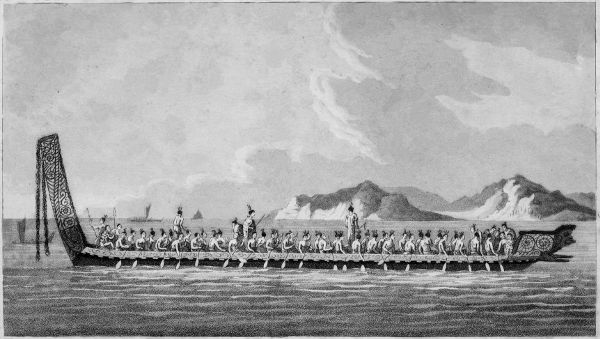
have seen the strokes of fifteen paddles on a side in
one of their canoes made with incredible quickness,
and yet with such minute exactness of time, that all
the rowers seemed to be actuated by one common
soul. Their colour in general is brown; but in few
deeper than that of a Spaniard, who has been exposed
to the sun; in many not so deep. The women have
not a feminine delicacy in their appearance, but their
voice is remarkably soft; and by that, the dress of
both sexes being the same, they are principally distinguished:
they have, however, like the women of
other countries, more airy cheerfulness, and a greater
flow of animal spirits, than the other sex. Their
hair, both of the head and beard, is black; and their
teeth extremely regular, and as white as ivory: the
features of both sexes are good: they seem to enjoy
high health; and we saw many who appeared to be of
a great age. The dispositions both of the men and
women seemed to be mild and gentle: they treat each
other with the tenderest affection, but are implacable
towards their enemies, to whom, as I have before
observed, they never give quarter. It may, perhaps,
at first, seem strange, that where there is so little to
be got by victory, there should so often be war; and
35that every little district of a country inhabited by
people so mild and placid, should be at enmity with
all the rest. But possibly more is to be gained by
victory among these people than at first appears, and
they may be prompted to mutual hostilities by motives
which no degree of friendship or affection is able to
resist. It appears, by the account that has already
been given of them, that their principal food is fish,
which can only be procured upon the sea-coast; and
there, in sufficient quantities, only at certain times;
the tribes, therefore, who live inland, if any such
there are, and even those upon the coast, must be
frequently in danger of perishing by famine. Their
country produces neither sheep, nor goats, nor hogs,
nor cattle; tame fowls they have none, nor any art
by which those that are wild can be caught in sufficient
plenty to serve as provision. If there are any
whose situation cuts them off from a supply of fish,
the only succedaneum of all other animal food, except
dogs, they have nothing to support life, but the vegetables
that have already been mentioned, of which
the chief are fern-root, yams, clams, and potatoes;
when by any accident these fail, the distress must be
dreadful; and even among the inhabitants of the
coast, many tribes must frequently be reduced to
nearly the same situation, either by the failure of their
plantations, or the deficiency of their dry stock,
during the season when but few fish are to be caught.
These considerations will enable us to account, not
only for the perpetual danger in which the people
who inhabit this country appear to live, by the care
which they take to fortify every village, but for the
horrid practice of eating those who are killed in battle;
for the hunger of him who is pressed by famine to
fight, will absorb every feeling, and every sentiment
which would restrain him from allaying it with the
body of his adversary. It may, however, be remarked,
that, if this account of the origin of so horrid a practice
is true, the mischief does by no means end with
36the necessity that produced it: after the practice
has been once begun on one side by hunger, it
will naturally be adopted on the other by revenge.
Nor is this all, for though it may be pretended, by
some who wish to appear speculative and philosophical,
that whether the dead body of an enemy
be eaten or buried is in itself a matter perfectly
indifferent; as it is, whether the breasts or thighs of
a woman should be covered or naked; and that prejudice
and habit only make us shudder at the violation
of custom in one instance, and blush at it in
the other: yet, leaving this as a point of doubtful
disputation, to be discussed at leisure, it may safely
be affirmed, that the practice of eating human flesh,
whatever it may be in itself, is relatively, and in its
consequences, most pernicious; tending manifestly
to eradicate a principle which is the chief security
of human life, and more frequently restrains the hand
of murder than the sense of duty, or even the fear
of punishment.
Among those who are accustomed to eat the dead,
death must have lost much of its horror; and where
there is little horror at the sight of death, there will
not be much repugnance to kill. A sense of duty,
and fear of punishment, may be more easily surmounted
than the feelings of nature, or those which
have been ingrafted upon nature by early prejudice
and uninterrupted custom. The horror of the murderer
arises less from the guilt of the fact, than its
natural effect; and he who has familiarised the effect,
will consequently lose much of the horror. By
our laws, and our religion, murder and theft incur
the same punishment, both in this world and the
next; yet, of the multitude who would deliberately
steal, there are but very few who would deliberately
kill, even to procure much greater advantage. But
there is the strongest reason to believe, that those who
have been so accustomed to prepare a human body
for a meal, that they can with as little feeling cut
37up a dead man, as our cook-maids divide a dead rabbit
for a fricassee, would feel as little horror in committing
a murder as in picking a pocket, and consequently
would take away life with as little compunction
as property; so that men, under these circumstances,
would be made murderers by the slight
temptations that now make them thieves. If any
man doubts whether this reasoning is conclusive,
let him ask himself, whether in his own opinion
he should not be safer with a man in whom the
horror of destroying life is strong, whether in consequence
of natural instinct unsubdued, or of early
prejudice, which has nearly an equal influence, than
in the power of a man who under any temptation to
murder him would be restrained only by considerations
of interest; for to these all motives of mere duty may
be reduced, as they must terminate either in hope of
good, or fear of evil.
The situation and circumstances, however, of these
poor people, as well as their temper, are favourable
to those who shall settle as a colony among them.
Their situation sets them in need of protection, and
their temper renders it easy to attach them by kindness;
and whatever may be said in favour of a
savage life among people who live in luxurious idleness
upon the bounty of nature, civilization would
certainly be a blessing to those whom her parsimony
scarcely furnishes with the bread of life, and who are
perpetually destroying each other by violence, as the
only alternative of perishing by hunger.
But these people, from whatever cause, being inured
to war, and by habit considering every stranger
as an enemy, were always disposed to attack us when
they were not intimidated by our manifest superiority.
At first, they had no notion of any superiority
but numbers; and when this was on their side, they
considered all our expressions of kindness as the artifices
of fear and cunning, to circumvent them, and preserve
ourselves: but when they were once convinced
38of our power, after having provoked us to the use of
our fire-arms, though loaded only with small shot;
and of our clemency, by our forbearing to make use
of weapons so dreadful except in our defence, they
became at once friendly, and even affectionate, placing
in us the most unbounded confidence, and doing
every thing which could incite us to put equal confidence
in them. It is also remarkable, that when an
intercourse was once established between us, they
were very rarely detected in any act of dishonesty.
Before, indeed, and while they considered us as enemies,
who came upon their coast only to make an
advantage of them, they did not scruple by any
means to make any advantage of us; and would,
therefore, when they had received the price of any
thing they had offered to sell, pack up both the purchase
and the purchase money with all possible
composure, as so much lawful plunder from people
who had no view but to plunder them.
I have observed that our friends in the South Seas
had not even the idea of indecency, with respect to
any object or any action; but this was by no means
the case with the inhabitants of New Zealand, in
whose carriage and conversation there was as much
modesty, reserve, and decorum with respect to
actions, which yet in their opinion were not criminal,
as are to be found among the politest people in Europe.
The women were not impregnable; but the
terms and manner of compliance were as decent as
those in marriage among us, and according to their
notions the agreement was as innocent. When any
of our people made an overture to one of their young
women, he was given to understand that the consent
of her friends was necessary, and by the influence of
a proper present it was generally obtained; but
when these preliminaries were settled, it was also necessary
to treat the wife for a night with the same
delicacy that is here required by the wife for life,
and the lover who presumed to take any liberties by
39which this was violated, was sure to be disappointed.
One of our gentlemen having made his addresses
to a family of the better sort, received an answer,
which, translated into our language, according to the
mode and spirit of it, as well as the letter, would
have been exactly in these terms: “Any of these
young ladies will think themselves honoured by your
addresses, but you must first make me a suitable present,
and you must then come and sleep with us on
shore, for daylight must by no means be a witness of
what passes between you.”
I have already observed, that in personal cleanliness
they are not quite equal to our friends at Otaheite;
because, not having the advantage of so warm
a climate, they do not so often go into the water;
but the most disgustful thing about them is the oil,
with which, like the islanders, they anoint their hair:
it is certainly the fat either of fish or of birds, melted
down, and though the better sort have it fresh, their
inferiors use that which is rancid, and consequently
are almost as disagreeable to the smell as a Hottentot;
neither are their heads free from vermin, though
we observed that they were furnished with combs,
both of bone and wood: these combs are sometimes
worn stuck upright in the hair as an ornament, a
fashion which at present prevails among the ladies of
England. The men generally wear their beards short,
and their hair tied upon the crown of the head in a
bunch, in which they stick the feathers of various
birds in different manners, according to their fancies;
sometimes one is placed on each side of the temples,
pointing forwards, which we thought made a very
disagreeable appearance. The women wear their
hair sometimes cropped short, and sometimes flowing
over their shoulders.
The bodies of both sexes are marked with the
black stains called Amoco, by the same method that
is used at Otaheite, and called Tattowing; but the
40men are more marked, and the women less. The
women in general stain no part of their bodies but
the lips, though sometimes they are marked with
small black patches on other parts: the men, on the
contrary, seem to add something every year to the
ornaments of the last, so that some of them, who appeared
to be of an advanced age, were almost
covered from head to foot. Besides the Amoco, they
have marks impressed by a method unknown to us,
of a very extraordinary kind: they are furrows of
about a line deep, and a line broad, such as appear
upon the bark of a tree which has been cut through,
after a year’s growth: the edges of these furrows are
afterwards indented by the same method, and being
perfectly black, they make a most frightful appearance.
The faces of the old men are almost covered
with these marks; those who are very young, black
only their lips like the women; when they are somewhat
older, they have generally a black patch upon
one cheek, and over one eye, and so proceed gradually,
that they may grow old and honourable together:
but though we could not but be disgusted
with the horrid deformity which these stains and furrows
produced in the “human face divine,” we
could not but admire the dexterity and art with
which they were impressed. The marks upon the
face in general are spirals, which are drawn with
great nicety, and even elegance, those on one side
exactly corresponding with those on the other: the
marks on the body somewhat resemble the foliage in
old chased ornaments, and the convolutions of fillagree
work; but in these they have such a luxuriance
of fancy, that of an hundred, which at first sight appeared
to be exactly the same, no two were, upon a
close examination, found to be alike. We observed,
that the quantity and form of these marks were different
in different parts of the coast, and that as the
principal seat of them at Otaheite was the breech, in
New Zealand it was sometimes the only part which
41was free, and in general was less distinguished than
any other.
The skins of these people, however, are not only
dyed, but painted; for, as I have before observed,
they smear their bodies with red oker, some rubbing
it on dry, and some applying it in large patches
mixed with oil, which is always wet, and which the
least touch will rub off, so that the transgressions of
such of our people as were guilty of ravishing a kiss
from these blooming beauties, were most legibly
written upon their faces.
The dress of a New Zealander is certainly, to a
stranger at first sight, the most uncouth that can be
imagined. It is made of the leaves of the flag, which
has been described among the vegetable productions
of this country: these leaves are split into three or
four slips, and the slips, when they are dry, interwoven
with each other into a kind of stuff between
netting and cloth, with all the ends, which are eight
or nine inches long, hanging out on the upper side, like
the shag or thrump mats, which we sometimes see
lying in a passage. Of this cloth, if cloth it may be
called, two pieces serve for a complete dress; one of
them is tied over their shoulders with a string, and
reaches as low as the knees; to the end of this string
is fastened a bodkin of bone, which is easily passed
through any two parts of this upper garment, so as
tack them together; the other piece is wrapped round
the waist, and reaches nearly to the ground: the lower
garment, however, is worn by the men only upon
particular occasions; but they wear a belt, to which
a string is fastened, for a very singular use. The
inhabitants of the South Sea islands slit up the prepuce
so as to prevent it from covering the glans of
the penis; but these people, on the contrary, bring
the prepuce over the glans, and to prevent it from
being drawn back by the contraction of the part,
they tie the string which hangs from their girdle
round the end of it. The glans, indeed, seemed to be
42the only part of their body which they were solicitous
to conceal, for they frequently threw off all their
dress but the belt and string, with the most careless
indifference, but showed manifest signs of confusion,
when, to gratify our curiosity, they were requested
to untie the string, and never consented but with the
utmost reluctance and shame. When they have only
their upper garment on, and sit upon their hams,
they bear some resemblance to a thatched house;
but this covering, though it is ugly, is well adapted
to the use of those who frequently sleep in the open
air, without any other shelter from the rain.
But besides this coarse shag or thatch, they have
two sorts of cloth, which have an even surface, and
are very ingeniously made, in the same manner with
that manufactured by the inhabitants of South
America, some of which we procured at Rio de
Janeiro. One sort is as coarse as our coarsest canvass,
and somewhat resembles it in the manner of laying
the threads, but it is ten times as strong; the other
is formed by many threads lying very close one way,
and a few crossing them the other, so as to bind
them together; but these are about half an inch
asunder, somewhat like the round pieces of cane
matting which are sometimes placed under the dishes
upon a table. This is frequently striped, and always
had a pretty appearance, for it is composed of the
fibres of the same plant, which are prepared so as to
shine like silk. It is made in a kind of frame of the
size of the cloth, generally about five feet long, and
four broad, across which the long threads, which lie
close together, or warp, are strained, and the cross
threads, or woof, are worked in by hand, which must
be a very tedious operation.
To both these kinds of cloth they work borders of
different colours, in stitches, somewhat like carpeting,
or rather like those used in the samplars which
girls work at school. These borders are of various
patterns, and wrought with a neatness, and even an
43elegance, which, considering they have no needle, is
surprising: but the great pride of their dress consists
in the fur of their dogs, which they use with such
economy, that they cut it into stripes, and sew them
upon their cloth at a distance from each other, which
is a strong proof that dogs are not plenty among
them; these stripes are also of different colours, and
disposed so as to produce a pleasing effect. We saw
some dresses that were adorned with feathers instead
of fur, but these were not common; and we saw
one that was entirely covered with the red feathers
of the parrot.
The dress of the man who was killed when we first
went ashore in Poverty Bay has been described already;
but we saw the same dress only once more
during our stay upon the coast, and that was in
Queen Charlotte’s Sound.
The women, contrary to the custom of the sex in
general, seemed to affect dress rather less than the
men: their hair, which, as I have observed before, is
generally cropt short, is never tied upon the top of
the head when it is suffered to be long, nor is it ever
adorned with feathers. Their garments were made
of the same materials, and in the same form, as those
of the other sex, but the lower one was always bound
fast round them, except when they went into the
water to catch lobsters, and then they took great care
not to be seen by the men. Some of us happening
one day to land upon a small island in Tolaga Bay, we
surprised several of them at this employment; and
the chaste Diana, with her nymphs, could not have
discovered more confusion and distress at the sight
of Actæon than these women expressed upon our
approach. Some of them hid themselves among the
rocks, and the rest crouched down in the sea till they
had made themselves a girdle and apron of such
weeds as they could find, and when they came out,
even with this veil, we could perceive that their
modesty suffered much pain by our presence. The
44girdle and apron which they wear in common have
been mentioned before.
Both sexes bore their ears, and, by stretching them,
the holes become large enough to admit a finger at
least. In these holes they wear ornaments of various
kinds, cloth, feathers, bones of large birds, and even
sometimes a stick of wood; and to these receptacles
of finery they generally applied the nails which we
gave them, and every thing which it was possible
they could contain. The women sometimes
thrust through them the down of the albatros, which
is as white as snow, and which, spreading before and
behind the hole in a bunch almost as big as the
fist, makes a very singular, and, however strange it
may be thought, not a disagreeable appearance.
Besides the ornaments that are thrust through the
holes of the ears, many others are suspended to them
by strings; such as chissels or bodkins made of green
talc, upon which they set a high value, the nails and
teeth of their deceased relations, the teeth of dogs,
and every thing else that they can get, which they
think either curious or valuable. The women also
wear bracelets and anclets, made of the bones of
birds, shells, or any other substances which they can
perforate and string upon a thread. The men had
sometimes hanging to a string, which went round the
neck, a piece of green talc, or whalebone, somewhat
in the shape of a tongue, with the rude figure of a
man carved upon it; and upon this ornament they
set a high value. In one instance, we saw the gristle
that divides the nostrils, and called by anatomists
the septum nasi, perforated, and a feather thrust
through the hole, which projected on each side over
the cheeks: it is probable that this frightful singularity
was intended as an ornament; but of the many
people we saw, we never observed it in any other,
nor even a perforation that might occasionally serve
for such a purpose.
Their houses are the most inartificially made of any
45thing among them, being scarcely equal, except in
size, to an English dog-kennel: they are seldom
more than eighteen or twenty feet long, eight or ten
broad, and five or six high, from the pole that runs
from one end to the other, and forms the ridge, to the
ground. The framing is of wood, generally slender
sticks, and both walls and roof consist of dry grass
and hay, which, it must be confessed, is very tightly
put together; and some are also lined with the bark
of trees, so that in cold weather they must afford a
very comfortable retreat. The roof is sloping, like
those of our barns, and the door is at one end, just
high enough to admit a man, creeping upon his
hands and knees: near the door is a square hole,
which serves the double office of window and chimney,
for the fire-place is at that end, nearly in the
middle between the two sides. In some conspicuous
part, and generally near the door, a plank is fixed,
covered with carving after their manner: this they
value as we do a picture, and in their estimation it is
not an inferior ornament. The side-walls and roof
project about two feet beyond the walls at each end, so
as to form a kind of porch, in which there are benches
for the accommodation of the family. That part
of the floor which is allotted for the fire-place is enclosed
in a hollow square, by partitions either of wood
or stone, and in the middle of it the fire is kindled.
The floor, along the inside of the walls, is thickly covered
with straw, and upon this the family sleep.
Their furniture and implements consist of but few
articles, and one chest commonly contains them all,
except their provision-baskets, the gourds that hold
their fresh water, and the hammers that are used to
beat their fern-root, which generally stand without
the door: some rude tools, their clothes, arms, and a
few feathers to stick in their hair, make the rest of
their treasure.
Some of the better sort, whose families are large,
have three or four houses enclosed within a court-yard,
46the walls of which are constructed of poles
and hay, and are about ten or twelve feet high.
When we were on shore in the district called
Tolaga, we saw the ruins, or rather the frame of a
house, for it had never been finished, much superior
in size to any that we saw elsewhere: it was thirty
feet in length, about fifteen in breadth, and twelve
high: the sides of it were adorned with many carved
planks, of a workmanship much superior to any other
that we had met with in the country; but for what
purpose it was built, or why it was deserted, we
could never learn.
But these people, though in their houses they are
so well defended from the inclemency of the weather,
seem to be quite indifferent whether they have any
shelter at all during their excursions in search of
fern-roots and fish, sometimes setting up a small
shade to windward, and sometimes altogether neglecting
even that precaution, sleeping with their
women and children under bushes, with their
weapons ranged round them, in the manner that
has already been described. The party, consisting
of forty or fifty, whom we saw at Mercury Bay, in
a district which the natives call Opoorage, never
erected the least shelter while we staid there, though
it sometimes rained incessantly for four-and-twenty
hours together.
The articles of their food have been enumerated
already; the principal, which to them is what bread
is to the inhabitants of Europe, is the roots of the
fern which grows upon the hills, and is nearly the
same with what grows upon our high commons in
England, and is called indifferently fern, bracken, or
brakes. The birds, which sometimes serve them for
a feast, are chiefly penguins and albatrosses, with a
few other species that have been occasionally mentioned
in this narrative.
Having no vessel in which water can be boiled,
their cookery consists wholly of baking and roasting.
47They bake nearly in the same manner as the
inhabitants of the South Seas, and to the account
that has been already given of their roasting, nothing
need be added, but that the long skewer or spit
to which the flesh is fastened is placed sloping towards
the fire, by setting one stone against the
bottom of it, and supporting it near the middle with
another, by the moving of which, to a greater or less
distance from the end, the degree of obliquity is increased
or diminished at pleasure.
To the northward, as I have observed, there are
plantations of yams, sweet potatoes, and coccos, but
we saw no such to the southward; the inhabitants,
therefore, of that part of the country must subsist
wholly upon fern root and fish, except the scanty and
accidental resource which they may find in sea-fowl
and dogs; and that fern and fish are not to be procured
at all seasons of the year, even at the sea-side,
and upon the neighbouring hills, is manifest from
the stores of both that we saw laid up dry, and the
reluctance which some of them expressed at selling
any part of them to us when we offered to purchase
them, at least the fish, for sea stores. And this particular
seems to confirm my opinion, that this country
scarcely sustains the present number of its inhabitants,
who are urged to perpetual hostilities by
hunger, which naturally prompted them to eat the
dead bodies of those who were slain in the contest.
Water is their universal and only liquor, as far as
we could discover, and if they have really no means
of intoxication, they are, in this particular, happy
beyond any other people that we have yet seen or
heard of.
As there is, perhaps, no source of disease, either
critical or chronic, but intemperance and inactivity,
it cannot be thought strange that these people enjoy
perfect and uninterrupted health. In all our visits
to their towns, where young and old, men and
women, crowded about us, prompted by the same
48curiosity that carried us to look at them, we never
saw a single person who appeared to have any bodily
complaint, nor among the numbers that we have seen
naked did we once perceive the slightest eruption
upon the skin, or any marks that an eruption had
left behind. At first, indeed, observing that some of
them when they came off to us were marked in
patches with a white flowery appearance upon different
parts of their bodies, we thought that they were
leprous, or highly scorbutic; but upon examination
we found that these marks were owing to their
having been wetted by the spray of the sea in their
passage, which, when it was dried away, left the salts
behind it in a fine white powder.
Another proof of health, which we have mentioned
upon a former occasion, is the facility with which
the wounds healed that had left scars behind them,
and that we saw in a recent state; when we saw the
man who had been shot with a musket-ball through
the fleshy part of his arm, his wound seemed to be
so well digested, and in so fair a way of being perfectly
healed, that if I had not known no application
had been made to it, I should certainly have enquired,
with a very interested curiosity, after the vulnerary
herbs and surgical art of the country.
A farther proof that human nature is here untainted
with disease, is the great number of old men
that we saw, many of whom, by the loss of their hair
and teeth, appeared to be very ancient, yet none of
them were decrepit; and though not equal to the
young in muscular strength, were not a whit behind
them in cheerfulness and vivacity.
CHAP. X. OF THE CANOES AND NAVIGATION OF THE INHABITANTS OF NEW ZEALAND: THEIR TILLAGE, WEAPONS, AND MUSIC: GOVERNMENT, RELIGION, AND LANGUAGE: WITH SOME REASONS AGAINST THE EXISTENCE OF A SOUTHERN CONTINENT.
49
The ingenuity of these people appears in nothing
more than in their canoes: they are long and narrow,
and in shape very much resemble a New
England whale-boat: the larger sort seem to be
built chiefly for war, and will carry from forty to
eighty, or an hundred armed men. We measured
one which lay ashore at Tolaga: she was sixty-eight
feet and a half long, five feet broad, and three feet
and a half deep; the bottom was sharp, with straight
sides like a wedge, and consisted of three lengths,
hollowed out to about two inches, or an inch and a
half thick, and well fastened together with strong
plaiting: each side consisted of one entire plank,
sixty-three feet long, ten or twelve inches broad,
and about an inch and quarter thick, and these were
fitted and lashed to the bottom part with great dexterity
and strength. A considerable number of
thwarts were laid from gunwale to gunwale, to
which they were securely lashed on each side, as a
strengthening to the boat. The ornament at the
head projected five or six feet beyond the body, and
was about four feet and a half high; the ornament
at the stern was fixed upon that end, as the stern-post
of a ship is upon her keel, and was about fourteen
feet high, two feet broad, and an inch and a
half thick. They both consisted of boards of carved
work, of which the design was much better than the
execution. All their canoes, except a few at
50Opoorage or Mercury Bay, which were of one
piece, and hollowed by fire, are built after this plan,
and few are less than twenty feet long: some of the
smaller sort have outriggers, and sometimes two of
them are joined together, but this is not common.
The carving upon the stern and head ornaments of
the inferior boats, which seemed to be intended
wholly for fishing, consists of the figure of a man,
with a face as ugly as can be conceived, and a
monstrous tongue thrust out of the mouth, with
the white shells of sea-ears stuck in for the eyes.
But the canoes of the superior kind, which seem to
be their men-of-war, are magnificently adorned with
open work, and covered with loose fringes of black
feathers, which had a most elegant appearance: the
gunwale boards were also frequently carved in a
grotesque taste, and adorned with tufts of white
feathers placed upon a black ground. Of visible
objects that are wholly new, no verbal description
can convey a just idea, but in proportion as they
resemble some that are already known, to which the
mind of the reader must be referred: the carving of
these people being of a singular kind, and not in the
likeness of any thing that is known on our side of
the ocean, either “in the heaven above, or in the
earth beneath, or in the waters that are under the
earth,” I must refer wholly to the representations
which will be found of it in Plate XV.
The paddles are small, light, and neatly made; the
blade is of an oval shape, or rather of a shape resembling
a large leaf, pointed at the bottom, broadest
in the middle, and gradually losing itself in the
shaft, the whole length being about six feet, of which
the shaft or loom including the handle is four, and
the blade two. By the help of these oars they push
on their boats with amazing velocity.
In sailing they are not expert, having no art of
going otherwise than before the wind: the sail is
of netting or matt, which is set up between two
51poles that are fixed upright upon each gunwale,
and serve both for masts and yards: two ropes answered
the purpose of sheets, and were consequently
fastened above to the top of each pole. But clumsy
and inconvenient as this apparatus is, they make
good way before the wind, and are steered by two
men who sit in the stern, with each a paddle in his
hand for that purpose.
Having said thus much of their workmanship, I
shall now give some account of their tools: they
have adzes, axes, and chisels, which serve them
also as augers for the boring of holes: as they
have no metal, their adzes and axes are made of a
hard black stone, or of a green talc, which is not
only hard but tough; and their chisels of human
bone, or small fragments of jasper, which they chip
off from a block in sharp angular pieces like a gun-flint.
Their axes they value above all that they
possess, and never would part with one of them for
any thing that we could give: I once offered one of
the best axes I had in the ship, besides a number of
other things, for one of them, but the owner would
not sell it; from which I conclude that good ones
are scarce among them. Their small tools of jasper,
which are used in finishing their nicest work, they
use till they are blunt, and then, as they have no
means of sharpening them, throw them away. We
had given the people at Tolaga a piece of glass, and
in a short time they found means to drill a hole
through it, in order to hang it round the neck as an
ornament by a thread; and we imagine the tool
must have been a piece of this jasper. How they
bring their large tools first to an edge, and sharpen
the weapon which they call Patoo-Patoo, we could
not certainly learn; but probably it is by bruising the
same substance to powder, and, with this, grinding
two pieces against each other.
Their nets, particularly their seine, which is of an
enormous size, have been mentioned already: one of
52these seems to be the joint work of a whole town,
and I suppose it to be the joint property also: the
other net, which is circular, and extended by two or
three hoops, has been particularly described, as well
as the manner of baiting and using it. Their hooks
are of bone or shell, and in general are ill made.
To receive the fish when it is caught, and to hold
their other provisions, they have baskets of various
kinds and dimensions, very neatly made of wickerwork.
They excel in tillage, as might naturally be expected
where the person that sows is to eat the produce,
and where there is so little besides that can be eaten:
when we first came to Tegadoo, a district between
Poverty Bay and East Cape, their crops were just
covered, and had not yet begun to sprout; the mould
was as smooth as in a garden, and every root had its
small hillock, ranged in a regular quincunx by lines,
which with the pegs were still remaining in the field.
We had not an opportunity to see any of these husbandmen
work, but we saw what serves them at
once for spade and plough: this instrument is nothing
more than a long narrow stake sharpened to an
edge at one end, with a short piece fastened transversely
at a little distance above it, for the convenience
of pressing it down with the foot. With this
they turn up pieces of ground six or seven acres in
extent, though it is not more than three inches
broad; but as the soil is light and sandy, it makes
little resistance.
Tillage, weaving, and the other arts of peace, seem
to be best known and most practised in the northern
part of this country; for there is little appearance of
any of them in the south: but the arts of war flourish
equally through the whole coast.
Of weapons they have no great variety, but such as
they have are well fitted for destruction; they have
spears, darts, battle-axes, and the Patoo-Patoo. The
spear is fourteen or fifteen feet long, pointed at both
53ends, and sometimes headed with bone: these are
grasped by the middle, so that the part behind balancing
that before, makes a push more difficult to
be parried, than that of a weapon which is held by
the end. The dart and other weapons have been sufficiently
described already; and it has also been remarked,
that these people have neither sling nor
bow. They throw the dart by hand, and so they do
stones; but darts and stones are seldom used, except
in defending their forts. Their battles, whether in
boats or on shore, are generally hand to hand, and
the slaughter must consequently be great, as a second
blow with any of their weapons is unnecessary, if
the first takes place: their trust, however, seems to
be principally placed in the Patoo-Patoo, which is
fastened to their wrists by a strong strap, lest it
should be wrenched from them, and which the principal
people generally wear sticking in their girdles,
considering it as a military ornament, and part of
their dress, like the poniard of the Asiatic, and the
sword of the European. They have no defensive
armour; but, besides their weapons, the chiefs carry
a staff of distinction, in the same manner as our officers
do the spontoon: this was generally the rib of
a whale, as white as snow, with many ornaments of
carved work, dog’s hair, and feathers; but sometimes
it was a stick, about six feet long, adorned
in the same manner, and inlaid with a shell like
mother-of-pearl. Those who bore this mark of distinction
were generally old, at least past the middle
age, and were also more marked with the Amoco
than the rest.
One or more persons, thus distinguished, always
appeared in each canoe, when they came to attack
us, according to the size of it. When they came
within about a cable’s length of the ship, they used
to stop; and the chiefs rising from their seat, put on
a dress which seemed appropriated to the occasion,
generally of dog’s skin, and holding out their decorated
54staff, or weapon, directed the rest of the people
what they should do. When they were at too great
a distance to reach us with a lance or a stone, they
presumed that we had no weapon with which we
could reach them; here then the defiance was given,
and the words were almost universally the same,—Haromai,
haromai, harre uta a patoo-patoo oge:
“Come to us, come on shore, and we will kill you all
with our patoo-patoos.” While they were uttering
these menaces, they came gradually nearer and
nearer, till they were close alongside; talking at intervals
in a peaceable strain, and answering any
questions that we asked them; and at intervals renewing
their defiance and threats, till being encouraged
by our apparent timidity, they began their
war-song and dance, as a prelude to an attack, which
always followed, and was sometimes continued till it
became absolutely necessary to repress them by firing
some small shot; and sometimes ended after throwing
a few stones on board, as if content with having
offered us an insult, which we did not dare to revenge.
The war-dance consists of a great variety of violent
motions, and hideous contortions of the limbs,
during which the countenance also performs its part:
the tongue is frequently thrust out to an incredible
length, and the eye-lids so forcibly drawn up, that the
white appears both above and below, as well as on
each side of the iris, so as to form a circle round it;
nor is any thing neglected that can render the human
shape frightful and deformed: at the same time they
brandish their spears, shake their darts, and cleave
the air with their patoo-patoos. This horrid dance
is always accompanied by a song; it is wild, indeed,
but not disagreeable, and every strain ends in aloud
and deep sigh, which they utter in concert. In the
motions of the dance, however horrid, there is a
strength, firmness, and agility, which we could not
but behold with admiration; and in their song they
55keep time with such exactness, that I have often
heard above an hundred paddles struck against the
sides of their boats at once, so as to produce but a
single sound, at the divisions of their music.
A song not altogether unlike this, they sometimes
sing without the dance, and as a peaceable amusement:
they have also other songs which are sung by
the women, whose voices are remarkably mellow and
soft, and have a pleasing and tender effect; the time
is slow, and the cadence mournful; but it is conducted
with more taste than could be expected
among the poor ignorant savages of this half-desolate
country; especially as it appeared to us, who
were none of us much acquainted with music as a
science, to be sung in parts; it was at least sung by
many voices at the same time.
They have sonorous instruments, but they can
scarcely be called instruments of music; one is the
shell, called the Triton’s trumpet, with which they
make a noise not unlike that which our boys sometimes
make with a cow’s horn: the other is a small
wooden pipe, resembling a child’s nine-pin, only
much smaller, and in this there is no more music
than in a pea-whistle. They seem sensible indeed
that these instruments are not musical; for we never
heard an attempt to sing to them, or to produce with
them any measured tones that bore the least resemblance
to a tune.
To what has been already said of the practice of
eating human flesh, I shall only add, that in almost
every cove where we landed, we found flesh-bones
of men near the places where fires had been made;
and that among the heads that were brought on board
by the old man, some seemed to have false eyes, and
ornaments in their ears as if alive. That which Mr.
Banks bought was sold with great reluctance by the
possessor: the head was manifestly that of a young
person about fourteen or fifteen years of age, and
by the contusions on one side appeared to have received
56many violent blows, and indeed a part of the
bone near the eye was wanting. These appearances
confirmed us in the opinion that the natives of this
country give no quarter, nor take any prisoners to
be killed and eaten at a future time, as is said to
have been a practice among the Indians of Florida:
for if prisoners had been taken, this poor young creature,
who cannot be supposed capable of making
much resistance, would probably have been one, and
we knew that he was killed with the rest, for the fray
had happened but a few days before.
The towns or Hippahs of these people, which are
all fortified, have been sufficiently described already,
and from the Bay of Plenty to Queen Charlotte’s
Sound they seem to be the constant residence of the
people: but about Poverty Bay, Hawke’s Bay, Tegadoo,
and Tolaga, we saw no Hippahs, but single
houses scattered at a distance from each other; yet
upon the sides of the hills there were stages of
a great length, furnished with stones and darts,
probably as retreats for the people at the last extremity,
as upon these stages a fight may be carried
on with much advantage against those below, who
may be reached with great effect by darts and
stones, which it is impossible for them to throw up
with equal force. And indeed the forts themselves
seem to be no farther serviceable than by enabling
the possessors to repress a sudden attack; for as
there is no supply of water within the lines, it would
be impossible to sustain a siege. A considerable
stock of fern-root and dry fish is indeed laid up in
them; but they may be reserved against seasons of
scarcity, and that such seasons there are, our observations
left us no room to doubt; besides, while
an enemy should be prowling in the neighbourhood,
it would be easy to snatch a supply of water from the
side of the hill, though it would be impossible to dig
up fern-root or catch fish.
In this district, however, the people seemed to live in
57a state of conscious security, and to avail themselves
of their advantage: their plantations were more numerous,
their canoes were more decorated, and they
had not only finer carving, but finer clothes. This part
of the coast also was much the most populous, and
possibly their apparent peace and plenty might arise
from their being united under one Chief, or King;
for the inhabitants of all this part of the country told
us, that they were the subjects of Teratu: when
they pointed to the residence of this Prince, it was
in a direction which we thought inland; but which,
when we knew the country better, we found to be the
Bay of Plenty.
It is much to be regretted that we were obliged
to leave this country without knowing any thing of
Teratu but his name. As an Indian monarch, his
territory is certainly extensive: he was acknowledged
from Cape Kidnappers to the northward, and westward
as far as the Bay of Plenty, a length of coast
upwards of eighty leagues; and we do not yet know
how much farther westward his dominions may extend.
Possibly the fortified towns which we saw in
the Bay of Plenty may be his barrier; especially as at
Mercury Bay he was not acknowledged, nor indeed
any other single chief: for wherever we landed, or
spoke with the people upon that coast, they told
us that we were at but a small distance from their
enemies.
In the dominions of Teratu we saw several subordinate
chiefs, to whom great respect was paid, and by
whom justice was probably administered; for upon
our complaint to one of them, of a theft that had
been committed on board the ship by a man that
came with him, he gave him several blows and kicks,
which the other received as the chastisement of authority,
against which no resistance was to be made,
and which he had no right to resent. Whether this
authority was possessed by appointment or inheritance
58we could not learn; but we observed that the
chiefs, as well here as in other parts, were elderly
men. In other parts, however, we learnt that they
possessed their authority by inheritance.
The little societies which we found in the southern
parts seemed to have several things in common, particularly
their fine clothes, and fishing nets. Their
fine clothes, which possibly might be the spoils of war,
were kept in a small hut, which was erected for that
purpose in the middle of the town: the nets we saw
making in almost every house, and the several parts
being afterwards collected were joined together.
Less account seems to be made of the women here
than in the South Sea islands; such at least was the
opinion of Tupia, who complained of it as an indignity
to the sex. We observed that the two sexes eat together;
but how they divide their labour we do not
certainly know. I am inclined to believe that the
men till the ground, make nets, catch birds, and go
out in their boats to fish; and that the women dig up
fern-roots, collect lobsters and other shell-fish near
the beach, dress the victuals, and weave cloth: such
at least were their employments when we had an opportunity
of observing them, which was but seldom;
for in general our appearance made a holiday wherever
we went, men, women and children, flocking
round us, either to gratify their curiosity, or to purchase
some of the valuable merchandise which we
carried about with us, consisting principally of nails,
paper, and broken glass.
Of the religion of these people it cannot be supposed
that we could learn much; they acknowledge
the influence of superior beings, one of whom is supreme,
and the rest subordinate; and gave nearly
the same account of the origin of the world, and the
production of mankind, as our friends in Otaheite:
Tupia, however, seemed to have a much more deep
and extensive knowledge of these subjects than any
of the people here; and whenever he was disposed
59to instruct them, which he sometimes did in a long
discourse, he was sure of a numerous audience, who
listened in profound silence, with such reverence and
attention, that we could not but wish them a better
teacher.
What homage they pay to the deities they acknowledge
we could not learn; but we saw no place
of public worship, like the Morais of the South Sea
islands: yet we saw, near a plantation of sweet potatoes,
a small area, of a square figure, surrounded
with stones, in the middle of which one of the sharpened
stakes which they use as a spade was set up,
and upon it was hung a basket of fern-roots: upon
inquiry, the natives told us, that it was an offering
to the gods, by which the owner hoped to render them
propitious, and obtain a plentiful crop.
As to their manner of disposing of their dead, we
could form no certain opinion of it, for the accounts
that we received by no means agreed. In the northern
parts, they told us that they buried them in the
ground; and in the southern, that they threw them
into the sea: it is however certain that we saw no
grave in the country, and that they affected to conceal
every thing relating to their dead with a kind of
mysterious secrecy. But whatever may be the sepulchre,
the living are themselves the monuments;
for we saw scarcely a single person of either sex
whose body was not marked by the scars of wounds
which they had inflicted upon themselves as a testimony
of their regret for the loss of a relation or
friend: some of these wounds we saw in a state so
recent that the blood was scarcely staunched, which
shows that death had been among them while we
were upon the coast; and makes it more extraordinary
that no funeral ceremony should have fallen
under our notice: some of the scars were very large
and deep, and in many instances had greatly disfigured
the face. One monument indeed we observed
60of another kind,—the cross that was set up
near Queen Charlotte’s Sound.
Having now given the best account in my power
of the customs and opinions of the inhabitants of
New Zealand, with their boats, nets, furniture, and
dress, I shall only remark, that the similitude between
these particulars here and in the South Sea
islands is a very strong proof that the inhabitants
have the same origin; and that the common ancestors
of both, were natives of the same country. They
have both a tradition that their ancestors, at a very
remote period of time, came from another country;
and according to the tradition of both, that the name
of that country was Heawije; but the similitude of
the language seems to put the matter altogether out
of doubt. I have already observed, that Tupia,
when he accosted the people here in the language of
his own country, was perfectly understood; and I
shall give a specimen of the similitude by a list of
words in both languages, according to the dialect of
the northern and southern islands of which New
Zealand consists, by which it will appear that the
language of Otaheite does not differ more from that
of New Zealand, than the language of the two islands
from each other.
| English. |
New Zealand. |
Otaheite. |
|
Northern. |
Southern. |
|
| A Chief, |
Eareete, |
Eareete, |
Earee. |
| A man, |
Taata, |
Taata, |
Taata. |
| A woman, |
Whahine, |
Whahine, |
Ivahine. |
| The head, |
Eupo, |
Heaowpoho, |
Eupo. |
| The hair, |
Macauwe, |
Heoo-oo, |
Roourou. |
| The ear, |
Terringa, |
Hetaheyei, |
Terrea. |
| The forehead, |
Erai, |
Heai, |
Erai. |
| The eyes, |
Mata, |
Hemata, |
Mata. |
| The cheeks, |
Paparinga, |
Hepapaeh, |
Paparea. |
| The nose, |
Ahewh, |
Heeih, |
Ahew. |
| The mouth, |
Hangoutou, |
Hegaowai, |
Outou. |
| The chin, |
Ecouwai, |
Hakaoewai, |
|
| The arm, |
Haringaringu, |
|
Rema. |
| 61The finger, |
Maticara, |
Hermaigawh, |
Maneow. |
| The belly, |
Ateraboo, |
|
Oboo. |
| The navel, |
Apeto, |
Heeapeto, |
Peto. |
| Come hither, |
Haromai, |
Haromai, |
Herromai. |
| Fish, |
Heica, |
Heica, |
Eyea. |
| A lobster, |
Kooura, |
Kooura, |
Tooura. |
| Coccos, |
Taro, |
Taro, |
Taro. |
| Sweet potatoes, |
Cumala, |
Cumala, |
Cumala. |
| Yams, |
Tuphwhe, |
Tuphwhe, |
Tuphwhe. |
| Birds, |
Mannu, |
Mannu, |
Mannu. |
| No, |
Kaoura, |
Kaoura, |
Oure. |
| One, |
Tahai, |
|
Tahai. |
| Two, |
Rua, |
|
Rua. |
| Three, |
Torou, |
|
Torou. |
| Four, |
Ha, |
|
Hea. |
| Five, |
Rema, |
|
Rema. |
| Six, |
Ono, |
|
Ono. |
| Seven, |
Etu, |
|
Hetu. |
| Eight, |
Warou, |
|
Warou. |
| Nine, |
Iva, |
|
Heva. |
| Ten, |
Angahourou, |
|
Ahourou. |
| The teeth, |
Hennihew, |
Heneaho, |
Nihio. |
| The wind, |
Mehow, |
|
Mattai. |
| A thief, |
Amootoo, |
|
Teto. |
| To examine, |
Mataketake, |
|
Mataitai. |
| To sing, |
Eheara, |
|
Heiva. |
| Bad, |
Keno, |
Keno, |
Eno. |
| Trees, |
Eratou, |
Eratou, |
Eraou. |
| Grandfather, |
Toubouna, |
Toubouna, |
Toubouna. |
| What do you call this or that, |
Owy Terra, |
|
Owy Terra, |
By this specimen, I think it appears to demonstration
that the language of New Zealand and Otaheite
is radically the same. The language of the northern
and southern parts of New Zealand differs chiefly in
the pronunciation, as the same English word is pronounced
gate in Middlesex, and geäte in Yorkshire:
and as the southern and northern words were not
written down by the same person, one might possibly
62use more letters to produce the same sound than the
other.
I must also observe, that it is the genius of the
language, especially in the southern parts, to put
some article before a noun, as we do the or a; the
articles used here were generally he or ko; it is also
common here to add the word öeia after another
word as an iteration, especially if it is an answer to
a question; as we say, yes indeed, to be sure, really,
certainly: this sometimes led our gentlemen into
the formation of words of an enormous length, judging
by the ear only, without being able to refer each
sound into its signification. An example will make
this perfectly understood.
In the Bay of Islands there is a remarkable one,
called by the natives Matuaro. One of our gentlemen
having asked a native the name of it, he answered,
with the particle, Kematuaro; the gentleman
hearing the sound imperfectly, repeated his question,
and the Indian repeating his answer, added öeia,
which made the word Kematuaroöeia; and thus it
happened that in the log book I found Metuaro
transformed into Cumettiwarroweia: and the same
transformation by the same means, might happen to
an English word. Suppose a native of New Zealand
at Hackney church, to inquire “What village is
this?” the answer would be, “It is Hackney:” suppose
the question to be repeated with on air of doubt
and uncertainty, the answer might be, “it is Hackney
indeed,” and the New Zealander, if he had the
use of letters, would probably record, for the information
of his countrymen, that during his residence
among us he had visited a village called “Ityshak
neeindede.” The article used by the inhabitants of
the South Sea islands, instead of he or ko, is to or ta,
but the word öeia is common to both; and when we
began to learn the language, it led us into many ridiculous
mistakes.
But supposing these islands, and those in the South
63Seas, to have been peopled originally from the same
country, it will perhaps for ever remain a doubt what
country that is: we were, however, unanimously of
opinion, that the people did not come from America,
which lies to the eastward; and except there should
appear to be a continent to the southward, in a
moderate latitude, it will follow that they came from
the westward.
Thus far our navigation has certainly been unfavourable
to the notion of a southern continent, for it
has swept away at least three-fourths of the positions
upon which it has been founded. The principal navigators,
whose authority has been urged on this occasion,
are Tasman, Juan Fernandes, Hermite, the
commander of a Dutch squadron, Quiros, and
Roggewein; and the track of the Endeavour has
demonstrated that the land seen by these persons,
and supposed to be part of a continent, is not so;
it has also totally subverted the theoretical arguments
which have been brought to prove that the
existence of a southern continent is necessary to
preserve an equilibrium between the two hemispheres;
for upon this principle what we have
already proved to be water, would render the
southern hemisphere too light. In our route to the
northward, after doubling Cape Horn, when we were
in the latitude of 40°, our longitude was 110°; and in
our return to the southward, after leaving Ulietea,
when we were again in latitude 40°, our longitude was
145°; the difference is 35°. When we were in latitude
30° the difference of longitude between the two
tracks was 21°, which continued till we were as low
as 20°; but a single view of the chart will convey a
better idea of this than the most minute description:
yet as upon a view of the chart it will appear that
there is a large space extending quite to the tropics,
which neither we, nor any other navigators to our
knowledge, have explored, and as there will appear to
64be room enough for the Cape of a southern continent
to extend northward into a low southern latitude,
I shall give my reason for believing there is no Cape
of any southern continent, to the northward of 40°
south.
Notwithstanding what has been laid down by some
geographers in their maps, and alleged by Mr. Dalrymple,
with respect to Quiros, it is improbable in
the highest degree that he saw to the southward of
two islands, which he discovered in latitude 25 or 26,
and which I suppose may lie between the longitude
of 130° and 140° W., any signs of a continent, much
less any thing which, in his opinion, was a known or
indubitable sign of such land; for if he had, he
would certainly have sailed southward in search of
it, and if he had sought, supposing the signs to have
been indubitable, he must have found: the discovery
of a southern continent was the ultimate object of
Quiros’s voyage, and no man appears to have had it
more at heart; so that if he was in latitude 26° S.
and in longitude 146° W., where Mr. Dalrymple has
placed the islands he discovered, it may fairly be inferred,
that no part of a southern continent extends
to that latitude.
It will, I think, appear with equal evidence from
the accounts of Roggewein’s voyage, that between
the longitudes of 130° and 150° W. there is no main
land to the northward of 35° S. Mr. Pingre, in
a treatise concerning the transit of Venus, which he
went out to observe, has inserted an extract of Roggewein’s
voyage, and a map of the South Seas; and
for reasons which may be seen at large in his work,
supposes him, after leaving Easter Island, which he
places in latitude 28-½ S. longitude 123° W., to have
steered S. W. as high as 34° S. and afterwards
W. N. W.; and if this was indeed his route, the
proof that there is no main land to the northward of
35° S. is irrefragable. Mr. Dalrymple indeed supposes
65his route to have been different, and that from
Easter Isle he steered N. W., taking a course afterwards
very little different from that of La Maire;
but I think it is highly improbable that a man, who,
at his own request was sent to discover a southern
continent, should take a course in which La Maire
had already proved no continent could be found: it
must, however, be confessed, that Roggewein’s track
cannot certainly be ascertained, because, in the accounts
that have been published of his voyage, neither
longitudes nor latitudes are mentioned. As to
myself, I saw nothing that I thought a sign of land in
my route, either to the northward, southward, or
westward, till a few days before I made the east coast
of New Zealand. I did indeed frequently see large
flocks of birds, but they were generally such as
are found at a very remote distance from any coast;
and it is also true that I frequently saw pieces of
rock-weed, but I could not infer the vicinity of land
from these, because I have been informed, upon indubitable
authority, that a considerable quantity of
the beans called ox-eyes, which are known to grow no
where but in the West Indies, are every year thrown
up on the coast of Ireland, which is not less than
twelve hundred leagues distant.
Thus have I given my reasons for thinking that
there is no continent to the northward of latitude
40° S. Of what may lie farther to the southward
than 40°, I can give no opinion; but I am so far from
wishing to discourage any future attempt, finally to
determine a question which has long been an object
of attention to many nations; that now this voyage
has reduced the only possible site of a continent in
the southern hemisphere, north of latitude 40°, to so
small a space, I think it would be pity to leave that
any longer unexamined, especially as the voyage may
turn to good account, besides determining the principal
question, if no continent should be found, by
the discovery of new islands in the tropical regions,
66of which there is probably a great number that no
European vessel has ever yet visited. Tupia, from
time to time, gave us an account of about one hundred
and thirty; and, in a chart drawn by his own
hand, he actually laid down no less than seventy-four.
BOOK III. CHAP. I. THE RUN FROM NEW ZEALAND TO BOTANY BAY, ON THE EAST COAST OF NEW HOLLAND, NOW CALLED NEW SOUTH WALES; VARIOUS INCIDENTS THAT HAPPENED THERE; WITH SOME ACCOUNT OF THE COUNTRY AND ITS INHABITANTS.
67
Having sailed from Cape Farewell, which lies in latitude
40° 33ʹ S., longitude 186° W., on Saturday the
31st of March, 1770, we steered westward, with a
fresh gale at N. N. E., and at noon, on the 2d of
April, our latitude, by observation, was 40°, our longitude
from Cape Farewell 2° 31ʹ W.
In the morning of the 9th, being in latitude
38° 29ʹ S., we saw a tropic bird, which, in so high a latitude,
is very uncommon.
In the morning of the 10th, being in latitude
38° 51ʹ S., longitude 202° 43ʹ W., we found the variation,
by the amplitude, to be 11° 25ʹ E., and by the
azimuth 11° 20ʹ.
In the morning of the 11th, the variation was
13° 48ʹ, which is two degrees and a half more than
the day before, though I expected to have found it
less.
In the course of the 13th, being in latitude
39° 23ʹ S., longitude 204° 2ʹ W., I found the variation
to be 12° 27ʹ E., and in the morning of the 14th
it was 11° 30ʹ, this day we also saw some flying fish.
On the 15th, we saw an egg bird and a gannet, and
as these are birds that never go far from the land, we
continued to sound all night, but had no ground
with 130 fathom. At noon, on the 16th, we were in
latitude 39° 45ʹ S., longitude 208° W. At about two
68o’clock the wind came about to the W. S. W., upon
which we tacked and stood to the N. W.; soon
after, a small land-bird perched upon the rigging, but
we had no ground with 120 fathom. At eight we
wore and stood to the southward till twelve at night,
and then wore and stood to the N. W. till four in the
morning, when we again stood to the southward, having
a fresh gale at W. S. W., with squalls and dark
weather till nine, when the weather became clear,
and there being little wind, we had an opportunity
to take several observations of the sun and moon, the
mean result of which gave 207° 56ʹ W. longitude:
our latitude at noon was 39° 36ʹ S. We had now a
hard gale from the southward, and a great sea from
the same quarter, which obliged us to run under our
fore-sail and mizen all night, during which we
sounded every two hours, but had no ground with
120 fathom.
In the morning of the 18th, we saw two Port Egmont
hens, and a pintado bird, which are certain
signs of approaching land, and, indeed, by our reckoning,
we could not be far from it, for our longitude
was now one degree to the westward of the east side
of Van Diemen’s land, according to the longitude
laid down by Tasman, whom we could not suppose
to have erred much in so short a run as from this
land to New Zealand; and by our latitude we could
not be above fifty or fifty-five leagues from the
place whence he took his departure. All this day
we had frequent squalls and a great swell. At one
in the morning we brought to and sounded, but
had no ground with 130 fathom; at six we saw land
extending from N. E. to W., at the distance of five
or six leagues, having eighty fathom water, with a fine
sandy bottom.
We continued standing westward, with the wind
at S. S. W., till eight, when we made all the sail we
could, and bore away along the shore N. E. for the
eastermost land in sight, being at this time in latitude
6937° 58ʹ S., and longitude 210° 39ʹ W. The
southermost point of land in sight, which bore from
us W. ¼ S., I judged to lie in latitude 38°, longitude
211° 7ʹ, and gave it the name of Point Hicks, because
Mr. Hicks, the first lieutenant, was the first
who discovered it. To the southward of this Point
no land was to be seen, though it was very clear in
that quarter, and by our longitude, compared with
that of Tasman, not as it is laid down in the printed
charts, but in the extracts from Tasman’s journal,
published by Rembrantse, the body of Van Diemen’s
land ought to have borne due south; and, indeed,
from the sudden falling of the sea after the wind
abated, I had reason to think it did; yet as I did not
see it, and as I found this coast trend N. E. and
S. W., or rather more to the eastward, I cannot determine
whether it joins to Van Diemen’s land or not.
At noon we were in latitude 37° 5ʹ, longitude
210° 29ʹ W. The extremes of the land extended
from N. W. to E. N. E., and a remarkable point
bore N. 20 E., at the distance of about four leagues.
This point rises in a round hillock, very much resembling
the Ram Head at the entrance of Plymouth
Sound, and therefore I called it by the same name.
The variation by an azimuth, taken this morning,
was 3° 7ʹ E.; and what we had now seen of the land,
appeared low and level: the sea-shore was a white
sand, but the country within was green and woody.
About one o’clock, we saw three water-spouts at
once; two were between us and the shore, and
the third at some distance, upon our larboard quarter:
this phenomenon is so well known, that it is not
necessary to give a particular description of it here.
At six o’clock in the evening we shortened sail,
and brought to for the night, having fifty-six fathom
water, and a fine sandy bottom. The northermost
land in sight then bore N. by E. ½ E., and
a small island lying close to a point on the main
bore W. distant two leagues. This point, which I
70called Cape Howe, may be known by the trending
of the coast, which is north on the one side and
south-west on the other; it may also be known by
some round hills upon the main, just within it.
We brought to for the night, and at four in the
morning made sail along shore to the northward. At
six, the northermost land in sight bore N. N. W. and
we were at this time about four leagues from the
shore. At noon we were in latitude 36° 51ʹ S.,
longitude 209° 53ʹ W., and about three leagues distant
from the shore. The weather being clear, gave us a
good view of the country, which has a very pleasing
appearance: it is of a moderate height, diversified by
hills and valleys, ridges and plains, interspersed with
a few lawns of no great extent, but in general covered
with wood: the ascent of the hills and ridges
is gentle, and the summits are not high. We continued
to sail along the shore to the northward, with
a southerly wind, and in the afternoon we saw smoke
in several places, by which we knew the country to
be inhabited. At six in the evening we shortened
sail, and sounded: we found forty-four fathom water,
with a clear sandy bottom, and stood on under an easy
sail till twelve, when we brought to for the night, and
had ninety fathom water.
At four in the morning we made sail again, at the
distance of about five leagues from the land, and at
six, we were abreast of a high mountain, lying near
the shore, which, on account of its figure, I called
Mount Dromedary. Under this mountain the shore
forms a point, to which I gave the name of Point
Dromedary, and over it there is a peaked hillock.
At this time, being in latitude 36° 18ʹ S., longitude
209° 55ʹ W., we found the variation to be 10° 42ʹ E.
Between ten and eleven, Mr. Green and I took
several observations of the sun and moon, the mean
result of which gave 209° 17ʹ longitude W. By
an observation made the day before, our longitude
was 210° 9ʹ W., from which 20ʹ being subtracted,
71there remains 209° 49ʹ, the longitude of the ship
this day at noon, the mean of which, with this day’s
observation, gives 209° 33ʹ, by which I fix the longitude
of this coast. At noon our latitude was 35°
49ʹ S., Cape Dromedary bore S. 30 W., at the distance
of twelve leagues, and an open bay, in which
were three or four small islands, bore N. W. by W.,
at the distance of five or six leagues. This bay
seemed to afford but little shelter from the sea winds,
and yet it is the only place where there appeared a
probability of finding anchorage upon the whole
coast. We continued to steer along the shore N. by
E. and N. N. E., at the distance of about three
leagues, and saw smoke in many places near the
beach. At five in the evening we were abreast of
a point of land which rose in a perpendicular cliff,
and which, for that reason, I called Point Upright.
Our latitude was 35° 35ʹ S. when this point bore from
us due west, distant about two leagues: in this situation,
we had about thirty-one fathom water, with
a sandy bottom. At six in the evening, the wind
falling, we hauled off E. N. E., and at this time the
northermost land in sight bore N. by E. ½ E. At
midnight, being in seventy fathom water, we brought
to till four in the morning, when we made sail in
for the land; but at day-break found our situation
nearly the same as it had been at five the evening
before, by which it was apparent that we had been
driven about three leagues to the southward, by a
tide or current, during the night. After this we
steered along the shore N. N. E. with a gentle
breeze at S. W., and were so near the land as to
distinguish several of the natives upon the beach,
who appeared to be of a black, or very dark colour.
At noon, our latitude, by observation, was 35° 27ʹ S.
and longitude 209° 23ʹ W., Cape Dromedary bore
S. 28 W., distant nineteen leagues, a remarkable
peaked hill, which resembled a square dove-house,
with a dome at the top, and which for that reason I
72called the Pigeon House, bore N. 32° 30ʹ W., and
a small low island, which lay close under the shore,
bore N. W., distant about two or three leagues.
When I first discovered this island, in the morning,
I was in hopes, from its appearance, that I should
have found shelter for the ship behind it; but when
we came near it, it did not promise security even
for the landing of a boat. I should however have attempted
to send a boat on shore, if the wind had not
veered to that direction, with a large hollow sea rolling
in upon the land from the S. E., which indeed
had been the case ever since we had been upon it.
The coast still continued to be of a moderate height,
forming alternately rocky points and sandy beaches;
but within, between Mount Dromedary and the
Pigeon House, we saw high mountains, which, except
two, are covered with wood: these two lie
inland behind the Pigeon House, and are remarkably
flat at the top, with steep rocky cliffs all round
them, as far as we could see. The trees, which almost
every where clothe this country, appear to be
large and lofty. This day the variation was found
to be 9° 50ʹ E., and for the two last days, the latitude,
by observation, was twelve or fourteen miles
to the southward of the ship’s account, which could
have been the effect of nothing but a current setting
in that direction. About four in the afternoon, being
near five leagues from the land, we tacked, and stood
off S. E. and E., and the wind having veered in
the night, from E. to N. E. and N., we tacked about
four in the morning, and stood in, being then about
nine or ten leagues from the shore. At eight, the
wind began to die away, and soon after it was calm.
At noon, our latitude, by observation, was 35° 38ʹ,
and our distance from the land about six leagues.
Cape Dromedary bore S. 37 W., distant seventeen
leagues, and the Pigeon House N. 40 W. In this
situation we had 74 fathom water. In the afternoon,
we had variable light airs and calms, till six in the
73evening, when a breeze sprung up at N. by W.: at
this time, being about four or five leagues from the
shore, we had seventy fathom water. The Pigeon
House bore N. 45 W., Mount Dromedary S. 30 W.,
and the northermost land in sight N. 19 E.
We stood to the north-east till noon the next day,
with a gentle breeze at N. W., and then we tacked
and stood westward. At this time our latitude by
observation, was 35° 10ʹ S., and longitude 208° 51ʹ W.
A point of land which I had discovered on St. George’s
day, and which therefore I called Cape George,
bore W. distant nineteen miles, and the Pigeon
House (the latitude and longitude of which I found
to be 35° 19ʹ S. and 209° 42ʹ W.) S. 75 W. In the
morning we had found the variation, by amplitude,
to be 7° 50ʹ E., and by several azimuths 7° 54ʹ E.
We had a fresh breeze at N. W. from noon till three;
it then came to the west, when we tacked and stood
to the northward. At five in the evening, being
about five or six leagues from the shore, with the
Pigeon House bearing W. S. W. distant about nine
leagues, we had eighty-six fathom water; and at
eight, having thunder and lightning, with heavy
squalls, we brought to in 120 fathom.
At three in the morning, we made sail again to
the northward, having the advantage of a fresh gale
at S. W. At noon we were about three or four
leagues from the shore, and in latitude 34° 22ʹ S.,
longitude 208° 36ʹ W. In the course of this day’s
run from the preceding noon, which was forty-five
miles north-east, we saw smoke in several places
near the beach. About two leagues to the northward
of Cape George, the shore seemed to form a
bay, which promised shelter from the north-east
winds, but as the wind was with us, it was not in my
power to look into it without beating up, which
would have cost me more time than I was willing to
spare. The north point of this bay, on account of
its figure, I named Long Nose; its latitude is 35° 6ʹ,
74and about eight leagues north of it there lies a point,
which, from the colour of the land about it, I called
Red Point: its latitude is 34° 29ʹ, and longitude
208° 45ʹ W. To the north-west of Red Point, and
a little way inland, stands a round hill, the top of
which looks like the crown of a hat. In the afternoon
of this day we had a light breeze at N. N. W.
till five in the evening, when it fell calm. At this
time, we were between three and four leagues from
the shore, and had forty-eight fathom water: the
variation by azimuth was 8° 48ʹ E. and the extremities
of this land were from N. E. by N. to S. W. by S.
Before it was dark, we saw smoke in several places
along the shore, and a fire two or three times afterwards.
During the night we lay becalmed, driving
in before the sea till one in the morning, when we
got a breeze from the land, with which we steered
N. E., being then in thirty-eight fathom. At noon
it veered to N. E. by N., and we were then in latitude
34° 10ʹ S., longitude 208° 27ʹ W.: the land was distant
about five leagues, and extended from S. 37 W.
to N. ½ E. In this latitude there are some white
cliffs, which rise perpendicularly from the sea to a
considerable height. We stood off the shore till
two o’clock, and then tacked and stood in till six,
when we were within four or five miles of it, and at
that distance had fifty fathom water. The extremities
of the land bore from S. 28 W. to N. 25° 30ʹ E.
We now tacked and stood off till twelve, then tacked
and stood in again till four in the morning, when we
made a trip off till daylight; and during all this
time we lost ground, owing to the variableness of
the winds. We continued at the distance of between
four and five miles from the shore, till the
afternoon, when we came within two miles, and I
then hoisted out the pinnace and yawl to attempt a
landing, but the pinnace proved to be so leaky that
I was obliged to hoist her in again. At this time
we saw several of the natives walking briskly along
75the shore, four of whom carried a small canoe upon
their shoulders. We flattered ourselves that they
were going to put her into the water, and come off
to the ship, but finding ourselves disappointed, I
determined to go on shore in the yawl, with as many
as it would carry. I embarked, therefore, with only
Mr. Banks, Dr. Solander, Tupia, and four rowers:
we pulled for that part of the shore where the
Indians appeared, near which four small canoes were
lying at the water’s edge. The Indians sat down
upon the rocks, and seemed to wait for our landing;
but to our great regret, when we came within about
a quarter of a mile, they ran away into the woods.
We determined, however, to go ashore, and endeavour
to procure an interview; but in this we were again
disappointed, for we found so great a surf beating
upon every part of the beach, that landing with our
little boat was altogether impracticable. We were
therefore obliged to be content with gazing at such
objects as presented themselves from the water. The
canoes, upon a near view, seemed very much to resemble
those of the smaller sort at New Zealand.
We observed, that among the trees on shore, which
were not very large, there was no underwood; and
could distinguish that many of them were of the
palm kind, and some of them cabbage trees: after
many a wishful look we were obliged to return, with
our curiosity rather excited than satisfied, and about
five in the evening got on board the ship. About
this time it fell calm, and our situation was by no
means agreeable. We were now not more than a mile
and a half from the shore, and within some breakers,
which lay to the southward; but happily a light
breeze came off the land, and carried us out of
danger. With this breeze we stood to the northward,
and at day-break we discovered a bay, which seemed
to be well sheltered from all winds, and into which,
therefore, I determined to go with the ship. The
pinnace being repaired, I sent her, with the master,
76to sound the entrance, while I kept turning up,
having the wind right out. At noon, the mouth of
the bay bore N. N. W., distant about a mile, and seeing
a smoke on the shore, we directed our glasses to
the spot, and soon discovered ten people, who, upon
our nearer approach, left their fire, and retired to a
little eminence, whence they could conveniently
observe our motions. Soon after two canoes, each
having two men on board, came to the shore just
under the eminence, and the men joined the rest on
the top of it. The pinnace, which had been sent
a-head to sound, now approached the place, upon
which all the Indians retired farther up the hill, except
one, who hid himself among some rocks near
the landing-place. As the pinnace proceeded along
the shore, most of the people took the same route,
and kept abreast of her at a distance. When she
came back, the master told us, that in a cove a little
within the harbour, some of them had come down to
the beach, and invited him to land by many signs and
words, of which he knew not the meaning; but that
all of them were armed with long pikes, and a
wooden weapon shaped somewhat like a cimeter.
The Indians who had not followed the boat, seeing
the ship approach, used many threatening gestures,
and brandished their weapons; particularly two,
who made a very singular appearance, for their
faces seemed to have been dusted with a white
powder, and their bodies painted with broad streaks
of the same colour, which passing obliquely over
their breasts and backs, looked not unlike the cross-belts
worn by our soldiers; the same kind of streaks
were also drawn round their legs and thighs, like
broad garters. Each of these men held in his hand
the weapon that had been described to us as like a
cimeter, which appeared to be about two feet and a
half long; and they seemed to talk to each other with
great earnestness.
We continued to stand into the bay, and early in
77the afternoon anchored under the south shore, about
two miles within the entrance, in six fathom water,
the south point bearing S. E., and the north point
East. As we came in we saw, on both points of the
bay, a few huts, and several of the natives, men,
women, and children. Under the south head we
saw four small canoes, with each one man on board,
who were very busily employed in striking fish with
a long pike or spear. They ventured almost into the
surf, and were so intent upon what they were doing,
that although the ship passed within a quarter of a
mile of them, they scarcely turned their eyes toward
her; possibly, being deafened by the surf, and their
attention wholly fixed upon their business or sport,
they neither saw nor heard her go past them.
The place where the ship had anchored was
abreast of a small village, consisting of about six or
eight houses; and while we were preparing to hoist
out the boat, we saw an old woman, followed by
three children, come out of the wood; she was loaded
with fire-wood, and each of the children had also its
little burden. When she came to the houses, three
more children, younger than the others, came out to
meet her: she often looked at the ship, but expressed
neither fear nor surprise. In a short time she kindled
a fire, and the four canoes came in from fishing. The
men landed, and having hauled up their boats, began
to dress their dinner, to all appearance, wholly unconcerned
about us, though we were within half a mile of
them. We thought it remarkable that all of the
people we had yet seen, not one had the least appearance
of clothing, the old woman herself being destitute
even of a fig-leaf.
After dinner the boats were manned, and we set
out from the ship, having Tupia of our party. We
intended to land where we saw the people, and began
to hope that as they had so little regarded the ship’s
coming into the bay, they would as little regard our
coming on shore. In this, however, we were disappointed;
78for as soon as we approached the rocks,
two of the men came down upon them to dispute our
landing, and the rest ran away. Each of the two
champions was armed with a lance about ten feet
long, and a short stick, which he seemed to handle as
if it was a machine to assist him in managing or
throwing the lance. They called to us in a very loud
tone, and in a harsh dissonant language, of which
neither we nor Tupia understood a single word:
they brandished their weapons, and seemed resolved
to defend their coast to the uttermost, though they
were but two, and we were forty. I could not but
admire their courage, and being very unwilling that
hostilities should commence with such inequality of
force between us, I ordered the boat to lie upon her
oars: we then parlied by signs for about a quarter of
an hour, and to bespeak their good-will, I threw
them nails, beads, and other trifles, which they took
up, and seemed to be well pleased with. I then made
signs that I wanted water, and, by all the means
that I could devise, endeavoured to convince them
that we would do them no harm. They now waved
to us, and I was willing to interpret it as an invitation;
but upon our putting the boat in, they came again to
oppose us. One appeared to be a youth about
nineteen or twenty, and the other a man of middle
age: as I had now no other resource, I fired a musket
between them. Upon the report, the youngest
dropped a bundle of lances upon the rock, but recollecting
himself in an instant, he snatched them up
again with great haste. A stone was then thrown at
us, upon which I ordered a musket to be fired with
small shot, which struck the eldest upon the legs, and
he immediately ran to one of the houses, which was
distant about an hundred yards. I now hoped that
our contest was over, and we immediately landed;
but we had scarcely left the boat when he returned,
and we then perceived that he had left the rock only
to fetch a shield or target for his defence. As soon
79as he came up, he threw a lance at us, and his comrade
another; they fell where we stood thickest, but
happily hurt nobody. A third musket with small
shot was then fired at them, upon which one of them
threw another lance, and both immediately ran
away: if we had pursued, we might probably have
taken one of them; but Mr. Banks suggesting that
the lances might be poisoned, I thought it not prudent
to venture into the woods. We repaired immediately
to the huts, in one of which we found the
children, who had hidden themselves behind a shield
and some bark; we peeped at them, but left them in
their retreat, without their knowing that they had
been discovered, and we threw into the house, when
we went away, some beads, ribbons, pieces of cloth,
and other presents, which we hoped would procure
us the good-will of the inhabitants when they should
return; but the lances which we found lying about,
we took away with us, to the number of about fifty:
they were from six to fifteen feet long, and all of
them had four prongs in the manner of a fish-gig,
each of which was pointed with fish-bone, and very
sharp: we observed that they were smeared with a
viscous substance of a green colour, which favoured
the opinion of their being poisoned, though we afterwards
discovered that it was a mistake: they appeared,
by the sea-weed that we found sticking to
them, to have been used in striking fish. Upon
examining the canoes that lay upon the beach, we
found them to be the worst we had ever seen: they
were between twelve and fourteen feet long, and
made of the bark of a tree in one piece, which was
drawn together and tied up at each end, the middle
being kept open by sticks, which were placed across
them from gunwale to gunwale as thwarts. We then
searched for fresh water, but found none, except in a
small hole which had been dug in the sand.
Having reimbarked in our boat, we deposited our
lances on board the ship, and then went over to the
80north point of the bay, where we had seen several of
the inhabitants when we were entering it, but which
we now found totally deserted. Here, however, we
found fresh water, which trickled down from the top
of the rocks, and stood in pools among the hollows at
the bottom; but it was situated so as not to be procured
for our use without difficulty.
In the morning, therefore, I sent a party of men to
that part of the shore where we first landed, with orders
to dig holes in the sand where the water might
gather; but going ashore myself with the gentlemen
soon afterwards, we found, upon a more diligent
search, a small stream, more than sufficient for our
purpose.
Upon visiting the hut where we had seen the
children, we were greatly mortified to find that the
beads and ribbons which we had left there the night
before had not been moved from their places, and
that not an Indian was to be seen.
Having sent some empty water-casks on shore,
and left a party of men to cut wood, I went myself
in the pinnace to sound, and examine the bay;
during my excursion I saw several of the natives, but
they all fled at my approach. In one of the places
where I landed, I found several small fires, and fresh
muscles broiling upon them; here also I found some
of the largest oyster-shells I had ever seen.
As soon as the wooders and waterers came on
board to dinner, ten or twelve of the natives came
down to the place, and looked with great attention
and curiosity at the casks, but did not touch them:
they took away, however, the canoes which lay near
the landing-place, and again disappeared. In the
afternoon, when our people were again ashore, sixteen
or eighteen Indians, all armed, came boldly
within about an hundred yards of them, and then
stopped: two of them advanced somewhat nearer;
and Mr. Hicks, who commanded the party on shore,
with another, advanced to meet them, holding out
81presents to them as he approached, and expressing
kindness and amity by every sign he could think of,
but all without effect; for before he could get up
with them they retired, and it would have answered
no purpose to pursue. In the evening I went with
Mr. Banks and Dr. Solander to a sandy cove on the
north side of the bay, where, in three or four hauls
with the seine, we took above three hundred weight
of fish, which was equally divided among the ship’s
company.
The next morning, before day-break, the Indians
came down to the houses that were abreast of the
ship, and were heard frequently to shout very loud.
As soon as it was light, they were seen walking along
the beach; and soon after they retired to the woods,
where, at the distance of about a mile from the shore,
they kindled several fires.
Our people went ashore as usual, and with them
Mr. Banks and Dr. Solander, who, in search of
plants, repaired to the woods. Our men, who were
employed in cutting grass, being the farthest removed
from the main body of the people, a company
of fourteen or fifteen Indians advanced towards them,
having sticks in their hands, which, according to the
report of the serjeant of marines, shone like a musket.
The grass-cutters upon seeing them approach,
drew together, and repaired to the main body. The
Indians, being encouraged by this appearance of a
flight, pursued them; they stopped, however, when
they were within about a furlong of them, and after
shouting several times, went back into the woods.
In the evening they came again in the same manner,
stopped at the same distance, shouted and retired.
I followed them myself, alone and unarmed, for a
considerable way along the shore, but I could not
prevail upon them to stop.
This day Mr. Green took the sun’s meridian altitude
a little within the south entrance of the bay,
82which gave the latitude 34° S., the variation of the
needle was 11° 3ʹ E.
Early the next morning, the body of Forby Sutherland,
one of our seamen, who died the evening
before, was buried near the watering-place; and from
this incident I called the south point of this bay
Sutherland Point. This day we resolved to make an
excursion into the country. Mr. Banks, Dr. Solander,
myself, and seven others, properly accoutred
for the expedition, set out, and repaired first to the
huts near the watering-place, whither some of the
natives continued every day to resort; and though
the little presents which we had left there before had
not yet been taken away, we left others of somewhat
more value, consisting of cloth, looking-glasses,
combs, and beads, and then went up into the country.
We found the soil to be either swamp or light
sand, and the face of the country finely diversified by
wood and lawn. The trees are tall, straight, and
without underwood, standing at such a distance from
each other, that the whole country, at least where
the swamps do not render it incapable of cultivation,
might be cultivated without cutting down one of
them. Between the trees the ground is covered with
grass, of which there is great abundance, growing in
tufts about as big as can well be grasped in the hand,
which stand very close to each other. We saw many
houses of the inhabitants, and places where they had
slept upon the grass without any shelter; but we saw
only one of the people, who, the moment he discovered
us, ran away. At all these places we left presents,
hoping that at length they might produce confidence
and good-will. We had a transient and imperfect
view of a quadruped, about as big as a rabbit. Mr.
Banks’s greyhound, which was with us, got sight of
it, and would probably have caught it, but the moment
he set off he lamed himself against a stump
which lay concealed in the long grass. We afterwards
saw the dung of an animal which fed upon
83grass, and which we judged could not be less than a
deer; and the footsteps of another, which was clawed
like a dog, and seemed to be about as big as a
wolf. We also tracked a small animal, whose foot resembled
that of a polecat or weasel. The trees over
our head abounded with birds of various kinds, among
which were many of exquisite beauty, particularly
loriquets and cockatoos, which flew in flocks of several
scores together. We found some wood which had
been felled by the natives with a blunt instrument,
and some that had been barked. The trees were not
of many species; among others there was a large one
which yielded a gum not unlike the sanguis draconis;
and in some of them steps had been cut at about three
feet distance from each other, for the convenience of
climbing them.
From this excursion we returned between three
and four o’clock, and having dined on board, we
went ashore again at the watering-place, where a
party of men were filling casks. Mr. Gore, the second
lieutenant, had been sent out in the morning
with a boat to dredge for oysters at the head of the
bay; when he had performed this service, he went
ashore, and having taken a midshipman with him,
and sent the boat away, set out to join the waterers
by land. In his way he fell in with a body of
two-and-twenty Indians, who followed him, and were
often not more than twenty yards distant. When Mr.
Gore perceived them so near, he stopped, and faced
about, upon which they stopped also; and when he
went on again, continued their pursuit. They did not,
however, attack him, though they were all armed with
lances, and he and the midshipman got in safety to
the watering-place. The Indians, who had slackened
their pursuit when they came in sight of the main
body of our people, halted at about the distance of
a quarter of a mile, where they stood still. Mr.
Monkhouse and two or three of the waterers took it
into their head to march up to them; but seeing the
84Indians keep their ground till they came pretty near
them, they were seized with a sudden fear very common
to the rash and fool-hardy, and made a hasty retreat.
This step, which insured the danger that it was
taken to avoid, encouraged the Indians, and four of them
running forward, discharged their lances at the fugitives,
with such force, that flying no less than forty
yards, they went beyond them. As the Indians did
not pursue, our people, recovering their spirits, stopped
to collect the lances when they came up to the
place where they lay; upon which the Indians, in
their turn, began to retire. Just at this time I came
up, with Mr. Banks, Dr. Solander, and Tupia; and
being desirous to convince the Indians that we were
neither afraid of them, nor intended them any mischief,
we advanced towards them, making signs of
expostulation and entreaty; but they could not be
persuaded to wait till we could come up. Mr. Gore
told us, that he had seen some of them up the bay, who
had invited him by signs to come on shore, which he,
certainly with great prudence, declined.
The morning of the next day was so rainy, that we
were all glad to stay on board. In the afternoon,
however, it cleared up, and we made another excursion
along the sea-coast to the southward: we went
ashore, and Mr. Banks and Dr. Solander gathered
many plants; but besides these we saw nothing worthy
of notice. At our first entering the woods, we
met with three of the natives, who instantly ran away:
more of them were seen by some of the people, but
they all disappeared, with great precipitation, as soon
as they found that they were discovered. By the
boldness of these people at our first landing, and the
terror that seized them at the sight of us afterwards,
it appears that they were sufficiently intimidated by
our fire-arms: not that we had any reason to think
the people much hurt by the small shot which we
were obliged to fire at them, when they attacked us
at our coming out of the boat; but they had probably
85seen the effects of them, from their lurking-places,
upon the birds that we had shot. Tupia,
who was now become a good marksman, frequently
strayed from us to shoot parrots; and he had told us,
that while he was thus employed, he had once met with
nine Indians, who, as soon as they perceived he saw
them, ran from him, in great confusion and terror.
The next day, twelve canoes, in each of which was
a single Indian, came towards the watering-place,
and were within half a mile of it a considerable time:
they were employed in striking fish, upon which, like
others that we had seen before, they were so intent,
that they seemed to regard nothing else. It happened,
however, that a party of our people were out a
shooting near the place, and one of the men, whose
curiosity might at length, perhaps, be roused by the
report of the fowling-pieces, was observed by Mr.
Banks to haul up his canoe upon the beach, and go
towards the shooting-party. In something more than
a quarter of an hour, he returned, launched his canoe,
and went off in her to his companions. This incident
makes it probable that the natives acquired a
knowledge of the destructive power of our fire-arms,
when we knew nothing of the matter; for this man
was not seen by any of the party whose operations he
had reconnoitred.
While Mr. Banks was gathering plants near the
watering-place, I went with Dr. Solander and Mr.
Monkhouse to the head of the bay, that I might examine
that part of the country, and make farther attempts
to form some connexion with the natives. In
our way we met with eleven or twelve small canoes,
with each a man in it, probably the same that were
afterwards abreast of the shore, who all made into
shoal water upon our approach. We met other Indians
on shore the first time we landed, who instantly
took to their canoes, and paddled away. We went
up the country to some distance, and found the face
of it nearly the same with that which has been described
86already, but the soil was much richer; for,
instead of sand, I found a deep black mould, which I
thought very fit for the production of grain of any
kind. In the woods we found a tree which bore fruit
that in colour and shape resembled a cherry: the
juice had an agreeable tartness, though but little flavour.
We found also interspersed some of the finest
meadows in the world: some places, however, were
rocky, but these were comparatively few: the stone
is sandy, and might be used with advantage for building.
When we returned to the boat, we saw some
smoke upon another part of the coast, and went thither
in hopes of meeting with the people, but at our
approach, these also ran away. We found six small
canoes, and six fires very near the beach, with some
muscles roasting upon them, and a few oysters lying
near: by this we judged that there had been one
man in each canoe, who having picked up some shell
fish, had come ashore to eat it, and made his separate
fire for that purpose. We tasted of their cheer, and
left them in return some strings of beads, and other
things which we thought would please them. At the
foot of a tree in this place we found a small well of
fresh water, supplied by a spring; and the day being
now far spent, we returned to the ship. In the evening,
Mr. Banks made a little excursion with his gun,
and found such a number of quails, resembling those
in England, that he might have shot as many as he
pleased; but his object was variety and not number.
The next morning, as the wind would not permit
me to sail, I sent out several parties into the country
to try again whether some intercourse could not be
established with the natives. A midshipman, who
belonged to one of these parties, having straggled a
long way from his companions, met with a very old
man and woman, and some little children; they
were sitting under a tree by the water side, and
neither party saw the other till they were close together.
The Indians showed signs of fear, but did not
87attempt to run away. The man happened to have
nothing to give them but a parrot that he had shot;
this he offered, but they refused to accept it, withdrawing
themselves from his hand either through
fear or aversion. His stay with them was but short,
for he saw several canoes near the beach fishing, and
being alone, he feared they might come ashore and
attack him. He said, that these people were very dark-coloured,
but not black; that the man and woman
appeared to be very old, being both grey-headed;
that the hair of the man’s head was bushy, and his
beard long and rough; that the woman’s hair was
cropped short; and both of them were stark naked.
Mr. Monkhouse, the surgeon, and one of the men, who
were with another party near the watering-place, also
strayed from their companions, and as they were
coming out of a thicket, observed six Indians standing
together, at the distance of about fifty yards. One
of them pronounced a word very loud, which was supposed
to be a signal, for a lance was immediately
thrown at him out of the wood, which very narrowly
missed him. When the Indians saw that the weapon
had not taken effect, they ran away with the greatest
precipitation; but on turning about towards the
place whence the lance had been thrown, he saw a
young Indian, whom he judged to be about nineteen
or twenty years old, come down from a tree, and
he also ran away with such speed as made it hopeless
to follow him. Mr. Monkhouse was of opinion
that he had been watched by these Indians in his
passage through the thicket, and that the youth had
been stationed in the tree to discharge the lance at
him, upon a signal, as he should come by; but however
this be, there could be no doubt but that he was
the person who threw the lance.
In the afternoon, I went myself with a party over
to the north shore, and while some of our people
were hauling the seine, we made an excursion a few
88miles into the country, proceeding afterwards in the
direction of the coast. We found this place without
wood, and somewhat resembling our moors in England;
the surface of the ground, however, was covered
with a thin brush of plants, about as high as
the knees. The hills near the coast are low, but others
rise behind them, increasing by a gradual ascent to a
considerable distance, with marshes and morasses
between. When we returned to the boat, we found
that our people had caught with the seine a great
number of small fish, which are well known in the
West-Indies, and which our sailors call leather-jackets,
because their skin is remarkably thick. I had
sent the second lieutenant out in the yawl a striking,
and when we got back to the ship, we found that he
also had been very successful. He had observed
that the large sting-rays, of which there is great
plenty in the bay, followed the flowing tide into very
shallow water; he therefore took the opportunity of
flood, and struck several in not more than two or
three feet water: one of them weighed no less
than two hundred and forty pounds after his entrails
were taken out.
The next morning, as the wind still continued
northerly, I sent out the yawl again, and the people
struck one still larger, for when his entrails were
taken out he weighed three hundred and thirty-six
pounds.
The great quantity of plants which Mr. Banks and
Dr. Solander collected in this place induced me to
give it the name of Botany Bay. It is situated in
the latitude of 34° S., longitude 208° 37ʹ W. It is
capacious, safe, and convenient, and may be known
by the land on the sea-coast, which is nearly level,
and of a moderate height; in general higher than it
is farther inland, with steep rocky cliffs next the
sea, which have the appearance of a long island lying
close under the shore. The harbour lies about the
middle of this land, and in approaching it from the
89southward, is discovered before the ship comes
abreast of it; but from the northward it is not discovered
so soon: the entrance is a little more than a
quarter of a mile broad, and lies in W. N. W. To
sail into it, the southern shore should be kept on
board, till the ship is within a small bare island,
which lies close under the north shore; within this
island the deepest water on that side is seven fathom
shallowing to five a good way up. At a considerable
distance from the south shore there is a shoal reaching
from the inner south point quite to the head of
the harbour; but over towards the north and north-west
shore there is a channel of twelve or fourteen
feet at low water, for three or four leagues, up to a
place where there is three or four fathom; but here
I found very little fresh water. We anchored near
the south shore, about a mile within the entrance,
for the convenience of sailing with a southerly wind,
and because I thought it the best situation for watering;
but I afterwards found a very fine stream on
the north shore, in the first sandy cove within the
island, before which a ship might lie almost land-locked,
and procure wood as well as water in great
abundance. Wood, indeed, is every where plenty, but
I saw only two kinds which may be considered as
timber. These trees are as large, or larger, than the
English oak, and one of them has not a very different
appearance; this is the same that yields the reddish
gum like sanguis draconis, and the wood is heavy,
hard, and dark-coloured, like lignum vitæ: the other
grows tall and straight, something like the pine;
and the wood of this, which has some resemblance
to the live oak of America, is also hard and heavy.
There are a few shrubs, and several kinds of the
palm: mangroves also grow in great plenty near the
head of the bay. The country in general is level,
low, and woody, as far as we could see. The woods,
as I have before observed, abound with birds of exquisite
beauty, particularly of the parrot kind: we
90found also crows here, exactly the same with those
in England. About the head of the harbour, where
there are large flats of sand and mud, there is great
plenty of water-fowl, most of which were altogether
unknown to us; one of the most remarkable was
black and white, much larger than a swan, and in
shape somewhat resembling a pelican. On these
banks of sand and mud there are great quantities
of oysters, muscles, cockles, and other shell-fish,
which seem to be the principal subsistence of the inhabitants,
who go into shoal water with their little
canoes, and pick them out with their hands. We
did not observe that they eat any of them raw, nor
do they always go on shore to dress them, for they
have frequently fires in their canoes for that purpose.
They do not, however, subsist wholly upon this food,
for they catch a variety of other fish, some of which
they strike with gigs, and some they take with hook
and line. All the inhabitants that we saw were stark
naked; they did not appear to be numerous, nor to
live in societies, but, like other animals, were scattered
about along the coast, and in the woods. Of
their manner of life, however, we could know but
little, as we were never able to form the least connection
with them: after the first contest at our landing, they
would never come near enough to parley; nor did they
touch a single article of all that we had left at their
huts, and the places they frequented, on purpose for
them to take away.
During my stay in this harbour I caused the English
colours to be displayed on shore every day, and
the ship’s name, and the date of the year, to be inscribed
upon one of the trees near the watering-place.
It is high-water here at the full and change of the
moon about eight o’clock, and the tide rises and falls
perpendicularly between four and five feet.
CHAP. II. THE RANGE FROM BOTANY BAY TO TRINITY BAY; WITH A FARTHER ACCOUNT OF THE COUNTRY, ITS INHABITANTS, AND PRODUCTIONS.
91
At day-break, on Sunday, the 6th of May, 1770,
we set sail from Botany Bay, with a light breeze at
N. W., which soon after coming to the southward,
we steered along the shore N. N. E.; and at noon,
our latitude, by observation, was 33° 50ʹ S. At this
time we were between two and three miles distant
from the land, and abreast of a bay or harbour, in
which there appeared to be good anchorage, and
which I called Port Jackson. This harbour lies
three leagues to the northward of Botany Bay: the
variation, by several azimuths, appeared to be 8° E.
At sun-set, the northermost land in sight bore N.
26 E., and some broken land, that seemed to form a
bay, bore N. 40 W., distant four leagues. This bay,
which lies in latitude 33° 42ʹ, I called Broken Bay.
We steered along the shore N. N. E. all night, at the
distance of about three leagues from the land, having
from thirty-two to thirty-six fathom water, with
a hard sandy bottom.
Soon after sun-rise on the 7th, I took several azimuths,
with four needles belonging to the azimuth
compass, the mean result of which gave the variation
7° 56ʹ E. At noon our latitude, by observation,
was 33° 22ʹ S.: we were about three leagues
from the shore, the northermost land in sight bore N. 19
E., and some lands which projected in three bluff
points, and which, for that reason, I called Cape
Three Points, bore S. W., distant five leagues. Our
longitude from Botany Bay was 19ʹ E. In the afternoon,
92we saw smoke in several places upon the
shore, and in the evening, found the variation to
be 8° 25ʹ E. At this time we were between two
and three miles from the shore, in twenty-eight fathom;
and at noon, the next day, we had not advanced
one step to the northward. We stood off
shore, with the winds northerly, till twelve at night,
and at the distance of about five leagues, had seventy
fathom; at the distance of six leagues we had
eighty fathom, which is the extent of the soundings;
for at the distance of ten leagues, we had no ground
with 150 fathom.
The wind continuing northerly till the morning
of the 10th, we continued to stand in and off the
shore, with very little change of situation in other
respects; but a gale then springing up at S. W.,
we made the best of our way along the shore to the
northward. At sun-rise, our latitude was 33° 2ʹ S.,
and the variation 8° E. At nine in the forenoon,
we passed a remarkable hill, which stood a little way
inland, and somewhat resembled the crown of a hat;
and at noon, our latitude, by observation, was 32° 53ʹ
S., and our longitude 208° W. We were about two
leagues distant from the land, which extended from
N. 41 E. to S. 41 W., and a small round rock, or
island, which lay close under the land, bore S. 82
W., distant between three and four leagues. At four
in the afternoon, we passed, at the distance of about
a mile, a low rocky point, which I called Point
Stephens; on the north side of which is an inlet,
which I called Port Stephens: this inlet appeared
to me, from the masthead, to be sheltered from all
winds. It lies in latitude 32° 40ʹ, longitude 207° 51ʹ,
and at the entrance are three small islands, two of
which are high; and on the main near the shore are
some high round hills, which at a distance appear
like islands. In passing this bay, at the distance of
two or three miles from the shore, our soundings
were from thirty-three to twenty-seven fathom, from
93which I conjectured that there must be a sufficient
depth of water within it. At a little distance within
land, we saw smoke in several places; and at half
an hour past five, the northermost land in sight bore
N. 36 E. and Point Stephens S. W., distant four
leagues. Our soundings in the night were from forty-eight
to sixty-two fathom, at the distance of between
three and four leagues from the shore, which made
in two hillocks. This Point I called Cape Hawke:
it lies in the latitude of 32° 14ʹ S., longitude
207° 30ʹ W.; and at four o’clock in the morning
bore W., distant about eight miles; at the same time
the northermost land in sight bore N. 6 E. and appeared
like an island. At noon, this land bore N.
8 E., the northermost land in sight N. 13 E., and
Cape Hawke S. 37 W. Our latitude, by observation,
was 32° 2ʹ S. which was twelve miles to the
southward of that given by the log; so that probably
we had a current setting that way: by the morning
amplitude and azimuth, the variation was 9° 10ʹ
E. During our run along the shore, in the afternoon,
we saw smoke in several places, at a little
distance from the beach, and one upon the top of a
hill, which was the first we had seen upon elevated
ground since our arrival upon the coast. At sunset,
we had twenty-three fathom, at the distance of
a league and a half from the shore: the northermost
land then bore N. 13 E., and three hills, remarkably
large and high, lying contiguous to each other, and
not far from the beach, N. N. W. As these hills
bore some resemblance to each other, we called them
The Three Brothers. They lie in latitude 31° 40ʹ,
and may be seen fourteen or sixteen leagues. We
steered N. E. by N. all night, having from twenty-seven
to sixty-seven fathom, at the distance of between
two and six leagues from the shore.
At day-break, we steered north, for the northermost
land in sight. At noon, we were four leagues
from the shore, and, by observation, in latitude 31°
9418ʹ S., which was fifteen miles to the southward of
that given by the log; our longitude 206° 58ʹ W.
In the afternoon, we stood in for the land, where we
saw smoke in several places, till six in the evening,
when, being within three or four miles of it, and in
twenty-four fathom of water, we stood off with a
fresh breeze at N. and N. N. W. till midnight, when
we had 118 fathom, at the distance of eight leagues
from the land, and then tacked. At three in the
morning, the wind veered to the westward, when we
tacked and stood to the northward. At noon, our
latitude, by observation, was 30° 43ʹ S., and our longitude
206° 45ʹ W. At this time we were between
three and four leagues from the shore, the northermost
part of which bore from us N. 13 W. and a
point, or head-land, on which we saw fires that produced
a great quantity of smoke, bore W., distant
four leagues. To this point I gave the name of
Smokey Cape: it is of a considerable height, and
over the pitch of the point is a round hillock;
within it are two others, much higher and larger,
and within them the land is very low. Our latitude
was 30° 31ʹ S., longitude 206° 54ʹ W.: this day the
observed latitude was only five miles south of the
log. We saw smoke in several parts along the coast,
besides that seen upon Smokey Cape.
In the afternoon, the wind being at N. E., we stood
off and on, and at three or four miles distance from
the shore had thirty fathom water: the wind afterwards
coming cross off land, we stood to the northward,
having from thirty to twenty-one fathom, at
the distance of four or five miles from the shore.
At five in the morning, the wind veered to the
north, and blew fresh, attended with squalls: at eight
it began to thunder and rain, and in about an hour it
fell calm, which gave us an opportunity to sound,
and we had eighty-six fathom at between four and
five leagues from the shore. Soon after this we had
a gale from the southward, with which we steered
95N. by W. for the northermost land in sight. At
noon we were about four leagues from the shore,
and by observation, in latitude 30° 22ʹ, which was
nine miles to the southward of our reckoning, longitude
206° 39ʹ W. Some lands near the shore, of a
considerable height, bore W.
As we advanced to the northward from Botany
Bay, the land gradually increased in height, so that
in this latitude it may be called a hilly country. Between
this latitude and the Bay, it exhibits a pleasing
variety of ridges, hills, vallies, and plains, all clothed
with wood, of the same appearance with that which
has been particularly described. The land near the
shore is in general low and sandy, except the points,
which are rocky, and over many of them are high
hills, which, at their first rising out of the water, have
the appearance of islands. In the afternoon, we had
some small rocky islands between us and the land,
the southermost of which lies in latitude 30° 10ʹ, and
the northermost in 29° 58ʹ, and somewhat more than
two leagues from the land: about two miles without
the northermost island we had thirty-three fathom
water. Having the advantage of a moon, we steered
along the shore all night, in the direction of N. and
N. by E., keeping at the distance of about three
leagues from the land, and having from twenty to
twenty-five fathom water. As soon as it was light,
having a fresh gale, we made all the sail we could;
and at nine o’clock in the morning, being about
a league from the shore, we discovered smoke in
many places, and having recourse to our glasses, we
saw about twenty of the natives, who had each a
large bundle upon his back, which we conjectured
to be palm-leaves for covering their houses. We continued
to observe them above an hour, during which
they walked upon the beach, and up a path that led
over a hill of a gentle ascent, behind which we lost
sight of them: not one of them was observed to
stop and look towards us, but they trudged along,
96to all appearance, without the least emotion, either
of curiosity or surprise, though it is impossible they
should not have seen the ship by a casual glance as
they walked along the shore; and though she must,
with respect to every other object they had yet seen,
have been little less stupendous and unaccountable
than a floating mountain with all its woods would
have been to us. At noon, our latitude, by observation,
was 28° 39ʹ S., and longitude 206° 27ʹ W. A
high point of land, which I named Cape Byron,
bore N. W. by W., at the distance of three miles.
It lies in latitude 28° 37ʹ 30ʺ S., longitude 206° 30ʹ
W., and may be known by a remarkable sharp-peaked
mountain, which lies inland, and bears from it N. W.
by W. From this point the land trends N. 13 W.:
inland it is high and hilly, but low near the shore: to
the southward of the point it is also low and level.
We continued to steer along the shore with a fresh
gale, till sun-set, when we suddenly discovered
breakers a-head, directly in the ship’s course, and
also on our larboard bow. At this time we were
about five miles from the land, and had twenty fathom
water: we hauled up east till eight, when we
had run eight miles, and increased our depth of
water to forty-four fathom; we then brought to,
with the ship’s head to the eastward, and lay upon
this tack till ten, when, having increased our sounding
to seventy-eight fathom, we wore and lay with
the ship’s head to the land till five in the morning,
when we made sail, and, at day-light, were greatly
surprised to find ourselves farther to the southward
than we had been the evening before, though the
wind had been southerly, and blown fresh all night.
We now saw the breakers again within us, and passed
them at the distance of one league. They lie in
latitude 28° 8ʹ S., stretching off east two leagues
from a point of land, under which is a small island.
Their situation may always be known by the peaked
mountain which has been just mentioned, and which
97bears from them S. W. by W.: for this reason I have
named it Mount Warning. It lies seven or eight
leagues inland, in latitude 28° 22ʹ S. The land about
it is high and hilly, but it is of itself sufficiently conspicuous
to be at once distinguished from every
other object. The point off which these shoals lie
I have named Point Danger. To the northward
of this point the land is low, and trends N. W.
by N.; but it soon turns again more to the northward.
At noon we were about two leagues from the
land, and, by observation, in latitude 27° 46ʹ S.,
which was seventeen miles to the southward of the
log: our longitude was 206° 26ʹ W. Mount Warning
bore S. 26 W. distant fourteen leagues, and the
northernmost land in sight bore N. We pursued
our course along the shore, at the distance of about
two leagues, in the direction of N. ¾ E. till between
four and five in the afternoon, when we discovered
breakers on our larboard bow. Our depth of water
was thirty-seven fathom, and at sunset, the northernmost
land bore N. by W., the breakers N. W. by W.,
distant four miles, and the northernmost land set at
noon, which formed a point, and to which I gave
the name of Point Look-out, W. distant five or
six miles, in the latitude of 27° 6ʹ. On the north
side of this point, the shore forms a wide open bay,
which I called Moreton’s Bay, in the bottom of
which the land is so low that I could but just see it
from the top-mast head. The breakers lie between
three or four miles from Point Look-out; and at this
time we had a great sea from the southward, which
broke upon them very high. We stood on N. N. E.
till eight o’clock, when having passed the breakers,
and deepened our water to fifty-two fathom, we
brought to till midnight, when we made sail again
to the N. N. E. At four in the morning we had
135 fathom, and when the day broke, I perceived
that during the night I had got much farther northward,
98and from the shore, than I expected from the
course we steered, for we were distant at least seven
leagues; I therefore hauled in N. W. by W., with a
fresh gale at S. S. W. The land that was farthest to
the north the night before now bore S. S. W., distant
six leagues, and I gave it the name of Cape Moreton,
it being the north point of Moreton’s Bay: its latitude
is 26° 56ʹ, and its longitude is 206° 28ʹ. From
Cape Moreton the land trends away west, farther
than can be seen, for there is a small space, where at
this time no land is visible; and some on board having
also observed that the sea looked paler than usual,
were of opinion that the bottom of Moreton’s Bay
opened into a river. We had here thirty-four
fathom water, and a fine sandy bottom: this alone
would have produced the change that had been observed
in the colour of the water; and it was by no
means necessary to suppose a river to account for
the land at the bottom of the bay not being visible;
for supposing the land there to be as low as we knew
it to be in a hundred other parts of the coast, it
would have been impossible to see it from the station
of the ship; however, if any future navigator should
be disposed to determine the question, whether there
is or is not a river in this place, which the wind would
not permit us to do, the situation may always be
found by three hills which lie to the northward of it,
in the latitude of 26° 53ʹ. These hills lie but a little
way inland, and not far from each other: they are
remarkable for the singular form of their elevation,
which very much resembles a glass-house, and for
which reason I called them the Glass-Houses. The
northernmost of the three is the highest and largest:
there are also several other peaked hills inland to
the northward of these, but they are not nearly so
remarkable. At noon our latitude was, by observation,
26° 28ʹ S., which was ten miles to the northward
of the log, a circumstance which had never before
happened upon this coast; our longitude was
99206° 46ʹ. At this time we were between two and
three leagues from the land, and had twenty-four
fathom water. A low bluff point, which was the
south head of a sandy bay, bore N. 62 W., distant
three leagues, and the northernmost point of land in
sight bore N. ¼ E. This day we saw smoke in
several places, and some at a considerable distance
inland.
In steering along the shore at the distance of two
leagues, our soundings were from twenty-four to
thirty-two fathom, with a sandy bottom. At six in
the evening the northernmost point of the land bore
N. ¼ W., distant four leagues; at ten it bore N. W.
by W. ½ W., and as we had seen no land to the northward
of it, we brought to, not well knowing which
way to steer.
At two in the morning, however, we made sail
with the wind at S. W., and at day-light, we saw the
land extending as far as N. ¾ E.: the point we had set
the night before bore S. W. by W., distant between
three and four leagues. It lies in latitude 25° 58ʹ,
longitude 206° 48ʹ W.: the land within it is of a
moderate and equal height, but the point itself is so
unequal, that it looks like two small islands lying
under the land, for which reason I gave it the name
of Double Island Point: it may also be known by
the white cliffs on the north side of it. Here the
land trends to the N. W., and forms a large open
bay, the bottom of which is so low a flat that from
the deck it could scarcely be seen. In crossing this
bay, our depth of water was from thirty to twenty-two
fathom, with a white sandy bottom. At noon
we were about three leagues from the shore, in latitude
25° 34ʹ S., longitude 206° 45ʹ W.: Double
Island Point bore S. ¾ W., and the northernmost land
in sight N. ¾ E. This part of the coast, which is of
a moderate height, is more barren than any we had
seen, and the soil more sandy. With our glasses we
could discover that the sands, which lay in great
100patches of many acres, were moveable, and that some
of them had not been long in the place they possessed;
for we saw in several parts trees half buried,
the tops of which were still green; and in others,
the naked trunks of such as the sand had surrounded
long enough to destroy. In other places the woods
appeared to be low and shrubby, and we saw no signs
of inhabitants. Two water-snakes swam by the ship:
they were beautifully spotted, and in every respect
like land snakes, except that their tails were broad
and flat, probably to serve them instead of fins in
swimming. In the morning of this day the variation
was 8° 20ʹ E., and in the evening 8° 36ʹ. During the
night we continued our course to the northward,
with a light breeze from the land, being distant from
it between two and three leagues, and having from
twenty-three to twenty-seven fathom, with a fine
sandy bottom.
At noon, on the 19th, we were about four miles
from the land, with only thirteen fathom. Our latitude
was 25° 4ʹ, and the northernmost land in sight
bore N. 21 W., distant eight miles. At one o’clock,
being still four miles distant from the shore, but
having seventeen fathom water, we passed a black
bluff head, or point of land, upon which a great
number of the natives were assembled, and which
therefore I called Indian Head: it lies in latitude
25° 3ʹ. About four miles N. by W. of this
head is another very like it, from whence the
land trends away somewhat more to the westward:
next to the sea it is low and sandy, and behind it
nothing was to be seen, even from the mast-head.
Near Indian Head we saw more of the natives, and
upon the neighbouring shore fires by night, and
smoke by day. We kept to the northward all night,
at the distance of from four miles to four leagues
from the shore, and with a depth of water from
seventeen to thirty-four fathom. At day-break, the
northernmost land bore from us W. S. W., and seemed
101to end in a point, from which we discovered a reef
running out to the northward as far as we could see.
We had hauled our wind to the westward before it
was light, and continued the course till we saw the
breakers upon our lee-bow. We now edged away
N. W. and N. N. W. along the eastside of the shoal,
from two to one mile distant, having regular soundings
from thirteen to seven fathom, with a fine sandy
bottom. At noon our latitude, by observation, was
20° 26ʹ, which was thirteen miles to the northward of
the log: we judged the extreme point of the shoal
to bear from us about N. W., and the point from
which it seemed to run out bore S. ¾ W., distant
twenty miles. This point I named Sandy Cape,
from two very large patches of white sand which lay
upon it. It is sufficiently high to be seen at the distance
of twelve leagues, in clear weather, and lies in
latitude 24° 45ʹ, longitude 206° 51ʹ: the land trends
from it S. W. as far as can be seen. We kept along the
east side of the shoal till two in the afternoon, when,
judging that there was a sufficient depth of water
upon it to allow passage for the ship, I sent the boat
a-head to sound, and upon her making the signal for
more than five fathom, we hauled our wind, and stood
over the tail of it in six fathom. At this time we
were in latitude 24° 22ʹ, and Sandy Cape bore S. ½ E.,
distant eight leagues; but the direction of the shoal
is nearest N. N. W. and S. S. E. It is remarkable
that when on board the ship we had six fathom, the
boat, which was scarcely a quarter of a mile to the
southward, had little more than five, and that immediately
after six fathom we had thirteen, and then
twenty, as fast as the man could cast the lead: from
these circumstances, I conjectured that the west side
of the shoal was steep. This shoal I called the Break
Sea Spit, because we had now smooth water, and to
the southward of it we had always a high sea from
the S. E. At six in the evening, the land of Sandy
Cape extended from S. 17 E. to S. 27 E., at the distance
102of eight leagues; our depth of water was
twenty-three fathom: with the same soundings we
stood to the westward all night. At seven in the
morning, we saw, from the mast-head, the land of
Sandy Cape bearing S. E. ½ E., distant about thirteen
leagues: at nine, we discovered land to the westward,
and soon after saw smoke in several places.
Our depth of water was now decreased to seventeen
fathom, and by noon we had no more than thirteen,
though we were seven leagues from the land, which
extended from S. by W. to W. N. W. Our latitude
at this time was 24° 28ʹ S. For a few days past we
had seen several of the sea-birds called boobies, not
having met with any of them before; last night a
small flock of them passed the ship, and went away
to the N. W., and in the morning, from about half
an hour before sunrise to half an hour after, flights
of them were continually coming from the N. N. W.
and flying to the S. S. E., nor was one of them seen
to fly in any other direction; we therefore conjectured
that there was a lagoon, river, or inlet of shallow
water, in the bottom of the deep bay, to the
southward of us, whither these birds resorted to feed
in the day, and that not far to the northward there
were some islands to which they repaired in the
night. To this bay I gave the name of Hervey’s
Bay, in honour of Captain Hervey. In the afternoon
we stood in for the land, steering S. W., with a
gentle breeze at S. E. till four o’clock, when, being
in latitude 24° 36ʹ, about two leagues from the
shore, and having nine fathom water, we bore away
along the coast N. W. by W., and at the same time
could see land extending to the S. S. E. about eight
leagues. Near the sea the land is very low, but
within there are some lofty hills, all thickly clothed
with wood. While we were running along the shore,
we shallowed our water from nine to seven fathom,
and at one time we had but six, which determined
us to anchor for the night.
103At six in the morning we weighed, with a gentle
breeze from the southward, and steered N. W. ¼ W.,
edging in for the land, till we got within two miles of
it, with water from seven to eleven fathom; we then
steered N. N. W. as the land lay, and at noon our
latitude was 24° 19ʹ. We continued in the same
course, at the same distance, with from twelve
fathom to seven, till five in the evening, when we
were abreast of the south point of a large open bay,
in which I intended to anchor. During this course,
we discovered with our glasses that the land was
covered with palm-nut trees, which we had not seen
from the time of our leaving the islands within the
tropic: we also saw two men walking along the
shore, who did not condescend to take the least notice
of us. In the evening, having hauled close upon
a wind, and made two or three trips, we anchored
about eight o’clock in five fathom, with a fine sandy
bottom. The south point of the bay bore E. ¾ S.
distant two miles, the north point N. W. ¼ N., and
about the same distance from the shore.
Early the next morning I went ashore, with a
party of men, in order to examine the country, accompanied
by Mr. Banks, Dr. Solander, the other
gentlemen, and Tupia: the wind blew fresh, and
we found it so cold, that being at some distance
from the shore, we took our cloaks as a necessary
equipment for the voyage. We landed a little within
the south point of the bay, where we found a
channel leading into a large lagoon: this channel I
proceeded to examine, and found three fathom water
till I got about a mile up it, where I met with a
shoal, upon which there was little more than one
fathom, but having passed over it, I had three
fathom again. The entrance of this channel lies
close to the south point of the bay, being formed by
the shore on the east, and on the west by a large
spit of sand: it is about a quarter of a mile broad,
and lies in S. by W. In this place there is room for
104a few ships to lie in great security, and a small stream
of fresh water: I would have rowed into the lagoon,
but was prevented by shallows. We found several
bogs, and swamps of salt water, upon which, and by
the sides of the lagoon, grows the true mangrove,
such as is found in the West Indies, and the first of
the kind that we had met with. In the branches of
these mangroves there were many nests of a remarkable
kind of ant, that was as green as grass: when
the branches were disturbed they came out in great
numbers, and punished the offender by a much
sharper bite than ever we had felt from the same
kind of animal before. Upon these mangroves also
we saw small green caterpillars in great numbers:
their bodies were thick set with hairs, and they were
ranged upon the leaves side by side like a file of
soldiers, to the number of twenty or thirty together:
when we touched them, we found that the hair of
their bodies had the quality of a nettle, and gave us
a much more acute, though less durable pain. The
country here is manifestly worse than about Botany
Bay: the soil is dry and sandy, but the sides of the
hills are covered with trees, which grow separately,
without underwood. We found here the tree that
yields a gum like the sanguis draconis; but it is
somewhat different from the trees of the same kind
which we had seen before, for the leaves are longer,
and hang down like those of the weeping willow.
We found also much less gum upon them, which is
contrary to the established opinion, that the hotter
the climate the more gums exude. Upon a plant
also, which yielded a yellow gum, there was less
than upon the same kind of plant in Botany Bay.
Among the shoals and sand-banks we saw many
large birds, some in particular of the same kind that
we had seen in Botany Bay, much bigger than swans,
which we judged to be pelicans; but they were so
shy that we could not get within gun-shot of them.
Upon the shore we saw a species of the bustard, one
105of which we shot: it was as large as a turkey, and
weighed seventeen pounds and a half. We all
agreed that this was the best bird we had eaten
since we left England; and in honour of it we
called this inlet Bustard Bay. It lies in latitude
24° 4ʹ, longitude 208° 18ʹ. The sea seemed to
abound with fish; but, unhappily, we tore our seine
all to pieces at the first haul. Upon the mud banks,
under the mangroves, we found innumerable oysters
of various kinds; among others, the hammer-oyster,
and a large proportion of small pearl-oysters: if in
deeper water there is equal plenty of such oysters at
their full growth, a pearl fishery might certainly be
established here to very great advantage.
The people who were left on board the ship said,
that while we were in the woods about twenty of the
natives came down to the beach, abreast of her, and
having looked at her some time, went away; but
we that were ashore, though we saw smoke in many
places, saw no people: the smoke was at places too
distant for us to get to them by land, except one, to
which we repaired: we found ten small fires still
burning within a few paces of each other; but the
people were gone. We saw near them several vessels
of bark, which we supposed to have contained water,
and some shells and fish-bones, the remains of a
recent meal. We saw also, lying upon the ground,
several pieces of soft bark, about the length and
breadth of a man, which we imagined might be
their beds; and, on the windward side of the fires, a
small shade, about a foot and a half high, of the same
substance. The whole was in a thicket of close
trees, which afforded good shelter from the wind.
The place seemed to be much trodden, and as we
saw no house, nor any remains of a house, we were
inclined to believe that, as these people had no
clothes, they had no dwelling, but spent their
nights, among the other commoners of nature, in
the open air; and Tupia himself, with an air of
106superiority and compassion, shook his head, and said,
that they were Taata Enos, “poor wretches.” I
measured the perpendicular height of the last tide,
and found it to be eight feet above low water-mark;
and from the time of low water this day, I found that
it must be high-water at the full and change of the
moon at eight o’clock.
At four o’clock in the morning we weighed, and
with a gentle breeze at south made sail out of the
bay. In standing out, our soundings were from five
to fifteen fathom; and at daylight, when we were in
the greatest depth, and abreast of the north head of
the bay, we discovered breakers stretching out from
it N. N. E. between two and three miles, with a
rock at the outermost point of them, just above
water. While we were passing these rocks, at the
distance of about half a mile, we had from fifteen to
twenty fathom, and as soon as we had passed them,
we hauled along shore W. N. W. for the farthest
land we had in sight. At noon our latitude, by
observation, was 23° 52ʹ S.; the north part of Bustard
Bay bore S. 62 E., distant ten miles, and the
northernmost land in sight N. 60 W.; the longitude
was 208° 37ʹ, and our distance from the nearest shore
six miles, with fourteen fathom water.
Till five in the afternoon it was calm, but afterwards
we steered before the wind N. W. as the land
lay till ten at night, and then brought to, having
had all along fourteen and fifteen fathom. At five
in the morning we made sail; and at daylight the
northernmost point of the main bore N. 70 W. Soon
after we saw more land, making like islands, and
bearing N. W. by N. At nine we were abreast of
the point, at the distance of one mile, with fourteen
fathom water. This point I found to lie directly
under the tropic of Capricorn; and for that reason
I called it Cape Capricorn: its longitude is 208° 58ʹ
W.: it is of a considerable height, looks white and
barren, and may be known by some islands which
107lie to the N. W. of it, and some small rocks at the
distance of about a league S. E. On the west side
of the Cape there appeared to be a lagoon, and on
the two spits which formed the entrance, we saw an
incredible number of the large birds that resemble a
pelican. The northernmost land now in sight bore
from Cape Capricorn N. 24 W., and appeared to be
an island; but the main land trended W. by N. ½ N.,
which course we steered, having from fifteen to six
fathom, and from six to nine, with a hard sandy
bottom. At noon our latitude, by observation, was
23° 24ʹ S.; Cape Capricorn bore S. 60 E. distant
two leagues; and a small island N. by E. two miles:
in this situation we had nine fathom, being about
four miles from the main, which, next the sea, is
low and sandy, except the points which are high and
rocky. The country inland is hilly, but by no means
of a pleasing aspect. We continued to stand to the
N. W. till four o’clock in the afternoon, when it
fell calm; and we soon after anchored in twelve
fathom, having the main land and islands in a manner
all round us, and Cape Capricorn bearing S. 54 E.,
distant four leagues. In the night we found the
tide rise and fall near seven feet; and the flood to
set to the westward, and the ebb to the eastward,
which is just contrary to what we found when we
were at anchor to the eastward of Bustard Bay.
At six in the morning we weighed, with a gentle
breeze at south, and stood away to the N. W. between
the outermost range of islands and the main,
leaving several small islands between the main and
the ship, which we passed at a very little distance:
our soundings being irregular, from twelve to four
fathom, I sent a boat ahead to sound. At noon we
were about three miles from the main, and about the
same distance from the islands without us: our
latitude, by observation, was 23° 7ʹ S. The main land
here is high and mountainous; the islands which
lie off it are also most of them high, and of a small
108circuit, having an appearance rather of barrenness
than fertility. At this time we saw smoke in many
places at a considerable distance inland, and therefore
conjectured that there might be a lagoon, river,
or inlet, running up the country, the rather as we
had passed two places which had the appearance of
being such; but our depth of water was too little to
encourage me to venture where I should probably
have less. We had not stood to the northward above
an hour, before we suddenly fell into three fathom;
upon which I anchored, and sent away the master
to sound the channel which lay to leeward of us,
between the northernmost island and the main: it
appeared to be pretty broad, but I suspected that
it was shallow, and so indeed it was found; for the
master reported at his return that in many places
he had only two fathom and a half, and where we
lay at anchor we had only sixteen feet, which was
not two feet more than the ship drew. While the
master was sounding the channel, Mr. Banks tried
to fish from the cabin windows with hook and line.
The water was too shallow for fish; but the ground
was almost covered with crabs, which readily took
the bait, and sometimes held it so fast in their claws,
that they did not quit their hold till they were considerably
above water. These crabs were of two
sorts, and both of them such as we had not seen before:
one of them was adorned with the finest blue
that can be imagined, in every respect equal to the
ultra-marine, with which all his claws and every
joint was deeply tinged: the under part of him was
white, and so exquisitely polished, that in colour and
brightness it exactly resembled the white of old
china. The other was also marked with the ultra-marine
upon his joints and his toes, but somewhat
more sparingly; and his back was marked with three
brown spots, which had a singular appearance. The
people who had been out with the boat to sound,
reported, that, upon an island where we had observed
109two fires, they had seen several of the inhabitants,
who called to them, and seemed very desirous that
they should land. In the evening the wind veered
to E. N. E., which gave us an opportunity to stretch
three or four miles back by the way we came; after
which, the wind shifted to the south, and obliged
us again to anchor in six fathom.
At five in the morning I sent away the master to
search for a passage between the islands, while we
got the ship under sail; and as soon as it was light
we followed the boat, which made a signal that a
passage had been found. As soon as we had got
again into deep water, we made sail to the northward,
as the land lay, with soundings from nine
fathom to fifteen, and some small islands still without
us. At noon we were about two leagues distant
from the main; and, by observation, in latitude
22° 53ʹ S. The northernmost point of land in sight
now bore N. N. W., distant ten miles. To this
point I gave the name of Cape Manifold, from the
number of high hills which appeared over it: it lies
in latitude 22° 43ʹ S., and distant about seventeen
leagues from Cape Capricorn, in the direction of N.
26 W. Between these capes the shore forms a large
bay, which I called Keppel Bay; and I also distinguished
the islands by the name of Keppel’s
Islands. In this bay there is good anchorage; but
what refreshments it may afford I know not: we
caught no fish, though we were at anchor; but probably
there is fresh water in several places, as both
the islands and the main are inhabited. We saw
smoke and fires upon the main; and upon the islands
we saw people. At three in the afternoon we passed
Cape Manifold, from which the land trends N. N. W.
The land of the Cape is high, rising in hills directly
from the sea; and may be known by three islands
which lie off it, one of them near the shore, and the
other two eight miles out at sea. One of these
islands is low and flat, and the other high and round.
110At six o’clock in the evening we brought to, when
the northernmost part of the main in sight bore N. W.,
and some islands which lie off it N. 31 W. Our
soundings after twelve o’clock were from twenty to
twenty-five fathom, and in the night from thirty to
thirty-four.
At daybreak we made sail, Cape Manifold bearing
S. by E., distant eight leagues, and the islands
which I had set the night before were distant four
miles in the same direction. The farthest visible
point of the main bore N. 67 W., at the distance of
twenty-two miles; but we could see several islands
to the northward of this direction. At nine o’clock
in the forenoon we were abreast of the point which
I called Cape Townshend. It lies in latitude 22° 15ʹ;
longitude 209° 43ʹ: the land is high and level, and
rather naked than woody. Several islands lie to the
northward of it, at the distance of four or five miles out
at sea; three or four leagues to the S. E. the shore
forms a bay, in the bottom of which there appeared
to be an inlet or harbour. To the westward of the
Cape the land trends S. W. ½ S., and there forms a
very large bay, which turns to the eastward, and probably
communicates with the inlet, and makes the
land of the Cape an island. As soon as we got round
this Cape, we hauled our wind to the westward, in
order to get within the islands, which lie scattered in
the bay in great numbers, and extend out to sea as
far as the eye could reach even from the mast-head.
These islands vary, both in height and circuit,
from each other; so that, although they are very
numerous, no two of them are alike. We had not stood
long upon a wind before we came into shoal water,
and were obliged to tack at once to avoid it. Having
sent a boat ahead, I bore away W. by N., many small
islands, rocks, and shoals, lying between us and the
main, and many of a larger extent without us. Our
soundings till near noon were from fourteen to
seventeen fathom, when the boat made the signal for
111meeting with shoal water. Upon this we hauled close
upon a wind to the eastward, but suddenly fell into
three fathom and a quarter: we immediately dropped
an anchor, which brought the ship up with all
her sails standing. When the ship was brought up
we had four fathom, with a coarse sandy bottom, and
found a strong tide setting to the N. W. by W. ½ W.
at the rate of near three miles an hour, by which we
were so suddenly carried upon the shoal. Our latitude
by observation was 22° 8ʹ S.; Cape Townshend
bore E. 16 S., distant thirteen miles; and the westernmost
part of the main in sight W. ¾ N. At this
time a great number of islands lay all round us.
In the afternoon, having sounded round the ship,
and found that there was water sufficient to carry her
over the shoal, we weighed, and about three o’clock
made sail and stood to the westward, as the land lay,
having sent a boat ahead to sound. At six in the
evening we anchored in ten fathom, with a sandy
bottom, at about two miles distance from the main;
the westernmost part of which bore W. N. W., and a
great number of islands, lying a long way without us,
were still in sight.
At five o’clock the next morning I sent away the
master with two boats to sound the entrance of an
inlet which bore from us west, at about the distance
of a league, into which I intended to go with the
ship, that I might wait a few days till the moon
should increase, and in the mean time examine the
country. As soon as the ship could be got under
sail, the boats made the signal for anchorage; upon
which we stood in, and anchored in five fathom
water, about a league within the entrance of the inlet;
which, as I observed a tide to flow and ebb considerably,
I judged to be a river that ran up the country
to a considerable distance. In this place I had
thoughts of laying the ship ashore, and cleaning her
bottom; I therefore landed with the master in search
of a convenient place for that purpose, and was accompanied
112by Mr. Banks and Dr. Solander. We
found walking here exceedingly troublesome, for the
ground was covered with a kind of grass, the seeds
of which were very sharp, and bearded backwards;
so that whenever they stuck into our clothes, which
indeed was at every step, they worked forwards by
means of the beard, till they got at the flesh; and at
the same time we were surrounded by a cloud of musquitos,
which incessantly tormented us with their
stings. We soon met with several places where the
ship might conveniently be laid ashore; but to our
great disappointment we could find no fresh water.
We proceeded, however, up the country, where we
found gum-trees like those that we had seen before,
and observed that here also the gum was in very
small quantities. Upon the branches of these trees,
and some others, we found ants’ nests, made of clay,
as big as a bushel, something like those described in
Sir Hans Sloan’s Natural History of Jamaica, vol. ii.
p. 221. tab. 258., but not so smooth: the ants which
inhabited these nests were small, and their bodies
white. But upon another species of the tree we
found a small black ant, which perforated all the
twigs, and having worked out the pith, occupied
the pipe which had contained it; yet the parts in
which these insects had thus formed a lodgment, and
in which they swarmed in amazing numbers, bore
leaves and flowers, and appeared to be in as flourishing
a state as those that were sound. We found also
an incredible number of butterflies, so that for the
space of three or four acres the air was so crowded
with them, that millions were to be seen in every
direction, at the same time that every branch and
twig was covered with others that were not upon the
wing. We found here also a small fish of a singular
kind; it was about the size of a minnow, and had two
very strong breast fins: we found it in places that
were quite dry, where we supposed it might have
been left by the tide; but it did not seem to have
113become languid by the want of water; for upon our
approach it leaped away, by the help of the breast
fins, as nimbly as a frog: neither, indeed, did it
seem to prefer water to land; for when we found it
in the water, it frequently leaped out, and pursued its
way upon dry ground: we also observed, that when
it was in places where small stones were standing
above the surface of the water at a little distance
from each other, it chose rather to leap from stone
to stone, than to pass through the water; and we saw
several of them pass entirely over puddles in this
manner, till they came to dry ground, and then leap
away.
In the afternoon, we renewed our search after fresh
water, but without success; and therefore I determined
to make my stay here but short: however,
having observed from an eminence that the inlet penetrated
a considerable way into the country, I determined
to trace it in the morning.
At sun-rise I went ashore, and climbing a considerable
hill, I took a view of the coast and the islands
that lie off it, with their bearings, having an azimuth
compass with me for that purpose; but I observed
that the needle differed very considerably in its position,
even to thirty degrees, in some places more, in
others less; and once I found it differ from itself no
less than two points in the distance of fourteen feet.
I took up some of the loose stones that lay upon the
ground, and applied them to the needle, but they
produced no effect; and I therefore concluded that
there was iron ore in the hills, of which I had remarked
other indications both here and in the neighbouring
parts. After I had made my observations
upon the hill, I proceeded with Dr. Solander up the
inlet; I set out with the first of the flood, and long
before high water I had advanced above eight
leagues. Its breadth thus far was from two to five
miles, upon a S. W. by S. direction; but here it opened
114every way, and formed a large lake, which to the
N. W. communicated with the sea; and I not only
saw the sea in this direction, but found the tide of
flood coming strongly in from that point: I also observed
an arm of this lake extending to the eastward,
and it is not improbable that it may communicate
with the sea in the bottom of the bay, which lies to
the westward of Cape Townshend. On the south side
of the lake is a ridge of high hills, which I was very
desirous to climb; but it being high-water, and the
day far spent, I was afraid of being bewildered
among the shoals in the night, especially as the weather
was dark and rainy; and therefore I made the
best of my way to the ship. In this excursion I saw
only two people, and they were at a distance; they
followed the boat along the shore a good way, but
the tide running strongly in my favour, I could not
prudently wait for them; I saw, however, several
fires in one direction, and smoke in another, but they
also were at a distance. While I was tracing the inlet
with Dr. Solander, Mr. Banks was endeavouring
to penetrate into the country, where several of the
people who had leave to go ashore were also rambling
about. Mr. Banks and his party found their course
obstructed by a swamp, covered with mangroves,
which however they resolved to pass; the mud
was almost knee-deep, yet they resolutely went on;
but before they got half way, they repented of their
undertaking: the bottom was covered with branches
of trees interwoven with each other, sometimes they
kept their footing upon them, sometimes their feet
slipped through, and sometimes they were so entangled
among them, that they were forced to free themselves
by groping in the mud and slime with their
hands. In about an hour, however, they crossed it,
and judged it might be about a quarter of a mile
over. After a short walk, they came up to a place
where there had been four small fires, and near them
115some shells and bones of fish that had been roasted:
they found also heaps of grass laid together, where
four or five people appeared to have slept. The second
lieutenant, Mr. Gore, who was at another place,
saw a little water lying in the bottom of a gulley, and
near it the track of a large animal: some bustards
were also seen, but none of them shot, nor any
other bird except a few of the beautiful loriquets
which we had seen in Botany Bay. Mr. Gore, and
one of the midshipmen, who were in different places,
said that they had heard the voices of Indians near
them, but had seen none: the country in general appeared
sandy and barren, and being destitute of fresh
water, it cannot be supposed to have any settled inhabitants.
The deep gulleys, which were worn by
torrents from the hills, prove, that at certain seasons
the rains here are very copious and heavy.
The inlet in which the ship lay, I called Thirsty
Sound, because it afforded us no fresh water. It lies
in latitude 22° 10ʹ S., and longitude 210° 18ʹ W.;
and may be known by a group of small islands lying
under the shore, from two to five leagues distant, in
the direction of N. W., and by another group of
islands that lie right before it, between three and
four leagues out at sea. Over each of the points
that form the entrance is a high round hill, which, on
the N. W., is a peninsula that at high water is surrounded
by the sea: they are bold to both the shores,
and the distance between them is about two miles.
In this inlet is good anchorage in seven, six, five, and
four fathom; and places very convenient for laying
a ship down, where, at spring-tides, the water does
not rise less than sixteen or eighteen feet. The tide
flows at the full and change of the moon about
eleven o’clock. I have already observed that here
is no fresh water, nor could we procure refreshment
of any other kind: we saw two turtles, but we were
not able to take either of them: neither did we catch
116either fish or wild-fowl, except a few small land birds:
we saw indeed the same sorts of water-fowl as in Botany
Bay, but they were so shy that we could not get
a shot at them.
As I had not therefore a single inducement to stay
longer in this place, I weighed anchor at six o’clock
in the morning of Thursday the 31st of May, and
put to sea. We stood to the N. W. with a fresh
breeze at S. S. E., and kept without the group of
islands that lie in shore, and to the N. W. of Thirsty
Sound, as there appeared to be no safe passage between
them and the main; at the same time we had
a number of islands without us, extending as far as
we could see: during our run in this direction, our
depth of water was ten, eight, and nine fathom. At
noon, the west point of Thirsty Sound, which I have
called Pier Head, bore S. 36 E., distant five leagues;
the east point of the other inlet, which communicates
with the Sound, bore S. by W., distant two leagues; the
group of islands just mentioned lay between us and
the point, and the farthest part of the main in sight,
on the other side of the inlet, bore N. W. Our latitude
by observation was 21° 53ʹ. At half an hour
after twelve, the boat, which was sounding ahead,
made the signal for shoal-water, and we immediately
hauled our wind to the N. E. At this time we had
seven fathom, at the next cast five, and at the next
three, upon which we instantly dropped an anchor,
that brought the ship up. Pier-head, the north-west
point of Thirsty Sound, bore S. E. distant six
leagues, being half-way between the islands which
lie off the east point of the western inlet, and three
small islands which lie directly without them. It was
now the first of the flood, which we found to set
N. W. by W. ½ W.; and having sounded about the
shoal, upon which we had three fathom, and found
deep water all round it, we got under sail, and having
hauled round the three islands that have been
117just mentioned, came to an anchor under the lee of
them, in fifteen fathom water; and the weather being
dark, hazy, and rainy, we remained there till seven
o’clock in the morning. At this time we got again
under sail, and stood to the N. W. with a fresh breeze
at S. S. E.; having the main land in sight, and a
number of islands all round us, some of which lay out
at sea as far as the eye could reach. The western
inlet, which, in the chart, is distinguished by the
name of Broad Sound, we had now all open; at the
entrance, it is at least nine or ten leagues wide: in
it, and before it, lie several islands, and probably
shoals also; for our soundings were very irregular,
varying suddenly from ten to four fathom. At noon,
our latitude by observation was 21° 29ʹ S.; a point of
land which forms the north-west entrance into Broad
Sound, and which I have named Cape Palmerston,
lying in latitude 21° 30ʹ, longitude 210° 54ʹ W. bore
W. by N. distant three leagues. Our latitude was
21° 27ʹ, our longitude 210° 57ʹ. Between this Cape
and Cape Townshend lies the bay which I have called
the Bay of Inlets. We continued to stand to the
N. W. and N. W. by N., as the land lay, under an
easy sail, having a boat ahead to sound: at first the
soundings were very irregular, from nine to four
fathom; but afterwards they were regular, from nine
to eleven. At eight in the evening, being about two
leagues from the main land, we anchored in eleven
fathom, with a sandy bottom; and soon after, we
found the tide setting with a slow motion to the
westward. At one o’clock, it was slack, or low water;
and at half an hour after two, the ship tended to the
eastward, and rode so till six in the morning, when
the tide had risen eleven feet. We now got under
sail, and stood away in the direction of the coast,
N. N. W. From what we had observed of the tide
during the night, it is plain, that the flood came from
the N. W.; whereas, the preceding day, and several
days before, it came from the S. E.; nor was this the
118first, or even second time that we had remarked
the same thing. At sun-rise this morning, we found
the variation to be 6° 45ʹ E.; and in steering along
the shore, between the island and the main, at the
distance of about two leagues from the main, and
three or four from the island, our soundings were regular
from twelve to nine fathom; but about eleven
o’clock in the forenoon, we were again embarrassed
with shoal water, having at one time not more than
three fathom; yet we got clear, without casting anchor.
At noon we were about two leagues from the
main, and four from the islands without us. Our
latitude by observation was 20° 56ʹ, and a high promontory,
which I named Cape Hillsborough, bore
W. ½ N., distant seven miles. The land here is diversified
by mountains, hills, plains, and valleys, and
seems to be well clothed with herbage and wood:
the islands which lie parallel to the coast, and from
five to eight or nine miles distant, are of various
height and extent; scarcely any of them are more
than five leagues in circumference, and many are not
four miles: besides this chain of islands, which lies
at a distance from the coast, there are others much
less, which lie under the land, from which we saw
smoke rising in different places. We continued to
steer along the shore at the distance of about two
leagues, with regular soundings from nine to ten fathom.
At sun-set, the farthest point of the main
bore N. 48 W., and to the northward of this lay some
high land, which I took to be an island, and of which
the north-west point bore 41 W.; but not being sure
of a passage, I came to an anchor about eight o’clock
in the evening, in ten fathom water, with a muddy
bottom. About ten we had a tide setting to the
northward, and at two it had fallen nine feet; after
this it began to rise, and the flood came from the
northward, in the direction of the islands which lay
out to sea; a plain indication that there was no passage
to the N. W. This, however, had not appeared
119at day-break, when we got under sail and stood to
the N. W. At eight o’clock in the morning, we discovered
low land quite across what we took for an
opening, which proved to be a bay, about five or six
leagues deep; upon this we hauled our wind to the
eastward round the north point of the bay, which at
this time bore from us N. E. by N., distant four
leagues: from this point we found the land trend
away N. by W. ½ W., and a straight or passage
between it and a large island, or islands, lying parallel
to it. Having the tide of ebb in our favour, we
stood for this passage, and at noon were just within
the entrance: our latitude by observation was 20°
26ʹ S.; Cape Hillsborough bore S. by E. distant ten
leagues; and the north point of the bay S. 19 W.,
distant four miles. This point, which I named Cape
Conway, lies in latitude 26° 36ʹ S., longitude 211°
28ʹ W.; and the bay which lies between this Cape
and Cape Hillsborough, I called Repulse Bay. The
greatest depth of water which we found in it was
thirteen fathom, and the least eight. In all parts
there was safe anchorage, and I believe that, upon
proper examination, some good harbours would be
found in it; especially at the north side within
Cape Conway; for just within that Cape, there lie
two or three small islands, which alone would shelter
that side of the bay from the southerly and south-easterly
winds, that seem to prevail here as a Trade.
Among the many islands that lie upon this coast,
there is one more remarkable than the rest; it is of a
small circuit, very high and peaked, and lies E. by S.
ten miles from Cape Conway, at the south end of the
passage. In the afternoon, we steered through this
passage, which we found to be from three to seven
miles broad, and eight or nine leagues in length, N.
by W. ½ W., S. by E. ½ E. It is formed by the main
on the west, and by the islands on the east, one of
which is at least five leagues in length: our depth
of water in running through was from twenty to five
120and twenty fathom, with good anchorage every
where, and the whole passage may be considered as
one safe harbour, exclusive of the small bays and
coves which abound on each side, where ships might
lie as in a bason. The land, both upon the main
and islands, is high, and diversified by hill and
valley, wood and lawn, with a green and pleasant
appearance. On one of the islands, we discovered
with our glasses two men and a woman, and a canoe
with an outrigger, which appeared to be larger, and
of a construction very different from those of bark
tied together at the ends, which we had seen upon
other parts of the coast; we hoped therefore that
the people here had made some farther advances
beyond mere animal life than those that we had seen
before. At six o’clock in the evening, we were
nearly the length of the north end of the passage;
the north westermost point of the main in sight
bore N. 54 W., and the north end of the island
N. N. E., with an open sea between the two points.
As this passage was discovered on Whitsunday, I
called it Whitsunday’s Passage; and I called the
islands that form it Cumberland Islands, in honour
of his Royal Highness the Duke. We kept under
an easy sail, with the lead going all night, being at
the distance of about three leagues from the shore,
and having from twenty-one to twenty-three fathom
water. At day-break, we were abreast of the point
which had been the farthest in sight to the north-west
the evening before, which I named Cape Gloucester.
It is a lofty promontory, in latitude 19° 59ʹ
S., longitude 211° 49ʹ W., and may be known by an
island which lies out at sea N. by W. ½ W. at the
distance of five or six leagues from it, and which I
called Holborne Isle; there are also islands lying
under the land between Holborne Isle and Whitsunday’s
Passage. On the west side of Cape Gloucester
the land trends away S. W. and S. S. W., and
forms a deep bay, the bottom of which I could but
121just see from the mast-head: it is very low, and a
continuation of the low land which we had seen at
the bottom of Repulse Bay. This bay I called
Edgecumbe Bay, but without staying to look into
it, we continued our course to the westward, for the
farthest land we could see in that direction, which
bore W. by N. ½ N. and appeared very high. At
noon, we were about three leagues from the shore,
by observation in latitude 19° 47ʹ S., and Cape Gloucester
bore S. 63 E., distant seven leagues and a
half. At six in the evening, we were abreast of the
westermost point just mentioned, at about three miles
distance; and because it rises abruptly from the low
lands which surround it, I called it Cape Upstart.
It lies in latitude 19° 39ʹ S., longitude 212° 32ʹ W.,
fourteen leagues W. N. W. from Cape Gloucester,
and is of a height sufficient to be seen at the distance
of twelve leagues: inland there are some high
hills or mountains, which, like the Cape, afford but
a barren prospect. Having passed this Cape, we
continued standing to the W. N. W. as the land lay,
under an easy sail, having from sixteen to ten fathom,
till two o’clock in the morning, when we fell
into seven fathom; upon which we hauled our wind
to the northward, judging ourselves to be very near
land: at day-break, we found our conjecture to be
true, being within little more than two leagues of it.
In this part of the coast, the land being very low, is
nearer than it appears to be, though it is diversified
with here and there a hill. At noon, we were about
four leagues from the land, in fifteen fathom water,
and our latitude, by observation, was 19° 12ʹ S.,
Cape Upstart bearing S. 32° 30ʹ E., distant twelve
leagues. About this time some very large columns
of smoke were seen rising from the low lands. At
sun-set, the preceding night, when we were close
under Cape Upstart, the variation was nearly 9° E.,
and at sun-rise this day, it was no more than 5° 35ʹ;
I judged therefore that it had been influenced by iron
122ore, or other magnetical matter, contained under the
surface of the earth.
We continued to steer W. N. W. as the land lay,
with twelve or fourteen fathom water, till noon on
the 6th, when our latitude by observation was 19° 1ʹ
S. and we had the mouth of a bay all open, extending
from S. ½ E. to S. W. ½ S. distant two leagues. This
bay, which I named Cleaveland Bay, appeared to
be about five or six miles in extent every way: the
east point I named Cape Cleaveland, and the west,
which had the appearance of an island, Magnetical
Isle, as we perceived that the compass did not
traverse well when we were near it: they are both
high, and so is the main land within them, the whole
forming a surface the most rugged, rocky, and barren
of any we had seen upon the coast; it was not
however without inhabitants, for we saw smoke in
several parts of the bottom of the bay. The northermost
land that was in sight at this time, bore N. W.,
and it had the appearance of an island, for we could
not trace the main land farther than W. by N. We
steered W. N. W. keeping the main land on board,
the outermost part of which, at sun-set, bore W.
by N.; but without it lay high land, which we judged
not to be part of it. At day-break, we were abreast
of the eastern part of this land, which we found to
be a group of islands, lying about five leagues from
the main: at this time, being between the two
shores, we advanced slowly to the N. W. till noon,
when our latitude, by observation, was 18° 49ʹ S. and
our distance from the main about five leagues: the
north-west part of it bore from us N. by W. ½ W.
the islands extending from N. to E., and the nearest
being distant about two miles: Cape Cleaveland
bore S. 50 E. distant eighteen leagues. Our soundings,
in the course that we had sailed between this
time and the preceding noon, were from fourteen to
eleven fathom.
In the afternoon, we saw several large columns
123of smoke upon the main; we saw also some people
and canoes, and upon one of the islands what had
the appearance of cocoa-nut trees: as a few of these
nuts would now have been very acceptable, I sent
Lieutenant Hicks ashore, and with him went Mr.
Banks and Dr. Solander, to see what refreshment
could be procured, while I kept standing in for the
island with the ship. About seven o’clock in the
evening, they returned, with an account that what
we had taken for cocoa-nut trees, were a small kind
of cabbage palm, and that, except about fourteen or
fifteen plants, they had met with nothing worth
bringing away. While they were ashore, they saw
none of the people, but just as they had put off, one
of them came very near the beach, and shouted with
a loud voice; it was so dark that they could not see
him, however they turned towards the shore, but
when he heard the boat putting back, he ran away
or hid himself, for they could not get a glimpse of
him, and though they shouted he made no reply.
After the return of the boats, we stood away N. by
W. for the northermost land in sight, of which we
were abreast at three o’clock in the morning, having
passed all the islands three or four hours before.
This land, on account of its figure, I named Point
Hillock: it is of a considerable height, and may be
known by a round hillock, or rock, which joins to
the Point, but appears to be detached from it. Between
this Cape and Magnetical Isle, the shore forms
a large bay, which I called Halifax Bay: before
it lay the group of islands which has been just mentioned,
and some others, at a less distance from the
shore. By these islands the bay is sheltered from
all winds, and it affords good anchorage. The land
near the beach, in the bottom of the bay, is low and
woody, but farther back it is one continued ridge of
high land, which appeared to be barren and rocky.
Having passed Point Hillock, we continued standing
to the N. N. W. as the land trended, having the advantage
124of a light moon. At six, we were abreast
of a point of land which lies N. by W. ½ W., distant
eleven miles from Point Hillock, which I named
Cape Sandwich. Between these two points, the
land is very high, and the surface is craggy and
barren. Cape Sandwich may be known not only by
the high craggy land over it, but by a small island
which lies east of it, at the distance of a mile, and
some others that lie about two leagues to the northward.
From Cape Sandwich the land trends W.
and afterwards N., forming a fine large bay, which I
called Rockingham Bay, where there appears to be
good shelter, and good anchorage, but I did not
stay to examine it: I kept ranging along the shore
to the northward, for a cluster of small islands,
which lie off the northern point of the bay. Between
the three outermost of these islands, and those
near the shore, I found a channel of about a mile broad,
through which I passed, and upon one of the nearest
islands, we saw with our glasses about thirty of the
natives, men, women, and children, all standing together,
and looking with great attention at the ship;
the first instance of curiosity that we had seen among
them: they were all stark naked, with short hair,
and of the same complexion with those that we had
seen before. At noon, our latitude, by observation,
was 17° 59ʹ, and we were abreast of the north point
of Rockingham Bay, which bore from us W., at the
distance of about two miles. This boundary of the
bay is formed by an island of considerable height,
which in the chart is distinguished by the name of
Dunk Isle, and which lies so near the shore as not
to be easily distinguished from it. Our longitude
was 213° 57ʹ W. Cape Sandwich bore S. by E. ½ E.
distant nineteen miles, and the northermost land in
sight N. ½ W.: our depth of water for the last ten hours
had not been more than sixteen, nor less than seven
fathom. At sun-set, the northern extremity of the
land bore N. 25 W., and we kept our course N. by W.
125along the coast, at the distance of between three and
four leagues, with an easy sail all night, having from
twelve to fifteen fathom water.
At six o’clock in the morning, we were abreast of
some small islands, which we called Frankland’s
Isles, and which lie about two leagues distant from
the main land. The most distant point in sight to
the northward bore N. by W. ½ W., and we thought
it was part of the main, but afterwards found it to be
an island of considerable height, and about four
miles in circuit. Between this island and a point
on the main, from which it is distant about two
miles, I passed with the ship. At noon, we were in
the middle of the channel, and by observation in the
latitude of 16° 57ʹ S. with twenty fathom water.
The point on the main, of which we were now abreast,
I called Cape Grafton: its latitude is 16° 57ʹ S.,
and longitude 214° 6ʹ W.; and the land here, as well
as the whole coast for about twenty leagues to the
southward, is high, has a rocky surface, and is thinly
covered with wood: during the night we had seen
several fires, and about noon some people. Having
hauled round Cape Grafton, we found the land trend
away N. W. by W.; and three miles to the westward
of the cape, we found a bay, in which we anchored
about two miles from the shore, in four fathom
water, with an ouzey bottom. The east point of
the bay bore S. 74 E., the west point S. 83 W., and
a low, green, woody island, which lies in the offing, N.
35 E. This island, which lies N. by E. ½ E., distant
three or four leagues from Cape Grafton, is called
in the chart Green Island.
As soon as the ship was brought to an anchor, I
went ashore, accompanied by Mr. Banks and Dr.
Solander. As my principal view was to procure
some fresh water, and as the bottom of the bay was
low land covered with mangroves, where it was not
probable fresh water was to be found, I went out
towards the cape, and found two small streams,
126which however were rendered very difficult of access
by the surf and rocks upon the shore: I saw also,
as I came round the cape, a small stream of water
run over the beach in a sandy cove, but I did not
go in with the boat, because I saw that it would not
be easy to land. When we got ashore, we found the
country every where rising into steep rocky hills;
and as no fresh water could conveniently be procured,
I was unwilling to lose time by going in
search of lower land elsewhere: we therefore made
the best of our way back to the ship, and about
midnight we weighed and stood to the N. W., having
but little wind, with some showers of rain. At four
in the morning, the breeze freshened at S. by E., and
the weather became fair: we continued steering
N. N. W. ½ W. as the land lay, at about three leagues
distance, with ten, twelve, and fourteen fathom
water. At ten, we hauled off north, in order to
get without a small low island, which lay at about
two leagues distance from the main, and great part
of which at this time, it being high-water, was overflowed:
about three leagues to the north-west of this
island, close under the main land, is another island,
the land of which rises to a greater height, and which
at noon bore from us N. 55 W. distant seven or eight
miles. At this time our latitude was 16° 20ʹ S.; Cape
Grafton bore S. 29 E. distant forty miles, and the
northermost point of land in sight N. 20 W.; our
depth of water was fifteen fathom. Between this
point and Cape Grafton, the shore forms a large, but
not a very deep bay, which being discovered on
Trinity Sunday, I called Trinity Bay.
CHAP. III. DANGEROUS SITUATION OF THE SHIP IN HER COURSE FROM TRINITY BAY TO ENDEAVOUR RIVER.
127
Hitherto we had safely navigated this dangerous
coast, where the sea in all parts conceals shoals that
suddenly project from the shore, and rocks that rise
abruptly like a pyramid from the bottom, for an extent
of two and twenty degrees of latitude, more
than one thousand three hundred miles; and therefore
hitherto none of the names which distinguish
the several parts of the country that we saw, are
memorials of distress; but here we became acquainted
with misfortune, and we therefore called the
point which we had just seen farthest to the northward,
Cape Tribulation.
This cape lies in latitude 16° 6ʹ S., and longitude
214° 39ʹ W. We steered along the shore N. by W.
at the distance of between three and four leagues,
having from fourteen to twelve, and ten fathom
water: in the offing we saw two islands, which lie in
latitude 16° S., and about six or seven leagues from
the main. At six in the evening, the northermost
land in sight bore N. by W. ½ W., and two low
woody islands, which some of us took to be rocks
above water, bore N. ½ W. At this time we shortened
sail, and hauled off shore E. N. E. and N. E. by
E. close upon a wind, for it was my design to stretch
off all night, as well to avoid the danger we saw ahead,
as to see whether any islands lay in the offing, especially
as we were now near the latitude assigned to
the islands which were discovered by Quiros, and
which some geographers, for what reason I know
not, have thought fit to join to this land. We had the
advantage of a fine breeze, and a clear moonlight
128night, and in standing off from six till near nine
o’clock, we deepened our water from fourteen to
twenty-one fathom; but while we were at supper, it
suddenly shoaled, and we fell into twelve, ten, and
eight fathom, within the space of a few minutes; I
immediately ordered every body to their station, and
all was ready to put about and come to an anchor,
but meeting at the next cast of the lead with deep
water again, we concluded that we had gone over
the tail of the shoals which we had seen at sun-set,
and that all danger was past: before ten, we had
twenty and one-and-twenty fathom, and this depth
continuing, the gentlemen left the deck in great
tranquillity, and went to bed; but a few minutes
before eleven, the water shallowed at once from
twenty to seventeen fathom, and before the lead
could be cast again, the ship struck, and remained
immoveable, except by the heaving of the surge,
that beat her against the craggs of the rock upon
which she lay. In a few moments every body was
upon the deck, with countenances which sufficiently
expressed the horrors of our situation. We had
stood off the shore three hours and a half, with a
pleasant breeze, and therefore knew that we could
not be very near it, and we had too much reason to
conclude that we were upon a rock of coral, which
is more fatal than any other, because the points of
it are sharp, and every part of the surface so rough
as to grind away whatever is rubbed against it, even
with the gentlest motion. In this situation all
the sails were immediately taken in, and the boats
hoisted out to examine the depth of water round the
ship: we soon discovered that our fears had not
aggravated our misfortune, and that the vessel had
been lifted over a ledge of the rock, and lay in a
hollow within it: in some places there was from
three to four fathom, and in others not so many
feet. The ship lay with her head to the N. E.;
and at the distance of about thirty yards on the starboard
129side, the water deepened to eight, ten, and
twelve fathom. As soon as the long boat was out,
we struck our yards and topmasts, and carried out
the stream anchor on the starboard bow, got the
coasting anchor and cable into the boat, and were
going to carry it out the same way; but upon sounding
a second time round the ship, the water was
found to be deepest astern: the anchor therefore
was carried out from the starboard quarter instead
of the starboard bow, that is, from the stern instead
of the head, and having taken ground, our utmost
force was applied to the capstern, hoping that if the
anchor did not come home, the ship would be got
off, but to our great misfortune and disappointment
we could not move her: during all this time she
continued to beat with great violence against the
rock, so that it was with the utmost difficulty that
we kept upon our legs; and to complete the scene of
distress, we saw by the light of the moon the sheathing
boards from the bottom of the vessel floating
away all round her, and at last her false keel, so
that every moment was making way for the sea to
rush in which was to swallow us up. We had now
no chance but to lighten her, and we had lost the
opportunity of doing that to the greatest advantage,
for unhappily we went on shore just at high water,
and by this time it had considerably fallen, so that
after she should be lightened so as to draw as much
less water as the water had sunk, we should be but
in the same situation as at first; and the only alleviation
of this circumstance was, that as the tide ebbed
the ship settled to the rocks, and was not beaten
against them with so much violence. We had indeed
some hope from the next tide, but it was
doubtful whether she would hold together so long,
especially as the rock kept grating her bottom under
the starboard bow with such force as to be heard in
the fore store-room. This however was no time to
indulge conjecture, nor was any effort remitted in
130despair of success: that no time might be lost, the
water was immediately started in the hold, and
pumped up; six of our guns, being all we had upon
the deck, our iron and stone ballast, casks, hoop
staves, oil jars, decayed stores, and many other
things that lay in the way of heavier materials, were
thrown overboard with the utmost expedition, every
one exerting himself with an alacrity almost approaching
to cheerfulness, without the least repining
or discontent; yet the men were so far imprest with
a sense of their situation, that not an oath was heard
among them, the habit of profaneness, however
strong, being instantly subdued by the dread of
incurring guilt when death seemed to be so near.
While we were thus employed, day broke upon
us, and we saw the land at about eight leagues
distance, without any island in the intermediate
space, upon which, if the ship should have gone to
pieces, we might have been set ashore by the boats,
and from which they might have taken us by different
turns to the main: the wind however gradually
died away, and early in the forenoon it was a
dead calm; if it had blown hard, the ship must inevitably
have been destroyed. At eleven in the
forenoon we expected high water, and anchors were
got out, and every thing made ready for another
effort to heave her off if she should float, but to our
inexpressible surprise and concern, she did not float
by a foot and a half, though we had lightened her
near fifty ton; so much did the day-tide fall short of
that in the night. We now proceeded to lighten
her still more, and threw overboard every thing that
it was possible for us to spare: hitherto she had not
admitted much water, but as the tide fell, it rushed
in so fast, that two pumps, incessantly worked, could
scarcely keep her free. At two o’clock, she lay
heeling two or three streaks to starboard, and the
pinnace, which lay under her bows, touched the
ground: we had now no hope but from the tide at
131midnight, and to prepare for it we carried out our
two bower anchors, one on the starboard quarter,
and the other right a-stern, got the blocks and tackle
which were to give us a purchase upon the cables in
order, and brought the falls, or ends of them, in
abaft, straining them tight, that the next effort
might operate upon the ship, and by shortening the
length of the cable between that and the anchors,
draw her off the ledge upon which she rested, towards
the deep water. About five o’clock in the
afternoon, we observed the tide begin to rise, but we
observed at the same time that the leak increased to
a most alarming degree, so that two more pumps
were manned, but unhappily only one of them would
work: three of the pumps however were kept going,
and at nine o’clock the ship righted; but the leak
had gained upon us so considerably, that it was
imagined she must go to the bottom as soon as she
ceased to be supported by the rock: this was a
dreadful circumstance, so that we anticipated the
floating of the ship not as an earnest of deliverance,
but as an event that would probably precipitate our
destruction. We well knew that our boats were not
capable of carrying us all on shore, and that when
the dreadful crisis should arrive, as all command and
subordination would be at an end, a contest for preference
would probably ensue, that would increase
even the horrors of shipwreck, and terminate in the
destruction of us all by the hands of each other; yet
we knew that if any should be left on board to perish
in the waves, they would probably suffer less upon
the whole than those who should get on shore, without
any lasting or effectual defence against the
natives, in a country, where even nets and fire-arms
would scarcely furnish them with food; and where,
if they should find the means of subsistence, they
must be condemned to languish out the remainder
of life in a desolate wilderness, without the possession,
or even hope, of any domestic comfort, and
132cut off from all commerce with mankind, except the
naked savages who prowled the desert, and who perhaps
were some of the most rude and uncivilized
upon the earth.
To those only who have waited in a state of such
suspense, death has approached in all his terrors;
and as the dreadful moment that was to determine
our fate came on, every one saw his own sensations
pictured in the countenances of his companions:
however, the capstan and windlace were manned
with as many hands as could be spared from the
pumps, and the ship floating about twenty minutes
after ten o’clock, the effort was made, and she was
heaved into deep water. It was some comfort to
find that she did not now admit more water than she
had done upon the rock; and though, by the gaining
of the leak upon the pumps, there was no less
than three feet nine inches water in the hold, yet
the men did not relinquish their labour, and we held
the water as it were at bay; but having now endured
excessive fatigue of body and agitation of
mind for more than four-and-twenty hours, and
having but little hope of succeeding at last, they
began to flag: none of them could work at the
pump more than five or six minutes together, and
then, being totally exhausted, they threw themselves
down upon the deck, though a stream of water was
running over it from the pumps between three and
four inches deep; when those who succeeded them
had worked their spell, and were exhausted in their
turn, they threw themselves down in the same manner,
and the others started up again, and renewed
their labour; thus relieving each other till an accident
was very near putting an end to their efforts at
once. The planking which lines the inside of the
ship’s bottom is called the ceiling, and between this,
and the outside planking, there is a space of about
eighteen inches: the man who till this time had
attended the well to take the depth of water, had
133taken it only to the ceiling, and gave the measure
accordingly; but he being now relieved, the person
who came in his stead, reckoned the depth to the
outside planking, by which it appeared in a few minutes
to have gained upon the pumps eighteen inches,
the difference between the planking without and
within. Upon this, even the bravest was upon the
point of giving up his labour with his hope, and in a
few minutes every thing would have been involved
in all the confusion of despair. But this accident,
however dreadful in its first consequences, was eventually
the cause of our preservation: the mistake was
soon detected, and the sudden joy which every man
felt upon finding his situation better than his fears
had suggested, operated like a charm, and seemed
to possess him with a strong belief that scarcely any
real danger remained. New confidence and new
hope, however founded, inspired new vigour; and
though our state was the same as when the men first
began to slacken in their labour, through weariness
and despondency, they now renewed their efforts
with such alacrity and spirit, that before eight o’clock
in the morning the leak was so far from having gained
upon the pumps, that the pumps had gained considerably
upon the leak. Every body now talked of
getting the ship into some harbour, as a thing not to
be doubted, and as hands could be spared from the
pumps, they were employed in getting up the anchors:
the stream anchor and best bower we had
taken on board; but it was found impossible to save
the little bower, and therefore it was cut away at a
whole cable: we lost also the cable of the stream
anchor among the rocks; but in our situation these
were trifles which scarcely attracted our notice. Our
next business was to get up the fore-top-mast and
fore-yard, and warp the ship to the south-east, and
at eleven, having now a breeze from the sea, we once
more got under sail and stood for the land.
It was, however, impossible long to continue the
134labour by which the pumps had been made to gain
upon the leak; and as the exact situation of it could
not be discovered, we had no hope of stopping it
within. In this situation, Mr. Monkhouse, one of
my midshipmen, came to me, and proposed an expedient
that he had once seen used on board a merchant-ship,
which sprung a leak that admitted above
four feet water an hour, and which, by this expedient,
was brought safely from Virginia to London;
the master having such confidence in it, that he took
her out of harbour, knowing her condition, and did
not think it worth while to wait till the leak could
be otherwise stopped. To this man, therefore, the
care of the expedient, which is called fothering
the ship, was immediately committed, four or five
of the people being appointed to assist him, and he
performed it in this manner: he took a lower studding
sail, and having mixed together a large quantity
of oakum and wool, chopped pretty small, he stitched
it down in handfuls upon the sail, as lightly as possible,
and over this he spread the dung of our sheep
and other filth; but horse-dung, if we had had it,
would have been better. When the sail was thus prepared,
it was hauled under the ship’s bottom by
ropes, which kept it extended, and when it came
under the leak, the suction which carried in the
water, carried in with it the oakum and wool from
the surface of the sail, which in other parts the water
was not sufficiently agitated to wash off. By the success
of this expedient our leak was so far reduced,
that instead of gaining upon three pumps, it was
easily kept under with one. This was a new source
of confidence and comfort; the people could scarcely
have expressed more joy if they had been already in
port; and their views were so far from being limited
to running the ship ashore in some harbour, either of
an island or the main, and building a vessel out of
her materials to carry us to the East Indies, which
had so lately been the utmost object of our hope, that
135nothing was now thought of but ranging along the
shore in search of a convenient place to repair the
damage she had sustained, and then prosecuting the
voyage upon the same plan as if nothing had happened.
Upon this occasion I must observe, both in
justice and gratitude to the ship’s company, and the
gentlemen on board, that although in the midst of
our distress every one seemed to have a just sense of
his danger, yet no passionate exclamations or frantic
gestures were to be heard or seen; every one appeared
to have the perfect possession of his mind;
and every one exerted himself to the uttermost, with
a quiet and patient perseverance, equally distant from
the tumultuous violence of terror, and the gloomy
inactivity of despair.
In the mean time, having light airs at E. S. E., we
got up the main-top-mast, and main-yard, and kept
edging in for the land, till about six o’clock in the
evening, when we came to an anchor in seventeen
fathom water, at the distance of seven leagues from
the shore, and one from the ledge of rocks upon
which we had struck.
This ledge or shoal lies in latitude 15° 45ʹ S., and
between six and seven leagues from the main. It is,
not, however, the only shoal on this part of the coast,
especially to the northward; and at this time we saw
one to the southward, the tail of which we passed
over, when we had uneven soundings about two hours
before we struck. A part of this shoal is always above
water, and has the appearance of white sand: a part
also of that upon which we had lain is dry at low
water, and in that place consists of sand stones; but
all the rest of it is a coral rock.
While we lay at anchor for the night, we found
that the ship made about fifteen inches water an hour,
from which no immediate danger was to be apprehended;
and at six o’clock in the morning, we
weighed and stood to the N. W., still edging in for
the land with a gentle breeze at S. S. E. At nine we
136passed close without two small islands that lie in latitude
15° 41ʹ S. and about four leagues from the main:
to reach these islands had, in the height of our distress,
been the object of our hope, or perhaps rather
of our wishes, and therefore I called them Hope
Islands. At noon we were about three leagues from
the land, and in latitude 15° 37ʹ S.; the northernmost
part of the main in sight bore N. 30 W.; and Hope
Islands extended from S. 30 E. to S. 40 E. In this
situation we had twelve fathom water, and several
sand-banks without us. At this time the leak had not
increased; but that we might be prepared for all
events, we got the sail ready for another fothering.
In the afternoon, having a gentle breeze at S. E. by
E., I sent out the master with two boats, as well to
sound a-head of the ship, as to look out for a harbour
where we might repair our defects, and put the
ship in a proper trim. At three o’clock, we saw an
opening that had the appearance of a harbour, and
stood off and on while the boats examined it; but
they soon found that there was not depth of water
in it sufficient for the ship. When it was near sunset,
there being many shoals about us, we anchored
in four fathom, at the distance of about two miles
from the shore, the land extending from N. ½ E. to
S. by E. ½ E. The pinnace was still out with one
of the mates; but at nine o’clock she returned, and
reported, that about two leagues to leeward she had
discovered just such a harbour as we wanted, in which
there was a sufficient rise of water, and every other
convenience that could be desired, either for laying
the ship ashore, or heaving her down.
In consequence of this information, I weighed at
six o’clock in the morning, and having sent two
boats a-head, to lie upon the shoals that we saw in
our way, we ran down to the place; but notwithstanding
our precaution, we were once in three
fathom water. As soon as these shoals were passed,
I sent the boats to lie in the channel that led to the
137harbour, and by this time it began to blow. It was
happy for us that a place of refuge was at hand; for
we soon found that the ship would not work, having
twice missed stays: our situation, however, though
it might have been much worse, was not without
danger; we were entangled among shoals, and I
had great reason to fear being driven to leeward,
before the boats could place themselves so as to
prescribe our course. I therefore anchored in four
fathom, about a mile from the shore, and then made
the signal for the boats to come on board. When
this was done, I went myself and buoyed the channel,
which I found very narrow; the harbour also I found
smaller than I expected, but most excellently adapted
to our purpose; and it is remarkable, that in the
whole course of our voyage we had seen no place
which, in our present circumstances, could have
afforded us the same relief. At noon, our latitude
was 15° 26ʹ S. During all the rest of this day, and
the whole night, it blew too fresh for us to venture
from our anchor and run into the harbour; and for
our farther security, we got down the top-gallant
yards, unbent the mainsail and some of the small
sails; got down the fore-top-gallant mast, and the
gib-boom, and sprit-sail, with a view to lighten the
ship forwards as much as possible, in order to come
at her leak, which we supposed to be somewhere in
that part; for in all the joy of our unexpected deliverance,
we had not forgot that at this time there
was nothing but a lock of wool between us and destruction.
The gale continuing, we kept our station
all the 15th. On the 16th, it was somewhat more
moderate; and about six o’clock in the morning,
we hove the cable short, with a design to get under
sail, but were obliged to desist, and veer it out again.
It is remarkable that the sea-breeze, which blew fresh
when we anchored, continued to do so almost every
day while we stayed here; it was calm only while
we were upon the rock, except once; and even the
138gale that afterwards wafted us to the shore, would
then certainly have beaten us to pieces. In the
evening of the preceding day, we had observed a
fire near the beach over against us; and as it would
be necessary for us to stay some time in this place,
we were not without hope of making an acquaintance
with the people. We saw more fires upon the hills
to-day, and with our glasses discovered four Indians
going along the shore, who stopped and made two
fires; but for what purpose it was impossible we
should guess.
The scurvy now began to make its appearance
among us, with many formidable symptoms. Our
poor Indian, Tupia, who had some time before complained
that his gums were sore and swelled, and
who had taken plentifully of our lemon juice by the
surgeon’s direction, had now livid spots upon his
legs, and other indubitable testimonies that the disease
had made a rapid progress, notwithstanding all
our remedies, among which the bark had been liberally
administered. Mr. Green, our astronomer, was
also declining; and these, among other circumstances,
embittered the delay which prevented our
going ashore.
In the morning of the 17th, though the wind was
still fresh, we ventured to weigh, and push in for the
harbour; but in doing this we twice run the ship
aground: the first time she went off without any
trouble, but the second time she stuck fast. We
now got down the fore-yard, fore-top-masts, and
booms, and taking them overboard, made a raft of
them alongside of the ship. The tide was happily
rising, and about one o’clock in the afternoon, she
floated. We soon warped her into the harbour, and
having moored her along side of a steep beach to the
south, we got the anchors, cables, and all the hawsers
on shore before night.
CHAP. IV. TRANSACTIONS WHILE THE SHIP WAS REFITTING IN ENDEAVOUR RIVER; A DESCRIPTION OF THE ADJACENT COUNTRY, ITS INHABITANTS, AND PRODUCTIONS.
139
In the morning of Monday the 18th, a stage was
made from the ship to the shore, which was so bold
that she floated at twenty feet distance: two tents
were also set up, one for the sick, and the other for
stores and provisions, which were landed in the
course of the day. We also landed all the empty
water-casks, and part of the stores. As soon as the
tent for the sick was got ready for their reception,
they were sent ashore to the number of eight or nine,
and the boat was dispatched to haul the seine, in
hopes of procuring some fish for their refreshment;
but she returned without success. In the mean
time, I climbed one of the highest hills among those
that overlooked the harbour, which afforded by no
means a comfortable prospect: the low land near
the river is wholly over-run with mangroves, among
which the salt-water flows every tide; and the high
land appeared to be every where stony and barren.
In the mean time Mr. Banks had also taken a walk
up the country, and met with the frames of several
old Indian houses, and places where they had dressed
shell-fish; but they seemed not to have been frequented
for some months. Tupia, who had employed
himself in angling, and lived entirely upon what
he caught, recovered in a surprising degree; but
Mr. Green still continued to be extremely ill.
The next morning I got the four remaining guns
out of the hold, and mounted them upon the quarter-deck;
140I also got a spare anchor and anchor-stock
ashore, and the remaining part of the stores and
ballast that were in the hold: set up the smith’s
forge, and employed the armourer and his mate to
make nails and other necessaries for the repair of
the ship. In the afternoon, all the officers’ stores
and the ground tier of water were got out; so that
nothing remained in the fore and main hold, but the
coals, and a small quantity of stone ballast. This
day Mr. Banks crossed the river to take a view of
the country on the other side: he found it consist
principally of sand hills, where he saw some Indian
houses, which appeared to have been very lately
inhabited. In this walk, he met with vast flocks of
pigeons and crows: of the pigeons, which were exceedingly
beautiful, he shot several; but the crows,
which were exactly like those in England, were so
shy that he could not get within reach of them.
On the 20th, we landed the powder, and got out
the stone ballast and wood, which brought the ship’s
draught of water to eight feet ten inches forward, and
thirteen feet abaft; and this I thought, with the difference
that would be made by trimming the coals aft,
would be sufficient; for I found that the water rose
and fell perpendicularly eight feet at the spring-tides:
but as soon as the coals were trimmed from over
the leak, we could hear the water rush in a little
abaft the foremast, about three feet from the keel:
this determined me to clear the hold entirely. This
evening, Mr. Banks observed that in many parts of
the inlet there were large quantities of pumice stones,
which lay at a considerable distance above high-water
mark; whither they might have been carried
either by the freshes or extraordinary high tides,
for there could be no doubt but that they came from
the sea.
The next morning we went early to work, and by
four o’clock in the afternoon had got out all the
coals, cast the moorings loose, and warped the ship
141a little higher up the harbour, to a place which I
thought most convenient for laying her ashore, in
order to stop the leak. Her draught of water forward
was now seven feet nine inches, and abaft
thirteen feet six inches. At eight o’clock, it being
high-water, I hauled her bow close ashore; but kept
her stern afloat, because I was afraid of neiping her;
it was however necessary to lay the whole of her as
near the ground as possible.
At two o’clock in the morning of the 22d, the
tide left her, and gave us an opportunity to examine
the leak, which we found to be at her floor heads, a
little before the starboard fore-chains. In this place
the rocks had made their way through four planks,
and even into the timbers; three more planks
were much damaged, and the appearance of these
breaches was very extraordinary: there was not a
splinter to be seen, but all was as smooth, as if the
whole had been cut away by an instrument: the
timbers in this place were happily very close, and if
they had not, it would have been absolutely impossible
to have saved the ship. But after all, her
preservation depended upon a circumstance still more
remarkable: one of the holes, which was big enough
to have sunk us, if we had had eight pumps instead
of four, and been able to keep them incessantly
going, was in great measure plugged up by a fragment
of the rock, which, after having made the
wound, was left sticking in it; so that the water
which at first had gained upon our pumps, was what
came in at the interstices, between the stone and the
edges of the hole that received it. We found also
several pieces of the fothering, which had made their
way between the timbers, and in a great measure
stopped those parts of the leak which the stone had
left open. Upon further examination, we found
that, besides the leak, considerable damage had been
done to the bottom; great part of the sheathing
was gone from under the larboard bow; a considerable
142part of the false keel was also wanting; and
these indeed we had seen swim away in fragments
from the vessel, while she lay beating against the
rock: the remainder of it was in so shattered a
condition that it had better have been gone; and
the fore-foot and main keel were also damaged, but
not so as to produce any immediate danger: what
damage she might have received abaft could not
yet be exactly known, but we had reason to think it
was not much, as but little water made its way into
her bottom, while the tide kept below the leak which
has already been described. By nine o’clock in the
morning the carpenters got to work upon her, while
the smiths were busy in making bolts and nails. In
the mean time, some of the people were sent on the
other side of the water to shoot pigeons for the sick,
who at their return reported that they had seen an
animal as large as a grey-hound, of a slender make,
a mouse colour, and extremely swift; they discovered
also many Indian houses, and a fine stream of
fresh water.
The next morning, I sent a boat to haul the seine;
but at noon it returned with only three fish, and yet
we saw them in plenty leaping about the harbour.
This day the carpenter finished the repairs that were
necessary on the starboard side; and at nine o’clock
in the evening, we heeled the ship the other way,
and hauled her off about two feet for fear of neiping.
This day almost every body had seen the animal
which the pigeon-shooters had brought an account
of the day before; and one of the seamen, who had
been rambling in the woods, told us at his return,
that he verily believed he had seen the devil: we
naturally inquired in what form he had appeared,
and his answer was in so singular a style that I shall
set down his own words: “He was,” says John,
“as large as a one gallon keg, and very like it; he
had horns and wings, yet he crept so slowly through
the grass, that if I had not been afeard I might
143have touched him.” This formidable apparition
we afterwards discovered to have been a batt; and
the batts here must be acknowledged to have a
frightful appearance, for they are nearly black, and
full as large as a partridge; they have indeed no
horns, but the fancy of a man who thought he saw
the devil, might easily supply that defect.
Early on the 24th, the carpenters began to repair
the sheathing under the larboard bow, where we
found two planks cut about half through; and in
the mean time I sent a party of men, under the direction
of Mr. Gore, in search of refreshments for
the sick: this party returned about noon, with a few
palm cabbages, and a bunch or two of wild plantain;
the plantains were the smallest I had ever seen, and
the pulp, though it was well tasted, was full of small
stones. As I was walking this morning at a little
distance from the ship, I saw, myself, one of the
animals which had been so often described: it was
of a light mouse colour, and in size and shape very
much resembling a greyhound; it had a long tail
also, which it carried like a greyhound; and I should
have taken it for a wild dog, if, instead of running,
it had not leapt like a hare or deer: its legs were
said to be very slender, and the print of its foot to
be like that of a goat; but where I saw it, the grass
was so high that the legs were concealed, and the
ground was too hard to receive the track. Mr.
Banks also had an imperfect view of this animal,
and was of opinion that its species was hitherto
unknown.
After the ship was hauled ashore, all the water
that came into her of course went backwards; so that
although she was dry forwards, she had nine feet
water abaft: as in this part therefore her bottom could
not be examined on the inside, I took the advantage
of the tide being out this evening to get the master
and two of the men to go under her, and examine her
whole larboard side without. They found the sheathing
144gone about the floor-heads abreast of the main-mast,
and part of a plank a little damaged; but all
agreed that she had received no other material injury.
The loss of her sheathing alone was a great misfortune,
as the worm would now be let into her bottom, which
might expose us to great inconvenience and danger;
but as I knew no remedy for the mischief but heaving
her down, which would be a work of immense labour
and long time, if practicable at all in our present situation,
I was obliged to be content. The carpenters
however continued to work under her bottom in
the evening till they were prevented by the tide; the
morning tide did not ebb out far enough to permit
them to work at all, for we had only one tolerable
high and low tide in four-and-twenty hours, as indeed
we had experienced when we lay upon the rock.
The position of the ship, which threw the water in
her abaft, was very near depriving the world of all
the knowledge which Mr. Banks had endured so
much labour, and so many risks, to procure; for he had
removed the curious collection of plants which he had
made during the whole voyage, into the bread-room,
which lies in the after-part of the ship, as a place of
the greatest security; and nobody having thought of
the danger to which laying her head so much higher
than the stern would expose them, they were this day
found under water. Most of them however were, by
indefatigable care and attention, restored to a state
of preservation, but some were entirely spoilt and
destroyed.
The 25th was employed in filling water and overhauling
the rigging; and at low water the carpenters
finished the repairs under the larboard bow, and
every other place which the tide would permit them
to come at: some casks were then lashed under her
bows to facilitate her floating; and at night, when it
was high water, we endeavoured to heave her off, but
without success, for some of the casks that were
lashed to her gave way.
145The morning of the 26th was employed in getting
more casks ready for the same purpose, and in the
afternoon we lashed no less than eight and thirty
under the ship’s bottom, but to our great mortification
these also proved ineffectual, and we found ourselves
reduced to the necessity of waiting till the
next spring-tide.
This day, some of our gentlemen who had made
an excursion into the woods, brought home the leaves
of a plant, which was thought to be the same that in
the West Indies is called coccos; but upon trial, the
roots proved too acrid to be eaten; the leaves however
were little inferior to spinnage. In the place
where these plants were gathered, grew plenty of the
cabbage trees which have occasionally been mentioned
before, a kind of wild plantain, the fruit of
which was so full of stones as scarcely to be eatable;
another fruit was also found about the size of a small
golden pippin, but flatter, and of a deep purple
colour: when first gathered from the tree, it was
very hard and disagreeable, but after being kept a
few days became soft, and tasted very much like an
indifferent damascene.
The next morning we began to move some of the
weight from the after-part of the ship forward, to ease
her; in the mean time the armourer continued to
work at the forge, the carpenter was busy in calking
the ship, and the men employed in filling water
and overhauling the rigging: in the forenoon, I went
myself in the pinnace up the harbour, and made several
hauls with the seine, but caught only between
twenty and thirty fish, which were given to the sick
and convalescent.
On the 28th, Mr. Banks went with some of the
seamen up the country, to show them the plant which
in the West Indies is called Indian kale, and which
served us for greens. Tupia had much meliorated
the root of the coccos, by giving them a long dressing
in his country oven, but they were so small that
146we did not think them an object for the ship. In
their walk they found one tree which had been
notched for the convenience of climbing it, in the
same manner with those we had seen in Botany Bay:
they saw also many nests of white ants, which resemble
those of the East Indies, the most pernicious insects
in the world. The nests were of a pyramidical
figure, from a few inches to six feet high, and very
much resembled the stones in England, which are
said to be monuments of the Druids. Mr. Gore, who
was also this day four or five miles up the country,
reported that he had seen the footsteps of men, and
tracked animals of three or four different sorts, but
had not been fortunate enough to see either man
or beast.
At two o’clock in the morning of the 29th, I observed,
in conjunction with Mr. Green, an emersion
of Jupiter’s first satellite; the time here was 2h 18ʹ
53ʺ, which gave the longitude of this place 214° 42ʹ
30ʺ W.: its latitude is 15° 26ʹ S. At break of day,
I sent the boat out again with the seine, and, in the
afternoon, it returned with as much fish as enabled
me to give every man a pound and an half. One of
my midshipmen, an American, who was this day
abroad with his gun, reported that he had seen a
wolf, exactly like those which he had been used to
see in his own country, and that he had shot at it, but
did not kill it.
The next morning, encouraged by the success of
the day before, I sent the boat again to haul the
seine, and another party to gather greens: I sent
also some of the young gentlemen to take a plan of
the harbour, and went myself upon a hill, which lies
over the south point, to take a view of the sea. At
this time it was low water, and I saw with great concern,
innumerable sand banks and shoals lying all
along the coast in every direction. The innermost
lay about three or four miles from the shore, the
outermost extended as far as I could see with my
147glass, and many of them did but just rise above water.
There was some appearance of a passage to the
northward, and I had no hope of getting clear but in
that direction, for, as the wind blows constantly from
the S. E., it would have been difficult, if not impossible,
to return back to the southward.
Mr. Gore reported, that he had this day seen two
animals like dogs, of a straw colour, that they ran
like a hare, and were about the same size. In the
afternoon, the people returned from hauling the
seine, with still better success than before, for I was
now able to distribute two pounds and an half to each
man: the greens that had been gathered I ordered
to be boiled among the pease, and they made an excellent
mess, which, with two copious supplies of fish,
afforded us unspeakable refreshment.
The next day, July the 1st, being Sunday, every
body had liberty to go ashore, except one from each
mess, who were again sent out with the seine. The
seine was again equally successful, and the people
who went up the country gave an account of having
seen several animals, though none of them were to be
caught. They saw a fire also about a mile up the river,
and Mr. Gore, the second lieutenant, picked up
the husk of a cocoa nut, which had been cast upon
the beach, and was full of barnacles: this probably
might come from some island to windward, perhaps
from the Terra del Espirito Santo of Quiros, as we
were now in the latitude where it is said to lie. This
day the thermometer in the shade rose to 87, which
was higher than it had been on any day since we
came upon this coast.
Early the next morning, I sent the master in the
pinnace out of the harbour, to sound about the shoals
in the offing, and look for channel to the northward:
at this time we had a breeze from the land, which
continued till about nine o’clock, and was the first we
had since our coming into the river. At low water
we lashed some empty casks under the ship’s bows,
148having some hope that, as the tides were rising, she
would float the next high water. We still continued
to fish with great success, and at high water we
again attempted to heave the ship off, but our utmost
efforts were still ineffectual.
The next day at noon, the master returned, and
reported, that he had found a passage out to sea
between the shoals, and described its situation. The
shoals, he said, consisted of coral rocks, many of
which were dry at low water, and upon one of which
he had been ashore. He found here some cockles
of so enormous a size, that one of them was more
than two men could eat, and a great variety of other
shell-fish, of which he brought us a plentiful supply:
in the evening, he had also landed in a bay about
three leagues to the northward of our station, where
he disturbed some of the natives who were at supper:
they all fled with the greatest precipitation at
his approach, leaving some fresh sea eggs, and a fire
ready kindled behind them, but there was neither
house nor hovel near the place. We observed, that
although the shoals that lie just within sight of the
coast, abound with shell-fish, which may be easily
caught at low water; yet we saw no such shells
about the fire places on shore. This day an alligator
was seen to swim about the ship for some
time, and at high water we made another effort to
float her, which happily succeeded: we found however
that by lying so long with her head a-ground,
and her stern a-float, she had sprung a plank between
decks, a-breast of the main chains, so that it was become
necessary to lay her ashore again.
The next morning was employed in trimming her
upon an even keel, and in the afternoon, having
warped her over, and waited for high water, we laid
her ashore on the sand bank on the south side of
the river, for the damage she had received already
from the great descent of the ground, made me
afraid to lay her broadside to the shore in the same
149place from which we had just floated her. I was
now very desirous to make another trial to come
at her bottom, where the sheathing had been rubbed
off, but though she had scarcely four feet water
under her, when the tide was out, yet that part was
not dry.
On the 5th, I got one of the carpenter’s crew, a
man in whom I could confide, to go down again to
the ship’s bottom, and examine the place. He reported,
that three streaks of the sheathing, about
eight feet long, were wanting, and that the main plank
had been a little rubbed; this account perfectly
agreed with the report of the master, and others,
who had been under her bottom before: I had the
comfort however to find the carpenter of opinion
that this would be of little consequence, and therefore
the other damage being repaired, she was again
floated at high water, and moored along-side the
beach, where the stores had been deposited; we
then went to work to take the stores on board, and
put her in a condition for the sea. This day, Mr.
Banks crossed to the other side of the harbour,
where, as he walked along a sandy beach, he found
innumerable fruits, and many of them, such as no
plants which he had discovered in this country produced:
among others were some cocoa nuts, which
Tupia said had been opened by a kind of crab, which
from his description we judged to be the same that
the Dutch call Bears Krabbe, and which we had not
seen in these seas. All the vegetable substances
which he found in this place, were encrusted with
marine productions, and covered with barnacles; a
sure sign that they must have come far by sea, and,
as the trade-wind blows right upon the shore, probably
from Terra del Espirito Santo, which has been
mentioned already.
The next morning, Mr. Banks, with lieutenant
Gore, and three men, set out in a small boat up the
river, with a view to spend two or three days in an
150excursion, to examine the country, and kill some of
the animals which had been so often seen at a distance.
On the 7th, I sent the master again out to sound
about the shoals, the account which he had brought
me of the channel being by no means satisfactory;
and we spent the remainder of this day, and the
morning of the next, in fishing, and other necessary
occupations.
About four o’clock in the afternoon, Mr. Banks
and his party returned, and gave us an account of
their expedition. Having proceeded about three
leagues among swamps and mangroves, they went up
into the country, which they found to differ but little
from what they had seen before: they pursued their
course therefore up the river, which at length was
contracted into a narrow channel, and was bounded,
not by swamps and mangroves, but by steep banks,
that were covered with trees of a most beautiful verdure,
among which was that which in the West Indies
is called Mohoe, or the bark-tree, the hibiscus
tiliaceus; the land within was in general low, and had
a thick covering of long grass: the soil seemed to be
such as promised great fertility, to any who should
plant and improve it. In the course of the day,
Tupia saw an animal, which, by his description, Mr.
Banks judged to be a wolf: they also saw three other
animals, but could neither catch nor kill one of them,
and a kind of bat, as large as a partridge, but this also
eluded all their diligence and skill. At night, they
took up their lodging close to the banks of the river,
and made a fire, but the musquitos swarmed about
them in such numbers, that their quarters were almost
untenable; they followed them into the smoke,
and almost into the fire, which, hot as the climate
was, they could better endure than the stings of these
insects, which were an intolerable torment. The fire,
the flies, and the want of a better bed than the
ground, rendered the night extremely uncomfortable,
151so that they passed it, not in sleep, but in restless
wishes for the return of day. With the first dawn
they set out in search of game, and in a walk of many
miles, they saw four animals of the same kind, two
of which Mr. Banks’s greyhound fairly chased, but
they threw him out at a great distance, by leaping
over the long thick grass, which prevented his running:
this animal was observed not to run upon four
legs, but to bound or hop forward upon two, like the
Jerbua, or Mus Jaculus. About noon, they returned
to the boat, and again proceeded up the river, which
was soon contracted into a fresh-water brook, where,
however, the tide rose to a considerable height: as
evening approached, it became low water, and it was
then so shallow that they were obliged to get out of
the boat and drag her along, till they could find a
place in which they might, with some hope of rest,
pass the night. Such a place at length offered, and
while they were getting the things out of the boat,
they observed a smoke at the distance of about a
furlong: as they did not doubt but that some of the
natives, with whom they had so long and earnestly
desired to become personally acquainted, were about
the fire, three of the party went immediately towards
it, hoping that so small a number would not put them
to flight: when they came up to the place, however,
they found it deserted, and therefore they conjectured,
that before they had discovered the Indians,
the Indians had discovered them. They found the
fire still burning, in the hollow of an old tree that
was become touch-wood, and several branches of
trees newly broken down, with which children appeared
to have been playing: they observed also
many footsteps upon the sand, below high-water mark,
which were certain indications that the Indians had
been recently upon the spot. Several houses were
found at a little distance, and some ovens dug in the
ground, in the same manner as those of Otaheite, in
which victuals appeared to have been dressed since
152the morning, and scattered about them lay some
shells of a kind of clamm, and some fragments of
roots, the refuse of the meal. After regretting their
disappointment, they repaired to their quarters, which
was a broad sand-bank, under the shelter of a bush.
Their beds were plantain leaves, which they spread
upon the sand, and which were as soft as a mattress;
their cloaks served them for bed-clothes, and some
bunches of grass for pillows: with these accommodations
they hoped to pass a better night than the
last, especially as, to their great comfort, not a musquito
was to be seen. Here then they lay down, and,
such is the force of habit, they resigned themselves
to sleep, without once reflecting upon the probability
and danger of being found by the Indians in that
situation. If this appears strange, let us for a moment
reflect, that every danger, and every calamity, after
a time, becomes familiar, and loses its effect upon the
mind. If it were possible that a man should first be
made acquainted with his mortality, or even with the
inevitable debility and infirmities of old age, when
his understanding had arrived at its full strength, and
life was endeared by the enjoyments of youth, and
vigour, and health, with what an agony of terror and
distress would the intelligence be received? yet,
being gradually acquainted with these mournful
truths, by insensible degrees, we scarce know when,
they lose all their force, and we think no more of the
approach of old age and death, than these wanderers
of an unknown desert did of a less obvious and certain
evil, the approach of the native savages, at a
time when they must have fallen an easy prey to
their malice or their fears. And it is remarkable,
that the greater part of those who have been condemned
to suffer a violent death, have slept the night
immediately preceding their execution, though there
is perhaps no instance of a person accused of a capital
crime having slept the first night of his confinement.
Thus is the evil of life in some degree a remedy
153for itself, and though every man at twenty
deprecates fourscore, almost every man is as tenacious
of life at fourscore as at twenty; and if he does not
suffer under any painful disorder, loses as little of the
comforts that remain by reflecting that he is upon
the brink of the grave, where the earth already crumbles
under his feet, as he did of the pleasures of his
better days, when his dissolution, though certain, was
supposed to be at a distance.
Our travellers having slept, without once awaking,
till the morning, examined the river, and finding the
tide favoured their return, and the country promised
nothing worthy of a farther search, they reimbarked
in their boat, and made the best of their way to the
ship.
Soon after the arrival of this party, the master also
returned, having been seven leagues out to sea, and
he was now of opinion that there was no getting out
where before he thought there had been a passage;
his expedition, however, was by no means without its
advantage, for having been a second time upon the
rock where he had seen the large cockles, he met
with a great number of turtle, three of which he
caught, that together weighed seven hundred and
ninety-one pounds, though he had no better instrument
than a boat-hook.
The next morning, therefore, I sent him out again,
with proper instruments for taking them, and Mr.
Banks went with him, but the success did not at all
answer our expectations, for, by the unaccountable
conduct of the officer, not a single turtle was taken,
nor could he be persuaded to return: Mr. Banks,
however, went ashore upon the reef, where he saw
several of the large cockles, and having collected
many shells, and marine productions, he returned at
eleven o’clock at night, in his own small boat, the
master still continuing with the large one upon the
rock. In the afternoon, seven or eight of the natives
had appeared on the south side of the river, and two
154of them came down to the sandy point, opposite to
the ship; but upon seeing me put off in a boat to
speak with them, they all ran away with the greatest
precipitation.
As the master continued absent with the boat all
night, I was forced to send the second lieutenant
for him, early the next morning in the yawl; and
soon after four of the natives appeared upon the
sandy point, on the north side of the river, having
with them a small wooden canoe, with out-riggers:
they seemed for some time to be busily employed in
striking fish: some of our people were for going
over to them in a boat, but this I would by no means
permit, repeated experience having convinced me
that it was more likely to prevent, than procure an
interview. I was determined to try what could be
done by a contrary method, and accordingly let
them alone, without appearing to take the least
notice of them: this succeeded so well, that at
length two of them came in the canoe within a
musket shot of the ship, and there talked a great
deal in a very loud tone: we understood nothing
that they said, and therefore could answer their
harangue only by shouting, and making all the signs
of invitation and kindness that we could devise.
During this conference, they came insensibly nearer
and nearer, holding up their lances, not in a threatening
manner, but as if to intimate that if we offered
them any injury, they had weapons to revenge it.
When they were almost along-side of us, we threw
them some cloth, nails, beads, paper, and other
trifles, which they received without the least appearance
of satisfaction: at last, one of the people
happened to throw them a small fish, at this they
expressed the greatest joy imaginable, and, intimating
by signs, that they would fetch their companions,
immediately paddled away towards the
shore. In the mean time some of our people, and
among them Tupia, landed on the opposite side of
155the river: the canoe, with all the four Indians, very
soon returned to the ship, and came quite alongside,
without expressing any fear or distrust. We
distributed some more presents among them, and
soon after they left us, and landed on the same side
of the river where our people had gone ashore:
every man carried in his hand two lances, and a
stick, which is used in throwing them, and advanced
to the place where Tupia and the rest of our people
were sitting. Tupia soon prevailed upon them to
lay down their arms, and come forward without
them: he then made signs that they should sit
down by him, with which they complied, and seemed
to be under no apprehension or constraint:
several more of us then going ashore, they expressed
some jealousy lest we should get between them and
their arms; we took care however to show them
that we had no such intention, and having joined
them, we made them some more presents, as a
farther testimony of our good-will, and our desire
to obtain theirs. We continued together, with the
utmost cordiality, till dinner-time, and then giving
them to understand that we were going to eat, we
invited them, by signs, to go with us: this however
they declined, and as soon as we left them, they
went away in their canoe. One of these men was
somewhat above the middle age, the other three
were young; they were in general of the common
stature, but their limbs were remarkably small; their
skin was of the colour of wood-soot, or what would
be called a dark chocolate colour; their hair was
black, but not woolly; it was short cropped, in some
lank, and in others curled. Dampier says, that the
people whom he saw on the western coast of this
country, wanted two of their fore-teeth, but these
had no such defect: some part of their bodies had
been painted red, and the upper lip and breast of
one of them was painted with streaks of white, which
he called Carbanda; their features were far from
156disagreeable, their eyes were lively, and their teeth
even and white, their voices were soft and tunable,
and they repeated many words after us with great
facility. In the night, Mr. Gore and the master
returned with the long-boat, and brought one turtle
and a few shell-fish. The yawl had been left upon
the shoal with six men, to make a farther trial
for turtle.
The next morning, we had another visit from four
of the natives; three of them had been with us before,
but the fourth was a stranger, whose name, as
we learnt from his companions who introduced him,
was Yaparico. This gentleman was distinguished
by an ornament of a very striking appearance: it
was the bone of a bird, nearly as thick as a man’s
finger, and five or six inches long, which he had
thrust into a hole, made in the gristle that divides
the nostrils; of this we had seen one instance, and
only one, in New Zealand; but, upon examination,
we found that among all these people this part of
the nose was perforated, to receive an ornament of
the same kind: they had also holes in their ears,
though nothing was then hanging to them, and had
bracelets upon the upper part of their arms, made of
platted hair, so that, like the inhabitants of Terra
del Fuego, they seem to be fond of ornament,
though they are absolutely without apparel; and
one of them, to whom I had given part of an old
shirt, instead of throwing it over any part of his
body, tied it as a fillet round his head. They brought
with them a fish, which they gave us, as we supposed,
in return for the fish that we had given them the
day before. They seemed to be much pleased, and
in no haste to leave us, but seeing some of our
gentlemen examine their canoe with great curiosity
and attention, they were alarmed, and jumping immediately
into it, paddled away without speaking
a word.
About two the next morning, the yawl, which
157had been left upon the shoal, returned with three
turtles and a large skeat. As it seemed now probable
that this fishery might be prosecuted with advantage,
I sent her out again after breakfast, for a
further supply. Soon after, three Indians ventured
down to Tupia’s tent, and were so well pleased with
their reception, that one of them went with the
canoe to fetch two others whom we had never seen:
when he returned, he introduced the strangers by
name, a ceremony which, upon such occasions, was
never omitted. As they had received the fish that
was thrown into their canoe, when they first approached
the ship, with so much pleasure, some fish was
offered to them now, and we were greatly surprised
to see that it was received with the greatest indifference:
they made signs, however, to some of the
people, that they should dress it for them, which
was immediately done, but after eating a little of it,
they threw the rest to Mr. Banks’s dog. They staid
with us all the forenoon, but would never venture
above twenty yards from their canoe. We now
perceived that the colour of their skin was not so
dark as it appeared, what we had taken for their
complexion, being the effects of dirt and smoke, in
which we imagined, they contrived to sleep, notwithstanding
the heat of the climate, as the only
means in their power to keep off the musquitos.
Among other things that we had given them when
we first saw them, were some medals, which we had
hung round their necks by a ribband; and these
ribbands were so changed by smoke, that we could
not easily distinguish of what colour they had been:
this incident led us more narrowly to examine the
colour of their skin. While these people were with
us, we saw two others on the point of land that lay
on the opposite side of the river, at the distance of
about two hundred yards, and by our glasses discovered
them to be a woman and a boy; the woman,
like the rest, being stark naked. We observed, that
158all of them were remarkably clean-limbed, and exceedingly
active and nimble. One of these strangers
had a necklace of shells, very prettily made, and a
bracelet upon his arm, formed of several strings, so
as to resemble what in England is called gymp:
both of them had a piece of bark tied over the forehead,
and were disfigured by the bone in the nose.
We thought their language more harsh than that of
the Islanders in the South Sea, and they were continually
repeating the word chercau, which we
imagined to be a term expressing admiration, by
the manner in which it was uttered: they also cried
out, when they saw any thing new, cher, tut, tut,
tut, tut! which probably had a similar signification.
Their canoe was not above ten feet long, and
very narrow, but it was fitted with an outrigger,
much like those of the islands, though in every
respect very much inferior: when it was in shallow
water, they set it on with poles, and when in deep,
they worked it with paddles about four feet long:
it contained just four people, so that the people who
visited us to-day went away at two turns. Their
lances were, like those that we had seen in Botany
Bay, except that they had but a single point, which
in some of them was the sting of the ray, and barbed
with two or three sharp bones of the same fish: it
was indeed a most terrible weapon, and the instrument
which they used in throwing it, seemed to
be formed with more art than any we had seen before.
About twelve o’clock next day, the yawl returned,
with another turtle, and a large sting-ray,
and in the evening, was sent out again.
The next morning, two of the Indians came on
board, but after a short stay, went along the shore,
and applied themselves with great diligence to the
striking of fish. Mr. Gore, who went out this day
with his gun, had the good fortune to kill one of the
animals which had been so much the subject of our
speculation: an idea of it will best be conceived by
159the cut, plate XX, without which, the most accurate
verbal description would answer very little purpose,
as it has not similitude enough to any animal already
known, to admit of illustration by reference. In
form, it is most like the gerbua, which it also resembles
in its motion, as has been observed already,
but it greatly differs in size, the gerbua not being
larger than a common rat, and this animal, when
full grown, being as big as a sheep: this individual
was a young one, much under its full growth, weighing
only thirty-eight pounds. The head, neck, and
shoulders, are very small in proportion to the other
parts of the body; the tail is nearly as long as the
body, thick near the rump, and tapering towards
the end: the fore-legs of this individual were only
eight inches long, and the hind-legs two and twenty:
its progress is by successive leaps or hops, of a great
length, in an erect posture; the fore-legs are kept
bent close to the breast, and seemed to be of use
only for digging: the skin is covered with a short
fur, of a dark mouse or grey colour, excepting the
head and ears, which bear a slight resemblance to
those of a hare. This animal is called by the natives
Kanguroo.
The next day, our kanguroo was dressed for
dinner, and proved most excellent meat; we might
now indeed be said to fare sumptuously every day,
for we had turtle in great plenty, and we all agreed
that they were much better than any we had tasted
in England, which we imputed to their being eaten
fresh from the sea, before their natural fat had been
wasted, or their juices changed by a diet and situation
so different from what the sea affords them, as
garbage and a tub. Most of those that we caught
here, were of the kind called green turtle, and weighed
from two to three hundred weight, and when
these were killed, they were always found to be full
of turtle grass, which our naturalists took to be a
kind of conferva: two of them were logger-heads,
160the flesh of which was much less delicious, and in
their stomachs nothing was to be found but shells.
In the morning of the 16th, while the people were
employed as usual in getting the ship ready for the
sea, I climbed one of the hills on the north side of
the river, from which I had an extensive view of the
inland country, and found it agreeably diversified by
hills, vallies, and large plains, which in many places
were richly covered with wood. This evening, we
observed an emersion of Jupiter’s first satellite, which
gave 214° 53ʹ 45ʺ of longitude. The observation
which was made on the 29th of June gave 214° 42ʹ 30ʺ,
the mean is 214° 48ʹ 7-½ʺ, the longitude of this place
west of Greenwich.
On the 17th, I sent the master and one of the
mates in the pinnace to look for a channel to the
northward; and I went myself with Mr. Banks and
Dr. Solander into the woods on the other side of the
water. Tupia, who had been thither by himself, reported,
that he had seen three Indians who had given
him some roots about as thick as a man’s finger, in
shape not much unlike a radish, and of a very agreeable
taste. This induced us to go over, hoping that
we should be able to improve our acquaintance with
the natives; in a very little time we discovered four
of them in a canoe, who as soon as they saw us come
ashore, and, though they were all strangers, walked
up to us, without any signs of suspicion or fear.
Two of these had necklaces of shells, which we could
not persuade them to part with for any thing we
could give them: we presented them, however, with
some beads, and after a short stay they departed. We
attempted to follow them, hoping that they would
conduct us to some place where we should find more
of them, and have an opportunity of seeing their
women; but they made us understand, by signs, that
they did not desire our company.
At eight o’clock the next morning, we were visited
by several of the natives, who were now become quite
161familiar. One of them, at our desire, threw his lance,
which was about eight feet long; it flew with a swiftness
and steadiness that surprised us, and though it
was never more than four feet from the ground, it
entered deeply into a tree at fifty paces’ distance.
After this they ventured on board, where I left them,
to all appearance, much entertained, and went again
with Mr. Banks to take a view of the country; but
chiefly to indulge an anxious curiosity, by looking
round us upon the sea, of which our wishes almost
persuaded us we had formed an idea more disadvantageous
than the truth. After having walked about
seven or eight miles along the shore to the northward,
we ascended a very high hill, and were soon
convinced that the danger of our situation was at
least equal to our apprehensions; for in whatever
direction we turned our eyes, we saw rocks and
shoals without number, and no passage out to sea but
through the winding channels between them, which
could not be navigated without the last degree of
difficulty and danger. We returned therefore to the
ship, not in better spirits than when we left it: we
found several natives still on board, and we were told
that the turtles, of which we had no less than twelve
upon the deck, had fixed their attention more than
any thing else in the ship.
On the 19th, in the morning, we were visited by
ten of the natives, the greater part from the other
side of the river, where we saw six or seven more,
most of them women, and, like all the rest of the
people we had seen in this country, they were stark
naked. Our guests brought with them a greater
number of lances than they had ever done before,
and having laid them up in a tree, they set a man and
a boy to watch them: the rest then came on board,
and we soon perceived that they had determined to
get one of our turtle, which was probably as great a
dainty to them as to us. They first asked us by signs
to give them one; and being refused, they expressed,
162both by looks and gestures, great disappointment and
anger. At this time we happened to have no victuals
dressed, but I offered one of them some biscuit,
which he snatched and threw overboard with great
disdain. One of them renewed his request to Mr.
Banks, and upon a refusal stamped with his foot, and
pushed him from him in a transport of resentment
and indignation. Having applied by turns to almost
every person who appeared to have any command in
the ship, without success, they suddenly seized two
of the turtles, and dragged them towards the side of
the ship where their canoe lay: our people soon
forced them out of their hands, and replaced them with
the rest. They would not however relinquish their
enterprise, but made several other attempts of the
same kind, in all which being equally disappointed,
they suddenly leaped into their canoe in a rage, and
began to paddle towards the shore. At the same
time, I went into the boat with Mr. Banks and five
or six of the ship’s crew, and we got ashore before
them, where many more of our people were already
engaged in various employments. As soon as they
landed, they seized their arms, and before we
were aware of their design, they snatched a brand
from under a pitch-kettle which was boiling, and
making a circuit to the windward of the few things
we had on shore, they set fire to the grass in their
way, with surprising quickness and dexterity: the
grass, which was five or six feet high, and as dry as
stubble, burnt with amazing fury; and the fire made
a rapid progress towards a tent of Mr. Banks’s,
which had been set up for Tupia when he was sick,
taking in its course a sow and pigs, one of which it
scorched to death. Mr. Banks leaped into a boat,
and fetched some people from on board, just time
enough to save his tent, by hauling it down upon the
beach; but the smith’s forge, at least such part of it
as would burn, was consumed. While this was doing,
the Indians went to a place at some distance, where
163several of our people were washing, and where our
nets, among which was the seine, and a great quantity
of linen, were laid out to dry; here they again
set fire to the grass, entirely disregarding both threats
and entreaties. We were therefore obliged to discharge
a musket, loaded with small shot, at one of
them, which drew blood at the distance of about
forty yards, and thus putting them to flight, we extinguished
the fire at this place before it had made
much progress; but where the grass had been first
kindled, it spread into the woods to a great distance.
As the Indians were still in sight, I fired a musket,
charged with ball, abreast of them among the mangroves,
to convince them that they were not yet out
of our reach: upon hearing the ball they quickened
their pace, and we soon lost sight of them. We
thought they would now give us no more trouble;
but soon after we heard their voices in the woods,
and perceived that they came nearer and nearer. I
set out, therefore, with Mr. Banks and three or four
more to meet them. When our parties came in sight
of each other, they halted; except one old man, who
came forward to meet us: at length he stopped, and
having uttered some words, which we were very
sorry we could not understand, he went back to his
companions, and the whole body slowly retreated.
We found means, however, to seize some of their
darts, and continued to follow them about a mile:
we then sat down upon some rocks, from which we
could observe their motions, and they also sat down
at about an hundred yards’ distance. After a short
time, the old man again advanced towards us, carrying
in his hand a lance without a point: he stopped
several times, at different distances, and spoke; we
answered by beckoning, and making such signs of
amity as we could devise; upon which the messenger
of peace, as we supposed him to be, turned and
spoke aloud to his companions, who then set up their
lances against a tree, and advanced towards us in a
164friendly manner: when they came up, we returned
the darts or lances that we had taken from them, and
we perceived with great satisfaction that this rendered
the reconciliation complete. We found in this
party four persons whom we had never seen before,
who as usual were introduced to us by name; but
the man who had been wounded in the attempt to
burn our nets and linen, was not among them; we
knew, however, that he could not be dangerously
hurt, by the distance at which the shot reached him.
We made all of them presents of such trinkets as we
had about us, and they walked back with us towards
the ship. As we went along, they told us, by signs,
that they would not set fire to the grass any more;
and we distributed among them some musket-balls,
and endeavoured to make them understand their use
and effect. When they came abreast of the ship, they
sat down, but could not be prevailed upon to come
on board; we therefore left them, and in about two
hours they went away, soon after which we perceived
the woods on fire at about two miles’ distance. If
this accident had happened a very little while sooner,
the consequence might have been dreadful; for our
powder had been aboard but a few days, and the
store-tent, with many valuable things which it contained,
had not been removed many hours. We had
no idea of the fury with which grass would burn in
this hot climate, nor consequently of the difficulty of
extinguishing it; but we determined, that if it should
ever again be necessary for us to pitch our tents in
such a situation, our first measure should be to clear
the ground round us.
In the afternoon, we got every thing on board the
ship, new birthed her, and let her swing with the
tide; and at night the master returned, with the
discouraging account that there was no passage for
the ship to the northward.
The next morning, at low water, I went and
sounded and buoyed the bar, the ship being now
165ready for sea. We saw no Indians this day, but all
the hills round us for many miles were on fire, which
at night made a most striking and beautiful appearance.
The 21st passed without our getting sight of any
of the inhabitants, and indeed without a single incident
worth notice. On the 22d we killed a turtle for
the day’s provision, upon opening which we found a
wooden harpoon or turtle-peg, about as thick as a
man’s finger, near fifteen inches long, and bearded at
the end, such as we had seen among the natives,
sticking through both shoulders: it appeared to have
been struck a considerable time, for the wound had
perfectly healed up over the weapon.
Early in the morning of the 23d I sent some people
into the country to gather a supply of the greens
which have been before mentioned by the name of
Indian kale; one of them having straggled from the
rest, suddenly fell in with four Indians, three men
and a boy, whom he did not see till, by turning short
in the wood, he found himself among them. They
had kindled a fire, and were broiling a bird of some
kind, and part of a kanguroo, the remainder of which,
and a cockatoo, hung at a little distance upon a tree.
The man, being unarmed, was at first greatly terrified;
but he had the presence of mind not to run
away, judging, very rightly, that he was most likely
to incur danger by appearing to apprehend it; on the
contrary, he went and sat down by them, and, with
an air of cheerfulness and good-humour, offered them
his knife, the only thing he had about him which he
thought would be acceptable to them; they received
it, and having handed it from one to the other, they
gave it him again: he then made an offer to leave
them, but this they seemed not disposed to permit;
still, however, he dissembled his fears, and sat down
again; they considered him with great attention and
curiosity, particularly his clothes, and then felt his
hands and face, and satisfied themselves that his body
166was of the same texture with their own. They treated
him with the greatest civility, and having kept
him about half an hour, they made signs that he
might depart: he did not wait for a second dismission,
but when he left them, not taking the direct
way to the ship, they came from their fire and directed
him, so that they well knew whence he
came.
In the mean time, Mr. Banks, having made an excursion
on the other side of the river to gather plants,
found the greatest part of the cloth that had been
given to the Indians lying in a heap together, probably
as useless lumber, not worth carrying away;
and perhaps, if he had sought further, he might have
found the other trinkets; for they seemed to set very
little very value upon any thing we had, except our
turtle, which was a commodity that we were least
able to spare.
The blowing weather, which prevented our attempt
to get out to sea, still continuing, Mr. Banks
and Dr. Solander went out again on the 24th to see
whether any new plant could be picked up: they
traversed the woods all day without success; but as
they were returning through a deep valley, the sides
of which, though almost as perpendicular as a wall,
were covered with trees and bushes, they found lying
upon the ground several marking nuts, the anacardium
orientale; these put them upon a new scent,
and they made a most diligent search after the tree
that bore them, which perhaps no European botanist
ever saw; but to their great mortification they could
not find it: so that, after spending much time, and
cutting down four or five trees, they returned quite
exhausted with fatigue to the ship.
On the 25th, having made an excursion up the
river, I found a canoe belonging to our friends the
Indians, whom we had not seen since the affair of the
turtle; they had left it tied to some mangroves,
about a mile distant from the ship, and I could see
167by their fires that they were retired at least six miles
directly inland.
As Mr. Banks was again gleaning the country for
his Natural History, on the 26th he had the good
fortune to take an animal of the Opossum tribe: it
was a female, and with it he took two young ones:
it was found much to resemble the remarkable animal
of the kind, which Mons. de Buffon has described in
his Natural History by the name of Phalanger, but
it was not the same. Mons. Buffon supposes this tribe
to be peculiar to America, but in this he is certainly
mistaken; and, probably, as Pallas has observed in
his Zoology, the Phalanger itself is a native of the
East Indies, as the animal which was caught by Mr.
Banks resembled it in the extraordinary conformation
of the feet, in which it differs from animals of
every other tribe.
On the 27th Mr. Gore shot a kanguroo, which, with
the skin, entrails, and head, weighed eighty-four
pounds. Upon examination, however, we found that
this animal was not at its full growth, the innermost
grinders not being yet formed. We dressed it for
dinner the next day, but to our great disappointment,
we found it had a much worse flavour than that we
had eaten before.
The wind continued in the same quarter, and with
the same violence, till five o’clock in the morning
of the 29th, when it fell calm; soon after a light
breeze sprung up from the land, and it being about
two hours’ ebb, I sent a boat to see what water was
upon the bar; in the mean time we got the anchor
up, and made all ready to put to sea. But when the
boat came back, the officer reported that there was
only thirteen feet water upon the bar, which was six
inches less than the ship drew. We were therefore
obliged to come to, and the sea-breeze setting in
again about eight o’clock, we gave up all hope of
sailing that day.
168We had fresh gales at S. E., with hazy weather and
rain, till two in the morning of the 31st, when the
weather being something more moderate, I had
thoughts of trying to warp the ship out of the harbour;
but upon going out myself first in the boat, I found
it still blow too fresh for the attempt. During all
this time the pinnace and yawl continued to ply the
net and hook with tolerable success; sometimes
taking a turtle, and frequently bringing in from two
to three hundred weight of fish.
On the 1st of August the carpenter examined the
pumps, and, to our great mortification, found them
all in a state of decay, owing, as he said, to the sap
having been left in the wood; one of them was so
rotten, as, when hoisted up, to drop to pieces, and
the rest were little better; so that our chief trust was
now in the soundness of our vessel, which happily did
not admit more than one inch of water in an hour.
At six o’clock in the morning of Friday, the 3d,
we made another unsuccessful attempt to warp the
ship out of the harbour; but at five o’clock in the
morning of the 4th, our efforts had a better effect,
and about seven we got once more under sail, with
a light air from the land, which soon died away, and
was followed by the sea-breezes from S. E. by S.,
with which we stood off to sea E. by N., having the
pinnace ahead, which was ordered to keep sounding
continually. The yawl had been sent to the turtle
bank, to take up the net which had been left there;
but as the wind freshened, we got out before her.
A little before noon we anchored in fifteen fathom
water, with a sandy bottom; for I did not think it
safe to run in among the shoals till I had well viewed
them at low water from the mast-head, which might
determine me which way to steer; for, as yet, I was
in doubt whether I should beat back to the southward,
round all the shoals, or seek a passage to the
eastward or the northward, all which at present
appeared to be equally difficult and dangerous.
169When we were at anchor, the harbour from which
we sailed bore S. 70 W., distant about five leagues;
the northernmost point of the main in sight, which I
named Cape Bedford, and which lies in latitude
15° 16ʹ S., longitude 214° 45ʹ W., bore N. 20 W.,
distant three leagues and a half; but to the N. E. of
this cape we could see land which had the appearance
of two high islands: the turtle banks bore east,
distant one mile: our latitude, by observation, was
15° 32ʹ S., and our depth of water in standing off
from the land was from three and a half to fifteen
fathom.
CHAP. V. DEPARTURE FROM ENDEAVOUR RIVER; A PARTICULAR DESCRIPTION OF THE HARBOUR THERE, IN WHICH THE SHIP WAS REFITTED, THE ADJACENT COUNTRY, AND SEVERAL ISLANDS NEAR THE COAST: THE RANGE FROM ENDEAVOUR RIVER TO THE NORTHERN EXTREMITY OF THE COUNTRY, AND THE DANGERS OF THAT NAVIGATION.
170
To the harbour which we had now left, I gave the
name of Endeavour River. It is only a small bar
harbour, or creek, which runs in a winding channel
three or four leagues inland, and at the head of which
there is a small brook of fresh water. There is not
depth of water for shipping above a mile within the
bar, and at this distance only on the north side, where
the bank is so steep for near a quarter of a mile, that
a ship may lie afloat at low water, so near the shore as
to reach it with a stage, and the situation is extremely
convenient for heaving down; but at low water, the
depth upon the bar is not more than nine or ten feet,
nor more than seventeen or eighteen at the height of
the tide; the difference between high and low water,
at spring tides, being about nine feet. At the new
and full of the moon it is high water between nine
and ten o’clock. It must also be remembered, that
this part of the coast is so barricaded with shoals, as
to make the harbour still more difficult of access;
the safest approach is from the southward, keeping
the main land close upon the board all the way. Its
situation may always be found by the latitude, which
has been very accurately laid down. Over the south
point is some high land, but the north point is formed
by a low sandy beach, which extends about three
miles to the northward, where the land begins again
to be high.
171The chief refreshment that we procured here was
turtle, but as they were not to be had without going
five leagues out to sea, and the weather was frequently
tempestuous, we did not abound with this dainty:
what we caught, as well as the fish, was always equally
divided among us all by weight, the meanest person
on board having the same share as myself; and
I think every commander, in such a voyage as this,
will find it his interest to follow the same rule. In
several parts of the sandy beaches, and sand hills
near the sea, we found purslain, and a kind of bean
that grows upon a stalk, which creeps along the
ground: the purslain we found very good when it
was boiled, and the beans are not to be despised,
for we found them of great service to our sick: the
best greens, however, that could be procured here
were the tops of the coccos, which have been mentioned
already, as known in the West Indies by the
name of Indian kale: these were, in our opinion,
not much inferior to spinnage, which in taste
they somewhat resemble; the roots indeed are not
good, but they might probably be meliorated by
proper cultivation. They are found here chiefly
in boggy ground. The few cabbage palms that we
met with, were in general small, and yielded so little
cabbage, that they were not worth seeking.
Besides the kanguroo, and the opossum, that have
been already mentioned, and a kind of polecat, there
are wolves upon this part of the coast, if we were
not deceived by the tracks upon the ground, and
several species of serpents: some of the serpents
are venemous, and some harmless. There are no
tame animals here except dogs, and of these we saw
but two or three, which frequently came about the
tents, to pick up the scraps and bones that happened
to lie scattered near them. There does not indeed
seem to be many of any animal, except the kanguroo;
we scarcely saw any other above once, but
this we met with almost every time we went into
172the woods. Of land fowls we saw crows, kites,
hawks, cockatoos of two sorts, one white and the
other black, a very beautiful kind of loriquets, some
parrots, pigeons of two or three sorts, and several
small birds not known in Europe. The water-fowls
are herns, whistling ducks, which perch, and, I believe,
roost upon trees, wild geese, curlieus, and a
few others; but these do not abound. The face of
the country, which has been occasionally mentioned
before, is agreeably diversified by hill and valley,
lawn and wood. The soil of the hills is hard, dry,
and stony, yet it produces coarse grass besides wood:
the soil of the plains and valleys is in some places
sand, and in some clay; in some also it is rocky and
stony, like the hills; in general, however, it is well
clothed, and has at least the appearance of fertility.
The whole country, both hill and valley, wood and
plain, abounds with ant-hills, some of which are six
or eight feet high, and twice as much in circumference.
The trees here are not of many sorts; the
gum-tree, which we found on the southern part of
the coast, is the most common, but here it is not so
large: on each side of the river, through its whole
course, there are mangroves in great numbers, which
in some places extend a mile within the coast. The
country is in all parts well watered, there being
several fine rivulets at a small distance from each
other, but none in the place where we lay, at least
not during the time we were there, which was the
dry season; we were, however, well supplied with
water by springs, which were not far off.
In the afternoon of the 4th we had a gentle
breeze at S. E. and clear weather, but as I did not
intend to sail till the morning, I sent all the boats
to the reef, to get what turtle and shell-fish they
could. At low water I went up to the mast-head,
and took a view of the shoals, which made a very
threatening appearance: I could see several at a
remote distance, and part of many of them was
173above water. The sea appeared most open to the
north-east of the turtle reef, and I came to a resolution
to stretch out that way close upon a wind,
because if we should find no passage, we could always
return the way we went. In the evening the
boats brought in a turtle, a sting-ray, and as many
large cockles as came to about a pound and a half a
man, for in each of them there was not less than two
pounds of meat: in the night also we caught several
sharks, which, though not a dainty, were an acceptable
increase of our fresh provision.
In the morning I waited till half ebb before I
weighed, because at that time the shoals begin to
appear, but the wind then blew so hard that I was
obliged to remain at anchor: in the afternoon, however,
the gale becoming more moderate, we got
under sail, and stood out upon a wind N. E. by E.,
leaving the turtle reef to windward, and having the
pinnace sounding a-head. We had not kept this
course long, before we discovered shoals before us, and
upon both the bows; and at half an hour after four,
having run about eight miles, the pinnace made the
signal for shoal water, where we little expected it:
upon this we tacked, and stood on and off, while the
pinnace stretched farther to the eastward, and night
approaching, I came to an anchor in twenty fathom
water, with a muddy bottom. Endeavour River
then bore S. 52 W.; Cape Bedford W. by N. ½ N.,
distant five leagues; the northernmost land in sight,
which had the appearance of an island N.; and a
shoal, a small sandy part of which appeared above
water, bore N. E., distant between two and three
miles: in standing off from turtle reef to this place,
we had from fourteen to twenty fathom water, but
when the pinnace was about a mile farther to the
E. N. E. there was no more than four or five feet
water, with rocky ground; and yet this did not
appear to us in the ship. In the morning of the
6th we had a strong gale, so that instead of weighing,
174we were obliged to veer away more cable, and
strike our top-gallant yards. At low water, myself,
with several of the officers, kept a look-out at the
mast-head, to see if any passage could be discovered
between the shoals, but nothing was in view except
breakers, extending from the S. round by the E. as
far as N. W., and out to sea beyond the reach of our
sight; these breakers, however, did not appear to
be caused by one continued shoal, but by several
which lay detached from each other: on that which
lay farthest to the eastward the sea broke very high,
which made me think it was the outermost, for upon
many of these within, the breakers were inconsiderable,
and from about half ebb to half flood, they
were not to be seen at all, which makes sailing
among them still more dangerous, especially as the
shoals here consist principally of coral rocks, which
are as steep as a wall; upon some of them, however,
and generally at the north end, there are patches of
sand, which are covered only at high water, and
which are to be discerned at some distance. Being
now convinced that there was no passage to sea, but
through the labyrinth formed by these shoals, I was
altogether at a loss which way to steer, when the
weather should permit us to get under sail. It was
the master’s opinion, that we should beat back the
way we came, but this would have been an endless
labour, as the wind blew strongly from that quarter,
almost without intermission; on the other hand, if
no passage could be found to the northward, we
should be compelled to take that measure at last.
These anxious deliberations engaged us till eleven
o’clock at night, when the ship drove, and obliged
us to veer away to a cable and one-third, which
brought her up; but in the morning, the gale increasing,
she drove again, and we therefore let go
the small bower, and veered away to a whole cable
upon it, and two cables on the other anchors, yet
she still drove, though not so fast; we then got down
175top-gallant masts, and struck the yards and top-masts
close down, and at last had the satisfaction to find
that she rode. Cape Bedford now bore W. S. W.
distant three leagues and a half, and in this situation
we had shoals to the eastward, extending from the
S. E. by S. to the N. N. W., the nearest of which was
about two miles distant. As the gale continued,
with little remission, we rode till seven o’clock in
the morning of the 10th, when, it being more moderate,
we weighed, and stood in for the land, having
at length determined to seek a passage along the
shore to the northward, still keeping the boat ahead:
during our run in we had from nineteen to
twelve fathom: after standing in about an hour, we
edged away for three small islands that lay N. N. E.
½ E., three leagues from Cape Bedford, which the
master had visited while we were in port. At nine
o’clock we were abreast of them, and between them
and the main: between us and the main there was
another low island, which lies N. N. W. four miles
from the three islands; and in this channel we had
fourteen fathom water. The northernmost point of
land in sight now bore N. N. W. ½ W., distant about
two leagues. Four or five leagues to the north of
this head-land we saw three islands, near which lay
some that were still smaller, and we could see the
shoals and reefs without us, extending to the northward,
as far as these islands: between these reefs
and the head-land we directed our course, leaving
to the eastward a small island, which lies N. by E.,
distant four miles from the three islands. At noon
we were got between the head-land and the three
islands: from the head-land we were distant two
leagues, and from the islands four; our latitude, by
observation, was 14° 51ʹ. We now thought we saw
a clear opening before us, and hoped that we were
once more out of danger; in this hope, however,
we soon found ourselves disappointed, and for that
reason I called the head-land Cape Flattery. It
176lies in latitude 14° 56ʹ S., longitude 214° 43ʹ W.,
and is a lofty promontory, making next the sea in
two hills, which have a third behind them, with low
sandy ground on each side: it may however be still
better known by the three islands out at sea: the
northernmost and largest lies about five leagues from
the cape, in the direction of N. N. E. From Cape
Flattery the land trends away N. W., and N. W. by
W. We steered along the shore N. W. by W. till
one o’clock, for what we thought the open channel,
when the petty officer at the mast-head cried out
that he saw land ahead, extending quite round to
the islands that lay without us, and a large reef between
us and them: upon this I ran up to the mast-head
myself, from whence I very plainly saw the
reef, which was now so far to windward, that we
could not weather it, but the land ahead, which he
had supposed to be the main, appeared to me to be
only a cluster of small islands. As soon as I got
down from the mast-head, the master, and some
others went up, who all insisted that the land ahead
was not islands, but the main, and to make their
report still more alarming, they said that they saw
breakers all round us. In this dilemma we hauled
upon a wind in for the land, and made the signal
for the boat that was sounding ahead to come on
board, but as she was far to leeward, we were obliged
to edge away to take her up, and soon after we came
to an anchor, under a point of the main, in somewhat
less than five fathom, and at about the distance
of a mile from the shore. Cape Flattery now bore
S. E., distant three leagues and a half. As soon as
the ship was at anchor, I went ashore upon the
point, which is high, and afforded me a good view
of the sea coast, trending away N. W. by W. eight
or ten leagues, which, the weather not being very
clear, was as far as I could see. Nine or ten small
low islands, and some shoals, appeared off the coast;
I saw also some large shoals between the main and
177the three high islands, without which I was clearly
of opinion there were more islands, and not any part
of the main. Except the point I was now upon,
which I called Point Look-out, and Cape Flattery,
the main land, to the northward of Cape Bedford, is
low, and chequered with white sand and green
bushes, for ten or twelve miles inland, beyond which
it rises to a considerable height. To the northward
of Point Look-out the coast appeared to be shoal
and flat for a considerable distance, which did not
encourage the hope that the channel we had hitherto
found in with the land would continue. Upon this
point, which was narrow, and consisted of the finest
white sand we had ever seen, we discovered the
footsteps of people, and we saw also smoke and fire
at a distance up the country.
In the evening I returned to the ship, and resolved
the next morning to visit one of the high
islands in the offing, from the top of which, as they
lay five leagues out to sea, I hoped to discover more
distinctly the situation of the shoals, and the channel
between them.
In the morning therefore of the 11th I set out
in the pinnace, accompanied by Mr. Banks, whose
fortitude and curiosity made him a party in every expedition,
for the northernmost and largest of the three
islands, and at the same time I sent the master in the
yawl to leeward, to sound between the low islands and
the main. In my way I passed over a reef of coral
rock and sand, which lies about two leagues from
the island, and I left another to leeward, which lies
about three miles from it: on the north part of the
reef, to the leeward, there is a low sandy island, with
trees upon it; and upon the reef which we passed
over, we saw several turtle: we chased one or two,
but having little time to spare, and the wind blowing
fresh, we did not take any.
About one o’clock we reached the island, and
immediately ascended the highest hill, with a mixture
178of hope and fear, proportioned to the importance
of our business, and the uncertainty of the
event. When I looked round, I discovered a reef of
rocks lying between two and three leagues without
the islands, and extending in a line N. W. and S. E.
farther than I could see, upon which the sea broke in
a dreadful surf; this, however, made me think that
there were no shoals beyond them, and I conceived
hopes of getting without these, as I perceived several
breaks or openings in the reef, and deep water between
that and the islands. I continued upon this
hill till sunset, but the weather was so hazy during
the whole time, that I came down much disappointed.
After reflecting upon what I had seen, and comparing
the intelligence I had gained with what I expected,
I determined to stay upon the island all
night, hoping that the morning might be clearer, and
afford me a more distinct and comprehensive view.
We therefore took up our lodging under the shelter
of a bush which grew upon the beach, and at three
in the morning, having sent the pinnace with one of
the mates whom I had brought out with me, to sound
between the island and the reefs, and examine what
appeared to be a channel through them, I climbed
the hill a second time, but to my great disappointment
found the weather much more hazy than it had
been the day before. About noon the pinnace returned,
having been as far as the reef, and found
between fifteen and twenty-eight fathom of water;
but it blew so hard, that the mate did not dare to
venture into one of the channels, which he said
appeared to him to be very narrow: this, however,
did not discourage me, for I judged from his description
of the place he had been at, that he had seen it
to disadvantage. While I was busy in my survey,
Mr. Banks was attentive to his favourite pursuit, and
picked up several plants which he had not before
seen. We found the island, which is visible at twelve
leagues’ distance, to be about eight leagues in circumference,
179and in general very rocky and barren.
On the north-west side, however, there are some
sandy bays, and some low land, which is covered with
long thin grass, and trees of the same kind with those
upon the main: this part also abounded with lizards
of a very large size, some of which we took. We
found also fresh water in two places: one was a running
stream, but that was a little brackish where I
tasted it, which was close to the sea; the other was a
standing pool, close behind the sandy beach, and this
was perfectly sweet and good. Notwithstanding the
distance of this island from the main, we saw, to our
great surprise, that it was sometimes visited by the
natives; for we found seven or eight frames of their
huts, and vast heaps of shells, the fish of which we
supposed had been their food. We observed that all
these huts were built upon eminences, and entirely
exposed to the S. E., contrary to those which we had
seen upon the main; for they were all built either
upon the side of a hill, or under some bushes, which
afforded them shelter from the wind. From these
huts, and their situation, we concluded that at some
seasons of the year the weather here is invariably
calm and fine; for the inhabitants have no boat
which can navigate the sea to so great a distance, in
such weather as we had from the time of our first
coming upon the coast. As we saw no animals upon
this place but lizards, I called it Lizard Island.
The other two high islands, which lie at the distance
of four or five miles from it, are comparatively small;
and near them lie three others smaller still, and low,
with several shoals or reefs, especially to the S. E.:
there is, however, a clear passage from Cape Flattery
to these islands, and even quite to the outward reefs,
leaving Lizard Island to the north-west, and the others
to the south-east.
At two in the afternoon, there being no hope of
clear weather, we set out from Lizard Island to return
to the ship, and in our way landed upon the low sandy
180island with trees upon it, which we had remarked in
our going out. Upon this island we saw an incredible
number of birds, chiefly sea-fowl: we found also the
nest of an eagle, with young ones, which we killed;
and the nest of some other bird, we knew not what,
of a most enormous size: it was built with sticks
upon the ground, and was no less than six-and-twenty
feet in circumference, and two feet eight inches high.
We found, also, that this place had been visited by
the Indians, probably to eat turtle, many of which
we saw upon the island, and a great number of their
shells, piled one upon another in different places.
To this spot we gave the name of Eagle Island;
and after leaving it, we steered S. W. directly for the
ship, sounding all the way, and we had never less
than eight fathom, nor more than fourteen, the same
depth of water that I had found between this and
Lizard Island.
When I got on board, the master informed me that
he had been down to the low islands, between which
and the main I had directed him to sound; that he
judged them to lie about three leagues from the
main; that without them he found from ten to fourteen
fathom, and between them and the main, seven;
but that a flat, which ran two leagues out from the
main, made this channel narrow. Upon one of these
low islands he slept, and was ashore upon others;
and he reported, that he saw every where piles of turtle-shells,
and fins hanging upon the trees in many
places, with the flesh upon them, so recent, that the
boat’s crew ate of them: he saw also two spots, clear
of grass, which appeared to have been lately dug up,
and from the shape and size of them, he conjectured
they were graves.
After considering what I had seen myself; and the
report of the master, I was of opinion that the passage
to leeward would be dangerous, and that, by
keeping in with the main, we should run the risk of
being locked in by the great reef, and at last be compelled
181to return back in search of another passage, by
which, or any other accident that should cause the same
delay, we should infallibly lose our passage to the
East Indies, and endanger the ruin of the voyage,
as we had now but little more than three months’ provisions
on board at short allowance.
Having stated this opinion, and the facts and appearances
upon which it was founded, to the officers,
it was unanimously agreed, that the best thing we
could do would be to quit the coast altogether, till
we could approach it with less danger.
In the morning, therefore, at break of day, we got
under sail, and stood out N. E. for the north-west end
of Lizard Island, leaving Eagle Island to windward,
and some other islands and shoals to the leeward,
and having the pinnace a-head to ascertain the depth
of water in every part of our course. In this channel
we had from nine to fourteen fathom. At noon, the
north-west end of Lizard Island bore E. S. E., distant
one mile; our latitude by observation was 14° 38ʹ,
and our depth of water fourteen fathom. We had a
steady gale at S. E., and by two o’clock we just
fetched to windward of one of the channels or openings
in the outer reef, which I had seen from the
island. We now tacked, and made a short trip to
the S. W., while the master in the pinnace examined
the channel: he soon made the signal for the ship to
follow, and in a short time she got safe out. As soon
as we had got without the breakers, we had no ground
with one hundred and fifty fathom, and found a
large sea rolling in from the S. E., a certain sign that
neither land nor shoals were near us in that direction.
Our change of situation was now visible in every
countenance, for it was most sensibly felt in every
breast: we had been little less than three months
entangled among shoals and rocks, that every moment
threatened us with destruction; frequently passing
our nights at anchor within hearing of the surge that
182broke over them; sometimes driving towards them
even while our anchors were out, and knowing that
if by any accident, to which an almost continual
tempest exposed us, they should not hold, we must
in a few minutes inevitably perish. But now, after
having sailed no less than three hundred and sixty
leagues, without once having a man out of the chains
heaving the lead, even for a minute, which perhaps
never happened to any other vessel, we found ourselves
in an open sea, with deep water; and enjoyed
a flow of spirits, which was equally owing to our late
dangers and our present security: yet the very
waves, which by their swell convinced us that we had
no rocks or shoals to fear, convinced us also that we
could not safely put the same confidence in our
vessel as before she had struck; for the blows she
received from them so widened her leaks, that she
admitted no less than nine inches’ water an hour,
which, considering the state of our pumps, and the
navigation that was still before us, would have been a
subject of more serious consideration to people
whose danger had not so lately been so much more
imminent.
The passage or channel, through which we passed
into the open sea beyond the reef, lies in latitude 14°
32ʹ S., and may always be known by the three high
islands within it, which I have called the Islands of
Direction, because by these a stranger may find a
safe passage through the reef quite to the main. The
channel lies from Lizard Island N. E. ½ N., distant
three leagues, and is about one third of a mile broad,
and not more in length. Lizard island, which is, as I
have before observed, the largest and the northernmost
of the three, affords safe anchorage under the north-west
side, fresh water, and wood for fuel. The low
islands and shoals also which lie between it and the
main abound with turtle and fish, which may probably
be caught in all seasons of the year, except when
the weather is very tempestuous; so that, all things
183considered, there is not perhaps a better place for
ships to refresh at upon the whole coast than this
island. And, before I dismiss it, I must observe, that
we found upon it, as well as upon the beach in and
about Endeavour River, bamboos, cocoa-nuts, pumice-stone,
and the seeds of plants which are not the produce
of this country, and which it is reasonable to
suppose are brought from the eastward by the trade
winds. The islands which were discovered by Quiros,
and called Australia del Espiritu Santa, lie in
this parallel; but how far to the eastward cannot
now be ascertained: in most charts they are placed
in the same longitude with this country, which, as
appears by the account of his voyage that has been
published, he never saw; for that places his discoveries
no less than two-and-twenty degrees to the
eastward of it.
As soon as we were without the reef, we brought
to, and having hoisted in the boats, we stood off and
on upon a wind all night; for I was not willing to
run to leeward till I had a whole day before me. In
the morning, at daybreak, Lizard Island bore S. 15 E.,
distant ten leagues; and we then made sail, and
stood away N. N. W. ½ W. till nine o’clock, when
we stood N. W. ½ N., having the advantage of a fresh
gale at S. E. At noon, our latitude by observation
was 13° 46ʹ S., and at this time we had no land in
sight. At six in the evening we shortened sail, and
brought the ship to, with her head to the N. E.; and
at six in the morning made sail, and steered west, in
order to get within sight of the land, that I might
be sure not to overshoot the passage, if a passage
there was, between this land and New Guinea. At
noon, our latitude by observation was 13° 2ʹ S., longitude
216° W.; which was 1° 23ʹ W. of Lizard
Island: at this time we had no land in sight; but a
little before one o’clock we saw high land from the
mast-head, bearing W. S. W. At two, we saw more
land to the N. W. of that we had seen before: it appeared
184in hills, like islands; but we judged it to be
a continuation of the main land. About three, we
discovered breakers between the land and the ship,
extending to the southward farther than we could
see; but to the north we thought we saw them terminate
abreast of us. What we took for the end of
them in this direction, however, soon appeared to be
only an opening in the reef; for we presently saw
them again, extending northward beyond the reach
of our sight. Upon this we hauled close upon a
wind, which was now at E. S. E., and we had scarcely
trimmed our sails before it came to E. by N., which
was right upon the reef, and consequently made our
clearing it doubtful. At sunset the northernmost part
of it that was in sight bore from us N. by E., and was
two or three leagues distant; this however being the
best tack to clear it, we kept standing to the northward
with all the sail we could set till midnight;
when, being afraid of standing too far in this direction,
we tacked and stood to the southward, our run
from sunset to this time being six leagues N. and N.
by E. When we had stood about two miles S. S. E.
it fell calm; we had sounded several times during
the night, but had no bottom with one hundred and
forty fathom, neither had we any ground now with
the same length of line; yet, about four in the morning,
we plainly heard the roaring of the surf, and at
break of day saw it foaming to a vast height, at not
more than a mile’s distance. Our distress now returned
upon us with double force; the waves, which
rolled in upon the reef, carried us towards it very
fast; we could reach no ground with an anchor, and
had not a breath of wind for the sail. In this dreadful
situation, no resource was left us but the boats;
and to aggravate our misfortune the pinnace was under
repair: the long-boat and yawl, however, were
put into the water, and sent a-head to tow, which, by
the help of our sweeps abaft, got the ship’s head
round to the northward; which, if it could not prevent
185our destruction, might at least delay it. But it
was six o’clock before this was effected, and we were
not then a hundred yards from the rock upon which
the same billow which washed the side of the ship,
broke to a tremendous height the very next time it
rose; so that between us and destruction there was
only a dreary valley, no wider than the base of one
wave, and even now the sea under us was unfathomable,
at least no bottom was to be found with a hundred
and twenty fathom. During this scene of distress
the carpenter had found means to patch up the
pinnace; so that she was hoisted out, and sent a-head,
in aid of the other boats, to tow; but all our efforts
would have been ineffectual, if, just at this crisis of
our fate, a light air of wind had not sprung up, so
light, that at any other time we should not have observed
it, but which was enough to turn the scale in
our favour, and, in conjunction with the assistance,
which was afforded us by the boats, to give the ship
a perceptible motion obliquely from the reef. Our
hopes now revived; but in less than ten minutes
it was again a dead calm, and the ship was again
driven towards the breakers, which were not now
two hundred yards distant. The same light breeze,
however, returned before we had lost all the
ground it had enabled us to gain, and lasted about
ten minutes more. During this time we discovered
a small opening in the reef, at about the distance
of a quarter of a mile: I immediately sent one
of the mates to examine it, who reported that its
breadth was not more than the length of the ship,
but that within it there was smooth water: this discovery
seemed to render our escape possible, and
that was all, by pushing the ship through the opening,
which was immediately attempted. It was uncertain,
indeed, whether we could reach it; but if we
should succeed thus far, we made no doubt of being
able to get through: in this however we were disappointed,
for having reached it by the joint assistance
186of our boats and the breeze, we found that in
the mean time it had become high water, and to our
great surprise we met the tide of ebb rushing out of
it like a mill-stream. We gained, however, some advantage,
though in a manner directly contrary to our
expectations; we found it impossible to go through
the opening, but the stream that prevented us, carried
us out about a quarter of a mile; it was too narrow
for us to keep in it longer; yet this tide of ebb so
much assisted the boats, that by noon we had got an
offing of near two miles. We had, however, reason
to despair of deliverance, even if the breeze, which
had now died away, should revive, for we were still
embayed in the reef; and the tide of ebb being
spent, the tide of flood, notwithstanding our utmost
efforts, again drove the ship into the bight. About
this time, however, we saw another opening, near a
mile to the westward, which I immediately sent the
first lieutenant, Mr. Hicks, in the small boat to examine:
in the mean time we struggled hard with the
flood, sometimes gaining a little, and sometimes losing;
but every man still did his duty, with as much calmness
and regularity as if no danger had been near.
About two o’clock Mr. Hicks returned, with an account
that the opening was narrow and dangerous,
but that it might be passed: the possibility of passing
it was sufficient encouragement to make the
attempt, for all danger was less imminent than that
of our present situation. A light breeze now sprung
up at E. N. E., with which, by the help of our boats,
and the very tide of flood that, without an opening,
would have been our destruction, we entered it, and
were hurried through with amazing rapidity, by a
torrent that kept us from driving against either side
of the channel, which was not more than a quarter
of a mile in breadth. While we were shooting this
gulf, our soundings were from thirty to seven
fathom, very irregular, and the ground at bottom
very foul.
187As soon as we had got within the reef we anchored
in nineteen fathom, over a bottom of coral and
shells. And now, such is the vicissitude of life, we
thought ourselves happy in having regained a situation,
which but two days before it was the utmost
object of our hope to quit. Rocks and shoals are
always dangerous to the mariner, even where their
situation has been ascertained; they are more dangerous
in seas which have never before been navigated,
and in this part of the globe they are more
dangerous than in any other; for here they are reefs
of coral rock, rising like a wall almost perpendicularly
out of the unfathomable deep, always overflowed
at highwater, and at low water dry in many places;
and here the enormous waves of the vast Southern
Ocean meeting with so abrupt a resistance, break,
with inconceivable violence, in a surf which no rocks
or storms in the northern hemisphere can produce.
The danger of navigating unknown parts of this
ocean was now greatly increased by our having a
crazy ship, and being short of provisions and every
other necessary; yet the distinction of a first discoverer
made us cheerfully encounter every danger,
and submit to every inconvenience; and we chose
rather to incur the censure of imprudence and temerity,
which the idle and voluptuous so liberally
bestow upon unsuccessful fortitude and perseverance,
than leave a country which we had discovered unexplored,
and give colour to a charge of timidity
and irresolution.
Having now congratulated ourselves upon getting
within the reef, notwithstanding we had so lately
congratulated ourselves upon getting without it, I
resolved to keep the main land on board in my
future route to the northward, whatever the consequence
might be; for if we had now gone without
the reef again, it might have carried us so far from
the coast as to prevent my being able to determine,
whether this country did, or did not join to New
188Guinea; a question which I was determined to resolve
from my first coming within sight of land.
However, as I had experienced the disadvantage of
having a boat under repair, at a time when it was
possible I might want to use her, I determined to
remain fast at anchor, till the pinnace was perfectly
refitted. As I had no employment for the other
boats, I sent them out in the morning to the reef,
to see what refreshments could be procured, and
Mr. Banks, in his little boat, accompanied by Dr.
Solander, went with them. In this situation I found
the variation by amplitude and azimuth to be 4° 9ʹ
E.; and at noon, our latitude, by observation, was
12° 38ʹ S., and our longitude 216° 45ʹ W. The main
land extended from N. 66 W. to S. W. by S., and
the nearest part of it was distant about nine leagues.
The opening through which we had passed, I called
Providential Channel; and this bore E. N. E.,
distant ten or twelve miles: on the main land within
us was a lofty promontory, which I called Cape
Weymouth; on the north side of which is a bay,
which I called Weymouth Bay: they lie in latitude
12° 42ʹ S., longitude 217° 15ʹ W. At four o’clock
in the afternoon the boats returned with two hundred
and forty pounds of the meat of shell-fish, chiefly of
cockles, some of which were as much as two men
could move, and contained twenty pounds of good
meat. Mr. Banks also brought back many curious
shells, and Mollusca; besides many species of coral,
among which was that called the Tubipora musica.
At six o’clock in the morning we got under sail,
and stood away to the N. W., having two boats
a-head to direct us; our soundings were very irregular,
varying five or six fathom every cast, between
ten and twenty-seven. A little before noon, we
passed a low sandy island, which we left on our
starboard side, at the distance of two miles. At
noon our latitude was 12° 28ʹ, and our distance
from the main about four leagues: it extended
189from S. by W. to N. 71 W., and some small islands
from N. 40 W. to 54 W. Between us and the main
were several shoals, and some without us, besides
the main or outermost reef, which we could see
from the mast head, stretching away to the N. E.
At two in the afternoon, as we were steering N. W.
by N. we saw a large shoal right a-head, extending
three or four points upon each bow; upon this we
hauled up N. N. E. and N. E. by N. to get round
the north point of it, which we reached by four, and
then edged away to the westward, and ran between
the north end of this shoal and another which lies
two miles to the northward of it, having a boat all
the way a-head sounding; our depth of water was
still very irregular, from twenty-two to eight fathom.
At half an hour after six, we anchored in thirteen
fathom: the northernmost of the small islands seen
at noon bore W. ½ S., distant three miles: these
islands are distinguished in the chart by the name
of Forbes’s Islands, and lie about five leagues from
the main, which here forms a high point that we
called Bolt Head, from which the land trends
more westerly, and is in that direction all low and
sandy; to the southward it is high and hilly, even
near the sea.
At six in the morning we got again under sail,
and steered for an island which lay at a small distance
from the main, and at this time bore from us N.
40 W., distant about five leagues: our course was soon
interrupted by shoals; however, by the help of the
boats, and a good look-out from the top of the mast,
we got into a fair channel that led us down to the
island, between a very large shoal on our starboard
side, and several small ones towards the main: in
this channel we had from twenty to thirty fathom
water. Between eleven and twelve o’clock we
hauled round the north-east side of the island, leaving
it between us and the main, from which it is
distant about seven or eight miles. This island is
190about a league in circuit, and we saw upon it five of
the natives, two of whom had lances in their hands;
they came down upon a point, and having looked a
little while at the ship, retired. To the N. W. of it
are several low islands and quays, which lie not far
from the main; and to the northward and eastward
are several other islands and shoals; so that we were
now encompassed on every side: but having lately
been exposed to much greater danger, and rocks and
shoals being grown familiar, we looked at them comparatively
with little concern. The main land appeared
to be low and barren, interspersed with large
patches of the very fine white sand which we had
found upon Lizard Island and different parts of the
main. The boats had seen many turtle upon the
shoals which they passed, but it blew too hard for
them to take any. At noon our latitude, by observation
was 12°, and our longitude 217° 25ʹ: our depth
of water was fourteen fathom; and our course and
distance, reduced to a straight line, was, between
this time and the preceding noon, N. 29 W. thirty-two
miles.
The main land within the islands that have been
just mentioned forms a point, which I called Cape
Grenville: it lies in latitude 11° 58ʹ, longitude
217° 38ʹ; and between it and Bolt Head is a bay,
which I called Temple Bay. At the distance of
nine leagues from Cape Grenville, in the direction
of E. ½ N. lie some high islands, which I called Sir
Charles Hardy’s Isles; and those which lie off
the Cape I called Cockburn’s Isles. Having lain
by for the boats, which had got out of their station,
till about one o’clock, we then took the yawl in tow;
and the pinnace having got a-head, we filled, and
stood N. by W. for some small islands which lay in that
direction; such at least they were in appearance,
but upon approaching them we perceived that they
were joined together by a large reef: upon this we
edged away N. W. and left them on our starboard
191hand; we steered between them and the islands
that lay off the main, having a clear passage, and
from fifteen to twenty-three fathom water. At four
o’clock we discovered some low islands and rocks,
bearing W. N. W., and stood directly for them: at
half an hour after six we anchored on the north-east
side of the northernmost of them, at one mile distance,
and in sixteen fathom. These islands lie N. W. four
leagues from Cape Grenville, and from the number
of birds that I saw upon them, I called them Bird
Isles. A little before sun-set, we were in sight of
the main land, which appeared all very low and
sandy, extending as far to the northward as N. W.
by N., some shoals, quays, and low sandy isles
stretching away to the N. E.
At six o’clock in the morning we got again under
sail, with a fresh breeze at E., and stood away N.
N. W. for some low islands in that direction, but
were soon obliged to haul close upon a wind to
weather a shoal which we discovered upon our larboard
bow, having, at the same time, others to the
eastward: by the time we had weathered this shoal
to leeward, we had brought the islands well upon
our lee-bow, but, seeing some shoals run off from
them, and some rocks on our starboard bow, which
we did not discover till we were very near them, I
was afraid to go to windward of the islands, and
therefore brought to, and having made the signal
for the pinnace, which was a-head, to come on board,
I sent her to leeward of the islands, with orders to
keep along the edge of the shoal, which ran off from
the south side of the southernmost island, sending the
yawl at the same time to run over the shoal in search
of turtle. As soon as the pinnace had got to a proper
distance, we wore, and stood after her: as we
ran to leeward of this island, we took the yawl in
tow, she having seen only one small turtle, and
therefore made but little stay upon the shoal. The
island we found to be a small spot of sand with some
192trees upon it, and we could discern many huts, or
habitations of the natives, whom we supposed occasionally
to visit these islands from the main, they
being only five leagues distant, to catch turtle when
they come ashore to lay their eggs. We continued
to stand after the pinnace N. N. E., and N. by E.
for two other low islands, having two shoals without
us, and one between us and the main. At noon we
were about four leagues from the main, which we
saw extending to the northward, as far as N. W. by
N., all flat and sandy. Our latitude, by observation,
was 11° 23ʹ S., and our longitude 217° 46ʹ W., our
soundings were from fourteen to twenty-three fathom;
but these, as well as the shoals and islands,
which are too numerous to be particularly mentioned,
will be best seen upon the chart. By one
o’clock we had run nearly the length of the southernmost
of the two islands in sight, and finding that
the going to windward of them would carry us too
far from the main, we bore up and ran to leeward,
where, finding a fair open passage, we steered N. by
W. in a direction parallel to the main, leaving a
small island which lay between it and the ship, and
some low sandy isles and shoals without us, of all
which we lost sight by four o’clock, and saw no
more before the sun went down: at this time the
farthest part of the land in sight bore N. N. W. ½
W., and soon after we anchored in thirteen fathom,
upon soft ground, at the distance of about five
leagues from the land, where we lay till daylight.
Early in the morning we made sail again, and
steered N. N. W. by compass, for the northernmost
land in sight; and at this time, we observed the variation
of the needle to be 3° 6ʹ E. At eight o’clock
we discovered shoals a-head, and on our larboard bow,
and saw that the northernmost land, which we had
taken for the main, was detached from it, and that
we might pass between them, by running to leeward
of the shoals on our larboard bow, which were now
193near us: we therefore wore and brought to, sending
away the pinnace and yawl to direct us, and then
steered N. W. along the S. W. or inside of the shoals,
keeping a good look-out from the mast-head, and
having another shoal on our larboard side: we found,
however, a good channel of a mile broad between
them, in which we had from ten to fourteen fathom.
At eleven o’clock, we were nearly the length of the
land detached from the main, and there appeared to
be no obstruction in the passage between them;
yet, having the long-boat astern and rigged, we sent
her away to keep in shore upon our larboard bow,
and at the same time dispatched the pinnace a starboard;
precautions which I thought necessary, as
we had a strong flood that carried us an end very fast,
and it was near high water: as soon as the boats were
a-head, we stood after them, and by noon, got through
the passage. Our latitude, by observation, was then
10° 36ʹ and the nearest part of the main, which we
soon after found to be the northermost, bore W. 2 S.,
distant between three or four miles: we found the
land, which was detached from the main, to be a
single island, extending from N. to N. 75 E., distant
between two and three miles; at the same time we
saw other islands at a considerable distance, extending
from N. by W. to W. N. W., and behind them
another chain of high land, which we judged also to
be islands; there were still other islands, extending
as far as N. 71 W., which at this time we took for the
main.
The point of the main which forms the side of the
channel through which we passed, opposite to the
island, is the northern promontory of the country,
and I called it York Cape. Its longitude is 218° 24ʹ
W., the latitude of the north point is 10° 37ʹ, and of
the east point 10° 42ʹ S. The land over the east
point, and to the southward of it, is rather low, and
as far as the eye can reach, very flat, and of a barren
appearance. To the southward of the Cape the shore
194forms a large open bay, which I called Newcastle
Bay, and in which are some small low islands and
shoals; the land adjacent is also very low, flat, and
sandy. The land of the northern part of the Cape
is more hilly, the valleys seem to be well clothed
with wood, and the shore forms some small bays, in
which there appeared to be good anchorage. Close
to the eastern point of the Cape are three small
islands, from one of which a small ledge of rocks runs
out into the sea: there is also an island close to the
northern point. The island that forms the strait
or channel through which we had passed, lies about
four miles without these, which, except two, are
very small: the southermost is the largest, and
much higher than any part of the main land. On
the north-west side of this island there appeared to
be good anchorage, and on shore, valleys that promised
both wood and water. These islands are distinguished
in the chart by the name of York Isles.
To the southward and south-east, and even to the
eastward and northward of them, there are several
other low islands, rocks, and shoals: our depth of
water, in sailing between them and the main, was
twelve, thirteen, and fourteen fathom.
We stood along the shore to the westward, with a
gentle breeze at S. E. by S., and when we had advanced
between three and four miles, we discovered
the land a-head, which, when we first saw it, we took
for the main, to be islands detached from it by several
channels. Upon this we sent away the boats, with
proper instructions, to lead us through that channel
which was next the main; but soon after discovering
rocks and shoals in this channel, I made a signal for
the boats to go through the next channel to the
northward, which lay between these islands, leaving
some of them between us and the main: the ship
followed, and had never less than five fathom water in
the narrowest part of the channel, where the distance
from island to island was about one mile and a half.
195At four o’clock in the afternoon, we anchored,
being about a mile and a half, or two miles, within
the entrance, in six fathom and a half, with clear
ground: the channel here had begun to widen,
and the islands on each side of us were distant
about a mile: the main land stretched away to
the S. W., the farthest point in view bore S. 48 W.,
and the southermost point of the islands, on the
north-west side of the passage, bore S. 76 W. Between
these two points we could see no land, so that
we conceived hopes of having, at last, found a passage
into the Indian sea; however, that I might be
able to determine with more certainty, I resolved to
land upon the island which lies at the south-east
point of the passage. Upon this island we had seen
many of the inhabitants when we first came to an
anchor; and when I went into the boat with a party
of men, accompanied by Mr. Banks and Dr. Solander,
in order to go ashore, we saw ten of them upon
a hill: nine of them were armed with such lances as
we had been used to see, and the tenth had a bow,
and a bundle of arrows, which we had never seen in
the possession of the natives of this country before:
we also observed, that two of them had large ornaments
of mother-of-pearl hanging round their necks.
Three of these, one of whom was the bowman, placed
themselves upon the beach abreast of us, and we expected
that they would have opposed our landing,
but when we came within about a musket’s shot of
the beach, they walked leisurely away. We immediately
climbed the highest hill, which was not more
than three times as high as the mast-head, and the
most barren of any we had seen. From this hill, no
land could be seen between the S. W. and W. S. W.,
so that I had no doubt of finding a channel through.
The land to the north-west of it consisted of a great
number of islands of various extent, and different
heights, ranged one behind another, as far to the
196northward and westward as I could see, which could
not be less than thirteen leagues. As I was now
about to quit the eastern coast of New Holland,
which I had coasted from latitude 38 to this place,
and which I am confident no European had ever seen
before, I once more hoisted English colours, and
though I had already taken possession of several particular
parts, I now took possession of the whole
eastern coast, from latitude 38° to this place, latitude
10-½ S., in right of his Majesty King George the
Third, by the name of New South Wales, with all
the bays, harbours, rivers, and islands situated upon
it: we then fired three vollies of small arms, which
were answered by the same number from the ship.
Having performed this ceremony upon the island,
which we called Possession Island, we reimbarked
in our boat, but a rapid ebb tide setting N. E. made
our return to the vessel very difficult and tedious.
From the time of our last coming among the shoals,
we constantly found a moderate tide, the flood setting
to the N. W. and the ebb to the S. E. At this
place, it is high water at the full and change of the
moon, about one or two o’clock, and the water rises
and falls perpendicularly about twelve feet. We saw
smoke rising in many places from the adjacent lands
and islands, as we had done upon every part of the
coast, after our last return to it through the reef.
We continued at anchor all night, and between
seven and eight o’clock in the morning, we saw three
or four of the natives upon the beach gathering shell-fish;
we discovered, by the help of our glasses, that
they were women, and, like all the other inhabitants of
this country, stark naked. At low water, which
happened about ten o’clock, we got under sail, and
stood to the S. W. with a light breeze at E., which
afterwards veered to N. by E.: our depth of water
was from six to ten fathom, except in one place,
where we had but five. At noon, Possession Island
bore N. 53 E., distant four leagues, the western
197extremity of the main land in sight bore S. 43 W.,
distant between four and five leagues, and appeared
to be extremely low, the south-west point of the largest
island on the north-west side of the passage bore
N. 71 W., distant eight miles, and this point I called
Cape Cornwall. It lies in latitude 10° 43ʹ S., longitude
219° W.; and some low lands that lie about the
middle of the passage, which I called Wallis’s
Isles, bore W. by S. ½ S., distant about two
leagues: our latitude, by observation, was 10° 46ʹ S.
We continued to advance with the tide of flood
W. N. W., having little wind, and from eight to five
fathom water. At half an hour after one, the pinnace,
which was ahead, made the signal for shoal
water, upon which we tacked, and sent away the
yawl to sound also: we then tacked again, and stood
after them: in about two hours, they both made the
signal for shoal water, and the tide being nearly at
its greatest height, I was afraid to stand on, as running
aground at that time might be fatal; I therefore
came to an anchor in somewhat less than seven
fathom, sandy ground. Wallis’s Islands bore S. by
W. ½ W., distant five or six miles, the islands to the
northward extended from S. 73 E. to N. 10 E., and a
small island, which was just in sight, bore N. W. ½ W.
Here we found the flood tide set to the westward,
and the ebb to the eastward.
After we had come to an anchor, I sent away the
master in the long-boat to sound, who, upon his return
in the evening, reported, that there was a bank
stretching north and south, upon which there were
but three fathom, and that beyond it there were
seven. About this time it fell calm, and continued
so till nine the next morning, when we weighed,
with a light breeze at S. S. E., and steered N. W. by
W. for the small island which was just in sight, having
first sent the boats ahead to sound: the depth of
water was eight, seven, six, five, and four fathom,
and three fathom upon the bank, it being now the
198last quarter ebb. At this time, the northermost
island in sight bore N. 9 E., Cape Cornwall E., distant
three leagues, and Wallis’s Isles S. 3 E., distant
three leagues. This bank, at least so much as we
have sounded, extends nearly N. and S., but to what
distance I do not know: its breadth is not more than
half a mile at the utmost. When we had got over
the bank, we deepened our water to six fathom three
quarters, and had the same depth all the way to the
small island ahead, which we reached by noon, when it
bore S., distant about half a mile. Our depth of
water was now five fathom, and the northermost land
in sight, which is part of the same chain of islands
that we had seen to the northward from the time of
our first entering the strait, bore N. 71 E. Our
latitude, by observation, was 10° 33ʹ S., and our longitude
219° 22ʹ W.: in this situation, no part of the
main was in sight. As we were now near the island,
and had but little wind, Mr. Banks and I landed
upon it, and found it, except a few patches of wood,
to be a barren rock, the haunt of birds, which had
frequented it in such numbers, as to make the surface
almost uniformly white with their dung: of
these birds, the greater part seemed to be boobies,
and I therefore called the place Booby Island.
After a short stay, we returned to the ship, and in
the mean time the wind had got to the S. W.; it was
but a gentle breeze, yet it was accompanied by
a swell from the same quarter, which, with other circumstances,
confirmed my opinion that we were got
to the westward of Carpentaria, or the northern extremity
of New Holland, and had now an open sea
to the westward, which gave me great satisfaction,
not only because the dangers and fatigues of the
voyage were drawing to an end, but because it would
no longer be a doubt whether New Holland, and
New Guinea were two separate islands, or different
parts of the same.
The north-east entrance of this passage or strait,
199lies in the latitude of 10° 39ʹ S., and in the longitude
of 218° 36ʹ W. It is formed by the main, or the
northern extremity of New Holland, on the S. E.,
and by a congeries of islands, which I called the
Prince of Wales’s Islands, to the N. W., and it is
probable that these islands extend quite to New
Guinea. They differ very much both in height and
circuit, and many of them seemed to be well clothed
with herbage and wood: upon most, if not all of
them, we saw smoke, and therefore there can be no
doubt of their being inhabited: it is also probable,
that among them there are at least as good passages
as that we came through, perhaps better, though better
would not need to be desired, if the access to it,
from the eastward, were less dangerous: that a less
dangerous access may be discovered, I think there is
little reason to doubt, and to find it, little more
seems to be necessary than to determine how far the
principal, or outer reef, which bounds the shoals to
the eastward, extends towards the north, which I
would not have left to future navigators if I had
been less harassed by danger and fatigue, and had
had a ship in better condition for the purpose.
To this channel, or passage, I have given the name
of the ship, and called it Endeavour Straits. Its
length from N. E. to S. W. is ten leagues, and it is
about five leagues broad, except at the north-east entrance,
where it is somewhat less than two miles,
being contracted by the islands which lie there.
That which I called Possession Island is of a moderate
height and circuit, and this we left between us
and the main, passing between it and two small round
islands which lie about two miles to the N. W. of it.
The two small islands, which I called Wallis’s Islands,
lie in the middle of the south-west entrance, and
these we left to the southward. Our depth of water
in the strait was from four to nine fathom, with
every where good anchorage, except upon the bank,
which lies two leagues to the northward of Wallis’s
200Islands, where, at low water, there are but three
fathom: for a more particular knowledge of this
strait, and of the situations of the several islands
and shoals on the eastern coast of New Wales, I refer
to the chart, where they are delineated with all the
accuracy that circumstances would admit; yet, with
respect to the shoals, I cannot pretend that one half
of them are laid down, nor can it be supposed possible
that one half of them should be discovered in the
course of a single navigation: many islands also must
have escaped my pencil, especially between latitude
20° and 22°, where we saw islands out at sea as far
as an island could be distinguished; it must not
therefore be supposed, by future navigators, that
where no shoal or island is laid down in my chart, no
shoal or island will be found in these seas: it is
enough that the situation of those that appear in the
chart is faithfully ascertained, and, in general, I have
the greatest reason to hope that it will be found as
free from error as any that has not been corrected by
subsequent and successive observations. The latitudes
and longitudes of all, or most of the principal
head-lands and bays, may be confided in, for we seldom
failed of getting an observation once at least
every day, by which to correct the latitude of our reckoning,
and observations for settling the longitude
were equally numerous, no opportunity that was
offered by the sun and moon being suffered to escape.
It would be injurious to the memory of Mr. Green,
not to take this opportunity of attesting that he was
indefatigable both in making observations and calculating
upon them; and that, by his instructions and
assistance, many of the petty officers were enabled
both to observe and calculate with great exactness.
This method of finding the longitude at sea, may be
put into universal practice, and may always be depended
upon within half a degree, which is sufficient
for all nautical purposes. If, therefore, observing
and calculating were considered as necessary qualifications
201for every sea officer, the labours of the speculative
theorist to solve this problem might be remitted,
without much injury to mankind: neither
will it be so difficult to acquire this qualification, or
put it in practice, as may at first appear; for, with
the assistance of the nautical almanack, and astronomical
ephemeris, the calculations for finding the longitude
will take up little more time than the calculation
of an azimuth for finding the variation of the
compass.
CHAP. VI. DEPARTURE FROM NEW SOUTH WALES; A PARTICULAR DESCRIPTION OF THE COUNTRY, ITS PRODUCTS, AND PEOPLE: A SPECIMEN OF THE LANGUAGE, AND SOME OBSERVATIONS UPON THE CURRENTS AND TIDES.
202
Of this country, its products, and its people, many
particulars have already been related in the course of
the narrative, being so interwoven with the events
as not to admit of a separation. I shall now give a
more full and circumstantial description of each, in
which, if some things should happen to be repeated,
the greater part will be found new.
New Holland, or, as I have now called the eastern
coast, New South Wales, is of a larger extent than
any other country in the known world that does not
bear the name of a continent: the length of coast
along which we sailed, reduced to a straight line, is
no less than twenty-seven degrees of latitude, amounting
to near 2000 miles, so that its square surface must
be much more than equal to all Europe. To the
southward of 33 or 34, the land in general is low and
level; farther northward it is hilly, but in no part
can be called mountainous; and the hills and mountains,
taken together, make but a small part of the
surface, in comparison with the valleys and plains.
It is, upon the whole, rather barren than fertile; yet
the rising ground is chequered by woods and lawns,
and the plains and valleys are in many places covered
with herbage: the soil, however, is frequently sandy,
and many of the lawns, or savannahs, are rocky and
barren, especially to the northward, where, in the
best spots, vegetation was less vigorous than in the
southern part of the country; the trees were not so
tall, nor was the herbage so rich. The grass in general
203is high, but thin, and the trees, where they are
largest, are seldom less than forty feet asunder; nor
is the country inland, as far as we could examine it,
better clothed than the sea-coast. The banks of the
bays are covered with mangroves, to the distance of
a mile within the beach, under which the soil is a
rank mud, that is always overflowed by a spring-tide;
farther in the country we sometimes met with
a bog, upon which the grass was very thick and
luxuriant, and sometimes with a valley, that was
clothed with underwood: the soil in some parts
seemed to be capable of improvement, but the far
greater part is such as can admit of no cultivation.
The coast, at least that part of it which lies to the
northward of 25° S., abounds with fine bays and harbours,
where vessels may lie in perfect security from
all winds.
If we may judge by the appearance of the country
while we were there, which was in the very height of
the dry season, it is well watered: we found innumerable
small brooks and springs, but no great
rivers; these brooks, however, probably become
large in the rainy season. Thirsty Sound was the
only place where fresh water was not to be procured
for the ship, and even there one or two small pools
were found in the woods, though the face of the
country was every where intersected by salt creeks
and mangrove land.
Of trees, there is no great variety. Of those that
could be called timber, there are but two sorts: the
largest is the gum-tree, which grows all over the
country, and has been mentioned already: it has
narrow leaves, not much unlike a willow; and the
gum, or rather resin, which it yields, is of a deep red,
and resembles the sanguis draconis; possibly it may
be the same, for this substance is known to be the
produce of more than one plant. It is mentioned by
Dampier, and is perhaps the same that Tasman found
upon Diemen’s Land, where he says he saw “Gum
204of the trees, and gum lac of the ground.” The other
timber-tree is that which grows somewhat like our
pines, and has been particularly mentioned in the
account of Botany Bay. The wood of both these
trees, as I have before remarked, is extremely hard
and heavy. Besides these, here are trees covered
with a soft bark that is easily peeled off, and is the
same that in the East Indies is used for the calking
of ships.
We found here the palm of three different sorts.
The first, which grows in great plenty to the southward,
has leaves that are platted like a fan: the cabbage
of these is small, but exquisitely sweet; and the
nuts, which it bears in great abundance, are very
good food for hogs. The second sort bore a much
greater resemblance to the true cabbage-tree of the
West Indies; its leaves were large and pinnated, like
those of the cocoa-nut; and these also produced a
cabbage, which, though not so sweet as the other,
was much larger. The third sort, which, like the second,
was found only in the northern parts, was seldom
more than ten feet high, with small pinnated
leaves, resembling those of some kind of fern: it
bore no cabbage, but a plentiful crop of nuts, about
the size of a large chesnut, but rounder. As we found
the hulls of these scattered round the places where
the Indians had made their fires, we took for granted
that they were fit to eat; those, however, who made
the experiment, paid dear for their knowledge of the
contrary, for they operated both as an emetic and
cathartic with great violence. Still, however, we
made no doubt but that they were eaten by the Indians;
and, judging that the constitution of the hogs
might be as strong as theirs, though our own had
proved to be so much inferior, we carried them to
the stye; the hogs ate them indeed, and for some
time, we thought, without suffering any inconvenience;
but in about a week they were so much disordered,
that two of them died, and the rest were
205recovered with great difficulty. It is probable, however,
that the poisonous quality of these nuts may
lie in the juice, like that of the cassada of the West
Indies; and that the pulp, when dried, may be not
only wholesome, but nutritious. Besides these species
of the palm, and mangroves, there were several
small trees and shrubs altogether unknown in Europe,
particularly one which produced a very poor kind of
fig; another that bore what we called a plum, which
it resembled in colour, but not in shape, being flat on
the sides like a little cheese; and a third, that bore
a kind of purple apple, which, after it had been kept
a few days, became eatable, and tasted somewhat like
a damascene.
Here is a great variety of plants to enrich the collection
of a botanist, but very few of them are of the
esculent kind. A small plant, with long, narrow,
grassy leaves, resembling that kind of bulrush which
in England is called the Cat’s-tail, yields a resin of a
bright yellow colour, exactly resembling gambouge,
except that it does not stain; it has a sweet smell,
but its properties we had no opportunity to discover,
any more than those of many others with which the
natives appear to be acquainted, as they have distinguished
them by names.
I have already mentioned the root and leaves of a
plant resembling the coccos of the West Indies, and
a kind of bean; to which may be added, a sort of
parsley and purselain, and two kinds of yams, one
shaped like a radish, and the other round, and covered
with stringy fibres: both sorts are very small,
but sweet; and we never could find the plants that
produced them, though we often saw the places
where they had been newly dug up; it is probable
that the drought had destroyed the leaves, and we
could not, like the Indians, discover them by the
stalks.
Most of the fruits of this country, such as they
are, have been mentioned already. We found one in
206the southern part of the country resembling a cherry,
except that the stone was soft; and another, not
unlike a pine-apple in appearance, but of a very disagreeable
taste, which is well known in the East Indies,
and is called by the Dutch Pyn Appel Boomen.
Of the quadrupeds, I have already mentioned the
dog, and particularly described the kanguroo, and
the animal of the opossum kind, resembling the phalanger
of Buffon; to which I can add only one more,
resembling a polecat, which the natives call Quoll;
the back is brown, spotted with white, and the belly
white unmixed. Several of our people said they had
seen wolves; but, perhaps, if we had not seen tracks
that favoured the account, we might have thought
them little more worthy of credit than he who reported
that he had seen the devil.
Of bats, which hold a middle place between the
beasts and the birds, we saw many kinds, particularly
one which, as I have observed already, was larger
than a partridge; we were not fortunate enough to
take one either alive or dead, but it was supposed to
be the same as Buffon has described by the name of
Rouset or Rouget.
The sea and other water-fowl of this country, are
gulls, shaggs, soland geese, or gannets, of two sorts;
boobies, noddies, curlieus, ducks, pelicans of an enormous
size, and many others. The land-birds are,
crows, parrots, paroquets, cockatoos, and other birds
of the same kind, of exquisite beauty; pigeons,
doves, quails, bustards, herons, cranes, hawks, and
eagles. The pigeons flew in numerous flocks, so
that, notwithstanding their extreme shyness, our people
frequently killed ten or twelve of them in a day:
these birds are very beautiful, and crested very differently
from any we had seen before.
Among other reptiles, here are serpents of various
kinds, some noxious, and some harmless; scorpions,
centipedes, and lizards. The insects are but few.
The principal are the musquito, and the ant. Of the
207ant there are several sorts; some are as green as a
leaf, and live upon trees, where they build their nests
of various sizes, between that of a man’s head and
his fist. These nests are of a very curious structure:
they are formed by bending down several of the
leaves, each of which is as broad as a man’s hand,
and gluing the points of them together, so as to form
a purse; the viscus used for this purpose, is an
animal juice, which Nature has enabled them to elaborate.
Their method of first bending down the
leaves, we had not an opportunity to observe; but
we saw thousands uniting all their strength to hold
them in this position, while other busy multitudes
were employed within, in applying the gluten that was
to prevent their returning back. To satisfy ourselves
that the leaves were bent, and held down by the effort
of these diminutive artificers, we disturbed them in
their work, and as soon as they were driven from
their station, the leaves on which they were employed
sprung up with a force much greater than we
could have thought them able to conquer by any
combination of their strength. But, though we gratified
our curiosity at their expence, the injury did
not go unrevenged; for thousands immediately threw
themselves upon us, and gave us intolerable pain
with their stings, especially those who took possession
of our necks and our hair, from whence they
were not easily driven: the sting was scarcely less
painful than that of a bee; but, except it was repeated,
the pain did not last more than a minute.
Another sort are quite black, and their operations
and manner of life are not less extraordinary. Their
habitations are the inside of the branches of a tree,
which they contrive to excavate by working out the
pith almost to the extremity of the slenderest twig;
the tree at the same time flourishing, as if it had no
such inmate. When we first found the tree, we gathered
some of the branches, and were scarcely less
astonished than we should have been to find that we
208had profaned a consecrated grove, where every
tree, upon being wounded, gave signs of life; for we
were instantly covered with legions of these animals,
swarming from every broken bough, and inflicting
their stings with incessant violence. They are
mentioned by Rumphius in his Herbarium Amboinense,
vol. ii. p. 257.; but the tree in which he saw
their dwelling, is very different from that in which
we found them.
A third kind we found nested in the root of a
plant, which grows on the bark of trees in the manner
of misletoe, and which they had perforated
for that use. This root is commonly as big as a
large turnip, and sometimes much bigger: when we
cut it, we found it intersected by innumerable winding
passages, all filled with these animals, by which
however the vegetation of the plant did not appear
to have suffered any injury. We never cut one of
these roots that was not inhabited, though some were
not bigger than a hazle-nut. The animals themselves
are very small, not more than half as big as the
common red ant in England. They had stings, but
scarcely force enough to make them felt; they had
however a power of tormenting us in an equal, if not
a greater degree; for the moment we handled the
root, they swarmed from innumerable holes, and running
about those parts of the body that were uncovered,
produced a titillation more intolerable than
pain, except it is increased to great violence. Rumphius
has also given an account of this bulb and its
inhabitants, vol. vi. p. 120, where he mentions another
sort that are black.
We found a fourth kind, which are perfectly
harmless, and almost exactly resemble the white ants
of the East Indies; the architecture of these is still
more curious than that of the others. They have
houses of two sorts, one is suspended on the branches
of trees, and the other erected upon the ground: those
upon the trees are about three or four times as big as
209a man’s head, and are built of a brittle substance,
which seems to consist of small parts of vegetables
kneaded together with a glutinous matter, which
their bodies probably supply; upon breaking this
crust, innumerable cells, swarming with inhabitants,
appear in a great variety of winding directions, all
communicating with each other, and with several
apertures that lead to other nests upon the same
tree; they have also one large avenue, or covered
way, leading to the ground, and carried on under it
to the other nest or house that is constructed there.
This house is generally at the root of a tree, but not
of that upon which their other dwellings are constructed:
it is formed like an irregularly sided cone,
and sometimes is more than six feet high, and nearly
as much in diameter. Some are smaller, and these
are generally flat-sided, and very much resemble in
figure the stones which are seen in many parts of
England, and supposed to be the remains of druidical
antiquity. The outside of these is of well-tempered
clay, about two inches thick; and within are the
cells, which have no opening outwards, but communicate
only with the subterranean way to the houses
on the tree, and to the tree near which they are constructed,
where they ascend up the root, and so up
the trunk and branches, under covered ways of the
same kind as those by which they descended from
their other dwellings. To these structures on the
ground they probably retire in the winter, or rainy
seasons, as they are proof against any wet that can
fall; which those in the tree, though generally constructed
under some overhanging branch, from the
nature and thinness of their crust or wall, cannot be.
The sea in this country is much more liberal of
food to the inhabitants than the land; and though
fish is not quite so plenty here as they generally are
in higher latitudes, yet we seldom hauled the seine
without taking from fifty to two hundred weight.
They are of various sorts; but, except the mullet,
210and some of the shell-fish, none of them are known
in Europe: most of them are palatable, and some are
very delicious. Upon the shoals and reef there are
incredible numbers of the finest green turtle in the
world, and oysters of various kinds, particularly the
rock-oyster and the pearl-oyster. The gigantic
cockles have been mentioned already; besides which
there are sea-crayfish, or lobsters, and crabs; of these
however we saw only the shells. In the rivers and
salt creeks there are alligators.
The only person who has hitherto given any
account of this country or its inhabitants is Dampier;
and though he is, in general, a writer of credit, yet
in many particulars he is mistaken. The people
whom he saw were indeed inhabitants of a part
of the coast very distant from that which we visited;
but we also saw inhabitants upon parts of
the coast very distant from each other; and their
being a perfect uniformity in person and customs
among them all, it is reasonable to conclude that
distance in another direction has not considerably
broken it.
The number of inhabitants in this country appears to
be very small in proportion to its extent. We never saw
so many as thirty of them together but once, and that
was at Botany Bay, when men, women, and children,
assembled upon a rock to see the ship pass by: when
they manifestly formed a resolution to engage us,
they never could muster above fourteen or fifteen
fighting men, and we never saw a number of their
sheds or houses together that could accommodate a
larger party. It is true, indeed, that we saw only
the sea-coast on the eastern side; and that, between
this and the western shore, there is an immense tract
of country wholly unexplored: but there is great
reason to believe that this immense tract is either
wholly desolate, or at least still more thinly inhabited
than the parts we visited. It is impossible that the
inland country should subsist inhabitants at all seasons
211without cultivation: it is extremely improbable that
the inhabitants of the coast should be totally ignorant
of arts of cultivation, which were practised inland;
and it is equally improbable that, if they knew
such arts, there should be no traces of them among
them. It is certain, that we did not see one foot of
ground in a state of cultivation in the whole country,
and therefore it may well be concluded, that
where the sea does not contribute to feed the inhabitants,
the country is not inhabited.
The only tribe with which we had any intercourse
we found where the ship was careened: it consisted
of one-and-twenty persons, twelve men, seven women,
one boy, and one girl: the women we never saw but
at a distance, for when the men came over the river
they were always left behind. The men, here and in
other places, were of a middle size, and in general
well made, clean limbed, and remarkably vigorous,
active, and nimble; their countenances were not altogether
without expression, and their voices were remarkably
soft and effeminate.
Their skins were so uniformly covered with dirt,
that it was very difficult to ascertain their true colour:
we made several attempts, by wetting our fingers and
rubbing it, to remove the incrustations, but with very
little effect. With the dirt, they appear nearly as
black as a negro, and according to our best discoveries,
the skin itself is of the colour of wood soot, or
what is commonly called a chocolate colour. Their
features are far from being disagreeable; their noses
are not flat, nor are their lips thick; their teeth are
white and even, and their hair naturally long and
black, it is, however, universally cropped short; in
general, it is straight, but sometimes it has a slight
curl; we saw none that was not matted and filthy,
though without oil or grease, and to our great astonishment
free from lice. Their beards were of the
same colour with their hair, and bushy and thick;
they are not, however, suffered to grow long. A man,
212whom we had seen one day with his beard somewhat
longer than his companions, we saw the next with it
somewhat shorter, and upon examination found the
ends of the hairs burnt: from this incident, and our
having never seen any sharp instrument among them,
we concluded that both the hair and the beard were
kept short by singeing them.
Both sexes, as I have already observed, go stark
naked, and seem to have no more sense of indecency
in discovering the whole body, than we have in discovering
our hands and face. Their principal ornament
is the bone, which they thrust through the cartilage
that divides the nostrils from each other. What
perversion of taste could make them think this a decoration,
or what could prompt them, before they
had worn it or seen it worn, to suffer the pain and
inconvenience that must of necessity attend it, is
perhaps beyond the power of human sagacity to determine.
As this bone is as thick as a man’s finger,
and between five and six inches long, it reaches quite
across the face, and so effectually stops up both the
nostrils, that they are forced to keep their mouths
wide open for breath, and snuffle so when they attempt
to speak, that they are scarcely intelligible
even to each other. Our seamen, with some humour,
called it their spritsail-yard; and, indeed, it had so
ludicrous an appearance, that till we were used to it,
we found it difficult to refrain from laughter. Beside
this nose-jewel, they had necklaces made of
shells, very neatly cut and strung together; bracelets
of small cord, wound two or three times about
the upper part of their arm, and a string of plaited
human hair about as thick as a thread of yarn, tied
round the waist. Besides these, some of them had gorgets
of shells hanging round the neck, so as to reach
cross the breast. But though these people wear no
clothes, their bodies have a covering besides the dirt,
for they paint them both white and red: the red is
commonly laid on in broad patches upon the shoulders
213and breast, and the white in stripes, some narrow,
and some broad: the narrow were drawn over
the limbs, and the broad over the body, not without
some degree of taste. The white was also laid on in
small patches upon the face, and drawn in a circle
round each eye. The red seemed to be ochre, but
what the white was we could not discover: it was
close grained, saponaceous to the touch, and almost
as heavy as white lead; possibly it might be a kind
of Steatites, but to our great regret we could not procure
a bit of it to examine. They have holes in their
ears, but we never saw any thing worn in them.
Upon such ornaments as they had, they set so great
a value, that they would never part with the least
article for any thing we could offer; which was the
more extraordinary, as our beads and ribbons were
ornaments of the same kind, but of a more regular
form and more showy materials. They had, indeed,
no idea of traffic, nor could we communicate any to
them: they received the things that we gave them,
but never appeared to understand our signs when we
required a return. The same indifference which prevented
them from buying what we had, prevented
them also from attempting to steal: if they had coveted
more, they would have been less honest; for
when we refused to give them a turtle, they were enraged,
and attempted to take it by force, and we had
nothing else upon which they seemed to set the least
value; for, as I have before observed, many of the
things that we had given them we found left negligently
about in the woods, like the playthings of
children, which please only while they are new.
Upon their bodies we saw no marks of disease or
sores, but large scars in irregular lines, which appeared
to be the remains of wounds which they had
inflicted upon themselves with some blunt instrument,
and which we understood by signs to have been
memorials of grief for the dead.
They appeared to have no fixed habitations, for we
214saw nothing like a town or village in the whole country.
Their houses, if houses they may be called, seem
to be formed with less art and industry than any we
had seen, except the wretched hovels at Terra del
Fuego, and in some respects they are inferior even to
them. At Botany Bay, where they were best, they
were just high enough for a man to sit upright in,
but not large enough for him to extend himself in his
whole length in any direction: they are built with
pliable rods about as thick as a man’s finger, in the
form of an oven, by sticking the two ends into the
ground, and then covering them with palm-leaves
and broad pieces of bark: the door is nothing but a
large hole at one end, opposite to which the fire is
made, as we perceived by the ashes. Under these
houses, or sheds, they sleep, coiled up with their
heels to their head, and in this position one of them
will hold three or four persons. As we advanced
northward, and the climate became warmer, we
found these sheds still more slight: they were built,
like the others, of twigs, and covered with bark; but
none of them were more than four feet deep, and
one side was entirely open: the close side was
always opposed to the course of the prevailing wind,
and opposite to the open side was the fire, probably
more as a defence from the musquitos than the cold.
Under these hovels it is probable that they thrust
only their heads and the upper part of their bodies,
extending their feet towards the fire. They were set
up occasionally by a wandering horde in any place
that would furnish them for a time with subsistence,
and left behind them when, after it was exhausted,
they went away; but in places where they remained
only for a night or two, they slept without any shelter,
except the bushes or grass, which is here near
two feet high. We observed, however, that though
the sleeping huts, which we found upon the main,
were always turned from the prevailing wind, those
upon the islands were turned towards it; which
215seems to be a proof that they have a mild season
here, during which the sea is calm, and that the same
weather which enables them to visit the islands
makes the air welcome even while they sleep.
The only furniture belonging to these houses that
fell under our observation is a kind of oblong vessel
made of bark, by the simple contrivance of tying up
the two ends with a withy, which not being cut off
serves for a handle; these we imagined were used
as buckets to fetch water from the spring, which
may be supposed sometimes to be at a considerable
distance. They have, however, a small bag, about
the size of a moderate cabbage-net, which is made
by laying threads loop within loop, somewhat in the
manner of knitting used by our ladies to make
purses. This bag the man carries loose upon his
back by a small string which passes over his head;
it generally contains a lump or two of paint and
resin, some fish-hooks and lines, a shell or two, out
of which their hooks are made, a few points of darts,
and their usual ornaments, which includes the whole
worldly treasure of the richest man among them.
Their fish-hooks are very neatly made, and some
of them are exceedingly small. For striking turtle
they have a peg of wood which is about a foot long,
and very well bearded; this fits into a socket at the
end of a staff of light wood, about as thick as a man’s
wrist, and about seven or eight feet long: to the
staff is tied one end of a loose line about three or
four fathom long, the other end of which is fastened
to the peg. To strike the turtle, the peg is fixed
into the socket, and when it has entered his body,
and is retained there by the barb, the staff flies off,
and serves for a float to trace their victim in the
water; it assists also to tire him, till they can overtake
him with their canoes, and haul him ashore.
One of these pegs, as I have mentioned already, we
found buried in the body of a turtle, which had
healed up over it. Their lines are from the thickness
216of a half-inch rope to the fineness of a hair, and
are made of some vegetable substance, but what in
particular we had no opportunity to learn.
Their food is chiefly fish, though they sometimes
contrive to kill the kanguroo, and even birds of
various kinds; notwithstanding, they are so shy that
we found it difficult to get within reach of them with
a fowling-piece. The only vegetable that can be
considered as an article of food is the yam; yet
doubtless they eat the several fruits which have been
mentioned among other productions of the country;
and indeed we saw the shells and hulls of several of
them lying about the places where they had kindled
their fire.
They do not appear to eat any animal food raw;
but having no vessel in which water can be boiled,
they either broil it upon the coals, or bake it in a
hole by the help of hot stones, in the same manner
as is practised by the inhabitants of the islands in the
South Seas.
Whether they are acquainted with any plant that
has an intoxicating quality, we do not know; but
we observed that several of them held leaves of some
sort constantly in their mouths, as an European does
tobacco, and an East Indian betle: we never saw
the plant, but when they took it from their mouths
at our request; possibly it might be a species of the
betle, but whatever it was, it had no effect upon the
teeth or the lips.
As they have no nets, they catch fish only by
striking, or with a hook and line, except such as
they find in the hollows of the rocks and shoals,
which are dry at half ebb.
Their manner of hunting we had no opportunity
to see; but we conjectured by the notches which
they had every where cut in large trees in order to
climb them, that they took their station near the
tops of them, and there watched for such animals as
might happen to pass near enough to be reached
217by their lances: it is possible, also, that in this situation
they might take birds when they came to roost.
I have observed that when they went from our
tents upon the banks of Endeavour River, we could
trace them by the fires which they kindled in their
way; and we imagined that these fires were intended
some way for the taking the kanguroo, which we
observed to be so much afraid of fire, that our dogs
could scarcely force it over places which had been
newly burnt, though the fire was extinguished.
They produce fire with great facility, and spread
it in a wonderful manner. To produce it they take
two pieces of dry soft wood, one is a stick about
eight or nine inches long, the other piece is flat:
the stick they shape into an obtuse point at one end,
and pressing it upon the other, turn it nimbly by
holding it between both their hands as we do a chocolate
mill, often shifting their hands up, and then
moving them down upon it, to increase the pressure
as much as possible. By this method they get fire
in less than two minutes, and from the smallest spark,
they increase it with great speed and dexterity. We
have often seen one of them run along the shore, to
all appearance with nothing in his hand, who stooping
down for a moment, at the distance of every fifty
or a hundred yards, left fire behind him, as we could
see first by the smoke, and then by the flame among
the drift wood, and other litter which was scattered
along the place. We had the curiosity to examine
one of these planters of fire, when he set off, and we
saw him wrap up a small spark in dry grass, which,
when he had run a little way, having been fanned
by the air that his motion produced, began to blaze;
he then laid it down in a place convenient for his
purpose, inclosing a spark of it in another quantity
of grass, and so continued his course.
There are perhaps few things in the history of
mankind more extraordinary than the discovery and
application of fire: it will scarcely be disputed that
218the manner of producing it, whether by collision or
attrition, was discovered by chance: but its first
effects would naturally strike those to whom it was
a new object, with consternation and terror: it would
appear to be an enemy to life and nature, and to
torment and destroy whatever was capable of being
destroyed or tormented; and therefore it seems not
easy to conceive what should incline those who first
saw it receive a transient existence from chance, to
reproduce it by design. It is by no means probable
that those who first saw fire approached it with the
same caution as those who are familiar with its
effects, so as to be warmed only, and not burnt;
and it is reasonable to think that the intolerable
pain which, at its first appearance, it must produce
upon ignorant curiosity, would sow perpetual enmity
between this element and mankind; and that the
same principle which incites them to crush a serpent
would incite them to destroy fire, and avoid all
means by which it would be produced, as soon as
they were known. These circumstances considered,
how men became sufficiently familiar with it to
render it useful, seems to be a problem very difficult
to solve: nor is it easy to account for the first application
of it to culinary purposes, as the eating
both animal and vegetable food raw, must have become
a habit, before there was fire to dress it, and
those who have considered the force of habit will
readily believe, that to men who had always eaten
the flesh of animals raw, it would be as disagreeable
dressed, as to those who have always eaten it dressed,
it would be raw. It is remarkable that the inhabitants
of Terra del Fuego produce fire from a spark
by collision, and that the happier natives of this
country, New Zealand, and Otaheite, produce it by
the attrition of one combustible substance against
another: is there not, then, some reason to suppose that
these different operations correspond with the manner
in which chance produced fire in the neighbourhood
219of the torrid and frigid zones? Among the
rude inhabitants of a cold country, neither any operation
of art, or occurrence of accident, could be supposed
so easily to produce fire by attrition, as in a
climate where every thing is hot, dry, and adust,
teeming with a latent fire which a slight degree of
motion was sufficient to call forth; in a cold country,
therefore, it is natural to suppose that fire was produced
by the accidental collision of two metallic
substances, and in a cold country, for that reason,
the same expedient was used to produce it by design:
but in hot countries, where two combustible
substances easily kindle by attrition, it is probable
that the attrition of such substances first produced
fire, and here it was therefore natural for art to
adopt the same operation, with a view to produce
the same effect. It may indeed be true that fire is
now produced in many cold countries by attrition,
and in many hot by a stroke; but perhaps upon
enquiry there may appear reason to conclude that
this has arisen from the communication of one country
with another, and that with respect to the original
production of fire in hot and cold countries, the distinction
is well founded.
There may perhaps be some reason to suppose that
men became gradually acquainted with the nature
and effects of fire, by its permanent existence in a
volcano, there being remains of volcanoes, or vestiges
of their effects, in almost every part of the
world: by a volcano, however, no method of producing
fire, otherwise than by contact, could be
learnt; the production and application of fire, therefore,
still seem to afford abundant subject of speculation
to the curious.
The weapons of these people are spears or lances,
and these are of different kinds: some that we saw
upon the southern part of the coast had four prongs,
pointed with bone, and barbed; the points were also
smeared with a hard resin, which gave them a polish,
220and made them enter deeper into what they struck.
To the northward, the lance has but one point: the
shaft is made of cane, or the stalk of a plant somewhat
resembling a bulrush, very straight and light,
and from eight to fourteen feet long, consisting of
several joints, where the pieces are let into each
other, and bound together; to this are fitted points
of different kinds; some are of hard heavy wood,
and some are the bones of fish: we saw several that
were pointed with the stings of the sting-ray, the
largest that they could procure, and barbed with
several that were smaller, fastened on in a contrary
direction; the points of wood were also sometimes
armed with sharp pieces of broken shells, which were
stuck in, and at the junctures covered with resin:
the lances that are thus barbed are indeed dreadful
weapons; for when once they have taken place, they
can never be drawn back without tearing away the
flesh, or leaving the sharp ragged splinters of the
bone or shell which forms the beard, behind them in
the wound. These weapons are thrown with great
force and dexterity: if intended to wound at a short
distance, between ten and twenty yards, simply with
the hand, but if at the distance of forty or fifty, with
an instrument which we called a throwing stick.
This is a plain smooth piece of a hard reddish wood,
very highly polished, about two inches broad, half
an inch thick, and three feet long, with a small knob,
or hook at one end, and a cross piece about three or
four inches long at the other: the knob at one end
is received in a small dent or hollow, which is made
for that purpose in the shaft of the lance near the
point, but from which it easily slips, upon being impelled
forward: when the lance is laid along upon
this machine, and secured in a proper position by
the knob, the person that is to throw it holds it over
his shoulder, and after shaking it, delivers both the
throwing stick and lance with all his force; but the
stick being stopped by the cross piece which comes
221against the shoulder, with a sudden jerk, the lance
flies forward with incredible swiftness, and with so
good an aim, that at the distance of fifty yards these
Indians were more sure of their mark than we could
be with a single bullet. Besides these lances, we
saw no offensive weapon upon this coast, except
when we took our last view of it with our glasses,
and then we thought we saw a man with a bow and
arrows, in which it is possible we might be mistaken.
We saw, however, at Botany Bay, a shield or target
of an oblong shape, about three feet long, and
eighteen inches broad, which was made of the bark
of a tree: this was fetched out of a hut by one of
the men that opposed our landing, who, when he
ran away, left it behind him, and upon taking it up,
we found that it had been pierced through with a
single pointed lance near the centre. These shields
are certainly in frequent use among the people here;
for though this was the only one that we saw in their
possession, we frequently found trees from which
they appeared manifestly to have been cut, the
marks being easily distinguished from those that
were made by cutting buckets: sometimes also we
found the shields cut out, but not yet taken off from
the tree, the edges of the bark only being a little
raised by wedges, so that these people appear to
have discovered that the bark of a tree becomes
thicker and stronger by being suffered to remain
upon the trunk after it has been cut round.
The canoes of New Holland are as mean and rude
as the houses. Those on the southern part of the
coast are nothing more than a piece of bark, about
twelve feet long, tied together at the ends, and
kept open in the middle by small bows of wood:
yet in a vessel of this construction we once saw three
people. In shallow water they are set forward by
a pole, and in deeper by paddles, about eighteen
inches long, one of which the boatman holds in each
hand; mean as they are, they have many conveniencies,
222they draw but little water, and they are very
light, so that they go upon mud banks to pick up
shell-fish, the most important use to which they can
be applied, better perhaps than vessels of any other
construction. We observed, that in the middle of
these canoes there was a heap of sea-weed, and upon
that a small fire; probably that the fish may be broiled
and eaten the moment it is caught.
The canoes that we saw when we advanced farther
to the northward, are not made of bark, but of the
trunk of a tree hollowed, perhaps by fire. They are
about fourteen feet long, and, being very narrow, are
fitted with an outrigger to prevent their oversetting.
These are worked with paddles, that are so large as
to require both hands to manage one of them: the
outside is wholly unmarked by any tool, but at each
end the wood is left longer at the top than at the
bottom, so that there is a projection beyond the hollow
part resembling the end of a plank; the sides
are tolerably thin, but how the tree is felled and
fashioned, we had no opportunity to learn. The
only tools that we saw among them are an adze,
wretchedly made of stone, some small pieces of the
same substance in form of a wedge, a wooden mallet,
and some shells and fragments of coral. For polishing
their throwing sticks, and the points of their
lances, they use the leaves of a kind of wild fig-tree,
which bites upon wood almost as keenly as the shave-grass
of Europe, which is used by our joiners: with
such tools, the making even such a canoe as I have
described must be a most difficult and tedious
labour: to those who have been accustomed to the
use of metal, it appears altogether impracticable;
but there are few difficulties that will not yield to
patient perseverance; and he who does all he can,
will certainly produce effects that greatly exceed his
apparent power.
The utmost freight of these canoes is four people;
and if more at any time wanted to come over the
223river, one of those who came first was obliged to go
back for the rest: from this circumstance, we conjectured
that the boat we saw, when we were lying
in Endeavour River, was the only one in the neighbourhood:
we have however some reason to believe
that the bark canoes are also used where the wooden
ones are constructed; for upon one of the small islands
where the natives had been fishing for turtle, we
found one of the little paddles which had belonged
to such a boat, and would have been useless on board
any other.
By what means the inhabitants of this country are
reduced to such a number as it can subsist, is not
perhaps very easy to guess; whether, like the inhabitants
of New Zealand, they are destroyed by the
hands of each other in contests for food; whether
they are swept off by accidental famine, or whether
there is any cause which prevents the increase of the
species, must be left for future adventurers to determine.
That they have wars, appears by their weapons;
for supposing the lances to serve merely for
the striking of fish, the shield could be intended for
nothing but a defence against men; the only mark
of hostility, however, which we saw among them,
was the perforation of the shield by a spear, which
has been just mentioned, for none of them appeared
to have been wounded by an enemy. Neither can
we determine whether they are pusillanimous or
brave; the resolution with which two of them attempted
to prevent our landing, when we had two
boats full of men, in Botany Bay, even after one of
them was wounded with small shot, gave us reason to
conclude that they were not only naturally courageous,
but that they had acquired a familiarity with
the dangers of hostility, and were, by habit as well as
nature, a daring and warlike people; but their precipitate
flight from every other place that we approached,
without even a menace, while they were
out of our reach, was an indication of uncommon
224tameness and timidity, such as those who had only
been occasionally warriors must be supposed to have
shaken off, whatever might have been their natural
disposition. I have faithfully related facts, the
reader must judge of the people for himself.
From the account that has been given of our commerce
with them, it cannot be supposed that we
should know much of their language; yet as this is
an object of great curiosity, especially to the learned,
and of great importance in their researches into the
origin of the various nations that have been discovered,
we took some pains to bring away such a specimen
of it as might, in a certain degree, answer the
purpose, and I shall now give an account how it was
procured. If we wanted to know the name of a
stone, we took a stone up into our hands, and as well
as we could, intimated by signs, that we wished they
should name it: the word that they pronounced
upon the occasion, we immediately wrote down.
This method, though it was the best we could contrive,
might certainly lead us into many mistakes;
for if an Indian was to take up a stone, and ask us
the name of it, we might answer a pebble or a flint;
so when we took up a stone, and asked an Indian
the name of it, he might pronounce a word that distinguished
the species and not the genus, or that,
instead of signifying stone simply, might signify a
rough stone, or a smooth stone; however, as much
as possible to avoid mistakes of this kind, several of
us contrived, at different times, to get from them as
many words as we could, and having noted them
down, compared our lists: those which were the
same in all, and which, according to every one’s
account, signified the same thing, we ventured to
record, with a very few others, which, from the simplicity
of the subject, and the ease of expressing our
question with plainness and precision by a sign, have
acquired equal authority.
| 225 |
| English. |
New Holland. |
| |
| The head, |
Wageegee. |
| |
| Hair, |
Morye. |
| |
| Eyes, |
Meul. |
| |
| Ears, |
Melea. |
| |
| Lips, |
Yembe. |
| |
| Nose, |
Bonjoo. |
| |
| Tongue, |
Unjar. |
| |
| Nails, |
Kulke. |
| |
| Sun, |
Gallan. |
| |
| Fire, |
Meanang. |
| |
| A stone, |
Walba. |
| |
| Sand, |
Yowall. |
| |
| A rope, |
Gurka. |
| |
| A man, |
Bama. |
| |
| Beard, |
Wallar. |
| |
| Neck, |
Doomboo. |
| |
| Nipples, |
Cayo. |
| |
| Hands, |
Marigal. |
| |
| Thighs, |
Coman. |
| |
| Navel, |
Toolpoor. |
| |
| Knees, |
Pongo. |
| |
| Feet, |
Edamal. |
| |
| Heel, |
Kniorror. |
| |
| Cockatoo, |
Wanda. |
| |
| The sole of the foot, |
Chumal. |
| |
| Ankle, |
Chongurn. |
| |
| Arms, |
Aco, or Acol. |
| |
| Thumb, |
Eboorbalga. |
| |
| The fore, middle, and ring fingers, |
Egalbaiga. |
| |
| The little finger, |
Nakil, or Eboornakil. |
| |
| The sky, |
Kere, or Kearre. |
| |
| A father, |
Dunjo. |
| |
| A son, |
Jumurre. |
| |
| A male turtle, |
Poinga. |
| |
| A female, |
Mameingo. |
| |
| A canoe, |
Marigan. |
| |
| To paddle, |
Pelenyo. |
| |
| Sit down, |
Takai. |
| |
| Smooth, |
Mier Carrar. |
| |
| A dog, |
Cotta, or Kota. |
| |
| A loriquet, |
Perpere, or pier-pier. |
| |
| Blood, |
Garmbe. |
| |
| Wood, |
Yocou. |
| |
| The bone in the nose, |
Tapool. |
| |
| A bag, |
Charngala. |
| |
| A great cockle, |
Moingo. |
| |
| Cocos, Yams, |
Maracotu. |
| |
| Cherr, Cherco, Yarcaw, Tut, tut, tut, tut, |
Expressions, as we supposed, of admiration, which they continually used when they were in company with us. |
I shall now quit this country, with a few observations
relative to the currents and tides upon the
coast. From latitude 32°, and somewhat higher,
down to Sandy Cape, in latitude 24° 46ʹ, we constantly
found a current setting to the southward, at
the rate of about ten or fifteen miles a day, being
more or less, according to our distance from the
land, for it always ran with more force in shore
226than in the offing; but I could never satisfy myself
whether the flood-tide came from the southward,
the eastward, or the northward; I inclined
to the opinion that it came from the south-east,
but the first time we anchored off the coast, which
was in latitude 24° 30ʹ, about ten leagues to the
south-east of Bustard Bay, I found it come from the
north-west; on the contrary, thirty leagues farther
to the north-west, on the south side of Keppel Bay,
I found that it came from the east, and at the northern
part of that Bay it came from the northward,
but with a much slower motion than it had come
from the east: on the east side of the Bay of Inlets,
it set strongly to the westward, as far as the opening
of Broad Sound; but on the north side of that sound,
it came with a very slow motion from the north-west;
and when we lay at anchor before Repulse
Bay, it came from the northward: to account for its
course in all this variety of directions, we need only
admit that the flood-tide comes from the east, or
south-east. It is well known, that where there are
deep inlets, and large creeks into low lands, running
up from the sea, and not occasioned by rivers of
fresh water, there will always be a great indraught
of the flood-tide, the direction of which will be determined
by the position or direction of the coast
which forms the entrance of such inlet, whatever be
its course at sea; and where the tides are weak,
which upon this coast is generally the case, a large
inlet will, if I may be allowed the expression, attract
the flood-tide for many leagues.
A view of the chart will at once illustrate this
position. To the northward of Whitsunday’s Passage
there is no large inlet, consequently the flood
sets to the northward, or north-westward, according
to the direction of the coast, and the ebb to the
south, or south-eastward; at least such is their course
at a little distance from the land, for very near it they
will be influenced by small inlets. I also observed,
227that we had only one high tide in twenty-four hours,
which happened in the night. The difference between
the perpendicular rise of the water in the day
and the night, when there is a spring-tide, is no less
than three feet, which, where the tides are so inconsiderable
as they are here, is a great proportion of
the whole difference between high and low water.
This irregularity of the tides, which is worthy of
notice, we did not discover till we were run ashore,
and perhaps farther to the northward it is still
greater: after we got within the reef the second
time, we found the tides more considerable than we
had ever done before, except in the Bay of Inlets,
and possibly this may be owing to the water being
more confined between the shoals; here also the
flood sets to the north-west, and continues in the
same direction to the extremity of New Wales, from
whence its direction is west and south-west into the
Indian sea.
CHAP. VII. THE PASSAGE FROM NEW SOUTH WALES TO NEW GUINEA, WITH AN ACCOUNT OF WHAT HAPPENED UPON LANDING THERE.
228
In the afternoon of Thursday, August the 23d, after
leaving Booby Island, we steered W. N. W., with light
airs from the S. S. W. till five o’clock, when it fell calm,
and the tide of ebb soon after setting to the N. E., we
came to an anchor in eight fathom water, with a soft
sandy bottom. Booby Island bore S. 50 E., distant five
miles, and the Prince of Wales’s Isles extended from
N. E. by N. to S. 55 E.; between these there appeared
to be a clear open passage, extending from N. 46 E.
to E. by N.
At half an hour after five, in the morning of the
24th, as we were purchasing the anchor, the cable
parted at about eight or ten fathom from the ring:
the ship then began to drive, but I immediately
dropped another anchor, which brought her up before
she got more than a cable’s length from the buoy;
the boats were then sent to sweep for the anchor,
but could not succeed. At noon, our latitude, by
observation, was 10° 30ʹ S. As I was resolved not to
leave the anchor behind, while there remained a
possibility of recovering it, I sent the boats again
after dinner, with a small line, to discover where it
lay; this being happily effected, we swept for it with
a hawser, and by the same hawser hove the ship up
to it: we proceeded to weigh it, but just as we were
about to ship it, the hawser slipped, and we had all
our labour to repeat. By this time it was dark, and
we were obliged to suspend our operations till the
morning.
As soon as it was light, we sweeped it again, and
229heaved it to the bows; by eight o’clock, we weighed
the other anchor, got under sail, and, with a fine
breeze at E. N. E., stood to the north-west. At noon,
our latitude, by observation, was 10° 18ʹ S., longitude
219° 39ʹ W. At this time we had no land in
sight, but about two miles to the southward of us lay
a large shoal, upon which the sea broke with great
violence, and part of which, I believe, is dry at low
water. It extends N. W. and S. E., and is about five
leagues in circuit. Our depth of water, from the time
we weighed till now, was nine fathom, but it soon
shallowed to seven fathom; and at half an hour after
one, having run eleven miles between noon and that
time, the boat which was a-head made the signal for
shoal water; we immediately let go an anchor, and
brought the ship up with all the sails standing, for
the boat having just been relieved, was at but a
little distance: upon looking out from the ship, we
saw shoal water almost all round us, both wind and
tide at the same time setting upon it. The ship was
in six fathom, but upon sounding round her, at the
distance of half a cable’s length, we found scarcely
two. This shoal reached from the east, round by the
north and west, as far as the south-west, so that there
was no way for us to get clear but that which we
came. This was another hair’s-breadth escape, for it
was near high-water, and there run a short cockling
sea, which must very soon have bulged the ship if
she had struck; and if her direction had been half
a cable’s length more either to the right or left, she
must have struck before the signal for the shoal was
made. The shoals which, like these, lie a fathom or
two under water, are the most dangerous of any, for
they do not discover themselves till the vessel is just
upon them, and then indeed the water looks brown,
as if it reflected a dark cloud. Between three and
four o’clock, the tide of ebb began to make, and I
sent the master to sound to the southward and south-westward,
and in the mean time, as the ship tended,
230I weighed anchor, and with a little sail stood first to
the southward, and afterwards edging away to the
westward, got once more out of danger. At sunset,
we anchored in ten fathom, with a sandy bottom,
having a fresh gale at E. S. E.
At six in the morning, we weighed again and stood
west, having, as usual, first sent a boat a-head to
sound. I had intended to steer N. W. till I had made
the south coast of New Guinea, designing, if possible,
to touch upon it; but upon meeting with these
shoals, I altered my course, in hopes of finding a
clearer channel and deeper water. In this I succeeded,
for by noon our depth of water was gradually
increased to seventeen fathom. Our latitude was
now, by observation, 10° 10ʹ S.; and our longitude
220° 12ʹ W. No land was in sight. We continued
to steer west till sunset, our depth of water being
from twenty-seven to twenty-three fathom: we then
shortened sail, and kept upon a wind all night; four
hours on one tack, and four on another. At daylight,
we made all the sail we could, and steered W. N. W.
till eight o’clock, and then N. W. At noon, our
latitude, by observation, was 9° 56ʹ S., longitude
221° W., variation 2° 30ʹ E. We continued our N. W.
course till sunset, when we again shortened sail, and
hauled close upon a wind to the northward: our
depth of water was twenty-one fathom. At eight, we
tacked and stood to the southward till twelve; then
stood to the northward with little sail till daylight:
our soundings were from twenty-five to seventeen
fathom, the water growing gradually shallow as we
stood to the northward. At this time we made sail
and stood to the north, in order to make the land of
New Guinea: from the time of our making sail till
noon, the depth of water gradually decreased from
seventeen to twelve fathom, with a stoney and shelly
bottom. Our latitude, by observation, was now
8° 52ʹ S., which is in the same parallel as that in
which the southern parts of New Guinea are laid
231down in the charts; but there are only two points so
far to the south, and I reckoned that we were a degree
to the westward of them both, and therefore did
not see the land, which trends more to the northward.
We found the sea here to be in many parts covered
with a brown scum, such as sailors generally call
spawn. When I first saw it, I was alarmed, fearing
that we were among shoals; but upon sounding, we
found the same depth of water as in other places.
This scum was examined both by Mr. Banks and Dr.
Solander, but they could not determine what it was:
it was formed of innumerable small particles, not more
than half a line in length, each of which in the microscope
appeared to consist of thirty or forty tubes;
and each tube was divided through its whole length
by small partitions into many cells, like the tubes of
the conferva: they were supposed to belong to the
vegetable kingdom, because, upon burning them,
they produced no smell like that of an animal substance.
The same appearance had been observed
upon the coast of Brazil and New Holland, but
never at any considerable distance from the shore.
In the evening a small bird hovered about the ship,
and at night, settling among the rigging, was taken.
It proved to be exactly the same bird which Dampier
has described, and of which he has given a rude figure,
by the name of a Noddy from New Holland. (See
his Voyages, vol. iii. p. 98. Tab. of Birds, fig. 5.)
We continued standing to the northward with a fresh
gale at E. by S. and S. E. till six in the evening, having
very irregular soundings, the depth changing at once
from twenty-four fathom to seven. At four, we had
seen the land from the mast-head, bearing N. W. by
N.; it appeared to be very low, and to stretch from
W. N. W. to N. N. E., distant four or five leagues.
We now hauled close upon a wind till seven, then
tacked and stood to the southward till twelve, at
which time we wore and stood to the northward till
four in the morning, then laid the head of the vessel off
232till daylight, when we again saw the land, and stood in
N. N. W. directly for it, with a fresh gale at E. by S.
Our soundings during the night were very irregular,
from seven to five fathom, suddenly changing from
deep to shallow, and from shallow to deep, without in
the least corresponding with our distance from the
land. At half an hour after six in the morning, a
small low island, which lay at the distance of about
a league from the main, bore N. by W. distant five
miles: this island lies in latitude 8° 13ʹ S., longitude
221° 25ʹ W.; and I find it laid down in the charts by
the names of Bartholomew and Whermoysen. We
now steered N. W. by W., W. N. W., W. by N., W.
by S., and S. W. by W., as we found the land lie,
with from five to nine fathom; and though we reckoned
we were not more than four leagues from it, yet
it was so low and level, that we could but just see it
from the deck. It appeared, however, to be well
covered with wood, and among other trees, we
thought we could distinguish the cocoa-nut. We saw
smoke in several places, and therefore knew there
were inhabitants. At noon, we were about three
leagues from the land; the westernmost part of which
that was in sight bore S. 79° W. Our latitude, by
observation, was 8° 19ʹ S., and longitude 221° 44ʹ
W. The island of St. Bartholomew bore N. 74 E.
distant twenty miles.
After steering S. W. by W. six miles, we had shoal
water on our starboard-bow, which I sent the yawl to
sound, and at the same time hauled off upon a wind
till four o’clock; and though, during that time, we
had run six miles, we had not deepened our water an
inch. I then edged away S. W. four miles more;
but finding it still shoal water, I brought to, and called
the boats aboard. At this time, being between three
and four leagues from the shore, and the yawl having
found only three fathom water in the place to which
I had sent her to sound, I hauled off close upon a
wind, and weathered the shoal about half a mile.
233Between one and two o’clock, we passed a bay or
inlet, before which lies a small island that seems to
shelter it from the southerly winds; but I very much
doubt whether there is sufficient depth of water behind
it for shipping. I could not attempt to determine
the question, because the S. E. trade-wind
blows right into the bay, and we had not as yet had
any breeze from the land.
We stretched off to sea till twelve o’clock, when
we were about eleven leagues from the land, and had
deepened our water to twenty-nine fathom. We now
tacked and stood in till five in the morning; when,
being in six fathom and a half, we tacked and
laid the head of the vessel off till daylight, when
we saw the land, bearing N. W. by W., at about
the distance of four leagues. We now made sail, and
steered first W. S. W., then W. by S.; but coming
into five fathom and a half, we hauled off S. W. till
we deepened our water to eight fathom, and then
kept away W. by S. and W., having nine fathom, and
the land just in sight from the deck; we judged it
to be about four leagues distant, and it was still very
low and woody. Great quantities of the brown scum
continued to appear upon the water, and the sailors
having given up the notion of its being spawn, found
a new name for it, and called it Sea-saw-dust. At
noon, our latitude, by observation, was 8° 30ʹ S., our
longitude 222° 34ʹ W.; and Saint Bartholomew’s Isle
bore N. 69 E., distant seventy-four miles.
As all this coast appears to have been very minutely
examined by the Dutch, and as our track,
with the soundings, will appear by the chart, it is
sufficient to say, that we continued our course to the
northward with very shallow water, upon a bank of
mud, at such a distance from the shore as that it
could scarcely be seen from the ship, till the third of
September. During this time we made many attempts
to get near enough to go on shore, but without
success; and having now lost six days of fair
234wind, at a time when we knew the south-east monsoon
to be nearly at an end, we began to be impatient
of farther delay, and determined to run the
ship in as near to the shore as possible, and then
land with the pinnace, while she kept plying off and
on, to examine the produce of the country, and the
disposition of the inhabitants. For the two last days
we had early in the morning a light breeze from the
shore, which was strongly impregnated with the fragrance
of the trees, shrubs, and herbage that covered
it, the smell being something like that of Gum
Benjamin. On the 3d of September, at day-break,
we saw the land extending from N. by E. to S. E.,
at about four leagues distance, and we then kept
standing in for it with a fresh gale at E. S. E. and
E. by S. till nine o’clock, when being within about
three or four miles of it, and in three fathom water,
we brought to. The pinnace being hoisted out, I
set off from the ship with the boat’s crew, accompanied
by Mr. Banks, who also took his servants,
and Dr. Solander, being in all twelve persons well
armed; we rowed directly towards the shore, but
the water was so shallow that we could not reach it
by about two hundred yards: we waded, however,
the rest of the way, having left two of the seamen
to take care of the boat. Hitherto we had seen no
signs of inhabitants at this place; but as soon as we
got ashore we discovered the prints of human feet,
which could not long have been impressed upon the
sand, as they were below high water mark: we
therefore concluded that the people were at no great
distance, and, as a thick wood came down within a
hundred yards of the water, we thought it necessary
to proceed with caution, lest we should fall into an
ambuscade and our retreat to the boat be cut off.
We walked along the skirts of the wood, and at the
distance of about two hundred yards from the place
where we landed, we came to a grove of cocoa-nut
trees, which stood upon the banks of a little brook
235of brackish water. The trees were of a small growth,
but well hung with fruit; and near them was a shed
or hut, which had been covered with their leaves,
though most of them were now fallen off: about
the hut lay a great number of the shells of the fruit,
some of which appeared to be just fresh from the
tree. We looked at the fruit very wishfully, but
not thinking it safe to climb, we were obliged to
leave it without tasting a single nut. At a little
distance from this place we found plantains, and a
bread-fruit tree, but it had nothing upon it; and
having now advanced about a quarter of a mile from
the boat, three Indians rushed out of the wood with
a hideous shout, at about the distance of a hundred
yards; and as they ran towards us, the foremost
threw something out of his hand, which flew on one
side of him, and burnt exactly like gunpowder, but
made no report: the other two instantly threw their
lances at us; and, as no time was now to be lost,
we discharged our pieces, which were loaded with
small shot. It is probable that they did not feel
the shot, for though they halted a moment, they did
not retreat; and a third dart was thrown at us. As
we thought their farther approach might be prevented
with less risk of life, than it would cost to
defend ourselves against their attack if they should
come nearer, we loaded our pieces with ball, and
fired a second time: by this discharge it is probable
that some of them were wounded; yet we had the
satisfaction to see that they all ran away with great
agility. As I was not disposed forcibly to invade
this country, either to gratify our appetites or our
curiosity, and perceived that nothing was to be done
upon friendly terms, we improved this interval, in
which the destruction of the natives was no longer
necessary to our own defence, and with all expedition
returned towards our boat. As we were advancing
along the shore, we perceived that the two men on
board made signals that more Indians were coming
236down; and before we got into the water, we saw
several of them coming round a point at the distance
of about five hundred yards: it is probable that they
had met with the three who first attacked us; for as
soon as they saw us they halted, and seemed to wait
till their main body should come up. We entered the
water, and waded towards the boat; and they remained
at their station, without giving us any interruption.
As soon as we were aboard we rowed
abreast of them, and their number then appeared
to be between sixty and a hundred. We now took
a view of them at our leisure; they made much the
same appearance as the New Hollanders, being
nearly of the same stature, and having their hair
short cropped: like them also they were all stark
naked, but we thought the colour of their skin was
not quite so dark; this however might perhaps be
merely the effect of their not being quite so dirty.
All this while they were shouting defiance, and
letting off their fires by four or five at a time. What
these fires were, or for what purpose intended, we
could not imagine: those who discharged them had
in their hands a short piece of stick, possibly a hollow
cane, which they swung sideways from them, and we
immediately saw fire and smoke, exactly resembling
those of a musket, and of no longer duration. This
wonderful phenomenon was observed from the ship,
and the deception was so great, that the people on
board thought they had fire-arms; and in the boat,
if we had not been so near as that we must have
heard the report, we should have thought they had
been firing volleys. After we had looked at them
attentively some time, without taking any notice of
their flashing and vociferation, we fired some muskets
over their heads: upon hearing the balls rattle among
the trees, they walked leisurely away, and we returned
to the ship. Upon examining the weapons
they had thrown at us, we found them to be light
darts, about four feet long, very ill made, of a reed
237or bamboo cane, and pointed with hard wood, in
which there were many barbs. They were discharged
with great force; for though we were at
sixty yards distance, they went beyond us, but in
what manner we could not exactly see: possibly
they might be shot with a bow; but we saw no bows
among them when we surveyed them from the boat,
and we were in general of opinion, that they were
thrown with a stick, in the manner practised by the
New Hollanders.
This place lies in the latitude of 6° 15ʹ S., and
about sixty-five leagues to the N. E. of Port
Saint Augustine, or Walche Caep, and is near what
is called in the charts C. de la Colta de St. Bonaventura.
The land here, like that in every other
part of the coast, is very low, but covered with a
luxuriance of wood and herbage that can scarcely be
conceived. We saw the cocoa-nut, the bread-fruit,
and the plantain tree, all flourishing in a state of the
highest perfection, though the cocoa-nuts were green,
and the bread-fruit not in season; besides most of
the trees, shrubs, and plants that are common to
the South Sea islands, New Zealand, and New
Holland.
Soon after our return to the ship, we hoisted in
the boat and made sail to the westward, being resolved
to spend no more time upon this coast, to the
great satisfaction of a very considerable majority of
the ship’s company. But I am sorry to say that I
was strongly urged by some of the officers to send a
party of men ashore, and cut down the cocoa-nut
trees for the sake of the fruit. This I peremptorily
refused, as equally unjust and cruel. The natives
had attacked us merely for landing upon their coast,
when we attempted to take nothing away, and it was
therefore morally certain that they would have made
a vigorous effort to defend their property if it had
been invaded, in which case many of them must
have fallen a sacrifice to our attempt, and perhaps
238also some of our own people. I should have regretted
the necessity of such a measure, if I had
been in want of the necessaries of life; and certainly
it would have been highly criminal when nothing
was to be obtained but two or three hundred of
green cocoa-nuts, which would at most have procured
us a mere transient gratification. I might
indeed have proceeded farther along the coast to the
northward and westward, in search of a place where
the ship might have lain so near the shore as to
cover the people with her guns when they landed;
but this would have obviated only part of the mischief,
and though it might have secured us, would
probably in the very act have been fatal to the
natives. Besides, we had reason to think that before
such a place would have been found, we should
have been carried so far to the westward, as to have
been obliged to go to Batavia, on the north side of
Java; which I did not think so safe a passage as to
the south of Java, through the Straights of Sunday:
the ship also was so leaky that I doubted whether it
would not be necessary to heave her down at Batavia,
which was another reason for making the best of our
way to that place; especially as no discovery could
be expected in seas which had already been navigated,
and where every coast had been laid down by
the Dutch geographers. The Spaniards indeed, as
well as the Dutch, seem to have circumnavigated all
the islands in New Guinea, as almost every place
that is distinguished in the chart has a name in both
languages. The charts with which I compared such
part of the coast as I visited, are bound up with a
French work, intitled, “Histoire des Navigations
aux Terres Australes,” which was published in 1756,
and I found them tolerably exact; yet I know not
by whom, nor when they were taken: and though
New Holland and New Guinea are in them represented
as two distinct countries, the very history in
which they are bound up leaves it in doubt. I pretend
239however to no more merit in this part of the
voyage, than to have established the fact beyond all
controversy.
As the two countries lie very near each other,
and the intermediate space is full of islands, it is
reasonable to suppose that they were both peopled
from one common stock: yet no intercourse appears
to have been kept up between them; for if there
had, the cocoa-nuts, bread-fruit, plantains, and other
fruits of New Guinea, which are equally necessary
for the support of life, would certainly have been
transplanted to New Holland, where no traces of
them are to be found. The author of the “Histoire
des Navigations aux Terres Australes,” in his account
of La Maire’s voyage, has given a vocabulary
of the language that is spoken in an island near New
Britain, and we find, by comparing that vocabulary
with the words which we learnt in New Holland, that
the languages are not the same. If, therefore, it
should appear, that the languages of New Britain
and New Guinea are the same, there will be reason
to suppose that New Britain and New Guinea were
peopled from a common stock; but that the inhabitants
of New Holland had a different origin, notwithstanding
the proximity of the countries.
CHAP. VIII. THE PASSAGE FROM NEW GUINEA TO THE ISLAND OF SAVU, AND THE TRANSACTIONS THERE.
240
We made sail, from noon on Monday the 3d to
noon on Tuesday the 4th, standing to the westward,
and all the time kept in soundings, having from fourteen
to thirty fathom; not regular, but sometimes
more, sometimes less. At noon on the 4th, we were
in fourteen fathom, and latitude 6° 44ʹ S., longitude
223° 51ʹ W.; our course and distance since the 3d
at noon, were S. 76 W. one hundred and twenty
miles to the westward. At noon on the 5th of
September, we were in latitude 7° 25ʹ S., longitude
225° 41ʹ W.; having been in soundings the whole
time from ten to twenty fathom.
At half an hour after one in the morning of the
next day, we passed a small island which bore from
us N. N. W., distant between three and four miles;
and at day-light we discovered another low island,
extending from N. N. W. to N. N. E., distant about
two or three leagues. Upon this island, which did
not appear to be very small, I believe I should have
landed to examine its produce, if the wind had not
blown too fresh to admit of it. When we passed
this island we had only ten fathom water, with a
rocky bottom; and therefore I was afraid of running
down to leeward, lest I should meet with shoal
water and foul ground. These islands have no place
in the charts except they are the Arrou islands; and
if these, they are laid down much too far from New
Guinea. I found the south part of them to lie in latitude
7° 6ʹ S., longitude 225° W.
We continued to steer W. S. W. at the rate of four
miles and a half an hour, till ten o’clock at night,
241when we had forty-two fathom, at eleven we had
thirty-seven, at twelve forty-five, at one in the morning
forty-nine, and at three 120, after which we had
no ground. At day-light, we made all the sail we
could, and at ten o’clock, saw land, extending from
N. N. W. to W. by N., distant between five and six
leagues: at noon, it bore from N. to W., and at
about the same distance: it appeared to be level, and
of a moderate height. By our distance from New
Guinea, it ought to have been part of the Arrou
islands, but it lies a degree farther to the south than
any of these islands are laid down in the charts; and
by the latitude should be Timor Laoet: we sounded,
but had no ground with fifty fathom.
As I was not able to satisfy myself from any chart,
what land it was that I saw to leeward, and fearing
that it might trend away more southerly, the weather
also being so hazy that we could not see far, I steered
S. W., and by four had lost sight of the island. I
was now sure that no part of it lay to the southward
of 8° 15ʹ S., and continued standing to the S. W. with
an easy sail, and a fresh breeze at S. E. by E. and
E. S. E.: we sounded every hour, but had no bottom
with 120 fathom.
At day-break, in the morning, we steered W. S. W.,
and afterwards W. by S., which by noon brought us
into the latitude of 9° 30ʹ S., longitude 229° 34ʹ W., and
by our run from New Guinea, we ought to have been
within sight of Weasel isles, which in the charts are
laid down at the distance of twenty or twenty-five
leagues from the coast of New Holland; we, however,
saw nothing, and, therefore, they must have been
placed erroneously; nor can this be thought strange,
when it is considered that not only these islands, but the
coast which bounds this sea, have been discovered and
explored by different people, and at different times, and
the charts upon which they are delineated, put together
by others, perhaps at the distance of more than
a century after the discoveries had been made; not
242to mention that the discoverers themselves had not
all the requisites for keeping an accurate journal, of
which those of the present age are possessed.
We continued our course, steering W. till the
evening of the 8th, when the variation of the compass,
by several azimuths, was 12ʹ W., and by the
amplitude 5ʹ W. At noon, on the 9th, our latitude,
by observation, was 9° 46ʹ S., longitude 232° 7ʹ W.
For the last two days, we had steered due W., yet,
by observation, we made sixteen miles southing, six
miles from noon on the 6th to noon on the 7th, and
ten miles from noon on the 7th to noon on the 8th,
by which it appeared that there was a current setting
to the southward. At sunset, we found the variation
to be 2ʹ W., and at the same time, saw an appearance
of very high land bearing N. W.
In the morning of the 10th, we saw clearly that
what had appeared to be land the night before, was
Timor. At noon, our latitude, by observation, was
10° 1ʹ S., which was fifteen miles to the southward of
that given by the log; our longitude, by observation,
was 233° 27ʹ W. We steered N. W. in order to obtain
a more distinct view of the land in sight, till four
o’clock in the morning of the 11th, when the wind
came to the N. W. and W., with which we stood to
the southward till nine, when we tacked and stood
N. W., having the wind now at W. S. W. At sun-rise,
the land had appeared to extend from W. N. W.
to N. E., and at noon, we could see it extend to the
westward as far as W. by S. ½ S., but no farther to the
eastward than N. by E. We were now well assured,
that as the first land we had seen was Timor, the last
island we had passed was Timor Laoet, or Laut.
Laoet is a word, in the language of Malaca, signifying
sea, and this island was named by the inhabitants
of that country. The south part of it lies in latitude
8° 15ʹ S., longitude 228° 10ʹ W., but in the charts
the south point is laid down in various latitudes,
from 8° 30ʹ to 9° 30ʹ: it is indeed possible that the
243land we saw might be some other island, but the presumption
to the contrary is very strong, for if Timor
Laut had lain where it is placed in the charts, we
must have seen it there. We were now in latitude
9° 37ʹ S.; longitude, by an observation of the sun
and moon, 233° 54ʹ W.; we were the day before in
233° 27ʹ; the difference is 27ʹ, exactly the same that
was given by the log: this, however, is a degree of
accuracy in observation that is seldom to be expected.
In the afternoon, we stood in shore till eight in the
evening, when we tacked and stood off, being at the
distance of about three leagues from the land, which
at sun-set extended from S. W. ½ W. to N. E.: at
this time we sounded, and had no ground with 140
fathom. At midnight, having but little wind, we
tacked and stood in, and at noon the next day, our
latitude, by observation, was 9° 36ʹ S. This day,
we saw smoke on shore in several places, and had
seen many fires during the night. The land appeared
to be very high, rising in gradual slopes one
above another: the hills were in general covered
with thick woods, but among them we could distinguish
naked spots of a considerable extent, which
had the appearance of having been cleared by art.
At five o’clock in the afternoon, we were within a
mile and a half of the shore, in sixteen fathom water,
and abreast of a small inlet into the low land, which
lies in latitude 9° 34ʹ S., and probably is the same
that Dampier entered with his boat, for it did not
seem to have sufficient depth of water for a ship.
The land here answered well to the description that
he has given of it: close to the beach, it was covered
with high spiry trees, which he mentions as having
the appearance of pines; behind these there seemed
to be salt-water creeks, and many mangroves, interspersed
however with cocoa-nut trees: the flat land
at the beach appeared in some places to extend
inward two or three miles before the rise of the first
hill; in this part, however, we saw no appearance
244of plantations or houses, but great fertility, and from
the number of fires, we judged that the place must
be well peopled.
When we had approached within a mile and a half
of the shore, we tacked and stood off, and the extremes
of the coast then extended from N. E. by E.
to W. by S. ½ S. The south-westerly extremity was
a low point, distant from us about three leagues.
While we were standing in for the shore, we sounded
several times, but had no ground till we came within
about two miles and a half, and then we had five and
twenty fathom, with a soft bottom. After we had
tacked, we stood off till midnight, with the wind at
S.; we then tacked and stood two hours to the westward,
when the wind veered to S. W. and W. S. W.,
and we then stood to the southward again. In the
morning, we found the variation to be 1° 10ʹ W. by
the amplitude, and by the azimuth 1° 27ʹ. At noon,
our latitude was, by observation, 9° 45ʹ S., our longitude
234° 12ʹ W.; we were then about seven
leagues distant from the land, which extended from
N. 31 E., to W. S. W. ½ W.
With light land breezes from W. by N. for a few
hours in a morning, and sea breezes from S. S. W.
and S., we advanced to the westward but slowly.
At noon, on the 14th, we were between six and seven
leagues from the land, which extended from N. by
E., to S. 78 W.; we still saw smoke in many places
by day, and fire by night, both upon the low land
and the mountains beyond it. We continued steering
along the shore, till the morning of the 15th, the
land still appearing hilly, but not so high as it had
been: the hills in general came quite down to the
sea, and where they did not, we saw, instead of flats
and mangrove land, immense groves of cocoa-nut
trees, reaching about a mile up from the beach:
there the plantations and houses commenced, and
appeared to be innumerable. The houses were
shaded by groves of the fan palm, or borassus, and
245the plantations, which were inclosed by a fence,
reached almost to the tops of the highest hills. We
saw, however, neither people nor cattle, though our
glasses were continually employed, at which we were
not a little surprised.
We continued our course, with little variation, till
nine o’clock in the morning of the 16th, when we
saw the small island called Rotte; and at noon the
island Semau, lying off the south end of Timor,
bore N. W.
Dampier, who has given a large description of the
island of Timor, says, that it is seventy leagues long,
and sixteen broad, and that it lies nearly N. E. and
S. W. I found the east side of it to lie nearest N. E.
by E. and S. W. by W., and the south end to lie in
latitude 10° 23ʹ S., longitude 236° 5ʹ W. We ran
about forty-five leagues along the east side, and
found the navigation altogether free from danger.
The land, which is bounded by the sea, except near
the south end, is low for two or three miles within
the beach, and in general intersected by salt creeks:
behind the low land are mountains, which rise one
above another to a considerable height. We steered
W. N. W. till two in the afternoon, when being within
a small distance of the north end of Rotte, we
hauled up N. N. W. in order to go between it and
Semau: after steering three leagues upon this course,
we edged away N. W. and W., and by six we were
clear of all the islands. At this time, the south part
of Semau, which lies in latitude 10° 15ʹ S., bore
N. E., distant four leagues, and the island of Rotte
extended as far to the southward as S. 36 W. The
north end of this island, and the south end of Timor,
lie N. ½ E. and S. ½ W., and are about three or four
leagues distant from each other. At the west end of
the passage between Rotte and Semau, are two small
islands, one of which lies near the Rotte shore, and
the other off the south-west point of Semau: there is
a good channel between them, about six miles broad,
246through which we passed. The isle of Rotte has
not so lofty and mountainous an appearance as
Timor, though it is agreeably diversified by hill and
valley: on the north side, there are many sandy
beaches, near which grew some trees of the fan palm,
but the far greater part was covered with a kind of
brushy wood, that was without leaves. The appearance
of Semau was nearly the same with that of
Timor, but not quite so high. About ten o’clock
at night, we observed a phænomenon in the heavens,
which, in many particulars, resembled the aurora
borealis, and in others was very different: it consisted
of a dull reddish light, and reached about
twenty degrees above the horizon: its extent was
very different at different times, but it was never less
than eight or ten points of the compass: through
and out of this passed rays of light of a brighter
colour, which vanished, and were renewed nearly in
the same time as those of the aurora borealis, but had
no degree of the tremulous or vibratory motion which
is observed in that phænomenon: the body of it
bore S. S. E. from the ship, and it continued without
any diminution of its brightness, till twelve
o’clock, when we retired to sleep, but how long
afterwards, I cannot tell.
Being clear of all the islands which are laid down
in the maps we had on board, between Timor and
Java, we steered a west course till six o’clock the
next morning, when we unexpectedly saw an island
bearing W. S. W., and at first I thought we had
made a new discovery. We steered directly for it,
and by ten o’clock were close in with the north side
of it, where we saw houses, cocoa-nut trees, and to
our very agreeable surprise, numerous flocks of
sheep. This was a temptation not to be resisted
by people in our situation, especially as many of us
were in a bad state of health, and many still repining
at my not having touched at Timor; it was therefore
soon determined to attempt a commerce with
247people who appeared to be so well able to supply our
many necessities, and remove at once the sickness
and discontent that had got footing among us. The
pinnace was hoisted out, and Mr. Gore, the second
lieutenant, sent to see if there was any convenient
place to land, taking with him some trifles as presents
to the natives, if any of them should appear.
While he was gone, we saw from the ship two men
on horseback, who seemed to be riding upon the hills
for their amusement, and often stopped to look at
the ship. By this we knew that the place had been
settled by Europeans, and hoped, that the many
disagreeable circumstances which always attend the
first establishment of commerce with savages, would
be avoided. In the mean time, Mr. Gore landed in
a small sandy cove near some houses, and was met
by eight or ten of the natives, who, as well in their
dress as their persons, very much resembled the
Malays: they were without arms, except the knives
which it is their custom to wear in their girdles, and
one of them had a jack-ass with him. They courteously
invited him ashore, and conversed with him by
signs, but very little of the meaning of either party
could be understood by the other. In a short time,
he returned with this report, and, to our great mortification,
added, that there was no anchorage for the
ship. I sent him, however, a second time, with both
money and goods, that he might, if possible, purchase
some refreshments, at least for the sick; and
Dr. Solander went in the boat with him. In the
mean time, I kept standing on and off with the ship,
which at this time was within about a mile of the
shore. Before the boat could land, we saw two other
horsemen, one of whom was in a complete European
dress, consisting of a blue coat, a white waistcoat,
and a laced hat: these people, when the boat came
to the shore, took little notice of her, but sauntered
about, and seemed to look with great curiosity at the
248ship. We saw however other horsemen, and a great
number of persons on foot, gather round our people,
and, to our great satisfaction, perceived several
cocoa-nuts carried into the boat, from which we
concluded that peace and commerce were established
between us.
After the boat had been ashore about an hour and
a half, she made the signal for having intelligence
that there was a bay to leeward, where we might
anchor: we stood away directly for it, and the boat
following, soon came on board. The lieutenant
told us, that he had seen some of the principal
people, who were dressed in fine linen, and had
chains of gold round their necks: he said, that he
had not been able to trade, because the owner of the
cocoa-nuts was absent, but that about two dozen had
been sent to the boat as a present, and that some
linen had been accepted in return. The people, to
give him the information that he wanted, drew a
map upon the sand, in which they made a rude representation
of a harbour to leeward, and a town
near it: they also gave him to understand, that
sheep, hogs, fowls, and fruit, might there be procured
in great plenty. Some of them frequently
pronounced the word Portuguese, and said something
of Larntuca upon the island of Ende: from
this circumstance, we conjectured that there were
Portuguese somewhere upon the island, and a Portuguese,
who was in our boat, attempted to converse
with the Indians in that language, but soon found
that they knew only a word or two of it by rote: one
of them, however, when they were giving our people
to understand that there was a town near the harbour
to which they had directed us, intimated, that as a
token of going right, we should see somewhat, which
he expressed by crossing his fingers, and the Portuguese
instantly conceived that he meant to express a
cross. Just as our people were putting off, the horseman
249in the European dress came up, but the officer
not having his commission about him, thought it best
to decline a conference.
At seven o’clock in the evening, we came to an
anchor in the bay to which we had been directed,
at about the distance of a mile from the shore, in
thirty-eight fathom water, with a clear sandy bottom.
The north point of the bay bore N. 30 E., distant
two miles and a half, and the south point, or west
end of the island, bore S. 63 W. Just as we got
round the north point, and entered the bay, we discovered
a large Indian town or village, upon which
we stood on, hoisting a jack on the fore top-mast
head: soon after, to our great surprise, Dutch colours
were hoisted in the town, and three guns fired; we
stood on, however, till we had soundings, and then
anchored.
As soon as it was light in the morning, we saw the
same colours hoisted upon the beach, abreast of the
ship; supposing therefore that the Dutch had a
settlement here, I sent Lieutenant Gore ashore, to
wait upon the Governor, or the chief person residing
upon the spot, and acquaint him who we were, and for
what purpose we had touched upon the coast. As
soon as he came ashore, he was received by a guard
of between twenty and thirty Indians, armed with
muskets, who conducted him to the town, where the
colours had been hoisted the night before, carrying
with them those that had been hoisted upon the
beach, and marching without any military regularity.
As soon as he arrived, he was introduced to the Raja,
or King of the island; and by a Portuguese interpreter,
told him, that the ship was a man of war belonging
to the King of Great Britain, and that she had
many sick on board, for whom we wanted to purchase
such refreshments as the island afforded. His
majesty replied, that he was willing to supply us
with whatever we wanted, but that, being in alliance
with the Dutch East India Company, he was not at
250liberty to trade with any other people, without
having first procured their consent, for which, however,
he said, he would immediately apply to a
Dutchman who belonged to the company, and who
was the only white man upon the island. To this
man, who resided at some distance, a letter was
immediately dispatched, acquainting him with our
arrival and request: in the mean time, Mr. Gore
dispatched a messenger to me, with an account of
his situation, and the state of the treaty. In about
three hours, the Dutch resident answered the letter
that had been sent him, in person: he proved to be
a native of Saxony, and his name is Johan Christopher
Lange, and the same person whom we had seen on
horseback in a European dress: he behaved with
great civility to Mr. Gore, and assured him, that we
were at liberty to purchase of the natives whatever
we pleased. After a short time, he expressed a
desire of coming on board, so did the King also,
and several of his attendants: Mr. Gore intimated
that he was ready to attend them, but they desired
that two of our people might be left ashore as hostages:
and in this also they were indulged.
About two o’clock, they all came aboard the ship,
and our dinner being ready, they accepted our invitation
to partake of it: I expected them immediately
to sit down, but the King seemed to hesitate, and at
last, with some confusion, said, he did not imagine
that we, who were white men, would suffer him,
who was of a different colour, to sit down in our
company; a compliment soon removed his scruples,
and we all sat down together with great cheerfulness
and cordiality: happily we were at no loss for interpreters,
both Dr. Solander and Mr. Sporing understanding
Dutch enough to keep up a conversation
with Mr. Lange, and several of the seamen were able
to converse with such of the natives as spoke Portuguese.
Our dinner happened to be mutton, and the
King expressed a desire of having an English sheep;
251we had but one left, however that was presented to
him: the facility with which this was procured, encouraged
him to ask for an English dog, and Mr.
Banks politely gave up his greyhound: Mr Lange
then intimated that a spying-glass would be acceptable,
and one was immediately put into his hand.
Our guests then told us, that the island abounded
with buffaloes, sheep, hogs, and fowls, plenty of
which should be driven down to the beach the next
day, that we might purchase as many of them as we
should think fit: this put us all into high spirits, and
the liquor circulated rather faster than either the
Indians or the Saxon could bear; they intimated
their desire to go away, however, before they were
quite drunk, and were received upon deck, as they
had been when they came aboard, by the marines
under arms. The King expressed a curiosity to see
them exercise, in which he was gratified, and they
fired three rounds: he looked at them with great
attention, and was much surprised at their regularity
and expedition, especially in cocking their pieces;
the first time they did it, he struck the side of the
ship with a stick that he had in his hand, and cried
out with great vehemence, that all the locks made but
one clink. They were dismissed with many presents,
and when they went away saluted with nine guns:
Mr. Banks and Dr. Solander went ashore with them;
and as soon as they put off they gave us three cheers.
Our gentlemen, when they came ashore, walked
up with them to the town, which consists of many
houses, and some of them are large; they are however
nothing more than a thatched roof, supported
over a boarded floor by pillars about four feet high.
They produced some of their palm-wine, which was
the fresh unfermented juice of the tree; it had a
sweet, but not a disagreeable taste; and hopes
were conceived that it might contribute to recover
our sick from the scurvy. Soon after it was dark,
Mr. Banks and Dr. Solander returned on board.
252In the morning of the 19th, I went ashore with
Mr. Banks, and several of the officers and gentlemen,
to return the King’s visit; but my chief business
was to procure some of the buffaloes, sheep, and
fowls, which we had been told should be driven
down to the beach. We were greatly mortified to
find, that no steps had been taken to fulfil this promise;
however, we proceeded to the house of assembly,
which, with two or three more, had been erected
by the Dutch East-India Company, and are distinguished
from the rest by two pieces of wood resembling
a pair of cow’s horns, one of which is set up at
each end of the ridge that terminates the roof; and
these were certainly what the Indian intended to represent
by crossing his fingers, though our Portuguese,
who was a good Catholic, construed the sign
into a cross, which had persuaded us that the settlement
belonged to his countrymen. In this place we
met Mr. Lange and the King, whose name was A
Madocho Lomi Djara, attended by many of the principal
people. We told them that we had in the boat
goods of various kinds, which we proposed to barter
for such refreshments as they would give us in exchange,
and desired leave to bring them on shore;
which being granted, they were brought ashore accordingly.
We then attempted to settle the price of
the buffaloes, sheep, hogs, and other commodities
which we proposed to purchase, and for which we
were to pay in money; but as soon as this was mentioned,
Mr. Lange left us, telling us, that these preliminaries
must be settled with the natives: he said, however,
that he had received a letter from the Governor
of Concordia in Timor, the purport of which he
would communicate to us when he returned.
As the morning was now far advanced, and we
were very unwilling to return on board and eat salt
provisions, when so many delicacies surrounded us
ashore, we petitioned his Majesty for liberty to purchase
a small hog and some rice, and to employ his
253subjects to dress them for us. He answered very
graciously, that if we could eat victuals dressed
by his subjects, which he could scarcely suppose, he
would do himself the honour of entertaining us. We
expressed our gratitude, and immediately sent on
board for liquors.
About five o’clock, dinner was ready; it was
served in six-and-thirty dishes, or rather baskets, containing
alternately rice and pork; and three bowls of
earthen ware, filled with the liquor in which the pork
had been boiled: these were ranged upon the floor,
and mats laid round them for us to sit upon. We
were then conducted by turns to a hole in the floor,
near which stood a man with water in a vessel, made
of the leaves of the fan-palm, who assisted us in
washing our hands. When this was done, we placed
ourselves round the victuals, and waited for the King.
As he did not come, we inquired for him, and were
told that the custom of the country did not permit
the person who gave the entertainment to sit down
with his guests; but that, if we suspected the victuals
to be poisoned, he would come and taste it. We immediately
declared that we had no such suspicion,
and desired that none of the rituals of hospitality
might be violated on our account. The prime minister
and Mr. Lange were of our party, and we
made a most luxurious meal: we thought the pork
and rice excellent, and the broth not to be despised;
but the spoons, which were made of leaves, were so
small, that few of us had patience to use them.
After dinner, our wine passed briskly about, and we
again inquired for our royal host, thinking that
though the custom of his country would not allow
him to eat with us, he might at least share in the jollity
of our bottle; but he again excused himself, saying,
that the master of a feast should never be drunk,
which there was no certain way to avoid but by not
tasting the liquor. We did not, however, drink our
wine where we had eaten our victuals; but as soon
254as we had dined, made room for the seamen and servants,
who immediately took our places: they could
not dispatch all that we had left, but the women who
came to clear away the bowls and baskets, obliged
them to carry away with them what they had not
eaten. As wine generally warms and opens the
heart, we took an opportunity, when we thought its
influence began to be felt, to revive the subject of
the buffaloes and sheep, of which we had not in all
this time heard a syllable, though they were to have
been brought down early in the morning. But our
Saxon Dutchman, with great phlegm, began to communicate
to us the contents of the letter which he
pretended to have received from the Governor of
Concordia. He said, that after acquainting him that
a vessel had steered from thence towards the island
where we were now ashore, it required him, if such
ship should apply for provisions in distress, to relieve
her; but not to suffer her to stay longer than was
absolutely necessary, nor to make any large presents
to the inferior people, or to leave any with those of
superior rank to be afterwards distributed among
them: but he was graciously pleased to add, that we
were at liberty to give beads and other trifles in exchange
for petty civilities, and palm-wine.
It was the general opinion, that this letter was a fiction;
that the prohibitory orders were feigned with a
view to get money from us for breaking them; and that,
by precluding our liberality to the natives, this man
hoped more easily to turn it into another channel.
In the evening, we received intelligence from our
trading-place that no buffaloes or hogs had been
brought down, and only a few sheep, which had been
taken away before our people, who had sent for money,
could procure it. Some fowls, however, had
been bought, and a large quantity of a kind of syrup
made of the juice of the palm-tree, which, though
infinitely superior to molasses or treacle, sold at a
very low price. We complained of our disappointment
255to Mr. Lange, who had now another subterfuge;
he said, that if we had gone down to the
beach ourselves, we might have purchased what we
pleased; but that the natives were afraid to take money
of our people, lest it should be counterfeit. We
could not but feel some indignation against a man
who had concealed this, being true; or alleged it,
being false. I started up, however, and went immediately
to the beach, but no cattle or sheep were to
be seen, nor were any at hand to be produced.
While I was gone, Lange, who knew well enough
that I should succeed no better than my people, told
Mr. Banks that the natives were displeased at our not
having offered them gold for their stock; and that if
gold was not offered, nothing would be bought.
Mr. Banks did not think it worth his while to reply,
but soon after rose up, and we all returned on board,
very much dissatisfied with the issue of our negociations.
During the course of the day, the king had
promised that some cattle and sheep should be
brought down in the morning, and had given a reason
for our disappointment somewhat more plausible;
he said that the buffaloes were far up the country,
and that there had not been time to bring them
down to the beach.
The next morning we went ashore again: Dr. Solander
went up to the town to speak to Lange, and I
remained upon the beach, to see what could be done
in the purchase of provisions. I found here an old
Indian, who, as he appeared to have some authority,
we had among ourselves called the prime minister;
to engage this man in our interest, I presented him
with a spying-glass, but I saw nothing at market except
one small buffalo. I enquired the price of it,
and was told five guineas: this was twice as
much as it was worth; however, I offered three,
which I could perceive the man who treated with me
thought a good price; but he said he must acquaint
the king with what I had offered before he could
256take it. A messenger was immediately dispatched
to his majesty, who soon returned, and said, that the
buffalo would not be sold for any thing less than five
guineas. This price I absolutely refused to give;
and another messenger was sent away with an account
of my refusal: this messenger was longer absent than
the other, and while I was waiting for his return, I
saw, to my great astonishment, Dr. Solander coming
from the town, followed by above a hundred men,
some armed with muskets, and some with lances.
When I enquired the meaning of this hostile appearance,
the Doctor told me, that Mr. Lange had interpreted
to him a message from the King, purporting
that the people would not trade with us, because we
had refused to give them more than half the value of
what they had to sell; and that we should not be
permitted to trade upon any terms longer than this
day. Besides the officers who commanded the party,
there came with it a man who was born at Timor, of
Portuguese parents, and who, as we afterwards discovered,
was a kind of colleague to the Dutch factor;
by this man, what they pretended to be the King’s
order, was delivered to me, of the same purport with
that which Dr. Solander had received from Lange.
We were all clearly of opinion that this was a mere
artifice of the factors to extort money from us, for
which we had been prepared by the account of a letter
from Concordia; and while we were hesitating
what step to take, the Portuguese, that he might the
sooner accomplish his purpose, began to drive away
the people who had brought down poultry and syrup,
and others that were now coming in with buffaloes
and sheep. At this time, I glanced my eye upon the
old man whom I had complimented in the morning
with the spying-glass, and I thought, by his looks,
that he did not heartily approve of what was doing;
I therefore took him by the hand, and presented him
with an old broad sword. This instantly turned the
scale in our favour, he received the sword with a
257transport of joy, and flourishing it over the busy Portuguese,
who crouched like a fox to a lion, he made
him, and the officer who commanded the party, sit
down upon the ground behind him: the people, who,
whatever were the crafty pretences of these iniquitous
factors for a Dutch company, were eager to supply
us with whatever we wanted, and seemed also to
be more desirous of goods than money, instantly improved
the advantage that had been procured them,
and the market was stocked almost in an instant. To
establish a trade for buffaloes, however, which I most
wanted, I found it necessary to give ten guineas for
two, one of which weighed no more than a hundred
and sixty pounds; but I bought seven more much
cheaper, and might afterwards have purchased as
many as I pleased almost upon my own terms, for
they were now driven down to the water side in
herds. In the first two that I bought so dear, Lange
had certainly a share, and it was in hopes to obtain
part of the price of others, that he had pretended
that we must pay for them in gold. The natives,
however, sold what they afterwards brought down
much to their satisfaction, without paying part of the
price to him as a reward for exacting money from us.
Most of the buffaloes that we bought, after our
friend, the prime minister, had procured us a fair
market, were sold for a musket a piece, and at this
price we might have bought as many as would have
freighted our ship.
The refreshments which we procured here, consisted
of nine buffaloes, six sheep, three hogs, thirty
dozen of fowls, a few limes, and some cocoa-nuts;
many dozen of eggs, half of which however proved
to be rotten; a little garlic, and several hundred
gallons of palm-syrup.
CHAP. IX. A PARTICULAR DESCRIPTION OF THE ISLAND OF SAVU, ITS PRODUCE AND INHABITANTS, WITH A SPECIMEN OF THEIR LANGUAGE.
258
This island is called by the natives Savu; the middle
of it lies in about the latitude 10° 35ʹ S., longitude
237° 30ʹ W.; and has in general been so little known
that I never saw a map or chart in which it is clearly
or accurately laid down. I have seen a very old one,
in which it is called Sou, and confounded with Sandel
Bosch. Rumphius mentions an island by the name
of Saow; and he also says, that it is the same which
the Dutch call Sandel Bosch; but neither is this
island, nor Timor, nor Rotte, nor indeed any one of
the islands that we have seen in these seas, placed
within a reasonable distance of its true situation. It
is about eight leagues long from east to west; but
what is its breadth, I do not know, as I saw only the
north side. The harbour in which we lay is called
Seba, from the district in which it lies: it is on the
north-west side of the island, and well sheltered from
the south-west trade-wind, but it lies open to the
north-west. We were told, that there were two other
bays where ships might anchor; that the best, called
Timo, was on the south-west side of the south-east
point: of the third we learnt neither the name nor
situation. The sea-coast, in general, is low; but in
the middle of the island there are hills of a considerable
height. We were upon the coast at the latter
end of the dry season, when there had been no rain
for seven months; and we were told that when the
dry season continues so long, there is no running
stream of fresh water upon the whole island, but
259only small springs, which are at a considerable distance
from the sea-side: yet nothing can be imagined
so beautiful as the prospect of the country from the
ship. The level ground next to the sea-side was
covered with cocoa-nut trees, and a kind of palm
called Arecas; and beyond them the hills, which
rose in a gentle and regular ascent, were richly
clothed, quite to the summit, with plantations of the
fan-palm, forming an almost impenetrable grove.
How much even this prospect must be improved,
when every foot of ground between the trees is
covered with verdure, by maize, and millet, and
indigo, can scarcely be conceived but by a powerful
imagination, not unacquainted with the stateliness
and beauty of the trees that adorn this part of the
earth. The dry season commences in March or
April, and ends in October or November.
The principal trees of this island are the fan-palm,
the cocoa-nut, tamarind, limes, oranges, and mangoes;
and other vegetable productions are maize,
Guinea corn, rice, millet, callevances, and water-melons.
We saw also one sugar-cane, and a few
kinds of European garden-stuff; particularly celery,
marjoram, fennel, and garlic. For the supply of
luxury, it has betel, areca, tobacco, cotton, indigo,
and a small quantity of cinnamon, which seems to be
planted here only for curiosity; and indeed we doubted
whether it was the genuine plant, knowing that the
Dutch are very careful not to trust the spices out of
their proper islands. There are however several kinds
of fruit, besides those which have been already mentioned;
particularly the sweet sop, which is well
known to the West Indians, and a small oval fruit,
called the Blimbi, both of which grow upon trees.
The blimbi is about three or four inches long, and
in the middle about as thick as a man’s finger, tapering
towards each end: it is covered with a very thin
skin of a light green colour, and in the inside are a
few seeds disposed in the form of a star: its flavour is
260a light, clean, pleasant acid, but it cannot be eaten
raw; it is said to be excellent as a pickle; and stewed,
it made a most agreeable sour sauce to our boiled
dishes.
The tame animals are buffaloes, sheep, goats, hogs,
fowls, pigeons, horses, asses, dogs and cats; and of
all these there is great plenty. The buffaloes differ
very considerably from the horned cattle of Europe
in several particulars; their ears are much larger,
their skins are almost without hair, their horns are
curved towards each other, but together bend directly
backwards, and they have no dewlaps. We saw
several that were as big as a well grown European ox,
and there must be some much larger; for Mr. Banks
saw a pair of horns which measured from tip to tip
three feet nine inches and an half, across their widest
diameter four feet one inch and an half, and in the
whole sweep of their semicircle in front seven feet six
inches and a half. It must however be observed,
that a buffalo here of any given size, does not weigh
above half as much as an ox of the same size in England:
those that we guessed to weigh four hundred
weight did not weigh more than two hundred and
fifty; the reason is, that so late in the dry season the
bones are very thinly covered with flesh: there is not
an ounce of fat in a whole carcase, and the flanks are
literally nothing but skin and bone: the flesh however
is well tasted and juicy, and I suppose better
than the flesh of an English ox would be, if he was to
starve in this sun-burnt country.
The horses are from eleven to twelve hands high,
but though they are small, they are spirited and nimble,
especially in pacing, which is their common
step: the inhabitants generally ride them without a
saddle, and with no better bridle than a halter. The
sheep are of the kind which in England are called
Bengal sheep, and differ from ours in many particulars.
They are covered with hair instead of wool, their
ears are very large, and hang down under their horns,
261and their noses are arched; they are thought to have
a general resemblance to a goat, and for that reason
are frequently called cabritos: their flesh we thought
the worst mutton we had ever eaten, being as lean as
that of the buffalo’s, and without flavour. The hogs,
however, were some of the fattest we had ever seen,
though, as we were told, their principal food is the
outside husks of rice, and the palm syrup dissolved
in water. The fowls are chiefly of the game breed,
and large, but the eggs are remarkably small.
Of the fish which the sea produces here, we know
but little: turtles are sometimes found upon the coast,
and are by these people, as well as all others, considered
as a dainty.
The people are rather under, than over the middling
size; the women especially are remarkably
short and squat-built: their complexion is a dark
brown, and their hair universally black and lank.
We saw no difference in the colour of rich and poor,
though in the South Sea islands, those that were exposed
to the weather were almost as brown as the
New Hollanders, and the better sort nearly as fair as
the natives of Europe. The men are in general well-made,
vigorous, and active, and have a greater variety
in the make and disposition of their features than
usual: the countenances of the women, on the contrary,
are all alike.
The men fasten their hair up to the top of their
heads with a comb, the women tie it behind in a club,
which is very far from becoming. Both sexes eradicate
the hair from under the arm, and the men do
the same by their beards, for which purpose, the
better sort always carry a pair of silver pincers hanging
by a string round their necks; some however
suffer a very little hair to remain upon their upper
lips, but this is always kept short.
The dress of both sexes consists of cotton cloth,
which being died blue in the yarn, and not uniformly
of the same shade, is in clouds or waves of that colour,
262and even in our eye had not an inelegant
appearance. This cloth they manufacture themselves,
and two pieces, each about two yards long, and a
yard and a half wide, make a dress: one of them is
worn round the middle, and the other covers the
upper part of the body: the lower edge of the piece
that goes round the middle, the men draw pretty
tight just below the fork, the upper edge of it is left
loose, so as to form a kind of hollow belt, which
serves them as a pocket to carry their knives, and
other little implements which it is convenient to have
about them. The other piece of cloth is passed
through this girdle behind, and one end of it being
brought over the left shoulder, and the other over
the right, they fall down over the breast, and are
tucked into the girdle before, so that by opening or
closing the plaits, they can cover more or less of their
bodies as they please; the arms, legs, and feet are
always naked. The difference between the dress of
the two sexes consists principally in the manner of
wearing the waist-piece, for the women, instead of
drawing the lower edge tight, and leaving the upper
edge loose for a pocket, draw the upper edge tight,
and let the lower edge fall as low as the knees, so as
to form a petticoat; the body-piece, instead of being
passed through the girdle, is fastened under the arms,
and cross the breast, with the utmost decency. I
have already observed, that the men fastened the
hair upon the top of the head, and the women tie it
in a club behind, but there is another difference in
the head-dress, by which the sexes are distinguished:
the women wear nothing as a succedaneum for a cap,
but the men constantly wrap something round their
heads in the manner of a fillet; it is small, but generally
of the finest materials that can be procured: we
saw some who applied silk handkerchiefs to this purpose,
and others that wore fine cotton, or muslin, in
the manner of a small turban.
These people bore their testimony that the love
263of finery is an universal passion, for their ornaments
were very numerous. Some of the better sort wore
chains of gold round their necks, but they were made
of plaited wire, and consequently were light and of
little value; others had rings, which were so much
worn, that they seemed to have descended through
many generations; and one person had a silver-headed
cane, marked with a kind of cypher, consisting
of the Roman letters V, O, C, and therefore
probably a present from the Dutch East India Company,
whose mark it is: they have also ornaments
made of beads, which some wear round their necks
as a solitaire, and others, as bracelets, upon their
wrists: these are common to both sexes, but the
women have besides strings or girdles of beads,
which they wear round their waists, and which serve
to keep up their petticoat. Both sexes had their ears
bored, nor was there a single exception that fell under
our notice, yet we never saw an ornament in any
of them; we never indeed saw either man or woman
in any thing but what appeared to be their ordinary
dress, except the king and his minister, who in
general wore a kind of night-gown of coarse chintz,
and one of whom once received us in a black robe,
which appeared to be made of what is called prince’s
stuff. We saw some boys, about twelve or fourteen
years old, who had spiral circles of thick brass wire
passed three or four times round their arms, above
the elbow, and some men wore rings of ivory, two
inches in breadth, and above an inch in thickness,
upon the same part of the arm: these, we were
told, were the sons of the rajas, or chiefs, who wore
those cumbrous ornaments as badges of their high
birth.
Almost all the men had their names traced upon
their arms in indelible characters of a black colour,
and the women had a square ornament of flourished
lines, impressed in the same manner, just under the
bend of the elbow. We were struck with the similitude
264between these marks, and those made by tattowing
in the South Sea islands, and upon inquiring
into its origin, we learnt that it had been practised
by the natives long before any Europeans came
among them; and that in the neighbouring islands,
the inhabitants were marked with circles upon their
necks and breasts. The universality of this practice,
which prevails among savages in all parts of the
world, from the remotest limits of North America,
to the islands in the South Seas, and which probably
differs but little from the method of staining the
body that was in use among the antient inhabitants
of Britain, is a curious subject of speculation.[1]
The houses of Savu are all built upon the same
plan, and differ only in size, being large in proportion
to the rank and riches of the proprietor. Some
are four hundred feet long, and some are not more
than twenty: they are all raised upon posts, or piles,
about four feet high, one end of which is driven into
the ground, and upon the other end is laid a substantial
floor of wood, so that there is a vacant space
of four feet between the floor of the house and the
ground. Upon this floor are placed other posts or
pillars, that support a roof of sloping sides, which
meet in a ridge at the top, like those of our barns:
the eaves of this roof, which is thatched with palm
leaves, reach within two feet of the floor, and overhang
it as much: the space within is generally divided
265lengthwise into three equal parts; the middle
part, or centre, is inclosed by a partition of four
sides, reaching about six feet above the floor, and
one or two small rooms are also sometimes taken off
from the sides, the rest of the space under the roof
is open, so as freely to admit the air and the light:
the particular uses of these different apartments, our
short stay would not permit us to learn, except that
the close room in the center was appropriated to the
women.
The food of these people consists of every tame
animal in the country, of which the hog holds the
first place in their estimation, and the horse the
second; next to the horse is the buffalo, next to the
buffalo their poultry, and they prefer dogs and cats
to sheep and goats. They are not fond of fish, and,
I believe, it is never eaten but by the poor people,
nor by them, except when their duty or business
requires them to be upon the beach, and then every
man is furnished with a light casting net, which is
girt round him, and makes part of his dress; and
with this he takes any small fish which happen to
come in his way.
The esculent vegetables and fruits have been
mentioned already, but the fan-palm requires more
particular notice, for at certain times it is a succedaneum
for all other food both to man and beast. A
kind of wine, called toddy, is procured from this
tree, by cutting the buds which are to produce
flowers, soon after their appearance, and tying under
them small baskets, made of the leaves, which are
so close as to hold liquids without leaking. The
juice which trickles into these vessels, is collected
by persons who climb the trees for that purpose,
morning and evening, and is the common drink of
every individual upon the island; yet a much greater
quantity is drawn off than is consumed in this use,
and of the surplus they make both a syrup and
coarse sugar. The liquor is called dua, or duac, and
266both the syrup and sugar, gula. The syrup is prepared
by boiling the liquor down in pots of earthen
ware, till it is sufficiently inspissated; it is not unlike
treacle in appearance, but is somewhat thicker, and
has a much more agreeable taste: the sugar is of a
reddish-brown, perhaps the same with the Jugata
sugar upon the continent of India, and it was more
agreeable to our palates than any cane sugar, unrefined,
that we had ever tasted. We were at first
afraid that the syrup, of which some of our people
eat very great quantities, would have brought on
fluxes, but its aperient quality was so very slight,
that what effect it produced was rather salutary than
hurtful. I have already observed, that it is given
with the husks of rice to the hogs, and that they
grow enormously fat without taking any other food:
we were told also, that this syrup is used to fatten
their dogs and their fowls, and that the inhabitants
themselves have subsisted upon this alone for several
months, when other crops have failed, and animal
food has been scarce. The leaves of this tree are
also put to various uses, they thatch houses, and
make baskets, cups, umbrellas, and tobacco pipes.
The fruit is least esteemed, and as the blossoms are
wounded for the tuac or toddy, there is not much of
it: it is about as big as a large turnip, and covered,
like the cocoa-nut, with a fibrous coat, under which
are three kernels, that must be eaten before they
are ripe, for afterwards they become so hard that
they cannot be chewed; in their eatable state they
taste not unlike a green cocoa-nut, and, like them,
probably they yield a nutriment that is watery and
unsubstantial.
The common method of dressing food here is by
boiling, and as fire-wood is very scarce, and the inhabitants
have no other fuel, they make use of a
contrivance to save it, that is not wholly unknown
in Europe, but is seldom practised except in camps.
They dig a hollow under ground, in a horizontal
267direction, like a rabbit burrow, about two yards
long, and opening into a hole at each end, one of
which is large and the other small: by the large
hole the fire is put in, and the small one serves for a
draught. The earth over this burrow is perforated
by circular holes, which communicate with the cavity
below; and in these holes are set earthen pots,
generally about three to each fire, which are large
in the middle, and taper towards the bottom, so that
the fire acts upon a large part of their surface. Each
of these pots generally contains about eight or ten
gallons, and it is surprising to see with how small a
quantity of fire they may be kept boiling; a palm
leaf, or a dry stalk, thrust in now and then, is sufficient:
in this manner they boil all their victuals,
and make all their syrup and sugar. It appears by
Frazier’s account of his voyage to the South Sea,
that the Peruvian Indians have a contrivance of the
same kind, and perhaps it might be adopted with
advantage by the poor people even of this country,
where fuel is very dear.
Both sexes are enslaved by the hateful and pernicious
habit of chewing betel and areca, which
they contract even while they are children, and
practise incessantly from morning till night. With
these they always mix a kind of white lime, made of
coral stone and shells, and frequently a small quantity
of tobacco, so that their mouths are disgustful
in the highest degree both to the smell and the sight:
the tobacco taints their breath, and the betel and
lime make the teeth not only as black as charcoal,
but as rotten too. I have seen men between twenty
and thirty, whose fore-teeth have been consumed
almost down to the gums, though no two of them
were exactly of the same length or thickness, but
irregularly corroded like iron by rust. This loss of
teeth is, I think, by all who have written upon the
subject, imputed to the tough and stringy coat of
the areca nut; but I impute it wholly to the lime:
268they are not loosened, or broken, or forced out, as
might be expected, if they were injured by the
continual chewing of hard and rough substances,
but they are gradually wasted like metals that are
exposed to the action of powerful acids; the stumps
always adhering firmly to the socket in the jaw, when
there is no part of the tooth above the gums: and
possibly those who suppose that sugar has a bad
effect upon the teeth of Europeans, may not be mistaken,
for it is well known that refined loaf sugar
contains a considerable quantity of lime; and he
that doubts whether lime will destroy bone of any
kind, may easily ascertain the fact by experiment.
If the people here are at any time without this
odious mouthful, they are smoking. This operation
they perform by rolling up a small quantity of tobacco,
and putting it into one end of a tube about
six inches long, and as thick as a goose quill, which
they make of a palm leaf. As the quantity of tobacco
in these pipes is very small, the effect of it is
increased, especially among the women, by swallowing
the smoke.
When the natives of this island were first formed
into a civil society, is not certainly known, but at
present it is divided into five principalities or nigrees:
Laai, Seba, Regeeua, Timo, and Massara, each
of which is governed by its respective raja or king.
The raja of Seba, the principality in which we were
ashore, seemed to have great authority, without
much external parade or show, or much appearance
of personal respect. He was about five-and-thirty
years of age, and the fattest man we saw upon the
whole island: he appeared to be of a dull phlegmatic
disposition, and to be directed almost implicitly by
the old man who, upon my presenting him with a
sword, had procured us a fair market, in spite of
the craft and avarice of the Dutch factors. The
name of this person was Mannu Djarme, and it may
reasonably be supposed that he was a man of uncommon
269integrity and abilities, as, notwithstanding his
possession of power in the character of a favourite,
he was beloved by the whole principality. If any
difference arises among the people, it is settled by
the raja and his counsellors, without delay or appeal,
and, as we were told, with the most solemn deliberation
and impartial justice.
We were informed by Mr. Lange, that the chiefs
who had successively presided over the five principalities
of this island, had lived for time immemorial
in the strictest alliance and most cordial friendship
with each other; yet he said the people were of a
warlike disposition, and had always courageously defended
themselves against foreign invaders. We
were told also, that the island was able to raise, upon
very short notice, 7300 fighting men, armed with
muskets, spears, lances, and targets. Of this force,
Laai was said to furnish 2600, Seba 2000, Regeeua
1500, Timo 800, and Massārā 400. Besides the
arms that have been already mentioned, each man is
furnished with a large pole axe, resembling a wood
bill, except that it has a straight edge, and is much
heavier: this, in the hands of people who have
courage to come to close quarters with an enemy,
must be a dreadful weapon; and we were told that
they were so dexterous with their lances, that, at the
distance of sixty feet, they would throw them with
such exactness as to pierce a man’s heart, and such
force as to go quite through his body.
How far this account of the martial prowess of the
inhabitants of Savu may be true, we cannot take upon
us to determine; but during our stay, we saw no appearance
of it. We saw indeed in the town-house,
or house of assembly, about one hundred spears and
targets, which served to arm the people who were
sent down to intimidate us at the trading place; but
they seemed to be the refuse of old armories, no two
being of the same make or length, for some were six,
and some sixteen feet long: we saw no lance among
270them, and as to the muskets, though they were clean
on the outside, they were eaten into holes by the
rust within; and the people themselves appeared to
be so little acquainted with military discipline, that
they marched like a disorderly rabble, every one
having, instead of his target, a cock, some tobacco,
or other merchandise of the like kind, which he took
that opportunity to bring down to sell, and few or
none of their cartridge boxes were furnished with
either powder or ball, though a piece of paper was
thrust into the hole to save appearances. We saw a
few swivel guns and pateraros at the town-house, and
a great gun before it; but the swivels and pateraros
lay out of their carriages, and the great gun lay upon
a heap of stones, almost consumed with rust, with
the touch-hole downwards, possibly to conceal its
size, which might perhaps be little less than that of
the bore.
We could not discover that among these people
there was any rank of distinction between the raja
and the land-owners: the land-owners were respectable
in proportion to their possessions; the inferior
ranks consist of manufacturers, labouring poor, and
slaves. The slaves, like the peasants in some parts
of Europe, are connected with the estate, and both
descend together; but though the land-owner can
sell his slave, he has no other power over his person,
not even to correct him, without the privity and approbation
of the raja. Some have five hundred of
these slaves, and some not half a dozen: the common
price of them is a fat hog. When a great man
goes out, he is constantly attended by two or more
of them: one of them carries a sword or hanger, the
hilt of which is commonly of silver, and adorned with
large tassels of horse hair; and another carries a bag
which contains betel, areca, lime, and tobacco. In
these attendants consists all their magnificence, for
the raja himself has no other mark of distinction.
The chief object of pride among these people, like
271that of a Welchman, is a long pedigree of respectable
ancestors, and indeed a veneration for antiquity
seems to be carried farther here than in any other
country: even a house that has been well inhabited
for many generations, becomes almost sacred, and
few articles either of use or luxury bear so high a
price as stones, which having been long sat upon,
are become even and smooth: those who can purchase
such stones, or are possessed of them by inheritance,
place them round their houses, where they
serve as seats for their dependants.
Every raja sets up in the principal town of his
province, or nigree, a large stone, which serves as
a memorial of his reign. In the principal town of
Seba, where we lay, there are thirteen such stones,
besides many fragments of others, which had been
set up in earlier times, and are now mouldering
away: these monuments seem to prove that some
kind of civil establishment here is of considerable antiquity.
The last thirteen reigns in England make
something more than 276 years.
Many of these stones are so large, that it is difficult
to conceive by what means they were brought to
their present station, especially as it is the summit of
a hill; but the world is full of memorials of human
strength, in which the mechanical powers that have
been since added by mathematical science, seem to
be surpassed; and of such monuments there are not
a few among the remains of barbarous antiquity in
our own country, besides those upon Salisbury plain.
These stones not only record the reigns of successive
princes, but serve for a purpose much more extraordinary,
and probably altogether peculiar to this
country. When a raja dies, a general feast is proclaimed
throughout his dominions, and all his subjects
assemble round these stones: almost every living
creature that can be caught is then killed, and the
feast lasts for a less or greater number of weeks or
months, as the kingdom happens to be more or less
272furnished with live stock at the time; the stones serve
for tables. When this madness is over, a fast must
necessarily ensue, and the whole kingdom is obliged
to subsist upon syrup and water, if it happens in the
dry season, when no vegetables can be procured, till
a new stock of animals can be raised from the few
that have escaped by chance, or been preserved by
policy from the general massacre, or can be procured
from the neighbouring kingdoms. Such, however,
is the account that we received from Mr. Lange.
We had no opportunity to examine any of their
manufactures, except that of their cloth, which they
spin, weave, and dye; we did not indeed see them
employed, but many of the instruments which they
use fell in our way. We saw their machine for clearing
cotton of its seeds, which is made upon the same
principles as those in Europe, but it is so small that
it might be taken for a model, or a toy; it consists of
two cylinders, like our round rulers, somewhat less
than an inch in diameter, one of which, being turned
round by a plain winch, turns the other by means of
an endless worm; and the whole machine is not
more than fourteen inches long, and seven high;
that which we saw had been much used, and many
pieces of cotton were hanging about it, so that there
is no reason to doubt its being a fair specimen of the
rest. We also once saw their apparatus for spinning;
it consisted of a bobbin, on which was wound a small
quantity of thread, and a kind of distaff filled with
cotton; we conjectured therefore that they spin by
hand, as the women of Europe did before the introduction
of wheels; and I am told that they have not
yet found their way into some parts of it. Their
loom seemed to be in one respect preferable to ours,
for the web was not stretched upon a frame, but extended
by a piece of wood at each end, round one of
which the cloth was rolled, and round the other the
threads; the web was about half a yard broad, and
the length of the shuttle was equal to the breadth of
273the web, so that probably their work goes on but
slowly. That they dyed this cloth we first guessed
from its colour, and from the indigo which we saw
in their plantations; and our conjecture was afterwards
confirmed by Mr. Lange’s account. I have
already observed, that it is dyed in the yarn, and we
once saw them dyeing what was said to be girdles for
the women, of a dirty red, but with what drug we
did not think it worth while to inquire.
The religion of these people, according to Mr.
Lange’s information, is an absurd kind of paganism,
every man choosing his own god, and determining for
himself how he should be worshipped; so that there
are almost as many gods and modes of worship as
people. In their morals, however, they are said to
be irreproachable, even upon the principles of Christianity:
no man is allowed more than one wife; yet
an illicit commerce between the sexes is in a manner
unknown among them: instances of theft are very
rare; and they are so far from revenging a supposed
injury by murder, that if any difference arises between
them, they will not so much as make it the subject of
debate, lest they should be provoked to resentment,
and ill-will, but immediately and implicitly refer it
to the determination of their king.
They appeared to be a healthy and long-lived
people; yet some of them were marked with the
small-pox, which Mr. Lange told us had several
times made its appearance among them, and was
treated with the same precautions as the plague. As
soon as a person was seized with the distemper, he
was removed to some solitary place, very remote
from any habitation, where the disease was left to
take its course, and the patient supplied with daily
food by reaching it to him at the end of a long pole.
Of their domestic economy we could learn but
little: in one instance however their delicacy and
cleanliness are very remarkable. Many of us were
ashore here three successive days, from a very early
274hour in the morning till it was dark; yet we never
saw the least trace of an offering to Cloacina, nor
could we so much as guess where they were made.
In a country so populous this is very difficult to be
accounted for, and perhaps there is no other country
in the world where the secret is so effectually kept.
The boats in use here are a kind of proa.
This island was settled by the Portuguese almost
as soon as they first found their way into this part of
the ocean; but they were in a short time supplanted
by the Dutch. The Dutch however did not take
possession of it, but only sent sloops to trade with the
natives, probably for provisions to support the inhabitants
of their spice islands, who applying themselves
wholly to the cultivation of that important
article of trade, and laying out all their ground in
plantations, can breed few animals: possibly their
supplies by this occasional traffic were precarious;
possibly they were jealous of being supplanted in their
turn; but however that be, their East India Company,
about ten years ago, entered into a treaty with
the Rajas, by which the Company stipulated to furnish
each of them with a certain quantity of silk, fine
linen, cutlery ware, arrack, and other articles, every
year; and the Rajas engaged that neither they nor
their subjects should trade with any person except
the Company, without having first obtained their
consent, and that they would admit a resident on
behalf of the company, to reside upon the island, and
see that their part of the treaty was fulfilled: they
also engaged to supply annually a certain Quantity of
rice, maize, and calevances. The maize and calevances
are sent to Timor in sloops, which are kept
there for that purpose, each of which is navigated by
ten Indians; and the rice is fetched away annually
by a ship which brings the Company’s returns, and
anchors alternately in each of the three bays. These
returns are delivered to the Rajas in the form of a
present, and the cask of arrack they and their principal
275people never cease to drink, as long as a drop
of it remains.
In consequence of this treaty, the Dutch placed
three persons upon the island: Mr. Lange, his colleague,
the native of Timor, the son of an Indian
woman by a Portuguese, and one Frederick Craig,
the son of an Indian woman by a Dutchman. Lange
visits each of the Rajas once in two months, when
he makes the tour of the island, attended by fifty slaves
on horseback. He exhorts these Chiefs to plant, if
it appears that they have been remiss, and observes
where the crops are got in, that he may order sloops
to fetch it; so that it passes immediately from the
ground to the Dutch store-houses at Timor. In these
excursions he always carries with him some bottles of
arrack, which he finds of great use in opening the
hearts of the Rajas with whom he is to deal.
During the ten years that he had resided upon this
island he had never seen a European besides ourselves,
except at the arrival of the Dutch ship, which had
sailed about two months before we arrived; and he
is now to be distinguished from the natives only by
his colour and his dress, for he sits upon the ground,
chews his betele, and in every respect has adopted
their character and manners: he has married an
Indian woman of the island of Timor, who keeps his
house after the fashion of her country; and he gave
that as a reason for not inviting us to visit him,
saying, that he could entertain us in no other manner
than the Indians had done; and he spoke no language
readily but that of the country.
The office of Mr. Frederick Craig is to instruct the
youth of the country in reading and writing, and the
principles of the Christian religion; the Dutch having
printed versions of the New Testament, a catechism,
and several other tracts, in the language of this and
the neighbouring islands. Dr. Solander, who was at
his house, saw the books, and the copy-books also, of
his scholars, many of whom wrote a very fair hand.
276He boasted that there were no less than six hundred
Christians in the township of Seba; but what the
Dutch Christianity of these Indians may be, it is not
perhaps very easy to guess, for there is not a church,
nor even a priest, in the whole island.
While we were at this place, we made several
enquiries concerning the neighbouring islands, and
the intelligence which we received is to the following
effect.
A small island to the westward of Savu, the name
of which we did not learn, produces nothing of any
consequence but areca-nuts, of which the Dutch receive
annually the freight of two sloops, in return for
presents that they make to the islanders.
Timor is the chief, and the Dutch residents on the
other islands go thither once a year to pass their
accounts. The place is nearly in the same state as
in Dampier’s time, the Dutch having there a fort and
storehouses; and, by Lange’s account, we might there
have been supplied with every necessary that we expected
to procure at Batavia, salt provisions and
arrack not excepted. But the Portuguese are still in
possession of several towns on the north side of the
island, particularly Laphao and Sesial.
About two years before our arrival, a French ship
was wrecked upon the east coast of Timor; and after
she had lain some days upon the shoal, a sudden gale
broke her up at once, and drowned the Captain, with
the greatest part of the crew: those who got ashore,
among whom was one of the lieutenants, made the
best of their way to Concordia; they were four days
upon the road, where they were obliged to leave part
of their company through fatigue, and the rest, to the
number of about eighty, arrived at the town. They
were supplied with every necessary, and sent back
to the wreck, with proper assistance for recovering
what could be fished up: they fortunately got up all
their bullion, which was in chests, and several of their
guns, which were very large. They then returned
277to the town, but their companions who had been left
upon the road were missing, having, as it was supposed,
been kept among the Indians, either by persuasion
or force; for they are very desirous of having
Europeans among them, to instruct them in the art
of war. After a stay of more than two months at
Concordia, their number was diminished nearly one
half by sickness, in consequence of the fatigue and
hardship which they had suffered by the shipwreck,
and the survivors were sent in a small vessel to Europe.
Rotte is in much the same situation as Savu; a
Dutch factor resides upon it to manage the natives,
and look after its produce, which consists, among
other articles, of sugar. Formerly it was made only
by bruising the canes, and boiling the juice to a
syrup, in the same manner as toddy; but great improvements
have lately been made in preparing this
valuable commodity. The three little islands called
the Solars are also under the influence of the Dutch
settlement at Concordia: they are flat and low, but
abound with provisions of every kind, and the middlemost
is said to have a good harbour for shipping.
Ende, another little island to the westward of the
Solars, is still in the hands of the Portuguese, who
have a good town and harbour on the north-east
corner of it, called Larntuca: they had formerly a
harbour on the south side of it, but that being much
inferior to Larntuca, has for some time been altogether
neglected.
The inhabitants of each of these little islands speak
a language peculiar to themselves, and it is an object
of Dutch policy to prevent, as much as possible, their
learning the language of each other. If they spoke
a common language, they would learn, by a mutual
intercourse with each other, to plant such things as
would be of more value to themselves than their
present produce, though of less advantage to the
Dutch; but their languages being different, they can
communicate no such knowledge to each other, and
278the Dutch secure to themselves the benefit of supplying
their several necessities upon their own terms,
which it is reasonable to suppose are not very moderate.
It is probably with a view to this advantage
that the Dutch never teach their own language to
the natives of these islands, and have been at the
expense of translating the Testament and catechisms
into the different languages of each; for in proportion
as Dutch had become the language of their religion,
it would have become the common language
of them all.
To this account of Savu, I shall only add a small
specimen of its language, by which it will appear to
have some affinity with that of the South Sea islands,
many of the words being exactly the same, and the
numbers manifestly derived from the same source.
| A man, |
Momonne. |
| |
| A woman, |
Mobunne. |
| |
| The head, |
Catoo. |
| |
| The hair, |
Row catoo. |
| |
| The eyes, |
Matta. |
| |
| The eye-lashes, |
Rowna matta. |
| |
| The nose, |
Swanga. |
| |
| The cheeks, |
Cavaranga. |
| |
| The ears, |
Wodeeloo. |
| |
| The tongue, |
Vaio. |
| |
| The neck, |
Lacoco. |
| |
| The breasts, |
Soosoo. |
| |
| The nipples, |
Caboo soosoo. |
| |
| The belly, |
Dulloo. |
| |
| The navel, |
Assoo. |
| |
| The thighs, |
Tooga. |
| |
| The knees, |
Rootoo. |
| |
| The legs, |
Baibo. |
| |
| The feet, |
Dunceala. |
| |
| The toes, |
Kissovei yilla. |
| |
| The arms, |
Camacoo. |
| |
| The hand, |
Wulaba. |
| |
| A buffalo, |
Cabaou. |
| |
| A horse, |
Djara. |
| |
| A hog, |
Vavee. |
| |
| A sheep, |
Doomba. |
| |
| A goat, |
Kesavoo. |
| |
| A dog, |
Guaca. |
| |
| A cat, |
Maio. |
| |
| A fowl, |
Mannu. |
| |
| The tail, |
Carow. |
| |
| The beak, |
Pangoutoo. |
| |
| A fish, |
Ica. |
| |
| A turtle, |
Unjoo. |
| |
| A cocoa-nut, |
Nieu. |
| |
| Fan-palm, |
Boaceree. |
| |
| Areca, |
Calella. |
| |
| Betele, |
Canana. |
| |
| Lime, |
Aou. |
| |
| A fish-hook, |
Maänadoo. |
| |
| Tattow, the marks on the skin, |
Tata. |
| |
| The sun, |
Lodo. |
| |
| The moon, |
Wurroo. |
| |
| The sea, |
Aidassee. |
| |
| Water, |
Ailea. |
| |
| Fire, |
Aee. |
| |
| To die, |
Maate. |
| |
| 279To sleep, |
Tabudge. |
| |
| To rise, |
Tateetoo. |
| |
| One, |
Usse. |
| |
| Two, |
Lhua. |
| |
| Three, |
Tullu. |
| |
| Four, |
Uppah. |
| |
| Five, |
Lumme. |
| |
| Six, |
Unna. |
| |
| Seven, |
Pedu. |
| |
| Eight, |
Arru. |
| |
| Nine, |
Saou. |
| |
| Ten, |
Singooroo. |
| |
| Eleven, |
Singurung usse. |
| |
| 20, |
Lhuangooroo. |
| |
| 100, |
Sing assu. |
| |
| 1000, |
Setuppah. |
| |
| 10,000, |
Selacussa. |
| |
| 100,000, |
Serata. |
| |
| 1,000,000, |
Sereboo. |
In this account of the island of Savu it must be
remembered, that except the facts in which we were
parties, and the account of the objects which we had
an opportunity to examine, the whole is founded
merely upon the report of Mr. Lange, upon whose
authority alone therefore it must rest.
CHAP. X. THE RUN FROM THE ISLAND OF SAVU TO BATAVIA, AND AN ACCOUNT OF THE TRANSACTIONS THERE WHILE THE SHIP WAS REFITTING.
280
In the morning of Friday the 21st of September,
1770, we got under sail, and stood away to the westward,
along the north side of the island of Savu, and
of the smaller that lies to the westward of it, which
at noon bore from us S. S. E., distant two leagues.
At four o’clock in the afternoon, we discovered
a small low island, bearing S. S. W., distant three
leagues, which has no place in any chart now extant,
at least in none that I have been able to procure: it
lies in latitude 10° 47ʹ S., longitude 238° 28ʹ W.
At noon on the 22d, we were in latitude 11° 10ʹ
S., longitude 240° 38ʹ W. In the evening of the
23d, we found the variation of the needle to be 2°
44ʹ W.; as soon as we got clear of the islands we
had constantly a swell from the southward, which I
imagined was not caused by a wind blowing from
that quarter, but by the sea being so determined by
the position of the coast of New Holland.
At noon, on the 26th, being in latitude 10° 47ʹ S.,
longitude 249° 52ʹ W., we found the variation to be
3° 10ʹ W., and our situation to be twenty-five miles
to the northward of the log; for which I know not
how to account. At noon, on the 27th, our latitude
by observation, was 10° 51ʹ S., which was agreeable to
the log; and our longitude was 252° 11ʹ W. We
steered N. W. all day on the 28th, in order to make
the land of Java; and at noon, on the 29th, our latitude
by observation was 9° 31ʹ S., longitude 254°
10ʹ W.; and in the morning of the 30th, I took into
my possession the log-book and journals, at least all
281I could find, of the officers, petty officers, and seamen,
and enjoined them secrecy with respect to
where they had been.
At seven in the evening, being in the latitude of
Java Head, and not seeing any land, I concluded
that we were too far to the westward: I therefore
hauled up E. N. E., having before steered N. by E.
In the night, we had thunder and lightning; and
about twelve o’clock, by the light of the flashes, we
saw the land bearing east. I then tacked and stood
to the S. W. till four o’clock in the morning of the
1st of October; and at six, Java Head, or the west
end of Java, bore S. E. by E., distant five leagues:
soon after we saw Prince’s Island, bearing E. ½ S.;
and at ten, the island of Cracatoa, bearing N. E.
Cracatoa is a remarkably high-peaked island, and at
noon it bore N. 40 E., distant seven leagues.
I must now observe, that during our run from
Savu, I allowed twenty minutes a-day for the westerly
current, which I concluded must run strong at this
time, especially off the coast of Java, and I found
that this allowance was just equivalent to the effect
of the current upon the ship.
At four o’clock in the morning of the 2d, we
fetched close in with the coast of Java, in fifteen
fathom; we then stood along the coast, and early
in the forenoon, I sent the boat ashore to try if she
could procure some fruit for Tupia, who was very
ill, and some grass for the buffaloes that were still
alive. In an hour or two she returned with four
cocoa-nuts, and a small bunch of plantains, which
had been purchased for a shilling, and some herbage
for the cattle, which the Indians not only gave us,
but assisted our people to cut. The country looked
like one continued wood, and had a very pleasant
appearance.
About eleven o’clock, we saw two Dutch ships
lying off Anger Point, and I sent Mr. Hicks on
board of one of them to enquire news of our country,
282from which we had been absent so long. In the
mean time it fell calm, and about noon I anchored
in eighteen fathom with a muddy bottom. When
Mr. Hicks returned, he reported that the ships were
Dutch East Indiamen from Batavia, one of which
was bound to Ceylon, and the other to the coast of
Malabar; and that there was also a fly-boat or
packet, which was said to be stationed here to carry
letters from the Dutch ships that came hither to
Batavia, but which I rather think was appointed to
examine all ships that pass the Streight: from these
ships we heard, with great pleasure, that the Swallow
had been at Batavia about two years before.
At seven o’clock a breeze sprung up at S. S. W.,
with which having weighed, we stood to the N. E.
between Thwart-the-way-Island and the Cap, sounding
from eighteen to twenty-eight fathom: we had
but little wind all night, and having a strong current
against us, we got no further by eight in the morning
than Bantam Point. At this time the wind came
to the N. E., and obliged us to anchor in two-and-twenty
fathom, at about the distance of two miles
from the shore; the point bore N. E. by E., distant
one league, and here we found a strong current setting
to the N. W. In the morning we had seen the
Dutch packet standing after us, but when the wind
shifted to the N. E. she bore away.
At six o’clock in the evening, the wind having
obliged us to continue at anchor, one of the country
boats came alongside of us, on board of which was
the master of the packet. He seemed to have two
motives for his visit, one to take an account of the
ship, and the other to sell us refreshments; for in
the boat were turtle, fowls, ducks, parrots, paroquets,
rice-birds, monkies, and other articles, which they
held at a very high price, and brought to a bad market,
for our Savu stock was not yet expended: however,
I gave a Spanish dollar for a small turtle, which
weighed about six-and-thirty pounds; I gave also a
283dollar for ten large fowls, and afterwards bought
fifteen more at the same price; for a dollar we might
also have bought two monkies, or a whole cage of
rice-birds. The master of the sloop brought with
him two books, in one of which he desired that any
of our officers would write down the name of the ship
and its Commander, with that of the place from
which she sailed, and of the port to which she was
bound, with such other particulars relating to themselves,
as they might think proper, for the information
of any of our friends that should come after us:
and in the other he entered the names of the ship and
the Commander, himself, in order to transmit them
to the Governor and Council of the Indies. We
perceived that in the first book many ships, particularly
Portuguese, had made entries of the same kind
with that for which it was presented to us. Mr.
Hicks, however, having written the name of the ship,
only added “from Europe.” He took notice of this,
but said, that he was satisfied with any thing we
thought fit to write, it being intended merely for the
information of those who should inquire after us from
motives of friendship.
Having made several attempts to sail with a wind
that would not stem the current, and as often come
to an anchor, a proa came alongside of us in the morning
of the 5th, in which was a Dutch officer, who
sent me down a printed paper in English, duplicates
of which he had in other languages, particularly in
French and Dutch, all regularly signed, in the name
of the Governor and Council of the Indies, by their
secretary: it contained nine questions, very ill expressed
in the following terms:
“1. To what nation the ship belongs, and its
name?
“2. If it comes from Europe, or any other place?
“3. From what place it lastly departed from?
“4. Whereunto designed to go?
284“5. What and how many ships of the Dutch Company
by departure from the last shore there layed,
and their names?
“6. If one or more of these ships in company with
this, is departed for this or any other place?
“7. If during the voyage any particularities is happened
or seen?
“8. If not any ships in sea, or the Streights of
Sunda, have seen or hailed in, and which?
“9. If any other news worth of attention, at the place
from whence the ship lastly departed, or during the
voyage, is happened?
“Batavia, in the Castle.
“By order of the Governor-General
“and the Counsellors of India,
“J. Brander Bungl, Sec.”
Of these questions I answered only the first and the
fourth; which when the officer saw, he said answers
to the rest were of no consequence: yet he immediately
added, that he must send that very paper
away to Batavia, and that it would be there the next
day at noon. I have particularly related this incident,
because I have been credibly informed that it is
but of late years that the Dutch have taken upon
them to examine ships that pass through this Streight.
At ten o’clock the same morning, we weighed,
with a light breeze at S. W.; but did little more than
stem the current, and about two o’clock anchored
again under Bantam Point, where we lay till nine; a
light breeze then springing up at S. E., we weighed
and stood to the eastward till ten o’clock the next
morning, when the current obliged us again to anchor
in twenty-two fathom, Pulababi bearing E. by S. ½ S.,
distant between three and four miles. Having alternately
weighed and anchored several times, till four
in the afternoon of the 7th, we then stood to the
eastward, with a very faint breeze at N. E. and passed
Wapen Island, and the first island to the eastward of
285it; when the wind dying away, we were carried by
the current between the first and second of the islands
that lie to the eastward of Wapen Island, where we
were obliged to anchor in thirty fathom, being very
near a ledge of rocks that run out from one of the
islands. At two the next morning we weighed with
the land wind at south, and stood out clear of the
shoal; but before noon were obliged to come to again
in twenty-eight fathom, near a small island among
those that are called the thousand Islands, which we
did not find laid down in any chart. Pulo Pare at
this time bore E. N. E., distance between six and
seven miles.
Mr. Banks and Dr. Solander went ashore upon the
island, which they found not to be more than five
hundred yards long, and one hundred broad; yet
there was a house upon it, and a small plantation,
where among other things was the Palma Christi,
from which the castor-oil is made in the West Indies:
they made a small addition to their collection of
plants, and shot a bat, whose wings when extended
measured three feet from point to point: they shot
also four plovers, which exactly resembled the golden
plover of England. Soon after they returned, a
small Indian boat came alongside with two Malays
on board, who brought three turtles, some dried fish,
and a few pumpkins: we bought the turtle, which
altogether weighed a hundred and forty-six pounds,
for a dollar, and considering that we had lately paid
the Dutchman a dollar for one that weighed only six-and-thirty
pounds, we thought we had a good bargain.
The seller appeared equally satisfied, and we
then treated with him for his pumpkins, for which he
was very unwilling to take any money but a dollar;
we said that a whole dollar was greatly too much; to
which he readily assented, but desired that we would
cut one and give him a part: at last, however, a fine
shining Portuguese petack tempted him, and for that
he sold us his whole stock of pumpkins, being in
286number twenty-six. At parting, he made signs that
we should not tell at Batavia that any boat had been
aboard us.
We were not able to weather Pulo Pare this day,
but getting the land wind at south about ten o’clock
at night, we weighed and stood to the E. S. E. all
night. At ten in the morning, we anchored again,
to wait for the sea breeze; and at noon it sprung up
at N. N. E., with which we stood in for Batavia road,
where at four o’clock in the afternoon we came to an
anchor.
We found here the Harcourt Indiaman from England,
two English private traders of that country,
thirteen sail of large Dutch ships, and a considerable
number of small vessels. A boat came immediately
on board from a ship which had a broad pendant flying,
and the officer who commanded, having enquired
who we were, and whence we came, immediately returned
with such answers as we thought fit to give
him: both he and his people were as pale as spectres,
a sad presage of our sufferings in so unhealthy a
country; but our people, who, except Tupia, were
all rosy and plump, seemed to think themselves so
seasoned by various climates that nothing could hurt
them. In the mean time, I sent a lieutenant ashore
to acquaint the Governor of our arrival, and to make
an excuse for our not saluting; for as I could salute
with only three guns, except the swivels, which I was
of opinion would not be heard, I thought it was
better to let it alone. As soon as the boat was dispatched
the carpenter delivered me an account of
the defects of the ship, of which the following is a
copy:
“The defects of his Majesty’s bark Endeavour,
Lieutenant James Cook Commander.
“The ship very leaky, as she makes from twelve
to six inches water an hour, occasioned by her main
keel being wounded in many places, and the scarfs
of her stern being very open: the false keel gone
287beyond the midships from forward, and perhaps
farther, as I had no opportunity of seeing for the
water when hauled ashore for repairing: wounded
on the larboardside under the main channel, where
I imagine the greatest leak is, but could not come
at it for the water: one pump on the larboard side
useless; the others decayed within an inch and a
half of the bore. Otherwise masts, yards, boats,
and hull, in pretty good condition.”
As it was the universal opinion that the ship could
not safely proceed to Europe without an examination
of her bottom, I determined to apply for leave to
heave her down at this place; and as I understood
that it would be necessary to make this application
in writing, I drew up a request, and the next morning,
having got it translated into Dutch, we all went
ashore.
We repaired immediately to the house of Mr.
Leith, the only Englishman of any credit who is resident
at this place; he received us with great politeness,
and engaged us to dinner: to this gentleman
we applied for instructions how to provide ourselves
with lodgings and necessaries while we should stay
ashore, and he told us, that there was a hotel or kind
of inn, kept by the order of government, where all
merchants and strangers were obliged to reside, paying
half per cent. upon the value of their goods for
warehouse room, which the master of the house was
obliged to provide; but that as we came in a king’s
ship, we should be at liberty to live where we pleased,
upon asking the Governor’s permission, which would
be granted of course. He said, that it would be
cheaper for us to take a house in the town, and bring
our own servants ashore, if we had any body upon
whom we could depend to buy in our provisions; but
as this was not the case, having no person among us
who could speak the Malay language, our gentlemen
determined to go to the hotel. At the hotel, therefore,
288beds were immediately hired, and word was sent
that we should sleep there at night.
At five o’clock in the afternoon, I was introduced
to the Governor-general, who received me very courteously;
he told me, that I should have every thing
I wanted, and that in the morning my request should
be laid before the council, which I was desired to
attend.
About nine o’clock, we had a dreadful storm of
thunder, lightning, and rain, during which the main-mast
of one of the Dutch East Indiamen was split,
and carried away by the deck; the main-top-mast
and top-gallant-mast were shivered all to pieces; she
had an iron spindle at the main-top-gallant-mast-head,
which probably directed the stroke. This ship
lay not more than the distance of two cables’ length
from ours, and in all probability we should have
shared the same fate, but for the electrical chain
which we had but just got up, and which conducted
the lightning over the side of the ship; but though
we escaped the lightning, the explosion shook us
like an earthquake, the chain at the same time appearing
like a line of fire: a centinel was in the
action of charging his piece, and the shock forced
the musket out of his hand, and broke the rammer
rod. Upon this occasion, I cannot but earnestly
recommend chains of the same kind to every ship,
whatever be her destination, and I hope that the fate
of the Dutchman will be a warning to all who shall
read this narrative, against having an iron spindle at
the mast-head.
The next morning I attended at the council-chamber,
and was told that I should have every
thing I wanted. In the mean time, the gentlemen
ashore agreed with the keeper of the hotel for their
lodging and board, at the rate of two rix-dollars, or
nine shillings sterling a day for each; and as there
were five of them, and they would probably have
many visitors from the ship, he agreed to keep them
289a separate table, upon condition that they should
pay one rix-dollar for the dinner of every stranger,
and another for his supper and bed, if he should
sleep ashore. Under this stipulation they were to
be furnished with tea, coffee, punch, pipes and tobacco,
for themselves and their friends, as much as
they could consume; they were also to pay half a
rupee, or one shilling and three-pence a-day, for
each of their servants.
They soon learnt that these rates were more than
double the common charges of board and lodging in
the town; and their table, though it had the appearance
of magnificence, was wretchedly served. Their
dinner consisted of one course of fifteen dishes, and
their supper of one course of thirteen, but nine or
ten of them consisted of bad poultry, variously dressed,
and often served up the second, third, and even
the fourth time: the same duck having appeared
more than once roasted, found his way again to the
table as a fricassee, and a fourth time in the form of
forced meat. It was not long, however, before they
learned that this treatment was only by way of essay,
and that it was the invariable custom of the house,
to supply all strangers, at their first coming, with
such fare as could be procured for the least money,
and consequently would produce the most gain: that
if, either through indolence or good nature, they
were content, it was continued for the benefit of the
host, but that, if they complained, it was gradually
amended till they were satisfied, which sometimes
happened before they had the worth of their money.
After this discovery, they remonstrated, and their
fare became better; however, after a few days, Mr.
Banks hired a little house, the next door on the left
hand to the hotel, for himself and his party, for which
he paid after the rate of ten rix-dollars, or two pounds
five shillings sterling a-month; but here they were
very far from having either the convenience or the
privacy which they expected; no person was permitted
290to sleep in this private house occasionally, as
a guest to the person who hired it, under a penalty;
but almost every Dutchman that went by ran in
without any ceremony, to ask what they sold, there
having been very seldom any private persons at Batavia
who had not something to sell. Every body
here hires a carriage, and Mr. Banks hired two.
They are open chaises, made to hold two people,
and driven by a man sitting on a coach-box; for
each of these he paid two rix-dollars a-day.
As soon as he was settled in his new habitation, he
sent for Tupia, who till now had continued on board
upon account of his illness, which was of the bilious
kind, and for which he had obstinately refused to
take any medicine. He soon came ashore, with his
boy Tayeto, and, though while he was on board, and
after he came into the boat, he was exceedingly
listless and dejected, he no sooner entered the town
than he seemed to be animated with a new soul.
The houses, carriages, streets, people, and a multiplicity
of other objects, all new, which rushed upon
him at once, produced an effect like the sudden and
secret power that is imagined of fascination. Tayeto
expressed his wonder and delight with still less restraint,
and danced along the street in a kind of
extasy, examining every object with a restless and
eager curiosity, which was every moment excited
and gratified. One of the first things that Tupia
remarked, was the various dresses of the passing
multitude, concerning which he made many enquiries;
and when he was told that in this place
where people of many different nations were assembled,
every one wore the habit of his country, he
desired that he might conform to the custom, and
appear in that of Otaheite. South Sea cloth was
therefore sent for from the ship, and he equipped
himself with great expedition and dexterity. The
people who had seen Otourou, the Indian who had
been brought hither by M. Bougainville, enquired
291whether Tupia was not the same person: from these
enquiries, we learned who it was that we had supposed
to be Spaniards, from the accounts that had
been given of two ships by the Islanders.
In the mean time, I procured an order to the
superintendant of the island of Onrust, where the
ship was to be repaired, to receive her there; and
sent by one of the ships that sailed for Holland, an
account of our arrival here, to Mr. Stephens, the
Secretary to the Admiralty.
The expenses that would be incurred by repairing
and refitting the ship, rendered it necessary for me
to take up money in this place, which I imagined
might be done without difficulty, but I found myself
mistaken; for, after the most diligent enquiry, I
could not find any private person that had ability
and inclination to advance the sum that I wanted.
In this difficulty I applied to the Governor himself,
by a written request; in consequence of which, the
Shebander had orders to supply me with what money
I should require out of the Company’s Treasury.
On the 18th, as soon as it was light, having by
several accidents and mistakes suffered a delay of
many days, I took up the anchor, and ran down to
Onrust: a few days afterwards, we went along-side
of the wharf, on Cooper’s Island, which lies close to
Onrust, in order to take out our stores.
By this time, having been here only nine days, we
began to feel the fatal effects of the climate and
situation. Tupia, after the flow of spirits which the
novelties of the place produced upon his first landing,
sunk on a sudden, and grew every day worse
and worse. Tayeto was seized with an inflammation
upon his lungs, Mr. Banks’s two servants became
very ill, and himself and Dr. Solander were attacked
by fevers: in a few days, almost every person both
on board and ashore were sick; affected, no doubt,
by the low swampy situation of the place, and the
numberless dirty canals which intersect the town in
292all directions. On the 26th, I set up the tent for
the reception of the ship’s company, of whom there
was but a small number able to do duty. Poor
Tupia, of whose life we now began to despair, and
who till this time had continued ashore with Mr.
Banks, desired to be removed to the ship, where, he
said, he should breathe a freer air than among the
numerous houses which obstructed it ashore: on
board the ship, however, he could not go, for she
was unrigged, and preparing to be laid down at the
careening-place; but on the 28th, Mr. Banks went
with him to Cooper’s Island, or, as it is called here,
Kuypor, where she lay, and as he seemed pleased
with the spot, a tent was there pitched for him: at
this place both the sea breeze and the land breeze
blew directly over him, and he expressed great satisfaction
in his situation. Mr. Banks, whose humanity
kept him two days with this poor Indian, returned
to the town on the 30th, and the fits of his intermittent,
which was now become a regular tertian, were
so violent as to deprive him of his senses while they
lasted, and leave him so weak that he was scarcely
able to crawl down stairs: at this time, Dr. Solander’s
disorder also increased, and Mr. Monkhouse, the
surgeon, was confined to his bed.
On the 5th of November, after many delays, in
consequence of the Dutch ships coming along side
the wharfs to load pepper, the ship was laid down,
and the same day, Mr. Monkhouse, our surgeon, a
sensible skilful man, fell the first sacrifice to this fatal
country, a loss which was greatly aggravated by our
situation. Dr. Solander was just able to attend his
funeral, but Mr. Banks was confined to his bed.
Our distress was now very great, and the prospect
before us discouraging in the highest degree: our
danger was not such as we could surmount by any
efforts of our own; courage, skill, and diligence,
were all equally ineffectual, and death was every day
making advances upon us, where we could neither
293resist nor fly. Malay servants were hired to attend
the sick, but they had so little sense either of duty or
humanity, that they could not be kept within call, and
the patient was frequently obliged to get out of bed
to seek them. On the 9th, we lost our poor Indian
boy Tayeto, and Tupia was so much affected, that
it was doubted whether he would survive till the
next day.
In the mean time, the bottom of the ship being
examined, was found to be in a worse condition than
we apprehended: the false keel was all gone to within
twenty feet of the stern post; the main keel was
considerably injured in many places; and a great
quantity of the sheathing was torn off, and several
planks were much damaged; two of them, and the
half of a third, under the main channel near the
keel, were, for the length of six feet, so worn, that
they were not above an eighth part of an inch thick,
and here the worms had made their way quite into
the timbers; yet in this condition she had sailed
many hundred leagues, where navigation is as dangerous
as in any part of the world: how much
misery did we escape, by being ignorant that so considerable
a part of the bottom of the vessel was
thinner than the sole of a shoe, and that every life
on board depended upon so slight and fragile a barrier
between us and the unfathomable ocean! It
seemed, however, that we had been preserved only
to perish here; Mr. Banks and Dr. Solander were so
bad, that the physician declared they had no chance for
recovery but by removing into the country; a house
was therefore hired for them at the distance of about
two miles from the town, which belonged to the
master of the hotel, who engaged to furnish them
with provisions, and the use of slaves. As they had
already experienced their want of influence over
slaves that had other masters, and the unfeeling inattention
of these fellows to the sick, they bought
each of them a Malay woman, which removed both
294the causes of their being so ill served; the women
were there own property, and the tenderness of the
sex, even here, made them good nurses. While
these preparations were making, they received an
account of the death of Tupia, who sunk at once
after the loss of the boy, whom he loved with the
tenderness of a parent.
By the 14th, the bottom of the ship was thoroughly
repaired, and very much to my satisfaction; it would,
indeed, be injustice to the officers and workmen of
this yard, not to declare that, in my opinion, there is
not a marine yard in the world, where a ship can be
laid down with more convenience, safety, and dispatch,
nor repaired with more diligence and skill.
At this place they heave down by two masts, a
method which we do not now practise; it is, however,
unquestionably more safe and expeditious to
heave down with two masts than one, and he must
have a good share of bigotry to old customs, and an
equal want of common sense, who will not allow this,
after seeing with what facility the Dutch heave down
their largest ships at this place.
Mr. Banks and Dr. Solander recovered slowly at
their country-house, which was not only open to the
sea breeze, but situated upon a running stream, which
greatly contributed to the circulation of the air: but
I was now taken ill myself; Mr. Sporing, and a seaman
who had attended Mr. Banks, were also seized
with intermittents; and indeed there was not more
than ten of the whole ship’s company that were able
to do duty.
We proceeded however in rigging the ship, and
getting water and stores aboard: the water we were
obliged to procure from Batavia, at the rate of six
shillings and eight-pence a leager, or one hundred
and fifty gallons.
About the 26th, the westerly monsoon set in,
which generally blows here in the night from the
295S. W. and in the day from the N. W. or N. For some
nights before this, we had very heavy rain, with
much thunder; and in the night between the 25th
and 26th, such rain as we had seldom seen, for near
four hours without intermission. Mr. Bank’s house
admitted the water in every part like a sieve, and it
ran through the lower rooms in a stream that would
have turned a mill; he was by this time sufficiently
recovered to go out, and, upon his entering Batavia
the next morning, he was much surprised to see the
bedding every where hung out to dry.
The wet season was now set in, though we had
some intervals of fair weather. The frogs in the
ditches, which croak ten times louder than any frogs
in Europe, gave notice of rain by an incessant noise
that was almost intolerable, and the gnats and musquitos,
which had been very troublesome even during
the dry weather, were now become innumerable,
swarming from every plash of water like bees from a
hive; they did not, however, much incommode us
in the day, and the stings, however troublesome at
first, never continued to itch above half an hour, so
that none of us felt in the day, the effects of the
wounds they had received in the night.
On the 8th of December, the ship being perfectly
refitted, and having taken in most of her water and
stores, and received the sick on board, we ran up to
Batavia Road, and anchored in four fathom and an
half of water.
From this time, to the 24th, we were employed in
getting on board the remainder of our water and
provisions, with some new pumps, and in several
other operations that were necessary to fit the ship
for the sea, all which would have been effected much
sooner, if sickness and death had not disabled or
carried off a great number of our men.
While we lay here, the Earl of Elgin, Captain
Cook, a ship belonging to the English East India
296Company, came to an anchor in the Road. She was
bound from Madras to China, but having lost her
passage, put in here to wait for the next season.
The Phœnix, Captain Black, an English country
ship, from Bencoolen, also came to an anchor at this
place.
In the afternoon of Christmas eve, the 24th, I took
leave of the Governor, and several of the principal
gentlemen of the place, with whom I had formed
connections, and from whom I received every possible
civility and assistance; but in the mean time an accident
happened, which might have produced disagreeable
consequences. A seaman had run away
from one of the Dutch ships in the Road, and entered
on board of mine: the Captain had applied to the
Governor, to reclaim him as a subject of Holland,
and an order for that purpose was procured: this
order was brought to me soon after I returned from
my last visit, and I said, that if the man appeared to
be a Dutchman, he should certainly be delivered up.
Mr. Hicks commanded on board, and I gave the Dutch
officer an order to him, to deliver the man up under
that condition. I slept myself this night on shore,
and, in the morning, the Captain of the Dutch Commodore
came and told me that he had carried my
order on board, but that the officer had refused to
deliver up the man, alleging, not only that he was
not a Dutchman, but that he was a subject of Great
Britain, born in Ireland; I replied, that the officer
had perfectly executed my orders, and that if the
man was an English subject, it could not be expected
that I should deliver him up. The Captain then
said, that he was just come from the Governor, to
demand the man of me in his name, as a subject of
Denmark, alleging, that he stood in the ship’s books
as born at Elsineur. The claim of this man as a subject
of Holland being now given up, I observed
to the Captain that there appeared to be some mistake
297in the General’s message, for that he would
certainly never demand a Danish seaman from me,
who had committed no other crime than preferring
the service of the English to that of the Dutch. I
added, however, to convince him of my sincere desire
to avoid disputes, that if the man was a Dane he
should be delivered up as a courtesy, though he
could not be demanded as a right; but that, if I found
he was an English subject, I would keep him at all
events. Upon these terms we parted, and soon after
I received a letter from Mr. Hicks, containing indubitable
proof that the seaman in question was a
subject of his Britannic Majesty. This letter I immediately
carried to the Shebander, with a request that
it might be shewn to the Governor, and that his
Excellency might at the same time be told I would
not upon any terms part with the man. This had the
desired effect, and I heard no more of the affair.
In the evening, I went on board, accompanied by
Mr. Banks, and the rest of the gentlemen who had
constantly resided on shore, and who, though better,
were not yet perfectly recovered.
At six in the morning of the 26th, we weighed
and set sail, with a light breeze at S. W. The Elgin
Indiaman saluted us with three cheers and thirteen
guns, and the garrison with fourteen, both which,
with the help of our swivels, we returned, and soon
after the sea-breeze set in at N. by W., which obliged
us to anchor just without the ships in the Road.
At this time the number of sick on board amounted
to forty, and the rest of the ship’s company were in
a very feeble condition. Every individual had been
sick except the sail-maker, an old man between
seventy and eighty years of age, and it is very remarkable
that this old man, during our stay at this
place, was constantly drunk every day: we had buried
seven, the surgeon, three seamen, Mr. Green’s servant,
Tupia, and Tayeto his boy. All but Tupia
298fell a sacrifice to the unwholesome, stagnant, putrid
air of the country, and he who, from his birth, had
been used to subsist chiefly upon vegetable food,
particularly ripe fruit, soon contracted all the disorders
that are incident to a sea life, and would probably
have sunk under them before we could have
completed our voyage, if we had not been obliged
to go to Batavia to refit.
CHAP. XI. SOME ACCOUNT OF BATAVIA, AND THE ADJACENT COUNTRY; WITH THEIR FRUITS, FLOWERS, AND OTHER PRODUCTIONS.
299
Batavia, the capital of the Dutch dominions in
India, and generally supposed to have no equal
among all the possessions of the Europeans in Asia,
is situated on the north side of the island of Java, in
a low fenny plain, where several small rivers, which
take their rise in the mountains called Blaeuwen Berg,
about forty miles up the country, empty themselves
into the sea, and where the coast forms a large bay,
called the Bay of Batavia, at the distance of about
eight leagues from the strait of Sunda. It lies in
latitude 6° 10ʹ S., and longitude 106° 50ʹ E. from the
meridian of Greenwich, as appears from astronomical
observations made upon the spot, by the Reverend
Mr. Mohr, who has built an elegant observatory;
which is as well furnished with instruments as most
in Europe.
The Dutch seem to have pitched upon this spot
for the convenience of water-carriage, and in that it
is indeed a second Holland, and superior to every
other place in the world. There are very few streets
that have not a canal of considerable breadth running
through them, or rather stagnating in them, and
continued for several miles in almost every direction
beyond the town, which is also intersected by five or
six rivers, some of which are navigable thirty or forty
miles up the country. As the houses are large, and
the streets wide, it takes up a much greater extent,
in proportion to the number of houses it contains,
than any city in Europe. Valentyn, who wrote an
300account of it about the year 1726, says, that in his
time there were, within the walls, 1242 Dutch houses,
and 1200 Chinese; and without the walls 1066 Dutch,
and 1240 Chinese, besides 12 arrack houses, making
in all 4760: but this account appeared to us to be
greatly exaggerated, especially with respect to the
number of houses within the walls.
The streets are spacious and handsome, and the
banks of the canals are planted with rows of trees,
that make a very pleasing appearance; but the trees
concur with the canals to make the situation unwholesome.
The stagnant canals in the dry season
exhale an intolerable stench, and the trees impede
the course of the air, by which, in some degree, the
putrid effluvia would be dissipated. In the wet
season the inconvenience is equal, for then these reservoirs
of corrupted water overflow their banks in
the lower part of the town, especially in the neighbourhood
of the hotel, and fill the lower stories of the
houses, where they leave behind them an inconceivable
quantity of slime and filth: yet these canals are
sometimes cleaned; but the cleaning them is so
managed as to become as great a nuisance as the foulness
of the water: for the black mud that is taken
from the bottom is suffered to lie upon the banks,
that is, in the middle of the street, till it has acquired
a sufficient degree of hardness to be made the lading
of a boat and carried away. As this mud consists
chiefly of human ordure, which is regularly thrown
into the canals every morning, there not being a
necessary-house in the whole town, it poisons the
air while it is drying to a considerable extent. Even
the running streams become nuisances in their turn,
by the nastiness or negligence of the people: for every
now and then a dead hog, or a dead horse, is stranded
upon the shallow parts, and it being the business of
no particular person to remove the nuisance, it is
negligently left to time and accident. While we were
here, a dead buffalo lay upon the shoal of a river that
301ran through one of the principal streets above a week,
and at last was carried away by a flood.
The houses, are in general, well adapted to the climate;
they consist of one very large room or hall on
the ground floor, with a door at each end, both which
generally stand open: at one end a room is taken off
by a partition, where the master of the house transacts
his business; and in the middle, between each
end, there is a court, which gives light to the hall,
and at the same time increases the draught of air.
From one corner of the hall the stairs go up to the
floor above, where also the rooms are spacious and
airy. In the alcove, which is formed by the court,
the family dine; and at other times it is occupied by
the female slaves, who are not allowed to sit down
any where else.
The public buildings are, most of them, old, heavy,
and ungraceful; but the new church is not inelegant;
it is built with a dome, that is seen from a great
distance at sea, and though the outside has rather a
heavy appearance, the inside forms a very fine room:
it is furnished with an organ of a proper size, being
very large, and is most magnificently illuminated by
chandeliers.
The town is enclosed by a stone wall, of a moderate
height: but the whole of it is old, and many parts
are much out of repair. This wall itself is surrounded
by a river, which in some places is fifty, and in some
a hundred yards wide: the stream is rapid, but the
water is shallow. The wall is also lined within by a
canal, which in different parts is of different breadths;
so that, in passing either out or in through the gates,
it is necessary to cross two draw-bridges; and there
is no access for idle people or strangers to walk upon
the ramparts, which seem to be but ill provided with
guns.
In the north-east corner of the town stands the
castle or citadel, the walls of which are both higher
and thicker than those of the town, especially near
302the landing-place, where there is depth of water
only for boats, which it completely commands,
with several large guns that make a very good appearance.
Within this castle are apartments for the Governor-general,
and all the Council of India, to which they
are enjoined to repair in case of a siege. Here are
also large storehouses, where great quantities of the
Company’s goods are kept, especially those that are
brought from Europe, and where almost all their
writers transact their business. In this place also
are laid up a great number of cannon, whether to
mount upon the walls or furnish shipping, we could
not learn; and the Company is said to be well supplied
with powder, which is dispersed in various
magazines, that, if some should be destroyed by
lightning, which in this place is very frequent, the
rest may escape.
Besides the fortifications of the town, numerous
forts are dispersed about the country to the distance
of twenty or thirty miles; these seem to have been
intended merely to keep the natives in awe, and indeed
they are fit for nothing else. For the same
purpose a kind of houses, each of which mounts
about eight guns, are placed in such situations as
command the navigation of three or four canals, and
consequently the roads upon their banks: some of
these are in the town itself, and it was from one of
these that all the best houses belonging to the Chinese
were levelled with the ground in the Chinese rebellion
of 1740. These defences are scattered over all parts
of Java, and the other islands of which the Dutch
have got possession in these seas. Of one of these
singular forts, or fortified houses, we should have
procured a drawing, if our gentlemen had not been
confined by sickness almost all the time they were
upon the island.
If the Dutch fortifications here are not formidable
in themselves, they become so by their situation: for
303they are among morasses where the roads, which are
nothing more than a bank thrown up between a canal
and a ditch, may easily be destroyed, and consequently
the approach of heavy artillery either totally
prevented or greatly retarded: for it would be exceedingly
difficult, if not impossible, to transport
them in boats, as they all muster every night under
the guns of the castle, a situation from which it would
be impossible for an enemy to take them. Besides,
in this country, delay is death; so that whatever retards
an enemy, will destroy him. In less than a week,
we were sensible of the unhealthiness of the climate;
and in less than a month half the ship’s company
were unable to do their duty. We were told, that
of a hundred soldiers who arrive here from Europe,
it was a rare thing for fifty to survive the first year;
that of those fifty, half would then be in the hospital,
and not ten of the rest in perfect health: possibly this
account may be exaggerated; but the pale and feeble
wretches whom we saw crawling about with a musket,
which they were scarcely able to carry, inclined
us to believe that it was true. Every white
inhabitant of the town indeed is a soldier; the younger
are constantly mustered, and those who have served
five years are liable to be called out when their assistance
is thought to be necessary; but as neither of
them are ever exercised, or do any kind of duty,
much cannot be expected from them. The Portuguese,
indeed, are in general good marksmen, because
they employ themselves much in shooting wild hogs
and deer: neither the Mardykers nor the Chinese
know the use of fire-arms; but as they are said to be
brave, they might do much execution with their own
weapons, swords, lances, and daggers. The Mardykers
are Indians of all nations, who are descended
from free ancestors, or have themselves been made
free.
But if it is difficult to attack Batavia by land, it is
utterly impossible to attack it by sea: for the water
304is so shallow, that it will scarcely admit a longboat
to come within cannon shot of the walls, except in a
narrow channel, called the river, that is walled on
both sides by strong piers, and runs about half a mile
into the harbour. At the other end, it terminates
under the fire of the strongest part of the castle; and
here its communication with the canals that intersect
the town is cut off by a large wooden boom, which is
shut every night at six o’clock, and upon no pretence
opened till the next morning. The harbour of Batavia
is accounted the finest in India, and to all appearance
with good reason; it is large enough to
contain any number of ships, and the ground is so
good that one anchor will hold till the cable decays:
it never admits any sea that is troublesome, and its
only inconvenience is the shoal water between the
road and the river. When the sea breeze blows fresh,
it makes a cockling sea that is dangerous to boats:
our longboat once struck two or three times as she
was attempting to come out, and regained the river’s
mouth with some difficulty. A Dutch boat, laden
with sails and rigging for one of the Indiamen, was
entirely lost.
Round the harbour, on the outside, lie many
islands, which the Dutch have taken possession of
and apply to different uses. To one of them, called
Edam, they transport all Europeans who have been
guilty of crimes that are not worthy of death: some
are sentenced to remain there ninety-nine years, some
forty, some twenty, some less, down to five, in proportion
to their offence; and, during their banishment,
they are employed as slaves in making ropes, and
other drudgery. In another island, called Purmerent,
they have an hospital, where people are said to recover
much faster than at Batavia. In a third, called
Kuyper, they have warehouses belonging to the Company,
chiefly for rice, and other merchandise of small
value; and here the foreign ships, that are to be laid
down at Onrust, another of these islands, which with
305Kuyper has been mentioned before, discharge their
cargoes at wharfs which are very convenient for the
purpose. Here the guns, sails, and other stores of
the Falmouth, a man of war which was condemned
at this place when she was returning from Manilla,
were deposited, and the ship herself remained in the
harbour, with only the warrant-officers, on board for
many years. Remittances were regularly made them
from home; but no notice was ever taken of the many
memorials they sent, desiring to be recalled. Happily
for them, the Dutch thought fit, about six months
before our arrival, to sell the vessel and all her stores,
by public auction, and send the officers home in their
own ships. At Onrust, they repair all their own
shipping, and keep a large quantity of naval stores.
The country round Batavia is for some miles a
continued range of country-houses and gardens.—Many
of the gardens are very large, and, by some
strange fatality, all are planted with trees almost as
thick as they can stand; so that the country derives
no advantage from its being cleared of the wood that
originally covered it, except the fruit of that which
has been planted in its room. These impenetrable
forests stand in a dead flat, which extends some miles
beyond them, and is intersected in many directions
by rivers, and more still by canals, which are navigable
for small vessels. Nor is this the worst, for the
fence of every field and garden is a ditch; and, interspersed
among the cultivated ground, there are
many filthy fens, bogs, and morasses, as well fresh
as salt.
It is not strange that the inhabitants of such a
country should be familiar with disease and death:
preventative medicines are taken almost as regularly
as food; and every body expects the returns of sickness,
as we do the seasons of the year. We did not
see a single face in Batavia that indicated perfect
health, for there is not the least tint of colour in the
cheeks either of man or woman: the women indeed
306are most delicately fair; but with the appearance of
disease there never can be perfect beauty. People
talk of death with as much indifference as they do in
a camp; and when an acquaintance is said to be
dead, the common reply is, “Well, he owed me
nothing” or, “I must get my money of his executors.”
To this description of the environs of Batavia
there are but two exceptions. The Governor’s
country-house is situated upon a rising ground; but
its ascent is so inconsiderable, that it is known to be
above the common level only by the canals being
left behind, and the appearance of a few bad hedges:
his Excellency, however, who is a native of this
place, has, with some trouble and expense, contrived
to inclose his own garden with a ditch; such is the
influence of habit both upon the taste and the understanding.
A famous market also, called Passar Tanabank,
is held upon an eminence that rises perpendicularly
about thirty feet above the plain; and
except these situations, the ground, for an extent of
between thirty and forty miles round Batavia, is
exactly parallel to the horizon. At the distance of
about forty miles inland, there are hills of a considerable
height, where, as we were informed, the
air is healthy, and comparatively cool. Here the
vegetables of Europe flourish in great perfection,
particularly strawberries, which can but ill bear
heat; and the inhabitants are vigorous and ruddy.
Upon these hills some of the principal people have
country-houses, which they visit once a year; and
one was begun for the Governor, upon the plan of
Blenheim, the famous seat of the Duke of Marlborough
in Oxfordshire, but it has never been finished.
To these hills also people are sent by the physicians,
for the recovery of their health, and the
effects of the air are said to be almost miraculous:
the patient grows well in a short time, but constantly
relapses soon after his return to Batavia.
307But the same situation and circumstances which
render Batavia and the country round it unwholesome,
render it the best gardener’s ground in the
world. The soil is fruitful beyond imagination, and
the conveniences and luxuries of life that it produces
are almost without number.
Rice, which is well known to be the corn of these
countries, and to serve the inhabitants instead of
bread, grows in great plenty: and I must here observe,
that in the hilly parts of Java, and in many
of the eastern islands, a species of this grain is planted,
which in the western parts of India is entirely
unknown. It is called by the natives Paddy Gunung,
or Mountain Rice: this, contrary to the other sort
which must be under water three parts in four of the
time of its growth, is planted upon the sides of hills
where no water but rain can come: it is however
planted at the beginning of the rainy season, and
reaped in the beginning of the dry. How far this
kind of rice might be useful in our West Indian
islands, where no bread-corn is grown, it may perhaps
be worth while to enquire.
Indian corn, or maize, is also produced here;
which the inhabitants gather when young, and toast
in the ear. Here is also a great variety of kidney-beans,
and lentiles, which they called Cadjang, and
which make a considerable part of the food of the
common people; besides millet, yams both wet and
dry, sweet potatoes, and European potatoes, which
are very good, but not cultivated in great plenty.
In the gardens, there are cabbages, lettuces, cucumbers,
radishes, the white radishes of China, which
boil almost as well as a turnip; carrots, parsley,
celery, pigeon-peas, the egg-plant, which, broiled
and eaten with pepper and salt, is very delicious; a
kind of greens resembling spinnage; onions, very
small, but excellent; and asparagus; besides some
European plants of a strong smell, particularly sage,
hyssop, and rue. Sugar is also produced here in immense
308quantities; very great crops of the finest and
largest canes that can be imagined are produced
with very little care, and yield a much larger proportion
of sugar than the canes in the West Indies.
White sugar is sold here at two-pence half-penny a
pound; and the molasses makes the arrack, of which,
as of rum, it is the chief ingredient; a small quantity
of rice, and some cocoa-nut wine, being added, chiefly,
I suppose, to give it flavour. A small quantity
of indigo is also produced here, not as an article of
trade, but merely for home-consumption.
But the most abundant article of vegetable luxury
here, is the fruit; of which there is no less than six-and-thirty
different kinds, and I shall give a very
brief account of each.
1. The pine apple, Bromelia Ananas. This fruit,
which is here called Nanas, grows very large, and
in such plenty that they may sometimes be bought
at the first hand for a farthing a piece; and at the
common fruit shops we got three of them for twopence
half-penny. They are very juicy and well
flavoured; but we all agreed that we had eaten as
good from a hot-house in England: they are, however,
so luxuriant in their growth that most of them
have two or three crowns, and a great number of
suckers from the bottom of the fruit; of these Mr.
Banks once counted nine, and they are so forward,
that very often while they still adhered to the parent
plant they shot out their fruit, which, by the time
the large one became ripe, were of no inconsiderable
size. We several times saw three upon one
apple, and were told that a plant once produced a
cluster of nine, besides the principal: this indeed
was considered as so great a curiosity, that it was
preserved in sugar, and sent to the Prince of Orange.
2. Sweet oranges. These are very good, but while
we were here, sold for sixpence a piece.
3. Pumplemoeses, which in the West Indies are
called Shaddocks. These were well flavoured, but
309not juicy; their want of juice, however, was an accidental
effect of the season.
4. Lemons. These were very scarce; but the
want of them was amply compensated by the plenty
of limes.
5. Limes. These were excellent, and to be bought
at about twelve-pence a hundred. We saw only two
or three Seville oranges, which were almost all rind;
and there are many sorts, both of oranges and lemons,
which I shall not particularly mention, because they
are neither esteemed by Europeans nor the natives
themselves.
6. Mangos. This fruit during our stay was so infested
with maggots, which bred in the inside of
them, that scarcely one in three was eatable; and
the best of them were much inferior to those of
Brazil: they are generally compared by Europeans
to a melting peach, which, indeed, they resemble in
softness and sweetness, but certainly fall much short
in flavour. The climate here, we were told, is too
hot and damp for them; but there are as many sorts
of them as there are of apples in England, and some
are much superior to others. One sort, which is
called Mangha Cowani, has so strong a smell that a
European can scarcely bear one in the room; these,
however, the natives are fond of. The three sorts
which are generally preferred, are the Mangha
Doodool, the Mangha Santock, and the Mangha
Gure.
7. Bananas. Of these also there are innumerable
sorts, but three only are good; the Pissang Mas,
the Pissang Radja, and the Pissang Ambou: all
these have a pleasant vinous taste, and the rest are
useful in different ways; some are fried in batter,
and others are boiled and eaten as bread. There is
one which deserves the particular notice of the
botanist, because, contrary to the nature of its tribe,
it is full of seeds, and is therefore called Pissang
Batu or Pissang Bidjie; it has however no excellence
310to recommend it to the taste, but the Malays
use it as a remedy for the flux.
8. Grapes. These are not in great perfection,
but they are very dear; for we could not buy a
moderate bunch for less than a shilling or eighteen
pence.
9. Tamarinds. These are in great plenty, and
very cheap: the people however do not put them
up in the manner practised by the West Indians, but
cure them with salt, by which means they become
a black mass, so disagreeable to the sight and taste,
that few Europeans choose to meddle with them.
10. Water-melons. These are in great plenty, and
very good.
11. Pumpkins. These are beyond comparison,
the most useful fruit that can be carried to sea; for
they will keep without any care several months, and
with sugar and lemon-juice, make a pye that can
scarcely be distinguished from one made of the best
apples; and with pepper and salt, they are a substitute
for turnips, not to be despised.
12. Papaws. This fruit when it is ripe is full of
seeds, and almost without flavour; but, if when it is
green it is pared, and the core taken out, it is better
than the best turnip.
13. Guava. This fruit is much commended by
the inhabitants of our islands in the West Indies,
who probably have a better sort than we met with
here, where the smell of them was so disagreeably
strong, that it made some of us sick; those who
tasted them, said, that the flavour was equally rank.
14. Sweet-sop. The Annona squammosa of Linnæus.
This is also a West Indian fruit; it consists
only of a mass of large kernels, from which a small
proportion of pulp may be sucked, which is very
sweet, but has little flavour.
15. Custard-apple. The Annona reticulata of Linnæus.
The quality of this fruit is well expressed by
its English name, which it acquired in the West
311Indies; for it is as like a custard, and a good one
too, as can be imagined.
16. The cashew-apple. This is seldom eaten on
account of its astringency. The nut that grows
upon the top of it is well known in Europe.
17 The cocoa-nut. This is also well known in
Europe; there are several sorts, but the best of those
we found here is called Callappi Edjou, and is easily
known by the redness of the flesh between the skin
and the shell.
18. Mangostan. The Garcinia Mangostana of
Linnæus. This fruit, which is peculiar to the East
Indies, is about the size of the crab apple, and of a
deep red-wine colour: on the top of it is the figure
of five or six small triangles joined in a circle, and
at the bottom several hollow green leaves, which are
remains of the blossom. When they are to be eaten,
the skin, or rather flesh, must be taken off, under
which are found six or seven white kernels, placed
in a circular order, and the pulp with which these
are inveloped, is the fruit, than which nothing can
be more delicious: it is a happy mixture of the tart
and the sweet, which is no less wholesome than
pleasant; and with the sweet orange, this fruit is
allowed in any quantity to those who are afflicted
with fevers, either of the putrid or inflammatory kind.
19. The jamboo. The Eugenia Mallaccensis of
Linnæus. This fruit is of a deep red colour, and
an oval shape; the largest, which are always the
best, are not bigger than a small apple; they are
pleasant and cooling, though they have not much
flavour.
20. The jambu-eyer. A species of the Eugenia
of Linnæus. Of this fruit there are two sorts of a
similar shape, resembling a bell, but differing in
colour; one being red, the other white. They
somewhat exceed a large cherry in size, and in
taste have neither flavour nor even sweetness, containing
nothing but a watery juice, slightly acidulated;
312yet their coolness recommends them in this
hot country.
21. Jambu-eyer mauwar. The Eugenia jambos of
Linnæus. This is more grateful to the smell than
the taste; in taste it resembles the conserve of roses,
and in smell the fresh scent of those flowers.
22. The pomegranate. This is the same fruit that
is known by the same name all over Europe.
23. Durion. A fruit that in shape resembles a
small melon, but the skin is covered with sharp conical
spines, whence its name; for dure, in the Malay
language, signifies prickle. When it is ripe, it
divides longitudinally into seven or eight compartments,
each of which contains six or seven nuts, not
quite so large as chestnuts, which are covered with
a substance that in colour and consistence very much
resembles thick cream: this is the part that is eaten,
and the natives are fond of it to excess. To Europeans
it is generally disagreeable at first; for in taste,
it somewhat resembles a mixture of cream, sugar, and
onions; and in the smell, the onions predominate.
24. Nanca. This fruit, which in some parts of
India is called Jakes, has, like the Durion, a smell
very disagreeable to strangers, and somewhat resembling
that of mellow apples mixed with garlick:
the flavour is not more adapted to the general taste.
In some countries that are favourable to it, it is said
to grow to an immense size. Rumphius relates, that
it is sometimes so large that a man cannot easily lift
it; and we were told by a Malay, that at Madura it
is sometimes so large as not to be carried but by the
united efforts of two men. At Batavia, however,
they never exceed the size of a large melon, which
in shape they very much resemble: they are covered
with angular prickles, like the shootings of some
chrystals, which however are not hard enough to
wound those who handle them.
25. Champada. This differs from the Nanca in
little except size, it not being so big.
31326. Rambutan. This is a fruit little known to
Europeans; in appearance it very much resembles
a chestnut with the husk on, and like that, is covered
with small points, which are soft and of a deep red
colour: under this skin is the fruit, and within the
fruit a stone; the eatable part thereof is small in
quantity, but its acid perhaps is more agreeable than
any other in the whole vegetable kingdom.
27. Jambolan. This in size and appearance is
not unlike a damascene; but in taste is still more
astringent, and therefore less agreeable.
28. The Boa Bidarra; or Rhamnus Jujuba of
Linnæus. This is a round yellow fruit, about the
size of a gooseberry; its flavour is like that of an
apple, but it has the astringency of a crab.
29. Nam nam. The Cynometra Cauliflora of Linnæus.
This fruit in shape somewhat resembles a
kidney; it is about three inches long, and the outside
is very rough: it is seldom eaten raw, but fried
with batter it makes a good fritter.
30, 31. The Catappa, or Terminalia Catappa; and
the Canare, the Canarium commune of Linnæus; are
both nuts, with kernels somewhat resembling an almond;
but the difficulty of breaking the shell is so
great, that they are no where publicly sold. Those
which we tasted were gathered for curiosity by Mr.
Banks, from the tree upon which they grew.
32. The Madja, or Limoni of Linnæus, contains,
under a hard brittle shell, a lightly acid pulp, which
cannot be eaten without sugar; and with it, is not
generally thought pleasant.
33. Suntul. The Trichilia of Linnæus. This
is the worst of all the fruits that I shall particularly
mention: in size and shape it resembles the Madja;
and within a thick skin contains kernels like those
of the Mangostan, the taste of which is both acid
and astringent, and so disagreeable that we were surprised
to see it exposed upon the fruit-stalls.
34, 35, 36. The Blimbing, or Averrhoa Belimbi;
314the Blimbing Besse, or Averrhoa Carambola; and
the Cherrema, or Averrhoa acida of Linnæus, are
three species of one genus: and though they differ
in shape, are nearly of the same taste. The Blimbing
Besse is the sweetest: the other two are so
austerely acid, that they cannot be used without
dressing; they make however excellent pickles and
sour sauce.
37. The Salak, or Calamus Rotang Zalacca of
Linnæus. This is the fruit of a prickly bush; it
is about as big as a walnut, and covered with scales,
like those of a lizard: below the scales are two or
three yellow kernels, in flavour somewhat resembling
a strawberry.
Besides these, the island of Java, and particularly
the country round Batavia, produces many
kinds of fruit which were not in season during our
stay; we were also told that apples, strawberries,
any many other fruits from Europe, had been planted
up in the mountains, and flourished there in great
luxuriance. We saw several fruits preserved in
sugar, that we did not see recent from the tree, one
of which is called Kimkit, and another Boa Atap;
and here are several others which are eaten only by
the natives, particularly the Kellor, the Guilindina,
the Moringa, and the Soccum. The Soccum is of
the same kind with the bread-fruit in the South Sea
islands, but so much inferior, that if it had not been
for the similitude in the outward appearance both
of the fruit and the tree, we should not have referred
it to that class. These and some others do
not merit to be particularly mentioned.
The quantity of fruit that is consumed at Batavia
is incredible; but that which is publicly exposed
to sale is generally over-ripe. A stranger however
may get good fruit in a street called Passar Pissang,
which lies north from the great church, and very
near it. This street is inhabited by none but Chinese
fruit-sellers, who are supplied from the gardens
315of gentlemen in the neighbourhood of the town,
with such as is fresh, and excellent in its kind; for
which however they must be paid more than four
times the market price.
The town in general is supplied from a considerable
distance, where great quantities of land are cultivated
merely for the production of fruit. The
country people, to whom these lands belong, meet
the people of the town at two great markets; one
on Monday, called Passar Sineen; and the other on
Saturday, called Passar Tanabank. These fairs are
held at places considerably distant from each other,
for the convenience of different districts; neither
of them however are more than five miles distant
from Batavia. At these fairs, the best fruit may be
bought at the cheapest rate; and the sight of them
to an European is very entertaining. The quantity
of fruit is astonishing; forty or fifty cart loads of
the finest pine apples, packed as carelessly as turnips
in England, are common, and other fruit in the
same profusion. The days however on which these
markets are held are ill contrived; the time between
Saturday and Monday is too short, and that between
Monday and Saturday too long: great part of what
is bought on Monday is always much the worse for
keeping before a new stock can be bought, either by
the retailer or consumer; so that for several days in
every week there is no good fruit in the hands of
any people but the Chinese in Passar Pissang.
The inhabitants of this part of India practise a
luxury which seems to be but little attended to
in other countries; they are continually burning
aromatic woods and resins, and scatter odours round
them in a profusion of flowers, possibly as an antidote
to the noisome effluvia of their ditches and
canals. Of sweet-smelling flowers they have a great
variety, altogether unknown in Europe, the chief of
which I shall briefly describe.
1. The Champacka, or Michelia Champacca. This
316grows upon a tree as large as an apple tree, and consists
of fifteen long narrow petala, which give it the
appearance of being double, though in reality it is
not so: its colour is yellow, and much deeper
than that of a jonquil, to which it has some resemblance
in smell.
2. The Cananga, or Uvaria Cananga, is a green
flower, not at all resembling the blossom of any
tree or plant in Europe: it has indeed more the
appearance of a bunch of leaves than a flower;
its scent is agreeable, but altogether peculiar to
itself.
3. The Mulatti, or Nyctanthes Sambac. This is
well known in English hot-houses by the name of
Arabian jessamine: it grows here in the greatest
profusion, and its fragrance, like that of all other
Indian flowers, though exquisitely pleasing, has not
that overpowering strength which distinguishes some
of the same sorts in Europe.
4. 5. The Combang Caracnassi, and Combang Tonquin,
Percularia Glabro, These are small flowers,
of the dog’s-bane kind, very much resembling each
other in shape and smell, highly fragrant, but very
different from every product of an English garden.
6. The Bonga Tanjong, or Mimusops Elengi of
Linnæus. This flower is shaped like a star of seven
or eight rays, and is about half an inch in diameter;
it is of a yellowish colour, and has an agreeable
smell.
Besides these, there is the Sundal Malam, or Polianthes
Tuberosa. This flower, being the same with
our own tuberose, can have no place among those
that are unknown in Europe, but I mention it for its
Malay name, which signifies “Intriguer of the Night,”
and is not inelegantly conceived. The heat of this
climate is so great, that few flowers exhale their sweets
in the day; and this in particular, from its total want
of scent at that time, and the modesty of its colour,
which is white, seems negligent of attracting admirers,
317but as soon as night comes on, it diffuses its
fragrance, and at once compels the attention, and
excites the complacency of all who approach it.
These are all sold about the streets every evening
at sunset, either strung upon a thread, in wreaths of
about two feet long, or made up into nosegays of
different forms, either of which may be purchased for
about a halfpenny. Besides these, there are, in private
gardens, many other sweet flowers, which are
not produced in a sufficient quantity to be brought
to market. With a mixture of these flowers, and the
leaves of a plant called pandang, cut into small pieces,
persons of both sexes fill their hair and their clothes,
and with the same mixture indulge a much higher
luxury by strewing it on their beds, so that the
chamber in which they sleep, breathes the richest
and purest of all odours, unallayed by the fumes
which cannot but arise where the sleeper lies under
two or three blankets and a quilt, for the bed covering
here is nothing more than a single piece of fine chintz.
Before I close my account of the vegetable productions
of this part of India, I must take some
notice of the spices. Java originally produced none
but pepper. This is now sent from hence into
Europe to a great value, but the quantity consumed
here is very small: the inhabitants use Capsicum, or,
as it is called in Europe, Cayan pepper, almost universally
in its stead. Cloves and nutmegs, having
been monopolized by the Dutch, are become too dear
to be plentifully used by the other inhabitants of this
country, who are very fond of them. Cloves, although
they are said originally to have been the produce of
Machian, or Bachian, a small island far to the eastward,
and only fifteen miles to the northward of the
line, and to have been from thence disseminated by
the Dutch, at their first coming into these parts, over
all the eastern islands, are now confined to Amboina,
and the small isles that lie in its neighbourhood; the
Dutch having, by different treaties of peace between
318them and the conquered kings of all the other islands,
stipulated, that they should have only a certain number
of trees in their dominions; and in future quarrels,
as a punishment for disobedience and rebellion,
lessened the quantity, till at last they left them no
claim to any. Nutmegs have in a manner been extirpated
in all the islands except their first native soil,
Banda, which easily supplies every nation upon earth,
and would as easily supply every nation in another
globe of the same dimensions, if there was any such
to which the industrious Hollander could transport
the commodity; it is, however, certain, that there
are a few trees of this spice upon the coast of New
Guinea. There may perhaps be both cloves and
nutmegs upon other islands to the eastward; for those,
neither the Dutch, nor any other European, seem to
think it worth while to examine.
The principal tame quadrupeds of this country are
horses, cattle, buffalos, sheep, goats, and hogs. The
horses are small, never exceeding in size what we call
a stout galloway, but they are nimble and spirited,
and are reported to have been found here when the
Europeans first came round the Cape of Good Hope.
The horned cattle are said to be the same species as
those in Europe, but they differ so much in appearance,
that we were inclined to doubt it: they have
indeed the palearia or dewlap, which naturalists make
the distinguishing characteristic of the European
species, but they certainly are found wild, not only
in Java, but several of the eastern islands. The flesh
of those that we eat at Batavia had a finer grain than
European beef, but it was less juicy, and miserably
lean. Buffalos are plenty, but the Dutch never eat
them, nor will they drink their milk, being prepossessed
with a notion that both are unwholesome, and
tend to produce fevers; though the natives and
Chinese eat both, without any injury to their health.
The sheep are of the kind which have long ears that
hang down, and hair instead of wool: the flesh of
319these is hard and tough, and in every respect the
worst mutton we ever saw: we found here, however,
a few Cape sheep, which are excellent, but so dear
that we gave five-and-forty shillings a-piece for four
of them, the heaviest of which weighed only five and
forty pounds. The goats are not better than the
sheep, but the hogs, especially the Chinese breed,
are incomparable, and so fat, that the purchaser
agrees for the lean separately. The butcher, who is
always a Chinese, without the least scruple cuts off
as much of the fat as he is desired, and afterwards
sells it to his countrymen, who melt it down, and eat
it instead of butter with their rice: but notwithstanding
the excellence of this pork, the Dutch are so
strongly prejudiced in favour of every thing that
comes from their native country, that they eat only of
the Dutch breed, which are here sold as much dearer
than the Chinese, as the Chinese are sold dearer than
the Dutch in Europe.
Besides these animals, which are tame, they have
dogs and cats, and there are among the distant
mountains some wild horses and cattle: buffalos are
not found wild in any part of Java, though they
abound in Macassar, and several other eastern islands.
The neighbourhood of Batavia, however, is plentifully
supplied with two kinds of deer, and wild hogs,
which are sold at a reasonable price by the Portuguese,
who shoot them, and are very good food.
Among the mountains, and in the desert parts
of the island, there are tigers, it is said, in great
abundance, and some rhinoceroses; in these parts
also there are monkies, and there are a few of them
even in the neighbourhood of Batavia.
Of fish, here is an amazing plenty; many sorts are
excellent, and all are very cheap, except the few
that are scarce. It happens here, as in other places,
that vanity gets the better even of appetite: the
cheap fish, most of which is of the best kind, is the
food only of slaves, and that which is dear, only because
320it is scarce, and very much inferior in every
respect, is placed upon the tables of the rich. A
sensible housekeeper once spoke to us freely upon
the subject. I know, said he, as well as you, that
I could purchase a better dish of fish for a shilling,
than what now costs me ten; but if I should make
so good a use of my money, I should here be as
much despised, as you would be in Europe, if you
were to cover your table with offals, fit only for
beggars or dogs.
Turtle is also found here, but it is neither so sweet
nor so fat as the West Indian turtle, even in London;
such as it is, however, we should consider it as a
dainty; but the Dutch, among other singularities,
do not eat it. We saw some lizards, or Iguanas,
here of a very large size; we were told that some
were as thick as a man’s thigh, and Mr. Banks shot
one that was five feet long: the flesh of this animal
proved to be very good food.
Poultry is very good here, and in great plenty:
fowls of a very large size, ducks, and geese, are very
cheap; pigeons are dear, and the price of turkies
extravagant. We sometimes found the flesh of these
animals lean and dry, but this was merely the effect
of their being ill fed, for those that we fed ourselves
were as good as any of the same kind that we had
tasted in Europe, and we sometimes thought them
even better.
Wild fowl in general is scarce. We once saw a
wild duck in the fields, but never any that were to be
sold. We frequently saw snipes of two kinds, one of
them exactly the same as that in Europe, and a kind
of thrush was always to be had in great plenty of the
Portuguese, who, for I know not what reason, seem
to have monopolized the wild fowl and game. Of
snipes, it is remarkable, that they are found in more
parts of the world than any other bird, being common
almost all over Europe, Asia, Africa, and
America.
321With respect to drink, Nature has not been quite
so liberal to the inhabitants of Java, as to some whom
she has placed in the less fruitful regions of the north.
The native Javanese, and most of the other Indians
who inhabit this island, are indeed Mahometans, and
therefore have no reason to regret the want of wine:
but, as if the prohibition of their law respected only
the manner of becoming drunk, and not drunkenness
itself, they chew opium, to the total subversion, not
only of their understanding, but their health.
The arrack that is made here, is too well known
to need a description: besides which, the palm yields
a wine of the same kind with that which has already
been described in the account of the island of Savu;
it is procured from the same tree, in the same manner,
and is sold in three states. The first, in which
it is called Tuac manise, differs little from that in
which it comes from the tree; yet even this has received
some preparation altogether unknown to us,
in consequence of which it will keep eight-and-forty
hours, though otherwise it would spoil in twelve: in
this state it has an agreeable sweetness, and will not
intoxicate. In the other two states it has undergone
a fermentation, and received an infusion of certain
herbs and roots, by which it looses its sweetness, and
acquires a taste very austere and disagreeable. In
one of these states it is called Tuac cras, and in the
other Tuac cuning, but the specific difference I do
not know; in both, however, it intoxicates very
powerfully. A liquor called Tuac is also made from
the cocoa-nut tree, but this is used chiefly to put
into the arrack, for in that which is good it is an essential
ingredient.
CHAP. XII. SOME ACCOUNT OF THE INHABITANTS OF BATAVIA, AND THE ADJACENT COUNTRY, THEIR MANNERS, CUSTOMS, AND MANNER OF LIFE.
322
The town of Batavia, although, as I have already
observed, it is the capital of the Dutch dominions
in India, is so far from being peopled with Dutch
men, that not one-fifth part, even of the European
inhabitants of the town, and its environs, are natives
of Holland, or of Dutch extraction: the greater
part are Portuguese, and besides Europeans, there
are Indians of various nations, and Chinese, besides
a great number of negro slaves. In the troops,
there are natives of almost every country in Europe,
but the Germans are more than all the rest put
together; there are some English and French, but
the Dutch, though other Europeans are permitted
to get money here, keep all the power in their own
hands, and consequently possess all public employments.
No man, of whatever nation, can come
hither to settle, in any other character than that of
a soldier in the Company’s service, in which, before
they are accepted, they must covenant to remain
five years. As soon however as this form has been
complied with, they are allowed, upon application
to the council, to absent themselves from their
corps, and enter immediately into any branch of
trade, which their money or credit will enable them
to carry on; and by this means it is that all the
white inhabitants of the place are soldiers.
Women, however, of all nations, are permitted
to settle here, without coming under any restrictions;
323yet we were told that there were not, when
we were at Batavia, twenty women in the place that
were born in Europe, but that the white women,
who were by no means scarce, were descendants
from European parents of the third or fourth generation,
the gleanings of many families who had
successively come hither, and, in the male line, become
extinct; for it is certain that, whatever be the
cause, this climate is not so fatal to the ladies as to
the other sex.
These women imitate the Indians in every particular;
their dress is made of the same materials,
their hair is worn in the same manner, and they are
equally enslaved by the habit of chewing betel.
The merchants carry on their business here with
less trouble perhaps than in any other part of the
world: every manufacture is managed by the Chinese,
who sell the produce of their labour to the
merchant resident here, for they are permitted to
sell it to no one else; so that when a ship comes in,
and bespeaks perhaps, a hundred leagers of arrack,
or any quantity of other commodities, the merchant
has nothing to do but to send orders to his Chinese
to see them delivered on board: he obeys the command,
brings a receipt signed by the master of the
ship for the goods to his employer, who receives the
money, and, having deducted his profit, pays the
Chinese his demand. With goods that are imported,
however, the merchant has a little more trouble, for
these he must examine, receive, and lay up in his
warehouse, according to the practice of other
countries.
The Portuguese are called by the natives Oranserane,
or Nazareen men (Oran, being Man in the
language of the country), to distinguish them from
other Europeans; yet they are included in the general
appellation of Caper, or Cafir, an opprobrious
term, applied by Mahometans to all who do not profess
their faith. These people, however, are Portuguese
324only in name; they have renounced the religion
of Rome, and become Lutherans: neither
have they the least communication with the country
of their forefathers, or even knowledge of it: they
speak indeed a corrupt dialect of the Portuguese
language, but much more frequently use the Malay:
they are never suffered to employ themselves in any
but mean occupations: many of them live by hunting,
many by washing linen, and some are handicraftsmen
and artificers. They have adopted all the
customs of the Indians, from whom they are distinguished
chiefly by their features and complexion,
their skin being considerably darker, and their noses
more sharp; their dress is exactly the same, except
in the manner of wearing their hair.
The Indians, who are mixed with the Dutch and
Portuguese in the town of Batavia, and the country
adjacent, are not, as might be supposed, Javanese,
the original natives of the island, but natives of
the various islands from which the Dutch import
slaves, and are either such as have themselves been
manumized, or the descendants of those who formerly
received manumission; and they are all comprehended
under the general name of Oranslam, or
Isalam, signifying Believers of the true Faith. The
natives of every country, however, in other respects,
keep themselves distinct from the rest, and are not
less strongly marked than the slaves by the vices or
virtues of their respective nations. Many of these
employ themselves in the cultivation of gardens, and
in selling fruit and flowers. The betel and areca,
which are here called Siri and Pinang, and chewed
by both sexes and every rank in amazing quantities,
are all grown by these Indians: lime is also mixed
with these roots here as it is in Savu, but it is less
pernicious to the teeth, because it is first slaked,
and, besides the lime, a substance called gambir,
which is brought from the continent of India; the
better sort of women also add cardamum, and many
325other aromatics, to give the breath an agreeable
smell. Some of the Indians, however, are employed
in fishing, and as lightermen, to carry goods from
place to place by water; and some are rich, and live
with much of the splendour of their country, which
chiefly consists in the number of their slaves.
In the article of food these Isalams are remarkably
temperate: it consists chiefly of boiled rice, with
a small proportion of buffalo, fish, or fowl, and sometimes
of dried fish, and dried shrimps, which are
brought hither from China; every dish, however,
is highly seasoned with Cayan pepper, and they have
many kinds of pastry made of rice-flour, and other
things to which I am a stranger; they eat also a
great deal of fruit, particularly plantains.
But notwithstanding their general temperance,
their feasts’ are plentiful, and, according to their manner,
magnificent. As they are Mahometans, wine
and strong liquors professedly make no part of their
entertainment, neither do they often indulge with
them privately, contenting themselves with their
betel and opium.
The principal solemnity among them is a wedding,
upon which occasion both the families borrow
as many ornaments of gold and silver as they can,
to adorn the bride and bridegroom, so that their
dresses are very showy and magnificent. The feasts
that are given upon these occasions among the rich,
last sometimes a fortnight, and sometimes longer;
and during this time, the man, although married on
the first day, is, by the women, kept from his wife.
The language that is spoken among all these
people, from what place soever they originally came,
is the Malay; at least it is a language so called, and
probably it is a very corrupt dialect of that spoken
at Malacca. Every little island indeed has a language
of its own, and Java has two or three, but
this lingua franca is the only language that is now
spoken here, and, as I am told, it prevails over a
326great part of the East Indies. A dictionary of Malay
and English was published in London by Thomas
Bowrey, in the year 1701.
Their women wear as much hair as can grow upon
the head, and to increase the quantity, they use oils,
and other preparations of various kinds. Of this
ornament Nature has been very liberal; it is universally
black, and is formed into a kind of circular
wreath upon the top of the head, where it is fastened
with a bodkin, in a taste which we thought inexpressibly
elegant; the wreath of hair is surrounded
by another of flowers, in which the Arabian jessamine
is beautifully intermixed with the golden
stars of the Bonger Tanjong.
Both sexes constantly bathe themselves in the
river at least once a day, a practice which, in this
hot country, is equally necessary both to personal
delicacy and health. The teeth of these people also,
whatever they may suffer in their colour by chewing
betel, are an object of great attention: the ends of
them, both in the upper and under jaw, are rubbed
with a kind of whetstone, by a very troublesome and
painful operation, till they are perfectly even and
flat, so that they cannot lose less than half a line
in their length. A deep groove is then made across
the teeth of the upper jaw, parallel with the gums,
and in the middle between them and the extremity
of the teeth; the depth of this groove is at least
equal to one-fourth of the thickness of the teeth,
so that it penetrates far beyond what is called the
enamel, the least injury to which, according to the
dentists of Europe, is fatal; yet among these people,
where the practice of thus wounding the enamel is
universal, we never saw a rotten tooth; nor is the
blackness a stain, but a covering, which may be
washed off at pleasure, and the teeth then appear
as white as ivory, which however is not an excellence
in the estimation of the belles and beaus of
these nations.
327These are the people among whom the practice
that is called a mock, or running a muck, has prevailed
for time immemorial. It is well known, that
to run a muck in the original sense of the word, is
to get intoxicated with opium, and then rush into
the street with a drawn weapon, and kill whoever
comes in the way, till the party is himself either
killed or taken prisoner; of this several instances
happened while we were at Batavia, and one of the
officers, whose business it is, among other things, to
apprehend such people, told us, that there was
scarcely a week in which he, or some of his brethren,
were not called upon to take one of them into
custody. In one of the instances that came to our
knowledge, the party had been severely injured by
the perfidy of women, and was mad with jealousy
before he made himself drunk with opium; and we
were told, that the Indian who runs a muck is always
first driven to desperation by some outrage, and always
first revenges himself upon those who have
done him wrong: we were also told, that though
these unhappy wretches afterwards run into the
street with a weapon in their hand, frantic and
foaming at the mouth, yet they never kill any but
those who attempt to apprehend them, or those
whom they suspect of such an intention, and that
whoever gives them way is safe. They are generally
slaves, who indeed are most subject to insults, and
least able to obtain legal redress: freemen, however,
are sometimes provoked into this extravagance, and
one of the persons who run a muck while we were at
Batavia, was free and in easy circumstances. He
was jealous of his own brother, whom he first killed,
and afterwards two others, who attempted to oppose
him: he did not, however, come out of his house,
but endeavoured to defend himself in it, though the
opium had so far deprived him of his senses, that of
three muskets, which he attempted to use against
the officers of justice, not one was either loaded or
328primed. If the officer takes one of these amocks,
or mohawks, as they have been called by an easy
corruption, alive, his reward is very considerable,
but if he kills them, nothing is added to his usual
pay; yet such is the fury of their desperation, that
three out of four are of necessity destroyed in the
attempt to secure them, though the officers are provided
with instruments like large tongs, or pincers,
to lay hold of them without coming within the reach
of their weapon. Those who happen to be taken
alive are generally wounded, but they are always
broken alive upon the wheel, and if the physician
who is appointed to examine their wounds, thinks
them likely to be mortal, the punishment is inflicted
immediately, and the place of execution is generally
the spot where the first murder was committed.
Among these people, there are many absurd practices
and opinions which they derive from their
pagan ancestors: they believe that the devil, whom
they call Satan, is the cause of all sickness and adversity,
and for this reason, when they are sick, or
in distress, they consecrate meat, money, and other
things to him, as a propitiation. If any one among
them is restless, and dreams for two or three nights
successively, he concludes that Satan has taken that
method of laying his commands upon him, which, if
he neglects to fulfil, he will certainly suffer sickness
or death, though they are not revealed with sufficient
perspicuity to ascertain their meaning: to interpret
his dream, therefore, he taxes his wits to the uttermost,
and if, by taking it literally or figuratively,
directly or by contraries, he can put no explanation
upon it that perfectly satisfies him, he has recourse
to the cawin or priest, who assists him with a comment
and illustrations, and perfectly reveals the mysterious
suggestions of the night. It generally appears
that the devil wants victuals or money, which
are always allotted him, and being placed on a little
plate of cocoa-nut leaves, are hung upon the branch
329of a tree near the river, so that it seems not to be
the opinion of these people, that, in prowling the
earth, “the devil walketh through dry places.”
Mr. Banks once asked, whether they thought Satan
spent the money, or ate the victuals; he was answered,
that as to the money it was considered rather as
a mulct upon an offender, than a gift to him who had
enjoined it, and that therefore, if it was devoted by
the dreamer, it mattered not into whose hands it
came, and they supposed that it was generally the
prize of some stranger who wandered that way; but
as to the meat they were clearly of opinion, that
although the devil did not eat the gross parts, yet,
by bringing his mouth near it, he sucked out all its
savour without changing its position, so that afterwards
it was as tasteless as water.
But they have another superstitious opinion that
is still more unaccountable. They believe that
women, when they are delivered of children, are
frequently at the same time delivered of a young
crocodile, as a twin to the infant: they believe that
these creatures are received most carefully by the
midwife, and immediately carried down to the river,
and put into the water. The family in which such
a birth is supposed to have happened, constantly put
victuals into the river for their amphibious relation,
and especially the twin, who, as long as he lives,
goes down to the river at stated seasons, to fulfil this
fraternal duty, for the neglect of which, it is the
universal opinion that he will be visited with sickness
or death. What could at first produce a notion
so extravagant and absurd, it is not easy to guess,
especially as it seems to be totally unconnected
with any religious mystery, and how a fact which
never happened, should be pretended to happen
every day, by those who cannot be deceived into a
belief of it by appearances, nor have any apparent
interest in the fraud, is a problem still more difficult
to solve. Nothing however can be more certain
330than the firm belief of this strange absurdity among
them, for we had the concurrent testimony of every
Indian who was questioned about it, in its favour.
It seems to have taken its rise in the islands of
Celebes and Boutou, where many of the inhabitants
keep crocodiles in their families; but however that
be, the opinion has spread over all the eastern islands,
even to Timor and Ceram, and westward as far as
Java and Sumatra, where, however, young crocodiles
are, I believe, never kept.
These crocodile twins are called Sudaras, and I
shall relate one of the innumerable stories that were
told us, in proof of their existence, from ocular demonstration.
A young female slave, who was born and bred up
among the English at Bencoolen, and had learnt a
little of the language, told Mr. Banks that her father,
when he was dying, acquainted her that he had a
crocodile for his Sudara, and solemnly charged her
to give him meat when he should be dead, telling
her in what part of the river he was to be found, and
by what name he was to be called up. That, in pursuance
of her father’s instructions and command,
she went to the river, and, standing upon the bank,
called out Radja Pouti, White King, upon which a
crocodile came to her out of the water, and ate from
her hand the provisions that she had brought him.
When she was desired to describe this paternal
uncle, who in so strange a shape had taken up his
dwelling in the water, she said, that he was not like
other crocodiles, but much handsomer; that his body
was spotted and his nose red; that he had bracelets
of gold upon his feet, and ear-rings of the same
metal in his ears. Mr. Banks heard this tale of
ridiculous falsehood patiently to the end, and then
dismissed the girl, without reminding her, that a
crocodile with ears was as strange a monster as a
dog with a cloven foot. Some time after this, a servant,
whom Mr. Banks had hired at Batavia, and
331who was the son of a Dutchman by a Javanese
woman, thought fit to acquaint his master that he
had seen a crocodile of the same kind, which had
also been seen by many others, both Dutchmen and
Malays: that being very young, it was but two feet
long, and had bracelets of gold upon its feet. There
is no giving credit to these stories, said Mr. Banks,
for I was told the other day that a crocodile had
ear-rings; and you know that could not be true,
because crocodiles have no ears. Ah, Sir, said the
man, these Sudara Oran are not like other crocodiles;
they have five toes upon each foot, a large
tongue that fills their mouth, and ears also, although
they are indeed very small.
How much of what these people related they believed,
cannot be known; for there are no bounds
to the credulity of ignorance and folly. In the girl’s
relation, however, there are some things in which
she could not be deceived; and therefore must have
been guilty of wilful falsehood. Her father might
perhaps give her a charge to feed a crocodile, in
consequence of his believing that it was his Sudara;
but its coming to her out of the river, when she
called it by the name of White King, and taking the
food she had brought it, must have been a fable of
her own invention; for this being false, it was impossible
that she should believe it to be true. The
girl’s story, however, as well as that of the man, is a
strong proof that they both firmly believed the existence
of crocodiles that are Sudaras to men; and
the girl’s fiction will be easily accounted for, if we
recollect, that the earnest desire which every one
feels to make others believe what he believes himself,
is a strong temptation to support it by unjustifiable
evidence. And the averring what is known to
be false, in order to produce in others the belief of
what is thought to be true, must, upon the most
charitable principles, be imputed to many, otherwise
venerable characters, through whose hands the doctrines
332of Christianity passed for many ages in their
way to us, as the source of all the silly fables related
of the Romish saints, many of them not less extravagant
and absurd than this story of the White
King, and all of them the invention of the first
relater.
The Bougis, Macassars, and Boetons, are so firmly
persuaded that they have relations of the crocodile
species in the rivers of their own country, that they
perform a periodical ceremony in remembrance of
them. Large parties of them go out in a boat, furnished
with great plenty of provisions, and all kinds
of music, and row backwards and forwards, in places
where crocodiles and alligators are most common,
singing and weeping by turns, each invoking his kindred,
till a crocodile appears, when the music
instantly stops, and provisions, betel, and tobacco,
are thrown into the water. By this civility to the
species, they hope to recommend themselves to their
relations at home; and that it will be accepted instead
of offerings immediately to themselves, which it
is not in their power to pay.
In the next rank to the Indians stand the Chinese,
who in this place are numerous, but possess very
little property; many of them live within the walls,
and keep shops. The fruit-sellers of Passar Pissang
have been mentioned already; but others have a rich
show of European and Chinese goods: the far greater
part, however, live in a quarter by themselves, without
the walls, called Campang China. Many of
them are carpenters, joiners, smiths, taylors, slipper-makers,
dyers of cotton, and embroiderers; maintaining
the character of industry that is universally
given of them: and some are scattered about the
country, where they cultivate gardens, sow rice and
sugar, and keep cattle and buffaloes, whose milk they
bring daily to town.
There is nothing clean or dirty, honest or dishonest,
provided there is not too much danger of a
333halter, that the Chinese will not readily do for money.
But though they work with great diligence,
and patiently undergo any degree of labour; yet no
sooner have they laid down their tools than they
begin to game, either at cards or dice, or some other
play among the multitude that they have invented,
which are altogether unknown in Europe: to this
they apply with such eagerness, as scarcely to allow
time for the necessary refreshments of food and sleep;
so that it is as rare to see a Chinese idle, as it is to
see a Dutchman or an Indian employed.
In manners they are always civil, or rather obsequious;
and in dress they are remarkably neat and
clean, to whatever rank of life they belong. I shall
not attempt a description either of their persons or
habits, for the better kind of China paper, which is
now common in England, exhibits a perfect representation
of both, though perhaps with some slight
exaggerations approaching towards the caricatura.
In eating they are easily satisfied, though the few
that are rich have many savoury dishes. Rice, with
a small proportion of flesh or fish, is the food of the
poor; and they have greatly the advantage of the
Mahometan Indians, whose religion forbids them to
eat of many things which they could most easily
procure. The Chinese, on the contrary, being under
no restraint, eat, besides pork, dogs, cats, frogs,
lizards, serpents of many kinds, and a great variety
of sea animals, which the other inhabitants of this
country do not consider as food: they eat also many
vegetables, which an European, except he was perishing
with hunger, would never touch.
The Chinese have a singular superstition with
regard to the burial of their dead; for they will upon
no occasion open the ground a second time, where a
body has been interred. Their burying-grounds,
therefore, in the neighbourhood of Batavia, cover
many hundred acres, and the Dutch, grudging the
waste of so much land, will not sell any for this purpose
334but at the most exorbitant price. The Chinese,
however, contrive to raise the purchase-money, and
afford another instance of the folly and weakness of
human nature, in transferring a regard for the living
to the dead, and making that the object of solicitude
and expence, which cannot receive the least benefit
from either. Under the influence of this universal
prejudice, they take an uncommon method to preserve
the body entire, and prevent the remains of it
from being mixed with the earth that surrounds it.
They inclose it in a large thick coffin of wood, not
made of planks joined together, but hollowed out of
the solid timber like a canoe; this being covered,
and let down into the grave, is surrounded with a
coat of their mortar, called Chinam, about eight or
ten inches thick, which in a short time becomes as
hard as a stone. The relations of the deceased
attend the funeral ceremony, with a considerable
number of women that are hired to weep: it might
reasonably be supposed that the hired appearance of
sorrow could no more flatter the living than benefit
the dead: yet the appearance of sorrow is known to
be hired among people much more reflective and enlightened
than the Chinese. In Batavia, the law
requires that every man should be buried according
to his rank, which is in no case dispensed with; so
that, if the deceased has not left sufficient to pay his
debts, an officer takes an inventory of what was in
his possession when he died, and out of the produce
buries him in the manner prescribed, leaving only
the overplus to his creditors. Thus in many instances
are the living sacrificed to the dead, and
money that should discharge a debt, or feed an orphan,
lavished in idle processions, or materials that
are deposited in the earth to rot.
Another numerous class among the inhabitants of
this country is the slaves; for by slaves the Dutch,
Portuguese, and Indians, however different in their
rank or situation, are constantly attended: they are
335purchased from Sumatra, Malacca, and almost all
the eastern islands. The natives of Java, very few
of whom, as I have before observed, live in the
neighbourhood of Batavia, have an exemption from
slavery under the sanction of very severe penal laws,
which I believe are seldom violated. The price of
these slaves is from ten to twenty pounds sterling;
but girls, if they have beauty, sometimes fetch a
hundred. They are a very lazy set of people; but
as they will do but little work, they are content with
a little victuals, subsisting altogether upon boiled
rice, and a small quantity of the cheapest fish. As
they are natives of different countries, they differ
from each other extremely, both in person and disposition.
The African negroes, called here Papua,
are the worst, and consequently may be purchased
for the least money: they are all thieves, and all incorrigible.
Next to these are the Bougis and Macassars,
both from the island of Celebes; these are lazy
in the highest degree, and though not so much addicted
to theft as the negroes, have a cruel and vindictive
spirit, which renders them extremely dangerous;
especially as, to gratify their resentment,
they will make no scruple of sacrificing life. The
best slaves, and consequently the dearest, are procured
from the island of Bali: the most beautiful
women from Nias, a small island on the coast of Sumatra;
but they are of a tender and delicate constitution,
and soon fall a sacrifice to the unwholesome
air of Batavia. Besides these, there are Malays, and
slaves of several other denominations, whose particular
characteristics I do not remember.
These slaves are wholly in the power of their masters
with respect to any punishment that does not
take away life; but if a slave dies in consequence of
punishment, though his death should not appear to
have been intended, the master is called to a severe
account, and he is generally condemned to suffer
capitally. For this reason the master seldom inflicts
336punishment upon the slave himself, but applies to an
officer called a Marineu, one of whom is stationed in
every district. The duty of the Marineu is to quell
riots, and take offenders into custody; but more
particularly to apprehend runaway slaves, and punish
them for such crimes as the master, supported by
proper evidence, lays to their charge: the punishment
however is not inflicted by the Marineu in person,
but by slaves who are bred up to the business.
Men are punished publicly, before the door of their
master’s house; but women within it. The punishment
is by stripes, the number being proportioned
to the offence; and they are given with rods made
of rattans, which are split into slender twigs for the
purpose, and fetch blood at every stroke. A common
punishment costs the master a rix-dollar, and a
severe one a ducatoon, about six shillings and eight-pence.
The master is also obliged to allow the slave
three dubbelcheys, equal to about seven-pence half-penny
a week, as an encouragement, and to prevent
his being under temptations to steal, too strong to be
resisted.
Concerning the government of this place I can say
but little. We observed, however, a remarkable subordination
among the people. Every man who is
able to keep house has a certain specific rank acquired
by the length of his services to the company: the
different ranks which are thus acquired are distinguished
by the ornaments of the coaches and the
dresses of the coachmen: some are obliged to ride in
plain coaches, some are allowed to paint them in different
manners and degrees, and some to gild them.
The coachman also appears in clothes that are quite
plain, or more or less adorned with lace. The officer
who presides here has the title of governor-General
of the Indies, and the Dutch governors of all the
other settlements are subordinate to him, and obliged
to repair to Batavia that he may pass their accounts.
If they appear to have been criminal, or even negligent,
337he punishes them by delay, and detains them
during pleasure, sometimes one year, sometimes two
years, and sometimes three: for they cannot quit the
place till he gives them a dismission. Next to the
governor are the members of the council, called
here Edele Heeren, and by the corruption of the
English, Idoleers. These Idoleers take upon them
so much state, that whoever meets them in a carriage
is expected to rise up and bow, then to drive
on one side of the road, and there stop till they
are past: the same homage is required also to
their wives, and even their children; and it is commonly
paid them by the inhabitants. But some of
our captains have thought so slavish a mark of respect
beneath the dignity which they derive from the service
of his Britannic Majesty, and have refused to pay
it; yet, if they were in a hired carriage, nothing
could deter the coachman from honouring the Dutch
grandee at their expence, but the most peremptory
menace of immediate death.
Justice is administered here by a body of lawyers,
who have ranks of distinction among themselves.
Concerning their proceedings in questions of property,
I know nothing; but their decisions in criminal
cases seem to be severe with respect to the
natives, and lenient with respect to their own people,
in a criminal degree. A Christian always is indulged
with an opportunity of escaping before he is
brought to a trial, whatever may have been his offence;
and if he is brought to a trial and convicted,
he is seldom punished with death: while the poor
Indians, on the contrary, are hanged, and broken
upon the wheel, and even impaled alive, without
mercy.
The Malays and Chinese have judicial officers of
their own, under the denominations of captains and
lieutenants, who determine in civil cases, subject to
an appeal to the Dutch court.
The taxes paid by these people to the Company
338are very considerable; and that which is exacted of
them for liberty to wear their hair, is by no means
the least. They are paid monthly, and to save the
trouble and charge of collecting them, a flag is hoisted
upon the top of a house in the middle of the town
when a payment is due, and the Chinese have experienced
that it is their interest to repair thither with
their money without delay.
The money current here consists of ducats, worth
a hundred and thirty-two stivers; ducatoons, eighty
stivers; imperial rix-dollars, sixty; rupees of Batavia,
thirty; schellings, six; double cheys, two stivers
and a half; and doits, one fourth of a stiver.
Spanish dollars, when we were here, were at five
shillings and fivepence; and we were told, that they
were never lower than five shillings and fourpence,
even at the Company’s warehouse. For English
guineas we could never get more than nineteen shillings
upon an average; for though the Chinese would
give twenty shillings for some of the brightest, they
would give no more than seventeen shillings for those
that were much worn.
It may, perhaps, be of some advantage to strangers
to be told that there are two kinds of coin here, of
the same denomination, milled and unmilled, and
that the milled is of most value. A milled ducatoon
is worth eighty stivers; but an unmilled ducatoon is
worth no more than seventy-two. All accounts are
kept in rix-dollars and stivers, which, here at least,
are mere nominal coins, like our pound sterling.
The rixdollar is equal to forty-eight stivers, about
four shillings and sixpence English currency.
CHAP. XIII. THE PASSAGE FROM BATAVIA TO THE CAPE OF GOOD HOPE; SOME ACCOUNT OF PRINCE’S ISLAND AND ITS INHABITANTS, AND A COMPARATIVE VIEW OF THEIR LANGUAGE WITH THE MALAY AND JAVANESE.
339
On Thursday the 27th of December, at six o’clock
in the morning, we weighed again and stood out to
sea. After much delay by contrary winds, we weathered
Pulo Pare on the 29th, and stood in for the
main; soon after we fetched a small island under the
main, in the midway between Batavia and Bantam,
called Maneater’s Island. The next day, we weathered
first Wapping Island, and then Pulo Babi. On the
31st, we stood over to the Sumatra shore; and, on
the morning of new-year’s day, 1771, we stood over
for the Java shore.
We continued our course as the wind permitted us
till three o’clock in the afternoon of the 5th, when
we anchored under the south-east side of Prince’s
Island in eighteen fathom, in order to recruit our
wood and water, and procure refreshments for the
sick, many of whom were now become much worse
than they were when we left Batavia. As soon as
the ship was secured, I went ashore, accompanied by
Mr. Banks and Dr. Solander, and we were met upon
the beach by some Indians, who carried us immediately
to a man, who, they said, was their king.
After we had exchanged a few compliments with his
Majesty, we proceeded to business; but, in settling
the price of turtle, we could not agree: this however
did not discourage us, as we made no doubt but that
we should buy them at our own price in the morning.
As soon as we parted, the Indians dispersed, and we
proceeded along the shore in search of a watering-place.
In this we were more successful; we found
340water very conveniently situated; and, if a little care
was taken in filling it, we had reason to believe that
it would prove good. Just as we were going off,
some Indians, who remained with a canoe upon the
beach, sold us three turtle; but exacted a promise of
us that we should not tell the king.
The next morning, while a party was employed in
filling water, we renewed our traffic for turtle: at first,
the Indians dropped their demands slowly, but about
noon they agreed to take the price that we offered,
so that before night we had turtle in plenty: the
three that we had purchased the evening before,
were in the mean time served to the ship’s company,
who, till the day before, had not once been served
with salt provisions from the time of our arrival at
Savu, which was now near four months. In the
evening, Mr. Banks went to pay his respects to the
king, at his palace, in the middle of a rice-field, and
though his Majesty was busily employed in dressing
his own supper, he received the stranger very graciously.
The next day, the natives came down to the trading
place, with fowls, fish, monkies, small deer, and
some vegetables, but no turtle; for they said that we
had bought them all the day before. The next day,
however, more turtle appeared at market, and some
were brought down every day afterwards, during our
stay, though the whole, together, was not equal to
the quantity that we bought the day after our arrival.
On the 11th, Mr. Banks having learnt from the
servant whom he had hired at Batavia, that the Indians
of this island had a town upon the shore, at
some distance to the westward, he determined to see
it; with this view he set out in the morning, accompanied
by the second lieutenant, and as he had
some reason to think that his visit would not be
agreeable to the inhabitants, he told the people whom
he met, as he was advancing along the shore, that he
was in search of plants, which indeed was also true.
341In about two hours they arrived at a place where
there were four or five houses, and meeting with an
old man, they ventured to make some inquiries concerning
the town. He said that it was far distant;
but they were not to be discouraged in their enterprize,
and he, seeing them proceed in their journey,
joined company and went on with them. He attempted
several times to lead them out of the way,
but without success; and at length they came within
sight of the houses. The old man then entered
cordially into their party, and conducted them into
the town. The name of it is Samadang; it consists of
about four hundred houses, and is divided by a river
of brackish water into two parts, one of which is
called the old town, and the other the new. As soon
as they entered the old town, they met several Indians
whom they had seen at the trading-place, and
one of them undertook to carry them over to the
new town, at the rate of twopence a head. When
the bargain was made, two very small canoes were
produced, in which they embarked; the canoes being
placed along-side of each other, and held together, a
precaution which was absolutely necessary to prevent
their oversetting, the navigation was at length safely
performed, though not without some difficulty; and
when they landed in the new town, the people received
them with great friendship, and showed them
the houses of their kings and principal people, which
are in this district: a few of them however were open,
for at this time the people had taken up their residence
in the rice-grounds, to defend the crop against
the birds and monkies, by which it would otherwise
have been destroyed. When their curiosity was
satisfied, they hired a large sailing boat for two rupees,
four shillings, which brought them back to the
ship time enough to dine upon one of the small deer,
weighing only forty pounds, which had been bought
the day before, and proved to be very good and
savoury meat.
342We went on shore in the evening, to see how the
people who were employed in wooding and watering
went on, and were informed that an axe had been
stolen. As the passing over this fault might encourage
the commission of others of the same kind,
application was immediately made to the king, who,
after some altercation, promised that the axe should
be restored in the morning; and kept his word, for it
was brought to us by a man who pretended that the
thief, being afraid of a discovery, had privately
brought it and left it at his house in the night.
We continued to purchase between two and three
hundred weight of turtle in a day, besides fowls and
other necessaries; and, in the evening of the 13th,
having nearly completed our wood and water, Mr.
Banks went ashore to take leave of his Majesty, to
whom he had made several trifling presents, and at
parting gave him two quires of paper, which he graciously
received. They had much conversation, in
the course of which his Majesty inquired, why the
English did not touch there as they had been used to
do. Mr. Banks replied, that he supposed it was because
they found a deficiency of turtle, of which
there not being enough to supply one ship, many
could not be expected. To supply this defect, he
advised his Majesty to breed cattle, buffaloes, and
sheep, a measure which he did not seem much inclined
to adopt.
On the 14th we made ready to sail, having on
board a good stock of refreshments, which we purchased
of the natives, consisting of turtle, fowl, fish,
two species of deer, one as big as a sheep, the other
not larger than a rabbit; with cocoa-nuts, plantains,
limes, and other vegetables. The deer however
served only for present use, for we could seldom
keep one of them alive more than four-and-twenty
hours after it was on board. On our part, the trade
was carried on chiefly with Spanish dollars, the natives
seeming to set little value upon any thing else;
343so that our people, who had a general permission to
trade, parted with old shirts and other articles, which
they were obliged to substitute for money to great
disadvantage. In the morning of the 15th, we weighed,
with a light breeze, at N. E. and stood out to sea.
Java Head, from which I took my departure, lies in
latitude 6° 49ʹ S., longitude 253° 12ʹ W.
Prince’s Island, where we lay about ten days, is,
in the Malay language, called Pulo Selan; and, in the
language of the inhabitants, Pulo Paneitan. It is a
small island, situated in the western mouth of the
Strait of Sunda. It is woody, and a very small
part of it only has been cleared: there is no remarkable
hill upon it, yet the English call the small
eminence, which is just over the landing-place, the
Pike. It was formerly much frequented by the India
ships of many nations, but especially those of England,
which of late have forsaken it, as it is said,
because the water is bad; and touch either at North
Island, a small island that lies on the coast of Sumatra,
without the east entrance of the Strait, or
at Mew Bay, which lies only a few leagues from
Prince’s Island, at neither of which places any considerable
quantity of other refreshments can be procured.
Prince’s Island is, upon the whole, certainly
more eligible than either of them; and though
the water is brackish, if it is filled at the lower
part of the brook, yet higher up it will be found
excellent.
The first and second, and perhaps the third ship
that comes in the season, may be tolerably supplied
with turtle; but those that come afterwards must
be content with small ones. Those that we bought
were of the green kind, and at an average cost us
about a half-penny or three farthings a pound. We
were much disappointed to find them neither fat nor
well flavoured; and we imputed it to their having
been long kept in crawls or pens of brackish water,
without food. The fowls are large, and we bought
344a dozen of them for a Spanish dollar, which is above
fivepence a piece: the small deer cost us twopence
a piece, and the larger, of which two only were
brought down, a rupee. Many kinds of fish are to
be had here, which the natives sell by hand, and we
found them tolerably cheap. Cocoa-nuts we bought
at the rate of a hundred for a dollar, if they were
picked; and if they were taken promiscously, one
hundred and thirty. Plantains we found in great
plenty; we procured also some pine-apples, water-melons,
jaccas, and pumkins; besides rice, the
greater part of which was of the mountain-kind,
that grows on dry land; yams, and several other
vegetables, at a very reasonable rate.
The inhabitants are Javenese, whose raja is subject
to the sultan of Bantam. Their customs are
very similar to those of the Indians about Batavia;
but they seem to be more jealous of their women,
for we never saw any of them during all the time
we were there, except one by chance in the woods,
as she was running away to hide herself. They profess
the Mahometan religion, but I believe there is
not a mosque in the whole island: we were among
them during the fast, which the Turks call Ramadan,
which they seemed to keep with great rigour, for
not one of them would touch a morsel of victuals,
or even chew their betel till sun-set.
Their food is nearly the same as that of the Batavian
Indians, except the addition of the nuts of
the palm, called Cycas circinalis, with which, upon
the coast of New Holland, some of our people were
made sick, and some of our hogs poisoned.
Upon observing these nuts to be part of their
food, we enquired by what means they deprived them
of their deleterious quality; and they told us, that
they first cut them into thin slices, and dried them
in the sun, then steeped them in fresh water for
three months, and afterwards, pressing out the water,
dried them in the sun a second time; but we learnt
345that, after all, they are eaten only in times of scarcity,
when they mix them with their rice to make it
go farther.
The houses of their town are built upon piles, or
pillars, four or five feet above the ground: upon
these is laid a floor of bamboo canes, which are
placed at some distance from each other, so as to leave
a free passage for the air from below: the walls also
are of bamboo, which are interwoven, hurdlewise,
with small sticks, that are fastened perpendicularly
to the beams which form the frame of the building:
it has a sloping roof, which is so well thatched with
palm leaves, that neither the sun nor the rain can
find entrance. The ground over which this building
is erected, is an oblong square. In the middle
of one side is the door, and in the middle between
that and the end of the house, towards the left hand,
is a window: a partition runs out from each end
towards the middle, which, if continued, would divide
the whole floor into two equal parts, longitudinally,
but they do not meet in the middle, so that
an opening is left over-against the door; each end
of the house, therefore, to the right and left of the
door, is divided into two rooms, like stalls in a stable,
all open towards the passage from the door to the
wall on the opposite side: in that next the door to
the left hand, the children sleep; that opposite to
it, on the right hand, is allotted to strangers; the
master and his wife sleep in the inner room on the
left hand, and that opposite to it is the kitchen.
There is no difference between the houses of the
poor and the rich, but in the size; except that the
royal palace, and the house of a man, whose name
is Gundang, the next in riches and influence to the
king, is walled with boards instead of being wattled
with sticks and bamboo.
As the people are obliged to abandon the town,
and live in the rice-fields at certain seasons, to secure
their crops from the birds and the monkies, they
346have occasional houses there for their accommodation.
They are exactly the same as the houses in
the town, except that they are smaller, and are elevated
eight or ten feet above the ground instead of
four.
The disposition of the people, as far as we could
discover it, is good. They dealt with us very
honestly, except, like all other Indians, and the
itinerant retailers of fish in London, they asked sometimes
twice, and sometimes thrice as much for their
commodities as they would take. As what they
brought to market, belonged, in different proportions,
to a considerable number of the natives, and
it would have been difficult to purchase it in separate
lots, they found out a very easy expedient with
which every one was satisfied: they put all that was
bought of one kind, as plantains, or cocoa-nuts, together,
and when we had agreed for the heap, they
divided the money that was paid for it, among those
of whose separate property it consisted, in a proportion
corresponding with their contributions. Sometimes,
indeed, they changed our money, giving us
240 doits, amounting to five shillings for a Spanish
dollar, and ninety-six, amounting to two shillings,
for a Bengal rupee.
They all speak the Malay language, though they
have a language of their own, different both from
the Malay and the Javanese. Their own language
they call Catta Gunung, the language of the mountains;
and they say that it is spoken upon the mountains
of Java, whence their tribe originally migrated,
first to Mew Bay, and then to their present station,
being driven from their first settlement by tygers,
which they found too numerous to subdue. I have
already observed, that several languages are spoken
by the native Javenese, in different parts of their
island; but when I say that the language of these
people is different from the Javenese, I mean that it
is different from the language which is spoken at
347Samarang, a place that is distant only one day’s journey
from the residence of the emperor of Java. The
following is a list of corresponding words in the languages
of Prince’s Island, Java, and Malacca.
| English. |
Prince’s Island. |
Javanese. |
Malay. |
| A man, |
Jalma, |
Oong Lanang, |
Oran Lacki Lacki. |
| A woman, |
Becang, |
Oong Wadong, |
Parampuan. |
| A child, |
Oroculatacke, |
Lari, |
Anack. |
| The head, |
Holo, |
Undass, |
Capalla. |
| The nose, |
Erung, |
Erung, |
Edung. |
| The eyes, |
Mata, |
Moto, |
Mata. |
| The ears, |
Chole, |
Cuping, |
Cuping. |
| The teeth, |
Cutock, |
Untu, |
Ghigi. |
| The belly, |
Beatung, |
Wuttong, |
Prot. |
| The backside, |
Serit, |
Celit, |
Pantat. |
| The thigh, |
Pimping, |
Poopoo, |
Paha. |
| The knee, |
Hullootoor, |
Duncul, |
Lontour. |
| The leg, |
Metis, |
Sickil, |
Kauki. |
| A nail, |
Cucu, |
Cucu, |
Cucu. |
| A hand, |
Langan, |
Tangan, |
Tangan. |
| A finger, |
Ramo Langan, |
Jari, |
Jaring. |
In this specimen of the languages of places so near
to each other, the names of different parts of the
body are chosen, because they are easily obtained
from people whose language is utterly unknown, and
because they are more likely to be part of the original
stamen of the language, than any other, as types of
the first objects to which they would give names. It
is very remarkable that the Malay, the Javanese, and
the Prince’s Island language, have words, which, if
not exactly similar to the corresponding words in the
language of the islands in the South Seas, are manifestly
derived from the same source, as will appear
from the following table:
| English. |
South Sea. |
Malay. |
Javanese. |
Prince’s Isl. |
| An eye, |
Matta, |
Mata, |
Moto, |
Mata. |
| To eat, |
Maa, |
Macan, |
Mangan. |
|
| To drink, |
Einu, |
Menum, |
Gnumbe. |
|
| To kill, |
Matte, |
Matte, |
Matte. |
|
| A louse, |
Outou, |
Coutou. |
|
|
| Rain, |
Euwa, |
Udian, |
Udan. |
|
| Bamboo cane, |
Owhe, |
|
|
Awe. |
| A breast, |
Eu, |
Sousou, |
Sousou. |
|
| A bird, |
Mannu, |
|
Mannu, |
Mannuck. |
| 348A fish, |
Eyca, |
Ican, |
Iwa. |
|
| The foot, |
Tapao, |
|
Tapaan. |
|
| A lobster, |
Tooura, |
Udang, |
Urang. |
|
| Yams, |
Eufwhe, |
Ubi, |
Urve. |
|
| To bury, |
Etannou, |
Tannam, |
Tandour. |
|
| A moschito, |
Enammou, |
Gnammuck. |
|
|
| To scratch, |
Hearu, |
Garru, |
Garu. |
|
| Coccos roots, |
Taro, |
Tallas, |
Talas. |
|
| In-land, |
Uta, |
Utan. |
|
|
This similitude is particularly remarkable in the
words expressing number, which, at first sight, seems
to be no inconsiderable proof that the science at least
of these different people has a common root. But
the names of numbers in the island of Madagascar,
are, in some instances, similar to all these, which is a
problem still more difficult to solve. That the names
of numbers, in particular, are in a manner common
to all these countries, will appear from the following
comparative table, which Mr. Banks drew up, with
the assistance of a negro slave, born at Madagascar,
who was on board an English ship at Batavia, and
sent to him to gratify his curiosity on this subject.
| English. |
S. Sea Islands. |
Malay. |
Javanese. |
Prince’s Isl. |
Madagas. |
| One, |
Tahie, |
Satou, |
Sigi, |
Hegie, |
Isse. |
| Two, |
Rua, |
Dua, |
Lorou, |
Dua, |
Rua. |
| Three, |
Torou, |
Tiga, |
Tullu, |
Tollu, |
Tellou. |
| Four, |
Haa, |
Ampat, |
Pappat, |
Opat, |
Effats. |
| Five, |
Reina, |
Lima, |
Limo, |
Limah, |
Limi. |
| Six, |
Wheney, |
Annam, |
Nunnam, |
Gunnap, |
Ene. |
| Seven, |
Hetu, |
Tudju, |
Petu, |
Tudju, |
Titou. |
| Eight, |
Waru, |
Delapau, |
Wolo, |
Delapan, |
Walon. |
| Nine, |
Iva, |
Sembilan, |
Songo, |
Salapan, |
Sivi. |
| Ten, |
Ahouroa, |
Sapoulou, |
Sapoulou, |
Sapoulou, |
Tourou. |
In the language of Madagascar, there are other
words similar to words of the same import in the Malay.
The nose in Malay is called Erung, at Madagascar
Ourou; Lida, the tongue, is Lala; Tangan,
the hand, is Tang; and Tanna, the ground, is Taan.
From the similitude between the language of the
Eastern Indies, and the islands of the South Sea,
conjectures may be formed with respect to the
349peopling those countries, which cannot easily be referred
to Madagascar. The inhabitants of Java and
Madagascar appear to be a different race; the Javanese
is of an olive complexion, and has long hair;
the native of Madagascar is black, and his head is
not covered with hair, but wool; and yet perhaps
this will not conclude against their having common
ancestors so strongly as at first appears. It does not
seem less difficult to account for the personal difference
between a native of England and France, as an
effect of mere local situation, than for the difference
between the natives of Java and Madagascar; yet it
has never been supposed, that England and France
were not peopled from common ancestors. If two
natives of England marry in their own country, and
afterwards remove to our settlements in the West
Indies, the children that are conceived and born
there will have the complexion and cast of countenance
that distinguish the Creole; if they return,
the children conceived and born afterwards, will
have no such characteristics. If it be said that the
mother’s mind being impressed with different external
objects, impresses corresponding features and complexion
upon the child during her pregnancy, it will
be as difficult to refer the effect into this cause, upon
mere physical principles, as into the other; for it can
no more be shown how a mere idea, conceived in the
mother’s imagination, can change the corporeal form
of her infant, than how its form can be changed by
mere local situation. We know that people within
the small circle of Great Britain and Ireland, who
are born at the distance of two or three hundred miles
from each other, will be distinguished by the Scotch
face, the Welsh face, and the Irish face; may we not
then reasonably suppose, that there are in nature qualities
which act powerfully as efficient causes, and yet
are not cognizable by any of the five modes of perception
which we call senses? A deaf man, who sees
the string of a harpsichord vibrate, when a corresponding
350tone is produced by blowing into a flute at
a distance, will see an effect of which he can no more
conceive the cause to exist in the blowing air into the
flute, than we can conceive the cause of the personal
difference of the various inhabitants of the globe to
exist in mere local situation; nor can he any more
form an idea of the cause itself in one case, than we
can in the other: what happens to him then, in consequence
of having but four senses instead of five,
may, with respect to many phenomena of nature,
happen to us, in consequence of having but five
senses instead of six, or any greater number.
Possibly, however, the learning of ancient Egypt
might run in two courses, one through Africa, and
the other through Asia, disseminating the same
words in each, especially terms of number, which
might thus become part of the language of people
who never had any communication with each other.
We now made the best of our way for the Cape
of Good Hope, but the seeds of disease which we
had received at Batavia began to appear with the
most threatening symptoms in dysenteries and slow
fevers. Lest the water which we had taken in at
Prince’s Island should have had any share in our
sickness, we purified it with lime, and we washed
all parts of the ship between decks with vinegar,
as a remedy against infection. Mr. Banks was
among the sick, and for some time there was no hope
of his life. We were very soon in a most deplorable
situation; the ship was nothing better than an hospital,
in which those that were able to go about,
were too few to attend the sick, who were confined
to their hammocks; and we had almost every night
a dead body to commit to the sea. In the course of
about six weeks, we buried Mr. Sporing, a gentleman
who was in Mr. Banks’s retinue, Mr. Parkinson,
his natural-history painter, Mr. Green the astronomer,
the boatswain, the carpenter and his mate, Mr.
Monkhouse the midshipman, who had fothered the
351ship after she had been stranded on the coast of New
Holland, our old jolly sail-maker and his assistant,
the ship’s cook, the corporal of the marines, two
of the carpenter’s crew, a midshipman, and nine
seamen; in all three-and-twenty persons, besides
the seven that we buried at Batavia.
CHAP. XIV. OUR ARRIVAL AT THE CAPE OF GOOD HOPE; SOME REMARKS ON THE RUN FROM JAVA HEAD TO THAT PLACE; A DESCRIPTION OF THE CAPE, AND OF SAINT HELENA; WITH SOME ACCOUNT OF THE HOTTENTOTS, AND THE RETURN OF THE SHIP TO ENGLAND.
352
On Friday the 15th of March, about ten o’clock
in the morning, we anchored off the Cape of Good
Hope, in seven fathom, with an ouzey bottom. The
west point of the bay, called the Lion’s Tail, bore
W. N. W. and the castle S. W., distant about a mile
and a half. I immediately waited upon the Governor,
who told me that I should have every thing
the country afforded. My first care was to provide
a proper place ashore for the sick, which were not
a few; and a house was soon found, where it was
agreed they should be lodged and boarded at the
rate of two shillings a-head per day.
Our run from Java Head, to this place, afforded
very few subjects of remark that can be of
use to future navigators; such as occurred, however,
I shall set down. We had left Java Head eleven
days before we got the general south-east trade-wind,
during which time, we did not advance above
5° to the southward, and 3° to the west, having
variable light airs, interrupted by calms, with sultry
weather, and an unwholesome air, occasioned probably
by the load of vapours which the eastern trade-wind,
and westerly monsoons, bring into these latitudes,
both which blow in these seas at the time of year
when we happened to be there. The easterly wind
prevails as far as 10° or 12° S., and the westerly as
far as 6° or 8°; in the intermediate space the winds
are variable, and the air, I believe, always unwholesome;
353it certainly aggravated the diseases which we
brought with us from Batavia, and particularly the
flux, which was not in the least degree checked by
any medicine, so that whoever was seized with it,
considered himself as a dead man; but we had no
sooner got into the trade-wind, than we began to feel
its salutary effects: we buried indeed several of our
people afterwards, but they were such as had been
taken on board in a state so low and feeble, that there
was scarcely a possibility of their recovery. At first
we suspected that this dreadful disorder might have
been brought upon us by the water that we took on
board at Prince’s Island, or even by the turtle that
we bought there; but there is not the least reason
to believe that this suspicion was well grounded, for
all the ships that came from Batavia at the same
season, suffered in the same degree, and some of
them even more severely, though none of them
touched at Prince’s island in their way.
A few days after we left Java, we saw boobies
about the ship for several nights successively, and
as these birds are known to roost every night on
shore, we thought them an indication that some
island was not far distant; perhaps it might be the
island of Selam, which, in different charts, is very
differently laid down both in name and situation.
The variation of the compass off the west coast
of Java is about 3° W., and so it continued without
any sensible variation, in the common track of
ships to the longitude of 288° W., latitude 22° S.,
after which it increased apace, so that in longitude
295°, latitude 23°, the variation was 10° 20ʹ W.: in
seven degrees more of longitude, and one of latitude,
it increased two degrees; in the same space
farther to the west, it increased five degrees: in
latitude 28°, longitude 314°, it was 24° 20ʹ; in latitude
29°, longitude 317°, it was 26° 10ʹ; and was then
stationary for the space of about ten degrees farther
to the west; but in latitude 34°, longitude 333°,
we observed it twice to be 28-¼° W., and this was its
354greatest variation, for in latitude 35-½°, longitude 337°,
it was 24°, and continued gradually to decrease; so
that off Cape Anguillas, it was 22° 30ʹ, and in Table
Bay 20° 30ʹ W.
As to currents it did not appear that they were at
all considerable, till we came within a little distance
of the meridian of Madagascar; for, after we had
made 52° of longitude from Java Head, we found,
by observation, that our error in longitude was only
two degrees, and it was the same when we had made
only nineteen. This error might be owing partly to
a current setting to the westward, partly to our not
making proper allowances for the setting of the sea
before which we run, and perhaps to an error in the
assumed longitude of Java Head. If that longitude
is erroneous, the error must be imputed to the
imperfection of the charts of which I made use in
reducing the longitude from Batavia to that place,
for there can be no doubt but that the longitude of
Batavia is well determined. After we had passed
the longitude of 307°, the effects of the westerly
currents began to be considerable; for in three days,
our error in longitude was 1° 5ʹ: the velocity of the
current kept increasing, as we proceeded to the
westward, in so much that, for five days successively
after we made the land, we were driven to the
S. W. or S. W. by W., not less than twenty leagues
a day; and this continued till we were within sixty
or seventy leagues of the Cape, where the current
set sometimes one way, and sometimes the other,
though inclining rather to the westward.
After the boobies had left us, we saw no more
birds till we got nearly abreast of Madagascar,
where, in latitude 27-¾° S., we saw an albatross, and
after that time we saw them every day in great numbers,
with birds of several other sorts, particularly
one about as big as a duck, of a very dark brown
colour with a yellowish bill. These birds became
more numerous as we approached the shore, and as
soon as we got into soundings, we saw gannets, which
355we continued to see as long as we were upon the
bank which stretches off Anguillas to the distance
of forty leagues, and extends along the shore
to the eastward, from Cape False, according to
some charts, one hundred and sixty leagues. The
real extent of this bank is not exactly known; it is
however useful as a direction to shipping when to
haul in, in order to make the land.
While we lay here, the Houghton Indiaman sailed
for England, who, during her stay in India, lost by
sickness between thirty and forty men; and when
she left the Cape had many in a helpless condition
with the scurvy. Other ships suffered in the same
proportion, who had been little more than twelve
months absent from England; our sufferings therefore
were comparatively light, considering that we
had been absent near three times as long.
Having lain here to recover the sick, procure
stores, and perform several necessary operations
upon the ship and rigging, till the 13th of April, I
then got all the sick on board, several of whom were
still in a dangerous state, and having taken leave of
the governor, I unmoored the next morning, and
got ready to sail.
The Cape of Good Hope has been so often described,
and is so well known in Europe, that I shall
mention only a few particulars, which, in other relations,
are omitted or misrepresented.
Notwithstanding all that has been said to the contrary,
no country that we saw during the voyage
makes a more forlorn appearance, or is in reality a
more sterile desert. The land over the Cape, which
constitutes the peninsula formed by Table Bay on
the north, and False Bay on the south, consists of
high mountains, altogether naked and desolate: the
land behind these to the east, which may be considered
as the isthmus, is a plain of vast extent, consisting
almost wholly of a light kind of sea-sand,
which produces nothing but heath, and is utterly incapable
of cultivation. All the spots that will admit
356of improvement, which together bear about the
same proportion to the whole as one to one thousand,
are laid out in vineyards, orchards, and kitchen-grounds;
and most of these little spots lie at a considerable
distance from each other. There is also
the greatest reason to believe, that, in the interior
parts of this country, that which is capable of cultivation
does not bear a greater proportion to that
which is incorrigibly barren; for the Dutch told us,
that they had settlements eight-and-twenty days’
journey up the country, a distance equal to at least
nine hundred miles, from which they bring provisions
to the Cape by land; so that it seems reasonable
to conclude that provisions are not to be had
within a less compass. While we were at the Cape,
a farmer came thither from the country, at the distance
of fifteen days’ journey, and brought his young
children with him. We were surprised at this, and
asked him, if it would not have been better to have
left them with his next neighbour. Neighbour! said
the man, I have no neighbour within less than five
days’ journey of me. Surely the country must be
deplorably barren in which those who settle only to
raise provisions for a market, are dispersed at such
distances from each other. That the country is
every where destitute of wood appears to demonstration;
for timber and planks are imported from Batavia,
and fuel is almost as dear as food. We saw
no tree, except in plantations near the town, that
was six feet high; and the stems, that were not
thicker than a man’s thumb, had roots as thick as
an arm or a leg; such is the influence of the winds
here to the disadvantage of vegetation, setting the
sterility of the soil out of the question.
The only town which the Dutch have built here
is, from its situation, called Cape Town, and consists
of about a thousand houses, neatly built of brick,
and in general whited on the outside; they are,
however, covered only with thatch, for the violence
of the south east-winds would render any other roof
357inconvenient and dangerous. The streets are broad
and commodious, all crossing each other at right
angles. In the principal street, there is a canal, on
each side of which is planted a row of oaks, that
have flourished tolerably well, and yield an agreeable
shade: there is a canal also in one other part of the
town, but the slope of the ground in the course of
both is so great, that they are furnished with flood-gates,
or locks, at intervals of little more than fifty yards.
A much greater proportion of the inhabitants are
Dutch in this place than in Batavia; and as the town
is supported principally by entertaining strangers,
and supplying them with necessaries, every man, to
a certain degree, imitates the manners and customs
of the nation with which he is chiefly concerned.
The ladies, however, are so faithful to the mode of
their country, that not one of them will stir without
a chaudpied or chauffet, which is carried by a servant,
that it may be ready to place under her feet
whenever she shall sit down. This practice is the
more remarkable, as very few of these chauffets have
fire in them, which indeed the climate renders unnecessary.
The women, in general, are very handsome; they
have fine clear skins, and a bloom of colour that
indicates a purity of constitution, and high health.
They make the best wives in the world, both as
mistresses of a family and mothers; and there is
scarcely a house that does not swarm with children.
The air is salutary in a high degree; so that
those who bring diseases hither from Europe, generally
recover perfect health in a short time; but the
diseases that are brought from India are not so certainly
cured.
Notwithstanding the natural sterility of the climate,
industry has supplied this place with all the necessaries,
and even the luxuries of life, in the greatest
profusion. The beef and mutton are excellent,
though the cattle and sheep are natives of the
country; the cattle are lighter than ours, more
358neatly made, and have horns that spread to a much
wider extent. The sheep are clothed with a substance
between wool and hair, and have tails of an
enormous size; we saw some that weighed twelve
pounds, and were told that there were many much
larger. Good butter is made of the milk of the
cows, but the cheese is very much inferior to our
own. Here are goats, but they are never eaten,
hogs, and a variety of poultry. Hares are also
found here, exactly like those of Europe; antelopes
of many kinds, quails of two sorts, and bustards,
which are well flavoured, but not juicy. The fields
produce European wheat and barley, and the gardens
European vegetables, and fruit of all kinds, besides
plantains, guavas, jambu, and some other Indian
fruits, but these are not in perfection; the plantains,
in particular, are very bad, and the guavas no larger
than gooseberries. The vineyards also produce wine
of various sorts, but not equal to those of Europe,
except the Constantia, which is made genuine only
at one vineyard, about ten miles distant from the
town. There is another vineyard near it, where wine
is made that is called by the same name, but it is
greatly inferior.
The common method in which strangers live here,
is to lodge and board with some of the inhabitants,
many of whose houses are always open for their reception:
the rates are from five shillings to two
shillings a day, for which all necessaries are found.
Coaches may be hired at four-and-twenty shillings a
day, and horses at six shillings; but the country
affords very little temptation to use them. There
are no public entertainments; and those that are
private, to which strangers of the rank of gentlemen
are always admitted, were suspended while we were
there by the breaking out of the measles.
At the farther end of the High-street, the Company
have a garden, which is about two-thirds of an
English mile long; the whole is divided by walks
that intersect each other at right angles, and are
359planted with oaks that are clipt into wall-hedges,
except in the centre walk, where they are suffered
to grow to their full size, and afford an agreeable
shade, which is the more welcome, as, except the
plantations by the sides of the two canals, there is
not a single tree that would serve even for a shepherd’s
bush, within many miles of the town. The
greater part of this garden is kitchen-ground; but
two small squares are allotted to botanical plants,
which did not appear to be so numerous by one half
as they were when Oldenland wrote his catalogue.
At the farther end of the garden is a menagerie,
in which there are many birds and beasts that are
never seen in Europe; particularly a beast called by
the Hottentots Coe doe, which is as large as a horse,
and has the fine spiral horns which are sometimes
seen in private and public collections of curiosities.
Of the natives of this country, we could learn but
little, except from report; for there were none of
their habitations, where alone they retain their original
customs, within less than four days’ journey from
the town; those that we saw at the Cape were all
servants to Dutch farmers, whose cattle they take
care of, and are employed in other drudgery of the
meanest kind. These are in general of a slim make,
and rather lean than plump, but remarkably strong,
nimble, and active. Their size is nearly the same
with that of Europeans, and we saw some that were
six feet high; their eyes are dull and without expression;
their skins are of the colour of soot, but
that is in a great measure caused by the dirt, which
is so wrought into the grain that it cannot be distinguished
from complexion; for I believe they
never wash any part of their bodies. Their hair
curls strongly, not like a negroe’s, but falls in ringlets
about seven or eight inches long. Their clothing
consists of a skin, generally that of a sheep,
thrown over their shoulders; besides which, the
men wear a small pouch in the middle of the waist,
and the women, a broad leather flap, both which
360hang from a girdle or belt that is adorned with
beads and small pieces of copper. Both men and
women wear necklaces, and sometimes bracelets of
beads; and the women wear rings of hard leather
round their ancles, to defend them from the thorns,
with which their country every where abounds: some
of them have a sandal, made of wood or bark; but
the greater part of them are unshod.
To a European, their language appears to be
scarcely articulate; besides which it is distinguished
by a very remarkable singularity. At very frequent
intervals, while they are speaking, they cluck with the
tongue against the roof of the mouth: these clucks
do not appear to have any meaning, but rather to
divide what they say into sentences. Most of these
Hottentots speak Dutch, without any peculiarity of
pronunciation.
They are all modest, even to sheepishness; for
it was not without the greatest difficulty that we
could persuade any of them to dance, or even to
speak in their own language to each other, in our
presence. We did however both see them dance,
and hear them sing; their dances are, by turns, active
and sluggish to excess; sometimes consisting of
quick and violent motions, with strange distortions
of the body, and unnatural leaps backwards and
forwards, with the legs crossing each other; and
being sometimes so spiritless that the dancer only
strikes the ground first with one foot and then with the
other, neither changing place nor moving any other
part of his body: the songs also are alternately to
quick and slow movements, in the same extremes as
the dance.
We made many enquiries concerning these people
of the Dutch, and the following particulars are related
upon the credit of their report.
Within the boundaries of the Dutch settlements,
there are several nations of these people, who very
much differ from each other in their customs and
manner of life: all, however, are friendly and peaceable,
except one clan that is settled to the eastward,
361which the Dutch call Bosch men, and these live entirely
by plunder, or rather by theft; for they never
attack their neighbours openly, but steal the cattle
privately in the night. They are armed however to
defend themselves, if they happen to be detected,
with lances or assagays, and arrows, which they know
how to poison by various ways, some with the juice
of herbs, and some with the venom of the serpent,
called Cobra di Capelo; in the hands of these people
a stone also is a very formidable weapon, for they
can throw it with such force and exactness as repeatedly
to hit a dollar at the distance of a hundred
paces. As a defence against these freebooters, the
other Indians train up bulls, which they place round
their towns in the night, and which, upon the approach
of either man or beast, will assemble and
oppose them, till they hear the voice of their masters
encouraging them to fight, or calling them off, which
they obey with the same docility as a dog.
Some nations have the art of melting and preparing
copper, which is found among them, probably
native; and of this they make broad plates, which
they wear as ornaments upon their foreheads. Some
of them also know how to harden bits of iron, which
they procure from the Dutch, and form into knives,
so as to give them a temper superior to that of any
they can buy.
The chiefs, many of whom are possessors of very
numerous herds of cattle, are generally clad in the
skins of lions, tygers, or zebras, to which they add
fringes, and other ornaments, in a very good taste.
Both sexes frequently anoint the body with grease,
but never use any that is rancid or fœtid, if fresh
can be had. Mutton suet and butter are generally
used for this purpose; butter is preferred, which
they make by shaking the milk in a bag made of the
skin of some beast.
We were told that the priest certainly gives the
nuptial benediction, by sprinkling the bride and
bridegroom with his urine. But the Dutch universally
declared that the women never wrapped the
362entrails of sheep round their legs, as they have been
said to do, and afterwards make them part of their
food. Semicastration was also absolutely denied to
be general; but it was acknowledged that some
among the particular nation which knew how to
melt copper had suffered that operation, who were
said to be the best warriors, and particularly to excel
in the art of throwing stones.
We were very desirous to determine the great
question among natural historians, whether the
women of this country have or have not that fleshy
flap or apron which has been called the Sinus pudoris,
and what we learnt I shall relate. Many of the
Dutch and Malays, who said they had received favours
from Hottentot women, positively denied its existence;
but a physician of the place declared that he
had cured many hundreds of venereal complaints, and
never saw one without two fleshy, or rather skinny
appendages, proceeding from the upper part of the
labia, in appearance somewhat resembling the teats
of a cow, but flat; they hung down, he said, before
the pudendum, and were in different subjects of different
lengths, in some not more than half an inch,
in others, three or four inches: these he imagined to
be what some writers have exaggerated into a flap,
or apron, hanging down from the bottom of the
abdomen, of sufficient extent to render an artificial
covering of the neighbouring parts unnecessary.
This much for the country, its productions, and
inhabitants. The bay is large, safe, and commodious;
it lies open indeed to the north-west winds, but they
seldom blow hard; yet as they sometimes send in a
great sea, the ships moor N. E. and S. W., so as to
have an open hawser with north-west winds: the
south-east winds blow frequently with great violence,
but as the direction is right out of the bay, they are
not dangerous. Near the town a wharf of wood is
run out to a proper distance for the convenience of
landing and shipping goods. To this wharf water is
conveyed in pipes, from which several boats may fill
363water at the same time; and several large boats or
hoys are kept by the Company to carry stores and
provisions to and from the shipping in the harbour.
The bay is defended by a square fort, situated close
to the beach on the east side of the town, and by
several outworks and batteries extending along the
shore, as well on this side of the town as the other;
but they are so situated as to be cannonaded by
shipping, and are in a manner defenceless against an
enemy of any force by land. The garrison consists
of eight hundred regular troops, besides militia of the
country, in which is comprehended every man able
to bear arms. They have contrivances to alarm the
whole country by signals in a very short time, and
the militia is then to repair immediately to the town.
The French at Mauritius are supplied from this
place with salted beef, biscuit, flour, and wine: the
provisions for which the French contracted this year
were 500,000 lb. weight of salt beef, 400,000 lb. of
flour, 400,000 lb. of biscuit, and 1,200 leagers of
wine.
On the morning of the 14th, we weighed and stood
out of the bay; and at five in the evening anchored
under Penquin, or Robin island: we lay here all
night, and as I could not sail in the morning for want
of wind, I sent a boat to the island for a few trifling
articles which we had forgot to take in at the Cape.
But as soon as the boat came near the shore, the
Dutch hailed her, and warned the people not to land,
at their peril, bringing down at the same time six
men armed with muskets, who paraded upon the
beach. The officer who commanded the boat, not
thinking it worth while to risk the lives of the people
on board for the sake of a few cabbages, which
were all we wanted, returned to the ship. At first
we were at a loss to account for our repulse, but we
afterwards recollected, that to this island the Dutch
at the Cape banish such criminals as are not thought
worthy of death, for a certain number of years, proportioned
to the offence; and employ them as slaves
364in digging lime-stone, which, though scarce upon the
continent, is plenty here: and that a Danish ship,
which by sickness had lost great part of her crew,
and had been refused assistance at the cape, came
down to this island, and sending her boat ashore, secured
the guard, and took on board as many of the
criminals as she thought proper to navigate her home:
we concluded therefore that the Dutch, to prevent
the rescue of their criminals in time to come, had
given order to their people here to suffer no boat of
any foreign nation to come ashore.
On the 25th, at three o’clock in the afternoon, we
weighed, with a light breeze at S. E., and put to sea.
About an hour afterwards, we lost our master, Mr.
Robert Mollineux, a young man of good parts, but
unhappily given up to intemperance, which brought
on disorders that put an end to his life.
We proceeded in our voyage homeward without
any remarkable incident; and in the morning of the
29th we crossed our first meridian, having circumnavigated
the globe in the direction from east to west,
and consequently lost a day, for which we made an
allowance at Batavia.
At day-break, on the first of May, we saw the island
of Saint Helena; and at noon, we anchored in the
road before James’s fort.
We staid here till the 4th, to refresh, and Mr.
Banks improved the time in making the complete
circuit of the island, and visiting the most remarkable
places upon it.
It is situated as it were in the middle of the vast
Atlantic Ocean, being four hundred leagues distant
from the coast of Africa, and six hundred from that
of America. It is the summit of an immense mountain
rising out of the sea, which, at a little distance
all round it, is of an unfathomable depth, and is no
more than twelve leagues long, and six broad.
The seat of volcanoes has, without exception, been
found to be the highest part of the countries in which
they are found. Ætna and Vesuvius have no land
365higher than themselves, in their neighbourhood;
Hecla is the highest hill in Iceland: volcanoes are
frequent in the highest part of the Andes in South
America; and the pike of Teneriffe is known to be
the covering of subterraneous fire: these are still
burning, but there are innumerable other mountains
which bear evident marks of fire that is now extinct,
and has been so from the time of our earliest traditions:
among these is Saint Helena, where the inequalities
of the ground, in its external surface, are
manifestly the effect of the sinking of the earth, for
the opposite ridges, though separated always by deep,
and sometimes by broad valleys, are exactly similar
both in appearance and direction; and that the sinking
of the earth in these parts, was caused by subterraneous
fire, is equally manifest from the stones;
for some of them, especially those in the bottom of
the valleys, are burnt almost to a cinder: in some
there are small bubbles, like those that are seen in
glass which has been urged almost to fusion, and some,
though at first sight they do not appear to have been
exposed to the action of great heat, will be found,
upon a closer inspection, to contain small pieces of
extraneous bodies, particularly mundick, which have
yielded to the power of fire, though it was not sufficient
to alter the appearance of the stone which contained
them.
It appeared, as we approached it on the windward
side, like a rude heap of rocks, bounded by precipices
of amazing height, and consisting of a kind of half
friable stone, which shows not the least sign of vegetation;
nor is it more promising upon a nearer view:
in sailing along the shore, we came so near the huge
cliffs, that they seemed to overhang the ship, and the
tremendous effect of their giving way, made us almost
fear the event: at length we opened a valley,
called Chappel Valley, which resembles a large
trench; and in this valley we discovered the town.
The bottom of it is slightly covered with herbage, but
the sides are as naked as the cliffs that are next the
366sea. Such is the first appearance of the island in its
present cultivated state, and the first hills must be
passed before the valleys look green, or the country
displays any other marks of fertility.
The town stands just by the sea-side, and the far
greater part of the houses are ill built; the church,
which originally was a mean structure, is in ruins,
and the market-house is nearly in the same condition.
The white inhabitants are all English, who, as they
are not permitted by the East India Company, to
whom the island belongs, to carry on any trade or
commerce on their own account, subsist wholly by
supplying such ships as touch at the place with refreshments,
which, however, they do not provide in
proportion to the fertility of the soil, and the temperament
of the climate, which would enable them, by
cultivation, to produce all the fruits and vegetables
both of Europe and India. This island, indeed, small
as it is, enjoys the different advantages of different
climates, for the cabbage-trees which grow upon the
highest ridges, can by no art be cultivated upon the
ridges next below, where the red-wood and gum-wood
both flourish, which will not grow upon the
ridges above, and neither of the three are to be found
in the valleys, which, in general, are covered with
European plants, and the more common ones of India.
Here are a few horses, but they are kept only for
the saddle, so that all labour is performed by slaves;
nor are they furnished with any of the various machines
which art has invented to facilitate their task.
The ground is not every where too steep for a cart,
and where it is, the wheel-barrow might be used with
great advantage, yet there is no wheel-barrow in the
whole island; every thing is conveyed from place to
place by the slaves, and they are not furnished even
with the simple convenience of a porter’s knot, but
carry their burden upon their heads. They are indeed
very numerous, and are brought to almost every
part of the world, but they appeared to be a miserable
race, worn out partly by excessive labour, and
367partly by ill usage, of which they frequently complained;
and I am sorry to say, that instances of
wanton cruelty are much more frequent among my
countrymen here, than among the Dutch, who are,
and perhaps not without reason, generally reproached
with want of humanity at Batavia and the Cape.
Among the native products of this island, which
are not numerous, must be reckoned ebony, though
the trees are now nearly extinct, and are not remembered
to have been plenty: pieces of the wood
are frequently found in the valleys, of a fine black
colour, and a hardness almost equal to iron: these
pieces, however, are always so short and crooked,
that no use can be made of them. Whether the tree
is the same with that which produces ebony upon the
isle of Bourbon, or the islands adjacent, is not known,
as the French have not yet published any account
of it.
There are but few insects in this place, but there
is a species of snail found upon the tops of the highest
ridges, which probably has been there since the
original creation of their kind, at the beginning of
the world. It is indeed very difficult to conceive
how any thing which was not deposited here at its
creation, or brought hither by the diligence of man,
could find its way to a place so severed from the rest
of the world, by seas of immense extent, except the
hypothesis that has been mentioned on another occasion
be adopted, and this rock be supposed to have
been left behind, when a large tract of country, of
which it was part, subsided by some convulsion of
nature, and was swallowed up in the ocean.
At one o’clock in the afternoon of the 4th of May,
we weighed and stood out of the road, in company
with the Portland man-of-war, and twelve sail of
Indiamen.
We continued to sail in company with the fleet,
till the 10th in the morning, when, perceiving that
we sailed much heavier than any other ship, and
368thinking it for that reason probable that the Portland
would get home before us, I made the signal to speak
with her, upon which Captain Elliot himself came on
board, and I delivered to him a letter to the Admiralty,
with a box, containing the common log-books
of the ship, and the journals of some of the
officers. We continued in company, however, till the
23d in the morning, and then there was not one of
the ships in sight. About one o’clock in the afternoon
died our first lieutenant Mr. Hicks, and in
the evening we committed his body to the sea, with
the usual ceremonies. The disease of which he died,
was a consumption, and as he was not free from it
when we sailed from England, it may truly be said
that he was dying during the whole voyage, though
his decline was very gradual till we came to Batavia:
the next day I gave Mr. Charles Clerk an order to
act as lieutenant in his room, a young man who was
extremely well qualified for that station.
Our rigging and sails were now become so bad, that
something was giving way every day. We continued
our course, however, in safety till the 10th of June,
when land, which proved to be the Lizard, was discovered
by Nicholas Young, the same boy that first
saw New Zealand; on the 11th, we run up the channel;
at six in the morning of the 12th we passed
Beachy Head; at noon we were abreast of Dover, and
about three came to an anchor in the Downs, and
went ashore at Deal.
END OF THE SECOND VOLUME.
Printed by A. and R. Spottiswoode,
Printers-Street, London.
This book uses inconsistent spelling and hyphenation, which were retained
in the ebook version. Some corrections have been made to the text, including
such as normalizing punctuation.
Further corrections are noted below:
p.
2. preceeding -> preceding
p.
15. league and and a half -> league and a half
p.
15. on each side the entrance -> on each side of the entrance
p.
32. depth o water -> depth of water
p.
65. land in in my route -> land in my route
p.
69. latitute 370° -> latitude 37°
p.
100. of this this head -> of this head
p.
101. judging that their was -> judging that there was
p.
108. reported at his retnrn -> reported at his return
p.
119. one more remakable than the next -> one more remarkable than the next
p.
127. Chap. II. -> Chap. III.
p.
128. horrors of our stiuation -> horrors of our situation
p.
145. Indian kalc -> Indian Kale
p.
155. it it was indeed -> it was indeed
p.
172. course grass -> coarse grass
p.
187. ninteen fathom -> nineteen fathom
p.
210. their being a perfect uniformity -> there being a perfect uniformity
p.
212. tied roud the waist -> tied round the waist
p.
250. who where white men -> who were white men
p.
259. cellery -> celery
p.
268. continual cheiwng -> continual chewing
p.
279 delivered up as a courtsey -> delivered up as a courtesy
p.
303 possiby this account -> possibly this account
p.
325 their feast are plentiful -> their feasts are plentiful