The Three Voyages of Captain James Cook Round the World. Vol I. Being the First of The First Voyage
Whole book · 31 sections
THE THREE VOYAGES OF CAPTAIN JAMES COOK ROUND THE WORLD.
ii
The cover image was created by the transcriber and is placed in the public domain.
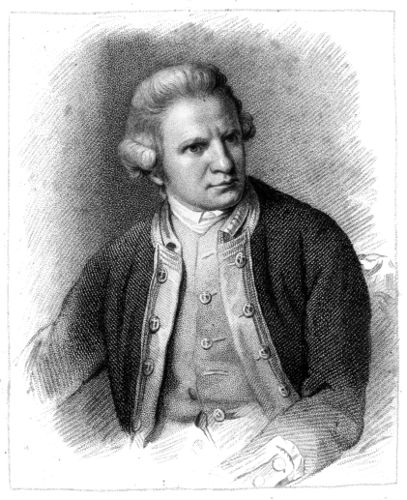
Captain Cook.
Drawn & Engraved by W. Bond, from the large Picture by George Dance R.A.
Published by Longman & Co. London Septr. 6th. 1821.
iii
COMPLETE
In Seven Volumes.
WITH MAP AND OTHER PLATES.
VOL. I.
BEING THE FIRST OF THE FIRST VOYAGE.
LONDON:
PRINTED FOR
LONGMAN, HURST, REES, ORME, AND BROWN,
PATERNOSTER-ROW.
1821.
LIFE OF CAPTAIN JAMES COOK.
iv
This celebrated navigator was the son of a day-labourer,
and born at Marton, a village in Yorkshire,
Nov. 3. 1728. At the age of thirteen he was put to
a school, where he learnt writing and arithmetic;
after which he was bound apprentice to a shopkeeper
at Snaith, but on discovering an inclination
for the sea, his master gave up his indentures, and
he articled himself for three years to a ship-owner at
Whitby. After serving out his time diligently, he
entered in 1755 on board the Eagle sixty gun ship;
and in 1759 he obtained a warrant as master of the
Mercury, in which ship he was present at the taking
of Quebec, where he made a complete draught
of the channel and river of St. Laurence, which
chart was published. Mr. Cook was next appointed
to the Northumberland, then employed in the recapture
of Newfoundland; and there also he made a
survey of the harbour and coasts. At the latter end
of 1762 he returned to England, and married a young
viwoman of Barking; but early in the next year he
went again to Newfoundland, as surveyor, with Captain
Graves, and he afterwards acted in the same
capacity under Sir Hugh Palliser. While thus employed,
he made an observation of an eclipse of the
sun, which he communicated to the Royal Society.
It being determined to send out astronomers to observe
the transit of Venus in some part of the South
Sea, Mr. Cook was selected to command the Endeavour,
a ship taken up for that service; and accordingly
he was promoted to the rank of lieutenant,
May 25. 1768. Our limits will not allow of giving
the details of this interesting voyage; and therefore
we shall content ourselves with stating, that the
transit was observed to great advantage at Otaheite;
after which lieutenant Cook explored the neighbouring
islands, and then shaped his course for New Zealand,
which he circumnavigated, and thus ascertained
that it was not a continent. From thence he sailed
to New Holland, or, as it is now called, New South
Wales, where he anchored in Botany Bay, April 28.
1770, an epoch of great importance in the history of
that part of the world. From hence he sailed to New
Guinea, and next to Batavia, where the ship being
refitted, he returned to Europe, and arrived in the
Downs, June 12. 1771. For his services on this occasion,
Mr. Cook was promoted to the rank of commander,
and an account of his voyage was soon after
published by Dr. Hawkesworth. The interest excited
viihereby induced government to send Captain
Cook on another voyage of discovery to the southern
hemisphere, and he accordingly sailed with two ships,
the Resolution, commanded by himself, and the Adventure,
by Captain Furneaux, April 9. 1772. After
proceeding as far as 71° 10ʹ of south latitude, amidst
mountains of ice, and discovering some new islands,
our voyagers returned to England, July 30. 1775.
The Resolution in this enterprize lost only one man
out of her whole complement, for which Captain
Cook was elected a member of the Royal Society,
and afterwards the gold medal was voted to him by
the same learned body. He was also appointed a
post-captain, and promoted to a valuable situation in
Greenwich hospital. As the narrative of the former
voyage had not given satisfaction, the history of the
second was drawn almost wholly from the captain’s
journals, and digested by Dr. Douglas, late bishop of
Salisbury. But the labours of Cook were not to
end here. In July 1776 he sailed again, to decide
the long agitated question of a northern passage to
the Pacific Ocean. In this voyage he had two ships,
the Resolution and the Discovery; but after sailing
as high as 74° 44ʹ N. the object was considered impracticable;
and on Nov. 26. 1778, the ships arrived
at the Sandwich islands. Here at first they were
well received, but at length the people of Owhyhee
stole one of the boats, to recover which Captain
Cook went on shore, with the intention of getting
viiiinto his possession the person of the king; but in
doing this a crowd assembled, and the brave commander
fell by a club, after which he was dispatched
by a dagger; and his body was carried off in triumph
and devoured. This melancholy event occurred
in the morning of the 14th February, 1779.
Captain Cook left a widow and family; on the
former a pension of 200l. a year was settled by the
king, and 25l. a-year on each of the children.
A general Description of the south-east Part of Terra del Fuego, and the Strait of Le Maire; with some Remarks on Lord Anson’s Account of them, and Directions for the Passage westward, round this Part of America, into the South Seas
The Sequel of the Passage from Cape Horn to the newly discovered Islands in the South Seas, with a Description of their Figure and Appearance.—Some Account of the Inhabitants, and several Incidents that happened during the Course, and at the Ship’s arrival among them
The Arrival of the Endeavour at Otaheite, called by Captain Wallis, King George the III.’s Island.—Rules established for Traffic with the Natives, and an Account of several Incidents which happened in a Visit to Tootahah and Toubourai Tamaide, two Chiefs
A Place fixed upon for an Observatory and Fort.—An Excursion into the Woods, and its Consequences.—The Fort erected.—A Visit from several Chiefs on Board and at the Fort, with some Account of the Music of the Natives, and the Manner in which they dispose of their Dead
An Excursion to the eastward, an Account of several Incidents that happened both on Board and on Shore, and of the first Interview with Oberea, the Person who, when the Dolphin was here, was supposed to be Queen of the Island, with a Description of the Fort
The Observatory set up.—The Quadrant stolen, and Consequences of the Theft.—A Visit to Tootahah.—Description of a wrestling Match.—European seeds sown.—Names given to our People by the Indians
Some Ladies visit the Fort with very uncommon Ceremonies.—The Indians attend Divine Service, and in the Evening exhibit a most extraordinary spectacle.—Toubourai Tamaide falls into Temptation
xiAnother Visit to Tootahah, with various Adventures.—Extraordinary Amusement of the Indians, with Remarks upon it.—Preparations to observe the Transit of Venus, and what happened in the mean time at the Fort
The Ceremonies of an Indian Funeral particularly described.—General Observations on the Subject.—A Character found among the Indians to which the Ancients paid great Veneration.—A Robbery at the Fort, and its Consequences; with a Specimen of Indian Cookery, and various Incidents
An Account of the Circumnavigation of the Island, and various Incidents that happened during the Expedition; with a Description of a Burying-place and Place of Worship, called a Morai
Of the Division of Time in Otaheite; Numeration, Computation of Distance, Language, Diseases, Disposal of the Dead, Religion, War, Weapons, and Government; with some general Observations for the Use of future Navigators
A Description of several other Islands in the Neighbourhood of Otaheite, with various Incidents; a Dramatic Entertainment; and many Particulars relative to the Customs and Manners of the Inhabitants
A Description of Poverty Bay, and the Face of the adjacent Country.—The Range from thence to Cape Turnagain, and back to Tolaga; with some Account of the People and the Country, and several Incidents that happened on that Part of the Coast
The Range from Tolaga to Mercury Bay, with an Account of many Incidents that happened both on board and ashore.—A Description of several Views exhibited by the Country, and of the Heppahs, or fortified Villages of the Inhabitants
The Range from Mercury Bay to the Bay of Islands.—An Expedition up the River Thames.—Some Account of the Indians who inhabit its Banks, and the fine Timber that grows there.—Several Interviews with the Natives on different Parts of the Coast, and a Skirmish with them upon an Island
Transactions in Queen Charlotte’s Sound.—Passage through the Strait which divides the two Islands, and back to Cape Turnagain.—Horrid Custom of the Inhabitants.—Remarkable Melody of Birds.—A Visit to a Heppah, and many other Particulars
THE WORLD, on Mercator’s Projection, Shewing the Courses of Captain Cook’s three Voyages.
1AN
ACCOUNT
OF A
VOYAGE ROUND THE WORLD,
IN THE YEARS 1768, 1769, 1770, and 1771.
BY
LIEUTENANT JAMES COOK,
COMMANDER OF HIS MAJESTY’S BARK THE ENDEAVOUR.
Drawn up from his Journal,
And from the Papers of Sir Joseph Banks, Bart
BY
Dr. HAWKESWORTH.
INTRODUCTION TO THE FIRST VOYAGE.
3
With Lieutenant Cook, in this voyage, embarked
Joseph Banks, Esquire, a gentleman possessed of considerable
landed property in Lincolnshire. He received
the education of a scholar rather to qualify
him for the enjoyments than the labours of life; yet
an ardent desire to know more of Nature than could
be learnt from books determined him, at a very early
age, to forego what are generally thought to be the
principal advantages of a liberal fortune, and to apply
his revenue not in procuring the pleasures of leisure and
ease, but in the pursuit of his favourite study, through
a series of fatigue and danger, which, in such circumstances,
have very seldom been voluntarily incurred,
except to gratify the restless and insatiable desires
of avarice or ambition.
Upon his leaving the university of Oxford, in the
year 1763, he crossed the Atlantic, and visited the
coasts of Newfoundland and Labradore. The danger,
difficulty, and inconvenience that attend long
voyages are very different in idea and experience;
Mr. Banks, however, returned, undiscouraged, from
his first expedition; and when he found that the
Endeavour was equipping for a voyage to the South
Seas, in order to observe the Transit of Venus, and
afterwards attempt farther discoveries, he determined
4to embark in the expedition, that he might
enrich his native country with a tribute of knowledge
from those which have been hitherto unknown,
and not without hope of leaving among the rude
and uncultivated nations that he might discover,
something that would render life of more value, and
enrich them, perhaps, in a certain degree, with the
knowledge, or at least with the productions, of
Europe.
As he was determined to spare no expense in the
execution of his plan, he engaged Dr. Solander to
accompany him in the voyage. This Gentleman,
by birth a Swede, was educated under the celebrated
Linnæus, from whom he brought letters of recommendation
into England, and his merit being soon
known, he obtained an appointment in the British
Museum, a public institution, which was then just
established; such a companion Mr. Banks considered
as an acquisition of no small importance,
and, to his great satisfaction, the event abundantly
proved that he was not mistaken. He also took
with him two draftsmen, one to delineate views and
figures, the other to paint such subjects of natural
history as might offer; together with a secretary
and four servants, two of whom were negroes.
Mr. Banks kept an accurate and circumstantial
journal of the voyage, and, soon after I had received
that of Captain Cook from the Admiralty, was so
obliging as to put it into my hands, with permission
to take out of it whatever I thought would improve
or embellish the narrative. This was an offer of
which I gladly and thankfully accepted: I knew
the advantage would be great, for few philosophers
have furnished materials for accounts of voyages
undertaken to discover new countries. The adventurers
in such expeditions have generally looked
only upon the great outline of Nature, without
attending to the variety of shades within, which
give life and beauty to the piece.
5The papers of Captain Cook contained a very
particular account of all the nautical incidents of
the voyage, and a very minute description of the
figure and extent of the countries he had visited,
with the bearings of the headlands and bays that
diversify the coasts, the situation of the harbours in
which shipping may obtain refreshments, with the
depth of water wherever there were soundings; the
latitudes, longitudes, variation of the needle, and
such other particulars as lay in his department; and
abundantly showed him to be an excellent officer,
and skilful navigator. But in the papers which
were communicated to me by Mr. Banks, I found a
great variety of incidents which had not come under
the notice of Captain Cook, with descriptions of
countries and people, their productions, manners,
customs, religion, policy, and language, much more
full and particular than were expected from a Gentleman
whose station and office naturally turned his
principal attention to other objects; for these particulars,
therefore, besides many practical observations,
the Public is indebted to Mr. Banks. To Mr. Banks
also the Public is indebted for the designs of the
engravings which illustrate and adorn the account
of this voyage, all of them, except the maps, charts,
and views of the coasts as they appear at sea, being
copied from his valuable drawings, and some of
them from such as were made for the use of the
artists at his expense.
As the materials furnished by Mr. Banks were so
interesting and copious, there arose an objection
against writing an account of this voyage in the
person of the Commander, which could have no
place with respect to the others; the descriptions
and observations of Mr. Banks would be absorbed
without any distinction, in a general narrative given
under another name: but this objection he generously
over-ruled, and it, therefore, became necessary
to give some account of the obligations which he
6has laid upon the Public and myself in this place.
It is, indeed, fortunate for mankind, when wealth and
science, and a strong inclination to exert the powers
of both for purposes of public benefit, unite in the
same person; and I cannot but congratulate my
country upon the prospect of further pleasure and
advantage from the same Gentleman, to whom we
are indebted for so considerable a part of this
narrative.
7AN
ACCOUNT
OF A
VOYAGE ROUND THE WORLD,
IN 1768, 1769, 1770, AND 1771.
BOOK I. CHAP. I. THE PASSAGE FROM PLYMOUTH TO MADEIRA, WITH SOME ACCOUNT OF THAT ISLAND.
Having received my commission, which was dated
the 25th of May, 1768, I went on board on the 27th,
hoisted the pennant, and took charge of the ship,
which then lay in the basin in Deptford Yard. She
was fitted for sea with all expedition; and stores
and provisions being taken on board, sailed down the
river on the 30th of July, and on the 13th of August
anchored in Plymouth Sound.
While we lay here waiting for a wind, the articles
of war and the act of parliament were read to the
ship’s company, who were paid two months’ wages
in advance, and told that they were to expect no
additional pay for the performance of the voyage.
On Friday, the 26th of August, the wind becoming
fair, we got under sail, and put to sea. On the 31st,
we saw several of the birds which the sailors call
Mother Carey’s Chickens, and which they suppose
to be the forerunners of a storm; and on the next
8day we had a very hard gale, which brought us
under our courses, washed over-board a small boat
belonging to the boatswain, and drowned three or
four dozen of our poultry, which we regretted still
more.
On Friday, the 2d of September, we saw land
between Cape Finister and Cape Ortegal, on the coast
of Gallicia, in Spain; and on the 5th, by an observation
of the sun and moon, we found the latitude of
Cape Finister to be 42° 53ʹ North, and its longitude
8° 46ʹ West, our first meridian being always supposed
to pass through Greenwich; variation of the needle
21° 4ʹ W.
During this course, Mr. Banks and Dr. Solander
had an opportunity of observing many marine animals,
of which no naturalist has hitherto taken notice;
particularly a new species of the Oniscus, which was
found adhering to the Medusa Pelagica; and an
animal of an angular figure, about three inches long,
and one thick, with a hollow passing quite through
it, and a brown spot on one end, which they conjectured
might be its stomach; four of these adhered
together by their sides when they were taken, so that
at first they were thought to be one animal, but upon
being put into a glass of water they soon separated,
and swam about very briskly. These animals are of
a new genus, to which Mr. Banks and Dr. Solander
gave the name of Dagysa, from the likeness of one
species of them to a gem: several specimens of them
were taken, adhering together sometimes to the length
of a yard or more, and shining in the water with
very beautiful colours. Another animal, of a new
genus, they also discovered, which shone in the
water with colours still more beautiful and vivid, and
which indeed exceeded in variety and brightness any
thing that we had ever seen: the colouring and
splendour of these animals were equal to those of an
Opal, and from their resemblance to that gem, the
genus was called Carcinium Opalinum. One of them
9lived several hours in a glass of salt water, swimming
about with great agility, and at every motion displaying
a change of colours almost infinitely various.
We caught also among the rigging of the ship, when
we were at the distance of about ten leagues from
Cape Finister, several birds which have not been
described by Linnæus; they were supposed to have
come from Spain, and our gentlemen called the species
Motacilla velificans, as they said none but sailors would
venture themselves on board a ship that was going
round the world: one of them was so exhausted, that
it died in Mr. Banks’s hand, almost as soon as it was
brought to him.
It was thought extraordinary that no naturalist
had hitherto taken notice of the Dagysa, as the sea
abounds with them not twenty leagues from the
coast of Spain; but, unfortunately for the cause of
science, there are but very few of those who traverse
the sea, that are either disposed or qualified to
remark the curiosities of which Nature has made it
the repository.
On the 12th we discovered the islands of Porto
Santo and Madeira, and on the next day anchored in
Funchiale road, and moored with the stream-anchor:
but, in the night, the bend of the hawser of the
stream-anchor slipped, owing to the negligence of the
person who had been employed to make it fast.
In the morning the anchor was heaved up into the
boat, and carried out to the southward; but in
heaving it again, Mr. Weir, the master’s mate, was
carried overboard by the buoy-rope, and went to
the bottom with the anchor; the people in the ship
saw the accident, and got the anchor up with all
possible expedition; it was, however, too late; the
body came up intangled in the buoy-rope, but it was
dead.
When the island of Madeira is first approached
from the sea, it has a very beautiful appearance; the
sides of the hills being entirely covered with vines
10almost as high as the eye can distinguish; and the
vines are green when every kind of herbage, except
where they shade the ground, and here and there
by the sides of a rill, is entirely burnt up, which was
the case at this time.
On the 13th, about eleven o’clock in the forenoon,
a boat, which our sailors call the product boat, came
on board from the officers of health, without whose
permission no person is suffered to land from on
board a ship. As soon as this permission was obtained,
we went on shore at Funchiale, the capital of the
island, and proceeded directly to the house of
Mr. Cheap, who is the English consul there, and
one of the most considerable merchants of the place.
This gentleman received us with the kindness of a
brother, and the liberality of a prince; he insisted
upon our taking possession of his house, in which
he furnished us with every possible accommodation
during our stay upon the island; he procured leave
for Mr. Banks and Dr. Solander to search the island
for such natural curiosities as they should think worth
their notice; employed persons to take fish and
gather shells, which time would not have permitted
them to collect for themselves; and he provided
horses and guides to take them to any part of the
country which they should choose to visit. With
all these advantages, however, their excursions were
seldom pushed farther than three miles from the town,
as they were only five days on shore; one of which
they spent at home, in receiving the honour of a
visit from the governor. The season was the worst
in the year for their purpose, as it was neither that
of plants nor insects; a few of the plants, however,
were procured in flower, by the kind attention of
Dr. Heberden, the chief physician of the island, and
brother to Dr. Heberden of London, who also gave
them such specimens as he had in his possession,
and a copy of his Botanical Observations; containing,
among other things, a particular description of the
11trees of the island. Mr. Banks inquired after the
wood which has been imported into England for
cabinet work, and is here called Madeira mahogany:
he learnt that no wood was exported from the island
under that name, but he found a tree called by the
natives Vigniatico, the Laurus indicus of Linnæus,
the wood of which cannot easily be distinguished
from mahogany. Dr. Heberden has a book-case, in
which the vigniatico and mahogany are mixed, and
they are no otherwise to be known from each other
than by the colour, which, upon a nice examination,
appears to be somewhat less brown in the vigniatico
than the mahogany; it is, therefore, in the highest
degree probable, that the wood known in England
by the name of Madeira mahogany, is the vigniatico.
There is great reason to suppose that this whole
island was, at some remote period, thrown up by
the explosion of subterraneous fire, as every stone,
whether whole or in fragments, that we saw upon it,
appeared to have been burnt, and even the sand
itself to be nothing more than ashes: we did not,
indeed, see much of the country, but the people
informed us that what we did see was a very exact
specimen of the rest.
The only article of trade in this island is wine,
and the manner in which it is made is so simple, that
it might have been used by Noah, who is said to
have planted the first vineyard after the flood: the
grapes are put into a square wooden vessel, the
dimensions of which are proportioned to the size of
the vineyard to which it belongs; the servants then,
having taken off their stockings and jackets, get
into it, and with their feet and elbows press out as
much of the juice as they can: the stalks are afterwards
collected, and being tied together with a rope,
are put under a square piece of wood, which is
pressed down upon them by a lever with a stone tied
to the end of it. The inhabitants have made so little
improvement in knowledge or art, that they have
12but very lately brought all the fruit of a vineyard to
be of one sort, by engrafting their vines: there
seems to be in mind as there is in matter, a kind of
vis inertiæ, which resists the first impulse to change.
He who proposes to assist the artificer or the husbandman
by a new application of the principles of
philosophy, or the powers of mechanism, will find,
that his having hitherto done without them will be
a stronger motive for continuing to do without them
still, than any advantage, however manifest and considerable,
for adopting the improvement. Wherever
there is ignorance there is prejudice; and the
common people of all nations are, with respect to
improvements, like the parish poor of England with
respect to a maintenance, for whom the law must
not only make a provision, but compel them to accept
it, or else they will be still found begging in the
streets. It was, therefore, with great difficulty that
the people of Madeira were persuaded to engraft
their vines, and some of them still obstinately refuse
to adopt the practice, though a whole vintage is very
often spoiled by the number of bad grapes which are
mixed in the vat, and which they will not throw out,
because they increase the quantity of the wine: an
instance of the force of habit, which is the more
extraordinary, as they have adopted the practice of
engrafting with respect to their chesnut-trees, an
object of much less importance, which, however, are
thus brought to bear sooner than they would otherwise
have done.
We saw no wheel-carriages of any sort in the place,
which, perhaps, is not more owing to the want of ingenuity
to invent them than to the want of industry
to mend the roads, which, at present, it is impossible
that any wheel-carriage should pass: the inhabitants
have horses and mules, indeed, excellently adapted
to such ways; but their wine is, notwithstanding,
brought to town from the vineyards where it is made
in vessels of goat-skins, which are carried by men
13upon their heads. The only imitation of a carriage
among these people is a board, made somewhat
hollow in the middle, to one end of which a pole is
tied, by a strap of whit-leather: this wretched sledge
approaches about as near to an English cart as an
Indian canoe to a ship’s long-boat; and even this
would probably never have been thought of, if the
English had not introduced wine-vessels, which are
too big to be carried by hand, and which, therefore,
are dragged about the town upon these machines.
One reason, perhaps, why art and industry have
done so little for Madeira, is, Nature’s having done
so much. The soil is very rich, and there is such a
difference of climate between the plains and the
hills, that there is scarcely a single object of luxury
that grows either in Europe or the Indies that might
not be produced here. When we went to visit
Dr. Heberden, who lives upon a considerable ascent,
about two miles from town, we left the thermometer
at 74, and when we arrived at his house, we found
it at 66. The hills produce, almost spontaneously,
walnuts, chesnuts, and apples in great abundance;
and in the town there are many plants which are the
natives both of the East and West Indies, particularly
the banana, the guava, the pine-apple or
anana, and the mango, which flourish almost without
culture. The corn of this country is of a most
excellent quality, large grained and very fine, and
the island would produce it in great plenty; yet
most of what is consumed by the inhabitants is imported.
The mutton, pork, and beef, are also very
good; the beef, in particular, which we took on board
here, was universally allowed to be scarcely inferior
to our own; the lean part was very like it, both in
colour and grain, though the beasts are much smaller,
but the fat is as white as the fat of mutton.
The town of Funchiale derives its name from
Funcho, the Portuguese name for fennel, which grows
in great plenty upon the neighbouring rocks, and by
14the observation of Dr. Heberden, lies in the latitude
of 32° 33ʹ 33ʺ N. and longitude 16° 49ʹ W. It is
situated in the bottom of a bay, and though larger
than the extent of the island seems to deserve, is
very ill built; the houses of the principal inhabitants
are large, those of the common people are small, the
streets are narrow, and worse paved than any I ever
saw. The churches are loaded with ornaments,
among which are many pictures, and images of
favourite saints; but the pictures are in general
wretchedly painted, and the saints are dressed in
laced clothes. Some of the convents are in a better
taste, especially that of the Franciscans, which is
plain, simple, and neat in the highest degree. The
infirmary in particular drew our attention as a model
which might be adopted in other countries with great
advantage. It consists of a long room, on one side
of which are the windows, and an altar for the convenience
of administering the sacrament to the sick:
the other side is divided into wards, each of which is
just big enough to contain a bed, and neatly lined
with gally-tiles; behind these wards, and parallel to
the room in which they stand, there runs a long gallery,
with which each ward communicates by a door,
so that the sick may be separately supplied with
whatever they want without disturbing their neighbours.
In this convent there is also a singular curiosity
of another kind; a small chapel, the whole
lining of which, both sides and ceiling, is composed
of human sculls and thigh-bones; the thigh-bones
are laid across each other, and a scull is placed in
each of the four angles. Among the sculls one is
very remarkable; the upper and the lower jaw, on
one side, perfectly and firmly cohere; how the ossification
which unites them was formed, it is not, perhaps,
very easy to conceive, but it is certain that the
patient must have lived some time without opening
his mouth: what nourishment he received was conveyed
15through a hole, which we discovered to have
been made on the other side, by forcing out some of
the teeth, in doing which the jaw also seems to have
been injured.
We visited the good Fathers of this convent on a
Thursday evening, just before supper-time, and they
received us with great politeness: “We will not ask
you,” said they, “to sup with us, because we are
not prepared; but if you will come to-morrow,
though it is a fast with us, we will have a turkey
roasted for you.” This invitation, which showed
a liberality of sentiment not to have been expected
in a convent of Portuguese friars at this place, gratified
us much, though it was not in our power to
accept it.
We visited also a convent of nuns, dedicated to
Santa Clara, and the ladies did us the honour to express
a particular pleasure in seeing us there: they
had heard that there were great philosophers among
us, and not at all knowing what were the objects of
philosophical knowledge, they asked us several questions
that were absurd and extravagant in the highest
degree; one was, when it would thunder; and another,
whether a spring of fresh water was to be
found any where within the walls of their convent,
of which it seems they were in great want. It will
naturally be supposed that our answers to such questions
were neither satisfactory to the ladies, nor, in
their estimation, honourable to us; yet their disappointment
did not in the least lessen their civility,
and they talked, without ceasing, during the whole
of our visit, which lasted about half an hour.
The hills of this country are very high; the highest,
Pico Ruivo, rises 5068 feet, near an English mile,
perpendicularly from its base, which is much higher
than any land that has been measured in Great
Britain. The sides of these hills are covered with
vines to a certain height, above which there are
16woods of chesnut and pine of immense extent, and
above them forests of wild timber of various kinds
not known in Europe; particularly two, called by
the Portuguese Mirmulano and Paobranco, the leaves
of both which, particularly the Paobranco, are so
beautiful, that these trees would be a great ornament
to the gardens of Europe.
The number of inhabitants in this island is supposed
to be about 80,000, and the custom-house
duties produce a revenue to the King of Portugal of
20,000 pounds a-year, clear of all expenses, which
might easily be doubled by the product of the island,
exclusive of the vines, if advantage was taken of
the excellence of the climate, and the amazing fertility
of the soil; but this object is utterly neglected
by the Portuguese. In the trade of the inhabitants
of Madeira with Lisbon the balance is against them,
so that all the Portuguese money naturally going
thither, the currency of the island is Spanish; there
are, indeed, a few Portuguese pieces of copper, but
they are so scarce that we did not see one of them: the
Spanish coin is of three denominations; Pistereens,
worth about a shilling; Bitts, worth about sixpence;
and Half-bitts, three-pence.
The tides at this place flow at the full and change
of the moon, north and south; the spring tides rise
seven feet perpendicular, and the neap tides four.
By Dr. Heberden’s observation, the variation of the
compass here is now 15° 30ʹ West, and decreasing;
but I have some doubt whether he is not mistaken
with respect to its decrease: we found that the North
point of the dipping needle belonging to the Royal
Society dipped 77° 18ʺ.
The refreshments to be had here are water, wine,
fruit of several sorts, onions in plenty, and some
sweetmeats; fresh meat and poultry are not to be had
without leave from the governor, and the payment
of a very high price.
17We took in 270 lb. of fresh beef, and a live bullock,
charged at 613 lb. 3032 gallons of water, and
ten tons of wine; and in the night, between Sunday
the 18th and Monday the 19th of September, we set
sail in prosecution of our voyage.
When Funchiale bore North, 13 East, at the distance
of 76 miles, the variation appeared by several
azimuths to be 16° 30ʹ West.
CHAP. II. THE PASSAGE FROM MADEIRA TO RIO DE JANEIRO, WITH SOME ACCOUNT OF THE COUNTRY, AND THE INCIDENTS THAT HAPPENED THERE.
18
On the 21st of September we saw the islands called
the Salvages, to the north of the Canaries; when
the principal of these bore S. ½ W. at the distance
of about five leagues, we found the variation of the
compass by an azimuth to be 17° 50ʹ. I make these
islands to lie in latitude 30° 11ʹ North, and distant
58 leagues from Funchiale in Madeira, in the direction
of S. 16 E.
On Friday the 23d we saw the Peak of Teneriffe
bearing W. by S. ½ S. and found the variation of the
compass to be from 17° 22ʹ to 16° 30ʹ. The height
of this mountain, from which I took a new departure,
has been determined by Dr. Heberden, who
has been upon it, to be 15,396 feet, which is but 148
yards less than three miles, reckoning the mile at
1760 yards. Its appearance at sunset was very striking;
when the sun was below the horizon, and the
rest of the island appeared of a deep black, the
mountain still reflected his rays, and glowed with a
warmth of colour which no painting can express.
There is no eruption of visible fire from it, but a
heat issues from the chinks near the top, too strong
to be borne by the hand when it is held near them.
We had received from Dr. Heberden, among other
favours, some salt which he collected on the top of
the mountain, where it is found in large quantities,
and which he supposes to be the true natrum, or
nitrum of the ancients: he gave us also some native
sulphur exceedingly pure, which he had likewise
found upon the surface in great plenty.
19On the next day, Saturday the 24th, we came into
the north-east trade wind, and on Friday the 30th saw
Bona Vista, one of the Cape de Verd islands; we
ranged the east side of it, at the distance of three
or four miles from the shore, till we were obliged to
haul off to avoid a ledge of rocks which stretch out
S. W. by W. from the body, or S. E. point of the
island, to the extent of a league and a half. Bona
Vista, by our observation, lies in latitude 16 N. and
longitude 21° 5ʹ West.
On the 1st of October, in latitude 14° 6ʹ N. and
longitude 22° 10ʹ W. we found the variation by a
very good azimuth to be 10° 37ʹ W. and the next
morning it appeared to be 10°. This day we found
the ship five miles a head of the log, and the next
day seven. On the third, hoisted out the boat to
discover whether there was a current, and found one
to the eastward, at the rate of three quarters of a
mile an hour.
During our course from Teneriffe to Bona Vista
we saw great numbers of flying fish, which from the
cabin windows appear beautiful beyond imagination,
their sides having the colour and brightness of burnished
silver; when they are seen from the deck they
do not appear to so much advantage, because their
backs are of a dark colour. We also took a shark,
which proved to be the Squalus Carcharias of
Linnæus.
Having lost the trade wind on the 3d, in latitude
12° 14ʹ, and longitude 22° 10ʹ, the wind became
somewhat variable, and we had light airs and calms
by turns.
On the 7th, Mr. Banks went out in the boat and
took what the seamen call a Portuguese man of war;
it is the Holuthuria Physalis of Linnæus, and a species
of the Mollusca. It consisted of a small bladder
about seven inches long, very much resembling the
air-bladder of fishes, from the bottom of which descended
a number of strings, of a bright blue and
20red, some of them three or four feet in length, which,
upon being touched, sting like a nettle, but with much
more force. On the top of the bladder is a membrane
which is used as a sail, and turned so as to
receive the wind which way soever it blows: this
membrane is marked in fine pink-coloured veins, and
the animal is in every respect an object exquisitely
curious and beautiful.
We also took several of the shell-fishes, or testaceous
animals, which are always found floating upon
the water, particularly the Helix Janthina and Violacea;
they are about the size of a snail, and are
supported upon the surface of the water by a small
cluster of bubbles, which are filled with air, and
consist of a tenacious slimy substance that will not
easily part with its contents; the animal is oviparous,
and these bubbles serve also as a nidus for its eggs. It
is probable that it never goes down to the bottom,
nor willingly approaches any shore; for the shell is
exceedingly brittle, and that of few fresh water
snails is so thin: every shell contains about a teaspoonful
of liquor, which it easily discharges upon
being touched, and which is of the most beautiful
red purple that can be conceived. It dies linen
cloth, and it may perhaps be worth enquiry, as the
shell is certainly found in the Mediterranean, whether
it be not the Purpura of the ancients.
On the 8th, in latitude 8° 25ʹ North, longitude
22° 4ʹ West, we found a current setting to the southward,
which the next day in latitude 7° 58ʹ, longitude
22° 13ʹ, shifted to the N. N. W. ¾ W., at the rate of
one mile and a furlong an hour. The variation here,
by the mean of several azimuths, appeared to be
8° 39ʹ W.
On the 10th, Mr. Banks shot the black-toed gull,
not yet described according to Linnæus’s system;
he gave it the name of Larus crepidatus: it is remarkable
that the dung of this bird is of a lively red,
somewhat like that of the liquor procured from the
21shells, only not so full; its principal food therefore
is probably the Helix just mentioned. A current to
the N. W. prevailed more or less till Monday the
24th, when we were in latitude 1° 7ʹ N., and longitude
28° 50ʹ.
On the 25th we crossed the line with the usual
ceremonies, in longitude 29° 30ʹ, when, by the result
of several very good azimuths, the variation was
2° 24ʹ.
On the 28th, at noon, being in the latitude of
Ferdinand Noronha, and, by the mean of several observations
by Mr. Green and myself in longitude
32° 5ʹ 16ʺ W., which is to the westward of it by some
charts, and to the eastward by others, we expected
to see the island, or some of the shoals that are laid
down in the charts between it and the main, but we
saw neither one nor the other.
In the evening of the 29th, we observed that
luminous appearance of the sea which has been so
often mentioned by navigators, and of which such
various causes have been assigned; some supposing
it to be occasioned by fish, which agitated the water
by darting at their prey, some by the putrefaction of
fish and other marine animals, some by electricity,
and others referring it into a great variety of different
causes. It appeared to emit flashes of light exactly
resembling those of lightning, only not so considerable;
but they were so frequent, that sometimes eight
or ten were visible almost at the same moment. We
were of opinion that they proceeded from some luminous
animal, and upon throwing out the casting net
our opinion was confirmed: it brought up a species of
the Medusa, which, when it came on board, had the
appearance of metal violently heated, and emitted
a white light: with these animals were taken some
very small crabs, of three different species, each of
which gave as much light as a glow-worm, though
the creature was not so large by nine-tenths: upon
22examination of these animals Mr. Banks had the satisfaction
to find that they were all entirely new.
On Wednesday, the 2d of November, about noon,
being in the latitude of 10° 38ʹ S., and longitude
32° 13ʹ 43ʺ W., we passed the line in which the needle
at this time would have pointed due north and south,
without any variation: for in the morning, having
decreased gradually in its deviation for some days,
it was no more than 18ʹ W., and in the afternoon it
was 34ʹ East.
On the 6th, being in latitude 19° 3ʹ South, longitude
35° 50ʹ West, the colour of the water was observed
to change, upon which we sounded, and found
ground at the depth of 32 fathoms: the lead was
cast three times within about four hours, without a
foot difference in the depth or quality of the bottom,
which was coral rock, fine sand, and shells; we therefore
supposed that we had passed over the tail of the
great shoal which is laid down in all our charts by
the name of Abrothos, on which Lord Anson struck
soundings in his passage outwards: at four the next
morning we had no ground with 100 fathom.
As several articles of our stock and provisions now
began to fall short, I determined to put into Rio de
Janeiro, rather than at any port in Brazil or Falkland’s
Islands, knowing that it could better supply
us with what we wanted, and making no doubt but
that we should be well received.
On the 8th, at day-break, we saw the coast of
Brazil, and about ten o’clock we brought to, and
spoke with a fishing boat: the people on board told
us that the land which we saw lay to the southward
of Sancto Espirito, but belonging to the captainship
of that place.
Mr. Banks and Dr. Solander went on board this
vessel, in which they found eleven men, nine of whom
were blacks: they all fished with lines; and their
fresh cargo, the chief part of which Mr. Banks
bought, consisted of dolphins, large pelagic scombers
23of two kinds, sea-bream, and some of the fish which,
in the West Indies, are called Welshmen. Mr. Banks
had taken Spanish silver with him, which he imagined
to be the currency of the Continent, but to
his great surprise the people asked him for English
shillings; he gave them two, which he happened to
have about him, and it was not without some dispute
that they took the rest of the money in pistereens.
Their business seemed to be to catch large fish at a
good distance from the shore, which they salted in
bulk, in a place made for that purpose in the middle
of their boat: of this merchandize they had about
two quintals on board, which they offered for about
16 shillings, and would probably have sold for half
the money. The fresh fish, which was bought for
about nineteen shillings and sixpence, served the
whole ship’s company: the salt was not wanted.
The sea-provision of these fishermen consisted of
nothing more than a cask of water, and a bag of
Cassada flour, which they called Farinha de Pao, or
wooden flour; which, indeed, is a name which very
well suits its taste and appearance. Their water-cask
was large, as wide as their boat, and exactly
fitted a place that was made for it in the ballast; it
was impossible therefore to draw out any of its contents
by a tap, the sides being, from the bottom to
the top, wholly inaccessible; neither could any be
taken out by dipping a vessel in at the head, for an
opening sufficiently wide for that purpose would have
endangered the loss of great part of it by the rolling
of the vessel: their expedient to get at their water,
so situated, was curious; when one of them wanted
to drink, he applied to his neighbour, who accompanied
him to the water-cask with a hollow cane
about three feet long, which was open at both ends;
this he thrust into the cask through a small hole in
the top, and then, stopping the upper end with the
palm of his hand, drew it out; the pressure of the
air against the other end keeping in the water which
24it contained; to this end the person who wanted to
drink applied his mouth, and the assistant then taking
his hand from the other, and admitting the air above,
the cane immediately parted with its contents, which
the drinker drew off till he was satisfied.
We stood off and on along the shore till the 12th,
and successively saw a remarkable hill near Santo
Espirito, then Cape St. Thomas, and then an island
just without Cape Frio, which in some maps is called
the Island of Frio, and which being high, with a
hollow in the middle, has the appearance of two
islands when seen at a distance. On this day we
stood along the shore for Rio de Janeiro, and at nine
the next morning made sail for the harbour. I then
sent Mr. Hicks, my first lieutenant, before us in
the pinnace, up to the city, to acquaint the Governor,
that we put in there to procure water and refreshments;
and to desire the assistance of a pilot to
bring us into proper anchoring-ground. I continued
to stand up the river, trusting to Mr. Bellisle’s
draught, published in the Petit Atlas Maritime,
Vol. II. No. 54., which we found very good, till five
o’clock in the evening, expecting the return of my
lieutenant; and just as I was about to anchor, above
the island of Cobras, which lies before the city, the
pinnace came back without him, having on board a
Portuguese officer, but no pilot. The people in the
boat told me, that my lieutenant was detained by the
Viceroy till I should go on shore. We came immediately
to an anchor; and, almost at the same time,
a ten-oared boat, full of soldiers, came up and kept
rowing round the ship, without exchanging a word:
in less than a quarter of an hour, another boat came
on board with several of the Viceroy’s officers, who
asked whence we came; what was our cargo; the
number of men and guns on board; the object of
our voyage, and several other questions, which we
directly and truly answered: they then told me, as a
kind of apology for detaining my lieutenant, and putting
25an officer on board my pinnace, that it was the
invariable custom of the place, to detain the first
officer who came on shore from any ship on her
arrival, till a boat from the Viceroy had visited her,
and to suffer no boat to go either from or to a ship,
while she lay there, without having a soldier on
board. They said that I might go on shore when I
pleased; but wished that every other person might
remain on board till the paper which they should
draw up had been delivered to the Viceroy, promising
that, immediately upon their return, the lieutenant
should be sent on board.
This promise was performed; and on the next
morning, the 14th, I went on shore, and obtained
leave of the Viceroy to purchase provisions and refreshments
for the ship, provided I would employ
one of their own people as a factor, but not otherwise.
I made some objections to this, but he insisted
upon it as the custom of the place. I objected also
against the putting a soldier into the boat every time
she went between the ship and the shore; but he
told me, that this was done by the express orders of
his court, with which he could in no case dispense.
I then requested, that the gentlemen whom I had
on board might reside on shore during our stay, and
that Mr. Banks might go up the country to gather
plants; but this he absolutely refused. I judged
from his extreme caution, and the severity of these
restrictions, that he suspected we were come to
trade; I therefore took some pains to convince him
of the contrary. I told him, that we were bound to
the southward, by the order of His Britannic Majesty,
to observe a transit of the planet Venus over the
sun, an astronomical phænomenon of great importance
to navigation. Of the transit of Venus, however,
he could form no other conception, than that
it was the passing of the North star through the
South Pole; for these are the very words of his interpreter,
who was a Swede, and spoke English very
26well. I did not think it necessary to ask permission
for the gentlemen to come on shore during the day,
or that, when I was on shore myself, I might be at
liberty, taking for granted that nothing was intended
to the contrary; but in this I was unfortunately mistaken.
As soon as I took leave of His Excellency, I
found an officer who had orders to attend me wherever
I went: of this I desired an explanation, and
was told that it was meant as a compliment. I
earnestly desired to be excused from accepting such
an honour, but the good Viceroy would by no means
suffer it to be dispensed with.
With this officer, therefore, I returned on board
about twelve o’clock, where I was impatiently expected
by Mr. Banks and Dr. Solander, who made
no doubt but that a fair account of us having been
given by the officers who had been on board the
evening before, in their paper called a Practica, and
every scruple of the Viceroy removed in my conference
with His Excellency, they should immediately
be at liberty to go on shore, and dispose of themselves
as they pleased. Their disappointment at receiving
my report may easily be conceived; and it
was still increased by an account, that it had been
resolved, not only to prevent their residing on shore,
and going up the country, but even their leaving the
ship; orders having been given that no person, except
the captain, and such common sailors as were
required to be upon duty, should be permitted to
land; and that there was probably a particular view
to the passengers in this prohibition, as they were
reported to be gentlemen sent abroad to make observations
and discoveries, and were uncommonly
qualified for that purpose. In the evening, however,
Mr. Banks and Dr. Solander dressed themselves, and
attempted to go on shore, in order to make a visit
to the Viceroy; but they were stopped by the
guard-boat which had come off with our pinnace,
and which kept hovering round the ship all the while
27she lay here, for that purpose; the officer on board
saying, that he had particular orders, which he could
not disobey, to suffer no passenger, nor any officer,
except the captain, to pass the boat. After much
expostulation to no purpose, they were obliged, with
whatever reluctance and mortification, to return on
board. I then went on shore myself, but found the
Viceroy inflexible; he had one answer ready for every
thing I could say, that the restrictions under which
he had laid us were in obedience to the King of Portugal’s
commands, and therefore indispensable.
In this situation I determined, rather than be made
a prisoner in my own boat, to go on shore no more;
for the officer who, under pretence of a compliment,
attended me when I was ashore, insisted also upon
going with me to and from the ship: but still
imagining, that the scrupulous vigilance of the Viceroy
must proceed from some mistaken notion about
us, which might more easily be removed by writing
than in conversation, I drew up a memorial, and
Mr. Banks drew up another, which we sent on shore.
These memorials were both answered, but by no
means to our satisfaction; we therefore replied: in
consequence of which, several other papers were interchanged
between us and the Viceroy, but still
without effect. However, as I thought some degree
of force, on the part of the Viceroy, to enforce these
restrictions, necessary to justify my acquiescence in
them to the Admiralty, I gave orders to my lieutenant,
Mr. Hicks, when I sent him with our last
reply on Sunday the 20th, in the evening, not to
suffer a guard to be put into his boat. When the
officer on board the guard-boat found that Mr. Hicks
was determined to obey my orders, he did not proceed
to force, but attended him to the landing-place, and
reported the matter to the Viceroy. Upon this His
Excellency refused to receive the memorial, and ordered
Mr. Hicks to return to the ship; when he came
back to the boat, he found that a guard had been
28put on board in his absence, but he absolutely refused
to return till the soldier was removed: the officer then
proceeded to enforce the Viceroy’s orders; he seized
all the boat’s crew, and sent them under an armed
force to prison, putting Mr. Hicks, at the same time,
into one of their own boats, and sending him under
a guard back to the ship. As soon as he had reported
these particulars, I wrote again to the Viceroy, demanding
my boat and crew, and in my letter inclosed
the memorial which he had refused to receive from
Mr. Hicks: these papers I sent by a petty officer,
that I might wave the dispute about a guard, against
which I had never objected except when there was a
commissioned officer on board the boat. The petty
officer was permitted to go on shore with his guard,
and, having delivered his letter, was told that an answer
would be sent the next day.
About eight o’clock this evening it began to blow
very hard in sudden gusts from the south, and our
long-boat coming on board just at this time with
four pipes of rum, the rope which was thrown to her
from the ship, and which was taken hold of by the
people on board, unfortunately broke, and the boat,
which had come to the ship before the wind, went
adrift to windward of her, with a small skiff of Mr.
Banks’s that was fastened to her stern. This was a
great misfortune, as the pinnace being detained on
shore, we had no boat on board but a four-oared
yawl: the yawl, however, was immediately manned
and sent to her assistance; but, notwithstanding the
utmost effort of the people in both boats, they were
very soon out of sight: far, indeed, we could not see at
that time in the evening, but the distance was enough
to convince us that they were not under command,
which gave us great uneasiness, as we knew they
must drive directly upon a reef of rocks which ran
out just to leeward of where we lay: after waiting
some hours in the utmost anxiety, we gave them over
for lost, but, about three o’clock the next morning,
29had the satisfaction to see all the people come on
board in the yawl. From them we learnt, that the
long-boat having filled with water they had brought
her to a grappling, and left her; and that, having
fallen in with the reef of rocks in their return to the
ship, they had been obliged to cut Mr. Banks’s little
boat adrift. As the loss of our long-boat, which we
had now too much reason to apprehend, would have
been an unspeakable disadvantage to us, considering
the nature of our expedition, I sent another letter to
the Viceroy, as soon as I thought he could be seen,
acquainting him with our misfortune, and requesting
the assistance of a boat from the shore for the recovery
of our own; I also renewed my demand that
the pinnace and her crew should be no longer detained:
after some delay, His Excellency thought fit
to comply both with my request and demand; and
the same day we happily recovered both the long-boat
and skiff, with the rum, but every thing else that
was on board was lost. On the 23d, the Viceroy, in
his answer to my remonstrance against seizing my
men and detaining the boat, acknowledged that I had
been treated with some incivility, but said that the
resistance of my officers to what he had declared to
be the King’s orders made it absolutely necessary;
he also expressed some doubts whether the Endeavour,
considering her structure and other circumstances,
was in the service of His Majesty, though I had before
showed him my commission: to this I answered in
writing, that, to remove all scruples, I was ready to
produce my commission again. His Excellency’s
scruples, however, still remained, and in his reply to
my letter he not only expressed them in still plainer
terms, but accused my people of smuggling. This
charge, I am confident, was without the least foundation
in truth. Mr. Banks’s servants had indeed
found means to go on shore on the 22d at day-break,
and stay till it was dark in the evening, but they
brought on board only plants and insects, having been
30sent for no other purpose. And I had the greatest
reason to believe that not a single article was smuggled
by any of our people who were admitted on
shore, though many artful means were used to tempt
them, even by the very officers that were under His
Excellency’s roof, which made the charge still more
injurious and provoking. I have indeed some reason
to suspect that one poor fellow bought a single bottle
of rum with some of the clothes upon his back; and
in my answer I requested of His Excellency, that, if
such an attempt at illicit trade should be repeated,
he would without scruple order the offender to be
taken into custody. And thus ended our altercation,
both by conference and writing, with the Viceroy of
Rio de Janeiro.
A friar in the town having requested the assistance
of our surgeon, Dr. Solander easily got admittance
in that character on the 25th, and received many
marks of civility from the people. On the 26th,
before day-break, Mr. Banks also found means to
elude the vigilance of the people in the guard-boat,
and got on shore; he did not, however, go into the
town, for the principal objects of his curiosity were
to be found in the fields: to him also the people behaved
with great civility, many of them invited him
to their houses, and he bought a porker and some
other things of them for the ship’s company; the
porker, which was by no means lean, cost him eleven
shillings, and he paid something less than two for a
Muscovy duck.
On the 27th, when the boats returned from watering,
the people told us there was a report in town,
that search was making after some persons who had
been on shore from the ship without the Viceroy’s
permission: these persons we conjectured to be Dr.
Solander and Mr. Banks, and therefore they determined
to go on shore no more.
On the first of December, having got our water
and other necessaries on board, I sent to the Viceroy
31for a pilot to carry us to sea, who came off to us;
but the wind preventing us from getting out, we took
on board a plentiful supply of fresh beef, yams, and
greens for the ship’s company. On the 2d, a Spanish
packet arrived, with letters from Buenos Ayres for
Spain, commanded by Don Antonio de Monte Negro y
Velasco, who with great politeness offered to take our
letters to Europe: I accepted the favour, and gave
him a packet for the secretary of the Admiralty,
containing copies of all the papers that had passed
between me and the Viceroy; leaving also duplicates
with the Viceroy, to be by him forwarded to Lisbon.
On Monday, the 5th, it being a dead calm, we
weighed anchor and towed down the bay; but, to
our great astonishment, when we got abreast of Santa
Cruz, the principal fortification, two shot were fired
at us. We immediately cast anchor, and sent to the
fort to enquire the reason of what had happened;
our people brought us word, that the commandant
had received no order from the Viceroy to let us pass;
and that, without such an order, no vessel was ever
suffered to go below the fort. It was now, therefore,
become necessary, that we should send to the Viceroy,
to enquire why the necessary order had not
been given, as he had notice of our departure, and
had thought fit to write me a polite letter, wishing
me a good voyage. Our messenger soon returned
with an account, that the order had been written
some days, but, by an unaccountable negligence, not
sent.
We did not get under sail till the 7th; and, when
we had passed the fort, the pilot desired to be discharged.
As soon as he was dismissed, we were left
by our guard-boat, which had hovered about us from
the first hour of our being in this place to the last;
and Mr. Banks, having been prevented from going
ashore at Rio de Janeiro, availed himself of her departure
to examine the neighbouring islands, where,
particularly on one in the mouth of the harbour,
32called Raza, he gathered many species of plants, and
caught a variety of insects.
It is remarkable, that, during the last three or four
days of our staying in this harbour, the air was loaded
with butterflies: they were chiefly of one sort, but in
such numbers that thousands were in view in every
direction, and the greatest part of them above our
mast-head.
We lay here from the 14th of November to the 7th
of December, something more than three weeks,
during which time Mr. Monkhouse, our surgeon, was
on shore every day to buy our provisions; Dr. Solander
was on shore once; I was several times on shore myself,
and Mr. Banks also found means to get into the
country, notwithstanding the watch that was set over
us. I shall, therefore, with the intelligence obtained
from these gentlemen, and my own observations,
give some account of the town, and the country
adjacent.
Rio de Janeiro, or the river of Januarius, was probably
so called from its having been discovered on
the feast-day of that saint; and the town, which is
the capital of the Portuguese dominions in America,
derives its name from the river, which, indeed, is
rather an arm of the sea, for it did not appear to
receive any considerable stream of fresh water: it
stands on a plain, close to the shore, on the west side
of the bay, at the foot of several high mountains
which rise behind it. It is neither ill designed nor
ill built: the houses, in general, are of stone, and
two stories high; every house having, after the manner
of the Portuguese, a little balcony before its windows,
and a lattice of wood before the balcony. I computed
its circuit to be about three miles; for it appears to
be equal in size to the largest country towns in England,
Bristol and Liverpool not excepted: the streets
are straight, and of a convenient breadth, intersecting
each other at right angles; the greater part, however,
lie in a line with the citadel called St. Sebastian,
33which stands on the top of a hill that commands the
town.
It is supplied with water from the neighbouring
hills, by an aqueduct, which is raised upon two stories
of arches, and is said in some places to be at a great
height from the ground, from which the water is
conveyed by pipes into a fountain in the great square
that exactly fronts the Viceroy’s palace. At this
fountain great numbers of people are continually
waiting for their turn to draw water; and the soldiers,
who are posted at the governor’s door, find it very
difficult to maintain any regularity among them. The
water at this fountain, however, is so bad, that we, who
had been two months at sea, confined to that in our
casks, which was almost always foul, could not drink
it with pleasure. Water of a better quality is laid
into some other part of the town, but I could not
learn by what means.
The churches are very fine, and there is more religious
parade in this place than in any of the Popish
countries in Europe: there is a procession of some
parish every day, with various insignia, all splendid
and costly in the highest degree: they beg money,
and say prayers in great form, at the corner of every
street.
While we lay here, one of the churches was rebuilding;
and to defray the expense, the parish to
which it belonged had leave to beg in procession
through the whole city once a week, by which very
considerable sums were collected. At this ceremony,
which was performed by night, all the boys of a certain
age were obliged to assist, the sons of gentlemen
not being excused. Each of these boys was dressed
in a black cassock, with a short red cloak, hanging
about as low as the waist, and carried in his hand a
pole about six or seven feet long, at the end of which
was tied a lantern: the number of lanterns was generally
above two hundred, and the light they gave was
34so great, that the people who saw it from the cabin
windows thought the town had been on fire.
The inhabitants, however, may pay their devotions
at the shrine of any saint in the calendar, without
waiting till there is a procession; for before almost
every house there is a little cupboard, furnished with
a glass window, in which one of these tutelary powers
is waiting to be gracious; and to prevent his being
out of mind, by being out of sight, a lamp is kept
constantly burning before the window of his tabernacle
in the night. The people, indeed, are by no
means remiss in their devotions, for before these
saints they pray and sing hymns with such vehemence,
that in the night they were very distinctly heard on
board the ship, though she lay at the distance of at
least half a mile from the town.
The government here, as to its form, is mixed; it
is notwithstanding very despotic in fact. It consists
of the Viceroy, the governor of the town, and a
council, the number of which I could not learn:
without the consent of this council, in which the
Viceroy has a casting vote, no judicial act should be
performed; yet both the Viceroy and Governor frequently
commit persons to prison at their own pleasure,
and sometimes send them to Lisbon, without
acquainting their friends or family with what is laid
to their charge, or where they may be found.
To restrain the people from travelling into the
country, and getting into any district where gold or
diamonds may be found, of both which there is much
more than the government can otherwise secure, certain
bounds are prescribed them, at the discretion of
the Viceroy, sometimes at a few, and sometimes at
many miles’ distance from the city. On the verge of
these limits a guard constantly patroles, and whoever
is found beyond it, is immediately seized and thrown
into prison; and if a man is, upon any pretence,
taken up by the guard without the limits, he will be
35sent to prison, though it should appear that he did
not know their extent.
The inhabitants, which are very numerous, consist
of Portuguese, negroes, and Indians, the original
natives of the country. The township of Rio, which,
as I was told, is but a small part of the Capitanea, or
province, is said to contain 37,000 white persons,
and 629,000 blacks, many of whom are free; making
together 666,000 in the proportion of seventeen to
one. The Indians, who are employed to do the King’s
work in this neighbourhood, can scarcely be considered
as inhabitants; their residence is at a distance,
from whence they come by turns to their task, which
they are obliged to perform for a small pay. The
guard-boat was constantly rowed by these people,
who are of a light copper colour, and have long
black hair.
The military establishment here consists of twelve
regiments of regular troops, six of which are Portuguese
and six Creoles; and twelve other regiments
of provincial militia. To the regulars the inhabitants
behave with the utmost humility and submission;
and I was told, that if any of them should neglect to
take off his hat upon meeting an officer, he would
immediately be knocked down. These haughty severities
render the people extremely civil to any stranger
who has the appearance of a gentleman. But the
subordination of the officers themselves to the Viceroy
is enforced with circumstances equally mortifying,
for they are obliged to attend in his hall three times
every day to ask his commands; the answer constantly
is, “There is nothing new.” I have been told, that
this servile attendance is exacted to prevent their going
into the country; and if so, it effectually answers
the purpose.
It is, I believe, universally allowed, that the women,
both of the Spanish and Portuguese settlements in
South America, make less difficulty of granting personal
favours, than those of any other civilized
36country in the world. Of the ladies of this town
some have formed so unfavourable an opinion as to
declare, that they did not believe there was a modest
one among them. This censure is certainly too general;
but what Dr. Solander saw of them when he
was on shore, gave him no very exalted idea of their
chastity: he told me, that as soon as it was dark, one
or more of them appeared in every window, and distinguished
those whom they liked, among the gentlemen
that walked past them, by giving them nosegays;
that he, and two gentlemen who were with him, received
so many of these favours, that, at the end of
their walk, which was not a long one, they threw whole
hatfuls of them away. Great allowance must certainly
be made for local customs; that which in one country
would be an indecent familiarity, is a mere act of general
courtesy in another; of the fact, therefore, which
I have related, I shall say nothing, but that I am confident
it is true.
Neither will I take upon me to affirm, that murders
are frequently committed here; but the churches
afford an asylum to the criminal: and as our cockswain
was one day looking at two men, who appeared
to be talking together in a friendly manner, one of
them suddenly drew a knife, and stabbed the other;
who not instantly falling, the murderer withdrew the
weapon, and stabbed him a second time. He then
ran away, and was pursued by some negroes who
were also witnesses of the fact; but whether he
escaped or was taken I never heard.
The country, at a small distance round the town,
which is all that any of us saw, is beautiful in the
highest degree; the wildest spots being varied with
a greater luxuriance of flowers, both as to number
and beauty, than the best gardens in England.
Upon the trees and bushes sat an almost endless
variety of birds, especially small ones, many of them
covered with the most elegant plumage; among
which were the humming-bird. Of insects, too, there
37was a great variety, and some of them very beautiful;
but they were much more nimble than those
of Europe, especially the butterflies, most of which
flew near the tops of the trees, and were, therefore,
very difficult to be caught, except when the sea
breeze blew fresh, which kept them nearer to the
ground.
The banks of the sea, and of the small brooks
which water this part of the country, are almost
covered with the small crabs called Cancer vocans;
some of these had one of the claws called by naturalists
the hand, very large; others had them both
remarkably small, and of equal size, a difference
which is said to distinguish the sexes, that with the
large claw being the male.
There is the appearance of but little cultivation;
the greater part of the land is wholly uncultivated,
and very little care and labour seem to have been
bestowed upon the rest; there are, indeed, little
patches or gardens, in which many kinds of European
garden stuff are produced, particularly cabbages,
peas, beans, kidney beans, turnips, and white radishes,
but all much inferior to our own: water-melons and
pine-apples are also produced in these spots, and
they are the only fruits that we saw cultivated, though
the country produces musk, melons, oranges, limes,
lemons, sweet lemons, citrons, plantains, bananas,
mangos, mamane apples, acajou or cashou apples
and nuts; jamboira of two kinds, one of which
bears a small black fruit; cocoa-nuts, mangos, palm-nuts
of two kinds, one long, the other round; and
palm-berries; all which were in season while we were
there.
Of these fruits the water-melons and oranges are
the best in their kind; the pine-apples are much
inferior to those that I have eaten in England; they
are, indeed, more juicy and sweet, but have no flavour:
I believe them to be natives of this country, though
we heard of none that at this time grow wild; they
38have, however, very little care bestowed upon them,
the plants being set between beds of any kind of
garden-stuff, and suffered to take the chance of the
season. The melons are still worse, at least those
that we tasted, which were mealy and insipid; but
the water-melons are excellent; they have a flavour,
at least a degree of acidity which ours have not.
We saw also several species of the prickle pear, and
some European fruits, particularly the apple and
peach, both which were very mealy and insipid. In
these gardens also grow yams and mandihoca, which
in the West Indies is called Cassada or Cassava, and
to the flower of which the people here, as I have
before observed, give the name of Farinha de Pao,
which may not improperly be translated, Powder of
Post. The soil, though it produces tobacco and
sugar, will not produce bread-corn; so that the people
here have no wheat-flour, but what is brought from
Portugal, and sold at the rate of a shilling a pound,
though it is generally spoiled by being heated in its
passage. Mr. Banks is of opinion, that all the products
of our West Indian islands would grow here;
notwithstanding which, the inhabitants import their
coffee and chocolate from Lisbon.
Most of the land, as far we saw of the country,
is laid down in grass, upon which cattle are pastured
in great plenty; but they are so lean, that an Englishman
will scarcely eat of their flesh: the herbage of
these pastures consists principally of cresses, and consequently
is so short, that though it may afford a
bite for horses and sheep, it can scarcely be grazed
by horned cattle in a sufficient quantity to keep them
alive.
This country may possibly produce many valuable
drugs; but we could not find any in the apothecaries’
shops, except pariera brava, and balsam capivi; both
of which were excellent in their kind, and sold at a
very low price. The drug trade is probably carried
on to the northward, as well as that of the dying
39woods, for we could get no intelligence of either of
them here.
As to manufactures, we neither saw nor heard of
any except that of cotton hammocks, in which people
are carried about here, as they are with us in sedan
chairs; and these are principally, if not wholly,
fabricated by the Indians.
The riches of the place consist chiefly in the mines,
which we supposed to lie far up the country, though
we could never learn where, or at what distance;
for the situation is concealed as much as possible,
and troops are continually employed in guarding the
roads that lead to them: it is almost impossible for
any man to get a sight of them, except those who
are employed there; and, indeed, the strongest curiosity
would scarcely induce any man to attempt it,
for whoever is found upon the road to them, if he
cannot give undeniable evidence of his having business
there, is immediately hanged up upon the next
tree.
Much gold is certainly brought from these mines,
but at an expense of life that must strike every man,
to whom custom has not made it familiar, with
horror. No less than forty thousand negroes are
annually imported on the king’s account, to dig the
mines; and we were credibly informed, that the
last year but one before we arrived here this number
fell so short, probably from some epidemic disease
that twenty thousand more were draughted from the
town of Rio.
Precious stones are also found here in such plenty,
that a certain quantity only is allowed to be collected
in a year; to collect this quantity, a number of
people are sent into the country where they are
found, and when it is got together, which sometimes
happens in a month, sometimes in less, and
sometimes in more, they return; and after that,
whoever is found in these precious districts, on any
40pretence, before the next year, is immediately put
to death.
The jewels found here are diamonds, topazes of
several kinds, and amethysts. We did not see any
of the diamonds, but were informed that the Viceroy
had a large quantity by him, which he would sell on
the King of Portugal’s account, but not at a less
price than they are sold for in Europe. Mr. Banks
bought a few topazes and amethysts as specimens:
of the topazes there are three sorts, of very different
value, which are distinguished here by the names of
Pinga d’agua qualidade primeiro, Pinga d’agua
qualidade secundo, and Chrystallos armerillos: they
are sold, large and small, good and bad together, by
octavos, or the eighth part of an ounce; the best
at 4s. 9d. All dealing, however, in these stones is
prohibited to the subject under the severest penalties:
there were jewellers here formerly, who purchased
and worked them on their own account; but about
fourteen months before our arrival, orders came from
the court of Portugal, that no more stones should
be wrought here, except on the King’s account: the
jewellers were ordered to bring all their tools to the
Viceroy, and left without any means of subsistence.
The persons employed here to work stones for the
King are slaves.
The coin that is current here, is either that of
Portugal, consisting chiefly of thirty-six shillings
pieces; or pieces, both of gold and silver, which
are struck at this place: the pieces of silver, which
are very much debased, are called Petacks, and are
of different value, and easily distinguished by the
number of rees that is marked on the outside. Here
is also a copper coin, like that in Portugal, of five
and ten ree pieces. A ree is a nominal coin of
Portugal, ten of which are equal in value to about
three farthings sterling.
The harbour of Rio de Janeiro is situated W. by
N. 18 leagues from Cape Frio, and may be known by
41a remarkable hill, in the form of a sugar-loaf, at the
west point of the bay; but as all the coast is very
high, and rises in many peaks, the entrance of this
harbour may be more certainly distinguished by the
islands that lie before it; one of which, called
Rodonda, is high and round, like a hay-stack, and
lies at the distance of two leagues and a half from
the entrance of the bay, in the direction of S. by W.;
but the first islands which are met with, coming from
the east, or Cape Frio, are two that have a rocky
appearance, lying near to each other, and at the
distance of about four miles from the shore: there
are also at the distance of three leagues to the westward
of these two other islands, which lie near to
each other, a little without the bay on the east side,
and very near the shore. This harbour is certainly
a good one; the entrance, indeed, is not wide, but
the sea-breeze, which blows every day from ten or
twelve o’clock till sunset makes it easy for any ship
to go in before the wind; and it grows wider as the
town is approached, so that abreast of it there is
room for the largest fleet, in five or six fathom water,
with an oozy bottom. At the narrow part, the
entrance is defended by two forts. The principal is
Santa Cruz, which stands on the east point of the
bay, and has been mentioned before; that on the
west side is called fort Lozia, and is built upon a
rock that lies close to the main; the distance between
them is about ¾ of a mile, but the channel is
not quite so broad, because there are sunken rocks
which lie off each fort, and in this part alone there
is danger: the narrowness of the channel causes the
tides, both flood and ebb, to run with considerable
strength, so that they cannot be stemmed without a
fresh breeze. The rockiness of the bottom makes it
also unsafe to anchor here; but all danger may be
avoided by keeping in the middle of the channel.
Within the entrance, the course up the bay is first
N. by W. ½ W., and N. N. W., something more than a
42league; this will bring the vessel the length of the
great road; and N. W. and W. N. W. one league
more will carry her to the Isle dos Cobras, which
lies before the city: she should then keep the north
side of this island close on board, and anchor above
it, before a monastery of Benedictines, which stands
upon a hill at the N. W. end of the city.
The river, and, indeed, the whole coast, abounds
with a greater variety of fish than we had ever seen;
a day seldom passed in which one or more of a new
species were not brought to Mr. Banks: the bay
also is as well adapted for catching these fish as can
be conceived; for it is full of small islands, between
which there is shallow water, and proper beaches
for drawing the seine. The sea, without the bay,
abounds with dolphins, and large mackarel of different
kinds, which readily bite at a hook, and the
inhabitants always tow one after their boats for that
purpose.
Though the climate is hot, the situation of this
place is certainly wholesome; while we stayed here
the thermometer never rose higher than 83 degrees.
We had frequent rains, and once a very hard gale
of wind.
Ships water here at the fountain in the great
square, though, as I have observed, the water is not
good: they land their casks upon a smooth sandy
beach, which is not more than a hundred yards distant
from the fountain; and, upon application to the Viceroy,
a sentinel will be appointed to look after them,
and clear the way to the fountain where they are to
be filled.
Upon the whole, Rio de Janeiro is a very good
place for ships to put in at that want refreshment:
the harbour is safe and commodious; and provisions,
except wheaten bread and flour, may be easily procured:
as a succedaneum for bread, there are yams
and cassada in plenty; beef, both fresh and jerked,
may be bought at about two-pence farthing a pound;
43though, as I have before remarked, it is very lean. The
people here jerk their beef by taking out the bones,
cutting it into large but thin slices, then curing it
with salt, and drying it in the shade: it eats very
well, and, if kept dry, will remain good a long time
at sea. Mutton is scarcely to be procured, and hogs
and poultry are dear; of garden-stuff and fruit-trees
there is abundance, of which, however, none can
be preserved at sea but the pumpkin; rum, sugar,
and molasses, all excellent in their kind, may be had
at a reasonable price; tobacco also is cheap, but it is
not good. Here is a yard for building shipping, and
a small hulk to heave down by; for as the tide never
rises above six or seven feet, there is no other way of
coming at a ship’s bottom.
When the boat which had been sent on shore
returned, we hoisted her on board, and stood out to
sea.
CHAP. III. THE PASSAGE FROM RIO DE JANEIRO TO THE ENTRANCE OF THE STREIGHT OF LE MAIRE, WITH A DESCRIPTION OF SOME OF THE INHABITANTS OF TERRA DEL FUEGO.
44
On the 9th of December we observed the sea to be
covered with broad streaks of a yellowish colour,
several of them a mile long, and three or four hundred
yards wide; some of the water thus coloured
was taken up, and found to be full of innumerable
atoms, pointed at the end, of a yellowish colour, and
none more than a quarter of a line, or the fortieth
part of an inch long; in the microscope they appeared
to be Fasciculi of small fibres interwoven with
each other, not unlike the nidus of some of the Phyganeas,
called Caddices; but whether they were
animal or vegetable substances, whence they came,
or for what they were designed, neither Mr. Banks
nor Dr. Solander could guess. The same appearance
had been observed before, when we first discovered
the Continent of South America.
On the 11th we hooked a shark, and while we
were playing it under the cabin window, it threw
out, and drew in again, several times, what appeared
to be its stomach: it proved to be a female, and
upon being opened six young ones were taken out
of it; five of them were alive, and swam briskly in a
tub of water, but the sixth appeared to have been
dead some time.
Nothing remarkable happened till the 30th, except
that we prepared for the bad weather, which we were
shortly to expect, by bending a new suit of sails;
but on this day we ran a course of one hundred and
sixty miles by the log, through innumerable land
insects of various kinds, some upon the wing, and
more upon the water, many of which were alive;
45they appeared to be exactly the same with the Carabi,
the Grylli, the Phalanæ, Aranea, and other flies that
are seen in England, though at this time we could
not be less than thirty leagues from land; and some
of these insects, particularly the Grylli Aranea, never
voluntarily leave it at a greater distance than twenty
yards. We judged ourselves to be now nearly opposite
to Baye sans fond, where Mr. Dalrymple supposes
there is a passage quite through the continent
of America; and we thought from the insects that
there might be at least a very large river, and that
it had overflowed its banks.
On the 3d of January, 1769, being in latitude
47° 17ʹ S. and longitude 61° 29ʹ 45ʺ W., we were all
looking out for Pepys’ island, and for some time an
appearance was seen in the east which so much resembled
land, that we bore away for it; and it was
more than two hours and a half before we were
convinced that it was nothing but what sailors call a
fog-bank.
The people now beginning to complain of cold,
each of them received what is called a Magellanic
jacket, and a pair of trowsers. The jacket is made
of a thick woollen stuff, called Fearnought, which is
provided by the government. We saw, from time to
time, a great number of penguins, albatrosses, and
sheerwaters, seals, whales, and porpoises; and on
the 11th, having passed Falkland’s islands, we discovered
the coast of Terra del Fuego, at the distance
of about four leagues, extending from the W. to
S. E. by S. We had here five-and-thirty fathom, the
ground soft, small slate stones. As we ranged along
the shore to the S. E., at the distance of two or three
leagues, we perceived smoke in several places, which
was made by the natives, probably as a signal, for
they did not continue it after we had passed by.
This day we discovered that the ship had got near a
degree of longitude to the westward of the log,
which, in this latitude, is 35 minutes of a degree on
46the equator: probably there is a small current setting
to the westward, which may be caused by the westerly
current coming round Cape Horn, and through
the Streight of Le Maire, and the indraught of the
Streight of Magellan.[1]
Having continued to range the coast, on the 14th
we entered the Streight of Le Maire; but the tide
turning against us, drove us out with great violence,
and raised such a sea off Cape St. Deigo, that the
waves had exactly the same appearance as they
would have had if they had broke over a ledge of
rocks; and when the ship was in this torrent, she
frequently pitched, so that the bowsprit was under
water. About noon, we got under the land between
Cape St. Deigo and Cape St. Vincent, where I intended
to have anchored; but finding the ground
every where hard and rocky, and shallowing from
thirty to twelve fathoms, I sent the master to examine
a little cove which lay at a small distance to the eastward
of Cape St. Vincent. When he returned, he
reported that there was anchorage in four fathom,
and a good bottom, close to the eastward, of the first
bluff point, on the east of Cape St. Vincent, at the
very entrance of the cove, to which I gave the name
of Vincent’s Bay: before this anchoring ground,
however, lay several rocky ledges, that were covered
with sea-weed; but I was told that there was not
less than eight and nine fathom over all of them.
It will probably be thought strange, that where
weeds, which grow at the bottom, appear above the
surface, there should be this depth of water; but the
weeds which grow upon rocky ground in these countries,
47and which always distinguish it from sand and
ooze, are of an enormous size. The leaves are four
feet long, and some of the stalks, though not thicker
than a man’s thumb, above one hundred and twenty.
Mr. Banks and Dr. Solander examined some of
them, over which we sounded and had fourteen
fathom, which is eighty-four feet; and, as they made
a very acute angle with the bottom, they were
thought to be at least one half longer: the foot-stalks
were swelled into an air vessel, and Mr. Banks
and Dr. Solander called this plant Fucus giganteus.
Upon the report of the master, I stood in with the
ship; but not trusting implicitly to his intelligence,
I continued to sound, and found but four fathom
upon the first ledge that I went over; concluding,
therefore, that I could not anchor here without risk,
I determined to seek some port in the Streight,
where I might get on board such wood and water as
we wanted.
Mr. Banks and Dr. Solander, however, being very
desirous to go on shore, I sent a boat with them and
their people, while I kept plying as near as possible
with the ship.
Having been on shore four hours, they returned
about nine in the evening, with above an hundred
different plants and flowers, all of them wholly unknown
to the botanists of Europe. They found the
country about the bay to be in general flat, the
bottom of it in particular was a plain covered with
grass, which might easily have been made into a
large quantity of hay; they found also abundance
of good wood and water, and fowl in great plenty.
Among other things, of which nature has been
liberal in this place, is Winter’s bark, Winteranea
aromatica; which may easily be known by its broad
leaf, shaped like the laurel, of a light green colour
without, and inclining to blue within; the bark is
easily stripped with a bone or a stick, and its virtues
are well known; it may be used for culinary purposes
48as a spice, and is not less pleasant than wholesome:
here is also plenty of wild celery and scurvy-grass.
The trees are chiefly of one kind, a species of the
birch, called Betula antarctica; the stem is from
thirty to forty feet long, and from two to three
feet in diameter, so that in a case of necessity they
might possibly supply a ship with top-masts; they
are a light white wood, bear a small leaf, and cleave
very straight. Cranberries were also found here in
great plenty, both white and red.
The persons who landed saw none of the inhabitants,
but fell in with two of their deserted huts, one
in a thick wood, and the other close by the beach.
Having taken the boat on board, I made sail into
the Streight, and at three in the morning of the 15th
I anchored in twelve fathom and a half, upon coral
rocks, before a small cove, which we took for Port
Maurice, at the distance of about half a mile from
the shore. Two of the natives came down to the
beach, expecting us to land; but this spot afforded
so little shelter, that I at length determined not to
examine it; I therefore got under sail again about
ten o’clock, and the savages retired into the woods.
At two o’clock, we anchored in the bay of Good
Success; and after dinner I went on shore, accompanied
by Mr. Banks and Dr. Solander, to look for a
watering-place, and speak to the Indians, several of
whom had come in sight. We landed on the starboard
side of the bay near some rocks, which made
smooth water and good landing: thirty or forty of
the Indians soon made their appearance at the end
of a sandy beach on the other side of the bay, but
seeing our number, which was ten or twelve, they
retreated. Mr. Banks and Dr. Solander then advanced
about one hundred yards before us, upon
which two of the Indians returned, and, having advanced
some paces towards them, sat down: as soon
as they came up, the Indians rose, and each of them
having a small stick in his hand threw it away, in a
49direction both from themselves and the strangers,
which was considered as the renunciation of weapons
in token of peace: they then walked briskly towards
their companions, who had halted at about fifty yards
behind them, and beckoned the gentlemen to follow,
which they did. They were received with many uncouth
signs of friendship; and, in return, they distributed
among them some beads and ribbons, which
had been brought on shore for that purpose, and with
which they were greatly delighted. A mutual confidence
and good-will being thus produced, our parties
joined: the conversation, such as it was, became
general; and three of them accompanied us back to
the ship. When they came on board, one of them,
whom we took to be a priest, performed much the
same ceremonies which M. Bougainville describes,
and supposes to be an exorcism. When he was introduced
into a new part of the ship, or when any
thing that he had not seen before caught his attention,
he shouted with all his force for some minutes,
without directing his voice either to us or his companions.
They eat some bread and some beef, but not apparently
with much pleasure, though such part of what
was given them as they did not eat they took away
with them; but they would not swallow a drop either
of wine or spirits: they put the glass to their lips,
but, having tasted the liquor, they returned it, with
strong expressions of disgust. Curiosity seems to
be one of the few passions which distinguish men
from brutes; and of this our guests appeared to have
very little. They went from one part of the ship to
another, and looked at the vast variety of new objects
that every moment presented themselves, without
any expression either of wonder or pleasure; for the
vociferation of our exorcist seemed to be neither.
After having been on board about two hours, they
expressed a desire to go ashore. A boat was immediately
ordered, and Mr. Banks thought fit to accompany
50them: he landed them in safety, and conducted
them to their companions, among whom he remarked
the same vacant indifference, as in those who had
been on board; for as on one side there appeared no
eagerness to relate, so on the other there seemed to
be no curiosity to hear, how they had been received,
or what they had seen. In about half an hour, Mr.
Banks returned to the ship, and the Indians retired
from the shore.
CHAP. IV. AN ACCOUNT OF WHAT HAPPENED IN ASCENDING A MOUNTAIN TO SEARCH FOR PLANTS.
51
On the 16th, early in the morning, Mr. Banks and
Dr. Solander, with their attendants and servants, and
two seamen to assist in carrying the baggage, accompanied
by Mr. Monkhouse the surgeon, and Mr. Green
the astronomer, set out from the ship, with a view to
penetrate as far as they could into the country, and
return at night. The hills, when viewed at a distance,
seemed to be partly a wood, partly a plain, and above
them a bare rock. Mr. Banks hoped to get through
the wood, and made no doubt but that, beyond it,
he should, in a country which no botanist had ever
yet visited, find alpine plants which would abundantly
compensate his labour. They entered the wood
at a small sandy beach, a little to the westward of
the watering-place, and continued to ascend the hill,
through the pathless wilderness, till three o’clock,
before they got a near view of the places which they
intended to visit. Soon after they reached what they
had taken for a plain; but, to their great disappointment,
found it a swamp, covered with low bushes of
birch, about three feet high, interwoven with each
other, and so stubborn that they could not be bent
out of the way; it was therefore necessary to lift the
leg over them, which at every step was buried, ancle
deep, in the soil. To aggravate the pain and difficulty
of such travelling, the weather, which had hitherto
been very fine, much like one of our bright days in
May, became gloomy and cold, with sudden blasts
of a most piercing wind, accompanied with snow.
They pushed forward, however, in good spirits, notwithstanding
their fatigue, hoping the worst of the
way was past, and that the bare rock which they
52had seen from the tops of the lower hills was not
more than a mile before them: but when they had
got about two-thirds over this woody swamp, Mr.
Buchan, one of Mr. Banks’s draughtsmen, was unhappily
seized with a fit. This made it necessary for
the whole company to halt, and as it was impossible
that he should go any farther, a fire was kindled,
and those who were most fatigued were left behind
to take care of him. Mr. Banks, Dr. Solander, Mr.
Green, and Mr. Monkhouse went on, and in a short
time reached the summit. As botanists, their expectations
were here abundantly gratified; for they found
a great variety of plants, which, with respect to the
alpine plants in Europe, are exactly what those
plants are with respect to such as grow in the plain.
The cold was now become more severe, and the
snow-blasts more frequent; the day also was so far
spent, that it was found impossible to get back to the
ship before the next morning: to pass the night
upon such a mountain, in such a climate, was not only
comfortless, but dreadful; it was impossible, however,
to be avoided, and they were to provide for it as well
as they could.
Mr. Banks and Dr. Solander, while they were improving
an opportunity which they had, with so much
danger and difficulty, procured, by gathering the
plants which they found upon the mountain, sent
Mr. Green and Mr. Monkhouse back to Mr. Buchan
and the people that were with him, with directions to
bring them to a hill, which they thought lay in a better
rout for returning to the wood, and which was therefore
appointed as a general rendezvous. It was proposed,
that from this hill they should push through
the swamp, which seemed by the new rout not to be
more than half a mile over, into the shelter of the
wood and there build their wigwam, and make a fire:
this, as their way was all down hill, it seemed easy to
accomplish. Their whole company assembled at the
rendezvous, and, though pinched with the cold, were
53in health and spirits, Mr. Buchan himself having recovered
his strength in a much greater degree than
could have been expected. It was now near eight
o’clock in the evening, but still good daylight, and
they set forward for the nearest valley, Mr. Banks
himself undertaking to bring up the rear, and see
that no straggler was left behind: this may, perhaps,
be thought a superfluous caution, but it will soon
appear to be otherwise. Dr. Solander, who had more
than once crossed the mountains which divide Sweden
from Norway, well knew that extreme cold, especially
when joined with fatigue, produces a torpor
and sleepiness that are almost irresistible: he therefore
conjured the company to keep moving, whatever
pain it might cost them, and whatever relief they
might be promised by an inclination to rest. Whoever
sits down, says he, will sleep; and whoever
sleeps, will wake no more. Thus, at once admonished
and alarmed, they set forward; but while they were
still upon the naked rock, and before they had got
among the bushes, the cold became suddenly so intense,
as to produce the effects that had been most
dreaded. Dr. Solander himself was the first who
found the inclination, against which he had warned
others, irresistible; and insisted upon being suffered
to lie down. Mr. Banks entreated and remonstrated
in vain: down he lay upon the ground, though it was
covered with snow; and it was with great difficulty
that his friend kept him from sleeping. Richmond
also, one of the black servants, began to linger, having
suffered from the cold in the same manner as the
Doctor. Mr. Banks, therefore, sent five of the company,
among whom was Mr. Buchan, forward to get
a fire ready at the first convenient place they could
find; and himself, with four others, remained with
the Doctor and Richmond, whom, partly by persuasion
and entreaty, and partly by force, they brought
on; but when they had got through the greatest
part of the birch and swamp, they both declared they
54could go no farther. Mr. Banks had recourse again
to entreaty and expostulation, but they produced no
effect: when Richmond was told, that if he did not
go on he would in a short time be frozen to death,
he answered, that he desired nothing but to lie down
and die: the Doctor did not so explicitly renounce
his life; he said he was willing to go on, but that
he must first take some sleep, though he had before
told the company that to sleep was to perish. Mr.
Banks and the rest found it impossible to carry them,
and there being no remedy, they were both suffered
to sit down, being partly supported by the bushes,
and in a few minutes they fell into a profound sleep:
soon after, some of the people who had been sent
forward, returned, with the welcome news that a fire
was kindled about a quarter of a mile farther on the
way. Mr. Banks then endeavoured to wake Dr. Solander,
and happily succeeded: but, though he had not
slept five minutes, he had almost lost the use of his
limbs, and the muscles were so shrunk that his shoes fell
from his feet: he consented to go forward with such
assistance as could be given him, but no attempts to
relieve poor Richmond were successful. It being
found impossible to make him stir, after some time
had been lost in the attempt, Mr. Banks left his
other black servant and a seaman, who seemed to
have suffered least by the cold, to look after him;
promising, that as soon as two others should be sufficiently
warmed, they should be relieved. Mr. Banks,
with much difficulty, at length got the Doctor to the
fire; and soon after sent two of the people who had
been refreshed, in hopes that, with the assistance of
those who had been left behind, they would be able
to bring Richmond, even though it should still be
found impossible to wake him. In about half an
hour, however, they had the mortification to see these
two men return alone: they said, that they had been
all round the place to which they had been directed,
but could neither find Richmond nor those who had
55been left with him; and that though they had shouted
many times, no voice had replied. This was matter of
equal surprise and concern, particularly to Mr. Banks,
who, while he was wondering how it could happen,
missed a bottle of rum, the company’s whole stock,
which they now concluded to be in the knapsack
of one of the absentees. It was conjectured, that
with this Richmond had been roused by the two persons
who had been left with him, and that, having
perhaps drank too freely of it themselves, they had
all rambled from the place where they had been left,
in search of the fire, instead of waiting for those
who should have been their assistants and guides.
Another fall of snow now came on, and continued
incessantly for two hours, so that all hope of seeing
them again, at least alive, were given up; but about
twelve o’clock, to the great joy of those at the fire,
a shouting was heard at some distance. Mr. Banks,
with four more, immediately went out, and found the
seaman with just strength enough left to stagger
along, and call out for assistance: Mr. Banks sent him
immediately to the fire, and, by his direction, proceeded
in search of the other two, whom he soon
after found. Richmond was upon his legs, but not
able to put one before the other: his companion was
lying upon the ground, as insensible as a stone. All
hands were now called from the fire, and an attempt
was made to carry them to it; but this, notwithstanding
the united efforts of the whole company, was
found to be impossible. The night was extremely
dark, the snow was now very deep, and, under these
additional disadvantages, they found it very difficult to
make way through the bushes and the bog for themselves,
all of them getting many falls in the attempt.
The only alternative was to make a fire upon the
spot; but the snow which had fallen, and was still
falling, besides what was every moment shaken in
flakes from the trees, rendered it equally impracticable
to kindle one there and to bring any part of
56that which had been kindled in the wood thither:
they were, therefore, reduced to the sad necessity
of leaving the unhappy wretches to their fate; having
first made them a bed of boughs from the trees, and
spread a covering of the same kind over them, to a
considerable height.
Having now been exposed to the cold and the
snow near an hour and a half, some of the rest
began to lose their sensibility; and one, Briscoe,
another of Mr. Banks’s servants, was so ill, that it
was thought he must die before he could be got to
the fire.
At the fire, however, at length they arrived; and
passed the night in a situation, which however dreadful
in itself, was rendered more afflicting by the
remembrance of what was past, and the uncertainty
of what was to come. Of twelve, the number that
set out together in health and spirits, two were supposed
to be already dead; a third was so ill, that it
was very doubtful whether he would be able to go
forward in the morning; and a fourth, Mr. Buchan,
was in danger of a return of his fits, by fresh fatigue,
after so uncomfortable a night: they were distant
from the ship a long day’s journey, through pathless
woods, in which it was too probable they might be
bewildered till they were overtaken by the next
night; and, not having prepared for a journey of
more than eight or ten hours, they were wholly
destitute of provisions, except a vulture, which they
happened to shoot while they were out, and which,
if equally divided, would not afford each of them
half a meal; and they knew not how much more
they might suffer from the cold, as the snow still
continued to fall. A dreadful testimony of the
severity of the climate, as it was now the midst of
summer in this part of the world, the twenty-first of
December being here the longest day; and every
thing might justly be dreaded from a phænomenon
57which, in the corresponding season, is unknown even
in Norway and Lapland.
When the morning dawned, they saw nothing
round them, as far as the eye could reach, but snow,
which seemed to lie as thick upon the trees as upon
the ground; and the blasts returned so frequently,
and with such violence, that they found it impossible
for them to set out: how long this might last
they knew not, and they had but too much reason
to apprehend that it would confine them in that
desolate forest till they perished with hunger and
cold.
After having suffered the misery and terror of this
situation till six o’clock in the morning, they conceived
some hope of deliverance by discovering the
place of the sun through the clouds, which were
become thinner, and began to break away. Their
first care was to see whether the poor wretches
whom they had been obliged to leave among the
bushes were yet alive; three of the company were
dispatched for that purpose, and very soon afterwards
returned with the melancholy news, that they
were dead.
Notwithstanding the flattering appearance of the
sky, the snow still continued to fall so thick, that
they could not venture out on their journey to the
ship; but about eight o’clock a small regular breeze
sprung up, which, with the prevailing influence of
the sun, at length cleared the air; and they soon
after, with great joy, saw the snow fall in large flakes
from the trees, a certain sign of an approaching thaw:
they now examined more critically the state of their
invalids: Briscoe was still very ill, but said, that he
thought himself able to walk; and Mr. Buchan was
much better than either he or his friends had any
reason to expect. They were now, however, pressed
by the calls of hunger; to which, after long fasting,
every consideration of future good or evil immediately
gives way. Before they set forward, therefore,
58it was unanimously agreed, that they should eat their
vulture: the bird was accordingly skinned; and, it
being thought best to divide it before it was fit to be
eaten, it was cut into ten portions, and every man
cooked his own as he thought fit. After this repast,
which furnished each of them with about three
mouthfuls, they prepared to set out; but it was ten
o’clock before the snow was sufficiently gone off, to
render a march practicable. After a walk of about
three hours, they were very agreeably surprised to
find themselves upon the beach, and much nearer
to the ship than they had any reason to expect.
Upon reviewing their track from the vessel, they
perceived that, instead of ascending the hill in a line,
so as to penetrate into the country, they had made
almost a circle round it. When they came on board,
they congratulated each other upon their safety, with
a joy that no man can feel who has not been exposed
to equal danger; and as I had suffered great anxiety
at their not returning in the evening of the day on
which they set out, I was not wholly without my
share.
CHAP. V. THE PASSAGE THROUGH THE STREIGHT OF LE MAIRE, AND A FURTHER DESCRIPTION OF THE INHABITANTS OF TERRA DEL FUEGO, AND ITS PRODUCTIONS.
59
On the 18th and 19th, we were delayed in getting
on board our wood and water by a swell: but on the
20th, the weather being more moderate, we again
sent the boat on shore, and Mr. Banks and Dr. Solander
went in it. They landed in the bottom of
the bay; and while my people were employed in
cutting brooms, they pursued their great object, the
improvement of natural knowledge, with success, collecting
many shells and plants which hitherto have
been altogether unknown: they came on board to
dinner, and afterwards went again on shore to visit
an Indian town, which some of the people had reported
to lie about two miles up the country. They
found the distance not more than by the account,
and they approached it by what appeared to be the
common road, yet they were above an hour in getting
thither, for they were frequently up to their knees
in mud. When they got within a small distance, two
of the people came out to meet them, with such
state as they could assume: when they joined them,
they began to hollow as they had done on board the
ship, without addressing themselves either to the
strangers or their companions; and having continued
this strange vociferation some time, they conducted
them to the town. It was situated on a dry knoll,
or small hill, covered with wood, none of which
seemed to have been cleared away, and consisted of
about twelve or fourteen hovels, of the most rude
and inartificial structure that can be imagined.
They were nothing more than a few poles set up so
as to incline towards each other, and meet at the top,
60forming a kind of a cone, like some of our bee-hives:
on the weather-side they were covered with a few
boughs, and a little grass; and on the lee-side about
one-eighth of the circle was left open, both for a
door and a fire-place; and of this kind were the huts
that had been seen in St. Vincent’s bay, in one of
which the embers of a fire were still remaining.
Furniture they had none: a little grass, which lay
round the inside of the hovel, served both for chairs
and beds; and of all the utensils which necessity and
ingenuity have concurred to produce among other
savage nations, they saw only a basket to carry in
the hand, a satchel to hang at the back, and the
bladder of some beast to hold water, which the natives
drink through a hole that is made near the top for
that purpose.
The inhabitants of this town were a small tribe,
not more than fifty in number, of both sexes and of
every age. Their colour resembles that of the rust
of iron mixed with oil, and they have long black
hair: the men are large, but clumsily built: their
stature is from five feet eight to five feet ten: the
women are much less, few of them being more than
five feet high. Their whole apparel consists of the
skin of a guanicoe, or seal, which is thrown over
their shoulders, exactly in the state in which it came
from the animal’s back; a piece of the same skin,
which is drawn over their feet, and gathered about the
ancles like a purse, and a small flap, which is worn
by the women as a succedaneum for a fig-leaf. The
men wear their cloak open, the women tie it about
their waist with a thong. But although they are
content to be naked, they are very ambitious to be
fine. Their faces were painted in various forms:
the region of the eye was in general white, and the
rest of the face adorned with horizontal streaks of
red and black; yet scarcely any two were exactly
alike. This decoration seems to be more profuse and
elaborate upon particular occasions; for the two
61gentlemen who introduced Mr. Banks and the Doctor
into the town were almost covered with streaks
of black in all directions, so as to make a very striking
appearance. Both men and women wore bracelets
of such beads as they could make themselves of
small shells or bones; the women both upon their
wrists and ancles, the men upon their wrists only:
but to compensate for the want of bracelets on their
legs, they wore a kind of fillet of brown worsted round
their heads. They seemed to set a particular value
upon any thing that was red, and preferred beads even
to a knife or a hatchet.
Their language in general is guttural, and they
express some of their words by a sound exactly like
that which we make to clear the throat when any
thing happens to obstruct it; yet they have words
that would be deemed soft in the better languages of
Europe. Mr. Banks learnt what he supposes to be
their name for beads and water. When they wanted
beads, instead of ribbons or other trifles, they said
hallĕcă; and when they were taken on shore from
the ship, and by signs asked where water might be
found, they made the sign of drinking, and pointing
as well to the casks as the watering-place, cried
Oodâ.
We saw no appearance of their having any food
but shell-fish; for though seals were frequently seen
near the shore, they seemed to have no implements for
taking them. The shell-fish is collected by the women,
whose business it seems to be to attend at low water,
with a basket in one hand, and a stick, pointed and
barbed, in the other, and a satchel at their backs:
they loosen the limpets, and other fish that adhere
to the rocks with the stick, and put them into
the basket, which, when full, they empty into the
satchel.
The only things that we found among them in
which there was the least appearance of neatness or
ingenuity were their weapons, which consisted of
62a bow and arrows. The bow was not inelegantly
made, and the arrows were the neatest that we had
ever seen: they were of wood, polished to the
highest degree; and the point, which was of glass
or flint, and barbed, was formed and fitted with
wonderful dexterity. We saw also some pieces of
glass and flint among them unwrought, besides rings,
buttons, cloth, and canvass, with other European
commodities; they must, therefore, sometimes travel
to the northward, for it is many years since any ship
has been so far south as this part of Terra del
Fuego. We observed, also, that they showed no
surprise at our fire-arms, with the use of which they
appeared to be well acquainted; for they made
signs to Mr. Banks to shoot a seal which followed
the boat, as they were going on shore from the ship.
M. de Bougainville, who, in January, 1768, just
one year before us, had been on shore upon this
coast in latitude 53° 40ʹ 41ʺ, had, among other things,
given glass to the people whom he found here; for
he says, that a boy about twelve years old took it
into his head to eat some of it: by this unhappy
accident he died in great misery; but the endeavours
of the good father, the French aumonier, were more
successful than those of the surgeon; for though
the surgeon could not save his life, the charitable
priest found means to steal a Christian baptism upon
him so secretly, that none of his Pagan relations
knew any thing of the matter. These people might
probably have some of the very glass which Bougainville
left behind him, either from other natives, or
perhaps from himself; for they appeared rather to
be a travelling horde than to have any fixed habitation.
Their houses are built to stand but for a short
time. They have no utensil or furniture but the
basket and satchel, which have been mentioned
before, and which have handles adapted to the
carrying them about, in the hand and upon the back.
The only clothing they had here was scarcely sufficient
63to prevent their perishing with cold in the summer
of this country, much less in the extreme severity of
winter. The shell-fish, which seems to be their only
food, must soon be exhausted at any one place; and
we had seen houses upon what appeared to be a
deserted station in St. Vincent’s Bay.
It is also probable that the place where we found
them was only a temporary residence, from their
having here nothing like a boat or canoe, of which
it can scarcely be supposed that they were wholly
destitute, especially as they were not sea-sick, or
particularly affected, either in our boat or on board
the ship. We conjectured that there might be a
streight or inlet, running from the sea through great
part of this island, from the Streight of Magellan,
whence these people might come, leaving their canoes
where such inlet terminated.
They did not appear to have among them any
government or subordination: none was more respected
than another; yet they seemed to live together
in the utmost harmony and good fellowship. Neither
did we discover any appearance of religion among
them, except the noises which have been mentioned,
and which we supposed to be a superstitious ceremony,
merely because we could refer them to nothing
else: they were used only by one of those who came
on board the ship, and the two who conducted
Mr. Banks and Dr. Solander to the town, whom we
therefore conjectured to be priests. Upon the whole,
these people appeared to be the most destitute and
forlorn, as well as the most stupid, of all human
beings; the outcasts of nature, who spent their lives
in wandering about the dreary wastes, where two of
our people perished with cold in the midst of summer;
with no dwelling but a wretched hovel of sticks and
grass, which would not only admit the wind, but the
snow and the rain; almost naked; and destitute of
every convenience that is furnished by the rudest art,
having no implement even to dress their food: yet
64they were content. They seemed to have no wish
for any thing more than they possessed, nor did any
thing that we offered them appear acceptable but
beads, as an ornamental superfluity of life. What
bodily pain they might suffer from the severities of
their winter we could not know; but it is certain
that they suffered nothing from the want of the
innumerable articles which we consider not as the
luxuries and conveniencies only but the necessaries
of life: as their desires are few, they probably enjoy
them all; and how much they may be gainers by an
exemption from the care, labour, and solicitude,
which arise from a perpetual and unsuccessful effort
to gratify that infinite variety of desires which the
refinements of artificial life have produced among us,
is not very easy to determine: possibly this may
counterbalance all the real disadvantages of their
situation in comparison with ours, and make the
scales by which good and evil are distributed to man
hang even between us.
In this place we saw no quadruped except seals,
sea-lions, and dogs: of the dogs it is remarkable
that they bark, which those that are originally bred
in America do not. And this is a further proof, that
the people we saw here had, either immediately or
remotely, communicated with the inhabitants of
Europe. There are, however, other quadrupeds in
this part of the country; for when Mr. Banks was at
the top of the highest hill that he ascended in his
expedition through the woods, he saw the footsteps
of a large beast imprinted upon the surface of a bog,
though he could not with any probability guess of
what kind it might be.
Of land-birds there are but few: Mr. Banks saw
none larger than an English blackbird, except some
hawks and a vulture; but of water-fowl there is
great plenty, particularly ducks. Of fish we saw
scarce any, and with our hooks could catch none
65that was fit to eat; but shell-fish, limpets, clams, and
mussels, were to be found in abundance.
Among the insects, which were not numerous, there
was neither gnat nor musquito, nor any other species
that was either hurtful or troublesome, which perhaps
is more than can be said of any other uncleared
country. During the snow-blasts, which happened
every day while we were here, they hide themselves;
and the moment it is fair they appear again, as
nimble and vigorous as the warmest weather could
make them.
Of plants, Mr. Banks and Dr. Solander found a
vast variety; the far greater part wholly different
from any that have been hitherto described. Besides
the birch and winter’s bark, which have been
mentioned already; there is the beach, Fagus
antarcticus, which, as well as the birch, may be used
for timber. The plants cannot be enumerated here;
but as the scurvy-grass, Cardamine antiscorbutica, and
the wild celery, Apium antarcticum, probably contain
antiscorbutic qualities, which may be of great benefit
to the crews of such ships as shall hereafter touch at
this place, the following short description is inserted:
The scurvy-grass will be found in plenty in damp
places, near springs of water, and, in general, in all
places that lie near the beach, especially at the
watering-place in the Bay of Good Success: when
it is young, the state of its greatest perfection, it lies
flat upon the ground, having many leaves of a bright
green, standing in pairs opposite to each other, with
a single one at the end, which generally makes the
fifth upon a foot-stalk. The plant, passing from this
state, shoots up in stalks that are sometimes two
feet high, at the top of which are small white blossoms,
and these are succeeded by long pods: the
whole plant greatly resembles that which in England
is called Lady’s smock, or Cuckow-flower. The
wild celery is very like the celery in our gardens,
the flowers are white, and stand in the same manner,
66in small tufts at the top of the branches, but the
leaves are of a deeper green. It grows in great
abundance near the beach, and generally upon the
soil that lies next above the spring tides. It may,
indeed, easily be known by the taste, which is between
that of celery and parsley. We used the
celery in large quantities, particularly in our soup,
which, thus medicated, produced the same good
effects which seamen generally derive from a vegetable
diet, after having been long confined to salt
provisions.
On Sunday the 22d of January, about two o’clock
in the morning, having got our wood and water on
board, we sailed out of the bay, and continued our
course through the Streight.
CHAP. VI. A GENERAL DESCRIPTION OF THE S. E. PART OF TERRA DEL FUEGO, AND THE STREIGHT OF LE MAIRE; WITH SOME REMARKS ON LORD ANSON’S ACCOUNT OF THEM, AND DIRECTIONS FOR THE PASSAGE WESTWARD, ROUND THIS PART OF AMERICA, INTO THE SOUTH SEAS.
67
Almost all writers who have mentioned the island
of Terra del Fuego, describe it as destitute of wood,
and covered with snow. In the winter it may possibly
be covered with snow, and those who saw it at
that season might, perhaps, be easily deceived, by its
appearance, into an opinion that it was destitute of
wood. Lord Anson was there in the beginning of
March, which answers to our September, and we
were there the beginning of January, which answers
to our July; which may account for the difference
of his description of it from ours. We fell in with
it about twenty-one leagues to the westward of the
Streight of Le Maire, and from the time that we first
saw it, trees were plainly to be distinguished with
our glasses: and as we came nearer, though here
and there we discovered patches of snow, the sides
of the hills and the sea coast appeared to be covered
with a beautiful verdure. The hills are lofty, but
not mountainous, though the summits of them are
quite naked. The soil in the valleys is rich, and of a
considerable depth: and at the foot of almost every
hill there is a brook, the water of which has a reddish
hue, like that which runs through our turf bogs
in England; but it is by no means ill tasted, and,
upon the whole, proved to be the best that we took
in during our voyage. We ranged the coast to the
Streight, and had soundings all the way from forty
to twenty fathom upon a gravelly and sandy bottom.
The most remarkable land on Terra del Fuego is a
68hill in the form of a sugar-loaf, which stands on the
west side not far from the sea; and the three hills,
called the Three Brothers, about nine miles to the
westward of Cape St. Diego, the low point that forms
the north entrance of the Streight of Le Maire.
It is said in the account of Lord Anson’s voyage,
that it is difficult to determine exactly where the
Streight lies, though the appearance of Terra del
Fuego be well known, without knowing also the
appearance of Staten Land; and that some navigators
have been deceived by three hills on Staten Land,
which have been mistaken for the Three Brothers on
Terra del Fuego, and so over-shot the Streight. But
no ship can possibly miss the Streight that coasts
Terra del Fuego within sight of land, for it will then
of itself be sufficiently conspicuous; and Staten
Land, which forms the east side, will be still more
manifestly distinguished, for there is no land on
Terra del Fuego like it. The Streight of Le Maire
can be missed only by standing too far to the eastward,
without keeping the land of Terra del Fuego
in sight: if this is done, it may be missed, however
accurately the appearance of the coast of Staten
Land may have been exhibited; and if this is not
done, it cannot be missed, though the appearance of
that coast be not known. The entrance of the
Streight should not be attempted but with a fair
wind and moderate weather, and upon the very beginning
of the tide of flood, which happens here at
the full and change of the moon, about one or two
o’clock; it is also best to keep as near to the Terra
del Fuego shore as the winds will admit. By attending
to these particulars, a ship may be got quite
through the Streight in one tide; or, at least, to the
southward of Success Bay, into which it will be more
prudent to put, if the wind should be southerly, than
to attempt the weathering of Staten Land with a lee
wind and a current, which may endanger her being
driven on that island.
69The Streight itself, which is bounded on the west
by Terra del Fuego, and on the east by the west end
of Staten Land, is about five leagues long, and as
many broad. The Bay of Good Success lies about
the middle of it, on the Terra del Fuego side, and is
discovered immediately upon entering the Streight
from the northward: and the south head of it may
be distinguished by a mark on the land, that has the
appearance of a broad road, leading up from the sea
into the country: at the entrance it is half a league
wide, and runs in westward about two miles and a
half. There is good anchorage in every part of it,
in from ten to seven fathom, clear ground; and it
affords plenty of exceeding good wood and water.
The tides flow in the Bay, at the full and change of
the moon, about four or five o’clock, and rise about
five or six feet perpendicular. But the flood runs
two or three hours longer in the Streight than in the
Bay; and the ebb, or northerly current, runs with
near double the strength of the flood.
In the appearance of Staten Land, we did not discover
the wildness and horror that is ascribed to it in
the account of Lord Anson’s voyage. On the north
side are the appearances of bays or harbours; and
the land, when we saw it, was neither destitute of
wood nor verdure, nor covered with snow. The
island seems to be about twelve leagues in length, and
five broad.
On the west side of the Cape of Good Success,
which forms the S. W. entrance of the Streight, lies
Valentine’s Bay, of which we only saw the entrance;
from this bay the land trends away to the W. S. W.
for twenty or thirty leagues; it appears to be high
and mountainous, and forms several bays and inlets.
At the distance of fourteen leagues from the Bay
of Good Success, in the direction of S. W. ½ W. and
between two and three leagues from the shore, lies
New Island. It is about two leagues in length from
N. E. to S. W. and terminates to the N. E. in a remarkable
70hillock. At the distance of seven leagues
from New Island, in the direction of S. W. lies the
Isle Evouts; and a little to the W. of the south
of this island lie Barnevelt’s two small flat islands,
close to each other; they are partly surrounded with
rocks, which rise to different heights above the water,
and lie twenty-four leagues from the Streight of Le
Maire. At the distance of three leagues from Barnevelt’s
islands, in the direction of S. W. by S. lies
the S. E. point of Hermit’s islands: these islands lie
S. E. and N. W., and are pretty high: from most
points of view they will be taken for one island, or a
part of the main.
From the S. E. point of Hermit’s islands to Cape
Horn the course is S. W. by S., distance three
leagues.
The appearance of this Cape and Hermit’s islands
is represented in the chart of this coast, from our
first making land to the Cape, which includes the
Streight of Le Maire, and part of Staten Land. In
this chart I have laid down no land, nor traced out
any shore but what I saw myself, and thus far it may
be depended upon: the bays and inlets, of which we
saw only the openings, are not traced; it can, however,
scarcely be doubted, but that most, if not all
of them, afford anchorage, wood, and water. The
Dutch squadron, commanded by Hermit, certainly
put into some of them in the year 1624. And it was
Chapenham, the Vice-Admiral of this squadron, who
first discovered that the land of Cape Horn consisted
of a number of islands. The account, however,
which those who sailed in Hermit’s fleet have given
of these parts is extremely defective; and those of
Schouton and Le Maire are still worse. It is therefore
no wonder that the charts hitherto published
should be erroneous, not only in laying down the
land, but in the latitude and longitude of the places
they contain. I will, however, venture to assert, that
the longitude of few parts of the world is better
71ascertained than that of the Streight of Le Maire,
and Cape Horn, in the chart now offered to the public,
as it was laid down by several observations of the
sun and moon, that were made both by myself and
Mr. Green.
The variation of the compass on this coast I found
to be from 23° to 25° E. except near Barnevelt’s
islands and Cape Horn, where we found it less, and
unsettled: probably it is disturbed here by the land,
as Hermit’s squadron, in this very place, found all
their compasses differ from each other. The declination
of the dipping-needle, when set upon shore in
Success Bay, was 68° 15ʹ below the horizon.
Between Streight Le Maire and Cape Horn we
found a current setting, generally very strong, to the
N. E. when we were in with the shore; but lost it
when we were at the distance of fifteen or twenty
leagues.
On the 26th January, we took our departure from
Cape Horn, which lies in latitude 55° 53ʹ S. longitude,
68° 13ʹ W. The farthest southern latitude that we
made was 60° 10ʹ, our longitude was then 74° 30ʹ W.;
and we found the variation of the compass, by the
mean of eighteen azimuths, to be 27° 9ʹ E. As the
weather was frequently calm, Mr. Banks went out in
a small boat to shoot birds, among which were some
albatrosses and sheerwaters. The albatrosses were
observed to be larger than those which had been taken
northward of the Streight; one of them measured
ten feet two inches from the tip of one wing to that
of the other, when they were extended: the sheerwater,
on the contrary, is less, and darker coloured
on the back. The albatrosses we skinned, and having
soaked them in salt-water till the morning, we parboiled
them, then throwing away the liquor, stewed
them in a very little fresh water till they were tender,
and had them served up with savoury sauce; thus
dressed, the dish was universally commended, and we
72eat of it very heartily even when there was fresh pork
upon the table.
From a variety of observations which were made
with great care, it appeared probable in the highest
degree, that, from the time of our leaving the land
to the 13th of February, when we were in latitude
49° 32ʹ, and longitude 90° 37ʹ, we had no current to
the west.
At this time we had advanced about 12° to the
westward, and 3 and ½ to the northward of the
Streight of Magellan; having been just three and
thirty days in coming round the land of Terra del
Fuego, or Cape Horn, from the east entrance of the
Streight to this situation. And though the doubling
of Cape Horn is so much dreaded, that, in the general
opinion, it is more eligible to pass through the
Streight of Magellan, we were not once brought
under our close-reef’d topsails after we left the
Streight of Le Maire. The Dolphin, in her last voyage,
which she performed at the same season of the
year with ours, was three months in getting through
the Streight of Magellan, exclusive of the time that
she lay in Port Famine; and I am persuaded, from
the winds we had, that if we had come by that passage,
we should not at this time have been in these
seas; that our people would have been fatigued, and
our anchors, cables, sails and rigging much damaged;
neither of which inconveniencies we had now suffered.
But supposing it more eligible to go round the
Cape, than through the Streight of Magellan; it may
still be questioned, whether it is better to go through
the Streight of Le Maire, or stand to the eastward,
and go round Staten Land. The advice given in the
Account of Lord Anson’s voyage is, “That all
ships bound to the South Seas, instead of passing
through the Streight of Le Maire, should constantly
pass to the eastward of Staten Land, and should
be invariably bent on running to the southward as
far as the latitude of 61 or 62 degrees, before they
73endeavour to stand to the westward.” But, in my
opinion, different circumstances may at one time
render it eligible to pass through the Streight, and to
keep to the eastward of Staten Land at another. If
the land is fallen in with to the westward of the
Streight, and the wind is favourable for going through,
I think it would be very injudicious to lose time by
going round Staten Land, as I am confident that, by
attending to the directions which I have given, the
Streight may be passed with the utmost safety and
convenience. But if, on the contrary, the land is
fallen in with to the eastward of the Streight, and
the wind should prove tempestuous or unfavourable,
I think it would be best to go round Staten Land.
But I cannot in any case concur in recommending
the running into the latitude of 61 or 62, before any
endeavour is made to stand to the westward. We
found neither the current nor the storms which the
running so far to the southward is supposed necessary
to avoid; and, indeed, as the winds almost constantly
blow from that quarter, it is scarcely possible to pursue
the advice. The navigator has no choice but to
stand to the southward, close upon a wind, and by
keeping upon that tack, he will not only make southing,
but westing; and, if the wind varies towards the
north of the west, his westing will be considerable.
It will, indeed, be highly proper to make sure of a
westing sufficient to double all the lands, before an
attempt is made to stand to the northward, and to
this every man’s own prudence will of necessity
direct him.
We now began to have strong gales and heavy
seas, with irregular intervals of calm and fine
weather.
CHAP. VII. THE SEQUEL OF THE PASSAGE FROM CAPE HORN TO THE NEWLY DISCOVERED ISLANDS IN THE SOUTH SEAS, WITH A DESCRIPTION OF THEIR FIGURE AND APPEARANCE; SOME ACCOUNT OF THE INHABITANTS, AND SEVERAL INCIDENTS THAT HAPPENED DURING THE COURSE, AND AT THE SHIP’S ARRIVAL AMONG THEM.
74
On the first of March, we were in latitude 38° 44ʹ S.
and longitude 110° 33ʹ W. both by observation and
by the log. This agreement, after a run of 660
leagues, was thought to be very extraordinary; and
is a demonstration, that after we left the land of
Cape Horn we had no current that affected the ship.
It renders it also highly probable, that we had been
near no land of any considerable extent; for currents
are always found when land is not remote, and sometimes,
particularly on the east side of the continent
in the North Sea, when land has been distant 100
leagues.
Many birds, as usual, were constantly about the
ship, so that Mr. Banks killed no less than 62 in one
day; and what is more remarkable, he caught two
forest flies, both of them of the same species, but
different from any that have hitherto been described;
these probably belonged to the birds, and came with
them from the land, which we judged to be at a
great distance. Mr. Banks also, about this time,
found a large cuttle-fish, which had just been killed
by the birds, floating in a mangled condition upon
the water; it is very different from the cuttle-fishes
that are found in the European seas; for its arms,
instead of suckers, were furnished with a double row
of very sharp talons, which resemble those of a cat,
and, like them, were retractable into a sheath of skin,
from which they might be thrust at pleasure. Of
75this cuttle-fish we made one of the best soups we had
ever tasted.
The albatrosses now began to leave us, and after
the 8th there was not one to be seen. We continued
our course without any memorable event till the 24th,
when some of the people who were upon the watch
in the night, reported that they saw a log of wood
pass by the ship; and that the sea, which was rather
rough, became suddenly as smooth as a mill pond.
It was a general opinion that there was land to windward;
but I did not think myself at liberty to search
for what I was not sure to find; though I judged we
were not far from the islands that were discovered by
Quiros in 1606. Our latitude was 22° 11ʹ S. and
longitude 127° 55ʹ W.
On the 25th, about noon, one of the marines, a
young fellow about twenty, was placed as centry at
the cabin-door; while he was upon this duty, one of
my servants was at the same place preparing to cut
a piece of seal-skin into tobacco pouches: he had
promised one to several of the men, but had refused
one to this young fellow, though he had asked him
several times; upon which he jocularly threatened
to steal one, if it should be in his power. It happened
that the servant being called hastily away,
gave the skin in charge to the centinel, without
regarding what had passed between them. The
centinel immediately secured a piece of the skin,
which the other missing at his return, grew angry;
but after some altercation, contented himself with
taking it away, declaring that, for so trifling an affair,
he would not complain of him to the officers. But
it happened that one of his fellow-soldiers, over-hearing
the dispute, came to the knowledge of what had
happened, and told it to the rest; who, taking it
into their heads to stand up for the honour of their
corps, reproached the offender with great bitterness,
and reviled him in the most opprobrious terms; they
exaggerated his offence into a crime of the deepest
76dye; they said it was a theft by a centry when he was
upon duty, and of a thing that had been committed
to his trust; they declared it a disgrace to associate
with him; and the serjeant, in particular, said that,
if the person from whom the skin had been stolen
would not complain, he would complain himself;
for that his honour would suffer if the offender was
not punished. From the scoffs and reproaches of
these men of honour, the poor young fellow retired
to his hammock in an agony of confusion and shame.
The serjeant soon after went to him, and ordered
him to follow him to the deck: he obeyed without
reply; but it being in the dusk of the evening, he
slipped from the serjeant and went forward: he was
seen by some of the people, who thought he was
gone to the head; but a search being made for him
afterwards, it was found that he had thrown himself
overboard; and I was then first made acquainted with
the theft and its circumstances.
The loss of this man was the more regretted as
he was remarkably quiet and industrious, and as the
very action that put an end to his life was a proof of
an ingenuous mind; for to such only disgrace is
insupportable.
On Tuesday the 4th of April, about ten o’clock
in the morning, Mr. Banks’s servant, Peter Briscoe,
discovered land, bearing south, at the distance of
about three or four leagues. I immediately hauled
up for it, and found it to be an island of an oval
form, with a lagoon in the middle, which occupied
much the larger part of it; the border of land which
circumscribes the lagoon is in many places very low
and narrow, particularly on the south side, where it
consists principally of a beach or reef of rocks. It
has the same appearance also in three places on the
north side; so that the firm land being disjoined, the
whole looks like many islands covered with wood.
On the west end of the island is a large tree, or
clump of trees, that in appearance resembles a tower;
77and about the middle are two cocoa-nut trees, which
rise above all the rest, and, as we came near to the
island, appeared like a flag. We approached it on
the north side, and though we came within a mile,
we found no bottom with 130 fathom of line, nor
did there appear to be any anchorage about it. The
whole is covered with trees of different verdure, but
we could distinguish none, even with our glasses,
except cocoa-nuts and palm-nuts. We saw several
of the natives upon the shore, and counted four and
twenty. They appeared to be tall, and to have
heads remarkably large; perhaps they had something
wound round them which we could not distinguish;
they were of a copper colour, and had
long black hair. Eleven of them walked along the
beach abreast of the ship, with poles or pikes in
their hands which reached twice as high as themselves.
While they walked on the beach they seemed
to be naked; but soon after they retired, which they
did as soon as the ship had passed the island, they
covered themselves with something that made them
appear of a light colour. Their habitations were
under some clumps of palm-nut trees, which at a
distance appeared like high ground; and to us, who
for a long time had seen nothing but water and sky,
except the dreary hills of Terra del Fuego, these
groves seemed a terrestrial paradise. To this spot,
which lies in latitude 18° 47ʺ S., and longitude 139°
28ʹ W. we gave the name of Lagoon Island. The
variation of the needle here is 2° 54ʹ E.
About one o’clock we made sail to the westward,
and about half an hour after three we saw land again
to the N. W. We got up with it at sunset, and it
proved to be a low woody island, of a circular form,
and not much above a mile in compass. We discovered
no inhabitants, nor could we distinguish any
cocoa-nut trees, though we were within half a mile
of the shore. The land, however, was covered with
verdure of many hues. It lies in latitude 18° 35ʹ S.,
78and longitude 139° 48ʹ W., and is distant from Lagoon
Island, in the direction of N. 62 W., about seven
leagues. We called it Thrumb-Cap. I discovered by
the appearance of the shore, that at this place it
was low water; and I had observed at Lagoon Island,
that it was either high water, or that the sea neither
ebbed nor flowed. I infer, therefore, that a S. by
E. or S. moon makes high water.
We went on with a fine trade-wind and pleasant
weather, and on the 5th, about three in the afternoon,
we discovered land to the westward. It proved to
be a low island of much greater extent than either
of those that we had seen before, being about ten or
twelve leagues in compass. Several of us remained at
the mast-head the whole evening, admiring its extraordinary
figure: it was shaped exactly like a bow,
the arch and cord of which were land, and the space
between them water: the cord was a flat beach,
without any signs of vegetation, having nothing
upon it but heaps of sea-weed, which lay in different
ridges, as higher or lower tides had left them. It
appeared to be about three or four leagues long, and
not more than two hundred yards wide; but as a
horizontal plane is always seen in perspective, and
greatly foreshortened, it is certainly much wider
than it appeared: the horns, or extremities of the
bow, were two large tufts of cocoa-nut trees; and
much the greater part of the arch was covered with
trees of different height, figure, and hue; in some
parts, however, it was naked and low, like the
cord. Some of us thought they discovered openings
through the cord, into the pool or lake, that was
included between that and the bow; but whether
there were or were not such openings is uncertain.
We sailed abreast of the low beach or bow-string,
within less than a league of the shore, till sunset,
and we then judged ourselves to be about half-way
between the two horns. Here we brought to, and
sounded, but found no bottom with one hundred and
79thirty fathom; and, as it is dark almost instantly
after sunset in these latitudes, we suddenly lost sight
of the land, and making sail again, before the line
was well hauled in, we steered by the sound of the
breakers, which were distinctly heard till we got clear
of the coast.
We knew this island to be inhabited, by smoke
which we saw in different parts of it, and we gave it
the name of Bow Island. Mr. Gore, my second
lieutenant, said, after we had sailed by the island, that
he had seen several of the natives, under the first
clump of trees, from the deck; that he had distinguished
their houses, and seen several canoes hauled
up under the shade; but in this he was more fortunate
than any other person on board. The east end of
this island, which, from its figure, we called the Bow,
lies in latitude 18° 23ʹ S., and longitude 141° 12ʹ W.;
we observed the variation of the compass to be 5°
38ʹ E.
On the next day, Thursday the 6th, about noon,
we saw land again to the westward, and came up with
it about three. It appeared to be two islands, or
rather groups of islands, extending from N. W. by
N. to S. E. by S. about nine leagues. Of these, the
two largest were separated from each other by a
channel of about half a mile broad, and were severally
surrounded by smaller islands, to which they
were joined by reefs that lay under water.
These islands were long narrow strips of land,
ranging in all directions, some of them ten miles or
upwards in length, but none more than a quarter of
a mile broad, and upon all of them there were trees
of various kinds, particularly the cocoa-nut. The
south-eastermost of them lies in the latitude of 18°
12ʹ S. and longitude 142° 42ʹ W., and at the distance
of twenty-five leagues in the direction of W. ½ N.
from the west end of Bow Island. We ranged along
the S. W. side of this island, and hauled into a bay
which lies to the N. W. of the southermost point of
80the Group, where there was a smooth sea, and the
appearance of anchorage, without much surf on the
shore. We sounded, but we found no bottom with
one hundred fathom, at the distance of no more than
three quarters of a mile from the beach; and I did
not think it prudent to go nearer.
While this was doing, several of the inhabitants
assembled upon the shore, and some came out in
their canoes as far as the reefs, but would not pass
them. When we saw this, we ranged, with an easy
sail, along the shore; but just as we were passing
the end of the island, six men, who had for some
time kept abreast of the ship, suddenly launched two
canoes with great quickness and dexterity, and three
of them getting into each, they put off, as we imagined,
with a design to come on board us; the ship
was therefore brought to, but they, like their fellows,
stopped at the reef. We did not, however, immediately
make sail, as we observed two messengers dispatched
to them from the other canoes, which were of a much
larger size. We perceived that these messengers made
great expedition, wading and swimming along the
reef; at length they met, and the men on board the
canoes making no dispositions to pass the reef, after
having received the message, we judged that they had
resolved to come no farther. After waiting, therefore,
some little time longer, we stood off; but when we
were got about two or three miles from the shore, we
perceived some of the natives following us in a canoe
with a sail. We did not, however, think it worth
while to wait for her, and though she had passed the
reef, she soon after gave over the chace.
According to the best judgment that we could
form of the people when we were nearest the shore,
they were about our size, and well-made. They were
of a brown-complexion, and appeared to be naked;
their hair, which was black, was confined by a fillet
that went round the head, and stuck out behind like
a bush. The greater part of them carried in their
81hands two weapons; one of them was a slender pole,
from ten to fourteen feet long, on one end of which
was a small knob, not unlike the point of a spear;
the other was about four feet long, and shaped like a
paddle, and possibly might be so, for some of their
canoes were very small: those which we saw them
launch seemed not intended to carry more than the
three men that got into them: we saw others that
had on board six or seven men, and one of them
hoisted a sail which did not seem to reach more than
six feet above the gun-wale of the boat, and which,
upon the falling of a slight shower, was taken down
and converted into an awning or tilt. The canoe
which followed us to sea hoisted a sail not unlike an
English lug-sail, and almost as lofty as an English
boat of the same size would have carried.
The people, who kept abreast of the ship on the
beach, made many signals; but whether they were
intended to frighten us away, or invite us on shore,
it is not easy to determine: we returned them by
waving our hats and shouting, and they replied by
shouting again. We did not put their disposition to
the test, by attempting to land; because, as the island
was inconsiderable, and as we wanted nothing that it
could afford, we thought it imprudent as well as cruel
to risk a contest, in which the natives must have suffered
by our superiority, merely to gratify an idle
curiosity; especially as we expected soon to fall in
with the island where we had been directed to make
our astronomical observation, the inhabitants of which
would probably admit us without opposition, as they
were already acquainted with our strength, and might
also procure us a ready and peaceable reception among
the neighbouring people, if we should desire it.
To these islands we gave the name of The
Groups.
On the 7th, about half an hour after six in the
morning, being just at day-break, we discovered another
82island to the northward, which we judged to
be about four miles in circumference. The land lay
very low, and there was a piece of water in the
middle of it; there seemed to be some wood upon
it, and it looked green and pleasant; but we saw
neither cocoa-trees nor inhabitants: it abounded, however,
with birds, and we therefore gave it the name
of Bird Island.
It lies in latitude 17° 48ʹ S. and longitude 143° 35ʹ W.
at the distance of ten leagues, in the direction W. ½ N.
from the west end of the Groups. The variation
here was 6° 32ʹ E.
On the 8th, about two o’clock in the afternoon, we
saw land to the northward, and about sunset came
abreast of it, at about the distance of two leagues.
It appeared to be a double range of low woody islands
joined together by reefs, so as to form one island, in
the form of an ellipsis or oval, with a lake in the
middle of it. The small islands and reefs that circumscribe
the lake have the appearance of a chain,
and we therefore gave it the name of Chain Island.
Its length seemed to be about five leagues, in the
direction of N. W. and S. E., and its breadth about five
miles. The trees upon it appeared to be large, and
we saw smoke rising in different parts of it from
among them, a certain sign that it was inhabited.
The middle of it lies in latitude 17° 23ʹ S. and longitude
145° 54ʹ W., and is distant from Bird Island
forty-five leagues, in the direction of W. by N. The
variation here was, by several azimuths, found to be
4° 54ʹ E.
On the 10th, having had a tempestuous night
with thunder and rain, the weather was hazy till
about nine o’clock in the morning, when it cleared
up, and we saw the island to which Captain Wallis,
who first discovered it, gave the name of Osnaburgh
Island, called by the natives Maitea, bearing N. W.
by W. distant about five leagues. It is a high round
island, not above a league in circuit; in some parts
83it is covered with trees, and in others a naked rock.
In this direction it looked like a high-crowned hat;
but when it bears north, the top of it has more the
appearance of the roof of a house. We made its
latitude to be 17° 48ʹ S. its longitude 148° 10ʹ W.,
and its distance from Chain Island forty-four leagues,
in the direction of W. by S.
CHAP. VIII. THE ARRIVAL OF THE ENDEAVOUR AT OTAHEITE, CALLED BY CAPTAIN WALLIS KING GEORGE THE THIRD’S ISLAND.—RULES ESTABLISHED FOR TRAFFIC WITH THE NATIVES, AND AN ACCOUNT OF SEVERAL INCIDENTS WHICH HAPPENED IN A VISIT TO TOOTAHAH AND TOUBOURAI TAMAIDA, TWO CHIEFS.
84
About one o’clock, on Monday the 10th of April,
some of the people who were looking out for the
island to which we were bound, said they saw land
a-head, in that part of the horizon where it was expected
to appear; but it was so faint that whether
there was land in sight or not, remained a matter of
dispute till sunset. The next morning, however, at
six o’clock, we were convinced that those who said
they had discovered land were not mistaken; it appeared
to be very high and mountainous, extending
from W. by S. ½ S. to W. by N. ½ N., and we knew it
to be the same that Captain Wallis had called King
George the Third’s Island. We were delayed in our
approach to it by light airs and calms, so that in the
morning of the 12th we were but little nearer than
we had been the night before; but about seven a
breeze sprung up, and before eleven several canoes
were seen making towards the ship: there were but
few of them, however, that would come near; and
the people in those that did could not be persuaded
to come on board. In every canoe there were young
plantains, and branches of a tree which the Indians
call E’ Midho: these, as we afterwards learnt, were
brought as tokens of peace and amity; and the people
in one of the canoes handed them up the ship’s side,
making signals at the same time with great earnestness,
which we did not immediately understand; at
length we guessed that they wished these symbols
should be placed in some conspicuous part of the
85ship; we, therefore, immediately stuck them among
the rigging, at which they expressed the greatest
satisfaction. We then purchased their cargoes, consisting
of cocoa-nuts, and various kinds of fruit,
which, after our long voyage, were very acceptable.
The Island of Otaheite.
We stood on with an easy sail all night, with
soundings from twenty-two fathom to twelve, and
about seven o’clock in the morning we came to an
anchor in thirteen fathom, in Port-royal Bay, called
by the natives Matavai. We were immediately surrounded
by the natives in their canoes, who gave us
cocoa-nuts, fruit resembling apples, bread-fruit, and
some small fishes, in exchange for beads and other
trifles. They had with them a pig, which they
would not part with for any thing but a hatchet, and
therefore we refused to purchase it; because if we
gave them a hatchet for a pig now, we knew they
would never afterwards sell one for less, and we
could not afford to buy as many as it was probable
we should want at that price. The bread-fruit
grows on a tree that is about the size of a middling
oak: its leaves are frequently a foot and a half
long, of an oblong shape, deeply sinuated like those
of the fig-tree, which they resemble in consistence
and colour, and in the exuding of a white milky
juice upon being broken. The fruit is about the
size and shape of a child’s head, and the surface is
reticulated, not much unlike a truffle: it is covered
with a thin skin, and has a core about as big as the
handle of a small knife: the eatable part lies between
the skin and the core: it is as white as snow,
and somewhat of the consistence of new bread: it
must be roasted before it is eaten, being first divided
into three or four parts: its taste is insipid, with a
slight sweetness, somewhat resembling that of the
crumb of wheaten-bread mixed with a Jerusalem
artichoke.
Among others who came off to the ship was an
elderly man, whose name, as we learnt afterwards,
86was Owhaw and who was immediately known to
Mr. Gore, and several others who had been here
with Captain Wallis. As I was informed that he had
been very useful to them, I took him on board the
ship with some others, and was particularly attentive
to gratify him, as I hoped he might also be useful
to us.
As our stay here was not likely to be very short,
and as it was necessary that the merchandize which
we had brought for traffic with the natives should
not diminish in its value, which it would certainly
have done if every person had been left at liberty to
give what he pleased for such things as he should
purchase; at the same time, that confusion and
quarrels must necessarily have arisen from there
being no standard at market, I drew up the following
rules, and ordered that they should be punctually
observed:—
Rules to be observed by every Person in or belonging
to His Majesty’s Bark the Endeavour, for the
better establishing a regular and uniform Trade for
Provision, &c. with the Inhabitants of George’s
Island.
“I. To endeavour, by every fair means, to cultivate
a friendship with the natives; and to treat
them with all imaginable humanity.
“II. A proper person or persons will be appointed
to trade with the natives for all manner
of provisions, fruit, and other productions of the
earth; and no officer or seaman, or other person
belonging to the ship, excepting such as are so
appointed, shall trade or offer to trade for any
sort of provision, fruit, or other productions of the
earth, unless they have leave so to do.
“III. Every person employed on shore, on any
duty whatsoever, is strictly to attend to the same;
and if by any neglect he loseth any of his arms, or
working tools, or suffers them to be stolen, the
87full value thereof will be charged against his pay,
according to the custom of the navy in such cases;
and he shall receive such farther punishment as
the nature of the offence may deserve.
“IV. The same penalty will be inflicted on every
person who is found to embezzle, trade, or offer
to trade, with any part of the ship’s stores of what
nature soever.
“V. No sort of iron, or any thing that is made
of iron, or any sort of cloth, or other useful or
necessary articles, are to be given in exchange for
any thing but provision.
“J. Cook.”
As soon as the ship was properly secured, I went
on shore with Mr. Banks and Dr. Solander, a party
of men under arms, and our friend Owhaw. We
were received from the boat by some hundreds of
the inhabitants, whose looks at least gave us welcome,
though they were struck with such awe, that the
first who approached us crouched so low that he
almost crept upon his hands and knees. It is remarkable
that he, like the people in the canoes,
presented to us the same symbol of peace that is
known to have been in use among the ancient and
mighty nations of the northern hemisphere, the
green branch of a tree. We received it with looks
and gestures of kindness and satisfaction; and observing
that each of them held one in his hand, we
immediately gathered every one a bough, and carried
it in our hands in the same manner.
They marched with us about half a mile towards
the place where the Dolphin had watered, conducted
by Owhaw; they then made a full stop, and having
laid the ground bare, by clearing away all the plants
that grew upon it, the principal persons among them
threw their green branches upon the naked spot, and
made signs that we should do the same; we immediately
showed our readiness to comply, and to give
88a greater solemnity to the rite, the marines were
drawn up, and marching in order, each dropped
his bough upon those of the Indians, and we followed
their example. We then proceeded, and when
we came to the watering-place it was intimated to us
by signs, that we might occupy that ground, but it
happened not to be fit for our purpose. During our
walk, they had shaken off their first timid sense of
our superiority, and were become familiar: they went
with us from the watering-place and took a circuit
through the woods; as we went along, we distributed
beads and other small presents among them, and had
the satisfaction to see that they were much gratified.
Our circuit was not less than four or five miles,
through groves of trees, which were loaded with
cocoa-nuts and bread-fruit, and afforded the most
grateful shade. Under these trees were the habitations
of the people, most of them being only a roof
without walls, and the whole scene realised the
poetical fables of Arcadia. We remarked, however,
not without some regret, that in all our walk we had
seen only two hogs, and not a single fowl. Those
of our company who had been here with the Dolphin
told us, that none of the people whom we had yet
seen were of the first class: they suspected that the
chiefs had removed; and upon carrying us to the
place where what they called the Queen’s palace had
stood, we found that no traces of it were left. We
determined therefore to return in the morning, and
endeavour to find out the noblesse in their retreats.
In the morning, however, before we could leave
the ship, several canoes came about us, most of them
from the westward, and two of them were filled
with people, who, by their dress and deportment,
appeared to be of a superior rank: two of these
came on board, and each singled out his friend; one
of them, whose name we found to be Matahah,
fixed upon Mr. Banks, and the other upon me: this
ceremony consisted in taking off great part of their
89clothes and putting them upon us. In return for
this, we presented each of them with a hatchet and
some beads. Soon after they made signs for us to go
with them to the places where they lived, pointing to
the S. W.; and as I was desirous of finding a more
commodious harbour, and making farther trial of the
disposition of the people, I consented.
I ordered out two boats, and with Mr. Banks and
Dr. Solander, the other gentlemen, and our two
Indian friends, we embarked for our expedition.
After rowing about a league, they made signs that
we should go on shore, and gave us to understand
that this was the place of their residence. We accordingly
landed, among several hundreds of the
natives, who conducted us into a house of much
greater length than any we had seen. When we
entered, we saw a middle-aged man, whose name
was afterwards discovered to be Tootahah: mats
were immediately spread, and we were desired to sit
down over against him. Soon after we were seated,
he ordered a cock and hen to be brought out, which
he presented to Mr. Banks and me: we accepted the
present; and in a short time each of us received a
piece of cloth, perfumed after their manner, by no
means disagreeably, which they took great pains to
make us remark. The piece presented to Mr. Banks
was eleven yards long and two wide; in return for
which, he gave a laced silk neckcloth, which he happened
to have on, and a linen pocket handkerchief:
Tootahah immediately dressed himself in this new
finery, with an air of perfect complacency and satisfaction.
But it is now time that I should take some
notice of the ladies.
Soon after the interchanging of our presents with
Tootahah, they attended us to several large houses,
in which we walked about with great freedom: they
showed us all the civility of which, in our situation,
we could accept; and, on their part, seemed to
have no scruple that would have prevented its being
90carried farther. The houses, which, as I have
observed before, are all open, except a roof, afforded
no place of retirement; but the ladies, by frequently
pointing to the mats upon the ground,
and sometimes seating themselves and drawing us
down upon them, left us no room to doubt of their
being much less jealous of observation than we
were.
We now took leave of our friendly chief, and
directed our course along the shore. When we had
walked about a mile, we met, at the head of a great
number of people, another chief, whose name was
Toubourai Tamaide, with whom we were also to
ratify a treaty of peace, with the ceremony of which
we were now become better acquainted. Having
received the branch which he presented to us, and
given another in return, we laid our hands upon our
left breasts, and pronounced the word Taio, which
we supposed to signify friend; the chief then
gave us to understand, that if we chose to eat, he
had victuals ready for us. We accepted his offer,
and dined very heartily upon fish, bread-fruit, cocoa-nuts,
and plantains, dressed after their manner: they
eat some of their fish raw; and raw fish was offered
to us, but we declined that part of the entertainment.
During this visit a wife of our noble host, whose
name was Tomio, did Mr. Banks the honour to place
herself upon the same mat, close by him. Tomio
was not in the first bloom of her youth, nor did she
appear to have been ever remarkable for her beauty;
he did not, therefore, I believe, pay her the most
flattering attention: it happened, too, as a farther
mortification to this lady, that seeing a very pretty
girl among the crowd, he, not adverting to the
dignity of his companion, beckoned her to come to
him: the girl, after some entreaty, complied, and
sat down on the other side of him: he loaded her
with beads, and every showy trifle that would please
91her: his princess, though she was somewhat mortified
at the preference that was given to her rival, did
not discontinue her civilities, but still assiduously
supplied him with the milk of the cocoa-nut, and
such other dainties as were in her reach. This scene
might possibly have become more curious and interesting,
if it had not been suddenly interrupted by
an interlude of a more serious kind. Just at this
time, Dr. Solander and Mr. Monkhouse complained
that their pockets had been picked. Dr. Solander
had lost an opera-glass in a shagreen case, and
Mr. Monkhouse his snuff-box. This incident unfortunately
put an end to the good humour of the
company. Complaint of the injury was made to
the chief; and, to give it weight, Mr. Banks
started up, and hastily struck the but-end of his
firelock upon the ground: this action, and the noise
that accompanied it, struck the whole assembly with
a panic; and every one of the natives ran out of the
house with the utmost precipitation, except the chief,
three women, and two or three others, who appeared
by their dress to be of a superior rank.
The chief, with a mixture of confusion and concern,
took Mr. Banks by the hand, and led him to a large
quantity of cloth, which lay at the other end of the
house: this he offered to him piece by piece, intimating
by signs, that if that would atone for the wrong
which had been done, he might take any part of
it, or, if he pleased, the whole. Mr. Banks put
it by, and gave him to understand, that he wanted
nothing but what had been dishonestly taken away.
Toubourai Tamaide then went hastily out, leaving
Mr. Banks with his wife Tomio, who, during the
whole scene of terror and confusion, had kept
constantly at his side, and intimating his desire
that he should wait there till his return. Mr. Banks
accordingly sat down, and conversed with her, as
well as he could by signs, about half an hour.
The chief then came back with the snuff-box and
the case of the opera-glass in his hand, and, with
92a joy in his countenance that was painted with a
strength of expression which distinguishes these
people from all others, delivered them to the owners.
The case of the opera-glass, however, upon being
opened, was found to be empty; upon this discovery,
his countenance changed in a moment;
and catching Mr. Banks again by the hand, he
rushed out of the house, without uttering any sound,
and led him along the shore, walking with great
rapidity: when they had got about a mile from the
house, a woman met him and gave him a piece of
cloth, which he hastily took from her, and continued
to press forward with it in his hand. Dr. Solander
and Mr. Monkhouse had followed them, and they
came at length to a house where they were received
by a woman, to whom he gave the cloth, and intimated
to the gentlemen that they should give her
some beads. They immediately complied; and the
beads and cloth being deposited upon the floor, the
woman went out, and in about half an hour returned
with the opera-glass, expressing the same
joy upon the occasion that had before been expressed
by the chief. The beads were now returned,
with an inflexible resolution not to accept
them; and the cloth was, with the same pertinacity,
forced upon Dr. Solander, as a recompence for the
injury that had been done him. He could not
avoid accepting the cloth, but insisted in his turn
upon giving a new present of beads to the woman.
It will not, perhaps, be easy to account for all
the steps that were taken in the recovery of this
glass and snuff-box; but this cannot be thought
strange, considering that the scene of action was
among a people whose language, policy, and connections,
are even now but imperfectly known;
upon the whole, however, they show an intelligence
and influence which would do honour to any system
of government, however regular and improved. In
the evening, about six o’clock, we returned to the
ship.
CHAP. IX. A PLACE FIXED UPON FOR AN OBSERVATORY AND FORT: AN EXCURSION INTO THE WOODS, AND ITS CONSEQUENCES.—THE FORT ERECTED: A VISIT FROM SEVERAL CHIEFS ON BOARD AND AT THE FORT, WITH SOME ACCOUNT OF THE MUSIC OF THE NATIVES, AND THE MANNER IN WHICH THEY DISPOSE OF THEIR DEAD.
93
On the next morning, Saturday the 15th, several of
the chiefs whom we had seen the day before came
on board, and brought with them hogs, bread-fruit,
and other refreshments, for which we gave them
hatchets and linen, and such things as seemed to be
most acceptable.
As in my excursion to the westward, I had not
found any more convenient harbour than that in
which we lay, I determined to go on shore and fix
upon some spot, commanded by the ship’s guns,
where I might throw up a small fort for our defence,
and prepare for making our astronomical observation.
I therefore took a party of men, and landed without
delay, accompanied by Mr. Banks, Dr. Solander,
and the astronomer, Mr. Green. We soon fixed
upon a part of the sandy beach, on the N. E. point
of the bay, which was in every respect convenient
for our purpose, and not near any habitation of the
natives. Having marked out the ground that we intended
to occupy, a small tent belonging to Mr. Banks
was set up, which had been brought on shore for that
purpose: by this time a great number of the people
had gathered about us; but, as it appeared, only to
look on, there not being a single weapon of any kind
among them. I intimated, however, that none of
them were to come within the line I had drawn, except
one who appeared to be a chief, and Owhaw.
To these two persons I addressed myself by signs,
94and endeavoured to make them understand, that we
wanted the ground which we had marked out to
sleep upon for a certain number of nights, and that
then we should go away. Whether I was understood
I cannot certainly determine; but the people behaved
with a deference and respect that at once
pleased and surprised us: they sat down peaceably
without the circle, and looked on, without giving us
any interruption till we had done, which was upwards
of two hours. As we had seen no poultry, and but
two hogs, in our walk when we were last on shore at
this place, we suspected that, upon our arrival, they
had been driven farther up the country; and the
rather, as Owhaw was very importunate with us, by
signs, not to go into the woods, which, however,
and partly for these reasons, we were determined to
do. Having therefore appointed the thirteen marines
and a petty officer to guard the tent, we set out,
and a great number of the natives joined our party.
As we were crossing a little river that lay in our way
we saw some ducks, and Mr. Banks, as soon as he
had got over, fired at them, and happened to kill
three at one shot: this struck them with the utmost
terror, so that most of them fell suddenly to the
ground, as if they also had been shot at the same
discharge: it was not long, however, before they
recovered from their fright, and we continued our
route; but we had not gone far before we were
alarmed by the report of two pieces, which were
fired by the guard at the tent. We had then straggled
a little distance from each other, but Owhaw immediately
called us together, and by waving his hand
sent away every Indian who followed us except three
each of whom, as a pledge of peace on their part,
and an entreaty that there might be peace on ours,
hastily broke a branch from the trees, and came to
us with it in their hands. As we had too much
reason to fear that some mischief had happened, we
hasted back to the tent, which was not distant above
95half a mile, and when we came up, we found it
entirely deserted, except by our own people.
It appeared that one of the Indians who remained
about the tent after we left it had watched his opportunity,
and, taking the sentry unawares, had
snatched away his musket. Upon this, the petty
officer, a midshipman, who commanded the party,
perhaps from a sudden fear of farther violence,
perhaps from the natural petulance of power newly
acquired, and perhaps from a brutality in his
nature, ordered the marines to fire: the men, with
as little consideration or humanity as the officer, immediately
discharged their pieces among the thickest
of the flying crowd, consisting of more than a hundred;
and observing that the thief did not fall,
pursued him, and shot him dead. We afterwards
learnt that none of the others were either killed or
wounded.
Owhaw, who had never left us, observing that we
were now totally deserted, got together a few of those
who had fled, though not without some difficulty,
and ranged them about us: we endeavoured to justify
our people as well as we could, and to convince the
Indians that if they did no wrong to us, we should
do no wrong to them: they went away without any
appearance of distrust or resentment; and having
struck our tent, we returned to the ship, but by no
means satisfied with the transactions of the day.
Upon questioning our people more particularly,
whose conduct they soon perceived we could not
approve, they alleged that the sentinel whose musket
was taken away was violently assaulted and thrown
down, and that a push was afterwards made at him
by the man who took the musket, before any command
was given to fire. It was also suggested,
that Owhaw had suspicions, at least, if not certain
knowledge, that something would be attempted
against our people at the tent, which made him so
very earnest in his endeavours to prevent our leaving
96it; others imputed his importunity to his desire that
we should confine ourselves to the beach; and it was
remarked that neither Owhaw nor the chiefs who
remained with us after he had sent the rest of the
people away would have inferred the breach of peace
from the firing at the tent, if they had had no reason
to suspect that some injury had been offered by their
countrymen; especially as Mr. Banks had just fired
at the ducks: and yet that they did infer a breach of
peace from that incident was manifest from their
waving their hands for the people to disperse, and
instantly pulling green branches from the trees. But
what were the real circumstances of this unhappy
affair, and whether either and which of these conjectures
were true, can never certainly be known.
The next morning but few of the natives were
seen upon the beach, and not one of them came off
to the ship. This convinced us that our endeavours
to quiet their apprehensions had not been effectual;
and we remarked with particular regret, that we were
deserted even by Owhaw, who had hitherto been so
constant in his attachment, and so active in renewing
the peace that had been broken.
Appearances being thus unfavourable, I warped
the ship nearer to the shore, and moored her in such
a manner as to command all the N. E. part of the
bay, particularly the place which I had marked out
for the building a fort. In the evening, however, I
went on shore with only a boat’s crew, and some of
the gentlemen: the natives gathered about us, but
not in the same number as before: there were, I
believe, between thirty and forty, and they trafficked
with us for cocoa-nuts and other fruit, to all appearance
as friendly as ever.
On the 17th, early in the morning, we had the
misfortune to lose Mr. Buchan, the person whom
Mr. Banks had brought out as a painter of landscapes
and figures. He was a sober, diligent, and ingenious
young man, and greatly regretted by Mr. Banks;
97who hoped, by his means, to have gratified his friends
in England with representations of this country and
its inhabitants, which no other person on board could
delineate with the same accuracy and elegance. He
had always been subject to epileptic fits, one of which
seized him on the mountains of Terra del Fuego, and
this disorder being aggravated by a bilious complaint
which he contracted on board the ship, at length put
an end to his life. It was at first proposed to bury
him on shore, but Mr. Banks thinking that it might
perhaps give offence to the natives, with whose customs
we were then wholly unacquainted, we committed
his body to the sea, with as much decency and
solemnity as our circumstances and situation would
admit.
In the forenoon of this day we received a visit from
Tubourai Tamaide and Tootahah, our chiefs, from
the west: they brought with them, as emblems of
peace, not branches of plantain, but two young trees,
and would not venture on board till these had been
received, having probably been alarmed by the mischief
which had been done at the tent. Each of
them also brought, as propitiatory gifts, some bread-fruit,
and a hog ready dressed: this was a most acceptable
present, as we perceived that hogs were not
always to be got; and in return we gave to each of
our noble benefactors a hatchet and a nail. In the
evening we went on shore and set up a tent, in which
Mr. Green and myself spent the night, in order to
observe an eclipse of the first satellite of Jupiter; but
the weather becoming cloudy, we were disappointed.
On the 18th, at day-break, I went on shore, with
as many people as could possibly be spared from the
ship, and began to erect our fort. While some were
employed in throwing up intrenchments, others were
busy in cutting pickets and fascines, which the natives,
who soon gathered round us as they had been
used to do, were so far from hindering, that many of
them voluntarily assisted us, bringing the pickets and
98fascines from the wood where they had been cut, with
great alacrity: we had, indeed, been so scrupulous
of invading their property, that we purchased every
stake which was used upon this occasion, and cut
down no tree till we had first obtained their consent.
The soil where we constructed our fort was sandy,
and this made it necessary to strengthen the intrenchments
with wood; three sides were to be fortified in
this manner; the fourth was bounded by a river, upon
the banks of which I proposed to place a proper
number of water-casks. This day we served pork to
the ship’s company for the first time, and the Indians
brought down so much bread-fruit and cocoa-nuts,
that we found it necessary to send away part of them
unbought, and to acquaint them by signs, that we
should want no more for two days to come. Every
thing was purchased this day with beads: a single
bead, as big as a pea, being the purchase of five or
six cocoa-nuts, and as many of the bread-fruit. Mr.
Banks’s tent was got up before night within the
works, and he slept on shore for the first time. Proper
sentries were placed round it, but no Indian attempted
to approach it the whole night.
The next morning, our friend Tubourai Tamaide
made Mr. Banks a visit at the tent, and brought with
him not only his wife and family, but the roof of a
house, and several materials for setting it up, with
furniture and implements of various kinds, intending,
as we understood him, to take up his residence in our
neighbourhood: this instance of his confidence and
good-will gave us great pleasure, and we determined
to strengthen his attachment to us by every means in
our power. Soon after his arrival, he took Mr. Banks
by the hand, and leading him out of the line, signified
that he should accompany him into the woods.
Mr. Banks readily consented, and having walked with
him about a quarter of a mile, they arrived at a kind
of awning which he had already set up, and which
seemed to be his occasional habitation. Here he
99unfolded a bundle of his country cloth, and taking
out two garments, one of red cloth, and the other of
very neat matting, he clothed Mr. Banks in them,
and without any other ceremony, immediately conducted
him back to the tent. His attendants soon
after brought him some pork and bread-fruit, which
he ate, dipping his meat into salt water instead of
sauce: after his meal he retired to Mr. Banks’s bed,
and slept about an hour. In the afternoon, his wife
Tomio brought to the tent a young man about two-and-twenty
years of age, of a very comely appearance,
whom they both seemed to acknowledge as
their son, though we afterwards discovered that he
was not so. In the evening, this young man and another
chief, who had also paid us a visit, went away
to the westward, but Tubourai Tamaide and his wife
returned to the awning in the skirts of the wood.
Our surgeon, Mr. Monkhouse, having walked out
this evening, reported, that he had seen the body of
the man who had been shot at the tents, which he
said was wrapped in cloth, and placed on a kind of
bier, supported by stakes, under a roof that seemed
to have been set up for the purpose: that near it were
deposited some instruments of war and other things,
which he would particularly have examined but for
the stench of the body, which was intolerable. He
said, that he saw also two more sheds of the same
kind, in one of which were the bones of a human
body that had lain till they were quite dry. We discovered
afterwards, that this was the way in which
they usually disposed of their dead.
A kind of market now began to be kept just without
the lines, and was plentifully supplied with every
thing but pork. Tubourai Tamaide was our constant
guest, imitating our manners, even to the using of a
knife and fork, which he did very handily.
As my curiosity was excited by Mr. Monkhouse’s
account of the situation of the man who had been
shot, I took an opportunity to go with some others to
100see it. I found the shed under which his body lay,
close by the house in which he resided when he was
alive, some others being not more than ten yards distant;
it was about 15 feet long, and 11 broad, and
of a proportionable height: one end was wholly open,
and the other end, and the two sides, were partly
enclosed with a kind of wicker work. The bier on
which the corpse was deposited, was a frame of wood
like that in which the sea-beds, called cotts, are
placed, with a matted bottom, and supported by four
posts, at the height of about five feet from the ground.
The body was covered first with a mat, and then with
white cloth; by the side of it lay a wooden mace,
one of their weapons of war, and near the head of it,
which lay next to the close end of the shed, lay two
cocoa-nut shells, such as are sometimes used to carry
water in; at the other end a bunch of green leaves,
with some dried twigs, all tied together, were stuck
in the ground, by which lay a stone about as big as a
cocoa-nut: near these lay one of the young plantain
trees, which are used for emblems of peace, and close
by it a stone axe. At the open end of the shed also
hung, in several strings, a great number of palm-nuts,
and without the shed was stuck upright in the
ground the stem of a plantain tree about five feet
high, upon the top of which was placed a cocoa-nut
shell full of fresh water: against the side of one of
the posts hung a small bag, containing a few pieces
of bread-fruit ready roasted, which were not all put
in at the same time, for some of them were fresh,
and others stale. I took notice that several of the
natives observed us with a mixture of solicitude and
jealousy in their countenances, and by their gestures
expressed uneasiness when we went near the body,
standing themselves at a little distance while we were
making our examination, and appearing to be pleased
when we came away.
Our residence on shore would by no means have
been disagreeable if we had not been incessantly tormented
101by the flies, which, among other mischief,
made it almost impossible for Mr. Parkinson, Mr.
Banks’s natural-history painter, to work; for they
not only covered his subject so as that no part of its
surface could be seen, but even ate the colour off
the paper as fast as he could lay it on. We had recourse
to musquito-nets and fly-traps, which, though
they made the inconvenience tolerable, were very far
from removing it.
On the 22d, Tootahah gave us a specimen of the
music of this country: four persons performed upon
flutes, which had only two stops, and therefore could
not sound more than four notes, by half tones: they
were sounded like our German flutes, except that
the performer, instead of applying it to his mouth,
blew into it with one nostril, while he stopped the
other with his thumb: to these instruments four
other persons sung, and kept very good time; but
only one tune was played during the whole concert.
Several of the natives brought us axes, which they
had received from on board the Dolphin, to grind
and repair; but among others there was one which
became the subject of much speculation, as it appeared
to be French: after much enquiry, we learnt that
a ship had been here between our arrival and the departure
of the Dolphin, which we then conjectured
to have been a Spaniard, but now know to have been
the Boudeuse, commanded by M. Bougainville.
CHAP. X. AN EXCURSION TO THE EASTWARD, AN ACCOUNT OF SEVERAL INCIDENTS THAT HAPPENED BOTH ON BOARD AND ON SHORE, AND OF THE FIRST INTERVIEW WITH OBEREA, THE PERSON WHO, WHEN THE DOLPHIN WAS HERE, WAS SUPPOSED TO BE QUEEN OF THE ISLAND, WITH A DESCRIPTION OF THE FORT.
102
On the 24th, Mr. Banks and Dr. Solander examined
the country for several miles along the shore to the
eastward: for about two miles it was flat and fertile;
after that, the hills stretched quite to the water’s
edge, and a little farther ran out into the sea, so that
they were obliged to climb over them. These hills,
which were barren, continued for about three miles
more, and then terminated in a large plain, which
was full of good houses, and people who appeared
to live in great affluence. In this place there was a
river, much more considerable than that at our fort,
which issued from a deep and beautiful valley, and,
where our travellers crossed it, though at some
distance from the sea, was near one hundred yards
wide. About a mile beyond this river the country
became again barren, the rocks every where projecting
into the sea, for which reason they resolved
to return. Just as they had formed this resolution,
one of the natives offered them refreshment, which
they accepted. They found this man to be of a kind
that has been described by various authors, as mixed
with many nations, but distinct from them all.
His skin was of a dead white, without the least
appearance of what is called complexion, though
some parts of his body were in a small degree less
white than others: his hair, eye-brows, and beard,
were as white as his skin; his eyes appeared as if
103they were bloodshot, and he seemed to be very
short-sighted.
At their return they were met by Tubourai Tamaide,
and his women, who, at seeing them, felt
a joy which, not being able to express, they burst
into tears, and wept some time before their passion
could be restrained.
This evening Dr. Solander lent his knife to one
of these women, who neglected to return it, and the
next morning Mr. Banks’s also was missing; upon
this occasion I must bear my testimony, that the
people of this country, of all ranks, men and women,
are the errantest thieves upon the face of the earth.
The very day after we arrived here, when they came
on board us, the chiefs were employed in stealing
what they could in the cabin, and their dependents
were no less industrious in other parts of the ship:
they snatched up every thing that it was possible for
them to secrete till they got on shore, even to the
glass ports, two of which they carried off undetected.
Tubourai Tamaide was the only one except Tootahah
who had not been found guilty; and the presumption,
arising from this circumstance, that he was exempt
from a vice, of which the whole nation besides were
guilty, cannot be supposed to outweigh strong appearances
to the contrary. Mr. Banks, therefore,
though not without some reluctance, accused him of
having stolen his knife: he solemnly and steadily
denied that he knew any thing of it; upon which
Mr. Banks made him understand, that whoever had
taken it, he was determined to have it returned:
upon this resolute declaration, one of the natives
who was present produced a rag, in which three
knives were very carefully tied up. One was that
which Dr. Solander had lent to the woman, another
was a table-knife belonging to me, and the owner of
the third was not known. With these the chief immediately
set out, in order to make restitution of them
to their owners at the tents. Mr. Banks remained
104with the women, who expressed great apprehensions
that some mischief was designed against their lord.
When he came to the tents, he restored one of the
knives to Dr. Solander, and another to me, the
third not being owned, and then began to search
for Mr. Banks’s in all the places where he had ever
seen it. After some time, one of Mr. Banks’s servants,
understanding what he was about, immediately
fetched his master’s knife, which it seems he had
laid by the day before, and till now knew nothing
of its having been missed. Tubourai Tamaide, upon
this demonstration of his innocence, expressed the
strongest emotions of mind, both in his looks and
gestures: the tears started from his eyes; and he
made signs with the knife, that, if he was ever
guilty of such an action as had been imputed to
him, he would submit to have his throat cut. He
then rushed out of the lines, and returned hastily
to Mr. Banks, with a countenance that severely
reproached him with his suspicions. Mr. Banks soon
understood that the knife had been received from
his servant, and was scarcely less affected at what
had happened than the chief: he felt himself to be
the guilty person, and was very desirous to atone for
his fault. The poor Indian, however violent his
passions, was a stranger to sullen resentment; and
upon Mr. Banks’s spending a little time familiarly
with him, and making him a few trifling presents,
he forgot the wrongs that had been done him, and
was perfectly reconciled.
Upon this occasion it may be observed, that these
people have a knowledge of right and wrong from
the mere dictates of natural conscience; and involuntarily
condemn themselves when they do that to
others which they would condemn others for doing
to them. That Tubourai Tamaide felt the force
of moral obligation is certain; for the imputation
of an action which he considered as indifferent would
not, when it appeared to be groundless, have moved
105him with such excess of passion. We must indeed
estimate the virtue of these people by the only
standard of morality, the conformity of their conduct
to what in their opinion is right; but we must not
hastily conclude that theft is a testimony of the
same depravity in them that it is in us, in the
instances in which our people were sufferers by their
dishonesty; for their temptation was such as to
surmount would be considered as a proof of uncommon
integrity among those who have more knowledge,
better principles, and stronger motives to
resist the temptations of illicit advantage: an Indian
among penny knives, and beads, or even nails and
broken glass, is in the same state of trial with the
meanest servant in Europe among unlocked coffers
of jewels and gold.
On the 26th, I mounted six swivel guns upon the
fort, which I was sorry to see struck the natives with
dread: some fishermen who lived upon the point
removed farther off, and Owhaw told us, by signs,
that in four days we should fire great guns.
On the 27th, Tubourai Tamaide, with a friend,
who ate with a voracity that I never saw before,
and the three women that usually attended him,
whose names were Terapo, Tirao, and Omie, dined
at the fort: in the evening they took their leave,
and set out for the house which Tubourai Tamaide
had set up in the skirts of the wood; but in less than
a quarter of an hour he returned in great emotion,
and hastily seizing Mr. Banks’s arm, made signs
that he should follow him. Mr. Banks immediately
complied, and they soon came up to a place where
they found the ship’s butcher, with a reaping-hook in
his hand: here the chief stopped, and, in a transport
of rage which rendered his signs scarcely intelligible,
intimated that the butcher had threatened, or attempted,
to cut his wife’s throat with the reaping-hook.
Mr. Banks then signified to him, that if he could fully
explain the offence, the man should be punished.
106Upon this he became more calm, and made Mr.
Banks understand that the offender, having taken a
fancy to a stone-hatchet which lay in his house, had
offered to purchase it of his wife for a nail: that she
having refused to part with it upon any terms, he
had catched it up, and throwing down the nail,
threatened to cut her throat if she made any resistance:
to prove this charge the hatchet and the nail
were produced, and the butcher had so little to say
in his defence, that there was not the least reason to
doubt of its truth.
Mr. Banks having reported this matter to me, I
took an opportunity, when the chief and his women,
with other Indians, were on board the ship, to call
up the butcher, and after a recapitulation of the
charge and the proof, I gave orders that he should
be punished, as well to prevent other offences of the
same kind, as to acquit Mr. Banks of his promise:
the Indians saw him stripped and tied up to the
rigging with a fixed attention, waiting in silent
suspense for the event; but as soon as the first stroke
was given, they interfered with great agitation, earnestly
intreating that the rest of the punishment
might be remitted: to this, however, for many reasons,
I could not consent, and when they found that
they could not prevail by their intercession, they
gave vent to their pity by tears.
Their tears, indeed, like those of children, were
always ready to express any passion that was strongly
excited, and like those of children they also appeared
to be forgotten as soon as shed; of which the following,
among many others, is a remarkable instance.
Very early in the morning of the 28th, even before
it was day, a great number of them came down to
the fort, and Terapo being observed among the
women on the outside of the gate, Mr. Banks went
out and brought her in; he saw that the tears then
stood in her eyes, and as soon as she entered they
began to flow in great abundance: he enquired
107earnestly the cause, but instead of answering she
took from under her garment a shark’s tooth, and
struck it six or seven times into her head with great
force; a profusion of blood followed, and she talked
loud, but in a most melancholy tone, for some minutes,
without at all regarding his enquiries, which
he repeated with still more impatience and concern,
while the other Indians, to his great surprise, talked
and laughed, without taking the least notice of her
distress. But her own behaviour was still more extraordinary.
As soon as the bleeding was over, she
looked up with a smile, and began to collect some
small pieces of cloth, which during her bleeding she
had thrown down to catch the blood; as soon as she
had picked them all up, she carried them out of the
tent, and threw them into the sea, carefully dispersing
them abroad, as if she wished to prevent the sight
of them from reviving the remembrance of what she
had done. She then plunged into the river, and after
having washed her whole body returned to the tents
with the same gaiety and cheerfulness as if nothing
had happened.
It is not, indeed, strange, that the sorrows of these
artless people should be transient, any more than that
their passions should be suddenly and strongly expressed:
what they feel they have never been taught
either to disguise or suppress, and having no habits
of thinking which perpetually recall the past, and
anticipate the future, they are affected by all the
changes of the passing hour, and reflect the colour
of the time, however frequently it may vary: they
have no project which is to be pursued from day to
day, the subject of unremitted anxiety and solicitude,
that first rushes into the mind when they awake in
the morning, and is last dismissed when they sleep
at the night. Yet if we admit that they are upon
the whole happier than we, we must admit that the
child is happier than the man, and that we are losers
108by the perfection of our nature, the increase of our
knowledge, and the enlargement of our views.
Canoes were continually coming in during all this
forenoon, and the tents at the fort were crowded
with people of both sexes from different parts of the
island. I was myself busy on board the ship, but
Mr. Mollineux, our master, who was one of those
that made the last voyage in the Dolphin, went on
shore. As soon as he entered Mr. Banks’s tent he
fixed his eyes upon one of the women, who was sitting
there with great composure among the rest, and immediately
declared her to be the person who at that
time was supposed to be the queen of the island;
she also, at the same time, acknowledging him to be
one of the strangers whom she had seen before. The
attention of all present was now diverted from every
other object, and wholly engaged in considering a
person who had made so distinguished a figure in
the accounts that had been given of this island by its
first discoverers; and we soon learnt that her name
was Oberea. She seemed to be about forty years
of age, and was not only tall, but of a large make;
her skin was white, and there was an uncommon intelligence
and sensibility in her eyes: she appeared
to have been handsome when she was young, but at
this time little more than memorials of her beauty
were left.
As soon as her quality was known, an offer was
made to conduct her to the ship. Of this she readily
accepted, and came on board with two men and
several women, who seemed to be all of her family:
I received her with such marks of distinction as I
thought would gratify her most, and was not sparing
of my presents, among which this august personage
seemed particularly delighted with a child’s doll.
After some time spent on board, I attended her back
to the shore; and as soon as we landed, she presented
me with a hog, and several bunches of plantains,
which she caused to be carried from her canoes up
109to the fort in a kind of procession, of which she and
myself brought up the rear. In our way to the fort
we met Tootahah, who, though not king, appeared
to be at this time invested with the sovereign authority;
he seemed not to be well pleased with the distinction
that was showed to the lady, and became so
jealous when she produced her doll, that to propitiate
him it was thought proper to compliment him with
another. At this time he thought fit to prefer a doll
to a hatchet; but this preference arose only from a
childish jealousy, which could not be soothed but
by a gift of exactly the same kind with that which
had been presented to Oberea; for dolls in a very
short time were universally considered as trifles of no
value.
The men who had visited us from time to time had,
without scruple, eaten of our provisions; but the
women had never yet been prevailed upon to taste a
morsel. To day, however, though they refused the
most pressing solicitations to dine with the gentlemen,
they afterwards retired to the servants’ apartment,
and ate of plantains very heartily; a mystery
of female economy here, which none of us could explain.
On the 29th, not very early in the forenoon, Mr.
Banks went to pay his court to Oberea, and was told
that she was still asleep under the awning of her
canoe: thither therefore he went, intending to call
her up, a liberty which he thought he might take,
without any danger of giving offence: but, upon
looking into her chamber, to his great astonishment
he found her in bed with a handsome young fellow
about five-and-twenty, whose name was Obadée: he
retreated with some haste and confusion, but was
soon made to understand, that such amours gave no
occasion to scandal, and that Obadée was universally
known to have been selected by her as the object of
her private favours. The lady being too polite to
suffer Mr. Banks to wait long in her antichamber,
110dressed herself with more than usual expedition; and,
as a token of special grace, clothed him in a suit of
fine cloth and proceeded with him to the tents. In
the evening Mr. Banks paid a visit to Tubourai Tamaide,
as he had often done before, by candle-light,
and was equally grieved and surprised to find him
and his family in a melancholy mood, and most of
them in tears: he endeavoured in vain to discover
the cause, and therefore his stay among them was
but short. When he reported this circumstance to
the officers at the fort, they recollected that Owhaw
had foretold, that in four days we should fire our
great guns; and as this was the eve of the third day,
the situation in which Tubourai Tamaide and his family
had been found alarmed them. The sentries
therefore were doubled at the fort, and the gentlemen
slept under arms. At two in the morning, Mr.
Banks himself went round the point, but found every
thing so quiet, that he gave up all suspicions of mischief
intended by the natives as groundless. We
had, however, another source of security,—our little
fortification was now complete. The north and south
sides consisted of a bank of earth four feet and a
half high on the inside, and a ditch without ten feet
broad and six deep: on the west side, facing the
bay, there was a bank of earth four feet high, and
palisadoes upon that, but no ditch, the works here
being at high-water mark: on the east side, upon the
bank of the river, was placed a double row of water-casks,
filled with water; and as this was the weakest
side, the two four pounders were planted there, and
six swivel guns were mounted so as to command the
only two avenues from the woods. Our garrison
consisted of about five-and-forty men with small
arms, including the officers and the gentlemen who
resided on shore; and our sentries were as well relieved
as in the best regulated frontier in Europe.
We continued our vigilance the next day, though
we had no particular reason to think it necessary;
111but about ten o’clock in the morning, Tomio came
running to the tents, with a mixture of grief and fear
in her countenance, and taking Mr. Banks, to whom
they applied in every emergency and distress, by the
arm, intimated that Tubourai Tamaide was dying,
in consequence of something which our people had
given him to eat, and that he must instantly go with
her to his house. Mr. Banks set out without delay,
and found his Indian friend leaning his head against
a post, in an attitude of the utmost languor and despondency:
the people about him intimated that he
had been vomiting, and brought out a leaf folded
up with great care, which they said contained some
of the poison, by the deleterious effects of which he
was now dying. Mr. Banks hastily opened the leaf,
and upon examining its contents found them to be
no other than a chew of tobacco, which the chief
had begged of some of our people, and which they
had indiscreetly given him: he had observed that
they kept it long in the mouth, and being desirous
of doing the same, he had chewed it to powder, and
swallowed the spittle. During the examination of
the leaf and its contents, he looked up at Mr. Banks
with the most piteous aspect, and intimated that he
had but a very short time to live. Mr. Banks, however,
being now master of his disease, directed him
to drink plentifully of cocoa-nut milk, which in a
short time put an end to his sickness and apprehensions;
and he spent the day at the fort with that
uncommon flow of cheerfulness and good humour
which is always produced by a sudden and unexpected
relief from pain either of body or mind.
Captain Wallis having brought home one of the
adzes which these people, having no metal of any
kind, make of stone, Mr. Stevens, the secretary to
the Admiralty, procured one to be made of iron in
imitation of it, which I brought out with me, to
show how much we excelled in making tools after
their own fashion: this I had not yet produced, as
112it never happened to come into my mind. But on
the first of May Tootahah coming on board about
ten o’clock in the forenoon, expressed a great curiosity
to see the contents of every chest and drawer
that was in my cabin: as I always made a point of
gratifying him, I opened them immediately; and
having taken a fancy to many things that he saw,
and collected them together, he at last happened to
cast his eye upon this adze: he instantly snatched it
up with the greatest eagerness, and putting away
every thing which he had before selected, he asked
me whether I would let him have that: I readily
consented; and, as if he was afraid I should repent,
he carried it off immediately in a transport of joy,
without making any other request, which, whatever
had been our liberality, was seldom the case.
About noon, a chief, who had dined with me a
few days before, accompanied by some of his women,
came on board alone: I had observed that he was
fed by his women, but I made no doubt that upon
occasion he would condescend to feed himself: in
this, however, I found myself mistaken. When my
noble guest was seated, and the dinner upon the
table, I helped him to some victuals: as I observed
that he did not immediately begin his meal, I pressed
him to eat; but he still continued to sit motionless
like a statue, without attempting to put a single morsel
into his mouth, and would certainly have gone
without his dinner, if one of the servants had not fed
him.
CHAP. XI. THE OBSERVATORY SET UP; THE QUADRANT STOLEN, AND CONSEQUENCES OF THE THEFT: A VISIT TO TOOTAHAH: DESCRIPTION OF A WRESTLING-MATCH: EUROPEAN SEEDS SOWN: NAMES GIVEN TO OUR PEOPLE BY THE INDIANS.
113
In the afternoon of Monday the first of May, we set
up the observatory, and took the astronomical quadrant,
with some other instruments, on shore, for the
first time.
The next morning, about nine o’clock, I went on
shore with Mr. Green to fix the quadrant in a situation
for use, when to our inexpressible surprise and
concern it was not to be found. It had been deposited
in the tent which was reserved for my use,
where, as I passed the night on board, nobody slept:
it had never been taken out of the packing-case,
which was eighteen inches square, and the whole was
of considerable weight; a sentinel had been posted
the whole night within five yards of the tent door,
and none of the other instruments were missing.
We at first suspected that it might have been stolen
by some of our own people, who seeing a deal box,
and not knowing the contents, might think it contained
nails, or some other subjects of traffic with the
natives. A large reward was therefore offered to
any one who could find it, as, without this, we could
not perform the service for which our voyage was
principally undertaken. Our search in the mean
time was not confined to the fort and places adjacent,
but as the case might possibly have been carried
back to the ship, if any of our own people had
been the thieves, the most diligent search was made
for it on board; all the parties, however, returned
114without any news of the quadrant. Mr. Banks,
therefore, who upon such occasions declined neither
labour nor risk, and who had more influence over
the Indians than any of us, determined to go in
search of it into the woods; he hoped, that if it had
been stolen by the natives, he should find it wherever
they had opened the box, as they would immediately
discover that to them it would be wholly useless:
or, if in this expectation he should be disappointed,
that he might recover it by the ascendancy
he had acquired over the chiefs. He set out, accompanied
by a midshipman and Mr. Green, and as he
was crossing the river he was met by Tubourai Tamaide,
who immediately made the figure of a triangle
with three bits of straw upon his hand. By this Mr.
Banks knew that the Indians were the thieves; and
that, although they had opened the case, they were
not disposed to part with the contents. No time
was therefore to be lost, and Mr. Banks made Tubourai
Tamaide understand, that he must instantly
go with him to the place whither the quadrant had
been carried; he consented, and they set out together
to the eastward, the chief enquiring at every
house which they passed after the thief by name:
the people readily told him which way he was gone,
and how long it was since he had been there: the
hope which this gave them that they should overtake
him, supported them under their fatigue, and
they pressed forward, sometimes walking, sometimes
running, though the weather was intolerably hot;
when they had climbed a hill at the distance of about
four miles, their conductor showed them a point full
three miles farther, and gave them to understand
that they were not to expect the instrument till they
had got thither. Here they paused; they had no
arms, except a pair of pistols, which Mr. Banks always
carried in his pocket; they were going to a
place that was at least seven miles distant from the
fort, where the Indians might be less submissive than
115at home, and to take from them what they had ventured
their lives to get; and what, notwithstanding
our conjectures, they appeared desirous to keep:
these were discouraging circumstances, and their situation
would become more critical at every step.
They determined, however, not to relinquish their
enterprise, nor to pursue it without taking the best
measures for their security that were in their power.
It was therefore determined, that Mr. Banks and
Mr. Green should go on, and that the midshipman
should return to me, and desire that I would send a
party of men after them, acquainting me at the same
time, that it was impossible they should return till it
was dark. Upon receiving this message, I set out,
with such a party as I thought sufficient for the occasion;
leaving orders, both at the ship and at the
fort, that no canoe should be suffered to go out of
the bay, but that none of the natives should be seized
or detained.
In the mean time, Mr. Banks and Mr. Green pursued
their journey, under the auspices of Tubourai
Tamaide, and in the very spot which he had specified,
they met one of his own people, with part of
the quadrant in his hand. At this most welcome
sight they stopped; and a great number of Indians
immediately came up, some of whom pressing rather
rudely upon them, Mr. Banks thought it necessary
to show one of his pistols, the sight of which reduced
them instantly to order: as the crowd that gathered
round them was every moment increasing, he marked
out a circle in the grass, and they ranged themselves
on the outside of it to the number of several
hundreds with great quietness and decorum. Into
the middle of this circle, the box, which was now
arrived, was ordered to be brought, with several
reading-glasses, and other small matters, which in
their hurry they had put into a pistol-case, that Mr.
Banks knew to be his property, it having been some
time before stolen from the tents, with a horse pistol
116in it, which he immediately demanded, and which
was also restored.
Mr. Green was impatient to see whether all that
had been taken away was returned, and upon examining
the box found the stand, and a few small
things of less consequence, wanting; several persons
were sent in search of these, and most of the small
things were returned: but it was signified that the
thief had not brought the stand so far, and that it
would be delivered to our friends as they went back;
this being confirmed by Tubourai Tamaide, they
prepared to return, as nothing would then be wanting
but what might easily be supplied; and after they
had advanced about two miles, I met them with my
party, to our mutual satisfaction, congratulating each
other upon the recovery of the quadrant, with a pleasure
proportionate to the importance of the event.
About eight o’clock, Mr. Banks with Tubourai
Tamaide got back to the fort; when to his great
surprise, he found Tootahah in custody, and many
of the natives in the utmost terror and distress,
crowding about the gate. He went hastily in, some
of the Indians were suffered to follow him, and
the scene was extremely affecting. Tubourai Tamaide
pressing forward, ran up to Tootahah, and
catching him in his arms, they both burst into
tears, and wept over each other, without being able
to speak: the other Indians were also in tears for
their chief, both he and they being strongly possessed
with the notion that he was to be put to death. In
this situation they continued till I entered the fort,
which was about a quarter of an hour afterwards. I
was equally surprised and concerned at what had
happened, the confining Tootahah being contrary to
my orders, and therefore instantly set him at liberty.
Upon inquiring into the affair, I was told, that my
going into the woods with a party of men under
arms, at a time when a robbery had been committed,
which it was supposed I should resent, in proportion
117to our apparent injury by the loss, had so alarmed
the natives, that in the evening they began to leave
the neighbourhood of the fort with their effects:
that a double canoe having been seen to put off from
the bottom of the bay by Mr. Gore, the second lieutenant,
who was left in command on board the ship,
and who had received orders not to suffer any canoe
to go out, he sent the boatswain with a boat after
her to bring her back: that as soon as the boat
came up, the Indians being alarmed, leaped into the
sea; and that Tootahah, being unfortunately one of
the number, the boatswain took him up, and brought
him to the ship, suffering the rest of the people to
swim on shore: that Mr. Gore, not sufficiently
attending to the order that none of the people
should be confined, had sent him to the fort, and
Mr. Hicks, the first lieutenant, who commanded
there, receiving him in charge from Mr. Gore, did
not think himself at liberty to dismiss him.
The notion that we intended to put him to death
had possessed him so strongly, that he could not be
persuaded to the contrary till by my orders he was
led out of the fort. The people received him as they
would have done a father in the same circumstances,
and every one pressed forward to embrace him. Sudden
joy is commonly liberal, without a scrupulous regard
to merit: and Tootahah, in the first expansion of
his heart, upon being unexpectedly restored to liberty
and life, insisted upon our receiving a present of two
hogs; though, being conscious that upon this occasion
we had no claim to favours, we refused them
many times.
Mr. Banks and Dr. Solander attended the next
morning in their usual capacity of marketmen, but very
few Indians appeared, and those who came brought
no provisions. Tootahah, however, sent some of his
people for the canoe that had been detained, which
they took away. A canoe having also been detained
that belonged to Oberea, Tupia, the person who
118managed her affairs when the Dolphin was here, was
sent to examine whether any thing on board had
been taken away: and he was so well satisfied of the
contrary, that he left the canoe where he found it,
and joined us at the fort, where he spent the day,
and slept on board the canoe at night. About noon,
some fishing boats came abreast of the tents, but
would part with very little of what they had on
board; and we felt the want of cocoa-nuts and
bread-fruit very severely. In the course of the day,
Mr. Banks walked out into the woods, that by conversing
with the people he might recover their confidence
and good-will: he found them civil, but they
all complained of the ill-treatment of their Chief;
who, they said, had been beaten and pulled by the
hair. Mr. Banks endeavoured to convince them,
that he had suffered no personal violence, which to
the best of our knowledge was true; yet, perhaps
the boatswain had behaved with a brutality which he
was afraid or ashamed to acknowledge. The Chief
himself being probably, upon recollection, of opinion
that we had ill deserved the hogs, which he had left
with us as a present, sent a messenger in the afternoon
to demand an axe, and a shirt, in return: but
as I was told that he did not intend to come down
to the fort for ten days, I excused myself from
giving them till I should see him, hoping that his
impatience might induce him to fetch them, and
knowing that absence would probably continue the
coolness between us, to which the first interview
might put an end.
The next day we were still more sensible of the
inconvenience we had incurred by giving offence to
the people in the person of their chief, for the market
was so ill-supplied that we were in want of necessaries.
Mr. Banks therefore went into the woods to
Tubourai Tamaide, and with some difficulty persuaded
him to let us have five baskets of bread-fruit; a
very seasonable supply, as they contained above one
119hundred and twenty. In the afternoon another messenger
arrived from Tootahah for the axe and shirt;
as it was now become absolutely necessary to recover
the friendship of this man, without which it would
be scarcely possible to procure provisions, I sent word
that Mr. Banks and myself would visit him on the
morrow, and bring what he wanted with us.
Early the next morning he sent again to remind
me of my promise, and his people seemed to wait till
we should set out with great impatience: I therefore
ordered the pinnace, in which I embarked with Mr.
Banks and Dr. Solander about ten o’clock: we took
one of Tootahah’s people in the boat with us, and in
about an hour we arrived at his place of residence
which is called Eparre, and is about four miles to
the westward of the tents.
We found the people waiting for us in great numbers
upon the shore, so that it would have been impossible
for us to have proceeded, if way had not
been made for us by a tall well-looking man, who had
something like a turban about his head, and a long
white stick in his hand, with which he laid about him
at an unmerciful rate. This man conducted us to
the chief, while the people shouted round us, Taio
Tootahah, “Tootahah is your friend.” We found
him, like an ancient Patriarch, sitting under a tree,
with a number of venerable old men standing round
him; he made a sign to us to sit down, and immediately
asked for his axe: this I presented to him, with
an upper garment of broad cloth, made after the
country fashion, and trimmed with tape, to which
I also added a shirt: he received them with
great satisfaction, and immediately put on the garment;
but the shirt he gave to the person who had
cleared the way for us upon our landing, who was
now seated by us, and of whom he seemed desirous
that we should take particular notice. In a short
time, Oberea, and several other women whom we
knew, came and sat down among us: Tootahah left
120us several times, but after a short absence returned;
we thought it had been to shew himself in his new
finery to the people, but we wronged him, for it was
to give directions for our refreshment and entertainment.
While we were waiting for his return the last
time he left us, very impatient to be dismissed, as we
were almost suffocated in the crowd, word was brought
us, that he expected us elsewhere: we found him
sitting under the awning of our own boat, and making
signs that we should come to him: as many of us
therefore went on board as the boat would hold, and
he then ordered bread-fruit and cocoa-nuts to be
brought, of both which we tasted, rather to gratify
him than because we had a desire to eat. A message
was soon after brought him, upon which he went out
of the boat, and we were in a short time desired to
follow. We were conducted to a large area or court-yard,
which was railed round with bamboos about
three feet high, on one side of his house, where an
entertainment was provided for us, entirely new: this
was a wrestling-match. At the upper end of the
area sat the chief, and several of his principal men
were ranged on each side of him, so as to form a semicircle;
these were the judges, by whom the victor
was to be applauded; seats were also left for us at
each end of the line; but we chose rather to be at
liberty among the rest of the spectators.
When all was ready, ten or twelve persons, whom
we understood to be the combatants, and who were
naked, except a cloth that was fastened about the
waist, entered the area, and walked slowly round it,
in a stooping posture, with their left hands on their
right breasts, and their right hands open, with which
they frequently struck the left fore-arm so as to produce
a quick smart sound: this was a general challenge
to the combatants whom they were to engage,
or any other person present: after these followed
others in the same manner, and then a particular challenge
was given, by which each man singled out his
121antagonist: this was done by joining the finger ends
of both hands, and bringing them to the breast, at
the same time moving the elbows up and down with
a quick motion: if the person to whom this was addressed
accepted the challenge, he repeated the signs,
and immediately each put himself into an attitude to
engage; the next minute they closed; but, except in
first seizing each other, it was a mere contest of
strength: each endeavoured to lay hold of the other,
first by the thigh, and if that failed by the hand, the
hair, the cloth, or elsewhere as he could: when this
was done they grappled, without the least dexterity
or skill, till one of them, by having a more advantageous
hold, or greater muscular force, threw the other
on his back. When the contest was over, the old
men gave their plaudits to the victor in a few words,
which they repeated together in a kind of tune: his
conquest was also generally celebrated by three huzzas.
The entertainment was then suspended for a
few minutes, after which another couple of wrestlers
came forward and engaged in the same manner: if it
happened that neither was thrown, after the contest
had continued about a minute, they parted, either by
consent or the intervention of their friends, and in
this case each slapped his arm, as a challenge to a
new engagement, either with the same antagonist or
some other. While the wrestlers were engaged,
another party of men performed a dance which lasted
also about a minute; but neither of these parties took
the least notice of each other, their attention being
wholly fixed on what they were doing. We observed
with pleasure, that the conqueror never exulted over
the vanquished, and that the vanquished never repined
at the success of the conqueror; the whole contest
was carried on with perfect good-will and good-humour,
though in the presence of at least five hundred
spectators, of whom some were women. The
number of women indeed was comparatively small,
none but those of rank were present, and we had reason
122to believe that they would not have been spectators
of this exercise but in compliment to us.
This lasted about two hours; during all which
time the man who had made way for us when we
landed, kept the people at a proper distance, by striking
those who pressed forward very severely with his
stick: upon inquiry we learnt, that he was an officer
belonging to Tootahah, acting as a master of the ceremonies.
It is scarcely possible for those who are acquainted
with the athletic sports of very remote antiquity, not
to remark a rude resemblance of them in this wrestling-match
among the natives of a little island in the
midst of the Pacific Ocean: and even our female
readers may recollect the account given of them by
Fenelon in his Telemachus, where, though the events
are fictitious, the manners of the age are faithfully
transcribed from authors by whom they are supposed
to have been truly related.
When the wrestling was over, we were given to understand
that two hogs, and a large quantity of bread-fruit,
were preparing for our dinner, which, as our
appetites were now keen, was very agreeable intelligence.
Our host, however, seemed to repent of his
liberality; for, instead of setting his two hogs before
us, he ordered one of them to be carried into our
boat; at first we were not sorry for this new disposition
of matters, thinking that we should dine more
comfortably in the boat than on shore, as the crowd
would more easily be kept at a distance: but when
we came on board, he ordered us to proceed with
his hog to the ship: this was mortifying, as we were
now to row four miles while our dinner was growing
cold; however, we thought fit to comply, and were
at last gratified with the cheer that he had provided,
of which he and Tubourai Tamaide had a liberal
share.
Our reconciliation with this man operated upon the
people like a charm; for he was no sooner known to
123be on board, than bread-fruit, cocoa-nuts, and other
provisions were brought to the fort in great plenty.
Affairs now went on in the usual channel; but
pork being still a scarce commodity, our master, Mr.
Mollineux, and Mr. Green, went in the pinnace to
the eastward, on the 8th, early in the morning to
see whether they could procure any hogs or poultry
in that part of the country: they proceeded in that
direction twenty miles; but though they saw many
hogs, and one turtle, they could not purchase either
at any price: the people every where told them, that
they all belonged to Tootahah, and that they could
sell none of them without his permission. We now
began to think that this man was indeed a great
prince; for an influence so extensive and absolute
could be acquired by no other. And we afterwards
found that he administered the government of this
part of the island, as sovereign, for a minor whom
we never saw all the time that we were upon it. When
Mr. Green returned from this expedition, he said
he had seen a tree of a size which he was afraid to
relate, it being no less than sixty yards in circumference;
but Mr. Banks and Dr. Solander soon explained
to him, that it was a species of the fig, the
branches of which, bending down, take fresh root
in the earth, and thus form a congeries of trunks,
which being very close to each other, and all joined
by a common vegetation, might easily be mistaken
for one.
Though the market at the fort was now tolerably
supplied, provisions were brought more slowly; a
sufficient quantity used to be purchased between sunrise
and eight o’clock, but it was now become necessary
to attend the greatest part of the day. Mr.
Banks, therefore, fixed his little boat up before the
door of the fort, which was of great use as a place
to trade in: hitherto we had purchased cocoa-nuts
and bread-fruit for beads; but the market becoming
rather slack in these articles, we were now, for the
124first time, forced to bring out our nails: one of our
smallest size, which was about four inches long, procured
us twenty cocoa-nuts, and bread-fruit in proportion,
so that in a short time our first plenty was
restored.
On the 9th, soon after breakfast, we received a
visit from Oberea, being the first that she had made
us after the loss of our quadrant, and the unfortunate
confinement of Tootahah; with her came her present
favourite, Obadée, and Tupia: they brought us a
hog and some bread-fruit, in return for which we gave
her a hatchet. We had now afforded our Indian
friends a new and interesting object of curiosity, our
forge, which having been set up some time, was almost
constantly at work. It was now common for
them to bring pieces of iron, which we suppose they
must have got from the Dolphin, to be made into
tools of various kinds; and as I was very desirous to
gratify them, they were indulged except when the
smith’s time was too precious to be spared. Oberea
having received her hatchet, produced as much old
iron as would have made another, with a request that
another might be made of it; in this, however, I
could not gratify her, upon which she brought out a
broken axe, and desired it might be mended: I was
glad of an opportunity to compromise the difference
between us: her axe was mended, and she appeared
to be content. They went away at night, and took
with them the canoe, which had been a considerable
time at the point, but promised to return in three
days.
On the 10th, I put some seeds of melons and other
plants into a spot of ground which had been turned
up for the purpose; they had all been sealed up by
the person of whom they were bought, in small bottles
with rosin; but none of them came up except
mustard; even the cucumbers and melons failed, and
Mr. Banks is of opinion that they were spoiled by the
total exclusion of fresh air.
125This day we learnt the Indian name of the island,
which is Otaheite, and by that name I shall hereafter
distinguish it: but after great pains taken we
found it utterly impossible to teach the Indians to
pronounce our names; we had, therefore, new names,
consisting of such sounds as they produced in the
attempt. They called me Toote; Mr. Hicks, Hete;
Mollineux they renounced in absolute despair, and
called the Master Boba, from his Christian name
Robert; Mr. Gore was Toarro; Dr. Solander, Torano;
and Mr. Banks, Tapane; Mr. Green, Eteree;
Mr. Parkinson, Patini; Mr. Sporing, Polini; Petersgill,
Petrodero; and in this manner they had now
formed names for almost every man in the ship: in
some, however, it was not easy to find any traces of
the original, and they were perhaps not mere arbitrary
sounds formed upon the occasion, but significant
words in their own language. Monkhouse, the
Midshipman, who commanded the party that killed
the man for stealing the musket, they called Matte;
not merely by an attempt to imitate in sound the first
syllable of Monkhouse, but because Matte signifies
dead; and this probably might be the case with others.
CHAP. XII. SOME LADIES VISIT THE FORT WITH VERY UNCOMMON CEREMONIES: THE INDIANS ATTEND DIVINE SERVICE, AND IN THE EVENING EXHIBIT A MOST EXTRAORDINARY SPECTACLE: TUBOURAI TAMAIDE FALLS INTO TEMPTATION.
126
Friday, the 12th of May, was distinguished by
a visit from some ladies whom we had never seen before,
and who introduced themselves with some very
singular ceremonies. Mr. Banks was trading in his
boat at the gate of the fort as usual, in company
with Tootahah, who had that morning paid him a
visit, and some other of the natives; between nine
and ten o’clock, a double canoe came to the landing-place,
under the awning of which sat a man and two
women: the Indians that were about Mr. Banks
made signs that he should go out to meet them,
which he hastened to do; but by the time he could
get out of the boat, they had advanced within ten
yards of him; they then stopped, and made signs
that he should do so too, laying down about a dozen
young plantain trees, and some other small plants:
he complied, and the people having made a lane between
them, the man, who appeared to be a servant,
brought six of them to Mr. Banks by one of each at
a time, passing and repassing six times, and always
pronouncing a short sentence when he delivered them.
Tupia, who stood by Mr. Banks, acted as his master
of the ceremonies, and receiving the branches as
they were brought, laid them down in the boat.
When this was done, another man brought a large
bundle of cloth, which having opened, he spread
piece by piece upon the ground, in the space between
Mr. Banks and his visitors; there were nine pieces,
127and having laid three pieces one upon another, the
foremost of the women, who seemed to be the principal,
and who was called Oorattooa, stepped upon
them, and taking up her garments all round her to
the waist, turned about, with great composure and
deliberation, and with an air of perfect innocence
and simplicity, three times; when this was done, she
dropped the veil, and stepping off the cloth, three
more pieces were laid on, and she repeated the ceremony,
then stepping off as before, the last three
were laid on, and the ceremony was repeated
in the same manner the third time. Immediately
after this the cloth was rolled up, and given
to Mr. Banks as a present from the lady, who, with
her friend, came up and saluted him. He made such
presents to them both, as he thought would be most
acceptable, and after having staid about an hour they
went away. In the evening the Gentlemen at the
fort had a visit from Oberea, and her favourite female
attendant, whose name was Otheothea, an
agreeable girl, whom they were the more pleased to
see, because, having been some days absent, it had
been reported she was either sick or dead.
On the 13th, the market being over about ten
o’clock, Mr. Banks walked into the woods with his
gun, as he generally did, for the benefit of the shade
in the heat of the day: as he was returning back,
he met Tubourai Tamaide, near his occasional dwelling,
and stopping to spend a little time with him, he
suddenly took the gun out of Mr. Banks’s hand,
cocked it, and, holding it up in the air, drew the
trigger: fortunately for him it flashed in the pan:
Mr. Banks immediately took it from him, not a little
surprised how he had acquired sufficient knowledge
of a gun to discharge it, and reproved him with great
severity for what he had done. As it was of infinite
importance to keep the Indians totally ignorant of
the management of fire-arms, he had taken every opportunity
of intimating that they could never offend
128him so highly as by even touching his piece; it was
now proper to enforce this prohibition, and he therefore
added threats to his reproof: the Indian bore
all patiently; but the moment Mr. Banks crossed the
river, he set off with all his family and furniture for
his house at Eparre. This being quickly known from
the Indians at the fort, and great inconvenience being
apprehended from the displeasure of this man,
who upon all occasions had been particularly useful,
Mr. Banks determined to follow him without delay,
and solicit his return: he set out the same evening
accompanied by Mr. Mollineux, and found him sitting
in the middle of a large circle of people, to whom
he had probably related what had happened, and his
fears of the consequences; he was himself the very
picture of grief and dejection, and the same passions
were strongly marked in the countenances of all the
people that surrounded him. When Mr. Banks and
Mr. Mollineux went into the circle, one of the women
expressed her trouble, as Terapo had done upon
another occasion, and struck a shark’s tooth into her
head several times, till it was covered with blood.
Mr. Banks lost no time in putting an end to this universal
distress; he assured the Chief, that every thing
which had passed should be forgotten, that there was
not the least animosity remaining on one side, nor
any thing to be feared on the other. The Chief was
soon soothed into confidence and complacency, a
double canoe was ordered to be got ready, they all
returned together to the fort before supper, and as a
pledge of perfect reconciliation, both he and his wife
slept all night in Mr. Banks’s tent: their presence,
however, was no palladium; for, between eleven and
twelve o’clock, one of the natives attempted to get
into the fort by scaling the walls, with a design, no
doubt, to steal whatever he should happen to find;
he was discovered by the sentinel, who happily did
not fire, and he ran away much faster than any of
our people could follow him. The iron, and iron-tools,
129which were in continual use at the armourer’s
forge, that was set up within the works, were temptations
to theft which none of these people could
withstand.
On the 14th, which was Sunday, I directed that
Divine service should be performed at the fort: we
were desirous that some of the principal Indians
should be present, but when the hour came, most of
them were returned home. Mr. Banks, however,
crossed the river, and brought back Tubourai Tamaide
and his wife Tomio, hoping that it would give
occasion to some enquiries on their part, and some
instruction on ours: having seated them, he placed
himself between them, and during the whole service,
they very attentively observed his behaviour, and
very exactly imitated it; standing, sitting, or kneeling,
as they saw him do: they were conscious that
we were employed about somewhat serious and important,
as appeared by their calling to the Indians
without the fort to be silent; yet when the service
was over, neither of them asked any questions, nor
would they attend to any attempt that was made to
explain what had been done.
Such were our matins; our Indians thought fit
to perform vespers of a very different kind. A young
man, near six feet high, performed the rites of Venus
with a little girl about eleven or twelve years of
age, before several of our people, and a great number
of the natives, without the least sense of its being indecent
or improper, but, as appeared, in perfect conformity
to the custom of the place. Among the
spectators were several women of superior rank, particularly
Oberea, who may properly be said to have
assisted at the ceremony; for they gave instructions
to the girl how to perform her part, which, young as
she was, she did not seem much to stand in need of.
This incident is not mentioned as an object of idle
curiosity, but as it deserves consideration in determining
a question which has been long debated in
philosophy; Whether the shame attending certain
130actions, which are allowed on all sides to be in themselves
innocent, is implanted in nature, or superinduced
by custom? If it has its origin in custom, it
will, perhaps, be found difficult to trace that custom,
however general, to its source; if in instinct, it will
be equally difficult to discover from what cause it is
subdued, or at least over-ruled among these people,
in whose manners not the least trace of it is to be
found.
On the 14th and 15th, we had another opportunity
of observing the general knowledge which these
people had of any design that was formed among
them. In the night between the 13th and 14th, one
of the water-casks was stolen from the outside of the
fort: in the morning, there was not an Indian to be
seen who did not know that it was gone; yet they
appeared not to have been trusted, or not to have
been worthy of trust; for they seemed all of them
disposed to give intelligence where it might be found.
Mr. Banks traced it to a part of the bay where he
was told it had been put into a canoe, but as it was
not of great consequence he did not complete the discovery.
When he returned, he was told by Tubourai
Tamaide, that another cask would be stolen before
the morning: how he came by this knowledge
it is not easy to imagine; that he was not a party in
the design is certain, for he came with his wife and
his family to the place where the water-casks stood,
and placing their beds near them, he said he would
himself be a pledge for their safety, in despight of
the thief: of this, however, we would not admit;
and making them understand that a sentry would be
placed to watch the casks till the morning, he removed
the beds into Mr. Banks’s tent, where he and
his family spent the night, making signs to the sentry
when he retired, that he should keep his eyes
open. In the night this intelligence appeared to be
true; about twelve o’clock the thief came, but discovering
that a watch had been set, he went away
without his booty.
131Mr. Banks’s confidence in Tubourai Tamaide had
greatly increased since the affair of the knife, in
consequence of which he was at length exposed to
temptations which neither his integrity nor his
honour was able to resist. They had withstood
many allurements, but were at length ensnared by
the fascinating charms of a basket of nails: these
nails were much larger than any that had yet been
brought into trade, and had, with perhaps some degree
of criminal negligence, been left in a corner of
Mr. Banks’s tent, to which the chief had always free
access. One of these nails Mr. Banks’s servant happened
to see in his possession, upon his having inadvertently
thrown back that part of his garment under
which it was concealed. Mr. Banks being told
of this, and knowing that no such thing had been
given him, either as a present or in barter, immediately
examined the basket, and discovered, that out
of seven nails five were missing. He then, though
not without great reluctance, charged him with the
fact, which he immediately confessed, and however
he might suffer, was probably not more hurt than his
accuser. A demand was immediately made of restitution;
but this he declined, saying, that the nails
were at Eparre: however, Mr. Banks appearing to
be much in earnest, and using some threatening
signs, he thought fit to produce one of them. He
was then taken to the fort, to receive such judgment
as should be given against him by the general voice.
After some deliberation, that we might not appear
to think too lightly of his offence, he was told, that
if he would bring the other four nails to the fort, it
should be forgotten. To this condition he agreed;
but I am sorry to say he did not fulfil it. Instead of
fetching the nails, he removed with his family before
night, and took all his furniture with him.
As our long-boat had appeared to be leaky, I
thought it necessary to examine her bottom, and to
my great surprise found it so much eaten by the
132worms, that it was necessary to give her a new one;
no such accident had happened to the Dolphin’s
boats, as I was informed by the officers on board,
and therefore it was a misfortune that I did not expect:
I feared that the pinnace also might be nearly
in the same condition; but, upon examining her, I
had the satisfaction to find that not a worm had
touched her, though she was built of the same wood,
and had been as much in the water; the reason of
this difference I imagine to be, that the long-boat
was paid with varnish of pine, and the pinnace
painted with white lead and oil; the bottoms of all
boats, therefore, which are sent into this country,
should be painted like that of the pinnace, and the
ships should be supplied with a good stock, in order
to give them a new coating when it should be found
necessary.
Having received repeated messages from Tootahah,
that if we would pay him a visit he would acknowledge
the favour by a present of four hogs, I
sent Mr. Hicks, my first lieutenant, to try if he could
not procure the hogs upon easier terms, with orders
to show him every civility in his power. Mr. Hicks
found that he was removed from Eparre to a place
called Tettahah, five miles farther to the westward.
He was received with great cordiality; one hog was
immediately produced, and he was told that the other
three, which were at some distance, should be brought
in the morning. Mr. Hicks readily consented to
stay; but the morning came without the hogs, and
it not being convenient to stay longer, he returned
in the evening with the one he had got.
On the 25th, Tubourai Tamaide and his wife Tomio
made their appearance at the tent, for the first
time since he had been detected in stealing the nails;
he seemed to be under some discontent and apprehension,
yet he did not think fit to purchase our
countenance and good will by restoring the four
which he had sent away. As Mr. Banks and the
133other gentlemen treated him with a coolness and reserve
which did not at all tend to restore his peace
or good humour, his stay was short, and his departure
abrupt. Mr. Monkhouse, the surgeon, went the next
morning in order to effect a reconciliation, by persuading
him to bring down the nails, but he could
not succeed.
CHAP. XIII. ANOTHER VISIT TO TOOTAHAH, WITH VARIOUS ADVENTURES: EXTRAORDINARY AMUSEMENT OF THE INDIANS, WITH REMARKS UPON IT: PREPARATIONS TO OBSERVE THE TRANSIT OF VENUS, AND WHAT HAPPENED IN THE MEAN TIME AT THE FORT.
134
On the 27th, it was determined that we should pay
our visit to Tootahah, though we were not very confident
that we should receive the hogs for our pains.
I therefore set out early in the morning, with Mr.
Banks and Dr. Solander, and three others, in the
pinnace. He was now removed from Tettahah,
where Mr. Hicks had seen him, to a place called Atahourou,
about six miles farther, and as we could
not go above half-way thither in the boat, it was almost
evening before we arrived: we found him in
his usual state, sitting under a tree, with a great
crowd about him. We made our presents in due
form, consisting of a yellow stuff petticoat, and some
other trifling articles, which were graciously received;
a hog was immediately ordered to be killed and
dressed for supper, with a promise of more in the
morning: however, as we were less desirous of feasting
upon our journey than of carrying back with us
provisions, which would be more welcome at the fort,
we procured a reprieve for the hog, and supped upon
the fruits of the country. As night now came on,
and the place was crowded with many more than
the houses and canoes would contain; there being
Oberea with her attendants, and many other travellers
whom we knew, we began to look out for lodgings.
Our party consisted of six: Mr. Banks thought
himself fortunate in being offered a place by Oberea
in her canoe, and wishing his friends a good
135night, took his leave. He went to rest early, according
to the custom of the country, and taking off his
clothes, as was his constant practice, the nights being
hot, Oberea kindly insisted upon taking them
into her own custody, for otherwise she said they
would certainly be stolen. Mr. Banks having such
a safeguard, resigned himself to sleep with all imaginable
tranquillity: but waking about eleven
o’clock, and wanting to get up, he searched for his
clothes where he had seen them deposited by Oberea
when he lay down to sleep, and soon perceived that
they were missing. He immediately awakened Oberea,
who starting up, and hearing his complaint,
ordered lights, and prepared in great haste to recover
what he had lost: Tootahah himself slept in
the next canoe, and being soon alarmed, he came to
them, and set out with Oberea in search of the thief.
Mr. Banks was not in a condition to go with them,
for of his apparel scarce any thing was left him but
his breeches; his coat, and his waistcoat, with his
pistols, powder-horn, and many other things that
were in the pockets, were gone. In about half an
hour his two noble friends returned, but without
having obtained any intelligence of his clothes or of
the thief. At first he began to be alarmed, his musket
had not indeed been taken away, but he had
neglected to load it; where I and Dr. Solander had
disposed of ourselves he did not know; and therefore,
whatever might happen, he could not have recourse
to us for assistance. He thought it best,
however, to express neither fear nor suspicion of
those about him, and giving his musket to Tupia,
who had been waked in the confusion and stood by
him, with a charge not to suffer it to be stolen, he
betook himself again to rest, declaring himself perfectly
satisfied with the pains that Tootahah and
Oberea had taken to recover his things, though they
had not been successful. As it cannot be supposed
that in such a situation his sleep was very sound, he
136soon after heard music, and saw lights at a little distance
on shore: this was a concert or assembly,
which they call a Heiva, a common name for every
public exhibition; and as it would necessarily bring
many people together, and there was a chance of my
being among them with his other friends, he rose,
and made the best of his way towards it: he was
soon led by the lights and the sound to the hut
where I lay, with three other gentlemen of our party;
and easily distinguishing us from the rest, he made
up to us more than half naked, and told us his melancholy
story. We gave him such comfort as the
unfortunate generally give to each other, by telling
him that we were fellow-sufferers; I showed him
that I was myself without stockings, they having
been stolen from under my head, though I was sure
I had never been asleep, and each of my associates
convinced him, by his appearance, that he had lost
a jacket. We determined, however, to hear out the
concert, however deficient we might appear in our
dress; it consisted of three drums, four flutes, and
several voices: when this entertainment, which lasted
about an hour, was over, we retired again to our
sleeping-places; having agreed, that nothing could
be done toward the recovery of our things till the
morning.
We rose at day-break, according to the custom of
the country: the first man that Mr. Banks saw was
Tupia, faithfully attending with his musket; and
soon after, Oberea brought him some of her country
clothes, as a succedaneum for his own, so that when
he came to us he made a most motley appearance,
half Indian and half English. Our party soon got
together, except Dr. Solander, whose quarters we did
not know, and who had not assisted at the concert:
in a short time Tootahah made his appearance, and
we pressed him to recover our clothes; but neither
he nor Oberea could be persuaded to take any
measure for that purpose, so that we began to suspect
137that they had been parties in the theft. About
eight o’clock, we were joined by Dr. Solander, who
had fallen into honester hands, at a house about a
mile distant, and had lost nothing.
Having given up all hope of recovering our clothes,
which, indeed, were never afterwards heard of, we
spent all the morning in soliciting the hogs which
we had been promised; but in this we had no better
success: we, therefore, in no very good humour, set
out for the boat about twelve o’clock, with only that
which we had redeemed from the butcher and the
cook the night before.
As we were returning to the boat, however, we
were entertained with a sight that in some measure
compensated for our fatigue and disappointment. In
our way we came to one of the few places where access
to the island is not guarded by a reef, and, consequently,
a high surf breaks upon the shore; a more
dreadful one, indeed, I had seldom seen; it was impossible
for any European boat to have lived in it;
and if the best swimmer in Europe had, by any accident,
been exposed to its fury, I am confident that
he would not have been able to preserve himself
from drowning, especially as the shore was covered
with pebbles and large stones; yet, in the midst of
these breakers, were ten or twelve Indians swimming
for their amusement: whenever a surf broke near
them, they dived under it, and, to all appearance
with infinite facility, rose again on the other side.
This diversion was greatly improved by the stern of
an old canoe, which they happened to find upon the
spot: they took this before them, and swam out with
it as far as the outermost breach, then two or three
of them getting into it, and turning the square end
to the breaking wave, were driven in towards the
shore with incredible rapidity, sometimes almost to
the beach; but generally the wave broke over them
before they got half way, in which case they dived,
and rose on the other side with the canoe in their
138hands: they then swam out with it again, and were
again driven back, just as our holiday youth climb
the hill in Greenwich-park for the pleasure of rolling
down it. At this wonderful scene we stood gazing
for more than half an hour, during which time none
of the swimmers attempted to come on shore, but
seemed to enjoy their sport in the highest degree;
we then proceeded in our journey, and late in the
evening got back to the fort.
Upon this occasion it may be observed, that human
nature is endued with powers which are only accidentally
exerted to the utmost; and that all men are
capable of what no man attains, except he is stimulated
to the effort by some uncommon circumstances
or situation. These Indians effected what to us appeared
to be supernatural, merely by the application of
such powers as they possessed in common with us,
and all other men who have no particular infirmity
or defect. The truth of the observation is also
manifest from more familiar instances. The rope-dancer
and balance-master owe their art, not to any
peculiar liberality of nature, but to an accidental
improvement of her common gifts; and though equal
diligence and application would not always produce
equal excellence in these, any more than in other
arts, yet there is no doubt but that a certain degree
of proficiency in them might be universally attained.
Another proof of the existence of abilities in mankind,
that are almost universally dormant, is furnished
by the attainments of blind men. It cannot
be supposed that the loss of one sense, like the
amputation of a branch from a tree, gives new vigour
to those that remain. Every man’s hearing and
touch, therefore, are capable of the nice distinctions
which astonish us in those that have lost their sight,
and if they do not give the same intelligence to the
mind, it is merely because the same intelligence is
not required of them: he that can see may do from
choice what the blind do by necessity, and by the
139same diligent attention to the other senses may receive
the same notices from them; let it, therefore,
be remembered, as an encouragement to persevering
diligence, and a principle of general use to mankind,
that he who does all he can will ever effect much
more than is generally thought to be possible.
Among other Indians that had visited us, there
were some from a neighbouring island which they
called Eimeo or Imao, the same to which Captain
Wallis had given the name of the Duke of York’s
island, and they gave us an account of no less than
two-and-twenty islands that lay in the neighbourhood
of Otaheite.
As the day of observation now approached, I
determined, in consequence of some hints which
had been given me by Lord Morton, to send out two
parties to observe the transit from other situations;
hoping, that if we should fail at Otaheite, they might
have better success. We were, therefore, now busily
employed in preparing our instruments, and instructing
such gentlemen in the use of them as I
intended to send out.
On Thursday the 1st of June, the Saturday following
being the day of the transit, I dispatched
Mr. Gore in the long boat to Imao, with Mr. Monkhouse
and Mr. Sporing, a gentleman belonging to
Mr. Banks, Mr. Green having furnished them with
proper instruments. Mr. Banks himself thought fit
to go upon this expedition, and several natives, particularly
Tubourai Tamaide and Tomio, were also
of the party. Very early on the Friday morning, I
sent Mr. Hicks with Mr. Clerk and Mr. Petersgill,
the master’s mates, and Mr. Saunders, one of the
midshipmen, in the pinnace to the eastward, with
orders to fix on some convenient spot, at a distance
from our principal observatory, where they also
might employ the instruments with which they had
been furnished for the same purpose.
The long-boat not having been got ready till
140Thursday in the afternoon, though all possible expedition
was used to fit her out; the people on
board, after having rowed most part of the night,
brought her to a grappling just under the land of
Imao. Soon after day-break, they saw an Indian
canoe, which they hailed, and the people on board
shewed them an inlet through the reef into which
they pulled, and soon fixed upon a coral rock, which
rose out of the water about one hundred and fifty
yards from the shore, as a proper situation for their
observatory: it was about eighty yards long and
twenty broad, and in the middle of it was a bed of
white sand, large enough for the tents to stand upon.
Mr. Gore and his assistants immediately began to set
them up, and make other necessary preparations for
the important business of the next day. While this
was doing, Mr. Banks, with the Indians of Otaheite,
and the people whom they had met in the canoe,
went ashore upon the main island, to buy provisions;
of which he procured a sufficient supply before night.
When he returned to the rock, he found the observatory
in order, and the telescopes all fixed and
tried. The evening was very fine, yet their solicitude
did not permit them to take much rest in the night:
one or other of them was up every half hour, who
satisfied the impatience of the rest by reporting the
changes of the sky, now encouraging their hope, by
telling them that it was clear, and now alarming
their fears, by an account that it was hazy.
At day-break they got up, and had the satisfaction
to see the sun rise without a cloud. Mr. Banks
then wishing the observers, Mr. Gore and Mr.
Monkhouse, success, repaired again to the island,
that he might examine its produce, and get a fresh
supply of provisions: he began by trading with the
natives, for which purpose he took his station under
a tree; and to keep them from pressing upon him in
a crowd, he drew a circle round him, which he suffered
none of them to enter.
141About eight o’clock, he saw two canoes coming
towards the place, and was given to understand by
the people about him, that they belonged to Tarrao,
the King of the island, who was coming to make
him a visit. As soon as the canoes came near the
shore, the people made a lane from the beach to the
trading-place, and his Majesty landed, with his sister,
whose name was Nuna; as they advanced towards
the tree where Mr. Banks stood, he went out to
meet them, and, with great formality, introduced
them into the circle from which the other natives
had been excluded. As it is the custom of these
people to sit during all their conferences, Mr. Banks
unwrapped a kind of turban of Indian cloth, which
he wore upon his head instead of a hat, and spreading
it upon the ground, they all sat down upon it
together. The royal present was then brought,
which consisted of a hog and a dog, some bread-fruit,
cocoa-nuts, and other articles of the like kind. Mr.
Banks then dispatched a canoe to the observatory
for his present, and the messengers soon returned
with an adze, a shirt, and some beads, which were
presented to his Majesty, and received with great
satisfaction.
By this time, Tubourai Tamaide and Tomio joined
them, from the observatory. Tomio said, that she
was related to Tarrao, and brought him a present of
a long nail, at the same time complimenting Nuna
with a shirt.
The first internal contact of the planet with the
sun being over, Mr. Banks returned to the observatory,
taking Tarrao, Nuna, and some of their principal
attendants, among whom were three very handsome
young women, with him: he showed them the planet
upon the sun, and endeavoured to make them understand
that he and his companions had come from
their own country on purpose to see it. Soon after,
Mr. Banks returned with them to the island, where
he spent the rest of the day in examining its produce,
142which he found to be much the same with
that of Otaheite. The people whom he saw there
also exactly resembled the inhabitants of that island,
and many of them were persons whom he had seen
upon it; so that all those whom he had dealt with
knew of what his trading articles consisted, and the
value they bore.
The next morning, having struck the tents, they
set out on their return, and arrived at the fort before
night.
The observation was made with equal success by
the persons whom I had sent to the eastward, and at
the fort, there not being a cloud in the sky from the
rising to the setting of the sun, the whole passage of
the planet Venus over the sun’s disk was observed with
great advantage by Mr. Green, Dr. Solander, and
myself: Mr. Green’s telescope and mine were of the
same magnifying power, but that of Dr. Solander was
greater. We all saw an atmosphere or dusky cloud
round the body of the planet, which very much
disturbed the times of contact, especially of the internal
ones; and we differed from each other in our
accounts of the times of the contacts much more
than might have been expected. According to Mr.
Green,
Hours.
Min.
Sec.
The first external contact, or first appearance of Venus on the sun, was
9
25
42
Morning
The first internal contact, or total immersion, was
9
44
4
The second internal contact, or beginning of the emersion,
3
14
8
Afternoon
The second external contact, or total emersion,
3
32
10
The latitude of the observatory was found to be
17° 29ʹ 15ʺ, and the longitude 149° 32ʹ 30ʺ W. of
Greenwich. A more particular account will appear
by the tables, for which the reader is referred to the
Transactions of the Royal Society, vol. lxi. part 2.
143page 39. et seq., where they are illustrated by
a cut.
But if we had reason to congratulate ourselves
upon the success of our observation, we had scarce
less cause to regret the diligence with which that
time had been improved by some of our people to
another purpose. While the attention of the officers
was engrossed by the transit of Venus, some of the
ship’s company broke into one of the store-rooms,
and stole a quantity of spike-nails, amounting to no
less than one hundred weight: this was a matter of
public and serious concern; for these nails, if circulated
by the people among the Indians, would do
us irreparable injury, by reducing the value of iron,
our staple commodity. One of the thieves was detected,
but only seven nails were found in his custody.
He was punished with two dozen lashes, but would
impeach none of his accomplices.
CHAP. XIV. THE CEREMONIES OF AN INDIAN FUNERAL PARTICULARLY DESCRIBED: GENERAL OBSERVATIONS ON THE SUBJECT: A CHARACTER FOUND AMONG THE INDIANS TO WHICH THE ANCIENTS PAID GREAT VENERATION: A ROBBERY AT THE FORT, AND ITS CONSEQUENCES: WITH A SPECIMEN OF INDIAN COOKERY, AND VARIOUS INCIDENTS.
144
On the 5th, we kept his Majesty’s birth-day; for
though it is the 4th, we were unwilling to celebrate
it during the absence of the two parties who had been
sent out to observe the transit. We had several of
the Indian chiefs at our entertainment, who drank
his Majesty’s health by the name of Kihiargo, which
was the nearest imitation they could produce of King
George.
About this time died an old woman of some rank,
who was related to Tomio, which gave us an opportunity
to see how they disposed of the body, and
confirmed us in our opinion that these people, contrary
to the present custom of all other nations now
known, never bury their dead. In the middle of a
small square, neatly railed in with bamboo, the awning
of a canoe was raised upon two posts, and under
this the body was deposited upon such a frame as
has before been described: it was covered with fine
cloth, and near it was placed bread-fruit, fish, and
other provisions: we supposed that the food was
placed there for the spirit of the deceased, and, consequently,
that these Indians had some confused
notion of a separate state; but upon our applying for
further information to Tubourai Tamaide, he told
us, that the food was placed there as an offering to
their gods. They do not, however, suppose that the
145gods eat, any more than the Jews suppose that Jehovah
could dwell in a house: the offering is made here
upon the same principle as the temple was built at
Jerusalem, as an expression of reverence and gratitude,
and a solicitation of the more immediate presence
of the Deity. In the front of the area was a
kind of stile, where the relations of the deceased
stood, to pay the tribute of their sorrow; and under
the awning were innumerable small pieces of cloth,
on which the tears and blood of the mourners had
been shed; for in their paroxysms of grief it is a
universal custom to wound themselves with the shark’s
tooth. Within a few yards two occasional houses
were set up, in one of which some relations of the
deceased constantly resided, and in the other the
chief mourner, who is always a man, and who keeps
there a very singular dress in which a ceremony is
performed that will be described in its turn. Near
the place where the dead are thus set up to rot the
bones are afterwards buried.
What can have introduced among these people the
custom of exposing their dead above ground till the
flesh is consumed by putrefaction, and then burying
the bones, it is, perhaps, impossible to guess; but it
is remarkable, that Ælian and Apollonius Rhodius
impute a similar practice to the ancient inhabitants
of Colchis, a country near Pontus, in Asia, now called
Mingrelia; except that among them this manner of
disposing of the dead did not extend to both sexes:
the women they buried; but the men they wrapped
in a hide, and hung up in the air by a chain. This
practice among the Colchians is referred to a religious
cause. The principal objects of their worship were
the earth and the air; and it is supposed that, in
consequence of some superstitious notion, they devoted
their dead to both. Whether the natives of
Otaheite had any notion of the same kind, we were
never able certainly to determine; but we soon discovered,
that the repositories of their dead were also
146places of worship. Upon this occasion it may be observed,
that nothing can be more absurd than the notion
that the happiness or misery of a future life
depends, in any degree, upon the disposition of the
body when the state of probation is past; yet that
nothing is more general than a solicitude about it.
However cheap we may hold any funeral rites which
custom has not familiarized, or superstition rendered
sacred, most men gravely deliberate how to prevent
their body from being broken by the mattock and
devoured by the worm, when it is no longer capable
of sensation; and purchase a place for it in holy
ground, when they believe the lot of its future existence
to be irrevocably determined. So strong is the
association of pleasing or painful ideas with certain
opinions and actions which affect us while we live,
that we involuntarily act as if it was equally certain
that they would affect us in the same manner when
we are dead, though this is an opinion that nobody
will maintain. Thus it happens, that the desire of
preserving from reproach even the name that we leave
behind us, or of procuring it honour, is one of the
most powerful principles of action, among the inhabitants
of the most speculative and enlightened nations.
Posthumous reputation, upon every principle, must be
acknowledged to have no influence upon the dead; yet
the desire of obtaining and securing it, no force of reason,
no habits of thinking, can subdue, except in those
whom habitual baseness and guilt have rendered indifferent
to honour and shame while they lived. This,
indeed, seems to be among the happy imperfections
of our nature, upon which the general good of society
in a certain measure depends; for as some crimes are
supposed to be prevented by hanging the body of the
criminal in chains after he is dead, so in consequence
of the same association of ideas, much good is procured
to society, and much evil prevented, by a desire
of preventing disgrace or procuring honour to a
name, when nothing but a name remains.
147Perhaps no better use can be made of reading an
account of manners altogether new, by which the
follies and absurdities of mankind are taken out of
that particular connection in which habit has reconciled
them to us, than to consider in how many instances
they are essentially the same. When an honest
devotee of the church of Rome reads, that there
are Indians on the banks of the Ganges who believe
that they shall secure the happiness of a future state
by dying with a cow’s tail in their hands, he laughs
at their folly and superstition; and if these Indians
were to be told, that there are people upon the
continent of Europe, who imagine that they shall
derive the same advantage from dying with the
slipper of St. Francis upon their foot, they would
laugh in their turn. But if, when the Indian heard
the account of the Catholic, and the Catholic that
of the Indian, each was to reflect, that there was
no difference between the absurdity of the slipper
and of the tail; but that the veil of prejudice and
custom, which covered it in their own case, was
withdrawn in the other, they would turn their knowledge
to a profitable purpose.
Having observed that bread-fruit had for some
days been brought in less quantities than usual, we
enquired the reason; and were told, that there being
a great show of fruit upon the trees, they had been
thinned all at once, in order to make a kind of sour
paste, which the natives call Mahie, and which, in
consequence of having undergone a fermentation,
will keep a considerable time, and supply them with
food when no ripe fruit is to be had.
On the 10th the ceremony was to be performed,
in honour of the old woman whose sepulchral tabernacle
has just been described, by the chief mourner;
and Mr. Banks had so great a curiosity to see all the
mysteries of the solemnity, that he determined to
take a part in it, being told, that he could be present
upon no other condition. In the evening, therefore,
148he repaired to the place where the body lay, and was
received by the daughter of the deceased, and several
other persons, among whom was a boy about fourteen
years old, who were to assist in the ceremony. Tubourai
Tamaide was to be the principal mourner;
and his dress, which was extremely fantastical, though
not unbecoming, is represented by a figure in one of
the plates. Mr. Banks was stripped of his European
clothes, and a small piece of cloth being tied round
his middle, his body was smeared with charcoal and
water, as low as the shoulders, till it was as black as
that of a negro: the same operation was performed
upon several others, among whom were some women,
who were reduced to a state as near to nakedness as
himself; the boy was blacked all over, and then the
procession set forward. Tubourai Tamaide uttered
something, which was supposed to be a prayer, near
the body; and did the same when he came up to his
own house: when this was done, the procession was
continued towards the fort, permission having been
obtained to approach it upon this occasion. It is the
custom of the Indians to fly from these processions
with the utmost precipitation, so that as soon as those
who were about the fort saw it at a distance they
hid themselves in the woods. It proceeded from the
fort along the shore, and put to flight another body
of Indians, consisting of more than a hundred, every
one hiding himself under the first shelter that he
could find: it then crossed the river, and entered the
woods, passing several houses, all which were deserted,
and not a single Indian could be seen during
the rest of the procession, which continued more than
half an hour. The office that Mr. Banks performed,
was called that of the Nineveh, of which there were
two besides himself; and the natives having all disappeared,
they came to the chief mourner, and said,
Imatata, there are no people; after which the company
was dismissed to wash themselves in the river,
and put on their customary apparel.
149On the 12th, complaint being made to me, by
some of the natives, that two of the seamen had
taken from them several bows and arrows, and some
strings of plaited hair, I examined the matter, and
finding the charge well supported, I punished each
of the criminals with two-dozen lashes.
Their bows and arrows have not been mentioned
before, nor were they often brought down to the
fort. This day, however, Tubourai Tamaide brought
down his, in consequence of a challenge which he
had received from Mr. Gore. The chief supposed
it was to try who could send the arrow farthest; Mr.
Gore, who best could hit a mark; and as Mr. Gore
did not value himself upon shooting to a great distance,
nor the chief upon hitting a mark, there was
no trial of skill between them. Tubourai Tamaide,
however, to show us what he could do, drew his
bow, and sent an arrow, none of which are feathered,
two hundred and seventy-four yards, which is something
more than a seventh, and something less than a
sixth part of a mile. Their manner of shooting is
somewhat singular; they kneel down, and the moment
the arrow is discharged drop the bow.
Mr. Banks, in his morning walk this day, met a
number of the natives, whom, upon enquiry, he
found to be travelling musicians; and having learnt
where they were to be at night, we all repaired to
the place. The band consisted of two flutes and
three drums, and we found a great number of people
assembled upon the occasion. The drummers accompanied
the music with their voices, and, to our
great surprise, we discovered that we were generally
the subject of the song. We did not expect to have
found among the uncivilized inhabitants of this sequestered
spot a character, which has been the subject
of such praise and veneration where genius and
knowledge have been most conspicuous; yet these
were the bards or minstrels of Otaheite. Their song
was unpremeditated, and accompanied with music;
150they were continually going about from place to
place, and they were rewarded by the master of the
house, and the audience, with such things as one
wanted and the other could spare.
On the 14th, we were brought into new difficulties
and inconvenience by another robbery at the fort.
In the middle of the night, one of the natives contrived
to steal an iron coal-rake, that was made use
of for the oven. It happened to be set up against
the inside of the wall, so that the top of the handle
was visible from without; and we were informed
that the thief, who had been seen lurking there in
the evening, came secretly about three o’clock in the
morning, and, watching his opportunity when the
sentinel’s back was turned, very dexterously laid hold
of it with a long crooked stick, and drew it over the
wall. I thought it of some consequence, if possible,
to put an end to these practices at once, by doing
something that should make it the common interest
of the natives themselves to prevent them. I had
given strict orders that they should not be fired upon,
even when detected in these attempts, for which I
had many reasons: the common sentinels were by no
means fit to be intrusted with a power of life and
death, to be exerted whenever they should think fit,
and I had already experienced that they were ready
to take away the lives that were in their power upon
the slightest occasion; neither, indeed, did I think
that the thefts which these people committed
against us were, in them, crimes worthy of death:
that thieves are hanged in England, I thought no
reason why they should be shot in Otaheite; because,
with respect to the natives, it would have been an
execution by a law ex post facto. They had no such
law among themselves, and it did not appear to me
that we had any right to make such a law for them.
That they should abstain from theft, or be punished
with death, was not one of the conditions under
which they claimed the advantages of civil society,
151as it is among us; and as I was not willing to expose
them to fire-arms, loaded with shot, neither
could I perfectly approve of firing only with powder.
At first, indeed, the noise and the smoke would
alarm them, but when they found that no mischief
followed, they would be led to despise the weapons
themselves, and proceed to insults, which would
make it necessary to put them to the test, and from
which they would be deterred by the very sight of a
gun, if it was never used but with effect. At this
time an accident furnished me with what I thought
a happy expedient. It happened that above twenty
of their sailing canoes were just come in with a supply
of fish: upon these I immediately seized, and
bringing them into the river behind the fort, gave
public notice, that except the rake, and all the rest
of the things which from time to time had been
stolen, were returned, the canoes should be burnt.
This menace I ventured to publish, though I had no
design to put it into execution, making no doubt but
that it was well known in whose possession the stolen
goods were, and that as restitution was thus made a
common cause, they would all of them in a short
time be brought back. A list of the things was
made out, consisting principally of the rake, the
musket which had been taken from the marine when
the Indian was shot; the pistols which Mr. Banks
lost with his clothes at Atahourou; a sword belonging
to one of the petty officers, and the water-cask.
About noon, the rake was restored, and great solicitation
was made for the release of the canoes; but I
still insisted upon my original condition. The next
day came, and nothing farther was restored, at which
I was much surprised, for the people were in the utmost
distress for the fish, which in a short time would
be spoilt; I was, therefore, reduced to a disagreeable
situation, either of releasing the canoes, contrary to
what I had solemnly and publicly declared, or to detain
them, to the great injury of those who were innocent,
152without answering any good purpose to ourselves:
as a temporary expedient, I permitted them
to take the fish; but still detained the canoes. This
very licence, however, was productive of new confusion
and injury; for, it not being easy at once to
distinguish to what particular persons the several lots
of fish belonged, the canoes were plundered, under
favour of this circumstance, by those who had no
right to any part of their cargo. Most pressing
instances were still made that the canoes might be
restored; and I having now the greatest reason to
believe, either that the things for which I detained
them were not in the island, or that those who suffered
by their detention had not sufficient influence
over the thieves to prevail upon them to relinquish
their booty, determined at length to give them up,
not a little mortified at the bad success of my project.
Another accident also about this time was, notwithstanding
all our caution, very near embroiling
us with the Indians. I sent the boat on shore with
an officer to get ballast for the ship, and not immediately
finding stones convenient for the purpose, he
began to pull down some part of an enclosure where
they deposited the bones of their dead. This the Indians
violently opposed, and a messenger came down
to the tents to acquaint the officers that they would
not suffer it. Mr. Banks immediately repaired to
the place, and an amicable end was soon put to the
dispute by sending the boat’s crew to the river,
where stones enough were to be gathered without a
possibility of giving offence. It is very remarkable,
that these Indians appeared to be much more jealous
of what was done to the dead than the living. This
was the only measure in which they ventured to oppose
us, and the only insult that was offered to any
individual among us was upon a similar occasion.
Mr. Monkhouse, happening one day to pull a flower
from a tree which grew in one of their sepulchral
153enclosures, an Indian, whose jealousy had probably
been upon the watch, came suddenly behind him,
and struck him. Mr. Monkhouse laid hold of him,
but he was instantly rescued by two more, who took
hold of Mr. Monkhouse’s hair, and forced him to quit
his hold of their companion, and then ran away without
offering him any farther violence.
In the evening of the 19th, while the canoes were
still detained, we received a visit from Oberea, which
surprised us not a little, as she brought with her none
of the things that had been stolen, and knew that she
was suspected of having some of them in her custody.
She said, indeed, that her favourite Obadee, whom
she had beaten and dismissed, had taken them away;
but she seemed conscious, that she had no right to
be believed. She discovered the strongest signs of
fear, yet she surmounted it with astonishing resolution;
and was very pressing to sleep with her attendants
in Mr. Banks’s tent. In this, however, she
was not gratified; the affair of the jacket was too
recent, and the tent was besides filled with other
people. Nobody else seemed willing to entertain
her, and she, therefore, with great appearance of
mortification and disappointment, spent the night in
her canoe.
The next morning early, she returned to the fort
with her canoe, and every thing that it contained,
putting herself wholly into our power, with something
like greatness of mind, which excited our wonder
and admiration. As the most effectual means to
bring about a reconciliation, she presented us with a
hog, and several other things, among which was a
dog. We had lately learnt, that these animals were
esteemed by the Indians as more delicate food than
their pork; and upon this occasion we determined
to try the experiment. The dog, which was very fat,
we consigned over to Tupia, who undertook to perform
the double office of butcher and cook. He
killed him by holding his hands close over his mouth
154and nose, an operation which continued above a
quarter of an hour. While this was doing, a hole
was made in the ground about a foot deep, in which
a fire was kindled, and some small stones placed in
layers alternately with the wood to heat; the dog
was then singed, by holding him over the fire, and,
by scraping him with a shell, the hair taken off as
clean as if he had been scalded in hot water: he was
then cut up with the same instrument, and his entrails,
being taken out, were sent to the sea, where,
being carefully washed, they were put into cocoa-nut
shells, with what blood had come from the body.
When the hole was sufficiently heated, the fire was
taken out, and some of the stones, which were not so
hot as to discolour any thing that they touched, being
placed at the bottom, were covered with green
leaves. The dog, with the entrails, was then placed
upon the leaves, and other leaves being laid upon
them, the whole was covered with the rest of the hot
stones, and the mouth of the hole close stopped with
mould. In somewhat less than four hours it was again
opened, and the dog taken out excellently baked,
and we all agreed that he made a very good dish.
The dogs which are here bred to be eaten taste no
animal food, but are kept wholly upon bread-fruit,
cocoa-nuts, yams, and other vegetables of the like
kind: all the flesh and fish eaten by the inhabitants
is dressed in the same way.
On the 21st we were visited at the fort by a chief,
called Oamo, whom we had never seen before, and
who was treated by the natives with uncommon respect;
he brought with him a boy about seven years
old, and a young woman about sixteen: the boy was
carried upon a man’s back, which we considered as a
piece of state, for he was as well able to walk as any
present. As soon as they were in sight, Oberea, and
several other natives who were in the fort, went out
to meet them, having first uncovered their heads and
bodies as low as the waist: as they came on, the same
155ceremony was performed by all the natives who were
without the fort. Uncovering the body, therefore,
is in this country probably a mark of respect; and
as all parts are here exposed with equal indifference,
the ceremony of uncovering it from the waist downwards,
which was performed by Oorattooa, might be
nothing more than a different mode of compliment,
adapted to persons of a different rank. The chief
came into the tent, but no entreaty could prevail upon
the young woman to follow him, though she seemed
to refuse contrary to her inclination. The natives without
were, indeed, all very solicitous to prevent her,
sometimes, when her resolution seemed to fail, almost
using force: the boy also they restrained in the same
manner; but Dr. Solander, happening to meet him at
the gate, took him by the hand, and led him in before
the people were aware of it. As soon, however, as
those that were within saw him, they took care to
have him sent out.
These circumstances having strongly excited our
curiosity, we inquired who they were, and were informed,
that Oamo was the husband of Oberea,
though they had been a long time separated by mutual
consent; and that the young woman and the boy
were their children. We learnt also, that the boy,
whose name was Terridiri, was heir-apparent to the
sovereignty of the island, and that his sister was intended
for his wife, the marriage being deferred only
till he should arrive at a proper age. The sovereign
at this time was a son of Whappai, whose name was
Outou, and who, as before has been observed, was a
minor. Whappai, Oamo, and Tootahah, were
brothers: Whappai was the eldest, and Oamo the second;
so that, Whappai having no child but Outou,
Terridiri, the son of his next brother Oamo, was heir
to the sovereignty. It will, perhaps, seem strange
that a boy should be sovereign during the life of his
father; but, according to the custom of the country,
a child succeeds to a father’s title and authority
156as soon as it is born: a regent is then elected, and
the father of the new sovereign is generally continued
in his authority, under that title, till his child
is of age; but, at this time, the choice had fallen
upon Tootahah, the uncle, in consequence of his
having distinguished himself in a war. Oamo asked
many questions concerning England and its inhabitants,
by which he appeared to have great shrewdness
and understanding.
CHAP. XV. AN ACCOUNT OF THE CIRCUMNAVIGATION OF THE ISLAND, AND VARIOUS INCIDENTS THAT HAPPENED DURING THE EXPEDITION; WITH A DESCRIPTION OF A BURYING-PLACE AND PLACE OF WORSHIP, CALLED A MORAI.
157
On Monday, the 26th, about three o’clock in the
morning, I set out in the pinnace, accompanied by
Mr. Banks, to make the circuit of the island, with a
view to sketch out the coast and harbours. We took
our route to the eastward, and about eight in the
forenoon we went on shore, in a district called Oahounue,
which is governed by Ahio, a young chief,
whom we had often seen at the tents, and who favoured
us with his company to breakfast. Here also
we found two other natives of our old acquaintance,
Tituboalo and Hoona, who carried us to their
houses, near which we saw the body of the old woman,
at whose funeral rites Mr. Banks had assisted, and
which had been removed hither from the spot where
it was first deposited, this place having descended
from her by inheritance to Hoona, and it being necessary
on that account that it should lie here. We
then proceeded on foot, the boat attending within
call, to the harbour in which Mr. Bougainville lay,
called Ohidea, where the natives showed us the
ground upon which his people pitched their tent, and
the brook at which they watered, though no trace of
them remained, except the holes where the poles of
the tent had been fixed, and a small piece of potsheard,
which Mr. Banks found in looking narrowly
about the spot. We met, however, with Orette, a
chief who was their principal friend, and whose
brother, Outorrou, went away with them.
This harbour lies on the west side of a great bay,
158under shelter of a small island called Boourou, near
which is another called Taawirrii; the breach in the
reefs is here very large, but the shelter for the ships
is not the best.
Soon after we had examined this place, we took
boat, and asked Tituboalo to go with us to the other
side of the bay; but he refused, and advised us not
to go, for he said the country there was inhabited by
people who were not subject to Tootahah, and who
would kill both him and us. Upon receiving this intelligence,
we did not, as may be imagined, relinquish
our enterprise; but we immediately loaded our pieces
with ball: this was so well understood by Tituboalo
as a precaution which rendered us formidable, that
he now consented to be of our party.
Having rowed till it was dark, we reached a low
neck of land, or isthmus, at the bottom of the bay,
that divides the island into two peninsulas, each of
which is a district or government wholly independent
of the other. From Port-Royal, where the ship was
at anchor, the coast trends E. by S. and E. S. E. ten
miles, then S. by E. and S. eleven miles to the isthmus.
In the first direction, the shore is in general open to
the sea; but in the last it is covered by reefs of rocks,
which form several good harbours, with safe anchorage,
in 16, 18, 20, and 24 fathom of water, with
other conveniences. As we had not yet got into our
enemy’s country, we determined to sleep on shore.
We landed, and though we found but few houses, we
saw several double canoes, whose owners were well
known to us, and who provided us with supper and
lodging; of which Mr. Banks was indebted for his
share to Ooratooa, the lady who had paid him her
compliments in so singular a manner at the fort.
In the morning we looked about the country, and
found it to be a marshy flat, about two miles over,
across which the natives haul their canoes to the corresponding
bay on the other side. We then prepared
to continue our route for what Tituboalo called the
159other kingdom; he said that the name of it was
Tiarrabou, or Otaheite Ete; and that of the chief
who governed it Waheatua. Upon this occasion, also,
we learnt that the name of the peninsula where we
had taken our station was Opoureonu, or Otaheite
Nue. Our new associate seemed to be now in better
spirits than he had been the day before: the people in
Tiarrabou would not kill us, he said; but he assured
us that we should be able to procure no victuals
among them; and, indeed, we had seen no bread-fruit
since we set out.
After rowing a few miles, we landed in a district,
which was the dominion of a chief called Maraitata,
the burying-place of men, whose father’s name was
Pahairedo, the stealer of boats. Though these
names seemed to favour the account that had been
given by Tituboalo, we soon found that it was not
true. Both the father and the son received us with
the greatest civility, gave us provisions, and, after
some delay, sold us a very large hog for a hatchet. A
crowd soon gathered round us, but we saw only two
people that we knew; neither did we observe a single
bead or ornament among them that had come from
our ship, though we saw several things which had
been brought from Europe. In one of the houses lay
two twelve-pound shot, one of which was marked with
the broad arrow of England, though the people said
they had them from the ships that lay in Bougainville’s
harbour.
We proceeded on foot till we came to the district
which was immediately under the government of the
principal chief, or king of the peninsula, Waheatua.
Waheatua had a son, but whether, according to the
custom of Opoureonu, he administered the government
as regent, or in his own right, is uncertain.
This district consists of a large and fertile plain, watered
by a river so wide, that we were obliged to ferry
over it in a canoe: our Indian train, however, chose
to swim, and took to the water with the same facility
160as a pack of hounds. In this place we saw no
house that appeared to be inhabited, but the ruins of
many that had been very large. We proceeded along
the shore, which forms a bay, called Oaitipeha,
and at last we found the chief sitting near some
pretty canoe awnings, under which, we supposed,
he and his attendants slept. He was a thin old man,
with a very white head and beard, and had with him
a comely woman, about five-and-twenty years old,
whose name was Toudidde. We had often heard the
name of this woman, and, from report and observation,
we had reason to think that she was the Oberea
of this peninsula. From this place, between which
and the isthmus there are other harbours, formed by
the reefs that lie along the shore, where shipping
may lie in perfect security, and from whence the land
trends S. S. E. and S. to the S. E. part of the island,
we were accompanied by Tearee, the son of Waheatua,
of whom we had purchased a hog, and the
country we passed through appeared to be more cultivated
than any we had seen in other parts of the
island: the brooks were every where banked into
narrow channels with stone, and the shore had also a
facing of stone, where it was washed by the sea. The
houses were neither large nor numerous, but the canoes
that were hauled up along the shore were almost
innumerable, and superior to any that we had seen
before, both in size and make; they were longer, the
sterns were higher, and the awnings were supported by
pillars. At almost every point there was a sepulchral
building, and there were many of them also inland.
They were of the same figure as those in Opoureonu,
but they were cleaner and better kept, and decorated
with many carved boards, which were set upright,
and on the top of which were various figures
of birds and men. On one in particular, there was
the representation of a cock, which was painted
red and yellow, to imitate the feathers of that animal,
and rude images of men were, in some of them,
161placed one upon the head of another. But in this
part of the country, however fertile and cultivated,
we did not see a single bread-fruit: the trees were
entirely bare; and the inhabitants seemed to subsist
principally upon nuts, which are not unlike a chesnut,
and which they call Ahee.
When we had walked till we were weary, we called
up the boat, but both our Indians, Tituboalo and Tuahow,
were missing: they had, it seems, stayed behind
at Waheatua’s, expecting us to return thither,
in consequence of a promise which had been extorted
from us, and which we had it not in our power to
fulfil.
Tearee, however, and another, embarked with us,
and we proceeded till we came abreast of a small
island called Otooareite; it being then dark, we
determined to land, and our Indians conducted us to
a place where they said we might sleep: it was a deserted
house, and near it was a little cove, in which
the boat might lie with great safety and convenience.
We were, however, in want of provisions, having
been very sparingly supplied since we set out; and
Mr. Banks immediately went into the woods to see
whether any could be procured. As it was dark, he
met with no people, and could find but one house that
was inhabited: a bread-fruit and a half, a few ahees,
and some fire, were all that it afforded; upon which,
with a duck or two, and a few curlieus, we made our
supper, which, if not scanty, was disagreeable, by
the want of bread, with which we had neglected to
furnish ourselves, as we depended upon meeting with
bread-fruit, and took up our lodging under the
awning of a canoe belonging to Tearee, which followed
us.
The next morning, after having spent some time
in another fruitless attempt to procure a supply of
provisions, we proceeded round the south-east point,
part of which is not covered by any reef, but lies
open to the sea; and here the hill rises directly from
162the shore. At the southernmost part of the island,
the shore is again covered by a reef, which forms a
good harbour; and the land about it is very fertile.
We made this rout partly on foot, and partly in the
boat: when we had walked about three miles, we arrived
at a place where we saw several large canoes,
and a number of people with them, whom we were
agreeably surprised to find were of our intimate acquaintance.
Here, with much difficulty, we procured
some cocoa-nuts, and then embarked, taking
with us Tuahow, one of the Indians who had waited
for us at Waheatua’s, and had returned the night before,
long after it was dark.
When we came abreast of the south-east end
of the island, we went ashore, by the advice of
our Indian guide, who told us that the country
was rich and good. The chief, whose name was
Mathiabo, soon came down to us, but seemed to be
a total stranger both to us and to our trade: his subjects,
however, brought us plenty of cocoa-nuts, and
about twenty bread-fruit. The bread-fruit we bought
at a very dear rate, but his excellency sold us a pig for
a glass-bottle, which he preferred to every thing else
that we could give him. We found in his possession
a goose and a turkey-cock, which, we were informed,
had been left upon the island by the Dolphin: they
were both enormously fat, and so tame that they followed
the Indians, who were fond of them to excess,
wherever they went.
In a long house in this neighbourhood, we saw what
was altogether new to us. At one end of it, fastened
to a semicircular board, hung fifteen human jaw-bones:
they appeared to be fresh; and there was not one of
them that wanted a single tooth. A sight so extraordinary,
strongly excited our curiosity, and we made
many enquiries about it; but at this time could get
no information, for the people either could not, or
would not, understand us.
163When we left this place, the chief, Mathiabo, desired
leave to accompany us, which was readily
granted. He continued with us the remainder of the
day, and proved very useful, by piloting us over the
shoals. In the evening, we opened the bay on the
north-west side of the island, which answered to that
on the south-east, so as at the isthmus, or carrying
place, almost to intersect the island, as I have observed
before; and when we had coasted about two-thirds
of it, we determined to go on shore for the
night. We saw a large house at some distance,
which Mathiabo informed us belonged to one of
his friends; and soon after several canoes came off to
meet us, having on board some very handsome women,
who, by their behaviour, seemed to have been
sent to entice us on shore. As we had before resolved
to take up our residence here for the night,
little invitation was necessary. We found that the
house belonged to the chief of the district, whose
name was Wiverou: he received us in a very friendly
manner, and ordered his people to assist us in dressing
our provision, of which we had now got a tolerable
stock. When our supper was ready, we were
conducted into that part of the house where Wiverou
was sitting, in order to eat it: Mathiabo supped with
us; and Wiverou calling for his supper at the same
time, we ate our meal very sociably, and with great
good humour. When it was over, we began to enquire
where we were to sleep, and a part of the house
was shown us, of which we were told we might take
possession for that purpose. We then sent for our
cloaks, and Mr. Banks began to undress, as his custom
was, and, with a precaution which he had been
taught by the loss of the jackets at Atahourou, sent
his clothes aboard the boat, proposing to cover himself
with a piece of Indian cloth. When Mathiabo
perceived what was doing, he also pretended to want
a cloak; and, as he had behaved very well, and done
us some service, a cloak was ordered for him. We
164lay down, and observed that Mathiabo was not with
us; but we supposed that he was gone to bathe, as
the Indians always do before they sleep. We had not
waited long, however, when an Indian, who was a
stranger to us, came and told Mr. Banks, that the
cloak and Mathiabo had disappeared together. This
man had so far gained our confidence, that we did
not at first believe the report; but it being soon after
confirmed by Tuahow, our own Indian, we knew no
time was to be lost. As it was impossible for us to
pursue the thief with any hope of success, without
the assistance of the people about us, Mr. Banks
started up, and telling our case, required them to
recover the cloak; and to enforce this requisition,
showed one of his pocket-pistols, which he always
kept about him. Upon the sight of the pistol, the
whole company took the alarm, and, instead of assisting
to catch the thief, or recover what had been
stolen, began with great precipitation to leave the
place: one of them, however, was seized; upon
which he immediately offered to direct the chase: I
set out, therefore, with Mr. Banks; and though we
ran all the way, the alarm had got before us; for in
about ten minutes we met a man bringing back the
cloak, which the thief had relinquished in great terror;
and as we did not then think fit to continue the
pursuit, he made his escape. When we returned, we
found the house, in which there had been between
two and three hundred people, entirely deserted. It
being, however, soon known that we had no resentment
against any body but Mathiabo, the chief,
Wiverou, our host, with his wife, and many others,
returned, and took up their lodgings with us for the
night. In this place, however, we were destined to
more confusion and trouble; for about five o’clock in
the morning our sentry alarmed us, with an account
that the boat was missing: he had seen her, he said,
about half an hour before, at her grappling, which
was not above fifty yards from the shore; but, upon
165hearing the sound of oars, he had looked out again,
and could see nothing of her. At this account we
started up greatly alarmed, and ran to the water-side:
the morning was clear and star light, so that we could
see to a considerable distance, but there was no appearance
of the boat. Our situation was now such
as might justify the most terrifying apprehensions:
as it was a dead calm, and we could not therefore
suppose her to have broken from her grappling, we
had great reason to fear that the Indians had attacked
her, and finding the people asleep, had succeeded in
their enterprise: we were but four, with only one
musket and two pocket pistols, without a spare ball
or charge of powder for either. In this state of
anxiety and distress we remained a considerable time,
expecting the Indians every moment to improve their
advantage, when, to our unspeakable satisfaction,
we saw the boat return, which had been driven from
her grappling by the tide; a circumstance to which,
in our confusion and surprise, we did not advert.
As soon as the boat returned, we got our breakfast,
and were impatient to leave the place, lest some other
vexatious accident should befall us. It is situated on
the north side of Tiarrabou, the south-east peninsula,
or division, of the island, and at the distance of about
five miles south-east from the isthmus, having a large
and commodious harbour, inferior to none in the
island, about which the land is very rich in produce.
Notwithstanding we had had little communication
with this division, the inhabitants every where received
us in a friendly manner: we found the whole
of it fertile and populous, and, to all appearance, in
a more flourishing state than Opoureonu, though it
is not above one-fourth part as large.
The next district in which we landed was the last
in Tiarrabou, and governed by a chief, whose name
we understood to be Omoe. Omoe was building a
house, and being therefore very desirous of procuring
a hatchet, he would have been glad to have purchased
166one with any thing that he had in his possession;
it happened, however, rather unfortunately for
him and us, that we had not one hatchet left in the
boat. We offered to trade with nails, but he would
not part with any thing in exchange for them; we
therefore reimbarked, and put off our boat, but the
chief being unwilling to relinquish all hope of obtaining
something from us that would be of use to
him, embarked in a canoe, with his wife Whannoouda,
and followed us. After some time, we took
them into the boat, and when we had rowed about a
league, they desired we would put ashore: we immediately
complied with his request, and found some of
his people, who had brought down a very large hog.
We were as unwilling to lose the hog, as the chief
was to part with us, and it was indeed worth the best
axe we had in the ship; we therefore hit upon an
expedient, and told him, that if he would bring his
hog to the fort at Matavai, the Indian name for
Port Royal bay, he should have a large axe, and a
nail into the bargain for his trouble. To this proposal,
after having consulted with his wife, he agreed,
and gave us a large piece of his country cloth as a
pledge that he would perform his agreement, which,
however, he never did.
At this place we saw a very singular curiosity: it
was the figure of a man, constructed of basket-work,
rudely made, but not ill designed; it was something
more than seven feet high, and rather too bulky in
proportion to its height. The wicker skeleton was
completely covered with feathers, which were white
where the skin was to appear, and black in the parts
which it is their custom to paint or stain, and upon
the head, where there was to be a representation of
hair: upon the head also were four protuberances,
three in front and one behind, which we should have
called horns, but which the Indians dignified with
the name of Tate Ete, little men. The image was
called Manioe, and was said to be the only one of
167the kind in Otaheite. They attempted to give us an
explanation of its use and design, but we had not
then acquired enough of their language to understand
them. We learnt, however, afterwards, that it was a
representation of Mauwe, one of their Eatuas, or gods
of the second class.
After having settled our affairs with Omoe, we proceeded
on our return, and soon reached Opoureonu,
the north-west peninsula. After rowing a few miles,
we went on shore again, but the only thing we saw
worth notice was a repository for the dead, uncommonly
decorated: the pavement was extremely neat,
and upon it was raised a pyramid, about five feet
high, which was entirely covered with the fruits of
two plants, peculiar to the country. Near the pyramid
was a small image of stone, of very rude workmanship,
and the first instance of carving in stone
that we had seen among these people. They appeared
to set a high value upon it, for it was covered
from the weather by a shed, that had been erected
on purpose.
We proceeded in the boat, and passed through the
only harbour, on the south side of Opoureonu, that
is fit for shipping. It is situated about five miles to
the westward of the isthmus, between two small
islands that lie near the shore, and about a mile distant
from each other, and affords good anchorage in
eleven and twelve fathom water. We were now not
far from the district called Paparra, which belonged
to our friends Oamo and Oberea, where we proposed
to sleep. We went on shore about an hour before
night, and found that they were both absent, having
left their habitations to pay us a visit at Matavai:
this, however, did not alter our purpose, we took up
our quarters at the house of Oberea, which, though
small, was very neat, and at this time had no inhabitant
but her father, who received us with looks that
bid us welcome. Having taken possession, we were
willing to improve the little day-light that was left
168us, and therefore walked out to a point, upon which
we had seen, at a distance, trees that are here called
Etoa, which generally distinguish the places where
these people bury the bones of their dead: their
name for such burying-grounds, which are also places
of worship, is Morai. We were soon struck with
the sight of an enormous pile, which, we were told,
was the morai of Oamo and Oberea, and the principal
piece of Indian architecture in the island. It was a
pile of stone work, raised pyramidically, upon an oblong
base, or square, two hundred and sixty-seven
feet long, and eighty-seven wide. It was built like
the small pyramidal mounts upon which we sometimes
fix the pillar of a sun-dial, where each side is a
flight of steps; the steps, however, at the sides, were
broader than those at the ends, so that it terminated,
not in a square of the same figure with the base but
in a ridge, like the roof of a house: there were eleven
of these steps, each of which was four feet high, so
that the height of the pile was forty-four feet; each
step was formed of one course of white coral stone,
which was neatly squared and polished; the rest of
the mass, for there was no hollow within, consisted of
round pebbles, which, from the regularity of their
figure, seemed to have been wrought. Some of the
coral stones were very large; we measured one of
them, and found it three feet and a half by two feet
and a half. The foundation was of rock stones,
which were also squared; and one of them measured
four feet seven inches by two feet four. Such a
structure, raised without the assistance of iron tools
to shape the stones, or mortar to join them, struck us
with astonishment: it seemed to be as compact and
firm as it could have been made by any workman in
Europe, except that the steps, which range along its
greatest length, are not perfectly strait, but sink in a
kind of hollow in the middle, so that the whole surface,
from end to end, is not a right line, but a curve.
The quarry stones, as we saw no quarry in the neighbourhood,
169must have been brought from a considerable
distance; and there is no method of conveyance
here but by hand: the coral must also have been
fished from under the water, where, though it may
be found in plenty, it lies at a considerable depth,
never less than three feet. Both the rock stone and
the coral could be squared only by tools made of the
same substance, which must have been a work of incredible
labour; but the polishing was more easily
effected by means of the sharp coral sand, which is
found every where upon the sea-shore in great abundance.
In the middle of the top stood the image of
a bird, carved in wood; and near it lay the broken
one of a fish, carved in stone. The whole of this
pyramid made part of one side of a spacious area or
square, nearly of equal sides, being three hundred
and sixty feet by three hundred and fifty-four, which
was walled in with stone, and paved with flat stones
in its whole extent; though there were growing in
it, notwithstanding the pavement, several of the trees
which they call Etoa, and plantains. About an hundred
yards to the west of this building was another
paved area or court, in which were several small
stages raised on wooden pillars, about seven feet
high, which are called by the Indians Ewattas, and
seem to be a kind of altars, as upon these are placed
provisions of all kinds as offerings to their gods: we
have since seen whole hogs placed upon them, and
we found here the skulls of above fifty, besides the
skulls of a great number of dogs.
The principal object of ambition among these
people is to have a magnificent morai, and this was
a striking memorial of the rank and power of Oberea.
It has been remarked, that we did not find her invested
with the same authority that she exercised
when the Dolphin was at this place, and we now
learnt the reason of it. Our way from her house to
the morai lay along the sea-side, and we observed
every where under our feet a great number of human
170bones, chiefly ribs and vertebræ. Upon enquiring
into the cause of so singular an appearance, we were
told, that in the then last month of Owarahew, which
answered to our December, 1768, about four or five
months before our arrival, the people of Tiarrabou,
the S. E. peninsula which we had just visited, made
a descent at this place, and killed a great number of
people, whose bones were those that we saw upon
the shore: that, upon this occasion, Oberea, and
Oamo, who then administered the government for
his son, had fled to the mountains; and that the conquerors
burnt all the houses, which were very large,
and carried away the hogs, and what other animals
they found. We learnt also, that the turkey and
goose, which we had seen when we were with Mathiabo,
the stealer of cloaks, were among the spoils: this
accounted for their being found among people with
whom the Dolphin had little or no communication;
and upon mentioning the jaw-bones, which we had
seen hanging from a board in a long house, we were
told, that they also had been carried away as trophies,
the people here carrying away the jaw-bones of their
enemies, as the Indians of North America do the
scalps.
After having thus gratified our curiosity, we returned
to our quarters, where we passed the night
in perfect security and quiet. By the next evening
we arrived at Atahourou, the residence of our friend
Tootahah, where, the last time we passed the night
under his protection, we had been obliged to leave
the best part of our clothes behind us. This adventure,
however, seemed now to be forgotten on both
sides. Our friends received us with great pleasure,
and gave us a good supper and a good lodging, where
we suffered neither loss nor disturbance.
The next day, Saturday, July the 1st, we got back
to our fort at Matavai, having found the circuit of
the island, including both peninsulas, to be about
thirty leagues. Upon our complaining of the want
171of bread-fruit, we were told, that the produce of the
last season was nearly exhausted; and that what was
seen sprouting upon the trees, would not be fit to use
in less than three months: this accounted for our
having been able to procure so little of it in our
route.
While the bread-fruit is ripening upon the flats,
the inhabitants are supplied in some measure from
the trees which they have planted upon the hills to
preserve a succession; but the quantity is not sufficient
to prevent scarcity: they live therefore upon
the sour paste, which they call Mahie, upon wild
plantains, and ahee-nuts, which at this time are in
perfection. How it happened that the Dolphin,
which was here at this season, found such plenty of
bread-fruit upon the trees I cannot tell, except the
season in which they ripen varies.
At our return, our Indian friends crowded about
us, and none of them came empty-handed. Though
I had determined to restore the canoes which had
been detained to their owners, it had not yet been
done; but I now released them as they were applied
for. Upon this occasion I could not but remark with
concern, that these people were capable of practising
petty frauds against each other, with a deliberate
dishonesty, which gave me a much worse opinion of
them than I had ever entertained from the robberies
they committed, under the strong temptation to
which a sudden opportunity of enriching themselves
with the inestimable metal and manufactures of
Europe exposed them.
Among others who applied to me for the release of
a canoe, was one Potattow, a man of some consequence,
well known to us all. I consented, supposing
the vessel to be his own, or that he applied on
the behalf of a friend: he went immediately to the
beach, and took possession of one of the boats, which,
with the assistance of his people, he began to carry
off. Upon this, however, it was eagerly claimed by
172the right owners, who, supported by the other Indians,
clamorously reproached him for invading their
property, and prepared to take the canoe from him
by force. Upon this, he desired to be heard, and
told them, that the canoe did, indeed, once belong
to those who claimed it; but that I, having seized it
as a forfeit, had sold it to him for a pig. This silenced
the clamour: the owners, knowing that from my
power there was no appeal, acquiesced; and Potattow
would have carried off his prize, if the dispute
had not fortunately been overheard by some of our
people, who reported it to me. I gave orders immediately
that the Indians should be undeceived;
upon which the right owners took possession of their
canoe, and Potattow was so conscious of his guilt,
that neither he nor his wife, who was privy to his
knavery, could look us in the face for some time
afterwards.
CHAP. XVI. AN EXPEDITION OF MR. BANKS TO TRACE THE RIVER: MARKS OF SUBTERRANEOUS FIRE: PREPARATIONS FOR LEAVING THE ISLAND: AN ACCOUNT OF TUPIA.
173
On the 3d, Mr. Banks set out early in the morning
with some Indian guides, to trace our river up the
valley from which it issues, and examine how far its
banks were inhabited. For about six miles they met
with houses, not far distant from each other, on each
side of the river, and the valley was every where about
four hundred yards wide from the foot of the hill on
one side to the foot of that on the other; but they
were now shown a house which they were told was
the last that they would see. When they came up
to it, the master of it offered them refreshments of
cocoa-nuts and other fruits, of which they accepted.
After a short stay, they walked forward for a considerable
time: in bad way it is not easy to compute
distances, but they imagined that they had walked
about six miles farther, following the course of the
river, when they frequently passed under vaults,
formed by fragments of the rock, in which they were
told people who were benighted frequently passed
the night. Soon after they found the river banked
by steep rocks, from which a cascade, falling with
great violence, formed a pool, so steep, that the Indians
said they could not pass it. They seemed, indeed,
not much to be acquainted with the valley
beyond this place, their business lying chiefly upon
the declivity of the rocks on each side, and the plains
which extended on their summits, where they found
plenty of wild plantain, which they called Vae. The
way up these rocks from the banks of the river was
in every respect dreadful: the sides were nearly perpendicular,
and in some places one hundred feet
174high: they were also rendered exceedingly slippery
by the water of innumerable springs which issued
from the fissures on the surface: yet up these precipices
a way was to be traced by a succession of
long pieces of the bark of the Hibiscus tiliaceus,
which served as a rope for the climber to take hold
of, and assisted him in scrambling from one ledge to
another, though upon these ledges there was footing
only for an Indian or a goat. One of these ropes
was nearly thirty feet in length, and their guides offered
to assist them in mounting this pass, but recommended
another at a little distance lower down, as
less difficult and dangerous. They took a view of
this “better way,” but found it so bad that they did
not choose to attempt it, as there was nothing at the
top to reward their toil and hazard, but a grove of
the wild plantain or vae tree, which they had often
seen before.
During this excursion, Mr. Banks had an excellent
opportunity to examine the rocks, which were almost
every where naked, for minerals; but he found not
the least appearance of any. The stones every where,
like those of Madeira, showed manifest tokens of
having been burnt; nor is there a single specimen
of any stone, among all those that were collected in
the island, upon which there are not manifest and indubitable
marks of fire; except, perhaps, some small
pieces of the hatchet-stone, and even of that, other
fragments were collected which were burnt almost to
a pumice. Traces of fire are also manifest in the
very clay upon the hills; and it may, therefore, not
unreasonably be supposed, that this and the neighbouring
islands are either shattered remains of a
continent, which some have supposed to be necessary
in this part of the globe, to preserve an equilibrium
of its parts, which were left behind when the rest
sunk by the mining of a subterraneous fire, so as to
give a passage to the sea over it; or were torn from
rocks, which, from the creation of the world, had
175been the bed of the sea, and thrown up in heaps, to
a height which the waters never reach. One or other
of these suppositions will perhaps be thought the
more probable, as the water does not gradually grow
shallow as the shore is approached, and the islands
are almost every where surrounded by reefs, which
appear to be rude and broken, as some violent concussion
would naturally leave the solid substance of
the earth. It may also be remarked upon this occasion,
that the most probable cause of earthquakes
seems to be the sudden rushing in of water upon some
vast mass of subterraneous fire, by the instantaneous
rarefaction of which into vapour the mine is sprung,
and various substances, in all stages of vitrification,
with shells, and other marine productions, that are
now found fossil, and the strata that covered the
furnace, are thrown up; while those parts of the land
which were supported upon the broken shell give
way, and sink into the gulf. With this theory the
phænomena of all earthquakes seem to agree: pools
of water are frequently left where land has subsided;
and various substances, which manifestly appear to
have suffered by the action of fire, are thrown up.
It is indeed true, that fire cannot subsist without air;
but this cannot be urged against there being fire
below that part of the earth which forms the bed of
the sea; because there may be innumerable fissures
by which a communication between those parts and
the external air may be kept up, even upon the highest
mountains, and at the greatest distance from the sea-shore.
On the 4th, Mr. Banks employed himself in planting
a great quantity of the seeds of water melons,
oranges, lemons, limes, and other plants and trees
which he had collected at Rio de Janeiro. For
these he prepared ground on each side of the fort,
with as many varieties of soil as he could choose; and
there is little doubt but that they will succeed. He
176also gave liberally of these seeds to the Indians, and
planted many of them in the woods: some of the
melon seeds having been planted soon after our arrival,
the natives showed him several of the plants
which appeared to be in the most flourishing condition,
and were continually asking him for more.
We now began to prepare for our departure, by
bending the sails and performing other necessary
operations on board the ship, our water being already
on board, and the provisions examined. In the
mean time we had another visit from Oamo, Oberea,
and their son and daughter; the Indians expressing
their respect by uncovering the upper parts of their
body as they had done before. The daughter, whose
name we understood to be Toimata, was very desirous
to see the fort, but her father would by no
means suffer her to come in. Tearee, the son of Waheatua,
the sovereign of Tiarrabou, the south-east
peninsula, was also with us at this time; and we received
intelligence of the landing of another guest,
whose company was neither expected nor desired:
this was no other than the ingenious gentleman who
contrived to steal our quadrant. We were told, that
he intended to try his fortune again in the night;
but the Indians all offered very zealously to assist us
against him, desiring that, for this purpose, they
might be permitted to lie in the fort. This had so
good an effect, that the thief relinquished his enterprise
in despair.
On the 7th, the carpenters were employed in taking
down the gates and pallisadoes of our little fortification,
for firewood on board the ship; and one
of the Indians had dexterity enough to steal the
staple and hook upon which the gate turned: he
was immediately pursued, and after a chace of six
miles, he appeared to have been passed, having concealed
himself among some rushes in the brook; the
rushes were searched, and though the thief had
177escaped, a scraper was found which had been stolen
from the ship some time before; and soon after our
old friend Tubourai Tamaide brought us the staple.
On the 8th and 9th, we continued to dismantle
our fort, and our friends still flocked about us; some,
I believe, sorry at the approach of our departure,
and others desirous to make as much as they could
of us while we staid.
We were in hopes that we should now leave the
island, without giving or receiving any other offence;
but it unfortunately happened otherwise. Two
foreign seamen having been out with my permission,
one of them was robbed of his knife, and endeavouring
to recover it, probably with circumstances of
great provocation, the Indians attacked him, and
dangerously wounded him with a stone; they wounded
his companion also slightly in the head, and then
fled into the mountains. As I should have been
sorry to take any farther notice of the affair, I was
not displeased that the offenders had escaped; but I
was immediately involved in a quarrel which I very
much regretted, and which yet it was not possible to
avoid.
In the middle of the night between the 8th and
9th, Clement Webb and Samuel Gibson, two of the
marines, both young men, went privately from the
fort, and in the morning were not to be found. As
public notice had been given, that all hands were to
go on board on the next day, and that the ship would
sail on the morrow of that day or the day following,
I began to fear that the absentees intended to stay
behind. I knew that I could take no effectual steps
to recover them, without endangering the harmony
and good-will which at present subsisted among us;
and therefore determined to wait a day for the chance
of their return.
On Monday morning the 10th, the marines, to my
great concern, not being returned, an enquiry was
made after them of the Indians, who frankly told us,
178that they did not intend to return, and had taken refuge
in the mountains, where it was impossible for
our people to find them. They were then requested
to assist in the search, and after some deliberation,
two of them undertook to conduct such persons as I
should think proper to send after them to the place
of their retreat. As they were known to be without
arms, I thought two would be sufficient, and accordingly
dispatched a petty officer, and the corporal
of the marines, with the Indian guides, to fetch
them back. As the recovery of these men was a matter
of great importance, as I had no time to lose, and
as the Indians spoke doubtfully of their return, telling
us, that they had each of them taken a wife, and
were become inhabitants of the country, it was intimated
to several of the chiefs who were in the fort
with their women, among whom were Tubourai Tamaide,
Tomio, and Oberea, that they would not be
permitted to leave it till our deserters were brought
back. This precaution I thought the more necessary,
as, by concealing them a few days, they might compel
me to go without them; and I had the pleasure
to observe, that they received the intimation with
very little signs either of fear or discontent; assuring
me that my people should be secured and sent back
as soon as possible. While this was doing at the fort,
I sent Mr. Hicks in the pinnace to fetch Tootahah
on board the ship, which he did, without alarming
either him or his people. If the Indian guides
proved faithful and in earnest, I had reason to expect
the return of my people with the deserters before
evening. Being disappointed, my suspicions increased;
and night coming on, I thought it was not
safe to let the people whom I had detained as hostages
continue at the fort, and I therefore ordered
Tubourai Tamaide, Oberea, and some others, to be
taken on board the ship. This spread a general
alarm, and several of them, especially the women,
expressed their apprehensions with great emotion
179and many tears when they were put into the boat. I
went on board with them, and Mr. Banks remained
on shore, with some others whom I thought it of less
consequence to secure.
About nine o’clock, Webb was brought back by
some of the natives, who declared, that Gibson, and
the petty officer and corporal, would be detained till
Tootahah should be set at liberty. The tables were
now turned upon me; but I had proceeded too far
to retreat. I immediately dispatched Mr. Hicks in
the long-boat, with a strong party of men, to rescue
the prisoners, and told Tootahah that it behoved
him to send some of his people with them, with
orders to afford them effectual assistance, and to demand
the release of my men in his name, for that I
should expect him to answer for the contrary. He
readily complied: this party recovered my men
without the least opposition; and about seven
o’clock in the morning returned with them to the
ship, though they had not been able to recover the
arms which had been taken from them when they
were seized: these, however, were brought on board
in less than half an hour, and the chiefs were immediately
set at liberty.
When I questioned the petty officer concerning
what had happened on shore, he told me, that neither
the natives who went with him, nor those whom they
met in their way, would give them any intelligence
of the deserters; but, on the contrary, became very
troublesome: that, as he was returning for further
orders to the ship, he and his comrade were suddenly
seized by a number of armed men, who having learnt
that Tootahah was confined, had concealed themselves
in a wood for that purpose, and who, having
taken them at a disadvantage, forced their weapons
out of their hands, and declared, that they would
detain them till their chief should be set at liberty.
He said, however, that the Indians were not unanimous
in this measure; that some were for setting
180them at liberty, and others for detaining them; that
an eager dispute ensued, and that from words they
came to blows, but that the party for detaining them
at length prevailed; that soon after Webb and
Gibson were brought in by a party of the natives,
as prisoners, that they also might be secured as
hostages for the chief; but that it was, after some
debate, resolved to send Webb to inform me of their
resolution, to assure me that his companions were safe,
and direct me where I might send my answer. Thus
it appears, that, whatever were the disadvantages of
seizing the chiefs, I should never have recovered my
men by any other method. When the chiefs were
set on shore from the ship, those at the fort were also
set at liberty, and, after staying with Mr. Banks
about an hour, they all went away. Upon this
occasion, as they had done upon another of the same
kind, they expressed their joy by an undeserved
liberality, strongly urging us to accept of four hogs.
These we absolutely refused as a present, and they as
absolutely refusing to be paid for them, the hogs did
not change masters. Upon examining the deserters,
we found that the account which the Indians had
given of them was true: they had strongly attached
themselves to two girls, and it was their intention to
conceal themselves till the ship had sailed, and take
up their residence upon the island. This night every
thing was got off from the shore, and every body
slept on board.
Among the natives who were almost constantly
with us, was Tupia, whose name has been often
mentioned in this narrative. He had been, as I have
before observed, the first minister of Oberea, when
she was in the height of her power: he was also the
chief Tahowa or priest of the island, consequently
well acquainted with the religion of the country, as
well with respect to its ceremonies as principles. He
had also great experience and knowledge in navigation,
and was particularly acquainted with the number
181and situation of the neighbouring islands. This
man had often expressed a desire to go with us, and
on the 12th in the morning, having, with the other
natives, left us the day before, he came on board,
with a boy about thirteen years of age, his servant, and
urged us to let him proceed with us on our voyage.
To have such a person on board was certainly desirable
for many reasons; by learning his language,
and teaching him ours, we should be able to acquire
a much better knowledge of the customs, policy, and
religion of the people, than our short stay among
them could give us, I therefore gladly agreed to
receive them on board. As we were prevented from
sailing to-day, by having found it necessary to make
new stocks to our small and best bower anchors, the
old ones having been totally destroyed by the worms,
Tupia said, he would go once more on shore, and
make a signal for the boat to fetch him off in the
evening. He went accordingly, and took with him
a miniature picture of Mr. Banks, to shew his friends,
and several little things to give them as parting
presents.
After dinner, Mr. Banks being desirous to procure
a drawing of the Morai belonging to Tootahah at
Eparré, I attended him thither, accompanied by
Dr. Solander, in the pinnace. As soon as we landed,
many of our friends came to meet us, though some
absented themselves in resentment of what had
happened the day before. We immediately proceeded
to Tootahah’s house, where we were joined
by Oberea, with several others who had not come
out to meet us, and a perfect reconciliation was soon
brought about; in consequence of which they promised
to visit us early the next day, to take a last
farewell of us, as we told them we should certainly
set sail in the afternoon. At this place also we found
Tupia, who returned with us, and slept this night
on board the ship for the first time.
On the next morning, Thursday the 13th of July,
182the ship was very early crowded with our friends, and
surrounded by a multitude of canoes, which were
filled with the natives of an inferior class. Between
eleven and twelve we weighed anchor, and as soon
as the ship was under sail, the Indians on board took
their leaves, and wept, with a decent and silent
sorrow, in which there was something very striking
and tender: the people in the canoes, on the contrary,
seemed to vie with each other in the loudness
of their lamentations, which we considered rather as
affectation than grief. Tupia sustained himself in
this scene with a firmness and resolution truly admirable:
he wept, indeed, but the effort that he
made to conceal his tears, concurred, with them, to
do him honour. He sent his last present, a shirt,
by Otheothea, to Potomai, Tootahah’s favourite
mistress, and then went with Mr. Banks to the mast-head,
waving to the canoes as long as they continued
in sight.
Thus we took leave of Otaheite, and its inhabitants,
after a stay of just three months; for much the
greater part of the time we lived together in the
most cordial friendship, and a perpetual reciprocation
of good offices. The accidental differences
which now and then happened, could not be more
sincerely regretted on their part than they were on
ours: the principal causes were such as necessarily
resulted from our situation and circumstances, in
conjunction with the infirmities of human nature,
from our not being able perfectly to understand each
other, and from the disposition of the inhabitants to
theft, which we could not at all times bear with or
prevent. They had not, however, except in one
instance, been attended with any fatal consequence;
and to that accident were owing the measures that
I took to prevent others of the same kind. I hoped,
indeed, to have availed myself of the impression which
had been made upon them by the lives that had been
sacrificed in their contest with the Dolphin, so as
183that the intercourse between us should have been
carried on wholly without bloodshed; and by this
hope all my measures were directed during the whole
of my continuance at the island; and I sincerely wish,
that whoever shall next visit it, may be still more
fortunate. Our traffic here was carried on with as
much order as in the best regulated market in
Europe. It was managed principally by Mr. Banks,
who was indefatigable in procuring provisions and
refreshments while they were to be had; but during
the latter part of our time they became scarce, partly
by the increased consumption at the fort and ship,
and partly by the coming on of the season in which
cocoa-nuts and bread-fruit fail. All kind of fruit
we purchased for beads and nails; but no nails less
than fortypenny were current: after a very short
time we could never get a pig of more than ten or
twelve pounds for less than a hatchet; because,
though these people set a high value upon spike-nails,
yet these being an article with which many people
in the ship were provided, the women found a much
more easy way of procuring them than by bringing
down provisions.
The best articles for traffic here are axes, hatches,
spikes, large nails, looking-glasses, knives, and beads;
for some of which, every thing that the natives have
may be procured. They are indeed fond of fine
linen cloth, both white and printed; but an axe
worth half-a-crown will fetch more than a piece of
cloth worth twenty shillings.
CHAP. XVII. A PARTICULAR DESCRIPTION OF THE ISLAND; ITS PRODUCE AND INHABITANTS; THEIR DRESS, HABITATIONS, FOOD, DOMESTIC LIFE, AND AMUSEMENTS.
184
We found the longitude of Port-Royal bay, in this
island, as settled by Captain Wallis, who discovered
it on the 9th of June, 1767, to be within half a degree
of the truth. We found Point Venus, the northern
extremity of the island, and the eastern point of the
bay, to lie in the longitude of 149° 13ʹ, this being
the mean result of a great number of observations
made upon the spot. The island is surrounded by a
reef of coral rock, which forms several excellent bays
and harbours, some of which have been particularly
described, where there is room and depth of water for
any number of the largest ships. Port-Royal bay, called
by the natives Matavai, which is not inferior to any
in Otaheite, may easily be known by a very high
mountain in the middle of the island, which bears
due south from Point Venus. To sail into it, either
keep the west point of the reef that lies before Point
Venus close on board, or give it a birth of near half
a mile, in order to avoid a small shoal of coral rocks,
on which there is but two fathom and a half of
water. The best anchoring is on the eastern side of
the bay, where there is sixteen and fourteen fathom
upon an ousey bottom. The shore of the bay is a
fine sandy beach, behind which runs a river of fresh
water, so that any number of ships may water here
without incommoding each other; but the only wood
for firing, upon the whole island, is that of fruit trees,
which must be purchased of the natives, or all hope
of living upon good terms with them given up.
There are some harbours to the westward of this bay
185which have not been mentioned; but, as they are
contiguous to it, and laid down in the plan, a description
of them is unnecessary.
The face of the country, except that part of it
which borders upon the sea, is very uneven; it rises
in ridges that run up into the middle of the island,
and there form mountains, which may be seen at the
distance of sixty miles: between the foot of these
ridges and the sea is a border of low land, surrounding
the whole island, except in a few places where
the ridges rise directly from the sea: the border of
low land is in different parts of different breadths,
but no where more than a mile and a half. The soil,
except upon the very tops of the ridges, is extremely
rich and fertile, watered by a great number of rivulets
of excellent water, and covered with fruit trees
of various kinds, some of which are of a stately
growth and thick foliage, so as to form one continued
wood; and even the tops of the ridges, though
in general they are bare, and burnt up by the sun,
are, in some parts, not without their produce.
The low land that lies between the foot of the
ridges and the sea, and some of the valleys, are the
only parts of the island that are inhabited, and here
it is populous: the houses do not form villages or
towns, but are ranged along the whole border at the
distance of about fifty yards from each other, with
little plantations of plantains, the tree which furnishes
them with cloth. The whole island, according
to Tupia’s account, who certainly knew, could furnish
six thousand seven hundred and eighty fighting
men, from which the number of inhabitants may easily
be computed.
The produce of this island is bread-fruit, cocoa-nuts,
bananas, of thirteen sorts, the best we had ever
eaten; plantains; a fruit not unlike an apple, which,
when ripe, is very pleasant; sweet potatoes, yams,
cocoas, a kind of Arum; a fruit known here by the
name of Jambu, and reckoned most delicious; sugar-cane,
186which the inhabitants eat raw; a root of the
salop kind, called by the inhabitants Pea; a plant
called Ethee, of which the root only is eaten; a fruit
that grows in a pod, like that of a large kidney-bean,
which, when it is roasted, eats very much like a
chesnut, by the natives called Ahee; a tree called
Wharra, called in the East Indies Pandanes, which
produces fruit, something like the pine-apple; a shrub
called Nono; the Morinda, which also produces
fruit; a species of fern, of which the root is eaten,
and sometimes the leaves; and a plant called Theve,
of which the root also is eaten: but the fruits of the
Nono, the fern, and the Theve, are eaten only by the
inferior people, and in times of scarcity. All these,
which serve the inhabitants for food, the earth produces
spontaneously, or with so little culture, that
they seem to be exempted from the first general
curse, that “man should eat his bread in the sweat
of his brow.” They have also the Chinese paper
mulberry, morus papyrifera, which they call Aouta;
a tree resembling the wild fig-tree of the West Indies;
another species of fig, which they call Matte; the
cordia sebestina orientalis, which they call Etou; a
kind of Cyperus grass, which they call Moo; a species
of tournefortia, which they call Taheinoo; another
of the convolvulus poluce, which they call Eurhe;
the solanum centifolium, which they call Ebooa; the
calophyllum mophylum, which they call Tamannu; the
hibiscus tiliaceus, called Poerou, a frutescent nettle;
the urtica argentea, called Erowa; with many other
plants which cannot here be particularly mentioned:
those that have been named already will be referred
to in the subsequent part of this work.
They have no European fruit, garden stuff, pulse,
or legumes, nor grain of any kind.
Of tame animals they have only hogs, dogs, and
poultry; neither is there a wild animal in the island,
except ducks, pigeons, paroquets, with a few other
birds, and rats, there being no other quadruped, nor
187any serpent. But the sea supplies them with great
variety of most excellent fish, to eat which is their
chief luxury, and to catch it their principal labour.
As to the people they are of the largest size of Europeans.
The men are tall, strong, well-limbed, and
finely shaped. The tallest that we saw was a man
upon a neighbouring island, called Huaheine, who
measured six feet three inches and a half. The
women of the superior rank are also in general above
our middle stature, but those of the inferior class are
rather below it, and some of them are very small.
This defect in size probably proceeds from their early
commerce with men, the only thing in which they
differ from their superiors, that could possibly affect
their growth.
Their natural complexion is that kind of clear
olive, or brunette, which many people in Europe
prefer to the finest white and red. In those that
are exposed to the wind and sun, it is considerably
deepened, but in others that live under shelter, especially
the superior class of women, it continues of its
native hue, and the skin is most delicately smooth
and soft: they have no tint in their cheeks, which
we distinguish by the name of colour. The shape of
the face is comely, the cheek-bones are not high,
neither are the eyes hollow, nor the brow prominent:
the only feature that does not correspond with our
ideas of beauty is the nose, which, in general, is
somewhat flat; but their eyes, especially those of the
women, are full of expression, sometimes sparkling
with fire, and sometimes melting with softness; their
teeth also are, almost without exception, most beautifully
even and white, and their breath perfectly without
taint.
The hair is almost universally black, and rather
coarse: the men have beards, which they wear in
many fashions, always, however, plucking out great
part of them, and keeping the rest perfectly clean
and neat. Both sexes also eradicate every hair from
188under their arms, and accused us of great uncleanliness
for not doing the same. In their motions there
is at once vigour and ease; their walk is graceful,
their deportment liberal, and their behaviour to
strangers and to each other affable and courteous.
In their dispositions, also, they seemed to be brave,
open, and candid, without either suspicion or treachery,
cruelty or revenge; so that we placed the same
confidence in them as in our best friends, many of
us, particularly Mr. Banks, sleeping frequently in
their houses in the woods, without a companion, and
consequently wholly in their power. They were,
however, all thieves; and when that is allowed, they
need not much fear a competition with the people of
any other nation upon earth. During our stay in
this island, we saw about five or six persons, like one
that was met by Mr. Banks and Dr. Solander on the
24th of April, in their walk to the eastward, whose
skins were of a dead white, like the nose of a white
horse; with white hair, beard, brows, and eye-lashes;
red, tender eyes; a short sight, and scurfy skins,
covered with a kind of white down; but we found
that no two of these belonged to the same family,
and therefore concluded, that they were not a species,
but unhappy individuals, rendered anomalous
by disease.
It is a custom in most countries where the inhabitants
have long hair, for the men to cut it short, and
the women to pride themselves in its length. Here,
however, the contrary custom prevails; the women
always cut it short round their ears, and the men, except
the fishers, who are almost continually in the
water, suffer it to flow in large waves over their
shoulders, or tie it up in a bunch on the top of their
heads.
They have a custom, also, of anointing their heads,
with what they call Monoe, an oil expressed from
the cocoa-nut, in which some sweet herbs or flowers
have been infused: as the oil is generally rancid, the
189smell is at first very disagreeable to a European; and
as they live in a hot country, and have no such thing
as a comb, they are not able to keep their heads free
from lice, which the children and common people
sometimes pick out and eat; a hateful custom,
wholly different from their manners in every other
particular; for they are delicate and cleanly almost
without example; and those to whom we distributed
combs soon delivered themselves from vermin, with
a diligence which showed that they were not more
odious to us than to them.
They have a custom of staining their bodies, nearly
in the same manner as is practised in many other
parts of the world, which they call Tattowing. They
prick the skin, so as just not to fetch blood, with a
small instrument, something in the form of a hoe;
that part which answers to the blade is made of a
bone or shell, scraped very thin, and is from a quarter
of an inch to an inch and a half wide; the edge
is cut into sharp teeth or points, from the number of
three to twenty, according to its size: when this is
to be used, they dip the teeth into a mixture of a
kind of lamp-black, formed of the smoke that rises
from an oily nut which they burn instead of candles,
and water; the teeth, thus prepared, are placed upon
the skin, and the handle to which they are fastened
being struck, by quick smart blows, with a stick
fitted to the purpose, they pierce it, and at the same
time carry into the puncture the black composition,
which leaves an indelible stain. The operation is
painful, and it is some days before the wounds are
healed. It is performed upon the youth of both
sexes when they are about twelve or fourteen years
of age, on several parts of the body, and in various
figures, according to the fancy of the parent, or
perhaps the rank of the party. The women are
generally marked with this stain, in the form of a Z,
on every joint of their fingers and toes, and frequently
round the outside of their feet: the men are
190also marked with the same figure, and both men and
women have squares, circles, crescents, and ill-designed
representations of men, birds, or dogs, and various
other devices impressed upon their legs, and arms,
some of which, we were told, had significations, though
we could never learn what they were. But the part
on which these ornaments are lavished with the
greatest profusion is the breech: this, in both sexes,
is covered with a deep black; above which, arches
are drawn one over another as high as the short ribs.
They are often a quarter of an inch broad, and the
edges are not straight lines, but indented. These
arches are their pride, and are shown both by men
and women with a mixture of ostentation and pleasure;
whether as an ornament, or a proof of their
fortitude and resolution in bearing pain, we could not
determine. The face in general is left unmarked:
for we saw but one instance to the contrary. Some
old men had the greatest part of their bodies covered
with large patches of black, deeply indented at the
edges, like a rude imitation of flame; but we were
told, that they came from a low island, called
Noouoora, and were not natives of Otaheite.
Mr. Banks saw the operation of tattowing performed
upon the backside of a girl about thirteen
years old. The instrument used upon this occasion
had thirty teeth, and every stroke, of which at least
a hundred were made in a minute, drew an ichor or
serum a little tinged with blood. The girl bore it with
most stoical resolution for about a quarter of an hour;
but the pain of so many hundred punctures as she had
received in that time then became intolerable: she first
complained in murmurs, then wept, and at last burst
into loud lamentations, earnestly imploring the operator
to desist. He was, however, inexorable; and
when she began to struggle, she was held down by
two women, who sometimes soothed and sometimes
chid her, and now and then, when she was most
unruly, gave her a smart blow. Mr. Banks staid in
191a neighbouring house an hour, and the operation was
not over when he went away; yet it was performed
but upon one side, the other having been done some
time before; and the arches upon the loins, in which
they most pride themselves, and which give more
pain than all the rest, were still to be done.
It is strange that these people should value themselves
upon what is no distinction; for I never saw a
native of this island, either man or woman, in a state
of maturity, in whom these marks were wanting:
possibly they may have their rise in superstition,
especially as they produce no visible advantage, and
are not made without great pain; but though we
enquired of many hundreds, we could never get any
account of the matter.
Their clothing consists of cloth or matting of different
kinds, which will be described among their
other manufactures. The cloth which will not bear
wetting they wear in dry weather, and the matting
when it rains: they are put on in many different
ways, just as their fancy leads them; for in their
garments nothing is cut into shape, nor are any two
pieces sewed together. The dress of the better sort
of women consists of three or four pieces: one piece,
about two yards wide, and eleven yards long, they
wrap several times round their waist, so as to hang
down like a petticoat as low as the middle of the leg,
and this they call Parou: two or three other pieces,
about two yards and a half long, and one wide, each
having a hole cut in the middle, they place one upon
another, and then putting the head through the holes,
they bring the long ends down before and behind;
the others remain open at the sides, and give liberty
to the arms: this, which they call the Tebuta, is
gathered round the waist, and confined with a girdle
or sash of thinner cloth, which is long enough to go
many times round them, and exactly resembles the
garment worn by the inhabitants of Peru and Chili,
which the Spaniards call Poncho. The dress of the
192men is the same, except that, instead of suffering the
cloth that is wound about the hips to hang down like a
petticoat, they bring it between their legs so as to
have some resemblance to breeches, and it is then
called Maro. This is the dress of all ranks of people,
and being universally the same as to form, the gentlemen
and ladies distinguish themselves from the
lower people by the quantity; some of them will
wrap round them several pieces of cloth, eight or ten
yards long, and two or three broad; and some throw
a large piece loosely over their shoulders, in the
manner of a cloak; or perhaps two pieces, if they are
very great personages, and are desirous to appear in
state. The inferior sort, who have only a small
allowance of cloth from the tribes or families to
which they belong, are obliged to be more thinly
clad. In the heat of the day, they appear almost
naked, the women having only a scanty petticoat,
and the men nothing but the sash that is passed between
their legs and fastened round the waist. As
finery is always troublesome, and particularly in a
hot country, where it consists in putting one covering
upon another, the women of rank always uncover
themselves as low as the waist in the evening, throwing
off all that they wear on the upper part of the
body, with the same negligence and ease as our ladies
would lay by a cardinal or double handkerchief.
And the chiefs, even when they visited us, though
they had as much cloth round their middle as would
clothe a dozen people, had frequently the rest of the
body quite naked.
Upon their legs and feet, they wear no covering;
but they shade their faces from the sun with little
bonnets, either of matting or of cocoa-nut leaves,
which they make occasionally in a few minutes. This,
however, is not all their head-dress; the women
sometimes wear little turbans, and sometimes a dress
which they value much more, and which, indeed, is
much more becoming, called Tomou: the tomou193consists of human hair, plaited in threads, scarcely
thicker than sewing silk. Mr. Banks has pieces of
it above a mile in length, without a knot. These they
wind round the head in such a manner as produces a
very pretty effect, and in a very great quantity; for
I have seen five or six such pieces wound about the
head of one woman: among these threads they stick
flowers of various kinds, particularly the Cape-jessamine,
of which they have great plenty, as it is
always planted near their houses. The men sometimes
stick the tail-feather of the Tropic-bird upright in
their hair, which, as I have observed before, is often
tied in a bunch upon the top of their heads: sometimes
they wear a kind of whimsical garland, made
of flowers of various kinds, stuck into a piece of the
rind of a plantain; or of scarlet peas, stuck with gum
upon a piece of wood: and sometimes they wear a
kind of wig, made of the hair of men or dogs, or
perhaps of cocoa-nut strings, woven upon one thread,
which is tied under their hair, so that these artificial
honours of their head may hang down behind.
Their personal ornaments, besides flowers, are few;
both sexes wear ear-rings but they are placed only
on one side: when we came they consisted of small
pieces of shell, stone, berries, red peas, or some small
pearls, three in a string; but our beads very soon
supplanted them all.
The children go quite naked: the girls till they
are three or four years old; and the boys till they are
six or seven.
The houses, or rather dwellings, of these people,
have been occasionally mentioned before: they are
all built in the wood, between the sea and the mountains,
and no more ground is cleared for each house
than just sufficient to prevent the dropping of the
branches from rotting the thatch with which they are
covered; from the house, therefore, the inhabitant
steps immediately under the shade, which is the
most delightful that can be imagined. It consists of
194groves of bread-fruit and cocoa-nuts, without underwood,
which are intersected, in all directions, by the
paths that lead from one house to the other. Nothing
can be more grateful than this shade in so warm a
climate, nor any thing more beautiful than these
walks. As there is no underwood, the shade cools
without impeding the air; and the houses, having
no walls, receive the gale from whatever point it
blows. I shall now give a particular description of a
house of a middling size, from which, as the structure
is universally the same, a perfect idea may be formed
both of those that are bigger and those that are less.
The ground which it covers is an oblong square,
four-and-twenty feet long, and eleven wide; over
this a roof is raised, upon three rows of pillars or
posts, parallel to each other, one on each side, and
the other in the middle. This roof consists of two
flat sides inclining to each other, and terminating in
a ridge, exactly like the roofs of our thatched houses
in England. The utmost height within is about nine
feet, and the eaves on each side reach to within
about three feet and a half of the ground: below
this, and through the whole height, at each end, it
is open, no part of it being inclosed with a wall. The
roof is thatched with palm-leaves, and the floor is
covered, some inches deep, with soft hay; over this
are laid mats, so that the whole is one cushion, upon
which they sit in the day, and sleep in the night.
In some houses, however, there is one stool, which is
wholly appropriated to the master of the family;
besides this, they have no furniture, except a few
little blocks of wood, the upper side of which is
hollowed into a curve, and which serves them for
pillows.
The house is indeed principally used as a dormitory;
for, except it rains, they eat in the open
air, under the shade of the next tree. The clothes
that they wear in the day serve them for covering
in the night: the floor is the common bed of the
195whole household, and is not divided by any partition.
The master of the house and his wife sleep in the
middle, next to them the married people, next to
them the unmarried women, and next to them, at a
little distance, the unmarried men: the servants, or
Toutous, as they are called, sleep in the open air,
except it rains, and in that case they come just
within the shade.
There are, however, houses of another kind belonging
to the chiefs, in which there is some degree
of privacy. These are much smaller, and so
constructed as to be carried about in their canoes
from place to place, and set up occasionally like a
tent: they are enclosed on the sides with cocoa-nut
leaves, but not so close as to exclude the air, and the
chief and his wife sleep in them alone.
There are houses also of a much larger size, not
built either for the accommodation of a single chief,
or a single family; but as common receptacles for all
the people of a district. Some of them are two
hundred feet long, thirty broad, and, under the ridge,
twenty feet high: these are built and maintained at
the common expence of the district, for the accommodation
of which they are intended; and have on
one side of them a large area, inclosed with low pallisadoes.
These houses, like those of separate families, have
no walls. Privacy, indeed, is little wanted among
people who have not even the idea of indecency,
and who gratify every appetite and passion before
witnesses, with no more sense of impropriety than
we feel when we satisfy our hunger at a social board
with our family or friends. Those who have no idea
of indecency with respect to actions, can have none
with respect to words; it is, therefore, scarcely necessary
to observe, that, in the conversation of these
people, that which is the principal source of their
pleasure is always the principal topic; and that
196every thing is mentioned without any restraint
or emotion, and in the most direct terms, by both
sexes.
Of the food eaten here the greater part is vegetable.
Here are no tame animals except hogs, dogs,
and poultry, as I have observed before, and these
are by no means plenty. When a chief kills a hog,
it is almost equally divided among his dependants;
and, as they are very numerous, the share of each
individual at these feasts, which are not frequent,
must necessarily be small. Dogs and fowls fall somewhat
more frequently to the share of the common
people. I cannot much commend the flavour of
their fowls; but we all agreed, that a South-sea dog
was little inferior to an English lamb: their excellence
is probably owing to their being kept up, and
fed wholly upon vegetables. The sea affords them a
great variety of fish. The smaller fish, when they
catch any, are generally eaten raw, as we eat oysters;
and nothing that the sea produces comes amiss to
them: they are fond of lobsters, crabs, and other
shell-fish, which are found upon the coast; and they
will eat not only sea-insects, but what the seamen
call Blubbers, though some of them are so tough,
that they are obliged to suffer them to become putrid
before they can be chewed. Of the many vegetables
that have been mentioned already as serving them
for food, the principal is the bread-fruit, to procure
which costs them no trouble or labour but climbing
a tree: the tree which produces it does not indeed
shoot up spontaneously: but if a man plants ten of
them in his lifetime, which he may do in about an
hour, he will as completely fulfil his duty to his own
and future generations as the natives of our less temperate
climate can do by ploughing in the cold of
winter, and reaping in the summer’s heat, as often
as these seasons return; even if, after he has procured
bread for his present household, he should
197convert a surplus into money, and lay it up for his
children.
It is true, indeed, that the bread-fruit is not always
in season; but cocoa-nuts, bananas, plantains, and a
great variety of other fruits, supply the deficiency.
It may well be supposed, that cookery is but little
studied by these people as an art; and, indeed, they
have but two ways of applying fire to dress their
food, broiling and baking; the operation of broiling
is so simple that it requires no description, and their
baking has been described already, (page 154.)
in the account of an entertainment prepared for us
by Tupia. Hogs, and large fish, are extremely well
dressed in the same manner; and, in our opinion,
were more juicy and more equally done than by any
art of cookery now practised in Europe. Bread-fruit
is also cooked in an oven of the same kind, which
renders it soft, and something like a boiled potatoe;
not quite so farinaceous as a good one, but more so
than those of the middling sort.
Of the bread-fruit they also make three dishes, by
putting either water or the milk of the cocoa-nut to
it, then beating it to a paste with a stone pestle, and
afterwards mixing it with ripe plantains, bananas, or
the sour paste which they call Mahie.
The mahie, which has been mentioned as a succedaneum
for ripe bread-fruit, before the season for
gathering a fresh crop comes on, is thus made:
The fruit is gathered just before it is perfectly ripe,
and being laid in heaps, is closely covered with leaves;
in this state it undergoes a fermentation, and becomes
disagreeably sweet: the core is then taken out
entire, which is done by gently pulling the stalk, and
the rest of the fruit is thrown into a hole which is
dug for that purpose, generally in the houses, and
neatly lined in the bottom and sides with grass; the
whole is then covered with leaves, and heavy stones
laid upon them: in this state it undergoes a second
fermentation, and becomes sour, after which it will
198suffer no change for many months: it is taken out of
the hole as it is wanted for use, and being made into
balls, it is wrapped up in leaves and baked; after it is
dressed, it will keep five or six weeks. It is eaten
both cold and hot, and the natives seldom make a
meal without it, though to us the taste was as disagreeable
as that of a pickled olive generally is the
first time it is eaten.
As the making of this mahie depends, like brewing,
upon fermentation, so, like brewing, it sometimes
fails, without their being able to ascertain the
cause; it is very natural, therefore, that the making
it should be connected with superstitious notions and
ceremonies. It generally falls to the lot of the old
women, who will suffer no creature to touch any thing
belonging to it, but those whom they employ as assistants,
nor even to go into that part of the house
where the operation is carrying on. Mr. Banks happened
to spoil a large quantity of it only by inadvertently
touching a leaf which lay upon it. The
old woman, who then presided over these mysteries,
told him, that the process would fail; and immediately
uncovered the hole in a fit of vexation and
despair. Mr. Banks regretted the mischief he had
done, but was somewhat consoled by the opportunity
which it gave him of examining the preparation,
which perhaps, but for such an accident, would
never have offered.
Such is their food, to which salt water is the universal
sauce, no meal being eaten without it: those
who live near the sea have it fetched as it is wanted;
those who live at some distance keep it in large bamboos,
which are set up in their houses for use. Salt
water, however, is not their only sauce; they make
another of the kernels of cocoa-nuts, which being
fermented till they dissolve into a paste somewhat resembling
butter, are beaten up with salt water. The
flavour of this is very strong, and was, when we first
tasted it, exceedingly nauseous; a little use, however,
199reconciled some of our people to it so much, that
they preferred it to our own sauces, especially with
fish. The natives seemed to consider it as a dainty,
and do not use it at their common meals; possibly,
because they think it ill management to use cocoa-nuts
so lavishly, or, perhaps, when we were at the
island, they were scarcely ripe enough for the purpose.
For drink, they have in general nothing but water,
or the juice of the cocoa-nut; the art of producing
liquors that intoxicate, by fermentation, being happily
unknown among them; neither have they any narcotic
which they chew, as the natives of some other
countries do opium, beetle-root, and tobacco. Some
of them drank freely of our liquors, and in a few instances
became very drunk; but the persons to whom
this happened were so far from desiring to repeat the
debauch, that they would never touch any of our
liquors afterwards. We were, however, informed,
that they became drunk by drinking a juice that is
expressed from the leaves of a plant which they call
Ava Ava. This plant was not in season when we
were there, so that we saw no instances of its effects;
and as they considered drunkenness as a disgrace,
they probably would have concealed from us any instances
which might have happened during our stay.
This vice is almost peculiar to the chiefs, and considerable
persons, who vie with each other in drinking
the greatest number of draughts, each draught being
about a pint. They keep this intoxicating juice with
great care from their women.
Table they have none; but their apparatus for eating
is set out with great neatness, though the articles
are too simple and too few to allow any thing for
show; and they commonly eat alone; but when a
stranger happens to visit them, he sometimes makes
a second in their mess. Of the meal of one of their
principal people I shall give a particular description.
He sits down under the shade of the next tree, or
on the shady side of his house, and a large quantity
200of leaves, either of the bread-fruit or banana, are
neatly spread before him upon the ground as a table-cloth;
a basket is then set by him that contains his
provision, which, if fish or flesh, is ready dressed,
and wrapped up in leaves, and two cocoa-nut shells,
one full of salt water, and the other of fresh: his attendants,
which are not few, seat themselves round
him, and when all is ready, he begins by washing
his hands and his mouth thoroughly with the fresh
water, and this he repeats almost continually throughout
the whole meal; he then takes part of his provision
out of the basket, which generally consists of
a small fish or two, two or three bread-fruits, fourteen
or fifteen ripe bananas, or six or seven apples;
he first takes half a bread-fruit, peels off the rind,
and takes out the core with his nails; of this he puts
as much into his mouth as it can hold, and while he
chews it, takes the fish out of the leaves, and breaks
one of them into the salt water, placing the other,
and what remains of the bread-fruit, upon the leaves
that have been spread before him. When this is
done, he takes up a small piece of the fish that has
been broken into the salt water, with all the fingers
of one hand, and sucks it into his mouth, so as to get
with it as much of the salt water as possible: in the
same manner he takes the rest by different morsels,
and between each, at least very frequently, takes a
small sup of the salt water, either out of the cocoa-nut
shell, or the palm of his hand: in the mean time
one of his attendants has prepared a young cocoa-nut,
by peeling off the outer rind with his teeth, an
operation which to an European appears very surprising;
but it depends so much upon slight, that many
of us were able to do it before we left the island,
and some that could scarcely crack a filbert: the
master, when he chooses to drink, takes the cocoa-nut
thus prepared, and boring a hole through the
shell with his finger, or breaking it with a stone, he
sucks out the liquor. When he has eaten his bread-fruit
201and fish, he begins with his plantains, one of
which makes but a mouthful, though it be as big as
a black-pudding; if, instead of plantains, he has apples,
he never tastes them till they have been pared; to
do this a shell is picked up from the ground, where
they are always in plenty, and tossed to him by an
attendant: he immediately begins to cut or scrape
off the rind, but so awkwardly that great part of the
fruit is wasted. If, instead of fish, he has flesh, he
must have some succedaneum for a knife to divide it;
and for this purpose a piece of bamboo is tossed to
him, of which he makes the necessary implement by
splitting it transversely with his nail. While all this
has been doing, some of his attendants have been
employed in beating bread-fruit with a stone pestle
upon a block of wood; by being beaten in this manner,
and sprinkled from time to time with water, it
is reduced to the consistence of a soft paste, and is
then put into a vessel somewhat like a butcher’s tray,
and either made up alone, or mixed with banana or
mahie, according to the taste of the master, by pouring
water upon it by degrees and squeezing it often
through the hand: under this operation it acquires
the consistence of a thick custard, and a large cocoa-nut
shell full of it being set before him, he sips it as
we should do a jelly if we had no spoon to take it
from the glass: the meal is then finished by again
washing his hands and his mouth. After which the
cocoa-nut shells are cleaned, and every thing that is
left is replaced in the basket.
The quantity of food which these people eat at a
meal is prodigious: I have seen one man devour two
or three fishes as big as a perch; three bread-fruits,
each bigger than two fists; fourteen or fifteen plantains
or bananas, each of them six or seven inches
long, and four or five round; and near a quart of
the pounded bread-fruit, which is as substantial as
the thickest unbaked custard. This is so extraordinary
that I scarcely expect to be believed; and I
202would not have related it upon my own single testimony;
but Mr. Banks, Dr. Solander, and most of
the other gentlemen, have had ocular demonstration
of its truth, and know that I mention them upon the
occasion.
It is very wonderful that these people, who are
remarkably fond of society, and particularly that of
their women, should exclude its pleasures from the
table, where among all other nations, whether civil
or savage, they have been principally enjoyed. How
a meal, which every where else brings families and
friends together, came to separate them here, we
often enquired, but could never learn. They eat
alone, they said, because it was right; but why it
was right to eat alone they never attempted to tell
us: such, however, was the force of habit, that they
expressed the strongest dislike, and even disgust, at
our eating in society, especially with our women, and
of the same victuals. At first, we thought this
strange singularity arose from some superstitious opinion;
but they constantly affirmed the contrary. We
observed also some caprices in the custom, for which
we could as little account as for the custom itself.
We could never prevail with any of the women to
partake of the victuals at our table when we were
dining in company; yet they would go, five or six
together, into the servants’ apartments, and there eat
very heartily of whatever they could find, of which
I have before given a particular instance; nor were
they in the least disconcerted if we came in while
they were doing it. When any of us have been alone
with a woman, she has sometimes eaten in our company;
but then she has expressed the greatest unwillingness
that it should be known, and always extorted
the strongest promises of secrecy.
Among themselves, even two brothers and two sisters
have each their separate baskets, with provision
and the apparatus of their meal. When they first
visited us at our tents, each brought his basket with
203him; and when we sat down to table, they would go
out, sit down upon the ground, at two or three yards’
distance from each other, and turning their faces different
ways, take their repast without interchanging
a single word.
The women not only abstain from eating with the
men, and of the same victuals, but even have their
victuals separately prepared by boys kept for that purpose,
who deposit it in a separate shed, and attend
them with it at their meals.
But though they would not eat with us or with
each other, they have often asked us to eat with them,
when we have visited those with whom we were particularly
acquainted at their houses; and we have
often upon such occasions eaten out of the same
basket, and drunk out of the same cup. The elder
women, however, always appeared to be offended at
this liberty; and if we happened to touch their victuals,
or even the basket that contained it, would
throw it away.
After meals, and in the heat of the day, the middle-aged
people of the better sort generally sleep:
they are indeed extremely indolent; and sleeping and
eating is almost all that they do. Those that are
older are less drowsy, and the boys and girls are
kept awake by the natural activity and sprightliness
of their age.
Their amusements have occasionally been mentioned
in my account of the incidents that happened
during our residence in this island, particularly music,
dancing, wrestling, and shooting with the bow;
they also sometimes vie with each other in throwing a
lance. As shooting is not at a mark, but for distance;
throwing the lance is not for distance, but at a mark:
the weapon is about nine feet long, the mark is
the bole of a plantain, and the distance about
twenty yards.
Their only musical instruments are flutes and drums;
the flutes are made of a hollow bamboo about a foot
204long, and, as has been observed before, have only
two stops, and consequently but four notes, out of
which they seem hitherto to have formed but one
tune: to these stops they apply the fore-finger of the
left hand and the middle finger of the right.
The drum is made of a hollow block of wood, of
a cylindrical form, solid at one end, and covered at
the other with shark’s skin: these they beat not with
sticks, but their hands; and they know how to tune
two drums of different notes into concord. They
have also an expedient to bring the flutes that play
together into unison, which is to roll up a leaf so as
to slip over the end of the shortest, like our sliding
tubes for telescopes, which they move up or down till
the purpose is answered, of which they seem to judge
by their ear with great nicety.
To these instruments they sing; and, as I have
observed before, their songs are often extempore:
they call every two verses or couplet a song, Pehay:
they are generally, though not always, in rhime; and
when pronounced by the natives, we could discover
that they were metre. Mr. Banks took great pains
to write down some of them which were made upon
our arrival, as nearly as he could express their sounds
by combinations of our letters; but when we read
them, not having their accent, we could scarcely
make them either metre or rhime. The reader will
easily perceive that they are of very different structure.
Tede pahai de parow-a
Ha maru no mina.
E pahah Tayo malama tai ya
No Tabane tonatou whannomi ya.
E Turai eattu terara patee whennua toai
Ino o maio Pretane to whennuaia no Tute.
205Of these verses our knowledge of the language is
too imperfect to attempt a translation. They frequently
amuse themselves by singing such couplets
as these when they are alone, or with their families,
especially after it is dark; for though they need no
fires, they are not without the comfort of artificial
light between sunset and bedtime. Their candles
are made of the kernels of a kind of oily nut, which
they stick one over another upon a skewer that is
thrust through the middle of them; the upper one
being lighted, burns down to the second, at the same
time consuming that part of the skewer which goes
through it; the second taking fire burns in the same
manner down to the third, and so of the rest: some
of these candles will burn a considerable time, and
they give a very tolerable light. They do not often
sit up above an hour after it is dark; but when they
have strangers who sleep in the house, they generally
keep a light burning all night, possibly as a check
upon such of the women as they wish not to honour
them with their favours.
Of their itinerary concerts I need add nothing
to what has been said already; especially as I
shall have occasion more particularly to mention
them when I relate our adventures upon another
island.
In other countries, the girls and unmarried women
are supposed to be wholly ignorant of what others
upon some occasions may appear to know; and their
conduct and conversation are consequently restrained
within narrower bounds, and kept at a more remote
distance from whatever relates to a connection with
the other sex; but here it is just contrary. Among
other diversions, there is a dance, called Timorodee,
which is performed by young girls, whenever eight
or ten of them can be collected together, consisting
of motions and gestures beyond imagination wanton,
in the practice of which they are brought up from
their earliest childhood, accompanied by words, which,
206if it were possible, would more explicitly convey the
same ideas. In these dances they keep time with an
exactness which is scarcely excelled by the best performers
upon the stages of Europe. But the practice
which is allowed to the virgin is prohibited to the
woman from the moment that she has put these
hopeful lessons in practice, and realized the symbols
of the dance.
It cannot be supposed that, among these people,
chastity is held in much estimation. It might be expected
that sisters and daughters would be offered to
strangers, either as a courtesy, or for reward; and
that breaches of conjugal fidelity, even in the wife,
should not be otherwise punished than by a few hard
words, or perhaps a slight beating, as indeed is the
case; but there is a scale in dissolute sensuality,
which these people have ascended, wholly unknown
to every other nation whose manners have been recorded
from the beginning of the world to the present
hour, and which no imagination could possibly
conceive.
A very considerable number of the principal people
of Otaheite, of both sexes, have formed themselves
into a society, in which every woman is common
to every man; thus securing a perpetual variety
as often as their inclination prompts them to seek
it, which is so frequent, that the same man and
woman seldom cohabit together more than two or
three days.
These societies are distinguished by the name of
Arreoy; and the members have meetings, at which
no other is present, where the men amuse themselves
by wrestling, and the women, notwithstanding their
occasional connection with different men, dance the
Timorodee in all its latitude, as an incitement to desires
which it is said are frequently gratified upon the
spot. This, however, is comparatively nothing. If
any of the women happen to be with child, which in
this manner of life happens less frequently than if
207they were to cohabit only with one man, the poor infant
is smothered the moment it is born, that it may
be no incumbrance to the father, nor interrupt the
mother in the pleasures of her diabolical prostitution.
It sometimes indeed happens, that the passion which
prompts a woman to enter into this society is surmounted
when she becomes a mother, by that instinctive
affection which nature has given to all creatures
for the preservation of their offspring; but even in
this case she is not permitted to spare the life of her
infant, except she can find a man who will patronise
it as his child: if this can be done, the murder is
prevented; but both the man and woman, being
deemed by this act to have appropriated each other,
are ejected from the community, and forfeit all claim
to the privileges and pleasures of the Arreoy for the
future; the woman from that time being distinguished
by the term Whannownow, “bearer of children,”
which is here a term of reproach; though none
can be more honourable in the estimation of wisdom
and humanity, of right reason, and every passion
that distinguishes the man from the brute.
It is not fit that a practice so horrid and so strange
should be imputed to human beings upon slight evidence,
but I have such as abundantly justifies me in
the account I have given. The people themselves
are so far from concealing their connection with such
a society as a disgrace, that they boast of it as a privilege;
and both myself and Mr. Banks, when particular
persons have been pointed out to us as members
of the Arreoy, have questioned them about it,
and received the account that has been here given
from their own lips. They have acknowledged that
they had long been of this accursed society, that
they belonged to it at that time, and that several of
their children had been put to death.
But I must not conclude my account of the domestic
life of these people without mentioning their
personal cleanliness. If that which lessens the good
208of life and increases the evil is vice, surely cleanliness
is a virtue: the want of it tends to destroy both
beauty and health, and mingles disgust with our best
pleasures. The natives of Otaheite, both men and
women, constantly wash their whole bodies in running
water three times every day; once as soon as
they rise in the morning, once at noon, and again
before they sleep at night, whether the sea or river
is near them or at a distance. I have already observed,
that they wash not only the mouth but the
hands at their meals, almost between every morsel;
and their clothes, as well as their persons, are kept
without spot or stain; so that in a large company of
these people nothing is suffered but heat, which,
perhaps, is more than can be said of the politest assembly
in Europe.
CHAP. XVIII. OF THE MANUFACTURES, BOATS, AND NAVIGATION OF OTAHEITE.
209
If necessity is the mother of invention, it cannot
be supposed to have been much exerted where the liberality
of Nature has rendered the diligence of Art
almost superfluous; yet there are many instances both
of ingenuity and labour among these people, which,
considering the want of metal for tools, do honour
to both.
Their principal manufacture is their cloth, in the
making and dying of which I think there are some
particulars which may instruct even the artificers of
Great Britain, and for that reason my description will
be more minute.
Their cloth is of three kinds; and it is made of
the bark of three different trees, the Chinese paper
mulberry, the bread-fruit tree, and the tree which resembles
the wild fig-tree of the West Indies.
The finest and whitest is made of the paper mulberry,
Aouta; this is worn chiefly by the principal
people, and when it is dyed red takes a better colour.
A second sort, inferior in whiteness and softness, is
made of the bread-fruit tree, Ooroo, and worn chiefly
by the inferior people; and a third of the tree that
resembles the fig, which is coarse and harsh, and of
the colour of the darkest brown paper; this, though
it is less pleasing both to the eye and the touch, is the
most valuable, because it resists water, which the other
two sorts will not. Of this, which is the most rare
as well as the most useful, the greater part is perfumed,
and worn by the Chiefs as a morning dress.
All these trees are propagated with great care, particularly
the mulberry, which covers the largest part
210of the cultivated land, and is not fit for use after two
or three years growth, when it is about six or eight
feet high, and somewhat thicker than a man’s thumb;
its excellence is to be thin, straight, tall, and without
branches: the lower leaves, therefore, are carefully
plucked off, with their germs, as often as there
is any appearance of their producing a branch.
But though the cloth made of these three trees is
different, it is all manufactured in the same manner;
I shall, therefore, describe the process only in the
fine sort, that is made of the mulberry. When the
trees are of a proper size, they are drawn up, and
stripped of their branches, after which the roots and
tops are cut off; the bark of these rods being then
slit up longitudinally is easily drawn off, and, when
a proper quantity has been procured, it is carried
down to some running water, in which it is deposited
to soak, and secured from floating away by heavy
stones: when it is supposed to be sufficiently softened,
the women servants go down to the brook, and
stripping themselves, sit down in the water, to separate
the inner bark from the green part on the outside;
to do this they place the under side upon a flat
smooth board, and with the shell, which our dealers
call tyger’s tongue, tellina gargadia, scrape it very
carefully, dipping it continually in the water till
nothing remains but the fine fibres of the inner coat.
Being thus prepared in the afternoon, they are spread
out upon plantain leaves in the evening; and in this
part of the work there appears to be some difficulty,
as the mistress of the family always superintends the
doing of it: they are placed in lengths of about eleven
or twelve yards, one by the side of another, till they
are about a foot broad, and two or three layers are
also laid one upon the other: care is taken that the
cloth shall be in all parts of an equal thickness, so
that if the bark happens to be thinner in any particular
part of one layer than the rest, a piece that is
somewhat thicker is picked out to be laid over it in
211the next. In this state it remains till the morning,
when great part of the water which it contained
when it was laid out, is either drained off or evaporated,
and the several fibres adhere together, so as that
the whole maybe raised from the ground in one piece.
It is then taken away, and laid upon the smooth
side of a long piece of wood, prepared for the purpose,
and beaten by the women servants, with instruments
about a foot long and three inches thick, made
of a hard wood which they call Etoa. The shape of this
instrument is not unlike a square razor strop, only
that the handle is longer, and each of its four sides
or faces is marked, lengthways, with small grooves,
or furrows, of different degrees of fineness; those
on one side being of a width and depth sufficient to
receive a small packthread, and the others finer in a
regular gradation, so that the last are not more than
equal to sewing silk.
They beat it first with the coarsest side of this mallet,
keeping time like our smiths; it spreads very
fast under the strokes, chiefly however in the breadth,
and the grooves in the mallet mark it with the appearance
of threads; it is successively beaten with
the other sides, last with the finest, and is then fit
for use. Sometimes, however, it is made still thinner,
by beating it with the finest side of the mallet,
after it has been several times doubled: it is then
called Hoboo, and is almost as thin as a muslin; it
becomes very white by being bleached in the air, but
is made still whiter and softer by being washed and
beaten again after it has been worn.
Of this cloth there are several sorts, of different
degrees of fineness, in proportion as it is more or less
beaten without being doubled: the other cloth also
differs in proportion as it is beaten; but they differ
from each other in consequence of the different materials
of which they are made. The bark of the bread-fruit
is not taken till the trees are considerably longer
and thicker than those of the fig, the process afterwards
is the same.
212When cloth is to be washed after it has been worn,
it is taken down to the brook, and left to soak, being
kept fast to the bottom, as at first, by a stone; it is
then gently wrung or squeezed; and sometimes several
pieces of it are laid one upon another, and
beaten together with the coarsest side of the mallet,
and they are then equal in thickness to broad-cloth,
and much more soft and agreeable to the touch, after
they have been a little while in use, though when
they come immediately from the mallet, they feel as
if they had been starched. This cloth sometimes
breaks in the beating, but is easily repaired by pasting
on a patch with a gluten that is prepared from
the root of the Pea, which is done so nicely that it
cannot be discovered. The women also employ themselves
in removing blemishes of every kind, as our
ladies do in needle-work or knotting; sometimes
when their work is intended to be very fine, they will
paste an entire covering of hoboo over the whole.
The principal excellencies of this cloth are its coolness
and softness; and its imperfections, its being
pervious to water like paper, and almost as easily torn.
The colours with which they dye this cloth are
principally red and yellow. The red is exceedingly
beautiful, and I may venture to say a brighter and
more delicate colour than any we have in Europe;
that which approaches nearest is our full scarlet, and
the best imitation which Mr. Banks’s natural history
painter could produce, was by a mixture of vermillion
and carmine. The yellow is also a bright color,
but we have many as good.
The red colour is produced by the mixture of the
juices of two vegetables, neither of which separately
has the least tendency to that hue. One is a species
of fig called here Matte, and the other the Cordia
Sebestina, or Etou; of the fig the fruit is used, and
of the Cordia the leaves.
The fruit of the fig is about as big as a rounceval
pea, or very small gooseberry; and each of them,
213upon breaking off the stalk very close, produces one
drop of a milky liquor, resembling the juice of our figs,
of which the tree is indeed a species. This liquor
the women collect into a small quantity of cocoa-nut
water: to prepare a gill of cocoa-nut water will require
between three and four quarts of these little figs.
When a sufficient quantity is prepared, the leaves of
the Etou are well wetted in it, and then laid upon a
plantain leaf, where they are turned about till they
become more and more flaccid, and then they are
gently squeezed, gradually increasing the pressure,
but so as not to break them; as the flaccidity increases,
and they become spungy, they are supplied
with more of the liquor; in about five minutes the
colour begins to appear upon the veins of the leaves,
and in about ten or a little more, they are perfectly
saturated with it: they are then squeezed, with as
much force as can be applied, and the liquor strained
at the same time that it is expressed.
For this purpose, the boys prepare a large quantity
of the Moo, by drawing it between their teeth,
or two little sticks, till it is freed from the green bark
and the branny substance that lies under it, and a
thin web of the fibres only remains; in this the leaves
of the Etou are inveloped, and through these the
juice which they contain is strained as it is forced out.
As the leaves are not succulent, little more juice is
pressed out of them than they have imbibed: when
they have been once emptied, they are filled again,
and again pressed, till the quality which tinctures
the liquor as it passes through them is exhausted,
they are then thrown away; but the Moo, being
deeply stained with the colour, is preserved, as a brush
to lay the dye upon the cloth.
The expressed liquor is always received into small
cups made of the plantain leaf, whether from a notion
that it has any quality favourable to the colour,
or from the facility with which it is procured, and
the convenience of small vessels to distribute it among
the artificers, I do not know.
214Of the thin cloth they seldom dye more than the
edges, but the thick cloth is coloured through the
whole surface; the liquor is indeed used rather as a
pigment than a dye, for a coat of it is laid upon one
side only, with the fibres of the Moo; and though
I have seen of the thin cloth that has appeared to
have been soaked in the liquor, the colour has not
had the same richness and lustre, as when it has been
applied in the other manner.
Though the leaf of the Etou is generally used in
this process, and probably produces the finest colour,
yet the juice of the figs will produce a red by a mixture
with the species of Tournefortia, which they
call Taheinoo, the Pohuc, the Eurhe, or Convolvulus
Brasiliensis, and a species of Solanum called Ebooa;
from the use of these different plants, or from different
proportions of the materials, many varieties are
observable in the colours of their cloth, some of
which are conspicuously superior to others.
The beauty, however, of the best is not permanent;
but it is probable that some method might be
found to fix it, if proper experiments were made,
and perhaps to search for latent qualities, which may
be brought out by the mixture of one vegetable juice
with another, would not be an unprofitable employment:
our present most valuable dyes afford sufficient
encouragement to the attempt; for by the mere inspection
of indigo, woad, dyer’s weed, and most of
the leaves which are used for the like purposes, the
colours which they yield could never be discovered.
Of this Indian red I shall only add, that the women
who have been employed in preparing or using it,
carefully preserve the colour upon their fingers and
nails, where it appears in its utmost beauty, as a great
ornament.
The yellow is made of the bark of the root of the
Morinda citrifolia, called Nono, by scraping and infusing
it in water; after standing some time, the
water is strained and used as a dye, the cloth being
215dipped into it. The Morinda, of which this is a species,
seems to be a good subject for examination with
a view to dyeing. Brown, in his history of Jamaica,
mentions three species of it, which he says are used
to dye brown; and Rumphius says of the Bancuda
Angustifolia, which is nearly allied to our Nono, that
it is used by the inhabitants of the East Indian islands,
as a fixing drug for red colours, with which it
particularly agrees.
The inhabitants of this island also dye yellow with
the fruit of the Tamanu; but how the colour is extracted,
we had no opportunity to discover. They
have also a preparation with which they dye brown and
black; but these colours are so indifferent, that the method
of preparing them did not excite our curiosity.
Another considerable manufacture is matting of
various kinds; some of which is finer, and better,
in every respect, than any we have in Europe: the
coarser sort serves them to sleep upon, and the finer
to wear in wet weather. With the fine, of which
there are also two sorts, much pains is taken, especially
with that made of the bark of the Poerou, the
Hibiscus tiliaceus of Linnæus, some of which is as
fine as a coarse cloth; the other sort, which is still
more beautiful, they call Vanne; it is white, glossy,
and shining, and is made of the leaves of their Wharrou,
a species of the Pandanus, of which we had no
opportunity to see either the flowers or fruit: they
have other matts, or as they call them Moeas, to sit
or to sleep upon, which are formed of a great variety
of rushes and grass, and which they make, as they
do every thing else that is plaited, with amazing facility
and dispatch.
They are also very dexterous in making basket and
wicker work; their baskets are of a thousand different
patterns, many of them exceedingly neat; and
the making them is an art that every one practises,
both men and women: they make occasional baskets
and panniers of the cocoa-nut leaf in a few minutes,
216and the women who visited us early in a morning used
to send, as soon as the sun was high, for a few of the
leaves, of which they made little bonnets to shade
their faces, at so small an expence of time and trouble,
that, when the sun was again low in the evening,
they used to throw them away. These bonnets,
however, did not cover the head, but consisted only
of a band that went round it, and a shade that projected
from the forehead.
Of the bark of the Poerou, they make ropes and
lines, from the thickness of an inch to the size of a
small packthread: with these they make nets for fishing:
of the fibres of the cocoa-nut they make thread,
for fastening together the several parts of their canoes,
and belts, either round or flat, twisted or plaited;
and of the bark of the Erowa, a kind of nettle which
grows in the mountains, and is therefore rather
scarce, they make the best fishing lines in the world:
with these they hold the strongest and most active
fish, such as Bonetas and Albicores, which would snap
our strongest silk lines in a minute, though they are
twice as thick.
They make also a kind of seine, of a coarse broad
grass, the blades of which are like flags; these they
twist and tie together in a loose manner, till the net,
which is about as wide as a large sack, is from sixty
to eighty fathom long: this they haul in shoal smooth
water, and its own weight keeps it so close to the
ground that scarcely a single fish can escape.
In every expedient, indeed, for taking fish, they
are exceedingly ingenious; they make harpoons of
cane, and point them with hard wood, which in
their hands strike fish more effectually, than those
which are headed with iron can do in ours, setting
aside the advantage of ours being fastened to a line,
so that the fish is secured if the hook takes place,
though it does not mortally wound him.
Of fish-hooks they have two sorts, admirably
adapted in their construction as well to the purpose
217they are to answer, as to the materials of which they
are made. One of these, which they call Wittee
Wittee, is used for towing. The shank is made of
mother-of-pearl, the most glossy that can be got: the
inside, which is naturally the brightest, is put behind.
To these hooks a tuft of white dog’s or hog’s hair is
fixed, so as somewhat to resemble the tail of a fish;
these implements, therefore, are both hook and bait,
and are used with a rod of bamboo, and line of Erowa.
The fisher, to secure his success, watches the flight
of the birds which constantly attend the Bonetas
when they swim in shoals, by which he directs his
canoe, and when he has the advantage of these
guides, he seldom returns without a prize.
The other kind of hook is also made of mother-of-pearl,
or some other hard shell: they cannot make
them bearded like our hooks; but to effect the same
purpose, they make the point turn inwards. These
are made of all sizes, and used to catch various kinds
of fish with great success. The manner of making
them is very simple, and every fisherman is his own
artificer: the shell is first cut into square pieces, by
the edge of another shell, and wrought into a form
corresponding with the outline of the hook by pieces
of coral, which are sufficiently rough to perform the
office of a file; a hole is then bored in the middle;
the drill being no other than the first stone they pick
up that has a sharp corner: this they fix into the end
of a piece of bamboo, and turn it between the hands
like a chocolate-mill; when the shell is perforated,
and the hole sufficiently wide, a small file of coral is
introduced, by the application of which the hook is
in a short time completed, few costing the artificer
more time than a quarter of an hour.
Of their masonry, carving, and architecture, the
reader has already formed some idea from the account
that has been given of the Morais, or repositories
of the dead: the other most important article
of building and carving is their boats; and perhaps,
218to fabricate one of their principal vessels with their
tools is as great a work, as to build a British man of
war with ours.
They have an adze of stone; a chissel, or gouge
of bone, generally that of a man’s arm between the
wrist and elbow; a rasp of coral; and the skin of a
sting-ray, with coral sand, as a file or polisher.
This is a complete catalogue of their tools, and
with these they build houses, construct canoes, hew
stone, and fell, cleave, carve, and polish timber.
The stone which makes the blade of their adzes is
a kind of Basaltes, of a blackish or grey colour, not
very hard, but of considerable toughness: they are
formed of different sizes; some, that are intended
for felling, weigh from six to eight pounds; others,
that are used for carving, not more than so many
ounces; but it is necessary to sharpen both almost
every minute; for which purpose, a stone and a
cocoa-nut shell full of water are always at hand.
Their greatest exploit, to which these tools are
less equal than to any other, is felling a tree: this
requires many hands, and the constant labour of
several days. When it is down, they split it, with
the grain, into planks from three to four inches
thick, the whole length and breadth of the tree,
many of which are eight feet in the girt, and forty
to the branches, and nearly of the same thickness
throughout. The tree generally used is, in their
language, called Avie, the stem of which is tall and
straight; though some of the smaller boats are made
of the bread-fruit tree, which is a light spongy
wood, and easily wrought. They smooth the plank
very expeditiously and dexterously with their adzes,
and can take off a thin coat from a whole plank without
missing a stroke. As they have not the art of
warping a plank, every part of the canoe, whether
hollow or flat, is shaped by hand.
The canoes, or boats, which are used by the inhabitants
of this and the neighbouring islands, may be
219divided into two general classes; one of which they
call Ivahahs, the other Pahies.
The Ivahah is used for short excursions to sea,
and is wall-sided and flat-bottomed; the Pahie for
longer voyages, and is bow-sided and sharp-bottomed.
The Ivahas are all of the same figure, but
of different sizes, and used for different purposes:
their length is from seventy-two feet to ten, but the
breadth is by no means in proportion; for those of
ten feet are about a foot wide, and those of more
than seventy are scarcely two. There is the fighting
Ivahah, the fishing Ivahah, and the travelling Ivahah;
for some of these go from one island to another. The
fighting Ivahah is by far the longest, and the head
and stern are considerably raised above the body, in
a semicircular form; particularly the stern, which
is sometimes seventeen or eighteen feet high, though
the boat itself is scarcely three. These never go to
sea single; but are fastened together, side by side,
at the distance of about three feet, by strong poles of
wood, which are laid across them and lashed to the
gunwales. Upon these, in the forepart, a stage or
platform is raised, about ten or twelve feet long, and
somewhat wider than the boats, which is supported
by pillars about six feet high: upon this stage stand
the fighting men, whose missile weapons are slings
and spears; for, among other singularities in the
manners of these people, their bows and arrows are
used only for diversion, as we throw quoits: below
these stages sit the rowers, who receive from them
those that are wounded, and furnish fresh men to
ascend in their room. Some of these have a platform
of bamboos or other light wood, through their
whole length, and considerably broader, by means of
which they will carry a great number of men; but
we saw only one fitted in this manner.
The fishing Ivahahs vary in length from about
forty feet to the smallest size, which is about ten;
all that are of the length of twenty-five feet and upwards,
220of whatever sort, occasionally carry sail. The
travelling Ivahah is always double, and furnished with
a small neat house, about five or six feet broad, and
six or seven feet long, which is fastened upon the
fore-part for the convenience of the principal people,
who sit in them by day, and sleep in them at night.
The fishing Ivahahs are sometimes joined together,
and have a house on board; but this is not common.
Those which are shorter than five and twenty feet,
seldom or never carry sail; and, though the stern
rises about four or five feet, have a flat head, and a
board that projects forward about four feet.
The Pahie is also of different sizes, from sixty to
thirty feet long; but, like the Ivahah, is very narrow.
One that I measured was fifty-one feet long, and only
one foot and a half wide at the top. In the widest
part, it was about three feet; and this is the general
proportion. It does not, however, widen by a gradual
swell; but the sides being straight and parallel,
for a little way below the gunwale, it swells abruptly,
and draws to a ridge at the bottom; so that a transverse
section of it has somewhat the appearance of
the mark upon cards called a Spade, the whole being
much wider in proportion to its length. These, like
the largest Ivahahs, are used for fighting; but principally
for long voyages. The fighting Pahie, which
is the largest, is fitted with the stage or platform,
which is proportionably larger than those of the Ivahah,
as their form enables them to sustain a much
greater weight. Those that are used for sailing are
generally double; and the middle size are said to be
the best sea-boats. They are sometimes out a month
together, going from island to island; and sometimes,
as we were credibly informed, they are a fortnight or
twenty days at sea, and could keep it longer if they
had more stowage for provisions, and conveniencies
to hold fresh water.
When any of these boats carry sail single, they
make use of a log of wood, which is fastened to the
221end of two poles that lie cross the vessel, and project
from six to ten feet, according to the size of the
vessel, beyond its side, somewhat like what is used
by the flying Proa of the Ladrone Islands, and called
in the account of Lord Anson’s Voyage, an Outrigger.
To this outrigger the shrouds are fastened, and it is
essentially necessary in trimming the boat when it
blows fresh.
Some of them have one mast, and some two; they
are made of a single stick, and when the length of
the canoe is thirty feet, that of the mast is somewhat
less than five-and-twenty; it is fixed to a frame
that is above the canoe, and receives a sail of matting
about one-third longer than itself: the sail is pointed
at the top, square at the bottom, and curved at the
side; somewhat resembling what we call a shoulder
of mutton sail, and used for boats belonging to men
of war: it is placed in a frame of wood, which surrounds
it on every side, and has no contrivance either
for reefing or furling; so that, if either should become
necessary, it must be cut away, which, however,
in these equal climates, can seldom happen.
At the top of the mast are fastened ornaments of
feathers, which are placed inclining obliquely forwards;
the shape and position of which will be conceived
at once from the figure, in one of the cuts.
The oars or paddles that are used with these boats,
have a long handle and a flat blade, not unlike a
baker’s peel. Of these every person in the boat has
one, except those that sit under the awning; and
they push her forward with them at a good rate.
These boats, however, admit so much water at the
seams, that one person at least is continually employed
in throwing it out. The only thing in which
they excel is landing, and putting off from the shore
in a surf: by their great length and high sterns they
land dry, when our boats could scarcely land at all;
and have the same advantages in putting off by
the height of the head.
222The Ivahahs are the only boats that are used by
the inhabitants of Otaheite; but we saw several Pahies
that came from other islands. Of one of these
I shall give the exact dimensions from a careful admeasurement,
and then particularly describe the
manner in which they are built.
Feet.
Inches.
Extreme length from stem to stern, not reckoning the bending up of either
51
0
Breadth in the clear of the top forward
1
2
Breadth in the midships
1
6
Breadth aft
1
3
In the bilge forward
2
8
In the midships
2
11
Aft
2
9
Depth in the midships
3
4
Height from the ground on which she stood
3
6
Height of her head from the ground, without the figure
4
4
Height of the figure
0
11
Height of the stern from the ground
8
9
Height of the figure
2
0
To illustrate my description of the manner in which
these vessels are built,
it will be necessary to
refer to the figure;
in which a a is the
first seam, b b the second,
and c c the third.
The first stage or keel, under a a, is made of a
tree hollowed out like a trough; for which the
longest trees are chosen that can be got, so that
there are never more than three in the whole length:
the next stage, under b b, is formed of straight plank,
about four feet long, fifteen inches broad, and two
inches thick: the third stage, under c c, is, like the
bottom, made of trunks, hollowed into its bilging
form; the last is also cut out of trunks, so that the
moulding is of one piece with the upright. To form
223these parts separately, without saw, plane, chissel, or
any other iron tool, may well be thought no easy
task; but the great difficulty is to join them together.
When all the parts are prepared, the keel is laid
upon blocks, and the planks being supported by
stanchions, are sewed or clamped together with
strong thongs of plaiting, which are passed several
times through holes that are bored with a gouge or
auger of bone, that has been described already; and
the nicety with which this is done, may be inferred
from their being sufficiently water-tight for use without
caulking. As the platting soon rots in the water,
it is renewed at least once a-year; in order to which,
the vessel is taken entirely to pieces. The head and
stern are rude with respect to the design; but very
neatly finished, and polished to the highest degree.
These Pahies are kept with great care in a kind
of house built on purpose for their reception; the
houses are formed of poles set upright in the ground,
the tops of which are drawn towards each other, and
fastened together with their strongest cord, so as to
form a kind of Gothic arch, which is completely
thatched quite to the ground, being open only at the
ends; they are sometimes fifty or sixty paces long.
As connected with the navigation of these people,
I shall mention their wonderful sagacity in foretelling
the weather, at least the quarter from which the wind
shall blow at a future time; they have several ways
of doing this, of which however I know but one.
They say, that the Milky-way is always curved laterally;
but sometimes in one direction, and sometimes
in another: and that this curvature is the effect of
its being already acted upon by the wind, and its
hollow part therefore towards it; so that, if the same
curvature continues a night, a corresponding wind
certainly blows the next day. Of their rules, I shall
not pretend to judge; but I know that, by whatever
224means, they can predict the weather, at least the
wind, with much greater certainty than we can.
In their longer voyages, they steer by the sun in
the day, and in the night by the stars; all of which
they distinguish separately by names, and know in
what part of the heavens they will appear in any of
the months during which they are visible in their
horizon; they also know the time of their annual
appearing and disappearing with more precision than
will easily be believed by an European astronomer.
CHAP. XIX. OF THE DIVISION OF TIME IN OTAHEITE; NUMERATION, COMPUTATION OF DISTANCE, LANGUAGE, DISEASES, DISPOSAL OF THE DEAD, RELIGION, WAR, WEAPONS, AND GOVERNMENT; WITH SOME GENERAL OBSERVATIONS FOR THE USE OF FUTURE NAVIGATORS.
225
We were not able to acquire a perfect idea of their
method of dividing time; but observed, that in
speaking of it, either past or to come, they never
used any term but Malama, which signifies Moon.
Of these moons they count thirteen, and then begin
again; which is a demonstration that they have a
notion of the solar year: but how they compute their
months so that thirteen of them shall be commensurate
with the year, we could not discover; for they
say that each month has twenty-nine days, including
one in which the moon is not visible. They have
names for them separately, and have frequently told
us the fruits that would be in season, and the weather
that would prevail, in each of them; and they have
indeed a name for them collectively, though they use
it only when they speak of the mysteries of their religion.
Every day is subdivided into twelve parts, each of
two hours, of which six belong to the day, and six to
the night. At these divisions they guess pretty
nearly by the height of the sun while he is above
the horizon; but there are few of them that can
guess at them, when he is below it, by the stars.
In numeration they proceed from one to ten, the
number of fingers on both hands; and though they
have for each number a different name, they generally
take hold of their fingers one by one, shifting
from one hand to the other till they come to the
number they want to express. And in other instances,
226we observed that, when they were conversing
with each other, they joined signs to their words,
which were so expressive that a stranger might easily
apprehend their meaning.
In counting from ten they repeat the name of that
number, and add the word more; ten, and one more,
is eleven; ten, and two more, twelve: and so of the
rest, as we say one and twenty, two and twenty.
When they come to ten and ten more, they have a
new denomination, as we say a score; and by these
scores they count till they get ten of them, when
they have a denomination for two hundred; and we
never could discover that they had any denomination
to express a greater number: neither, indeed, do
they seem to want any; for ten of these amount to
two thousand, a greater number than they can ever
apply.
In measuring distance they are much more deficient
than in computing numbers, having but one term,
which answers to fathom; when they speak of distances
from place to place, they express it, like the
Asiatics, by the time that is required to pass it.
Their language is soft and melodious; it abounds
with vowels, and we easily learnt to pronounce it:
but found it exceedingly difficult to teach them to
pronounce a single word of ours; probably not only
from its abounding in consonants, but from some peculiarity
in its structure; for Spanish and Italian
words, if ending in a vowel, they pronounced with
great facility.
Whether it is copious, we were not sufficiently acquainted
with it to know; but it is certainly very
imperfect, for it is almost totally without inflexion,
both of nouns and verbs. Few of the nouns have
more than one case, and few of the verbs more than
one tense; yet we found no great difficulty in making
ourselves mutually understood, however strange
it may appear in speculation.
They have, however, certain affixa, which, though
227but few in number, are very useful to them, and
puzzled us extremely. One asks another, Harre
hea? “Where are you going?” The other answers,
Ivahinera, “To my wives;” upon which the first, repeating
the answer interrogatively, “To your wives?”
is answered, Ivahinereira; “Yes, I am going to my
wives.” Here the suffixa era and eira save several
words to both parties.
I have inserted a few of their words, from which,
perhaps, some idea may be formed of the language.
Pupo,
the head.
Ahewh,
the nose.
Roourou,
the hair.
Outou,
the mouth.
Niheo,
the teeth.
Arrero,
the tongue.
Meu-eumi,
the beard.
Tiarraboa,
the throat.
Tuamo,
the shoulders.
Tuah,
the back.
Oama,
the breast.
Eu,
the nipples.
Oboo,
the belly.
Rema,
the arm.
Vaee,
wild plantains.
Oporema,
the hand.
Manneow,
the fingers.
Mieu,
the nails.
Touhe,
the buttocks.
Hoouhah,
the thighs.
Avia,
the legs.
Tapoa,
the feet.
Booa,
a hog.
Moa,
a fowl.
Euree,
a dog.
Eure-eure,
iron.
Ooroo,
bread-fruit.
Hearee,
cocoa-nuts.
Mia,
bananas.
Poe,
beads.
Poe matawewwe,
pearl.
Ahou,
a garment.
Avee,
a fruit like apples.
Ahee,
another like chesnuts.
Ewharre,
a house.
Whennua,
a high island.
Motu,
a low island.
Toto,
blood.
Aeve,
bone.
Aeo,
flesh.
Mae,
fat.
Tuea,
lean.
Huru-huru,
hair.
Eraow,
a tree.
Ama,
a branch.
Tiale,
a flower.
Huero
fruit.
Etummoo,
the stem.
Aaa,
the root.
Eiherre,
herbaceous plants.
Ooopa,
a pigeon.
Avigne,
a paroquet.
A-a,
another species.
Mannu,
a bird.
Mora
a duck.
Mattow,
a fish-hook.
228Toura,
a rope.
Mow,
a shark.
Mahi-mahi,
a dolphin.
Mattera,
a fishing-rod.
Eupea,
a net.
Mahanna,
the sun.
Malama,
the moon.
Whettu,
a star.
Whettu-euphe,
a comet.
Erai,
the sky.
Eatta,
a cloud.
Miti,
good.
Eno,
bad.
A,
yes.
Ima,
no.
Paree,
ugly.
Paroree,
hungry.
Pia,
full.
Timahah,
heavy.
Mama,
light.
Poto,
short.
Roa,
tall.
Nehenne,
sweet.
Mala-mala,
bitter.
Whanno,
to go far.
Harre,
to go.
Arrea,
to stay.
Enoho,
to remain.
Rohe rohe,
to be tired.
Maa,
to eat.
Inoo,
to drink.
Ete,
to understand.
Warrido,
to steal.
Worridde,
to be angry.
Teparahi,
to beat.
Among people whose food is so simple, and who
in general are seldom drunk, it is scarcely necessary
to say, that there are but few diseases; we saw no
critical disease during our stay upon the island, and
but few instances of sickness, which were accidental
fits of the colic. The natives, however, are afflicted
with the erysipelas, and cutaneous eruptions of the
scaly kind, very nearly approaching to a leprosy.
Those in whom this distemper was far advanced,
lived in a state of seclusion from all society, each in
a small house built upon some unfrequented spot,
where they were supplied with provisions: but
whether they had any hope of relief, or languished
out the remainder of their lives in solitude and despair,
we could not learn. We observed also a few
who had ulcers upon different parts of their bodies,
some of which had a very virulent appearance; yet
they seemed not much to be regarded by those who
were afflicted with them, for they were left entirely
without application even to keep off the flies.
229Where intemperance produces no diseases, there
will be no physicians by profession; yet where there
is sufferance, there will always be attempts to relieve;
and where the cause of the mischief and the remedy
are alike unknown, these will naturally be directed
by superstition: thus it happens, that in this country,
and in all others which are not further injured by
luxury, or improved by knowledge, the management
of the sick falls to the lot of the priest. The method
of cure that is practised by the priests of Otaheite,
consists chiefly of prayers and ceremonies. When he
visits his patient he repeats certain sentences, which
appear to be set forms contrived for the occasion,
and at the same time plats the leaves of the cocoa-nut
into different figures very neatly; some of these
he fastens to the fingers and toes of the sick, and
often leaves behind him a few branches of the
thespecia populnea, which they call E’midho: these
ceremonies are repeated till the patient recovers or
dies. If he recovers, they say the remedies cured
him; if he dies, they say the disease was incurable;
in which perhaps they do not much differ from the
custom of other countries.
If we had judged of their skill in surgery from the
dreadful scars which we sometimes saw, we should
have supposed it to be much superior to the art, not
only of their physicians, but of ours. We saw one
man whose face was almost entirely destroyed, his nose,
including the bone, was perfectly flat, and one cheek
and one eye were so beaten in, that the hollow would
almost receive a man’s fist, yet no ulcer remained;
and our companion, Tupia, had been pierced quite
through his body by a spear, headed with the bone
of the sting-ray, the weapon having entered his back,
and come out just under his breast; but except in
reducing dislocations and fractures, the best surgeon
can contribute very little to the cure of a wound;
the blood itself is the best vulnerary balsam, and
when the juices of the body are pure, and the
230patient is temperate, nothing more is necessary as an
aid to nature in the cure of the worst wound, than
the keeping it clean.
Their commerce with the inhabitants of Europe
has, however, already entailed upon them that dreadful
curse which avenged the inhumanities committed
by the Spaniards in America, the venereal disease.
As it is certain that no European vessel besides our
own, except the Dolphin, and the two that were
under the command of Mons. Bougainville, ever
visited this island, it must have been brought either
by one of them or by us. That it was not brought by
the Dolphin, Captain Wallis has demonstrated in the
account of her voyage, (Vol. I. p. 323, 324.), and
nothing is more certain than that when we arrived,
it had made most dreadful ravages in the island.
One of our people contracted it within five days after
we went on shore, and by the enquiries among the
natives, which this occasioned, we learnt, when we
came to understand a little of their language, that it
had been brought by the vessels which had been
there about fifteen months before us, and had lain on
the east side of the island. They distinguished it by
a name of the same import with rottenness, but of a
more extensive signification, and described, in the
most pathetic terms, the sufferings of the first victims
to its rage, and told us that it caused the hair and
the nails to fall off, and the flesh to rot from the
bones: that it spread a universal terror and consternation
among them, so that the sick were abandoned
by their nearest relations, lest the calamity
should spread by contagion, and left to perish alone in
such misery as till then had never been known among
them. We had some reason, however, to hope that
they had found out a specific to cure it: during our
stay upon the island we saw none in whom it had made
a great progress, and one who went from us infected,
returned after a short time in perfect health; and by
this it appeared either that the disease had cured
231itself, or that they were not unacquainted with the
virtues of simples, nor implicit dupes to the superstitious
follies of their priests. We endeavoured to
learn the medical qualities which they imputed to
their plants, but our knowledge of their language was
too imperfect for us to succeed. If we could have
learnt their specific for the venereal disease, if such
they have, it would have been of great advantage to
us, for when we left the island it had been contracted
by more than half the people on board the ship.
It is impossible but that, in relating incidents,
many particulars with respect to the customs, opinions,
and works of these people should be anticipated; to
avoid repetition, therefore, I shall only supply deficiencies.
Of the manner of disposing of their dead,
much has been said already. I must more explicitly
observe, that there are two places in which the dead
are deposited; one a kind of shed, where the flesh is
suffered to putrify; the other an enclosure, with
erections of stone, where the bones are afterwards
buried. The sheds are called Tupapow, and the enclosures
Morai. The Morais are also places of
worship.
As soon as a native of Otaheite is known to be
dead, the house is filled with relations, who deplore
their loss, some by loud lamentations, and some by
less clamorous, but more genuine expressions of grief.
Those who are in the nearest degree of kindred, and
are really affected by the event, are silent; the rest
are one moment uttering passionate exclamations in
a chorus, and the next laughing and talking without
the least appearance of concern. In this manner the
remainder of the day on which they assemble is
spent, and all the succeeding night. On the next
morning the body is shrouded in their cloth, and
conveyed to the sea-side upon a bier, which the
bearers support upon their shoulders, attended by the
priest, who, having prayed over the body, repeats his
sentences during the procession. When it arrives at
232the water’s edge, it is set down upon the beach; the
priest renews his prayers, and taking up some of the
water in his hands, sprinkles it towards the body,
but not upon it. It is then carried back forty or fifty
yards, and soon after brought again to the beach,
where the prayers and sprinkling are repeated: it is
thus removed backwards and forwards several times,
and while these ceremonies have been performing a
house has been built, and a small space of ground
railed in. In the centre of this house, or Tupapow,
posts are set up to support the bier, which is at
length conveyed thither, and placed upon it, and
here the body remains to putrify till the flesh is
wholly wasted from the bones.
These houses of corruption are of a size proportioned
to the rank of the person whose body they
are to contain; those allotted to the lower class are
just sufficient to cover the bier, and have no railing
round them. The largest we ever saw was eleven yards
long, and such as these are ornamented according to
the abilities and inclination of the surviving kindred,
who never fail to lay a profusion of good cloth about
the body, and sometimes almost cover the outside of
the house. Garlands of the fruit of the palm-nut or
pandanus, and cocoa-leaves, twisted by the priests in
mysterious knots, with a plant called by them, Ethee
no Morai, which is particularly consecrated to funeral
solemnities, are deposited about the place; provision
and water are also left at a little distance, of which,
and of other decorations, a more particular description
has been given already.
As soon as the body is deposited in the Tupapow,
the mourning is renewed. The women assemble, and
are led to the door by the nearest relation, who strikes
a shark’s tooth several times into the crown of her
head: the blood copiously follows, and is carefully
received upon pieces of linen, which are thrown
under the bier. The rest of the women follow this
example, and the ceremony is repeated at the interval
233of two or three days, as long as the zeal and
sorrow of the parties hold out. The tears also which
are shed upon these occasions, are received upon
pieces of cloth, and offered as oblations to the dead:
some of the younger people cut off their hair, and
that is thrown under the bier with the other offerings.
This custom is founded upon a notion that the soul
of the deceased, which they believe to exist in a
separate state, is hovering about the place where the
body is deposited: that it observes the actions of
the survivors, and is gratified by such testimonies of
their affection and grief.
Two or three days after these ceremonies have
been commenced by the women, during which the
men seem to be wholly insensible of their loss, they
also begin to perform their part. The nearest relations
take it in turn to assume the dress, and perform the
office, which have already been particularly described
in the account of Tubourai Tamaide’s having acted
as chief mourner to an old woman, his relation,
who died while we were in the island. One part of
the ceremony, however, which accounts for the
running away of the people as soon as this procession
is in sight, has not been mentioned. The chief
mourner carries in his hand a long flat stick, the
edge of which is set with shark’s teeth, and in a
phrenzy, which his grief is supposed to have inspired,
he runs at all he sees, and if any of them happen to
be overtaken, he strikes them most unmercifully with
this indented cudgel, which cannot fail to wound
them in a dangerous manner.
These processions continue at certain intervals for
five moons, but are less and less frequent, by a
gradual diminution, as the end of that time approaches.
When it is expired, what remains of the
body is taken down from the bier, and the bones
having been scraped and washed very clean, are
buried, according to the rank of the person, either
within or without a Morai. If the deceased was an
234Earee, or chief, his skull is not buried with the rest of
the bones, but is wrapped up in fine cloth, and put
in a kind of box made for that purpose, which is also
placed in the Morai. This coffer is called Ewharre
no te Orometua, the house of a teacher or master.
After this the mourning ceases, except some of the
women continue to be really afflicted for the loss,
and in that case they will sometimes suddenly wound
themselves with the shark’s tooth wherever they happen
to be: this perhaps will account for the passion
of grief in which Terapo wounded herself at the
fort; some accidental circumstance might forcibly
revive the remembrance of a friend or relation whom
she had lost, with a pungency of regret and tenderness
which forced a vent by tears, and prompted her
to a repetition of the funeral rite.
The ceremonies, however, do not cease with the
mourning: prayers are still said by the priest, who
is well paid by the surviving relations, and offerings
made at the Morai. Some of the things, which from
time to time are deposited there, are emblematical:
a young plantain represents the deceased, and the
bunch of feathers the deity who is invoked. The
priest places himself over against the symbol of the
god, accompanied by some of the relations, who are
furnished with a small offering, and repeats his
oraison in a set form, consisting of separate sentences;
at the same time weaving the leaves of the
cocoa-nut into different forms, which he afterwards
deposits upon the ground where the bones have been
interred; the deity is then addressed by a shrill
screech, which is used only upon that occasion.
When the priest retires, the tuft of feathers is removed,
and the provisions left to putrify, or be
devoured by the rats.
Of the religion of these people, we were not able
to acquire any clear and consistent knowledge: we
found it like the religion of most other countries,
involved in mystery, and perplexed with apparent
235inconsistencies. The religious language is also here, as
it is in China, different from that which is used in common,
so that Tupia, who took great pains to instruct
us, having no words to express his meaning which
we understood, gave us lectures to very little purpose:
what we learnt, however, I will relate with as much
perspicuity as I can.
Nothing is more obvious to a rational being, however
ignorant or stupid, than that the universe and
its various parts, as far as they fall under his notice,
were produced by some agent inconceivably more
powerful than himself; and nothing is more difficult
to be conceived, even by the most sagacious and
knowing, than the production of them from nothing,
which among us is expressed by the word Creation.
It is natural, therefore, as no Being apparently capable
of producing the universe is to be seen, that he
should be supposed to reside in some distant part of
it, or to be in his nature invisible, and that he should
have originally produced all that now exists in a
manner similar to that in which nature is renovated
by the succession of one generation to another; but
the idea of procreation includes in it that of two
persons, and from the conjunction of two persons
these people imagine every thing in the universe,
either originally or derivatively, to proceed.
The Supreme Deity, one of these two first beings,
they call Taroataihetoomoo, and the other, whom
they suppose to have been a rock, Tepapa. A daughter
of these was Tettowmatatayo, the year, or thirteen
months collectively, which they never name but upon
this occasion, and she, by the common father, produced
the months, and the months, by conjunction
with each other, the days; the stars they suppose
partly to be the immediate offspring of the first pair,
and partly to have increased among themselves; and
they have the same notion with respect to the different
species of plants. Among other progeny of
Taroataihetoomoo and Tepapa, they suppose an inferior
236race of deities, whom they call Eatuas. Two
of these Eatuas, they say, at some remote period of
time, inhabited the earth, and were the parents of
the first man. When this man, their common ancestor,
was born, they say that he was round like a ball, but
that his mother, with great care, drew out his limbs, and
having at length moulded him into his present form,
she called him Eothe, which signifies finished. That
being prompted by the universal instinct to propagate
his kind, and being able to find no female
but his mother, he begot upon her a daughter, and
upon the daughter other daughters for several generations,
before there was a son; a son, however,
being at length born, he, by the assistance of his
sisters, peopled the world.
Besides their daughter Tettowmatatayo, the first
progenitors of nature had a son, whom they called
Tane. Taroataihetoomoo, the supreme deity, they
emphatically style the causer of earthquakes; but
their prayers are more generally addressed to Tane,
whom they suppose to take a greater part in the
affairs of mankind.
Their subordinate deities, or Eatuas, which are
numerous, are of both sexes: the male are worshipped
by the men, and the female by the women;
and each have Morais to which the other sex is not
admitted, though they have also Morais common to
both. Men perform the office of priest to both
sexes, but each sex has its priests, for those who
officiate for one sex, do not officiate for the other.
They believe the immortality of the soul, at least
its existence in a separate state, and that there are
two situations of different degrees of happiness, somewhat
analogous to our heaven and hell: the superior
situation they call Tavirua l’erai, the other Tiahoboo.
They do not, however, consider them as places of
reward and punishment, but as receptacles for different
classes; the first, for their chiefs and principal
people, the other for those of inferior rank, for
237they do not suppose that their actions here in the
least influence their future state, or indeed that they
come under the cognizance of their deities at all.
Their religion, therefore, if it has no influence upon
their morals, is at least disinterested; and their expressions
of adoration and reverence, whether by
words or actions, arise only from a humble sense of
their own inferiority, and the ineffable excellence of
divine perfection.
The character of the priest or Tahowa, is hereditary:
the class is numerous, and consists of all ranks
of people; the chief, however, is generally the
younger brother of a good family, and is respected
in a degree next to their kings. Of the little knowledge
that is possessed in this country, the priests
have the greatest share; but it consists principally in
an acquaintance with the names and ranks of the
different Eatuas or subordinate divinities, and the
opinions concerning the origin of things, which have
been traditionally preserved among the order in detached
sentences, of which some will repeat an incredible
number, though but very few of the words
that are used in their common dialect occur in them.
The priests, however, are superior to the rest of
the people in the knowledge of navigation and astronomy;
and, indeed, the name Tahowa signifies nothing
more than a man of knowledge. As there are
priests of every class, they officiate only among that
class to which they belong: the priest of the inferior
class is never called upon by those of superior rank,
nor will the priest of the superior rank officiate for
any of the inferior class.
Marriage in this island, as appeared to us, is nothing
more than an agreement between the man and
woman, with which the priest has no concern. Where
it is contracted, it appears to be pretty well kept,
though sometimes the parties separate by mutual
consent, and in that case a divorce takes place with
as little trouble as the marriage.
238But though the priesthood has laid the people under
no tax for a nuptial benediction, there are two
operations which it has appropriated, and from which
it derives considerable advantages. One is tattowing,
and the other circumcision, though neither of them
have any connection with religion. The tattowing
has been described already. Circumcision has been
adopted merely from motives of cleanliness; it cannot
indeed properly be called circumcision, because
the prepuce is not mutilated by a circular wound,
but only slit through the upper part to prevent its
contracting over the glans. As neither of these can
be performed by any but a priest, and as to be without
either is the greatest disgrace, they may be considered
as a claim to surplice fees like our marriages
and christenings, which are cheerfully and liberally
paid, not according to any settled stipend, but the
rank and abilities of the parties or their friends.
The Morai, as has already been observed, is at
once a burying-ground and a place of worship, and
in this particular our churches too much resemble it.
The Indian, however, approaches his Morai with a
reverence and humility that disgraces the Christian,
not because he holds any thing sacred that is there,
but because he there worships an invisible divinity,
for whom, though he neither hopes for reward, nor
fears punishment at his hand, he always expresses
the profoundest homage and most humble adoration.
I have already given a very particular description
both of the Morais and the altars that are placed near
them. When an Indian is about to worship at the
Morai, or brings his offering to the altar, he always
uncovers his body to the waist, and his looks and attitude
are such as sufficiently express a corresponding
disposition of mind.
It did not appear to us that these people are, in
any instance, guilty of idolatry; at least they do not
worship any thing that is the work of their hands,
nor any visible part of the creation. This island, indeed,
239and the rest that lie near it, have a particular
bird, some a heron, and others a king’s-fisher, to
which they pay a peculiar regard, and concerning
which they have some superstitious notions with respect
to good and bad fortune, as we have of the
swallow and robin-red-breast, giving them the name
of Eatua, and by no means killing or molesting them;
yet they never address a petition to them, or approach
them with any act of adoration.
Though I dare not assert that these people, to
whom the art of writing, and consequently the recording
of laws, are utterly unknown, live under a
regular form of government; yet a subordination is
established among them, that greatly resembles the
early state of every nation in Europe under the feudal
system, which secured liberty in the most licentious
excess to a few, and entailed the most abject
slavery upon the rest.
Their orders are, Earee rahie, which answers to
king; Earee, baron; Manahouni, vassal; and Toutou,
villain. The Earee rahie, of which there are
two in this island, one being the sovereign of each of
the peninsulas of which it consists, is treated with
great respect by all ranks, but did not appear to us
to be invested with so much power as was exercised
by the Earees in their own districts; nor, indeed, did
we, as I have before observed, once see the sovereign
of Obereonoo while we were in the island. The
Earees are lords of one or more of the districts into
which each of the peninsulas is divided, of which there
may be about one hundred in the whole island; and
they parcel out their territories to the Manahounies,
who cultivate each his part which he holds under the
baron. The lowest class, called Toutous, seem to
be nearly under the same circumstances as the villains
in feudal governments: these do all the laborious
work; they cultivate the land under the Manahounies,
who are only nominal cultivators for the lord, they
fetch wood and water, and, under the direction of
240the mistress of the family, dress the victuals: they
also catch the fish.
Each of the Earees keeps a kind of court, and has
a great number of attendants, chiefly the younger
brothers of their own tribe; and among these
some hold particular offices, but of what nature
exactly we could not tell. One was called the Eowa
no l’Earee, and another the Whanno no l’Earee, and
these were frequently dispatched to us with messages.
Of all the courts of these Earees, that of
Tootahah was the most splendid, as indeed might
reasonably be expected, because he administered the
government for Outou, his nephew, who was Earee
rahie of Obereonoo, and lived upon his estate. The
child of the baron or Earee, as well as of the sovereign
or Earee rahie, succeeds to the title and honours of
the father as soon as it is born: so that a baron, who
was yesterday called Earee, and was approached with
the ceremony of lowering the garments, so as to uncover
the upper part of the body, is to-day, if his
wife was last night delivered of a child, reduced to
the rank of a private man, all marks of respect being
transferred to the child, if it is suffered to live, though
the father still continues possessor and administrator
of his estate: probably this custom has its share,
among other inducements, in forming the societies
called Arreoy.
If a general attack happens to be made upon the
island, every district under the command of an Earee,
is obliged to furnish its proportion of soldiers for the
common defence. The number furnished by the
principal districts, which Tupia recollected, when
added together, amounted, as I have observed before,
to six thousand six hundred and eighty.
Upon such occasions, the united force of the
whole island is commanded in chief by the Earee
rahie. Private differences between two Earees are
decided by their own people, without at all disturbing
the general tranquillity.
241Their weapons are slings, which they use with
great dexterity, pikes headed with the stings of sting-rays,
and clubs, of about six or seven feet long, made
of a very hard heavy wood. Thus armed, they are
said to fight with great obstinacy, which is the more
likely to be true, as it is certain that they give no
quarter to either man, woman, or child, who is so
unfortunate as to fall into their hands during the
battle, or for some hours afterwards, till their passion,
which is always violent, though not lasting, has
subsided.
The Earee rahie of Obereonoo, while we were here,
was in perfect amity with the Earee rahie of Tiarreboo,
the other peninsula, though he took himself the
title of king of the whole island: this, however, produced
no more jealousy in the other sovereign, than
the title of king of France, assumed by our sovereign,
does in his most Christian Majesty.
In a government so rude, it cannot be expected
that distributive justice should be regularly administered,
and indeed, where there is so little opposition
of interest, in consequence of the facility with which
every appetite and passion is gratified, there can be
but few crimes. There is nothing like money, the
common medium by which every want and every
wish is supposed to be gratified by those who do not
possess it; there is no apparently permanent good
which either fraud or force can unlawfully obtain;
and when all the crimes that are committed by the
inhabitants of civilized countries, to get money, are
set out of the account, not many will remain: add to
this, that where the commerce with women is restrained
by no law, men will seldom be under any
temptation to commit adultery, especially as one
woman is always less preferred to another, where
they are less distinguished by personal decorations,
and the adventitious circumstances which are produced
by the varieties of art, and the refinements of
sentiment. That they are thieves is true; but as
242among these people no man can be much injured or
benefited by theft, it is not necessary to restrain it
by such punishments, as in other countries are absolutely
necessary to the very existence of civil society.
Tupia, however, tells us, that adultery is sometimes
committed as well as theft. In all cases where an
injury has been committed, the punishment of the
offender lies with the sufferer: adultery, if the parties
are caught in the fact, is sometimes punished with
death in the first ardour of resentment; but without
circumstances of immediate provocation, the female
sinner seldom suffers more than a beating. As punishment,
however, is enforced by no law, nor taken into
the hand of any magistrate, it is not often inflicted,
except the injured party is the strongest; though
the chiefs do sometimes punish their immediate dependents,
for faults committed against each other,
and even the dependents of others, if they are accused
of any offence committed in their district.
Having now given the best description that I can
of the island in its present state, and of the people,
with their customs and manners, language and arts,
I shall only add a few general observations, which
may be of use to future navigators, if any of the
ships of Great Britain should receive orders to visit
it. As it produces nothing that appears to be convertible
into an article of trade, and can be used only
by affording refreshments to shipping in their passage
through these seas, it might be made to answer
this purpose in a much greater degree, by transporting
thither sheep, goats, and horned cattle, with
European garden-stuff, and other useful vegetables,
which there is the greatest reason to suppose will
flourish in so fine a climate, and so rich a soil.
Though this, and the neighbouring islands lie
within the tropic of Capricorn, yet the heat is not
troublesome, nor did the winds blow constantly
from the east. We had frequently a fresh gale from
the S. W. for two or three days, and sometimes,
243though very seldom, from the N. W. Tupia reported,
that south westerly winds prevail in October, November,
and December, and we have no doubt of the
fact. When the winds are variable, they are always
accompanied by a swell from the S. W. or W. S. W.;
there is also a swell from the same points when it is
calm, and the atmosphere loaded with clouds, which
is a sure indication that the winds are variable, or
westerly out at sea, for with the settled trade-wind
the weather is clear.
The meeting with westerly winds, within the
general limits of the eastern trade, has induced some
navigators to suppose that they were near some large
track of land, of which, however, I think they are no
indication.
It has been found, both by us and the Dolphin, that
the trade-wind, in these parts, does not extend farther
to the south than twenty degrees, beyond which, we
generally found a gale from the westward; and it is
reasonable to suppose, that when these winds blow
strong, they will drive back the easterly wind, and
consequently encroach upon the limits within which
they constantly blow, and thus necessarily produce
variable winds, as either happens to prevail, and a
south-westerly swell. This supposition is the more
probable, as it is well known that the trade-winds
blow but faintly for some distance within their limits,
and therefore may be more easily stopped or repelled
by a wind in the contrary direction: it is also well
known, that the limits of the trade-winds vary not
only at different seasons of the year, but sometimes
at the same season, in different years.
There is therefore no reason to suppose that south-westerly
winds, within these limits, are caused by the
vicinity of large tracts of land, especially as they are
always accompanied with a large swell, in the same
direction in which they blow; and we find a much
greater surf beating upon the shores of the south-west
side of the islands that are situated just within
244the limits of the trade-wind, than upon any other
part of them.
The tides about these islands are perhaps as inconsiderable
as in any part of the world. A south
or S. by W. moon, makes high water in the bay of
Matavai at Otaheite; but the water very seldom rises
perpendicularly above ten or twelve inches.
The variation of the compass I found to be 4° 46ʹ
easterly, this being the result of a great number of
trials made with four of Dr. Knight’s needles, adapted
to azimuth compasses. These compasses I thought
the best that could be procured, yet when applied to
the meridian line, I found them to differ, not only
one from another, sometimes a degree and an half,
but the same needle, half a degree from itself in different
trials made on the same day; and I do not remember
that I have ever found two needles which
exactly agreed at the same time and place, though I
have often found the same needle agree with itself,
in several trials made one after the other. This imperfection
of the needle, however, is of no consequence
to navigation, as the variation can always be
found to a degree of accuracy, more than sufficient
for all nautical purposes.
CHAP. XX. A DESCRIPTION OF SEVERAL OTHER ISLANDS IN THE NEIGHBOURHOOD OF OTAHEITE, WITH VARIOUS INCIDENTS; A DRAMATIC ENTERTAINMENT; AND MANY PARTICULARS RELATIVE TO THE CUSTOMS AND MANNERS OF THE INHABITANTS.
245
After parting with our friends, we made an easy
sail, with gentle breezes and clear weather, and were
informed by Tupia, that four of the neighbouring
islands, which he distinguished by the names of Huaheine,
Ulietea, Otaha, and Bolabola, lay at the
distance of between one and two days sail from Otaheite;
and that hogs, fowls, and other refreshments,
with which we had of late been but sparingly supplied,
were there to be procured in great plenty; but
having discovered from the hills of Otaheite, an
island lying to the northward, which he called Tethuroa,
I determined first to stand that way, to take
a nearer view of it. It lies N. ½ W. distant eight
leagues from the northern extremity of Otaheite,
upon which we had observed the transit, and to which
we had, for that reason, given the name of Point
Venus. We found it to be a small low island, and
were told by Tupia, that it had no settled inhabitants,
but was occasionally visited by the inhabitants of
Otaheite, who sometimes went thither for a few days
to fish; we therefore determined to spend no more
time in a farther examination of it, but to go in
search of Huaheine and Ulietea, which he described
to be well peopled, and as large as Otaheite.
At six o’clock in the morning of the 14th, the
westermost part of Eimeo, or York Island, bore S.
E. ½ S. and the body of Otaheite E. ½ S. At noon,
the body of York Island bore E. by S. ½ S.; and Port-Royal
246bay, at Otaheite, S. 70° 45ʹ E. distant 61
miles; and an island, which we took to be Saunders’s
Island, called by the natives Tapoamanao, bore S.
S. W. We also saw land bearing N. W. ½ W. which
Tupia said was Huaheine.
On the 15th, it was hazy, with light breezes and
calms succeeding each other, so that we could see
no land, and made but little way. Our Indian, Tupia,
often prayed for a wind to his god Tane, and
as often boasted of his success, which indeed he took
a very effectual method to secure, for he never began
his address to Tane, till he saw a breeze so near that
he knew it must reach the ship before his oraison
was well over.
On the 16th, we had a gentle breeze; and in the
morning about eight o’clock, being close in with the
north-west part of the island Huaheine, we sounded,
but had no bottom with 80 fathom. Some canoes
very soon came off, but the people seemed afraid, and
kept at a distance till they discovered Tupia, and
then they ventured nearer. In one of the canoes
that came up to the ship’s side, was the king of the
island and his wife. Upon assurances of friendship,
frequently and earnestly repeated, their majesties
and some others came on board. At first they were
struck with astonishment, and wondered at every thing
that was shewn them; yet they made no inquiries,
and seeming to be satisfied with what was offered to
their notice, they made no search after other objects
of curiosity, with which it was natural to suppose a
building of such novelty and magnitude as the ship
must abound. After some time, they became more
familiar. I was given to understand, that the name
of the king was Oree, and he proposed, as a mark of
amity, that we should exchange names. To this I
readily consented; and he was Cookee, for so he
pronounced my name, and I was Oree, for the rest
of the time we were together. We found these people
to be very nearly the same with those of Otaheite, in
247person, dress, language, and every other circumstance,
except, if Tupia might be believed, that they
would not steal.
Soon after dinner, we came to an anchor in a
small but excellent harbour on the west side of the
island, which the natives call Owharre, in eighteen
fathom water, clear ground, and secure from all
winds. I went immediately ashore, accompanied by
Mr. Banks, Dr. Solander, Mr. Monkhouse, Tupia,
King Cookee, and some other of the natives who had
been on board ever since the morning. The moment
we landed, Tupia stripped himself as low as
the waist, and desired Mr. Monkhouse to do the
same: he then sat down before a great number of
the natives, who were collected together in a large
house or shed; for here, as well as at Otaheite, a
house consists only of a roof supported upon poles;
the rest of us, by his desire, standing behind. He
then began a speech or prayer, which lasted about a
quarter of an hour, the king, who stood over against
him, every now and then answering in what appeared
to be set responses. In the course of this harangue,
he delivered, at different times, two handkerchiefs, a
black silk neckcloth, some beads, two small bunches
of feathers, and some plantains, as presents to their
Eatua, or God. In return for these, he received for
our Eatua, a hog, some young plantains, and two
small bunches of feathers, which he ordered to be
carried on board the ship. After these ceremonies,
which we supposed to be the ratification of a treaty
between us, every one was dismissed to go whither he
pleased; and Tupia immediately repaired to offer his
oblations at one of the Morais.
The next morning, we went on shore again, and
walked up the hills, where the productions were exactly
the same as those of Otaheite, except that the
rocks and clay appeared to be more burnt. The
houses were neat, and the boat-houses remarkably
large; one that we measured was fifty paces long,
248ten broad, and twenty-four feet high, the whole
formed a pointed arch, like those of our old cathedrals,
which was supported on one side by twenty-six,
and on the other by thirty pillars, or rather
posts, about two feet high, and one thick, upon most
of which were rudely carved the heads of men, and
several fanciful devices, not altogether unlike those
which we sometimes see printed from wooden blocks,
at the beginning and end of old books. The plains,
or flat part of the country, abounded in bread-fruit,
and cocoa-nut trees; in some places, however, there
were salt swamps and lagoons, which would produce
neither.
We went again a-shore on the 18th, and would
have taken the advantage of Tupia’s company, in
our perambulation; but he was too much engaged
with his friends: we took, however, his boy, whose
name was Tayeto, and Mr. Banks went to take a
farther view of what had much engaged his attention
before; it was a kind of chest or ark, the lid of
which was nicely sewed on, and thatched very neatly
with palm-nut leaves: it was fixed upon two poles,
and supported on little arches of wood, very neatly
carved; the use of the poles seemed to be to remove
it from place to place, in the manner of our sedan
chairs: in one end of it was a square hole, in the
middle of which was a ring touching the sides, and
leaving the angles open, so as to form a round hole
within a square one. The first time Mr. Banks saw
this coffer, the aperture at the end was stopped with
a piece of cloth, which, lest he should give offence,
he left untouched; probably there was then something
within, but now the cloth was taken away, and,
upon looking into it, it was found empty. The
general resemblance between this repository and the
Ark of the Lord among the Jews is remarkable; but
it is still more remarkable, that upon inquiring of the
boy what it was called, he said, Ewharre no Eatua,
the house of the God: he could however give no account
249of its signification or use. We had commenced
a kind of trade with the natives, but it went on
slowly; for when any thing was offered, not one of
them would take it upon his own judgment, but collected
the opinions of twenty or thirty people, which
could not be done without great loss of time. We
got, however, eleven pigs, and determined to try for
more the next day.
The next day, therefore, we brought out some
hatchets, for which we hoped we should have had no
occasion, upon an island which no European had
ever visited before. These procured us three very
large hogs; and as we proposed to sail in the afternoon,
King Oree and several others came on board
to take their leave. To the king I gave a small
plate of pewter, on which was stamped this inscription,
“His Britannic-Majesty’s ship, Endeavour,
Lieutenant Cook, Commander, 16th July, 1769, Huaheine.”
I gave him also some medals or counters,
resembling the coin of England, struck in the year
1761, with some other presents; and he promised
that with none of these, particularly the plate, he
would ever part. I thought it as lasting a testimony
of our having first discovered this island, as any we
could leave behind; and having dismissed our visitors
well satisfied, and in great good-humour, we set
sail, about half an hour after two in the afternoon.
The island of Huaheine, or Huahene, is situated
in the latitude of 16° 43ʹ S. and longitude 152° 52ʹ
W. from Greenwich: it is distant from Otaheite about
thirty-one leagues, in the direction of N. 58 W. and
is about seven leagues in compass. Its surface is
hilly and uneven, and it has a safe and commodious
harbour. The harbour, which is called by the natives
Owalle, or Owharre, lies on the west side,
under the northernmost high land, and within the
north end of the reef, which lies along that side of
the island; there are two inlets or openings, by which
it may be entered, through the reef, about a mile
250and a half distant from each other; the southernmost
is the widest, and on the south side of it lies a very
small sandy island.
Huaheine seems to be a month forwarder in its
productions than Otaheite, as we found the cocoa-nuts
full of kernel, and some of the new bread-fruit
fit to eat. Of the cocoa-nuts the inhabitants make a
food which they call Poe, by mixing them with yams;
they scrape both fine, and having incorporated the
powder, they put it into a wooden trough, with a
number of hot stones, by which an oily kind of hasty-pudding
is made, that our people relished very well,
especially when it was fried. Mr. Banks found not
more than eleven or twelve new plants; but he observed
some insects, and a species of scorpion which
he had not seen before.
The inhabitants seem to be larger made, and more
stout, than those of Otaheite. Mr. Banks measured
one of the men, and found him to be six feet three
inches and an half high; yet they are so lazy, that he
could not persuade any of them to go up the hills
with him: they said, if they were to attempt it, the
fatigue would kill them. The women were very fair,
more so than those of Otaheite; and in general, we
thought them more handsome, though none that
were equal to some individuals. Both sexes seemed
to be less timid, and less curious: it has been observed,
that they made no inquiries on board the
ship; and when we fired a gun, they were frighted
indeed, but they did not fall down, as our friends at
Otaheite constantly did when we first came among
them. For this difference, however, we can easily
account upon other principles; the people at Huaheine
had not seen the Dolphin, those at Otaheite
had. In one, the report of a gun was connected
with the idea of instant destruction; to the other,
there was nothing dreadful in it but the appearance
and the sound, as they had never experienced its
power of dispensing death.
251While we were on shore, we found that Tupia had
commended them beyond their merit, when he said
that they would not steal; for one of them was detected
in the fact. But when he was seized by the
hair, the rest, instead of running away, as the people
at Otaheite would have done, gathered round,
and inquired what provocation had been given: but
this also may be accounted for without giving them
credit for superior courage; they had no experience
of the consequence of European resentment, which
the people at Otaheite had in many instances purchased
with life. It must, however, be acknowledged,
to their honour, that when they understood what had
happened, they showed strong signs of disapprobation,
and prescribed a good beating for the thief,
which was immediately administered.
We now made sail for the island of Ulietea, which
lies S. W. by W. distant seven or eight leagues from
Huaheine, and at half an hour after six in the evening,
we were within three leagues of the shore, on the
eastern side. We stood off and on all night, and
when the day broke the next morning, we stood in
for the shore: we soon after discovered an opening
in the reef which lies before the island, within which
Tupia told us there was a good harbour. I did not,
however, implicitly take his word; but sent the master
out in the pinnace to examine it: he soon made
the signal for the ship to follow; we accordingly stood
in, and anchored in two-and-twenty fathom, with
soft ground.
The natives soon came off to us in two canoes, each
of which brought a woman and a pig. The woman
we supposed was a mark of confidence, and the pig
was a present; we received both with proper acknowledgments,
and complimented each of the ladies with
a spike nail and some beads, much to their satisfaction.
We were told by Tupia, who had always expressed
much fear of the men of Bolabola, that they
had made a conquest of this island; and that, if we
252remained here, they would certainly come down to-morrow,
and fight us. We determined, therefore,
to go on shore without delay, while the day was
our own.
I landed in company with Mr. Banks, Dr. Solander,
and the other gentlemen, Tupia being also of
the party. He introduced us by repeating the ceremonies
which he had performed at Huaheine, after
which I hoisted an English jack, and took possession
of this and the three neighbouring islands, Huaheine,
Otaha, and Bolabola, which were all in sight, in the
name of his Britannic Majesty. After this, we took
a walk to a great Morai, called Tapodeboatea. We
found it very different from those of Otaheite; for it
consisted only of four walls, about eight feet high,
of coral stones, some of which were of an immense
size, inclosing an area of about five-and-twenty yards
square, which was filled up with smaller stones: upon
the top of it many planks were set up on end, which
were carved in their whole length: at a little distance
we found an altar, or Ewhatta, upon which lay the
last oblation or sacrifice, a hog of about eighty pounds
weight, which had been offered whole, and very
nicely roasted. Here were also four or five Ewharre-no-Eatua,
or houses of God, to which carriage poles
were fitted, like that which we had seen at Huaheine.
One of these Mr. Banks examined by putting his
hand into it, and found a parcel about five feet long
and one thick, wrapped up in mats: he broke a way
through several of these mats with his fingers, but
at length came to one which was made of the fibres
of the cocoa-nut, so firmly plaited together that he
found it impossible to tear it, and therefore was
forced to desist; especially as he perceived, that
what he had done already gave great offence to our
new friends. From hence we went to a long house,
not far distant, where, among rolls of cloth, and several
other things, we saw the model of a canoe,
about three feet long, to which were tied eight human
253jaw-bones: we had already learnt that these,
like scalps among the Indians of North America,
were trophies of war. Tupia affirmed that they were
the jaw-bones of the natives of this island: if so,
they might have been hung up, with the model of a
canoe, as a symbol of invasion, by the warriors of
Bolabola, as a memorial of their conquest.
Night now came on apace, but Mr. Banks and
Dr. Solander continued their walk along the shore,
and at a little distance saw another Ewharre-no-Eatua,
and a tree of the fig kind, the same as that which
Mr. Green had seen at Otaheite, in great perfection,
the trunk, or rather congeries of the roots of
which was forty-two paces in circumference.
On the 21st, having dispatched the master in the
long-boat to examine the coast of the south part of
the island, and one of the mates in the yawl, to
sound the harbour where the ship lay, I went myself
in the pinnace, to survey that part of the island
which lies to the north. Mr. Banks and the gentlemen
were again on shore, trading with the natives,
and examining the products and curiosities of the
country; they saw nothing, however, worthy notice,
but some more jaw-bones, of which they made no
doubt but that the account they had heard was true.
On the 22d and 23d, having strong gales and hazy
weather, I did not think it safe to put to sea; but
on the 24th, though the wind was still variable, I got
under sail, and plied to the northward within the
reef, with a view to go out at a wider opening
than that by which I had entered; in doing this,
however, I was unexpectedly in the most imminent
danger of striking on the rock: the master, whom
I had ordered to keep continually sounding in the
chains, suddenly called out “two fathom.” This
alarmed me, for though I knew the ship drew at
least fourteen feet, and that therefore it was impossible
such a shoal should be under her keel; yet the
master was either mistaken, or she went along the
254edge of a coral rock, many of which, in the neighbourhood
of these islands, are as steep as a wall.
This harbour, or bay, is called by the natives
Oopoa, and taken in its greatest extent, it is capable
of holding any number of shipping. It extends almost
the whole length of the east side of the island,
and is defended from the sea by a reef of coral rocks:
the southernmost opening in this reef, or channel into
the harbour, by which we entered, is little more than
a cable’s length wide; it lies off the easternmost part
of the island, and may be known by another small
woody island, which lies a little to the south-east of
it, called by the people here Oatara. Between three
and four miles north west from this island, lie two other
islets, in the same direction as the reef, of which
they are a part, called Opururu and Tamou; between
these lies the other channel into the harbour,
through which I went out, and which is a full quarter
of a mile wide. Still farther to the north-west
are some other small islands, near which I am told
there is another small channel into the harbour; but
this I know only by report.
The principal refreshments that are to be procured
at this part of the island are, plantains, cocoa-nuts,
yams, hogs, and fowls; the hogs and fowls, however,
are scarce; and the country, where we saw it, is
neither so populous, nor so rich in produce as Otaheite,
or even Huaheine. Wood and water may also
be procured here; but the water cannot conveniently
be got at.
We were now again at sea, without having received
any interruption from the hostile inhabitants of Bolabola,
whom, notwithstanding the fears of Tupia,
we intended to visit. At four o’clock in the afternoon
of the 25th, we were within a league of Otaha,
which bore N. 77 W. To the northward of the south
end of that island, on the east side of it, and something
more than a mile from the shore, lie two small
islands, called Toahoutu and Whennuaia; between
255which, Tupia says, there is a channel into a very good
harbour, which lies within the reef, and appearances
confirmed his report.
The Harbour of Oopoa.
As I discovered a broad channel between Otaha
and Bolabola, I determined rather to go through it,
than run to the northward of all; but the wind being
right a-head, I got no ground.
Between five and six in the evening of the 26th,
as I was standing to the northward, I discovered a
small low island, lying N. by W. or N. N. W. distant
four or five leagues from Bolabola. We were told
by Tupia that the name of this island is Tubai; that
it produces nothing but cocoa-nuts, and is inhabited
only by three families; though it is visited by the inhabitants
of the neighbouring islands, who resort thither
to catch fish, with which the coast abounds.
On the 27th, about noon, the peak of Bolabola
bore N. 25 W. and the north end of Otaha, N. 80 W.
distant three leagues. The wind continued contrary
all this day and the night following. On the 28th,
at six in the morning, we were near the entrance of
the harbour on the east side of Otaha, which has
been just mentioned; and finding that it might be
examined without losing time, I sent away the master
in the long-boat, with orders to sound it; and, if the
wind did not shift in our favour, to land upon the
island, and traffic with the natives for such refreshments
as were to be had. In this boat went Mr.
Banks and Dr. Solander, who landed upon the island,
and before night purchased three hogs, twenty-one
fowls, and as many yams and plantains as the boat
would hold. Plantains we thought a more useful refreshment
even than pork; for they were boiled and
served to the ship’s company as bread, and were now
the more acceptable as our bread was so full of vermin,
that notwithstanding all possible care, we had
sometimes twenty of them in our mouths at a time,
everyone of which tasted as hot as mustard. The island
seemed to be more barren than Ulietea, but the produce
256was of the same kind. The people also exactly
resembled those that we had seen at the other islands;
they were not numerous, but they flocked about the
boat wherever she went from all quarters, bringing
with them whatever they had to sell. They paid the
strangers, of whom they had received an account
from Tupia, the same compliment which they used
towards their own kings, uncovering their shoulders,
and wrapping their garments round their breasts; and
were so solicitous to prevent its being neglected by
any of their people, that a man was sent with them,
who called out to every one they met, telling him
what they were, and what he was to do.
In the mean time, I kept plying off and on, waiting
for the boat’s return; at half an hour after five,
not seeing any thing of her, I fired a gun, and after
it was dark hoisted a light; at half an hour after
eight, we heard the report of a musquet, which we
answered with a gun, and soon after the boat came
on board. The master reported, that the harbour
was safe and commodious, with good anchorage
from twenty-five to sixteen fathom water, clear
ground.
As soon as the boat was hoisted in, I made sail to
the northward, and at eight o’clock in the morning
of the 29th, we were close under the Peak of Bolabola,
which was high, rude, and craggy. As the island
was altogether inaccessible in this part, and we
found it impossible to weather it, we tacked and stood
off, then tacked again, and after many trips did not
weather the south end of it till twelve o’clock at
night. At eight o’clock the next morning, we discovered
an island, which bore from us N. 63° W. distant
about eight leagues; at the same time the Peak
of Bolabola bore N. ¼ E. distant three or four leagues.
This island Tupia called Maurua, and said that it
was small, wholly surrounded by a reef, and without
any harbour for shipping; but inhabited, and bearing
the same produce as the neighbouring islands: the
257middle of it rises in a high round hill, that may be seen
at the distance of ten leagues.
When we were off Bolabola, we saw but few people
on the shore, and were told by Tupia that many of
the inhabitants were gone to Ulietea. In the afternoon
we found ourselves nearly the length of the
south end of Ulietea, and to windward of some harbours
that lay on the west side of this island. Into
one of these harbours, though we had before been
ashore on the other side of the island, I intended to
put, in order to stop a leak which we had sprung in
the powder room, and to take in more ballast, as I
found the ship too light to carry sail upon a wind.
As the wind was right against us, we plied off one of
the harbours, and about three o’clock in the afternoon
on the 1st of August, we came to an anchor
in the entrance of the channel leading into it, in fourteen
fathom water, being prevented from working in,
by a tide which set very strong out. We then carried
out the kedge-anchor, in order to warp into the
harbour; but when this was done, we could not trip
the bower-anchor with all the purchase we could
make; we were therefore obliged to lie still all night,
and in the morning, when the tide turned, the ship
going over the anchor, it tripped of itself, and we
warped the ship into a proper birth with ease, and
moored in twenty-eight fathom, with a sandy bottom.
While this was doing, many of the natives came off
to us with hogs, fowls, and plantains, which they
parted with at an easy rate.
When the ship was secured, I went on shore to
look for a proper place to get ballast and water, both
which I found in a very convenient situation.
This day Mr. Banks and Dr. Solander spent on
shore, very much to their satisfaction: every body
seemed to fear and respect them, placing in them at
the same time the utmost confidence, behaving as if
conscious that they possessed the power of doing
them mischief, without any propensity to make use
258of it. Men, women, and children, crowded round
them, and followed them wherever they went; but
none of them were guilty of the least incivility: on
the contrary, whenever there happened to be dirt or
water in the way, the men vied with each other to
carry them over on their backs. They were conducted
to the houses of the principal people, and
were received in a manner altogether new: the people,
who followed them while they were in their way,
rushed forward as soon as they came to a house, and
went hastily in before them, leaving however a lane
sufficiently wide for them to pass. When they entered,
they found those who had preceded them
ranged on each side of a long matt, which was spread
upon the ground, and at the farther end of which
sat the family: in the first house they entered, they
found some very young women or children, dressed
with the utmost neatness, who kept their station, expecting
the strangers to come up to them and make
them presents, which they did with the greatest pleasure;
for prettier children, or better dressed, they had
never seen. One of them was a girl about six years
old; her gown or upper garment was red; a large
quantity of platted hair was wound round her head,
the ornament to which they give the name of Tamou,
and which they value more than any thing they possess.
She sat at the upper end of a matt thirty feet
long, upon which none of the spectators presumed to
set a foot, notwithstanding the crowd; and she leaned
upon the arm of a well-looking woman about thirty,
who was probably her nurse. Our gentlemen walked
up to her, and as soon as they approached, she
stretched out her hand to receive the beads which they
offered her, and no princess in Europe could have
done it with a better grace.
The people were so much gratified by the presents
which were made to these girls, that when Mr.
Banks and Dr. Solander returned, they seemed attentive
to nothing but how to oblige them: and in one
259of the houses, they were, by order of the master, entertained
with a dance different from any that they
had seen. It was performed by one man, who put
upon his head a large cylindrical piece of wickerwork,
or basket, about four feet long and eight inches
in diameter, which was faced with feathers, placed
perpendicularly, with the tops bending forwards, and
edged round with shark’s teeth, and the tail feathers
of tropic birds: when he had put on this head-dress,
which is called a Whow, he began to dance, moving
slowly, and often turning his head so as that the top
of his high wicker-cap described a circle, and sometimes
throwing it so near the faces of the spectators
as to make them start back: this was held among
them as a very good joke, and never failed to produce
a peal of laughter, especially when it was played off
upon one of the strangers.
On the 3d, we went along the shore to the northward,
which was in a direction opposite to that of
the route Mr. Banks and Dr. Solander had taken the
day before, with a design to purchase stock, which
we always found the people more ready to part with,
and at a more easy price, at their houses than at the
market. In the course of our walk, we met with a
company of dancers, who detained us two hours,
and during all that time afforded us great entertainment.
The company consisted of two women dancers,
and six men, with three drums; we were informed
by Tupia, that they were some of the most considerable
people of the island, and that, though they were
continually going from place to place, they did not,
like the little strolling companies of Otaheite, take any
gratuity from the spectators. The women had upon
their heads a considerable quantity of Tamou, or
platted hair, which was brought several times round
the head, and adorned in many parts with the flowers
of the cape-jessamine, which were stuck in with
much taste, and made a head-dress truly elegant.
Their necks, shoulders, and arms, were naked; so
260were the breasts also, as low as the parting of the arm;
below that, they were covered with black cloth, which
set close to the body; at the side of each breast, next
the arm, was placed a small plume of black feathers,
much in the same manner as our ladies now wear their
nosegays or bouquets; upon their hips rested a quantity
of cloth plaited very full, which reached up to
the breast, and fell down below into long petticoats,
which quite concealed their feet, and which they
managed with as much dexterity as our opera dancers
could have done: the plaits above the waist were
brown and white alternately, the petticoats below were
all white.
In this dress they advanced sideways in a measured
step, keeping excellent time to the drums, which
beat briskly and loud; soon after they began to shake
their hips, giving the folds of cloth that lay upon
them a very quick motion, which was in some degree
continued through the whole dance, though the body
was thrown into various postures, sometimes standing,
sometimes sitting, and sometimes resting on
their knees and elbows, the fingers also being moved
at the same time with a quickness scarcely to be imagined.
Much of the dexterity of the dancers, however,
and the entertainment of the spectators, consisted
in the wantonness of their attitudes and gestures,
which was, indeed, such as exceeds all description.
One of these girls had in her ear three pearls; one
of them was very large, but so foul that it was of
little value; the other two were as big as a middling
pea; these were clear, and of a good colour and
shape, though spoiled by the drilling. Mr. Banks
would fain have purchased them, and offered the
owner any thing she would ask for them, but she
could not be persuaded to part with them at any
price: he tempted her with the value of four hogs, and
whatever else she should choose, but without success;
and indeed they set a value upon their pearls very nearly
261equal to what they would fetch among us, except
they could be procured before they are drilled.
Between the dances of the women, the men performed
a kind of dramatic interlude, in which there
was dialogue as well as dancing; but we were not
sufficiently acquainted with their language to understand
the subject.
On the 4th, some of our gentlemen saw a much
more regular entertainment of the dramatic kind, which
was divided into four acts.
Tupia had often told us that he had large possessions
in this island, which had been taken away from
him by the inhabitants of Bolabola, and he now
pointed them out in the very bay where the ship was
at anchor. Upon our going on shore, this was confirmed
by the inhabitants, who showed us several districts
or Whennuas, which they acknowledged to be
his right.
On the 5th, I received a present of three hogs,
some fowls, several pieces of cloth, the largest we
had seen, being fifty yards long, which they unfolded
and displayed so as to make the greatest show possible;
and a considerable quantity of plantains, cocoa-nuts,
and other refreshments, from Opoony, the formidable
king, or, in the language of the country,
Earee rahie, of Bolabola, with a message that he was
at this time upon the island, and that the next day
he intended to pay me a visit.
In the mean time Mr. Banks and Dr. Solander
went upon the hills, accompanied by several of the
Indians, who conducted them by excellent paths, to
such a height, that they plainly saw the other side of
the island, and the passage through which the ship
had passed the reef between the little islands of Opururu
and Tamou, when we landed upon it the first
time. As they were returning, they saw the Indians
exercising themselves at what they call Erowhaw,
which is nothing more than pitching a kind of light
lance, headed with hard wood, at a mark: in this
262amusement, though they seem very fond of it, they
do not excel, for not above one in twelve struck the
mark, which was the hole of a plantain tree, at about
twenty yards distance.
On the 6th, we all staid at home, expecting the
visit of the great king, but we were disappointed;
we had, however, much more agreeable company,
for he sent three very pretty girls to demand something
in return for his present: perhaps he was unwilling
to trust himself on board the ship, or perhaps
he thought his messengers would procure a more
valuable return for his hogs and poultry than he
could himself; be that as it may, we did not regret
his absence, nor his messengers their visit.
In the afternoon, as the great king would not
come to us, we determined to go to the great king.
As he was lord of the Bolabola men, the conquerors
of this, and the terror of all the other islands, we
expected to see a chief young and vigorous, with an
intelligent countenance, and an enterprising spirit: we
found, however, a poor feeble wretch, withered and
decrepit, half blind with age, and so sluggish and
stupid that he appeared scarcely to have understanding
enough left to know that it was probable we
should be gratified either by hogs or women. He did
not receive us sitting, or with any state or formality as
the other chiefs had done: we made him our present,
which he accepted, and gave a hog in return. We
had learnt that his principal residence was at Otaha;
and upon our telling him that we intended to go
thither in our boats the next morning, and that we
should be glad to have him along with us, he promised
to be of the party.
Early in the morning, therefore, I set out both
with the pinnace and long-boat for Otaha, having
some of the gentlemen with me; and in our way we
called upon Opoony, who was in his canoe, ready to
join us. As soon as we landed at Otaha, I made him
a present of an axe, which I thought might induce
263him to encourage his subjects to bring us such
provision as we wanted; but in this we found ourselves
sadly disappointed; for after staying with him
till noon, we left him without being able to procure a
single article. I then proceeded to the north point
of the island, in the pinnace, having sent the long-boat
another way. As I went along, I picked up half
a dozen hogs, as many fowls, and some plantains and
yams. Having viewed and sketched the harbour on
this side of the island, I made the best of my way
back with the long-boat, which joined me soon after
it was dark; and about ten o’clock at night we got
on board the ship.
In this excursion Mr. Banks was not with us: he
spent the morning on board the ship, trading with
the natives, who came off in their canoes, for provisions
and curiosities; and, in the afternoon, he went
on shore with his draughtsmen, to sketch the dresses
of the dancers which he had seen a day or two
before. He found the company exactly the same,
except that another woman had been added to it:
the dancing also of the women was the same, but the
interludes of the men were somewhat varied; he saw
five or six performed, which were different from each
other, and very much resembled the drama of our
stage dances. The next day, he went ashore again,
with Dr. Solander, and they directed their course
towards the dancing company, which, from the time
of our second landing, had gradually moved about
two leagues in their course round the island. They
saw more dancing, and more interludes, the interludes
still varying from each other: in one of them the
performers, who were all men, were divided into two
parties, which were distinguished from each other by
the colour of their clothes, one being brown, and the
other white. The brown party represented a master
and servants, and the white party a company of
thieves: the master gave a basket of meat to the rest
of his party, with a charge to take care of it: the
264dance of the white party consisted of several expedients
to steal it, and that of the brown party in
preventing their success. After some time, those
who had charge of the basket placed themselves
round it upon the ground, and, leaning upon it,
appeared to go to sleep; the others, improving this
opportunity, came gently upon them, and lifting them
up from the basket, carried off their prize: the
sleepers, soon after awaking, missed their basket, but
presently fell a dancing, without any farther regarding
their loss; so that the dramatic action of this dance
was, according to the severest laws of criticism, one,
and our lovers of simplicity would here have been
gratified with an entertainment perfectly suited to
the chastity of their taste.
On the 9th, having spent the morning in trading
with the canoes, we took the opportunity of a breeze,
which sprung up at east, and having stopped our leak,
and got the fresh stock which we had purchased on
board, we sailed out of the harbour. When we were
sailing away, Tupia strongly urged me to fire a shot
towards Bolabola, possibly as a mark of his resentment,
and to show the power of his new allies: in
this I thought proper to gratify him, though we were
seven leagues distant.
While we were about these islands, we expended
very little of the ship’s provisions, and were very
plentifully supplied with hogs, fowls, plantains and
yams, which we hoped would have been of great use
to us in our course to the southward; but the hogs
would not eat European grain of any kind, pulse, or
bread-dust, so that we could not preserve them alive;
and the fowls were all very soon seized with a disease
that affected the head so, that they continued to
hold it down between their legs till they died: much
dependence, therefore, must not be placed in live
stock taken on board at these places, at least not till
a discovery is made of some food that the hogs will
eat, and some remedy for the disease of the poultry.
265Having been necessarily detained at Ulietea so
long, by the carpenters, in stopping our leak, we determined
to give up our design of going on shore at
Bolabola, especially as it appeared to be difficult of
access.
To these six islands, Ulietea, Otaha, Bolabola,
Huaheine, Tubai, and Maurua, as they lie contiguous
to each other, I gave the names of Society Islands,
but did not think it proper to distinguish them separately
by any other names than those by which
they were known to the natives.
They are situated between the latitude of 16° 10ʹ
and 16° 55ʹ S., and between the longitude of 150°
57ʹ and 152° W. from the meridian of Greenwich.
Ulietea and Otaha lie within about two miles of each
other, and are both inclosed within one reef of coral
rocks, so that there is no passage for shipping between
them. This reef forms several excellent harbours;
the entrances into them, indeed, are but narrow, yet
when a ship is once in, nothing can hurt her. The
harbours on the east side have been described
already; and on the west side of Ulietea, which is
the largest of the two, there are three. The northernmost,
in which we lay, is called Ohamaneno: the
channel leading into it is about a quarter of a mile
wide, and lies between two low sandy islands, which
are the northernmost on this side; between, or just
within the two islands, there is good anchorage in
twenty-eight fathom, soft ground. This harbour,
though small, is preferable to the others, because
it is situated in the most fertile part of the island,
and where fresh water is easily to be got. The other
two harbours lie to the southward of this, and not far
from the south end of the island: in both of them
there is good anchorage, with ten, twelve, and
fourteen fathom. They are easily known by three
small woody islands at their entrance. The southernmost
of these two harbours lies within, and to the
southward of the southernmost of these islands, and
266the other lies between the two northernmost. I was
told that there were more harbours at the south end
of this island, but I did not examine whether the
report was true.
Otaha affords two very good harbours, one on the
east side, and the other on the west. That on the east
side is called Ohamene, and has been mentioned
already; the other is called Oherurua, and lies about
the middle of the south-west side of the island; it is
pretty large, and affords good anchorage in twenty
and twenty-five fathom, nor is there any want of fresh
water. The breach in the reef, that forms a channel
into this harbour, is about a quarter of a mile broad,
and, like all the rest, is very steep on both sides: in
general there is no danger here but what is visible.
The island of Bolabola lies N. W. and by W. from
Otaha, distant about four leagues; it is surrounded by
a reef of rocks, and several small islands, in compass
together about eight leagues. I was told, that, on
the south-west side of the island, there is a channel
through the reef into a very good harbour, but I did
not think it worth while to examine it, for the reasons
that have been just assigned. This island is rendered
very remarkable by a high craggy hill, which appears
to be almost perpendicular, and terminates at the top
in two peaks, one higher than the other.
The land of Ulietea and Otaha is hilly, broken,
and irregular, except on the sea-coast, yet the hills
look green and pleasant, and are, in many places,
clothed with wood. The several particulars in which
these islands, and their inhabitants, differ from what
we had observed, at Otaheite, have been mentioned
in the course of the narrative.
We pursued our course without any event worthy
of note till the 13th, about noon, when we saw land
bearing S. E., which Tupia told us was an island
called Oheteroa. About six in the evening, we
were within two or three leagues of it, upon which I
shortened sail, and stood off and on all night; the
267next morning stood in for the land. We ran to leeward
of the island, keeping close in shore, and saw
several of the natives, though in no great numbers,
upon the beach. At nine o’clock I sent Mr. Gore,
one of my lieutenants, in the pinnace, to endeavour
to land upon the island, and learn from the natives
whether there was anchorage in a bay then in sight,
and what land lay farther to the southward. Mr.
Banks and Dr. Solander accompanied Mr. Gore in
this expedition, and as they thought Tupia might be
useful, they took him with them.
As the boat approached the shore, those on board
perceived the natives to be armed with long lances:
as they did not intend to land till they got round a
point which runs out at a little distance, they stood
along the coast, and the natives, therefore, very probably
thought they were afraid of them. They had
now got together to the number of about sixty, and all
of them sat down upon the shore, except two, who were
dispatched forward to observe the motions of those in
the boat. These men, after walking abreast of her
some time, at length leaped into the water, and swam
towards her, but were soon left behind; two more then
appeared, and attempted to board her in the same manner,
but they also were soon left behind; a fifth man
then ran forward alone, and having got a good way
a-head of the boat before he took to the water, easily
reached her. Mr. Banks urged the officer to take
him in, thinking it a good opportunity to get the
confidence and good-will of a people, who then
certainly looked upon them as enemies, but he obstinately
refused; this man, therefore, was left behind
like the others, and so was a sixth, who followed
him.
When the boat had got round the point, she perceived
that all her followers had desisted from the
pursuit: she now opened a large bay, at the bottom
of which appeared another body of men, armed with
long lances like the first. Here our people prepared to
268land, and pushed towards the shore, a canoe at the
same time putting off to meet them. As soon as
it came near them, they lay upon their oars, and
calling out to them, told them that they were friends,
and, that if they would come up, they would give
them nails, which were held up for them to see:
after some hesitation they came up to the boat’s
stern, and took some nails that were offered them
with great seeming satisfaction; but in less than a
minute they appeared to have formed a design of
boarding the boat, and making her their prize: three
of them suddenly leaped into it, and the others
brought up the canoe, which the motion in quitting
her had thrown off a little, manifestly with a design
to follow their associates, and support them in their
attempt. The first that boarded the boat, entered
close to Mr. Banks, and instantly snatched his
powder-horn out of his pocket: Mr. Banks seized it,
and with some difficulty wrenched it out of his hand,
at the same time pressing against his breast in order
to force him over-board, but he was too strong for
him, and kept his place: the officer then snapped his
piece, but it missed fire, upon which he ordered some
of the people to fire over their heads; two pieces
were accordingly discharged, upon which they all
instantly leaped into the water: one of the people,
either from cowardice or cruelty, or both, levelled a
third piece at one of them as he was swimming away,
and the ball grazed his forehead; happily, however,
the wound was very slight, for he recovered the
canoe, and stood up in her as active and vigorous
as the rest. The canoe immediately stood in for the
shore, where a great number of people, not less than
two hundred, were now assembled. The boat also
pushed in, but found the land guarded all round with
a shoal, upon which the sea broke with a considerable
surf; it was, therefore, thought advisable by the
officer to proceed along shore in search of a more convenient
landing-place: in the mean time, the people
269on board saw the canoe go on shore, and the natives
gather eagerly round her to enquire the particulars
of what had happened. Soon after, a single man
ran along the shore, armed with his lance, and when
he came a-breast of the boat, he began to dance,
brandish his weapon, and call out in a very shrill tone,
which Tupia said was a defiance from the people.
The boat continued to row along the shore, and the
champion followed it, repeating his defiance by his
voice and his gestures; but no better landing-place
being found than that where the canoe had put the
natives on shore, the officer turned back with a view
to attempt it there, hoping, that if it should not be
practicable, the people would come to a conference
either on the shoals or in their canoes, and that a
treaty of peace might be concluded with them.
As the boat rowed slowly along the shore back
again, another champion came down, shouting defiance,
and brandishing his lance: his appearance
was more formidable than that of the other, for he
wore a large cap made of the tail feathers of the
tropic bird, and his body was covered with stripes of
different coloured cloth, yellow, red, and brown.
This gentleman also danced, but with much more
nimbleness and dexterity than the first; our people
therefore, considering his agility and his dress, distinguished
him by the name of Harlequin. Soon
after a more grave and elderly man came down to
the beach, and hailing the people in the boat, inquired
who they were, and from whence they came;
Tupia answered in their own language, from Otaheite:
the three natives then walked peaceably along
the shore till they came to a shoal, upon which a few
people were collected; here they stopped, and after
a short conference, they all began to pray very loud:
Tupia made his responses, but continued to tell us
that they were not our friends. When their prayer,
or, as they call it, their Poorah, was over, our people
entered into a parley with them, telling them, that,
270if they would lay by their lances and clubs, for some
had one and some the other, they would come on
shore, and trade with them for whatever they would
bring: they agreed, but it was only upon condition
that we would leave behind us our musquets: this
was a condition which, however equitable it might
appear, could not be complied with, nor indeed would
it have put the two parties upon an equality, except
their numbers had been equal. Here then the negotiation
seemed to be at an end; but in a little
time they ventured to come nearer to the boat, and
at last came near enough to trade, which they did
very fairly, for a small quantity of their cloth and
some of their weapons; but as they gave our people
no hope of provisions, nor indeed any thing else, except
they would venture through a narrow channel
to the shore, which, all circumstances considered,
they did not think it prudent to do, they put off the
boat and left them.
With the ship and the boat we had now made the
circuit of the island, and finding that there was
neither harbour nor anchorage about it, and that the
hostile disposition of the people would render landing
impracticable, without bloodshed, I determined
not to attempt it, having no motive that could justify
the risk of life.
The bay which the boat entered lies on the west
side of the island, the bottom was foul and rocky,
but the water so clear that it could plainly be seen
at the depth of five and twenty fathom, which is one
hundred and fifty feet.
This island is situated in the latitude of 22° 27ʹ S.
and in the longitude of 150° 47ʹ W. from the meridian
of Greenwich. It is thirteen miles in circuit,
and rather high than low, but neither populous nor
fertile in proportion to the other islands that we had
seen in these seas. The chief produce seems to be
the tree of which they make their weapons, called in
their language Etoa; many plantations of it were
271seen along the shore, which is not surrounded, like
the neighbouring islands, by a reef.
The people seemed to be lusty and well made,
rather browner than those we had left: under their
arm-pits they had black marks about as broad as the
hand, the edges of which formed not a straight but
an indented line: they had also circles of the same
colour, but not so broad, round their arms and legs,
but were not marked on any other part of the body.
Their dress was very different from any that we
had seen before, as well as the cloth of which it was
made. The cloth was of the same materials as that
which is worn in the other islands, and most of that
which was seen by our people was dyed of a bright
but deep yellow, and covered on the outside with a
composition like varnish, which was either red, or
of a dark lead-colour; over this ground it was again
painted in stripes of many different patterns, with
wonderful regularity, in the manner of our striped
silks in England: the cloth that was painted red was
striped with black, and that which was painted lead-colour
with white. Their habit was a short jacket of
this cloth, which reached about as low as their knees;
it was of one piece, and had no other making than a
hole in the middle of it, stitched round with long
stitches, in which it differed from all that we had
seen before: through this hole the head was put, and
what hung down was confined to their bodies by a
piece of yellow cloth or sash, which, passing round
the neck behind, was crossed upon the breast, and
then collected round the waist like a belt, which
passed over another belt of red cloth, so that they
made a very gay and warlike appearance; some had
caps of the feathers of the tropic bird, which have
been before described, and some had a piece of white
or lead-coloured cloth wound about the head like a
small turban, which our people thought more becoming.
Their arms were long lances, made of the Etoa,
272the wood of which is very hard; they were well
polished and sharpened at one end: some were near
twenty feet long, though not more than three fingers
thick: they had also a weapon, which was both club
and pike, made of the same wood, about seven feet
long; this also was well polished, and sharpened at
one end into a broad point. As a guard against
these weapons, when they attack each other, they
have matts folded up many times, which they place
under their clothes from the neck to the waist: the
weapons themselves indeed are capable of much less
mischief than those of the same kind which we saw
at the other islands, for the lances were there pointed
with the sharp bone of the stingray that is called the
sting, and the pikes were of much greater weight.
The other things that we saw here were all superior
in their kind to any we had seen before; the cloth
was of a better colour in the dye, and painted with
greater neatness and taste; the clubs were better cut
and polished, and the canoe, though a small one, was
very rich in ornament, and the carving was executed
in a better manner: among other decorations peculiar
to this canoe, was a line of small white feathers,
which hung from the head and stern on the outside,
and which, when we saw them, were thoroughly
wetted by the spray.
Tupia told us, that there were several islands lying
at different distances, and in different directions from
this, between the south and the north west; and that,
at the distance of three days’ sail to the north-east,
there was an island called Manua, Bird-island: he
seemed, however, most desirous that we should sail
to the westward, and described several islands in
that direction which he said he had visited: he told
us that he had been ten or twelve days in going
thither, and thirty in coming back, and that the Pahie
in which he had made the voyage, sailed much
faster than the ship: reckoning his Pahie therefore
to go at the rate of forty leagues a day, which, from
273my own observation, I have great reason to think these
boats will do, it would make four hundred leagues
in ten days, which I compute to be the distance of
Boscawen and Keppel’s Islands, discovered by Captain
Wallis, westward of Ulietea, and therefore think
it very probable that they were the islands he had
visited. The farthest island that he knew any thing
of to the southward, he said, lay at the distance of
about two days’ sail from Oteroah, and was called
Moutou; but he said that his father had told him
there were islands to the southward of that: upon
the whole, I was determined to stand southward in
search of a continent, but to spend no time in searching
for islands, if we did not happen to fall in with
them during our course.
BOOK II. CHAP. I. THE PASSAGE FROM OTEROAH TO NEW ZEALAND; INCIDENTS WHICH HAPPENED ON GOING A-SHORE THERE, AND WHILE THE SHIP LAY IN POVERTY BAY.
274
We sailed from Oteroah on the 15th of August,
and on Friday the 25th we celebrated the anniversary
of our leaving England, by taking a Cheshire
cheese from a locker, where it had been carefully
treasured up for this occasion, and tapping a cask of
porter, which proved to be very good, and in excellent
order. On the 29th, one of the sailors got so
drunk, that the next morning he died: we thought
at first that he could not have come honestly by the
liquor, but we afterwards learnt that the boatswain,
whose mate he was, had, in mere good-nature, given
him part of a bottle of rum.
On the 30th, we saw the comet; at one o’clock in
the morning, it was a little above the horizon in the
eastern part of the heavens; at about half an hour
after four it passed the meridian, and its tail subtended
an angle of forty-two degrees. Our latitude
was 38° 20ʹ S., our longitude, by log, 147° 6ʹ W., and
the variation of the needle, by the azimuth, 7° 9ʹ E.
Among others that observed the comet, was Tupia,
who instantly cried out, that as soon as it should
be seen by the people of Bolabola, they would kill
the inhabitants of Ulietea, who would, with the utmost
precipitation, fly to the mountains.
On the 1st of September, being in the latitude of
40° 22ʹ S., and longitude 147° 29ʹ W., and there not
being any signs of land, with a heavy sea from
275the westward, and strong gales, I wore, and stood
back to the northward, fearing that we might receive
such damage in our sails and rigging, as would hinder
the prosecution of the voyage.
On the next day, there being strong gales to the
westward, I brought to, with the ship’s head to the
northward; but in the morning of the 3d, the wind
being more moderate, we loosened the reef of the
main-sail, set the top-sails, and plied to the westward.
We continued our course till the 19th, when our
latitude being 29° and our longitude 159° 29ʹ, we
observed the variation to be 8° 32ʹ E. On the 24th,
being in latitude 33° 18ʹ, longitude 162° 51ʹ, we observed
a small piece of sea-weed, and a piece of wood
covered with barnacles: the variation here was 10°
48ʹ E.
On the 27th, being in latitude 28° 59ʹ, longitude
169° 5ʹ, we saw a seal asleep upon the water, and
several bunches of sea-weed. The next day we saw
more sea-weed in bunches, and on the 29th, a bird,
which we thought a land-bird; it somewhat resembled
a snipe, but had a short bill. On the 1st of October,
we saw birds innumerable, and another seal
asleep upon the water; it is a general opinion, that
seals never go out of soundings, or far from land,
but those that we saw in these seas prove the contrary.
Rock-weed is, however, a certain indication
that land is not far distant. The next day, it being
calm, we hoisted out the boat, to try whether there
was a current, but found none. Our latitude was
37° 10ʹ, longitude 172° 54ʹ W. On the 3d, being in
latitude 36° 56ʹ, longitude 173° 27ʹ, we took up more
sea-weed, and another piece of wood covered with
barnacles. The next day, we saw two more seals,
and a brown bird, about as big as a raven, with some
white feathers under the wing. Mr. Gore told us,
that birds of this kind were seen in great numbers
about Falkland’s Islands, and our people gave them
the name of Port-Egmont hens.
276On the 5th, we thought the water changed colour,
but, upon casting the lead, had no ground with 180
fathom. In the evening of this day, the variation
was 12° 50ʹ E., and, while we were going nine leagues,
it increased to 14° 2ʹ.
On the next day, Friday, October the 6th, we saw
land from the mast-head, bearing W. by N., and stood
directly for it; in the evening, it could just be discerned
from the deck, and appeared large. The
variation this day was, by azimuth and amplitude,
15° 4-½ʹ E., and by observation made of the sun and
moon, the longitude of the ship appeared to be 180°
55ʹ W., and by the medium of this and subsequent
observations, there appeared to be an error in the
ship’s account of longitude during her run from Otaheite
of 3° 16ʹ, she being so much to the westward of
the longitude resulting from the log. At midnight,
I brought to and sounded, but had no ground with
one hundred and seventy fathom.
On the 7th, it fell calm, we therefore approached
the land slowly, and in the afternoon, when a breeze
sprung up, we were still distant seven or eight
leagues. It appeared still larger as it was more distinctly
seen, with four or five ranges of hills, rising
one over the other, and a chain of mountains above
all, which appeared to be of an enormous height.
This land became the subject of much eager conversation;
but the general opinion seemed to be that we
had found the Terra australis incognita. About five
o’clock, we saw the opening of a bay, which seemed
to run pretty far inland, upon which we hauled our
wind and stood in for it; we also saw smoke ascending
from different places on shore. When night came
on, however, we kept plying off and on till day-light,
when we found ourselves to the leeward of the bay,
the wind being at north: we could now perceive that
the hills were clothed with wood, and that some of
the trees in the valleys were very large. By noon we
fetched in with the south-west point; but not being
277able to weather it, tacked and stood off: at this time
we saw several canoes standing cross the bay, which,
in a little time, made to shore, without seeming to
take the least notice of the ship; we also saw some
houses, which appeared to be small, but neat; and
near one of them a considerable number of the people
collected together, who were sitting upon the beach,
and who, we thought, were the same that we had
seen in the canoes. Upon a small peninsula, at the
north-east head, we could plainly perceive a pretty
high and regular paling, which inclosed the whole
top of a hill; this was also the subject of much speculation,
some supposing it to be a park of deer,
others an inclosure for oxen and sheep. About four
o’clock in the afternoon, we anchored on the north-west
side of the bay, before the entrance of a small
river, in ten fathom water, with a fine sandy bottom,
and at about half a league from the shore. The sides
of the bay are white cliffs of a great height; the middle
is low land, with hills gradually rising behind,
one towering above another, and terminating in the
chain of mountains, which appeared to be far inland.
In the evening I went on shore, accompanied by
Mr. Banks and Dr. Solander, with the pinnace and
yawl, and a party of men. We landed abreast of the
ship, on the east side of the river, which was here
about forty yards broad; but seeing some natives on
the west side whom I wished to speak with, and finding
the river not fordable, I ordered the yawl in to
carry us over, and left the pinnace at the entrance.
When we came near the place where the people were
assembled, they all ran away; however, we landed,
and leaving four boys to take care of the yawl, we
walked up to some huts which were about two or
three hundred yards from the water-side. When we
had got some distance from the boat, four men, armed
with long lances, rushed out of the woods, and running
up to attack the boat, would certainly have cut
her off, if the people in the pinnace had not discovered
278them, and called to the boys to drop down
the stream: the boys instantly obeyed; but being
closely pursued by the Indians, the Cockswain of the
pinnace, who had the charge of the boats, fired a
musket over their heads; at this they stopped and
looked round them, but in a few minutes renewed
the pursuit, brandishing their lances in a threatening
manner: the Cockswain then fired a second musket
over their heads, but of this they took no notice;
and one of them lifting up his spear to dart it at the
boat, another piece was fired, which shot him dead.
When he fell, the other three stood motionless for
some minutes, as if petrified with astonishment; as
soon as they recovered, they went back, dragging
after them the dead body, which however they soon
left, that it might not encumber their flight. At the
report of the first musket, we drew together, having
straggled to a little distance from each other, and
made the best of our way back to the boat; and
crossing the river, we soon saw the Indian lying dead
upon the ground. Upon examining the body, we
found that he had been shot through the heart: he
was a man of the middle size and stature; his complexion
was brown, but not very dark; and one side
of his face was tattowed in spiral lines of a very regular
figure: he was covered with a fine cloth, of a
manufacture altogether new to us, and it was tied on
exactly according to the representation in Valentyn’s
Account of Abel Tasman’s Voyage, vol. iii. part 2.
page 50.: his hair also was tied in a knot on the top
of his head, but had no feather in it. We returned
immediately to the ship, where we could hear the
people on shore talking with great earnestness, and
in a very loud tone, probably about what had happened,
and what should be done.
In the morning, we saw several of the natives
where they had been seen the night before, and some
walking with a quick pace towards the place where
we had landed, most of them unarmed; but three or
279four with long pikes in their hands. As I was desirous
to establish an intercourse with them, I ordered
three boats to be manned with seamen and marines,
and proceeded towards the shore, accompanied by
Mr. Banks, Dr. Solander, the other gentlemen, and
Tupia; about fifty of them seemed to wait for our
landing, on the opposite side of the river, which
we thought a sign of fear, and seated themselves
upon the ground: at first, therefore, myself, with only
Mr. Banks, Dr. Solander, and Tupia, landed from
the little boat, and advanced towards them; but we
had not proceeded many paces before they all started
up, and every man produced either a long pike, or a
small weapon of green Talc, extremely well polished,
about a foot long, and thick enough to weigh four or
five pounds: Tupia called to them in the language
of Otaheite; but they answered only by flourishing
their weapons, and making signs to us to depart; a
musket was then fired wide of them, and the ball
struck the water, the river being still between us;
they saw the effect, and desisted from their threats:
but we thought it prudent to retreat till the marines
could be landed. This was soon done; and they
marched, with a jack carried before them, to a little
bank, about fifty yards from the water-side; here
they were drawn up, and I again advanced, with Mr.
Banks and Dr. Solander; Tupia, Mr. Green, and
Mr. Monkhouse, being with us. Tupia was again
directed to speak to them, and it was with great
pleasure that we perceived he was perfectly understood,
he and the natives speaking only different
dialects of the same language. He told them that
we wanted provision and water, and would give them
iron in exchange, the properties of which he explained
as well as he was able. They were willing
to trade, and desired that we would come over to
them for that purpose: to this we consented, provided
they would lay by their arms; which, however,
they could by no means be persuaded to do. During
280this conversation, Tupia warned us to be upon our
guard, for that they were not our friends: we then
pressed them in our turn to come over to us; and at
last one of them stripped himself, and swam over
without his arms: he was almost immediately followed
by two more, and soon after by most of the
rest, to the number of twenty or thirty; but these
brought their arms with them. We made them all
presents of iron and beads; but they seemed to set
little value upon either, particularly the iron, not having
the least idea of its use; so that we got nothing
in return but a few feathers: they offered indeed to
exchange their arms for ours, and, when we refused,
made many attempts to snatch them out of our
hands. As soon as they came over, Tupia repeated
his declaration, that they were not our friends, and
again warned us to be upon our guard; their attempts
to snatch our weapons, therefore, did not
succeed; and we gave them to understand by Tupia,
that we should be obliged to kill them, if they offered
any farther violence. In a few minutes, however,
Mr. Green happening to turn about, one of them
snatched away his hanger, and retiring to a little distance,
waved it round his head, with a shout of exultation:
the rest now began to be extremely insolent,
and we saw more coming to join them from the
opposite side of the river. It was therefore become
necessary to repress them, and Mr. Banks fired at
the man who had taken the hanger, with small shot,
at the distance of about fifteen yards: when the shot
struck him, he ceased his cry; but instead of returning
the hanger, continued to flourish it over his head,
at the same time slowly retreating to a greater distance.
Mr. Monkhouse seeing this, fired at him
with ball, and he instantly dropped. Upon this the
main body, who had retired to a rock in the middle
of the river upon the first discharge, began to return;
two that were near to the man who had been
killed, ran up to the body, one seized his weapon of
281green Talc, and the other endeavoured to secure the
hanger, which Mr. Monkhouse had but just time to
prevent. As all that had retired to the rock were
now advancing, three of us discharged our pieces,
loaded only with small shot, upon which they swam
back for the shore; and we perceived, upon their
landing, that two or three of them were wounded.
They retired slowly up the country, and we reimbarked
in our boats.
As we had unhappily experienced, that nothing
was to be done with these people at this place; and
finding the water in the river to be salt, I proceeded
in the boats round the head of the bay in search of
fresh water, and with a design, if possible, to surprise
some of the natives, and take them on board, where,
by kind treatment and presents I might obtain their
friendship, and by their means establish an amicable
correspondence with their countrymen.
To my great regret, I found no place where I
could land, a dangerous surf every where beating
upon the shore; but I saw two canoes coming in
from the sea, one under sail, and the other worked
with paddles. I thought this a favourable opportunity
to get some of the people into my possession
without mischief, as those in the canoe were probably
fishermen, and without arms, and I had three
boats full of men. I therefore disposed the boats so
as most effectually to intercept them in their way to
the shore; the people in the canoe that was paddled
perceived us so soon, that, by making to the nearest
land with their utmost strength, they escaped us; the
other sailed on till she was in the midst of us without
discerning what we were; but the moment she
discovered us, the people on board struck their sail,
and took to their paddles, which they plied so briskly
that she out-ran the boat. They were however within
hearing, and Tupia called out to them to come
along-side, and promised for us that they should come
to no hurt: they chose, however, rather to trust to
282their paddles than our promises, and continued to
make from us with all their power. I then ordered
a musket to be fired over their heads, as the least
exceptionable expedient to accomplish my design,
hoping it would either make them surrender, or leap
into the water. Upon the discharge of the piece,
they ceased paddling; and all of them, being seven
in number, began to strip, as we imagined, to jump
overboard; but it happened otherwise. They immediately
formed a resolution not to fly, but to fight;
and when the boat came up, they began the attack
with their paddles, and with stones and other offensive
weapons that were in the boat, so vigorously,
that we were obliged to fire upon them in our own
defence; four were unhappily killed, and the other
three, who were boys, the eldest about nineteen, and
the youngest about eleven, instantly leaped into the
water; the eldest swam with great vigour, and resisted
the attempts of our people to take him into the
boat by every effort that he could make: he was
however at last overpowered, and the other two were
taken up with less difficulty. I am conscious that
the feeling of every reader of humanity will censure
me for having fired upon these unhappy people, and
it is impossible that, upon a calm review, I should
approve it myself. They certainly did not deserve
death for not chusing to confide in my promises; or
not consenting to come on board my boat, even if
they had apprehended no danger; but the nature of
my service required me to obtain a knowledge of
their country, which I could no otherwise effect than
by forcing my way into it in a hostile manner, or
gaining admission through the confidence and good-will
of the people. I had already tried the power of
presents without effect; and I was now prompted,
by my desire to avoid further hostilities, to get some
of them on board, as the only method left of convincing
them that we intended them no harm, and had
it in our power to contribute to their gratification
283and convenience. Thus far my intentions certainly
were not criminal; and though in the contest, which
I had not the least reason to expect, our victory
might have been complete without so great an expence
of life; yet in such situations, when the command
to fire has been given, no man can restrain its
excess, or prescribe its effect.
As soon as the poor wretches whom we had taken
out of the water were in the boat, they squatted
down, expecting no doubt instantly to be put to death:
we made haste to convince them of the contrary, by
every method in our power; we furnished them with
clothes, and gave them every other testimony of
kindness that could remove their fears and engage
their good-will. Those who are acquainted with human
nature will not wonder, that the sudden joy of
these young savages at being unexpectedly delivered
from the fear of death, and kindly treated by those
whom they supposed would have been their instant
executioners, surmounted their concern for the friends
they had lost, and was strongly expressed in their
countenances and behaviour. Before we reached the
ship, their suspicions and fears being wholly removed,
they appeared to be not only reconciled to their situation
but in high spirits, and upon being offered some
bread when they came on board, they devoured it
with a voracious appetite. They answered and asked
many questions, with great appearance of pleasure
and curiosity; and when our dinner came, they expressed
an inclination to taste every thing that they
saw: they seemed best pleased with the salt pork,
though we had other provisions upon the table. At
sun-set, they eat another meal with great eagerness,
each devouring a large quantity of bread, and drinking
above a quart of water. We then made them
beds upon the lockers, and they went to sleep with
great seeming content. In the night, however, the
tumult of their minds having subsided, and given
way to reflection, they sighed often and loud. Tupia,
284who was always upon the watch to comfort them,
got up, and by soothing and encouragement made
them not only easy but cheerful; their cheerfulness
was encouraged so that they sung a song with a degree
of taste that surprised us: the tune was solemn
and slow, like those of our Psalms, containing many
notes and semi-tones. Their countenances were intelligent
and expressive, and the middlemost, who
seemed to be about fifteen, had an openness in his
aspect, and an ease in his deportment, which were
very striking: we found that the two eldest were
brothers, and that their names were Taahourange
and Koikerange; the name of the youngest was
Maragovete. As we were returning to the ship,
after having taken these boys into the boat, we picked
up a large piece of pumice-stone floating upon the
water; a sure sign that there either is, or has been a
volcano in this neighbourhood.
In the morning, they all seemed to be cheerful,
and ate another enormous meal; after this we dressed
them, and adorned them with bracelets, anclets, and
necklaces, after their own fashion, and the boat being
hoisted out, they were told that we were going
to set them ashore: this produced a transport of joy;
but upon perceiving that we made towards our first
landing-place near the river, their countenances
changed, and they entreated with great earnestness
that they might not be set ashore at that place, because
they said, it was inhabited by their enemies,
who would kill them and eat them. This was a great
disappointment to me; because I hoped the report
and appearance of the boys would procure a favourable
reception for ourselves. I had already sent an
officer on shore with the marines and a party of men
to cut wood, and I was determined to land near the
place; not, however, to abandon the boys, if, when
we got ashore, they should be unwilling to leave us;
but to send a boat with them in the evening to that
part of the bay to which they pointed, and which
285they call their home. Mr. Banks, Dr. Solander, and
Tupia, were with me, and upon our landing with the
boys, and crossing the river, they seemed at first to
be unwilling to leave us; but at length they suddenly
changed their mind, and, though not without a manifest
struggle, and some tears, they took their leave:
when they were gone, we proceeded along a swamp,
with a design to shoot some ducks, of which we saw
great plenty, and four of the marines attended us,
walking abreast of us upon a bank that overlooked
the country. After we had advanced about a mile,
these men called out to us and told us, that a large
body of the Indians was in sight, and advancing at a
great rate. Upon receiving this intelligence, we drew
together, and resolved to make the best of our way
to the boats; we had scarcely begun to put this into
execution, when the three Indian boys started suddenly
from some bushes, where they had concealed
themselves, and again claimed our protection: we
readily received them, and repairing to the beach as
the clearest place, we walked briskly towards the
boats. The Indians were in two bodies; one ran
along the bank which had been quitted by the marines,
the other fetched a compass by the swamp, so
that we could not see them: when they perceived
that we had formed into one body, they slackened their
pace, but still followed us in a gentle walk; that they
slackened their pace, was for us, as well as for them,
a fortunate circumstance; for when we came to the
side of the river, where we expected to find the boats
that were to carry us over to the wooders, we found
the pinnace at least a mile from her station, having
been sent to pick up a bird which had been shot by
the officer on shore, and the little boat was obliged
to make three trips before we could all get over to
the rest of the party. As soon as we were drawn up
on the other side, the Indians came down, not in a
body as we expected, but by two or three at a time,
all armed, and in a short time their number increased
286to about two hundred: as we now despaired of making
peace with them, seeing that the dread of our small
arms did not keep them at a distance, and that the
ship was too far off to reach the place with a shot,
we resolved to re-imbark, lest our stay should embroil
us in another quarrel, and cost more of the Indians
their lives. We therefore advanced towards
the pinnace, which was now returning, when one of
the boys suddenly cried out, that his uncle was among
the people who had marched down to us, and desired
us to stay and talk with them: we complied, and a
parley immediately commenced between them and
Tupia; during which the boys held up every thing
we had given them as tokens of our kindness and liberality;
but neither would either of the boys swim
over to them, or any of them to the boys. The body
of the man who had been killed the day before, still
lay exposed upon the beach; the boys seeing it lie
very near us, went up to it, and covered it with some
of the clothes that we had given them; and soon after
a single man, unarmed, who proved to be the uncle
of Maragovete, the youngest of the boys, swam over
to us, bringing in his hand a green branch, which
we supposed, as well here as at Otaheite, to be an
emblem of peace. We received his branch by the
hands of Tupia, to whom he gave it, and made him
many presents; we also invited him to go on board
the ship, but he declined it; we therefore left him,
and expected that his nephew, and the two other
young Indians would have staid with him, but to our
great surprise, they chose rather to go with us. As
soon as we had retired, he went and gathered another
green branch, and with this in his hand, he approached
the dead body which the youth had covered
with part of his clothes, walking sideways,
with many ceremonies, and then throwing it towards
him. When this was done, he returned to his companions,
who had sat down upon the sand to observe
287the issue of his negociation: they immediately gathered
round him, and continued in a body above an
hour, without seeming to take any farther notice of
us. We were more curious than they, and observing
them with our glasses from on board the ship, we
saw some of them cross the river upon a kind of raft,
or catamarine, and four of them carry off the dead
body which had been covered by the boy, and over
which his uncle had performed the ceremony of the
branch, upon a kind of bier, between four men: the
other body was still suffered to remain where it had
been first left.
After dinner, I directed Tupia to ask the boys, if
they had now any objection to going ashore, where
we had left their uncle, the body having been carried
off, which we understood was a ratification of
peace: they said, they had not; and the boat being
ordered, they went into it with great alacrity: when
the boat, in which I had sent two midshipmen, came
to land, they went willingly ashore; but soon after
she put off, they returned to the rocks, and wading
into the water, earnestly entreated to be taken on
board again; but the people in the boat, having
positive orders to leave them, could not comply.
We were very attentive to what happened on shore,
and keeping a constant watch with our glasses, we
saw a man pass the river upon another raft, and fetch
them to a place where forty or fifty of the natives
were assembled, who closed round them, and continued
in the same place till sun-set: upon looking
again, when we saw them in motion, we could plainly
distinguish our three prisoners, who separated themselves
from the rest, came down to the beach, and
having waved their hands three times towards the
ship, ran nimbly back, and joined their companions,
who walked leisurely away towards that part which
the boys had pointed to as their dwelling-place; we
had therefore the greatest reason to believe that
288no mischief would happen to them, especially as we
perceived that they went off in the clothes we had
given them.
After it was dark, loud voices were heard on shore
in the bottom of the bay as usual, of which we could
never learn the meaning.
CHAP. II. A DESCRIPTION OF POVERTY BAY, AND THE FACE OF THE ADJACENT COUNTRY. THE RANGE FROM THENCE TO CAPE TURNAGAIN, AND BACK TO TOLAGA, WITH SOME ACCOUNT OF THE PEOPLE AND THE COUNTRY, AND SEVERAL INCIDENTS THAT HAPPENED ON THAT PART OF THE COAST.
289
The next morning, at six o’clock, we weighed, and
stood away from this unfortunate and inhospitable
place, to which I gave the name of Poverty Bay,
and which by the natives is called Taoneroa, or
Long Sand, as it did not afford us a single article
that we wanted, except a little wood. It lies in latitude
38° 42ʹ S. and longitude 181° 36ʹ W.; it is in
the form of an horse-shoe, and is known by an island
lying close under the north-east point: the two points
which form the entrance are high, with steep white
cliffs, and lie a league and a half, or two leagues
from each other, N. E. by E. and S. W. by W.; the
depth of water in the bay is from twelve to five fathom,
with a sandy bottom and good anchorage; but
the situation is open to the wind between the south
and east: boats can go in and out of the river at any
time of the tide in fine weather; but as there is a
bar at the entrance, no boat can go either in or out
when the sea runs high: the best place to attempt it,
is on the north-east side, and it is there practicable
when it is not so in any other part. The shore of the
bay, a little within its entrance, is a low flat sand;
behind which, at a small distance, the face of the
country is finely diversified by hills and valleys, all
clothed with wood, and covered with verdure. The
country also appears to be well inhabited, especially
in the valleys leading up from the bay, where we
290daily saw smoke rising in clouds one behind another,
to a great distance, till the view terminated in mountains
of a stupendous height.
The south-west point of the bay I named Young
Nick’s Head, after Nicholas Young, the boy who
first saw the land; at noon, it bore N. W. by W. distant
about three or four leagues, and we were then
about three miles from the shore. The main land
extended from N. E. by N. to south, and I proposed
to follow the direction of the coast to the southward
as far as the latitude of 40 or 41; and then, if I met
with no encouragement to proceed farther, to return
to the northward.
In the afternoon we lay becalmed, which the people
on shore perceiving, several canoes put off, and
came within less than a quarter of a mile of the vessel;
but could not be persuaded to come nearer, though
Tupia exerted all the powers of his lungs and his
eloquence upon the occasion, shouting, and promising
that they should not be hurt. Another canoe was
now seen coming from Poverty Bay, with only four
people on board, one of whom we well remembered
to have seen in our first interview upon the rock.
This canoe, without stopping or taking the least notice
of the others, came directly alongside of the
ship, and with very little persuasion, we got the Indians
on board. Their example was soon followed
by the rest, and we had about us seven canoes, and
about fifty men. We made them all presents with a
liberal hand; notwithstanding which, they were so
desirous to have more of our commodities, that they
sold us every thing they had, even the clothes from
their backs, and the paddles from their boats. There
were but two weapons among them, these were the
instruments of green talc, which were shaped somewhat
like a pointed battledore, with a short handle
and sharp edges; they were called Patoo-patoo, and
were well contrived for close-fighting, as they would
certainly split the thickest skull at a single blow.
291When these people had recovered from the first impressions
of fear, which, notwithstanding their resolution
in coming on board, had manifestly thrown
them into some confusion, we inquired after our poor
boys. The man who first came on board immediately
answered, that they were unhurt and at home; adding,
that he had been induced to venture on board
by the account which they had given him of the
kindness with which they had been treated, and the
wonders which were contained in the ship.
While they were on board they showed every sign
of friendship, and invited us very cordially to go
back to our old bay, or to a small cove which they
pointed out, that was not quite so far off; but I chose
rather to prosecute my discoveries than go back, having
reason to hope that I should find a better harbour
than any I had yet seen.
About an hour before sun-set, the canoes put off
from the ship with the few paddles they had reserved,
which were scarcely sufficient to set them on shore;
but by some means or other three of their people
were left behind: as soon as we discovered it, we
hailed them; but not one of them would return to
take them on board: this greatly surprised us; but
we were surprised still more to observe that the deserted
Indians did not seem at all uneasy at their
situation, but entertained us with dancing and singing
after their manner, eat their suppers, and went
quietly to bed.
A light breeze springing up soon after it was dark,
we steered along the shore under an easy sail till midnight,
and then brought to, soon after which it fell
calm; we were now some leagues distant from the
place where the canoes had left us, and at day-break,
when the Indians perceived it, they were seized with
consternation and terror, and lamented their situation
in loud complaints, with gestures of despair and many
tears. Tupia, with great difficulty, pacified them;
and about seven o’clock in the morning, a light breeze
292springing up, we continued to stand south-west along
the shore. Fortunately for our poor Indians, two
canoes came off about this time, and made towards
the ship: they stopped, however, at a little distance,
and seemed unwilling to trust themselves nearer.
Our Indians were greatly agitated in this state of uncertainty,
and urged their fellows to come alongside
of the ship, both by their voice and gestures, with
the utmost eagerness and impatience. Tupia interpreted
what they said, and we were much surprised
to find, that, among other arguments, they assured
the people in the canoes, we did not eat men. We
now began seriously to believe that this horrid custom
prevailed among them; for what the boys had said,
we considered as a mere hyperbolical expression of
their fear. One of the canoes, at length, ventured
to come under the ship’s side; and an old man came
on board, who seemed to be a chief from the finery
of his garment, and the superiority of his weapon,
which was a Patoo-patoo, made of bone, that, as he
said, had belonged to a whale. He staid on board
but a short time, and when he went away, he took
with him our guests, very much to the satisfaction
both of them and us.
At the time when we sailed, we were abreast of a
point, from which the land trends S. S. W. and which
on account of its figure, I called Cape Table. This
point lies seven leagues to the southward of Poverty
Bay, in latitude 39° 7ʹ S. and longitude 181° 36ʹ W.;
it is of a considerable height, makes a sharp angle,
and appears to be quite flat at the top.
In steering along the shore to the southward of
the Cape, at the distance of two or three miles, our
soundings were from twenty to thirty fathom, having
a chain of rocks between us and the shore, which appeared
at different heights above the water.
At noon, Cape Table bore N. 20 E. distant about
four leagues, and a small island, which was the southernmost
land in sight, bore S. 70 W. at the distance
293of about three miles. This island, which the natives
call Teahowray, I named the Island of Portland,
from its very great resemblance to Portland, in the
English Channel: it lies about a mile from a point
on the main; but there appears to be a ridge of rocks,
extending nearly, if not quite, from one to the other.
N. 57 E. two miles from the south point of Portland,
lies a sunken rock, upon which the sea breaks
with great violence. We passed between this rock
and the land, having from seventeen to twenty
fathom.
In sailing along the shore, we saw the natives assembled
in great numbers as well upon Portland island
as the main: we could also distinguish several
spots of ground that were cultivated; some seemed
to be fresh turned up, and lay in furrows like ploughed
land, and some had plants upon them in different
stages of their growth. We saw also in two places,
high rails upon the ridges of hills, like what we had
seen upon the peninsula at the north-east head of Poverty
Bay: as they were ranged in lines only, and
not so as to inclose an area, we could not guess at
their use, and therefore supposed they might be the
work of superstition.
About noon another canoe appeared, in which
were four men; she came within about a quarter of a
mile of us, where the people on board seemed to
perform divers ceremonies: one of them who was in
the bow, sometimes seemed to ask and to offer peace,
and sometimes to threaten war, by brandishing a
weapon that he held in his hand: sometimes also he
danced, and sometimes he sung. Tupia talked
much to him, but could not persuade him to come to
the ship.
Between one and two o’clock we discovered land
to the westward of Portland, extending to the southward
as far as we could see; and as the ship was
hauling round the south end of the island, she suddenly
fell into shoal water and broken ground: we
294had indeed always seven fathom or more, but the
soundings were never twice the same, jumping at
once from seven fathom to eleven; in a short time,
however, we got clear of all danger, and had again
deep water under us.
At this time the island lay within a mile of us,
making in white cliffs, and a long spit of low land
running from it towards the main. On the sides of
these cliffs sat vast numbers of people, looking at us
with a fixed attention, and it is probable that they
perceived some appearance of hurry and confusion
on board, and some irregularity in the working of
the ship, while we were getting clear of the shallow
water and broken ground, from which they might
infer that we were alarmed or in distress: we thought
that they wished to take advantage of our situation,
for five canoes were put off with the utmost expedition,
full of men, and well armed: they came so
near, and showed so hostile a disposition by shouting,
brandishing their lances, and using threatening
gestures, that we were in some pain for our small
boat, which was still employed in sounding: a musket
was therefore fired over them, but finding it did
them no harm, they seemed rather to be provoked
than intimidated, and I therefore fired a four-pounder,
charged with grape-shot, wide of them: this had a
better effect; upon the report of the piece they all
rose up and shouted, but instead of continuing the
chace, drew altogether, and after a short consultation,
went quietly away.
Having got round Portland, we hauled in for the
land N. W. having a gentle breeze at N. E. which
about five o’clock died away, and obliged us to anchor;
we had one-and-twenty fathom, with a fine
sandy bottom: the south point of Portland bore S. E.
½ S. distant about two leagues, and a low point on
the main bore N. ½ E. In the same direction with this
low point, there runs a deep bay, behind the land of
which Cape Table is the extremity, so as to make
295this land a peninsula, leaving only a low narrow neck
between that and the main. Of this peninsula, which
the natives call Terakaco, Cape Table is the north
point, and Portland the south.
While we lay at anchor, two more canoes came off
to us, one armed, and the other a small fishing boat,
with only four men in her; they came so near that
they entered into conversation with Tupia; they answered
all the questions that he asked them with great
civility, but could not be persuaded to come on board;
they came near enough, however, to receive several
presents that were thrown to them from the ship,
with which they seemed much pleased, and went
away. During the night many fires were kept upon
shore, probably to show us that the inhabitants were
too much upon their guard to be surprised.
About five o’clock in the morning of the 13th, a
breeze springing up northerly, we weighed, and
steered in for the land. The shore here forms a large
bay, of which Portland is the north-east point, and
the bay, that runs behind Cape Table, an arm. This
arm I had a great inclination to examine, because
there appeared to be safe anchorage in it, but not being
sure of that, and the wind being right on end, I
was unwilling to spare the time. Four-and-twenty
fathom was the greatest depth within Portland, but
the ground was every where clear. The land near
the shore is of a moderate height, with white cliffs
and sandy beaches; within, it rises into mountains,
and upon the whole the surface is hilly, for the most
part covered with wood, and to appearance pleasant
and fertile. In the morning nine canoes came after
the ship, but whether with peaceable or hostile intentions
we could not tell, for we soon left them behind
us.
In the evening we stood in for a place that had the
appearance of an opening, but found no harbour;
we therefore stood out again, and were soon followed
by a large canoe, with eighteen or twenty men, all
296armed, who, though they could not reach us, shouted
defiance, and brandished their weapons, with many
gestures of menace and insult.
In the morning we had a view of the mountains
inland, upon which the snow was still lying: the
country near the shore was low and unfit for culture,
but in one place we perceived a patch of somewhat
yellow, which had greatly the appearance of a cornfield,
yet was probably nothing more than some dead
flags, which are not uncommon in swampy places:
at some distance we saw groves of trees, which appeared
high and tapering, and being not above two
leagues from the south-west cod of the great bay, in
which we had been coasting for the two last days, I
hoisted out the pinnace and long-boat to search for fresh
water; but just as they were about to put off, we saw
several boats full of people coming from the shore,
and, therefore, I did not think it safe for them to
leave the ship. About ten o’clock, five of these
boats having drawn together, as if to hold a consultation,
made towards the ship, having on board between
eighty and ninety men, and four more followed at
some distance, as if to sustain the attack: when the
first five came within about a hundred yards of the
ship, they began to sing their war-song, and brandishing
their pikes, prepared for an engagement. We
had now no time to lose, for if we could not prevent
the attack, we should come under the unhappy
necessity of using our fire-arms against them, which
we were very desirous to avoid. Tupia, was therefore,
ordered to acquaint them that we had weapons
which, like thunder, would destroy them in a moment;
that we would immediately convince them of
their power by directing their effect so that they
should not be hurt; but that if they persisted in any
hostile attempt, we should be obliged to use them
for our defence: a four-pounder, loaded with grape-shot,
was then discharged wide of them, which produced
the desired effect; the report, the flash, and
297above all, the shot, which spread very far in the
water, so intimidated them, that they began to paddle
away with all their might: Tupia, however, calling
after them, and assuring them that if they would
come unarmed, they should be kindly received; the
people in one of the boats put their arms on board of
another, and came under the ship’s stern; we made
them several presents, and should certainly have
prevailed upon them to come on board, if the other
canoes had not come up, and again threatened us,
by shouting and brandishing their weapons: at this
the people who had come to the ship unarmed, expressed
great displeasure, and soon after they all
went away.
In the afternoon we stood over to the south point
of the bay, but not reaching it before it was dark,
we stood off and on all night. At eight the next
morning, being a-breast of the point, several fishing
boats came off to us, and sold us some stinking fish:
it was the best they had, and we were willing to trade
with them upon any terms: these people behaved
very well, and we should have parted good friends
if it had not been for a large canoe, with two-and-twenty
armed men on board, which came boldly up
along-side of the ship. We soon saw that this boat
had nothing for traffic, yet we gave them two or
three pieces of cloth, an article which they seemed
very fond of. I observed that one man had a black
skin thrown over him, somewhat resembling that of
a bear, and being desirous to know what animal was
its first owner, I offered him for it a piece of red
baize, and he seemed greatly pleased with the bargain,
immediately pulling off the skin, and holding
it up in the boat; he would not, however, part with
it till he had the cloth in his possession, and as there
could be no transfer of property, if with equal caution
I had insisted upon the same condition, I ordered
the cloth to be handed down to him, upon
which, with amazing coolness, instead of sending up
298the skin, he began to pack up both that and the
baize, which he had received as the purchase of it,
in a basket, without paying the least regard to my
demand or remonstrances, and soon after, with the
fishing boats, put off from the ship; when they were
at some distance, they drew together, and after a
short consultation returned; the fishermen offered
more fish, which, though good for nothing, was purchased,
and trade was again renewed. Among others
who were placed over the ship’s side to hand up
what we bought, was little Tayeto, Tupia’s boy;
and one of the Indians, watching his opportunity,
suddenly seized him, and dragged him down into
the canoe; two of them held him down in the forepart
of it, and the others, with great activity, paddled
her off, the rest of the canoes following as fast
as they could; upon this the marines, who were under
arms upon deck, were ordered to fire. The shot
was directed to that part of the canoe which was
farthest from the boy, and rather wide of her, being
willing rather to miss the rowers than to hurt him:
it happened, however, that one man dropped, upon
which the others quitted their hold of the boy, who
instantly leaped into the water, and swam towards
the ship; the large canoe immediately pulled round
and followed him, but some musquets, and a great
gun being fired at her, she desisted from the pursuit.
The ship being brought to, a boat was lowered, and
the poor boy taken up unhurt, though so terrified,
that for a time he seemed to be deprived of his
senses. Some of the gentlemen who traced the canoes
to shore with their glasses, said, that they saw three
men carried up the beach, who appeared to be either
dead, or wholly disabled by their wounds.
To the cape off which this unhappy transaction
happened, I gave the name of Cape Kidnappers. It
lies in latitude 39° 43ʹ, and longitude 182° 24ʹ W.,
and is rendered remarkable by two white rocks like
hay stacks, and the high white cliffs on each side.
299It lies S. W. by W. distant thirteen leagues from the
isle of Portland; and between them is the bay of
which it is the south point, and which, in honour of
Sir Edward Hawke, then First Lord of the Admiralty,
I called Hawke’s Bay. We found in it from
twenty-four to seven fathom, and good anchorage.
From Cape Kidnappers the land trends S. S. W., and
in this direction we made our run along the shore,
keeping at about a league distance, with a steady
breeze and clear weather.
As soon as Tayeto recovered from his fright, he
brought a fish to Tupia, and told him that he intended
it as an offering to his Eatua, or god, in gratitude
for his escape; Tupia commended his piety,
and ordered him to throw the fish into the sea, which
was accordingly done.
About two o’clock in the afternoon, we passed a
small but high white island lying close to the shore,
upon which we saw many houses, boats, and people.
The people we concluded to be fishers, because the
island was totally barren; we saw several people also
on shore, in a small bay upon the main, within the
island. At eleven, we brought to till day-light, and
then made sail to the southward, along the shore.
About seven o’clock we passed a high point of land,
which lies S. S. W. twelve leagues from Cape Kidnappers:
from this point the land trends three-fourths
of a point more to the westward; at ten, we saw
more land open to the southward, and at noon, the
southernmost land that was in sight, bore S. 39 W.
distant eight or ten leagues, and a high bluff head,
with yellowish cliffs, bore W. distant about two miles:
the depth of water was thirty-two fathom.
In the afternoon we had a fresh breeze at west,
and during the night variable light airs and calms:
in the morning a gentle breeze sprung up between
the N. W. and N. E., and having till now stood to the
southward, without seeing any probability of meeting
300with a harbour, and the country manifestly altering
for the worse, I thought that standing farther
in that direction would be attended with no advantage,
but on the contrary would be a loss of time that
might be employed with a better prospect of success
in examining the coast to the northward; about one,
therefore, in the afternoon, I tacked, and stood north,
with a fresh breeze at west. The high bluff head,
with yellowish cliffs, which we were abreast of at
noon, I called Cape Turnagain, because here we
turned back. It lies in latitude 40° 34ʹ S. longitude
182° 55ʹ W., distant eighteen leagues S. S. W. and
S. S. W. ½ W. from Cape Kidnappers. The land
between them is of a very unequal height; in some
places it is lofty next the sea with white cliffs, in
others low, with sandy beaches: the face of the
country is not so well clothed with wood as it is about
Hawke’s bay, but looks more like our high downs in
England: it is, however, to all appearance, well inhabited;
for as we stood along the shore, we saw
several villages, not only in the valleys, but on the
tops and sides of the hills, and smoke in many other
places. The ridge of mountains which has been
mentioned before, extends to the southward farther
than we could see, and was then every where chequered
with snow. At night we saw two fires, inland,
so very large, that we concluded they must
have been made to clear the land for tillage; but
however that be, they are a demonstration that the
part of the country where they appeared is inhabited.
On the 18th, at four o’clock in the morning, Cape
Kidnappers bore N. 32 W. distant two leagues: in
this situation we had sixty-two fathom, and when the
cape bore W. by N. distant three or four leagues,
we had forty-five fathom: in the mid-way between
the isle of Portland and the cape we had sixty-five
fathom. In the evening, being abreast of the peninsula,
within Portland island, called Terakako, a
301canoe came off from that shore, and with much difficulty
overtook the ship; there were on board five
people, two of whom appeared to be chiefs, and the
other three servants: the chiefs, with very little invitation,
came on board, and ordered the rest to remain
in their canoe. We treated them with great
kindness, and they were not backward in expressing
their satisfaction; they went down into the cabin,
and after a short time told us that they had determined
not to go on shore till the next morning. As
the sleeping on board was an honour which we neither
expected nor desired, I remonstrated strongly against
it, and told them, that on their account it would not
be proper, as the ship would probably be at a great
distance from where she was then, the next morning:
they persisted, however, in their resolution, and as I
found it impossible to get rid of them without turning
them by force out of the ship, I complied: as a proper
precaution, however, I proposed to take their
servants also on board, and hoist their canoe into the
ship; they made no objection, and this was accordingly
done. The countenance of one of these chiefs
was the most open and ingenuous of all I have ever
seen, and I very soon gave up every suspicion of his
having any sinister design: they both examined
every thing they saw with great curiosity and attention,
and received very thankfully such little presents
as we made them; neither of them, however,
could be persuaded either to eat or drink, but their
servants devoured every thing they could get with
great voracity. We found that these men had heard
of our kindness and liberality to the natives who had
been on board before, yet we thought the confidence
they placed in us, an extraordinary instance of their
fortitude. At night I brought to till day-light, and
then made sail; at seven in the morning, I brought
to again under Cape Table, and sent away our guests
with their canoe, who expressed some surprise at
seeing themselves so far from home, but landed
302abreast of the ship. At this time I saw other canoes
putting off from the shore, but I stood away to the
northward without waiting for their coming up.
About three, I passed a remarkable head-land,
which I called Gable-End-Foreland, from the very
great likeness of the white cliff at the point, to the
gable-end of a house: it is not more remarkable for
its figure, than for a rock which rises like a spire at
a little distance. It lies from Cape Table N. 24 E.
distant about twelve leagues. The shore between
them forms a bay, within which lies Poverty Bay, at
the distance of four leagues from the head-land, and
eight from the Cape. At this place three canoes
came off to us, and one man came on board; we gave
him some trifles, and he soon returned to his boat,
which, with all the rest, dropped astern.
In the morning I made sail in shore, in order to
look into two bays, which appeared about two leagues
to the northward of the Foreland; the southernmost
I could not fetch, but I anchored in the other about
eleven o’clock.
Into this bay we were invited by the people on
board many canoes, who pointed to a place where
they said there was plenty of fresh water: I did not
find so good a shelter from the sea as I expected;
but the natives who came about us, appearing to be
of a friendly disposition, I was determined to try
whether I could not get some knowledge of the
country here before I proceeded farther to the northward.
In one of the canoes that came about us as soon
as we anchored, we saw two men, who by their habits
appeared to be chiefs: one of them was dressed
in a jacket, which was ornamented, after their manner,
with dog’s skin; the jacket of the other was almost
covered with small tufts of red feathers. These
men I invited on board, and they entered the ship
with very little hesitation: I gave each of them about
four yards of linen, and a spike-nail; with the linen
303they were much pleased, but seemed to set no value
upon the nail. We perceived that they knew what
had happened in Poverty Bay, and we had therefore
no reason to doubt but that they would behave
peaceably; however, for further security, Tupia was
ordered to tell them for what purpose we came
thither, and to assure them that we would offer them
no injury, if they offered none to us. In the mean
time those who remained in the canoes traded with
our people very fairly for what they happened to have
with them: the chiefs, who were old men, staid with
us till we had dined, and about two o’clock I put off
with the boats, manned and armed, in order to go on
shore in search of water, and the two chiefs went into
the boat with me. The afternoon was tempestuous,
with much rain, and the surf every where ran
so high, that although we rowed almost round the
bay, we found no place where we could land: I determined
therefore to return to the ship, which being
intimated to the chiefs, they called to the people
on shore, and ordered a canoe to be sent off for themselves;
this was accordingly done, and they left us,
promising to come on board again in the morning,
and bring us some fish and sweet potatoes.
In the evening, the weather having become fair
and moderate, the boats were again ordered out, and
I landed, accompanied by Mr. Banks and Dr. Solander.
We were received with great expressions of
friendship by the natives, who behaved with a scrupulous
attention not to give offence. In particular,
they took care not to appear in great bodies: one
family, or the inhabitants of two or three houses only,
were generally placed together, to the number of
fifteen or twenty, consisting of men, women, and
children. These little companies sat upon the
ground, not advancing towards us, but inviting us to
them, by a kind of beckon, moving one hand towards
the breast. We made them several little presents;
and in our walk round the bay found two small
304streams of fresh water. This convenience, and the
friendly behaviour of the people, determined me to
stay at least a day, that I might fill some of my empty
casks, and give Mr. Banks an opportunity of examining
the natural produce of the country.
In the morning of, the 21st, I sent lieutenant
Gore on shore, to superintend the watering, with a
strong party of men; and they were soon followed
by Mr. Banks and Dr. Solander, with Tupia, Tayeto,
and four others.
The natives sat by our people, and seemed pleased
to observe them; but did not intermix with them:
they traded, however, chiefly for cloth, and after a
short time applied to their ordinary occupations, as
if no stranger had been among them. In the forenoon,
several of their boats went out a-fishing, and at
dinner time every one repaired to his respective
dwelling; from which, after a certain time, he returned.
These fair appearances encouraged Mr.
Banks and Dr. Solander to range the bay with very
little precaution, where they found many plants, and
shot some birds of exquisite beauty. In their walk,
they visited several houses of the natives, and saw
something of their manner of life; for they showed,
without any reserve, every thing which the gentlemen
desired to see. They were sometimes found at
their meals, which the approach of the strangers
never interrupted. Their food at this season consisted
of fish, with which, instead of bread, they eat
the root of a kind of fern, very like that which grows
upon our commons in England. These roots they
scorch over the fire, and then beat with a stick, till
the bark and dry outside fall off; what remains is a
soft substance, somewhat clammy and sweet, not unpleasing
to the taste, but mixed with three or four
times its quantity of strings and fibres, which are
very disagreeable; these were swallowed by some,
but spit out by the far greater number, who had
baskets under them to receive the rejected part of
305what had been chewed, which had an appearance
very like that of tobacco in the same state, in other
seasons they have certainly plenty of excellent vegetables;
but no tame animals were seen among them
except dogs, which were very small and ugly. Mr.
Banks saw some of their plantations, where the
ground was as well broken down and tilled as even in
the gardens of the most curious people among us: in
these spots were sweet potatoes, coccos or eddas,
which are well known and much esteemed both in
the East and West Indies, and some gourds: the
sweet potatoes were planted in small hills, some
ranged in rows, and others in quincunx, all laid by a
line with the greatest regularity: the coccos were
planted upon flat land, but none of them yet appeared
above ground; and the gourds were set in small
hollows, or dishes, much as in England. These
plantations were of different extent, from one or two
acres to ten: taken together, there appeared to be
from 150 to 200 acres in cultivation in the whole
bay, though we never saw an hundred people. Each
district was fenced in, generally with reeds, which
were placed so close together that there was scarcely
room for a mouse to creep between.
The women were plain, and made themselves more
so by painting their faces with red ochre and oil,
which, being generally fresh and wet upon their
cheeks and foreheads, was easily transferred to the
noses of those who thought fit to salute them; and
that they were not wholly averse to such familiarity,
the noses of several of our people strongly testified:
they were, however, as great coquets as any of the
most fashionable ladies in Europe, and the young
ones as skittish as an unbroken filly: each of them
wore a petticoat, under which there was a girdle,
made of the blades of grass highly perfumed, and to
the girdle was fastened a small bunch of the leaves
of some fragrant plant, which served their modesty
as its innermost veil. The faces of the men were
306not so generally painted, yet we saw one whose whole
body, and even his garments, were rubbed over with
dry ochre, of which he kept a piece constantly in his
hand, and was every minute renewing the decoration
in one part or another, where he supposed it
was become deficient. In personal delicacy they
were not equal to our friends at Otaheite, for the
coldness of the climate did not invite them so often
to bathe; but we saw among them one instance of
cleanliness in which they exceeded them, and of
which perhaps there is no example in any other Indian
nation. Every house, or every little cluster of
three or four houses, was furnished with a privy, so
that the ground was every where clean. The offals
of their food, and other litter, were also piled up in
regular dunghills, which probably they made use of
at a proper time for manure.
In this decent article of civil economy they were
beforehand with one of the most considerable nations
of Europe; for I am credibly informed, that,
till the year 1760, there was no such thing as a privy
in Madrid, the metropolis of Spain, though it is plentifully
supplied with water. Before that time it was
the universal practice to throw the ordure out of the
windows, during the night, into the street, where
numbers of men were employed to remove it, with
shovels, from the upper parts of the city to the lower,
where it lay till it was dry, and was then carried
away in carts, and deposited without the gates. His
present Catholic Majesty, having determined to free
his capital from so gross a nuisance, ordered, by proclamation,
that the proprietor of every house should
build a privy, and that sinks, drains, and common
sewers should be made at the public expense. The
Spaniards, though long accustomed to an arbitrary
government, resented this proclamation with great
spirit, as an infringement of the common rights of
mankind, and made a vigorous struggle against its
being carried into execution. Every class devised
307some objection against it, but the physicians bid the
fairest to interest the king in the preservation of the
ancient privileges of his people; for they remonstrated
that if the filth was not, as usual, thrown into
the streets, a fatal sickness would probably ensue, because
the putrescent particles of the air, which such
filth attracted, would then be imbibed by the human
body. But this expedient, with every other that
could be thought of, proved unsuccessful, and the
popular discontent then ran so high that it was very
near producing an insurrection; his Majesty, however,
at length prevailed, and Madrid is now as clear
as most of the considerable cities in Europe. But
many of the citizens, probably upon the principles
advanced by their physicians, that heaps of filth prevent
deleterious particles of air from fixing upon
neighbouring substances, have, to keep their food
wholesome, constructed their privies by the kitchen
fire.
In the evening, all our boats being employed in
carrying the water on board, and Mr. Banks and his
company finding it probable that they should be left
on shore after it was dark, by which much time
would be lost, which they were impatient to employ
in putting the plants they had gathered in order,
they applied to the Indians for a passage in one of
their canoes: they immediately consented, and a
canoe was launched for their use. They went all on
board, being eight in number, but not being used to
a vessel that required so even a balance, they unfortunately
overset her in the surf: no life, however,
was lost, but it was thought advisable that half of
them should wait for another turn. Mr. Banks,
Dr. Solander, Tupia, and Tayeto embarked again,
and without any further accident arrived safely at
the ship, well pleased with the good nature of their
Indian friends, who cheerfully undertook to carry
them a second time, after having experienced how
unfit a freight they were for such a vessel.
308While these gentlemen were on shore, several of
the natives went off to the ship, and trafficked, by
exchanging their cloth for that of Otaheite: of this
barter they were for some time very fond, preferring
the Indian cloth to that of Europe: but before night
it decreased in its value five hundred per cent.
Many of these Indians I took on board, and showed
them the ship and her apparatus, at which they
expressed equal satisfaction and astonishment.
As I found it exceedingly difficult to get water on
board on account of the surf, I determined to stay
no longer at this place; on the next morning, therefore,
about five o’clock, I weighed anchor, and put
to sea.
This bay, which is called by the natives Tegadoo,
lies in the latitude of 38° 10ʹ S.; but as it has nothing
to recommend it, a description of it is unnecessary.
From this bay I intended to stand on to the northward,
but the wind being right against me, I could
make no way. While I was beating about to windward,
some of the natives came on board, and told
me, that in a bay which lay a little to the southward,
being the same that I could not fetch the day I put
into Tegadoo, there was excellent water, where the
boats might land without a surf. I thought it better,
therefore, to put into this bay, where I might complete
my water, and form farther connections with
the Indians, than to keep the sea. With this view I
bore up for it, and sent in two boats, manned and
armed, to examine the watering-place, who confirming
the report of the Indians at their return, I came to an
anchor about one o’clock, in eleven fathom water, with
a fine sandy bottom, the north point of the bay N. by E.,
and the south point S. E. The watering-place, which
was in a small cove a little within the south point
of the bay, bore S. by E., distant about a mile. Many
canoes came immediately off from the shore, and all
traded very honestly for Otaheite cloth and glass-bottles,
of which they were immoderately fond.
309In the afternoon of the 23d, as soon as the ship
was moored, I went on shore to examine the watering-place,
accompanied by Mr. Banks and Dr. Solander:
the boat landed in the cove, without the least surf;
the water was excellent, and conveniently situated;
there was plenty of wood close to high-water mark,
and the disposition of the people was in every respect
such as we could wish.
Having, with Mr. Green, taken several observations
of the sun and moon, the mean result of them gave
180° 47ʹ W. longitude; but, as all the observations
made before exceeded these, I have laid down the
coast from the mean of the whole. At noon, I took
the sun’s meridian altitude with an astronomical
quadrant, which was set up at the watering-place,
and found the latitude to be 38° 22ʹ 24ʺ.
On the 24th, early in the morning, I sent Lieutenant
Gore on shore, to superintend the cutting of
wood and filling of water, with a sufficient number of
men for both purposes, and all the marines as a
guard. After breakfast, I went on shore myself, and
continued there the whole day.
Mr. Banks and Dr. Solander also went on shore
to gather plants, and in their walks saw several things
worthy of notice. They met with many houses in
the valleys that seemed to be wholly deserted, the
people living on the ridges of the hills in a kind of
sheds very slightly built. As they were advancing
in one of these valleys, the hills on each side of which
were very steep, they were suddenly struck with the
sight of a very extraordinary natural curiosity. It
was a rock, perforated through its whole substance,
so as to form a rude but stupendous arch or cavern,
opening directly to the sea: this aperture was seventy-five
feet long, twenty-seven broad, and five-and-forty
high, commanding a view of the bay and the hills on
the other side, which were seen through it, and,
opening at once upon the view, produced an effect
far superior to any of the contrivances of art.
310As they were returning to the watering-place in
the evening, they met an old man, who detained
them some time by showing them the military exercises
of the country with the lance and patoo-patoo,
which are all the weapons in use. The lance is from
ten to fourteen feet long, made of a very hard wood,
and sharp at both ends: the patoo-patoo has been
described already: it is about a foot long, made of
talc or bone, with sharp edges, and used as a battle-axe.
A post or stake was set up as his enemy, to
which he advanced with a most furious aspect,
brandishing his lance, which he grasped with great
firmness; when it was supposed to have been pierced
by his lance, he ran at it with his patoo-patoo, and
falling upon the upper end of it, which was to represent
his adversary’s head, he laid on with great vehemence,
striking many blows, any one of which would
probably have split the skull of an ox. From our
champion’s falling upon his mock enemy with the
patoo-patoo, after he was supposed to have been
pierced with the lance, our gentlemen inferred, that
in the battles of this country there is no quarter.
This afternoon, we set up the armourer’s forge, to
repair the braces of the tiller, which had been broken,
and went on getting our wood and water, without
suffering the least molestation from the natives; who
came down with different sorts of fish, which we
purchased with cloth, beads, and glass-bottles, as
usual.
On the 25th, Mr. Banks and Dr. Solander went
again on shore; and while they were searching for
plants, Tupia staid with the waterers: among other
Indians who came down to them, was a priest, with
whom Tupia entered into a very learned conversation.
In their notions of religion they seemed to
agree very well, which is not often the case between
learned divines on our side of the ocean: Tupia,
however, seemed to have the most knowledge, and
he was listened to with great deference and attention
311by the other. In the course of this conversation,
after the important points of divinity had been settled,
Tupia enquired if it was their practice to eat men,
to which they answered in the affirmative; but said,
that they eat only their enemies who were slain in
battle.
On the 26th, it rained all day, so that none of us
could go ashore; and very few of the Indians came
either to the watering-place or the ship.
On the 27th, I went with Dr. Solander to examine
the bottom of the bay; but though we went ashore
at two places we met with little worth notice. The
people behaved very civilly, showing us every thing
that we expressed a desire to see. Among other
trifling curiosities which Dr. Solander purchased of
them, was a boy’s top, shaped exactly like those
which children play with in England; and they made
signs that to make it spin it was to be whipped.
Mr. Banks in the mean time went ashore at the
watering-place, and climbed a hill which stood at a
little distant to see a fence of poles, which we had
observed from the ship, and which had been much the
subject of speculation. The hill was extremely steep,
and rendered almost inaccessible by wood; yet he
reached the place, near which he found many houses
that for some reason had been deserted by their inhabitants.
The poles appeared to be about sixteen
feet high; they were placed in two rows, with a space
of about six feet between them, and the poles in each
row were about ten feet distant from each other.
The lane between them was covered by sticks, that
were set up sloping towards each other from the top
of the poles on each side, like the roof of a house.
This rail-work, with a ditch that was parallel to it, was
carried about a hundred yards down the hill in a kind
of curve; but for what purpose we could not guess.
The Indians, at the watering-place, at our request,
entertained us with their war-song, in which the
women joined, with the most horrid distortions of
312countenance, rolling their eyes, thrusting out their
tongues, and often heaving loud and deep sighs;
though all was done in very good time.
On the 28th, we went ashore upon an island that
lies to the left hand of the entrance of the bay, where
we saw the largest canoe that we had yet met with:
she was sixty-eight feet and a half long, five broad, and
three feet six high; she had a sharp bottom, consisting
of three trunks of trees hollowed, of which
that in the middle was the longest: the side planks
were sixty-two feet long, in one piece, and were not
despicably carved in bas-relief; the head also was
adorned with carving still more richly. Upon this
island there was a larger house than any we had yet
seen; but it seemed unfinished, and was full of chips.
The wood-work was squared so even and smooth, that
we made no doubt of their having among them very
sharp tools. The sides of the posts were carved in
a masterly style, though after their whimsical taste,
which seems to prefer spiril lines and distorted faces:
as these carved posts appeared to have been brought
from some other place, such work is probably of
great value among them.
At four o’clock in the morning of the 29th, having
got on board our wood and water, and a large supply
of excellent celery, with which the country abounds,
and which proved a powerful antiscorbutic, I unmoored
and put to sea.
This bay is called by the natives Tolaga; it is
moderately large, and has from seven to thirteen
fathom, with a clean sandy bottom and good anchorage;
and is sheltered from all winds except the
north-east. It lies in latitude 38° 22ʹ S. and four
leagues and a half to the north of Gable-end Foreland.
On the south point lies a small but high island,
so near the main as not to be distinguished from it.
Close to the north end of the island, at the entrance
into the bay, are two high rocks; one is round, like
a corn-stack, but the other is long, and perforated in
313several places, so that the openings appear like the
arches of a bridge. Within these rocks is the cove
where we cut wood, and filled our water-casks. Off
the north point of the bay is a pretty high rocky
island; and about a mile without it are some rocks
and breakers. The variation of the compass here is
14° 31ʹ E., and the tide flows at the full and change
of the moon, about six o’clock, and rises and falls
perpendicularly from five to six feet: whether the
flood comes from the southward or the northward I
have not been able to determine.
We got nothing here by traffic but a few fish, and
some sweet potatoes, except a few trifles, which we
considered merely as curiosities. We saw no four-footed
animals, nor the appearance of any, either tame
or wild, except dogs and rats, and these were very
scarce: the people eat the dogs, like our friends at
Otaheite; and adorn their garments with the skins,
as we do ours with fur and ermine. I climbed many
of the hills, hoping to get a view of the country, but
I could see nothing from the top except higher hills,
in a boundless succession. The ridges of these hills
produce little besides fern; but the sides are most
luxuriantly clothed with wood, and verdure of various
kinds, with little plantations intermixed. In the
woods, we found trees of above twenty different sorts,
and carried specimens of each on board; but there
was nobody among us to whom they were not
altogether unknown. The tree which we cut for
firing was somewhat like our maple, and yielded a
whitish gum. We found another sort of it of a deep
yellow, which we thought might be useful in dyeing.
We found also one cabbage-tree, which we cut down
for the cabbages. The country abounds with plants,
and the woods with birds, in an endless variety,
exquisitely beautiful, and of which none of us had
the least knowledge. The soil both of the hills and
valleys is light and sandy, and very fit for the production
of all kinds of roots; though we saw none
except sweet potatoes and yams.
CHAP. III. THE RANGE FROM TOLAGA TO MERCURY BAY, WITH AN ACCOUNT OF MANY INCIDENTS THAT HAPPENED BOTH ON BOARD AND ASHORE: A DESCRIPTION OF SEVERAL VIEWS EXHIBITED BY THE COUNTRY, AND OF THE HEPPAHS, OR FORTIFIED VILLAGES OF THE INHABITANTS.
314
On Monday, the 30th, about half an hour after one
o’clock, having made sail again to the northward for
about ten hours, with a light breeze, I hauled round
a small island which lay east one mile from the north-east
point of the land: from this place I found the
land trend away N. W. by W. and W. N. W. as far as
I could see, this point being the easternmost land on
the whole coast. I gave it the name of East Cape,
and I called the island that lies off it East Island;
it is of a small circuit, high and round, and appears
white and barren: the cape is high, with white cliffs,
and lies in latitude 37° 42ʹ 30ʺ S. and longitude
181° W. The land from Tolaga Bay to East Cape
is of a moderate but unequal height, forming several
small bays, in which are sandy beaches: of the inland
country we could not see much, the weather being
cloudy and hazy. The soundings were from twenty to
thirty fathom, at the distance of about a league from
the shore. After we had rounded the Cape, we saw
in our run along the shore a great number of villages,
and much cultivated land; the country in general
appeared more fertile than before, and was low near
the sea, but hilly within. At six in the evening,
being four leagues to the westward of East Cape,
we passed a bay which was first discovered by Lieutenant
Hicks, and which, therefore, I called Hicks’s
Bay. At eight in the evening, being eight leagues to
the westward of the Cape, and three or four miles
315from the shore, I shortened sail, and brought to for
the night, having at this time a fresh gale at S. S. E.
and squally; but it soon became moderate, and at
two in the morning we made sail again to the S. W.
as the land now trended; and at eight o’clock in
the morning saw land, which made like an island,
bearing west, the south-westernmost part of the main
bearing south-west; and about nine no less than five
canoes came off, in which were more than forty
men, all armed with their country pikes and battle-axes,
shouting, and threatening an attack; this gave
us great uneasiness, and was, indeed, what we did
not expect; for we hoped, that the report both of
our power and clemency had spread to a greater
extent. When one of these canoes had almost
reached the ship, another of an immense size, the
largest we had yet seen, crowded with people who
were also armed, put off from the shore, and came
up at a great rate: as it approached it received
signals from the canoe that was nearest to the ship;
and we could see that it had sixteen paddles on a
side, beside people that sat, and others that stood in
a row from stem to stern, being in all about sixty
men: as they made directly to the ship, we were
desirous of preventing an attack, by showing what
we could do; and, therefore, fired a gun, loaded
with grape-shot, a-head of them: this made them
stop, but not retreat; a round-shot was then fired
over them, and upon seeing it fall, they seized their
paddles and made towards the shore with such precipitation
that they seemed scarcely to allow themselves
time to breathe. In the evening, three or four
more canoes came off unarmed; but they would not
venture within a musket-shot of the vessel. The
Cape off which we had been threatened with hostilities
I called, from the hasty retreat of the enemy,
Cape Runaway. It lies in latitude 37° 32ʹ; longitude
181° 48ʹ. In this day’s run, we found that the
land, which made like an island in the morning,
316bearing west, was so; and we gave it the name of
White Island.
At day-break, on the 1st of November, we counted
no less than five-and-forty canoes that were coming
from the shore towards the ship: seven of them came
up with us, and after some conversation with Tupia,
sold us some lobsters and mussels, and two conger
eels. These people traded pretty fairly; but when
they were gone, some others came off from another
place, who began also to trade fairly: but after some
time they took what was handed down to them,
without making any return; one of them who had
done so, upon being threatened, began to laugh, and
with many marks of derision set us at defiance, at
the same time putting off the canoe from the ship:
a musket was then fired over his head, which brought
him back in a more serious mood, and trade went on
with great regularity. At length, when the cabin
and gun-room had got as much as they wanted, the
men were allowed to come to the gangway, and
trade for themselves. Unhappily the same care was
not taken to prevent frauds as had been taken before,
so that the Indians, finding that they could cheat
with impunity, grew insolent again, and proceeded to
take greater liberties. One of the canoes, having
sold every thing on board, pulled forward, and the
people that were in her seeing some linen hang over
the ship’s side to dry, one of them, without any
ceremony, untied it, and put it up in his bundle: he
was immediately called to, and required to return it;
instead of which, he let his canoe drop astern, and
laughed at us: a musket was fired over his head,
which did not put a stop to his mirth; another was
then fired at him with small shot, which struck him
upon the back; he shrunk a little when the shot hit
him, but did not regard it more than one of our men
would have done the stroke of a rattan: he continued
with great composure to pack up the linen that he
had stolen. All the canoes now dropped astern about
317a hundred yards, and all set up their song of defiance,
which they continued till the ship was distant from
them about four hundred yards. As they seemed
to have no design to attack us, I was not willing
to do them any hurt; yet I thought their going off
in a bravado might have a bad effect when it should
be reported ashore. To show them, therefore,
that they were still in our power, though very much
beyond the reach of any missile weapon with which
they were acquainted, I gave the ship a yaw, and
fired a four-pounder so as to pass near them. The
shot happened to strike the water and rise several
times at a great distance beyond the canoes: this
struck them with terror, and they paddled away
without once looking behind them.
About two in the afternoon, we saw a pretty high
island bearing west from us; and at five, saw more
islands and rocks to the westward of that. We
hauled our wind in order to go without them, but
could not weather them before it was dark. I, therefore,
bore up, and ran between them and the main.
At seven, I was close under the first, from which a
large double canoe, or rather two canoes lashed
together at the distance of about a foot, and covered
with boards so as to make a deck, put off, and made
sail for the ship: this was the first vessel of the kind
that we had seen since we left the South Sea islands.
When she came near, the people on board entered very
freely into conversation with Tupia, and we thought
showed a friendly disposition; but when it was just
dark, they ran their canoe close to the ship’s side,
and threw in a volley of stones, after which they
paddled away.
We learnt from Tupia, that the people in the canoe
called the island which we were under Mowtohora;
it is but of a small circuit, though high, and lies six
miles from the main; on the south side is anchorage in
fourteen fathom water. Upon the main land S. W. by
W. of this island, and apparently at no great distance
318from the sea, is a high round mountain, which I
called Mount Edgecumbe: it stands in the middle
of a large plain, and is, therefore, the more conspicuous;
latitude 37° 59ʹ, longitude 183° 7ʹ.
In standing westward, we suddenly shoaled our
water from seventeen to ten fathom; and knowing
that we were not far from the small islands and rocks
which we had seen before dark, and which I intended
to have passed before I brought to for the night, I
thought it more prudent to tack, and spend the night
under Mowtohora, where I knew there was no danger.
It was, indeed, happy for us that we did so; for in
the morning, after we had made sail to the westward,
we discovered ahead of us several rocks, some of
which were level with the surface of the water, and
some below it: they lay N. N. E. from Mount Edgecumbe,
one league and a half distant from the island
Mowtohora, and about nine miles from the main.
We passed between these rocks and the main, having
from ten to seven fathom water.
This morning, many canoes and much people were
seen along the shore: several of the canoes followed
us, but none of them could reach us, except one with a
sail, which proved to be the same that had pelted us
the night before. The people on board again entered
into conversation with Tupia; but we expected another
volley of their ammunition, which was not, indeed,
dangerous to any thing but the cabin windows. They
continued abreast of the ship about an hour, and
behaved very peaceably; but at last the salute which
we expected was given: we returned it by firing a
musket over them, and they immediately dropped
astern and left us, perhaps rather satisfied with having
given a test of their courage by twice insulting a
vessel so much superior to their own, than intimidated
by the shot.
At half an hour after ten, we passed between a
low flat island and the main: the distance from one
to the other was about four miles, and the depth of
319water from ten to twelve fathom. The main land
between this flat island and Mowtohora is of a moderate
height, but level, pretty clear of wood, and
full of plantations and villages. The villages, which
were larger than any we had yet seen, were built
upon eminences near the sea, and fortified on the
land side by a bank and ditch, with a high paling
within it, which was carried all round: beside a
bank, ditch, and pallisadoes, some of them appeared
to have outworks. Tupia had a notion that the
small inclosure of pallisadoes, and a ditch that we
had seen before, were morais or places of worship;
but we were of opinion that they were forts, and concluded
that these people had neighbouring enemies,
and were always exposed to hostile attacks.
At two o’clock we passed a small high island, lying
four miles from a high round head upon the main.
From this head the land trends N. W. as far as can
be seen, and has a rugged and hilly appearance. As
the weather was hazy, and the wind blew fresh on
the shore, we hauled off for the weathermost island
in sight, which bore from us N. N. E., distant about
six or seven leagues.
Under this island, which I have called the Mayor,
we spent the night. At seven in the morning it bore
S. 47 E., distant six leagues, and a cluster of small
islands and rocks bore N. ½ E., distant one league, to
which I gave the name of the Court of Aldermen.
They lie in the compass of about half a league every
way, and five leagues from the main, between which
and them lie other islands, most of them barren rocks,
of which there is great variety: some of them are as
small in compass as the Monument of London, but
rise to a much greater height, and some of them are
inhabited. They lie in latitude 36° 57ʹ, and at
noon bore S. 60 E., distant three or four leagues;
and a rock like a castle, lying not far from the main,
bore N. 40 W., at the distance of one league. The
country that we passed the night before appeared to
320be well inhabited, many towns were in sight, and
some hundreds of large canoes lay under them upon
the beach; but this day, after having sailed about
fifteen leagues, it appeared to be barren and desolate.
As far as we had yet coasted this country from Cape
Turnagain, the people acknowledged one chief,
whom they called Teratu, and to whose residence
they pointed, in a direction that we thought to be
very far inland, but afterwards found to be otherwise.
About one o’clock, three canoes came off to us
from the main, with one-and-twenty men on board.
The construction of these vessels appeared to be
more simple than that of any we had seen, they being
nothing more than trunks of a single tree hollowed by
fire, without any convenience or ornament. The
people on board were almost naked, and appeared to
be of a browner complexion; yet naked and despicable
as they were, they sung their song of defiance,
and seemed to denounce against us inevitable destruction:
they remained, however, some time out
of stone’s throw, and then venturing nearer, with less
appearance of hostility, one of our men went to the
ship’s side, and was about to hand them a rope; this
courtesy, however, they thought fit to return by
throwing a lance at him, which having missed him,
they immediately threw another into the ship: upon
this a musket was fired over them, which at once sent
them away.
About two, we saw a large opening, or inlet, for
which we bore up; we had now forty-one fathom
water, which gradually decreased to nine, at which
time we were one mile and a half distant from a high
towered rock which lay near the south point of the
inlet: this rock, and the northernmost of the Court
of Alderman being in one, bearing S. 61 E.
About seven in the evening we anchored in seven
fathom, a little within the south entrance of the bay:
to this place we were accompanied by several canoes
321and people like those we had seen last, and for some
time they behaved very civilly. While they were
hovering about us, a bird was shot from the ship, as
it was swimming upon the water: at this they showed
less surprise than we expected, and taking up the
bird, they tied it to a fishing line that was towing
astern; as an acknowledgment for this favour, we gave
them a piece of cloth: but notwithstanding this effect
of our fire-arms, and this interchange of civilities, as
soon as it grew dark, they sung their war-song, and
attempted to tow away the buoy of the anchor. Two
or three muskets were then fired over them, but this
seemed rather to make them angry than afraid, and
they went away, threatening that to-morrow they
would return with more force, and be the death of
us all; at the same time sending off a boat, which
they told us was going to another part of the bay for
assistance.
There was some appearance of generosity, as well
as courage, in acquainting us with the time when
they intended to make their attack, but they forfeited
all credit which this procured them, by coming
secretly upon us in the night, when they certainly
hoped to find us asleep: upon approaching the ship,
they found themselves mistaken, and therefore retired
without speaking a word, supposing that they
were too early; after some time, they came a second
time, and being again disappointed, they retired as
silently as before.
In the morning, at day-break, they prepared to
effect by force what they had in vain attempted by
stealth and artifice: no less than twelve canoes came
against us with about a hundred and fifty men, all
armed with pikes, lances, and stones. As they could
do nothing till they came very near the ship, Tupia
was ordered to expostulate with them, and if possible
divert them from their purpose: during the conversation,
they appeared to be sometimes friendly and
sometimes otherwise; at length, however, they began
322to trade, and we offered to purchase their weapons,
which some of them consented to sell: they sold two
very fairly, but having received what had been agreed
upon for the purchase of a third, they refused to send
it up, but offered it for a second price; a second was
sent down, but the weapon was still detained, and a
demand made of a third; this being refused with
some expressions of displeasure and resentment, the
offender, with many ludicrous tokens of contempt
and defiance, paddled his canoe off a few yards from
the ship. As I intended to continue in this place
five or six days, in order to make an observation of
the transit of Mercury, it was absolutely necessary,
in order to prevent future mischief, to show these
people that we were not to be treated ill with impunity;
some small shot were therefore fired at the
thief, and a musket ball through the bottom of his
boat: upon this it was paddled to about a hundred
yards’ distance, and to our great surprise the people
in the other canoes took not the least notice of their
wounded companion, though he bled very much,
but returned to the ship, and continued to trade with
the most perfect indifference and unconcern. They
sold us many more of their weapons, without making
any other attempt to defraud us, for a considerable
time; at last, however, one of them thought fit to
paddle away with two different pieces of cloth which
had been given for the same weapon: when he had
got about an hundred yards’ distance, and thought
himself secure of his prize, a musket was fired after
him, which fortunately struck the boat just at the
water’s edge, and made two holes in her side; this
only incited them to ply their paddles with greater
activity, and the rest of the canoes also made off with
the utmost expedition. As the last proof of our
superiority, therefore, we fired a round shot over them,
and not a boat stopped till they got on shore.
About ten o’clock, I went with two boats to sound
the bay, and look out for a more convenient anchoring-place,
323the master being in one boat and myself
in the other. We pulled first over to the north shore,
from which some canoes came out to meet us; as we
advanced, however, they retired, inviting us to follow
them; but seeing them all armed, I did not think it proper
to comply, but went towards the head of the bay,
where I observed a village upon a very high point,
fortified in the manner that has been already described,
and having fixed upon an anchoring-place
not far from where the ship lay, I returned on board.
At three o’clock in the afternoon, I weighed, run
in nearer to the shore, and anchored in four fathom
and an half water, with a soft sandy bottom, the south
point of the bay bearing E. distant one mile, and a
river which the boats can enter at low water S. S. E.,
distant a mile and an half.
In the morning, the natives came off again to the
ship, and we had the satisfaction to observe that their
behaviour was very different from what it had been
yesterday: among them was an old man, whom we
had before remarked for his prudence and honesty:
his name was Toiava, and he seemed to be a person
of a superior rank; in the transactions of yesterday
morning he had behaved with great propriety and
good sense, lying in a small canoe, always near the
ship, and treating those on board as if he neither intended
a fraud, nor suspected an injury: with some
persuasion this man and another came on board, and
ventured into the cabin, where I presented each of
them with a piece of English cloth and some spike
nails. They told us that the Indians were now very
much afraid of us, and on our part we promised
friendship, if they would behave peaceably, desiring
only to purchase what they had to sell upon their
own terms.
After the natives had left us, I went with the pinnace
and long boat into the river with a design to
haul the seine, and sent the master in the yawl to
sound the bay and dredge for fish. The Indians, who
324were on one side of the river, expressed their friendship
by all the signs they could devise, beckoning us
to land among them; but we chose to go ashore on
the other side, as the situation was more convenient
for hauling the seine and shooting birds, of which we
saw great numbers of various kinds: the Indians,
with much persuasion, about noon, ventured over to
us. With the seine we had very little success, catching
only a few mullets, neither did we get any thing
by the trawl or the dredge, except a few shells; but
we shot several birds, most of them resembling sea-pies,
except that they had black plumage, and red
bills and feet. While we were absent with our guns,
the people who staid by the boats saw two of the Indians
quarrel and fight: they began the battle with
their lances, but some old men interposed and took
them away, leaving them to decide the difference,
like Englishmen, with their fists: they boxed with
great vigour and obstinacy for some time, but by degrees
all retired behind a little hill, so that our people
could not see the event of the combat.
In the morning the long-boat was sent again to
traul in the bay, and an officer, with the marines, and
a party of men, to cut wood and haul the seine. The
Indians on shore appeared very peaceable and submissive,
and we had reason to believe that their habitations
were at a considerable distance, for we saw
no houses, and found that they slept under the bushes:
the bay is probably a place to which they frequently
resort in parties to gather shell-fish, of which it affords
incredible plenty; for wherever we went, whether
upon the hills or in the valleys, the woods or the
plains, we saw vast heaps of shells, often many waggon-loads
together, some appearing to be very old,
and others recent. We saw no cultivation in this
place, which had a desolate and barren appearance;
the tops of the hills were green, but nothing grew
there, except a large kind of fern, the roots of which
the natives had got together in large quantities, in
325order to carry away with them. In the evening Mr.
Banks walked up the river, which, at the mouth, looked
fine and broad, but at the distance of about two miles
was not deep enough to cover the foot; and the
country inland was still more barren than at the sea
side. The seine and dredge were not more successful
to-day than yesterday, but the Indians in some
measure compensated for the disappointment by
bringing us several baskets of fish, some dry, and
some fresh dressed; it was not indeed of the best,
but I ordered it all to be bought for the encouragement
of trade.
On the 7th, the weather was so bad that none of
us left the ship, nor did any of the Indians come on
board.
On the 8th, I sent a party of men on shore to wood
and water; and in the mean time many canoes came
off, in one of which was our friend Toiava; soon after
he was alongside of the ship, he saw two canoes coming
from the opposite side of the bay, upon which he
hasted back again to the shore with all his canoes,
telling us that he was afraid of the people who were
coming: this was a farther proof that the people of
this country were perpetually committing hostilities
against each other. In a short time, however, he returned,
having discovered that the people who had
alarmed him were not the same that he had supposed.
The natives that came to the ship this morning sold
us, for a few pieces of cloth, as much fish of the
mackerel kind as served the whole ship’s company,
and they were as good as ever were eaten. At noon,
this day, I observed the sun’s meridional zenith distance
by an astronomical quadrant, which gave the
latitude 36° 47ʹ 43ʺ within the south entrance of the
bay.
Mr. Banks and Dr. Solander went on shore and
collected a great variety of plants, altogether unknown,
and not returning till the evening, had an
opportunity of observing in what manner the Indians
326disposed themselves to pass the night. They had no
shelter but a few shrubs; the women and the children
were ranged innermost, or farthest from the sea; the
men lay in a kind of half circle round them, and their
arms were set up against the trees close by them, in
a manner which showed that they were afraid of an
attack by some enemy not far distant. It was also
discovered that they acknowledged neither Teratu,
nor any other person as their king: as in this particular
they differed from all the people that we had seen
upon other parts of the coast, we thought it possible
that they might be a set of outlaws, in a state of rebellion
against Teratu, and in that case they might
have no settled habitations, or cultivated land in any
part of the country.
On the 9th, at day-break, a great number of canoes
came on board, loaded with mackerel of two sorts,
one exactly the same with those caught in England,
and the other somewhat different: we imagined the
people had taken a large shoal, and brought us an
overplus which they could not consume; for they
sold them at a very low rate. They were, however,
very welcome to us; at eight o’clock, the ship had
more fish on board than all her people could eat in
three days; and before night, the quantity was so
much increased, that every man who could get salt,
cured as many as would last him a month.
After an early breakfast, I went ashore, with Mr.
Green and proper instruments, to observe the transit
of Mercury, Mr. Banks and Dr. Solander being of
the party; the weather had for some time been very
thick, with much rain, but this day was so favourable
that not a cloud intervened during the whole transit.
The observation of the ingress was made by Mr.
Green alone, while I was employed in taking the
sun’s altitude to ascertain the time. It came on at
7h 20ʹ 58ʺ apparent time: according to Mr. Green’s
observation, the internal contact was at 12h 8ʹ 58ʺ,
the external at 12h 9ʹ 55ʺ P. M. And according to
327mine, the internal contact was at 12h 8ʹ 54ʺ, and the
external 12h 9ʹ 48ʺ; the latitude of the place of
observation was 30° 48ʹ 5-½ʺ. The latitude observed
at noon was 36° 48ʹ 28ʺ. The mean of this and
yesterday’s observation gives 36° 48ʹ 5-½ʺ S. the latitude
of the place of observation; the variation of
the compass was 11° 9ʹ E.
About noon, we were alarmed by the firing of a
great gun from the ship; Mr. Gore, my second
lieutenant, was at this time commanding officer on
board, and the account that he gave was this. While
some small canoes were trading with the people, two
very large ones came up, full of men, one of them
having on board forty-seven, all armed with pikes,
darts, and stones, and apparently with a hostile intention:
they appeared to be strangers, and to be
rather conscious of superiority over us by their
numbers, than afraid of any weapons which could
give us the superiority over them: no attack however
was made; probably because they learnt from
the people in the other canoes, with whom they immediately
entered into conference, what kind of an
enemy they had to deal with: after a little time, they
began to trade, some of them offering their arms,
and one of them a square piece of cloth, which makes
a part of their dress, called a Haahow; several of the
weapons were purchased, and Mr. Gore having
agreed for a Haahow, sent down the price, which
was a piece of British cloth, and expected his purchase:
but the Indian, as soon as he had got Mr.
Gore’s cloth in his possession, refused to part with
his own, and put off the canoe: upon being threatened
for this fraud, he and his companions began to sing
their war-song in defiance, and shook their paddles:
still however they began no attack, only defying Mr.
Gore to take any remedy in his power, which so provoked
him that he levelled a musket loaded with
ball at the offender, while he was holding the cloth
in his hand, and shot him dead. It would have been
328happy, if the effect of a few small shot had been
tried upon this occasion, which, upon some others,
had been successful.
When the Indian dropped, all the canoes put off
to some distance; but as they did not go away, it
was thought they might still meditate an attack. To
secure therefore a safe passage for the boat, which it
was necessary to send on shore, a round shot was
fired over their heads, which effectually answered the
purpose, and put them all to flight. When an account
of what had happened was brought ashore, our
Indians were alarmed, and drawing all together, retreated
in a body. After a short time, however, they
returned, having heard a more particular account of
the affair; and intimated that they thought the man
who had been killed deserved his fate.
A little before sunset the Indians retired to eat
their supper, and we went with them to be spectators
of the repast; it consisted of fish of different kinds,
among which were lobsters, and some birds, of a
species unknown to us: these were either roasted or
baked; to roast them, they fastened them upon a
small stick, which was stuck up in the ground inclining
towards their fire; and to bake them, they put
them into a hole in the ground, with hot stones, in
the same manner as the people of Otaheite.
Among the natives that were assembled upon this
occasion, we saw a woman, who, after their manner,
was mourning for the death of her relation: she sat
upon the ground near the rest, who, one only excepted,
seemed not at all to regard her: the tears
constantly trickled down her cheeks, and she repeated
in a low, but very mournful voice, words,
which even Tupia did not at all understand: at the
end of every sentence she cut her arms, her face, or
her breast with a shell that she held in her hand, so
that she was almost covered with blood, and was
indeed one of the most affecting spectacles that can
be conceived. The cuts, however, did not appear
329to be so deep as are sometimes made upon similar
occasions, if we may judge by the scars which we
saw upon the arms, thighs, breasts, and cheeks of
many of them, which we were told were the remains
of wounds which they had inflicted upon themselves
as testimonies of their affection and sorrow.
The next day, I went with two boats, accompanied
by Mr. Banks and the other gentlemen, to examine
a large river that empties itself into the head of the
bay. We rowed about four or five miles up, and
could have gone much farther, if the weather had been
favourable. It was here wider than at the mouth,
and divided into many streams by small flat islands,
which are covered with mangroves, and overflowed
at high water. From these trees exudes a viscous
substance which very much resembles resin: we
found it first in small lumps upon the sea-beach, and
now saw it sticking to the trees, by which we knew
whence it came. We landed on the east side of the
river, where we saw a tree upon which several shags
had built their nests, and here therefore we determined
to dine; twenty of the shags were soon
killed, and being broiled upon the spot, afforded us
an excellent meal. We then went upon the hills
from whence I thought I saw the head of the river.
The shore on each side, as well as the islands in the
middle, were covered with mangroves; and the sandbanks
abounded in cockles and clams: in many places
there were rock-oysters, and every where plenty of
wild fowl, principally shags, ducks, curlieus, and the
sea-pie, that has been described before. We also
saw fish in the river, but of what kind we could not
discover: the country on the east side of this river is
for the most part barren, and destitute of wood; but
on the west it has a better aspect, and in some
places is adorned with trees, but has in no part the
appearance of cultivation. In the entrance of the
river, and for two or three miles up, there is good
anchoring in four and five fathom water, and places
330very convenient for laying a vessel on shore, where
the tide rises and falls seven feet at the full and
change of the moon. We could not determine,
whether any considerable stream of fresh water came
into this river out of the country; but we saw a
number of small rivulets issue from the adjacent hills.
Near the mouth of this river, on the east side, we
found a little Indian village, consisting of small
temporary sheds, where we landed, and were received
by the people with the utmost kindness and
hospitality: they treated us with a flat shell fish of a
most delicious taste, somewhat like a cockle, which
we eat hot from the coals. Near this place is a high
point or peninsula, projecting into the river, and
upon it are the remains of a fort, which they call
Eppah, or Heppah. The best engineer in Europe
could not have chosen a situation better adapted to
enable a small number to defend themselves against
a greater. The steepness of the cliffs renders it
wholly inaccessible from the water which incloses it
on three sides; and, to the land, it is fortified by a
ditch, and a bank raised on the inside: from the top
of the bank to the bottom of the ditch, is two and
twenty feet; the ditch on the outside is fourteen feet
deep, and its breadth is in proportion. The whole
seemed to have been executed with great judgment;
and there had been a row of pickets or pallisadoes,
both on the top of the bank and along the brink of the
ditch on the outside; those on the outside had been
driven very deep into the ground, and were inclined
towards the ditch, so as to project over it; but of
these the thickest posts only were left, and upon
them there were evident marks of fire, so that the
place had probably been taken and destroyed by an
enemy. If any occasion should make it necessary
for a ship to winter here, or stay any time, tents
might be built in this place, which is sufficiently
spacious, with great convenience, and might easily
be made impregnable to the whole country.
331
A Fortified Town or Village, called a Hippah at Tolaga.
A Natural Arch or Perforated Rock.
On the eleventh, there was so much wind and
rain that no canoe came off; but the long-boat was
sent to fetch oysters from one of the beds which had
been discovered the day before: the boat soon returned,
deeply laden, and the oysters, which were
as good as ever came from Colchester, and about the
same size, were laid down under the booms, and the
ship’s company did nothing but eat them from the
time they came on board till night, when, as may
reasonably be supposed, great part of them were expended;
this, however, gave us no concern, as we
knew that not the boat only, but the ship, might
have been loaded, almost in one tide, as the beds are
dry at half ebb.
In the morning of Sunday the 12th, two canoes
came off full of people whom we had never seen before,
but who appeared to have heard of us by the
caution which they used in approaching us. As we
invited them to come alongside with all the tokens of
friendship that we could show, they ventured up,
and two of them came on board; the rest traded very
fairly for what they had: a small canoe also came
from the other side of the bay, and sold us some very
large fish, which they gave us to understand they
would have brought yesterday, having caught them
the day before, but that the wind was so high they
could not venture to sea.
The Inside of a Hippah in New Zealand.
After breakfast, I went with the pinnace and
yawl, accompanied by Mr. Banks and Dr. Solander,
over to the north side of the bay, to take a view of
the country, and two fortified villages which we had
discovered at a distance. We landed near the smallest
of them, the situation of which was the most beautifully
romantic that can be imagined; it was built
upon a small rock, detached from the main, and
surrounded at high water. The whole body of this
rock was perforated by an hollow or arch, which possessed
much the largest part of it; the top of the
arch was above sixty feet perpendicular above the
332sea, which at high water flowed through the bottom
of it: the whole summit of the rock above the arch
was fenced round after their manner; but the area
was not large enough to contain more than five or six
houses: it was accessible only by one very narrow
and steep path, by which the inhabitants, at our
approach, came down, and invited us into the place;
but we refused, intending to visit a much more considerable
fort of the same kind at about a mile’s
distance. We made some presents however to the
women, and in the mean time we saw the inhabitants
of the town which we were going to, coming towards
us in a body, men, women, and children, to the
number of about one hundred: when they came near
enough to be heard, they waved their hands and
called out Horomai; after which they sat down among
the bushes near the beach; these ceremonies we were
told were certain signs of their friendly disposition.
We advanced to the place where they were sitting,
and when we came up, made them a few presents,
and asked leave to visit their Heppah; they consented
with joy in their countenances, and immediately
led the way. It is called Wharretouwa, and
is situated upon a high promontory or point, which
projects into the sea, on the north side, and near the
head of the bay: two sides of it are washed by the
sea, and these are altogether inaccessible; two other
sides are to the land: up one of them, which is very
steep, lies the avenue from the beach; the other is
flat and open to the country upon the hill, which is
a narrow ridge: the whole is inclosed by a pallisade
about ten feet high, consisting of strong pales bound
together with withes. The weak side next the land
is also defended by a double ditch, the innermost of
which has a bank and an additional pallisade: the
inner pallisades are upon the bank next the town, but
at such a distance from the top of the bank as to leave
room for men to walk and use their arms, between them
and the inner ditch; the outermost pallisades are between
333the two ditches, and driven obliquely into the
ground, so that their upper ends incline over the inner
ditch: the depth of this ditch, from the bottom to the
top or crown of the bank, is four-and-twenty feet. Close
within the innermost pallisade is a stage, twenty feet
high, forty feet long, and six broad; it is supported
by strong posts, and is intended as a station for those
who defend the place, from which they may annoy the
assailants by darts and stones, heaps of which lay
ready for use. Another stage of the same kind commands
the steep avenue from the beach, and stands
also within the pallisade; on this side of the hill, there
are some little outworks and huts, not intended as
advanced posts, but as the habitations of people who,
for want of room, could not be accommodated within
the works, but who were, notwithstanding, desirous
of placing themselves under their protection. The
pallisades, as has been observed already, run round
the whole brow of the hill, as well towards the sea
as towards the land; but the ground within having
originally been a mount, they have reduced it not to
one level, but to several, rising in stages one above
the other, like an amphitheatre, each of which is inclosed
within its separate pallisade; they communicate
with each other by narrow lanes, which might
easily be stopt up, so that if an enemy should force
the outward pallisade, he would have others to carry
before the place could be wholly reduced, supposing
these places to be obstinately defended one after the
other. The only entrance is by a narrow passage,
about twelve feet long, communicating with the steep
ascent from the beach: it passes under one of the
fighting stages, and though we saw nothing like a
door or gateway, it may be easily barricaded in a
manner that will make the forcing it a very dangerous
and difficult undertaking. Upon the whole, this
must be considered as a place of great strength, in
which a small number of resolute men may defend
themselves against all the force which a people with
334no other arms than those that are in use here could
bring against it. It seemed to be well furnished for
a siege with every thing but water; we saw great
quantities of fern root, which they eat as bread, and
dried fish piled up in heaps; but we could not perceive
that they had any fresh water nearer than a
brook, which runs close under the foot of the hill:
whether they have any means of getting it from this
place during a siege, or whether they have any method
of storing it within the works in gourds or other
vessels, we could not learn; some resource they
certainly have with respect to this article, an indispensable
necessary of life, for otherwise the laying up
dry provisions could answer no purpose. Upon our
expressing a desire to see their method of attack and
defence, one of the young men mounted a fighting
stage, which they call Porava, and another went
into the ditch: both he that was to defend the
place, and he that was to assault it, sung the war-song,
and danced with the same frightful gesticulations
that we had seen used in more serious circumstances,
to work themselves up into a degree of
that mechanical fury, which, among all uncivilized
nations, is the necessary prelude to a battle; for dispassionate
courage, a strength of mind that can surmount
the sense of danger, without a flow of animal
spirits by which it is extinguished, seems to be the
prerogative of those who have projects of more lasting
importance, and a keener sense of honour and disgrace,
than can be formed or felt by men who have
few pains or pleasures besides those of mere animal
life, and scarcely any purpose but to provide for the
day that is passing over them, to obtain plunder, or
revenge an insult: they will march against each other
indeed in cool blood, though they find it necessary
to work themselves into passion before they engage;
as among us there have been many instances
of people who have deliberately made themselves
drunk, that they might execute a project which they
335formed when they were sober, but which, while
they continued so, they did not dare to undertake.
On the side of the hill, near this inclosure, we saw
about half an acre planted with gourds and sweet
potatoes, which was the only cultivation in the bay:
under the foot of the point upon which this fortification
stands, are two rocks, one just broken off from
the main, and the other not perfectly detached from
it: they are both small, and seem more proper for
the habitations of birds than men; yet there are
houses and places of defence upon each of them.
And we saw many other works of the same kind
upon small islands, rocks, and ridges of hills, on different
parts of the coast, besides many fortified
towns, which appeared to be much superior to this.
The perpetual hostility in which these poor savages,
who have made every village a fort, must
necessarily live, will account for there being so little
of their land in a state of cultivation; and, as mischiefs
very often reciprocally produce each other, it
may perhaps appear, that there being so little land
in a state of cultivation, will account for their living
in perpetual hostility. But it is very strange, that
the same invention and diligence which have been
used in the construction of places so admirably
adapted to defence, almost without tools, should not,
when urged by the same necessity, have furnished
them with a single missile weapon except the lance,
which is thrown by hand; they have no contrivance
like a bow to discharge a dart, nor any thing like a
sling to assist them in throwing a stone; which is
the more surprising, as the invention of slings, and
bows and arrows, is much more obvious than of the
works which these people construct, and both these
weapons are found among much ruder nations, and
in almost every other part of the world. Besides the
long lance and Patoo-patoo, which have been mentioned
already, they have a staff about five feet long,
336sometimes pointed like a Serjeant’s halberd, sometimes
only tapering to a point at one end, and having
the other end broad, and shaped somewhat like the
blade of an oar. They have also another weapon,
about a foot shorter than these, pointed at one end,
and at the other shaped like an axe. The points of
their long lances are barbed, and they handle them
with such strength and agility, that we can match
them with no weapon but a loaded musquet.
After taking a slight view of the country, and
loading both the boats with celery, which we found
in great plenty near the beach, we returned from our
excursion, and about five o’clock in the evening got
on board the ship.
On the 15th, I sailed out of the bay, and at the
same time had several canoes on board, in one of
which was our friend Toiava, who said, that as soon
as we were gone he must repair to his Heppah or fort,
because the friends of the man who had been shot
by Mr. Gore on the 9th, had threatened to revenge
his death upon him, whom they had reproached as
being our friend. Off the north point of the bay, I
saw a great number of islands, of various extent,
which lay scattered to the north-west, in a direction
parallel with the main as far as I could see. I steered
north-east for the north-easternmost of these islands,
but the wind coming to the north-west, I was obliged
to stand out to sea.
To the bay which we had now left I gave the
name of Mercury Bay, on account of the observation
which we had made there of the transit of that
planet over the sun. It lies in latitude 36° 47ʹ S.;
and in the longitude of 184° 4ʹ W.: there are several
islands lying both to the southward and northward
of it, and a small island or rock in the middle of the
entrance: within this island the depth of water no
where exceeds nine fathom; the best anchoring is
in a sandy bay, which lies just within the south head,
337in five and four fathom, bringing a high tower or
rock, which lies without the head, in one with the
head, or just shut in behind it. This place is very
convenient both for wooding and watering, and in
the river there is an immense quantity of oysters and
other shell-fish: I have for this reason given it the
name of Oyster River. But for a ship that wants
to stay here any time, the best and safest place is in
the river at the head of the bay; which, from the
number of mangrove trees about it, I have called
Mangrove River. To sail into this river, the south
shore must be kept all the way on board. The
country on the east side of the river and bay, is very
barren, its only produce being fern, and a few other
plants that will grow in a poor soil. The land on the
north-west side is covered with wood, and the soil
being much more fertile would doubtless produce
all the necessaries of life with proper cultivation: it
is not however so fertile as the lands that we have
seen to the southward, nor do the inhabitants, though
numerous, make so good an appearance: they have
no plantations; their canoes are mean, and without
ornament; they sleep in the open air; and say, that
Teratu, whose sovereignty they do not acknowledge,
if he was to come among them, would kill them.
This favoured our opinion of their being out-laws;
yet they told us, that they had Heppahs, or strongholds,
to which they retired in time of imminent
danger.
We found, thrown upon the shore, in several parts
of this bay, great quantities of iron sand, which is
brought down by every little rivulet of fresh water
that finds its way from the country; which is a demonstration
that there is ore of that metal not far
inland: yet neither the inhabitants of this place, or
any other part of the coast that we have seen, know
the use of iron, or set the least value upon it; all of
them preferring the most worthless and useless trifle,
not only to a nail, but to any tool of that metal.
338Before we left the bay, we cut upon one of the
trees near the watering-place the ship’s name, and
that of the commander, with the date of the year
and month when we were there; and after displaying
the English colours, I took a formal possession
of it in the name of his Britannic Majesty King
George the Third.
CHAP. IV. THE RANGE FROM MERCURY BAY TO THE BAY OF ISLANDS; AN EXPEDITION UP THE RIVER THAMES: SOME ACCOUNT OF THE INDIANS WHO INHABIT ITS BANKS, AND THE FINE TIMBER THAT GROWS THERE: SEVERAL INTERVIEWS WITH THE NATIVES ON DIFFERENT PARTS OF THE COAST, AND A SKIRMISH WITH THEM UPON AN ISLAND.
339
I continued plying to windward two days to get
under the land, and on the 18th, about seven in the
morning, we were abreast of a very conspicuous promontory,
being then in latitude 36° 26ʹ, and in the
direction of N. 48 W. from the north head of Mercury
Bay, or Point Mercury, which was distant nine
leagues: upon this point stood many people, who
seemed to take little notice of us, but talked together
with great earnestness. In about half an hour, several
canoes put off from different places, and came
towards the ship; upon which the people on the
point also launched a canoe, and about twenty of
them came in her up with the others. When two of
these canoes, in which there might be about sixty
men, came near enough to make themselves heard,
they sung their war-song; but seeing that we took
little notice of it, they threw a few stones at us, and
then rowed off towards the shore. We hoped that
we had now done with them, but in a short time
they returned, as if with a fixed resolution to provoke
us into a battle, animating themselves by their song
as they had done before. Tupia, without any directions
from us, went to the poop, and began to expostulate:
he told them, that we had weapons which
would destroy them in a moment; and that, if they
ventured to attack us, we should be obliged to use
them. Upon this, they flourished their weapons, and
340cried out, in their language, “Come on shore, and
we will kill you all:” Well, said Tupia, but why
should you molest us while we are at sea? as we do
not wish to fight, we shall not accept your challenge
to come on shore; and here there is no pretence for
quarrel, the sea being no more your property than
the ship. This eloquence of Tupia, though it greatly
surprised us, having given him no hints for the arguments
he used, had no effect upon our enemies, who
very soon renewed their battery: a musket was then
fired through one of their boats, and this was an argument
of sufficient weight, for they immediately
fell astern and left us.
From the point, of which we were now abreast,
the land trends W. ½ S. near a league, and then
S. S. E. as far as we could see; and, besides the
islands that lay without us, we could see land round
by the S. W. as far as N. W.; but whether this was
the main or islands, we could not then determine:
the fear of losing the main, however, made me resolve
to follow its direction. With this view, I hauled
round the point, and steered to the southward, but
there being light airs all round the compass, we made
but little progress.
About one o’clock, a breeze sprung up at east,
which afterwards came to N. E. and we steered along
the shore S. by E. and S. S. E. having from twenty-five
to eighteen fathom.
At about half an hour after seven in the evening,
having run seven or eight leagues since noon, I anchored
in twenty-three fathom, not choosing to run
any farther in the dark, as I had now land on both
sides, forming the entrance of a straight, bay, or
river, lying S. by E. for on that point we could see
no land.
At day-break, on the 19th, the wind being still
favourable, we weighed and stood with an easy sail
up the inlet, keeping nearest to the east side. In a
short time, two large canoes came off to us from the
341shore; the people on board said, that they knew
Toiava very well, and called Tupia by his name. I
invited some of them on board; and as they knew
they had nothing to fear from us, while they behaved
honestly and peaceably, they immediately complied:
I made each of them some presents, and dismissed
them much gratified. Other canoes afterwards came
up to us from a different side of the bay; and the
people on board of these also mentioned the name of
Toiava, and sent a young man into the ship, who
told us he was his grandson, and he also was dismissed
with a present.
After having run about five leagues from the place
where we had anchored the night before, our depth
of water gradually decreased to six fathom; and not
choosing to go into less, as it was tide of flood, and
the wind blew right up the inlet, I came to an anchor
about the middle of the channel, which is near
eleven miles over; after which I sent two boats out
to sound, one on one side, and the other on the
other.
The boats not having found above three feet more
water than we were now in, I determined to go no
farther with the ship, but to examine the head of the
bay in the boats; for, as it appeared to run a good
way inland, I thought this a favourable opportunity
to examine the interior part of the country, and its
produce.
At day-break, therefore, I set out in the pinnace
and long-boat, accompanied by Mr. Banks, Dr. Solander,
and Tupia; and we found the inlet end in a
river, about nine miles above the ship: into this
river we entered with the first of the flood, and within
three miles found the water perfectly fresh. Before
we had proceeded more than one third of that distance,
we found an Indian town, which was built
upon a small bank of dry sand, but entirely surrounded
by a deep mud, which possibly the inhabitants
might consider as a defence. These people, as
342soon as they saw us, thronged to the banks, and invited
us on shore. We accepted the invitation, and
made them a visit notwithstanding the mud. They
received us with open arms, having heard of us from
our good old friend Toiava; but our stay could not
be long, as we had other objects of curiosity in view.
We proceeded up the river till near noon, when we
were fourteen miles within its entrance; and then,
finding the face of the country to continue nearly
the same, without any alteration in the course of the
stream, which we had no hope of tracing to its
source, we landed on the west side, to take a view
of the lofty trees which every where adorned its
banks. They were of a kind that we had seen before,
though only at a distance, both in Poverty Bay and
Hawke’s Bay. Before we had walked an hundred
yards into the wood, we met with one of them which
was nineteen feet eight inches in the girt, at the
height of six feet above the ground: having a quadrant
with me, I measured its height from the root to
the first branch, and found it to be eighty-nine feet:
it was as straight as an arrow, and tapered but very
little in proportion to its height; so that I judged
there were three hundred and fifty-six feet of solid
timber in it, exclusive of the branches. As we advanced,
we saw many others that were still larger;
we cut down a young one, and the wood proved
heavy and solid, not fit for masts, but such as would
make the finest plank in the world. Our carpenter,
who was with us, said that the timber resembled that
of the pitch-pine, which is lightened by tapping; and
possibly some such method might be found to lighten
these, and they would then be such masts as no
country in Europe can produce. As the wood was
swampy, we could not range far; but we found
many stout trees of other kinds, all of them utterly
unknown to us, specimens of which we brought
away.
The river at this height is as broad as the Thames
343at Greenwich, and the tide of flood as strong; it is
not indeed quite so deep, but has water enough for
vessels of more than a middle size, and a bottom of
mud so soft, that nothing could take damage by running
ashore.
About three o’clock, we reimbarked, in order to
return with the first of the ebb, and named the river
the Thames, it having some resemblance to our own
river of that name. In our return, the inhabitants
of the village where we had been ashore, seeing us
take another channel, came off to us in their canoes,
and trafficked with us in the most friendly manner,
till they had disposed of the few trifles they had.
The tide of ebb just carried us out of the narrow
part of the river, into the channel that run up from
the sea before it was dark; and we pulled hard to
reach the ship, but meeting the flood, and a strong
breeze at N. N. W. with showers of rain, we were
obliged to desist; and about midnight, we run under
the land, and came to a grappling, where we took
such rest as our situation would admit. At break of
day, we set forward again, and it was past seven
o’clock before we reached the ship. We were all
extremely tired, but thought ourselves happy to be
on board; for before nine it blew so hard that the
boat could not have rowed ahead, and must therefore
either have gone ashore, or taken shelter under it.
About three o’clock, having the tide of ebb, we
took up our anchor, made sail, and plied down the
river till eight in the evening, when we came to an
anchor again: early in the morning, we made sail
with the first ebb, and kept plying till the flood
obliged us once more to come to an anchor. As we
had now only a light breeze, I went in the pinnace,
accompanied by Dr. Solander, to the western shore,
but I saw nothing worthy of notice.
When I left the ship, many canoes were about it;
Mr. Banks therefore chose to stay on board and
traffic with the natives; they bartered their clothes
344and arms, chiefly for paper, and behaved with great
friendship and honesty. But while some of them
were below with Mr. Banks, a young man who was
upon the deck stole a half minute glass which was
in the binnacle, and was detected just as he was carrying
it off. Mr. Hicks, who was commanding-officer
on board, took it into his head to punish him, by
giving him twelve lashes with a cat-o’nine-tails; and
accordingly ordered him to be taken to the gangway,
and tied up to the shrouds. When the other
Indians who were on board saw him seized, they
attempted to rescue him; and being resisted called
for their arms, which were handed up from the
canoes, and the people of one of them attempted to
come up the ship’s side. The tumult was heard by
Mr. Banks, who, with Tupia, came hastily upon the
deck to see what had happened. The Indians immediately
ran to Tupia, who, finding Mr. Hicks inexorable,
could only assure them, that nothing was
intended against the life of their companion; but
that it was necessary he should suffer some punishment
for his offence; which being explained to them,
they seemed to be satisfied. The punishment was
then inflicted, and as soon as the criminal was unbound,
an old man among the spectators, who was
supposed to be his father, gave him a hearty beating,
and sent him down into his canoe. All the canoes
then dropped a-stern, and the people said that they
were afraid to come any more near the ship: after
much persuasion, however, they ventured back again,
but their cheerful confidence was at an end, and
their stay was short; they promised indeed, at their
departure, to return with some fish, but we saw no
more of them.
On the 23d, the wind being contrary, we kept
plying down the river, and at seven in the evening,
got without the N. W. point of the islands lying on
the west side of it. The weather being bad, night
coming on, and having land on every side of us, I
345thought it most advisable to tack, and stretch in
under the point, where we anchored in nineteen
fathom. At five in the morning of the 24th, we
weighed, and made sail to the N. W. under our
courses and double reefed topsails, the wind being
at S. W. by W. and W. S. W. a strong gale and
squally. As the gale would not permit us to come
near the land, we had but a slight and distant view
of it from the time when we got under sail till noon,
during a run of twelve leagues, but we never once
lost sight of it. At this time, our latitude by observation
was 36° 15ʹ 20ʺ, we were not above two miles
from a point of land on the main, and three leagues
and an half from a very high island, which bore N. E.
by E.: in this situation we had twenty-six fathom
water: the farthest point on the main that we could
see bore N. W. but we could perceive several small
islands lying to the north of that direction. The
point of land of which we were now a-breast, and
which I called Point Rodney, is the N. W. extremity
of the river Thames; for under that name I
comprehend the deep bay, which terminates in the
fresh water stream, and the N. E. extremity is the
promontory which we passed when we entered it,
and which I called Cape Colville, in honour of the
Right Honourable Lord Colville.
Cape Colville lies in latitude 36° 26ʹ, longitude
184° 27ʹ; it rises directly from the sea, to a considerable
height, and is remarkable for a lofty rock,
which stands to the pitch of the point, and may be
distinguished at a very great distance. From the
south point of this cape, the river runs in a direct
line S. by E., and is no where less than three leagues
broad for the distance of fourteen leagues above the
cape, and there it is contracted to a narrow stream,
but continues the same course through a low flat
country, or broad valley, which lies parallel with the
sea coast, and the end of which we could not see.
On the east side of the broad part of this river, the
346land is tolerably high and hilly; on the west side, it
is rather low, but the whole is covered with verdure
and wood, and has the appearance of great fertility,
though there were but a few small spots which had
been cultivated. At the entrance of the narrow part
of the river, the land is covered with mangroves and
other shrubs; but farther, there are immense woods
of perhaps the finest timber in the world, of which
some account has already been given: in several
places, the wood extends to the very edge of the
water, and where it is at a little distance, the intermediate
space is marshy, like some parts of the banks
of the Thames in England: it is probable that the
river contains plenty of fish, for we saw poles stuck
up in many places to set nets for catching them, but
of what kinds I do not know. The greatest depth
of water that we found in this river was six-and-twenty
fathom, which gradually decreased to one
fathom and an half: in the mouth of the fresh-water
stream, it is from four to three fathom, but there are
large flats and sand banks lying before it. A ship of
moderate draught may, notwithstanding, go a long
way up this river with a flowing tide, for it rises perpendicularly
near ten feet, and at the full and change
of the moon, it is high water about nine o’clock.
Six leagues within Cape Colville, under the eastern
shore, are several small islands, which, together with
the main, seem to form good harbours; and opposite
to these islands, under the western shore, lie other
islands, by which it is also probable that good harbours
may be formed: but if there are no harbours
about this river, there is good anchoring in every
part of it where the depth of water is sufficient, for
it is defended from the sea by a chain of islands of
different extent, which lie cross the mouth of it, and
which I have, for that reason, called Barrier Islands:
they stretch N. W. and S. E. ten leagues. The south
end of the chain lies N. E. between two and three
leagues from Cape Colville; and the north end lies
347N. E. four leagues and an half from Point Rodney.
Point Rodney lies W. N. W. nine leagues from Cape
Colville, in latitude 36° 15ʹ S. longitude 184° 53ʹ W.
The natives residing about this river do not appear
to be numerous, considering the great extent of the
country. But they are strong, well-made, and active
people, and all of them paint their bodies with red
oker and oil from head to foot, which we had not
seen before. Their canoes were large and well built,
and adorned with carving, in as good a taste as any
that we had seen upon the coast.
We continued to stand along the shore till night,
with the main land on one side, and islands on the
other, and then anchored in a bay, with fourteen
fathom, and a sandy bottom. We had no sooner
come to an anchor, than we tried our lines, and in a
short time caught near one hundred fish, which the
people called Sea-bream; they weighed from six to
eight pounds a-piece, and consequently would supply
the whole ship’s company with food for two days.
From the success of our lines here, we called the
place Bream Bay: the two points that form it lie
north and south, five leagues from each other; it is
every where of a good breadth, and between three
and four leagues deep: at the bottom of it there
appears to be a river of fresh water. The north head
of the bay, called Bream Head, is high land, and
remarkable for several pointed rocks, which stand in
a range upon the top of it: it may also be known
by some small islands which lie before it, called the
Hen and Chickens, one of which is high, and terminates
in two peaks. It lies in latitude 35° 46ʹ S.,
and at the distance of seventeen leagues and an half
from Cape Colville, in the direction of N. 41 W.
The land between Point Rodney and Bream Head,
an extent of ten leagues, is low, and wooded in tufts,
with white sand banks between the sea and the firm
lands. We saw no inhabitants, but many fires in
348the night; and where there are fires, there are always
people.
At day-break, on the 25th, we left the bay, and
steered along shore to the northward: we found the
variation of the compass to be 12° 42ʹ E. At noon,
our latitude was 35° 36ʹ S., Bream Head bore south,
distant ten miles; and we saw some small islands, to
which I gave the name of the Poor Knights, at N.
E. by N. distant three leagues; the northernmost
land in sight bore N. N. W.: we were in this place
at the distance of two miles from the shore, and had
twenty-six fathom water.
The country appeared low, but well covered with
wood: we saw some straggling houses, three or four
fortified towns, and near them a large quantity of
cultivated land.
In the evening, seven large canoes came off to us,
with about two hundred men: some of them came
on board, and said that they had heard of us. To
two of them, who appeared to be chiefs, I gave
presents; but when these were gone out of the ship,
the others became exceedingly troublesome. Some
of those in the canoes began to trade, and, according
to their custom, to cheat, by refusing to deliver what
had been bought, after they had received the price:
among these was one who had received an old pair
of black breeches, which, upon a few small shot being
fired at him, he threw into the sea. All the boats
soon after paddled off to some distance, and when they
thought they were out of reach, they began to defy
us, by singing their song, and brandishing their weapons.
We thought it advisable to intimidate them,
as well for their sakes as our own, and therefore fired
first some small arms, and then round shot over their
heads; the last put them in a terrible fright, though
they received no damage, except by over-heating
themselves in paddling away, which they did with
astonishing expedition.
349In the night we had variable light airs; but towards
the morning, a breeze sprung up at S. and
afterwards at S. E. with which we proceeded slowly
to the northward, along the shore.
Between six and seven o’clock, two canoes came
off, and told us that they had heard of yesterday’s
adventure, notwithstanding which the people came
on board, and traded very quietly and honestly for
whatever they had: soon after two canoes came off
from a more distant part of the shore; these were of
a much larger, size and full of people: when they
came near, they called off the other canoes which
were along side of the ship, and after a short conference
they all came up together. The strangers appeared
to be persons of a superior rank; their canoes
were well carved with many ornaments, and they
had with them a great variety of weapons: they had
patoo-patoos both of stone and whalebone, upon which
they appeared to set a great value; they had also
ribs of whale, of which we had before seen imitations
in wood, carved and adorned with tufts of dog’s hair.
Their complexions were browner than those of the
people we had seen to the southward, and their
bodies and faces were more marked with the black
stains which they call Amoco: they had a broad
spiral on each buttock; and the thighs of many of
them were almost entirely black, some narrow lines
only being left untouched, so that at first sight they
appeared to wear striped breeches. With respect to
the Amoco, every different tribe seemed to have a
different custom; for all the men, in some canoes,
seemed to be almost covered with it, and those in
others had scarcely a stain, except on the lips,
which were black in all of them, without a single exception.
These gentlemen, for a long time, refused
to part with any of their weapons, whatever was
offered for them; at last, however, one of them produced
a piece of talc, wrought into the shape of an
axe, and agreed to sell it for a piece of cloth: the
350cloth was handed over the ship’s side, but his honour
immediately put off his canoe with the axe. We had
recourse to our usual expedient, and fired a musket
ball over the canoe, upon which it put back to the
ship, and the piece of cloth was returned; all the
boats then went ashore, without offering any further
intercourse.
At noon, the main land extended from S. by E. to
N. W. by W. a remarkable point of land bearing W.
distant four or five miles; at three we passed it, and
I gave it the name of Cape Bret, in honour of Sir
Piercy. The land of this cape is considerably higher
than any part of the adjacent coast: at the point of
it, is a high round hillock, and N. E. by N. at the
distance of about a mile, is a small high island or
rock, which, like several that have already been described,
was perforated quite through, so as to appear
like the arch of a bridge. This cape, or at least
some part of it, is by the natives called Motugogogo,
and it lies in latitude 35° 10ʹ 30ʺ S. longitude 185°
25ʹ W. On the west side of it is a large and pretty
deep bay, lying in S. W. by W. in which there appeared
to be several small islands: the point that
forms the N. W. entrance, lies W. ¼ N. at the distance
of three or four leagues from Cape Bret, and I
distinguished it by the name of Point Pococke. On
the west side of the bay, we saw several villages, both
upon islands and the main, and several very large
canoes came off to us, full of people, who made a
better appearance than any we had seen yet: they
were all stout and well-made; their hair, which was
black, was tied up in a bunch on the crown of their
heads, and stuck with white feathers. In each of
the canoes, were two or three chiefs, whose habits
were of the best sort of cloth, and covered with dog’s
skin, so as to make an agreeable appearance: most
of these people were marked with the Amoco, like
those who had been alongside of us before: their
manner of trading was also equally fraudulent; and
351the officers neglecting either to punish or fright them,
one of the midshipmen who had been defrauded in
his bargain, had recourse, for revenge, to an expedient
which was equally ludicrous and severe: he
got a fishing line, and when the man who had cheated
him was close under the ship’s side in his canoe, he
heaved the lead with so good an aim, that the hook
caught him by the backside; he then pulled the
line, and the man holding back, the hook broke
in the shank, and the beard was left sticking in
the flesh.
During the course of this day, though we did not
range more than six or eight leagues of the coast, we
had alongside and on board the ship between four
and five hundred of the natives, which is a proof that
this part of the country is well inhabited.
At eight o’clock the next morning, we were within
a mile of a group of islands which lie close under the
main, at the distance of two-and-twenty miles from
Cape Bret, in the direction of N. W. by W. ½ W.
At this place, having but little wind, we lay about
two hours, during which time several canoes came
off, and sold us some fish, which we called Cavalles,
and for that reason I gave the same name to the
islands. These people were very insolent, frequently
threatening us, even while they were selling their
fish; and when some more canoes came up, they
began to pelt us with stones. Some small shot were
then fired, and hit one of them while he had a stone
in his hand, in the very action of throwing it into
the ship: they did not, however, desist, till some
others had been wounded, and then they went away,
and we stood off to sea.
The wind being directly against us, we kept plying
to windward till the 29th, when we had rather
lost than gained ground; I therefore bore up for a
bay which lies to the westward of Cape Bret; at this
time it was about two leagues to leeward of us; and
at about eleven o’clock we anchored under the south
352west side of one of the many islands which line it on
the south-east, in four fathom and an half water; we
shoaled our water to this depth all at once, and if
this had not happened, I should not have come to an
anchor so soon. The master was immediately sent
out with two boats to sound, and he soon discovered
that we had got upon a bank, which runs out from
the north-west end of the island, and that on the
outside of it there was from eight to ten fathom.
In the mean time the natives, to the number of
near four hundred, crowded upon us in their canoes,
and some of them were admitted on board: to one,
who seemed to be a chief, I gave a piece of broad
cloth, and distributed some trifling presents among
the rest. I perceived that some of these people had
been about the ship when she was off at sea, and that
they knew the power of our fire-arms, for the very
sight of a gun threw them into manifest confusion:
under this impression, they traded very fairly; but
the people in one of the canoes took the opportunity
of our being at dinner to tow away our buoy: a
musket was fired over them without effect, we then
endeavoured to reach them with some small shot, but
they were too far off: by this time they had got the
buoy into their canoe, and we were obliged to fire a
musket at them with ball: this hit one of them, and
they immediately threw the buoy over board: a
round shot was then fired over them, which struck
the water and went ashore. Two or three of the
canoes immediately landed their people, who ran
about the beach, as we imagined, in search of the
ball. Tupia called to them, and assured them that,
while they were honest, they should be safe, and with
a little persuasion many of them returned to the ship,
and their behaviour was such as left us no reason to
suspect that they intended to give us any farther
trouble.
After the ship was removed into deeper water, and
properly secured, I went with the pinnace and yawl,
353manned and armed, accompanied by Mr. Banks and
Dr. Solander, and landed upon the island, which
was about three quarters of a mile distant: we observed
that the canoes which were about the ship,
did not follow us upon our leaving her, which we
thought a good sign; but we had no sooner landed
than they crowded to different parts of the island and
came on shore. We were in a little cove, and in a
few minutes were surrounded by two or three hundred
people, some rushing from behind the heads of the
cove, and others appearing on the tops of the hills:
they were all armed, but they came on in so confused
and straggling a manner that we scarcely
suspected they meant us any harm, and we were
determined that hostilities should not begin on our
part. We marched towards them, and then drew a
line upon the sand between them and us, which we
gave them to understand they were not to pass: at
first they continued quiet, but their weapons were held
ready to strike, and they seemed to be rather irresolute
than peaceable. While we remained in this state of
suspense, another party of Indians came up, and
now growing more bold as their number increased,
they began the dance and song, which are their preludes
to a battle: still, however, they delayed the
attack, but a party ran to each of our boats, and attempted
to draw them on shore; this seemed to be
the signal, for the people about us at the same time
began to press in upon our line: our situation was
now become too critical for us to remain longer inactive,
I therefore discharged my musket, which was
loaded with small shot, at one of the forwardest, and
Mr. Banks and two of the men fired immediately
afterwards: this made them fall back in some confusion,
but one of the chiefs, who was at the distance
of about twenty yards, rallied them, and running
forward, weaving his patoo-patoo, and calling loudly
to his companions, led them to the charge. Dr.
Solander, whose piece was not yet discharged, fired
354at this champion, who stopped short upon feeling the
shot, and then ran away with the rest: they did not
however disperse, but got together upon a rising
ground, and seemed only to want some leader of resolution
to renew their attack. As they were now
beyond the reach of small shot, we fired with ball,
but as none of them took place, they still continued
in a body, and in this situation we remained about a
quarter of an hour: in the mean time the ship, from
whence a much greater number of Indians were seen
than could be discovered in our situation, brought
her broad-side to bear, and entirely dispersed them,
by firing a few shot over their heads. In this skirmish
only two of the Indians were hurt with the small
shot, and not a single life was lost, which would not
have been the case, if I had not restrained the men,
who, either from fear or the love of mischief,
showed as much impatience to destroy them as a
sportsman to kill his game. When we were in quiet
possession of our cove, we laid down our arms and
began to gather celery, which grew here in great
plenty: after a little time we recollected to have seen
some of the people hide themselves in a cave of one
of the rocks, we therefore went towards the place,
when an old Indian, who proved to be the chief that
I had presented with a piece of broad cloth in the
morning, came out with his wife and his brother, and
in a supplicating posture put themselves under our
protection. We spoke kindly to them, and the old
man then told us that he had another brother, who
was one of those that had been wounded by the small
shot, and enquired, with much solicitude and concern,
if he would die. We assured him that he would not,
and at the same time put into his hand both a musket-ball
and some small shot, telling him, that those only
who were wounded with the ball would die, and that
the others would recover; at the same time assuring
him, that if we were attacked again, we should
certainly defend ourselves with the ball, which would
355wound them mortally. Having now taken courage,
they came and sat down by us, and as tokens of our
perfect amity, we made them presents of such trifles
as we happened to have about us.
Soon after we re-embarked in our boats, and having
rowed to another cove in the same island, climbed
a neighbouring hill, which commanded the country
to a considerable distance. The prospect was very
uncommon and romantic, consisting of innumerable
islands, which formed as many harbours, where the
water was as smooth as a mill-pool: we saw also many
towns, scattered houses, and plantations, the country
being much more populous than any we had seen.
One of the towns was very near us, from which many
of the Indians advanced, taking great pains to show
us that they were unarmed, and in their gestures
and countenances expressing great meekness and
humility. In the mean time some of our people,
who, when the Indians were to be punished for a
fraud, assumed the inexorable justice of a Lycurgus,
thought fit to break into one of their plantations, and
dig up some potatoes: for this offence I ordered each
of them to be punished with twelve lashes, after
which two of them were discharged; but the third,
insisting that it was no crime in an Englishman to
plunder an Indian plantation, though it was a crime
in an Indian to defraud an Englishman of a nail, I
ordered him back into his confinement, from which
I would not release him till he had received six lashes
more.
On the 30th, there being a dead calm, and no
probability of our getting to sea, I sent the master,
with two boats, to sound the harbour; and all the
forenoon had several canoes about the ship, who
traded in a very fair and friendly manner. In the
evening we went ashore upon the main, where the
people received us very cordially; but we found
nothing worthy of notice.
In this bay we were detained by contrary winds
356and calms several days, during which time our intercourse
with the natives was continued in the most
peaceable and friendly manner, they being frequently
about the ship, and we ashore, both upon the islands
and the main. In one of our visits to the continent,
an old man showed us the instrument they use in the
staining their bodies, which exactly resembled those
that were employed for the same purpose at Otaheite.
We saw also the man who was wounded in attempting
to steal our buoy: the ball had passed through the
fleshy part of his arm, and grazed his breast; but the
wound, under the care of Nature, the best surgeon,
and a simple diet, the best nurse, was in a good state,
and seemed to give the patient neither pain nor apprehension.
We saw also the brother of our old
chief, who had been wounded with small shot in our
skirmish: they had struck his thigh obliquely, and
though several of them were still in the flesh, the
wound seemed to be attended with neither danger
nor pain. We found among their plantations the
morus papyrifera, of which these people, as well as
those of Otaheite, make cloth; but here the plant
seems to be rare, and we saw no pieces of the cloth
large enough for any use but to wear by way of ornament
in their ears.
Having one day landed in a very distant part of
the bay, the people immediately fled, except one old
man, who accompanied us wherever we went, and
seemed much pleased with the little presents we made
him. We came at last to a little fort, built upon a
small rock, which at high water was surrounded by
the sea, and accessible only by a ladder: we perceived
that he eyed us with a kind of restless solicitude as
we approached it, and upon our expressing a desire
to enter it, he told us that his wife was there: he
saw that our curiosity was not diminished by this intelligence,
and after some hesitation, he said, if we
would promise to offer no indecency, he would accompany
us: our promise was readily given, and he
357immediately led the way. The ladder consisted of
steps fastened to a pole, but we found the ascent both
difficult and dangerous. When we entered we found
three women, who, the moment they saw us, burst
into tears of terror and surprise: some kind words
and a few presents soon removed their apprehensions,
and put them into good humour. We examined the
house of our old friend, and by his interest two
others, which were all that the fortification contained,
and having distributed a few more presents, we parted
with mutual satisfaction.
At four o’clock in the morning of the 5th of December,
we weighed, with a light breeze, but it
being variable with frequent calms, we made little
way. We kept turning out of the bay till the afternoon,
and about ten o’clock we were suddenly becalmed,
so that the ship would neither wear nor stay,
and the tide or current setting strong, she drove towards
land so fast, that before any measures could
be taken for her security, she was within a cable’s
length of the breakers: we had thirteen fathom water,
but the ground was so foul that we did not dare to
drop our anchor; the pinnace therefore was immediately
hoisted out to take the ship in tow, and the
men, sensible of their danger, exerting themselves
to the utmost, and a faint breeze springing up off the
land, we perceived, with unspeakable joy, that she
made head-way, after having been so near the shore
that Tupia, who was not sensible of our hair’s breadth
escape, was at this very time conversing with the
people upon the beach, whose voices were distinctly
heard, notwithstanding the roar of the breakers. We
now thought all danger was over, but about an hour
afterwards, just as the man in the chains had cried
“seventeen fathom,” the ship struck. The shock
threw us all into the utmost consternation; Mr.
Banks, who had undressed himself and was stepping
into bed, ran hastily up to the deck, and the man
in the chains called out “five fathom;” by this time,
358the rock on which we had struck being to windward,
the ship went off without having received the least
damage, and the water very soon deepened to twenty
fathom.
This rock lies half a mile W. N. W. of the northernmost
or outermost island on the south-east side of
the bay. We had light airs from the land, with
calms, till nine o’clock the next morning, when we
got out of the bay, and a breeze springing up at N.
N. W. we stood out to sea.
This bay, as I have before observed, lies on the
west side of Cape Bret, and I named it the Bay of
Islands, from the great number of islands which line
its shores, and from several harbours equally safe
and commodious, where there is room and depth for
any number of shipping. That in which we lay is
on the south-west side of the south westernmost island,
called Maturaro, on the south-east side of the bay.
I have made no accurate survey of this bay, being
discouraged by the time it would cost me; I thought
also that it was sufficient to be able to affirm that it
afforded us good anchorage, and refreshment of every
kind. It was not the season for roots, but we had
plenty of fish, most of which, however, we purchased
of the natives, for we could catch very little ourselves
either with net or line. When we showed the natives
our seine, which is such as the King’s ships are
generally furnished with, they laughed at it, and in
triumph produced their own, which, was indeed of
an enormous size, and made of a kind of grass, which
is very strong: it was five fathom deep, and by the
room it took up, it could not be less than three or
four hundred fathom long. Fishing seems indeed to
be the chief business of life in this part of the country;
we saw about all their towns a great number of nets,
laid in heaps like hay-cocks, and covered with a
thatch to keep them from the weather, and we
scarcely entered a house where some of the people
were not employed in making them. The fish we
359procured here were sharks, sting-rays, sea-bream,
mullet, mackerel, and some others.
The inhabitants in this bay are far more numerous
than in any other part of the country that we had
before visited; it did not appear to us that they were
united under one head, and though their towns were
fortified, they seemed to live together in perfect
amity.
It is high water in this bay at the full and change
of the moon, about eight o’clock, and the tide then
rises from six to eight feet perpendicularly. It appears,
from such observations as I was able to make
of the tides upon the sea-coast, that the flood comes
from the southward; and I have reason to think that
there is a current which comes from the westward,
and sets along the shore to the S. E. or S. S. E. as the
land happens to lie.
CHAP. V. RANGE FROM THE BAY OF ISLANDS ROUND NORTH CAPE TO QUEEN CHARLOTTE’S SOUND; AND A DESCRIPTION OF THAT PART OF THE COAST.
360
On Thursday the 7th of December, at noon, Cape
Bret bore S. S. E. ½ E. distant ten miles, and our latitude,
by observation, was 34° 59ʹ S.; soon after we
made several observations of the sun and moon, the
result of which made our longitude 185° 36ʹ W. The
wind being against us, we had made but little way.
In the afternoon, we stood in shore, and fetched
close under the Cavalles, from which islands the main
trends W. by N.: several canoes put off and followed
us, but a light breeze springing up, I did not choose
to wait for them. I kept standing to the W. N. W.
and N. W. till the next morning ten o’clock, when I
tacked and stood in for the shore, from which we were
about five leagues distant. At noon, the westernmost
land in sight bore W. by S. and was about four leagues
distant. In the afternoon, we had a gentle breeze
to the west, which in the evening came to the south,
and continuing so all night, by day-light brought us
pretty well in with the land, seven leagues to the
westward of the Cavalles, where we found a deep bay
running in S. W. by W. and W. S. W. the bottom of
which we could but just see, and there the land appeared
to be low and level. To this bay, which I
called Doubtless Bay, the entrance is formed by
two points, which lie W. N. W. and E. S. E. and are
five miles distant from each other. The wind not
permitting us to look in here, we steered for the
westernmost land in sight, which bore from us W. N.
361W. about three leagues, but before we got the length
of it, it fell calm.
While we lay becalmed, several canoes came off to
us, but the people having heard of our guns, it was
not without great difficulty that they were persuaded
to come under our stern: after having bought some
of their cloaths, as well as their fish, we began to
make inquiries concerning their country, and learnt,
by the help of Tupia, that, at the distance of three
days’ rowing in their canoes, at a place called Moorewennua,
the land would take a short turn to the
southward, and from thence extend no more to the
west. This place we concluded to be the land discovered
by Tasman, which he called Cape Maria
van Diemen, and finding these people so intelligent,
we inquired farther, if they knew of any country besides
their own: they answered, that they never had
visited any other, but that their ancestors had told
them, that to the N. W. by N. or N. N. W. there was
a country of great extent, called Ulimaroa, to which
some people had sailed in a very large canoe; that
only part of them returned, and reported, that after
a passage of a month they had seen a country where
the people eat hogs. Tupia then inquired whether
these adventurers brought any hogs with them when
they returned; they said, No: Then, replied Tupia,
your story is certainly false, for it cannot be believed
that men who came back from an expedition without
hogs, had ever visited a country where hogs were to
be procured. It is however remarkable, notwithstanding
the shrewdness of Tupia’s objection, that
when they mentioned hogs, it was not by description
but by name; calling them Booah, the name which
is given them in the South-sea islands; but if the
animal had been wholly unknown to them, and they
had had no communication with people to whom it
was known, they could not possibly have been acquainted
with the name.
About ten o’clock at night, a breeze sprung up at
362W. N. W. with which we stood off north; and at noon
the next day, the Cavalles bore S. E. by E. distant
eight leagues; the entrance of Doubtless Bay S. by
W., distant three leagues; and the north-west extremity
of the land in sight, which we judged to be
the main, bore N. W. by W.: our latitude by observation
was 34° 44ʹ S. In the evening, we found the
variation to be 12° 41ʹ E. by the azimuth, and 12°
40ʹ by the amplitude.
Early in the morning, we stood in with the land,
seven leagues to the westward of Doubtless Bay, the
bottom of which is not far distant from the bottom
of another large bay, which the shore forms at this
place, being separated only by a low neck of land,
which juts out into a peninsula that I have called
Knuckle Point. About the middle of this bay,
which we called Sandy Bay, is a high mountain,
standing upon a distant shore, to which I gave the
name of Mount Camel. The latitude here is 34°
51ʹ S. and longitude 186° 50ʹ. We had twenty-four
and twenty-five fathom water, with a good bottom;
but there seems to be nothing in this bay that can
induce a ship to put into it; for the land about it is
utterly barren and desolate, and, except Mount
Camel, the situation is low: the soil appears to be
nothing but white sand, thrown up in low irregular
hills and narrow ridges, lying parallel with the shore.
But barren and desolate as this place is, it is not
without inhabitants: we saw one village on the west
side of Mount Camel, and another on the east side;
we saw also five canoes full of people, who pulled
after the ship, but could not come up with us. At
nine o’clock, we tacked and stood to the northward;
and at noon, the Cavalles bore S. E. by E., distant
thirteen leagues; the north extremity of the land in
sight, making like an island, bore N. W. ¼ N. distant
nine leagues; and Mount Camel bore S. W. by S.,
distance six leagues.
The wind being contrary, we kept plying northward
363till five o’clock in the evening of the 12th,
when, having made very little way, we tacked and
stood to the N. E. being two leagues to the northward
of Mount Camel, and about a mile and a half
from the shore, in which situation we had two-and-twenty
fathom water.
At ten it began to blow and rain, which brought
us under double reefed topsails; at twelve we tacked
and stood to the westward till seven the next morning,
when we tacked and stood again to the N. E.,
being about a mile to windward of the place where
we tacked last night. Soon after it blew very hard
at N. N. W. with heavy squalls and much rain, which
brought us under our courses, and split the maintopsail;
so that we were obliged to unbend it and bend
another: at ten, it became more moderate, and we
set the topsails, double reefed: at noon, having
strong gales and heavy weather, we tacked and stood
to the westward, and had no land in sight for the
first time since we had been upon this coast.
We had now strong gales at W. and W. S. W.;
and at half an hour past three we tacked and stood
to the northward. Soon after, a small island lying
off Knuckle Point bore S. ½ W., distant half a league.
In the evening, having split the fore and mizen
topsails, we brought the ship under her courses; and
at midnight, we wore, and stood to the southward
till five in the morning; when we tacked and stood
to the N. W., and saw land bearing south, at the distance
of eight or nine leagues; by this we discovered
that we had fallen much to the leeward since yesterday
morning. At noon our latitude by observation
was 34° 6ʹ S.; and the same land which we had seen
before to the N. W. now bore S. W., and appeared to
be the northern extremity of the country. We had a
large swell rolling in from the westward, and, therefore,
concluded that we were not covered by any
land in that quarter. At eight in the evening, we
tacked and stood to the westward, with as much sail
364as we could bear; and at noon the next day, we
were in latitude 34° 10ʹ, longitude 185° 45ʹ W., and
by estimation about seventeen leagues from the land,
notwithstanding our utmost endeavours to keep in
with it.
On the 16th, at six in the morning, we saw land
from the mast-head, bearing S. S. W.; and at noon it
bore S. by W. distant fourteen leagues: while we were
standing in for the shore, we sounded several times,
but had no ground with ninety fathom. At eight,
we tacked in a hundred and eight fathom, at about
three or four miles from the shore, which was the
same point of land that we had to the N. W. before
we were blown off. At noon, it bore S. W., distant
about three miles; Mount Camel bore S. by E., distant
about eleven leagues, and the westernmost land
in sight bore S. 75 W.; the latitude by observation
was 34° 20ʹ S. At four o’clock, we tacked and stood
in shore, in doing which, we met with a strong rippling,
and the ship fell fast to leeward, which we
imputed to a current setting east. At eight, we
tacked and stood off till eight the next morning;
when we tacked and stood in, being about ten leagues
from the land: at noon, the point of land which we
were near the day before, bore S. S. W. distant five
leagues. The wind still continued at west; and at
seven o’clock, we tacked in thirty-five fathom, when
the point of land which has been mentioned before,
bore N. W. by N., distant four or five miles; so
that we had not gained one inch to windward the
last twenty-four hours, which confirmed our opinion
that there was a current to the eastward. The point
of land I called North Cape, it being the northern
extremity of this country. It lies in latitude 34° 22ʹ S.,
longitude 186° 55ʹ W., and thirty-one leagues distant
from Cape Bret, in the direction of N. 63 W. It
forms the north point of Sandy Bay, and is a peninsula
jutting out N. E. about two miles, and terminating
in a bluff head that is flat at the top. The isthmus
365which joins this head to the main land is very low,
and for that reason the land of the cape, from several
situations, has the appearance of an island. It is still
more remarkable when it is seen from the southward,
by the appearance of a high round island at the S. E.
point of the cape; but this also is a deception; for
what appears to be an island is a round hill, joined
to the cape by a low narrow neck of land. Upon
the cape we saw a Hippah or village, and a few
inhabitants; and on the south-east side of it, there
appears to be anchorage, and good shelter from the
south-west and north-west winds.
We continued to stand off and on, making N. W.
till noon on the 21st, when North Cape bore S. 39 E.
distant thirty-eight leagues. Our situation varied
only a few leagues till the 23d, when, about seven
o’clock in the evening, we saw land from the mast-head,
bearing S. ½ E. At eleven the next morning,
we saw it again, bearing S. S. E. at the distance of eight
leagues: we now stood to the S. W.; and at four
o’clock, the land bore S. E. by S. distant four leagues,
and proved to be a small island, with other islands or
rocks, still smaller, lying off the south-west end of it,
and another lying off the north-east end, which were
discovered by Tasman, and called the Three Kings.
The principal island lies in latitude 34° 12ʹ S., longitude
187° 48ʹ W., and distant fourteen or fifteen
leagues from North Cape, in the direction of W. 14 N.
At midnight, we tacked and stood to the N. E. till
six the next morning, which was Christmas-day,
when we tacked and stood to the southward. At
noon, the Three Kings bore E. 8 N. distant five or
six leagues. The variation this morning by the
azimuth was 11° 25ʹ E.
On the 26th, we stood to the southward close
upon a wind; and at noon, were in latitude 35° 10ʹ S.,
longitude 188° 20ʹ W., the Three Kings bearing
N. 26 W. distant twenty-two leagues. In this situation
we had no land in sight; and yet, by observation,
366we were in the latitude of the Bay of Islands; and
by my reckoning but twenty leagues to the westward
of North Cape: from whence it appears, that the
northern part of this island is very narrow; for
otherwise we must have seen some part of the west
side of it. We stood to the southward till twelve at
night, and then tacked and stood to the northward.
At four o’clock in the morning, the wind freshened,
and at nine, blew a storm; so that we were obliged
to bring the ship to under her mainsail. Our course
made good between noon this day and yesterday was
S. S. W. ½ W., distance eleven miles. The Three
Kings bore N. 27 E. distant seventy-seven miles.
The gale continued all this day, and till two the
next morning, when it fell, and began to veer to the
southward and S. W., where it fixed about four,
when we made sail and steered east in for the land,
under the fore-sail and main-sail; but the wind then
rising, and by eight o’clock being increased to a hurricane,
with a prodigious sea, we were obliged to take
in the main-sail; we then wore the ship, and brought
her to with her head to the north-west. At noon
the gale was somewhat abated, but we had still heavy
squalls. Our course made good this day, was north,
a little easterly, twenty-nine miles; latitude by account
34° 50ʹ S., longitude 188° 27ʹ W.; the Three
Kings bore N. 41 E. distant fifty-two miles. At
seven o’clock in the evening, the wind being at S. W.
and S. W. by W., with hard squalls, we wore and lay on
the other tack; and at six the next morning spread
more sail. Our course and distance since yesterday
was E. by N. twenty-nine miles. In the afternoon, we
had hard squalls at S. W.; and at eight in the evening,
wore and stood to the N. W. till five the next morning;
and then wore and stood to the S. E. At six, we
saw the land bearing N. E., distant about six leagues,
which we judged to be Cape Maria Van Diemen,
and which corresponded with the account that had
367been given of it by the Indians. At midnight we
wore and stood to the S. E. And on the next day
at noon, Cape Maria Van Diemen bore N. E. by N.,
distant about five leagues. At seven in the evening,
we tacked and stood to the westward, with a moderate
breeze at S. W. by S. and S. W. Mount
Camel then bore N. 83 E., and the northernmost
land, or Cape Maria Van Diemen, N. by W.; we
were now distant from the nearest land about three
leagues, where we had something more than forty
fathom water; and it must be remarked, that Mount
Camel, which when seen on the other side did not
seem to be more than one mile from the sea, seemed
to be but little more when seen from this side; which
is a demonstration that the land here cannot be more
than two or three miles broad, or from sea to sea.
At six o’clock in the morning of January the 1st,
1770, being New-year’s day, we tacked and stood to the
eastward, the Three Kings bearing N. W. by N. At
noon, we tacked again, and stood to the westward,
being in latitude 34° 37ʹ S.; the Three Kings bearing
N. W. by N. at the distance of ten or eleven leagues;
and Cape Maria Van Diemen N. 31 E. distant about
four leagues and a half: in this situation we had fifty-four
fathom water.
During this part of our navigation two particulars
are very remarkable; in latitude 35° S., and in the
midst of summer, I met with a gale of wind, which
for its strength and continuance was such as I had
scarcely ever been in before, and we were three
weeks in getting ten leagues to the westward, and
five week in getting fifty leagues, for at this time it
was so long since we passed Cape Bret. During the
gale, we were happily at a considerable distance from
the land, otherwise it is highly probable that we
should never have returned to relate our adventures.
At five o’clock in the evening, having a fresh
breeze to the westward, we tacked and stood to the
368southward: at this time North Cape bore E. ¾ N.,
and just open of a point that lies three leagues
W. by N. from it.
This cape, as I have observed before, is the
northernmost extremity of this country, and the
easternmost point of a peninsula, which runs out
N. W. and N. W. by N. seventeen or eighteen leagues,
and of which Cape Maria Van Diemen is the westernmost
point. Cape Maria lies in latitude 34° 30ʹ S.,
longitude 187° 18ʹ W.; and from this point the land
trends away S. E. by S. and S. E. beyond Mount
Camel, and is every where a barren shore, consisting
of banks of white sand.
On the 2d, at noon, we were in latitude 35° 17ʹ S.,
and Cape Maria bore north, distant about sixteen
leagues, as near as we could guess; for we had no
land in sight, and did not dare to go nearer, as a fresh
gale blew right on shore, with a rolling sea. The
wind continued at W. S. W. and S. W. with frequent
squalls; in the evening we shortened sail, and at
midnight tacked, and made a trip to the N. W. till
two in the morning, when we wore and stood to the
southward. At break of day, we made sail, and
edged away, in order to make land; and at ten o’clock,
we saw it, bearing N. W. It appeared to be high, and
at noon extended from N. to E. N. E. distant by estimation
eight or ten leagues. Cape Maria then bore
N. 2° 30ʹ W. distant thirty-three leagues; our latitude
by observation was 36° 2ʹ S. About seven o’clock
in the evening, we were within six leagues of it;
but having a fresh gale upon it, with a rolling sea,
we hauled our wind to the S. E., and kept on that
course close upon the wind all night, sounding several
times, but having no ground with one hundred, and
one hundred and ten fathom.
At eight o’clock the next morning, we were about
five leagues from the land, and off a place which lies
in latitude 36° 25ʹ, and had the appearance of a bay
or inlet. It bore east; and in order to see more of
369it, we kept on our course till eleven o’clock, when
we were not more than three leagues from it, and
then discovered that it was neither inlet nor bay, but a
tract of low land, bounded by higher lands on each
side, which produced the deception. At this time, we
tacked and stood to the N. W.; and at noon, the land
was not distant more than three or four leagues. We
were now in latitude 36° 31ʹ S., longitude 185° 50ʹ W.
Cape Maria bore N. 25 W. distant forty-four leagues
and a half; so that the coast must be almost straight in
the direction of S. S. E. ¾ E. and N. N. W. ¾ W. nearly.
In about latitude 35° 45ʹ is some high land adjoining
to the sea; to the southward of which the shore is
also high, and has the most desolate and inhospitable
appearance that can be imagined. Nothing is to be
seen but hills of sand, on which there is scarcely a
blade of verdure; and a vast sea, impelled by the
westerly winds breaking upon it in a dreadful surf,
renders it not only forlorn, but frightful; complicating
the idea of danger with desolation, and impressing
the mind at once with a sense of misery and
death. From this place I steered to the northward,
resolving never more to come within the same distance
of the coast, except the wind should be very
favourable indeed. I stood under a fresh sail all the
day, hoping to get an offing by the next noon, and
we made good a course of a hundred and two miles
N. 38 W. Our latitude by observation was 35° 10ʹ S.;
and Cape Maria bore N. 10 E., distance forty-one
miles. In the night, the wind shifted from S. W. by
S. to S., and blew fresh. Our course to the noon of
the 5th, was N. 75 W., distance eight miles.
At day-break on the 6th, we saw the land, which
we took to be Cape Maria, bearing N. N. E., distant
eight or nine leagues: and on the 7th, in the afternoon,
the land bore east: and some time after, we
discovered a turtle upon the water; but being awake,
it dived instantly, so that we could not take it. At
noon, the high land, which has just been mentioned,
370extended from N. to E. at the distance of five or six
leagues; and in two places, a flat gave it the appearance
of a bay or inlet. The course that we made
good the last four-and-twenty hours was S. 33 E.
fifty-three miles; Cape Maria bearing N. 25 W., distant
thirty leagues.
We sailed within sight of land all this day, with
gentle gales between the N. E. and N. W.; and by the
next noon had sailed sixty-nine miles, in the direction
of S. 37 E.; our latitude by observation was 36° 39ʹ S.
The land which on the 4th we had taken for a bay,
now bore N. E. by N., distant five leagues and a half;
and Cape Maria N. 29 W., forty-seven leagues.
On the 9th, we continued a south-east course till
eight o’clock in the evening, having run seven leagues
since noon, with the wind at N. N. E. and N., and
being within three or four leagues of the land, which
appeared to be low and sandy. I then steered S. E.
by S. in a direction parallel with the coast, having
from forty-eight to thirty-four fathom water, with a
black sandy bottom. At day-break the next morning,
we found ourselves between two and three leagues
from the land, which began to have a better appearance,
rising in gentle slopes, and being covered with
trees and herbage. We saw a smoke and a few
houses, but it appeared to be but thinly inhabited.
At seven o’clock, we steered S. by E., and afterwards
S. by W., the land lying in that direction. At nine, we
were a-breast of a point which rises with an easy ascent
from the sea to a considerable height: this point,
which lies in latitude 37° 43ʹ, I named Woody Head.
About eleven miles from this Head, in the direction
of S. W. ½ W. lies a very small island, upon which we
saw a great number of gannets, and which we, therefore,
called Gannet Island. At noon, a high craggy
point bore E. N. E. distant about a league and a half,
to which I gave the name of Albatross Point: it lies
in latitude 38° 4ʹ S., longitude 184° 42ʹ W.; and is
distant seven leagues in the direction of S. 17 W.
371from Woody Head. On the north-side of this point
the shore forms a bay, in which there appears to be
anchorage and shelter for shipping. Our course and
distance for the last twenty-four hours was S. 37 E.
sixty-nine miles; and at noon this day Cape Maria
bore N. 30 W. distant eighty-two leagues. Between
twelve and one, the wind shifted at once from
N. N. E. to S. S. W. with which we stood to the
westward till four o’clock in the afternoon; and then
tacked, and stood again in shore till seven; when we
tacked again and stood to the westward, having but
little wind. At this time Albatross Point bore N. E.,
distant near two leagues, and the southernmost land
in sight bore S. S. W. ½ W. being a very high mountain,
and in appearance greatly resembling the Peak
of Teneriffe. In this situation we had thirty fathom
water, and having but little wind all night, we tacked
about four in the morning, and stood in for the
shore. Soon after, it fell calm; and being in forty-two
fathom water, the people caught a few sea-bream.
At eleven, a light breeze sprung up from
the west, and we made sail to the southward. We
continued to steer S. by W. and S. S. W. along
the shore, at the distance of about four leagues, with
gentle breezes from between N. W. and N. N. E.
At seven in the evening, we saw the top of the peak
to the southward, above the clouds, which concealed
it below. And at this time, the southernmost land
in sight bore S. by W.; the variation, by several
azimuths which were taken both in the morning and
the evening, appeared to be 14° 15ʹ easterly.
At noon on the 12th, we were distant about three
leagues from the shore which lies under the peak,
but the peak itself was wholly concealed by clouds:
we judged it to bear about S. S. E.; and some very
remarkable peaked islands, which lay under the shore,
bore E. S. E., distant three or four leagues. At seven
in the evening we sounded, and had forty-two fathom,
being distant from the shore between two and three
372leagues: we judged the peak to bear east; and after
it was dark, we saw fires upon the shore.
At five o’clock in the morning we saw, for a few
minutes, the summit of the peak, towering above
the clouds, and covered with snow. It now bore
N. E.; it lies in latitude 39° 16ʹ S., longitude 185°
15ʹ W.; and I named it Mount Egmont, in honour
of the earl. It seems to have a large base, and to
rise with a gradual ascent; it lies near the sea, and
is surrounded by a flat country, of a pleasant appearance,
being clothed with verdure and wood,
which renders it the more conspicuous, and the shore
under it forms a large cape, which I have named
Cape Egmont. It lies S. S. W. ½ W. twenty-seven
leagues distant from Albatross Point, and on the
north-side of it are two small islands, which lie near
a remarkable point on the main, that rises to a considerable
height in the form of a sugar-loaf. To the
southward of the cape, the land trends away S. E.
by E. and S. S. E., and seems to be every where a
bold shore. At noon, Cape Egmont bore about N. E.;
and in this direction, at about four leagues from the
shore, we had forty fathom of water. The wind
during the rest of the day was from W. to N. W. by
W., and we continued to steer along the shore S. S. E.
and S. E. by E., keeping at the distance of between
two or three leagues. At half an hour after seven,
we had another transient view of Mount Edgcombe,
which bore N. 17 W., distant about ten leagues.
At five the next morning, we steered S. E. by S.,
the coast inclining more southerly; and in about half
an hour we saw land, bearing S. W. by S., for which
we hauled up. At noon, the north-west extremity of
the land in sight bore S. 63 W., and some high land,
which had the appearance of an island lying under
the main, bore S. S. E., distant five leagues. We
were now in a bay, the bottom of which bearing
south, we could not see, though it was clear in that
quarter. Our latitude by observation was 40° 27ʹ S.,
373longitude 184° 39ʹ W. At eight in the evening, we
were within two leagues of the land which we had
discovered in the morning, having run ten leagues since
noon: the land which then bore S. 63 W., now bore
N. 59 W., at the distance of seven or eight leagues,
and had the appearance of an island. Between this
land and Cape Egmont lies the bay, the west-side
of which was our situation at this time, and the land
here is of a considerable height, and diversified by
hill and valley.
CHAP. VI. TRANSACTIONS IN QUEEN CHARLOTTE’S SOUND: PASSAGE THROUGH THE STRAIGHT WHICH DIVIDES THE TWO ISLANDS, AND BACK TO CAPE TURNAGAIN: HORRID CUSTOM OF THE INHABITANTS: REMARKABLE MELODY OF BIRDS: A VISIT TO A HEPPAH, AND MANY OTHER PARTICULARS.
374
The shore at this place seemed to form several bays,
into one of which I proposed to carry the ship, which
was become very foul, in order to careen her, and at
the same time repair some defects, and recruit our
wood and water.
With this view, I kept plying on and off all night,
having from eighty to sixty-three fathom. At day-break
the next morning, I stood for an inlet which runs
in S. W.; and at eight I got within the entrance which
may be known by a reef of rocks, stretching from
the north-west point, and some rocky islands which
lie off the south-east point. At nine o’clock, there
being little wind, and what there was being variable,
we were carried by the tide or current within two
cables’ length of the north-west shore, where we had
fifty-four fathom water, but by the help of our boats
we got clear. Just at this time we saw a sea-lion rise
twice near the shore, the head of which exactly resembled
that of the male which has been described in
the Account of Lord Anson’s Voyage. We also saw
some of the natives in a canoe cross the bay, and a
village situated upon the point of an island which
lies seven or eight miles within the entrance. At
noon, we were the length of this island, but there
being little wind, the boats were ordered a-head to
tow. About one o’clock, we hauled close round
the south-west end of the island; and the inhabitants
of the village which was built upon it, were
immediately up in arms. About two, we anchored
375in a very safe and convenient cove, on the north-west-side
of the bay, and facing the south-west end of
the island, in eleven fathom water, with soft ground,
and moored with the stream anchor.
We were about four long cannon shot distant from
the village or Heppah, from which four canoes were
immediately dispatched, as we imagined, to reconnoitre,
and, if they should find themselves able, to
take us. The men were all well armed, and dressed
nearly as they are represented in the figure published
by Tasman; two corners of the cloth which they
wrapped round the body were passed over the shoulders
from behind, and being brought down to the
upper edge of it before, were made fast to it just
under the breast; but few, or none, had feathers in
their hair.
They rowed round the ship several times, with
their usual tokens of menace and defiance, and at
last began the assault by throwing some stones: Tupia
expostulated with them, but apparently to very little
purpose; and we began to fear that they would
oblige us to fire at them, when a very old man in one
of the boats expressed a desire of coming on board.
We gladly encouraged him in his design, a rope was
thrown into his canoe, and she was immediately along
side of the ship: the old man rose up, and prepared
to come up the ship’s side, upon which all the rest
expostulated with great vehemence against the attempt,
and at last laid hold of him, and held him
back: he adhered however to his purpose with a calm
but steady perseverance, and having at length disengaged
himself, he came on board. We received him
with all possible expressions of friendship and kindness,
and after some time dismissed him, with many
presents, to his companions. As soon as he was returned
on board his canoe, the people in all the rest
began to dance, but whether as a token of enmity or
friendship we could not certainly determine, for we
had seen them dance in a disposition both for peace
376and war. In a short time, however, they retired to
their fort, and soon after I went on shore, with most
of the gentlemen, at the bottom of the cove, a-breast
of the ship.
We found a fine stream of excellent water, and
wood in the greatest plenty, for the land here was
one forest, of vast extent. As we brought the seine
with us, we hauled it once or twice, and with such
success that we caught near three hundred weight
of fish of different sorts, which was equally distributed
among the ship’s company.
At day-break, while we were busy in careening
the ship, three canoes came off to us, having on
board above a hundred men, besides several of their
women, which we were pleased to see, as in general
it is a sign of peace; but they soon afterwards became
very troublesome, and gave us reason to apprehend
some mischief from them to the people that
were in our boats alongside the ship. While we
were in this situation, the long-boat was sent ashore
with some water casks, and some of the canoes attempting
to follow her, we found it necessary to intimidate
them by firing some small-shot: we were at
such a distance that it was impossible to hurt them,
yet our reproof had its effect, and they desisted from
the pursuit. They had some fish in their canoes
which they now offered to sell, and which, though it
stunk, we consented to buy: for this purpose a man
in a small boat was sent among them, and they traded
for some time very fairly. At length, however, one
of them watching his opportunity, snatched at some
paper which our market-man held in his hand, and
missing it, immediately put himself in a posture
of defence, flourished his patoo-patoo, and making
show as if he was about to strike; some small shot
were then fired at him from the ship, a few of which
struck him upon the knee: this put an end to our
trade, but the Indians still continued near the ship,
rowing round her many times, and conversing with
377Tupia, chiefly concerning the traditions they had
among them with respect to the antiquities of their
country. To this subject they were led by the inquiries
which Tupia had been directed to make,
whether they had ever seen such a vessel as ours, or
had ever heard that any such had been upon their
coast. These inquiries were all answered in the
negative, so that tradition has preserved among them
no memorial of Tasman; though, by an observation
made this day, we find that we are only fifteen miles
south of Murderer’s Bay, our latitude being 41°
5ʹ 32ʺ, and Murderer’s Bay, according to his account,
being 40° 50ʹ.
The women in these canoes, and some of the men,
had a head-dress which we had not before seen. It
consisted of a bunch of black feathers, made up in a
round form, and tied upon the top of the head,
which it entirely covered, and made it twice as high,
to appearance, as it was in reality.
After dinner I went in the pinnace with Mr.
Banks, Dr. Solander, Tupia, and some others, into
another cove, about two miles distant from that in
which the ship lay: in our way we saw something
floating upon the water, which we took for a dead
seal, but upon rowing up to it, found it to be the
body of a woman, which, to all appearance, had been
dead some days. We proceeded to our cove, where
we went on shore, and found a small family of
Indians, who appeared to be greatly terrified at our
approach, and all ran away except one. A conversation
between this person and Tupia soon brought
back the rest, except an old man and a child, who
still kept aloof, but stood peeping at us from the
woods. Of these people, our curiosity naturally led
us to enquire after the body of the woman, which we
had seen floating upon the water: and they acquainted
us, by Tupia, that she was a relation, who
had died a natural death; and that, according to
their custom, they had tied a stone to the body,
378and thrown it into the sea, which stone, they supposed,
had, by some accident, been disengaged.
This family, when we came on shore, was employed
in dressing some provisions: the body of a
dog was at this time buried in their oven, and many
provision-baskets stood near it. Having cast our
eyes carelessly into one of these, as we passed it, we
saw two bones pretty cleanly picked, which did not
seem to be the bones of a dog, and which, upon a
nearer examination, we discovered to be those of a
human body. At this sight we were struck with
horror, though it was only a confirmation of what we
had heard many times since we arrived upon this
coast. As we could have no doubt but the bones
were human, neither could we have any doubt but
that the flesh which covered them had been eaten.
They were found in a provision basket; the flesh
that remained appeared manifestly to have been
dressed by fire, and in the gristles at the end, were
the marks of the teeth which had gnawed them: to
put an end, however, to conjecture, founded upon
circumstances and appearances, we directed Tupia
to ask what bones they were; and the Indians, without
the least hesitation, answered, the bones of a
man: they were then asked what was become of the
flesh, and they replied that they had eaten it; but, said
Tupia, why did you not eat the body of the woman
which we saw floating upon the water: the woman,
said they, died of disease; besides, she was our relation,
and we eat only the bodies of our enemies, who
are killed in battle. Upon enquiry who the man was
whose bones we had found, they told us, that about
five days before, a boat belonging to their enemies
came into the bay, with many persons on board, and
that this man was of the seven whom they had
killed. Though stronger evidence of this horrid
practice prevailing among the inhabitants of this
coast will scarcely be required, we have still stronger
to give. One of us asked if they had any human
379bones with the flesh remaining upon them, and upon
their answering us that all had been eaten, we affected
to disbelieve that the bones were human, and said that
they were the bones of a dog; upon which one of the
Indians, with some eagerness, took hold of his own
fore-arm, and thrusting it towards us, said, that the
bone which Mr. Banks held in his hand had belonged
to that part of the human body; at the same time, to
convince us that the flesh had been eaten, he took
hold of his own arm with his teeth, and made show
of eating: he also bit and gnawed the bone which
Mr. Banks had taken, drawing it through his mouth,
and showing, by signs, that it had afforded a delicious
repast; the bone was then returned to Mr.
Banks, and he brought it away with him. Among
the persons of this family, there was a woman who
had her arms, legs, and thighs, frightfully cut in
several places; and we were told that she had inflicted
the wounds upon herself, in token of her grief for
the loss of her husband, who had been lately killed
and eaten by their enemies, who had come from
some place to the eastward, towards which the
Indians pointed.
The ship lay at the distance of somewhat less
than a quarter of a mile from the shore, and in the
morning we were awakened by the singing of the
birds: the number was incredible, and they seemed
to strain their throats in emulation of each other.
This wild melody was infinitely superior to any that
we had ever heard of the same kind; it seemed to
be like small bells, most exquisitely tuned, and perhaps
the distance, and the water between, might be
no small advantage to the sound. Upon inquiry, we
were informed that the birds here always began to
sing about two hours after midnight, and continuing
their music till sunrise, were, like our nightingales,
silent the rest of the day. In the forenoon, a small
canoe came off from the Indian village to the ship,
and among those that were in it, was the old man
380who had first come on board at our arrival in the
bay. As soon as it came alongside, Tupia renewed
the conversation that had passed the day before,
concerning their practice of eating human flesh,
during which they repeated what they had told us
already; but, said Tupia, where are the heads? do
you eat them too? Of the heads, said the old man,
we eat only the brains, and the next time I come I will
bring some of them to convince you that what we
have told you is truth. After some farther conversation
between these people and Tupia, they told him
that they expected their enemies to come very
shortly, to revenge the death of the seven men whom
they had killed and eaten.
On the 18th, the Indians were more quiet than
usual, no canoe came near the ship, nor did we see
one of them moving on the shore, their fishing, and
other usual occupations being totally suspended. We
thought they expected an attack on this day, and,
therefore, attended more diligently to what passed on
shore; but we saw nothing to gratify our curiosity.
After breakfast, we went out in the pinnace, to
take a view of the bay, which was of vast extent,
and consisted of numberless small harbours and coves,
in every direction: we confined our excursion, however,
to the western side, and the country being an
impenetrable forest where we landed, we could see
nothing worthy of notice: we killed, however, a
good number of shags, which we saw sitting upon
their nests in the trees, and which, whether roasted
or stewed, we considered as very good provision. As
we were returning, we saw a single man in a canoe
fishing; we rowed up to him, and, to our great surprise,
he took not the least notice of us, but even
when we were alongside of him, continued to follow
his occupation, without adverting to us any more
than if we had been invisible. He did not, however,
appear to be either sullen or stupid: we requested
him to draw up his net, that we might examine it,
381and he readily complied: it was of a circular form,
extended by two hoops, and about seven or eight feet
in diameter: the top was open, and sea-ears were fastened
to the bottom as a bait: this he let down so as
to lie upon the ground, and when he thought fish
enough were assembled over it, he drew it up by a
very gentle and even motion, so that the fish rose
with it, scarcely sensible that they were lifted, till
they came very near the surface of the water, and
then were brought out in the net by a sudden jerk.
By this simple method, he had caught abundance of
fish, and, indeed, they are so plenty in this bay,
that the catching them requires neither much labour
nor art.
This day, some of our people found in the skirts
of the wood, near a hole or oven, three human hipbones,
which they brought on board; a farther proof
that these people eat human flesh: Mr. Monkhouse,
our surgeon, also brought on board, from a place
where he saw many deserted houses, the hair of a
man’s head, which he had found, among many other
things, tied up to the branches of trees.
In the morning of the 19th, we set up the armourer’s
forge to repair the braces of the tiller, and
other iron-work, all hands on board being still busy
in careening, and other necessary operations about
the vessel: this day, some Indians came on board
from another part of the bay, where they said there
was a town which we had not seen: they brought
plenty of fish, which they sold for nails, having now
acquired some notion of their use; and in this traffic
no unfair practice was attempted.
In the morning of the 20th, our old man kept his
promise, and brought on board four of the heads of
the seven people who had been so much the subject
of our inquiries: the hair and flesh were entire, but
we perceived that the brains had been extracted; the
flesh was soft, but had by some method been preserved
from putrefaction, for it had no disagreeable
382smell. Mr. Banks purchased one of them, but they
sold it with great reluctance, and could not by any
means be prevailed upon to part with a second; probably
they may be preserved as trophies, like the
scalps in America, and the jaw-bones in the islands
of the South Seas. Upon examining the head which
had been bought by Mr. Banks, we perceived that it
had received a blow upon the temples, which had
fractured the skull. This day we made another excursion
in the pinnace, to survey the bay, but we
found no flat large enough for a potatoe garden, nor
could we discover the least appearance of cultivation:
we met not a single Indian, but found an excellent
harbour; and about eight o’clock in the evening returned
on board the ship.
On the 21st, Mr. Banks and Dr. Solander went a
fishing with hook and line, and caught an immense
quantity every where upon the rocks, in between
four and five fathom water: the seine was hauled
every night, and seldom failed to supply the whole
ship’s company with as much fish as they could eat.
This day all the people had leave to go on shore at
the watering-place, and divert themselves as they
should think proper.
In the morning of the 22d, I set out again in the
pinnace, accompanied by Mr. Banks and Dr. Solander,
with a design to examine the head of the inlet, but,
after rowing about four or five leagues without so
much as coming in sight of it, the wind being contrary,
and the day half spent, we went on shore on
the south-east side, to try what might be discovered
from the hills.
Mr. Banks and Dr. Solander immediately employed
themselves in botanizing near the beach, and I, taking
a seaman with me, ascended one of the hills: when
I reached the summit, I found a view of the inlet
intercepted by hills, which in that direction rose still
higher, and which were rendered inaccessible by impenetrable
woods; I was, however, abundantly compensated
383for my labour, for I saw the sea on the
eastern side of the country, and a passage leading
from it to that on the west, a little to the eastward
of the entrance of the inlet where the ship now lay.
The main land, which lay on the south-east of this
inlet, appeared to be a narrow ridge of very high
hills, and to form part of the south-west side of the
straight; the land on the opposite side appeared to
trend away east as far as the eye could reach; and to
the south-east there appeared to be an opening to the
sea, which washed the eastern coast: on the east
side of the inlet also I saw some islands which I had
before taken to be part of the main land. Having
made this discovery, I descended the hill, and as
soon as we had taken some refreshment, we set out
on our return to the ship. In our way, we examined
the harbours and coves which lie behind the islands
that I had discovered from the hill; and in this route
we saw an old village, in which there were many
houses that seemed to have been long deserted: we
also saw another village which was inhabited, but the
day was too far spent for us to visit it, and we therefore
made the best of our way to the ship, which we
reached between eight and nine o’clock at night.
The 23d I employed in carrying on a survey of the
place; and upon one of the islands where I landed,
I saw many houses which seemed to have been long
deserted, and no appearance of any inhabitant.
On the 24th, we went to visit our friends at the
Hippah or village on the point of the island near the
ship’s station, who had come off to us on our first
arrival in the bay. They received us with the utmost
confidence and civility, showing us every part
of their habitations, which were commodious and
neat. The island or rock on which this town is
situated, is divided from the main by a breach or
fissure so narrow, that a man might almost leap from
one to the other: the sides of it are every where so
steep as to render the artificial fortification of these
384people almost unnecessary: there was, however, one
slight pallisade, and one small fighting-stage, towards
that part of the rock where access was least difficult.
The people here brought us out several human
bones, the flesh of which they had eaten, and offered
them to sale; for the curiosity of those among us
who had purchased them as memorials of the horrid
practice which many, notwithstanding the reports of
travellers, have professed not to believe, had rendered
them a kind of article of trade. In one part of this
village, we observed, not without some surprise, a
cross exactly like that of a crucifix; it was adorned
with feathers, and upon our inquiring for what purpose
it had been set up, we were told that it was a
monument for a man who was dead: we had before
understood that their dead were not buried, but
thrown into the sea; but to our inquiry how the body
of the man had been disposed of, to whose memory
this cross had been erected, they refused to answer.
When we left these people, we went to the other
end of the island, and there taking water, crossed
over to the main, where we saw several houses, but
no inhabitants, except a few in some straggling
canoes, that seemed to be fishing. After viewing
this place, we returned on board the ship to dinner.
During our visit to the Indians this day, Tupia
being always of our party, they had been observed
to be continually talking of guns, and shooting
people: for this subject of their conversation we
could not at all account; and it had so much engaged
our attention, that we talked of it all the way
back, and even after we got on board the ship: we
had perplexed ourselves with various conjectures,
which were all given up in their turn; but now we
learnt, that on the 21st one of our officers, upon
pretence of going out to fish, had rowed up to the
Hippah, and that two or three canoes coming off
towards his boat, his fears suggested that an attack
was intended, in consequence of which three muskets
385were fired, one with small shot and two with ball, at
the Indians, who retired with the utmost precipitation,
having probably come out with friendly intentions;
for such their behaviour both before and afterwards
expressed; and having no reason to expect
such treatment from people who had always behaved
to them not only with humanity but kindness, and
to whom they were not conscious of having given
offence.
On the 25th, I made another excursion along
the coast, in the pinnace, towards the mouth of the
inlet, accompanied by Mr. Banks and Dr. Solander,
and going on shore at a little cove, to shoot shags,
we fell in with a large family of Indians, whose custom
it is to disperse themselves among the different
creeks and coves, where fish is to be procured in the
greatest plenty, leaving a few only in the hippah, to
which the rest repair in times of danger. Some of
these people came out a good way to meet us, and
gave us an invitation to go with them to the rest of
their party, which we readily accepted. We found a
company of about thirty, men, women, and children,
who received us with all possible demonstrations of
friendship: we distributed among them a few ribands
and beads, and, in return, received the kisses and embraces
of both sexes, both young and old: they gave
us also some fish, and after a little time we returned,
much pleased with our new acquaintance.
In the morning of the 26th, I went again out in
the boat, with Mr. Banks and Dr. Solander, and entered
one of the bays, which lie on the east side of
the inlet, in order to get another sight of the streight,
which passed between the eastern and western seas.
For this purpose, having landed at a convenient
place, we climbed a hill of a very considerable
height, from which we had a full view of it, with the
land on the opposite shore, which we judged to be
about four leagues distant; but as it was hazy in the
horizon, we could not see far to the south-east: I
386resolved, however, to search the passage with the
ship, as soon as I should put to sea. Upon the top
of this hill we found a parcel of loose stones, with
which we erected a pyramid, and left in it some
musket balls, small shot, beads, and other things,
which we happened to have about us, that were
likely to stand the test of time, and, not being of
Indian workmanship, would convince any European
who should come to the place and pull it down, that
other natives of Europe had been there before him.
When this was done, we descended the hill, and
made a comfortable meal of the shags and fish
which our guns and lines had procured us, and which
were dressed by the boat’s crew in a place that we
had appointed: in this place we found another
Indian family, who received us, as usual, with strong
expressions of kindness and pleasure, showing us
where to procure water, and doing us such other
good offices as were in their power. From this place
we went to the town of which the Indians had told
us, who visited us on the 19th; this, like that which
we had seen before, was built upon a small island or
rock, so difficult of access, that we gratified our
curiosity at the risk of our necks. The Indians here
also received us with open arms, carried us to every
part of the place, and showed us all that it contained:
this town, like the other, consisted of between eighty
and an hundred houses, and had only one fighting-stage.
We happened to have with us a few nails
and ribands, and some paper, with which our guests
were so gratified, that at our coming away they filled
our boat with dried fish, of which we perceived they
had laid up great quantities.
The 27th and 28th were spent in refitting the
ship for the sea, fixing a transom for the tiller,
getting stones on board to put into the bottom of
the bread-room, to bring the ship more by the stern,
in repairing the casks, and catching fish.
On the 29th, we received a visit from our old
387man, whose name we found to be Topāa, and three
other natives, with whom Tupia had much conversation.
The old man told us, that one of the men
who had been fired upon by the officer who had
visited their hippah, under pretence of fishing, was
dead; but to my great comfort I afterwards discovered
that this report was not true, and that if
Topāa’s discourses were taken literally, they would
frequently lead us into mistakes. Mr. Banks and
Dr. Solander were several times on shore during
the last two or three days, not without success, but
greatly circumscribed in their walks, by climbers of
a most luxuriant growth, which were so interwoven
together as to fill up the space between the trees
about which they grew, and render the woods altogether
impassable. This day, also, I went on shore
again myself, upon the western point of the inlet,
and from a hill of considerable height I had a view
of the coast to the N. W. The farthest land I could
see in that quarter was an island which has been
mentioned before, at the distance of about ten leagues,
lying not far from the main: between this island and
the place where I stood, I discovered, close under
the shore, several other islands, forming many bays,
in which there appeared to be good anchorage for
shipping. After I had set off the different points for
my survey, I erected another pile of stones, in which
I left a piece of silver coin, with some musket balls
and beads, and a piece of an old pendant flying on
the top. In my return to the ship, I made a visit to
several of the natives, whom I saw along the shore,
and purchased a small quantity of fish.
On the 30th, early in the morning, I sent a boat
to one of the islands for celery, and while the people
were gathering it, about twenty of the natives, men,
women, and children, landed near some empty huts:
as soon as they were on shore, five or six of the
women sat down upon the ground together, and
began to cut their legs, arms, and faces, with shells,
388and sharp pieces of talc or jaspar, in a terrible manner.
Our people understood that their husbands
had lately been killed by their enemies: but, while
they were performing this horrid ceremony, the men
set about repairing the huts, with the utmost negligence
and unconcern.
The carpenter having prepared two posts to be
left as memorials of our having visited this place, I
ordered them to be inscribed with the ship’s name,
and the year and month: one of them I set up at
the watering-place, hoisting the Union-flag upon the
top of it; and the other I carried over to the island
that lies nearest to the sea, called by the natives
Motuara. I went first to the village or hippah,
accompanied by Mr. Monkhouse and Tupia, where
I met with our old man, and told him and several
others, by means of Tupia, that we were come to set
up a mark upon the island, in order to show to any
other ship which should happen to come thither, that
we had been there before. To this they readily consented,
and promised that they never would pull it
down: I then gave something to every one present;
and to the old man I gave a silver three-pence, dated
1736, and some spike-nails, with the king’s broad
arrow cut deep upon them; things which I thought
most likely to remain long among them: I then took
the post to the highest part of the island, and, after
fixing it firmly in the ground, I hoisted upon it the
Union-flag, and honoured this inlet with the name
of Queen Charlotte’s Sound; at the same time taking
formal possession of this and the adjacent country,
in the name and for the use of his Majesty King
George the Third. We then drank a bottle of wine
to her Majesty’s health, and gave the bottle to the
old man who had attended us up the hill, and who
was mightily delighted with his present.
While the post was setting up, we enquired of the
old man concerning the passage into the eastern sea,
the existence of which he confirmed; and then asked
him about the land to the S. W. of the streight, where
389we were then situated: this land, he said, consisted
of two whennuas or islands, which may be circumnavigated
in a few days, and which he called Tovy
Poenammoo: the literal translation of this word is,
“the water of green talc;” and probably if we had
understood him better, we should have found that
Tovy Poenammoo was the name of some particular
place where they got the green talc or stone of which
they make their ornaments and tools, and not a general
name for the whole southern district: he said
there was also a third whennua, on the east side of
the streight, the circumnavigation of which would
take up many moons: this he called Eaheinomauwe;
and to the land on the borders of the streight he
gave the name of Tiera Witte. Having set up our
post, and procured this intelligence, we returned on
board the ship, and brought the old man with us,
who was attended by his canoe, in which, after dinner,
he returned home.
On the 31st, having completed our wooding, and
filled all our water-casks, I sent out two parties, one
to cut and make brooms, and another to catch fish.
In the evening we had a strong gale from the N. W.,
with such a heavy rain, that our little wild musicians
on shore suspended their song, which till now we had
constantly heard during the night, with a pleasure
which it was impossible to lose without regret.
On the 1st, the gale increased to a storm, with
heavy gusts from the high land, one of which broke
the hawser that we had fastened to the shore, and
obliged us to let go another anchor. Towards midnight,
the gale became more moderate, but the rain
continued with such violence, that the brook which
had supplied us with water overflowed its banks, and
carried away ten small casks which had been left
there full of water, and, notwithstanding we searched
the whole cove, we could never recover one of them.
On the 3d, as I intended to sail the first opportunity,
I went over to the hippah on the east side of
390the Sound, and purchased a considerable quantity of
split and half-dried fish, for sea-stores. The people
here confirmed all that the old man had told us
concerning the streight and the country, and about
noon I took leave of them: some of them seemed to
be sorry, and others glad, that we were going: the
fish which I had bought they sold freely, but there
were some who showed manifest signs of disapprobation.
As we returned to the ship, some of us made
an excursion along the shore to the northward, to
traffic with the natives for a farther supply of fish;
in which, however, they had no great success. In
the evening we got every thing off from the shore,
as I intended to sail in the morning, but the wind
would not permit.
On the 4th, while we were waiting for a wind, we
amused ourselves by fishing, and gathering shells and
seeds of various kinds; and early in the morning of
the 5th, we cast off the hawser, hove short on the
bower, and carried the kedge-anchor out, in order to
warp the ship out of the cove, which having done,
about two o’clock in the afternoon, we hove up the
anchor and got under sail; but the wind soon failing,
we were obliged to come to an anchor again a little
above Motuara. When we were under sail, our old
man, Topāa, came on board to take his leave of us;
and as we were still desirous of making farther enquiries
whether any memory of Tasman had been
preserved among these people, Tupia was directed
to ask him whether he had ever heard that such a
vessel as ours had before visited the country. To
this he replied in the negative; but said that his ancestors
had told him there had once come to this
place a small vessel, from a distant country, called
Ulimaroa, in which were four men, who, upon their
coming on shore, were all killed: upon being asked
where this distant land lay, he pointed to the northward.
Of Ulimaroa we had heard something before,
from the people about the Bay of Islands, who said
that their ancestors had visited it; and Tupia had
391also talked to us of Ulimaroa, concerning which he
had some confused traditionary notions, not very
different from those of our old man, so that we could
draw no certain conclusion from the accounts of either.
Soon after the ship came to an anchor the second
time, Mr. Banks and Dr. Solander went on shore, to
see if any gleanings of natural knowledge remained;
and by accident fell in with the most agreeable
Indian family they had seen, which afforded them a
better opportunity of remarking the personal subordination
among these people than had before offered.
The principal persons were a widow, and a pretty
boy about ten years old: the widow was mourning
for her husband with tears of blood, according to
their custom, and the child, by the death of its
father, was become proprietor of the land where we
had cut our wood. The mother and the son were
sitting upon mats, and the rest of the family, to the
number of sixteen or seventeen, of both sexes, sat
round them in the open air, for they did not appear
to have any house, or other shelter from the weather,
the inclemencies of which custom has probably enabled
them to endure without any lasting inconvenience.
Their whole behaviour was affable, obliging,
and unsuspicious: they presented each person with
fish, and a brand of fire to dress it, and pressed them
many times to stay till the morning, which they
would certainly have done if they had not expected
the ship to sail, greatly regretting that they had not
become acquainted with them sooner, as they made
no doubt but that more knowledge of the manners
and disposition of the inhabitants of this country
would have been obtained from them in a day than
they had yet been able to acquire during our whole
stay upon the coast.
On the 6th, about six o’clock in the morning, a
light breeze sprung up at north, and we again got
under sail; but the wind proving variable, we reached
no farther than just without Motuara; in the afternoon,
392however, a more steady gale at N. by W. set
us clear of the Sound, which I shall now describe.
The entrance of Queen Charlotte’s Sound is situated
in latitude 41° S., longitude 184° 45ʹ W., and
near the middle of the south-west side of the streight
in which it lies. The land of the south-east head of
the Sound, called by the natives Koamaroo, off
which lie two small islands and some rocks, makes
the narrowest part of the streight. From the north-west
head a reef of rocks runs out about two miles, in
the direction of N. E. by N.; part of which is above
the water, and part below. By this account of the
heads, the Sound will be sufficiently known: at the
entrance it is three leagues broad, and lies in S. W.
by S. S. W. and W. S. W. at least ten leagues, and is
a collection of some of the finest harbours in the
world, as will appear from the plan, which is laid
down with all the accuracy that time and circumstances
would admit. The land forming the harbour
or cove in which we lay, is called by the natives
Totarranue: the harbour itself, which I called Ship
Cove, is not inferior to any in the Sound, either for
convenience or safety: it lies on the west side of the
Sound, and is the southernmost of three coves, that
are situated within the island of Motuara, which
bears east of it. Ship Cove may be entered, either
between Motuara and a long island, called by the
natives Hamote, or between Motuara and the western
shore. In the last of these channels are two ledges
of rocks, three fathom under water, which may easily
be known by the sea-weed that grows upon them.
In sailing either in or out of the Sound, with little
wind, attention must be had to the tides, which flow
about nine or ten o’clock at the full and change of
the moon, and rise and fall between seven and eight
feet perpendicularly. The flood comes in through
the streight from the S. E. and sets strongly over
upon the north-west head, and the reef that lies off
it: the ebb sets with still greater rapidity to the S. E.
over upon the rocks and islands that lie off the south-east
393head. The variation of the compass we found,
from good observation, to be 13° 5ʹ E.
The land about this Sound, which is of such a
height that we saw it at the distance of twenty-leagues,
consists wholly of high hills and deep valleys,
well stored with a variety of excellent timber,
fit for all purposes except masts, for which it is too
hard and heavy. The sea abounds with a variety of
fish, so that, without going out of the cove where we
lay, we caught every day, with the seine and hooks
and lines, a quantity sufficient to serve the whole
ship’s company; and along the shore we found
plenty of shags, and a few other species of wild-fowl,
which those who have long lived upon salt provisions
will not think despicable food.
The number of inhabitants scarcely exceeds four
hundred, and they live dispersed along the shores,
where their food, consisting of fish and fern roots, is
most easily procured; for we saw no cultivated
ground. Upon any appearance of danger, they retire
to their hippahs, or forts: in this situation we
found them, and in this situation they continued for
some time after our arrival. In comparison of the
inhabitants of other parts of this country, they are
poor, and their canoes are without ornament: the
little traffic we had with them was wholly for fish;
and indeed they had scarcely any thing else to dispose
of. They seemed, however, to have some
knowledge of iron, which the inhabitants of some
other parts had not; for they willingly took nails for
their fish, and sometimes seemed to prefer it to every
thing else that we could offer, which had not always
been the case. They were at first very fond of paper;
but when they found that it was spoiled by being
wet, they would not take it: neither did they set
much value upon the cloth of Otaheite; but English
broad cloth and red kersey were in high estimation;
which showed that they had sense enough to appreciate
the commodities which we offered by their use,
which is more than could be said of some of their
394neighbours, who made a much better appearance.
Their dress has been mentioned already, particularly
their large round head-dresses of feathers, which
were far from being unbecoming.
As soon as we got out of the Sound, I stood over
to the eastward, in order to get the streight well
open before the tide of ebb came on. At seven in
the evening, the two small islands which lie off Cape
Koamaroo, the south-east head of Queen Charlotte’s
Sound, bore east, distant about four miles: at this
time it was nearly calm, and the tide of ebb setting out,
we were, in a very short time, carried by the
rapidity of the stream close upon one of the islands,
which was a rock rising almost perpendicularly out
of the sea: we perceived our danger increase every
moment, and had but one expedient to prevent our
being dashed to pieces, the success of which a few
minutes would determine. We were now within little
more than a cable’s length of the rock, and had more
than seventy-five fathom water; but upon dropping an
anchor, and veering about one hundred and fifty
fathom of cable, the ship was happily brought up:
this, however, would not have saved us, if the tide
which set S. by E. had not, upon meeting with the
island, changed its direction to S. E. and carried us
beyond the first point. In this situation, we were
not above two cables’ length from the rocks; and
here we remained in the strength of the tide, which
set to the S. E. after the rate of at least five miles an
hour, from a little after seven till near midnight,
when the tide abated, and we began to heave. By
three in the morning the anchor was at the bows,
and having a light breeze at N. W. we made sail for
the eastern shore; but the tide being against us, we
made but little way: the wind, however, afterwards
freshened, and came to N. and N. E. with which,
and the tide of ebb, we were in a short time hurried
through the narrowest part of the streight, and then
stood away for the southernmost land we had in sight,
which bore from us S. by W. Over this land appeared
395a mountain of stupendous height, which was
covered with snow.
The narrowest part of the streight, through which
we had been driven with such rapidity, lies between
Cape Tierawitte, on the coast of Eaheinomauwe,
and Cape Koamaroo: the distance between them I
judged to be between four or five leagues, and, notwithstanding
the tide, now its strength is known, may
be passed without much danger. It is, however,
safest to keep on the north-east shore, for on that side
there appeared to be nothing to fear; but on the other
shore there are not only the islands and rocks which
lie off Cape Koamaroo, but a reef of rocks stretching
from these islands six or seven miles to the southward,
at the distance of two or three miles from the shore,
which I had discovered from the hill when I took my
second view of the streight from the east to the western
sea. The length of the streight we had passed, I
shall not pretend to assign, but some judgment may
be formed of it from a view of the chart.
About nine leagues north from Cape Tierawitte,
and under the same shore, is a high and remarkable
island which may be distinctly seen from Queen Charlotte’s
Sound, from which it is distant about six or
seven leagues. This island, which was noticed when
we passed it on the 14th of January, I have called
Entry Isle.
On the east side of Cape Tierawitte, the land
trends away S. E. by E. about eight leagues, where
it ends in a point, and is the southernmost land on
Eaheinomauwe. To this point I have given the name
of Cape Palliser, in honour of my worthy friend
Captain Palliser. It lies in latitude 41° 34ʹ S., longitude
183° 58ʹ W., and bore from us this day at
noon S. 79 E. distant about thirteen leagues, the
ship being then in the latitude of 41° 27ʹ S.; Koamaroo
at the same time bearing N. ½ E. distant seven
or eight leagues. The southernmost land in sight
bore S. 16 W. and the snowy mountain S. W. At
396this time we were about three leagues from the shore,
and abreast of a deep bay or inlet, to which I gave
the name of Cloudy Bay, and at the bottom of
which there appeared low land covered with tall
trees.
At three o’clock in the afternoon we were abreast
of the southernmost point of land that we had seen at
noon, which I called Cape Campbell: it lies S.
by W. distant between twelve and thirteen leagues
from Cape Koamaroo, in latitude 41° 44ʹ S., longitude
183° 45ʹ W.; and with Cape Palliser forms the southern
entrance of the straight, the distance between
them being between thirteen and fourteen leagues
W. by S. and E. by N.
From this Cape we steered along the shore S. W.
by S. till eight o’clock in the evening, when the wind
died away. About half an hour afterwards, however,
afresh breeze sprung up at S. W., and I put the ship
right before it. My reason for this was a notion which
some of the officers had just started, that Eaheinomauwe
was not an island, and that the land might stretch away
to the S. E. from between Cape Turnagain and Cape
Palliser, there being a space of between twelve and
fifteen leagues that we had not seen. I had, indeed,
the strongest conviction that they were mistaken,
not only from what I had seen the first time I discovered
the straight, but from many other concurrent
testimonies, that the land in question was an island;
but being resolved to leave no possibility of doubt
with respect to an object of such importance, I took
the opportunity of the wind’s shifting, to stand eastward,
and accordingly steered N. E. by E. all the
night. At nine o’clock in the morning we were
abreast of Cape Palliser, and found the land trend
away N. E. towards Cape Turnagain, which I
reckoned to be distant about twenty-six leagues:
however, as the weather was hazy, so as to prevent
our seeing above four or five leagues, I still kept
standing to the N. E. with a light breeze at south;
397and at noon Cape Palliser bore N. 72 W. distant
about three leagues.
About three o’clock in the afternoon three canoes
came up to the ship with between thirty and forty
people on board, who had been pulling after us with
great labour and perseverance for some time: they
appeared to be more cleanly, and a better class, than
any we had met with since we left the Bay of Islands;
and their canoes were also distinguished by the same
ornaments which we had seen upon the northernly part
of the coast. They came on board with very little
invitation; and their behaviour was courteous and
friendly. Upon receiving presents from us, they made
us presents in return, which had not been done by
any of the natives that we had seen before. We soon
perceived that our guests had heard of us, for as soon
as they came on board, they asked for Whow, the
name by which nails were known among the people
with whom we had trafficked: but though they had
heard of nails, it was plain they had seen none; for
when nails were given them, they asked Tupia what
they were. The term Whow, indeed, conveyed to
them the idea not of their quality, but only of their
use; for it is the same by which they distinguish a tool,
commonly made of bone, which they use both as an
auger and a chisel. However, their knowing that we
had whow to sell, was a proof that their connections
extended as far north as Cape Kidnappers, which was
distant no less than forty-five leagues; for that was
the southernmost place on this side the coast where
we had had any traffic with the natives. It is also probable,
that the little knowledge which the inhabitants
of Queen Charlotte’s Sound had of iron, they obtained
from their neighbours at Tierawitte; for we
had no reason to think that the inhabitants of any
part of this coast had the least knowledge of iron or
its use before we came among them, especially as,
when it was first offered, they seemed to disregard it
as of no value. We thought it probable, that we
398were now once more in the territories of Teratu; but
upon enquiring of these people, they said that he was
not their king. After a short time, they went away,
much gratified with the presents that we had made
them; and we pursued our course along the shore to
the N. E. till eleven o’clock the next morning. About
this time, the weather happening to clear up, we saw
Cape Turnagain, bearing N. by E. ½ E. at the distance
of about seven leagues: I then called the
officers upon deck, and asked them, whether they
were not now satisfied that Eahienomauwe was an
island: they readily answered in the affirmative; and
all doubts being now removed, we hauled our wind
to the eastward.
END OF THE FIRST VOLUME.
Printed by A. and R. Spottiswoode,
Printers-Street, London.
1. The celebrated navigator who discovered this streight was a
native of Portugal, and his name, in the language of his country,
was Fernando de Magalhaens; the Spaniards call him Hernando
Magalhanes, and the French Magellan, which is the orthography
that has been generally adopted: a gentleman, the fifth in descent
from this great adventurer, is now living in or near London, and
communicated the true name of his ancestor to Mr. Banks, with a
request that it might be inserted in this work.
Transcriber’s Note
This book uses inconsistent spelling and hyphenation, which were retained
in the ebook version. Some corrections have been made to the text, including
such as normalizing punctuation.
Further corrections are noted below:
p. 9: appearance; the the sides -> appearance; the sides