TOM and Fred Kinney were driving back from the little mountain village,
where they had been sent from the lumber station, up in the “Slash” on
Mount Horrid, to buy supplies for the camp. They took this trip every
week, their father, overseer of the camp, trusting them to drive Ted and
Tot, the mule team, down the mountain alone.
Mount Horrid, rightly named, is a wild spot, and the mountain roads
leading up to the camp are steep and rough. One drives over this trail
for about fourteen miles, then arrives at a plateau, and just above, on
the ridge, are the lumbermen’s shacks.
Darkness comes very early in these northern mountain regions, for the
sun sets beyond the taller mountain crags at a little after four in the
afternoon and it is twilight almost before one is aware of it. Suddenly
the sides of the mountains take on a deeper purple hue, then in the
dense forests of balsam and spruce the shadows grow black and blacker,
and already night has come down in the valleys between the ridges.
The night bade fair to be very dark and early, but the boys were not
afraid, for the two small mules knew the road well without guidance.
They let the lines fall slack across their rough coats, while they
munched sweet crackers, and talked together about the best places to set
their new muskrat traps, which they had purchased in the village.
The mules crawled leisurely up the steep road, stopping, as they usually
did, at a steep pitch to get breath, then plodding on again. All of a
sudden, without warning, they began to act very strangely, rearing and
plunging about in the strangest fashion, and snorting with fear.
“Say, they act funny, don’t they? Wonder what scared ’em,” remarked Tom,
clutching the reins which had almost slipped from his grasp.
“Gee,” replied Fred, “do you know it’s gettin’ awful dark; wish we were
back in camp. We ought to have started back sooner, not stayed to see
that ball game,” he grumbled. For, to tell the truth, Fred Kinney was
the more timid and cowardly of the two.
“Oh, don’t be a fraid-cat, Fred. It wasn’t anything much that scared the
mules; perhaps a fox or even a porcupine crossed the road ahead of ’em,
that’s all,” commented Tom, easily. “Look, it’s going to be moonlight
the rest of the way. Who’s afraid? I ain’t. Have another cracker.”
The mules steadied down to their usual gait once more, and the boys
shortly forgot their fears and were soon chatting away about their
snares once again.
But if they had only known, and could have peered through a thick fringe
of spruces, right on the very edge of a long, rocky ledge, just above
the mountain road, crouched a great, tawny, supple, fur-clad cat; the
very largest catamount, or, as it is sometimes called, the American
panther, which had ever been seen in those parts. The catamount had
started out to forage as soon as the first, long purple shadows began to
climb the mountains. He was a magnificent specimen of the cat family, a
male, and back in his dark den, which he had made beneath an almost
inaccessible ledge of rocks, high up in the wildest part of the
mountain, he had left a fierce, tawny mate and three kitten cubs.
The catamount was gaunt and half-starved looking, but he was also a good
provider for his family, and when his mate stayed with the small cubs he
carried her food; but his nature was so fierce and ugly that, whenever
he chanced to bring home a supply of food to the den, he and his mate
always had a fierce, snarling battle over the choicest morsels, and
their savage howls and yells at such times were so fearful that all the
other smaller wild things of the forest slunk back timidly into their
homes, lest they encounter the dreaded catamount in one of his fits of
rage.
Now, had there simply been one small boy on foot, or a deer, perhaps,
walking up through that dusky mountain road, the catamount would in all
probability, driven by his intense hunger and a desire to feed his
young, surely sprung upon him. But somehow the sight of the sturdy
little mule team and the two figures in the wagon disconcerted him, so
that he merely stretched himself out over the ledge and peered curiously
at them as they drove beneath him. It was this of course which had
frightened the mules; they had caught the wild, strong scent of the
catamount in passing.
The great tawny wildcat lashed its tail impatiently, and licked its
lean chops hungrily, at the mere thought of what had escaped him; and
then from sheer ill-temper and disappointment, because it had not been a
deer, or something he could manage, he raised his angry, yellow eyes to
the rising moon and gave a wild, blood-curdling yell of rage, a yell
which cannot be described in mere words. It rose and rose, echoing
through the dense forests of spruce, to be repeated back again from the
other side of the dark mountain, ending in a horrid, whimpering wail,
which reached the ears of the boys, and sent a chill to their very
marrow; at the same time the mules broke into a wild, shambling canter,
never stopping for steep pitches even, but keeping up the wild gait
until they had reached the plateau, and finally the camp.
“Say, it was an awful yell. Didn’t you folks hear it?” questioned the
boys breathlessly, as they rushed pell-mell into camp, full of their
story.
“And the mules were scared stiff, too, so they just put for camp on a
dead run. Say, father, it must have been something pretty bad to yell
like that and scare the mules so.”
“Catamount,” spoke up old Uncle Peter Kinney from the chimney corner,
where he was patching a pair of moccasins. “Pair of ’em over Deer Pass
way. Heard about ’em last week; guess they got hungry an’ came over the
Ridge after deer. Good thing you boys was in the team, I guess. Pesky
varmints, catamounts; used to be pretty considerable plenty up North
here when I was a boy; but lumberin’ scared ’em off some, I guess. Good
bounty on ’em, an’ good money in a pelt, too, if it’s right, son.”
“Well, father, one thing; now there’s catamounts round here, you’ve got
to let me take the rifle into the woods when I want to,” spoke Tom.
“Why, if we only get the catamount, then I guess I could buy a rifle;
couldn’t I, Uncle Peter?”
“Guess ye could, son; but, first of all, sight your catamount,” he
chuckled.
Winter passed away, and gradually the boys forgot their sudden terror of
the catamount, although farmers down in the valley reported that a pair
of them had visited their barn-yards during winter and carried off sheep
and even small calves, but had always got away; so plainly the
catamounts were still lurking in the mountains.
One day Tom and Fred went off on the other side of the mountain to hunt
for rabbits. The old yellow hound accompanied them, for although lame
and decrepit, he was still keen after the scent of rabbits. A certain
dense thicket of spruces on the edge of a plateau was the destination of
the boys, because there the rabbits were always plentiful, the thick
undergrowth forming a splendid cover. Although it was now early spring,
snow still covered the ground, and the boys saw plenty of fresh fox and
rabbit tracks. Tom shouldered the coveted rifle, proud in the assurance
that he could handle it as expertly, almost, as his father. The boys
examined the different tracks with keen interest, noting mink, deer, and
the trail of other familiar wild things, for which they were always upon
the lookout, being well up in wood lore.
“What’s that track, Tom?” asked Fred, curiously, pointing to a light,
skipping track in the snow.
“Deer. Say, can’t you tell a deer’s track, Fred? Oh, look! Somethin’s
been chasing that deer. See those deep, round holes right behind? The
deer was running hard, too; he was being chased, all right, and knew it,
too. Wonder what it was. I don’t seem to know those deep, round
tracks.”
“Say, s’pose it was a bear, Tom?”
“Nope. Too far apart. Whatever it was, it wasn’t shuffling along
stirring up the snow in long tracks, like a bear does. It took great,
long leaps. Look there,” and Tom pointed to the strange tracks in the
snow.
“Say, Tom, perhaps it was a catamount,” announced Fred, suddenly.
“Why, I never thought about a catamount; perhaps it was,” and then Tom
clutched the gun a trifle closer at the mere thought of that awful, wild
yell, which he had never forgotten.
It was growing late in the afternoon when the boys bagged their last
brown cottontail rabbit, but Tom had scared up a covey of partridges,
and eager to bag a few, the boys pressed back again, following the
tracks of their old trail back through the spruces.
“Say, Fred, did you notice our old tracks back there in the spruces
where we branched off?” asked Tom, suddenly. “Well, look here. Here they
are again; and say, that thing, whatever it is, is following us now.
See its tracks right here again. Say, Fred, we’re being tracked, and I
believe by a catamount,” exclaimed Tom, excitedly.
“What’ll we do now, Tom Kinney? Look, it’s almost past sunset now,” and
Fred pointed with slightly shaky hand at the yellow glow of the sunset
and the fast darkening mountainsides. Soon darkness would be down upon
them, and they could not possibly go back over the Ridge and into camp
before dark. Already they had tarried too long, and they knew it. For,
as if scenting an approaching peril, the yellow hound suddenly lifted
his muzzle and gave a long, dismal bay while his yellow hide arose in
deep ridges upon his back.
“Tell you what let’s do,” suggested Tom. “We won’t try for camp; we’ll
strike for Uncle Peter’s old, abandoned shack. It’s straight around the
ledge here. We shan’t be long reaching it; we can make it before dark. I
guess we don’t want to be out on the mountain to-night with a catamount
or two loose, and chasing us. Why, he might jump down on us any minute
from a ledge. Canada Joe said he saw one jump off a terrible steep ledge
once and land on a deer’s back, and he says they never miss anything
they jump for, either.”
Accordingly the boys made tracks for the shack as fast as they could
travel. And sure enough, the catamount was not very far behind them, but
was surely tracking them. Stealthily following their trail without
showing itself, creeping warily in and out between the dark spruces,
never losing its sight of them, the soft “pad, pad, pad” of its round
feet muffled by the snow, its hateful yellow eyes gleaming and watchful,
pausing when the boys halted, and loping on after them as soon as they
started again.
The boys did not relish a whole night in Uncle Peter’s old shack very
much, but they knew that their folks would not worry about them greatly
for frequently, when they were off hunting, they stopped off in some
abandoned lumber camp, when they had gone too great a distance to reach
the home camp. Ordinarily it would be a lark, but now they were slightly
uncomfortable about encountering a catamount, perhaps a pair of them.
But as soon as they reached the shack their spirits rose again, for the
shelter of a roof, be it ever so humble, lends courage. To be sure the
old shack lacked a door, for some one had long ago used it for firewood.
The boys gathered quantities of pine brush, and soon had a great fire
snapping up the rude stone chimney of the shack, which lighted it from
top to bottom. They dressed and broiled their partridges, and ate their
dry bread with hearty, healthy appetites, forgetting, for the time, all
about catamounts.
But had they only known—straight out through the dense black cover of
the spruce bush even now lurked and waited the great tawny cat, peering,
peering, with its glowering eyes, right into the shack, simply biding
its time, apparently, but growing every minute more desperately hungry
and impatient to make an attack.
The boys tumbled into their balsam bunks and were almost asleep, while
their fire dwindled and burned down low. Then suddenly the hound gave a
little warning whine, and slunk back into the rear of the shack, his
tail between his legs. Instantly the boys were wide awake, and just then
came that fearful, blood-curdling cry, the yell of the catamount, and at
the same time its dark, shadowy form bounded past the entrance of the
shack, right outside the doorway. The catamount was now not a dozen
paces off. It had tracked them to the old shanty.
“It’s the catamount; I saw him. Look, look, Tom! There he goes again,”
whimpered Fred, suddenly stricken with terror.
“You keep still, Fred. Pile on brush on the fire, quick; that’s what we
got to do. It’ll help scare him away. They’re awful afraid of fire,” and
desperately the two boys worked, piling everything inflammable upon the
dying fire until it blazed high again. Meantime the catamount, startled
at first by the sudden glare, withdrew, but soon emboldened by its
hunger back it came, ever nearer and nearer to the doorway; finally
crouching just at the threshold, it made ready to spring.
With quick presence of mind Tom snatched up a great, glowing, resinous
firebrand and hurled it with straight, sure aim at the catamount. It
struck him squarely between the shoulders and scorched there, for he
turned and bit savagely at the firebrand, snarling with pain.
All this time, between whiles, Tom had been fumbling with his gun and
found, to his dismay, that he had but two shots left. He loaded, with
desperate haste, not telling Fred of his lack of ammunition, but bidding
him to keep firing the brands at the catamount.
“Now, Fred, I’m ready for him. You take a big firebrand in your hand,
and then in case I miss him, let him have it straight between the eyes,”
directed Tom, and crouching low, with

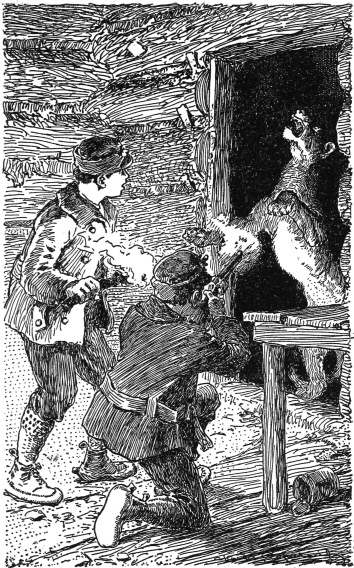 That Very Instant Tom Fired
rifle ready, the boys waited for the catamount to come within range of
the door.
Vicious with its burns and hunger, they had not long to wait for the
appearance of the catamount; crawling, crouching low, cat-like it came,
until it reached the door-sill of the shanty; then gathering itself, it
made ready to spring into the room.
That very instant Tom fired. Straight between the gleaming, yellow eyes
he aimed, and then, with a muffled howl of surprise and pain, the great,
tawny beast leaped high in air, his bound broken; with a snuffling,
snarling cry of pain he sank down, clawing and spitting. Tom had surely
hit and wounded him.
“Look, look, Tom! See; he isn’t dead yet. Quick, hurry and give him
another shot. He’s getting ready to jump again,” shouted Fred. Sure
enough, the catamount, now mad with pain from its shattered jaw,
crouched for a fresh spring.
“Bang,” went the rifle, Tom’s last shot. And when the smoke cleared
there lay the catamount, quite dead. Tom was thankful enough, as you can
well imagine, for what would have happened if that last shot had not
taken effect? For no boy can handle a catamount when it is fierce and
desperate.
The two boys were far too excited to sleep again that night; besides,
what if its mate should be hanging around somewhere! So they skinned the
dead catamount, and the next morning, as soon as the first yellow rays
of the rising sun touched the top of Mount Horrid, Fred loaded with the
rabbits, and Tom with the rifle over one shoulder and the tawny hide of
the catamount draped proudly over the other, tramped back over the Ridge
to the home camp, displaying to admiring eyes the largest catamount pelt
ever seen on the mountain.


