When Dr. Duncan returned home, he found his wife suffering
from a nervous fever, and in a delirious condition. The servants
told him in what way it had been produced—how a lady
who gave the name of Mrs. Riley had called at the house,
representing that he had sent her; how Mary had heard her
voice from upstairs, had hurried down and ordered her to go, exhibiting
extreme agitation; and had been ill ever since. He
closely cross-examined the two women who had been present at
the interview, and learnt every detail of it; and it was perhaps
well for Susan Riley that she was not by, so transported he was
with grief and rage.
He watched by the side of his wife all the night, and on the
following day, which was Sunday, he perceived that the crisis
was past. But she was still delirious, starting up wildly at
times to cry out that her baby had been murdered, and not
being satisfied when it was even brought in and shown her.
Dr. Duncan began to suspect that there must be some cause
in facts at the bottom of this fancy, that it was something more
than the delusion of an unhinged brain; so he carefully listened
to every word she dropped in her delirium, hoping to gather
some clue to the mystery, which might enable him to take definite
action against these enemies of his wife, and for once and
all, remove the weight of terror from her mind. He determined
that he would find out what this secret of hers was, what was
this dread which was goading her to madness. To begin with,
he would put detectives on the track of this Mrs. Riley—he
would spare no pains or expense to discover whether Mary was
the victim of a mania or of a foul conspiracy; he would no
longer remain in this state of perplexity as to which it was.
On Sunday afternoon Mary fell into a refreshing sleep. Her
husband sat by her bedside hour after hour watching and thinking
over the problem which he had set himself to solve.
At last she woke with a sudden cry and looked round her
with a puzzled frightened expression. Then her eyes met his,
and a softer look came into them. She stretched out her arms
feebly towards him and said in low half conscious tones, her
mind still wandering, "Kiss me, Harry, dear;" he kissed her—she
closed her eyes and continued in an intermittent dreamy
way, "My love! my love! how delicious to be with you again
after so long, so long—going through the green fields hand in
hand with you plucking the pretty flowers. Ah! you told me
of all this happiness in those dark old days in horrible London;
but I never thought they would come. Do not let me go back
there! Do not leave me, Harry! I am afraid!" She looked
wildly around the room as she uttered the last words.
"Of what, my poor little pet?" he said, clasping her in his
arms. "See, I am with you—there is no cause to be afraid."
"Ah! but, dear, I am afraid of all this great happiness—something
will happen. See even now how clouded it is getting, and
the green grass and the flowers are turning black and withering—and,
oh! all those dead leaves whirling about! But I will not
be afraid, I am with you. How nice to be in the fields once more
with you and baby—and baby—baby! O God!" she started up
in the bed, her eyes dilated and staring in a horrible fashion.
"O God, my baby! oh, they have taken away my baby—Harry!
Harry! where is my baby? She has got him at last, yes, she—that
woman there—Susan Riley! Ah, my baby!" and her awful
cry rang through the house and was even heard in the street,
so that passers-by stopped and turned pale at the agony of it.
"Oh, my beautiful baby! oh, give me back my baby! Pity me,
Susan, I kneel before you—kill me—torture me in any way, but
spare my baby! What have you done with him? Oh, do not
smile that cruel smile—what do you mean? Oh, murderess!
murderess!"
The very extremity of her anguish prevented its continuance.
After this paroxysm she appeared dazed and was quiet
for some time, then her mind commenced to wander in other
channels. "Mrs. King! mother! do not look so coldly at me.
Pity your poor little girl! you used to love me once. I have
not betrayed you, mother. I have never breathed the secret that
was killing me, even to my husband. I have given you my life."
Then she closed her eyes for a few minutes. She opened them
again and looked wistfully at her husband. "Harry, kiss me—am
I so ugly, dear? I think they have cut off all my hair; but
they said I was ugly before that. Mrs. Grimm used to say I
was ugly; but you don't think so, do you, dear?"
The man put his lips to hers and his tears fell on her cheek,
he could not keep them back. Then her eyes lit up with a
beautiful light of great love. "Kiss me once more, dear—I am
dying; one last sweet kiss from you just as I am dying. I will
die as you kiss, die in your dear arms, Harry," and she stretched
out her hands to him.
He clasped her softly in his arms and kissed her hot brow.
She lay there with a contented smile on her lips, her eyes closed,
and in a few moments she fell into a deep tranquil sleep.
He did not move his arm away lest he should disturb her,
and nearly an hour passed, and his heart became light within him,
as he saw that the danger was passing, that in all probability
she would awake refreshed and calm, with a sound mind.
At last there came a gentle tap at the door, and the nurse
entered.
"Please, Dr. Duncan," she said, "there is a lady downstairs
who has called to see you. I told her that you were engaged—as
you ordered—but she will not go: she said she must see you,
that her business is of the utmost importance."
"Tell her that I cannot possibly see her just now," whispered
the doctor.
The woman went out but returned in a minute or so.
"Has she not gone?" he asked, an angry look on his face.
"No, sir! she won't go; she says she will wait for you till you
can see her."
"What name did she give?"
"She wouldn't give her name, sir," replied the nurse, "she
says you must see her, that she has come on a matter of life and
death. She says that what she has to tell you is a secret that
affects Mrs. Duncan." The woman hesitated as she continued,
"She told me to tell you, sir, that she can save Mrs. Duncan's
life. I think she is crazy, sir; but she looks as if she were very
much in earnest."
The doctor pondered for a few moments, then seeing that his
wife was still in a profound sleep, he drew his arm gently from
under her head, and after whispering to the nurse to remain
there until he returned, he noiselessly left the room.
On entering the study he saw Catherine King standing by the
fire-place, erect as of old, but with a face deadly pale.
His brain had been rendered irritable by his anxious watching,
and as soon as he beheld her a great rage seized him. He said
to himself that it was this woman and her crew that had
tortured, maddened his little wife: and now she, the worst of
all, had even dared to beard him within his own doors.
Scarcely knowing what he did, he approached her, his arm
doubled menacingly, and trembling with passion.
"What are you doing here, woman?" he cried. "Another of
the accursed brood! Out, or I shall forget myself—out, I say!
But no! stay here! you shall not go out," he went to the
door, locked it and put the key in his pocket. "You will have
to tell me what all this means before I let you go, Mrs.
King."
"That is exactly what I have come here to do, Dr. Duncan,"
she replied quietly. She was standing firmly and proudly, meeting
his furious look with a calm sad eye in which there was no
wrath or fear, but a great pity.
He saw that look, and in spite of his strong prejudice against
her, he felt the sympathy of it, so he checked himself and stood
still, gazing at her with an expression of doubt and wonder on
his face.
She spoke again: "Dr. Duncan, you will understand me soon.
You altogether mistake my intentions now, and no great wonder
is it that you do. Dr. Duncan, believe me, I have come to
save your wife, to bring her happiness back to her, to make
reparation for a great wrong, before I die."
He looked at her face and clearly perceived the signs of fatal
illness on the passion-lined features. He was touched. He felt
that the woman was speaking the truth; he imagined that he
might be wrong after all in his suspicions of her—she might
have come as a friend and not as a foe.
"Take this chair, Mrs. King," he said kindly. "You look
very tired. I apologize for my ungentlemanly rudeness, but I
am off my head almost with worry and anxiety. I am very
glad you have come. You can throw some light on all this. I
must tell you"—and he scanned her face earnestly as he spoke—"that
certain circumstances have made me suspect that you
have something to do with the cause of my wife's illness."
"I have all to do with your wife's illness. I am the cause
of it," Catherine replied, meeting his eye fearlessly. "Dr.
Duncan, I have much to say to you. I will help you to understand
Mary's illness. I will teach you how to ward off all
danger from her for the future, and I will bring peace to her
mind."
She placed her hand to her heart, as if in pain, and looked so
ill that he exclaimed, "Mrs. King, you are seriously ill—you
must not excite yourself—speak quietly, I entreat you."
"I know that—I am dying; but I have come to save Mary's
life."
She dwelt lovingly on the beloved syllables of the girl's name,
and she closed her eyes for a moment to shut out the present,
as the picture of the old happy days, when her darling lived with
her, rose to her memory.
Seeing how weak she was and how weary were her tones, he
mixed her a draught to ease the labouring of the strained heart
and persuaded her to drink it.
"I feel better now," she said with a sigh of relief. "Doctor,"—she
then continued quickly as if in fear that something might
occur to prevent her from completing the long explanations
which was before her. "Dr. Duncan, your wife has a secret—she
cannot tell it you—it is this that troubles her."
"It is so."
"I will tell it to you."
He drew a chair to the table opposite to her, and leaning his
head on his hand gazed into her face, as he listened to her narrative
with so intense an attention, that he found himself holding
his breath at times lest his own heart should beat too
loudly, and he should miss one word.
Then she told him the whole strange story from the beginning
to the end—of her scheme—its failure—of her love for
Mary—of her intention to kill the girl—of her repentance at
the last moment—of Susan and her crimes and plots—she
omitted nothing.
When she had come to the end of it she said, "Now you
know all. I dragged poor Mary into this against her will. I
loved her, yet I would have destroyed her. The only wish I
have left now in the world is to make atonement, to take away all
this weight from her, and make her life happy. You may not believe
me, but it matters not—I care not—if I can only save her."
But Dr. Duncan did believe her. He listened to her and he
understood all now. He pitied the brave and generous, though
misguided woman before him. In his joy at what he had heard,
he forgave her everything for her great unselfish love for his
darling. A crowd of thoughts rushed across his mind. He recalled
many remarks of his wife that corroborated this story.
He remembered how she had ever expressed love and admiration
for Catherine King. Yes, this was the Secret!—and what did
all this confession of Catherine mean to him? Why! that his
wife had not been the victim of delusion—that she was not
drifting as he so much feared, into some terrible and incurable
form of insanity. Her fears had been but too reasonable—and
now it needed but a few words to clear the shadow from her
mind for ever! All this trouble was over now. In the excess
of his delight he could bear no ill-will to the bringer of such
good tidings, he could not reason calmly about her crimes and
errors.
He rose from his chair, and approaching Catherine he seized
her hand and said with a deep emotion, "Mrs. King, I have
misjudged you. In spite of all you have confessed, I believe
that you are a good—a noble woman. I should like you to consider
me as your friend."
She took his proffered hand without saying a word. He
continued, "Ah! Mrs. King, you have told me what will save
my darling's life. How can I thank you sufficiently?"
"You can do one thing for me," she replied anxiously.
"What is it?"
She clasped her hands together. "Oh, Dr. Duncan!" she
cried imploringly, "let me see her sometimes. I must be
vile in her sight, and you too must hate me, though you speak
so kindly. But I will do you no more harm—you know that.
I nearly brought her to ruin; but you need not fear me now.
Oh, Dr. Duncan! you do not know how I love her, how my
heart yearns after her—you yourself do not love her more. I
cannot live much longer—you can see that yourself. Let me
see her now and then during the short remainder of my life!
For your God's sake be merciful to me; have pity on me and
grant me this thing!"
"Mrs. King, believe me, when I tell you that I bear you no
ill-will whatever, very much the reverse indeed; and Mary has
always spoken of you in terms of the deepest affection. If all
goes well now, as I fully expect it will, you may come as often
as you like to see Mary, and you will be really welcome. I shall
be very glad if you will call to-morrow afternoon. By that
time I shall have told Mary all; and I think she will be well
enough to see you."
"Thank you very much, Dr. Duncan!" said Catherine
simply, but with a grasp of his hand that fully expressed the
depth of her gratitude. "I will go now and I will come again
to-morrow afternoon."
When Mary woke she found her husband sitting by her bedside,
with the light of such a great joy in his eyes, that a glad
wonder at once came into her own. She felt that some very
happy thing must have come to pass, and she raised herself in
the bed, and, taking his hand in hers, she gazed expectantly into
his face.
"Mary, I have some very good news indeed for you," he
said gently but very earnestly.
"I knew it! I knew it!" she exclaimed, trembling
violently.
"Mary, can you bear to hear it now?—how do you feel?"
"Oh, now—now!" she cried vehemently. "Tell it to me now,
at once, before I go away again. Oh! Harry—you don't understand—sometimes
the whole world seems to slip away from me.
I feel as if my soul was being carried right away into some dark
place—and I leave memory and love and everything but sensation
behind me—I cannot think then, Harry. Tell me quick,
for I can understand now. Tell me at once, or the darkness
will come again, and it will be too late!"
"My darling! my darling! The darkness will never come to
you again. Mary, dear, listen to me. I know your secret, and
your enemies can never trouble you more."
She passed her hand across her brow several times, then said
in a feeble puzzled voice, "You cannot know all, or you would
hate me."
"I do know all, and I love you more than ever!" he exclaimed
passionately as he put his arms about her and kissed
her.
She hid her head on his breast and sobbed in the fulness of
her great joy.
"Mary," he continued, "you need no longer fear Susan Riley's
plots. She will never molest you again. And who do you think
is the friend who has saved us? It is Mrs. King—she is coming
to see you to-morrow."
Gradually he told her all that Catherine King had revealed
to him. At first she could not bring herself to believe that
this was more than a very happy dream; she feared she would
awake again soon and find herself in the presence of the shadow.
But before he left her, she had realized all that had happened
on that day; and with tears and inarticulate prayers of gratitude
to the God who had not deserted her, she relieved her o'er-wrought
spirit, until a sweet sleep closed her weary eyes.
Catherine King called as she had promised on the following
afternoon. "How is she? Shall I be able to see her?"
she asked anxiously, as soon as the doctor came into the
room.
"Mary is very much better. Indeed there is very little the
matter with her now," he replied. "But I wish to say a few words
to you before we go upstairs. Mrs. King, I have had a long talk
with Mary about you. My dear friend!—I hope you will allow
me to call you that now—we have decided that you are to stay
with us; you must live here with Mary. She insists on it. You
know how she loves you—it will be cruel of you to refuse. It
has been settled that you are not to leave us even this night.
The weather is very bad, and you are too ill to be out in it.
Indeed you must be looked after. A room has been got ready
for you, and to-morrow you can give up your lodgings. No!
No refusal! I am your doctor now, and my orders are peremptory.
You will be happy yet and live long with us."
She shook her head and smiled. "I will not trouble you long.
But oh, Dr. Duncan!" and she stooped and kissed his hand in
the fervour of her gratitude, "I thank you from my heart for
what you have done this day. Oh, generous man! I have not
deserved this kindness. I have done much wrong to Mary and
you, and yet you forgive me like this. Ah! if a dying woman's
true gratitude be of any good, you indeed have it now."
Catherine followed the doctor upstairs. Mary was slightly
hysterical at first with the excitement of the meeting. She put
her arms round Catherine's neck and cried, "Oh, mother! dear
mother! You too! you too! and I loved you so. But you have
forgiven me now, and you will not hurt my baby, my poor little
baby!"
Catherine wept. Her heart had been softened by her lonely
misery of the last few months—she wept, and stooping she kissed
Mary's forehead and said, "My darling, I will love your baby,
even as I love you."
Mary soon entirely recovered her health. This was her last
shock. The terror was no more, the shadow had disappeared for
ever; and the knowledge that there was now no secret between
her husband and herself, removed the last cloud from her mind.
She went through life with him along a smoother way, a happy
wife and mother.
But Catherine's health grew rapidly worse. Soon she was
confined to her bed, peacefully, painlessly, fading away, and
Mary nursed her.
Her last days were made even delicious to her by the love of her
two friends. She was very happy in that she had saved Mary,
happier than she had ever been before—even in the old time
when she had been drunk with the glory of her visionary scheme.
She had learned at last that highest, intensest of pleasures—self-sacrifice
for those we love. No shadow came across the glory
of those last bright days. She was so grateful, so full of love,
so peacefully happy, and at last she died even as a saint might
have died with Mary by her side.
The noble, erring soul had gone to find Divine mercy. Her
last words were, as she turned her eyes to Mary with a wistful
look, "Mary! I feel that I know nothing about it, it is all a
mystery. But it may be that there is another world, the other
side—pray for me, Mary! pray for me! I cannot pray for
myself; for if there is another world I do so want to meet you
again there, my darling! my darling! but it is all a mystery—all
a mystery. Kiss me, Mary!"
The funeral of Mrs. King took place on one wild winter's day.
Dr. Duncan accompanied it as the only mourner. But on
reaching the cemetery he perceived there a woman dressed in
black and closely veiled.
She stood by the grave as the coffin was being lowered, and
was evidently weeping bitterly.
He wondered who she could be, but she carefully concealed
her face, and went away without disclosing her identity.
It was the boarding-house keeper of Bayswater, Sister Eliza,
of the Secret Society, who, after much vain search, had only
two days before discovered where her beloved Chief had gone.
42, Catherine Street, Strand,
May, 1885.
VIZETELLY & CO.'S NEW BOOKS,
AND NEW EDITIONS.
Second Edition, in Demy 8vo, cloth gilt, price 12s. 6d.
A JOURNEY DUE SOUTH;
TRAVELS IN SEARCH OF SUNSHINE.
By GEORGE AUGUSTUS SALA.
ILLUSTRATED WITH 16 FULL-PAGE ENGRAVINGS BY VARIOUS ARTISTS.
CONTENTS:—
- —A Few Hours in the Delightful City.
- —Life at Marseilles.
- —Southern Fare and Bouillabaisse.
- —Nice and its Nefarious Neighbour.
- —Quite Another Nice.
- —From Nice to Bastia.
- —On Shore at Bastia.
- —The Diligence come to Life again.
- —Sunday at Ajaccio.
- —The Hotel too soon.
- —The House in St. Charles Street, Ajaccio.
- —A Winter City.
- —Genoa the Superb: the City of the Leaning Tower.
- —Austere Bologna.
- —A Day of the Dead.
- —Venice Preserved.
- —The Two Romes. I. The Old.
- —The Two Romes. II. The New.
- —The Two Romes. II. The New (cont.).
- —The Roman Season.
- —In the Vatican: Mosaics.
- —With the Trappists in the Campagna.
- —From Naples to Pompeii.
- —The Show of a Long-Buried Past.
- —The "Movimento" of Naples.
- —In the Shade.
- —Spring Time in Paris.
- —"To All the Glories of France."
- —Le Roi Soleil and La Belle Bourbonnaise.
- —A Queen's Plaything.
IMPORTANT NEW WORK BY THE AUTHOR OF "SIDE
LIGHTS ON ENGLISH SOCIETY."
Two Vols. large Post 8vo, attractively bound, price 25s.
UNDER THE LENS:
SOCIAL PHOTOGRAPHS.
By E. C. GRENVILLE-MURRAY.
ILLUSTRATED WITH ABOUT 300 ENGRAVINGS BY WELL-KNOWN ARTISTS.
CONTENTS OF VOL. I.
JILTS:—Mrs. Pinkerton—A Western County Belle—Zoe, Lady Tryon—An Inconsolable
Jilt—A Jilted Drysalter—Love and Pickles—An Entr'acte—Mrs. Prago and Miss Daisy Caunter—A
Widow with a Nice Little Estate—An Unmercenary Pair of Jilts.
ADVENTURERS AND ADVENTURESSES:—Of the Genus Generally—Matrimonial
Adventurers—The Joint Stock Company Chairman—A Financial Adventurer—A Professional
Greek—The Countess D'Orenbarre—Lady Goldsworth—Mirabel Hildacourse—Lily Gore—Bella
Martingale—Pious Mrs. Palmhold—Mrs. Decoy—Mrs. Lawkins.
PUBLIC SCHOOLBOYS AND UNDERGRADUATES:—Drawbacks of Eton—Of
Various Eton Boys—Rugby and Rugbeians—Harrow, Winchester, Westminster—Oxford
Undergraduates—University Discipline—Sporting and Athletic Undergraduates—Reading and
Religious Undergraduates.
CONTENTS OF VOL. II.
SPENDTHRIFTS:—Prefatory—The Gambletons—Lord Charles Innynges—Lord Luke
Poer—Lord Rottenham—Lord Barker—The Marquis of Malplaquet—The Lords Lumber—Sir
Calling Earley—Tommy Dabble—Dicky Duff.
HONORABLE GENTLEMEN (M.P.'s):—Preliminary—Erudite Members—Crotchety
Members—Free Lances—The Irish Contingent—Very Noble M.P.'s—Money Bags—Beery
M.P.'s—Workingmen M.P.'s—Party Leaders—A Seatless Member.
SOME WOMEN I HAVE KNOWN:—An Ex-Beauty—Miss Jenny—Mademoiselle
Sylvie—Miss Rose—Madame de l'Esbrouffe-Tourbillon.
ROUGHS OF HIGH AND LOW DEGREE:—How Roughs are Made—The Nobleman
Rough—The Foreign Garrison Rough—The Clerical Rough—The Legal Rough—Medical
Roughs—The Rough Flirt—The Wife-Beating Rough—Vandal Roughs—The Tourist Rough—The
Nautical Rough—The Professional Bruiser—The Low-Class Rough—Women Roughs.
"Brilliant, highly-coloured sketches ... contains beyond doubt some of the best writing
that has come from Mr. Grenville-Murray's pen."—St. James's Gazette.
"Limned audaciously, unsparingly, and with much ability."—World.
"Distinguished by their pitiless fidelity to nature."—Society.
"Extremely personal. The author, brilliant as were his parts, appears to have laboured
under a delusion which obliged him to mistake personal abuse for satire, and ill-nature for moral
indignation."—Athenæum.
"Some of Mr. Murray's trenchant blows do real service to the cause of public morality and
order."—Daily Telegraph.
"Includes unvarnished portraits of various characters who have made a flutter in recent
times in this little world of ours."—Vanity Fair.
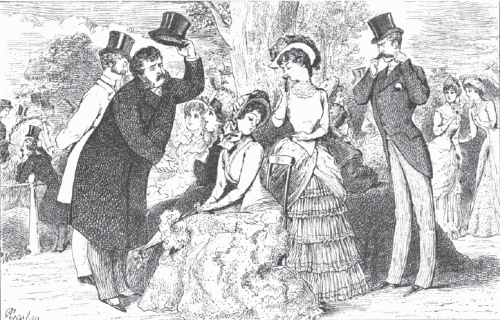 THE MISSES D'ORENBARRE EXHIBIT THEIR AVERSION TO FAT MEN AND SMOKERS: from "UNDER THE LENS."
VIZETELLY'S ONE-VOLUME NOVELS.
In Crown 8vo, good readable type, and attractive binding, price 6s. each.
"The idea of publishing cheap one-volume novels is a good one, and we wish the series
every success."—Saturday Review.
The Book that made M. Ohnet's reputation, and was crowned by the French Academy.
PRINCE SERGE PANINE.
By GEORGES OHNET.
Author of "The Ironmaster."
Translated, without Abridgment, from the 110th French Edition.
MR. BUTLER'S WARD.
By MABEL ROBINSON.
"A charming book, poetically conceived, and worked out with tenderness and insight."—Athenæum.
"The heroine is a very happy conception, a beautiful creation whose affecting history is
treated with much delicacy, sympathy, and command of all that is touching."—Illustrated News.
"'Mr. Butler's Ward' is of exceptional merit and interest as a first novel.... All the characters
are new to fiction, and the author is to be congratulated on having made so full and
original a haul out of the supposed to be exhausted waters of modern society.... A writer who
can at the outset write such admirable sense and transform the results of much minute observation
into so pathetic and tender a whole, takes at once a high position."—Graphic.
THE CORSARS; OR, LOVE AND LUCRE.
By JOHN HILL.
Author of "The Waters of Marah," "Sally," &c.
"It is indubitable that Mr. Hill has produced a strong and lively novel, full of story, character,
situations, murder, gold mines, excursions, and alarms. The book is so rich in promise
that we hope to receive some day from Mr. Hill a romance which will win every vote."—Saturday
Review.
COUNTESS SARAH.
By GEORGES OHNET.
Author of "The Ironmaster."
TRANSLATED, WITHOUT ABRIDGMENT, FROM THE 118th FRENCH EDITION.
"The book contains some very powerful situations and first-rate character studies."—Whitehall
Review.
BETWEEN MIDNIGHT AND DAWN.
By INA L. CASSILIS.
Author of "Society's Queen," "Strangely Wooed: Strangely Won," &c.
NUMA ROUMESTAN; OR, JOY ABROAD AND
GRIEF AT HOME.
By ALPHONSE DAUDET.
TRANSLATED BY Mrs. J. G. LAYARD.
"'Numa Roumestan' is a masterpiece; it is really a perfect work; it has no fault, no weakness.
It is a compact and harmonious whole."—Mr. Henry James.
A MUMMER'S WIFE. A REALISTIC NOVEL.
By GEORGE MOORE, Author of "A Modern Lover."
"A striking book, different in tone from current English fiction. The woman's character is
a very powerful study."—Athenæum.
"'A Mummer's Wife,' in virtue of its vividness of presentation and real literary skill, may
be regarded as in some degree a representative example of the work of a literary school that has
of late years attracted to itself a good deal of the notoriety which is a very useful substitute
for fame."—Spectator.
"'A Mummer's Wife' holds at present a unique position among English novels. It is a
conspicuous success of its kind."—Graphic.
THE FORKED TONGUE.
By R. LANGSTAFF DE HAVILLAND, M.A.
Author of "Enslaved," &c.
THE THREATENING EYE.
By E. F. KNIGHT.
Author of "A Cruise in the Falcon."
In Large Crown 8vo, beautifully printed on toned paper, and handsomely bound, with
gilt edges, price 7s. 6d., suitable in every way for a present,
An Illustrated Edition of M. Ohnet's Celebrated Novel,
THE IRONMASTER; OR, LOVE AND PRIDE.
Translated from the 146th French Edition and Containing 42 Full-Page
Engravings by French Artists, Printed Separate from the Text.
"M. Georges Ohnet's 'Ironmaster' has proved the greatest literary success in any language
of recent times, the author having already realised £12,000 from the French edition of the work."
"The Ironmaster" is published in small 8vo, without the Illustrations,
price 3s. 6d.
Second Edition, in small 8vo, price 3s. 6d.
A MODERN LOVER.
By GEORGE MOORE. Author of "A Mummer's Wife."
In small 8vo, price 3s. 6d.
CAROLINE BAUER AND THE COBURGS.
FROM THE GERMAN.
Illustrated with Two carefully engraved Portraits of Caroline Bauer.
"Caroline Bauer's name became in a mysterious and almost tragic manner connected with
those of two men highly esteemed and well remembered in England—Prince Leopold of Coburg,
the husband and widower of Princess Charlotte, afterwards first King of the Belgians, and his
nephew, Prince Albert's trusty friend and adviser, Baron Stockmar."—The Times.
"Caroline Bauer was rather hardly used in her lifetime, but she certainly contrived to take
a very exemplary revenge. People who offended her are gibbeted in one of the most fascinating
books that has appeared for a long time. Nothing essential escaped her eye, and she could
describe as well as she could observe. She lived in England when George IV. and his remarkable
Court were conducting themselves after their manner, and she collected about as pretty a
set of scandals as ever was seen."—Vanity Fair.
Fourth Edition, in Post 8vo, handsomely bound, price 7s. 6d.
SIDE-LIGHTS ON ENGLISH SOCIETY:
Sketches from Life, Social and Satirical.
By E. C. GRENVILLE-MURRAY.
ILLUSTRATED WITH NEARLY 300 CHARACTERISTIC ENGRAVINGS.
CONTENTS:—I. FLIRTS. II. ON HER BRITANNIC MAJESTY'S SERVICE. III.
SEMI-DETACHED WIVES. IV. NOBLE LORDS. V. YOUNG WIDOWS. VI. OUR SILVERED
YOUTH, OR NOBLE OLD BOYS.
"This is a startling book. The volume is expensively and elaborately got up; the writing is
bitter, unsparing, and extremely clever."—Vanity Fair.
"Mr. Grenville-Murray sparkles very steadily throughout the present volume, and puts to
excellent use his incomparable knowledge of life and manners, of men and cities, of appearances
and facts. Of his several descants upon English types, I shall only remark that they are
brilliantly and dashingly written, curious as to their matter, and admirably readable."—Truth.
"No one can question the brilliancy of the sketches, nor affirm that 'Side-Lights' is aught but
a fascinating book.... The book is destined to make a great noise in the world."—Whitehall
Review.
Second Edition, with Frontispiece and Vignette, price 5s.
HIGH LIFE IN FRANCE UNDER
THE REPUBLIC:
SOCIAL AND SATIRICAL SKETCHES IN PARIS AND THE PROVINCES.
By E. C. GRENVILLE-MURRAY.
Author of "Side-Lights on English Society," &c.
"Take this book as it stands, with the limitations imposed upon its author by circumstances,
and it will be found very enjoyable.... The volume is studded with shrewd observations on
French life at the present day."—Spectator.
"A very clever and entertaining series of social and satirical sketches, almost French in their
point and vivacity."—Contemporary Review.
In Large Post 8vo, cloth gilt, price 9s.
IMPRISONED IN A SPANISH CONVENT:
AN ENGLISH GIRL'S EXPERIENCES.
By E. C. GRENVILLE-MURRAY.
ILLUSTRATED WITH PAGE AND OTHER ENGRAVINGS.
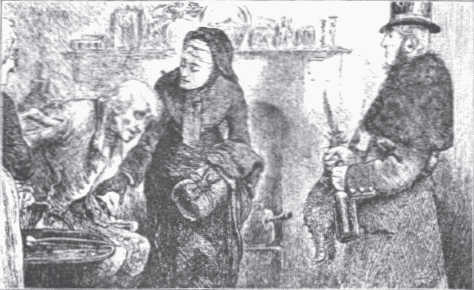 THE RICH WIDOW (reduced from the original engraving).
Second Edition, in large 8vo, handsomely bound, with gilt edges, price 10s. 6d.
PEOPLE I HAVE MET.
By E. C. GRENVILLE-MURRAY.
Illustrated with 54 tinted Page Engravings, from Designs by Fred. Barnard.
CONTENTS:—
- The Old Earl.
- The Dowager.
- The Family Solicitor.
- The College Don.
- The Rich Widow.
- The Ornamental Director.
- The Old Maid.
- The Rector.
- The Curate.
- The Governess.
- The Tutor.
- The Promising Son.
- The Favourite Daughter.
- The Squire.
- The Doctor.
- The Retired Colonel.
- The Chaperon.
- The Usurer.
- The Spendthrift.
- Le Nouveau Riche.
- The Maiden Aunt.
- The Bachelor.
- The Younger Son.
- The Grandmother.
- The Newspaper Editor.
- The Butler.
- The Devotee.
"Mr. Grenville-Murray's pages sparkle with cleverness and with a shrewd wit, caustic or
cynical at times, but by no means excluding a due appreciation of the softer virtues of women
and the sterner excellences of men. The talent of the artist (Mr. Barnard) is akin to that of the
author, and the result of the combination is a book that, once taken up, can hardly be laid down
until the last page is perused."—Spectator.
An Edition of "PEOPLE I HAVE MET" is published in small 8vo,
with Sixteen Illustrations, price 6s.
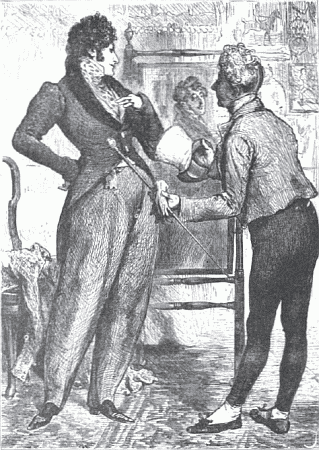 A BUCK OF THE REGENCY: from "DUTCH PICTURES."
"Mr. Sala's best work has in it something of Montaigne, a great deal of Charles Lamb—made
deeper and broader—and not a little of Lamb's model, the accomplished and quaint Sir Thomas
Brown. These 'Dutch Pictures' and 'Pictures Done With a Quill' should be placed alongside
Oliver Wendell Holmes's inimitable budgets of friendly gossip and Thackeray's 'Roundabout
Papers.' They display to perfection the quick eye, good taste, and ready hand of the born
essayist—they are never tiresome."—Daily Telegraph.
In Crown 8vo, price 5s.
DUTCH PICTURES, and PICTURES DONE
WITH A QUILL.
Illustrated with a Frontispiece and other Page Engravings.
FORMING THE FIRST VOLUME OF THE
CHOICER MISCELLANEOUS WORKS OF GEORGE AUGUSTUS SALA.
A SMALL NUMBER OF COPIES OF THE ABOVE WORK HAVE BEEN PRINTED IN DEMY OCTAVO,
ON HAND-MADE PAPER, WITH THE ILLUSTRATIONS ON INDIA PAPER MOUNTED.
The Graphic remarks: "We have received a sumptuous new edition of Mr. G. A. Sala's well-known
'Dutch Pictures.' It is printed on rough paper, and is enriched with many admirable
illustrations."
Uniform with the above Volume,
UNDER THE SUN.
ESSAYS MAINLY WRITTEN IN HOT COUNTRIES.
By GEORGE AUGUSTUS SALA.
Illustrated with an etched Portrait of the Author, and various Page Engravings.
In One Volume, Demy 8vo, 560 pages, price 12s., the Fifth Edition of
AMERICA REVISITED,
From the Bay of New York to the Gulf of Mexico,
and from Lake Michigan to the Pacific;
INCLUDING A SOJOURN AMONG THE MORMONS IN SALT LAKE CITY.
By GEORGE AUGUSTUS SALA.
ILLUSTRATED WITH NEARLY 400 ENGRAVINGS.
CONTENTS.
- Outward Bound.
- Thanksgiving Day in New York.
- Transformation of New York.
- All the Fun of the Fair.
- A Morning with Justice.
- On the Cars.
- Fashion and Food in New York.
- The Monumental City.
- Baltimore come to Life again.
- The Great Grant "Boom."
- A Philadelphian Babel.
- At the Continental.
- Christmas and the New Year.
- On to Richmond.
- Still on to Richmond.
- In Richmond.
- Genial Richmond.
- In the Tombs—and out of them.
- Prosperous Augusta.
- The City of many Cows.
- A Pantomime in the South.
- Arrogant Atlanta.
- The Crescent City.
- On Canal Street.
- In Jackson Square.
- A Southern Parliament.
- Sunday in New Orleans.
- The Carnival Booming.
- The Carnival Booms.
- Going West.
- The Wonderful Prairie City.
- The Home of the Setting Sun.
- At Omaha.
- The Road to Eldorado.
- Still on the Road to Eldorado.
- At Last.
- Aspects of 'Frisco.
- China Town.
- The Drama in China Town.
- Scenes in China Town.
- China Town by Night.
- From 'Frisco to Salt Lake City.
- Down among the Mormons.
- The Stock-yards of Chicago.
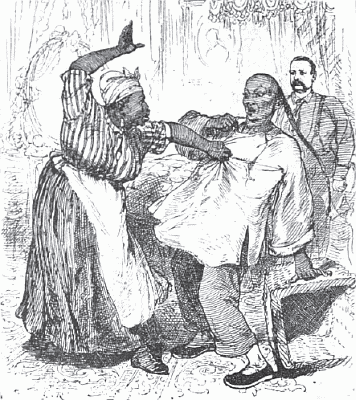 "It was like your imperence to come smouchin' round here, looking after de white folks' washin."
"In 'America Revisited' Mr. Sala is seen at his very best; better even than in his Paris
book, more evenly genial and gay, and with a fresher subject to handle."—World.
"Mr. Sala's good stories lie thick as plums in a pudding throughout this handsome work."—Pall
Mall Gazette.
"A new book of travel by Mr. Sala is sure to be welcome. He possesses the happy knack of
adorning whatever he touches, and of finding something worth telling when traversing beaten
ground."—Athenæum.
"A pleasant day may be spent with this book. Open where you will you find kindly chat
and pleasant description. The illustrations are admirable."—Vanity Fair.
"As for the style of this entertaining and lively book, it is exactly what we should have
expected. The writer is full of life, observation, and swiftness to seize upon salient and characteristic
points. His description of the Chinese quarter of San Francisco may be strongly commended."—Saturday
Review.
"This brilliant work possesses an irresistible charm, difficult to define indeed, but none the
less delightful. Reading it is like listening to a good talker—the usual slightly wearisome sense
of reading is effaced by the vivaciousness of the style in which the cleverest feuilletoniste of the day
has narrated his experiences on the occasion of his last visit to America."—Morning Post.
"'America Revisited' is bright, lively, and amusing. We doubt whether Mr. Sala could be
dull even if he tried."—Globe.
Seventh Edition, in Crown 8vo, 558 pages, attractively bound, price 3s. 6d.,
or gilt at the side and with gilt edges, 5s.
PARIS HERSELF AGAIN.
By GEORGE AUGUSTUS SALA.
WITH 350 CHARACTERISTIC ILLUSTRATIONS BY FRENCH ARTISTS.
"The author's 'round-about' chapters are as animated as they are varied and sympathetic,
for few Englishmen have the French verve like Mr. Sala, or so light a touch on congenial subjects.
He has stores of out-of-the-way information, a very many-sided gift of appreciation, with a
singularly tenacious memory, and on subjects like those in his present work he is at his best."—The
Times.
"Most amusing letters they are, with clever little pictures scattered so profusely through
the solid volume that it would be difficult to prick the edges with a pin at any point without
coming upon one or more. Few writers can rival Mr. Sala's fertility of illustration and ever
ready command of lively comment."—Daily News.
"'Paris Herself Again' furnishes a happy illustration of the attractiveness of Mr. Sala's style
and the fertility of his resources. For those who do and those who do not know Paris these
volumes contain a fund of instruction and amusement."—Saturday Review.
"This book is one of the most readable that has appeared for many a day. Few Englishmen
know so much of old and modern Paris as Mr. Sala. Endowed with a facility to extract humour
from every phase of the world's stage, and blessed with a wondrous store of recondite lore, he
outdoes himself when he deals with a city like Paris that he knows so well, and that affords such
an opportunity for his pen."—Truth.
"'Paris Herself Again' is infinitely more amusing than most novels, and will give you
information which you can turn to advantage, and innumerable anecdotes for the dinner-table and
the smoking-room. There is no style so chatty and so unwearying as that of which Mr. Sala is a
master."—The World.
ZOLA'S POWERFUL REALISTIC NOVELS.
In Crown 8vo, price 6s. each.
PIPING HOT!
("POT-BOUILLE.")
Translated from the 63rd French edition. Illustrated with Sixteen Page
Engravings by French Artists.
NANA:
TRANSLATED WITHOUT ABRIDGMENT FROM THE 127th FRENCH EDITION.
Illustrated with Twenty-four Tinted Page Engravings, by French Artists.
Mr. HENRY JAMES on "NANA."
"A novelist with a system, a passionate conviction, a great plan—incontestable attributes of
M. Zola—is not now to be easily found in England or the United States, where the story-teller's
art is almost exclusively feminine, is mainly in the hands of timid (even when very accomplished)
women, whose acquaintance with life is severely restricted, and who are not conspicuous for
general views. The novel, moreover, among ourselves, is almost always addressed to young
unmarried ladies, or at least always assumes them to be a large part of the novelist's public.
"This fact, to a French story-teller, appears, of course, a damnable restriction, and M. Zola
would probably decline to take au sérieux any work produced under such unnatural conditions.
Half of life is a sealed book to young unmarried ladies, and how can a novel be worth anything
that deals only with half of life? These objections are perfectly valid, and it may be said that
our English system is a good thing for virgins and boys, and a bad thing for the novel itself,
when the novel is regarded as something more than a simple jeu d'esprit, and considered as a
composition that treats of life at large and helps us to know."
THE "ASSOMMOIR;"
(The Prelude to "Nana.")
TRANSLATED WITHOUT ABRIDGMENT FROM THE 97th FRENCH EDITION.
Illustrated with Sixteen Tinted Page Engravings, by French Artists.
"After reading Zola's novels it seems as if in all others, even in the truest, there were a veil
between the reader and the things described, and there is present to our minds the same difference
as exists between the representations of human faces on canvas and the reflection of the same
faces in a mirror. It is like finding truth for the first time.
"Zola is one of the most moral novelists in France, and it is really astonishing how anyone
can doubt this. He makes us note the smell of vice, not its perfume: his nude figures are those
of the anatomical table, which do not inspire the slightest immoral thought; there is not one of
his books, not even the crudest, that does not leave behind it pure, firm, and unmistakable
aversion, or scorn, for the base passions of which he treats."—Signor de Amicis.
The above Works are published without the Illustrations, price 5s. each.
In Preparation. Uniform with the above Volumes.
GERMINAL; OR, MASTER AND MAN.
THE RUSH FOR THE SPOIL.
THE LADIES' PARADISE.
THÉRÈSE RAQUIN.
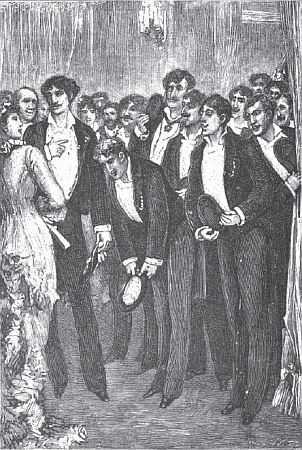 THE ARRIVAL OF THE ELEVEN YOUNG MEN AT NANA'S EVENING PARTY.
In large 8vo, handsomely bound and gilt, price 7s. 6d.
A NEW ILLUSTRATED EDITION OF M. EMILE ZOLA'S REALISTIC NOVEL,
NANA.
Illustrated with upwards of 100 Engravings, nearly half of which are full-page.
TO BE FOLLOWED BY ILLUSTRATED EDITIONS OF
THE "ASSOMMOIR," PIPING HOT!
AND THE REST OF M. ZOLA'S MORE POPULAR WORKS.
In Crown 8vo, handsomely bound and gilt, price 6s., the Third and Completely
Revised Edition of
THE STORY OF
THE DIAMOND NECKLACE,
COMPRISING A SKETCH OF THE LIFE OF THE COUNTESS DE LA MOTTE, PRETENDED
CONFIDANTE OF MARIE-ANTOINETTE, WITH PARTICULARS OF THE
CAREERS OF THE OTHER ACTORS IN THIS REMARKABLE DRAMA.
By HENRY VIZETELLY.
Author of "Berlin Under The New Empire," "Paris in Peril," &c.
Illustrated with an Exact Representation of the Diamond Necklace, from a contemporary
Drawing, and a Portrait of the Countess de la Motte, engraved on Steel.
"Mr. Vizetelly's tale has all the interest of a romance which is too strange not to be true....
His summing up of the evidence, both negative and positive, which exculpates Marie-Antoinette
from any complicity whatever with the scandalous intrigue in which she was
represented as bearing a part, is admirable."—Saturday Review.
"We can, without fear of contradiction, describe Mr. Henry Vizetelly's 'Story of the
Diamond Necklace' as a book of thrilling interest. He has not only executed his task
with skill and faithfulness, but also with tact and delicacy."—Standard.
"Had the most daring of our sensational novelists put forth the present plain unvarnished
statement of facts as a work of fiction, it would have been denounced as so violating all
probabilities as to be a positive insult to the common sense of the reader. Yet strange, startling,
incomprehensible as is the narrative which the author has here evolved, every word of it is true."—Notes
and Queries.
In Large Crown 8vo, handsomely printed and bound, price 6s.
THE AMUSING
ADVENTURES OF GUZMAN OF ALFARAQUE.
A Spanish Novel. Translated by EDWARD LOWDELL.
ILLUSTRATED WITH HIGHLY-FINISHED ENGRAVINGS ON STEEL FROM DESIGNS BY STAHL.
"The wit, vivacity and variety of this masterpiece cannot be over-estimated."—Morning Post.
"A very well executed translation of a famous 'Rogue's Progress.'"—Spectator.
"The story is infinitely amusing, and illustrated as it is with several excellent designs on
steel, it will be acceptable to a good many readers."—Scotsman.
In Crown 8vo, attractively bound, price 2s. 6d.
THE RED CROSS, and other Stories.
By LUIGI.
"The short stories are the best—Luigi is in places tender and pathetic."—Athenæum.
"The plans of the tales are excellent. Many of the incidents are admirable, and there is a
good deal of pathos in the writing."—Scotsman.
In Two Volumes, post 8vo, prices 10s. 6d.
SOCIETY NOVELETTES.
By F. C. BURNAND, H. SAVILE CLARKE, R. E. FRANCILLON, JOSEPH HATTON,
RICHARD JEFFERIES, the Author of "A French Heiress in her own Château," &c. &c.
Illustrated with numerous Page and other Engravings, from Designs by
R. Caldecott, Linley Sambourne, M. E. Edwards, F. Dadd, &c.
"The reader will not be disappointed in the hopes raised by Messrs. Vizetelly's pleasing
volumes.... There is much that is original and clever in these 'Society' tales."—Athenæum.
"Many of the stories are of the greatest merit; and indeed with such contributors, the
reader might be sure of the unusual interest and amusement which these volumes supply."—Daily
Telegraph.
In Crown 8vo, price 3s. 6d.
A NEW EDITION, COMPRISING MUCH ADDITIONAL MATTER, OF
IN STRANGE COMPANY.
By JAMES GREENWOOD (the "Amateur Casual").
ILLUSTRATED WITH A PORTRAIT OF THE AUTHOR, ENGRAVED ON STEEL.
In square 8vo, cloth gilt, price 3s. 6d.
LAYS OF THE SAINTLY;
OR, THE NEW GOLDEN LEGEND.
By the London Hermit (W. PARKE),
WITH HUMOROUS ILLUSTRATIONS BY J. LEITCH.
"Lovers of laughter, raillery, and things ludicrous would do well to become possessed of this
volume of humorous poems levelled against the absurd though amusing superstitions of the
Middle Ages."—Newcastle Chronicle.
In Post 8vo, price 2s. 6d.
THE CHILDISHNESS AND BRUTALITY OF
THE TIME:
Some Plain Truths in Plain Language.
By HARGRAVE JENNINGS, Author of "The Rosicrucians," &c.
"Mr. Jennings has a knack of writing in good, racy, trenchant style. His sketch of behind
the scenes of the Opera, and his story of a mutiny on board an Indiaman of the old time, are
penned with surprising freshness and spirit."—Daily News.
In Demy 4to, handsomely printed and bound, with gilt edges, price 12s.
A HISTORY OF CHAMPAGNE;
WITH NOTES ON THE OTHER SPARKLING WINES OF FRANCE.
By HENRY VIZETELLY.
Chevalier of the Order of Franz-Josef.
WINE JUROR FOR GREAT BRITAIN AT THE VIENNA AND PARIS EXHIBITIONS OF 1873 AND 1878.
Illustrated with 350 Engravings,
FROM ORIGINAL SKETCHES AND PHOTOGRAPHS, ANCIENT MSS., EARLY PRINTED
BOOKS, RARE PRINTS, CARICATURES, ETC.
"A very agreeable medley of history, anecdote, geographical description, and such like
matter, distinguished by an accuracy not often found in such medleys, and illustrated in the
most abundant and pleasingly miscellaneous fashion."—Daily News.
"Mr. Henry Vizetelly's handsome book about Champagne and other sparkling wines of
France is full of curious information and amusement. It should be widely read and appreciated."—Saturday
Review.
"Mr. Henry Vizetelly has written a quarto volume on the 'History of Champagne,' in
which he has collected a large number of facts, many of them very curious and interesting. Many
of the woodcuts are excellent."—Athenæum.
In large imperial 8vo, price 6d.
THE SOCIAL ZOO;
Satirical, Social, and Humorous Sketches by the Best Writers.
Copiously Illustrated in Many Styles by well-known Artists.
NOW READY.
OUR GILDED YOUTH. By E. C. Grenville-Murray——NICE GIRLS. By
R. Mounteney Jephson——NOBLE LORDS. By E. C. Grenville-Murray——FLIRTS.
By E. C. Grenville-Murray——OUR SILVERED YOUTH.
By E. C. Grenville-Murray——MILITARY MEN AS THEY WERE.
By E. Dyne Fenton.
In double volumes, bound in scarlet cloth, price 2s. 6d. each.
NEW EDITIONS OF
Gaboriau's Sensational Novels.
NOW READY
- —THE MYSTERY OF ORCIVAL AND THE GILDED CLIQUE.
- —THE LEROGUE CASE, AND OTHER PEOPLE'S MONEY.
- —LECOQ, THE DETECTIVE.
- —THE SLAVES OF PARIS.
- —DOSSIER NO. 113, AND THE LITTLE OLD MAN OF BATIGNOLLES.
- —IN PERIL OF HIS LIFE, AND INTRIGUES OF A POISONER.
- —THE COUNT'S MILLIONS.
- —THE CATASTROPHE.
Uniform with the above,
THE OLD AGE OF LECOQ, THE DETECTIVE.
By F. DU BOISGOBEY.
In Small Post 8vo, ornamental covers, 1s. each.
Gaboriau's Sensational Novels.
THE FAVOURITE READING OF PRINCE BISMARCK.
"Ah, friend, how many and many a while
They've made the slow time fleetly flow,
And solaced pain and charmed exile,
Miss Braddon and Gaboriau!"
Ballade of Railway Novels in "Longman's Magazine."
IN PERIL OF HIS LIFE.
"A story of thrilling interest and admirably translated."—Sunday Times.
"Hardly ever has a more ingenious circumstantial case been imagined than that which
puts the hero in peril of his life, and the manner in which the proof of his innocence is
finally brought about is scarcely less skilful."—Illustrated Sporting and Dramatic News.
THE LEROUGE CASE.
"M. Gaboriau is a skilful and brilliant writer, capable of so diverting the attention and
interest of his readers that not one word or line in his book will be skipped or read carelessly."—Hampshire
Advertiser.
OTHER PEOPLE'S MONEY.
"The interest is kept up throughout, and the story is told graphically and with a good
deal of art."—London Figaro.
LECOQ THE DETECTIVE. Two vols.
"In the art of forging a tangled chain of complicated incidents involved and inexplicable
until the last link is reached and the whole made clear, Mr. Wilkie Collins
is equalled, if not excelled, by M. Gaboriau. The same skill in constructing a story is
shown by both, as likewise the same ability to build up a superstructure of facts on a
foundation which, sound enough in appearance, is shattered when the long-concealed
touchstone of truth is at length applied to it."—Brighton Herald.
THE GILDED CLIQUE.
"Full of incident and instinct with life and action. Altogether this is a most
fascinating book."—Hampshire Advertiser.
THE MYSTERY OF ORCIVAL.
"The Author keeps the interest of the reader at fever heat, and by a succession of unexpected
turns and incidents, the drama is ultimately worked out to a very pleasant
result. The ability displayed is unquestionable."—Sheffield Independent.
DOSSIER NO. 113.
"The plot is worked out with great skill, and from first to last the reader's interest is
never allowed to flag."—Dumbarton Herald.
THE LITTLE OLD MAN OF BATIGNOLLES.
THE SLAVES OF PARIS. Two vols.
"Sensational, full of interest, cleverly conceived and wrought out with consummate
skill."—Oxford and Cambridge Journal.
THE COUNT'S MILLIONS. Two vols.
INTRIGUES OF A POISONER.
THE CATASTROPHE. Two vols.
Publishing in Monthly Volumes, 1s. each.
UNIFORM WITH GABORIAU'S SENSATIONAL NOVELS.
Du Boisgobey's Sensational Novels.
NOW READY.
THE OLD AGE OF LECOQ, THE DETECTIVE. Two vols.
THE SEVERED HAND.
IN THE SERPENTS' COILS.
TO BE FOLLOWED BY
THE THUMB STROKE.—BERTHA'S SECRET.—THE
GOLDEN TRESS.—THE MATAPAN AFFAIR, ETC.
In Small Post 8vo, ornamental covers, 1s. each; in cloth, 1s. 6d.
VIZETELLY'S POPULAR FRENCH NOVELS.
TRANSLATIONS OF THE BEST EXAMPLES OF RECENT FRENCH
FICTION OF AN UNOBJECTIONABLE CHARACTER.
"They are books that may be safely left lying about where the ladies of the family can pick them
up and read them. The interest they create is happily not of the vicious sort at all."
Sheffield Independent.
FROMONT THE YOUNGER & RISLER THE ELDER. By
A. Daudet.
"The series starts well with M. Alphonse Daudet's masterpiece."—Athenæum.
"A terrible story, powerful after a sledge-hammer fashion in some parts, and wonderfully
tender, touching, and pathetic in others."—Illustrated London News.
SAMUEL BROHL AND PARTNER. By V. Cherbuliez.
"M. Cherbuliez's novels are read by everybody and offend nobody. They are excellent
studies of character, well constructed, peopled with interesting men and women, and the
style in which they are written is admirable."—The Times.
"Those who have read this singular story in the original need not be reminded of that
supremely dramatic study of the man who lived two lives at once, even within himself.
The reader's discovery of his double nature is one of the most cleverly managed of surprises,
and Samuel Brohl's final dissolution of partnership with himself is a remarkable
stroke of almost pathetic comedy."—The Graphic.
THE DRAMA OF THE RUE DE LA PAIX. By A. Belot.
"A highly ingenious plot is developed in 'The Drama of the Rue de la Paix,' in
which a decidedly interesting and thrilling narrative is told with great force and
passion, relieved by sprightliness and tenderness."—Illustrated London News.
MAUGARS JUNIOR. By A. Theuriet.
"One of the most charming novelettes we have read for a long time."—Literary World.
WAYWARD DOSIA, & THE GENEROUS DIPLOMATIST.
By Henry Gréville.
"As epigrammatic as anything Lord Beaconsfield has ever written."—Hampshire
Telegraph.
A NEW LEASE OF LIFE, & SAVING A DAUGHTER'S
DOWRY. By E. About.
"'A New Lease of Life' is an absorbing story, the interest of which is kept up to the
very end."—Dublin Evening Mail.
"The story, as a flight of brilliant and eccentric imagination, is unequalled in its
peculiar way."—The Graphic.
COLOMBA, & CARMEN. By P. Mérimée.
"The freshness and raciness of 'Colomba' is quite cheering after the stereotyped three-volume
novels with which our circulating libraries are crammed."—Halifax Times.
"'Carmen' will be welcomed by the lovers of the sprightly and tuneful opera the heroine
of which Minnie Hauk made so popular. It is a bright and vivacious story."—Life.
A WOMAN'S DIARY, & THE LITTLE COUNTESS. By
O. Feuillet.
"Is wrought out with masterly skill and affords reading which, although of a slightly
sensational kind, cannot be said to be hurtful either mentally or morally."—Dumbarton
Herald.
BLUE-EYED META HOLDENIS, & A STROKE OF DIPLOMACY.
By V. Cherbuliez.
"'Blue-eyed Meta Holdenis' is a delightful tale."—Civil Service Gazette.
"'A Stroke of Diplomacy' is a bright vivacious story pleasantly told."—Hampshire
Advertiser.
THE GODSON OF A MARQUIS. By A. Theuriet.
"The rustic personages, the rural scenery and life in the forest country of Argonne, are
painted with the hand of a master. From the beginning to the close the interest of the
story never flags."—Life.
THE TOWER OF PERCEMONT AND MARIANNE. By
George Sand.
"George Sand has a great name, and the 'Tower of Percemont' is not unworthy of it."—Illustrated
London News.
THE LOW-BORN LOVER'S REVENGE. By V. Cherbuliez.
"'The Low-born Lover's Revenge' is one of M. Cherbuliez's many exquisitely written
productions. The studies of human nature under various influences, especially in the
cases of the unhappy heroine and her low-born lover, are wonderfully effective."—Illustrated
London News.
THE NOTARY'S NOSE, AND OTHER AMUSING STORIES.
By E. About.
"Crisp and bright, full of movement and interest."—Brighton Herald.
DOCTOR CLAUDE; OR, LOVE RENDERED DESPERATE.
By H. Malot. Two vols.
"We have to appeal to our very first flight of novelists to find anything so artistic in
English romance as these books."—Dublin Evening Mail.
THE THREE RED KNIGHTS; OR, THE BROTHERS'
VENGEANCE. By P. Féval.
"The one thing that strikes us in these stories is the marvellous dramatic skill of the
writers."—Sheffield Independent.
In large 8vo, with Picture Cover in Colours, from a Design by
R. C. Woodville, price 1s.
GORDON AND THE MAHDI.
An Illustrated Narrative of the Soudan War
TO THE FALL OF KHARTOUM AND THE DEATH
OF GENERAL GORDON.
Illustrated with 100 Engravings by the Artists of the "Illustrated London News."
MR. HENRY VIZETELLY'S POPULAR BOOKS ON WINE.
"Mr. Vizetelly discourses brightly and discriminatingly on crus and bouquets and the
different European vineyards, most of which he has evidently visited."—The Times.
"Mr. Henry Vizetelly's books about different wines have an importance and a value far
greater than will be assigned them by those who look merely at the price at which they are published."—Sunday
Times.
Price 1s. 6d. ornamental cover; or 2s. 6d. in elegant cloth binding.
FACTS ABOUT PORT AND MADEIRA,
GLEANED DURING A TOUR IN THE AUTUMN OF 1877.
BY HENRY VIZETELLY.
Wine Juror for Great Britain at the Vienna and Paris Exhibitions of 1873 and 1878.
With 100 Illustrations from Original Sketches and Photographs.
BY THE SAME AUTHOR.
Price 1s. 6d. ornamental cover; or 2s. 6d. in elegant cloth binding.
FACTS ABOUT CHAMPAGNE
AND OTHER SPARKLING WINES,
Collected during numerous Visits to the Champagne and other Viticultural Districts
of France and the Principal remaining Wine-producing Countries of Europe.
Illustrated with 112 Engravings from Sketches and Photographs.
Price 1s. ornamental cover; or 1s. 6d. cloth gilt.
FACTS ABOUT SHERRY,
GLEANED IN THE VINEYARDS AND BODEGAS OF THE JEREZ, & OTHER DISTRICTS.
Illustrated with numerous Engravings from Original Sketches.
Price 1s. in ornamental cover; or 1s. 6d. cloth gilt.
THE WINES OF THE WORLD.
CHARACTERIZED AND CLASSED.
VIZETELLY & CO., 42, CATHERINE STREET, STRAND.
In the Table of Contents, Chapter VIII "Light Lover" was printed as "Light Loves";
this has been changed to match the chapter title as printed on page 89.
Variations in hyphenation and spelling have been preserved.
Punctuation has been standardised, and typographical errors have been silently corrected.