As Annie entered the room and caught sight of Mr. Jeffries, she
instinctively drew back. Just at that moment the banker was, perhaps,
the one man in the world whom she was most anxious to avoid. Captain
Clinton no longer had any terror for her. Now that the missing witness
had been found and the precious "suicide letter" was as good as in their
possession there was nothing more to fear. It was only a question of
time when Howard would be set free. But it was not in this girl's nature
to be concerned only with herself. If she possessed a single womanly
virtue, it was supreme unselfishness. There was some one beside herself
to take into consideration—a poor, vacillating, weak, miserable woman
who wished to do what was right and had agreed to do so, but who, in the
privacy of her own apartments, had gone down on her knees and begged
Annie to protect her from the consequences of her own folly. Her husband
must not know. Annie had promised that if there was any way possible
the knowledge of that clandestine midnight visit to Underwood's rooms
should be kept from him. Yet there stood the banker! She was afraid that
if they began questioning her in his presence she might be betrayed into
saying something that would instantly arouse his suspicions.
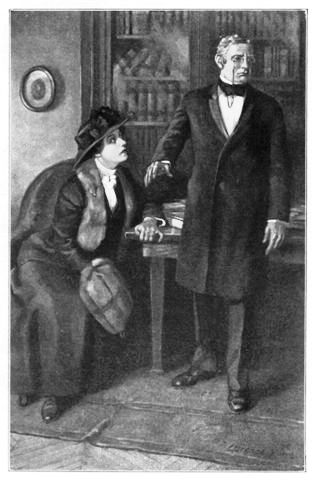
Judge Brewster went quickly forward as she came in and led her to a
chair. Captain Clinton and Mr. Jeffries eyed her in stolid silence.
Looking around in a nervous kind of way, Annie said quietly to the
judge:
"May I speak to you alone, judge?"
"Certainly," replied the lawyer.
He was about to draw her aside when Captain Clinton interfered.
"One moment!" he said gruffly, "if this is all open and above board, as
you say it is, judge—I'd like to ask the young lady a few questions."
"Certainly, by all means," said the judge quickly.
The captain turned and confronted Annie. Addressing her in his customary
aggressive manner, he said:
"You promised Judge Brewster that you'd produce the woman who called at
Underwood's apartment the night of the shooting?" Annie made no reply,
but looked at the lawyer. The captain grinned as he added: "The witness
wants instructions, judge."
"You can be perfectly frank, Mrs. Jeffries," said the lawyer
reassuringly. "We have no desire to conceal anything from Captain
Clinton."
Annie bowed.
"Yes," she said slowly; "I promised Judge Brewster that she would come
here to-night."
"Did she promise you to come?" growled the captain.
"Yes."
"Well, where is she?" he demanded.
"She hasn't come yet," she replied, "but she will, I'm sure—I know she
will."
"How did you come to find her?" demanded the captain suspiciously.
Annie hesitated a moment and glanced at Mr. Jeffries. Then she said
hesitatingly:
"That I—I cannot say—now."
Captain Clinton's massive bulldog jaw closed with an ominous click.
"Decline to answer, eh? What's her name?"
She remained silent.
"What's her name?" he repeated impatiently.
"I cannot tell you," she said firmly.
"Do you know it?" he bellowed.
"Yes," she answered quietly.
"Know it, but can't say, eh? Hum!"
He folded his arms and glared at her. Mr. Jeffries now interfered.
Addressing Annie angrily, he said:
"But you must speak! Do you realize that my son's life is at stake?"
"Yes, I do," she replied quickly. "I'm glad to see that you are
beginning to realize it, too. But I can't tell you yet——"
The judge turned to the police captain.
"I may tell you, captain, that even I myself have not succeeded in
learning the name of this mysterious personage." Addressing Annie, he
said: "I think you had better tell us. I see no advantage in concealing
it any further."
Annie shook her head.
"Not yet," she murmured; "she will tell you herself when she comes."
"Ha! I thought as much!" exclaimed the banker incredulously.
The captain rose and drew himself up to his full height, a favorite
trick of his when about to assert his authority.
"Well, when she does come!" he exclaimed, "I think you may as well
understand she will be taken to headquarters and held as a witness."
"You'll arrest her!" cried the lawyer.
"That's what I said, judge. She a material witness—the most important
one the State has. I don't intend that she shall get away——"
"Arrest her! Oh, judge, don't let him do that!" exclaimed Annie in
dismay.
Judge Brewster grew red in the face. Wrathfully he said:
"She is coming to my house of her own free will. She has trusted to my
honor——"
"Yes—yes!" cried Annie. "She trusts to your honor, judge."
Captain Clinton grinned.
"Honor cuts mighty little ice in this matter. There's no use talking. I
shall place her under arrest."
"I will not permit such a disgraceful proceeding!" cried the lawyer.
"With all due respect, judge," retorted the policeman impudently, "you
won't be consulted. You have declared yourself counsel for the man who
has been indicted for murder—I didn't ask you to take me into your
confidence—you invited me here, treated me to a lecture on psychology,
for which I thank you very much, but I don't feel that I need any
further instruction. If this woman ever does get here, the moment she
leaves the house Maloney has instructions to arrest her, but I guess we
needn't worry. She has probably forgotten her appointment. Some people
are very careless in that respect." Moving toward the door, he added:
"Well, if it's all the same to you, I'll wait downstairs. Good night."
He went out, his hat impudently tilted back on his head, a sneer on his
lips. The banker turned to the judge.
"I told you how it would be," he said scornfully. "A flash in the pan!"
The lawyer looked askance at Annie.
"You are sure she will come?" he asked.
"Yes, I am sure!" With concern she added: "But the disgrace of arrest!
It will kill her! Oh, judge, don't let them arrest her!"
"Tell me who she is!" commanded the lawyer sternly.
It was the first time he had spoken to her harshly and Annie, to her
dismay, thought she detected a note of doubt in his voice. Looking
toward the banker, she replied:
"I can't tell you just now—she'll be here soon——"
"Tell me now—I insist," said the lawyer with growing impatience.
"Please—please don't ask me!" she pleaded.
Mr. Jeffries made an angry gesture.
"As I told you, Brewster, her whole story is a fabrication trumped up
for some purpose—God knows what object she has in deceiving us! I only
know that I warned you what you always may expect from people of her
class."
The judge said nothing for a moment. Then quietly he whispered to the
banker:
"Go into my study for a few moments, will you, Jeffries?"
The banker made a gesture, as if utterly disgusted with the whole
business.
"I am going home," he said testily. "I've had a most painful
evening—most painful. Let me know the result of your investigation as
soon as possible. Good night. Don't disturb me to-night, Brewster.
To-morrow will do."
He left the room in high dudgeon, banging the door behind him. Annie
burst into a laugh.
"Don't disturb him!" she mimicked. "He's going to get all that's coming
to him."
Shocked at her levity, the lawyer turned on her severely.
"Do you want me to lose all faith in you?" he asked sternly.
"No, indeed," she answered contritely.
"Then tell me," he demanded, "why do you conceal this woman's name from
me?"
"Because I don't want to be the one to expose her. She shall tell you
herself."
"That's all very well," he replied, "but meantime you are directing
suspicion against yourself. Your father-in-law believes you are the
woman; so does Captain Clinton."
"The captain suspects everybody," she laughed. "It's his business to
suspect. As long as you don't believe that I visited Underwood that
night——"
The judge shook his head as if puzzled.
"Candidly, I don't know what to think." Seriously, he added: "I want to
think the very best of you, Annie, but you won't let me."
She hesitated a moment and then, quickly, she said:
"I suppose I'd better tell you and have done with it—but I don't like
to——"
At that moment a servant entered and handed the lawyer a card.
"The lady wants to see you at once, sir."
"To see me," asked the lawyer in surprise: "are you sure she hasn't come
for Mr. Jeffries?"
"No, sir; she asked for you."
Annie sprang forward.
"Is it Mrs. Jeffries?" she asked.
"Yes," he replied.
"Let me see her, judge," she exclaimed eagerly; "I'll tell her who it is
and she can tell you—she's a woman—and I'd rather. Let me speak to
her, please!"
Addressing the servant, the lawyer said:
"Ask Mrs. Jeffries to come up." Turning to his client, he went on:
"I see no objection to your speaking to Mrs. Jeffries. After all, she is
your husband's stepmother. But I am free to confess that I don't
understand you. I am more than disappointed in your failure to keep your
word. You promised definitely that you would bring the witness here
to-night. On the strength of that promise I made statements to Captain
Clinton which I have not been able to substantiate. The whole story
looks like an invention on your part."
She held out her hands entreatingly.
"It's not an invention! Really, judge! Just a little while longer!
You've been so kind, so patient!"
There was a trace of anger in the lawyer's voice as he went on:
"I believed you implicitly. You were so positive this woman would come
forward."
"She will—she will. Give me only a few minutes more!" she cried.
The lawyer looked at her as if puzzled.
"A few minutes?" he said. Again he looked at her and then shook his
head resignedly. "Well, it's certainly infectious!" he exclaimed. "I
believe you again."
The door opened and Alicia appeared. The lawyer advanced politely to
greet her.
"Good evening, Mrs. Jeffries."
Alicia shook hands with him, at the same time looking inquiringly at
Annie, who, by a quick gesture, told her that the judge knew nothing of
her secret. The lawyer went on:
"Mrs. Jeffries, Jr., wishes to speak to you. I said I thought there'd be
no objection if you don't mind. May she?"
"Yes," murmured Alicia.
"Your husband was here," said the judge.
"My husband!" she cried, startled. Again she glanced inquiringly at
Annie and tried to force a smile.
"Yes," said the lawyer; "he'll be glad to know you're here. I'll tell
him." Turning to Annie, he said: "When you're ready, please send
and——"
"Very well, judge."
The lawyer went out and Alicia turned round breathlessly.
"My husband was here?" she exclaimed.
"Yes."
"You've told Mr. Brewster nothing?"
Annie shook her head.
"I couldn't!" she said. "I tried to, but I couldn't. It seems so hard,
doesn't it?" Alicia laughed bitterly and Annie went on: "I was afraid
you weren't coming!"
"The train was late!" exclaimed Alicia evasively, "I went up to Stamford
to say good-by to my mother."
"To say good-by?" echoed her companion in surprise.
"Yes," said the other tearfully. "I have said good-by to her—I have
said good-by to everybody—to everything—to myself—I must give them
all up—I must give myself up."
"Oh, it isn't as bad as that, surely?"
Alicia shook her head sadly.
"Yes," she said; "I've reckoned it all up. It's a total loss. Nothing
will be saved—husband, home, position, good name—all will go. You'll
see. I shall be torn into little bits of shreds. They won't leave
anything unsaid. But it's not that I care for so much. It's the
injustice of it all. The injustice of the power of evil. This man
Underwood never did a good action in all his life. And now even after he
is dead he has the power to go on destroying—destroying—destroying!"
"That's true," said Annie; "he was no good."
The banker's wife drew from her bosom the letter Underwood wrote her
before he killed himself.
"When he sent me this letter," she went on, "I tried to think myself
into his condition of mind, so that I could decide whether he intended
to keep his word and kill himself or not. I tried to reason out just how
he felt and how he thought. Now I know. It's hopeless, dull, sodden
desperation. I haven't even the ambition to defend myself from Mr.
Jeffries."
Annie shrugged her shoulders.
"I wouldn't lose any sleep on his account," she said with a laugh. More
seriously she added: "Surely he won't believe——"
"He may not believe anything himself," said Alicia. "It's what other
people are thinking that will make him suffer. If the circumstances were
only a little less disgraceful—a suicide's last letter to the woman he
loved. They'll say I drove him to it. They won't think of his miserable,
dishonest career. They'll only think of my share in his death——"
Annie shook her head sympathetically.
"Yes," she said; "it's tough! The worst of it is they are going to
arrest you."
Alicia turned ashen pale.
"Arrest me!" she cried.
"That's what Captain Clinton says," replied the other gravely. "He was
here—he is here now—with two men, waiting for you." Apologetically she
went on: "It wasn't my fault, Mrs. Jeffries—I didn't mean to. What
could I do? When I told Judge Brewster, he sent for Captain Clinton. The
police are afraid you'll run away or something——"
"And my husband!" gasped Alicia; "he doesn't know, does he?"
"No, I didn't tell them. I said you'd tell them yourself, but they won't
trust you when they know who you are. Let's tell the judge—he may think
of a plan. Suppose you go away until——" Puzzled herself to find a way
out of the dilemma, Annie paced the floor nervously. "Oh, this is
awful!" she exclaimed. "What are we to do??"
She looked toward Alicia, as if expecting some suggestion from her, but
her companion was too much overwhelmed to take any initiative.
"It does stun one, doesn't it?" went on Annie. "You can't think when it
comes all of a sudden like this. It's just the way I felt the morning
they showed me Howard's confession."
"Prison! Prison!" wailed Alicia.
Annie tried to console her.
"Not for long," she said soothingly; "you can get bail. It's only a
matter of favor—Judge Brewster would get you out right away."
"Get me out!" cried Alicia distractedly. "My God! I can't go to prison!
I can't! That's too much. I've done nothing! Look—read this!" Handing
over Underwood's letter, she went on: "You can see for yourself. The
wretch frightened me into such a state of mind that I hardly knew what I
was doing—I went to his rooms to save him. That's the truth, I swear to
God! But do you suppose anybody will believe me on oath?
They'll—they'll——"
Almost hysterical, she no longer knew what she was saying or doing. She
collapsed utterly, and sinking down in a chair, gave way to a
passionate fit of sobbing. Annie tried to quiet her:
"Hush!" she said gently, "don't go on like that. Be brave. Perhaps it
won't be so bad as you think." She unfolded the letter Alicia had given
her and carefully read it through. When she had finished her face lit up
with joy. Enthusiastically she cried:
"This is great for Howard! What a blessing you didn't destroy it! What a
wretch, what a hound to write you like that! Poor soul, of course, you
went and begged him not to do it! I'd have gone myself, but I think I'd
have broken an umbrella over his head or something——Gee! these kind of
fellows breed trouble, don't they? Alive or dead, they breed trouble!
What can we do?"
Alicia rose. Her tears had disappeared. There was a look of fixed
resolve in her eyes.
"Howard must be cleared," she said, "and I must face it—alone!"
"You'll be alone all right," said Annie thoughtfully. "Mr. Jeffries will
do as much for you as he did for his son."
Noticing that her companion seemed hurt by her frankness, she changed
the topic.
"Honest to God!" she exclaimed, good-naturedly, "I'm
broken-hearted—I'll do anything to save you from this—this public
disgrace. I know what it means—I've had my dose of it. But this thing
has got to come out, hasn't it?"
The banker's wife wearily nodded assent.
"Yes, I realize that," she said, "but the disgrace of arrest—I can't
stand it, Annie! I can't go to prison even if it's only for a minute."
Holding out a trembling hand, she went on: "Give me back the letter.
I'll leave New York to-night—I'll go to Europe—I'll send it to Judge
Brewster from Paris." Looking anxiously into her companion's face, she
pleaded: "You'll trust me to do that, won't you? Give it to me,
please—you can trust me."
Her hand was still extended, but Annie ignored it.
"No—no," she said, shaking her head, "I can't give it to you—how can
I? Don't you understand what the letter means to me?"
"Have pity!" cried the banker's wife, almost beside herself. "You can
tell them when I'm out of the country. Don't ask me to make this
sacrifice now—don't ask me—don't!"
Annie was beginning to lose patience. The woman's selfishness angered
her. With irritation, she said:
"You've lost your nerve, and you don't know what you're saying. Howard's
life comes before you—me—or anybody. You know that!"
"Yes—yes," cried Alicia desperately, "I know that. I'm only asking you
to wait. I—I ought to have left this morning—that's what I should have
done—gone at once. Now it's too late, unless you help me——"
"I'll help you all I can," replied the other doggedly, "but I've
promised Judge Brewster to clear up this matter to-night."
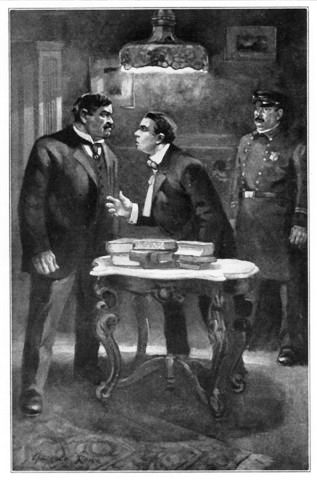
Suddenly there was a commotion at the door. Captain Clinton entered,
followed by Detective Sergeant Maloney. Alicia shrank back in alarm.
"I thought Judge Brewster was here," said the captain, glancing
suspiciously round the room.
"I'll send for him," said Annie, touching a bell.
"Well, where's your mysterious witness?" demanded the captain
sarcastically.
He looked curiously at Alicia.
"This is Mrs. Howard Jeffries, Senior," said Annie, "my husband's
stepmother."
The captain made a deferential salute. Bully as he was, he knew how to
be courteous when it suited his purpose. He had heard enough of the
wealthy banker's aristocratic wife to treat her with respect.
"Beg pardon, m'm; I wanted to tell the judge I was going."
The servant entered.
"Tell Judge Brewster that Captain Clinton is going," said Annie.
Alicia, meantime, was once more on the verge of collapse. The long
threatened exposé was now at hand. In another moment the judge and
perhaps her husband would come in, and Annie would hand them the letter
which exculpated her husband. There was a moment of terrible suspense.
Annie stood aloof, her eyes fixed on the floor. Suddenly, without
uttering a word, she drew Underwood's letter from her bosom, and quickly
approaching Alicia, placed it unnoticed in her hand. The banker's wife
flushed and then turned pale. She understood. Annie would spare her. Her
lips parted to protest. Even she was taken back by such an exhibition of
unselfishness as this. She began to stammer thanks.
"No, no," whispered Annie quickly, "don't thank me; keep it."
Captain Clinton turned round with a jeer. Insolently, he said to Annie:
"You might as well own up—you've played a trick on us all."
"No, Captain Clinton," she replied with quiet dignity; "I told you the
simple truth. Naturally you don't believe it."
"The simple truth may do for Judge Brewster," grinned the policeman,
"but it won't do for me. I never expected this mysterious witness, who
was going to prove that Underwood committed suicide, to make an
appearance, did I, Maloney. Why not? Because, begging your pardon for
doubting your word, there's no such person."
"Begging your pardon for disputing your word, captain," she retorted,
mimicking him, "there is such a person."
"Then where is she?" he demanded angrily. Annie made no answer, but
looked for advice to Judge Brewster, who at that instant entered the
room. The captain glared at her viciously, and unable to longer contain
his wrath, he bellowed:
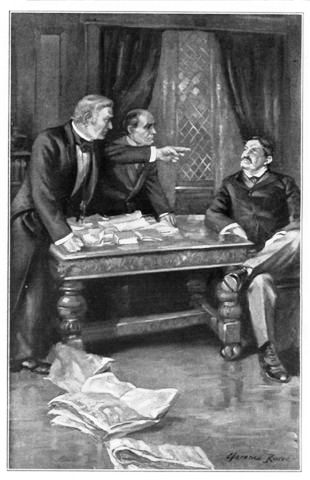
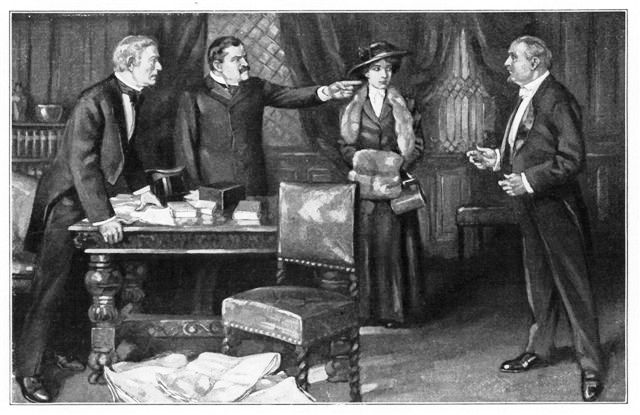
"I'll tell you where she is! She's right here in this room!" Pointing
his finger at Annie in theatrical fashion, he went on furiously: "Annie
Jeffries, you're the woman who visited Underwood the night of his death!
I don't hesitate to say so. I've said so all along, haven't I, Maloney?"
"Yes, you told the newspapers so," retorted Annie dryly.
Taking no notice of her remark, the captain blustered:
"I've got your record, young woman! I know all about you and your folks.
You knew the two men when they were at college. You knew Underwood
before you made the acquaintance of young Jeffries. It was Underwood who
introduced you to your husband. It was Underwood who aroused your
husband's jealousy. You went to his rooms that night. Your husband
followed you there, and the shooting took place!" Turning to Judge
Brewster, he added, with a sarcastic grin: "False confession, eh?
Hypnotism, eh? I guess it's international and constitutional law for
yours after this."
"You don't say so?" exclaimed Annie, irritated at the man's intolerable
insolence.
Judge Brewster held up a restraining hand.
"Please say nothing," he said with dignity.
"No, I guess I'll let him talk. Go on, captain," she said with a smile,
as if thoroughly enjoying the situation.
Alicia came forward, her face pale, but on it a look of determination,
as if she had quite made up her mind as to what course to pursue. In her
hand was Underwood's letter. Addressing Annie, she said with emotion:
"The truth must come out sooner or later."
Seeing what she was about to do, Annie quickly put out her hand to stop
her. She expected the banker's wife to do her duty, she had insisted
that she must, but now she was ready to do it, she realized what it was
costing her. Her position, her future happiness were at stake. It was
too great a sacrifice. Perhaps there was some other way.
"No, no, not yet," she whispered.
But Alicia brushed her aside and, thrusting the letter into the hand of
the astonished police captain, she said:
"Yes, now! Read that, captain!"
Captain Clinton slowly unfolded the letter. Alicia collapsed in a chair.
Annie stood by helpless, but trying to collect her wits. The judge
watched the scene with amazement, not understanding. The captain read
from the letter:
"'Dear Mrs. Jeffries" He stopped, and glancing at the signature,
exclaimed, "Robert Underwood!" Looking significantly at Annie, he
exclaimed: "'Dear Mrs. Jeffries!' Is that conclusive enough? What did I
tell you?" Continuing to peruse the letter, he read on: "'Shall be found
dead to-morrow—suicide——'" He stopped short and frowned. "What's
this? Why, this is a barefaced forgery!"
Judge Brewster quickly snatched the letter from his hand and, glancing
over it quickly, said:
"Permit me. This belongs to my client."
Captain Clinton's prognathous jaw snapped to with a click, and he
squared his massive shoulders, as he usually did when preparing for
hostilities:
"Now, Mrs. Jeffries," he said sharply, "I'll trouble you to go with me
to headquarters."
Annie and Alicia both stood up. Judge Brewster quickly objected.
"Mrs. Jeffries will not go with you," he said quietly. "She has made no
attempt to leave the State."
"She's wanted at police headquarters," said the captain doggedly.
"She'll be there to-morrow morning."
"She'll be there to-night."
He looked steadily at the judge, and the latter calmly returned his
stare. There followed an awkward pause, and then the captain turned on
his heel to depart.
"The moment she attempts to leave the house," he growled, "I shall
arrest her. Good night, judge."
"Good night, captain!" cried Annie mockingly.
"I'll see you later," he muttered. "Come on, Maloney."
The door banged to. They were alone.
"What a sweet disposition!" laughed Annie.
Judge Brewster looked sternly at her. Holding up the letter, he said:
"What is the meaning of this? You are not the woman to whom this letter
is addressed?"
"No," stammered Annie, "that is——"
The judge interrupted her. Sternly he asked:
"Is it your intention to go on the witness stand and commit perjury?"
"I don't know. I never thought of that," she faltered.
The judge turned to Alicia.
"Are you going to allow her to do so, Mrs. Jeffries?"
"No, no," cried Alicia quickly, "I never thought of such a thing."
"Then I repeat—is it your intention to perjure yourself?" Annie was
silent, and he went on: "I assume it is, but let me ask you: Do you
expect me, as your counsel, to become participes criminis to this
tissue of lies? Am I expected to build up a false structure for you to
swear to? Am I?"
"I don't know; I haven't thought of it," replied Annie. "If it can be
done, why not? I'm glad you suggested it."
"I suggest it?" exclaimed the lawyer, scandalized.
"Yes," cried Annie with growing exaltation; "it never occurred to me
till you spoke. Everybody says I'm the woman who called on Robert
Underwood that night. Well, that's all right. Let them continue to think
so. What difference does it make so long as Howard is set free?" Going
toward the door, she said: "Good night, Mrs. Jeffries!"
The judge tried to bar her way.
"Don't go," he said; "Captain Clinton's men are waiting outside."
"That doesn't matter!" she cried.
"But you must not go!" exclaimed the lawyer in a tone of command. "I
won't allow it. They'll arrest you! Mrs. Jeffries, you'll please remain
here."
But Annie was already at the door.
"I wouldn't keep Captain Clinton waiting for the world," she cried.
"Good night, Judge Brewster, and God bless you!"
The door slammed, and she was gone.