“Do you see that boy sitting on the
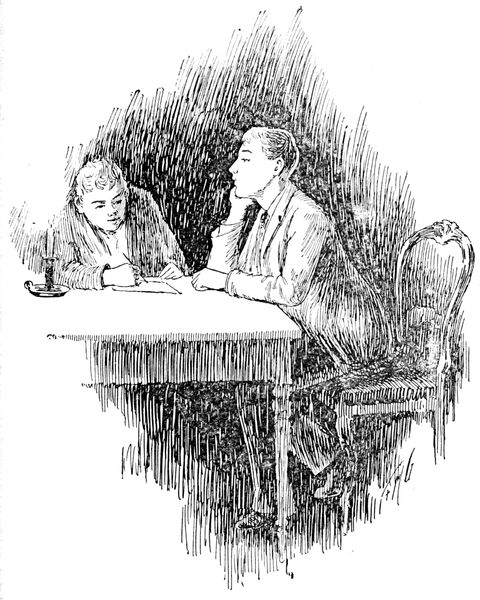
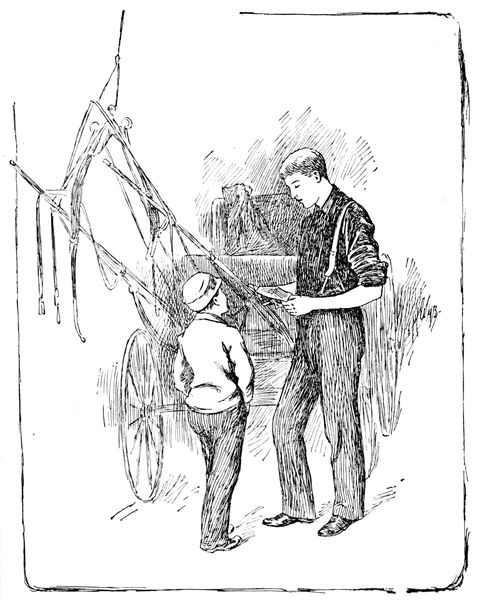
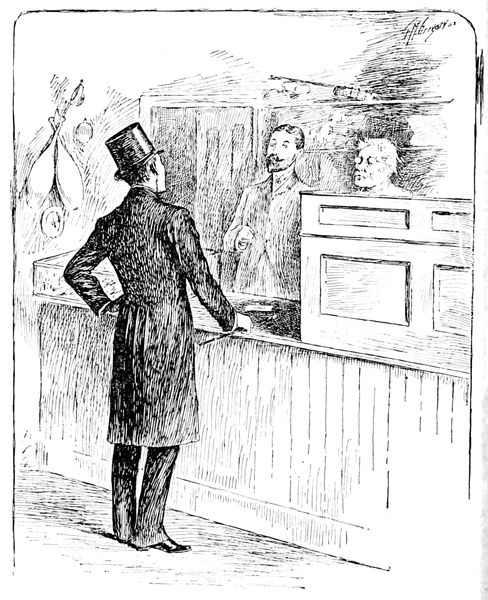
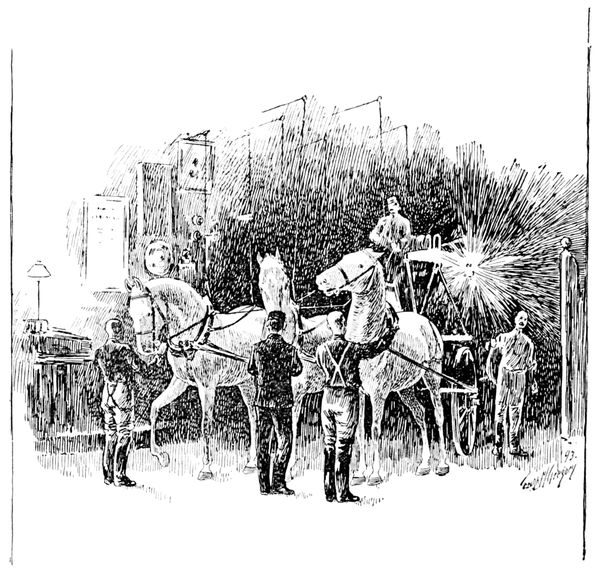
curbstone over the way? Well, he’s
been there for the last half hour, and I’d just
like to know what he’s up to. Run over,
Charley, and ask him what he wants.”
It was John Trask, a chief of battalion in the
New York Fire Department who addressed
these words to his subordinate, Charley Weyman,
one pleasant afternoon in early spring, and
the boy to whom he referred had been sitting
for some time on the curbstone across the
street from the hook and ladder company’s
quarters, peering anxiously through the open
door which afforded him a view of the hook
and ladder truck, the horses quietly munching
their hay, and, in the rear room, half a dozen
firemen seated about a table talking, reading
or playing checkers.
The boy, who seemed to be about fifteen
years of age, looked as if he had just reached
town after a long and weary walk. His clothes
were torn and travel-stained, and there was a
2gaunt, hungry look in his face that spoke
unmistakably of want and privation. It was
this look and the boy’s dejected attitude which
had first attracted the chief’s attention for he
feared that he might be waiting for a chance to
get into the building, and steal what he could
lay his hands on.
“There’s something queer about that kid,”
he continued, half to himself, as he watched
Weyman cross the street and enter into conversation
with him. “Hulloa! he’s bringing
him over here; he must want to see somebody,”
and just then the fireman entered leading the
boy with him.
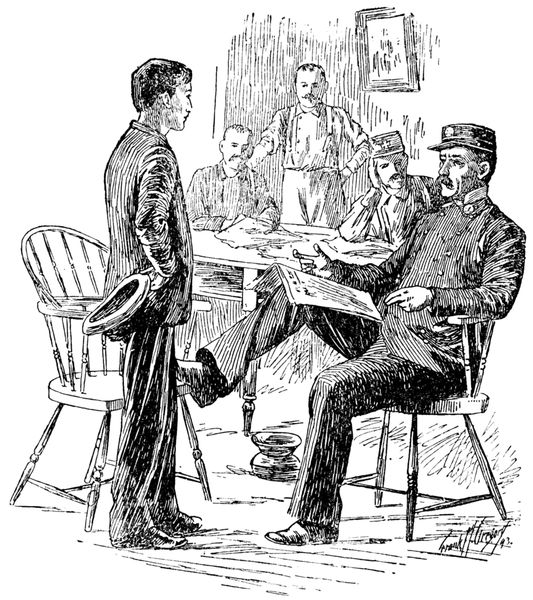
“He says he wants to see you, chief,” said
Weyman, seating himself in an arm-chair while
the boy stood with his hat in his hand waiting
respectfully for the other to address him.
“Well, my boy,” said the chief of battalion in
a kindly voice, “what can I do for you?”
“Are you Mr. John Trask, chief of the battalion?”
inquired the boy.
“I am” was the reply.
“Well, did you ever have a man here in the
company named Frank Decker?”
At the mention of this name a sudden silence
fell upon the little group of men who were
gathered about the table, newspapers were
3laid aside, the talking ceased, and every eye
was turned on the hungry looking, travel-stained
boy who stood with his hat in his hand, looking
the chief squarely in the face while he put the
question.
The chief paused a moment as he adjusted a
pair of eye-glasses on his nose, and then
answered in a voice that had something of a
stern soldierly ring in it: “I knew Frank Decker
well, and I wish there were more men on the
earth like him. But what have you to do with
Frank Decker?”
“My name is Bruce Decker and Frank
Decker was my father” replied the boy, still
looking the chief squarely in the eye and trying
to speak steadily, but there was a little break in
his voice as he mentioned his father’s name and
a faint quiver in his lower lip as he finished.
“Frank Decker’s boy!” exclaimed Weyman
springing to his feet, “Why I never knew he
had a boy!”
“Where do you come from, young man?”
inquired Chief Trask, regarding him now with
a new interest and shifting his position so as to
get a clear view of the young lad’s face.
“I come from Oswego County way back in
the state, where I’ve lived all my life. I got
here early this morning and came here because
4I had no other place to go to. I’ve never been
in New York before, but father used to tell me
about you and a friend of his named Mr. Weyman
and so I thought maybe you’d be willing
to give me a lift, if only on his account.”
“Upon my word I believe the boy is speaking
the truth,” said Chief Trask; “he’s got
Frank’s nose and eyes and his straight way of
looking at you and—here just turn around a
moment, my boy—yes, there it is, that little
patch of gray on the back of his head that
Frank used to tell us was the birth mark of
every Decker that ever was born. Well young
man—Bruce you say your name is? I’m glad
to see you, and what’s more I’ll be glad to help
you, if you need help. Here, give me your
hand and sit down beside me.”
Bruce seated himself beside his new friend
and then Weyman stepped over and whispered
something in the chief’s ear.
“Certainly!” exclaimed that official hastily,
“come along with me, boy, and have something
to eat; it’s just about dinner time.”
As the two left the truck house the others
laid aside their newspapers and games and began
an eager discussion of the new arrival,
whose father had been, until his death three
months before, a member of the company.
5“I heard once that he had a boy somewhere
up the country,” said Tom Brophy, “and I’ve no
doubt this lad is just what he claims to be, the
son of Frank Decker, because he resembles
him in every particular. And if he is Frank’s
son why we ought to see to it that he has a
fair chance to get along here, and not turn him
adrift—to make out as best he can. We’re not
one of us rich, but we’re not so poor that we
can’t spare a dollar now and then for a son of
one of the squarest and best men that the department
ever had.”
Brophy’s words were received with a degree
of enthusiasm and approval that showed plainly
that he and his comrades were of one mind as
to the course they should pursue in welcoming
and looking after the son of their old friend,
and until the return of the boy and Chief Trask,
they sat talking over the days when Frank
Decker was one of the quickest, bravest and
most popular men in all the department.
But before proceeding any further with our
story, it will be necessary to turn back to the
time about twelve years before the appearance
of Bruce Decker at the door of the New York
truck house, when Frank Decker, a strong,
hearty, active man of twenty-five, turned his
back on the little village near Lake Ontario,
6where he had just buried his young wife, and,
having placed his little boy in the care of some
distant relatives, set out for the city in the hope
of beginning anew a career which had been
broken by financial misfortune and the loss of
his wife. Through the influence of an old
friend he had obtained an appointment in the
fire department, in which service he had distinguished
himself by his bravery, coolness and
zeal, qualities which served to commend him to
the notice of the chief officers of the department,
and which would probably have won for him a
place at the head of a battalion, had it not been
for the awful catastrophe at the burning of the
Gothic Hotel on Broadway.
On this occasion Decker arrived, entered the
hotel at the command of his chief, and ascended
the staircase, in order to save some women who
were supposed to be in one of the upper floors.
That was the last seen of him, and late that
night when the rest of his company had been
relieved and were slowly making their way
home, they spoke little of anything or anybody,
save Frank Decker, who was among the missing
and who had gone down before that awful
sheet of flame that broke out and swept through
the hotel about five minutes after he was seen
to enter the building.
7Half a dozen charred bodies were taken from
the ruins the next day, but which one of them
had once been Frank Decker no one could tell.
And while the father had been at work in the
fire department, the child whom he had left in
the little village in the northern part of the
State, had grown in health, strength and mind,
and was now in his sixteenth year, an active,
vigorous, straightforward youth, who inherited
all his father’s daring and quickness, together
with a willingness to learn and a decided taste
for books, which had come to him direct from
his mother.
During his short life he had cherished but
one ambition, which was to become a fireman,
and most of the correspondence which he
always maintained with his father, had been in
regard to the workings of the New York department,
and particularly the battalion to
which the elder belonged. Once a year the
father had returned to his old home on the
shore of the great fresh water lake to spend his
short vacation with his boy, and during these
visits it had been the habit of the two to take
long walks and sails together, enjoying themselves
after their own fashion, the boy listening
with flushed cheeks and bated breath, while his
father described to him the life of excitement
8and danger which he led as a member of what
he always called, “the greatest fire department
in the world.”
From his father’s lips the boy had heard
stories of the swift runs to fires, of thrilling midnight
rescues, of brave firemen plunging into
solid sheets of smoke and flame, and so strong
a hold had these stories taken on his mind that
his desire to become a fireman himself had
slowly grown within him, until it became the
one fixed and cherished ambition of his life.
So it happened, naturally enough, that at his
father’s death he resolved to make his way to
New York and ask John Trask, the chief of his
father’s old battalion, to appoint him to a place
in the Department.
We have described in an earlier part of this
chapter the arrival of Bruce Decker, footsore
and travel-stained at the truck house, and his
reception at the hands of the chief and his subordinates,
and we left him going out for dinner
under the guidance of his newly-made friend.
When he returned from the restaurant where
he had enjoyed a hearty meal and a long, confidential
talk with the chief, he stopped by the
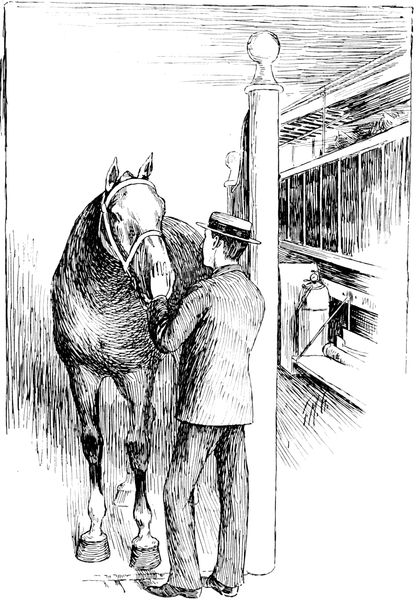
stalls in which the horses were standing, stroked
the nose of the big gray, and said, without an
instant’s hesitation: “Well, Pete, old fellow,
I’ve heard of you many a time,” and the horse
laid his muzzle on the boy’s shoulder and
whinnied softly, as if he were returning the
friendly greeting. The men noticed this and
exchanged significant glances.
“Well, Pete, old fellow, I’ve heard of you many a time.”—Page 8.
9“Just like his father,” said Weyman, in a low
voice, “do you remember how fond Frank used
to be of those horses? Why, he never came
into the house without stopping to pet them.”
“Well, my little man, how would you like to
become a fireman?” enquired Chief Trask, pleasantly,
as he seated himself in his arm-chair and
prepared to light his pipe. But before Bruce
could answer, the sharp ring of the alarm bell
echoed through the building and startled everyone
into sudden activity.
Chapter II.
10
Many a time had Frank Decker described,
for the benefit of his boy, the rapidity
with which his truck company would start for
a fire at the stroke of the gong, but never had
Bruce’s imagination conceived of anything like
that which took place now before his astonished
eyes.
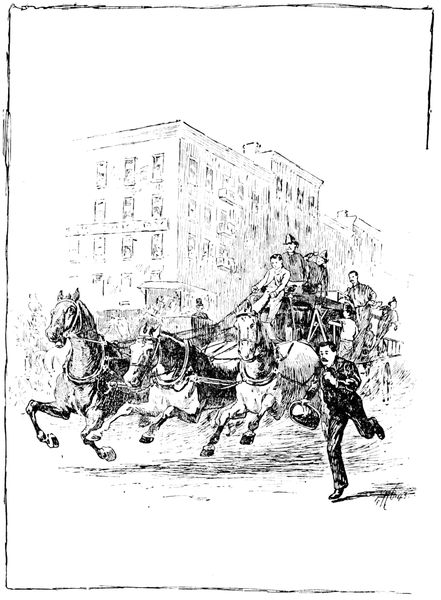
The electric current which sounded the alarm
released the horses and the intelligent creatures
sprang at once to their places beneath the harness
that was suspended in mid-air from the
ceiling of the room. Five of the men were at
their heads at the same instant, while Weyman
climbed into the driver’s seat and took the
reins in his hand and Brophy mounted behind
and took his place at the steering apparatus.
Two or three sharp clicks and the harness was
adjusted, and then, while the rest of the company
climbed recklessly over the wheels to their
places on the truck, the horses bounded into
the street, turned sharply to the left and dashed
away in full gallop. Bruce rushed to the door
and looked after the flying truck. Fully two
11blocks away he saw a man in fireman’s uniform
driving a galloping horse attached to a single
seated wagon in which was a brass gong which
he rang vigorously. It was Chief Trask leading
the way to the fire.
Bruce went back to the room at the rear of
the now deserted building and seated himself
in one of the arm-chairs. His face was flushed,
and he was trembling with excitement. If he
had ever longed for a fireman’s uniform he
longed for it now, with an intensity such as
he had never felt before, and he determined
that no power on earth should prevent him
entering the service and sustaining the reputation
for courage and fidelity which his father
had enjoyed for so many years.
That night Bruce Decker slept at the home
of John Trask, and, while he was dreaming of
fires and fire brigades and swift-moving horses,
the chief and two or three of his men were
gathered about a little round table at the rear
of the truck house, discussing various schemes
for giving the lad a start in the city.
“I don’t know,” said Charles Weyman, “but
what the best thing we can do for the lad is to
get him a job in some big store or place of
business where he can begin at the beginning
and work his way up. There’s nothing like
12business nowadays. Those big merchants
make more money than any of the professional
men do, when once they get a few thousand
ahead, and anyway it’s a great deal better than
this fire department business, which is all
risk and danger and excitement, with very little
money to compensate for it. You know that
he is entitled to a pension of $300 a year from
the department, and that amount, together with
what he could make as an office boy or young
clerk, ought to keep him going. I know if I’d
gone into business when I was his age I would
have made a good deal more money than I
have by running to fires.”
“And yet you wouldn’t change now if you
had the chance would you?” said one of the
men carelessly.
“No, I don’t think I would—” began Weyman
slowly, but Tom Brophy interrupted him
with:
“What you say is all perfectly true, Charley,
but you must remember one thing, and that is,
that this lad is crazy over the Fire Department
and anxious to get into it because his father
was in it. Can’t you see how much he’s been
thinking about it all his life? Did you notice
how he recognized those horses and called them
by name, just because his father had told him
13about them? Its very plain to me that all he’s
heard about the New York Fire Department
has made a deep impression on him, and when
a boy’s got his head set on any particular line
of business, it’s very foolish to try and force
him in any other direction. Let him have a try
first at what inclination leads him to, and then if
he finds out that it’s not all a path of roses, it
will be time enough for him to make a change
and get into something else.”
“But how are we going to get him started in
the department yet awhile?” demanded Weyman.
“You know the rules are, that no one
under twenty-one years of age can be taken
into the service, and this boy don’t look to me
to be more than fifteen. Get him into some
good office now, and the chances are that by
the time he’s twenty-one he won’t want to go
to fires on a truck.”
Then Chief Trask, who had been silent for
some time, removed his pipe from his lips and
said, in the authoritative way which was habitual
with him: “If the boy wants to be a fireman
I believe in giving him a chance. This pension
of $300 a year ought to pay for his board and
clothes and there are plenty of odd jobs he can
do about the quarters while he’s learning the
business. He can make himself very useful to
14us here if he takes hold of the work in the
right spirit, and if he gets sick of it within a
year he won’t be any the worse for his training.”
That ended the discussion and very soon
afterward the men went up stairs and turned in
for the night.
The next morning the chief told Bruce that
he had decided to give him employment for a
few months in order that he might familiarize
himself with the duties of a fireman. He could
board at his (the chief’s) home, and make himself
generally useful at the quarters. “Do
you know anything about taking care of
horses?” he required.
“Yes,” replied Bruce eagerly, “I’ve looked
after horses all my life and I’d like nothing better
than to take care of that big grey Pete that
I’ve heard my father speak about so often. I
am very handy with horses, and I can do anything
with them. Then I’ll run errands and do
anything you want me to. I’d rather be a fireman
than President of the United States.”
Mr. Trask could not help smiling at the boy’s
earnestness, but it pleased him, nevertheless,
to see that he was bent upon entering the service
and did not intend to let a little hard work
stand in the way of getting there. That very
15afternoon found Bruce with his coat off whistling
merrily as he rubbed down the horses,
Pete, Jack and Joe, and gave them their hay and
oats. Charley Weyman watched him from his
seat in the rear room, and remarked to Brophy:
“That lad takes hold of his work as if he liked
it.”
Chapter III.
16
“Hitch up my wagon for me, Bruce,”
said the chief one morning a few days
after the young boy had been installed at the
quarters, and accordingly he harnessed one of
the horses to the wagon which the chief kept
for his own use.
“Now jump in beside me,” he continued, and
a few minutes later they were driving slowly up
the broad avenue, while the chief gave his
young protege some information regarding the
department.
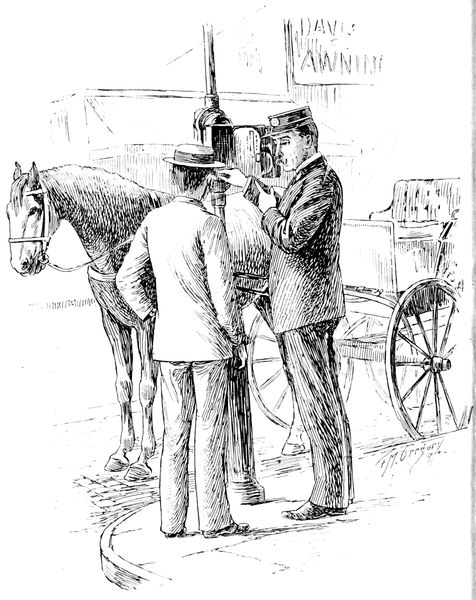
Chief Trask explains the fire box to Bruce.—Page 17.
17“Remember this, my boy,” he said earnestly,
“that promptness and readiness are the watchwords
of the service. Every second of time is
of importance, and you should never let another
man get ahead of you when you are getting
ready to go to a fire, nor allow another company
to get a stream on the fire first, if you can possibly
prevent it. The paid department was established
in 1865. I don’t know how long it
took an engine or truck to get out into the
street then, but I do know that we have been
lowering the record ever since, so that now the
average time from the first stroke of the alarm
until the engine, manned and ready for action,
passes over the threshold is not more than ten
seconds, and it has been done, of course only
for exhibition purposes, in two seconds. Not a
year goes by but sees some new invention or
improvement to facilitate the work of the department,
and my own opinion is that the rivalry
between the different companies is the strongest
incentive to efficient work there is. Now
I’ll stop here and explain this fire box to you, so
that you will be able to understand how these
alarms come in.” With these words, the chief
drew up in front of a lamp-post which was
painted a bright red and had red glass in its
lamp. To this was attached the fire box from
which any citizen could send an alarm of fire.
“Now,” said the chief as he opened the box,
“when a fire breaks out, anyone who discovers
it runs to this box, or rather to the one nearest
the scene of the conflagration, for you know
these boxes are scattered all over the city, and
turns this handle according to the printed directions.
By pulling the hook down inside, the
number of the box is telegraphed to the headquarters
of the fire department, and the operator
there sends another dispatch notifying the
different engine houses in the immediate vicinity
18of the fire. This alarm comes in to us in the
shape of sharp strokes, indicating the number
of the alarm box. This is what we call a first
alarm, and you will notice that there is a gong
here in the box which rings when the handle is
turned. That gong attracts the attention of the
policeman on duty nearby, and he comes running
up to find out where the fire is, or to
arrest any person who may be ringing it
maliciously.
“Once in a while the alarm is rung by some
Irish servant girl who wants to send a letter
back to the old country and mistakes this for a
mail box. And once in a while it is rung by
somebody who is deceived by a smoky chimney
or a bonfire in a vacant lot. The other alarms
intended to call out a greater force, can only be
sent by an official, who has a key to the inside
box. For example, suppose our company were
to be called out to-night to a fire, and I were to
find on arrival that it was in my own district, I
would take command, even if another battalion
chief were to be present also. In the same way
he would take command, if the fire were in his
district. But, suppose I find that the fire is a
big one and in danger of spreading. I go to
the box and sound the second alarm, which
brings up an additional force. Then, suppose
19that I find the fire making such headway that
we are unable to control it. Then I go to the
box again and sound the third alarm, and that
brings up every available engine and hook and
ladder company within a reasonable distance.
When that third alarm sounds in an engine
house, every fireman knows that there’s a big
and dangerous fire to be fought, and every man
goes out with a keener sense of his own responsibility
than he would on an ordinary call.”
“How often does the third alarm sound?”
asked Bruce, who had been listening with intense
interest to the chief’s words.
“It’s not very often that we have a fire big
enough to warrant it,” replied the official.
“The last one we had was at an apartment
house up town, about four months ago—”
He paused abruptly, remembering that it
was at this fire that Frank Decker, the boy’s
father, had perished. And although Bruce said
nothing, he knew what he meant.
Entering the wagon again, they drove a few
blocks further and stopped in front of an engine
house situated on a side street. A fireman,
standing on the pavement in front of the door,
saluted as the chief entered.
“Is Captain Murphy about?” asked the
chief.
20“Yes,” replied the other, and then a tall,
stoutly built man, with a military look and
manner that corresponded well with his uniform,
made his appearance from the rear room and
bade his visitors welcome.
“This is Frank Decker’s boy,” said the chief,
as he presented Bruce to the officer, “and
we’re going to try and make a fireman of him.
I’ve brought him around here to show him what
a fire engine is like.”
“Frank Decker’s boy!” exclaimed the captain,
as he shook Bruce cordially by the hand.
“Well, all I can say is, you’ve got good
material to work with. I knew Frank this
twelve years or more, and a better fireman
never rode on a tender.”
“You see,” said the chief, as he led the boy
through the engine house, “this is a double
company. That is to say, there’s an engine
and tender here to go out at the first alarm, and
another to move up and take their places, so as
to be ready in case an alarm comes in while
the first company is off at the fire. Of course
this engine that stands right here in front by
the door is the one to go first, and its tender,
or hose wagon as it used to be called in old
times, goes with it. Then they move the
second engine and tender right up to the front;
21the second relay of horses drop down and take
their places in the other stalls, and within two
minutes after the alarm was first sounded, there
is a complete equipment ready to go out to any
other fires that may occur in the vicinity.
“Now I want you to notice the way this
engine is kept ready for action at a second’s
notice. You see from the gauge that there is
twenty pounds pressure of steam in her boiler
now, although there is no fire lit, and she has
been standing here all day. That is because
the steam is kept up from a fire in the basement,
and the connection is made by these
pipes that come up through the floor. The
minute the engine starts, the connection with
the pipes underneath is shut off automatically,
and then as soon as the wheels cross the threshold
of the building, the fire is lit, and as the
swift motion of the street acts as a sort of
draught, there is a big blaze going in less than
two minutes. There’s a little contrivance I
want you to see, and although it may seem like
a trivial one to you, it is really a very useful
time-saving device.”
As he said this, he took from a rack above
the ash-pan a pine stick about six inches long,
around one end of which was wrapped a quantity
of rags soaked in kerosene, from the midst
22of which protruded the heads of half a dozen
matches.
“Now I’ll explain to you,” continued Chief
Trask, “the value of this little torch. If we
depended on matches, or took our chances of
running to get a light from the gas-jet or anything
like that, we would certainly lose time, and
might have to stop on the way to the fire and
beg a light. We can’t afford to take any such
chances as that. The engineer just grabs this
torch and scratches it. The first bit of flame
lights up the oil-soaked rags, and then he throws
the whole thing into the fire box which is filled
with pine shavings also soaked in oil, and there’s
the fire started. Then while he’s traveling
through the streets, he throws in whatever
wood and coal are necessary and so he gets all
the blaze that’s needed before he has gone half
a dozen blocks. Then you see that wrench
hanging there beside the torch. Just before
the engine gets to the hydrant they want to
stop at, the engineer grabs that wrench, jumps
off and runs ahead so as to have the hydrant
open by the time the engine comes along.
They attach the hydrant connection and then
the tender comes up and passes them, leaving
one end of the hose, and drives on until they
have let out as many lengths as they want to use.”
23All this is done without any waste of time, for
as I said to you before, there are no spare seconds
in the New York fire service. Now come
up stairs with me and I’ll show you the sleeping
quarters, which are somewhat similar to those
around at our own place, except that they have
three brass sliding poles instead of one, as we
have. When the men are in bed, they have
what they call a turnout on the floor beside
them. “Here is the turnout.” He pointed, as
he spoke, to a pair of trousers attached to a
pair of rubber boots and so placed that they
could be drawn on instantly.
“There’s a gong here, too, you see, as well as
down stairs, and when the alarm rings, the fireman
jumps out of bed and, you might say, right
into his turnout, pulls the trousers up and runs
for the sliding pole, and there’s a race every
time to see who will get down first. The driver
and engineer always sleep next to the poles so
that they can get down ahead of the others.
Down stairs there are two men on duty all the
time at night. When the alarm sounds and the
horses run to their places, these men must be
at their heads to snap their collars and hitch the
reins to their bits. The driver jumps into his
seat, and the instant he sees that the harness
is on all right, and that he has the number of
24the box from which the alarm has come, he
starts away as fast as he can go. He doesn’t
wait to find out whether the engineer is there,
or whether the other men have slid down the
pole and are in their places—that’s their business,
not his. He has just one idea, and that
is to get out into the street as soon as he can,
and get to the fire before any other engine.
The captain of the company rides on the ash-pan
behind the engineer. His lieutenant rides
with the driver of the tender, and the other
men ride on the tender.”
Just at this moment the gong rang sharply,
and the horses, released from their stalls by the
same electric current, sprang to their places in
front of engine and hose carriage, and then a
moment later trotted quietly back again.
“That’s twelve o’clock that’s just sounded,”
exclaimed Chief Trask, “and the horses always
jump into their places every time the gong
sounds. It wouldn’t do to leave it to their
judgment whether they should turn out or not,
and besides, frequent alarms keep them from
getting rusty. If they only turned out when
there was a regular alarm, they would stay here
sometimes two to three days at a time and that
wouldn’t be good for men or horses either.
It’s only by constant practice that we can be
25kept always on the alert. You know that at
sea they often ring a false fire alarm, just for
the sake of keeping the ship’s fire brigade in
practice. Now Captain Murphy will show you
the tender, or hose wagon as they used to call it.”
Accordingly the captain showed Bruce the
two great coils of hose, and the different nozzles
fitted for different emergencies, and he told him
how the hook and ladder truck served at a fire
very much in the same capacity as the sapper
and miner corps in the army.
“The hook and ladder company carries the
picks and axes, scaling ladders, net and all that
sort of thing, while all we do is to turn a stream
of water on and put the fire out. There’s a
good deal of competition between the different
companies and there’s nothing we hate more
than to get to a fire and find that another company
has got its stream on first. A few years
ago, when the Duke of Sutherland was here,
the fire commissioners determined to show him
what the New York department could do in
the way of getting to a fire in quick time. You
see, the Duke used to belong to the London
brigade, and has been what we call a ‘fire crank’
all his life. They came down to this engine
house one night, and when they went away we
knew that the chances were that we’d be called
26out before long. As they went up the street
I heard the commissioner say to the Duke
‘We’ll go over to Twelfth street and Fifth avenue
and ring the alarm there.’ So I determined
to have my men all ready so that at the very first
stroke of the gong we could get out without
waiting to get the number of the station. I
made up my mind that I wasn’t going to be
beaten by any other company that night, so I
had everything ready with the driver in his seat,
and before the gong had struck twice, we were
off. And we made such time getting over
there, that we came up to where the party
was standing and found the Duke with his
hands still on the alarm box. You never saw
a man more astonished in your life than he
was.”
On their way back the chief again impressed
upon the boy’s mind the enormous value of
time. “It is necessary,” he said, “first of all,
to have everything in apple-pie order and
ready to start at a moment’s notice. Then
when the alarm comes we must be ready and
able to go without a second’s delay. Each man
has his own place to fill and if a man neglects
to snap a horse’s collar or the engineer fails to
get to his place on the ash-pan in time, the chief
of the battalion knows whom to blame.”
Chapter IV.
27
One bright afternoon in May, Bruce found
himself riding beside the chief up Fifth
avenue, and as they rode the elder pointed
out to him the principal public buildings, gave
brief histories of some of the well-known landmarks
and explained how the great fortunes
had been rolled up which enabled some men to
live in Fifth avenue palaces with practically
unlimited incomes.
Bruce wondered how it was that his guide
should happen to know so much about the
fashionable part of the city, even more in fact
than he seemed to know about the poorer
quarters. It may have been that Chief Trask
saw what was uppermost in the boy’s mind, for
he said, as if in answer to a question, “I have
to know about every part of the city, and it is
particularly valuable for me to keep the run of
what we call the brown stone district. The
men who live here own property all over the
city—factories, apartment houses, tenement
houses and private dwellings—besides what
they live in themselves. If there is ever a riot
28in the city, and I hope there will never be
another one, the mob will make a rush for
Fifth avenue. There are the Vanderbilt
houses, those big brown buildings opposite the
Cathedral. If fire were to consume them it
would be a loss to the whole city, because
they’ve got pictures and statues and books in
them that could never be replaced. And my
idea is that in time those valuable things will
find their way into the Metropolitan Museum
or some other public institution where they will
be safe from fire and thieves, and can be seen
by everybody.”
“Do they often have fires in these big brown
stone houses?” asked Bruce.
“Not very often,” replied Mr. Trask, “but
they have them sometimes in the hotels and
fashionable apartment houses, and perfect
death traps some of those places are. There
was one fire in a dwelling-house not long ago
that came near proving fatal, and would have
if it hadn’t been for our hook and ladder company
getting there in time. It wasn’t much of
a fire either, just what you might call a little
blaze and a good deal of smoke in the third
story, but it came near costing a lady her life
all the same.”
“How was that?” inquired the boy eagerly.
29“Well” said the Chief, “it happened this
way. The alarm came in one afternoon and of
course we got right out. Probably if the alarm
had told us that it was nothing but a little blaze
in an upper room, we wouldn’t have thought
so much about getting there quickly, but
luckily for all concerned, we got away just as
quick as possible, and when we turned the
corner into the street the first thing we saw
was a big crowd of people dancing around and
shouting to a lady who was sitting on a little
narrow ledge right under the third story window
of her house. The smoke was pouring
out of the window just over her head, and she
had to sit there crouched down so as to keep
from being suffocated. Some of the people
were crying but most of them were hollering to
her, and most of those who were hollering
were telling her to jump. She knew too much
for them though, and just sat there as cool and
patient as you please, waiting for us to come
along and save her. As soon as we could get
some of the people out of the way we had a
ladder put up against the house and Charley
Weyman started up it. As his foot touched
the lower rung I saw that the woman was
beginning to sway. The excitement and the
smoke and all had been too much for her.
30Charley made the best time he could to the top
of the ladder, and caught her just as she toppled
over. At that moment the window curtains
took fire and swung out over her head in
a blaze. I really think if we had been four
seconds later than we were she would have
lost her grip and fallen headlong to the street.”
“Did Mr. Weyman carry her down the ladder
in his arms?” inquired Bruce excitedly.
“He carried her down about half-way and
then she suddenly braced up, got out of his
grasp, and came down the rest of the way herself.
It was one of the narrowest escapes I
have ever seen. And the lesson that it teaches
a fireman is to be always ready for any emergency,
and always on time to the half second.
Seconds are like weeks in fighting fire.”
For a few moments the two rode along in
silence, and then the chief said “I’m going to
take you up to headquarters to-day to give you
an idea of how the telegraphic part of the service
is conducted. The building we are going
to is one of the most important in the whole
city, and it would be a terrible thing for property
owners if it were to be suddenly destroyed.”
As he said this he turned off into
67th street, and very soon drew up in front of
what looked like an engine house with four or
31five extra stories added to it. Leaving the
horse in a covered court-yard beside the tall
building, they made their way to the upper
floor in which was the elaborate, costly and
ingenious telegraphic apparatus employed exclusively
by the fire department.
As they entered, a telegraphic operator arose
from his desk and came forward to greet them.
Chief Trask shook him by the hand, and told
him that he had brought the boy up there in
order to begin his education in the duties of a
fireman.
“That’s good” replied the operator, “and
it’s a good thing to begin here for this is what
you might call the heart of the whole system.
If this part were to stop working, all the rest of
it would be paralyzed.”
While he was speaking, the tick of a telegraph
instrument was heard, and the operator
immediately turned away.
“That’s an alarm from box 323,” said the
chief in a low voice, for he had listened to the
ticking too. “Now you’ll see him send a dispatch
to the companies which are to go out.
He sends two dispatches. One to ring the little
gong in each engine house, and the other,
which acts as a check on the first, to ring on
the big gong. The first he sends by means of
32a switch and the second by that machine over
there in a glass case. That one acts automatically.”
By this time the operator, having notified
the different companies situated in the vicinity
of the fire, returned and expressed his willingness
to explain the whole system to the
young boy. For fully half an hour they remained
in the operating room where Bruce
saw the careful and systematic manner in which
every fire is recorded—they average about ten
a day—while by means of a peculiar apparatus
on the wall the operator can tell exactly what
engine companies are out on duty, and what
ones are in their quarters ready to respond to
an alarm. In this way he knows what to do in
the event of two fires in the same vicinity.
As they were taking their leave Chief Trask
stopped in a large room fitted up with various
gymnastic appliances: “This,” he said, “is the
gymnasium used by the men who wish positions
in the department. They come here and practice,
and then when the Board sits to determine
on their application they show what they can
do on the rings, the horizontal bar and the ladder,
the same as if they were giving an exhibition
at an athletic club. My idea has always
been” he continued, as they walked down
33stairs “to have a special training school the
same as they have for the Navy, in which
boys can be taught to become firemen. Our
great trouble is that the men don’t begin this
exercising and gymnastics until they’re of age,
and it’s very hard for them to acquire activity
and quickness. I think boys could be brought
up with special reference to entering the fire
department, and taught to do all sorts of tricks
such as climbing ladders and making high
jumps.”
“Oh! I was always good at climbing and
things like that,” responded Bruce, “and up
in the country there wasn’t a boy anywhere
around who could go up a walnut tree quicker
than I could, or who dared go as far out on a
branch as I would. You’ll find me all right
in that part of the business as soon as you
give me a show.”
“I’m glad to hear that,” rejoined the chief,
“and it won’t be long before I’ll give you a
chance to see what you can do.”
His few words had a wonderful effect on
Bruce Decker. He had not yet dared to
whisper to the chief the hope which he had
cherished that he would soon be allowed to go
out on the truck and assist in putting out a
fire, and now it seemed to him that the moment
34was at hand when he was to have his long
sought for chance to distinguish himself. He
was in a merry mood that night as he bedded
down the horses and washed the Chief’s
wagon. How soon would he become a member
of the department? How soon would he
rise to become Chief of a Battalion?
Chapter V.
35
One morning Bruce Decker stood leaning
on the chain stretched across the entrance
to the quarters, wondering how soon he
would be allowed to go to fires with the men.
Ever since his arrival in New York it had been
his highest ambition to climb up on the truck
when the alarm sounded, and be off to the
scene of action. But much as he desired to
bear his share in the work of the company, he
had never dared broach the subject to his
superiors. To begin with, the rigid discipline
of the department and the unhesitating, unquestioning
way in which the men obeyed the orders
of their superiors, had made a deep impression
on the young country boy, and besides, he was
eager to have them all believe that he was a
sober, cool-headed, trustworthy person rather
than a flighty boy, carried away with the idea
of an exciting and adventurous fireman’s life.
The company went out on an average about
twice a day, and while the men were away
Bruce remained in the quarters, sometimes
engaged in some light work about the place,
36and sometimes reading or studying. He was
always on hand to help bed down the horses
on their return, and to find out from the men
where the fire had been. Sometimes the company
returned in less than an hour, sometimes
they were gone more than two hours, and once
they had remained out all night, while Bruce
sat by the open door wondering fearfully what
had become of them.
To-day, as he stood leaning on the iron chain,
he determined to ask from the chief permission
to go out at the next alarm, and he had just
reached this conclusion when his thoughts were
interrupted by the familiar voice of his superior.
“Bruce,” said the chief, “I want you to take
this letter up to Mr. Dewsnap on Madison
avenue, and get an answer to it. Be sure
you see him, and if he is not at home, wait till
he does come in.”
Glad of an excuse to get out into the streets,
for it was a pleasant warm day, Bruce bent his
steps towards the address indicated on the
envelope which he carried in his hand. A man
servant answered his ring and ushered him into
the large and rather gloomy library, in which
sat Mr. Peter Dewsnap, one of the eccentric
characters of New York, and a particular friend
of Chief Trask’s. Mr. Dewsnap was a short
37and rather stout gentleman, with bright, clear
eyes, snow-white whiskers and a decidedly
jovial aspect. He smiled pleasantly as he
took the letter, and then asked the boy to sit
down, remarking at the same time, “You’re
not one of the chief’s sons are you?”
“No, sir,” replied Bruce, rather proudly,
“I’m a member of his company.”
“A member of the fire company!” exclaimed
Mr. Dewsnap, “Well, you must have joined
very lately, and in fact I didn’t know that there
were any lads as young as you in the whole
department.”
“I’ve only been there a very short time, sir,”
replied the boy, respectfully, “but my father
was a member of this company until his death,
about four months ago.”
“You don’t mean to say that you are a son
of Frank Decker, who was killed at that big
apartment house fire?” cried Mr. Dewsnap,
and then added, as he scanned the boy’s face
more carefully, “yes, the same eyes and the
same square look in them. I knew your father
very well, young man, and I’m glad to see you.
Did you never hear your father speak of me?”
And just then a sudden remembrance of
what his father had told him lit up the boy’s
mind, and he exclaimed hastily, and without
38thinking of what he was saying: “Why, you’re
not the gentleman they used to call the old fire
crank, are you?”
He stopped suddenly, as soon as the words
were out of his mouth, realizing that he had
addressed the old gentleman in a too familiar
way. But the latter did not seem to be
offended. On the contrary, he threw himself
back in his chair, uttering roars of laughter and
slapping his knees with his hand: “That’s what
I am, and that’s just what your father used to
call me,” he cried, “I’m an old fire crank, and
have been ever since I was your age, and that’s
fifty years ago. There was no paid department
then, with all its new fangled inventions for
getting out in less than no time, but we had a
volunteer department, and I belonged to it.
You boys of the present generation can’t form
any idea of what New York was like when I
was your age. You’ve not been in the city
long, have you?”
“No, sir,” replied Bruce simply, “I was
brought up in the country, and never saw New
York until a fortnight ago.”
“I thought I saw some of the country tan on
your face,” rejoined the old gentleman. “Well,
you see how thick the houses are around here
on Madison avenue near Fortieth street, this is
39about where I used to pick blackberries when
I was a lad. The city was a good ways off
then, and they used to ring a big bell when
there was a fire. Some of the best men in the
town were firemen, and some of the toughest
citizens as well. They had nothing but hand
engines then, but there was just as sharp a race
to get to the fire and get a stream on in those
days as there is to-day. And many’s the fight
I’ve seen between the rival companies. They
used to call us toughs and rowdies, but there
wasn’t so much of that after the Fire Zouaves
were recruited and sent to the front in the early
days of the war. They showed then, that their
experience in fighting had taught them something
that was of some use to their country, and
there were no such soldiers, either on our side
or with the Confederates, as the boys in the red
trousers and gaiters that went South with
Ellsworth and Duryea. However, I can talk
all night when I get started on that subject.
Some afternoon I’ll have Chief Trask bring you
up here and I’ll show you some old souvenirs
of the volunteer department that I’ve got, and
tell you some stories of Big Six and the Black
Joke, and half a dozen more of the famous old-time
organizations. Since I retired from business
ten years ago, I’ve become more of a fire
40crank, as they call it, than I was before the war.
By the way, if the chief is down at the quarters
now, I’ll step down and see him.”
“He was there when I left,” said Bruce,
“and told me to bring him an answer to his
letter.”
“Very well, you can bring me down there as
an answer,” said the jolly old gentleman, as he
put on his hat, took his gold-headed cane from
behind the door and ushered his young guest
into the hall with punctilious, old-fashioned
courtesy. They walked together down the
broad avenue, Mr. Dewsnap pausing occasionally
to point out to his young companion
some building of historic interest, or the scene
of some great conflagration. They had just
reached the Fifth Avenue Hotel, and Mr. Dewsnap
was telling Bruce about the circus which
used to occupy the present site of the house,
when a sharp clang of a gong fell upon their
ears, and they saw Captain Murphy’s steam
engine thundering along Twenty-third street,
while Chief Trask in his wagon came up Broadway
at full gallop, closely followed by the hook
and ladder truck, with Charlie Weyman in the
driver’s seat, Brophy at the tiller, and the men,
some of whom were still struggling with their
coats, clinging to the truck as best they could.
41In an instant the old gentleman’s face changed,
and his eyes seemed to blaze with excitement.
“Come with me!” he exclaimed, as he darted
after the flying vehicles. Up Broadway he
went, with Bruce in swift pursuit, then turning
into Twenty-fifth street, he followed on to Sixth
avenue, arriving just as Captain Murphy had
his hose attached to the hydrant and was ready
to throw a stream wherever it might be needed.
A crowd had collected in front of a building
from whose upper window a volume of smoke
issued. Chief Trask was standing on the sidewalk
giving order to his men, and just as they
appeared on the scene, one of the men from
the engine company entered the hallway with
a nozzle of the hose in his hand and disappeared
upstairs, while a ladder from the truck
was placed against the side of the building, and
a fireman ran hastily up to see that there were
no people imprisoned in the upper story.
But the fire proved a very slight one, and
within a very few minutes the smoke had
ceased to issue from the upper window, the
hose had been replaced in the tender and the
long ladder on the truck. And it was just at
this moment that Chief Trask recognized Mr.
Dewsnap and came forward, holding out his
hand and saying: “I just sent a note up to
42your house, and you’ll probably find it there
when you get back. If I’d known we were to
get a call from this box, I wouldn’t have sent it,
but would have taken my chances of seeing
you here. You very seldom miss a fire that’s
anywhere within your radius.”
“I got your note, and was just going down
with that boy of yours to see you, when we
met you coming up,” rejoined the old gentleman,
“and so we concluded we’d follow you
along and take in the fire, too. I’m very much
obliged to you for your kind offer, and you may
expect to see me with those gentlemen within
a few days. I’ve told them both about the way
we do things in the New York department, but
I don’t think they believe it. Now I want to
prove it to them because I am getting rather
tired of the way some of these foreigners pretend
to look down on us Americans.”
“Very well,” rejoined Chief Trask, “bring
them down any time you feel like it, and you’ll
find us ready. You needn’t take the trouble
to notify me when you’re coming, except that
I’d like to be there myself. If my men don’t
get the truck out into the street in ten seconds,
I want to know the reason why every time.”
“I want you to come up and call on me
some afternoon,” said Mr. Dewsnap to Bruce,
43as the boy turned to go back with the men on the
truck. “I’ve got a number of books relating
to the fire department and some curiosities that
ought to interest a boy of your age and inclinations.
You’ll find me at home any afternoon
between two and four, and I’m sure Chief
Trask will give you permission to come.”
Then, with a pleasant smile and nod, the
old gentleman climbed into the chief’s wagon,
while Bruce scrambled up over the wheel of
the big truck and rolled slowly back to quarters.
Chapter VI.
44
Bruce had always been fond of reading
since his earliest childhood, and it was his
habit, when not otherwise employed, to spend
most of his time seated in the back room of the
quarters reading whatever books or newspapers
he could find there. These books and
newspapers were contributed by different well-disposed
people who, having more reading
matter than they required, remembered the
firemen, and distributed them along the different
engine houses in the town. One morning,
while the boy was engaged in this manner,
a tall, well-built and military looking gentleman,
who seemed to be fully seventy years of age,
entered the quarters and inquired for the chief.
“He’s upstairs, sir, but I’ll call him down,”
said Bruce, promptly rising and offering the
old gentleman a chair. Then he went upstairs
and a moment later the chief came down
and quickly recognized in his visitor an acquaintance
known as Mr. Samuel Dexter, who lived in
an old-fashioned house in the northern part of
the city.
45Mr. Dexter told him that he had called
simply to gratify his curiosity in regard to the
fire department, and after the chief had shown
him the different sorts of apparatus kept there,
and explained the method of getting out
quickly, his visitor asked him what they did for
reading matter.
“Well, we are dependent on our friends for
that,” replied the chief, “there are a number of
people who send us books and papers from
time to time, and without them, I can assure
you that the hours would hang pretty heavily
on our hands.”
“Why, I have a lot of books and magazines
in my garret that I shall never have any use for,”
exclaimed Mr. Dexter, “and if you could send
up for them some day, I would be very glad to
let you have them.” Chief Trask thanked
him for his offer and turning to Bruce who
stood by, directed him to drive up there in one
of his wagons the next morning and get the
periodicals.
The next day accordingly, Bruce started in
the chief’s wagon and drove slowly up Lexington
avenue, then turning to the right and crossing
the Harlem river he found himself in an
entirely strange part of the city. There were
not many houses to be seen, and down near
46the water were great stretches of open fields
and in some places heaps of lumber and enormous
bins of coal. Continuing in a northerly
direction he soon found the quiet avenue on
which Mr. Dexter lived, and then he entered a
wide gate and drove along a short roadway
leading to a big, square, gloomy looking stone
house, completely hidden from the street by a
dense hedge and some thick clusters of fir trees.
He knew from the description that had been
given him that he had found the right place,
and somehow, the house, the big hedge and
the front doorway seemed strangely familiar to
him. It seemed to him that some time in the
remote past he had either been there before or
else dreamt of just such a place, only the picture
that had remained faintly outlined in his
mind was of a house and hedge and trees that
were fully five times as tall as those which
he now saw before him. And then it seemed
to him that the old picture which had lingered,
though forgotten, in his mind for so many years
contained also another door in the same house,
a side door that was smaller and shaded by
vines that clambered about a wooden porch.
He had alighted from the wagon by this time
and, impelled by curiosity, he tied his horse to
a post in which was set a great rusty iron ring,
and then walked around the house to see if
his dream or memory whatever it might be,
would prove true.
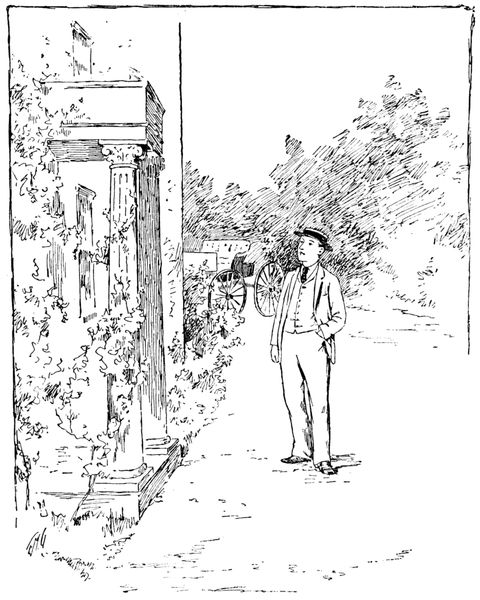
“For fully a minute Bruce stood looking at the house.”—Page 47.
47Yes, there was the old doorway with the
clematis clambering about it, just as his fancy
had painted it, except that the door seemed
smaller, and the clinging vines less luxuriant
than in his dream. For fully a minute Bruce
stood looking at the house and wondering
when he could have seen it before, or whether
it was simply an accidental freak of his imagination
that made the scene seem so familiar to
him.
He was still looking and wondering when
the door opened and Mr. Dexter himself
appeared on the doorsill.
“Come in young man,” he said, “you’ve
come up for those old books and magazines I
suppose.”
“Yes sir,” replied the boy, taking off his hat
respectfully. “Chief Trask sent me up for them
with the wagon.” Following the old gentleman,
he entered a dark hallway, in one corner of
which stood a heap of novels, books of travel,
magazines and other publications, which had
been brought down that morning from the garret.
The boy’s eyes glistened as he looked at
the big heap, and thought of the pleasure that
48he would have in going through them, during
his next leisure hours. Aided by one of
Mr. Dexter’s servants, he placed them in the
wagon, and then, having thanked the old gentleman
for his kindness, he drove slowly down
the winding roadway, and thence through the
gate into the street. He stopped a moment to
look at the landscape that lay stretched before
him, hoping that he might see in it some object
that, like the old front porch would recall some
childish memory, but there was nothing that
was in any way familiar to him, and he drove
away shaking his head and very much puzzled
by what he had seen. He was still thinking over
the events of the day and wondering whether
he had ever seen Mr. Dexter before, for his
face too had a familiar look and somehow
seemed to be perfectly in accord with the old
stone house and the big, solemn hedge that hid
it from the road, when his attention was
attracted by a voice that seemed to come almost
from under the carriage wheels.
“I say, can’t you give me a lift? I’ve hurt
my ankle,” was what he heard, as he hastily
pulled up his horse and there, seated on a big
rock, by the roadside, was a young boy, apparently
not more than fifteen years of age,
whose handsome clothes were torn and dust-covered,
49and whose face was deathly pale.
Bruce alighted at once from the wagon and
asked him what the matter was.
“I was just on my way home,” replied the
boy, “and I tried to make a running jump over
those rocks, when I slipped and fell, now it hurts
me to touch my foot to the ground, and my left
ankle hurts me awfully. Can’t you take me
home in your wagon? My father will pay you
for your trouble.”
“Certainly, I’ll give you a lift,” replied Bruce,
“but your father needn’t pay me anything
for it; just stand up beside me and I’ll lift
you in.”
With a little trouble, he placed the boy in
the seat and then climbed in himself and sat
down beside him. The two lads were not slow
in making one another’s acquaintance. The
injured boy said that his name was Harry Van
Kuren and he pointed out his father’s house, a
large handsome residence surrounded by well
kept grounds. He was fifteen years old, he
said, and did not go to school, but had a private
tutor who lived in the house with him,
and nearly always accompanied him when he
went out to walk or ride.
“And how do you happen to be here?” inquired
young Van Kuren.
50Then Bruce told him of his errand to Mr.
Dexter’s and showed him the pile of books
and magazines which he was taking back for
the firemen to read.
“But you don’t mean to say that you belong
to the fire department, do you?” exclaimed
Harry excitedly.
“Yes, I’ve been on the force pretty near
three months,” answered Bruce proudly.
“My, but you’re a lucky chap,” cried his
companion. “I just wish my father would let
me join, but he won’t let me do anything I
want to. I never have any fun anyway; there’s
nothing to do in this stupid old place, except to
go riding on my pony, and once in a while
have a sail on the Sound. There are no other
boys for me to play with—that is, none that I
like—and I have to go in the house every night
at six and stay there till bedtime. I suppose
you have all the fun in the world getting up in
the middle of the night and going to fires, and
driving like mad through the streets. Say,
why can’t you let me go out with you some
time.”
But Bruce shook his head dubiously, he was
willing to have the boy imagine that he himself
was one of the leading members of the company,
and he wished moreover to impress him with
51the idea that it was no easy matter for a young
boy to become a member of the New York Fire
Department. “I’m afraid,” he said, “that
you’d find it very difficult to get an appointment.
I believe I’m the youngest member of the whole
department, and I know I never would have
been taken on, if it hadn’t been on account of
my father, who was a fireman before me.”
“And is your father on the department
yet?” demanded Harry.
“No,” replied Bruce with a little choking
sound in his voice, “he was killed at a fire
some months ago and then they gave me a
position on account of him.”
“Your father was killed at a fire? Oh I’m
awfully sorry!” exclaimed Harry, who was
an impulsive and warm-hearted, although somewhat
spoiled boy, “but I’m going to tell my
father about you, and ask him if you can’t come
up and visit me some time. Here’s our entrance;
just drive me down to the side door will
you please, and I’ll get one of the servants to
help me up stairs.”
Bruce helped his new friend to alight and
then a man servant appeared in answer to his
ring, and on learning that his young master was
hurt, started off in much alarm in quest of the
private tutor, but was called back imperiously
52by young Master Harry and ordered to “lend
a hand” in getting him into the house.
As Bruce turned to leave, the boy held out
his hand in a frank, straightforward way that
was very agreeable and said, “I’m very much
obliged to you for bringing me home, and now
that I’ve got your address I’m going to write
and ask you to come up and see me. My father
will be mad enough when he comes home and
finds what’s happened to me, because he told
me I wasn’t to go off the grounds to-day. But
he’ll come around all right in a week then we’ll
have fun together.”
And as Bruce drove out of the handsome
grounds of Mr. Van Kuren’s house, he felt that
it had been a well spent and eventful day for
him. He felt sure that he had made a friend
in young Van Kuren, and then he fell to thinking
of Mr. Dexter and his big stone house and
his familiar looking porch and the little side
door with its clinging vines, and he wondered
for the hundredth time under what circumstances
he could have seen them before.
Chapter VII.
53
With the possible exception of John Trask,
it is doubtful if Bruce had a better friend
in the whole company than Charley Weyman,
who drove the truck and was looked upon
as one of the nerviest and most active firemen
in the battalion. Weyman had been
Frank Decker’s most intimate friend, and the
natural interest which he took in the son was
deepened by the readiness shown by the latter
to oblige his new friend and to help him in
every possible way in the discharge of his duty.
It was not unnatural then that Bruce should
decide to repeat to Weyman his strange experiences
at Mr. Dexter’s house, and accordingly
one afternoon, a few days subsequent to his
visit, he said to the fireman, just as they had
seated themselves for a quiet game of checkers:
“There was a funny thing happened to me the
other day when I went after those books, and
I’d like to know if you could give me any
explanation of it.”
“Well, what was the funny thing?” inquired
the other, as he moved one of his men in the
direction of the king row.
54“Well, you know Chief Trask sent me up to
Mr. Dexter’s house to get a lot of books and
magazines. I don’t suppose you were ever up
there, were you?”
“No, can’t say that I ever was, but it’s your
move,” rejoined Weyman.
“It’s a great big house,” went on Bruce, as
he moved one of his men so carelessly that his
opponent instantly took it, “in fact it’s one of the
finest houses I was ever in. There’s a big, thick
hedge that separates it from the street, and
when you get inside the hedge there’s a roadway
that winds through a big, thick clump of
firs and pines, right up to the front door of the
house. The minute I came inside the gate the
place took on a familiar look and I was positive
that some time or other I’d been there before.
When I stopped in front of the door, that looked
familiar too, and then I seemed to remember
that there was another door on the other side
of the house that was smaller and had a
little porch over it, so as to shade the
doorstep. Just to see if I was right or not,
I got out and walked around the house
and there, sure enough, was the side door,
just as I had either dreamt it or remembered
it some time ever so many years ago; only
it seemed to me that in reality the place
55was only about one quarter as big as I had
imagined it.”
By this time Weyman had become so much
interested in the boy’s narrative that he had
ceased entirely to think of the game and was
now gazing at Bruce in the intense manner of
one who is hearing some startling piece of news
in which he has a strong personal interest.
“You say that you remember the place and
yet you were never there before?” demanded
the fireman.
“Yes,” answered the boy, “and moreover I
don’t think that I could have seen a picture of
it, for the smell of the flowers and of the vines
over the porch was just as familiar to my nostrils
as the doorway was to my eyes. I don’t
think I could ever have been there before, and
it seemed to me as if I had dreamt of the place,
not once, but a great many times.”
For a moment or two Charles Weyman was
silent, then he pushed away the checkerboard
and said: “What you’ve just told me, Bruce, is
very curious and seems to confirm an idea that
came to me long ago when your father was
alive. Do you know anything about your father
or his relations?”
Bruce thought a minute, and then answered:
“No, I never knew he had any relations. I was
56brought up by some old people who lived in the
country on the shore of Lake Ontario and only
saw my father once a year. Then he never
used to talk to me about anything except the
fire company, and it was that that made me
crazy to join the service. If he had any brothers
or sisters or cousins he never mentioned
them to me, and to tell the truth this is the first
time in my life that I ever thought about the
subject.”
“But didn’t your mother have any relations
who are living now?” inquired Weyman.
“Not that I ever heard of. She died when I
was very young and I can scarcely remember
her. Since then I lived with those old people,
who took care of me, but after my father died,
I determined to strike out for myself and so I
came down to New York.”
“Well, if I were you,” said Weyman, “I
would write home to someone in the country
who knew your father, and make some inquiries
about his family. In fact, I should think
you’d like to know who you are. There was
always something mysterious about your father—something
that I never could understand.
He was a man of much better education than
any of the rest of us, and I remember once or
twice seeing well dressed gentlemen, evidently
57men of high position, stop in the streets to
shake hands and talk with him. On such
occasions he never offered any explanation
except to ask me not to speak of it to the other
men. Well as I knew him, I never knew positively
that he had a child living, and I was
more surprised than any man in the company
when you turned up that afternoon and told us
you were Frank Decker’s son.”
“But,” exclaimed Bruce, who, of course, had
become very much interested in his companion’s
words, “didn’t you ever hear him say anything
or mention any name that could serve as a sort
of clue to his origin? If I had anything to
work on, I might follow it up and perhaps find
out who his relations were. However, perhaps
it would not be worth the trouble, for they
might not be particularly glad to have a poor
boy like me, who hasn’t a cent in the world,
turn up and claim connection with them. I think
I am just about as well off here as I would be
with any of my kin.”
“There are one or two things about your
father that come to my mind now,” said Weyman,
after a moment’s reflection, “and although
I gave them no thought at the time, still they
might be of some use to you. There was a
man who came around to see him once in a
58while, and when he came the two always went
out and walked up and down the street, talking
together. Sometimes they got excited, and I
noticed that your father was never the same
after one of these visits. He would sit in a
corner, moody and sullen, sometimes talking
to himself, and it would take him a couple of
days to get back to his old frame of mind again.
He was naturally a light-hearted, jovial fellow,
and that’s why I couldn’t help noticing the
effect these visits had on him.”
“What sort of a looking man was he, who
called on him, and always seemed to upset him
so?” asked the boy.
“He was tall and dark and well-dressed, and
I’d know him anywhere by a scar he had on his
face that was partly hidden by a stiff black beard
he always wore. The last time he was here
was the day before the big fire at which your
father was killed. I remember it well, because
that morning before the first alarm came in
Frank hardly spoke to me, but sat over there
in that corner, smoking his pipe and looking as
if he had lost the last friend he had on earth.”
“And you don’t know who that dark man
was or what name he gave?” said the boy.
Weyman shook his head slowly. “No,” he
said, “I did know his name once, but it passed
59out of my mind. If I were you, I would write
a letter up to the country and see if I couldn’t
find out something in the way of a clue.”
Just at this moment Chief Trask came in and
told Bruce to hitch up the wagon and go with
him up to headquarters, and so the conversation
came to an end. But all that day the young
boy was very thoughtful, and when night came
he had determined to set to work, quietly and
persistently, to find out something about his
father and his mother, and to learn if he had
any kindred living in the world. He had no
clues to follow except the legend of the dark
man with the scar on his face, and the resemblance
of Philip Dexter’s house to something
of which he had once dreamt and still
had a vague recollection.
Chapter VIII.
60
For fully a fortnight after his strange experience
in the upper part of the city, Bruce
heard nothing from Harry Van Kuren, the boy
whom he had picked up by the roadside and
conveyed home. He had hoped, at first, that
their chance acquaintance might develop into a
permanent friendship, for since his arrival in the
city he had associated entirely with the men in
the fire company and, boy like, he was beginning
to pine for the companionship of lads of his own
age. Two or three times he had thought of
writing a note to Harry to ask him how his foot
was getting along, but he had hesitated, for fear
he should be looked upon as endeavoring to intrude
upon a boy whose condition in life was,
he could not help feeling, very much better than
his own. So Bruce, who was an independent,
self-respecting lad, determined to let the other
make the first advance, if he desired to continue
the acquaintance.
One morning, however, about a fortnight
after the first meeting of the two boys, Bruce
was surprised and delighted to see Harry march
61into the quarters and come straight up to where
he was sitting.
“I suppose you thought I was never coming
down here to see you,” said the visitor as he
shook Bruce heartily by the hand, “but the fact
is when my father got home that night and
found that I had been out without his leave, he
put me on bounds for two weeks and said if he
caught me going out without permission he
would lock me up in the house. I was going
to write to you, but writing is an awful
bother, so I thought I’d wait until I got off the
limit and then come down here and make you a
call.”
Bruce was heartily glad to see his visitor,
and frankly told him so, mentioning also the
fact that he had almost given up hope of hearing
from him again.
“Oh I never forget my friends,” said Harry
“and here’s a letter from my father inviting
you come up and spend the afternoon with
us to-day.”
With these words he produced from the
inside pocket of his jacket a polite and formal
letter addressed to Bruce Decker, Esq., and
signed “Horace Van Kuren,” in which the
writer hoped that Mr. Decker would honor
him with his company at dinner that evening, in
62order that he might thank him for the kindness
shown to his son some time before.
Bruce felt staggered at the idea of dining in
that great, beautiful house, and at first did not
know what reply to make; then he bethought
him of Charley Weyman and accordingly went
up stairs and submitted the letter to him.
The latter read it carefully and then said: “You
had better go by all means, it’s a good chance
for you to get acquainted with those people and
they can’t do you any harm.”
“But” said the boy in a diffident, hesitating
way, “I’m almost afraid to go up there because
I haven’t got any clothes nice enough. This
is the best suit I’ve got, and that boy Harry is
togged out in beautiful things, and I feel
ashamed to go along with him, because of
the contrast between us.”
“Nonsense! he wasn’t ashamed to ride in
the chief’s wagon the other day, was he?”
“Why no,” replied the boy, “I never
thought of it then, and I don’t think he did
either. Anyway he didn’t say anything about
it, and now he’s come down to see me, and
his father has asked me up to visit them.”
“You’d better go with him,” said the fireman,
“and my opinion is that they’ll take you
just as you are. Anyway, you can tell by the
63way they treat you, particularly by the way
this boy treats you, whether they are the right
sort of people or not.”
Bruce accordingly went to Chief Trask, showed
him the letter, and asked his permission to go
with the boy, and having received it—and it was
granted all the more willingly because he was
always obedient and industrious himself, and
seldom asked any favors,—he carefully washed
his hands and face, brushed his clothes and
shoes and made ready to start.
Meantime Harry had been examining everything
in the building with much interest, and
he now called to the other boy to explain to
him how the alarms came in, and how the men
got off to the fire when they heard the gong.
All this was now an old story to the young fire
boy who had so familiarized himself with every
detail that he was able to give his new friend a
complete and graphic description of the workings
of the system.
Harry wanted to stay until an alarm was
sent in so that he might see the company start,
but when he found that it might be necessary
to wait two days for a fire to occur in their
district he gave the plan up, and they started
off together. Bruce was relieved to see that
in spite of his fine clothes, and generally stylish
64appearance young Van Kuren treated him
with as much courtesy as it is possible for one
boy to show to another and, so far from making
any remarks about their difference in dress,
did not seem to notice what sort of a coat his
companion wore. As a matter of fact, Harry
did notice the coat with its rather shabby
sleeves and a good many other little things, for
he was a quick-witted observant boy, but he
was too well-bred to make any remarks on the
subject. Indeed it would be hard to find anywhere
a boy of better breeding than this
spoiled, willful, impulsive child of luxury, who
was always getting into trouble of one sort or
another, was always doing thoughtless and
foolish things, and yet was liked by every one
who knew him. When he noticed Bruce’s
coat, it suggested to him, not the idea of making
fun of it, but the wish that he could get him
another without hurting his feelings.
Both boys were in high spirits as they
trudged along, the one because he had at last
found a companion of his own age, the other
because he saw a chance to mingle on familiar
terms with the men of the fire department, and
perhaps to even ride to a fire on the truck with
the rest of the company. The New York boy
of to-day knows no higher ambition than to
65join the fire department and ride to fires
on the swift rolling engine, and Harry Van
Kuren was a New York boy through and
through.
“Watch me scare that Dutchman!” he
cried as they drew near a basement beer
saloon, at the door of which a corpulent German
was peacefully dozing. A pile of kegs
stood on the top of a short flight of steps, and
with a warning cry of “Look out Dutchy!”
Harry toppled the heap over and then seizing
his comrade by the hand ran for dear life.
The saloon keeper pursued them for a few
yards and then gave up the chase, while Harry
much elated by his exploit looked around
for some other victim for his practical humor.
Bruce, accustomed as he was to the rigid
discipline maintained by Chief Trask, was
horrified at his companion’s idea of sport, and
was glad enough when they reached the
elevated station without any further adventures.
A little girl not more than thirteen years old,
was standing by the front gate of Mr. Van
Kuren’s house when the two boys entered;
she had blue eyes, a profusion of light hair,
which she wore in a single braid down her
back, and was altogether extremely pretty and
attractive.
66“You’ll catch it when you get into the
house,” she remarked to Harry, with a knowing
wag of her head.
“What for?” he demanded.
“For going off without letting Mr. Reed
know.”
“Oh, bother!” said the boy, “I forgot all
about him. He’s my tutor, you see,” he
added, turning to Bruce, “and this is my sister
Laura.”
Bruce took off his cap and bowed politely to
the young girl, and she held out her hand and
said, without any apparent reserve or shyness,
“I saw you the other day when you brought
Harry home; why didn’t you drive up in your
wagon to-day? it must be fun to be a fireman;
I wish you’d tell me all about it. Harry, you’d
better go in the house and see Mr. Reed right
off; he’s hopping mad, and if he don’t get over
it before papa comes back, you’ll be locked up
for another fortnight. Harry is always getting
locked up,” she continued, turning to the visitor,
who was listening with considerable surprise
to this frank conversation between the
brother and sister.
Harry disappeared into the house, saying
that he would be out as soon as he had
“squared himself with the professor,” and
67Laura took Bruce off to show him the stable
where her pony was, and the barns and sheds
in which were kept cows, pigs, dogs, and even
a pair of goats.
Chapter IX.
68
The Van Kuren mansion and grounds constituted
one of the finest places in the
upper part of New York, and to Bruce, accustomed
to plain ways of living, it seemed
almost like some enchanted palace in fairyland.
For fully an hour he strolled about the grounds
under the guidance of Miss Laura Van Kuren,
who talked to him as freely and frankly as if
she had known him all her life. Harry was in
disgrace, she said, for going off without consulting
his tutor, and he would probably be
kept in the house until he had learned and recited
the lesson which had been given him that
morning. Meantime she would entertain his
guest herself, and as she was very pretty, very
bright, and altogether very friendly and charming,
Bruce did not feel the absence of her
brother to any great extent. In fact, he was
mean enough to hope in his secret heart that
Mr. Reed would keep him in the house all the
rest of the afternoon so that he and Laura
might continue their confidential talk as they
walked about together.
69And as they talked, Bruce, who was naturally
a diffident boy, became emboldened to
such a degree that he made up his mind to ask
the young girl if she knew anything about Mr.
Dexter and the big, old fashioned house, which
had seemed familiar ground to her. The opportunity
for putting the question soon came.
They were sitting together in a small summer
house, eating some strawberries which they
had picked in the garden, taking advantage of
a moment when the gardener was off in another
part of the grounds.
“Did you ever know a Mr. Dexter, who
lives near here?” inquired Bruce, during a
pause in the conversation.
The girl looked up quickly as she said,
“You don’t mean that old gentleman who lives
over there about half a mile along the road, do
you?”
“Yes, he lives in a big square stone house,”
said the boy.
Laura cast a hasty and apprehensive glance
around her, and then said in lowered tones, as
if she feared that some one were listening, “I
know who he is, but papa won’t let us go near
his house. Papa says that he’s a bad man and
he won’t have anything to do with him, but I
think he’s real nice, and one day, about a year
70ago, I was out walking near there, and he saw
me and called me in and gave me some big
bunches of splendid grapes, and then he asked
me my name, and when I told him he seemed
surprised, and somehow he wasn’t nice any
more, and in a minute or two he told me that I
had better run home or my people would be
anxious about me. When I got home I told
papa about it, and he was awfully angry, and
said that I must never go into that yard again,
and that if I saw Mr. Dexter coming I must run
away. I asked him why, and he wouldn’t tell
me. But where did you ever hear of him?”
Bruce hesitated a few minutes before replying,
and then made answer, “The chief of our
battalion, Mr. Trask, sent me up there the
other day on an errand.”
“And did you go inside the grounds and
into the house?” demanded Laura, excitedly.
“Do tell me all about it, for it is such a romantic
looking place that I always feel as if there
were some mysterious story connected with it.
And then that old Mr. Dexter never goes out
anywhere, and nobody seems to know anything
about him. My nurse, the one who lived with
us for twenty-five years, told me once that Mr.
Dexter and papa used to be great friends, but
they had some kind of a quarrel. I asked her
71what they quarreled about and she wouldn’t
tell me, although I am sure she knows all
about it.”
The young girl’s words of course made a
deep impression on Bruce, who was now more
curious than ever to learn the history of the
kindly old gentleman who lived all by himself
in the big, square stone house behind the thick
hedge.
“Go on and tell me all about what you saw
there,” said Laura eagerly. “I am sure there’s
some mystery about the place like the ones we
read about in the story books. When I
was a little bit of a girl, I used to imagine
there was a sleeping beauty hidden away behind
those dark trees and I expected that
some day a prince would come and wake
her up and that then there’d be a grand
party for everybody around here to go
to.”
“Well, there is a mystery about it, and it’s
one I’d like very much to solve,” said Bruce
quietly.
“A mystery!” exclaimed Laura, “Now you
must tell me everything about it before you
leave this summer-house,” and she spoke in the
tones of a young girl who expected to have her
own way.
72“I don’t know whether I ought to say anything
to you about it or not,” began the boy in
a doubtful voice, “and besides you might not be
interested in the mystery because after all it
only concerns myself.”
“Go right on and tell me this very minute!”
cried the girl imperiously.
“You’ll promise never to tell as long as you
live and breathe?”
“Hope to die, if I do,” rejoined Laura fervently,
“Now, go on.”
Thus adjured, Bruce told her the story of his
visit to Mr. Dexter’s house and the strangely
familiar look that the place had worn; and he
told her, too, of the conversation that he had
had with Charley Weyman and of the advice
that the latter had given him. Laura listened
to his words with the deepest attention, and
when he had finished, she drew a long breath
and said, “that’s the most interesting, romantic
thing I ever heard about in all my life. And
you don’t really know who your folks are?
Why you might be almost anybody in the world,
and maybe you’re the prince who will come
and waken up the princess with a kiss, the
same as in the story book. But how are you
going to work to find out what it all means?
You must tell me everything you do about it
for I’ll never be able to sleep at night until
you’re restored to your rights.”
Bruce tells Laura the story of his visit to Mr. Dexter’s house.—Page 72.
73Bruce, who was of a rather practical turn of
mind, was amused at the excitement of his
more imaginative companion. Up to this moment
he had simply felt a curiosity to learn why
it was that the Dexter homestead seemed
familiar to him, and it had never occurred to
him that he had any particular “rights” to be
restored to him, or that any grave question
depended on the fancied resemblance of the
place to the one pictured in his memory.
“I would like very much to learn something
about Mr. Dexter and his old house, but I
don’t know how to go about it. I always lived
in the country, and, outside the men in our fire
company, I have no friends or even acquaintances
in New York. You have lived here all
your life, and everything seems natural to you,
but you’ve no idea what a big, lonely, desolate
place this city is to a boy like me who comes
here as a stranger.”
“I’ll tell you what,” exclaimed Laura suddenly,
“when my papa comes home to-night—you
know you’re going to stay to dinner with
us—you ask him about Mr. Dexter but don’t
tell him that you said a word to me about it.
Maybe he’ll tell you something that will be of
74some use to you, but don’t say a word to him
about what you told me about your visit there.
We must keep that for our own secret, and I
shall be mad if you tell him or Harry or anybody
else, and if I get mad I won’t help you
to find out the mystery of it. Now, you must
do just what I tell you or else I won’t like you
any more.”
“What secret are you talking about?” demanded
some one close beside them in a voice
so loud that both Laura and Bruce started in
surprise from their seats. It was Harry who
had just been released by his tutor and had
been, according to his own account, hunting
them all over the grounds.
Laura put her finger on her lips and threw a
significant glance at Bruce, and so it happened
that Harry learned nothing of what they had
been talking about for fully half an hour.
At six o’clock, Mr. Van Kuren reached home.
He shook hands with Bruce and told him he
was glad to see him and thanked him for his
kindness to Harry.
Bruce noticed that both children appeared
to stand in wholesome awe of their parent,
obeying him with the utmost alacrity and conversing
only in low tones while he was present.
This was not surprising to the young visitor,
75for Mr. Van Kuren impressed him as a stern,
silent, self-contained man, who might be very
severe if he chose to. But his face was not unkind,
and in the few remarks that he addressed
to his guest he showed a certain interest in his
welfare and a desire to make him feel as much
at home as it was possible for a shy, country
boy, unaccustomed to the ways of society, to
feel in a splendid house like the one in which
he found himself now. But all idea of asking
him about the Dexter mansion left his mind,
and although he found himself alone with him
for a few moments before dinner was announced,
he simply did not dare to broach the
subject that was uppermost in his mind.
The dinner to which he sat down seemed to
Bruce a very grand affair. It was served in a
large, square room, wainscoted in dark wood
and furnished in a rich, simple and tasteful
fashion. The round table was covered with a
white damask cloth of beautiful texture and
the glass and silver seemed to have been
polished with wonderful care. Colored wax
candles with silk shades shed a soft light.
Besides Mr. Van Kuren and his two children
there were two other persons in the company;
Mr. Reed, the tutor, a tall, grave young man
who talked but little, and seemed to watch
76Harry with much care, and a delicate, nervous
lady, a sister of Mr. Van Kuren’s, whom the
children called Aunt Emma, and who retired
to her apartment as soon as the cloth was
removed.
For such a fine dinner it seemed to Bruce
that every thing moved very easily and quietly.
There were two men in black coats and white
ties who went about noiselessly serving the
guests and removing the dishes. Mr. Van
Kuren, Miss Van Kuren and Mr. Reed drank
wine, but there were no glasses at either
Harry’s or Laura’s plate. Mr. Van Kuren
asked Bruce if he would like a little claret, and
he declined. He began to explain why he did
not wish any, but stopped suddenly, feeling
perhaps that he was saying too much,
but Mr. Van Kuren helped him out with
a kindly, smiling inquiry, and he went on:
“Chief Trask of my battalion advised me
not to drink anything, because he told me
that when it was known of a young fireman
that he did not take a drop of anything it
was a great aid to him and helped him to get
along.”
“Very good indeed,” said Mr. Van Kuren
approvingly, “at any rate you’re too young
now to need it.”
77At first, the young visitor was not quite sure
of himself and did not know exactly what to do
with all the forks that he found beside his plate,
but by carefully watching his host he managed
to acquit himself with credit; and when they
arose from the table he realized that he had not
made one single “bad break” as Harry would
have called it.
“Did you ask Papa about the Dexter
house?” whispered Laura at the first opportunity.
“No,” replied the boy simply, “I was too
much afraid of him; after what you told about
his getting mad, I wouldn’t have said anything
about Mr. Dexter for a hundred dollars.”
Soon after dinner Bruce took his leave, having
promised his new friends that he would pay
them another visit as soon as he could. Ashe
was saying good-bye, Laura slipped into his
hand a small piece of paper, and when he
opened it in the elevated train he found the
following note:
“I have a splendid idea and will let you know about it
very soon. I think it will help you to solve the mystery of
the haunted house.
“Truly your friend,
Laura van Kuren.”
Chapter X.
78
One afternoon Mr. Peter Dewsnap was
seated in the great library in which he
passed most of his leisure time, busily engaged
on a work in which he had taken a great deal
of interest. A tap on the door interrupted his
labor, and in response to his invitation Bruce
Decker entered the room, cap in hand, and
saluted him.
“Ah, it’s you, young Decker, is it?” said
the old gentleman, as he rose to greet his visitor.
“Well, how is the chief to-day?”
“He’s very well,” answered the boy, in hesitating
tones, “and the fact is it was at his advice
that I accepted your invitation to come up
and see your library.”
“Very glad to see you, indeed, my young
friend,” responded the old gentleman, cordially.
“As you said yourself the other day I’m an old
fire crank, and I like nothing better than talking
to young men of your age about what I
think is the most important branch of public
service in the country. Sit down here, Decker,
and if you’ve an hour to spare it won’t do you
any harm to hear an old man talk about a subject
that’s nearest to his heart.”
79Bruce seated himself in one of the big
leather arm-chairs and glanced about the room.
He had never seen as many books in handsome
bindings in all his life, and he was particularly
struck with the fact that one side of the
room was completely filled with oaken shelves
containing only books bound in red morocco.
About the room were also scattered a number
of old colored prints representing, for the most
part, pictures of fires and of engines.
“Those books in red constitute my fire
library,” said Mr. Dewsnap, “and I am proud
to say that it is one of the best, if not the very
best, in this country. I have books in French,
German and English, for you know that the
service has a much greater literature than most
people have any idea of.”
Then Mr. Dewsnap lit a cigar, puffed
thoughtfully at it for a moment or two, and
went on: “The trouble with most of the boys
who want to become firemen is that they are so
carried away with the idea of jumping out of
bed at a moment’s notice and tearing away
through the streets at full gallop, and then
turning streams on the flames and climbing up
ladders and all the rest of it, that they entirely
80forget the fact that there is a serious side to it
all, and that being a good fireman involves
more in the way of training, both physical and
mental, than almost any other public career
that is open to them.
“As I told you the other day, people have
been in the habit, or to speak more correctly,
were in the habit during the ante-bellum days,
of regarding firemen as a lot of toughs and
loafers who got together to have a good time
and a big hurrah, and sometimes even for
political purposes, and comparatively few really
knew what a fireman’s life meant. Well, when
you look at those books there, many of which
were written by people of the highest eminence
in science or literature, you realize that there
must be something in the art of overcoming
the most destructive and dangerous of all the
elements to excite the attention and enlist the
brains of these men. Now take this book for
example and glance through it.”
Bruce took a large flat volume which Mr.
Dewsnap handed him, opened it, and glanced
attentively at some of its copper plates. They
represented men in quaint, old-fashioned costumes,
engaged in putting out fires by the
most primitive of means, chiefly by leather
buckets passed from hand to hand. The book,
81as Mr. Dewsnap explained, was printed in
1735 in Holland by Jan vander Heiden, the
first inventor of flexible hose. It was an exhaustive
treatise on conflagrations and the art
of extinguishing them.
“What did they make the hose of in those
days?” asked Bruce, as he studied the old-fashioned
prints with deep attention.
“Leather,” replied Mr. Dewsnap. “And
leather continued to be used until forty years
ago. In fact, it’s used to a great extent to
this very day in the smaller towns and cities
where fires are of rare occurrence. There are
some men who claim that it is better than rubber
because it lasts longer and does not rot so
easily, but I just showed you that book because
its pictures would give you some idea of the
enormous advancement that has been made in
the last century and a half. Here’s another
book written in German that is devoted entirely
to the burning of the Theatre Comique in
Paris a few years ago. Four books in all have
been written and published on that subject
alone, but strange to say, no book has yet been
written in regard to the burning of the Brooklyn
Theatre, which was a catastrophe involving
an infinitely greater loss of life. It is interesting,
by the way, to know that every great fire
82teaches us some important lesson, and the direct
result of the Brooklyn Theatre fire was a
number of new laws which govern the construction
of theatres, and provides for various
improvements and appliances for safety that
had never been thought of before.”
“Why is it,” inquired Bruce, “that so many
of these books seem to be by French, German
or English authors, instead of by Americans?
It seems to me that as we have the best department
in the world, the best books on the
subject ought to be by American writers.”
Mr. Dewsnap smiled broadly at the boy’s remark.
“That’s a very pertinent question,
my lad,” he said, “and the answer to it is simply
this: Those foreigners are more given to
writing and talking and thinking than we are.
Here we go ahead and do things without stopping
to write books about them. I’m expecting
some foreigners here within a short time,
and when they come I shall take them down to
call on Chief Trask. If you see them, you will
understand what I mean when I speak of the
difference between Americans and either Germans
or Englishmen.”
“What do you consider the greatest improvement
that has been made in the department
in your recollection?” asked the boy.
83“Well, to my mind, though I would not have
admitted it twenty years ago, I think that the
fact that politics has been eliminated from the
department is one of the chief things that we
have to be thankful for, and I believe that it is
almost the first time in the history of the world
that a fire department has been run without
mixing it with political affairs. Why, before
the birth of Christ, the Emperor Pompey once
refused to allow a new fire company to be
formed in Rome because he knew that it was
merely an excuse to get together a new crowd
of his political opponents, and in the old days
when I used to run with a company, politics
and the fire department were very much mixed
up. I could give you the names of dozens of
men who have reached the highest offices in
the city and have climbed all the way up by
means of their connection with the fire department.
Some of these were good men
and others were not. But nowadays when
a lad like yourself enters the service he
sees nothing ahead of him except that service,
and the consequence is if he stays in
it he devotes himself to his duties with no
object in view except to become chief of
the department. At least that’s what he ought
to do.
84“But for all its politics and its toughs, the
members of the old department had just as
much pluck and were just as ready to take the
hose nozzle in hand and go right into a burning
building as they are to-day. I’ve shown
you these books, my boy, because I wanted
you to feel that there was a dignity in the service
to which you intend to devote yourself,
and if you want to rise in it, it must be by hard
work, obedience to orders, and constant study.
Don’t be afraid to borrow some of these books
of me to read when you have nothing else to
do. There are plenty of them that are in English
that you could learn something from. It’s
education nowadays that tells. But I’ve a
project in my mind that both Mr. Trask and I
have devoted considerable time to, and I hope
to live to see the day when it will be carried out.
I want to see a school established in which boys
like yourself can be trained for the fire department
just as they are trained for the navy.
My idea would be to take a number of boys
every year from the public schools in the city and
give them a regular course of training in gymnastics
and special scientific studies so that by the
time they were twenty-one they would be much
better prepared to fight fire than are the young
men that usually join the department at that age.”
85“That’s a magnificent idea!” cried Bruce with
an enthusiasm that was so hearty and genuine
that the old gentleman was delighted, “and I
can tell you one thing, and that is you wouldn’t
have any difficulty in getting scholars for it.
It seems to me that every boy in New York is
just as crazy to run to fires as I was when I
lived in the country. Why, do you know sir,
that every time we start out of quarters there’s
such a swarm of young ones in the street that
it’s a wonder we don’t run over two or three
of them. And besides, boys seem to me to be
tougher and more supple than men. There
are lots of things I can do in an athletic way that
Tom Brophy can’t and he’s twenty-five years
old.”
“Well,” said the old gentleman pleasantly,
“you ask some of the lads of your acquaintance
how they’d like to join such a school as
that and put down on paper any ideas you
may have regarding it. Then the next time I
see you we will talk them over.”
As Bruce walked slowly homeward after one
of the pleasantest hours he had spent since his
arrival in the city, he felt a new pride which he
had never known before, in the great department
which it was his wish to serve. The fact
that fire departments had existed since the
86earliest times had never occurred to him, and
he determined to devote all his leisure time to
a study of Mr. Dewsnap’s pet scheme of a
training school in the hope that he might be
able to render the kindly old gentlemen some
service which he would appreciate.
Chapter XI.
87
It was not at all unnatural that Bruce Decker
should cherish in his heart a strong desire to
go to a fire as one of the members of the truck
company. This longing grew stronger in his
heart every day, and when the opportunity did
come it found him, fortunately enough, ready
to make the most of it.
It happened one warm day in August, that
three or four of the men were absent on their
summer’s vacation and one or two others
because of illness, and while the company was
thus crippled, Charley Weyman fell and hurt
his right arm so badly that the chief advised
him to go around to the nearest doctor’s and
have it dressed. As the injured fireman left
the quarters, his superior turned to Bruce and
said, “My boy, you see how short-handed we
are to-day; now do you think that if an alarm
should come in you could take Weyman’s
place on the driver’s seat?”
The boy’s eyes brightened and there was
an eager look in his face as he made answer,
“I’m sure I could and I only wish that an
alarm would come in.”
88“All right,” said the chief “just keep yourself
in readiness for we can never know when
there is an alarm coming.”
Then he went up stairs, and Bruce stepped
out into the street, and looked up and down it
as far as his eye could reach as if he expected
to see the smoke and flame bursting out from
some building within his range of vision. But
the sun poured down on his bare head, and he
was soon glad to retreat to the shade of the quarters,
where he stood idly looking at the brass
gongs, and wondering how soon they would
begin to ring out their tale of smoke, flame
and disaster.
And then the thought occurred to him that
he had no right to stand there wishing for a
fire which might bring ruin and death to his
fellow creatures, and could benefit no one but
himself; and it was not at all certain that it
would benefit even him. So he satisfied his
conscience by changing the form although not
the tenor of his thoughts. “I wish,” he said to
himself “that if it were necessary for the
world’s good to have a fire to-day that it
might be right here within this district.
There’s no harm in wishing that I’m sure. Of
course I wouldn’t like to have any people
killed at the fire or to have any poor man lose
89all his furniture and clothes, but there are fires
every day, and this is the first time I’ve ever
had a chance—”
“Clang! clang!” rang out the brass gong
at his side, and never, since the first time that
he heard an alarm ring, had the sound of the bell
stirred him with such excitement as it did now.
His opportunity had come at last, and without
a moment’s delay he clambered up over
the wheel of the truck and dropped into the
driver’s seat.
He knew that some of the men were racing in
from the back room, that others were sliding
down the brass poles, and that two of them were
already at the horses’ heads, while another was
adjusting the harness on the chief’s wagon.
And all this time Bruce was saying to himself,
“Now, I’m going to keep cool, no matter
what happens, and I’ll not spoil the greatest
chance of my life by getting nervous.”
It was with this thought in his mind that he
seized the reins and waited quietly until the
men had snapped the collars about the horses’
necks and fastened the reins to their bits.
Meantime the brass gong had been ringing the
number of the station, and the boy, with his
wits entirely about him, was keeping count of
the strokes.
90“One, two, three—one, two—one, two,
three, four, that’s 324,” he said to himself as
he tightened the reins, while the men gave the
eager horses their heads and sprang up on the
truck.
Bruce knew where station No. 324 was, for
he had long since familiarized himself thoroughly
with the district in which the company
was located, so as he passed over the threshold
he gave the horses their heads, and turning
sharply to the right was soon on his way to the
densely populated east side region in which
the fire was raging.
Chief Trask, seated in his little wagon,
passed him before he had reached the first
corner, his horse going at full gallop, and the
gong in the dashboard ringing out its sharp
warnings. As the chief went by he turned his
head and saw his young protege sitting bolt
upright in Weyman’s seat, looking carefully
ahead of him, and keeping his horses well
in hand although they were going at almost
their best speed. The boy seemed perfectly
cool, and it was apparent to the superior officer
that he knew what his duty was and proposed
to perform it. Then the chief took the lead,
and as they passed the first street, the engine
and tender, with Captain Murphy in command,
came thundering along, turned the corner, and
fell in behind them. Now they turned into a
crowded thoroughfare where the people,
warned by the sharp clanging of the gong in
the chief’s wagon, hastily made way for the flying
battalion. Down this thoroughfare for
three blocks—and never in his life had Bruce
known such a reckless ride—then another
sharp turn carried them into full view of the
fire.
Down this thoroughfare for three blocks—and never in his life had Bruce known such a reckless ride.—Page 91.
91The upper story of a factory was ablaze, and
in the street in front of it two policemen were
vainly trying to keep back an excited throng of
people, many of whom were yelling and gesticulating
and talking in German and Polish,
while others were weeping from sheer excitement.
The chief was on the sidewalk in a moment
and, in an incredibly short space of time,
the crowd had been driven away to a respectful
distance, the hose attached to a hydrant
across the street and run rapidly out to a convenient
length, while the members of the truck
company, acting under their chief’s order, were
quickly and quietly getting their ladders
against the front of the building and preparing
to ascend. Bruce did not know exactly what
he was expected to do, but concluded that it
would be best for him to sit where he was and
92take care of his horses. From his place in the
driver’s seat he noted carefully the speedy,
intelligent and systematic work of the brigade.
He saw the chief of battalion cast his practiced
eye at the building and then tell his men where
to direct the streams of water. In less than
two minutes the flames were under control,
and the frightened people, who had been
screaming and crying in the street, realized
that what they had mistaken for an awful conflagration
was in reality nothing but a comparatively
harmless combustion in the factory’s
upper floor, that no lives had been jeopardized,
and that all danger of the flames spreading had
vanished in the face of the rapid and efficient
work of Chief Trask’s men.
The neighborhood was inhabited chiefly by
foreigners, and Bruce could hear these people
talking to one another in half a dozen strange
tongues, as they leaned out of windows or
crowded about the engines as closely as the
police would allow them. And among this
crowd of chattering, excited aliens, Bruce
noticed one man of striking appearance, who
seemed totally different from those about him,
and who stood on the steps of a tenement house
and watched the fire with amusement and interest
reflected on his countenance.
93In marked contrast to the other denizens of
the street, this man was well dressed and carried
with him an unmistakable air of prosperity. He
was tall and dark, and his heavy black beard
was cropped close to his face. As he stood
on the top step the boy could see his profile, distinctly.
It was clear cut, the nose slightly
aquiline and the chin and mouth firm and
square. He wondered idly what this well-dressed
man could be doing in that part
of the city, and, while he was still wondering,
the subject of his thoughts came
down the steps and walked quickly away,
for by this time the fire was out, the men
were reeling up the hose, and the members of
the truck company were returning their apparatus
to the truck and preparing to go
home.
At the same time the uniformed employees
of the insurance patrol placed themselves in
the doorways of the factory and Chief Trask
came over to where Bruce was sitting with his
horses and bade him start for home. As they
drove slowly in the direction of the quarters
they passed the tall man with the close cropped
black beard. He eyed them sharply, as they
went by, and as he turned his face, Bruce
noticed what he had not observed before,
94namely, a long scar which ran obliquely across
his chin.
Just at this moment he heard one of the men
on the truck behind him say to his fellow:
“There’s that tall, ugly looking chap that used
to come round to the quarters every once and
a while, I haven’t seen him for six months
now, and I don’t know that I want to see him
again, for I never liked his looks.” Bruce
eagerly turned his head for a final glimpse of
the dark stranger, but he had disappeared.
“Never mind,” he said to himself, “that face
is fixed in my mind and I’ll never forget it.
One of these days I’ll find out who that man is,
and what he had to do with my father.”
That afternoon he sat in his accustomed
corner in the back room of the quarters, thinking
over his day’s experience. He was very
quiet and did not join in the conversation that
was going on around him. He wanted to tell
his friend, Weyman, about the tall stranger
with the scar on his chin, and he would have
done so, had it not been that he remembered
Laura’s emphatic order not to allow any one
but herself to share his secret.
For fully half an hour he thought the matter
over, and then determined, reluctantly it must
be owned, not to say anything about it to Weyman,
95until he had obtained the young girl’s permission.
And it was just at this stage of his investigations
that he made his first serious blunder. If
he had gone at once to his friend and told him
about the man whom he had seen down among
the Poles and Russians and Germans, in the
tenement house quarter of the town, it would
have made a great difference in his life. But
he allowed himself to be influenced by a pretty,
imperious, spoiled little girl, instead of by a
quick-witted, sensible and devoted friend, with
results which will be described in future chapters
of this story.
Chapter XII.
96
Charley Weyman was anxious to
learn how his boy friend had been received
and entertained in the Van Kuren mansion,
and he listened attentively while Bruce
described his visit, told him how friendly Laura
and Harry had been, and with what courtesy
he had been welcomed by their father and their
aunt, but somehow he neglected to mention
his long conversation with Laura in the summer-house,
nor did he refer to the Dexter mansion
at all. The young girl’s words still rang in his
ears, and it was a pleasant thought to him that
he had a secret to share with her, a secret which
none of his other friends need know about.
The little scrawl which she had placed in his
hand at parting he kept in the innermost compartment
of his pocket-book, and many a time
during the day while engaged at his work he
would take the little crumpled bit of paper out
or its hiding place, read it carefully through and
then return it, carefully folded up.
And as he did so, he would wonder for the
thousandth time what her splendid idea could
97be, and how it could help him to solve the
mystery of what she called the “haunted
house.” It was just a week after his visit to
the Van Kuren’s that he entered the quarters
and found a letter addressed to him lying on
the table in the back room. He recognized the
handwriting at once, and was conscious of a
faint color that crept into his cheeks as he
seized the precious missive and went upstairs
to read it. This is what he found when he tore
off the envelope. It was carefully written
in pencil on a sheet of paper, which looked
as if it had been torn out of a school copy
book.
“Bruce Decker, Esq.
“Dear Friend: I have found out where my old nurse lives,
and perhaps if you go to see her she will tell you what you
want to know. Don’t tell her that you know me, or that
you were ever at our house, but ask her about Mr. Dexter
and why he lives there all by himself. I think there is
an awful mystery about it all, and perhaps some day you
will be the hero of a story that will tell about it.
“When are you coming up to see us again? Good-bye
now, for the present.
Your true friend,
Laura Van Kuren.
P. S.—I heard papa say that you seemed to be a very
nice boy.
P. S.—I forgot to tell you about Ann’s address. She
lives at 000 Ave. A, and her name is Mrs. Ann Crehan.”
98Bruce was not long in making his way to the
address given in Laura’s letter. Mrs. Crehan
seemed to be nearly a hundred years old, and
was certainly very deaf. He succeeded after a
while in making her understand what he
wanted.
“Aye, aye, sir,” she said, “Shure they were
good people, too, for all the master had his
quarrel with them, but there’s none left now
except the ould gentleman, for his son went
away and never came back.”
“But what was the quarrel about?” bawled
the boy at the top of his lungs.
“What was the quarrel about?” repeated
the old woman. “Why it was about family
matters, of course. What else do people quarrel
about?”
“But can’t you remember what sort of family
matters they were?” persisted Bruce.
“No, sir, I cannot,” rejoined the old woman,
with a look of fox-like cunning on her face;
“and if I could I’d not be talking about it either.
What right have I, who was a servant in the
family of Mr. Van Kuren, and of his wife that’s
dead and gone—may the Lord have mercy on
her soul—this ten year come next January,
what right have I to be gossiping with the likes
of you about their private matters? No, young
man, ye’ll get nothing out of Ann Crehan about
the Van Kurens, or the Dexters, or any other
of the rale quality that we had in thim days
when I went out to service.”
She seemed to be nearly a hundred years old, and she was certainly very deaf.—Page 98.
99For half an hour Bruce vainly endeavored to
elicit from the old woman some facts regarding
the history of the Dexter family. Sometimes
she seemed on the point of telling something,
and then the old look of cunning would come
back to her wrinkled face, and she would shake
her head and chuckle, declaring that she knew
her place and nothing could induce her to
gossip about her old master or his family affairs.
He even went so far as to ask her if she remembered
a tall, dark bearded man with a scar
across his chin, who used to visit the family,
occasionally, but at this inquiry the old woman
became very angry and declared that he was
an impertinent young spalpeen to come into a
decent body’s house and attempt to pry into
matters that did not concern him. She said,
moreover, that she was going to tell Mr. Dexter
himself, the next time he came to see her—“and
he might be here any minute,” she
added—and the boy on hearing this threat,
departed with much speed, and slunk cautiously
along the street, looking on every side for Mr.
Samuel Dexter.
100Charley Weyman told Bruce that he had read
in a “Complete Handbook of Etiquette” that
it was ordained by the leaders of fashion that
any one entertained at a dinner party should
make what is known as a “dinner call” within
a week or ten days after the dinner. Therefore
he advised the young boy to present himself
at the Van Kuren mansion some afternoon,
in acknowledgment of the courtesy which had
been shown him.
Bruce, who had been trying for three days to
contrive some plausible pretext for going up to
that part of the town again, was only too glad
to hear this, and that very afternoon, having
first secured Mr. Trask’s permission, he made
himself as neat as he possibly could, and started
on the elevated train.
Never before had a journey by steam seemed
to him as long as this one. He counted the
blocks as they passed beneath him, and rejoiced
to think that every minute lessened the distance
between him and the young girl who was now
occupying a large share of his thoughts. As he
approached the Van Kuren mansion, he strained
his eyes to look over the hedge that separated
the lawn from the highway, hoping that he might
catch a glimpse of Laura somewhere in the
grounds.
101He was not disappointed. Just as he passed
through the gate, he caught sight of some one
seated in the summer-house—the very one in
which he had had his long talk on the occasion
of his first visit—and then it seemed to him that
this some one looked up for a moment, recognized
him, and then became absorbed in the
pages of a book. It was Laura; but although
his feet sounded noisily on the gravel-walk she
did not look up, and when at last he stopped, a
little embarrassed, at the step of the summer-house,
lifted his hat, and addressed her by
name, she started as suddenly as if she
had been awakened from a dream, and then, so
it seemed to him, recognized him with much
surprise.
She asked him to sit down, which he did,
placing himself at the very edge of a rustic bench
and holding his hat awkwardly over his knees.
Then she laid her book down on the table in
the middle of the house, with the leaves open
at the place where she had been reading, a proceeding
which somehow gave to her visitor the
impression that she hoped to resume it again at
an early moment. This, taken in connection
with a certain cool reserve in her manner, which
was altogether different from what he had experienced
at her hands before, acted like a
102cold chill upon the young man—which was precisely
the effect which she had reckoned on.
The truth is that Laura, like a great many of
the most charming of her sex, was a natural
born coquette, and, having noticed how eagerly
her young admirer responded to her advances
on the occasion of their first meeting, she took
pleasure in treating him now with a degree of
indifference which led him to fear that he had in
some way managed to offend her.
Bruce had had very little experience with girls,
and for that reason he felt chilled and hurt at
the manifest change in Laura’s voice and manner.
If he had known a little more of the sex
he would have been very much flattered to think
that this clever, brilliant and fascinating young
beauty—for such Laura really was—should have
taken the trouble to play upon his feelings at
all. And if, moreover, Bruce had dreamt of
the amount of interest that he had awakened in
her, he would have been that afternoon the most
jubilant young man in the whole city. She had
been thinking of hardly anything but the
romantic history of the good-looking, modest,
young fire laddie, and she was at this very moment
fairly burning to know if he had found out
anything more about the mystery which enveloped
his origin and in which it seemed to her
103that somehow her own friends were associated.
If she could only find out why her father had
quarreled with Mr. Dexter, she might be able to
help him and perhaps to make him comprehend
why the old doorway had looked so familiar.
For a few minutes the two conversed, stiffly,
about matters in which neither had any real
interest, for all the world as if they had
been full grown people, instead of a mere
boy and girl. Then Laura saw that her guest
was too shy to broach the topic which was
uppermost in the minds of both, and so she
relented a little, smiled quite pleasantly, but
not too pleasantly, and asked him with assumed
carelessness if he had found out anything more
about his mysterious origin.
“No,” replied Bruce, but with a note of hesitation
in his voice, which served to whet Laura’s
curiosity to such a degree that she exclaimed,
bluntly, “Do tell me if you went to see old
Ann, and what she said to you; I am just dying
to know.”
Her enthusiasm cheered Bruce enormously
and restored a good deal of the self-confidence
which had disappeared when he believed that
he had somehow offended her.
“I went to see her,” he said, “but I really
could not get anything out of her, for she’s very
104old and deaf, and seems to be actuated by but
one motive, which is to keep to herself whatever
matters of family history she may have
learned while she was in your father’s employ.
I think she knows something about that Mr.
Dexter and the reason of the family quarrel,
and she might possibly talk to you about it, but
she looked upon me as an impertinent
stranger, and I could get nothing out of her.
But there was something that happened the
other day that might or might not lead to some
further developments. But I suppose if I were
to tell you, you would repeat it to your father
or to Harry——”
“Go on this minute, and tell me! You know
perfectly well we’re not either one of us to talk
to anybody about our secret. Just let me once
catch you telling, that’s all. Now go on.”
“Well,” continued Bruce, highly elated by
the young girl’s interest in him and her return
to her old manner, “the other day there was a
fire down in a part of the city where it’s nothing
but tenement houses and factories and where
nobody but foreigners live. I drove the hook
and ladder truck, of course,” the boy inflated
his chest, proudly, as he said this, “and while
I was sitting there looking at the fire I saw a
well-dressed gentleman with a black beard,
105standing on the step of one of the tenement
houses. As we were driving home slowly we
passed him again, and a couple of the men on the
truck saw him, too. Who do you think he was?”
“I don’t know, tell me quick!” cried Laura
who was listening with breathless interest and
cheeks flushed with more than their natural
color.
“I noticed,” continued Bruce in dramatic
tones, “that he had a long scar across his
chin——”
“Mercy!” gasped Laura. “It must have
been that fearful man you told me about who
used to come down to see your father. If we
could only find him, the mystery would be
solved.”
“But I couldn’t get off the truck, and so I
had to go back to the quarters without learning
anything more,” said Bruce sadly, and just then
Harry came whooping across the lawn, seized
Bruce by both hands, waltzed him out of the
summer-house and succeeded in throwing him
on his back on the grass before the astonished
boy fairly realized what had happened. This
was Harry’s exuberant way of welcoming a
friend, and a moment later he had Bruce on his
feet again and was helping to rub the dust and
the grass stains from his clothes.
106Of course Harry’s advent put an immediate
stop to the conversation and half an hour later
Harry proposed that they should all go out for
a walk.
“You’d better not unless you’ve got your
lesson, Mr. Harry, I can tell you that,” said his
sister in warning accents, “you know what will
happen the next time you’re caught running
off without doing your work first.”
“Oh, bother the lessons,” cried the boy carelessly,
“I can do them after I get back.”
Ten minutes later as they were walking
quietly along the highway Bruce suddenly fell
behind the others a step, seized Laura’s arm
in one hand and with the other pointed to a
man who had just passed them, driving a fine
pair of black horses.
Laura looked at the driver and then at
Bruce in a surprised way and then seemed to
signal with her lips, “who is he?”
In reply Bruce simply drew his finger slowly
down his chin and Laura, catching his meaning
at once, leaped excitedly on to a stone wall
beside the road and gazed after the retreating
buggy, straining her eyes to get a full, fair view
of its occupant.
“What’s the matter with you Laura?” demanded
her brother brusquely, “you’re getting
107too old to be hopping up on stone walls, I can
tell you.”
Laura descended to the path again and
walked quietly along with the two boys, not
deigning to make any response to Harry’s criticism.
Chapter XIII.
108
For a few moments after Laura had descended
from the wall the trio walked
along in silence. Bruce, who had been really
startled by the sudden apparition of the black-bearded
man, was too busy with his own thoughts
to do much talking. What did the presence of
this mysterious stranger in that part of the town
signify? Could it be that he was following up
the boy just as he had followed up the father?
Bruce could not drive from his mind the remembrance
of what Weyman had told him, and now,
whenever he thought of his father, he remembered
that on the very day when he went to
his death in the smoke and the flames of the
Broadway fire that same bearded stranger had
called to see him and they had had a long,
earnest talk together.
And now, twice within a week, the stranger’s
path had crossed that of the boy. Was this a
mere accident or was he deliberately shadowing
the young lad with a view to wreaking further
vengeance on him? As for Laura, she was fairly
bubbling over with excitement, but she said
109nothing for fear of awakening her brother’s suspicion.
She wished that she could devise some
excuse for getting him out of the way, if only
for a few minutes, in order that she might have
a few words with Bruce, and so as they
paused for a moment at a turn in the road, she
said innocently: “You see that fence down
there by the brook? Well, Tommy Martin ran
and jumped over it the other day and leaped
clean on the other side of the brook. He’s the
best jumper anywhere around here.”
Now, Tommy Martin was a boy who lived
near them and who often came over to visit
them—a boy of whom Harry was decidedly
jealous, partly because they had already been
looked upon as rivals in such sports as running
and jumping, and partly because they both liked
the same girl, Kitty Harriott, a particular friend
of Laura’s. Laura knew all about this rivalry
when she took pains to point out the fence and
brook over which Tommy had leaped so brilliantly,
and she was not surprised when Harry
burst forth contemptuously: “What do you mean
by the best jumper anywhere about here? You
don’t call that anything of a jump, do you?
Why that’s nothing at all. I can go over it myself
and I’ll bet I’ll strike two feet further on
the other side than Tom did!”
110With these words he slipped off his coat,
walked over toward the spot indicated by his
sister, surveyed it carefully and then walked
back a dozen paces in order to make a flying
leap. While he was doing this Laura had
gasped out to Bruce, “Was that really the man
with the black beard and the scar that went
by?”
“Yes,” replied the boy, “I’d know him anywhere
I saw him. Did you get a fair look at
him?”
“Not very,” answered Laura, “but I think I
would know him again if I saw him. Wasn’t
that neat, the way I got Harry away for a minute?
Now, you must be sure not to say a word
to him or to anybody else about that man.
We’ll keep that a secret for ourselves. My!
just look at Harry, he’s going to take that
jump. The silly fool, Tommy never jumped
over that, I just told Harry that so as to get
him out of the way a minute. He thinks he
can do everything that Tommy does and they’re
both of them perfectly wild over the same girl,
who is my dearest friend. I’ve told her all
about you, and she’s just crazy to see you.”
At this moment Harry leaped boldly over
the fence and landed on the other side, but not
quite where he had expected. Either the
111brook was wider than he supposed or else his
foot slipped, but somehow, instead of alighting
on the grassy bank he struck in about two feet
of water, clutched wildly at the branch of an
overhanging tree and then fell over on his
back. Laura began to laugh, but Bruce, fearing
that his friend might have been hurt by his
fall, ran down to help him. He crossed the
fence just as Harry climbed up on the shore
sputtering and blowing and wiping the mud and
water from his face. He was completely soaked,
and his cap was drifting rapidly down stream.
“Are you hurt?” demanded Bruce anxiously.
“No, of course I’m not, but I’ll bet you
Tommy Martin never made that jump; Laura
just said that to get me into the water. Never
mind she’ll catch it when we get home. What
are you laughing at up there?” he continued,
turning suddenly and addressing himself to his
sister who was standing by the roadside with
amusement pictured on her face. “Perhaps
you won’t think it so funny after a while,” continued
the boy, angrily, and then Bruce, fearing
that he too might be moved to laughter by his
comical appearance, ran off down the stream
to recover the lost cap.
Harry was soaking wet, and there was nothing
for him to do but take off his coat and
112waistcoat and place them on a big rock on
which the sun had been shining all day, while
he himself sat down beside them, wrung the
water out of his trousers and began to dry
off. He was in the midst of the drying
process when Bruce said to Laura in a low
whisper, “I’ve just got an idea in my head
about that man. Doesn’t Mr. Dexter live near
here?”
“Yes,” replied the young girl, “about a
quarter of a mile further on.”
“Then he was going that way when he
passed us, wasn’t he?”
“Certainly he was; why I wonder if it could
be possible that he was going up there. Do let
us hurry on.”
“I do believe that you two have got some
sort of a secret between you,” exclaimed
Harry, suddenly looking up. “What man are
you talking about? I tell you you’d better let
me know all about it.”
“Secret,” said Laura, slyly, “there’s no
secret in what I was saying, because everybody
knows it. I was just telling him about
Kitty and you, and there’s lots more things I
could tell him if I wanted to.”
Harry dropped the conversation at this point,
and a minute or two later he picked up his
113coat and vest, declared that he was dry enough
anyway and proposed that they should continue
their walk. In a few minutes he had completely
recovered his good humor and offered Bruce
to run him a race to the next gateway. Bruce
accepted the challenge, never doubting that he
could win it, but he found to his surprise that
the slim, active, young New Yorker was a much
fleeter runner than he was, and, do what he
could, strain every nerve as he might, he
reached the goal completely out of breath and
fully fifty feet behind his adversary, whom he
found standing by the gate post looking, as he
expressed it, “as fresh as a daisy,” and laughing
all over at his own success.
Bruce was just a little bit annoyed to find
himself so easily beaten by a lad whose appearance
indicated anything but strength and
agility, but when he saw how the little bit of
excitement and the triumph of winning the race
had restored his friends temper to its usual
good-natured pitch and completely dispelled a
feeling which might have culminated in a
quarrel, he was rather glad on the whole that
he himself had lost.
Therefore he simply smiled pleasantly, and
said what was perfectly true: “Well, I never
thought you could run like that.”
114Then they sat down on the big, white marble
carriage block and waited for Laura, whom
they could see approaching at a leisurely pace.
Bruce realized, as he looked about him, that
they were not far from the Dexter mansion.
In fact, by going out in the middle of the road,
he could easily see the dark clump of firs and
pines and the grey gate posts which guarded
the entrance. As they walked along he and
Laura exchanged significant glances from time
to time and as they drew near to the house, he
said to Harry, “That’s the house I went to for
those magazines and papers that day I met you.”
“Why, do you know old man Dexter?”
demanded the boy with much interest.
“No,” said Bruce, “except that he was very
nice to me that day. Did you ever meet him?”
“Not for a long while,” replied Harry.
“Let’s all go into the grounds and see what
the place looks like,” said Laura.
“You’d better not, Laura,” said her brother,
significantly, “we’ll be sure to be caught if we
do, and you know perfectly well what papa
said would happen if he heard of our going
there.”
“Well, I’ve a great mind to go in there and
ask Mr. Dexter if he has any more magazines
for us,” said Bruce, bravely. “I’m not afraid
115of those thick woods, and I’m not afraid of him
either. Come along, let’s all go in there.”
“I’d just as leave go,” said Laura, defiantly,
“even if we were told not to, but listen, there
comes somebody now.” They had just reached
the gateway by this time and as they peered
through it into the shadowy depths of the fir
woods, they heard the quick hoof-beats of approaching
horses, and in another moment a
buggy drawn by two black horses, came down
through the grounds at a swift pace and passed
through the gateway into the road. The tall,
bearded and scarred stranger held the reins
and beside him sat Mr. Samuel Dexter. Laura
held her breath with excitement, and an eager
gleam came into Bruce’s eyes as he turned
significantly toward her. Another link had
been added to the chain in which he was trying
to connect the past with the present. Mr.
Dexter and the mysterious one were evidently
friends, and he resolved that the very next day
he would go to him, tell him his own history as
far as he knew of it, and ask him to help him
solve the remainder of it.
“What are you going to do?” whispered
Laura, excitedly. Bruce made no reply except
to shake his head and place his fingers on his
lips as if to command silence.
Chapter XIV.
116
“I’d like to know what’s come over that boy
lately,” said Tom Brophy, one morning,
as he pointed to Bruce, who was standing idly
by the wall with his broom in his hand gazing vacantly
into space instead of attending to his work.
“I don’t know,” rejoined Weyman, “but my
opinion is that he’s in love. When he first
came here, he was as active and steady a lad
as one would expect to see, but within a fortnight
or so he has changed tremendously.
You see he got acquainted with a young chap
up town, and he’s been up there two or three
times to visit him. This other boy’s father is
well fixed, and the first time Bruce went up
there he came back crazy over the big house
and the servants and horses and all the
rest of it. He’ll make a big mistake if he tries
to fly too high.”
“Well, all I’ve got to say is this,” observed
Brophy, “that if he don’t mind his eye he’ll
have the chief jumping on him some day with
both feet, and when the chief jumps on a man
he’s liable to know it.”
117Both Weyman and Brophy were right in
regard to the young boy. He had altered
materially since his acquaintance with Harry
and Laura Van Kuren. It had made him dissatisfied
to see children of his own age living in
the style that he had never dreamt of before,
and he could not help asking himself why it was
that he, Bruce Decker, should be obliged to look
after horses, and run errands for the chief of
a fire battalion while Harry, who was neither
better nor cleverer than he was, had a pony of
his own to ride, wore good clothes every day, and
in short, lived upon the very fat of the land; and
this problem, which he put to himself very often
now, always led him to speculate as to his own
origin, and to wonder whether Laura could be
right in her belief that he was being unjustly
kept out of innumerable good things that
rightfully belonged to him.
Charley Weyman, who was a close observer
and took a deep interest in the son of his old
friend, was right in his surmise that Bruce was
in love, although the boy himself would have
been very much surprised if he had been told
of it. Never in all his life had he met any girl
as pretty, as well-bred and as charming as
Laura Van Kuren. She seemed to him to have
no fault, except perhaps her habit of quarreling
118with her brother, but that was an occurrence of
such frequency that Bruce had become
accustomed to it and was no longer surprised
when the two children fell out. He had noticed,
too, that they never “stayed mad” with one
another, to use an expressive phrase in vogue
among children, and although he had once
seen Laura so far forget the ethics of society as
to hurl a half a brick at her brother’s head, he
noticed that within five minutes afterward they
were playing together as happily as if nothing
had happened. And then what boy could resist
a girl who took as deep an interest in him as
Laura did in the young fireman?
Why, she even took a much deeper interest
in solving what she called, quoting from one of
her favorite romances “the mystery that
shrouded his birth” than he did himself, and if
it had not been for her active co-operation and
sympathy he was sure that the incident of the
old doorway of the Dexter mansion would have
passed from his mind without his making any
effort to learn its significance.
Moreover, the novelty of life in the great city
was beginning to wear off, and he could not
deny that his work at quarters was becoming a
trifle irksome to him. It was always the same
thing, rubbing down the horses, cleaning out
119their stalls, waiting in the building while the
men were away and now and then doing an
errand for Chief Trask or Charley Weyman.
He had not even been allowed to go to a fire
since the important day when he drove the
truck down to the tenement house region and
beheld for the first time the tall man with the
black beard and the scarred face.
He was thinking of all these things and some
others besides as he stood leaning against the
wall with his broom in his hand, and as he resumed
his work with a discontented sigh, he
determined to take the first opportunity to go
up town and ask Mr. Dexter about the man
with whom he had seen him driving. He had
to wait nearly a week before he could get an
afternoon off, and a very long week it seemed
to him, too. Finally, one bright afternoon saw
him speeding northward on the elevated railroad,
his face bright at the prospect of seeing
Laura and his heart beating with excitement
as he thought of the interview which he had
planned.
He had determined to go at first to the Van
Kuren’s, because Laura had charged him so
solemnly not to do anything in the matter without
first consulting her, that he felt that it would
be absolute treachery on his part to ask the all-important
120question unless he had first obtained
her permission.
Descending the steps of the elevated station,
he started at a brisk walk in the direction of
his friend’s house, and what was his surprise
and delight on turning the first corner to find
himself face to face with both children who,
accompanied by Mr. Reed, the tutor, were just
starting for a long walk. They hailed him with
boisterous delight and Bruce, having first bowed
with much deference to Mr. Reed, of whom he
stood in considerable awe, shook hands with
both Laura and Harry and told them that he
was just on his way to call on them.
“We are just going out for a walk Master
Decker,” said Mr. Reed, “and we would be
very glad to have you accompany us.” Mr.
Reed would not have invited any of the boys
in the neighborhood to go with them, but he
had been struck with the respectful manner in
which Bruce had lifted his cap to him. Then
they all set off together, Bruce and Harry
marching ahead, while the tutor brought up in
the rear with Laura.
“Which way shall we go to-day?” said Harry,
turning to the tutor, and at the same moment
Bruce contrived to throw a significant glance at
Laura, a glance which the young girl comprehended
121at once and which prompted her to exclaim
“Oh, let’s follow this road along to where
we were the other day, Harry, there’s a place
there with lots of lovely flowers and there’s one
tree that I don’t know the name of and I want
to ask Mr. Reed what it is.”
“Very well,” rejoined the tutor pleasantly,
“we’ll go where you say, Miss Laura,” and
Bruce chuckled to himself, as he noticed how
the quick-witted girl’s tact served his purpose.
They had not gone far before he contrived
to fall behind the others with her for a moment,
and whisper: “That’s just what I wanted; I
came up here to go and see that Mr. Dexter,
but I wouldn’t go until I had told you about it
first; I’m going to ask him who that man is he
was driving with the other day.”
Laura gave him a quick look which expressed
her gratitude, and then said: “Be careful not
to let Mr. Reed know that we ever talked
about this Mr. Dexter before, because it would
be awful if papa were to find out that we went
as far through the gateway as we did that
afternoon. When we get there, just tell
him that you have an errand with an old gentleman
who lives in the house, and we’ll walk
along slowly while you’re inside. That’s the
best way.”
122That ended their conversation and a moment
later Bruce and Harry had leaped the fence
into an adjoining field, and were down on their
knees in the grass hunting for mushrooms.
Neither the tutor nor either of the children
could distinguish the edible mushrooms from
toadstools and other fungi, but Bruce, who had
often gathered them near his country home,
readily pointed out the difference in appearance
and smell between the two. Mr. Reed seemed
very much pleased with what the boy told him;
for although he was thoroughly well versed in
books and a most accomplished classical scholar
and instructor, there were a great many things
concerning everyday life of which he was
ignorant, and it was plain to both of his young
pupils that Bruce was rising rapidly in the
tutor’s esteem. It was not long before they
had gathered what the young country boy
called “a good mess” of edible fungi, and
when he had solemnly certified to the fact that
there was not a toadstool in the whole lot, they
were wrapped up in a bit of old newspaper and
carefully hidden away in a cool, damp spot
beside the very brook into which Harry had
fallen the week before.
123“We’ll stop and get them on our return,”
said the tutor, “and I shall tell Mr. Van Kuren
when they are served at dinner to-night that it
was you who showed us how to distinguish them.”
They were drawing nearer the Dexter mansion
as he said this, and Bruce took occasion
to say to the tutor “By the way, I have a little
errand here and if you’ve no objection I would
like to stop a few minutes. There is an old
gentlemen who sometimes sends magazines
and books down to our quarters for the men
to read, and I must see him for a moment.”
“Certainly,” replied the tutor “where does
he live?”
“In the next house—that one with the big
hedge in front of it,” replied the boy.
Mr. Reed stopped short, and the smile disappeared
from his face and was replaced by
a queer look of annoyance and anxiety.
“Do you mean Mr. Dexter,” he asked.
“Yes, sir.”
Mr. Reed looked at his watch, and then
said quietly: “It’s rather later than I thought
it was, so I think we will return to the
house. We shall walk slowly, so you may
overtake us if your visit is not too long, Master
Decker.”
Bruce and Laura exchanged glances but did
not dispute Mr. Reed’s order, and then, while
the others turned their faces toward their home,
124Bruce darted through the gateway, and sped
along the winding path through the fir trees.
Ten minutes later, Laura, who had exhausted
her ingenuity in devising excuses for delaying
their return, heard with delight Bruce’s familiar
voice behind them, and stopped to wait for
him. As he approached she saw that his face,
which had been so bright and smiling all the
afternoon, was sober and pale now, and the
thought flashed across her mind that perhaps
he had encountered the ghost of one of his relatives
in the old house, some long-veiled woman
flitting up and down the old staircase as spirits
always did in the romances with which she was
familiar.
“Well?” she said, as Bruce joined her.
“I was just too late,” said the boy with
something like a sob in his voice, “Mr. Dexter
sailed for Europe yesterday, and there’s nobody
there but an old couple who are taking
care of the house. They don’t know when he
will be back or anything about it. There goes
my last and only chance.”
Chapter XV.
125
One afternoon Bruce Decker was seated in
front of the quarters reading a newspaper,
and waiting for the men to return from a
fire to which they had been summoned half an
hour before. So engrossed was he that he did
not hear the footsteps of three gentlemen who
were crossing the street directly in front of him,
and he was startled to hear his name suddenly
pronounced in a quick, imperious way.
Leaping to his feet he found himself face to
face with his kind old friend, Mr. Dewsnap,
known to all the members of the company as
the “fire crank.” Mr. Dewsnap’s companions
were two gentlemen, both of them well dressed
and of prepossessing appearance, and both unquestionably
foreigners. One was a tall man,
attired in a suit of very large checks, and the
other was short, rotund and long haired. The
former was evidently an Englishman, and the
latter a German.
“Where’s the chief?” inquired Mr. Dewsnap.
126“Out with the company,” replied the boy,
taking off his cap, for Bruce had sense enough
to know that politeness to his elders was always
a strong point in favor of any boy.
“That’s too bad,” replied Mr. Dewsnap,
taking out his watch, “because I have brought
down these two gentlemen to show them the
way we have in this country of putting out
fires, and I wanted to have them make Chief
Trask’s acquaintance. However,” he continued,
“I’ll just take them inside here and explain
what I can myself; then when the chief
comes back he can show them the rest.”
With these words the three visitors entered
the building, and in a moment Mr. Dewsnap
was in the midst of a voluble description of the
workings of the service. Bruce noticed that
both strangers seemed to display a more than
ordinary degree of interest, and they both of
them took notes of what they heard. Mr.
Dewsnap, who knew as much of the department
as a good many firemen, talked to them
energetically and kept them interested until the
company returned from the fire, and Chief
Trask, alighting from his wagon, came forward
to welcome his visitors. The two visitors were
introduced respectively as Baron Bernstoff and
the Honorable Rupert Doubter.
127“These gentlemen,” said Mr. Dewsnap,
“have come to this country for the purpose of
studying its peculiar institutions, and they are
particularly desirous of learning all they can
about the Fire Department of New York, the
fame of which has spread through every city in
Europe. The fact is, that although they are
too polite to say so, I am afraid that they do
not believe what has been told them in regard
to the rapidity with which our companies get
out to a fire when the alarm sounds. I’ve
shown them as much as I can about the building
and explained to them the way the alarms
are sent out, but I just wish you would tell
them what you know, and give them a little
illustration of how things are done.”
Chief Trask, like all efficient members of the
service, took a just pride in his work and was
never so happy as when expatiating to benighted
foreigners on the wonderful efficiency
of the fire brigade of New York, as compared
with those of the other leading capitals of the
world.
“Our motto, gentlemen,” said the chief, “is
to be always ready for an emergency, and when
that emergency comes to meet it without an
instant’s loss of time. We have just come
from a fire about six or eight blocks from here,
128and now you will see that the men are getting
ready for the next alarm.”
As he spoke he directed his visitors’ attention
to the truck, which by this time had been
backed carefully into the quarters to its resting
place in the centre of the building, while the
men were leading the horses slowly up and
down the street, to the admiration of a group
of small boys who had been attracted to the
scene by the return of the apparatus, and were
now gazing upon the firemen with that profound
respect which a New York boy always
entertains for those superior and uniformed beings.
The horses were thoroughly rubbed down
and then returned to their stalls, and at the
same time the men, aided by Bruce, carefully
inspected the hook and ladder truck to see that
nothing had been broken in their swift run, and
then washed the mud from its wheels and did
not leave it until it was in perfect order and
ready to go out at once on parade should occasion
require it.
Baron Bernstoff viewed all these details with
interest and approval, for the care with which
everything was attended to and the industry
with which the men went about their duties
appealed strongly to his German mind, while
his English friend, although he watched everything
129just as attentively, did not seem nearly so
much impressed with what he saw and was evidently
very skeptical in regard to the efficiency
of the American service. It was plain enough
to Chief Trask, who was a keenly observant
man, that in his secret heart the Honorable
Rupert Doubter was not quite willing to trust
the evidence of his own eyes and regarded all
that he saw as things done simply for show and
not for use.
“That’s all very well,” he said at last, “and
it seems to me that if you could tell exactly when
a fire was going to break out your service would
be perfect, but supposing the alarm comes in
when some of the men are playing checkers
and others are up stairs taking a nap, and a few
more perhaps are up at the corner——”
But here the chief interrupted him rather
sharply. “My men don’t spend their time
hanging round street corners, and they don’t
take naps in the afternoon like a lot of old
maids. They play checkers sometimes, but I
can tell you that if that gong rings they stop
just where they are and don’t wait to finish the
game. As I told you before our motto is to be
always ready and I’ve forgotten the Latin
words for it, I am sorry to say. The alarm
may come in in the middle of the night when
130they’re all in bed and asleep, and it may come
in and find them all down stairs as you see them
now, but the result is the same. By the time
the driver gets into his seat the men are on the
truck behind him, and off they go. If you will
come upstairs with me I’ll take pleasure in
showing you where we sleep and the way we
have of getting out on time when we’re sent
for.”
Saying this, Chief Trask escorted his visitors
up stairs to the dormitory, where he explained
the method of turning out at night and sliding
down the brass poles. To illustrate the last
named feat, he called Bruce upstairs and had
him go through the act of jumping against the
pole and sliding down it to the floor below.
The foreigners witnessed the act in silent
amazement, and then the Englishman turned
to Chief Trask and said, “Upon me soul, this
is all very extraordinary, don’t you know, but I
would like to ask why they don’t go down the
staircase; it must be so much easier, and it is
certainly not so wearing on their clothes.”
“The staircase!” cried Chief Trask, in horror,
“Why, that would take them fully five seconds
longer than it does this way.”
“But what does five seconds count in getting
to a fire?” persisted Mr. Doubter.
131“I can tell you, sir,” replied the chief, “that
we look upon five seconds as a considerable
period of time in the matter of getting out to
answer an alarm.”
The Englishman shrugged his shoulders and
said nothing further, and a moment or two
later Mr. Dewsnap took the chief one side and
whispered to him that he was sure Mr. Doubter
did not believe one word that was said to him,
and as for Baron Bernstoff, he was so accustomed
to the old fashioned, slow-but-sure methods
in vogue in his native land, that it was impossible
to convince him that in a fire brigade,
if nowhere else, quickness was an indispensable
quality.
“Why,” exclaimed the enthusiastic old gentleman,
“I told these men again and again
about the time it takes to get out into the
street and get a stream on at a fire, but it’s impossible
to convince them, and if you were to
hear them talk about the way they run these
things on the other side, you would know why
it is that they can’t comprehend our methods.”
“And do you mean to tell me,” inquired the
German baron, “that when an alarm comes
in, let us say at midnight, your men jump
right out of their beds, slide down those
poles, and get away to the fire all in the space
132of a few minutes and without leaving anyone
behind?”
“In a few minutes!” cried the chief, contemptuously,
“why how long do you imagine
that it takes us to get up and get dressed, hitch
up the horses and get started?”
The foreigners immediately began to calculate
on their fingers. “To begin with,” said
Baron Bernstoff, “I suppose that the light
sleepers wake up of their own accord, and then
go around and arouse such of their comrades
as have not heard the alarm. That must take
a minute and a half at the very least.”
The chief’s eyes twinkled with amusement,
and one of the men, who had been standing
within earshot, walked hurriedly to the window
for fear that his desire to laugh would get the
better of him. Bruce, though he felt the same
inclination, managed to control his features out
of respect to the chief and his visitors, but Mr.
Dewsnap had no such scruples, and he uttered
a whoop of merriment which was contagious
enough to cause the chief, Bruce, and even the
fireman at the window to break out into sudden
peals of mirth.
“Go on sir?” said the chief apologetically,
“It only seemed funny to us because such a
thing as a man being a light sleeper is unheard
133of in the department. There’s no time allowed
for him to sit up in bed and stretch himself and
yawn and maybe ask somebody what time
it is. He’s expected to jump out of bed
and land on his feet in his turnout at the
very first stroke of the gong, even if he happens
to be dreaming that he is Chief of the
whole New York Fire Department. Well
according to your calculations we’ll make it
a minute and a half to get waked up. Now
go on.”
“Then,” continued the Baron, “I don’t suppose
that a man is expected to make a very
elaborate toilet even if he is going out into the
streets, but he must put on his clothes, wash
his hands and face——”
“We’re apt to get all the drenching we want
when we get to the fire,” interjected Chief
Trask, and the Baron continued without seeming
to comprehend his remarks, “Well, suppose
we say three minutes for dressing and another
minute to get down stairs and hitch the
horses—you don’t stop to call the roll of the
men, do you?”
“No,” rejoined the chief gravely “our only
roll is the pay-roll and a man drops off that
pretty quick if he’s not at his place when the
truck goes out.”
134“Let me see,” continued the visitor, “that
makes five minutes and a half so far. If you
get out in six minutes, you ought to do well.
But there’s one thing I don’t understand and
that is how you can be sure of arriving at the
fire with the full strength of your company if
you don’t call the roll or have some other
means of assuring yourself that they’re all
there when you started. Now in my country
the men all stand up in a row and are inspected
by their commanding officer before they leave
their quarters, and each one must have his
boots blacked and his clothing all properly arranged
before he gets up on the engine.”
“If we were to stop here to inspect our men
we’d never get to the fire at all,” replied the
Chief. “If a man doesn’t take interest enough
in his work to turn out the instant the alarm
comes, why there’s no room for him in the department.
Why, the rivalry between the different
companies is so strong that every fireman
feels that the reputation of his own machine rests
on his shoulders, and, as I told you before, when
that alarm comes in he gives a jump, no matter
whether he is asleep or in the middle of a game
of checkers——”
“Would he jump if he were in the middle
of a game of pinochle,” interrupted the Baron
135with a look of inquiring gravity that almost upset
Mr. Dewsnap again.
“He’d jump no matter what he was doing,”
the chief went on “and as for six minutes—well
come down stairs with me, and I’ll turn the
men out for your especial benefit, then you can
take your watch out and time them so as to see
just how long it does take.”
Followed by the two foreigners and their
American friend, Chief Trask proceeded down
the stairs while Bruce descended by the more
convenient and speedy pole. “You’d better
come out here on the sidewalk where you won’t
be in the way of the horses,” he remarked, and
then, just as Baron Bernstoff had taken his
watch from his pocket, the quick sharp notes of
the gong fell upon their ears. It was a real
alarm that had come in this time and the
astounded foreigners saw the horses spring to
their places and the driver climb to the seat,
while the chief bounded into his wagon. Then
the harness was fastened on both vehicles with
a succession of sharp clicks. Charley Weyman,
whose practiced eye had already told him that
everything was securely fastened, detached the
reins from the ceiling with a sudden pull and
the next moment the big truck with Brophy at
the wheel swept out of the quarters, just as the
136chief’s wagon dashed through the other door,
turned sharply to the right, knocking the Honorable
Rupert Doubter over on his back as it
went by, and was nearly at the corner of the
street when the Englishman picked himself up
from the gutter and said to his friend.
“Did you get the beggars’ time?”
“I forgot all about it,” rejoined the other
with a sheepish glance at his watch, “but it’s
just ten seconds now so they must have got off
in about six.”
“Ten seconds!” cried Mr. Doubter, true to
his convictions to the very last, “Why your
watch must have stopped, man. I’ve been lying
on my back in the road there nearly five minutes
I am sure. But what’s become of our
friend Dewsnap?”
“He’s gone to the fire,” replied the Baron.
“I saw him waving his hand to us as he went
by.”
It was indeed true, Mr. Dewsnap, the most
confirmed fire crank in New York, had mounted
the truck along with the men and dashed off to
the scene of action, leaving his two friends to
shift for themselves.
There came a time when Chief Trask
began to entertain doubts in regard to
his young protege. He noticed that Bruce was
growing absent-minded and seemed to have
lost, if not interest in his work, at least a great
deal of the enthusiasm which he had shown
during his first weeks at the quarters. The
boy would stand in the doorway, leaning on the
chains, for an hour at a time, gazing vacantly
into the street, and when called he would respond
in an indolent, careless fashion, which
was very different from the quick way which
had previously characterized him. The chief
watched him narrowly these days, and often
asked himself if it were possible that he could
be to blame for Bruce’s retrogression.
“It may be,” he said to himself one day,
“that the boy has not enough to do, and is
getting discontented because he finds the work
so monotonous. It’s a queer sort of position
for a lad to find himself in anyway, for at
present he’s neither fish, flesh, fowl, nor good
red herring. If he were a little older I’d try to
138get him a regular appointment in the department,
but, as it is, I don’t see that I can do anything
more for him except, maybe, to let him
go to a fire now and then. It would be good
practice for him and give him something new
to think about.”
Bruce was growing discontented, there was
no doubt about that. The work, although not
severe, was monotonous, and he found the
confinement at the quarters, especially while
the men were away at fires, extremely irksome.
Moreover, he noticed that other lads of his age
who were employed in mercantile houses
seemed to live more active lives, to make fairly
good wages, and to have altogether a better
time than he did. He had pictured the life in
the fire department as one of brilliant excitement,
highly spiced with adventure and danger;
and he had fancied himself as a sort of hero in
a blue uniform and with a big fireman’s hat on
his head, dashing through the streets on a fire
engine or rescuing people from burning houses.
He had also dreamt of getting his name, and
perhaps his picture, into the newspapers, and of
rising so rapidly in the department as to
become its chief by the time he was twenty-one.
And now instead of this life of adventure and
success he found himself cooped up in a truck
139company’s quarters all day long with very little
to do but look after the horses, help the men
about the truck and run errands for the chief of
battalion. These duties were certainly not exhilarating,
and he had already become very
tired of them, but it was positively galling to
be compelled to stay behind when the company
went to fires, and he never saw them set out
without gazing longingly after the truck and
wishing that he were riding on it at the side
of Tom Brophy.
But there are little things which change the
current of human life, and one of these little
things happened just as Bruce was on the point
of asking the chief to let him take a position in
some store or office and give up the fire department
altogether. One afternoon, having
been given a leave of absence from the
quarters, he strolled down to Captain Murphy’s
engine house, in order to have a chat with the
captain, who had taken quite a liking to the
son of his old friend and was always delighted
to talk to him about the work in the department
and to explain things that he did not
know.
“They ought to take you with them to fires,”
said the captain after he had finished some
trivial detail which the boy did not understand.
140“I’d like nothing better than to go to fires
all the time,” replied Bruce, “but the fact is
that the chief wants me to stay at the quarters
while the men are away. So, while they’re off
fighting the fire, I have to hang around and
wait for them to come back. It’s mighty stupid
work I can tell you, and I don’t mind saying
that I’m getting rather sick of it and would like
to find a job somewhere else.”
“I guess that’s what’s the matter with you,
young man,” replied the captain. “You don’t
get variety enough in your life, and the next
time I see the chief, I’m going to speak to him
about it. You’ll never fit yourself to take a
good position in the department unless you go
out with the men. You can learn more by
helping to put out one fire than you can by
sitting around an engine house for a year.
You’d better not think of looking for another
job though, until you give this business a fair
trial. There’s no reason why you shouldn’t
make as good a fireman as your father was, for
you’re quick and you’ve got a cool head on you
just like that bay horse over there. There are
some boys that you could never make firemen
of, because they’re lazy and will shirk their
work whenever they can, just like that black
horse that goes on the tender. We’ve had him
141here a week and he’s going back to-morrow because
he is no good.” Bruce looked at the
two animals as the captain pointed them out to
him, and realized that there was as much variety
in horses as in boys. The bay who helped to
pull the fire engine was a strong, clean limbed
animal with a fine shaped head, sensitive ears
and a quick, alert look in his face that was
unmistakable. The black, on the other hand,
was a fat, sleepy looking animal who held his
head down most of the time, and had such
thick, clumsy looking legs that Bruce wondered
how it was that he ever got to a fire on time.
“The next time—” began Captain Murphy,
but what he intended to say will never be
known, for just at that moment the sharp stroke
of the gong startled him to his feet. Bruce
started also, from mere force of habit, little
dreaming of the whole significance of that
sharply clanging bell. From force of habit also
he turned to see if he couldn’t lend a hand.
The men were already at the heads of the
engine horses, and the heavy footed black was
lumbering slowly from his stall to his place at
the pole of the tender.
Without waiting to be told, Bruce sprang at
his head, snapped the collar about his neck,
adjusted his head-stall and attached the reins,
142and did it all so quickly and thoroughly that
Captain Murphy, who was just leaping from the
floor to his place on the ash-pan, cried out:
“Well done, young man, we’ll make a fireman
of you yet.”
And then, acting on the spur of a sudden and
fortunate inspiration, Bruce made answer, with
a meaning glance at his superior: “Not unless
you give me a chance to go to fires.”
“Up with you, then,” rejoined the captain,
and the boy sprang up beside him just as the
engine started. As they passed across the
threshold the engineer lit his torch of oil-soaked
rags and threw it under the boiler, which was
filled with kindling wood also soaked in oil.
The flames blazed up fiercely, fanned by the
draft made by the swift motion of the vehicle,
and in a moment the engineer was feeding them
with one shovel after another of coal. By this
time the engine was racing madly up the street,
ringing its brass bell in sharp warning to all in
its course. Captain Murphy was standing on
the ash-pan, peering anxiously ahead of him,
while Bruce stood beside him, keeping his place
as best he could and wondering if it could be
possible that the horses were running away.
Just behind them came the tender, the black
horse and his gray mate going at full gallop
143and following in the trail of glowing cinders
which marked the engine’s course. Drivers
and foot passengers hastened to make way for
the firemen, so that they reached Fifth avenue
with hardly a second’s loss of time. But just
before they turned into the great thoroughfare
the noise of another bell fell upon Bruce’s ears,
and, with a roar and a rush, another engine with
its tender close behind dashed up the avenue
just ahead of them followed by a trail of smoke
and red cinders.
“Just our luck!” exclaimed Captain Murphy,
as he stamped his foot impatiently, for it was
the rival company which had passed them half
a block ahead, and as it went by Bruce noticed
that Captain Baker, who was standing on the
ash-pan, waved his hand in ironical salute to
Captain Murphy.
“That’s the second time they’ve got ahead
of us in a month,” continued Captain Murphy,
“and now they’ll get first water, for I’m afraid
we’ll never be able to catch them.”
Then the captain shouted some unintelligible
order to his driver, who was urging his horses
to even greater speed than before, in an attempt
to pass the other machine. Standing on tiptoe
and looking ahead it seemed to Bruce that
they were slowly gaining on their rival, and
144that if the race were long enough they would
inevitably catch up with it. But they were
drawing near to the scene of the fire, and, with
a sharp whirl, the foremost engine turned from
the broad avenue into a side street.
“Hold fast!” shouted Captain Murphy, as
his engine went round the corner in a way that
nearly threw Bruce off his feet, and then, without
an instant’s delay, swept on in mad pursuit
of the other. Far ahead, the crowd could be
seen gathering in the roadway close to a building
from which a thick column of smoke was
ascending to the sky. Captain Baker’s engine
still maintained the lead, and it was plain that
unless something remarkable happened, she
would have her stream on the fire first.
But remarkable things sometimes do happen
in real life, and now, just as both engines were
slowing down, while their captains looked
anxiously about them as if in search of something,
Bruce saw a grin of delight chase the
clouds from Captain Murphy’s face, and then
a sharp word of command caused the driver to
come to a sudden stop close to the curb, and
there stood Mr. Peter Dewsnap leaning carelessly
on an ash barrel and waving his hand to
Captain Murphy. In an instant the barrel was
lifted from the sidewalk and hurled into the
145street, and then Bruce saw to his surprise that
it had been placed over the hydrant for which
both captains were looking, and all at once he
realized that Mr. Dewsnap, who was a particular
friend of Captain Murphy’s, had placed
it there and mounted guard over it in order to
prevent the other company from getting their
stream on first. Captain Baker saw through
the game, but just too late, for before he could
reach the spot the engineer had his coupling
attached and the men were beginning to stretch
hose.
“You stay with the tender until I send for
you!” cried Captain Murphy, as he disappeared
through the crowd.
Chapter XVII.
146
It was the first dangerous fire that Bruce had
ever witnessed, and, having tied the horses
to a convenient tree, he climbed up on the tender
in order to get a good view of what was
going on.
A slight blaze had started in some cotton
waste in a five-story brick building used for
manufacturing purposes, and by the time the
firemen arrived the smoke was pouring out of
the upper windows in dense clouds, while the
workmen and women were escaping, bareheaded,
to the street, many of them coming
through the big door on the ground floor, while
others, in their anxiety to save themselves,
came crashing through the lower windows and
jumped to the sidewalk, heedless of the flying
splinters of glass. The fire-escape, a series of
iron balconies connected by ladders, was by
this time crowded with frightened women making
the best of their way to the ground, and it
seemed to Bruce’s excited mind that the whole
building must be full of human beings and that
147many of them would inevitably perish before aid
could reach them.
By this time half a dozen policemen, who
had been summoned by the alarm, had driven
back the rapidly gathering crowd and established
“fire lines” about the burning building.
Chief Trask had assumed command of all the
operations, and the men were working rapidly
and effectively under his orders. Familiar as
he was with the quick methods of the department,
Bruce was surprised to see what progress
had been made while he was tying his horses
and climbing up into the driver’s seat of the
tender. The engine company had already connected
their hose, stretched a suitable length
of line and attached a brass pipe to the end of
it, while the men from the truck had placed a
tall ladder against the building and were preparing
to ascend it. The other engine had also
made connection with a hydrant around the
corner, and the noise that the two machines
made was audible over everything else. And
now Captain Murphy gave the word of command
to his men and, with the pipe in his hand,
entered the building, the others following, carrying
the hose in their arms, each man about
twenty-five feet—half the distance between the
joints—from the one behind him. Bruce saw
148that Tom Brophy was half way up the tall ladder
and was shouting to a woman who clung,
nearly crazed with fright, to a window on the
fourth floor.
“Stay where you are!” yelled the fireman,
and the woman had just sense and strength
enough left to obey. Bruce watched him as he
moved up the ladder. It seemed to him fully
five minutes before he reached her, although in
reality it was not more than five seconds.
There was another delay then which seemed
interminable to the excited boy, for the fireman
before lifting the woman from her perilous
position stopped to attach a snap hook which
hung from a band about his waist to the rung
of the ladder. This done, and having both
arms free, he reached forward and lifted her in
his strong arms. Bruce heard what sounded
like a loud sigh of relief, and glancing up he
found that it came from the lips of the people
who were hanging out of every window that
commanded a sight of the fire; they had
watched the unfortunate working woman as
she clung to the window, and it was with heartfelt
relief that they saw her safe in Brophy’s
arms. Bruce, too, felt a strange choking in his
throat, and knew that the tears were beginning
to trickle down his cheek. He was glad that
149neither Chief Trask nor Captain Murphy could
see him then, for he felt ashamed of his weakness.
Meantime, there arose before him what
looked like the Eiffel Tower on a small scale;
it was surmounted by a pipe with a curved end,
and as he looked a stream of water burst from
the pipe and fell against the wall of the building.
Then the pipe moved slowly until it discharged
its stream directly into an open window,
and Bruce saw that it was worked by
means of a lever at its base, and that one of the
men from the quarters was moving it. Not
until that moment did he realize that what he
saw was the water-tower which had been swiftly
and silently erected and put in operation.
Then other engines with their hose tenders
came thundering down the street, for Mr. Trask
had already rung a second alarm in view of the
fact that the fire was likely to prove a dangerous
one and difficult to handle. There was
another battalion chief on the ground also, but
although Bruce knew that he was Mr. Trask’s
senior in rank and years of service, he did not
assume the command and for two reasons: the
fire lay within the junior chief’s district, and besides
the latter had been the first on the scene
of action.
150And while all this had been going on about
him, Bruce noted everything that he saw from
his seat on the tender, and wished that he, too,
might do his share in the work of fighting the
flames. So much had been accomplished before
his eyes that he could hardly believe it possible
that but a very few minutes had elapsed since
his arrival on the ground. A familiar voice
greeted him, and looking down he saw Mr.
Peter Dewsnap standing on the sidewalk beside
the tender, and wiping the perspiration
from his flushed face.
“So they are going to make a regular fireman
of you,” remarked the old gentleman,
pleasantly.
“I hope so,” replied the boy, as he descended
from his perch. “This is the first big
blaze I’ve seen since I came to New York. I
noticed you standing beside that ash barrel
when I came along.”
“Yes,” replied Mr. Dewsnap, “that’s an old
trick of the Volunteer Department. You see
Captain Murphy’s a particular friend of mine,
and when I saw the smoke I knew he would
have hard work to get his stream on first, for
the other house is nearer by half a block, so I
just grabbed an ash barrel, dumped the ashes
into the street, and clapped it over the hydrant;
151that’s the reason that other company
passed it, and Murphy’s men got their connection
made first. But I’m afraid this is going to
be a very hot blaze, my boy, and they tell me
they haven’t got all the people out of the building
yet.”
And as he spoke the flames burst out from
every window on the fourth floor and the heat
became so intense that the people in the windows
across the street drew back, while the
firemen pulled their hats down over their faces
and one or two of them deliberately soaked
themselves with water from the hose. All this
time streams of water from the water-tower
and the different lines of hose had fallen upon
the flames without making any apparent effect;
Bruce knew that Captain Murphy was somewhere
inside the burning building with his men
and he wondered fearfully if they would ever
come out alive. They were paying out more
hose near him, and he saw what he recognized
as a siamese connection brought from one of
the tenders and attached to a rubber hose of
more than ordinary thickness. Bruce knew
what the connection was used for, and in company
with Mr. Dewsnap, who knew almost as
much about it as the men themselves, he crossed
the street and watched the men as they attached
152to the joint two separate lines of hose, each
one of which was connected with an engine.
Then the signal was given and two streams of
water were forced, each by its own engine,
through the brass connection, or siamese joint,
and into the big hose, forming one stream of
tremendous power. When this stream was
turned on the building its effect on the flames
was apparent at once.
And now there were other people besides
the firemen and Mr. Dewsnap walking about
inside the fire lines and stepping over the
lengths of black hose, which were curling and
writhing about the street like so many big serpents.
Standing near the corner, Bruce noticed
half a dozen well dressed young men,
who were watching the scene carefully and from
time to time making notes in books which they
took from their pockets. They were the reporters
of the daily newspapers who had been
sent to the scene of action as soon as the
alarm came in. Each one wore on his breast a
silver plated fire-badge, issued by the department,
which gave him the right to cross the line.
Another man who wore a similar badge and
stood in earnest conversation with the chief,
was, so Mr. Dewsnap said, an employee of one
of the great electric companies.
153“And very useful those electric men are at
a fire sometimes,” explained the old gentleman.
“You see these electric wires were unknown
in my time, but now it is a very important
matter to keep track of them at a fire
because it is a dangerous thing to have them
break loose and swing about while the men are
at work. It’s death to put your finger on one
of them; and there’s no one but a regular employee
of one of the electric companies that
can handle them with any safety. Then
there’s that chap from the gas works; he
has a badge because he’s a useful man,
too. Sometimes a stream of water thrown
into a room will break a chandelier short
off and then the gas escapes and there is
liable to be an explosion when the flames
reach it.”
“You’re wanted, Bruce!” cried a grimy fireman,
as he rushed up to where the boy was
standing.
The boy’s eyes flashed, and then he said reluctantly;
“But Captain Murphy told me to
watch the horses.”
“You go along!” exclaimed Mr. Dewsnap,
peremptorily, “I’ll stay by the tender until you
come back,” and the boy darted off without
waiting to thank him.
154Captain Murphy’s company was short-handed
and Bruce was wanted to take a length of the
hose. The captain was just entering the building
by means of a ladder which reached to the
third floor, and Bruce, taking his place on the
hose, followed upwards the last of the line of
men. The window at which the captain was
making his entrance had received but five minutes
before the thick stream of water directed
by two fire-engines through the siamese joint
and when they stepped over the charred and
smoking window-sill they found the room black
with smoke, and fully six inches of water on
the floor. It was a hard pull to get the heavy
hose up the ladder but Bruce did his best with
the men and followed them as they climbed
through the window. As the water surged
about his feet he looked at the darkness before
him and admitted to himself that he would not
have dared to enter that building unless the
others had gone before him. But no thought
of turning back entered the boy’s mind. Not
for any reward on earth would he have dropped
his hose and sneaked back down the ladder.
The smoke closed around him and made his
eyes smart so that he could not keep them open;
but still he kept on, unable to see the man who
was twenty-five feet in front of him, but knowing
155by the drag on the hose that he was there.
Where the captain was leading him or for what
purpose he did not know. He was simply a
soldier obeying orders. And the feeling that
he was at last doing something as a fireman
came upon him with a keen sense of exhilaration.
On they went through smoke and water.
Every moment Bruce stumbled over some box
or piece of furniture and once he fell full length
on the floor; but he picked himself up, seized the
hose, and blindly followed as it drew him across
the room. He stumbled again, but this time it
was not a box or a piece of furniture that his
foot encountered but something that yielded
as he touched it, and suggested somehow
the horrible idea that it was a dead human
body. Stooping down and groping with his
hands he touched a warm human face; and
then, still groping and feeling with his hands, he
found that it was the body of a boy who had
evidently been smothered in smoke. For a
moment Bruce stood undecided as to what
course he should pursue. The hose was still
traveling across the floor, at a rapid rate, and
although he shouted to his companions he
could hear nothing in reply. Should he follow
them as had been ordered or should he turn
156back with the boy’s body in his arms? All at
once he remembered that Mr. Trask had once
told him that a fireman’s first duty was to save
human life—and saying to himself “I’ll be on
the safe side anyhow,” he lifted the inanimate
form in his arms and slowly made his way back
to the window by which he had entered.
So quiet was his burden that he felt sure
there was no more life in the frail body, but no
sooner had he gained the fresh air, than the
lips began to move, and a feeble movement of
the arms told him that his efforts had not been
in vain. Fortunately his burden was but a
light one, and wrapping one arm tightly about
it he managed to climb out on the ladder and
carry it down to the street. Then without an
instant’s hesitation he climbed up the ladder
again and began to follow the line of hose,
which was still moving as swiftly as before.
But he had not gone far before a great flash
of light lit up the room in which he was, and
then it seemed to him as if the building shook
beneath his feet. Looking behind him he saw a
great wall of solid flame rise up from the floor.
The hose was still moving through his hand,
and with one look behind, he plunged bravely
into the dark smoke that lay before him.
“He managed to climb out on the ladder and carry it down to the street.”—Page 156.
Chapter XVIII.
157
Bruce Decker was grit clear through,
but all at once there came into his mind
the thought of his father and of the great fire in
which he had lost his life. He had gone in
among the smoke and the flame on that fateful
day with a length of hose under his arm,
and he had never come out. For one brief
moment his son wondered if he too were
doomed to perish in a like manner. Then, by
a strong effort of will, he drove the thought
from his mind, and the bright face of Laura
Van Kuren came up before him and nerved him
to do his best.
Taking a tight grip on the hose, which
quivered like a thing of life as the swift stream
of water rushed through it, the boy stumbled
blindly on through the heavy smoke. He
could see nothing, for, with his lack of experience,
he did not know, as the older firemen
did, how to protect his eyes. He had lost his
cap, too, and a hot cinder falling on his
head made him wish that he had on one of the
heavy fireman’s caps which he used to think so
158cumbrous. He made no pretense of dragging
the hose now. It was dragging him, and he
had not gone far before he was thrown with
sudden force against some obstruction, and
fell at full length on a narrow flight of stairs.
As he struggled to his feet he heard the
hoarse word of command somewhere above
him, and the hose came to a standstill. The
men had made their way through the room
and upstairs to the floor above. He could hear
them plainly, tramping about and shouting in
the darkness. He could hear the hissing of the
flames, too, as the water fell upon them, and
already there was a thick stream flowing in a
series of miniature cascades down the narrow
flight of steps.
There was nothing for him to do now but
follow on, until he reached his old place twenty-five
feet behind the man in front of him, and
so he groped his way up the steps, and crawling
on all fours with the hose under him, followed
the long, black, quivering trail until he
could see dimly the forms of the other men.
Then he stopped, and, not knowing what else
to do, lifted the line from the floor, and stood
with it under his arm awaiting further orders.
By this time the well directed streams from without
and within the building had had their effect
159on the flames, and a strong wind, entering
through the windows which had been broken
by the firemen, was driving out the black clouds
of smoke, and leaving a purer and clearer
atmosphere in their stead. This enabled him to
see the group of men who stood about twenty
feet in front of him, with the captain among
them, and the water still rushing from the brass
pipe which he held in his hand. Then there
was another sharp order, the captain moved on
and the men, gathering up the slack hose, followed
in a long line as before, with Bruce
at the rear. Through an open window they
went, one after another, still carrying the hose,
and dropping on a tin roof beneath them.
“Let the last man stand in the window and
look out for the hose!” was the order given in
stentorian tones that reached Bruce’s ear as the
men climbed, one after another, into a window
that opened out on a roof just opposite him.
“Aye, aye, sir,” he shouted in reply, as he
took up his position just inside the open window,
and, by the exercise of every particle of
his strength, managed to keep the hose from
being injured by nails or sudden jets of flames
as it was dragged rapidly across the sill. He
saw the other men appear at a window above
the one they had entered, and lift the hose up
160to it by means of a piece of rope. Then they
disappeared, the hose moving after them for a
few minutes, when it stopped and remained
suspended from one window to the other about
six feet above the low tin roof over which the
captain and his men had passed.
Then, for the first time since the Captain had
thundered back his order, Bruce looked about
him and was dismayed to find the smoke pouring
up the staircase in much denser and blacker
clouds than before, filling the room so as to
completely shut out every thing from his sight,
and pouring out of the upper part of the window
by which he stood, in a dark stream,
which was growing thicker and darker every
moment. A little gust of wind swept some of
the smoke into his face and made him turn,
gasping and with smarting eyes, to the fresh air.
Leaning far out across the window ledge,
he gazed at the opposite window to which the
hose led, and called aloud to Captain Murphy.
But no reply was wafted back to him from the
smoke and the flames, and the horrible thought
came across him that perhaps his mates had
forgotten him. But with characteristic pluck
and self-reliance, he fought back the idea
before it had fairly taken lodgment in his brain,
and turned his attention to making a careful survey
161of his surroundings. Behind him was a
great room that was so filled with a dense,
black smoke that it would be impossible, if the
worst came to the worst, for him to cross it and
make his way down the narrow staircase. And
even if he did find the staircase and descended
in safety, what would he find at the foot of it?
He was likely to find the lower floors all ablaze
and ready to collapse as he walked across them.
Then he looked down at the tin roof beneath
the window, and saw that in two or three places
the metal had melted, and thin jets of flame
were beginning to burst through.
That his life was in extreme peril he could
no longer doubt, and that there was still a
chance of saving it by deserting his post he
well knew. He could leap down, make a dash
for it across the roof and through the window
and easily find the others by simply following
the line of the hose, and for a moment he stood
irresolutely with one leg thrown across the
ledge and the other foot resting across the
floor. But he did not hesitate long; he had
been told to remain at the window, and what
would Captain Murphy and Chief Trask think
of a boy who had lost his head and disobeyed
orders the very first time he was assigned to
an important and dangerous duty? It might
162be, after all, that the danger was not as great as
he imagined, and he comforted himself with that
assurance, at the same time carefully nourishing
his faith in Captain Murphy, who would not, he
was positive, go off and leave his youngest
subordinate to face death alone.
There was nothing dramatic or imaginative
about the hero of this story; he was simply a
plain, straightforward, courageous American
boy, who could always be depended upon to
act rather than to talk or pose. And in this
moment of supreme danger it did not occur to
him that his position between the black smoke
that was rolling up behind him and the red
flames that were bursting out before and under
his very eyes, was an unusual or heroic one.
It had been his ambition ever since his arrival
in New York to take an active part in the work
of the fire department, and now for the first
time he had realized his ambition and had an
opportunity, if not to distinguish himself, at
least to show what sort of stuff he was made
of.
It was an opportunity in which he gloried,
with a sense of exaltation such as he had seldom
known in the whole course of his life, and
he resolved then and there that neither smoke
nor flames should drive him from his post unless
163he first received orders from his superior
officers.
And it happened that just as he uttered this
resolution to himself Captain Murphy, working
with his men in the other building to which the
hose was stretched, exclaimed: “What’s become
of that boy Decker? Has anything happened
to him?”
Then he remembered that he himself had
ordered Bruce to remain at the window, and
knowing the lad’s firmness of character and
tenacity, the thought occurred to him that possibly
he was still there, waiting further orders,
although when he gave his command he had
only intended to have him remain there so long
as the line was moving. Handing the brass
pipe to one of his men the captain dashed
across the floor, looked through the window
and saw Bruce with his jacket tied around his
head, lying with his body stretched half way
across the sill.
“Come over here quick!” he yelled, and
Bruce, only too glad to obey, leaped down to
the roof and started across. But to his horror
he felt the hot metal sagging beneath his feet
like thin ice after a February thaw. The
flames were bursting out in a dozen places,
and by this time the captain realized the danger
164and called to him to make haste. Above his
head swung the hose, and ten feet further, provided
the roof held up, would bring him to a
point where it sagged so low as to be within
his reach. He was just in time, for as he
caught it a great sheet of flame burst up in exactly
the place across which he had passed, and
then a portion of the roof went down in front
of him and a cloud of smoke and cinders, interspersed
with darting tongues of flame, rose up
and shut out Captain Murphy from his sight.
With the agility of a cat the boy swung himself
up on the line, wound his jacket still more
closely about his head, and, encouraged by the
shouts of the officer whom he could no longer
see, started to crawl along his frail bridge
through the thick curtain of smoke and fire.
The heat was awful, his clothing was afire in
half a dozen places, and he knew that the hose
could not hold out much longer against the
flames. At one time it seemed as if he could
go no further, but must let go and drop into
the fiery chasm beneath him. Then by a final
effort he called to his aid all his reserve force
of courage, obstinacy and determination,
crawled blindly along the line, found himself in
a clearer and cooler air, heard the captain’s
voice close to him, and then a strong hand
165clutched him by the shoulder and dragged him
through the window.
And just at that moment the hose yielded to
the intense heat and burst, discharging a stream
of water into the flames beneath. The end to
which Bruce still clung as the captain dragged
him through the window hung down like
a lifeless thing, but the other end was
thrashing about like a wounded serpent,
and hurling thick streams of water in every
direction.
Once inside the window the boy collapsed
altogether and fell upon the floor, but Captain
Murphy lifted him up as if he had been a baby
and bore him rapidly to a window on the other
side of the building from which he took him, by
means of a thirty-five foot ladder, to the street
below, placed him tenderly on the sidewalk,
and then returned to his post as a familiar voice
exclaimed: “I’ll look after the lad.”
It was Peter Dewsnap who bent down over
the blackened and apparently lifeless form of
the boy as he lay on the pavement, and, as the
old gentleman raised his head after listening a
moment at the lads left side, he said:
“Thank God, he is alive, but there’s no telling
how badly he’s hurt. Have you rung for
an ambulance?”
166Yes, that had been done already, and in a
few minutes the vehicle, with its uniformed
driver and surgeon and its sharp clanging bell,
was making its way through the crowd, which
by this time had reached enormous proportions.
It drew up near the curbstone, the surgeon
leaped to the ground and knelt down beside
the unconscious boy. Mr. Dewsnap was sitting
in the gutter beside him, regardless of his
fine clothes, and briskly rubbing his hands in
the hope of restoring the circulation. Chief
Trask, who had lingered a moment to assure
himself that the lad was still alive, had returned
to his duties, but the reporters had gathered
about and, in a quick, business-like way, were
questioning Mr. Dewsnap and the surgeon.
“Does anybody know the boy’s name or how
he happened to get hurt?” asked a pleasant
faced young chap, who had a note-book and
pencil in his hand.
“Bruce Decker is his name,” replied the old
gentleman, “and he’s not regularly in the department
but helps the chief down at headquarters.
Why, his father was killed in that
Broadway apartment house fire some time
ago.”
“I remember all about it,” rejoined the
young man, and then turning to his companions,
167he said: “Don’t you remember that Frank
Decker, the fireman who was lost when that
apartment house burned down? I covered
that fire and I remember all about it.”
“Just give me a hand, will you, I think I’ll
take this young man right up to the hospital,”
said the surgeon, who had been making a
superficial examination of Bruce’s injuries. “I
took a young kid up there from this very fire
half an hour ago.”
Then, with Mr. Dewsnap’s assistance, he deposited
Bruce on the spring mattress inside the
ambulance, resumed his seat behind him and
told the driver to go on.
Mr. Dewsnap stood watching the departing
vehicle with an anxious, troubled face and then,
turning to the reporter with whom he had
spoken before, he said: “That young lad
whom they have just carried off is the worthy
son of a good father, and if it hadn’t been for
him, that other boy that the surgeon spoke of
wouldn’t have been saved. He found him lying
on the floor up there, and I myself saw him
carry him down the ladder and then go right
back to his work again. That’s a pretty good
record for a boy to make at his first fire, isn’t it.”
The reporters listened attentively to what
Mr. Dewsnap said, and made frequent entries
168in their note-books. Most of them knew the
old gentleman as a fire-crank, frequently encountered
at fires, and one who was always
ready to furnish them with any information they
required. It was he to whom they usually went
if any one was hurt, for he knew the names and
histories of all the important men in the department
as well as those of the subordinate firemen
employed in Chief Trask’s battalion, in which he
claimed a sort of honorary membership.
Chapter XIX.
169
Bruce awoke at a very early hour in the
morning and found himself in a clean,
white, comfortable bed, which was not his own.
His eyes were dim and there was a soreness
in his lungs when he tried to breathe. He
was conscious, moreover, of dull pains in his
arms and legs, and he felt as weak as if he had
just recovered from a long fit of illness. He
did not know where he was and he did not
care, his only wish being to lie perfectly quiet
and if possible to go to sleep again. He closed
his eyes for a moment or two and then his
natural instincts seemed to return, so he opened
them again and stared curiously about him.
He was in a long, high room, with plenty of
light and air in it and a row of tall windows
stretching along one side of it. There were
other cots similar to his own in the room, and
each one had its occupant.
For some time he rested quietly on his back,
moving his head slightly, from time to time, in
order to see everything in the room and wondering
the while, whether he were asleep or
170awake. Then an indistinct remembrance of
the exciting events of the day before returned
to him, and it seemed as if he were still breathing
the hot smoke which had filled the burning
building.
“How do you feel this morning?”
These words were uttered in a soft, womanly
voice, and on turning his head, he saw standing
by his bedside one of the prettiest young ladies
he had ever seen. Her dress was of a quiet
Scotch plaid, and she wore over her dark hair
a most becoming little white cap, of a style that
was perfectly new to him.
“I feel queer,” was his simple answer and
then he asked, with a faint show of interest:
“How did I get here, and where am I?”
“You’re in good hands and you’ll soon be
well again, Bruce, but you must be careful not
to move about too much in your bed or to worry
yourself unnecessarily,” was the young lady’s
reply, but although it was uttered in the gentlest
and most reassuring tones, he could not
help noticing its evasive nature, so he repeated
his question, “Where am I?”
“You’re in an hospital, and you must stay
here until you are well enough to go out
again,” said the young lady, and then as she
saw a look of dismay coming to the boy’s face,
171she continued, “But you needn’t be afraid, for
it is a very nice hospital, indeed, and you will
have everything that is good for you, and I am
sure that you will get well very fast. Now
shut your eyes again and try to go to sleep,
and by and by I will bring you some breakfast.”
The young lady with the white cap inspired
so much confidence in the young boy that
he dismissed all anxiety and curiosity from his
mind, closed his eyes and was soon in a deep
sleep, from which he did not awaken until
nearly all the rest of the sleepers in the big
room were either sitting up in bed or dressed
and walking about. He felt much more refreshed
now, and as he stared about him, he
wondered what had become of the young lady,
and how soon she would bring his breakfast to
him.
“Hay, boss, wot place is dis?” said a piping
voice close beside him, and as Bruce turned his
head, he saw in the cot next to his a face that
seemed familiar, and was connected in his mind
in some way with the fire and smoke and excitement
of the day before. It was the face of a
boy, and a very homely little boy at that. It
was a boy with a freckled face, turned up nose,
and a pair of sharp, small, blue eyes, which
looked at him from under a thick mat of coarse
172red hair which hung down over his forehead in
rebellious locks, and added measurably to the
foxy expression of his face.
“Who are you, anyhow?” demanded Bruce.
“I’m Skinny de Swiper, an’ I’d like ter know
wot dey brung me here fer.”
“I’m sure I don’t know,” said the other, and
then he added with a smile “I don’t even know
what I’m doing here myself, but where do you
come from? Where do you live when you’re
home?”
“Sometimes one place, and sometimes anudder;
last week I got a job in a factory over in
18th Street, but dere was a fire dere, an’ I
guess I muster got burned up. I kin just
remember a bloke collarin’ me an’ and trowin’
me down a ladder; he muster been a fireman.”
The boy’s simple explanation cleared some
of the cobwebs out of Bruce’s mind, and he
suddenly recalled his entrance, with the hose
under his arm, into the burning building and
the boy whom he had dragged through the
window and down the ladder to the street.
“I guess,” he remarked, “that I’m the bloke
that carried you out.”
“Come off!” said the boy in a tone of mingled
scorn and incredulity, “dere ain’t no kids
173like you in de fire department, an’ I guess I’d
oughter know.”
“Very well then,” replied Bruce, annoyed at
the other’s contemptuous words, “maybe I’m
not in the department, but I helped to put that
fire out all the same. If I hadn’t I wouldn’t be
here now.”
He would have said more if he had not been
interrupted by the young lady with the white
cap, who came up to him at this moment in company
with another young lady dressed exactly
like herself and with the same gentle manner
and soft voice. The second young lady was
the day-nurse and the other nurse was telling
her about the cases that had been brought into
the ward during the night. In a few words she
explained the injuries which the two boys were
suffering from and then asked them if they
would like something to eat. They were both
hungry and in a few minutes a tray with coffee,
toast, and an egg was placed on each bed.
Skinny ate his breakfast without any assistance,
but Bruce had to be helped by the day-nurse,
a process which he did not object to in the
slightest degree. As he ate he noticed half a
dozen other patients who were also breakfasting
in bed while others were walking about the
ward, or sitting in reclining chairs, reading or
174talking with one another. Some of these had
crutches with them, while others wore bandages
or limped along with the aid of canes. Bruce,
looked all around him in a vain search for some
well man, and then innocently asked the nurse
how it happened that everybody in the room
seemed to be lame or disabled in some way.
The nurse smiled at his simplicity and then replied:
“They’re brought here because they are
disabled, for this is a hospital, where broken
limbs are set and the sick made well again.
You’ll have to stay here until you are cured;
and if you lie quiet now, in a few days you
will be able to walk about like the others you
see there.”
Then, having advised the young sufferer not
to talk or exert himself in any way, she departed
with the breakfast tray and Bruce, fatigued by
the slight exertion of eating, closed his eyes
and was soon sound asleep.
It was after ten o’clock when he awoke suddenly
and found the nurse and two or three
gentlemen standing at the foot of his bed.
One of these gentlemen had a long white
beard, gold spectacles, and an exceedingly benevolent
air.
“And so this is the brave little fire-lad, is
it?” he remarked, with a very kindly smile, as
175the nurse whispered something in his ear, and
in another moment a tall, white screen was
placed about the bed, the blanket and sheet
drawn up and then Bruce felt shooting pains
through his right leg as the head surgeon and
his assistants removed the bandages to see how
his wounds were getting on. He fully believed
that they were cutting his leg off, and after a
pain a little sharper than the others he asked,
“isn’t it most off yet?”
They all smiled at his words and the old
gentleman answered in reassuring tones, “no,
my son, that leg of yours will be as good as
ever in three weeks and you’ll live to be a first
class fireman yet or I’m very much mistaken.”
Then the bandages were quickly replaced,
the bed-clothing drawn up, and, when the attendant
had removed the screen, Bruce saw the
physicians gathered around Skinny the Swiper.
The boy set his teeth hard, but uttered no
sound, as the bandages were taken from his
arm and shoulder and fresh liniment applied to
the wounded parts. Bruce could see him
watching the faces of the doctors with sharp,
eager eyes, very much as a squirrel might regard
any object in which it had some special interest;
but nevertheless he did not ask a single question
or utter the slightest moan, although once
176his face turned white with pain and the doctor,
knowing that the boy was suffering, remarked in
his gentle, professional voice, “one moment
more, my boy, and it will be all over. There, now,
we’ll put the bandages on again and the pain
will soon go.” Then the doctors continued
their tour of the ward, and, as soon as they
were out of hearing, Skinny turned to Bruce
and said, “maybe dat didn’t hurt when der
bloke pulled dem rags off.”
“Look here!” returned the other, “if you
don’t think I’m the fireman that carried you out
of that building, you’d better ask that tall gentleman
with the white whiskers; he knew who
I was, the minute he saw me and didn’t wait to
be introduced either.”
“Say boss, is dat on de level?” asked the
boy as he raised his head slightly from his pillow
and fixed his eyes with the same sharp, searching,
squirrel look on Bruce’s face.
“It is,” said the other.
For a few moments, the boy who had grown
up in the streets continued to regard the one
who had saved his life with a fixed, eager look,
but he said nothing. There were undoubtedly
things in his mind that he wanted to say, but
for the utterance of which his vocabulary was
totally inadequate. So he said nothing but
177“hully gee!” which might have been taken to
mean almost anything, but which Skinny the
Swiper intended as an expression of gratitude,
admiration, and esteem combined with a solemn
oath of loyalty, all condensed into two words,
neither one of which can be found in Webster’s
dictionary.
But Bruce had had experience enough with
the boys who swarmed about the door of the
quarters to know what Skinny meant, and to
him the slangy phrase passed for part at least
of what the younger lad had wished to express.
He said nothing more, but closed his eyes,
which were still red and sore, and when he
opened them again a few minutes later, the
doctors had departed, half a dozen visitors were
in the ward, and John Trask was standing beside
his bed and calling him by name.
Chapter XX.
178
Now it so happened that at the very moment
when Bruce was lying on his back in a
ward of the New York hospital, a very pretty
young girl, whose name might have been on
his lips at that painful point of his career, was
walking along a shady garden path, with her
arms about the waist of a young girl of her
own age and equally pretty. One of these
young girls, as the least intelligent of my
readers may guess, was Laura Van Kuren; the
other was her particular friend, Kitty Harriott.
As they walked they turned their heads toward
one another and seemed engrossed in an eager
conversation.
“Hush!” exclaimed Kitty, as she laid a
warning hand on her friend’s arm. “Harry
might be around somewhere, and I wouldn’t
have him hear us for the world.”
“Harry’s upstairs finishing his lessons, so
you’ll have to put up with me until Mr. Reed
lets him loose. He got kept in to-day as
usual, but I dare say if he knew you were here
he’d climb out of the window and come down
into the garden as he did last week.”
179Kitty colored slightly at Laura’s words, and
then observed with a show of carelessness, “I’m
sure it’s a matter of perfect indifference to me
whether I see him or not. Boys are nuisances
anyway, and besides I wouldn’t have him hear
what we’re saying for all the money in the world.”
What Laura and Kitty were talking about
will probably never be known, at any rate it
does not materially concern the readers of this
book. They were discussing some affairs of
their own, and there are no secrets or mysteries
in the world which are invested with the
solemn importance that young girls of fourteen
or fifteen bestow upon those which they whisper
about as they walk through a garden arm and
arm, and with heads bent close together. They
were so absorbed in their talk that they were
startled to hear a familiar voice calling to them
from one of the upper windows of the house,
and they looked up to see Harry climb over
the sill and then descend like a young monkey
to the ground, by means of the wisteria vine, to
the great terror of Kitty, who had no brothers of
her own and who fairly screamed with fright
when Harry pretended to miss his hold of the
vine, dropped two or three feet and then caught
himself cleverly and slid down the rest of the
way, with ease and rapidity.
180“Mercy!” cried Kitty to Laura who had
watched her brother with apparent indifference,
“I don’t see how you can stand there like that
and look at him. Suppose he should fall and
break his head, how would you feel then?”
“Pshaw!” exclaimed Laura carelessly, “he
only does that to show off because you’re here.
I knew he’d be out here the minute he caught
sight of us. Got your lessons yet, Harry?”
she continued, addressing herself to her brother
as he joined them.
“Bother the lessons!” was the boy’s reply,
“I’ve got something a great deal more interesting,
that I might tell you about if I wanted to.
It’s something that you, particularly, Miss
Laura, would be glad to know.”
“Well, what is it?” asked his sister indifferently,
“is it anything very important?”
“Important enough to be in the newspaper
and for me to go right down town to see about
it,” rejoined her brother.
“Tell me, what it is, Harry, won’t you
please?” said Kitty, in the pleading way
which she knew he could not resist, and in
reply Harry produced a copy of the New York
Herald, which he had been hiding behind his
back, carefully folded it, and then, holding it in
front of the young girls’ faces, permitted them
181to read a single sentence before he snatched
the paper away again. What they read was:
“The name of the injured fireman is Bruce
Decker. He was removed to the New York
hospital, where he now lies in a precarious condition.”
Kitty turned toward Laura, whose face was
white and whose teeth were tightly clinched.
“Isn’t it dreadful?” she cried, as she threw her
arm about her friend’s waist.
“Let me see the rest of it, Harry!” cried
Laura, imperiously, trying to take the paper
from her brother’s hand.
“No, you don’t!” cried the boy, resolutely,
as he held the Herald out of her reach, “not
until you find that ball of mine you said you
lost yesterday.”
“Harry!” called a stern voice near them,
and the boy turned sharply round to find his
tutor, Mr. Reed, advancing rapidly toward him.
“Go back to your room at once, Harry!”
said Mr. Reed, sternly; and before the boy
could reply his sister tore the paper from his
grasp and ran off with it at the top of her
speed.
“Come back with that!” cried her brother,
as he started in pursuit, but the angry voice of
his tutor recalled him before he had gone
182twenty paces, and he marched into the house
very red in the face, and casting angry glances
behind him at the two girls, who were now sitting
in the summer-house, eagerly reading the
long account of the fire at which Bruce had so
nearly lost his life. When they had finished it
Laura drew a long breath, and then burst into
tears.
“Don’t cry, dear,” said Kitty, as she wiped a
tear or two from her own face, “I’m sure he’s
not badly hurt and will be all right again in a
very few days.”
“It would be dreadful if he were to die without
ever finding out the mystery of his birth,”
wailed Laura. “Oh, dear, if I only knew
where to find him I would write him a letter or
go down to see him.”
“The paper says he’s at the New York hospital,”
said Kitty. “Why don’t you go down
there this very day? I think it would be just
too romantic and interesting for words.”
Laura sprang to her feet and wiped the tears
from her eyes with a swift movement of her
hand. “I’ll do it,” she said. “I’ll find out
where the New York hospital is and how to
get there, and I’ll start this very minute.
Harry thought he was so smart because he
read it in the paper first, and was going down
183there himself all so bold and gay, but he’ll find
out when he does get there that I’ve been
there before him.”
Kitty’s face flushed with excitement. She
thought it the most romantic thing in the world
that Laura should run the risk of displeasing
her father by making a long journey all by herself
to an unknown part of the town simply to
sit by the bedside of a daring young fireman
who had been injured while going into a burning
building to save a human life. The paper
said that he was lying in a “precarious condition,”
but neither one of the two girls knew
what that long word signified, and they did not
dare to ask anyone.
“Come up to my room with me, I’m going
to get ready now,” said Laura, as she led the
way into the house.
A quarter of an hour later Harry, who was
moodily poring over his Latin grammar and
wondering whether Bruce had been severely
hurt or not, saw from his seat by the window
the two girls crossing the garden and disappearing
through a side gate. He wondered idly
where they were going to, and then he fell to
thinking about how to get even with his sister for
the trick she had played him that morning, and
he was engaged in this manner when Mr. Reed
184suddenly entered the room and asked him what
progress he was making with his lessons. The
boy took up his book again with a sigh that
was so deep that the tutor asked him if he was
sick or if anything serious had happened.
“No,” he replied, “nothing has happened to
me, but I’m afraid something awful has happened
to Bruce.” And then he told the tutor
what he had read in the Herald, and Mr. Reed
becoming very much interested went out and
found the paper where the young girls had
dropped it in the summer house, and then returned
to his pupil’s room and said, “I’m afraid
he’s badly injured and I’m very sorry for it, for
he was a very manly, polite young man, and I
should judge from the account in the newspaper
that he had showed himself to be a brave
one as well. I really think you ought to go
down to the hospital and see how he is getting
along.”
Harry leaped to his feet, but Mr. Reed restrained
him by saying firmly, “not until your
lessons are finished. If you can recite them to
me within an hour, we will start at once.”
With this incentive to work, Harry returned
to his task with such industry and enthusiasm,
that when his tutor returned at the close of the
hour he found his pupil able to recite his lessons
185without a single mistake, which was altogether
an unusual condition of things with him.
Then putting on his hat, Mr. Reed told Harry
to accompany him and they started for the
elevated railroad together.
Chapter XXI.
186
“I’ll not shake hands with you, Bruce, but
I’d like to, and so would all the men at
the quarters,” was Mr. Trask’s greeting as he
seated himself beside the bed of the injured
boy. “I don’t think that arm of yours will stand
much shaking for some weeks to come, but
we’re all proud of you nevertheless.” The
boy’s face flushed with pleasure, and his eyes
grew dim for the chief had never spoken to
him in such a strain before, and besides he had
fancied for a month or two past that his superior
rather looked down upon him as a boy who
was good for nothing except to bed down
horses and make himself generally useful about
the quarters. To be sure he did not quite
understand why Mr. Trask should say that all
the men wanted to shake hands with him, for
he had but a hazy remembrance of the events
of the previous day, and did not know that his
name had been published in the papers with an
account of his bravery in saving a boy’s life.
He did not know what to say, so he simply remarked,
“thank you sir.”
187The chief was silent for a moment and then
went on, “well I suppose you’ve had enough of
the fire department by this time, but when you
get well I’ll see to it that you don’t lose anything
by what you did yesterday. I had a talk
with Mr. Dewsnap, and he’ll find a good position
somewhere in case you don’t want to come
back to the quarters again.”
Bruce’s lips quivered and an expression of
dismay came into his face: “What!” he
cried piteously, “leave the department the
minute I begin to like it! Why, chief, what
have I done that you should want to treat
me in that way?”
“Then you’re not scared of the service by
finding yourself laid up in a hospital, are you?”
said the chief inquiringly.
“Scared out of it?” echoed the boy, “Why
should I be scared out of it? I don’t remember
everything that happened yesterday but I
know that fire was the grandest thing I was
ever at in my life. Why, I wouldn’t take all the
money in the world for my experience yesterday.
“I used to hear my father tell about fires, and
going into burning buildings and up on the
tops of high roofs but I never had any idea of
what the service really was until I found myself
following the men with that big, cold,
188clammy hose in my hand. Please Chief Trask,
let me stay at the quarters. I’ll do anything
you want, if you’ll only let me go to fires with
the men.”
“That’s right, my boy!” cried the chief
heartily. “I like to hear you talk that way.
I’ve been thinking for some time past that you
were getting tired of the monotony of the thing
and were looking out for a chance to better
yourself, and then when you got hurt yesterday,
I was afraid it had taken all the ambition
out of you. But don’t be afraid, you can stay
with us as long as you like, and as soon as
you’re well again, I’ll see to it that you go out
on the truck along with the rest of the men.
“That’s all I ask for, Chief,” said Bruce,
eagerly, trying to raise his head from the pillow
as he spoke, and then letting it fall again from
sheer weakness. “The work was getting
rather tiresome down there and I hated to be
left alone when all the men were away at fires.
But if you’ll only let me go with them, I won’t
ask anything more of you.”
Then Chief Trask went away promising
to come again soon, and Skinny, who had
watched him closely through his small squirrel
eyes, now turned and said: “Hay boss, dat
was de chief of de bat’lion, I’ve seen him lots
189of times.” And it was evident from the boy’s
manner that he regarded his friend and preserver
with much greater respect than before.
A church clock in the neighborhood had just
finished striking eleven, when Miss Ingraham the
day-nurse, came to Bruce’s bedside and said,
“There’s a young lady down stairs who wishes
to see you; do you feel well enough to talk
any more?”
A young lady to see him! Bruce wondered,
who could it possibly be, and then a look
came into his face that made the young lady in
the white cap and plaid dress smile, for she
guessed from it that it was someone in whom
he was deeply interested, so she simply said
“I’ll send for her to come up,” and three minutes
later Bruce’s heart gave a great bound and
then seemed to stand almost still as he saw
Laura Van Kuren pause for a moment in the
doorway and then walk directly towards his
bed.
“Bruce,” she said, as she bent down beside
him, “are you very much hurt? Oh I was so,
so sorry when I read in the paper that you
were precarious, and so I came right down to
see you.”
Of course Bruce had not the slightest idea
of what she meant by his being precarious, for
190he did not know that his exploit had been mentioned
in the papers at all, but then Laura often
used long words which she found in her favorite
books, and he had become accustomed to
this peculiarity of hers, and seldom inquired
what she meant when the language happened
to seem vague and unintelligible.
“No, I’m not badly hurt,” he answered
cheerfully, “but I say, though, it was splendid of
you to come down and see me and I’m ever so
much obliged to you. Did you come all alone?
Where’s Harry?”
“I came down here all alone,” replied the
young girl solemnly, “and you mustn’t tell
Harry a word about it, because I’d get into
awful trouble if you did. Now promise you’ll
never say a word about it.”
Bruce promised readily enough, and then
Laura went on: “It would be awful if you had
died without finding out the secret of your
birth. Only think, you might go to Heaven
and never know your own relations when you
saw them there and they might be the very
nicest people there too.”
191Bruce could not help laughing at the young
girl’s serious manner of talking about what she
persisted in calling the mystery of his birth.
His mind was full of the fire department just
then, and of the bright prospects which Chief
Trask had opened to him by promising to allow
him to go to all the fires just as if he were a regular
member of the company. So he told Laura
that at that moment he had no opportunity to
pursue the investigations in which she seemed
to take so much interest, but he assured her
that the moment he found himself well enough
to leave the hospital he would continue his
search for the tall dark man with the scar
across his face whom they both agreed was in
some way identified with his early life.
At the end of fifteen minutes Laura went
away promising to write him a letter as soon as
possible, and leaving him with the cheering assurance
that Harry would be down as soon as
he had either learned his lessons or escaped from
his tutor. Indeed during the whole of her visit
she was haunted by an awful fear that her
brother had clambered down the wisteria vine
and might enter the door at any moment.
Harry did not appear until an hour or more
after his sister had gone. Mr. Reed was with
him, and they had stopped to buy a basket of
fruit as a present for the injured boy. Harry
was overflowing with sympathy, and Mr. Reed
was very much more cordial than he had ever
been before.
192“I suppose,” said the tutor as he and his pupil
were taking their leave, “that you have not
many friends in town to come to visit.”
“Oh, I’ve had two callers already this morning
before you came,” replied Bruce; “Chief
Trask came first and then—”
The boy stopped short, colored, hesitated,
and then went on, “and there was another
friend of mine who came. She just went away
a little while ago.”
Both his visitors noticed his hesitation and
Harry wondered if it could be possible that his
sister had been down there ahead of him, but
he said nothing to Mr. Reed of his suspicions.
He resolved however to get at the truth of the
matter so that he might have something fresh
to taunt his sister with the next time they
quarrelled.
It is doubtful if the whole city of New York
contained a happier boy than the one who was
lying, sorely wounded and with his eyes inflamed
and almost blinded, in a narrow white
cot in a common hospital ward. The sun was
shining brightly through the tall windows, and
the distant hum and roar of the great city
sounded faintly in his ears. He knew that it
would be many weeks, perhaps months, before
he could hope to resume the career which had
193been interrupted so suddenly the day before,
and to a boy who had never known a day’s illness
in his life the prospect of a long, irksome
confinement was anything but pleasant. Nevertheless,
Bruce Decker felt that he had a
great deal to make him happy just then.
First of all he realized that he had done his
duty in facing danger the first time that he was
called upon, and Chief Trask’s encouraging
words had sounded more agreeably in his ears
than anything that he had ever heard before.
Moreover, the fact that not only the chief but
Harry and Laura Van Kuren had come at once
to his bedside was another reason for his contented
state of mind. But beside all this the
memory of the exciting events of the day before
filled his mind. There had come over him
while he stood with a hose in his hand amid the
smoke and blaze of the burning building an
overwhelming sense of the importance and dignity
of his calling, and it had seemed to him at
that moment that he was no longer a mere boy,
tolerated at the quarters because he could run
errands and take care of horses, but a fireman in
the truest sense of the word—one whose duty it
was to go without fear wherever his chief led
him, and to be ready, if necessary, to sacrifice
his life (as his father had done before him) to
194save another’s. And now as he rested quietly
in his bed the soldierly feeling had full possession
of his soul. If he had ever cherished any
serious thought of leaving the department and
seeking employment in some other walk of life,
that feeling was now entirely submerged by
one of loyal devotion to the department which
he had served, and to which he would return as
soon as he could leave his bed, with a steadfast
purpose far deeper than the enthusiasm which
had influenced him before.
Taking all these things into consideration, it
is not to be wondered at that a right-minded,
brave young lad like Bruce Decker should
have been positively happy in spite of his hurts
as he lay there, one of twenty-four patients in
the casualty ward. But although he did not
know it, he had another reason for thankfulness,
for he had attached to himself a new
friend—a friend who was bound to prove of infinite
service to him in untangling some of the
threads which had caused him so much anxious
thought of late. That new friend was lying in
the cot next to him, silently watching him
through a pair of sharp blue eyes.
Skinny the Swiper was a child of the New
York streets, one of those boys who could not
remember having had any home or kindred,
195and who, from his earliest recollection, had been
living as best he could by selling papers, blacking
boots, or doing anything that he could turn
his hand to. His wits, naturally sharp, had
been developed to a remarkable degree of precocity
by his rough contact with the world until
they had made him more than a match for any
of the lads with whom he consorted. He had
known very little kindness in his dozen years
of life, and possibly it was for that reason that
his heart went out in gratitude to the boy who
had saved him, but Skinny was a lad of few
words, and although he looked searchingly
at the other and probably thought a great
deal, it was not until late in the afternoon
that he ventured to speak of what
was uppermost in his thoughts. Then he
raised himself slightly on his elbow and
said: “Hay, boss, I seen dat young lady before,
onct.”
Bruce did not like the idea of discussing
such a superior being as Laura Van Kuren
with a grimy little boy of the streets,
and besides he did not believe that Skinny
had ever seen her, so he answered rather
curtly, “No, I guess you’re mistaken; that
young lady doesn’t live in the same street with
you.”
196“Who said she did?” demanded the boy.
“But I seen her all de same. Besides I don’t
live in no street at all.”
“Well, where did you see her then?”
“I seen her way up near de Harlem. Her
folks has got a big house dere, an’ one day
when I was walkin’ by I stopped ter look
troo de railin’ and she come up and gimme
some grapes. She’s a jim dandy, dat young
lady is.”
“But how came you away up there?” inquired
Bruce, in some amazement.
“I went up dere fer a man wot useter git
me to run errands onct in a while, and dat’s de
way I seen her,” replied Skinny.
“What sort of errands did you have to do
up there? I should think that would be pretty
far out of your beat,” continued Bruce, with an
idle curiosity to learn something of his new
friend.
“Oh! I went up dere lots o’ times on
most partick’ler business,” responded Skinny.
“Dere was a bloke useter send me ter carry
letters to a big house dat had evergreens in
front of it and a porch over de door. Deres
was an’ old gent lived dere, but now he’s
gone ter Yurrup or Africky or some place or
nudder.”
197And now it was Bruce’s turn to be interested.
“Was there a side door to the house, with vines
hanging over it?” he asked.
“Cert,” replied Skinny, “an’ an old gent
dat giv me a quarter two or tree times. An’
twict he sent me in de kitchen an’ de lady wot
cooked dere gimme a steak an’ pertaters an’
coffee. Dey never watched me needer, an’ I
mighter swiped some spoons on’y dey used me
so white.”
Bruce’s head, which had been lifted slightly
from the pillow during this conversation, now
fell back from sheer weariness, and for a few
moments the boy remained absolutely quiet,
wondering if it could be possible that he had
found in this street Arab someone who could
enlighten him in regard to the mystery which
had puzzled him so much and awakened
such a deep interest in the heart of Laura Van
Kuren.
“Who was the man who used to send you
up there on errands?” inquired Bruce, after a
brief silence.
“I never knowed his name. He was a bloke
dat useter hang out at a place in Eldridge
street, and he seen me around dere an’ gimme
a job now an’ den. We useter call him Scar-Faced
Charley.”
198“Well, what sort of a looking man was he?”
persisted Bruce, trying not to betray the deep
interest that he felt.
“He was a tall feller, an’ had a black beard
an’ a scar acrost his face,” said Skinny.
Bruce asked no more questions, and the
young newsboy soon after fell into a doze, leaving
the other free to pursue his thought. It
seemed to him now that he had at last found a
clue to the identity of the man who had known
his father, and whom he never doubted for a
moment was the same one who had sent Skinny
on errands to Mr. Dexter’s house. The more
he thought of it the more excited he became,
and in his weak condition the excitement soon
made itself manifest in his face, so that Miss Ingraham,
pausing for a moment beside his cot,
noticed the condition of her patient, felt of his
pulse, and then called the doctor to see if any
change for the worse had taken place. The
boy seemed to be on the verge of a fever, so
the doctor gave him a quieting draught and
bade him compose his mind, if possible, and go
to sleep.
The next day Bruce awoke feeling calmer
and refreshed. The fever of the day before
had left him, and when Miss Ingraham made
her morning rounds she found him looking so
199much better that she smiled encouragingly
upon him, and told him that he was on the high
road to recovery.
“Is there anything you would like me to do
for you?” said the nurse, kindly.
“Yes,” replied the boy timidly, “if it is not
too much trouble for you, I would like to have
you write me a letter. I can’t use my hands
yet and there’s a friend of mine to whom I wish
to write.”
The nurse, who was accustomed to requests
of this sort, brought pen and paper to his bedside,
sat down and said: “Well, what shall I
write?”
“You may begin with Dear Miss Laura,”
said Bruce and Miss Ingraham smiled to herself
as she wrote it. The letter, which was concocted
between them, read as follows:
“Dear Miss Laura:
Something happened just after you went away yesterday
that I thought would interest you. In the bed next
to mine is a small boy whom I pulled out of the building
that was on fire. As soon as you had gone he told me
that he had seen you before, but I did not believe him.
I asked him where and he said up near the Harlem river
where you live. Then I asked him how he came to be up
there, and he said that a man used to send him on errands
to a house which I am sure from his description is Mr.
Dexter’s. I asked him who the man was but he did not
200know. All he could tell me was that he was a tall, dark
man with a black beard and a scar across his face. What
do you think of that? It looks to me as if I could run
him down with the help of Skinny, the boy who told me
that, and as soon as I get well again I will start after him.
Thanking you for your great kindness in coming to
see me, I am,
Yours very respectfully,
Bruce Decker.”
Then, having cautioned Miss Ingraham not
to reveal to anybody the contents of his letter,
he begged her to stamp and mail it to the
address which he gave her, and this she readily
promised to do.
Chapter XXII.
201
Mr. Van Kuren was seated at the breakfast
table when the morning mail arrived
and the servant placed the letters and papers
in his hand. Glancing hurriedly at them, he
noticed that one envelope bore the inscription
of the New York hospital and was addressed
to Miss Laura Van Kuren. The children had
told him about Bruce’s misfortune and he
guessed at once that the letter was from him.
A cloud came across his face at once for he
rightly considered his daughter too young to
write to and receive letters from young boys,
especially those of whom he knew as little as
he did of Bruce. He said nothing at the time
but slipped the letter into his pocket and as
soon as breakfast was over bade Laura follow
him into the library.
“Here is a letter for you, my daughter,” he
said quietly, “and you may read it now.”
The young girl colored up to the roots of her
hair as she opened the letter and hastily read
it. Then she handed it to her father to read
and she knew from the expression of his face
202that its contents were anything but pleasing to
him. When he had finished it he said to her
sternly: “I am surprised indeed, Laura, that
you should discuss family secrets which you do
not yourself comprehend, with a boy who is a
complete stranger to us all, and I am grieved
to learn that you went down to the hospital to
visit him without saying anything about it to
me or to your aunt. How did you ever
come to mention the name of Mr. Dexter to
this boy and how did he ever learn anything
about this dark bearded man with the scar?
Years ago, as you and Harry know perfectly
well, you were both forbidden to go near the
Dexter house or ask any questions concerning
him or his family. I had excellent reasons for
not discussing with you matters which you are
still too young to understand. Now tell me
how you came to seek information from this
young rascal with whom you are carrying on a
secret correspondence.”
Laura, who had listened to her father’s words
with downcast eyes, bit her lips angrily when
she heard Bruce called “a young rascal.” She
did not wish to tell her father the secret which
she felt belonged by right not to her but to
Bruce, and yet she knew that she must make
some sort of reply, so she answered after a
moment’s hesitation: “He knew Mr. Dexter
because he was sent up there on an errand that
day that he found Harry with his sprained
ankle and brought him home. So we got to
talking about him and I told him that Harry
and I had been forbidden to go near the house.”
203Then Laura began to cry and her father,
having peremptorily ordered her not to reply
to Bruce’s letter, started for his office, stopping
a moment to tell Mr. Reed what had happened,
and to bid him put a stop at once to the intimacy
with the young fireman who had, as he
imagined, transgressed the law of hospitality
by writing letters to the young girl.
It was a dreary day for the brother and sister
when they learned from the lips of the tutor
that their father had forbidden them to have
anything further to do with their new friend
whom they both liked so much. Harry was
particularly displeased because he declared that
it was all Laura’s fault for sneaking off by herself
to visit him and then getting him to write
letters to her, which she should have known
was altogether improper. Laura on her part
declared that if Harry had not been so hateful
she would never have thought of doing anything
to spite him and ended the discussion by
declaring angrily, that she thought boys a
204nuisance and she was never going to have
anything more to do with any of them so
long as she lived. That afternoon Kitty
Harriott came to see her, and on learning
the dreadful news, proceeded to console her
as well as she could, assuring her friend that
it would all come out right after all just as
it did in the story books of which they were
so fond.
During the first few days of his confinement
in the hospital, Bruce found that the time hung
very heavy on his hands, that his wounds were
painful, his spirits low, and if it had not been
for the occasional visits of his friends from the
quarters, it is possible that he would have come
to the conclusion that after all a fireman’s life
was not a happy one. He was rather surprised
that the Van Kuren children neither came to
see him again nor wrote to him, but the truth
was that Harry and Laura who were, in spite
of their many faults, tactful children and
thoughtful of the feelings of others, had decided
that it would be best to keep their friend in
ignorance of their father’s commands. “Because,”
they argued, “he has a hard enough
time of it now, lying there all day in the hospital,
and if he learns that our father has put a stop
to our friendship with him, it may make him
205worse, and it will certainly not make him any
happier than he is.”
Bruce, of course, knew nothing about this,
but imagined that the children would come to
see him or write him again at the first opportunity.
As he grew better he found himself
taking an interest in the events of the ward in
which he lay, and it was not long before he had
made the acquaintance of a few of the patients
who were well enough to walk about and
gossip with the occupants of the different beds.
Most of the people in the casualty ward were
working men who had met with accidents, and
he noticed to his surprise that some of them
seemed in no hurry to get well, and always
limped in the most grievous fashion when any
of the doctors were about.
It was Skinny the Swiper who explained this
phenomenon to him by remarking that these
invalids lived better in the hospital than they
did at home and at much less expense, and
were therefore perfectly willing to stay there
all winter and board at the expense of the city
without doing any hard work.
There were other men, however, who took
their confinement much to heart and had no
anxiety save to get out again and go to work
for their wives and families. Bruce noticed,
206also, that the most intelligent men about him
always yielded to the wishes of the physicians,
took the medicines that were given them, and
reposed faith in the wisdom of the medical
practitioners, while the more ignorant ones did
not hesitate to affirm that the doctors did not
know their business, and that they themselves
were capable of determining what medicine
they should take and how their wounds should
be treated. Having very little to do but lie on
his back, and notice what went on about him,
the boy acquired no small knowledge of human
life and nature by his observations in the hospital
ward.
As to Skinny the Swiper, he proved an uncomplaining
patient and, although rather taciturn
from force of habit, was at times very entertaining
in his accounts of life in what he
called “de Fort’ ward” where he lived, and
his comments on the people about him.
It was Skinny who awakened a burst of
laughter one morning by suddenly calling out
to one of the patients who had no desire to
leave the hospital and return to his work,
“Cheese it, Welch, you’re limpin’ on de wrong
leg this morning! De doctor’ll drop to yer.”
And it was Skinny who learned to imitate the
voices of the other men and would often break
207the silence of the early night with his monkey-like
drollery. He regarded Bruce as his preserver,
and although he said but little in token
of his gratitude, the other soon began to feel
that he could rely upon the tough little news
boy to render him any service that he might
ask of him. And as day succeeded day, he
carefully studied the character of his new
friend, in order to determine whether it would
be safe to trust him with the secret which as
yet he had shared with no one but Laura.
Then he remembered his promise to the young
girl and determined that no matter what might
happen he would say nothing without first
obtaining her permission.
At last the day came when the house surgeon,
pausing in front of the boys’ beds, remarked:
“Well, you two young men seem to be doing
quite nicely, so I think you can get ready to
leave here at the end of the week.” By this
time both boys had progressed so far that they
were able to walk about the ward and eat their
meals in the dining room instead of having
them brought to their bedside. They were not
strong by any means, but it was no longer
necessary for them to remain in the hospital
and their beds were needed for other patients.
Bruce was delighted at the prospect of going
208and instantly wrote to Chief Trask to tell him
the news. But Skinny heard the doctor’s
words with passive indifference and did not
seem to care much whether he went or
stayed.
“Where are you going to when you leave
here?” said Bruce to his companion as he
folded up his letter and addressed the envelope.
“Dunno,” was the laconic reply.
Bruce paused in his work and looked at the
other with surprise. “Do you mean to tell me
that you haven’t any place to go to after you
leave here?” he demanded.
“No place in partick’lar,” answered Skinny.
“Mebbe I’ll go down to der Newsboy’s Home
an’ brace de boss for a week’s lodgins, an’
a couple of dimes fer ter buy extrys wid.”
The boy announced his intentions in a matter-of-fact
way that showed plainly what his
manner of life had been, but Bruce was amazed
to think that anyone could leave a sick bed and
go out without friends to face the world as
coolly and calmly as if he were going to a comfortable
home. All this time the boys had been
sitting in extension chairs beside their beds
and when Bruce had sealed his letter he went
out to the closet in which his clothes and a few
209things that Chief Trask had sent him were
kept, took from an inside vest pocket his pocket-book
and found that it contained just eight
dollars and forty-four cents. Taking exactly
half of his fortune, he went back to where
Skinny was seated and placed it in his lap.
“There,” he remarked, “that’s just half my
pile, Skinny, and perhaps the time will come when
I shall want you to divide your pile with me.”
Skinny looked at the money in his lap and
then picked it up, carefully counted it, and rung
one of the silver dollars with his teeth as if in
doubt of its being genuine. Then he fixed his
keen little blue eyes on Bruce and seemed to
be trying to find some ulterior motive for his
generosity. It was seldom, indeed, that anyone
had reposed confidence in Skinny to the
extent of lending him nearly five dollars, and
he could not understand why anyone should do
such a thing unless he had some object to gain.
But his scrutiny of the boy’s clear, honest face
failed to reveal to him any secret or sinister design,
and so, after a moment’s hesitation, he
said cautiously “Is dis on de level?”
“That’s all right,” remarked Bruce, who had
winced perceptibly under the boy’s squirrel like
gaze, “You’re welcome to that as long as you
choose to keep it.”
210“Say, boss,” continued Skinny after another
pause, during which he carefully thumbed over
his suddenly acquired wealth, “dat’s de white
ting ter do, and I’ll hump meself when I gets
well to pay it off.”
Bruce had winced under the boy’s sharp look
because he felt that he suspected him of some
ulterior motive, and he knew that he had an
ulterior motive, which was to place Skinny under
still further obligations to him in order that
he might be depended upon to aid him in his
search for the man who had once known his
father. Never since the morning when the
newsboy recognized Laura Van Kuren had
Bruce referred in any way to the mysterious
scarred and bearded stranger by whom the boy
had been employed. He did not wish to exhibit
any interest in him. The time would
come for that, he said to himself, when he had
left the hospital, and it was with this object in
view that he had devoted a great deal of his
time during his convalescence to cultivating
an intimacy with Skinny and deepening
in the heart of that young vagabond the
feelings of gratitude and regard which he
already felt for the gallant young fire laddie
who had carried him from the burning building.
211It was Saturday morning when the boys said
good-bye to Miss Ingraham and their fellow
patients in the casualty ward, and went out
once more into the open street. Together
they trudged along Fifteenth Street to Broadway
where Bruce took a car for the quarters, not
feeling strong enough to walk any further, and
Skinny kept on toward Third Avenue, intending
to go down to the Newsboys’ Home. Just
before they parted, Skinny surprised his friend by
saying in a careless way, “Boss, you reck’lect
that party I was speakin’ of as sent me on de
errands? Well, I kin fin’ him any time yer want
him. Dat’s all.” Then he nodded his head
and slouched across the street, a grotesque,
ragged figure, while Bruce climbed into the
horse-car and wondered how on earth the boy
could ever have discovered that he felt any interest
whatever in the man of whom they had
spoken but once. But Bruce did not know how
contact with the rough side of city life sharpens
the senses of the young, nor did he know that,
during those long days in the hospital ward, he
had been very closely watched and studied by
the little vagabond beside him.
Chapter XXIII.
212
Meantime things had not been going on
smoothly at the home of the Van Kuren
children. Mr. Van Kuren, although a devoted
and careful father, was so much engrossed in
his business that he had comparatively little
time to devote to his children, and since the
death of their mother, their education had
necessarily been left largely in the hands of
tutors, governesses and instructors of all sorts.
The discovery that the young boy from the fire
department whom he had been inclined to
regard with so much favor had taken advantage
of his intimacy with the children to conduct a
clandestine correspondence with the daughter
of the house, annoyed Mr. Van Kuren excessively,
and he determined to take immediate
steps to prevent any repetition of the
offense or continuance of the friendship. It
was chiefly for this purpose that he finally made
up his mind to do what he had long contemplated,
and one morning he summoned both
children to his study, and threw them into a fever
of excitement and delight by bidding them
prepare at once for a trip to Europe.
213“But must we start to-morrow?” demanded
Laura. “Why, I never can get ready in the
world.”
“Very well,” replied her father with a smile.
“If you’re not ready, you may remain at home
while Harry, your aunt, Mr. Reed and I will take
the trip. Shall I send word to the steamship
office that we only need tickets for four?”
“No, no, no,” cried Laura, jumping up
and down excitedly, “don’t do that. I’ll go
right away now and get ready. I’d die if
I had to stay home while you and Harry went
off.”
Then both children set about the work of
packing up their things and of writing one
or two good-bye letters to the friends whom
they where leaving behind.
“Did papa say how long we were to remain
away?” asked Laura as she paused in the
middle of a letter.
“No,” answered her brother carelessly,
“but probably quite a while. I don’t care how
long we stay. It will be lots of fun over there,
and ever so much better than learning stupid
lessons and staying in one place all the time.
I guess I’ll write a letter to Bruce and tell him
that we’re going to Europe to-morrow. I
won’t say anything about papa getting hold of
214that letter, and when we come back maybe
we’ll be allowed to ask him up here again.”
So Bruce learned the next day, at the very
moment when the steamer was leaving her dock,
that his friends had sailed away across the ocean
and did not know when they would see him
again. Europe seemed so far away to the young
boy, and a trip across the ocean such a formidable
undertaking, that it seemed to him that he
had said good-bye to them forever, and that if
they did come back at all, they would never be
the same.
Now Mr. Van Kuren had purposely said
nothing to his children about the probable
length of their stay, but he had really determined
to remain with them abroad for at
least a year, with the intention of carrying on
their education, at the same time giving them
the advantages of travel in foreign lands. Once
across the ocean, he was satisfied that his
daughter would forget the young fireman for
whom he feared she cherished a childish liking,
and so, as soon as the steamer had passed
Sandy Hook, he dismissed Bruce altogether
from his mind, and busied himself with thoughts
of the days that lay before him.
Harry’s letter to his young friend proved a
genuine shock, and for fully twenty-four hours
215after receiving it, Bruce walked about the quarters,
or sat in his accustomed seat in the corner,
in a condition of dejection that did not escape
the notice of Tom Brophy or the chief, for they
both spoke of it, and both of them hoped that
after distinguishing himself as he had, the boy
would not allow himself to fall back into the
state of discontent and indifference that had
previously annoyed them.
At the end of twenty-four hours, however,
the boy suddenly regained his good spirits.
During his period of gloom he had argued with
and succeeded in convincing himself that, after
all, the departure of his two cherished friends
for Europe was the very best thing that could
have happened to him. “It made me sore,”
he acknowledged to himself, “to go up there
to their big house and see all the nice things
they had, and then come back to my work again.
If a fellow has got to work for his living as I
have, he’d much better keep away from rich
folks, and not have any friends who can spend
a dollar where he can spend a cent. Everybody
says I’ve made a good beginning, and now I am
going to keep right on. If I have any
spare time, I’ll spend it with that Skinny, working
up what Laura calls the mystery of my
birth.”
216He smiled as he thought of the deep interest
with which she used to discuss his affairs, and
then a shade of sadness crossed his face as he
remembered that she was at that moment out
on the ocean, and that he might never see her
again. Then his good sense acted as a tonic to
his resolution, and he went about his duties
determined that when she did return, she would
find him changed and improved almost beyond
recognition.
His confinement in the hospital had left him
in no condition to do a full day’s work, and so
at the chief’s suggestion he spent a good part
of his time out-of-doors, either walking about
the streets near the quarters, or else riding up
to Central Park, and strolling about in its pleasant
paths, where he could enjoy the bright
sunshine and the clear, fresh air to his heart’s
content.
It was during one of these rambles that he
determined to devote some of his leisure time,
and he had a great deal of it now owing to his
state of health, to seek out his new boy friend
and asking him to aid him in his work of investigation.
Bruce was by nature a deliberate,
slow-thinking boy, who seldom acted on the
impulse of the moment, and had a habit of
devoting a great deal of thought to whatever
217he went about. He was naturally secretive,
too, and up to this time, he had made a confidant
of nobody except Laura Van Kuren; not
even to Chief Trask or Tom Brophy had he
spoken a single word in regard to the important
matter which had taken up such a large
share of his thoughts.
Having once made up his mind that Skinny
was a boy to be depended on, he did not start
off at the very instant of his decision to
seek him out, but with characteristic reserve
waited until the next morning, and then, having
obtained a leave of absence until the
afternoon, started for the lower part of
the city. In front of a tall brick building, not
far from what was once Chatham Street, but
is now Park Row, he paused and looked up.
It was the Newsboys’ Lodging House, and
the gentleman who stood in the doorway
and asked him what he wanted, was the
superintendent.
Bruce made known his errand, and the
superintendent shook his head doubtfully. “I
don’t know where you’ll find that boy Skinny,”
he replied, “he turned up here some time ago
with a story about having been in the hospital,
and I must say he looked as if he’d been
through some trouble or other, put up here for
218a while and then disappeared, and I haven’t
seen him since.”
“Well, he told the truth about being in the
hospital,” rejoined the visitor stoutly, “for I was
there with him, and now I’d like to find him for a
very particular reason.”
“I guess,” replied the superintendent, “there
are a good many people would like to find
him for some particular reason, but I don’t know
where he is, unless he’s selling papers around
City Hall Square. I’ll ask the other boys to-night
if they know anything about him, and
then if you can drop around to-morrow, I may
be able to tell you something.”
Bruce turned away dejected and distrustful.
He was afraid that Skinny would drift out
of his ken. “I was foolish to let him have that
money,” he said to himself, “because he’ll never
show up again for fear of being asked for it.”
Chapter XXIV.
219
And now let us return to the newsboy, and
trace his footsteps from the time he left
his benefactor on the corner of Broadway.
He stood on the street corner watching with
his small, sharp eyes the street car until
it was out of sight, then he turned and
trudged on to Third Avenue, where he
swung himself on board another car and
was carried down to the lower part of the
city. He went direct to the lodging-house,
and, as the superintendent had said, told what
was regarded at the time as an invention of
his own, about his mishap at the fire, and his
experience in the hospital, and was finally allowed
to become a lodger for a short time on
credit. He said nothing about the four dollars
and twenty-two cents that Bruce had loaned
him, and which he still had in his pocket.
He had already determined to devote that
sum to a special purpose, and to depend upon
what he could pick up by selling newspapers
or running errands to defray his expenses.
He had often slept and eaten in the lodging
220house before, and, when the boys came trooping
in just before supper time, there were
many among them who knew him and came
over to ask him where he had been. The general
opinion among the boys, and it was shared
by the superintendent also, was that Skinny
had been sent to Blackwell’s Island for some
misdemeanor, and had simply invented the hospital
and fire story to shield his good name.
“Dat’s what happens to me fer goin’ ter
work reg’lar,” said the boy to himself. “Before
I was in dat factory a day it took fire, an’ I
hadn’t even had de time to learn de way out.”
That night the boy sat down to supper with
a hundred or more lads representing a dozen
races and nationalities and innumerable callings,
though the bulk of them made their living
by selling newspapers and blacking boots.
Supper over, they repaired to a big schoolroom
on the floor above, and there, with slates and
pencils and spelling books, endeavored to master
the rudiments of an education. Skinny sat
down at his desk with the others, and for an
hour worked diligently. But every once in a
while the remembrance of his friend, the fireman,
would come into his mind. He knew intuitively
that Bruce was interested in the young
girl who had come to see him, and the tall,
221dark man who must be, the boy reasoned, connected
with her in some way. He would
make it his business to seek out this man, and
all that he could learn about him he would
place at the service of his new friend.
Born and brought up in the slums, having
learned his trade in the streets and in the face
of the sharp, juvenile competition which goes
on there, Skinny was well suited to prosecute
a search of the kind that now engrossed his attention.
The next morning he was up at daybreak
with the rest of the boys, and after
breakfast betook himself to the big newspaper
buildings where the presses were turning out
the damp, freshly printed sheets by the thousands.
Withdrawing from his hoarded capital
half a dollar, Skinny invested it in a stock of
morning papers, and then stationed himself
near the entrance to the Bridge. By nine
o’clock his stock was exhausted, and he had
also secured about twenty papers which he had
begged from passers-by who had read and
were about to discard them. These he had
also disposed of, and he was now more than
half a dollar richer than he had been the night
before. Satisfied with his morning’s work, he
returned to the lodging house and rested there
until it was time to resume business with the
222afternoon papers as his stock in trade. The
various editions of these kept him busy during
the afternoon, and netted him half a dollar.
Then he went home, exhausted with his hard
work, ate his supper, spent an hour in the
schoolroom, and then went to bed.
For several weeks he labored industriously,
and then beginning to tire of newspaper selling,
he determined to find some other job.
Early one morning he bent his steps in the
direction of Chatham Square, whence he
walked along the Bowery till he came to Grand
Street, and then, turning to the east, walked on
until he found himself in the Jewish quarter of
the town. As he walked he cast furtive and
suspicious glances about him from time to time,
for the exigencies of his life had taught him
to be sharp and cunning, and distrustful of
other people. It was seven o’clock by this
time, and the street was full of girls hurrying
toward the factories in which they worked.
Turning into a side street the boy slunk along
the pavement, and finally stopped and fixed his
eyes on an old ramshackle building, the upper
stories of which were occupied as a tenement
house, while the ground floor was used as a
sort of office. For some time the boy stood
looking intently at this building from the opposite
223side of the street, and then seeing no sign
of life in the office on the ground floor, he
walked away, made a circuit of the neighborhood,
and at the end of an hour returned once
more; this time he found the office open and
within it a small, dried up old man, who was
writing in a big leather-bound book. To him
the boy addressed himself:
“Want any errands run to-day, boss?” he
inquired.
“No!” replied the old man, shortly.
“Hey, boss,” went on Skinny, “I used ter do
odd jobs for dat bloke wid de black whiskers
dat wuz here before, and I always done right
by him.” The old bookkeeper fixed his spectacles
on his nose, and looked sharply down at
the lad who stood before him with upturned
face and with his hat on the back of his head.
“Are you the boy that he used to send up
town last winter?” demanded the clerk, suspiciously.
“Yes, I used ter take letters fer him way up
above de bridge,” replied the other.
“Where have you been keeping yourself of
late? If you’d been here a few days ago you
might have earned a dollar or so, but you boys are
never around when you are wanted,” continued
the bookkeeper, speaking in sharp, stern tones.
224“Well, ain’t dere no chance for me now,
boss? I wuz burned out of a factory, carried
down de ladder by a mug dat found me burnin’
up, and den dey took me to de hospital,
and here I am. But where’s his nibs gone
ter?”
“Yes,” said the bookkeeper, scornfully,
“you’ve been to the hospital, no doubt, but I
guess it was a judge sent you there. But you
come in here at twelve o’clock, and perhaps
there’ll be a little work for you.”
“Dat’s it all de time,” said Skinny to himself,
as he walked away. “Wot’s de use of
doin’ de right ting when nobody won’t believe
yer, and tinks all de time yer been up to der
Island? Dat’s wot comes of goin’ to work reg’lar,”
he added, and he shook his head with a
determination never to do any business in the
future except on his own account.
Twelve o’clock found him standing once more
in the little office on the side street, and when he
entered, the old bookkeeper, who was still making
entries in the big leather-bound volume as
if he had been at it without a second’s interruption
all the morning, scarcely raised his eyes,
while he said to him: “Do you remember going
up to a house above the Harlem river, one day, to
take a letter to an old gentleman who lived
there?”
“So you’ve been in the hospital, have you?”—Page 225.
225“A big, square house, wid evergreens
around it? Yes, I could find it again in de
dark.”
“Very well,” continued the bookkeeper,
whose pen did not cease scratching for a single
moment, “you’d better go up now and find
it, for there’s a gentleman up there who may
give you a job; but let me give you a bit of
advice, young man. Don’t remember too
much or see too much when you’re sent on
errands. It’s the boys who forget what they
see, and the places that they’re sent to, who
make the most money nowadays. Here’s
twenty-five cents for car fare, and now you go
up there, and you’ll find the gentleman whom
you politely refer to as ‘the bloke with the black
whiskers’ waiting for you.”
Skinny made haste to obey, and within an
hour was entering the dark, shady grounds of
Mr. Dexter’s house with the same furtive, cautious
way of looking about him that he had
shown further down town. His old acquaintance,
the man with the black beard and the
deeply-scarred face, was walking up and down
the roadway in front of the house, smoking a cigar.
“So you’ve been in the hospital, have you?”
was his salutation. “What sort of a hospital
was it? One with bars to the window?”
226“Naw, der wan’t no bars to de windows. I
wuz in de New York hospital, and I’ll leave it to
de nurse, a dinky lady wot sat up all night wid us,
and wore a white cap. Dat’s on de level, boss.”
The tall man regarded him suspiciously for a
moment, and the boy squinted up at him with a
defiant look in his sharp eyes that caused the
other to smile and say to him in more conciliatory
tones: “Well, I’ve got one or two errands
for you to do, and if you do them properly,
you’ll be well paid for them. If not, you’ll come
to grief. How would you like to take a little
trip into the country, to be gone two or three
days? I hope that you have no pressing business
engagements in the city that will interfere
with the project.”
Skinny replied with perfect gravity that he
had intended to take dinner with Mr. Vanderbilt
that night, but that he would try and get him
to excuse him, in which case he observed in his
picturesque slang that it would be necessary for
him to eat elsewhere, and at an early moment.
The tall man was laughing broadly now—he
always found a great deal of amusement in
Skinny—and so he bade him go into the kitchen
and tell the cook to let him have something to
eat. “When you are through, come into the
library, I want to talk to you.”
Chapter XXV.
227
The boy partook of a hearty meal in the
kitchen of the great house, and while he
was eating it, entertained the cook and the other
servants with his droll comments on the food
that was set before him. Having finished, he
washed his face and hands at the sink, bowed
politely to those who were in the room, and
went up to the library where the master of the
house was awaiting him.
“Do you think,” said the tall man, “that you
could find your way to a place two or three hundred
miles from here, do an errand for me
without telling everything you know, and then
come back?”
“I kin,” was Skinny’s answer.
“Very well,” rejoined the other producing a
paper on which was written a number of names,
“Can you read writing?”
Yes, thanks to the night school in the lodging
house, Skinny could read, and he said so
in accents of just pride mingled with contempt
for those who were his inferiors in that point
of education.
228“All right then,” continued the other.
“Take this paper and listen to what I tell you.
Go up to the village of Rocky Point and try
to get work there with some farmer or shopkeeper.
That’s just for a blind, you know, so
that nobody will guess that you’ve come up
there all the way from New York. Perhaps it
would be better for you to stop off the train
at some other village and walk in on foot. As
soon as you get a chance, take a walk out to
the cemetery and look around for a grave
marked Decker. I think it’s the grave of
Mary Decker. When you find it, copy the
inscription, every word of it, mind, dates and
all, and stick it away somewhere where nobody
will find it. Then see if there are any other
graves in the same plot with the same name.
See if there is the grave of a young boy, the
son of this Mary Decker there, and if there is
a grave without any headstone over it, find
out who lies buried there. If there is no other
grave, find out from some of the village folks
whether this Mary Decker left any children,
and if so what has become of them. It may
take you a week, or it may take you only a day
to do all this, but as soon as you get the information,
come back to me and let me know
about it. Here is money enough for your
229fare and other expenses, and perhaps you had
better write me a letter as soon as you get settled
there. Here is my address, Robert J.
Korwein,—Eldridge Street.”
Skinny had listened with close attention to
all that had been said to him and now, taking
the paper with the different names marked on
it, he carefully went over it, making a few
scratches of his own from time to time which
should serve him as memoranda. Then without
a word, he took the roll of bills which lay
on the table before him, counted them carefully
and hid them away in the inner pocket of his
ragged jacket.
“I understand, boss,” he simply said, “wot
time does de train start?”
“To-night at eight,” was the reply, “here’s
a time table and remember to change cars at
Syracuse for Oswego. There you will take another
train for Rocky Point. Be careful not to
attract any attention or set those village fools
to gossiping and cackling. Above all, don’t let
anybody find out that I sent you, or that there’s
anybody alive who takes any interest in the
grave of Mary Decker or in the whereabouts of
her son. If you get through this trip all right and
find out what I want to know, I’ll give you more
money than you ever had before in your life.”
230“Dere won’t be no slip-up, nor funny business
wid me, boss,” said Skinny as he buttoned
his coat over the roll of greenbacks. “I’ll git
you dere names and all and I’ll probably write
yer in two or tree days.”
Mr. Korwein accompanied the boy to the gate
and, having repeated his caution to observe
secrecy and dispatch in his mission, bade him
good-bye, and watched him as he walked down
the road and finally disappeared from view;
then he returned to the front porch of the
house, seated himself on the steps, and for
some time sat there smoking and thinking.
After awhile, he threw away his cigar, pulled a
letter from his pocket and read it carefully
through. It was dated Paris, and read as follows:
“My Dear Nephew:
It is a great pleasure to me to hear from you as frequently
as I do, and I sincerely hope that you are living
up to all that you promised me at our last meeting. I
think on the whole, that it is a fortunate thing for me,
that you are living in the old homestead, and I am glad
that you find the house comfortable. As the years roll by,
each one leaves its weight on my shoulders and as I draw
nearer to the end I find myself thinking more of the few
of my blood who remain. As I told you long ago I have
never made a will, fearing that it would bring about an
unseemly contest after I had gone. As next of kin you
231will be my principal heir, and I charge you once more to
carefully carry out all the wishes which I have made
known to you concerning the small bequests to my faithful
servants and others whom I wish to reward.
I have not yet determined when to return to my own
country, but it is not improbable that you will see me
before the end of the year. Meantime see that the
house and grounds are suitably maintained, and write me
from time to time concerning your welfare.
Hoping this will find you in good health, I remain,
Your affectionate kinsman,
Samuel Dexter.”
When Mr. Korwein had finished reading this
letter he replaced it carefully in his pocket, lit
another cigar, and resumed his meditations,
and if anyone could have looked into his heart
at that moment he would have been heard to
say to himself something like the following:
“I think that after all I have played my
cards wonderfully well and unless some brat
turns up with a claim on it nothing can prevent
me from inheriting the bulk of the estate. So
far he knows nothing about the shop down
town, but if he ever finds out about it I shall
be ruined. I’ll take care that he doesn’t
though, and, after all, the city is so big, and
there are so many people in it, that the chances
of his or anybody else’s connecting me with
that shop are very small indeed. The boy has
232got some stuff in him and under my tuition
he’ll amount to something. I think I’ll take
hold of him if he does this business in the
country all right, and give him a steady job,
looking after my affairs. He’s a smart little
brute and knows enough to keep his mouth
shut. It’s easy enough to get some lawyer
to go up there and find out what I want to know
but a lawyer would be too smart to suit me;
he’d suspect something at once, whereas this
kid will think of nothing except the money he’s
going to get, besides if he did want to blab
he’d find no one but some youngster of his
own age and class to talk to. I guess I did
the best thing I could in sending him up there,
but all the same I shall be anxious until he
gets back.”
At this point in his reflections, the tall, dark
bearded man rose to his feet, walked swiftly
down the winding path, passed through the
front gate, and then went on down below it till
he reached the station of the east side of the
Elevated railroad. Three quarters of an hour
later he entered the little office on Eldridge
Street where the bookkeeper was still diligently
at work on his big ledger.
“How is business to-day?” he asked of his
assistant.
233“Pretty fair,” replied the other, as he handed
his chief a batch of letters that had arrived in
the morning’s mail, and which he had opened
and perused. Mr. Korwein took the letters
in his hand, pushed open a small swinging door
behind the bookkeeper’s desk and disappeared
into the room beyond, leaving the old bookkeeper
toiling away with his scratching pen as
if he had been at it all his life and never expected
to stop.
When Skinny the Swiper parted from his
employer he walked rapidly down the road
which led to the Elevated station, took the train
and proceeded to Forty-second Street, and then
to the Grand Central Depot. Here he purchased
a ticket for Rocky Point, and, finding
that he still had an hour to wait, determined to
employ his time to good advantage in eating
another dinner. The fact that he had partaken
of a hasty repast in Mr. Korwein’s kitchen two
hours before, made no difference to him.
Hearty repasts did not come in Skinny’s way
every day, and he believed in availing himself
of every opportunity of the sort that presented
itself. He was capable of eating three or four
dinners in one day, and nothing at all for two
days after, and as he was going into the interior
of the country, to a point more distant from
234the city than any that he had ever previously
visited, he determined to fortify himself for the
journey with a good, square New York meal,
the last, he said to himself, that he might have
for many a day.
Therefore he strolled languidly along, with
his hands in his pockets, until he reached Third
Avenue, and not half a block away he found a
small oyster house, in which he thought he
could be well fed. In taking a seat at one of
the small tables, he called the waiter to him in
a lordly manner, that caused the other diners
in the room to smile broadly, and bade him
bring him a beefsteak, potatoes, a piece of apple
pie, and “be quick about it.”
“Which will you have first, sir, the pie or the
steak,” said the waiter with perfect gravity.
“You can bring me de pie, an’ I’ll eat it while
de steak is cookin’,” replied Skinny, and was
astonished to notice that his remarks were
greeted with a general roar of laughter, in
which the waiter and cashier, as well as the
guests, joined heartily.
Having eaten his dinner, he returned to the
depot, easily found his train, and in a very short
time was being whirled along over the smooth
road that leads to Albany. He had never been
twenty miles from the city in his life, and as
235the train sped on, affording him continual
glimpses of the broad Hudson, he wondered
how much further the country extended, and
whether the whole of the United States was
like that part of it which he saw from his car
window. The train was still many miles from
Albany when the darkness succeeded the twilight,
the moon and stars came out, and the
little street boy looked down upon the great
river that was bathed in moonlight and saw it
at its best. After awhile he felt himself growing
drowsy, then he stirred himself up on the
red plush seat, closed his eyes, and did not
open them again until the next morning. When
he awoke the car was passing slowly through
the street of a town, and Skinny wondered
if it could be possible that they were back again
in New York, after having completed the circuit
of the earth. It was some minutes before
he could collect his scattered senses, and then
the train stopped, the passengers streamed
out, and Skinny learned that they were in
Syracuse, and that everybody was going out
for breakfast.
Thrusting his hand in his inner pocket he
found that his money was still there, and as he
entered the big dining-room in the railroad
depot, he chuckled to think of the meal that
236he was going to enjoy at somebody else’s
expense. It was an ordinary railroad restaurant,
and a great many of the well-dressed
passengers were turning up their nose at the
coffee, which was served in thick china cups,
and at the sandwiches, triangles of pie, bits of
cold chicken that were displayed on the counter
under glass cases, like curiosities in a museum,
but the little street boy from New York thought
it one of the finest places he had ever been in,
and the breakfast which he consumed was certainly
superior to anything that he had been
accustomed to.
Breakfast over, he strolled out on the platform,
and, with his hands in his pockets and his
sharp eyes noting everything and everybody
that came within their range of vision, he
walked up and down whistling in a shrill manner,
and creating no small amount of amusement.
Having entertained the depot loungers
for a few moments, he sought out the Oswego
train, climbed aboard it, and just as it was on
the point of starting, waved his hand cheerfully
to the group who were watching him from the
depot. At Oswego he ate another breakfast,
and then boarded the train for Rocky Point, a
small village on the shore of Lake Ontario.
Chapter XXVI.
237
As soon as the train had left Oswego, Skinny
took from his pocket the written instructions
that Mr. Korwein had given him and devoted
a quarter of an hour to a close study of
it. Then he put it back in his pocket, consulted
a time table of the road and found that
there was a station next to Rocky Point and
not more than three miles distant from it. At
this station the boy determined to alight and
perform the remainder of his journey on foot.
It would look suspicious, he thought, for a boy
of his size and raggedness to arrive in a village
by any such luxurious mode of travel as a railroad
train. He felt that he would be expected
to go at once from the depot to the best hotel
in the town and if he started out in quest of a
job he would instantly be looked upon by the
authorities as a suspicious character. It would
be more in keeping with his appearance as well
as his purpose to arrive on foot by way of the
high road.
Therefore he left the train at the station next
the one he was journeying to, and started to
238finish the distance on foot. It was a cool autumn
morning with just enough warmth in the
sun’s rays to make walking enjoyable. The
road which he took afforded him a view of Lake
Ontario, as it ran parallel with the shore of
that great inland sea. Skinny thought it was
salt water; in fact he thought all large bodies
of water were salt, and although he soon found
himself very thirsty it never occurred to him to
go down to the beach which in some places was
within fifty yards of the road and take a drink.
So he trudged patiently along, hoping to find
some well or spring, and while he was walking
and whistling he was surprised to see lying by
the roadside a new red shawl which had evidently
been dropped from some passing vehicle. He
picked it up instantly for it was his habit to
pick up whatever he could find in his way.
It was a good shawl of a bright pattern
and apparently had not been worn much.
Skinny examined it carefully, wondering what
use he could make of it. Then he shook his
head doubtfully, tucked the shawl under his
arm and trudged on as before. He had not
gone far before he saw a carriage approaching,
and as it drew near he noticed that it was
driven by a lady who looked anxiously about
her on both sides of the road while she urged
239her horse rapidly forward. Skinny, who at this
moment was enjoying a short rest on a big
stone under an oak tree, remarked the lady’s
appearance and said to himself “Dat must be
de one dat lost de shawl.”
His first impulse was to conceal it behind the
stone upon which he sat, but another idea—one
that was more honest and more politic as well—came
into his head, and as she was about to
drive past him he started up from his seat and
called to her, at the same time displaying the
red garment in his hand. The lady stopped
her horse suddenly and Skinny stepped over
to the carriage and said “I found dat shawl up
de road, but I guess it’s yours.”
As he said this he found that he was speaking
to a young buxom and healthy woman who
looked as if she might be the wife of some
prosperous farmer. He saw also that she had
been driving very fast, for her horse was panting
and wheezing very much after the manner
of the horses of New York that were used to
bring the afternoon papers from Park Row to
the upper part of the city. She looked down
at the ragged boy who stood by her wheel with
the red shawl thrown over his arm and then
she smiled in what the little newsboy thought
was a wonderfully sweet and winning way, and
240still smiling, she said: “Yes that is my shawl.
I lost it about three quarters of an hour ago
and I was so afraid that somebody would pick
it up and make off with it that I just drove
back as fast as I could, to get it. Where did
you find it?”
“Along dere a little ways,” replied the boy
indicating with his right hand the direction from
which he had come.
“And who are you little boy, and where do
you come from?” continued the lady still smiling
pleasantly.
“Oh I was just out for a walk,” replied
Skinny with his accustomed air of careless
bravado, but just then he happened to remember
the role that he was assuming, and he
added with great haste “I taut mebbe I could
get a job some’rs around here. I want work,
dat’s wot I want.”
Having said this he politely handed his new
acquaintance her shawl and stood regarding
her critically through his keen blue eyes. The
young lady in her turn subjected the boy to a
scrutiny that was as careful as that with which
he regarded her and in a moment or two she
said “If you will get into the carriage with me
I will take you down to my house and perhaps
my husband will find something for you to do.
241At any rate, he will give you something for
finding the shawl.”
“I don’t want nuthin’ for lettin’ go de shawl.
I wanter get a job of some kind ernuther. I
tink I’d like ter try a little country life.”
“Well, jump in with me and I’ll see what
can be done for you” rejoined his new acquaintance,
and Skinny accepted her invitation
without another word. He climbed up to the
seat beside her and waited quietly while she
turned her horse around and started in the direction
of Rocky Point. The boy enjoyed the
ride very much, but although it was full of
wonderful surprises to him, he did not show by
his face or manner that it was the first time in
his life that he had ever been more than twenty
miles away from New York. As for the broad
expanse of water that lay stretched out before
him he was sure it was either the Atlantic
Ocean or the Gulf of Mexico or the Pacific, he
did not know which and he did not care enough
to ask. As they rode along they passed field
after field of ripened corn and wide orchards in
which men were busy shaking the fruit from
the trees and gathering it in great heaps on
the grass ready for packing in barrels. Occasionally
they passed bits of woodland in which
the trees, touched by the early frosts, were
242brilliant in red, yellow and scarlet. Farmers
passed them on the road, riding in wagons
piled high with corn and apples, and once
Skinny saw a load of yellow pumpkins, the
like of which he had never set eyes on before.
It was all very new and strange to the city boy,
and his keen eyes took in everything about
him, but not a word escaped his lips that betrayed
his utter ignorance of country life.
He made up his mind, however, that it would
be best for him to tell his companion that he
had come from New York, because, he argued,
she would be sure to find it out herself even if
she had not already noticed the difference between
a boy from the city and the “jayhawkers,”
as he denominated them whom he
judged constituted the bulk of the population
of the neighborhood. Therefore he told her
that he had made his way from New York by
easy stages—“dey wuz easy too” he said to
himself with a chuckle—and that he wanted to
get work on a farm or in a country hotel. To
the lady who rode beside him, the boy’s desire
to get out of the city into the country seemed
but a natural one, while his honesty in restoring
her lost shawl and his avowed purpose to
get work of some kind commended him strongly
to her, and she determined to give him whatever
243help she could. On the outskirts of the
village of Rocky Point she drew up in front
of a large, comfortable looking farm house
and bade her companion descend and open
the gate. A tall, sunburned and bearded
man who was standing in his shirt sleeves by
the barn door now came forward to greet his
wife.
“I’ve brought a boy home for you Silas,” she
remarked pointing to Skinny who was standing
holding the gate open for her to enter, “what
do you think of him?” The husband smiled
pleasantly in response but the glance which he
bestowed on the new arrival was one of curiosity
blended with a degree of suspicion.
“Where did you pick him up,” he said as he
helped his wife to alight.
It was a strange thing to the newsboy, whose
life had been spent in the streets of the great
city, to find himself awaking the next morning
in a clean, wholesome bed in a room which, if
not elegant, was at least comfortable, neat and
redolent of old fashioned country herbs. Of
course he did not question the honesty of his
host or hostess but from sheer force of habit
and as a precautionary measure, too, he
examined the roll of bills in his inside pocket
and assured himself that they were all there.
244Then he dressed himself, stole quietly down
stairs and found Mrs. Wolcott busy in her
big kitchen.
Her husband was out in the barn, and there
Skinny found him, giving the horses and cattle
their morning meal. There was plenty about
the farm for a boy to turn his hand to, and
Skinny’s first job was driving the cows out to
the pasture where there was still to be found a
good deal of grass that had defied the cold
weather. It was an easy and not unpleasant
task strolling along the road, letting down the
bars of the pasture lot, watching the cattle as
they streamed through, and then putting up
the bars and walking back to the farm house
where Mrs. Wolcott had just put the breakfast
on the table. The boy found, too, that his
walk had given him an excellent appetite and
he consumed such an amount of country luxuries
as fairly surprised himself. Breakfast
over he helped the farmer put the two horses
in the big wagon, then climbed in and accompanied
him to the corn field a mile away.
By the exercise of his customary and habitual
silence, and by carefully watching the farmer
and the hired man, Skinny managed not only
to acquit himself with credit in their eyes but to
impress them with the idea, that it might be a
245handy thing to have a boy of his sort about
the farm all the time, or at least until the harvesting
was over.
During that day Skinny did more solid work,
ate more good food, and breathed more pure
air than in any other one day of his career, and
when night came he fell asleep and did not stir
again until he was aroused by the farmer early
in the morning. Then he repeated his experience
of the day before, and by the time Sunday
came around he had come to the conclusion
that country life was not so bad, after all, and
that there were worse people in the world than
“jayhawkers,” as he called them. On Sunday
morning, Mr. and Mrs. Wolcott started, in
their best clothes, for church, a proceeding which
seemed so remarkable to Skinny that he inquired
why they went there. They would have
taken him with them, too, if his clothes had
been more presentable, but although Mrs. Wolcott
had made some repairs in his torn jacket,
and provided him with a new and clean shirt,
he was still unmistakably a ragged New York
street boy, and would have been out of place
in the village church, where all the country
lads were taken, neatly washed and
combed, and with their boots well greased and
their clothes carefully brushed.
246So Skinny remained at home with the hired
man, who promptly went to sleep on the hay
in the barn, after the fashion of all hired men,
leaving the strange boy to his own devices.
That was exactly what he wanted, and taking a
piece of paper and a pencil from the parlor
table, he seated himself in a corner of the
kitchen, and addressed the following letter to
his employer, at the same time congratulating
himself on the diligence which he had displayed
at the night school in the Newsboys’ lodging-house,
which had enabled him to write so freely
and elegantly. This was what he had to say:
“Mr. Korwein—
Sir:—I have got a job on a farm, and will do what you
told me when I get the chance. No more at present, from
Skinny.”
The chance which he had been looking for
came to him rather unexpectedly that very afternoon,
when Mrs. Wolcott asked him to take a
letter to the post-office for her, and suggested
at the same time that he should take a little
walk around the village.
“Wot sort uv tings is dere ter see in dis
place?” asked the boy.
“Well,” replied the other, smiling, “the
usual afternoon walk is down over the bridge
to the cemetery, and if you keep up along that
247road a mile further, you’ll find some very pretty
woods that go down to the shore.”
“All right,” replied the boy, “I’ll take in all
de sights.”
Stopping at the post-office, he mailed his own
letter as well as the other, and then kept on
down the village street, across the bridge and
up the hill to the old burying-ground, in which
a number of rustic couples were enjoying their
regular Sunday afternoon stroll. These looked
with some surprise and a little amusement, at
the ragged boy, who was prowling about from
one headstone to the other, reading the panegyrics
and inscriptions, and evidently hunting
for some particular grave. But although he
searched diligently for nearly an hour, he could
find no grave-stone that answered the description
given him by Mr. Korwein, and, fearing
that he was attracting more attention than he
desired, he started to leave, with the intention
of returning at some future day, when to his
intense surprise, he heard his name called in a
familiar voice, and on looking up saw some one
whom he knew rapidly approaching him.
Like other boys of his class, born and
brought up in the streets of New York, and
accustomed from the earliest period of infancy
to take part in the great struggle of life, Skinny
248possessed a degree of stoicism that would have
done credit to an Indian warrior, and it was
seldom, indeed, that he was taken off his guard,
no matter what happened. But this time his
surprise was so great that he forgot himself, and
standing stark still in the path, exclaimed
“Hully gee!”
The next moment Bruce Decker was wringing
him by the hand, and saying: “What in the
world brings you up here?”
Skinny grinned broadly, and replied: “I’m
a haymaker now, workin’ on a farm here.
Dere’s lots to eat, and a good place to sleep.
I tink I’ll stay here all winter. But I taut you
wuz in New York.”
“This is the town I used to live in when I was
a small boy,” replied Bruce, “and I’ve just
come back here for a short visit. This is the
first time I’ve been here since I went into the
fire department, and it’s great to get out in the
country again. But when did you leave the
city? I wanted to see you, and I went down
to that lodging-house, but you were not
there. I was afraid I wouldn’t run across you
again.”
“I s’pose yer taut that I wuz goin’ ter sneak
wid dat money, but I wa’nt. I’m earnin’ it up
here.”
249“Never mind about that money,” rejoined
Bruce hastily. “I wanted to see you about
some other things. I wanted to find out some
more about that man with the scarred face you
told me about who sent you on the errands
up to Harlem. Have you seen him since we
parted?”
For a moment the other boy hesitated, remembering
his instructions to observe secrecy.
Then he remembered that he owed his life to
Bruce, and that, according to his code, he was
bound to him, rather than to a man who was
nothing more than his employer. “Yes,” he
said, hesitatingly, “I seen him de odder day,
but he didn’t say nuthin’ about you.”
“No, of course he wouldn’t,” answered Bruce,
“and I don’t want you to say anything to him
about me, either, but for all that, I want to get
on his track and find out who he is, just for
reasons of my own, and as soon as I get back
to the city I want you to take me where I can
find him.”
Skinny made no reply, but continued to
regard the other with his keen, light-blue eyes,
and then Bruce went on in softer tones: “My
mother is buried here, and I came out to see
her grave. Come over here, and I’ll show it to
you.” Leading the way, across an empty bit
250of grass, he stopped in front of a small gray
headstone, and there the New York street boy
read a name which caused him to forget himself
for the second time that afternoon, and to
exclaim once more “Hully gee!”
Never, up to that moment, had he in any way
connected Bruce, whom he knew only by his
first name, with the mission on which he had
been sent, but now a sudden gleam of comprehension
lit up his mind, for he saw on the grave-stone
before him the inscription:
SACRED TO THE MEMORY
OF
Mary, Wife of Frank Decker,
BORN DEC. 1ST, 1855,
DIED SEPT. 5TH, 1877.
Chapter XXVII.
251
Let us return now to the Van Kuren family,
whom we last saw at the moment of their
departure for Europe. Mr. Van Kuren having
determined to give himself a long rest and
his children opportunities for travel in foreign
lands and study under the most competent
instructors, journeyed at once to Paris and
there established himself in a great hotel intending
to take a place in the suburbs of
the French capital. Laura and her brother
amused themselves by walking and riding
through the city, sometimes with their aunt
and sometimes with Mr. Reed, their tutor, but
there were many hours which they were compelled
to spend in their rooms engaged in
study, for their lessons went on under the
supervision of their tutor just exactly as they
had at home.
One morning they were sitting together in the
parlor of Mr. Van Kuren’s apartment talking
about America and their many friends there, as
they frequently did, and Bruce’s name came
up with the others.
252“I wish,” said Laura, “that papa would let
us write to him, because he must think it very
strange that he has heard nothing from us
since we went away. You see he knows nothing
about us or why we had to break off our
friendship so suddenly.”
“Oh I’ll get around papa all right one of
these days,” said Harry carelessly, “and I’ve
no doubt he’ll let me send him a letter when
I ask him to.”
They were still talking about Bruce and
wondering whether he had completely recovered
from his injuries, when the door
opened and their father entered in company
with a white haired gentleman whom they
recognized at once as the one who had
occupied the big house near their own and
whose name they had long since been forbidden
to mention. They looked up now with their
eyes wide open with surprise, as their father
called to them by name and said, “Samuel,
these are my children. You haven’t seen
them since they were very small.” Mr. Dexter
extended his hand and said with an extremely
pleasant smile on his pale face, “Yes
I remember them very well. This is Laura and
this is Harry. You don’t remember me, children,
I suppose?”
253Laura made no reply, but Harry spoke up in
his impulsive, boyish way and said, “why you’re
the gentleman who lives in that, big square
house, and used to come and see us ever so
many years ago. I remember you well but
papa told us long ago that we mustn’t—”
“That will do Harry,” said his father hastily
and in a stern tone of voice which his son was
thoroughly familiar with. Then he turned to
Mr. Dexter and said, “It’s some years since
we’ve seen you and I didn’t think the boy had
such a good memory.”
“Yes,” replied the other, who had been
amused at Harry’s interrupted remark, “a
fatally good memory, I see. But how long do
you intend to stay in Paris?”
“A month or so,” said Mr. Van Kuren, and
then the children were sent out of the room
and he and Mr. Dexter seated themselves and
entered into a long talk which lasted until the
time came for dinner. During that meal, of
which Mr. Dexter partook also, he asked both
Harry and Laura a great many questions about
their studies and amusements, and evinced an
interest in them which neither could quite
understand. Laura was burning to tell him
all about Bruce and his strange recollection of
the old house, but no opportunity offered itself,
254and soon after dinner Mr. Dexter went
out with her father, leaving the brother and
sister to amuse themselves until bedtime.
That night Laura made up her mind to
speak to Mr. Dexter as soon as possible about
the subject that was uppermost in her mind.
She longed to ask her father or her aunt why
it was that this old gentleman, whom they had
been brought up to avoid, should suddenly
appear before them in Paris as her father’s
friend and guest, but when on the following
day she ventured to broach the subject, she
was told so peremptorily that little children
should not ask questions, that she did not venture
to repeat her attempt, but determined to
await an opportunity to speak to Mr. Dexter
himself. That opportunity soon offered itself,
for the old gentleman became a frequent visitor
at the hotel, calling upon her father almost
every day and either going out with him or
else remaining for long and close conversations.
Miss Van Kuren went with them in
their journeys or joined them in their talk, but
it was some days before Laura found the
chance for which she was looking so
anxiously.
One morning the old gentleman arrived just
after the whole of the Van Kuren family, excepting
255Laura, had gone out and it was she
therefore who received him in the private parlor.
Mr. Dexter seated himself in an easy
chair by the fire and entered into conversation
with the young girl regarding her lessons, her
friends in America and the amusement which
she found in Paris. This was the chance she
had been waiting for, and with an air of deep
mystery she said.
“Mr. Dexter there was a very curious thing
that happened some time ago and if I tell you
I want you to promise me not to say anything
about it to anybody not even to papa, and
particularly not to Harry.” In her eagerness
she forgot the agreement she had made with
Bruce, an agreement which had more than
once prevented him from speaking of the subject
to friends and others who might have
aided him in his search.
“Certainly my dear, I will make that promise,”
replied Mr. Dexter, with a beneficent
smile, “now tell me what this mysterious thing
is. I assure you I am very anxious to know.”
Then Laura told him the story with which
my readers have been already made familiar—she
described to him their acquaintance with
Bruce and repeated what he had told her in
regard to the old house and his instant recognition
256of it. As she proceeded, the old gentleman’s
interest in her story grew stronger and
stronger, and when she ended he wiped the
perspiration from his forehead with a hand that
was by no means steady and exclaimed “What
you tell me is very strange indeed! I remember
the young man very well. He came up to my
house one day to get some magazines and
papers that I had there; and so he found Harry
that very day did he? Well my dear, I scarcely
know what to think of it, for strangely enough
his story fits in with certain other things that I
have learned within a year and makes it more
than possible that—but after all what is the use
of allowing such thoughts to enter my head?”
and breaking off abruptly he rose from his chair
pacing slowly up and down the floor talking
indistinctly to himself as he did so.
And as he walked, Laura, who had become
thoroughly excited over the mystery which she
found as romantic and interesting as any she
had ever found in a novel, watched him intently,
carefully noting the effect that her words had
had on him and wondering what the meaning
of the whole matter was.
“Do you happen to know the address of this
young man?” inquired Mr. Dexter suddenly
stopping in his walk.
“Mr. Dexter * * * held out his hand for the address.”—Page 257.
257“Yes,” said Laura, “I’ll run and get it for
you, but you must never tell anybody that I did
because it would make awful trouble for me.”
When she returned she found her father, her
aunt and Harry in the room and for a moment
she was at a loss what to do, but Mr. Dexter,
who was anxiously looking for her, held out his
hand for the address and said, as Laura placed
the scrap of paper in it, “Remember, this is
our secret, my little girl, and Harry is not to
know anything about it.”
The way in which he said this and the smile
with which his words were accompanied stimulated
Harry’s curiosity and at the same time
served to put the elders off the scent. Then
the conversation was turned into other channels
and in five minutes the incident had passed out
of the minds of everyone but the two concerned
in it.
That afternoon Laura spread her writing materials
on the parlor table and sat down to write
her regular weekly letter to her dear friend
in America, Kitty Harriott. She had just written
“Dear Kitty,” when a thought came into
her mind that caused her to drop her pen and
sit for a moment in deep meditation. Then
with cheeks flushed with excitement, she continued
as follows:
258“I hope you are well and enjoying yourself and that all
the other girls are well too. We are having a splendid
time here but we have to study as hard as we did at home.
There is something that I want you to do for me and you
must never tell any one that I mentioned it to you for it
is something very mysterious and important. You know
about Bruce Decker, the young fireman who was in the
hospital. I have often talked to you about him. Well,
Papa has made me promise not to write to him and I dare
not disobey him, but I did not promise that you would not
write to him, and something has happened which he ought
to know. I want you to write him a letter and send it to
the address on the scrap of paper enclosed. Tell him that
Mr. Dexter and Papa are great friends now and he comes
to see us every day. This morning I was alone when he
called and he sat down and we had a long talk. I told
him what Bruce told me about the Dexter house (just write
it that way and he will know what I mean), and he was
very much interested in what I said and got up and walked
up and down the room talking to himself but I could not
hear a word he said. Then he asked me for Bruce’s address
and I copied it out and gave it to him right before
Papa and Aunt Sarah and Harry who had all come into
the room, and Harry’s wild to know what was on the paper
I gave him. Now Kitty you must do exactly what I tell
you. Bruce will know who you are because he has heard
me talk about you and I’m sure he’s just dying to know
you. But remember it is important that he should get
this message right away and nobody must know anything
about it. If he makes any answer to your note write to
me at once. No more at present, from
Your loving friend
Laura Van Kuren.”
Chapter XXVIII.
259
Now the interest which old Mr. Dexter had
betrayed while listening to Laura’s story
was in reality as nothing compared with that
which he felt, and when he reached his home
that afternoon he seated himself by the fire and
fell into a condition of deep thought.
Mr. Van Kuren who called on him that evening
found him in his parlor busy with a number
of old letters, papers and photographs which
were spread out on the table before him.
“You see,” he said as he rose to greet his
guest, “that even here in Paris, with enough to
render most men contented, my thoughts go
back to my old friends and home in America.
I don’t know whether I shall ever return or
not; but of late I have been thinking seriously
of running over to New York for a week or
two to settle a little matter of business that has
been worrying me for a short time past.”
Mr. Dexter did not explain that the “short time
past” meant only about eight hours nor did he,
of course, say what the matter was that troubled
him but his guest divined that it might be some
260family affair and asked him if that were not the
case.
“Well yes,” rejoined Mr. Dexter, “it is a
family matter, and one that I cannot settle very
well by mail, though I might write my nephew
and ask him to attend to it for me.”
“Your nephew?” exclaimed Mr. Van Kuren,
“why I was not aware that you were even on
speaking terms with him, and for my part I
would not blame you if you never have anything
more to say to him.”
The older man looked up at his visitor, and
said very gently and with the same pleasant
smile that always came into his face when he
spoke to either Harry or Laura, “My dear
Horace, when you reach my age you will be
anxious to settle up all your earthly quarrels so
that when the time comes for you to leave this
world you may do so with a feeling that you
leave no enemies behind.”
“But do you mean to tell me,” demanded
Mr. Van Kuren, “that you have become a friend
of that good-for-nothing nephew of yours again?
I can’t understand it after the way in which he
treated you ten years ago.”
“You must remember, Horace, that Sam is
the only blood relation I have left in this world.
He came to see me a few months before I left
261America, and I found him so regretful for the
past, and so much changed for the better that
I have now fully as much confidence in him as
I ever had in my own son.”
Mr. Van Kuren shrugged his shoulders, and
after a moment’s hesitation, replied, “There’s
nothing in the world that would induce me to
place any confidence whatever in Sam Dexter,
even if he is your only blood relation. It is
entirely through him that the misunderstanding
occurred which separated us for years, and I
have heard of him in New York of late
as connected with some very dubious enterprises.”
“But my dear Horace,” continued the old
gentleman, “you must not believe everything
that you hear. I have no doubt that my
nephew’s career has not been altogether what
it should have been; but that he is thoroughly
contrite now I have no reason to doubt. When
he first came to see me I supposed, of course,
that he was in want of money again, and was
therefore inclined to be a little suspicious, but
when he not only assured me, but proved to
me, that he had a handsome sum laid by out of
his savings for a future day, that he wanted
nothing of me, and was only anxious to heal up
old breaches while I was still alive, then I was
262forced to admit that he was, indeed, a different
man from the one whom I had known formerly.”
“Do you mean to say that he never tried to
beg or borrow anything from you, that is to
say, since this last reconciliation?” demanded
Mr. Van Kuren, incredulously.
“I certainly do mean to say exactly that,”
replied the other emphatically. “He is occupying
the old house at present but that is because I
asked him to do so. It is not safe to leave one’s
home in the hands of servants or caretakers.”
Mr. Van Kuren shrugged his shoulders
again and remarked, in a tone that showed he
had no faith in the repentance or sincerity of
Mr. Dexter’s nephew: “Well, just mark my
words, that man will still manage to injure you
in some way. He is not to be trusted.”
For a few moments the old gentleman sat
quietly looking into the fire, then he lifted his
eyes and said, “I should be sorry to have as bad
an opinion of Sam as you have, but it may be
that you are nearer right in your estimate of
him than I am. Nevertheless it’s an old
man’s fancy, and one that should be, for that
reason, pardoned, to feel that after he is gone
he will be succeeded at his home and in his
estate by one of his own blood rather than by
a stranger.”
263“And so,” remarked Mr. Van Kuren dryly,
“you have arranged to make Sam your heir,
have you?”
“Yes that is my present intention. As my
will stands now, all my property goes to my
son and as he is dead, Sam as the next of kin
would inherit it anyway. Therefore I hardly
think it necessary to write a new one, but will
destroy the old one, which will throw the property
into his hands.”
“And does he know this?” asked Mr. Van
Kuren.
“I haven’t told him so in so many words,
but I am sure he must know what my intentions
are. However he has never broached
the topic to me and I am bound to say that he
seems to be thoroughly disinterested in his
regard for me.”
“In that case,” observed Mr. Van Kuren,
watching his friend’s face carefully as he spoke,
“you had better write to him and ask him to
arrange this little family matter that troubles
you. At any rate it will save you the trouble
of making a trip across the water. A journey
at your time of life and at this season of the
year might be regarded as almost unsafe.”
Mr. Dexter made no reply to this remark,
and there was silence in the room for fully a
264minute. Then he shook his head slowly, and
said: “No, I don’t exactly like to ask Sam to
help me in this affair, and perhaps, after all it
would be better for me to write than to make
the journey myself.”
“My dear Mr. Dexter,” said Mr. Van Kuren,
rising from his seat and placing his hand
on his old friends arm, “the mere fact that
you do not write to him in this matter is a
proof that you do not fully trust him; but
don’t take the trip yourself. Write a letter;
this is no season for a man of your age to
travel.”
Soon after this the visitor took his leave, and
the old gentleman sat down at his library table
and addressed a polite and formal note to
Bruce Decker, telling him what he had learned
from a mutual friend, and asking him to send
him full information concerning himself and
his family, adding that he very well remembered
meeting him before, and hoped
that he was making progress in the calling
which he had chosen. Having sealed and addressed
this letter he sat for some time lost in
reflection. Then taking up his pen again,
he wrote another letter to the man
to whom Mr. Van Kuren had referred as
“Sam.”
265Both these letters reached New York on the
same day, and were the cause of the strange
meeting of the two boys, which has been
described in another chapter. But in the letter
to his kinsman, Sam, the old gentleman did not
reveal the address which Laura had given him.
Chapter XXIX.
266
When Skinny the Swiper, standing in the
little country burying-ground, looked
upon the time-stained marble slab, and deciphered
the inscription upon it, he opened his eyes
in wonder, and for the second time within five
minutes, uttered the exclamation which he kept
on hand for such emergencies as demanded
something more vigorous and expressive than
commonplace English.
“Hully gee!” was all that this little New
York street boy had to say; but coming from
him it possessed a deeper significance than is
conveyed by the cold type which spells the
words.
First he looked at the grave-stone, and then
he looked at Bruce Decker, and finally he
asked: “Wuz dat your mother?”
“Yes,” replied Bruce, simply.
Skinny said nothing but he thought a great
deal; and while he was thinking he scratched his
head and looked down at the half obliterated
mound of earth that marked the grave of Mrs.
Decker. From the very first he had suspected
267that there was some connection between the
gallant young fire laddie, who had saved his
life and carried him from the burning building,
and the scarred and bearded man who had sent
him to this remote corner of the world. He
had not forgotten that he had been solemnly
charged not to breathe a word to any human
being in regard to his strange errand, and he
had an intuitive feeling that if he violated in
any way the trust reposed in him, his employer
would learn of it, and mete out to him a terrible
vengeance, instead of the liberal reward
that he had promised.
On the other hand, he saw before him the
boy who had done for him what no one else in
the world would have done for a friendless,
ragged child of the streets, and for a moment
he hesitated as to which of these two masters
he should choose to serve. To the one he
owed a certain amount of loyalty—a few dollars
worth, perhaps—but to the other he owed
his life. He raised his eyes, and encountered
the clear, honest, truthful ones of Bruce, which
looked him square in the face, and he hesitated
no longer. Rough contact with the world had
taught him to be suspicious of others, and it
was rare enough in his career that he had encountered
any one whom he fully trusted. But
268there was that in Bruce’s face which caused
him to say to himself: “Dat man is all right,
an’ white,” which is a high compliment for a
newsboy to pay any one.
Having reached the conclusion that Bruce
was the best friend he was likely to have in the
world, he took from his pocket the written
instructions which Mr. Korwein had given him,
handed the paper to the new master whom he
had elected to serve, and blurted out: “Hay,
boss, ain’t dat de same party?”
To say that Bruce was surprised when he
saw his mother’s name written in an unknown
handwriting, and in the possession of his little
hospital friend but feebly describes his condition
of mind.
“Come over here with me,” he said, as he
led the way to a low stone wall, somewhat remote
from the couples who were walking up
and down the paths, laughing and whispering
and talking. Then, seating himself on a convenient
bowlder, he said to Skinny: “How in
the world did you ever get hold of this
paper?”
And Skinny in reply told him the whole story
of the dark-bearded man, who had summoned
him to his office, and sent him away to the shore
of the great inland lake, simply to get information
269about Mary Decker and her son, if son she
had. Skinny’s recital occupied nearly a quarter
of an hour, for he stretched it so as to include
his adventures while on the road from New
York, and the circumstances which had led to his
becoming what he called a haymaker. Bruce
listened intently to every word the boy uttered,
and questioned him narrowly in regard to Mr.
Korwein and his motive in entrusting him with
such a strange commission. Of course Skinny
could not account for the man’s motives, and,
indeed, that was something he had not troubled
himself about. It was enough to him that his
employer wished to obtain certain information,
and was willing to pay for it. So long as he
could be well paid for his work he did not concern
himself about people’s motives, or ask
what would be done with the information which
he supplied. But he did not neglect to mention
the fact that in telling as much as he had, he
had betrayed his employer, and he warned his
friend to keep strictly to himself all that he had
told him. Bruce readily agreed to this, and
then, as the afternoon had already merged into
twilight, they returned to the village, Skinny,
passing on to Mr. Wolcott’s house and Bruce
going to that of the friends whom he was visiting.
270The following evening the two boys met
again by agreement, and, with his friends assistance,
Skinny composed and sent to his employer
in New York the following letter:
“Mr. Korwein—
Dear Sir:—I went up to the cemetery yesterday, and
seen the grave, which had on it
Sacred to the memory
of
Mary, wife of Frank Decker.
Born Dec. 1st, 1855,
Died Sept. 5th, 1877.
There wasn’t no other graves of any folks named Decker.
I am still on the farm. No more at present. From
Skinny.”
Then he entrusted to Bruce his employer’s
address and bade him good-bye with a parting
injunction not to let the man know where he
learned of him; and with this address in his
pocket, Bruce climbed aboard a New York
train, said good-bye to a number of admiring
villagers who accompanied him to the depot and
was borne away toward New York, while the
street boy walked slowly back to the Wolcott’s.
271As the train rolled swiftly along our young
hero sat with his face pressed against the
car window looking out into the quiet night and
thinking over the strange things that happened
to him of late. To begin with, there was this
dark bearded man of mystery who, he was
positive, could tell him everything that he
wished to know; and who was this ragged newsboy
whom he had befriended—could it be possible
that he was simply a hireling of the other
and that he had been sent to Rocky Point to
spy upon him? No, he could not doubt Skinny’s
sincerity, and the feeling had been growing
daily within him that through him the mystery
which enveloped his early days and even his
origin would finally be cleared up. One thing
he had determined, and that was that as soon
as he reached New York he would go to Mr.
Korwein and boldly ask him—what? That was
the trouble. What should he ask him? He
would feel very foolish saying to that scarred
and bearded gentleman: “Please sir will you
tell me who I am and clear up the mystery
which enshrouds me?”
His mind was still busy with this problem
when the monotonous motion of the train got
the better of his senses and he fell into a deep
sleep.
And just at that moment Skinny the Swiper
was lying wide awake in the comfortable attic
room in which Mr. Wolcott had installed him
and was asking himself what it all meant.
Why should Mr. Korwein have sent him up to
272Rocky Point, and what had he to do with the
grave of the young fireman’s mother? For the
life of him he could not make it out and then
he wondered if Mr. Korwein would ever find
out about his treachery and at the thought
of that great man’s wrath he curled himself up
in bed, drew the clothes up over his face and
resolved that he would remain on the farm until
he had changed beyond all recognition.
“Anyway,” he said to himself, “dis is a better
place dan de Bowery, because dere’s more to
eat an’ a place to sleep.”
And then he too fell asleep and did not
waken until the daylight was streaming through
the window over his head and Mrs. Wolcott
calling to him from the foot of the staircase.
The little newsboy found life so pleasant
during the autumnal weather on the shore of
Lake Ontario that he began to think seriously
of settling down to an agricultural life. The
air was fine and bracing, the food plentiful and
nutritious and the farmer and his wife treated
him with great kindness and did not ask him to
do more than a boy’s amount of work. Skinny’s
life had been a hard one, and never in his
recollection had he had as much to eat or enjoyed
himself more than he had since his arrival
in the little country place on the shore of the
273great lake. Good treatment was something
that was more of a novelty to him than kicks
and curses, and when his naturally suspicious
mind grasped the fact that the farmer and his
wife were kind to him, not because they expected
to get the better of him in any way, but
because it was their nature to be kind to all
living things, and that they trusted him implicitly
and seemed inclined to trust him so
long as he proved worthy, it occurred to him
for almost the first time in his life that there
were some people in the world who did not go
about with their hands lifted against such Arabs
as himself, and he determined to repay their
confidence with absolute fidelity to their interests.
He had remained with them nearly a month,
and, as has been said already was beginning to
think favorably of an agricultural life when
something occurred which drove all ideas of
rural felicity out of his mind and sent him
adrift in the world once more. The something
which served to alter his intentions was a letter
which came to him one morning in the mail.
It was from Bruce Decker who wanted to know
how much longer he intended to stay in the
country, and whether he could be induced
to make a little trip to the city for the purpose
274of rendering him (Bruce) an important
service.
As the newsboy finished spelling out his
friend’s epistle, a gleam of delight came into
his freckled face. Here was another friend
who treated him like a human being and came
to him as to some one whom he could trust to
render him a service. Thrusting the letter
into the inside pocket of his jacket he buttoned
that faded and rather rusty garment tightly
about him and went at once to his employer.
“Say, boss, I gotter go ter de city ter night,”
was the way in which Skinny announced his
intended departure.
“To-night!” exclaimed the farmer, who was
accustomed to slow country ways rather than to
Skinny’s metropolitan swiftness of action,
“What’s the matter? Don’t we use you right?”
“Use me right? Why, boss, der aint nobody
never used me no whiter den you an’ de
missus, but I’ve gotter go on important bizness
an’ if yer’ll lemme come back when de biz is
done, I’ll stop wid yer till I’m a reg’lar haymaker.”
The farmer saw that the boy was in earnest,
and although both he and his wife were sorry to
have him go they made no attempt to dissuade
him, but fitted him out with a new hat and
275shoes, and then to the lad’s intense surprise
handed him a five-dollar note as a present.
“Wot’s dis fur?” he demanded, looking with
his keen, suspicious little blue eyes from the
greenback in his hand to the farmer’s ruddy
and honest face. He had agreed to work for
his keep and never before in his experience
had any one of his numerous employers paid
him a nickel more than he was obliged to.
“You’ve earned it, my boy,” said the farmer
heartily, “and if you want to come back again
you’ll find a home for you here the same as
before. You’ve saved me hiring an extra man
since you have been here and next summer if
you choose to pitch in and work the same as
you have this fall, I’ll do better by you than this.”
Skinny was a boy of but few words, but
sometimes he did a good deal of quiet thinking.
He said but little in farewell to his friends, but
as he was passing through the gate he turned
for a last look at the house which had given
him shelter and at the farmer and his wife who
were still standing in the doorway and who had
treated him with so much kindness.
The night train bore him swiftly to New
York and by nine o’clock the next morning he
was standing in front of the superintendent
of the Newsboys’ Lodging House, in negotiation
276for what he described as “first-class commerdations
widder best grub in der place.”
Having made arrangements for food and
lodging, the boy started uptown with the intention
of seeing Bruce at the truck quarters,
but he had not gone many blocks before he
felt a strong hand on his shoulder and heard a
stern voice behind him saying: “And so you’ve
turned up again, you young rascal! Now,
let’s hear what you have to say for yourself!”
The newsboy knew the voice at once. There
was no need for him to turn his head. He
felt that the hand of fate, in the person of the
tall, black-bearded man, had overtaken him.
But it was not the first time that the hand of
vengeance or justice had fallen upon him, and
no one knew better than Skinny that such a
grasp is not always a sure one. Without even
turning his head or uttering a single sound the
boy simply slid out of his jacket, twisted himself
free and darted around the nearest corner,
leaving his captor standing on the sidewalk
with the ragged jacket in his hand and on his
face a look of rage that it was well for Skinny’s
peace of mind that he did not see.
“I’ll catch him yet, the young vagabond, and
find out what he’s been doing all this time!”
277muttered the tall man between his teeth as he
looked down at the shabby garment which remained
in his hand as evidence of the brief
captivity and sudden, eel-like escape of Skinny
the Swiper. He was about to throw the jacket
in the gutter, for it would look odd to be seen
carrying it through the crowded streets, when
his eye fell upon the corner of an envelope
protruding from an inside pocket, and thinking
that it might contain a clue to the boy’s haunts
in the city, he took it out and examined it. It
was simply a letter written two days before, but
it was the signature of Bruce Decker which
arrested the attention of the man who read it
and brought a sudden gleam into his eyes.
Chapter XXX.
278
When Bruce returned to New York after
his short vacation in the country, he received
such a hearty welcome from every member
of the company, that he realized the fact that
it is a good thing for one to go away now and
then if only to indicate the value of one’s services.
He had not only enjoyed himself during his absence
and gained new health and strength from
the clear lake air but he had also proved to the
chief and his subordinates that he was a decidedly
useful boy. The many little duties which
he performed about the quarters had been done
so quietly and unostentatiously as well as effectively
that it was not until he was out of the city
that the others realized how much trouble he
saved them. As it was, the men had to burden
their minds with a number of small details which
had previously been left entirely in Bruce’s
hands, and every time that one of them was
called upon to feed the horses or perform some
small duty for the chief he thought of Bruce
and wondered how much longer that boy was
going to stay away.
279On his return he found awaiting him a letter
bearing no signature and written in an unformed,
girlish hand telling him what he already knew
about the interest which Mr. Dexter had felt in
him, and although there was nothing in the note
to indicate its origin, Bruce knew that it must
have been inspired by Laura herself. And a
very delightful thing it was to believe that this
young girl had taken so much trouble on his
account as to ask somebody in America to
give him this information. But why did she
not write to him herself? That is what puzzled
him, for of course he knew nothing about Mr.
Van Kuren’s reason for breaking off the intimacy.
He had scarcely recovered from the glow of
satisfaction which suffused him, as he read his
anonymous letter, and thought of the young
girl to whose kindly interest he owed it, when
Chief Trask approached him and informed him
that he was to sleep in the quarters with the
men in future, in order to be on hand in case
of a night alarm.
“You see, my boy, you’re growing older
every day now, and I want you to learn this
business through and through, so as to be
ready to take a man’s place when the time
comes.”
280And, in accordance with the Chiefs orders,
which he was only too glad to obey, Bruce
established himself in the dormitory above the
truck quarters, and as he placed his head on
the pillow that night, and saw that his turnout
was lying on the floor beside him, he realized
that, although his name was not on the pay-roll
of the department, he was really a fireman at
last, and would be expected to respond to an
alarm as readily as any of the men in the company.
The next morning as soon he had finished
feeding the horses, and attended to the other
small duties required of him, he took his particular
friend, Charley Weyman, aside and
told him of his experiences in the little graveyard
at Rocky Point. He told him how
Skinny had been sent there by the man whom
the newsboy called “Scar-faced Charley,” and
who was, he was positive, none other than the
mysterious stranger that Charley Weyman
himself had first told him about.
At the mention of this man, Weyman’s face
assumed an expression of intense interest,
which deepened as Bruce continued with his
account of how Skinny had been employed
to visit the grave in the little burying
ground and ascertain if possible the whereabouts
281of any living member of the Decker
family.
“And so this ugly-faced chap is taking all
this trouble to find out whether you were ever
burned, and if so, whether you are alive or
dead?” exclaimed the fireman. “Well, if it’s
worth anything to him to find out about you,
my opinion is that it’s worth just as much to
you to find out why he is so much interested.
He was just as much concerned about your
father that’s dead and gone, and he don’t
seem inclined to lose sight of the family. If I
were you, I’d lose no time in finding out what
it all means. But let me tell you one thing,
that fellow never brought good luck to anybody.
Your father was never the same man
after he had a visit from him, and if you get
him coming around here after you, you may
have cause to be sorry for it.”
“You know he’s living in the same house
where I went to call on Mr. Dexter,” said
Bruce, “and I’ve been thinking of going up
there to pay him a visit and put it to him fair
and square, ‘what do you want of me, and why
are you so interested in the Decker family?’”
For a moment, Weyman remained silent,
evidently thinking over what the boy had said
to him. Then he made answer: “Yes I think
282on the whole that’s the quickest and surest-way
of finding out what you want to know.
There’s nothing like suddenly facing a man of
that sort and putting your question to him
before he has time to frame some answer that
might suit his own purpose. Likely as not
if he knew you were coming he’d cook up
some reply that would throw you off your scent
but when you come upon him unexpectedly he
is apt to tell the truth even when it’s contrary
to his usual practice. Yes I’d go up there if I
were you because if he’s hunting up for the
son of Frank Decker he’s bound to come
across him sooner or later. It’s funny he
never came around here to ask the Chief or
any of us about him, and it’s just as strange to
me that he didn’t find out at headquarters that
you were drawing a pension. However, I’ve
noticed that these very smart and tricky fellows
often over-reach themselves by trying to be
too smart when they might accomplish some
thing by being straightforward and honest.”
Bruce, having slept on the matter, determined
to take his friend’s advice, and although it was
more difficult for him to obtain leave of absence
now that he had become a more useful member
of the company than formerly, he soon
found an opportunity to make the long journey
283to the upper part of the city where Mr. Dexter’s
house was situated. Leaving the
elevated railroad, he walked a few blocks out
of his way in order to pass the gate of the
great mansion in which Harry and Laura Van
Kuren had lived. The house was closed now,
and it was evident from the unkempt appearance
of the lawn and shrubbery that its master
had been away for some time.
For several minutes he stood leaning sadly
upon the gate and thinking of the kind friends
whom he had known there, and from whom he
was now separated not only by the trackless
waste of ocean, but also by something he knew
not what, but which was nevertheless an invisible
and impassable barrier. It was with a
sad heart that he finally turned his back on
the Van Kuren mansion and walked rapidly
along the same highway which he had last
trodden in company with the Van Kuren
children and their tutor on that day when
he discovered that Mr. Dexter had departed
for Europe.
Once more he entered the broad gate and
made his way along the winding road through
the dense shrubbery to the door of the stately
old colonial mansion. A servant answered
his ring of the bell and said in response to his
284inquiry that Mr. Korwein lived there nominally
but spent most of his time down town, the
woman did not know where. Sometimes she
did not see him for a week, and then he would
appear suddenly, remain with them three or
four days without quitting the house, and then
disappear to be gone perhaps a week or two
longer. She had no idea where his office was
and did not know when Mr. Dexter would return.
Having vouchsafed this information, she
closed the door, and as her young visitor departed,
he heard the bolt sharply snap behind
him.
Before leaving the grounds, Bruce walked
to the corner of the house and refreshed his
memory with another long look at the old vine-clad
porch which had attracted his attention
on the occasion of his first visit and had suggested
to his mind the long search upon which
he was still engaged. There it was just as
when he had last seen it, just as it was when
he saw it in those long gone by childish days.
He returned in a rather disconsolate mood
to the quarters and told Weyman the result of
his visit.
“Never mind,” said the latter, “you mustn’t
expect to learn every thing all in a hurry.
Go up again there the next time you can get
285away for an afternoon and you may find him.
Anyhow while there’s life there’s hope, and if you
can’t find him there you may run across him
down town some time. Keep your eyes open
whenever you go about the streets, and you’ll
find him some day when you’ll least expect
him. I never go out without looking for him
myself.”
Bruce paid two more visits to the Dexter
mansion without learning anything further, and
it was then that he sat down and wrote the letter
to Skinny asking him how soon he expected
to be back in town again, the effect of
which has been shown in a preceding chapter.
Chapter XXXI.
286
About one hour after the brief but violent
sidewalk encounter already described, a
small and ragged street boy entered Chief
Trask’s quarters, cast a searching eye over the
group of men who were assembled there, and
then walked quickly over to Bruce Decker, who
was at work, can in hand, oiling the wheels of
the chief’s wagon.
“Is dis your name, boss?” he inquired, as
he handed to him a letter, enclosed in a dirty
yellow envelope, on which was written, in
sprawling, uncertain characters, the words:
Bruce Decker,
In Care of Hook and Ladder.
The young fire lad opened the message, and
deciphered the following sentence:
“Cum down and meet me at Lyonse’s, and eat supper
to-night. Wot time will you come?
Skinny.”
“Dere’s an answer ter dat,” said the boy, as
Bruce finished reading the note.
“Dere’s an answer ter dat,” said the boy.—Page 286.
287“Very well, then, tell him I’ll be with him at
six,” he said, and the young ragamuffin departed,
while Bruce resumed his work on the
chief’s wagon, amazed and delighted to get an
answer in such a short time to his letter. The
afternoon seemed to pass very slowly, and at
half-past five he obtained the chief’s permission
to go out for a little while, and bent his steps
immediately to Lyons’s, a restaurant on the
Bowery, which Skinny visited once in a while
when he was prosperous enough to treat himself
to a substantial meal.
Bruce found the little newsboy standing in
front of the open door.
“I got your note yesterday, an’ here I am,”
was Skinny’s greeting, as the two boys shook
hands. “I cum right on de minute I knowed I
wuz wanted here,” he added, “an’ what’s more
I’ve got dat mun’ yer let me have de time we
cum outter de hospital,” and he handed four
dollars and twenty-two cents to his companion,
with a distinct look of pride.
It pleased Bruce very much to feel that his
humble little friend was so honest and so willing
to do his bidding, and he said so in a hearty,
straightforward manner that Skinny readily understood.
Then they entered the restaurant,
selected a quiet table, in an obscure corner, and
sat down to a nice supper, Skinny acting as
host for perhaps the first time in his life. And
as they ate they talked, the newsboy describing
288his experiences on the farm, and Bruce plying
him with questions about the different country
people he knew.
Never before in his life had Bruce felt so much
like a character in a story book as he did now,
and even Skinny remarked that the situation
reminded him of a similar one in his favorite
romance “Shorty, the Boy Detective.”
It was the first time that the newsboy had
ever entertained anyone at a dinner as sumptuous
as the one which he now offered to the
young lad whom he admired and liked as he
liked and admired no other human being. He
recommended all the most expensive dishes
on the bill of fare, ordered the waiter around
in a way that brought a broad smile to that
functionary’s face, and “showed off” in so many
other ways that Bruce, who was at heart a
modest and unobtrusive young chap, finally
felt constrained to ask him to attract less
attention, and conduct himself with more decorum.
The fact was, that Skinny “felt his oats,” as
they say in the country. He was very proud
to be called in as a sort of advisory counsel in
such a delicate and important matter as the one
which now occupied Bruce’s mind, and he was
ready enough to give his friend the full benefit
289of his long experience in the city and really
remarkable knowledge of the habits of crooked,
crafty and dangerous people. Young as he
was, the newsboy had long since learned the
great lesson of eternal vigilance, and he knew
well enough that the man whom he called
“Scar-faced Charlie” was not one in whom
implicit confidence should be reposed.
He listened attentively as Bruce described
his visits to the Dexter mansion, and then said
to him “Wot’s de matter wid bracin’ him in his
Eldridge Street joint?”
“But I don’t know where it is,” replied the
other.
“Come along wid me, an’ I’ll show yer,” said
Skinny quickly, and, having paid the check and
handed the amazed waiter a quarter, coupling
his gift with an admonition to “hustle lively”
the next time he had any visitors of distinction
to wait on, the newsboy led the way
down the Bowery which was by this time
crowded with people and brilliantly lighted,
to Grand Street, and then in an easterly
direction to a corner from which he could see
the building in which Mr. Korwein had his
office.
But beyond this corner Skinny positively
refused to go. Plucky as he was, and heedless
290of results, he had a profound fear for the big
strong man out of whose stern grasp he had
wriggled that very day.
“You go over dere, an’ brace de old bloke.
I’ll wait here. He’s dere, fer de lights in the
windy,” he said. And Bruce was forced to
make his visit alone.
Never before in his life had he gone about
any task that so tried his nerves as this one,
and it was fully five minutes before he could
make up his mind to open the door and enter
the money-lender’s dingy office. At last, however,
his will conquered his fears, and he
marched boldly up the steps, opened the door
and closed it behind him with a sharp bang.
Mr. Korwein was standing behind the tall desk
adding up a long column of figures in his ledger.
He looked up as the boy entered and said
rather roughly: “Well, what can I do for you
this evening?”
“I’m not quite sure what you can do for
me,” rejoined his visitor, looking him carefully
in the face and speaking in a tone which arrested
the tall man’s attention at once. “I
heard that you are making some rather particular
inquiries about me, and I thought if there
was anything you wanted to know, I might be
able to tell you myself.”
291“Inquiries about you!” repeated Mr.
Korwein, dropping his pen and coming out
from behind the tall desk, in order to get
a good view of his visitor, “why, who are
you?”
“My name is Bruce Decker, and I am the
son of Frank Decker, the fireman,” was the
boy’s answer.
Not much in the words he uttered nor in the
tone of his voice, one would say. But enough
to drive every particle of color from the money-lender’s
face and to cause him to start back
with a half suppressed oath on his lips, and an
expression in which rage, disappointment and
astonishment seemed to be blended in equal
parts.
“Frank Decker’s son! He never had any
son!” he exclaimed.
“Oh yes he did,” replied Bruce “and I am
that son. I heard you were looking for me.
Now that I am here, tell me what you want.”
“And so you are really Frank’s boy are you,”
said the money-lender, speaking in a more conciliatory
tone and evidently trying to recover
his equanimity, “well I am glad to see you,
glad to see you. I’ve been looking for you because,
because—to tell the truth, there is a little
money coming to you, not much my boy,
292not very much, but something. It was left to
your father, and by his death goes to his next of
kin. If you are really his son, you are entitled
to it. But I must have proof you know, proof,
before I can pay it over. Where do you live,
my boy? Let me know your address and I will
look you up and see that you receive every cent
that is your due.” He wiped the perspiration
from his face as he entered with much care in a
memorandum book the address which Bruce
gave him, which was that of Chief Trask’s house
and not of the boy’s. And then, declaring that
he could say no more until he received absolute
proof that Bruce was what he represented himself
to be, he opened the door and ushered his
visitor out into the street.
Bruce stood for a moment on the sidewalk,
utterly bewildered by what he had heard.
“Well, did yer brace de bloke?” demanded
Skinny appearing suddenly in front of
him.
“Yes,” answered Bruce “and he told me he
had some money to pay me that was left to my
father.”
“Hully gee,” exclaimed the boy. “Better
look out though dat yer get all wot’s comin’ to
yer. Dat Scar-faced Charlie don’t never pay
bills in full.”
Chapter XXXII.
293
In his private office in the poor, shabby building,
in which for reasons best known to
himself he had chosen to establish his place of
business, the tall saturnine black bearded and
altogether mysterious character known already
to some of our readers sat busy with books
and letters.
In the outer office his bookkeeper stood at
his tall desk pausing now and then to talk to
those who came in, intent on some business
errand, and once in a while referring some
particular person to his master who sat in the
inside room.
It was just twelve o’clock and during the
morning all sorts of people had been coming
and going in and out of that dingy little place
of business. Some of the visitors were well
to do in appearance while others looked as if
poverty and misfortune had long since claimed
them as their own. Some were men and others
women, and there were three or four children
among the clients of the place. If the visitors
were noticeable for any one thing it was for
294the stealthy and mysterious manner in which
they entered and made known their wishes to
the bookkeeper who stood guard at the outer
office. This functionary, by the way, seemed
to be well acquainted with nearly every one
that called, and he usually had a word of greeting
that was sometimes pleasant sometimes
sarcastic and often contemptuous. To a man
with a cast in his eye who slouched cautiously
in after having scanned the neighborhood
from under his hat for at least three minutes
before entering, the bookkeeper said jocosely:
“Well what have you got for us to-day?
Any nice loose diamonds or a few watch
cases?”
“Hush!” exclaimed the visitor warily as he
laid his finger-against his nose, “you’re always
talking foolishly. Can I have a word with the
boss to-day?”
“I guess so; you’re a pretty good customer
here. So you may walk right in.” The visitor
tip-toed into the private room, closed the door
behind him, drew his chair up beside the tall
saturnine man who was still busy with his pen,
and whispered something in his ear that caused
him to sit bolt upright and gaze sharply and
with amazement in the face of his visitor. For
fully an hour the man with the cast in his eye
295remained in the inner office and when he finally
withdrew, the other accompanied him to the
door and stood for a moment talking earnestly
to him in a low voice before he permitted him to
depart. Then he went back to his desk, and
his face as he passed through the room, was
so stern and troubled that one or two visitors
who were seated awaiting his pleasure viewed
him carefully, then shook their heads and departed,
preferring to talk to him at some time
when they should find him in better humor.
As for the visitors they all came with one
object in view which was money, for the well
dressed man who sat at the desk in the inner
office made a business of lending money at
exorbitant rates of interest and on all sorts
securities.
“But why,” some reader might inquire,
“should a man of good connections and education
embark in such a business and select as
his headquarters a dirty cheap office in a poverty
stricken part of the town?”
And the reply is that he selected a neighborhood
in which he knew money to be a scarce
commodity, and which all his clients, the high
as well as the low, could visit without fear of
detection. As has been already said he had
clients of various classes. There was one man,
296for example, who could be found almost any
evening in some fashionable club or drawing-room
up town and who, on the very morning of
which we write, had spent nearly half an hour
in that little private office. This man had
debts amounting to $25,000, and a father whose
fortune of a million he had reasonable hopes of
acquiring in due course of time. But his father
was a man of the strictest honor, and the son
well knew that if he were to hear of his losses
at cards and horse racing he would cut him off
without a dollar, and leave all his money to a
distant cousin whom he had always detested.
Situated as he was, this man found the money-lender
of Eldridge Street a most convenient
friend, and it was an easy matter for the latter
to persuade him that for the use of ten or fifteen
thousand dollars in cash with which to
appease the most importunate of his creditors,
he could well afford to give a note for five
times the amount payable after the death of
his parent.
“And even now,” continued the money
lender, shaking his head as he handed him a
large roll of bills, “I am taking risks that I
ought not to take with you or with anybody
else. How do I know that you will outlive
your father? How do I know that the old man
297will leave you anything when he dies? How
do I know even that he has got anything to
leave, or that having it now he will have it a
year hence? These are ticklish times, and if I
were a prudent business man, without anything
of the speculator in me, I would just hang on to
what money I’ve got, and let you and the rest
of them like you shift for yourselves. I’ve half
a mind now,” he added, suddenly, as he tightened
his grip on the greenbacks, which had not
quite passed out of his hand, “to tear your
note up and put the money back in my safe.”
But at this threat his visitor snatched the coveted
roll from his hand, placed it in his inside
pocket, and buttoning his coat up tightly, exclaimed,
“Don’t talk to me about the chances
you take, Mr. Shylock, when you know perfectly
well that I’m good for anything I put my
name to, and that it won’t be long before you
get your own again with a pound of my flesh
into the bargain.”
It will be seen from this conversation that the
mysterious bearded man had a keen eye for
business, and as his little shop was full of customers
from morning till night, one may readily
believe that he made a large income with
very little mental or physical exertion on his
part.
298It was just one o’clock when, having disposed
of his visiter with the cast in his eye, the money-lender
sat behind his desk with his cigar in his
mouth, lost in thought. Something must have
troubled him for his brow was ruffled and from
time to time an angry blush crept into his
cheek. One might have noticed too—had
there been any one there to notice him—that
he started uneasily at every sound that came
from the little outer room and finally when he
heard a woman’s voice raised in shrill anger he
stepped to the door, listened for a moment or
so and then come out to see what was the
matter. It was an old Irish woman who stood
with a package in her hand talking angrily to
the bookkeeper.
“An’ sure you’ll not refuse a poor old woman
the loan of a ten dollar note on these little bits
of things?” she was saying in a voice that
betrayed her peevishness and annoyance.
“Can’t give you anything to-day, madam,”
returned the bookkeeper speaking very positively
and then, noticing his employer he added,
“There’s the boss himself, and he’ll tell you
the same thing.”
But the “boss” had already caught a
glimpse of the old Irish woman’s face, and to
the intense surprise of his subordinate he retreated
299suddenly into his private room, banged
the door after him and then thinking better of
his act, opened it wide enough to say in a low
and guarded whisper, “Give the old woman
what she wants and bring the package in
to me. Get her address, too, while you’re
about it.”
The bookkeeper did as he was ordered.
And as the old woman wrote her name on the
receipt with trembling fingers she uttered:
“Now remember, I’ll be back for this when my
allowance comes. But me friends are coming
back from Europe soon and they will never let
old Ann Crehan go hungry. They’ll all be
back, the master and Miss Emma and the two
young children and then I’ll have everything I
want. An’ it’ll be a sorry day for that hard-hearted
spalpeen who forgot the one who took
care of him and will let her go to the poorhouse
for the want of a few dollars. Sure his fine
old uncle would never threat me in that
fashion.”
As the old woman departed, the clerk took
the package into the inner office and laid it before
his employer, and the latter before opening
the paper shut and bolted the door. He
found nothing within but a few thin and worn
silver spoons and an old fashioned open-faced
300gold watch. Inside of the case was the following
inscription
“FOR FIDELITY AND COURAGE
TO ANN CREHAN
FROM SAMUEL DEXTER.”
Well did that strong, bearded man, whose
face, with its deep lines and heavy, overhanging
brow, was an index to his passionate, wilful
nature, know what that inscription meant. It
carried him back in memory to a bright, spring
morning, years ago, when this same old woman,
whose tottering footsteps had just passed over
his threshold, was a servant in the family of his
kinsman, Samuel Dexter, with whom he, an
orphan boy, had found a home. Well did he
recall that day, and the accident through which
he might have lost his life had it not been for
the courage of the Irish servant, who rushed at
the peril of her own life, into a burning building,
and snatched from the flames the two children
who had been committed to her care.
The fierce red scar across his cheek had remained
a vivid reminder of that day, and he
remembered how, throughout his youth and
early manhood, he had always hated his young
kinsman, who had been with him in the flames,
but who had escaped without disfigurement.
Well, the kinsman had long ago passed to his
301final reward, and he was living still, with the
red scar on his face but half concealed by the
thick, stiff beard. He folded up the paper containing
the watch and the pieces of silver, and
put the package carefully away in his safe.
“It’s a lucky thing for me, that the old creature
didn’t recognize me when I put my head
through the door,” he said to himself. “I’ll
have to be more careful in the future about
showing myself down here, for one never knows
who is going to turn up. Everybody wants
money, and there are none too proud to come
down here to this dirty street and ask for it. It’s
a great thing, money, and it’s the lack of it that
puts all men on the same footing.”
Chapter XXXIII.
302
When one is young and life still seems
new and fresh and full of bright, ever-changing
hues, a few months seem a long
period, and one that often brings with it
many changes.
And so the year that the Van Kuren children
spent abroad was not without its effect
upon them. During that time they had travelled
through England, France, Italy and
Germany, and, under the guidance of their
father and their tutor, had learned much of
the countries through which they passed, and
of the history and customs of the different
people. With minds naturally bright and
retentive, both Harry and Laura had derived
much more profit from their journeyings in
foreign lands than most people do, and although
they had seen so much and enjoyed
so many things, they were both heartily glad
to return to their own country.
It was on a bright, sunny morning in the
early winter that the steamer in which Mr.
Van Kuren had taken passage for himself and
303family, sailed up the superb harbor of New
York, while the two children stood on the
deck, almost screaming with delight as they
recognized such familiar landmarks as the
Brooklyn Bridge, Trinity steeple, the Produce
Exchange, and even caught a distant glimpse
of the Palisades. A tall column of smoke
rising from the heart of the great city caught
their eye.
“What makes that smoke?” said Harry, to
his tutor who was standing beside him.
“I don’t know,” replied Mr. Reed, doubtfully,
“But I think it must be a fire. Yes,
the smoke is growing denser every moment
and now we can see bits of flame in it too.”
“I wonder if Bruce Decker is there, helping
to put it out,” exclaimed Harry, impulsively.
“I tell you it must be grand to be running to
the fires all the time. I wonder how Bruce
is getting along, anyway. Don’t you think
it’s funny we haven’t heard a word from him?”
Laura did not reply at first but seemed to
be interested only in looking intently at the
familiar features of the scene about her, but
when Harry repeated his question she remarked
carelessly, “Oh I suppose he’s too
much occupied with his own affairs to bother
about us. Anyway, Harry, it is not necessary
304for us to see him any more. He is very well
in his way, but not nearly so refined and elegant
in his manners as those children we used
to play with in Paris. Just compare him with
little Victor Dufait for example. Why Victor
was the politest boy I ever saw in my life,
and it would be a good thing for Bruce, and
you too, to copy his manners.”
“Well I’d rather copy Bruce than that
little frog-eating Frenchman, any day!” cried
Harry. “You think he’s all right just because
he bows and scrapes and grins every
time he sees you coming. But if you were
to play with him and the rest of those fellows,
as I did, you’d soon find out that they’re
not half as nice as they seem. Besides, I’ll
bet that Bruce could lick any two of them
with one hand tied behind his back.”
“Well, there are better things than being
able to lick other boys, even with both hands
tied behind your back,” rejoined Laura, “and
I think that Victor is one of the nicest boys I
ever met.”
“Well, you can have him for all I care, but
I’d like to see Bruce again, and as soon as we
get ashore I’m going down to hunt him up.”
“You will do nothing of the sort, Harry,”
interjected Mr. Reed, in a tone of quiet determination.
305“You may remember, perhaps,
that your father has forbidden you to have
anything to do with that young Decker, and
I am quite sure that you at least, Laura, have
not forgotten the circumstances which led to
his making that rule. So I particularly caution
you not to set your hearts upon renewing
an acquaintance which your father does not
consider a desirable one, and my advice is
not to mention the matter in his presence.”
The tutor’s words ended all discussion of
the young fireman, and very soon afterwards
the children went down stairs to make their
final preparations for landing. Laura had
been partly in earnest in what she said about
Bruce. She had made the acquaintance of
several boys of foreign parentage during their
stay in Paris, and had been greatly impressed
with their polished manners and glib tongues.
Victor Dufait, whom her brother despised,
was a lad well calculated to awaken the admiration
of any girl unused to superficial
elegance of manners. Always handsomely
dressed and neat in his appearance, he was to
all outward appearances as gentlemanly and
modest a lad, as one could hope to meet, but
the boys who played with him knew that his
politeness was, as they expressed it, “all put
306on,” and that among lads of his own age, or
younger, he could be selfish, ill-natured, and
vindictive. Many a time had Harry, while
playing with him and other boys of his sort,
thought regretfully of the manly, good-natured,
and companionable Bruce Decker, who,
although of much more humble origin than
the little foreigner, possessed a much truer
breeding—that which comes from a good heart
and kindly intentions.
From the steamer Mr. Van Kuren and his
family went directly to a large and fashionable
hotel on Broadway, intending to remain there
until their own house could be repaired and
put in thorough order. The children continued
their studies under the direction of
their tutor and an English governess, who
had accompanied them home from London,
and every afternoon went out to walk in the
streets. Sometimes Harry and Mr. Reed enjoyed
long strolls along the river front, where
the boy never wearied of looking at the great
ships and little fishing sloops, as they lay at
the docks, and sometimes the two went down
into the poorer portions of the town, where
Mr. Reed pointed out to him the habitations
of different races of people, and explained to
him their curious modes of living.
307Sometimes Laura accompanied them, when
they walked along the principal avenues or
through Central Park, but as a general thing
she went out with her governess, and sometimes
invited some young girl of her own age
to accompany her. She was walking in this
way one afternoon, talking to a richly dressed
young girl, and accompanied by the prim-looking
governess, when her young companion
drew her attention to the fact that some
one was trying to attract her attention. Laura
looked up hastily and beheld Bruce Decker
standing with his hat in his hand and a rosy
flush on his cheeks almost in front of her.
The governess was looking in wonder at the
presuming young man, and the young girl beside
her was beginning to laugh, for to tell
the truth, Bruce presented an appearance that
was not at all like that of little Victor Dufait.
“How do you do, I did not know you were
back from Europe,” began the boy. But to
his amazement Laura, who had always treated
him in a most friendly manner, simply stared
him in the face, bowed to him very coldly, and
then walked on with her eyes turned in another
direction, and a look in her face that
was anything but pleasant or cordial. And
as she passed on she realized that the boy
308was standing stock still on the pavement behind
her, amazed beyond expression at the
way in which he had been treated. She
knew, moreover, that what with her annoyance
at her companion’s sneers, and her
fear lest the English governess should tell
her father of the chance meeting, she had
treated Bruce with a degree of harshness,
which she never intended, and she would have
given almost anything—at least it seemed so
to her at that moment—to have been able to
live the past few minutes over again.
It is no easy task to describe Bruce Decker’s
feelings, as he stood in the middle of the
pavement on Fifth Avenue, and watched the
retreating form of the young girl, whose
friendship he had once prized so highly. His
cheeks grew redder and redder, as he thought
of the glance she had given him, and the insolence
of her manner. Then he glanced
down on his clothes, and his hands reddened
and hardened with toil, and said to himself,
“Well, I suppose I’m not stylish enough to
suit her now that she’s been across the water,
and mixed up with all sorts of foreign people.”
It seemed very hard to the boy, however,
that he should be despised just because
he did not wear fashionable clothes, and he
309said to himself with some bitterness of spirit,
“I suppose I could rig myself up in fine style
for less than a hundred dollars, and be as
good a dude as any of them.”
It was with this feeling in his heart that he
walked slowly away, and then—for his brain
did not stop working merely because of some
trifling rebuff—it occurred to him that if there
was only a hundred dollars difference between
him and a dude, the obstacle was not an impossible
one to surmount, and that a few years
of hard work would convert him into a very
superior quality of dude, and would thus enable
him to regain the friendship and esteem
which he was positive Miss Van Kuren once
entertained for him. With this cheerful view
of the case he lifted his head bravely, and
walked on toward the truck quarters with
swift and resolute steps. He said nothing
to his friend Charles Weyman in regard to
his chance meeting. In fact, he did all he
could to forget it himself, but he had been
too deeply wounded to put all recollection of
the young girl’s coldness to him aside, and
the memory of that chance meeting rankled
in his breast for many weeks.
Chapter XXXIV.
310
One cold, dreary, windy evening, the tall,
dark, bearded man left the office on the
East side, where he was known as “Scar-faced
Charlie,” and turned his face in the direction
of the fine mansion in the upper part of the
city, where he was known to the servants, the
tradespeople, and a few of the neighbors as
“Samuel Dexter,” a relative of the kindly old
gentleman who owned the house. Passing
through the broad gate and along the winding
road, he emerged into an open space in front
of the mansion, and saw to his surprise that
lights were gleaming through the windows of
the elder Mr. Dexter’s library, a room which
was seldom opened during the owner’s absence.
The bearded man had been away for two
or three days, and, thinking that the servants
had taken advantage of his absence, to make
use of an apartment into which he seldom
penetrated himself, he quietly let himself in
at the front door, and stepping across the
hall, threw open the door of his uncle’s
311study, intending to administer a severe rebuke
to whomever he might find within.
But the angry words died away unuttered
on his lips, and he started back with a look of
amazement and chagrin, as Mr. Dexter, Senior,
rose from an easy chair by the fire and came
forward to greet him.
“Why, my dear uncle, I had no idea that
you were in this country,” exclaimed the new
comer, as he recovered himself sufficiently to
grasp the hand that was extended to him, and
assume something that resembled at least a
pleased expression of countenance.
“I only arrived this morning,” replied the
other, “and so I thought I would treat you
to a pleasant surprise.”
That his coming had proved a surprise, if
not an altogether pleasant one, was quite apparent
to the elder Mr. Dexter, who had narrowly
watched his nephew’s face and noted
the quick change of expression that passed
across it as he entered the room. Since that
evening in Paris, when he had addressed to
him a letter of inquiry, several things had occurred
to convince the old gentleman that his
kinsman was not treating him in a straightforward
manner. He had replied to the letter,
it is true, but in such a way as to make it
312apparent that he either had not troubled himself
to fulfill his uncle’s request, or else that
he was concealing from him the information
which he possessed. It was partly because of
these suspicions which had taken possession
of his mind, and partly because he was extremely
anxious to learn more about Bruce
Decker, that Mr. Dexter, Senior, determined
to cut short his stay in Europe, and return at
once to New York.
He had landed early that morning, and one
of his first duties had been to go and see Ann
Crehan, the old woman who had once been a
nurse in the Van Kuren family, and who was
supported now by them and by himself. The
poor old creature poured into his sympathetic
ear a sad tale of destitution. One of her remittances
had failed to reach her, and in order
to tide over a brief period, she had applied
to the younger Mr. Dexter for a loan, but
without success. Then, not wishing to have
her true condition made known to her neighbors—for
the poor are far more sensitive than
the rich,—she had made up a little package of
a few old pieces of silver-ware and the gold
watch she cherished above all her earthly possessions,
and taken them down to Eldridge
Street, where “an ould blood-letting scoundrel”
313had loaned her a few dollars on
them.
The old creature had but one anxiety now,
and that was to recover her lost trinkets, and
her benefactor readily promised to come the
very next day—for his foreign money was not
then exchanged—and bring her the funds
that would enable her to do so.
On his way up-town that night, Mr. Dexter
thought with bitterness and regret of the in-gratitude
shown him by the nephew, whom
he had intended to make his heir.
“He might have spared a few dollars for
old Ann Crehan, if not on my account on his
own, for it was she who saved his life when
he was merely a boy, and a man must be hard
hearted indeed, who can forget such a service.”
But despite his feelings he said nothing to
his nephew about the old nurse, nor did he
allude to the evasive reply which had been
sent to him in Paris. On the contrary, he
greeted his kinsman pleasantly, and chatted
with him in his usual easy and amiable fashion
until the time had come for them to separate
for the night.
When the old gentleman descended to the
breakfast-room the next morning, he found
314that his nephew had gone down-town, leaving
word with the servant that he might be
detained that night until a late hour.
Mr. Dexter accordingly breakfasted alone,
and then called his carriage, and was driven to
the elevated railroad station, where he took a
train to the lower part of the city. It was
twelve o’clock when, having attended to several
matters of business, he betook himself to
the East side tenement house, in which Ann
Crehan lived. The old woman shed tears of
joy when he told her he had come to redeem
her little package of valuables, and, having
taken from her the receipt and the address of
the money-lender, he set out for Eldridge
Street. Picking his way through the crowd
of children who swarmed in that thickly settled
part of the town, and sniffing the air,
which was redolent of garbage and garlic and
decaying fish, the old gentleman shook his
head and sighed to think of the stern necessities
which compelled the poor to live in
such a quarter and in such a fashion.
“And what sort of a man must this money-lender
be?” he said to himself. “I cannot
see how a man, with any feelings at all in his
heart, can deliberately establish himself in this
quarter and devote his life to loaning money
315to these unfortunate creatures at rates of
interest which, I doubt not, are exorbitant.
Well, he will receive no exorbitant interest
from me on the ten dollars he loaned to poor
old Ann, for I know what the laws on usury
are.”
It was with this feeling in his heart that
Mr. Dexter entered the shabby-looking office
on Eldridge Street and, handing the receipt
to the bookkeeper behind the tall desk said
“Mrs. Crehan wishes to repay her loan and
get back the package which she gave as security.”
The bookkeeper glanced sharply at the
receipt and then at the well-dressed, prosperous
looking gentleman who presented it, and
then went into the inner office, took the
package from the safe and brought it out.
“Twelve dollars if you please” he remarked,
in his brief business-like way.
“You loaned ten dollars on these articles,
less than a month ago, and now you ask for
twelve dollars. Do you charge twenty per
cent. a month interest?” said Mr. Dexter in
firm, quiet tones.
“It’s twelve dollars or you don’t get the
stuff,” retorted the accountant in a surly
voice.
316“You had better be very careful, sir, or you
may get into trouble,” rejoined Mr. Dexter
speaking very sternly, and looking the other
squarely in the face. “I am familiar with
the usury laws of the State and they are very
explicit, in matters of this sort. I advise you
to hand me that package without a moment’s
delay and accept the sum of ten dollars and
twenty-five cents, which is interest at the rate
of two and one-half per cent. a month and
more than you are really entitled to.”
“I will do nothing of the sort!” said the
old clerk raising his voice so that it reached
the ears of his employer in the inner office,
“and if you don’t care to pay the twelve dollars
you may go about your business, and I’ll
put the package back in the safe.”
“I’ll not pay any such outrageous charge!”
screamed Mr. Dexter, at the very top of his
voice, “and what’s more if you hesitate one
minute longer I’ll go out and make a complaint
against you to the proper authorities.”
But just at this moment the door of the
inner office was thrown open and the money-lender
came out exclaiming “What does all
this noise mean? What do you mean, sir, by
coming into my place of business——”
“And so this is the business you conduct, is it?”—Page 317.
317“There’s the boss now himself. You can
settle the matter with him,” remarked the
bookkeeper, triumphantly. But to his surprise
his master neither spoke nor stirred,
and he was even more surprised to see Mr.
Dexter gaze fixedly at him for a moment or
two and then exclaim in tones of burning
contempt, “And so this is the business that
you conduct, is it? Lending money to these
poor people and then charging them the most
outrageous rates. I suppose you thought
you could take advantage of this poor old
woman who saved your life at the risk of her
own when you were a mere child in arms!
I believed in you Samuel in spite of the
warnings that I received. But now, I have
done with you forever. My servants will
gather your effects together and send them
to you, but I forbid you to enter my premises
again under any consideration whatever.”
Trembling with indignation, and with his
face suffused with a high color, the old gentleman
picked up the package containing Ann
Crehan’s little treasures, laid the sum of ten
dollars and twenty-five cents on the desk and
departed, slamming the door behind him as
he went out with such violence that every
window-sash in the room rattled.
And then the tall, sinister looking man reentered
318his private den, threw himself down
upon a chair, and with his head bowed in
an attitude of hopeless dejection muttered:
“Everything has slipped from me just as I
thought it was within my grasp. There is
but one hope left, and that is the boy.”
Chapter XXXV.
319
When old Mr. Dexter reached his home
that afternoon, he called one of his
servants and ordered him to gather all of his
nephew’s possessions together and pack them
up, to be sent away to an address which he
would give them. At the same time he informed
them that if his kinsman should call,
he was not to be admitted to the house on
any pretense whatever. Having done this,
the old gentleman sat down in his library and
wrote a letter to his lawyer, who was also a
warm personal friend of many years’ standing,
and invited him to visit him the next day, in
order that they might dine together, and at
the same time discuss an important matter of
business. This business was nothing less
than the drawing up of a new will, which
should deprive his renegade kinsman of any
chance of profiting by his death. Never in
his whole life had the warm-hearted and benevolent
old gentleman been so stirred with
shame and indignation as he had that day by
the sudden discovery that his nephew, who
320was of his own flesh and blood, and bore his
name, was making his livelihood by loaning
money to poor and unfortunate people at
usurious rates of interest. That a man of
proper breeding and right feelings should
take advantage of the necessities of the unfortunate,
stirred Mr. Dexter’s soul to its
inmost depths.
As for the money-lender, he realized as
soon as his uncle had left the office and
slammed the door behind him, that in all
probabilities he would never see the inheritance
of which he had for so many years based
his hopes. However, there was one chance
left to him, and he determined to try it before
abandoning all expectation forever. He must
see Bruce at once, for it was possible that,
through this boy, he might once more obtain
influence over his uncle. Taking his hat and
cane, he left his office and hurried away to
the address which Bruce had given him, and
it was there that he learned that the boy had
found employment in the very truck-house in
which his father had worked before him, and
where he had often visited him.
“That was stupid enough in me,” he remarked,
angrily, to himself, as he strolled
along toward the quarters. “I might have
321known that the boy’s first thought after his
father’s death would have been to look for
some sort of a job in the department. If I
had only made inquiries there instead of
sending that rascally newsboy up into the
country, I would have found him long ago,
and might have had him out of the way by
this time, if I had seen the necessity for it.”
As he entered the building, Charley Weyman
recognized him, and went upstairs to
look for the boy. “He’s down there, Bruce,”
he said, significantly.
“Who’s down there?” demanded the young
lad, looking up from the book which he was
reading.
“That tall chap, with the scar on his face,
that you’ve talked about so often. And, mark
my words, he means you no good. But you
go down and see what he has to say, and then
tell me about it before you give him any
promise or agree to do anything that he asks
you to.”
“But perhaps he’s not going to ask me
anything,” replied the boy. “It may be that
he’s come here to do me a favor.”
“Don’t you believe it!” retorted Weyman.
“That man never goes anywhere unless it is
to get something from somebody. If he
322offers to do you a favor, be mighty careful
how you accept his offer.”
Bruce went downstairs, and was very cordially
greeted by the mysterious man who
had caused him so many sleepless nights
since the first time he had heard of him. He
was surprised now to find him so agreeable
and kindly in his manner, and in a few moments
he forgot his good friend’s caution, and
found himself talking to the money-lender as
freely and easily as if he had known him all
his life. He told him all that he knew of his
origin, and mentioned the fact that he hardly
knew anything about his father’s family or
friends. “I came down here soon after my
father’s death, and the chief took me on here,
got my pension for me, and has kept me here
ever since. When I’m old enough I hope to
join the department, and perhaps rise in it.”
“What pension is that?” asked Mr. Dexter,
with a sudden gleam of interest in his face.
“The department pays it to me because
my father was killed in the service,” replied
the boy.
“Then there is no doubt about your being
the son of Frank Decker, I suppose,” rejoined
the other, in what seemed to Bruce like a tone
of disappointment.
323“Of course not,” he replied.
“Very well, then,” continued the visitor,
“so much the better for you, for you will
have no trouble in establishing your identity.
As I told you the other day, a legacy left to
your father by some distant relatives in England
has fallen to you; but in order to get it
you will be obliged to go yourself to London,
prove who you are, and collect the money in
person. I knew your father very well indeed,
and it was simply on account of my friendship
for him that I have taken the trouble to look
you up. I sent that little rascal of a newsboy
up to the country to search for you; and if
he had done what I told him to do, or if you
had come to me at once, you might have obtained
possession of your inheritance by this
time, to say nothing of saving me a great deal
of unnecessary trouble. However, I suppose
you could not have helped that.”
“Indeed, sir,” said Bruce, very humbly, “I
went up to your house two or three times
but could not learn your address, and it was
only when Skinny came back to the city that I
found out where your office was. It was very
kind of you, I’m sure, to take so much trouble
for me, and when I get this money I will very
gladly pay you for what you have done.”
324“Never mind the pay,” exclaimed the
money-lender, magnanimously, “I’m willing
to do a great deal for the son of my old friend.
Now, I suppose you have not enough money
to pay for your journey to London and back,
have you?”
Bruce was forced to admit that he had not
sufficient funds for such an undertaking, and
on learning this, the visitor went on: “Very
well, I will advance you enough for your passage
there and back and other necessary expenses,
and you can repay me when you
receive your legacy. I suppose you might
get it by sending a representative there, or
engaging some well-known London lawyer,
but that would cost you just as much as to
take the trip yourself, and besides those
English people are not like Americans, and
are very slow in their business methods. And,
after all, a boy of your age ought to enjoy a
little trip to Europe and back. It won’t come
in your way very often, especially when there’s
nearly five thousand dollars at the other end
of the route.”
Nearly five thousand dollars! To the
young fire-lad, who had been accustomed all
his life to the most rigid economy, this seemed
like an enormous sum of money. And the
325prospect offered him so unexpectedly of obtaining
it for himself, and at the same time
making a journey to England almost stunned
him. He was aroused from his stupor by
Mr. Dexter, who asked him how soon he
would be able to start.
“Any time you say,” he replied, and then
added hastily, “provided, of course, that Chief
Trask has no objection.”
At the mention of the chief’s name Mr.
Dexter’s brow clouded, and he exclaimed in
what Bruce thought rather a contemptuous
and disagreeable tone, “Well, if he is a true
friend of yours, he won’t object to your making
such a journey as I propose, and if he
does object, I should think five thousand dollars
would be worth more to you, than anything
you’ve got here.”
“I’ll ask him,” said the boy, “and let you
know to-morrow. I don’t think he’ll put any
obstacle in my way.” And with this understanding
the two parted, the money-lender returning
to his office, and Bruce going at once
to lay the matter before his friends, Charley
Weyman and the chief.
Both these men declared, after careful consideration
of his case, that he could not do
better than accept Mr. Dexter’s proposition,
326provided that gentleman paid him in advance
enough to cover the expenses of his journey
to England and back. “You don’t risk anything,
you see,” said Weyman, “and he does.
He wouldn’t send you off on a wild-goose
chase, if it cost him anything to do so. In
fact, you’ve everything to gain and nothing
to lose, and it’s not every day in the year
that a boy like you gets the chance to travel
in foreign parts at somebody else’s expense.
Just tell him that you’re ready to go, and
keep a sharp look-out for anything that may
turn up.”
The next day, accordingly, Bruce called on
Mr. Dexter at his Eldridge Street office, and
made known to him the decision of his friends.
“I’m ready to go whenever you think best,”
he added, “but, of course, as I haven’t any
money, you will have to give me a return
ticket, and money enough for my expenses
while I’m there.”
“Certainly, my boy,” said Mr. Dexter, with
his most winning smile, “and as there is a
steamer that sails next Saturday for Southampton,
I will engage your passage on that.
Get ready to sail at three o’clock on that
day, and, meantime, I advise you to keep on
at your regular work and not mention to
327anybody what I have told you. Some one
might start up and contest that will and keep
you out of your rightful dues for ten years.
When you get your hands on the money, you
may talk about it as much as you please.”
And so the young boy returned to the
truck quarters, and resumed his regular work,
although he could scarcely drive out of his
mind the wonderful intelligence that the
money-lender had conveyed to him. Meantime,
Samuel Dexter seated in his Eldridge
Street office, was writing a long letter to the
old gentleman who had driven him from his
house.
“There!” he exclaimed, as he sealed the
envelope, “I think that letter will bring him
to terms if nothing else will.”
Chapter XXXVI.
328
A cold, bitter night, with the snow falling
swiftly and silently, only to be caught
up by the tempestuous bursts of wind, and
swept into heavy drifts of dazzling whiteness.
It was snowing hard all over the great city of
New York, up-town as well as down. And
in the open space in front of the fine old
mansion in which Mr. Dexter lived, it had
gathered in great heaps, on which bright
streams of light shone from the curtained window
of the comfortable library. But cold and
dreary and desolate as it was without, within
this richly furnished room was warmth, comfort
and hospitality. The master of the house
was lying with a shawl thrown over his slight
figure, upon a couch, which had been drawn
up in front of the great open wood-fire, and
about him were gathered three or four of his
best friends.
Mr. Van Kuren was there, and his sister,
whom the children always addressed as “Aunt
Emma,” and who, on account of her delicate
health, seldom ventured far away from
329home. It must have been business of importance
that brought her from the great hotel,
in which they were staying, to this mansion
above the Harlem river, on such a cold and
tempestuous night. Another guest, a portly,
grey-haired, smooth-shaven man of judicial
aspect, was the lawyer, who had been summoned
by Mr. Dexter, in order to draw up a
new will. Neither of the Van Kuren children
were present, Harry having been sent away
on a short trip with his tutor, while Laura
had remained at the hotel in the care of her
English governess.
On a table, which had been drawn up closely
to Mr. Dexter’s lounge, was an open letter,
which each member of the company had carefully
scrutinized in turn, and with many expressions
of indignation and distrust. It was
the letter which the money-lender had written
and sent from his office at Eldridge
Street, and which had been so cruelly planned
to excite and distress the kindly old gentleman,
that not only his lawyer, but his intimate
friends, the Van Kurens, had been
hastily summoned. The doctor fearing that
the shock might prove serious, if not fatal, to
the venerable patient.
“I am inclined to think, on the whole,”
330said Mr. Van Kuren, after he had examined
the money-lender’s letter for the twentieth
time, “that there is not a word of truth in
what he says, and that this has been written
simply in the hope of bringing about a reconciliation
with you. You know what my opinion
of your nephew is and always has been.
I told you when we talked the matter over in
Paris that he was not a man to be trusted,
and I was not at all surprised to learn that he
had been running his little pawnshop down
on the east side, and, I have no doubt, swindling
every one of the unfortunates who are
compelled by their necessities to deal with
him. If I were you, I would throw this letter
into the fire, and dismiss all thought of the
matter from my mind. Don’t you agree with
me, sir?” he added, turning to the kindly
lawyer, who had been an attentive listener to
his words.
“No, Horace,” said Mr. Dexter, “I am
inclined to think that there is some truth in
what my nephew—rascal that he is—has
hinted at, and that brings me to speak of a
conversation that I had with your daughter
Laura at the time that we were so much together
in Paris. I did not mention this before,
because she regarded it as a secret, and,
331I suppose, did not care to have her interest
in the matter known.”
Both Mr. Van Kuren and his sister smiled
broadly at the thought that Laura, whom they
regarded as a volatile and rather foolish
young girl, should have been able to give
their old friend any important or reliable information
on a subject of vital importance to
him, and Miss Van Kuren rejoined: “I
wouldn’t pay too much attention to my niece,
if I were you, for she has, like most children
of her age, some very romantic and silly notions.”
“But I assure you,” exclaimed Mr. Dexter,
earnestly, “that what she told me on this occasion
made quite an impression on me—an
impression which has been growing stronger
and stronger ever since. It was in Paris, one
morning when I called at your apartment, and
there was no one there but Miss Laura. She
intimated that she had something of importance
to say to me, and when I encouraged
her to go on she told me a story about a
young boy of her acquaintance who, having
come up to see me on an errand, recognized,
or fancied that he recognized, the house and
grounds as something that he had seen in his
earliest childhood.
332“She gave me his address, and I actually
wrote him a letter asking him to give me such
information as he could about his family, but
I never received any reply, for it was not long
afterwards that I left Paris for Switzerland
and Italy, and subsequently sailed for New
York. It is just possible, therefore, that his
letter may be at this very moment following
me about the continent of Europe. I was
rather inclined to believe that there was some
grain of truth in the story, because I remembered
the young lad myself quite distinctly,
and he had a pleasant, bright, open face, and
did not seem to be the sort of a boy who
would invent a piece of pure fiction and try
to palm it off as the truth.”
“Who was the boy? Do you recall his
name?” said Mr. Van Kuren.
“Certainly I do. He is employed in the
fire department in some capacity, and his
name is Bruce Decker, and there was just
enough similarity between his name and mine—Dexter
and Decker—to suggest——”
“Bruce Decker!” interrupted Mr. Van
Kuren savagely; “well, I can tell you from my
own personal experience with that young rascal,
that he is quite capable of inventing any
story, and of deceiving you with it as well.
333And so he took Laura into his confidence,
did he? Well, I have no doubt he answered
your letter, and you will be very fortunate if
he doesn’t hunt you up, and establish some
sort of a claim on you, before you realize
what he’s doing! Now I’ll tell you my experience
with that bright, honest-looking,
open-faced young scamp. He got acquainted
with my children, I think it was by picking
Harry up in the road one afternoon, when he
met with an accident, and I asked him up to
dinner, so that I might see for myself, what sort
of a boy he was. As you know quite well, I am
very democratic in my ideas, and I don’t want
Harry to grow up with a notion that he’s
made of better clay than the boy whose coat
is not quite as good as his. In fact, I have no
objection to his playing with boys in humbler
circumstances than himself, providing only
they are decent and honest, and as this
Decker lad made a very good impression on
me—for there is no denying that he has a
good face and decent manners—I saw no reason
why he should not come to the house now
and then, and I was glad to have Harry go
and visit him, when he was laid up in the hospital.
The first thing I knew, the young
vagabond had repaid me by entering into a sly
334correspondence with Laura, and I discovered
that she had actually been down to the hospital,
to call on him, without saying a word to either
her aunt or myself. As you can well imagine,
I put a stop to the intimacy without a
moment’s delay, and as I never heard either
of the children mention the boy’s name again,
I concluded that they had dismissed him from
their thoughts, as I had from the house. Now
it seems though that he has found some
means of communication with Laura, and has
been filling her head with this romantic story
about recognizing your house and grounds.
Well, I shall put a stop to that, I can tell you,
and I am very sorry to think that Laura
should disobey me, as she evidently has.”
“My dear Horace,” exclaimed Mr. Dexter,
raising himself with some difficulty as he
spoke, “I am very sorry I said anything that
will get your daughter into trouble, and I am
sure that what she learned from this lad she
learned from his own lips before you forbade
the intimacy. In fact, if I remember rightly,
she said as much to me herself. I still have
the young man’s address, and to-morrow
morning, or as soon as my health will allow
it, I will either go to see him or send for him,
and you may be sure that I will learn exactly
335how much truth there is in this story that he
tells. Meantime, let me beg of you to say
nothing to Miss Laura, for it would really
break my heart to think that I had been the
means of getting her into trouble.”
The old gentleman seemed to be so deeply
in earnest that both Mr. Van Kuren and his
sister readily promised to accede to his wishes,
and Mr. Van Kuren was even induced to
forego the intention he had formed of going
the very next morning to the quarters of the
hook and ladder truck, and lodging a complaint
with the chief of the battalion.
It was late when they finished their discussion,
much later than they had thought, and
as they arose to take their leave, a servant,
coming in with an armful of wood for the fire,
informed them that the snow had accumulated
in such heavy drifts, as to make the roads
almost impassable.
And this information was confirmed by a
glance through the window at the storm
which was raging without.
“You must not think of going home to-night!”
exclaimed Mr. Dexter. “It will
never do for you in the world, my dear Emma,
to think of going out into such an awful storm
as this. No, there are plenty of rooms in
336the house, and I will have fires built at once,
so that you will be just as comfortable as you
would be at that big hotel you’re stopping at.
Not one of you shall leave the house to-night.”
“But just think of poor little Laura all
alone in that great, big hotel,” exclaimed
Miss Van Kuren. “Suppose anything were
to happen to her; why, I would never forgive
myself to the last day of my life for leaving
her there. And just fancy a fire breaking out
in that place in the middle of the night! No,
I really think that I ought to——”
“You’ll stay where you are, all of you,”
put in the hospitable old gentleman, in a
voice that was full of pleasant authority, “and
as for the hotel, it’s warranted strictly fire-proof.
And I’m sure Laura is just as safe
there as she would be if you were with her.”
And so it was settled that the Van Kurens
and Mr. Dexter’s lawyer should remain all
night. And an hour later the last light was
extinguished in the old mansion, and there
was no sound to be heard about it save the
raging of the storm.
Chapter XXXVII.
337
It is the unconsidered trifles of life which
oftentimes shape human destinies.
And what trifle is there of less importance
than a window-curtain swayed by the midnight
breeze?
There was such a curtain swinging idly in
the window of a dimly lighted room as the
clocks in the tall church towers tolled the
solemn hour of midnight. The wind was
high now, and the snow, which had been falling
for nearly six hours, was heaped upon the
roofs of the tall houses, and lay in huge drifts
about the streets, while the flakes which filled
the keen winter air were blown so sharply in
the faces of pedestrians that men found walking
possible only by keeping to the middle of
the street, and bending their heads down to
the sharp blasts. Now and then a policeman,
muffled up to his eyes, walked along, trying
the doors of shops and other places of business
to see that thieves were not busy during
the storm.
As the night wore on, the passers-by appeared
338at rarer intervals, and the snow, undisturbed
by man or beast, allowed itself to
be whirled and twisted by the wind into fantastic
shapes, that changed with every fresh
gust. One o’clock sounded from many a
brazen tongue, and the wind, as if it heard in
the sharp, vibrant note a new signal, seemed
to grow suddenly in strength and swept across
the city with fiercer and louder blasts, while
the snow fell in blinding masses on roof and
pavement.
The same wind coming with awful fury
up the broad, deserted avenue, struck with
full force against the splendid hotel, and pouring
through the half-open window in the dimly
lighted room set the white window-curtain
swaying and flapping with renewed life.
“An awful night for a fire!” muttered a
belated citizen, as he mounted his doorstep
and shook the snow from his clothing in his
marble-tiled vestibule.
It was indeed an awful night for a fire, but
the cold and weary citizen dismissed all anxiety
from his mind, and sought his bed, happy
in the knowledge that there were scattered
about the great sleeping city fire-engines, with
swift horses to draw them, and companies of
vigilant, courageous men ready to hurry to
339the scene of disaster at a moment’s warning.
And very soon the belated citizen slept too,
while the storm outside raged with increased
fury, and the snow swept down from the
heavens and was piled in great drifts beneath
the shadows of the tall building.
And down in Chief Trask’s quarters nearly
a mile away Bruce Decker slumbered peacefully,
with his turnout on the floor beside him,
while the horses stamped uneasily in their
stalls, and the two men on watch sat close to
the stove and talked in low tones about fires
that they had known on just such windy,
snowy nights in years gone by. Outside the
truck-house the wind howled dismally, and
the snow swept through the street in pitiless,
blinding gusts, while up-town the same blasts
paused for a moment in their northerly flight
to play with the white window-curtain that
was swinging and flapping now with increased
violence in the half-lighted chamber.
And throughout the storm Bruce slept as
calmly as a child, knowing nothing of all that
that window-curtain meant for him. A gust
fiercer than the others tore the light band which
held the curtain to the wall and sent it fluttering
against the gas jet. It blazed up and
caught the woodwork about the window and
340then another gust of wind, pausing in its
swift flight to the far north, scattered the
blazing particles about the room, and fanned
the flames that were eating their way through
the handsome woodwork. Outside, beneath
the window where the curtain had flapped for
a moment before, the snow lay in huge untrodden
drifts. There was no one there to
note the blaze which had started in the room
on the fifth floor, nor was there any chance
watcher in the silent houses over the way to
give the alarm.
It was twenty minutes after one when the
idle wind blew the curtain against the flame,
and at precisely twenty-five minutes of two a
servant rushed, bareheaded, into the street,
and, breaking for himself a path through the
heavy drifts of snow, made straight for a
lamp-post with red glass in its lamp that stood
two blocks away. There was a red box on
this lamp-post, and, although his fingers were
numb with cold, the servant had it open in
a jiffy, and in another second had pulled down
the hook which he found inside. Before he
had removed his hand from the box the number
of the station had been received at headquarters
and the night operator had sent the
alarm to the companies in the immediate
341vicinity of the fire. A few seconds later half
a dozen truck and engine companies, warned
by the electric current, had started from their
quarters and were on their way through the
fierce, pelting storm. The men were buttoning
their coats and pulling their fire-helmets well
down over their heads as they were borne on
truck and engine through the silent streets.
There was no time for ceremony or roll-call
in the houses into which the electricity had
come with its dread warning. Not one of
those men against whose stern, set faces the
wind blew the keen flakes of snow, knew
what awaited him at the end of this midnight
journey. They were actuated by but one
purpose, and that was to be at the fire as
soon as possible.
And as the firemen bore down in swift
flight from the four points of the compass
upon the doomed structure, servants went
hurrying through the corridors, knocking on
every door and arousing the sleeping guests
with shrill cries of “Fire!” Men, women,
and children were emerging from their rooms,
some calm and cool, others stricken with an
awful terror, some in their night-clothes, and
others partly dressed, and all hurrying as fast
as they could to the staircase or elevator.
342And then a cry went up in every corridor,
“The elevator’s afire! Make for the staircase!”
It was indeed true. The elevator shaft,
acting as a draft like the tall chimney of a
manufactory, had drawn the flames toward
itself with resistless force, and the fire was
now roaring and raving up the square shaft,
burning the woodwork and spreading destruction
from floor to floor.
A stranger, seeing the awful conflagration
that had broken out so suddenly on that night
of storm and snow, would have said, without
hesitation, that the city was doomed to a repetition
of that hurricane of smoke and flames
that swept through Chicago years ago, and
left of that fair city nothing but a waste of
smoking ashes. The most destructive of all
elements had begun its deadly work, and who
could say what limit there would be to the
destruction of life and property which would
result?
But, happily for the sleeping city, there
was arrayed that night against the devouring
flames, the Fire Department of New York—the
bravest and brainiest of men, armed with
the finest appliances that modern science
could produce—and it was with a knowledge
of that fact and with a confidence in the courage,
skill and fidelity of this branch of the
municipal government, that men and women
throughout the snow-covered town slept on
peacefully throughout the storm.
343And the electricity flashing along the wire
from the headquarters up-town entered the
silent truck house ruled by Chief Trask, and
with one stroke of the gong transformed it
into a scene of activity. The men who were
on watch on the ground floor, sprang from
their seats by the stove, and the horses, released
by the electric current, bounded to
their places, three in front of the heavy truck,
and one between the shafts of the chief’s red
wagon.
And the same alarm which rang out in the
lower floor, sounded also in the room above,
where the men lay sleeping. Bruce heard it
just as he was dreaming of the old days in the
village beside Lake Ontario, and he sprang
to the floor, and struggled into his turnout,
before he fairly realized that he was in New
York, and not in the country. But, quick as
he was, he was not a second ahead of the
other men, and as he slid down one of the
shining poles, he found that fully half the
company had got down before him. By this
344time the horses were all in their places, and
the men had just finished hitching. The
alarm was still ringing on the gong, and although
Charley Weyman leaped to his place
in the driver’s seat, the company did not start.
It was a first alarm, but not one on which they
were due. For a few moments they waited,
while the horses tugged and strained at their
bits, and stamped on the wooden floor in their
eagerness to be off. Then the second alarm
came, and Tom Brophy, who was at the
wheel, drew on a pair of heavy woolen mittens,
while the men pulled their thick caps
down over their heads, and Weyman exclaimed,
“Look out, fellows, we’ll get a third
for that, sure!”
Bruce had watched these preparations with
considerable excitement, and at the suggestion
of one of the men, had pulled on a heavy
skull-cap, and buttoned his thick overcoat
close up to his neck. He was trembling violently,
but whether it was from the cold or
excitement he did not know. He had never
been out on a third alarm before, and the
thought that the very next minute might send
him out into the biting storm on an errand
such as the one that had cost his father his
life, sent the blood tingling through his veins.
345“Jump in, Bruce!”
It was Chief Trask who said this. And as
the boy made answer he continued in his
sharp soldierly voice, “If we get a third alarm
I want you to come with me in the wagon.”
The words were scarcely out of his mouth
when the brass gong sounded for a third time,
and almost instantly the doors were thrown
back with a roar and rumble, there was a
rattle of the ropes which supported the harness,
as Weyman pulled his reins with a sharp
and sudden jerk, and Bruce, who by this time
was seated in the chief’s wagon with his
superior officer beside him, felt the horse
bounding forward, and the next moment was
out in the blinding storm.
Strange to say he had kept his wits about
him and knew in what part of the town the
alarm-box from which the signal had come
was situated. As they passed over the
threshold, Chief Trask turned the horse
sharply to the left, and then without a word,
placed the reins in the boy’s hands, stooped
down and drew his helmet from under the
seat of the wagon, and put it on, and then
buttoned his jacket tightly about his neck
and peered forward through the falling snow
trying to catch a glimpse of the distant fire.
346“And now my chance has come,” said Bruce
Decker to himself, for what with the cold air
in his face and the necessity for careful driving,
his excitement had vanished, and he felt
as cool as one of the snowflakes that settled
on his cheek. “I’m going to a big fire now,
and I’m going to make a record if it costs
me a leg.”
And he drove on through the snow with
Chief Trask sitting in silence by his side, and
the hook and ladder company thundering
along close behind them.
“Turn here?” he said to his superior as
they drew near a broad thoroughfare leading
up-town.
“Yes, and hurry up too,” was the reply,
and as he pulled the horse’s head around
at the intersection of the two streets, he saw
several blocks ahead of him a brilliant, ruddy
glare on the white snow that showed where
the conflagration was. He knew at once that
it was a big fire, and just then Charley
Weyman, who had been rapidly gaining on
him, turned his horses to the left and attempted
to go by him. This was something
the boy had not been looking for; he well
knew that bad as it was to be beaten in the
race to a fire by a rival company, it would be
347still worse to be passed on the way by his
own truck which he was supposed to lead.
Charley was driving the three strong horses
that belonged to the apparatus, and Bruce
held the reins over a sturdy black that had
been recently added to the quarters for the
chief’s special use. In an instant he had
grasped the whip from its socket, and brought
it down on the broad, snowflaked back in
front of him, causing the animal to bound forward
at a slightly increased gait, but not fast
enough to prevent Charles Weyman’s team
from creeping slowly up to him. Again he
swung his whip, and they raced along, the
boy driving with so much vigor and skill that
he soon forged ahead, and took a lead of fully
twenty yards, which he maintained until they
reached the scene of the disaster. Then he
pulled up. The chief leaped to the ground,
and just then the truck thundered along with
the captain standing on the turntable close
to the driver into whose ears he had been
shouting his orders.
Chapter XXXVIII.
348
As the chief leaped from his wagon, Bruce
realized for the first time the extent of
the conflagration which they had been called
upon to subdue. From the upper windows
of the hotel streams of smoke were issuing,
while in others he could see the half-clad
forms of men and women who were looking
out and shouting to those in the street below
for assistance.
The sidewalk in front of the main entrance
was already thronged with people, many of
whom were only partly dressed, and had
evidently been aroused from their beds by
the alarm of fire. One or two of them carried
bundles in their hand, and there were some
who had dragged their trunks down the stairs
and out into the roadway, and were now
sitting on them, regarding, in a bewildered
fashion, the progress of the fire.
And now the people in the windows above
began to throw satchels and other light
articles out into the street, and one or two
of them fell near enough to the spot where
349Bruce was sitting in his wagon to make it
apparent to him that he had better move
away. His horse was panting and sweating
from the exertion of his run, and so the boy
threw a heavy blanket over him, and then
hitched him to a lamp-post a block away.
Then he returned to the truck, and stood for
a moment watching the streams of water
which the firemen were turning on the
hotel.
Chief Trask, who, at the moment of his
arrival had reported to the deputy in charge
of the fire, now appeared and ordered his
men to come up at once and open the roof;
and, in obedience to this command, some of
them seized axes and others hooks and endeavored
to force an entrance into the building
next door to the hotel. But the door
resisted their attempts, and then Chief Trask
briefly ordered them to get the ram.
The ram, a heavy-headed iron shaft, with
handles projecting on either side, was brought
from the truck, and in the hands of three or
four of the strongest men of the company,
soon proved formidable enough to demolish
the heavy front door, and afford the firemen
means of access to the building. In they
went, with roof-ropes and hoisting tools, Bruce
350following with his iron hook in his hand; and
as soon as they had broken their way to the
staircase, they went up on a swift run and
were not long in reaching the skylight. In
an instant they had unfastened the scuttle
and were out on the roof in the midst of the
wind and the snow. Beside them towered
the wall of the hotel, fully twenty-five feet
above the roof, on which they were standing.
“Cap, get up a thirty-five-foot ladder for
that roof, as quick as you can!” commanded
the chief; and in a moment a long rope was
uncoiled, and one end thrown over the edge
of the building to the men below. To these
the chief shouted his directions, lying at full
length on the snow-covered roof, and bending
his head down over the cornice in a difficult
attempt to make himself heard. Then a
thirty-five-foot ladder, with the end of the
rope tied around its sides and under its
middle rounds was reared against the wall,
and with a strong pull the chief and his
followers pulled it up until it was within their
reach.
Once on the roof, the ladder was speedily
raised, and placed as securely as it was possible
to place it against the wall of the burning
hotel. Then, with the chief leading and
351Bruce bringing up the rear, the men made the
ascent, and stood at last on the parapet of the
building, from which they descended to the
tin roof. The smoke was rising about them
now in dense clouds, and the chief knowing
that the hotel itself must be filled with it,
ordered his men to begin at once the task of
breaking skylights and ventilators and cutting
a hole in the tin roof to serve as a vent.
To this task the firemen bent themselves
with characteristic energy, cutting a big square
hole with their axes, and then turning back
the tin with their hooks. This done, it was
an easy matter to break through the boards
and plaster that formed the ceiling, and thus
give a vent to the smoke and flames. In the
meantime other axemen had demolished one
of the scuttles, so that dense clouds, enlivened
here and there by brilliant tongues of fire,
were pouring out through the two huge
openings.
As the men stood resting after their labors,
and waiting for further orders from the chief,
Bruce crept along to the edge of the roof,
and leaning over it looked down into the
street below. He could see that fully a dozen
fire-engines were at work now. He could
hear the noise they made, and it sounded like
352the distant strokes of so many pile-drivers.
The police had arrived by this time, and
driven the crowd back from in front of the
hotel, leaving none there but the firemen and
some of the escaping guests. The snow
which lay so white and pure on the roofs and
in the other streets that were within his range
of vision, was trampled into a black slush,
while the heat of the flames had already
melted some of the drifts that lay close at
hand.
A fire-escape, connecting the different stories
of the burning building, attracted his attention,
and it seemed to him to be crowded
with frightened people who were hurrying
down it as fast as they could, some carrying
bags or bundles, while others who had not
even taken time to dress, were in their night
clothes, and apparently perfectly oblivious of
the awful storm of wind and snow that raged
about them. And as he noted all these things
he saw coming down the broad avenue a fire-engine
driven at the top of the horses’ speed
and belching out a column of black smoke
from its funnel, while the red-hot cinders, falling
from the ash-pan, sizzled and then went
out in little breaths of steam in the snow that
lay thick on the streets. And now a sudden
353shout arose from the men and women on the
fire-escape, and was echoed by those in the
street underneath. The boy looked down,
startled by the loud cries, and saw the flames
bursting out of the building at the sixth story,
completely enveloping the frail iron stairway
on which the hapless guests were going down,
and cutting off the escape of those who still
lingered on the upper floors. He saw at once
the danger in which these people were, and
realized that in their half-crazed condition
they were liable to throw themselves to the
ground.
“Chief!” he cried, running over to the
scuttle where that officer stood, “there are a
lot of people on the fire-escape and the flames
are coming out right under them. Can’t we
save them?” In an instant Chief Trask had
run to the edge of the roof, and thrown himself
at full length on the snow covered surface
so that he could look down as the boy
had a few moments before.
“Hold on there!” he yelled to those who
found themselves cut off, and who seemed
ready to take the most desperate chances to
save their lives. “Don’t jump! Stay right
where you are and we’ll save you in a couple
of minutes.”
354His words and the authoritative way in
which they were uttered made an instant impression
on the frightened men and women
to whom they were addressed, and when
these looked up above them and saw the helmet
of a fireman extended beyond the cornice,
they felt assured that succor was at
hand, and despite their awful position of peril
they gave vent to a feeble cheer.
“Go back into the hotel!” screamed Chief
Trask at the top of his lungs, for the wind
was blowing so fiercely that it was with great
difficulty he could make himself heard.
“We can’t go back! We were driven out
by the smoke!” yelled a man in stentorian
tones.
“I tell you to go back at once and I’ll come
down with my men and take you out of the
building,” rejoined the fireman in stern, commanding
tones, which left the frightened
guests no alternative but to obey. Accordingly
they climbed in at the windows from
which they had escaped, and found that the
rooms were no longer filled with smoke, as
they had been before, because, although they
did not know it, the open skylight and holes
made in the roof by the firemen had drawn
most of the smoke out of the building, and
355made it possible for people to move about
in the upper stories without fear of suffocation.
Having seen that his orders were obeyed,
Chief Trask lifted a scuttle which had not
previously been touched by the firemen, and
finding that very little smoke came up through
the open hatchway, and also that the volumes
that were pouring through the other apertures
were not nearly as dense or as black as they
were before, he summoned his men, and,
leading the way himself, bade them follow
into the interior of the hotel. Bruce
went with him, leaving the scuttle open
behind him.
Meantime the firemen outside the building
had not been idle. There were twelve fire-engines
on the ground, four hook and ladder
companies and a water-tower, and of these
four engine companies had been ordered to
enter the hotel by the main entrance, while
four more had gone around to the side and
rear entrances, and the others were at work
in the streets throwing water against the burning
wall and also upon the roofs of the buildings
adjoining. As for the hook and ladder
companies, some of them were in the building
helping to tear down partitions and ceilings,
356while others had put up their scaling ladders
and were going from window to window in
order to save any people who might be imprisoned
in the rooms. Others had ascended
to the roofs of the neighboring houses, and
were lending efficient aid to the firemen by
helping to haul the long lengths of hose up
from the street.
At this critical moment, and when the fire
seemed to be making steady headway in spite
of the desperate and diligent efforts of those
who were fighting it, the sharp clang of a
gong was heard on the street, and immediately
the crowd which had gathered, despite
the awful storm that was raging, parted in the
middle. The policemen on guard saluted,
and a wagon, drawn by a panting and sweating
horse, dashed through the fire-lines and drew
up suddenly at the curbstone. The tall, grizzled,
and soldierly looking man who alighted
was evidently a person of importance, for in
an instant the deputy chief in command of
operations appeared before him and saluted
him in military style.
The newcomer was tall and well built. He
wore a thick fireman’s overcoat and a helmet.
His face was grave and stern, and smooth
shaved, save for a grey moustache.
357“What have you sent out?” he demanded
curtly of his deputy, as with a quick glance
of his practiced eye he took in all the details
of the scene in which he found himself.
“Third, sir.”
Once more the chief of the fire department
surveyed the burning building before him.
Then, without a word, he turned on his heel
and walked rapidly to the corner of the street,
where he could have a better view of the fire
and of its exposure on all sides. He was back
again in less than a minute, and ordered his
subordinate to send out a special call for two
engines and a truck company, in order to
locate more companies on the north side of
the fire. Then he ordered the immediate
erection of a water-tower on the eastern side,
and stood silently regarding the men, as they
placed it in position.
About this time the fuel-wagons sent out
by the companies which had arrived on the
first and second alarms, began to come in
loaded with cans of coal, and with small boys
sitting on them ready to lift them to the
ground and make themselves as useful as
possible, simply for the sake of being inside
the fire-lines and imagining themselves to be
firemen. There is no fire in New York, no
358matter at what time of the day or the night,
that does not attract its swarm of boys, who
are only too anxious to load and unload the
fuel-cans, in order to get into the thick of the
excitement.
Chapter XXXIX.
359
Meanwhile our young hero—for hero
he was truly showing himself to be—was
following the chief into the interior of
the dark and burning hotel. Groping their
way along through the corridors, sometimes
finding the smoke so thick and black that
they were obliged to crawl along on their
hands and knees, they made the best of their
way to the place where the fire was raging.
As they crawled along, they encountered a
number of frightened guests, some of whom
had come in from the fire-escape at the chief’s
command, while nearly all of them were too
much terrified to fairly understand what they
were about. One lady, who had thrown a
black silk dress over her night-clothes, carried
a barking poodle-dog under her arm, while
another clung tenaciously to a bird-cage, in
which was a green parrot, although, as it
afterwards transpired, she had left her gold
watch and casket of jewels under the pillow
of her bed. Some of these people cried,
while others were silent, and one man, on
360whom they stumbled, was lying at full length
in an open doorway, unconscious from the effects
of the smoke.
At the chief’s command two firemen carried
him at once to the window, where the
fresh air soon revived him, and he was lowered
by means of a life-line, tied under his arms,
to the ground below. By the same method
several other guests were saved, though
others, including the two woman already
named, positively refused to go down in such
an undignified manner.
While this was going on, Bruce, carrying
his hook, and still following the members of
his company, descended to the floor below, and
then, hearing voices below him, went down
one more flight of stairs, and encountered
Captain Murphy’s men, who had made their
way up from the lower entrance. At the
chief’s command, Bruce and two other men
went into one of the bedrooms, threw open a
window, and, lowering a long line, called upon
the men below to attach their hose to it,
so that they might draw it up.
Chief Trask had often told Bruce that in
the work of fighting a fire the most important
thing is to discover the location of the flames,
and not only subdue them but prevent them
361from spreading to other parts of the building.
In order to do this, it is necessary to cover all
exposed parts, and to saturate with water
everything of an inflammable nature that lies
near the seat of the conflagration. In this
particular case, the snow which covered the
roofs of the adjacent buildings prevented anything
like danger from flying sparks and cinders,
but had the fire taken place during dry,
summer weather, one of the first duties of the
firemen would have been to throw water on
every roof and wall that lay within possible
reach of the longest tongue of flame.
Working in the interior of the hotel, the
firemen, under Chief Trask’s direction, bent
their energies toward arresting the possible
spread of the flames, which had already gained
such headway by means of the elevator shaft
that it seemed to an inexperienced young fire-lad,
like Bruce, an almost hopeless task to
attack them. But with the aid of the hose
which had been hauled up through the window,
all the partitions, floors and ceilings
were speedily saturated with water, while the
men tore down with their hooks a number of
frame partitions, in order to prevent the
spread of fire through the lath and plaster.
“Bruce!” cried Brophy, coming up suddenly
362to where the boy was standing, “the
chief says for you to go right down and tell
Captain Murphy’s engineer to give us more
pressure.”
“All right,” replied the boy promptly, and
pulling his helmet well down and his coat
collar up about his mouth, he started down
the winding marble staircase that led to the
lower floor. It was a perilous journey, for
the smoke filled the air, and through the
darkness he could see shooting tongues of
flame and showers of sparks, showing that the
fire was eating its way into the woodwork and
consuming both walls and floors with terrible
persistence. But Bruce was not the boy to
be daunted by heavy smoke and crumbling
floors, and besides, he felt that he was a full-fledged
fireman now, for had he not received
his baptism of fire a year ago? So he stumbled
down the stairs, clinging to the balustrade,
and soon the atmosphere grew clearer
and the light stronger, and then he stepped
on a marble floor covered with at least six
inches of water, and realized that he was
standing in what had been but a few hours
before the gorgeous entrance to one of the
most sumptuous hotels in New York. Clerks
and servants were running to and fro, carrying
363out different articles of value, and Bruce
noticed three or four red-helmeted insurance
patrolmen, who were going about placing covers
over some of the more costly fittings, in
order to protect them from the deluge of water
from above.
Through the entrance the boy rushed out
into the street, and looked about him for
Captain Murphy’s engine. The snow was
still falling, but it was so trampled under foot
that the street looked like one huge puddle
of black, filthy water, filled with enormous
twisting and writhing serpents. These were
the lengths of hose which were scattered
about in all directions.
The reporters had arrived by this time and
passed the fire-lines, and he could see them
darting about, with their note-books in their
hands, jotting down bits of description and
facts of interest regarding the fire, while one
or two of them were sending messengers
down-town, in order that their city editors
might issue extra editions of the newspapers
if they deemed the fire of sufficient importance.
Bruce soon found the company he was in
search of. The engineer, on receipt of the
chief’s orders, proceeded to lock his relief-valve,
364and give his fire an extra shake with
his “slice-bar,” as he called the long iron
poker used for stirring up the coal. Then he
opened his throttle a little wider, at the same
time placing his foot upon the hose leading
to the roof, and giving it a sharp, vicious
stamp, to find out if the increased pressure
had made it any harder.
Bruce stood beside him, an observant
watcher of everything he did; and then remarked,
as he turned his eyes to the burning
building, “It looks as if it were getting away
from them.”
“Well, it does look somewhat that way,”
rejoined the engineer, unconcernedly, as he
threw more coal into his engine. He was an
old fireman, and had seen too many big blazes
to be particularly stirred up by such an one
as this.
Bruce turned away, wishing that he could
go to a fire in the same calm, professional
mood, and bent his steps toward the building
adjoining the hotel, through which Chief
Trask’s company had first ascended to the
roof. He had found the passage by the hotel
staircase too perilous and difficult to be attempted
again, particularly as the flames
seemed to be making such fearful headway,
365despite the utmost exertions of the men who
were fighting them. But as he was crossing
the street he turned his eyes upward, and
caught a glimpse of Chief Trask climbing
down the long ladder that stood against the
side of the hotel. Bruce knew at once what
it meant. His company had been ordered to
abandon their position and return to the
street. And so he determined to wait until
they came down. He was standing on the
corner, still undecided as to what course he
should pursue, when he heard a faint scream,
and on looking up he saw in one of the windows
on the fifth floor, a slender, white-robed
figure. Some one, a young girl it seemed to
him, was in imminent danger, and it looked
as if she were preparing to climb over the
sill and throw herself into the street.
“Don’t jump! stay where you are!” yelled
the young fire-lad at the top of his lungs.
The young girl in the window heard him,
for she paused and shouted some unintelligible
answer, to which he replied—for a sudden
idea had taken possession of him—“Stay
where you are! I’ll be with you in a
minute!”
There was no time for hesitation or reflection
now. Trained as he was to the immense
366value which the smallest fraction of time possesses
in the eyes of a true fireman, he realized,
for the first time in his life, how precious even
a single second may be. A hook and ladder
truck stood within ten feet of him, and it
seemed to the boy that within one of these
precious seconds he had reached it, and seized
one of the light scaling ladders that hung at
its side. With this in his hands he rushed
toward the hotel, attached the hooks at the
ladder’s end to the sill of a window directly
under that in which the white-robed young
girl was standing, and had just placed his foot
on the lower rung, when some one seized him
by the shoulder.
“Hold on there! You’ve forgotten something!”
It was one of the reporters, and as Bruce
heard him he realized that he had forgotten
to put on a belt and provide himself with a
life-line. There was the belt with its big iron
hook attached to the ladder, and while he was
fastening it about his waist, the reporter ran
to the truck, and came flying back with a
life-line coiled about his arm.
“Up with you!” he cried, as he handed it
to the boy, and added, as Bruce, with his eyes
fixed on the window above him, and the life-line
367held firmly in his hand, began the ascent,
“and may God bless you!”
Then the reporter jumped back to the
other side of the street, and, lifting his voice
above the noises that filled the air, cried,
“Stay where you are! he’s coming right up
to you!” But even as he spoke the room in
which the young girl stood was lit up with a
flash of light, and then the smoke came in
through the blazing door, and began to pour
out of the window above her head in a dark,
heavy stream.
On went Bruce to the top of his ladder.
Then, throwing his leg over the window-sill,
he hastily pulled up his frail wooden stairway,
and by the exercise of all the coolness, skill
and rapidity at his command, fastened the
hooks over the window-sill of the room to
which he was climbing. Then on and up
again through the smoke, which was gaining
strength every moment, and was whirled into
his face by the pitiless storm of wind. The
heat was terrible, and the side of the building
so hot that it blistered his hands to touch it.
But he gave no thought to smoke, flame or
heat. His only hope was to reach that window
above him before it was too late. And
to the young girl who stood there in peril of
368her life, every second seemed a full hour, until
at last the helmeted head rose above the
level of the sill.
Bruce had all his wits about him now, for he
knew that he stood in need of every particle
of nerve and courage and decision that he
possessed, and that a single slip or false step
on his part meant death, perhaps, to them
both—to him as well as to the white-robed,
slender girl, who was leaning, half fainting,
against the window-frame, her fair hair falling
in a wild tangle down her shoulders, her
hands clasped, and her lips moving as if in
prayer.
With a quick bound the young fireman
scrambled over the window-sill and into the
room. Then taking his life-line, he began to
uncoil it, and, stretching out his arms to the
young girl, said, in a calm, steady voice:
“Don’t be frightened!” It was then that
their eyes met for the first time, and Bruce
Decker found himself standing face to face
with Laura Van Kuren, while the storm of
wind and snow was raging outside and the
smoke and flame were creeping up behind
him.
“A single slip or false step on his part meant death.”—Page 368.
369His clothing was torn and soiled, his face
and hands grimy with sweat and smoke. The
snow and the ashes had fallen upon him unheeded,
and the flames had singed and burnt
his clothing in a dozen places. But never did
the bravest, handsomest soldier on parade
seem to any one as heroic and courageous and
manly as did Bruce to the young girl who
almost fell into his outstretched arms, while
she murmured, “Oh! Bruce, it is you! I
thought you would never come.”
But the boy uttered never a word, and a
sharp pang pierced Laura’s heart as she
remembered their last meeting in the street,
when she had been ashamed of him. She
was not ashamed of him now, and as she
rested in his strong arms, with her cheek
against his wet coat, she thanked Heaven that
it was he, and not the little French boy,
Victor, who had come to save her. And now
Bruce had slipped the life-line around her,
and tied it firmly under her arms, and, having
taken a turn or two of the slack about his
belt-hook, disengaged her clinging arms from
about his neck, and prepared to lower her to
the sidewalk.
“Aren’t you coming too, Bruce?” she
asked, faintly.
“Afterwards,” was all he said. And then
she was swung off into mid-air, and felt herself
370going down through the smoke and the
flames and the storm, and she knew no more
until she found herself in the arms of a
brawny fireman on the pavement.
Her first thought was of the boy who had
saved her. But when she looked up at the
window from which she had come she could
see nothing, for the flames had burst out from
beneath it, cutting off every hope of escape.
“Has he come down? Is he safe?” she
asked. But there was no reply, for those
that stood about her looked at one another
with expressive glances and shook their heads,
and then turned their eyes toward the awful
flames which were sweeping with resistless
force up the side of the building.
Laura closed her eyes and covered her face
with her hands, and just then a mighty shout
rent the air. The boy had appeared at another
window—he had made his line fast to
the sill and thrown the loose end down into
the street! And now he was climbing out of
the window, and a great silence fell upon the
crowd as, with one look at what lay before
him, he deftly twisted the frail rope about his
belt-hook, and, with a firm grasp on the line
below, plunged into the whirlwind of flame
and smoke beneath him.
371“The boy’s all right, miss; he’s just come
down from another window. He’s standing
there on the pavement,” were the words that
fell upon the young girl’s ear. She heard
them, but made no response—her overtaxed
strength had given way.
And now it became apparent to others beside
Captain Murphy’s engineer that the
great hotel was doomed. The chief of the
department, who had been a silent and apparently
unmoved spectator of all that has
just been described, realized it, too, and uttered
the simple command: “Back out!”
The order was given none too soon, and as
the long lines of hose were withdrawn, the
firemen broke them up into convenient
lengths and attached them to the four-inch
stand-pipe on the deck of the water-tower,
while others made preparations to take positions
on the adjacent buildings, in order to
operate the siamese streams. Then the men
swarmed up and through the houses nearby
bearing hose-hoists and roof-ropes, and in a
few minutes they were hauling long lines of
pipe up over the eaves of the houses, and
fastening them securely, by means of the roof-ropes,
to chimney and scuttle. Two, three,
and four way siamese connections were
372quickly placed in position, and connected with
the huge brass stand-pipe with incredible
rapidity, and from these great volumes of
water were poured against and into the
doomed building and upon the roofs of the
houses next to it.
And now an awful crash, and a huge pyramid
of smoke, sparks and flames told the
watchers that the roof had fallen in. Soon
afterwards the front wall fell, and then the
two side walls went down, leaving a huge
mass of cinders, bricks and ashes, where the
great hotel had stood when the sun went
down.
The new day was just beginning to dawn,
when the welcome order came from Chief
Trask to the various companies which had
been operating under him, “Report to the
Chief,” and each captain went at once to
where the officer stood, surveying the scene
of desolation, and repeating the chief’s order.
“Take up,” was the silent man’s rejoinder,
and the wearied men gathered up their hose,
placed it in well-ordered layers in the hose
wagon, unblanketed the horses, and, carefully
picking their way among the lengths of
hose which were still lying on the ground, returned
to their quarters.
373Meantime, under orders of the chief of the
department, three or four spare battalion
engines moved into advantageous positions,
and to these were attached the lines of the
companies at work. A detail of engineers
and men was quickly made, and then the brief
order to “take up” sent the others away from
the scene of the fire. As the day broke, men
and women going to their daily toil stopped
to look at the smoking heap, on which two or
three streams were falling from the spare
engines. By noon the snow had fallen upon
the ruins, and but a single hydrant line remained
in operation.
Chapter XXXX.
374
Mr. Van Kuren arose at a very early hour
the next morning and came down stairs to the
dining room with the intention of taking a hasty
breakfast and departing at once for his office.
But despite the unseasonable hour his host
was there before him, looking so pale and worn
that his guest inquired anxiously if he had
passed a sleepless night or if anything unusual
had happened to disturb him.
“My dear Horace,” said Mr. Dexter with
great earnestness, “I hardly slept at all last
night, for not only have I been completely upset
by these matters which we have already
discussed, but this morning about two o’clock
I noticed a bright glare on the southern skies
which soon assumed such proportions that I
knew there must be a very large fire somewhere
in the heart of the city. As a general
thing fires do not cause me any uneasiness but
what could I think of last night except that
hotel in which your daughter was sleeping,
with none of her own flesh and blood near her?
For fully three hours I sat watching the light of
375that conflagration, which must have been a
very large one, and I could think of nothing
but Laura. I got up early hoping to find
something in the newspapers that might rid
my mind of worry; but the servant tells me
that the snow has fallen so as to make the
streets almost impassable, and the boy who
supplies us has not yet appeared. If he does
not come very soon I shall send my own man
to the nearest news-stand for I assure you that
I have been very much worried.”
“My dear old friend,” said Mr. Van Kuren
gently as he placed his hand affectionately on
the old gentleman’s shoulder, “you really must
not allow such trivial things to worry you and
keep you awake. I went to that hotel principally
because I was assured that it was
thoroughly fire-proof and you may depend upon
it that that fire last night was miles further
down town. However, you may rest assured
that if anything alarming has happened, I will
send you word at once. But whatever you
do,” he added, “be sure you say nothing of
this to my sister. The shock or the anxiety
might prove a very serious matter to her in
her present condition of health.”
“I have another request to make of you,
Horace,” continued Mr. Dexter speaking with
376even more earnestness than before, “and that
is that you go to the engine house in which
that young man Decker is employed and learn
from his own lips all that you can in regard to
his family. If you find that what Sam hinted at
is true, bring him here without a moment’s delay.
I am a very old man, Horace, but this is
a matter which must be settled at once for I
can bear the suspense no longer.”
Mr. Van Kuren readily gave the required
promise, and having eaten a light breakfast he
entered Mr. Dexter’s carriage and was driven
off in the direction of the Elevated railroad.
Purchasing a copy of a morning paper, he entered
the car and settled himself in a corner to
read the news. As he unfolded the damp
sheet his eye fell upon a headline in heavy
black type which told him at once that something
exciting had occurred. The next moment
the color left his cheeks and his hands began
to shake so that he could scarcely read. The
great hotel in which he and his family had
lodged had been destroyed by fire and a number
of the guests were known to have perished.
There was no list of the missing or of the
saved, and he realized that it would be
impossible for him to learn any further
details without going himself to the scene
377of the disaster. He read the short description
of the fire through, and then the paper slipped
from his hands and fell unheeded to the floor
of the car, while he sat literally stunned by
what he had just learned and apparently unable
to collect his thoughts or make up his mind
what to do.
Other people about him, who had noticed
the bright glare on the sky the night before
were talking about the fire, and discussing
the probable number of the missing. It
was this that roused him from his stupor and he
sat bolt upright in his seat, picked up the paper
again and once more carefully perused the account
of the conflagration. He was still fully
two miles from 42d St., the station nearest to
the great heap of cinders, bricks and ashes in
which perhaps his own daughter was buried.
The train seemed to crawl at a snail’s pace
and it was in vain that he tried to divert
his attention, from what he had just learned by
reading the other portions of the newspaper.
Again and again his eyes would turn to the
awful black headline on the front page, and
finally he threw the sheet to the floor in despair,
folded his arms across his breast and endeavored
to think of something else. But there was one
figure which he could not blot out of his mind.
378It was that of his daughter standing by an open
window with clothes and hair ablaze and
screaming for some one to save her.
At last the train stopped at 42d St., and
the distracted father flew down the steps to the
sidewalk, called to a hack-man who was standing
near and bade him drive him at full speed
to the scene of the fire. The snow was still
falling when he reached his destination and a
large crowd had gathered to view the smoking
ruin. A number of firemen were there and
there were still two or three streams in operation.
Three well dressed gentlemen were
standing on the corner of the street watching
everything attentively, and as Mr. Van Kuren
alighted from his cab he recognized one of the
group as Mr. Peter Dewsnap, an old acquaintance
of his.
“Big fire this,” exclaimed Mr. Dewsnap as
the other approached him, “and I’m afraid
there are a good many bodies down there
under that heap of bricks and mortar. There,
they’re bringing a body out now,” he went on
eagerly, never thinking what his words meant
to the man whose only daughter had been a
guest in the hotel the night before. The crowd
parted to make way for four men who bore
between them a rough stretcher on which lay a
shapeless object covered with a blanket.
379“What’s that?” demanded Mr. Van Kuren,
hoarsely, as he placed a detaining hand on the
arm of one of the bearers, “a man, or a woman,
or a child?”
“Man, sir,” was the answer.
“Thank God for that!” exclaimed the father
so fervently that Mr. Dewsnap glanced at him
with a sudden apprehension and exclaimed,
“Did you have any friends or relatives in the
hotel?”
“My daughter slept here last night, and I do
not know whether she is alive or not this morning,”
was the reply uttered in tones of heart-rending
despair that had an instant effect
upon Mr. Dewsnap’s kindly and sympathetic
heart.
“What!” he exclaimed, “your daughter
in that hotel and you do not know whether she
was saved or not? Was she a young lady or
merely a child?”
“Between the two,” replied Mr. Van Kuren
sadly.
“I wonder if it could have been that young
girl who was saved by that young friend of
yours,” exclaimed one of Mr. Dewsnap’s companions,
none other than the honorable Mr.
Rupert Doubter who has already been introduced
to our readers, and was now an enthusiastic
380admirer of and believer in the New York
Fire Department.
“Very likely, indeed,” cried Mr. Dewsnap
excitedly. “She seemed to be a young girl of
about fifteen, and she was lowered from a
window in the fifth floor by a young friend of
mine and very proud we all are of him, too.
The child had been left in the care of her governess,
who slept in an adjoining room and was
found lying on the floor unconscious from the
effect of the smoke. She had probably started
to go into the next room and awaken her young
charge and had fallen down, overcome by the
dense clouds of smoke. Both she and the young
girl were taken to that hotel on the next block
and are probably there now, but really, if you
could have seen the way that boy—” but Mr.
Van Kuren was already on his way to the
hotel and out of hearing.
Ten minutes later he was standing in one of
the rooms in the hotel with his child clasped
tightly in his arms and she was saying to him:
“Oh, papa, if it had not been for him I would
have been burnt up. I had just given myself
up for lost when he came up the ladder, put a
rope around my waist and let me down. I
cannot bear to think of the way we have treated
him and especially the way I treated him when
381I met him in the street the other day.” And
Laura hid her head in her father’s breast and
sobbed aloud.
“Treated whom? My darling,” demanded
Mr. Van Kuren. “Who was it that saved
you?”
“Why, Bruce Decker, papa. Who else
could it be?”
Chapter XXXXI.
382
Down at Chief Trask’s quarters Bruce was
quietly resting after the excitement and
fatigue of the night before, when to his surprise
he saw Mr. Van Kuren cross the threshold,
and he was even more surprised when that
gentleman seized him by the hand and with an
emotion that showed itself in his voice as well
as his face, thanked him for his heroism in
saving Laura from the flames. The young
boys cheeks burned as he listened to the
older man’s expressions of praise and gratitude.
He had been so accustomed to hearing of and
sometimes seeing deeds of gallantry that it had
not occurred to him that he had done anything
remarkable. That it had been his good fortune
to render a great service to Laura Van Kuren
was enough for him, and he wanted no other
reward than her gratitude.
“And now, Bruce,” said Mr. Van Kuren,
“there is a matter of some importance which I
wish to discuss with you. Will you please tell
me what you know about your father’s family,
and what sort of a looking man your father
was.”
383Bruce replied as best he could, and then
Mr. Van Kuren went on: “Do you remember
if your father had a little grey patch on
the back of his head?”
“Yes, sir, and so have I,” replied the boy
readily, as he took off his hat and turned
partly around.
Mr. Van Kuren then gazed intently not
only at the slight patch of grey, but also
at the boy’s honest, intelligent face and continued:
“If you had a picture of your father—”
“Why there’s one here, sir,” exclaimed
Bruce, as he led the way to a large photograph
of a group of firemen, in which his father was
one.
“There is no sort of a doubt about it,” said
Mr. Van Kuren as his eye fell upon the portrait
of Frank Decker, “and I am very glad to
congratulate you, my boy, on your good fortune.”
“I wish you would tell me what all this
means,” exclaimed Bruce excitedly, “for to-morrow
I’m going to start for England, and
if I have any good fortune I would like to enjoy
it at once.”
“I can tell you in a very few words my
boy,” replied Mr. Van Kuren. “Your father’s
name was Dexter, not Decker. And he was
384the son of an old gentleman who lives not far
from me in the upper part of the city and
whom you have met I believe. Through the
cunning and deceit of one of the most treacherous
scoundrels whom I have ever known
your father became estranged from your
grandfather, and I suppose took the name of
Decker because he did not wish to have his
old friends know what he was doing. He and
I were boys together and although it is more
than twenty years since I last saw him, I can
readily recognize him in that picture. It was
through the merest accident that your grandfather
came to suspect your identity and the
fact that you can dimly remember the house and
grounds uptown, convinces me that you must
have been taken there in your early childhood.
Very likely your father went up there from
time to time in order to re-visit unobserved the
scenes of his boyhood. Well, you must come
at once for your grandfather is waiting to see
you.”
To say that Bruce was surprised at what he
heard is but a mild way of expressing the sensations
that filled his breast as he listened to
the words of his father’s old friend. It would be
nearer the truth to say that he was stunned by
the recital. He said nothing however, but put
385on his coat in a dazed manner and was about
to accompany Mr. Van Kuren uptown without
even stopping to obtain permission of his superior,
when he stopped suddenly and said,
“But I am going away to-morrow to England
to get a fortune that was left to my father and
which through his death has come to me. Perhaps
you can tell me what relatives I have over
there.”
“Relatives in England!” cried Mr. Van
Kuren, “I know your family, root and branch,
my boy, and you have absolutely no connections
in England, that is to say not on your father’s
side. Who told you about this fortune and advised
you to go and get it?”
“I was told about it by a man whose real
name I think is Dexter, and who keeps a sort
of a loan office in Eldridge Street.”
“I think I understand it all now,” said Mr.
Van Kuren significantly, “that man was the
same one who made the trouble between your
father and all his friends, and I have no doubt
he will be very glad to get you out of the way
in order that he may inherit all of your grandfather’s
property. Did he kindly offer to pay
your fare to England?”
“Yes, sir,” replied the boy, “and he told me
it might be necessary for me to stay there a
386month or two, during which time he would pay
all my expenses.”
“Yes, it would serve his purpose very well to
get you out of the way for two or three months
and then levy blackmail on your grandfather.
But thank Heaven there is time to put a stop
to that.”
“Hey, boss,” said a piping voice, and Bruce
turned round to find Skinny the Swiper standing
beside him with his face and clothes as
grimy as if he had been working all night at a
fire. He was panting with the exertion of a
swift run, and as soon as he could regain his
breath he said, “I was up ter dat hotel fire last
night, an’ dat Scar-faced Charley got burnt up.
Dey jest dragged him outter de ashes an’ I
seen his body.”
“What, dead!” exclaimed Bruce, and then
turning to Mr. Van Kuren he said, “that man
who wanted me to go to England was burnt up
in the big fire last night. I never knew that
he lived in that hotel.”
“He probably went there when his uncle
turned him out of doors,” explained Mr. Van
Kuren, and then added, “Well, he is dead now
and it is best to let his faults be buried with
him. We will go up now and see your grandfather.”
387The meeting between the fine old gentleman
and his newly found grandson was an affecting
one. Mr. Dexter’s eyes brightened and his
cheeks flushed when he heard of Bruce’s bravery
at the fire, and it was with no small pride
that he introduced the boy to his friends and
the members of his household as his grandson,
the son of his dearly beloved son, Frank.
“And now, my boy,” said the old gentleman,
after they had had a long and affectionate talk
together, “if you will go into the drawing-room
you will find someone there, I think, who
wishes to see you.”
Bruce did as he was desired, and as he entered
the room a young girl rose from her seat
by the window and came towards him holding
out both hands. “Can you ever forgive me,
Bruce, for the way I treated you that day?”
Those who have followed the fortunes of the
young fire lad as described in this book do not
need to be told that there was no room in his
magnanimous heart for any feeling of resentment
toward the young girl who stood before
him now. Nor is it necessary to say that the
whole of the Van Kuren family received Bruce
with every manifestation of gratitude and with
assurances that henceforth he was to consider
himself as one of their own flesh and blood.
388But in his new sphere, as the grandson and
heir of the aristocratic and kindly old gentleman
whose name he was now to bear, Bruce did not
forget the friends who had been kind to him during
his days of service at the Hook and Ladder
quarters. And one of the first things that he
did after he had been installed in the big house
near the Harlem River was to send substantial
tokens of his regard to Chief Trask, Charley
Weyman, Tom Brophy and Mr. Dewsnap.
Nor was Skinny the Swiper forgotten. And
when the little newsboy started for the Wolcott
homestead dressed in a neat new suit of clothes
and wearing, for perhaps the first time in his
life, a new and fashionable hat, very few of those
who had associated with him in New York
would have recognized him.
“Well,” remarked Chief Trask to Tom Brophy
as the two sat together at the quarters,
“the boy deserves all his good luck, but you
mark my words, you’ll see him back in the department
again before he’s a year older. He’s
just like his father, a fireman born and bred.”