THE illustration on the cover of this Magazine is a reproduction of the
mystical and symbolical painting by Mr. R. Machell, the English artist,
now a Student at the International Theosophical Headquarters, Point
Loma, California. The original is in Katherine Tingley's collection at the
International Theosophical Headquarters. The symbolism of this painting is
described by the artist as follows:
The Path is the way by which the human soul must pass in its evolution
to full spiritual self-consciousness. The supreme condition is suggested in this
work by the great figure whose head in the upper triangle is lost in the glory
of the Sun above, and whose feet are in the lower triangle in the waters of
Space, symbolizing Spirit and Matter. His wings fill the middle region representing
the motion or pulsation of cosmic life, while within the octagon are
displayed the various planes of consciousness through which humanity must
rise to attain to perfect Manhood.
At the top is a winged Isis, the Mother or Oversoul, whose wings veil the
face of the Supreme from those below. There is a circle dimly seen of celestial
figures who hail with joy the triumph of a new initiate, one who has reached
to the heart of the Supreme. From that point he looks back with compassion
upon all who still are wandering below and turns to go down again to their
help as a Savior of Men. Below him is the red wing of the guardians who
strike down those who have not the "password," symbolized by the white flame
floating over the head of the purified aspirant. Two children, representing purity,
pass up unchallenged. In the center of the picture is a warrior who has
slain the dragon of illusion, the dragon of the lower self, and is now prepared
to cross the gulf by using the body of the dragon as his bridge (for we rise on
steps made of conquered weaknesses, the slain dragon of the lower nature).
On one side two women climb, one helped by the other whose robe is white
and whose flame burns bright as she helps her weaker sister. Near them a
man climbs from the darkness; he has money bags hung at his belt but no
flame above his head and already the spear of a guardian of the fire is poised
above him ready to strike the unworthy in his hour of triumph. Not far off
is a bard whose flame is veiled by a red cloud (passion) and who lies prone,
struck down by a guardian's spear; but as he lies dying, a ray from the heart
of the Supreme reaches him as a promise of future triumph in a later life.
On the other side is a student of magic, following the light from a crown
(ambition) held aloft by a floating figure who has led him to the edge of the
precipice over which for him there is no bridge; he holds his book of ritual
and thinks the light of the dazzling crown comes from the Supreme, but the
chasm awaits its victim. By his side his faithful follower falls unnoticed by him,
but a ray from the heart of the Supreme falls upon her also, the reward of
selfless devotion, even in a bad cause.
Lower still in the underworld, a child stands beneath the wings of the foster
mother (material Nature) and receives the equipment of the Knight, symbols of
the powers of the Soul, the sword of power, the spear of will, the helmet of
knowledge and the coat of mail, the links of which are made of past experiences.
It is said in an ancient book: "The Path is one for all, the ways that lead
thereto must vary with the pilgrim."
THE PATH
The Theosophical Path
An International Magazine
Unsectarian and nonpolitical
Monthly Illustrated
Devoted to the Brotherhood of Humanity, the promulgation
of Theosophy, the study of ancient & modern
Ethics, Philosophy, Science and Art, and to the uplifting
and purification of Home and National Life
Edited by Katherine Tingley
International Theosophical Headquarters, Point Loma, California, U.S.A.
The Secret Doctrine is the common property of the countless
millions of men born under various climates, in times
with which History refuses to deal, and to which esoteric
teachings assign dates incompatible with the theories of
Geology and Anthropology. The birth and evolution of the
Sacred Science of the Past are lost in the very night of Time....
It is only by bringing before the reader an abundance
of proofs all tending to show that in every age, under every
condition of civilization and knowledge, the educated classes
of every nation made themselves the more or less faithful
echoes of one identical system and its fundamental traditions—that
he can be made to see that so many streams of the
same water must have had a common source from which
they started. What was this source?... There must
be truth and fact in that which every people of antiquity
accepted and made the foundation of its religions and its
faith.—H. P. Blavatsky, in The Secret Doctrine, II, 794
THE REBIRTH OF CHRISTIANITY: by H. T. Edge, B. A. (Cantab.)
The Theosophical Path
KATHERINE TINGLEY, EDITOR
VOL. I
NO. 1
JULY, 1911
AMONG ideas which Theosophists have been proclaiming
for many years, and which are now finding expression
through other channels, though in piecemeal
and modified form, are those connected with the Christ
story and Christianity. Current Literature, in reviewing
"The Christ Myth," by Professor Dr. Arthur Drews of
Karlsruhe, says:
In essence the argument of the book is that all the main ideas of Christianity
existed in the world prior to the birth of Christ, and that the hero of the New
Testament is an imaginative conception rather than an actual personality. The
opening chapters illuminate the history of the Messianic idea. This idea, Professor
Drews contends, is rooted in Persia and Greece, as well as in the Jewish
consciousness. The Persians dreamed of a divine "friend" or "mediator"
who should deliver them in the eternal struggle between light and darkness,
between Ormuzd and Ahriman. The Greeks conceived a mediatory "Word"
or Logos which should come to the aid of human weakness and identify man
with God. Even more strongly, among the Jews, persisted the thought that "a
Son of God" must intercede with Jehovah in behalf of his people.
Such utterances as the above are growing common, both from
without the churches and from within. People are beginning to
realize that they have not made the most of their religious traditions;
that there is more in them than they have so far gotten out of them.
They suspect that the Gospel narratives contain valuable truths that
have been missed. The Christ is not merely a personality, but also
a symbol, as is shown by the above writer; a symbol of the Divine
in Man, recognized by the world ages before the Christian era.
The importance of the Christian Gospel today consists in its
power to help us to realize that we are Divine in essence, and to
aid us on the Path or Way which leads to a realization of that
Divinity. Is it possible that now, for the first time, after all these
centuries, the real import of that Gospel is about to be grasped? that
the age-long worship of a wrong ideal—that of the personal God
and his rewards and punishments, his propitiations and forgivenesses—is
about to depart and make room for a more virile and ennobling,
as well as more rational and holier faith?
Is it possible that a Resurrection is in progress, a Resurrection of
Christ from the tomb in which we have buried him?[1]
[1] The reader of course will not think any allusion is here made to a possible physical
appearance of Christ. Such preposterous suggestions are made in some quarters, but it is
needless to say Theosophy has nothing to do with them.—H. T. E.
What we understand by a Resurrection of Christ is the Resurrection
of the ancient but buried truth that Man is essentially Divine—to
replace the idea that he is essentially evil. This latter idea emphasizes
the lower side of man's nature and actually weakens his faith in
the Divine Power. Having thus lost his faith, he assumes an attitude
of expectation and deprecation, praying to an imaginary deity instead
of invoking by action the real Divinity within.
Ancient symbology, to which the above writer refers as being
substantially identical with that of the Christian Gospel, speaks of
the "Father" and the "Son." By the word "Father" was understood
the Supreme; the "Son" was the Word, the Divine life in
Man, which turned him from an animal being to what he is. Through
the Son we approach the Father; that is, man must invoke the power
of his own Higher Self. Another ancient teaching, taught in fables
as well as sacred allegories, is that only by acting can man invoke
the Divine aid. The Divine gift to Man is the Will, and he himself
is the only one who can exert it. The fable tells that a carter invoked
Hercules to lift his cart out of a rut, and Hercules told him to put
his own shoulder to the wheel. For Hercules means strength, and
strength is invoked by exerting it. In the same way we have to
assert our Divinity by acting in a Divine way; and it seems that
the Gospels give us ample instructions.
It may be that this was after all the real message, and that those
who gave it have been waiting all this time for man to get up off his
knees and be somebody.
There are many religious gospels in the world, but they are all
modifications of one great eternal gospel. That one gospel, clothed
in many garbs, legendary, allegoric, theological, is the Drama of the
Soul in its pilgrimage through life, its struggles with great adversaries,
and its final victory. Christianity contains the same ancient
wisdom; it has been covered over with accretions of theology and
ecclesiasticism; it is now being disentombed. The process is a long
and eventful one; for people cling fondly to old habits, and many still
hope that they will be able to admit everything and yet set early
medieval theology on the summit as the crowning revelation. The
success with which they can do this depends upon what they can make
of Christianity, for the less cannot contain the greater.
The personal Christ and the doctrine of the Atonement (in its
familiar theological form) together constitute the rock on which
there is most likelihood of a split. But this doctrine (that is, in its
present form) will have to go, for it is inconsistent with the views of
life that are now gaining ground. For one thing, it is not sufficiently
international; it is too much like a gospel of salvation peculiar to
Western civilization. Eastern religions are already amply provided
with similar machinery in their own systems, and are not likely to
give up their own for ours.
Again, the theological doctrine of Atonement includes the remission
of sins, in the sense that the sinner is relieved from the consequences
of his sins by a special act of intercession and vicarious suffering.
It is useless for Christians to deny that such is the teaching, for it is
expressly stated thus by eminent authorities whom we might quote;
besides it is this very fact of remission that lends force to the appeal
made to our weak desires and hopes; it is held up as a great advantage
possessed by Christianity. This teaching is repugnant to our innate
sense of justice, to our manliness, and to our best conceptions of
Divine Wisdom. It is felt to be more in harmony with Law that man
should work out the full consequences of all his acts, both good and
bad, reaping the consequent joy and grief. The remission of sins
does not mean an excusing from the penalty, but a purification of the
man so that he will not commit any more sins. Man is justified, sanctified,
and saved, by the Divine grace acting within and changing his
heart—not by a propitiatory sacrifice and a mere formal act of
belief.
And so the real doctrine of Atonement will have to take the place
of the other. The making one, or reconciliation, between the human
soul and its Divine counterpart—that is the real Atonement. By it,
man repudiates his false "self," and recognizes his real Self; deposes
the animal nature from the throne of his heart and establishes
the kingdom of righteousness therein. But in the world just now
there is a mighty battle between powers that tend to enslave man and
keep him down, and powers that tend to liberate him. The former
will try to perpetuate theological dogmatism and man's fear of himself.
The latter will ever strive to give him back his self-respect and
faith in his own Divinity.
Christians love to speak of the greatness of their religion, but
little do they realize how great it is. The Bible is printed in hundreds
of millions, and enthusiastic evangelists place a copy in every hotel
room; but it is a more precious treasure than they wot of. Enshrined
within the verses of that strange literary compost, preserved in the
misunderstood symbols of that religion, are records of the Wisdom-Religion,
the world's eternal gospel of Truth. Its teachings can
indeed "make us free," for they show us how to evoke the power
of the "Word." Unless we can use our Will—the Spiritual Will,
not the feeble, selfish, personal will—we cannot be saved; else would
the Creator have his heaven furnished with rescued dummies. When
Man was gifted with Divine prerogatives of Will and Intelligence,
he was thereby made a responsible self-acting being; he must redeem
himself by his own (God-given) volition, not lay aside his initiative
in weak reliance on some other will.
And the Spiritual Will is of the Heart; and of the Heart also is
Wisdom; yet man in his unredeemed state obeys the leading of the
desires and the false images they breed in the imagination. Therefore
he will remain enslaved to these desires and will fail to understand
the meaning of life unless he cultivates the impersonal Divine
life within him. The teaching of the Gospel is directed to showing
us how to enter this Way. To the ignorant the Master speaks in
parables; but "to you it is given to understand the mysteries of the
kingdom." A priceless privilege, but how repudiated! If we would
but carry out the injunctions of Jesus the Christ, instead of making
his personality into a God—which surely he himself would never
have wished—we should be worthier disciples and the greater gainers.
THE NEW EGYPTOLOGY AND THE THEOSOPHICAL RECORDS: by Charles J. Ryan
THE interesting problem of the origin of Egyptian culture is
still unsolved by archaeologists, though many new facts
have been recently discovered which seem to be leading to
something definite. Nestor L'Hôte said sixty years ago:
The further one penetrates into antiquity towards the origins of
Egyptian art, the more perfect are the products of that art, as though the genius
of the people, inversely to that of others, was formed suddenly.... Egyptian
art we only know in its decadence.
M. Jean Capart, the eminent Belgian Egyptologist, Keeper of the
Egyptian Antiquities at the Royal Museum, Brussels, supports that
opinion, saying, in his recent work on Primitive Art in Egypt, that
M. L'Hôte's conclusion was and remains legitimate.
Since L'Hôte's time fine works of art and astonishing beauty have
been found in tombs of the Third Dynasty of Egyptian Pharaohs,
about whom nothing—or next to nothing—was known until lately;
even the Fourth Dynasty, the so-called Pyramid Builders, being historically
very obscure, no agreement as to their date having been
come to yet. It is fairly decided that they lived more than four or
five thousands years b. c. Maspero, speaking of some paintings of
the extremely ancient Third Dynasty, says:
The Egyptians were animal painters of the highest power, and they never
gave better proof of it than in this picture. No modern painter could have
seized with more spirit and humor the heavy gait of the goose, the curves of
its neck, the pretentious carriage of its head, and the markings of its plumage.
The human figure was also represented with great artistic skill
at the same early period. Even then the characteristic full-faced eye in
the profile face was a firmly established convention. We do not
know the reasons for this, but it cannot have been accidental.
According to Dr. Petrie, the great Egyptian explorer, the commencement
of the Egyptian civilization that we call classical, the
Egypt of the Pharaohs with its hieroglyphs, its established style of
art, its complicated religion and philosophy, dates back to not less
than b. c. 5000. This would be the time of the First Dynasty. Think
what that means! A stretch of splendid civilization before the beginning
of the Christian era about five times as long as the period
that has elapsed since the time of King Alfred to this day, a period
which has included almost or quite all that we look upon as worthy
of consideration in our history! And yet back of Dr. Petrie's First
Dynastic age we now find ourselves face to face with a prehistoric
Egyptian civilization or civilizations of absolutely unknown age, possibly
of a hundred thousand years duration. The one that immediately
preceded the Dynastic or Pharaonic is supposed to be of Libyan
origin.
The possibility at least of a civilization of a hundred thousand
years' duration should offer little difficulty even to the most critical,
now that we have found a well-formed skull and skeleton near London
differing very little from the modern type of Englishman, and
estimated to be at least 170,000 years old. Long ago H. P. Blavatsky
said in The Secret Doctrine and elsewhere that some form of Egyptian
civilization had existed for an immensely longer period than the
archaeologists imagine, and Katherine Tingley has reasserted this
most emphatically, saying that Egyptian civilization will be proved
to be even older than the (historic) Indian.
Archaeologists have always felt a great and peculiar difficulty in
comprehending the sudden appearance of the high culture of the first
Dynastic periods. It is impossible to believe that Egypt's greatness
arose full-fledged, without long preparation, and yet where are the
evidences of development? M. Jean Capart, the Belgian authority
referred to above, has devoted great attention to this problem, and
his conclusions are of interest to the student of Theosophy. He
considers it exceedingly probable that gradual invasions or colonizations
of a highly cultured race broke into the simpler Egyptian civilization
from the South or South-east. These people, coming from the
"Land of the Gods," Punt, which is commonly supposed to be Somaliland,
he thinks came originally from some Asiatic country, bringing
with them their arts and sciences and religion. As they blended with
the Libyan inhabitants of Egypt, who possessed their own distinctive
civilization, they established their already formed culture, and the
combination produced what we call the Dynastic or classic Egyptian
civilization. This would explain the origin of the classic Egyptian
forms on reasonable grounds, and furthermore would make it clear
why the Egyptians had so many things in common with the Hindûs
in matters of religion, such as the respect paid to the Cow as a symbol
of Divine Power.
HALL OF COLUMNS, KARNAK, EGYPT
Lomaland Photo. and Engraving Dept.
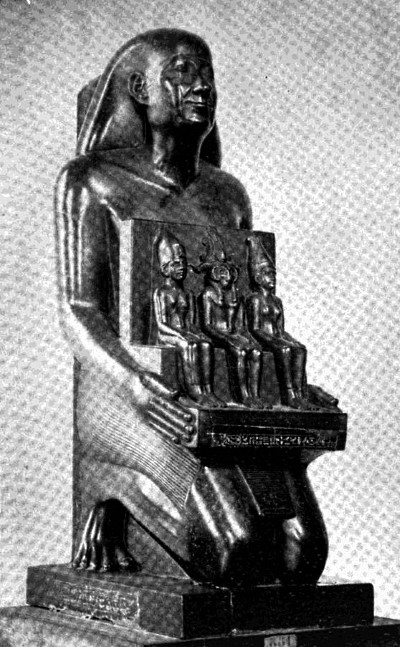
SYMBOLIC STATUE OF HORUS, SON OF OSIRIS AND ISIS
IN THE ACT OF PURIFYING A KING
MUSÉE NATIONAL DU LOUVRE, PARIS
H. P. Blavatsky, in Isis Unveiled, quotes the following from the
ancient Hindû historian, Kullûka-Bhatta:
Under the reign of Viśvâ-mitra, first king of the Dynasty of Soma-Vanga,
in consequence of a battle which lasted five days, Manu-Vina, heir of the ancient
kings, being abandoned by the Brâhmans, emigrated with all his companions,
passing through Ârya, and the countries of Barria, till he came to the shores of
Masra. (Vol. I, p. 627)
She adds:
Ârya is Eran (Persia); Barria is Arabia, and Masra was the name of Cairo,
which to this day is called Masr, Musr, and Misro. (Ibid.)
Mitsraîm was the Hebrew name for the land of Cham, Egypt.
Dr. E. A. W. Budge, the learned Keeper of the Egyptian and
Assyrian antiquities in the British Museum, says he believes that
a series of carvings on the walls of the Temple of Edfû,
represent the invaders in prehistoric times, who made their way into Egypt,
from a country in the East, by way of the Red Sea.... In later times the
indigenous priesthoods merged the legendary history of the deified king of the
"Blacksmiths" is that of Horus, the god of heaven in the earliest times, and in
that of Râ which belonged to a later period.
The mythical story of Horus conquering Nubia and Egypt, with
which Dr. Budge thinks the true story of incursion was blended,
contains the significant assertions that the warriors of Horus, the
"Blacksmiths," were armed with weapons of metal, and chains, and
were expert builders.
According to the Theosophical records the Great Pyramid was
built long before the fifth millennium b. c. There are many mysteries
connected with that most stupendous work of man which have not
yet been suspected by the Egyptologists, not the least of which is the
problem of its date and its builder; but, so far as they go, the stories
of Horus' invasion and M. Capart's luminous suggestions as to the
origin of the Dynastic Egyptian civilization, are not inconsistent with
the account of Kullûka-Bhatta; and in the light of the new discoveries
of one or more prehistoric civilizations in the Nile Valley, it looks as
if the teachings of Theosophy were being vindicated in a way that was
not dreamed of by archaeologists in the days when H. P. Blavatsky
opened a small window into the mysterious past of glorious Egypt.
THE SCOPE OF ART: by R. W. Machell
A WRITER in a London weekly (Black and White)
makes one or two points in reference to art that are
worthy of notice. He says that it is nonsense to talk
of art elevating the people, because it is itself the
index of their condition. This is just one of those
simple fallacies that contain a sufficient amount of the truth to make
them misleading. Art is not an index of the condition of the people,
but only of a very small part of the people; it would be more true
to say that the popular appreciation of art is such an index; but it
is not true to say or to imply that the condition of the people governs
its range or scope. We are constantly met by the experience of art
that is unappreciated by the people in whose midst it appears.
It is necessary to understand the complex nature of man and the
vast range of human evolution to be able to see how one man may
appear in a nation and display a degree of progress far in advance
of his fellows, who also are all in varying stages of their long evolution.
The progressed soul incarnates perhaps in a body just like those
of the rest of the race, because it cannot get a better; and so it is not
at once recognized as an older soul, and for want of right education
the man himself may be unable to account for the difference between
himself and his fellows of which he is conscious; and so, being unaware
of his own inherent divinity and of his relation to his fellows,
he may not recognize his responsibility to them as a natural leader,
fitted by greater experience to show a light on the path of human
progress, and required by Karma or by his kinship to his fellows, to
use his experience, or his talents, or his genius, for their guidance
rather than for his own glory.
Then passing to the subject of the recent sale of the famous
Rembrandt to an American he very wisely points out that this is a
private matter, and not in any way a national or an artistic point of
interest. As said, the picture (not an English painting) was not in
any sense a national possession, nor was it of any importance in the
art-life of the nation that it should be added to the already large collection
of the master's works now owned by the National Gallery. What
the writer maintains is vital to a nation, is to encourage and to appreciate
the art of its own day and of its own artists.
Now here we meet the deplorable parochialism that does duty for
patriotism, and which is so utterly out of place in connexion with art;
for art is not national but universal, and, further, it is not modern or
ancient, but again universal; so that an attempt to limit the sympathies
of art-lovers to the products of their own age or of their own
nation is bound to fail, and can only be tolerated as an antidote to
an excessive worship of what is old or of what is foreign, these being
matters of perhaps no consequence at all.
It is of course well that people should do the duty that lies nearest
to hand first, and so if it be a duty to encourage, to endow, or to
patronize art, that duty should begin at home. But this again is a
very narrow way of looking at the matter. It is not at all essential
that art should be national; on the contrary, art is universal and cannot
be bound by any such limits. No barriers stand in the way of one
who would admire a foreign painting; one may speak no language
but one's own and yet find as much beauty, joy, and inspiration in
foreign works of art as in those produced by men of one's own nationality.
A visitor to a collection of works of art has to be told by a
catalog, or he would not know, what country produced any particular
work; so it is with music, and largely with architecture; indeed that
which is of Art is universal: the national characteristics are limitations
imposed by circumstances upon the free expression of the soul.
The soul of man is not eternally bound within the limits of one
nation, but must, in the course of constant reincarnations upon earth,
experience the limitations of many varying nationalities. It is
bound to the great human family; and it may be, for a certain period,
identified with a special group. Nations are evanescent, though family
groups may survive, and though an artist may be intimately bound
by many ties with the destinies of some one group or family or race,
in its reincarnations and in its varying national appearances, yet the
artistic part of his nature is just that higher part that rises beyond
such limits and appeals to all humanity, and it is the higher part of
human nature that responds to the appeal of art and disregards all
other limitations, such as questions of time or place or nationality,
rising to what is more broadly human or more divine in the nature of
man. For "Brotherhood is a fact in nature," and the soul responds
unconsciously to the call of the Soul in all nature and in all humanity
in such degree as it is able to throw off for a time the temporary bonds
of local conditions. So it is a matter rather of satisfaction to see
works of art circulating around the world and awaking the deeper
sympathies that tend to unite humanity.
MUSIC AND LIFE: by William A. Dunn
THERE is not a problem which perplexes human life that
may not be loosened and solved by the aid of music. Based
as it is upon the vibratory movements of Nature, and subject
to rigid mathematical law and geometrical ratio, music
represents an incorruptible and direct medium between the
higher and lower natures of man. Its dynamical and spiritual power
proceeds from the blend of its related vibrating numbers; which blend
is that living force (within outward harmony) that electrifies the
heart and mind and lifts the whole nature to the plane of soul. It is
that living field of energy in which all numbers, all forces, all substances,
are lost in the unity of least-common-multiple of all possible
vibrations. It is the Veil of Isis.
No motion can take place without causing sound. This must be
equally true of atomic and planetary movements, and all that lies
between. All sounds that appear to the senses as different must
obviously vibrate in some universal medium which permits movement
and unifies their seeming diversity. It is the actual presence of such
a medium in man which enables him to perceive that which music is
the expression of. Notes and chords are merely alphabetical symbols.
These are classified and combined to express ideas as truly as words
are combined to convey the thought that lies beyond them.
It has been said that "The Universe is built by number." This is
obvious truth when all natural forces and elements are conceived of
as modes of vibration (as they actually are) blending and interblending
in the universal etheric medium, according to the immutable law
of harmonious ratios. Why should the etheric world be thought of
as an abstraction or a far-off possibility? It is in reality a nearer
thing in life than its comparatively trifling contents. All our thoughts
and feelings move in it as their medium, and the process of self-conquest
is nothing more than to live in this our universal home, and
harmonize dissociated thoughts and feelings into musical symphonies.
This is not rhapsody, but sober common sense, as true for the field-laborer
as for the philosopher. As we all live in and breathe the same
physical atmosphere, so do we all think and feel in the same mental
ether. This fact explains why "Brotherhood is a fact in nature."
To accept this principle of Brotherhood as the point from which life
is viewed is equivalent to mounting to the hill-top of life from which
the surrounding scenery can be seen. Down in the valley a single
wall can shut out the whole prospect.
A text-book on chemistry may be consulted with profit as illustrating
this fact. A few general principles or laws classify millions of
separate facts into harmonious knowledge. The science of chemistry
is also the science of true music. Schopenhauer speaks of music
as immediate and direct an objectivation or copy of the Will of the world as
the world itself is, as the ideas are of which the universe of things is the phenomenon.
Music is not the copy of the ideas, but a representation of the cosmical
Will co-ordinate with the ideas themselves.
The literal truth of this statement is known by all who have had
contact with that which creates, and breathes life into, a musical
masterpiece. The audible notes and phrases are merely classified
symbols which express something beyond them, just as the parts of
a dynamo are adjusted as medium for the expression of the universal
electrical power.
Music, in itself, is the universal life of Nature as she is in vibration.
Every movement, from that of planet down to minute atom,
emits tone. It is absurd to imagine that our octave of audible receptivity
limits the universal fact. It can only do so for us. The refining
and extension of receptive range of hearing must undoubtedly reveal
the music which ever surrounds our self-imposed deafness. All discoveries
and advances in knowledge are simply this: the unfolding of
organs of receptivity in which some universal fact may reflect itself.
All knowledge and power exist eternally. Man is the only variant
(because of his power of choice) and he cripples himself in imagining
that the revelation of limited organs of receptivity are equivalent to
the universal fact.
Let us picture a great music hall in which an orchestra is performing.
No matter what sounds proceed from the many instruments,
their united tones vibrate through every particle of air in the
building simultaneously. Sound waves may be many, but, every atom
of air is participant in all these at one and the same instant. The
atom therefore is the synthetic point of universal unity.
Man is an atom in that grand temple of music—the solar system.
Through him passes every movement or sound propagated by planet
or sun—and all the lesser movements to which they give rise. We
actually participate in the total vibration of solar life, but are blind
to this because the brain consciousness is attached to a few external
sound waves and sets up a conscious focus amid these. A musician
will tell us how easily the mind may select a single orchestral instrument
and follow its melody to the exclusion of the adjacent parts.
How truly this illustrates our separate personal lives! It is impossible
to lose anything by detachment from the personal grooves to
which so much importance is attached. We can only fall into That
which gives the utmost blessing. That silence and solitariness which
usually follow the storm of true effort, is the womb of fuller life.
The old life has passed, the new not yet born, and we are apt to
despond. But courage and patience will surely lead to living joy, for
the new life dawns when the inner self is ready to receive it. Right
thought, right feeling, and unending patience, will without doubt
make all things clear, and from the heart will arise the total music
of life, vibrating in tune with all that is.
THE ASTRAL BODY: by H. A. W. Coryn, M.D., M.R.C.S.
IT is safe to say that science will never accept the astral
body—by that name: at any rate not until philosophy
accepts the prototypal Ideas of Plato.
Yet the evidence, if not for them, then for something
discharging the same function and therefore after all for
them—is irresistible.
One thinks first of the growth of living animal tissues in glass
jars, demonstrated at the Rockefeller Institute. Removed from the
body to which they belong and placed in nutritive fluids which they
can absorb, they attain a size that would constitute them fatal diseases
if they were in situ at home. They would in fact be malignant
growths of highly organized types.
Why don't they grow to that size? Because "the nervous system"
restrains them within the limit of usefulness. How does "the
nervous system" know that limit? Has it a picture in its "mind,"
a plan according to which it works, according to which it variously
restricts or encourages?
When some of the molluscs are cut in two each half grows the
part it has lost, the head an after-part, the after-part a head. Two
animals result, each exactly like the original. As the severed cells
are called upon to perform and do perform new and unexpected
work, what and where is the architectural plan by which they do it?
The cells of a leaf have finished their growth. Now comes their
work, the fixing of carbon from the air, transpiration, and so on.
But cut off, say, a begonia leaf and place it on damp soil properly protected.
It proceeds at once upon a wholly new program, sending
down roots, sending up stalk, fresh leaves, and finally flower. It is
obviously working according to a plan. When a germ cell or seed
does that the problem can be concealed by talking about its chemical
constitution and so forth. We are told that the seed behaves as it
does because it is constituted by nature to do so, molecularly arranged
for just that function. But the cells of the leaf were not arranged
for that but for quite other functions. How come they to be able to
stop their proper line of work and follow this one, generating not
only leaves like themselves but all other parts of the plant including
seeds?
We are of course pressing the problem of heredity, the persistence
of racial and family type. But heredity is only a word that expresses
the observed facts without a gleam of explanation.
The consciousness of the mollusc, as an individual, and that of
the leaf on a lower plane, can be only sensational. They do not
intelligently arrange and design what they are doing. But to ascribe
it to molecular mechanism only, is no better than to say God did it.
Either is such a form of mere words as unwise parents throw at a
too questioning child to stop, without satisfying, its mind. No idea
corresponds. The gap in conception remains exactly what it was.
When a chimney is blown down, the builder notes the gap and
builds another. His mind contains a picture of what ought to be there.
An architect does not deliver the whole plan of his building to
each of the workmen. Each follows his ordinary work, being merely
told where to begin and when to stop. When all of them have done
their part the building is complete.
Why may we not suppose that the cutting-in-two of a mollusc
constitutes some such appeal to some intelligence somewhere in nature
as the missing chimney constitutes to the builder? The force
flowing in the cells of the injured animal is thereupon directed to the
work unexpectedly required. Science now speaks freely of human
"subconsciousness," meaning sub-mental consciousness in man. And
it knows that that sub-mental consciousness can, when properly called
upon (and also habitually on its own account), do reparative work
upon the body whose method is not comprehensible to the man himself.
It is, within its limits, intelligent; it knows what it has to do
and what it is wanted to do; and it commands the necessary forces—which
are beyond the man's reach, owner of them as he may be or
think he is.
This subconsciousness is embodied with the man, but is not the
man and is not an ego. May it not be regarded as a part of nature-consciousness,
focused in an organic body and with the intelligence
necessary to do its work?
And it does not follow that the lower down the scale of mental
intelligence is an organism, the lower down a parallel scale is this
intelligence. What we call, when in our own bodies, the subconscious,
may be just as fully present and just as intelligently at work, in the
bodies of plants and animals.
If we say that the plan of repair and the plans of hereditary type
are in the conscious intelligence of this diffused nature-mind, we are
at any rate reasonably proceeding from the known and not glossing
the unknown with mere words. The astral body of any plant or
animal is its plan of structure in this nature-mind. It is subjective
substance, just as is a picture in our own mind. And it contains the
vital energy necessary for the guidance of the protoplasmic matter
that will clothe it, an energy that guides but is not one of the physical
forces. As an analogy from higher up the planes of being, conscience
guides mental thoughts and desires but is not among their number
nor of their nature. It is the divine-astral form or plan, of what the
thinking man should be. On both planes the form and the guiding
energy setting from it become the negative and positive aspects of
one thing.
THE BIRTH OF DAY by A. F. W. (Manchester, N. H.)
FROM the darkness, O Eternal One,
From the pale light of diamond stars,
From the quietude of dreamless night,
Into the grayness and the formless mist,
Comes the first whisper, the first murmur
Of Life awakening.
Merges then the dim outline and the shadow,
Floating nothings, pregnant with the promise
Of the coming birth of Morning.
Gradually, slowly, silently,
The shapes resolve themselves
And grow less misty and more huge;
The grayness becomes less gray;
And, as it so becomes, the horizon
Erstwhile faint and indistinct,
Slowly as a line appears, not sharp,
But blended with both earth and sky.
A sleepy twitter from the birds, the first call
Of mate to mate; the faint, soft rustle
Of the leaves, the vapor rising from the earth—
All betoken the oncoming.
The ghostly outlines of the forms
Are clearer now; and the vivid streamers
Of the eastern sky change to the white light
Of the advancing Morn.
Now approach the fuller tones of nature:
Insistent the notes of the tiny feathered ones,
And from the nests and branches come
The piping calls to morning quest.
Now the silver white takes on the faint
Tinging of the purple glow.
The purple to a blue transforms itself;
The gnomes of dawn are hard at work
Transmuting the base metal into finer gold.
As distant fire, urging on the horses of wild Fear
Mounts higher and more high,
So Apollo urges on his horses, and the golden gleam
Of his chariot heralds itself
To follow after.
The horizon blazes with the power of Light—
More red and fiery grows the hue;
A point appears, a rim, an arc
Of coppery luster; then
Glowing with the radiance of the parent Life
The Sun!—And Day is born.
H. P. BLAVATSKY AND THE THEOSOPHICAL SOCIETY
In 1887 William Q. Judge wrote of the Theosophical Society and H. P.
Blavatsky as follows:
THE Society has had, like all sentient beings, its periods of
growth, and now we believe it has become an entity capable
of feeling and having intelligence. Its body is composed
of molecules, each one of which is a member of the Society;
its mental power is derived from many quarters, and it
has a sensibility that is felt and shared by each one of us. For these
reasons we think it is a wise thing for a person to join this body, and
a wiser yet to work heart and soul for it.
And we would have no one misunderstand how we look upon
H. P. Blavatsky. She is the greatest woman in this world in our
opinion, and greater than any man moving among men. Disputes
and slanders about what she has said and done move us not, for we
know by personal experience her real virtues and powers. Since 1875
she has stood as the champion and helper of every Theosophist; each
member of the Society has to thank her for the store of knowledge
and spiritual help that has lifted so many of us from doubt to certainty
of where and how Truth might be found; lovers of truth and seekers
after spiritual knowledge will know her worth only when she has
passed from earth; had she had more help and less captious criticism
from those who called themselves co-laborers, our Society would today
be better and more able to inform its separate units while it
resisted its foes. During all these years, upon her devoted head has
concentrated the weighty Karma accumulated in every direction by
the unthinking body of Theosophists; and whether they will believe
it or not, the Society had died long ago, were it not for her.
The following are extracts from an article also by William Q. Judge, written
after H. P. Blavatsky's death:
That which men call death is but a change of location for the
Ego—the immortal self—a mere transformation, a forsaking for a
time of the mortal frame, a short period of rest before one reassumes
another human frame in the world of mortals. The Lord of this body
is nameless; dwelling in numerous tenements of clay, it appears to
come and go; but neither death nor time can claim it, for it is deathless,
unchangeable, and pure, beyond Time itself, and not to be measured.
So our old friend and fellow-worker has merely passed for a
short time out of sight, but has not given up the work begun so many
ages ago—the uplifting of humanity, the destruction of the shackles
that enslave the human mind....
That she always knew what would be done by the world in the
way of slander and abuse I also know, for in 1875 she told me that
she was then embarking on a work that would draw upon her unmerited
slander, implacable malice, uninterrupted misunderstanding,
constant work, and no worldly reward. Yet in the face of this her
lion heart carried her on. Nor was she unaware of the future of the
Society. In 1876 she told me in detail the course of the Society's
growth for future years, of its infancy, of its struggles, of its rise
into the "luminous zone" of the public mind; and these prophecies
are being all fulfilled.
Her aim was to elevate the race. Her method was to deal with
the mind of the century as she found it, by trying to lead it on step
by step; to seek out and educate a few who, appreciating the majesty
of the Secret Science and devoted to "the great orphan Humanity,"
could carry on her work with zeal and wisdom; to found a Society
whose efforts—however small itself might be—would inject into
the thought of the day the ideas, the doctrines, the nomenclature of
the Wisdom-Religion, so that when the next century shall have seen
its seventy-fifth year the new messenger coming again into the world
would find the Society still at work, the ideas sown broadcast, the nomenclature
ready to give expression and body to the immutable Truth,
and thus to make easy the task which for her since 1875 was so difficult
and so encompassed with obstacles.
HELENA PETROVNA BLAVATSKY
FOUNDRESS OF THE THEOSOPHICAL SOCIETY
THE LEADERS OF THE THEOSOPHICAL MOVEMENT
H. P. BLAVATSKY KATHERINE TINGLEYWILLIAM Q. JUDGE
THE PATH—SOME WORDS OF WILLIAM Q. JUDGE
IN 1886, William Q. Judge, the pupil and colleague and
afterwards the successor of H. P. Blavatsky, founded
and edited The Path, the first American Theosophical
magazine. After his death, this magazine was continued
by his successor, Katherine Tingley, and was
by her finally merged into and combined with a weekly magazine,
published under the title of the Century Path. This has again given
place to The Theosophical Path, thus distinctly calling attention
to the teachings it promulgates and sets forth, while preserving the
name "The Path" of the first American Theosophical Magazine.
The Theosophical Path in its first issue pays honor to both
these great-hearted Teachers, H. P. Blavatsky and William Q. Judge.
All humanity owes them a debt of gratitude for pointing out once
more the path of true progress and happiness. Through their self-sacrifice,
even of their lives, "the pathway is once more seen to
that realm where the Gods abide."
In the first issue of The Path, William Q. Judge wrote:
The solution of the problem, "What and Where is the Path to Happiness?"
has been discovered by those of old time. They thought it was in the pursuit
of Râja Yoga, which is the highest science and the highest religion—a union
of both....
The study of what is now called "practical occultism" has some interest for
us, and will receive the attention it may merit, but it is not the object of this
journal....
True occultism is clearly set forth in the Bhagavad Gîtâ, where sufficient
stress is laid upon practical occultism, but after all, Krishna says, the kingly
science and the kingly mystery is devotion to and study of the light which comes
from within. The very first step in true mysticism and true occultism is to try
to apprehend the meaning of Universal Brotherhood, without which the very
highest progress in the practice of magic turns to ashes in the mouth.
We appeal, therefore, to all who wish to raise themselves and their fellow
creatures—man and beast—out of the thoughtless jog trot of selfish everyday
life. It is not thought that Utopia can be established in a day; but through
the spreading of the idea of Universal Brotherhood, the truth in all things may
be discovered. Certainly, if we all say that it is useless, that such high-strung
sentimental notions cannot obtain currency, nothing will ever be done. A beginning
must be made, and it has been by the Theosophical Society. Although
philanthropic institutions and schemes are constantly being brought forward by
good and noble men and women, vice, selfishness, brutality, and the resulting
misery, seem to grow no less. Prisons, asylums for the outcast and the magdalen,
can be filled much faster than it is possible to erect them. All this points unerringly
to the existence of a vital error somewhere. It shows that merely healing
the outside by hanging a murderer or providing asylums and prisons will never
reduce the number of criminals nor the hordes of children born and growing up
in hotbeds of vice. What is wanted is true knowledge of the spiritual condition
of man, his aim and destiny. This is offered in Theosophical literature, and
those who must begin the reform are those who are so fortunate as to be
placed in the world where they can see and think out the problems all are
endeavoring to solve, even if they know that the great day may not come until
after their death. Such a study leads us to accept the utterance of Prajâpati to
his sons: "Be restrained, be liberal, be merciful"; it is the death to selfishness.
In an article "A Year on the Path," Mr. Judge wrote, at the close
of the first year of the magazine:
The question is always naturally asked, "What is the Path?" or "What is
the Philosophy?" which is the same thing, for of course the following of any
path whatever will depend upon the particular philosophy or doctrines believed
in. The path we had in view is held by us to be the same one which in all ages
has been sought by Heathen, Jew, and Christian alike. By some called the path
to Heaven, by others the path to Jesus, the path to Nirvâna, and by Theosophists
the path to Truth. Jesus has defined it as a narrow, difficult and straight path.
By the ancient Brâhmans it has been called, "the small old path leading far away
on which those sages walk who reach salvation"; and Buddha taught it was a
noble four-fold path by which alone the miseries of existence can be truly surmounted....
The immortal spark has manifested itself in many different classes of men,
giving rise to all the varied religions, many of which have forever disappeared
from view. Not any one of them could have been the whole Truth, but each must
have presented one of the facets of the great gem, and thus through the whole
surely run ideas shared by all. These common ideas point to truth. They grow
out of man's inner nature and are not the result of revealed books. But some
one people or another must have paid more attention to the deep things of life
than another. The "Christian" nations have dazzled themselves with the baneful
glitter of material progress. They are not the peoples who will furnish
the nearest clues to the Path. A few short years and they will have abandoned
the systems now held so dear, because their mad rush to the perfection of their
civilization will give them control over now undreamed of forces. Then will
come the moment when they must choose which of two kinds of fruit they will
take. In the meantime it is well to try and show a relation between their present
system and the old, or at least to pick out what grains of truth are in the mass.
... A new age is not far away. The huge unwieldy flower of the 19th
century civilization has almost fully bloomed, and preparation must be made for
the wonderful new flower which is to rise from the old. We have not pinned
our faith on Vedas nor Christian scriptures, nor desired any others to do so.
All our devotion to Aryan literature and philosophy arises from a belief that
the millions of minds who have trodden weary steps before ours, left a path
which may be followed with profit, yet with discrimination. For we implicitly
believe that in this curve of the cycle, the final authority is the man himself.
In former times the disclosed Vedas, and later, the teachings of the great
Buddha, were the right authority, in whose authoritative teachings and enjoined
practices were found the necessary steps to raise man to an upright position.
But the grand clock of the Universe points to another hour, and now Man must
seize the key in his hands and himself—as a whole—open the gate. Hitherto
he has depended upon the great souls whose hands have stayed impending doom.
Let us then together enter upon another year, fearing nothing, assured of strength
in the Union of Brotherhood. For how can we fear death, or life, or any horror
or evil, at any place or time, when we well know that even death itself is a part
of the dream which we are weaving before our eyes.
Our belief may be summed up in the motto of the Theosophical Society,
"There is no Religion higher than Truth," and our practice consists in a disregard
of any authority in matters of religion and philosophy except such propositions
as from their innate quality we feel to be true.
SAVING FOREST WASTE: Note by a Student
IN the Yearbook of the Department of Agriculture just issued, it
is pointed out that conservation of the timber supply involves the
co-operation of the public, the lumbermen, and the wood-consuming
industries, as well as of the National Government. Forest
conservation is not possible at the low prices of former days, and in
general prices must advance before much can be done. Then the
public must be prepared to accept new woods; the farmer must give
up using cedar, white-oak, and chestnut posts; railroads must cease
using white-oak ties; builders must accept other lengths and widths.
Meantime the Government co-operating with Wisconsin University,
has established a thoroughly equipped wood-testing laboratory at
Madison, where many problems are being investigated, from the
standpoints of forest conservation and commercial requirements.
In the valuable magazine American Conservation, for May 1911,
it is stated that Argentina has a hundred million acres of wooded land,
mostly quebracho and yerba tree, both in increasing demand. In
Brazil there is about a thousand million acres of wooded land. There
ruthless destruction cannot go on, as most concessions now require
proper conservation of the rubber and other trees. Bolivia has quebracho,
rubber, coca, cinchona, and other trees useful in the arts. The
timber tracts of Colombia are practically unexploited. The slopes of
Ecuador are richly wooded. The forests of Peru occupy about three
hundred million acres, and its government has taken steps to ensure
conservation, and contemplates experiment stations.
Copyright by Katherine Tingley, 1911Lomaland Photo. and Engraving Dept.
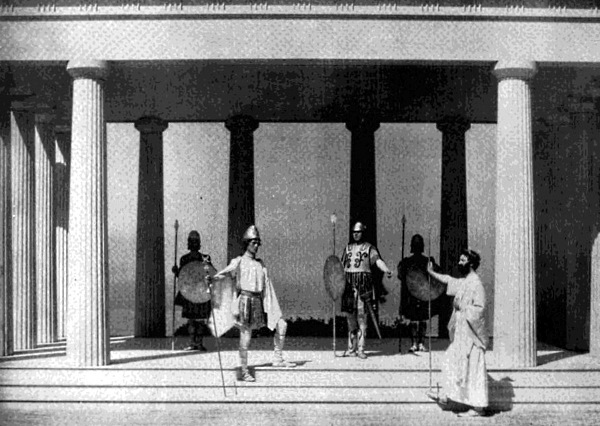
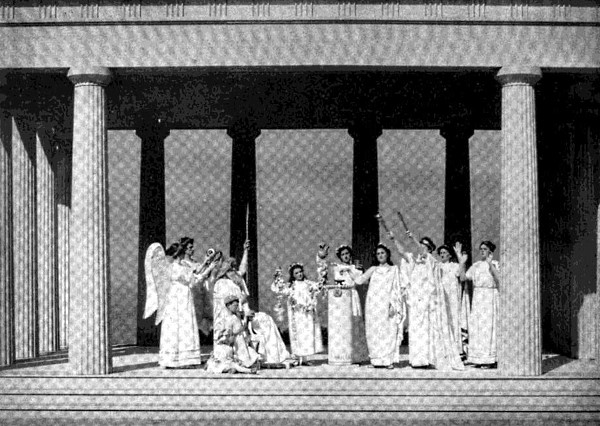
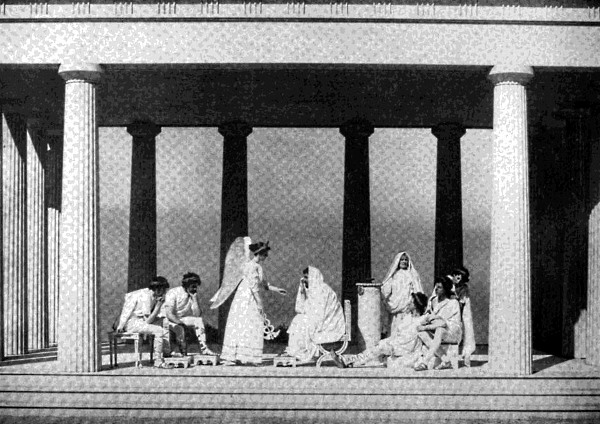
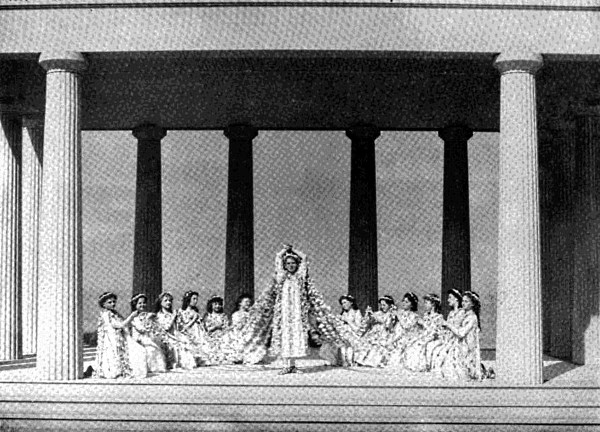
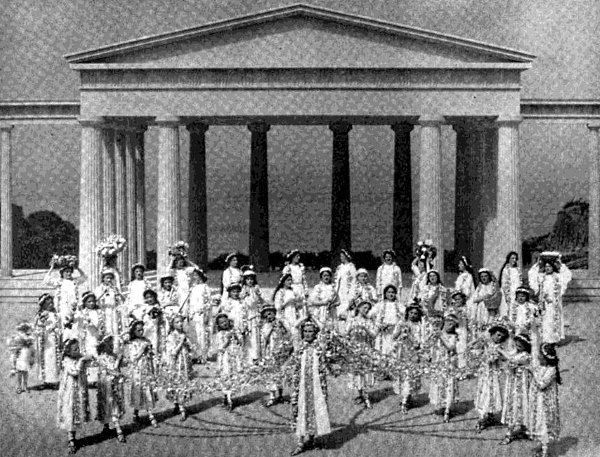
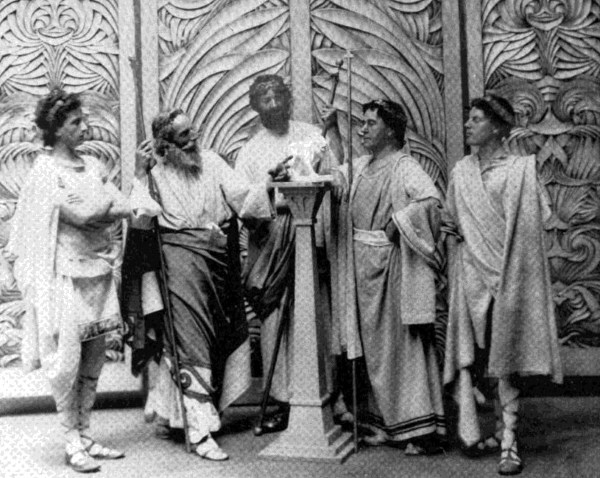
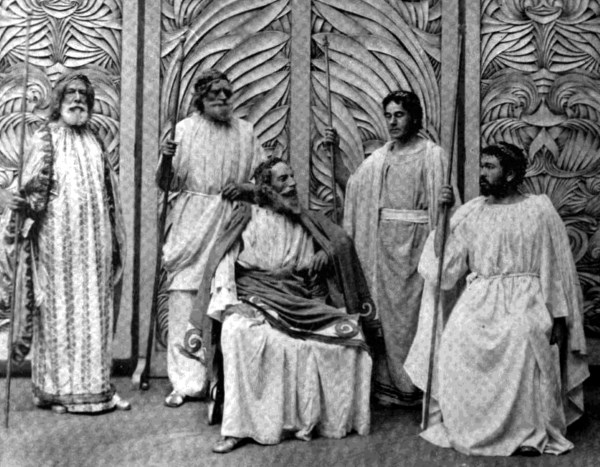
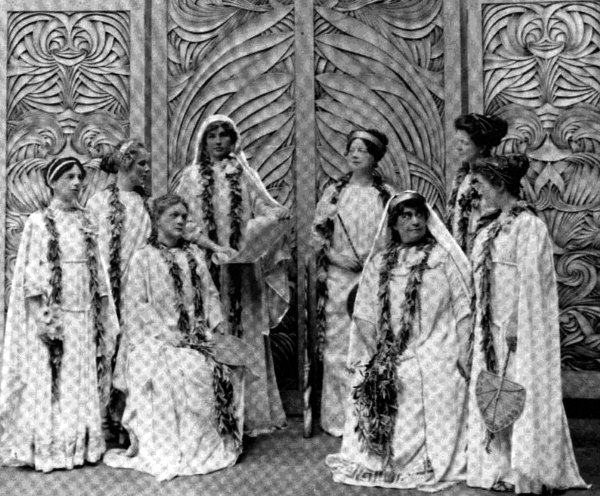
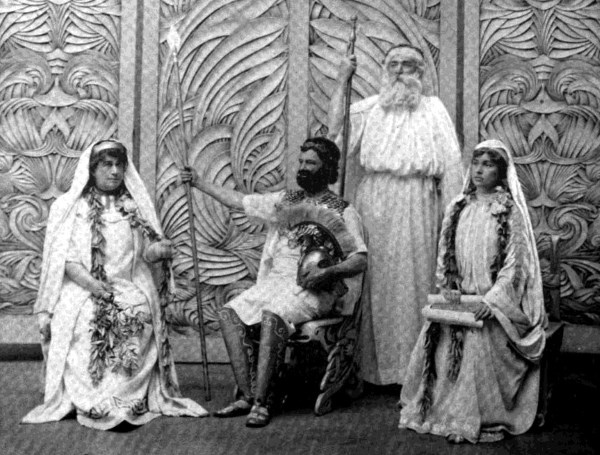
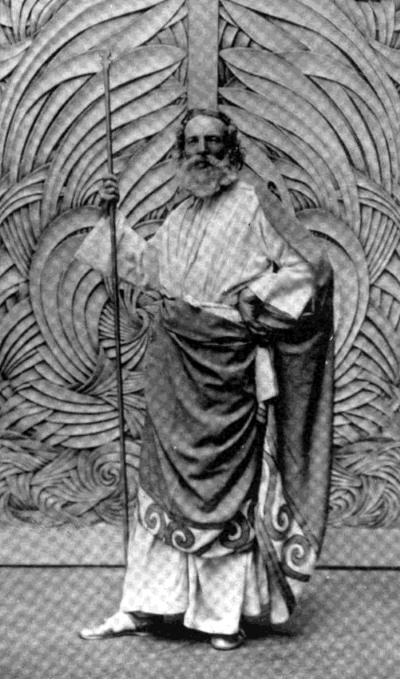
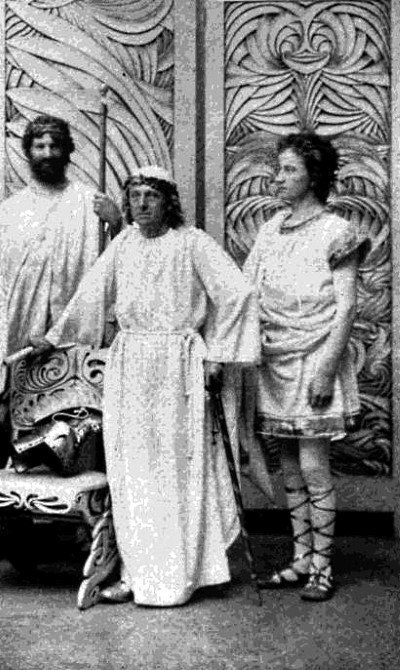
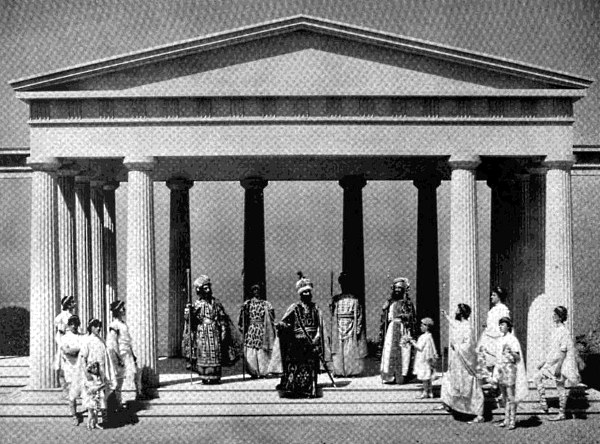
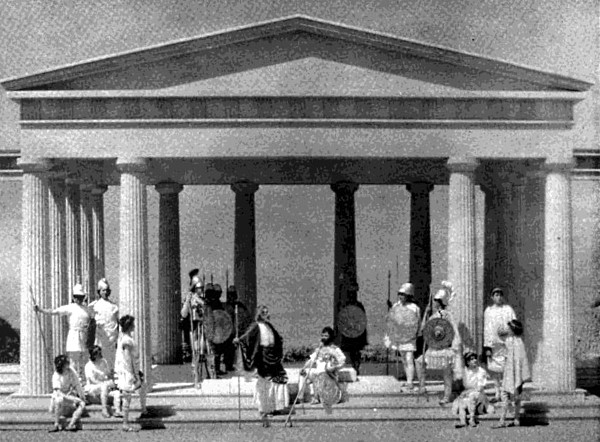
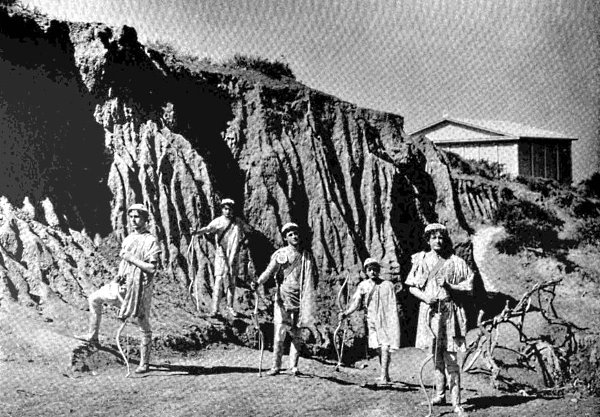
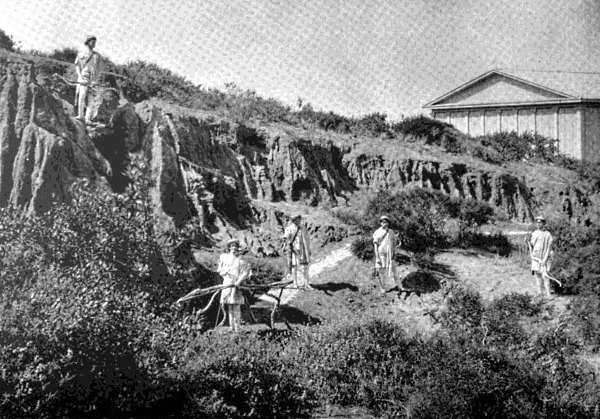
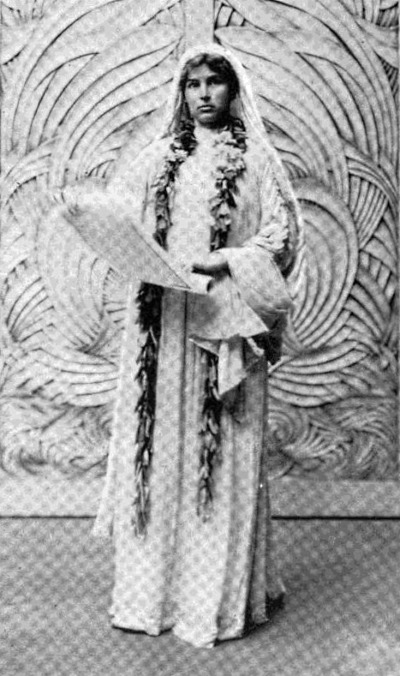
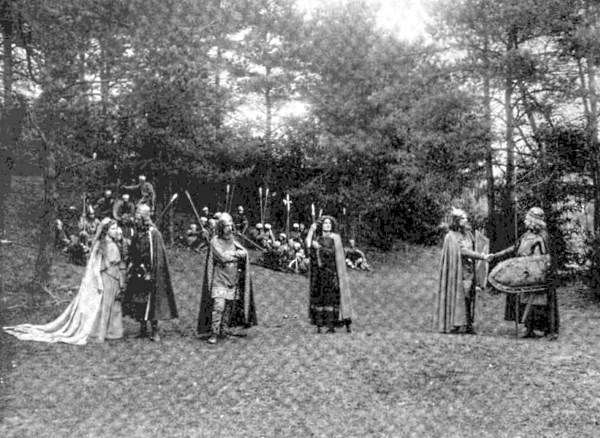
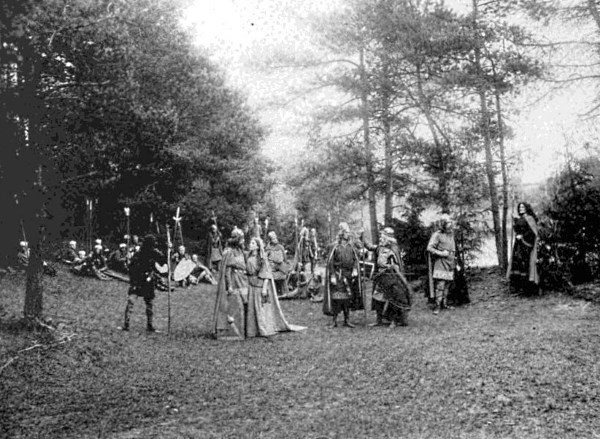
SCENES FROM "THE AROMA OF ATHENS"
CENTRAL FIGURE IN FRONT PHIDIAS, BEHIND HIM PERICLES
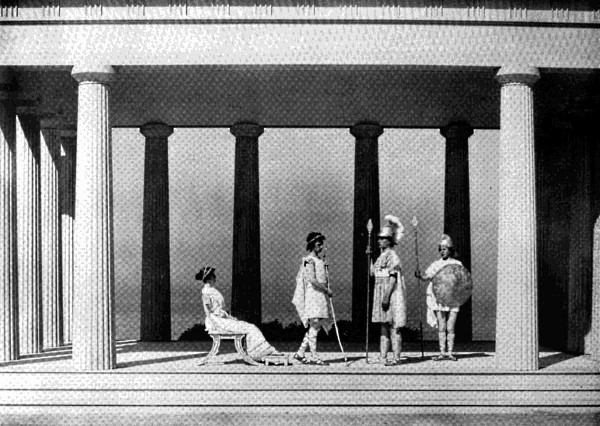
Copyright by Katherine Tingley, 1911Lomaland Photo. and Engraving Dept.
CENTRAL FIGURE PERICLES, ON THE LEFT PHIDIAS, ON THE RIGHT DIOCHARES
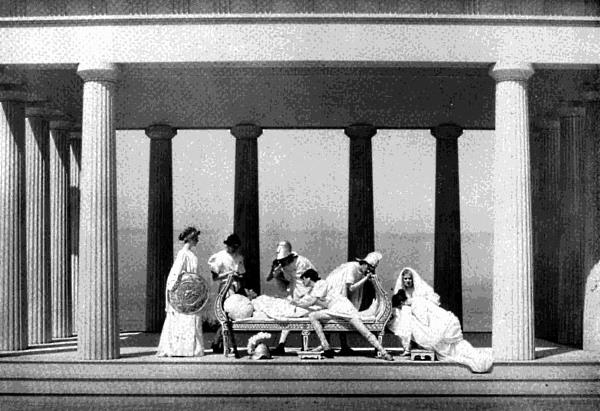
Copyright by Katherine Tingley, 1911Lomaland Photo. and Engraving Dept.
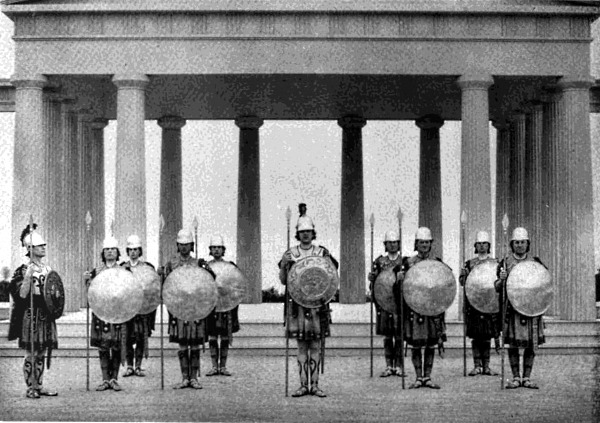
ATHENIAN SOLDIERS
Copyright by Katherine Tingley, 1911Lomaland Photo. and Engraving Dept.
SOCRATES AND HIS DISCIPLES
"AROMA OF ATHENS" STRIKES NEW NOTE IN THE DRAMA. Katherine Tingley to Open Greek Theater to the Public: Unrivaled Natural Scenery: Marvelous Acoustics. Notes by a Dramatic Critic
A NEW-OLD note in drama has been struck here on the Pacific Coast,
which, we feel quite safe in prophesying, will be recorded in many
histories. The English-speaking world has been fretting after some
new inspiration. We are tired of imitating the Elizabethans; for
the time being, that spring would seem to have run dry. What
belongs to our own day peculiarly tends to be mere boisterous horseplay
or flippant shallowness; vulgar both, and not in any way to be called art.
What we have that is good, the work of a few writers, is not so startling in
quantity or quality, nor so profoundly original, as to cause us to hope for a new
great art period in our own or our children's day. And yet there has been the
demand. The public has turned to strange well-springs and found the waters
bitter, cloying, soon to run dry; the critics have filled their press columns, both
here and in England, with clamorings, prognostications, hasty or timorous judgments,
a sense of a great need and expectations. Decidedly the time is ripe for
a new birth in the drama.
MEETS NEEDS OF THE TIME
Now the question arises, what needs must this new birth and order meet?
Great art meets the needs of its time, sternly turning away from its mere wants;
for that reason it is often rejected for awhile by a public clamorous after lower
levels of things. Such a clamor we find in our own day after sensationalism—give
us action, more action, say the managers; but is this a real need? The
world is agog with action as it is; such a riot of action as one might imagine the
Gadarene swine indulged in on their seaward last tumultuous journey. The
motif is threadbare; we have torn it to tatters and it is time to turn to new modes.
Personalism, too, is rampant and bears fruit in an ugly and jangled civilization.
What is needed, then, is an art that shall be calm, dignified, beautiful, impersonal;
a pointer to and promise of better ways of living.
One turns back to the great art of the Greeks with a sense of relief after
all our modern, breathless, tom-tom beating. There we find beauty, calm movement,
dignity, national, and not merely personal motifs; above all, an insistence
on the higher and eternal verities. We need the Aroma of Athens on our modern
stage; because it is precisely that that we need in our modern life.
PLAY DELIGHTED AUDIENCE
A few weeks ago Katherine Tingley presented a new play, The Aroma of
Athens, at her Isis theater in San Diego, which struck all who saw it with profound
surprise and delight. There was first the ideal poetic beauty of the setting,
a thing unrealizable unless seen. The foremost of the London managers—men
like Tree—have made a specialty of beautiful setting, astonishing the theatrical
world with the splendor of their work in this line—and with its good taste.
They have had enormous resources to draw upon, and have spared no expense
in time, money, or thought. It may safely be said that none of them has produced
anything more beautiful than this Aroma of Athens; it may safely be said that
none of them has produced anything so beautiful. One rubbed one's eyes in
astonishment, wondering how such things could be, and concluded that Madame
Tingley at Point Loma had greater resources to draw upon than are to be found
in London, Paris, Berlin, or New York. It is a wonderful thing, prophetic of the
time when the culture-metropolis of the world will be right here among us on
the Pacific Coast. Madame Tingley long ago said that San Diego would be the
Athens of America, and today this is far nearer than we dream. If one would
learn what those greater resources of hers are, one must examine her teachings,
one must look into that marvelous scheme of education of hers, the Râja Yoga
system, which enabled, for example, those little children on the stage to be as
graceful, as un-self-conscious as any figures on a Grecian vase. Have you seen
children, young children, on the stage, do well, wonderfully well; and then, when
the applause rolled in, do better still, remaining sublimely unconscious of the
applause? We applauded these children and looked to see, as a matter of course,
the aroma of Athens vanish in a series of smirks. But no; clapped we never
so loudly, it made no difference to them. They played their Greek games; they
were merry and classical; they were Grecian, unstilted, poetic, faery. One's
mind went back to Keats' ode:
"What little town by river or sea-shore,
Or mountain-built with peaceful citadel,
Is emptied of its folk, this pious morn?"
And the answer was: Athens, Periclean Athens in all her superb flawless
beauty and splendor; yes, those were real Athenians; of whom we have read in
Keats and Swinburne; that we have seen sculptured in the Elgin marbles. Here
they were, in the flesh and blood; here was the heyday of historic beauty, shedding
its supreme aroma on us; with these tones Plato and Aeschylus would have
spoken; in this manner Phidias and Pericles would have moved. It was a revelation,
a marvelous artistic realization—indeed, it is a shame to use such cant
hackneyed phrases for a thing so beautiful, so august—and yet so completely
natural and unstrained.
GREATER THINGS PROMISED
So much for its performance in a modern theater, but greater things are
promised. If all this is true of a play which was first thought of ten days before
it was presented—and that is the fact—what is not to be hoped from the new
presentation of it on April 17, a presentation of which, we are told, the former
ones were but little more than sketches, and which is to be given in a real Greek
open-air theater?
The Greek theater at Point Loma, the first in America, was built by Madame
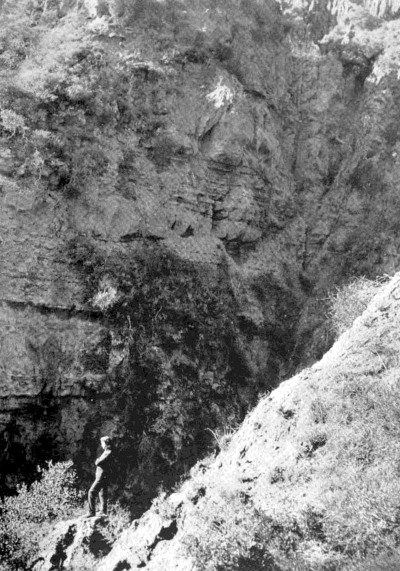
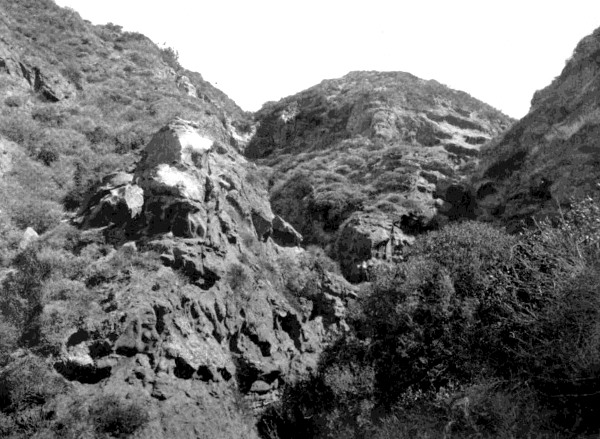
Tingley in 1901. It has the true Greek setting, looking out over the sea. A wild
cañon runs down from it seaward, full of miniature hills and precipices, among
which, now visible and now unseen, winds the path by which the players enter
or leave the stage. There will be torchlight processions under the moon new-risen,
moving along that path and over the broad stageplace; Greek chanting will
be heard; real Greek music, and music with that ineffable something in it lacking
in all, or nearly all, modern music, which suggests the hidden life of nature,
the weird majesty of Delphi, of Nemesis, of the pipes of universal Pan; the
very aroma of Sophoclean drama, plus an echo of that older and even more
entrancing Greece,
"Of deities or mortals, or of both,
In Tempe or the dales of Arcady,"
When—
"Liquid Peneus was flowing
And all dark Tempe lay
In Pelion's shadow, outgrowing
The light of the dying day,
Speeded by Pan's sweet pipings."
KINGDOM OF PAN UNCONFINED
One has long suspected that, with luck, one might well come upon a faun in
the wild places of that cañon, at least in April, when the rains are newly over
and the hillside a riot of bloom and delight. For indeed the kingdom of Pan is
not confined; he has provinces here in California, and you may come upon the
dales of Arcady in any of the four quarters of the world.
Were Pan or some legate of his to be piping far down the cañon, you would
not fail to catch every note of it from every part of the auditorium in the theater;
what is whispered on the stage is clearly heard on the topmost tier of seats. The
place is a Wonder of the West if only for its marvelous acoustic properties. It
has never been opened to the public before for a performance. And it should
be remembered that Madame Tingley leaves nothing to chance; she stands out
grandly independent in her art; leaves no detail to be excused by the generosity
of the audience; permits nothing whatever of which you could say: "This is
excellent—for amateurs; this is splendid—considering what a short time it has
taken to get up." It may be quite safely affirmed that this presentation on April
17 will have a prominent place in all future histories of the drama.—San Diego
Union, Friday morning, April 7, 1911.
SOME NOTES ON "THE AROMA OF ATHENS" As given in the Greek Theater, Point Loma, on Saturday Morning, April 22, 1911; With the Prolog to the Play: by Kenneth Morris
THERE never was a play so difficult to appraise or criticise
justly and intelligently as this one. One had read
many press notices from expert dramatic critics, all of
them enthusiastic; but when one came to see the performance,
it struck one that the best of them were
inadequate, wholly beside the point. And yet one sees the excuse
for saying just as much as language can be stretched to express.
If one did not put on the enthusiasm without stint or measure, one
would convey a suggestion that the presentation was unworthy of
enthusiasm; the truth being that enthusiasm is somehow unworthy of
the presentation.
Since seeing it, one has been searching mind and memory for some
means of accounting for its extraordinary effect. We have seen it
put down to the beauty of the spectacle, harmony of colors, perfect
natural setting, and so forth. It is true that one failed to find any
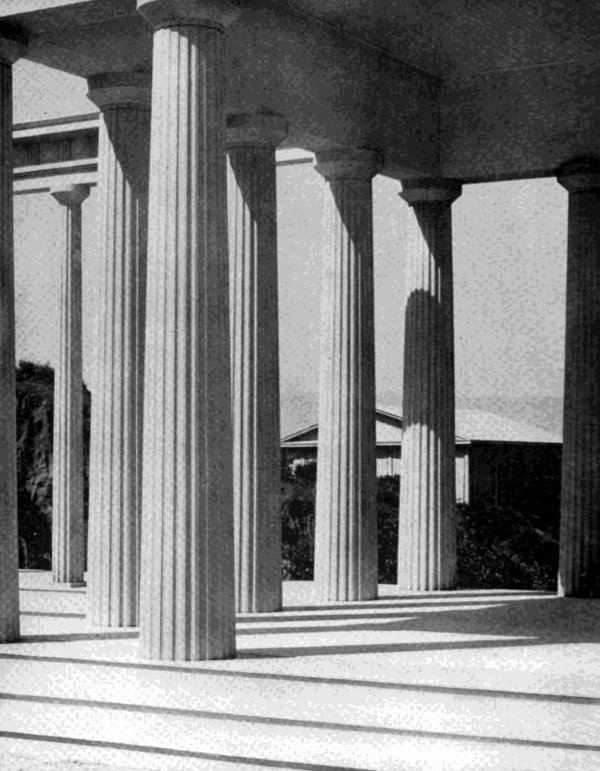
jarring note in the acting; that the cañon, running down to the Pacific,
seen through the pillars of the Greek temple there, is a piece of landscape
thrilling in its beauty, for the like of which you must go to lands
where nature is at her most beautiful, and where there are the relics of
mighty builders of old, that give a focal point to the natural beauty,
and an inspiration to all artists. It is true also that there was a perfect
art in the color scheme of the dresses—an absolute justness, balance
and harmony of colors in themselves exquisite; that one could imagine
no improvement in the grouping; that the enunciation, movements,
and gesticulations, were in all cases just, clear, simple, natural, and
graceful. But I am convinced that one might see and hear all that, and
come away conscious that there was more to be said. None of these
things, either considered separately or en masse, are enough to account
for the enthralling effect of the play.
Generally speaking, again, it is true that "the play's the thing."
In this case I think it is not true. There is, in the ordinary sense,
hardly any action or dramatic thrill. We underline dramatic, because
thrill of some deeper and hitherto unexperienced kind there was;
action too, there was—the action of a people on the World's stage;
in that sense it was all one deep thrill, and the action of real life. But
the dialog was mainly philosophic discussion, deep thought, art criticism
from the Greek standpoint—just, sound, basic, noble; but not
fiery or dramatic, as we commonly understand the terms; and there
was none of that brilliant play of wit which in some modern plays
compensates for the lack of a plot.
Here indeed, you may say that plot there was none. The Athenians
are holding their Flower Festival, to which the Satrap Pharnabazus
is welcomed as a guest. He is desirous to learn the secret of Athenian
brilliance, and one by one his hosts give utterance, in response, to the
principles of Athenian art, philosophy, etc. While they are speaking,
the herald of Sparta is announced; here there is, indeed, a central
incident of most stirring dramatic effect in the declaration of the Peloponnesian
War. Socrates prophesies the downfall of Greece, and the
rise of a new Athens in the west of the world in after-ages; after
which follows an effect which, for mystic beauty and thrill does certainly
stand out, so that you do know exactly why you are moved by
it—a procession of scarlet-draped women with torches, that comes
winding up the cañon, through the temple, and across the arena
through clouds and volumes of colored mist, a wonderful bit of Katherine
Tingley's art work, an incident impressive to the last degree,
which were it done just so on any stage in the world, and by any
actors, would create a sensation. But indeed, it is safe to say that
such an effect has never been produced before, on any stage in the
world.
But be it noted that the enthralment of The Aroma of Athens
began long before this; and that even this was rather a visual glory
than a dramatic coup according to the received canons.
Of spectacular value, too, was the archaic dancing of the children;
and let it be said that there was something about these children which
is never to be seen on the stages of the world, nor with any other
children than those of the Râja Yoga College at Point Loma. And
yet, when one has said that they were perfectly classic, and at the same
time perfectly merry and natural—one realizes that one has still
barely begun to account for what happened.
One little woman who professed to have some knowledge of art,
yet was quite unfamiliar with the period which the play presented,
almost tearfully deplored the fact that the actors did not seem to pay
any attention to the audience during the production. The fact that
they did not do so was one of the charms of the whole presentation.
They were not playing a part but giving a most realistic presentation
of life, and were, as they should have been, as if there were no audience.
To those who saw the motif of the play, it would have been a
blur if the players had shown any consciousness of the audience, or
had in any way "played to the gallery" or for personal attention.
Item by item, one might mention everything that was seen or
heard, and one would remain certain that however perfect and beautiful
each might be in itself, and even however perfect might be the
harmony of them as an ensemble, they yet were not enough to explain
the total value: and that even if you were able to explain the total
value artistically, from the standpoint of art as we understand the
term, there would yet be a kind of value, an invoking of one's inner
nature without words, which for lack of a better term one must call
a spiritual value—not only moral, or mental—which would remain
unexplained. In short, that there was here shown an element, a kind
of value, which is wholly unfamiliar to the critics of the present day.
When we speak of the drama as an educational element, we conceive
of its possible effects along artistic lines, or as setting forth
moral principles, or high intellectual ideas. This play did all that,
it is true; but it did all that, plus x; and what that x represents is not
known in our present civilization—or at least, so one suspects. It
produced a silence of the senses and of all personal voices within, an
uplift and a reverent feeling: yes, a sense that one had been given a
revelation of what the great mystics of the world have meant by the
word spiritual. Deeper places in one's being were touched, than any
that respond to the work of the greatest actors of the present or of
recent times.
So that any enthusiasm, any praise, seems something like an insult.
To speak of the Genius of the one that produced the play—Katherine
Tingley—that too seems a kind of insult. We have not attached to
the term genius, a breadth of meaning great enough to include the
qualities necessary for the production of a result so unlike anything
that has gone before.
We have seen it compared with the work of the premier actors of
the age, and that to the advantage of the Point Loma production.
The remark is not good criticism. The difference is not one of degree,
but one of kind. No actor manager, probably, would have handled this
play; none could produce, with any play of the greatest dramatists,
results that so baffle description, so affect one's conceptions in those
parts of one's being that lie behind and deeper than formal mentality
or imagination, or artistic appreciation. Perhaps Katherine Tingley
could explain how it is done. I think no one else could.
It is delightful to hear that Mrs. Tingley is making plans for
larger facilities for seating the people, as even with its present great
size, the Greek Theater at Point Loma cannot meet the demands. It
is whispered also that she has several more Greek and other plays in
preparation, which in course of time will be presented in the Greek
Theater, and possibly at her Isis Theater in San Diego as well.
THE PROLOG
You are in Athens now, and you shall see
The splendor of that age of long renown
When Perikles was prince in Pallas' town
Amidst a people mighty-souled and free
Whose eminence and bright supremacy
Made Zeus grow jealous, and wan Clotho frown,
So that the nations rose to bring her down,
To bring high Athens down, till she should be
A name, a memory only; yet a name
That burns—a beacon on the heights of time,
Lighting the ages' darkness, making sublime
The fame of Hellas with its smokeless flame.
And you shall see and hear now, all those men
That shone round Perikles: Thucydides,
Ariston, Crito, Phidias, Sokrates,
And many high-souled women, famous then,
Teachers and seers and sages whose far ken
Pierced deep the hidden realms of being.
These
Are gathered midst the Academian bowers
To keep their Anthesterian Feast of Flowers
Held every year in Athens. To their feast
Comes one sent by that Great King in the East
Whose sire was countered in the perilous hours
Of Salamis and Marathon. But now
To seal a pact with Athens, with high vow
Linking the Athenian and the Persian powers
Against the martial Spartan—Xerxes' son,
Enthroned Artaxerxes, sendeth one
Whom you shall see here in great pomp attend,
An honored guest, well-welcomed—Athens' friend,
The Persian Pharnabazus. In his hands
Is given the sway of those Bithynian meads
Where roam innumerable herds of steeds
Much sought by war-kings in a thousand lands.
Mighty with Median strength he comes—with gold
Of Ind and Araby, and those nations old
Which the strong Persian tamed, bedecked; and gems
That erst adorned great princes' diadems
Of fallen dynasties—pearls of Oman, dyes
Wrought in Turanian vats to out-do the blooms
Of Yemen spicy-breezed, and webs from looms
The deft Cashmirian or Cathayan plies—
A strong and courteous lord.
Right well he knows
By what stern virtues Persia broke her foes,
Bringing the jeweled throne of Croesus down,
And Phrygia's wealth, and Egypt's twofold crown;
What Magian training molds the Persian youth
To scorn of luxury, worship of truth,
Honor and gratitude; but in Athene's town
Findeth a bloom of soul and wit, in sooth,
He knows no secret for; and must inquire
By what strange kindling of what inward fire
Athenian, by what quest of deathless dream,
Athens is made so wondrously to gleam
Above the rest of the world.
Him answering there,
The Athenian citizens, the violet-crowned,
Speak one by one deep wisdom, and propound
Those balanced views that made their land so fair.
But even while they speak, lo, in the air
Gathers a cloud, a menace—trumpets sound—
The Spartan herald comes.
Stern words are these
He utters; sternly answereth Perikles—
There shall be war: Athens stoops not to a peace
Ignoble, though the untamed Lakonian bands
Be loosed against her, and a hundred lands
Enleague with Lakedaimon; yea, though all Greece
Compass her splendor round with threatened doom—
War shall it be.
Therewith a gathering gloom
Enfolds their vision, and their chief of seers
Makes known the menace of the darkening years—
Greece shall fall; ruined fanes shall mark her tomb,
The tomb of all her glory waned from the land;
Her broken, marble-pillared fanes shall stand,
And move the unborn to marvelings and to tears
For so much beauty waned in such decay.
Yet see, his vision brightens! Wane away
You barren ages! Speed, you desolate years!
Give place, sad night-time, to the dawn of day!
Hellas shall fall indeed; Athens shall wane,
Yet shall be born again! Greece born again,
Athens reborn in unknown lands, shall rise!
High on a hill beside the western seas,
That hath more wealth than Hybla for the bees,
That hath more blueness than the Aegean skies,
Athens shall rise again, most fair, most wise,
To shine upon the world!
—Thus Sokrates
Foretelling our own glorious Lomaland;
And what shall go forth from this western strand
In these last days, to herald peace, and blend
Nation with nation, hostile land with land,
Firm friends forever.
So the play hath end.
Copyright by Katherine Tingley, 1911Lomaland Photo. and Engraving Dept.
TABLEAUX FROM THE ILIAD AS GIVEN DURING THE PRESENTATION OF
"THE AROMA OF ATHENS," APRIL 17, 1911
PARTING OF HECTOR AND ANDROMACHE.
Copyright by Katherine Tingley, 1911Lomaland Photo. and Engraving Dept.
ANDROMACHE FAINTING ON THE WALLS OF TROY
Copyright by Katherine Tingley, 1911Lomaland Photo. and Engraving Dept.
THE FUNERAL PYRE OF HECTOR
Copyright by Katherine Tingley, 1911Lomaland Photo. and Engraving Dept.
PUPILS OF THE RÂJA YOGA COLLEGE, POINT LOMA, IN ATHENIAN FLOWER FESTIVAL
HAWTHORNE'S PSYCHOLOGY: contributed by C. T.
HAWTHORNE'S Blithedale Romance is a study of the psychology
underlying the human relations that arise from the
subtle inner feelings within the deepest and most diaphanous
regions of the human heart.
With an incomparable delicacy and precision of touch, revealing
the hidden framework of the underlying design, he clothes with apt
speech these specter glimpses into the realm of human motive.
Pity 'tis that his glimpses into these depths should be clouded by
the temperamental gloom of his own nature—always seeking justification
of its own pessimism, always weaving despondent tragedies
that the light of Theosophy would have transformed into inner
victories in the midst of outward defeat. Yet he seems only to have
penetrated to certain depths of gloom and doubt, and then to hesitate
to take that one step deeper where forever dwells the light that dispels
all shadows.
Like a modern Virgil he leads us to the brink of the deepest
chasms, and then abandons us to our own intuitions. Possibly he
saw farther into the depths than he could record in human speech—and
so wrote on from romance to romance in search of the expression
that forever eluded his pen.
LIFE AND TEACHINGS OF PYTHAGORAS: by F. S. Darrow, Ph. D., A. M.
I. Life
Pythagoras, the pure philosopher deeply versed in the profounder phenomena
of nature, the noble inheritor of the ancient lore, whose great aim was to free the
soul from the fetters of sense and force it to realize its powers, must live eternally
in human memory.—H. P. Blavatsky
THIS world-famous Greek teacher of "the Heart Doctrine"
was born about 580 b. c. on the island of Samos
and died about 500 b. c. Before his birth it was prophesied
to his father that a son was about to be born
to him who would be a great benefactor of mankind.
Some even went so far as to declare that Pythagoras was a human
incarnation of Hyperborean Apollo.
It is related that when a mere youth he left his native city to begin
a series of travels to the wise men of all countries, from the Hindûs
and Arabs in the East, to the Druids of Gaul in the West. We are
told that he spent twelve years in Babylon, conversing freely with the
Magi, by whom he was instructed in all their Mysteries and taught the
most perfect form of worship. He spent twenty-two years in Egypt
as an intimate of the most learned hierophants, under whose tutelage
he mastered the three styles of Egyptian writing, the common, the
hieroglyphic, and the sacerdotal. He brought with him a personal
letter of introduction to Amasis, the reigning Pharaoh, who forthwith
wrote to the hierophants and requested them to initiate Pythagoras
into their mysteries. Pythagoras first went to the priests of Heliopolis,
but they, true to the inveterate Egyptian suspicion of foreigners,
although hesitating to disobey Amasis openly, tacitly refused to initiate
Pythagoras and advised him to go to the sacred school at Memphis,
ostensibly because it was of greater antiquity than that of Heliopolis.
At Memphis also he met with the same finesse, and was next sent to
the school at Thebes, where finally under the most severe tests—tests
which nearly cost him his life—he was fully initiated into the
Egyptian Mysteries and thereafter had free access to the treasures of
the hierophants.
After leaving Egypt Pythagoras returned to Greece by way of
Crete, where he descended the Idaean cave in company with Epimenides,
the great Cretan prophet and seer, who in return for the
removal of the plague at Athens in 596 b. c. accepted from the grateful
people only a branch of the sacred olive of Athena, and refused the
large sums of money which were offered, because he declared that
spiritual gifts can not be bought and sold. From Epimenides and
Themistoklea, the Delphic Pythia, Pythagoras received further instruction.
In the course of his travels he became an initiate not only
in the mysteries of India, Babylonia, Egypt, Greece, and Gaul, but
also in those of Tyre and Syria.
Pythagoras studied the various branches of knowledge, especially
mathematics, astronomy, music, gymnastics, and medicine, and contributed
very greatly to the development of these sciences among the
Greeks, for he was a man both of singular capabilities and of great
acquirements. His personal appearance was noteworthy. He was
very handsome and dignified; regularly dressed in white, and wore a
long, flowing beard. He never gave way to grief, joy, or anger, but
was accustomed to sing hymns of Homer, Hesiod, and Thales, to preserve
the serenity of his mind, and he was very eminent for his power
of attracting friends. The religious element was predominant in his
character, and his entire life was ruled by humanitarian and philanthropic
motives. He was opposed to animal sacrifice, and on one
occasion purchased a large draught of fish, which had just been caught
in a net, and set them free as an object-lesson in kindness.
Pythagoras was a practical occultist, and is said to have understood
the "language" of animals so as to be able to converse with them
and tame even the most ferocious. It is said of him that upon one
occasion he was seen and heard publicly speaking at far distant places
both in Italy and in Sicily, on the same day, a physical impossibility.
It is also stated that he healed the sick, had the power of driving away
evil spirits, foresaw the future, recognized character at a glance, and
had direct communication with the gods.
Finally at the age of nearly fifty, Pythagoras went to southern
Italy or Magna Graecia, after an unsuccessful attempt to establish a
society in his native city, and in 529 b. c. founded the Pythagorean
Brotherhood and the School of the Mysteries at Crotona. He gained
extensive influence immediately and attracted great numbers of all
classes, including many of the nobles and the wealthy, so that the
society grew with wonderful strides and soon similar schools were
established at many other cities of Magna Graecia: at Sybaris, Metapontum,
Tarentum, and elsewhere. Each of these consisted of three
hundred members accepted under inviolable pledges of secrecy and
bound to Pythagoras and to each other by the most sacred of
obligations.
The statement as to the death of Pythagoras, which occurred when
he was about eighty, vary. One account says that he was banished
from Crotona and fled to Metapontum where he died after a self-imposed
fast of forty days. Another says that he was murdered by
his enemies when the temple of the school at Crotona was burned to
the ground, either by the nefarious Kylon who because of his unworthiness
had been refused admittance to the Brotherhood and his
wicked associate Ninon, or by the frenzied townspeople. At the same
time similar persecutions in the other cities where the branch schools
had been established resulted in the (supposed) murder of all but a
few of the younger and stronger members, who succeeded in escaping
to Egypt. Thereafter individual Pythagoreans, unorganized in
Schools, which were everywhere successfully suppressed, continued to
keep the light burning for centuries. The doubtful point is, whether
the temple and the various assembly halls of the Pythagoreans were
burned at the end of the Leader's life, or about a hundred years after
his banishment and death by starvation. Telauges, his "son," is said to
have succeeded his father as the Head of the shattered society, but
little is known of him. It is significant that the Pythagorean Brotherhood
and School of the Mysteries at Crotona flourished during the
last twenty-five years of the sixth century B.C., the accepted date of its
overthrow being about 500 b. c.
II. The School
It was a Pythagorean maxim that "everything ought not to be
told to everybody." Therefore membership in the society was secret,
silent, and guarded by the most solemn forms of obligatory pledges
and initiations. Members were classified as Akousmatikoi or Listeners,
Probationary Members, who did not live at the School, and Mathematikoi
or Students, Accepted Members, who lived with their families
at the central School of the Mysteries or at one of its branches. Probably
the Mathematikoi were further divided into two classes: the
Pythagoristae or exoteric members, and the Pythagoreans or esoteric
members.
Practically any candidate of an upright and honest life was admitted
at request as a Listener, but only the fit and the worthy were accepted
as Students. Listeners, wishing to become Students, were
forced to pass through a period of probation lasting from two to five
years, during which their powers of maintaining silence were especially
tested as well as their general temper, disposition, and mental capacity.
A good working knowledge of arithmetic, geometry, astronomy,
and music, (the four branches of Pythagorean mathematics), was
required preliminary to admission to the School. Only the most approved
members were admitted to the Esoteric Section. Women
were admitted (an innovation from the Greek standpoint). Among
these Theano was the most distinguished. She had general supervision
of the women.
The members were devotedly attached to their Leader and to one
another. They were enabled to recognize other members even when
unacquainted by means of their secret symbols, and it is recorded:
"If Pythagoras ever heard that any one used symbols similar to his,
he at once made him a companion and a friend." Unquestioning loyalty
was given to the counsels of Pythagoras by his disciples, for whom
the ipse dixit of the master settled all controversy, and the rank and
admission of candidates depended solely upon the intuitive discernment
of Pythagoras, who made all appointments.
The Students wore a special dress and had vows. They were
trained to endure fatigue, sleep little, dress very simply, never to return
reproaches for reproaches, and to bear contradiction and ridicule
with serenity. The School of the Mysteries was a school of life, not
a monastery. Pythagoras did not aim to have his disciples withdraw
from active life, but taught them how to maintain a calm bearing and
an elevated character under all circumstances. The intention was to
train them to exhibit in their personal and social capacities a reflection
of the order and harmony of the universe. The membership was
international.
As it was a Pythagorean maxim that "friends should possess all
things in common," new members upon entering the School handed
over their personal possessions to the proper official who turned them
into the common treasury. A student was at liberty to depart from
the School at pleasure and at his departure he was given double his
original contribution, but over his former seat was erected a tomb,
funeral rites were performed, and he was ever afterwards referred to
by the loyal members as deceased.
Purity of life was required and temperance of all kinds was strictly
enjoined. All members ate at a common refectory in groups of ten,
as at the Spartan syssitia. The diet was subject to a most careful
regulation and consisted largely of bread, honey, and water. Animal
foods and wine were forbidden. It is stated also that beans were
tabooed because of their indigestibility and tendency to produce agitated
dreams.
Much importance was attached to music, and to the physical exercise
of the disciples. Each day began with a meditation upon how it
could be best spent and ended with a careful retrospect. The students
arose before the sun, and after breakfast studied for several hours,
with an interval of leisure, which was usually spent in solitary walks
and silent contemplation. The hour before dinner was devoted to
athletic exercises. In the course of the day there were mutual exhortations
not to sunder the God in each and all but to preserve the union
with the Deity and with one another. The students were accustomed
to visit Pythagoras at night, and went to sleep with music.
In a subsequent article some of the main tenets of the Pythagorean
Brotherhood will be outlined.
THE AMERICAN WOMAN IN POETRY: by Grace Knoche
CURRENT literature, from the freshly printed book to
the literary columns of the daily press, affords certain
unique opportunities for reviewing woman's work in
the light of past achievement and future promise.
Take, for instance, the single factor of woman in
poetry—where past centuries number their woman poets by the
twos and threes, as the last generation has done by little more than
the threes and fours, the present finds them springing up thicker than
clover in a fallow field and in many cases with a sweetness and fragrance
in their songs as of clover blossoms themselves.
To the thinking mind this has a certain significance as relating
to the inner unseen tides of that spiritual awakening now so seeming
near for all mankind. For what holds poesy at its heart holds music
there, and harmony and rhythm and something of that divine potency
that lies in number; and with Theosophy at our doors we do not need
Plato to tell us that
rhythm and harmony find their way into the secret places of the soul, on which
they mightily fasten, bearing grace in their movements and making the soul
graceful in him who is rightly educated.
The following are a handful of poems by women—most of them,
significantly enough, by wholly or comparatively unknown writers—from
among the last month's journals and papers, by no means a
representative list, but just a few that found their way in the natural
course to the study desk. Some compel attention because of the
wholesomeness of sentiment and a certain honest openness in their
delivery, others because of their musical lilt and flow, still others because
of both. There are a few that may live, some that of a certainty
will not and that yet have a value now. But that may be said of a
hastily gathered handful of anything in its era.
They are typical of a surprisingly large class, while none of those
whose poems are herewith quoted, with the exception of Edith M.
Thomas, have so far written very much.
The first, by Angela Morgan in the Cosmopolitan, is a real Theosophical
challenge, a veritable battle-cry, with something of the
trenchant force and fire that flashes and thunders from out the lines
of the old Beowulf:
Reined by an unseen tyrant's hand,
Spurred by an unseen tyrant's will,
Aquiver at the fierce command
That goads you up the danger hill,
You cry: "O Fate, O Life, be kind!
Grant but an hour of respite—give
One moment to my suffering mind;
I cannot keep the pace and live."
But Fate drives on and will not heed
The lips that beg, the feet that bleed.
Drives, while you faint upon the road,
Drives, with a menace for a goad;
With fiery reins of circumstance
Urging his terrible advance
The while you cry in your despair,
"The pain is more than I can bear."
Fear not the goad, fear not the pace,
Plead not to fall from out the race—
It is your own Self driving you,
Your Self that you have never known,
Seeing your little self alone,
Your Self, high-seated charioteer,
Master of cowardice and fear,
Your Self that sees the shining length
Of all the fearful road ahead;
Knows that the terrors that you dread
Are pigmies to your splendid strength;
Strength you have never even guessed,
Strength that has never needed rest.
Your Self that holds the mastering rein,
Seeing beyond the sweat and pain
And anguish of your driven soul
The patient beauty of the goal.
Fighting upon the terror field
Where man and Fate come breast to breast,
Pressed by a thousand foes to yield,
Tortured and wounded without rest,
You cried, "Be merciful, O Life!
The strongest spirit soon must break
Before this all-unequal strife,
This endless fight for failure's sake."
But Fate, unheeding, lifted high
His sword and thrust you through to die.
And then there came one strong and great,
Who towered high o'er Chance and Fate,
Who bound your wound and eased your pain
And bade you rise and fight again.
And from some source you did not guess
Gushed a great tide of happiness—
A courage mightier than the sun—
You rose and fought, and fighting, won.
It was your own Self saving you,
Your Self no man has ever known,
Looking on flesh and blood alone;
The Self that lives as close to God
As roots that feed beneath the sod.
That one who stands behind the screen,
Looks through the window of your eyes—
A being out of Paradise.
The Self no human eye hath seen,
The living one who never tires,
Fed by the deep eternal fires.
Your flaming star, with two-edged sword,
Made in the likeness of the Lord.
Angel and guardian at the gate,
Master of Death and King of Fate.
Perhaps more musical and exquisite in its technic is the following
(by Edith M. Thomas in the Century), yet one looks in vain for the
note of positive assurance that sings and rings out of the poem just
quoted. Now one expects in poetry something more than rhymed
philosophy, of course, and sheer beauty of rhythm has more than once
endowed paucity of thought with an almost immortality. But the
content is important, none the less. In the preceding poem one feels
a mighty conviction forcing its way through every limitation to the
goal of expression. The work of the older and better known poetess
is more clearly poetic—to those who know the path and know the
way its Sphinx-like questionings evoke their own answer in the deeps
of consciousness. To the many, however, the first poem must reveal
more.
THE UNKNOWING
I know not where I am:
Beneath my feet a whirling sphere,
And overhead (and yet below)
A crystal rampart cutting sheer—
The traveling sun its oriflam.
What do I know?
I know not what I do:
I wrought at that, I wrought at this,
The shuttle still perforce I throw;
But if aright or if amiss
The web reveals not, held to view.
What do I know?
I know not what I think:
My thoughts?—As in a shaft of light
The dust-motes wander to and fro,
And shimmer in their flight;
Then, either way, in darkness sink.
What do I know?
I know not who am I:
If now I enter on the Scheme,
Or revenant from long ago;
If but some World-Soul's moment-dream,
Or, timeless, in Itself I lie.
What do I know?
Here is a sweet touch from the Kansas City Star. The very
name of the writer of it is so in keeping with tender dutifulness and
so suggestive of clean-swept hearths and ministries to tiny, clinging
hands, that one wonders if it be not a pseudonym. A miniature
"psalm of daily duty" is it:
At morn I yearned a song to sing
That would inspire and teach
In words so true all men would hear
In them their own soul's speech.
But Duty stopped my pen and showed
The day's dull round of care—
The service to another's need—
A burden I should share.
At night the Day sung to the past
Her record clear and strong,
And richer, sweeter than I dreamed
I heard complete my song.
—Emily Householder
And from the same paper another ringing note on the sacredness
of the day's duty—but this is no psalm, rather a trumpet call,
gorgeous, full, and technically so splendid that it suggests the ancients:
TODAY
Voice, with what emulous fire thou singest free hearts of old fashion,
English scorners of Spain sweeping the blue sea-way,
Sing me the daring of life for life, the magnanimous passion
Of man for man in the mean populous streets of Today.
Hand, with what color and power thou couldst show, in the ring hot-sanded,
Brown Bestiarius holding the lean, tawn tiger at bay,
Paint me the wrestle of Toil with the wild-beast Want, bare-handed;
Shadow me forth a soul steadily facing Today.—Helen Gray Cone
Will you have music? Then read these, so different in content,
so unlike in the touch, for one is threaded through with compassion
and tenderness while the other is just a little note of joy in life, which
might rise out of self as well as unself in certain not yet conscious
natures.
CANDLEMAS
O hearken, all ye little weeds
That lie beneath the snow,
(So low, dear hearts, in poverty so low!)
The sun hath risen for royal deeds,
A valiant wind the vanguard leads;
Now quicken ye, lest unborn seeds
Before ye rise and blow.
O furry living things, adream
On winter's drowsy breast,
(How rest ye there, how softly, safely rest!)
Arise and follow where a gleam
Of wizard gold unbinds the stream,
And all the woodland windings seem
With sweet expectance blest.
My birds, come back! the hollow sky
Is weary for your note.
(Sweet-throat, come back! O liquid, mellow throat!)
Ere May's soft minions hereward fly,
Shame on ye, laggards, to deny
The brooding breast, the sun-bright eye,
The tawny, shining coat!—Alice Brown
THE WAVES OF BREFFNY
The grand road from the mountain goes shining to the sea,
And there is traffic on it and many a horse and cart;
But the little roads of Cloonagh are dearer far to me
And the little roads of Cloonagh go rambling through my heart.
A great storm from the ocean goes shouting o'er the hill,
And there is glory in it, and terror on the wind;
But the haunted air of twilight is very strange and still,
And the little winds of twilight are dearer to my mind.
The great waves of the Atlantic sweep storming on their way,
Shining green and silver with the hidden herring shoal;
But the little waves of Breffny have drenched my heart in spray,
And the little waves of Breffny go sweeping through my soul.
—Eva Gore-Booth
The two following poems attack the same theme, a fruitful and
varied one to lovers of Lomaland where the winter rains are the
year's beneficence. But note the full rich lines of the work of the
unknown writer, albeit the sonnet is of course the more difficult poetic
form.
THE FOUNTAINS OF THE RAIN
The merchant clouds that cruise the sultry sky,
As soon as they have spent their freight of rain,
Plot how the cooling thrift they may regain:
All night along the river-marsh they lie,
And at their ghostly looms swift shuttles ply,
To weave them nets wherewith the streams to drain;
And often in the sea they cast a seine,
And draw it, dripping, past some headland high.
Many a slender naiad, with a sigh,
Is in their arms uptaken from the plain;
The trembling myrmidons of dew remain
No longer than the flash of morning's eye,
Then back unto their misty fountains fly:
This is the source and journey of the rain.
—Edith Matilda Thomas
RAIN
The patient rain at early summer dawn;
The long, lone autumn drip; the damp, sweet hush
Of springtime, when the glinting drops seem gone
Into the first notes of the hidden thrush;
The solemn, dreary beat
Of winter rain and sleet;
The mad, glad, passionate calling of the showers
To the unblossomed hours;
The driving, restless midnight sweep of rain;
The fitful sobbing, and the smile again,
Of spring's childhood; the fierce unpitying pour
Of low-hung leaden clouds; the evermore
Prophetic beauty of the sunset storm,
Transfigured into color and to form
Across the sky. O wondrous changing rain!
Changeful and full of temper as man's life;
Impetuous, fierce, unpitying, kind again,
Prophetic, beauteous, soothing, full of strife:
Through all thy changing passions hear not we
Th' eternal note of the Unchanging Sea?
—Laura Spencer Portor
Nothing is worse than bad poetry, unless it be bad art of every
kind, of which the world today is having a surfeit. That we find a
greater abundance of wretched verse, however, than of wretched painting
and sculpture, and that there are still those who think that the
poet's equipment need consist of little more than an unbalanced emotionalism,
we may attribute perhaps to the fact that the pen and ink
are readier to hand with the majority than palette and brush or calipers
and modeling tool. Conceit and ignorance, working together,
have made "to write poetry" almost a reproach.
The remedy would seem to be to diffuse a few simple truths, such
as that true poetry has nothing to do with emotionalism, nor sentimentality,
nor bad spelling, nor with metres that "interfere," like a
clumsy horse's feet; and that where one in ten thousand who care
for poetry may try to write it and succeed, the rest will fail and will
neglect their proper duties besides. It is so in art, in literature generally,
in music, in all things—the safe path is to drop the gleam and
fire and fragrance of the soul-touch into one's life in the shape of a
more courageous performance of the daily task, whatever it may be,
and be content with that, which is the greatest thing in the world,
anyway. If the Muse should decide to pick us out, willy nilly, she has
ways of letting us know. Poesy has its technic, as has all art, and
sentimental ignorance can never hope to pose as inspiration among
those who know.
The real point to be emphasized is that this is part of a certain
outreaching on idealistic lines of which the wholly remarkable work
of the young women of the present generation in music, composition,
painting, and sculpture, constitutes other parts. And this outreaching
towards an art expression along various lines is so general, and
is so differentiated in essence from the results of ordinary scholastic
work or the general movement for the higher education of woman,
that it cannot justly be ignored.
Few young women will, in the ordinary course, win a separate
fame along the solitary path of pure art. Most of them, and most
of those who come within the radius of the influence of their aspirations
and their art work, will become wives, home-makers, mothers.
Many more will become teachers, or are that now, wielding potent
influence. It is these who will strike the keynote for the quality of
atmosphere that is to shape, as it will surround, the generations yet
unborn; and, because of that, the feeling and aspiration that many of
the poems seen in our current journals disclose, is important and significant
at this transitional time.
ANCIENT ASTRONOMY: by Fred J. Dick, M. Inst. C. E.
IN perhaps no department of thought has appreciation of
the achievements of antiquity been more inadequate than in
that of astronomy. This is all the more remarkable when
we remember that many facts have been published and are
accessible, amply sufficient to convince any unbiased student
as to the hoary antiquity of the science; and also as to the fact
that in the remotest times it was a science whose exactitude surpassed
that of modernity because based upon immense periods of observation
and a profound knowledge of the harmonious laws underlying
celestial motions; in comparison with which knowledge our generalizations
and mathematical triumphs pale into insignificance.
Such statements are hardly likely to meet ready acceptance from
those who have not yet realized the immense antiquity of the human
race, the cyclic rises and falls of nations and races coeval with vanished
continents, and the fact that there were times when humanity
had divine instructors in the arts and sciences. Yet without some
recognition of these basic ideas it is hardly possible to comprehend
even faintly the significance of some statements made in the Sûrya-Siddhânta—one
of the oldest treatises on astronomy extant. There
are many others—perhaps thousands—but they are not accessible
at the present time, probably because they would be still less understood.
Another thing hardly likely to be appreciated in some quarters is
the fact that on account of the intimate connexion between the facts
of astronomy and cyclic laws affecting human destiny, this science
for long ages was one of the sacred sciences, and its deeper mysteries
were carefully guarded—as they are still, for that matter.
This last consideration throws an interesting light on the performance
of Hipparchos (whom our text-books dub "the father of astronomy"),
for he was not only silent as to the sources of his facts, but his
data have been shown to be inconsistent with his methods, and are only
explainable when calculated out on the principles enunciated in the
Sûrya-Siddhânta. In short, he has been thus shown to have had
access to Eastern sources of information, while at the same time some
things were withheld.
This is but an instance of a policy which had been pursued for a
very considerable period anterior to the time of Hipparchos. Just so
much was given as would afford a stimulus for investigation; for
humanity entered upon novel and strenuous conditions some five
thousand years ago, and has had to win for itself a new path in science,
as in other departments of activity.
Key-notes are sounded, and instruction given, at cyclic periods;
yet man must win his own path to knowledge, and guarded sources
of information could not help him, until he prove himself morally as
well as intellectually fitted to advance.
This brings us naturally to a survey of modern achievement in
astronomy, and the conclusion is almost irresistible that it has reached
a point where further light must come, if only the enthusiastic followers
of this kingly science would raise their eyes from the mechanical
skeleton they have built so laboriously, and realize that the universe
is living and conscious—in the interstellar spaces, as well as in the
little fiery-looking balls that float therein. We should remember that
it is part of human destiny to enter into the wider consciousness
which alone holds the master-clues.
The above conclusion is supported by the statement of Simon
Newcomb that the unsolved problems of astronomy seem to increase
with every year, instead of diminishing.
It is a curious reflection, in these days of "exact" science, that
real exactitude can only be obtained, as in pure mathematics, by proceeding
from universals to particulars, never from particulars to
universals. Yet the latter method has perforce to be adopted when
no other way is in sight. That it fails, is shown by the simple fact
that few of the "elements" or "constants" in modern astronomy are
exactly known. No tables have yet been constructed, based upon
purely mathematical formulae, which represent the actual motions,
say of the superior planets. Those in the Nautical Almanac are
simply derived from such hypothetical formulae, with corrections
found necessary by experience extended over what is an almost ludicrously
insufficient term of years. We should like to see the astronomical
formula in use which would show that the obliquity of the
ecliptic, 23,000 years ago, was slightly more than 27°. No longer
ago than August 1905 an eclipse of the sun began twenty seconds
before the predicted time.
Fortunately our astronomers do not live in ancient China, or they
might have been beheaded for this want of accuracy!
On the other hand, the achievements in the domain of theory
during the last two centuries or less have been so remarkable that
it is to be hoped the methods and facts given in the Sûrya-Siddhânta
may yet receive some attention from competent mathematicians, once
they perceive their importance. The apparent discrepancies with
modern facts, it may be pretty safely asserted, will be found to yield
valuable results upon careful analysis.
Investigators will find that, contrary to the assumptions of some
critics of Eastern chronology, a "year" does not mean a day, nor
a month—although it is sometimes called "a day of the gods" in
Eastern writings.
One of the first things to arrest attention in the Sûrya-Siddhânta
is that in a "great age" of 4320 thousand years there are exactly
forty revolutions of the Earth's apsides, one revolution of which
occupies 108 thousand years. (Young's General Astronomy, § 199.)
The line of apsides is the major axis of the Earth's orbit. Here we
glimpse a basic connexion between the great cycles of time and the
apsidal revolutions.
Let us quote a few aphorisms from Book I of this ancient work.
27. By their [the planets'] movement the revolution is accounted complete
at the end of the asterism Revatî.
29. In an age the revolutions of the Sun ... are 4,320,000.
30. Of the Moon 57,753,336.
31. ... of Jupiter 364,220.
32. ... of Saturn 146,568.
33. Of the Moon's apsis 488,203. Of its node, in the contrary direction
232,238.
34. Of asterisms 1,582,237,828.
36. ... From rising to rising of the Sun are reckoned terrestrial civil days.
37. Of these there are in an age 1,577,917,828. Of lunar days 1,603,000,080.
From these figures we find the mean value of the sidereal year
during a cycle of 4320 thousand years to be 0.002403 of a day longer
than at present, which of course means that there are slow changes
in the length of the orbital major axis.
There is a point worthy of attention regarding the asterism Revatî,
to which these revolutions are referred, and which is thus seen
to mark the origin of the Hindû movable zodiac. The precise star
has either disappeared, or has not, so far, been publicly indicated.
But the place of the origin was carefully calculated in 1883, and found
to have a longitude of about 20.5 degrees. Again, from the numerous
facts connected with the important epoch of 3102 b. c., which marked
the beginning of the current cycle of 432,000 years (See Traité del'Astronomie Indienne et Orientale, by M. Bailly, M. Acad. Franç.,
1787), its place was about five degrees westward of the other. This
shows it to have a positive movement of 4´´ per year, giving one complete
revolution in 324,000 years.
This proper motion, if that of an actual star, is of the same order
of magnitude as that of many stars. It would perhaps be interesting
to glance at the relation between stellar movements and the greater
cycles dealt with in ancient astronomy, for all analogy would indicate
revolution in orbits to be a general law; and moreover, probabilities
would indicate that our system is not too remote from the center of
the stellar system. Assuming the average cross speed to be twenty
miles per second, stars at 7 light-years distance would make one revolution
while the Earth's apsides made four. Those at 70 light-years,
one in a "great age." Those at the estimated distance of the farthest
visible stars, 5000 light-years, would perform a revolution in just one
manvantara of 308 million years.
Doubtless all such revolutions are superposed on other lesser revolutions
down to those known, as in cases of double stars, etc. And it
may be suggested that there are not improbably a number of axes
of revolution, or rather principal planes of revolution, having some
harmonious mutual inclination.
In order properly to relate the above mean value of the sidereal
year to its present value, we should have to know our place in this
cycle of 4320 thousand years; and the same observation applies to the
other figures. We may return to this point at another time, as the
necessary data are given in the same work. The effect of stellar
proper motions, already referred to, would have to be considered.
The figures for the Moon make the mean value of the sidereal
month 1.103 seconds longer than its present estimated value.
Those for Jupiter make its mean sidereal period about a quarter
of a day shorter than the present one of 4332.58 days; while those
for Saturn come out 6.55 days more than the present period of
10,759.22 days.
The methods of calculation and tables connected with the Sûrya-Siddhânta
were rigorously applied by M. Bailly to an observed
interval extending from the epoch in 3102 b. c. to a certain moment
on May 21, 1282 of our era, at Benares—a period of 4383 years and
94 days; and the mean place of the Moon thus found was less than a
minute of arc different from that calculated for the same interval by
the modern tables of Cassini. An astronomy which could achieve a
result like this by methods and tables at least five thousand years old,
points to the enormous duration of some prior high civilization.
The precessional movement of 54´´, peculiar to the Sûrya-Siddhânta,
being referred to "Revatî" with its 4´´ direct motion, gives 50´´, like
ours.
It is as well perhaps to recall what Iamblichus states:
The Assyrians have not only preserved the memorials of seven and twenty
myriads [270,000] of years as Hipparchos says they have, but likewise of the
whole apocatastases [planetary sidereal periods] and periods of the seven rulers
of the world. (Proklos on Plato's Timaios, Bk. 1.)
H. P. Blavatsky, commenting on this, says it is
about 850,000 years since the submersion of the last large island (part of the
Continent), the Ruta of the Fourth Race, or the Atlantean; while Daitya, a small
island inhabited by a mixed race, was destroyed about 270,000 years ago, during
the glacial period or thereabouts. But the Seven Rulers, or the seven great
Dynasties of the divine kings belong to the traditions of every great people of
antiquity. (The Secret Doctrine, I, 651.)
She also informs us that
The chronology and computations of the Brâhman Initiates[2] are based upon
the Zodiacal records of India, and the works of ... Asuramaya. The
Atlantean zodiacal records cannot err, as they were compiled under the guidance
of those who first taught astronomy, among other things, to mankind. (The
Secret Doctrine, II, 49.)
[2] But these are not the modern Brâhmans, as is clearly explained in H. P. Blavatsky's
own writings.—F. J. D.
THE PATH: by Gertrude Van Pelt, M. D.
Thou wilt shew me the path of life.—Psalms, xvi. 11
NOTHING so stirs the heart with gratitude as the thought
of the Great Souls who have opened the Path, who keep it
open, and who guide the steps of the hungry searching
multitude to its entrance. They have carved the way
through the rock of matter. They have waded through
the mires of delusion. They have cleared away the confusing and
entangling underbrush of doubt. They have hewn down the mighty
obstructions. With dauntless courage each one has destroyed the
dragon which guarded the treasure from himself, thus inspiring all
who follow. They have erected signposts all along the journey, and
with their hearts' blood have written thereon the messages which
every pilgrim may read, and so avoid one step amiss. Not only this,
but having achieved the goal, they have retraced their steps again
and again, to direct the uncertain feet of the children of earth, to
combat ignorance, vice, and injustice; to encourage, uplift, and teach.
Though unseen in many times and places, it is they who keep the
lights burning.
Terrible as are the difficulties, the discouragements, the disasters,
which the human children encounter, it is the Great Souls who prevent
them from being impossible; who ward off the clouds of despair lest
they settle over the globe like a pall of darkness paralysing all effort.
Without these Elder Brothers all would be lost in the labyrinth of
matter, never finding the thread which could lead them out. But to
be without them is inconceivable, unthinkable; for all must sometime
find the Path and tread it. No means have been omitted to make
it plain. All nature exists but to point the way. All experiences, all
events, difficulties, disappointments, all good, as well as so-called bad
fortune: all tend to the same issue. It has been described in every
language of heart or head, that all, even the beasts of the fields, in
some vague way, may hear and gradually understand.
One of those who has gone before and returned to show the path
to others, said: "I am the Way." Another, with a different sidelight
on the same truth, said: "Each man is to himself absolutely the way."
For each one in traveling it, does so by passing through the mazes
of his own personality, first as one blindfolded, then as one slowly
awakening to its meaning, and finally as one consciously subduing
and transmuting it. And when he has reached the goal, he becomes
the way. His whole being is an expression, an exposition of the way—the
mystic Path, which lies within and yet without; which is so
far, and yet so near. Light on the Path expresses it as follows:
Seek out the way.... Seek it not by any one road. To each temperament
there is one road which seems the most desirable. But the way is not found by
devotion alone, by religious contemplation alone, by ardent progress, by self-sacrificing
labor, by studious observation of life. None alone can take the disciple
more than one step onward. All steps are necessary to make up the ladder. The
vices of men become steps in the ladder, one by one, as they are surmounted.
The virtues of men are steps indeed, necessary—not by any means to be dispensed
with. Yet, though they create a fair atmosphere, and a happy future,
they are useless if they stand alone. The whole nature of man must be used
wisely by the one who desires to enter the way.
SAN DIEGO: by Kenneth Morris
THAT San Diego has the greatest of futures before it, who
shall deny? Katherine Tingley, Leader of The Universal
Brotherhood and Theosophical Society, foresaw its destiny,
saw its possibilities, fifteen years ago, and began forthwith
to lay the foundations of peculiar greatness for it. There
are thousands of cities in the United States, doubtless in Canada too,
centers in all the new worlds established from Europe, that have
before them a huge metropolitanism, and are to grow populous beyond
the Old World capitals. Why not? The wind of increase bloweth
where it listeth, and we can only safely prophesy change and reversion,
change and reversion. Where the deserts are now, dwelt of old
the builders of sky-scrapers; aeroplanes soared over lands the oceans
cover; and Dreadnoughts floated and made war, perhaps, where now
are Alps and Andes. Here is a land in its beginnings; many millennia
lie before it in which to grow. We need the grand vision when
we look out on the ages to be; only so can we sow the right seeds
for their harvesting. We cannot tell what nations or cities are destined
for high material greatness; probably there is room for every
one to hope. But for San Diego a peculiar and more excellent fate
is reserved, whose falling she may hasten by her clear-sightedness,
or retard by her perversity; still, it lies before her. She is to be
the City of Righteousness, the metropolis of the world's culture, the
Mecca of distant generations of poets, artists, philosophers, and musicians.
It is not mainly her own citizens who make this claim. They,
with all their high ambitions, with all their golden dreams, are hardly
alive to the great possibilities of the town.
In an age pre-eminently of material progress, it is natural to lay
most stress on the material advantages of site, climate, etc. So there
is no end to the writing on the Bay—the one bay between San Francisco
and somewhere far away in Mexico—with all it offers for commerce
and for strategy; or on the unwearying efforts of the sun; on
the glorious hinterland, so rich and beautiful; or the new railway
that is to open it up, and link San Diego with the east; on partial
awakenings at Washington to the great strategic importance of this
town, and the certainty that these partial awakenings must become
whole-hearted and thorough some time, and bear fruit a thousandfold.
Time, time, time—there is time for all these things. Innumerable
palaces will be seen, surrounding this blue jewel of a bay; looking
down on it from amidst exquisite parks and gardens on the
heights; there will be drives as famed as any in Switzerland or Italy.
Nature herself has provided for this; and the tide of empire is rolling
westward.
Lomaland Photo. and Engraving Dept.
VIEW OF SAN DIEGO WITH A GLIMPSE OF THE BAY
CORONADO IN THE DISTANCE
Lomaland Photo. and Engraving Dept.
THE U. S. GRANT HOTEL, FROM THE PLAZA, SAN DIEGO, CALIFORNIA
Time and again San Diego has been named with two cities of the
Old World; and there is something instructive in either comparison.
She is "the Naples of California," and again, "the Athens of the
Pacific Coast." Cuyamaca has been likened to Vesuvius, and our bay
to the Bay of Naples. Indeed, no doubt there is a physical resemblance.
The conditions that made Naples are largely historic; but
then they are largely climatic, and matters of situation, also. As for
history, the history of San Diego lies before her. All historic conditions—Camorra,
lazzaroni, plague, pestilence, national inefficiency,
vice, and famine, or the blessings which are the reverse of all these—are
the fruitage of one cannot say what tiny seeds sown, one cannot
say when or how often. You take a child, and give it no training
or bad training in its first years: it was the offspring of highly cultured
parents, perhaps; but what disasters may not lie before it?
On the other hand, you take a child, who has had no advantages, and
give it a Râja Yoga training such as Katherine Tingley is giving to
so many at Point Loma and elsewhere—such, in truth, as only Katherine
Tingley knows how to give—and you need set no particular
limits to the hopes you hold for that child's future. There is a great
parallelism with this in the early years of a city or community.
Up and down the world there are a thousand cities, as was said,
with huge material destinies lying before them, which by their very
situation they will not be able to escape. But in how many cases have
they not been without far foresight in their youth, to guard them
against the perils of that most perilous time? "They sow their wild
oats," we say; a phrase that is meant to cover a multitude of iniquities.
One can no more cheat the Law with such an excusive expression,
than one can write an I O U for one's debts, and comfortably
thank God that one need think no more of them. He who has sown
his wild oats may have gained a certain wisdom and experience out
of the sufferings resultant from them; but he will never be the man
he might have been. He will have lowered the whole of his possibilities,
and can pay thereafter only so much per cent of his debt to
the world and humanity.
Climate and situation might have prepared for San Diego only
such a fate as that of Naples; and there are other elements of possible
danger as well, which it would require no ordinary wisdom and foresight
to guard against. Indeed, have there not been revelations here
and there in our cities, which should make us judge charitably the
home of the Camorra? But now there are many thousands up and
down the world who believe in San Diego; who cannot think she will
fail or fall into gross error; who already look on her as a Mecca for
their hopes; who know that she will shed light around the world.
Reference is made, of course, to the great membership of the Universal
Brotherhood and Theosophical Society, which has its ramifications
among all the peoples of the globe. For them, San Diego rose
above the horizon when Katherine Tingley declared her intention,
some fifteen years ago, to found the City of Learning, the World's
Theosophical Headquarters, on the heights of Point Loma, within the
city limits of San Diego. They had reason even then to know that
what Katherine Tingley says she will do, is done; and they have had
a million times more reason for that certainty given them since.
When this famous humanitarian came to San Diego, grass was
growing in some of the streets there, where there should have been
boulevards bustling with life. The old first "boom" had long since
spent itself, helped to its grave by ready inimical hands; and there
seemed no special reason for its resurrection. It was then that she
made her promises. This little city of the quiet streets should come
to be, not the Naples, but the Athens of the west. It should have
population; it should have riches and commerce and splendor; it
should flourish abundantly when its enemies had long since faded out
and been forgotten; and all this was the very least and most insignificant
part of its destiny. There should be a new and timelong age
of Perikles here; new Phidian studios; new Groves of Akademe.
Time—we must not be niggardly with that, perhaps; these things
should not be in a day; but assuredly they should be.
It will be asked, on what grounds Katherine Tingley based these
promises of hers. The answer is: on her own intentions with regard
to the place; and on her knowledge of the laws that govern the growth
of civic and national life. Is there no knowing the future? The
farmer sows his seed under the impression that there is. He has
cultivated the soil; plowed and fertilized it; now he can put the seed
in with a certain confidence. Only it is not everybody that understands
the preparing for these greater national or civic harvests.
It is safe to say that from that time the second great San Diego
boom dates. The Theosophical Center was started on Point Loma,
and from the first has been attracting life to the city across the bay.
This is not the place to give statistics as to the number of thousands
of dollars that have been spent in San Diego each year; nor as to the
amount of labor that has been employed. From the start it was
enough to give the city that new impetus of life which was needed—a
fact proven by the rise in the population from 17,000 to 50,000
in ten years.
Then came the founding of the Râja Yoga system of education,
with its first and chiefest exemplification in the College on Point
Loma. Do all our citizens realize what this has meant for the city?
On merely material lines, for example? Not only from the eastern
States, but from Europe and Asia as well, hundreds have made the
pilgrimage to San Diego to investigate the Râja Yoga College and
system on the Point. They have gone away and filled their own lands
with the rumor of the fame of this wonderful new thing that has its
Headquarters—at San Diego. The press of England, of Japan, of
Germany, of Holland, of Sweden, have been made abundantly aware
of the fame of this Theosophical Center—at San Diego. A Greek
play is given in the open-air theater on Point Loma, San Diego—and
we read critiques of it in the morning papers of Bavaria. We pick
up a Tokyo magazine of current date, and find in it a picture of a
group of children who are receiving their education at Point Loma,
San Diego. Katherine Tingley landed in Liverpool in the summer of
1907; and the next morning's London papers teemed with accounts
of her—pages of accounts of her—and of her colossal and beneficent
undertaking at Point Loma, San Diego. And so on, and so on,
and so on. With the best facilities in the world and a genius for
advertising, and with the expenditure of millions, San Diego could
hardly have advertised herself in the way that Mrs. Tingley, through
her Theosophical work, has caused her to be advertised; and it has
cost San Diego nothing.
But all this has been merely, or mainly, for the material advantage
of the city. A man (or a place) may acquire a false fame, that he
cannot or will not live up to; and he will be paid with contempt later,
more oppressive than the obscurity he had at first. Mrs. Tingley has
done more than this. She has laid down the lines, and labored without
ceasing, for the real advance and benefit of the city. Is it nothing
that San Diego should have in its core a Center such as this Theosophical
one at Point Loma—a center where the higher life is being
lived, where money is not the motive, where the greatest effort of
the age is being made to uplift humanity? The greatest effort? Yes;
because the one that knows best what must be done to attain success,
and on what foundations in the nature of man this success must be
based.
Consider her fame throughout the world; her fame as an orator,
that will crowd the biggest halls in any city in Europe, and bring
hundreds to the doors who cannot gain admission. There may be
some other living Americans of whom as much can be said; but there
are not many. How many visitors are attracted to San Diego yearly
by Katherine Tingley's famous work at Point Loma, and because this
world-renowned orator will certainly be speaking at the Isis Theater
twice or three times, or perhaps more often, in each season? And
what will be the result of these many speeches of hers, that so many
thousands have heard?
The result may not be so visible yet that "he who runs may
read"; neither is the result of the great fertilizing you gave your
field—until the grain has sprouted, and the brown earth is covered
with greenness. But the result is that seeds of coming greatness, in
a real sense—seeds of a higher, cleaner, saner life—have been
sown in the life and thought of the city. In time you shall see the
harvest. It will be a clean city, such as Calvin, for example, strove
to make of his Geneva; a city without stain or blemish, without saloon
or redlight. Beyond that, it will be a city perhaps of many theaters,
in which the highest, the most classical and beautiful of the world's
dramas will be shown—and in which there will never be anything
shown approaching the commonplace, the vulgar, the stupid. It will
be a City Beautiful, a place of marvelous architecture, exquisite gardening.
It will be a city whose press will be clean, elevating, unsensational,
instructive; a press that will not lie nor slander nor touch
personal themes; that will give the news, and not rake hell and the
gutters, fact and fancy, for all kinds of nauseousness and nonsense;
a press that will be a model to the press of the world. From all the
world the best people will be sending their children to be educated here.
There is no limit to the high possibilities of San Diego—the high
possibilities that Katherine Tingley has helped to make possible. How
long, O San Diego, before these things shall be? It is for you to
answer; it is for you to answer.
The Universal Brotherhood and Theosophical Society
Established for the Benefit of the People of the Earth and all Creatures
OBJECTS
THIS BROTHERHOOD is part
of a great and universal movement
which has been active in
all ages.
This Organization declares that Brotherhood
is a fact in Nature. Its principal
purpose is to teach Brotherhood,
demonstrate that it is a fact in Nature,
and make it a living power in the life
of humanity.
Its subsidiary purpose is to study
ancient and modern religions, science,
philosophy and art; to investigate the
laws of Nature and the divine powers
in man.
H. P. BLAVATSKY, FOUNDRESS
AND TEACHER
The present Theosophical Movement
was inaugurated by Helena Petrovna
Blavatsky in New York in 1875. The
original name was "The Theosophical
Society." Associated with her were
William Q. Judge and others. Madame
Blavatsky for a time preferred not to
hold any outer official position except
that of Corresponding Secretary. But
later, in 1888, she dissolved a Center
in France and cancelled its by-laws,
which action was afterwards formally
ratified by the Executive Council of the
Society. Referring to this she wrote
in her English magazine as follows:
This settles the question of the actual
right of the Corresponding Secretary—one
of the founders—to interfere in such exceptional
cases when the welfare and reputation
of the Theosophical Society are at stake.
In no other, except such a case, would the
undersigned have consented or taken upon
herself the right of interfering.
Later she assumed the Presidency of
the British Section of the Theosophical
Society. Further, in response to the
statement published by a then prominent
member in India that Madame
Blavatsky is "loyal to the Theosophical
Society and to Adyar," Madame
Blavatsky wrote:
It is pure nonsense to say that "H. P. B. ... is
loyal to the Theosophical Society and
to Adyar"(!?). H. P. B. is loyal to death
to the Theosophical cause and those Great
Teachers whose philosophy can alone bind
the whole of Humanity into one Brotherhood.... The
degree of her sympathies
with the Theosophical Society and Adyar
depends upon the degree of the loyalty of
that Society to the CAUSE. Let it break
away from the original lines and show disloyalty
in its policy to the cause and the
original program of the Society, and H. P. B.,
calling the T. S. disloyal, will shake it off
like dust from her feet.
All true students know that Madame
Blavatsky held the highest authority,
the only real authority which comes of
wisdom and power, the authority of
Teacher and Leader, the real head,
heart, and inspiration of the whole
Theosophical Movement. It was
through her that the teachings of Theosophy
were given to the world, and
without her the Theosophical Movement
could not have been.
BRANCH SOCIETIES IN EUROPE AND INDIA
In 1878 Madame Blavatsky left the
United States, first visiting Great Britain
and then India, in both of which
countries she founded branch societies.
The parent body in New York became
later the Aryan Theosophical Society
and HAS ALWAYS HAD ITS HEADQUARTERS
IN AMERICA; and of this, William
Q. Judge was President until his death
in 1896.
To one who accepts the teachings of
Theosophy it is plain to see that although
Theosophy is of no nationality
or country but for all, yet it has a
peculiar relationship with America. Not
only was the United States the birthplace
of the Theosophical Society, and
the home of the Parent Body up to the
present time, but H. P. Blavatsky, the
Foundress of the Society, although a
Russian by birth, became an American
citizen; William Q. Judge, of Irish parentage
and birth, also became an American
citizen; and Katherine Tingley is
American born. America therefore not
only has played a unique part in the history
of the present Theosophical Movement,
but it is plain to see that its
destiny is closely interwoven with that
of Theosophy; and by America is
meant not only the United States or
even the North American continent, but
also the South American continent, and,
as repeatedly declared by Madame Blavatsky,
it is in this great Western
Hemisphere as a whole, North and
South, that the next great Race of
humanity is to be born.
ENEMIES OF PROGRESS
While the main object of the Society
from the first was to establish a nucleus
of Universal Brotherhood, there were
some, we regret to state, who joined the
Society from far different motives.
Many were wholly sincere in their interest
and efforts to benefit the human
race, but as in other societies, so in
this, there were a few who entered its
ranks seeking an opportunity to gratify
their ambition and love of power. Still
others, in their carping egotism thought
that they knew more than their Teacher,
H. P. Blavatsky, and were jealous of
that Teacher, and later of the one whom
she left as her successor and Teacher in
her place.
Thus it was that there were attacks
from the very first against the teachings
of Theosophy, but more than all against
the one who brought again these teachings
to the world—Madame H. P.
Blavatsky—and on handing the guidance
of the Theosophical Movement on
to her successors they too have been
subject to similar attacks from the
forces of evil, whose very existence is
threatened by the spread of the teachings
of Theosophy, which are the teachings
of truth.
Madame Blavatsky's mission was in
part to tear down the materialism of
the age on one hand, and dogmatic domination
on the other, and this made for
her many bitter enemies. It was not
long before enmity and unbrotherliness
met her on every side, and these culminated
in a plan to overthrow the influence
of Theosophy and discredit her before
the world. It was in India, in 1884,
that this plan unfolded. Two ingrates,
(French people, man and wife) who
had been befriended by Madame Blavatsky
when they were starving and
ragged, and who later attempted to
blackmail some of the members of the
Society, and confessed themselves to be
bribe-takers, liars, and forgers, associated
themselves with the Christian
College of Madras, India, and sought
to destroy Madame Blavatsky and her
work. It was afterwards discovered—admitted
by the missionaries themselves,
and published in the Madras Mail—that
these missionaries had agreed to
pay a large sum of money to the above-referred-to
people for letters of Madame
Blavatsky. These letters, as was
afterwards proven, were gross forgeries.
At the same time the Psychical Research
Society sent out as its agent a
young man who had just left college,
to investigate and make a report. This
young man, wholly inexperienced, had
all his traveling expenses paid on his
long trip of sight-seeing, and no doubt
felt that he must make some report to
warrant the large outlay for his expenses,
and in order to earn his salary.
The whole source of this young man's
information, on which he based his
report, was the testimony of the two
people above referred to, who later confessed
their fraud. Furthermore, the
young man published as his own a
drawing made by William Q. Judge of
something that the young man had no
possibility of seeing, as it did not exist
in that state when the young man arrived
in India. Nevertheless, the Psychical
Research Society accepted the
young man's unsupported testimony,
without asking for any answer from
Madame Blavatsky, nor did they ask
her friends, but made their report solely
on the testimony of two perjured ingrates,
and of a young man, who appropriated
the work of another as his own.
MADAME BLAVATSKY FOUNDS THE
ESOTERIC SCHOOL
HER LIFE-LONG TRUST IN
WILLIAM Q. JUDGE
In 1888, H. P. Blavatsky, then in
London, on the suggestion and at the
request of her Colleague, William Q.
Judge, founded the Esoteric School of
Theosophy, a body for students, of
which H. P. Blavatsky wrote that it
was "the heart of the Theosophical
Movement," and of which she appointed
William Q. Judge as her sole representative
in America. Further, writing
officially to the Convention of the American
Societies held in Chicago, 1888,
she wrote as follows:
To William Q. Judge, General Secretary of
the American Section of the Theosophical
Society:
My dearest Brother and Co-Founder of
the Theosophical Society:
In addressing to you this letter, which I
request you to read to the Convention summoned
for April 22nd, I must first present
my hearty congratulations and most cordial
good wishes to the Society and yourself—the
heart and soul of that body in America.
We were several to call it to life in 1875.
Since then you have remained alone to preserve
that life through good and evil report.
It is to you chiefly, if not entirely, that the
Theosophical Society owes its existence in
1888. Let me thank you for it, for the first,
and perhaps for the last time publicly, and
from the bottom of my heart, which beats
only for the cause you represent so well and
serve so faithfully. I ask you also to remember
that on this important occasion, my voice
is but the feeble echo of other more sacred
voices, and the transmitter of the approval
of Those whose presence is alive in more
than one true Theosophical heart, and lives,
as I know, pre-eminently in yours.
This regard that Madame Blavatsky
had for her Colleague William Q. Judge
continued undiminished until her death
in 1891, when he became her successor.
THE TRUE AND THE COUNTERFEIT
In giving even such a brief sketch as
the present necessarily is of the objects
and history of the Theosophical Society,
it is nevertheless due to all honest and
fair-minded people that an explanation
should be given why there are small
bodies of people here and there which
are labeled Theosophical but which are
in no way endorsed or recognized by
the Universal Brotherhood and Theosophical
Society. These small bodies
have sprung up from year to year in
different parts of the world, and though
in the aggregate their efforts and influence
have been weak, they have nevertheless
been more or less successful in
misleading honest minds from the truth.
It becomes a duty therefore to call attention
to these matters and to give warning
lest others be misled. In other
words a distinction must be drawn between
the true and the counterfeit.
Madame Blavatsky, in 1889, writing
in her Theosophical magazine published
in London, said that the purpose of the
magazine was not only to promulgate
Theosophy, but also and as a consequence
of such promulgation, "to bring
to light the hidden things of darkness."
She further says:
As to the "weak-minded Theosophists"—if
any—they can take care of themselves
in the way they please. If the "false
prophets of theosophy" are to be left untouched,
the true prophets will be very
soon—as they have already been—confused
with the false. It is high time to
winnow our corn and cast away the
chaff. The Theosophical Society is becoming
enormous in its numbers, and if the false
prophets, the pretenders, or even the weak-minded
dupes, are left alone, then the Society
threatens to become very soon a fanatical
body split into three hundred sects—like
Protestantism—each hating the other, and
all bent on destroying the truth by monstrous
exaggerations and idiotic schemes and shams.
We do not believe in allowing the presence
of sham elements in Theosophy, because of
the fear, forsooth, that if even "a false
element in the faith" is ridiculed, the latter
is "apt to shake the confidence" in the whole.
... What true Christians shall see their
co-religionists making fools of themselves,
or disgracing their faith, and still abstain
from rebuking them publicly as privately, for
fear lest this false element should throw out
of Christianity the rest of the believers.
The wise man courts truth; the fool,
flattery.
However it may be, let rather our ranks
be made thinner, than the Theosophical
Society go on being made a spectacle to the
world through the exaggerations of some
fanatics, and the attempt of various charlatans
to profit by a ready-made program.
These, by disfiguring and adapting Occultism
to their own filthy and immoral ends,
bring disgrace upon the whole movement.—Lucifer,
Vol. iv, pp. 2 & 3.
THE DUTY OF A THEOSOPHIST
In regard to the above it should be
remembered that Madame Blavatsky
wrote this in 1889 and had in view certain
people who were advocating immoral
teachings and practices in the
sacred name of Theosophy, and it shows
clearly what she would have done and
what would be a Theosophical duty
should ever a similar occasion arise.
Thanks to the safe-guarding of the
Theosophical Movement by the Constitution
of the Universal Brotherhood and
Theosophical Society, such cannot ever
arise in the Society itself, but just as
there is no legal means of preventing
anyone from calling himself a Christian
however much his life may depart from
the teachings and ideals of the Teacher
whose name he so dishonors, so there
is no means of preventing unworthy
people from using the sacred name of
Theosophy and giving out teachings or
advocating practices which are absolutely
contrary to the teachings of Theosophy
as given first by our Teacher,
H. P. Blavatsky, and later by her successors,
William Q. Judge and Katherine
Tingley.
It is a matter of great regret that we
have to refer to these things, but
although unpleasant it is nevertheless a
duty. It is for the above-named reasons
and to forestall misconception on the
part of the public that we make mention
here of those enemies to true Theosophy
who sprang up not only outside but
within the ranks of the Society. H. P.
Blavatsky had her enemies and those
who sought to discredit her not only
before the public but before her own
students; and so too William Q. Judge
had his, and Katherine Tingley has
hers also. In fact, was there ever a
Teacher who came to do good and help
humanity who was not maligned and
persecuted?
WILLIAM Q. JUDGE ELECTED PRESIDENT
FOR LIFE
In 1893 there openly began what had
been going on beneath the surface for
some time, a bitter attack ostensibly
against William Q. Judge, but in reality
also against H. P. Blavatsky. This
bitter attack threatened to disrupt the
whole Society and to thwart the main
purpose of its existence, which was to
further the cause of Universal Brotherhood.
Finally the American members
decided to take action, and at the annual
convention of the Society held in Boston
in 1895, by a vote of 191 delegates to
10, re-asserted the principles of Theosophy
as laid down by H. P. Blavatsky,
and elected William Q. Judge president
for life. Similar action was almost
immediately taken by members in Europe,
Australia, and other countries, in
each case William Q. Judge being elected
president for life. In this action the
great majority of the active members
throughout the world concurred, and
thus the Society was relieved of those
who had joined it for other purposes
than the furtherance of Universal Brotherhood,
the carrying out of the Society's
other objects, and the spiritual
freedom and upliftment of Humanity.
A few of these in order to curry favor
with the public and attract a following,
continued among themselves to use the
name of Theosophy, but it should be
understood that they are not connected
with the Theosophical Movement.
KATHERINE TINGLEY SUCCEEDS
WILLIAM Q. JUDGE
One year later, in March 1896,
William Q. Judge died, leaving as his
successor Katherine Tingley, who for
several years had been associated with
him in the work of the Society. This
Teacher not only began immediately to
put into actual practice the ideals of
Theosophy as had been the hope and
aim of both H. P. Blavatsky and William
Q. Judge, and for which they had
laid the foundations, thus honoring and
illustrating the work of her illustrious
predecessors, but she also struck a new
keynote, introducing new and broader
plans for uplifting humanity. For each
of the Teachers, while continuing the
work and building upon the foundations
of his predecessor, adds a new link, and
has his own distinctive work to do, and
teachings to give, belonging to his own
time and position.
No sooner had Katherine Tingley
begun her work as successor, than further
attacks, some most insidious, from
the same source as those made against
H. P. Blavatsky and William Q. Judge,
as well as from other sources, were
inaugurated against her. Most prominent
among those thus attacking Katherine
Tingley were some referred to by
Madame Blavatsky in the article above-quoted
(pp. 79-80), who by their own
actions had removed themselves from
the ranks of the Society. There were
also a few others who still remained in
the Society who had not joined hands
with the disintegrators at the time the
latter were repudiated in 1895. These
now thought it to their personal advantage
to oppose the Leader and sought
to gain control of the Society and use
it for political purposes. These ambitious
agitators, seeking to exploit the
Society for their own ends, used every
means to overthrow Katherine Tingley,
realizing that she was the greatest obstacle
to the accomplishment of their
desires, for if she could be removed
they expected to gain control. They
worked day and night, stooping almost
to any means to carry out their projects.
Yet it seemed that by these very acts,
i. e., the more they attacked, the more
were honest and earnest members attracted
to the ranks of the Society
under Katherine Tingley's leadership.
KATHERINE TINGLEY GIVES SOCIETY
NEW CONSTITUTION
SOCIETY MERGES INTO BROADER FIELD
OF WORK
To eliminate these menacing features
and to safeguard the work of the Theosophical
Movement for all time, Katherine
Tingley presented to a number of
the oldest members gathered at her
home in New York on the night of
January 13th, 1898, a new Constitution
which she had formulated for the more
permanent and broader work of the
Theosophical Movement, opening up a
wider field of endeavor than had heretofore
been possible to students of
Theosophy. One month later, at the
Convention of the Society, held in Chicago,
February 18th, 1898, this Constitution
was accepted by an almost unanimous
vote, and the Theosophical Society
merged itself into the Universal Brotherhood
and Theosophical Society. In
this new step forward, she had the
heartiest co-operation and support of
the vast majority of the members
throughout the world. Only a few were
unable to accept the wider opportunity
now afforded them and removed themselves
from the ranks, seeking other
fields in which to exploit their ambitious
plans. The members were truly greatly
relieved that the Constitution of the
Society made it virtually impossible for
agitators to remain members. The
Society in order to fulfil its great
mission must necessarily be unsectarian
and non-political, and any attempts to
use it for political purposes would be
subversive of its high aims and have
always been discouraged by our Leaders.
As the years went on, it appeared
that there were still a few not yet prepared
to co-operate fully in the broader
interests of the Society, and these finally
dropped out.
THEOSOPHY IN PRACTICE
It is of interest here to quote our
Teacher's own words regarding this
time. In an article published in the
Metropolitan Magazine, New York, October,
1909, she says:
Later, I found myself the successor of
William Q. Judge, and I began my heart
work, the inspiration of which is partly due
to him.
In all my writings and associations with
the members of the Theosophical Society, I
emphasized the necessity of putting Theosophy
into daily practice, and in such a way
that it would continuously demonstrate that
it was the redeeming power of man. More
familiarity with the organization and its
workers brought home to me the fact that
there was a certain number of students who
had in the early days begun the wrong way
to study Theosophy, and that it was becoming
in their lives a death-like sleep. I noticed
that those who followed this line of action
were always alarmed at my humanitarian
tendencies. Whenever I reminded them
that they were building a colossal egotism
instead of a power to do good, they
subtly opposed me. As I insisted on the
practical life of theosophy, they opposed
still more. They later exerted personal
influence which affected certain members
throughout the world. It was this condition
which then menaced the Theosophical
Movement, and which forced me to the point
of taking such action as would fully protect
the pure teachings of Theosophy and make
possible a broader path for unselfish students
to follow. Thus the faithful members of
the Theosophical Movement would be able
to exemplify the charge which Helena
Petrovna Blavatsky gave to her pupils, as
follows:
"Real Theosophy is altruism, and we cannot
repeat it too often. It is brotherly love,
mutual help, unswerving devotion to truth.
If once men do but realize that in these alone
can true happiness be found, and never in
wealth, possession or any selfish gratification,
then the dark cloud will roll away, and a new
humanity will be born upon the earth. Then
the Golden Age will be there indeed."
Here we find William Q. Judge accentuating
the same spirit, the practical Theosophical
life:
"The power to know does not come from
book-study alone, nor from mere philosophy,
but mostly from the actual practice of altruism
in deed, word, and thought; for that
practice purifies the covers of the soul and
permits the divine light to shine down into
the brain-mind."
THE PARTING OF THE WAYS
On February 18, 1898, at the Convention
of the Theosophical Society in America, held
at Chicago, Ill., the Society resolved, through
its delegates from all parts of the world, to
enter a larger arena, to widen its scope and
to further protect the teachings of Theosophy.
Amid most intense enthusiasm the
Theosophical Society was expanded into the
Universal Brotherhood and Theosophical
Society, and I found myself recognized as its
leader and official head. The Theosophical
Society in Europe also resolved to merge
itself into the Universal Brotherhood and
Theosophical Society, and the example was
quickly followed by Theosophical Societies
in other parts of the world. The expansion
of the original Theosophical Society, which
Madame Blavatsky founded and which William
Q. Judge so ably sustained, now called
the Universal Brotherhood and Theosophical
Society, gave birth to a new life, and the
membership trebled the first year, and ever
since that time a rapid increase has followed.
KATHERINE TINGLEY'S
PRACTICAL HUMANITARIAN WORK
UNITED STATES GOVERNMENT
GIVES ASSISTANCE
In 1898 Katherine Tingley established
the International Brotherhood League,
the department of the Universal Brotherhood
and Theosophical Society for
practical humanitarian work, and under
its auspices rendered aid to thousands
of soldiers at Montauk after the close
of the Spanish-American War. Later
she took a relief expedition into Cuba,
the United States Government affording
her free transportation for physicians,
nurses, and supplies. Thus began her
work in Cuba, which has resulted in the
establishment of Râja Yoga Colleges
at Santiago de Cuba, Santa Clara, and
Pinar del Rio, and now in preparation
at San Juan on the site of the famous
battlefield which Katherine Tingley has
recently purchased.
In these Colleges, besides the world-famous
Râja Yoga College at Point
Loma, a great educational work is being
carried on in which are being taught
the highest ideals of patriotism and
national life in addition to the development
of character and the upbuilding of
pure-minded and self-reliant manhood
and womanhood to the end that each
pupil may be prepared to take an honorable
self-reliant position in the world's
work. Other school sites acquired by
Mrs. Katherine Tingley are in the New
Forest, England, and also on the Island
of Visingsö, Sweden.
INTERNATIONAL HEADQUARTERS AT
POINT LOMA, CALIFORNIA
In 1900 the Headquarters of the
Universal Brotherhood and Theosophical
Society were moved from New
York to Point Loma, California, which
is now the International Center of the
Theosophical Movement. This Organization
is unsectarian and non-political;
none of its officers or workers receives
any salary or financial recompense.
In her article in The Metropolitan
Magazine above referred to, Katherine
Tingley further says:
The knowledge that Point Loma was to be
the World-center of the Universal Brotherhood
and Theosophical Society, which has
for its supreme object the elevation of the
race, created great enthusiasm among its
members throughout the world. The further
fact that the government of the Universal
Brotherhood and Theosophical Society rests
entirely with the leader and official head,
who holds her office for life and who has
the privilege of appointing her successor, gave
me the power to carry out some of the plans
I had long cherished. Among these was the
erecting of the great Homestead Building.
This I carefully designed that it might not
stand apart from the beautiful nature about
it, but in a sense harmonize with the sky,
the distant mountains, the broad blue Pacific,
and the glorious light of the sun.
So it has been from the first, so that the
practical work of Theosophy began at Point
Loma under the most favorable circumstances.
No one dominated by selfish aims
and ambitions was invited to take part in this
pioneer work. Although there were scores
of workers from various parts of the world
uniting their efforts with mine for the upbuilding
of this world-center, yet there was
no disharmony. Each took the duty allotted
him and worked trustingly and cheerfully.
Many of the world's ways these workers
gladly left behind them. They seemed reborn
with an enthusiasm that knew no defeat.
The work was done for the love of it, and
this is the secret of a large part of the
success that has come to the Theosophical
Movement.
Not long after the establishment of the
International Theosophical Headquarters at
Point Loma, it was plain to see that the
Society was advancing along all lines by leaps
and bounds. Letters of inquiry were pouring
in from different countries, which led to my
establishing the Theosophical Propaganda
Bureau. This is one of the greatest factors
we have in disseminating our teachings.
The International Brotherhood League then
opened its offices and has ever been active
in its special humanitarian work, being the
directing power which has sustained the
several Râja Yoga schools and academies,
now in Pinar del Rio, Santa Clara, and Santiago
de Cuba, from the beginning. The
Aryan Theosophical Press has yearly enlarged
its facilities in answer to the demands
made upon it through the publication of
Theosophical literature, which includes The
Theosophical Path and several other publications.
There is the Isis Conservatory of
Music and Drama, the Department of Arts
and Crafts, the Industrial Department, including
Forestry, Agriculture, Roadbuilding,
Photo-engraving, Chemical laboratory, Landscape-gardening,
and many other crafts.
DO NOT FAIL TO PROFIT BY
THE FOLLOWING
Constantly the question is asked,
what is theosophy, what does it
really teach? Each year the life
and work of H. P. Blavatsky and
the high ideals and pure morality
of her teachings are more clearly
vindicated. Each year the position
taken by William Q. Judge and
Katherine Tingley in regard to
their predecessor, H. P. Blavatsky,
is better understood, and their own
lives and work are seen to be actuated
by the same high ideals for
the uplifting of the human race.
Each year more and more people are
coming to realize that not all that
goes under the name of Theosophy
is rightly so called, but that
there is a counterfeit Theosophy as
well as the true, and that there is
need of discrimination, lest many
be misled.
"THEOSOPHIST IS WHO THEOSOPHY
DOES"
From the earliest days of the present
Theosophical Movement has it been
necessary to make this distinction, but
there is one unfailing test expressed in
the words of H. P. Blavatsky: "Theosophist
is who Theosophy does." In
the past many have been attracted to
the ranks of the Society through motives
other than those which lead, not only
to the study of Theosophy, the Wisdom-Religion,
but to the making of it a factor
of purification of their daily lives;
some seeking admission from motives
of ambition or other self-interest,
some for mere entertainment or for
the acquirement of so-called "occult"
powers—thinking they could gain the
knowledge without the practice of
Theosophy, the first step of which is
altruism; and some from mere curiosity,
hoping to find in Theosophy a
new fad. The presence of such pseudo-Theosophists
in the ranks has at times
necessitated drastic action, and on one
or two occasions reorganization of the
whole Society in order that it might be
held to its original high ideals and the
lines on which it was founded. And
though the Universal Brotherhood and
Theosophical Society is not for saints,
the demand is made upon all who are in
its ranks that there shall be a constant
effort to live up to its high ideals of
purity and altruistic endeavor, that
there shall be practice and not mere
theory, and that both by word and deed
the lives of the members shall be an
example to all men and especially to
the young.
In certain cases as before referred to,
those who have been removed from the
ranks of the Society have with their
associates formed small centers of their
own, using the name Theosophy and to
some extent the writings of Madame
Blavatsky. This has caused confusion
in the minds of some who look at things
merely superficially, accepting the professions
of people without regard to
their motives or lives; and hence it is
necessary from time to time to clear
the air, as it were, and, sweeping away
the veneer of mere profession, show the
facts as they really are.
Counterfeits exist in many departments
of life and thought, and especially
in matters relating to religion and the
deeper teachings of life. Hence, in
order that people who are honestly seeking
the truth may not be misled, we
deem it important to state that the
Universal Brotherhood and Theosophical
Society is not responsible for, nor
is it affiliated with, nor does it endorse,
any other society which, while calling
itself Theosophical, is not connected
with the International Theosophical
Headquarters at Point Loma, California.
Having a knowledge of Theosophy,
the ancient Wisdom-Religion, we
deem it as a sacred trust and responsibility
to maintain its pure teachings,
free from the vagaries, additions, or
misrepresentations of ambitious self-styled
Theosophists and would-be teachers.
The test of a Theosophist is not
in profession, but in action, and in a
noble and virtuous life. The motto of
the Society is "There is no religion
higher than Truth." This was adopted
by Madame Blavatsky, but it is to be
deeply regretted that there are no legal
means to prevent the use of this motto
in connexion with counterfeit Theosophy,
by people professing to be Theosophists,
but who would not be recognized
as such by Madame Blavatsky.
It is a regrettable fact that many
people use the name of Theosophy and
of our Organization for self-interest,
as also that of H. P. Blavatsky, the
Foundress, and even the Society's motto,
to attract attention to themselves and
to gain public support. This they do in
private and public speech and in publications.
Without being in any way connected
with the Universal Brotherhood
and Theosophical Society, in many cases
they permit it to be inferred that they
are, thus misleading the public, and
honest inquirers are hence led away
from the original truths of Theosophy.
The Universal Brotherhood and
Theosophical Society welcomes to membership
all who truly love their fellow
men and desire the eradication of the
evils caused by the barriers of race,
creed, caste, or color, which have so
long impeded human progress; to all
sincere lovers of truth and to all who
aspire to higher and better things than
the mere pleasures and interests of a
worldly life, and are prepared to do all
in their power to make Brotherhood a
living energy in the life of humanity,
its various departments offer unlimited
opportunities.
The whole work of the Organization
is under the direction of the Leader and
Official Head, Katherine Tingley, as
outlined in the Constitution.
OBJECTS OF THE INTERNATIONAL
BROTHERHOOD LEAGUE
1. To help men and women to realize
the nobility of their calling and their
true position in life.
2. To educate children of all nations
on the broadest lines of Universal Brotherhood
and to prepare destitute and
homeless children to become workers
for humanity.
3. To ameliorate the condition of unfortunate
women, and assist them to a
higher life.
4. To assist those who are or have
been in prisons to establish themselves
in honorable positions in life.
5. To abolish capital punishment.
6. To bring about a better understanding
between so-called savage and
civilized races, by promoting a closer
and more sympathetic relationship between
them.
7. To relieve human suffering resulting
from flood, famine, war, and other
calamities; and, generally, to extend
aid, help, and comfort to suffering humanity
throughout the world.
Joseph H. Fussell
Secretary
Universal Brotherhood and Theosophical
Society.
International Headquarters Point Loma,
California.
BOOK LIST
OF WORKS ON
THEOSOPHY, OCCULTISM, RELIGION, PHILOSOPHY, SCIENCE, AND ART
PUBLISHED OR FOR SALE BY
THE THEOSOPHICAL PUBLISHING COMPANY
INTERNATIONAL THEOSOPHICAL HEADQUARTERS
POINT LOMA, CALIFORNIA, U. S. A.
The office of the Theosophical Publishing Company is at Point Loma, California
It hasno other officeandno branches
FOREIGN AGENCIES
THE UNITED KINGDOM—Theosophical Book Co., 18 Bartlett's Buildings,
Holborn Circus, London, e. c., England
SWEDEN—Universella Broderskapets Förlag, Barnhusgatan, 10, Stockholm
HOLLAND—Louis F. Schudel, Hollandia-Drukkerij, Baarn
AUSTRALIA—Willans and Williams, 16 Carrington St., Wynyard Sq.,
Sydney, N. S. W.
CUBA—H. S. Turner, Apartado 127; or Heredia, Baja, 10, Santiago de Cuba
MEXICO—Samuel L. Herrera, Calle de la Independencia, 55 altos, Vera Cruz, V. C.
Address by Katherine Tingley at San Diego Opera House, March, 1902
$ .15
An Appeal to Public Conscience: an Address delivered by Katherine Tingley at
Isis Theater, San Diego, July 22, 1906. Published by the Woman's Theosophical
Propaganda League, Point Loma
.05
Astral Intoxication, and Other Papers (W. Q. Judge)
.03
Bhagavad Gîtâ (recension by W. Q. Judge). The pearl of the scriptures of the
East. American edition; pocket size; morocco, gilt edges
1.00
Concentration, Culture of (W. Q. Judge)
.15
Devachan; or the Heavenworld (H. Coryn)
.05
Echoes from the Orient; a broad Outline of Theosophical Doctrines. Written
for the newspaper reading public. (W. Q. Judge) Sm. 8vo, cloth
.50
Paper
.25
Epitome of Theosophical Teachings, An (W. Q. Judge); 40 pages
.15
Freemasonry and Jesuitry, The Pith and Marrow of the Closing and Coming
Century and Related Position of, (Rameses)
.15
8 copies for $1.00; per hundred, $10.00
Katherine Tingley, Humanity's Friend; A Visit to Katherine Tingley (by John
Hubert Greusel); A Study of Râja Yoga at Point Loma (Reprint from
the San Francisco Chronicle, Jan. 6, 1907). The above three comprised in a
pamphlet of 50 pages, published by the Woman's Theosophical Propaganda
League, Point Loma
.15
Hypnotism: Hypnotism, by W. Q. Judge (Reprint from The Path, vol. viii, p. 335);
Why Does Katherine Tingley Oppose Hypnotism? by a Student (Reprint from
New Century Path, Oct. 28, 1906); Evils of Hypnotism, by Lydia Ross, M. D.
.15
Incidents in the History of the Theosophical Movement; by Joseph H. Fussell. 24 pages, royal 8vo.
.15
Isis Unveiled, by H. P. Blavatsky. 2 vols, royal 8vo, about 1500 pages; cloth; with
portrait of the author. Point Loma Edition, with a preface. Postpaid
4.00
Key to Theosophy, The: by H. P. Blavatsky. Point Loma Edition, with Glossary
and exhaustive Index. Portraits of H. P. Blavatsky and William Q. Judge.
8vo., cloth, 400 pages. Postpaid
2.25
Life at Point Loma, The: Some Notes by Katherine Tingley. (Reprinted from
the Los Angeles Saturday Post, December, 1902)
.15
Light on the Path (M. C.), with Comments, and a short chapter on Karma.
Authoritative rules for treading the path of a higher life. Point LomaEdition, pocket size edition of this classic, leather
.75
Embossed paper
.25
Mysteries of the Heart Doctrine, The. Prepared by Katherine Tingley and her
pupils. Square 8vo, cloth
2.00
Paper
1.00
A Series of 8 Pamphlets, comprising the different Articles in above, paper,
each
.25
Nightmare Tales (H. P. Blavatsky). Illustrated by R. Machell. A collection of
the weirdest tales ever written down. Cloth
.60
Paper
.35
The Plough and the Cross. A story of New Ireland; by William Patrick O'Ryan.
12mo, 378 pages. Illustrated. Cloth
1.00
Secret Doctrine, The. The Synthesis of Science, Religion, and Philosophy, by
H. P. Blavatsky. Point Loma Edition; with Index. Two vols., royal 8vo,
about 1500 pages; cloth. Postage prepaid
10.00
Reprinted from the original edition of 1888, as issued by H. P. Blavatsky
Some of the Errors of Christian Science. Criticism by H. P. Blavatsky and
W. Q. Judge
.15
Voice of the Silence, The. (For the daily use of disciples.) Translated and
annotated by H. P. Blavatsky. Pocket size, leather
.75
Yoga Aphorisms (translated by W. Q. Judge), pocket size, leather
.75
GREEK SYMPOSIA, as performed by students of the Isis League of Music and
Drama, under direction of Katherine Tingley. (Fully protected by copyright.)
1 The Wisdom of Hypatia. 2 A Promise. Each
.15
NEW CENTURY SERIES.The Pith and Marrow of Some Sacred Writings.
Ten Pamphlets; Scripts, each
.25
Subscription (Series of 10 Pamphlets)
1.50
Script 1—Contents: The Relation of Universal Brotherhood to Christianity—No
Man can Serve Two Masters—In this Place is a Greater Thing
Script 2—Contents: A Vision of Judgment—The Great Victory—Co-Heirs
with Christ—The "Woes" of the Prophets—Fragment: from
Bhagavad Gîtâ—Jesus the Man
Script 3—Contents: Lesson of Israel's History—Man's Divinity and Perfectibility—The
Man Born Blind—The Everlasting Covenant—Burden
of the Lord
Script 4—Contents: Reincarnation in the Bible—The Money-Changers in
the Temple—The Mysteries of the Kingdom of Heaven—The Heart
Doctrine—The Temple of God
Script 5—Contents: Egypt and Prehistoric America—Theoretical and
Practical Theosophy—Death, One of the Crowning Victories of Human
Life—Reliance on the Law—Led by the Spirit of God
Script 6—Contents: Education Through Illusion to Truth—Astronomy in
the Light of Ancient Wisdom—Occultism and Magic—Resurrection
Script 7—Contents: Theosophy and Islâm, a word concerning Sufism—Archaeology
in the Light of Theosophy—Man, a Spiritual Builder
Script 8—Contents: The Sun of Righteousness—Cant about the Classics
Script 9—Contents: Traces of the Wisdom-Religion in Zoroastrianism,
Mithraism, and their modern representative, Parseeism—The Druses of
Mount Lebanon
Script 10—Contents: The Religions of China
Script 11—(Supplementary Number) Contents: Druidism—Druidism and
its Connexion with Ireland
OCCULTISM, STUDIES IN (H. P. Blavatsky). Pocket size, 6 vols. cloth; each
.35
Per set of six vols.
1.50
Vol. 1. Practical Occultism. Occultism vs. the Occult Arts. The Blessing of Publicity
Vol. 2. Hypnotism. Black Magic in Science. Signs of the Times
Vol. 3. Psychic and Noetic Action
Vol. 4. Kosmic Mind. The Dual Aspect of Wisdom
Vol. 5. The Esoteric Character of the Gospels
Vol. 6. Astral Bodies; The Constitution of the Inner Man
THEOSOPHICAL MANUALS. Elementary Handbooks for Students.
16mo, price, each, paper 25c; cloth
.35
No. 1 Elementary Theosophy
No. 2 The Seven Principles of Man
No. 3 Karma
No. 4 Reincarnation
No. 5 Man After Death
No. 6 Kâmaloka and Devachan
No. 7 Teachers and Their Disciples
No. 8 The Doctrine of Cycles
No. 9 Psychism, Ghostology, and the Astral Plane
No. 10 The Astral Light
No. 11 Psychometry, Clairvoyance, and Thought-Transference
No. 12 The Angel and the Demon (2 vols., 35c each)
No. 13 The Flame and the Clay
No. 14 On God and Prayer
No. 15 Theosophy: the Mother of Religions
No. 16 From Crypt to Pronaos; an Essay on the Rise and Fall of Dogma
No. 17 Earth: Its Parentage, its Rounds and its Races
No. 18 Sons of the Firemist: a Study of Man
THE PATH SERIES. Specially adapted for Inquirers in Theosophy.
Already Published:
No. 1 The Purpose of the Universal Brotherhood and Theosophical Society
.05
No. 2 Theosophy Generally Stated (W. Q. Judge)
.05
Reprinted from Official Report, World's Parliament of Religions, Chicago, 1893
No. 3 Mislaid Mysteries (Herbert Coryn, m. d.)
.05
No. 4 Theosophy and its Counterfeits
.05
No. 5 Some Perverted Presentations of Theosophy (H. T. Edge, b.a.)
.05
Thirty Copies of above Path Series, $1.00; one hundred copies, $3.00
MISCELLANEOUS.Souvenir Postal Cards of the Theosophical Headquarters.
Two for 5c; postage 1c. extra; 50 copies, postpaid, $1.00;
100 copies, postpaid, $1.50
Lomaland. An Album of Views and Quotations; 10½ × 13½ in. (postage 6c. extra)
.50
Reproductions of Famous Paintings by R. Machell.The Path—Parsifal—The
Prodigal—The Bard—The Light of the Coming Day—'Twixt Priestand Profligate—The Hour of Despair—The Dweller on the Threshold.
Size of photographs, 8 × 6 in., approximate. Price, unmounted, 50c; mounted
.75
Path Magazine, The—Vol. ix ('94-95); Vol. x ('95-96); each
2.00
Path Magazine, The—Index to Vols. I to VIII; cloth
.50
Path Magazine, The—Back Numbers; each
.20
Searchlight, No. 6—Full Report of Great Debate on Theosophy and Christianity
held at Fisher Opera House, San Diego, Cal., September and October,
1901. 72 pages. Special number issued to the public
.15
Searchlight, No. 7
.15
Searchlight, Vol. II, No. 1
.15
Universal Brotherhood Path}
Universal Brotherhood Magazine } Back numbers
.20
Vols. xiii (1898-9), xiv (1899-00), xv (1900-01), xvi (1901-2), each
2.00
LOTUS GROUP LITERATURE
Introduced under the direction of Katherine Tingley
No. 1 The Little Builders, and their Voyage to Rangi (R. N.)
.50
No. 2 The Coming of the King (Machell); cloth,
.35
Lotus Song Book. Fifty original songs with copyrighted music; boards
.50
Lotus Song: "The Sun Temple," with music
.15
FRENCH
Théosophie Élémentaire
.05
Les Mystères de la Doctrine du Cœur (1re Section)
.50
SPANISH
Ecos del Oriente (W. Q. Judge)
.50
Epítome de las Enseñanzas Teosóficas (W. Q. Judge). 40 páginas
.25
La Teosofía Explicada
.05
La Teosofía y sus Falsificaciones. Para uso de investigadores
.05
30 copies $1.00; 100 copies $3.00
La Vida en Point Loma (Notas por Katherine Tingley).
.15
Libros Teosóficos Elementales para uso de los Estudiantes
16mo, precios cada uno, en papel 25c; en tela
.35
Núm. 1 Teosofía Elemental
Núm. 2 La Constitución Septenaria del Hombre
Núm. 3 Karma
Núm. 4 Reencarnación
Núm. 5 El Hombre después la Muerte
Núm. 6 Kâmaloka y Devachán
Núm. 7 Los Maestros y sus Discípulos
Núm. 8 La Doctrina de los Ciclos
Núm. 9 Psiquismo, Fantasmalogía, y el Plano Astral
Núm. 10 La Luz Astral
Núm. 11 Psicomancia, Clairvoyancia, y Telepatía
Núm. 12 El Angel y el Demonio (dos tomos, cada uno 35c)
Núm. 13 La Llama y el Barro
Núm. 14 Sobre Dios y las Oraciones
Núm. 15 Teosofía, la Madre de las Religiones
Núm. 16 Desde la Cripta á Pronaos: un Ensayo sobre la Elevación y Decadencia del Dogma
Núm. 17 La Tierra
Núm. 18 Los Hijos de la Neblina Ardiente: un Estudio del Hombre
Order above from the Theosophical Publishing Company, Point Loma, California.
The following in other languages may be procured by writing direct to
the respective Foreign Agencies (see first page) for Book List and prices.
GERMAN
An ihren Früchten sollt Ihr sie erkennen—Wer ist ein Theosoph?—Was
Theosophie über manche Punkte lehrt und was sie weder lehrt noch billigt Ausbildung der Konzentration (von William Q. Judge). Das Leben zu Point Loma (Katherine Tingley). Schön Illustriert. (Recommended) Die Bhagavad-Gîtâ (nach der englischen Ausgabe von William Q. Judge). Die Wissenschaft des Lebens und die Kunst zu leben Echos aus dem Orient (von William Q. Judge). Studien über die Bhagavad Gîtâ (William Q. Judge). Theosophie Erklärt Rückblick und Ausblick auf die theosophische Bewegung Wahrheit ist mächtig und muss obsiegen! Postkarten mit Ansichten von Point Loma
Theosophische Handbücher:
No. 1 Elementare Theosophie
No. 2 Die Sieben Prinzipien des Menschen
No. 3 Karma
No. 4 Reinkarnation
No. 5 Der Mensch nach dem Tode
No. 6 Kâmaloka und Devachan
No. 7 Lehrer und ihre Jünger
No. 8 Die Theorie der Zyklen u. s. w.
DUTCH
Die Bhagavad-Gîtâ: Het Boek van Yoga; with Glossary. Bound in morocco or paper De Kleine Bouwers en Hun Reis naar Rangi; een Geschiedenis voor Kinderen door
R. N. (met illustraties van R. Machell) De Oceaan der Theosophie (door William Q. Judge) De Ridders van Keizer Arthur—Een Verhaal voor Kinderen, door Ceinnyd Morus Drie Opstellen over Theosophie. In verband met Vraagstukken van den Dag Echo's uit het Oosten; een algemeene schets der Theosophische Leeringen door
William Q. Judge (Occultus) Het Leven te Point Loma, Enkele Aanteekeningen door Katherine Tingley Hoogere en Lagere Psychologie. Enkele Aanteekeningen door Katherine Tingley
(met Portret en Illustratie) H. P. Blavatsky En William Q. Judge, De Stichters en Leiders der Theosophische
Beweging (Leerling). pp. 42 Katherine Tingley, de Autocraat (De Geheimen van de Leer van het Hart) Licht op het Pad (door M. C.) Bound in morocco or paper Pit en Merg, uit sommige Heilige Geschriften, 1e Serie Inhoud: Theosophie en Christendom. "Niemand kan twee heeren dienen."
Iets Meerders dan de Tempel. Een Gezicht des Oordeels. De Mensch Jezus Pit en Merg van de Eindigende en Komende Eeuw, en de daarmede in betrekking
staande positie van Vrijmetselarij en Jesuitisme, door Rameses
Theosophical Manuals, Series No. 1
No. 1 In den Voorhof
No. 2 Een heilig Leerstuk
No. 3 Verloren kennis weergevonden
No. 4 Een Sleutel tot Moderne Raadselen
No. 5 Het Mysterie van den Dood
No. 6 "Hemel" en "Hel"
No. 7 Leeraren en hun Leerlingen
No. 8 Een Universeele Wet
No. 9 Dwaalwegen (Hypnotisme, Clairvoyance, Spiritisme)
No. 10 De Ziel der Wereld
Theosophical Manuals, Series No. 2
No. 1 Psychometrie, Clairvoyance, en Gedachten-Overbrenging
SWEDISH
Den Hemliga Läran, 2 band (H. P. Blavatsky) Nyckel till Teosofien (H. P. Blavatsky) Astral Berusning, Devachan, m. m. (William Q. Judge) Brev, som hjälpt mig (William Q. Judge) Den Cykliska Lagen, m. m. (William Q. Judge) Dolda Vinkar i den Hemliga Läran, m. m. (William Q. Judge) Dödsstraffet i Teosofisk Belysning. m. m. (William Q. Judge) Reinkarnationsläran i Bibeln, Om Karma, m. m. (William Q. Judge) Studier över Bhagavad-Gîtâ (William Q. Judge) Teosofiens Ocean (William Q. Judge) Vetenskapen och Teosofien, m. m. (William Q. Judge) Övning i Koncentration (William Q. Judge) Hemligheterna i Hjärtats Lära (Katherine Tingley och hennes lärjungar) En Intervju med Katherine Tingley (Greusel) Katherine Tingley, af M. F. N. (levnadsteckning) Existenslinjer och Utvecklingsnormer (Oscar Ljungström) Kan ett T. S. sakna morallag? (Protest möte) Teosofi och Kristendom, Genmäle till Prof. Pfannenstill (Dr. G. Zander och F. Kellberg) Asiens Ljus (Edwin Arnold) Bhagavad Gîtâ, Hängivandets bok Den Teosofiska Institutionen (Baker) Frimureri och Jesuitvälde (Rameses) Ljus på Vägen Lotusblad, för barn Lotussångbok, ord och musik Râja Yoga, Om Själens Utveckling Skillnaden mellan Teosofi och Spiritism Stjärnan, Sago- och Poemsamling, för barn Teosofiens Innebörd Tystnadens Röst Visingsö (Karling)
Teosofiska Handböcker
Enkelt och lättfattligt skrivna framställningar av Teosofiska läror
Klotband. Pris för varje bok, kronor 2.00
Nr 1 Elementär Teosofi
Nr 2 Människans Sju Principer
Nr 3 Karma
Nr 4 Reinkarnation
Nr 5 Människan efter Döden
Nr 6 Kâmaloka och Devachan
Nr 7 Lärare och deras Lärjungar
Nr 8 Läran om Cykler
Nr 9 Psykiska Fenomen och Astral-planet
Nr 10 Astral-ljuset
Nr 11 Psykometri, Clairvoyance och Tankeöverföring
Nr 12 Ängeln och Demonen (2 delar à kronor 2.00)
Nr 13 Anden och Stoftet
Nr 14 Om Gud och Bönen
Nr 15 Teosofien, Religionernas Moder
Nr 16 Från Crypt till Pronaos. En essay över dogmernas uppkomst och förfall
Nr 17 Jorden: Dess härkomst, dess runder och raser
Nr 18 Eldtöcknets Söner. En studie över människan
PERIODICALS
INTERNATIONAL THEOSOPHICAL CHRONICLE.Illustrated. Monthly.
Yearly subscription, postpaid
1.00
The Theosophical Book Co., 18 Bartlett's Buildings, Holborn Circus, London
DEN TEOSOFISKA VÄGEN.Illustrated. Monthly. Yearly subscription, postpaid
1.50
Universella Broderskapets Förlag, Barnhusgatan 10, Stockholm 1, Sweden
DER THEOSOPHISCHE PFAD.Illustrated. Monthly. Yearly subscription, postpaid
1.50
J. Th. Heller, Vestnertorgraben 13, Nürnberg, Germany
HET THEOSOPHISCH PAD.Illustrated. Monthly. Yearly subscription, postpaid
.75
A. Goud, Steentilstraat 40, Groningen, Holland
EL SENDERO TEOSÓFICO.Illustrated. Monthly. Yearly subscription, postpaid
1.50
El Sendero Teosófico, Point Loma, California
RAJA YOGA MESSENGER.Illustrated. Monthly. Yearly subscription
.50
Unsectarian publication for Young Folk, conducted by a staff of pupils of
the Râja Yoga School at Lomaland.
Address: Master Albert G. Spalding, Business Manager, Râja Yoga Messenger,
Point Loma, California.
Subscriptions to the above five Magazines may be secured also through The Theosophical Publishing Co., Point Loma, California, U. S. A.
Neither the Editors of the above publications, nor the officers of The Universal Brotherhood
and Theosophical Society, or of any of its departments, receive salaries or other remuneration.
All profits arising from the business of the Theosophical Publishing Co., are devoted to
Humanitarian work. All who assist in that work are directly helping that cause.
THE PATH
The Theosophical Path
An International Magazine
Unsectarian and nonpolitical
Monthly Illustrated
Devoted to the Brotherhood of Humanity, the promulgation
of Theosophy, the study of ancient & modern
Ethics, Philosophy, Science and Art, and to the uplifting
and purification of Home and National Life
Edited by Katherine Tingley
International Theosophical Headquarters, Point Loma, California, U.S.A.
Man ought to be ever striving to help the divine evolution
ofIdeas, by becoming to the best of his ability aCO-WORKER WITH NATUREin the cyclic task. The ever
unknowable and incognizableKâranaalone, theCauselessCause of all causes, should have its shrine and altar
on the holy and ever untrodden ground of our heart—invisible,
intangible, unmentioned, save through "the
still small voice" of our spiritual consciousness. Those
who worship before it, should to do so in the silence and
the sanctified solitude of their Souls;[3] making their
spirit the sole mediator between them and theUniversal
Spirit, their good actions the only priests, and their
sinful intentions the only visible and objective sacrificial
victims to thePresence.—H. P. Blavatsky, in The
Secret Doctrine, vol. 1, page 280
[3] "When thou prayest, thou shalt not be as the hypocrites are ... but
enter intoTHINE INNER CHAMBER AND HAVING SHUT THY DOOR, PRAY TO
THY FATHER WHICH IS IN SECRET." (Matt. vi.) Our Father isWITHIN
US"in Secret," our seventh principle, in the "inner chamber" of our
Soul perception. "The Kingdom of Heaven" and of God "IS WITHIN
US" says Jesus, notOUTSIDE.
Why are Christians so absolutely blind to the self-evident meaning
of the words of wisdom they delight in mechanically repeating?
The Theosophical Path
MONTHLY ILLUSTRATED
EDITED BY KATHERINE TINGLEY
NEW CENTURY CORPORATION, POINT LOMA, CALIFORNIA, U. S. A.
Application for entry as second class matter at the Post Office at
Point Loma, California, pending.
Copyright, 1911, by Katherine Tingley
COMMUNICATIONS
Communications for the Editor should be
addressed to "Katherine Tingley, Editor,
The Theosophical Path, Point Loma, Cal."
To the Business Management, including
subscriptions, address the "New Century
Corporation, Point Loma, California."
MANUSCRIPTS
The Editor cannot undertake to return
manuscripts; none will be considered unless
accompanied by the author's name and
marked with the number of words.
The Editor is responsible only for views
expressed in unsigned articles.
SUBSCRIPTION
By the year, postpaid, in the United States,
Canada, Cuba, Mexico, Porto Rico, Hawaii,
and the Philippines, Two Dollars; other
countries in the Postal Union, Two Dollars
and Fifty Cents, payable in advance;
single copy, Twenty Cents.
REMITTANCES
All remittances to the New Century
Corporation must be made payable to
"Clark Thurston, Manager," Point Loma,
California.
Copyright by Katherine Tingley, 1911Lomaland Photo. and Engraving Dept.
SCENE FROM "THE AROMA OF ATHENS," A GREEK DRAMA GIVEN AT POINT LOMA IN APRIL, 1911,
BY KATHERINE TINGLEY AND STUDENTS AT THE INTERNATIONAL THEOSOPHICAL HEADQUARTERS
CENTRAL FIGURES ARE: PHEIDIAS SEATED, PERIKLES STANDING
THEOSOPHY AND MODERN SCIENTIFIC DISCOVERIES: by Charles J. Ryan
The Theosophical Path
KATHERINE TINGLEY, EDITOR
VOL. I
NO. 2
AUGUST, 1911
I produced the golden key of Pre-existence only at a dead lift, when no other
method could satisfy me touching the ways of God, that by this hypothesis I
might keep my heart from sinking.—Henry More
THE attitude of the leaders of science and philosophy
concerning the significance and probable causes of
natural phenomena has greatly changed since 1888
when H. P. Blavatsky wrote her magnum opus, The
Secret Doctrine. The comfortable feeling that the
fruit of the Tree of Knowledge is ripe for our picking, or at least
very nearly so, has largely disappeared with the widening of our perceptions
gained through the surprising discoveries in physics, chemistry,
psychology, etc., of the intervening period. Happily for the
world, the truly leading minds of the present day in science and philosophy
are escaping from the crass materialism into which they
seemed to be sinking not so long ago; the "camp followers" are also
catching up.
Paradoxically, and yet naturally, the more we have learned of
Nature's methods, the less dogmatic we have become. The present,
although a time of great fertility in the production of theories, is one
of comparative modesty in the putting forth of assertions that such a
thing cannot be, or that such another is against established laws and
therefore not to be investigated. We are seeing something similar
in the affairs of nations—new experiments in statecraft are being
tried in apparently unlikely places.
The wisdom of the ancients is being more justly estimated; the
cheap sneers against their scientific attainments are less often heard.
The newest Chemistry regards the much-derided Alchemy more sympathetically;
the latest Psychology finds that Mesmer was not the
complete fraud alleged by the materialism of the nineteenth century.
A well-founded suspicion is arising that our own civilization is not on
the rightest basis, and that it has neglected many of the sterling virtues
of the past in favor of luxury and ease. The claims of the older
religions of the world are more fully acknowledged as worthy of respect;
the Theosophical idea is dawning upon the people of Christendom
that they are not all foolishness.
In her presentation of the teachings of Theosophy, the ancient
Wisdom-Religion, H. P. Blavatsky had to devote a large amount of
time to a dissection of the dogmatic claims of the materialistic science
of the nineteenth century. It was only natural, of course, that the
leaders of scientific research, and a large number of the rank and file,
just emancipated from the fetters of dogmatic theology, should have
proclaimed their new theories of life in very positive terms, and should
have attributed greater finality to them than now seems possible. In
the latter quarter of the nineteenth century the reaction towards the
negation of the spiritual was going too far, so it became part of H. P.
Blavatsky's duty to show in what the materialistic hypotheses were
as deficient as the superstitious dogmas they were trying to supplant,
while admitting, of course, that as iconoclastic weapons of destruction
they served a necessary purpose. And who can deny the far-reaching
effect of her work. Almost every magazine article or book on
advanced lines offers palpable traces of the ideas she had to bring to
the attention of the Western world; not only the principles, but often
the very expressions originated in the Theosophical literature, are
becoming widely spread. The thinking world is rapidly—more rapidly
than the earlier students of Theosophy dared to hope—reaching
the place where some at least of the teachings of Theosophy will be
accepted among the unprejudiced everywhere, as the only logical
thing; when this is done we may reasonably expect further clues to
the understanding of natural law, from the source whence H. P. Blavatsky
drew her inspiration. At the present time it is the practical
demonstration of the basic principles of Theosophy in conduct, such
as is found in the lives of the Theosophical students under Katherine
Tingley, that is the greatest need of humanity. There is plenty of
theory; let us see it work out in the changed lives of the multitude.
It may prove interesting and not unprofitable to glance at a few
of the recent developments on scientific and philosophic lines which
are now moving in the Theosophical direction.
The enormous antiquity of man, which was until lately frowned
upon severely, is now a perfectly safe subject to teach: man's residence
on earth is no longer considered to be a matter of thousands of
years but of hundreds of thousands. The "Englishman's" skeleton
of the Thames valley of which we have lately heard so much is conservatively
reckoned to be 170,000 years old, and the "Gibraltar
woman" is believed to have flourished half a million years ago or
more! Neither of these antique personages represents the "missing
link" in the least. The English skull is well-developed and of modern
type; the woman's is not quite so good. Well, from 4004 b. c.—until
lately the supposed date of man's creation according to Western belief
founded on false interpretation of the Hebrew scriptures—to the
five or six hundred thousand years now accepted, is a big jump. It is
bigger in proportion than that from the half million to the eighteen
millions of years that man has been embodied, according to the Theosophical
records, which yet has to be made. We shall probably not
have to wait long to see a further extension of time demanded and
granted.
It is noteworthy, and particularly interesting to students of Theosophy,
that an increasing number of biologists are inclining to the
belief that the human mind did not develop through an immensely
protracted series of years, but that it came almost to its present perfection
very quickly; that there was, in fact, a sort of incarnation of
mind into the highest and most suitable animal form available. The
famous Dr. Alfred Russel Wallace, the "co-discoverer of Darwinism,"
uses many convincing arguments in favor of the high intelligence
of "primitive" man. He says that
Our intellectual and moral nature has not advanced in any perceptible degree.
A writer in Records of the Past, says:
A further evidence of the high intelligence of primeval man is found in the
manner in which he maintained himself against the swarms of monstrous and
ferocious beasts by which he was surrounded. Not only did he hold his own
against them, but even, so we are told, exterminated many of them. We must
remember also that man achieved this astounding victory over these mighty
animals by means of stone weapons, which were of the rudest possible character.
His triumph therefore, was solely due to his wonderful intelligence.
The civilized inhabitants of modern India have not been able to
exterminate the devastating tigers and snakes, etc., whose toll of human
lives is still very heavy.
According to Theosophy, "primitive" man in Europe was as the
successor of a highly civilized man who lived ages before on the sunken
continent of Atlantis, passing through a cycle of degradation as a
consequence of his abuse of his opportunities in previous incarnations.
Though the cubic capacity of the skulls of the earliest primitive races,
so-called, is about the same as that of modern races, the possession of
a large brain does not imply that they had a high civilization. This
can be seen clearly in the case of the Eskimo, who have even more
capacious skulls than some highly civilized races. A low condition
of life amid a people who possess good brain development means either
the presence of undeveloped Egos of limited experience, or of those
who are suffering disabilities in consequence of past wrong-doing.
In either case they are necessarily using the physical vehicles provided
by heredity. H. P. Blavatsky says the evil Karma (the influence set
in motion by past actions) generated by the sins of the Atlanteans
heavily handicapped those Egos when they reappeared on the newly-forming
European and Asiatic (in part) continents, and prevented
them for long ages from rising out of the primitive conditions in
which they found themselves.
It is a fact that man's mind is an incarnation from something very
different from the material plane; it comes into humanity from its
own plane. The Theosophical teachings show how each of the complex
"principles" or constituents which compose the human personality,
the vehicle of the Immortal Ego, is derived from its own plane
or source, i. e., the physical body from the material, molecular world;
the body-center of passions and desires from the plane or world of
Desire, Kâma-Loka; and so forth. This is fully explained in the
Theosophical literature, especially, of course, in the writings of the
Theosophical Leaders. It is a most important clue, leading to many
practical consequences, owing to the better understanding it gives of
the causes of many of our human sufferings, of the rationale of the
death-process, of the spread of epidemics, both physical and mental,
and so forth. Theosophy does not fall into the materialistic error of
imagining that mind is the product of some jugglery of blind forces
playing with the molecules of inert matter—that the less can be the
origin of the greater. When our psychologists have learned how the
mind comes from its own plane, evolving in its own way, and incarnating
in material forms to help them on in their evolution, they will find
a new sphere of research, and the text-books will have to be rewritten.
While the idea, now being dimly suspected by some anthropologists,
that man's mind is not the result of a very long and slow
development from the beast, is correct according to the records of
Theosophy, we must remember that the incarnation of the "Manas"
or Thinker, which made incomplete man into the perfect septenary he
is today, took place long before the temporary decline of the "primitive"
man after the disappearance of Atlantis. One eminent scientist
at least, Professor F. Soddy, F. R. S., lecturer on physical chemistry
and radio-activity at Glasgow University, has lately suggested that in
his opinion some great civilization may have existed (long before the
"primitive" Stone Ages) which ruined itself and descended into
barbarism by the abuse of the power to disintegrate matter and so to
release forces of terrible potency whose existence the discovery of the
properties of radium has faintly revealed to us, but which we have,
fortunately, not the slightest idea how to unloose. Theosophy tells
us that something of the kind did happen; but the mind of man was
even then long ages posterior to the time when the "Sons of Mind"
settled into the forms which only then, properly, could be called
mankind.
For many years the existence of hundreds of giant portrait-statues
on the wild volcanic Easter Island, two thousand miles from the coast
of South America, has been known, and their origin and meaning is
still one of the greatest of the world's enigmas. What was the mysterious
race that carved them? How is it that such works, which
obviously required the presence of a large and intelligent population,
should be found on such a small island, so far from the continental
lands? Archaeologists in general seem to avoid the problem; certainly
no adequate theory has been advanced by the recognized authorities
to meet the case. H. P. Blavatsky gave us the key to the mystery
when she briefly described parts of the pre-Atlantean continent of
Lemuria: Easter Island is an Atlantean vestige of that really primitive
land whose truly primeval inhabitants were of larger proportions
than ourselves. Well, lately we have seen three or four articles in different
American and other magazines discussing the problem and trying
to explain it upon the very lines of the Theosophical teachings, no
other being considered reasonable.
During the past ten years the trend toward the Theosophical interpretations
of some of the most pressing astronomical problems has
been very marked. The re-opening of questions hither considered
closed or else insoluble, has been an interesting feature of recent times.
For instance, the belief that gravitation alone explained the movements
of the stars has been seriously shaken lately, and, if we may
venture to prophesy, it looks as if physics will have to return to the
ancient and Theosophical acceptance of dual forces, attraction and
repulsion—perhaps magnetic—to explain the new problem of astronomy,
having found that gravitation is only a half-understood truth,
as Theosophy teaches. In his inaugural address, Professor Bergstrand,
newly appointed to the chair of astronomy at the university of
Upsala, Sweden, made a special point of the fact that some utterly
unknown force or forces besides gravitation must be operating to explain
some of the newest discoveries in stellar physics. He was alluding
particularly to the binding together of certain groups of stars in
connected drifts across the depths of space. Several of such drifting
collections of stars moving together across the vast depths of kosmos
at equal speed are now known. There would not be anything so extraordinary
in this, and nothing that might call for the postulate of some
unknown law, but for the fact that in some cases members of the
same star-group are found at far distant parts of the heavens separated
from each other by many other stars drifting in various directions
between them—our sun for one. What is the mysterious binding
tie, and how may it be reconciled with the known action of gravitation?
One of the fundamental principles in nature, according to
Theosophy, is the Duality of manifested forces: in The Secret Doctrine
H. P. Blavatsky treats of this very fully, plainly declaring that
the other half of gravitation will have to be reckoned with before
long by physical science in the West. In the East there is practical
knowledge of it, among a chosen few.
The newest speculations about the processes of solar and planetary
development from nebulae are bound to lead to the discovery of the
truth of the Theosophical teaching that there is an archetypal world,
a world of causes, lying concealed behind all manifested material
forms. Once this is admitted by scientists, once a sane metaphysical
basis for the universe is found logically necessary, there will be a great
change in the way of looking at phenomena, including the problem of
human life, and we know that what the most advanced thinkers proclaim
will be followed before long by the great mass; see, for instance,
the strong effect the Darwinian theory of Natural Selection, incomplete
and materialistic as it is, has already made in every department
of modern thought. Of course the acceptance of a merely metaphysical
foundation for the facts recorded by our ordinary senses does
not mean the acceptance of the reality of a spiritual world; that is a
far deeper problem, and has to be approached through the experience
of the intuition, trained and untrained, but a long step will be made
when it is thoroughly realized that the material plane is not the plane
of ultimate causes.
According to one of the nebular hypotheses of today the collision
of two suns, (dark and "dead" or otherwise) crashing into each
other at tremendous speed, results in a vast nebula, in which, owing to
the enormous heat produced, the atoms would be reduced to the state
of "corpuscles," the root of matter on our plane, all alike, and without
any of the characteristics of the elements, even in the most rudimentary
form; there would be no metallic vapors, no gases, not even helium
or coronium, nothing but the primitive corpuscular basis of matter.
Then, as the nebula formed by the collision condensed and perhaps
cooled, it would begin to rebuild its substance into the well-known elements,
combinations would take place, and the evolution of a new
solar system would be started. But now arises the important question:
What causes the perfectly homogeneous or uniform "corpuscular"
substance, the mass of sub-atoms of unknown nature, to perform the
astonishing feat of transforming itself into the marvelous complexity
we find even in the simplest star? The problem is similar to that of
the egg. In a new-laid egg the great mass of its constituent materials
is structureless, but in a short time of incubation the eggshell is completely
filled with a most complicated living organism. Is it not clear
that behind both nebula and egg there must be an archetype or model
form, invisible to ordinary eyesight, which is being used as the pattern
into which the simple materials are being woven? and that there are
Builders, who know the plan and work it out in a conscious harmony
that we call the correlation of "natural laws"? "Blind forces,"
"necessity," "unconscious laws," are meaningless terms which only
disguise ignorance, or stave off the anti-materialistic and dreaded so-called
"teleological" view that there must be "a Divinity that shapes
our ends."
Theosophy offers as a fact, demonstrable from the very presence
within of the higher, divine nature, that men in time will attain the
stature of Creative powers, Builders of future world-systems, just as
the Higher Beings who are the guides and directors of the present evolution
were once men and lower than men in past aeons. Evolution of
men will not stop with the perfecting of the mental and moral nature;
once the godlike nature of the Higher Self is admitted, it follows that
there can not be a limit assigned beyond which man may not go.
There may be some truth in the collision-theory of the origin of
certain nebulae; it seems to explain the sudden appearance of "temporary
stars," at least; but, by its very nature, it cannot explain the
origin of the universe of suns as a whole. Again, after each collision
the speed of the new body formed from the material of the two colliding
spheres would be less than their combined speed, because much
or all of their motion would be arrested and transformed into the energy
which would be needed to scatter their substance in all directions.
If two equal bodies, moving at equal speed, met in a line joining their
centers, the resulting nebula would have no motion at all. It has been
pointed out that if the collision theory alone is relied upon to explain
the structure of the universe it must fail, because during the infinity
of past time a condition of absolute stagnation would have been attained,
the universe would have "run down," nothing being left but
one gigantic dead and dark globe!
In this idea of "running down" there is a paradox, which is apparent
enough, and we need not trouble to follow it further. We have
to seek a reasonable hypothesis—a theory such as Theosophy presents
of a universe which can wind itself up again after it has finished its
cyclic career—a theory which does not overlook the fact that the
material cosmos is the manifestation of intelligent Mind. The impressive
system which was worked out in the Orient (and before that
elsewhere) ages ago, of the transformation of energies from visible
to invisible planes under Cyclic or Periodic Law, the universality of
alternations of manifestation and rest, clears up the primary difficulties
of the case. It is to H. P. Blavatsky, the great Theosophist, that
we are indebted for making this reasonable hypothesis clear. Fortunately,
the time-spirit of science in this century is less atheistic than that
of the nineteenth, and the broad principle of Theosophy, that there are
great spiritual Beings, the glorious efflorescence of past ages of development,
guiding and controlling the formation and maintenance of
the worlds, is becoming the subject of serious consideration among
some of the most advanced thinkers, for the atheistic hypothesis that
matter "runs itself" is almost at its last gasp.
In another subject, the nature of Light, many new and interesting
speculations are being advanced as the result of the discoveries of the
extraordinary properties of radium and the x-rays. To students of
Theosophy these are significant, for H. P. Blavatsky, in The Secret
Doctrine, goes deeply into the question whether light is an actual
substance of some kind, or a mere undulation of an ethereal medium.
She points out some of the difficulties of both theories, giving special
attention to Sir W. Grove's celebrated lecture in 1842 wherein he
considered he proved that light and heat must be affections of matter
itself, and not the effects of an imponderable fluid—a finer state of
matter—penetrating it. Sir Isaac Newton held to the Pythagorean
theory that light was made of almost infinitely minute corpuscles,
but the phenomenon of diffraction is supposed to have upset this.
H. P. Blavatsky does not reject the wave theory as part of the explanation,
but she contends that the ultimate causes of light, heat, and
electricity must be sought in a form of matter existing in supersensuous
states, states, though, "as fully objective to the spiritual eye of
man as a horse or a tree to the ordinary mortal"; and, above all, that
these forces and others are "propelled and guided by Intelligences."
She devotes many chapters of the third part of the first volume of
The Secret Doctrine to this subject, throwing an entirely new light
upon it in its deeper bearings, and showing the enormous importance
of a proper understanding of it if we are ever to learn our true relationship
with the external universe. She says:
To know what light is, and whether it is an actual substance or a mere undulation
of the "ethereal medium," Science has first to learn what are in reality
Matter, Atom, Ether, Force. Now, the truth is, that it knows nothing of any of
these, and admits it. (The Secret Doctrine, Vol. I p. 482)
Since she wrote The Secret Doctrine, though hardly twenty-three
years have elapsed, several discoveries in physics and chemistry have
been made which have greatly modified the scientific view as to the
nature of the atom, of the electric current, and of matter in general;
all these modifications are leading straight in the direction of her
teachings. It is even claimed that
Matter can vanish without return.... Force and matter are two different
forms of one and the same thing.... By the dissociation of matter, the stable
form of energy termed matter is simply changed into those unstable forms
known by the name of light, heat, etc. (Evolution of Matter, by Gustave Le Bon)
This leads to the startling suggestion that what is force on this
plane may be substantial on another, and we are now seeing, as a
result of the study of the x-rays, and the [alpha], [beta], [gamma] rays of radium, all
of which can pass through ordinary matter with ease, a revival of the
ancient and supposedly extinct theory held by Newton, and others
before him, that light is a body composed of corpuscles—whatever
they may be. Professor Bragg, of the Leeds University (England),
has been investigating the problem with great care, with the result
that he has come to the conclusion, as he announced to the members
of the Royal Institution, London, the other day, that the "gamma"
rays of radium and the x-rays are corpuscular, and not merely pulsations
in the ether. He thinks they are probably electrons, corpuscles
of negative electricity
which have assumed a cloak of darkness in the form of sufficient positive electricity
to neutralize them.
It seems also that as ultra-violet light, which exists in ordinary
sunlight, possesses many of the properties of the above rays, Professor
Bragg may not be far wrong in his further suggestion that it
also may be corpuscular in its nature. He asked, very pertinently,
that if this light be corpuscular, why may not all other forms of light
be so? When we recollect that the "corpuscles" themselves are a
purely metaphysical concept, it is plain that science is moving rapidly
towards a very different and far more reasonable and Theosophical
idea of the universe than the materialistic one. Vivat!
THE BRIDGES OF PARIS: by G. K.
THE Bridges of Paris are of distinctive interest and their very
names suggest in part the fascinating panorama of French history
and legend—Tolbiac, Bercy, Austerlitz, Sully, Marie and
Louis Philippe, Notre Dame, Pont San Michel, Solferino, La Concorde,
Alma, Iéna, Passy, etc. The Seine flows for seven miles through
the city and is at its widest (nearly 1000 feet) at the extremity of the
island called La Cité. This island communicates with the right bank
of the Seine by the bridges of Notre Dame and Au Change. The
latter, as is evident from the familiar device sculptured above the piers
(see illustration), was built by the first Napoleon.
Lomaland Photo. and Engraving Dept.
PARIS: THE PONT AU CHANGE AND THE PALAIS DE JUSTICE
Lomaland Photo. and Engraving Dept.
PARIS AND THE SEINE
The Palais de Justice is located in La Cité and the Greek façade
by Duc is considered one of the finest examples of this style in modern
architecture.
From the Boulevard du Palais on the east it is separated by a magnificent
eighteenth-century railing in wrought iron and gilt. On this side lie the Salle
des Pas Perdus and the Sainte-Chapelle. The fine square tower known as the
Clock Tower stands at the corner formed by the Quai du Mord and the Boulevard
du Palais; and on the north side lies the Conciergerie prison with the
dungeon once occupied by Marie Antoinette.—Gaston Meissas
OLD BRYNHYFRYD GARDEN by Kenneth Morris
There's a quiet old enchantment of the heart that's calling, calling
From when Myrddin wielded magic powers, and Gwydion wove his tales;
And you'll hear it any April morn, when the apple-bloom is falling
In old Brynhyfryd Garden, in White, Wild Wales.
There's an Ousel in the Orchard there, and dear knows what he's telling;
But I think there's Welsh comes welling from his throat when no one's nigh,
And it's he that in Cilgwri in the olden days was dwelling,
And he saw the Quest of Cilhwch, and the old worlds die.
There's a lonely, lofty spirit that will fire your soul with craving
For the kind and haughty glory of the old, Heroic Kings,
Where the foxglove and sweet-william on the turf-topped walls are waving
In old Brynhyfryd Garden, when the West Wind sings.
There's a ruin filled with nettles, where I think Ceridwen lingers
When she's out to gather herbage for the Wisdom Broth she brews:
And maybe you'll close your eyes there, and you'll feel the touch of fingers,
Or the dropping down of healing with the cool June dews.
Ancient Magic of the World, it's the fires of you are burning
When the Wind is in the pine tops, and the moon is o'er the vales;
It's a rumor of immortal hopes, Immortal Hearts returning
That's in old Brynhyfryd Garden in the white West of Wales.
International Theosophical Headquarters,
Point Loma, California
MISUSED POWERS: by R. W. Machell
"USE with care those living messengers we call words."
So said William Q. Judge, a very wise man.
The misuse of words seems a trifling matter to
those who habitually misuse every function of mind
and body; but the results of perversion are disastrous
to body, mind, and soul. The misuse of terms, when not due to ignorance
of their legitimate meaning, is in itself an indication of a perverted
mind diseased by habitual misuse of the functions of both body
and mind, which two are so intimately related as to share inevitably
the consequences of right or wrong living.
The words we use and the way we use them are not mere accidents
but are sure indications of our mental condition, and the mind
and body are so mutually responsive that it is hard to say which affects
the other and which is the affected one, for habits of body are induced
by habits of mind and the mind in turn is influenced by the
bodily condition resulting from those habits. With self-indulgence
as the unfortunate rule of life, and with the ignorance of our own
nature and of our relation to others, which is almost universal, it is
not surprising that wrong living should be the general rule, and that
misuse of the powers of mind and body should be so common; nor
is it at all strange that there should be so much unhappiness in the
world, nor need we marvel if people in these conditions should think
that their sufferings, mental and physical, are due to everything except
their own misconduct. And if men can not see that they are
indeed the makers of their own sufferings, how shall they be able to
realize their responsibility to others? With selfishness as the rule of
life, and with ignorance of our interdependence, and of our intimate
union one with another throughout the whole world, it is quite natural
that we should feel little responsibility to others for the effects we produce
in the world by the use or misuse of words: a responsibility that
is increased by the spread of education and by the increase in the
number of persons who read without thinking, and who take thoughts
from books as they take water from a tap, unquestioning as to its
quality. Pure water is now recognized as essential to health and is
supplied in all civilized communities, but pure language and pure
thought are left to chance; and while the supply of literature is as
plentiful as the supply of water, the quality of our literature is not
subject to the same scrutiny as is our water-supply, and the stream
of thought that flows through the channels of our publications is frequently
contaminated by unhealthy and unwholesome matters. Purity
of thought and purity of words are essential values, for words are
embodied thoughts, and from thoughts spring deeds, and the deeds
of man are his life.
The responsibility of writers and speakers has hardly yet been
recognized; though illustrations of the dangers of trifling with essential
values, or of misusing talents, or indeed of perverting from its
right use any function, are actually supplied by some of our brilliant
writers, who have recklessly and often ignorantly become apostles of
mere degeneracy and powerful instruments for the demoralization
of the people. Even those who see the evils scarcely seem to appreciate
either the causes or the consequences of the corruption of literature
and the confusion of language.
Some recent reviewers, however, have begun to question more
closely the character of the influence exercised upon the world by
some writers, whose works have excited general or special admiration,
even calling some of them defaulters, for that, holding great talents,
they have used the light they held to dazzle the eyes and to confuse the
minds of others, so as to make them blind to the path of right living,
which is virtue or morality.
One of these critics, Paul Elmer More, literary editor of the New
York Evening Post, in a study of the influence of Walter Pater, distinctly
suggests that the author confused the truth and in fact misrepresented
history, reading his own desires and inclinations into the
teachings of Plato in one case, and in another of doing the same for
Christianity, making them appear to exalt sensuous beauty above
spiritual beauty which is the soul of virtue; whereas Plato himself exclaims:
"When anyone prefers beauty to virtue, what is this but the
real and utter dishonor of the soul?" Mr. More suggests that Christianity
is equally misrepresented by this brilliant writer, but in his
perversion of the real meaning and purpose of true Christianity he is
simply drifting with the tide of so-called Christian civilization, which
has been, almost from its first appearance as a politically established
religion, a clear departure from those teachings concerning the Christos
in man, attributed to Jesus, the supposed founder of the system,
and which in their original purity are identical with Universal Theosophy
of which they are a part and upon which they are drawn.
Further, Mr. More suggests that the demoralizing effect of Pater
may have largely affected that brilliant apostle of decadence, Oscar
Wilde, whose tragic collapse in the hour of his literary success drew
attention to an evil whose ravages have ruined multitudes of lives and
wrecked every civilization that has become tainted with the poison of
perversion. For this man exalted perversion into a cult, his wit was
entirely based upon it, his ethics steeped in it, and his own life wrecked
by it. He himself shows that he was not unaware of the truth, at
times, for he wrote:
Surely there was a time I might have trod
The sunlit heights, and from life's dissonance
Struck one clear chord to reach the ears of God;
Is that time dead? lo! with a little rod
I did but touch the honey of romance—
And must I lose a soul's inheritance?
And later, in that awful page of the tragedy of a fallen soul, The
Ballad of Reading Gaol, there is a sort of blind recognition of the
justice of Karma, which tolerates no perversion of Nature's order
on any plane, coupled with a noble and generous plea for the removal
of the unnecessary horrors of the prisons, in which we grind out the
last vestige of man's inherent love of virtue, and crush the last buds
of growth that the fallen soul may yet be able to put forth.
Here again was one, who exalted the beauty of the senses above
the beauty of the soul, and so soiled the whole nature and so perverted
the mind, which is the mirror of the man, that he produced a vortex
of vice, in which all who entered were bewildered and lost their guiding
star; in which many were utterly wrecked, and all defiled.
Professor Henderson in his critical interpretation of five authors,
points out so much of the evil that one can only regret that his grasp
of true psychology was not deep enough to enable him to make more
clear the distinction between the spiritual soul and the animal soul
(not to go further into the complex nature of the Soul), the great
duality in man that is the clue to all these mysteries. With this key
one feels that his study of Maeterlinck's philosophy would have become
more luminous, for surely this is a case, in which an author continually
confuses his audience, and perhaps also himself, by exalting
the sensuous joys of the animal soul, and the emotions of the imagination,
above the pure joy of true beauty, which is, as all poets, not only
Keats, have seen, the same as truth. Keats himself may have known
the difference, but his readers certainly must in most instances have
been misled and may have found in his lines a justification of their
own indulgence of morbid tastes, for however morbid may be a man's
condition he will still see beauty in pleasure of any kind, no matter
how vile may be its source. We may endorse the axiom in the first
line
Beauty is truth, truth beauty
but must protest against the fallacy in the next line
... that is all
Ye know on earth, and all ye need to know.
No! we need to know what we mean by beauty, and we need to
know that the word conceals pitfalls innumerable for him who has no
knowledge of the true nature of man, for one who thinks he is his
body, and who believes his passions are the voices of his soul and who
mistakes the intoxication of sensuality for spiritual illumination, lust
for love, and perversion for genius. We need the teaching so clearly
given in "The Two Paths" translated by H. P. Blavatsky from
The Book of the Golden Precepts. We need to know that there is a
chasm deep as hell between these two souls in man, and that when the
higher nature is the slave of the lower then the man is in hell indeed;
for as said by H. P. Blavatsky, there is no other hell than that of a
man-bearing planet. Those who have stood on the brink of this hell
with even partially opened eyes, know that the terrors of hell invented
by churchmen are but as a comic interlude to the reality of horrors
that life on earth holds for masses of humanity, and from which there
is no escape except by the path of right living, based upon right perception
of our own true nature, and discrimination between the higher
and the lower nature in man, which is so often veiled by the false
teachings of perverted minds. We need the truth to discriminate the
spiritual beauty that is pure joy from the sensual beauty that intoxicates,
blinds, and destroys the life—and we need the guiding power
of pure altruism to make our writings useful to others and a full recognition
of the responsibility of those who now so lightly use "those
living messengers we call words."
IS EDUCATION WASTED? by H. T. Edge, B. A. (Cantab.)
NO question is agitating us more than that of how to
educate our young people. We know there is something
wrong about our achievements in education, but
we are often mistaken as to where the fault lies. The
commonest mistake is to confound principles with practice
and to blame the former where perhaps it is the latter which
is at fault. We fail to carry out certain plans, and we blame the
plans and want to make a clean sweep of them; when perhaps inefficiency
in applying them is what is really the matter. In fact, it is
probably inefficiency, rather than wrong principles, that is the matter
with our educational doings, as it is in the case of so many others of
our doings. Before we condemn a method, we should ask whether
that method is being given a fair trial. If we sweep away the system,
without removing the general inefficiency, then the same failure will
attend our efforts to apply any new system that may be devised. We
shall have exchanged one evil for another.
There is more than one side to every question; but many of the
utterances on the educational difficulty give only one side. The result
is views that are extreme and ill-considered. Let us take a case.
Much of education is considered by some critics to be superfluous
and wasted, for the reason that it seems to bear no immediate and
visible fruit. Hence they wish to abolish it. Yet it is always possible
that it may bear fruit after all, but not of the kind they are able to
see. Take, for instance, the case of a girl of ordinary type, without
any definite characteristics whether good or bad. She is sent to
school and college. She is taught algebra and geometry, Latin and
Greek, music and painting, with many other subjects. She is reasonably
clever and absorbs all this with interest and ease. She leaves
college—and never again opens a book. The whole is quietly forgotten
with as much nonchalance as it was acquired. Is all the time
and money and effort, on the part of pupil and teachers, wasted?
Or let it be a boy, who has been taught similar subjects, but takes
up a calling in which they are not used. Is the instruction wasted?
The question arises in various forms, of which these two cases may be
taken as typical examples.
If it is true that the education thus given is really wasted, what
folly could be greater than that of continuing to impart it! Yet we
know that somehow the view taken is too extreme; that it is not in
accordance with the fitness of things that work involving so much
zeal, enthusiasm, and other good qualities should fall fruitless; that
people would not go on doing it if they did not have some intuition that
the labor is not really in vain.
In short, may it not be possible that this is one of those cases in
which a dilemma has arisen through the limitation of our knowledge
of human nature and the laws of life; a dilemma resolvable by the
wider knowledge shed by Theosophy? A knowledge of Reincarnation,
the dual nature of man, and other related matters, clears up
many of the enigmas of life, as for instance what becomes of all the
abilities and experience which a man has garnered during life, when
he dies. May not a similar knowledge shed light on the present problem
also? If so, then our beliefs would be reconciled with our intuitions,
and practices which logic has seemed to condemn might be
vindicated in the light of fuller knowledge.
For one thing, a conviction of the continuity of individual existence
beyond the grave, in other earth-lives, more or less similar to the
present life, affects the whole question profoundly. For we may at
once infer that knowledge accumulated now, but not immediately used,
may be used later on. And indeed this idea quite agrees with what
many analogies from Nature suggest. Youth is the time for study;
maturer age brings other duties. Let us compare a lifetime with a
day. In the morning a man studies many subjects; but after noon he
shuts his books, never thinks of them again, and spends the remainder
of the day in other occupations, followed by recreation and ending in
sleep. Has his labor been wasted? Nay, for he will resume it next
morning. Can we not apply this analogy to the case of the young
person whose education has had, or seemed to have, no immediate
practical result?
We thus see how limited views as regards the duration of life may
influence the question. But there are other limitations in our views;
let us see how these in turn may affect the question.
We are accustomed to pay too much attention to a man's capacity
as a separate individual, and not enough to his capacity as a part of a
whole. No being in the universe is entirely separate from other beings
however much he may try to make himself so or imagine himself to
be so. This is especially applicable to Mind. How much of our mind
is our own? It has been argued that Mind is a kind of common atmosphere,
in which all partake, and that thoughts are interchanged
freely, the notion that they belong particularly to oneself being chiefly
an illusion. The more this is true, the more it must be true that in
teaching one person we are in reality teaching many persons, teaching
mankind in general. Does a teacher teach persons or minds? To him
it often seems as if he were developing Mind, and the distinction of
personalities is apt to disappear. Yet this attitude on his part may not
be mere carelessness and indifference to the interests of his pupils;
it may be founded on an intuitive perception of the fact that personality
does not count for so much and that his pupils also have a collective
capacity, an aggregate value, which counts for a great deal.
Another way in which we limit our outlook, and thus obtain a false
perspective, is in regarding too intently the immediate (and, as we
say, "practical") outcome of education. There is such a thing as a
general education, an education not directed to any immediate or
definite end, but having in view the general culture and refinement
of the pupils. It is true, of course, that this argument can be used,
and is used, to justify kinds of teaching which really are undesirable;
it is true that in aiming at a general education, we may overdo the
process; it is true that such overdoing puts a weapon into the hands
of our opponents and goes some way towards justifying their arguments.
But aside from these abuses, the principle itself remains true.
There must be a certain amount of general culture, culture of a kind
that has no immediate practical end in view.
Let us try to imagine the results of applying some of the wrongly
called "practical" methods to an extreme degree. This boy is to be
a shoemaker: teach him shoemaking and nothing else. This girl is
to sew or cook: teach her sewing and cooking, but nothing else. At
that rate society would become a world of machines, and general
culture and love of knowledge would disappear.
Finally, to name a fourth limitation in our outlook, there is the
error of mistaking the principle itself for its application, the system
for the way in which it is carried out, the institution for the use that
is made of it. Thus we often lay the blame in the wrong place. Before
we sweep away a system, let us find out whether it is the system
that is at fault or the application of it; otherwise we may find equally
faulty results proceeding from any new system which we may adopt.
Is it inefficiency which is at the root of the evil? If so, let us remedy
the inefficiency and then it will be time to see about changing the
system.
The education question, like so many other questions, is in a state
of chaos. Something is the matter, but people do not know just what
it is. The suggested cures are many. Rash experiments are made.
The remedies threaten to be worse than the disease. One thing seems
generally agreed upon—that our education does not confer perfect
efficiency. What we really need is a general education that will give
efficiency in reading, writing, speaking, ciphering; in power of attention,
memory, concentration; in adaptability, readiness of resource;
obedience, order, self-command. No need to enumerate all the requirements;
everybody knows what they are and what is needed. Efficient
people are needed everywhere; but, above all, people with self-command
and free from weaknesses. If we could but turn out this kind
of product, much less in the way of technical schools would be needed;
for such pupils would be so apt and teachable that they could readily
master anything. The difficulties as to the nature of the curriculum,
whether it should include Greek and Latin, and, if so, how much;
what history should be taught, and how it should be taught; whether
theoretical grammar should be taught, or whether the pupil should
acquire grammar unconsciously from his reading—all these and
many more problems would settle themselves, or at least our point of
view concerning them would be altogether altered. As it is, most of
these problems resolve themselves into the one problem of how to produce
good fruit from a neglected tree. So long as the pupils have not
been trained in the control of their faculties, moral and mental, it is
difficult to teach them anything, no matter which method you adopt.
And if they have been properly trained in their early years, the
question of what to teach them sinks into comparative unimportance,
because they will be able to make use of all their opportunities.
The root of the whole difficulty, therefore, is this: that people
have no definite philosophy of life to serve as a foundation for efforts.
With religious beliefs all undermined and mixed up, and nothing to
take their place but various theories wrongly labeled "scientific," it
is no wonder if folk should find themselves incompetent to solve the
educational problem. We need to understand first what a man is and
what is his destiny; we need to think of the Soul as having existed
before it entered its present body, and as being destined to exist again
after it has left that body. We need to know the difference between
the higher and the lower nature in a person, and how the two are
interblended. Then we should not have rash schemes which ignore
this distinction and propose to let the lower nature run wild. We
should then know how to give the higher nature its freedom without
letting the lower nature run wild.
It all comes to this: that tools are not of use without men to handle
them; and that in our scheming we are trying to devise tools which
will turn unskilled workmen into skilled. The primary factor in
education is the man itself. The question begins at birth—even before
birth. When the time comes, as come it must, when people will
find themselves compelled by necessity to recognize the efficacy of
Theosophy, then many problems will be solved. Theosophy means a
getting back to simple yet profound truths—such simple truths as
can be applied to any circumstances. These alone can grapple successfully
with the problems.
THE TEMPLE OF THESEUS, ATHENS: by R.
THE Theseion, the so-called Temple of Theseus, in Athens, belongs
to the second period of classical Greek architecture,
which may be considered to have flourished between b. c. 470
and 338, the dates of the Persian war and the Macedonian supremacy.
It is one of the most beautiful examples of the Doric order, and is
more perfect than any other building we have of ancient Greece. It
probably owes its excellent preservation to the fact that it was turned
into a Christian church during the Middle Ages. It is made of the
famous white Pentelic marble, which has changed, by lapse of time,
to a lovely golden yellow hue. It greatly resembles the Parthenon,
but covers a little less than half the area, and is not so exquisitely
proportioned. The Theseion was erected a few years before the Parthenon,
probably about b. c. 460. It is one hundred and four feet
long by forty-five wide, and the columns are nineteen feet high. Like
most of the finest Grecian buildings it does not depend upon mere size
for impressiveness. From the remains of sculpture still existing the
following subjects have been ascertained: The achievements of Theseus
(whence the name); The Labors of Hercules; and the battle
of the Athenians, the Lapithae, and the Centaurs. Fifty of the
metopes (the squares into which the frieze is divided) were never
adorned with sculpture, but were probably painted, for the Doric
Temples are now known to have been painted both externally and internally.
The groups in the pediments (the uppermost triangular
portions) are entirely lost.
Lomaland Photo. and Engraving Dept.
TEMPLE OF THESEUS, ATHENS, GREECE
Lomaland Photo. and Engraving Dept.
STOA, GYMNASIUM OF HADRIAN, ATHENS
RECENT ADMISSIONS BY ARCHAEOLOGISTS: by a Student
A GOOD summary of some of the changes wrought in
our views of history by recent archaeological research
is afforded by an article on ancient history
in the new edition of the Encyclopaedia Britannica.
The article is written by Professor J. B. Bury, Regius
Professor of Modern History in Cambridge University, and is contributed
to The Sphere, the well-known London illustrated weekly.
During the past thirty years our knowledge of the beginnings of Greek
history has undergone a transformation, which is associated with the now familiar
names of Mycenae and Cnossus. Nearly all that was written on early Greece
by Grote and the other brave men before Agamemnon—who is Schliemann—may
now be safely left unread. The striking discoveries of Schliemann, however,
at Mycenae, Tiryns, and Troy, did not revolutionize our view of pre-Homeric
Greece, though they suggested a new perspective. It is the startling facts revealed
by the Cretan exploration of Mr. Arthur Evans that have opened the door into
a new world full of surprises—an unsuspected civilization reaching back through
a period measured not by centuries but by millennia. The prolegomena to Greek
history now consist of an entirely new set of facts and a new set of problems.
At the same time we have been learning a great deal more about the old civilizations
in the near East contemporary with this Aegean civilization which has
sprung upon our vision like a magic castle built in a night. Our knowledge of
Egypt, Babylonia, and Assyria has become not only more extensive but clearer
and more precise; and the importance of the Hittites in Asia Minor and Syria,
though their own documents are still a sealed book, is emerging from obscurity.
One of the first thoughts that occur in connexion with the above
is that we must still be careful about the statements of historians,
whenever they tend to minimize or restrict; for, as they have altered
their views before, so they may alter them again. We are bidden to
throw our Grote into the waste-basket; but many will say that the
claims made on behalf of that now despised scholarship were not
lacking in positiveness. The views founded on this older scholarship
have been made the basis for attacks on the views put forward
and advocated by Theosophists; but now we find the opinions of
scholarship revised, and altered more into conformity with some of
the Theosophical views. Naturally, therefore, Theosophists infer
that another thirty years will have witnessed yet further concessions
on the part of scholarship; and they look forward to seeing all the
statements of H. P. Blavatsky verified one by one as time goes on.
They likewise conceded the apparent necessity, due to certain traits of
human nature which we all have, of assuming a positive and dogmatic
attitude with each new step in discovery, regardless of the logic of
the case which would bid one apply to the future the lesson of the
past, and put forward with due modesty views that are liable to
change.
Said H. P. Blavatsky, in the Introduction to The Secret Doctrine,
published in 1888:
No one styling himself a "scholar," in whatever department of exact science,
will be permitted to regard these teachings seriously. They will be derided and
rejected a priori in this century; but only in this one. For in the twentieth century
of our era scholars will begin to recognize that the Secret Doctrine has
neither been invented nor exaggerated, but, on the contrary, simply outlined; and
finally, that its teachings antedate the Vedas.
Other writers before H. P. Blavatsky, and from whom she
quotes, had shown that the accessible facts of history, tradition, and
archaeology, if interpreted in the light of a logic unbiased by preconceived
opinion, demonstrate the extreme antiquity of civilization. But
such writers have been regarded by the body of orthodox scholarship
as cranks and paradoxists. In The Secret Doctrine, H. P. Blavatsky
gathers together the evidence referred to by these writers, adds much
more collected by herself, and throws upon the whole the light of
Theosophy. By means of the clues thus afforded, a consistent pattern
is seen to pervade the apparently tangled skein, and the harmony between
the Theosophical truths and the facts thus adduced strikes home
to the unprejudiced mind with the force of conviction. To clinch the
matter, living Theosophists can now point in triumph, as above said,
to the admissions made by scholars since The Secret Doctrine was
written—admissions which agree better with what H. P. Blavatsky
said a quarter of a century ago than with their own utterances
at that time.
It is seldom, indeed, whatever be the reason, that Theosophists
have the pleasure of seeing H. P. Blavatsky's name and work mentioned
in this connexion; though, as her works are still being issued
and are readily available, it might seem strange that no mention should
be made of them in connexion with matters so intimately related to the
subjects of which they treat. The question as to whether scholars
have read these works or not is debatable; but in either case Theosophists
may find a source of gratification. For if scholars have read
them, that at least is a tribute of respect, even though the indebtedness
be unacknowledged. While if they have not read them, the inference
is that the teachings of Theosophy have been confirmed from an independent
source.
In assuming the duties of a pioneer, H. P. Blavatsky was doubtless
aware of the drawbacks incidental to such a rôle in the present
age; but she seems to have been so wrapped up in the enthusiasm of
her purpose as to have been somewhat reckless of the consequences
to herself. This however is quite consistent with the known character
of pioneers. But, though too much interested in their work to seek
renown or even recognition, they doubtless achieve this unsought
boon eventually; for the law of rebirth may bring them back to earth
in time to see their own monuments and to realize that now their all-too-inconvenient
personality has been removed by Time to a distance,
their harmless name may be safely honored. H. P. Blavatsky was
much derided; then ignored; her generosity was not appreciated;
she was accused of the most impossible motives. But now many of
her teachings are found to be true—not in archaeology alone, but in
comparative religion, science, and several other fields. Shall we then
expect amends? Ask the shades of Mesmer and Elliotson, the persecuted
advocates of a since rediscovered treatment; of Dr. B. W.
Richardson, who suffered for his ideas on "nervous ether," now being
rehabilitated, but without amends to the author; or the shades of
many another pioneer. We dare not expect too much of humanity in
this age; few will be those whose generosity will allow them to make
such amends; and even of these, fewer still will be those who will
break the rule of silence that seems to bind the tongues of the well-disposed.
There are always some, however, who are more interested in
knowing the truth than in vindicating any personal or orthodox point
of view; people whose vision, thus unblinded, sees further and clearer;
and to these it may occur that the teachings of The Secret Doctrine,
thus far vindicated, may be worthy of attention in view of the
natural inference that the rest of them will likewise be vindicated.
The Theosophical teachings, reintroduced to Western civilization by
H. P. Blavatsky, have been neglected by some and grotesquely travestied
by others; but they contain the science and scholarship of the
future—if that future but remain loyal to truth. Loyalty to truth
can only result in its establishment—in the vindication of Theosophy.
And the particular truths to be established in the present case—the
antiquity of civilization, the greatness of past humanity—are
important in no mere academic sense. Medieval theology, much of
whose spirit was inherited by scientific theorists, has belittled man
and weakened his confidence in himself. The recognition of man's
past achievements gives renewed hope for his future possibilities.
Closely interwoven with the Theosophical teachings about the antiquity
of civilization are the teachings about the Divine nature of
Man. The Theosophical teachings are a consistent whole. Hence
these wider views in archaeology, science, and religion, must tend to
the widening of views concerning the nature of man and the destruction
of old superstitions about his being born in sin or descended
from the beasts.
While archaeology will naturally endeavor to go as slow as it can
and to keep its discoveries well in hand, so to say, digesting them and
incorporating them with the body of orthodox academic opinion, it is
nevertheless true that it will be obliged to give way and expand its
borders. For one thing, there are many explorers investigating in
different fields; and these, in their theories, do not exhibit such uniformity
and conformity as might be desired. One archaeologist will
make admissions which others are not willing to make, because these
particular admissions do not damage his own particular theory. Thus,
taking all together, many admissions are made; the errors tend to
cancel one another; the truth tends to add itself up. Another factor
is what may be called "newspaper archaeology." The Sunday editions
and the popular illustrated magazines familiarize the public
with the latest discoveries and most advanced theories; and they
frequently go a little too fast for the authorities. But what these
popular accounts lack in accuracy they make up in freedom from
prejudice.
Lomaland Photo. and Engraving Dept.
MONUMENT OF DE LESSEPS, PORT SAID
Lomaland Photo. and Engraving Dept.
HIGH RELIEF FROM THE ALBERT MEMORIAL, LONDON
A GROUP OF ARCHITECTS
Lomaland Photo. and Engraving Dept.
PANEL FROM THE ALBERT MEMORIAL
Lomaland Photo. and Engraving Dept.
ANOTHER PANEL FROM THE ALBERT MEMORIAL
Lomaland Photo. and Engraving Dept.
PORTION OF DECORATIVE FRIEZE FROM THE ALBERT MEMORIAL
Lomaland Photo. and Engraving Dept.
CONTINUATION OF DECORATIVE FRIEZE FROM THE ALBERT MEMORIAL
GREAT NAMES IN ART. SCULPTURES FROM THE ALBERT MEMORIAL: by an Art Student
THE first illustration represents a group of architects
of modern, or comparatively modern times; the
majority are British. This, and the four other groups
which follow, are from the high-relief or frieze on
the pedestal of the Albert Memorial in Hyde Park,
London, and were executed by J. B. Philip, about forty years ago.
Although the immense sum of $600,000 was lavished upon the
monument to Prince Albert, the estimable consort of Queen Victoria,
the memorial has never been regarded as a satisfactory work of art.
The general design has some original and interesting features, but the
structure is overloaded with gilding and mosaic, and the execution is
mechanically rather than aesthetically distinguished. The statue of
the Prince himself is inadequate, and the large groups of figures representing
the Four Quarters of the World, Industry, etc., though
they may have passed muster in the mid-Victorian period of the
'60s and '70s, are not up to the artistic standard of today. London
has been singularly unfortunate in the quality of its public monuments,
and it is to be feared that the new Memorial to Queen Victoria
which has just been unveiled, will not raise the average.
There are one hundred and nine figures on the pedestal, a large
portion of which are shown in our illustrations. They include painters,
poets, architects, sculptors, and some heroes and reformers. They
are of far greater interest from the historical associations they arouse
than from their artistic quality.
The seated figure in the center of the first illustration is the
famous Sir Christopher Wren, (1632-1723) the builder of St. Paul's
Cathedral, London, and pre-eminently the most distinguished British
architect who has flourished since the Gothic period. He was one of
the most original geniuses of the Renascence. Wren had an extraordinary
field for his talents opened to him by the immense destruction
caused by the Great Fire of London in 1666, and he was certainly
the right man in the right place. Not only did he rebuild St. Paul's
Cathedral but fifty other London churches. Up to date, St. Paul's is
the largest and finest Protestant Cathedral in the world. Though
open to criticism in some of its minor details and constructive arrangements,
it is allowed to stand foremost among buildings of its
class in Europe, St. Peter's possibly excepted.
Standing beside Wren is Inigo Jones, one of the first and most
highly accomplished English architects of the Renascence. His fame
chiefly rests upon his design for the palace of Whitehall, commanded
by James I. The Banqueting Hall was the only part actually carried
into execution. A window of this splendid building is still pointed
out as the fatal one from which Charles I stepped to the block.
Vanbrugh, standing behind Wren, was the latter's famous pupil.
He built Blenheim, the seat of the great Duke of Marlborough. To
the right of Inigo Jones is Mansart or Mansard, the French architect
whose memory is immortalized in the "Mansard roof," which he
invented. Palladio and Vignola, to the extreme right, were Italian
Renascence architects whose influence upon the classic revival was
very great in England and France; the Palladian style being particularly
followed in the former and that of Vignola in the latter country.
A striking group of buildings was erected by Palladio in Vicenza,
Italy, in the sixteenth century, which became the model on which a
large proportion of the Renascence work in England was based.
Of the modern English architects on the left, Sir Charles Barry
is the most notable. He was among the first to depart from the fashion
so long prevalent of introducing Greek and Roman forms into
every building of importance, and was one of the pioneers of the
Gothic revival of the nineteenth century, a century without a distinctive
style of its own. He designed the British Houses of Parliament,
which, in spite of some weaknesses, is a striking building with an
eminently picturesque sky-line.
The kneeling figure at the right of the second illustration is the
great art reformer Giotto, (1276-1336) the admirable Florentine who
liberated the art of painting from the stiff Byzantine traditions which
had been dominant for many centuries. He exercised a lasting influence
upon the arts in every part of Italy, and thereby, upon the
whole western world. Carved in low relief as a background are the
Dome and Campanile of Florence Cathedral, the latter being a masterpiece
proving that Giotto had supreme ability as a builder in addition
to his skill with the brush.
Seated beside Giotto is Arnolfo di Lapo, a successor of the celebrated
Niccolo Pisano, one of the few great sculptors of the Gothic
period. On Giotto's left is Brunelleschi (1377-1446), sculptor and
architect. To him we owe the completion of the great Dome of Florence
Cathedral, which is unequaled for beauty though not so high as
several later ones. He is also noted for his treatment of the "rusticated"
work on the Pitti Palace, Florence.
William of Wykeham, a great man in many walks of life, is
famous in architecture for the nave of Winchester Cathedral (of
which he was bishop), one of the finest examples of the Perpendicular
style existing. Bramante, the next figure, (1441-1514) was the first
architect of the present St. Peter's at Rome, a position afterwards
held by Peruzzi, Raphael, and Michelangelo. Bramante built many
palaces in Rome; his style was simple and dignified, and he adhered
as far as possible to the classical forms.
Sansovino (1479-1570) is best known for his picturesque Library
of St. Mark, Venice. San Gallo was another of the splendid galaxy
of Florentine architects of the Renascence. Vignola, at the extreme
left, was one of Michelangelo's successors in the building of St.
Peter's; but unfortunately he altered the design in such a way that
the great dome of Michelangelo cannot be seen from the front except
at a great distance. On Vignola's right stands Delorme, the favorite
architect of the French king Henri II; he is remembered chiefly as
the first designer of the Palace of the Tuileries.
The third picture contains, among others, the portraits of some
famous English, German and French architects of the later Middle
Ages. Erwin von Steinbach (died 1318) is famous for his magnificent
west front of Strasburg Cathedral, of which, unfortunately, one
of the magnificent openwork steeples was never finished. The Abbé
Suger was the patriotic adviser of the French kings Louis VI and VII,
and was justly celebrated for his efforts for the welfare of the poorer
classes at a time when their interests were generally disregarded
(twelfth century).
Anthemius, to the right of the Abbé, was the great Grecian architect
and mathematician who designed for Justinian (A. D. 532) the
daring and original plans of St. Sophia at Constantinople. He is
credited with knowing the ancient secret of making "burning-glasses"
(magnifying glasses) which was not rediscovered for hundreds of
years. He is also said to have understood the making of gunpowder,
and the application of steam as a motive power.
The seated figure to the left in the fourth illustration is the great
painter, sculptor and architect, Michelangelo. At his right are Torrigiano,
his early rival, who is famous for the fine carvings on the
tomb of Henry VII in Westminster Abbey; Gian di Bologna (1524-1608),
a follower of Michelangelo, and Bandinelli, another rival
whom he soon outdistanced. Next to Peter Vischer, (died 1524),
one of the early bronze workers in Nürnberg, renowned for his tomb
of St. Sebald in that city, is the erratic, bloodthirsty, gallant, and most
eminent of all metal-workers, Benvenuto Cellini. His Diana of Fontainebleau,
and Perseus of Florence, are his finest large works, but
he principally devoted himself to smaller articles such as chased vases,
etc. His autobiography is one of the most delightfully naïve "human
documents" existing. In the background is a model of the Perseus.
The next seated figure is Jean Goujon, (1530-1572) one of the
restorers of French sculpture as an independent art; he is well known
for his decoration of the Louvre. Beside him is the martyr-artist
Bernard Palissy (1499?-1589), who after sixteen years of incessant
and unremunerated labor discovered a pure white enamel ground for
pottery which was suitable for the application of decorative art. He
was reduced to the extremity of poverty before he made his great
discovery, even having to burn his furniture to feed his furnaces.
But as soon as his animal sculpture in pottery became famous and
prosperity began to shine upon him, he became the victim of religious
persecution. Charged with being a Calvinistic preacher, it was only
by the aid of powerful friends who admired his genius that he escaped
for some years, and finally he was thrown into the Bastile,
where he perished.
In our last illustration Michelangelo is at the extreme right. At
his left stands Donatello (1386-1468) the forerunner of the greatest
of the Florentines, and probably the next best known name in Italian
sculpture. His most famous works are in low relief, but several of
his full-sized statues, such as the St. George in Florence, are very
fine. Luca della Robbia, (seated,) and Ghiberti were almost contemporary
with Donatello, and, next to Michelangelo, these three
are perhaps the greatest glory of Florence in sculpture. Luca della
Robbia invented the process of enameling terra cotta; his groups of
Singers at Florence are his most famous work. Ghiberti is chiefly
known by his wonderful bronze gates to the Baptistery at Florence.
Looking over Donatello's shoulder is Andrea Verrocchio (1432-1488),
painter and sculptor, a follower of Donatello, and the teacher of the
universal genius Leonardo da Vinci.
Niccolo Pisano, the third figure from the left is of earlier date
than those hitherto mentioned. He was architect, sculptor and painter;
under the inspiration of his genius sculpture was revived in Italy,
and every branch of art was influenced. Imitation of nature in place
of conventionalism was introduced. He is one of the few really great
sculptors of the Gothic period; he may be considered really to be the
forerunner of the Renascence. His most famous work, the marble
pulpit in the baptistery at Pisa, was finished in 1260.
THE TWO FAIRYLANDS—A Study in the Literature of Wonder: by Kenneth Morris
I
ONE has been reading a fairy-tale of our own day, which has
made a great stir in literary and dramatic circles, and it has
given rise to certain ideas as to canons of criticism. Its
name, and its author's, do not matter; there will be more
freedom if they remain unmentioned.
What a charm is here! Millions of colors that never were in the
rainbow nor the sea-shell; a subtle, exquisite loveliness—which yet,
in the after-taste—somehow repels. Always mystery; what we call
inanimate things waking to life (as they should do, indeed, in any
right-minded fairy-tale); a sense of mutable, inconsequent horizons,
over which no sun has ever risen or set. And, as there should be
in fairy-tales, a kind of esotericism glimmering through; a meaning
concealed yet obvious. Yet there is fairy gold and fairy gold. The
best kind has the aspect of a petal or a pebble; but with the dawn,
lo, some diamond or magical tiara. We are a little doubtful that this
moon-wan opalescence will not turn out to be only a good worthy
piece of Birmingham-ware. Withal, there are fine notes at the end,
that touch deep centers in us; for these one can but be duly and truly
thankful.
There are certainly two methods of imagination; and we find
them shown forth excellently in fairy literature. By that we mean
all mythology; every tale wherein non-human or magical agents
play their part. It will include a good part of our poetry; Shakespeare,
Keats, Shelley, Coleridge, Poe, and Tennyson all dipped into
it at times, or moved habitually among its haunted valleys.
There are two roads running out from our actual world, and they
run through two separate Fairy-Lands. You shall go out by your
front door when the sun is shining, and come upon the one of them.
It leads through a wood of daffodils—Wordsworth's and Shakespeare's
daffodils—in whose company you will find yourself strangely
exultant: these are they that "take the winds with beauty"; hence
their jocundity and infectious mirth. Alive? Why, certainly; and
wise also—only perhaps you shall not yet be allowed to pry too curiously
into their counsels. All the flowers are alive in this fairyland;
and they all have their own secrets, which are sunbright and beneficent.
Sunbright, or sundark like the hyacinth—but still beneficent:
poppy and mandragora are not allowed to grow here.
As you ride on, you shall still feel the shining of the sun and
the vigor of the wind; or perhaps there will be sweet intimate grayness
of clouds, or perhaps the sweetness of rain. Rain or wind, you
will feel the touch of either on your face, and smell the earth-scent.
There is one valley there, where the sky is always clouded and windy;
the sedge is withered on the lake there, and no birds sing. But for
that, you might mistake it at first for a place in the other fairyland,
because of the haggard and woe-begone knight-at-arms you are to
meet with, "alone and palely loitering." Keats came to this valley,
and heard his whole story from him: it was this knight-at-arms who
met La Belle Dame Sans Merci.
Like everything else in this fairy-land, it is true; in this case the
beauty of its truth is awful. For you are not to suppose there are
no tragedies enacted here: there are as many as there are in the
world. There are a thousand wanderers in the valleys and on the
mountains, who would lure you away from the sunlight and the rain.
Here, often and often, it is written: "Look not behind, or thou art
lost." Yet no ruin can come upon you that is not definitely evitable:
one holds one's fate in one's own hands, and need fear nothing but
himself.
In another hundred of fairyland, your road runs by over windy
wolds of rye and barley, and down past the island in the river where
dwells the Lady of Shalott. While she weaves her web, finding her
whole delight in the pictures, note that the sun or the moon is still
shining; afterwards, when she has turned and the curse has come
upon her, the low skies are raining ever so heavily. By the presence
of the sun and moon and wind and rain, by the earth-smell and the
water-song, you shall know that you are in the fairyland of the
Right Hand, and that everything about you is true. The story of the
Lady of Shalott true? Why, yes; a million and a million times. A
tragedy again; fairyland is full of tragedies. Yet she need not have
left the web, need not have seen the bloom on the water-lilies, need
not ever have looked down to Camelot.
And how nearly a tragedy is this scene too—of Titania, poor
lady, falling in love with the Ass! For, if you go far enough, you
shall come upon Oberon and his court; you shall find sweet Bully
Bottom also, strangely wandered from his own world, and with that
queer, inevitable headpiece clapped upon him. What else should he
wear, in fairyland? As was said, everything is so desperately true
here; and sage and simple are alike to come by their own. Should
you stray here, no silk hat has potent enough magic of the modern to
protect your respectability: a wandering wind will whisk it away, and
you will appear in crown or ass-head, according to your merits; or
perchance in a dinted, war-worn helmet, or wearing a garland of
oak or laurel or bay. No one may wear any colors but his own in
fairyland.
There are innumerable provinces here, reigned over by innumerable
potentates; but you are to look for sun and moon and wind and
rain in all of them. Perseus and Theseus and Herakles; Roland and
the good knight Charlemain; Cuchullain and the Red Branch; the men
of the Emperor Arthur, and Oisin and Oscar and Finn—they are all
here; here are fought Moytura, Fontarabbia, Camlan. Ulysses flies
the Island of Calypso anew; and Odin comes anew into the Hall of
the Dwarfs. There is always a feast at Gwalas in Penfro; and
the door that looks out towards Aberhenfelen and Cornwall is flung
wide by Heilyn again and again—tragedy of tragedies; no one had
opened that door until then, from the time the sea and the sky and
that old palace were made. But hark! it is the scream of a real seagull
that is blown down the hall. Innumerable are the beauties and
wonders and sorrows of this region; and they are all true, true, true:
you can hear the natural winds and waves always, and taste the salt
of natural wind-driven spray.
Yet in a sorrowless Italy here, Saturn still is reigning: and here
The wind in the reeds and the rushes,
The bees in the bells of thyme,
The birds in the myrtle bushes,
The cicale above in the lime,
And the lizards below in the grass
Are as silent as ever old Tmolus was,
listening to the sweet pipings of Pan: for the Golden Age has not
faded and you may come on Brugh-na-Boinne and the Hills of Arcady
and the Island of the Appletrees; you may come on all the haunts of
Plenydd, Alawn, Angus, Baldur, and Apollo.
II
So much, then, for the Fairyland of the Right-hand, as we may
call it; there is also a Left-hand fairyland, however; and its character
and denizens are altogether different.
You come to it by a road that never goes out of doors. I suspect
that you lock and bar your study door, and draw the curtains, and
make fearfully sure of your solitude. Then you sally forth by uncanny
gateways, and come where never hay was mown. There is
light there, especially at first; but the end is a dreadful darkness.
The light is of a kind, indeed, that never was on land or sea; but we
may be thankful for that. Our lands and seas are the wholesomer
for the lack of it.
At first it is not all so different, as to let us see at once we are in
no hallowed region. There is beauty, and color; but the beauty is
neither from the sun nor from the moon, and the color from no dawn
nor sunset, from no sky nor sea. Shifting mists may give place to a
dazzling Moorish palace, or to a peasant's cottage inhabited by the
dead. Mirth or sadness may lurk in such dwellings; but beware of
any intimacy with them: you cannot tell what fair seeming masks
the ghoul. There is no order nor established nature of things, nothing
you can depend on. The fig grows on the thistle; but any hunger is
better than to eat it; vines and figtrees are prolific of innumerable
thorns. Gorgeous blooms prophesy only of doom and impending
horror. That is, when you have journeyed some little while. At
first, perhaps, they will tell no tale but of sweetness and fragrance for
the senses. Luxurious poppies are on every roadside, haunted with
night and dreams: but beware of the whitest lily, the deepest rose;
besides these the poppies are but flower children innocent of guile.
Very early on the way to this fairyland, you shall come to Xanadu,
where Kublai Khan decreed his stately pleasure-dome. A beautiful
place? Yes, but mark; here Alph, the sacred river runs "through
caverns measureless to man, down to a sunless sea." There is much
wonder in that; but also darkness, and—incipient terror. Your
true and right-hand fairyland, "bards in fealty to Apollo hold."
It is all "in the Face of the Sun and the Eye of Light."
For a lone reminder of better things, the forests of Xanadu do
inclose sunny spots of greenery; but the heart of the place! It is
"as holy and enchanted as e'er beneath a waning moon was haunted
By woman wailing for her demon lover." Heavens! is that your
mark of holiness? They do not so reckon it in the right fairyland,
where the tragedies are effects flowing from causes. And the beauty
of the place? "The shadow of the dome of pleasure Floated midway
on the waves":—a scintillant mirage, a sensuous unreal efflorescence
of phantasmagoria; and midst it all, "ancestral voices prophesying
war."
Christabel, Genevieve, and The Ancient Mariner all belong to this
fairyland; the first two near the hither frontier, and the last much
farther in. For one has to note how beauty wanes as the sun-known
horizons recede, and how its place is taken by a new kind of harmony,
a chiaroscuro of keen terror and gloom. This also holds one, as beauty
does; indeed, plays on the emotion with a more compelling, because
wilder and louder, touch. So we call the pictures and poems of
the left-hand fairyland also beautiful, also works of Art. Some day
I think we shall be wiser; our critics will use a deeper discrimination.
Beauty is not that which most stirs the emotion, but that which most
stirs it in a certain way. There is the evolutionary urge upward to be
considered; what works against that has no real right to the name
of beauty. You are to note here, that the further one travels in this
dark fairyland, the more Wonder transforms itself into horror.
Wonder went with us all through the bright realm, and grew from
the mere wizardry of flowers and mountains, into the atmosphere of
majesty that surrounds the soul and the judgments of Spiritual Law.
The wizard-glow in the woodlands waxes, and resolves itself into one
of the elder gods. But in the other case, the Daughter of Glamor
that leads us is like the Gwrach y Rhibyn in the Celtic tales; subtly
luring and exquisite at first, she turns into a fearful terrifying hag,
and he who accompanies her does well if he escapes with his reason.
Glamor fills both regions; the one, a clean natural magic; the
other, not so decadent in the beginning, as to be wanting in some
few waning rays of the sun. In either case, it is partly the sense of
a certain depth in the things seen or heard; you know that the words
of the poem or story stand for something more than is actually spoken.
Fairy dwellings again; the grass-grown hillock that melts and reveals
itself a palace of the Immortals. In the poetry of the Right-hand
Fairyland, this is precisely what we find; beautiful is the seen,
but infinitely more beautiful and grander that which it symbolizes
or indicates. In that magical country, there is nothing not quickening
with ancient truth, and all the dramas enacted are leaves out of the
diary of the human soul. Hence the many tragedies, the many fallings
of fate, dooms that flow out of deeds done or undone. But in the
other, we find none of this. There, the esotericism is poorer than
the outward form. Fate is fate there, no longer Karma. At the best
there may be some moral taught; yet even then, it is doubtful if the
lesson will be of supreme value. It will not equal in weight the great
superstructure of art raised over it; as if one should sack the caves
of the whole sea, to find some not too-precious stone. It will be an
after-thought, a gem added, an excuse; not the seed and reason of
the whole work. More often, it will be some mere allegory of the
passions, void of truth in the deeper sense; or the deliberate esotericizing
of a Sandford-and-Mertonism. Yet these will be the very best
the left-hand fairyland has to offer; go a little further in, and you
have simply riot on the planes of delirium. Coleridge's Genevieve
and Keat's Belle Dame will point the difference. There is something
of the same color and mystery, even a parallelism in the subject-matter
of the two poems: but the first is mere sound and beauty,
signifying nothing, and the second a picture of the fate of one who
has been lured away by passion from the true paths of the Soul. They
are surely wrong, who ascribe to Coleridge the originality, and say
that Keats followed him. The truth is that the two are not comparable;
Keat's voyagings were to the right hand, Coleridge's, here, to
the left.
And the last places in the witch-land? The House of Usher rears
itself gauntly beside its tarn there, and incontinently and dreadfully
falls. It is an "ultimate dim Thule," reached by a road haunted only
of evil angels. It is the home of decay, horror, and death; there is
a godless phosphorescence about it.
But, you say, did not Dante wander there, and Milton? No.
Whither they went, they went armed in the uprightness of spiritual
strength. They made their hells somber, terrible, august; not glamorous
or attractive. In Malebolge and Pandemonium alike, there
is a certain stability also, a procession of cause and effect; there are
horrors, but they are not inconsequential; they take their place in a
definite scheme of things. And here is a literary touchstone; both
Milton and Dante wielded that supreme quality of style which is
called the Grand Manner, so that the mere boom and march of their
verses arouses the feeling of heroism, of titan strength: a thing it
was never given the decadents and drug-fed to do. Dante had his
safe guide and teacher with him; as he walked through the wonders
and terrors of hell, he himself was the thing most aloof and wonderful.
Unscathed he might pass to his meeting with Beatrice, and walk
with her in heaven as majestically, as he had walked with Virgil
through hell. Milton, too, with all his limitations, remains a thing
majestic for our vision; poet or politician, he is still the armed and
terrible warrior of God. In his characteristic and later mood, he
seeks never beauty, but always righteousness; indeed, his chief fault
is that he lost sight of any unity in the two. Comus and Lycidas will
show us from what fairyland he had graduated, to take part in the
stern earthly labors of his prime.
But here is the mark of the later Coleridge, and of all true wanderers
in the fairyland of the left. When they see him, "All should
cry Beware, beware! His flashing eyes, his floating hair." Yes—in
one of his moods. But what when the inspiration had passed; when the
turbulent dark glory that held them had waned from before his eyes;
when the Dead Sea Fruit of his fairyland had withered, and left him
to be nourished with filth and cinders? Then, too, wholesome men
cry Beware!—but of a victim of opium, a morphiomaniac, or one
sodden with cocaine; a poor wreck of a man, at sight of whom if you
close your eyes, it will not be in "holy dread," but in mere sorrow and
pity.
Poor Coleridge! it was laudanum, and not honey-dew or the milk
of Paradise that inspired him. And perhaps we might trace all that
part of the literature of wonder which comes from the dark, left-hand
fairyland, to drugs; which would remove from the category of
genius many a name that figures there now.
LIGHT PHYSICAL AND METAPHYSICAL: by H. Coryn, M. D., M. R. C. S.
A METAL is fixed and crystallized light, said H. P. Blavatsky—and
was laughed at. Light was not then, nor is it yet,
substantive, but a mode of motion—of the ether and of
matter. The days when it was substantive and corpuscular,
the days of Newton, had gone by.
But there are several indications of their return—with additions,
the additions warranting H. P. Blavatsky's definition of a metal.
A crystal of metal consists of molecules, and they of the still
smaller atoms. Each atom, in its turn, is made of the still smaller
electrons or corpuscles. If these either are light, or are made of
even smaller bodies which are, the definition is justified. This is the
suggestion, or contention, of Professor Bragg, developed at a recent
lecture delivered before the English Royal Institution.
Light is regarded as a spreading etheric pulsation, waves in ether.
We have it as the visible seven colors from red up to violet, and beyond
visibility as the ultra-violet. Still higher etheric pulses, according
to the usual theory, are the x-rays. Professor Bragg applies his
new corpuscular theory to the last alone, though he suggests that it
also includes the ultra-violet rays—in which case it must include all
the rest. He thinks the x-rays corpuscular because of a certain behavior;
but the ultra-violet rays have the same behavior—and no one
doubts their continuity with the lower rays down to—and far below—the
red. What is the behavior on which the argument rests?
The term x-rays or kathode rays, as popularly used, covers three
kinds of emanation in the tube or from radium. The first and grossest
ingredient is ordinary matter, whirling atoms of the element helium.
The next and finer, the intermediate, is electrons, corpuscles. The
third and finest is x-rays proper, hitherto considered as merely etheric
pulses. Professor Bragg calls them gamma rays, restricting the other
term, x-rays, for other rays of properties so nearly the same that he
includes them in the same argument.
When gamma (or x-) rays fall on an atom of matter they cause
it to discharge one or more of its electrons or corpuscles, the intermediate
of the three emanations popularly included under the term
x-rays. In this connexion they are called beta rays.
The professor points out that when gamma (or x-) rays produce
this discharge from an atom
the beta rays to a large degree continue the line of motion of the gamma rays,
as if the latter pushed them out of the atoms; and, lastly, that the number of
the beta rays depends on the intensity of the gamma rays.
The gamma ray, entering an atom, pushes out a corpuscle, a beta
ray, and takes its place. It behaves, in fact, as if it were itself a
corpuscle, and the word ray is not well descriptive either of it or the
beta. Nor can it be a mere ether-pulse. The professor suggests that
it is a corpuscle, an electron, which has had the ordinary negative
charge of electricity proper to electrons neutralized by a positive.
Then he proceeds:
Many insist that my neutral corpuscle is too material, and that something
more ethereal is wanted, for it appears that ultra-violet light possesses many of
the properties of x- and gamma rays.... They propose therefore a quasi-corpuscular
theory of light, gamma and x- rays being included.... The light
corpuscle which is proposed is a perfectly new postulate. It is to move with the
velocity of light ... and to be capable of replacing and being replaced by an
electron which possesses the same energy but moves at a slower rate, and, of
course, it has to do all that the old light waves did. The whole situation is most
remarkable and puzzling.
So at this rate matter consists of molecules, as before; which
consist of atoms, as before; which consist of electrons, as before—but
may also in part or altogether consist of still more ethereal corpuscles
which are light.
It is but a step to the suggestion that the electrons consist of light
corpuscles, standing to them as they stand to the positive or negative
atom of matter. Then metals will be crystallized light.
But whence the light corpuscles? How did they manage to get
born in space? An answer to this question means a step-over from
science into metaphysics. If and when we have reached the last line
of matter we must begin to consider consciousness.
Intellectual light, spiritual light—we think we are using only
metaphors in those phrases. Possibly we are not. Physical light may
be the last stage of higher lights. If physical light is divine thought-energy
appealing to our sense, it may have passed down through
higher stages at which it appeals only to mind and heart and spirit.
If we think of Cosmic Spirit as pulsing its will and thought into
that passive and uniform essence which will afterwards become active
and differentiated matter, condensing and precipitating it into centers
for evolutionary work, we must surmise that it is these intensely conscious
centers that will subsequently be suns. Science would say that
this condensation would already involve the liberation of heat, that
the new center must at once be hot. But that is only true of condensing
matter as we know it, matter which already contains latent energy.
But the kind of matter we are considering now is what will become
matter, has no possessions nor qualities till these are conferred on it
by divine ideation and will. A sun at its first stage would be luminous
only to a spiritual cognition—that is, it would be charged with, and
radiating, divine ideation. At the very first it would not be even that;
it would be but a receiving center—for divine thought and will.
But at last would come its first heart-beat, so to speak. Some of
the aggregated substance would be pulsed out to the surface charged
with accumulated energy, dissipated as corpuscular light. And now
it would fall within the range of human vision. It is illuminating not
only to sense but to mind; for it contains mind; and not only to mind
but to spirit; for that also it contains.
Theosophy teaches that the sun's envelopes do not contain the terrestrial
elements in their terrestrial condition. It is their antetypes
that are alone there, transient, in perpetual aggregation on the inner
side of the envelope (towards the solar nucleus), in disintegration as
light on the outer. And this light, charged with divine ideation—septenary—has
the power on earth of building elements like to, but
lower down than, those found in the sun's envelopes—and of destroying
them. The planets owe the elements they have to the formative
power in the solar light; rather say the keynotes of the elements they
have, according to which keynotes the elementary matter aggregates.
Besides that every molecule is crystallized and fixed light, it contains
as its soul some of that light in its highest or first state. And so has
every cell, every compound of cells, every living thing. If we had
another kind of spectroscope we could find their antetypes too on the
sun. Every cell and molecule contains latent what in man has begun
to manifest—that self-consciousness which is a direct reflection of
the absolute Self-consciousness of that point or center which is everywhere
and whose circumference nowhere because the universe has a
limit nowhere. That self, latent or manifest, has in man and molecule
its first or highest embodiment in a layer or envelope of light in its
first or highest condition. As we say, Âtman is enshrined in Buddhi.
Lomaland Photo. and Engraving Dept.
A FAMILY GROUP: JULIUS KRONBERG, THE FAMOUS ARTIST
MADAME SCHOLANDER, HIS MOTHER-IN-LAW, A WELL-KNOWN SWEDISH THEOSOPHIST
AND MR. KRONBERG'S CHILDREN. STOCKHOLM, SWEDEN
Lomaland Photo. and Engraving Dept.
"EROS": PAINTING BY JULIUS KRONBERG
EROS: by R. W. Machell
[Suggested on first seeing the painting by Julius Kronberg, entitled Eros]
I LOOKED into the depths and saw amid the writhing forms
that filled the abyss, a running stream of fire that flowed
among them, and seared and shriveled some and twisted
others into strange shapes, but still itself preserved its own
undying energy insatiate. A monster that devoured its devotees,
for at times I seemed to see it as a being having a form defined
though monstrous. It fascinated me, and, as I looked longer and more
intensely it took form more definite, with a strange beauty, wild and
weird, yet strangely potent to attract and hold the gazer in the spell
of admiration that bewildered all the mind, and fired the sense with
strange thrills and throbbings of unsatisfied desires, vague but intense,
painful yet so seductive that the mind, bathed in oblivion of former
joys, craved only the consuming kiss of that fierce flame. The form
was superhuman, but as yet I saw no face nor knew to what to liken
the strange shape, so wild and yet so strangely human that it seemed
a part of me when first I looked. But in a little while I knew that I
was but a part of it—scarce even that, a shadow looking towards
a light that must consume it. I fought against the fascination that
seemed as if it would absorb my soul and scorch my mind and sweep
my body into its seething vortex of undying fire; and as I fought to
hold myself against the influence, it seemed as if it, that living fire,
took form and features and became the image of a God with wondrous
eyes that glowed as do the embers of the fire when burning clear
with caverns of throbbing radiance and unresting palpitations, flushing
and gleaming, or sinking into momentary dulness like a sulky face
swept by a passing cloud of temper. But strange and fascinating as
it was, that beauty seemed to be unable to define itself; there was a
want that left in the beholder a wild yearning, in itself so keen as
to appear the most intense delight mingled and tinged with woe unutterable.
And then I knew that this on which I gazed was a reflection
of some higher thing, an image only on the waves of that deep ocean
in which the world and all things corporeal float formless and uncreate
until the creative fire of Eros pierces its depths, and awakening all
its energies into activity, mirrors itself upon the seething vortex of
illusion.
Each one who looks into the depths shall see this image; they who
have no heart to search the depths of beings shall feel the fire within
their veins and hail the presence of a God and feed the flame with
their own substance, giving their lives in acts of impious sacrifice to
the consuming fires of the lower world, responsive to the passions that
so insistingly demand the tribute of self-immolation on the altar of
desire.
And from his place beside the throne on high the God of Love
looks down and sees the distorted image of himself torturing, deceiving,
and destroying all who fall beneath the spell of his pervading
magic, while tears of pity for the woes of men fall silently; and he
waits, divinely patient, for the hour when man shall rise from his long
dream of passion, and turning his eyes up towards the Sphere of Light,
shall know that he too is divine. Then shall man recognize the God
of Love who stands beside the throne and call to him to show the path
by which he can regain his place and once more sit upon the throne of
his divinity and rule within the kingdom of the soul, the soul of all
humanity.
TEMPTING COUNTERFEITS VS. REALITY: by Lydia Ross, M. D.
VISITORS at Point Loma who learn something of the high
moral tone of the Râja Yoga College here and of the way
in which the young people are protected from evil influences,
are much impressed with these educational conditions, as
desirable as they are unique. Compared with the average
youth's environment, which modern life keys to an ever-increasing
pitch of excitement, self-indulgence, and artificiality, the serene, disciplined,
natural life of the Point Loma young folk makes an atmosphere
of quite another world. Even the keenest critics admit this.
The judgment, however, becomes so colored by the prevailing customs
and ideas and the critical minds are so skeptical from previous
failures in fulfilment, that even friendly visitors are prepared to find
a flaw somewhere. So it is not surprising to hear them say: "Well,
there is something wonderful here and it is the right way to live; but
how will it be with these young people when they leave the school and
go out to meet the unknown temptations of ordinary life? How will
they stand the test?"
That question touches the point wherein the Râja Yoga method
differs from prevailing educational systems, in training the pupil, not
for examination day, but for practical life.
In analysing temptations of any kind they may be traced to a common
root: the promise of giving the tempted more power—the power
to feel more, to think more, to do more. This proffered power is the
naturally alluring counterfeit of that conscious inner sense which
longs to be more.
First take the physical appetites which so often develop a mastery
of the thoughtless or deliberately indulgent. The normal sense of
taste enlarges the feeling of pleasure, and agreeable food stimulates
the body's latent nutritive forces to an output of strength and action.
Usually the desire of the alcoholic and drug habitués is not primarily
for the taste of the drink or the drug but for the coveted feeling of
attainment that they (apparently) give, the temporary, apparent return
of waning poise and power. Even when unable to stand steadily,
the inebriate is convinced of his own strength and importance by the
feeling of energy and largeness he has recklessly lashed into an outgoing,
aimless tide of exhausting sensation. The maudlin type finds
himself the central figure of a fictitious emotional sphere, while the
ambitious but incompetent man basks in the pleasing delusion of his
own wealth and dignity. The craving for stimulants and sedatives
grows with the indulgence which weakens the will, shatters the nerves,
dulls the mind, and debases the spirit. The wretched habitué feels a
vital lack of selfhood and clutches at even a passing furlough for his
mutilated and chaotic sense of identity.
The sense of smell is not only intensified by favorite odors, but
these recall and vivify other scenes and sensations. A fragrant flower
may suggest a realm of beauty and poetry and sweetness. Savory
odors appeal to the sense of taste and the appetite becomes the means
of still further arousing one through the memory and imagination.
The degenerate nature enjoys even offensive odors as the means of
making him more alive to the possibilities of his degenerate world. A
dog's markedly developed olfactory sense is not attracted by aesthetic
odors as he smells impartially at everything, and follows up—tempted,
if you will—those odors that make him more aware of his canine
capacity for sensation and action: that, in short, make him more
of a dog.
The auditory sense is also the gateway to a larger range of feeling
and power. The savage responds to his own defiant war-cry, and
the small boy dilates with his noisy activities, as the refined expand
under nature's finished rhythm of sound and the tones of inspiring
music.
The eye also lights up old and new scenes of thought and feeling
and the characteristic sensations are reflexly stimulated whether one
seeks an exciting round of changing pictures or chooses more beautiful
and useful things, whether the higher or the lower nature is appealed
to, it is the larger sense of power to feel or to think or to know that
is the attraction of vision.
The sensual appetites are impelling because the creative quality
upon the physical plane counterfeits the unity of masculine and feminine
principles in the final perfection of human consciousness. The
attraction of the sexes depends upon an awakening not only to the
qualities of the opposite, but also to an exaltation of the lover's sense
of his or her own manhood or womanhood. Exercised merely for
gratification the lower appetites fill the indulger's world with insistent
desires, capable of leading to degrading depths. But when the creative
energy is consciously expended along the uplifting lines of noble
and altruistic endeavor it arouses in all the auto-creative sense of
power, which, reproductive in its own right, has the satisfying sense
of attainment. Unselfish love so far awakens the higher nature to
its own richness and strength and beauty that its royal impulse to
give would sacrifice the personal self in protecting and idealizing the
beloved.
The temptations of ambition spring from a love of power—the
power of knowledge, of courage, of beauty, of strength, of influence—those
things which arouse the possessor to an enlarged or intensified
sense of himself. That the ruling personal ambition too often
sacrifices the greatest elements of the nature to obtain the gratification
of seeming greatness does not discount the fact of the Real Self
which sacrifices its lesser desires to be great.
Back of all counterfeits must be the genuine coin to give the false
its spurious value. So beyond the many byways of sense and sensation
wherein humanity seeks to feel and to think and to do more there
is the sunlit highway of the natural soul-life wherein one grows more
conscious of his divine power and possibilities. Normal growth during
incarnation is not found in a repeated round of sensational climaxes,
but in a progressive journey with an ever-expanding horizon
where the soul dominates the nature forces within and without the
body. The child who learns to know the divine reality of his dual
nature inevitably comes to find that "pleasure within himself" that
is satisfying in its expansive sense of power and beauty and largeness.
That the child is incapable of realizing so profound a truth as that
of his divine origin is questioned by a world psychologized with centuries
of false teachings of natural depravity, etc. But in the teaching
of the dual nature in the Râja Yoga training that calls upon the
higher side to master and utilize the force of the lower impulses, the
reality of innate power becomes the satisfying keynote of daily life.
In the plastic period of child growth, he should be spared the usual
external distractions while acquiring the habit of looking within to
"find himself." Protection from the taint of artificial life is no more
enervating than the suitable care the gardener gives to seedlings while
they take firm root for future growth and resistance.
Temptation can only tempt where there is lack and longing. One
who has learned how to live in the fulness and richness of the reality
can easily estimate the worth of any imitation, familiar or unknown.
Theosophy does not haggle over theological minutiae. It broadly
asserts that the divine man incarnating becomes dual in nature. Râja
Yoga training confidently challenges the indwelling soul to come forth
and declare itself.
LIFE AND TEACHINGS OF PYTHAGORAS: by F. S. Darrow, A. M., Ph. D. (Harv.)
III. The Teachings
AS Pythagoras met with the immemorial fate of the world's
great teachers, many fantastic distortions of his teachings
were published; some of them, in his name by his enemies,
for the express purpose of bringing his teachings into disrepute;
and many things were imputed to him which he
certainly never said or did. Probably he did not commit any of his
teachings to writing, but it is certain that his disciples memorized his
sayings and treasured them as the oracles of the Deity. He had two
forms of teaching: one public or exoteric, and one private or esoteric.
It is noteworthy that wherever his teachings prevailed, sobriety and
temperance displaced licentiousness and luxury, for the distinguished
Pythagoreans were men of great uprightness, conscientiousness, and
self-control, capable of devoted and enduring friendships.
(a) exoteric teachings
The public teachings of Pythagoras consisted principally of practical
morals of the purest and most spiritual type and emphasized the
virtues of self-restraint, reverence, patriotism, sincerity, conscientiousness,
uprightness, truth, justice, and purity of heart. He insisted
upon the highest ideals of marriage and of parental duties, and always
exerted his influence to suppress wars and dissensions. He was the
first to apply the term philosopher or lover of wisdom to himself, as
a substitute for the earlier term sage, for he said: "The Deity only
is wise; men at their best are merely lovers of wisdom." He was also
the first to use the word kosmos or "order," as applied to the universe.
He used to say:
Drunkenness is synonymous with ruin.
No one ought to exceed the proper quantity of meat and drink.
Strength of mind depends upon sobriety, for this keeps the reason undiverted
by passion.
In answer to the question, "When may I indulge in the pleasures
of passion?" he replied: "Whenever you wish to be weaker than
your Self."
Never say or do anything in anger.
Virtue is harmony; health, the Universal Good.
He urged his disciples not to kill animals, because he declared that
they have a right to live, as well as men.
It is the part of a fool to attend to every opinion of all men, above all to that
of the mob.
Do what you believe to be right, whatever people think of you. Despise alike
their censure and their praise.
Add not unto your grief by discontent.
Do not speak few things in many words, but many things in a few words.
Either be silent, or speak words better than silence.
It is hard to take many paths in life at the same time.
Youth should be accustomed to obedience, for it will thus find it easy to obey
the authority of reason.
Men should associate with one another in such a way as not to make their
friends enemies, but to make their enemies friends.
We ought to wage war only against the ignorance of the mind, the passions
of the heart, the distempers of the body, sedition in cities, and ill-will in families.
No man should deem anything exclusively his own.
Every man ought so to train himself as to be worthy of belief without an oath.
He used to call admonishing, "feeding storks."
Philosophers are seekers after truth.
The discourse of a philosopher is vain, if no passion of man is healed thereby.
Choose the best life; use will make it pleasant.
Man is at his best when he visits the temples of the gods.
A man should never pray for anything for himself, because he is ignorant of
what is really good for him.
Do not the least thing unadvisedly.
Advise before you act, and never let your eyes
The sweet refreshings of soft slumber taste,
Till you have thence severe reflections passed
On th' actions of the day from first to last.
Wherein have I transgressed? What done have I?
What duty unperformed have I passed by?
And if your actions ill on search you find,
Let grief, if good, let joy, possess your mind.
This do, this think, to this your heart incline,
This way will lead you to the Life Divine.
. . . . . .
This course, if you observe, you shall know then
The constitution both of gods and men.
And now from ill, Great Father, set us free,
Or teach us all to know ourselves in Thee.
The noblest gifts of heaven to man are to speak the truth and to do good.
These two things resemble the works of the Deity.
Place intuition as the best charioteer or guide for thy acts.
Possess not treasures except those things which no one can take from you.
Be sleepless in the things of the Spirit, for sleep in them is akin to death.
Each of us is a soul, not a body, which is only a possession of the soul.
The tyrant death securely shalt thou brave,
And scorn the dark dominion of the grave.
The greatest honor which can be paid to the Deity is to know and imitate Its
perfection.
The wise men say that one community embraces heaven and earth, and gods
and men and friendship and order and temperance and righteousness; for which
reason they call this whole a kosmos or orderly universe.
Of all things learn to revere your Self.
Likeness to the Deity should be the aim of all our endeavors. The nobler,
the better the man, the more godlike he becomes, for the gods are the guardians
and guides of men.
There is a relationship between men and gods, because men partake of the
Divine Principle.
You have in yourself something similar to God; therefore use yourself as
the Temple of God.
Be bold, O man! Divine thou art.
Truth is to be sought with a mind purified from the passions of the body.
Having overcome evil things, thou shalt experience the union of the immortal
God with the mortal man.
(b) the esoteric teachings
(1) Symbols
The esoteric teachings of Pythagoras, which he called "the Gnosis
of Things that Are," or "the Knowledge of the Reality," so far as
they can be gathered from the extant fragments, dealt with (1)
Symbols, (2) Number, that is, the inner meaning of arithmetic and
geometry, (3) Music, (4) Man, and (5) the Earth and the Universe.
In his esoteric teachings Pythagoras gave out the keys to the system
of practical ethics outlined in his exoteric sayings. Such of his public
utterances as were called Symbols were mere blinds, capable of several
interpretations with several distinct and highly important meanings
attached to them. H. P. Blavatsky, speaking of these, says:
Every sentence of Pythagoras, like most of the ancient maxims, had (at least)
a dual signification; and while it had an occult physical meaning expressed in its
words, it embodied a moral precept.
It is no mere coincidence that many of the maxims were and still
are current among widely separated nations. The following are examples
of some Pythagorean Symbols together with their possible meanings
as moral precepts:
"Do not devour your heart": that is, do not consume your vitality
in futile grief.
"Do not devour your brain": that is, do not waste your time in
idle thoughts.
"When you are traveling abroad, turn not back, for the furies will
go with you": that is, do not dally or cry over spilt milk but hasten
to accomplish whatever you have begun; otherwise you will fail, and
remorse and sorrow will thereafter attend you.
"Do not indulge in immoderate laughter": that is, restrain the
unstable parts of your nature.
"Do not stir fire with a sword": that is, do not return angry
words to an angry man, for "hatred ceaseth not by hatred but by love—this
is an everlasting truth."
"Turn away from yourself every sharp edge": that is, control
your passions.
"Nourish nothing which has crooked talons or nails": that is,
cultivate only kindliness of disposition.
"Help a man to take up a burden but not to lay it down": that is,
by toils and sorrows men are strengthened.
"Do not step above the beam of the balance": that is, live a life
of perfect justice.
"Spit not upon the cuttings of your hair or the parings of your
nails": that is, even trifles are important.
"Destroy the print of the pot in the ashes": that is, correct all
mistakes.
"Put the shoe on the right foot first but put the left foot first into
the bath-tub": that is, act uprightly and honestly, washing away all
impurities.
"Look not in a mirror by lamplight": that is, do not be misled by
the phantasies of the senses, but be guided by the pure, bright light of
spiritual knowledge.
"Transplant mallows in your garden but eat them not": that is,
cultivate spirituality and destroy it not.
"Do not wear a ring": that is, philosophize truly, and separate
your soul from the bonds of the body.
"When the winds blow, give heed unto the sound": that is, when
the Deity speaks, attend closely.
"When you rise from bed, disorder the covering, and efface the
impression of the body": that is, when you have attained unto wisdom,
obliterate all traces of your former ignorance.
"Leaving the public ways, walk in unfrequented paths": that is,
lead a spiritual, not a worldly, life.
"Do not offer your right hand lightly": that is, do not make
pledges which you cannot or will not keep, and do not divulge the
Mysteries to those who are unfit and uninitiated.
"Do not receive a swallow into your house": that is, do not disclose
the Mysteries to one who is flighty and unstable.
"Speak not about Pythagorean concerns without light": that is,
do not assume to be a teacher until you have become a student.
"When treading the Path divide not": that is, truth is one but
falsehood is multifarious; choose that philosophy in which there is
no inconsistency or contradiction.
"Above all things learn to govern your tongue when you follow
the gods": that is, learn the power of silence.
"Disbelieve nothing admirable concerning the gods or the divine
teachings": that is, the Deity is perfect justice and perfect love; "the
Divine wisdom is the science of life, the art of living."
"Do not cut your nails while sacrificing": that is, in praying,
remember even those who are most distant.
"Sacrifice and worship unshod": that is, approach the Mysteries
with a reverent heart.
"Entering a temple, neither say nor do anything which pertains to
ordinary life": that is, preserve the Divine, pure and undefiled; the
divine science cannot be judged by the ordinary standards of human
opinion.
"Enter not into a temple negligently nor worship carelessly, not
even though you stand only at the doors": that is, seek the Divine
wholeheartedly without reference to personal advantage, no matter
however humble your position.
"Approach not gold in order to gain children": that is, beware of
all teachers who barter the things of the Spirit; "by their fruits ye
shall know them."
"Inscribe not the image of the Deity on a ring": that is, do not
think of the Supreme as either finite or personal.
(2) Number
The esoteric teachings of Pythagoras in regard to number dealt
principally with the significance of arithmetic and geometry, and emphasized
the importance of the application of number to weights and
measures. He was the first to explain the multiplication table to the
Greeks. The leading idea of his system was that of the Unity in
Multiplicity. Therefore the Pythagorean concept of harmony was
based upon the relationship of the One and the Many, the idea of the
One in Many and the Many in One—"as above, so below." By number
Pythagoras meant not merely figures, but regulated motion or
vibration, rhythm, law, and order; for he made number equivalent to
intelligence. He said:
Number is that which brings what is obscure within the range of our knowledge,
rules all true order in the universe and allows of no errors.
He assumed, as first principles, the numbers and the symmetries
existing in them, which he called harmonies. He taught:
Virtue is a proportion or harmony. Happiness consists in the perfection of
the virtues of the soul, the perfect science of numbers. Nature is an imitation
of number.
Pythagorean arithmetic was concerned especially with the first
ten digits, which were "hieroglyphic symbols, by means of which
Pythagoras explained his ideas about the nature of things." He taught
that unity, the monad or one, is no true numeral, for one multiplied
any number of times by itself always equals one; that is, unity unlike
the true numerals, has not an infinite series of varying powers, for its
square, cube, and other powers, are one and all equal to one, the first
term of the series. Another peculiarity, which proves unity not to
be a true numeral, is its indivisibility into whole numbers.
The monad is God and the good, which is the origin of the one and is itself
Intelligence. The monad is the beginning of everything. Unity is the principle
of all things and from Unity went forth an infinite or indeterminate duality, the
duad, which is subordinate to the monad as its cause.
Pythagoras taught that the duad, the first concept of addition,
was the first true figure and regarded the one as a symbol for the
Primitive Unity or the Deity, the Absolute, behind and above the
indeterminate or infinite duad, which symbolized chaos or spirit-matter.
The triad or the three, the monad plus the duad, symbolized
the Divine, the Heavenly, as opposed to the Earthly.
The Pythagoreans say that the All and all things are defined by threes; for
beginning, middle, and end constitute the number of all and also the number of
the triad.
The tetrad or the four exists in two forms, its actual form the
quaternary or the four, the symbol of Earth as opposed to Heaven,
and its potential form, the tetraktys, which contains in germ the sum
total of the universe, manifested and unmanifested, the Pythagorean
dekad or ten, thus, 1 + 2 + 3 + 4 = 10. The tetraktys, therefore, was
regarded as a very sacred symbol. The pentad or number five, symbolized
man. The senary or number six, is, of course, composed of two
threes, and was regarded as an abbreviation for the alpha and omega
of evolutionary growth. The hebdomad or number seven, is the perfect
number, par excellence, symbolizing both heaven and earth. In
the words of H. P. Blavatsky
The ogdoad or 8 symbolizes the eternal and spiral motion of the cycles, and is
symbolized in its turn by the Caduceus (or herald's staff of Hermes). The nine
is the triple ternary, reproducing itself incessantly under all shapes and figures
in every multiplication. The ten or dekad brings all these digits back to unity
and ends the Pythagorean table.
"It is," Pythagoras says, "the starting point of number."
Passing from the arithmetic to the geometry of Pythagoras,
Plato's statement that "God geometrizes" is undoubtedly Pythagorean
in origin, for it is said that Pythagoras perfected geometry among the
Greeks, and the two well-known theorems that the triangle inscribed
in a semi-circle is right-angled, and that the square of the hypothenuse
of a right-angled triangle is equal to the sum of the squares of the
sides, are still associated with his name. Pythagoras taught:
From the monad and the duad proceed numbers; from numbers signs; from
signs lines, of which plane figures consist; from plane figures solid bodies. The
Kosmos is endued with life and intellect and is of a spherical figure.
From one point of view, One corresponds to the dot or point, Two
to the line, Three to the plane, and Four to the concrete solid. The
dekad was represented geometrically in the form of a tetradic equilateral
triangle of ten dots, with one dot at the apex, and four along
the base line, thus . This shows graphically how the tetraktys
as 1 + 2 + 3 + 4 = 10, contains potentially the dekad. This ten-dot
triangle filled out by lines becomes an equilateral triangle, with the
dot at the apex and at the center remaining as generating-points for
adjacent figures, and especially as the centers of circles, inscribed in
and circumscribed about the original triangle.
The principal plane geometrical figures known to have been
explained by Pythagoras are the circle in its three forms: one with
the center unmarked, the second with a dot at the center, and the
third with the diameter drawn: ; the triangle:
the square: ; the pentagram, or five-pointed star: ; and
the hexagram, the six-pointed star or so-called Pythagorean Pentacle:
.
The circle was called by Pythagoras "the most beautiful of all
plane figures" and in its form with the center unmarked, corresponding
to the monad or the one in arithmetic, was placed in a category
by itself. The circle with a dot at its center corresponds to
the duad, the triangle to the triad, the square to the tetrad in its actual
as opposed to its potential form, which is that of the tetradic dotted
triangle, as previously explained, the potential equivalent of the decad.
The pentagram or five-pointed star corresponds to the pentad, and
the hexagram to the senary. The circle with its diameter indicated
the actual dekad or 10 (for we no longer write the one within the
circle to represent ten) as opposed to the potential equivalent of the
dekad, the tetraktys. In his solid geometry Pythagoras taught that
"the sphere was the most beautiful of all solid figures," and in its form
corresponding to the monad, it was classed by itself. Pythagoras explained
that both the earth and the kosmos were spherical in shape,
and added that the universe was made up of five basic solid figures,
which were built up from the triangle and the square: namely, the
cube; the tetrahedron; the octahedron, a figure with its eight sides
formed by equal equilateral triangles; the dodecahedron, a figure with
twelve faces formed by regular pentagons; and the icosahedron, a
figure composed of twenty equal and similar triangular pyramids
whose vertices meet at the center of a sphere, which is supposed to
circumscribe it.
(3) Music
Turning to Pythagoras' teachings in regard to music, which he
regarded as a very important help in controlling the passions, it is
said that he was the first to teach the Greeks the tonic relations of the
musical scale, and invented for them the monochord, a one-stringed
instrument, used in measuring the musical intervals. Upon these relations
he built his celebrated doctrine of the Harmony or Music of
the Spheres, that is, that the heavenly bodies, composing our solar
system, in the course of their rotations emit the notes of the scale.
H. P. Blavatsky and the ancients explain this by saying that Pythagoras
called
a "tone" the distance of the Moon from the Earth; from the Moon to Mercury ½
a tone, thence to Venus the same; from Venus to the Sun 1½ tones; from the Sun
to Mars a tone; from thence to Jupiter ½ a tone; from Jupiter to Saturn a tone;
and thence to the Zodiac a tone; thus making seven tones, the diapason harmony.
All the melody of nature is in those seven tones and therefore is called "the
Voice of Nature."
Pythagoras declared that the harmony of the spheres is not heard
by the ordinary human ear either because it has always been accustomed
to it from the beginning of life, or because the sound is too
powerful for the capabilities of the physical ear. In substantiation of
this theory it is interesting to note that modern science expresses the
intervals of music by proportions similar to those which mark the
tonal distances of the planets.
(4) Man
Self-contemplation was strongly insisted upon and played a most
vital part in the Pythagorean training. To his esoteric section Pythagoras
taught the immortality of the soul, its pre-existence, and its rebirth;
karma; and the septenary constitution of man, partially
veiled, it is true, under the form of a triple division of the soul into
animal, human, and divine parts.
There is a doctrine whispered in secret that man is a prisoner, who has no
right to open the door and run away. The gods are our guardians.
The soul is a harmony and the body its prison.
We choose our own destiny and are our own good or bad fortune.
Rash words and acts are their own punishment.
We are our own children.
Intentional perversions of the teachings of Pythagoras, mere travesties
of his ideas, are plainly evident in what has come down to us
in regard to his belief in metempsychosis. Thus we are told that
his enemies circulated the story that Pythagoras had declared that
one of his relatives had passed into a bean, a vicious joke based on the
fact that beans were excluded from the Pythagorean diet. Another
similar malicious fiction about Pythagoras is thus referred to by Xenophanes,
a contemporary philosopher.
They say that once, as passing by he saw
A dog severely beaten, he did pity him,
And spoke as follows to the man who beat him:
"Stop now, and beat him not; since in his body,
Abides the soul of a dear friend of mine,
Whose voice I recognized, as he was crying."
That Pythagoras, himself, did not believe in transmigration after
such fashion, is shown quite plainly by the following statements of
Hierocles, the Neo-Platonist in his commentary upon the Golden
Verses of Pythagoras:
If through a shameful ignorance of the immortality of the human soul, a man
should persuade himself that his soul dies with his body, he expects what can
never happen; in like manner he who expects that after death he shall put on the
body of a beast and become an irrational animal because of his vices, or a plant
because of his dulness and stupidity—such a man, I say, acting quite contrary
to those who transform the essence of man into one of the superior beings, is
infinitely deceived and absolutely ignorant of the essential form of the soul, which
can never change; for being and continuing always man, it is only said to become
God or beast by virtue or vice, though it cannot be either the one or the other.
The following quotations give us true representations of Pythagoras'
ideas on pre-existence and rebirth.
Souls cannot die. They leave a former home,
And in new bodies dwell and from them roam.
Nothing can perish, all things change below,
For spirits through all forms may come and go.
. . . . . .
Thus through a thousand shapes, the soul shall go
And thus fulfil its destiny below.
Death has no power th' immortal soul to slay;
That, when its present body turns to clay,
Seeks a fresh home and with unminish'd might
Inspires another frame with life and light.
So I myself (well I the past recall)....
Pythagoras regarded rebirth as a gradual process of purification
and taught that the soul by reason of nobility of character gained by
struggles upon earth was destined to be exalted eventually into far
higher modes of life. "Imagination," he explained:
is the remembrance of precedent spiritual, mental, and physical states, while fancy
is the disorderly production of the material brain.
Man is perfected first by conversing with gods, which he can do only when
he abstains from evil and strives to resemble divine natures; secondly, by doing
good to others, which is an imitation of the gods; thirdly, by leaving the mortal
body.
By our separation from the Deity, we lost the wings which raised us towards
celestial beings and were thus precipitated into the region of death where all evils
dwell. By putting away earthly passions and devoting ourselves to virtue, our
wings will be renewed and we shall rise to that existence where we shall find the
true good without any admixture of evil.
The soul of man being between spirits who always contemplate the Divine
Essence and those who are incapable of contemplating it, can raise itself to the
one, or sink itself to the other.
Every quality which a man acquires originates a good or bad spirit, which
abides by him in this world and after death remains with him as a companion.
Pythagoras taught that man is a microcosm, a compendium of the
universe, with a triple nature, composed of (1) an immortal spirit,
the Spiritual Soul, intuitive perception, the Nous, a portion of the
Deity; (2) a human intelligence, the Human Soul, the rational principle,
the Phren; and (3) the sensitive irrational nature, the Animal
Soul, the seat of the passions and desires, the Thymos. The Nous and
the Thymos, he stated, are common to man and the lower animals, but
the Phren, which in its higher aspect is immortal, is peculiar to man.
The immortal mind of man is as much more excellent than his sensitive
irrational nature as the sun is more excellent than the stars.
The physical body is but a temporary garment of the soul, into
which "the Nous enters from without." "The sense perceptions
are deceptive."
The principle of life is about the heart, but the principle of reason and intelligence
in the head.
Pythagoras added that at death the ethereal part of man freed
from the chains of matter is conducted by Hermes Psychopompos,
the Guide of Souls, into the region of the dead, where it remains in
a state according to its merit until it is sent back to earth to inhabit
another body. The object of rebirth is gradually to purify the soul
by successive probations, until finally it shall be fitted to return to the
immortal source whence it emanated.
(5) The Earth and the Universe
It is well-known that the ideas expressed by Plato in his Timaeus,
the dialog which he named after his Pythagorean teacher, are derived
almost entirely from Pythagorean sources. Therefore it is probable
that Pythagoras taught about the earlier continents, which were
destroyed alternately by fire and water, and in particular about the
legends of Atlantis, including the account of an Atlantean invasion of
Greece about 10,000 years b. c. before the Greeks lived in the Greek
lands—an invasion which was repelled by the inhabitants of prehistoric
Athens, who were akin to the ancient Egyptians.
In regard to our solar system, Pythagoras knew not only that the
earth is spherical, but also taught that the sun, likewise spherical, not
the earth, is the center—a theory rediscovered more than 2000 years
later by Copernicus and Galileo. Pythagoras also explained the obliquity
of the ecliptic, the causes of eclipses, that the morning and
evening star are the same, that the moon shines by light reflected from
the sun, and that the Milky Way is composed of stars. He held that
"the Universe has neither height nor depth but is infinite in extent,"
that
there is a void outside the Universe into which the Universe breathes forth and
from which it breathes in,
and that
the Universe is brought into being by the Deity and is perishable so far as its
shape is concerned, for it is perceived by sense, is therefore material, but that (its
Essence) will not be destroyed.
Pythagoras declared that all nature is animate, for
Soul is extended through the nature of all things and is mingled with them
and he believed in one Deity, ruling and upholding all things.
There is One Universal Soul diffused through all things—eternal, invisible,
unchangeable; in essence like Truth, in substance resembling Light; not to be
represented by any image; to be comprehended only by the Nous; not, as some
conjecture, exterior to the Universe, but in itself entire, pervading the sphere
which is the Universe.
From this One Universal Soul proceed Spiritual Intelligences,
above, below, and inclusive of man; the subtle ether out of which they
are formed becoming more and more gross, the further it is removed
from the divine Source. He classified these Hosts or Hierarchies
of Spiritual Intelligences into gods or major divinities, daemones or
lesser divine beings of good and bad natures, and thirdly heroes or
disembodied human souls, "immortal minds in luminous bodies," in
position intermediate between men and the daemones. He declared
"the whole air is filled with souls."
H. P. Blavatsky says:
In the Pythagorean Theurgy these hierarchies of the Heavenly Host and the
gods were expressed numerically.
The Pythagoreans believed that the forces of nature were spiritual
entities. They taught that there are ten spheres formed by the
Heavenly bodies, those of Mercury, Venus, Mars, Jupiter, Saturn,
the fixed Stars, the Sun, the Moon, the Earth, and the Counter-earth
or the Antichthon, about which little has come down to us but which is
presumably connected with "the riddle of the Eighth Sphere." Furthermore
the Pythagoreans taught that there were ten cardinal pairs
of opposites or ten antithetical principles, which constitute the elements
or Stoicheia of the Universe, namely, (1) the limited and the unlimited;
the finite and the infinite; (2) the One and the Many;
(3) light and darkness; (4) good and bad; (5) rest and motion;
(6) the masculine and the feminine; (7) the straight and the crooked;
(8) the odd and the even; (9) the square and the oblong; and
(10) the right and the left.
PHOTOGRAPHY AND THE INVISIBLE: by Philip A. Malpas
IF a spectrum be thrown on a blackboard with a lantern, in
a dark room, one end will be violet and the other red, to
the ordinary eye. If a plain photographic sensitized plate
is placed against the blackboard so as to receive the spectrum
on its central portion during a suitable exposure and
is then developed, fixed, and replaced in its original position, the result
shown is remarkable. At the red end the plate is unaffected;
the orange and yellow and green are scarcely recorded; the blue and
violet are well represented, but the part of the plate most affected is
that beyond the visible violet far into the "darkness" of the blackboard.
Here is a sensitive surface or substance which can "see," as
though brilliantly lighted, a surface which to the ordinary eye is invisible,
but, on the other hand, has some difficulty in seeing the red
and yellow, which the eye can see quite plainly. Needless to remark
that this is why a true red or yellow light is "safe" for ordinary
plates and for dark-rooms. On the other hand it would be possible
to have a dark-room which would be to the plate a very light room
indeed, being filled with these invisible rays beyond the violet end of
the spectrum.
Lomaland Photo. and Engraving Dept.
VISINGSBORG CASTLE, VISINGSÖ, SWEDEN
Lomaland Photo. and Engraving Dept.
THE CANAL, TROLLHÄTTAN, SWEDEN
Lomaland Photo. and Engraving Dept.
HIGH SLUICE AND PALACE OF INDUSTRY, AMSTERDAM, HOLLAND
(At Amsterdam a stone arch bridge is called a sluice)
Lomaland Photo. and Engraving Dept.
PALACE OF INDUSTRY, AMSTERDAM
And yet there are some eyes which can plainly distinguish the
fact that a substance or surface is giving off these powerful rays,
invisible to less sensitive eyes. Perhaps this is one of the thousands
of little forerunner facts which testify to the increase of sensibility
prophesied by H. P. Blavatsky for this present century.
Now if a solution of one per cent of sulphate of quinine, one
centimeter thick, is used in a glass cell before a lens or plate it may
delay the exposure by perhaps six times the normal time, thus showing
that of our photographs taken under ordinary conditions on ordinary
plates we have been accustomed to accepting as true pictures
reproductions of the invisible, although much of that invisible coincides
with the visible, since these rays are emitted by so many substances.
But a false standard has been established unconsciously in our
minds. Where blue skies should be, we are content to see a pure
white in a photograph. Where reds and yellows abound we expect
altogether too dark a representation, as with grass and green trees.
The quinine light-filter (aesculine, extracted from the horse-chestnut,
serves as well) absorbs or is largely opaque to these rays
and such a filter is much used now with specially sensitized plates to
allow the colors to be reproduced in monochrome in truer relation.
A yellow filter will also absorb some of the visible blue. The glass
of the lens too is responsible for the absorption of a proportion of
these rays. By an action not yet understood the dyeing of plates with
certain dyes renders the silver in them far more sensitive to the various
colors in the green, yellow, and red of the spectrum.
Is it not probable that silver has the power of sensing these rays
so keenly, while the human eye, for reasons best known to the human
mind, has had and lost that power, but may be now beginning to regain
it? Such a recovery is not made without strain and natures that
can begin to sense these invisible rays must either strengthen and
purify themselves to the utmost degree possible or suffer what dry
leaves suffer in the flames, a burning out of the particles that are not
tuned to withstand the red fire that burns them. Hence the theosophical
reason for purity and strength, first, last, and all the time,
in preparation for the burning fiery flames of added sensitiveness
which come and have come quite soon enough for us to prepare
against rather than seek.
Knowing what is now known of the efficacy of light in curing certain
affections, especially the violet and blue light, is it too early to
suggest that much of the power of quinine is due to the body being
saturated with this "colorless" dye and so cutting off light which the
constituents of the body are not strong enough to bear without their
balancing power being impaired, and so leaving the battlefield at the
mercy of inimical fever forces?
Tropical travelers are warned not so much to use quinine after
attack, but to saturate the body (with minute doses) commencing
several days before entering the dangerous zone.
In spite of endless fraud and humbug and "fake" photography,
it has long been suspected that the invisible can be photographed. As
shown, we have never been doing anything else in our photography
except photographing much of the invisible. Without saying that it
has or has not been done, we may well ask if it is really so difficult
to imagine that much of what inhabits the "seeming void" may be
made visible to the lunar surface of the plate?
Professor Wood's experiments on the lines of photography by
invisible rays are of absorbing interest. Not only has he made interesting
photographs of objects by means of the invisible violet rays,
but also by means of the invisible rays below the red end of the
spectrum. And he shows one very interesting result of photographing
Chinese white by these ultra-violet rays—as though the pigment
were a pure black! This illustrates the fact long known to photo-engravers'
artists that Chinese white is a bad white to use except in a
mixed tint. The Chinese white cuts off so much of this invisible
chemically-active "white" as to appear gray even to an ordinary
plate's "lunar eye."
Another startling result is that by the ultra-violet light a man's
shadow may entirely disappear when he is photographed in sunlight.
One wonders if the strange Eastern "superstitions" as to shadows
and men without shadows do not have a real scientific basis. Perhaps
R. L. Stevenson's little child who rose so early that his "naughty
little shadow had stayed at home ... and was fast asleep in bed,"
could tell us.
HEREDITY AND BIOLOGY: by H. T. Edge, B. A. (Cantab.)
THE word "heredity" is one that is much conjured with
nowadays, so that it is important to understand its meaning
and import. In so far as its meaning covers facts
ascertained by reliable observation, and correct inferences
therefrom, we must be prepared to accord the word the
respect which in that case it deserves; but in so far as it may stand
for imperfect observations and the faulty theories inferred therefrom,
we must be equally prepared to apply scrutiny and reserve.
One thing we find is that the word is frequently used, even by
accredited authorities on biology, in a variable sense; in the course
of an argument the word has two or more distinct meanings, and the
arguer does not seem to be aware of the variation. This of course
indicates a nebulosity in the reasoning and leads to confusion and
wrong conclusions. For instance, in a particular case, where a lecturer
is reported, we find that he uses the word (1) in the sense of
"the fact that organic cells reproduce their kind," and (2) in the
sense of "some power or faculty in virtue of which they reproduce
their kind." These two senses are quite distinct, and would have been
given separate heads in a dictionary; to ignore the distinction in an
argument both arises from and creates confusion.
But let us at present consider the second meaning—that of some
power or property in virtue of which an organic cell can reproduce its
kind. Biology, within its present scope, must confine itself to admitting
the existence of this power and to tracing its workings. The
source of the power lies outside the field of ordinary biological research.
For, granted that physical matter is actuated by an agency,
that agency must be immaterial; or at least, if material, then material
in another sense than that in which physical matter is material. Now
biologists may claim that this phase of the subject does not concern
them; and that point we should be willing to concede in all cases where
the investigations were confined to their appropriate limits—that is,
to the limits appropriate to a confessedly limited science. But what
we often actually find is that theorists overstep these limits and assume
an attitude of positiveness and authority to which (by the logic of
their own admission) they are not entitled. We even find proposals
to base legislation upon biological theories; and there is the danger
that in small self-governed communities such experiments may actually
be carried into effect. When it comes to this therefore we are
justified in inquiring more jealously into the credentials of biology;
for we do not readily concede the right to be governed by people who
have confessed that certain vital phases of their subject do not concern
them.
Hence, however the case may stand as regards merely theoretical
science, when there is an attempt to apply theories to matters of government
and public policy, the restrictions become a matter of vital
importance. If we are to achieve successful results in applied biology,
then we must positively know something about these mysterious potencies
which lie behind matter and which many biologists say do not concern
them; for these forces actually exist and count, whether biologists
understand them or not; and though they may be ignored on
paper, their effects cannot be ignored.
That which lies behind matter is mind—something well known
to our experience but not definable in terms of space. The mental
aspect of heredity is far more important than the merely physical.
The bearing of this truth upon the question of race-improvement and
the elimination of degenerate types is important. In paying so much
attention to the physical side of the question we are ignoring the important
factors and exaggerating those of lesser importance.
In agriculture, attention to the soil is all very well and necessary;
but attention to the nature of the seed planted is generally considered
as counting for a good deal in determining the nature of the crop to
be reaped. Biological theorists are flooding us with schemes for improving
the soil in which the human plant grows; and very excellent
some of these schemes are. But what about the seeds of the human
plant? Nay more; we have not even exhausted the question of the
soil; for besides the physical soil, is there not the mental soil? In
short, an abundance of factors enter into the question, all of which are
of vital import, yet of which but a few fall under the attention of
biological theorists.
Heredity includes the two factors of innate potentiality and environment;
but the former, since it escapes the observation of physical
science, is minimized in favor of the latter. There is an attempt to
make environment account for the whole set of phenomena; as
though the nature of the crop depended entirely upon the soil and
not at all upon the nature of the seed.
In the question of parental transmission the same considerations
apply. While it is true that the offspring derives many of its characteristics
from its parents, and others from its surroundings, we know
that parentage and environment cannot explain everything. There is
another factor; and this factor is what corresponds to the seed in our
illustration from agriculture. In fact it is the innate character of the
individual. For of a man's character, part is due to parentage and
environment and part is inherent in the individual himself. The
character is the resultant of these two components. The influence
of this inherent factor is seen in families, where, though all the children
have the same parents, the characters may be widely different.
We are aware that an attempt is made to explain this fact by saying
that the different children have combined the characteristics of the
parents in different proportions; but this is not an explanation of the
cause, but merely a restatement of the problem in another form.
Into the processes of generation and birth there enter many different
factors, each of which calls for study, if we would know the
truth and arrive at safe and practical conclusions. Even plants and
animals have what may be called vital souls or monads, which, working
behind physical matter, cause it to grow and develop. In the case
of man there is still more, for such a process would produce merely
an idiot. There is the human Soul, and this has its own character
and destiny—its Karma—brought from its previous lives. This
Karma is a potent determining influence in heredity, and it operates
much more powerfully in some individuals than in others, this
depending upon the stage of development which the particular Soul
has reached.
The principle of heredity, as defined by most biologists, is incomplete
and needs the Theosophical teachings to complete it. It is often
wrongly supposed to conflict with the Theosophical teachings, but so
far as it conforms to facts it cannot do this. Theosophists may find
themselves unable to accept all the speculations of biologists, but
they can never have any quarrel with the facts.
In biological and anthropological works, in quasi-scientific or
quasi-sociologic novels by immature and frequently morbid thinkers,
and to some extent even in stage plays, we see the speculations of
theorists brought forward as the basis for proposed social polities;
and bad indeed would be our case should such experimenters ever
attain the influence they covet. Frightful doctrines regarding marriage
and parentage, inhuman suggestions as to the treatment of
malefactors and weaklings, and other horrors, now growing familiar,
will readily suggest themselves to the reader. And as these signs
spring from a misuse of science, which science itself seems unable to
prevent; while no religious organization seems competent to deal
with the problem; the importance of teachings which really can tell
us something about our own nature is evident. But it is not of new
dogmas that we speak; the teachings referred to are of the nature of
demonstrations. When anyone is shown something which he did not
before perceive, and recognizes it for a truth, and makes effectual
use of it, then he is satisfied and needs not inquire into its authenticity.
The purpose of Theosophy is to demonstrate the laws of
human nature and nature in general. Its appeal is to the understanding.
INCORRODIBLE BRONZE: by Travers
IT has frequently been maintained that ancient nations, some of
whose art-works remain to us, knew secrets in metallurgy which
have been lost and not yet recovered by us; and that in this way
they were able to make bronze tools as hard as steel, or harder, to
make metals which would not corrode, etc. Where one has a wish to
prove that ancient races did not possess such knowledge, there is a
conflict between theories and facts, resulting in attempts to find an
explanation which will solve the dilemma. But where one has no
reason for desiring to represent the ancients as not being so endowed,
the facts present no difficulty. On the one hand we have monuments
of the hardest stone, elaborately engraved with deep and accurate
intaglio. On the other hand we know that many ancient civilizations
were of extremely long duration, and that surviving offshoots of these
great civilizations show a remarkable skill in many arts and industries.
There is an a priori probability that many processes were
known which have not yet been rediscovered; and the fact that
these architectural and sculptural remains exist merely increases that
probability.
With regard to incorruptible bronze, the following, which is condensed
from the Journal of the Royal Society of Arts (Britain),
is interesting.
Figures of the Buddha are found in the north of Siam in great
numbers, on the sites of ancient temples which have been crumbling
for centuries, leaving the figures standing amid the forest trees.
The interesting thing about these figures is the perfect condition of
the bronze after centuries of exposure to tropical suns and rains.
This bronze is called by the natives "samrit"—the perfect or auspicious
alloy—and its composition for a long time remained a secret,
until, according to the American Consul at Bangkok, a few years ago
the formula was discovered in an old Siamese manuscript belonging
to the late King of Siam. The following is a translation:
Take twelve ticals (one tical is equal to one half-ounce avoirdupois) weight
of pure tin, melt it at a slow fire, avoiding bringing it to red heat. Pour two ticals
weight of quicksilver, stir until the latter has become thoroughly absorbed and
amalgamated, then cast the mixture in a mold, forming it into a bar. Take one
catty in weight (eighty ticals) of refined copper and melt it; then gradually incorporate
with it the amalgam, keeping in the meantime the fused mass well
stirred. When this has been done, throw into the crucible a sufficient quantity
of ashes obtained from the stems of the bua-bok (lotus) creeper so as to cover
the molten metal. Remove the dross with an iron ladle. The metal remaining is
samrit bronze.
It is surely easy to understand that many such formulas might
have been known and never hit upon since. The possibilities in
the way of making alloys are endless, especially when it comes to
using ingredients or reagents other than metals. It would be strange
indeed if an industrious, highly intelligent, and very patient people,
working for ages, inspired by enthusiastic motives, should not have
discovered many things which are unknown to us whose history is
so recent and whose records have been so largely concerned with less
peaceful arts.
SCIENTIFIC ODDMENTS: by the Busy Bee
The largest flower in the world is said to be Rafflesia, a native of
Sumatra. It is composed of five round petals of a brickish color,
each measuring a foot across. These are covered with numerous
irregular yellowish white swellings. The petals surround a cup nearly
a foot wide, the margin of which bears the stamens. The cup is
filled with a fleshy disk, the upper surface of which is covered with
projections like miniature cows' horns. When empty, the cup will
hold about twelve pints. The flower weighs about fifteen pounds, the
petals being three-quarters of an inch thick.
. . . . . .
Quite a field of discovery lies open in connexion with photography
by invisible light, for it can reveal objects whose existence
was not suspected, especially on the moon and other celestial bodies.
The photograph is taken through a quartz lens coated with silver,
which is impenetrable to visible light but not to ultra-violet rays.
White flowers come out black, and a glass porch looks as if made of
sheet-iron. A man standing in the sunlight was seen to have no
shadow, which shows that the ultra-violet rays do not come directly
from the sun but are present in diffused light.
. . . . . .
It is often desirable, in delicate scientific measuring, to convey
a cool beam of light to a small scale which is to be read; and one
clever device for doing this is to send the light along a glass rod. It
might be thought that the light would escape through the sides of the
rod and that it would therefore be necessary to coat them with some
opaque substance; but this is not the case. Light does not pass
through glass when it strikes the glass very obliquely. If we look
very obliquely at a sheet of glass, we do not see the objects on the
other side of it, but we see the reflection of those on the same side
as that from which we look; the glass acts as if it were silvered.
This is what is known as "total reflection"; and in accordance therewith
the beam cannot escape through the sides of the rod. Thus the
rod acts like a tube along which the light, as though a fluid, runs;
rather a suggestive fact in connexion with currents and transmission
generally.
. . . . . .
Now that we know of radium emanation, we have a scientific
explanation of the difference between natural curative waters when
drunk at the spring and the same waters after being bottled and exported.
Things may be chemically identical, and yet different—a
reflection that should help to prevent us from becoming too dogmatic.
This discovery about mineral waters has led to the invention of what
may be called "artificial genuine waters"; they are mineral waters
artificially impregnated with radium emanation. These have been
used curatively with success. Following their use came that of radium
baths, and then radium air-baths and radium inhalers. Patients
can be put into a room whose air is impregnated with emanation, or
they can inhale through a nozzle connected with a bottle. One naturally
wonders how many more influences there may be in nature which
have not yet been detected, and how many hygienic beliefs are consequently
based on imperfect knowledge. What happens to the fresh
air after it has been drawn into a building, heated in an apparatus,
and distributed? Chemically the same it may be, but it differs a good
deal in its effects from the air outside. And there is the question of
prepared foods; is it enough that they be chemically the same as the
natural product?
. . . . . .
The devising of new luxuries is of doubtful advantage; for not
only is luxury itself enervating, but it is often not even achieved, for
our needs and susceptibilities increase with their satisfaction.
Soon it will not be necessary to have any circulation in your feet;
nor to use warm foot-gear or warm your feet at the fire. The carpet
on which you tread will itself be warm; or if it is not, you can make
it so in a moment by merely pressing the ubiquitous and indispensable
button in the wall. Stoop down and examine this magic carpet; it
looks just like any ordinary unpretending piece of floor-furniture.
But unravel some of its threads and you will find that they contain
that all-pervading nerve of modern life—a wire. Upon a woolen
thread is wound a tape made up of fine strands of nickel wire; over
this again goes more wool, and so the wire is made invisible and flexible.
A cord ending in a plug connects the carpet with the wall or
the lighting fixture. One would think there was risk of the carpet
going up in a puff of blue smoke; nor is one much reassured by the
statement, in a scientific paper, that "when overheated, the resistance
rises and cuts down the current, so that an automatic regulating action
is given which prevents overheating." The rise of resistance
would increase the quantity of heat generated, whereas the lessening
of the current strength would only reduce the quantity of heat in
the proportion of the square root of the diminution in current
strength.
. . . . . .
A new method of chemical analysis has been discovered by Sir
J. J. Thomson. It makes use of the Crookes vacuum tube, which, as
is well known, consists of a glass vessel containing a residuum of air
or other gas in a highly rarefied state. A platinum wire is sealed into
each end of the tube, each wire connected with an electrode within
the tube. A high-potential electric current is transmitted across the
rarefied gas, being carried by the particles, which, owing to the rarefaction,
have a greater freedom of movement. When these charged
particles strike the walls of the tube or an obstacle placed in their
path they produce beautiful luminous effects. Professor Thomson,
in his new method of analysis, pierces the negative electrode with a
tube of very fine bore, and it is found that the charged particles of gas
pass through this tube into the space behind, where they will produce
luminosity on a screen in their path. Now, as is known, these particles
can be deflected from their straight path and caused to take curved
paths by certain electric and magnetic methods. But the amount of
deflection so produced varies according to the mass and velocity of
the particle. Professor Thompson has so arranged the experiment
that the amount of deflection produced in the various particles present
is indicated by the spot at which they strike the screen. If they proceeded
in a straight path, they would strike the screen in the center;
the more they are deflected, the further from the center is the point
at which they strike. This affords a means of analysing the composition
of the gases present; but it is also necessary to take into account
the fact that the amount of deflection depends not only on the mass
and velocity of the particles but upon the amount of electric
charge they are carrying. But this merely multiplies or divides the
results by integral quantities.
It was found by these experiments that no matter what gas was
being examined, hydrogen was always present, and also carbon, nitrogen,
and mercury; mercury would be likely to be present in the air of
a laboratory. In examining marsh gas (CH4), besides curves corresponding
to marsh gas, carbon, and hydrogen, there were found other
curves which by calculation would correspond to CH, CH2, and CH3,
compounds which are not known to the chemist and which must be
momentary transition stages in the decomposition of marsh gas.
This method of analysis is rapid, can be performed with minute
quantities, and is not hindered by the presence of impurities, for these
register themselves without interfering with the other elements.
Two prophecies by H. P. Blavatsky in The Secret Doctrine were
that chemistry and biology were the twin magicians of the coming
time, and that it would soon be admitted by men of science that
the Occult teaching is true—that every cell, atom, and speck in the
universe is alive.
The microscopic germ is every day pushing more to the front and
threatening to elbow the mere molecule out of the field. Even familiar
chemical reactions will not come off if nothing else but the chemicals
concerned is present; there has to be something to start the reaction,
something electrical or who knows what. So we are told. Any day
we may expect to hear that the electrons are alive; at any rate they
are pretty lively and capable for "dead" things.
Bacteria are not all deadly or even maleficent. There are bacteria
that are good for us, necessary for our existence. The human body
can be described as made up of minute organisms. Disease means
that the destructive ones have prevailed over the constructive; but
when there is a proper balance of the two sorts we are healthy.
And now we learn that some of the beneficent bacteria shine—emit
light—a sure token of their saintly character! But they do not
merely absorb it and give it out again like some chemicals and phosphorescent
bodies; they create their own light. "Fiat Lux," they
say, et lux fit. This light, too, is without heat, wherefore it is the
most economical light possible. When we create light we create with
it enough heat to run a hell, and all this represents waste. The most
efficient electric filament, it is said, gives only 5% of the energy in
the form of light. The luminous bacteria must have a nutritive
substance and oxygen. They abound most in sea-water, and on the
Pacific Coast the sea at certain seasons is a magnificent spectacle at
night, each wave shining with a soft bright light of undefinable colors.
But they can be experimented with in the laboratory. Photobacterium
phosphorescens is obtained from the herring, duly fed and bottled,
and can be used to read by. A scientific magazine shows a photograph
of a picture of Lord Lister most appropriately illuminated by
bacteria which are contained in glass tubes near the picture.
Light has been regarded mainly as a means of vision; but it is
evidently more than this. In ancient science it is spoken of as one of
the creative powers. In physics we recognize it as among the active
transforming forces. We can regard it either as a form of energy
or as a form of matter—these amounting to little more than alternative
points of view. Behind the various phenomena classed as "light"
lies their ultra-physical cause—the being, the thing-in-itself. When
we speak of light as illuminating the mind or emanating from the
source of inspiration, we are commonly held to be employing a figure
of speech, a metaphor. But we might as well turn the matter around
and regard the scientific use of the word light as a metaphor.
There are various kinds of light. Moonlight may be mistaken for
the light of the sun by some creatures that have not seen the latter;
also there are owls and bats which prefer it. Candles prove a source
of destruction to ignorant moths. The lowliest germs, as we see,
can emit a certain luminosity; even decaying matter shines. And so
there are various kinds of light in the world of mind; but best of all
is the sunlight.
Twinkle, twinkle, little germ,
How I wonder why you squirm,
Down among my flesh and blood,
Like a diamond in the mud.
How doth the little busy bug
Improve each shining hour
By causing it to shine some more
With half a candle-power. Dr. What's-his-name
LINNAEUS AND THE DIVINING-ROD: Contributed by P. F.
LINNAEUS in one of his works relates an experience he had in
the finding of noble metals by means of the divining-rod, and
does it in the simple good-humored way that marks all his
writings and makes them such delightful reading. He says:
The divining-rod is a curious contrivance, and people will have us believe
that the rod can tell where metals are hidden. Now and again my secretary
would take a twig of hazel forked evenly at one end and would amuse the
company with it. This happened also at this place, one person concealing his
silver snuff-box, another his watch, here and there in the bushes, and in most
cases the secretary found them. Now I had never believed in the divining-rod
and did not like to hear it mentioned. It provoked me that it should be recommended
in this way, and I imagined that my friends and my secretary were in
collusion to deceive the company. So going to a large field north of the barn, I
cut out a piece of turf, placed my little purse in the hole, and covered it up so
carefully that nobody could see the least trace of it. My own mark was a great
ranunculus growing near the place, and there was no other tall flower in the
whole field. When all was arranged I went back to the company, told them that
I had concealed my purse in the field, and asked the secretary to find it with the
help of his divining-rod. If he found it, then I would believe in the rod, so sure
was I that no mortal but myself knew the place where the money was.
The secretary was delighted with such an opportunity to make me think better
of the rod which I used always to ridicule; and the company too were most
anxious to watch this master-test. The secretary searched for a long while, a
full hour at least, and my host and hostess and I had the pleasure of seeing the
rod work in vain; and as we did not get the money back, the rod was held up to
ridicule.
At last I repaired to the spot with the intention of recovering my purse, but
only to find that our rod-walkers had trampled down all the grass by their
perambulations. Not a trace was left of my ranunculus, and I was compelled to
search for my money with the same uncertainty as the rod. I felt no inclination
to bet a hundred crowns on the rod, for all of us were engaged in a vain search
which provoked both irritation and amusement. Finally I had to give it up,
but the baron and the secretary asked me to tell them the place approximately,
which I did. The wicked rod, however, refused to strike and pointed to a place
right opposite. Finally, when all of us were tired of it, and I most of all, the
secretary stopped at a place quite far from the one I had indicated, saying that
if the purse was not there it would be useless to try to tell the place. I did not
care to seek, as it was not at all in this direction that I had (as I thought) placed
the purse. But Baron Oxenstjerna lay down upon the ground and put his fingers
around the little piece of turf where the money was lying!
Thus the rod was right that time, and gave me back the money I should
otherwise have lost. This is fact. If I see more such instances, I suppose I
must believe what I do not want to believe. For it is quite different from the
magnet and attraction between iron and iron; that a hazel twig can tell me the
place where noble metals are—to that neither our outer nor our inner senses
consent. Still I am not settled as to the divining-rod; yet I will not venture to
bet as many crowns on it another time.
Lomaland Photo. and Engraving Dept.
I. THE HEAD OF A CAÑON, POINT LOMA: A STUDY OF COLOR AND SHADE
Lomaland Photo. and Engraving Dept.
II. ENTRANCE TO A CAÑON, POINT LOMA: A VIEW OF SINGULAR BEAUTY
Lomaland Photo. and Engraving Dept.
III. ANOTHER STRIKING VIEW IN A LOMALAND CAÑON "Spirit that formed this scene ...
These formless wild arrays, for reasons of their own...."
Lomaland Photo. and Engraving Dept.
IV. WHERE THE CAÑON LEAVES THE DAYLIGHT
The last glimpse of bay and mountains before descending 150 feet.
At the bottom it is chill and damp, the sky a blue ribbon.
Lomaland Photo. and Engraving Dept.
V. IN THE HEART OF THE CAÑON
Though too large for the camera, every foot of the rock's surface
is interesting and beautiful to the eye.
Lomaland Photo. and Engraving Dept.
VI. A CAÑON, POINT LOMA; VIEW FROM ABOVE
LOMALAND CAÑONS: by W. J. Renshaw
POINT LOMA is an age-old peninsula at the extreme south
of southern California, close to the Mexican border,
"Table" and "Tent" mountains in old Mexico forming
part of the unsurpassable view across San Diego Bay. It
is situated between the thirtieth and thirty-fifth parallels
of latitude (N.), about half way between the latitudes of Gibraltar
and Cairo. It runs within a few points of due south from the mainland
and is roughly wedge- or pennant-shaped, its eastern curve forming
the western shore of San Diego Bay, its rocky west receiving
the impact of "the league-long rollers" of the Pacific. Except on
the eastern sand flats there is probably not five hundred yards of the
main road along the Point that is either level or straight, but up and
down it goes from level to level, winding in and out along the contours
of the ridge. From the ridge the sides fall away in slopes, terraces
or cliffs. On the flats on the eastern side are Roseville and La Playa
and the government coaling station, quarantine station, and military
fort. The western side is mainly abrupt cliffs fifty to sixty feet high,
affording descent to the shore in few places, and hollowed with caves.
The major surface formation of Point Loma is a friable sandstone
containing clays, gypsum, marls, pebbles, and a curious reddish
iron nodule varying in size from a small pea to a large marble. This
occurs in great quantities and is apparently of igneous origin, though
whether volcanic or meteoric is not known.
On both sides of the ridge deep cañons have been washed out by
the rains and here and there are irregular amphitheaters as if a
former cave had fallen in. Such a spot is shown in illustration No. I,
the characteristic washing of the adobe face of the break being very
picturesque, giving wonderful light and shade and color effects in the
brilliant sunshine. The prevailing color is a rich brown, shading
from gold to red, which seems to complement the intense blue of the
sky. The shrubs and vines add every gradation and "tone" of green.
Wild flowers, ferns, and cacti abound in these cañons, and many of
the shrubs are aromatic, not only beautiful to the eye when in bloom,
but a fragrant balsam to the sense of smell. Large owls and hawks
nest in inaccessible places, living on the prolific smaller fauna; and
a large tufted-eared wild cat has been met with.
The cañons on the west side are tame and uninteresting compared
with those on the east. Here many a delightful outing can be had,
with a spice of adventure in negotiating difficult ascents and descents,
needing agility and a quick strong frame and muscles; or, if one does
not possess such, the help of those who do. In some of the most
difficult places niches have been cut with a hatchet, making the climb
fairly easy.
Every few yards the character of these cañons alters, revealing
views of the most varied beauty. One such is shown in illustration
No. II, the entrance to one of the cañons: the silver sand of the
bottom, the varied greens of the scrub, the rich red-gold-brown of
the cliffs with the green chaparral peeping over, all flooded with
golden sunshine almost palpitating with vibrant life, and over all
the bluest blue sky, make a feast of color which must be seen to be
appreciated. Or again, as in illustration No. III, there is rugged and
savage grandeur recalling Whitman's words:
Spirit that formed this scene
These tumbled rock-piles grim and red
. . . . . .
These formless wild arrays, for reasons of their own
I know thee savage spirit—we have communed together.
Many of the finest views cannot be photographed because they
recede deep, deep out of the light of day. This can be seen by the
center foreground of illustration No. IV, the detail of which is quite
lost in a veritable yawning gulf. Here one catches the last glimpse
of the bay and the distant mountains before descending in five or
six stages some one hundred and fifty or two hundred feet. At the
bottom it is so narrow that one has to work his way along sideways.
It is damp and chill and earthy down there, the sky a narrow ribbon
of blue away up, and one emerges later feeling like an emancipated
troglodyte.
Or as shown in illustration No. V—which is a view of the rock
face on the right-hand side of No. IV, about half-way down—the
scene is too large for the camera, while every foot of it is interesting
and beautiful to the eye: "no jutty, frieze, buttress nor coign of
vantage" but hath its festoon of vines, clump of ferns, or mass of
wild flowers, while the flat rock is stained and mottled with lichens—sage
green, old gold, brown, red; and only in such a place could
mere light and shade work such magic: fairy towers, demon caves,
faces in the rock—grotesque, fantastic, weird, beautiful, majestic,
are the tricks of sunshine in this miniature cataclysmic playground
of nature.
The cañons are full of surprises. At one place—a winding defile
between bare rocks, just wide enough for one to scramble through—the
members of a party while near enough to converse, are invisible
to each other because of the sudden turnings and doublings of the
crack every few feet. Some of the cañons open out almost imperceptibly
from others. Perhaps a rest will be called on the silver sand of
some opening. The older members of the party wish to drink in the
beauty of the surroundings. The younger ones work off superfluous
energy—scaling the sides, exploring the branchings, or making a
toboggan of some thirty feet or so of loose sand-slide. After a while
someone will say: "It is time to return." So we retrace our steps
and after proceeding a little way, if there be a newcomer in the party
he is likely to say: "I don't remember this on the way down; it is
altogether different." Being told that it is another cañon, he will
say: "When did we enter it?"
So we climb up and out again another way, someone perhaps
climbing up on another's shoulders and then hauling the rest up; and
within about two hours of starting out we are back home again, braced
and exhilarated by the exercise, refreshed and inspired by the unique
and varied beauty of these Lomaland cañons.
The Universal Brotherhood and Theosophical Society
Founded at New York City in 1875 by H. P. Blavatsky, William Q. Judge and others
Reorganized in 1898 by Katherine Tingley
Central Office, Point Loma, California
The Headquarters of the Society at Point Loma with the buildings and grounds, are no "Community"
"Settlement" or "Colony." They form no experiment in Socialism, Communism, or
anything of similar nature, but are the Central Executive Office of an international organization
where the business of the same is carried on, and where the teachings of Theosophy are being
demonstrated. Midway 'twixt East and West, where the rising Sun of Progress and Enlightenment
shall one day stand at full meridian, the Headquarters of the Society unite the philosophic
Orient with the practical West.
MEMBERSHIP
in the Universal Brotherhood and Theosophical Society may be either "at large" or in a local
Branch. Adhesion to the principle of Universal Brotherhood is the only pre-requisite to membership.
The Organization represents no particular creed; it is entirely unsectarian, and includes
professors of all faiths, only exacting from each member that large toleration of the beliefs of
others which he desires them to exhibit towards his own.
Applications for membership in a Branch should be addressed to the local Director; for membership
"at large" to G. de Purucker, Membership Secretary, International Theosophical Headquarters,
Point Loma, California.
OBJECTS
THIS Brotherhood is a part
of a great and universal movement
which has been active in all ages.
This Organization declares that Brotherhood
is a fact in Nature. Its principal
purpose is to teach Brotherhood,
demonstrate that it is a fact in Nature,
and make it a living power in the life
of humanity.
Its subsidiary purpose is to study
ancient and modern religions, science,
philosophy, and art; to investigate the
laws of Nature and the divine powers
in man.
H. P. BLAVATSKY, FOUNDRESS
AND TEACHER
The present Theosophical Movement
was inaugurated by Helena Petrovna
Blavatsky in New York in 1875. The
original name was "The Theosophical
Society." Associated with her were
William Q. Judge and others. Madame
Blavatsky for a time preferred not to
hold any outer official position except
that of Corresponding Secretary. But
all true students know that Madame
Blavatsky held the highest authority,
the only real authority which comes of
wisdom and power, the authority of
Teacher and Leader, the real head,
heart, and inspiration of the whole
Theosophical Movement. It was
through her that the teachings of Theosophy
were given to the world, and
without her the Theosophical Movement
could not have been.
BRANCH SOCIETIES IN EUROPE AND INDIA
In 1878 Madame Blavatsky left the
United States, first visiting Great Britain
and then India, in both of which
countries she founded branch societies.
The parent body in New York became
later the Aryan Theosophical Society
and HAS ALWAYS HAD ITS HEADQUARTERS
IN AMERICA; and of this, William
Q. Judge was President until his death
in 1896.
It is important to note the following:
In response to the statement published
by a then prominent member in India
that Madame Blavatsky is "loyal to the
Theosophical Society and to Adyar,"
Madame Blavatsky wrote:
It is pure nonsense to say that "H. P. B. ... is
loyal to the Theosophical Society and
to Adyar" (!?). H. P. B. is loyal to death
to the TheosophicalCAUSEand those Great
Teachers whose philosophy can alone bind
the whole of Humanity into one Brotherhood....
The degree of her sympathies
with the Theosophical Society and Adyar
depends upon the degree of the loyalty of
that Society to the CAUSE. Let it break
away from the original lines and show disloyalty
in its policy to the cause and the
original program of the Society, and H. P. B.,
calling the T. S. disloyal, will shake it off
like dust from her feet.
To one who accepts the teachings of
Theosophy it is plain to see that although
Theosophy is of no nationality
or country but for all, yet it has a
peculiar relationship with America. Not
only was the United States the birthplace
of the Theosophical Society, and
the home of the Parent Body up to the
present time, but H. P. Blavatsky, the
Foundress of the Society, although a
Russian by birth, became an American
citizen; William Q. Judge, of Irish parentage
and birth, also became an American
citizen; and Katherine Tingley is
American born. America therefore not
only has played a unique part in the history
of the present Theosophical Movement,
but it is plain to see that its
destiny is closely interwoven with that
of Theosophy; and by America is
meant not only the United States or
even the North American continent, but
also the South American continent, and,
as repeatedly declared by Madame Blavatsky,
it is in this great Western
Hemisphere as a whole, North and
South, that the next great Race of
humanity is to be born.
MADAME BLAVATSKY FOUNDS THE
ESOTERIC SCHOOL; HER LIFE-LONG TRUST
IN WILLIAM Q. JUDGE
In 1888, H. P. Blavatsky, then in
London, on the suggestion and at the
request of her Colleague, William Q.
Judge, founded the Esoteric School of
Theosophy, a body for students, of
which H. P. Blavatsky wrote that it
was "the heart of the Theosophical
Movement," and of which she appointed
William Q. Judge as her sole representative
in America. Further, writing
officially to the Convention of the American
Societies held in Chicago, 1888,
she wrote as follows:
To William Q. Judge, General Secretary of
the American Section of the Theosophical
Society:
My dearest Brother and Co-Founder of
the Theosophical Society:
In addressing to you this letter, which I
request you to read to the Convention, summoned
for April 22nd, I must first present
my hearty congratulations and most cordial
good wishes to the Society and yourself—the
heart and soul of that body in America.
We were several to call it to life in 1875.
Since then you have remained alone to preserve
that life through good and evil report.
It is to you chiefly, if not entirely, that the
Theosophical Society owes its existence in
1888. Let me thank you for it, for the first,
and perhaps for the last time publicly, and
from the bottom of my heart, which beats
only for the cause you represent so well and
serve so faithfully. I ask you also to remember
that on this important occasion, my voice
is but the feeble echo of other more sacred
voices, and the transmitter of the approval
of Those whose presence is alive in more
than one true Theosophical heart, and lives,
as I know, pre-eminently in yours.
This regard that Madame Blavatsky
had for her colleague William Q. Judge
continued undiminished until her death
in 1891, when he became her successor.
Madame Blavatsky, in 1889, writing
in her Theosophical magazine published
in London, said that the purpose of the
magazine was not only to promulgate
Theosophy, but also and as a consequence
of such promulgation, "to bring
to light the hidden things of darkness."
She further says:
As to the "weak-minded Theosophists"—if
any—they can take care of themselves
in the way they please. If the "false
prophets of Theosophy" are to be left untouched,
the true prophets will be very
soon—as they have already been—confused
with the false. It is high time to
winnow our corn and cast away the
chaff. The Theosophical Society is becoming
enormous in its numbers, and if the false
prophets, the pretenders, or even the weak-minded
dupes, are left alone, then the Society
threatens to become very soon a fanatical
body split into three hundred sects—like
Protestantism—each hating the other, and
all bent on destroying the truth by monstrous
exaggerations and idiotic schemes and shams.
We do not believe in allowing the presence
of sham elements in Theosophy, because of
the fear, forsooth, that if even "a false
element in the faith" is ridiculed, the latter
is "apt to shake the confidence" in the whole.
... What true Christians shall see their
co-religionists making fools of themselves,
or disgrace their faith, and still abstain
from rebuking them publicly as privately, for
fear lest this false element should throw out
of Christianity the rest of the believers?
The wise man courts truth; the fool,
flattery.
However it may be, let rather our ranks
be made thinner, than the Theosophical
Society go on being made a spectacle to the
world through the exaggerations of some
fanatics, and the attempt of various charlatans
to profit by a ready-made program.
These, by disfiguring and adapting Occultism
to their own filthy and immoral ends,
bring disgrace upon the whole movement.—Lucifer,
Vol. iv, pp. 2 & 3
WILLIAM Q. JUDGE ELECTED PRESIDENT
FOR LIFE
In 1893 there openly began what had
been going on beneath the surface for
some time, a bitter attack ostensibly
against William Q. Judge, but in reality
also against H. P. Blavatsky. This
bitter attack threatened to disrupt the
whole Society and to thwart the main
purpose of its existence, which was to
further the cause of Universal Brotherhood.
Finally the American members
decided to take action, and at the annual
convention of the Society held in Boston
in 1895, by a vote of 191 delegates to
10, re-asserted the principle of Theosophy
as laid down by H. P. Blavatsky,
and elected William Q. Judge President
for life. Similar action was almost
immediately taken by members in Europe,
Australia, and other countries, in
each case William Q. Judge being elected
President for life. In this action the
great majority of the active members
throughout the world concurred, and
thus the Society was relieved of those
who had joined it for other purposes
than the furtherance of Universal Brotherhood,
the carrying out of the Society's
other objects, and the spiritual
freedom and upliftment of Humanity.
A few of these in order to curry favor
with the public and attract a following,
continued among themselves to use the
name of Theosophy, but it should be
understood that they are not connected
with the Theosophical Movement.
KATHERINE TINGLEY SUCCEEDS
WILLIAM Q. JUDGE
One year later, in March 1896,
William Q. Judge died, leaving as his
successor Katherine Tingley, who for
several years had been associated with
him in the work of the Society. This
Teacher not only began immediately to
put into actual practice the ideals of
Theosophy as had been the hope and
aim of both H. P. Blavatsky and William
Q. Judge, and for which they had
laid the foundations, thus honoring and
illustrating the work of her illustrious
predecessors, but she also struck a new
keynote, introducing new and broader
plans for uplifting humanity. For each
of the Teachers, while continuing the
work and building upon the foundations
of his predecessor, adds a new link, and
has his own distinctive work to do, and
teachings to give, belonging to his own
time and position.
No sooner had Katherine Tingley
begun her work as successor, than further
attacks, some most insidious, from
the same source as those made against
H. P. Blavatsky and William Q. Judge,
as well as from other sources, were
inaugurated against her. Most prominent
among those thus attacking Katherine
Tingley were some referred to by
Madame Blavatsky in the article above-quoted
(pp. 159-60), who by their own
actions had removed themselves from
the ranks of the Society. There were
also a few others who still remained in
the Society who had not joined hands
with the disintegrators at the time the
latter were repudiated in 1895. These
now thought it to their personal advantage
to oppose the Leader and sought
to gain control of the Society and use
it for political purposes. These ambitious
agitators, seeking to exploit the
Society for their own ends, used every
means to overthrow Katherine Tingley,
realizing that she was the greatest obstacle
to the accomplishment of their
desires, for if she could be removed
they expected to gain control. They
worked day and night, stooping almost
to any means to carry out their projects.
Yet it seemed that by these very
acts, i. e., the more they attacked, the
more were honest and earnest members
attracted to the ranks of the Society
under Katherine Tingley's leadership.
KATHERINE TINGLEY GIVES SOCIETY
NEW CONSTITUTION
SOCIETY MERGES INTO BROADER FIELD
To eliminate these menacing features
and to safeguard the work of the Theosophical
Movement for all time, Katherine
Tingley presented to a number of
the oldest members gathered at her
home in New York on the night of
January 13th, 1898, a new Constitution
which she had formulated for the more
permanent and broader work of the
Theosophical Movement, opening up a
wider field of endeavor than had heretofore
been possible to students of
Theosophy. One month later, at the
Convention of the Society, held in Chicago,
February 18th, 1898, this Constitution
was accepted by an almost unanimous
vote, and the Theosophical Society
merged itself into the Universal Brotherhood
and Theosophical Society. In
this new step forward, she had the
heartiest co-operation and support of
the vast majority of the members
throughout the world.
THEOSOPHY IN PRACTICE
It is of interest here to quote our
Teacher's own words regarding this
time. In an article published in The
Metropolitan Magazine, New York,
October, 1909, she says:
Later, I found myself the successor of
William Q. Judge, and I began my heart
work, the inspiration of which is partly due
to him.
In all my writings and associations with
the members of the Theosophical Society, I
emphasized the necessity of putting Theosophy
into daily practice, and in such a way
that it would continuously demonstrate that
it was the redeeming power of man. More
familiarity with the organization and its
workers brought home to me the fact that
there was a certain number of students who
had in the early days begun the wrong way
to study Theosophy, and that it was becoming
in their lives a death-like sleep. I noticed
that those who followed this line of action
were always alarmed at my humanitarian
tendencies. Whenever I reminded them
that they were building a colossal egotism
instead of a power to do good, they
subtly opposed me. As I insisted on the
practical life of theosophy, they opposed
still more. They later exerted personal
influence which affected certain members
throughout the world. It was this condition
which then menaced the Theosophical
Movement, and which forced me to the point
of taking such action as would fully protect
the pure teachings of Theosophy and make
possible a broader path for unselfish students
to follow. Thus the faithful members of
the Theosophical Movement would be able
to exemplify the charge which Helena
Petrovna Blavatsky gave to her pupils, as
follows:
"Real Theosophy is altruism, and we cannot
repeat it too often. It is brotherly love,
mutual help, unswerving devotion to truth.
If once men do but realize that in these alone
can true happiness be found, and never in
wealth, possession or any selfish gratification,
then the dark cloud will roll away, and a new
humanity will be born upon the earth. Then
the Golden Age will be there indeed."
Here we find William Q. Judge accentuating
the same spirit, the practical Theosophical
life:
"The power to know does not come from
book-study alone, nor from mere philosophy,
but mostly from the actual practice of altruism
in deed, word, and thought; for that
practice purifies the covers of the soul and
permits the divine light to shine down into
the brain-mind."
THE PARTING OF THE WAYS
On February 18, 1898, at the Convention
of the Theosophical Society in America, held
at Chicago, Ill., the Society resolved, through
its delegates from all parts of the world, to
enter a larger arena, to widen its scope and
to further protect the teachings of Theosophy.
Amid most intense enthusiasm the
Theosophical Society was expanded into the
Universal Brotherhood and Theosophical
Society, and I found myself recognized as its
leader and official head. The Theosophical
Society in Europe also resolved to merge
itself into the Universal Brotherhood and
Theosophical Society, and the example was
quickly followed by Theosophical Societies
in other parts of the world. The expansion
of the original Theosophical Society, which
Madame Blavatsky founded and which William
Q. Judge so ably sustained, now called
the Universal Brotherhood and Theosophical
Society, gave birth to a new life, and the
membership trebled the first year, and ever
since that time a rapid increase has followed.
INTERNATIONAL HEADQUARTERS AT
POINT LOMA, CALIFORNIA
In 1900 the Headquarters of the
Universal Brotherhood and Theosophical
Society were removed from New
York to Point Loma, California, which
is now the International Center of the
Theosophical Movement. This Organization
is unsectarian and non-political;
none of its officers or workers receives
any salary or financial recompense.
In her article in The Metropolitan
Magazine above referred to, Katherine
Tingley further says:
The knowledge that Point Loma was to be
the World-center of the Universal Brotherhood
and Theosophical Society, which has
for its supreme object the elevation of the
race, created great enthusiasm among its
members throughout the world. The further
fact that the government of the Universal
Brotherhood and Theosophical Society rests
entirely with the leader and official head,
who holds her office for life and who has the
privilege of appointing her successor, gave
me the power to carry out some of the plans
I had long cherished. Among these was the
erecting of the great Homestead Building.
This I carefully designed that it might not
stand apart from the beautiful nature about
it, but in a sense harmonize with the sky,
the distant mountains, the broad blue Pacific,
and the glorious light of the sun.
So it has been from the first, so that the
practical work of Theosophy began at Point
Loma under the most favorable circumstances.
No one dominated by selfish aims
and ambitions was invited to take part in this
pioneer work. Although there were scores
of workers from various parts of the world
uniting their efforts with mine for the upbuilding
of this world-center, yet there was
no disharmony. Each took the duty allotted
him and worked trustingly and cheerfully.
Many of the world's ways these workers
gladly left behind them. They seemed reborn
with an enthusiasm that knew no defeat.
The work was done for the love of it, and
this is the secret of a large part of the
success that has come to the Theosophical
Movement.
Not long after the establishment of the
International Theosophical Headquarters at
Point Loma it was plain to see that the
Society was advancing along all lines by leaps
and bounds. Letters of inquiry were pouring
in from different countries, which led to my
establishing the Theosophical Propaganda
Bureau. This is one of the greatest factors
we have in disseminating our teachings.
The International Brotherhood League then
opened its offices and has ever been active
in its special humanitarian work, being the
directing power which has sustained the
several Râja Yoga schools and academies,
now in Pinar del Rio, Santa Clara, and Santiago
de Cuba, from the beginning. The
Aryan Theosophical Press has yearly enlarged
its facilities in answer to the demands
made upon it through the publication of
Theosophical literature, which includes The
Theosophical Path and several other publications.
There is the Isis Conservatory of
Music and Drama, the Department of Arts
and Crafts, the Industrial Department, including
Forestry, Agriculture, Roadbuilding,
Photo-engraving, Chemical laboratory, Landscape-gardening,
and many other crafts.
DO NOT FAIL TO PROFIT BY
THE FOLLOWING
Constantly the question is asked,
what is theosophy, what does it
really teach? Each year the life
and work of H. P. Blavatsky and
the high ideals and pure morality
of her teachings are more clearly
vindicated. Each year the position
taken by William Q. Judge and
Katherine Tingley in regard to
their predecessor, H. P. Blavatsky,
is better understood, and their own
lives and work are seen to be actuated
by the same high ideals for
the uplifting of the human race.
Each year more and more people are
coming to realize that not all that
goes under the name of Theosophy
is rightly so called, but that
there is a counterfeit Theosophy
as well as the true, and that there
is need of discrimination, lest many
be misled.
Counterfeits exist in many departments
of life and thought, and especially
in matters relating to religion and the
deeper teachings of life. Hence, in
order that people who are honestly seeking
the truth may not be misled, we
deem it important to state that the
Universal Brotherhood and Theosophical
Society is not responsible for, nor
is it affiliated with, nor does it endorse,
any other society, which, while calling
itself Theosophical, is not connected
with the International Theosophical
Headquarters at Point Loma, California.
Having a knowledge of Theosophy,
the ancient Wisdom-Religion, we
deem it as a sacred trust and responsibility
to maintain its pure teachings,
free from the vagaries, additions, or
misrepresentations of ambitious self-styled
Theosophists and would-be teachers.
The test of a Theosophist is not
in profession, but in action, and in a
noble and virtuous life. The motto of
the Society is "There is no religion
higher than Truth." This was adopted
by Madame Blavatsky, but it is to be
deeply regretted that there are no legal
means to prevent the use of this motto
in connexion with counterfeit Theosophy,
by people professing to be Theosophists,
but who would not be recognized
as such by Madame Blavatsky.
It is a regrettable fact that many
people use the name of Theosophy and
of our Organization for self-interest,
as also that of H. P. Blavatsky, the
Foundress, and even the Society's motto,
to attract attention to themselves and
to gain public support. This they do in
private and public speech and in publications.
Without being in any way connected
with the Universal Brotherhood
and Theosophical Society, in many cases
they permit it to be inferred that they
are, thus misleading the public, and
honest inquirers are hence led away
from the original truths of Theosophy.
The Universal Brotherhood and
Theosophical Society welcomes to membership
all who truly love their fellow
men and desire the eradication of the
evils caused by the barriers of race,
creed, caste, or color, which have so
long impeded human progress; to all
sincere lovers of truth and to all who
aspire to higher and better things than
the mere pleasures and interests of a
worldly life, and are prepared to do all
in their power to make Brotherhood a
living energy in the life of humanity,
its various departments offer unlimited
opportunities.
The whole work of the Organization
is under the direction of the Leader and
Official Head, Katherine Tingley, as
outlined in the Constitution.
OBJECTS OF THE INTERNATIONAL
BROTHERHOOD LEAGUE
1. To help men and women to realize the
nobility of their calling and their true position
in life.
2. To educate children of all nations on
the broadest lines of Universal Brotherhood
and to prepare destitute and homeless children
to become workers for humanity.
3. To ameliorate the condition of unfortunate
women, and assist them to a higher
life.
4. To assist those who are or have been
in prisons to establish themselves in honorable
positions in life.
5. To abolish capital punishment.
6. To bring about a better understanding
between so-called savage and civilized races,
by promoting a closer and more sympathetic
relationship between them.
7. To relieve human suffering resulting
from flood, famine, war, and other calamities;
and, generally, to extend aid, help, and
comfort to suffering humanity throughout
the world.
Joseph H. Fussell, Secretary
BOOK LIST
OF WORKS ON
THEOSOPHY, OCCULTISM, RELIGION, PHILOSOPHY, SCIENCE, AND ART
PUBLISHED OR FOR SALE BY
THE THEOSOPHICAL PUBLISHING COMPANY
INTERNATIONAL THEOSOPHICAL HEADQUARTERS
POINT LOMA, CALIFORNIA, U. S. A.
The office of the Theosophical Publishing Company is at Point Loma, California
It hasno other officeandno branches
FOREIGN AGENCIES
THE UNITED KINGDOM—Theosophical Book Co., 18 Bartlett's Buildings,
Holborn Circus, London, e. c., England
SWEDEN—Universella Broderskapets Förlag, Barnhusgatan, 10, Stockholm
HOLLAND—Louis F. Schudel, Hollandia-Drukkerij, Baarn
AUSTRALIA—Willans and Williams, 16 Carrington St., Wynyard Sq.,
Sydney, N. S. W.
CUBA—H. S. Turner, Apartado 127; or Heredia, Baja, 10, Santiago de Cuba
MEXICO—Samuel L. Herrera, Calle de la Independencia, 55 altos, Vera Cruz, V. C.
Address by Katherine Tingley at San Diego Opera House, March, 1902
$ .15
An Appeal to Public Conscience: an Address delivered by Katherine Tingley at
Isis Theater, San Diego, July 22, 1906. Published by the Woman's Theosophical
Propaganda League, Point Loma
.05
Astral Intoxication, and Other Papers (W. Q. Judge)
.03
Bhagavad Gîtâ (recension by W. Q. Judge). The pearl of the scriptures of the
East. American edition; pocket size; morocco, gilt edges
1.00
Concentration, Culture of (W. Q. Judge)
.15
Devachan; or the Heavenworld (H. Coryn)
.05
Echoes from the Orient; a broad Outline of Theosophical Doctrines. Written
for the newspaper reading public. (W. Q. Judge) Sm. 8vo, cloth
.50
Paper
.25
Epitome of Theosophical Teachings, An (W. Q. Judge); 40 pages
.15
Freemasonry and Jesuitry, The Pith and Marrow of the Closing and Coming
Century and Related Position of, (Rameses)
.15
8 copies for $1.00; per hundred, $10.00
Katherine Tingley, Humanity's Friend; A Visit to Katherine Tingley (by John
Hubert Greusel); A Study of Râja Yoga at Point Loma (Reprint from
the San Francisco Chronicle, Jan. 6, 1907). The above three comprised in a
pamphlet of 50 pages, published by the Woman's Theosophical Propaganda
League, Point Loma
.15
Hypnotism: Hypnotism, by W. Q. Judge (Reprint from The Path, vol. viii, p. 335);
Why Does Katherine Tingley Oppose Hypnotism? by a Student (Reprint from
New Century Path, Oct. 28, 1906); Evils of Hypnotism, by Lydia Ross, M. D.
.15
Incidents in the History of the Theosophical Movement; by Joseph H. Fussell. 24 pages, royal 8vo.
.15
Isis Unveiled, by H. P. Blavatsky. 2 vols, royal 8vo, about 1500 pages; cloth; with
portrait of the author. Point Loma Edition, with a preface. Postpaid
4.00
Key to Theosophy, The: by H. P. Blavatsky. Point Loma Edition, with Glossary
and exhaustive Index. Portraits of H. P. Blavatsky and William Q. Judge.
8vo., cloth, 400 pages. Postpaid
2.25
Life at Point Loma, The: Some Notes by Katherine Tingley. (Reprinted from
the Los Angeles Saturday Post, December, 1902)
.15
Light on the Path (M. C.), with Comments, and a short chapter on Karma.
Authoritative rules for treading the path of a higher life. Point LomaEdition, pocket size edition of this classic, leather
.75
Embossed paper
.25
Mysteries of the Heart Doctrine, The. Prepared by Katherine Tingley and her
pupils. Square 8vo, cloth
2.00
Paper
1.00
A Series of 8 Pamphlets, comprising the different Articles in above, paper,
each
.25
Nightmare Tales (H. P. Blavatsky). Illustrated by R. Machell. A collection of
the weirdest tales ever written down. Cloth
.60
Paper
.35
The Plough and the Cross. A story of New Ireland; by William Patrick O'Ryan.
12mo, 378 pages. Illustrated. Cloth
1.00
Secret Doctrine, The. The Synthesis of Science, Religion, and Philosophy, by
H. P. Blavatsky. Point Loma Edition; with Index. Two vols., royal 8vo,
about 1500 pages; cloth. Postage prepaid
10.00
Reprinted from the original edition of 1888, as issued by H. P. Blavatsky
Some of the Errors of Christian Science. Criticism by H. P. Blavatsky and
W. Q. Judge
.15
Voice of the Silence, The. (For the daily use of disciples.) Translated and
annotated by H. P. Blavatsky. Pocket size, leather
.75
Yoga Aphorisms (translated by W. Q. Judge), pocket size, leather
.75
GREEK SYMPOSIA, as performed by students of the Isis League of Music and
Drama, under direction of Katherine Tingley. (Fully protected by copyright.)
1 The Wisdom of Hypatia. 2 A Promise. Each
.15
NEW CENTURY SERIES.The Pith and Marrow of Some Sacred Writings.
Ten Pamphlets; Scripts, each
.25
Subscription (Series of 10 Pamphlets)
1.50
Script 1—Contents: The Relation of Universal Brotherhood to Christianity—No
Man can Serve Two Masters—In this Place is a Greater Thing
Script 2—Contents: A Vision of Judgment—The Great Victory—Co-Heirs
with Christ—The "Woes" of the Prophets—Fragment: from
Bhagavad Gîtâ—Jesus the Man
Script 3—Contents: Lesson of Israel's History—Man's Divinity and Perfectibility—The
Man Born Blind—The Everlasting Covenant—Burden
of the Lord
Script 4—Contents: Reincarnation in the Bible—The Money-Changers in
the Temple—The Mysteries of the Kingdom of Heaven—The Heart
Doctrine—The Temple of God
Script 5—Contents: Egypt and Prehistoric America—Theoretical and
Practical Theosophy—Death, One of the Crowning Victories of Human
Life—Reliance on the Law—Led by the Spirit of God
Script 6—Contents: Education Through Illusion to Truth—Astronomy in
the Light of Ancient Wisdom—Occultism and Magic—Resurrection
Script 7—Contents: Theosophy and Islâm, a word concerning Sufism—Archaeology
in the Light of Theosophy—Man, a Spiritual Builder
Script 8—Contents: The Sun of Righteousness—Cant about the Classics
Script 9—Contents: Traces of the Wisdom-Religion in Zoroastrianism,
Mithraism, and their modern representative, Parseeism—The Druses of
Mount Lebanon
Script 10—Contents: The Religions of China
Script 11—(Supplementary Number) Contents: Druidism—Druidism and
its Connexion with Ireland
OCCULTISM, STUDIES IN (H. P. Blavatsky). Pocket size, 6 vols. cloth; each
.35
Per set of six vols.
1.50
Vol. 1. Practical Occultism. Occultism vs. the Occult Arts. The Blessing of Publicity
Vol. 2. Hypnotism. Black Magic in Science. Signs of the Times
Vol. 3. Psychic and Noetic Action
Vol. 4. Kosmic Mind. The Dual Aspect of Wisdom
Vol. 5. The Esoteric Character of the Gospels
Vol. 6. Astral Bodies; The Constitution of the Inner Man
THEOSOPHICAL MANUALS. Elementary Handbooks for Students.
16mo, price, each, paper 25c; cloth
.35
No. 1 Elementary Theosophy
No. 2 The Seven Principles of Man
No. 3 Karma
No. 4 Reincarnation
No. 5 Man After Death
No. 6 Kâmaloka and Devachan
No. 7 Teachers and Their Disciples
No. 8 The Doctrine of Cycles
No. 9 Psychism, Ghostology, and the Astral Plane
No. 10 The Astral Light
No. 11 Psychometry, Clairvoyance, and Thought-Transference
No. 12 The Angel and the Demon (2 vols., 35c each)
No. 13 The Flame and the Clay
No. 14 On God and Prayer
No. 15 Theosophy: the Mother of Religions
No. 16 From Crypt to Pronaos; an Essay on the Rise and Fall of Dogma
No. 17 Earth: Its Parentage, its Rounds and its Races
No. 18 Sons of the Firemist: a Study of Man
THE PATH SERIES. Specially adapted for Inquirers in Theosophy.
Already Published:
No. 1 The Purpose of the Universal Brotherhood and Theosophical Society
.05
No. 2 Theosophy Generally Stated (W. Q. Judge)
.05
Reprinted from Official Report, World's Parliament of Religions, Chicago, 1893
No. 3 Mislaid Mysteries (Herbert Coryn, m. d.)
.05
No. 4 Theosophy and its Counterfeits
.05
No. 5 Some Perverted Presentations of Theosophy (H. T. Edge, b.a.)
.05
Thirty Copies of above Path Series, $1.00; one hundred copies, $3.00
MISCELLANEOUS.Souvenir Postal Cards of the Theosophical Headquarters.
Two for 5c; postage 1c. extra; 50 copies, postpaid, $1.00;
100 copies, postpaid, $1.50
Lomaland. An Album of Views and Quotations; 10½ × 13½ in. (postage 6c. extra)
.50
Reproductions of Famous Paintings by R. Machell.The Path—Parsifal—The
Prodigal—The Bard—The Light of the Coming Day—'Twixt Priestand Profligate—The Hour of Despair—The Dweller on the Threshold.
Size of photographs, 8 × 6 in., approximate. Price, unmounted, 50c; mounted
.75
Path Magazine, The—Vol. ix ('94-95); Vol. x ('95-96); each
2.00
Path Magazine, The—Index to Vols. I to VIII; cloth
.50
Path Magazine, The—Back Numbers; each
.20
Searchlight, No. 6—Full Report of Great Debate on Theosophy and Christianity
held at Fisher Opera House, San Diego, Cal., September and October,
1901. 72 pages. Special number issued to the public
.15
Searchlight, No. 7
.15
Searchlight, Vol. II, No. 1
.15
Universal Brotherhood Path}
Universal Brotherhood Magazine } Back numbers
.20
Vols. xiii (1898-9), xiv (1899-00), xv (1900-01), xvi (1901-2), each
2.00
LOTUS GROUP LITERATURE
Introduced under the direction of Katherine Tingley
No. 1 The Little Builders, and their Voyage to Rangi (R. N.)
.50
No. 2 The Coming of the King (Machell); cloth,
.35
Lotus Song Book. Fifty original songs with copyrighted music; boards
.50
Lotus Song: "The Sun Temple," with music
.15
FRENCH
Théosophie Élémentaire
.05
Les Mystères de la Doctrine du Cœur (1re Section)
.50
SPANISH
Ecos del Oriente (W. Q. Judge)
.50
Epítome de las Enseñanzas Teosóficas (W. Q. Judge). 40 páginas
.25
La Teosofía Explicada
.05
La Teosofía y sus Falsificaciones. Para uso de investigadores
.05
30 copies $1.00; 100 copies $3.00
La Vida en Point Loma (Notas por Katherine Tingley).
.15
Libros Teosóficos Elementales para uso de los Estudiantes
16mo, precios cada uno, en papel 25c; en tela
.35
Núm. 1 Teosofía Elemental
Núm. 2 La Constitución Septenaria del Hombre
Núm. 3 Karma
Núm. 4 Reencarnación
Núm. 5 El Hombre después la Muerte
Núm. 6 Kâmaloka y Devachán
Núm. 7 Los Maestros y sus Discípulos
Núm. 8 La Doctrina de los Ciclos
Núm. 9 Psiquismo, Fantasmalogía, y el Plano Astral
Núm. 10 La Luz Astral
Núm. 11 Psicomancia, Clairvoyancia, y Telepatía
Núm. 12 El Angel y el Demonio (dos tomos, cada uno 35c)
Núm. 13 La Llama y el Barro
Núm. 14 Sobre Dios y las Oraciones
Núm. 15 Teosofía, la Madre de las Religiones
Núm. 16 Desde la Cripta á Pronaos: un Ensayo sobre la Elevación y Decadencia del Dogma
Núm. 17 La Tierra
Núm. 18 Los Hijos de la Neblina Ardiente: un Estudio del Hombre
Order above from the Theosophical Publishing Company, Point Loma, California.
The following in other languages may be procured by writing direct to
the respective Foreign Agencies (see first page) for Book List and prices.
GERMAN
An ihren Früchten sollt Ihr sie erkennen—Wer ist ein Theosoph?—Was
Theosophie über manche Punkte lehrt und was sie weder lehrt noch billigt Ausbildung der Konzentration (von William Q. Judge). Das Leben zu Point Loma (Katherine Tingley). Schön Illustriert. (Recommended) Die Bhagavad-Gîtâ (nach der englischen Ausgabe von William Q. Judge). Die Wissenschaft des Lebens und die Kunst zu leben Echos aus dem Orient (von William Q. Judge). Studien über die Bhagavad Gîtâ (William Q. Judge). Theosophie Erklärt Rückblick und Ausblick auf die theosophische Bewegung Wahrheit ist mächtig und muss obsiegen! Postkarten mit Ansichten von Point Loma
Theosophische Handbücher:
No. 1 Elementare Theosophie
No. 2 Die Sieben Prinzipien des Menschen
No. 3 Karma
No. 4 Reinkarnation
No. 5 Der Mensch nach dem Tode
No. 6 Kâmaloka und Devachan
No. 7 Lehrer und ihre Jünger
No. 8 Die Theorie der Zyklen u. s. w.
DUTCH
Die Bhagavad-Gîtâ: Het Boek van Yoga; with Glossary. Bound in morocco or paper De Kleine Bouwers en Hun Reis naar Rangi; een Geschiedenis voor Kinderen door
R. N. (met illustraties van R. Machell) De Oceaan der Theosophie (door William Q. Judge) De Ridders van Keizer Arthur—Een Verhaal voor Kinderen, door Ceinnyd Morus Drie Opstellen over Theosophie. In verband met Vraagstukken van den Dag Echo's uit het Oosten; een algemeene schets der Theosophische Leeringen door
William Q. Judge (Occultus) Het Leven te Point Loma, Enkele Aanteekeningen door Katherine Tingley Hoogere en Lagere Psychologie. Enkele Aanteekeningen door Katherine Tingley
(met Portret en Illustratie) H. P. Blavatsky En William Q. Judge, De Stichters en Leiders der Theosophische
Beweging (Leerling). pp. 42 Katherine Tingley, de Autocraat (De Geheimen van de Leer van het Hart) Licht op het Pad (door M. C.) Bound in morocco or paper Pit en Merg, uit sommige Heilige Geschriften, 1e Serie Inhoud: Theosophie en Christendom. "Niemand kan twee heeren dienen."
Iets Meerders dan de Tempel. Een Gezicht des Oordeels. De Mensch Jezus Pit en Merg van de Eindigende en Komende Eeuw, en de daarmede in betrekking
staande positie van Vrijmetselarij en Jesuitisme, door Rameses
Theosophical Manuals, Series No. 1
No. 1 In den Voorhof
No. 2 Een heilig Leerstuk
No. 3 Verloren kennis weergevonden
No. 4 Een Sleutel tot Moderne Raadselen
No. 5 Het Mysterie van den Dood
No. 6 "Hemel" en "Hel"
No. 7 Leeraren en hun Leerlingen
No. 8 Een Universeele Wet
No. 9 Dwaalwegen (Hypnotisme, Clairvoyance, Spiritisme)
No. 10 De Ziel der Wereld
Theosophical Manuals, Series No. 2
No. 1 Psychometrie, Clairvoyance, en Gedachten-Overbrenging
SWEDISH
Den Hemliga Läran, 2 band (H. P. Blavatsky) Nyckel till Teosofien (H. P. Blavatsky) Astral Berusning, Devachan, m. m. (William Q. Judge) Brev, som hjälpt mig (William Q. Judge) Den Cykliska Lagen, m. m. (William Q. Judge) Dolda Vinkar i den Hemliga Läran, m. m. (William Q. Judge) Dödsstraffet i Teosofisk Belysning. m. m. (William Q. Judge) Reinkarnationsläran i Bibeln, Om Karma, m. m. (William Q. Judge) Studier över Bhagavad-Gîtâ (William Q. Judge) Teosofiens Ocean (William Q. Judge) Vetenskapen och Teosofien, m. m. (William Q. Judge) Övning i Koncentration (William Q. Judge) Hemligheterna i Hjärtats Lära (Katherine Tingley och hennes lärjungar) En Intervju med Katherine Tingley (Greusel) Katherine Tingley, af M. F. N. (levnadsteckning) Existenslinjer och Utvecklingsnormer (Oscar Ljungström) Kan ett T. S. sakna morallag? (Protest möte) Teosofi och Kristendom, Genmäle till Prof. Pfannenstill (Dr. G. Zander och F. Kellberg) Asiens Ljus (Edwin Arnold) Bhagavad Gîtâ, Hängivandets bok Den Teosofiska Institutionen (Baker) Frimureri och Jesuitvälde (Rameses) Ljus på Vägen Lotusblad, för barn Lotussångbok, ord och musik Râja Yoga, Om Själens Utveckling Skillnaden mellan Teosofi och Spiritism Stjärnan, Sago- och Poemsamling, för barn Teosofiens Innebörd Tystnadens Röst Visingsö (Karling)
Teosofiska Handböcker
Enkelt och lättfattligt skrivna framställningar av Teosofiska läror
Klotband. Pris för varje bok, kronor 2.00
Nr 1 Elementär Teosofi
Nr 2 Människans Sju Principer
Nr 3 Karma
Nr 4 Reinkarnation
Nr 5 Människan efter Döden
Nr 6 Kâmaloka och Devachan
Nr 7 Lärare och deras Lärjungar
Nr 8 Läran om Cykler
Nr 9 Psykiska Fenomen och Astral-planet
Nr 10 Astral-ljuset
Nr 11 Psykometri, Clairvoyance och Tankeöverföring
Nr 12 Ängeln och Demonen (2 delar à kronor 2.00)
Nr 13 Anden och Stoftet
Nr 14 Om Gud och Bönen
Nr 15 Teosofien, Religionernas Moder
Nr 16 Från Crypt till Pronaos. En essay över dogmernas uppkomst och förfall
Nr 17 Jorden: Dess härkomst, dess runder och raser
Nr 18 Eldtöcknets Söner. En studie över människan
PERIODICALS
INTERNATIONAL THEOSOPHICAL CHRONICLE.Illustrated. Monthly.
Yearly subscription, postpaid
1.00
The Theosophical Book Co., 18 Bartlett's Buildings, Holborn Circus, London
DEN TEOSOFISKA VÄGEN.Illustrated. Monthly. Yearly subscription, postpaid
1.50
Universella Broderskapets Förlag, Barnhusgatan 10, Stockholm 1, Sweden
DER THEOSOPHISCHE PFAD.Illustrated. Monthly. Yearly subscription, postpaid
1.50
J. Th. Heller, Vestnertorgraben 13, Nürnberg, Germany
HET THEOSOPHISCH PAD.Illustrated. Monthly. Yearly subscription, postpaid
.75
A. Goud, Steentilstraat 40, Groningen, Holland
EL SENDERO TEOSÓFICO.Illustrated. Monthly. Yearly subscription, postpaid
1.50
El Sendero Teosófico, Point Loma, California
RAJA YOGA MESSENGER.Illustrated. Monthly. Yearly subscription
.50
Unsectarian publication for Young Folk, conducted by a staff of pupils of
the Râja Yoga School at Lomaland.
Address: Master Albert G. Spalding, Business Manager, Râja Yoga Messenger,
Point Loma, California.
Subscriptions to the above five Magazines may be secured also through The Theosophical Publishing Co., Point Loma, California, U. S. A.
Neither the Editors of the above publications, nor the officers of The Universal Brotherhood
and Theosophical Society, or of any of its departments, receive salaries or other remuneration.
All profits arising from the business of the Theosophical Publishing Co., are devoted to
Humanitarian work. All who assist in that work are directly helping that cause.
THE PATH
The Theosophical Path
An International Magazine
Unsectarian and nonpolitical
Monthly Illustrated
Devoted to the Brotherhood of Humanity, the promulgation
of Theosophy, the study of ancient & modern
Ethics, Philosophy, Science and Art, and to the uplifting
and purification of Home and National Life
Edited by Katherine Tingley
International Theosophical Headquarters, Point Loma, California, U.S.A.
The philosophy that teaches selflessness contains the
balm for the pain and suffering of today. False ideas,
false ambitions, inharmonious methods of living, selfishness,
and an unbrotherly spirit, are accountable for the
unhappiness and dissatisfaction....
Humanity has long wandered through the dark valley
of bitter experiences; but the mountain heights are
again seen, suffused with the glow of dawn and the
promise of a new Golden Age, and a pathway is once
more shown to that realm where the gods still abide.
Katherine Tingley
The Theosophical Path
MONTHLY ILLUSTRATED
EDITED BY KATHERINE TINGLEY
NEW CENTURY CORPORATION, POINT LOMA, CALIFORNIA, U. S. A.
Entered as second-class matter July 25, 1911, at the Post Office at Point Loma, California
under the Act of March 3, 1879
Copyright, 1911, by Katherine Tingley
COMMUNICATIONS
Communications for the Editor should be
addressed to "Katherine Tingley, Editor,
The Theosophical Path, Point Loma, California."
To the Business Management, including
subscriptions, address the "New Century
Corporation, Point Loma, California."
MANUSCRIPTS
The Editor cannot undertake to return
manuscripts; none will be considered unless
accompanied by the author's name and
marked with the number of words.
The Editor is responsible only for views
expressed in unsigned articles.
SUBSCRIPTION
By the year, postpaid, in the United States,
Canada, Cuba, Mexico, Porto Rico, Hawaii,
and the Philippines, Two Dollars; other
countries in the Postal Union, Two Dollars
and Fifty Cents, payable in advance;
single copy, Twenty Cents.
REMITTANCES
All remittances to the New Century
Corporation must be made payable to
"Clark Thurston, Manager," Point Loma,
California.
Vol. I No. 3
September 1911
CONTENTS
Southwest Corner of the Temple in the Greek Theater, Point Loma, Cal.
Copyright by Katherine Tingley, 1911Lomaland Photo. and Engraving Dept.
SOUTH-WEST CORNER OF THE GREEK TEMPLE IN THE GREEK THEATER
INTERNATIONAL THEOSOPHICAL HEADQUARTERS, POINT LOMA, CALIFORNIA
THE NEW CYCLE: Extracts from an Article Written by H. P. Blavatsky, the Foundress of the Theosophical Society, for the first number of "La Revue Théosophique," 1889
The Theosophical Path
KATHERINE TINGLEY, EDITOR
VOL. I
NO. 3
SEPTEMBER, 1911
There is but one Eternal Truth, one universal, infinite and changeless spirit
of Love, Truth, and Wisdom, impersonal, therefore, bearing a different name
in every nation, one Light for all, in which the whole Humanity lives and moves
and has its being.—H. P. Blavatsky
THE principal aim of our organization, which we are
laboring to make a real brotherhood, is expressed in
the motto of the Theosophical Society: "There is no
religion higher than truth." As an impersonal Society
we must be ready to seize the truth wherever we find
it, without permitting ourselves more partiality for one belief than
for another. This leads directly to a logical conclusion. If we
acclaim and receive with open arms all sincere truthseekers, there
can be no place in our ranks for the bigot, the sectarian, or the hypocrite,
enclosed in Chinese Walls of dogma, each stone bearing the
words "No admission." What place indeed could such fanatics
occupy in them, fanatics whose religions forbid all inquiry and do
not admit any argument as possible, when the mother idea, the very
root of the beautiful plant we call Theosophy is known as—absolute
and unfettered liberty to investigate all the mysteries of nature,
human or divine!
With this exception the Society invites everyone to participate in
its activities and discoveries. Whoever feels his heart beat in unison
with the great heart of humanity; whoever feels his interests are
one with those of every being poorer and less fortunate than himself;
every man or woman who is ready to hold out a helping hand to the
suffering; whoever understands the true meaning of the word "Egoism";
is a Theosophist by birth and by right. He can always be
sure of finding sympathetic souls among us.
We have already said elsewhere, that "Born in the United States
the Theosophical Society was constituted on the model of its mother
country." That as we know, has omitted the name of God from its
Constitution, for fear, said the fathers of the Republic, that the word
might one day become the pretext for a state religion: for they
desired to grant absolute equality to all religions under the laws, so
that each form would support the State, which in its turn would protect
them all. The Theosophical Society was founded on that excellent
model....
Each Body, like each member, being free to profess whatever religion
and to study whatever philosophy it prefers, provided all remain
united in the tie of solidarity or Brotherhood, our Society can truly
call itself a "Republic of conscience."
Though absolutely free to pursue whatever intellectual occupations
please him the best, each member of our Society must, however,
furnish some reason for belonging thereto, which amounts to saying
that each member must bear his part, small though it be, of mental
or other labor for the benefit of all. If one does not work for others
one has no right to be called a Theosophist. All must strive for human
freedom of thought, for the elimination of selfish and sectarian superstitions,
and for the discovery of all the truths that are within the
comprehension of the human mind. That object cannot be attained
more certainly than by the cultivation of unity in intellectual labors.
No honest worker, no earnest seeker can remain empty-handed; and
there is hardly a man or woman, busy as they may think themselves,
incapable of laying their tribute, moral or pecuniary, on the altar of
truth....
In the present condition of the Theosophical history it is easy to
understand the object of a Review exclusively devoted to the propagation
of our ideas. We wish to open therein new intellectual horizons,
to follow unexplored routes leading to the amelioration of
humanity; to offer a word of consolation to all the disinherited of
the earth, whether they suffer from the starvation of soul or from
the lack of physical necessities. We invite all large-hearted persons
who desire to respond to this appeal to join with us in this humanitarian
work. Each co-worker, whether a member of the Society or
simply a sympathizer, can help. We are face to face with all the
glorious possibilities of the future. This is again the hour of the
great cyclic return of the tide of mystical thought in Europe. On
every side we are surrounded by the ocean of the universal science—the
science of Life Eternal—bearing on its waves the forgotten and
submerged treasures of generations now passed away, treasures still
unknown to the modern civilized races. The strong current which
rises from the submarine abysses, from the depths where lie the prehistoric
learning and arts swallowed up with the antediluvian Giants—demigods,
though with but little of mortality—that current strikes
us in the face and murmurs: "That which has been exists again;
that which has been forgotten, buried for aeons in the depths of the
Jurassic strata may reappear to view once again. Prepare yourselves."
Happy are those who understand the language of the elements.
But where are they going for whom the word element has no other
meaning than that given to it by physics or materialistic chemistry?
Will it be towards well-known shores that the surge of the great
waters will bear them, when they have lost their footing in the deluge
which is approaching? Will it be towards the peaks of a new Ararat
that they will find themselves carried, towards the heights of light and
sunshine, where there is a ledge on which to place the feet in safety,
or perchance is it a fathomless abyss that will swallow them up as
soon as they try to struggle against the irresistible billows of an unknown
element?
We must prepare ourselves and study truth under every aspect,
endeavoring to ignore nothing, if we do not wish to fall into the abyss
of the unknown when the hour shall strike. It is useless to leave it
to chance and to await the intellectual and psychic crisis which is preparing,
with indifference, if not with crass disbelief, saying that at
the worst the flowing tide will drive us all in the course of nature
towards the farther shore; for it is far more probable that the tidal
wave will cast up nothing but a corpse. The strife will be terrible in
any case between brutal materialism and blind fanaticism on the one
hand, and philosophy and mysticism on the other—mysticism, that
veil of more or less translucency which hides the eternal Truth.
But it is not materialism that will gain the upper hand. Every
fanatic whose ideas isolate him from the universal axiom that "There
is no religion higher than Truth" will see himself by that very fact
rejected, like an unworthy stone, from the Archway called Universal
Brotherhood. Tossed by the waves, driven by the winds, reeling in
that element which is so terrible because unknown, he will soon find
himself engulfed....
Yes, it must be so, it cannot be otherwise when the chilly and artificial
gleam of modern materialism will disappear for want of fuel.
Those who cannot form any idea of a spiritual Ego, a living soul and
an eternal Spirit within their material shell (which owes its very
existence to these principles); those for whom the great hope of an
existence beyond the grave is a vexation, merely the symbol of an
unknown quantity, or else the subject of a belief sui generis, the result
of theological and mediumistic hallucinations—these will do well to
prepare for the serious troubles the future has in store for them. For
from the depths of the dark, muddy waters of materiality which hide
from them every glimpse of the horizons of the great Beyond, there
is a mystic force rising during these last years of the century. At
most it is but the first gentle rustling, but it is a superhuman rustling—"supernatural"
only for the superstitious and the ignorant. The
spirit of truth is passing over the face of the waters, and in dividing
them, is compelling them to disgorge their spiritual treasures. This
spirit is a force that can neither be hindered nor stopped. Those who
recognize it and feel that this is the supreme moment of their salvation
will be uplifted by it and carried beyond the illusions of the great astral
serpent. The joy they will experience will be so poignant and intense
that if they were not mentally isolated from their body of flesh, the
beatitude would pierce them like sharp steel. It is not pleasure that
they will experience but a bliss which is a foretaste of the wisdom of
the gods, the knowledge of good and evil, of the fruits of the tree
of life.
But although the man of today may be a fanatic, a sceptic, or a
mystic, he must be well convinced that it is useless for him to struggle
against the two moral forces at large today engaged in the supreme
contest. He is at the mercy of these two adversaries and there is no
intermediary capable of protecting him. It is but a question of choice,
whether to let himself be carried along on the wave of mystical evolution,
or to struggle against this moral and psychic reaction and so find
himself engulfed in the maelstrom of the rising tide. The whole world,
at this time, with its centers of high intelligence and humane culture,
its political, artistic, literary, and commercial life, is in a turmoil;
everything is shaking and crumbling in its movement towards reform.
It is useless to shut the eyes, it is useless to hope that anyone can
remain neutral between the two contending forces; the choice is
whether to be crushed between them or to become united with one or
the other. The man who imagines he has freedom, but who, nevertheless,
remains plunged in that seething caldron of foulness called
the life of Society—gives the lie in the face of his divine Ego, a lie
so terrible that it will stifle that higher self for a long series of future
incarnations. All you who hesitate in the path of Theosophy and the
occult sciences, who are trembling on the golden threshold of truth—the
only one within your grasp, for all the others have failed you one
after the other—look straight in the face the great Reality which is
offered you. It is only to mystics that these words are addressed, for
them alone have they any importance; for those who have already
made their choice they are vain and useless. But you Students of
Occultism and Theosophy, you well know that a word, old as the world
though new to you, has been declared at the beginning of this cycle.
You well know that a note has just been struck which has never yet
been heard by the mankind of the present era; and that a new thought
is revealed, ripened by the forces of evolution. This thought differs
from everything that has been produced in the nineteenth century; it
is identical, however, with the thought that has been the dominant tone
and key-stone of each century, especially the last—absolute freedom
of thought for humanity.
Why try to strangle and suppress what cannot be destroyed? Why
hesitate when there is no choice between allowing yourselves to be
raised on the crest of the spiritual wave to the very heavens beyond
the stars and the universes, or to be engulfed in the yawning abyss
of an ocean of matter? Vain are your efforts to sound the unfathomable,
to reach the ultimate of this wonderful matter so glorified in our
century; for its roots grow in the Spirit and in the Absolute, they do
not exist, yet they are eternally. This constant union with flesh, blood,
and bones, the illusion of differentiated matter, does nothing but blind
you. And the more you penetrate into the region of the impalpable
atoms of chemistry the more you will be convinced that they only exist
in your imagination. Do you truly expect to find in material life every
reality and every truth of existence? But Death is at everyone's door,
waiting to shut it upon a beloved soul that escapes from its prison,
upon the soul which alone has made the body a reality; how then can
it be that eternal love should associate itself absolutely with ever-changing
and ever-disappearing matter?
But you are perhaps indifferent to all such things; how then can
you say that affection and the souls of those you love concern you at all,
since you do not believe in the very existence of such souls? It must
be so. You have made your choice; you have entered upon that path
which crosses nothing but the barren deserts of matter. You are self-condemned
to wander there and to pass through a long series of similar
lives. You will have to be contented henceforth with deliriums
and fevers in place of spiritual experiences, of passion instead of love,
of the husk instead of the fruit.
But you, friends and readers, you who aspire to something more
than the life of the squirrel everlastingly turning the same wheel; you
who are not content with the seething of the caldron whose turmoil
results in nothing; you who do not take the deaf echoes of the dead
past for the divine voice of truth; prepare yourselves for a future of
which you have hardly dared to dream unless you have at least taken
the first few steps on the way. For you have chosen a path, although
rough and thorny at the start, that soon widens out and leads you to
the divine truth. You are free to doubt while you are still at the beginning
of the way, you are free to decline to accept on hearsay what is
taught respecting the source and the cause of truth, but you are always
able to hear what its voice is telling you, and you can always study the
effects of the creative force coming from the depths of the unknown.
The arid soil upon which the present generation of men is moving at
the close of this age of spiritual dearth and of purely material satisfaction,
has need of a divine symbol, of a rainbow of hope to rise
above its horizon. For of all the past centuries our Nineteenth has
been the most criminal. It is criminal in its frightful selfishness, in
its scepticism which grimaces at the very idea of anything beyond the
material; in its idiotic indifference to all that does not pertain to personal
egotism—more than any of previous centuries of ignorant barbarism
or intellectual darkness. Our century must be saved from
itself before its last hour strikes. This is the moment for all those
to act who see the sterility and folly of an existence blinded by materialism
and ferociously indifferent to the fate of the neighbor; now is
the time for them to devote all their energies, all their courage to the
great intellectual reform. This reform can only be accomplished by
Theosophy we say, by the Occultism of the Wisdom of the Orient.
The paths that lead to it are many; but the Wisdom is one. Artistic
souls foresee it, those who suffer dream of it, the pure in heart know it.
Those who work for others cannot remain blinded to its reality, though
they may not recognize it by name. Only light and empty minds, egotistical
and vain drones, confused by their own buzzing will remain
ignorant of the supreme ideal. They will continue to exist until life
becomes a grievous burden to them.
This is to be distinctly remembered, however: these pages are not
written for the masses. They are neither an appeal for reforms, nor
an effort to win over to our views the fortunate in life; they are
addressed solely to those who are constitutionally able to comprehend
them, to those who suffer, to those who hunger and thirst after some
Reality in this world of Chinese Shadows. And for those, why should
they not show themselves courageous enough to leave their world of
trifling occupations, their pleasures above all and their personal interests,
at least as far as those interests do not form part of their duty
to their families or others? No one is so busy or so poor that he cannot
create a noble ideal and follow it. Why then hesitate in breaking
a path towards this ideal, through all obstacles, over every stumbling-block,
every petty hindrance of social life, in order to march straight
forward until the goal is reached?
Those who would make this effort would soon find that the "strait
gate" and the "thorny path" lead to the broad valleys of the limitless
horizons, to that state where there is no more death, because one has
regained one's divinity. But the truth is that the first conditions necessary
to reach it are a disinterestedness, an absolute impersonality, a
boundless devotion to the interests of others, and a complete indifference
to the world and its opinions. The motive must be absolutely
pure in order to make the first steps on that ideal path; not an unworthy
thought must attract the eyes from the end in view, not one
doubt must shackle the feet. There do exist men and women thoroughly
qualified for this whose only aim is to dwell under the Aegis of their
divine Nature. Let them, at least, take courage to live the life and
not conceal it from the eyes of others! The opinion of no other person
should be taken as superior to the voice of conscience. Let that
conscience, developed to its highest degree, guide us in the control of
all the ordinary acts of life. As to the conduct of our inner life, we
must concentrate the entire attention on the ideal we have proposed
to ourselves, and look straight ahead without paying the slightest
attention to the mud upon our feet.
Those who make this supreme effort are the true Theosophists.
RECENT CONFIRMATION OF H. P. BLAVATSKY'S TEACHINGS ABOUT ANCIENT CONTINENTS AND RACES: by H. T. Edge, B. A. (Cantab.)
THE London Times' South American Supplement (May 30)
contains the first half of an article on the ancient people of
Peru, in which the writer speaks of the gigantic works in
masonry wrought by a people who lived there ages before
the Incas. Being on the wrong side of the Andes for fertility,
these people built the enormous irrigation systems which still
exist; and the writer asks why they did not cross the Andes to the
well-watered slopes and plains on the east. The extent to which they
had explored their own country and its mountain heights proves that
the other country should have been within their grasp. Yet they took
all this trouble to make the western slopes fertile.
The answer given is—that in those days perhaps there was no
land to the east of the Andes.
The writer then goes on to speak of the ancient continental distribution
of land, of Atlantis, of the connexion between South America
and Australasia, etc., in a way that is now growing familiar. People
whose opinions are of weight are coming to see that the true explanation
of the ancient American civilizations, as well as those of such
isolated spots as Easter Island, with its marvelous statues, is to be
sought along these lines. At the same time the subject has afforded
a fertile field for cranks and others who pin their various fads or new
gospels thereto. The latter, however, cannot last, but the truth is
eternal. The myths will be exploded, but the actual facts as to past
history will be proved.
In The Secret Doctrine H. P. Blavatsky sums up all the available
speculation and information on the subject of these ancient continents
and weaves it into consistency by applying to it the keys of the
Wisdom-Religion. There is little doubt that her writings have contributed
largely, in more or less direct ways, to many of the other
published utterances on the question.
It is maintained, and with reason, by Theosophists, that the statements
of H. P. Blavatsky refer to actual facts and must therefore one
day be verified. The history of discovery and speculation since she
wrote has already done much to confirm this conviction. But as her
teachings with regard to the ancient continents are inseparably bound
up with her statements as to the ancient races of mankind, and indeed
with the Theosophical teachings in general, it follows that these also
will be confirmed.
Lomaland Photo. and Engraving Dept.
LOOKING EASTWARD OVER PART OF THE GROUNDS OF
THE INTERNATIONAL THEOSOPHICAL HEADQUARTERS, POINT LOMA, CALIFORNIA
Lomaland Photo. and Engraving Dept.
LOMALAND CAÑON AND HILLSIDE
The great importance of this enlarged knowledge about the human
race and its history is that it so enlarges and ennobles our view of
human life. Before the light of knowledge all narrow dogmas fade
away. The errors of theology, the mistakes of scientific theory, our
inadequate sociological ideas—all these must fade in the light which
will be shed when the Theosophical teachings are more fully recognized.
And all this remarkable progress in archaeology may be welcomed
as one of the signs.
The publication to which reference has been made speaks of other
countries of South America, but seems unable to do so without mentioning
their antiquities. The Aztecs of Mexico, the Aymarás of
Peru, come in for notice. The ancient people of Peru present analogies
to the Egyptians, Babylonians, Indian peoples, Polynesians, and
Malays, it is said; and some writers have theories about their connexion
with Jews and Chinese. It is easy to see that speculation, left
to itself, runs amuck among the theories.
The same writer, Comyns Beaumont, concludes his article on the
ancient Peruvians in the issue for June 27, and says that:
Central America, as the "Enterprise" or "Easter Divide," a large submarine
ridge, indicates, was connected to the Pacific Continent. On the other side Central
America was connected in the East with the Mediterranean by another continental
mass that spread across the Atlantic Ocean, and of which today the Antilles,
Azores, Canaries, and the Atlas Mountains in Morocco are the existing remains.
Peru also was a member of this vast continental system. Apart from the evidence
of geological strata, confirmation of this is obtained from the study of sea fauna.
The marine deposits of Peru, Chile, and Ecuador belong to the same genus as
those of Central America, and to find the corresponding genus elsewhere one
must search in the Mediterranean. Precisely, therefore, as Europe, Asia, and
Africa possess a continuous land connexion, at the epoch when the Peruvians
were in the forefront of civilization there existed a world which comprised the
regions of the Mediterranean (then very different from nowadays), the lost
Atlantic Continent, Central America, and Peru, and the lost Pacific Continent
which embraced lands not only in the Pacific Ocean, but continued to where
the Indian Ocean now washes the shores of Africa, India, and Mesopotamia.
Thus a step is made in the fulfilment of H. P. Blavatsky's prophecy
that the present century would witness a recognition of many of the
teachings she outlined in her writings.
But there is still much to be done. And not the least important
point is to distinguish carefully between the "Sons of Light" and the
"Sorcerers" among the mighty men of these perished lands. There
was a true Wisdom and a false knowledge; and H. P. Blavatsky
never fails to discriminate between those who preserved the light and
those who fell into darkness. The Easter Island statues, for instance,
she describes as resembling the sensual type of the Atlantean sorcerers
rather than that of the "Buddhas" (so-called) of the Bamian
colossi. The writer in the Times Supplement calls the Easter Island
statues "Turanian," employing thereby such familiar classifications
as he finds to hand; and in any case he distinguishes them from that
higher type loosely designated by the term "Aryan." This "Turanian"
type he finds also in Chaldaea, India, Central America, etc., and
alludes to their habit of building pyramids.
Finally he shows how inadequate are the speculations of many
anthropologists as to the antiquity of man. Human bones disintegrate
after a comparatively short time; so that the few we find are
such as have been accidentally preserved. And these ancient civilizations
tend to disprove the conventional theories of human evolution—which
theories, however, change from year to year.
THE ORIGIN AND NATURE OF FOLK-MUSIC, as Exemplified in the Welsh National Melodies: by Kenneth Morris
GREAT attention is being paid nowadays to the collecting
of old folk-songs in such countries as Ireland,
Wales, and England; and there has been much discussion
raised as to the nature and origin of a folk-song,
properly so called. The subject is one of considerable
interest, because it leads one to a point where the known and visible
things melt away, and forces and influences of a deeper nature are at
work. These may be called spiritual and formative; there is a hand
guiding, but no one can see any hand; there is a creative mind at
function, but it is not the mind of any human being.
In Wales one can still see the genuine folk-song coming into being;
one can still watch, more or less, the processes incidental to its birth.
In that country, poetry was never held to be a mere string of words
that you could repeat as if you were reading an article from the newspaper;
conversational methods of utterance are kept for conversation,
or for the lower levels of prose, and there is a peculiar chant used for
verse. The poem is born with a music of its own; and if it have no
such music innate in it, and inseparable from its words, then for all
its rhymes and scansion it is no poetry. So in speaking their poems
the bards give full value to this music, using a kind of chant which is
called "hwyl." The word means simply "sail"; the idea being that
the inner music of the poem swells and extends and drives along the
words, as the wind will fill and drive the sails of a ship. The method
is perfectly natural; the least introduction of artificiality into it is
absolutely damning: there you would get the desolating thump, thump,
thump, of the motor boat instead of the free flow of the winds of
heaven.
As regards the musical scale, this hwyl is mainly monotonous;
there is another kind or direction of scale in it, depending on the varying
vowel sounds, which, though you chant them upon one musical
note, have a certain rise and fall in them proper to themselves. If
one imagines the scale of do, re, mi, fa, and the rest as being in a
vertical line; then this scale of a, e, i, o, oo, etc., would fall horizontally;
we can think of no better way of making a likeness for it. The
richness of the vowels will make the music, and therefore the poetry.
One can see this by comparing two lines, both popularly supposed to
be poetry.
I am monarch of all I survey;
there is no music in that, and if one should attempt to put the hwyl
into it, he would be guilty of the sin of untruth, which is the greatest
of the crimes against poetry, according to the ancient doctrine of
the bards.
I saw Osirian Egypt kneel adown
And one would be guilty of the same sin, should one repeat that lifelessly,
and without the hwyl that existed around the mind of Keats
before the line took verbal form, and out of which magical and
alchemic element it was precipitated.
The bard, then, chants his poem, and the words are noted down,
and pass from mouth to mouth; and as they pass, the horizontal scale
takes on gradually some coloring of the vertical scale, and the chant
becomes more and more a tune. The process is natural, and dependent
upon no brain-mind; no composer gets to work upon it, and no one
inserts in it consciously any ideas of his own. The Dorian mode,
which (we quote from Mrs. Mary Davies, an authority on Welsh
music) has a minor third as well as a minor seventh; and the Aeolian
or la mode, in which the third as well as the sixth and seventh are
minor, are still largely in use in Wales; and we believe that these two
modes represent a stage in the passing of the chanted poem, or the
chant of the poem, into the full-fledged folk-tune. For one will sometimes
hear an air which, in the printed collections is given in the arbitrary
modern major or minor scales, sung a little differently, according
to these older modes; and it would appear that all or nearly all
the well-known Welsh national tunes have passed through such or
similar stages.
It is here worthy of note that the Welsh hwyl—which is used not
only in poetry, but in all the higher levels of prose as well, particularly
in pulpit rhetoric—is not found, we believe, elsewhere in Europe, at
any rate as a popular custom (for all poets chant and do not say their
verses); but it is to be heard in Morocco, along the coast of Northern
Africa, in Arabia, Persia, and throughout the East; where also certain
of these older modes of music, such as the Dorian, are said to be
in vogue to some extent. We imagine that the chant and the music-modes
both vary as they go eastward; but it is a gradual growth or
differentiation, not an abrupt change. The Persian poet, chanting his
Hafiz, and the Welsh preacher, giving out the hymn, have much more
in common with each other than either has with the modern conventional
drawing-room reciter.
And then there is the national air, the last stage in the growth of
that which began with some village bard's arrangement of his deep
vowels and diphthongs. Long ago the words were forgotten, or lost
all connexion with the tune they gave birth to; because at a certain
stage the harpers took the tune up, and sang whatever words to it they
might make up for the occasion. Such a tune as All through the
Night, for example, would set out with such and such a bard on his
wanderings. He would come to a wedding, and play it there, singing
extempore verses to it filled full of joy and merriment. Then he
would come to a house where there might be one newly dead; and his
tune would again be called for; now it would be a dirge laden with
mystical wailing and the joy that hides behind wailing. At the village
fair it would appear as a dance; in the house of the warward chieftain
it would ring and clamor with all the pomp and surging and uplift of
the old wild, Quixotic, ridiculous wars. There would be different
songs for it on each occasion; one hardly troubled much with the
preservation of them, for song was a thing that a gentleman could call
upon himself for at any time. Why keep the songs you sang today,
when tomorrow you would surely sing other songs as good? Poetry
was of all things the cheapest and most general where every other
man, as you might say, was a poet.
One hears this kind of thing at the present day. Very few of the
Welsh national tunes have any traditional words to them. If there
is any special song attached to this tune or that, it will probably be
the work of Ceiriog, who may be called the Robert Burns of Wales,
or of some individual bard in the last two or three centuries, who sang
such and such words to the tune on such an occasion, or in whose
tragic or amusing history those words and that tune blended were
pivotal, and have passed into a popular tradition.
Generally speaking, the words sung to all these airs are what are
called Pennillion—hen bennillion, old verses; a kind of traditional
folk-poetry arising no one knows from whom, and commemorating
popular wisdom, historical events, personal peculiarities and eccentricities
of long dead countryside celebrities, the beauties and delights of
this or that locality, and so on. There will be war-songs, love-songs,
dance-songs, dirges and nature-songs; a pennill on the three best
dancers of Wales, and a pennill on the three prized things of three
neighboring villages: the yews of Bettws, the bridge at Llandeilo, the
sacred well at Llandybie. Unnumbered are these pennillion; perhaps
more many than the tunes themselves to which they may be sung.
II
THE old Welsh choirs and singing-parties—and they still do it,
though of course foreign music, both the work of the great composers
and the ribald stuff of the music halls, is making grand inroads—the
old choirs would delight to take such and such a tune for the work of
their evening, and sing song after song to it, now a dance, now a war-song,
and now a dirge, one after the other; and whichever kind of
song they might be singing, you would say that that tune was composed
as, and could inevitably be, only suitable for that. You would
say that, of course, by its very structure it would be impossible for it
to be anything but martial; there was the very pride and beat of war
in it; no blood could keep still, no feet forget to march at the sound of
it. And then you would change your mind, and know that it could
never be anything but a dirge; there as obviously the whole secret of
sorrow in it; you were at one, hearing it, with everyone who might
be mourning for their dearest dead; and you too, with them, were
initiated into marvelous hopes and superhuman certainties and joy—carried
out of time wherein men die, into that timelessness wherein
they neither die nor are born. And that too would pass, and the singers
would bring you into careless summer-evening merriment, and for
the life of you, there was no keeping your feet from the shaking and
wandering of dance.
One hears the multifold music of the world; the innumerable
rhythms and variations of melody; combinations and intricacies many
as the thoughts in the minds of terrestrial beings. And of those
thoughts themselves, there will be all manner of ranks and no democratic
equality. Some will be clansmen, so to say, in the house of
merriment, others in the house of grief; mere commonalty of the
mind, wearing at any time all the badges of their clan. These are
cheap, every-day wayfarers, and stir the same emotion, or bring the
same colorlessness, into whatever mind they may enter and whenever
they may enter it. Others will be chieftains and tribal leaders, entering
with greater circumstance, and imposing a larger subjection.
Good or evil, they too bear always their own colors; grief will be grief
and joy will be joy; love will be love, and hatred never anything but
hatred, of the emotions that follow in their train.
But there are some few archetypal thoughts that you cannot so
docket and always rely upon. They are the kings and high bards,
standing beyond the limitations of tribe and sept. They will come in
what insignia and royal robings they may choose, and rouse up gladness
or sorrow, stillness or militancy according to their will. Such
thoughts are those of death, of duration, of humanity, of compassion.
You have spoken no true nor final word on death, when you have
proclaimed him the king of terrors; though indeed, the thought of
august death comes often in sorrowful and terrible disguise. Yet
behind that dark regalia, what serenity, what unstirred meditative
calm, what "peace that passeth all understanding," lie hidden! Compassion,
too, comes doubly robed in the purple; dark with the sorrow
that is in pity; glowing with the regality and gladness of unity with
universal life. It is at once the martial conqueror of the world, boundless
in hope and exultation; the sweet ministrant of the wounded,
and the mourner at the graves of the fallen.
I think that there are expressions of music that correspond to these
supernal and superpersonal thoughts; and that they are in fact simple
tunes, and that many of them must be to be found in the folk-music
of all nations. They are, as it were, archetypal patterns of song, root
rhythms, sprung absolutely from the fountains of feeling, where feeling
has not yet been diversified into all its countless forms of pain and
delight. I think that the most beautiful of the Welsh airs fall into
this class, or into that other corresponding with what we have called
the tribal leaders of the thought plane. The Marches of the Men of
Harlech, of Glamorgan or Meirionydd—indeed every district in
Wales seems to have had its own war-tune in the ancient days—these
are always distinctly martial, and there is no possibility of mistaking
them or of making them anything else. Y Galon Drom, Anhawdd
Ymadael, Morfa Rhuddlan and a thousand others, again, are always
dirges; to Gyrru'r Byd o'm Blaen, or to Pwt ar y Bys, you would
never dream of doing anything but dance. All have with them a
certain distinction and aristocracy in their own kind: about folk-music
there is nearly always a bearing and a value, and vulgarity is
impossible to the bulk of it. But beyond and higher than these there
are those archetypal tunes which stir the source of whatever feeling
they may be directed towards; one might mention perhaps Llwyn On
the Ash Grove, as a good example. There are hundreds of them
among the Welsh airs.
Now the whole point of our inquiry is this—what was the creative
or directing mind that brought these things to be? It was not the
bard who first chanted the song; it was no one of the thousands of
singers who modified and modified it as they passed it on, until presently
the fixed tune was evolved, and changes and modifications ceased.
These were all instruments in its evolution; but there was also an evolver.
For it was brought, if indeed it is a primeval and radical thing, to
no haphazard conclusion. The music that you make up is one thing;
the music of the spheres is another: though it might happen indeed,
that sitting down to compose, there should be revealed to you a measure
from the music of the spheres. No doubt that would have happened
occasionally—probably only occasionally—with the great
transcendent geniuses of music: but then, there was no great transcendent
genius, neither Wagner nor Bach nor Beethoven, concerned
in the making of the folk-tune. We can posit the soul of Beethoven,
wrapt up into the universal soul, hearing immortal immeasurable
things, and after, producing some fragment of them in a sonata or a
symphony! But what soul was it here, who heard the rhythm and
measure of the star-music, and what the mountains are singing in their
hearts to make them eternal, and the song that drives the rivers and
the rain, and the bardic carol of the sun, and the ineffable yearning of
the souls of men, upward towards their divinity and evolutionary destined
grandeur—who heard, and set all these things bleakly and
magnificently down in the folk-song? I will not apologize for speaking
of the folk-song and the sonata in one breath: of the gods also
are the mountain and the pansy.
Do we not see here the working of a Soul greater than that of any
individual; the soul of the nation; the God that is this people or that?
His compositions are marked by a unity, as are those of any composer:
you can tell an Irish Air at a hearing, or a Welsh Air. And
He, or It, reveals through them greater and deeper things than are
known to any individual among his people; ancient memories that
they may have wholly forgotten; aspirations after spiritual glories
which not one of them may have ever foreseen or hoped for. So all
the deepest things that are in the national consciousness may be poured
through the playing of these composerless compositions; and we cannot
doubt that they remain a most potent link between the people and
its hidden divinity.
LAPLAND: by P. F.
MORE than one-fourth of Sweden is occupied by that vast
wilderness, Lapland. It is a remnant of archaic nature;
its majestic snow-crowned peaks are all of the very oldest
geological structure. In primeval times it was a compact
mass of rock-ground; but time, with the aid of water and
ice, has formed a network of valleys between the remaining ranges
and peaks, and great lakes receive the melting snow and preserve its
crystalline purity, mirroring the snow-capped giants; from them the
water seeks its way to the sea by numerous mighty rivers, winding
around the towering masses and making many a daring leap down
gorges in foaming and roaring and whirling play.
Lomaland Photo. and Engraving Dept.
SKERFE, LAPLAND, SWEDEN
Photo by L. Wästfelt Jokkmokk.
Lomaland Photo. and Engraving Dept.
THE RAPA VALLEY, LAPLAND, SWEDEN
Photo by L. Wästfelt Jokkmokk.
Lomaland Photo. and Engraving Dept.
THE RAPA VALLEY, LAPLAND, SWEDEN
Photo by L. Wästfelt Jokkmokk.
Lomaland Photo. and Engraving Dept.
LAJDAURE, LAPLAND, SWEDEN
Photo by L. Wästfelt Jokkmokk.
It is a wilderness of singular beauty and serene atmosphere, and
one who has once tasted of its life will ever thereafter feel the longing
for its grandeur and silence; for where can man feel the pulse of real
life better than in places like this where the eternal snow protects
the original purity of Nature? It has been found that the farther
north one passes, the more alive become the soil and rock, radiating
life in such abundance that it can often be actually seen as a kind of
electric discharge. In summer-time, there is no vegetation like that
around and above the Polar Circle, no colors and fragrance of flowers
like those to be found in the sanctuary of these remote valleys where
human foot so seldom intrudes. And where can one witness such
interplay between Earth and its outer atmospheric layers, manifesting
in all the varied phenomena of northern lights and mystic, trembling
color-screens? One could sometimes fancy himself in the very
forecourt of a grander mode of existence.
H. P. Blavatsky tells us in The Secret Doctrine that these mountain
ranges were part of previous great continents occupied by earlier
great races of humanity. What have they not witnessed? At one
time in far-past aeons, enjoying a tropical climate, fertile soil, and a
golden human life in all the bounteousness of Nature; at another,
resting for ages below the water, or stripped of their luxuriant garb
by a mighty ice-cover. Truly the history of it all is written somewhere
and somehow even now; and as one treads the archaic rock-ground
in a solitude that seems teeming with life, one begins to
understand something of the language of the great silence around,
and to feel the presence of the ancient past.
Since prehistoric times the Lapps, with their nomadic herds of
reindeer, have been the warders of this pristine land. But like most
ancient remnants of human races they are at present rapidly disappearing,
and the "Sons of the Sun," as the Lapps call themselves,
have had to give up much of their ground to the children of the present
civilization. Lapland is entering upon a new era; railroads have
already found their way across the wastes to bring its immense reserves
of iron-ore out to the world; its waterfalls are being harnessed
in the service of man; and its natural resources utilized in many novel
ways. Though at the same latitude as southern Greenland, its climate
is by no means so forbidding; it is, moreover, undergoing a slow but
sure change which seems to be one of the causes why the reindeer are
dying out. Evidently there are mighty forces at work, rendering
hitherto shielded places on Earth accessible to our civilization as a
preparation for a new phase of life awaiting all humankind.
CULTIVATING GENIUS FOR MUSIC: by E. A. Neresheimer
THE natural gift for music which during recent years is so
frequently found in very young children of all civilized
nations, is a phenomenon that has given rise to much speculation
on the part of active theorists. However, the "brain
molecule" scientists have been significantly silent on that—to
them—perplexing question, and so have the other doctors of
learning who explain every human quality on a theory of "hereditary
transmission." Nor does the "gift of God, or Holy Spirit" theory
explain this wonderful but most natural manifestation of the progress
of the human soul.
No theory will account for these and other gifts in children, that
has not for its basis knowledge of the natural growth from one life
to another—reincarnation.
When we reflect how diligently the smallest accomplishment must
be earned before we can call it our own, and how delightfully secure
we are in its possession when once we have attained to it, the question
is then more like this: May it not be that a musical prodigy is after
all the Soul himself that has labored through many lives on earth with
ceaseless diligence, following its aspirations and love for music, and
is now earning the fruitage thereof?
Many people say: "Oh! I am so fond of music"; but they never
go to a concert or to an opera; nor are they any more fond of music
in reality than of hearing themselves talk, because the beginning of
music is to them the sign to begin a conversation quickly. To the
majority music scarcely yet exists.
There are some people who have a quiet love for music; they go
unobtrusively to places where good music is made, listen with attention,
and go home in a serene, satisfied mood. Such persons, from
their youth on, embrace every opportunity to hear music in high and
low places; they look longingly at the instruments displayed in music-stores
and, perchance, in the hours that others devote to rest or folly,
they plod away for years unaided, practising on some unsuitable
instrument. No one pays particular attention to such a budding
artist. Perhaps he himself is not aware that his judgment grows
better, riper, keener; that the finer distinctions of music are becoming
to him sharply defined and thus satisfactory to his consciousness;
his ear, too, waxes critical at dissonances, and his very soul also
delights in the musical gems, in the flowing rhythms and harmonies.
The long weary days that are drowned for the multitude in an
ocean of sensation, do not exist for the person who is deeply, truly,
interested in music. Such a one may not hear music for days or
weeks, nor have any particular melody running through his brain;
but in his sub-conscious mind there is such a reservoir of harmonies
that flow and flow all the time, making him thoughtful, meditative,
happy. He laughs or sighs like other people, but there is something
besides, that shows in his countenance or manner, something that one
instinctively feels is lofty; perhaps it is music running through his
blood, singing all the while.
There are some who by Karma's decree have a father or a mother
who recognize a little talent for music in the child and let him be
taught, and by encouragement promote his musical development. This
is like bestowing a priceless treasure on the one so favored, for now
he enters upon the realm of one of the mysteries of the Eternal.
Once begun, there is no end. On and on goes the progress, revealing
with each step an ever-widening horizon of beauty, love, happiness.
The musician goes inward, ever inward. All is being transformed
and remodeled in his soul. The tears are music, the joys are music,
the whole world is music; men and women are like harps on which
to play; he can sway them from one extreme mood to another; and
he?—he really owns the world, never to lose it!
On the other hand there are some who practise on a musical instrument
for hours every day. Years roll by, but there seems to be no
progress made, at least there is no appreciation of progress at the
hands of other persons. Still, the musicians belonging to this class do
not seem to be discouraged. They may grow old the while, but never
relax in their aspirations. What for? Think you, perhaps, that all
this one-pointedness, this expenditure of energy to attain to an ideal,
will be lost when the man dies? Not so! Nothing is ever lost. Nature
preserves everything. Every single effort leaves its imprint upon the
soul in which the result finally inheres. When such a life has come to
its end the people may say: "Poor musician! he labored all his lifetime
and accomplished nothing!" But see! when a boy suddenly
appears who at the age of eight years can play an instrument, surmounting
the most difficult technique with great ease, almost as if he
had known it before he commenced—what then? We begin to look
around for the hereditary connexion; and here we see quite often that
neither his parents nor cousins or any relations have or had any trace
of such talent.
How comes it then that the prodigy can do this without having
to learn it like other people? May it not be that he has really learned
it at some time, in another life and stored it away in his soul, and
now, he simply manifests most naturally what is his own?
Truly, artists are not made out of nothing. They are made out of
all these things that they previously, diligently and persistently, labored
for. Every bit of it, every feeling, every emotion, and every touch
of the heart, of the head, and of the hand that they now manifest
is of their own making, without any miracle or extraneous grace.
Thus is Genius for music cultivated.
GLIMPSES OF SCANDINAVIAN MYTHOLOGY: by Per Fernholm, M. E., Royal Institute of Technology (Stockholm)
WHEN the fragments still left of Scandinavian mythology,
scattered in the Icelandic sagas and tales, are
carefully put together, they give a grand picture of the
history of Earth and Man from the first dawn of the
present great Day of evolution. Clear and scientific in
the broad outlines, they will some day surely prove a gold-mine of
useful knowledge for future researches into the past. Nor do they
stop with the history of the past and its blending with the present, but
go farther and picture the destruction of life as we know it in a
purifying fire, and show how a new earth arises from the sea, whereon
a new and lasting Golden Age will be enjoyed by Gods and men.
When Earth had assumed its shape and was ready to receive living
beings, the Creative Wisdom permeated the elements and in the ensuing
fermentation the cow Audumla appeared. Licking the salt rocks
she liberated from the life-germs of the various elements a great and
beautiful being endowed with a divine spirit. He became the father
of the Gods who rule and protect the world of Man in this cycle.
Drops of venom from the Fount of Frost grew to another being,
the giant Ymer, who nourished by Audumla's milk brought into being
various giants, some good, but many evil and horrible. Among the
good are the wise Mimer, the guardian of the Fount of Wisdom at
one of the three roots of the world-tree, Yggdrasil; and the three
Norns, Urd, Verdande and Skuld—Urd, the Norn of the Present,
being the guardian of the Fount of Life at another of Yggdrasil's
roots.
Odin knew his mighty task as chief ruler of human life in this
cycle. But he was not yet perfect and felt himself lacking in strength;
therefore he went to Mimer to drink from the Fount of Wisdom.
None, not even the Gods, can, however, win this precious drink without
proving his worthiness, and here at the very outset we meet with
the great example of self-sacrifice. Odin gave up himself to his
greater Self, remained for "nine days and nights" in Yggdrasil without
food or drink, looking inward to the roots of things, listening to
the mystic song out of the depth. Purified and prepared, he was
allowed to drink from the water of Wisdom and learned from Mimer
nine wonderful and potent songs. And Odin grew henceforth rapidly
in knowledge and creative power.
Presiding over the Gods and the various hierarchies in Nature he
then began to make Earth a fitting habitation for man. That done,
Odin visited Midgard with his two brothers, Höner and Lodur, and
there on the shore they found two trees, "powerless and without
destiny." Lodur loosened them from their connexion with earth, giving
them power to move and act from inner impulses, and made them
images of the Gods; Höner endowed them with a human Ego, having
consciousness and will; and finally Odin gave them the most precious
gift, the spirit.
In the childhood of the Earth men long lived in a golden age of
unbroken peace, knowing of no evil. But there came a time when two
beings among the giants, both adopted by the Gods as members of the
Asgard family, appeared among men tempting them to evil things,
the man Loke, and the woman Gullveig (the golden way, or stream),
Gullveig being the worse. To strengthen the good in human hearts,
enlighten them and prepare them for coming days of strife, the Gods
sent to Midgard as Teacher Heimdall, the Shining One, the God of
the pure and most sacred fire. He brought with him many things not
before seen in Midgard, and as the ruler of the people he instructed
them in cultivating the soil, in sowing the seed he had brought, and
in preparing bread; in carving and forging, spinning and weaving,
cutting runes and reading. He taught them how to tame animals for
domestic use, to build houses and to form families and communities;
also the use of weapons in protection against animals. And further
he informed them of the rules laid down by the Norns for a righteous
life, and of the names and functions of the Gods. He showed them
how to build altars and temples for worship, and brought to them
the pure and undefiled fire produced by friction, the only one worthy
of burning in the shrine of the Gods; and then he taught them the
sacred songs that ever since have sounded from the lips of men in
praise of divine powers.
But even now Gullveig began her wanderings among men and
secretly taught them runes and songs which counteracted Heimdall's
teachings. When the Gods became aware of this, they had her burned;
but her heart was proof against fire. Loke found it, and swallowing
it he brought into the world the monster-wolf Fenris, which feeds on
all the evil thoughts and feelings among men.
Gullveig soon incarnated again and continued her ways unrecognized
for a long period. When discovered she was burned a second
time, Loke again finding her heart and giving life to the giantess of
pestilence, Leikin. The same thing happened a third time, and then
was born the Midgard-Snake, destined to grow rapidly and finally
to encircle the whole earth.
While Gullveig spread ruin in human life, Loke caused enmity and
strife among the powers of nature and even among the Gods. Many
were the resulting wars in Asgard, besides the constant warfare
against the giants; and always they were followed by wars in Midgard.
At last the Gods were divided to such a degree that Odin,
rather than cause the death of many of his nearest kin, left Asgard
and the guidance of humanity in the care of the Vaner Gods, who
otherwise presided over the regular course of the processes of Nature.
When the giants learned this they thought it a fit time to gain supremacy
not only over Midgard but even over Asgard itself. Odin knew
this in good time, through his power of prevision, and he issued from
his retreat "far in the East" to warn the Vaner Gods and offer them
assistance. The fearful resulting war united the Gods once more,
after which Odin was freely offered the high seat in Asgard, where,
purified and perfected by experience and adversity he now rules with
wisdom until the last day of the cycle.
Heimdall "died" in Midgard before the golden age was over,
and he was followed by his son Sköld-Borgar. His son, Halfdan, became
the first king, and led the people in all the battles that followed
in the new age, while constantly overshadowed by the Gods. On the
other side the chief was Od-Svipdag, a most heroic and valiant champion.
War after war raged, one of them being so frightful that a new
generation had to grow up before new armies could be collected.
Svipdag is a most remarkable character, who journeys to the
Underworld and obtains the "avenging sword" which nothing can
resist, not even the hammer of Thor. The fate of the world seems to
depend on his mind, when at the critical moment his love for the
Goddess Fröja turns his steps to Asgard, in order to make peace with
the Gods. He then lives mostly in Asgard with Fröja and is sent by
the Gods on many difficult journeys, even to the Underworld to find
whether Balder, the God of purity, who had died when strife came
into the world, could not return from his safe retreat near the Fount
of Wisdom.
The great Ice period is described as coming in Halfdan's days,
the people being obliged to leave the Northern countries for more
southern climes. But when the ice at last receded they went back step
by step northward, fighting continual battles. Halfdan at last dies
by Svipdag's sword, and is followed by his brave son, Hadding. And
thus we reach the present age, which is depicted as one of supreme
darkness. Seldom nowadays the Gods appear before men, for they
are few who by a righteous and sincere life keep the link unbroken
with the regions in the crown of Yggdrasil. The evil is increasing
all the time; men have forgotten their divine birth, and they prostitute
their divine powers. Yet above the veil of darkness the Gods rule as
ever, helping wherever there is an opportunity; while elves and
dwarfs and all the other nature sprites continue to fulfil their duties
in the economy of nature, although no longer seen by men.
Much is said about the process of death. Man is made up of
six principles, and death is a purification whereby the higher and
purer elements, after passing through the second death, go to the
bliss of the presence of the Gods. If man in life has developed his
"inner body" by noble living, then he passes easily through the trials
and the judgment of the Gods. If not, then he is held down by the
demons of passion and lust and meets torture and suffering.
Of Reincarnation there is little in the form of direct statement,
probably partly because carefully removed in Christian times, and
partly because it forms an integral part of the whole conception of life
found in all ancient sagas. Some of the heroes are, however, named
in more than one incarnation, showing the same soul in different garments.
The noblest and the worst reincarnate almost immediately;
for others some time has first to elapse.
In the efflorescence of time the hour will at length arrive for Ragnarök,
the great purifying battle and fire, when evil will be destroyed
in the final war between good and evil. The Gods assemble with their
faithful, Odin leading, majestic, calm and wiser than ever, knowing
that he and most of the Gods will have to buy the victory with their
lives. The different groups on both sides are pictured with matchless
boldness and vividness, and we see how each has to meet his fate.
Odin is killed by the Fenris Wolf; Thor kills the Midgard Snake,
but falls dead from its venom. The giants who have possessed themselves
of the "avenging sword" use it in the battle, but at the same
moment their fate is sealed. For this sword was so forged that if
swung by a giant it would destroy the giant world.
At the close of the fearful battle the very foundations of the earth
seem to tremble. Fires rise towards heaven, and amid flame and
smoke and destruction—the Gods still living—Odin's sons Vidar
and Vale, and Thor's sons Magne and Mode, ride to the Underworld,
to Balder's peaceful land, where neither death nor destruction are.
And the old earth finally sinks into the sea, dissolved into slag
and ashes. The flames die. The air is purified by the fire, the sky is
bluer than ever. From the sea arises a new earth, covered with luxuriant
vegetation. It is the regions of the Underworld near the Founts
of Wisdom and Life, the lands of Mimer and Urd, that now appear.
Those founts, so long nearly dry, again flow copiously, and Yggdrasil
is fresh and green. The days of golden life return to Gods and men.
Balder assumes full sway, and the new earth is peopled from the
two races who have been spared for that purpose, living in purity
unstained along with Balder during the age of darkness. Even
animals have been spared in the same way and enjoy the new Day.
It is the happy Day of Balder the Pure and Righteous.
But even this is not the final scene, according to the Northern
mythology. A mightier Being than even Balder will come after him,
descending upon a still higher and more purified earth. It is the
unnamed God whose servant Urd is, One whose spirit blendeth with
all living things by virtue of the Fount of Wisdom—an omnipotent
God, a God bringing highest peace, who will then "establish a worship
that will endure forevermore."
Lomaland Photo. and Engraving Dept.
RUINS OF THE DIPYLON GATE OF ANCIENT ATHENS
Lomaland Photo. and Engraving Dept.
ANCIENT ATHENIAN TOMBS ALONG THE SACRED WAY
THE DIPYLON AND THE OUTER CERAMICUS: by F. S. Darrow, A. M., Ph. D. (Harv.)
THE Dipylon or "Double Gate" (so named because it consisted
of an inner and an outer gateway, separated by a
court), was the principal entrance of classical Athens at
the west end of the city. Probably, it was built under Perikles'
directions on the site of the still older Thriasian Gate,
but the extant remains which are shown in the accompanying illustration
belong to a somewhat later alteration. The gateway itself,
because of its size and position (it was at the lowest point of the city
walls) was surrounded by massive fortifications. The inner wall with
the upright stone, marking one of the boundaries of the Outer Ceramicus
or ancient Potters' quarters just outside the city, was built by
Themistokles, but the outer wall shown in the illustration was probably
added by Perikles. About sixty yards to the west of the Dipylon,
that is to the right of the illustration, is a smaller gateway, which
is thought to be the Sacred Gate, used for the exit and entrance of
the Procession of Mystics during the celebration of the Eleusinian
Mysteries.
In ancient times three roads lined with tombs led from the Dipylon,
namely, the Road to the Academy, the Sacred Way leading to
Eleusis, and the Road to the harbor, the Peiraeeus. Along the Road
leading to the Academy were buried those who had died fighting for
their country on land and on sea. The public burials were made at
the end of each campaign, when the bones of the slain were placed in
coffins of cypress wood, one coffin for each of the ten Athenian tribes,
and an empty one, serving symbolically for the burial of those whose
bodies could not be recovered. Citizens and strangers alike were permitted
to join in the procession, and as the coffins were lowered, a
speaker publicly appointed ascended a lofty pulpit and delivered an
oration in honor of the dead.
Thukydides says:
The public cemetery is situated in the most beautiful spot outside the walls
and there the Athenians always bury those who fall in war; but after the battle
of Marathon the dead in recognition of their pre-eminent valor were interred on
the field.
It was here in the winter of 431 b. c., while delivering his immortal
funeral oration that Perikles declared:
It is difficult to say neither too little nor too much. I do not commiserate the
parents of the dead: I would rather comfort them. Those men may be deemed
fortunate who have gained the greatest honor. To you who are sons and brothers
of the departed I see that the struggle to emulate them will be an arduous one.
The dead have been honorably interred and it remains only that their children
should be maintained at the public charge until they are grown up; this is the
solid prize with which, as with a garland, Athens crowns her sons, living and dead.
The tombs of many of the most famous figures in Greek history
were in this public cemetery, including those of Harmodios and Aristogeiton,
the Tyrannicides; Kleisthenes, the Law-giver; Perikles, the
greatest Athenian Statesman; Thrasybulos, the Liberator, who overthrew
the Thirty Tyrants; Chabrias; Phormio; Konon and Timotheus,
father and son, "second only to Miltiades and Kimon for their
brilliant feats"; and Lykurgos, the son of Lykophron, the Athenian
orator and statesman, who finished the Dionysiac Theater in stone
and built the Docks at the Peiraeeus.
The public tombs which once lined the Road to the Academy seem
to have been almost entirely destroyed, but many of the private tombs
along the Sacred Way may still be seen in situ. Some of these, which
have been well preserved (thanks to the fact that they were covered
by a huge mound in 86 b. c. when the Roman Cornelius Sulla was
besieging Athens), are shown in the second illustration.
THE THEOSOPHIC TORCH: by Grace Knoche
O the great benefactor who points the Way! To Triptolemus have all men
erected temples and altars, because he gave us food by cultivation; but to him
who discovered truth, and brought it to light and communicated it to all—not
the truth which shows us how to live but how to live well—who of you has
built an altar for this, or a temple, or has dedicated a statue, or who worships
God for this?—Epictetus
THE final stitches are taken in the little garment which has
stood for the evening's duty. It is folded and laid aside,
to fill on the morrow a need as impersonal as the service
that need inspired, silent tribute to a system of work so
practical and so perfect in its conservation of energy that
the world is already clamoring at Lomaland gates to be let into the
secret. A pile of loved books—very tiny ones, The Voice of the
Silence, the Bhagavad-Gitâ, Patañjali, and the rest—lies beside the
sewing-basket, jostling the newspaper, which, because of the temporary
need of another, at present has to be given room. But I brush it aside
to take up one of the little writings—any one of them, from cover
to cover, would hardly make up a newspaper page—thankful that
if the frothy and distempered bilge-water of current crime and gossip
does have to lie before me, I do not have to drink of it; grateful that
even in the present heyday of lower psychological influences I am free
to drink what I will, free to pick my associates from among the immortals—if
I choose. And so we parry, and give and take, question
on my part and answer on his—small wonder that H. P. B. paid
tribute to his philosophy and W. Q. J. to his life, this grand old
Roman whose company for an hour any one would be proud to
have—Epictetus!
O the great benefactor who points the Way!
This, a tribute to the Helpers of Humanity by one who was
humbly, yet with the courage of Hercules, trying to fire the mind of
his age with the torch-gleam of a true philosophy of life—Theosophy
in fact, but adapted to the conditions of his time, a fevered and cruel
time, though with gleams of nobility and spiritual splendor here and
there.
What a picture comes before one of this brave old Roman
Socrates, banished in his last years from Rome by the Emperor
Domitian—for the crime of being a philosopher! And then another
picture—of the Epictetus as the Rome of Nero knew him, young but
never strong, weakly, lame, the abused slave of Nero's profligate
secretary; allowed by his owner to study philosophy because it chanced
to be the fashion in wealthy Rome to number wise men among one's
"possessions" as one numbered cocks and fine horses; Epictetus,
a slave, often in chains, tortured at his master's whim—but a Torch-bearer
of the Truth!
Although a disciple of Rufus, the great Stoic teacher of the time,
Epictetus himself claiming no superiority to his teacher whom he
lovingly quotes, the conviction forces itself upon one that the latter
bathed in a wider ocean of truth than that of Stoicism as a doctrine.
He quotes Socrates, Plato, Diogenes, far more than Zeno; he had
no part in the tolerance of many Stoics to the idea of suicide. And
we hear him down the ages fulminating against the Academics, the
Epicureans, the Skeptics; declaring the Godhood, the Divinity, of
man; immortality, the higher law, man's obligation to study human
nature in its duality; Karma, the power of the Spiritual Will, the
royal road to happiness; and man's obligation to integrity, fidelity,
compassion, reverence, gratitude, trust, love, wisdom and a noble use
of power. What was he banished for? what is it that he said?
If Caesar should adopt you, no one could endure your arrogance; to know,
then, that you are the son of Zeus—will you not be elated?... You are a
superior thing; you are a portion separated from the Deity; you have in yourself
a certain portion of Him. Why then are you ignorant of your own noble
descent? When you are in social intercourse, when you are exercising yourself,
when you are engaged in discussion, know you not that you are nourishing a god,
that you are exercising a god?
But give me directions, you say. Why should I give you directions? Has not
Zeus given you directions? What directions, what kind of orders, did you bring
when you came from Him? To keep what is your own; not to desire what
is not your own. Fidelity is your own, and integrity, and modesty and virtue;
for who can take these things from you? who, excepting yourself, can hinder you
from using them? Having such promptings and commands from Zeus, what
kind do you still ask from me? Am I more powerful than he, am I more worthy
of confidence?
If you would make anything a habit, do it; if you would not make it a habit,
do not do it.... So with respect to the soul: when you have been angry
you must know that not only has this evil befallen you, but that you have also
increased the habit, and in a manner increased the habit thrown fuel on the
fire.... For he who has had a fever, and has been relieved from it, is not
in the same state that he was before, unless he has been completely cured. Something
of the kind happens also in diseases of the soul. Certain traces and blisters
are left in it, and unless a man shall completely efface them, when he is again
lashed in the same places, the lash will produce not welts but sores.
It is circumstances (difficulties) which show what men are. Therefore, when
a difficulty falls upon you, remember that God, like a trainer of wrestlers, has
matched you with a rough young man. For what purpose? you may say. Why,
that you may become an Olympic conqueror; but it is not accomplished without
sweat.... Hercules, when he was being exercised by Eurytheus, never deemed
himself wretched; but fulfilled courageously all that was laid upon him. But
he who shall cry out and bear it hard when he is being exercised by Zeus, is he
worthy to bear the scepter of Diogenes?
The philosopher's school, ye men, is a surgery; you ought not to go out of
it with pleasure but with pain, for you are not in sound health when you enter:
one has dislocated his shoulder, another has an abscess ... another a headache.
And shall I sit and utter to you little thoughts and exclamations, that you may
praise me and go away, one with his shoulder in the same condition as when he
entered, another with his head still aching, and a third with his fistula or his
abscess just as they were? Is it for this that young men quit home and leave
their parents and friends, their kinsmen and property, that they may say to you,
Wonderful! when you are uttering your exclamations? Did Socrates do this,
or Zeno, or Cleanthes?
Diogenes well said to one who asked from him letters of recommendation,
"That you are a man he will know as soon as he sees you; and he will know
whether you are good or bad if he has, through experience, the skill to distinguish
the good and the bad; but if he has not, he would not know though I were
to write him ten thousand times." For it is just the same as if a drachma asked
to be recommended to a person. If he is skilful in testing silver, he will know
you (the drachma) for what you are. We ought then in life to be able to have
some such skill as in the case of silver coin, that we may be able to say, like
the judge of silver, Bring me any drachma and I will test it.
When Florus was deliberating whether he should go down to Nero's spectacles,
and also perform in them, he asked Agrippinus for advice, and Agrippinus said,
Go down. But why do you not go down? said Florus; and Agrippinus replied,
I do not even deliberate about the matter; for he who has brought himself to
calculate the value of external things, is very near to those who have forgotten
their own character.
But if I do not take part, I shall have my head struck off. Go then, said
Agrippinus, and take part; but I will not. Why? Because you consider yourself
to be only one common thread in the tunic; it is then fitting for you to take
thought how you shall be like the rest of men. But I wish to be purple, that
small part which is bright, and makes all the rest appear graceful and beautiful.
Katherine Tingley said recently in one of her intimate talks on the
subject of the individual responsibility of students in being given the
opportunity to bring a deeper than the common touch into the production
of The Aroma of Athens:
We are just now at a strange point in the cycle and in many ways are
linking ourselves with the past.
May not one evidence of this be an easier recognition of the Theosophic
Light that has been passed from hand to hand down the ages?
Many have been its disguises, many and strange the lamps holding
it, often obscured it has been, again nameless—but ever the one
Light, the one Flame, shining upon and enlightening all men.
THE PYTHAGOREAN SOLIDS: by F. J. Dick, M. Inst. C. E., M. Inst. C. E. I.
Students of The Secret Doctrine and of ancient teachings
such as those of Pythagoras, the Kabala, and the
sacred books of different races and epochs, are often puzzled
by the frequent references to Number, and to elementary
plane forms like the circle, triangle, and square. It
may be surmised that these symbols refer to meta-physical forces of
various orders concealed within the "atom" and within nature generally.
For nature is built, obviously enough, upon some internal principles
of structural harmony. Without discussing the many avenues
of thought suggested by a study of the five regular solids, the main
features of these forms may be briefly summarized.
In the first place, they may be all considered as generated by
Twelve Points on the surface of the Sphere, at equal adjacent distances,
or by six diameters of the sphere mutually inclined at angles
whose tangent is 2, the number of the octave in music. Joining each
of the twelve with every other point, we have 66 lines, of which 36
are internal. Six of the latter being diameters, there remain 30,
intersecting at 20 points, which give the 30 edges of the internal
dodecahedron. The 30 outer, or external lines of the 66, form the
edges of the icosahedron.
Joining one set of alternate corners of the Dodecahedron by 12
lines, a cube appears. So far, there are 33 points defined, including
the center of the sphere. Joining opposite corners on each Cube-face
by 12 lines, two interlaced tetrahedrons appear. These define, by
their intersection, 6 new points and 12 new lines forming the Octahedron,
beautifully poised in the heart of the Sphere.
Thus only 39 points, including the central point, are needed to
define the Pythagorean solids, only one solid form being repeated, the
Tetrahedron, which in fact is seen to repeat itself ten times. For
between the interlaced Tetrahedron corners and the eight faces of
the included Octahedron, eight smaller Tetrahedrons are seen.
The interlaced Tetrahedrons suggest the origin of the plane
symbol—the interlaced triangles; but the full beauty of the symbol
does not appear until we notice that the axis of symmetry of the Tetrahedrons
coincides with the diagonal of the Cube, and that the orthographic
projection of all these on a plane perpendicular to the diagonal
gives a perfect hexagon with the interlaced triangles in the center.
The interlaced Tetrahedrons—one a reflection of the other—in fact
define the eight corners of the Cube. The Tetrahedron is "3," and
the Cube is "4" (or 6). So we see one way in which the "three fall
into the four," and why it is a septenary, and a decad, as well as a
three, or a four, according to the various aspects and interrelations
considered of the electric, rotary, magnetic, or vibratory forces symbolized
by the various lines.
Science has already reached the speculation that the hypothetical
carbon "atom" has a tetrahedronal form. Let us look at this Tetrahedron
with the eye opposite the middle of an edge and in line with
the center. The two opposite edges now form the Cross, composed
of two equal lines, but separated by a space. One is reminded of an
electric wire, and a magnetized needle placing itself at right angles
to, although at some distance from, the current in the wire. Thus
the opposite edges, whether as rotational vectors or in some other
way, indicate a connexion with the dual forces of attraction and repulsion.
The Tetrahedron, a triangular pyramid, may be a Fire-symbol.
In any case the following passage is suggestive:
When the molecules of salt, clustering together, begin to deposit themselves
as a solid, the first shape they assume is that of triangles, of small pyramids and
cones. It is the figure of fire, whence the word "pyramids"; while the second
geometrical figure in manifested nature is a square or a cube, 4 and 6; for, "the
particles of earth being cubical, those of fire are pyramidal" truly—(Enfield).
The pyramidal shape is that assumed by the pines—the most primitive tree
after the fern period. Thus the two opposites in cosmic nature—fire and water,
heat and cold—begin their metrographical manifestations, one by a trimetric,
the other by a hexagonal system. For the stellate crystals of snow, viewed under
a microscope, are all and each of them a double or treble six-pointed star, with
a central nucleus, like a miniature star within the larger one. (The Secret Doctrine,
II, 594.)
The number Five penetrates the whole system of the Five solids in
a remarkable way. Thus there are 24 pentagons visible, and by joining
other corners of the Dodecahedron, Five Cubes are seen, which
of course produce Five Octahedrons, and twice that number of principal
interlaced Tetrahedrons. Five has been said to be the Number
of Life.
Confining ourselves to one rectangular system, we find Four axes
of symmetry for the Tetrahedrons and Three for Cube and Octahedron.
Thus there are really 73 principal lines in the complete system
defined by the 39 points. A study of the three principal orthographic
projections shows that the circle should be divided into 3, 4, 5, 6, parts,
and the products of these, or 360 degrees. Certain angles are found
in abundance, such as 36, 60, 72, 90, 108, 144; and their combinations
and products by 10 and 12, and their multiples, give figures bearing
a strong resemblance to the various cyclic periods of eastern chronology.
Periodic orbits are vibrations on a large scale.
Twice the perimeter of an Icosahedron-face divided by the perimeter
of a Dodecahedron-face is 3.1416, the value of π used in all
ordinary scientific and constructional work.
The actual error is so small that if both were accurately made
of copper at the same temperature, the Icosahedron-face would only
have to be brought rather more than one degree Fahrenheit below the
temperature of the other for the π value to be absolutely correct.
Accuracy of this sort is unattainable outside of specially equipped
laboratories. So the Pythagorean solids may be said to "square
the circle."
THE "BLACK AGE": by Ariomardes
LET us imagine a romance, such as most people must
have heard, wherein some royal child is stolen away
and reared amidst peasants in ignorance of his birth;
and where some wise man comes and reveals to the
youth the secret of his parentage. The young man
forthwith steps out from his lowly life, and clothed in a new self-respect,
begins to acquit himself worthily of his origin and destiny.
Thus has Theosophy declared to outcast humanity, "Thou art the
king's son"; and in proof it has referred him to his ancestry. This
is why H. P. Blavatsky, pointing out in the skein of history certain
clues which scholars have hitherto overlooked, started that greater
enthusiasm for archaeology which since her day has already borne
such wonderful fruit.
In a dark age there is the danger that man might forget his divine
origin altogether. The revelations of archaeology confirm the teachings
of Theosophy that before the dark age of our historical period
set in, there were brighter ages; and by showing what man has been,
they are indicating what he may again be in the future.
The epochs and durations of the various ages are not uniform all
over the earth, so that it cannot be said that the black age began, for
the earth generally, at any definite time. The ancient Hindûs have
their own chronology, showing the dates of the different ages for their
race. We find in a very ancient work, the Vishnu-Purâna, a prophecy
of the characteristics of Kali-Yuga or the "Black Age," from
which the following extracts are taken:
Then property alone will confer rank; wealth will be the only source of
devotion; passion will be the sole bond of union between the sexes; falsehood
will be the only means of success in litigation; and women will be objects merely of
sensual gratification. Earth will be venerated but for its mineral treasures; the
Brahmânical thread will constitute a Brâhman; external types (as the staff and
red garb) will be the only distinctions of the several orders of life; dishonesty
will be the (universal) means of subsistence; weakness will be the cause of
dependence; menace and presumption will be substituted for learning; liberality
will be devotion; simple ablution will be purification; mutual assent will be
marriage; fine clothes will be dignity.... Amidst all castes, he who is the
strongest will reign over a principality thus vitiated by many faults.—iv,
ch. xxiv. (From H. H. Wilson's translation, vol. iv, pp. 226-228.)
Some of these details may be thought to apply more to the East,
some to the West; we can surely recognize many of the characteristics
of our own civilization. What is particularly striking is the way
in which things which we regard as inevitable qualities of human
nature are here spoken of with horror and classed among the iniquities.
And there are signs in our contemporary literature that some
of the standard human frailties are now being exalted into virtues.
One of the signs of decadence mentioned is the fact that passion will
be regarded as the sole bond of union between the sexes. And we
have philosophers who would persuade us that passion is and always
has been and always will be the bond of union! For some writers,
passion, even in its most material form, is the origin and supreme fact
of all union. Here, then, is the danger—that having allowed our
ideals to drag down our practices, we afterwards suffer our practices
to drag down our ideals, thus descending by a continuous and periodical
process of leveling down.
It seems as if the saying that "property alone will confer rank"
has some meaning for us today, as also the phrase "wealth will be the
only source of devotion." What is said about falsehood in litigation
reflects no discredit on our jurisprudence, but surely it describes much
of what occurs in practice. That about the mineral treasures of earth
is very true; for we consider people simpletons when they fail to tear
out the bowels of their homeland in order to coin them into "the only
source of devotion." When the ancient scribe says that dishonesty
will be the means of subsistence, he may seem to be going too far;
but what does he mean by dishonesty? If it includes every form of
insincerity and injustice, the statement may not be too extreme after
all. The question, "Shall I do as the others do or let my family
starve?" becomes every day more difficult to answer.
"Menace and presumption will be substituted for learning." This
may allude to the fact that most people argue for the purpose of pushing
their own ideas, losing their temper and resorting to tricks in
order to attain this end; and that the attainment of knowledge is so
often subordinated to the desire to compel assent or gain notoriety.
"Liberality will be devotion," may be better understood if we substitute
the word "munificence," as applying to large donations to
churches and also to the prevalence of the charity of the purse rather
than the charity of the heart.
A difficult subject to speak upon, in view of the mental chaos reigning
today, is the hint that there can be higher motives for marriage
than mere mutual attraction or worldly convenience. The quotation
gives a rebuke to those who, seeing no farther back than the Black
Age, argue that there never have been any higher ideals of marriage.
We may point to the ancient Egyptian religion as an instance of a
culture that is free from the erotic element; while in the quotation
given above the erotic idea is expressly condemned. Clearly, then,
that idea belongs to the age of decadence. The word "love" having
now become practically useless from its association with passion, we
must seek our clue to the real meaning of marriage in the word
"duty." Regarded as a sacred rite involving vows of unselfishness
and self-restraint, undertaken only in sober earnestness and with a
vision undimmed by the colored mists of selfish romance, marriage
might take its place among the blessings instead of among the problems
of life.
In days when philosophicules try to define honor in terms of
vanity, and devotion in terms of self-interest, it is beneficial to receive
from antiquity a hint that may help us to understand that honor and
devotion are the breath of the Soul. Pretended reformers, claiming
a superior acumen and to be quite grown-up and out of leading-strings,
may dissect before us the animal nature of man, pointing out
its sordid details and requesting us to believe that these represent our
entire endowment. Some prominent writers, whose outlook upon
life has somehow suffered from unfortunate circumstances, would
have us accept depravity and neurotic conditions as inevitable concomitants
of human nature; and, profanely invoking Freedom, they
recommend open license as a means of purity! Signs like these justify
one in thinking that the Black Age is casting the shadow of its pinions
over the firmament of modern thought; and we are grateful
for the smallest hint of the possibility of an age free from the all-absorbing
morbidity and itching self-consciousness that seem to
dominate every department of inquiry.
Will society ever again be so constituted that honor and reverence
and duty shall be a universal atmosphere, a currency in which all
share, a life-force that flows from man to man, a common possession
in the maintenance of whose integrity all are involved—as we are
now all involved in the maintenance of commercial credit and the
upkeep of standards of outer respectability? Can we imagine a society
wherein no man would dare to sully the purity of this inner
atmosphere by any unworthy thought? If so, then we might call
honor and morality real existences instead of mere abstractions; these
words might then convey the genuine qualities they were meant to
denote, instead of the spurious imitations which they now seem to
stand for in the minds of those who try to express them in terms
of selfishness and passion. It is well to think that such things have
been upon earth; and it is easier thus to account for some of the
deeds of antiquity whose signs remain. It is easier to see in religion
the faint echo of a former knowledge and conduct, than to interpret
it as an outgrowth of fear and charlatanry. We need a greater faith
in human nature.
EGYPTIAN ART UNDER THE XXVIth DYNASTY: by C. J.
THE statue of Neshoron, of which we give an illustration, is a
very fine example of the work of the XXVIth Dynasty (b. c.
666 to 528). This was a period of great prosperity for Egypt,
after long years of depression. Rawlinson says:
The entire valley of the Nile became little more than one huge workshop,
where stone-cutters and masons, bricklayers and carpenters, labored incessantly.
Under the liberal encouragement of the king and his chief nobles, the arts recovered
themselves and began to flourish anew. The engraving and painting of the
hieroglyphs were resumed with success, and carried out with a minuteness and
accuracy that provoke the admiration of the beholder. Bas-reliefs of extreme
beauty and elaboration characterize the period. There rests upon some of them
"a gentle and almost feminine tenderness, which has impressed upon the imitations
of living creatures the stamp of an incredible delicacy both of conception
and execution." Statues and statuettes of merit were at the same time produced
in abundance.
Under King Psametik I, the first king of the XXVIth Dynasty,
a semi-Libyan devoid of Egyptian prejudices, foreigners, especially
Greeks, were encouraged to settle in the Delta and to establish commercial
relations on a large scale—a hitherto unheard-of innovation.
The effect of this was a great change in the character of the Egyptians,
perhaps not for the better. A mercenary army was enlisted,
and the beginning of Egypt's downfall and subjugation drew nigh.
In the reign of Apries (Uah-ab-Rā, the "Pharaoh Hophra" of
Jeremiah xliv, 30) an unsuccessful attempt was made to restore the
greatness of the ancient Egyptian empire. Apries, or Hophra, finding
the Nebuchadnezzar of Babylon was unable to reduce Phoenicia to
subjection, concluded a treaty with Zedekiah, king of Judah, in b. c.
588, promising him assistance if he would help him to attack the Babylonians.
The war that followed resulted in the capture and destruction
of Jerusalem, and the transfer of the Jews to Babylon. Apries
failed to protect Zedekiah, though he appears to have done his best.
He retreated before the victorious Babylonians, and with the fall of
Palestine, the two great powers of Babylon and Egypt became conterminous.
Within a few years Nebuchadnezzar had conquered
Egypt, making it a tributary kingdom.
The statue of Neshoron is remarkable for the realism shown in
the treatment of the face, which is obviously an excellent portrait.
The feet are also treated in a naturalistic manner, but the rest of the
figure is more conventional in accordance with the prevailing custom.
Lomaland Photo. and Engraving Dept.
STATUE OF NESHORON, A DIGNITARY UNDER KING APRIES
LOUVRE MUSEUM, PARIS
Lomaland Photo. and Engraving Dept.
THE HOUSE OF LORDS, LONDON
THE HOUSE OF LORDS, PALACE OF WESTMINSTER, LONDON: by R.
THOUGH such an important chamber, the House of Lords is only
forty-five feet wide, forty-five feet high, and ninety feet long,
yet it is very well adapted to its purpose. There is none of
the crowding from which the House of Commons suffers when all the
members wish to be present at some important debate. Like the rest
of the Palace of Westminster, the House of Lords is built in the
Tudor-Gothic style, but it does not date back to the fifteenth century.
The old House of Parliament, a patched-up and unimposing building,
was almost completely destroyed in 1835—an important service to
architecture being rendered thereby—and the new one was commenced
upon the same site in 1840. It took twenty-seven years to
build and it is generally admitted, in spite of many weaknesses, to be
a worthy home for "the Mother of Parliaments," and the most impressive
modern Gothic building in Europe. One important though
indirect result of the fire which burned down the old Parliament House
was that public competition, almost unknown in England, was adopted
as the safest way to obtain a good design. Sir Charles Barry, the
architect, was greatly helped by the famous Pugin in the superintendence
of the detail, which, as can be seen in the plate, is well-designed
and executed, for modern work. Of course no modern imitation-Gothic
possesses the life and vigor of the old; there is a mechanical
feeling about it which can never be avoided in some degree; there is
want of spontaneity, a rigidity and formal correctness, which is entirely
absent in the old work. The House of Peers and the King's
Apartments occupy the western portion of the palace; the House of
Commons the eastern.
Being so new, there are few important historical associations connected
with the House of Lords, and in recent times the most thrilling
scenes in parliamentary life have taken place in the other House,
where the expression of the emotions has always been allowed freer
play, and where the Government of the day has to meet its strongest
opponents in debate, but a very impressive ceremony takes place when
the Sovereign in person opens Parliament. He then takes his seat on
the throne, which can be seen in the plate, and reads his speech from
it before a brilliant audience. The British monarchy being a constitutional
one, this speech is, of course, really an outline of the policy
of the Ministry in office, and it usually says very little.
The composition of the members of the House of Lords consists
of Lords spiritual (Bishops), and Lords temporal. The latter include
the five dignities of Duke, Marquis, Earl, Viscount, and Baron. No
new dignity has been created since the time of Henry VI, when the
rank of viscount was established. In the reign of Queen Elizabeth
there were only fifty-nine temporal peers, but the present number is
about ten times as many. The principle under which a peer holds his
seat is in the main the hereditary one, but there are a few peerages
which are bestowed for life only. The peers who are judges, sitting
as a judicial tribunal, constitute the Supreme Court of British Law,
and the presiding peer of the whole House, the Lord Chancellor, is
a lawyer, and always belongs to the party of the government in power.
The Lord Chancellor's seat is known as the Woolsack; this peculiar
term comes from a period in Elizabeth's reign when wool was the
staple industry of England and its export was forbidden; sacks of
wool were kept in the Chamber of Peers to remind them of its
importance.
MUSIC NOTES: by Charles J. Ryan
RICHARD WAGNER'S autobiography, just published to the
world at large, though it does not include the last twenty years
of his life when he had attained success, has made a great stir
among all who are interested in the study of human nature. It is an
amazing self-revelation, and, from the Theosophical standpoint, a
striking example of the duality of man. The popular conception of
Wagner is amply confirmed by this "human document." But why
should we waste our time, and perhaps feed our own sense of self-righteousness
injudiciously, by dwelling on the failings of genius?
Have not the great men given us, in their immortal works, that which
is really worthiest of remembrance? Whatever his personal shortcomings
were, Wagner never failed in his loyal devotion to his ideal
in music-drama; he dared everything and suffered greatly in his
protracted efforts to lead the incredulous world to listen to his novel
and glorious revolutionary forms, which he knew to be superior to
those of his time. The soul behind stands out in his immortal music,
high above the limitations of his personality, for there was that in
him which had listened to the music of the spheres and which lived
serenely apart from the jar and jangle of the petty life. That it is
possible for an inspired Soul in touch with the Realities to force its
way through all kinds of difficulties, even the greatest—the incarnation
in a hindering personality—and to deliver its message of living
beauty to men, seems to be the principal lesson this ill-advised autobiography
teaches. It would have been better perhaps that it had
never seen the light, for there are not many who have the understanding
of the complex nature of man, the higher and the lower,
which alone can interpret so unusual a character.
* * * * *
The spirit of revolution was in the air of Europe when Wagner
was meditating upon the imperfections of the grand opera of his
youth. He says, "The spirit of revolution took possession of me once
forever." In 1842 The Flying Dutchman was brought out in Dresden,
and in 1845 Tannhäuser appeared and set all musical Europe
by the ears. For the rest of his life, till 1882, Wagner was at war
with his fellow musicians and critics. His keen perception of natural
beauty and artistic fitness is shown in the following passage from his
Life:
One solitary flash of brightness was afforded by our view of the Wartburg,
which we passed during the only sunlit hour of this journey. The sight of this
mountain fastness, which from the Fulda side is clearly visible for a long time,
affected me deeply. A neighboring ridge further on I at once christened the
Hörselberg, and as I drove through the valley pictured to myself the scenery
for the third act of my Tannhäuser. The scene remained so vividly in my mind
that long afterwards I was able to give Despléchin, the Parisian scene painter,
exact details when he was working out the scenery under my directions.
* * * * *
The death of Felix Mottl came as a sudden blow to all music
lovers. It was known for a little while that the great Viennese conductor
was in bad health, but not that he was dangerously ill. He
was only fifty-five. His reputation was made at an early age; in
1885 he was conducting Tristan at Baireuth. Mottl was virtually the
last of the great conductors who had received the true Wagnerian
tradition by personal contact with the great composer. He was also
distinguished among German conductors of his time by his liking and
understanding of French music, and for the success with which he
conducted French music before the most discriminating Parisian
audiences. He was well known in New York; where his conducting
of the Nibelungen Ring series made a profound impression. His
remains were cremated. At his funeral in Munich no clergy were
present, but Richard Strauss gave an eloquent address.
* * * * *
"There are women in Boston," says the Boston Herald, "who
are undoubtedly as good violinists as some of the younger members
of the Boston Symphony Orchestra, and perhaps better. But the old
prejudice that woman is necessarily inferior to man and for the same
work should receive less pay, is still to be reckoned with." Miss Maud
Powell is perhaps the only American woman violinist who has reached
the highest success in this country, but there are many others who
have spent many years at the best European Conservatories and who
are quartet and solo players of distinction, and yet while a male
violinist of fair quality can find employment, it is often difficult for
women of equal ability to be admitted into the best orchestras.
They have to become teachers, or to give up.
* * * * *
Paderewski's eloquent patriotic address at the Chopin Centenary
Festival has just been translated into English. He says: "Music is
the only art that actually lives. Her elements, vibration, palpitation,
are the elements of life itself." The great pianist is repeating exactly
what Katherine Tingley said many years ago. In her Râja Yoga
system of training, music is given a prominent position, and the effect
upon the character has been very marked. To produce the best
results and to avoid the undesirable ones which the ordinary musical
training sometimes engenders, great discrimination in the method of
teaching is necessary. In the Râja Yoga system of education music
is taught in such a way that the interest is sustained without the
egotism and vanity of the pupil being stimulated. Can this be said
of musical training in general?
* * * * *
France is certainly the land of great opportunities. A café singer,
M. Couyba, who, fifteen years ago was earning a precarious salary
at a Montmartre restaurant by singing his own songs, is now Minister
of Commerce in the new French cabinet.
ANCIENT CALENDARS: by Travers
AMONG features of the Chinese calendar we find:
The connexion of the five planets and the sun and moon
in a septenate called the Seven Regulators, with a corresponding
septenary week, and in some cases a sabbath
marked as inauspicious for doing work.
The Ten Celestial Stems, representing the Father Heaven or
masculine principle.
The Twelve Earthly Branches, representing the Mother Earth or
feminine principle; also standing for the twelve houses of the zodiac,
which are of uneven size, and are denoted by symbolic animals.
The year is lunar, but its commencement is regulated by the sun,
the new year falling on the first new moon after the sun enters
Aquarius.
These features are supposed to have been "introduced," mostly
from Chaldaea; but whether the Chinese got them from the Chaldees
or the Chaldees from the Chinamen, the question as to how and by
whom they were originated remains the same.
The subject of ancient calendrical systems is extensive, and no
speculation can be of much account which has not been prefaced by
an examination of the various systems. It would be pertinent, for
instance, to see what is known about the calendars which have came
down to us from the ancient Central Americans. These evince an
accurate knowledge of the periods of the celestial movements, together
with knowledge of another kind; for the Mexicans had both a civil
and a sacred year. The former was 365 days, with 13 added every
52 years; the latter 260 days, with 13 months of 20 days each, each
month divided into 4 weeks of 5 days each.
It is evident that the entire system from which all these various
ancient systems of computation were derived was complex and profound,
and that it comprised a mathematical knowledge having sound
reason at the bottom of it, but whose keys have not yet been discovered.
The competency of the computers is shown by their ability to ascertain
with exactitude all natural cycles, such as those of the solar year and
the eclipses, when such was their purpose; and this relieves them
from the imputation that their secret and sacred years were due to
ignorance and mal-observation. These cycles were not due to ignorance,
but to a knowledge and a purpose which remains to be discovered
by research free from both theological and scientific bias.
The septenate of planets is of course a very familiar symbol in
ancient lore; the number seven was recognized as the principal key-number
in cosmic architecture. The reason why the sun and moon
are included among the number of planets is not due to ignorance;
and it is evident that such an alleged ignorance is not compatible with
the knowledge displayed in other particulars. It was due to the fact
that the real septenate of planets was esoteric, an item of arcane
knowledge, and that when the septenate was mentioned exoterically,
the place of two secret planets had to be supplied, the sun and moon
being introduced for this purpose.
The question whether the number of zodiacal signs was originally
twelve or ten receives a suggestive hint from the fact that in the
above calendar both a denary and a duodenary were used. The ten
and the twelve are combined in some of these calendars by taking
their least common multiple, 60, and using that number to designate
a period of 60 years. Ten and twelve are likewise said to be combined
by addition in the 22 letters of the Hebrew alphabet.
From such gleanings of archaic science as are accessible to us,
we may infer that it consisted largely in a marvelous application of
fundamental mathematical principles to mensuration and the measurement
of time. The computers, so far from being ignorant experimenters,
were very brainy people, as we find some of their descendants
to be still. The still unexplained existence of the very ancient
Âryan Hindû astronomy of the Sûrya-Siddhânta and other works,
proves that, when exact calculation of natural cycles was the object,
the calculators were fully as competent as ourselves. We must infer,
then, that their secret and sacred cycles were based on the like competence
and not upon ignorance.
As to mathematics, there are some who think that our great
progress in that science may represent merely a partial recovery of
what was known before; and that logarithms and the calculus may
be but a fraction of what has been known. And there is much yet
to be found out as to the relation between numbers and dimensions.
It is hardly to be expected, however, that a culture so recent as our
own should have reached the point that must have been attained by
civilizations of such duration as those of the past.
THE MYSTERIES OF ELEUSIS: by H. T. E.
ELEUSIS is sacred as one of the last, and to us best known,
spots where the Ancient Mysteries survived in publicly
recognized form until the days when corruption and dogmatism
caused their withdrawal. The name wakes an echo in
the recesses of our consciousness, for do we not belong to
the same humanity as that which flourished when the Mysteries were
recognized and venerated?
In considering the Mysteries we must choose between two hypotheses.
Either the whole thing was a delusion and a fraud, or the
Mysteries held and could impart knowledge inaccessible to the outsider
and since departed from among men. To maintain the former
theory we must discredit our own judgment and invalidate all human
testimony on any subject whatever, by supposing that whole nations
and ages of competent and highly cultured people were deluded. As
so well argued by Thomas Taylor, relatively to the ancient oracles
(Century Path, Sept. 25, 1910), such a theory is altogether preposterous.
The only thing which stands in the way of our admitting in this
particular case the true value of evidence is our own foolish vanity
and juvenile insularity as regards the merits of our own culture. We
are reluctant to admit that anything we do not know can be knowledge;
any one who contradicts us must be wrong. A fine attitude to take!
Yet of late years our confidence has somewhat wavered. For one
thing we have found that our scientific universe is not so complete as
we once thought it was and that we have merely been exploring an
anteroom; but now we find ourselves on the threshold of a vast unexplored
region. For another thing, we find a few little difficulties
arising in connexion with the management of the affairs of civilized
life, which makes us a little mistrustful of the efficiency of our knowledge.
Little details like physical health bother us; there are insurrections
of vice we cannot quell; our religion is decaying; our philosophy
is composed mostly of doubts and questionings.
The Mysteries of Eleusis date from times to us prehistoric; but
our historians have at last been forced to admit that the period of
Grecian civilization covered by our history books was but the tail end
of a period equal in culture and antiquity to those of Egypt and Chaldaea.
The rites consisted of the Greater and the Lesser Mysteries,
the former celebrated between harvest and seed-time, the latter in the
spring. The inner teachings were kept secret by effectual means; for
the public there were "dramas," in which the exoteric teachings were
symbolically presented. The institutions of all past times were based
on what filtered out through many channels from the veiled Mysteries.
The Drama can be traced back through the plays of Aeschylus and the
choric dances in honor of Dionysus to the exoteric rites of the Mysteries.
Our own religious symbolism is derived therefrom: our term
"Christ," our sacraments, our Cross, etc., etc. The Mysteries are
the eternal root of religions. For the gateway of knowledge is Man's
own inner faculties, by which, when purified, he comes into direct
relation with the mysteries of the Unseen. Hence the preliminary
requisite for the candidate was always purification; his attainments
were conditioned on his success in that respect.
It is even so today; for none but the pure, who have given guarantees
of unselfishness and integrity, can attain. Those who lust after
knowledge without having thus earned the right to it fall into delusions—of
which also the world today is not without illustrations. So
great is the power of these words, "Mysteries" and "Eleusis," in the
inner consciousness of man, that they are even now used by "magicians"
as part of the paraphernalia which, together with rabbits and
top-hats, they carry about in their carpet bags as a means of relieving
the idle of some of their spare cash.
If anybody today thirsts after knowledge the old way is still open.
He can either belong to οἱ πολλοί, the crowd, or seek to enrol himself
of the elect. But the latter dignity is not a matter of privilege. He
can neither be admitted nor refused, except according to his qualifications.
The desire to join a movement for uplifting humanity is the
key that will open the first door. Students of Theosophy will find
that that condition has always been made essential; see H. P. Blavatsky's
writings, as also those of her successors, W. Q. Judge and
Katherine Tingley. He who desires to be initiated into the mysteries
of his own Soul must first purify his heart and mind. Thus alone can
he distinguish between the false and the true. Otherwise he must go
by the erring light of his fallible judgment and accept teachings on
the authority of the teachers. But the man who relies on the guidance
of his own pure motives will not be imposed upon and will follow only
such teachings as give him the light he seeks.
Lomaland Photo. and Engraving Dept.
PART OF THE RUINS OF ELEUSIS
Lomaland Photo. and Engraving Dept.
HAINES, ALASKA
Lomaland Photo. and Engraving Dept.
AN ALASKAN VALLEY
Lomaland Photo. and Engraving Dept.
AN ALASKAN GLACIER
GLACIATION, PAST AND PRESENT: by T. Henry
THE stupendous effects of ice in ages long gone by have been
elaborately studied by geologists, who have given us fascinating
descriptions thereof. The enormous power of ice
as an agent in transforming the land is shown by the study
of its doings at the present day. Much has been done in
this direction in the Alps, but in America we have Alaska, which,
besides the prospects of material resources which it holds out to the
future, is already affording a fine field for the observer of nature.
Here we may see glaciers at work; and though the action of the ice-sheet
at its bottom is hid from view, what goes on at the advancing
margin is evident from year to year, and even from day to day. All
the phenomena of moraines, the pushing forward of rocks and trees,
the damming up of valleys to form lakes, the scraping up of boulder-clay,
the rounding-off of the rocks, etc., may be witnessed; together
with many details that could not easily have been inferred from a
study of the sites of past glaciation. One of the most interesting of
these effects is the way in which the glacier acts indirectly through
the force of the huge waves it produces when it enters a river. Vast
blocks from the ice-front fall off with a splash and send up a wave
and a series of waves that sweep over the bank and into the forest
beyond, achieving more erosion than ever rain or river did. The
greater erosive effects follow on brief sudden movements.
In the National Geographical Magazine (Washington) for June,
1911, there is a most interesting article recording the field-studies
of the National Geographical Society in Alaska. Many of the glaciers
which they studied had advanced during the last year or two,
and others had been retreating. The reasons why some should advance
while others retreat were not satisfactorily determined, and
further study must precede a decision in this respect. But earthquakes,
of which there were twenty-six days in September, 1899, are
assigned a chief rôle. The effect of an earthquake was to produce a
sudden advance and great but brief transformations.
One of the largest glaciers in Yakutat Bay, the Nunatak, had changed a great
deal since the year before. It had advanced decidedly, different parts of its front
having come out 700 to 1000 feet up to June 17, 1910. From 1890 to 1909 the
Nunatak Glacier receded steadily, going back over two miles and a half in this
time.... The forward movement commenced between July 6, 1909 and June
1910. This was due to the accession of unusually large quantities of snow to the
reservoirs of this glacier by avalanches during the twenty-six days of severe
earthquakes of September, 1899.
The size of glaciers is illustrated by the following description:
On the lower Copper River is Childs Glacier, which is seriously threatening
to destroy a steel railway bridge just completed. The rate of forward motion
in Childs Glacier increased during the winter of 1909-10 so that part of the margin
of the glacier changed its forward movement from nothing to two and as
much as eight feet a day.... Childs Glacier is ten to twelve miles long, not
much over a mile wide in the mountain valley, but it widens to over three miles
in Copper River Valley.
Its front is a precipitous white wall 250 to 300 feet high, and is swept at the
base by Copper River....
In August, 1909, Childs Glacier was advancing at about its normal rate—four
feet a day at a point near the north side and perhaps six or seven feet
a day in midglacier. The melting and the many icebergs discharged from the
terminal cliff at that time just about balanced this advance, so that the front
of the glacier remained in about the same place.... During the winter and
early spring of 1909-10, however, the glacier began to advance more rapidly,
buckling up the ice of the frozen river. In June 1910 the ice-front had moved
forward from 920 to 1225 feet, narrowing the river to 400 or 500 feet.
Every time the ice cliff was sufficiently undercut by the river, great masses
of ice would cascade down the front, raising a gigantic wave in the river....
During the advance the waves washed up over a bank five to twenty-five feet
in height and rushed back 100 or 200 feet into the alder thicket. Ice blocks, up
to ten tons in weight were thrown in among the trees. Stones a foot or two
in diameter were hurled into the thicket. Alders nine to eleven inches in diameter
were stripped of leaves and bark and bent backward or broken off short,
or uprooted or buried beneath the gravel and boulders and macerated trunks of
other trees.
The river bank, which was cut back some in the preceding year was in 1910
being fairly eaten up by the iceberg waves which crossed the river, fifty to sixty
feet by actual measurement having been removed along the bank of the stream
facing the glacier.
It was a rare opportunity to see the visible forward movement of Childs
Glacier into the forest. A series of lobes developed, though some of them were
not persistent, and at the end of these lobes the day-to-day changes were most
pronounced. Ice blocks were sliding down the frontal slope some of them being
rolled many feet into the forest; trees were overturned, turf and grass were
ploughed up and carried on the ice of the glacier. Yet one saw and heard little
of a spectacular nature while traversing the ice-front. It was an irresistible
steady movement, but slow, as the movement of the hour hand of a clock is slow.
As impressive as anything was to find tons of ice resting where one stood to take
a photograph the day before, or to find some great tree, 100 years old, prone
on the ground with the butt beneath the glacier, where the day before the tree
was upright with the ice just touching it.
A whole grove ... was overturned between 1909 and 1910, ... practically
not a tree remaining which was not overturned or leaning. Peat bogs were rolled
up in great bolsters five or six feet high. Isolated trees in the peat were pushed
forward a hundred feet or more without being overturned.... In the bay east
of Heather Island marine deposits with shells are being pushed up above sea-level.
On the east margin of the glacier a lake was formed where there was only a
marginal stream.
It is evident that in ice we have an agent which in the past has
played a great part in cosmic changes and cataclysms, and may do so
at any time in the future. When we consider the changes in climate
to which the earth is believed to be liable, owing to certain cyclic
changes in the gearing of its revolving pinions, the conviction becomes
stronger. It is now generally admitted that the words "Ice Age" or
"Glacial Age" should be spelt with a final s indicating the plural
number; for if there was one there were many. What we study in
the north of America and Europe is the effects of the last, or the last
few, of these periodic phenomena.
GOD AND THE CHILD
"For in Him we live and move and have our being."—St. Paul
GOD and I in space alone
And nobody else in view:
"And where are the people, oh Lord," I said,
"The earth below and the sky o'erhead
And the dead whom once I knew?"
"That was a dream," the good God said,
"A dream that seemed to be true;
There are no people living or dead,
There is no earth and no sky o'erhead,
There is only Myself—and you."
"Why do I feel no fear?" I asked,
"Meeting you here this way,
For I have sinned, I know full well—
And is there heaven and is there a hell
And is this the judgment day?"
"Nay, all are but dreams," the great God said;
"Dreams that have ceased to be.
There is no such thing as fear or sin,
There is no you and never has been—
There is nothing at all but Me."—Selected
POWER: by Lydia Ross, M. D.
HIS hearers agreed that the pastor of their ultra-fashionable
church had transcended himself that Sunday
morning. This was no small praise, for his trained
mind and wide experience, his analysis of men, his
delicate wit, his eloquence, and the fervid poetry of his
prayers made the congregation regard his ordinary efforts with patronizing
pride. When he began with the beatitudes, in clear, resonant
tones, his voice seemed to radiate a grateful calm through the softly
lighted interior. Then he painted a graphic picture of the compensations
of unselfish work and sacrifice, artistically coloring the whole
theme with the glow of noble peace which comes to those who give
themselves generously.
There was a responsive awakening in the cultured, ennuied minds
of his high-bred audience which was like wine to the speaker. The
interest which he had aroused reacted as a pungent mental stimulus.
The very air seemed to scintillate with new thoughts which he swiftly
grasped and clothed in vivid words.
My Lady Luxury, who had played the game of "slumming" for
diversion, breathed a little deeper in her faultless gown. The commonplace
creatures of work and weariness had never seemed quite
the same kind of flesh and blood as the members of her exclusive set.
The poor were interesting enough as authors' types or artists' models
but she had not supposed they had any of the finer feelings. She
assumed that the narrow ugliness of their lives could be no trial since
they had never known anything else. How skilfully the minister was
analysing things. After all, there was some comfort in religion when
a man could preach like that. If the homely struggles of the weary,
dulled mothers and fathers of poverty and toil had these compensating
pleasures of sacrifice, they could not complain. It really was an indifferent
matter, then, whether one gave alms or not, though of course,
the fashionable charities ought to be sustained. She was not stirred
to taste the higher sense of sacrifice so well described, but a complacent
feeling of the fitness of things came over her. How absurd the
less fortunate were to think this an unjust world. The toilers' backs
were fitted to their burdens as hers was meant for soft purple and fine
linen. This was not exactly what the minister was saying, but it
suited her to regard him as the author of her translation.
The members of the pulpit committee in their pews secretly congratulated
themselves upon their foresight in having selected this
candidate. The demands of the position were exacting, but he was
equal to them—even his physique fitted the pulpit admirably. His
culture and learning were a credit to even this patrician parish, which
believed in having the best that money could procure.
Down the central aisle was the clear-cut, immobile face of a financier
whose opinions in the money world were never discounted. His
keen eyes rested upon the speaker in admiration. Personally he played
the game of gold so intensely he forgot to calculate what life meant
to the individuals who composed "the market." He was rather hypnotized
with his own success: but he recognized his peer in this man
who ruled in his own world of thought. Why, he was making the
game of life appear so vivid and real that the whole financial play
grew dull and artificial beside it. The listener's quick eye noted the
alert, interested faces around him. Ah, it were indeed a great thing
so to play upon the minds of men and women as to win this tribute
of silent, rapt attention. The eloquent voice aroused in him no
impulse of envy or of aspiration; but his own ability inwardly saluted
this master of words who could so paint the atmosphere with sound.
A gratified flush crept into the minister's face as he looked over
the audience. Was this not ready proof of the compensations of
work? He had put his mind's best effort into this sermon, and there
was not one in the great church who was not touched, mentally.
That sense of the unreality of the market-place followed the financier
after the artistic music had ended the service. Later in the day
he wandered along the country roads in the spring sunshine, thinking
of the sermon. How dramatic it all had been and how perfect a performance!
It seemed a part of the fresh spring day as the inviting
green fields melted into his reverie and he followed the path with
careless strides.
The wind gently stirred the branches and a delicate shower of
fragrant petals fell at his feet, while a strangely familiar odor filled
the air with its long-forgotten charm. Apple blossoms! How sweet
they were! With delicious subtlety the perfumed breath from the
boughs filled him with its own ethereal magic. Nature was playing
a glorious game of sound and color and form and fragrance. Deep
in his slumbering heart something stirred and fluttered and sprang
up at the first touch of this enchantment. The power in the fragile
petals swept the sordid earth from under his feet. The dear old apple
orchard of his boyhood was before him. Again he stood upon the
threshold of joyous, strong, young life. The taste of sweet belief in
an untried world was on his lips, the wine of high impulse tingling in
every nerve. The harmony of life's song thrilled him into vibrant
sympathy with its purity and beauty and his heart glowed with the
faith which only youth knows.
Oh that he might crystallize the wondrous meaning of this perfumed
vision of unfolding life into sound or color or form that would
make the dreary world of men feel that this, this was the reality!
His pulses throbbed with a longing for toil and struggle and sacrifice—no
effort was too great, no price too much to pay, if only he might
help to voice this living poetry. He would valiantly espouse this cause
of beauty until mankind's glad belief should liberate the truth imprisoned
in a selfish world. No lesser ambition should lure him from the
task: this was the only thing worth while. Other champions might
prove more able, and he might sadly fail; but oh, how he longed to
lose himself in the glory of the attempt.
With uncovered head the financier stood disciple-wise among the
trees. Long and deeply he drank of the redolent air, feasting his eyes
upon the marvel of perfectly tinted petals and countless buds of promise
still brighter in their tender curves. It was all too subtle for
analysis, yet his heart recognized the meaning of the message so
strangely sweet and strong. What revelation lay at the heart of
this unfoldment, with its touch of the eternal spring which sleeps
beneath all forms! Oh the power and inspiration and the rare, old-time
enchantment of returning apple-blossoms!
SOKRATES: by F. S. Darrow, A. M., Ph. D. (Harv.)
SOKRATES was born in 469 b. c. and was put to death
in 399 b. c. at the age of seventy. He grew to manhood
among the splendors of the Periklean Age;
took an active and honorable part in the Peloponnesian
War; saw the Long Walls, extending from Athens to
its harbor, Peiraeeus, destroyed at the blast of Lysander's trumpet,
and displayed the fearlessness and nobility of his nature during the
Reign of Terror when the Thirty Tyrants ruled at Athens. Finally
he was accused of heresy and was condemned by his fellow-citizens to
drink the hemlock—the immemorial fate of great believers, to be
condemned for unbelief by unbelievers.
Three dialogs of Plato depict the last month of his master's life,
the Apology, the Crito, and the Phaedo. The Apology is a reproduction
of the extemporaneous defense made by Sokrates at his trial.
The Crito is a discussion between Sokrates and his old friend Kriton
on the subject: Would it be right and just for Sokrates to accept
Kriton's proffered assistance and escape? The Phaedo is a most beautiful
and inspiring account of the last day of Sokrates' life, when in
prison surrounded by a few devoted disciples, in discussing the nature
and destiny of the soul he avowed his belief in its immortality, its
pre-existence, and its rebirth.
The personality of Sokrates was strikingly unique. He was unusually
robust and strong, capable of enduring fatigue and hardship
to a surprising degree. He went barefoot throughout the year, even
when campaigning at Potidaea and among the severe snows of Thrace.
The same clothing sufficed him in winter as in summer. His diet was
simple and temperate, and "he used to say in jest that Circe transformed
men into hogs by entertaining them with an abundance of
luxury, but that Odysseus through his temperance was not changed
into a hog." Nevertheless, at festivals and banquets when joviality
and indulgence were in order, Sokrates was able to outdo all the others.
He consciously limited the number of his wants and repressed all artificial
tastes. He was just, moderate, and above all independent in
thought and action, absolutely regardless of danger when confident
that he was acting rightly. His features were extremely ugly and
grotesque: his nose was flat, his nostrils large, his lips thick, his eyes
bulging; so that his companions jokingly compared him to the mythical
old Satyr, Silenus. He purposely avoided politics and never held any
public office until 406 b. c., when for a single day, as chairman of the
Prytanes, he presided at a meeting of the Popular Assembly and refused
to put to vote the unconstitutional proposal that the victorious
generals of Arginusae be condemned collectively and be executed for
their alleged neglect of duty. Heedless of threats and protests, at the
greatest personal risk Sokrates persisted in his noble refusal to listen
to the clamor of the mob. He was so law-abiding, such an advocate
of peace and stranger to violence, so diligent in the performance of
the duties of an upright man and of a brave and righteous citizen,
that despite his many enemies he was never summoned to appear in
court until in his seventieth year he was accused of atheism and impiety.
He was pre-eminently a teacher of ethics, a preacher of
morality, a defender of right, an earnest believer in duty. He is the
Prophet of Reason, who "more than any other one of the great
teachers of religion sought to sanctify the mind and to give to common
sense a sacramental power."
Three peculiarities mark Sokrates as a loyal member of that splendid
band of brothers who possess that wisdom which in all ages, entering
into noble souls, makes them prophets and reformers. First, he
passed his long life teaching in contented poverty, and devoted all his
energy to pointing out piety, self-control, and justice to all, young and
old alike. Secondly, he was of a deeply sensitive, religious nature, and
firmly believed that he had a divine mission to perform under the inspiration
of his Daemon or Higher Self. Thirdly, he was intellectually
original both in choice of subject and in method of teaching. Plato
calls him "a cross-examining God."
His lecture-room was the street; his auditors were shoemakers, tanners, sailors,
and other craftsmen; his philosophy was for the market-place. His disciples
were young men whose minds he had quickened and whose lives he had elevated.
He aimed to prick the bubble of pretension everywhere.... To Sokrates the
precept inscribed on the Delphian temple, "Know thyself," was the holiest of
all texts.
He accepted no salary for the instruction he gave and refused the
many rich gifts which were offered to him, spending the entire day
in conversing with all who cared to listen to him, treating without any
distinction rich and poor, never withholding his assistance from any
one who consulted him in the spirit of truth. As his words were both
interesting and instructive, some regularly attended him in public, and
these were commonly called his disciples of students, although neither
Sokrates nor his personal friends used the terms teacher and disciple
because of the disrepute then attached to them as a result of the mercenary
and casuistical teachings of the Sophists. Early in the morning
Sokrates frequented the public walks, the gymnasia, and the schools.
Then later, between nine and ten, he went to the market-place, when
it was most crowded.
Sokrates' power of meditation was developed very exceptionally.
Frequently for hours at a time the strength of his inner life made him
entirely oblivious to the outer world. In proof of this it is recorded
that while he was a soldier at Potidaea
One morning he was thinking about something which he could not resolve;
and he would not give it up but continued thinking from early dawn until noon—there
he stood fixed in thought; and at noon attention was drawn to him and
the rumor ran through the wondering crowd that Sokrates had been standing and
thinking about something ever since the break of day. At last, in the evening
after supper, some Ionians out of curiosity (I should explain that this was not
in winter but in summer), brought out their mats and slept in the open air that
they might watch him and see whether he would stand all night. There he stood
all night as well as all day and the following morning; and with the return of
light he offered up a prayer to the sun and went his way.
Two nights before he died, when the date of his execution was not
known by him or his friends, it was revealed to him by a vision "in
the likeness of a woman, fair and comely, clothed in white raiment,
who called out and cried: 'O Sokrates, the third day hence, to Phthia
shalt thou go.'" Sokrates also declares:
In the course of my life I have often had intimations in dreams that "I should
make music." The same dream came to me sometimes in one form and sometimes
in another but always saying the same or nearly the same words: "Make
and cultivate music," said the dream. And hitherto I imagined that this was only
intended to exhort and encourage me in the study of philosophy, which has
always been the pursuit of my life and is the noblest and best of music.
Also, Sokrates heard even in childhood a divine voice, which all
through his life acted as a restraining influence whenever he was about
to take a false step. This never urged him to adopt any particular
line of action but always served as a prohibitory warning. He heard
it not only on great but also on small occasions when it frequently
prevented him from continuing what he had begun to say or do. Later
writers refer to this as the Daemon or Genius of Sokrates, but he
always spoke of it as a "Divine Sign, a Prophetic Voice," and obeyed
it implicitly, referring to it publicly and familiarly to others. It had
continually forbidden him to enter public life, and after he was indicted
it forbade him to take any thought of what he should then do or say,
bidding him to trust that all would come out for the best. So completely,
he tells us, did he walk with a consciousness of this bridle that
whenever he felt no check he was confident that all was well. His
enemies asserted that this belief was an offensive heresy, an impious
innovation on the orthodox creed, atheistic and immoral. Hence they
accused him of not worshiping the recognized gods but of introducing
new and false divinities of his own. The truth is that Sokrates believed
in One Divine Life, the One in All and the All in One, while he
did not deny the existence of the popular gods but declared that the
popular conceptions were erroneous and imperfect.
To appreciate the mission of Sokrates, the message he had to
deliver, it is necessary to refer to the Oracle of Delphi, in which Apollo
proclaimed to Chaerephon, an intimate friend and enthusiastic follower,
that Sokrates was the wisest of all men of his time. This declaration
exerted a very great influence upon the subsequent life of Sokrates
in that it caused him to inquire continually, What is wisdom? and
made him not only a philosopher but a religious reformer as well. In
the words of Cicero: "Sokrates labored to bring philosophy from
heaven to earth."
Sokrates taught:
There is no better way to true glory than to endeavor to be good rather than
to seem so.
A man who is good for anything ought not to calculate the chance of living
or dying; he ought only to consider whether in doing anything he is doing right
or wrong—acting the part of a good man or of a bad. For wherever a man's
place is, whether the place he has chosen or that in which he has been placed by
a commander, there he ought to remain in the hour of danger; he should not
think of death or of anything but of disgrace.
The difficulty, my friends, is not in avoiding death, but in avoiding unrighteousness;
for that runs faster than death.
Let every man be of good cheer about his soul, who has ruled his body and
followed knowledge and goodness in this life; for if death be a journey to
another place and there all the dead are, what good can be greater than this?
Be of good cheer about death and know this of a truth that no evil can happen
to a good man either in life or after death.
To want as little as possible is to make the nearest approach to the Deity.
Knowledge is the food of the soul.
We ought not to retaliate and render evil for evil to any one, whatever evil
we may have suffered from him. Neither injury nor retaliation nor warding off
evil by evil is ever right. Act toward others as you would have others act toward
you. Forgive your enemies, render good for evil, and kiss even the hand that
is upraised to smite.
Grant me to be beautiful in soul and may all I possess of outward things be
at harmony with those within. Teach me to think wisdom the only riches.
If thou wouldst know what is the wisdom of the gods and what their love is,
render thyself deserving the communication of some of those divine secrets,
which may not be penetrated by man and which are imparted to those alone who
consult, adore, and obey the Deity.
Sokrates, speaking of his life-work, says:
In this research and scrutiny I have been long engaged. I interrogate every
man of reputation. I prove him to be defective in wisdom but I can not prove it
so as to make him sensible of the defect. Fulfilling the mission imposed upon
me, I have established the veracity of the god (Apollo), who meant to pronounce
that human wisdom is of little reach and worth; and that he who like Sokrates
feels most convinced of his own worthlessness as to wisdom is really the wisest
of men, for the truth is, O men of Athens, the Deity only is wise. My service
to the god has not only constrained me to live in constant poverty and neglect of
political estimation, but has brought upon me a host of bitter enemies in those
whom I have examined and exposed, while the bystanders talk of me as a wise
man because they give me credit for wisdom respecting all the points on which
my exposure of others turns.
Whatever be the danger and obloquy which I may incur, it would be monstrous
indeed, if having maintained my place in the ranks as an hoplite under
your generals at Delium and Potidaea, I were now from fear of death or anything
else to disobey the oracle and desert the post which the god has assigned to me,
the duty of living for philosophy and cross-questioning both myself and others.
And should you even now offer to acquit me, on condition of my renouncing this
duty, I should tell you with all respect and affection that I will obey the god
rather than you and that I will persist until my dying day in cross-questioning
you, exposing your want of wisdom and virtue and reproaching you until the
defect be remedied. My mission as your monitor is a mark of the special favor
of the gods to you and if you condemn me it will be your loss; for you will find
none other such. Perhaps you will ask me, Why cannot you go away, Sokrates,
and live in peace and silence? This is the hardest of all questions for me to
answer to your satisfaction. If I tell you that silence on my part would be disobedience
to the god, you will think me in jest and not believe me. You will
believe me still less, if I tell you that the greatest blessing which can happen to
man is to carry on discussions every day about virtue and those other matters
which you hear me conversing, when I cross-examine myself and others and that
life without such examination is no life at all. Nevertheless so stands the fact,
incredible as it may seem to you.
I certainly have my enemies [the Pharisaical party and the High Priests of
orthodoxy] and these will be my destruction if I am destroyed; of that I am
certain; not that Meletos, nor yet Anytos, but the envy and detraction of the
world, which has been the death of many more—there is no danger of my being
the last of them.
Later, after his condemnation, he added:
And I prophesy to you, my murderers, that immediately after my death, punishment
far heavier than you have inflicted on me will surely await you. Me you
have killed because you wanted to escape the accuser and not to give an account
of your lives. But that will not be as you suppose; far otherwise. For I say that
there will be more accusers of you than there are now. For if you think that
by killing men you can avoid the accuser censuring your lives, you are mistaken—that
is not a way of escape which is either possible or honorable; the easiest
and noblest way is not to be crushing others but to be improving yourselves.
This is the prophecy which I utter to the judges who have condemned me.
How true have the last twenty-three centuries proved these words
to be! How many deaths and ruined lives have been accomplished by
that same spirit of intolerance! It led the way from Gethsemane to
Golgotha. It is responsible for the death of the martyrs in all ages.
It lighted the fagots that consumed the bodies of Giordano Bruno and
Joan of Arc. Yes, and hundreds of others. How just is the praise
with which the Saint Mark of Sokrates ends the Memorabilia of
his master:
Of those who know what sort of a man Sokrates was, such as are lovers of
virtue continue to regret him above all other men even to the present date, as
having contributed in the highest degree to their advancement in goodness. To
me, being such as I have described him, so pious that he did nothing without the
sanction of the gods; so just, that he wronged no man even in the most trifling
affair, but was of service in most important matters to those who enjoyed his
society; so temperate that he never preferred pleasure to virtue; so wise that
he never erred in distinguishing the better from the worse, needing no counsel
from others but being sufficient in himself to discriminate between them; and
so capable of discovering the character of others, of confuting those who were
in error and of exhorting them to virtue and honor, he seemed to be such as the
best and happiest of men would be.
Then to side with Truth is noble, when we share her wretched crust,
Ere her cause bring fame and profit and 'tis prosperous to be just,
Then it is the brave man chooses, while the coward stands aside,
Doubting in his abject spirit, till his Lord is crucified,
And the multitude make virtue of the faith they had denied.
Count me o'er earth's chosen heroes—they were souls that stood alone
While the men they agonized for, hurled the contumelious stone;
Stood serene, and down the future saw the golden beam incline,
To the side of perfect justice, mastered by their faith divine.—
They must upward still and onward, who would keep abreast of Truth.
Sokrates was early canonized as a Christian Saint, and Professor
John Stuart Blackie (1808-1895) "Scotland's greatest Greek scholar,"
has taken the idea of his Latin refrain in the following poem from a
rosary by an early Christian father beginning "Sancte Socrates, ora
pro nobis:"—"O, Sainted Socrates, pray for us."
O SANCTE SOCRATES, ORA PRO NOBIS!
Dear God by wrathful routs
How is thy church divided,
And how may he that doubts
In such turmoil be guided!
When weeping I behold
How Christian people quarrel,
Ofttimes from Heathens old
I fetch a saintly moral;
And while they fret with rage
The sore-distraught community,
I look for some Greek sage
Who preaches peace and unity.
And thus I pray:
O Sancte Socrates, ora pro nobis!
Let faith and love and joy increase,
And reason rule and wrangling cease,
Good saint, we pray thee!
They pile a priestly fence
Of vain scholastic babble,
To keep out common sense
With the unlearned rabble.
A curious creed they weave,
And, for the church commands it,
All men must needs believe,
Though no man understands it;
Thus while they rudely ban
All honest thought as treason
I from the Heathen clan
Seek solace to my reason.
And thus I pray:
O Sancte Socrates, ora pro nobis!
From creeds that men believe because
They fear a damnatory clause,
Good saint, deliver us!
Some preach a God so grim
That when his anger swelleth,
They crouch and cower to him
When sacred fear compelleth;
God loves his few pet lambs,
And saves his one pet nation,
The rest he largely damns
With swinging reprobation.
Thus banished from the fold,
I wisely choose to follow
Some sunny preacher old
Who worshiped bright Apollo.
And thus I pray:
O Sancte Socrates, ora pro nobis!
From silly flocks of petted lambs,
And from a faith that largely damns,
Good saint, deliver us!
* * * * *
Such eager fancies vain
Shape forth the rival churches;
And each man's fuming brain
God's holy light besmirches;
And thus they all conspire
The primal truth to smother,
And think they praise their sire
By hating well their brother.
Such wrangling when I see
Such storms of godly rancor,
To Heathendom I flee
To cast a peaceful anchor.
And thus I pray:
O Sancte Socrates, ora pro nobis!
Let love and faith and joy increase,
And reason rule and wrangling cease,
Good saint, we pray thee!
Lomaland Photo. and Engraving Dept.
SOKRATES AND SENECA
(Berlin Museum)
Lomaland Photo. and Engraving Dept.
AVENUE OF ROYAL PALMS, CUBA
Lomaland Photo. and Engraving Dept.
CUBAN COUNTRY SCENE
FLORIDA PALMETTOS
ONE-HALF MILE AVENUEA CASUARINA AVENUE
TREES 13 YEARS OLD
ROYAL POINCIANA HOTEL, PALM BEACH, FLORIDA
Photos by Puffer, New York and Palm Beach
A VISIT TO A LOUISIANA SUGAR PLANTATION: by Barbara McClung
THE writer recently made a visit to a section of the
country that still retains much of its own distinctive
individuality and charm, most delightful in these days,
when the various widely-differing regions of our vast
commonwealth seem to be trying to become as much
alike as possible, and the very word provincial is a name of scorn.
We left New Orleans in the early morning and much time was consumed
in crossing the Mississippi on a ferry. Soon after reaching
the other side, the sugar plantations began, and our way lay through
mile after mile of brown furrowed fields stretching, as flat as the sea,
to the distant river levee, the only high ground in sight. What a
glorious scene it must be in the spring, when the young green cane
begins to sprout, or in the fall, when it stands drawn up full height,
waiting to be cut! It is an extremely wet country, full of countless
ditches and trenches, and there is something about the flat land and
straight, intersecting canals that reminds one of Holland. As the
train swept through one plantation after another, we could see in the
distance, gleaming white homesteads, set in little islands of green live-oaks,
cut off by a fence from the spreading sea of bare fields. Each
plantation had its sugar-house, lifting four or five tall smoke-stacks
in air, and its laborers' quarters—quite a little village of cabins or
cottages, and sometimes, we ran close enough to see old-time darkies
in actual red bandannas, staring at the train.
There is a class of French "poor whites" in this region, called
"Cajins"—a corruption of "Arcadians"—and they are indeed a
forlorn remnant of those unfortunate exiles who wandered all the
way from Nova Scotia to the bayous of Louisiana. The writer's
memory reverted in a flash to the fields of Grandpré, which she had
visited only last summer, and to the vision of the lonely well-sweep
and straggling line of ancient French willows, which once bordered
the vanished village street. Strange to say, there is a noticeable resemblance
between the flat, inlet-threaded meadows of the Minas
Basin and the winding bayous around us. Occasionally the plantations
would give way to swamps, where palmettos, bamboos, and
cypresses with their weirdly beautiful trailing moss, were growing
out of a watery, glassy floor, and it was hard to realize that if drained,
these marshes would be quite as good soil as the rest. We saw a
solitary hunter, gun in hand, standing on a bit of tree trunk in the
bog; how he could have gotten there without a boat or else wings,
is a mystery.
The house at which we visited, realized in every way one's ideal
of what an old plantation home should be. It is an immense square
building with double galleries, tall white columns and green shutters;
it faces the Mississippi, which, however, cannot be seen from the
ground floor on account of the levee. The architecture is of engaging
simplicity—four large rooms, each exactly twenty-five feet square,
upstairs and down, with a hall eighteen feet wide between. At the
rear is a long wing, perhaps a later addition, with the inevitable and
delightful gallery around it. The house contains many treasures of
beautiful antique workmanship and mementos of a by-gone time.
Our hostess pointed with pride to an immense pair of glass candle
shields, about two feet high, which had belonged to her grandmother.
They stood on each side of the mantelpiece, over tall silver candlesticks,
whose flame they could protect from all possible draughts. We
slept in a high four-poster bed, with a canopy, lined with red pleated
cloth, like the inside of a mushroom, which would have done credit
to a lady of the ancient régime.
Though the sugar-making season was over on our host's plantation,
he took us to one in the neighborhood that was still in operation.
The equipment was of the most up-to-date kind—great iron claws to
rake the cane from the cars to a sort of traveling trough, called a
conveyor, which carries it up to the chopper: from whence it travels
through several crushers until all the juice is squeezed out and the
remaining pulp is as dry as tinder. This is carried off to be used as
fuel or fertilizer. The cane juice goes from one boiling vat to another,
being purified with lime and sulphur, and refined again and again,
smelling more and more delicious at every stage of its progress. We
watched the syrup being changed to sugar by a very interesting centrifugal
process, and then shaken into barrels. Two barrels at a time
were placed upon metal plates, and by means of an electric current,
were made to dance gaily, shaking down the sugar as it fell until it
was firmly packed. It was an absurd sight, and the writer was reminded
at once of dancing furniture at a spiritualistic séance. We
were surprised to learn that one-third of the ground has to be planted
in corn to supply the stock; the crops are rotated so as to allow
sugar-cane for two successive years, then corn the third, etc.
Our host and hostess and their family were true types of southern
hospitality. The occasion of our visit was a wedding, and the old
house was crowded to its utmost capacity, with new guests arriving
on every train. Yet there was no stir of nervous excitement: everything
moved with a tranquil gaiety, and we felt a delightful sense of
informality as if we were a part of the household. Perhaps the
strongest sense-impression which remains with the writer, is the memory
of waking in the early morning and looking out, at the dawn-flushed
sky beyond the white pillars of the verandah and the gray
Spanish moss draping the live-oak trees. That tender, peaceful
moment, full of color and soft brightness, seemed to seal upon the
mind something of the poetry and the romance of the old South.
THE LORELEI: by a Student-Traveler
JUST where the river Rhine narrows and inclines, making
a drop of five feet which causes the water to flow more
swiftly, towers the Rock of the Lorelei, four hundred and
fifty feet high and nearly perpendicular, at the base of which
sunken rocks form a whirlpool in the rapidly flowing
stream. At the top of the high rock in olden days, so the legend
runs, a maiden sat and sang, and as she sang she combed her golden
hair. And her song was so full of magic that boatmen on the river
below, falling under the spell of her enchantment, as they listened
to the song, forgot the dangers of the whirling waters and were
dashed to pieces on the sunken rocks underneath.
Is the tale of the Lorelei a mere poetical personification of the
whirlpool and rocks? If so, how account for the tale being universal?
Who does not know the story of Ulysses and the Sirens? Virgil's
Harpies had the faces of maidens, but ended in foul feathers and
talons. And so with many another destructive enchantress in ancient
myth. People seem to have loved to trace out in the topography of
their native land its analogies with that internal region wherein the
Soul goes its pilgrimage. In every land there were sacred mountains,
healing founts, caves of the Sibyl, rocks of the Lorelei, etc. The
eternal drama of the human Soul has been allegorized again and again,
always with the same features, though the topography is changed to
suit the race and time. Every man knows the luring enchantress,
for who has not been seduced by the captivating charms of promised
pleasure, only to be mocked and punished?
And why these cheating experiences of the Soul? Are they the
chiding hand of a God or the mocking malice of a fiend; or are we
the sport of a Chance whose utter indifference outclasses alike the
wrath of deity and the malice of devil? The answer is a commonsense
one. Life is not a cradle of down nor a pleasure-garden. It is
a drama full of incident, an enterprise full of adventure, a world full
of people. In it we find the helper and the adversary; and if there
are sirens and wicked giants, there are also the meed of victory, the
bride won, the warrior's home-coming. Life is worth while, for the
triumphs it contains; and it is because we aspire to the triumphs that
we engage in the fights, though our lower nature, the mere varlet,
may cry out at the discomfort. The Dragon, once defeated, becomes
our ally.
If we would win beauty and truth, we must not seek in them mere
balm for the senses, but rise in our strength and be worthy of them.
What is worth having is not to be had for the taking.
Beauty rhymes with duty.
Truth rhymes with ruth.
Tarry not in the pleasure grounds of sense, heed not the sweet
voices of illusion, thou who aspirest to wisdom—say the ancient
teachings. It is the illusion produced by the senses and desires that
we have to overcome, if we would not be dashed on the rocks of
the Lorelei.
LORELEI
(Heinrich Heine)
ICH weisz nicht was soll es bedeuten
Dass ich so traurig bin,
Ein Märchen von alten Zeiten
Das kommt mir nicht aus dem Sinn.
Die Luft ist kühl und es dunkelt
Und ruhig flieszt der Rhein,
Der Gipfel des Berges funkelt
Im Abendsonnenschein.
Die schönste Jungfrau sitzet
Dort oben wunderbar,
Ihr gold'nes Geschmeide blitzet,
Sie kämmt ihr goldenes Haar;
Sie kämmt es mit goldenem Kamme
Und singt ein Lied dabei
Das hat eine wundersame
Gewaltige Melodei.
Den Schiffer im kleinen Schiffe
Ergreift es mit wildem Weh'
Er sieht nicht die Felsenriffe
Er schaut nur hinauf in die Höh'.
Ich glaube die Wellen verschlingen
Am Ende Schiffer und Kahn,
Und das hat mit ihrem Singen
Die Lorelei gethan.
Lomaland Photo. and Engraving Dept.
THE ROCK OF THE LORELEI
Lomaland Photo. and Engraving Dept.
THE WESTERN FOUR-TOED SALAMANDER
(Batrachoseps attenuatus)
THE WESTERN FOUR-TOED SALAMANDER: by Percy Leonard
THE Batrachians occupy a place between the reptiles proper
and the fishes. They are distinguished from the fishes by
the possession of paired limbs furnished with four fingers
and a thumb, and though their early days are passed beneath
the water, breathing like fishes through their gills,
yet when fully grown, almost without exception they breathe through
well-developed lungs. There is a superficial resemblance between
the reptilian lizard and the batrachian newt or salamander, and they
are often confounded together in the popular mind. True reptiles,
however, are easily distinguished from batrachians by their overlapping
scales, quite different from the smooth moist skins of the latter.
Reptiles breathe as we do by expanding the ribs and drawing the air
into the hollow thus formed; but batrachians, lacking ribs, are
obliged to swallow their air, and a glance at a toad or a salamander
will reveal the incessant palpitation of the throat as the air is forced
into the lungs. Reptiles are hatched, or born, as the case may be,
perfect copies in miniature of their parents and never go through the
tadpole stage. Batrachians are divided into two groups: the Salientia
(or Jumpers), and the Urodela. The Salientia (or Jumpers) comprise
the frogs and toads; and the Urodela include the numerous
tribes of newts, water-dogs, efts, and salamanders.
The illustration shows one of the lowliest of the order of Urodela,
the western four-toed salamander (Batrachoseps attenuatus). The
legs are ridiculously small in comparison to the long, unwieldy body.
That the tail is fat and cylindrical is only to be expected, because
being a terrestrial salamander, it has no need of a flat tail for swimming
like the water-haunting newts. Probably the bulky tail serves
as a store of nourishment in reserve for use in time of famine, as does
the hump of a camel under similar circumstances. Here at Point
Loma these odd creatures may be found under stones in the damp
cañons. In the absence of pools they cannot pass through the tadpole
stage under water and so the various phases of tadpole transformation
are gone through while in the egg. The males are glossy black;
but the female figured in the picture has a light brown skin with
irregular blotches of flesh color on the tail.
A male once captured by the writer exhibited a curious case of
mimicry. He coiled up just like a rattlesnake and looked so venomous
and threatening as to inspire terror in anyone who was unaware of
his utter powerlessness to do an injury.
The abnormal humidity of the air enables this delicate animal to
survive the rainless months of summer, and probably he never ventures
from his shelter till the sun goes down and the dew provides a
little moisture. The mere contact of his skin with a dewy surface
would probably be as refreshing as a draught of water to a thirsty
man; but the salamander, like the frog, does not drink: he simply
"blots up" his water through the skin.
Thus the four-toed western salamander passes his uneventful days
and nights. His pleasures are few and simple and his sorrows correspondingly
light.
According to Theosophy, the inner Essence of every creature in
this broad universe either is, was, or prepares to become, man; but
the mind staggers in the attempt to conceive the enormous stretches
of time before such dull, inert, insensitive beings will arrive at the
human stage. But pain is a grand stimulant and spur to advance,
and perchance when the salamander gets eaten by a snake or a stoat,
he gains as compensation for the pangs of death some slight promotion
to a higher order of batrachians in his next rebirth! So mote it be.
THE REAL MAN: by H. Coryn, M. D., M. R. C. S.
"NOW we know the real man," is the usual comment when
some heretofore respectable citizen is convicted of
forgery and sent to jail: "Now we know his real
character."
Do we?
A fire breaks out in the prison and the forger reveals himself a
hero, risking life without a second's hesitation for the rescue of his
jailer or fellow-prisoners.
Do we now know his "real character"?
Later on, his confinement, throwing him in upon himself, provides
opportunity for the manifestation of a marked vein of poetry, and
from his prison he issues a volume which at once takes high rank in
the literature of the day.
Some will now put away their moral standard of measurement,
produce another, and remark that the "real man" after all turns out
to have been a poet.
You can photograph half of a man's face, right or left, throw the
picture over upon itself and get a whole face composed of two lefts,
and another of two rights—often quite different.
We judge character in that way, taking any one aspect of it upon
which we choose to dwell or which alone we see, and of that one constructing
a whole. Thus the same man viewed by various knowers
of him is a philosopher, a sharp lawyer, a skilful amateur actor, or
an ever-ready helper and friend in times of trouble or perplexity.
To his cook he may be solely a grumbler, and to his son at school a
supply-machine whose crank is not always easy to turn.
To come back to the prisoner. The "respectable citizen" was
evidently not the whole of him. Under stress he revealed the weakness
and dishonesty which led to the forgery. Environment, the temptation,
brought them to the surface. We need not say that his character
changed. Nevertheless, as we all know, a change of character is
possible—so thorough that after emergence from prison no stress
of temptation and no assurance from discovery would provoke another
theft. On the other hand we cannot conceive of his change from a
hero into a coward, nor hardly of his loss of the poetic vein. Environment—the
fire and the conditions of prison life—brought those
traits out too. But, once out they are out.
Being in search of the essence of character, the really "real man,"
we cannot accept anything which may vanish or be surmounted, nothing
which in the normal course of individual evolution, gone far
enough, will for certain be surmounted. No man is essentially a thief,
but he may be essentially a hero or a poet or both.
Consider the question in the light of evolution, the evolution of
each of us. We sometimes make imaginary pictures of the ripened
humanity of the far future, a noble flower of which there are as yet
but indications of the bud. Let us add another touch. Let us recognize
in that far humanity, however godlike, ourselves. Many, many
births and lifetimes and deaths lie between this and that for all of us.
But the lines of continuity are unbroken. It is we ourselves who shall
be that splendid and radiant humanity. The evolution of the human
race means the evolution of the present members of the human race.
We shall "meet each other in heaven" because we are always children
of the earth that will be that heaven.
We note that some qualities, such as a tendency to theft, have every
encouragement to vanish. Sooner or later, in one or another lifetime,
they bring about so much disgrace and pain or are found so incompatible
with an ever increasing love of right and inner peace, that they
are cast out and away, are outgrown and done with. The last dirty
fiber is ripped out of the ever perfecting pattern.
On the other hand the germs of some other qualities will have a
constant and in the long run irresistible tendency to grow, root and
branch.
Shall we say "real character" of traits destined to grow or of
those destined to disappear? So far we only use the words of so much
as we can see of a man: a poor enough application. We talk of the
"respectable citizen," and behold a thief. In the next change the thief
"turns out to be a hero"; and whilst we are admiring the hero we
are invited to read a volume of poetry.
We had better restrict the words "real character" to that which
time shall at last unveil and develop, to the permanent germs and their
ripened product; not to the spores and fungi which, however noticeable
now, will sometime be entirely cleaned away. There is no thief;
there are men who thieve—at present, but who will cease to do so.
There are poets and heroes; for these men will not only not cease
to create and do, but will create and do more and more worthily as
they go forward through time to the great light. There are some men
whom no stress of temptation would force into theft. Are there any
men in whom no circumstances would evoke some smallest gleam of
heroism?
Still we are not clear about real character. For there some qualities,
for example courage and love of the race and sensitiveness to the
supernal light, which time will perfect in all men. We must put aside
all the elements, however splendid, in whose possession men will
resemble each other and seek for what will be peculiar to each. Within
the unity of essence, apart from common sensitiveness to the great
light, there will be essential diversity. And it is to this finally appearing
individuality, this uniqueness of each, that the words "real character"
properly belong. In a few men only has this germ of true
individuality yet achieved much manifestation.
The end of man, said Carlyle, is not a thought, were it the noblest,
but a deed.
The aphorism cries aloud for completion. What sort of a deed
would be that which had no thought behind it? The end of man is
a deed faithfully manifesting a worthy "thought," and the mere writing
down of a thought is often its sufficient and only possible manifestation.
Even the careful nurture of a thought may be a deed. The
universe is the ideation of the divine getting itself written down on
the face of substance. Man's entire business is to aid that, to make
manifest as much of the divine, the light, as he can come at or get
aware of in his inner conscience or consciousness. If he constantly
tries to live in that way, the divine will presently take turns and come
at him. Inspiration is the final reward of aspiration. But the light
has a separate and special ray or aspect of itself in store for each man,
so that the whole of it can only shine through all men.
There is a part of the divine essence unborn as yet into the world,
unmanifest. And there is a part of it which men and gods have
wrought into the manifest, each according to his nature and comprehension
of his duty. From the highest to the lowest departments of
human life this way of work is possible, to search out duty and do it.
But "duty" has here a very full meaning. The soul of the Beethoven
searches, and is illumined by, the divine essence, whatever his
name for it or thought of it. Then he renders it or manifests it for
the world. The craftsman might search it as he designed a wall-paper;
he who did so, who worked that he might manifest it for men, would
find his invention grow ever richer and readier. The divine has no
one kind of manifestation or inspiration. The mother might search
it to learn the highest ways of conduct with her children, not even
waiting for their birth; and their souls would in time show her what
she had done for them. The gardener might thus work among his
flowers and would find in them a new responsiveness. There is no
one who has not some work which can be fruitfully done in this spirit
of bringing forth for the world. This use of will in no metaphoric
sense is the real magic. When all men and women work in this way
the world will begin to be for the first time an expression of the divine
plan, governed—through them and of their will and choice—by the
divine. By that time work will have been raised to its highest terms
and there will be modes of work as inconceivable to us now as the work
of Beethoven to a savage. Each of us will have found his work—that
is, will have found that aspect of the divine which he is uniquely constituted
to deliver forth to the rest. No one can be spared. All will
need all the others. All will stand unveiled as artists, creators, or
showers-forth or thinkers-out of something good and necessary for
the work of their fellows. We have ourselves made life dark and work
monotonous, stifled the latent or nascent craftsman or thinker in ourselves
and the others, and created forms of work that should never
have been to do at all. Now we must live them through and be thankful
that some few, the thinkers, the musicians, the poets, the artists,
have in some sort broken through into a corner of their heritage and
can serve us and lighten our lives and make the day nearer when we
too can break through.
Here then is what we may mean by "real character." It is the
veiled creator or shower-forth. No man is what he seems. He is
waiting for his own nature, and the divine in nature is waiting for
him, to give him the ray he alone can transmit. Neither Händel nor
Beethoven could have given us the music of the other; and the music
of both was made possible by every bit of divine-serving and divine-revealing
work that was ever done since man began. That principle
holds throughout, in small and great. The humblest work, if it have
one ray of the divine put into it, helps the whole world for all time to
come. And no work need lack that ray, no life need lack such work.
"Life of Leonardo da Vinci" by Professor Osvald Sirén — by Carolus
REVIEWS
WE have just received another important
work from the indefatigable
and accomplished pen of Professor
Osvald Sirén, PH. D., of the Stockholm
University. It is a study of Leonardo
da Vinci's life and work, a most complete
and thorough monograph of 468
pages, magnificently illustrated by hundreds
of full-page and smaller reproductions,
the majority taken from Leonardo's
pictures, sketches and diagrams;
the rest are mostly from the works of
other painters which throw light upon
the special points discussed; there are
also some pleasing views of places referred
to. The first edition consists of
700 numbered copies, beautifully printed
on thick paper, and is in all respects
but one a perfect example of what such
a book should be; the one thing lacking
is an index to the subject-matter and
illustrations. This can easily be remedied
in the next edition, for there is no
doubt that another will immediately be
called for, as the work will be invaluable
to all lovers of art who wish to read
the latest and most complete analysis of
Leonardo's career and to learn the results
of the most recent research. This
edition is, of course, written in Swedish,
but we understand that in response to
the demand, it will soon appear in
other languages, and so be made accessible
to a much larger public. Dr. Sirén
has spent a long time in Italy and elsewhere
studying everything connected
with Leonardo and his contemporaries,
and this volume is largely the result of
his original researches. It has been
very favorably received by the most
competent Swedish critics.
The monograph is founded upon a
series of lectures lately given in the
University of Stockholm (in which Dr.
Sirén occupies the chair of Art-history)
and it has been the author's aim to show
the great master as he appears in his
works and writings, with as little of the
"personal equation" of the writer visible
as possible—to make Leonardo tell
his own story—but at the same time,
one cannot help feeling and approving
of the warm glow of appreciation which
inspires every word Dr. Sirén writes
about his hero. His admiration for the
master seems to have influenced his
style, for there is a greater simplicity
and clearness, and a more easy flow of
words and sentences than we have observed
in previous works from his able
pen.
The book is arranged in four main
sections. The first consists of extracts
from the famous Italian art-historian,
Vasari's almost contemporary life of
Leonardo, translated into Swedish and
freely commented upon and greatly expanded
by Dr. Sirén. Many illustrations
are given showing Leonardo's
extraordinary knowledge of mechanics,
engineering, architecture, fortification,
anatomy, etc. Dr. Sirén finally demolishes
one of our pet illusions, i. e., that
Leonardo died in the arms of Francis I
of France, by showing that King Francis
was at St. Germain-en-Laye, attending
the birth of a son, at the moment
when Leonardo was breathing his last
at Cloux in Touraine. It appears this
was one of Vasari's occasional "decorations
of the truth" for the sake of picturesqueness.
Another myth was that
Leonardo prostrated himself at the feet
of the church at his last hour with tears
and cries of repentance for the independence
of thought for which he had
consistently stood. In this connexion
it is noteworthy that he studiously
avoided introducing halos or nimbuses
round the figures in his religious pictures!
Neither is there more than one
example of the cross in any of his undoubted
works, and that may have been
added by another hand afterwards. His
object was plainly to accentuate the
simple human and natural side in everything
that he touched. Even the head
of the Christ in The Last Supper has
no radiance; the Teacher is painted
just as he might have been seen by
ordinary vision. The distinction of
Leonardo's sacred figures depends upon
the superior beauty and majesty of expression
and bearing. This was a very
daring innovation on Leonardo's part.
The second portion of Dr. Sirén's
learned volume treats of Leonardo's
pictures and sculptures in more detail;
his scientific work is sufficiently dealt
with in the earlier part of the volume,
for after all, his fame depends mainly
upon his standing as an artist. Special
chapters are devoted, respectively, to
the work of his youth: The Adoration
of the Magi, the Madonna among the
Rocks, The Last Supper, The Battle of
the Standard, Leda and the Swan, John
the Baptist, St. Anne, and his studies
for equestrian statues, etc.
Dr. Sirén strongly accentuates the
fact that Leonardo's leading motive was
Movement. While he rivaled Michel
Angelo in form, Titian and Giorgione
in color, and Raphael in composition,
his greatest efforts were concentrated
upon the true rendering of life and
action. His brilliant effects of light
and shade, for which he was particularly
noted, were skilfully used to emphasize
the impression of vital energy
which he felt to be the principal object
of the true painter's art.
Dr. Sirén has most carefully weighed
the evidence concerning the rival claims
of the two or three replicas of the Virgin
among the Rocks, one of which is
in London and the others in Paris and
Copenhagen, and he conclusively establishes
the authenticity of the one in the
Louvre, Paris. That one, the famous
Vierge aux Rochers, is by far the most
satisfactory in composition, and the
faces and figures of the children are
much more beautiful than those of the
others. The one in the National Gallery,
London, is by Ambrogio Preda,
who was a close imitator of Leonardo.
The figures have nimbuses in that one,
but not in Leonardo's. Dr. Sirén illustrates
his argument with a large number
of plates.
With respect to The Last Supper at
Milan, it is satisfactory to learn that
Professor Cavenaghi, who has just finished
a long and extremely careful
scientific examination of the work, has
proved that it is far better preserved
than was believed. It turns out that
very little indeed has been repainted;
the heads are quite untouched, and
though greatly damaged and obscured
in places, we really are able to look at
the actual work of the master. This
has been a great surprise to the artistic
world.
The third part of the book deals
with Leonardo's personality, and several
good portraits of him are given. It
is to be regretted that there is not one
surviving that was taken when he was
young, for it is related of him that he
was almost divinely beautiful. In his
old age his countenance is very impressive.
Dr. Sirén discusses the moot question
of Leonardo's alleged visit to Oriental
countries, and he throws the
weight of his opinion in favor of the
journey. Certainly it is difficult to see
how Leonardo could have given such
accurate descriptions unless he had been
to the places and undergone certain
experiences. There are many gaps in
his life which are yet unfilled by reliable
evidence. When one reflects upon
the extraordinary character and knowledge
of the great man it seems not
unlikely that he spent some time in the
East receiving instruction which it was
impossible to get in Europe.
The fourth part consists of a translation
into Swedish of his Treatise on
Painting, and it gives, as Dr. Sirén says:
a glimpse of a section through a soul-life
filled with all that is possible or thinkable
for a human being, of observation of nature,
of experience of the world, of search for
truth, and passion for beauty. One lays the
treatise down with the grateful and humble
feeling that one has stood before one of the
greatest of our race, has met his eye and
heard him speak.
We may learn almost more about him
from this work and from his sketches
than from his pictures, for as Dr.
Sirén says:
What Leonardo painted and carved constitutes
only a small part of his creative
activity, a fragment of that great soul's universality....
Many of his designed works
never reached expression ... others were
left half done, and those which were carried
out, have, moreover, in no small degree, had
the misfortune to be destroyed or corroded
and defaced by time. Many of Leonardo's
most important works which are spoken of
by the old writers, seem to have disappeared
without leaving a trace. The great work of
his prime, The Last Supper, is little more
than a shadow of what it once was, and the
powerful monumental composition of his old
age, The Battle of the Standard, was only
carried out in paint to a partial degree, and
now can only be studied through imperfect
copies. The stately equestrian statues which
truly denoted the culminating point of that
branch of art did not reach final material
expression either, and only live in rough
sketches and sundry imitations, while of the
noble architectural projects for domed cathedrals,
for mausoleums and palaces, for entire
towns, not even one has come to anything....
The art historian has to trust to preparatory
studies, to copies or imitations, to
reports, in order to get an idea of the appearance
and quality of the works of the master....
For analysis we have to lean on
sketches when the finished work fails us. It
cannot indeed be denied that herein lies a
deplorable limitation and a special difficulty
in the way of popularizing his work, but
perhaps the limitation is not so great as many
are inclined to assume. A great musical
composer's preludes and fantasias may contain
the beautiful motives of the entire symphony,
even if the instrumentation is incomplete
and the execution imperfect....
Leonardo has been placed before us as an
ideal man, because his life and work are
stamped by a sovereign balance which in our
time is so greatly coveted and so rarely
obtained.
To the degree that the author has succeeded
in letting Leonardo express himself,
free from all fanciful embellishments and
arbitrary hypotheses—speaking to the reader
through his own words and art—he will
consider his mission fulfilled and his work
to possess something more than temporary
value.
There is no doubt that Dr. Sirén has
done this and more than this, and we
must heartily congratulate him upon
the production of a most valuable contribution
to the literature of art. It
may interest our readers to know that
engrossed as he is in his labors for the
cause of the higher intellectual education,
Dr. Sirén is able to find time to
work strenuously for the Universal
Brotherhood and Theosophical Society
of which he is a very active member.
Note. Just as this is going to press the
startling news has arrived that Leonardo's
great masterpiece, the so-called Mona Lisa,
has been stolen from the Louvre, an almost
unprecedented event. Its recovery will be
anxiously awaited by the whole art-loving
world of the two continents.
The Universal Brotherhood and Theosophical Society Founded at New York City in 1875 by H. P. Blavatsky, William Q. Judge and others
Reorganized in 1898 by Katherine Tingley
Central Office, Point Loma, California
The Headquarters of the Society at Point Loma with the buildings and grounds, are no "Community"
"Settlement" or "Colony." They form no experiment in Socialism, Communism, or
anything of similar nature, but are the Central Executive Office of an international organization
where the business of the same is carried on, and where the teachings of Theosophy are being
demonstrated. Midway 'twixt East and West, where the rising Sun of Progress and Enlightenment
shall one day stand at full meridian, the Headquarters of the Society unite the philosophic
Orient with the practical West.
MEMBERSHIP
in the Universal Brotherhood and Theosophical Society may be either "at large" or in a local
Branch. Adhesion to the principle of Universal Brotherhood is the only pre-requisite to membership.
The Organization represents no particular creed; it is entirely unsectarian, and includes
professors of all faiths, only exacting from each member that large toleration of the beliefs of
others which he desires them to exhibit towards his own.
Applications for membership in a Branch should be addressed to the local Director; for membership
"at large" to G. de Purucker, Membership Secretary, International Theosophical Headquarters,
Point Loma, California.
OBJECTS
THIS brotherhood is a part
of a great and universal movement
which has been active in all ages.
This Organization declares that Brotherhood
is a fact in Nature. Its principal
purpose is to teach Brotherhood,
demonstrate that it is a fact in Nature,
and make it a living power in the life
of humanity.
Its subsidiary purpose is to study
ancient and modern religions, science,
philosophy, and art; to investigate the
laws of Nature and the divine powers
in man.
H. P. BLAVATSKY, FOUNDRESS
AND TEACHER
The present Theosophical Movement
was inaugurated by Helena Petrovna
Blavatsky in New York in 1875. The
original name was "The Theosophical
Society." Associated with her were
William Q. Judge and others. Madame
Blavatsky for a time preferred not to
hold any outer official position except
that of Corresponding Secretary. But
all true students know that Madame
Blavatsky held the highest authority,
the only real authority which comes of
wisdom and power, the authority of
Teacher and Leader, the real head,
heart, and inspiration of the whole
Theosophical Movement. It was
through her that the teachings of Theosophy
were given to the world, and
without her the Theosophical Movement
could not have been.
BRANCH SOCIETIES IN EUROPE AND INDIA
In 1878 Madame Blavatsky left the
United States, first visiting Great Britain
and then India, in both of which
countries she founded branch societies.
The parent body in New York became
later the Aryan Theosophical Society
and HAS ALWAYS HAD ITS HEADQUARTERS
IN AMERICA; and of this, William
Q. Judge was President until his death
in 1896.
It is important to note the following:
In response to the statement published
by a then prominent member in India
that Madame Blavatsky is "loyal to the
Theosophical Society and to Adyar,"
Madame Blavatsky wrote:
It is pure nonsense to say that "H. P. B. ... is
loyal to the Theosophical Society and
to Adyar" (!?). H. P. B. is loyal to death
to the TheosophicalCAUSEand those Great
Teachers whose philosophy can alone bind
the whole of Humanity into one Brotherhood....
The degree of her sympathies
with the Theosophical Society and Adyar
depends upon the degree of the loyalty of
that Society to the CAUSE. Let it break
away from the original lines and show disloyalty
in its policy to the cause and the
original program of the Society, and H. P. B.,
calling the T. S. disloyal, will shake it off
like dust from her feet.
To one who accepts the teachings of
Theosophy it is plain to see that although
Theosophy is of no nationality
or country but for all, yet it has a
peculiar relationship with America. Not
only was the United States the birthplace
of the Theosophical Society, and
the home of the Parent Body up to the
present time, but H. P. Blavatsky, the
Foundress of the Society, although a
Russian by birth, became an American
citizen; William Q. Judge, of Irish parentage
and birth, also became an American
citizen; and Katherine Tingley is
American born. America therefore not
only has played a unique part in the history
of the present Theosophical Movement,
but it is plain to see that its
destiny is closely interwoven with that
of Theosophy; and by America is
meant not only the United States or
even the North American continent, but
also the South American continent, and,
as repeatedly declared by Madame Blavatsky,
it is in this great Western
Hemisphere as a whole, North and
South, that the next great Race of
humanity is to be born.
MADAME BLAVATSKY FOUNDS THE
ESOTERIC SCHOOL; HER LIFE-LONG TRUST
IN WILLIAM Q. JUDGE
In 1888, H. P. Blavatsky, then in
London, on the suggestion and at the
request of her Colleague, William Q.
Judge, founded the Esoteric School of
Theosophy, a body for students, of
which H. P. Blavatsky wrote that it
was "the heart of the Theosophical
Movement," and of which she appointed
William Q. Judge as her sole representative
in America. Further, writing
officially to the Convention of the American
Societies held in Chicago, 1888,
she wrote as follows:
To William Q. Judge, General Secretary of
the American Section of the Theosophical
Society:
My dearest Brother and Co-Founder of
the Theosophical Society:
In addressing to you this letter, which I
request you to read to the Convention, summoned
for April 22nd, I must first present
my hearty congratulations and most cordial
good wishes to the Society and yourself—the
heart and soul of that body in America.
We were several to call it to life in 1875.
Since then you have remained alone to preserve
that life through good and evil report.
It is to you chiefly, if not entirely, that the
Theosophical Society owes its existence in
1888. Let me thank you for it, for the first,
and perhaps for the last time publicly, and
from the bottom of my heart, which beats
only for the cause you represent so well and
serve so faithfully. I ask you also to remember
that on this important occasion, my voice
is but the feeble echo of other more sacred
voices, and the transmitter of the approval
of Those whose presence is alive in more
than one true Theosophical heart, and lives,
as I know, pre-eminently in yours.
This regard that Madame Blavatsky
had for her colleague William Q. Judge
continued undiminished until her death
in 1891, when he became her successor.
Madame Blavatsky, in 1889, writing
in her Theosophical magazine published
in London, said that the purpose of the
magazine was not only to promulgate
Theosophy, but also and as a consequence
of such promulgation, "to bring
to light the hidden things of darkness."
She further says:
As to the "weak-minded Theosophists"—if
any—they can take care of themselves
in the way they please. If the "false
prophets of theosophy" are to be left untouched,
the true prophets will be very
soon—as they have already been—confused
with the false. It is high time to
winnow our corn and cast away the
chaff. The Theosophical Society is becoming
enormous in its numbers, and if the false
prophets, the pretenders, or even the weak-minded
dupes, are left alone, then the Society
threatens to become very soon a fanatical
body split into three hundred sects—like
Protestantism—each hating the other, and
all bent on destroying the truth by monstrous
exaggerations and idiotic schemes and shams.
We do not believe in allowing the presence
of sham elements in Theosophy, because of
the fear, forsooth, that if even "a false
element in the faith" is ridiculed, the latter
is "apt to shake the confidence" in the whole.
... What true Christians shall see their
co-religionists making fools of themselves,
or disgrace their faith, and still abstain
from rebuking them publicly as privately, for
fear lest this false element should throw out
of Christianity the rest of the believers?
The wise man courts truth; the fool,
flattery.
However it may be, let rather our ranks
be made thinner, than the Theosophical
Society go on being made a spectacle to the
world through the exaggerations of some
fanatics, and the attempt of various charlatans
to profit by a ready-made program.
These, by disfiguring and adapting Occultism
to their own filthy and immoral ends,
bring disgrace upon the whole movement.—Lucifer,
Vol. iv, pp. 2 & 3.
WILLIAM Q. JUDGE ELECTED PRESIDENT
FOR LIFE
In 1893 there openly began what had
been going on beneath the surface for
some time, a bitter attack ostensibly
against William Q. Judge, but in reality
also against H. P. Blavatsky. This
bitter attack threatened to disrupt the
whole Society and to thwart the main
purpose of its existence, which was to
further the cause of Universal Brotherhood.
Finally the American members
decided to take action, and at the annual
convention of the Society held in Boston
in 1895, by a vote of 191 delegates to
10, re-asserted the principle of Theosophy
as laid down by H. P. Blavatsky,
and elected William Q. Judge President
for life. Similar action was almost
immediately taken by members in Europe,
Australia, and other countries, in
each case William Q. Judge being elected
President for life. In this action the
great majority of the active members
throughout the world concurred, and
thus the Society was relieved of those
who had joined it for other purposes
than the furtherance of Universal Brotherhood,
the carrying out of the Society's
other objects, and the spiritual
freedom and upliftment of Humanity.
A few of these in order to curry favor
with the public and attract a following,
continued among themselves to use the
name of Theosophy, but it should be
understood that they are not connected
with the Theosophical Movement.
KATHERINE TINGLEY SUCCEEDS
WILLIAM Q. JUDGE
One year later, in March 1896,
William Q. Judge died, leaving as his
successor Katherine Tingley, who for
several years had been associated with
him in the work of the Society. This
Teacher not only began immediately to
put into actual practice the ideals of
Theosophy as had been the hope and
aim of both H. P. Blavatsky and William
Q. Judge, and for which they had
laid the foundations, thus honoring and
illustrating the work of her illustrious
predecessors, but she also struck a new
keynote, introducing new and broader
plans for uplifting humanity. For each
of the Teachers, while continuing the
work and building upon the foundations
of his predecessor, adds a new link, and
has his own distinctive work to do, and
teachings to give, belonging to his own
time and position.
No sooner had Katherine Tingley
begun her work as successor, than further
attacks, some most insidious, from
the same source as those made against
H. P. Blavatsky and William Q. Judge,
as well as from other sources, were
inaugurated against her. Most prominent
among those thus attacking Katherine
Tingley were some referred to by
Madame Blavatsky in the article above-quoted
(pp. 159-60), who by their own
actions had removed themselves from
the ranks of the Society. There were
also a few others who still remained in
the Society who had not joined hands
with the disintegrators at the time the
latter were repudiated in 1895. These
now thought it to their personal advantage
to oppose the Leader and sought
to gain control of the Society and use
it for political purposes. These ambitious
agitators, seeking to exploit the
Society for their own ends, used every
means to overthrow Katherine Tingley,
realizing that she was the greatest obstacle
to the accomplishment of their
desires, for if she could be removed
they expected to gain control. They
worked day and night, stooping almost
to any means to carry out their projects.
Yet it seemed that by these very
acts, i. e., the more they attacked, the
more were honest and earnest members
attracted to the ranks of the Society
under Katherine Tingley's leadership.
KATHERINE TINGLEY GIVES SOCIETY
NEW CONSTITUTION
SOCIETY MERGES INTO BROADER FIELD
To eliminate these menacing features
and to safeguard the work of the Theosophical
Movement for all time, Katherine
Tingley presented to a number of
the oldest members gathered at her
home in New York on the night of
January 13th, 1898, a new Constitution
which she had formulated for the more
permanent and broader work of the
Theosophical Movement, opening up a
wider field of endeavor than had heretofore
been possible to students of
Theosophy. One month later, at the
Convention of the Society, held in Chicago,
February 18th, 1898, this Constitution
was accepted by an almost unanimous
vote, and the Theosophical Society
merged itself into the Universal Brotherhood
and Theosophical Society. In
this new step forward, she had the
heartiest co-operation and support of
the vast majority of the members
throughout the world.
THEOSOPHY IN PRACTICE
It is of interest here to quote our
Teacher's own words regarding this
time. In an article published in The
Metropolitan Magazine, New York,
October, 1909, she says:
Later, I found myself the successor of
William Q. Judge, and I began my heart
work, the inspiration of which is partly due
to him.
In all my writings and associations with
the members of the Theosophical Society, I
emphasized the necessity of putting Theosophy
into daily practice, and in such a way
that it would continuously demonstrate that
it was the redeeming power of man. More
familiarity with the organization and its
workers brought home to me the fact that
there was a certain number of students who
had in the early days begun the wrong way
to study Theosophy, and that it was becoming
in their lives a death-like sleep. I noticed
that those who followed this line of action
were always alarmed at my humanitarian
tendencies. Whenever I reminded them
that they were building a colossal egotism
instead of a power to do good, they
subtly opposed me. As I insisted on the
practical life of theosophy, they opposed
still more. They later exerted personal
influence which affected certain members
throughout the world. It was this condition
which then menaced the Theosophical
Movement, and which forced me to the point
of taking such action as would fully protect
the pure teachings of Theosophy and make
possible a broader path for unselfish students
to follow. Thus the faithful members of
the Theosophical Movement would be able
to exemplify the charge which Helena
Petrovna Blavatsky gave to her pupils, as
follows:
"Real Theosophy is altruism, and we cannot
repeat it too often. It is brotherly love,
mutual help, unswerving devotion to truth.
If once men do but realize that in these alone
can true happiness be found, and never in
wealth, possession or any selfish gratification,
then the dark cloud will roll away, and a new
humanity will be born upon the earth. Then
the Golden Age will be there indeed."
Here we find William Q. Judge accentuating
the same spirit, the practical Theosophical
life:
"The power to know does not come from
book-study alone, nor from mere philosophy,
but mostly from the actual practice of altruism
in deed, word, and thought; for that
practice purifies the covers of the soul and
permits the divine light to shine down into
the brain-mind."
THE PARTING OF THE WAYS
On February 18, 1898, at the Convention
of the Theosophical Society in America, held
at Chicago, Ill., the Society resolved, through
its delegates from all parts of the world, to
enter a larger arena, to widen its scope and
to further protect the teachings of Theosophy.
Amid most intense enthusiasm the
Theosophical Society was expanded into the
Universal Brotherhood and Theosophical
Society, and I found myself recognized as its
leader and official head. The Theosophical
Society in Europe also resolved to merge
itself into the Universal Brotherhood and
Theosophical Society, and the example was
quickly followed by Theosophical Societies
in other parts of the world. The expansion
of the original Theosophical Society, which
Madame Blavatsky founded and which William
Q. Judge so ably sustained, now called
the Universal Brotherhood and Theosophical
Society, gave birth to a new life, and the
membership trebled the first year, and ever
since that time a rapid increase has followed.
INTERNATIONAL HEADQUARTERS AT
POINT LOMA, CALIFORNIA
In 1900 the Headquarters of the
Universal Brotherhood and Theosophical
Society were removed from New
York to Point Loma, California, which
is now the International Center of the
Theosophical Movement. This Organization
is unsectarian and non-political;
none of its officers or workers receives
any salary or financial recompense.
In her article in The Metropolitan
Magazine above referred to, Katherine
Tingley further says:
The knowledge that Point Loma was to be
the World-center of the Universal Brotherhood
and Theosophical Society, which has
for its supreme object the elevation of the
race, created great enthusiasm among its
members throughout the world. The further
fact that the government of the Universal
Brotherhood and Theosophical Society rests
entirely with the leader and official head,
who holds her office for life and who has the
privilege of appointing her successor, gave
me the power to carry out some of the plans
I had long cherished. Among these was the
erecting of the great Homestead Building.
This I carefully designed that it might not
stand apart from the beautiful nature about
it, but in a sense harmonize with the sky,
the distant mountains, the broad blue Pacific,
and the glorious light of the sun.
So it has been from the first, so that the
practical work of Theosophy began at Point
Loma under the most favorable circumstances.
No one dominated by selfish aims
and ambitions was invited to take part in this
pioneer work. Although there were scores
of workers from various parts of the world
uniting their efforts with mine for the upbuilding
of this world-center, yet there was
no disharmony. Each took the duty allotted
him and worked trustingly and cheerfully.
Many of the world's ways these workers
gladly left behind them. They seemed reborn
with an enthusiasm that knew no defeat.
The work was done for the love of it, and
this is the secret of a large part of the
success that has come to the Theosophical
Movement.
Not long after the establishment of the
International Theosophical Headquarters at
Point Loma it was plain to see that the
Society was advancing along all lines by leaps
and bounds. Letters of inquiry were pouring
in from different countries, which led to my
establishing the Theosophical Propaganda
Bureau. This is one of the greatest factors
we have in disseminating our teachings.
The International Brotherhood League then
opened its offices and has ever been active
in its special humanitarian work, being the
directing power which has sustained the
several Râja Yoga schools and academies,
now in Pinar del Rio, Santa Clara, and Santiago
de Cuba, from the beginning. The
Aryan Theosophical Press has yearly enlarged
its facilities in answer to the demands
made upon it through the publication of
Theosophical literature, which includes The
Theosophical Path and several other publications.
There is the Isis Conservatory of
Music and Drama, the Department of Arts
and Crafts, the Industrial Department, including
Forestry, Agriculture, Roadbuilding,
Photo-engraving, Chemical laboratory, Landscape-gardening,
and many other crafts.
DO NOT FAIL TO PROFIT BY
THE FOLLOWING
Constantly the question is asked,
what is theosophy, what does it
really teach? Each year the life
and work of H. P. Blavatsky and
the high ideals and pure morality
of her teachings are more clearly
vindicated. Each year the position
taken by William Q. Judge and
Katherine Tingley in regard to
their predecessor, H. P. Blavatsky,
is better understood, and their own
lives and work are seen to be actuated
by the same high ideals for
the uplifting of the human race.
Each year more and more people are
coming to realize that not all that
goes under the name of Theosophy
is rightly so called, but that
there is a counterfeit Theosophy
as well as the true, and that there
is need of discrimination, lest many
be misled.
Counterfeits exist in many departments
of life and thought, and especially
in matters relating to religion and the
deeper teachings of life. Hence, in
order that people who are honestly seeking
the truth may not be misled, we
deem it important to state that the
Universal Brotherhood and Theosophical
Society is not responsible for, nor
is it affiliated with, nor does it endorse,
any other society, which, while calling
itself Theosophical, is not connected
with the International Theosophical
Headquarters at Point Loma, California.
Having a knowledge of Theosophy,
the ancient Wisdom-Religion, we
deem it as a sacred trust and responsibility
to maintain its pure teachings,
free from the vagaries, additions, or
misrepresentations of ambitious self-styled
Theosophists and would-be teachers.
The test of a Theosophist is not
in profession, but in action, and in a
noble and virtuous life. The motto of
the Society is "There is no religion
higher than Truth." This was adopted
by Madame Blavatsky, but it is to be
deeply regretted that there are no legal
means to prevent the use of this motto
in connexion with counterfeit Theosophy,
by people professing to be Theosophists,
but who would not be recognized
as such by Madame Blavatsky.
It is a regrettable fact that many
people use the name of Theosophy and
of our Organization for self-interest,
as also that of H. P. Blavatsky, the
Foundress, and even the Society's motto,
to attract attention to themselves and
to gain public support. This they do in
private and public speech and in publications.
Without being in any way connected
with the Universal Brotherhood
and Theosophical Society, in many cases
they permit it to be inferred that they
are, thus misleading the public, and
honest inquirers are hence led away
from the original truths of Theosophy.
The Universal Brotherhood and
Theosophical Society welcomes to membership
all who truly love their fellow
men and desire the eradication of the
evils caused by the barriers of race,
creed, caste, or color, which have so
long impeded human progress; to all
sincere lovers of truth and to all who
aspire to higher and better things than
the mere pleasures and interests of a
worldly life, and are prepared to do all
in their power to make Brotherhood a
living energy in the life of humanity,
its various departments offer unlimited
opportunities.
The whole work of the Organization
is under the direction of the Leader and
Official Head, Katherine Tingley, as
outlined in the Constitution.
OBJECTS OF THE INTERNATIONAL
BROTHERHOOD LEAGUE
1. To help men and women to realize the
nobility of their calling and their true position
in life.
2. To educate children of all nations on
the broadest lines of Universal Brotherhood
and to prepare destitute and homeless children
to become workers for humanity.
3. To ameliorate the condition of unfortunate
women, and assist them to a higher
life.
4. To assist those who are or have been
in prisons to establish themselves in honorable
positions in life.
5. To abolish capital punishment.
6. To bring about a better understanding
between so-called savage and civilized races,
by promoting a closer and more sympathetic
relationship between them.
7. To relieve human suffering resulting
from flood, famine, war, and other calamities;
and, generally, to extend aid, help, and
comfort to suffering humanity throughout
the world.
Joseph H. Fussell, Secretary
BOOK LIST
OF WORKS ON
THEOSOPHY, OCCULTISM, RELIGION, PHILOSOPHY, SCIENCE, AND ART
PUBLISHED OR FOR SALE BY
THE THEOSOPHICAL PUBLISHING COMPANY
INTERNATIONAL THEOSOPHICAL HEADQUARTERS
POINT LOMA, CALIFORNIA, U. S. A.
The office of the Theosophical Publishing Company is at Point Loma, California
It hasno other officeandno branches
FOREIGN AGENCIES
THE UNITED KINGDOM—Theosophical Book Co., 18 Bartlett's Buildings,
Holborn Circus, London, e. c., England
SWEDEN—Universella Broderskapets Förlag, Barnhusgatan, 10, Stockholm
HOLLAND—Louis F. Schudel, Hollandia-Drukkerij, Baarn
AUSTRALIA—Willans and Williams, 16 Carrington St., Wynyard Sq.,
Sydney, N. S. W.
CUBA—H. S. Turner, Apartado 127; or Heredia, Baja, 10, Santiago de Cuba
MEXICO—Samuel L. Herrera, Calle de la Independencia, 55 altos, Vera Cruz, V. C.
Address by Katherine Tingley at San Diego Opera House, March, 1902
$ .15
An Appeal to Public Conscience: an Address delivered by Katherine Tingley at
Isis Theater, San Diego, July 22, 1906. Published by the Woman's Theosophical
Propaganda League, Point Loma
.05
Astral Intoxication, and Other Papers (W. Q. Judge)
.03
Bhagavad Gîtâ (recension by W. Q. Judge). The pearl of the scriptures of the
East. American edition; pocket size; morocco, gilt edges
1.00
Concentration, Culture of (W. Q. Judge)
.15
Devachan; or the Heavenworld (H. Coryn)
.05
Echoes from the Orient; a broad Outline of Theosophical Doctrines. Written
for the newspaper reading public. (W. Q. Judge) Sm. 8vo, cloth
.50
Paper
.25
Epitome of Theosophical Teachings, An (W. Q. Judge); 40 pages
.15
Freemasonry and Jesuitry, The Pith and Marrow of the Closing and Coming
Century and Related Position of, (Rameses)
.15
8 copies for $1.00; per hundred, $10.00
Katherine Tingley, Humanity's Friend; A Visit to Katherine Tingley (by John
Hubert Greusel); A Study of Râja Yoga at Point Loma (Reprint from
the San Francisco Chronicle, Jan. 6, 1907). The above three comprised in a
pamphlet of 50 pages, published by the Woman's Theosophical Propaganda
League, Point Loma
.15
Hypnotism: Hypnotism, by W. Q. Judge (Reprint from The Path, vol. viii, p. 335);
Why Does Katherine Tingley Oppose Hypnotism? by a Student (Reprint from
New Century Path, Oct. 28, 1906); Evils of Hypnotism, by Lydia Ross, M. D.
.15
Incidents in the History of the Theosophical Movement; by Joseph H. Fussell. 24 pages, royal 8vo.
.15
Isis Unveiled, by H. P. Blavatsky. 2 vols, royal 8vo, about 1500 pages; cloth; with
portrait of the author. Point Loma Edition, with a preface. Postpaid
4.00
Key to Theosophy, The: by H. P. Blavatsky. Point Loma Edition, with Glossary
and exhaustive Index. Portraits of H. P. Blavatsky and William Q. Judge.
8vo., cloth, 400 pages. Postpaid
2.25
Life at Point Loma, The: Some Notes by Katherine Tingley. (Reprinted from
the Los Angeles Saturday Post, December, 1902)
.15
Light on the Path (M. C.), with Comments, and a short chapter on Karma.
Authoritative rules for treading the path of a higher life. Point LomaEdition, pocket size edition of this classic, leather
.75
Embossed paper
.25
Mysteries of the Heart Doctrine, The. Prepared by Katherine Tingley and her
pupils. Square 8vo, cloth
2.00
Paper
1.00
A Series of 8 Pamphlets, comprising the different Articles in above, paper,
each
.25
Nightmare Tales (H. P. Blavatsky). Illustrated by R. Machell. A collection of
the weirdest tales ever written down. Cloth
.60
Paper
.35
The Plough and the Cross. A story of New Ireland; by William Patrick O'Ryan.
12mo, 378 pages. Illustrated. Cloth
1.00
Secret Doctrine, The. The Synthesis of Science, Religion, and Philosophy, by
H. P. Blavatsky. Point Loma Edition; with Index. Two vols., royal 8vo,
about 1500 pages; cloth. Postage prepaid
10.00
Reprinted from the original edition of 1888, as issued by H. P. Blavatsky
Some of the Errors of Christian Science. Criticism by H. P. Blavatsky and
W. Q. Judge
.15
Voice of the Silence, The. (For the daily use of disciples.) Translated and
annotated by H. P. Blavatsky. Pocket size, leather
.75
Yoga Aphorisms (translated by W. Q. Judge), pocket size, leather
.75
GREEK SYMPOSIA, as performed by students of the Isis League of Music and
Drama, under direction of Katherine Tingley. (Fully protected by copyright.)
1 The Wisdom of Hypatia. 2 A Promise. Each
.15
NEW CENTURY SERIES.The Pith and Marrow of Some Sacred Writings.
Ten Pamphlets; Scripts, each
.25
Subscription (Series of 10 Pamphlets)
1.50
Script 1—Contents: The Relation of Universal Brotherhood to Christianity—No
Man can Serve Two Masters—In this Place is a Greater Thing
Script 2—Contents: A Vision of Judgment—The Great Victory—Co-Heirs
with Christ—The "Woes" of the Prophets—Fragment: from
Bhagavad Gîtâ—Jesus the Man
Script 3—Contents: Lesson of Israel's History—Man's Divinity and Perfectibility—The
Man Born Blind—The Everlasting Covenant—Burden
of the Lord
Script 4—Contents: Reincarnation in the Bible—The Money-Changers in
the Temple—The Mysteries of the Kingdom of Heaven—The Heart
Doctrine—The Temple of God
Script 5—Contents: Egypt and Prehistoric America—Theoretical and
Practical Theosophy—Death, One of the Crowning Victories of Human
Life—Reliance on the Law—Led by the Spirit of God
Script 6—Contents: Education Through Illusion to Truth—Astronomy in
the Light of Ancient Wisdom—Occultism and Magic—Resurrection
Script 7—Contents: Theosophy and Islâm, a word concerning Sufism—Archaeology
in the Light of Theosophy—Man, a Spiritual Builder
Script 8—Contents: The Sun of Righteousness—Cant about the Classics
Script 9—Contents: Traces of the Wisdom-Religion in Zoroastrianism,
Mithraism, and their modern representative, Parseeism—The Druses of
Mount Lebanon
Script 10—Contents: The Religions of China
Script 11—(Supplementary Number) Contents: Druidism—Druidism and
its Connexion with Ireland
OCCULTISM, STUDIES IN (H. P. Blavatsky). Pocket size, 6 vols. cloth; each
.35
Per set of six vols.
1.50
Vol. 1. Practical Occultism. Occultism vs. the Occult Arts. The Blessing of Publicity
Vol. 2. Hypnotism. Black Magic in Science. Signs of the Times
Vol. 3. Psychic and Noetic Action
Vol. 4. Kosmic Mind. The Dual Aspect of Wisdom
Vol. 5. The Esoteric Character of the Gospels
Vol. 6. Astral Bodies; The Constitution of the Inner Man
THEOSOPHICAL MANUALS. Elementary Handbooks for Students.
16mo, price, each, paper 25c; cloth
.35
No. 1 Elementary Theosophy
No. 2 The Seven Principles of Man
No. 3 Karma
No. 4 Reincarnation
No. 5 Man After Death
No. 6 Kâmaloka and Devachan
No. 7 Teachers and Their Disciples
No. 8 The Doctrine of Cycles
No. 9 Psychism, Ghostology, and the Astral Plane
No. 10 The Astral Light
No. 11 Psychometry, Clairvoyance, and Thought-Transference
No. 12 The Angel and the Demon (2 vols., 35c each)
No. 13 The Flame and the Clay
No. 14 On God and Prayer
No. 15 Theosophy: the Mother of Religions
No. 16 From Crypt to Pronaos; an Essay on the Rise and Fall of Dogma
No. 17 Earth: Its Parentage, its Rounds and its Races
No. 18 Sons of the Firemist: a Study of Man
THE PATH SERIES. Specially adapted for Inquirers in Theosophy.
Already Published:
No. 1 The Purpose of the Universal Brotherhood and Theosophical Society
.05
No. 2 Theosophy Generally Stated (W. Q. Judge)
.05
Reprinted from Official Report, World's Parliament of Religions, Chicago, 1893
No. 3 Mislaid Mysteries (Herbert Coryn, m. d.)
.05
No. 4 Theosophy and its Counterfeits
.05
No. 5 Some Perverted Presentations of Theosophy (H. T. Edge, b.a.)
.05
Thirty Copies of above Path Series, $1.00; one hundred copies, $3.00
MISCELLANEOUS.Souvenir Postal Cards of the Theosophical Headquarters.
Two for 5c; postage 1c. extra; 50 copies, postpaid, $1.00;
100 copies, postpaid, $1.50
Lomaland. An Album of Views and Quotations; 10½ × 13½ in. (postage 6c. extra)
.50
Reproductions of Famous Paintings by R. Machell.The Path—Parsifal—The
Prodigal—The Bard—The Light of the Coming Day—'Twixt Priest
and Profligate—The Hour of Despair—The Dweller on the Threshold.
Size of photographs, 8 × 6 in., approximate. Price, unmounted, 50c; mounted
.75
Path Magazine, The—Vol. ix ('94-95); Vol. x ('95-96); each
2.00
Path Magazine, The—Index to Vols. I to VIII; cloth
.50
Path Magazine, The—Back Numbers; each
.20
Searchlight, No. 6—Full Report of Great Debate on Theosophy and Christianity
held at Fisher Opera House, San Diego, Cal., September and October,
1901. 72 pages. Special number issued to the public
.15
Searchlight, No. 7
.15
Searchlight, Vol. II, No. 1
.15
Universal Brotherhood Path}
Universal Brotherhood Magazine } Back numbers
.20
Vols. xiii (1898-9), xiv (1899-00), xv (1900-01), xvi (1901-2), each
2.00
LOTUS GROUP LITERATURE
Introduced under the direction of Katherine Tingley
No. 1 The Little Builders, and their Voyage to Rangi (R. N.)
.50
No. 2 The Coming of the King (Machell); cloth,
.35
Lotus Song Book. Fifty original songs with copyrighted music; boards
.50
Lotus Song: "The Sun Temple," with music
.15
FRENCH
Théosophie Élémentaire
.05
Les Mystères de la Doctrine du Cœur (1re Section)
.50
SPANISH
Ecos del Oriente (W. Q. Judge)
.50
Epítome de las Enseñanzas Teosóficas (W. Q. Judge). 40 páginas
.25
La Teosofía Explicada
.05
La Teosofía y sus Falsificaciones. Para uso de investigadores
.05
30 copies $1.00; 100 copies $3.00
La Vida en Point Loma (Notas por Katherine Tingley).
.15
Libros Teosóficos Elementales para uso de los Estudiantes
16mo, precios cada uno, en papel 25c; en tela
.35
Núm. 1 Teosofía Elemental
Núm. 2 La Constitución Septenaria del Hombre
Núm. 3 Karma
Núm. 4 Reencarnación
Núm. 5 El Hombre después la Muerte
Núm. 6 Kâmaloka y Devachán
Núm. 7 Los Maestros y sus Discípulos
Núm. 8 La Doctrina de los Ciclos
Núm. 9 Psiquismo, Fantasmalogía, y el Plano Astral
Núm. 10 La Luz Astral
Núm. 11 Psicomancia, Clairvoyancia, y Telepatía
Núm. 12 El Angel y el Demonio (dos tomos, cada uno 35c)
Núm. 13 La Llama y el Barro
Núm. 14 Sobre Dios y las Oraciones
Núm. 15 Teosofía, la Madre de las Religiones
Núm. 16 Desde la Cripta á Pronaos: un Ensayo sobre la Elevación y Decadencia del Dogma
Núm. 17 La Tierra
Núm. 18 Los Hijos de la Neblina Ardiente: un Estudio del Hombre
Order above from the Theosophical Publishing Company, Point Loma, California.
The following in other languages may be procured by writing direct to
the respective Foreign Agencies (see first page) for Book List and prices.
GERMAN
An ihren Früchten sollt Ihr sie erkennen—Wer ist ein Theosoph?—Was
Theosophie über manche Punkte lehrt und was sie weder lehrt noch billigt Ausbildung der Konzentration (von William Q. Judge). Das Leben zu Point Loma (Katherine Tingley). Schön Illustriert. (Recommended) Die Bhagavad-Gîtâ (nach der englischen Ausgabe von William Q. Judge). Die Wissenschaft des Lebens und die Kunst zu leben Echos aus dem Orient (von William Q. Judge). Studien über die Bhagavad Gîtâ (William Q. Judge). Theosophie Erklärt Rückblick und Ausblick auf die theosophische Bewegung Wahrheit ist mächtig und muss obsiegen! Postkarten mit Ansichten von Point Loma
Theosophische Handbücher:
No. 1 Elementare Theosophie
No. 2 Die Sieben Prinzipien des Menschen
No. 3 Karma
No. 4 Reinkarnation
No. 5 Der Mensch nach dem Tode
No. 6 Kâmaloka und Devachan
No. 7 Lehrer und ihre Jünger
No. 8 Die Theorie der Zyklen u. s. w.
DUTCH
Die Bhagavad-Gîtâ: Het Boek van Yoga; with Glossary. Bound in morocco or paper De Kleine Bouwers en Hun Reis naar Rangi; een Geschiedenis voor Kinderen door
R. N. (met illustraties van R. Machell) De Oceaan der Theosophie (door William Q. Judge) De Ridders van Keizer Arthur—Een Verhaal voor Kinderen, door Ceinnyd Morus Drie Opstellen over Theosophie. In verband met Vraagstukken van den Dag Echo's uit het Oosten; een algemeene schets der Theosophische Leeringen door
William Q. Judge (Occultus) Het Leven te Point Loma, Enkele Aanteekeningen door Katherine Tingley Hoogere en Lagere Psychologie. Enkele Aanteekeningen door Katherine Tingley
(met Portret en Illustratie) H. P. Blavatsky En William Q. Judge, De Stichters en Leiders der Theosophische
Beweging (Leerling). pp. 42 Katherine Tingley, de Autocraat (De Geheimen van de Leer van het Hart) Licht op het Pad (door M. C.) Bound in morocco or paper Pit en Merg, uit sommige Heilige Geschriften, 1e Serie Inhoud: Theosophie en Christendom. "Niemand kan twee heeren dienen."
Iets Meerders dan de Tempel. Een Gezicht des Oordeels. De Mensch Jezus Pit en Merg van de Eindigende en Komende Eeuw, en de daarmede in betrekking
staande positie van Vrijmetselarij en Jesuitisme, door Rameses
Theosophical Manuals, Series No. 1
No. 1 In den Voorhof
No. 2 Een heilig Leerstuk
No. 3 Verloren kennis weergevonden
No. 4 Een Sleutel tot Moderne Raadselen
No. 5 Het Mysterie van den Dood
No. 6 "Hemel" en "Hel"
No. 7 Leeraren en hun Leerlingen
No. 8 Een Universeele Wet
No. 9 Dwaalwegen (Hypnotisme, Clairvoyance, Spiritisme)
No. 10 De Ziel der Wereld
Theosophical Manuals, Series No. 2
No. 1 Psychometrie, Clairvoyance, en Gedachten-Overbrenging
SWEDISH
Den Hemliga Läran, 2 band (H. P. Blavatsky) Nyckel till Teosofien (H. P. Blavatsky) Astral Berusning, Devachan, m. m. (William Q. Judge) Brev, som hjälpt mig (William Q. Judge) Den Cykliska Lagen, m. m. (William Q. Judge) Dolda Vinkar i den Hemliga Läran, m. m. (William Q. Judge) Dödsstraffet i Teosofisk Belysning. m. m. (William Q. Judge) Reinkarnationsläran i Bibeln, Om Karma, m. m. (William Q. Judge) Studier över Bhagavad-Gîtâ (William Q. Judge) Teosofiens Ocean (William Q. Judge) Vetenskapen och Teosofien, m. m. (William Q. Judge) Övning i Koncentration (William Q. Judge) Hemligheterna i Hjärtats Lära (Katherine Tingley och hennes lärjungar) En Intervju med Katherine Tingley (Greusel) Katherine Tingley, af M. F. N. (levnadsteckning) Existenslinjer och Utvecklingsnormer (Oscar Ljungström) Kan ett T. S. sakna morallag? (Protest möte) Teosofi och Kristendom, Genmäle till Prof. Pfannenstill (Dr. G. Zander och F. Kellberg) Asiens Ljus (Edwin Arnold) Bhagavad Gîtâ, Hängivandets bok Den Teosofiska Institutionen (Baker) Frimureri och Jesuitvälde (Rameses) Ljus på Vägen Lotusblad, för barn Lotussångbok, ord och musik Râja Yoga, Om Själens Utveckling Skillnaden mellan Teosofi och Spiritism Stjärnan, Sago- och Poemsamling, för barn Teosofiens Innebörd Tystnadens Röst Visingsö (Karling)
Teosofiska Handböcker
Enkelt och lättfattligt skrivna framställningar av Teosofiska läror
Klotband. Pris för varje bok, kronor 2.00
Nr 1 Elementär Teosofi
Nr 2 Människans Sju Principer
Nr 3 Karma
Nr 4 Reinkarnation
Nr 5 Människan efter Döden
Nr 6 Kâmaloka och Devachan
Nr 7 Lärare och deras Lärjungar
Nr 8 Läran om Cykler
Nr 9 Psykiska Fenomen och Astral-planet
Nr 10 Astral-ljuset
Nr 11 Psykometri, Clairvoyance och Tankeöverföring
Nr 12 Ängeln och Demonen (2 delar à kronor 2.00)
Nr 13 Anden och Stoftet
Nr 14 Om Gud och Bönen
Nr 15 Teosofien, Religionernas Moder
Nr 16 Från Crypt till Pronaos. En essay över dogmernas uppkomst och förfall
Nr 17 Jorden: Dess härkomst, dess runder och raser
Nr 18 Eldtöcknets Söner. En studie över människan
PERIODICALS
INTERNATIONAL THEOSOPHICAL CHRONICLE.Illustrated. Monthly.
Yearly subscription, postpaid
1.00
The Theosophical Book Co., 18 Bartlett's Buildings, Holborn Circus, London
DEN TEOSOFISKA VÄGEN.Illustrated. Monthly. Yearly subscription, postpaid
1.50
Universella Broderskapets Förlag, Barnhusgatan 10, Stockholm 1, Sweden
DER THEOSOPHISCHE PFAD.Illustrated. Monthly. Yearly subscription, postpaid
1.50
J. Th. Heller, Vestnertorgraben 13, Nürnberg, Germany
HET THEOSOPHISCH PAD.Illustrated. Monthly. Yearly subscription, postpaid
.75
A. Goud, Steentilstraat 40, Groningen, Holland
EL SENDERO TEOSÓFICO.Illustrated. Monthly. Yearly subscription, postpaid
1.50
El Sendero Teosófico, Point Loma, California
RAJA YOGA MESSENGER.Illustrated. Monthly. Yearly subscription
.50
Unsectarian publication for Young Folk, conducted by a staff of pupils of
the Râja Yoga School at Lomaland.
Address: Master Albert G. Spalding, Business Manager, Râja Yoga Messenger,
Point Loma, California.
Subscriptions to the above five Magazines may be secured also through The Theosophical Publishing Co., Point Loma, California, U. S. A.
Neither the Editors of the above publications, nor the officers of The Universal Brotherhood
and Theosophical Society, or of any of its departments, receive salaries or other remuneration.
All profits arising from the business of the Theosophical Publishing Co., are devoted to
Humanitarian work. All who assist in that work are directly helping that cause.
THE PATH
The Theosophical Path
An International Magazine
Unsectarian and nonpolitical
Monthly Illustrated
Devoted to the Brotherhood of Humanity, the promulgation
of Theosophy, the study of ancient & modern
Ethics, Philosophy, Science and Art, and to the uplifting
and purification of Home and National Life
Edited by Katherine Tingley
International Theosophical Headquarters, Point Loma, California, U.S.A.
Among many ideas brought forward through the Theosophical
Movement there are three which should never be lost sight of. Not
speech, but thought, really rules the world; so, if these three ideas
are good let them be rescued again and again from oblivion.
The first ideais, that there is a great Cause—in the sense of
an enterprise—called the Cause of Sublime Perfection and Human
Brotherhood. This rests upon the essential unity of the whole human
family, and is a possibility because sublimity in perfectness and actual
realization of brotherhood on every plane of being are one and the
same thing.
The second ideais, that man is a being who may be raised up
to perfection, to the stature of the Godhead, because he himself is
God incarnate. This noble doctrine was in the mind of Jesus, when
he said that we must be perfect even as the Father in Heaven. This
is the idea of human perfectibility. It will destroy the awful theory
of inherent original sin which has held and ground down the western
Christian nations for centuries.
The third ideais the illustration, the proof, the high result of
the others. It is, that the great Helpers of Humanity—those who
have reached up to what perfection this period of evolution and this
solar system will allow—are living veritable facts, and not abstractions
cold and distant. They are, as our old H. P. Blavatsky so often
said, LIVING MEN. These Helpers as living facts and high ideals will
fill the soul with hope, will themselves help all who wish to raise the
human race.
Let us not forget these three great ideas.
William Q. Judge
The Theosophical Path
MONTHLY ILLUSTRATED
EDITED BY KATHERINE TINGLEY
NEW CENTURY CORPORATION, POINT LOMA, CALIFORNIA, U. S. A.
Entered as second-class matter July 25, 1911, at the Post Office at Point Loma, California
under the Act of March 3, 1879
Copyright, 1911, by Katherine Tingley
COMMUNICATIONS
Communications for the Editor should be
addressed to "Katherine Tingley, Editor,
The Theosophical Path, Point Loma, California."
To the Business Management, including
subscriptions, address the "New Century
Corporation, Point Loma, California."
MANUSCRIPTS
The Editor cannot undertake to return
manuscripts; none will be considered unless
accompanied by the author's name and
marked with the number of words.
The Editor is responsible only for views
expressed in unsigned articles.
SUBSCRIPTION
By the year, postpaid, in the United States,
Canada, Cuba, Mexico, Porto Rico, Hawaii,
and the Philippines, Two Dollars; other
countries in the Postal Union, Two Dollars
and Fifty Cents, payable in advance;
single copy, Twenty Cents.
REMITTANCES
All remittances to the New Century
Corporation must be made payable to
"Clark Thurston, Manager," Point Loma,
California.
Copyright by Katherine Tingley, 1911Lomaland Photo. and Engraving Dept.
SCENE FROM "THE AROMA OF ATHENS," AS PRESENTED IN THE GREEK THEATER,
INTERNATIONAL THEOSOPHICAL HEADQUARTERS, POINT LOMA, CALIFORNIA, APRIL 17, 1911
PROCLAMATION OF THE PELOPONNESIAN WAR BY MELESIPPOS, THE SPARTAN HERALD
KARMA, REINCARNATION, AND IMMORTALITY: by H. T. Edge, B. A. (Cantab.)
The Theosophical Path
KATHERINE TINGLEY, EDITOR
VOL. I
NO. 4
OCTOBER, 1911
He who thinks himself holier than another, he who has any pride in his
exemption from vice or folly, he who believes himself wise, or in any way
superior to his fellow-men, is incapable of discipleship.—Light on the Path
PEOPLE habitually discuss the past and the future of
the human race with a zeal and interest that clashes
strangely with their professed views on the subject of
immortality; for what living interest could we have in
the drama and prospects of a world if our appearance
on the stage were actually limited to the term of a single mortal life?
This constitutes the strongest kind of argument against the conventional
views, theological or otherwise. It would seem that we are
really conscious, though in a dim and undefined way, of our immortality—or,
rather, of the immortality of our essence. The same conviction
also arises when we consider the readiness with which people
will face death, sooner than sacrifice some ideal of love or duty; a
readiness quite inconsistent with professed beliefs.
While most of that which goes to make up a man has grown together
during the period since his birth, and will fall asunder again
when he dies, there is an immortal seed which was before and shall
be again.
What is needed is to make our philosophy agree with our inner
convictions, instead of contradicting them. If the consciousness of
immortality in the young were preserved, and not destroyed by wrong
teachings, the old would not have to spend so much time and energy
in trying to solve problems that would never have arisen. We do not
sufficiently realize what we owe to centuries of theological dogmatism
and other forms of materialism; and consequently we underestimate
the effect which would be produced if the rising generations were
guided on higher, broader, and more generous lines of thought.
Theosophy justly claims that its philosophy enables us to interpret
our own intuitions. Its teachings do not contradict our innate conviction
of the justice of universal law. Theosophy may be called a
science, inasmuch as it interprets nature, studying the effects and unraveling
their causes, finding explanations that will account for the
facts. It might also be called rationalism, since it imposes no dogmas
but points out facts. But both science and reason must be understood
in a vastly wider sense than the conventional one. Nature is not limited
to her external manifestations; for the body is but the vesture of
the soul within—whether in man or in the earth. Nor can the function
of science be limited to physics.
The justice and harmony of a human life cannot be discerned if we
regard that life separately—apart from its sequel and apart from that
of which it is the sequel. This circumstance accounts for most of the
strivings and strainings to reconcile faith with experience and to find
a place for God in philosophy. But the idea of Reincarnation is so unfamiliar
to Western culture and habits of thought that reasonable as
it is it will take some time to win its appeal. The process of familiarizing
this truth is rendered slower by the fact that much nonsense is
talked about it, and reasonable inquirers thereby warned off. Yet it
is possible to speak of Reincarnation in a sane and serious way.
What people most often forget is to distinguish properly between
that which survives and that which does not, and this may lead them
to expect proofs of a kind that cannot logically be demanded. They
also confound memory with recollection, assuming, quite illogically,
that where there is no recollection there can be no memory. But it is
conceivable that memories may be stored up beyond our present reach,
and yet be accessible to stronger efforts which we may be able to make
at some future time. It may be true that we do not recollect our past
lives, but we are not warranted in inferring that the memory is obliterated
or that there never was any such record made. The recollection
of past lives is a question of memory training; but it is probably unnecessary
to say that anyone who should venture on such a task in the
expectation of achieving speedy results by his own unaided efforts
would be liable to disappointment and delusion. For this attainment
lies a long way ahead of us on the Path.
If people were habituated from birth to regard their present life as
only one of a series, a great benefit would accrue. The fear of death
would disappear; in time it might come to be looked upon as a mere
incident. The haste to achieve disproportionate material prosperity
would be seen to be needless. There could never be any ground for the
philosophy, "Let us eat, drink, and be merry; for tomorrow we die!"
But, more important still, confidence and courage would be restored.
It would never be too late to mend; the oldest man might begin a new
study or enterprise. Things left undone in this life could confidently
be left for completion in the future. Failings not entirely overcome
would be left behind, and a clean start would be in prospect. We do
indeed already act as though we believed in Reincarnation; for old
men begin new studies, and in many other ways people behave as
though they were not going to die for good. Our intuitions are better
than our philosophy; they tell us true, but we give them the lie; hence
we marvel at our "inconsistency" or say that "God moves in a mysterious
way," when it is ourselves who are moving in a mysterious way,
our wonders to perform. How much more reasonable it would be, if
we could give up these dogmas and mold our philosophy into harmony
with our inner perceptions. And, speaking of dogmas, be it remembered
that there are dogmas and dogmas; and one of the latter is that
nothing is true unless it can be shown to follow from certain arbitrary
rules of reason.
Another mistake made in thinking of immortality consists in regarding
it merely in relation to time. Yet the Soul exists all the time;
and while the personality is living its temporal life, the Soul, free from
the limitations of time and sense, is living its eternal life. Hence we
may truly be said to be experiencing immortality while in the flesh;
and though we but faintly realize it, we do so in different degrees,
some people more than others.
A useful comparison is that between death and sleep, between a
lifetime and a day. During the period of a day we pass through successive
phases similar to youth, maturity, and old age. At night we
cheerfully lay down our work, confident that we shall resume it. Each
day is determined to a large extent by preceding days, and is in its
turn the parent of following days. In every day our free initiative
works amid conditions imposed by our actions on preceding days, and
here we find an analogy with the workings of the law of Karma during
a lifetime. If we but regard a lifetime as a longer day, the analogy
will clear up many difficulties.
Continuing this analogy further, we find that as regards the successive
days of our lifetime, our mind is conscious of them all; in fact
our mind is in the same position with regard to the days as the Higher
Mind is with regard to the successive lives. Knowing this, we do not
make the mistake of scolding Providence for conditions which we
know we have created ourselves. The only difference, in the case of
a lifetime, is that we are not yet cognizant of the continuity of our
existence, and find ourselves in circumstances whose origin we have
forgotten. Yet these circumstances are the logical consequence of
past actions. The opportunities we enjoy and the drawbacks under
which we suffer were made by ourselves.
It is maintained by Theosophists that the doctrines of Karma and
Reincarnation are perfectly adaptable to ordinary life; that they are
not mere theories such as a scholar might amuse himself with; that
they represent actual facts and constitute an interpretation—indeed
the only logical interpretation—of things as they are. It may be
regarded as certain that these tenets will eventually become generally
adopted; there is great vitality behind them, and the human mind is
at present in a fluid condition, during which it is rapidly assimilating
new ideas. The future may be forecast by a comparison of present
ideas with those of a few years ago. The important thing is to provide
that the pure teachings, and not any absurd travesty of them,
shall prevail.
It is a solemn and oft-repeated truth that no real reform in human
circumstances can be made unless the characters of the people are
reformed. And how can these be reformed so long as there is such a
chaos of beliefs and non-beliefs, theological dogmas that teach us to
fear ourselves, so-called "scientific" theories that magnify our animal
nature and animal heredity? What is needed is views of life based
upon common sense, views which dignify man and inspire him with
self-confidence of the right kind. The Theosophical teachings as to
Karma, Reincarnation, and the sevenfold nature of man can achieve
this; but they need to be seriously studied, and above all made the
basis of action. Theosophist is who Theosophy does.
Copyright by Katherine Tingley, 1911Lomaland Photo. and Engraving Dept.
THE CROWNING OF HOMER
A TABLEAU PRESENTED IN THE GREEK THEATER, INTERNATIONAL THEOSOPHICAL HEADQUARTERS
ON APRIL 17, 1911, IN THE GREEK PLAY "THE AROMA OF ATHENS"
Copyright by Katherine Tingley, 1911Lomaland Photo. and Engraving Dept.
IRIS ADVISING PRIAM TO RANSOM HEKTOR'S BODY
ANOTHER TABLEAU PRESENTED IN "THE AROMA OF ATHENS"
Copyright by Katherine Tingley, 1911Lomaland Photo. and Engraving Dept.
CHILDREN'S SCENE IN "THE AROMA OF ATHENS"
Copyright by Katherine Tingley, 1911Lomaland Photo. and Engraving Dept.
ANOTHER CHILDREN'S SCENE IN "THE AROMA OF ATHENS"
POETRY AND CRITICISM: by Kenneth Morris
I
MATTHEW ARNOLD will have it that the function of
Poetry is the Criticism of Life; and the work of a
poet will be important, according to him, only in so
far as it throws light on human life and character.
But in the work of all poets there is a kind of cream
that may be skimmed off (provided that there is a cream, and that it
was not all sky-blue wretchedness from the first); and when it has
been so skimmed, one may say that the poetry is the cream, and the
criticism of life the skim-milk. "Such and such a lyric, by so and so,"
says your poet or poetry-lover, "is of equal value with Hamlet or
the Odyssey, all three being absolute in their beauty." "Gammon!"
says your man of the world in letters; "there is the criticism of life
to be thought of. How shall ten lines be equal to ten thousand?"
Which is right? The second will get all the votes; which is no great
argument, perhaps. The epic took longer in the writing; but one
never knows what may lie behind the lyric. The didactic or philosophic
poem, the work full of this criticism, will influence the thought
of the world; and if thinking is to be the judge, it will win unquestionably.
But the lyric will be singing itself through thousands of
minds, in the sunshine, in the mines, over the washtub, heaven knows
where: without noise, it will shed its brightness through a million
eyes, its sweetness on a million tempers, its clearness and magic on
a million imaginations. To the writer of the most perfect lyric, I
am not sure that we do not owe as much gratitude as to the writer
of the greatest epic or drama: I am almost positive that we owe him
more than to the best writer of criticism of life; though it be a
dozen lines against a dozen volumes.
Most of the English-writing poets have been also, and many of
them mainly, philosophers; writing their thought in verse form, and
perhaps sprinkling it from the spice-box of pure poetry, and perhaps
not. Often and often we find stories or philosophic disquisitions in
verse, that might have been told as well in prose; although it has
been said rather wisely that nothing should have verse form that
could be told honorably without metre. There is a class of idea that
journeys leisurely and step by step through the mind; this should
be reserved for prose. There are other classes that have the sweep
and charge of cavalry, and you build epics and all heroic poetry of
them; others that soar singing like the skylark, or that wander from
bloom to bloom droning out a magical and honey-laden monody,
secrets of a learning incomprehensible to the minds of men. These
will be the right stuff for your pure lyrics, these bees and birds in
the golden regions west of thought. Their revelations are more
esoteric than philosophy; they home to deeper places.
But one cannot deal with all poetry or all life in one article; and
it is the intention here to consider narrative poetry alone. Narrative
poetry, when it is anything more than a ballad, is epic: and epic is
heroic poetry; not by any convention, I believe, but in accordance
with deep-seated law. There is room for nothing personal or limited
here; for no dissection of personal characteristics, no consideration
or criticism of problems of exterior life. Those things all belong to
prose; poetry proclaims the actions and perceptions of the soul.
Heroic or epic poetry tells of the soul as hero, warrior, redeemer;
as Sigurd going out against Fafnir, Arthur ferried in a dark barge
to The Island of the Apples; as Satan unconquered in the lake of
flame; as Christ on Golgotha, or Prometheus on Caucasus. It has
to show forth the glory, the indomitableness, the magnanimity of the
soul, dwelling in those lofty regions and letting who will come to it
for general strength and inspiration. It is the Mountain; it will not
descend from itself for any Mohammed. For this reason is its aloofness,
its tendency to concern itself with periods apparently in the far
past, but really in the eternal. That atmosphere all narrative poetry
must retain, under penalty of sinking into berhymed or bemetred
prose; or into the ballad—which, indeed, can be good, at its best,
but not supremely good. Yet how many stories there are, beautifully
written in verse, which are neither epic in spirit nor ballad in form;
which are, if the truth should be told, novels strayed from their
proper fold of prose, valley wanderers by no means at home on the
mountain.
One thinks, for example, of such a work as Mrs. Browning's
Aurora Leigh. If she had only written it in prose! With that faultlessness
of expression, that delicate insight and unerring justness of
criticism which mark it, it would have become a classic; we should
have said, "Why, this is a prose poem, a literary treasure among
novels." But being in verse, it remains, however beautiful, only
versified prose; and it is to be feared that we neglect it; to be feared,
but hardly to be wondered at. If she had only written it in prose!
Or one thinks of nearly all Tennyson's narrative poetry. The aim,
one feels, was nearly always criticism of life, the life of all these
myriads of personalities; not poetry, which is the illumination of
the hidden life of the soul. It was for this reason that Idylls of the
King, although flaming up here and there with such poetry as has
not been excelled in any known literature, perhaps—yet fails as a
whole to be a great poem. The Nineteenth Century was too insistent,
and the troubles and problems of the day. Milton, dealing with matters
beyond the crystalline and the brink of time, achieved the epic;
but even Milton, coming down to Eden, heaven, and the familiar
things of dogmatic theology, attained only to be ... Well, well, all
honor to him; he deserves that all that should be lost and forgotten.
Poetry and personality cannot be blended; they are a veritable God
and Mammon.
Then there are those charming stories of Tennyson's: Dora,
Enoch Arden, Almer's Field, The Princess. He dignified them all
with his own high gift of style; stamped on every line his own noble
and melodious manner; adorned them all richly, and with consummate
taste, with the best color of English rural life. Yet they remain
essentially of the nature of prose; and we should not have been lured
into thinking them poetry, but for the wonderful genius with which
Tennyson handled them. The matter is the matter of the novel; and
the style—what a wonderful style it is!—is rather the polished style
that reflects light, the style of prose, than the white-hot luminosity
of the genuine epic.
Let us take, for example, The Princess, perhaps the most romantic
and beautiful of this series, the one it takes the greatest temerity
to speak of as not really poetic. Its aim is to throw light on, or to
consider, or discuss, a certain present-day problem, that of the
"emancipation of women"; and who shall say that that might not
be done in prose? Is poetry to throw no light on our modern problems,
or on contemporary problems, then? Turn to your Milton for
an answer:
Dare ye for this adjure the civil sword
To force our consciences that Christ set free,
And ride us with a classic hierarchy
Taught ye by mere A. S. and Rutherford?
Men whose life, learning, faith, and pure intent
Would have been held in high esteem with Paul
Must now be named and printed heretics
By shallow Edwards and Scotch What-d'ye-call!
But we do hope to find out all your tricks.
Poetry? By heaven, yes! And on a contemporary problem?
Look at the title of it: "On the New Forcers of Conscience under
the Long Parliament"; and the date given, too; 1646. But does
he discuss? Does he consider? Indeed he does not. He flames forth
from the standpoint of the soul; he is still God's Warrior, and you
dare not mention truce to him. So those prosaic names, that "mere
A. S. and Rutherford," "shallow Edwards," and above all the ridiculous
"Scotch What-d'ye-call," become flaming and terrible poetic
utterances on his lips; he blasts with them the fools that dare stand
up against the liberty and supremacy of the soul. But suppose, instead
of this terse, burning sonnet so entirely free from the atmosphere
of argumentation, he had written a long story designed to
thrash the matter out from the standpoint of pure reason? Some one
might do so; and the work might be one of great value; but it would
not be poetic; it could not be Miltonic; it would be a novel with a
purpose, not an epic poem.
There are problems and problems; those which poetry may specifically
handle, are, I think, the same yesterday, today and forever.
Who is to hinder her handling what problems she likes; will you set
down rules for her? Heaven forbid! it were more profitable to build
a fence about the cuckoo. But the fact remains that she will touch
these, and will not touch those others. Charm you never so wisely,
she will not come from her own ground. For all your birdlime of
earnestness, of enthusiasm, of excellent purpose, it is some masquerading
jackdaw you will have captured, not the Bird of Paradise;
unless it is the trees of Paradise you have limed. Poetry hardly
deals with any historic period, old or new; she leaves those to the
historians, and has a period of her own, which is eternal. What
then, you say, of those "New Forcers of Conscience in the Long
Parliament?" This! that that parliament is so long that it has been
sitting any time this two thousand years, and is sitting now, in all
our towns and villages. "New Presbyter is but old Priest writ large";
A. S. and Rutherford, Shallow Edwards and Scotch What-d'ye-call—they
all preach in a thousand pulpits every Sunday. For they are
prototypal figures, and plot and persecute wherever there is bigotry
or ecclesiastical dominance. Against them, and, so far as one has
been able to discover, against them only, does poetry ever come forth
armed, enangered, utterly ruthless. It is she that has pity and pardon
for the Magdalene and the publican; but a whip of bitter small chords
for those that have made her Father's house into a den of thieves.
Do you doubt it? Then find some passage where anger is expressed,
not in rhetoric, not in mere fustian bombast, but with the sublime
music and undertone, the ring of genuine poetry; perhaps an anger
without mercy, a declaration of utter war; and see whether it is not
directed always against this same ecclesiasticism.
But we set out to discuss the epic; and here we have wandered off
to consider a sonnet with particular gusto; a grave digression, surely?
I think not. You shall not judge a poem's right to the epic name by
its length. This little sonnet is an epic too, with Milton on Pegasus
for hero; and A. S., Rutherford, Edwards, and What-d'ye-call for
four-headed Chimaera. I think the very archaeus of the epic is the
eternal battle of the world; and that all epics have their root in that,
and are great and regal in proportion to their nearness, inwardly and
spiritually speaking, to it. Tennyson knew it when he set out to
write in his Idylls of the King a record of the Soul at war with sense;
only perhaps he knew it too personally and consciously; and lost the
grand epic symbolism in his quest after actual criticism of life.
II
But to return to The Princess. Here, the objective is not to set
forth eternal verity, but to discuss, perhaps throw light on, a problem
of our own day; a social, in a sense, rather than a spiritual problem.
What figure can stand for the battling soul, and what for the principle
of evil? There are epic places in the Idylls of the King, where
this symbolism stands forth majestically, and style and glory correspond.
We have the story of that "last, dim battle in the west" and
the passing of Arthur thereafter; clean, antique, touched with the
infinite and with eternity; therein, if you will, is the epic atmosphere.
But here it is the benevolent, thoughtful Tennyson that is speaking,
troubled by the evils that he sees around him; not Tennyson the great
Bard on fire with ultimate and secret truth. You see, there was the
duality there; and both sides of it are honorable, to be revered and
loved. If criticism has a work to perform in discriminating between
the two, she does no dishonor to the thinker in separating him from
the poet. We have to ask what there is in this work, The Princess,
that might entitle it to be considered poetry, in the highest sense.
The style? Style is there, undoubtedly. Every line has been
molded, heightened, shaped, polished, chiseled. But let us compare
it with the style of poetry, and we shall see the difference. Here is
one of the most fiery passages; one in which you can feel that the
invitation was to the supreme, super-personal compassion to enter in:
"O brother, you have known the pangs we felt,
What heats of indignation when we heard
Of those that iron-cramp'd their women's feet;
Of lands in which at the altar the poor bride
Gives her harsh groom for bridal-gift a scourge;
Of living hearts that crack within the fire
Where smoulder their dead despots; and of those—
Mothers—that, all prophetic pity, fling
Their pretty maids in the running flood, and swoops
The vulture, beak and talon, at the heart
Made for all noble motion; and I saw
That equal baseness lived in sleeker times
With smoother men: the old leaven leaven'd all:
Millions of throats would bawl for civil rights,
No woman named: therefore I set my face
Against all men, and lived but for mine own.
Far from all men I built a fold for them."
So speaks the princess of the story; profusely, if with great dignity;
bitterly, but argumentatively: it is a heightened, an exalted prose
style; but it has not taken that leap into infinity which is the mark
of the poetic grand manner. For a contrast, consider this; the work
of another Victorian bard; one not greater than Tennyson, but here
with his poet's blue mantle upon him, robed with the infinite. He,
too, is smitten with compassion for certain women; and the flame
leaps up from the blow in this wise:
Here, down between the dusty trees,
At this lank edge of haggard wood,
Women with labour-loosened knees,
With gaunt backs bowed by servitude,
Stop, shift their loads, and pray, and fare
Forth with souls easier for the prayer.
* * * * *
God of this grievous people, wrought
After the likeness of their race,
By faces like thine own besought,
Thine own blind helpless eyeless face,
I too, that have nor tongue nor knee
For prayer, I have a word to thee.
It was for this then, that thy speech
Was blown about the world in flame,
And men's souls shot up out of reach
Of fear or lust or thwarting shame—
That thy faith over souls should pass
As sea-winds burning the young grass?
It was for this, that prayers like these
Should spend themselves about thy feet.
And with hard overlaboured knees
Kneeling, these slaves of men should beat
Bosoms too lean to suckle sons,
And fruitless as their orisons?
It is the first and the last verses quoted that count; and I think
much might be learned from a careful comparison of them with the
passage from The Princess. Tennyson has made a catalog, in the
manner of prose, of the sorrows of women; his mind traveling with
passion, but with a certain artistic, conscious discrimination, from
China, India, Arabia, to the hustings of Victorian England (for it is
that, in reality). The style of prose we say; well, the style of
rhetoric: picture by picture has been chosen with a view to make the
case strong, to impress who should hear it. "Ida's answer ... Oration-like,"
says Tennyson, knowing well what he was writing. Swinburne,
in the supreme manner of poetry, has burned upon our vision
that solemn, terrible picture, bare, unornate, unforgetable, of the
women at the wayside crucifix; "slaves of men" beating "bosoms
too lean to suckle sons": and with the picture there is that impression
of augustness, that sense as of the presence of a great avenging angel,
or perhaps, of the majesty of the Law. The attitude of the Princess
Ida towards the evils that she condemns, is one of personal protest;
she dwells on the same plane as they do, albeit in the brighter regions
of it; she is a human personality, and speaks with a human and quite
personal voice. But the anger of Swinburne here, the condemnation
that he deals out, is not personal: the words are such as might be
spoken by a god from his throne. They come from a loftier place
than the thing condemned occupies, as though they were a sentence
passed from the tribunal against whose decrees there is no appeal.
So they are indeed. For this is Poetry, which is the voice of the
Soul; and the Soul is deific, sovereign, aloof; and it does look down
and pass sentence on the things of this world—a sentence damnatory
or compassionate, but based on the evidence of direct vision and
certitude, never on argument and the weighing up of pros and cons.
Look at those last lines again; with what sure intensity the
whole tragedy is revealed! Compassion, in her own manner loftily
disdainful, we might almost say, is suddenly focused; nine-tenths
of the story are left untold, but the one-tenth that remains has the
whole cry, the whole tragedy in it of a world blighted by lies: it is
"dowered with the hate of hate, the scorn of scorn," and, mirabile
dictu, with the "love of love," or compassion, in a breath.
We get that same strange glorious blending of compassion and
scorn—pride or scorn, one does not know what to call it; it is
neither of those things in reality, but rather the native accent of
divinity in the voice of the soul—we hear that same majestic blending
of compassion and haughtiness pre-eminently in a line from the
Purgatorio which Arnold justly gives as one of the most perfect
examples of the Grand Manner of poetry, the highest style than can
be impressed on written or chanted words; the line: Che drizza voi
che il mondo fece torti, "Which straightens you whom the world
made crooked." We see here, I think, as in the passage from Swinburne,
the same impatience of words and details; the same godlike
aloofness; the same pity too compressed, too burning and intense,
to reveal itself fully or tenderly: the feeling has passed beyond the
limits of the power of tenderness, we might say, to be tender: it is
such a super-passional passion of tenderness, suppressed, governed,
boiling, that it must be stern, swift, momentary—or nothing. Is it
not the very naked voice of the august divinity hidden within us?—the
greatest fashion that can be burned and infused into the brute
stuff of language; because ringing with the dominance of that hidden
Master? It bears the mark of compassion, because compassion is the
inevitable attitude of the soul outward from itself; and it bears the
stamp of sublime titanism—that thing that would be scorn, were it
bitter and hostile, and that would be mere majesty, might it remain
passive and in repose—because the soul is a god, and knows itself
to be a god, and breathes out the atmosphere of godhood. Here it is
in Milton, again:
His form had not yet lost
All her original brightness, nor appeared
Less than archangel ruined:
and of course, it is Milton and Dante who are the supreme masters
in modern literature of the Grand Manner; as poets, the greatest of
the poets.
Copyright by Katherine Tingley, 1911Lomaland Photo. and Engraving Dept.
PHEIDIAS, EURIPIDES, AND ARISTON
GROUP IN "THE AROMA OF ATHENS"
Copyright by Katherine Tingley, 1911Lomaland Photo. and Engraving Dept.
KRITON, THUKYDIDES, PHEIDIAS, ARISTON, AND HIPPONIKOS
(READING FROM LEFT TO RIGHT)
"THE AROMA OF ATHENS"
Copyright by Katherine Tingley, 1911Lomaland Photo. and Engraving Dept.
HIPPARETE, PERIKTIONE, POTONE, ASPASIA, AGATHOKLEIA, DIOTIMA, DEINOMACHE,
AND MYRTO (READING FROM LEFT TO RIGHT)
"THE AROMA OF ATHENS"
Copyright by Katherine Tingley, 1911Lomaland Photo. and Engraving Dept.
DIOTIMA, PERIKLES, AND ASPASIA, SEATED
"THE AROMA OF ATHENS"
Now it will be said that there is compassion in the passage quoted
from The Princess; and undoubtedly there is; but is not the effort
all to manifest it, to make it plain to every one that it is there, to lead
it from picture to picture that will feed and excite it? We may say
that it is a voice from below upward, an inspiration; it has the style
and atmosphere of a great endeavor of the personal self towards the
soul: whereas in the other cases, it is the comment and utterance of
the soul itself. There, there is no effort to manifest compassion;
the effort is all to suppress and control it. The effort is like the metal
walls of a bomb, without which the explosive would only fizzle and
waste. The poet—Swinburne, Milton, or Dante—had no doubt of
his dynamite; it was too mighty, too awesome a thing; all he must
do is to make the bomb walls strong, strong, strong. So, in reading,
we get the effect, and are blown up—to the altitudes of consciousness.
Tennyson, being also a poet, and therefore knowing the nature
of dynamite; but writing here, not poetry, but mere criticism of life
in the guise of poetry, puts what he can, out of his memory, of dynamite
into his work: infuses what he may of the atmosphere of compassion
into it. Swinburne and Dante and Milton have a Niagara to
deal with, and they must make the channel of it as small as they may;
they must dam it as well as they can, or heaven knows where they
and the world would be swept to—mere incoherence and blind fury
perhaps, or silence. Tennyson (in this case) has to deal with an
irrigation scheme, and must make his channels as wide and deep as
he can, and coax the waters of the world into them. Then, too, see
how he deals with that other quality. He knew well enough that it is
integral in the Grand Manner of Poetry, and he will weave it in here,
if he may. So we have:
Far from all men I built a fold for them:
* * * * *
And prospered; till a rout of saucy boys
Brake on us at our books.
There is no doubt what quality that is; scorn, indignation, separateness,
bitterness, hostility. It is a personal imitation of loftiness,
the compassionate element has quite vanished from it; there is all
the difference in the world between it and the fierce pity of—
these slaves of men should beat
Bosoms too lean to suckle sons,
And fruitless as their orisons:
or the sudden stern mercy implied in—
la Montagna
Che drizza voi che il mondo fece torti:
or the serene, august luminance of compassion shining through—
His form had not yet lost
All her original brightness.
Or, since the compassion is out of it, we might compare it with
those many lines from Milton that convey only the sense of the grandeur,
without the compassion, of the soul; lines such as these:
An old and haughty nation, proud in arms;
or:
Standing on earth, not rapt above the pole,
More safe I sing with mortal voice, unchanged
To hoarse or mute, though fallen on evil days,
On evil days though fallen, and evil tongues,
In darkness, and with dangers compassed round;
or:
Let such bethink them, if the sleepy drench
Of that forgetful lake benumb not still,
That in our proper motion we ascend
Up to our native seat; descent and fall
To us are adverse:
—these speak of the majesty of the soul; but the other only of the
bitterness of the personality.
But you will say, Tennyson was putting words into the mouth of
a very human, limited personality; and so the piece is more artistic
as it is, and would be inappropriate otherwise. These are the words
she actually would have said. True. The personality does speak in
prose. Prose is the language of personality; and no doubt it was
first invented when first the souls rayed out personalities from themselves;
no doubt poetry is the older, as it is the more august. So
the style used in The Princess is suitable, well-chosen, artistic; it
fits the subject admirably; which proves that the subject is essentially
a prose one. For prose—history, philosophy, criticism—examines
and criticises life from without; but poetry illumines it from within.
Prose considers and passes judgment on the external, the seeming,
the current: Poetry dwells within the holy of holies and her whole
burden is the story of the Soul.
If she looks outward at all—and she does that too, at times—it
is from her own standpoint, and in the eternal manner. She does
not then criticise; her tones do not mince nor falter. The bardic
schools had a law, that the office of the Bard was solely to extol what
was noble; there were other orders, not sacred like the bardic, whose
business was to satirize or to amuse. One can see that such a law
must have come from a time when that one force which, as was said
above, alone can move poetry to anger absolute, was not in evidence:
for, except that they must fight that force, that old law holds for
the bards now. So poetry, looking down into this world, criticises
no one and nothing. She exalts whom she will; she mantles humanity
with godhood: and whom she will—the antihumanists, the plotters
against the freedom and beauty of the soul—she thunders upon.
Swinburne, looking at the roadside crucifix ghastly in its deification
of decay and death, criticises that—nay, scourges the idea it
symbolizes, the soul-fettering dogmatism; pours on it the hate of
hate, the scorn of scorn, if you like—but it is because the awful
vision of the real Crucified burns up before him; the tragedy of the
ages, the enslaved, thwarted, hindered, persecuted Soul of Man.
Dante beholds the severe mercy of the Great Law, "that straightens
us, whom the world has made crooked." Milton, vainly endeavoring
to be orthodox, to write within the limits of the dogmas, justifying
the ways of his strange deity, and holding up Satan for our
abhorrence, gives way to the great spirit of the Poet within him time
and again; and shows, time and again, the sublime pathos of the
Soul, Unchanged, though fallen on evil days. Nay, but they do not
tell of these things; they make them live; they are revelations shown
before us; so that our own eyes have seen, and the universe has
undergone transfiguration, and ourselves. For Poetry is no little
thing, no mere refinement. It is magic; it is the life of the Gods;
it is the secret and spiritual nature of things. Without it, this Universe
like a rotten bough, would break off from the Tree of Life.
Without it, there would be no Tree of Life. It is the living sap,
the greenness, the subtle vigor, and the beauty of the Tree.
"THE MUSIC OF THE SPHERES": by H. Coryn, M. D., M. R. C. S.
HEGEL, commenting upon the Pythagorean doctrine of number
as the basis of all things says:
Numbers have been much used as the expression of ideas. This,
on one side, has a look of depth. For, that another meaning is implied
in them than they immediately present, is seen at once; but
how much is implied in them is known neither to him who proposes, nor by him
who tries to understand.... The more obscure the thoughts, the deeper they
seem; the thing is, that what is most essential, but also what is hardest, namely,
the expression of one's self in definite notions—is precisely what the proposer
spares himself.
Upon which Stirling remarks:
But the curious point is that Hegel himself adopts this very numerical symbolism,
so far as it suits the system! It is only, indeed, when that agreement
fails, that the agreement of Hegel fails also. The moment it does fail, however,
his impatience breaks out. The one, the two, the three, he contentedly, even
warmly and admiringly accepts, nay, "as far as five," he says, "there may well
be something like a thought in numbers, but on from six there are simply arbitrary
determinations!"
Especially, said Hegel, there is meaning in three, the Trinity.
The Trinity is only unintelligible when considered as three separate
units; its divine meaning appears when we take it as a whole.
It would be a strange thing if there were no sense in what for two thousand
years has been the holiest Christian idea.
It would be stranger if one of the profoundest thinkers that ever
lived, a teacher whose grandeur of character made him almost an
object of worship to his pupils, had selected his symbols to "spare
himself" the labor of clear conception (or had let them conceal from
himself the confusion of his own thought). According to Hegel we
must respectfully see philosophy in the Christian Trinity; in the
Pythagorean Dekad, none.
Pythagoras wrote nothing. And his teaching was esoteric, delivered
under pledge of secrecy. The essence of the echoes that reach
us amounts to this: that numbers and ratio are the soul of things;
that the soul itself is a number and a harmony.
Is there any possible reading of this from which it might appear
profoundly true and illuminating?
We sometimes estimate savage intelligence by the power of counting,
of adding units. From one point of view the power does not
seem to go very far with ourselves. We cannot in one act of perception
count more than a very few dots irregularly placed on a sheet
of paper. If more than that few they must have some arrangement.
Nine must be perhaps in three threes, twelve in four threes or three
fours. But even before twenty is reached, no arrangement will permit
one act of perception to accomplish the numbering. There is
merely a considerable number, and actual unitary counting—of units
or groups—is necessary to know how large it is.
But now let there be a sufficient number of dots to suggest to the
eye say a flower form or a frieze pattern, and let them be so arranged.
Before that arrangement they were a mere horde of ones; in their
definite arrangement they have a meaning, excite an idea, a state of
consciousness. Is not the advent of this meaning, the perception of
this form as a whole, a new and transcendental kind of counting?
Number in this sense, is form; and the form is form and not inchoateness,
chaos, just because of its meaning; that is, because of the state
of consciousness it excites in us.
You can count the ticks of the clock—as ones. If they were
four times as fast you could perhaps still count them. As they became
more rapid than that they would pass beyond the power of counting.
As they became still more rapid they would presently cease to be units
at all and become a musical note. Now they excite what might be
called an idea, a state of feeling peculiar to that number per second.
Is not the perception of that number as a note a kind of counting?
Let the number per second be now suddenly doubled. Are we aware
of the ratio of this new number to the previous one? Yes, but as a
rise of an octave in the note, not as a counted doubling. To this corresponds
another state of feeling, partly due to the new note as it is,
partly due to its relation to the old one. It is a perception of ratio
appearing in consciousness as aesthetic feeling.
Set this clock to beat twice as fast again, and having listened a
moment so as to get the sense of the new note, stop it. Set a second
clock to beat five for the first one's four. Listen so as to get the sense
of it and then stop that clock also. Set a third to beat six for the first
one's four and do the same.
Now start them all at once. You cannot by counting ascertain
that whilst one beats six the other two are respectively beating five
and four. But your appreciation of the fact takes the form of hearing
the musical chord do, mi, sol, c, e, g, the common chord in its first
position. Is not the perception of that chord, the acceptation of that
state of feeling, really a recognition of the ratio, a highly transcendental
counting? In the feeling you have the meaning of the numbers
and of the ratios between them. It is those numbers themselves
viewed from a high standpoint.
The same might be said of every other chord. Listening to music
is perceiving ratios of vibratory speed between the successive notes
and chords, transcendental counting. The feelings aroused are what
those ratios mean. The meaning, the feeling, of the composer gets
out into expression through those numbers and ratios. Number in
the ordinary one-plus-one sense is the body of music; number in the
transcendental sense is its soul.
We cannot in the ordinary sense count ether-touches on the optic
nerve. But when they reach a certain number of trillions per second
we suddenly perceive the meaning of that number—which we call
the color red or the sensation of redness. When the rapidity is seven-fourths
as many we get the sensation violet. But there is more than
a sensation; the colors have an aesthetic and emotional value. And
when colors, that is rates, are juxtaposited in certain ways we get art
and the value may become spiritual.
But no two people are affected in exactly the same way by the
same piece of music or of art work, though the souls of both may be
touched. Since, as we have seen, the highest aspect of number and
ratio is spiritual meaning, we can already see something in the Pythagorean
saying that the soul is a number and a ratio or harmony. In
its self-consciousness it has a spiritual meaning for itself; it means
something to itself; it understands itself. And so each soul, each
with its own special nature or meaning, reacts a little differently to
the spiritual meaning of numbers and ratios coming to it from without.
Nature herself, thought the Pythagoreans, is instinct with spiritual
meanings. Whilst the soul is embodied and limited by the senses
she cannot ordinarily or easily get these meanings direct. They have
to be clothed or bodied in those masses of units and ratios that are
color, sound, and form. She touches these ordered aggregations
(numbers them, understands them) on three planes: first as sensation;
then as aesthetic feeling; then, perhaps, in their spiritual meaning.
The musician, as he composes, does receive direct a bit of
nature's spiritual meaning and then aggregates such numbers and
ratios of vibration as will express it. And if his music, carrying this
meaning, be so sounded as to affect plates of sand or other fine powder,
forms will result such as nature herself makes—perhaps in the
same way, though we cannot hear the sound for its subtlety—forms
of flowers, trees, groves, and what not. For any of nature's meanings
may get out along the ways of sound, color, or form. We can
conceive that the whole of evolution is guided by number, ordered
number, ratio. The electrons in an atom and the atoms in a molecule
and the molecules in a cell or crystal are not only so many in number
but definite in arrangement, in form. They mean something; they
express in arrangement and in successive changes in arrangement a
unitary spiritual idea of nature's, and in that is the force of evolution.
If the units disintegrate and scatter so that we speak of death, the
idea, the real life, remains and embodies again in a new harmonized
mass of units. The idea is the magnet that attracts and arranges
them and incarnates among them. It is their spiritual number, the
cause of their countable number and scientifically ascertainable arrangement.
Number, therefore, in the highest sense, is not the same as a heap,
a mass, an anyhowness; it is an order expressive of a spiritual meaning.
In the highest sense it is that spiritual meaning itself even before
expression in an ordered mass of items or vibrations. And in this
sense the soul is a number and nature the synthesis of numbers; both
finding expression, the one in the soul's several garments (one only
known to science) and works; the other in what we call "nature."
Pythagoras will yet find his full vindication in philosophy. He is of
the future, not the past.
DOES NIRVÂNA MEAN ANNIHILATION? by T. H.
IT is sometimes said by superficial students that Nirvâna means
total annihilation; while more accurate scholars point out that
it means the extinction of the impermanent part of our nature,
whereby the permanent prevails. This is well brought out in the
following quotation from The Kashf al-Mahjûb, the oldest Persian
treatise on Sûfiism, translated by Reynold A. Nicholson.
Annihilation is the annihilation of one attribute through the subsistence of
another attribute.... Whoever is annihilated from his own will subsists in the
will of God, as the power of fire transmutes to its own quality anything that falls
into it ... but fire affects only the quality of iron without changing its substance.
It is evident that what is annihilated is the personality, which,
according to the teachings, is an erroneous conception preventing the
manifestation of the real Self. Thus the doctrine of annihilation is
seen to be a consistent part of a logical teaching and not the untenable
idea which some critics have represented it to be. The fact that most
of us in our present state of development look with reluctance at the
idea of losing our transitory personality does not invalidate the truth
of the teaching; for the teaching relates to the destinies of the permanent
Spirit, in which the wishes of our erring, transitory personality
play but little part. Were we washed clean, standing forth in
robes of light, as most religious believers hope to be at some time or
other, we might consent in will and understanding to this teaching;
seeing then that the personality is indeed a delusion and a source of
woe, whose annihilation is even to be desired.
In the meantime, and for immediate practical purposes, we can
consider annihilation as a process applicable to the development of
our character; substituting, however, a less harsh word—say neutralization.
There are in our character many elements which we
should wish to reduce to nothing; there are many false selves which
obtrude themselves on us, claiming a share of our life and crowding
out the better phases of our character. The elimination of these, in
order that the better elements may shine forth unobscured, is a process
of purification. Why, then, may not Nirvâna be so considered? To
what extent have our prejudices on the subject been aroused by the
mere use of an inadequate word in translation? Nirvâna is extinction
of the false. "Ring out the false, ring in the true!"
CATHEDRALS IN ANCIENT CRETE: by a Student
GREAT as is the reverence which we have for our religion, we
scarcely realize how much more ancient and venerable it is
than is usually supposed. But archaeology is doing much to
enlighten opinion on that point. For instance, we read in The Discoveries
in Crete, by Ronald M. Burrows, that
It was long ago suggested that the Roman Basilica, which formed the earliest
type of Christian church, was derived both in structure and in name from the
"Stoa Basilike" or King's Colonnade at Athens. This was the place where the
King Archon, the particular member of the board of nine annual magistrates who
inherited the sacred and judicial functions of the old kings, tried cases of impiety.
It had further seemed possible that the building as well as the title was a survival
from some earlier stage, when a king was a king in more than name. What we
have found at Knossos seems curiously to confirm this suggested chain of
inheritance.
At one end of a pillared hall, about thirty-seven feet long by fifteen wide
there is a narrow raised dais, separated from the rest of the hall by stone balustrades,
with an opening between them in which three steps give access to the center
of the dais. At this center point, immediately in front of the steps, a square
niche is set back in the wall, and in this niche are the remains of a gypsum
throne.... We seem to have here ... a pillar hall with a raised "Tribunal"
or dais bounded by "Cancelli" or balustrades, and with an "Exedra" or seated
central niche which was the place of honor. Even the elements of a triple
longitudinal division are indicated by the two rows of columns that run down
the Hall. Is the Priest-King of Knossos, who here gave his judgments, a direct
ancestor of Praetor and Bishop seated in the Apse within the Chancel, speaking
to the people that stood below in Nave and Aisles?
The antiquity and universality of the doctrinal basis of Christianity
forms the subject of frequent remarks in Theosophical writings,
as it is a topic much to the fore in religious circles just now. But
here the question is of ecclesiastical architecture; and that too, as we
see, is ancient and pre-Christian. Little do many people seem to suspect
that the grand cathedral, with its nave and aisles, its transept,
its chancel, and its altar, are founded on such ancient models. While
such facts are for the most part unknown or deliberately ignored,
there are some Christian writers who admit them, but are disposed
to regard Christianity as a capstone to the entire edifice of ancient
wisdom, a final and complete revelation. Whether or not Christianity
really occupies or can occupy such a commanding position is of
course a question of fact; the proofs must be practical; by results
we must judge.
Mere claims will not replace actualities, nor would claims be
needed where actualities were present. If Christianity can maintain
such a position, it will doubtless win the respect it so yearns for.
THE WORLD OF WOMANHOOD: by Grace Knoche
THERE are subjects which even thought floats round
and round, as a bird above her nestlings or incense
over the flame which gave it birth—subjects which
the brain-mind hesitates to touch directly, so reverential
is the appeal they make to the inner and the best
in heart-life. Words seem out of place. Even reason before them
pauses, makes obeisance, and dowered with glamor, passes on, as
one might pass who stands for a moment in the presence of a new
light. There are events, though they are few, that so enshrine within
themselves the deeper sacredness of soul-life that words seem poor
and mean as carriers of their largess. The heart feels intuitively
that silence, "the great Empire of Silence," alone could hope to attune
human lives to the voice of them.
Deep answereth unto deep, but sometimes not by the Marconi
messages of the soul. There are times when from deep to deep the
mystic, intangible bridge that is to be builded must use living words
for its piers and masonry. But they must be living words, golden-tongued
words, words glowing with the lambent touch of flame rekindling
flame. They must be vital, electric, surcharged with the
mighty currents of compassion and that love that layeth down its life
for a friend; heart-messengers of Wisdom herself they must be, and
even then can build no bridge royal enough for Wisdom's whole
mighty entourage to pass over when the Event is such as recent
days have brought forth in the world of womanhood—the world of
womanhood, bear in mind, which is a larger, more soulful realm than
the world of women, merely.
Yet words are the only masonry-stuff at hand, and so build we
must with them. Hearts that respond to the finer harmonies of life
and nature, and minds that have touched understandingly to a degree
the great problem of woman's work and woman's true place in life,
will quicken and respond.
At Isis Theater, San Diego, on the evening of Monday, February
19, and again on February 27, Anno Fraternitatis Universalis XIV,
Katherine Tingley looked into the eager, upturned faces of more
than a thousand women, respectful, waiting, aspiring, dead-in-earnest
women. Both meetings had been called for women only. As I glanced
over pit and gallery while the strains of music announced that the
meeting was about to begin, the words which Mr. Judge once used
in reference to right action and the altruistic life, seemed to sing out
in tones of unmistakable triumph from the very bosom of the air:
"It is better than philosophy, for it enables us to know philosophy."
Nothing in this world of unity can be rightly judged if conceived
of as an isolated something, just a fragment. "A primrose by the
river's brim" is far other than "a yellow primrose ... and nothing
more" to the rational, open mind. It is a part of all the rich nature-environment
which, when we think of it in parts, as some mosaicist
might think of his design, we call river and bank and forest-wildness
and sedge and shimmer and sky. The distant mountain is no mountain,
merely, but part of a noble panorama, its base melting into gentler
slope and foreground at just what point no living soul can say, its
heights suffused in sunshine, its edges softened and purpled and cooled
and warmed in the shimmering atmosphere, its stature rising grandly
undefined against the misty, illimitable Beyond of azure or gold or
gray. No more can the artist in color say "Here, definitely here, the
foreground or distance end and the mountain begins," than the artist
in life can say, "Here we will mark off and limit truthfulness, and
next to it, virtue, and beyond the next hard dividing-line, compassion,
and a goodly collection of such separate items we will call character."
Ah no, life is no rag-bag of scraps and shreds and patches, nor is
nature. It is one grand whole and no part can be understood, or even
seen as it is, unless looked at and studied in its relation to all the other
parts which with it constitute the whole.
So also with historic truth. The mountain-peaks of history, rising
as they do above the plain and level of general human action, never
rise separate to the philosopher's vision from all that lies behind them,
nor are they ever wholly unsuffused by the glow or the dimness that
speaks to the prescient mind of glories or of disillusionments ahead.
There could be no question, in the minds of those whose duties led
them both before and behind the scenes of action at the two meetings
referred to, that the twentieth century call for women had come.
Katherine Tingley, in inaugurating this work, issued a challenge to
all the nobler possibilities of womanhood. Those who could look
beyond the present into the dim aerial distance and adown the vistas
of the past, knew the Event for what it was and made no mistake in
prophesying wonderful things for the future from the glow of promise
which fell upon it. It was part of the past, yes, but a nobler than
the common part; one felt that it had somehow swung out from old
limitations, as some great glorious member of a star group might be
conceived of as swinging out into space, into a greater orbit and an
orbit of its own. It was as a new note sounded in the long, ascending
gamut of woman's evolution, a gamut in which there are, here and
there, glorious notes, royal notes, with echoing overtones of soulfulness
and strength, but which has, alas! its burden of discord to carry,
as well.
There has been no unity of soul in past efforts, as a whole, and
the keynote struck by Katherine Tingley had a ring of newness, somehow,
on very real lines. Which does not mean that women have not
worked together, often in large bodies, as we see them doing today.
But both their aims and the quality of result that grew from these
showed that real unity on lines of soul-strength and soul-effort has
been lacking. For example, we have today the apparently united body
of women who are storming council-chambers and invoking hand-to-hand
battles with policemen; and yesterday we had their prototypes
in old Rome, excited groups of fad-ridden women who even barred
the approaches to the Forum as an argument in support of their
demands for political equality—and Roman homes going to pieces
by the hundred for lack of true womanhood at the helm. Oh, if
women would read history in a new way!
Efforts characterized by a certain outer binding-together, while
of real inner unity there was none, there have been in all ages. But,
strange to say, until the inauguration of Theosophical work for
women in this year of the twentieth century, the true note has been
sounded, in most cases, by some one woman who was more or less
unhelped by the women about her. History inspires us with the virtues
of Alcestis, that peerless wife; of Antigone; of that perfect
exemplar of motherhood, Cornelia, mother of the Gracchi; of the
queenly Thusnelda; of Cleopatra, Semiramis, and Zenobia; and let
us not forget the peasant girl of Domremy, whose simple purity and
absolute self-forgetfulness did more for the "woman movement" of
the ages than even her generalship did for France.
Yet these are isolated types. Barring Sappho and her woman
pupils, Birgitta of Sweden and her wonderful work for and with the
women who flocked to the home centers that ecclesiastical enemies
fortunately did not prevent her from establishing, history has little
to say as to women who have worked together for some truly spiritual
cause, in which the noblest they had was placed on Humanity's altar.
Copyright by Katherine Tingley, 1911Lomaland Photo. and Engraving Dept.
PHEIDIAS
"THE AROMA OF ATHENS"
Copyright by Katherine Tingley, 1911
KRATINOS IN CENTER, EURIPIDES TO LEFT,
ATTENDANT AT RIGHT
"THE AROMA OF ATHENS"
"MAGNETONS," FORCE AND MATTER: by H. Travers
A MAN of science has presented to the Paris Academy of
Sciences a paper in which he attempts to prove from the
results of certain experiments that the atoms of magnetic
bodies, such as iron and manganese, contain definite quantities
of an elementary magnetic substance, which he proposes
to call "magneton." This is regarded as a sequel to the new
way of regarding electricity; for in the electrons we now seem to
find a means of defining electricity in terms of a unit of substance.
Electricity, light, and other physical forces, have at different times
been defined either as kinds of matter or as modes of motion. At the
present moment, many people think, we are passing from the kinetic
to the corpuscular view again. But it is more likely that our present
studies will end by giving us a more accurate and adequate notion of
the nature of force on the one hand and matter on the other. We
shall see more clearly that force and matter are inseparable, and that
in our use of these words we are merely making mental abstractions
for the purpose of calculation. What was at one time considered to
be inert matter was later found to be teeming with energy; so that
this kind of matter, instead of being inert substance, was found to be
the result of forces acting in some finer kind of matter. This finer
kind of matter—hypothetical so far—was denominated "ether";
and should we succeed in examining this ether, we should probably
find that it too is the result of forces acting in a still more recondite
form of matter—a sub-ether, as it were. At all events we should
have no choice but to describe it in that way. In the same way force
must always be inseparably associated with mass, for the quantity
denoted by the term "mass" is included in the definition of force.
Thus the question whether electricity, magnetism, etc., are "forces"
or "forms of matter" loses its meaning, since (strictly speaking)
they cannot be either but must be both.
The experiments mentioned seem to have shown that there is a
definite physical unit of quantity for magnetism, just as the negative
electron is said to be a definite unit of quantity for negative electricity.
In this case we should have arrived at the conclusion that magnetic
substances are those to whose atoms or molecules are attached these
magnetic atoms.
As to the kinetic theory of electricity, light, and other physical
forces, we certainly know that kinetic effects attend the manifestation
of these forces; and where there is no physical matter present we
have predicated an ether to serve as a substratum for these kinetic
effects. But is that the same as saying that electricity and light are
modes of energy or forms of motion? Later research has shown us
that these physical forces are attended, not only by kinetic effects, but
also by those other effects which we denote by such terms as "mass,"
"inertia," or "substance." Again, are we entitled to say that electricity,
light, etc., are substances, or forms of matter? It would seem
more reasonable to say that both energy and mass are to be classed
among the effects or accompaniments of electricity and light, electricity
and light themselves being something that is neither energy nor
mass but parent to both.
In brief, the life or vis viva of the physical universe escapes observation
and analysis, while its various effects, appearing in the forms
which we describe as light, heat, electricity, etc., are defined by us
in terms of our two mental concepts "mass" and "energy." The
farthest limit to which physical observation has reached, or seems
likely to reach, is that of minute and extremely active particles, whose
motions are attended with luminous, thermal, and electric phenomena.
To put the matter in a nutshell: we find that the so-called inert matter
of the universe is composed of what are to all intents and purposes
small beings, very much alive and endowed with proclivities. Given
our electron or magneton, we are obliged to take for granted its innate
properties of energy, etc., for we have no means of explaining them
except by reducing them to smaller factors of precisely the same kind—and
this is no explanation. That is, we have to assume the universal
presence of active and purposeful life—for that is what it
amounts to, whatever names we may give. And behind all this manifestation
of life there of course lies mind; otherwise we must suppose
the existence of causeless and purposeless life—a conception which
is highly arbitrary and unnecessary.
Science has a great future before it, but at present it is laboring
under limitations due to the restriction of its sphere. A large portion
of its proper domain having been usurped by theology and wild deductive
philosophy, science has confined itself to such limits as give it a
free field. But if the careful and logical methods of true science
could be applied to all departments of investigation, knowledge would
take a great leap. Of late years we have seen many foolish attempts
to establish a "higher science," many of them associated with
"psychism" and similar eccentricities. All this naturally arouses the
antagonism of true men of science and causes them to shun the
possibility of association with such movements. Take the psychical
research movements, for example; is it not evident that in many cases
these are destined to achieve delusion rather than any useful truth?
Or take hypnotism: how can such a dangerous pseudo-science be
adequately studied without the grave risks which its knowledge brings
upon society in the shape of credulous folly and a cover for cowardly
vice?
It seems evident that science is too unorganized and indiscriminate
at present, and that when it extends its boundaries so as to include
the larger fields it will also have to raise its standards. Scientific
work, if valuable, should be treated like other valuables—that is,
protected. This can only be done by intrusting it to worthy and competent
people; from which we see that the character of the professors
becomes an important matter. This principle is recognized in many
of our departments; for we do not intrust the performing of surgical
operations nor the care of lunatics to all and sundry. Why then
should other departments be thrown open, allowing dangerous drugs
and dynamite to pass into the hands of weaklings and criminals?
Above all, why should the far more dangerous powers of hypnotism
and so forth be made thus free to all?
In brief, knowledge is as inseparably connected with conduct as
force is with matter. He who attempts to separate them and to pursue
knowledge independently of duty and conduct, does not achieve knowledge;
he achieves only partial knowledge or harmful knowledge.
The fair bride is won only by the pure and valiant knight. One of
the most important adjustments which our views have to undergo
is that of recognizing the proper relative positions of religion and
science. They should be one and not separate. But before this can be
done there is much rubbish to be cleared away from the foundations.
THE NATURAL HISTORY MUSEUM, SOUTH KENSINGTON, LONDON
THE British Museum was completed as recently as 1847, yet
hardly thirty years elapsed before it was found to be too small
to hold the continually accumulating specimens, and an enlargement
had to be made. To preserve and properly exhibit the enormous
collection of natural history objects a commodious building was erected
at South Kensington, near the well-known Museum of Science
and Art. It was finished in 1880 and stocked with the old specimens
from the British Museum and many new ones; the crowded
rooms from which the old specimens were taken being immediately
filled with other objects which had been waiting for exhibition.
The Natural History Museum was designed by Waterhouse, and
there has always been a strong difference of opinion as to its architectural
beauty, at least externally. The interior design and decoration
is generally approved. The large towers are 192 feet high, and the
length of the building is 675 feet. The ornamental decoration is composed
of terra cotta, and consists of bands and dressings of animals
and other natural objects.
The interior consists of a great central hall with long side galleries
and basement. The eastern galleries are devoted to the geological,
mineralogical, and botanical collections; the western to the zoological
collections. The great hall is an index or typical museum, arranged
with such specimens as to give a general idea of the scope of the subject
of natural history. The historical development of those species
of whose past there is definite knowledge, the effect of seasonal changes
upon the colors of certain animals and birds, protective resemblances
and mimicry, etc., are here displayed. Among the most interesting
and rare fossils are the gigantic kangaroo of Australia (six times
larger than the present representative, which is placed near it), the
gigantic armadillo of Buenos Aires and its modern dwarfed descendant,
the huge megatherium from Buenos Aires compared with the
sloth of today, etc. The collection of stuffed birds shown in natural
positions and with the correct surroundings always attracts admiring
attention from the general public. In a commanding position on the
first landing of the main staircase there is a fine statue by Böhm of
the great naturalist, Charles Darwin. The Natural History Museum
faces Cromwell road, a street of palatial residences, called after one
of Oliver Cromwell's sons, who lived in a house once existing there.
Lomaland Photo. and Engraving Dept.
NATURAL HISTORY MUSEUM, SOUTH KENSINGTON, LONDON
Lomaland Photo. and Engraving Dept.
A BIRD'S EYE VIEW OF PART OF GENEVA, SWITZERLAND
SHOWING THE END OF THE LAKE OF GENEVA, THE RIVER RHÔNE,
AND "OLD GENEVA" IN THE CENTER
Lomaland Photo. and Engraving Dept.
NEAR CHAMPÉRY (VALAIS), SWITZERLAND
THE ROUTE DU COL DE COUX; AND LA DENT DU MIDI
WAS H. P. BLAVATSKY A PLAGIARIST? by Henry T. Edge, B. A. (Cantab.), a Pupil under H. P. Blavatsky
THIS article, written by an old pupil under H. P. Blavatsky,
and voicing the feelings of other students, is a
vindication of the memory of that great teacher
against certain charges brought against her. The
charges are many and mutually inconsistent; so that if
brought together they would confute each other and the various critics
might be left to settle their own quarrel. Thus H. P. Blavatsky is
accused both of inventing her teachings, and also of plagiarizing them
from other people; her works are said to be at once a stale rehash,
and a new fad. But, as any one of these charges may appear alone
and thus gain a plausibility it would not otherwise have had, it is both
the desire and the duty of those who uphold the truth about H. P.
Blavatsky to show up the absurdity of the attacks.
The particular charge in question just now is that of unoriginality.
It has been based on a quotation from the Introduction to H. P.
Blavatsky's great work, The Secret Doctrine, which is as follows:
I may repeat what I have stated all along, and which I now clothe in the
words of Montaigne: Gentlemen, "I have here made only a nosegay of
culled flowers, and have brought nothing of my own but the string
that ties them."
The attempt to construe this into a charge of plagiarism signifies
the wish to depreciate H. P. Blavatsky's writings, as being so stale
and unoriginal that it is not worth while reading them. But, if this
were so, why did the critics deign to notice them at all, instead of
suffering them to sink into the rapid and perfect oblivion which awaits
all works that are actually open to such a charge? Evidently there
was a desire to prejudice the mind of the inquirer, so that he would be
deterred from reading the works for himself and thus forming his
own opinion. In short, the arguments of these critics, not resting
upon fact, would have been disproved by such a reading; and therefore
they have preferred to rest their statements upon mere assertion.
Of course the genuine truth-seeker will always derive his opinion
from his own investigations; and if he finds anywhere the help and
knowledge for which he is seeking, he will not hesitate to accept it
from any doubts as to the popularity of the author. Rather he will
base his opinion of the author upon his or her works. But as the
conditions of life render it necessary for us to a great extent to be
dependent upon the judgments of professional literary people, it is
possible for any prejudice that may exist in that quarter to inflict
much injustice by lending the weight of authority to false representations.
We may find, for instance, some standard work, having great
influence and repute, treating of H. P. Blavatsky and Theosophy in
a way that would lead one to think the writers had studied these
subjects; whereas the contrary is the case, and the apparently
scholarly treatise is actually a misrepresentation of fact, amounting
to throwing dust in the eyes of the inquirer.
The inquirer, the sincere seeker for knowledge, is therefore referred
to The Secret Doctrine itself, where he may ascertain what
the author really does say in her Preface and Introduction and where
he may study the actual teachings she thus introduces. Her attitude
is both plain and frank; there should be no difficulty in understanding
it, and its sincerity is apparent to anyone who has studied the book
enough to see whether or not the writer has justified her claims. In
the Preface we read:
These truths are in no sense put forward as a revelation; nor does the
author claim the position of a revealer of mystic lore now made public for the
first time in the world's history. For what is contained in this work is to be
found scattered throughout thousands of volumes embodying the scriptures of
the great Asiatic and early European religions, hidden under glyph and symbol,
and hitherto left unnoticed because of this veil.
Here the charge of having invented a new system is met by the
express affirmation that the materials are gleaned from ancient
sources; while the charge of unoriginality is rendered pointless. A
plagiarist is one who gives out the teachings of others as his own,
and the charge of unoriginality is not usually brought against writers
who set out with the deliberate and announced intention of quoting
and expounding other writers. As H. P. Blavatsky herself says, in
the very passage from which the words of the critic were selected, it
would be as reasonable to charge Renan with having plagiarized his
Life of Jesus from the Gospels, or Max Müller his Sacred Books of
the East from the Indian philosophical writings.
And what shall be said of the insinuation that The Secret Doctrine
is merely a compost, a stale and profitless rehash? That it is
equally absurd. A nosegay is not a mere heap of flowers, nor does
a heap of stones make a temple. The riddle of ancient knowledge is
not solved by merely collecting the scattered fragments. Anyone
may bring together a lot of colored threads, but only a weaver and
artist can make them into a beautiful and symmetrical fabric. The
question is, What has H. P. Blavatsky made of her studies of the
world's mystic lore? What use has she made of her quotations and
references? Has she succeeded any better than other writers who
have delved in the same soil? Is The Secret Doctrine really but one
more of those numerous compilations that find a speedy and eternal
tomb on dusty shelves?
On consulting the Preface we find that the author has made the
claim that she has been able to weave the tangled threads into a
symmetrical whole, to put the various fragments in their right places,
and to apply a key that will unlock mysteries. In proof of her claim
she refers the reader to the book itself. This is the only test she demands;
surely not an unreasonable one!
It is written in the service of humanity, and by humanity and the future
generations it must be judged. Its author recognizes no inferior court of
appeal.—Preface.
Other authors who have compiled voluminous works on ancient
lore have signally failed to render them profitable to the student.
They have either been mere compilers having no definite purpose other
than the production of a learned book, or they have been overruled
by some theory or fad which they have sought to prove. But H. P.
Blavatsky has pointed out the real clues and for the first time made
sense of what was chaotic. To quote her words again:
What is now attempted is to gather the oldest tenets together and to make of
them one harmonious and unbroken whole. The sole advantage which the writer
has over her predecessors is that she need not resort to personal speculations and
theories. For this work is a partial statement of what she herself has been taught
by more advanced students, supplemented, in a few details only, by the results
of her own study and observation.
It is not easy to see how a plainer and franker statement could
have been made. The indebtedness to other sources is freely admitted;
and, as the reader can see, all references to sources are fully
given in the text. The author mentions her own teachers, but not
for the purpose of lending a fictitious authority to her statements.
For these statements do not need any such support, consisting, as they
do, of appeals to reason, to the weight of testimony, and to accepted
authorities in the different branches of learning. The reference to
her teachers was made simply in modest and honorable disclaim of
credit which the writer felt was due to others. As to the teachings
thus received and thus transmitted by her, they are to be judged on
their merits, and should neither be accepted or rejected on any other
principle. Information is information, however gained; and a man
lost in a forest, who has actually been conducted out of it, does not
need any testimonials to the trustworthiness of his guide. If The
Secret Doctrine can really solve problems, answer questions, and remove
doubts, that fact alone is sufficient for the genuine truth-seeker;
and the author's statement as to the source of her knowledge will be
taken for what it was intended for—a due acknowledgement of
gratitude and indebtedness.
If H. P. Blavatsky's work is of the kind which these critics wish
to make it out to be, surely the student may be trusted to find out that
fact for himself; but if it is not of this kind, then the statement that
it is, is a misrepresentation—founded possibly on ignorance, but in
any case unworthy of a scholar. She claims that she has pointed out
many things that have hitherto escaped the attention of scholars. And
this is a statement which can only be tested by investigation; anyone
presuming to affirm or deny it without such investigation is either a
simpleton or a bigot. The pointing out of truths is not an act of
dogmatism, since the person to whom they are pointed out is left
perfectly free to use his own judgment (if he has any) as to whether
that which he has been shown is true or not, whether it is what he was
looking for or not.
H. P. Blavatsky did not write for recognition, but she has succeeded
in the object for which she did write—that of arousing
thought, calling attention. She desired to startle the world of thought;
and this she has certainly done; for her opponents cannot let her
alone. Moreover a kind of acknowledgement is to be found in the
large and increasing number of facts, denied in her day but since
admitted by scholars. It is true that for these revised views credit
is not given to their originator; but that must be left to posterity
when time shall have obliterated selfishness and ignorance. The
question of originality may be settled by calling H. P. Blavatsky a
pioneer. The lands into which she has led us are indeed ancient and
many a foot has trod them of yore; yet to the modern world they
were virgin forests.
But one word remains to be said. Fortunately for the credit due
to Theosophy and its first promulgator in this age, H. P. Blavatsky's
writings do not constitute the whole of her work. She has left behind
her the Universal Brotherhood and Theosophical Society, an
organization which embodies many teachings which could never be
communicated by books alone. This means that her work is in hands
that will take care that she gets the credit to which she is entitled,
and that the real Theosophical work is of a kind that can only be
done by Theosophists, and so can not be plagiarized. And even the
clues given in her writings will prove inadequate unless taken in connexion
with an application of Theosophy in the student's daily life;
for she took good care to show the inseparable connexion between
knowledge and conduct. Thus those who try to use The Secret Doctrine
as a mine from which they may dig out something that they
can use to their own private advantage are more likely to serve the
author's cause than their own; for the only use that can be made of
half-truths is to point the way to the missing halves.
Lomaland Photo. and Engraving Dept.
A FARMHOUSE ON THE NORFOLK BROADS, ENGLAND
A district to the west of Great Yarmouth watered by three rivers with
many open spaces called "broads," roads and long narrow lanes, all of
water. Many birds—water-fowl—nest and feed amongst the sedges;
pure white swans sail about with majestic dignity and grace, some
carrying their cygnets on the back, between the raised wings.
Lomaland Photo. and Engraving Dept.
BUCKINGHAM PALACE, LONDON: THE LONDON RESIDENCE OF THE BRITISH SOVEREIGN
BUCKINGHAM PALACE, LONDON
THE illustration shows the eastern façade of Buckingham Palace,
the residence of King George V when in London. It is taken
from St. James' Park. The end of the lake, which is five acres
in area, can be seen in the picture. The private gardens occupy fifty
acres. The eastern wing of the palace, 360 feet long, was added by
Blore in 1846, making the building a large quadrangle. Buckingham
Palace was originally erected in 1703 by a Duke of Buckingham, on the
site of Arlington House, where it is recorded that tea was first drunk
in England. George III purchased it, and it was remodeled by Nash
in 1825 for George IV. The exterior is generally condemned as an
architectural failure, imposing only from its size, but the interior has
some good features. The white marble staircase is considered very
handsome. The palace contains a fine sculpture gallery, library, etc.
The Throne Room is 66 feet long, the State Drawing Room 110 feet
by 60. The Picture Gallery, which is 180 feet long, contains a very
fine collection, chiefly Dutch pictures. There are excellent examples
of Rembrandt (the great Adoration of the Magi—1667), Hals,
Teniers, Rubens, Osrade, Van Dyck (Charles I on horseback), Cuyp,
Potter, De Hooch, Titian, Carracci, Claude, etc. Permission for strangers
to visit the gallery is difficult to obtain, but may sometimes be
obtained when the court is not in residence. The new monument to
Queen Victoria, just unveiled, stands in front of Buckingham Palace.
THE GOLDEN CHAIN OF PLATONIC SUCCESSION: by F. S. Darrow, A. M., Ph. D. (Harv.)
A KEY to the interpretation of Greek philosophy, generally
neglected except by Platonists and Theosophists, is given
by the following statement of Proklos, the "Platonic
Successor":
What Orpheus delivered in hidden allegories, Pythagoras learned
when he was initiated into the Orphic Mysteries, in which Plato next received
a perfect knowledge from the Orphic and Pythagorean writings.
In this connexion it was pointed out by H. P. Blavatsky, the foundress
of the Theosophical Society (Isis Unveiled, vol. II, p. 39, Point
Loma edition) that Plato himself in his Letters declares that his teachings
were derived from ancient and sacred doctrines. In the Seventh
Letter of the collection which has come down to us he says:
It is ever necessary to believe in the truth of the Sacred Accounts of the
Olden Time, which inform us that the soul is immortal and has judges of its
conduct and suffers the greatest punishments when it is liberated from the body.
Hence it is requisite to regard it a lesser evil to suffer than to commit the greatest
sins and injuries.
It is unjustifiable to assume as scholars usually do that we are in
a position to judge correctly of all of Plato's thoughts because, most
fortunately, it appears that all of his published works have been preserved.
The last thirty-eight years of Plato's life were spent as Scholarch
or Head of the Platonic School among the olive groves of the
Academy where the philosopher dwelt with some of his principal students,
namely, his successor and pupil Speusippos, Xenokrates, and
others, teaching Divine Wisdom freely to those who were able to understand.
The fact that Aristotle refers to various teachings of Plato
not now extant in the Platonic works, as well as the request in the
Second of our Platonic Letters that the letter be burned after its frequent
reading so that it may not fall into improper hands, both afford
corroborative evidence of the tradition that Plato refused to publish
any of his numerous lectures and oral teachings. It is therefore a
priori probable that Plato treated philosophy in two distinct ways,
one treatment intended for public circulation and the other intended
for School instruction. If this be true, presumably his published dialogs
give mere indirect hints, illustrations, and applications of the central
principles of his teachings, which were revealed only orally to a selected
audience. Doubtless the character of his oral instructions also
varied and certain teachings were given only to a few of his more
advanced students, as even Grote admits. Therefore in seeking to
understand Plato it is important to recollect that today "the Prince
of Western Philosophers" is known only from his Dialogs, while his
teachings as Scholarch are now unknown. It is, however, certain
from the statement of Aristotle in regard to Plato's lectures "On the
Supreme Good," that Plato in his oral instructions taught Pythagorean
Doctrines, and dealt with the highest and most transcendental concepts
in a mystical and enigmatical way.
In regard to this there are important declarations in the extant
Letters of Plato, Letters which it is orthodox to declare to be apocryphal,
but whose genuineness is rightly defended by Grote in his Plato
and Other Companions of Socrates. In the Second Letter, which is
addressed to Dionysios the Younger of Syracuse, Plato uses some very
suggestive language in referring to the effect upon the newly fledged
student of entering the School:
I must speak to you in enigmas that should this tablet meet with any accident
by land or by sea, he, who might perchance read it, may not understand. This
has not happened to you alone but in truth no one when he first hears me is
otherwise affected. Some have greater troubles, others less but nearly every
student has a struggle of no slight power from which in truth he is freed only
with difficulty. Be careful, however, that these discussions do not become known
by men devoid of knowledge—discussions which if continually heard for many
years at length with great labor are purified like gold. Many persons apt at
learning and remembering have heard them for not less than thirty years and
after testing them in every way have recently declared that those things which
formerly appeared to them to be least worthy of belief now appear to be most
worthy of belief and perfectly clear. The most important protection is to learn
but not to commit to writing because what is written will almost certainly become
public knowledge. Therefore on this account I have never myself at any time
written anything on these subjects. There neither is nor ever shall be any treatise
of Plato. The opinions called by the name of Plato are those of Socrates in his
days of youthful vigor and glory.
These words of Plato, if admitted to be genuine, especially when
linked with the following statements made in the Seventh of our
Letters, show the futility of the current dogmatism of what purport
to be correct and complete modern expositions and criticisms of Platonism,
and ought to instil more humility in the orthodox dogmatists who
strive to interpret the thoughts of the Master. The declarations referred
to in the Seventh Letter are set forth as follows:
In regard to all who either have written or who shall write confidently stating
that they know about what I am occupied, whether they claim to have heard it
from me or from others or to have discovered it themselves, I can say that it is
impossible for them to know anything as to my beliefs about these matters; for
there is not and never will be any composition of mine about them. For a matter
of this kind can not be expressed in words as other sciences are. But by a long
acquaintance with the subject and by living with it suddenly a light is kindled
in the mind, as from a fire bursting forth, which being engendered in the soul
feeds itself upon itself.
He adds:
I should consider it the proudest accomplishment of my life, as well as of
signal benefit to mankind, to bring forward an exposition of Nature luminous
to all. But I think the attempt would be in nowise beneficial except to a few
who require merely slight guidance to enable them to find it out for themselves;
to most persons it would do no good but would only fill them with the empty conceit
of knowledge and with contempt for others, as if they had learnt something
solemn.
It may therefore be safely assumed that Plato intentionally refused
to publish his views upon the most important subjects in a world of
spite and puzzling contention. Note what he says in the Seventh
Letter of the true disciple who is
in fact a lover of Wisdom, related to it and worthy of it by reason of his own
inherent divinity. He thinks that he has been told of a wonderful Path, on which
he ought forthwith to travel and that any other manner of life is unendurable.
After this he does not torture both himself and his Leader by departing from
the Path before he reaches the Goal, thereby obtaining the power of journeying
without a Guide to point out the way before him. But they, who are not really
lovers of Wisdom, but have only a coating of color like those whose bodies are
sunburnt, when they perceive how many things are to be learnt and find out how
great is the labor and what temperance in daily nourishment is requisite, they
deem it too difficult and beyond their powers and become unable to attend to it at
all and some of them persuade themselves that they have sufficiently heard the
whole and do not wish further to exert themselves.
At Plato's death in 347 b. c. the house, the library, and the garden
in the Academy, were bequeathed by the Master as the permanent
property of the School, whose income in the course of the centuries
was largely increased by endowments. For about three hundred years
the grounds at the Academy remained uninterruptedly the Headquarters
of the School, but during the Siege of Athens by the Roman general
Sulla in 87 b. c., the Teacher or Scholarch of that time was forced
to retire within the city walls and gave his instruction in the Gymnasium,
called Ptolemaeum, where Cicero heard the Scholarch Antiochos
in 79 b. c. For more than six hundred years longer the grounds at
the Academy remained in possession of the School, which however
soon degenerated into a form of philosophical scepticism and eclecticism,
from which it was later recalled by the so-called Neo- or New
Platonists. Finally under the pressure of ecclesiastical bigotry and
greed the Emperor Justinian confiscated the School property and forbade
the last Scholarch Damascius to teach. Accordingly a little band
of seven Platonic Pilgrim-sages, consisting of Damascius, Simplicius,
Eulalius, Priscian, Hermeias, Diogenes, and Isidore, to avoid ecclesiastical
persecution, were forced to wander away from the domains of
Christendom over mountain and desert to the distant court of the Persian
Emperor Chosroës, who four years later forced Justinian by treaty
to let the last of the Neoplatonists return to their native land and die
a natural death, guaranteeing them protection against further monkish
persecution. It is a strange fact that as soon as the School grounds
in the Academy were confiscated, a rumor, true or false, presently
spread to the effect that the deserted property had become straightway
unhealthy, a rumor which has persisted to this day, although it is impossible
for one who has visited the spot to perceive any reason why
it should not under proper cultivation re-become the healthful and
beautiful garden it once was.
The following notice appeared in the Bibliotheca Platonica for
November-December, 1889:
Secure the Academy! We desire to call the attention of Platonists throughout
the world to the fact that the site of the Ancient Academy at Athens, Greece,
could probably be secured by prompt and concerted action. Proper measures
should be taken at once to organize an association having for its object the
purchase, preservation and restoration of the place where Plato lived and taught
and where his disciples continued his sublime and enlightening work for centuries.
It should be rescued from the hands of the profane, and set aside for
the perpetual use and benefit of all true followers of Divine Philosophy. There
is no good reason, why, in due time, the Platonic School should not again become,
as it once was, the nursery of Science and Wisdom for the whole World.
Note the significant words of Thomas Taylor, the great Platonist
of a hundred years ago, who in the words of H. P. Blavatsky is "one
of the very few commentators on old Greek and Latin authors who
have given their just dues to the ancients for their mental development":
As to the philosophy (Platonism, as taught by Orpheus, Pythagoras, and
Plato) by whose assistance these (the Eleusinian and Orphic) Mysteries are
developed, it is coeval with the universe itself; and however its continuity may
be broken by opposing systems, it will make its appearance at different periods of
time, as long as the sun himself shall continue to illuminate the world. It has
been, indeed, and may hereafter be violently assaulted by delusive opinions;
but the opposition will be just as imbecile as that of the waves of the sea against
a temple, built on a rock, which majestically pours them back,
"Broken and vanquish'd foaming to the main."
Somewhat similar although less suggestive is the tribute of a recent
writer upon Neoplatonism:
The Neoplatonist held that nothing perishes and Neoplatonism is still alive.
Its mysticism has lived on. Its idealism can never die.
CLASSICAL CYRENE: by Ariomardes
WHAT we call "history" is largely a dogma. It stands on a
basis very similar to that on which some other dogmas, religious,
literary, scientific, etc., stand; that is, it stands on a
particular, restricted, and local brand of culture, known as "Western
civilization." And, like these other dogmas, it is destined to become
seriously modified by later researches and discoveries.
For look at our classical history; it is founded chiefly upon a
literature—the literature of cultured circles in Greece and Rome.
That this literature does not reflect the life of the people to any
adequate extent we know; for the spade of the archaeologists, instead
of confirmations, too often unearths surprises. The results of
archaeology go to show that ancient peoples were more advanced in
many important arts of life than we had surmised from our acquaintance
with the said literature. Hebraic tradition, too, backed by the
weight of religious authority, has colored our views of the past, and
prevented us from estimating aright the claims of non-Christian
peoples. In considering the history of Hindûstân, Persia, Egypt, etc.,
students have sought to make dates agree with their own sacred traditions.
Again, we have too often shown a lack of appreciation of the
form and style of other historians, when these have not adopted the
literal and precise form favored by our own historians; and have consequently,
in a vain attempt to take poetical language in the sense of a
scientific treatise, frequently rejected it and its message altogether.
Around that Mediterranean basin which was the classic theater,
were great nations to whose history we have not hitherto had access,
but of which we are now beginning to learn a little. The civilization—or
rather, several distinct civilizations—that preceded Greece,
and whose center at one time was Crete, at another the western shores
of Asia Minor; the mysterious Nabatheans and Sabaeans; the equally
mysterious Hittites; empires in Africa, south of Egypt, and inland
from the east coast; these and other fragmentary remains slowly
accumulate to confirm the assurances made by H. P. Blavatsky in The
Secret Doctrine that a far greater and longer past lies behind us than
we have so far guessed.
The name Cyrene is suggestive along these lines, and forms the
topic of a recent article by Professor Alfred Emerson of the Chicago
Art Institute, in The Scientific American.
A number of Dorian islanders, we are there told, planted a European
colony on the great Libyan headland to the south of Greece proper,
640 years b. c., so that Cyrene and its neighborhood had as long an
authentic history as ancient Rome itself. A dynasty of kings was succeeded
by a republic and the Libyans sometimes pressed the Greek
colony hard. Cyrene had its own school of philosophy and a famous
school of medicine. It had over 100,000 inhabitants, and the Ptolemies
gave it kings again.
Sporadic explorations have brought to light a few relics, but heretofore
the Ottoman government has repressed the curiosity of more
systematic researchers. Now, however, an American expedition has
won a firman to explore the ruins, and we shall soon have a record of
this powerful but little known outlier of classic culture.
KILLARNEY, IRELAND: by F. J. Dick, M. Inst. C. E., M. Inst. C. E. I.
THOSE who pass hurriedly through the Killarney district
know little of its manifold fascination. Even
among natives few have thoroughly explored its features.
But to one who has made many more or less
prolonged visits there, at all seasons, and who has
gained a sympathetic interest in its people and in the legends that
belong to every rock, islet, and mountain, and who has seen it in storm
and sunshine, at dawn and sunset, and by moonlight, the feeling grows
that here the immutable decree of Karmic law, "there shall be no more
going up and down," during this cycle, never fully descended—that,
in fact, this is no part of the ordinary world at all, but something distinct,
sacred, set apart for some inscrutable reason and purpose. The
very atmosphere of some fairy-world of Light and Day hovers about
these Lakes and wooded mountain heights, and seems to penetrate
everything. Right in the center, in the very heart of all the beauty,
between Dinish Island and Glena, rises the Shee, or Sidhe (Sanskrit
Siddhi) Mountain—the mountain of the Fairy World, next to Purple
Mountain.
Strange to say, it is just here, too, that the luxuriant vegetation
of Killarney seems fairly to run riot, and we find trees and shrubs of
tropical character growing side by side with those of temperate and
colder climes. Eucalyptus, palm, bamboo, jostle cedar and pine; while
the profusion of flowers of all kinds is amazing. And the delicious
perfumes of the place, with just a faint suggestion of a turf-fire somewhere
a little way off, are something to remember. Some of the Killarney
plants belong to what was once an unbroken coast-line extending
to Spain. Such are saxifraga umbrosa (London pride), saxifraga
geum, arbutus unedo, and pinguicula grandiflora. The arbutus grows
in profusion at Killarney, although its real home, in a sense, is among
the Pyrenees. Other plants are found along the west coast, which are
indigenous to the eastern shores of America.
One thinks of Breasil, and the Isles of the Western Sea, a later
geological period than that when there was unbroken, or practically
unbroken, connexion between Ireland, Spain, and America. And then
one begins to wonder when the links of the past will be more clear.
Lomaland Photo. and Engraving Dept.
THE OLD WEIR BRIDGE, KILLARNEY
Lomaland Photo. and Engraving Dept.
THE GAP OF DUNLOE, KILLARNEY
Lomaland Photo. and Engraving Dept.
COLLEEN BAWN ROCK, KILLARNEY
Lomaland Photo. and Engraving Dept.
AN OLD IRISH FARMYARD
These memories of the past! Are they not pressing more strongly
than ever on the hearts and imaginations—on the soul—of the
Irish? No attempted deadening of this urge by half-hearted dry-as-dust
methods ingeniously forced on the poor folk by interested parties
(vested interests) will avail much. The unrest, which manifests in
so many ways in contemporary Irish life, has surely a deep source.
There are incarnations and incarnations. Some kinds are racial, that
is, belong to the larger sweep of things. No artificial barriers can stop
them. No pretended patronage of the Irish language movement will
be able to check influences belonging to the inner life of a race-soul
under recurrent upward impulse.
Hy-breasil and the Isles of the West! Once the Coom-Dhuv, or
Black Valley, to the west of the Killarney Upper Lake, was an arm of
the sea; and those who lived on the temple-crowned heights of Killarney
could have told us something of those Isles, which were in
no shadow-world, but were realities, relics of Atlantis, undoubtedly.
These legends must find their solution, partly by the names, partly
by the details; and be studied in the light of H. P. Blavatsky's writings,
particularly The Secret Doctrine, where many a clue is given;
and where the Sanskrit, Chaldaean, and Irish names fail to give the
clues, it seems the Welsh will come triumphantly to the rescue. After
all, the details have only relative importance, for the broad facts are
already plainly outlined in The Secret Doctrine; and it is no very difficult
matter to see what is meant by Partholon, with the cow-faced and
the goat-headed; by Nemed; by the Tuatha de Danaan (Fourth Race
Atlanteans of the Right Path), and Formorians (those of the Left);
some of their descendants living on in archaic Ireland; and the Milesians,
the early arrivals of the Fifth, from Central Asia via Egypt and
Scandinavia, when Spain and Africa were one and Ireland was part
of Scandinavia. All of which was long before what we call the Celts,
crossed the Caucasus into Europe. Irish mythology is real history,
some of it disfigured, as usual, by irreverent or ignorant hands. The
worst of it is that the Irish seemed to enjoy having their past belittled,
and their gods and heroes dethroned in favor of a piece of patchwork
of alien growth; a kind of travesty of Eastern and Egyptian teachings,
belittled, like the Irish gods; and dethroned, truly! It was a "magical
and Druidic mist" of the wrong kind unfortunately, which descended
upon the heirs of Atlantean knowledge. And it will take some effort
to dispel it, very probably. It is dispelled though!
Thoughts like these are apt to cross one's mind among the regal
solitudes of Killarney, where for miles, as you look down from some
crag, no human habitation can be seen—one of the places where you
can sit, and watch the Sword of Light, and the Spear of Victory getting
busy; so that the other two Jewels brought from the Isles of
the West will shine again.
One visible sign, at least, of the Sword of Light, is a growing
temperance movement among the youth of Ireland. Right conduct leads
to light, whatever be the mists obscuring one's vision along the road
of life. Perhaps the youth of Ireland will next look into the ancient
past to discern vestiges of nobility as well as simplicity of character;
and note what manner of men some true kings were, and by whom
attended—bards, or poet-seers; lawgivers, or disciplinarians; craftsmen;
and warriors. Another kind of functionary was—well, he was
not needed.
One of the legends of Killarney, really connected, it would seem,
with Inisfallen, has no very exact parallel, and possesses some interesting
and suggestive features. The story as given by Mr. Ockenden
a century and a half ago is somewhat as follows. There lived in Inisfallen
many hundred years ago a prince named O'Donoghoe. He
manifested during his stay on earth great munificence, great humanity,
and great wisdom; for by his profound knowledge in all the secret
powers of nature, he wrought wonders as miraculous as any tradition
has recorded, of saints by the aid of angels, or of sorcerers by the
assistance of demons; and among many other astonishing performances,
he rendered his person immortal. After having continued a
long time on the surface of the globe without growing old he one day
took leave of his friends, and rising from the floor, like some aerial
existence, passed through the window, shot away horizontally to a
considerable distance, and then descended. The water, unfolding at
his approach, gave him entrance to the sub-aqueous regions and then,
to the astonishment of all beholders, closed over his head, as they believed,
for ever; but in this they were mistaken.
He returned again, some years after, revisiting—not, like Hamlet's
ghost "the glimpses of the moon, making night hideous," but—the
radiance of the sun, making day joyful, to those at least who saw
him; since which time he has continued to make very frequent expeditions
to these upper regions, sometimes three or four in a year; but
sometimes three or four years pass without his once appearing, which
the bordering inhabitants have always looked upon as a mark of very
bad times. Mr. Ockenden continues the tale of his experiences:
It was feared this would be the third year he would suffer to elapse, without
his once cheering their eyes with his presence; but the latter end of last August
he again appeared, to the inexpressible joy of all, and was seen by numbers in
the middle of the day. I had the curiosity, before I left Killarney, to visit one
of the witnesses to this very marvelous fact.
The account she gives is, that, returning with a kinswoman to her house at
the head of the Lake, they both beheld a fine gentleman mounted upon a black
horse, ascend through the water along with a numerous retinue on foot, who all
moved together along the surface towards a small island, near which they again
descended under water. This account is confirmed in time, place, and circumstance,
by many more spectators from the side of the Lake, who are all ready to
swear, and, not improbably, to suffer death in support of their testimony.
Another account says that at the feast, before he first disappeared,
he was engaged in a prophetic relation of the events which were to
happen in the ages to come; and that after he reached the center of
the Lake opposite them, he paused a moment, turned slowly round,
looked toward his friends, and waving his hand to them with the cheerful
air of one taking a short farewell, descended.
Mrs. S. C. Hall relates that an English soldier of the 30th Regiment,
and an Irish comrade, were while she was at Killarney engaged
in plowing up part of the old churchyard in Inisfallen, a work they
both disliked. As they were mooring the boat in which they came to
the island in the morning, a day or so after the work had commenced,
they saw a procession of about two hundred persons pass from the old churchyard,
and walk slowly and solemnly over the lake to the mainland. Reynolds (the
soldier) himself was terribly alarmed, but his companion fainted in the boat.
He repeatedly afterward saw smaller groups of figures, but no
crowd so numerous.
In answer to our questions, he expressed his perfect readiness to depose to the
fact on oath; and asserted he would declare it if on his death-bed.
Some say the best way to approach Killarney for the first time is by
the wildly picturesque road over the mountains from Kenmare and
Glengarriff. One obtains a magnificent view of the Upper Lake from
the turn of the road a little north of the police barrack. Others again
have experienced the charm of an absolutely sudden surprise awaiting
them, when, arriving at Killarney by rail and driving south about a
mile or more, during which nothing is seen but the over-arching trees,
and turning to the left up a steep road south of the Flesk demesne,
toward one of the guest-houses there, the whole panorama of the
Lower Lake and the mountains bursts upon you just as you reach your
destination. Nothing has prepared you for a scene of so great beauty;
so this way of arriving has its merits. From this situation, or from
Flesk Castle; from a point above the Torc cascade; and from the
point first mentioned, are obtained perhaps the three finest views of
the Lakes. But in truth unrivaled view-points seem endless, each
having its own especial charm. The play of color, cloud, and shadow
at various hours and seasons is so extraordinary that no brush of
painter could ever do Killarney justice. As for photographs, they
are merely like pegs to hang one's memory-hats upon.
To know Killarney stay two months there at least, make friends
with the natives, learn the legends, and absorb the harmony of the
region.
And though many an isle be fair,
Fairer still is Inisfallen,
Since the hour Cuchullain lay
In the bower enchanted.
See! the ash that waves today,
Fand its grandsire planted.
When from wave to mountain-top
All delight thy sense bewilders,
Thou shalt own the wonder wrought
Once by her skilled fingers
Still, though many an age be gone,
Round Killarney lingers.
William Larminie
THE VRBAS DEFILE, BOSNIA: by F. J. B.
BOSNIA, in Europe, best known as one of the Balkan Provinces,
belonged in the fourteenth century to the kingdom of Stephen
of Servia: it attained freedom in 1376, then fell again under
the Turkish invasion of Europe. In 1878 the treaty of Berlin provided
for the occupation, by Austria-Hungary, of Bosnia, Herzegovina,
and Dalmatia, accomplished only after severe conflict with the Mahommedans.
Count Callay was appointed administrator and made it his
life-work to promote harmony between the different races, as well as
to develop the country's resources. Ultimately the three provinces
were annexed by Austria-Hungary; compensation was awarded to
Turkey and the long-feared European war averted. The Vrbas is
a tributary of the Save, which divides Slavonia from Bosnia, on its
northern border. The accompanying print exhibits the deep, narrow,
rocky bed of the Vrbas and the precipitous height of the cliffs forming
this magnificent defile, the summits being invisible from certain parts
of the road. The river was once probably one of the underground
watercourses of Bosnia-Herzegovina. Nature is majestic there and
hews out her own rock temples.
Lomaland Photo. and Engraving Dept.
THE VRBAS DEFILE, BOSNIA
Lomaland Photo. and Engraving Dept.
ROCKING-STONE PINNACLE, MOUNT WELLINGTON, TASMANIA
ASTRONOMICAL NOTES: by C. J. Ryan
THERE has lately been an interesting correspondence
in The English Mechanic upon the subject of meteorites,
and a remarkable conflict of opinion has been
manifested, showing that there is really not much
positive knowledge about them. The Earth's atmosphere
is continually being bombarded by these missiles, and the dust
into which they are transformed during their passage through it falls
upon the Earth, sprinkling it annually with a layer of dark mineral
substance, which if evenly spread, would cover the surface to about
the thickness of a match. For long it was denied by the Academies
of Science that mineral masses, varying in weight from a few ounces
to several tons, ever fell from the sky, although they had been frequently
seen in the act of falling and had been handled while still
warm. But the incredulity of the astronomers was broken down
about a century ago and they could no longer hold to their axiom that
"as there are no stones in the sky, they cannot fall out of it." The
careful study of "shooting-stars" has not been undertaken for much
more than half a century. Although there is no doubt that meteoric
masses do fall to the ground occasionally and that the meteoric dust
which is found in the enduring snows on high peaks and in the
Arctic regions comes from the disintegration of such objects, it is
not certain that all of the shooting stars that flash across our night
skies (and day ones too, though we rarely see one by day) are of the
same nature as the meteoric stones which we can examine in our
museums.
One of the most difficult problems to explain is the cause of the
luminosity of the meteors. Many of them start into brilliancy at the
enormous heights of eighty or ninety miles above the Earth and,
after dashing at planetary speed across a distance of perhaps a hundred
miles or more, disappear at heights of thirty or forty miles from
the surface. Compared with the rapidity of their motion the quickest
bullet is practically at rest. The explanation most widely accepted
is that the friction of the meteorite in passing through our atmosphere
at such an enormous speed ignites it and rapidly destroys it.
Objection has been raised to this theory on the ground that the
atmosphere at great heights is exceedingly rare and that it is difficult
to believe it could offer enough resistance. Another problem has
hitherto proved quite insoluble; i. e., the long persistence of the train
of luminous particles which remain drifting in the upper air after
the disappearance of the explosive bolides. For instance, on February
22, 1909, such a luminous train was seen for several hours drifting
across the sky at high speed. Its height was so great that it was
visible over a large part of England and France. Why these sparks
do not go out instantly, in the same manner as those which follow
the ordinary shooting-stars, is an unsolved mystery.
The only thing that is well established about meteor showers is
that most of them are periodic and come from well-defined quarters
of the heavens. From the study of the directions from which these
streams come, it has been calculated that they travel round the sun in
long elliptical orbits, and are members of his family. An orbit of
thirty-three years has been computed for the famous November
meteors. They probably extend about as far as the planet Neptune
on one side of the Sun. The wonderful displays of November meteors
seen in 1833 and 1866, which astonished the whole world, were probably
caused by the passing of the Earth through a particularly dense
portion of the stream. In 1866 we met the same portion that we had
encountered in 1833. It was again looked for in 1899, thirty-three
years later, but, to the surprise of the astronomers, there was but
a very ordinary display. Many reasons have been offered for this,
but no one really knows enough to explain it satisfactorily. A few
of the meteoric streams follow the tracks of comets, and it is supposed
that they may be the disintegrated remains of comets, particularly in
the cases where the latter have faded away. There are many other
peculiarities in the behavior of meteorites and of the meteoric streams
which are quite incomprehensible, but enough has been said to show
that the problem is full of interest to inquiring minds.
* * * * *
Students of H. P. Blavatsky's teachings will not have failed to
notice that there is a continual effort being made by astronomers to
find some really satisfactory theory to explain the formation and
behavior of comets' tails. She discusses the subject in The Secret
Doctrine in such a way and gives such suggestive hints as to make
it clear that when we do get the real clue to the mystery there will
be need for further readjustments in our theories of matter. She also
leads us to understand that partly through the discoveries which will
be made in connexion with the anomalies of comets' tails, science
will find that the present theory of gravitation is highly incomplete,
and that there is an opposite force—repulsion—to be understood.
Gravitation is only one aspect of a mysterious force which is as definitely
polarized as electricity or magnetism. It is of interest to notice
that Professor Kapteyn, the famous Dutch astronomer of Groningen,
has just declared at the thirteenth Science Congress of Holland that
the law of gravitation is abrogated among the spiral nebulae. His
words are:
All the known facts indicate that the so-called universal force of Gravitation
exerts no influence upon the primordial matter from which all stars have been
produced.
A few years ago—even to a date considerably later than the time
when H. P. Blavatsky wrote the daring suggestions in The Secret
Doctrine—such a statement would have been considered the rankest
heresy; no scientist would have dared to throw doubts upon the
universal supremacy of the law of gravitation. Truly, indeed, did
she prophesy that in the twentieth century it would be recognized
that she had but sketched an outline, which, though rejected at its first
appearance, was based upon real knowledge.
In seeking a plausible hypothesis to explain comets' tails, Signor
Luigi Armellini, an Italian astronomer, has advanced the revolutionary
idea that they are optical illusions, merely the effect of light
passing through the more or less lens-shaped head of the comet. He
publishes, in the Astronomische Nachrichten, fourteen photographs
of comet-like forms which he produced by passing beams of light at
various angles through lenses so as to fall upon sensitized plates. He
claims that the different angles at which the solar rays fall upon the
nucleus of a comet as it moves round the sun sufficiently explain the
familiar changes in shape of the tail.
This hypothesis has not been favorably received, for it provokes
more difficulties than it solves, plausible though it may seem at first
sight. For instance, there is the undeniable fact that comets' tails
display an entirely different spectrum from that of the Sun. Then
there is the fact that they are frequently most irregular in shape,
with strange bends and gaps in them, and sometimes they show bright
projections pointing towards the Sun. Everyone who saw the great
daylight comet of the winter before last (Comet 1910 a) will remember
the curious bend half way down the tail which was plainly visible
without optical aid. This was a curious freak for a comet!
It is singular that a somewhat similar hypothesis to that of Signor
Armellini was offered by a correspondent to the Century Path not
long ago (April 24, 1910), the difference being that he suggested that
the comet's tail was a shadow of the nucleus thrown upon a surrounding
spherical nebulosity and which became visible as a bright object
when relieved against the intensely black background of the sky. This
hypothesis lies open to the same objection as the lens theory, and also
to others. But the important thing is that the mystery of comets has
not been cleared up, nor will it be until the properties of other states
of matter than those with which we are familiar are discovered by
science.
The following quotation from The Scientific American shows
some of the difficulties which comet theorists have to meet:
The tail of Halley's comet has conducted itself in the most whimsical fashion....
It seems to have split longitudinally into three more or less well-defined parts.
When we consider that Morehouse's comet of 1908 exhibited some extraordinary
changes; that it repeatedly formed tails which were discarded to drift out bodily
into space until they finally melted away; that in several cases tails were twisted
or corkscrew shaped, as if they had gone out in a more or less spiral form; that
areas of material connected with the tail would become visible at some distance
from the head, where apparently no supply had reached it from the nucleus;
that several times the matter of the tail was accelerated perpendicularly to its
length; and that at one time the entire tail was thrown forward and curved
perpendicularly to the radius vector in the general direction of the tail's sweep
through space (a peculiarity opposed to the law of gravitation) it is evident that
a comet presents important problems for the future astronomer to solve. (May
28, 1910, Italics ours).
In connexion with the profoundly interesting problem of gravitation
and the dead mechanical theory of the universe versus the living,
spiritual teachings which H. P. Blavatsky brought us, the student
should consult Sections III and IV of Part III of The Secret Doctrine,
Vol. I. Nothing displays more forcibly the strength and beauty of
the Theosophical position, which sees the working of Divine Intelligence
and Control in every thing, from the least to the greatest.
To the general public as well as to astronomers the question of the
habitability of the planets is a perennial subject of interest, and it is
curious to observe how the opinions of experts have been modified
lately. A few years ago it would have appeared most unlikely that
the time was quickly coming when it would be seriously advanced by
a distinguished astronomer that with the exception of Mars all the
planets are probably inhabited! Yet that is the position taken today
by Professor T. J. J. See of the U. S. Observatory, Mare Island.
"Mars has been inhabited in the past, but life has doubtless vanished
there, as but little of the Martian atmosphere remains." Until recently
it was thought that the extensive dark shadings on Mars were
oceans, but the numerous observations made of late with finer telescopes
and under more favorable conditions than were formerly available
have proved that these dark areas, instead of being the smooth,
even surfaces they should be if composed of water, are irregularly
mottled and actually crossed in places by some of the fine lines called
"canals" about which so much controversy has raged. Very limited
dark blue regions surrounding the white "snowcaps," which are most
distinctly visible during the Martian summers, are most probably
water, but these are so small that conditions must be very different
on Mars from those on the Earth or any similar planet. The state of
things upon Venus appears to be far more like that to which we are
accustomed. No mountains such as Venus possesses are to be traced
on Mars. Professor See feels sure that Mars must have been the seat
of life in the past, and with respect to the families of planets which
we are morally certain must surround the myriads of gigantic suns
which we see only as twinkling stars, he is convinced that they also
must have been formed for the habitation of intelligent beings, for to
regard them as barren deserts would make Nature ridiculous.
H. P. Blavatsky, in The Secret Doctrine and elsewhere, and William
Q. Judge in his writings, have plainly stated the Theosophical
teaching about the condition of Mars in its present cycle. According
to this, the planet is under "obscuration," that is, it is not the seat of
full and complete active life, though there may be some lower vital
forces at work. But this does not mean that Mars is becoming extinct
or that it is a dead planet. According to the Esoteric philosophy, of
which H. P. Blavatsky was permitted to unveil a little and to give a
partial outline, the planets are subject to great periodic changes of
state. From a high condition of activity in which life in every form
flourishes, they decline to a state of quiescence during which the vital
forces are active in the unseen planes; but in due course the nearly
extinct fires are re-lighted and a further and higher evolution commences.
We see this taking place on a smaller scale around us;
civilizations rise and fall only to rise again; nations and even races
disappear to be replaced by others commencing their upward march.
During the intervals between the active manifestations on the
physical plane the life-stream or wave passes into other and interior
states which are necessary for the full development of perfected intelligence.
What takes place in the case of the individual man in the
comparatively short cyclic alternations of earth-lives and Devachanic
or Heavenly conditions is a reflection of the vast cosmic process of
the planets and the suns. Modern science has not yet grasped the
enormous and far-reaching significance of Cyclic or Periodic laws,
particularly in their application to human life, and how firmly everything,
from the lowest animalcule to the great sun itself, is held in
their grasp. When Cyclic Law as the key to the greater mysteries of
life is thoroughly understood we shall no longer find any opposition
to the fact of the reincarnation of the human soul, which is simply a
necessary corollary to it. The soul is not supernatural in the sense
of being outside Nature's laws; it is a part of the whole.
So with respect to Mars. It is, as Professor See and others believe,
under obscuration today, but its energies will revive or reincarnate
in some future age. It has not reached the state of our Moon,
which is a decaying corpse, having passed through its life-history long
ago. The Moon's life-principles "reincarnating" in the sphere of the
Earth hundreds of millions of years ago, are now pursuing a higher
evolution here. The Earth will in its time "reincarnate" similarly.
ST. PAUL'S CATHEDRAL FROM LUDGATE HILL: by Carolus
THE great fire of London in September 1666 destroyed eighty-nine
churches, the city gates, hospitals, schools, libraries,
and many other public buildings, thirteen thousand two hundred
dwelling houses, and the fortunes of over two hundred
thousand people; but only eight lives were lost, and the
plague, which only the year before had destroyed a hundred thousand
persons in London alone, was never afterwards a cause of serious
anxiety. Notwithstanding the temporary suffering the fire was a great
hygienic benefit, and the city rapidly recovered more than its former
prosperity. One of the severest losses was that of the old cathedral
of St. Paul, a magnificent thirteenth century Gothic building with a
central spire. Its dimensions were enormous; the total length being
700 feet, the height of the nave 102 feet, and the spire attained the
extraordinary altitude of 534 feet, 130 feet higher than Salisbury
Cathedral spire, which gives the impression, today, of enormous height.
The old cathedral had suffered many losses and injuries before the fire,
its spire had been destroyed, and its monuments defaced, while many
outrages called restorations had injured its beauty.
After the fire much of the work of rebuilding was entrusted to Sir
Christopher Wren, the most renowned architect of modern times in
England. In four years ten thousand houses had been rebuilt, and
very soon fifty-one churches were commenced by Wren. The greatest
was new St. Paul's. The first stone was laid on June 21, 1675, the last
in 1710. Just before the fire Wren had been commissioned by King
Charles II to restore old St. Paul's, and he proposed to remodel all
but the choir in "a good Roman manner." We may be thankful that
such an atrocity was providentially prevented. Wren made several
designs for the new building on the lines of his proposed remodeling
of the old one; but for various reasons none of them were finally carried
out. The finished building is very different from even the last
approved design, and is generally considered far superior. In place
of the one-storied effect produced by a single order of columns, which
he originally intended, he divided the whole height into two orders.
The result was an immense gain in apparent size. St. Peter's in Rome
is utterly dwarfed by the colossal size of the columns and pilasters of
its single order, and it is a remarkable fact, that although the top of
St. Paul's dome is only about the same height as the springing of that
of St. Peter's, owing to Wren's ingenious design in this matter, the one
looks about as high as the other.
It is rather a singular fact that the greatest cathedral of the Protestant
Reformation should be called after the "wise master-builder,"
St. Paul, while the central church of the Roman faith is dedicated to
the apostle who thrice denied his Master.
The ground plan as finally built, is much smaller than that of the
old cathedral, being only 500 feet long, by 250 across the transepts.
The front towers are 250 feet high, and the dome is 404. The dome
is a wonderful example of Wren's constructive skill. The stone lantern
at the summit is quite independent of the external wooden and
lead dome; it is supported on a cone of brickwork, concealed from the
interior by an internal dome. Wren said he was building for eternity,
and he was especially careful about the strength of the foundations,
but he had no suspicion of the boring and tunneling that would before
many centuries take place around the cathedral, and serious anxiety
has been caused of late years by sundry cracks which have appeared
in some of the walls and vaults.
There is good reason to suppose that the site of St. Paul's was once
dedicated to the worship of Diana. Ox heads, which were sacred to
that goddess, were discovered near the church in 1316, and at other
times fragments of vessels that seem to have been used in the old ceremonies
have been dug up. A chronicler of the fifth century speaks of
the worship of Diana being restored in London in his time. The site
of the building is the highest in the city, and it is the most reasonable
place for the sacred Temple of pre-christian times to have been
founded.
Fortunately there are no thirty-five-story skyscrapers in London
to dwarf the picturesque mass of the majestic edifice which has an
abiding place in the heart of every Londoner—and indeed of every
Englishman.
See! how shadowy,
Of some occult magician's rearing,
Or swung in space of heaven's grace,
Dissolving, dimly reappearing,
Afloat upon ethereal tides
St. Paul's above the city rides.
John Davidson
Lomaland Photo. and Engraving Dept.
ST. PAUL'S CATHEDRAL, LONDON. VIEW TAKEN FROM LUDGATE HILL
Lomaland Photo. and Engraving Dept.
A EUCALYPTUS GROVE, POINT LOMA
WHO MADE THE EUCALYPTS? by Nature-Lover
AUSTRALIA is a remnant of Lemuria, as geologists call
that ancient continent which once stretched across the
Southern hemisphere. In Australia we find strange animals
and plants, the relics of a bygone age. One plant is
the Eucalyptus, of many varieties, a very perfect tree,
with two systems of roots, one to catch surface water, the other to
dig deep; formed for hardiness, yet distilling every kind of fragrant
and health-giving balm. Is this tree a product of evolution? Or has
Man had a hand in the perfecting of it?
Men in our recent civilization are already learning how to manipulate
plants so as to make them into better plants than they were before.
If it be true that the ancient continent of Lemuria was occupied by
an ancient humanity, divided into races and sub-races, nations and
tribes, enduring for millenniums, it must also be true that they made
discoveries in science, of which agriculture is a branch. Perhaps they
had gone further than we have yet gone in the art of plant culture;
perhaps they had carried it to a point of perfection; perhaps they
made the Eucalypts. There are many other plants and fruits and
trees on the earth which seem as if they had been made at some time
or another; and it is quite possible that bygone human races may have
had something to do with it.
The influence of man upon nature may have been underestimated.
Plants and animals seem to remain about the same for very long
periods; man is able to produce variations in them; and then the
varieties often remain permanent and unaltered. It is quite conceivable
that scientific agriculture on a large scale may have been practised
at one time or at several times in the world's history, and that
many now-existing forms may be attributable thereto.
Thus far we have spoken only of the direct and purposeful influence
of man upon nature; but man has also an indirect and undesigned
influence. For just as the physical body of man is continually discarding
atoms, which return to the soil, carrying thither vital elements
that will be used over again in the lower kingdoms of nature; so man
is as constantly throwing off other elements, not physical, and these
likewise return to the lower kingdoms of nature to enter as vital
forces into the constitution of lower forms. In other words, man
excretes used-up and superfluous elements from his mind; and these,
though no longer of use to man, and being now divested of everything
human, may nevertheless serve to ensoul lowlier forms. It will thus
be seen that some of the theories of evolution held by biologists are
the reverse of the truth. The analogy between animals and the organs
in man has been regarded as pointing to a descent of man from the
animals; but why might it not imply a descent of animals from man?
Once get rid of the idea that physical begetting is the only way in
which one thing can be derived from another, and the way is clear
for postulating a descent or derivation of animals from man. The
crab, all claws and stomach, works off naturally and harmlessly certain
proclivities which in man were cultivated to an excess too great
for their further expression in the human kingdom. In the same way
we have the spider, built perhaps from the cast-off atoms of a bogus-company
promoter (!), the snake, the pig, etc. It has been well said
that in the Zoo one may meet all one's friends and enemies—behind
the bars of the cages; and the cartoonist can represent faithfully his
human characters by giving them animals' heads.
But let us not overdo the idea. It is true that many of the animals
now on earth appeared subsequently to man in the present "Round"
of evolution; but this does not apply to all the animals. The facts
are, as might be expected, not so simple as one might like them to be;
for the history of evolution in all its ramifications is a long and complex
one. To return to the main proposition: man plays an important
part in the evolution of nature, both conscious and unconscious.
AUSTRALIAN MARSUPIALS: by Nature-Lover
AUSTRALIA is one of the oldest lands, says H. P. Blavatsky;
it can produce no new forms, unless helped by fresh races
or artificial cultivation and breeding. This is in keeping
with the native race whose home it has been; for a portion
of the present native tribes are the descendants of those
later Lemurians who escaped the destruction of their fellows when the
main continent was submerged. This remnant has since declined.
Its environment is suggestive of a survival from a long bygone age.
As Jukes says, in his Manual of Geology, it is a curious fact that the
fossil marsupials found in Oxfordshire, England, together with Trigonias
and other shells, and even some fossil plants, should much more
nearly resemble those now living in Australia than the living forms of
any other part of the globe. This fact is interesting and suggestive.
From a recent article in The English Mechanic we condense the
following.
The remains of some of the oldest mammals were discovered in the
Keuper beds of bone breccia of Upper Triassic age near Stuttgart.
They consisted of the teeth of a small animal about the size of a rabbit,
Microlestes antiquus. Teeth of a similar animal were found in the
Rhaetic beds at Frome, England, while in the red sandstones of the
Upper Trias in Virginia and North Carolina were found the lower
jaws of Dromatherium sylvestre, and in beds of similar age in Basutoland
the skull of Tritylodon longaevus. All these are believed to have
been marsupials, mammals that bring forth their young in an imperfect
condition and place them in a pouch formed by the skin of the abdomen,
where their development is completed.
In the Australian regions there are about one hundred and sixty
species of living marsupials including the kangaroo, kangaroo rat,
phalanger, tarsipes, wombat, bandicoot, rat, koala, Tasmanian wolf
or Thylacine dasyure, and the Tasmanian devil or Ursine dasyure;
while in the remainder of the world there are only about forty-six,
and these confined to North and South America, the representatives
being the opossum and the South American selvas. The kangaroo is
also found in Tasmania, New Guinea, New Ireland, and in the Aru
and other islands of these regions.
Up to the present very few fossil remains of Monotremes have been
found. These are the lowest forms of mammals and lay eggs; they
seem to form a link with the reptiles. Their skeletons exhibit very reptilian
characters and true teeth are absent. They appear to have been
followed by the Marsupials and finally by the Placentals, which bring
forth matured young, and which seem to have made their appearance
in the Upper Jurassic. The only representatives that now exist of the
monotremes are the duck-billed platypus or Ornithorhyncus, and the
spiny anteater, both of Australia, and Parechidna of New Guinea.
These lay soft-shelled eggs and have no teats, the milk being exuded
from pores in the skin, which the young ones lick when hatched. The
fossil remains of Echidna have been brought to light in the bone breccia
of Tertiary times in Australia. In the Stonesfield Slate of Oxfordshire,
which is Lower Oolitic, the lower jaws of several small marsupials
have been found, and these were contemporary with the great
saurians. The latter waned as the former increased. Similar lower
jaws have been found at Swanage in Dorsetshire, the lower jaw being
the first bone to become detached and being left stranded while the
rest of the body or skeleton was carried out to sea. There would seem
to have been a world-wide distribution of monotremes and marsupials;
but they did not develop any size except in Australia, where they became
isolated.
In the newer Tertiary deposits of Australia are the remains of a
large marsupial allied to the kangaroo and named Diprotodon Australis;
and in the Post-Tertiary another named Nototherium; as also
a few others including fossil kangaroos.
This concludes our abstract from the article. In reference to what
is said therein about the first two forms of Mammals—the Monotremes
and the Marsupials—their analogies with the types below and
above them, and the gradation in development which they exhibit, it
may be recalled that the teachings given in The Secret Doctrine, with
regard to animal and human evolution, are not the same as the conjectures
of most modern theorists. The Mammalia, it is stated, are
(in the present Round) posterior to Man on this globe. The evolutionary
process which culminated in the production of a physical organism
for Man took place in an earlier Round. Similarly, it is not
in the present Round that the Monads inhabiting animals now living
will progress so as to enter into the composition of Man. That destiny
awaits them in a future Round. Hence these Monotremes and Marsupials
do not represent early stages in the evolution of our present
humanity. Analogy in form does not always mean derivation of the
one form from the other; and when it does, there still remains the
doubt as to which form was prior to the other. The subject of evolution,
as taught by ancient Science, is comprehensive and fascinating.
It is evident that the actual facts must be far more complex and vaster
in scale than tentative hypotheses.
Australia is a country with natural scenery of fascinating type.
The illustrations accompanying this note give an idea of it.
Lomaland Photo. and Engraving Dept.
A CASCADE, NEW SOUTH WALES, AUSTRALIA
Lomaland Photo. and Engraving Dept.
NEAR NATURE'S HEART, NEW SOUTH WALES, AUSTRALIA
Lomaland Photo. and Engraving Dept.
AN AUSTRALIAN PICNIC RESORT
Lomaland Photo. and Engraving Dept.
WHERE THE RAINBOW SPORTS
NEW SOUTH WALES, AUSTRALIA
Lomaland Photo. and Engraving Dept.
WHERE THE FERNS THRIVE: AUSTRALIA
Lomaland Photo. and Engraving Dept.
THE AUSTRALIAN GUM
Lomaland Photo. and Engraving Dept.
ONE OF THE LESSER STATUES BROUGHT FROM EASTER ISLAND
THIS STATUE (NOW IN THE BRITISH MUSEUM) HAS BEEN
CALLED "HOA-HAKA-NANA-IA"
HOA-HAKA-NANA-IA: by P. A. Malpas
MUCH has been written and said about the famous Easter Island
statues in mid-Pacific. So little is really known about them
that until H. P. Blavatsky called attention to their immense
antiquity they were not thought to be of any particular value. There
were one or two speculations which she, as with so many other scattered
data, gathered together, sifted, confirmed, or refuted, adding a
few details to complete the bare outline of the picture.
The one in the illustration stands at the entrance outside the British
Museum with a smaller, more shapeless companion. They were
brought to England in Her Majesty's Ship Topaze, and presented in
1869 by Queen Victoria to the national collection in the Museum.
As they are said to be of hard trachyte and the ravages of time are
great, therefore it is said they are very, very old. Presumably they
were carved in the "Stone Age," wherever that mysteriously ancient
(yet still existing!) epoch of science may be situated in the years of
the world. It would be interesting to know by what "Stone Age"
tools they were carved. Perhaps Aladdin's diamonds may have helped
in the carving?
In any case they are evident "sun-worship" monuments. So
would our clocks and sundials be if we could emulate our "Stone Age"
brothers (what wonderful masons they were!) in making them last a
million years or so.
We would wish to remark that the cross on the backs of these very
ancient statues, made in one of the hardest kinds of stone, is a very
remarkable case of testimony by anticipation. They were only "Stone
Age" men, but they had shrewd powers of anticipation—almost as
wonderful as their masonry!
SUN-LIFE AND EARTH-LIFE: by Per Fernholm
Indwelling
If thou couldst empty all thyself of self,
Like to a shell dishabited,
Then might He find thee on the Ocean shelf,
And say—"This is not dead,"—
And fill thee with Himself instead.
But thou art all replete with very thou,
And hast such shrewd activity,
That, when He comes, He says: "This is enow
Unto itself—'twere better let it be:
It is so small and full, there is no room for Me."
T. E. Brown, "Collected Poems."
THERE, in your garden, is a plant, busily engaged in
collecting material for its future growth, although
you can see nothing as yet above the ground. Still in
the darkness of the earth it is sending out numerous
root-threads amongst many strange material things,
of which some serve it as nourishment. Buried in the soil without any
visible link with the life of the air above, it lies, dormant and inactive
until that life above reaches it with its beneficent influence in the form
of rain and sunshine, quickening the soul of the plant to begin the
weaving of its material garb on the already present ideal form.
And then, one day, the budding life breaks through the soil separating
it from the air, and from now on a new life is entered upon, a
double existence. The roots in the dark "prison of earth" continue
to collect nourishment for the redoubled activity needed to build the
ideal form. But the plant is now directly nourished and stimulated
to growth by water and air and sunshine by means of its leaves as
well. And thus, in proper time, the culmination comes in form of
the flower, in its beauty really belonging to another world and a
constant promise of a higher life. When it has given its message,
blended its note of form, color, and fragrance in the great symphony
of vegetable life, it passes away to rest; but in doing so it produces a
store of seeds for future plant-lives similar to its own, thus binding
together past and future and securing the continuity of its species.
How much food for thought there is in a simple picture that we
constantly have before us! How thoughts and analogies built upon
it help us—far better than the filling of our brains with narrow and
petty theories without any spark of life, or the poisoning of our
emotional life by our artificial aims and desires. Men are overburdened
by false ideas and unsound emotions of their own making.
Purification of heart, mind, and body, is surely needed, before the
wholesome influences always reaching us from the Center of Life can
make us grow rightly, intensely, though quietly and in silence.
"I am not of this world," said the great Master whom the Western
world professes to follow. It was the Christos that spoke thus,
the spiritual, glorious, ideal being that breathes the air of the higher
life. Each of us has—nay, each one in essence is—the Christos,
though few have consciously and purposely taken up the great task
before us all: to weave the worthy, shining garment that will allow
this spiritual being to take actual form in manifested existence. Man
is not like the flower, he is self-conscious, and he cannot grow as the
flower grows until he freely uses his self-consciousness in full accordance
with the laws of life. He cannot hope to burst through the dark
soil of material existence that separates him from the air where the
spiritual sun sheds its glory until, in every moment of daily life, he
feels its influence and adjusts his life accordingly, gathering nourishment
from all his duties, from all the opportunities that the threads
of his mind may encounter, and pushing upwards all the time.
Trust is the key to it all, the magic power that will bring the
human plant to bloom. Compassion is the guiding power for the
mental root-threads in their work of gathering nourishment; the giving
of the good tidings to all we can reach, the extending of aid to
all as we progress. And when the glorious moment arrives when the
soil opens above us, there comes redoubled activity in our earthly life,
reaching out farther and farther, inspiring and stimulating more and
more the hearts of the "hosts of souls" that grope blindly in the dark
and finally have come to doubt even the existence of any spiritual life.
We watch the plant in our garden and nurse it even before we
see any visible sign of its growth, knowing that it will blossom in due
time. Have we ever thought that there may be beings in the spiritual
world that watch the humans in like manner and give them the tenderest
care? Have we thought of how some already may have reached
up into the air of spiritual existence, preparing to bloom, or already
blooming, or, in going to rest, scattering all over the earth seeds of
potential spiritual growth? How these may be working with all the
powers of heart, mind, and body, to give the good tidings to us that
still struggle in the dark? How they are to be recognized by that
divine Compassion that does not shut out anyone of the blind and
faltering human beings, and how they are able to inspire that Trust
which acts like a kindling spark, producing light and order in a chaos?
The sun does not enter into the growth of a plant otherwise than
spiritually, inspiring and drawing it upwards. It is not of this world;
and yet it is the basis of all growth in this world. So even in human
life; the Christos stands apart from all nature's activity, and yet it
is illuminating every particle therein, living in the heart-life of all.
The mind can open to its rays by acting in unison with the heart, by
finding its way upward in trust, and by expanding, as compassion
makes it embrace ever wider circles of earthly existence. Seen thus,
earth-life, dark and confusing as it still often may be, has its great
purpose and is felt to be the means of a glorious spiritual blossoming.
Every thought and act may then serve the interblending of the spiritual
influences with the lives of our fellows, and as purification proceeds
and the life-currents more and more easily and normally find
their course through our hearts and minds, Joy becomes manifest and
comes to stay with us, the Joy of True Living, precursor of the blossoming
of the spiritual life.
In this work of bursting through the dark soil of material existence,
woman has her predominant position. Being in close contact
with nature she can clothe the spiritual rays entering her heart in a
thousand forms that make everything she touches radiant in its turn.
And she can protect the sanctuary thus brought down to earth. If
her trust is sublime, her spiritual will unflinching, none will dare to
desecrate it. She can challenge others to leave the false and cheap
glitter of life, for the precious jewels of the higher life. How glorious
her position as guardian of the home, if she enters into it in the right
spirit, trustingly! The seeds of love and unselfishness, scattered over
the earth by those who already have blossomed forth in the higher
glory, may in such a home find the soil needed for their quickening.
And what a reward for a mother to watch over and guide such a soul
in acquiring a serviceable instrument for the delivering of its message
of Truth, Light, and Liberation!
The most fertile soil is often composed of the most unpleasant and
incongruous ingredients, and it is often the darkest. Our age is certainly
dark, but just because of the swift vibrations of material life
it permits a growth that could not be equaled at any other time. This
century has to make a bold step forward towards the realization of
a higher life. Let the woman who feels its urge and who longs to
help and serve, know that by doing rightly the small duties that lie
nearest at hand, her path will gradually widen. The plant blooms
where the seed falls. What woman cannot, deep within the heart,
feel some hint of the glory and joy of stepping forth as a conscious
worker with nature?
One of the most wonderful passages in the pearl of the Eastern
scriptures, the Bhagavad-Gîtâ, that poem of the spiritual life, is where
Arjuna discovers the majesty of Krishna, whom he had taken for a
friend and at times had treated "without respect in sport, in recreation,
in repose, in thy chair, and at thy meals, in private and in
public"; and where he exclaims: "Forgive, O Lord, as the friend
forgives the friend, as the father pardons his son, as the lover the
beloved." We will all some day waken to find Krishna, the Christos,
at our side. But we must ask ere we can receive, we must call before
the inner Christ can show himself in his true form, before he really
can help us. We must change our whole attitude, our polarity, and
drink in the light from above. We must let Sun-life illuminate Earth-life
and draw forth the divine blossoms.
THE SPADE OF THE ARCHAEOLOGIST: THE RESURRECTION OF TRUTH—ERROR'S FUNERAL: by Ariomardes
THE resurrection of the prehistoric age of Greece, and the disclosure
of the astonishing standard of civilization which had been attained
on the mainland and in the isles of the Aegean at a period at least
2000 years earlier than that at which Greek history, as hitherto
understood, begins, may be reckoned as among the most interesting
results of modern research into the relics of the life of past ages....
All preconceived ideas may be upset by the results of a single season's spade
work on some ancient site. The work is by no means complete; but already the
dark gulf of time that lay behind the Dorian conquest is beginning to yield up
the unquestionable evidences of a great and splendid and almost incredibly
ancient civilization....
Most surprising of all, in many respects, was the revelation of the amazingly
complete system of drainage with which the palace was provided. Indeed the
hydraulic science of the Minoan architects is altogether wonderful in the completeness
with which it provided for even the smallest details....
Perhaps the most striking and interesting result that has been attained is
the remarkable confirmation given to the broad outlines of those traditions about
Crete which have survived in the legends and in the narratives of the Greek
historians.—The Scientific American, in a review of James Baikie's Sea Kings
of Crete.
Preconceived ideas may certainly be said to be in a precarious situation,
if they can be so easily upset by a spade. Pagan tradition, however,
comes out triumphant. Should we not therefore, place more
faith in the pagan legends than in the preconceived ideas?
Refusing to believe that the Greek legends were imaginary, Schliemann
and his successors investigated the sites at Troy, Tiryns and
Mykenae, there discovering the old civilization described. Now we
learn that this was but the dying remnant of a still older and grander
civilization whose center was Crete. How much more has the spade
to reveal to us? How much further will discovery go? It can but
show, as revelation follows revelation, that the map of ancient history
sketched in H. P. Blavatsky's The Secret Doctrine is correct; that our
annals, as far as we can trace them back, record not a rise but a fall.
The present Fifth Root-Race of humanity, being in its middle course,
has reached the lowest point of its cycle before its reascent; the earlier
of its seven sub-races have lived; some of the most enduring of their
colossal works in masonry have survived, silent yet eloquent witnesses.
The spade is slowly uncovering the vestiges of civilization gradually
rising in knowledge and culture as we go backwards; until at last the
completed chain of history will conduct us to the glory of our Race in
the Golden Age of its birth.
Confirmation, Theosophy has in plenty, as H. P. Blavatsky foretold
of the dawning years of this century. Recognition, it may get
later. And this important question arises: Will archaeologists, while
admitting the truth of the Theosophical teachings about history, also
admit those teachings as to the nature of Man and other kindred subjects,
which logically depend on the historical teachings? If not, then,
Archaeology, thy name is inconsistency. For Nineteenth Century
views of the origin of man will not fit.
And let us not become so absorbed over the Aegeans as to forget
the rest of the world and devise theories to account for our own particular
discoveries regardless of the discoveries in other fields. The
ancient Chimu civilization recently uncovered in Peru claims our attention.
History in America too goes back through rising stages to a
mightier past. And linking all, we have the admissions, now being
made on all sides, as to the truth of the Theosophical teachings (in
The Secret Doctrine) about Atlantis. This links together the prehistoric
cultures of the Old World and the New.
Even in mechanical science there was prowess, as we learn in connexion
with these drainage works of Crete. Perhaps we have been
wont to solace our pride by the reflection that if the Egyptians surpassed
us in building, and the Greeks in art, in science at least we bear
the palm. But is this consolation merely based on the fact that the
civilizations with which we have so far been familiar have not expended
their genius in that particular direction? Could antiquity have
surpassed us in applied science also, if it had had the mind to apply
its abilities in that direction? Nay, have there actually been civilizations
which surpassed us? This particular Cretan culture seems to
have been distinguished by many features which connect it more with
modern times than with the intervening Greek culture. The same has
been said with regard to the choice and treatment of subjects in the
decorative and imitative pottery unearthed on the Chimu site in Peru.
THE LANDS NOW SUBMERGED: by Durand Churchill
TO those persons who are interested in geographical facts
and geological statistics, as well as to those who are students
of climatology, the following remarkable features
of the great bodies of water which cover such a large part
of the surface of this globe, a part of the surface which
in bygone ages has borne upon it races of people from whom our
remote ancestors were descended, will be of interest.
Thanks to modern energy, skill, and perseverance, the great oceans
have been sounded practically throughout, so that today we have
published maps, which show quite clearly enough the general contour
of the ocean bottoms.
From these we see that the floor of the ocean is an extensive plain,
or series of plains, lying at an average depth of about two and one-half
miles beneath the ocean surface. In some places, gigantic mountain
ranges rise up from these submerged plains to the very surface of
the ocean, or to within points so near the surface that they form
dangerous reefs, and volcanic islands.
The depth of the ocean thus varies quite as irregularly and as precipitously
as does the level of dry lands in the mountain ranges of
Switzerland or South America or India. So far as is officially known
in 1911, the greatest depth in the Atlantic Ocean is found between
the West Indies and Bermuda, at a point called the Nares Deep,
which is 4662 fathoms, or 27,972 feet. The greatest depth, so far
discovered in the Indian Ocean, is between Christmas Island and the
coast of Java, which is 3828 fathoms, and is called the Wharton Deep.
The greatest depth, so far discovered in the Pacific Ocean is called
the Challenger (or Nero) Deep in the North Pacific, which is 5269
fathoms (31,614 feet). To get a comparative idea of this great depth,
we can imagine the highest mountain in the world placed in this depth
of water, and would then find that the peak of this great mountain
would be 2600 feet below the surface of the sea. Thus could Mount
Everest be lost in the depths of the Pacific Ocean.
There are, at present on record, fifty-six of these great holes in the
sea bottoms which exceed three miles in depth. There are ten areas
which lie at a depth greater than four miles, and four places where the
depth exceeds five miles.
The depth seems to bear a certain relation to the salinity of the
water, for it is found that the amount of salt held in solution is less
as the depth increases. This of course is the effect of temperature
and pressure changes, as well as the greater quietness of the subsurface
waters.
The composition of the salts found in sea-water, that is the proportional
amounts of the various component salts, does not vary
materially in the different parts of the ocean, although the degree of
saturation does vary, as above explained.
The temperature of the ocean varies, at the surface, from 28° F.
at the poles, to over 80° F. in the tropics. The cold water, near the
poles, at any given point, varies less than 10° F.; and the warm water
of the tropics, likewise has a variation, annually, of less than 10° F.,
in a band that nearly encircles the earth; this band, it is interesting to
observe, is the region of coral reefs.
Between these regions of small annual variation, there are two
bands surrounding the earth, where the annual temperature variation
is greater, and may at some spots even exceed 40° F.
Lomaland Photo. and Engraving Dept.
AMSTERDAM: THE "GREEN CANAL," AND THE STEEPLE OF THE ZUIDERKERK ("SOUTH CHURCH")
Lomaland Photo. and Engraving Dept.
OIL CREEK FALLS, WATERTON LAKES, ALBERTA, CANADA
BOOK REVIEWS: Charles Morice's "Il est ressuscité": by H. A. Fussell — The Universal Brotherhood and Theosophical Society
The Screen of Time
Once to every man and nation
Comes the moment to decide,
In the strife of truth with falsehood,
For the good or evil side.
THAT there do occur critical periods in the lives of nations and of individuals,
when the irrevocable step is taken which allies them definitely
with the beneficent or maleficent forces which are contending for the
mastery of the world, has become a truism. It is seldom a spectacular contest—this
"battle of Armageddon"; even when it is, at the moment of choice we
are alone, face to face with the Higher Self.
The many and varied ways in which this contest may occur furnish the moralist
and the preacher with occasions for the highest flights of eloquence, and it
forms the background of history, biography, and fiction. One of its most recent
presentations is by Charles Morice in his book Il est ressuscité! of which we give
a résumé.
One day in the middle of December the Parisians were surprised on opening
their daily papers to see the last page perfectly blank, all the questionable advertisements
had disappeared, no Stock Exchange news, all the transactions by which
clever financiers attract the unwary and pile up their millions, had been suppressed.
Why? No one could say! Amazement on all faces! It was the same
the next day, and the next—even the feuilleton, containing the inevitable sensational
and sometimes salacious story was no more. At the Bourse itself there
was "nothing doing"; would-be purchasers were told of the watered stocks,
were advised not to buy.
In the evening the leading journalists met as usual at the "Lapin Cru."
They were no wiser than the rest. Consternation was on all faces. Their occupation
was gone, there was not a single piquant event in all Paris—suddenly become
virtuous—to write up. On unfolding their papers—the first impression
was always brought in at midnight by the office-boys from the publishers—on
one of the blank pages was this notice in small print:
The Son of God needs no advertising. He has put up at the Three Kings'
Hotel, Place de l'Étoile. He will be at home from noon to noon, all the day,
the 14th of December and tomorrow.
Narda, a prince among journalists, sat apart, moodily. Suddenly he became
aware of a man opposite him at the next table.
But what a man! There was in fact nothing remarkable about him, except
that perhaps he lacked precisely those little peculiarities and idiosyncracies
which distinguish one man from another. Yet he was a fine man, but his
remarkable beauty did not cause surprise. The fact is, that one would have
been surprised, nay scandalized, if it were not so, for his beauty, formed of
the perfect equilibrium of all the elements of his person, revealed man in his
ordinary and magnificent integrity. It was as if necessitated by the soul,
sovereignly and ineffably serene, which shone in the eyes of the man: a
constant, rich, intense light, eclipsing the crude brilliancy of the electric lights,
and forming a halo in his unusually long hair. Narda was not dazzled by the
light: on the contrary, he felt himself illuminated by it to the very depths of
his being. He looked at this unknown man with a sympathy mingled with
trust and deference. He had no desire to speak to him, to question him,
fully satisfied by his presence alone, the presence of a man. A real man! he
said to himself, and not a puppet like my comrades and myself.
The stranger went, Narda scarcely knew how; and without him the room,
life itself, seemed empty and vain again.
The subject is not new—the incompatibility of the Christ and modern civilization.
We are all acquainted with sensational pictures, painted by well-known
artists, depicting Christ in the midst of decadent modern society, with all its
revolting contrasts; or with lurid sketches written by clever journalists; but
never have we seen the subject treated with so much reverence and psychological
insight as in the work before us. Read the scene the following night at the
"Lapin Cru," where Narda was sure he would meet again with the Son of
God. They communed as of old the disciples with the Master.
"I thought, Lord, you were to come in a different manner."
"Are you also without intelligence?" Jesus replied. "Visible or invisible the
Son of Man comes every day."
The question rose to the lips of Narda: "You come, doubtless, to finish the
work begun two thousand years ago?"
"It is finished to all eternity."
"Why then have you not conquered?"
"Because I wished to leave to you the merit of the victory."
After some further talk, Narda, who has been led into the depths of his own
conscience, depths unsuspected by him before, exclaims: "Lord, perhaps you
are only myself, my self raised to perfectness...."
"But has not one of your writers said: 'It is only God who is really man.'
How do you know, if I have not become little by little divine?"
And while they were speaking Jesus was giving, at "the Three Kings," in
its three hundred rooms, private audience to three hundred interviewers at the
same time, and to each he appeared different. On leaving, some declared he had
fair hair, others that it was dark. To the philosopher he appeared a philosopher;
to the artist more beautiful than Apollo; to the soldier a divine warrior.
Last of all came "the Scribes and Pharisees," as of old, to question him.
"Are you really the Son of God?" "Are you going to tell us again that salvation
is difficult for the rich?" "Are you going to be crucified anew?" and so on.
The Churches held aloof. He had not come as they expected.
We will not describe how our author solves the problems, economic, social,
and religious, which this unsuspected advent of Jesus causes in Paris. It suffices
to say that the crisis was met and tided over for the time being.
One circumstance, however, must be mentioned: woman was honored as never
before. Civil marriage alone is legal in France; in more than sixty per cent of
the couples presenting themselves before the civil authorities for the ratification
of their marriage, the unexpected happened. Instead of the perfunctory "Yes"
which was almost invariably the rule, one or other of the contracting parties would
say "No." There were no more ill-assorted matches, none of those crimes
against humanity that the marriage service, not only among the French, but in
every nation, condones. And the children, they had never been so happy before,
so unrestrained, and yet so well-behaved. Even the youths and maidens, as they
walked through the streets or wandered in the parks, showed a self-restraint
and tenderness for one another never remarked before. Older people stood and
looked after them in wonder. Something idyllic and noble had entered into and
stopped the bantering, mocking, scoffing tone of the average Parisian. It was
beautiful, some thought it unnatural—would it last?
Towards the end of December Jesus preaches to the people—this time from
Montmartre. All Paris is gathered there to hear him. Again the gracious words
are heard, but are received and interpreted by each in accordance with his own
interests and prejudices. "The common people heard him gladly," but the rich
and learned murmured. He spoke of self-sacrifice and devotion to ideals; the
majority, though convicted of sin, with seared hearts, felt revolt rising within.
When Jesus had ended and had betaken himself away, "for their eyes were
holden, that they should not see," it was in a state of astonishment, deception,
consternation, even rage, that the crowd slowly melted away. Many men, mere
simulacra of humanity—though considered the pillars of society—made haste
to flee the place where all they held most dear, their success, their station, their
darling sins, were menaced. But the innocent, the poor and the wretched, felt
that it was an awakening from an all-too-sweet dream to the harsh realities of
the pitiless struggle for life.
It was the beginning of the end. Ere many days had passed, Jesus was asked
to leave the city, "and normal life, with its political institutions, its scientific
progress, its suffragettes, its railway accidents, theater-parties, and fashionably
attired women, resumed its wonted course." By a kind of tacit agreement no one
spoke any more of the disconcerting events of the last days of December. The
newspapers wore their wonted appearance; "twenty lines, identical in every case,"
was all the press notice of what had so profoundly stirred men's souls.
And Narda, the veteran journalist, the new disciple of Jesus? Brought face
to face with his divine self, he saw himself once again when in youth, with
forehead high and heart full of hope, he had vowed allegiance to the highest.
And now? Was it lack of courage? He lost his grasp of that divine life to
which all are called, and which had awakened once again with so much power
in him. "He has come in vain," he cried, "we cannot endure him."
How true, alas! are the sad words of Baudelaire, which Charles Morice prefixes
to his work: "Mais le damné répond toujours: Je ne veux pas!"—The
lost soul always replies: I do not want to.
Founded at New York City in 1875 by H. P. Blavatsky, William Q. Judge and others
Reorganized in 1898 by Katherine Tingley
Central Office, Point Loma, California
The Headquarters of the Society at Point Loma with the buildings and grounds, are no "Community"
"Settlement" or "Colony." They form no experiment in Socialism, Communism, or
anything of similar nature, but are the Central Executive Office of an international organization
where the business of the same is carried on, and where the teachings of Theosophy are being
demonstrated. Midway 'twixt East and West, where the rising Sun of Progress and Enlightenment
shall one day stand at full meridian, the Headquarters of the Society unite the philosophic
Orient with the practical West.
MEMBERSHIP
in the Universal Brotherhood and Theosophical Society may be either "at large" or in a local
Branch. Adhesion to the principle of Universal Brotherhood is the only pre-requisite to membership.
The Organization represents no particular creed; it is entirely unsectarian, and includes
professors of all faiths, only exacting from each member that large toleration of the beliefs of
others which he desires them to exhibit towards his own.
Applications for membership in a Branch should be addressed to the local Director; for membership
"at large" to G. de Purucker, Membership Secretary, International Theosophical Headquarters,
Point Loma, California.
OBJECTS
This Brotherhood is a part
of a great and universal movement
which has been active in all ages.
This Organization declares that Brotherhood
is a fact in Nature. Its principal
purpose is to teach Brotherhood,
demonstrate that it is a fact in Nature,
and make it a living power in the life
of humanity.
Its subsidiary purpose is to study
ancient and modern religions, science,
philosophy, and art; to investigate the
laws of Nature and the divine powers
in man.
It is a regrettable fact that many
people use the name of Theosophy and
of our Organization for self-interest,
as also that of H. P. Blavatsky, the
Foundress, and even the Society's motto,
to attract attention to themselves and
to gain public support. This they do in
private and public speech and in publications.
Without being in any way connected
with the Universal Brotherhood
and Theosophical Society, in many cases
they permit it to be inferred that they
are, thus misleading the public, and
honest inquirers are hence led away
from the original truths of Theosophy.
The Universal Brotherhood and
Theosophical Society welcomes to membership
all who truly love their fellow
men and desire the eradication of the
evils caused by the barriers of race,
creed, caste, or color, which have so
long impeded human progress; to all
sincere lovers of truth and to all who
aspire to higher and better things than
the mere pleasures and interests of a
worldly life and are prepared to do all
in their power to make Brotherhood a
living energy in the life of humanity,
its various departments offer unlimited
opportunities.
The whole work of the Organization
is under the direction of the Leader and
Official Head, Katherine Tingley, as
outlined in the Constitution.
Inquirers desiring further information
about Theosophy or the Theosophical
Society are invited to write to
The Secretary
International Theosophical Headquarters
Point Loma, California
THE PATH
The Theosophical Path
An International Magazine
Unsectarian and nonpolitical
Monthly Illustrated
Devoted to the Brotherhood of Humanity, the promulgation
of Theosophy, the study of ancient & modern
Ethics, Philosophy, Science and Art, and to the uplifting
and purification of Home and National Life
Edited by Katherine Tingley
International Theosophical Headquarters, Point Loma, California, U.S.A.
All that we are is the result of what we have
thought: it is founded on our thoughts, it is made up of
our thoughts. If a man speaks or acts with an evil
thought, pain follows him, as the wheel follows the foot
of the ox that draws the carriage.
All that we are is the result of what we have
thought: it is founded on our thoughts, it is made up
of our thoughts. If a man speaks or acts with a pure
thought, happiness follows him, like a shadow that never
leaves him.
"He abused me, he beat me, he defeated me, he
robbed me."—in those who harbor such thoughts
hatred will never cease.
"He abused me, he beat me, he defeated me, he
robbed me."—in those who do not harbor such thoughts
hatred will cease.
For hatred does not cease by hatred at any time:
hatred ceases by love, this is an ancient rule.
Dhammapada, 1, 2, 3, 4, 5. (Translation by
F. Max Müller, Sacred Books of the East, Vol. X.)
The Theosophical Path
MONTHLY ILLUSTRATED
EDITED BY KATHERINE TINGLEY
NEW CENTURY CORPORATION, POINT LOMA, CALIFORNIA, U. S. A.
Entered as second-class matter July 25, 1911, at the Post Office at Point Loma, California
under the Act of March 3, 1879
Copyright, 1911, by Katherine Tingley
COMMUNICATIONS
Communications for the Editor should be
addressed to "Katherine Tingley, Editor,
The Theosophical Path, Point Loma, California."
To the Business Management, including
subscriptions, address the "New Century
Corporation, Point Loma, California."
MANUSCRIPTS
The Editor cannot undertake to return
manuscripts; none will be considered unless
accompanied by the author's name and
marked with the number of words.
The Editor is responsible only for views
expressed in unsigned articles.
SUBSCRIPTION
By the year, postpaid, in the United States,
Canada, Cuba, Mexico, Porto Rico, Hawaii,
and the Philippines, Two Dollars; other
countries in the Postal Union, Two Dollars
and Fifty Cents, payable in advance;
single copy, Twenty Cents.
REMITTANCES
All remittances to the New Century
Corporation must be made payable to
"Clark Thurston, Manager," Point Loma,
California.
Book Reviews: "Commentary upon the Maya-Tzental Perez Codex"
(William E. Gates), C. J. Ryan. A New Magazine. The Strange Little
Girl, a Story for Children
Copyright by Katherine Tingley, 1911Lomaland Photo. and Engraving Dept.
DIOTIMA, MYRTO, AND ASPASIA
GROUP IN "THE AROMA OF ATHENS," AS PRESENTED IN THE GREEK THEATER
INTERNATIONAL THEOSOPHICAL HEADQUARTERS, POINT LOMA, CALIFORNIA
ON APRIL 17, 1911
EVOLUTION IN THE LIGHT OF THEOSOPHY: by H. T. Edge, B. A. (Cantab.)
The Theosophical Path
KATHERINE TINGLEY, EDITOR
VOL. I
NO. 5
NOVEMBER, 1911
Spirit feeds and sustains the air and the earth and the liquid plains of the
sea; also the shining globe of the moon, and the Titanian stars: while Mind
pervading (the Universe) puts the whole in action, and blends itself with the
mighty frame. Thence men, and the races of the beasts and of the flying kind,
and the huge creatures brought forth by the Sea beneath his mottled surface.
A fiery energy works through these elementals and a celestial origin in the seed,
so far as heavy bodies, earth-sprung limbs, and mortal members, weigh not their
vigor down.—Virgil, Aeneid, vi, 724-732
AFTER studying the various theories of biological evolution
and the controversies of their respective exponents,
one reaches the conclusion that each of the
theorists is worrying a small fragment of the truth,
and that the actual facts comprehend not only all these
theories but a good deal more besides. There is (1) the theory of
continuous evolution, which supposes that forms reproduce other
forms in a continuous and uniform series; and there is (2) the theory
of mutation or saltation, which supposes that new species appear suddenly.
An American professor of palaeontology is quoted as reconciling
these two supposedly conflicting views by still another hypothesis,
which supposes that evolution is on the whole continuous, but with
occasional jumps and divergences.
Then there is the controversy as to whether changes are produced
by the influence of external environment or whether they occur within
the germ; or whether, again, both these influences co-operate.
The confusion is due mainly to two causes: the attempt to define
the operations of nature within too narrow limits; and the attempt
to form an idea of evolution by considering its visible products only,
and apart from the invisible something which is manifesting itself in
those products. Our thought should reach out to wider horizons.
All growth consists in the physical manifestation of something
which previously was not physical. Take the case of a tree growing
from a seed. The tons of material composing the body of that tree
have been collected from the air and the soil. Within the seed was
enshrined something (which afterwards passes into the tree) having
the power to perform this wonderful operation. We may say, if we
like, that the whole tree existed in potentia in the seed; but unless
this expression is to remain a mere logical figure, we must attach a
concrete meaning to it. In other words, we must inquire what was
that something which existed in the seed. Here we are driven right
up against the real point at issue; out of the seed comes the tree, the
tree cannot come from any other source than a seed or its equivalent
(such as a slip); hence the whole future tree must be in some way
locked up within the seed. But in what guise? Is there perhaps a
miniature tree folded up within that husk? But even so, whence that
miniature tree and why does it grow? Theorists, in spite of their
alleged practicality, are often contented with abstractions that would
not satisfy a more concrete mind; and for this reason many inquirers
will not be satisfied with the explanation that there is some "force"
or "tendency" in the seed. Theorists may deal with "tendencies,"
but the Theosophist will demand something less imaginary and abstract.
The primary postulates demanded by theorists are often so
comprehensive as to amount to a begging of the main question. Give
Archimedes his standing ground and he will move the whole earth;
grant Euclid his postulates, and he will soon knock you off a few
theorems; give a biological theorist his "tendencies," and the rest
is as easy as rolling off a log. But the inquirer would like to know
something about those tendencies.
So then there is locked up in the seed, which is to become a tree, a
tendency. Translating this highly abstract and even theological expression
into the matter-of-fact language of Theosophy, we get this:
that the whole future physical tree has existed beforehand in some
form other than physical, and complete in everything except the
purely physical attributes. Size and dimension, mass and solidity,
being physical attributes, do not pertain to the tree in this antecedent
form. Is science prepared to say that that which has no dimensions
nor any other physical attributes does not exist? If so, then we are
reduced to the conclusion that the physical visible universe is self-creative
and all-sufficient and all-inclusive—in short, that physical
matter is the prime material, the source of all intelligence, substance,
all energy, everything; in which case it is of course useless to try
to explain it, and it must be simply accepted as an irresolvable fact.
But, setting aside such an untenable proposition, if physical matter
has not produced itself, if it is not the ultimate unknowable, let us ask
from what was it produced? Driven thus to the conclusion that there
are states of existence prior to physical matter, is it out-of-the-way
to suggest that the tree within the seed exists in one of those states?
Accustomed as we are to think in terms of physical matter and of
its principal attribute—extension (or, as we wrongly call it, space)—we
cannot imagine that there can be room in the universe for anything
else. We think that matter entirely fills space; we imagine that,
if a thing is not in what we call "space," it cannot be anywhere. But
space is in reality immeasurable; it can have no dimensions, no up-and-down,
no fore-and-aft, no right-and-left. It may well be that
physical matter, so far from crowding it, does not incommode it at
all—that there is "plenty of room" still, so to say.
Another consequence of our habit of regarding physical extension
as a plenum is that when we have to allow for the existence of anything
else, we think it necessary to suppose that that something else
must be extremely small. Thus the tree in the seed has to be extremely
small, the atom has to be extremely small, and so on; and this simply
because we imagine that space is packed full with the physical objects.
But what logical reason is there why there should not be a world full
of trees, animals, and every other form that is become physical, all
in a pre-physical state, and yet by no means interfering with anything
in the physical world? Why, even in the familiar terms of physical
science, this view is quite reasonable; for the atoms, we are told,
are so minute in comparison with the intervals between them that
they are like planets swimming in an ocean of ether. These atoms are
of course utterly imperceptible to any of our senses; we know them
only through their groupings and motions. Now suppose there are
other atoms between them, or even different groupings of the same
atoms, what would we know about these? Their vibrations might not
happen to be attuned to our physical senses.
We have imagined, then, our tree as existing, complete in all but
physical attributes, in this world, but in a state where it is beyond the
ken of our physical senses. The microscopic germ within the seed
is the point through which the change from pre-physical to physical
is operated—a door, as it were, through which the tree has to pass,
admitting it to its new state. This point is like one of the knots where
the fabrics of these two worlds are woven together; the very small
seems in some way to be the gateway to another world.
But let us extend the idea to the case of evolution generally. So
far we have taken a tree as an instance; but, on the same analogy,
all organized physical beings will have pre-existed in this pre-physical
state. The germ, the point within the germ, is their gateway to physical
existence; but before passing through this portal, they have already
existed, complete in all but physical attributes, in another state.
To sum up the argument—we must predicate the existence of a
type-world, wherein exist the prototypes, the models, of all that is
to become physical; and we have already seen that it is necessary,
on other grounds, to predicate the existence of such a world.
This hypothesis will explain the riddles of evolution readily. In
one point in particular does it clear up difficulties. If organisms
grow and change in the physical state, why may they not also grow
and change in the pre-physical state? This would fully account for
the so-called "saltations" and for the "missing links." An organism,
after passing out of physical life, shedding all its physical atoms,
and resuming once more its former non-physical state, might undergo
modification while in that state and before re-entering the physical
condition. Thus, when it reappeared, it would be different, and
biologists would call it a mutation or saltation.
Palaeontology shows us that in past epochs there were on earth
forms intermediate between different forms existing on earth now.
This at least indicates that the complete chain is not necessarily all upon
the earth at one time; and this again agrees with the idea that the
earth is never at any one time fitted to support every form of life. This
being so, how can we possibly trace a chain of evolution by reproduction?
A good idea of the process of evolution can be got by watching
from one side the ascending threads of a revolving screw. They pass
up and up, one after the other, but we cannot see where they are connected;
to see that, we must take an all-round view. In a similar
way the organisms are passing around a spiral curve, of which curve
but one side comes to our view; hence we see it as a number of
disconnected elements.
The process of evolution, in fact, is not carried on entirely within
the limits of our physical vision—surely not an unreasonable statement.
It would be strange indeed, if all that we see were all that
there is. Hence biologists should expect, as a logical inference from
their own conditions of research, that the results at which they arrive
shall be incomplete; the imperfection of these results is rather to be
regarded as evidence of their truth than the contrary.
But, instead of taking the case of animals, suppose we take that
of human beings; for here we can view the matter more from the
inside. We are human beings ourselves and are conscious of our
own mind. This mind, as we know, undergoes development; it gains
experience from day to day and ends up with a very different outfit
from that with which it started. When this inner being again enters
into the make-up of physical humanity, will it be the same as before?
Shall we have the same old horoscope at our next nativity? Jupiter
and Saturn forbid! But in case any reader should cavil over the question
of death and rebirth, we can consider the matter apart from those.
We are actually being reincarnated all the time; for does not our body
continually discard old atoms and take on new ones? And does not
the growing and changing body accommodate itself to the requirements
set by our mind? If not, what do habit and exercise amount
to? We can create for ourselves a body different from the one we
have now, by muscular exercise, temperance, intemperance, and other
means. So here we have a definite example of the process of growth
and evolution. Death itself is but a major change, similar in kind,
if greater in degree, to the lesser deaths that are taking place in us
every day.
The physical structure is slow in its movements and conservative
in its habits; and so in the course of a life in the physical state a
misfit is apt to result; and this is adjusted by death and rebirth.
It is reasonable to suppose—indeed it is inevitable—that the animals,
in their own smaller and slower way, learn while they live, and that
the indwelling animal monad is not forever doomed to reside in the
same kind of form, but passes very gradually on to higher forms.
The species that we see and study are the beads on the string.
It is almost like studying the different houses which a man may have
built and left standing while he himself has gone elsewhere. These
would give a clue to his mental development; but we must presuppose
the existence of the man.
The question of physical reproduction is closely involved with that
of evolution; and here again biology investigates but a few of the
factors that enter into the process. Biology gets down as far as the
microscopic germinal speck, and naturally enough has to stop there.
A fertilized ovum provides the essential conditions for the entry of a
life, but it needs other kinds of research to trace the source of that life.
In the light of Theosophy, evolution becomes a vast and entrancing
study, for it concerns worlds and ages. Apart, however, from
merely curious interest, this study is of the greatest positive importance
to humanity, for the reason that inadequate theories are giving
rise to various movements that we believe to threaten great harm,
should all their ideas be carried out. A king who should ruthlessly
slaughter all those among his subjects who did not happen to suit his
ideals of what a subject should be, would justly be considered a cruel
and stupid tyrant; yet there are proposed methods of eliminating the
"unfit," which, though clothed in ambitious language, seem none the
less monstrous. Hence the need of greater knowledge to prevent
erroneous ideas from incarnating as monstrous acts.
THE MYSTERIES OF ROTATION: by a Student
ONE of the most fascinating results of the attention bestowed in
the last few years upon gyroscopic effects, has been the almost
final perfection of the gyrostat-compass, and the Scientific
American Supplement contains an excellent account of it, together
with one of the clearest popular explanations of its action which we
have seen. The tests of the Anschütz instrument as improved by
Sperry, were carried out last April for five days on a steamer plying
between New York and a port in Virginia. Although the vessel rolled
in heavy seas, it was found that the compass kept practically absolutely
on the meridian during the whole period. The electric motor
runs at 6000 revolutions per minute, and the instrument is in the
steering-engine room, connected electrically with a repeating compass
on the bridge. It is stated that at all ordinary latitudes this compass
has a directional force some fifteen times greater than a corresponding
magnetic compass. This, however, diminishes on approaching the
poles. The interesting feature of the gyro-compass is that its action
in pointing true north depends upon the rotation of the Earth.
Copyright by Katherine Tingley, 1911Lomaland Photo. and Engraving Dept.
SCENE FROM "THE AROMA OF ATHENS"
IN THE CENTER IS PHARNABAZOS, THE PERSIAN ENVOY TO ATHENS, WITH HIS SUITE AND ATTENDANTS
Copyright by Katherine Tingley, 1911Lomaland Photo. and Engraving Dept.
ANOTHER SCENE IN "THE AROMA OF ATHENS"
CENTRAL FIGURES ARE PERIKLES AND PHEIDIAS
Copyright by Katherine Tingley, 1911Lomaland Photo. and Engraving Dept.
ARCHERS IN "THE AROMA OF ATHENS"
Copyright by Katherine Tingley, 1911Lomaland Photo. and Engraving Dept.
ANOTHER SCENE IN "THE AROMA OF ATHENS"
WHAT ARE THE BASES OF AN INTELLIGENT BELIEF IN REINCARNATION? by F. S. Darrow, A. M., Ph. D. (Harv.)
REFLECTION inevitably reveals the limitations of the actual,
the confines of the present. So narrow is the sphere within
which our daily life revolves that even the man who most
prides himself on his avoidance of philosophy is forced,
perhaps unconsciously, to construct a theory of metaphysics.
How is it possible to do our daily duties without forming a working
hypothesis as to the nature of the world within which those duties lie?
Inarticulate and crude as the theory may be, each and every man is
forced to adopt a life-hypothesis and by it, as best he can, to mold his
actions. No specious reasoning can free us from speculation. Therefore
it is a solemn duty which we owe to ourselves to choose intelligently
our hypothesis as to life and its meaning. This duty can be
trusted neither to chance nor to tradition. To shirk a moral responsibility
incurs grave consequences.
It is necessary that our life-hypothesis shall fulfil two conditions:
it must be thinkable and it must be livable. Life leads to thought
about life; but our judgment must concern itself with life. Therefore
what we believe must be both logical and practical. Logical because
fact makes the appeal to logic, and practical because logic must
answer fact. Our life-hypothesis, since its subject-matter is the Self
and the World in which the Self lives, must be both universal and
particular.
In answering the query, What are the bases of an intelligent belief
in Reincarnation? we are primarily concerned with the Self. Without
considering the nature of the Self in detail, let me postulate that by
the Self I mean the Real You and the Real I, the Individual Life, which
expresses itself through your physical nature and through mine, the
Individuality at the basis of the Personality, the Character underlying
the physical man.
The conception of reincarnation or rebirth of soul, I grant, is
speculative, since it ranges far beyond the cramped present. So, if
it is to become part of our life-hypothesis it must be both logical and
practically imperative. If logic and practical requirements combine
in their demands, then we must conclude that reincarnation has been
demonstrated to be true in so far as any hypothesis can be. The most
probable is and must be accepted actually as the true.
Many circumstances suggest that the Self existed previously to
its birth in the present body. Poetry voices the thought as follows:
Our birth is but a sleep and a forgetting:
The soul that rises with us, our life's star,
Hath had elsewhere its setting,
And cometh from afar.
Children frequently instinctively believe that they have lived before.
The poets do not monopolize those tantalizingly vague sensations
of familiarity, which sometimes accompany strange and apparently
novel experiences.
Sometimes a breath floats by me,
An odor from Dreamland sent,
Which makes the ghost seem nigh me
Of a something that came and went
Of a life lived somewhere, I know not
In what diviner sphere:
Of mem'ries that come not and go not:
Like music once heard by an ear
That cannot forget or reclaim it—
A something so shy, it would shame it
To make it a show:
A something too vague, could I name it
For others to know:
As though I had lived it and dreamed it,
As though I had acted and schemed it
Long ago.
Whittier voices the impression of many when he says:
A presence strange at once and known
Walked with me as my guide:
The skirts of some forgotten life
Trailed noiseless at my side.
So, too, the recurrence of the seasons, the ebb and flow and re-ebb
of the tides, the cycles of day and night, the phenomenon of genius,
and countless other things, suggest that the old is continually reborn.
Yet classing all these together they amount merely to presumptive
evidence, hints at possibilities, but not proof.
We are born with a sense of Justice, a sense which extends at least
as far as our private rights. Further, justice is so valued that we
regard Deity as perfectly just. The kernel of justice is: "As a man
sows so shall he reap." The effect must be equal to the cause. To
talk of the justice of a god who creates Souls is to babble nonsense.
Personal responsibility is an indispensable requirement for the maintenance
of justice, and personal responsibility can exist only if souls
are the creators of their own destinies. Otherwise "Justice" is a
mockery and a delusion. Therefore, if we are to believe that the
Universe is ruled justly, eternal pre-existence of soul must be a fact.
The books say well, my brothers, each man's life
The outcome of his former living is:
The bygone wrongs bring forth sorrows and woes,
The bygone right breeds bliss.
So is a man's fate born.
Ex nihilo nihil fit—from nothing nothing is made. Nineteenth
century science has succeeded in proving what the world's thinkers
have long believed. Matter and energy are indestructible. "Creation"
in the sense of manufacture out of nothing is unthinkable. If
the soul is one with the Universal Energy, "it is not a thing of which
a man may say, 'It hath been, it is about to be, or is to be hereafter,'
for it is without birth and meeteth not death." "Nature is nothing
less than the ladder of resurrection, which step by step leads upward."
The eternal Soul, now linked to a mortal body, has lived before and
will live hereafter.
The last and most important of the logical imperatives demanding
a belief in reincarnation is the thesis: Immortality of soul demands
complete eternity of soul. That which has a beginning, of necessity
has an end. The child is born, grows into youth and manhood, lives
its life, but it dies. Death's fingers clutch at birth. That which is
born is mortal. Thus the soul must be birthless if it is to be deathless.
It must have lived before its present body and it will outlive any body
which it may hereafter enliven. Reincarnation is merely the natural
corollary to eternity.
Let us now turn to the practical considerations reinforcing our
belief. Even when discouraged we feel that life has a purpose and
a meaning. This is, to keep adding to experience and to knowledge.
The amount actually experienced and learned within the limits of a
single life is so small in comparison with the possibilities of experience
and knowledge that it can only serve as an introduction into deeper
mysteries. The scholar does not graduate until he has fulfilled the
requirements of a definite standard. The knowledge and experience
of one life is surely too low a standard to admit of graduation from
earth. Our globe is a school and the souls are the scholars. What is
once gained is never lost. "Be ye perfect even as your Father who
is in heaven is perfect." Think of the hope! An infinite future with
the possibility of an infinite progress in knowledge and attainment!
Ambition, zeal, and love, demand an infinity to express themselves.
Love of work, love of learning, love of loved ones, presuppose by their
existence the complete eternity of the Soul. So, too, all our impulses
which tend toward expansion and increase, all those which break loose
from the present into the expanse of the future, require that the soul
be immortal and consequently eternal.
Notice, aside from logic, what a belief in rebirth and in the eternity
of the Soul, means. It gives hope in the perfectibility of man, inspiration
in his divinity, and comfort in the trials of life, trials that are
just and capable of teaching greater knowledge. There is no inspiration
which in the future cannot be attained by honest effort. These
are a few of the blessings which the philosophy of Theosophy has to
offer to you and to me, a philosophy of soul-evolution that is an ever-present
help in trouble, one that is both logical and practical, a "religious
science, and a scientific religion." Search within yourself and
listen to the message of Theosophy: Truth
takes no rise
From outward things, whate'er you may believe;
There is an inmost center in us all,
Where truth abides in fulness.
THE VICTORY OF THE DIVINE IN MAN: by Rev. S. J. Neill
NOTHING moves on with even flow. It seems to be inherent
in the very nature of the universe that there should be
ripples in the great Life-Current of Existence, just as there
are waves in the sea. A well-known scientist once asked
me if I had ever noticed how a stream of water, perfectly
smooth, apparently flowing over a sheet of quite smooth glass would
nevertheless produce ripples. There is no known explanation of this
except it be that the water at its source had received unequal impulse
which it never lost. So in the universe, the great impulse of the Creative
Word in manifestation stamps cyclic law on all things. We see
this in the coming and going of the seasons; in the recurrence of day
and night; in the ebb and flow of the sea. Human life too, is made
up of cycles great and small. The seven ages of human life, mentioned
by Shakespeare, are distinctly marked. The four ages corresponding
to the changing seasons of the year, are also well known.
The wise note and take advantage of cyclic law. To educate during
the time of youth is like sowing seed in the springtime. Many
people have distinct moods at certain times: at one time they are
happy, hopeful, buoyant; at another time they are miserable and despondent.
No doubt much of this moodiness is the result of people
allowing themselves to drift. We can, if we will strongly enough,
rise above this condition of things. We can cast out the morose, sullen,
discontented states of mind, and make the character firm and
strong, calm and hopeful. We can cultivate a good temper and a
sunny atmosphere. Just as man can make a clearing in the forest
or on the hillside, so we can make a clearance within our minds and
in our mental atmosphere. And the happy feeling thus produced will
be part of the harvest we shall reap, for it will return and return, it
will become cyclic, until at last it will be most truly natural for us
to dwell in light and sunshine. And we ourselves shall be producers
of light and sunshine. Joy and peace will attend our steps, and wherever
we come it will be a sunny place.
We can do this; we can rise above circumstances and control
them because at the center of our being the Light of Life ever shines
forth. Dwelling in Time, and therefore to some extent subject to
heat and cold, summer and winter, joy and sorrow, we can, nevertheless,
rise above these things. We can create surroundings for ourselves.
The more we are truly alive the more we shall be able to do
this. It may be that the birds by some act of will, to them as simple
as breathing, can change their polarity and thus remain poised in air
without a motion. It should be possible, and it is possible, for us to
change our moral or spiritual polarity when we will, and rise above
all terrestrial attractions. All holy scriptures regard this as certain.
The Bhagavad-Gîtâ on nearly every page speaks of man overcoming
his lower nature and being master of circumstances. The Bible teaches
the same thing: "Cease to do evil; learn to do well." "Resist the
Devil and he will flee from you." "Overcome evil with good." "Do
good hoping for nothing again." Jesus treats his disciples as men who
have within them a divine possibility, and says: "Where I am, there
shall ye be also."
There is much darkness in the world, much evil; but we can lessen
it; we can to some extent remove it and annihilate it; and in the end
we can, if we so will, produce the reign of light everywhere.
As the moral sense in us is more and more sensitive we shall regard
many things as wrong which now we do not so regard. Just as we
now regard many things as wrong which people in a less advanced
stage do not regard as evil at all. The brighter the light, the deeper
the shadows. In this sense Light and Dark are the world's Eternal
ways. But a time will come when, as St. Paul says, "Mortality will
be swallowed up of Life"; when the Great Light will shine so fully
within us and around us that there will be nothing to cast a shadow.
Is this not some of the meaning of such places as that in the book
of Revelation, where it says, "and there shall be no night there; and
they need no lamp, neither light of the sun; for the Lord God giveth
them light"? Or as we read in the Gitâ, "neither the sun nor the
moon nor the fire enlighteneth that place; from it there is no return;
it is my supreme abode." It is also written that "the path of the just
is as a shining light that shineth more and more unto the perfect day."
Surely all this means, if words mean anything, that perfection can
be and will be reached; and that even here a large degree of perfection
may be attained. "Each victory will help us some other to win."
Each step we mount upward over our lower selves gives us a wider
horizon and a heavenlier air to breathe. The foes we slay today, we
shall never have to fight again. We not only become stronger but we
become much stronger relatively as our foes are weaker and fewer.
The more we live with perfect unselfishness then the more we
come into the "Path of the Just." But if we do good things even,
looking for the reward, we do not take the highest path. It is much
to understand the nature of these two paths, for it is written: "Knowing
these two paths, O Son of Prithâ, the man of meditation is not
deluded." Or, in other words, though we dwell in Time, and our
lower nature belongs to it, yet in our inmost and only true Self, we
belong, not to Time, but to the Eternal; that is our Home and Place
of Peace always.
The man who retires often to this fortress, to this place of peace,
though he may have to pass through much suffering, will be raised
above its destroying influence. Like the three Hebrews in the fiery
furnace he will pass through the fire of affliction and not a hair will
be singed nor even the smell of fire be on his garments.
We are assured that Nirvâna is on both sides of death. We can
take the highest path now, and the sooner we take it the sooner shall
we reach the goal. So bright a hope should give us greater strength.
Copyright by Katherine Tingley, 1911
ASPASIA
Copyright by Katherine Tingley, 1911Lomaland Photo. and Engraving Dept.
ATHENIAN SOLDIERS
Copyright by Katherine Tingley, 1911Lomaland Photo. and Engraving Dept.
"HEKTOR CHIDING PARIS"
TABLEAU PRESENTED IN "THE AROMA OF ATHENS"
Copyright by Katherine Tingley, 1911Lomaland Photo. and Engraving Dept.
"THETIS BRINGING THE ARMOR TO ACHILLES"
ANOTHER TABLEAU IN "THE AROMA OF ATHENS"
ANCIENT AMERICA: by an Archaeologist
LIKE an oasis in a desert, like a moment of silence and a
sound of distant bells amid a din of discordant sounds,
comes a brief note on prehistoric America in the midst of a
monthly review devoted to a résumé of the Babel of modern
thought. Bewildered with foolish spite of party politics,
disgusted with lucubrations on "The Coming Christ," and a new
Elixir of Life discovered in Africa, the reader achieves a moment
of silence and inward joy inspired by this paragraph on an ancient
City of the Sun, with its illustrations of the sublime architecture and
sculpture of that epoch. These pictures inspire a reverence, similar in
nature, if different in quality, to that which the ancient classical architecture
and statues inspire; it is more akin to that inspired by ancient
Egypt. It speaks of a spirit, so different from any that pervades our
modern life, yet arousing in the soul a response as of something familiar—familiar
but very deep and ancient.
We read that in the Bulletin of the Pan-American Union a writer
describes Chichén Itzá. The Itzás were a tribe of the Mayas, whose
civilization reached a height equaled by no other people of the Western
hemisphere. They excelled in architecture, sculpture, printing,
and astronomy. The pyramid on which the temple stands is 195
feet long on each side at the base and covers nearly an acre. It is
made of nine terraces of faced masonry. Up the center of each of
its four sides rises a stairway thirty-seven feet wide. A picture of a
temple façade, in rectangular massive style like that of Egypt and
covered with elaborate symbolic carving, while up from the roof rise
tropical plants that have grown there, is labeled, "View of an Ancient
Monastery" (so-called). The impression it gives is anything but that
given by the idea of a monastery. Its spirit is alien to that of any
spirit familiar to the times in which monasteries have prevailed.
It is awe-inspiring to think that this continent of America has
behind it such a past, more ancient than Egypt, as great and perhaps
greater. The Red Men must, many of them at least, be the remote
descendants of this past.
There is something about their physiognomy that reminds us of
the faces on the ancient pottery and carving; a broad-featured
bronzed type—what one might call a solar type. Peoples like the
Zuñis and Moquis have mysteries, into which but few white men have
even partially penetrated; which shows they are the remnants of a
once greater race, a part of whose knowledge they preserve in memory.
This subject of ancient America has not yet received from archaeologists
the attention it deserves. Nevertheless there are explorers
who study in this field, and the results of their researches are frequently
written up for the Sunday editions. In this way the public gets
acquainted with the subject independently of academical instruction.
Such periodicals as the National Geographical Magazine and Records
of the Past often give beautiful illustrated accounts of the ruins.
Thus we read that Dr. Max Uhle, director of the University of
California's archaeological work in Peru, has discovered that a great
civilization flourished at least 2000 years before the Incas, and that a
highly cultured race was in existence in Peru before the Trojan war.
In Guerrero, Mexico, in a region south of the Balsas River, over
an area of fifty square miles, there are remains of thousands of prehistoric
dwellings and scores of pyramids. The sculptured tablets
bear the usual mystic geometrical symbols of the ancient Science of
Life.
A mining engineer, Mr. A. Lafave, is reported to have discovered
in Arizona a prehistoric city older than Babylon or Nineveh, but nevertheless
the center of a civilization very highly advanced. Great architectural
skill is shown, and the symbol of what is called a sun-god
was found.
The British Museum recently acquired the collection of pottery
and other relics discovered by Mr. Hubert Myring in the Chimcana
Valley of Peru and stated by him to be at the lowest estimate 7000
years old. Yet this pottery shows the highest possible degree of skill,
while the subjects represented prove that the artists had the materials
of a highly cultured and complex civilization to draw upon.
In Ecuador Dr. Marshall H. Saville of Columbia University discovered
many tombs, and the objects collected show that the district
was densely populated by a highly civilized people.
Writing from New Orleans, May 13, Charles F. Lummis of Los
Angeles records his excavations at Quiriguá, Guatemala. A trackless
jungle had to be cleared, and numerous monuments of heroic size were
found; one was twenty-six feet above ground and sixteen feet below
and weighed about 140,000 pounds. The greatest discovery was a
palace which must have been magnificent. It was surrounded by
columns and the frieze was covered with carved heads.
The ruined temples of Palenque, Uxmal, Chichén Itzá, etc., have
often been described. The mysterious hieroglyphics of the Mayas
have yet to be deciphered; and when they are we shall have another
epoch-making revelation like that following the deciphering of the
Egyptian hieroglyphics by Champollion.
Dr. Heath, a writer on Peruvian Antiquities, gives an account
of the incredible size and quantity of the ruins, from which the following
is selected. (See Kansas City Review of Science and Industry,
Nov. 1878)
The coast of Peru extends from Tumbez to the river Loa, a distance of
1233 miles. Scattered over this whole extent there are thousands of ruins ... while
nearly every hill and spire of the mountains have upon them or about them
some relic of the past; and in every ravine, from the coast to the central plateau,
there are ruins of walls, cities, fortresses, burial vaults, and miles and miles of
terraces and water-courses.... Of granite, porphyritic lime and silicated sandstone,
these massive colossal cyclopean structures have resisted the disintegration
of time, geological transformations, earthquakes, and the sacrilegious destructive
hand of the warrior and treasure-seeker. The masonry composing these walls,
temples, houses, towers, fortresses, or sepulchres, is uncemented, held in place
by the incline of the walls from the perpendicular, and by the adaptation of each
stone to the place designed for it, the stones having from six to many sides, each
dressed and smoothed to fit another or others with such exactness that the blade
of a small penknife cannot be inserted in any of the seams thus formed....
These stones ... vary from one-half cubic foot to 1500 cubic feet of solid
contents, and if in the many many millions of stones you could find one that
would fit in the place of another, it would be purely accidental.
Speaking of the terraces, he says:
Estimating five hundred ravines in the 1200 miles of Peru, and ten miles of
terraces of fifty tiers to each ravine, which would only be five miles of twenty-five
tiers to each side, we have 250,000 miles of stone wall, averaging three to
four feet high—enough to encircle this globe ten times.
The mention of hieroglyphs yet undeciphered, which may any day
prove the key to a new revelation of history, receives apposite illustration
in an article in the Los Angeles Times (Sunday magazine edition)
for May 14. This describes the discovery of several cylinders, resembling
the clay cylinders of Babylonian civilization, which have
been deciphered; and it is thought that these may prove the Rosetta
stone of American Egypt. They are about three inches long by an
inch and a half in diameter, hollow, the walls a quarter of an inch
thick. The clay has turned to stone, thus being preserved, and the
inscriptions repeat hieroglyphs known to correspond to familiar
phrases.
The account in which this occurs is that of a discovery made by
Prof. William Niven, a field archaeologist of Mexico City; and his
statements as to the age and value of his finds are confirmed by Dr.
Edward E. Seler, head of the National School of Archaeology of the
Republic of Mexico. The latter authority declares the ruins and relics
to be the evidences of a civilization new to archaeology, though bearing
some resemblance to the ruins of the Tigris and Euphrates. This
center of civilization lies about forty minutes' ride from Mexico City,
under the suburb of Azcapotzalco.
It is eighteen feet beneath the surface, and from it have been
produced pottery of a type different from any hitherto found in
Mexico, an entire goldsmith's outfit with patterns and molds for the
making of ornaments of gold and silver, pendants and rings and beads
of jade, copper knives which cut like steel, skulls containing teeth
whose cavities are filled with cement and turquoise, the cylinders just
mentioned, and many other objects.
These things were found in an immense basin containing the ruins
of a city some ten miles long by three or four wide. Its houses were
of laid stone, cemented with a white cement, unlike the black cement
of Mitla or the gray composition of Palenque. The rooms were of
uniform height—nine feet; the floors of tile—or, rather, of small
squares of cement, colored and traced in beautiful patterns; the walls
ornamented with frescoes and friezes showing a remarkable development
of the color art. Paints used on these buildings, though evidently
of vegetable composition and more than 3000 years old, are fresh
and do not fade when exposed to light.
The skulls and arrowheads found in the soil above are similar to
those found in other parts, and relate to peoples having no connexion
with the occupants of this ancient city. Does not this prove that
so-called "primitive man" was merely odd tribes of lowly nomads
or settlers, belonging to fallen remnants of earlier civilizations; whereas
many anthropologists seem to try to make out that they represent
an earlier stage in evolution? This ancient city flourished long before
the owners of the skulls and arrow-heads. All through the period
of Aztec civilization it lay buried and unsuspected by the Aztecs.
Lomaland Photo. and Engraving Dept.
PYRAMID, AND BUILDING COMMONLY CALLED "THE CASTLE"—CHICHÉN ITZÁ, YUCATAN
(Photograph by A. P. Maudslay)
ANOTHER VIEW OF CHICHÉN ITZÁ
THE SO-CALLED "TEMPLE OF THE TIGERS," AND "THE CASTLE"
PORTION OF THE EASTERN FAÇADE
OF THE SO-CALLED "GOVERNOR'S HOUSE," UXMAL, YUCATAN
Lomaland Photo. and Engraving Dept.
PANORAMIC VIEW OF SAN JUAN TEOTIHUACÁN, TAKEN FROM THE NORTH
(Sketched by W. H. Holmes)
A. Pyramid of the Moon.
B. Pyramid of the Sun.
C. The Path of the Dead.
FF. San Juan River.
G. Town of San Juan.
The great age of this civilization is amply proved by the fact that
the city was buried under the wash of a great river that came down
from the mountains. Geological considerations enable us to fix the
date of that river back beyond other changes that have taken place in
the ground since. Hence the city must be older still. And even before
this flood the city was probably already abandoned—through pestilence,
war, or some such cause. It was quite by accident that it was
found; the exploring party chanced to step into a cave-in. It lies
beneath the thick and long-cultivated residual soil, and consequently
there may be an indefinite number of such cities almost anywhere.
Among objects found was a dental cast of a human mouth.
The more we discover, the more do we confirm the teaching that
civilization is not of recent growth. The older the civilization, the
more advanced—this seems to be the rule everywhere. Clearly the
arts of modern civilization have been known before and we are but
rediscoverers of them.
We might go on quoting indefinitely, but must pass on to comment.
It is very clear that these mighty builders, whose achievements have
never since been equaled or even approached by any race in any part
of the world were no barbarians or "primitive men." And we have to
remember that it is not only from America that such archaeological
accounts come, but from Asia, Africa, Europe, New Zealand—practically
everywhere. And always one tale is the same—that of ancient
civilizations and their prowess. Only recently the discoveries in Crete
have altered all our views of Greek history by showing the existence
of a great and widespread civilization in the Aegean, far preceding
that of Greece.
And side by side with all this we find the extraordinary fact that
many anthropologists are still deeply engaged in their attempts to
establish a gradual ascent of man from ape ancestors. Ignoring
these evidences, they are diligently seeking and collecting the bones
of unburied wanderers. But even these bones do not bear out the
theory, for the older bones are no more ape-like than the later ones.
Men exist on earth today, even among civilized peoples, as backward
in type as these bones. What is quite certain is that man degenerates
as well as evolves. Culture moves in waves, having ebbs and flows.
The so-called aboriginal peoples are the remote and degenerated
descendants of civilizations.
But what is the real import of these discoveries? Are they mere
subjects of curiosity and wonder? No; the interest lies in what they
imply. For if there is to be any coherence in our views, we must make
the rest of our ideas agree with our enlarged view of past history.
And the conventional views of man and his life do not thus agree;
they are too insignificant, and out of tune with increasing knowledge.
THE PARABLE OF THE CRUCIFIXION: by Cranstone Woodhead
FOR nearly two thousand years the story of the Crucifixion
which we find in the four Gospels of the New Testament
has appealed in various ways to the deepest and most
sacred feelings of the human heart. Yet it may possibly be
questioned whether its history and deeper meaning have
been entirely comprehended by more than a very small fraction of
those who have fashioned the framework of their lives and aspirations
upon the tragic story.
Before attempting the explanation which modern enlightenment
and research have thrown upon this deeper meaning, it may be useful
to consider what we really know of the origin of the gospels themselves;
for the investigations of the last half century or so, have
thrown much light upon this question.
It is now the opinion of most well-informed biblical critics, that
the gospels, as we now know them, did not exist until about two centuries
after the beginning of the Christian era. They are merely
different editions of the manuscripts containing the sayings and teachings
of the Nazarene initiate, which were handed round and copied by
his disciples after his death, with additions and interpolations added
by later writers.
It would not be profitable, nor have we time within the compass
of this paper, to sketch even in outlines, the almost endless arguments
which have been educed in the elucidation of the questions involved.
Only a vast library could contain all the books which have been written
upon the history of the gospels. Nearly all of them were written
in days when the psychological influence of the ecclesiasticism of the
middle ages still enthralled the judgment of even the most learned.
But as time passes on, and the vast literary and archaeological treasures
of the Eastern home of the gospels become more widely known,
several points stand out more and more clearly from the haze of
controversy and dogmatic prejudice.
For instance, it is now well known that the gospel of Matthew is
but a later and much-changed edition in Greek, of the original gospel
of the Hebrews (a work constantly referred to by early Christian
writers), which is now almost entirely lost, only a few fragments
remaining. But none of the numerous references to it lead us to suppose
that it contained anything more than a collection of the logia or
especial "sayings" of the Master whom they revered and followed.
The gospel of Luke, on the other hand, was originally the gospel
used by Marcion the Gnostic, derived from similar sources; and this
gospel also suffered the same kind of mutilation and addition at the
hands of the patristic fathers.
The early Christian writers of the first two centuries, such as
Papias and his contemporaries, do not appear to have been aware of
the existence of the gospels which have come down to us in the present
canon of the New Testament. Their quotations from what they call
the "scriptures," are almost entirely from the books of the Old Testament.
And when they quote the sayings of their Nazarene Master,
they do it in such a way as to show that they reverenced them as
ethical precepts to be followed, each man for himself, as counsels of
perfection. Then the words used in these quotations vary considerably
from those of our present gospels, and some of the quotations most
often used, are not to be found in any of the four. They are evidently
not drawn from that source. Nor is there any word or sign in these
early Christian writers that they regarded their Teacher other than
as a great philosopher. We find no reference whatever to the Man-God
whom later dogmatism represented as a sacrifice for the sins
of Humanity.
It is therefore evident that before these earlier books were incorporated
into our present gospels, a mystical story was superadded
containing an account of his supposed death upon the cross. This
story was perfectly well understood by its writers to have an entirely
different meaning to that which has been given to it in later centuries.
It was a superb piece of poetic imagery derived partly from the traditions
of the ancient Mysteries, then just fading away into oblivion,
and partly from the teaching of the apostle Thomas, who, on his
return from India, had brought home the mystical parable of the
deified Krishna.[4]
The contemporary history of the Christian era has been so beclouded
by the benumbing effect of misconceptions that it is exceedingly
difficult to bring into play a dispassionate judgment of such data
as are left to us. But there is no doubt that the gospels cannot be
trusted as regards historical detail. The more reliable accounts show,
however, that Jesus was condemned to death by the Jewish Sanhedrim
after he had wandered about in Judaea for many years as a teacher.
One definite tradition says that when about sixty years of age, he was
stoned to death, and his body was hung upon a tree.
Had it not been for the mad fanaticism which in the early centuries,
time and again, destroyed so much of the priceless literature of
the past, all this would doubtless be widely known. All we can do
now, therefore, is to rise above the shadows which have obscured our
vision for so many centuries, and in reading for ourselves the true
story of the crucifixion, find therein a message which is of the deepest
importance for man's real salvation. For the crucifixion is a parable
and simile of the supreme mystery of evolution, the goal towards
which every human soul is progressing in the course of its spiritual
development.
The student who has realized the teachings of Theosophy that
man is a divine soul inhabiting a material body, on a dual line of
evolution for the perfection of both, knows well the opposing nature
of the forces continually at work within his inner consciousness. He
knows that in his real Self, he is not the body in which he finds himself;
and that the task before him is the conquest and mastery of the
lower animal nature by the aid of the God within him, which is, indeed,
that real Self, when he can so realize the fact so as to assume his own
potential godhood.
Such has been the teaching of the Wisdom-Religion of Humanity
for countless ages, and such has been the doctrine of all the divine
Teachers whose wisdom has come down to us in the sacred books of
the world. Of these Teachers and Sages, Jesus was one of the
illustrious.
Those who have studied the religions of ancient times, the myths
and allegories of all nations, especially in the poetic East from whence
all historical religions have sprung, have found that there are countless
records of men who have so far advanced on the line of interior
enlightenment and evolution, that they have solved the supreme mystery
of their own inner godhood, and have thenceforward devoted
themselves to the help and enlightenment of souls less advanced in
the scale of spiritual progress. There have been such men in all ages
of the world, men who have accomplished the union with their own
Higher Selves, and such men there are today, although little known
to the world at large.
The contest which thus takes place within the human heart, has
been symbolized in the imagery of every ancient civilization. The
conquest of the dragon by St. Michael, of the python by Apollo, and
the labors of Hercules to cleanse the Augean stable, are examples of
these ancient allegories. Life after life, again and again, we slowly
evolve towards the great goal. And though the end may be far away,
for the great mass of humanity, yet there are ages in advance of us, as
there have been ages in the past, and the Law must be fulfilled.
Thus the provision of the divine law of evolution is, that all have
the potentiality of godhood. Yet some are in advance of the rest.
There are gradations. Still, the unity of the one divinity in its countless
aspects is preserved by the law of love and helpfulness to one
another. Each man becomes his brother's keeper, and the more he
realizes this, the nearer he is to his own divinity.
It is now well known that the symbolism of the crucifixion is many
thousands of years older than the days of Jesus. It was created by
some of the divine sages of prehistoric times to represent a great ideal,
and to serve as a permanent metaphor for a great event which must
come sooner or later in the history of every seeker for divine truth.
This has been expressed by a modern writer as follows.
To put on armor and go forth to war, taking the chances of death in the
hurry of the fight is an easy thing; to stand still amid the jangle of the world,
to preserve stillness amid the turmoil of the body, to hold silence amid the
thousand cries of the senses and desires, and then, stripped of all armor and
without hurry or excitement, take the deadly serpent of self and kill it, is no
easy thing. Yet that is what has to be done.
It will be evident that in these days, comparatively few attain the
great enlightenment which follows this supreme victory. Yet, on our
way thither, and in the experiences which follow the repeated conquests
which must precede it, we may realize, that the voice of conscience,
when obeyed, will gradually grow into intuition, and that intuition
in its final victory becomes enlightenment. Thus self-denial, which is
only another name for self-conquest, is transmuted from a dismal
task into a joyful duty performed as a sacrifice to the God within.
Thus we see that the symbolism of the crucifixion is that of the
conquest of the lower passional material self. Fixed upon the cross
of matter the body is pierced by the spear of the spiritual will, and
the soul is freed from the tyranny of the lower human self. Thenceforth,
whether in or out of a body, it lives not for self but for
humanity.
Such was the well-understood symbolism of the crucifixion in ancient
times. It was the supreme ceremonial enacted in the divine
Mysteries of Ancient Egypt, India, and Greece. And the reason why
we do not now hear more about it, is that in recent centuries, these
ancient teachings have been forgotten in the rush and strain of nations
armed to the teeth, and in the allurements of material prosperity.
In the ignorance and darkness which followed the death of the
ancient Mysteries, the beautiful ancient symbolism of the Crucifixion
was soon forgotten. It was very early degraded into a materialistic
dogma which has come down to our own times. The earliest Christians
knew nothing of the crucifixion as now taught in the churches.
It is entirely absent from their writings. All they had were manuscripts
containing the words of their Master, and it was not till long
afterwards that this poetic symbol was added to the early versions.
Of the esoteric teachings of Jesus, one version alone has come
down to later times, the Pistis-Sophia, of the Gnostics; and it is to be
noted that therein, the teachings of Jesus are distinctly stated to have
been given for years after his crucifixion, implying thereby his initiation
into the mysteries of his own divinity.
IS LIGHT CORPUSCULAR? by T. Henry
THE latest scientific contribution to the reinstated corpuscular
theory of light has been made by Professor Bragg,
of Leeds University, England, who in a recent lecture
at the Royal Institution announced his conclusion that
the x-rays are corpuscular. He said, as reported, that
the alpha and beta rays are considered to be electrons, while the
gamma rays and the x-rays are held to be etheric vibrations. But
he thinks that all four are corpuscular, also that ultra-violet light
may be corpuscular; and from this he infers that even ordinary
light may be so. As we have frequently found occasion to point
out, the nature of either a corpuscle on the one hand or a vibration
on the other has not yet been sufficiently accurately defined to enable
us to state definitely whether anything is the one or the other
of the two. Light, and also electricity and other forces, are manifestations
of life; and we view their effects alternately under
their positive and negative aspects, as best suits our temporary convenience,
thus forming the ideas of energy and matter. Speaking of
matter or substantiality, as contrasted with force or energy, what
distinctive attributes may we assign to it? "Mass" or "inertia" is
one of its supposed attributes; yet there is no definite idea of what
this is; often it seems to reduce itself to a passive force or resistance.
But then if we are to express everything, even matter, in terms of
force and energy, how can we conceive a force without a substratum
or vehicle? Is not the quantity "mass" a component of the mathematical
definitions of force and energy? All this confusion comes
from the attempt to define physical matter in terms of physical matter.
There are in physics certain primary notions of space, mass,
dimension, etc., correlative with our five-sense physical consciousness.
These we may either accept as axioms without attempting to resolve
them any further, or, if we do make that attempt, we must resolve
them into something other than themselves. This latter course means
that we must leave the field of physics altogether; for it is necessary
to conceive of things that are not in physical space and have none
of the attributes of physical nature. To analyse dimension, space,
etc., is a metaphysical inquiry. Yet it is surely essential if we are to
arrive at an explanation of the phenomena antecedent to physical
phenomena.
Then there is the purely practical side of physical science—applied
science. The worker in this field may leave metaphysics alone
perhaps; but let him either leave it alone or not—one of the two.
And above all, let him not overstep that sphere to lay down laws for
the governance of human life; such laws being based on a knowledge
that is admittedly restricted in its scope.
To return to the point at which we started—the corpuscles of
light—we may suggest a new way of looking at such matters. We
have been accustomed to regard the minuteness of these corpuscles
as a negative quality—to say that they are deficient in size. But
why not speak of bulk as a negative quality and say that physical
objects are deficient in smallness? The less bulk a thing has the
quicker it gets about, the more active and potent it is. There seems
no limit to velocity, except the presence of objects that impede the
motion of a body. Given the absence of matter, a corpuscle can get
across any distance in a practically negligible time. Thus what we
call "space" seems rather like an obstacle, and when we remove the
matter we seem to remove the distance also—for practical purposes.
Logically, when two things have nothing between them they are in
contact; and the corpuscles seem to recognize this conclusion. The
condition of greatest activity, power, and omnipresence, is that a thing
shall have as little size as possible; size is a weakness. What we call
space and dimension is a delusion correlative with our physical consciousness.
It is a reality relatively to that consciousness, but a delusion
relatively to those deeper strata of consciousness which we
penetrate when we try to analyse our ideas.
We have arrived at the conception of light as a very refined,
omnipresent, and active form of matter. We might as well call it a
spirit; those who did so meant the same thing. At any rate it is a
reality. When we call it a vibration in the ether, we reduce it to an
abstraction; for a vibration is nothing in itself; nor does the device
help us, for we are obliged to suppose an ether.
The universe is full of life guided by mind. The life is on various
planes, in various grades. These forces we are studying are its
physical manifestation.
ASTRONOMICAL LORE: by a Student
AMONG the exhibits in the Science Section at the Coronation
Exhibition in London, was a Chinese planisphere from the
Royal Scottish Museum, which records observations that
must have been made some thousands of years before the Christian
era and handed down to the time of the maker.
Ancient Hindû astronomy is a standing puzzle to modern astronomers,
for its records have preserved from the remotest antiquity
accurate calculations of the revolution periods of the heavenly bodies,
their nodes, apsides, etc.; and the ordinary theories respecting the
evolution of human knowledge are flatly contradicted thereby. The
Sûrya-Siddhânta gives the number of revolutions performed by each
planet in a period of 4,320,000 years; and the quotients obtained by
dividing the period by the number of revolutions give in each case
figures agreeing with our own to a nicety. How were these results
obtained?
Moreover there are in some of these ancient treatises calculations
that go beyond anything our astronomy has yet accepted, dealing as
they do with those larger cycles concerned with apparent displacements
of the fixed stars. The celebrated French astronomer Bailly
made a careful study of these. Despite certain limitations due to a
natural reluctance to concede superiority to an ancient Oriental people,
and confessedly poor translations, he arrived at the conclusion
that this people had attained profound knowledge in astronomy, and
drew the general inference that civilization is extremely old, and that
this earth has witnessed its rise and fall many times. Some of Bailly's
conclusions are considered at length by H. P. Blavatsky in The Secret
Doctrine, where they are used, together with those of other later
well-known writers, to show the consensus of evidence in support of
this branch of the teachings she outlines.
Was this knowledge obtained by observations or deductively? In
both ways, probably. We know that ancient civilizations lasted for
long ages, and we known that indelible records in stone were kept.
Modern astronomers have discovered that one object at least of Stonehenge
and similar monuments was to fix epochs depending on the
precessional movement. But there is also a strong presumption that
the ancient calculators possessed numerical keys. In this case their
method would have been partly observation and partly deduction
from general principles; a method we all apply, whether intentionally
or not.
The existence of such mathematical clues—applicable to the
measurement both of time and of space—has often been suspected;
and in our own times isolated workers have labored in this field
of speculation, discovering sundry fragments. Their efforts being
usually solitary, however, and unsupported (when not actually opposed)
by the generality of workers, have not achieved recognized
success. Some of such speculations are considered in The Secret Doctrine,
where it is shown that not infrequently these so-called "cranks"
arrived at results commensurate with what we learn about the ancient
science from other sources. Among these isolated workers may be
mentioned Ralston Skinner and even Piazzi Smyth in connexion with
the measurements of the Great Pyramid and certain integral approximations
to the ratio π.
Doubtless mankind in bygone times, having brains and other faculties,
as we have, but having studied for far longer periods than our
civilization has yet had time to study, reached results which for us
are still in prospect. It is conceivable too that their faculties may
have been superior to ours in some respects—less materialistic, perhaps;
and they may have been more united among themselves. Ancient
astronomy is certainly a hard nut to crack for conventionalists.
THE MYSTERY OF THE MOLARS: by Medicus
THE hero of Artemus Ward's story languished for twenty-seven
long and weary years in jail. At last a happy
thought struck him—he raised the window and got out.
The evolution of teeth in mammalia presents a problem
which calls for an analogous feat of inventive genius.
As the problem is representative of many others it is worth consideration.
The study of these teeth is a specialty of Professor Henry F.
Osborn's, and though to the layman this may seem a very small matter
it is really big enough to concern not only science but philosophy.
Anyone who will look into the glass at his back teeth, the molars
or grinders, will perceive that their tops are not flat but raised into
little promontories, tubercles, or "cusps." An eye-tooth, on the other
hand, is a single sharp peg or fang.
Were the molars, then, far back in evolution, made by fusing together
two or three original peg-shaped teeth, each component being
now represented by a cusp? Or were they always single, each growing
its own several cusps for grinding purposes?
Professor Osborn has shown that the latter was the case.
We used the words "for grinding purposes." That was raising
the window. It has been raised before. Once in a long while a biologist
gets out. As a rule however they will not even see it, or, seeing
it, they deny that it is a window. If these words, implying something
possessed of the purposes, conscious and capable, will not do, how
came the cusps to grow? How came the original sharp peg tooth,
a cutter and piercer, to broaden and tuberculate its top so as to
form, with its opposing fellow in the other jaw, a pair of convenient
grinders?
According to the Darwinian theory all sorts of small chance variations,
useful and useless, are constantly appearing among the progeny
of all species. The useful ones, conferring an advantage in the
struggle for existence, persist. The others do not. The usefulness
is the cause of the persistence. In scarce seasons an animal that had,
for example, developed opposing grinders among its teeth would be
able to utilize food not available for the mere cutters. It would tend
to live—and therefore produce offspring—while they died. The
grinders being handed on by heredity, their usefulness would in time
secure the whole field for their owners. A new and predominant
species would have arisen, to live until ousted by a stronger.
But this would only apply to variations useful from the moment
of their appearance. If at first—as they often are—so small as
to be useless, a mere tendency or suggestion, they would not persist.
Having, according to the theory, no special purposive force behind
them, and being the products of mere accident, they would quickly
be diluted out of existence.
The chance theory would therefore be able to account for the persistence
of such few variations only as were useful from their first
appearance. Are there any such variations? According to the theory
itself, no! For it does not admit sudden jumps; merely fine shadings
from the common type. And these fine shadings confer no advantage.
Since, moreover, they occur only by some chance confluence of
conditions, they must depend for their force of heredity upon the
continuance of this confluence. And to account for the next, and the
next, degree in the progression, the theory must require that the conditions
become more and more effective—and so on, till the degrees
sum up to a useful degree.
What a lot of wriggling to escape the conclusion that there is a
purposive force at work! Even Professor Osborn does not see it in
his studies of teeth, though he walks straight up to it. Mr. Gruenberg,
summarizing the Professor's work in The Scientific American
says:
The cusps of the molar teeth do not appear "fortuitously" and then survive
in accordance with their relative fitness, as would be required by the Darwinian
theory, nor do they appear fully formed in a discontinuous manner, in the sense
of De Vries' theory; they appear at definite points, at first too small to have any
adaptive or selective value, and become with succeeding ages larger and larger
until they are of adaptive value. In other words they are determinate in their
origins; they develop gradually; and they are adaptive in the direction of their
development from the very start.... They arise because of some inherent
tendency or potentiality to vary in a determinate direction. What this internal
determining factor is we do not know.
The same problem presents itself in the origin of horns, at first
and for ages too small to be of any value.
Science has recently discovered the "subconscious," finding that
it possesses powers over the body, fashioning, healing, or deforming,
which are quite beyond the reach of the conscious mind.
Suppose that the subconscious is part of the conscious of nature.
Grant to nature the purposiveness which we find in the subconscious,
and the difficulties respecting the appearance of variations vanish.
Heredity is an aspect of the persistence of the purpose, a persistence
shown likewise by the relatively wide area of a species in which a
variations occurs, and by the steady progression of the variation,
despite its primary uselessness, on to the stage where first it becomes
helpful in the struggle for life.
A DUTCH HOUSE COURT BY PIETER DE HOOCH
PRACTICALLY nothing is known of the life of Pieter de Hooch,
but the fifty or sixty examples of his exquisite genre painting
are now almost priceless. He was a native of Rotterdam, and
it is supposed he died in 1681 at Haarlem at the age of fifty. There
are three of his pictures in the London National Gallery, from one
of which the illustration herewith reproduced is taken. This is an
out-door subject—a rather unusual choice for the master, who preferred
interiors as a rule. He is noted for an extraordinary skill in
depicting the atmosphere of rooms lighted by various doors and windows,
and for his marvelous perfection in detail, which however, is
never obtrusive nor does it interfere with the broad effect. There
is an air of the greatest serenity in all his pictures, and the simple,
homely subjects he preferred are transfigured into classics by the
discrimination of his choice and the perfection of his mastery of the
most difficult problems of light and shade and tone values. No reproduction
can give the least idea of the delicate handling of tone in his
works. His drawing is absolutely true to nature; the perspective of
his buildings is more than photographically accurate, but it never obtrudes
itself or interferes with the general effect of repose.
De Hooch painted very few large pictures; unfortunately the only
one which came down to our time perished in a fire in 1864. He was
little appreciated in his own lifetime—indeed it was not until the
eighteenth century that he was recognized in his own country. He
was a disciple of the school of Rembrandt, but his taste did not lie in
the direction of life-size portraits or of the classical or scriptural
stories which were the greater master's favorite subjects.
Lomaland Photo. and Engraving Dept.
A DUTCH HOUSE COURT, BY P. DE HOOCH: B. 1630, D. 1677
(NATIONAL GALLERY, LONDON)
Lomaland Photo. and Engraving Dept.
POINT LOMA HILLS AT EVENTIDE
THE INCARNATION OF GENIUSES: by Henry Travers
ENTHUSIASTS for "eugenics" imagine a time when vice
and disease shall have been eliminated from the race.
Their critics reply by suggesting that not only vice and
disease, but also genius, would then have been eliminated
from the race, and humanity be reduced to a dead uniformity.
But the power which makes geniuses may be stronger than the
eugenists, thus preventing them from succeeding in their utopian
plan. What is genius? It is often defined as a "sport"—a natural
phenomenon which defies calculations and makes light of theories of
heredity. We cannot breed a race of geniuses.
As to the cause of the appearance of geniuses, some theorists
appear to find sufficient explanation in a fortuitous combination of
parental qualities. One son in one family happens to extract from
his parents all their best qualities. To other thinkers, however, this
"explanation" will seem more like a restatement of the problem to
be solved than like a solution of it. For what is fortuity? If a scientific
principle, let it be explained; if a god, perhaps we may not be
willing to worship it.
The appearance of geniuses finds easy explanation in accordance
with the teachings as to reincarnation, karma, and the sevenfold
constitution of man. A human being is like a seed in a soil, drawing
some of its traits from its surroundings, others from its internal
nature. A lifetime is like a day, whose deeds are determined partly
by present conditions and partly by the deeds of preceding days. In
some people the present conditions—their parentage, upbringing, and
circumstances—have the paramount influence, and their innate character
evinces but little effect. In others the innate character is strong
enough to mold and alter the other conditions considerably. In a
genius the innate character may altogether predominate over the acquired
character.
Besides our physical heredity we have a spiritual heredity—character
built up in previous existences. The usual trend of upbringing
is to smother this, to destroy originality.
Parenthetically one must introduce a caution here, to the effect
that there are certain well-meaning attempts to preserve the originality
of children, which, however, do not accomplish the right object.
The parent or guardian, while shielding the child from some influences,
lays it open to the assault of other influences. These other
influences are the passional nature of the child. This way of preserving
or stimulating originality is by no means that intended above.
To give freedom for the child's higher nature to express itself, we
must protect the child from all influences that proceed from the lower
nature. Then we would get geniuses; innate character would be
enabled to manifest itself.
The ideas of eugenists are worthy, but, we feel sure, too narrow.
In many a satire they have been ridiculed. Owing to the prevalent
ignorance of man's nature, many disastrous mistakes would be made.
What authority is there in sight, to which we should be willing to intrust
the regulation of marriage and parentage? Great as the existing
evils are, might not the remedies be worse? Might not we indeed
provide conditions that would preclude any useful or aspiring soul
from incarnating at all?
The remedy lies in educating the people to a better understanding
of the laws of life. Till then, there will be nobody competent to
devise or apply any methods of eugenics. In short, before we can
treat the young properly we must educate the old. The work of the
Universal Brotherhood and Theosophical Society, in its Râja Yoga
Schools at Point Loma gives illustrations of what can be done by the
proper upbringing of children; and here we escape from the weary
desert of schemes and theories to a fertile land of produce. Here we
have a result; the problem has been solved as an ancient sage solved
the problem of motion—solvitur ambulando. This is one of Theosophy's
practical answers to one of the questionings of today.
THE PLIGHT OF THE VIVISECTOR: by H. Coryn, M. D., M. R. C. S.
IT is very well worth while to work out on Theosophical principles
the plight of the vivisector himself. He is creating
causes whose effects will take him a long time to be done
with, more than one lifetime, effects connected with some
very interesting and very little known laws of nature. His
plight may presently appear worse than that of his animals.
By way of text we will take some non-vivisectional work recently
carried out at the biological station of the Prater in Vienna, by Paul
Kammerer. He has proved, says Cosmos,
that the maintenance of the lizard Lacerta Vivipara in an unaccustomedly warm
temperature for several generations, transforms it from a live-young-bearing
animal to an egg layer. This acquired property is retained even when the subsequent
generations are returned to their normal conditions. We must remember
that the live-young-bearing lizard ... may be characterized as an arctic-alpine
animal. Its status as a glacial creature explains its live-young-bearing habit; the
development of the young is evidently better assured in the mother's body than
when the eggs are exposed to the vicissitudes of exterior cold.
Some other lizards, and the field cricket, have been made to vary
by similar methods, the new characteristics being likewise transmitted.
What was that intelligence which, working within the body of the
lizard, noted the warmer temperature without and knew at once that
the hatching of the eggs within the protecting body of the mother,
and the further development of the young there, were no longer necessary?
We do not propose to admit that we are prejudging a dispute in
using the word "intelligence." If it seem so now, it will not in ten
years. No one will suggest the intelligence of the lizard itself. The
ancients—not very ancient ancients, either—believed in the existence
of certain classes of lesser "gods" constantly at work behind
the visible veil of nature. When in a few years this belief reincarnates
among the scientists as a necessary hypothesis (a reincarnation already
beginning), some new name will have to be found for the
collective intelligence of these beings. "Gods" is not a good word,
neither for them nor for their directive superiors, the absolutely spiritual
powers on the same plane of being as that spiritual soul of man
whereof he knows so little.
The "gods" then, to use that word, have charge of the centers of
life, the living beings, in all departments of nature, mineral, vegetable,
and animal; contain and work in accordance with the principle of
evolution both of form and intelligence; and guide the appearance of
variations—not without occasional mistakes needing rectification.
Kammerer unwittingly made an indirect appeal to them, and they
responded by producing an interior physiological change corresponding
with the change of exterior temperature which he maintained.
We come here upon specifically Theosophical criticisms of vivisection.
The man who vivisects has made himself the enemy of
conscious nature—at work in his own body as much as in that of
the animal he injures.
To make the matter clearer, let us think of the One Supreme
Intelligence of the universe as manifesting in two ways or directions:
in the first, as the spiritual souls of men, and, lower down, as their
minds; in the second, as the spiritual directive intelligences of nature
and, lower down, as the lesser "gods" whom these direct. In time,
when men's minds are sufficiently spiritualized and potentized, sufficiently
at one with the omnipresent spirit of evolution and intent upon
co-operating with it, they will themselves be able to direct the lesser
gods, helping and guiding them in their work upon animal, plant, and
mineral—the power of immense prolongation of their own lives then
coming within their reach. There is already—as the abnormal success
of men like Burbank shows—some interplay between man's
mind and the working "gods"; whilst the relation between man's
soul and the greater nature-powers, the directive, is very much closer.
He who serves and studies nature in the right way, begins at once to
stand nearer to her consciousness, and is at once the better for it on
one or more planes of his being. The partnership begins. And a
first way to serve her is to make her children, the animals, feel man
as friend, a feeling which enables their minds to come into some
measure of inner contact with his and thus be suddenly and immensely
stimulated in their evolution.
There is vivisection attended with much immediate pain connected
in the animal's mind with man as its cause; and other with little,
say a hypodermic injection, the pain following later in the form of
the disease sown by the syringe and often not connected by the animal
with man at all.
Either way the operator is a disease-producer and has the mental
attitude of one. To say that he is recognized by nature as such may
seem absurd. But as he who really wills and pictures health, whether
his own or that of some other, finally affects the nature-mind in his
own body and—other things being co-ordinate—begins to move toward
it: so likewise the constant willing and picture-making of disease
and pain at last affects the same mind but in the contrary direction.
The man moves and is moved away from health.
There are states of ill-health unattended, at any rate for a long
time, by a single definite symptom. The activities of the bodily machine
may maintain their relations, their general balance, yet drop as
a whole to very low levels. If there is no radiance, no responsiveness
to the finer forces of nature, no vital spring, there may yet be no
point of actual friction, and to its human tenant the body may seem
in average working order.
We say then that the preoccupations of the vivisector's mind have
taken his body outside the conscious life-stream of nature, have
stopped her constructive and vitalizing work. The body is not simply
a living thing; it is an organized complex of living things, conscious
centers, life-charged monads, far finer than any of the bacteria which
the microscope has shown us or can show us. Drawn in from nature,
they dwell with us a while and then return to her somewhat as the
blood cells go to the lungs for aeration. It is the quality of our mental
states which determines the quality of the elemental coming in and
determines also the intervening history of those which leave. The
circulation is constant, and if we lived ideal mental lives we could, as
already said, achieve something like physical immortality. The
monads would come back to us refreshed and recharged with electric
vitality.
Death liberates them all. They take their ways into the nature-stream
and are regenerated in nature's thought and life. The process
continues during all the time between death and rebirth. Whilst the
man, the soul, rests, his body (the subtler elements of it) is being refashioned
and reinvigorated for him. At his rebirth his own monads,
blended with those he receives from hereditary sources, are animating
the infant form with which he connects himself and in which he will
ultimately incarnate. So far as the thought and habit of his last life
permitted—for, as said, they are absolutely sensitive to the thought-color
of their owner's mind and feeling—they have been renewed.
But there will have been little renewal possible for them if that
mind was filled with the color and thought of death, disease, pain, was
occupied with the will to produce these—a will exactly oppositely
directed to that of the worthy physician. They were untuned with
nature's keynote during life and consequently return nearly unchanged—which,
in medical language, will mean a case of congenital
disease, ill-health, or deformity; and, as part of the penalty, the reaction
of the physical defects and disease upon the mind and disposition
of child and youth and man.
Nor does the penalty finish at that. The entire personality of such
a child and man is in greater or less degree repellant to others, to
children, to animals. The latter especially, feel him not as a friend
but as enemy. Their dislike is instinctual. And all this will continue
till in one or another life the man has been stung to the redress of the
evil he has done, has returned kindliness for hostility year by year,
has changed, freshened, and sweetened his thought and feeling and so
by degrees every atom of his body.
Truly the plight of the vivisector is a thousandfold worse than that
of the animal he worst outrages.
THE EKOI; Children of Nature: by H. T. Edge, B. A. (Cantab.)
THE ideas current about ancient or ethnic peoples are largely
qualified by the "personal equation" of those who have
observed and described them. These ideas are not facts
but points of view. In too many cases the point of view
is so colored by an unsympathetic attitude on the part of
the viewer as to constitute a misrepresentation—a fancy picture,
having no counterpart in reality. Thus have been described the
classical times and the non-Christian races. But times are changing.
As our civilization grows older it grows wiser, loses some of its
supercilious ignorance, and can view other times and places than its
own with more sympathy and sense. Already the histories and geographies
of our childhood seem prejudiced in our present eyes. But
we cannot boast; for there is still much to be done in the same
direction.
As a notable instance of what may be achieved in the way of
beauty, charm, and uplifting of the mind, by viewing and treating a
subject sympathetically, we welcome an account of "The Land of the
Ekoi, Southern Nigeria," by P. A. Talbot, b. a., f. l. s., f. r. a. s.,
f. z. s., in The Geographical Journal (London, Dec., 1910). By the
adoption of such an attitude, in place of the too frequent attitude of
superiority and condescension, error is avoided, truth learned, and
both writer and reader benefited. We give some extracts and comments,
and refer to The Geographical Journal for the rest.
The Ekoi live to the north and northwest of Calabar, the headquarters
of the eastern province of Southern Nigeria, partly under
British rule, partly under German.
The river is magical, and bold indeed would be that man who should break
an oath sworn on its name. For somewhere in its depths dwells Nimm—the
terrible—who is always ready, at the call of her women worshipers, to send up
her servants, the beasts that flock down to drink and bathe in her stream, to
destroy the farms of those who have offended. She manifests herself sometimes
as a huge snake, sometimes as a crocodile.
This could have been described so as to make it a heathen superstition.
But we see it is possible to give it another color. The interdependence
of man's conduct and the powers of nature is indicated;
and retribution is shown as the logical consequence of violating natural
law. Honor and fidelity are qualities essential to man's well-being.
Evil fortune is the result of his putting himself out of tune
with nature by his conduct.
We take care about the physical needs of children, but are strangely
reckless in other and more important matters concerning them.
Contrast this with the following about the Ekoi:
The Ekoi are devoted parents, but it will take years of patient teaching before
they grasp the importance of fresh air and the simplest sanitary measures for
the health of their little ones. They have curious beliefs as to the advent and
death of their babes. One charming superstition [!] forbids all quarreling in a
house where there are little children. The latter, so they say, love sweet words,
kind looks, and gentle voices, and if these are not to be found in the family into
which they have been reincarnated, they will close their eyes and forsake the
earth, till a chance offers to return again amid less quarrelsome surroundings.
Rather a healthy superstition, is it not? One that we might adopt
with benefit, so that fewer of our children should grow up with quarrel
interwoven with every thread of their bodies, mentally, psychically,
and physically too. We wish well of the efforts to teach the
Ekoi the use of soap and toothbrushes; but only on condition that
it does not mean unteaching them their own "beautiful superstition."
The children gave a particularly charming series of games, singing all the
while in the pretty lilting way usual among them. Nothing could be more graceful
than the waving arms and swaying limbs of the little brown forms as they
bent and moved, always in perfect time to their song. The musical faculty of
this people is certainly wonderful, though developed along peculiar lines. During
the whole period spent among them I have never heard a false note nor found
a dancer or accompanist one fraction of a second out of time.
Of this, by way of contrast with us, but one thing can be said:
that if it be true, then in time and tune they are immensely our superiors;
for how few people can whistle a tune correctly, and how difficult
it is to drill people into keeping time!
The religious observances of the Ekoi are altogether a fascinating study.
Beneath many modern corruptions and disfigurements are yet to be found traces
of an older, purer, form of worship, traces which carry us back to the oldest-known
Minoan civilization, and link the belief of the modern Ekoi with that
of the ancient Phoenician, the Egyptian, the Roman, and the Greek.
Trees are sacred; birds are sacred, for
Should the birds be injured or driven away the women would become barren
and even the cattle cease to bear.
More recognition of the inviolability of cosmic law! Call it self-interest,
if you will, it is at least a higher and worthier form of self-interest
than the kind that rips the feathers off the birds and turns
them loose to die a lingering death, or planes off the wooded hills in
order to pile up riches on high.
The Ekoi spend their whole lives in the twilight of the beautiful mysterious
bush, peopled, to their fancy, not by wild animals alone, of which they have no
fear, but by were-leopards, and all kinds of terrible half-human shapes, and by
the genii of rocks, trees, and rivers. Here, more truly even than in old Greece,
the terror of Pan is everywhere!
Verily "savage" life is not without its consolations. We have
dwelt on the bright side of the picture, and purposely so, for the other
side has been too much dwelt upon; and so far from exaggerating,
we are merely tending to restore the balance of an equable view. If
we regard life as mainly the experience of a Soul, then the outward
appurtenances of civilization count for less; and a people like the
Ekoi may possibly fulfil the purposes of Soul in quite a satisfactory
way. One can even imagine a Soul, wearied with life in modern civilization,
taking a resting incarnation in such a people, to dwell with
Pan in these beautiful glades.
That the journal of the Royal Geographical Society should publish
such a sympathetic account is a noteworthy sign of the times.
There seems to be a reactionary movement by which the heathen in
his darkness is shedding a little light on our inveterate superstition.
Lomaland Photo. and Engraving Dept.
A SEMINOLE INDIAN
(Photo. by the Albertype Co., Brooklyn, N. Y.)
Lomaland Photo. and Engraving Dept.
A FAMILY GROUP OF SEMINOLE INDIANS
AN UNKNOWN AMERICAN NATION: by H. S. Turner
BUT few people know that living within the precincts of this
country, there is a nation, independent and virtually free
from dominance of the United States Government, or of
any of its States. Its history is a singular one and is practically
unknown. Even our school histories have but little
to say about it; so that the impression left on the minds of casual
readers is that this nation long ago ceased to exist, as a body of people.
Far down in the southern part of the peninsula of Florida, this
nation has its center; its rulers, laws, and government. It has no
written treaties with foreign governments—for such is the United
States considered by them—yet there is an unwritten treaty accepted
by both, which to their common credit has never been broken. This
treaty, or agreement as it should be called, stipulates that each nation
shall go its own way and not interfere with the other.
The Seminole Nation is its name, and its existence, as at present
constituted, dates from the year 1842. Seven years previous to this
date, the United States Government decided that the Seminole Indians,
who belong to the family of the Muscogees, should be moved from
their fertile Florida lands and taken to those of the Creek Nation, far
away in the West. At this time the authorities concentrated our
Indian wards in a few special places.
The Seminoles bitterly resisted the efforts made to remove them.
It was only after a seven years' war that two thousand of them surrendered
and were duly sent westward.
Originally the Seminoles had been numerically strong. This hard-fought
war reduced their numbers to such a point that after those
who surrendered had been transported, but five hundred remained in
Florida. They represented, however, the strongest and most determined
of their tribe; those who preferred death to surrender.
Separating themselves from those who decided to surrender, they
penetrated to the innermost recesses of the Everglades, that death-dealing
morass, covered with reeds and jungle-growth, through which
winds a veritable labyrinth of stagnant streams, in whose mud crocodiles
and alligators disport themselves, and where snakes, mosquitos,
and other poisonous life abound. What little solid earth was to be
found was nothing but a bog-like mass of sodden ground, thickly covered
with grass and vines. Yet there and under such conditions these
were determined to look up their home. They valued their freedom
above all, and were willing to make any sacrifice and undergo any
hardship rather than lose what they valued so highly.
White men could not endure the conditions they had to meet in the
swamps, neither could they ever equal the Red man in ability to move
quickly in such a place. The little band of Indians scattered and built
their shelters on the driest spots they could find, maintaining themselves
by hunting the game that was found on every hand.
So accustomed have they become to the conditions in which they
live, that they are almost amphibious and absolutely immune to the
bites of mosquitos or other poisonous insects.
At times some of the Indians will come out of their retirement
and visit their white neighbors. Quite often many of them can be
seen on the streets of Miami, Florida, where they go to purchase what
limited supplies they may need, the money for the same being obtained
by the sale of alligator hides.
At times a few white men have been invited by them to visit
their homes in the Everglades. Those who have accepted this invitation
have always been glad to hasten their departure, on account of
the ravenous hordes of mosquitos and the familiarity of the water-snakes,
and this notwithstanding the hospitality and sincere cordiality
of their hosts.
Undoubtedly it is due to the ravages of these so-called pests—to
their beneficent protection in this instance—that these Indians owe
their freedom from the usual contaminating vices of the white man.
The latter is simply unable to get close enough in touch to demoralize
them. So we find these Indians today, whose life is the same as it was
before the white man set foot upon the North American Continent.
They are free from the vice of drink, they live according to the
highest moral code, they do not gamble, and are altogether a happy
and care-free people. Let us hope they will ever remain so; that they
will never lose their natural simplicity of character and their dignified
reserve.
The typical costume of the Seminoles is as singularly different
from the one usually adopted by American Indians, as their customs
and mode of life are. The accompanying photographic reproductions
show this feature, as well as give one an idea of their strength of
character. The "American type" is clearly shown by the facial angles.
THE CONFINES OF SCIENCE: by Investigator
IT is still debated whether the earth in its orbital motion
drags the adjacent part of the ether along with it, or
whether the earth travels through the ether without stirring
the latter. On the one hand it is argued that if the
earth (and presumably other planets also) dragged the
ether along, complex currents would thereby be set up in the ether;
and this circumstance would upset the calculations with regard to
the aberration of light, whereas the observations of aberration do not
indicate the existence of any such currents in the ether. On the
other hand are cited certain delicate experiments of Michelsen and
Morley, connected with the measurement of vibration-rates of light,
which go to show that there is little or no relative motion between the
earth and the ether, or, in other words, that the circumjacent ether
moves with the earth. Hence we are required to make the ether stationary
for some purposes, but moveable and full of currents for other
purposes; not the first time that the ether has been required to perform
inconsistent, or apparently inconsistent, rôles.
This quandary has led some petulantly to throw the ether overboard,
alleging that "there ain't no such a thing"; while others have
sought refuge in abstruse mathematico-metaphysical speculations as
to the nature of our conceptions of space and time and the meaning
of such conceptual words as mass and velocity.
It must be remembered that the ether so far is not an observed
object but a hypothetical something. The necessities of our reasoning
have demanded that we should, on various occasions and for various
purposes, postulate a fixed standard of reference. Thus the undulatory
theory of light has required the supposition of a medium to convey
the undulations; the kinetic theory of matter has required that
we postulate a substantial basis wherein the supposed vortices or
centers of energy can inhere. But the ether is, and ex hypothesi must
be, beyond the reach of sense perception. Could we but weigh it or
measure it in any way—at once we should stand in need of another
ether yet more subtle. In a word, however far we go, there is always
something beyond.
Physical science, being admittedly a limited sphere, must of course
become indeterminate near its borders. Rules which are found to
apply with sufficient exactitude within certain limits will be found
to apply no longer when we transcend those limits. So long as we
study physical phenomena in their relation to each other, we may find
those mutual relations sufficiently exact and constant; but when we
begin to study physical phenomena in relation to what lies beyond,
then the uncertainty supervenes. We find it necessary to inquire
into the nature of our own perceptions and conceptions.
A phenomenon has its subjective factor as well as its objective
factor; but our physics has so far been based on the tacit assumption
that the subjective factor is fixed and constant. And it may indeed
be so regarded within certain limits. But now we propose to explore
the limits of the illimitable and the confines of eternity, regions,
whither our senses and our instruments cannot penetrate. What
wonder that we find those conceptions of time, space, and motion,
which we have derived from our sensory experience in this world,
inadequate as a means of formulating what lies beyond!
A slight acquaintance with certain ancient sciences suffices to show
that they took into account the subjective component of our perceptions
and conceptions, studying the mind and its organs along with
nature and its qualities. Regarding phenomena as the result of interactions
or coalescences between faculties within and qualities without,
they studied both concurrently. Neglecting to do this, we have landed
ourselves in not a few difficulties. Needing a fixed standard of reference
in our study of motion, we have postulated space as objective,
while at the same time our very hypothesis has divested that space
of every property which could entitle it to be regarded as an object
at all. In vain do we try to overtake our shadow, to put things on a
shelf out of our reach, to explore the land of nowhere, or to measure
the cubic contents of zero. The notion of "space" as possessing
size and three-dimensional extension, but nothing else, is an assumption
that may well be regarded by Nature as groundless; yet it is to
this standard that we refer our calculations as to motion, etc.
Practical science strides ahead in defiance of such speculations,
for it is founded on an investigation of what actually exists in Nature.
And even where the theories serve to guide our path to new discoveries,
it is as likely as not that our discoveries will outstrip the limits of
the theories. There is bound to come a time, if it has not begun to
dawn already, when we shall be uncertain whether it is external nature
or our own internal faculties that we are studying; as was brought
out in connexion with those very singular "Blondlot rays," which
were visible (apparently) to Latin races but not to Teutonic!
Having thus suggested the possibility of a study of states of consciousness,
such as might result in placing the observer in an entirely
new relation to external nature and thereby rendering nugatory all
his previous conceptions of time, space, and the like—it remains to
add a few words on that topic. There are many people engaged in
a heedless and unguided dabbling in such fields, and both old-time
wisdom and contemporary experience indicate that the practice is
fraught with dangers to health and mental balance. Such explorations
demand that we shall step out from the safe shelter of our
familiar five-sense consciousness and brave the perils of an unknown
land. We are in precisely the position of a man who forsakes the
dry land, his native element, where he is lord of the beasts and can
plant his feet and his dwelling firmly, and plunges into a sea without
bottom or stability and teeming with sharks, and where his life depends
on his constant energy and watchfulness. Hence the study of science
in its deeper aspects becomes primarily a question of discipline—a
fact always recognized in the ancient Mysteries. In proof that this
statement is true, we need only point to the state of affairs in the
world of psychic investigation today; a condition which breathes
more of menace than of promise to the future welfare of society, a
world where fatuity and folly seem to dog the steps of the heedless
explorer.
We give out all our secrets to the mob because there is no one
who can successfully assert his claim to be above the mob; our only
rule of fair-play is indiscriminate distribution. One cannot presume
to set up a sacred college, and the mob rightly and justly fears the
possible domination of a clique of biological or theological theorists.
Yet knowledge is inseparably connected with duty and obligation;
and if this connexion is ignored, that which should be a blessing will
prove a curse. What has already occurred in connexion with dynamite
and drugs can occur in far worse form in connexion with hypnotism
and mental influence. This is sufficient to explain the Theosophical
program of work and the reason why Theosophical workers do not
find such public researches a profitable field for their efforts while
there is so much preliminary work yet to be done both in their own
characters and in the world.
When we begin to explore the ether of our own inner nature, we
find that investigation comes second to management; we must control
our nature—or it will control us. Knowledge is relative to Duty.
THE TOWER OF LONDON AND THE HOUSES OF PARLIAMENT: by Carolus
THE Tower of London and the Houses of Parliament, Westminster,
are the most striking and important buildings that
stand on the banks of the Thames in London. Both are
on the north side of the river, but are at a considerable
distance from each other.
The Tower is one of the few early Norman castles which have
come down to us in a fairly perfect condition. Tradition says a fortress
was built by Julius Caesar on the site, but the nucleus of the present
building was begun in 1078 by William the Conqueror. This was
the White Tower, the highest building with the four turrets shown in
our illustration. It was completed by William Rufus, who also built
the famous "Traitor's Gate," through which the unfortunate victims
of Royal displeasure were rowed in from the river. Many additions
were afterwards made, and the building and courts now cover thirteen
acres surrounded by a moat. The Tower was closely identified
with many of the most tragic events in English history for at least
five hundred years after its erection, and if its walls could speak the
tale of horror could hardly be surpassed by the record of any other
medieval building. In the Chapel of St. Peter-in-Chains, lie the bodies
of Queen Anne Boleyn and her brother, Queen Catherine Howard, the
Earl of Essex, the Duke of Monmouth, Bishop Fisher, More, and
many other great personages who suffered death in the Tower. It was
a short road from the Traitor's Gate, through the Bloody Tower, to
this chapel. Many State prisoners have spent weary years of incarceration
in the Tower; Sir Walter Raleigh, one of the greatest and
noblest, was confined here for thirteen years.
The Tower of London was occasionally the residence of the earlier
sovereigns of England, but its main purpose was the defense of the
city. In these days of powerful weapons it would be useless as a
fortress, but it is still a military post and headquarters, and contains
a large collection of armor. The Jewel Room, in which the Royal
Regalia are kept, and the rooms where distinguished prisoners were
confined, attract many visitors.
Lomaland Photo. and Engraving Dept.
THE TOWER OF LONDON
Lomaland Photo. and Engraving Dept.
HOUSES OF PARLIAMENT, LONDON
VIEW FROM THE RIVER
Lomaland Photo. and Engraving Dept.
TRAFALGAR SQUARE, LONDON
TAKEN FROM THE NATIONAL GALLERY
The Houses of Parliament at Westminster are—with the exception
of Westminster Hall, built by William Rufus—quite modern,
and have no gloomy associations such as those of the Tower. The
building covers about eight acres and the façade overlooking the
Thames is nine hundred feet long. The tall tower on the left in the
illustration is the Victoria Tower; it is supported upon four pointed
arches sixty feet in height, and the highest point is three hundred and
forty feet above the ground. The central tower is three hundred feet
high, and the picturesque Clock Tower, on the right, is three hundred
and twenty feet high. During the evening sittings of the Houses a
lamp is kept burning near the top of the Clock Tower, which is extinguished
when the debates are over. The building consists mainly of
the House of Peers and the House of Commons, with the connected
apartments and offices, the whole forming one structure. Just above
the river, along the front of the palace runs the Terrace, a broad paved
walk where the members of Parliament can stroll in the fresh air and
yet be within sound of the division bell.
The towers of Westminster Abbey are visible to the left of the
Victoria Tower, and a small portion of Westminster Bridge is seen
at the extreme right.
Not far from the Houses of Parliament is Trafalgar Square, which
is probably more familiar to the general public than any spot in London,
for it is the meeting-place of so many important thoroughfares.
Our illustration is taken from the steps of the National Gallery of
Pictures. The fluted Corinthian Column erected to Admiral Nelson
dominates the scene. The colossal bronze statue of the hero is elevated
one hundred and seventy-six feet in the air and, needless to say, the
artistic workmanship is above criticism, for no one can distinguish
any detail at that height! The bronze lions at the base are by Sir
Edwin Landseer, and possess considerable dignity. At the far end
of the street to the left of the Nelson Monument (Parliament Street)
the faint outline of the Clock Tower of the Houses of Parliament can
just be distinguished. At the top of this street, not far from the Nelson
Monument, stands the fine antique equestrian statue of Charles I,
one of the few outdoor monuments that are creditable to the British
metropolis. A few steps to the left of Trafalgar Square as shown in
the plate is the new Charing Cross; the original one was destroyed
by the Puritan Parliament.
POINT LOMA NOTES: by C. J. R.
HERE at Lomaland the yerba santa, whose leaves never lose
their delicate gray-green, is a widely scattered bush. It is
a favorite of the Leader's. Among other plants, the sumach,
the manzanita, the grease-wood, the "mahogany,"
and the dwarf-oak, clothe the sides of the romantic cañons
and the tops of the hills with bright verdure throughout the year.
There are always some wild flowers too, though the kinds that blossom
during the summer are generally not as plentiful or beautiful as those
of the spring. The thousands of eucalypts and cedar trees, etc., which
have been planted mainly upon the lower portions of the grounds
during the past few years by the Lomaland Forestry Department,
have greatly improved the beauty of the landscape for miles along
the ocean front; and the Canary palms and Date palms, the lemon
and pepper trees, the acacias and pines, within the Homestead gardens
and bordering the avenues, have now grown to a size and beauty
which make them a pleasure to look at. Every visitor who comes
into the grounds expresses delight at the wealth of foliage and cultivated
flowers which surround the Râja Yoga College and Temple as
well as the students' homes and bungalows.
In a few weeks we may expect the first rains, though sometimes
they do not arrive till nearly Christmas, and then the multitude of
seeds that have been quietly biding their time will begin to stir, and
soon after the opening of the new year the hills will assume the vivid
green which will not diminish till next summer; the five varieties of
Lomaland ferns will unfold their delicate fronds on the shady southern
side of the cañons; and then the ground will become carpeted
with spring flowers of many colors, chiefly purple and gold. When
Katherine Tingley first established the headquarters of our Society
here there was very little grass, except at the lower levels near San
Diego, but it has been gradually creeping up the hills until it has become
a characteristic feature of the Spring; it seems to have increased
in proportion to the enlargement of the human population of Point
Loma.
* * * * *
We have been reading with sympathy of the terrible heat that has
been such a marked feature of the present summer throughout Europe
and the larger portion of the United States. In Lomaland, and all
along the Pacific slope, nothing of the sort has been felt, for the constant
westerly breezes which blow from the ocean keep the temperature
down; no case of sunstroke has ever been recorded here, and
there is never any need to cease from outdoor work or exercise during
the heat of the day; the nights are never too hot for a blanket.
* * * * *
Though we usually do not get our best sunsets until the so-called
"winter" months, lately there have been several of the magnificent
ones for which Lomaland is famous. In August a very remarkable
mirage was seen by a large number of persons at a sea-coast town
about a hundred miles to the northward. It represented a ship ashore
on dangerous rocks with the waves beating over it, and it was so real
and vivid that the lifeboat went out to rescue the supposed drowning
crew. But when it reached the spot (less than a mile from the beach)
the boatmen could see nothing, and there were no rocks near. From
the shore it appeared as if the lifeboat passed through the wreck. An
attempt made to photograph the mirage turned out a failure. About
ten years ago a strange mirage was seen from the Homestead in the
form of an island far out at sea. It persisted for several days and
was so realistic that some persons were on the point of chartering a
boat to sail out to it and take possession when it disappeared. The
mystery of many well-authenticated mirages has never been explained
by the ordinary laws of refraction and reflection. The Century Path
of October 25, 1908, which can be found in nearly all the libraries in
America and other countries, contains a special article on the subject,
giving many examples and treating it from the Theosophical standpoint.
* * * * *
The Woman's International Theosophical League, with its center
at Point Loma and its world-wide membership elsewhere, is becoming,
or has become, one of the most potent instruments for the spread of
our work that the Leader possesses. First organized under the name
of the Woman's Propaganda League, it has greatly extended and
enlarged its activities under the new title. During the Spring months
of this year the women of the League in Lomaland organized a most
successful series of meetings for women only at the Isis Theater, San
Diego, at which the Leader gave addresses which are said by those
who were present to have been the most uplifting and inspiring she
has ever delivered. She spoke out in the plainest language about the
causes and the only remedies for the steady degeneration of the so-called
civilized world, and she showed what a marvelous power for
redemption women have in their own sphere, the home. The Isis
Theater was crowded to its utmost capacity on each occasion Katherine
Tingley spoke, hundreds of eager women of all classes could not find
accommodation and, to judge by the mass of correspondence received,
the impression made was most profound. According to the Leader's
words, the splendid organizing work of the women of the Woman's
International Theosophical League and the perfect harmony and unity
prevailing among them in no small degree helped in producing this
admirable result; the conditions were ideally perfect, and the audiences
felt that there was an entirely different spirit present from
anything ever before experienced. From the loyal, impersonal and
womanly efforts of the League a new life has come into the atmosphere
of Lomaland, a broadening and harmonizing influence. Its
members are giving a fine expression to the principle of Co-operation
between men and women which the Leader is ever striving to build up.
* * * * *
Soon after the last of the women's meetings at Isis Theater the
Leader gave the signal for dramatic work, and the Woman's League
began the preparations for the Greek Symposium, The Aroma of
Athens, several representations of which were given with conspicuous
success, first in the Isis Theater and then in the open-air Greek Theater,
Lomaland. Here was an excellent opportunity for the co-operation
spoken of, and it was realized to the uttermost. While the artists
and craftsmen prepared the scenery and properties, or built the stately
Grecian structures in the open-air theater which remain permanently
for use in the future dramatic work, the skilful and tireless needlewomen
made the hundreds of costumes needed, all being done under
the personal supervision of the Leader and from her own designs.
The same cheerful spirit of co-operation was evinced in the musical
and dramatic rehearsals for the Symposium, and in the frictionless
management of the arrangements for the staging of the couple of
hundred characters who appear in the play—no easy task.
In view of the greater activities of the Woman's Theosophical
League which are shortly to take place, it has secured a spacious hall
within the Homestead grounds which will afford ample accommodation
for the present as a headquarters for its business meetings and
other general activities. It is known as the Woman's League Hall.
THE WOMAN'S INTERNATIONAL THEOSOPHICAL LEAGUE, POINT LOMA, CALIFORNIA Woman's Work in Lomaland; a Side Light: by a Member of the League
That is the true athlete, the man who exercises himself against appearances
(illusion). Pause, consider, do not be carried away. Great is the combat, divine
is the work. It is for kingship, for freedom, for happiness.—Epictetus
I desire not to disgrace the soul. The fact that I am here certainly shows
me that the soul had need of an organ here. Shall I not assume the post?
Shall I skulk and dodge and duck with my unseasonable apologies and vain
modesty and imagine my being here impertinent—less pertinent than Epaminondas
or Homer being there? and that the soul did not know its own needs?
Let us, if we must have great actions, make our own so. All action is of an
infinite elasticity, and the least admits of being inflated with the celestial air until
it eclipses the sun and moon. Let us seek one peace by fidelity.—Emerson
SEVERAL years ago Katherine Tingley said to a group
of Lomaland Students, while touching in a cursory way
upon the general world-problem of woman's work and
true place in life, that her great longing was to take up
this question in a public way. She added, reflectively,
and with a trace of sadness in her voice,
But I cannot do this as yet. I should have to do it Theosophically, and while
the need is there, conditions are not yet ready; the time for it has not come.
As all Students know, the time came early in 1911, and the work
that had waited so long was ushered in by a series of meetings for
women only, at Isis Theater, San Diego, under the auspices of the
Woman's International Theosophical League of Lomaland, a body
founded by Katherine Tingley on July 24th, 1906. Any question as
to this being the right time—the psychological moment—had a twofold
answer in the eager and wide-reaching public response, and in the
superb nature of the service rendered in the arrangement and conduct
of the meetings by members of the Lomaland Woman's League.
Everything was placed in their hands, though under the Leader's direction,
from the advertising and distribution of tickets—the meetings
of course being free although admission was by tickets secured
in advance—to the seating of the audience and the carrying out of
the beautiful and impressive program, of which Katherine Tingley's
address was at each meeting the central feature.
The work was begun at a time when the tourist season was at its
height and in the audiences that crowded Isis Theater to the doors
were hundreds of women from distant points—Canada, Vancouver,
the far South, the Middle States, the Atlantic Coast, Europe, and even
the Orient. Consider that these were thinking women, by their very
interest in Theosophy marked as women apart from the mass; consider
as well that the subjects taken up by Katherine Tingley in the
impassioned addresses that formed the axis, so to speak, the real fulcrum,
of the meetings, were subjects of the most vital import to the
home—the higher duties of wifehood and motherhood, the sacredness
of the home as a spiritual temple and woman's duty as guardian
of that temple, the key to a knowledge of child nature, the protection
of the growing child, the Theosophic keynote of duty—and add to
that the fact that nearly every woman in those vast audiences was an
important factor in some home, and it is evident that the influence of
these meetings could not be measured.
Consider also that this work was launched at the present time of
transition, when all the old ideas of woman's work are being torn up,
root and branch, in some cases, by fanatics who little dream of the
reaction their frenzy and unwisdom is certain to produce, a reaction
that will make doubly difficult the path of unselfish workers for a long
time to come.
The climax of effort in the Woman's International Theosophical
League was of course reached in the marvelous production of The
Aroma of Athens, given under the League's auspices, with accounts
of which both Students and the public are familiar. Social Hall was
converted into a huge costumer's shop and greenroom for the space
of nine magic days, with the Leader here, there, everywhere, directing,
designing and fitting costumes, designing properties, drilling
individuals, rehearsing, oblivious for the time of all such gentle excellencies
as food, relaxation, or rest.
Here again shone forth in the members of this Woman's League
the qualities that were of such pre-eminent service in the conduct of
the women's meetings—intuition, fidelity, alertness, conservation of
energy, the power to work on lines of least resistance, unity, trust.
There was no friction, no personal competition, no jealousy, no over-reaching,
no gossip, no "rule or ruin" spirit, no personality, and as
a result there was a general capacity to get things done that made
the onlooker wonder if some hidden Aladdin's lamp were not in a
nearby corner, just "rubbing" results into existence.
What was it? Pre-eminently, it was the power these women had
created by learning to work together. It was the Christos-spirit, that
magic-working something that harmony is powerful to create, the
spirit of which Jesus spoke when he said, "For where two or three
are gathered together in my name, there am I in the midst of them."
But what did it? Theosophy as a system of thought did not, or
it would have done so in past centuries, for Theosophy has been
brought to the world before under this and other names. The inspiration
that is born when women work for women did not, for if this
could do it then we would have some royal examples of unity in
women's organizations elsewhere. What then did it in Lomaland?
There was a Sower once who went forth to sow; and some seeds
fell on stony ground and the fowls of the air devoured them; and
others fell on thin and shallow soil, springing up only to wither in the
noontide heat because there was no depth of root. But of the seeds
which fell upon good soil we are told that they sprang up and bore
fruit an hundredfold.
There is the answer, and the answer also to the question as to why
Katherine Tingley could not and would not start this woman's work
earlier. The seeds were waiting and they are forever the same, the
Sower was waiting, the world was waiting, for whatever may be the
needs or conditions of any age the true Teacher knows how to adapt
her message to it. But—oh women of Lomaland! we were not
ready, for we were the soil. The Sower was compelled to wait until
we would let the hot plowshare of truth in action break through, and
break up, the hard surface-crust of mental limitations and personality,
and reach, with its diamond-tipped point, the warm, rich, moist soil of
integrity and soul-life that lay underneath.
It has taken time, and patience on the part of husbandman, and
trust on our part, though with greater trust it could all have been done
so much earlier. But we had no knowledge of our own natures, when
we first touched Theosophic truth, and it was necessary to learn that
in Katherine Tingley's curriculum lip-knowledge and wisdom are two
different things—that one may have a brain-mind understanding of
the literature of Theosophy without being a Theosophist in the slightest
degree; that in short, the Theosophy that is not lived, that is,
applied to every act, every problem, every relationship of daily life,
need not hope to be recognized in Lomaland.
And this takes time. From the precept to the life there is a path
to be traveled, often a long one. It is indeed plain that the work upon
which the women of Lomaland have been permitted to enter is one
that could not be done Theosophically by any body of women who had
not gotten beyond the limitations of the lower psychology, that master
of the brain-mind, where only diversity lies; it could not be done by
any who had not found and clasped hands on the plane of soul-life,
where alone is unity. If all other proofs of brotherhood as a fact in
nature—Theosophy's shibboleth and standard—were to be swept
away and the Woman's International Theosophical League alone permitted
to remain, that would suffice to demonstrate to the world that
Theosophy is what the Teachers declare it to be, a living power, and
that universal brotherhood is. Small wonder that as we listened to
Katherine Tingley's heart-appeal to the women of the great world—truly
orphaned, as is all humanity—we saw barriers swept away,
limitations dissolve, mountains move, and, verily, a new world come
into being. In the discourses of Epictetus, slave of the profligate Epaphroditus,
and in chains, but the grandest Stoic in all Rome, we read:
Never then look for the matter in one place and progress towards it in
another....
What then is progress? ... lo, if a man, in every matter that occurs, works
out his principles, as the runner does in reference to running and the trainer
of the voice does with reference to the voice—this is the man who truly makes
progress, and who has not traveled in vain.
If I were talking to an athlete, I should say, Show me your shoulders. And
then he might say, Here are my Halteres. You and your Halteres look to that,
I should reply, I wish to see the effect of the Halteres!
That is the point and that is Theosophy.
The burden of this ancient problem of woman's work lies heavy
upon the world, unspeakably heavy because so many lesser problems
are enfolded within it—the problems of the home, of the protection
of childhood, of man's true place in the grand creative scheme, of the
much misunderstood and more discussed sex-question, in short, of
education in all its phases. To borrow the old Socratic metaphor,
myriad other problems hang down from it as from a ring held in
suspension by a magnet other rings hang down, chainlike, one depending
from the other. To carry such a burden, or even part of it,
requires not treatises nor diplomas but shoulders, strong shoulders,
strong in a threefold sense, physically, yes, but still more mentally
and spiritually.
We women of Lomaland see now why this great public work for
women could not have been begun earlier with absolute confidence on
the Teacher's part that the heat of noontide endeavor would not cause
it to wither and fall away. It would have withered if begun earlier,
as women's efforts are withering all over the world today, partly
because they are mistaken in themselves, it is true, but mainly because
the soil is not there. The workers themselves cannot stand the test.
The storms of jealousy and rancor, the hot winds of ambition, the
noontide heat of heavy demands, the shallow soil of brain-mind interests
and desires which point like a weathercock to a new quarter with
every gust of illusion—ay, these are what test the nature.
Thinking it all over, a gratitude wells up within the heart too deep
for words to touch—gratitude to the Teacher who has led us along
the path with so much patience and love; helping but not putting
props under us; heartening and encouraging, but not carrying us
along on silver platters; forcing us to put into practice these treatises
we have been studying—for Theosophy is the science of soul-strength
and it enunciates principles and possesses rules. Lomaland is verily
a great School of Philosophy, greater than those of past ages, for
here divine principles are actually demonstrated which in the golden
days of our historic past were but dreamed of, and the Woman's International
Theosophical League is one of its Halls of Learning. Plato
and Epictetus, Sappho and Hypatia, would understand.
Gratitude—it is a feeble word, plumb the depths of its meaning
though you will. Even the most splendid examples of womanhood
that graced the audiences at the various Women's meetings which the
Teacher of Theosophy addressed, can realize what is being done and
what is going on only to a very limited degree. We in Lomaland
do not realize it fully for if we did we would rise to that height of
trust and calm that would verily make us like the Teacher; not like
her in wisdom, for that is the rare fruit of ages of search and service,
and we are but beginners on the Path; but like her in a certain quality
of courage and devotion that would makes us ten times in effectiveness
the instruments in her hands that we are today.
For the acquirement of soul-strength is the object of this soul's
gymnasium, this life, the living out of which in all its fulness of opportunity
alone makes it possible for the Teacher to sow the seeds of that
tree the leaves of which shall be for the healing of the nations. Here
is the keynote, sounded clear amid the resolving harmonies of Katherine
Tingley's last address:
Overcome! That is the song the gods would sing to you women and to all
the world. Overcome! Learn to overcome and learn to love!
ILLUSION AND REALITY: by Lydia Ross, M. D.
THE Man was wearied with success. He had sought to
win beauty, fame, fortune, and personal power, and he
had linked them all with his name. Around him was
a wide circle of desirable things; within him was a
restless center of discontent.
Far into the night he sat musing over his career. He had been
fortunate beyond all expectation. He could name no ambition which
had not been gratified; but the thought brought with it no feeling
of elation or of satisfaction. Just now his keenest sense was that
stinging ache in his breast which so often came of late at quiet times
like this.
"It is all illusion and disappointment," he said, at last. "Marriage
is a failure; fame is a mockery; happiness is not had at any price,
and life is not worth living."
That nameless hunger from which he suffered was so baffling. If
it were only possible to find the meaning of that dreary want. With
all the new inventions for lighting the world why was there no illumination
for the dimness of the inner life? If he could only find the
source of that hungry need which devoured all the pleasure in his
possessions.
Filled with intense desire for light, he drifted into the Land of
Dreams with its countless pictures. There he saw a moving figure
which was himself and yet not himself. There were no familiar lines
in the form; but the eyes were his own and through them he read
the thoughts.
He knew that this Traveler had come from afar. Along dusty
highways, in shady bypaths and green meadows, through thickets and
unwholesome swamps and across waters he had played a part in many
scenes of a changing world. Youth and strength and gaiety were his
companions, and together they sought activity and pleasure. Through
places all unknown and often full of hidden dangers they made their
way with merry jest and idle song and noise, fearing nothing save
it were the Silence.
Then came a day when the Traveler grew tired of dust and heat
and stains, of noisy mirth and empty songs and poisonous miasma.
He wished for solitude and rest. As his companions sped along he
turned aside and wandered into the deep forest. Throwing himself
upon the ground long he lay beneath the trees with closed eyes and
fingers threaded through the soft grass, finding refreshment in the
touch. His chest rose with deep draughts of clear air, and as the cool
quiet stole into his blood the throbbing pulses sank into a healing
stream.
He had found some pleasant places in the old life that seemed so
far away now, but this was beyond compare. Filled with a novel sense
of awakening, the past appeared but a feverish dream. The sweetness
of the place seemed to be taking form somewhere near and to be surrounding
him with a delicious perfume.
As he sprang up his wondering eyes rested upon a new-blown Rose
growing near. The dainty folded petals had uncurled and opened out
until its golden heart was centered in tinted light. Its fragrance filled
the air with a subtle tenderness. It was beautiful!
He had not failed to gather flowers, too, in his time—conventional
hot-house blooms and gorgeous tropical beauties, and some with cold,
odorless petals—how many had drifted through his hands. Never
was there one among them all like this. Standing out against the
guardian green leaves like a beloved queen, it shed a royal circle of
uplifting peacefulness over everything.
Softly he knelt before this symbol of purity and loveliness with
its message from the source of light and sweetness. The soul of the
Rose was glowing upon him with tender beauty and glad fearlessness.
His own soul stirred into life and looked out of eyes all too sadly
strange to their indwelling guest. The littleness and folly of the past
were but faded pictures of half-forgotten dreams. He knew that this
was the awakening; this was the steady, noble, tender glow of real
life.
His heart dilated with a sense of all that life might mean: its
dignity, its love, its aspiration, its unspeakable destiny. Oh, but he
would struggle to keep alive this enlarged and transfigured sense of
things! His rapt gaze rested on the Rose until the mystery of color
and light and sweetness entered into his very heart. He felt himself
a part of the brightness that lives at the center of all things, and his
confident soul swept out to the unseen stars to claim its own. Beyond
and beyond, throughout distant space, everywhere was a flush of light
and beauty and a radiant heart of peace.
Then came a memory—a mere shadow from his dream-life—and
a selfish doubt brought him back to earth again. The Rose still smiled
upon him in sweet faith. He would never leave it, but together they
would live the larger life. As the wind whispered in the leaves the
Rose bent and brushed his cheek and a swift wave of tenderness
surged over him.
What if someone else should find this flower and should rise upon
its power as he had risen? What if he should lose it? A hungry look
stole into his eyes and his old self in a misery of longing cried hoarsely,
"Never! It shall be mine, mine, only mine!" He leaned forward
until the petals quivered beneath his breath. What if it should turn
from him? "It is mine, mine," cried the selfish self as with eager,
passionate grasp he kissed it and crushed it close, close, until he grew
faint and sick with the spent sweetness.
He is stung with pain. Ah, the thorns, the thorns! Impatiently
he tries to pick them out, but the sting remains. And oh! the pitiful
Rose that he holds—so crushed and weary and broken! Gone is the
delicate fire of the higher life that breathed through every curve of
its free-born petals. And the fragrance which had radiated waves
of tender gladness falls like the faltering breath of some beautiful,
wounded, dying thing.
* * * * *
In the dim light which fills the mind in sleep, a mountain scene
took form upon the moving screen. Up the steep side a Hunter toiled,
burdened with weapons and game. In his strangely familiar eyes was
a weary, dissatisfied look. The trail he had followed grew indistinct
and was lost; but as he pushed onward he reached a place where the
rough mountain side stretched out into a broken level of fertile plateau.
How grateful it looked after the steep climb. This was the place to
rest, he thought, catching sight of a tiny, sheltered lake and turning
his steps toward it. Even now he can see its unruffled surface reflecting
the blue sky and a drowsy chorus of encircling pines.
On the lake-shore the Hunter stood spell-bound with the beauty
of the scene. The spoils of the chase and the weapons dropped from
relaxed fingers as with uncovered head he drank deeply of rest and
comfort and inspiration.
As the wind swayed the bordering pine-branches flecks of light
came and went through the shadowy circle of scintillating water.
Around the shallow border the glint and tint of glossy stone and delicate
shell lighted the mosaic curtain of shadows with the fire of a
living iris. Deep and dark and clear was the mystical center. A tall,
slender fringe of grasses around the edge softened and deepened
the whole liquid beauty before him like the lashes of a sentient eye.
A feathery cloud floated by overhead. Its reflection brushed the
surface like a breath of fancy, a mere passing thought. The opalescent
gold of the sunshine sank down, down, down, until, transmuted
into a look of love in unfathomed consciousness its glow was diffused
through the limpid depths.
Beyond the beauty of the lake was the infinite calm, the untouched
purity and the perfect peace.
The atmosphere was filled with restfulness. From the lighted
depths came an answering look to his eager eyes. The soul of the
lake speaks to him in lingering softness and silence; and oh, how
serene it is! The iridescent picture of a flying bird falls into the clear
water, a song in color. He sees his own face bathed in a tender light.
He will seize this mysterious beauty of a living calm and hold it
forever. It shall reflect only his face, he thought, jealous of the very
sky. "This treasure is for me, for me alone," he said, as his eyes
followed the shafts of light that illumined the shadowy depths. "For
me," plunging in and stretching out greedy hands.
The first footstep broke the mirror of light into troubled waters.
The soil and sand rose beneath the desecrating feet in a sorrowful
cloud that hid the glory in advance and around him. "The peace lies
deeper yet," he thought, watching the center and pushing on. But
ever before him rose the obscuring cloud of his own creation. He
can no longer wade, but strikes out boldly, greedily, to plunder the
lake of its secret. He finds that no physical force or finesse can touch
the delicate beauty he desires; and after vainly striving to grasp the
fine lines of soul-sense, he returns to the shore, weary, disappointed,
and bitter.
"It is all illusion," he railed. "No other Hunter excels me in
strength or skill; yet when this promised happiness is almost within
my grasp, it fades and disappears. There is no reality behind the dissolving
pictures of a deceitful world."
The Dreamer looked from the fair strength of the Hunter on the
bank to the cloudy, restless water. There he saw reflected his own
figure—a dusky, broken image with the pessimistic poise. Then the
light which he had longed for shone full upon his mind. He was the
Traveler whose rude selfishness had despoiled the trusting Rose. He
was the Hunter of Happiness. Around him were the rejected trophies
of his skill—sweet-voiced birds and creatures fleet of foot and
quick of eye. Too well they vouched for his unerring aim with bloody
breast and broken limb and dull, unseeing eyes. He had wasted the
life that gave these things their joy and beauty. Only the pitiful,
unlovely forms were his possessions; from these his wearied senses
turned in sick distaste.
The Dreamer's eyes fell before the luminous scene in which the
Hunter was the one dark stain. How worse than blind his whole
career had been. His life was but a crowded list of failures. How
fair were Nature's pictures everywhere before he marred them with
greedy, sordid touch. Now he saw that the world was alive with a
wondrous reality for those who sought it unselfishly.
"The fault is all my own," he groaned in bitter shame. "That is
mine, indeed, all mine. Oh, for a chance to redeem this wretched past!"
he cried, pierced with so keen a heartache that he awoke.
Through the open windows the dewy morning air came in, sweet
with the breath of flowers and alive with the subdued joy of birds.
The great elms brooded over the lesser things with stately tenderness,
while with slender, outstretched branches, like waving magnetic fingers,
they soothed and awakened the freshened earth. In the east the
lavender veil fell down before the sacred flame which daily gives new
hope and strength to light dull lamps of clay.
VENICE: by Grace Knoche
IT is one of the world's wonders that a little community
should rise up from the midst of untillable marsh lands—literally
out of the sea—and within a few centuries,
through its energy, thrift, invention, and sheer
ability, should become a world power not only in
diplomacy, arms, and commerce, but in architecture, art, philosophy,
and belles lettres. And all this, in spite of envy and attacks from
without and conspiracies from within.
The power of Venice, "the wealthy republic," was so great in her
palmy days that the honor of alliance with her was covetously sought
by emperors and popes alike. At a time when, as history declares,
a dictum from the Pope, or a threat of excommunication, would have
brought almost any other nation of Europe to its knees in groveling
terror, Venice laughed at both and pursued the even tenor of her
imperial way.
Lomaland Photo. and Engraving Dept.
FRA PAOLO SARPI
Lomaland Photo. and Engraving Dept.
CARTA GATE AND CORNER OF DUCAL PALACE, VENICE, ITALY
The climax of her independence of dogmatic rule was reached in
those glorious and courageous later days when Fra Paolo Sarpi lived
and guided her destinies, Sarpi, "the noblest of the Venetians," who
realized more fully than any other in that republic the dangers that
would threaten should outside influences ever gain a foothold in the
chambers of government. Had there been a successor to Fra Paolo,
one worthy of his example, one who grasped his purposes, knew the
spirit of the teacher that molded them and what beneficent power lay
behind, who possessed as well the power to continue Sarpi's work—had
such an exceptional soul appeared, Venice would not have decayed.
At Fra Paolo's death the decline of Venetian greatness set in.
In the course of her history—and three centuries practically included
the period of her undisputed greatness—Venice attained a
position of supremacy on virtually every line of activity. In war she
was dreaded. Says Yriarte, author of L'Histoire de Venise:
The arsenal of Venice, which still exists, was its palladium; the high organization
of this establishment, the technical skill of its workmen, the specially
selected body of the "arsenalotti," to whom the republic entrusted the duty of
guarding the senate and great council, and its admirable discipline, were for centuries
the envy of other European powers.... At the most critical period in
its history, when it (Venice) was engaged in its great struggle with the Turks ... the
arsenal regularly sent forth a fully equipped galley each morning for a
hundred successive days.... At the acme of its prosperity the arsenal employed
16,000 workmen.
It is impossible to touch upon the political life and fortunes of
Venice in the short space of a single article. Moreover, information
on this is very accessible, for the Venetians themselves were great
chroniclers, who firmly believed that their city was building in a
strange way for the future and that its foundation stones should not
rest unmarked. And though the last thing these old recorders
dreamed of was the imminent decay of their proud city—their idol,
their divinity, the object of their passionate adoration—they were
right. Venice was building for the future—to which seeming mystery
Theosophy also has the key.
Suffice it to say that when the inner history of Katherine Tingley's
visit to Venice, upon the occasion of her first trip around the world in
the interest of Theosophy, is given out publicly, a new interpretation
will be given to some of these old records. The spirit of Venice has
never died although untoward aims and evils have for nearly four
centuries obscured the outer expression of it. But that, like the history
of Fra Paolo, is another story, too, and volumes would be needed to
contain it.
Venice was in her days the commercial link between Europe and
the Orient and her merchants neglected no opportunity. The result
was that not only did the city become fabulously wealthy but new
trades and wonderful art-crafts sprung up. Rare damasks, glass,
tapestries, silks, enamels, metal-work of various kinds, plastic work,
mosaics, brought from the countries of the Orient by Venetian merchants,
served as models to craftsmen who not only copied but
improved upon them in the great industrial centers which sprang up.
Venetian art-craftsmanship became throughout Europe a synonym
for the ultra, the perfect.
A link between Italy and Greece, Venice afforded an asylum for
Grecian men of letters when the light in their own land failed.
These men Venice honored. They taught in her universities; they
lighted up in the city not only a knowledge of the great literary monuments
of the ancients but a love for them; they filled her libraries with
translations. Plato, Socrates, Thucydides, Strabo, Xenophon, Homer,
and Orpheus, became something more than names. Says Yriarte:
Venice, more than any other town, has the credit of having rescued from
oblivion, by editions and translations, the master-pieces of Greek literature.
The art of printing was welcomed upon the very threshold of its
discovery and the services of Venice on this line are unique in the
history of letters. Her printers were not mere workmen; some of
them were scholars. "The Aldine Press" is synonymous with scholarship
today as it was in renaissance Italy. Symonds describes the
enthusiasm of the elder Aldus (or Aldo) for Greek literature, and
his life-ambition, which was "to secure the literature of Greece from
further accident by committing its chief masterpieces to type." He
relates how Aldo, already a scholar and qualified as a humanist, "according
to the custom of the country," spent a further two years in
a study of Greek literature. Not a Venetian himself and with no
ties in the city, by some "accident of fortune" he selected Venice as
the place in which to build up a work whose parallel the world has not
since afforded and of which a similar record is not to be found in
the past unless possibly in the secret records of ancient China.
At Venice Aldo gathered an army of Greek scholars and compositors around
him. His trade was carried on by Greeks and Greek was the language of his
household. Instructions to typesetters and binders were given in Greek. The
prefaces to his editions were written in Greek. Greeks from Crete collated MSS.,
read proofs, and gave models of calligraphy for casts of Greek type.
Not counting the craftsmen employed in merely manual labor, Aldo entertained
as many as thirty of these Greek assistants in his family.
His own energy and industry were unremitting. In 1495 he issued the first
volume of his Aristotle. Four more volumes completed the work in 1497-98.
Nine comedies of Aristophanes appeared in 1498. Thucydides, Sophocles, and
Herodotus followed in 1502; Xenophon's Hellenics and Euripides in 1503;
Demosthenes in 1504.
The troubles of Italy, which pressed heavily on Venice, suspended Aldo's
labors for awhile. But in 1508 he resumed his work with an edition of the
minor Greek orators; and in 1509 appeared the lesser works of Plutarch.
Then came another stoppage. The league of Cambray had driven Venice
back to her lagoons, and all the forces of the republic were concentrated on a
struggle to the death with the allied powers of Europe. In 1513 Aldo reappeared
with Plato ... in a preface eloquently and earnestly comparing the miseries of
warfare and the woes of Italy with the sublime and tranquil objects of a student's
life. Pindar, Hesychius, and Athenaeus followed in 1514.
But Aldo's enthusiasm for the classics was not confined to those
of Greece. He issued superb editions of the principal Latin and Italian
classics as well, in an exquisite type especially cast for his Press and
which it is said he had copied from the very handwriting of Petrarch.
There is something very reminiscent of the Orient in Aldo's reverence
for beautiful calligraphy. To the Chinese scholar the ideograph
is sacred and to write it well demands art and philosophy both. There
is an ancient Chinese legend which says that once upon a time certain
ideographs "came down from their tablets and spoke unto mankind."
Curious, that one should recall it here. But not to know Aldo is to
miss a great light upon the spirit that made Venice what it became,
the spirit that animated every soul in that wonderful city—devotion
to a high ideal, absolute unselfishness and service. Where is the
Press today that combines these unpurchasable qualities with the
acme of scholarship? We know of one—but only one.
Even in a short article, with Venice herself a subject for volumes,
libraries, it is impossible to omit the following—also from Symonds:
Aldo ... burned with a humanist's enthusiasm for the books he printed;
and we may well pause astonished at his industry, when we remember what a
task it was in that age to prepare texts of authors so numerous and so voluminous
from MSS. Whatever the students of this century may think of Aldo's scholarship,
they must allow that only vast erudition and thorough familiarity with the
Greek language could have enabled him to accomplish what he did. In his own
days Aldo's learning won the hearty acknowledgment of ripe scholars.
To his fellow workers he was uniformly generous, free from jealousy and
prodigal of praise. His stores of MSS. were as open to the learned as his printed
books were liberally given to the public. While aiming at that excellence of
typography which renders his editions the treasures of the book-collector, he
strove at the same time to make them cheap.... His great undertaking was
carried on under continual difficulties, arising from strikes among his workmen,
the piracies of rivals, and the interruptions of war. When he died, bequeathing
Greek literature as an inalienable possession to the world, he was a poor man.
To touch with any show of justice upon the architecture of Venice
would task the eloquence of a Ruskin. But it is possible to indicate a
few of the causes that contributed to make Venice the architectural
marvel of Europe and her palaces and churches unique in the world.
According to tradition, there were both castles and "churches"
in Venice several centuries before the earliest examples that survive.
The first "church," it is said, was founded in 432 by one Giacomo del
Rialto, but the earliest of which we have tangible evidence—and it
is still standing—was built in the eleventh century. Of the eleventh
and twelfth century castles or palaces, a number still may be seen.
Venetian architecture, like her literary and industrial life—indeed,
like her whole life—was a combination of Oriental and Occidental
influences. Her people were discoverers, adapters; they had a
perfect genius for appreciation of the artistic, the eloquent, the statesmanlike,
the progressive—in a word, "the Good, the Beautiful and
the True" in the work of others—and with opportunities strewn
along her path thicker than flowers in June, Venice seemed to grasp
them all.
Although Venetian architecture was complex and composite to a
degree, it is possible to trace the predominating influences as they
set their mark upon style after style. Up to the thirteenth century the
prevailing style was Byzantine, of which the leading characteristics
seem to have been in Venice the semi-circular arch and a prodigal use
of sculptured ornament. The method of construction employed by
the Venetians—the walls being of a fine hard brick which was covered
with stucco, or in the finer buildings with thin slabs of costly marbles
and porphyries—permitted no end of surface decoration. And in
this the color-loving Venetians reveled. Moldings, carvings, rolls,
cavettos, flutings, panels, bands and diapers of flowing scroll work,
lent their support to most varied adaptations of characteristic Persian
or Moslem design, with its semi-conventional foliage, animals, dragons,
birds, flowers, etc. Markedly beautiful, and in a way peculiar,
is the effect of the façades of many buildings, "studded with gorgeous
panels like jewels on a rich brocade."
Lomaland Photo. and Engraving Dept.
VENICE
Lomaland Photo. and Engraving Dept.
A "STREET" IN VENICE
Lomaland Photo. and Engraving Dept.
ST. MARK'S, VENICE
Lomaland Photo. and Engraving Dept.
RIO PINELLI
But in the thirteenth century a period of transition ushered out
the round Byzantine arch, and in the pointed Gothic arch of the countries
immediately north. Very soon, however, the Early Renaissance
style, as exemplified in Verona and other Italian cities, became a
dominating influence, this in turn to give way to the Classic, which
became the "grand style" of sixteenth-century Venice. After that,
the deluge—of mediocrity.
The Venetians, a conquering people by virtue of their navy which
was the envy of Europe, made their city the storehouse of rich
treasures stripped from the ruined cities of the past, and from other
cities made her own by conquest. And her merchants did the rest.
Quantities of rich marbles were brought from fallen Aquileia, Ravenna,
and Heraclea, cities which in their turn had brought them from
Egypt, Greece, and Arabia, and Numidia—
the red porphyry of Egypt and the green porphyry of Mt. Taygetus, red and gray
Egyptian granites, the beautiful lapis Atracius (verde antico), Oriental alabaster
from Numidia and Arabia, the Phrygian pavonazzetto with its purple mottlings,
cipollino from Carystus, and, in great quantities, the alabaster-like Proconnesian
marble with bluish and amber-colored striations.
Add to this magnificence a lavish use of gold and color, particularly
the warm ochres and earth reds, and the costly ultramarine,
and the modern mind, accustomed to uncolored and unstriated marbles
and the quiet gray of stone, can hardly imagine the gorgeous luxuriance
of color that marked the city in her prime.
The architectural glory of Venice is of course the Church of St.
Mark, which, says Professor Middleton,
stands quite alone among the buildings of the world in respect of its unequaled
richness of material and decoration, and also from the fact that it has been
constructed with the spoils of countless other buildings, and therefore forms a
museum of sculpture of the most varied kind, nearly every century from the
fourth down to the latest Renaissance being represented in some carved panel or
capital, if not more largely....
During the long period from its dedication in 1085 till the overthrow of the
Venetian republic by Napoleon, every doge's reign saw some addition to the
rich decorations of the church—mosaics, sculpture, wall linings or columns of
precious marbles. By degrees the whole walls inside and outside were completely
faced either with glass mosaics on gold grounds or with precious colored marbles
and porphyries, plain white marble being only used for sculpture, and then
thickly covered with gold.... No less than five hundred columns of porphyry
and costly marbles are used.... A whole volume might be written on the
sculptured capitals, panels, screens.
The use of inlay is almost peculiar to St. Mark's, as is also the method of
enriching sculptured reliefs with backgrounds of brilliant gold and colored glass
mosaics, producing an effect of extraordinary magnificence.
One of the great glories of St. Mark's is the most magnificent gold retable in
the world, most sumptuously decorated with jewels and enamels, usually known as
the Pala d'Oro.... This marvelous retable is made up of an immense number
of microscopically minute gold cloisonné enamel pictures, of the utmost splendor
in color and detail.
Of the architecture and art of the great council hall of the doges,
the Ducal Palace, little need be said after the description of St. Mark's,
for while not so lavishly ornamented, it is a world in itself in the
style of architectural beauty that most appealed to the Venetians.
The original Palace of the Doges was built in the ninth century,
but the vicissitudes of war and of fire decreed its rebuilding several
times, and the Ducal Palace that we know today dates from the fourteenth
century. Says Professor Middleton:
The two main façades, those towards the sea and the Piazzetta, consist of a
repetition of the same design, that which was begun in the early years of the
fourteenth century.... The design of these façades is very striking, and unlike
that of any other building in the world....
The main walls are wholly of brick; but none was left visible. The whole
surface of the upper story is faced with small blocks of fine Istrian and red
Verona marbles, arranged so as to make a large diaper pattern, with, in the
center of each lozenge, a cross made of verde antico and other costly marbles.
The colonnades, string-courses, and other decorative features are built in solid
Istrian stone.
Very beautiful sculpture, executed with an ivory-like minuteness of finish,
is used to decorate the whole building with wonderful profusion. At each of
the three free angles is a large group immediately over the lower column. At
the south-east angle is the Drunkenness of Noah, at the south-west the Fall of
Man, and at the north-west the Judgment of Solomon. Over each at a much
higher level is a colossal figure of an archangel—Raphael, Michael, and Gabriel.
The sculpture of all the capitals, especially of those on the thirty-six lower
columns, is very beautiful and elaborate, a great variety of subjects being introduced
among the decorative foliage, such as the virtues, vices, months of the
year, age of man, occupations, sciences, animals, nations of the world, and the
like. On the whole, the sculpture of the fourteenth century part is finer than that
of the later part near St. Mark's.
On the walls of the chief council chambers are a magnificent series of oil
paintings by Tintoretto and other, less able, Venetians—among them Tintoretto's
masterpiece, Bacchus and Ariadne and his enormous picture of Paradise, the
largest oil painting in the world.
Up to and during a part of the sixteenth century the state prisons
were on the ground floor of the Ducal Palace, but they were finally
removed to a new structure on the opposite side of the narrow canal,
and a bridge, the "Ponte dei Sospiri" or "Bridge of Sighs," was
thrown across the canal, connecting the two buildings.
In the magnificence and beauty of its homes—its palazzi or palaces—Venice
is unique in the world. It is said that no other city, then
or since, is to be compared with Venice in the loveliness and romantic
interest of its domestic architecture. Up to the twelfth century the
Byzantine style of architecture prevailed, but the thirteenth and fourteenth
century palaces—whose builders were more or less influenced
by the design of the Ducal Palace, then nearing completion—are
Venetian Gothic.
The climax of splendor was reached in the "Golden House" the
wonderful Ca' d'Oro, so named from the lavish use of gold leaf on its
sculptured ornamentations. It was literally a "golden house."
No words can describe the magnificence of this palace on the Grand Canal,
its whole façade faced with the most costly variegated marbles, once picked out
with gold, vermillion and ultramarine, the walls pierced with the elaborate traceried
windows and enriched with bands and panels of delicate carving—in
combined richness of form and wealth of color giving an effect of almost dazzling
splendor.
But following close upon this magnificence—which was reflected
in nearly all the palaces that were built toward the close of the fourteenth
century—came the inevitable reaction toward a less ornate
style, the Early Renaissance. Compared with the Ca' d'Oro one
writer has described the sixteenth century palaces, which followed
Early Renaissance and Classic models, as "dull and scholastic." They
certainly must have been a restful change.
So much for the architecture of Venice—
White swan of cities, slumbering in her nest
So wonderfully built among the reeds
Of the lagoon.
But the visitor to the Venice of today finds his interest in her
buildings doubled from the fact that upon the walls of many of them
are to be found the works of some of the greatest painters the Occident
has known. When we reflect that in the sixteenth century Venice
possessed a school of art that for power, technical perfection, and
gorgeous interpretation of color, stood pre-eminent in its own day and
has not been surpassed in ours, little more need be said. Palma
Vecchio, Giorgione, the great portraitist Lorenzo Lotto, Paul
Veronese, Tintoretto, and—Titian! What a galaxy! Surely nothing
more need be said upon the art of Venice. As in everything
else, the impossible seemed not the exceptional but the mediocre.
In short, to give one the outline of only a few of the activities of
the people of this City of Destiny is to drown oneself in superlatives.
Her history is as fraught with heroism, with simple dauntless courage,
as that of the Dutch Republic; it is as colored with romance as
that of Palmyra or Thebes. Karma is the only key to an understanding
of the strange destiny which brought to flower such transcendant
energy in so seemingly sterile a soil. Reincarnation is the only theory
which can hope to throw light upon the quality of effort that
marked her citizens as a body of people apart, who must have worked
together in the past as they unquestionably will in the future.
Not that Venice was perfect; her citizens made their mistakes;
there were the jealous and the covetous, and there were conspiracies
within her borders as well as without. Her doges were not all, like
Caesar's wife, "above suspicion," her counsellors were not all like
Fra Paolo nor all her scholars like Aldo. But there was no apathy
and there was a nucleus of impersonal, united effort sufficiently vitalized
to hold back the agencies of disintegration during century after
century of steady upward effort. And then the Wheel of Destiny
turned and the Venice of Sarpi passed.
But the days to dawn will again see Venice whirled upward into
the light on the rim of this mighty Wheel. This is inevitable. It is
Theosophical teaching. The old clans will gather—and there—and
they will work again and aspire again and build again; and
in the light of the lessons learned through the failures and successes
of the past will rise again to greater heights.
Doge and counsellor, artist and craftsman, scientist and scholar,
statesman, philosopher, and poet—as the "whirling wheel of spiritual
will and power" brought to you great opportunities in the past, so
will it bring them to you again and yet again, in the future.
Lomaland Photo. and Engraving Dept.
THE DUCAL PALACE, VENICE
IN THE FOREGROUND THE LION OF ST. MARK'S
Lomaland Photo. and Engraving Dept.
COURTYARD OF THE DUCAL PALACE
Lomaland Photo. and Engraving Dept.
BRIDGE OF THE RIALTO
Lomaland Photo. and Engraving Dept.
PONTE DEI SOSPIRI—THE BRIDGE OF SIGHS, VENICE
HUMANITY AND THEOSOPHICAL EDUCATION: by Elizabeth C. Spalding
Had our modern philosophers studied, instead of sneering at, the old Books
of Wisdom—they would have found that which would have unveiled to them
many a secret of ancient church and state. As they have not the result is
evident. The dark cycle of Kali-Yug has brought back a Babel of modern
thought, compared with which the "confusion of tongues" itself, appears a
harmony.—H. P. Blavatsky
TO the placid minds of one part of humanity the idea that
there is an imperious need for Humanity to be saved, may
seem quite absurd. To them the world appears to be moving
on well enough; children are born to them, and are
trained in the same methods they were, and their ancestors
before them for centuries, possibly; life passes smoothly along, so
they ask in wonder, Why change?
On the other hand is noticeable amongst a large class, a great
unrest, a fretting against established conditions, and a reaching out
for something new. Individuals striving with different motives, but
massing together into various societies, and associations, united in
the purpose of breaking down the old, but with no ideals upon which to
form new and better ones. It is like building an edifice on shifting
sands.
This vague but extreme restlessness is permeating every race and
country. Is it not pitiful that with such an expenditure of force, there
should be a lack of the right understanding to lead men and women
out of all their difficulties, discouragements, and adverse conditions,
to the correct solution of life's problems? Truly the world is harvesting
a chaotic mass of thought that unless checked, will tend rapidly
towards degeneracy, and the disintegration of all things. We need
a clearer and cleaner atmosphere mentally, morally, and physically,
and to secure this the minds of people must be opened to the truth.
Theosophy offers to humanity this knowledge, and shows the way
to restore balance and harmony. These few words convey a simple
declaration of the truth, but a world of meaning lies in them.
Down through the ages has this touch of wisdom been kept burning
in the hearts of a few. Great Teachers passing its light to their
pupils, they in their turn to others, thus forming a noble and devoted
band. They held the knowledge as a sacred trust awaiting the time to
come, when humanity could receive these truths, without crucifying
the great Souls who revealed to them the teachings.
H. P. Blavatsky had the key to this knowledge, the "Secret Archaic
Doctrine" in other words "Theosophy," which she brought to the
western world. In Isis Unveiled, written thirty-three years ago, she
wrote:
The said key must be turned seven times before the whole system is divulged.
We will give it but one turn, and thereby allow the profane one glimpse into the
mystery. Happy he who understands the whole.
In her book, The Secret Doctrine, which followed later, she gave
out much more information. So little did the world then understand
her that she was considered a charlatan by some. But others did
recognize that a Teacher had come, and they gathered around her.
She appointed Wm. Q. Judge, another Teacher, as her successor, to
carry on the work she had created, the Theosophical Society. He,
in his turn, appointed Katherine Tingley, the present Leader of the
Universal Brotherhood and Theosophical Society, who is electrifying
the world with her educational work in different countries.
Katherine Tingley is now making practical the true Theosophical
education.
What is a Theosophical education?
"Man Know Thyself," was one of the most valued teachings of
the ancients. To know that one is a compound being, spiritual, mental,
and physical; to know that this trinity also makes man a dual being;
that he has both the potentiality of the God, and the lower forces
as well; to learn how to conquer the evil that the God may prevail,
and the soul be liberated to become the living power in him for good.
All this is but a part of what Theosophy teaches.
Socrates asked "Which of us is skilful or successful in the treatment
of the Soul, and which of us has had good teachers?" If that
question were asked today Katherine Tingley's students could answer,
here, at Point Loma, and her various centers throughout the world.
Consider what it means to a child, to enter upon life's path favored
with an understanding of these truths, imparted to him in such a
simple, practical, logical manner that he lives naturally from the beginning,
the proper life. "The first shoot of every living thing is by far
the greatest and fullest." Such a child has the right foundation on
which to build; he is truly educated.
The physical has not been strengthened at a loss of the mental
and spiritual; the intellectual has not been so abnormally developed
that the intuitional and spiritual have been absolutely shut off. The
Theosophical education gives a gradual unfolding of the whole nature,
from within, outwards. Its growth may be likened to the ripening of
the Lotus seed into the pure, white perfect blossom. The soul of the
child who has developed under this training (making due allowance
for Karmic heredity) will look forth, when matured, upon the world
with so clear a vision, that confusion of ideas will be to him an unknown
quantity. He can more clearly detect right from wrong—the
necessary from the unnecessary, the practical from the unpractical—the
true brotherhood from the selfish independence. In fact he will
restore equilibrium, and always for humanity's welfare.
Theosophy has been a revelation to the women. Women as a
rule cling to old established forms and conventionalities, some from
fear of varying kinds, others from ignorance, or a lack of desire to
take the initiative, owing to an inertia which the habits and customs
of centuries have bred in them. It is mainly because of the manifold
possibilities which have been dormant so long in woman that she
feels the impelling urge to do something now, perhaps more than
ever before. In her effort to respond, she sometimes strikes an extreme
note which results in making the whole tide of life about her,
of which she should be the harmonious center, stormy and discordant.
Without the spiritual thread of knowledge how can she act wisely?
Yet woman is responsible to a large degree for the unsettled condition
that the minds of men are in today, and she always will carry a heavy
responsibility, because she is the matrix of humanity.
One of our best-known American cartoonists has pictured the condition
of the world, as a large globe held in a woman's hand. Consider
what a power for good woman has in her position of motherhood,
which must of course embrace wifehood. Words cannot depict
all the fine possibilities and capabilities of mother-love. It has been
said that great men have great mothers, and if we trace the life and
thought of the mother prior to the child's birth, we can invariably
find a clue which explains the strength, or weaknesses of the child.
Are not the majority of humanity simply drifting? Men and
women growing apart, the seeds of separateness and consequent disintegration
being sown, instead of their growing together into the
nobler, fuller comradeship which Theosophy encourages.
As Katherine Tingley has said:
We want not only the hearts, but the divine fire, the divine life, and the
splendid royal warriorship of men and women. Theosophy is the panacea.
BOOK REVIEWS: "Commentary upon the Maya-Tzental Perez Codex" (William E. Gates) by C. J. Ryan
The Screen of Time
THE Peabody Museum of American Archaeology and Ethnology at
Harvard University recently published a new Paper (Vol. VI, No. 1)
on the subject of Central American hieroglyph writing. The Paper
is entitled "Commentary upon the Maya-Tzental Perez Codex, with
a concluding Note upon the Linguistic Problem of the Maya Glyphs."
Professor Wm. E. Gates, International Theosophical Headquarters,
Point Loma, the author, has been a member of the Theosophical Society for about
twenty-five years, beginning the serious study of Theosophy during H. P. Blavatsky's
lifetime. Later, an ardent supporter of William Q. Judge, he is now one
of the most active workers at Point Loma under the direction of Katherine
Tingley. Professor Gates has applied himself largely to the historical and ethnological
side of H. P. Blavatsky's teachings, and, by a careful study of her
Secret Doctrine and other works, he has been able to bring to the problem of
ancient American culture a fund of information and many valuable clues not
familiar to the average student of archaeology. Professor F. W. Putnam of the
Peabody Museum, Harvard, in his prefatory note to the Commentary, says:
The Museum is fortunate in adding to its collaborators Mr. William E.
Gates, of Point Loma, California, who for more than ten years has been an
earnest student of American hieroglyphs. From his life-long studies in linguistics
in connexion with his research in "the motifs of civilizations and cultures"
he comes well-equipped to take up the difficult and all-absorbing study of
American hieroglyphic writing. Mr. Gates has materially advanced this study
by his reproduction of the glyphs in type. These type-forms he has used first
in his reproduction of the Codex Perez, and now in this Commentary they
are used for the first time in printing. This important aid to the study will
be highly appreciated by all students of American hieroglyphs, as it will greatly
facilitate the presentation of the results of future research.
The Harvard Papers are taken by the principal Universities and learned
societies throughout the world. The Commentary on the Perez Codex and the
reproduction of it have been printed by the Aryan Press at Point Loma and are
fine examples of the highest class of printing.
A PAGE OF THE MAYA-TZENTAL PEREZ CODEX
FROM CENTRAL AMERICA
PEREZ CODEX: PAGE 17
The Perez Codex itself, of which Professor Gates' Commentary treats, and
of which he has just issued a new, definitive edition, redrawn, colored as in
the original and slightly restored, is a Central American manuscript on specially
coated "maguey" paper, of unknown antiquity. It was discovered about fifty
years ago in a forgotten chimney corner of the Bibliothèque Impériale, Paris,
black with dust and without record of its antecedents. It is but a fragment, but
fortunately the twenty-two remaining pages contain several chapters complete.
The artistic quality of the work is of a high order; the coloring is most harmonious
and the drawing of the hieroglyphs firm and refined. The human figures in
the accompanying illustrations are conventionalized in certain grotesque though
evidently intentional ways, but they have character and a real dignity, and admirably
fit the spaces alloted to them. As an example of decorative art the manuscript
must take high rank. It irresistibly reminds one of the best Egyptian
Papyri. Professor Gates says:
And when, ... one advances to an appreciation of the work in its bearings
as a whole, one has to acknowledge himself facing the production of craftsmen
who had the inheritance of not only generations, but ages of training. Such a
combination of complete mastery in composition, perfect control of definite
and fixed forms, and hand technique, can grow up from barbarism in no few
hundred years.... Had we nothing but the Perez Codex and Stela P at
Copan, the merits of their execution alone, weighed simply in comparison with
observed history elsewhere, would prove that we have to do not with the traces
of an ephemeral, but with the remains of a wide-spread, settled race and civilization,
worthy to be ranked with or beyond even such as the Roman, in its
endurance, development and influence in the world, and the beginnings of whose
culture are still totally unknown. As to the Codex before us, we can only
imagine what the beauty, especially of the pages we now come to discuss, must
have been when the whole was fresh and perfect.
But, alas, no one can yet read the meaning of this and the two other Maya
Codices that have escaped the destructive hands of the over-zealous Spanish missionaries
who saw nothing in such things but hindrances to the spreading of the
"True Faith," yet at the time of the Conquest they could be read easily by the
cultured natives, and the language is still spoken! Though it seems almost incredible,
there is no living person known who can decipher any of the hieroglyphs
on the manuscripts or the hundreds of stone monuments except a few calendar
signs and other signs of little consequence. We are indebted to Don Diego Landa,
second bishop of Yucatan, for the destruction of all the manuscripts he could find,
but it is to him also that we owe some gratitude for preserving the meaning of
the hieroglyphs of the days and the months and a few other signs, which he
inserted in his book. The little he has given us is not enough to help much; we
may have to await the discovery of some "Rosetta Stone" like that which
opened the lost secret of the Egyptian sacred writings to Champollion. In Professor
Gates' words:
Up to date our knowledge of the meanings of the glyphs is still to all
intents and purposes limited to the direct tradition we have through Landa,
and the deductions immediately involved in these. We know the day and month
signs, the numbers, including 0 and 20, four units of the archaic calendar
count (the day, tun, katun and cycle), the cardinal point signs, the negative
particle. We have not fully solved the uinal or month sign, which seems to
be chuen on the monuments and a cauac, or chuen, in the manuscripts. We
are able to identify what must be regarded as metaphysical or esoteric applications
of certain glyphs in certain places, such as the face numerals. But
every one of these points is either deducible directly by necessary mathematical
calculation, or else from the names of certain signs given by Landa in his day
and month list, and then found in other combinations, such as yax, kin, etc.
That we have as many of the points as we have, and still cannot form from
them the key—that we cannot read the glyphs—is a constant wonder; but
a fact nevertheless.
A large portion of the Commentary is devoted to a highly technical, detailed
and closely-reasoned examination and analysis of the glyphs and illustrations in
the Codex, of interest chiefly to specialists, but a considerable space is given
to some general conclusions on language which are highly significant to students
of Theosophy.
There is one point from which this question of American origins, at least of
American place in human society and civilization, can be studied in its broader
lines, even with what materials we have. It is that of language in general. From
one point of view language is man himself, and it certainly is civilization.
Without it man is not man, a Self-expressing and social being.... It is the
constant effort of the conscious self to formulate thought. It is the use of the
energy of creation, of objectivation, a veritable many-colored rainbow bridge
between the inner or higher man and the outer or lower worlds. And it is
not only the expression of Man as man, but in its varied forms it is the
inevitable and living expression of each man or body of men at any and every
point of time. Itself boundless as an ocean, it is in its infinite forms and
streams and colors and sounds, the faithful and exact exponent both of the
sources and channels by which it has come, and of the banks in which it is
held, racial, national or individual.... Every word or form comes to us with
the thought-impress of every man or nation that has used or molded it before
us. We must take it as it comes, but we give it something of ourselves
as we pass it on. If our intellectual and spiritual thought is aflame, whether
as nation or individual, we may purify it, energize it, give it power to form
and arrange the atoms around it—and we have a new literature, a new and
beneficent, creative social vehicle of intercourse, mutual understanding, and
human unification....
It is evident that the criterion of the perfectness of any language is not to
be found in a comparison of its forms or methods with those of any other,
but in its fitness as a vehicle for the expression of deeper life, of the best and
greatest that is in those who use it, and above all in its ability to react and
stimulate newer and yet greater mental and spiritual activity and expression.
The force behind man, demanding expression through him, and him only, into
the human life of all, is infinite—of necessity infinite. There is no limit,
nor ever has been any limit, to what man may bring down into the dignifying,
broadening and enriching of human life and evolution, save in his own ability
to comprehend, express, and live it. And the brightness and cleanness of
the tools whereby he formulates his thought, as well as the worthiness and fitness
of the substance and the forms into which he shapes it for others to see,
are the essentials of his craft....
There is one great broad line that divides the nations and civilizations of
the earth, past and present, in all their arts of expression. We may call it that
of the ideographic as against the literal. It controls the inner form of language
and of languages; it manifests in the passage of thought from man to man;
it determines whether the writing of the people shall be hieroglyphic or alphabetic;
it gives both life and form to the ideals of their art. It is a distinction
that was clearly recognized by Wilhelm von Humboldt, when he laid down that
the incorporative characteristic essential to all the American languages is the
result of the exaltation of the imaginative over the ratiocinative elements of mind.
Ideographic writing directs the mind of the reader by means of a picture or
a symbol directly to the idea existing in the mind of the one who uses it; while
alphabetic or literal writing is simply the written expression of the sound, and
only indirectly expresses the idea.
Passing on from the culture of ancient America with its ideographs, the
writer draws attention to the great transition of thought, as indicated by language,
that took place in Central Asia probably, the supposed seat of the Aryan beginnings
after the destruction of Atlantis and the general break-up of the former
civilizations. He says:
I believe ... that coincident with a new and universal world-epoch, as wide
in its cultural scope as the difference between the ideographic and literal, there
was finally formed a totally new vehicle for the use of human thought, the inflectional,
literal, alphabetic. That this vehicle was perfected into some great
speech, the direct ancestor of Sanskrit, into the forms of which were concentrated
all the old power of the ancient hieroglyphs and their underlying concepts.
For Sanskrit, while the oldest is also the mightiest of Aryan grammars; and
no one who has studied its forms, or heard its speech from educated native
mouths, can call it anything but concentrated spiritual power. That the force
which went on the one hand into the Sanskrit forms, was on the other perpetuated
on into the special genius of Chinese, in which, as we know it, we have
a retarded survival, not of course of outer form so much as of method and
essence. And in Tibetan, in spite of all that is said to the contrary, I suspect
that we have a derivative, not from either Chinese or Sanskrit as we know them,
but by a medial line from a common point.
Many students feel convinced that once we solve the problem of the Maya-Tzental
manuscripts and carved inscriptions, which undoubtedly relate to enormous
periods of time, we shall have conclusive evidences of the civilization and
destruction of Atlantis. Several illuminating quotations from H. P. Blavatsky's
Secret Doctrine are given by Professor Gates, and in his last paragraph
he sums up the results of his long application to the study of ancient American
and other languages, in which he has been so notably helped by the teachings of
Theosophy, in these words:
And I am convinced that the widest door there is to be opened to this past
of the human race, is that of the Maya glyphs. The narrow limitations of our
mental horizon as to the greatness and dignity of man, of his past, and of
human evolution, were set back widely by Egypt and what she has had to show,
and again by the Sanskrit; but the walls are still there, and advances, however
rapid, are but gradual. With the reading of America I believe the walls themselves
will fall, and a new conception of past history will come.
A NEW MAGAZINE
Translation of an article that appeared in the Gothenburg paper Göteborgs Handels- och
Sjöfarts Tidning for August 23, 1911, written by the literary and dramatic critic of the
paper, J. Atterbom.
THE first number of a new international magazine which seems worthy of
recognition is now out in a Swedish edition. The publication is called
Den Teosofiska Vägen (The Theosophical Path) and the ultimate direction
is in the hands of Katherine Tingley, the Leader of the international
Theosophical Movement. The editor of the Swedish edition is Dr. Gustaf
Zander, Stockholm.
This monthly magazine is intended to continue, on a broader scale, the work
of the former magazine Theosophia, which has been published for a good many
years. The interest in Theosophy has grown steadily of late, not only in our
country but in all civilized countries. And the more attention the Theosophical
Movement has attracted through its propaganda and educational activities, the
more the need has been felt of a publication which, instead of devoting most of
its space to theoretical Theosophy and the deeper teachings of its philosophy
suited to advanced students, would serve primarily to enlighten and inform all
genuine seekers of Truth upon the essential character of this Theosophical Movement
throughout the world, and indicate the path along which its workers are
trying to make Theosophy a living power in the world's life, as well as in the
daily life of each of them.
The new international magazine, which is published in America at the Center
of the Movement, Point Loma, California, and in England, Germany, Holland, and
Sweden in the respective languages, will thus be a valuable source of information
for all who wish to know what Theosophy, as understood in the Universal Brotherhood
and Theosophical Society and as an ideal power for good, is really doing in
a practical way. The magazine seems to have an important mission to fulfil towards
the public in dispelling divers prejudices which the Movement has encountered
in its progress; prejudices of which its adversaries have readily sought
to avail themselves. And all who would like to see better established those principles
of compassion and helpfulness that lead to practical results have in this
magazine an excellent means of reaching and helping new fellow-travelers on
the path of Theosophy.
The international character of the magazine ensures contributions from prominent
foreign writers on problems and questions of general human and international
interest. And the intimate connexion with Point Loma, it is stated, will
allow it to present some views of the life of the Students there, and to show some
of the causes that have made the Râja Yoga College at Point Loma an educational
institution of world-wide significance.
Not long ago Mrs. Tingley secured an estate on Visingsö, as all know, in order
to establish a school there on the same lines. As a reminder of this the Swedish
publication opens with a picture of the ruins of Visingsborg Castle. Under the
heading "The Path" are given some quotations from William Q. Judge, who
was a Student and co-worker of H. P. Blavatsky, the Founder of the Theosophical
Movement. Later he became her successor. He passed away in 1896 and
was followed by Mrs. Tingley. General information regarding the early days and
growth of the Theosophical Movement can be found at the end of the magazine,
where a résumé is given.
H. P. Blavatsky and the Theosophical Society is the subject of a special article.
Then follow under the heading "On Firm Basis Stands the Doctrine of Karma"
some profound thoughts of Viktor Rydberg. He says in part:
Our acts and their effects constitute a series as everlasting as all other series
of causes in nature. If you think that death on earth is able to break it, do not
for confirmation plead the judgment of natural science. Science has its own
ground and method, and knows that it has to explain the quantitative series of
causes; beyond these it is unable to go. If you have not conviction with respect
to the unseen, beware of the contrary shallow idea, that everything which cannot
be seen does not really exist.... The doctrine of Karma has sprung from
the depths of righteousness, which are indeed those of truth. No one escapes
the effects of his acts.
An article by the editor, Dr. Zander, is on "The Power of Imagination Inherent
in Man." Professor Osvald Sirén gives a profusely illustrated description
of Point Loma; and Mr. Per Fernholm, M. E., who is living at that place, gives
some thoughts on Sweden in the Stone Age, elucidating some points in our ancient
history in the light of Theosophical chronology, which seems to differ somewhat
from that still adopted by archaeologists and geologists.
The American publication presents perhaps a still fuller outline of the field
proposed to be covered by the magazine, as also of the resources that the Theosophical
Movement possesses for the realization of its objects. A prominent
place is evidently given to Art—music, painting, and sculpture, literature and
drama—as a means to reach a wider circle; serving as a mediator between
the supersensible and the sensible, the immaterial spiritual life and the material
physical life.
The object of the magazine is placed in a special light by a quotation from
H. P. Blavatsky, chosen as motto in the American edition. It reads:
The Secret Doctrine is the common property of the countless millions of
men born under various climates, in times with which History refuses to deal,
and to which esoteric teachings assign dates incompatible with the theories of
Geology and Anthropology. The birth and evolution of the Sacred Science of
the Past are lost in the very night of Time.... It is only by bringing before
the reader an abundance of proofs all tending to show that in every age, under
every condition of civilization and knowledge, the educated classes of every
nation made themselves the more or less faithful echoes of one identical system
and its fundamental traditions—that he can be made to see that so many streams
of the same water must have had a common source from which they started.
What was this source?... There must be truth and fact in that which every
people of antiquity accepted and made the foundation of its religions and its
faith.
A full list of general Theosophical literature is found in the magazine.
THE STRANGE LITTLE GIRL: a Story for the Children, by V.M. — The Universal Brotherhood and Theosophical Society
Illustrations by N. Roth. 12mo, about 70 pages, cloth 75 cents.
THIS little book, printed by the Aryan Theosophical Press, Point Loma,
California, will be ready in time to form a wholly charming Christmas
or New Year's gift. It is in large clear type on good paper, and the
fourteen illustrations are quite unique. Eline, a princess who lived in a marvelous
realm of joy and peace, divines from what some travelers left unsaid that
there is another and a different world. She interrogates the king, who finally
says the children are free to come and go. A harper arrives whose music speaks
of far off sorrow. They pass away together; she drinks the cup of forgetfulness,
and reaches the other world where many things happen of interest
so supreme that we fancy older folk will be eagerly reading this book when
the children are asleep, for it will interest both young and old.
Founded at New York City in 1875 by H. P. Blavatsky, William Q. Judge and others
Reorganized in 1898 by Katherine Tingley
Central Office, Point Loma, California
The Headquarters of the Society at Point Loma with the buildings and grounds, are no "Community"
"Settlement" or "Colony." They form no experiment in Socialism, Communism, or
anything of similar nature, but are the Central Executive Office of an international organization
where the business of the same is carried on, and where the teachings of Theosophy are being
demonstrated. Midway 'twixt East and West, where the rising Sun of Progress and Enlightenment
shall one day stand at full meridian, the Headquarters of the Society unite the philosophic
Orient with the practical West.
MEMBERSHIP
in the Universal Brotherhood and Theosophical Society may be either "at large" or in a local
Branch. Adhesion to the principle of Universal Brotherhood is the only pre-requisite to membership.
The Organization represents no particular creed; it is entirely unsectarian, and includes
professors of all faiths, only exacting from each member that large toleration of the beliefs of
others which he desires them to exhibit towards his own.
Applications for membership in a Branch should be addressed to the local Director; for membership
"at large" to G. de Purucker, Membership Secretary, International Theosophical Headquarters,
Point Loma, California.
OBJECTS
This Brotherhood is a part
of a great and universal movement
which has been active in all ages.
This Organization declares that Brotherhood
is a fact in Nature. Its principal
purpose is to teach Brotherhood,
demonstrate that it is a fact in Nature,
and make it a living power in the life
of humanity.
Its subsidiary purpose is to study
ancient and modern religions, science,
philosophy, and art; to investigate the
laws of Nature and the divine powers
in man.
It is a regrettable fact that many
people use the name of Theosophy and
of our Organization for self-interest,
as also that of H. P. Blavatsky, the
Foundress, and even the Society's motto,
to attract attention to themselves and
to gain public support. This they do in
private and public speech and in publications.
Without being in any way connected
with the Universal Brotherhood
and Theosophical Society, in many cases
they permit it to be inferred that they
are, thus misleading the public, and
honest inquirers are hence led away
from the original truths of Theosophy.
The Universal Brotherhood and
Theosophical Society welcomes to membership
all who truly love their fellow
men and desire the eradication of the
evils caused by the barriers of race,
creed, caste, or color, which have so
long impeded human progress; to all
sincere lovers of truth and to all who
aspire to higher and better things than
the mere pleasures and interests of a
worldly life and are prepared to do all
in their power to make Brotherhood a
living energy in the life of humanity,
its various departments offer unlimited
opportunities.
The whole work of the Organization
is under the direction of the Leader and
Official Head, Katherine Tingley, as
outlined in the Constitution.
Inquirers desiring further information
about Theosophy or the Theosophical
Society are invited to write to
The Secretary
International Theosophical Headquarters
Point Loma, California
THE PATH
The Theosophical Path
An International Magazine
Unsectarian and nonpolitical
Monthly Illustrated
Devoted to the Brotherhood of Humanity, the promulgation
of Theosophy, the study of ancient & modern
Ethics, Philosophy, Science and Art, and to the uplifting
and purification of Home and National Life
Edited by Katherine Tingley
International Theosophical Headquarters, Point Loma, California, U.S.A.
A knowledge concerning spiritual and Divine things is surely
attainable with much greater precision than commonplace modern
philosophy dreams of: it has been attained by great Theosophists in
all ages; it is recorded in a hundred enigmatic volumes, the comprehension
of which exacts the care and effort which in due time it
will so well reward, and the pursuit of this knowledge is one of the
great aims of the Theosophical Society.... And another great aim
of the Theosophical Society has been to show how the pursuit even
of the highest philosophical knowledge must itself, to be successful,
be wedded with the wish to do good to the whole family of mankind.
As a mere intellectual luxury, sought for in a selfish spirit, spiritual
knowledge itself must necessarily be futile and unprogressive. This
is a great mystic truth, and out of the full knowledge thereof on the
part of those from whom the Theosophical Society received its creative
impulse, has arisenthat primary watch-word of our association
"Universal Brotherhood."—H. P. Blavatsky
(The Theosophist. Vol. I, No. 2, Leading Article.)
The Theosophical Path
MONTHLY ILLUSTRATED
EDITED BY KATHERINE TINGLEY
NEW CENTURY CORPORATION, POINT LOMA, CALIFORNIA, U. S. A.
Entered as second-class matter July 25, 1911, at the Post Office at Point Loma, California
under the Act of March 3, 1879
Copyright, 1911, by Katherine Tingley
COMMUNICATIONS
Communications for the Editor should be
addressed to "Katherine Tingley, Editor,
The Theosophical Path, Point Loma, California."
To the Business Management, including
subscriptions, address the "New Century
Corporation, Point Loma, California."
MANUSCRIPTS
The Editor cannot undertake to return
manuscripts; none will be considered unless
accompanied by the author's name and
marked with the number of words.
The Editor is responsible only for views
expressed in unsigned articles.
SUBSCRIPTION
By the year, postpaid, in the United States,
Canada, Cuba, Mexico, Porto Rico, Hawaii,
and the Philippines, Two Dollars; other
countries in the Postal Union, Two Dollars
and Fifty Cents, payable in advance;
single copy, Twenty Cents.
REMITTANCES
All remittances to the New Century
Corporation must be made payable to
"Clark Thurston, Manager," Point Loma,
California.
Vol. I No. 6
December 1911
CONTENTS
Southeastern View of the Râja Yoga College, Point Loma, California
Book Reviews: Les Derniers Barbares: Chine, Tibet, Mongolia (Commandant
d'Ollone), with illustrations; H. Alexander Fussell. The Plough and the
Cross (William Patrick O'Ryan): F. J. D.
SOUTHEASTERN VIEW OF THE RÂJA YOGA COLLEGE, POINT LOMA, CALIFORNIA
THE ARYAN MEMORIAL TEMPLE TO THE LEFT
CHRISTMAS: by Kenneth Morris
The Theosophical Path
KATHERINE TINGLEY, EDITOR
VOL. I
NO. 6
DECEMBER, 1911
The dayspring from on high hath visited us, ... to guide our feet into the
way of peace.—Luke i. 78. 79
THIS is the time when we decorate our habitations with
holly and mistletoe, and our hearts with unwonted good
feeling, commemorating the dawning of a great light.
There are certain stations in the journey of the year,
where we may see the legend writ large on the signboards:
"Change here for a better way of life; change here for
happiness." We read, and come out on the platform; make festivity
a little in the waiting (and refreshment) rooms, and then bundle back
into the old train, having never changed at all. The Christmas-New
Year time, and the Easter-time of the flowers, are two such important
junctions; and it is worth while to note that these feasts were kept
long before the advent of Christianity. For Christmas is in the very
nature of things, and not merely historically, the birthday of the
Christ. It is the end of the winter solstice, when the sun is, as it
were, born anew after his months of decline, and begins to flow towards
the high tide mark of his power.
That there is a certain reality in the significance of the season, is
proven by the bright good will that greets us when we rise on a
Christmas morning, and that it is so hard to escape. Marley's ghost
and the three spirits will be apt to haunt the veriest Scrooge among
us, forcing issues, compelling us to see that benevolence and kindliness
are part of the essential business of life. Though we starve our souls
on a thin diet of self-interest during the rest of the year, now our
fare shall be less meager, and the whole world demands of us that
we share in the common joy. There lies the heart and crux of it all—share.
It is a great thing that there should be the habit of present-giving;
it is so easy, when one is considering the giving of a gift,
to escape from self, and take thought in some degree for the one to
whom the gift is destined. Just a little such thought is cleansing; for
even the least trickle of it, Augean selfhood is the sweeter and more
habitable. And here it is flowing at Christmas time, a full current of
which all the world may partake. The force of age-long custom has
dedicated the day, and the habit has been formed of making an effort
at brotherly feeling. We think of the children, of absentees, of many
we give no thought to at other times. No doubt but for this, many a
soul still flickers on, that would else have dwindled long since into
pin-point insignificance, or waned altogether out of minds anchored
at all other times to dreary and sordid self-interest. No doubt our
civilization would be nearer to the rocks even than it is, or quite battered
and broken on them, were it not that we do put some strain on
the rudders, and turn, if falteringly and without clear design, to the
free open waters on this one day of the year.
It is the proof of brotherhood, and that we are all filled with a
common life, this generality of Christmas good will. We share in
thought and feeling, as much as we do in the very air we breathe;
mental infection is as real, and perilous, as the physical infection of
disease. One man's thinking, though unuttered, shall pass through a
thousand minds, sowing wheat or tares, good or evil, light or darkness,
health or disease, in every one of them. What a new light this sheds
on the question of reform! New laws are only efficient as old modes
of thought are sweetened and uplifted. Will you move heaven and
earth over the mote that is in your brother's eye, forgetting the beam
that is in your own? Then do you stand accused, not merely of hypocrisy,
but of being a worthless, profitless laborer, a twister of sand-ropes,
a plower of the barren shore.
But what might not Christmas be for us, were we to treat it really
reasonably! Happiness lies not in the region of sanctimonious ecstatics;
but then, it is also incompatible with an overloaded stomach. We
begin well enough with the wishes for a "Merry Christmas"; excellently
well with the geniality and present-giving. What a promise there
is for all sorts and conditions of men, or nearly all, on a Christmas
morning: what a general sun of Austerlitz is it that rises! But how
of its setting? What heavy physical clouds there are apt to be;
what a sinking low, a simple vanishing, of ideals—what mere brute,
material indigestion! Heigho! here's a come-down—from Peace
on Earth, Good Will to Men, to these well-known, brain-deadening
results!
It all comes of our erratic, freakish extremism. We pride ourselves
on the practical trend of our lives: Gad, there's no nonsense here; it
is a businesslike and commonsense generation, with the whole trade
of the world on its hands; and what would you have, sir? Why, some
evidence of that same so-much-bragged-of commonsense, if there be
any. Our notion of carrying on the work of the world is, on the whole
and for the most part, a fever; a wearing out of manhood, a furious,
unseemly jostling round the trough wherein providence, like a swineherd,
pours the wash of money, position, fame, power, etc.; and while
we are so fighting and swilling, the work of the world is left undone;
it may take care of itself, it may go hang, we will have none of it.
Does anyone doubt that? Let him look around and see the abuses that
remain and fester, heaven knows, till the world is rank with the corruption
of them. Let him think of the reformatories that don't reform;
of the horror that walketh by night in the cities. When he
has taken note of all the work left undone within the limits of his own
nation, let him consider, but with more charity—for the conditions
will be less easy for him to understand—the work that other nations
are leaving undone; the work that humanity as a whole whistles past
unheeding. And meanwhile we sweat and drudge and strain, strain
and drudge and sweat after the things we desire, money and so forth;
we give health for it, culture for it, leisure for it, honor for it, virtue
for it, manhood for it; and call that business; call that doing the work
of the world. Oh how this aching earth must be desiring a humanity
that can put in some claim to be human!
We cannot go on so always; we must of course have safety-valves
somewhere; and so we arrange these holidays and festivals, when we
shall react and revolt against the things of common day, and be wildly
different, for those few annual hours at least. Now we will have
pleasure, rest, recreation. So—
Oh, we know the sweet fair picture! We know how it is done, only
too often, this recreation business. Come now, who is it that is recreated?
Which element, which party, which guild or stratum of
society in that curious pathocratical republic, that kingless, impolitic,
mob-swayed kingdom called the human personality, rises like a giant
refreshed from the somnolent, torpid nebulosity wherewith the liver,
poor drudge on strike, has its revenge on its tyrant? How much of
Christmas good will, Christmas merriment and cheer, will be carried
forward? What new light will shine on our workaday activities?
You pass through a treasure-house, from which you may take what
you will, and the more you take, the better. But you "take no thought
for the morrow"—with a vengeance! you pay no heed to the rich and
beautiful things; you allow yourself to be beguiled, from entrance to
exit of it, by that most wily esurient companion Appetite, that should
be slave and porter but has tricked himself into the position of master
and guide. We do go in there, indeed; we do see the treasures;
it is proven for us that they exist, and undoubtedly we are the better
for that. But we might go forth enriched for the whole year; and—we
don't. Christmas, that might be perennial, hardly lasts for
a whole day.
Why should not such a birthday be kept in a fitting manner? Is
there nothing within ourselves that corresponds to the Hero of the
day—no sunbright redeeming principle? Indeed there is; and it is
the service of that that pays (to put it vulgarly); for that is the soul,
whose mere garments are brain and body and appetites; indeed,
whose mere hopples and handcuffs they are. No joy is acceptable, or
without its sickening foul aftertaste, unless countersigned by It; that
feast is poisonous of which It does not partake. To carry through the
day the jolly atmosphere of good will and good service, of stepping
outside selfhood; to keep one's insolent servant, appetite, cowed and
right down in its place, finding pleasure in the things that belong to
ourselves, not to it—that would be to celebrate Christmas rationally.
When we do so, we do not find that the Christmas spirit wanes with
the waning of the holidays.
I wish the whole world could have just a glimpse of the Lomaland
Christmas, which is such a rational one, permeated with sunlight
"both within and without." Then it would be more generally understood,
how that the day may be, and ought to be, the feast-day of
Human Brotherhood, the annual reconsecration of the celebrants to
all things bright and beautiful, and cheerful and excellent, and happy
and thoroughly practical and of good report. By heaven, the influence
of these Theosophical Christmases will make its mark on the world yet!
Lomaland Photo. and Engraving Dept.
ROTHENBURG: A VIEW OF THE MEDIEVAL TOWN
Lomaland Photo. and Engraving Dept.
ANOTHER VIEW OF ROTHENBURG: A ROMANTIC CORNER
Lomaland Photo. and Engraving Dept.
VIEW OF ROTHENBURG SHOWING SOME OF THE OLD TOWN HOUSES
Lomaland Photo. and Engraving Dept.
ROTHENBURG: THE "STRAFTHURM"
PEACE ON EARTH: GOOD WILL TOWARD MEN: by R. Machell
PEACE to all beings! is an Eastern benediction. Peace on
earth: good will toward men! is the Christian expression
of the same heart-felt emotion. But what is peace? Is it
merely the suspension of war, or the prevention of war, or
its postponement? Is a long period of peace merely in itself
productive of "good will toward men"? Does prosperity necessarily
produce generosity, love, nobility, dignity, purity, or happiness? Can
we possibly answer in the affirmative with the statistics of want and
crime, corruption and suicide before our eyes constantly? Is peace
the absence of war? If so we must stretch the meaning of the word
war very considerably, stretch it indeed until it includes all unbrotherly
acts; but then it will include a great part of our commercial system
as well as of our social life. What then? Is peace a mockery? If
so why is it so generally recognized as a desirable state, a blessed state,
a state of beauty and joy? The cessation of international wars, so
greatly to be desired, is peace of one kind only. "The peace of God
that passeth all understanding," is another.
It has been found that the greatest stability can be attained by maintaining
rapid motion in a heavy body, as in the gyrostat, the power of
which has made the monorail train and other strange things a possibility.
Thus stability in mechanics is found to be increased by rapid
motion; rest is produced by action. Even in the arts of peace, and
indeed more particularly in these, prosperity depends upon intense activity;
when the works are at rest there is not usually an extra amount
of peace and good will in evidence. Prosperity is not the result of
idleness, and peace is not attained by the prevention of war; an idle
man may grow fat, and a nation that does not fight may grow rich;
but the fat man is not the healthy man, not the ideal human being, and
the rich nation is not the happy nation; neither the fat man nor the
rich nation are types of true progress in the eyes of any but the grossest
of materialists.
I venture to think that peace is not at all a question of war or its
prevention, but entirely a matter of self-discipline: self-discipline in
the individual, in the family, the community, the nation, and the entire
human race. It is the result of ceaseless activity. If this activity of
self-discipline (not self-torture or abuse of the body) ceases there is
an end of the state of peace as surely as the top or gyrostat falls when
its rotation ceases. The essence of this rotation is the recognition of
the center or axis of rotation by all the particles of the revolving body,
from which an important analogy may be drawn. Self-discipline begins
at home, as surely as the circle can only be described around a
center. A circle without a center is unthinkable, and so is self-control
without a self; but as the center of any visible object is itself an
abstract point (having no magnitude) but subsisting on the plane of
the immaterial, so the self is not material, but in its spiritual reality
bears a similar mysterious relation to the material body that the abstraction
called the center bears to a mass. A homeless man may be
self-disciplined, but a nation is not composed of homeless men;
national life depends upon the family and the family depends upon
the home. The home is the spiritual center of the nation. It is everywhere
and depends upon the ceaseless activity of its parts. This is
the great binding-force that holds a nation in balance, and when this
home-life weakens, the whole nation, like a top whose rotation slows
down, begins to wobble; then, like the top, it is likely to fall over and
rush off violently in any direction, and it becomes a dead body.
So if we would have peace in ourselves we must keep up a ceaseless
fight against the inertia of the lower nature and replace the false
peace of inertia by the stability, which, as in the gyrostat, results
from rapid motion round its own center—that is to say, constant
attention to duty. If we would have peace in the nation we must
have it in our homes, and the home must have its invisible center of
attraction, and the constant attention to duty of its parts or members.
If this is established there will be no great need to think about
the sorrows of international wars or the means of preventing them.
Universal Brotherhood has no creeds or dogmas; it is built on the basis
of common sense. It teaches that man is divine, that the soul of man is imperishable,
and that Brotherhood is a fact in Nature, and consequently takes in all
humanity.
Men must rid themselves of fear, and reach a point where they realize that
they are souls, and where they will strive to live as souls, with a sense of their
duty to their fellows.—Katherine Tingley
PSYCHISM: A Study in Hidden Connexions: by H. T. Edge, B. A. (Cantab.)
THE wave of psychism which is sweeping over us grows
more pronounced as time goes on. If we do not master
it, it will master us and bring our civilization to an
untimely end.
Theosophy did not bring on this tide of psychism.
Theosophy was introduced (in part) for the purpose of coping with
it. When H. P. Blavatsky entered upon her work she foresaw what
was approaching. An era of materialism was about to be succeeded
by a reaction towards psychism. The first beginnings were already
manifest in the rise of phenomenalism. One of the objects of founding
the Theosophical Society was to prevent the disasters that would
arise if this wave of psychism should come in the midst of an atmosphere
of selfishness and ignorance. Some people still wrongly suppose
that H. P. Blavatsky initiated the interest in psychism; but what
she really did was to prepare the way for a successful fight against
the abuse of psychism; to prepare the way by introducing to the
world a knowledge of OCCULTISM—a very different thing. She did
work among the Spiritists because that movement was there ready
to hand; among them she found many awaiting the teachings of Theosophy.
She sought to turn the prevalent craze for phenomena into
channels of true knowledge. Her writings all show how strongly
she emphasized the dangers of dabbling in phenomenalism and the
distinction between Occultism and the occult arts, between Spiritual
powers and psychic powers.
Some may think the warnings of Theosophists against psychism
are exaggerated, but the record of facts tells a different story. Every
day brings new justification of these warnings. In a newspaper
published by the American-Examiner Company there lately appeared
an article entitled "The Soul-Destroying Poison of the East." Let
it be said at the outset that the phrase thus unqualified would constitute
a libel upon the East, and that it is not the East in general,
but merely a particular phase of orientalism, that is intended. The
title goes on: "The Tragic Flood of Broken Homes and Hearts,
Disgrace and Suicide, that follows the broadening stream of Morbidly
Alluring Oriental 'Philosophies' into Our Country."
The article begins as follows:
It is startling to realize that in many a commonplace flat ... occult rites
are being celebrated as shocking as the ancient worship of Moloch and Baal.
A long series of recent occurrences has proved that Oriental occultism in
various forms has many followers in the United States.... Hindu occultism
is leprous.
This kind certainly is; but should it not be the ambition of Hindûs
to clear their name from such an aspersion? The article then recounts
several cases of the breaking up of homes, suicides, and other
calamities, of a kind with which we are daily becoming more familiar
through the columns of the newspapers; and it traces all these to the
subtle influence of the said poison. It goes on to speak of "Tantrikism,"
a cult which is said to have 100,000 followers in the United
States and to have been introduced by the "Swamis," many of whom
came over ostensibly to attend the Congress of Religions in 1893.
We know of a certain class of Swâmis, sanctimonious and plausible
individuals, who reap a harvest from a credulous and admiring public.
According to my interpretation of the following quotations, the
basis of this cult is a deification of passion and sensuality. Indeed that
seems to be the whole tenor of it. It exalts weakness and vice into an
appearance of virtue and makes a religion of depravity. The fundamental
principle is thus expressed:
Our emotional longings are not to be crushed, but we must lend brain, heart
and muscle to secure their eternal gratification.
To quote again:
Some of the American Tantriks would persuade American parents that
it is an honor to have their daughters chosen as nautch-girls, and it is sad
to say that they sometimes succeed.
Oh, parents! Fond and foolish, but how ignorant!
All this fully justifies Theosophists in asserting that there is a
cancer lurking at the roots of our racial vitality. How futile and
frivolous, in face of this terrible fact, seem our puny efforts at reform
by legislation and philanthropy, a mere tinkering at the symptoms.
The sexual passion has obtained a fearful hold on us, as is
manifested in numerous ways, in secret and open depravity, in the
form of new religions and philosophies. Here we have a cult which
exalts it into a worship and which is well calculated to ensnare the
morbidly excited imaginations, debilitated nervous systems, and untrained
minds of our ill-guided youth of either sex.
No doubt the above account will come as a revelation to many,
and it may serve to enlighten them on some matters which before
were dark, particularly as to the underground connexions between
certain things which on the surface seem unconnected. One of these
is the connexion between psychism and crank religions on the one
hand and sexual depravity on the other. From the beginning Theosophists
have insisted on this fact and issued warnings against the
danger. It is a commonplace of the history of religions and cults
that, when the devotees fail in following the path of light and duty,
they lapse into sensual perversions. As far as we can trace back,
we find instances of pure worship and sacred symbolism being perverted
into gross license and corrupt teachings. In our times we
have witnessed many eruptions of vice associated with crank religions.
The connexion is not accidental; it simply means that when
anyone dares to try and make the higher nature serve the lower he
ends in a complete breakdown.
How well is illustrated the truth that psychic practices merely
stimulate the animal centers, send up a foul current to the brain, and
produce an emotional and erotic intoxication, which is often mistaken
by the ignorant dabbler for divine inspiration!
And here we call attention to the circumstance that innumerable
people today are ignorantly and heedlessly dabbling in psychism.
Many of them are perfectly innocent of any leanings to depravity.
Yet observe the connexion. Theosophists have never failed to warn
them; and for their pains have been laughed at; yet see the confirmation
of their warnings. We merely take this occasion to point
out to the heedless and innocent experimenters the dangers that lie
ahead of them in the path they are treading. There are only two
paths in Occultism—the right and the wrong; the right path is the
path of duty, service, and righteous living; any other path is the
wrong path.
In an age when nothing is immune against perversion, it is no
slur upon the Theosophical Society to say that even that body, pure
and lofty as its teachings and work are, has not been free from
attempts made to divert it into some wrong direction. From time
to time ambitious and misguided adherents have deserted its ranks
that they might pursue outside the courses which they were prevented
from pursuing within.
In this way a number of so-called "Theosophical" cults have
originated, which in varying degrees carry on a propaganda that
misrepresents Theosophy and thereby wrongs the public. The
reason for alluding to this here is that some members of these cults
are preaching the very psychism which, as has just been shown, is
so intimately related to these grave abuses. In books and on the
lecture platform we may find their leaders reproducing some form
of the original Theosophical teachings and even professing lofty
principles of morality; but a closer examination of the teachings
prevailing among them reveals only too often the same unsavory
atmosphere of psychism. If these "teachers" really followed the lofty
teachings they profess there could be no reason why they should
not be working in harmony with real Theosophists; but it is because
they have cut themselves from the pure teachings of H. P. Blavatsky
and the original Theosophical program that Theosophists are
obliged to repudiate them.
It behooves all people who have a reputation to preserve to search
out carefully these hidden connexions and make sure of the nature of
everything they may endorse; for a man is judged by his associations.
Again, all kinds of "new" social doctrines are being preached,
usually in the name of liberty, honesty, and purity; and those who protest
against them are dubbed "slaves of Mrs. Grundy." But in view of
the above newspaper revelations it would seem as though the protestors
had some justification for their warnings. In much of this talk
about liberty we detect not liberty but license. We are told, on high
authority, apparently, that it is better to give vent to one's "youthful
vitality" than to let it smoulder; but what becomes of this argument
in view of the Tântrik program mentioned above, or other similar
cults?
There is a class of popular writers who, having won the public
ear by novels, brilliant criticism, or some such way, are now using the
opportunity to vent their crude speculations and unripe imaginings,
which pass current as "daring and original views." The morbidity,
acidity, or angularity of their minds—seemingly unsuspected by themselves—is
revealed in a way that dismisses them from the consideration
of the more thoughtful readers; but they serve as ringleaders to a host
of readers who share their temperament if not their literary gifts.
They analyse in their peculiar fashion the institutions of human life
as though they were people sent from another planet to inspect this
world. Ignorant of the existence or possibility of points of view other
than their own, they discuss marriage as if it were a physiological
problem, and men as if they were but draughts on a checkerboard.
We have had novels based on the theory that human life is a physiological
question, whose heroines are soulless over-cerebrated women
of the most intolerable type; and a continuous torrent of smart writing
whose aim seems to be to turn everything upside down and take
the perverse view on every possible occasion. All this literary rubbish,
whatever its moving spirit may be, must be regarded as a part of the
general disintegrative force that is at work among us; its effect is
to unsettle inexperienced minds at a time when they need guidance;
and thus to pave the way for the implanting of the noxious seeds
described above.
Time and space will not suffice for a full list of the movements and
cults and fads which are all heading, consciously or unconsciously, in
this dangerous direction—fads scientific, religious, social, what not.
Sometimes one can detect the same element at the root of them—the
morbid craving, the pruriency of thought, the subtle suggestion of the
lower nature seeking new recognition for itself by assuming an attractive
disguise.
The difficulties of a Theosophist may be realized when we bear in
mind that he has to warn people against dangers which, though real
to him, by reason of his knowledge of human nature, are by them
unsuspected. So many of the fads seem quite harmless. Yet the
Theosophist may be aware of the direction in which they are tending,
or of some ugly facts beneath the surface. His warnings are uttered
with the voice of genuine compassion. He sees every one of his warnings
justified as time goes on and the latent seeds of evil develop and
come into view. His one aim in life is to spread a knowledge of the
noble and helpful teachings of Theosophy, for these alone can cope
with such a subtle and powerful foe. His pity is aroused for those
who are innocently lending themselves to such a propaganda, and for
those earnest truth-seekers who are deceived by the misrepresentation.
So great is the menace of evils like the above, and so rapidly are
they spreading, that every attempted reform sinks into insignificance
beside the importance of dealing with this. We fret about the evils of
our educational system, the increase of insanity and suicide, child-degeneracy,
consumption and cancer, drug-taking, the white slave traffic,
unemployment and labor troubles, all kinds of problems; when
down in the very marrow of our twentieth century life lurks this
frightful decay. Under the most plausible and specious forms it insinuates
itself. Many "teachers" are insinuating the same poison
into us under the guise of fine high-sounding doctrines, and sometimes
even by using Theosophical terms. Sometimes from beneath the surface
of their public teachings some "inner doctrine" pops up as
though the teachers were experimenting with the public tolerance;
and we hear whispers of a "new morality," strange sexual doctrines,
etc. Then, if we are wise, we suspect what lies at the root.
The consequences to our children and youth are a thing that should
surely move our hearts. Parents and teachers alike are by their own
confession unable to cope with the evils becoming so rampant among
the young. Noted headmasters have given up in despair the attempt
to stop unnatural vice among the boys entrusted by loving parents to
their care. Most mothers are sublimely ignorant of what goes on in
the inner life of their boys and girls, who in secret and in ignorance
are all the time sowing in their constitution the soil of debility in which
the poison seeds so ruthlessly sown can sprout.
In fact there is no visible power competent to deal with this evil.
It lies beyond the reach of any criminal or judicial procedure. Religion
is powerless before it; science can find no cure. So the conclusion
remains that unless something is done, the evil will continue to grow
and spread unchecked, involving in its decay the very powers that
should check it, until the fabric of society is altogether loosened and
our civilization comes to a premature end.
In the past whole nations probably have been swept away by this
cause. Our own race has reached a point in its development where
the same fate threatens it. Unless we are to experience a general
outburst of libertinism, a welter of disease and insanity, a universal
strife, we must find some means of restoring a knowledge of the immutable
laws of life and an adherence thereto, such as taught by
Theosophy. Passion can never be overcome by being indulged; it has
to be subdued by self-knowledge.
Those unfortunately afflicted with unlawful desires should not seek
to make society their victim in the hope of thus saving their miserable
selves. Let them patiently and loyally bear their burden until unremitting
effort at last brings the meed of success. Such infirmities
must perish at last if they are not fed by the mind; but as they took
a long time in the acquiring, they may take a long time in the undoing.
Disease is thrown off by building surely, if slowly, a healthy foundation.
We conclude with a few quotations from H. P. Blavatsky:
Do not believe that lust can ever be killed out if gratified or satiated, for
this is an abomination inspired by Mâra [delusion]. It is by feeding vice that
it expands and waxes strong, like to the worm that fattens on the blossom's
heart.—The Voice of the Silence
* * * * *
Occultism is not Magic. It is comparatively easy to learn the trick of spells
and the methods of using the subtler, but still material, forces of physical nature;
the powers of the animal soul in man are soon awakened; the forces which his
love, his hate, his passion, can call into operation, are readily developed. But
this is Black Magic—Sorcery.... The powers and forces of animal nature
can be used by the selfish and revengeful, as much as by the unselfish and the
all-forgiving; the powers and forces of Spirit lend themselves only to the
perfectly pure in heart—and this is Divine Magic.—Practical Occultism
* * * * *
There are not in the West half-a-dozen among the fervent hundreds who
call themselves "Occultists," who have even an approximately correct idea
of the nature of the Science they seek to master. With a few exceptions, they
are all on the highway to Sorcery. Let them restore some order in the chaos
that reigns in their minds, before they protest against this statement. Let them
first learn the true relation in which the Occult Sciences stand to Occultism,
and the difference between the two, and then feel wrathful if they still think
themselves right. Meanwhile, let them learn that Occultism differs from Magic
and other secret Sciences as the glorious sun does from a rush-light, as the immutable
and immortal Spirit of Man—the reflection of the absolute, causeless,
and unknowable All—differs from the mortal clay, the human body.—Occultism
versus the Occult Arts
A MAGIC BOAT: by D. F.
IN the Scandinavian saga the vessel Ellida one day quietly sailed
into harbor and dropped anchor, without a living creature on
board. This performance seems at first to be surpassed by that
of an electric launch on Lake Wann, Berlin, which though carrying
no human freight effected the following feats at the behest of a distant
but controlling intelligence: steering; starting, stopping, or reversing
of engines; firing of signal guns, fireworks, mines, or torpedoes;
ringing of bells; lighting or extinction of electric lamps; and other
operations. Of course the agency is an ingenious extension and adaptation
of wireless telegraphic methods, said to be applicable also to
airplanes, railroad trains, life-boats, etc. But the Ellida had some
excellent qualities, too, for work in all weather on the high seas.
IRISH SCENES: by Fred J. Dick, M. Inst. C. E., M. Inst. C. E. I.
TO the archaeologist, the geologist, the folk-lorist, and
the lover of nature in all her aspects, perhaps no area
of similar extent is more replete with interest than that
of Ireland. As to fairies, the county Sligo folk will
tell you they have more of them to the square yard
than can be found in a square mile of the county Kerry. Folk-lorists
will doubtless pass upon this claim intelligently, when they wear the
right sort of spectacles. Fairies aside, however, hardly a square mile
of the country lacks some ruin of great antiquity.
Nearly two thousand years have elapsed since Baile Atha Cliath
Duibhlinne (the town of the hurdle-ford on the black river), now
Dublin, began to share with Tara the honor of being chief city.
Dublin, therefore, has no known history that could be called really
ancient; for in the light of the Theosophical teachings and records,
two thousand years is merely modern. Tara, on the other hand, was
a center of national life and government so ancient as to be probably
coeval with Brugh na Boinne. Which means they were there "before
the flood," or in other words, long before Poseidon went down,
some eleven or twelve thousand years ago.
The fact that the city of Tara was set on a hill, suggests the idea
that there may have been a time, once, when cities having certain high
functions to fulfil, were usually set on hills.
In correspondence with the withdrawal of the higher influences
of the Tuatha de Danaans from visible participation in Irish life, and
the reign of the Formorians and their heirs, leading Ireland in common
with other places to descent through dark ages, it was fitting that
regal and poetic Tara should fade, and Dublin rise with its distilleries,
breweries, and vivisection halls, and with many of its folk within hospitals,
poor-houses, and insane asylums—in accentuation of the modern
spirit. That such conditions are, in point of fact, unnecessary,
can easily be deduced from the study of certain small races who have
not wholly forgotten some essential principles in the art of living.
Nevertheless, Dublin, equally with other parts of Ireland, has its
bright side. Much of its social life is vivacious, artistic, and literary
in high degree, surpassing many cities in these respects. This city
began to assume its present appearance in the eighteenth century,
when Sackville street, as then named, was built. It is one of the finest
streets in Europe. The munificent grants of the Irish parliament
enabled many handsome public buildings to be constructed, as well as
hospitals, harbors, canals, etc. Among the finest of the public edifices
is that of the old houses of parliament, now occupied as a bank.
The first meeting of the Irish parliament within the part of this
structure then completed, took place in 1731; but entire legislative
independence was only reached in 1782. Eighteen years later, owing
to some rather meretricious influences, the parliament voted away its
rights; and the Union occurred in 1800. The building, which took
many years to complete, possesses majesty in design combined with
simplicity in arrangement, and has few rivals. Constructed of Portland
stone, the style is chastely classic, owing nothing to extraneous
embellishment—the mere outline producing a harmonious effect. The
principal front is formed by an Ionic colonnade, raised on a flight of
steps, and ranged round three sides of a spacious quadrangle. In the
central part a portico projects, formed of four Ionic columns, sustaining
a tympanum with the royal arms, while the apex is adorned with
a colossal statue—Hibernia—with others representing Fidelity and
Commerce on the western and eastern points. From the outer ends
of these colonnades the building sweeps eastward and westward in
circular form, the walls, unpierced by openings, standing behind rows
of Corinthian columns, and having the interspaces tastefully indented
by niches. Over the eastern portico are statues of Fortitude, Justice,
and Liberty. The original designer of this noble edifice is unknown.
The House of Lords has been left practically untouched to this day,
save that the Speaker's chair is now in the Royal Irish Academy.
On the opposite side of College Green is the extensive Corinthian
façade of Trinity College; and passing a short way towards Sackville
(now O'Connell) street, one reaches the Carlisle Bridge, from which
can be seen another magnificent building called the Custom House
(though so immense as to accommodate many government offices), as
well as the Four Courts and other massive structures, so numerous
as to give the impression of a people possessing energy, taste, and
industry. Since the early years of the nineteenth century, however,
there have been no fine buildings added, if we except the splendid pile
of the Science and Art Museums and Library in Kildare street.
The environs of Dublin, within a dozen miles or so, possess singular
charm and variety; and on Sundays the good folk keep the jaunting-cars
busy throughout the regions from Delgany, Powerscourt and
the Dublin mountains, to Leixlip, Howth and Malahide. Not many
know that Malahide Castle contains an altar-piece from the oratory of
Mary Queen of Scots, at Holyrood, for which Charles II gave two
thousand pounds sterling. Among the valuable paintings in this
Castle is a portrait of Charles I by Vandyke.
There is a territory within almost equally easy reach of Dublin,
whose loveliness excels anything of the kind in Ireland except possibly
the Blackwater in county Waterford. It is the Boyne valley between
Slane and Beauparc. Everyone in Dublin admits it lovely—but no
one has seen it!
In the north and west of Ireland the scenery is frequently wild and
stern. Of this character is Fairhead on the Antrim Coast, the Robogdium
Promontorium of Ptolemy the geographer, where on one's northward
journey is obtained the first glimpse of the remarkable columnar
basalt formation met with in profusion in the Giant's Causeway region.
One of the basaltic pillars forming the stupendous natural colonnade
over six hundred feet high at Fairhead, is a rectangular prism 33
feet by 36 on the sides, and 319 feet in height, and is the largest
basaltic pillar known.
Further along this coast is the rope-bridge at Carrick-a-Rede,
which sways in the wind as you walk over it, while the Atlantic waves
boil in the appalling chasm beneath; and woe to you, if overcome by
terror you attempt to lean on the thin hand-line.
The coast scenery in the vicinity of the Giant's Causeway is grandly
impressive, as seen from a boat. The promontory called the Pleaskin,
consisting of terrace upon terrace of columnar basalt, and the
succession of extraordinary rock groups such as the Sea Gulls, the
King and his Nobles, the Nursing Child, the Priest and his Flock,
the Chimney Rock, the Giant's Organ, and finally the Causeway itself,
form astonishing instances of nature's sportfulness.
The pillars in the Causeway number about forty thousand, and are
composed mainly of irregular hexagonal prisms varying from fifteen
to twenty-six inches in diameter, but all fitting together compactly.
Among other features of the place is the Giant's Amphitheatre, which
is exactly semi-circular, with the slopes at the same angle all round;
while around the uppermost part runs a row of columns eighty feet
high. As a German writer, Kahl, continues:
Then comes a broad rounded projection, like an immense bench, for the
accommodation of the giant guests of Finn MacCumhal; then again a row of
columns sixty feet high, and then again a gigantic bench, and so down to the
bottom, where the water is enclosed by a circle of black boulder stones, like the
limits of the arena.
Lomaland Photo. and Engraving Dept.
THE OLD HOUSES OF PARLIAMENT—NOW THE BANK OF IRELAND; COLLEGE GREEN, DUBLIN
Lomaland Photo. and Engraving Dept.
AN IRISH PEASANT WOMAN
Lomaland Photo. and Engraving Dept.
AN IRISH FARMER
Lomaland Photo. and Engraving Dept.
PART OF THE GIANTS' CAUSEWAY, ANTRIM, IRELAND
We should have to go back to the era when the Bamian statues
were carved out of the living rock (see The Secret Doctrine, ii, 388)
to find giants tall enough to occupy this amphitheater gracefully.
The convulsion which lowered the Giants' Causeway, with its substratum
of ocher, below the upper tier level of the Pleaskin, produced
the landslide at the Giants' Organ, and submerged the continuous
land connexion with Staffa, must have belonged to far pre-Atlantean
times (the Atlantean continental system proper having ended nearly
a million years ago), and be referable to the Secondary Age, when
there really were giants somewhat approaching the size suggested.
It must have been far back in Lemurian times, for the sinking and
transformation of the Lemurian continental systems began in the
vicinity of Norway, and ended at Atlantean Lankâ, of which Ceylon
was the northern highland.
There are traditions of enormous giants in many parts of Ireland.
Thus the rope-bridge chasm above mentioned, is said to have been
cut by a stroke of Finn MacCumhal's sword, a feat that would have
been difficult for even a Lemurian giant. The legends in Kerry express,
by similar exaggeration, the size and strength of a former
giant race.
This reminds us that the Raphaim (phantoms), Nephilim (fallen
ones), and Gibborim (mighty ones) of the Bible refer to the First and
Second semi-ethereal Races, the Third (Lemurian), and the Fourth
(Atlantean) respectively.
But in order to grasp this subject intelligently, the reader may be
referred to those volumes which it will be more and more the principal
business of the scholars, archaeologists, and scientific men of the twentieth
century to study, interpret and vindicate (vindication is already in
full stride), namely, The Secret Doctrine, written by H. P. Blavatsky.
True glory consists in doing that which deserves to be written, in writing
what deserves to be read, and in so living as to make the world happier for
our living in it.—Pliny
THE BLUEBELLS OF WERNOLEU: a Welsh Legend by Kenneth Morris
OUT of the bluebell bloom of the night
When the east's agloom and the west's agleam.
Over the wern at Alder-Light
And the dark stile and the stream,
There's dew comes dropping of dream-delight
To the deeps where the bluebells dream.
It's then there's brooding on wizard stories
All too secret for speech or song,
And rapture of rose and daffodil glories
Where the lone stream wandereth long;
And I think the whole of the Druids' lore is
Known to the bluebell throng.
For they say that a sky-bee wandered of old
From her island hive in the Pleiades,
Winging o'er star-strewn realms untold,
And the brink of star-foamed seas—
Thighs beladen with dust of gold,
As is the wont of bees.
She left the hives of magical pearl,
Of dark-heart sapphire and pearl and dreams,
Where the flowers of the noon and the night unfurl
Their rose-rimmed blooms and beams—
Fain of the wandering foam awhirl
On the wild Dimetian streams,
Of the rhododendron bloom on the hills—
(There's dear, red bloom in the pine-dark dell)—
Of rhododendron and daffodils,
And the blue campanula bell,
And the cuckoo-pint by the tiny rills
That rise in Tybie's Well.
(And where's the wonder, if all were known?
There's many in Michael's hosts that ride
Would lay down scepter and crown and throne,
And their aureoled pomp and pride,
So they might wander and muse alone
An hour by the Teifi side.
And if anything lovely is under the sky,
That the eye beholds, or the proud heart dreams,
When the pomp of the world goes triumphing by,
When the sea with the sunlight gleams—
It's show you a lovelier thing could I,
'Twixt Tywi and Teifi streams.
Let be! whatever of praise be sung,
Here's one could never make straight the knee,
Nor stay the soul from its paeans flung
Where the winds might flaunt them free,
For a thousand o' mountains, cloud-fleece hung,
'Twixt Hafren Hen and the sea.)
Musing, down through the firmament vales,
Here and there in a thousand flowers,
Even till at last she was wandering Wales,
Lured by the pure June hours,
Lured by the glamor of ancient tales,
And the glory of age-old towers.
Peony splendor of eve and dawn.
Tulips abloom on the border of day,
West on fire with the sun withdrawn,
Night and the Milky Way—
Ah, it was midnight's bluebell lawn
Most in her heart held sway.
O'er Bettws Mountain she came down slowly,
Drowsy winged through the tangled wern;
Where in the sky was there hill so holy,
With so much glamor to burn,
As the hyacinth wilds beyond Wernoleu,
With their white bells 'mid the fern?
Musing, round by the wern she wandered
From bell to bell with her wings acroon,
There where they laughed and nodded and pondered
Through the beautiful hours of June;
Bluebell-dark were the dreams she squandered
On the gold and green of noon.
And the wild white hyacinths, wondering, heard her,
Suddenly caught by her starry song;
Gave no more ear to the woodland bird, or
Heeded the wild bee throng,
Or laughed with delight of the sunbright verdure
Of fern they had loved so long.
Marvelous thought took hold of them wholly,
Azure of mingled darkness and light,
And they deepened to dark-heart sapphire slowly
With brooding on the splendor of night;
And the first of the bluebells of white Wernoleu
Bloomed, night-blueness dight.
And that's why the wern at Alder-Light
Is sweet with silence and deep in dream,
In that wizard region of dream-delight
Beyond the stile and the stream,
When the dews have fallen from the bloom of night
On the glooms where the bluebells gleam.
International Theosophical Headquarters
Point Loma, California
THE SOUL AT THE BRITISH ASSOCIATION: by Henry Travers
THE majority of people are not very original and independent
in their thinking, and consequently prefer to await the
sanction of some recognized authority before accepting a
doctrine. For this reason it is scarcely just to lay all the
blame on the institutions, ecclesiastical and otherwise, which
supply this demand. For this reason, too, it will be a matter of considerable
moment that a professor at the meeting of the British Association
for the Advancement of Science should have brought forward
arguments which, according to the report of his address, "help
the belief that man has a soul."
The arguments brought forward are as old as man himself, it is
true; but doctrines are judged largely according to their immediate
source. Thus a new color, an additional weight, is given to the idea
that the eye has been made by "some external agency cognizant of
all the properties of light," and to the idea that the brain is an instrument
played upon by some power that is not material. We have
heard this from the pulpit, perhaps; now we hear it from the lecture
table; so we can believe it a little more strongly than we did before.
The lecturer's cautious remarks, as gathered from a brief report,
seem to indicate a belief on his part that there may be a soul after all.
The report is headed, "Eye and Brain Show a Soul Possibly Independent
of Life." His view is said to be regarded by physiologists as
offering a great stimulus to research, and "it provides for the general
public a new exposition of the theory of belief in a divinity." The
eye and the brain are such wonderful instruments that they surely
must have been made by some intelligent power. That is the argument,
and it surely must have occurred to many people before. "The
brain's workings and the will-power suggested," he said, "that the
brain was mysteriously affected by invisible and untraceable harmonies."
The following is of interest to Darwinists:
It was natural to suppose, he declared, the existence of some external agent
over and above natural selection, which [latter] would have done no more than
assist in the process.
Natural selection is in fact no more than a phrase descriptive
of the process itself; it can neither help nor hinder, any more than
the theory of the law of gravitation can pull down a stone or the calculus
of probabilities affect the destiny of a soul.
One feels as if the ancient faiths of humanity, after being confirmed
and appealed against times without number, had been laid
before a final court of appeal, which, after many painstaking and protracted
labors, had at last begun to hand down opinions, slowly and
carefully. The existence of the soul has at last been established beyond
all possible cavil. It has passed all the courts, there is no further
appeal, it is law. The most irrational rationalist, the most credulous
sceptic, the most visionary materialist, may now believe in the soul.
There really is one. At least "there was some loophole for the view
that mind was not directly associated with life or living matter, but
only indirectly with certain dispositions of dynamic state that were
sometimes present within certain parts of it." (Times report.) At
present, then, we may believe in a soul—cautiously. One wonders
if the British Association will ever get so far as to say that we must
believe in a soul.
But why should there be only one soul? Why not separate souls
for the eye, the brain, the heart, the liver—all equally wonderful?
The fact is that such problems as this have been debated from time
immemorial, and one can but refer the curious to the world's literature.
While our learned men are cautiously speculating about "a
soul," the literature of Hindûstân (to take a single instance), thousands
of years old, summarizes the tenets of many different schools of
philosophy on the subject of the various souls in man, the faculties of
these souls, the nature of the mind, its numerous powers and functions,
the inner senses and their external organs, and so forth. And
back of all lies the inscrutable Self of man, the Master and possessor
of all these powers. Verily we have much yet to learn—the road
we are going. It looks like a snail verifying the tracks of a bird.
It looks as if these physiologists had just arrived at the edge of the
sea, near enough to get their feet wet so as to know there is a sea.
And now they are talking about a promising field of investigation.
Of course these physiologists are souls, the same as the rest of
us, and they have minds and other faculties which they use all the
time. But what they are doing is to bring a little of this actual
practical knowledge down to the plane of formal theory. An extraordinary
duality of the mind, truly! To be a soul, to act as a soul, and
yet to live half in and half out of a mental state wherein conditions
are entirely different! One sometimes wonders what bearing these
speculations have upon actual life at all. The achievements of science
lie mainly in the region of applied mechanics and chemistry. Physiology
brings us closer into contact with vital questions that cannot be
ignored and that yet lie without the prescribed domain.
The zoological professor also indulged in a little flight of the
imagination; for in lecturing on "The Greater Problems of Biology,"
he made "Wonderment" a part of his theme. He pointed out that
the problems of consciousness and the mystery of the reasoning soul
were not for the biologist but the psychologist.
Beyond and remote from physical causation lay the End, the Final Cause
of the philosopher, the reason why, in the which were hidden the problems of
organic harmony and autonomy and the mysteries of apparent purpose, adaptation,
fitness, and design. Here, in the region of teleology, the plain rationalism
that guided them through the physical facts and causes began to disappoint
them, and Intuition, which was of close kin to Faith [capitals not ours], began
to make herself heard.
This is enough to make Tyndall turn in his grave, thereby causing
an earthquake in Scotland. He was so very satisfied with the plain
rationalism, and died before it began to disappoint. What would
he have said of Intuition, if not that it is a secretion of one of our
glands? It seems to have taken a long time to realize that purpose,
design, etc., are qualities of mind and not of matter. It is absolutely
essential that physiologists should study mind and soul, even though
their immediate object be the body. What geologist could adequately
study the earth if he ignored the existence of the air and the sea?
WARWICK CASTLE: by C. J. Ryan
WARWICK CASTLE, one of the most magnificent and well-preserved
of the baronial palaces of the middle ages, is among
the first of the historic monuments that American travelers
visit in England, for it is in the immediate neighborhood of Stratford-on-Avon,
Shakespeare's birthplace, to which most Americans pay
their respects early in their tour. Warwickshire is a typically English
county. It is not only central in situation but, as Henry James writes,
"It is the core and center of the English world, midmost England."
He rightly considers there is no better way for a stranger who wishes
to know something of typical English life and scenery than to spend
some time in Warwickshire, with its richly-wooded and densely-grassed
undulating landscape, its famous historical relics, and its literary
associations. Not only is the county sacred to the memory of
Shakespeare, but it is also the scene of many of George Eliot's finest
stories. The backgrounds of Middlemarch and Adam Bede are here.
Lomaland Photo. and Engraving Dept.
WARWICK CASTLE, FROM THE AVON
Lomaland Photo. and Engraving Dept.
INNER COURT AND TOWERS OF WARWICK CASTLE. GUY'S TOWER ON THE LEFT
The castle stands on a commanding eminence, overlooking the river
Avon, and from every point of view it presents an imposing and highly
picturesque appearance. It is little touched by time, though some of it
dates from Saxon times, and it passed through a great siege in Cromwellian
times. The oldest portion which is conspicuous is Caesar's
Tower, a solid building 150 feet high, built soon after the Norman
conquest. The greater part of the castle was built in the 14th and 15th
centuries, and, with the exception of the great Keep, which has disappeared,
it has been very little injured. The roof of the great Hall
and some parts of the other buildings were destroyed by fire in 1871,
but they have been carefully restored. The dungeons below Caesar's
Tower are painfully interesting, and the view from Guy's Tower is
famous for its beauty. Guy, Earl of Warwick in the tenth century, is
a notable hero of chivalric legend, though it is probable that the stories
about him have been greatly exaggerated. Tradition relates that he
defeated in single combat a doughty champion of the Danes in the
time of Athelstan. If the Dane had won the English would have lost
their independence, says the legend. Guy, who was disguised as a
simple pilgrim when chosen—through a vision—for the defender of
his country, immediately afterwards retired for life to a hermitage
in a cave near Warwick, at Guy's Cliff, a romantic spot where the
river Avon winds through picturesque rocks, woods, and meadows.
The interior of Warwick Castle contains many priceless relics of
antiquity, such as the mace of the great Earl of Warwick, the "King-maker"
(died 1471), relics of the legendary Guy, the helmet of Oliver
Cromwell, the well-known Warwick vase found in Hadrian's villa,
Tivoli, and many celebrated portraits by Vandyck and Rubens.
Warwick Park is noted for its magnificent ancient cedars.
Nathaniel Hawthorne has written about Warwick Castle and the surrounding
scenery in a way that cannot be bettered. He says, in one
passage:
"We can scarcely think the scene real, so completely do those
machicolated towers, the long line of battlements, the high windowed
walls, the massive buttresses, shape out our indistinct ideas of the
antique time."
MAN AND NATURE: by R. Machell
NO sooner is the right man in the right place than order begins
to take the place of confusion in any department of human
activity; for order is natural and disorder is the result of
an interference with the law of nature. There are some
who seem to think that natural law can operate without
agents and instruments, which is absurd; and there are some who
seem to think that the agents and instruments of natural law are gods
and angels and spirits, but not men; or that they are microbes and
bacteria, and "forces," whatever that may be, and anything invisible
and intangible, but not man. And why not man? Is man outside the
field of nature, while he is still subject to her laws? That is hardly
reasonable.
The divine, the human, and the natural, are but different aspects
of the Universal, which is called Nature. The right man was not in
power when these separations and limitations took the place of the
true teaching. The right man is Theosophy. When Theosophy comes
in then knowledge of the unity underlying all multiplicity of manifestations
takes the place of ignorance which breeds confusion and causes
discord. It is so easy to get hold of one part of the truth, and to make
it false by separating it from the other parts of the great whole. This
is what men have done and still are doing. And the Teachers, while
trying to proclaim the greater Truth, have been forced at times to
limit their teachings to that which will serve the immediate need of
the hour by correcting some evil that has sprung from making a dogma
out of a partial aspect of truth. Yet in the old mythology preserved
in the Scandinavian book of the Wisdom of Brunhilda there is the
teaching of man's duty to nature as the instrument of the Higher Law
plainly stated in the lines from William Morris' version:
Know thou, most mighty of men, that the Norns shall order all;
And yet without thine helping shall no whit of their will befall.
The Norns are the emblems of Natural Law; they are above mankind
and above the gods. All-Father Odin, who seems to correspond
to the Greek Zeus, was forced to pay dearly for but a glimpse of their
knowledge. They are above all the hierarchies of spiritual beings, a
primordial trinity, prototype of all lesser trinities; and yet without
man's help, their will remains unaccomplished among men.
It seems as if the Universal Law is supreme, but that in the world
of man its action may be blocked by man, creating confusion in that
world, and in those dependent upon it, which lies within the sphere of
illusion we call Time. This great illusion "produced by the succession
of our states of consciousness as we pass through eternal duration"
(The Secret Doctrine), is the field of man's operation, when he
blocks the action of the supreme Law by the interposing of his personal
will; in it he dreams, and the dream becomes a nightmare,
which beneficent nature ends by periodic cataclysms of fire or flood,
while the deluded souls returning to their waking soul-state know that
it was a dream.
It seems as if this state of illusion, in which we think of ourselves
and our world as separate from the divine or from nature, were produced
by the refusal of the personal will to carry out the will of the
Supreme; for when this opposition ceases and the personal will becomes
the direct agent of the spiritual will, order reigns and the world
of disorder disappears. This amounts to saying that the illuminated
man is no longer in darkness, when the inner light is allowed to shine
through his lower mind. But as such men are no longer subject to the
darkness, or the illusion of the world, they are lost to those who are
still blind and in the dark unless they hold themselves down to that
condition in order to help others to get free from the darkness which
obscures the true life.
So in the old mythologies we find the Gods, doing on a higher
plane what man does in his world, interposing their personal will in
interference with the will of the Supreme, and thereby throwing a
veil of illusion over the lower worlds which is the cause of a cycle of
strife and discord; for the personal will has shut out the light and
suspended the action of the higher Law through the failure of its
agent, and produced the illusion of that series of states of consciousness
we call Time. The Eternal, being beyond time, is not affected;
but that is a mystery to man in his lower consciousness, in which he
cannot get away from the reality of time. The lower consciousness is
bound up in time, and to it time is reality; but man is not bound up
in his lower consciousness, nor is he limited to its field of operation.
The eternal is in him and at any moment he may get a ray of that light
which we call inspiration or intuition, and by that illumination he may
see the solution of the problem and feel his divinity, while utterly unable
to put that knowledge so obtained into any satisfactory form of
words; he may even be unable to put it into a form of thought, and
may find himself with a knowledge that must remain secret.
As natural Law is Universal, so it must operate in an appropriate
manner on all planes; "as above so below" (Hermetic maxim); "Thy
will be done on earth as it is in heaven" (a Christian prayer); but
as the action of a law is conditioned by the mind and matter on which
and through which it acts, it may not be easy to recognize the One
Law in its various manifestations. So we find the application of the
highest philosophy in the most ordinary circumstances of daily life,
for the law is universal; and when we have reached up to some high
thought and got some new light, we must find means to see its application
to some practical detail of life, or we have again blocked the
course of the higher Law, which is seeking to penetrate to the lowest
depths of matter through us.
We are thus agents of the higher Law of Nature and it is our duty
to get into line as quickly as may be, and to let the light shine through.
Courage consists not in hazarding without fear but being resolutely minded
in a just cause.... The Deity is the brave man's hope and not the coward's
excuse.—Plutarch
THE WILL AS A CHEMICAL PRODUCT: by Investigator
IN a current review appears an article entitled "The Will as
a Chemical Product," accompanied by the portrait of a
professor, beneath which is written, "Who holds that what
we call 'will' in the lower animals is a mere chemical or
physical phenomenon, like the sunflower's turning toward
the light." This statement might just as well be turned around so as
to run, "What we call chemical action is nothing but a manifestation
of the mere will." However, this professor appears to be haunted
with the desire to represent the whole universe as a mechanism; for,
by a daring use of the "scientific imagination," which vaults scornfully
over all gaps in the chain of reasoning, he applies his theory to
man—including presumably himself, the author of the theory, since
he does not make any mention of himself as an exception.
To begin with the sunflower, which is where the professor begins—the
idea is that the solar rays cause chemical actions in the plant,
the chemical actions in their turn causing movements which switch
the flower around into a position where the balance of forces results
in stability. Next we go to the small fresh-water crustacean. This
animal, when experimented upon, did not show any heliotropism; but
the professor was nothing daunted. He just poured some acid into
the water, and the result was that the pollywogs all flocked to the
light and stayed there. It was the same when carbonic acid gas or
alcohol was put into the water. Our explanation is that the pollywogs
were upset by the poisoned water and crowded into that part where
the light rendered the water less poisonous or gave them greater
strength to resist the ill effects. But the professor has a theory to
prop; so his conclusion is that the chemical poured into the water
"sensitized" the creature, rendering them heliotropic. It is wonderful
what a great theory a little fact can be made to prove!
Passing to ethics—rather a large jump—the professor suggests
that persons who exhibit the highest manifestation of ethics—that
is, persons who are willing to sacrifice their lives for an idea—are
victims of a "tropism." In other words, these unfortunate people
have become slaves to the chemical reactions produced in them by
the stimuli of ideas.
Well, it may suit this professor to define self-sacrifice as an obsession,
but we could give other instances of the obsession of ideas which
would fit the definition better. Ethics may be a chemical phenomenon,
but in that case it does not much matter after all, since every other
thing in the universe is also a chemical process. The professor himself
is a chemical process—so, a fig for his theory! say we; who
cares for a theory made by a chemical process? Frankly, we do not
believe this theory. But, if the theory is false, it follows that it was
not made by a chemical process after all; hence it is perhaps not false.
And so the logic goes round and round.
People who weave theories of this fantastic kind are people whose
ideas have no relation to life; they live in a world of imagination.
People who can define their own mind as a chemical process—the
very mind which they are using all the time—must surely have something
the matter with their thinking machinery. And we recognize
in the sneer at ethics the shadow of a certain destructive "stimulus"
which is certainly not of the sun but which acts on people's brains a
good deal in these days.
Under the influence of a stimulus which has acted on our chemical
cells, and which we feel powerless to resist, we state without apology
that all chemical, physical, and electrical processes are manifestations
of will. The action of the sunflower in turning to the sun is a manifestation
of will. Without will, no atom could approach or recede
from its neighbor. Physical notation cannot get any further than
corpuscles separated by empty space; and what short of a will can
bridge such a gap? Shall we define the whole universe as chemical
processes, or shall we define it as mind and will? Take your choice.
In the one case you have a chemical process defining itself as a chemical
process; for your mind, which defines, is a chemical process; in
the other case you have mind recognizing mind in other beings. Analysis
of the universe must begin with consciousness; we must define
matter in terms of mind; to attempt to define mind in terms of matter,
while at the same time using a mind to do it with, is to make a fundamental
mistake in logic that can only lead to a piling up of absurdities.
In speculating as to the cause of motion, try to imagine any other
cause for it than volition. You have, let us say, two atoms; they
approach one another; here is motion; what causes it? You can only
answer "Attraction," which is only defining it by an equivalent word;
for attraction is nothing more than a name for the very thing we are
seeking to explain. If we study our own organism we find that volition
is the cause of motion, and we infer that it is the same in other
people. We are not conscious of any volition that moves our own vital
organs, or the muscles of other people or animals, or the sunflower,
or the chemical mixture. But if we do not put these actions under the
same category as the ones of which we are conscious, we have to find
a new and special explanation for them. It is better to accept, provisionally
at least, volition as being one of the fundamental facts of the
universe, and to use it as a basis of inference; for volition is a thing
of which we have actual experience, while the atoms and blind forces
of materialistic speculation are mere suppositions.
But delusions, however erroneous, do actually exist as such in the
minds of those obsessed by them; and are capable of giving rise to
mischievous actions. We have at present a regular epidemic of awful
sociological theories, threatening to develop into action, and based on
these mechanical and chemical ideas of the universe. Such proposals
as that criminals shall be vivisected, that private or co-operative self-abuse
shall be officially taught as a means of keeping down the population,
and many other such notions, are the fruit of a perverted and
materialistic philosophy. They give a faint idea of the reign of terror
that might supervene if the destructive forces now at work should
gain the upper hand. A section of the world of thought seems to be
going mad and the sooner the people find it out the better.
Lomaland Photo. and Engraving Dept.
THE NOBLE VIKINGS
Presentations in the Open Air in Sweden, 1911
Lomaland Photo. and Engraving Dept.
ANOTHER VIEW
OPEN-AIR DRAMA: by Per Fernholm, M. E., Royal Institute of Technology (Stockholm)
ALL know that to act with knowledge at the critical moment
is like throwing out a kindling spark that sets minds aflame
and makes possible things which long have loomed in
unattainable horizons. But the spreading of this fire proceeds
on inner planes and can not be followed by those
ignorant of the source. Seldom does it leave obvious traces in so
short a time as is the case in the recent development of the drama.
Not more than twelve years have passed since the hills of Lomaland
resounded with the soul-stirring stanzas of the Eumenides, the
open-air drama being directed and supervised in all its detail by Katherine
Tingley, and played by her students. She then declared that a
new awakening in this art was at hand and that the drama would
be restored once more to its true dignity as a most potent means of
expressing the life of the Soul. The seed at that moment planted
knowingly by her fell into a rich soil—today there is hardly a country
where an attempt has not been made to present ancient life by
representations in the open air.
This year, in Lomaland, another note has been struck, a new impulse
given by the presentation of The Aroma of Athens in the open-air
Greek Theater. More plays are to follow, of different lands and
times, opening up limitless opportunities for all who are in earnest
and have the welfare of the nations at heart. Ancient life is here
given in unstained purity, suffused with the inspiring splendor of
soul-life. Here all the rays come from within, from above; the false
glamor from below has no place.
Elsewhere efforts have not always been successful, and we need
not wonder at that. Where do we find knowledge of ancient times
except in regard to scattered details of superficial life? Modern
plays are few which can withstand the silent environment of nature,
for there the conflict of human passions are out of place, as also
much of the modern way of acting, dissecting emotions and sensations.
Nature demands sincerity, and requires that a rôle should not
only be acted, but actually lived, supported by a worthy life. Then
only will nature help in many a hidden way; then only shall we have
before our eyes the drama of all ages: Man learning to use his own
powers wisely and to work in harmony with Nature.
One of the happier attempts outside Lomaland seems to have been
that made in Sweden this summer by a band of young and enthusiastic
actors. Their success may be due to the fact that they started out
with the sincere wish to give the people out in the country who never
had seen a play, and especially the young, an opportunity to obtain a
glimpse of their ancient life. Refreshing simplicity and heart-feeling
characterized their whole work, going around, as they did, from
place to place where the young usually meet in summertime, selecting
a fit place on a mountain, at a lake, in a grove, or whatever they
could find, the audience having to resort to the flower-sprinkled
grassy slope of a hill. Over one hundred representations were given
in this way, most of them far away from cities.
Even as a string vibrates when its note is sounded from a distance,
so the deeper heart-strings vibrate when their note is struck;
and it seems as if a new means of reaching the people has been
found in such representations.
If only the highest and purest notes be sounded, as was the case in
Lomaland, new and helpful forces are called into play in human life.
INTRA-ATOMIC ENERGY: by H. Coryn, M. D., M. R. C. S.
WILL the turn of Keeley (of motor fame) come for vindication?
The turn of the Keeley principle, the disintegration of atoms
by sound, and the consequent liberation of their stored energy,
undoubtedly will.
In his recent address to the British Association for the Advancement
of Science Sir William Ramsay dealt with the self-disintegration
of atoms, especially radium atoms, and then went on:
This leads to the speculation whether, if elements are capable of disintegration,
the world may not have at its disposal a hitherto unsuspected source of energy.
If radium were to evolve its stored-up energy at the same rate that gun-cotton
does, we should have an undreamed of explosive; could we control the rate
we should have a useful and potent source of energy.... If some form of
catalyser [promotor of atomic change] could be discovered which would usefully
increase their [such elements as radium] almost inconceivably slow rate of
change, then it is not too much to say that the whole future of our race would
be altered.
A Scientific American writer follows on naturally:
Iodide of nitrogen, a black powder, is one of the most dangerous of all explosives.
When dry, the slightest touch will often cause it to explode with great
violence. There appears to be a certain rate of vibration which this compound
cannot resist. Some of it in the damp state was rubbed on the strings of a bass
viol. It is known that the strings of such an instrument will vibrate when those
of a similar instrument, having an equal tension, are played upon. In the present
case, after the explosive had become thoroughly dry upon the strings, another
bass viol was brought near and its strings sounded. At a certain note the iodide
exploded. It was found that the explosion occurred only when a rate of vibration
of sixty per second was communicated to the prepared strings. The note G
caused an explosion while E had no effect.
The writer goes on to state that damage to stone and brick walls
has been traced to long continued violin playing.
It follows, of course, that there must have been continuous playing for years
to cause the loosening of masonry or to make iron brittle, but it will do so in time.
The point of interest is the special rate of vibration required to set
free the energy locked up in the iodide of nitrogen. It was intra-molecular
energy. Sir William Ramsay was referring to the far
greater stores of intra-atomic energy, energy within the atoms, holding
each one together. The other ties them one to another within the
molecule, i. e., holds the molecule together.
But may not the atom too respond to some special rate of vibration
producible by sound, lying far among the upper harmonics of any
audible tone? This at any rate was Keeley's statement and claim.
The causes of his equally unquestionable successes and failure may
be worth looking into once more now that a certain high temperature
surrounding the subject has died down. Sound may be Sir William
Ramsay's "catalyser."
A JAPANESE WRITER'S VIEWS ON MODERN CIVILIZATION: Contributed by E. S. (Tokyo, Japan)
IN an essay on the future of civilization in Japan, quoted in the
Japan Chronicle, Dr. Otsuki says:
There can be little doubt that Western civilization and Japanese civilization
will eventually be united.... The harmonizing of the two can be brought
about only by mutual concessions; but it seems to me it would be a calamity
if we were to concede too much. There are times when one feels as Dr. Nitobe
felt when he wrote his Soul of Japan, and as Lafcadio Hearn felt when he
described the moral beauty of old Japan; one fears that in their conflict with
European civilization our Japanese ideals will be gradually wiped out, that the
good and the beautiful as we have known it and loved it, will be sacrificed to
the coarser forms of modern utilitarianism....
The blending of the two civilizations
leads us to inquire what is likely to be the future of Western civilization. On
this subject there is a great variety of opinion in the West; but of one thing deep
thinkers seem sure: the present system of material civilization can only escape
from ending in a terrible cataclysm by the addition to it of spiritual and moral
elements that will guide, control, and conserve its energy.... Is it not possible
that Japan may be able to take a prominent part in this work? Can she not
save Europe and America from the dangers that now beset them? If by blending
her civilization with theirs she can supply the elements of strength and
permanence which are now lacking, then her future as well as that of Western
nations will be one of increasing prosperity. But if, while receiving from Europe
and America much that is good, she takes also much that is distinctly bad, and
in addition to this, she allows her own fine old system of civilization to be blotted
out of existence—then her future destiny cannot be contemplated by any patriotic
Japanese with anything but grave misgiving and profound grief.
Lomaland Photo. and Engraving Dept.
face of stela B: copan
From Maudslay's Archaeologia
Lomaland Photo. and Engraving Dept.
face of stela P: copan
From Maudslay's Archaeologia
COPAN, AND ITS POSITION IN AMERICAN HISTORY: by William E. Gates
NO place among all the sites of ancient ruins on the continent
of America, arouses a livelier interest in both
the observer and the student, than does Copan. Other
remains, in Peru, and even in Mexico, are of vaster
bulk; but the ensemble of Copan produces upon the
mind an effect comparable in Egypt only by that of Thebes. And this
evidence grows and is supported at every step by the evidence of such
researches and excavations as it has been so far possible to carry on.
All would seem to indicate a gradual addition of new features accompanied
by abandonment of older parts. It can readily be seen how a process of this kind
carried on for centuries, without any well designed plan to adhere to or any
definite idea to carry out, would result in a great complex mass of structures like
that of Copan to puzzle and perplex the explorer.
There are other evidences that point to several successive periods of occupation.
The river front presents what looks like at least three great strata, divided by
floors or pavements of mortar cement. If these floors mark the various levels
corresponding to different epochs in the history of the city, the question of the
age of the ruins becomes still more complicated; for between each successive
period of occupancy there is the period of silence, the length of which can only
be inferred from the thickness of the superimposed stratum.—Dr. Geo. B. Gordon,
Exploration of Copan, (in Peabody Museum Memoirs).
The ruins of Copan lie on the level plain of a beautiful valley,
a mile and a half wide by seven or eight miles long, in Honduras, some
twelve miles east of the Guatemala boundary. The site thus marks
the eastern limit of the region covered by the ancient Maya remains
and inscriptions, as Palenque about marks its western edge, a short
distance beyond the Guatemala line, in the Mexican state of Chiapas.
The valley of Copan is watered by a swift river which enters and
leaves by a gorge, washing the eastern side of the ruins. The force
of the annual freshets each year carries away more of this river wall,
and by its washings has shown that the entire elevation of 120 feet is
of historical or artificial growth, showing the stratification of occupancy
mentioned by Dr. Gordon, and yielding fragments of pottery and
obsidian down to the water level.
As can be seen by the plan, the ruins form a composite whole, some
2300 by 1400 feet, and the historical development of the site is shown
by three independent pieces of evidence. Of these the most striking at
first sight is the very apparent growth of the ground plan, pointing to
successive additions and enlargements of an original nucleus, just as
we see at Thebes. The second evidence is that of excavation, which
proves beyond all question, even by the little so far done, that new
structures and temples were built upon or into the old. And this evidence
is corroborated by the dates on some of the monuments.
The striking unity of the whole group of structures at Copan is
therefore a composite unity, the result of long-continued occupation.
Structures and temples were built and used; life flowed on around
them, and after lapses of time whose length we have no means whatever
(save in one case) of even estimating, other buildings were added,
and the earlier ones built over, or even covered up by the new. People
do not build temples and tear them down to build new ones the next
year; nor on the other hand do alien peoples and civilizations
expand by a harmonious enlargement the works of those they supersede,
but rather change, destroy, or build their own.
The first thing then to be realized about the entire group of structures
at Copan is their composite unity; then that this is not the result
of a single construction, but of growth and successive additions; then
that these periods of enlargement are separated by other, more or less
long, periods of continued use and occupation, during which the civilization
of the people maintained itself, somewhat modified by time, but
not broken or interrupted. And finally, this evidence, together with
that of the monumental dates, to which we will come, has so far only
to do with the ground plan and the structures we can discover by a
few feet of digging on the surface of the plain of Copan; for we have
not the slightest means as yet of relating anything we can see at
Copan to the various strata of occupation, with intervening silence,
marked on the 120 feet of the disintegrating river wall. Those periods
of silence may indeed, for everything we can yet tell, be the silence of
non-occupation, of civilizations destroyed and forgotten, only to be
followed by others. One Copan after another may have been built
upon the obliterated site of its predecessor. Whatever evidence there
is, read in comparison with similar evidence elsewhere, points to that;
a few years ago we disbelieved in a historical Troy, only to find successive
Troys, and many like places elsewhere, built one above the other.
To deny the like or its probability at Copan, would be foolish.
But to return to the Copan whose remains we can see, one great
question is forced upon us at the very outset. That is this: what
must have been the state of the American continent, as regards civilization,
during the ages into which we are trying to look? And that
they were long ages, even for the Copan we have before us, we shall
presently see. While all this was going on there, what was the rest
of the continent like? Our preconceived notions of savagery or
nomadic tribal communities must be thrown entirely to the winds,
together with the statement of the historian Robertson, made in 1777,
that in all New Spain there is not "any monument or vestige of any
building more ancient than the Conquest."
As a first step towards an appreciation of the place of Copan in
American history, we must consider the actual state of New Spain
(that is, the region from the Rio Grande to Panama, approximately)
at the time of the Discovery. The Aztecs were in possession of the
valley of Mexico, with an elaborate civilization, fairly comparable if
not superior to that of Europe at the same time; but their history
only goes back a few hundred years, for they were merely a warlike
nation who had come in, probably from the north, and were about
comparable to the Manchus in China, or the Goths in Rome. They
settled upon and appropriated some (a very small part) of the civilization
before them. Around them were various semi-independent peoples
whom they had neither destroyed nor entirely subdued, and
among whom they had only a primacy of force. To the southwest
of Mexico the ancient Zapotec kingdom still existed, a link with the
past, towards its end, but still owing nothing to the Aztecs. In Yucatan
and Central America were the fragments of the Mayan peoples,
broken up into half a dozen main language stocks, and a score of
separate dialects. Between the Mayas and those of Mexico there was
some intercourse and a little borrowing, with some very ancient
traditions probably in common. In culture and mythology, as to
which we have limited material for comparison, and in language, as to
which we have ample material, they were about as much alike, or as
closely related, as the ancient Germans to the ancient Romans. Both
were Americans, as the others were Aryans, with a common inheritance
of tradition, mythology, and language type; no more.
Beyond all possible dispute, the Mayas were indefinitely the older
people. The Aztecs had but a picture or rebus writing, and there is
no evidence they ever had more than this. There are slight traces of
writing akin to the Maya, among the Zapotecs. But the Mayas had a
complete system of genuine hieroglyphic writing, certainly not derived
from the Aztec picture-writing, but dissimilar from this in every way,
with monuments antedating the period of Aztec history, on which
the hieroglyphic forms are fully developed and perfect. The civilization,
monuments, and hieroglyphs of Copan, Palenque, and of Tikal
in southern Yucatan, are Mayan; but they are not the Mayan of the
time of the Discovery.
The period immediately preceding the entry of the Spaniards is a
historical period. We have various chronicles written by native hands,
princes, priests or recorders, giving us some of the early cosmic traditions,
brought down into contemporary times. We have these in
Maya for Yucatan, and in Quiché-Cakchiquel for Guatemala. In
each case the period of definable history goes back several centuries,
but throws no light on the earlier period. In 1500 the triple Quiché
kingdom was still a powerful and civilized nation; and if we know
less of it than we do of the Aztec it is only because it was more quickly
wiped out, because Lake Tezcoco and not Lake Atitlán became the
seat of the Spanish capital, and because no efforts were made at the
time to preserve the Mayan knowledge and traditions, as was done by
a few in Mexico.
Lomaland Photo. and Engraving Dept.
THE HIEROGLYPHIC STAIRWAY: COPAN
(AFTER EXCAVATION, SHOWING ONE-SIXTH OF ORIGINAL HEIGHT)
From Peabody Museum Memoirs
Lomaland Photo. and Engraving Dept.
COPAN: GENERAL PLAN
From Maudslay's Archaeologia
Lomaland Photo. and Engraving Dept.
stela H: copan
From Maudslay's Archaeologia
In northern Yucatan the capital of the last Mayan confederacy,
Mayapán, had been destroyed in the middle of the 15th century;
Chichén Itzá lasted as a city practically up to that time; and on the
island of Tayasal in Lake Petén, southern Yucatan, there was a
powerful and flourishing Itzá nation down to 1697. Of the architecture,
manner of life, house furnishings, etc. of the different living
Maya centers we have reasonably full descriptions left by different
Spanish writers of the time. And they do not correspond in the
smallest degree, to the monuments and buildings we have left at Copan
and other ancient, abandoned sites. We are only able to trace a continuation
of the type, and to know that the same hieroglyphic writing
we find on the carved monuments of the older places, continued to be
used until the Conquest. So that after sifting the various descriptions,
we find that even the powerful cities of Tayasal and Utatlán,
the Quiché capital, were but villages in comparison. The nearest
link is Chichén Itzá, which seems to have been the last really great
Maya city. Its architectural remains are indeed in size and extent
comparable with the older sites; but in style and in the life of the
people displayed by the carved and painted scenes, it is like comparing
the Egypt of the Ptolemies with that of Ramessu and Hatshepsu.
But Chichén Itzá itself was abandoned as the capital at least a century
before the coming of the Spaniards. And to quote from the description
of Mr. A. P. Maudslay, from whose great work most of our
illustrations are taken, after saying: "I fear that this slight description
of Chichén must wholly fail to convey to my readers the
sensation of a ghostly grandeur and magnificence which becomes
almost oppressive to one who wanders day after day amongst the
ruined buildings"; and then after noting various differences between
the ruins of Chichén and those of Copan and Quiriguá, he adds:
the absence of sculptured stelae, the scarcity of hieroglyphic inscriptions, and,
most important of all, the fact that every man is shown as a warrior with atlatl
and spears in his hand; the only representation of a woman depicts her watching
a battle from the roof of a house in a beleaguered town, whereas at Copan and
Quirigua there are no representations of weapons of war, and at Copan a woman
was deemed worthy of a fine statue in the Great Plaza [see illustration, Stela P].
I am inclined to think that it must have been the stress of war that drove the
peaceable inhabitants of the fertile valleys of the Motagua and Usumacinta and
the highlands of the Vera Cruz [Copan], to the less hospitable plains of Yucatan,
where, having learnt the arts of war, they re-established their power. Then again
they passed through evil times: intertribal feuds and Nahua invasions may
account for the destruction and abandonment of their great cities, such as Chichén
Itzá and Mayapán, ...
So much for the Maya civilization in the 15th century, and its
then centers and capitals. But of Copan, Palenque, Tikal, and Quiriguá,
we have not the slightest trace as living cities. Cortes visited
Tayasal on his way to Honduras; Alvarado overran and conquered
the Quiché kingdoms; but no one even mentioned the existence of
any of these older places. Not a tradition about any of them has ever
been discovered among the living natives at any time; for all we
can see they were then buried, in ruins, in the forests, and forgotten.
In 1576 Diego García de Palacio, Judge of the Royal Audiencia,
made a report to King Philip II of his travels, by royal order, in what
is now eastern Guatemala and western Honduras. He reached
Copan, and describes "ruins and vestiges of a great civilization and
of superb edifices, of such skill and splendor that it appears that they
could never have been built by the natives of that province." He
sought, but could find no tradition of their history, save that a great
lord had come there in time past, built the monuments and gone
away, leaving them deserted. This, in the face of what we see on the
site, means exactly nothing. Palacio's original manuscript, which
is still in existence, was forgotten, only to be later discovered, and
printed first in 1860. For 259 years Copan was again forgotten,
until visited in 1835 by John L. Stephens. Palenque for its part remained
entirely unknown until about the middle of the 18th century.
For what we know of real value concerning these ruins we are indebted
to the works of Stephens, to the archaeological survey and
excavations carried on by Mr. A. P. Maudslay, by the Peabody
Museum of Cambridge, and to a few less extended visits by other
explorers. In 1891, by the enlightened zeal of President Bográn of
Honduras, the Peabody Museum acquired the official care of the
Copan ruins for a period of years.
As seen upon the plan, Copan consists of a group of pyramids, on
the summit of each of which probably once stood a small temple; of
terraces and walls; and finally of sculptured pillars or stelae, each of
which has or had before it a low, so-called altar. Nearly all of these
stelae bear on one face a human figure surrounded by most elaborate
symbolism of dress, ornament, and other figures. The faces are
dignified and for the most part not grotesque. Above the head is
usually a triple overshadowing. The main symbolism is worked out
in bird and serpent motifs, and into the dress at different parts of
the body, notably the chest, are worked medallions of faces, as if to
symbolize different human centers of consciousness in the body. The
sides and back of all are covered with hieroglyphic inscriptions,
whose general characteristic it is to begin with a date, which is followed
by the indication of intervals which reach to other dates
throughout the whole inscription. This statement holds good for
practically all Mayan monumental inscriptions, on stelae or otherwise.
And these dates, or most of them, are all we can yet read of these
writings. We can, that is, read them in their own terms, but without
being definitely able to translate them into our chronology.
The first and greatest work done by the Peabody Museum was in
the excavation and partial restoration of the Hieroglyphic Stairway.
This stairway is on the west side of mound 26, almost in the center of
the plan. It is 26 feet wide, with a three foot carved balustrade on
each side. The risers of the steps are carved with a hieroglyphic
inscription; at the base is an altar, and the ascent is, or was, broken
by seated figures. But fifteen steps are left in place, although an
approximate restoration was made by Dr. Gordon of the position of
what were probably the upper rows. Originally they must have numbered
about ninety, to the top of a pyramid as many feet high; but
a landslip at some time, probably since Palacio's time, carried the
upper rows down and on over the lower ones, which remained buried
until Maudslay's first visit. Palacio mentioned a great flight of steps
descending to the river, which the river may have destroyed.
In front of the Stairway stands Stelae M, of which Dr. Gordon
closes by saying: "It would seem to have stood in front of the older
edifice, that served at last as a foundation for the Hieroglyphic Stairway
with its temple, for centuries before the latter was built." And
what now is the chronological evidence on these monuments?
Without going into what would be long details to set forth even
what is known of the very elaborate Maya methods of time reckoning,
it is enough to say that these sculptured dates regularly specify a certain
day (indicated by the combination of twenty names with thirteen
numbers), and hence recurring only once in 260 days, falling on a certain
day of a certain month, in a certain year expressed by four numbers
in vigesimal (instead of decimal) progression, so that the successive
figures stand for 1, 20, 400, and 8000 years, instead of as with
us, 1, 10, 100, 1000. It is a moot point whether the dates include the
next stage, of 160,000 years, in the reckoning, or not. And it may
be stated by the way, that though the Mayas knew and used the
ordinary solar year, their long chronological count was kept in terms
of 360 days, the same as we find in co-ordinate use in ancient India,
and perhaps significantly identical with the perfect circle of 360 degrees.
Whatever the fact, however, as to these higher periods, it is
established that nearly all the Maya inscription dates occur within the
ninth 400 of the current 8000-year cycle; that is, they are dated
between about 3200 and 3600 years after the initial date of that particular
period. It is not possible for us to consider these dates other
than as the contemporary dates of the monuments themselves; and
the great number of them, all over the Maya territory, slightly varying
for different sites, points most clearly to a special "building"
period of about that extent.
A very few monumental dates go much back of this period. The
initial dates of the Temples of the Sun and of the Foliated Cross at
Palenque both fall in the 765th year of the same current 8000-year
cycle, and that of the Temple of the Cross about five years before that
great cycle began. But as these inscriptions then go on to cover long
successions of years, these earlier dates are probably historical, but
not contemporary. On the other hand, a very few dates come on into
the tenth 400; and the only large stela bearing so late a date is at
Chichén Itzá, the last great Maya city, so far as our history goes.
An analysis of the groupings of these dates on the various monuments
of the different sites, and their mutual comparison, gives a good deal
of basis to check future historical researches, and at Copan it gives
us one definite confirmation, already referred to, of the evidence which
the structures themselves afford of successive separated "building"
periods, with continued intervening use. Of four consecutive and
deciphered dates on the fifteen lower steps of the Stairway, still in
position, at Copan, the second and third are respectively 48 and 74
years, and the last, at the lower right hand of our illustration, is
937 years, 44 days later than the first. We can hardly regard this
date as a future or prophetic one; it must be, like similar final dates
of long inscriptions at Palenque, the contemporary date of the structure.
All the other dates at Copan, those as initial dates on stelae,
fall within the "building" era of the ninth 400, which we have mentioned
as common to nearly all the inscriptions—except one, Stela C,
in the middle of the north part of the Great Plaza, whose date is
apparently almost contemporary with this final date of the stairway.
And these two dates are 730 years later than any other stela date at
Copan. Of Stela C, Dr. Gordon says:
The two monuments [the Stela and the Stairway] have certain technical
affinities in the carving, as though they might have been the work of the same
master.
In short, while we are still far from the end, the story of the
monuments and their dates alike so far is that there was a great
building period among the most ancient known Maya cities, in what
we know as the ninth period, about date 3400 of the current cycle;
that Copan shared in this; that then such building ceased, so far as
dated monuments go, at Copan for some 730 years. That then the
Stairway was rebuilt over a former pyramid, and Stela C erected;
that this latter period was a few hundred years later than one Stela
we find at Chichén Itzá; that after that silence fell, oblivion for all
the southern sites, and internal strife, warfare, and disintegration for
the last great Itzá city; then its abandonment; and then finally, on
new sites, local dynastic histories, each silent as to these earlier
places, yet embracing several hundred years of history, and carrying
on even into Spanish times what were still then powerful and,
as things went, civilized kingdoms. But they were not Copan.
SCIENTIFIC BREVITIES: by the Busy Bee
EGYPTIAN mummies have been put to a use for which they
were probably never intended—the manufacture of a particular
fine brown pigment. The body, being preserved in
the finest bitumen, has assumed an appearance like leather;
and it has been found that this mixture of bitumen and leather,
when ground down, makes a brown pigment prized by portrait
painters for the representation of brown hair.
* * * * *
The Scientific American is responsible for the statement that
the power which drives the mechanism of a watch is equivalent to only
four times that used in a flea's jump; or, in mathematical language, a
watch is a four-flea-power motor. One horse-power would suffice
to drive 270,000,000 watches, whence we infer that one horse is equivalent
to more than a billion fleas! We suggest the dividing of the
horse-power unit into convenient sub-multiples, such as the dog-power
or the mouse-power, instead of using the names of people, like Watt
and Joule.
* * * * *
Medieval churches took whole reigns to build, and some of the
monuments left to us from antiquity may have taken centuries. Structures
designed for more immediate and less enduring purposes can be
rushed up in a very business-like way. In fact the stately pile can be
reared by gasoline jacks. Reference is had to the description and pictures
of a church which was built in this way. It is of concrete; the
molds are laid horizontally upon the jacks, and the walls cast each in
one solid piece. Then the motors are started and the structure rears
itself into place.
* * * * *
Evidence as to the persistency of life is afforded by some experiments
in which fish were frozen up in their water, and the block of ice
then cooled down to 20° C. below the freezing point; after thawing,
the fish came to life and swam about as usual. Yet, if the frozen block
were broken, the fish would break up into little pieces along with the
ice. Frogs can be frozen down to 28° C. below the freezing point and
still revive; while snails will resist 120° C. From this it may be inferred
that life can be preserved throughout long periods of glaciation.
* * * * *
It is reported that the farmers in the province of Skåne, Sweden,
have organized to build a central station to furnish their farms with
electric current, which will be used both for mechanical power and for
lighting; and that in another part of the country the farmers have
formed a company to purchase power from a power station and distribute
it to the farms.
* * * * *
At a meeting of the Selborne Society (for Natural History) England,
it was suggested that a sanctuary for wild birds should be provided
and a tract of wild country acquired and set aside for the preservation
of birds likely to become exterminated, such as the chough,
the raven, the buzzard, the peregrine, and the kite. If the Government
did not see its way to undertake the work, it might give a grant as the
nucleus for an appeal for subscriptions. The United States, Switzerland,
and Austria already provide such sanctuaries.
* * * * *
By looking at one object too hard we may so bedazzle ourselves
that we can see nothing else. This remark is suggested by the views
of a botanist who appears to regard the colors and scents of flowers as
being designed entirely and solely for the benefit of insects, in order
that the insects may pollenize the flowers. We dare say that object
forms part of the plan; but we surmise it does not form the whole
plan. Birds carry seeds, but that is not the sole object and purpose of
a bird's existence. Besides, the idea that insects and flowers were
created for each other reminds one of the old story of the posts that
held up the wires and the wires that held up the posts.
* * * * *
The Swiss correspondent of the London Morning Post said recently
that the glaciers in the Rhône district of Switzerland are in
retreat, some of them to an extent "which may almost be described
as alarming." The Arolla glacier has receded 85ft. in the past twelve
months; the Aletsch, the longest in the Alps, 65ft.; the Gorner, 58; the
Zinal, 51; while the Turtmann, in the Zermatt range, and the Zanfleuren
or Sanetsch have retreated nearly 46ft. each. Within the last ten
years the Zigiornuovo glacier has shrunk by 904ft., the Zanfleuren by
718, the Aletsch by 459, the Zinal by 378, and the Gorner by nearly
190. Other glaciers were observed, and all showed more or less
shrinkage; but, as for the small Mont Bouvin glacier, in the space of
four years it has entirely "disappeared from sight"—a cautious expression.
These changes may of course be part of a periodic variation.
* * * * *
The encroachment of the sea on the east coast of England is such
that at Pakefield, near Lowestoft, a row of cottages has been brought
to the edge of the cliff. In one of these cottages live an old couple, who
own the house, but are now forced to move, as the cliff edge is only a
few feet from the front door. The woman was born in the cottage and
remembers when it was a good walk to reach the cliff. Old fishermen
in Pakefield are now catching fish where as boys they gathered blackberries.
Such rapid encroachments of the sea on some shores, accompanied
by recession of the sea on others, alone suffice to account for great
changes in the course of ages. These changes include tilting of the
strata and change of the configuration of the shores. Judging by general
analogy, one would infer that geological changes are of various
speeds, some very gradual, others more rapid, just like the work of
running water, which goes on all the time and yet may accomplish more
during a single flood than during several ordinary years. There is
room for both the "catastrophists" and the advocates of slow and
gradual movement.
* * * * *
That the presence of comets causes or indicates hot weather is an
item of ancient belief, and theorists may choose between rejecting or
explaining it. There is a well-known story of a philosopher, who, desirous
of proving that his philosophy could, if need be, be turned to material
profit, bought up some vineyards in view of a prospective comet,
thus reaping the harvest of a good season. The phrase "comet vintage",
as applying to wine, is also well known. A recent theory, as
announced in the papers, attributes the great heat of the summer of
1911 to the presence of a comet in the solar system, the head of the
comet being supposed to act like a lens and to concentrate the solar
power. Whether or not this lens plays any tricks with optics, we are
not told. As science progresses, more attention is paid to the influence
of electric and magnetic conditions upon the weather; while recent discoveries
provide us with an ample machinery of rays and emanations
to act as go-betweens from celestial bodies to the earth.
This is the Dog that worried the Cat
That killed the Rat
That ate the Malt
That lay in the House that Jack built.
So says an ancient poem, and it reminds us of the "balance of nature"
which people are always upsetting. If we kill the Dog there will
be too many cats and they will have to supplement their rat-diet with
birds. If we kill the Cat, the Rat will eat all the Malt; and if we kill
the Rat, we starve the Cat. So with agriculture; one scarcely knows
what to kill or what to spare. We are told now that we must avoid
deep plowing, or we shall kill the Spider which worries the Grub
which eats the Crop that Jack sowed. This spider is the aerial spider,
a small but very numerous creature who—doesn't fly, but uses a filament
of web as an aeroplane. A writer in The Technical World Magazine
has studied their habits. Their webs are seen during the warm
autumn days floating in countless numbers through the air; but even
these are but a small fraction of the real number; for what we see are
merely the ones who have made failures and got their aeroplanes
caught on something. It is estimated that on cultivated grass-land
there are enormous numbers of these spiders per square foot.
* * * * *
As to the "old style" and "new style" calendars, people are often
in doubt as to the number of days by which these differ from each
other, and whether to add or subtract the days. If we remember that
when the new style is adopted anywhere, days are omitted from the
calendar, and the date thereby set forward, we shall see that the old
style dates are always behind those of the new style, and we must add
or subtract as required. The astronomer Clavius, whose work has lent
immortality to the name of Pope Gregory XIII, put the calendar date
ten days forward, to make up for the error which had been accumulating
for centuries. This was in the 16th century. To prevent the calendar
from getting wrong again, he suppressed the intercalary days
(Feb. 29) three times in every 400 years, namely, in 1700, 1800, 1900,
but not in 1600 or 2000, the intercalary days being thus allowed to remain
in every century year whose first two digits are divisible by 4.
By the time England made the change it was necessary to put the date
forward 11 days, as this was in the 18th century, and the year 1700
had intervened. Those countries which have not yet adopted the
change were 12 days behind in the 19th century, and are now 13 days
behind. The correct way to write a date so as to represent it in both
styles is, for instance, July 31 / Aug. 13, 1911; or July 31 / Aug. 12,
1831. The calendars, unless the old style is given up, will continue to
differ by 13 days until March 1st, 2100.
* * * * *
A writer on heredity says that if a person has not inherited the
music disposition, he will never become a musician, although he may
acquire a knowledge of music; and that a person not born with the
potentiality of the poetical disposition will never be a poet, although
he may gain a knowledge of prosody. This is a dogmatic statement,
but it does not amount to much after all; for it can be turned around
by saying that if a person does not become a musician or a poet, the inference
is that he has not inherited the faculties. Thus it is mainly
a question of words and phrases.
At all events let the aspirant to the Muses put the matter to a practical
test. Let him strive to become a poet or a musician; and if he
succeeds, he can say: "See, I must have inherited the power." If he
fails, why then he can foist the blame upon heredity.
But surely it would be difficult, in many cases of musical genius,
to trace the effect to heredity. Still harder would it be, reversing the
process, to predict such hereditament. So the above-quoted theory is
only tantamount to an acknowledgment of the facts and the provision
of a plausible formulation of them.
Characteristics come partly from the parental and ancestral soil
wherein the human seed grows; partly from the mental atmosphere
of the race and community; partly from one's education; and partly
from qualities which the Individual himself has brought over from his
own past. All of these concomitants have to be taken into account in
considering the question of heredity. Needless to say, nobody should
permit his efforts and aspirations to be relaxed in consequence of any
dogma or theory which may tend to cast discouragement thereon.
* * * * *
To be conscious of one's ignorance is to have taken the first step
from folly towards wisdom; and doubtless the tremendous overhauling
that is now taking place in the stock of our ideas should be taken
as a hopeful sign rather than an omen of woe. Hence the fact that
chaos, as it seems, reigns in our ideas about the science of agriculture
may be regarded as the sign that something is about to hatch out.
According to quotations made by The Literary Digest, a university
professor of agricultural science takes to task the Bureau of Soils
of the United States Department of Agriculture. These opponents
take diametrically opposite views with regard to the care of the soil.
The Bureau is credited, on the strength of quotations from its circulars,
with maintaining that the soil contains an inexhaustible fund of
plant food which is continually replaced by natural processes. Its
opponents declare that this teaching is wrong and disastrous. The
professor in question claims to have taken the opinions of most of the
land-grant experiment stations, and maintains that the opinions of
the Bureau are derided by these and by most other authorities in this
country and in Europe. The soil needs to be taken care of, or else it
will become barren. History is quoted in support.
This controversy indicates that our theories are in a state of chaos.
The more we learn about agriculture, the more there is to learn; for
each new discovery opens up a new field. Plants need mineral food;
they need nitrogen; they need bacteria to help them get the nitrogen.
The chemist, the physicist, and the biologist all have a say in agriculture.
Some of the great nations of the past seem to have known a
good deal about agriculture; and probably there is a good deal of
their knowledge that has not yet been transmitted or revived.
* * * * *
The statement that the emu is almost extinct is misleading, says
an Australian correspondent to a scientific paper. The birds exist
in large numbers in north and northwest New South Wales and practically
all over Queensland, and South and Western Australia. And
he adds that he does not think they will become extinct yet, "because
they are practically valueless." Can this be an instance of the survival
of the fittest? The naïve assumption that man destroys that which
he values can but lead to the scientific inference that the world will
become stocked with things which man does not value. Hence, whatever
may be supposed to be the case in nature, the influence of man
is to promote the survival of the unfit. True, this works out all right
for nature, but man becomes reduced to a mere destructive agency
whose influence nature eliminates. Eventually, on this theory, man
will find himself the denizen of a world stocked with things which
are to him "practically valueless"; and then, presumably, he will
leave off destroying, for want of anything to destroy.
Still it must not be forgotten that man, even in such a destructive
civilization as the present, is a creator. He is potent on the invisible
planes where thoughts are things; and according to hints given in
the ancient teachings, mankind is concerned in the processes by which
the animated forms of nature are evolved.
* * * * *
With regard to instinct in animals, people are sometimes prone
to take too extreme views. Experience teaches us that instinct which
is so reliable in beaten tracks of habit proves a failure in unfamiliar
circumstances. A bird in a room cannot find the way out, even when
door and windows are open, but flies back and forth just above the
level of the openings. But even here we must be cautious; for animals
can adapt themselves to new circumstances. The timid wild-bird
learns to feed from the hand. In this respect we notice degrees among
different animals, some having more plastic minds than others; this
marks different upward stages in the perfection of the animal monad.
Because instinct, the accumulation of age-long experience, is so
infallible in ordinary cases, we must not assume that it cannot err.
On the contrary we often meet with cases of dunderhead stupidity
and of a blind addiction to custom that savors almost of automatism.
Thus a correspondent of an English paper writes about a blackbird
which had been brought up as a nestling in the house. When grown up
and given her liberty, she insisted on coming back to build, and made
her nest in a bookshelf. But the family was a failure, because the hen
had no mate and nature failed to depart from her rule; there were no
young; fertile eggs had to be procured for her to hatch.
Another story in the same paper tells of a mare which lost her foal
and was given a calf dressed in the skin of the departed. The giving
of stuffed calves to cows, while being milked, is a familiar practice.
In animals we see minds in course of development, capable of considerable
growth, but within limits. The self-conscious ego, characteristic
of man, is not there. We must bear in mind that the animal is an
animal soul (or monad) within a form; that it is the monad which
undergoes the evolution; and that though an animal does not become
a man, that which ensouls the animal will in some future cycle of
evolution enter into the making of man. It is by the gift of the self-conscious
Mind, which links the Spiritual to the terrestrial, that the
animal consciousness was made to subserve the purposes of the human
kingdom.
* * * * *
While the acknowledged scientific method of inquiry consists in
logical inferences from observations, it is well known that a very
limited amount of observation is frequently made to support an unlimited
amount of inference. The "scientific use of the imagination"
(Tyndall) is highly recommended, but may o'erleap itself and "give
to airy nothings a local habitation and a name," unless checked by
some sedater quality.
We see that a biologist has gone back in imaginative speculation
beyond "protoplasm" as the origin of life; for, just as the physicists
have subdivided their atom into electrons, so this theorist has subdivided
his protoplasm into something still more elementary and primordial,
which he calls "mycoplasm." The first part of the word
means "fungus," so now we can speak of our ancestor as the primordial
fungus; and indeed fungoid traits do seem to survive in some
people. Science, we are told, knows a whole world of minute corpuscles
which do not need oxygen for their existence and cannot be killed
by boiling water. They do not make the amoeboid movements characteristic
of protoplasm and are immune to the strongest poisons. This
kind of creature, therefore, could exist on earth long before protoplasm
could, as it is so very hardy; and from it, as soon as the crust
had cooled and oxygen been formed, the protoplasm sprang. Such
is the theory, but it may be wrong. What we want to know, however,
is what the mycoplasms sprang from; because either they must have
sprung from something else, or else they are the great "I Am," eternal
and uncreate.
It is a curious method, this, which traces the great back to the
small, thus making the small greater than the great. The man in a
silk hat proceeded from the man without a silk hat, and he from the
ape, and the ape from the duck-billed platypus, and so on back to
Haeckel's "moneron," and back again to this primordial mushroom.
So we may trace the scale of numbers back to prime factors
and to unity; but between the unit and the zero, infinitude stretches.
Is not unity, though in one sense the smallest of numbers, in all other
senses the greatest? From whatever source we derive life, that source
must be greater than life itself. So let us set up an image of the Mycoplasm
and worship it. Jehovah himself could not have done more than
it has done.
Is it not clear that material evolution is but one aspect, and that
a small one, of the process? Growth and evolution mean nothing if
not a coming into visibility from invisibility, into actuality from potentiality.
A seed grows; and, seen from the material point of view, it
seems to grow from nothing. But all the time the material plant is
unfolding, something unseen is expanding into it. Evolution is a twofold
process. A mycoplasm would lie forever wrapped in its complacent
hardihood in the primordial fiery atmosphere, unless some
Impulse gave it the word to unfold and turn itself into protoplasm.
The view of the world as a great machine without any motive power,
and running by the power of its own motion, may be interesting, but
it is not convincing.
If ever our globe were in such a primitive condition as that imagined,
it is equally certain that the life-impulse which it received came
from somewhere; and all analogy would lead us to surmise that that
life-impulse came from another globe. But obviously the matter is
too vast for little theories. The important point is that some theorists,
in spite of good intentions, appear to have got things wrong way up.
Lomaland Photo. and Engraving Dept.
THE SURF AT CORONADO, SAN DIEGO, CALIFORNIA
THIS VIEW SHOWS THE SOUTHERN END OF POINT LOMA
Photograph by Slocum, San Diego
Lomaland Photo. and Engraving Dept.
THE MAMMOTH CAVE, LA JOLLA, SAN DIEGO
Lomaland Photo. and Engraving Dept.
SERAEJEVO, CAPITAL OF BOSNIA
The minarets of the city's mosques are especially elegant
Lomaland Photo. and Engraving Dept.
KLAMATH RECLAMATION PROJECT, OREGON-CALIFORNIA
PART OF TULE LAKE, OREGON, LOOKING TOWARD BLOODY POINT
Nature frequently puts too much water in some places, and too little in
others, to suit the purposes of man. Draining a piece of wet land is just the
opposite of irrigating a piece of dry land. Both processes are called reclamation.
This picture shows Tule Lake, in Oregon, which required to be drained
that its fertile bed might be turned into farms.
CONFLICT OF THE AGES: by S. F.
THE bugle calls! while far and near
The gathering hosts are marching by;
Their clanging arms, their tread I hear,
The sounds which tell the strife is nigh.
To arms! to arms! each loyal heart
Responsive trembles at the call!
Each valorous soul will do his part
To win the victory for all.
'Tis not for selfish worldly gain,
For cross or crescent, king or crown,
They marshal on the battle plain
To strike the bold usurper down.
It is no mortal foe they seek—
No Brother's blood they wish to spill,
Nor strong that triumph o'er the weak—
Their good to gain through other's ill.
Ah no! the world has never yet
Been called to arm for such a fray,
Nor e'er such countless hosts have met
As those that bear the sword today.
'Tis hidden Forces they oppose—
A subtle Power that rules the earth—
While Nature shudders in her throes
To bring the Savior, Truth, to birth.
And 'tis not only men's weak hands
Which bear aloft the spear and lance—
Lo! o'er the plains the Master's bands
With swift and noiseless feet advance.
The Helpers of mankind are They—
Great Elder Brothers of the Race!
At dawning of the grand New Day
Each Warrior stands within his place.
The Order of the Ages New
Has come at last in dawning Light—
Its soldiers neither weak nor few—
And they are armed with God's own might.
In vain the hosts of Darkness rise
And shriek aloud their battle cry!
The dawn of Truth lights all the skies
And crime and wrong and fraud shall die.
WOMEN WHO HAVE INFLUENCED THE WORLD: by the Rev. S. J. Neill
AS gravitation existed before Newton made his discovery, so,
also, has the influence of woman exerted a powerful sway
among many nations long before the modern movement towards
woman's emancipation.
That the modern movement is a powerful one cannot be
denied by anyone who knows what is going on in the world. The wise
study the action of the winds and waves and use them for beneficent
purposes. We smile at the picture of the English ruler ordering back
the tide; and at the Persian ruler who commanded the waters of the
Bosphorus to be castigated. The woman's emancipation of the present
day calls for careful study and wise direction on the part of all lovers
of human welfare. Everything which gives a clearer understanding
of woman in her own nature, and in her relation to man must be of
service. What women have done in the past may throw some light
on what woman may achieve in the future. As "lives of great men
all remind us, we can make our lives sublime," even so the lives of
great and noble women are a beacon light and a prophecy.
Though a truism, it must never be forgotten that woman's nature
and her function in the world differ from man's. Many mistakes have
been made, and are still made, through forgetting that woman and
man are two aspects of the One Life in manifestation; therefore they
are not opposed to each other, but are complementary of each other—"like
perfect music unto noble words." Milton has tried to express
this in the well-known lines:
For contemplation he and valor formed;
For softness she, and sweet attractive grace.
Harmony in nature consists in each part of the whole working
according to its proper use or function. While this general law may
seem to preclude the possibility of women being in their proper sphere
and yet acting as great generals, great statesmen, or great rulers, we
find that women have again and again become illustrious in these
respects. In doing so it is possible that the woman parts with some
of that "softness and sweet attractive grace," of which Milton speaks.
It is possible that she may "lose the childlike in the larger mind,"
which Tennyson says the perfect woman should not lose; yet she
remains a woman essentially while doing work supposed to be appropriate
to man. Joan of Arc retained her girlish heart to the last, and
after she had led the armies of France to victory, wished for nothing
better than to return to her native village and live in peace. Even
Queen Elizabeth of England, generally regarded as one of the most
masculine of her sex, retained to the end some of those qualities which
distinctly belong to woman. Queen Isabella of Spain, though weighted
down with domestic sorrows and engrossed with cares of state, was
moved with deep compassion for the condition of the Indians, and in
her last moments exacted from her husband a promise for their protection.
A biographer says that she was possessed of all the "personal
grace, gentleness, and feminine accomplishments of Mary Stuart, without
her weakness." Great queen as she was, the name bestowed on
her by her people, and ratified by history, was: "Isabella of peace
and good will."
From the dawn of history we find great women in many countries
of the world. Passing by Biblical women, as too well known to need
mention, we find in Egypt, according to Meyer in his Oldest Books of
the World, that "the position of woman both in religion and government
was very elevated." He says:
Woman appears to have met with more consideration among the old Egyptians
than with any other people of Oriental antiquity. It is to the glory of ancient
Egyptian wisdom, that it has been the first to express the dignity and high
position of the wife and woman.
Near the Great Pyramid a tomb has been opened which gives us
a few facts concerning the first Queen of Egypt of whom we have
any knowledge. Her name was Mer-ti-tef-s, which means "the beloved
of her father." She was also described as "the wife of the
king whom she loved." Another great ruler of Egypt, about 1516 b. c.,
was Hatshepsut. Dr. Wallis Budge of the British Museum tells us
that this queen dressed herself as a man. Some of the other great
queens of Egypt are: Nitocris; Aah-hotep; Mutemva, mother of
Amen-hotep III; Ti, wife of Amen-hotep, whose tomb was found
not long ago, and whose remains were found wrapped in sheets of
gold, with the exquisitely worked crown of gold at her head. These
two with Nefert-i-tain, are said to have "worked harmoniously together
for the establishment of ancient truth in Egypt." Besides these
we have Batria, wife of Rameses III; the well-known Cleopatra; and
last but not least, Dido of Carthage, whom, had Aeneas married, the
whole course of history would have been different.
Crossing over to Greece, we may mention Sappho, the sweet singer,
who has suffered much misrepresentation, and of whom Professor
Palgrave says:
There is no need for me to panegyrise the poetess whom the whole world
has been long since contented to hold without a parallel.
There is also Aspasia, the wife of Pericles. From Greek statuary
we see how noble woman must have been in Greece.
In Italy we have Cornelia, who has been called "the ideal mother,"
and Volumnia, mother of Coriolanus; and Portia, wife of Brutus; nor
must we forget Beatrice, the heroine of The Divina Commedia.
In Japan, in China, and in India, we find many names of great
women whose influence has endured through the ages. The Taj Mahal
is sufficient to remind us of what a woman has been in the Moslem
world. J. S. Mill says that
if a Hindû principality is strong, vigilantly and energetically governed; if order
is preserved without oppression, in three cases out of four that principality is
under the regency of a woman.
Coming to Western lands we find the valiant British queen Boadicea.
In ancient Germany there was Queen Radigünde, who founded
a school for women. In Sweden Birgitta was famous as a patron
of learning; her schools numbered eighty, and there still exist six
schools of her order on the Continent and one in England, the only
one that can boast of an unbroken existence from pre-Reformation
times. Ireland too had a Saint Brigit, some of whose wonderful works
were evidently transferred to her from the Celtic goddess Ceridwen.
Who has not seen the beautiful picture of Queen Louise of Prussia,
of whom such a great historian as Mommsen speaks so enthusiastically?
She is said to have been by no means a genius, nor in any way
abnormal, but she was so beautiful, so winning, so optimistic, and
combined such dignity and charm, such cheerfulness, faith and fortitude,
that she gained Silesia for her husband from Napoleon. Then
we have such great women as Madam Guyon, the mystic; Caroline
Herschel; Frances Power Cobbe; Florence Nightingale; Queen Olga
of Greece; Queen Victoria; Madame Curie, and many others whom
time does not permit to mention. There is no need here to speak of
H. P. Blavatsky and Katherine Tingley, the heralds of a new age,
except to say that the world in that new age will render them that
justice which is so tardily given now.
While the greatness to which women have attained proves to us
what woman is capable of doing, yet, in a sense, it may be a little
depressing, for all cannot be queens or rulers. But true greatness consists
in doing well what has to be done. Besides, who can say what
is great and what is small in the Divine Economy? "The hand that
rocks the cradle rules the world," is an old saying. And for the great
majority of women the making of the home to be a real home is the
highest service that can be done to help the world; for the home is the
foundation of the nation. And as Ruskin says:
Wherever a true wife comes, this home is always round her. The stars only
may be over her head, the glow-worm in the night-cold grass may be the only fire
at her foot, but home is yet wherever she is; and for a noble woman it stretches
far around her, better than ceiled with cedar or painted with vermilion, shedding
its quiet light far, for those who else were homeless.
THE TURKISH WOMAN: by Grace Knoche
THE Sultan of Turkey recently received a deputation of representative
Ottoman women and in the course of his
conference with them pledged them his support in their
efforts to bring about a reform of certain conditions. Press
dispatches state that the members of this deputation were
heavily veiled.
The veil has always been, to the European mind, the point of departure
for Turkish feministic reform, and the wearing of it by those
who stand for such reform, when many Turkish women have discarded
the impenetrable yashmak entirely and a still larger number wear
only veils of gauze, seems an anomaly. To realize that it is not, one
must get below current misunderstandings and baseless reports and
know the high-caste Turkish woman as she really is—for with her
Turkish feministic reform begins and by her it is being safeguarded.
Many who are familiar with the diplomatic and social life of our
European capitals have stated that the high-caste Turkish woman of
today is as a class more highly educated, and also more feminine, in
the tenderest and most refined meaning of the term, than any other
woman in the world. She not only knows the history, geography, and
literature of her own and foreign nations, but in addition knows two,
three, and often four languages besides her own—always French
and German, usually English, and often Italian or Russian—languages
which she does not speak haltingly but with fluency and perfection,
for in the wealthier Turkish families of today French, German,
and English governesses are a recognized institution. She is very
beautiful, always refined, unobtrusively thoughtful of others, and
supremely loyal to her ideals of character and duty—and her ideals
always center about the home.
Yet her life is virtually an imprisoned one, bounded as it is, day
and night, year in and year out, by the four walls of the women's
apartment or harem. She cannot go out unattended in the daytime,
nor in the evening at all; she may not attend theaters nor even a
concert; she may not attend social or other gatherings where men
are present.
This state of things was not so unendurable to the women of the
preceding generation, for they had not been permitted to embrace
European ideas through an education on European lines, but to the
high-caste woman of today, who has been given a glimpse into a larger
world than her own, and a world very wonderful and alluring, the
old harem existence is almost intolerable. Yet she must continue in
it for a time, and here is the wonderful thing—she does this, in the
deeper sense, willingly.
Those who know her best tell us that out of the silence and seclusion
of her life, the Turkish woman has evolved a philosophy of her
own, and one that is not limited to the orthodox Muslim view of
woman; those who know life and humanity best know also that this
could never have come to her past the impenetrable barriers of caste
and orthodox religious doctrine, had she not attuned her life to some,
at least, of the higher notes of Life Universal. And it is the teaching
of Theosophy that this can only be done by those with whom duty
is the highest ideal—duty, for ever and ever, duty. In a heroic
determination to do her whole duty to husband and family, to nation
and to home, the Turkish woman may well be commended to that
ultra-modern type who leaves husband and children to their own
devices while she is away, chasing some will-o'-the-wisp or fad. Of
this type Turkey is yet as destitute as certain strata of European and
American life are prolific.
The Turkish woman is wise enough to wait in trust the day of
her complete emancipation, and she feels it is approaching—but
she also knows that to push or hurry it forward would invoke a reaction
that might ruin her country and defeat her hopes. She knows
that methods even approaching those of the modern "suffragette"
would only blot the golden dawn and put back until a later cycle the
glorious day. We see now why the members of this deputation wore
the orthodox veil, or partly why, for no Turkish woman of the educated
class is unaware that to needlessly offend the conservative
element is to fetter the Young Turk movement, that evolving drama
of national life in which woman played so heroic a part. Says a
current writer:
Everybody agrees that the most remarkable change in social conditions
caused by the revolution in Turkey has occurred among the feminine portion
of the population, and it is conceded that the wives and mothers of the Young
Turk party had a powerful influence in bringing it about. During the anxious
months of conspiracy and preparation many high-born Turkish ladies worked with
courage, enthusiasm and intelligence for the cause of liberty. Some of them acted
as messengers, carrying concealed about their persons papers which, if discovered,
would have been their death; others afforded the revolutionary committees opportunities
for holding their meetings, and furnished those who were in danger means
of escape. Twelve thousand spies in the employ of Abdul Hamid were unable
to outwit the women of Turkey in this work, and the leaders of the Young Turk
party concede that they owe their success largely to the assistance of their wives
and sisters and mothers.
In that intimate blending of heroic self-abnegation and of wisdom
which characterizes the efforts and the daily life of the typical high-caste
Turkish woman, the world has offered for its reading a great
lesson. The Ottoman woman possibly has found her intuition, which
is the soul's own voice, and her will, which is "the soul at work."
Pain, misunderstanding, oppression, and heartache, have opened many
doors in the chambers of her being, and in wrestling with the angel
of untoward circumstance she has found the inner power that enables
one to turn the leaden fetters about one's feet into the golden sandals
of Hermes himself. If this has come about, and those who know
the Ottoman woman best declare that it has, then we know that it is
because she has striven to attune her life to that which must be the
keynote of all lasting feministic reform—womanliness—true womanliness,
with its overtones of tenderness, compassion and aspiration,
and its deepening undertones of solid attainment, of patriotism,
of courage, of loyalty to one's ideal, and of faithfulness to duty.
AN ENGLISH LADY'S LETTER: by F. D. Udall (London)
PEVENSEY CASTLE is one of the most interesting of all the
ancient and historic castles of old England. It was seized by
William the Conqueror immediately he landed in the bay close
by, and he left a garrison to hold it while he pushed on to Hastings
and subsequently to the country round about the "hoar apple tree"
mentioned in the Saxon Chronicle, where the decisive engagement
with Harold and his army took place. This spot, ever since commemorated
in the name of the village—Battle—is some seven miles inland.
Harold had taken care to leave a garrison, too, at Pevensey,
while he went north, but according to Freeman, William found the
place wholly undefended or else with a force totally inadequate to
resist the Normans. At all events there appears to have been no resistance
offered to the invaders, on that fateful Michael's Eve. The
castle and land for miles around eventually became the property of the
Conqueror's half-brother.
How old the castle is nobody knows. British coins have been
discovered at Pevensey, and it is thought that the place was an ancient
British settlement. As to the castle itself, the general opinion is that
it was built by the Romans, and the many Roman coins found in its
precincts, chiefly of the Constantine family, give support to the theory.
In the days of the venerable Bede there was a great forest in these
parts, the forest of Anderida, roamed by herds of deer and swine.
Pevensey is first mentioned in historical documents in the year 792,
when its owner—generous man!—gave it away, together with
Hastings, to the Abbey of St. Denis at Paris. Sir John Pelham was
appointed Constable of the Castle in the reign of Edward III, and his
courageous wife held it during a siege in her husband's absence, in the
following reign, in 1399. This lady gives the old ruins an interest of
quite another character from their warlike associations by reason of
a letter she dispatched to her husband during that siege. He was up
in Yorkshire at the time. The letter has come down through the centuries—a
brave, sweet, womanly, wifely relic of those early days in
"our rough island story." It enjoys the honor of being enshrined in
Hallam's Literature of Europe, and well it deserves the distinction.
Here is what the lady wrote while the enemy was at the gate.
My dear lord:
I recommend me to your high lordship with heart and body and all my poor
might, and with all this I thank you as my dear lord, dearest and best beloved
of all earthly lords, I say for me, and thank you, my dear lord, with all this that
I say before of your comfortable letter that ye sent me from Pontefract, that
come to me on Mary Magdalene day (July 22); for by my troth I was never so
glad as when I heard by your letter that ye were strong enough with the grace
of God for to keep you from the malice of your enemies. And, dear lord, if it
like to your high lordship that as soon as ye might that I might hear of
your gracious speed; which God Almighty continue and increase. And, my
dear lord, if it like you for to know of my fare, I am here by laid in manner
of a siege with the county of Sussex, Surrey, and a great parcel of Kent, so that
I may nought out, nor none victuals get me but with much hard. Wherefore,
my dear, if it like you by the advice of your wise counsel for to set remedy of
the salvation of your castle, and withstand the malice of the shires aforesaid.
And also that ye be fully informed of their great malice workers in these shires,
which that haves so despitefully wrought to you, and to your castle, to your men,
and to your tenants for this country, have yai (sic) wasted for a great while.
Farewell, my dear lord; the Holy Trinity you keep from your enemies, and
soon send me good tidings of you.
Written at Pevensey in the Castle on St. Jacob day (St. James, July 25) last
past,
By your own poor,
J. Pelham.
To my true lord.
Lomaland Photo. and Engraving Dept.
RUINS OF PEVENSEY CASTLE
IN THE FOREST
A MAGIC PLACE: A Forest Idyll for Young Folks: by M. Ginevra Munson
WHO has not felt the inspiring and soothing influence of certain
quiet spots? as though the jarring and restless forces
of nature were there rendered impotent and the soul could
commune freely with the great heart-life of all. The conflicting
vibrations of human thought are annulled and nature
speaks in whatever language you choose: in song or verse, art or
science. How it draws one up to the heights of infinitude to sit in
solitude, with eye on the expanse of ocean in which is mirrored all the
gorgeous tints and cloud-forms in the sky at sunset; or on mountain
heights where no sounds or sights except the blue dome overhead and
the distant landscape beneath, can distract the mind from the sense
of the invisible Presence that fills all space; or in the depths of a noble
forest where the foot of man seldom comes.
It was in such a place as this, surrounded by the elves and fairies
of the wood, that Helena, in the company of her father and a few other
artist spirits, pitched their tents for summer work in the stillness of
the forest; sculptors, painters, poets, musical composers, and writers
on various themes, each lived in the quiet and privacy of his own domicile,
out of sight or hearing of any other.
Helena was the daughter of a poet and inherited that keen sense
of communion with and understanding of nature's moods and voices,
but had never before been in such a place as this, having been born
near a thriving city. She was devoted to her father, and though only
yet in her early teens, showed such appreciation of her father's work
that he brought her along with him as a sort of mentor when reading
his poems over. Then too, her mother was dead, and he felt it his
duty to keep Helena under his own care as much as possible, as she
was an only child. Nothing could have made her happier or have been
better for her than this forest air and odor of fragrant wood, and her
spirits and health responded to it gratefully. While her father was
busy she wandered about, making companions of the birds, trees, and
other forest-life. The inspiration and magic of the place was so great
that she was seized with the desire to express the joy and budding
knowledge that stirred within her soul; so without saying anything
to her father, she would take out tablet and pencil and sit on a fallen
log near the singing brook that ran close by, and write down the daily
dialog she heard going on around her. Overhead the trees said to
the birds: "Are you happy my pretty ones, fluttering and hopping
from twig to branch, pluming your feathers as I sway and swing you
about?" "Oh yes, dear trees," twittered the birds, "and we will be
diligent in destroying the worms that prey on your beautiful leaves,
while we sing to you our thanks for the lacy bowers and secret hiding-places
for our nests of young birdlings, who take their first lessons
in song from the music of the breeze through your branches"; and
then they poured forth a chorus in greater glee than ever.
Up in a high fork of the great spreading top of an oak was a huge
nest of dead leaves, from one edge of which peered a pair of bright
eyes in a furry gray head, over which curled a bushy gray and white
tail. A chattering voice chimed in with the birds: "Dear trees, I too
love you, for with your leaves for my nest you provide me a home out
of reach of all harm, and you feed me with lovely acorns in such abundance
that I can store up enough for the whole round year; but I'm
sorry I can return so little back to you, save a grateful heart."
"Oh, thanks, I am safe home," said a bounding cotton-tail rabbit,
as he shot into the protecting walls of a hollow log. "What would I
do if it were not for the deserted trunk of a tree; and even the live
ones sometimes give me a home in a hole in their bodies, quite low
enough down for me to jump into, yet too small and deep for intruders
to poke their noses in very far."
"Yes, yes, I too," chirped a striped ground squirrel, "owe all my
comforts to the trees, and no one can find my cosy nest of pine needles,
so fragrant and clean."
An old sly fox ran swiftly by, saying: "O shelter me in your
depths, dark forest, for I hear the bay of a hound on the scent of my
track," then he jumped the purling stream to cut off the lead of the
dog, and sped away.
As Helena glanced down the stream she saw a beaver working
away on a pile of logs and heard him murmur: "What would I do
if the trees did not furnish me logs for my dam? Nothing else would
serve me so well, I am sure, and I only cut down young saplings where
they are too crowded to thrive. In turn for the favor I will make the
stream deeper so the water will not dry away in hot weather, but will
give drink to the tree roots all the year through."
Away in the distance Helena spied the red-brown coat of a deer
and heard its call to the fawn. Out from a tangled mass of vines and
low swaying branches bounded the spotted young beauty, and answered
back: "Here mother-deer, the forest has safely sheltered me,
and fed me too on sweet young sassafras shoots. May I now take a
run with you?"
Then Helena gazed in the stream at the fishes, who answered her
thought: "Yes, we too would perish were it not for the shady pools
that reflect the lacy network of the trees that draw down the rain from
heaven to fill the stream and keep the water fresh."
Filled with wonder at these voices of the woods, Helena realized
that though it seemed so silent it was full of song and happy life, but
that the love and harmony of these beings made the magic of the place
and filled it with peace and soul-inspiring influences. While she meditated
and watched the bees gathering sweets from the fragrant wood-violets
and wild-plum blossoms, she heard a voice so startlingly loud
that she jumped with surprise. It said "Who? Who? Who——o?"
and seemed to come from the very tree tops. While looking up in
wonder, Helena saw a great, fluffy cream-colored bird with brownish
bars on its wings and a big round head with two enormous yellow
eyes, float noiselessly away through the forest. Could that voice have
come from the bird? "What did he say 'Who? Who? Who——?'
It seemed to question me, asking to whom were all these creatures, as
well as myself, beholden? Why, yes, every voice spoke of love for
and indebtedness to the trees. They stand here so silently and majestically
through ages, affording food, shelter, shade, and protection,
for all these other beings whose very lives depend upon them. The
dear trees are monarchs over all, yet serve all, standing here with
their roots fast in the soil and their heads touching the sun-bright
heavens. To us people too, though we may live in cities and never
know or think of the forest trees, we could scarcely live without them.
Our houses, our furniture, and almost everything that is of use or
convenience to us have some wood about them; and then we enjoy
the nuts, the fruit, and other kinds of food produced by the trees as
much as the squirrels and birds, no doubt. Perhaps these trees bring
down from higher regions other forces that feed our souls also—Who?
Who Who——o knows?"
"Yes, now I understand," thought Helena, "why the great Initiates,
Masters and Saviors of the world, were called 'Trees.' Jesus
was called 'the Tree of Life,' and the Initiates spoken of in the Bible,
'the Cedars of Lebanon.' They stand and serve and protect."
Then Helena remembered that she had read in her Scandinavian
Mythology that trees were formed from the hair of the giant Ymir,
in the creation of the world. "His blood formed the oceans and
rivers; his bones the mountains; his teeth the rocks and cliffs; and
his hair, the trees." Also that "the universe springs from beneath
the branches of the world-tree Yggdrasil, the tree with three roots."
Helena must certainly have been sitting on a branch or root of the
tree of wisdom when getting into such a deep strain of thought. The
spirit of the forest had awakened her soul to the realization of the
fact of Brotherhood in Nature too, the give and take, the unity and
inseparable life of the denizens of the wood that made it such a magic
place. She also saw why the tree was made a symbol of universal
life, for all other life in the world is really somewhat dependable upon
the trees.
"No wonder," Helena thought, as she walked back to her father's
bungalow, "no wonder there is such magic in the depth of the forest,
and that father comes here to get in touch with the soul of things.
That is why 'tis said that 'Poetry is the true language of the soul.'"
CURRENT TOPICS: by Observer
The Screen of Time
THE recent theft of the famous Mona Lisa of Leonardo da
Vinci from the Louvre, which is such a loss to the artistic
world, has brought to light the fact that many other valuable
works of art have been stolen from the Louvre and
other public museums without any arrests following. One
thief is reported as having admitted that he lately stole many small
pieces of sculpture from the Phoenician gallery in the Louvre and sold
them for trifling sums. He lately returned a statuette to the museum
in return for a payment, and the authorities admitted that it was actually
one from their collection. Three years ago there were forty sculptured
heads in one of the cases; now there are about twenty! There
seems to be no hope of regaining the Mona Lisa at present, but, just
as the famous Duchess of Devonshire of Gainsborough was restored
after many years upon the payment of heavy blackmail, it is possible
that the robbers will take some favorable opportunity of realizing a
large sum by the return of Leonardo's masterpiece.
* * * * *
For the first time since the creation of the French Academy at
Rome, a woman has been admitted as a student at the Villa Medici.
Mlle. Lucienne Heuvelmans, the successful winner of the famous
"Prix de Rome" for sculpture, had to compete against nine other
contestants, but her remarkable ability compelled the judges to decide
in her favor and to establish an entirely new precedent. Her subject
was The Sister of Orestes Guarding her Brother's Sleep.
* * * * *
The Norwegian Academy of Sciences has just recognized the
claim of woman to admission to that body for the first time, by admitting
Miss Kristine Bonnevin of Christiania, a doctor of philosophy
and an eminent zoologist. She is Conservator of the Zoological laboratory
of the Christiania University, and has produced several interesting
scientific works in Norway, Germany, and the United States.
* * * * *
A complete revision of the rules of the road is being made in
France. Instead of vehicles keeping to the right, as has hitherto been
the custom, they will now have to travel on the left side of the road.
This will bring France into line with Great Britain and most other
European countries, and will be a great advantage for many automobilists
and cyclists touring in France, for the difficulty of breaking
through the automatic habit of turning to the left when another vehicle
approaches is very great to those who have been accustomed to
keeping on that side. Americans, who obey the rule of keeping to the
right, will however find the new French regulation irksome. It is
claimed that the rule of the left is more sensible for many reasons.
* * * * *
The French people seem very quick to modify old-established customs
when something they consider better is offered. They lately
adopted Greenwich Observatory (England) as the place of first meridian
for time and nautical calculations, as it was shown to be practically
advantageous; they did not let an exaggerated patriotism stand
in the way, though it may be questioned whether the change would
have been made a few years ago, before the entente cordiale between
France and England had been established, to which the indefatigable
efforts of King Edward VII so largely contributed.
* * * * *
Everyone who has read Irving's Alhambra and has felt the charm
of that delightfully romantic account of the celebrated Moorish palace
in Granada, will be glad to hear that the Spanish Government is taking
active measures to remove the débris which has collected during the
last several centuries and to clear out the watercourses, and otherwise
prevent the famous masterpiece of Moorish architecture from falling
to ruin. Many interesting antiquities have been discovered and the
finds have been removed to the old palace of the Emperor Charles V,
which is being turned into a museum. Beautiful arabesque decorations
have been discovered in unexpected places, and a hitherto unknown
staircase has been laid bare, leading to a large system of underground
vaults.
* * * * *
It is difficult to realize that it is only six years ago since the Wrights
made their first flight of eleven miles in a power-driven aeroplane, and
now we are reading of attempts to fly across the United States from
ocean to ocean, and speeds of over a hundred miles an hour for long
distances are continually being made. The days of racing and sensational
exhibitions are apparently nearing an end, for a demand is arising
for less flimsy aeroplanes which can be used for practical purposes.
It will certainly be many years before the art of aviation arrives at
perfection, and before it becomes as safe and practicable to travel by
air-line as by train or automobile. Nothing but careful and scientific
experimenting, free from the sensational element, can bring this about.
The days of the big gas-bag type of flying machine, the dirigible, seem
to be numbered, for the numerous accidents which have happened to
these machines, even when directed with the greatest skill and caution,
have greatly disappointed their supporters. A mere puff of wind,
which would have presented no terrors to a heavier-than-air machine,
destroyed the British naval dirigible lately. Its cost—about $400,000—would
have paid for eighty of the best aeroplanes of the heavier-than-air-type.
The lifting power of the air is being utilized in man-carrying kites
for war-scouting purposes, and they have proved quite practicable.
They have been adopted by the British navy and are now being tried
in that of the United States. Large six-sided box-kites are used; the
total pull of fifteen of these, carrying a man in a boatswain's chair,
is more than two thousand pounds. At the height of four hundred
feet observations covering a range of some forty miles can be made.
* * * * *
The celebrated Boston Symphony Orchestra completed its thirtieth
year of existence and uninterrupted success on Oct. 22. At the
last Symphony Concert of the Harvard Musical Association in Boston,
in March, 1881, a Concert Overture was conducted by the composer,
Georg Henschel, whose brilliant performance attracted the attention
of Major H. L. Higginson, a music-lover who had for several years
been maturing a new scheme of symphony concerts, and who was willing
and able to subsidize it out of his own pocket. He was only waiting
to find the orchestral conductor in whom he could have sufficient
confidence. The Harvard Musical Association, then more than twenty
years old, had been gradually declining in popularity, and he saw that
there was an opening for a really first-class orchestra in Boston.
Large audiences were attracted from the very first, and the Boston
Symphony Orchestra has advanced from success to success. Its twenty-four
annual performances now fill a very large place in the musical
life of Boston, and the orchestra has now a double fame and a double
audience, for it gives ten concerts yearly in New York, where it is
equally popular. Of the original seventy members four are still playing
in the orchestra, which at present numbers one hundred and one.
* * * * *
It is surprising that there is so much misapprehension in Western
lands about the real character of the Turkish people. During the
present difficulty with Italy many most exaggerated charges have
been made against the Turks, which those who know them best deny
with indignation. A writer in The Boston Transcript has just published
an article which is unusually fair and which is marked with a
due appreciation of the weakness of our frenzied manner of life which
we call civilization. A few quotations will be of interest to all who
are not prejudiced against the "heathen." Mr. Cobb, the writer, says:
No people in the world are more likeable than the Turks. They are kindly,
honest, and generous-hearted.... The English and Americans who live among
the Turks like them—come to feel a real affection for them.
To the charge that they are cruel, he assents, but he says that the
reason is that they possess to a marked degree the Oriental indifference
to physical pain, and that, above all, they are still in the condition
we were during the later middle ages.
It is only a few centuries ago that we too held life and suffering in little value....
We burnt men at the stake in order to save their souls.... Even within
two or three centuries we could have found in England the prototype of the
modern Turk—the cultured English gentleman, the kindly, dignified merchant,
who could witness with calmness, torture, execution, burning at the stake.
Already there has been a great refining process in the Near East during
the last half century; and within the lifetime of this generation we shall see the
East purged of its cruelty and physical roughness.
Speaking of the new movement in Turkey towards a better interpretation
of the Korân, Mr. Cobb says:
A protestant wave is sweeping over Islâm; quietly and cautiously a translation
of the Korân into modern Turkish is being prepared. The grip of the clergy
is waning in proportion as the people are becoming educated.
It must be said in justice to Islâm, that it has never been as fanatical and
intolerant of heresy as the Christian Church. There has never been any Inquisition
in Islâm, and persecutions for religious differences have been far rarer than
in Christianity. The Turks are the broadest and most tolerant of all Mohammedans.
While both Turkey and Persia are yet mostly in the middle ages
as regards education,
In both countries there are a number of leaders who have received a European
education and are thoroughly in sympathy with its ideas. Their influence is
radiating throughout the country and in the end it must pervade the masses.
Mr. Cobb speaks in a most significant and welcome manner about
industrial conditions in Turkey:
In methods of industry and business the medieval form holds sway....
Their hours are long, but their labor dignifies instead of degrading them. Now
and then they stop work, light a cigarette and dream. There is a chance for a
bit of meditation, a broadening of the vision of life.... Compare all that with
the feverish activity of our modern industrial system with its soul-racking machines
and unhumanizing servitude to work.... Poor East! Little does it dream,
in its silent, meditative happiness, that it will one day have to face the industrial
system—the age of machinery and iron. Already this is creeping upon them—already
factories are being established, and labor is being chained to the loom....
Let us hope it will profit by the bitter experience of the West, and
keep the good things it has. The Turkish craftsman
makes a living—he is happy, he lives near to God.... Will you undertake
to show him the possibilities of combination, of fierce competition, of ostentatious
wealth? Will you take away his soul and give him a few millions in return?
Pray do not! Leave us some distant corner of the earth where we can flee when
the shadows of industrialism oppress us; when the soullessness of human faces
arouses our despair.... The East is yet a land where one can seek the eternal
solitudes of the spirit.... The despotism of the East is over. No more can
its rulers consign to death at their whim.... Will the East be able to keep its
characteristic of peace?
* * * * *
The Irish-language demonstration held in Dublin on September
17 was impressive and successful; indeed the citizens appear to celebrate
this annual event as a festival day. A considerable number
of those taking part wore the ancient national costume. The first
part of the procession, consisting of branches of the Gaelic League,
occupied half an hour in passing a given point. Then came various
schools. Next the National Foresters formed a picturesque element,
an innovation being the attire of two branches of the lady Foresters,
who appeared in green velvet cloaks and hoods which imparted a
very realistic Celtic touch. Numerous labor organizations brought up
the rear.
At the subsequent mass meeting Dr. Douglas Hyde, the energetic
President of the Gaelic League, presented resolutions dealing with the
education question in connexion with the preservation of the Irish
language and industrial development. He said the National Board
of Education had informed him that the managers of the schools and
the parents of the children were colder towards the Irish language
than the Board itself. "The priests of Ireland are the managers of
the schools," he went on to say, "and if it was true that the priests
are colder than the Board it is a sad state of affairs. I do not believe
it, but I will leave this question because it does not touch us." He
concluded by asking the Gaelic League members to have a welcome
for every person who was an Irishman, and to apply no tests except
that when members came in they should leave religion and politics
outside the door.
One cannot but admire the optimism of Dr. Douglas Hyde, and if
the course he outlined be followed many will soon realize that the
words unsectarian and non-political, sound a keynote of progress.
And the Gaelic League is surely for progress! There is an eastern
book called The Arabian Night's Entertainments. It contains the
Story of Es-Sindibâd, who had the ill-luck to encounter trying
adventures, among which was the task of carrying an Old-Man-of-the-Sea
on his back. Perhaps the parents, the National Board, and
Dr. Douglas Hyde might think of an Irish version. Meanwhile the
children suffer most.
Talking of translations, we wonder whether some Gaelic League
member will think of putting Atlantis, by Ignatius Donnelly, into
Irish. To be sure, it would give young folk a wider outlook on life,
but this might not be an insuperable objection.
BOOK REVIEWS: "Les Derniers Barbares: Chine, Tibet, Mongolie," par le Commandant d'Ollone. Pierre Lafitte et Cie., Paris. By H. Alexander Fussell
IN the preface to this most interesting and readable book of exploration
Commandant d'Ollone reminds us that within or about the confines of the
Chinese Empire there still exist "those races which conquered Cyrus, stopped
Alexander, ravaged the Roman Empire, conquered Asia and half of Europe," that
they are still the same, "unconquered and untamable." And he asks the question:
"Will they succumb under the pressure of civilization; or shall we see them, armed
with our own weapons, with modern artillery, utilizing the railways we have constructed,
to begin again their terrible incursions?"
The names of these barbarians are familiar enough: Scythians, Huns, Turks,
Mongols; to these must be added the Lolos, a race, according to some theorists,
more nearly allied to our own, the Indo-European, than to the so-called Mongolian
or Yellow race. To study the Lolos and their characteristics was one of the principal
objects of the expedition d'Ollone.
Inhabiting the high mountainous plateau, about 11,000 square miles in extent,
on the left bank of the Blue River, to the north of the province of Yunnan,
they have maintained their independence at the price of continual war with the
Chinese. Theirs is "the forbidden land," "the country where the Chinese never
go"; for the latter, if found in the country of the Lolos, are either massacred
or reduced to slavery. Nevertheless, they are admitted at certain seasons to
gather the much coveted "insect-wax," a source of riches to the neighboring
province of Sseu-Tch'ouan, which is found only in "the Great Cold Mountains"
of the Lolo country. To do this they must get the protection of some Lolo chief
and pay an indemnity to each of the frontier clans. The Lolos, on the other
hand, go freely in times of peace into Chinese territory to buy weapons and
firearms.
The expedition had some difficulty in finding Lolo chiefs to be their introducers
or "sponsors"; not only was it impossible to proceed without them, but with
them they would be treated more as guests than travelers. However, three Lolo
chiefs were induced to undertake this office. D'Ollone describes them as
tall, magnificent men, with nothing of the Asiatic. One of them, Ma-Yola,
having one of the finest heads that could be imagined, not yellow in complexion,
but tanned like the inhabitants of Southern Europe, straight large eyes, arched
eyebrows, aquiline nose, well-formed mouth, and an open, frank, martial expression.
Truly, a European head, with a touch of the Red Indian.
The Lolo woman, too, is quasi-European in appearance and attire—a high
bodice, a long pleated skirt with flounces, a cloak of fine wool, and turban.
Describing the wife of Ma-Djédjé, another of their "sponsors" from a different
clan, d'Ollone says, "of stately and noble beauty, she at once compels attention,
and all her movements are graceful and dignified."
Among many customs which testify to the high moral development of the
Lolos is that of dividing property equally among the heirs of both sexes; as an
unmarried woman, however, cannot inherit, her share is held over till her marriage,
when it forms her dowry—and until her marriage her brothers must
provide for her maintenance. If there is any inequality in the division of property,
the youngest is favored. The Lolos appear to be Theists, but have no
temples or religious ceremonies.
Who are the Lolos, and to what race do they belong? Hardy mountaineers,
good horsemen, fond of war and violent exercise, of proud bearing, noble and
often beautiful in countenance, they show all the signs of an energetic race well
fitted to develop. What statues, monuments, or architecture have they to tell
of their past? None, much to d'Ollone's disappointment. Though their system
of government reminded him strongly of the feudal system, yet noble and serf
would sleep together on the ground wrapped in their long cloaks, or in cabins
without a scrap of furniture. What is the explanation of this anomaly? The
real home of the Lolos is not the mountainous country where they have maintained
their independence, but on the other bank of the Blue River, where the
semi-independent Lolos (and the Miao-Tseu) live under their hereditary chiefs,
who, however, acknowledge Chinese authority. But even here no traces of their
ancient civilization are to be found, for the Chinese conquerors destroyed everything
that reminded them of the Lolo supremacy.
The ethnological problem is thus succinctly stated by Commandant d'Ollone:
Are there in the midst of China populations which do not belong to the
Yellow Race? If there are and they have come from elsewhere, we ought to
find traces of their passage, colonies which they have left on the way, discover
whence they came and to what original family to assign them. If, however, they
are indigenous, or at least if they arrived before the beginning of history, then
the Far East is not the cradle of the Yellow Race; it is this last which has come
from far and has dispossessed the indigenous races, incorporating many of them
without doubt, and its homogeneity is a fiction.
Here may be quoted a note by Madame Blavatsky in The Secret Doctrine,
Vol. II, page 280;
"What would you say to our affirmation that the Chinese—I speak of the
inland, the true Chinaman, not of the hybrid mixture between the Fourth and
Fifth Races now occupying the throne, the aborigines who belong in their unallied
nationality wholly to the highest and last branch of the Fourth Race—reached
their highest civilization when the Fifth had hardly appeared in Asia"
(Esoteric Buddhism, p. 67). And this handful of the inland Chinese are all of
a very high stature. Could the most ancient MSS. in the Lolo language (that
of the aborigines of China) be got at and translated correctly, many a priceless
piece of evidence would be found. But they are as rare as their language is
unintelligible. So far one or two European archaeologists only have been able
to procure such priceless works.
This was written in 1888. It may be added that the Lolo nobles preserve
very carefully their genealogies. To return to the Miao-Tseu. They, says
d'Ollone,
are usually considered as having no writing of their own. Taking advantage
of the fact that one of them, who had a law-suit, asked my help, I begged him
to put his case in writing. This he did without any difficulty, and assured me
that since their subjection by the Chinese, the latter having destroyed all the
books they could discover, the Miao-Tseu had hidden those that remained, and
had feigned ever since to be ignorant of the art of writing; they possessed,
however, numerous books containing the annals of their race.
We must refer our readers to d'Ollone's book for an interesting account of
his "hunt for documents."
After studying the Miao-Tseu and the semi-independent Lolos the expedition
returned to Ma-Tao-Tseu, whence they had set out, where d'Ollone met some
pimos or learned Lolos who while they can read the sacred books, have no
priestly functions and must by no means be considered as priests. With one
of them, who was especially intelligent and well-informed, "my Lolo professor,"
as he calls him, d'Ollone worked hard for a fortnight, learning the Lolo writing
and laying the foundations of a Lolo-French dictionary. At the end of that
time,
as a recompense for my zeal, my professor presented me with five volumes, treating,
he said, of religion, geography, history, mathematics, and various sciences.
Our sympathy is secured in advance for all brave people who are striving to
retain their nationality and their own language. The last twenty-five years or so
has witnessed a great Celtic revival; the Welsh and Irish are both studying their
ancient literature, speaking their original languages, and publishing books about
their traditions which go back to a time when England was joined to the Continent
and our forefathers could walk dryshod from Wales to Ireland. It is at least
curious that far away in Central Asia, a Lolo prince, one of the most powerful and
learned of them all, the nzemo Len, fired by the same national enthusiasm and
patriotism should have founded a school where eighteen pupils are educated at his
own expense in Lolo, not in Chinese. He has moreover established a rude printing-press,
so as to publish books in his own language, to disseminate not only the old
Lolo learning, but to popularize European science and discoveries, notably railroads,
telegraphy, and ballooning, about which he has heard.
Lomaland Photo. and Engraving Dept.
COMMANDANT D'OLLONE
Chief of the recent Mission d'Ollone to the Far East
and author of Les Derniers Barbares
Lomaland Photo. and Engraving Dept.
ARCHAIC COLOSSAL STATUES OF KIANG-K'EU
Lomaland Photo. and Engraving Dept.
A LOLO WARRIOR
Lomaland Photo. and Engraving Dept.
LOLO MEN
AND THEIR INSEPARABLE CLOAK
Lomaland Photo. and Engraving Dept.
MIAO-TSEU DANCING. BOTH MEN AND WOMEN ARE REPRESENTED
The musical instruments are of curious form
We have indicated but a small part of the work undertaken by the expedition
d'Ollone. Many other interesting and hitherto unknown regions in Tibet and
Mongolia were explored and are described with a wealth of anecdote and adventure
which makes the book delightful reading even for those who are not attracted
by the important data it has gathered for the solution of ethnographic and archaeological
problems. For the sake of the latter we would observe that among the
results of the expedition are
forty-six vocabularies of non-Chinese dialects; four dictionaries of native writings
hitherto unknown or undecipherable; thirty-two Lolo manuscripts; two
hundred and twenty-five historical inscriptions in Chinese, Sanskrit, Tibetan,
Mongol, Manchu, Arabic and Lolo; the local histories of forty-two towns, about
which hardly anything was known before, etc., etc.
These documents, illustrated by nearly 2000 photographs, are now being published
in seven volumes with the collaboration of eminent savants, aided by a
grant from the French Government.
The success of the expedition was due to the high qualities of the French
nation, always the pioneers alike in science and in exploration. The difficulties
to be surmounted only made their task the more attractive. Commandant d'Ollone
and his confrères, Captains Lepage and de Fleurelle and Sous-lieutenant Boyve,
have done honor to their country and made scientists the world over their debtors.
In conclusion one may refer in justification of the warning with which this
review opens, to an earlier work by d'Ollone, published in 1906, La Chine novatrice
et guerrière (Armand Colin, Paris). It does away, once for all, with the
old idea of the homogeneity and inertia of the Chinese Empire—as large, we
must remember, as Europe, and more densely populated by a hundred different
races. This Empire, which Europe not so long ago spoke of dividing into
"spheres of influence," so as better to pursue a policy of commercial and military
aggression, is wide awake now and intends to be "master in its own household."
The patriotism that was flouted a few years ago is breaking out today in cries
for war.
In the province of the lower Yang-Tse, where, Marco Polo declared disdainfully,
there was scarcely to be seen a man-at-arms, there are now young men
training, by gymnastic exercises and drill for the coming struggle.
"Soon," so runs one of their military marching songs, "soon, chiefs will lead
millions of young men whose battalions will crush Europe and America."
"O stupid white-faced Barbarians," is the refrain of the Gymnastic Society
of Hang-tche'ou, "do not think that the wrongs of the Yellow Race will last
many years longer!" And d'Ollone avers that all over China the same songs
are sung.
It seems indeed as if we were approaching one of those great crises of the
world's history. East and West are getting to know each other, and are measuring
their strength. May a peaceful solution be found in the higher ideals which
each proclaims, and the Federation of Nations and the Brotherhood of Man at
last become a reality!
The work is beautifully printed on calendered paper, and illustrated very
handsomely with views photographed during the expedition. A few of them
are reproduced on these pages; they give one an idea of the different peoples.
"The Plough and the Cross: a Story of New Ireland," by William Patrick O'Ryan. The Aryan Theosophical Press, Point Loma, California. By F. J. D. — The Universal Brotherhood and Theosophical Society
THIS story is surely one of the most arresting and charming which has
appeared for many years. Reviewers of the first edition were almost
unanimous in saying that it has to be read and re-read, because of its
absorbing interest. Filled with beauties of ideation born of Celtic inspiration,
are many memory-haunting passages. Seldom has there been a book portraying
with such skill and grace the contemporary mental states of a naturally buoyant
and imaginative people.
The first chapter is an adumbration, almost an epitome both of the story and
of the general situation in Ireland along certain lines, mainly in the thought-world.
For in spite of occasional brief personal or scenic sketches, one lives,
in these pages, pre-eminently within the very thought-life of a people—a bold
departure, and few have been the writers competent to make the attempt.
Withal, the story is so genial and humorous, that one lives in that world unconscious
of the magic woven around him. Most stories and dramas depend
largely for their interest upon plot, incident, and stirring situations. Yet here
the keenest interest is sustained within realms of mind, aspiration, and the
higher planes of emotion; with little or no aid from plot or dramatic situation;
although there are in reality deeply dramatic touches, those which belong to
soul-drama.
One feels that the writer, while taking life seriously, looks ever to the brighter
side—a wonderful achievement for any Thinker living in the Ireland of today.
Because of this inherent attitude, he succeeds in throwing a strong search-light
on existing conditions; and again because of it, that light illumines conditions
prevalent in some other countries equally. The story has thus an almost universal
character, and is in fact a kind of prose-poem. Some, entire strangers to
Ireland, declare the characters in the story to be to them much more familiar
than their most intimate friends. For being typical, they are real.
In one aspect it is the oft-told tale of struggle against conventionality and
dogmatism; but the remarkable thing is that here these are presented in a
sympathetic, rather than in an antagonistic light. It is a masterly touch; for
conventionality, dogmatism, and even intolerance, are ways in which our imperfect
natures cling fearfully to some halting-place, ere a new step is taken on
the upward journey.
And so there must always be pioneers, leaders who encourage us to take the
next step onward. Books such as this are like refreshing waters pouring new
streams of life on jaded souls, weary of the squirrel-in-cage business of the
accepted order. The book is full of good-humored raillery, and abounds in
richly imaginative and poetic flashes. Although practically a recital of actual
occurrences in Ireland, and therefore occasionally weighted with sad and unavoidably
stern vicissitudes (less stern than the reality), one discerns plainly
those undercurrents of aspiration and effort which are pressing upward in many
places today—forces which, indeed, attain embodied expression before the
world, in the Theosophical movement led by Katherine Tingley. And it was
Katherine Tingley who, recognizing the high merit of this little work, acquired
the copyright and caused the first edition to appear from the workshops of the
Aryan Theosophical Press. The author himself, who is unconnected with the
Universal Brotherhood and Theosophical Society, replying to his critics, and
after disclaiming the idea that there was any propagandist design in his mind,
went on to say:
The truth is that life and character in the Ireland that is waking up are extraordinarily
rich and interesting if we look a little below the surface.... To
take such ideas and characters and try to press them into the service of some
personal theory or propaganda would be a crude and senseless proceeding.
The point is to illustrate and interpret them, as well as one can, to let them
speak for themselves.
The following extracts, much to the point, are taken from a review which
appeared in The Gaelic-American, New York.
Here we see the mysticism of the medieval poet done into prose. Into his
love romance the author has woven his own peculiar ideas about religion,
society, theosophy, altruism, and every-day politics. His characters talk these
things without, however, losing their human and personal traits. That is
why the story is so interesting.
In some respects The Plough and the Cross is a psychological study. Katherine
Tingley, the famous Theosophist of Point Loma, condenses the features
of the novel in the following brief introduction:
"A story of real life in Ireland—in the deepest sense as well as in the
usual one—it elucidates certain heart problems in social and religious life
with a candor, charm, and fearlessness, and with so tender a restraint and
sympathy that it can hardly fail to be regarded as a wholly unique contribution
to modern thought.
"More than one actual initiation into the real meaning and purpose of human
life is subtly and exquisitely depicted here—the outcome of those stern yet
joyful experiences which must come sooner or later to all true hearts that toil
nobly and unselfishly for the uplift of social and national life...."
Founded at New York City in 1875 by H. P. Blavatsky, William Q. Judge and others
Reorganized in 1898 by Katherine Tingley
Central Office, Point Loma, California
The Headquarters of the Society at Point Loma with the buildings and grounds, are no "Community"
"Settlement" or "Colony," but are the Central Executive Office of an international organization
where the business of the same is carried on, and where the teachings of Theosophy are being
demonstrated. Midway 'twixt East and West, where the rising Sun of Progress and Enlightenment
shall one day stand at full meridian, the Headquarters of the Society unite the philosophic
Orient with the practical West.
MEMBERSHIP
in the Universal Brotherhood and Theosophical Society may be either "at large" or in a local
Branch. Adhesion to the principle of Universal Brotherhood is the only pre-requisite to membership.
The Organization represents no particular creed; it is entirely unsectarian, and includes
professors of all faiths, only exacting from each member that large toleration of the beliefs of
others which he desires them to exhibit towards his own.
Applications for membership in a Branch should be addressed to the local Director; for membership
"at large" to G. de Purucker, Membership Secretary, International Theosophical Headquarters,
Point Loma, California.
OBJECTS
This Brotherhood is a part
of a great and universal movement
which has been active in all ages.
This Organization declares that Brotherhood
is a fact in Nature. Its principal
purpose is to teach Brotherhood,
demonstrate that it is a fact in Nature,
and make it a living power in the life
of humanity.
Its subsidiary purpose is to study
ancient and modern religions, science,
philosophy, and art; to investigate the
laws of Nature and the divine powers
in man.
It is a regrettable fact that many
people use the name of Theosophy and
of our Organization for self-interest,
as also that of H. P. Blavatsky, the
Foundress, and even the Society's motto,
to attract attention to themselves and
to gain public support. This they do in
private and public speech and in publications.
Without being in any way connected
with the Universal Brotherhood
and Theosophical Society, in many cases
they permit it to be inferred that they
are, thus misleading the public, and
honest inquirers are hence led away
from the original truths of Theosophy.
The Universal Brotherhood and
Theosophical Society welcomes to membership
all who truly love their fellow
men and desire the eradication of the
evils caused by the barriers of race,
creed, caste, or color, which have so
long impeded human progress; to all
sincere lovers of truth and to all who
aspire to higher and better things than
the mere pleasures and interests of a
worldly life and are prepared to do all
in their power to make Brotherhood a
living energy in the life of humanity,
its various departments offer unlimited
opportunities.
The whole work of the Organization
is under the direction of the Leader and
Official Head, Katherine Tingley, as
outlined in the Constitution.
Inquirers desiring further information
about Theosophy or the Theosophical
Society are invited to write to
The Secretary
International Theosophical Headquarters
Point Loma, California
Transcriber's Notes:
Illustrations have been moved out of mid-paragraph.
Variations in spelling and hyphenation are retained.
Punctuation has been retained as published.
Typographical errors that were noticed during transcription have been changed.
In the List of Illustrations, Temple in the Greek Theater, Point Loma,
California, P10, has been removed, it does not exist.
In the book list, the unclear superscript in the dutch entry for
Pit en Merg, uit sommige Heilige Geschriften has been given the
value 'e'.
In the Index, 'Egyptian Art, 26th Dynasty', has been corrected to
page 200 from page 20.
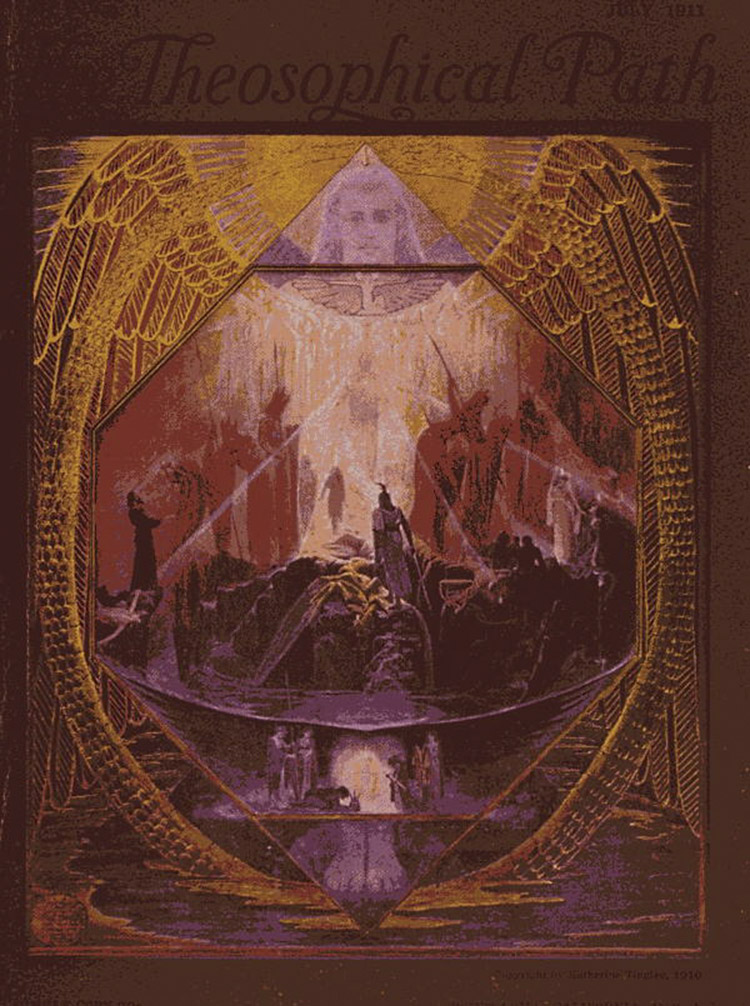


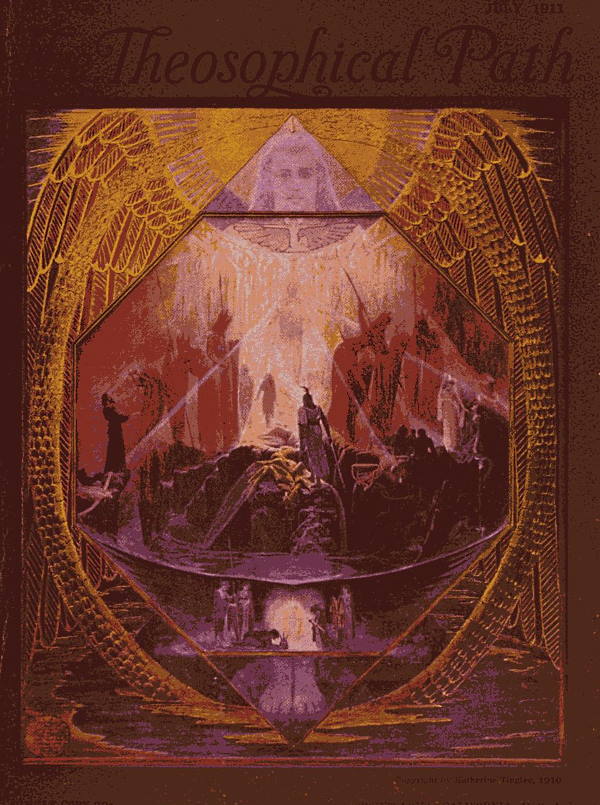

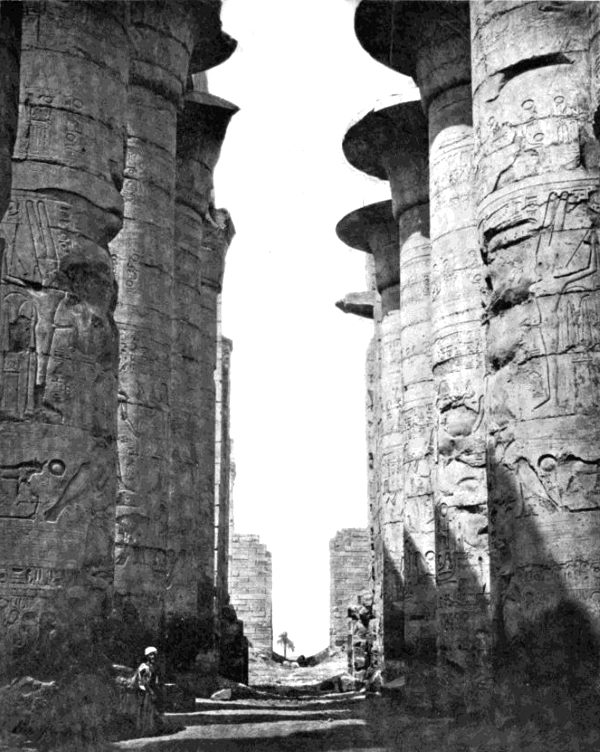
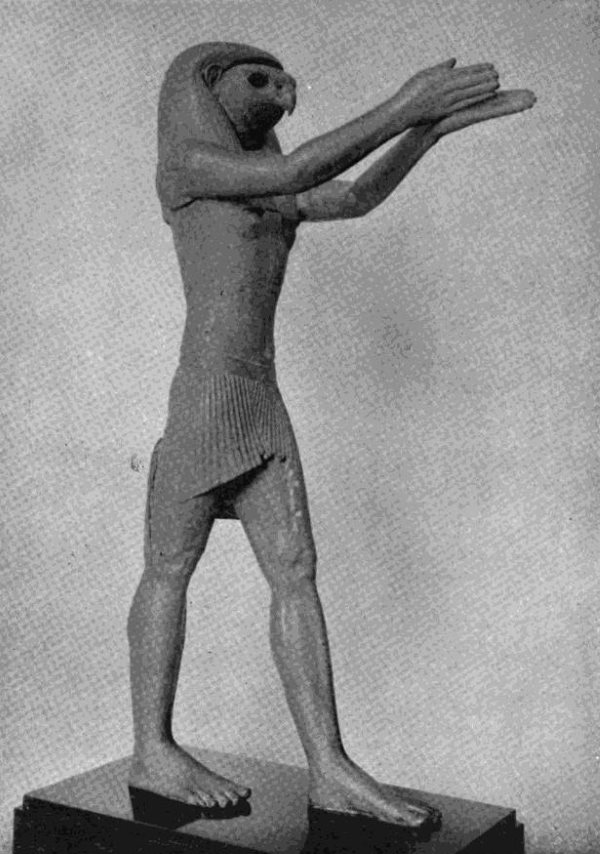


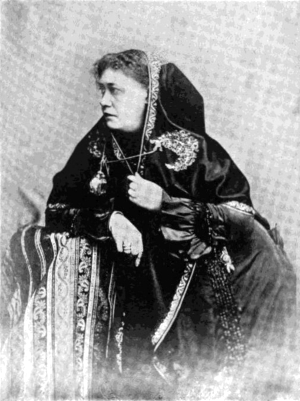
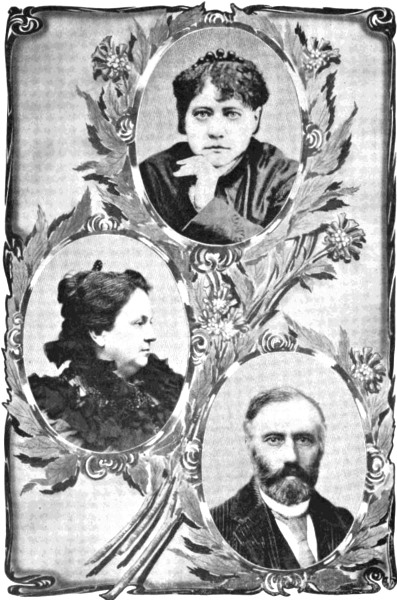
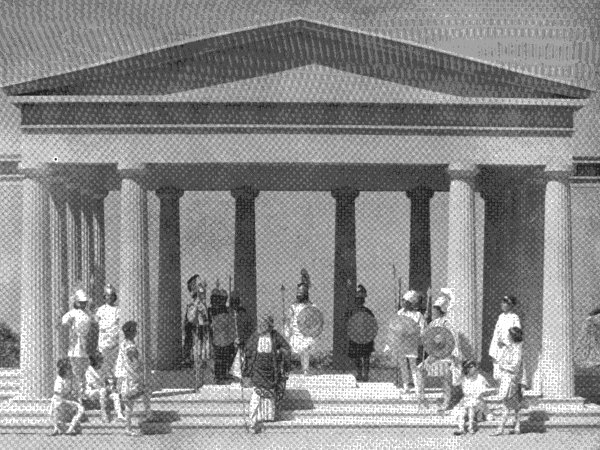
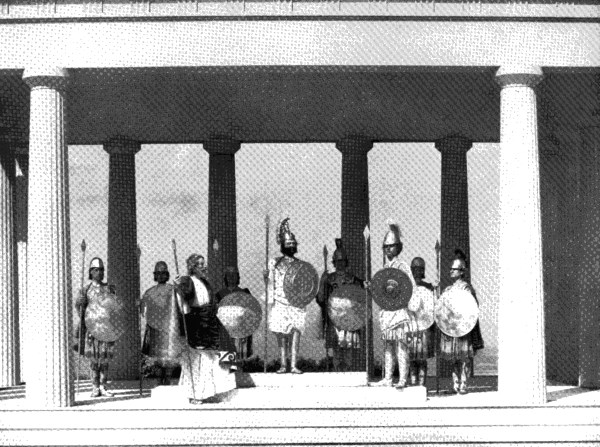
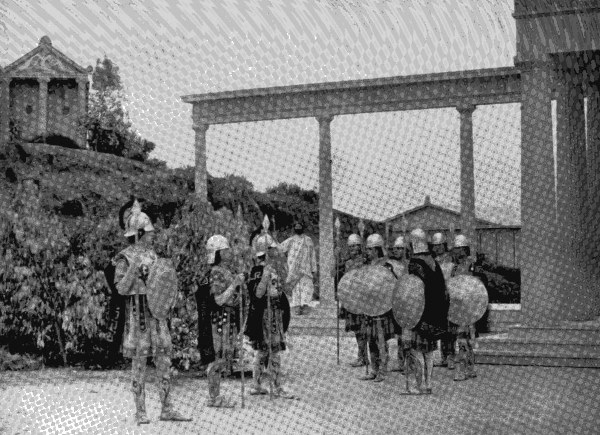
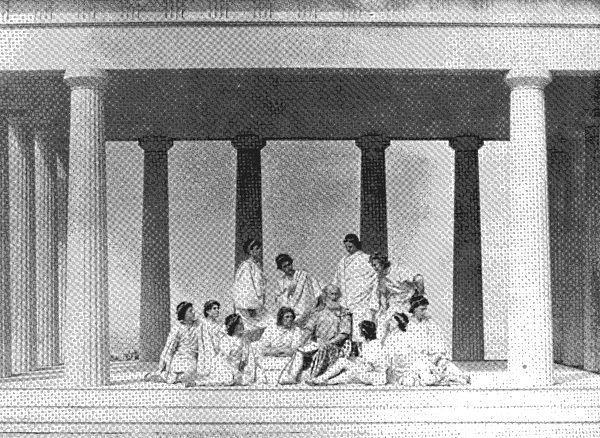

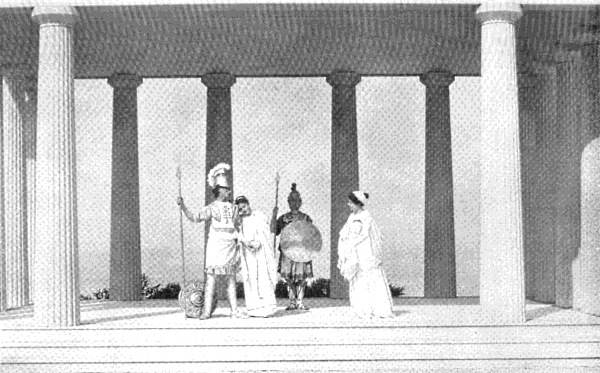
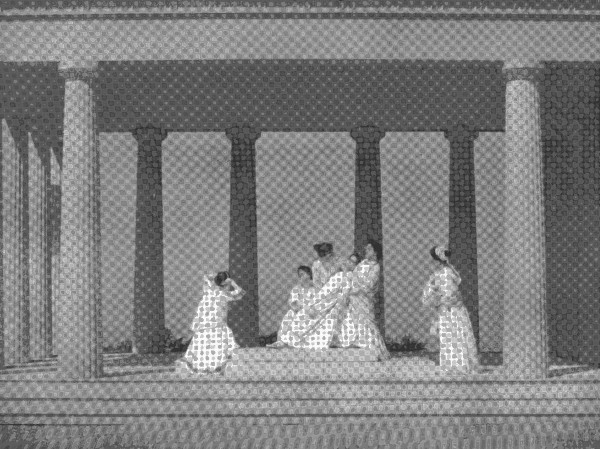
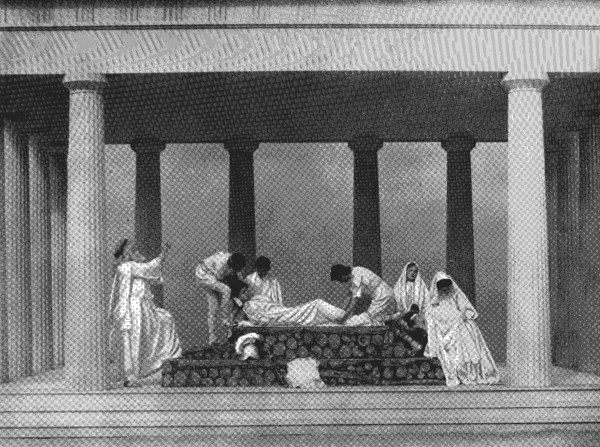
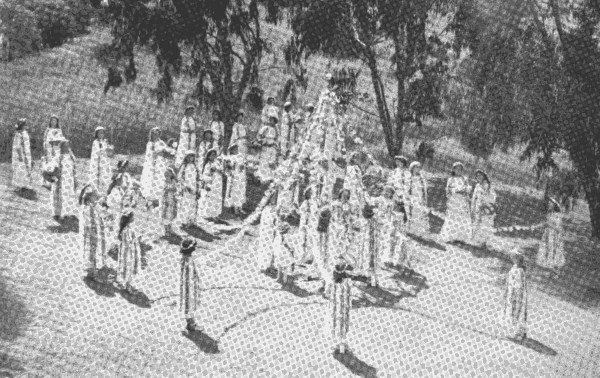


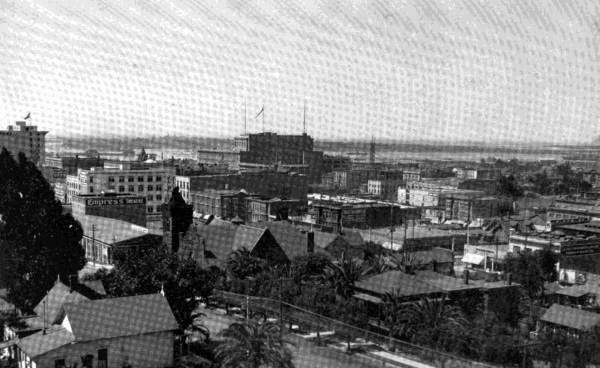
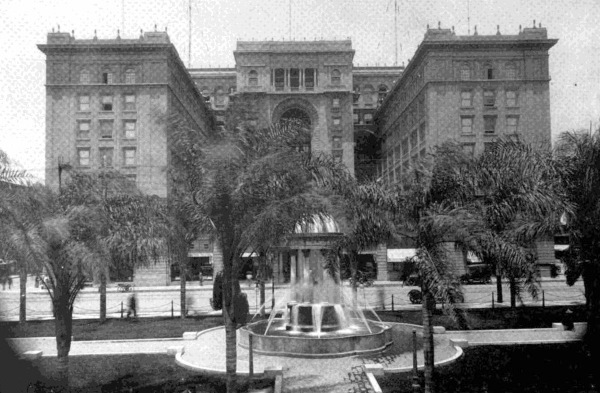
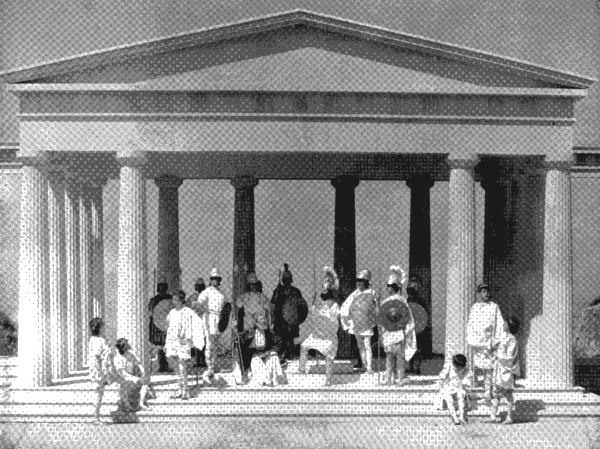
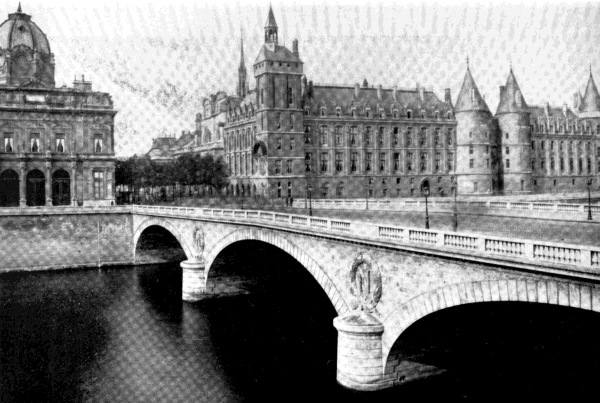
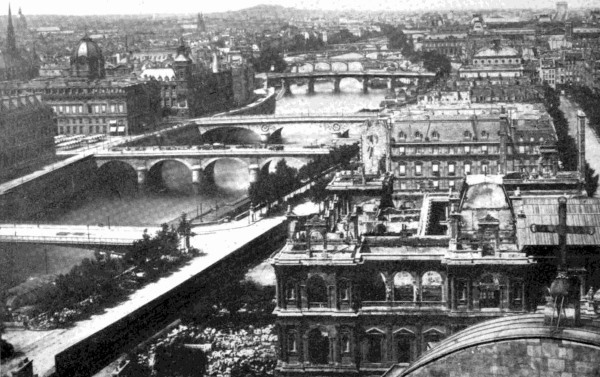

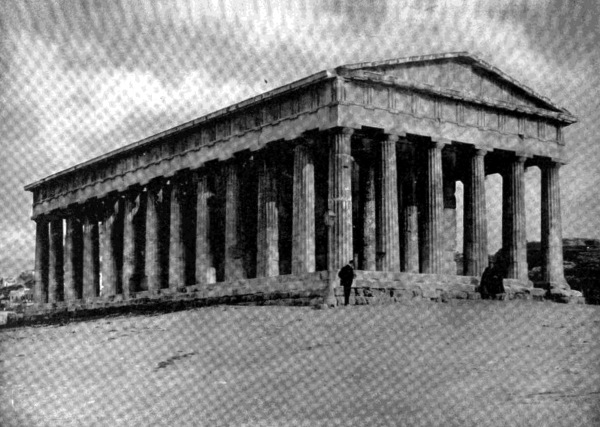
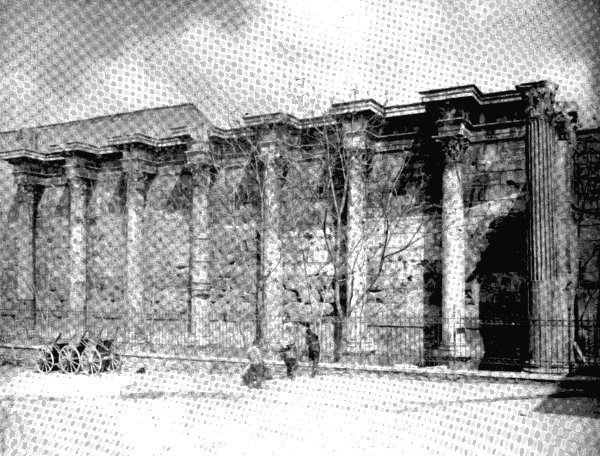
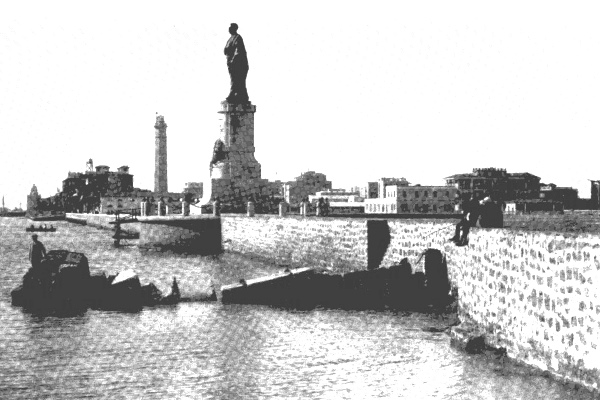
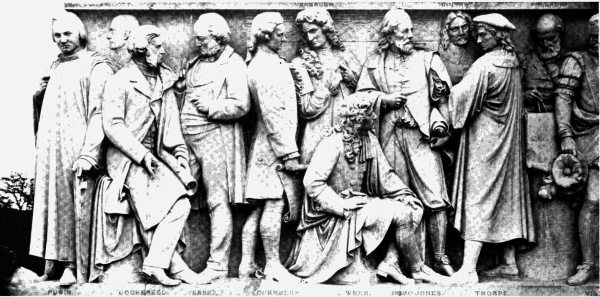
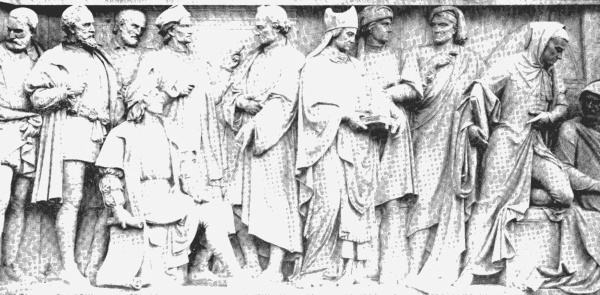
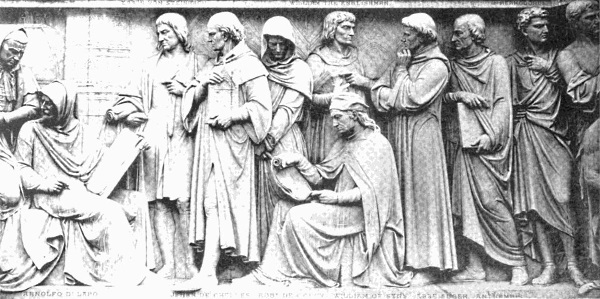
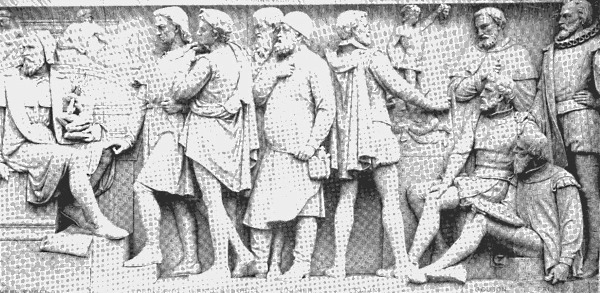
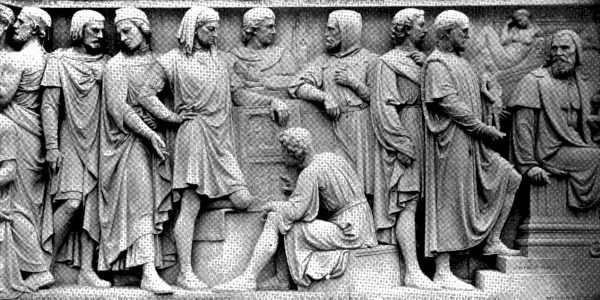

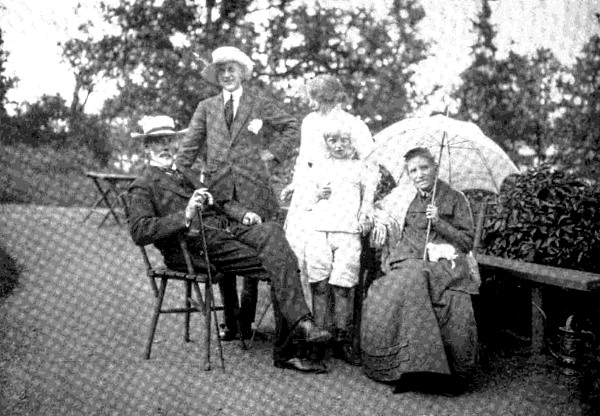
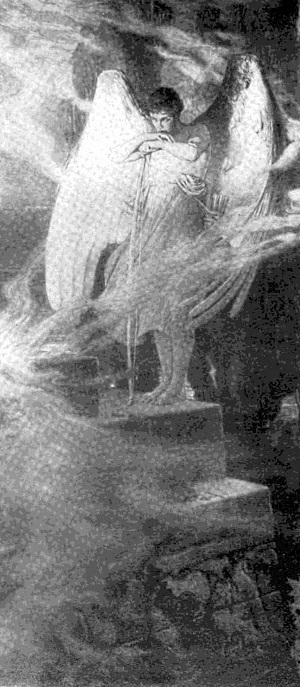


 . This shows graphically how the tetraktys
as 1 + 2 + 3 + 4 = 10, contains potentially the dekad. This ten-dot
triangle filled out by lines becomes an equilateral triangle, with the
dot at the apex and at the center remaining as generating-points for
adjacent figures, and especially as the centers of circles, inscribed in
and circumscribed about the original triangle.


 ; the triangle:
 the square:
 ; the pentagram, or five-pointed star:
 ; and
the hexagram, the six-pointed star or so-called Pythagorean Pentacle:
 .