THE LAW AND THE EVIDENCE
AS the rising sun poured its flood of
glorious light into the court-house
square and the janitor, according to his custom,
threw open the court-room doors to sweep,
there was a scuffling of eager feet from without
and the swift-moving pageantry of the
Dalhart trial began. A trio of bums who
had passed the night al fresco on the park
benches hustled past the astounded caretaker
and bestowed themselves luxuriously on the
front seats. As the saloons opened up and
discharged their over-night guests others of
the brotherhood drifted in and occupied the
seats behind, and by the time the solid citizens
of Geronimo had taken care of their stock,
snatched their breakfasts, and hurried to the
scene there was standing room only in the
teeming chamber of justice. Only the special
venire of jurymen took their time in the matter
and the sweating bailiff had to pass them
in through the side door in order to get them
seated inside the railing. At nine-thirty
Boone Morgan brought in the defendant,
freshly shaven and with his hair plastered
down across his forehead, and sat with him
near the jail door. It was all in the line of
duty, but there were those who remarked that
it was right clever of old Boone to throw in
that way with his jail alcalde. Some people
would have put the nippers on him for the
cow-thief that he was, and chained him to a
deputy. Behind them, the cynosure of all
eyes, sat the counsel for the defendant, Angevine
Thorne, his round baby face illuminated
with the light of a great resolve. On that day
he was going to save his friend from prison or
climb spider-webs in the attempt. A hush
fell over the assembly as the hour of trial drew
near and only the gaunt figure of Shepherd
Kilkenny, pacing up and down before the
empty jury-box, suggested the battle that
was to come. The rest was as pathetic as the
Angelus.
The soft morning breeze breathed in through
the windows and as Pecos glimpsed the row
of horses tied to the hitching rack he filled his
lungs deep with the sweet air, and sighed.
The invalid who has been confined to his room
longs vaguely for the open air, but to the
strong man of action, shut up for months in
a close cell, the outer world seems like a dream
of paradise and he sees a new heaven in the
skies. In the tense silence of waiting the
tragedy in his face afflicted the morbid crowd
and made them uneasy; they shifted their eyes
to the stern, fighting visage of the district attorney
and listened hopefully for the clock.
It struck, slowly and with measured pauses,
and as the last stroke sounded through the hall
the black curtain behind the bench parted
and the judge stepped into court. Then instantly
the sheriff's gavel came down upon the
table; the People rose before the person of the
Law, and in sonorous tones Boone Morgan repeated
the ancient formula for the calling of
the court.
"Oyez! Oyez! Oyez! The District Court
of Geronimo County is now in session!"
The judge threw off his robes and sat down
and as the audience sank back into their
crowded seats he cast one swift, judicial glance
at the defendant, the clerk, and the district attorney
and called the case of Pecos Dalhart,
charged with the crime of grand larceny.
With the smoothness of well-worn machinery
the ponderous wheels of justice began to turn,
never halting, never faltering, until the forms
prescribed by law had been observed. One
after the other, the clerk called the names of
the forty talesmen, writing each name on a slip
of paper as the owner answered "Here"; then
at a word from the judge he placed the slips in
a box and shook out twelve names upon the
table. As his name was called and spelled
each talesman rose from his seat and shambled
over to the jury-box, turning his solemn
face from the crowd. They held up their right
hands and swore to answer truthfully all questions
relative to their qualifications as jurors,
and sat down to listen to the charges; then,
after reading the information upon which the
accusations were based, the district attorney
glanced shrewdly at the counsel for defendant
and called the first juryman. The battle had
begun.
The first talesman was a tall, raw-boned
individual with cowman written all over him,
and the district attorney was careful not to
ask his occupation. He wanted a jury of
twelve cowmen, no less; and, knowing every
man in the venire either by sight or reputation,
he laid himself out to get it.
"Mr. Rambo," he began, "do you know the
defendant in this case?" He indicated Pecos
Dalhart with a contemptuous wave of the hand,
and Mr. Rambo said he did not. "Know anything
about this case?"
"Only what I read in the papers," responded
the cowman dryly.
"You don't believe everything you read, do
you, Mr. Rambo? If you were passed for a
juror you wouldn't let anything you have read
influence your mind, if it was proven that the
defendant was guilty, would you?"
"No, sir!"
"If I should prove to your satisfaction that
the defendant here"—another contemptuous
wave of the hand—"had wilfully and feloniously
stolen and branded the animal in question,
what would your verdict be—'Guilty' or
'Not guilty'?"
"W'y—er—'Guilty'!"
"Pass the juror!" snapped the district attorney,
and then he looked at the counsel for
the defendant as if imploring him not to waste
any of the court's valuable time.
"Mr. Rambo," began Angy, singing the
words in a child-like, embarrassed manner, "you
are engaged in the business of raising cattle,
are you not?"
The district attorney winced at this, but
Angevine Thorne did not take advantage of
his discovery. He also wanted a jury of
twelve cowmen, though he did not show his
hand.
"Very good," he observed, "and I suppose,
Mr. Rambo, that you are acquainted with the
law in this case which makes it a felony for
any man to mark or brand the stock of another
man? Very good. Have you any prejudice
against that law, Mr. Rambo? You believe
that it should be enforced impartially, do you
not—against the rich as well as the poor?
Very good. Pass the juror!"
For a moment Shepherd Kilkenny could
hardly believe his ears. The drift of every
one of the questions had led naturally up to a
challenge and yet at the end Angy had passed
the juror. He glanced quickly at the innocent
face of his opponent, opened his mouth
to speak, and then hurried on with his examination.
The second man was interested in the
cattle business, too; and when Angy passed
him the judge felt called upon to speak.
"You know, do you not, Mr. Thorne," he
said, "that it is your privilege to excuse any
juror whose occupation or condition of mind
might indicate a prejudice against your client?"
"Yes, indeed, Your Honor," replied Mr.
Thorne, suavely, "but I have perfect confidence
in the integrity of the two gentlemen
just passed. I feel sure that they will do full
justice to Mr. Dalhart."
"Very well, then," said His Honor, "let the
examination proceed!"
With all the address of a good tactician who
sees that his opponent has mistaken a two-spot
for an ace, Shepherd Kilkenny flew at his
task, but each time that Angy passed one of
his cowmen he paused just the fraction of a
second, glanced apprehensively about the room,
and rubbed his chin thoughtfully. The defence
was playing right into his hand, but he
didn't know whether he liked it or not. When
it came to the peremptory challenges he excused
two health-seekers and a mining man,
but Thorne did not challenge a man. Once
more the clerk shook the names out of his box
and within half an hour the district attorney
had the very jury he wanted—every man of
them interested in the cattle business and
ready to cinch a rustler as they would kill a
rattlesnake. It seemed almost too good to be
true. Even the staid judge was concerned,
for he had a sober sense of justice and Angy's
appointment had been slightly irregular; but
after a long look at that individual he motioned
for the trial to proceed. The evidence
was all against the defendant anyway, and he
could cut off a year or two on the sentence to
make amends.
"Swear the jurors!" he said, and holding up
their rope-scarred hands and looking coldly
across the room at the alleged rustler, the
twelve cowmen swore to abide by the law and
the evidence and a true verdict find. Then
the district attorney pulled his notes from his
hip-pocket as a man might draw a deadly
weapon and began his opening statement to the
jury.
"Your Honor and gentlemen of the jury,"
he said, "in the case of the People of the
Territory of Arizona versus Pecos Dalhart, we
shall show that on or about the eighth day of
May the said Pecos Dalhart did wilfully, feloniously,
and unlawfully pursue, rope, and
brand a calf, said calf being the property of
Isaac Crittenden of Verde Crossing, Territory
of Arizona; that the said Pecos Dalhart was
arrested and, upon being taken before a magistrate,
he did plead 'Not guilty' and was
held for the grand jury, which handed down an
indictment against him; that upon being arraigned
before the judge he did plead 'Not
guilty' and was remanded for trial upon the
crime charged in the indictment, to wit:—that
he did feloniously and unlawfully mark, brand,
or alter the brand on a neat animal, to wit, one
red-and-white spotted calf, said calf being the
property of Isaac Crittenden, of Verde Crossing,
Territory of Arizona, contrary to the
form, force, and effect of the statute in such
case made and provided and against the peace
and dignity of the People of the Territory of
Arizona. Mr. Crittenden, will you please take
the stand!"
All the other witnesses had been relegated to
the jury-room, where they would be beyond
the sound of the court, but being the complaining
witness Isaac Crittenden was entitled to
remain and he sat just behind the district attorney,
fumbling with the high collar that
galled his scrawny neck and rolling his evil
eye upon the assemblage. As he rose up from
his place and mounted the witness stand a rumble
of comment passed through the hall and
the sheriff struck his gavel sharply for order.
"Swear the witness, Mr. Clerk," directed
the judge, and raising his right hand in the
air Isaac Crittenden rose and faced the court,
looking a trifle anxious and apprehensive, as
befits one who is about to swear to a lie. Also,
not being used to actions in court, he entertained
certain illusions as to the sanctity of an
oath, illusions which were, however, speedily
banished by the professional disrespect of the
clerk. Reaching down under the table for a
penholder which he had dropped and holding
one hand weakly above his head he recited with
parrot-like rapidity the wearisome formula of
the oath:—"Do you solemnly swear that the
evidence you are about to give in the case of
the People versus Pecos Dalhart shall be the
truth, the whole truth, and nothing but the
truth, s'elpyougod?"
Crittenden blinked his good eye and sat
down. There was nothing very impressive
about the proceeding, but all the same he was
liable for perjury.
"Calling your attention to the eighth day of
May, of the present year, where were you on
that day, Mr. Crittenden?" It was the first
gun in the real engagement and the surging
crowd about the doors quit scrouging for a
view and poised their heads to listen. The
voice of the district attorney was very quiet
and reassuring, and Isaac Crittenden, taking
his cue, answered with the glib readiness of a
previous understanding.
"I was gathering cattle with my cowboys
near my ranch at Verde Crossing."
"And upon returning to your home did you
encounter any one in the deep arroyo which
lies above your ranch?"
"Yes, sir," responded Crittenden, "I come
across Pecos Dalhart."
"Is this the gentleman to whom you refer?"
inquired Kilkenny, pointing an accusing
thumb toward Pecos. "Very good, then—you
identify the defendant. Now, Mr. Crittenden,
what was the defendant doing at that
time?"
"He had a spotted calf of mine strung out
by a little fire and was alterin' the brand with
a runnin' iron." Old Crit's eye wandered instinctively
to Pecos Dalhart as he spoke and
gleamed with a hidden fire, but his face was as
expressionless as a death mask.
"I offer the following animal in evidence,"
said the district attorney, beckoning toward
the side door. "Bring in the exhibit!" And as
Bill Todhunter appeared, sheepishly leading
the spotted calf, which had been boarded all
summer in town, he threw out his hand dramatically
and hissed:
"Do you identify this animal? Is that the
calf?"
"I do!" responded Crit. "It is the same animal!"
"That's all!" announced Kilkenny, and
with a grin of triumph he summoned the hawk-eyed
jurymen to inspect the brand. There it
was, written on the spotted side of the calf, in
ineffaceable lines—the plain record of Pecos
Dalhart's crime, burned with his own hands.
Across the older scar of Isaac Crittenden's
brand there ran a fresh-burnt bar, and below
the barred Spectacle was a Monkey-wrench,
seared in the tender hide. To a health-seeker
or a mining man the significance of those
marks might be hidden, but the twelve cowmen
on the jury read it like a book. Only one
thing gave them a passing uneasiness—Crit's
Spectacle brand was very evidently devised
to burn over Pecos Dalhart's Monkey-wrench,
but that was beside the point. They
were there to decide whether Pecos Dalhart
had stolen that particular spotted calf, and the
markings said that he did. By that broad bar
which ran through the pair of Spectacles he
deprived Isaac Crittenden of its ownership,
and by the Monkey-wrench burned below he
took it for his own. All right then,—they retired
to their seats and Angevine Thorne took
the witness.
They faced each other for a minute—the
man who had committed a crime and covered
it, and the man who had sworn to expose his
guilt—and began their fencing warily.
"Mr. Crittenden," purred Angy, "you are
in the cattle business, are you not? Yes, indeed;
and about how many cattle have you
running on your range?"
"I don't know!" answered Crittenden
gruffly.
"At the last time you paid your taxes you
were assessed for about ten thousand, were you
not? Quite correct; I have the statement of
the assessor here to verify it. Now, Mr. Crittenden,
kindly tell the jury what per cent of
those cattle are calves?"
"I don't know," replied Crit.
"No?" said Angy, with assumed surprise.
"Well then, I hope the court will excuse me
for presuming to tell a cowman about cows
but the percentage of calves on an ordinary
range is between fifty and sixty per cent. So,
according to that you have on your range between
five and six thousand calves, have you
not? Very good. And now, Mr. Crittenden,
speaking roughly, about how many of your cattle
are solid color?"
"I don't know!" scowled Crit.
"You don't know," repeated Angy gravely.
"Very good. I wish the court to note that
Mr. Crittenden is a very poor observer. Now,
Mr. Crittenden, you have stated that you do
not know how many cattle you have; nor how
many of said cattle are calves; nor how
many of said calves are solid color or spotted.
Will you kindly inform the court, then, how
you know that the calf which has been produced
in evidence is yours?"
"Well—" said Crittenden, and then he
stopped. The one thing which he was afraid
of in this trial was about to happen—Angy
was going to corner him on the maternity of the
calf, and that would make him out a cow-thief.
The district attorney scowled at him to go
ahead and then, in order to cover up the failure,
he leapt to his feet and cried:
"Your Honor, I object to the line of questioning
on the ground that it is irrelevant, incompetent,
and immaterial!"
"If the court please," spoke up Angevine
Thorne, "the witness has positively identified
the calf in question as his own, although it is a
matter of record that he possesses four or five
thousand calves, all of which have been born
within the past year and over half of which are
spotted. It is the purpose of the defence to
prove that this calf does not belong to the
witness; that it was the property of Pecos
Dalhart at the time the alleged crime was
committed, and that it had been previously
stolen by Isaac Crittenden!"
As he shouted these words Angy pointed an
accusing finger at Old Crit, who started back
like a man who had been struck, and while
the clamor of deputies and bailiffs filled the
court-room they stood there like the figures in a
tableau, glaring at each other with inextinguishable
hatred.
"Order in the court! Order in the court!"
cried the bailiffs, beating back the crowd, and
when the assembly had been quieted the judge
motioned to Angy to proceed.
"Objection is overruled," he said, and bent
his dark brows upon Isaac Crittenden. "Let
the witness answer the question."
"Well, the calf had my brand on it," responded
Crittenden defiantly, and then, egged
on by Angy's sarcastic smile, he went a step
too far. "Yes, and I know him, too!" he
blurted out. "I'd know that calf among a
thousand, by them spots across his face."
"Oh, you would, would you?" spoke up
Angy quickly. "You have a distinct recollection
of the animal on account of its peculiar
markings then; is that right? Very good.
When did you put your brand on that calf,
Mr. Crittenden?"
"Last Spring," replied Crittenden grudgingly.
"You know the law regarding the branding
of calves," prompted Angy. "Was the
calf with its mother at the time?"
"It was!"
"And did she bear the same brand that you
burned upon her calf?"
"She did!"
"Any other brands?"
"Nope!"
"Raised her yourself, did you?"
"Yes!" shouted Crittenden angrily.
"That's all!" said Angy briefly, and Isaac
Crittenden sank back into his chair, dazed at
the very unexpectedness of his escape. It
was a perilous line of questioning that his
former roustabout had taken up, leading close
to the stealing of Upton's cattle and the seizing
of Pecos Dalhart's herd, but at the very
moment when he might have sprung the mine
Angy had withheld his hand. The gaunt
cowman tottered to his seat in a smother of
perspiration, and Shepherd Kilkenny, after a
moment's consideration, decided to make his
hand good by calling a host of witnesses.
They came into court, one after the other,
the hard-faced gun-men that Crittenden kept
about his place, and with the unblinking assurance
of men who gamble even with life
itself they swore to the stereotyped facts, while
Angy said never a word.
"The People rest!" announced the district
attorney at last, and lay back smiling in his
chair to see what his opponent would spring.
"Your Honor and gentlemen of the jury,"
began Angevine Thorne, speaking with the
easy confidence of a barrister, "the prosecution
has gone to great lengths to prove that Pecos
Dalhart branded this calf. The defence
freely admits that act, but denies all felonious
intent. We will show you, gentlemen of the
jury, that at the time he branded the animal
it was by law and right his own, and that during
his absence it had been feloniously and unlawfully
branded into the Spectacle brand by
the complaining witness, Isaac Crittenden.
Mr. Dalhart, will you please take the stand!"
Awkward and shamefaced in the presence
of the multitude and painfully conscious of
his jail clothes, Pecos mounted to the stand
and turned to face his inquisitor. They had
rehearsed the scene before—for Babe Thorne
was not altogether ignorant of a lawyer's wiles—and
his examination went off as smoothly as
Kilkenny's examination of Crit, down to the
point where Pecos was rudely pounced upon
and roped while he was branding his spotted
calf. Then it was that Angevine Thorne's
voice began to ring like a trumpet, and as he
came to the crucial question the audience stood
motionless to listen.
"Now, Mr. Dalhart," he clarioned, "you say
that you purposely barred the Spectacle brand
upon this calf and burned your own brand,
which was a Monkey-wrench, below it?
What was your reason for that act?"
"My reason was that the calf was mine!"
cried Pecos, rising angrily to his feet. "When
I first come to Verde Crossing I bought an
old spotted cow and her calf from José Garcia
and branded them with a Monkey-wrench on
the ribs—I kept her around my camp for a
milk cow. That first calf growed up and she
was jest comin' in with another one when I
went to New Mexico last Fall. Well, when I
came back last Spring I hadn't got into town
yet when I come across my old milk cow with
her ears all chopped up and her brand burned
over and this little calf, lookin' jest like her,
with a Spectacle brand burned on his ribs.
That made me mad and I was jest ventin' the
calf back to a Monkey-wrench when Crittenden
and his cowboys jumped in and roped me!"
"You say that you bought the mother of
this calf from José Garcia?"
"Yes, sir! I paid him twenty-five dollars
for the cow and five dollars for the first
calf."
"What were the brand and markings of this
cow at the time you bought her?"
"She had a Mexican brand, like an Injun
arrer struck by lightning, on her left hip, a
big window or ventano in the left ear, and a
slash and underbit in the right. Garcia vented
his brand on her shoulder and I run a Monkey-wrench—that's
my regular, registered brand—on
her ribs, but I never changed her ear
marks because I kept her for a milk cow anyway."
"Your Honor," interposed Kilkenny, rising
with a bored air to his feet, "I object to this
testimony on the ground that it is irrelevant,
incompetent, and immaterial. I fail to see the
relation of this hypothetical milk cow to the
question before the court."
"The cow in question was the mother of the
calf which my client is accused of stealing!"
cried Angy, panting with excitement as he saw
the moment of his triumph approaching.
"She was sold to the defendant and he had a
legal right to her offspring. Can a man steal
his own property, Your Honor? Most assuredly
not! I wish to produce that cow in
evidence and I will bring competent witnesses
to prove that she belongs by rights to Pecos
Dalhart. Bring in the exhibit, Mr. Todhunter!"
He waved his hand toward the side door
and as Kilkenny saw the coup which had been
sprung on him he burst into a storm of protest.
"I object, Your Honor!" he shouted,
"I object!"
"Objection overruled!" pronounced the
judge. "Let the cow be brought in as quickly
as possible and after the examination of the
exhibit we will proceed at once to the argument."
He paused, and as the crowd that blocked
the side door gave way before the bailiffs, Old
Funny-face was dragged unwillingly into
court and led to the sand boat to join her
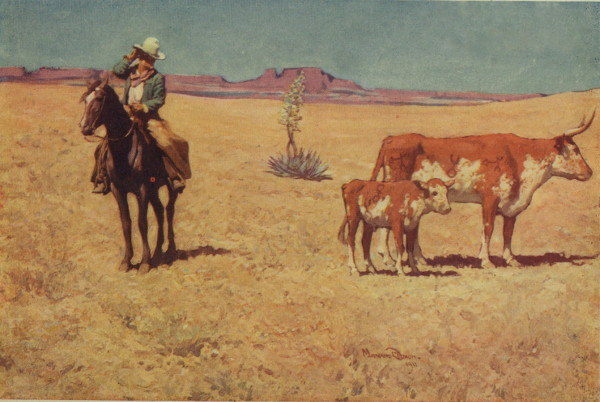
calf. At the first sight of her dun-colored
face and spotted neck every man in the jury-box
looked at his neighbor knowingly. They
were cowmen, every one of them used to picking
out mothers by hair-marks in the corral
cut, and Old Funny-face was a dead ringer
for her calf. Even to the red blotch across
his dun face the calf was the same, and when
Funny-face indignantly repulsed its advances
they were not deceived, for a cow soon forgets
her offspring, once it is taken away. But
most of all their trained eyes dwelt upon
the mangled ears, the deep swallow fork in
the left and the short crop in the right, and the
record of the brands on her side. There was
the broken arrow, just as Pecos had described
it, and the vent mark on the shoulder. It
would take some pretty stiff swearing to make
them believe that that Spectacle brand on her
ribs had not been burnt over a Monkey-wrench.
It was Angy's inning now, and with a flourish
he called Pecos to the stand and had him identify
his cow; but when he called José Garcia,
and José, gazing trustfully into Angy's eyes,
testified that she was his old milk cow and he
had, sin duda, sold her to Pecos Dalhart for
twenty-five dollars, the self-composed Kilkenny
began to rave with questions, while
Crittenden broke into a cold sweat. Not only
was the case going against him, but it threatened
to leave him in the toils. It was too late
to stop Garcia now—he had said his say and
gone into a sullen silence—there was nothing
for it but to swear, and swear hard. Kilkenny
was on his toes, swinging his clenched
fist into the hollow of his hand and raging at the
witness, when Crittenden suddenly dragged
him down by the coat-tails and began to
whisper into his ear. Instantly the district
attorney was all attention; he asked a question,
and then another; nodded, and addressed the
court.
"Your Honor," he said, "I will excuse the
witness and ask to call others in rebuttal.
Will you take the chair, Mr. Crittenden!"
Old Crit advanced to the stand and faced
the court-room, a savage gleam in his eye.
"Do you recognize this cow, Mr. Crittenden?"
inquired Kilkenny mildly.
"Yes, sir, I know her well. She's an old
gentle cow that's been hangin' around my corral
for years. I took her from Joe Garcia,
last Spring, for some money he was owin' me."
"What?" yelled Angy, springing up from
his chair, "do you mean to say—"
"I object, Your Honor!" clamored Kilkenny
desperately. "I object! The witness
is mine!"
"The People's witness," ruled the judge;
"let the examination proceed."
"Is this cow the mother of the calf in question—do
you identify her as the mother of
this calf?"
"I do!" repeated Crittenden solemnly.
"And you can summon any of my cowboys—they'll
swear to her."
"Take the witness!" said Kilkenny, leering
at Angevine Thorne, and in spite of all Angy
could do Crit stuck to his story, word for
word. One after the other his cowboys took
the chair, glanced at their boss, and identified
the cow and calf. Kilkenny had won, and
before Babe Thorne could collect his wits he
plunged into his closing argument.
"Gentlemen of the jury," he cried, "the
people of Geronimo County are looking to you
to-day to vindicate justice in the courts. It is
the shame of Geronimo County—spoken
against her by all the world—that not a single
cattle-thief has ever been convicted in her
courts. Men have been tried; their guilt has
been demonstrated to a moral certainty; but
the evidence has been insufficient, and they have
escaped. Gentlemen of the jury, a year and
a half ago the defendant in this case came to
Geronimo County without a cent; he went to
work for Mr. Crittenden, who kindly took him
in; but within a few months, gentlemen of the
jury, Pecos Dalhart left the service of his benefactor
and moved to Lost Dog Cañon. Six
months later, gentlemen, when the sheriff at
the risk of his life rode into his guilty hiding-place,
Mr. Dalhart had two hundred head of
cattle shut up in a secret pasture! Two—hundred—head,
gentlemen; and he defied the
sheriff of this county to even collect the taxes
upon those cattle! Gentlemen of the jury,
I ask you, Where did this man get those two
hundred head of cattle? Did he bring them
with him? No, for the evidence shows that he
rode in alone. Did he buy them? No, for he
had no money. Gentlemen of the jury, that
man who sits before you stole those cattle, and
he does not dare to deny it!"
He paused and looked about the court-room,
and a great hush came upon the entire
assembly. Every man in the crowded standing
room stood silent and the surge of those
without the doorway died down in a tremor of
craning heads. Kilkenny had won—but he
had not finished. Point by point he went over
the chain of his evidence, testing every link to
prove that it was true, and then in a final outburst
of frenzy he drove the last point home.
"Gentlemen of the jury," he said, in closing,
"the defendant stands before you, convicted
by his own words. He acknowledges that he
branded the calf; he acknowledges that he set
at defiance all law and justice and robbed the
man who had befriended him—and what is
his defence? That Isaac Crittenden had
robbed him of his cow! Isaac Crittenden, who
has cattle on a thousand hills! A man known,
and favorably known, in this community for
twenty years! Gentlemen, I ask of you,
whose word will you take in this matter? The
word of this self-confessed cattle-rustler and
his Mexican consort or the word of Isaac Crittenden
of Verde Crossing? Gentlemen of the
jury, it has been the shame of Geronimo
County for many years that this practice of
rustling cattle has never received its fitting rebuke.
It has been the shame of Arizona that
the rights of the cattle men, the men who dared
the Indians and braved the desert and made
this country what it is, have never been protected.
You have seen what this negligence has
brought to our near neighbor, Tonto County—a
cattle war in which over fifty men have
given up their lives; a beautiful cattle country,
devastated of all its flocks and herds. It
has brought death, gentlemen, and destruction
of property, and—bankruptcy! Gentlemen,
I ask you for a verdict of 'Guilty'!"
He sat down, and Angevine Thorne rose
to his feet, bewildered. The speech which he
had prepared to save his friend was forgotten;
the appeals which he could have made were
dead. He gazed about the court and read in
every eye the word that was still ringing in
his ears: "Guilty!" And yet he knew that
Pecos was not guilty. Cattle he had stolen,
yes—but not the cattle in court. They, of
all the animals he had owned, had been honestly
acquired; but Old Crit had sworn him into
prison. It was right, perhaps, but it was not
Law—and it was the law that held him. As
he looked at the forbidding faces before him,
each one hard and set by the false words of
Crit and Shepherd Kilkenny, the monstrous
injustice of the thing rushed over him and he
opened his lips to speak. It was a conspiracy—a
hellish combination of lawyers and the men
they served, to beat the poor man down. The
old rage for the revolution, the rage which he
had put so resolutely from his heart, rushed
back and choked him; he scowled at the sneering
district attorney and Old Crit, humped
over in his chair; and turned to the glowering
audience, searching with the orator's instinct
for a single friendly face. But there was
none; every man was against him—every
one! He raised his hand to heaven—and
stopped. There was a struggle in the doorway—a
bailiff, tall and burly, was thrusting
back a young girl who struggled to get free—and
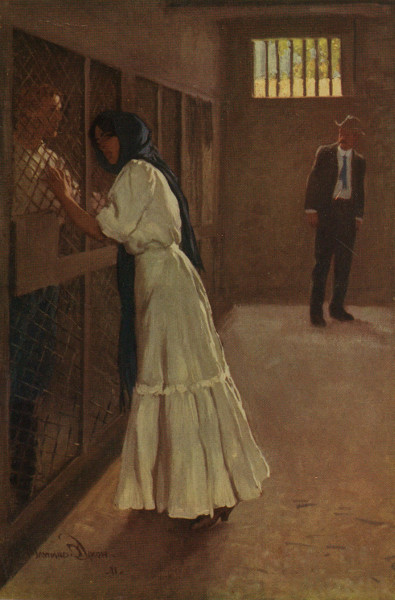
then like a flash of light Babe Thorne
saw her face, the wild-eyed, piteous face of
Marcelina!
"Here!" he commanded, leaping upon a
chair and pointing with an imperious hand.
"Let that girl in! Your Honor, I demand
that that girl be let in! This trial is her trial,
Your Honor—she is Marcelina Garcia, my
friend's affianced bride!" In that single moment
he saw it—the last desperate chance to
save his friend—a sentimental appeal to the
jury! How many men have been saved from
prison and gallows and the just punishment of
their crimes by such a ruse! Given the aged
mother, the despairing wife, the sweetheart,
clinging to his hand, and all the thunderings
of Jove will fail of conviction. The law and
the evidence are nothing; Reason is dethroned
and Justice tips her scales to send the prisoner
free. With a surly frown the bailiff let go his
hold and like a hunted creature that flees from
the memory of her pursuers Marcelina ran
panting down the aisle and threw herself at
the feet of the just judge.
"Oh, Meester," she cried, holding up her
hands, "do not send Paycos to preeson! Look,
here are the ears of Old Funny-face, his cow,
what Ol' Creet stole while he was gone!
Paycos did not steal the cow—no, no! He
buy heem from my papa, and this is mi padre's
mark!" She unwound the blue silk handkerchief
that encased them and thrust into the
hands of the astounded judge—two ears!
With eager glances she held them up—the
keys which Old Crit had cut from Funny-face's
ears on the day that he stole Pecos's
herd—and thrust her brown finger through
the Mexican ventano. Then, impatient of her
English, she snatched them back and, scampering
back to where Old Funny-face still stood
on the sand boat, she fitted the crop and swallow-fork
back into the mangled ears.
"Look! Look!" she cried, "these are the
dried-up ears what Ol' Creet cut from my
Paycos's cow, that day when he stole his cattle.
My leetle brothers bring them from the corral
to play with and I hide them, to show to Paycos.
Meester, he is bad man, that Creet! He—he—"
She faltered and started back. There before
her, humped over in his chair, sat Isaac
Crittenden, and his one eye covered her like
the evil glare of a rattlesnake.
"Santa Maria!" she gasped. "Madre de
Dios! Creet!" And with a scared sob she
turned and ran to Babe. It was an affecting
scene, but Babe did not overdo it.
"Your Honor," he said, speaking over her
bowed head with portentous calm, "I wish to
offer these two ears in evidence as an exhibit
in this case. One of them, you will notice, is
cut in a swallow-fork and exhibits, above, the
ventano which defendant testified belonged to
the mother of this calf; the other is cropped
short and exhibits the slash and Mexican anzuelo;
both of them show the peculiar red and
white spots which gave to the cow in question
the name of Funny-face. After the jury has
inspected the exhibit I will ask that Marcelina
Garcia be sworn."
It was not a long speech and had nothing
of dramatic appeal; and yet as it came out,
this was Angevine Thorne's closing speech.
When he saw how the pendulum had swung,
Shepherd Kilkenny, the fighting district attorney,
went into a black, frowning silence
and refused to speak to Old Crit; but as the
judge began his instructions to the jury he
suddenly roused up and beckoned to Boone
Morgan. They whispered together while the
law was being read and then the sheriff went
over and spoke a few words to Pecos Dalhart.
"Sure!" nodded Pecos, and at the signal
Shepherd Kilkenny rose quickly to his feet.
"Your Honor," he said, bowing apologetically
to the judge, "in consideration of the evidence
which has just been introduced I wish to
withdraw my former request to the jury, and I
now ask for a verdict of 'Not guilty.'" He
sat down, and a hum went up from the crowded
court-room like the zooning of swarming bees.
There was something coming—something
tremendous—that they all knew; and when
the verdict was given not a man moved from
his place. Then Boone Morgan rose up from
beside the district attorney and touched Isaac
Crittenden on the shoulder. There was nothing
rough about it, and Crittenden followed
without a word, but the significance was plain.
The man who had sworn others into prison had
done as much for himself, and it would take
a Philadelphia lawyer to turn him loose. He
had sworn that the cow was his, and the ear
keys showed that he lied. Swallow-fork and
crop, and Mexican marks above, and Old
Funny-face, wagging her mangled ears in
court! There had never been a cow-thief convicted
in the Geronimo courts, and Old Crit
would spend every cent he had to keep out
of jail, but if Shepherd Kilkenny could not
get him on evidence like that, then tyranny is
dead and the devil has lost his claws.
 in the sand—"and run it on the
calves. Savvy? Well, git, then, and remember
what I said about lookin' mad—I don't
want my punchers to git onto this!"
 ).
If he had any qualms as to
the morality of this last act Pecos did not let
them interfere with his industry in any way.
The ethics of the cattle business will not stand
too stern a scrutiny, even at this late date, and
the joke on Old Crit was so primordial in its
duplicity that it obscured the finer moral issues.
Like many another cowman of those early days
Pecos Dalhart had made his start with the running
iron and with luck and judgment he
might yet be a cattle king.
 ) and her ears chopped down
to her head. The ear-marks having been altered
once already there was nothing for it but
to make the new marks deeper and more inclusive—swallow-fork
the left and crop the
right. The swallow-fork was deep in the left,
to take in an underbit that Pecos had cut, and
Old Funny-face, who had returned home with
the herd, lost the fancy Mexican window and
anzuelo in her right ear altogether, along with
all other signs of a former ownership. But
even then the artistic knife-work of José Garcia
was not allowed to perish from the earth.
As Funny-face rose up from this last indignity
and menaced the perspiring cowboys with her
horns, the little Garcia children, hanging over
the fence, dashed out through the dust and
turmoil and rescued the close-cropped ears.
Already, in spite of threats and admonitions,
they had gathered quite a collection of variegated
crops and swallow-forks to serve as play-cows
in their toy corral; but when Marcelina
came upon this last bloody evidence of the
despite that was shown her lover she snatched
the ears away and hid them in the thatched
roof. Old Funny-face was Pecos's cow—she
knew that as well as she knew the red-spotted,
dun-colored ears that had adorned her
speckled head. Pecos had bought Funny-face
and her calf from her father for thirty dollars,
to keep around his camp to milk, and now
there was nothing to show for his ownership
but the ears. But perhaps Pecos would be
glad even for them, if ever he came back. In
a letter to Babe he had said he was coming
back, now that the sheriff was his friend. But
Crit—ha-ah, Ol' Creet—he was stealing all
of Pecos's cows, and the sheriff did not care!
She stood by a post of the brush ramada and
scowled at him as he raged about on his horse,
cursing and shouting and waving his arms and
hurrying his men along. He was a bad man—ahr,
how she hated him—and now he was
such a thief!
 ). It made a very
pretty brand too; but after studying on it for
a while and recalling his past experience with
Crit, Upton decided to play safe and make it
a double cross (
 ). No more ICU2's for
John Upton—he had been there once—and
Circle Double-cross it went on every animal
they marked. The next morning, with every
cow and calf well in hand, the U boys began
to drift the Circle Double-cross herd back over
the mountain, and just as Crittenden was marshalling
his fighting men to win back the
ravished stock there was a clatter of hoofs down
at the Crossing and Boone Morgan rode into
camp, followed by a posse of deputies.