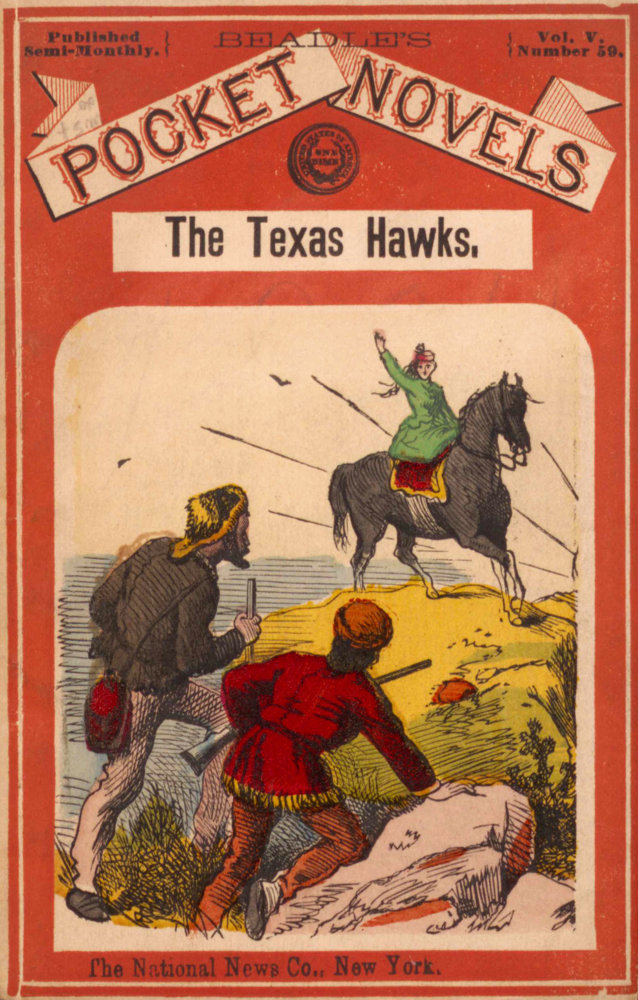
“Bah! for my part, I believe it sheer nonsense—nothing
but a hoax.”
“So said I until lately; but now I know there is something
in it.”
The sentences just noted were spoken in very dissimilar
tones: the first one careless and slightly scoffing—the second
low and earnest. Both speakers were young and of prepossessing
appearance.
The scene was an attractive one, though somewhat similar
ones have been described time and time again. In fact it
was the bivouac of a hunting party.
One glance would decide this. The soiled and blood-stained
garments of the half-score figures gathered around the
cheerful, crackling fire, in attitudes of careless ease, for the
most part with pipe in mouth, the half-picked bones and fragments
of meat scattered profusely here and there, telling of a
hearty meal just passed by. The horses, rudely hoppled, grazing
eagerly hard-by, their sides still wet with sweat; the
plentiful supply of rudely-butchered meat that hung suspended
from the trees around, mostly of buffalo and deer, all told
plainly that this was the bivouac of hunters, resting after a
successful day’s chase.
In conscious security they had kindled their camp-fire, and
now, without a thought of danger, were enjoying that indispensable
luxury of a true plainsman—pipes and tobacco.
Though our hunters had not given the matter a thought,
10
the camp had been pitched in a truly lovely and picturesque
spot. At this point two goodly-sized timber-islands extended
an arm toward each other, almost meeting. In fact, though
the tree-trunks were separated by several yards, their long
branches fairly touched, interweaved together, forming a gayly-tinted
arch, the frost-touched leaves vying in brilliancy with
the colors of the rainbow.
Through and beyond this natural bower, the prairie stretched
far away in gently-undulating swells, studded at irregular
intervals with timber mottes, something similar to those beside
which we find our friends. Close to these twin mottes was a
clear stream of water, a confluent of the Trinity River.
As already incidentally mentioned, the party consisted of
half a score of hunters, all young—the eldest scarcely numbering
thirty years, while one or two were a third less than
that. They were such men as can only be found apart from
the great cities, nurtured in the broad West, their limbs and
lungs fully developed by the clear, pure atmosphere of the
prairies. They would have been out of place in a ladies’
drawing-room, because they were at home here. Their hair
was worn long; scarcely one of their faces had ever known
the touch of a razor, giving their beards a glossy silkiness seldom
seen, that even the scorching sun or crinkling winds of
winter could not destroy.
“What do you mean by that, Fred?” quickly added the first
speaker, Edward Campbell—a tall, stalwart youth, who, despite
his few years, had already gained a widely-known reputation
from more than one desperate combat with the savages
and wild beasts.
“Just what I say, Ned,” and Fred Hawksley spoke in a
serious tone. “I know there is such a being, because I have
seen her—yes, and spoken to her, too.”
A general movement followed this announcement, and it
was plain that the subject under discussion possessed no little
interest to the hunters. Still, despite Hawksley’s earnestness,
they seemed to doubt.
“You have never mentioned this before, Fred. Are you
sure there is no mistake?”
“Am I a fool, Ned Campbell?” retorted the young man,
coolly. “I tell you that I saw her, only three days ago, not
11
two miles from this very spot. And I spoke to her, too, as I
told you before.”
“That’s why you were so urgent for us to encamp here,
was it?” laughed Ned. “But never mind—tell us all about
it now?”
“Yes—who is she? What did she look like? Did she
answer you?” eagerly cried several of the little band.
“Well, I’ll tell you all I know about it, provided you promise
not to make fun of me.”
“You’re not at another of your sells, are you, Fred? Honest
Injun, now.”
“No, Ned, I mean just what I say.”
“That’s enough. Go on. When you talk like that, we
know you’re not fooling.”
“Well, as I said, I saw her three days ago, out just beyond
the big red rock; you know where that is. I didn’t mention
it to any of you, because we had all been deriding Hark Bogan
so unmercifully about her, that I was ashamed to tell
what I had seen. You may remember that I was unusually
quiet, that night, after getting back to camp. I told you I
felt tired, but I was thinking.
“You know that the red rock is just on the top of a high
swell—the highest ground for miles around. I was climbing
this—as my nag was tired and heavily loaded with meat—on
foot. Mott suddenly raised his head and whickered. Even
had there not come a quick reply, that would have told me
there was another horse near by, but a neigh did come from
directly ahead of me.
“I was then almost on the top of the swell, and so could
just see the top of the big rock. And there, beside it, she
was. You know how high the rock is. Well, as she sat her
horse, her head was on a level with the highest part of the
rock, so you can judge she was no baby.
“I remembered Bogan’s description the moment I saw this,
and knew that I must be looking upon his ‘wild woman.’ At
first I could only see her head and shoulders. On her head
she wore a small cap of some kind of fur, with two or three
brightly dyed eagle-feathers, such as the Kiowas wear. Her
dress—what I could see of it—seemed to be made of tanned
fawn-skin, trimmed in Indian style.
12
“I took in this much at a glance, and as it was nearly dark,
I naturally thought she was some Indian. I knew that only
a woman could wear such hair as that which hung down her
back. I even laughed as I thought how crestfallen old Hark
would be, when I proved to him that his lovely white phantom
was nothing more than some wandering Indian squaw.
“Thinking this I kept on until close to the rock, and not
half a dozen lengths from the stranger. Then she lifted a
hand and motioned for me to pause. That she meant this,
I saw from her turning the muzzle of a light, handsome
rifle toward my breast, it resting between the ears of her
horse. She seemed like one who had smelled powder before,
and I obeyed her.
“Now I could see that she was white—though her complexion
was that of a rich brunette. A more beautiful face
I never saw. I can’t describe it—only that her great big
eyes were black and shining as those of a deer; that her
figure was the most superbly developed, the most symmetrical
that I ever beheld in my life. Boys, that face and figure
has haunted me ever since. If that woman is as good
and pure as she is beautiful, she would be well worth dying
for!” suddenly added Hawksley, puffing vigorously at his extinguished
pipe.
“And still better living for—eh, Fred?” and Ned Campbell
laughed. “But go on—you spoke to her—this marvelous
beauty?”
“Yes—but not until she spoke first to me. I was still
staring at her, amazed, for I knew that she did not live
anywhere around here—at least with any one I know, and
there’s few families in the State that I do not know. She
said:
“‘What is your name?’
“Just that and nothing more. Of course I told her.
But that voice! It corresponded perfectly with her face
and figure, rich, mellow, voluptuous—just such a voice as I
believe Homer endowed the goddess Calypso with, when she
was seeking to captivate Ulysses.”
“Ha! ha! the invincible conquered—Fred Hawksley in
love with the fair unknown!”
“Laugh if you will, Ned Campbell,” was the sober reply.
13
“I half-believe it myself. But as I said, I answered her.
She did not speak again, but gave me a look—a glance that
set my brain afire—my heart to throbbing like a trip-hammer.
Then she touched the rein and shot off to the right,
swift as an arrow. At a little distance she paused and raised
one hand toward me. I was dumbfounded then, but since
I believe that she meant it as a challenge to me. I did mount
Mott, but jaded as he was, I knew that he stood no chance
in a race with that mustang.
“Ned, as I rode slowly toward camp, the strange woman—whoever
she may be—fairly rode round me, then with a
clear, taunting laugh, gave loose rein and dashed away over
the prairie like a bird. In five minutes, she was out of sight.
Now you know all that I know about the matter.”
“And you chose this camp in hopes of seeing her again?”
“Well, no, not that exactly; and yet I did think of her.
If we do meet again, I’ll find out who she is, if it lies in old
Mott’s limbs to carry me up to her. There’s some mystery
’bout the woman, that I’ve determined to unravel.”
“Give old ‘buck-skin’ a fair show, with plenty of ground
before him, and he’ll ride over the best mustang that ever
scored turf in Texas.”
“I believe he can,” and Hawksley glanced proudly toward
the large, but nobly-shaped yellow horse that munched the
grass at the timber’s edge.
“Hark!”
There was little need of the exclamation, for all, both human
and quadruped, heard the sound that called it forth;
the quick, rapid thud of a horse’s hoofs upon the solid prairie.
All eyes were instantly turned toward the arch before
alluded to. The rider—and a trained ear has but little difficulty
in deciding whether a galloping horse is riderless—whoever
it might be, was beyond the neck of timber, yet evidently
approaching the bivouac.
The hunters felt only curiosity, for they knew that only
one horseman approached. Then a simultaneous cry broke
from their lips. For a moment they appeared awe-stricken.
Sitting a noble looking mustang beneath the leafy canopy,
with form perfectly outlined against the still glowing sky in
the west, was none other than the strange being who had
14
formed the subject of conversation for the past half-hour.
Her features were indistinctly visible, but there could be no
mistake.
She sat her horse in true savage style: astride, and, with
a dress fashioned for that purpose, as was hers, the effect was
far from displeasing. Her dress flashed back the firelight in
a thousand scintillations, from the beads and silver ornaments
that thickly studded its folds. The long black hair,
slightly curling at the extremities, floated in wild profusion
around her form. A light rifle was carelessly balanced
across the deep-seated Mexican saddle. Other weapons
gleamed from the belt that encircled her round, compact
waist.
“Who and what are you, anyhow?” cried Campbell, breaking
the spell with an effort.
The only reply was a low, clear laugh, melodious as the
notes of a silver bell. Hawksley had not exaggerated in the
least. The most skeptical now acknowledged this, mentally,
if not aloud.
“Keep her in sight, Ned,” muttered Fred, as he arose.
“If Mott can do it, I’ll answer that question before I’m
an hour older!”
At his movement, the strange rider wheeled her mustang
and seemed ready for flight, her face turned, glancing back
over her shoulder.
“I can drop the piebald without hurting her,” muttered
Campbell, half inquiringly.
“No—that would never do. We have no right. Keep
her in sight—I think I can overhaul her,” and Hawksley uttered
a low whistle, at the same time gliding toward where
his saddle and bridle hung.
With another clear laugh, the strange rider turned and,
bending low along the spotted mustang’s neck, dashed around
the timber. Campbell rushed to the arch, then paused, muttering
eagerly:
“Quick, Fred—she’s waiting for you!”
Such indeed seemed the case. The woman had only retreated
a few hundred yards from the bivouac, and then, as
if feeling implicit confidence in the powers of the animal she
bestrode, had halted, once more glancing back toward the
15
camp-fire. Her actions were strange as her appearance. She
seemed inviting—challenging pursuit.
In less than a minute from her first appearance, Fred
Hawksley sprung upon his noble beast, and dashed through
the arch out upon the prairie. The strange rider uttered another
laugh, clear and silvery, yet with a taunting cadence
that caused the young hunter’s blood to tingle and his lips to
compress firmly. He resolved to overtake the woman, even
if it cost him the noble steed he bestrode.
“We’ll follow on after you, Fred,” cried Campbell as his
friend dashed past him. “Don’t be rash—there may be some
deviltry in this!”
The strange rider tossed back her floating hair with one
hand, as the young borderer sprung into view, then with a
peculiar cry, gave her mustang free rein, and sped away over
the undulating prairie with the speed of a swallow. And
after her thundered the big yellow horse, with the long, swinging
stride that Fred knew few mustangs could successfully
cope with in any thing over a mile dash.
“Quick, boys—saddle up!” cried Campbell, excitedly.
“Never mind the meat. I’m afraid that Fred is running
into some real trouble—that creature has bewitched him. See!
he forgot his rifle—but he has his pistols. Make haste! we
mustn’t lose sight of them if we can help it, though the
moon is full and will soon be up. We can follow their trail,
if needs be.”
There was little hesitation. Though the day’s work had
been hard, both men and beasts were ready for a race, and
this was no common one. Already the young hunters possessed
a burning curiosity to know who and what this strange
woman rider really was, and what was the motive of her
strange actions.
Hopples were slipped, saddles and bridles quickly adjusted,
and then, weapons in hand, the little party dashed swiftly beneath
the natural rock, out upon the broad prairie. But
where were the two riders—their friend and the strange woman?
For a moment a superstitious thrill agitated the young
hunters, but then Campbell laughed. He saw their foolishness.
16
“They’re beyond the swell—we’ll see them in a moment.
Come on—keep up with me if you can!”
That he spoke the truth, the next moment confirmed. Gliding
like shadowy phantoms, rapidly yet noiselessly, two riders
appeared near the crest of the second swell, already a mile
away. Only that the moon was just rising the eastern swells,
the chase would have been invisible to the hunters.
But few more words were spoken on the part of the little
band. One and all, they saw that a long and severe race was
before them, and that all their attention must be given to
their horses, already jaded by their hard day’s hunt, if they
hoped to keep within view of the young ranger. Up hill and
down, over gullies and through the patches of tall grass and
weeds, sped the hunters, now no longer in a compact clump,
but strung out with intervals of a yard, a horse’s length, maybe,
between each other. A dozen lengths in front thundered
Ned Campbell on his big bay horse.
“Do the best ye can, boys,” he shouted back, with beard
on shoulder. “If you can’t keep up, follow the trail.”
Each of his friends felt the same vague fear that agitated
Campbell’s heart. They believed that Hawksley was being led
into some great peril by this strange rider—that she was acting
the part of a decoy.
But why? That was beyond them. They did not pause
to reason—they jumped at once to the conclusion, preposterous
as it seemed.
The moon shone clear and full upon the prairie, lighting
up this unique, double chase. First—far ahead, almost invisible
in the dim, deceitful light, sped the strange woman rider,
the spotted mustang running freely and seemingly at ease.
Close behind—in fact not more than a hundred yards, thundered
the dark figure of the young ranger, urging on his
noble “buck-skin” with both voice and spur. A mile further
to the rear was Ned Campbell, his big bay holding its own,
if not slowly gaining upon the two foremost racers. Gradually
losing ground, on struggled the others, bringing up the
rear.
Bitterly Hawksley regretted having so severely taxed his
animal during the day. Were he fresh now, there was little
doubt as to how the chase would terminate. The spotted
17
mustang would speedily be forced to acknowledge its master.
But now? With varying hope and fear, Fred urged his
horse on. He scarcely knew what to think. At times the
spotted creature seemed laboring heavily, at others to be running
well within himself. Could it be that this strange woman
was playing with him? Fred bit his lip and pressed his
spurs home. With an angry snort, the big horse plunged
forward with lightning speed.
Ned Campbell was urging his horse to the utmost, and in
his anxiety concerning his friend, he neglected his usual caution,
unfortunately for all concerned. Fearing to lose sight
of the chase, his gaze was bent ahead, as he gained the crest
of a swell.
A loud cheer burst from his lips as he caught sight of his
friend, seemingly riding close beside the strange woman. As
he turned his head to cheer on his friends, Ned felt his horse
suddenly stumble, and then came insensibility.
The big bay horse had stepped into the burrow of a gopher,
and stumbling, fell with violence, casting its rider far over its
head. Campbell lay like one dead, and forgetting all else in
their anxiety regarding his welfare, the young hunters dismounted
and crowded round him.
Thus a full half-hour was lost; momentous minutes to their
friend Fred Hawksley. Only for that unfortunate stumble,
how much that followed might have been spared!
Though considerably bruised, when he returned to consciousness,
Campbell found that no bones were broken. Almost
his first thought was for his horse. It stood near by,
leisurely cropping the grass, in nowise injured by the contretemps.
Ned uttered a little exclamation, as he glanced around him.
He counted eight forms besides his own. Then he glanced
over the prairie in which direction he had last noted his
young friend. It was clear and unobstructed. Hawksley
and the strange rider had disappeared.
“You ought to have followed on, boys. I fear that Fred is
running into some snare. Do you take the trail now. I remember
the point where I last saw them. I’ll ride on ahead.
Don’t lose any time, but keep the right track. Fred’s life
may depend upon it.”
18
Before the last words were spoken, he was in the saddle
and away. One quick glance around settled his course, and
then fixing his eyes steadily upon a point of timber a mile or
more ahead, he dashed on like an arrow fresh from the
bow.
His companions followed more deliberately, though at a
steady gallop. The moonlight was sufficiently strong to enable
them to follow the plainly imprinted trail with little difficulty.
In a few minutes they lost sight of Ned Campbell,
behind a timber island.
Round a point of this the trail led, and dashing along, the
eyes of the pursuers widely dilated as they abruptly drew
rein. The prairie here stretched out free of timber, almost
level for several miles in either direction. And yet not a
living object was to be seen upon its surface!
Was this magic? More than one of the hunters felt a
thrill of superstitious awe, as they glanced at each other.
Where were Hawksley and the strange woman? Where was
Ned Campbell?
“Look!” muttered a tall, lank youth, Zebedee Ruel by
name, “hyar’s thar trail—three critters goin’ at full split.
They’ve passed this a-way. Reckon we’d best follow on—what
say?”
The trail was faint and indistinct at this point, for the
ground was harder, ringing sharply beneath the iron-shod
hoofs. It was the edge of a tract of prairie sometimes found
in Texas—more frequently in Kansas and Nebraska; composed
of sand, gravel and flinty pebbles, over which a horse
may pass without leaving a trail.
Such was soon found to be the case here. Though all dismounted,
even searching the ground upon hands and knees,
the trail was soon lost.
“Ha! boys, we’re fools!” muttered Craig Fenton, in a tone
of disquiet. “Don’t you know this place? Why we’re not
five miles from Colton’s Ranche!”
“By thunder! you’re right, Craig,” muttered Ruel. “Then
they must be in the—”
“Look yonder!”
Following the direction indicated by the outstretched finger,
the hunters beheld the tall figure of a horseman, standing
19
motionless upon the prairie, not two hundred yards from
their position. And yet, only a moment before, the prairie
had been closely scanned, without a living object being seen.
CHAPTER II. THE LOTTERY OF DEATH.
Other events were occurring upon that same night, that
now claim our attention.
A small timber island that stood close beside the stream
before spoken of as running near the hunters’ bivouac, was
the scene of a strange and peculiar trial; one that might
with propriety be termed a lottery of death.
Shortly after dark a band of horsemen began congregating
here, riding silently into the road, dismounting and tethering
their animals in a small glade that occupied the center of
the motte. That they were white men, was plain from the
few words spoken, though the overhanging trees concealed
their features.
One man who was among the first to arrive, appeared high
in authority, judging from the deference with which he was
regarded by the others. He seemed ill at ease, or very impatient,
moving restlessly to and fro, muttering more than one
curse beneath his breath, stamping his foot fiercely or nervously
fingering the weapons at his belt.
“How many are there here, Thompson?” he uttered, abruptly
pausing beside a tall, muscular frame.
“Seventeen, by my count, Cap’n Jap,” replied the man,
with the stumpy pipe still clenched betwixt his teeth.
“Thar’s two more yit—Colton an’ Marcks.”
“Can it be that he suspects the purpose of our meeting to-night?
The soft-headed fool may have seen his brother since
then, and as he knows the laws of our band, that would put
him on his guard. Let him beware! He’d better cut his
own throat than to prove false to us now.”
“True es preachin’, Cap’n Jap,” quoth Thompson. “We’d
20
sarve him wuss’n we did Hans Koch. But he’ll be here, I
reckon. He’s most al’ays behindhan’.”
“Start the fire, Jim. We must have light for the drawing.
Ha! there comes some one now!”
“Yas—an’ it’s him, too. He rides the only racker in the
band.”
“Good!” then adding in a low, rapid tone. “You must
watch him close, Thompson. When he learns what is on the
boards, he may cut up nasty. Keep close enough to him to
grab him if I give the word. You understand?”
“Bet ye—I’ll do it, never fear,” muttered the man, as he
gathered a handful of dried leaves and grass.
“Well, Colton,” sternly uttered the man addressed as Captain
Jap—his name being Jasper Morton—turning to the last
comer, “you are late, as usual.”
“I could not help it, Captain Morton. I was kept—”
“No excuses. But if you ever hope to rise higher in the
band, you must break yourself of this habit. Only for one
thing, you would have been discharged from the league, long
ago.”
“And that is—”
“We know you would betray us before the week was out.
There—you need not deny it. I know you too well. I
merely mentioned this now because I believe you need a hint
of the kind. You are watched—I tell you that much. You
remember Hans Koch? It has not been so long since that
you should forget his fate. Take care that we do not have
to deal with you in that manner.”
“What have I done that you should threaten me in this
manner, Captain Morton? Have I ever proved false—haven’t
I always obeyed orders?”
“There—don’t get your back up, Jack Colton. What I
say is for your own good. If I am not mistaken you will be
tested to-night, more severely than you think. See to it that
you do not fail. If you do—you die!”
“I don’t understand you.”
“You will, before long. That will do, Thompson. We
only require a little light, and some prying eye might catch
the glimmer. Now, men,” he added, after a brief pause, “gather
round and listen well to what I say. We have work to
21
do this night—some of you may know what I mean, but
most of you do not. Listen well, but keep silence.
“First, a word as to the objects of our league, then as to
our laws. It will do no harm to freshen your memory on
these points. We all know our calling—our name, for it is
confiscation—others call it stealing; but that don’t matter.
Among ourselves we are “Night Hawks.” To others we are
simple cattle-drovers, mustangers, or quiet settlers.
“We have been organized some six months. In that time
our profits have been nearly two thousand dollars per man:
a little better than simple farming. But it will be better still,
now that our markets are fairly opened, and a chain established
along which we can ship our plunder without chance
of being detected. All this, however, you know.
“Now about our laws. The first is—death to all traitors.
The next—death to those who stubbornly refuse to perform
the duty assigned to them. Our motto is, blood for blood.
If a member of our league is taken prisoner, we swear to free
him, though it cost the lives of half our number. If one is
killed, we swear to avenge him.
“You all remember Hans Koch. He warned a friend that
we intended cleaning out his corral on a certain night. A
trap was set for us, but we escaped it, because a trusted spy
discovered Koch’s treachery. You know that Koch met his
reward. I killed him, because the lot fell to me. Had I refused,
your laws would have condemned me, even though I
was twice your leader. You wonder why I say all this? I
will tell you now.
“You know that Koch’s death reduced the number of our
league to twenty. There are only eighteen here now. One—Tony
Marcks—is absent on duty assigned him by me. The
other—Israel Hackett—is dead.”
A low murmur of surprise followed this announcement,
and it was evident that few, if any of the band had known
of their comrade’s fate. Jasper Morton waved his hand for
silence, then resumed:
“Yes, Israel Hackett is dead—he was killed last night,
while performing his duty. He was one of our best men,
and now duty becomes a pleasure—we must avenge him as
our laws demand.”
22
“He shall be avenged—the name? who killed him?” came
the fierce cry from more than one pair of lips.
“Keep cool—all in good time, men. We will proceed by
rule. It is only one man, and upon one of us the duty falls.
We will decide by the lottery. It is the fairest way. Thompson—the
pouch!”
A small, narrow buck-skin bag was handed the leader, who
knelt beside the small fire that flickered faintly and feebly.
At a gesture from him the outlaws—for such they undoubtedly
were—gathered more closely around, bending forward
and watching his every motion.
“You know the rules of this—that a bullet shall be placed
in the bag for each and every person present, all but one of
them being old and stained by rubbing together—the other
one bright and new. Then we draw, one by one, until the
bright bullet is chosen. The man who draws that is the one
chosen executioner. There can be no refusal—no retreating.
It is a sacred command, and the one who refuses to obey proclaims
himself a traitor. Do you all understand me?”
“Yes—we are ready!”
“And you?” turning abruptly toward the man he had
called Jack Colton.
“I vow with the rest—I am ready,” came the quiet reply.
“Good! I confess that I had some doubts, for you have
acted rather queerly since Koch’s death,” sneered Morton.
“He was my friend—you can not blame me for feeling
touched at his horrible death.”
“There is nothing wrong in that—only beware that you
do not let your friendship carry you in his footsteps. His
wretched fate would be happiness compared with yours, in that
case.”
Morton seemed to have some secret spite against this member
of his band, but Colton commanded himself by an effort
of will, and with a scowl the outlaw leader turned once more
to the subject in hand.
“Thompson, mold a bullet, your molds run the truest.
Make haste.”
Five minutes later, all was ready. Jasper Morton took the
bullets—one bright as silver, the others all dingy and dark—and
slowly dropped them one by one into the buck-skin
23
pouch, so that all could see. Then he shook them up thoroughly.
“Now, as I call, let each man step forward and draw.
You are standing in a circle. I will begin here at my right
hand, and go to the left. When you draw, open your hand
and hold the bullet in the firelight so that all may see. You
first, Wilkins.”
The man advanced, plunged his hand into the pouch, withdrew
it, holding the pellet of lead where the firelight shone
full upon it. It was dark and dingy.
So were the next half-dozen drawn. Some seemed pleased
at the result, others indifferent, but one uttered a low curse,
as though he had been deprived of a prized boon in not
drawing the bright bullet.
Jack Colton came next, and the features of the outlaw
chief lighted up with a gleam of malignant joy, as the young
man held up the fatal pellet. It was just what he had been
longing for. Had he known the meaning of the word, it is
probable that he would have prayed for this result.
“You are the elected, Colton,” he cried, in a voice that
rung with triumph. “Your hand must deal the avenging
blow! But first—to show that all was conducted fair. See—here
are the other bullets. All are dark—you drew the
only bright one. Are you satisfied?”
“Yes, I am satisfied. I will avenge Hackett, since fate
selects me. Tell me the name, and what I must do,” quietly
replied the young man.
“You must kill him, and before morning. Such are the
rules. No unnecessary delay.”
“I know—his name?” impatiently.
“Listen. Of course I am very sorry that it has happened
as it has. It would have been better had the choice fallen on
some other man; but since you are elected, you must forget
all save that you belong to this league,” and as he spoke Morton’s
eyes gleamed with diabolical joy.
“What do you mean by this?” faltered Colton, his bronzed
cheek paling.
“Only to prepare you. Israel Hackett was killed by your
brother, Henry Colton!”
“My God!” gasped Colton, the terrible truth bursting upon
24
his heart. “My brother—and I—but no, no! You can not
mean that!”
“Thompson, remember what I told you,” cried Morton,
sharply, shrinking back from before the agitated outlaw, one
hand seeking his belt. “Yes, I do mean it. Your brother
killed Hackett, and he is doomed. You took your chance
with the rest of us—you must fulfill your oath.”
“I will not—I’ll kill you first!” screamed the unfortunate
young man, and in his frenzy, his revolver was jerked from
the sheath at his side.
Now Morton’s precautions stood him in good stead. Thompson
sprung forward and clutched the half-crazed outlaw, pinning
his arms closely to his sides, holding him powerless as a
child.
Thus assisted, Morton quickly disarmed Colton, then motioned
Thompson to release him. With a hot, angry glance
around him, the young man stood still, quelling his emotion
by a powerful exertion of will.
“Now let me know just what you mean by this action,
Jack Colton. Have you forgotten your oath this soon? Do
you intend to defy the league?”
“Yes—when you try to make me soil my hands with the
blood of a brother,” was the firm reply.
“Ah, you remember the tie now, do you?” sneered Morton.
“And yet, only a few weeks since, you swore that you’d have
his heart’s blood. Have you forgotten that he cursed you,
and drove you from his door like a dog, because, as he said,
you insulted his wife?”
“He only served me right. I did insult her, but it was
when I was drunk. Never mind that now. I tell you that
I will not murder him.”
“Take care—you are sealing your own doom by these
words. You have been told your duty—obey, or take the
consequence.”
“Let it come. I am ready.”
“Durn the fool—what’s the use o’ palaverin’?” growled
Thompson. “Here’s the bullets; shake ’em up, an’ give him
a turn.”
“For the last time—will you obey?”
“No.”
25
Again the drawing of the death-lottery was gone through,
this time even more deliberately than before. Evidently Morton
was anxious to put Colton to death, from some reason of
his own. During its progress, the attitude of the prisoner—for
such he now was—did not change, but his features altered
greatly. His resolution seemed dying out as he noted the cool
nonchalance with which the lots were drawn. Life appeared
more and more dear to him.
“It’s me,” uttered Thompson, with a coarse laugh. “Well,
Colton, my boy, since it’s so, reckon I must. How’ll you hev
it—lead or steel?”
“Neither. Spare me—do not murder me!” gasped the
young man, pale and trembling.
“You know the alternative,” coldly replied Morton. “Do
your duty and you are safe.”
“You are not jesting—you mean this?”
“Yes. Strike the blow that avenges Israel Hackett, and
we will forget that you refused to do your duty.”
“I will do it. I did not think it was so hard to die; and
he did treat me mean—like a dog—he even kicked me!” muttered
Colton, tremblingly.
Morton’s eye gleamed. This sudden change seemed to
please him greatly. Thompson looked on in disgust. He felt
only contempt for this pitiful craven.
“Come, we have lost time enough. Mount and let’s be
going. We’ll make a clean sweep of the corrals, too, while
about it. Thompson, you and I will keep our friend, here,
company,” and Morton glanced significantly at his acolyte.
The little band filed forth from the woods, and then set
out over the prairie at a rapid gallop—the one gait of Morton’s
horsemen. They had only a few miles to travel, and of
that they made short work.
Jack Colton rode between Thompson and Morton, his head
bowed as though strongly agitated. The outlaw chief was in
high spirits. Whatever may have been his object, he was
greatly pleased with the course affairs had that night taken.
“Yonder’s the ranche,” muttered Thompson, slackening his
pace. “Now, what’s the programme, old man?”
“Well, our first care is to see that Colton, here, does his
duty. Either you or I can go with him to the door, just to
26
keep his courage up, you know; the other can take charge of
the men and go through the stables and corral.”
“Jest as you say, Cap’n Jap. But how’d we best work it—bu’st
in an’ take the critter by s’prise, or knock ’im up?”
“Best rap at the door. He’ll think it’s all right when he
hears Jack’s voice. And as for you, my man,” addressing
Colton, “remember that your life depends upon how you act
this night. Thompson, you will keep him covered with your
pistol, and at the first sign of treachery, drop him. You hear
me?”
“Yas—I’ll do it, too, so mind yer eye, ole boy,” and the
tall ruffian uttered an oath to bind his threat.
“You waste a great many words. I have to do this deed,
and I will do it. Why do you threaten so much?” quietly
added Colton.
“Because I don’t half-trust you. I believe you are a traitor
at heart, and I am half-sorry that I gave you another
chance at the grove. But take care! You’d better have been
born dead than to attempt any treachery toward us now.
While one of the band lives, your life will be in peril.”
“His will may be good a-plenty, but he hain’t got the sand
in his craw to act the traitor. But never fret, Cap’n Jap. I’ll
see that he puts Hen Colton out o’ the way, or down he goes
hisself. Come, we’d better git down here. The houn’s begin
to smell us a’ready.”
The entire party now dismounted, securing their animals to
the rude rail fence, at this point being hidden from the house
by the long hay-topped stables. After a few whispered instructions
from Jasper Morton, Thompson linked his arm in
that of Colton, and glided silently toward the house.
As they crossed the stile-blocks, a furious barking broke
the air, and half a dozen large hounds came rushing toward
them. Thompson cocked his pistol, as he muttered in Colton’s
ear:
“Quiet ’em, Jack—still the brutes, or you’ll never live to
make love to Hen’s widow!”
“Should you harm me, those brutes would tear you to
pieces before you could fire twice,” coolly replied Colton.
“See—they know me.”
The huge hounds had recognized the hand that had so often
27
fed them in days gone by, and their angry greeting turned to
one of joy. With difficulty Colton kept them from leaping
upon his body in a swarm, licking his hands and face.
Thompson uttered an oath. The baying of the hounds had
aroused the inmates of the building, for a faint light shone
through the heavily shuttered windows.
“Wal, it don’t matter much, a’ter all. We won’t hev to
knock so long. But now mind how ye act, Jack Colton.
You see—I hev my shooter cocked an’ ready. The fust
crooked step you make—down goes your apple-cart! Onderstand?”
“Yes. But suppose he refuses to open the door?”
“He won’t if you play it fine. You tell him to open; thet
you’re hard hit—bin in a muss at the Corners. I’ll sw’ar to
it. Thet’ll fetch him, sure. So—kinder lean on me. It’ll
look better an’ ’ll hide your barker from him ontil he comes
out. Keep cool now, and mind your eye, for your life depends
on your doing this job slick an’ without any bunglin’.”
“All right. You hail him. I’m hurt too bad to call so
loud,” added Colton, with a sickly laugh.
“Hellow—the house! You Hen Colton—I say—durn it
all, man be ye deef?” roared Thompson, supporting the young
man upon one strong arm.
“What’s wanting out there?” demanded a clear, strong
voice from the interior.
“You’re wanted—got a sick man here thet needs a little
doctorin’. Some kin o’ your’n, I reckon. Says he’s your
brother.”
“What’s that?” and the heavy door was cautiously swung
ajar a few inches.
“It’s me, Henry,” and the young man’s voice trembled.
“What’s the matter with you?” the settler demanded, a
trace of suspicion in his tones.
“Nothin’ much—only cut up a little. Monte Pete an’ One-eyed
Johnny doubled teams on him, down to the Corners.
They’re subjects for a fust-class wake, an’ the lad here is hurt
consid’able. He would hev me fetch him here—said he
wanted to make it up ’th you, or somethin’ like that. But I
reckon he’s wuth two dead critters yit,” hastily explained the
tall outlaw.
28
“It’s true, Henry. Give me shelter for one night, or until
my hurts can be looked to. You will?”
“Of course—you are my brother still, though you had
acted twice as bad as you have done. Come—let me help
you.”
The settler, unsuspecting treachery, stepped out upon the
porch, his countenance expressing his anxiety. Then Thompson
nudged Jack Colton with his elbow, as he loosened his
hold.
What followed was quick as thought. A bright flash—a
sharp report—a death-cry of intense agony—a heavy fall upon
the broad stone steps.
Then Colton, still clutching the smoking pistol, sprung forward
and seizing his brother pushed him forcibly back into
the building, in a moment closing the heavy oaken door and
dropping the stout bars into place.
Inside the brothers—outside, what? A writhing, bleeding
body from which the life was rapidly ebbing. Thompson
the outlaw had been outwitted, and paid the penalty with his
life!
As he gave Colton the signal that the time had come for
his bloody deed, the young man turned his pistol against his
breast and fired. With bullet-pierced breast, the outlaw fell,
dying.
Henry Colton was thunderstruck. At first he believed
that the assault was upon him, but when his brother closed
and barred the door, with that horrible groaning outside, an
inkling of the truth flashed upon his mind.
“What is this—what do you mean, Jack?” he gasped, bewildered.
“It means that I have saved your life, Henry, for the present.
But come—is the house well secured? We’ll have a
desperate fight on our hands before many minutes.”
“Yes—all is secure. But explain—I don’t understand.
You are not hurt—that man lied?”
“No, I am well. That was part of a plot. But first—out
with the light, then go and tell your wife that you are safe.
Tell her that there is no real danger, for we can easily beat
them off until day, and they’ll not dare stay longer, for fear
of the neighbors. Go now—then hasten back here.”
29
Henry Colton followed his brother’s advice, for he heard
his affrighted wife calling his name in anxious tones from the
upper half-story, that answered for sleeping apartments. A
true woman of the border, she felt safe on seeing him unhurt,
and stilling the child, she hastily dressed and followed her husband
to the lower floor.
“Mary, this is no place for you,” murmured Henry as she
glided to his side. “Go and stay with Tommy. There may
be danger here.”
“No more to me than to you, Henry. I can load your
weapons for you, if you have not time. No—I will not go.
Tommy is safe up stairs, and my place is here beside you.”
“Let her stay, Henry. It will show me what I have to
make amends for. Mary,” added Jack, his voice sounding
husky, “while I have time, let me pray your forgiveness. I
was drunk and half crazy, or I would have known better than
to have insulted you. You will try and forget my words?”
“Yes—and we will be true brother and sister after this.
You can not guess how deeply it hurt me, knowing that I
had caused hard feelings between you and Henry.”
“He was right—it was my fault. But I’ll make amends,
if my life is spared.”
His brother understood this last remark though Mary did
not, for Jack had, in a few hasty words, told him all. How,
when driven from his home by his only brother, he had fallen
into the tempter’s snare, and become one of Jasper Morton’s
“Night Hawks.” He told him too of the death-doom
sworn by the outlaws, and that while one of the Night Hawks
lived, neither would be safe from danger. It was this thought
that clouded both their brows.
Henry Colton marveled greatly that no attack had been
made, though full quarter of an hour had elapsed since the
fall of Thompson, but a word from Jack explained this. The
Night Hawks, busy plundering the stables and corral, no doubt
fancied that the death-cry proceeded from the settler, and
that the chosen executioner had done his work well. But
they would soon discover the truth, and then—
“Ha! it’s coming now!” muttered Jack Colton, in a low,
strained tone, as a peculiar whistle came faintly to their ears.
“That’s Morton’s signal to Thompson.”
30
“Stand in this corner, Mary, out of range. We must
show the devils no mercy now, and remember that the more
we lay out to-night, the less we will have to fight in the future,”
sternly added the settler.
“If the moon only shone brighter!” muttered Jack, his
eyes gleaming viciously. “I’d give my left hand for a fair
shot at that devil, Morton!”
“I know him now. If he’s wise, he’ll keep out of range.
Look! yonder they come!”
The rifles of the brothers clicked ominously, and then two
dark muzzles protruded slightly from the small loop holes.
The house had been built with an eye to defense against the
Indians though until now the settler had been unmolested. The
outlaw whom he had shot, he detected riding off on a valuable
stallion, the day before, and at his rifle’s crack, Israel Hackett
fell dead. Horse-stealing was regarded as an even more
heinous crime than murder, in those days.
Jasper Morton had chuckled fiendishly, as he heard the
shot and death-cry. He believed that his plans had been
successfully carried out. But he became uneasy at the long
delay of his acolyte, and gave the signal as stated. No answer
coming, he began to suspect the truth, and mustering
his men, was now approaching the dark and silent building.
“When you are sure of your aim, Jack,” muttered Colton,
“tell me.”
“I’m ready now.”
“Then—fire!”
Two whiplike reports rung out upon the clear night air,
sounding almost like one. Two of the Night Hawks fell to
the ground, writhing in their death-agonies. Wild cries
broke from the survivors, and with one accord they broke
and fled, seeking the nearest cover, for the moment completely
demoralized.
The brothers laughed, and quickly reloaded their weapons.
But Mary seemed greatly agitated. As Henry noted her pale
and frightened face, she murmured
“What if they fire the house!”
“My God! I did not think of that!” gasped Colton.
31
CHAPTER III. THE MIDNIGHT CONFLICT.
A strange fear filled the breast of the young hunter, Ned
Campbell, as he dashed away over the prairie, his eyes riveted
upon the point where he had last seen his friend in hot pursuit
of the weird rider. And yet, had he attempted, he
could not have given expression to this dread, in words.
Something seemed to tell him that Fred Hawksley was
running blindfold into a deadly peril—the more to be dreaded
because unknown. That this strange woman was acting
the part of a decoy.
All the rumors that he had ever heard of her, now flashed
across his mind. Until this night he had treated them with
contempt, believing them mere fabrications, or else finding
birth in a superstitious imagination.
For six months past, that portion of Texas in and around
the “Corners,” had been filled with wild rumors and stories
in which a strange woman rider played a prominent part.
In one thing all coincided, that the woman was young and
bewilderingly lovely. In all else, the accounts differed.
One day she was seen here—the next there, miles and
miles away. Now she rode a spotted mustang of great
beauty and fleetness; again a black—then a bright bay.
Full twenty men, both young and old, solemnly affirmed that
they had chased her, some upon horses famed for speed and
endurance, but all declared that she had distanced them with
seeming ease. None had ever gotten within speaking distance
of her, until now Fred Hawksley declared that he had
heard her voice.
Where she lived, no one could tell. Certainly not in any
house in the county, for close search had been made by more
than one border youth whose impressible heart had been
fired by the strange beauty. When seen, she was ever alone.
All in all she was an enigma—and until now, Campbell had
believed her a myth.
32
Aside from his personal friendship for Fred, another inducement
spurred Ned on. Rumor had it that the handsome
hunter had surrendered his heart to fair Fannie Hawksley,
Fred’s sister, and for once the owner was correct.
When they set forth upon their hunt, Fannie laughingly
bade him take good care of Fred, though there was an undercurrent
of seriousness in her tones that Ned understood.
He knew that Hawksley was rash and adventurous, even to
foolhardiness when his blood was fairly aroused, and he had
promised her to take care that he returned all right.
He remembered his promise now, and it spurred him on,
that and his faintly-defined presentiment of evil. Should
any thing serious happen to Fred, how could he face Fannie?
“Around that point I must catch sight of him,” he muttered,
as he urged on his good horse. “Unless I mistake,
I can see the prairie for ten miles from there, and surely I
was not insensible long enough for them to cross that stretch?
And once in sight, I can guard him against danger.”
The big bay horse covered the ground, with long, deer-like
bounds that swiftly lessened the distance. Though laboring
heavily—for full fifteen miles had been traversed
since leaving the bivouac, in addition to a long day’s travel—the
noble brute did not falter. He would continue his
stride until his great heart burst, as Ned well knew. But
this was no time to consider the welfare of a horse, when
the safety, perhaps the life of a dear friend hung in the
balance.
With eagerly straining gaze, the young hunter gained and
rounded the point of timber. A cry of wonder broke from
his dry lips, and he abruptly drew rein. Not a living soul
was to be seen, though the prairie stretched out before him,
smooth and level almost as a ballroom floor.
Where could his friend have gone? Surely not straight
on, across that tract? Impossible—it was fully ten miles, if
an inch. Around the motte? No—for the trail led straight
forward, as a glance showed him.
Then a sudden cry broke from Campbell’s lips, and he cast
a rapid glance around. He saw that the moonlight had deceived
him—that he was at least a mile further west than he
33
had believed. All was plain to him now—the mystery was
a mystery no longer.
“The baranca—they are there—it must be so! But how—my
God! can that woman have been a spirit?”
The ranger reeled in his saddle. The strange events of
that night had unmanned him, and wild fancies took possession
of his brain. He half believed that this strange rider was
nothing but a delusion—a phantom who had lured his young
friend on to his death, by a fall down the baranca that, though
still invisible, he well knew lay before him at only a few
yards’ distance.
His mind a strange medley, Campbell urged his horse forward,
and in half a dozen more bounds, stood upon the verge
of the baranca; a deep, narrow ravine, with almost perpendicular
sides, the bottom thickly strewn with jagged bowlders
of different sizes. Though this ravine began less than a
mile to the south, Ned knew that it ran north for ten times
that distance, preserving the same general direction, though
winding and tortuous.
Still sitting his horse he peered eagerly down into the baranca.
The full moon behind him only lighted up a portion
of the further side. The bottom was wrapped in darkness
so deep that from where he stood, the eye could not penetrate
it.
A strange awe was upon the young ranger. All that was
superstitious in his nature was now fully awakened. It
seemed more than an adventure with common flesh and
blood.
Twice his lips parted to utter his friend’s name, and as often
he refrained, why, he could not himself tell. He peered
down into the darkness, his horse slowly trotting along the
escarpment, toward the north.
Suddenly Campbell gave vent to a cry. Close before him
seemed a narrow pathway leading down into the ravine.
He urged his horse forward, and descended below the level
of the prairie. But a very few moments convinced him that
even if he could descend to the bottom, he could do little
good without lights, and turning he scrambled once more to
the level ground.
He saw that his comrades had come up, and were now
34
standing as if amazed. His was the figure that drew the cry
of astonishment from Craig Fenton.
“Quick, boys,” cried Campbell, riding toward them, “dismount
and get something for torches. They must be down
there—but whether dead or alive, God only knows!”
“You think that she—” began Fenton, in a low, hushed
voice.
“I don’t know—I’m afraid to think. But don’t talk—make
haste. We must search the ravine.”
The woods were near, and the young hunters well knew
what to select for torches. In a very few minutes they were
back to the edge of the baranca, where Ned Campbell had already
kindled a light with his flint and steel.
Bearing the feebly-flickering torches, the party descended
into the baranca by the path that, though rough, was amply
wide. They slowly advanced along the rough, rock-strewn
bottom, holding aloft their torches, expecting with each movement
to come upon the dead and mangled form of their
young friend.
The flaring lights caused the shadows to dance and move
weirdly, and a dozen times in as many minutes, their hearts
were set in a wild, sickening shudder as one of their number
believed he beheld the object of their quest. But as often the
mistake was proved.
The search was continued in silence. None cared to speak.
The same superstitious feeling was upon all. All in all, the
night was one not soon to be forgotten.
They had carefully searched the baranca upon both sides
of the spot for which the trail had pointed, and yet nothing
was discovered. They interchanged glances. Could it be
that the chase had turned and skirted the ravine? Campbell
answered the thought, positively.
“Not unless they entered the timber. It runs for nearly
three miles, and this gully for a good ten. I should have
seen them. No, you may laugh, but I believe they are somewhere
in this ravine. We know now that he did not ride
into it, here. But you know Fred. He don’t know what
fear is. If that woman rode into this—and further up there
are a dozen places where it could be done, if one was only
acquainted with the ground—he followed her. He could
35
never quit the chase until he caught her or—she turned into
air!”
“Well, what shall we do? Fire a volley to let him know
we’re looking for him?” asked Fenton.
“No—not yet. I can’t tell you why, but somehow it
strikes me that there is mischief in this. Why did she
wait there until he was ready to chase her? She must have
seen what we were by the fire-light. Then, if friendly, why
run at all? I believe it’s a decoy of the Kiowas—you know
they are getting saucy again. If so, they are still in here, or
else we would have seen them as they rode away. Put out
the lights and we will explore the place. They can’t be far
away.”
After some objections this plan was adopted, and the
party, with ready weapons, explored the ravine for full half
a mile. Then their progress was stopped by a barrier of
huge bowlders, over which a footman could scarcely clamber
in noonday, much less a horse and rider.
“It’s no use,” muttered Fenton, disgustedly. “We can
do nothing here in the dark. Besides, I believe that they
must have turned round the timber, instead of coming into
this hole. In my opinion we’ve all been acting like a pack
of natural born fools!”
“The fust sensible words I’ve heerd sence leavin’ camp,” uttered
another.
“You may be right. I hope so, anyhow. We can go up
and see if the trail comes out again into soft ground, as it
must if they went into the wood.”
“First, give him a salute. He may be in here, hunting
for the girl, if she hid from him. It can do no harm, and
may do good. If alive and within hearing, Fred’ll answer.”
The rifles were discharged, one quickly succeeding the
other, and then all listened breathlessly. Minute after minute
passed by, without any reply. Campbell drew a long
breath.
“Well, let’s go. If he is in here, he will not mind a little
delay—for he must be dead!”
Slowly the little party retraced their steps and emerged
from the baranca. Mounting their horses they rode slowly
off along the edge of the flinty ground, scattered at regular
36
intervals from that to the trees, in order that, should one overlook
the trail, another might find it.
The hopes that had been roused by Fenton’s suggestion
grew fainter with each rod passed over. And when the end
of the timber island was reached, full three miles from where
the trail was lost, the hunters reined in their horses, their
heads drooping in despair. That hope—seemingly the last—was
banished.
“What shall we do now?”
“What can we do?” and Campbell’s voice sounded strained
and husky.
“I hev it!” cried Ruel. “The dorgs—we kin trail him
’th them!”
“That’s so—why didn’t we think of it before?”
“We can try—but I haven’t much hope,” gloomily added
Campbell. “You know how we rode around—we must have
covered the trail.”
“But we can try—don’t be so craven, Ned. It’s not like
you to gi’ up so easy.”
“I know it—but something tells me that Fred is lost—if
not dead, that we will never see him again. Why, I don’t
know. I never felt so before to-night. Boys,” and his voice
sunk to a whisper, “I believe that was a—a spirit that poor
Fred chased!”
No one answered, and they rode on in silence. The true
born and raised Westerner, is naturally superstitious. It
seems inherent with them. Though some may deny this, I
know it to be truth.
“Wal, I don’t know as Colton’s dogs kin trail a sperit, but
I know that truer varmints don’t live. Ef they cain’t find
Fred, then he is gone—shore!”
“Ha! listen—you hear that?”
Campbell’s voice trembled with excitement.
Two muffled reports came roaring over the prairie, unmistakably
that of firearms. All heard them, and for a moment,
believed that it was Hawksley signaling to them.
But then Ruel—the keenest ear, by far, among them—cried:
“Ef it’s Fred, he’s at Colton’s. Them shots kem from
thar.”
37
“He’d hardly have gone there—and if he did, why would
he fire?”
“He wouldn’t—’tain’t him. Boys—you hear me; thar’s
trouble thar!” muttered Ruel, as several more reports—sounding
confused as though fired in an irregular volley—came
faintly to their ears.
“That’s so—ride now, boys; never mind the horses.
There’s more at stake than their lives!” gritted Campbell, for
the moment forgetting the strange disappearance of his friend,
in the knowledge that others were threatened.
But there is a limit to animal endurance, and though better
horses were never bestrode than those of the young hunters,
they galloped heavily and laboriously. That day and
night had been too much for them.
Though loving their noble beasts, the young rangers now
plied their spurs mercilessly. As Ruel had said, there was
trouble ahead. With voice and rowel they urged the failing
animals on, their hearts beating rapidly with the fear of being
too late. And the horses, true to the core, plunged on,
less and less rapidly.
“Ha—look!”
Campbell it was that spoke, but the gesture of his outstretched
hand was unheeded. All eyes beheld the same object,
and easily interpreted its meaning.
Sweeping round a timber island, a thrilling sight burst upon
their gaze. A bright glare was rapidly ascending to the
heavens, spreading and growing more and more vivid with
each moment. One glance told them the meaning of this.
A house was burning—the house of their friend and neighbor,
Henry Colton!
That this was result of no accident, was equally plain, for
again there broke forth the significant crash of firearms. It
meant murder and rapine.
“We must make it, boys, whether it kills the horses or
not!” gritted Campbell. “One more dash, and we’ll do—now!”
With the words, spurs were plunged rowel deep into the
already deeply scored sides of the tortured beasts, and with
wild snorts of pain and terror, they dashed madly toward the
brilliant light. Holding their breaths, the young hunters
38
handled their weapons and prepared for the result. The
half-mile was lessened to one-half that—a third, and still
the animals thunder on.
A stumble—an almost human groan of agony, and one horse
is down, the hot life-blood spurting from his mouth and nostrils.
It is that of Ruel. The tall hunter was prepared for
this. He felt the noble brute’s sides collapse, and with a
nimble spring, alighted softly upon his feet.
“Good—hurry up, Ruel,” cried Campbell, who had witnessed
the act.
“Bet ye—I’ll be thar!” and the hunter bounded forward
like a deer.
It may seem strange that the Night Hawks take no alarm at
this approach, but they did not. The prairie-grass was thick,
the turf moist and springy; the burning building roared and
crackled loudly, and they were all intent upon watching the
doors, knowing that the inmates must soon emerge or else
die a horrible death in the flames.
They had not long to wait. Those within were not men
to die tamely, while a chance remained to deal a blow at their
enemy. To stay within was certain death. To come out
seemed equally hopeless, yet they chose this alternative.
The front door was flung wide and two forms sprung out
into the open air, with cocked and leveled rifles. A rattling
volley was fired at them, but their movements were so quick,
their change of position so abrupt, that most of the missiles
went wide of the mark.
One fell to his knees—it was Henry Colton. A wild
shriek was added to the tumult, and Mary, his wife, who had
been forced to remain behind while the men drew the fire of
the Night Hawks, sprung out, her little boy clasped to her
breast, and flung herself beside the wounded settler.
Colton seemed invigorated by her presence and once
more sprung erect, his rifle echoing the death-knell of an outlaw.
Then a wild cry broke from his lips as he sunk back.
He caught sight of the rescuers.
A hoarse cheer—a deadly volley—then the young hunters
sprung from their trembling animals, and with drawn pistols,
rushed to close quarters. But the Night Hawks did not tarry
to test their metal.
39
As a band they were annihilated. Two-thirds of their
number had fallen, what with the fire of the besieged and this
withering volley, discharged as they all rushed forward to
complete their murderous work. With cries of terror the
survivors turned and fled for their horses, followed by a rapid
discharge of pistol-bullets.
Jack Colton had escaped the storm of bullets that saluted
their bold dash from the blazing building, and recognizing
his now deadly enemy, Jasper Morton, the Night-Hawk chief,
had fired at him. The outlaw staggered, but did not fall,
and he was one of the few that gained their horses.
With a curse of rage Colton dashed aside his useless rifle
and sprung after Morton. There was reason in his action,
for he knew that his life would be in peril as long as the
outlaw lived.
Twice he fired, but without apparent effect. The Night-Hawk
leader sprung into a saddle, then urged his horse to
rapid flight. Colton promptly imitated this action, and the
two, pursued and pursuer, soon disappeared without the line
of light shed by the blazing dwelling.
“Look to these devils, Ruel,” hurriedly uttered Campbell,
as he looked around upon the scene. “If any are living bind
them. We’ll have a hanging bee here to-morrow!”
“Oh, Ned!” sobbed Mrs. Colton, “come to Henry—quick!
He’s dying!”
“No—he’s only hurt a little, not much. He’ll be all right
in a minute or two,” soothingly uttered Campbell, though far
from being so confident in his heart. “How is it, Colton,
old fellow?”
The settler smiled faintly, then murmured his wife’s name.
She was beside him in a moment, and then, with her hand
clasped in his, he swooned.
“Now, Mary,” uttered Ned, as firmly as he could, “be
strong—nerve yourself, for on you may depend Henry’s life.
If you take on this way it’ll kill him, sure.”
“I will—I’ll be calm. But is there hope—he is not dead?”
“Pooh! far from it. You’ll not be a widow for many a
long year yet, my dear sister. It’s only loss of blood, with
the excitement, you see.”
While he spoke, Campbell was carefully examining Colton’s
40
wound, and to his great joy, found that he had told the
truth, unknowingly. Only one bullet had struck him, severing
a minor artery in the left thigh, causing a profuse flow
of blood, but nothing that rest and quiet would not cure.
“What d’ y’ think, Ned?” muttered Ruel, his face black
with suppressed anger, “What d’ y’ think them imps hev
done?”
“What?” demanded Campbell, alarmed.
“Shot them dorgs—every one, dead es a nit!”
“Is that all? You startled me half to death!”
“All—all? Them dorgs—the best in Texas—truer’n death—oh
thunder!” spluttered Ruel.
“Never mind ’em—are there any horses around besides
ours?”
“Yes—them what was rid by those car’on.”
“The boys must ride further, then. We must rouse the
neighbors. Colton and his wife need care, and then we must
hunt down the villains that escaped. Besides, there’s Fred—he
must be found.”
With a grieved look at the carcasses of his favorite “dorgs,”
Ruel strode off to set the hunters at work. An hour later
the wounded man and his wife were on the way to shelter,
and Ruel was leading the hunt after those who had killed his
dogs.
CHAPTER IV. THE BARANCA MYSTERY.
It was a bitter blow to the Night-Hawk leader, Jasper
Morton, to see his long-worked-for revenge thus snatched from
his very grasp, just as the game seemed entirely in his own
hands. Long-worked-for, we say, for the reader must have
seen that his was no common enmity toward the two brothers;
why, may be explained hereafter.
Morton recognized the rescuing party, and knew that all
was lost. Few among that picked band but would have been
a good match for him single-handed, even before he received
the wound that well-nigh disabled his left shoulder.
41
With a bitter curse at his ill luck, the outlaw sprung upon
his horse, and plunging spurs viciously into its ribs, dashed off
in rapid flight. Three others imitated his example; either
from chance or a hope that the young hunters would not separate,
each outlaw chose a separate course, riding for dear life.
As we have seen, Jack Colton marked his enemy, and followed
in hot pursuit upon one of the horses that the Night
Hawks had left fastened to the rail fence in the rear of the
stables. Then began another mad, headlong race, the third
one that had crossed the prairie that night.
The moon still shone brightly, and Colton could plainly
distinguish his quarry, save when a ridge intervened for a moment.
The distance separating them was not more than two
hundred yards, at the most, and to his fierce joy, Colton saw
that this was gradually being lessened, and while urging on
his excited horse, he assured himself that his pistols were in
readiness for use.
“Stop! Jasper Morton—coward!” he cried, in a voice that
trembled with rage and hatred. “Stop and prove your manhood—it
is only one man that chases you.”
The Night Hawk turned and glanced over his shoulder, but
instead of checking his madly racing steed, he bent lower in
the saddle and urged him to a greater speed. Colton fairly
howled aloud in his rage as he saw the outlaw slowly but
surely creeping away from him, and drawing a knife, he
thrust its keen point several times into the hips of his horse.
Snorting wildly, the tortured brute sprung forward with a
speed that seemed to rival that of the lightning’s bolt, and
Colton laughed aloud as he raised his revolver. Another
score moments and he felt that he would be within range.
Then his pistol cracked, deliberately, at regular intervals.
His nerves were like iron now, and he felt that revenge was
his, at last.
But the moonlight was deceitful, the motion of his horse
unsteady, and the bullets hissed harmlessly by the fugitive.
A bitter curse broke from his lips as he emptied the first revolver.
Thrusting it into his belt, he again made use of the cruel
spur. With wild, killing bounds, the tortured animal brought
his merciless rider nearer his foe.
42
Again Colton leveled a pistol—his second revolver. At its
sharp report, the horse bestrode by the Night-Hawk leader
gave a sudden bound, that told the bullet had found its mark.
The pursuer laughed aloud, and leveled his weapon once
more. The pursued uttered a fierce despairing curse and turning
in his saddle, fired three shots in quick succession at his
relentless pursuer.
Fortune favored him in the result, for though scarcely pausing
for aim, one missile foiled Colton’s hopes. With a shrill
scream of pain, the noble brute stumbled and fell, casting the
settler headlong to the ground. A bullet had struck its foreleg,
that already overtasked, gave way, causing the heavy fall.
Morton heard the fall, and glancing back, uttered an exultant
laugh. For a moment he pressed hard upon the bit, as
though he would return to contemplate his triumph, but then,
altering his mind, he spurred on.
He was well-nigh disabled, and did not know how many
or close were his pursuers. He was in no condition for a
fight, just then. His wound, freely bleeding, already caused
him to feel faint, his head beginning to swim dizzily.
Added to this he felt his horse weaken and act as though
failing. For a moment he wondered at this, for it was his
own animal, a proved good one, but then he divined the cause.
One or more of the settler’s bullets had found their mark.
With hard-drawn breath and gritting teeth the outlaw
glanced over his shoulder. To his joy the prairie was clear
of pursuers. Then Colton had been alone!
The horse twitched his tail, and his ears drooped. Morton
knew what these symptoms meant, and he prepared for the
result. Drawing hard upon the reins, he slackened his speed.
It was time. The poor brute was trembling convulsively, the
blood oozing from its nostrils and hanging lip.
Morton sprung to the ground, with a fierce curse. The
horse staggered when relieved from his weight, and gave a
faint whicker as it turned its head toward its master. But
that was all. With an almost human groan it fell forward,
dead.
“Curse the luck!” snarled Morton, wincing with pain as he
moved his left arm. “Just now when I most need him—wounded,
too! Them devils will be upon my track by daylight—and
43
where can I go? In the motte? They’d unearth
me there. Ha! I have it—I can hide in the baranca—at least
until I can pick up strength to go further. There’s a thousand
holes among the rocks that I can hide in; unless they
try hounds,” and he started at the thought, for he knew that
in such a case, he was indeed lost.
Still Morton knew that the baranca afforded him the best
chance of eluding the search that he knew would be made
for him, if only by Jack Colton, as the rocks would leave no
sign for human eyes to trace him out by. His horse had carried
him to within half a mile of the ravine, and though feeling
weak and faint, he set out at his best pace for the refuge,
not daring to stop even long enough to dress his wound.
He little dreamed of the adventure that was to befall him
there, else he might have hesitated before choosing the baranca
in preference to the woods.
A few minutes carried the Night-Hawk chief to the edge
of the baranca, and then he hastened along the verge, seeking
for a spot down which he might clamber without too severely
exerting his wounded arm. A mutter of satisfaction greeted
his success, and Morton cautiously groped his way along a
winding trail that evidently led down to the bottom.
He, even then, noticed that this trail had been used, but
that gave him no uneasiness. So too had a score of paths at
as many different points, by both human and beast.
The trail led him toward the southern extremity of the
baranca, and on reaching the bottom, he naturally continued
on in that direction. For some time he sought among the
huge, thick-lying bowlders for a snug covert, without finding
any that satisfied him.
Before him loomed up the rocky barricade that had checked
the progress of the young hunters while engaged in their
search for Fred Hawksley, earlier on that same night. Morton,
however, had reached the opposite side, facing the north,
instead of south.
Among this pile of bowlders Morton hoped to find a secure
refuge, and had almost gained its foot when a low cry broke
from his lips, and he abruptly paused, crouching down to the
ground, one hand clutching a revolver-butt. A strange object
had caught his gaze—doubly strange in that place.
44
“Was it only fancy?” he muttered, peering curiously forward.
“I don’t see it now—it’s gone! And yet I don’t think
it was a fire-fly. Ha!”
While muttering these words the outlaw slowly rose erect
until he assumed his former position. The exclamation told
that he had again caught sight of the object.
This was a small point of light, clear and brilliant, glowing
steadily and unchangeably. As he slowly raised his head,
Morton saw that this only shone from a small aperture,
for beyond a certain point, in either direction, it was invisible.
For a time the Night-Hawk chief forgot his bodily pain
and exhaustion in wonder. There was something strange in
this light, shining from that lone and wild spot, that he resolved
to investigate.
Keeping his eye riveted upon the star-like point, he slowly
and cautiously advanced, with almost every step losing sight
of the light, but then recovering it again. In this manner he
gained the lower bowlders, and it seemed now that he could
reach the light by simply outstretching his hand. Instinctively
he raised an arm, then laughed faintly at his own credulity.
Cautiously Morton climbed further among the rocks, his
eyes still fixed upon the light. A fragment crumbled beneath
his hand, and he fell forward, striking his head with violence
upon the rock.
The shock and pain wrung a slight cry from his lips, and
the pistol slipped from his grasp, clattering sharply upon
the stones, fortunately not exploding. Quickly recovering himself,
Morton glanced forward; but the light was gone!
The blow upon the head confused him, or he might easily
have avoided what followed. Instead of retreating or concealing
himself, as prudence would have dictated, he remained
perched upon the bowlders, endeavoring to discover the
light.
A faint metallic clink caught his ear, and quickly following
the sound, his eyes seemed to outline, though dimly and
indistinct, the figure of a human being among the rocks. Only
the one brief glimpse was afforded him, for a blinding flash
filled his eyes—a stinging pain shot through his brain, and
45
with a wild cry, he flung aloft his arms, falling backward to
the ground.
When he recovered consciousness, the outlaw captain found
himself lying upon a soft couch, evidently formed of skins,
for his hand clutched some hairy substance. A heavy throbbing
pain filled his brain, and his wounded shoulder ached
horribly.
With a half-conscious groan he raised a hand to his head.
It touched a sticky substance that he knew was clotted gore.
Then it was not all fancy—there had been a human form
standing before him, and the blinding blaze came from a pistol
or rifle that had wounded him.
“So you have come to,” uttered a deep voice, coming from
above or behind Morton’s head.
He started to a sitting posture and uttered a cry of terror
as his hand sought his belt, only to find it weaponless. A
low, taunting laugh followed this movement, then the voice
added, as footsteps moved toward the outlaw:
“You need have no fear, my dear sir; you are safe here,
for the present, at least.”
Morton turned his head, and by the dim light saw a tall
figure standing beside him—the figure of an old man with close-cropped
hair and smooth-shaven face. As he gazed, he knew
that this was the man who had fired the shot that wounded
him, while searching for the mystic light.
“Who are you—where am I?” he faltered, shrinking back
from the stranger.
“You are here—I am myself. That is all you need know
for a while. If you prove the man I fancy, I may tell you
more. But, in the mean time, lie still. Your wounds need
dressing, and I now have time to attend to them. Since you
came I’ve been busy watching the movements of some of your
friends—a very particular one, I judge, from a few words I
heard him mutter,” and the tall man gazed keenly at the
wounded outlaw.
“Who do you mean? I don’t understand you,” he muttered,
tremblingly.
“It was Jack Colton, I think,” slowly added the man.
Morton shrunk back in terror. He was totally unmanned
now, and heard the name with a shudder.
46
“He—you won’t let him—”
“No. He is gone; but he must have followed you close.
I thought you were good friends.”
“How—you know me?” gasped Morton.
The strange man laughed.
“There are few persons in this region that I do not know.
You go by the name of Jasper Morton. But I don’t think
that is your real name. If it is, so much the worse for you.
You will never leave this place alive.”
“Mercy—what harm have I ever done you? Why should
you threaten me this way?”
“No particular harm, but you have my secret. That is reason
enough. You may judge whether I am a man to baulk
at trifles, by my having shot you as you were spying into my
affairs. I have a secret and an end. That secret must be
kept from all until my purpose is attained. If you come between,
so much the worse for you; you must be disposed of—or,
in plainer terms, I shall kill you.”
“But if I am not really Jasper Morton?” added the outlaw,
anxiously.
“That matters little, unless you be one of two persons.
Prove to me that you are either of those two, and you are safe.”
“And who are they?” quickly asked Morton.
“That you must tell me—not I you. But never mind
now. I must—”
The strange man abruptly paused in his speech, and the
wounded outlaw uttered a gasp of terror. A wild, shrill
cry—almost a yell, rung clearly upon their ears. It scarcely
seemed like the voice of a human being, unless of one hopelessly
insane.
The stranger frowned angrily, and a curse broke from his
lips. Then he uttered a low, peculiar whistle, twice repeated.
Morton had turned half round, forgetting his pain in wonder
and terror. As the whistle sounded the second time, he
saw a dim, shadowy figure glide out from the darkness and
stand before the old man.
Though he could not distinguish the features of this newcomer,
Morton knew that she—for it was unmistakably the
form of a woman—was young, from the lithe, rounded figure
and agile, graceful movements.
47
The old man spoke a few quick words that the outlaw
could not catch, then added aloud as he strode away:
“If he attempts to arise, Lola, shoot him. He must not
escape yet.”
“I do not fear him. If he is wise, he will lie still.”
Morton could scarce believe his ears. The words and
voice were in such direct contrast. The one soft and musical
as the notes of a bird, the other stern and determined.
Strange events were crowding fast upon him that night,
but this was the strangest of them all. Speechless and half-stupefied,
he gazed upon the woman before him. Never before
had he beheld such marvelous beauty—loveliness of a
fiery, yet voluptuous, oriental type.
She was tall for a woman, several inches above the medium
hight, in fact, but all was the most perfect symmetry.
Her hair, black, glossy and luxuriant, hung in heavy masses
below her waist, unconfined save by a simple band of beaded
doe-skin that crossed above her forehead. Of a dark, Spanish-like
complexion, with large, lustrous eyes, cheeks tinged
with the red blush of perfect health; with full, slightly-pouting
lips of scarlet, rich, juicy and tempting; rounded chin,
and graceful neck sloping down to a swelling bust that Venus
herself might have envied; a round, compact waist incased
in a neatly-fitting dress of whitely-tanned doe-skin. Leggings
of the same material fitted the round, swelling limbs, ending
in dainty, beaded moccasins.
Standing in an attitude of careless ease, the strange beauty
was gazing half-mockingly upon the wounded outlaw, one
hand clasping the butt of a small, silver-mounted revolver with
an ease that bespoke long use and perfect familiarity with
the weapon.
“Who are you?” muttered Morton, staring at her as though
at a phantom. “I’ve seen you before—where?”
“I am my father’s daughter,” and the strange girl laughed,
clear and musically. “Do you think to gain from my lips
knowledge that he refused you? Wait—in good time you
shall know all or—nothing.”
“You threaten, too? What sort of a hornets’ nest is this
I’ve got into, I wonder?”
The strange girl laughed, her eyes and white teeth gleaming
48
from out the dim light. But there was a peculiar expression
to her face that sent a thrill through the outlaw’s frame.
He had seen its counterpart once, as he faced a wounded
panther. In this woman’s eyes there was the same cruel,
deadly glitter that he had noted then.
Morton cast a quick glance around him. The dim light
had imperfectly revealed his surroundings; still, he could tell
that he was under ground.
The chamber he was in was low and irregular, of no great
dimensions, the walls and roof of intermingled earth and
rock. Around him hung various weapons, rifles, pistols, bows
and arrows, Indian tomahawks and knives. Robes and furs
were scattered around, or hanging from the walls.
The truth flashed upon him. The light he had discovered,
came from this chamber, the entrance to which was in some
manner concealed beneath or in the rocky barricade that intersected
the baranca. In falling he had alarmed the inmates.
Then the old man must have shot at him, in the
treacherous light aiming too high to produce death, though a
fraction lower would have ended the outlaw’s career forever.
Morton shuddered again, and the girl turned her head
quickly, the fire deepening in her eyes, as another cry came
from beyond the point where the old man had disappeared.
Then a low, gasping, gurgling sound and all was still.
“My God! there’s murder going on in there!” cried the
outlaw, half-arising, horror expressed in every feature.
“Lie still—move another inch and there’ll be murder here,
as well!” sharply uttered the girl, as the pistol rose to a level
with Morton’s head. “Down with you, or I fire!”
Morton sunk back, bathed in cold sweat. In a few moments
the old man reappeared, wiping his hands upon his
dress. The outlaw shuddered convulsively as he noted the
dark, red stains that discolored the skin. What deed of horror
had been enacted in that further chamber?
“You can go back to your station, now, Lola,” he uttered,
in a calm, even tone. “If I wish your presence, I will signal
you. Now, sir,” he added, as the woman disappeared from
view, “I can attend to you. But first, let’s see if there be
any need of dressing your wounds. A man at my time of
life dislikes unnecessary trouble. As I told you, if you are49
Jasper Morton, or indeed, any other than one of two persons,
there will be no need of dressing your hurts, because, in that
case, you must be disposed of, before you have a chance to
make known what you have discovered concerning this place
and its inmates.”
“You mean to—to murder me?”
“Exactly—that is the vulgar expression of what I
mean.”
“Why did you take me in here then?”
“Because—first, you seemed very curious to learn what
was going on inside; entirely too curious to suit my ideas of
propriety. So I shot you, and I meant to end your pryings
forever, too. But when I bent over you, to see if you were
really dead, something in your face struck me, and I fetched
you here to see what truth there was in the surmise. Now
tell me—are you Jasper Morton; is that your real name?”
“No.”
“Good! then what is? Remember, that the truth alone
can avail you, if any thing. Of course you can not guess
the names that run in my mind. Speak out—what is your
real name?”
Morton’s lips parted and his throat twitched, but he could
not speak. The knowledge that his own lips might condemn
him, was horrible. The resemblance that the old man
had been struck with, might after all be mere fancy.
“Spare me—I will take any oath—will be your slave, your
dog, if you spare my life,” he muttered, great drops of cold
perspiration starting out over his forehead.
“I take no man’s oath,” was the cold reply. “Speak
out—or I will believe you lie in saying your true name is
not Jasper Morton and reward you with this,” and as he
spoke, the cold muzzle of a revolver at full cock touched the
outlaw’s temple.
“Take it away—I will speak, if you only lower that!”
gasped the wounded man, shrinking back.
“Very well. Be quick.”
“My name is James—James Mestayer,” falteringly.
“You are speaking the truth?” coldly demanded the old
man, keenly eying the trembling wretch.
“Yes—the truth, so help me—”
50
“Never mind. Don’t exult too soon. You had a brother?”
“Yes—Thomas. He died—was killed in California.”
“What was your father’s and your mother’s names?”
“James and Lucinda.”
“You had an uncle who married a sister to your mother?”
“Yes—father’s brother Albert. And you—you are the
man!” eagerly cried the outlaw.
“Yes, I am Albert Mestayer, your father’s brother. In
your face I saw what James was when young. That was
what stayed my hand. I believed that you was my nephew,
either James or Thomas, though I had not seen either for
near twenty years. Then you can guess—but no, you were
too young then, and I made James promise never to tell you
the black story,” muttered the old man, half to himself.
The outlaw, Mestayer, as we must now call him—gazed
keenly and curiously at this strangely found relation. He
scarce knew what to think. Until now, he believed him
dead, for that was what they—himself and brother—had
been taught to think.
“Never mind. We will talk matters over after awhile,
when you are stronger. If what I have heard of you is
correct, you may be of service to me. But now, let me
look to your hurts, and you can tell me how you received
the first.”
As the old man’s nimble fingers bound up the wounds,
Mestayer told the events of that night, so far as he knew
them, concealing nothing. He did not fear his uncle would
shrink from the crime.
CHAPTER V. THE MAIDEN’S PERIL.
Over a week had passed by since the night on which this
story opened, a week during which much had been done
though little effected. Early in the day following the house-burning,
a heavy shower fell that effectually obliterated all
51
trails left by the fleeing Night Hawks and also destroyed
Campbell’s hopes of discovering his lost friend with the aid
of hounds.
Through that long week he had scarce rested an hour at
a time, spurred on by the pleadings of Fred’s sister, Fannie
Hawksley. He searched every rod of the baranca, in company
with Ruel and several other of the lost man’s comrades,
but without finding the slightest trace or clue. They clambered
over the rocky barricade, little suspecting the secrets
it concealed, or that the old man and his peerless daughter
were silently laughing at them for their mole-like blindness.
Thoroughly convinced that their friend had not entered
the baranca at all, the young hunters returned to the level
prairie. There a surprise awaited them.
Beyond the baranca, a mile distant, they caught sight of
a horse feeding upon the juicy grass. One glance sufficed.
It was the big yellow horse Mott, on which Fred Hawksley
had set forth in pursuit of the strange woman. The animal
was alone, saddled and bridled. Nothing could be seen of
his master.
The prairie around was closely scrutinized. One thing
was plain; the horse had not crossed the baranca, nor been
nearer to it than when found, since daylight, else the rain-moistened
turf would have betrayed the fact. Following its
trail, they found where it had stood for some time tied to the
hanging limb of a tree, in a hollow hidden from the baranca,
a mile or more distant. But nowhere could they find the
imprints of human feet.
All was done that human ingenuity could devise, but at
the end of the week, all was wrapt in darkness. Nothing
was learned regarding the young man’s fate, nor, during that
time, had any thing been heard of the strange woman rider.
Both had seemingly disappeared together, without leaving
any trace.
The agonized grief of the bereaved family had settled down
to a more quiet, though not less acute sorrow. The everyday
duties of life must be performed, though the heart be
breaking.
It was nightfall when a single horseman drew rein before
the dwelling of Archibald Hawksley, dismounting, and, with
52
plump saddle-bags thrown over his arm, approached the front
door with that assured freedom so characteristic of the West.
There, hospitality is a matter of course. If sunset catches a
traveler near a house, that, for the time being, is his home.
He is welcomed, given the best the place affords, then sent on
his way rejoicing. An experienced traveler never offers money
in return; ’tis a poor reward for hospitality to insult a
host.
The traveler in question bore evidence of having ridden
many a mile, in the sand and dust that covered his garments,
and his heavy horse-hide boots. There was a peculiar air
about him that told a settler his occupation. Every thing,
from the heavy, “black-snake” whip down, stamped him a
drover.
Archibald Hawksley, a tall, stalwart man, bearing his years
well, warmly greeted the stranger. Five minutes later, the
drover was comfortably seated, pipe in mouth, awaiting the
evening meal that Fanny was overseeing.
“Stranger in these parts, I reckon,” quoth Hawksley, also
“blowing a cloud,” falling insensibly into the peculiar dialect
of the parts, though a well-educated man.
“Yas—this is my fust trip this fur out, though I’ve traded
over the line fer some y’ars. Met a feller in Naketosh”
(Natchitoches) “last trip—fergit his name now, but reckon it
don’t matter much—who told me thar was a chaince fer right
smart tradin’ up this a-way; so here I be, ready fer business.
I’ve got the money, you fellers hev got the spar’ horses an’
cattle, so I guess we kin come to tarms.”
A man is never so grief-stricken as to entirely neglect his
personal interests, and Hawksley was soon deep in “business
talk” with Mark Haley, as the trader gave his name. There
was little difficulty in coming to terms, for the trader offered
good prices, seeming strangely liberal, for a drover.
During supper, Fannie several times caught his gaze resting
fixedly upon her face, and felt a strange, ill-defined uneasiness
that she could not entirely banish. And yet this close scrutiny
might well be pardoned, for the maiden was very pleasing
to look upon, and the drover seemed just in the prime of
life, when one’s fancy is most quickly caught by a fresh, lovely
face.
53
Fannie Hawksley was more than ordinarily beautiful—indeed
the family were noted for their good-looks, and she was
the bright star of all. Under the medium hight, small and
light as a fairy, her form was well developed and true-proportioned.
Rich brown hair, a clear, fresh complexion, and
melting hazel eyes—little wonder that Mark Haley gazed admiringly
at her.
After supper was dispatched, the men stepped outside, and,
with lighted pipes, continued their bartering. Haley’s eyes
often wandered toward the house, seemingly admiring its
structure, a two-story building being something of a novelty
at that time, so far on the frontier.
That evening Ned Campbell called, as usual since Fred’s
disappearance, to report progress. It was the same story of
baffled search. Nothing had been learned regarding the missing
man.
Mark Haley seemed deeply interested in the story, but could
offer no suggestion that had not already been tried. Hawksley
sunk into a troubled reverie, and then abruptly retired,
first showing Haley his room.
An hour later Ned Campbell took his departure, sad and
heart-sick. For several months he had been Fannie’s accepted
suitor, but never until this night had she set the time for their
wedding.
“Ned,” she had said, looking up into his bold, handsome
face, as his arms tightly encircled her lithe, rounded form, “I
can not marry until Fred returns home, or—or is found. If
alive, bring him here; if dead, bring me proof, and I will be
yours. In this horrible uncertainty, I can think of nothing
else. It is killing mother and father. Bring him back to us,
and I am yours.”
“If man can do it, Fannie, I will. But there seems little
hope. Think what we have done—how we have searched.
But, God helping me, I will find him. If only for your sake,
I will not rest until I do. Good-by, darling. I will not come
any more until I can bring you tidings, either good or bad.
It only makes the work harder. Seeing your grief unnerves
me. Good-by; pray for my success, and hope for the best,
darling.”
“God bless you, Ned,” she answered, her bright eyes
54
dimmed with tears. “You deserve a better girl than I am, but I
will make you happy if I can.”
Campbell dared not reply in words, but their lips met in a
long, clinging kiss of pure and holy love, then he tore himself
away, and mounting his horse, galloped furiously away
toward his own home.
Mechanically, Fannie closed and secured the door and windows,
then covered up the embers in the fire-place with ashes,
and taking a candle, slowly ascended the stairs to her chamber.
Though she knew it not, eager eyes were fixed upon
her form until the door closed behind her—eyes that burned
with an evil glow—the eyes of Mark Haley, the drover.
The building was quiet and still. All seemed buried in
profound slumber; but there was one pair of eyes that thought
not of closing; one brain that was busy concocting a piece of
diabolical treachery.
Nearly two hours passed by after Mark Haley watched Fannie
Hawksley to her chamber, before he made a move. Then,
with moccasins upon his feet, instead of the heavy boots, he
noiselessly emerged from his room, having in one hand a
small bull’s-eye lantern, the slide only partially turned. In
the other he held a small patch of what looked like soiled paper
or cloth, and a coil of stout string. The bushy black
beard seemed one-sided, as though it was false, and had become
slightly disarranged.
In the darkness, but partially dispelled by the tiny ray of
light, his eyes burned and glowed with a phosphorescent luster
that marks the orbs of cruel, treacherous creatures, whether
human or quadruped. Pausing, he bent his ear and listened
intently.
The house was still as death. Evidently the inmates were
all peacefully slumbering, for a time happily forgetful of their
great loss.
Haley smiled viciously, showing the white teeth through
the bushy mask of hair. He chuckled, low and exultantly.
Thus far, his plans had worked admirably. The settler had
not suspected him for other than he seemed.
“It works like a charm—had I ordered all things, they could
not have turned out better to my mind,” he muttered, as his
ear was bent close to the door of Fannie’s chamber. “She
55
sleeps—I can hear her breathing regularly. If I can only
reach her before she awakes. A cry from her lips would
fetch that man upon me, and I do not wish to kill him—not
yet; a different death than a quick one by a bullet awaits
him. A thousand times I could have done that—but my revenge
is better, much better.”
These last words were hissed forth with a venom indescribable.
Though he knew it not, Archibald Hawksley was entertaining
his most deadly enemy.
Gently Haley lifted the simple latch, and his eyes snapped
exultantly as he found the door yield to his pressure. Deeply
troubled, Fannie had neglected securing it before retiring,
and now she lay at the mercy of this demon in disguise.
Closing the dark-lantern, Haley stealthily entered the
chamber, closing the door behind him. That would be another
barrier for sound to pass through, in case Fannie should
take the alarm too soon for his purpose.
The maiden still slept peacefully, breathing soft and regularly.
The bed was dimly revealed by the moonlight that
filtered through the window shade, and the cat-like eyes of
the intruder could just discern the outlines of the maiden’s
head and shoulder against the snowy pillow.
The light was sufficient for his purpose, and he gently
placed the lantern upon the floor, crouching low down upon
hands and knees. Thus, unless Fannie should raise up
alarmed, he was hidden from her sight.
Stealthily, noiselessly, like a serpent of evil, the masked
fiend crept toward the bedside, with ready implements that
had been provided before entering the house. Fannie breathed
on, soft and low, as he noiselessly arose and stood beside
her.
A ray of moonlight fell upon her countenance, a soft luster-like
halo encircled her head, a pearly tear glistened upon her
cheek, but that fiend felt no pity—only a ferocious joy that
he had thus far succeeded in his designs. The rich brown
hair loosened from its fastenings, covered her neck and gently-heaving
bosom as with a vail, while one hand seemed
pressed above her heart to still its throbbings.
Only for a moment did Haley permit himself to gaze upon
the picture of peaceful innocence, then he acted. One hand
56
hovered over the maiden’s throat, while the other, holding
the prepared plaster, clapped it adroitly over her mouth.
The maiden, thus rudely awakened, looked at the intruder
with horror-distended eyes, but the cry she strove to utter,
died away in her throat. The plaster closed her lips effectually,
and the brawny hand tightly clutched her throat. Mark
Haley was complete master of the situation.
“Lie still—act wisely and obey, or it will be the worse for
you. I do not wish to harm you—will not unless you force
me to do so. Remember this—if the house is aroused, it
will be too late to save you. I will kill you first. You hear?
I am not a man to idly threaten what I will not perform.”
Fannie, half strangled, asked the question with her eyes—“What
do you mean to do with me?” Haley seemed to read
her meaning, for he replied:
“I do not intend to harm you, at least not now. But you
must go with me. Remember, at the first attempt to alarm
your father, I send this knife home to your heart,” and as he
hissed the words, Haley held a broad, keen blade before the
maiden’s eyes. “I tell you this as a warning. You will
heed it if you have any love for life. But now listen. I
said you must go with me. I mean it, and the ride will be
long. As the night is chilly you will need wraps. Promise
me not to attempt to remove this plaster, and I will free
your hands so that you can slip on your clothes. Refuse, and
I take you as you are, in night-dress alone. Quick—decide.
I have no time to waste. If you promise, close your
eyes.”
Fannie read stern determination in her captor’s eyes, and
making the best of affairs, signed her assent as indicated.
Haley laughed.
“Good! I thought that would touch you. Remember—you
may arouse your father, but he will only find your dead
body, and I can escape through the window. Here—now
put them on quickly.”
As he spoke, the villain handed Fannie her garments, and
tremblingly she donned them, though the brute stood over
her with uplifted knife. Haley thrust her shoes into the
pockets of his great-coat.
“They would make too much noise. You can put them
57
on when we are safe outside. But wrap a blanket round
you, or you might catch cold in the night air. You see how
very careful I am of your health? Like a father—ha! ha!”
and again his disagreeable chuckle jarred upon her ears.
Scarcely waiting for Fannie to secure her dress, Haley
seized her arms and bound them firmly with the string he had
provided, then served her ankles the same way. On second
thoughts, seeing how trembling and unnerved the maiden appeared,
he resolved to carry her, instead of trusting her to
walk out of the dwelling.
With knife clenched between his teeth, Haley picked the
maiden up in his strong arms and rested her over his shoulder,
her arms pinned beneath her. Then he picked up the
dark-lantern and stepped out upon the landing.
All was still below, save the monotonous ticking of the
clock. The settler slept on, all unconscious of this
deadly blow that was being dealt him.
Opening the slide to throw a faint light before him, Haley
began descending the stairs. Twice he paused and listened
breathlessly as a stair creaked beneath his foot, but fortune
favored him, and he gained the outer door in safety.
While he was undoing bolts and bars, Fannie moved restlessly
upon his shoulder. Clutching her tightly he hissed a horrible
threat in her ear. With a gasping gurgle, she resigned all
hope of being rescued. She dared not give the alarm. She
felt that instant death would follow, and, even in this great
peril, life seemed very sweet to her.
Stepping outside, Haley gently closed the door behind him,
then with a chuckle of fiendish triumph, he glided rapidly
away from the house, toward the stable. Pausing outside,
he deposited the maiden upon the ground, then clutched his
knife firmly.
Only one obstacle now intervened between him and absolute
victory, and he had strong hopes that he might avoid
this. As the settler showed him the horses he wished to dispose
of, Haley noticed a huge dog—an almost full-blooded
mastiff—and learned that to his care was confided the stock
at night. A sight rope held him to his post, but not strong
enough to restrain him should an intruder approach. It was
merely to keep his duty before him.
58
Haley, professing great love for dogs, had fondled and caressed
the mastiff, with this end in view, and now hoped that
he would be allowed to take his own horse without being
molested. As he approached the entrance, a deep, warning
growl told him that the dog was on guard. Softly whistling,
though with ready knife, he stepped within. That the mastiff
recognized him was plain, but he resolutely barred the
way, growling deeply.
A curse gritted through Haley’s teeth, as he saw that only
over the dead body of this faithful custodian could he hope
to secure his horse. Bending down he caressed the dog, then,
like lightning the heavy knife was brought round, sinking to
the very hilt in the dog’s side. A half-stifled snarl and the
huge brute leaped at the man’s throat, bearing him to the
ground like a child.
In this moment Haley showed his desperate courage. Not
a sound escaped his lips, though the great jaws closed upon
his throat. He jerked the knife from its sheath of flesh and
plunged it again and again into the quivering body.
But this was needless. The dog was already dead. His
leap had been merely convulsive, and the jaws barely closed
upon Haley’s throat. The teeth did not raze the skin.
Flinging the body from him, Haley arose and brushed the
blood from his face, then quickly saddled and bridled his
horse. Leading him forth, he once more picked up Fannie,
mounting with the agility of youth.
Even now he did not forget his prudence, but rode slowly
away, readjusting the bushy beard upon his face. Though
late, he might meet with some person and this would aid in
directing the search that he knew would follow with the
morning.
“Now, my dear,” he uttered, as he carefully removed the
plaster from the maiden’s lips, “I do this in pure kindness
of heart, and I hope for your sake that you will not abuse
my confidence. It’s not likely we will meet with any of your
friends, but if we do and you should cry out, that cry will be
your last. You understand?”
“Where are you taking me? Why have you done this?
What have I ever done to you that you treat me so?” faltered
Fannie.
59
“Nothing—but your father has—much. Never mind now.
It will be explained to you in due time. Until then, keep
still. It will be better for you,” was the brutal reply.
Fannie dared not disobey this command, and relapsed into
silence. But with each passing moment her natural self-possession
grew stronger, and she began to take note of the direction
in which she was being taken. Haley made no
attempt to prevent this. He seemed to feel that Fannie was
too entirely in his power to make this knowledge dangerous
to his plans.
Now that she was more herself, the maiden regretted not
having given the alarm, while help was near, and inwardly
resolved that should another opportunity offer, to embrace it
at all hazards.
For over an hour Haley galloped steadily on, and Fannie
felt her heart sink as she realized that they were now far beyond
all habitations of her friends, with nothing but the vast,
almost limitless prairie stretching out before them. Where
was she being taken? What had fate in store for her?
Her eyes were closed, her head drooping in despair, when,
with a low, fierce curse, Mark Haley suddenly drew rein.
With hope thrilling her heart, Fannie eagerly raised her head
and gazed around.
“Utter a whisper and I’ll murder you!” hissed the abductor,
venomously.
Fannie saw the reason he had uttered this caution. Before
them, blocking the very path they had been pursuing, she
could just distinguish the forms of three men. Though their
features were indistinct, the dress bespoke them white men.
She saw in them a last hope. The threats of Mark Haley
were forgotten or disregarded. In a clear, imploring voice
she cried out:
“Help—for the love of God, save me!”
With a snarling curse Haley lifted his clenched fist and
drove it forcibly full between her eyes. With a convulsive
shudder, Fannie’s head drooped and she lay a lifeless weight
upon his arm.
“Hellow! what’s the meanin’ o’ all this, anyhow?” gruffly
demanded one of the three men, stepping forward, his rifle
muzzle in advance. “What ye got thar, mister?”
60
“None of your business. Attend to your own affairs and
don’t meddle with mine,” boldly replied Haley.
“Eh? Jes’ lis’en, boys. Don’t he crow loud? Reckon
you don’t know—why, hellow! Is’t you, Cap?” and the
man lowered his weapon, his face expressing great surprise.
“I don’t know you—stand aside or I’ll give you cause to
regret interfering with matters that don’t concern you,”
snarled Haley, his revolver coming to a level.
“You will, eh? Is that the way you treat old pards, Jap
Morton?” and the rifle was quickly raised to a level.
Would the man dare fire? In that dead, uncertain light,
death to the maiden must almost assuredly follow.
“Curse you for a meddling rascal!” hissed Mark Haley,
and his pistol spoke sharp and clear.
Like an echo the rifle responded. Then came a shrill cry—a
heavy groan and dull fall; then more shots, a confused
trampling—then all was still.
CHAPTER VI. THE LOST TRAIL.
With the dawn of day, Archibald Hawksley emerged from
the house, and set about his morning duties. Though he noticed
the door was unbarred, he thought Fanny had forgot to
secure it.
But he was not long deceived. As he entered the stable,
a cry of rage and surprise burst from his lips. Before him
lay the stiff and mangled body of his faithful mastiff.
One glance round the interior told him the stranger’s horse
was missing, though all the others were safe. Scarcely knowing
what to think, he rushed toward the house, where he was
met by his wife, pale and agitated.
“Father, where is Fannie?”
Pale and stern, with blazing eyes, the settler dashed up the
stairs and burst open the door of the room assigned to their
late guest. It was empty. The bed had not been pressed
61
that night. With a groan of heartfelt despair, he sunk into
a chair. Though he knew not the cause of its being dealt
him, he realized the full force of the blow.
“Father, where is Fannie?” repeated the pale and trembling
wife, creeping to his side.
The voice and soft touch roused the stricken settler. In a
moment he was himself again. With a desperate effort he
regained his usual coolness, and set about the task that lay
before him.
“God only knows, but I will find her. That man—that
devil must have stole her. Fool that I was, to let his lying
tongue so blind me! But he shall pay for it, by my hopes
of heaven! I swear that I will have his heart’s blood for
this!”
“Oh! Fannie—my child, my poor child!” gasped the bereaved
mother, for the first time realizing the full weight of
this new blow.
“Peace, Esther,” coldly added Hawksley, though the unnatural
glitter in his eyes, and the feverish flush upon his face
told how severe must be the effort at composure. “Weeping
and wailing will do no good here. We must work. Do you
go down and send the children round to the neighbors with
the tidings. Bid them come here at once, ready for work. I
will take his trail, and you can send them after me as they
come in. I will leave plenty of signs so that they can easily
overtake me. Be sure and send to Campbell’s for Ned. Go
now—there is no time to lose. I must look first if he left any
clue.”
Mrs. Hawksley, her terror and despair momentarily stilled
by the stern and peremptory words of her husband, hastened
down-stairs to dispatch the children, as directed, for assistance.
Hawksley, cool and collected, began slowly searching
the two chambers, in hope of finding some clue to the real
object of the abductor.
This second blow, following so closely upon the disappearance
of his only grown son, instead of crushing him to the
earth, seemed to call forth all his energies, and to fit him for
the difficult task that lay before him. Nothing was forgotten
or overlooked.
He was disappointed in his search, for nothing was found
62
that could assist him in the quest. Then descending the stairs,
he bade his wife fill his saddle-bags with food, his canteen
with strong coffee, while he made ready his horse. Ten minutes
later he was in the saddle, renewing his instructions regarding
his neighbors when they should arrive.
He rode out from the yard, and making a broad circuit,
quickly struck the trail. There could be no mistaking this,
for it lay plainly imprinted upon the dew-moistened ground.
Dismounting, he closely examined each of the four hoof-prints,
registering them indelibly upon his memory.
“I’ll not forget,” he muttered, swinging himself once more
into the saddle. “Large hoofs, shod in front; a triangular
chip broken from the inside edge of the off hind foot. Now
it only remains to follow the trail to its end. Sooner or later
we must meet, and then, Mark Haley—if that be your name—beware!
As God hears me, I will kill you without mercy!
And if—if harm has come to my poor child, I’ll torture you
so that the most devilish red-skin would blush for shame at
his ignorance!”
Bending low in the saddle, Hawksley rode on at a rapid
gallop, his keen eye, sharpened by a knowledge of his child’s
peril, picking up the trail unerringly. Straight as the flight
of a crow, for miles, led the trace.
Hawksley’s brow darkened as he noted this. The abductor
seemed striking for the broad, unsettled prairie. Could it be
that he was one of those fiendish renegades who found a refuge
among the Kiowas? He could think of no other solution
for the abductor taking such a course.
“Never mind—’twill only be the easier to trail him, if he
keeps away from the settled track. Ha! what is that?”
Checking his horse he bent down and picked up a circular
patch of cloth, covered with some sticky substance. A groan
broke from his lips as he divined the use it had been put to.
One mystery was cleared up: that why Fannie had not given
the alarm while being taken from her home.
“Curse him!” hissed Hawksley, hurling the bit of plaster
away. “Curse my blindness in not seeing through his mask.
Poor Fred’s fate should have taught me more caution. But
never mind—my time will come.”
The settler, with flashing eyes and close-set teeth, continued
63
his course, picking up the trail with tolerable ease for one so
little versed in the art as he was. He knew, by the position
of the hoof-prints—they being planted one in a place, from
eight to ten feet apart—that at this point Mark Haley had been
advancing rapidly, at a gallop. In trotting, there would be
two hoof-prints close together, one almost obliterated by the
other, or, just the same as made while in a walk, save of
larger stride.
Hawksley, by this fact, could guess pretty closely at the
speed maintained by the abductor, and though he knew that
his own progress was much slower, still he did not despair of
overtaking the man. Doubly loaded, the fugitive must pause
soon, if only to rest his horse.
The sun was two hours high, when a sight met the father’s
eye that caused a cold thrill to pervade his veins. For a
moment he reeled in his saddle, and almost fell to the ground,
but then, with pale face and starting eyeballs, he plunged
spurs deep into his horse’s flanks, and dashed madly forward.
A score or more dark, slowly-circling forms were hovering
over the prairie directly before him, in close proximity to
where the trail must lead, unless it swerved abruptly to one
side or the other. The shadowy shapes were those of vultures,
buzzards, crows—those filthy yet useful scavengers of
the prairies.
They told the experienced settler a significant tale.
They told him that death was before him, along the trail.
That they were collecting round a horrible feast that had
been prepared for them.
In his agony of fear, Hawksley believed that he was about
to behold the dead and mangled remains of his child. Fearing
this, with mad shouts he dashed forward, brandishing
his arms wildly.
The filthy birds heard him and in silence widened their
circles, rising higher and higher, joined by others that rose
heavily from the ground seemingly loth to quit the spot. A
brace of coyotes slunk away, howling lugubriously, with
drooping tail and snarling teeth.
A heart-sickening sight lay before him, as he mechanically
wrenched his horse to a standstill. A groan of agonized
apprehension broke from his pallid lips as he reeled rather
than sprung from his saddle.
64
One glance was all that he could give—then he sunk to
the ground, bowing his head upon his knees, shuddering convulsively,
like one suddenly stricken with a chill. The horrible
truth seemed plain to him—he believed that before him
lay strewn the remains of Fannie, his child.
The greensward was trampled and torn, stained here
and there with crimson blotches that showed where veins
had been drained of their life-blood. Around were scattered
white and gleaming bones, already dismembered and clean-picked
by the teeth of coyotes and beaks of birds. Tattered
and torn, he saw a bright, particolored patchwork quilt that
he knew had covered his daughter’s bed. Further to one
side was a fragment of her dress, also blood-stained.
Hawksley remained thus, bowed down in mute agony, until
the quickly repeating thud of horses’ hoofs approaching
in rapid gallop roused him. Then he clutched his rifle and
glared around, his bloodshot eyes blazing with vengeance.
“Hold! Hawksley—don’t fire—we’re friends,” cried a
loud, clear voice that he recognized through the blind passion
that possessed him.
Slowly he lowered his rifle, passing a hand across his eyes,
as though something obstructed his vision. He did not return
the salutation, nor speak a word as the two young men
rode up, but silently pointed a finger toward the ghastly relics
that strewed the sward.
“My God! what is this?” gasped Ned Campbell, reeling
in his saddle, shrinking back as a horrible fear struck to his
heart.
Zeb Ruel—his companion—did not speak, but dismounted
and slowly approached the spot. Leaning upon his rifle
Hawksley closely watched his movements, a convulsive tremor
agitating his frame as Ruel coolly picked up one of the
gnawed and disfigured skulls, turning it about and viewing
it from different sides.
With a grunt he tossed the fragment aside, then looked
around for the other—as one glance was enough to decide
that at least two persons had met their death at this point.
His actions were vastly different here, for this skull was smaller
and more delicately shaped, such as one would naturally supposed
a woman’s to be.
65
Tremblingly the two men watched their companion. Upon
him their hopes depended. He was by far the most acute
and experienced of the trio, and besides was not so deeply
interested as they. Hence his judgment was the more apt
to be reliable.
Zeb Ruel did not touch this skull. The two watchers
thought he seemed afraid to, and their hearts sunk still
lower.
Whistling softly he strode slowly around the stained and
trampled spot. He examined the blanket, then the fragment
of Fannie’s dress. There were other pieces of cloth,
evidently from garments worn by a man. Several large buttons,
and the texture of the cloth proved that.
Abruptly pausing he poked at some object with the butt
of his rifle. Whatever it was seemed wound round a fragment
of bone. Stooping, he gingerly freed it with his fingers,
then held it aloft, critically eying it.
Campbell and Hawksley both uttered little cries. They
could see that it was a mass of hair, though the dust that covered
it, disguised the color.
Shaking it gently, Ruel examined it closely. A long
whistle, expressive of surprise, broke from his lips.
“What is it, Ruel?” faltered Hawksley.
“See! a skelp—no, by thunder! it’s a false b’ard!” was
the astonished reply.
“Let me see,” and Hawksley snatched the article from
Zeb’s hands. “Yes—it is his! He—Mark Haley wore this,
and I—cursed fool that I am!—I thought it natural! Then
it is true, as I feared—they are both dead! Fannie, my
darling child—oh God!” and sinking to the ground, the stricken
father burst into tears.
“Don’t bother him, Ned,” hastily muttered Ruel, as Campbell
sprung from his horse. “It’ll be the savin’ o’ him—them
tears. He’d go plum crazy else—an’ no wonder, nuther.
First Fred, now the gal.”
“Then you think—” faltered Campbell, chokingly.
“But we don’t know,” was the hasty reply, for Ruel knew
in what relation the young couple stood to each other, and
dreaded the result. “An’ I never give up hope while thar’s
a chance left. She may be rubbed out; I don’t say she isn’t.
66
But why—who by? Surely the fellow wasn’t cussed fool
enough to kill her an’ then hisself? You see some one
must ’a’ helped—an’ that’s jest what we must look for now.
You must help—you’re good on the trail—an’ it’ll keep you
from gittin’ as he is. Go that way—I’ll go this. Look cluss
round the aidges o’ the trampled spot. Mebbe we kin find
sunkthin’ to pay us.”
Separating, the two young men crouched low down, carefully
and thoroughly scrutinizing every inch of the ground for
several yards beyond the edge of the torn and trampled spot.
Their search was successful, for at almost the same moment,
a cry announced some discovery.
“What is it, Ned?” muttered Ruel, springing to his friend’s
side.
“Prints of a horse’s hoofs at full gallop. See—they toe
away, and—look! See the blood-spots!”
“Sure enough—plenty, too. But now the question is—was
thar anybody on him? Right here he looks as if he
was runnin’ loose-like. But let that rest fer a bit, an’ come
over an’ look at my find. I want your ’pinion on it. Them
pesky wolves hes ’most blotted it out.”
“It’s the print of a man wearing a boot,” muttered Campbell,
after a close scrutiny. “He is leaving this place—on a
run. See how the toes cut in?”
“Right—but—”
“With boots on, you say?” interrupted Hawksley, who had
risen unobserved.
“Yes, and large ones too.”
“Then he did not make them, for he left his boots at the
house, with his empty saddle-bags.”
“Likely he took moccasins out o’ the bags, so’s to step
easy,” suggested Ruel.
“Hark! some one is coming.”
“Two, rather, from the sound. Yes—see; it’s Fenton an’
Morley. Jest in time, boys,” he added, as the two men rode
up to the spot. “We want you, with Hawksley here, to take
an’ foller up this trail, while Ned an’ I look to t’other ’ne.
Grupp the feller alive, mind ye. Whoever he is, he kin tell
all what happened here last night. Think you kin foller it,
Morley?”
67
“Ef any man kin, I kin,” quietly replied the little, weasen-featured
hunter, throwing his bridle-rein to Fenton.
“If you git him, send up a smoke o’ wet grass. We’ll see
it, an’ we’ll do the same if we git sure news fust.”
But little more was said. Hawksley had by this time entirely
regained his composure, and, though he firmly believed
that his child was dead, he resolved to bear up until he had
drank deeply of revenge. He, together with Fenton and
Morley, set forward upon the trail, the old hunter tracing it
up with the certainty of a blood-hound.
Campbell rode his horse, leading that of Ruel, who preferred
walking at present, though the trail was plain enough
to be followed from the saddle. He was trying to decide
whether the madly-fleeing horse was ridden, or not; a difficult
task at the best, unless by long trailing.
“It’s the crittur that is hurt,” muttered Zeb, after a while,
“an’ that too in the head or neck. ’Ca’se why? You see the
drops o’ blood is mostly scattered in a line, an’ on some o’
them is scattered dust an’ dirt. Then ag’in, you see them on
the side, cl’ar o’ the trail; see—here’s one. Now thar—thar’s
two on t’other side. He does that by shaking his head.
Ef he was hurt in the side, it’d be one-sided—the blood, I
mean. Hold—stop!”
Campbell abruptly pulled up, and Ruel closely scrutinized
the ground for a minute in silence. Then he arose and leaped
into the saddle. He had decided that the horse was ridden.
“You kin see it from here,” he added, in answer to Ned’s
inquiring looks. “See—it looks like the hoss had stumbled,
then stopped half-way, in a heap. The ground is smooth, he
didn’t stumble because he was growing fainty, for see—thar
go his tracks es reg’lar es ever. Whoever rid him, was in a
powerful hurry. You see he jerked the reins an’ stuck spurs
in the brute so hard that it made him change his step.
That’s what made the blurr thar. Onless the hoss had
been ridden, thar’d jist bin one stumble, then the same clean
step as afore.
“Now look well to your weepons,” he added, as he set forward
at a hard gallop. “Thar’s a man ahead o’ us, an’ he
was mixed up in the scenes back thar. Whoever he is we
must take him; but don’t do no more’n cripple the cuss.”
68
“We’re not far from the river, now.”
“No. The varmint is makin’ straight for it. The fool—a
hoss thet hes lost a bushel o’ blood like this ’ne hes, hain’t
got no call tryin’ to cross the ford now. I only hope he
won’t drownd the man, too.”
As Campbell said, they were near the river that was spoken
of in our first chapter, as flowing close to the hunters’
bivouac. The ford was almost directly opposite the camp,
and the trail was running in a bee-line for it.
“I knowed it—see, the tracks lead down into the water,”
muttered Zeb, his keen eyes searching the further banks.
“Mebbe he crossed, but I reckon he had to swim for it.
Over we go—it’s the quickest way.”
The horses took willingly to the water, and though at one
time they were forced to swim desperately in the raging current,
their strong limbs prevailed and the two hunters were
soon in safety at the other shore. Zeb Ruel leaped into the
shallow water, tossing his reins to Campbell, saying: “Hold
them, Ned. Mebbe I kin tell if he crossed clean over. I
marked his tracks.”
But the soft mud was so deeply cut and scarred by different
hoof-prints that he could not tell with certainty. Then
the two men began closely scrutinizing the ground between
the river and the timber.
For full half an hour they searched without success. It
was evident that the horse had not crossed, and Paul was inclined
to believe that the rider had been swept off into the
deep water below, when, hampered by his wounded steed, his
death would almost inevitably follow.
“Ha! look yonder!” cried Campbell, directing his companion’s
attention over the river to a tall column of dense black
smoke.
“It’s the boys—they’ve found somethin’ on the other trail.
We’d better go back.”
As he uttered these words, the tall hunter suddenly paused,
and bent his ear to the ground for a moment. Then rising
he glided swiftly toward the arch-like opening between the
two timber islands; reaching this he beckoned vehemently
for Campbell to follow.
“Look yonder!” he hissed, grasping Ned’s arm with convulsive
69
force, his other hand outstretched toward the open
prairie.
“The woman—that strange rider—the one that decoyed
Fred Hawksley from us!” gasped Campbell, in wonderment.
“It’s her—shure! Kin you take her? Your critter’s fresh.
Ketch her an’ you kin tell whar Fred’s gone to.”
“I’ll do it or kill my horse. Stand aside, Ruel,” excitedly
muttered Campbell.
“Easy—she’s comin’ closter. Look to your girth—see that
it don’t fail ye now. Ef you cain’t do better, drop ’ither her
or her critter. Ha! she has caught sight o’ you. Durn it!
why didn’t we hide closter!”
It was true. Upon a ridge scarcely a mile distant was the
strange woman, riding the spotted mustang that had served
her so well when Fred Hawksley was in pursuit. The sun
shining clearly, had outlined the two hunters clearly against
the open background, and she had evidently caught sight of
them, for she drew rein, gazing in their direction with one
hand shading her eyes.
As Campbell leaped upon his big bay horse, she wheeled
the mustang and dashed back over the swell like an arrow.
Touching his mettled horse, fairly warmed to his work by the
morning’s ride, Ned sped swiftly over the rolling prairie, almost
in the same tracks that he had made a week before, when
pursuing the same creature. Would this chase end as disastrously?
His brow darkened and his teeth gritted fiercely as
he resolved to give the race a different termination.
A fierce joy filled the young ranger’s heart as the woman
rider again appeared in sight, for he could see that already
he had lessened the interval between them. Both animals
evidently were fresh, and it was to be a test of their superiority—a
war of races.
As they topped the next swell, Campbell’s face changed,
He it was that was losing ground now. The spotted mustang
stretched out like a grayhound, was running with the speed
and evenness of an arrow’s flight. Bending forward, the
strange rider seemed urging him on at top speed.
Campbell’s spurs dripped well with blood, and his voice
added its persuasion, but in vain. Slowly, surely the spotted
mustang was drawing away from the big horse.
70
Campbell uttered a furious curse as he noted this, but then
a gleam lighted up his countenance. The fugitive was heading
directly for the timber point where he had lost sight of
her and Fred Hawksley, a week previously.
Now, should she disappear as strangely as then, he would
know that she was concealed somewhere in the baranca, and
it would go hard but that he unearthed the mystery. With
these thoughts, Ned urged his beast forward, at its best pace.
As the woman neared the timber point, she turned her
head and glanced back over her shoulder. Campbell almost
fancied that he could detect her scornful, taunting laugh as
she waved a hand toward him, then bending forward, disappeared
around the clump of trees.
“Now I will know—if she is gone, then I have her foul.
I’ll solve the mystery of Fred’s disappearance, and that too
before this day’s sun sets!” he muttered, as his spurs rankled
the big horse’s sides.
In a few moments he also rounded the point of trees, and
abruptly pulled up his horse, with a low cry. As he suspected,
the prairie was open and untenanted. The strange rider had
disappeared.
But then as he glanced downward at the tracks of the spotted
mustang, Campbell saw that they turned abruptly to the
right, running close to the underbrush, instead of heading for
the baranca. For a moment the young hunter was disconcerted.
CHAPTER VII. ON GUARD.
Ned Campbell sat his horse with an air of irresolution.
For a moment he appeared at a loss what course to pursue.
He glanced quickly around him. The black column of
smoke had disappeared. Evidently Zeb Ruel had regained
the other party.
Ned was in a quandary whether to hasten to join them, to
search for Fannie, or to follow up the faint clue that lay before
71
him, which might lead to the discovery of his lost friend
and almost brother, Fred Hawksley. With an effort he decided.
“It is what Fannie would wish, did she know it,” he muttered,
as he shook the reins free. “There are better eyes
than mine at work over yonder, and I could do no particular
good. She would tell me to hunt for poor Fred.”
Campbell was following the trail of the spotted mustang,
bending low in his saddle, for the ground was rapidly becoming
more hard as he advanced, and the small hoofs had not
cut deeply into the turf. Though keen-eyed, the young hunter
soon found that he must dismount, or run the risk of losing
the trail altogether.
Like a well-trained dog, the big bay horse followed him at
a little distance. Step by step Ned picked up the trail, that
gradually grew fainter and more indistinct.
Its course led along nearly equidistant from the motte and
the baranca, yet heading so that, if maintained, the baranca
would be headed. Yet Ned knew that this could not have
been done, in the short time that he was hidden from view.
He knew that the trail either entered the wood or else the baranca.
If the former, he must find it; if the latter, a few minutes’
delay would matter little, as the rider could not possibly leave
it without his knowledge, for both ends were within his range
of vision. Reasoning thus, Campbell kept on for over half a
mile, more than once losing the trail, only to find it again the
next moment.
But now he lost it altogether. A strip of flinty ground led
from the baranca clear to the timber’s edge. At the edge of
this strip, all traces ended.
One glance decided this, and then Campbell skirted the
further side, until at the underbrush. He saw that a horse
could not have forced a passage into the timber without
leaving unmistakable traces of so doing. A grim smile lighted
up his countenance. He knew now that the baranca contained
his quarry.
“So much settled,” he muttered, triumphantly. “I don’t
think the time is lost, for now I will have only one side to
watch. Come, Miss, madam, whichever you may be. I
72
think you will find it harder to pull the wool over my eyes
now than last week. It’s you and I for it now, and the
smartest brain wins.”
Signing for his horse to follow him, Campbell looked to
his rifle, and glided toward the edge of the baranca. He
paused upon the edge, and while closely scrutinizing much
of its bottom as possible from his position, he meditated
deeply.
“It’s plain,” he muttered, finally, “she took the piebald
with her, else I must have seen its tracks. There are places
where a horse can be concealed down there, but not many.
Now shall I go down and hunt her out? No—were it only
for myself, I would, and take the chances of her picking me
off with that rifle of hers. But then! Fred. I won’t lose
the game now by carelessness or foolishness. She must
come out some time. I can stand it as long as she can. But
first, for a good stand. Ha! I have it—the pile of rocks.
She must be this side of that, for a goat could scarcely clamber
over it. That will do. Then I’ll only have one way
to look.”
Ned only hesitated for a moment, then narrowly examined
the side of the baranca. As another proof that his suspicions
were well founded, he soon discovered a path, narrow and
steep, yet amply wide enough to permit a sure-footed horse
to ascend or descend without much difficulty, leading down
to the bottom of the ravine. His keen eye could detect the
signs of hoofs having pressed its surface, though how recently
could only be surmised.
“It leads in the right direction, too—that is, toward the
pile of rocks. Somewhere near that I believe lies the secret.
If so, the game’s mine.”
The young hunter had decided upon his course. Craft
and cunning must be his aid now. The stakes played for
were far too important to be lost by a rash or premature
move.
Motioning his horse to remain stationary, Ned hastened
to the timber and soon secured several small leafy branches,
and a handful of dried grass. Holding these, he glided cautiously
along the escarpment, his eyes closely scanning every
foot of the bottom.
73
He neared the rocky barricade without discovering any
thing that could possibly afford concealment for a horse, and
then crouching down, he narrowly examined the pile. It
will be remembered that he, in company with the other young
hunters, had searched the opposite side of the barricade, on
the night Fred Hawksley disappeared.
Campbell saw numerous crevices and small cavities, but
none nearly large enough to admit the passage of a horse,
yet, knowing that upon this point rested his last chance, he
set about his work. First he started the big horse out, a
few yards from the escarpment, beyond sight from the ravine,
yet so that a single leap would carry him ready to mount.
Then with strips cut from his hunting-shirt, he carefully
bound the twigs and dried grass upon his head and shoulders,
in such a manner that his vision was unobstructed, while concealing
his form. This arranged to his satisfaction, he lay
down upon the ground, with eyes riveted upon the rocky pile,
his weapons ready for use.
Ned was a true hunter. More than once he had lain in
wait for game almost without stirring a muscle, for half a day.
And now this quality stood him in good stead; only this time
his game was human.
For two hours he lay motionless, patiently watching, only
shifting his gaze occasionally up the baranca, to make sure
that his quarry was not escaping him in that direction. As
he cautiously turned his head toward the barricade, after one of
these glances, a glow of light filled his eyes, and he started
convulsively.
He saw that his surmises were well founded. Before him
stood the woman—the strange rider whom he firmly believed
to be a decoy for some deep and subtle purpose.
Campbell could plainly distinguish her features, together
with the upper portion of her form as she stood behind a
bowlder, her face uplifted toward his position. Even in that
brief glance he was forcibly impressed with her beauty.
He had time but for the one glance, for then the vision
disappeared like magic. How, was plain. He could still
see the dark niche that her form had filled, and he knew that
this must be the entrance to some underground retreat that
had, most probably, been washed out by the surgings of the
74
water that frequently filled the baranca to its brim, in the
rainy seasons.
His resolution was taken in a moment. He forgot his
usual prudence, in the thought that the solution of his friend’s
strange disappearance lay within his grasp. He did not give
a thought to the danger he might be running, nor of the
force he might encounter in his search for the strange woman.
“Run to earth at last!” he muttered as he looked to the
caps of his revolvers. “You shall not escape me this time.
I’ll know where Fred is if I have to force the words from
your lips.”
Campbell critically scanned the side of the baranca beneath
him. It was precipitous, and yet he did not like to
lose the time for going up to the path. So lowering himself
by the hands, he dropped lightly to the rocky ground beneath,
accomplishing the feat in safety.
Drawing a revolver, he cautiously moved the rocky pile,
his eyes riveted upon the opening in which he had beheld the
strange woman. As he peered into the dark hole, for the
first time a doubt as to the prudence of his course struck him,
and he hesitated, in doubt whether it would not be wise to
signal to his friends, knowing that the smoke column would
quickly bring some of them to his side.
Better for him had he followed this plan, but with the
game so close at hand, he could not bring himself to wait.
Perhaps, after all, she was alone.
Forcing himself to believe this, Campbell placed a hand
upon the bowlder, and lightly vaulted into the crevice. All
before him seemed dark and black, and he paused for a moment
to accustom his eyes to the change.
At that juncture a slight rustling sound met his ear, and
quick as thought, he threw forward his left arm, at the same
time raising his pistol. The action was purely instinctive, for
he could see nothing, but it probably saved his life.
A crushing blow from some unseen weapon fell upon his
fore-arm, hurling it helpless to his side, then all was a blank.
The same blow had fallen, though with broken force, full upon
his forehead, felling him senseless to the rocks.
The sight of this strange woman had set Campbell’s brain
75
on fire, and he acted without the slightest precaution or forethought.
Had he but reflected for a moment, he must have
known that she had noticed him, recognizing the presence of
an enemy, even through the disguising grass and twigs. What
else could have caused her sudden retreat? But Ned was
too greatly excited to notice this, and he suffered the consequences.
How long he remained insensible he never knew, but it
must have been for some time, for, when he awoke, a scene
something similar to that which met the wounded outlaw’s
astonished gaze greeted his vision. The experience of the
two men had been almost exactly similar. Both had narrowly
escaped death at the hands of the same being—the old
man, Albert Mestayer.
But Ned was more fortunate, in that he found his hurts
carefully dressed. This was the first point that he noticed
on returning to consciousness. The next was, that a thong
or cord of some kind held his feet firmly to the rude but
comfortable pallet upon which he lay.
“Father, he has awakened,” uttered a low, soft voice from
close to his head, and Campbell heard a faint rustle there.
The voice thrilled through his brain like liquid music.
Never before had he heard tones so sweet or melodious. In
wonder at it, he forgot his hurts, his perilous situation—every
thing but the voice.
A light step echoed through the rock-bound chamber, and
a tall form came and stood over him, with folded arms, gazing
down upon his countenance with vividly-glowing eyes.
It was the man who had called himself Albert Mestayer, but
Ned could not remember having ever met him before.
“You are right, Lola. Go, now. I wish to be alone with
this man for a time.”
A light, graceful form glided past him and paused within
range of Campbell’s vision, her eyes resting softly upon his
face. A light of pity seemed to beam from their liquid depths
as she uttered:
“You will not—not harm him, father?”
“Go—it is not your place to question me. You forget
yourself, child,” sternly replied Mestayer, his brow contracting.
76
With another glance at the bewildered hunter, Lola disappeared
from view. Then the eyes of the two men met fully,
and Campbell read in those of the tall man a depth of hatred
that for a moment chilled his blood. But then his courage
returned, and he was once more himself, cool and collected.
“Well, sir, will you tell me what this treatment means, if,
as I suppose, you are the one who struck me in the dark?”
“And may I ask why you were prowling round my home
with drawn revolver?” retorted Mestayer.
“I was seeking for a friend, and had reason to believe that
he was detained here by force,” boldly added Campbell, closely
eying the old man; but the sneering smile didn’t change in
the least.
“Who do you allude to?”
“Fred Hawksley. He followed your—that woman here,
a week ago, and has not been seen or heard of since.”
“How do you know that he came here?”
“I was with the party that followed him and her. We
saw by the trail that he came here.”
“I thought as much. Well, there is no need of keeping
the truth from you, for I don’t think you will ever betray me—for
a very good reason. He did come here—in much the
same manner that you did. But he is not here now,” and
the old man laughed diabolically.
“You did not murder him?” faltered Campbell.
“Never mind. You had far better be thinking of your
own self. It may be beyond your power to do so ere long.”
“Threatened men live long. But tell me: where is Fannie
Hawksley?” suddenly added the young hunter.
This random shaft told. Mestayer started and seemed confused.
Campbell saw that his sudden suspicion was correct.
“How did you find—what do you know about that?
But bah! I’m a fool. It’s only guess-work. You are nobody’s
fool, my friend. I give you credit for that. But first—before
I answer you, what is she to you that you take such
an interest in her?”
“She is my promised wife.”
“Was, you mean. I am glad to see that I was not misinformed.
Prepare yourself, my poor friend, for some affecting
news,” he added, mockingly. “Your true love is no
77
more. However, you have one consolation. You will not
be long separated from her.”
“Bah! I know you are lying—I can see it in your eyes,”
scornfully retorted the young hunter.
Mestayer started and his face flushed darkly, his eyes blazing
with anger. His clenched fist uprose as if to deal a crushing
blow upon the pale but undaunted face of the hunter, when
a lithe form sprung forward and caught his arm. It was
Lola.
“Father—think what you do! Strike a bound and helpless
man—for shame!”
With an effort that seemed wondrous in a man so old, he
hurled the maiden across the chamber, with a bitter curse.
For a moment Campbell thought he meant to slay her, but
then with an effort, Mestayer calmed his passion, saying in a
stern tone:
“Go, now, and see that you keep your station. No more
eavesdropping, or it will be the worse for you. Stay—I forgot.
Remain here and keep guard over this man, until I return.
It is time James was going.”
Lola returned and sunk down beside the couch where lay
the young hunter. His gaze followed her motions and then
their eyes met; but only for a moment. Then Lola’s eyes
drooped, a burning blush suffusing her rich complexion.
Very different was her appearance then from what it had
been when confronting James Mestayer, under somewhat similar
circumstances.
In point of fact she was in greater peril at that moment
than Campbell himself. The face of the handsome hunter
had made a deep impression upon her heart, and for the first
time in her life, Lola began to realize the meaning of the
term, love.
78
CHAPTER VIII. AT BAY.
When he left Ned Campbell, Albert Mestayer entered the
first chamber or cell, where we a week previously to this date,
found him bending over the wounded leader of the Night
Hawks. Here that worthy, now recognized as a nephew of
the old man, was idly lolling upon a pallet of skins, his
wounds almost entirely cured.
He raised himself to a sitting posture as the old man entered,
casting at him a quick, inquiring glance. Evidently
the doughty leader of the Night Hawks regarded his newly-found
relative with considerable respect.
“Well?” he added, as the old man approached.
“It is well, so far, but we must work to keep it so. This
young fellow tracked us home, and his are not the sharpest
eyes on the border. Hawksley is out with the settlers. They
may find this place at any hour, and then, though I could
make a good fight first, my revenge would be cut short by
death. You know my reasons for acting thus, because I have
told you my story. Well, the time has come for you to play
your part. I need your help now, because I can not leave
Lola here alone. Are you ready to keep your oath?”
“Yes. Tell me what I am to do, and I will not fail for
lack of trying,” was the prompt reply.
“Good! I like to hear men answer like that. But now
listen. You remember what I told you about the Kiowa
chief, Chigilli?”
“Yes.”
“Well, you must go from here, to him, as speedily as possible.
Tell him that the time has come when he can strike
the blow. Tell him that his white father asks the aid of his
strong arm. Or stay—I can do better than that. See—Chigilli
gave this to me. It is his totem; this border is made
from sacred wampum. Give this to him and bid him follow
79
you. Lead him and his band here. When you come I will
have all in readiness for the blow. You shall have Mary
Colton—though she is one of the accursed, I spare her life,
because I know that as your slave, her life will be worse than
death.”
“You are complimentary,” muttered the outlaw, in a
slightly bitter tone.
“I speak the truth. But let that pass. You must go now.
You have not forgotten any of my instructions? You remember
the rendezvous?”
“I forget nothing. But how am I to go? On your
horse?”
“No. I may have use for him. But our young friend
left his horse staked out upon the prairie above. Take it—that
will be the easiest way to dispose of it, to keep it from
telling troublesome tales. Ride out from the baranca until
you strike ground that will take and hold a trail, then round
the head of the ravine. After that do not spare the brute.
Horse-flesh is cheap, and Chigilli will furnish you with a remount.”
“But why—”
“For this reason. If this Ned Campbell is missed—which
of course will be the case—search will be made for him.
His horse’s trail will be struck here. As it leads, so will they
follow, and play into our hands by meeting you half-way.
In that case, you know what to do. The Kiowas are eager
for scalps. Let them take all they can—only tell Chigilli
that he must bring me Hawksley a prisoner. You understand?”
“Yes.”
“Good. Now go and ride for life. By nightfall you can
reach the rendezvous—by day-dawn you should be well on
your road back here.”
But few more words were spoken, and James Mestayer left
the strange retreat, and, after first cautiously scouring the surrounding
prairie, dragged himself over the escarpment. After
some little trouble, he secured the suspicious horse, and literally
obeying the old man’s instructions, soon rounded the
baranca’s head, then galloping swiftly away toward the west.
Hour after hour throughout that long day, he urged on the
80
big horse, plying the spurs heavily and mercilessly, with only
a few brief intervals for breathing his steed. Nowhere in the
world are such reckless riders as in the Texan prairies, or
among the cattle-districts of Kansas. Nowhere is so little regard
paid to the life of a horse.
I know of one instance where a young man, naturally generous,
affectionate and kind-hearted, on a two days’ trip rode
three ponies until they dropped dead under the saddle. And
this with no more urgent cause than that he was eager to meet
with his relatives after a nine months’ sojourn herding cattle
in lower Kansas. In forty hours—two days and one night—he
rode three hundred and seventy-odd miles.
As the sun set, Mestayer caught sight of the hill-range in
which he knew the Kiowa chief was awaiting a message from
the old man, his “white father.” With bloody heel he urged
on the heavily-laboring horse, though the blood-stained froth
that dropped in flakes from its mouth, told plainly that the
creature’s race was well-nigh run.
While yet the western sky was flecked with crimson, the
end came, finding Mestayer prepared for it. Well knowing
the symptoms, he was ready for the fall, and when the big bay
fell forward heavily, the blood bursting from his nostrils,
Mestayer alighted nimbly upon his feet, and without a second
glance at the poor brute, he started forward with long, swinging
strides that spoke well for his powers as a pedestrian.
The dark, broken hill-range was near, and at a glance the
outlaw recognized the landmarks given him by his uncle, and
he knew that his course had been shaped aright. Raising a
hand to his mouth, he uttered a long-drawn, vibrating cry—the
shrill view-hallo of the Kiowas. A few moments later there
came to his ears a similar cry, only more perfectly modulated,
and then a single horseman rode forth from a rocky defile
that partially intersected the hills.
Despite his assurance that Chigilli was friendly, Mestayer
twitched his revolver around more convenient to his hand,
loosening it in the sheath. More than once he had experienced
the treacherous nature of Indians, and the Kiowas were
notorious for their proficiency in that respect.
The savage drew rein close beside the outlaw, and a brief
but keen scrutiny followed, as though each was mentally measuring
81
the other. Mestayer was somewhat surprised at the
appearance of Chigilli. Naturally, one takes it for granted
that a famous warrior must be an important person in looks
as well as reality. Instead, the Kiowa chief was small—almost
a dwarf, in fact; of slight, ill-shaped figure, old and
wrinkled, with only one eye. But that burned brightly, and
the numerous scars, together with the broad saber-slash that
had destroyed his left eye, together with a portion of his nose,
testified plainly that he had borne his part in more than one
desperate affray.
“Who are you that sounds the Kiowa cry, yet wear the
skin of a pale-face?” demanded Chigilli, in slightly accented
English, his half-breed mother having taught him her father’s
tongue.
For answer Mestayer produced the slip of wampum-enriched
deer-skin, and handed it to the chief. Chigilli’s stern countenance
instantly relaxed, and he henceforth treated the outlaw
with the greatest deference and courtesy. Mestayer
quickly made known the purport of his visit, and delivered,
word for word, his uncle’s message.
Chigilli seemed a little vexed, but soon explained the cause.
While waiting for the message from his white father, which
was longer in coming than he had expected, his band had become
separated, by far the larger portion being then in pursuit
of a drove of buffaloes that had passed by on the run, the
day before. Fearing to lose such an opportunity for securing
a supply of meat for his lodges in winter, he had dispatched
all but twenty of his men after the herd.
Mestayer was positive. There must be no delay; such as
could not be avoided were they to send a runner to recall the
hunters. He must return at once, whether Chigilli kept his
pledge or not.
This decided the chief, and half an hour later he led the
twenty warriors out from the rocky defile. Behind him,
upon the broad, smooth surface of a rock, were depicted sundry
rude signs and symbols, drawn with a finger-point covered
with dampened powder. These were directions for the guidance
of the buffalo-hunters, bidding them hasten after.
Mestayer found that he would not be able to regain the
baranca retreat by daybreak, for the east was showing light
82
streaks when there remained still a dozen or more miles to be
covered. Then came an interruption, before another mile
was traversed.
Events had occurred much as the old man, Albert Mestayer,
had foreseen. Zeb Ruel had rejoined the other party of trail-hunters,
informing them of where and how he had left Ned
Campbell. In due course of time the young man was missed,
searched for, and the trail found. They followed it after the
outlaws had taken it up, round the baranca, and out into the
prairie. As night fell they went into camp, when they were
joined by others of the settlers who had turned out to take
part in the hunt.
It may be as well to state here the cause of the smoke-signal
having been made. Following the trail of the men on
foot, the party had been considerably delayed by Hawksley’s
having a fit of apoplexy, in consequence of his deep emotions.
As soon as his senses returned, he urged them to lose no time,
but to keep on the trail, and when his strength returned, he
would follow on after them. They did so, the trail ending
at last in their finding the senseless body of a white man,
whom they naturally took to be the abductor of Fannie. For
this reason they sent up the smoke. Noticing the signal,
Hawksley managed to mount his horse and ride to the spot.
His disappointment at seeing a stranger was great, and brought
on another and more severe fit. While it lasted, and while
the attention of all was directed toward him, the outlaw
breathed his last. This was the state of affairs when Zeb
Ruel came in and told his story. After some discussion, it
was decided to go back and take up Ned Campbell’s trail, in
hopes that, should he capture the strange rider, the mystery
might be elucidated.
This party it was that now confronted the Kiowas, under
guidance of the ex-captain of Night Hawks. Mestayer was by
no means pleased at the meeting, for he saw that the settlers
were nearly equal in numbers to the Kiowas, and he also
knew that they were much better armed, each man bearing a
rifle and at least one revolver, more generally two of these
terrible weapons.
As the Kiowas were nominally at peace with the whites, a
collision might and probably would have been avoided, only
83
for one thing. Jack Colton was among the trail-hunters, and
he recognized the would-be murderer of his brother.
With a wild cry he plunged spurs rowel-deep into his horse’s
flanks and sprung forward, leveling his rifle as he did so.
It cracked—one of the savages riding close behind Mestayer,
uttered a shrill death-yell, and fell to the ground, dead.
That put an end to all doubt. Sounding his war-cry, Chigilli
led the charge, and the next moment the two bodies
were mingled together. For several minutes the conflict raged
with deadly ferocity, but the superior weapons of the settlers
quickly turned the tide in their favor.
Jack Colton had singled out the outlaw guide, and nothing
loth, Mestayer gratified his desire, though still feeling the
effects of his wounds. Their horses came violently together
just as their pistols spoke for the first time.
Rearing, Colton’s horse received the bullet between its eyes
and fell, hurling Colton violently to the ground, where he
lay, stunned for the moment. Mestayer discharged a second
shot at him, but with unsteady aim, and a slight flesh wound
was the only result; then he was forced to turn his attention
to other foemen.
Chigilli gave the signal to retreat, seeing that he was over-matched.
The hills were near at hand, and for them their
horses’ heads were turned, in full flight.
So sudden was this movement that the settlers did not
comprehend its meaning until the Kiowas had gained full
two-score yards the start. But then they dashed on in hot
pursuit.
No man living understands better how to extract every
ounce of service from a mustang than does a Kiowa, and
though riding by far the most jaded horses, they slowly increased
their vantage-ground, aided by the fact that the settlers
devoted much of their care to pistol practice; at best but
an uncertain art while riding a galloping horse.
They realized their error and strove to remedy it, but too
late. The Kiowas had gained too many yards to be overtaken,
and the cunning Chigilli well knew what he was about. He
was rushing for a point from which his force could easily hold
the settlers in check, or at least inflict fearful slaughter in case
they should try a desperate charge first.
84
Zeb Ruel divined their purpose first, and kept the settlers
from going too far. He knew a plan worth two of that, and
as the Kiowas disappeared in a narrow, defile-like cleft, the
settlers drew rein.
“Quick—Fenton, you an’ Morley come ’th me,” he cried,
eagerly. “Rest o’ you stay here an’ keep the imps back ef
they try to run out. We’ll fix ’em—hurry.”
As he spoke he turned his horse’s head to one side and
dashed rapidly up to the hill’s base, here steep and rugged.
Though not exactly comprehending his purpose, the two men
designated by name followed him without hesitation.
Dismounting they clambered rapidly up the hill, soon gaining
the top. An exultant shout broke from Ruel’s lips as he
saw that he was in time. If indeed the Kiowas contemplated
escape by such means, they would find their path a gantlet of
death.
The defile alluded to ended in a steep hill, up which a
horse could climb, though with difficulty. This once surmounted,
a broad, gentle slope led down to the prairie beyond.
Ruel’s position commanded this ascent, and was within easy
pistol range.
“Good! we’ve got ’em in a hole, now!” he chuckled, breathing
hard with fatigue. “We kin make things hot for ’em, I
reckon!”
But, though he suspected it not, he was even then, in a
measure, being outwitted. Chigilli had no intention of fleeing
further. With his men dismounted and well covered, he
felt able to beat back the settlers should they attack him, until
help should arrive, and not a score seconds before Ruel
reached his station, a Kiowa crossed the ridge, sent to hurry
up the other band!
85
CHAPTER IX. A STRANGE PROPOSAL.
The hours dragged by drearily enough with Ned Campbell,
though for a part of the time he had the beautiful Lola
for a guard. But after the first flush of surprise, Ned gave
her little attention. His mind was filled with thoughts of his
lost love, Fannie Hawksley, whom the old man, his captor,
declared was dead. Though the young hunter tried to believe
this a falsehood, his success was only partial. At times
he would believe that Fannie was indeed dead—murdered—and
in the agony of his soul he would groan aloud, almost
praying for death that he might be reunited to her, in spirit
if not in life.
Campbell was aroused from one of these fits of gloomy
despondency by a low, taunting laugh sounding from close
beside him, and hastily glancing up, he perceived that the old
man had taken Lola’s position. The almost diabolical expression
of triumph that rested upon his face, startled the young
hunter, and he resolved to give his enemy no more such gleeful
moments.
“Who are you that my misery should give you so much
pleasure?” he demanded, with ill-concealed curiosity.
“I promised to tell you—and this is as good a time as any
to keep my word,” slowly replied the old man, sinking down
upon the rude stool that had been so recently occupied by a
much more agreeable figure. “You may or you may not remember
something of the matter, when I tell you that my
name is Albert Mestayer.”
As he spoke, his gaze was riveted firmly upon the young
man’s countenance. Though expressing curiosity, there was
no change to indicate that Campbell had ever heard of the
name before.
“I see you do not know—I might have known that they
would never have told you. It is well. You will not be so
prejudiced, and will be more likely to do me justice. Now
86
listen well, and you will see why I hate your family and that
of Hawksley.
“We three were close neighbors living then in the southern
part of Illinois. Almost from childhood we had been play-mates
and bosom friends. And such we might have remained
to this day, only for the treachery of one—of Christopher
Hawksley, the brother of Archibald.
“We three men married, but he—Chris—was single.
Though living with his brother, he was quite as much at
home while at your father’s house, or at mine. Indeed the
gossips began to whisper that he was more so, and to point
the finger of scorn at me.
“For a time I closed my ears to these rumors, but at my
heart there gnawed a horrible fear that what I dreaded was
but too well founded. He and she had long been intimate,
and at one time were reported betrothed, but then a coldness
came between them, and she accepted me. You see, young
man, I am frank with you,” and Mestayer smiled bitterly.
“I mean to tell you all—both for and against myself.
“I spoke to her of the rumors, but she was of a quick,
passionate temper, and for the first time since marriage we
had hot and angry words together. She refused to answer
me, saying that I insulted her by the suspicion. While still
angry, I met Christopher Hawksley and forbid him ever entering
my house, or addressing my wife at any time or place
where they might chance to meet.
“He seemed surprised—I thought then that he looked
guilty, and I could scarcely keep my hands from his throat.
But I did, and went home with a heart still more bitter and
wicked.
“Three days after this, as I returned from the field somewhat
earlier than usual, I saw Hawksley parting from my
wife at the door. They seemed frightened and confused at
my appearance, and I dare say they had cause.
“The next I remember is finding myself standing over his
quivering and senseless body, my hands covered with blood,
my wife crying for me to have mercy—not to stain my soul
with murder. I had not killed because I had no weapons
with me, I suppose. But I had beaten him almost to death
with my naked fists.
87
“Well, the word soon spread that I had brutally murdered
the man, and the excitement was great. Hawksley was one
of those general favorites, half-fool, half-rogue, who spent
his money with a lavish hand, making friends with everybody,
while I, naturally reserved, had become morose and
unsociable since these sickening rumors began to meet my
ear. So you see it took very little to get up a hue and cry
against me.
“Arch. Hawksley came and removed his brother. That
night, though the doctors pronounced Chris. in no immediate
danger, a mob, led by those who had once been my dearest
friends—your father and Arch. Hawksley—came and took
me from my bed, dragging me out-doors amid curses and
threats, some even beating me with clubs and their fists as I
was hauled helplessly along over the rough ground, half naked,
only in my night-clothes.
“Well, you can guess the rest. The favorite punishment
of western mobs, when they do not wish to quite murder, was
given me. I was tarred and feathered! And for what?
I have told you. You can judge whether I deserved it or not.
And, mind you, your father and Archibald Hawksley were
the leaders in the movement. By their orders the others
acted. Do you wonder that I promised never to forgive
them?
“After this, they set me free. Half mad I plunged into
the swampy woods, where I lay until morning. By that time
I had in a manner regained my coolness, and had decided
upon my course of action. I knew that I had one true
friend near me, and to his hut I hastened. This was a middle-aged
negro. I had won him from his master half a
dozen years before, on a Mississippi steamboat, playing cards.
It was the planter’s last stake, and I could not refuse. When
I gave Sam his choice, he elected to go with me. At the
end of my trip I gave him his freedom, and he now lived on
a piece of my land.
“He removed the tar, and tenderly nursed me through a
long and severe illness, brought on by exposure and excitement.
During all this he had kept my existence a secret,
and all believed that I had thrown myself in the river to hide
my shame. Sam also kept close watch upon my house, and
88
when he considered me strong enough, he told me what he
had learned.
“My wife took my death very easily, it seemed. Chris.
Hawksley had been seen visiting her. That was enough.
I swore then that I would have a deep and bitter revenge—that
I would devote my entire life to that end.
“Sam was true to me, body and soul. What I said was
law. He aided me in my scheme, by procuring me weapons,
clothes and such articles as I needed. Then I watched my
chance. It soon came.
“Sam brought me the word. Christopher Hawksley was
at my house. I hastened there, cool and calm as I am now,
though I had resolved that they both should die that night.
“I kept my oath. They were together in my wife’s room.
They never left it alive. I shot him, and entered the room.
The woman who had been my wife, fell upon her knees and
begged for mercy, swearing that she was innocent. But I
knew that she lied. I had seen too much.
“I raised my hand and struck her. She fell forward
bathed in blood. I did not know that I had a knife in my
hand, until I saw that.
“His death only inspired me with a ferocious joy. I
gloried in my act of vengeance. But when I saw her lying
there, gasping out her life, I changed. I had loved her so
tenderly and true, until she fell from me. I had idolized her
almost. And yet—I had killed her!”
The old man choked and paused. Campbell, pale and horror-stricken,
did not speak. Then Mestayer, with an effort,
resumed, his head bowed upon his hands, his voice sounding
like that of one talking in a dream.
“How long I remained there I do not know, but it must
have been for hours. The alarm was given by some one
who had heard the shot and investigated it. The neighbors
came and found me sitting there, her head upon my breast, her
form clasped tight to my heart. Despite this they knew that I
was the murderer. My revolver lay there, with one chamber
discharged, as the blue gas around the tube showed, recently.
My knife—with initials carved upon the horn handle—was
beside me, covered with blood.
“They say that I acted like a madman when they tried to remove
89
her body. But numbers prevailed, and I was bound.
The next I remember I was in the county jail, tried and condemned
to death. But trusty Sam didn’t fail me.
“He set me free—I have not patience now to tell all that
he had to do, but he was at work for three nights before I
was set free. Then, just as I mounted the horse he had
brought for my use, we were discovered. Sam struck the
horse a heavy blow that maddened it, and I was saved, though
I tried to turn and aid him.
“Yes, he—the simple, unlearned negro—he saved me, at
the cost of his own life. He was shot, but he kept the
guards engaged until I was beyond their reach. Thus I lost
my only friend.
“I had only one thing to live for—revenge. I swore to
devote my life to that one end—and I have not yet forgotten
my oath. For a time I kept in hiding, but then I set to
work. You are the first one that knows for a certainty how
your father died. I shot him.”
Campbell uttered a hoarse cry, and strove to arise, his eyes
blazing with horror and vengeance. But the strong cords
restrained his fury.
“And why—what had he done to you?”
“I have told you. Besides, I swore that I would destroy
the entire race of the Hawksleys and Campbells. Boy, my
wife was your father’s sister.”
Campbell listened in astonishment. Until now he had believed
his father had been an only child. But there was
something in the old man’s tones that told him he was speaking
the truth.
“I am telling you the truth, though you seem to doubt it.
But that matters little. I need only tell you a little more.
After I killed your father, I had to hide again. I fled to
New Orleans. While there, I met a Spanish creole and married
her. Had she lived, I might have reformed, for I loved
her with all my hot, fiery nature. But she died, leaving me
one babe—you have seen her here—Lola.
“For a time I lived in retirement, caring only for my
child, teaching her, as she grew older, to hate all mankind
but her father. I succeeded, as I thought. Then I left her
at school, and set forth to strike another blow. I found my
90
enemies gone, they had removed, and I feared to inquire of
those who could have told me where, lest I should be recognized.
“For years I hunted you—you and the Hawksleys. I did
not find you until this spring. By chance I found this retreat,
and fitted it up for use. Then I brought Lola here.
You remember the excitement that she caused, as the strange
rider—a better name would have been decoy, for that was her
duty. I first gained her good views of those I hated—just
how does not matter now.
“Her first success was in luring Fred Hawksley here. Then
I stole away his sister—your betrothed, as you say. You
came next. After you will come your sister Mary Colton.
Then the rest of the Hawksleys. Before forty-eight hours
roll by, all of those included in my vow of vengeance will be
dead—dead, do you hear?” hissed Westmayer, in a low, malignant
tone of voice.
“But Fannie—you have not—”
“It matters little to you whether she be dead or not. If
not, she will be, soon. So will you. But I need the fresh
air. I leave you to think of what I have told you, and to
compose your mind for what is to come. If you sleep, pleasant
dreams—ha! ha!” and laughing malignantly, the monomaniac
left the chamber.
The conflicting emotions that racked Campbell’s mind on
hearing this strange disclosure, can scarcely be imagined—most
certainly not described. Besides clearing up the mystery
that had enshrouded his father’s murder, it also revealed to
him the full peril that threatened his own as well as the lives
of his friends.
So deeply buried was he in thought that he did not hear
the soft footfall nor the faint rustle as Lola seated herself
beside him. Her large, dark eyes were filled with a gentle
light foreign to her fiery, passionate nature, and her cheek
glowed with the swift flow of blood.
As Campbell, aroused by that strange consciousness one
feels when being fixedly gazed upon, raised his eyes, his face
darkened with a frown. In a harsh tone he uttered:
“Well, I am waiting—proceed. Of course you come here
to tell me some frightful story of how I have wronged you,
91
possibly through my great-grandchildren, or something of
that sort, and that you have sworn deadly vengeance against
me and mine. Proceed—but for pity’s sake, cut it short.”
“You wrong me, Mr. Campbell,” and Lola’s voice sounded
low and soft. “I am no enemy of yours—I would be your
friend, if you would permit.”
“My friend—and his daughter?”
“I often think that I am not his daughter—that he is mad—a
monomaniac, who does not know what he does or says. I
overheard what he told you, for I feared that he meant to
kill you, and I resolved to prevent that, if it cost my own
life. It is the same story, almost word for word, that he has
told me scores of times. But—whether that is true or not—I
am not your enemy, since seeing you. Before, I hated you,
because he taught me to do so. He made me believe that all
men were evil, treacherous beings, but—I don’t think you are,”
and Lola drooped her eyes before the steady gaze of the young
hunter.
“What is your object in telling me this?” he asked,
slowly.
“To prove to you that I am a friend, not an enemy, as
you seemed to regard me.”
“Will you prove this? You can, if you wish. Will you
do it?” added Campbell, with ill-suppressed eagerness.
“How can I?” softly, with a quick glance at him.
“Easily. Unloosen these cords, restore my weapons, and
I will believe that you are a true, earnest friend.”
“So that you might kill my father?”
“No. I would not harm him unless he first attacked me.
Then I would defend myself.”
“He would kill me!”
“With me you would be safe. I will take you to any
point you wish, or, if you would rather, my mother will welcome
you to her home.”
Their gaze met, but only for a moment, then the eyes of
the strange girl sunk, and a low sigh fluttered her lips. The
face of the young hunter, though open and earnest, had not
told her the tale she wished and hoped to hear.
“You asked my father about your friends. He gave you
to understand that they were dead. One of them still lives.”
92
“What—Fannie—” eagerly began Ned, his dark eyes
gleaming.
“No—the young man,” and Lola’s face turned a shade
paler.
“Merciful God!” groaned Campbell, quivering with intense
heart-agony.
“Then it is true, as you told father—you loved this girl?”
“Better than my life! And now—but no—you are only
trying me,” he added, looking up imploringly. “Tell me she
is still living?”
“Why should I lie to you? She is dead—but her blood
is not on his hands. He fought to save her, but one of the
men shot her, as he was bringing her here. The other—your
friend, still lives, though badly wounded. Could I believe in
your gratitude, I would set both yourself and him free.”
“You crush all my hopes, then taunt me with freedom—I
have nothing to live for now,” bitterly replied Ned.
“Your mother?”
“True, I forgot for a moment. Well, speak plain. What
pledge do you require? What do you wish me to do?” he
added, wearily.
“Make me a solemn promise—pledge me your honor as a
gentleman to make me your—your wife, and I will free you
both.”
“What!”
“Let me finish. I know that my words seem strange,
unlady-like, if you will, but consider what my past life has
been. And yet, I have only obeyed my father. I have never
sinned of my own free will. He thinks me all ice, but I can
love, I do love; I have loved with all my soul ever since you
came here. Now you know my heart. To win your love I
am willing to disown father—all else.”
“I have no love to give you. It was all hers—my poor,
lost Fannie’s,” muttered Ned, yet strongly affected by the passionate,
yet pleading tones of the strange girl.
“You will in time—I do not ask nor expect it all at once.
I will love you so tenderly and wholly that you must return
it, in time.”
“If you loved me as you say, you would free me and trust
to my gratitude for your reward.”
93
“And thus lose you forever? No—no! I would rather,
far rather kill you here, then take my own life, than to run
that risk,” cried Lola, her eyes flaming.
A strong temptation was upon him. Why not dissimulate,—or
even give a positive pledge, if by these means he could
gain freedom?
“Wait—I must think of this a little. I can not answer
you now,” he said, at length.
“You must be quick, for there’s no time to lose. Father
will soon return. And he is looking for his messenger, sent
to bring a band of savages here. They intend attacking the
settlements, when your mother, sister, and the Hawksley family
will be captured. Decide quickly, and you may be in
time to save them.”
CHAPTER X. THE CLEW.
Though Chigilli, the Kiowa chief, had acted so promptly
in dispatching a runner for reinforcements, that fact was
likely to avail him little, for the movements of the settlers
were prompt and decided. The outlaw, James Mestayer, was
the cause of this.
First, Jack Colton had recognized him, and now, recovered
from the effects of his fall, was eager to attack them. Then
Archibald Hawksley, in the confused struggle, believed that
in him he saw the abductor of his daughter.
Though it was Albert Mestayer who performed that deed,
his disguise had made him look like a much younger man,
and there was a family resemblance between the uncle and
nephew, so that Hawksley’s mistake was natural.
A plan of attack, bold and daring, was quickly arranged.
“Jack Colton, you will take one-half of the men, and I’ll
lead the others,” hurriedly commanded Hawksley. “You go
to the right and gain the foot of the hill. Then when I give
the signal, close in. But remember, the white man must be
taken alive.”
Separating, the two parties rode up to the hill base, then
dismounting, drew their revolvers, ready for work. At the
94
signal they glided rapidly along, and soon reached the defile
before a shot was fired.
Then ensued a scene of frightful confusion. It was not
a fight that can be drawn in words, for each man fought on
his own hook, singling out his foe with eyes for naught else.
Though brief, it was bloody in the extreme. For a few
moments the Kiowas fought bravely, but then the rapid detonation
of the white men’s revolvers proved too much for
their courage, and the survivors fled up the hollow, only to
encounter another foe.
Zeb Ruel and his two companions, Fenton and Morley, being
out of sight of their comrades below, knew nothing of
their movements until the sound of firearms, together with
vengeful shouts and shrill cries, announced the commencement
of the struggle. Divining the truth, they began descending
the ridge side, in order to assist their comrades.
Though too late to take part in the struggle proper, the
fleeing red-skins ran headlong against their weapons. Three
rifle-cracks, and only two Kiowas remained, standing bewildered
by this new and unexpected danger. Then, amidst a
storm of revolver bullets, they tried to scale the steep hill, but
ere half-way to its top, the last Kiowa flung aloft his arms,
and rolled back to the base, dead.
Mestayer had fought bravely, but his time had come. Both
Colton and Hawksley assailed him. Colton fell, with a bullet
through his breast, but before the outlaw could do more,
Hawksley was upon him.
In the desperate struggle that ensued, his wounds aided in
giving the settler the victory, and ere the last reports echoed
from up the valley, Mestayer was securely bound, a prisoner.
“Who is’t ye’ve got, Hawksley?” cried Zeb Ruel, coming
up at this moment. “Hellow, Jap Morton, as I’m a sinner!”
“The man that carried off Fannie, I believe,” but the settler
hesitated as he now for the first time took a good square
look at his captive.
“I never stole her—I know nothing about the matter,”
sullenly replied Mestayer, his eyes drooping.
“You lie, villain!” snarled Hawksley, springing upon the
prostrate figure. “Tell me—tell me quick, or I’ll choke the
vile life out of your carcass!”
95
“Easy—easy, neighbor,” quoth Ruel, as he dragged the
infuriated settler from his victim. “A feller cain’t easy speak
when his thrapple is shet tight in a vise. Leave the or’nery
cuss to me. I’ll bring him round, I reckon. D’ y’ hear, Jap
Morton?—best tell me what ye know.”
“I’ll tell you all I know. It’s not much, but it’ll show
you that I had no hand in the matter. An old man named
Albert Mestayer, in disguise, deceived you and stole your
daughter.”
“You’re lying now!”
“I’m not—it’s the truth. You may not believe it, for the
report was spread long ago that he was dead. Have you forgotten
the man who killed your brother, Christopher Hawksley?”
The settler staggered back as though dealt a deadly blow.
He had not recognized the name at first, so many years had
passed by since those dark days. Seeing his agitation, Ruel
took up the examination.
“What’d he steal her fer?”
“Revenge. Hawksley knows for what.”
“I do—go on,” faintly muttered the settler.
“He was met, on his return, by three men—part of those
who—who burned Colton’s house. They, in the dim light,
thought it was me, and they believed that I had betrayed
them in that matter. There was a fight, in which the old
man shot two, when the other made off. His horse had been
hurt, and so was the girl. She was shot in the side. If you
followed his trail, you must have lost it in the river. He rode
there, and seeing that his horse was nearly dead, he shot him
and sent it floating down-stream, to cover his trail. Then he
waded up-stream, finally reaching his retreat.”
“Where is that?”
“In the baranca that cuts through the ten-mile prairie.
In the east side is concealed a good-sized cave. He lives
there.”
“And the gal?” asked Ruel, in answer to a sign from the
agitated father.
“I don’t know whether she is living or not. Mestayer told
me that she was fatally wounded.”
“A durned lie—don’t yer b’lieve him, neighbor,” splurted
96
Ruel, as Hawksley sunk to the ground with a bitter groan.
“Now, what of Fred Hawksley? An’ who is that gal that
he rid a’ter?”
“Mestayer’s daughter. He is hidden there, but he is crazy.
The old man hit him on the head with a club, and injured his
brain.”
“Ask him about Ned,” suggested Fenton.
“If you mean Ned Campbell, he’s there, too,” quickly replied
Mestayer.
“Ge-long to thunderation! A hull nestfull—any more?”
spluttered Ruel, amazed.
“No,” then adding, quickly. “Now I have told you all,
you will set me free?”
“Not much—sca’cely. How d’ we know but it’s all a
pesky lie, jist hatched up as you went along? No, sir; your
part o’ the barg’in don’t end ontel a’ter you show us this wonderful
hole in the ground, an’ we see how matters railly
stan’.”
“Come,” said Hawksley, in a strained, unnaturally still
voice, “we are losing time here; let us be riding.”
“Co-rect. Git yer horses, boys. I’ll ketch one fer this
chap. He’s got to show us the hole, or I’ll know the why.”
Mestayer was mounted upon one of the spare horses, and
tied firmly to the saddle. Ruel rode beside him, while Hawksley
led the way at a rapid rate.
The ten miles were soon covered, and the party found themselves
at the baranca. Dismounting, they silently approached
the spot indicated by Mestayer.
CHAPTER XI. A DOUBLE SURPRISE.
For a time Ned Campbell remained silent, deep-buried in
thought. The temptation was strong, and he was slowly
yielding to it.
Lola watched him closely, and as her keen eye, sharpened
by love the most intense and passionate, read the quick
changes of his handsome countenance, her heart beat high
97
with hope that he was about to consent. The inward conflict
sickened her, and she staggered like one drunken, as she rose,
muttering, in a husky, unnatural voice:
“Think well over it, but decide quickly. There is no time
to lose, if you would be saved. I must seek the fresh air—I
am choking!”
Campbell watched her until her form disappeared, then his
eyes drooped, and he tried to think connectedly over what he
had heard both from father and from daughter.
It did not take him long to decide. Though he felt that
he could never bring himself to love, or even respect as a
friend, the child of the man who had boasted that his hands
were stained with blood—and together with other, the blood
of the young man’s father, he resolved to accept her terms in
seeming, until he was free.
The thought of his mother’s peril brought him to this decision.
He could not let her be murdered, when a simple
falsehood would save her.
He had scarcely arrived at this determination when Lola
hastily entered, her countenance flushed, her eyes glowing.
“Quick! your answer—my father is coming!” she hurriedly
uttered, reaching his side.
“I consent—provided you assist me in freeing Fred, also.”
“I will—you shall never regret your choice, if my love
can repay you. But now—there’s his step. Pretend to sleep,
as he may suspect something,” she hastily added, as with
burning lips she gently touched his forehead.
Though strongly agitated, Campbell managed to quiet his
nerves in seeming, and as Mestayer entered, his suspicious
glance saw only a sleeping captive and a drowsy sentinel, her
head bowed upon her breast. It was evident that he had
met or seen something that greatly excited him, and pleasingly,
too, for a triumphant glow irradiated his face, and his
dark eyes sparkled with strange brilliancy.
“Lola, you may go now and lie down. You must be
sleepy.”
Lola arose and retired, though with reluctance. She seemed
ill at ease, and to suspect danger to the one she had so
suddenly given her heart, in the ill-suppressed excitement of
the old man. One hand sought the pistol at her waist, and
98
she crouched down in the passage, listening intently, ready
to interfere should her fears prove well founded.
Mestayer touched Campbell lightly upon the shoulder,
then laughed aloud at the air of well dissimulated surprise
worn by his face as the young man opened his eyes with a
start.
“A change in your watcher, you see, and I suppose you
think a disagreeable one. You sleep sound, young man.
That is a blessing, if you only think so. But that reminds
me—I have something to tell you concerning your friends.”
“Who—what?” stammered Ned, really surprised.
“Of Hawksley, Ruel and the others who were with you
when you were hunting for the girl. They have apparently
become alarmed at your long absence, and have been trailing
you.”
“If so, I don’t see why you should laugh.”
“Because you don’t know all. You remember where
you left your horse? Well, I sent a friend—one whom you
may have known as Jasper Morton—I sent him on your
horse to hasten up my friends. Now do you see? They—your
friends, have traced your trail out several miles beyond
this, and are camping there, intending to follow on in
the morning. Now do you see why I laugh?”
“No.”
“Bah! you are dull—very stupid. Well then, I am
sworn brother to Chigilli, the Kiowa chief. He is waiting
for me to send him word when all is in readiness for him to
strike a blow at the settlement. My nephew is to bring
them on—seventy-five strong. He has my instructions to follow
back his trail—and to kill or capture all who may be
upon it. This is why I laughed. I have just been scouting
round them, so close that I could have picked off any one of
their number, had that been my wish. But I have a different
fate in store for Hawksley—the rest I care not for.
Now then, you have something more to ponder over. You
should thank me for keeping your mind from rusting—but I
have long since ceased to look for gratitude from those of my
race. Ha! ha!”
Campbell did not reply, and the old man sunk into a reverie
that lasted for hours. At length he was aroused by
99
Lola, who told him that day was dawning. The old man
arose and emerged from the chamber, while after a quiet
greeting to Ned, Lola busied herself with preparations for
the morning meal.
For an hour after sunrise, Mestayer watched at the edge of
the baranca, yet so close to the den that Lola could not put
her resolve of freeing Campbell into execution, without the
certainty of a deadly collision between him and her father,
an extremity that she could not as yet bring herself to brave.
But she regretted not having done so, when Mestayer reappeared
and bade her bring forth her pony.
As she reluctantly obeyed, Campbell saw that the horses
were kept concealed in an apartment of the cave. Mestayer
spoke decisively, and Lola dared not disobey.
“You will ride out along the trail that I told you of, and
see if you can see any thing of our friends. Do not go beyond
the creek, but wait there, if needs be, for half an hour.
If you do not see them then, hasten back.”
Lola emerged from the baranca and dashed away over the
prairie with lightning speed. Mestayer resumed his position
as look-out, his eyes eagerly following the swiftly flying figure
of his daughter.
Campbell had read aright the quick glance thrown at him
by Lola. She feared that she could not effect his release until
too late. His heart sunk within him, and he closed his
eyes in deep and troubled reflection.
However, he was to be aroused ere long. A low, faint
rustle came from beyond, and then a figure appeared at the
angle behind which Campbell had frequently observed Mestayer
disappear.
A face that bore an excited yet troubled look; pale and
worn, yet very beautiful. The large, wild-looking eyes rested
upon the form of the young hunter as he lay upon the couch,
and the lips parted, the arms outstretched, as, with a low
cry, the figure glided forward.
In amazement Campbell raised his eyes. Then a low, glad
cry broke from his lips as he recognized in the figure that of
his dearly beloved one, Fannie Hawksley. He tried to outstretch
his arms, but the attempt recalled his situation.
“Ned—thank God! I am in time!” gasped the maiden,
100
dropping upon her knees beside the pallet. “Think what I
must have suffered. I have heard every thing that was said
here. I heard the lies they told you, and had no power to
deny then, for I was bound hand and foot and gagged.”
As she spoke, Fannie with trembling fingers strove to release
her lover, but the hard-knotted cords resisted her efforts.
“Fannie, my poor darling, you can do no good without a
knife. There must be some lying in the outer room—those
we used for breakfast. You will not be afraid to look?”
“Not when it is for you,” she bravely returned, and gliding
through the passage, she quickly secured what she sought,
together with a brace of pistols that she had snatched from
the table.
“My precious darling!” murmured Campbell, as the cords
yielded to the keen weapon, and springing to his feet he
clasped Fannie to his wildly throbbing heart; but fortunately
she was the more composed of the two.
“Take the pistols, Ned. You may need them. Now—we
have no time to lose. Come—you must help me set Fred
free. He is kept a prisoner in here, too. Hasten—”
“Too late! Back, Fannie—get behind me,” hastily muttered
Campbell, as the echo of a quick step came to their ears
from the outer chamber.
A simultaneous cry followed the appearance of the figure,
and Campbell’s pistol muzzle slightly fell as he saw it covered
the heart of the strange girl, Lola Mestayer.
“You free?” she cried, in amazement; “but come—there’s
no time to lose. You must meet my father, but it is the only
chance. The Indians are coming up like the wind. You
can hide in—my God! who is that?” she abruptly added, for
the first time observing the shrinking figure of Fannie.
“My promised wife—the one you so falsely swore was
dead,” sternly replied Campbell.
“It was for love of you that I lied—but I will make my
words good!” hissed the maddened girl, as her bright pistol
was leveled toward Fannie.
The report followed swiftly, but the low exclamation that
broke the air came not from the maiden’s lips. Campbell had
sprung before his love, himself receiving the bullet. His left
arm swung helpless at his side.
101
“Forgive me—oh, forgive me!” cried Lola, as she observed
the effect of her mad act. “I would rather that bullet had
pierced my heart than to harm you!”
A hoarse cry came echoing from without. The three inmates
of the chamber experienced a thrill as they divined its
purport. Mestayer had heard the confusion, and was coming
to investigate it.
Two clicks sounded through the chamber. Campbell
cocked his pistols. So did Lola. The eyes of all were turned
toward the entrance. They had not long to wait, for the
next moment Mestayer burst into the chamber, his eyes ablaze,
his hand clutching a revolver.
“What is this—who set you free?” he cried, hoarsely, as
he noticed Campbell standing erect, pale but defiant. “Ha!
you did—traitress!” and his pistol covered Lola’s heart.
“No—I did it,” tremblingly cried Fannie, as she saw the
peril of one innocent.
“You too!” for the first time noticing the maiden. “Fortunately
I am prepared for it. Now, sir,” he added, in a cold,
deadly tone. “Drop your pistol, or I shoot you down like a
dog.”
“Two can play at that game. Stand aside and let us
pass,” uttered Campbell, as with a rapid motion he raised his
pistol to a level.
“Bah! If I should, what better would you be by it? My
friends are by this time at the baranca. They would stop you
if I did not.”
“Father, let them go free. Those coming without are their
friends, not yours. They are white men—the settlers who
were on his trail,” and Lola glided forward.
“Traitress! but I’ll not be balked entirely—I’ll strike one
blow before I die!”
His pistol spoke, and the bullet claimed a victim. But not
the one at whose life he had aimed. Lola sprung forward,
shielding with her body the life of the man whom she so
madly loved.
With a groan of agony she sunk down upon the blood-sprinkled
floor, her young life going out as she gasped a name—the
name of him she had saved from death.
With a howl of fury, Campbell fired twice in quick succession,
102
but the last shot was superfluous. The murderer of his
father was dead—shot through the brain.
Staggering back against the wall, faint and weak, Campbell
cocked his pistol. From without there came loud, excited
cries, and he had not understood the speech of Lola. He believed
them also enemies. But then as he recognized the
foremost, Archibald Hawksley and Zeb Ruel, he muttered a
thanksgiving and fainted.
But little more need be added, for the meeting and little
explanations may be left to the reader’s imagination. Fred
Hawksley was found, bound and gagged, but unhurt save
from the blow given him by Mestayer when the strange decoy
had lured him to the den. In a week he was as well as ever.
Campbell had only fainted from loss of blood, and was
soon restored. The wound Fannie had received in the fight
on the prairie was slight, and already nearly healed.
As the party left the cave, it was found that James Mestayer
had disappeared, but two days afterward he was found.
Fearing death he had urged his horse to break its fastenings,
though he himself was still firmly bound. In the mad gallop
that ensued, his saddle turned, and he, falling beneath the
mustang’s belly, had met his death.
The Kiowas, awed by the death of their chief, quietly retreated
to their hunting-grounds, and the threatened Indian
war blew over.
Of course Ned and Fannie were married, now that Fred
was found, and equally of course, Zeb Ruel and the rest of
the young hunters were gay and welcome guests.
Albert Mestayer and his ill-fated daughter, Lola, were interred
in one grave upon the banks of the baranca. But
their strange story did not die for many a year, and is still
occasionally alluded to, in that section.
THE END.
104
THE ILLUMINATED DIME POCKET NOVELS!
PUBLISHED SEMI-MONTHLY.
Comprising the best works only of the most popular living writers in the field
of American Romance. Each issue a complete novel, with illuminated cover,
rivaling in effect the popular chromo, yet sold at the standard price, TEN CENTS.
NOW READY, AND IN PRESS.
No. 1—Hawkeye Harry, the Young Trapper Ranger. By Oll Coomes.
No. 2—Dead Shot; or, The White Vulture. By Albert W. Aiken.
No. 3—The Boy Miners; or, The Enchanted Island. By Edward S. Ellis.
No. 4—Blue Dick; or, The Yellow Chief’s Vengeance. By Capt. Mayne Reid.
No. 5—Nat Wolfe; or, The Gold-Hunters. By Mrs. M. V. Victor.
No. 6—The White Tracker; or, The Panther of the Plains. By Edward S. Ellis.
No. 7—The Outlaw’s Wife; or, The Valley Ranche. By Mrs. Ann S. Stephens.
No. 8—The Tall Trapper; or, The Flower of the Blackfeet. By Albert W. Aiken.
No. 9—Lightning Jo, the Terror of the Santa Fe Trail. By Capt. Adams.
No. 10—The Island Pirate. A Tale of the Mississippi. By Captain Mayne Reid.
No. 11—The Boy Ranger; or, The Heiress of the Golden Horn. By Oll Coomes.
No. 12—Bess, the Trapper. A Tale of the Far South-west. By Edward S. Ellis.
No. 13—The French Spy; or, The Fall of Montreal. By W. J. Hamilton.
No. 14—Long Shot; or, The Dwarf Guide. By Capt. Comstock.
No. 15—The Gunmaker of the Border. By James L. Bowen.
No. 16—Red Hand; or, The Channel Scourge. By A. G. Piper.
No. 17—Ben, the Trapper; or, The Mountain Demon. By Maj. Lewis W. Carson.
No. 18—Wild Raven, the Ranger; or, The Missing Guide. By Oll Coomes.
No. 19—The Specter Chief; or, The Indian’s Revenge. By Seelin Robins.
No. 20—The B’ar-Killer; or, The Long Trail. By Capt. Comstock.
No. 21—Wild Nat; or, The Cedar Swamp Brigade. By Wm. R. Eyster.
No. 22—Indian Jo, the Guide. By Lewis W. Carson.
No. 23—Old Kent, the Ranger. By Edward S. Ellis.
No. 24—The One-Eyed Trapper. By Capt. Comstock.
No. 25—Godbold, the Spy. A Tale of Arnold’s Treason. By N. C. Iron.
No. 26—The Black Ship. By John S. Warner.
No. 27—Single Eye, the Scourge. By Warren St. John.
No. 28—Indian Jim. A Tale of the Minnesota Massacre. By Edward S. Ellis.
No. 29—The Scout. By Warren St. John.
No. 30—Eagle Eye. By W. J. Hamilton.
No. 31—The Mystic Canoe. A Romance of a Hundred Years Ago. By Edward S. Ellis.
No. 32—The Golden Harpoon; or, Lost Among the Floes. By Roger Starbuck.
No. 33—The Scalp King. By Lieut. Ned Hunter.
No. 34—Old Lute, the Indian-fighter; or, The Den in the Hills. By E. W. Archer.
No. 35—Rainbolt, the Ranger; or, The Demon of the Mountain. By Oll Coomes.
No. 36—The Boy Pioneer. By Edward S. Ellis.
No. 37—Carson, the Guide; or, the Perils of the Frontier. By Lieut. J. H. Randolph.
No. 38—The Heart Eater; or, The Prophet of the Hollow Hill. By Harry Hazard.
No. 39—Wetzel, the Scout; or, The Captives of the Wilderness. By Boynton Belknap.
No. 40—The Huge Hunter; or, The Steam Man of the Prairies. By Ed. S. Ellis.
No. 41—Wild Nat, the Trapper. By Paul Prescott.
No. 42—Lynx-cap; or, The Sioux Track. By Paul Bibbs.
No. 43—The White Outlaw; or, The Bandit Brigand. By Harry Hazard.
No. 44—The Dog Trailer. By Frederick Dewey.
No. 45—The Elk King. By Capt. Chas. Howard.
No. 46—Adrian, the Pilot. By Col. Prentiss Ingraham.
No. 47—The Man-hunter. By Maro O. Rolfe.
No. 48—The Phantom Tracker. By Frederick Dewey.
No. 49—Moccasin Bill. By Paul Bibbs.
No. 50—The Wolf Queen. By Captain Charles Howard.
No. 51—Tom Hawk, the Trailer. By Lewis Jay Swift.
No. 52—The Mad Chief. By Captain Chas. Howard.
No. 53—The Black Wolf. By Edwin E. Ewing.
No. 54—Arkansas Jack. By Harry Hazard.
No. 55—Blackbeard. By Paul Bibbs.
No. 56—The River Rifles. By Billex Muller.
No. 57—Hunter Ham. By J. Edgar Iliff.
No. 58—Cloudwood; or, The Daughter of the Wilderness. By J. M. Merrill.
No. 59—The Texas Hawks. By Jos. E. Badger, Jr. Ready.
No. 60—Merciless Mat. By Capt. Chas. Howard. Ready Oct. 10th.
No. 61—Mad Anthony’s Scouts. By Emerson Redman. Ready Oct. 24th.
No. 62—The Luckless Trapper; or, The Haunted Hunter. By William R. Eyster. Ready Nov. 7th.
No. 63—The Florida Scout; or, The Princess of the Everglades. By Jos. E. Badger, Jr. Ready Nov. 21st.
☞ Beadle’s Dime Pocket Novels are always in print and for sale by all newsdealers; or will be sent,
post-paid, to any address: single numbers, ten cents; six months (13 Nos.) $1.25; one year (26 Nos.) $2.50.
Address,
BEADLE AND ADAMS, Publishers, 98 William Street, New York.
Transcriber’s Notes
Silently corrected a few typos.
Retained publication information from the printed edition: this eBook is public-domain in the country of publication.
In the text versions only, text in italics is delimited by _underscores_.
Created a Table of Contents based on the chapter headings.