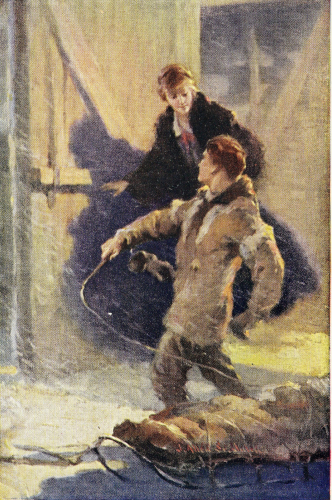
A bear came out of the brush immediately behind the drying racks,
attracted by the odor of curing fish. Once in the open she halted
defensively, not because she had seen the man and woman near the falls
but because of a sound beneath the roar of the water and because of
something small and chubby and dimpled that was waving within six feet
of her nose.
A baby, laced securely in his back cradle, had been set upright against
a boulder. As the bear wrinkled her black nose and peered at this
strange living thing with her small, beady eyes the infant waved both
hands ecstatically.
The man and the woman, who had seen the bear when it emerged from the
brush, did not move. Only their eyes proclaimed animation and those of
both were bright with interest and delight. Even when the bear took
a slow, stealthy step forward, wrinkling her nose curiously, they
remained motionless. But the man's lips parted and he hissed the word,
"Wee-sah-nah!"
The woman nodded almost imperceptibly and with suppressed excitement as
the bear took another slow step forward, peering into the face of the
gurgling child. Suddenly the great head swung swiftly around, the beady
eyes stared at the man and woman for a moment and then with a grunt the
huge animal turned and shambled back into the brush.
Instantly the man and the woman were confronting each other, both
radiant.
"Muk-wah!" the woman cried. "A bear!"
"Wah-bee-muk-wah!" the man shouted excitedly. "A white bear!"
The woman's elation vanished and her black eyes widened in sudden
terror.
"Kah-win!" she shrieked, uttering the negative with a panic stricken
expression unattainable with the one-syllable English word.
The man stared at her in amazement. They had spoken in Ojibwa because
it was the only language he knew. His first word, "wee-sah-nah,"
is not translatable unless it be construed as "personal totem." It
denotes some animal which visits all Ojibwa children in their infancy,
apparently coming to the camp for the sole purpose of seeing the child.
While they cannot tell clearly why they do so, Ojibwas treasure the
name of this animal throughout their lives. The child's mother watches
eagerly for its approach and it is never molested, even though the
family be starving and the visitor is wanted for food.
No animal had ever come to look at Wen-dah-ban, the boy in the back
cradle, and both Wazh-e-na-be, the man, and Nee-tah-wee-gan, the
woman, were over-joyed when they saw the bear watching him. To them
the curiosity of the animal was indicative of a profound and kindly
interest in this particular child, a fact which made Nee-tah-wee-gan's
terror the more inexplicable to her husband.
"She was white," he protested. "She was very old and the hair on her
face had turned gray. It is not often a bear lives so long and it must
mean something to the boy, perhaps that the white men will take him
sometime and——"
"Kah-win!" (No!)
Nee-tah-wee-gan's fierce denial cut off his idle interpretation.
She stood glaring at him, her face contorted with rage and terror.
Wazh-e-na-be was accustomed to her shrill outbursts but never had he
seen her thus. He stared for a moment and then glanced in wonder at the
child.
"So you do not like it that the wee-sah-nah should have a touch of
white," he said. "And you are afraid. Is it because you do not wish to
lose the boy? Yet you never fondle him as do other mothers. I wonder,"
and a taunting note crept into his voice, "if the white bear does not
tell the truth?"
"Kah-win! Kah-win!" Nee-tah-wee-gan's voice had risen to a shrill
scream. "The boy is not white. His father was a white man but I am his
mother."
Wazh-e-na-be's eyes lighted with vicious cruelty at this frenzied
protestation.
"You have told me about the father," he said. "The boy was born when I
took you for my woman and I did not care. But why did you say the boy
was ill and always keep his face covered? Why did you make me leave
Fort James? Why did you never go near the post or the other Indians
after—"
He paused and grinned maliciously as she shrank from him.
"—after the house of the manager burned and his wife and son died in
the fire?"
Nee-tah-wee-gan was paralyzed by terror. She could not take her eyes
from Wazh-e-na-be's face. He continued to grin evilly and then suddenly
his own eyes widened in astonishment.
"So that is what happened!" he cried. "I was a fool not to have seen it
long ago."
He laughed more maliciously than before as his wife cowered in panic.
"And the child's father was white!" he taunted. "Yes, his father and
his mother, too. You were the cook at Fort James. You lived in the
dwelling house. You were there the night of the fire. And the body of
the child they found with the white woman's! That was not hers. It was
yours. You saved the other and kept it and you became my woman and made
me find a new hunting ground so that no one would know."
He had begun with little more than a conjecture but before he finished
he read confirmation in Nee-tah-wee-gan's utter terror and he grinned
exultantly because he knew he was torturing her. Like most Ojibwas, he
loved to watch others in torment and now he saw an unending means of
entertainment through the long winter.
"A white child!" he jeered. "And you took it because you had lost your
own. What a story to tell!"
He had turned away as he finished, back to his fishing, and he did not
see the sudden stiffening of Nee-tah-wee-gan's body or the desperate,
savage light in her black eyes.
She stood still, watching his every movement as he picked up the dip
net, attached to a long pole, and walked to the edge of the rock that
hung over the falls. Below him, she knew, the river plunged violently
through a narrow gorge, the current twisted and flung aside by huge
boulders.
And as she watched her terror left her. Her body, stiff with fear,
now became tense with fierce passion. She leaned forward, eager and
determined, as the man, catching a gleam of silver in the water far
below, plunged in his net. He lifted it, a large whitefish struggling
in the folds, but when he turned with a graceful sweep and deposited it
on the rock beside Nee-tah-wee-gan she was stooping over to pick up her
knife.
"A white child!" he taunted.
As if she had not heard, Nee-tah-wee-gan grasped the fish to slit
it and place it on the drying rack, but the moment she saw that
Wazh-e-na-be was again looking down into the water she started forward.
There was the stealth and cruelty of a cat in her movements. As the man
stood there, waiting for another gleam of silver in the rushing water
beneath, she crept up behind him, swiftly and with murderous fury. She
saw his arms stiffen, caught the swift descent of the net and then as
he leaned over the brink she hurled herself against him and he went out
and down.
When the black head was no longer visible in the boiling water she
turned away. Rage and fear had left her and she smiled triumphantly as
she picked up the fish.
A week passed and an Indian paddled up the river. From the bend he
saw Nee-tah-wee-gan, outlined against the blue October sky, as she
stood on a rock above the falls and plunged a dip net into the roaring
current. A frown crossed his face. He had believed this hunting ground
unoccupied and he had come a long way to claim it for his own.
Later, when he emerged from the brush that flanked the portage trail
and saw the drying racks heavy with the manna of the north, he frowned
again. All this might have been his had he come sooner, and had he been
blessed with a woman so industrious.
But the frown vanished and his eyes lighted expectantly when a high,
shrill wail sounded through the roar of the falls. He turned to see
Nee-tah-wee-gan huddled beside the door of her wigwam, a blanket over
her head.
Nee-tah-wee-gan's acting was convincing. Her death howl was as dismal
and depressing as any Pe-tah-bo, the man, had ever heard. He sat down
and waited for half an hour. Then she lifted the blanket and started as
if in amazement.
By sunset the simple arrangements were made. Nee-tah-wee-gan was
without a man because hers had been careless at the brink of the gorge,
when his moccasins were wet and slippery. She faced the winter without
a hunter and provider. Pe-tah-bo, wifeless, lacking a place to hunt,
believed the situation to be nothing less than miraculously arranged.
The next morning he plunged into the winter's work, a sense of good
fortune doubling his industry.
In many ways Pe-tah-bo was an excellent husband. He was good natured,
fond of laughter and jests, and he lacked the savage cruelty of his
race. He was richly endowed, too, with that Ojibwa characteristic,
a love for children. He had never had any of his own and from the
beginning he took great delight in Wen-dah-ban.
It was inevitable that he should discover that the boy's hair was not
coarse, that his skin was fair, his features not those of an Indian.
From the first he had seen that Nee-tah-wee-gan was a half-breed but
even this did not explain the child.
"What is his wee-sah-nah?" he asked one day as he fashioned a
snowshoe frame.
Nee-tah-wee-gan hesitated an instant. Then she said shortly,
"Muk-wah."
"That is good. It means he will be big and strong and a great hunter."
"Of course he will be a hunter!" Nee-tah-wee-gan cried.
Her vehemence startled him but when he looked up at her his eyes were
squinting shrewdly.
"You have told me you once lived at Fort Bruce," he said. "All the post
managers gather there in the summer. When there are so few white women
it is natural that the men should turn to our people. And you were
there."
"What do you mean?" Nee-tah-wee-gan demanded with just a trace of
unsteadiness in her voice.
"Nothing," Pe-tah-bo laughed, "except it is as I thought. Wen-dah-ban's
father was white."
The woman's black eyes were brilliant with sudden anger, but she had
learned one lesson. With an effort she controlled herself.
"It is none of your affair," she snapped.
"No, and I do not care. You were not my woman then."
"He is my child, and an Indian," she rushed on. "He will always be an
Indian, and a hunter."
Pe-tah-bo let the matter drop there for the time. When he took it up
again it was not that he was doubtful of Wen-dah-ban's parentage. That
had been explained to his satisfaction. But he did take a mischievous
delight in referring to Wen-dah-ban's father because he saw that it
angered Nee-tah-wee-gan.
"How you hate the white man!" he laughed one day. "Wouldn't he take you
for his woman? Did you expect to live in the fort and have other women
cook for you?"
"I would not live with the 'big trader' himself," she answered
viciously.
"Who could it have been?" Pe-tah-bo mused, pretending great concern but
watching her slyly. "Two years ago! I went to Fort Bruce that summer
with the Kenogami fur brigade. The 'big trader' was there, and MacKar.
I remember John Corrigal of Fort James, but he had just taken a white
woman and would not look at a red one. Layard was not there, was he?"
"You'll never know," Nee-tah-wee-gan cried angrily. "It was my own
affair."
He grinned and smoked his pipe in silence for a time, watching his
wife's wrathful face. Then he turned to Wen-dah-ban, poking his finger
at the boy's ribs and smiling contentedly when the child chuckled with
mirth.
"But you will call him your son?" Nee-tah-wee-gan demanded suddenly.
Pe-tah-bo glanced at her in astonishment. She was no longer angry. She
was pleading that he do this.
"Of course," he said good naturedly. "He is a fine boy. I would like
to call him my son. I will make of him a good hunter. And I will
watch his wigwam when it is time for him to fast, when he will learn
Po-wah-gom, 'The Thing You Dream About.'"
Several times that winter Pe-tah-bo jested about the boy's father, but
not with the cruel satisfaction of Wazh-e-na-be. Nor did he obtain the
same result. Nee-tah-wee-gan became angry and delighted him with her
outbursts, but she was crafty in her rage. She knew she had severed the
last connection with Fort James and that no one in this distant place
would guess her secret.
Pe-tah-bo, unsuspecting, content with his simple amusement, did not
give the matter much thought. Nee-tah-wee-gan was proving a good mate
and he possessed only an idle curiosity as to whom the white man may
have been.
But when spring came and they were ready for the long journey to the
fort with the winter's harvest of fur he was amazed by the woman's
refusal to accompany him. It is the big event in the Indian's year,
this journey to the trading post with its purchase of goods, the
gathering of the band, the gossiping with friends and relatives, the
long, sunny, lazy days in the great clearing.
Yet Nee-tah-wee-gan not only refused to go but she refused to give a
reason. At last Pe-tah-bo loaded his canoe and departed, wondering
and also a little angry because he had to do all the paddling and
portaging, and cook his own meals.
He returned in the early fall, his canoe filled with supplies for the
winter, his head with news of the trading and the gathering of the band
and of his long journey as one of the crew of the fur brigade.
Year after year this continued. Each spring Nee-tah-wee-gan refused
to go to the fort. Pe-tah-bo understood it was her hatred of a white
man, which had become a hatred of all things white, that kept her away.
Sometimes he poked fun at her. Always he marveled that this hatred had
endured. It was incomprehensible to his easy-going nature.
Meanwhile Wen-dah-ban had graduated from his back cradle to a small
bow and arrows, to a tiny paddle wielded in the bow of the canoe, to a
lively interest in all the marvelous and attractive things about his
home. But no brothers or sisters came to keep him company. Only on rare
occasions did he ever see other Indians or their children. He never
knew the glorious, romping summer days at the fort, when scores of wild
youngsters played through the long days.
Buried in the depths of the wilderness, cut off even from his own small
world, sensing from the beginning a coldness in Nee-tah-wee-gan's
attitude, the little boy became at last a starved and lonely figure. He
had been happy when still a romping child but as his sphere remained
unchanging, as his growing mind began to reach out for other things
than the isolated camp afforded, a cloud passed beneath the sun of
childhood.
His eyes lost the brightness of anticipation, for no new delights
unfolded before them. His spirit grew heavy, for there were no fresh
joys to uplift it. Often he sat for a long time in the sun, staring
across the lake, oblivious of his surroundings. Pe-tah-bo watched him
thus one day and when at last a moose swam out from a point and the boy
did not see it the man turned to his wife in astonishment.
"Wen-dah-ban has a spirit that leaves his body," he said in an awed
tone. "He sits there, his eyes open, and yet he does not see the moose."
He marveled silently for a time and then he exclaimed with sudden
inspiration:
"It is the white blood in him!"
"Kah-win!" Nee-tah-wee-gan cried so loudly Wen-dah-ban heard and
looked around.
"But you are half white and his father is white," Pe-tah-bo persisted.
"The boy is far more white than red. Why should he not be more like a
white man? I remember a trader at the fort who sat thus, looking but
never seeing. He was young and lonely. He suffered from the sickness of
long, long thinking."
"And you believe Wen-dah-ban, too, is homesick," Nee-tah-wee-gan
scoffed. "A boy who has never been away from his people."
"Perhaps that is it. Perhaps the white blood in him is crying. White
men are different. They do wonderful things. They can make things we
cannot make. They do not have to work hard as we do. Men paddle and
cook and carry burdens for them."
"Yes," she agreed, "and why? They cheat and rob. They take what is
ours. They take our women but scorn our children. They are liars,
thieves—these white men."
Wen-dah-ban had crept close to listen and, as there is no seclusion
either for the body or for the spirit in an Ojibwa home, it was
inevitable that throughout his boyhood he should hear many things
that troubled him. Unconscious of Pe-tah-bo's amusement in stirring
Nee-tah-wee-gan to anger, he believed the entrancing tales of the white
people and sensed something unfair in Nee-tah-wee-gan's bitter tirades
against them.
"All my life I have traded with the men of the Hudson's Bay," Pe-tah-bo
would protest, "and never have I been cheated."
"It is because you are a fool and do not know when they rob you,"
always was Nee-tah-wee-gan's retort.
Wen-dah-ban learned, too, in countless hours of gossip, that the
families of all the other hunters made the long journey to the fort
each summer, that all gathered in a huge clearing strewn with wigwams,
that many children played games through the long, careless days.
But these things interested him only casually. It was in the white
race, of which Pe-tah-bo seemed never to tire of telling, that his
curiosity centered. As he grew older this theme occupied his thoughts
more and more, until one day he was driven to expression.
"If my father was white and my mother is half white, then I am more
white than Indian and I should be a white man," he said.
Pe-tah-bo, highly amused because of the effect he knew this would have
on Nee-tah-wee-gan, burst into loud laughter but his mirth was quickly
stilled by the fury of the woman's outburst.
For a time she was incoherent in her rage. Ten years of isolation and
hatred had made a fearsome thing of her.
"You white!" she screamed at last. "You are an Indian. You are my son
and I am an Indian. As long as you live you can never escape it. Tell a
white man you are white and he would laugh at you."
The boy crept away, in abashed silence.
Once Pe-tah-bo brought forth a similar explosion. He had been talking
at random and his hand was on Wen-dah-ban's head. A close bond had
grown between them—Nee-tah-wee-gan's bitterness driving them together.
As he idly stroked the boy's hair, he stooped suddenly and looked at it.
"See!" he exclaimed. "It is not all black like an Indian's. There is
brown in it and it is softer. And his lips. They are thin. His skin is
white beneath his shirt. His eyes are not nearly so dark as ours."
Nee-tah-wee-gan was beside herself with fury. She picked up a heavy
knife and charged at her husband so quickly that he was forced to turn
and flee. Wen-dah-ban, frightened by her murderous passion, ran into
the forest and did not return for two days.
But Nee-tah-wee-gan's fits of rage did not affect the boy's desire to
see these white people of whom he had heard so much and when he was
thirteen years old he decided that he would act. He knew better than to
broach the subject to Nee-tah-wee-gan but when Pe-tah-bo was ready for
his annual journey to the fort Wen-dah-ban slipped away into the brush.
An hour later he waved from a point far down the lake and the Indian,
chuckling over the joke he was playing on his wife, took the boy with
him.
It was as a journey around the world for a city youngster who had
never been farther from his home than the city park. The four hundred
men, women and children gathered at the fort frightened Wen-dah-ban at
first. He was as shy as any animal of the forest, but his compelling
curiosity and longing soon drove him forth.
He did not play with the other youngsters or listen to the men as they
smoked and told stories of the winter's hunt or of their journeys to
the great headquarters post with the fur brigade. The fort attracted
and held him—the huge structures of logs, their white-washed sides
glistening in the sunshine, the constant bustle and activity, the trade
shop crammed with dazzling goods, and, most of all, the three white
people.
Merton Layard was manager of the Hudson's Bay post at Kenogami. He
had been there for several years with his wife, Evelyn, and their
six-year-old daughter, Janet. Layard fascinated Wen-dah-ban. He went
about confidently, with his head high. His words were sharp and quick,
even in the Ojibwa language, and when he spoke men sprang to do as he
told them.
To Wen-dah-ban, accustomed only to Nee-tah-wee-gan's shrill voice and
bitter disposition and to Pe-tah-bo's careless good nature, knowing
only the laxity and aimlessness of a savage's home, Layard was a
superman.
And this conception of the white man was not wholly extravagant. The
post manager was a splendid example of those youths who come in an
endless stream from England and Scotland, their minds aflame with
brilliant romance, their hearts eager for dazzling adventure. Dreams
have painted the wilderness as a land of colorful deeds, its brown
people as brave, wise and noble, life in its solitudes as a succession
of glad hazards.
Those dreams endure. They continue despite hardship and isolation,
despite monotony and disillusionment. And coupled with them there grows
something else, something bigger, finer and more concrete. The Hudson's
Bay Company is a stern parent, exacting and unsparing, but it is
understanding, protective and beneficent. It demands much and it gives
much. It pardons, humors and condones, and it enjoys a loyalty that
borders on the fanatic.
The Hudson's Bay demands loneliness and it gives unlimited power. It
insists that a man isolate himself from others of his race and it makes
him a ruler over hundreds of childlike men and women. It places him
in a position where he may be generous and fair, just and scrupulous.
He is made law-giver, judge and executive and he becomes father of a
people.
Behind him are two and a half centuries of achievement, a precedent
that becomes a creed, a history that embraces deeds of cruelty and
greed and yet stands resplendent because of the faith, the integrity
and the enduring dreams of these Scotch and English lads who are lured
to wide adventure and remain to be the real rulers of an immense
empire. The almost bloodless story of Canada's Indians testifies to
their fidelity to an ideal.
Merton Layard was one of the best of these silent, unsung barons of fur
land. In his mind there was disillusionment but in his heart the early
visions persisted. He knew the Indian to be a child, and he treated him
as such, kindly and firmly, guiding, aiding and encouraging, by ruse if
necessary but always with a beneficent purpose.
Yet when June came and dozens of wigwams lined the shore, when yellow
bark canoes floated on the blue waters of the lake, when half-wild
children romped and shrieked in the great, green clearing, when women
laughed and gossiped and men stretched on the grass and smoked and
talked in slow, measured tones, when trade goods—blankets, capotes,
brilliant assumption belts, tobacco, kettles, gilling twine, yards
of colored strouds, beads, guns, shot, powder, powder horns and bars
of lead for bullets—when all these passed over the counter and the
fur loft was piled with pelts—beaver, fox, otter, wolf, mink, bear,
fisher, ermine, lynx, muskrat and wolverine—then all the colorful
romance of Layard's boyish dreams returned and the north became a land
of glorious adventure.
Yes, Fort Kenogami in June was a colorful place. For nine months each
Indian family had been cut off from relatives and friends, struggling
against cold and hunger, fighting desperately to exist. Now they
came, one, two, three canoes at a time, from a hundred miles in every
direction. Men chuckled, women shrieked greetings and jests. Laughter
was everywhere. Happiness and contentment and comfort brought out the
natural, mirth-loving spirits of these forest people.
They were as excited as children. The fur was to be traded, "debt"
wiped out, and then would come the spending of the surplus in a glad,
frantic riot of selection, rejection and vituperative family squabbles.
A distant fur post in June is like an orphan asylum on a holiday.
It was into such a scene that Wen-dah-ban had been thrust and in those
first astounding days that he encountered the color line and recognized
that Nee-tah-wee-gan was not alone in distinguishing between the races.
He had quickly discovered that the dwelling house in which the three
marvelous white people lived was surrounded by a picket fence and that
within this fence Janet Layard played.
Indian women hung about, marveling at the child's golden hair and
coaxing her near enough so that they might feel of it. Youngsters
pressed their faces close between the pickets but never did a hunter
or his wife or children invade the yard, sacred to the smiling, happy,
little girl of the golden hair and white and pink skin.
Wen-dah-ban spent long hours staring through the fence at Janet and her
parents. From the time of his arrival he had been set apart as much by
his history as by his own actions. He was known to every Indian at the
fort as Nee-tah-wee-gan's child—the one she had kept hidden in the
bush since infancy. For years he had been the subject of much wigwam
gossip, and now that he had come to Kenogami at last he was the object
of all the curiosity and cruelty that is characteristic of the Ojibwa.
A group of women would stop him as he passed, grasp him by an arm and
form a circle about him.
"See that hair!" one would cry as she felt of it. "Soft like a mink's,
and with the same brown in it."
"Like a white man's," another would protest. "The trader's hair is like
that. And the eyes, too."
Purposely they acted as if he were a sled dog and discussed him as
freely and impersonally.
"Look!" one would exclaim as she ripped open the boy's shirt and
exposed the white skin beneath. "He must be nearly all white," and
there would follow an obscene joke that brought a storm of laughter.
Sex is almost the sole source of the Ojibwa's humor.
The first time the women stopped Wen-dah-ban he was gratified by their
declarations that he appeared to be white. But he quickly sensed the
ridicule and shrank from it even as it mystified him.
"Why do you laugh?" he burst forth one day. "The trader is white and he
is a big chief. It is good to be white."
The women shrieked their mirth and gathered about him in a close
circle. Like taunting children they bent down, felt of his hair, peered
into his eyes.
"I know who it is that he looks like!" one exclaimed. "It is the 'big
trader' himself who is his father."
"Kah-win!" another protested. "He walks like John Corrigal."
"A walk means nothing," a third declared. "It is the eyes. Do you
remember Nicol MacKar? That is the man."
Something in the boy rebelled. He did not feel any disgrace but he
resented ridicule of something that he felt to be so important, of
something that was closest to his heart. In sudden fury he burst
through the circle and escaped.
He went at once to the picket fence to watch Janet Layard at play. He
wanted consolation. His yearning, empty heart craved something that he
could gratify only by watching this white child.
As always, she seemed oblivious of his presence and then suddenly she
approached him.
"You are the boy whose mother would not let him come to the fort," she
said in Ojibwa.
He nodded.
"You have always lived in the bush and have never seen white people?"
Again he gave dumb acknowledgment.
"They say your father is white and your mother half white but that
makes no difference. You are an Indian just the same."
Anger such as he had never known seized Wen-dah-ban. Nee-tah-wee-gan,
in her wild outbursts, had often said the same thing and had cowed him
with her vehemence. The Indian woman had silenced him with her ridicule
but from this white child the statement was a taunt and a challenge and
it brought forth a quick, passionate retort.
"Kah-win!" he exclaimed fiercely. "I am not an Indian. I am white."
Janet drew back, startled by the violence of his protest and a little
frightened at the blazing wrath of this wild creature who stared
through the picket fence. Then she turned and ran to the house.