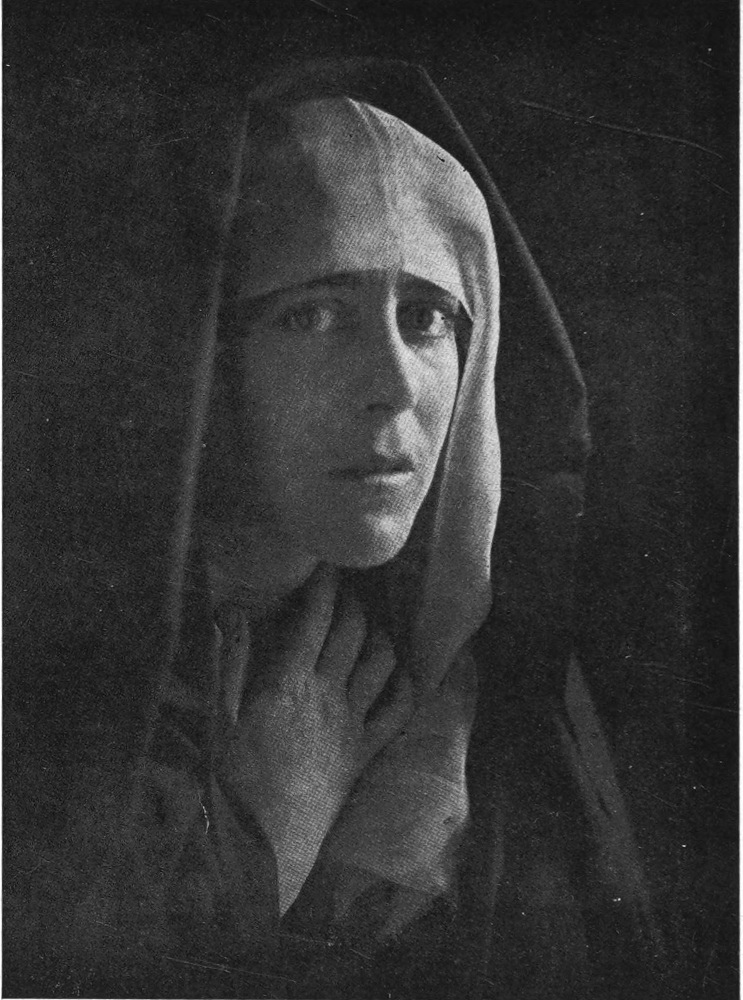
THE TERRIBLE MEEK — TRANSCRIBER’S NOTE:
Before the curtain rises, a bell from some distant
place of worship tolls the hour. Nine brazen notes,
far off, out of tune. Then a heavy peal of thunder,
and the sharp, cracking strike of a bolt; yet, above
all, one other sound, more piercing—a strange,
unearthly Cry. There follows a mighty howling of
wind, blended with a confused clamour of voices and
the hurrying of many feet. The noises have almost
all died away, when the Curtain rises upon inky
darkness.
A sudden hush. The silence deepens. There is a
sense of moorlands and desolate places.
Far off, a cow lows in her stall. Some lost sheep down
in the valley bleats dismally. Silence again.
It is broken by the Voice of a Woman,
weeping bitterly. A Peasant Woman.
Woman. Oh!...
Another Voice: the gentlemanly, well-bred
voice of an army man, now under
some stress of emotion. A Captain.
Captain. My God, this is awful. I can’t stand it.
Woman. Oh!...
Captain. Come, my good woman, it’s all over
now. There’s no earthly help for it. You can’t
remain here, you know.
Woman. Leave me be. Leave me be.
Captain. All the others left long ago. They hurried
off home the moment—the moment the storm
came....
Come, it’s bleak and quite too dreadful for you up
on this hill. Let me send you back to the town with
one of the soldiers.
Woman. One of the—soldiers!...
Captain. Yes: come, come now....
Woman. Leave me be. Don’t touch me. There’s
the smell of death on you.
Captain. Well, since you.... And, after all....
The clank and rattle of his sword and
uniform mark his moving away. He
sits.
The smell of death. My God, it’s true.
A bitter wind comes soughing up from
the valley. The sheep bleats once,
piteously. Then all is quiet again.
Some one else is coming. He is heard
stumbling blindly up over the hill, the
steel butt of his weapon ringing among
the stones. A Soldier.
Groping in darkness, he collides suddenly
with the Captain. His Voice
is that of a common man, city-bred;
Soldier. Gawd blimey, wot the ’ell....
Oh, beg pawdon, sir. Didn’t know it was you,
Captain.
Captain. That’s all right, sentry.
Soldier. ’Pon my word, sir, you give me a start,
fust go orf. Wot with the storm an’ the darkness,
an’ this ’ere little job we been doin’, I tek my oath
I thought for a moment as you was ... well, summat
else.
Wasn’t quite a nice thing wot ’appened up ’ere
just nah, sir, was it?
Captain. It wasn’t.
Soldier. I’m on guard myself, sir; or I don’t
know as I’d ’a’ come up, not for choice.
You bin ’ere all the time, Captain?
Captain. Have I? Yes, I suppose I have. I’ve
been here ... ever since.
Soldier. It’s not exackly the place ter spend a
pleasant arternoon, is it, sir?
Captain. No, I suppose not.
Soldier. O’ course, there’s company, as you
might say; but not quite congenial company, eh wot?
Captain. That depends entirely upon the point
of view.
Soldier. Dam’ creepy, I call it!...
Well, we done for ’im good an’ proper, any’ah.
Captain. My God, yes. We builders of empire
know how to do our business.
Soldier. Pretty bloody business, too, ain’t it, sir?
Captain. Yes, that’s the word.
They consider it for a moment. Presently
the Soldier laughs at some
amusing recollection;
Soldier. It’s an ill wind wot blows nobody
any good. I got summat aht o’ this, orl said an’
done.
Captain. What’s that?
Soldier. I got some of ’is togs.
Captain. His togs. How do you mean?
Soldier. Why, I’ll tell yer. ’E didn’t want no
more togs, not the way ’e was goin’; nah did ’e? So
me an’ the boys, we got our ’eds together, and arter
we’d undressed ’im an’ put ’im to bed, so to speak, we
pitched an’ tossed for the ’ole bag lot, one by one, till
they was orl bloomin’ well divided aht. I got ’is boots.
Captain. You got his boots, did you?
Soldier. Yes, pore devil. ’E don’t want them
no more. Not quite my fit; but they’ll do to tek
’ome for a keepsake—that is, if we ever do get ’ome
aht of this ’ere stinkin’ ’ole. My little missis ’ll
think a lot of them boots.
Captain. They will be a pleasant memento.
Soldier. Just wot I say, sir. Oh, my missis, she
got an ’oly nose for ’orrors: she reely ’ave. Tellin’
abaht them boots ’ll last ’er a lifetime.
Captain. She must be an attractive young woman,
your—missis.
Soldier. Oh no, sir, just ordinary, just ordinary.
Suits me, orl right....
Some memory holds him for a moment;
Funny thing, Captain, ’ow this ’ere foreign service
keeps you—well, sort of thinkin’, don’t it? S’pose
it’s the lonely nights an’ the long sentry duties an’
such like....
Captain. You’ve felt that too, then, have you?
Soldier. Yessir; meks me think abaht my missis.
’Er was in the family way when I left ’ome,
sir—expectin’ just a couple of month arter I
sailed....
The little beggar ’ll be gettin’ on by nah—that is,
if ’e come orl right.
Captain. You’ve made up your mind for a boy
then, eh?
Soldier. She allus ’oped for a boy, sir. Women’s
like that. S’pose it’s orl right; it’s men wot’s wanted
these days, wot with the Army an’ the Spread of Empire
an’ orl that.
Captain. Yes, they make better killing.
The Soldier is rather stupid, or he
would have laughed. He goes on;
Soldier. Yessir, ’er’s bin ’ankerin’ arter a kid
ever since we was married six year ago; but some-’ow
or other it never seemed to come orf. ’Ealthy
woman, too, sir. You unnerstand ’ow these things
is, Captain: there’s no tellin’. Little beggars come
by guess an’ by Gawd, it seems to me....
I wonder if it’s a boy. There’s no gettin’ no news
aht in this blarsted....
Good Gawd, wot’s that?...
Captain. What?
Soldier. Be’ind us. Summat sort of.... There,
’ark!
The Woman’s Voice rises, sighing like
wind;
Woman. Oh!...
Soldier. My Gawd, wot is it?
Captain. It’s a woman.
Soldier. A woman! Up ’ere?
Captain. She has every right to be here. This
is her place.
Soldier. But does she know? Does she know
wot’s ... danglin’ up yonder, over ’er ’ed?
Captain. She knows more than we do. She belongs
to him. She is his mother.
Soldier. ’Is mother!...
Captain. Yes, he was her baby once.
The Soldier is affected by this. He
speaks with real compassion;
Soldier. Pore devil!
Their minds go wandering through
many troubled by-paths of thought.
Presently the Soldier speaks again;
Wot was it ’e done, Captain?
Captain. Don’t you know?
Soldier. Not exackly. I got enough to look
arter with my drills an’ vittles withaht messin’
abaht with politics an’ these ’ere funny foreign
religions.
Captain. And yet you, if I mistake not, were one
of the four men told off to do the job.
Soldier. Well, I ’ope I know my duty, sir. I
on’y obeyed orders. Come to that, sir, arskin’
your pawdon, it was you as give them orders. I
s’pose you knew orl right wot it was ’e done?
Captain. No, I don’t know exactly, either. I
am only just beginning to find out. We both did
our duty, as you call it, in blindness.
Soldier. That’s strange langwidge to be comin’
from your lips, Captain.
Captain. Strange thoughts have been coming to
me during the last six hours.
Soldier. It’s difficult to know wot’s wot in these
outlandish places. It’s not like at ’ome, sir, where
there’s Law an’ Order an’ Patriotism an’ Gawd’s
Own True Religion. These blarsted ’eathens got
no gratitude. ’Ere’s the Empire sweatin’ ’er guts
aht, tryin’ ter knock some sense inter their dam’
silly ’eds; an’ wot do you get aht of it, orl said an’
done? Nuthin’! Nuthin’ but a lot of ingratitude,
’ard words, insurrections, an’ every nah an’ then a
bloody example like this ’ere to-day! Oh, these
foreigners mek me sick, they do reely!
Captain. Yes, perhaps that has been the real
mistake all along.
Soldier. Wot ’as, Captain?
Captain. Taking these people—men like this one,
for instance—for foreigners.
Soldier. Well, you’ll excuse me, sir, but wot the
’ell else are they?
Captain. I’m not quite sure; but supposing
they were more nearly related? Supposing, after
all, they happened to be made of the same
flesh and blood as you and me? Supposing they
were men? Supposing, even, they were—brothers?
Soldier. Brothers! Why, that’s exackly wot ’e
used ter say—’im up there....
Did you ever ’ear ’im, sir?
Captain. Once. Did you?
Soldier. Once.
They remain silent for a little.
It was politics when I ’eard ’im. On’y it sahnded
more like some rummy religion.
Captain. When I heard him it was religion—sounding
curiously like politics.
Soldier. Them two things don’t ’ardly seem to
go together, do they, sir?
Captain. They don’t. Perhaps they ought to.
Soldier. I don’t know. Seems to ’ave led ’im
into a pretty mess....
It’s a queer world!...
I wonder wot it was ’e reely done.
Captain. It’s rather late in the day for us to
be considering that, seeing what we have done,
isn’t it?
Soldier. Well, I don’t know. P’r’aps it’s funny
of me, but I never done a job like this yet withaht
thinkin’ abaht it arterwards.... An’ I done a few of
’em, too.
If you arsk me, sir, it was them—well, them long-faced
old jossers dahn there as begun the ’ole
beastly business. You know ’oo I mean.
Captain. Yes, I know whom you mean. But
haven’t they a name?
Soldier. Well, I ’ardly know wot ter call them,
sir. They’re like a lot of old washerwomen. Allus
jawin’. We got nuthin’ exackly like that sort at
’ome, sir.
Captain. Oh, I don’t know that there’s all that
difference.
Soldier. They was allus naggin’ the pore fellow,
one way an’ another. Couldn’t leave ’im alone.
They started the ’ole business.
Captain. Why, what fault did they find with
him? What was it they said he did?
Soldier. It wasn’t nuthin’ ’e done, far as I could
mek aht. It was summat as ’e said, wot riled them.
Captain. Something he said?
Soldier. Yes, summat ’orrible; that’s wot they
said. Summat too bad ter be spoken, summat they
wasn’t a-goin’ ter stand from anybody. Least, that’s
wot I ’eard....
Wasn’t so very ’orrible, neither. Not ter me.
Sahnded a bit mad, that’s orl.
Captain. Oh, then you know what it was?
Soldier. Yessir. They ’ad a name for it, too:
on’y I can’t quite remember. One of them big jaw-crackers,
you unnerstand. Seems a bit orf for a
bloke ter come ter this, just for usin’ a few words.
Captain. There is great power in words. All the
things that ever get done in the world, good or bad,
are done by words.
Soldier. Well, there’s summat in that, too.
On’y this thing ’e said—blimey, it was nuthin’!
There ain’t a loony alive wot doesn’t say the same
thing ’e said, an’ more, a thahsand times a day,
when ’e’s reel bad in ’is ’ead. At the most, it sahnded
like a bit of langwidge, that’s orl.
Captain. And you don’t mind that, do you?
Soldier. Me? ’E could ’a’ done it till ’e was blue
in the face an’ welcome, far as I’d care.
Captain. You yourself, of course, had nothing at
all against him? Nothing personal, nothing political,
I mean. No more than I had.
Soldier. Lor’ bless you, no, sir. Rawther liked
’im, the bit I saw of ’im.
Captain. Only they—the long-faced gentlemen—found
him guilty. So, of course, they had to hand
him over to the magistrate.
Soldier. Yes, blarst them. What did they want
ter go an’ do that for?
Captain. It was perhaps their—duty, don’t you
see?
Soldier (taken aback on the sacred word). Oh,
was it? Well, since you put it in that way, o’
course....
Captain. Then, again, came the magistrate’s duty.
I suppose he found he had some duty in the matter?
Did he very much object to this horrible thing that
had been said?
Soldier. Not much! ’E ain’t that sort, not this
fellow!...
That’s the funny thing abaht it. Far as I could
’ear, there weren’t no mention of that, by the time the
case come into ’is ’ands. No, it was riotin’ an’
stirrin’ people up agen the government, as ’e on’y ’ad
ter deal with.
Captain. Was that charge proved against the
prisoner?
Soldier. They ’ad witnesses, I suppose. On’y
you know wot witnesses are, in a case like this, sir.
Got their orders, you unnerstand.
Captain. And, of course, they all did their duty.
That sacred obligation was attended to. They obeyed.
Soldier. I don’t know. Don’t arsk me. I know
nuthin’ abaht it.
He is a little nettled at the turn the conversation
is taking.
Captain. Was there no one, from among all those
crowds that followed him, to stand up and say a
word for him?
Soldier. Well, wot do you think? Them greasy
blighters! You saw ’ow they be’aved just nah,
when we done the job.
Captain. Their duty, as voicers of public opinion,
I suppose.
Soldier (sullenly). I don’t know.
Captain. Had they any very strong feelings
against this monstrous thing he said? Were they
so stirred with affection for the government? Or
didn’t their duty cover those unessential points?
Soldier. I don’t know.
Captain. Well then, this magistrate? Having
examined this poor wretch in the presence of all that
exemplary, patriotic, obedient mob of people, he soon
found out where his duty lay? It was his duty to
hand him over to us—to you and me.
Soldier (shortly). Yessir.
Captain (insisting). To you and me.
Soldier. I said, Yessir.
Captain. Whereupon, though we were practically
ignorant as to the charge upon which this man was
convicted: though we had grave doubts as to
whether he were guilty at all; and while it is perfectly
certain that we had nothing against him personally,
that we even liked him, sympathized with him, pitied
him: it became our duty, our sworn, our sacred duty,
to do to him—the terrible thing we did just now.
Soldier. I can’t see wot you’re drivin’ at, sir.
You wouldn’t ’ave a man go agen ’is duty, would
you?
Captain. I’m trying to make up my mind. I
don’t know. I’m blind. I don’t think I know what
duty is.
Soldier. It’s perfectly plain, sir. Arter all, duty
is duty, ain’t it?
Captain. Yes, it doesn’t seem to be very much
else.
Soldier. ’Ow do you mean, sir?
Captain. Well, for instance, it doesn’t seem to be
love or neighborliness or pity or understanding or anything
that comes out hot and fierce from the heart
of a man. Duty! Duty! We talk of duty! What
sort of devil’s duties are there in the world, do you
think, when they lead blindly, wantonly, wickedly,
to the murder of such a man as this!
Soldier. Well, far as I’m concerned, I on’y
obeyed my orders.
Captain. Orders! Obeyed orders!
Soldier. Well, sir, it was you as give them to
me.
Captain. Good God, man, why didn’t you strike
me in the blasphemous teeth, the hour I gave them?
Soldier. Me, sir? Strike my superior orficer!
Captain. You struck this defenceless man. You
had no scruples about his superiority. You struck
him to the death.
Soldier (hotly). I on’y did my duty!
Captain. We have murdered our brother. We
have destroyed a woman’s child.
Soldier. I on’y obeyed my orders. When my
superior orficer says, Kill a man, why, I just kill ’im,
that’s orl. O’ course I kill ’im. Wot’s a soldier for?
That’s duty! (With sudden lust.) Blood an’ ’ell!
I’d kill ’im soon as look at ’im, yes, I would, if ’e
was Gawd aht of ’Eaven, ’Imself!...
Not as I ’ave anythin’ personal agen this pore
devil. On’y I do know my duty.
They are silent for a little while. Then
the Soldier, feeling that he has gone
too far, begins assuaging the situation;
There’s one thing certain: it’s no use cryin’ over
spilt milk. ’E’s dead an’ done for nah, wotever
comes. Dead as a door-nail, pore cuss.
The Captain, who has risen during his
excitement, now sits down again.
His sword clatters against a boulder.
A pause.
’E ain’t the fust man I done for, neither; an’ I
bet ’e won’t be the last. Not by a long way.
He speaks in an aggrieved tone. It is
the way in which shame comes to a
soldier.
A pause.
Captain (deeply). So you think he is dead, do
you?
Soldier. Well, wot do you think? A man don’t
live forever, ’ung up as ’igh as we got ’im yonder.
Besides, we did a bit of business with ’is vital parts,
arter we’d got ’im up there.
Captain. And all that, you think, means—death.
Soldier. Well, don’t it?
Captain. That’s what I’m wondering.
Soldier. Six hours, mind you. It’s a long time.
Captain. There is something mightier than time.
Soldier. Well, they don’t supply little boys’ playthings,
not from our War Office. One of these ’ere
beauties....
He rattles his weapon in the darkness
and continues;
... when they do start business, generally touch the
spot.
Captain. It would have to reach very far, to
touch—this man’s life.
Soldier. Nah, wotever do you mean, Captain?
Captain. I mean that life is a terrible, a wonderful
thing. You can’t kill it. All the soldiers in the
world, with all their hate, can’t kill it. It comes
back, it can’t die, it rises again.
Soldier. Good Gawd, Captain, don’t you talk
like that!
Captain. Why, what are you afraid of? We
have shown great courage to-day, you and I. Soldiers
should be brave, you know.
Soldier. That’s orl very well, when it’s a matter
of plain flesh an’ blood; but Lor’! Ghosts!...
Do you believe in them, sir?
Captain. What?
Soldier. Ghosts.
Captain. Yes. It came to me to-day.
Soldier (slowly). If I believed there was reely
ghosts abaht....
Captain. They are the only realities. Two of
them ought to be especially important to you and
me just now.
Soldier. Two? Blimey! ’Oose?
Captain. Why, yours, man, and mine. Our
ghosts. Our immortal ghosts. This deed of ours
to-day should make us think of them forever.
Soldier. Yours an’ mine? I didn’t know we ’ad
ghosts, you an’ me.
Captain. It makes a difference, doesn’t it? There
have been millions of our sort in the long history of
the world. I wonder how many more millions there
will be in the years to come. Blind, dutiful, bloody-handed:
murderers, all of us. A soldier’s ghost must
be a pitiable thing to see.
The cloudy darkness slightly lifts from
the ground. Their forms can be
dimly discerned—vague shadows upon
a deeper gloom. Up above there still
dwells impenetrable night.
Tell me, brother murderer, have you ever prayed?
Soldier. Me, sir?... (Ashamed.) Well, sir, nah
you arsk me, yes I ’ave—once.
Captain. When was that?
Soldier. Why, sir, abaht a couple of month arter
I set sail for this blarsted little ’ole.
Captain. I understand. You prayed then for the
birth of an innocent child?
Soldier. Yessir.
Captain. You will have need to pray again to-night.
Both of us will have need. This time for
the death of an innocent man.
The Soldier is embarrassed. He does
not know what to say. Something
about “duty” comes into his head;
but somehow it seems inappropriate.
A brighter thought occurs to him;
Soldier. Well, it’s time I was dahn yonder,
lookin’ arter the boys. Any orders, sir?
Captain. Orders? No, no more—orders.
Soldier. Orl right, sir.
There is heard the rattle of his salute,
and the dying away of his footsteps, as
he stumbles blindly up and over the
hill.
The Captain does not speak until all is
still again.
Captain. My God! My God! Oh, my God!
He buries his face in the dirt and
stones.
The faintest moaning of wind. The
sheep bleats. A dog, disturbed by the
sound, barks, far off. Then there is
a deep silence, lasting one minute.
The Voice of the Peasant Woman is
heard, speaking at first in dull, dead
tones, very slowly;
Woman. Thirty-three year ago he was my baby.
I bore him. I warmed him: washed, dressed him:
fended for him. I fed his little mouth with milk.
Thirty-three year ago. And now he’s dead.
Dead, that’s what he is. Dead. Hung up in the
air like a thief: broken and bleeding like a slaughtered
beast. All the life gone out of him. And I’m his
mother.
A gray, misty light creeps over her face
and hands. Moment by moment, her
features limn out faintly through the
darkness, one pale agony.
Her garments still blend with the general
gloom.
That’s what they done to my son. Killed him
like a beast. Respectable people, they was. Priests,
judges, soldiers, gentlemen: even common folk like
me. They done it. And now he’s dead.
He didn’t hold with their kind, my son. He was
always telling them about it. He would stand up
open in the market-place, at the street corners, even
in the House of God itself, and tell them about it.
That’s why they killed him.
He had a strange way with him, my son: always
had, from the day he first come. His eyes.... They
was wonderful. They held folk. That and his
tongue and his tender, pitiful heart.
They didn’t understand it down here. None of
us understood it. We was blind—even me. Many
a time I got in his way and tried to hinder him: I
was afraid for him, ashamed. And then he’d look
at me....
They was always wonderful, his eyes.
He wasn’t particular, my son. He would go with
anybody. He loved them so. There wasn’t a
drunken bibber in the place, not a lozel, not a thief,
not a loose woman on the streets, but called him
brother. He would eat with them, drink with them,
go to their parties. He would go with grand folk,
too: gentlemen. He wasn’t particular: he would
go with anybody.
And I tried to hinder him: I got in his way, because
I was ashamed. I kept pushing in. I was
afraid of what the people might think. Like I was
blind. Like I didn’t understand. I never told him
as I understood. And now it’s too late. He’s
dead.
A gust of anguish takes her, overwhelming
her;
Oh, my son, my own son, child of my sorrow, my
lad, come back to me! It’s me, it’s your mother, calling
to you. Cannot you hear me out of the lone
waste and the darkness yonder? My lad, come
back, come back to me!...
He’s gone. I shall never know the touch and the
healing gladness of him again, my son, my little
lad.... Hark!...
The wind rises and falls away like a
whisper.
On’y the wind blowing up over the moors. God’s
breath, men call it. Ah! It strikes chill to the
bones....
Is it cold you are, my lad? I cannot reach you
yonder—on’y your feet, your poor broken feet and
the ankles hanging limp toward me. My bosom
warms and waits for you, hungering, yearning like
the day I bare you; but I cannot get up to you: I
am cramped and cold and beaten: I cannot reach you
yonder....
There is heard a low fluttering as of
wings;
The night-birds and the bats may come anigh
you, they with their black wings; but not your
mother, the mother that gave you life, the mother
that held you warm, my son, my son, my little cold
lad.
Her speech breaks away into sobs for
a little while. As she recovers, she
goes into a dazed dream of memories;
That was a cold night, too—the night you was
born, way out in the country yonder, in the barn
with them beasties. My man, he was sore about it.
He covered us over with his great wool coat, and
went and sat out in the yard—under the stars—till
them three gentlemen come.
Them three gentlemen.... They talked wonderful.
I have it all here in my heart.
Ay, it was rare and cold that night. Like now.
Like it is now....
Wonderful. They was not common folk. They
was like lords, they spoke so fine. About my little
lad. About you.
And then, that other night, before you come. It
was a kind of light: it was a kind of glory. Like
sunshine. I remember every word he said. About
you. About my little lad.
The agony begins to prick through
again, stab by stab, as she continues;
It was all promise in them days, all promise and
hope. Like you was to be somebody. Like you
was to be a great man. I kept it inside of me: I
fed on it: day by day as you sprung up, I learned
you about it. You was to be no common man, you
wasn’t. You was to lord it over everybody. You
was to be a master of men, you was. And now
you’m dead.
Oh!... Oh!... Oh me!...
That day of the fairing, when we went up to the
big city, your father and me and yourself. The wide
asking eyes of you, your little hand, how it would
go out so and so, your little tongue all a-clatter, the
ways, the wonderings of you, and the heartbreak,
the heartbreak when we had you lost. Talking to
the good priests, you said. Good priests! My
God!...
It began that day, that bitter day of the fairing
when we went up to the big city. I lost you then.
I have lost you ever since.
Oh, the big city, the cruel city, the city of men’s
sin! Calling, calling the sweet life of a man and
swallowing him up in death. There was no doing
with you from that day. No home for you in the
little village from that day. Your father’s trade,
your tasks, your companions, all fell off from you
that day. The city, the big city called you, and
the country thereabouts. It was your kingdom, you
said. You must find out and build your kingdom.
And the people thronged about you and followed
you wherever you went in them days. They hung
upon your words: they worshipped you. In them
days. It was the way you had—your strange way.
A power went out from you. You was always like
nobody else. A king! A king! It was me as put
it first into your head. You looked like a king.
You spoke like a king. You ruled like a king. You,
the little peasant lad I bore. I never told you: I
never lifted up my hand to help you: I hindered
you; but I was proud of you, my lad, proud and
ashamed, and afraid, too! And now it’s too late.
You’m dead. All come to nothing. You’m dead....
Dead. Killed by the soldiers and the judges of
the great city. I’ll tell them about it. I’ll go
through all the earth telling about it. Killed by the
men you called your brothers. Killed by the children
of your kingdom. Killed, and the golden
crown of your glory torn off, battered, and cast to
the ground. Beaten, mocked, murdered by the
mighty masters of the world. Hung up, high up
in the air like a thief. Broken and bleeding like a
slaughtered beast.
She has come to the bottom of her grief.
Her voice dies away through strangled
sobs into silence.
A pause.
The Captain rises. He halts irresolute
for a moment. Then he can be
heard moving over to where she lies
prone on the ground.
Captain. Woman, will you let me speak to
you?
Woman. Who are you?
Captain. I am the captain who spoke to you just
now. I am in charge here. I am the man who
gave the order that killed your son.
Woman. Ah!...
Captain. Won’t you hear me? I must speak to
you.
Woman. What do you want to say? What is
there for you to say?
Captain. It is about myself.... I....
Woman. Go on. I’m listening.
Captain. I am a murderer. I want you to forgive
me.
I did it. I did it with a word. It was like magic.
One word, one little word, and I was a murderer.
There is nothing more terrible in the world than to
be a murderer....
And now I want you to forgive me.
I suppose it’s impossible. Forgiveness is impossible
for a wretch like me. Because I killed him.
For God’s sake, speak to me!
Woman (in a stupor). I want to. I’m trying to.
But you say you killed my son.
Captain. Oh!...
Woman. Why did you do it?
Captain. I did not know. Killing’s my trade.
It was the only thing they brought me up to do.
I have been mixed up with it ever since I can remember.
My father did it before me. All my people
did it. It is considered the thing—the sort of
thing a gentleman ought to do. They call it glory:
they call it honor; courage; patriotism. Great
kings hold their thrones by it. Great merchants
get their beastly riches by it. Great empires are
built that way.
Woman. By murder?
Captain. By murder. By the blood of just men.
Women and little children too.
Woman. What makes them do it?
Captain. They want money. They want power.
They want kingdom. They want to possess the
earth.
Woman. And they have won. They have it.
Captain. Have they? Not while your son hangs
there.
Woman. What do you mean? My son....
My son is dead.
Captain. Is he? Not while God is in Heaven.
Woman. I don’t understand you. What were
you saying yourself, just now? On’y a little while
ago I heard his blood dripping down here in the
darkness. The stones are dank with it. Not an
hour ago. He’s dead.
Captain. He’s alive.
Woman. Why do you mock me? You’m mad.
Are you God, as you can kill and make alive, all in
one breath?
Captain. He’s alive. I can’t kill him. All the
empires can’t kill him. How shall hate destroy the
power that possesses and rules the earth?
Woman. The power that.... Who?
Captain. This broken thing up here. Your
son.
Woman. My son, the power that....
Captain. Listen. I will tell you....
I am a soldier. I have been helping to build
kingdoms for over twenty years. I have never known
any other trade. Soldiery, bloodshed, murder: that’s
my business. My hands are crimson with it. That’s
what empire means.
In the city I come from, it is the chief concern of the
people. Building kingdoms, rule, empire. They’re
proud of it. The little children in the schools are
drilled in obedience to it: they are taught hymns in
praise of it: they are brought up to reverence its
symbols. When they wave its standard above them,
they shout, they leap, they make wild and joyful
noises; like animals, like wolves, like little brute
beasts. Children! Young children! Their parents
encourage them in it: it never occurs to them to feel
ashamed: they would be treated like lepers if they
felt ashamed. That’s what empire does to human
beings in the city I come from. It springs from
fear—a peculiar kind of fear they call courage.
And so we go on building our kingdoms—the
kingdoms of this world. We stretch out our hands,
greedy, grasping, tyrannical, to possess the earth.
Domination, power, glory, money, merchandise,
luxury, these are the things we aim at; but what we
really gain is pest and famine, grudge labour, the enslaved
hate of men and women, ghosts, dead and
death-breathing ghosts that haunt our lives forever.
It can’t last: it never has lasted, this building in
blood and fear. Already our kingdoms begin to
totter. Possess the earth! We have lost it. We
never did possess it. We have lost both earth and
ourselves in trying to possess it; for the soul of the
earth is man and the love of him, and we have made
of both, a desolation.
I tell you, woman, this dead son of yours, disfigured,
shamed, spat upon, has built a kingdom this
day that can never die. The living glory of him
rules it. The earth is his and he made it. He and
his brothers have been moulding and making it
through the long ages: they are the only ones who
ever really did possess it: not the proud: not the
idle, not the wealthy, not the vaunting empires of
the world. Something has happened up here on
this hill to-day to shake all our kingdoms of blood
and fear to the dust. The earth is his, the earth is
theirs, and they made it. The meek, the terrible
meek, the fierce agonizing meek, are about to enter
into their inheritance.
There is a deep, solemn silence for a
moment or two, broken only by the
tinkle of sheep-bells, which are gradually
approaching.
Woman. Then it was not all wasted. It was the
truth, that night. I have borne a Man.
Captain. A man and more than a man. A King.
Woman. My peasant lad, a king: Yes. And
more yet. He was what he said he was. He was
God’s Son.
Captain. It will take a new kind of soldier to serve
in his kingdom. A new kind of duty.
Woman. A newer courage. More like woman’s.
Dealing with life, not death.
Captain. It changes everything.
Woman. It puts them back again. What he done,
puts all things back again, where they belong.
Captain. I can see the end of war in this: some day.
Woman. I can see the joy of women and little
children: some day.
Captain. I can see cities and great spaces of land
full of happiness.
Woman. I can see love shining in every face.
Captain. There shall be no more sin, no pain....
Woman. No loss, no death....
Captain. Only life, only God....
Woman. And the kingdom of my Son....
Captain. Some day.
Woman. When the world shall have learned.
Captain. Mother!... I am a murderer!...
Woman. I have been with Child. I forgive
you.
It grows a little lighter.
Some one is heard stumbling blindly over
the hill. It is the Soldier. His
form emerges gray out of the gloom.
Soldier. ’Ello! Are you there, Captain?
Captain. Yes. I’m here.
Soldier. The fog’s liftin’ dahn below there—liftin’
fast. It’ll soon be up orf this ’ill, thank Gawd!
The General wants ter see you, sir.
Captain. What does he want with me? Do you
know?
Soldier. Another of these ’ere bleedin’ jobs, I
think, sir. Been a bit of a disturbance dahn in the
tahn. The boys ’ave their orders, sir. General
wants you ter take command.
Captain. Tell him I refuse to come.
Soldier. Beg pawdon, sir....
Captain. I refuse to come. I disobey.
Soldier. I don’t think I quite ’eard, sir.
Captain. I disobey. I have sworn duty to another
General. I serve the Empire no longer.
Soldier. Beg pawdon, sir, it’s not for the
likes of me; but.... Well, you know wot that
means.
Captain. Perfectly. It means what you call
death. Tell the General.
Soldier. Tell ’im as you refuse to obey orders, sir?
Captain. His: yes. (Half to himself); How
simple it all is, after all.
Soldier (after a moment); I’m sorry, Captain.
Captain. Thank you, brother.
The Soldier has no word to say.
The darkness is rapidly melting away.
All three figures are now beginning to
be seen quite clearly.
Soldier. Look sir, wot did I tell yer? It’s comin’
light again.
Captain. Eternally.
An unearthly splendour fills the place.
It is seen to be the top of a bleak stony
hill with little grass to it.
The Woman is dressed in Eastern garments;
the Captain is a Roman
centurion; the Soldier, a Roman
legionary. Above them rise three
gaunt crosses bearing three dead men
gibbeted like thieves.
At the foot of the crosses a flock of sheep
nibble peacefully at the grass. The
air is filled with the sound of their
little bells.
Curtain
Words may have multiple spelling variations or inconsistent
hyphenation in the text. These were left unchanged.