THE TELESCOPE
In the credulous twaddle of an essay on the Lost Arts one may
generally find the telescope ascribed to far antiquity. In place
of evidence there is vague allusion of classical times or wild
flights of fancy like one which argued from the Scriptural statement
that Satan took up Christ into a high mountain and
showed him all the kingdoms of the earth, that the Devil had a
telescope—bad optics and worse theology.
In point of fact there is not any indication that either in classical
times, or in the black thousand years of hopeless ignorance
that followed the fall of Roman civilization, was there any
knowledge of optical instruments worth mentioning.
The peoples that tended their flocks by night in the East alone
kept alive the knowledge of astronomy, and very gradually, with
the revival of learning, came the spirit of experiment that led
to the invention of aids to man’s natural powers.
The lineage of the telescope runs unmistakably back to
spectacles, and these have an honorable history extending over
more than six centuries to the early and fruitful days of the
Renaissance.
That their origin was in Italy near the end of the thirteenth
century admits of little doubt. A Florentine manuscript letter
of 1289 refers to “Those glasses they call spectacles, lately
invented, to the great advantage of poor old men when their
sight grows weak,” and in 1305 Giordano da Rivalto refers to
them as dating back about twenty years.
Finally, in the church of Santa Maria Maggiore in Florence lay
buried Salvino d’Amarto degli Armati, (obiit 1317) under an
epitaph, now disappeared, ascribing to him the invention of
spectacles. W. B. Carpenter, F. R. S., states that the inventor
tried to keep the valuable secret to himself, but it was discovered
and published before his death. At all events the discovery
moved swiftly. By the early fourteenth century it had spread to
the Low Countries where it was destined to lead to great results,
and presently was common knowledge over all civilized Europe.
It was three hundred years, however, between spectacles
and the combination of spectacle lenses into a telescope, a lapse
of time which to some investigators has seemed altogether
mysterious. The ophthalmological facts lead to a simple explanation.
The first spectacles were for the relief of presbyopia, the
common and lamentable affection of advancing years, and for
this purpose convex lenses of very moderate power sufficed, nor
was material variation in power necessary. Glasses having a
uniform focus of a foot and a half or thereabouts would serve
every practical purpose, but would be no material for telescopes.
Myopia was little known, its acquired form being rare in a
period of general illiteracy, and glasses for its correction, especially
as regards its higher degrees, probably came slowly and
were in very small demand, so that the chance of an optical
craftsman having in hand the ordinary convex lenses and those
of strong negative curvature was altogether remote. Indeed it
was only in 1575 that Maurolycus published a clear description
of myopia and hypermetropia with the appropriate treatment by
the use of concave and convex lenses. Until both of these, in
quite various powers, were available, there was small chance of
hitting upon an instrument that required their use in a highly
special combination.
At all events there is no definite trace of the discovery of
telescopic vision until 1608 and the inventor of record is
unquestionably one Jan Lippershey, a spectacle maker of Middelburg
in Zeeland, a native of Wesel. On Oct. 2, 1608 the States-General
took under consideration a petition which had been
presented by Lippershey for a 30-year patent to the exclusive
right of manufacture of an instrument for seeing at a distance, or
for a suitable pension, under the condition that he should make
the instrument only for his country’s service.
The States General pricked up its ears and promptly appointed
on Oct. 4 a committee to test the new instrument from a tower of
Prince Maurice’s palace, allotting 900 florins for the purchase of
the invention should it prove good. On the 6th the committee
reported favorably and the Assembly agreed to give Lippershey
900 florins for his instrument, but desired that it be arranged for
use with both eyes.
Lippershey therefore pushed forward to the binocular form and
two months later, Dec. 9, he announced his success. On the
15th the new instrument was examined and pronounced good,
and the Assembly ordered two more binoculars, of rock crystal,
at the same price. They denied a patent on the ground that the
invention was known to others, but paid Lippershey liberally as a
sort of retainer to secure his exclusive services to the State. In
fact even the French Ambassador, wishing to obtain an instrument
from him for his King, had to secure the necessary authorization
from the States-General.
Bull. de la Soc. Astron. de France.
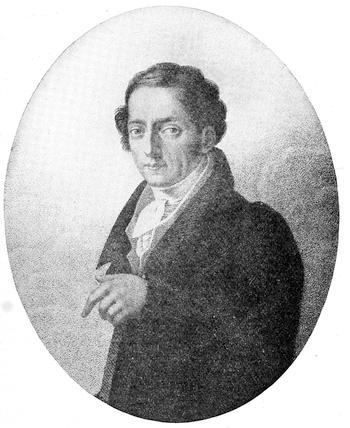
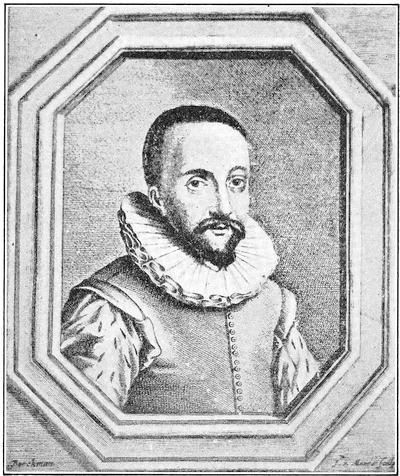
Fig. 1.—Jan Lippershey, Inventor of the Telescope.
It is here pertinent to enquire what manner of optic tube
Lippershey showed to back up his petition, and how it had come
to public knowledge. As nearly as we may know these first telescopes
were about a foot and a half long, as noted by Huygens, and
probably an inch and a half or less in aperture, being constructed
of an ordinary convex lens such as was used in spectacles for the
aged, and of a concave glass suitable for a bad case of short
sightedness, the only kind in that day likely to receive attention.
It probably magnified no more than three or four diameters
and was most likely in a substantial tube of firmly rolled, glued,
and varnished paper, originally without provision for focussing,
since with an eye lens of rather low power the need of adjustment
would not be acute.
As to the invention being generally known, the only definite
attempt to dispute priority was made by James Metius of
Alkmaar, who, learning of Lippershey’s petition, on Oct. 17, 1608,
filed a similar one, alleging that through study and labor extending
over a couple of years he, having accidentally hit upon the
idea, had so far carried it out that his instrument made distant
objects as distinct as the one lately offered to the States by a
citizen and spectacle maker of Middelburg.
He apparently did not submit an instrument, was politely
told to perfect his invention before his petition was further considered,
and thereafter disappears from the scene, whatever his
merits. If he had actually noted telescopic vision he had neither
appreciated its enormous importance nor laid the facts before
others who might have done so.
The only other contemporary for whom claims have been made
is Zacharius Jansen, also a spectacle maker of Middelburg, to
whom Pierre Borel, on entirely second hand information, ascribed
the discovery of the telescope. But Borel wrote nearly fifty
years later, after all the principals were dead, and the evidence
he collected from the precarious memories of venerable witnesses
is very conflicting and points to about 1610 as the date when
Jansen was making telescopes—like many other spectacle
makers.[1]
Borel also gave credence to a tale that Metius, seeking
Jansen, strayed into Lippershey’s shop and by his inquiries gave
the shrewd proprietor his first hint of the telescope, but set the
date at 1610. A variation of this tale of the mysterious stranger,
due to Hieronymus Sirturus, contains the interesting intimation
that he may have been of supernatural origin—not further specified.
There are also the reports, common among the ignorant
or envious, that Lippershey’s discovery was accidental, even
perhaps made by his children or apprentice.
Just how it actually was made we do not know, but there
is no reason to suppose that it was not in the commonplace way
of experimenting with and testing lenses that he had produced,
perhaps those made to meet a vicious case of myopia in one of
his patrons.
When the discovery was made is somewhat clearer. Plainly
it antedated Oct. 2, and in Lippershey’s petition is a definite
statement that an instrument had already been tested by some,
at least, of the members of the States-General. A somewhat
vague and gossipy note in the Mercure Française intimates that
one was presented to Prince Maurice “about September of the
past year” (1608) and that it was shown to the Council of State
and to others.
Allowing a reasonable time between Lippershey’s discovery
and the actual production of an example suitable for exhibition
to the authorities, it seems likely that the invention dates back
certainly into the summer of 1608, perhaps even earlier.
At all events there is every indication that the news of it
spread like wild-fire. Unless Lippershey were unusually careful
in keeping his secret, and there are traditions that he was not,
the sensational discovery would have been quickly known in the
little town and every spectacle maker whose ears it reached would
have been busy with it.
If the dates given by Simon Marius in his Mundus Jovialis
be correct, a Belgian with an air of mystery and a glass of which
one of the lenses was cracked, turned up at the Frankfort fair
in the autumn of 1608 and at last allowed Fuchs, a nobleman of
Bimbach, to look through the instrument. Fuchs noted that it
magnified “several” times, but fell out with the Belgian over the
price, and returning, took up the matter with Marius, fathomed
the construction, tried it with glasses from spectacles, attempted
to get a convex lens of longer focus from a Nuremburg maker,
who had no suitable tools, and the following summer got a fairly
good glass from Belgium where such were already becoming
common.
With this Marius eventually picked up three satellites of
Jupiter—the fourth awaited the arrival of a superior telescope
from Venice. Early in 1609 telescopes “about a foot long”
were certainly for sale in Paris, a Frenchman had offered one in
Milan by May of that year, a couple of months later one was in
use by Harriot in England, an example had reached Cardinal
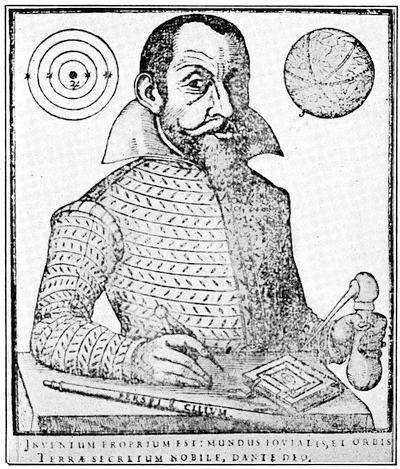
Borghese, and specimens are said to have reached Padua. Fig. 2
from the “Mundus Jovialis,” shows Marius with his “Perspicilium,”
the first published picture of the new instrument. Early
in 1610 telescopes were being made in England, but if the few
reports of performance, even at this date, are trustworthy, the
“Dutch trunk” of that period was of very indifferent quality and
power, far from being an astronomical instrument.
The Observatory.
Fig. 2.—Simon Marius and his Telescope.
One cannot lay aside this preliminary phase of the evolution
of the telescope without reference to the alleged descriptions of
telescopic apparatus by Roger Bacon, (c. 1270), Giambattista
della Porta (1558), and Leonard Digges (1571), details of which
may be found in Grant’s History of Physical Astronomy and many
other works.
Of these the first on careful reading conveys strongly the conviction
that the author had a pretty clear idea of refraction from
the standpoint of visual angle, yet without giving any evidence
of practical acquaintance with actual apparatus for doing the
things which he suggests.
Given a suitable supply of lenses, it is reasonably certain that
Bacon was clever enough to have devised both telescope and
microscope, but there is no evidence that he did so, although his
manifold activities kept him constantly in public view. It does
not seem unlikely, however, that his suggestions in manuscripts,
quite available at the time, may have led to the contemporaneous
invention of spectacles.
Porta’s comments sound like an echo of Bacon’s, plus a rather
muddled attempt to imagine the corresponding apparatus.
Kepler, certainly competent and familiar with the principles
of the telescope, found his description entirely unintelligible.
Porta, however, was one of the earliest workers on the camera
obscura and upon this some of his cryptic statements may have
borne.
Somewhat similar is the situation respecting Digges. His son
makes reference to a Ms. of Roger Bacon as the source of the
marvels he describes. The whole account, however, strongly
suggests experiments with the camera obscura rather than with the
telescope.
The most that can be said with reference to any of the three
is that, if he by any chance fell upon the combination of lenses
that gave telescopic vision, he failed to set down the facts in any
form that could be or was of use to others. There is no reason
to believe that the Dutch discovery, important as it was, had
gone beyond the empirical observation that a common convex
spectacle lens and a concave one of relatively large curvature
could be placed in a tube, convex ahead, at such a distance apart
as to give a clear enlarged image of distant objects.
It remained for Galileo (1564-1647) to grasp the general
principles involved and to apply them to a real instrument of
research. It was in May 1609 that, on a visit to Venice, he heard
reports that a Belgian had devised an instrument which made
distant objects seem near, and this being quickly confirmed by a
letter from Paris he awakened to the importance of the issue and,
returning to Padua, is said to have solved the problem the very
night of his arrival.
Next day he procured a plano-convex and a plano-concave
lens, fitted them to a lead tube and found that the combination
magnified three diameters, an observation which indicates about
what it was possible to obtain from the stock of the contemporary
spectacle maker.[2] The relation between the power and the foci
of the lenses he evidently quickly fathomed for his next recorded
trial reached about eight diameters.
With this instrument he proceeded to Venice and during a
month’s stay, August, 1609, exhibited it to the senators of the
republic and throngs of notables, finally disclosing the secret of
its construction and presenting the tube itself to the Doge
sitting in full council. This particular telescope was about
twenty inches long and one and five eighths inches in aperture,
showing plainly that Galileo had by this time found, or more
likely made, an eye lens of short focus, about three inches, quite
probably using a well polished convex lens of the ordinary sort
as objective.
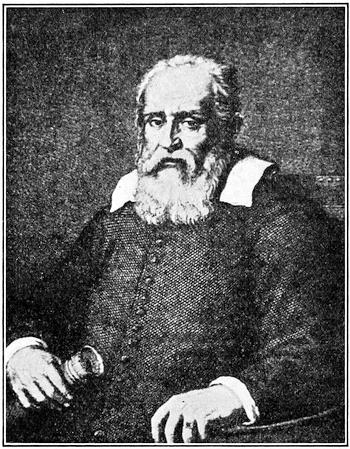
Lodge “Pioneers of Science.”
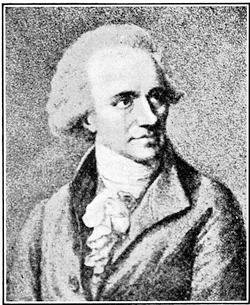
Fig. 3.—Galileo.
Laden with honors he returned to Padua and settled down to
the hard work of development, grinding many lenses with his
own hands and finally producing the instrument magnifying
some 32 times, with which he began the notable succession of
discoveries that laid the foundation of observational astronomy.
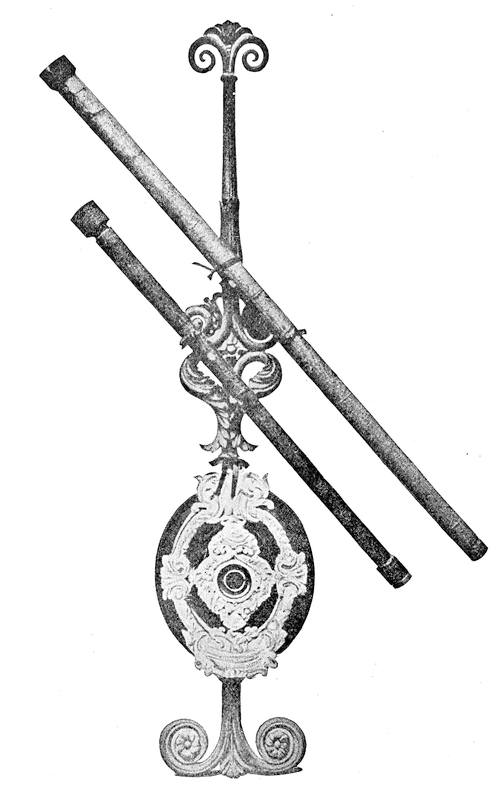
This with another of similar dimensions is still preserved at the
Galileo Museum in Florence, and is shown in the Frontispiece.
The larger instrument is forty-nine inches long and an inch and
three quarters aperture, the smaller about thirty-seven inches long
and of an inch and five-eighths aperture. The tubes are of
paper, the glasses still remain, and these are in fact the first astronomical
telescopes.
Galileo made in Padua, and after his return to Florence in the
autumn of 1610, many telescopes which found their way over
Europe, but quite certainly none of power equalling or exceeding
these.
In this connection John Greaves, later Savilian Professor of Astronomy
at Oxford, writing from Sienna in 1639, says: “Galileus
never made but two good glasses, and those were of old Venice
glass.” In these best telescopes, however, the great Florentine
had clearly accomplished a most workmanlike feat. He had
brought the focus of his eye lens down to that usual in modern
opera glasses, and has pushed his power about to the limit for
simple lenses thus combined.
The lack of clear and homogeneous glass, the great difficulty
of forming true tools, want of suitable commercial abrasives,
impossibility of buying sheet metals or tubing (except lead),
and default of now familiar methods of centering and testing
lenses, made the production of respectably good instruments a
task the difficulty of which it is hard now to appreciate.
The services of Galileo to the art were of such profound importance,
that his form of instrument may well bear his name, even
though his eyes were not the first that had looked through it.
Such, too, was the judgment of his contemporaries, and it was
by the act of his colleagues in the renowned Acaddemia dei
Lincei, through the learned Damiscianus, that the name “Telescope”
was devised and has been handed down to us.
A serious fault of the Galilean telescope was its very small
field of view when of any considerable power. Galileo’s largest
instrument had a field of but 7′15″, less than one quarter the
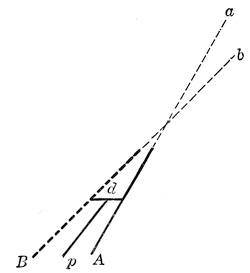
moon’s diameter. The general reason is plain if one follows the
rays through the lenses as in Fig. 4 where AB is the distant object,
o the objective, e the eye lens, ab the real image in the absence of e,
and a′b′ the virtual magnified image due to e.
It will be at once seen that the axes of the pencils of rays from
all parts of the object, as shown by the heavy lines, act as if they
diverged from the optical center of the objective, but diverging
still more by refraction through the concave eye lens e, fall mostly
outside the pupil of the observer’s eye. In fact the field is
approximately measured by the angle subtended by the pupil
from the center of o.
To the credit of the Galilean form may be set down the convenient
erect image, a sharp, if small, field somewhat bettered
by a partial compensation of the aberrations of the objective by
the concave eye lens, and good illumination. For a distant
object the lenses were spaced at the difference of their focal
lengths, and the magnifying power was the ratio of these, fo/fe.

Fig. 4.—Diagram of Galileo’s Telescope.
But the difficulty of obtaining high power with a fairly sizeable
field was ultimately fatal and the type now survives only in the
form of opera and field glasses, usually of 2 to 5 power, and in an
occasional negative eye lens for erecting the image in observatory
work. Practically all the modern instruments have achromatic
objectives and commonly achromatic oculars.

Fig. 5.—Diagram of Kepler’s Telescope.
The necessary step forward was made by Johann Kepler
(1571-1630), the immortal discoverer of the laws of planetary
motion. In his Dioptrice (1611) he set forth the astronomical
telescope, substantially, save for the changes brought by
achromatism, as it has been used ever since. His arrangement
was that of Fig. 5 in which the letters have the same significance
as in Fig. 4.
There are here three striking differences from the Galilean
form. There is a real image in the front focus of the eye lens e,
the rays passing it are refracted inwards instead of outwards,
to the great advantage of the field, and any object placed in the
image plane will be magnified together with the image. The
first two points Kepler fully realized, the third he probably did
not, though it is the basis of the micrometer. The lenses o and
e are obviously spaced at the sum of their focal lengths, and as
before the magnifying power is the ratio of these lengths, the visible
image being inverted.
Kepler, so far as known, did not actually use the new telescope,
that honor falling about half a dozen years later, to Christopher
Scheiner, a Jesuit professor of mathematics at Ingolstadt, best
known as a very early and most persistent, not to say verbose,
observer of sun spots. His Rosa Ursina (1630) indicates free
use of Kepler’s telescope for some years previously, in just what
size and power is uncertain.[3] Fontana of Naples also appears
to have been early in the field.
But the new instrument despite its much larger field and far
greater possibilities of power, brought with it some very serious
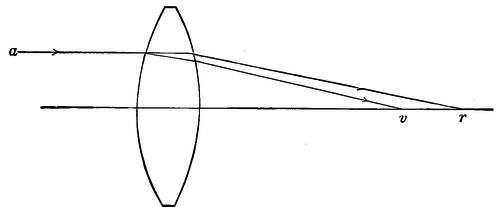
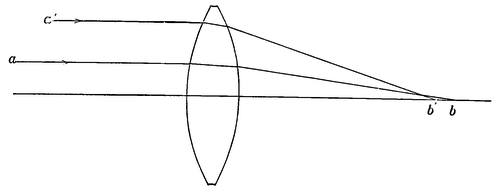
problems. With increased power came greatly aggravated
trouble from spherical aberration and chromatic aberration as
well, and the additive aberrations of the eye lens made matters
still worse. The earlier Keplerian instruments were probably
rather bad if the drawings of Fontana from 1629 to 1636
fairly represent them.
If one may judge from the course of developments, the first
great impulse to improvement came with the publication of
Descartes’ (1596-1650) study of dioptrics in 1637. Therein
was set forth much of the theory of spherical aberration and
astronomers promptly followed the clues, practical and impractical,
thus disclosed.
Without going into the theory of aberrations the fact of importance
to the improvement of the early telescope is that the
longitudinal spherical aberration of any simple lens is directly proportional
to its thickness due to curvature. Hence, other things
being equal, the longer the focus for the same aperture the less the
spherical aberration both absolutely and relatively to the image.
Further, although Descartes knew nothing of chromatic aberration,
and the colored fringe about objects seen through the telescope
must then have seemed altogether mysterious, it, also, was
greatly relieved by lengthening the focus.
For the chromatic circle produced by a simple lens of given
diameter has a radial width substantially irrespective of the focal
length. But increasing the focal length increases in exact proportion
the size of the image, correspondingly decreasing the relative
effect of the chromatic error.
Descartes also suggested several designs of lenses which would
be altogether free of spherical aberration, formed with elliptical
or hyperbolic curvature, and for some time fruitless efforts were
made to realize this in practice. It was in fact to be near a
century before anyone successfully figured non-spherical surfaces.
It was spherical quite as much as chromatic aberration that
drove astronomers to long telescopes.
Meanwhile the astronomical telescope fell into better hands
than those of Scheiner. The first fully to grasp its possibilities
was William Gascoigne, a gallant young gentleman of Middleton,
Yorkshire, born about 1620 (some say as early as 1612) and who
died fighting on the King’s side at Marston Moor, July 2, 1644.
To him came as early as 1638 the inspiration of utilizing the real
focus of the objective for establishing a telescopic sight.
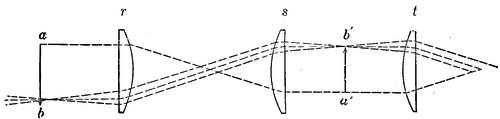
Fig. 6.—Diagram of Terrestrial Ocular.
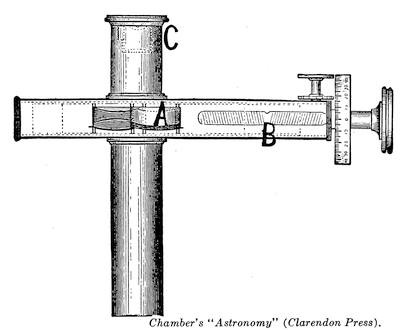
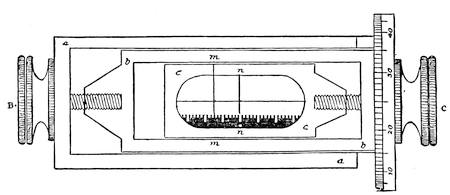
This shortly took the form of a genuine micrometer consisting
of a pair of parallel blades in the focus, moved in opposite directions
by a screw of duplex pitch, with a scale for whole revolutions,
and a head divided into 100 parts for partial revolutions. With
this he observed much from 1638 to 1643, measured the diameters
of sun, moon and planets with a good degree of precision, and
laid the foundations of modern micrometry. He was equipped
by 1639 with what was then called a large telescope.
His untimely death, leaving behind an unpublished treatise
on optics, was a grave loss to science, the more since the manuscript
could not be found, and, swept away by the storms of war,
his brilliant work dropped out of sight for above a score of years.
Meanwhile De Rheita (1597-1660), a Capuchin monk, and an
industrious and capable investigator, had been busy with the
telescope, and in 1645 published at Antwerp a somewhat bizarre
treatise, dedicated to Jesus Christ, and containing not a little
practical information. De Rheita had early constructed binoculars,
probably quite independently, had lately been diligently
experimenting with Descartes’ hyperbolic lens, it is needless to
say without much success, and was meditating work on a colossal
scale—a glass to magnify 4,000 times.
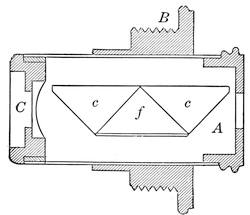
But his real contribution to optics was the terrestrial ocular.
This as he made it is shown in Fig. 6 where a b is the image
formed by the objective in front of the eye lens r, s and t two
equal lenses separated by their focal lengths and a′ b′ the resultant
reinverted image. This form remained in common use until
improved by Dolland more than a century later.
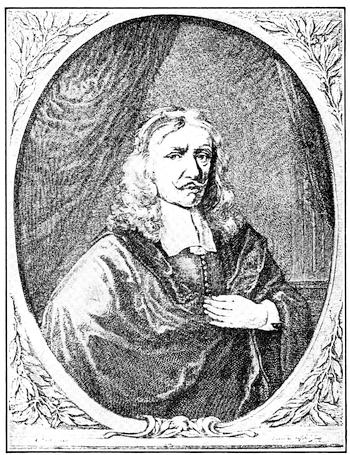
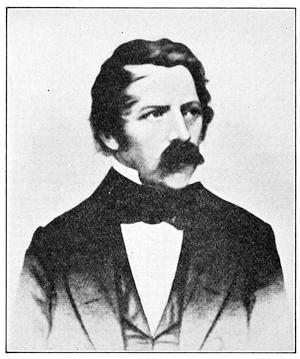
Fig. 7.—Johannes Hevelius.
A somewhat earlier form ascribed to Father Scheiner had
merged the two lenses forming the inverting system of Fig.
6, into a single lens used at its conjugate foci.
Closely following De Rheita came Johannes Hevelius (1611-1687)
of Danzig, one of the really important observers of the
seventeenth century. His great treatise Selenographia published
in 1647 gives us the first systematic study of the moon, and a brief
but illuminating account of the instruments of the time and
their practical construction.
At this time the Galilean and Keplerian forms of telescope were
in concurrent use and Hevelius gives directions for designing and
making both of them. Apparently the current instruments were
not generally above five or six feet long and from Hevelius’ data
would give not above 30 diameters in the Galilean form. There
is mention, however, of tubes up to 12 feet in length, and of the
advantage in clearness and power of the longer focus plano-convex
lens. Paper tubes, evidently common, are condemned,
also those of sheet iron on account of their weight, and wood was
to be preferred for the longer tubes.
Evidently Hevelius had at this time no notion of the effect of
the plano-convex form of lens as such in lessening aberration, but
he mentions a curious form of telescope, actually due to De Rheita,
in which the objective is double, apparently of two plano-convex
lenses, the weaker ahead, and used with a concave eye lens.
If properly proportioned such a doublet would have less than a
quarter the spherical aberration of the equivalent double convex
lens.
Hevelius also mentions the earlier form of re-inverting telescope
above referred to, and speaks rather highly of its performance.
To judge from his numerous drawings of the moon made in 1643
and 1644, his telescopes were much better than those of Scheiner
and Fontana, but still woefully lacking in sharp definition.
Nevertheless the copper plates of the Selenographia, representing
every phase of the moon, placed the lunar details with remarkable
accuracy and formed for more than a century the best lunar
atlas available. One acquires an abiding respect for the patience
and skill of these old astronomers in seeing how much they did
with means utterly inadequate.
One may get a fair idea of the size, appearance, and mounting
of telescopes in this early day from Fig. 8, which shows a somewhat
advanced construction credited by Hevelius to a suggestion in
Descartes’ Dioptrica. Appearances indicate that the tube was
somewhere about six feet long, approximately two inches in
aperture, and that it had a draw tube for focussing. The offset
head of the mount to allow observing near the zenith is worth
an extra glance.
Incidentally Hevelius, with perhaps pardonable pride, also
explains the “Polemoscope,” a little invention of his own, made, he
tells us, in 1637. It is nothing else than the first periscope,
constructed as shown in Fig. 9, a tube c with two right angled
branches, a fairly long one e for the objective f, a 45° mirror at g,
another at a, and finally the concave ocular at b. It was of
modest size, of tubes 1⅔ inch in diameter, the longer tube being
22 inches and the upper branch 8 inches, a size well suited for
trench or parapet.
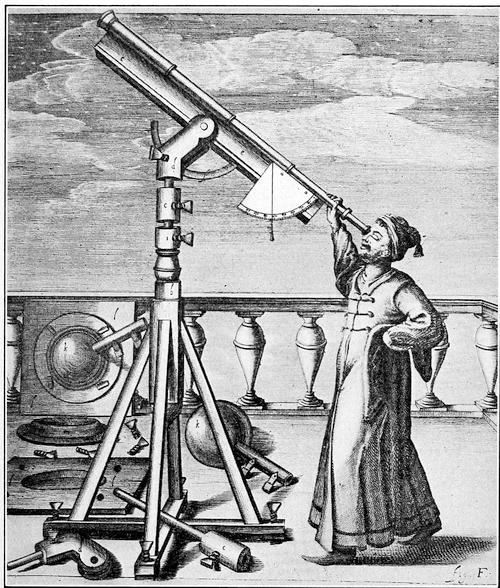
Fig. 8.—A Seventh Century Astronomer and his Telescope.
Even in these days of his youth Hevelius had learned much of
practical optics as then known, had devised and was using very
rational methods of observing sun-spots by projection in a darkened
room, and gives perhaps the first useful hints at testing
telescopes by such solar observations and on the planets. He was
later to do much in the development and mounting of long telescopes
and in observation, although, while progressive in other
respects, he very curiously never seemed to grasp the importance
of telescopic sights and consistently refused to use them.
Telescope construction was now to fall into more skillful hands.
Shortly after 1650 Christian Huygens (1629-1695), and his
accomplished brother Constantine awakened to a keen interest
in astronomy and devised new and excellent methods of forming
accurate tools and of grinding and polishing lenses.
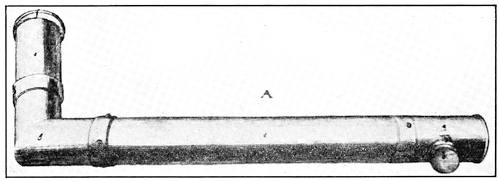
Fig. 9.—The first Periscope.
By 1655 they had completed an instrument of 12 feet focus with
which the study of Saturn was begun, Titan the chief satellite
discovered, and the ring recognized. Pushing further, they
constructed a telescope of 23 feet focal length and 2⅓ inches
aperture, with which four years later Christian Huygens finally
solved the mystery of Saturn’s ring.
Evidently this glass, which bore a power of 100, was of good
defining quality, as attested by a sketch of Mars late in 1695
showing plainly Syrtis Major, from observation of which Huygens
determined the rotation period to be about 24 hours.
The Huygens brothers were seemingly the first fully to grasp
the advantage of very long focus in cutting down the aberrations,
the aperture being kept moderate. Their usual proportions were
about as indicated above, the aperture being kept somewhere
nearly as the square root of the focus in case of the larger glasses.
In the next two decades the focal length of telescopes was
pushed by all hands to desperate extremes. The Huygens
brothers extended themselves to glasses up to 210 feet focus and
built many shorter ones, a famous example of which, of 6 inches
aperture and 123 feet focal length, presented to the Royal
Society, is still in its possession. Auzout produced even longer
telescopes, and Divini and Campani, in Rome, of whom the last
named made Cassini’s telescopes for the Observatory of Paris,
were not far behind. The English makers were similarly busy,
and Hevelius in Danzig was keeping up the record.
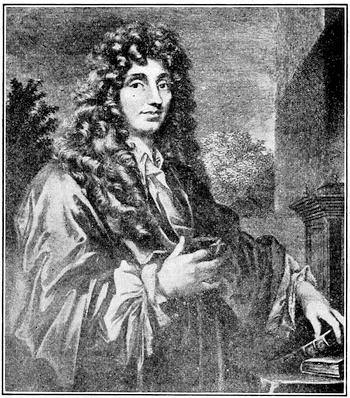
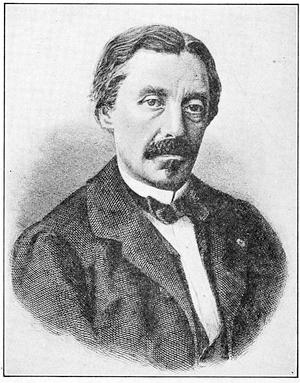
Fig. 10.—Christian Huygens.
Clearly these enormously long telescopes could not well be
mounted in tubes and the users were driven to aerial mountings,
in which the objective was at the upper end of a spar or girder
and the eye piece at the lower. Figure 11 shows an actual construction
by Hevelius for an objective of 150 feet focal length.
In this case the main support was a T beam of wooden planks
well braced together. Additional stiffness was given by light
wooden diaphragms at short intervals with apertures of about
8 inches next to the objective, and gradually increasing downwards.
The whole was lined up by equalizing tackle in the vertical
plane, and spreaders with other tackle at the joints of the 40foot
sections of the main beam. The mast which supported
the whole was nearly 90 feet high.
So unwieldly and inconvenient were these long affairs that,
quite apart from their usual optical imperfections, it is little
wonder that they led to no results commensurate with their size.
In fact nearly all the productive work was done with telescopes
from 20 to 35 feet long, with apertures roughly between 2 and
3 inches.
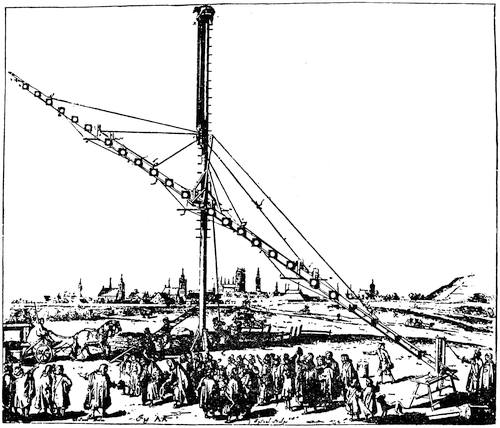
Fig. 11.—Hevelius’ 150-foot Telescope.
Dominique Cassini to be sure, scrutinizing Saturn in 1684 with
objectives by Campani, of 100 and 136 feet focus picked up the
satellites Tethys and Dione, but he had previously found Iapetus
with a 17-foot glass, and Rhea with one of 34 feet. The longer
glasses above mentioned had aerial mounts but the smaller
ones were in tubes supported on a sort of ladder tripod. A 20-foot
objective, power 90, gave Cassini the division in Saturn’s ring.
A struggle was still being kept up for the non-spherical curves
urged by Descartes. It is quite evident that Huygens had a go
at them, and Hevelius thought at one time that he had mastered
the hyperbolic figure, but his published drawings give no indication
that he had reduced spherical aberration to any perceptible
degree. At this time the main thing was to get good glass and
give it true figure and polish, in which Huygens and Campani
excelled, as the work on Saturn witnesses.
These were the days of the dawn of popular astronomy and
many a gentleman was aroused to at least a casual interest in
observing the Heavens. Notes Pepys in his immortal Diary:
“I find Reeves there, it being a mighty fine bright night, and so
upon my leads, though very sleepy, till one in the morning, looking
on the moon and Jupiter, with this twelve foot glass, and
another of six foot, that he hath brought with him to-night,
and the sights mighty pleasant, and one of the glasses I will buy.”
Little poor Pepys probably saw, by reason of his severe
astigmatism, but astronomy was
in the air with the impulse that
comes to every science after a
period of brilliant discovery. Another
such stimulus came near the
end of the eighteenth century,
with the labors of Sir William
Herschel.
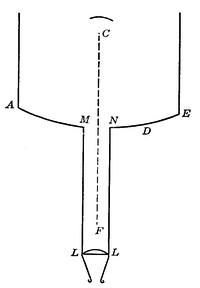
Fig. 12.—Gregory’s Diagram of his Telescope.
Just at this juncture comes one
of the interesting episodes of telescopic
history, the ineffectual and
abandoned experiments on reflecting
instruments.
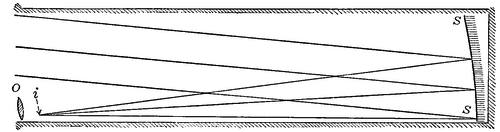
In 1663 James Gregory (1638-1675)
a famous Scottish mathematician,
published his Optica
Promota, in which he described
the rather elegant construction
which bears his name, a perforated parabolic mirror with an
elliptical mirror forward of the focus returning an image to the
ocular through the perforation. It was convenient in that it
gave an erect image, and it was sound theoretically, and, as the
future proved, practically, but the curves were quite too much
for the contemporary opticians. Figure 12 shows the diagrammatic
construction as published.
The next year Gregory started Reive, a London optician,
doubtless the same mentioned by Pepys, on the construction of a
6 foot telescope. This rather ambitious effort failed of material
success through the inability of Reive to give the needed figures
to the mirrors,[4] and of it nothing further appears until the ingenious
Robert Hooke (1635-1703) executed in 1674 a Gregorian,
apparently without any notable results. There is a well
defined tradition that Gregory himself was using one in 1675, at
the time of his death, but the invention then dropped out of sight.
No greater influence on the art attended the next attempt at a
reflector, by Isaac Newton (1643-1727). This was an early outcome
of his notable discovery of the dispersion of light by prisms,
which led him to despair of improving refracting telescopes and
turned his mind to reflectors.
Unhappily in an experiment to determine whether refraction
and dispersion were proportional he committed the singular
blunder of raising the refractive index of a water-filled prism to
equality with glass by dissolving sugar of lead in it. Without
realizing the impropriety of thus varying two quite unknown
quantities at once in his crucial experiment, he promptly jumped
to the conclusion that refraction and dispersion varied in exact
proportion in all substances, so that if two prisms or lenses
dispersed light to the same extent they must also equally refract
it. It would be interesting to know just how the fact of his
bungling was passed along to posterity. As a naïve apologist
once remarked, it was not to be found in his “Optics.”
But Sir David Brewster and Sir John Herschel, both staunch
admirers of the great philosopher, state the fact very positively.
If one may hazard a guess it crept out at Cambridge and was
passed along, perhaps to Sir William Herschel, via the unpublished
history of research that is rich in picturesque details of the
mare’s nests of science. At all events a mistake with a great
name behind it carries far, and the result was to delay the
production of the achromatic telescope by some three quarters
of a century.
Turning from refractors he presented to the Royal Society
just after his election as Fellow in 1672, the little six-inch model of
his device which was received with acclamation and then lay on
the shelf without making the slightest impression on the art, for
full half a century.
Newton, by dropping the notion of direct view through the
tube, hit upon by far the simplest way of getting the image outside
it, by a plane mirror a little inside focus and inclined at 45°,
but injudiciously abandoned the parabolic mirror of his original
paper on dispersion. His invention therefore as actually
made public was of the combination with a spherical concave
mirror of a plane mirror of elliptical form at 45°, a construction
which in later papers he defended as fully adequate.[5]
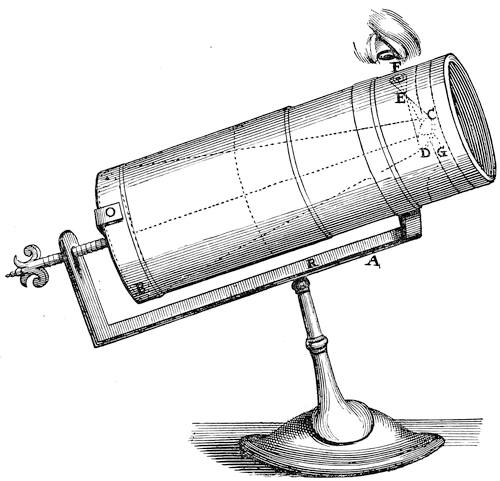
Fig. 13.—Newton’s Model of his Reflector.
His error in judgment doubtless came from lack of practical
astronomical experience, for he assumed that the whole real
trouble with existing telescopes was chromatic aberration, which
in fact worried the observer little more than the faults due to
other causes, since the very low luminosity toward the ends
of the spectrum enormously lessens the indistinctness due to
dispersion.
As a matter of fact the long focus objective of small aperture
did very creditable work, and its errors would not compare
unfavorably with those of a spherical concave mirror of the wide
aperture planned by Newton. Had he actually made one of
his telescopes of fair dimensions and power the definition would
infallibly have been wrecked by the aberrations due to spherical
figure.[6]
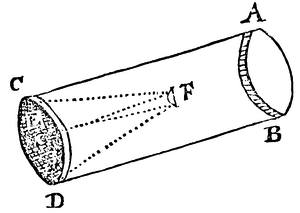
Fig. 14.—De Bercé’s sketch of Cassegrain’s Telescope.
It is quite likely that appreciation of this, and the grave doubts
of both Newton and Huygens as to obtaining a proper parabolic
curve checked further developments. About the beginning of
the year 1672 M. Cassegrain communicated to M. de Bercé a
design for a reflecting telescope, which eventually found its way
into the Philosophical Transactions of May in that year, after
previous publication in the Journal des Sçavans. Figure 14 shows
de Bercé’s rough original sketch. It differed from Gregory’s
construction in that the latter’s elliptical concave mirror placed
outside the main focus, was replaced by a convex mirror placed
inside focus. The image was therefore inverted.
The inventor is referred to in histories of science as “Cassegrain,
a Frenchman.” He was in fact Sieur Guillaume Cassegrain,
sculptor in the service of Louis Quatorze, modeller and founder
of many statues. In 1666 he was paid 1200 livres for executing
a bust of the King modelled by Bertin, and later made many
replicas from the antique for the decoration of His Majesty’s
gardens at Versailles. He disappeared from the royal records in
1684 and probably died within a year or two of that date.
At the period here concerned he apparently, like de Bercé, was
of Chartres. Familiar with working bronzes and with the art
of the founder, he was a very likely person to have executed
specula. Although there is no certainty that he actually made a
telescope, a contemporary reference in the Journal des Sçavans
speaks of his invention as a “petite lunette d’approche,” and one
does not usually suggest the dimensions of a thing non-existent.
How long he had been working upon it prior to the period about
the beginning of 1672 when he disclosed the device to de Bercé
is unknown.
Probably Newton’s invention was the earlier, but the two were
independent, and it was somewhat ungenerous of Newton to
criticise Cassegrain, as he did, for using spherical mirrors, on the
strength of de Bercé’s very superficial description, when he himself
considered the parabolic needless.
However, nothing further was done, and the devices of Gregory,
Newton and Cassegrain went together into the discard for some
fifty years.
These early experiments gave singularly little information
about material for mirrors and methods of working it, so little
that those who followed, even up to Lord Rosse, had to work
the problems out for themselves. We know from his original
paper that Newton used bell-metal, whitened by the addition of
arsenic, following the lore of the alchemists.
These speculative worthies used to alloy copper with arsenic,
thinking that by giving it a whitish cast they had reached a sort
of half way point on the road to silver. Very silly at first
thought, but before the days of chemical analysis, when the
essential properties of the metals were unknown, the way of the
scientific experimenter was hard.
What the “steely matter, imployed in London” of which
Newton speaks in an early paper was, we do not know—very
likely one of the hard alloys much richer in tin than is ordinary
bell-metal. Nor do we know to what variety of speculum metal
Huygens refers in his correspondence with Newton.
As to methods of working it Newton only disclosed his scheme
of pitch-polishing some thirty years after this period, while it is
a matter of previous record, that Huygens had been in the habit
of polishing his true tools on pitch from some date unknown.
Probably neither of them originated the practice. Opticians
are a peculiarly secretive folk and shop methods are likely to be
kept for a long time before they leak out or are rediscovered.
Modern speculum metal is substantially a definite compound
of four atoms copper and one tin (SnCu4), practically 68 per
cent copper and 32 per cent tin, and is now, as it was in all
previous modifications, a peculiarly mean material to cast and
work. Thus exit the reflector.
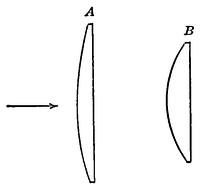
Fig. 15.—Diagram of Huygens’ Eyepiece.
The long telescope continued to grow longer with only slow
improvement in quality, but the next
decade was marked by the introduction
of Huygens’ eyepiece, an immense
improvement over the single
lens which had gone before, and with
slight modifications in use today.
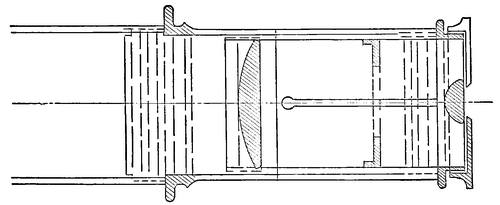
This is shown in section in Fig. 15.
It consists of a field lens A, plano-convex,
and an eye lens B of one-third
the focal length, the two being placed
at the difference of their focal lengths
apart with (in later days) a stop half way between them. The
eye piece is pushed inside the main focus until the rays which fall
on the field lens focus through the eye lens.
The great gain from Huygens’ view-point was a very much
enlarged clear field—about a four-fold increase—and in fact the
combination is substantially achromatic, particularly important
now when high power oculars are needed.
Still larger progress was made in giving the objective a better
form with respect to spherical aberration, the “crossed” lens being
rather generally adopted. This form is double convex, and if of
ordinary glass, with the rear radius six times the front radius, and
gives even better results than a plano-convex in its best position-plane
side to the rear. Objectives were rated on focal length for
the green rays, that is, the bright central part of the spectrum, the
violet rays of course falling short and the red running beyond.
To give customary dimensions, a telescope of 3 inches aperture,
with magnifying power of 100, would be of about 30 feet focus
with the violet nearly 6 inches short and the red a similar amount
long. It is vast credit to the early observers that with such
slender means they did so much. But in fact the long telescope
had reached a mechanical impasse, so that the last quarter of the
seventeenth century and the first quarter of the next were marked
chiefly by the development of astronomy of position with instruments
of modest dimensions.
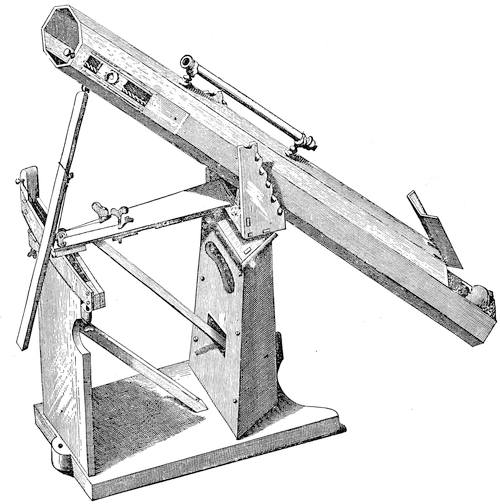
Fig. 16.—The First Reflector. John Hadley, 1722.
In due time the new order came and with astounding suddenness.
Just at the end of 1722 James Bradley (1692-1762)
measured the diameter of Venus with an objective of 212 ft.
3 in. focal length; about three months later John Hadley (1682-1744)
presented to the Royal Society the first reflecting telescope
worthy the name, and the old order practically ended.
John Hadley should in fact be regarded as the real inventor of
the reflector in quite the same sense that Mr. Edison has been
held, de jure and de facto, the inventor of the incandescent electric
lamp. Actually Hadley’s case is the stronger of the two,
for the only things which could have been cited against him were
abandoned experiments fifty years old. Moreover he took successfully
the essential step at which Gregory and Newton had
stumbled or turned back—parabolizing his speculum.
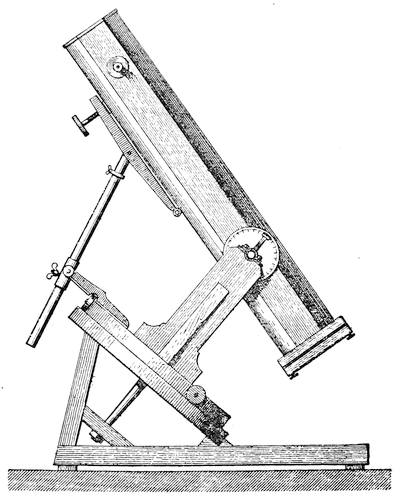
The instrument he presented was of approximately 6 inches
aperture and 62⅝ inches focal length, which he had made
and tested some three years previously; on a substantial alt-azimuth
mount with slow motions. He used the Newtonian
oblique mirror and the instrument was provided with both
convex and concave eye lenses, with magnifications up to
about 230.
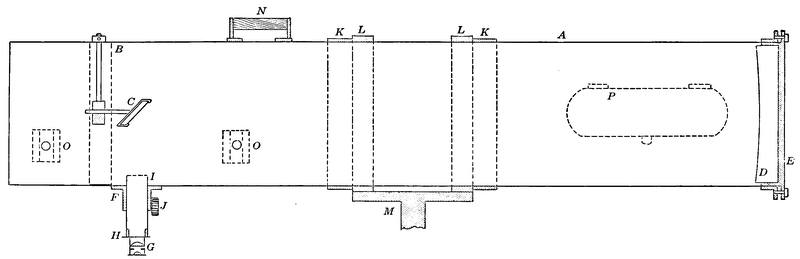
The whole arrangement is shown in Fig. 16 which is for the most
part self explanatory. It is worth noting that the speculum
is positioned in the wooden tube by pressing it forward against
three equidistant studs by three corresponding screws at the rear,
that a slider moved by a traversing screw in a wide groove
carries the small mirror and the ocular, that there is a convenient
door for access to the mirror, and also a suitable finder. The
motion in altitude is obtained by a key winding its cord against
gravity. That in azimuth is by a roller support along a horizontal
runway carried by an upright, and is obtained by the key
with a cord pull off in one direction, and in the other, by springs
within the main upright, turning a post of which the head carries
cheek pieces on which rest the trunnions of the tube.
A few months later this telescope was carefully tested, by
Bradley and the Rev. J. Pound, against the Huygens objective
of 123 feet focus possessed by the Royal Society, and with
altogether satisfactory results. Hadley’s reflector would show
everything which could be seen by the long instrument, bearing as
much power and with equal definition, though somewhat lessened
light. In particular they saw all five satellites of Saturn, Cassini’s
division, which the inventor himself had seen the previous
year even in the northern edge of the ring beyond the planet, and
the shadow of the ring upon the ball.
The casting of the large speculum was far from perfect, with
many spots that failed to take polish, but the figure must have
been rather good. A spherical mirror of these dimensions would
give an aberration blur something like twenty times the width of
Cassini’s division, and the chance of seeing all five satellites
with it would be negligibly small.
Further, Hadley presently disclosed to others not only the
method he used in polishing and parabolizing specula, but his
method of testing for true figure by the aberrations disclosed as
he worked the figure away from the sphere—a scheme frequently
used even to this day.
The effect of Hadley’s work was profound. Under his guidance
others began to produce well figured mirrors, in particular
Molyneux and Hawksbee; reflecting telescopes became fairly
common; and in the beginning of the next decade James Short,
(1710-1768), possessed of craftsmanship that approached wizardry,
not only fully mastered the art of figuring the paraboloid,
but at once took up the Gregorian construction with its
ellipsoidal small mirror, with much success.
His specula were of great relative aperture, F/4 to F/6, and
from the excellent quality of his metal some of them have retained
their fine polish and definition after more than a century. He is
said to have gone even up to 12 inches in diameter. His exact
methods of working died with him. Even his tools he ordered
to be destroyed before his death.
The Cassegrain reflector, properly having a parabolic large
mirror and a hyperbolic small one, seems very rarely to have been
made in the eighteenth century, though one certainly came into
the hands of Ramsden (1735-1800).
Few refractors for astronomical use were made after the advent
of the reflector, which was, and is, however, badly suited for the
purposes of a portable spy-glass, owing to trouble from stray
light. The refractor therefore permanently held its own in this
function, despite its length and uncorrected aberrations.
Relief was near at hand, for hardly had Short started on his
notable career when Chester Moor Hall, Esq. (1704-1771) a
gentleman of Essex, designed and caused to be constructed the first
achromatic telescope, with an objective of crown and flint glass.
He is stated to have been studying the problem for several years,
led to it by the erroneous belief (shared by Gregory long before)
that the human eye was an example of an achromatic instrument.
Be this as it may Hall had his telescopes made by George Bast
of London at least as early as 1733, and according to the best
available evidence several instruments were produced, one of them
of above 2 inches aperture on a focal length of about 20 inches
(F/8) and further, subsequently such instruments were made and
sold by Bast and other opticians.
These facts are clear and yet, with knowledge of them among
London workmen as well as among Hall’s friends, the invention
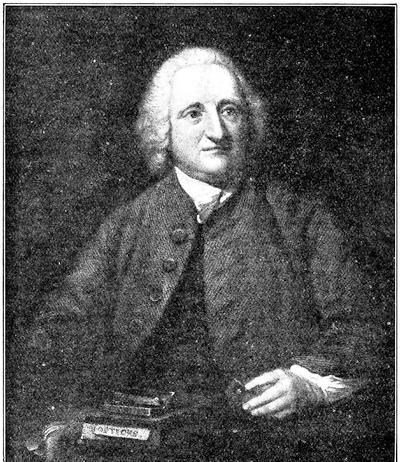
made no impression, until it was again brought to light, and
patented, by the celebrated John Dolland (1706-1761) in the
year 1758.
Physical considerations give a clue to this singular neglect.
The only glasses differing materially in dispersion available in
Hall’s day were the ordinary crown, and such flint as was in use
in the glass cutting trade,—what we would now know as a light
flint, and far from homogeneous at that.
Lodge “Pioneers of Science.”
Fig. 17.—John Dolland.
Out of such material it was practically very hard (as the
Dollands quickly found) to make a double objective decently free
from spherical aberration, especially for one working, as Hall quite
assuredly did, by rule of thumb. With the additional handicap
of flint full of faults it is altogether likely that these first achromatics,
while embodying the correct principles, were not good
enough to make effective headway against the cheaper and
simpler spy-glass of the time.
Dolland, although in 1753 he strongly supported Newton’s
error in a Royal Society paper against Euler’s belief in achromatism,
shifted his view a couple of years later and after a
considerable period of skilful and well ordered experimenting published
his discovery of achromatism early in 1758, for which a
patent was granted him April 19, while in the same year the Royal
Society honored him with the Copley medal. From that time
until his death, late in 1761, he and his son Peter Dolland (1730-1820)
were actively producing achromatic glasses.
The Dollands were admirable craftsmen and their early product
was probably considerably better than were Hall’s objectives but
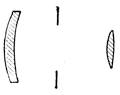
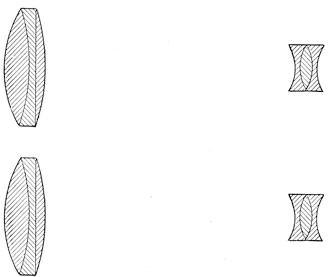
they felt the lack of suitable flint and soon after John Dolland’s
death, about 1765, the son sought relief in the triple objective of
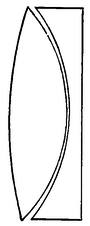
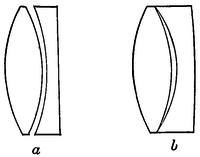
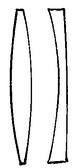
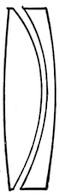
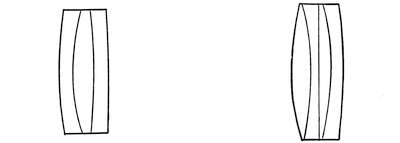
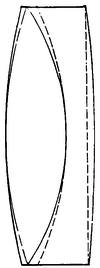
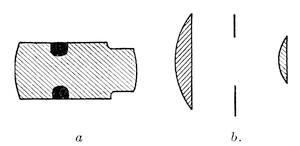
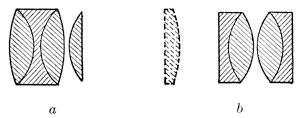
which an early example is shown in Fig. 18, and
which, with some modifications, was his standard
form for many years.
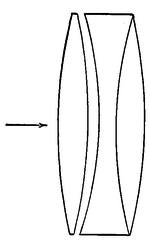
Fig. 18.—Peter Dolland’s Triple Objective.
Other opticians began to make achromatics,
and, Peter Dolland having threatened action
for infringement, a petition was brought by 35
opticians of London in 1764 for the annulment
of John Dolland’s patent, alleging that he was
not the original inventor but had knowledge
of Chester Moor Hall’s prior work. In the
list was George Bast, who in fact did make
Hall’s objectives twenty five years before
Dolland, and also one Robert Rew of Coldbath
Fields, who claimed in 1755 to have informed Dolland of
the construction of Hall’s objective.
This was just the time when Dolland came to the right about
face on achromatism, and it may well be that from Rew or
elsewhere he may have learned that a duplex achromatic lens
had really been produced. But his Royal Society paper shows
that his result came from honest investigations, and at worst he
is in about the position of Galileo a century and a half before.
The petition apparently brought no action, perhaps because
Peter Dolland next year sued Champneys, one of the signers, and
obtained judgment. It was in this case that the judge (Lord
Camden) delivered the oft quoted dictum: “It was not the
person who locked up his invention in his scrutoire that ought to
profit by a patent for such invention, but he who brought it
forth for the benefit of the public.[7]”
This was sound equity enough, assuming the facts to be as
stated, but while Hall did not publish the invention admittedly
made by him, it had certainly become known to many. Chester
Moor Hall was a substantial and respected lawyer, a bencher of
the Inner Temple, and one is inclined to think that his alleged
concealment was purely constructive, in his failing to contest
Dolland’s claim.
Had he appeared at the trial with his fighting blood up, there is
every reason to believe that he could have established a perfectly
good case of public use quite aside from his proof of technical
priority. However, having clearly lost his own claims through
laches, he not improbably was quite content to let the tradesmen
fight it out among themselves. Hall’s telescopes were in
fact known to be in existence as late as 1827.
As the eighteenth century drew toward its ending the reflecting
telescope, chiefly in the Gregorian form, held the field in astronomical
work, the old refractor of many draw tubes was the spy-glass
of popular use, and the newly introduced achromatic was
the instrument of “the exclusive trade.” No glass of suitable
quality for well corrected objectives had been produced, and that
available was not to be had in discs large enough for serious
work. A 3-inch objective was reckoned rather large.