Larger versions of most illustrations may be seen by right-clicking them
and selecting an option to view them separately, or by double-tapping and/or
stretching them.
Strictly speaking, the telephone is merely an
instrument adapted for the transmission of sound
to a distance, and this idea of transmitting sound
is as old as the world itself. The Greeks made
use of means which might effect it, and there is no
doubt that these means were sometimes used for
the pagan oracles. But such transmission of sound
was within somewhat narrow limits, and certainly
did not exceed those of a speaking-tube. Mr.
Preece considers that the earliest document in
which this transmission of sound to a distance is
distinctly formulated, dates from 1667: he refers
to a paper by one Robert Hooke, who writes to
this effect: ‘It is not impossible to hear a whisper
at a furlong’s distance, it having been already done;
and perhaps the nature of the thing would not make
it more impossible, though that furlong should be
ten times multiply’d. And though some famous
authors have affirm’d it impossible to hear through
the thinnest plate of Muscovy glass; yet I know a
way, by which ’tis easie enough to hear one speak
through a wall a yard thick. It has not yet been
thoroughly examin’d how far otacousticons may be
improv’d, nor what other wayes there may be of
quickning our hearing, or conveying sound through
other bodies than the air; for that is not the only
medium I can assure the reader, that I have, by the
help of a distended wire, propagated the sound to a
very considerable distance in an instant, or with as
seemingly quick a motion as that of light, at least
incomparably quicker than that which at the same
time was propagated through the air; and this not
only in a straight line or direct, but in one bended
in many angles.’
This plan for the transmission of sound is the
principle of the string telephones which have attracted
attention for some years, and it remained
in the stage of simple experiment until 1819, when
Sir Charles Wheatstone applied it to his magic
lyre. In this instrument, sounds were transmitted
through a long strip of deal, with one end in connection
with a sounding board: one step more led
to the use of the membrane employed in string
telephones. It would be difficult to say with whom
this idea originated, since it is claimed, as if beyond
dispute, by several telephone-makers. If we may
believe some travellers, it has long been used in
Spain for the correspondence of lovers. However
this may be, it was not to be found among the
scientific appliances of some years ago, and it was
even supposed by many persons that the cord
consisted of an acoustic tube of slender diameter.
Although the instrument has become a child’s toy,
it has great scientific importance, for it proves that
vibrations capable of reproducing speech may be
extremely minute, since they can be mechanically
transmitted more than a hundred yards.
From the telegraphic point of view, however, the
problem of transmitting sounds to a distance was
far from being solved in this way, and the idea of
applying electricity to this mode of transmission
naturally arose as soon as the wonderful effects of
electric telegraphy were observed, that is, in the
years subsequent to 1839. A surprising discovery
made in America by Mr. Page, in 1837, and afterwards
investigated by MM. Wertheim, De la Rive,
and others, must also have led up to it: for it was
observed that a magnetic bar could emit sounds
when rapidly magnetised and demagnetised, and
these sounds corresponded with the number of
currents which produced them. Again, the electric
vibrators devised by MM. Macaulay, Wagner,
Neef, etc., and adapted to produce musical sounds,
between 1847–1852, by MM. Froment and Pétrina,
showed that the problem of transmitting sounds
to a distance was not insoluble. Yet, up to 1854,
no one had ventured to admit the possibility
of transmitting speech by electricity, and when
M. Charles Bourseul published in that year a paper
on the electric transmission of speech, the idea
was regarded as a fanciful dream. I confess
that I myself thought it incredible, and when I
produced the paper in the first edition of my account
of the applications of electricity, published
in 1854, I felt bound to add that the scheme
seemed more than doubtful. Yet, as the paper
was thoughtfully written, I had no hesitation in
publishing it, affixing the signature of CH. B.
Events justified this daring idea, and although it
did not include the only principle which could lead
to the reproduction of articulate sounds, yet it was
the germ of the fertile invention which has made
the names of Graham Bell and Elisha Gray famous.
For this reason I will again quote M. Charles
Bourseul’s paper.
‘After the telegraphic marvels which can reproduce
at a distance hand-writings, or even more
or less complicated drawings, it may appear impossible
to penetrate further into the region of the
marvellous. Yet we will try to advance a few
steps further. I have, for example, asked myself
whether speech itself may not be transmitted by
electricity—in a word, if what is spoken in Vienna
may not be heard in Paris. The thing is practicable
in this way:—
‘We know that sounds are made by vibrations,
and are adapted to the ear by the same vibrations
which are reproduced by the intervening medium.
But the intensity of the vibrations diminishes very
rapidly with the distance: so that it is, even with
the aid of speaking-tubes and trumpets, impossible
to exceed somewhat narrow limits. Suppose that
a man speaks near a moveable disk, sufficiently
flexible to lose none of the vibrations of the voice,
that this disk alternately makes and breaks the
currents from a battery: you may have at a
distance another disk, which will simultaneously
execute the same vibrations.
‘It is true that the intensity of the sounds produced
will be variable at the point of departure, at
which the disk vibrates by means of the voice, and
constant at the point of arrival, where it vibrates by
means of electricity; but it has been shown that
this does not change the sounds. It is, moreover,
evident that the sounds will be reproduced at the
same pitch.
‘The present state of acoustic science does not
permit us to declare à priori if this will be precisely
the case with syllables uttered by the human voice.
The mode in which these syllables are produced
has not yet been sufficiently investigated. It is
true that we know that some are uttered by the
teeth, others by the lips, and so on; but this is
all.
‘However this may be, observe that the syllables
can only reproduce upon the sense of hearing the
vibrations of the intervening medium: reproduce
precisely these vibrations, and you will reproduce
precisely these syllables.
‘It is, at all events, impossible in the present
condition of science to prove the impossibility of
transmitting sound by electricity. Everything
tends to show, on the contrary, that there is such
a possibility. When the application of electro-magnetism
to the transmission of messages was
first discussed, a man of great scientific attainments
treated the idea as utopian, and yet there is now
direct communication between London and Vienna
by means of a simple wire. Men declared it to be
impossible, but so it is.
‘It need not be said that numerous applications
of the highest importance will immediately arise
from the transmission of speech by electricity.
Any one who is not deaf and dumb may use this
mode of transmission, which would require no apparatus,
except an electric battery, two vibrating
disks, and a wire. In many cases, as for example
in large establishments, orders might be transmitted
in this way, although transmission by
electricity will not be used while it is necessary to
go from letter to letter, and to make use of telegraphs
which require use and apprenticeship.
However this may be, it is certain that in a more
or less distant future, speech will be transmitted by
electricity. I have made some experiments in this
direction: they are delicate, and demand time and
patience, but the approximations obtained promise a
favourable result.’
This description is certainly not full enough to
enable us to discern from it the arrangement
which would lead to the solution of the problem,
and if the vibrations of the disk at the receiving
station were to follow from making and breaking
the current at the sending-station, under the
influence of vibrations caused by the voice, they
would only produce musical, and not articulate
sounds. Yet the idea was magnificent, as Mr.
Preece said, even when he thought it impossible to
realise it. Besides, it is easy to see that M. Bourseul
himself was not deceived as to the difficulties
of the problem, as far as articulate sounds are
concerned, for he points out, as we have seen, the
difference existing between the simple vibrations
which produce musical sounds, and the complex
vibrations which cause articulate sounds; but,
as he justly said: ‘Reproduce at the one end of
the line the vibrations of air caused at the other,
and speech will be transmitted, however complex
the mechanism may be by which it is effected.’
We shall presently see how the problem was solved,
and it is probable that some attempts had already
enabled M. Bourseul to anticipate the solution of
the question; but there is nothing in his paper to
show what were the means he proposed, so that
the discovery of the electric transmission of speech
cannot reasonably be ascribed to him, and we do
not understand why we should be reproached for
having at that time failed to appreciate the importance
of a discovery which seemed to be then
only within the range of fancy.
It was not until 1876 that the problem of the
electric transmission of speech was finally solved,
and the discovery has lately given rise to an interesting
controversy as to priority between Mr.
Elisha Gray, of Chicago, and Mr. Graham Bell, on
which we must say a few words.
As early as 1874 Mr. Elisha Gray was occupied
with a system of musical telephone, which he
wished to apply to manifold telegraphic transmissions,
and the investigations which he made,
in order to establish this system under the best
possible conditions, gave him a glimpse of the
possibility of transmitting articulate words by electricity.
While carrying on his experiments on the
telegraphic system, he arranged in fact, about the
15th January, 1876, a system of speaking telephone,
and he deposited the specification and drawings in
the American Patent Office, in the form of a
caveat or provisional specification. The deposit
was made on the 14th February, 1876: on the very
same day, Mr. Graham Bell also deposited, in the
American Patent Office, a request for a patent in
which he spoke of an instrument of the same kind,
but with special application to simultaneous telegraphic
transmissions by means of a telephonic
apparatus; and the few words which could, in this
specification, refer to a telephone with articulate
sounds, applied to an instrument which, by Mr.
Bell’s own admission, had not produced any satisfactory
results. In Mr. Gray’s caveat, on the
contrary, the application of the instrument to the
electric transmission of speech alone is indicated,
the description of the system is complete, and the
drawings which accompany it are so exact, that a
telephone made from them would work perfectly:
this was proved by Mr. Gray himself, when, some
time afterwards, he finished his instruments, which
differed in no respect from the one described in Mr.
Bell’s statement as worked by a battery. On these
grounds Mr. Elisha Gray would certainly have
obtained the patent, if the expiration of his caveat
had not been the result of an omission of form in
the Patent Office, which, as we know, decides the
priority of inventions in America. An action on the
ground of this omission has lately been brought
against Mr. Bell, in the Supreme Court of the
American Patent Office, to set aside the patent
granted to him. If Mr. Gray did not appeal before,
it was because he was then wholly occupied with
experiments on the system of harmonic telephone,
applied to telegraphic communication, and he had
no time to attend to the matter.
However this may be, Mr. Bell did not begin
to give serious attention to the speaking telephone
until he had obtained his patent, and his efforts
were soon crowned with success: a few months
later, he exhibited his speaking telephone at
Philadelphia, which has from that time attracted so
much public attention, and which, when perfected
in a practical point of view, reached Europe in the
autumn of 1877 under the form we know.
To complete this summary account of the
telephone, we ought to say that since its success
a good many claims of priority have arisen, as if
by enchantment. Mr. John Camack, of English
origin, has among others claimed the invention
of the telephone, not merely relying on the description
he gave of the instrument in 1865, but on the
drawings he executed; he even adds, that if he had
not lacked means for its construction, this would
have been the date of the discovery of the telephone.
A similar pretension has been put forward
by Mr. Dolbear, a fellow countryman of Mr. Bell,
of whose claim we shall speak presently.
Signor Manzetti, of Aosta, says the same thing,
asserting that his telephonic invention was described
in several newspapers of 1865, among others in
‘Le Petit Journal,’ of Paris, on the 22nd November,
1865; ‘Il Diritto’ at Rome, 16th July, 1865;
‘L’Echo d’Italia,’ New York, 9th August, 1865;
‘L’Italia,’ Florence, 10th August, 1865; ‘La Comuna
d’Italia,’ Genoa, 1st December, 1865; ‘La
Verità,’ Novara, 4th January, 1866; ‘Il Commercio,’
Genoa, 6th January, 1866. It is true that
no description of the system was given, and that the
journals in question only asserted that experiments
had been made, which proved that the practical solution
of the problem of transmitting speech by electricity
became possible by this system. At any rate
M. Charles Bourseul must still have the credit of the
priority of the idea, and, in our opinion, all claims
made after the fact only merit slight consideration.
Before considering Bell’s telephone, and the
different modifications which have been applied to
it, it seems worth while, in order to make the
reader perfectly familiar with these kinds of instruments,
to study the electro-musical telephones
which preceded it, and especially that of M. Reiss,
which was made in 1860, and became the starting
point of all the others. We shall find that these
instruments have very important applications, and
that telegraphy will probably be one day much
advanced by their use.
MUSICAL TELEPHONES.
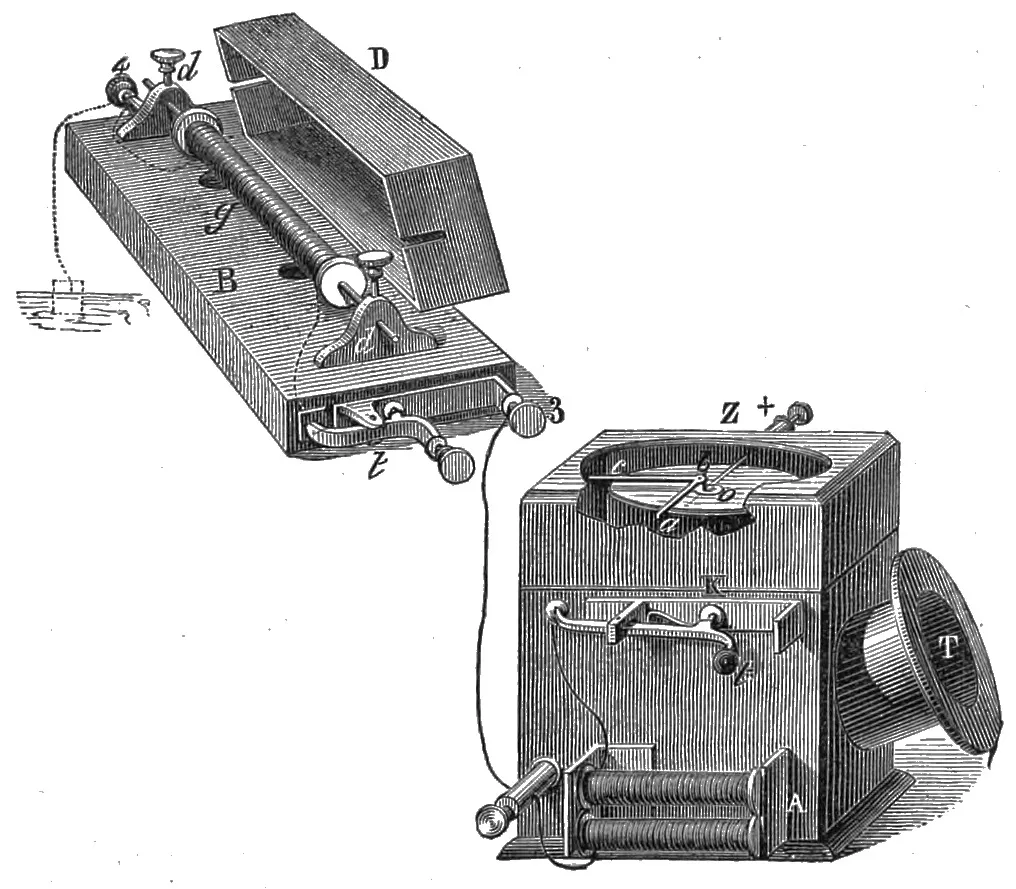
Telephone of M. Reiss.—This telephone is, as
far as the reproduction of sound is concerned,
based upon Mr. Page’s discoveries in 1837, and, as
regards electric transmission, it is based on the
vibrating membrane of which Mr. L. Scott made
use in his phonautograph, in 1855. This instrument
is composed, like telegraphic systems, of two
distinct parts, a sender and a receiver, as represented
in fig. 1.
Fig. 1.
The sender was virtually composed of a sounding
box K, having on its upper surface a large
circular opening, across which a membrane was
stretched, and in its centre there was fitted a thin
disk of platinum o, above which a metallic point c
was fixed, and this, together with the disk, constituted
the contact-breaker. On one face of the
sounding-box K, there was a sort of speaking-tube,
for the purpose of collecting the sound, and directing
it to the interior of the box, in order that it
might then react upon the membrane. Part of
the box K is broken away in the plate, in order
that the different parts of which it is made may be
seen.
The rods a, c, which support the platinum point
b, are in metallic contact with a Morse key t,
placed on the side of the box K, and with an electro-magnet
A, which belongs to a telegraphic system,
intended to exchange the signals required to start
the action of the two instruments at their respective
stations.
The receiver consists of a sounding-box B, on
which rest two supports d, d, bearing an iron rod
of the thickness of a knitting needle. An induction
coil of insulated wire g is wound round this rod, and
the whole is enclosed by the lid D, which concentrates
the sound already increased by the sounding-box:
for this purpose the box is provided with
two openings below the coil.
The circuit is completed through the primary
of this coil by the two terminals 3 and 4, and a
Morse key t is placed at the side of box B, in order
to exchange signals.
In order to work this system, the speaking
instrument should be placed before the opening
T, and this instrument may be a flute, a violin,
or even the human voice. The vibrations of air
occasioned by these instruments cause the telephonic
membrane to vibrate in unison, and the
latter, rapidly moving the platinum disk o to and
from the point b, causes a series of breaks in the
current, which are repeated in the iron wire d d,
and transformed into metallic vibrations, of which
the number is equal to that of the sounds successively
produced.
According to this mode of action, the possibility
of transmitting sounds with their relative value
becomes intelligible: but it is equally clear that
sounds thus transmitted will not have the timbre
of those which produce them, since the timbre is
independent of the number of vibrations, and it
must be added that the sounds produced by M.
Reiss’s instrument were as shrill as those of a
child’s penny trumpet, and by no means attractive.
The problem of transmitting musical sounds by
electricity was, however, really solved, and it can be
said with truth that an air or a melody could be
heard at any given distance.
The invention of this telephone dates, as we
have seen, from 1860, and Professor Heisler speaks
of it in his treatise of technical physics, published
at Vienna in 1866; he even asserts, in the article
which he devotes to the subject, that although the
instrument was still in its infancy, it was capable
of transmitting vocal melodies, and not merely
musical sounds. The system was afterwards perfected
by M. Van der Weyde, who, after reading
the account published by M. Heisler, sought to
make the box of the sender more sonorous, and
to strengthen the sounds produced by the receiver.
He writes as follows in the ‘American Scientific
Journal:’
‘In 1868, I caused two telephones to be made,
similar to those I have described, and I exhibited
them at a meeting of the Polytechnic Club of the
American Institute. The transmitted sounds were
produced at the farthest extremity of the Cooper
Institute, quite outside the hall in which the
audience sat: the receiver was placed on a table
in the hall itself. The vocal airs were faithfully
reproduced, but the sound was rather weak and
nasal. I then tried to improve the instrument, and
I first obtained stronger vibrations in the box K
by causing reverberation from the sides of the
box, by means of hollow partitions. I next intensified
the sounds produced by the receiver,
by introducing several iron wires into the coil,
instead of one. These improvements were submitted
to the meeting of the American Association
for the Advancement of Science, which was held in
1869, and it was considered that the invention
contained the germ of a new method of telegraphic
transmission which might lead to important results.’
This opinion was soon afterwards justified by the
discoveries of Bell and Elisha Gray.
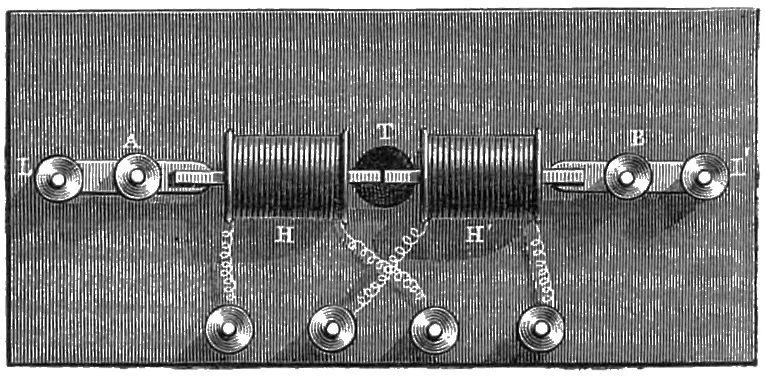
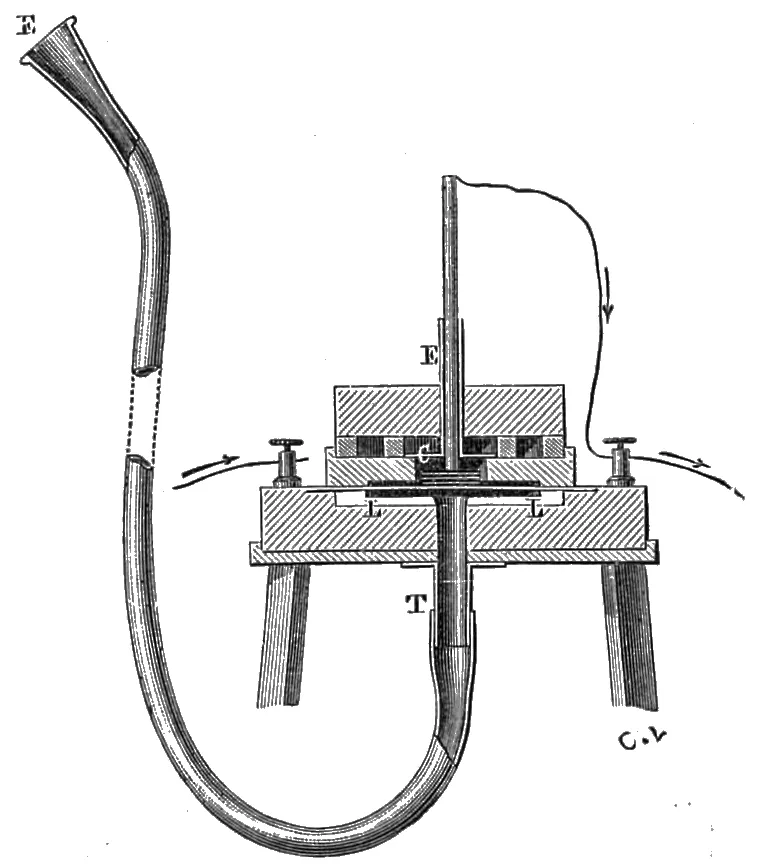
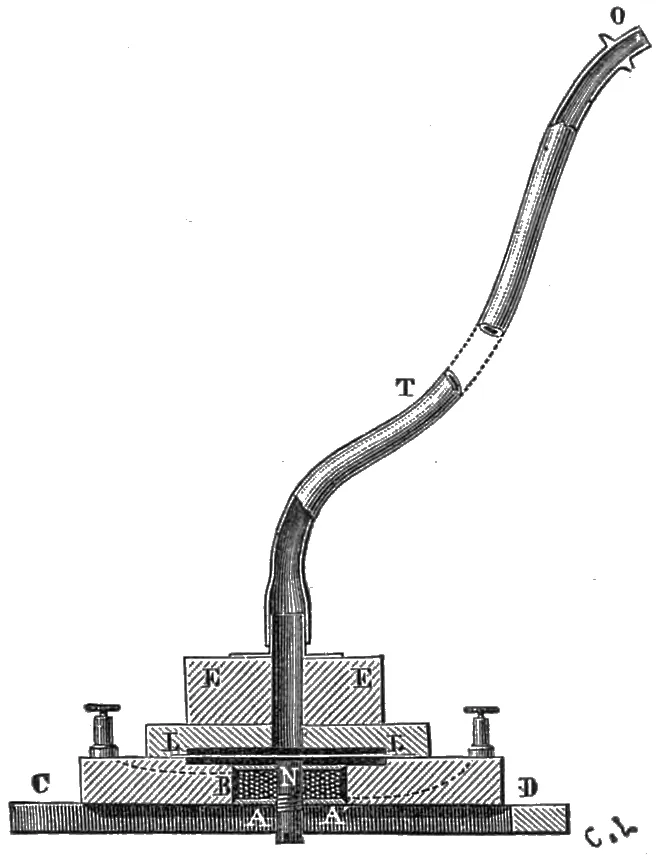
Messrs. Cecil and Leonard Wray’s Telephone.—This
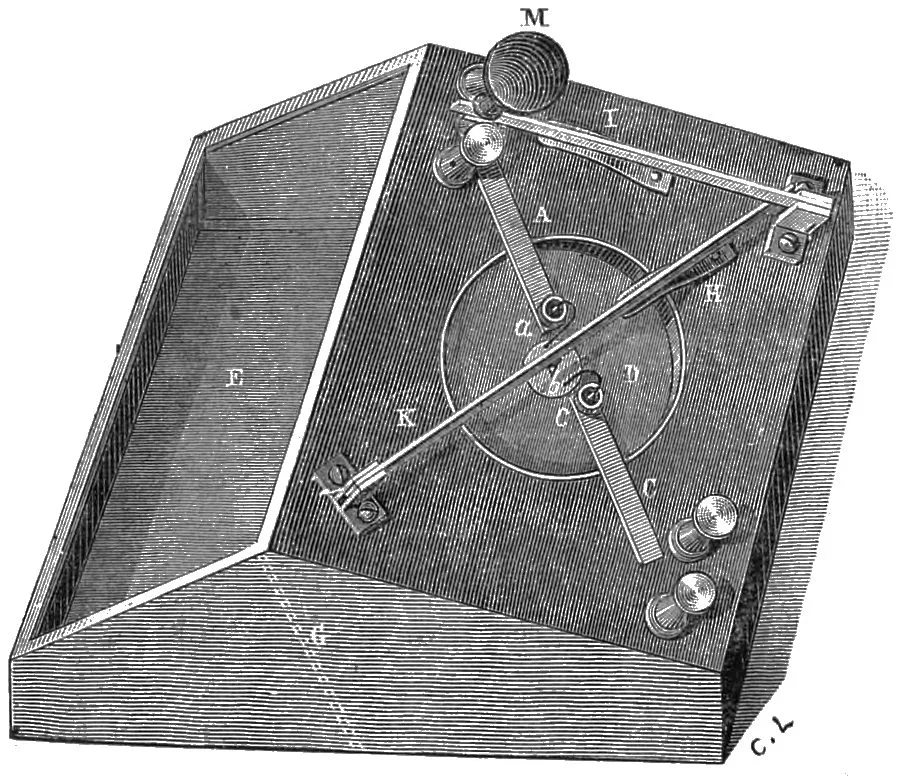
system, represented in figs. 2 and 3, is simply
an improvement on that of M. Reiss, with the
object of intensifying the effects produced. The
sender is provided with two membranes, instead
of one; and its receiver, instead of being formed of
a single iron wire covered with a magnetising
coil, is composed of two distinct coils H, H′ (fig. 2),
placed in the same straight line, and within which
are two iron rods. These rods are fastened by one
of their ends to two copper disks A, B; these disks
are maintained in a fixed position by screws I, I′,
and the two other extremities of the rods, between
the coils, are opposite each other, not touching,
but divided by a very small interval. The instrument
is set upon a sounding-box, in which there is
a hole T in the space corresponding to the interval
between the coils: these coils communicate with
four terminals, which are connected with the electric
current in such a way that the adjacent poles of
the two rods are of opposite polarity, thus forming
a single magnet, divided in the centre. It seems
that by this arrangement the sound produced becomes
much more distinct.
Fig. 2.Fig. 3.
The form of the sender also is somewhat
different from the one we have previously described:
the upper part, instead of being horizontal, is rather
inclined, as it appears in fig. 3, and the opening E
through which the sound has to communicate with
the vibrating membrane, occupies a great part of
the upper surface of the box, which consequently
appears to be somewhat oblique. The second
membrane G, which is of caoutchouc, forms a sort
of partition which divides the box in two, starting
from the upper end of the opening: the inventor
states that this will protect the outer membrane D
from the breath and other injurious effects, while
increasing the force of the vibrations produced on
the first membrane, as in a drum. The contact-breaker
itself also differs from the one in M. Reiss’s
instrument. The platinum disk b is only placed
in circuit by means of two slender wires of platinum
or steel, which are immersed in two small cups,
filled with mercury, and connected with the circuit.
In this way, the movements of the membrane D
are free, and its vibration is rendered more easy.
The circuit is also broken by a little platinum
point resting on a lever with a spring-joint, K H,
which is above the disk: one end of the lever,
which is fixed below a kind of Morse key M I,
makes it possible to close the circuit with the
hand, so as to give the signal for setting the
apparatus to work.
Electric Harmonica.—Long before M. Reiss’s
invention, and consequently still longer before that
of Mr. Elisha Gray, I mentioned a sort of electric
harmonica, and described it as follows in the first
edition of my ‘Exposé des applications de l’Electricité,’
published in 1853:—
‘The power possessed by electricity to set
metallic plates in motion and cause their vibration
has been used for the production of distinct sounds,
which can be combined and harmonised; but in
addition to this purely physical application, electro-magnetism
has come to the aid of certain instruments,
such as pianos, organs, &c., rendering
them capable of being played at a distance. So
that this extraordinary force may be turned to
account in arts which are apparently the least susceptible
of any application of electricity.
‘We have already spoken of M. de la Rive’s
contact-breaker. It is, as we know, an iron disk,
soldered to a steel spring, and maintained in a
fixed position opposite to an electro-magnet by
another spring in connection with one branch of
the current. As the other branch, after passing
into the wire of the electro-magnet, terminates
in the iron disk itself, the electro-magnet is only
active at the moment when the disk touches the
terminal spring; at the moment of leaving it, the
magnetism ceases, and the iron disk returns to its
normal position, and then leaves it again. In this
way a vibration is produced, rapid in proportion
to the small size of the vibrating disk, and to the
greatness of the force produced by the approach of
the disk to the electro-magnet.
‘In order to increase the acuteness of the
sounds, one or other of these expedients must be
employed. The simplest way is to use a screw
which can be tightened or relaxed at pleasure,
and which in this manner removes the vibrating disk
to a greater or less distance from the electro-magnet.
This is the case in M. Froment’s instrument, and
by this means he has obtained sounds of extraordinary
acuteness, although not unpleasant to
the ear.
‘M. Froment has not applied the apparatus to
a musical instrument, but it is evident that it would
be easy to do so; it would only be necessary to
make the notes of a key-board act on metallic
levers, of a length corresponding to the position
required by the disk for the vibration of different
tones. These different levers, resting on the disk,
would act as a point of contact, but the point
would vary in position, according to the touch.
‘If the current were constant, such an instrument
would certainly have many advantages over
the pipe instruments which are in use, since the
vibration might be prolonged at will in the case of
each note, and the sounds would be softer; unfortunately
the irregular action of the battery
makes it difficult in practice. These kinds of
instruments are therefore only used as a means of
regulating by ear the force of the battery, a much
more convenient regulator than the rheometers,
since it is possible to estimate by them the variations
of the battery during an experiment without
any distraction of the mind.’
In 1856 M. Pétrina, of Prague, invented an
analogous arrangement, to which he gave the name
of electric harmonica, although, strictly speaking, he
had not thought of it as a musical instrument. This
is what I have said on the subject in vol. iv. of the
second edition of my ‘Exposé des applications de
l’Electricité,’ published in 1859:—
‘The principle of this instrument is similar to
that of Neef’s rheotome, in which the hammer is
replaced by slender rods, whose vibrations produce
a sound. Four of these rods are placed side by
side, and when moved by keys, and arrested by
levers, produce combined sounds of which the origin
may be easily shown.’
It is true that nothing is said in this passage
of the capability possessed by these instruments
of being played at a distance; but this idea was
quite legitimate, and German periodicals assert
that it was accomplished by M. Pétrina even before
1856. It was the result of what I said at the outset:
‘that electro-magnetism may come to the aid of
certain instruments, such as pianos, organs, &c.,
in order to enable them to be played at a distance,’ and
I also pointed out the expedients employed for the
purpose, and even for setting them at work, under
the influence of a small musical box. I did not,
however, ascribe importance to the matter, and it is
only by way of historical illustration that I speak
of these systems.
Telephone by Mr. Elisha Gray, of Chicago.—This
system, invented in 1874, is in reality only an instrument
of the nature of those which preceded it, but
with important modifications, which made it possible
to apply it usefully to telegraphy. In an early
model, he made use of an induction coil, with
two helices, one over the other: the contact-breaker,
which was vibrating, was multiple, and so arranged
as to produce vibrations numerous enough to emit
sounds. These sounds may, as we have seen, be
modified by this arrangement, according to the
mode in which the instrument is adjusted, and if
there are a certain number of such contact-breakers
side by side, with vibrating disks so ordered as to
produce the different notes of the scale on several
octaves, it becomes possible, by a combination of
certain notes, to execute on this new kind of instrument
a piece of music such as may be produced
by an harmonium, an accordion, or any other instrument
with blowers. The contact-breakers are set
in motion by means of the primary current of
the induction coil, as it circulates through one or
other of the electro-magnets of these contact-breakers,
actuated by the lowering of the notes of
a key-board connected with them, and the secondary
currents which arise in the coil, in consequence
of the interruptions in the primary currents,
transmit the corresponding vibrations to a remote
receiver. There is an analogy between this instrument
and the telephones of which we have already
spoken by Reiss and Wray, but the effect is increased
by Mr. Gray’s modifications.
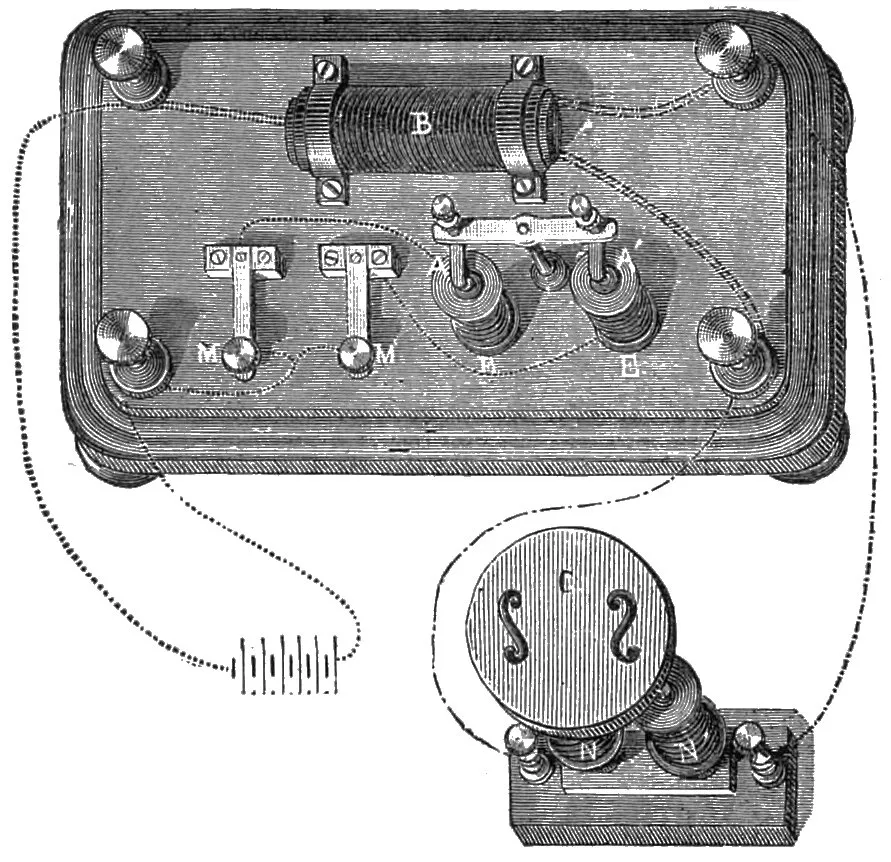
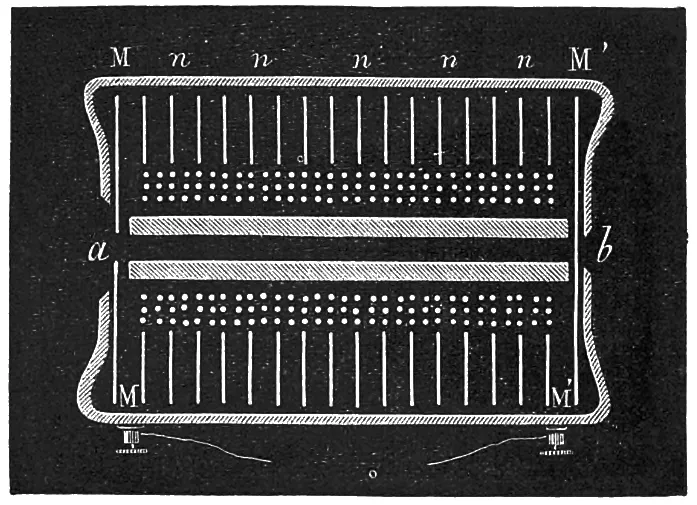
We represent in fig. 4 the arrangement of the
first system. The vibrators are A and A′, the
key-board M and M′, the induction coil B, and
the receiver C. This receiver consists, as we
see, of a simple electro-magnet N N′: above its
poles there is a metal cylindrical case C, of which
the bottom is made of iron, to serve as an armature.
This box, like a violin, is pierced with
two holes in the form S, to serve as a sounding-board;
and Mr. Elisha Gray has ascertained that
the molecular motion which takes place in the
magnetic core and its armature, under the influence
of alternate magnetisation and demagnetisation,
sufficed to produce vibrations corresponding
to the velocity of these alternations, and to emit
sounds which became audible when they were magnified
by the sounding-board.
Fig. 4.
It is quite intelligible that the effect obtained
in this system might be reproduced, if, instead of
contact-breakers or electric rheotomes, mechanical
contact-breakers were used at the sending station,
so arranged as to furnish the requisite number
of breaks in the current which communicates the
vibrations of the different notes of the scale. In
this way also it would be possible to dispense
with the induction coil, by causing the current
which has been broken by the mechanical contact-breaker
to react upon the receiver. Mr. Elisha
Gray has moreover made a different arrangement
of this telephonic system, which he has applied to
telegraphy for simultaneous electric transmissions,
of which we shall speak presently.
If we may believe Mr. Elisha Gray, the vibrations
transmitted by the secondary currents would
be capable, by the intervention of the human body,
of causing the sounds to be reproduced at a distance
by conducting disks, which vibrate readily, and are
placed on a sounding-box. In this way musical
sounds may be evoked from copper cylinders placed
upon a table, from a metallic disk fastened to a kind
of violin, from a membrane stretched on a drum, or
from any other resonant substance, by touching any
of these objects with one hand, while holding the
end of the line with the other. These sounds,
of which the quality must vary with the substance
touched, would reproduce the transmitted note with
the precise number of vibrations which belong to it.1
Mr. Varley’s Telephone.—This is, strictly speaking,
merely a musical telephone of the same kind
as that of Mr. Gray, but the arrangement of the
receiver is original and interesting. This part of
the instrument essentially consists of a drum of
large size (three or four feet in diameter), within
which is a condenser formed of four sheets of tinfoil,
divided by sheets of some insulating material,
and with a surface of about half the size of the
drum. The plates of the condenser are placed
parallel to the membranes of the drum, and very
little removed from its surface.
If an electric charge is communicated to one of
the series of conducting plates of the condenser,
those which correspond to it are attracted, and if
they were movable they might communicate to
the intervening strata of air a movement which, on
reaching the membranes of the drum, might, by a
series of charges in rapid succession, cause the
membranes to vibrate, and thus produce sounds:
these sounds would correspond to the number of
charges and discharges which had occurred. Since
these charges and discharges are determined by the
contact of the two plates of the condenser, at the
extremities of the secondary circuit of an induction
coil, of which the primary circuit has been duly
broken, it becomes evident that, in order to cause
the drum to emit any given sound, it will be enough
to produce the number of vibrations in the contact-breaker
of the induction coil which are required for
this sound.
The means employed by Mr. Varley to produce
these interruptions are the same which are in use
in several electrical instruments, and especially in
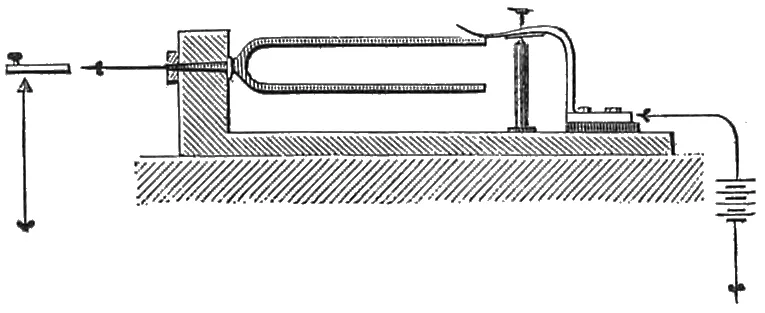
chronographs—an electro-magnetic tuning-fork, regulated
so as to emit the sound required. This
tuning-fork may, by acting as contact-breaker, react
on the primary current of the induction coil; if the
number of the tuning-forks equals that of the musical
notes which are to be transmitted, and if the electro-magnets
which set them in motion are connected
with the key-board of a piano, it would be possible
to transmit a melody to a distance by this system,
as well as by that of Mr. Elisha Gray.
The peculiarity of this system consists in the
reproduction of sounds by the action of a condenser,
and we shall presently see that this idea, adopted
by Messrs. Pollard and Gamier, led to interesting
results.
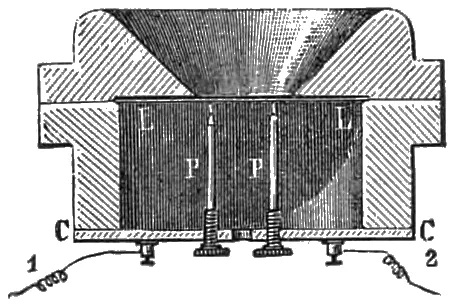
Singing Condenser of MM. Pollard and Garnier.—This
instrument, which astonishes all who
hear it, attracted public attention in London some
time ago. It is difficult to say why its fame was
not greater, since much attention has been bestowed
on less curious instruments. It is a fact that we
have been able, thanks to MM. Pollard and Garnier,
to hear songs issue from a sort of copy-book, so as
to become audible throughout the room. The
songs thus reproduced are certainly not always
perfectly true; yet when the person who sings into
the sender is a musician, and understands how
to make use of it, the condenser in question will
emit sounds somewhat resembling those of the
violoncello or the hautbois.
The singing instrument consists of a condenser
K, formed of thirty sheets of paper, laid one over
the other, from nine to thirteen centimètres in
thickness: between these, twenty-eight sheets of
tinfoil, from six to twelve centimètres thick, are
intercalated, so joined as to form the two plates
of the condenser. For this purpose the pair sheets
are joined together at one end of the copy-book,
and the odd sheets at the other end. This system
is fastened to a stiff carton, after taking care to bind
it with a strip of paper, and the sheets of tinfoil
are joined to the two ends of the condenser by two
copper rims D, D, which are provided with terminals
for the circuit wire, and in this way the singing
instrument is constructed. A somewhat heavy
weight, placed upon the condenser to compress the
sheets, does not in any way prevent it from working;
and this vitiates the theory first put forward
to explain its effects, that the sheets were moved
by attraction.
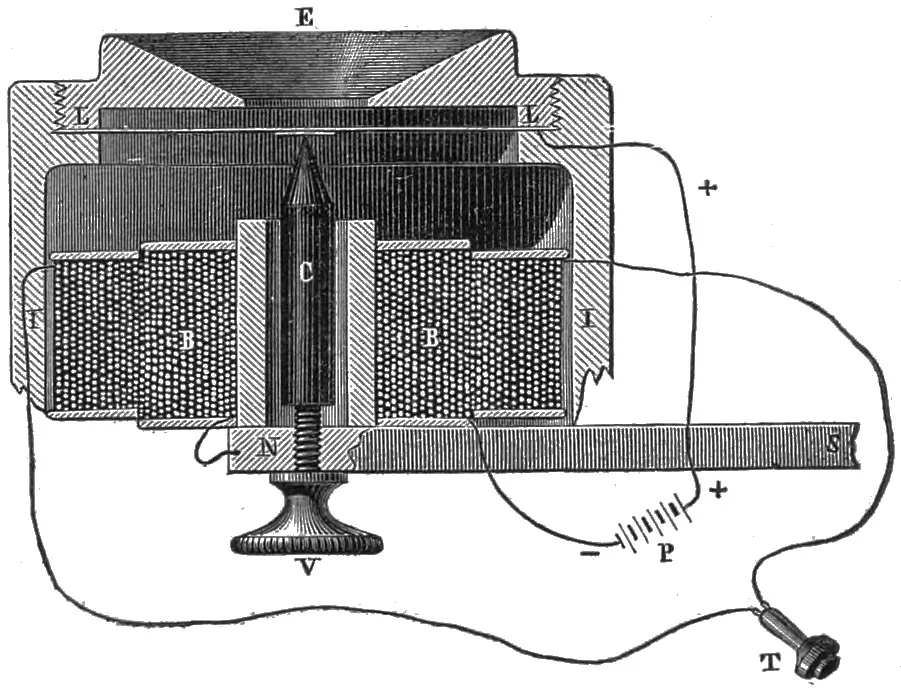
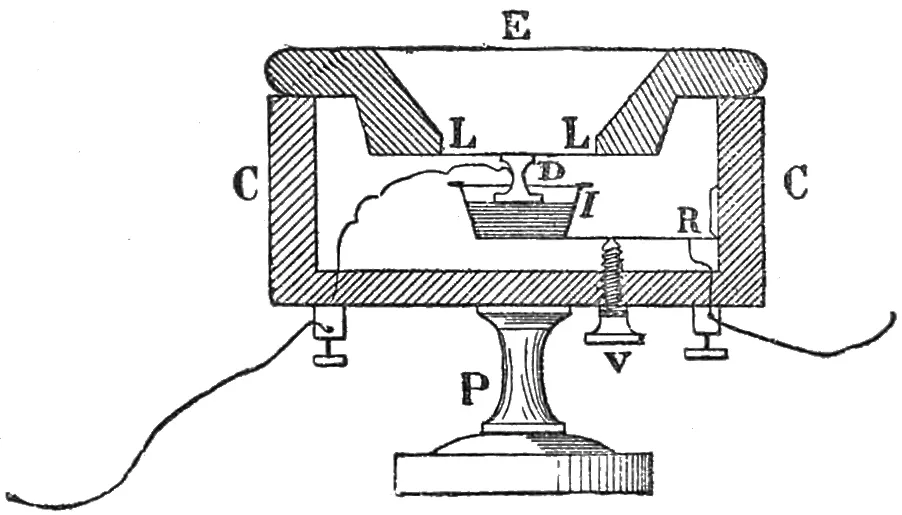
Fig. 5.
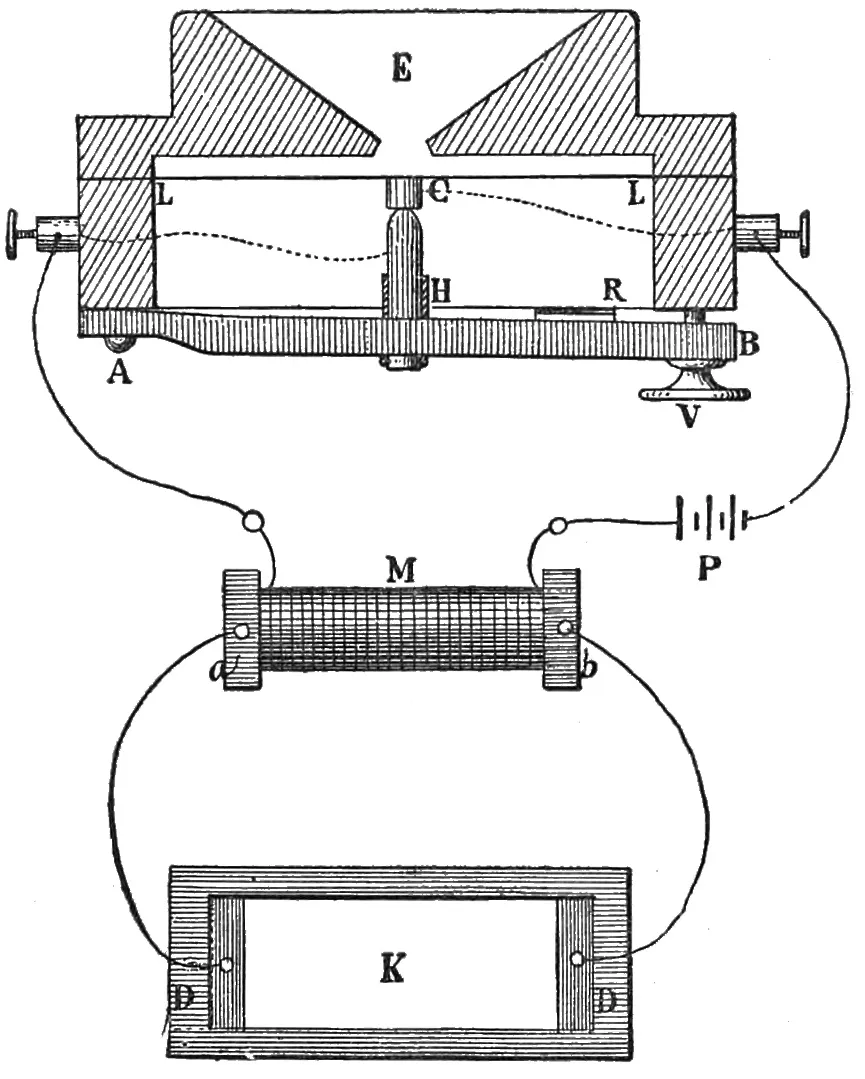
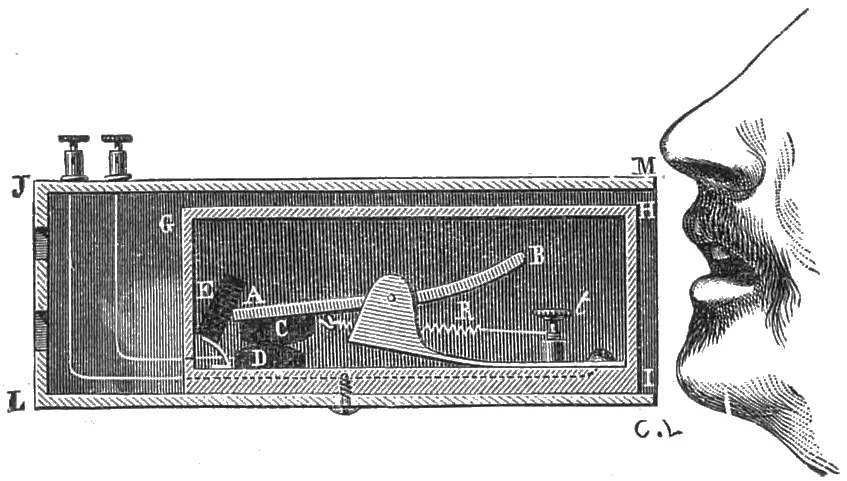
The sending instrument consists of a sort
of telephone without a handle, E, of which the
vibrating disk is formed of a very thin plate of tin.
A cylindrical piece of carbon C is fastened to its
centre, and is supported by another cylinder of the
same material H. This rests on a transverse piece
of wood A B, jointed on the side A, on the edge
opposite to the box, by means of a regulating screw
V. An arched spring R (the end of a watch spring)
placed across this piece of wood gives it a certain
elasticity beneath the pressure, and this elasticity is
necessary in order that the instrument may act
properly, and it thus becomes a sort of microphone
with a diaphragm.
The tin plate is put into communication with
one pole of a battery P, of six Leclanché cells, and
the lower carbon cylinder H corresponds to the
primary helix of an induction coil M, previously
connected with the second pole of the battery:
Finally, the two extremities of the secondary helix
of the coil, a and b, are in immediate connection
with the two plates D, D, of the condenser.
This secondary helix should consist of twenty
strands of wire No. 32, covered with silk, and the
primary helix is made of five strands of wire No.
16. The length of the coil should not exceed
seven centimètres and the diameter of the core of
fine iron wire ought to be about one centimètre.
In order to produce song on the condenser,
the sender must be so regulated that the two
carbons C and H do not touch each other in their
normal condition, but they should be so close that
in singing the vibrations of the disk L L may effect
the needful contacts. The adjustment can be easily
made by the touch, and by uttering the same note
until it is repeated by the condenser. If three
notes, given in succession, are faithfully reproduced,
the instrument may be assumed to be properly
regulated, and, in order to make it work, it is enough
to apply the mouth to the mouthpiece as it is
applied to a reed pipe.
In order to obtain a satisfactory result, the disk
of the instrument must be heard to vibrate, as in a
flûte à l’oignon. Instead of carbons, contacts of
platinum may be used; but when arranged as we
have described, the instrument may be employed
for several purposes, as we shall see presently.
This instrument is made by MM. Chardin and
Prayer. M. Janssens has made the system more
portable by fastening the sender, represented in
fig. 5, to a handle in which the induction coil is
placed: the instrument then resembles an ordinary
telephone, and the vibration of the diaphragm is
made more easy by piercing two holes in it. On
the side of the sending-box, above and below the
diaphragm, there are binding screws in connection
with the end of the handle, since the instrument
may be used as an ordinary telephonic sender, and
even as a telephonic receiver.
SPEAKING TELEPHONES.
We have seen that the telephones just described
can only transmit musical sounds, since they can
merely repeat simple vibrations, in greater or less
number, it is true, but not in simultaneous combinations
like those which reproduce articulate sounds.
Up to the time of Mr. Bell’s invention, the transmission
of speech could only take place with the aid of
acoustic tubes, or of the string telephones of which
we have spoken. Although these instruments have
no connection with the object of our study in this
work, we have thought it necessary to say a few
words about them, since they may sometimes be
combined with electric telephones, and also represent
the first stage of the invention.
String Telephones.—These instruments, which
have flooded the cities of Europe for several years,
since the date of the invention was 1867, are interesting
in themselves, and we are surprised that they
have not hitherto taken a place in the collections of
physical science. They are made of two metal or
cardboard tubes, in the form of a cylindrical cone:
one end is closed by a tightly stretched membrane
of parchment, in the centre of which the cord or
string intended to connect the two cylinders is
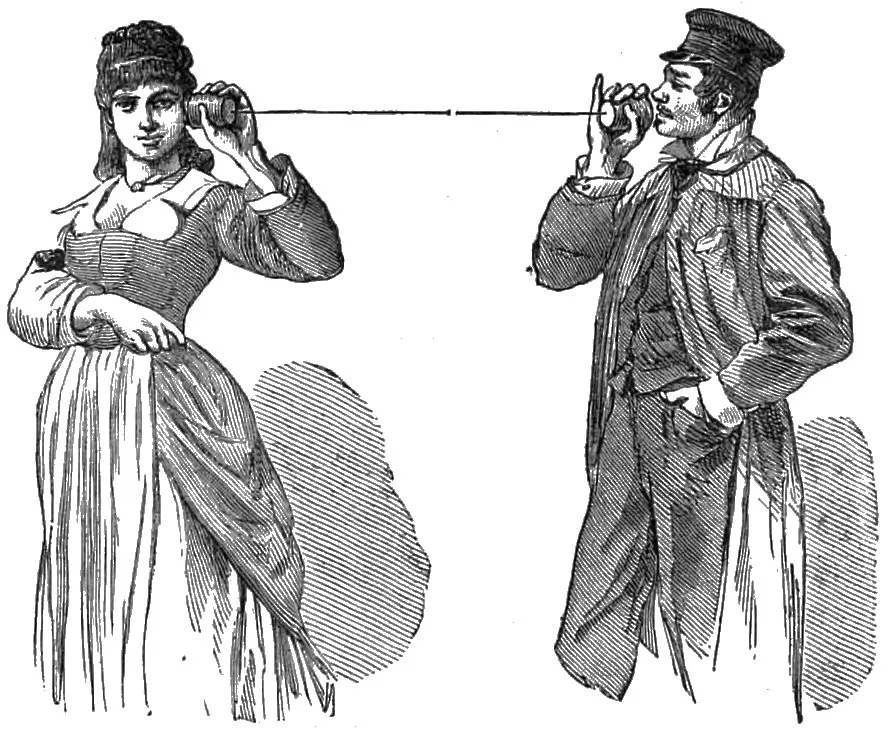
fastened by a knot. When two such tubes are connected
in this way, and the cord is tightly stretched,
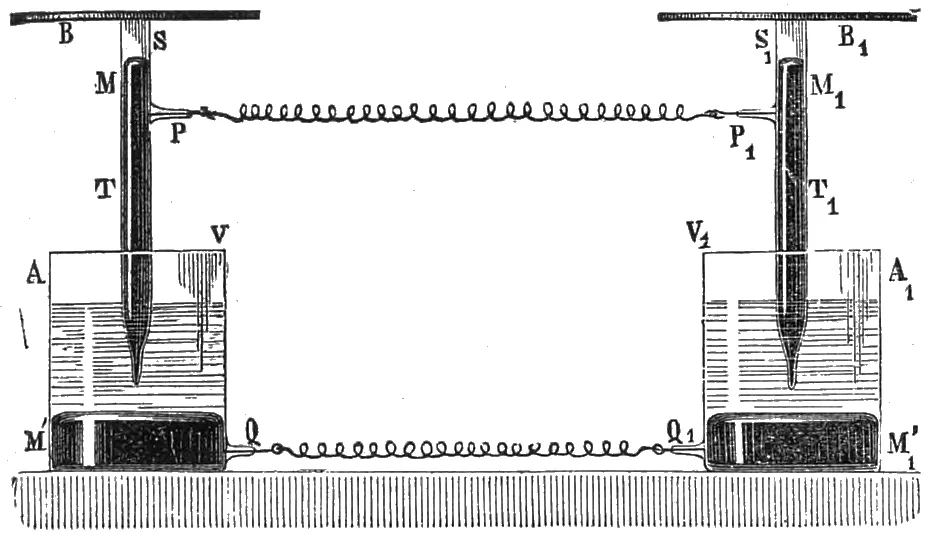
as in fig. 6, it is only necessary to apply one tube
to the ear, while another speaks into the opening
of the other tube: the words spoken by the latter
are instantly transmitted, and it is even possible to
converse in quite an undertone. Under these conditions
the vibrations of the membrane affected by
the voice are mechanically transmitted to the other
membrane by the string, which, as Robert Hooke
declared in 1667, is a better transmitter of sound
than the air. In this way it is possible to communicate
at a distance of 170 yards, and the size and
nature of the cord have some influence. The sellers
of these instruments say that the best results are
obtained from silken cords, and the worst from
those made of hemp. Cords of plaited cotton are
usually employed for the sake of cheapness.
Fig. 6.
In some patterns, the tubes are so arranged as
to present, between the membrane and the mouth,
a diaphragm pierced with a hole, and the instrument
somewhat resembles a bell with its base bored and
closed again a little above the parchment membrane;
but I have not observed that this pattern
is decidedly superior to the others.
It has also been asserted that horn-shaped tubes
of nickel silver are to be preferred, of which I am
equally doubtful. At any rate, these instruments
have produced unexpected results; and although
their practical use is very limited, they are interesting
from a scientific point of view, and are
instructive toys for children.
Mr. Millar, of Glasgow, declares that the effect
produced by these telephones depends very much
on the nature of the string, the way in which it is
attached, and the way in which the membrane is
fastened to the mouthpiece.
Improvements made in the String Telephone.—The
amazing effects of the Bell telephones have lately
brought the string telephones, which were only regarded
as children’s toys, again into fashion. Since
they have made it possible to transmit to several
persons the words reproduced by an electric telephone,
means have been sought for combining
them usefully with the latter, and the best mode of
making them speak on a string presenting several
angles has been sought for: it has been shown that,
under the usual conditions, these instruments only
speak distinctly when the string is stretched in
a right line. To solve this problem, it occurred
to M. A. Bréguet to make use of a sort of tambourine
for the supports, with the string passed
through their centre; the sound conveyed by that
part of the string which is in connection with the
speaking-horn causes the membrane of the tambourine
to vibrate, which again communicates the
vibration to the next portion of string. In this
way the angles may be multiplied at will, and the
string may be supported throughout the length compatible
with this kind of telephone, which does not
exceed 112 yards.
M. A. Bréguet has also invented a system of relays
to accomplish the same object. He makes the
strings terminate in two membranes which close
the two openings of a brass cylinder. The sounds
reproduced on one of these membranes react
upon the other, which vibrates under its influence,
as if it were affected by the voice. The cylinder
then acts as an ordinary acoustic tube, and its form
may be varied at pleasure.
M. A. Badet, on February 1, 1878, succeeded
in making string telephones in an analogous
way, and he used parchment stretched upon
frames which acted as resonant boards. The string
was fixed in the centre of the membrane, and made
with it the angle desired.
Several scientific men, among others Messrs.
Wheatstone, Cornu, and Mercadier, have long been
occupied about these ways of transmission by wire,
and Messrs. Millar, Heaviside, and Nixon have
lately made some interesting experiments, on
which we must say a few words. Mr. Millar
ascertained that by means of a telegraphic wire,
stretched and connected by two copper wires with
two vibrating disks, musical sounds might be
conveyed to a distance exceeding 160 yards, and
that by stretching these wires through a house,
and connecting them with mouth-and-ear holes in
different rooms, communication between them
became perfectly easy.
For the vibrating disks he employed wood,
metal, or gutta-percha, in the form of a drum, with
wires fixed in the centre. The sound seems to
become more intense in proportion to the thickness
of the wire.
Messrs. Heaviside and Nixon, in their experiments
at Newcastle-on-Tyne, have ascertained that
the most effective wire was No. 4 of the English
gauge. They employed wooden disks ⅛ inch in
thickness, and these may be placed in any part of the
length of the wire. When the wire was well stretched
and motionless, it was possible to hear what was
said at a distance of 230 yards, and it seems that
Mr. Huntley, by using very thin iron diaphragms,
and by insulating the line wire on glass supports,
was able to transmit speech for 2,450 feet, in spite
of the zigzags made by the line on its supports.
Mr. Graham Bell’s Electric Telephone.—Telephonic
instruments were at this stage when Bell’s telephone
was shown at the Philadelphia Exhibition of
1876. Sir William Thompson did not hesitate to
call it ‘the wonder of wonders,’ and it instantly
attracted universal attention, although there was at
first much incredulity as to its genuineness. This
telephone, in fact, reproduced articulate words, a
result which surpassed all the conceptions of physicists.
In this case it was no longer a conception,
to be treated as visionary until there was proof to
the contrary: the instrument spoke, and even
spoke so loudly that it was not necessary to apply
the ear. Sir William Thompson spoke to this effect
on the subject at the meeting of the British Association
at Glasgow in September 1876:—
‘In the department of telegraphs in the United
States I saw and heard Mr. Elisha Gray’s electric
telephone, of wonderful construction, which can
repeat four despatches at the same time in the
Morse code, and, with some improvements in
detail, this instrument is evidently capable of a
fourfold delivery. In the Canadian department
I heard “To be or not to be? There’s the rub,”
uttered through a telegraphic wire, and its pronunciation
by electricity only made the rallying tone of
the monosyllables more emphatic. The wire also repeated
some extracts from New York papers. With
my own ears I heard all this, distinctly articulated
through the slender circular disk formed by the
armature of an electro-magnet. It was my fellow-juryman,
Professor Watson, who, at the other
extremity of the line, uttered these words in a
loud and distinct voice, while applying his mouth
to a tightly stretched membrane provided with a
small piece of soft iron, which executed movements
corresponding to the sound vibrations of the air
close to an electro-magnet introduced into the
circuit. This discovery, the wonder of wonders
in electric telegraphy, is due to a young fellow-countryman
of our own, Mr. Graham Bell, a
native of Edinburgh and now naturalised in New
York.
‘It is impossible not to admire the daring invention
by which we have been able to realise with
these simple expedients the complex problem of
reproducing by electricity the tones and delicate
articulations of voice and speech; and it was
necessary, in order to obtain this result, to find out
the means of varying the intensity of the current in
the same proportion as the inflections of the sound
emitted by the voice.’
If we are to believe Mr. Graham Bell, the invention
of the telephone was not due to a spontaneous
and fortunate conception: it was the result of
his long and patient studies in acoustic science, and
of the labours of the physicists who preceded him.2
His father, Mr. Alexander Melville Bell, of Edinburgh,
had studied this science deeply, and had
even succeeded in representing with great ingenuity
the adaptation of the vocal organs for the
emission of sound. It was natural that he should
instil a taste for his favourite studies into his son’s
mind, and they made together numerous researches
in order to discover the relations which
exist between the different elements of speech in
different languages, and the musical relations of
vowels. It is true that several of these researches
had been made by M. Helmholtz, and under
more favourable conditions; but these studies
were of great use to Mr. Bell when he was afterwards
occupied with the telephone, and Helmholtz’s
experiments, which he repeated with one of
his friends, Mr. Hellis of London, concerning the
artificial reproduction of vowels by means of
electric tuning-forks, launched him into the study of
the application of electricity to acoustic instruments.
He first invented a system of an electric
harmonica with a key-board, in which the different
sounds of the scale were reproduced by electric
diapasons of different forms, adapted to different
notes, and which, when set in motion by the successive
lowering of the keys, could reproduce
sounds corresponding to the notes touched, just as
in an ordinary piano.
He next, as he tells us, turned his attention to
telegraphy, and thought of making the Morse
telegraphs audible by causing the electro-magnetic
organ to react on sounding contacts. It is true
that this result had already been obtained in the
sounders used in telegraphy, but he thought that
by applying this system to his electric harmonica,
and by employing such an intensifying instrument
as Helmholtz’s resonator at the receiving station,
it would be possible to obtain through a single
wire simultaneous transmissions which should be
due to the action of the voice. We shall see
presently that this idea was realised almost at the
same time by several inventors, among others by
M. Paul Lacour, of Copenhagen, Mr. Elisha Gray,
of Chicago, and Messrs. Edison and Varley.
Mr. Bell’s study of electric telephones really
dates from this time, and he passed from complex
to simple instruments, making a careful study of
the different modes of vibration which arise from
different modes of electric action. The following is an
abstract, with the omission of more technical details,
of the paper read by Mr. Bell to the Society of
Telegraphic Engineers, London, October 31, 1877.
If the intensity of an electric current is represented
by the ordinates of a curve, and the duration
of breaks in the current by the abscissæ, the
given curve may represent the waves of the positive
or negative current respectively, above and below
the line of X, and these waves will be more or less
accentuated, just as the transmitted currents are
more or less instantaneous.
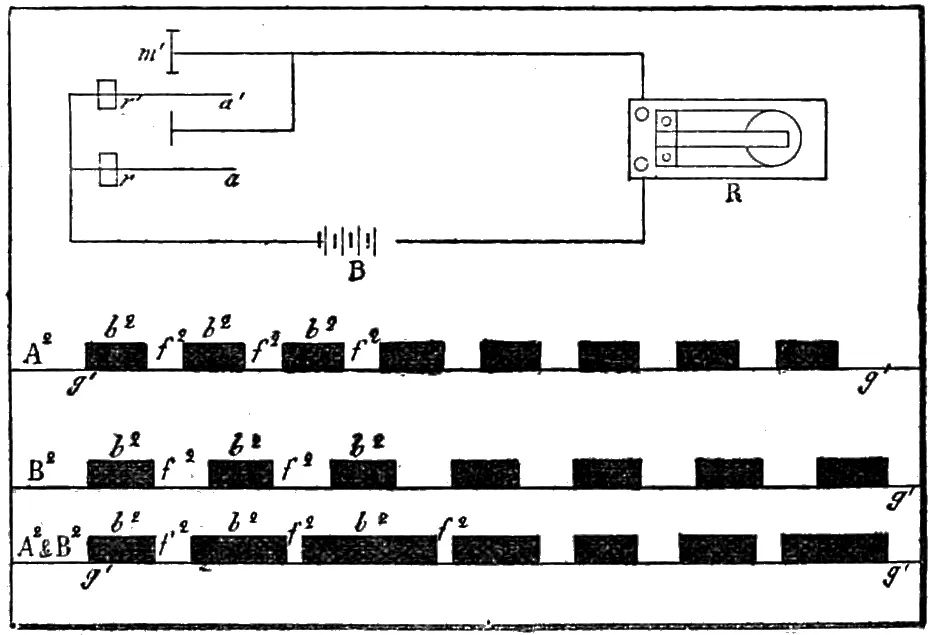
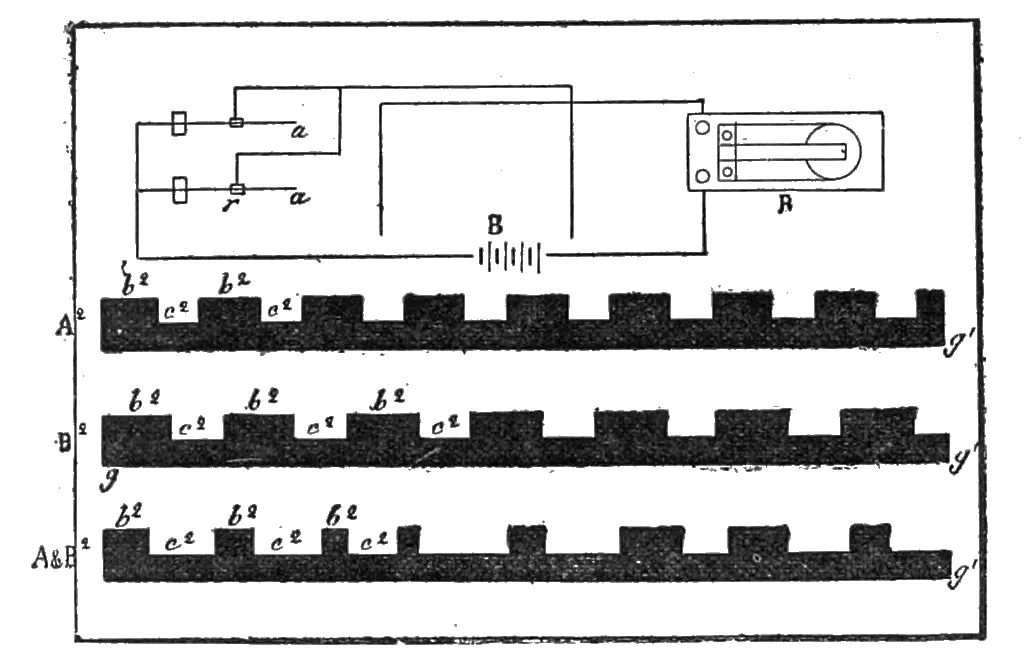
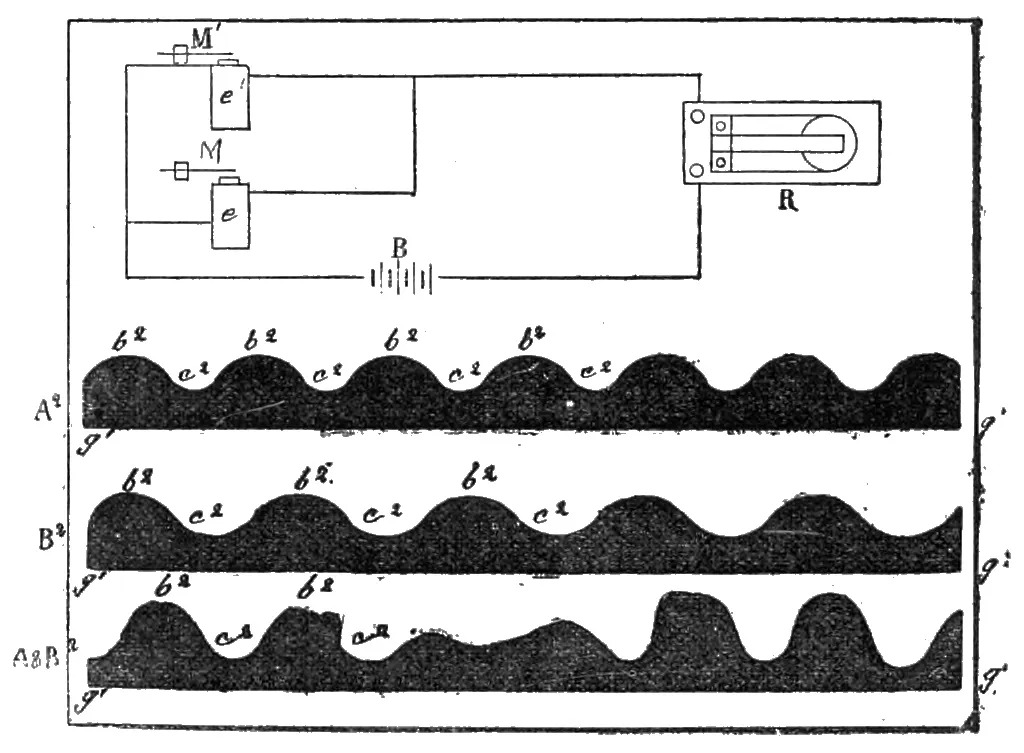
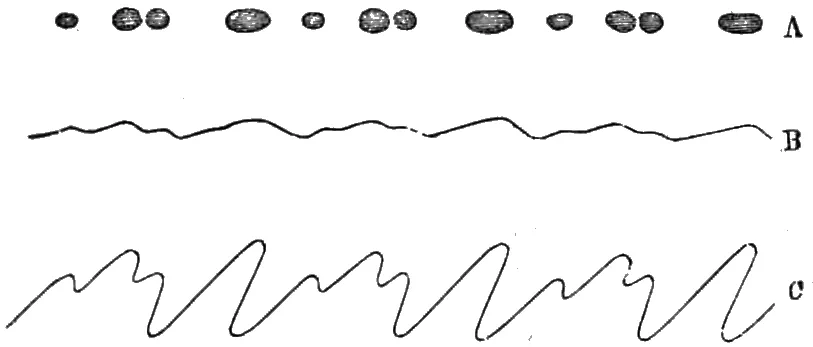
If the currents which are interrupted to produce
a sound are quite instantaneous in their manifestation,
the curve represents a series of isolated indentations,
as we see in fig. 7; and if the interruptions
are so made as only to produce differences of
intensity, the curve is presented under the form of
fig. 8. Finally, if the emissions of current are so
ordered that their intensity alternately increases
and diminishes, the curve takes the form represented
in fig. 9. In the first case, the currents are intermittent;
in the second, pulsatory; in the third
case, they are undulatory.
Fig. 7.Fig. 8.Fig. 9.
These currents are necessarily positive or negative,
according to their position above or below the
line x, and if they are alternately reversed, the
curves present the form given in fig. 10, curves
which essentially differ from the first, not merely
in the different form of the indentations, but
especially in the suppression of the extra current,
which is always found in the pulsatory and undulatory
currents.
Fig. 10.
The two former systems of currents have long
been in use for the electric transmission of musical
sounds, of which we have an interesting example
in Reiss’s telephone already described. But Mr.
Bell claims to have been the first to employ the
undulatory currents, which made it possible to solve
the problem of transmitting speech.3 In order to
estimate the importance of this discovery, it will be
enough to analyse the effects produced with these
different systems of currents when several notes of
varying pitch are to be combined.
Fig. 7 shows a combination in which the styles
a, a′, of two sending instruments cause the interruption
of the current from the same battery
B, so that the given vibrations should be between
them in the relation of a tierce major, that is in the
relation of four to five. Under such conditions, the
currents are intermittent, and four contacts of a are
produced in the same space of time as the five
contacts of a′, and the corresponding electric intensities
will be represented by the indentations we
see in A2 and in B2: the combination of these intensities
A2 + B2 will produce the indentations at
unequal intervals which may be observed on the
third line. It is evident that although the current
maintains a uniform intensity, there is less time
for the breaks when the interrupting styles act
together than when they act separately, so that
when there are a number of contacts effected simultaneously
by styles working at different degrees
of velocity, the effects produced will have the effect
of a continuous current. The maximum number
of distinct effects which can be produced in this
way will, however, greatly depend on the relation
which exists between the durations of the make
and break of the current. The shorter the contacts
are, and the longer the breaks, the more numerous
will be the effects transmitted without confusion,
and vice versâ.
By the aid of pulsatory currents the transmission
of musical sounds is effected in the way indicated
in fig. 8, and it is seen that when they are produced
simultaneously, the result A2 + B2 is analogous to
that which would be produced by a continuous
current of minimum intensity.
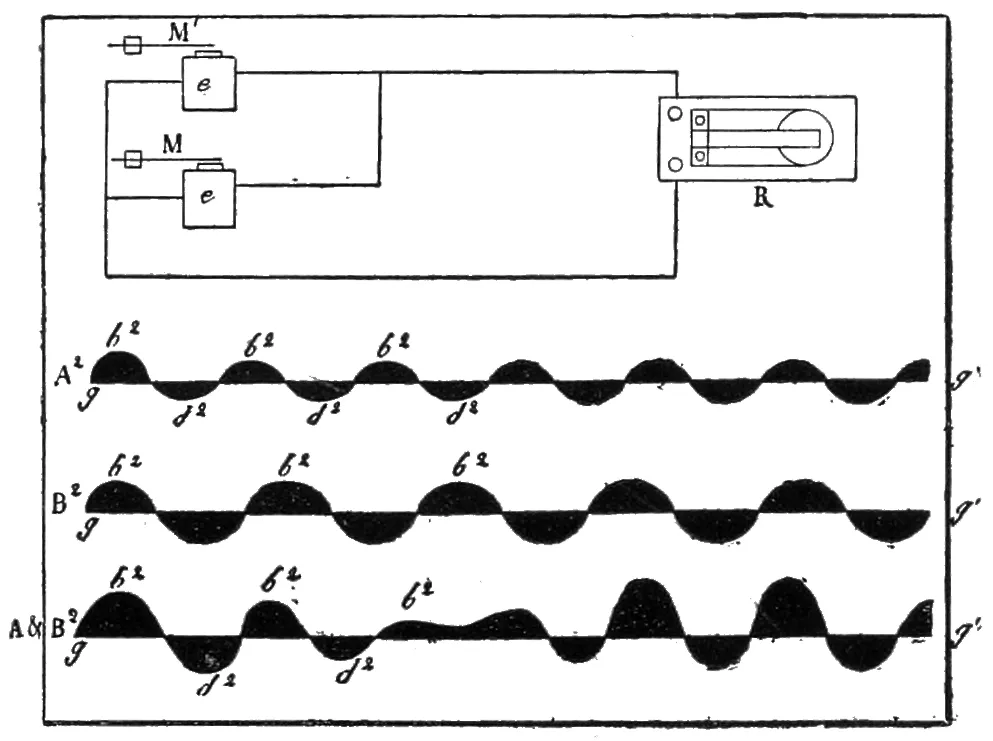
In the case of undulatory currents the result is
different, but in order to produce them it is necessary
to have recourse to inductive effects, and fig. 9
indicates the manner in which the experiment
should be made. In this case, ‘the current from
the battery B is thrown into waves by the inductive
action of iron or steel reeds M, M, vibrated in front
of electro-magnets e, e, placed in circuit with the
battery: A2 and B2 represent the undulations caused
in the current by the vibration of the magnetised
bodies, and it will be seen that there are four undulations
of B2 in the same time as five undulations
of A2. The resultant effect upon the main line is
expressed by the curve A2 + B2, which is the algebraical
sum of the sinusoidal curves A2 and B2. A
similar effect is produced when reversed undulatory
currents are employed, as in fig. 10, where the current
is produced by the vibration of permanent magnets
united upon a circuit, without a voltaic battery.
‘It will be understood from figs. 9 and 10 that
the effect of transmitting musical signals of different
pitches simultaneously along a single wire
is not to obliterate the vibratory character of the
current, as in the case of intermittent and pulsatory
currents, but to change the shapes of the electrical
undulations. In fact, the effect produced upon the
current is precisely analogous to the effect produced
in the air by the vibration of the inducing
bodies M, M′. Hence it should be possible to
transmit as many musical tones simultaneously
through a telegraph wire as through the air.’
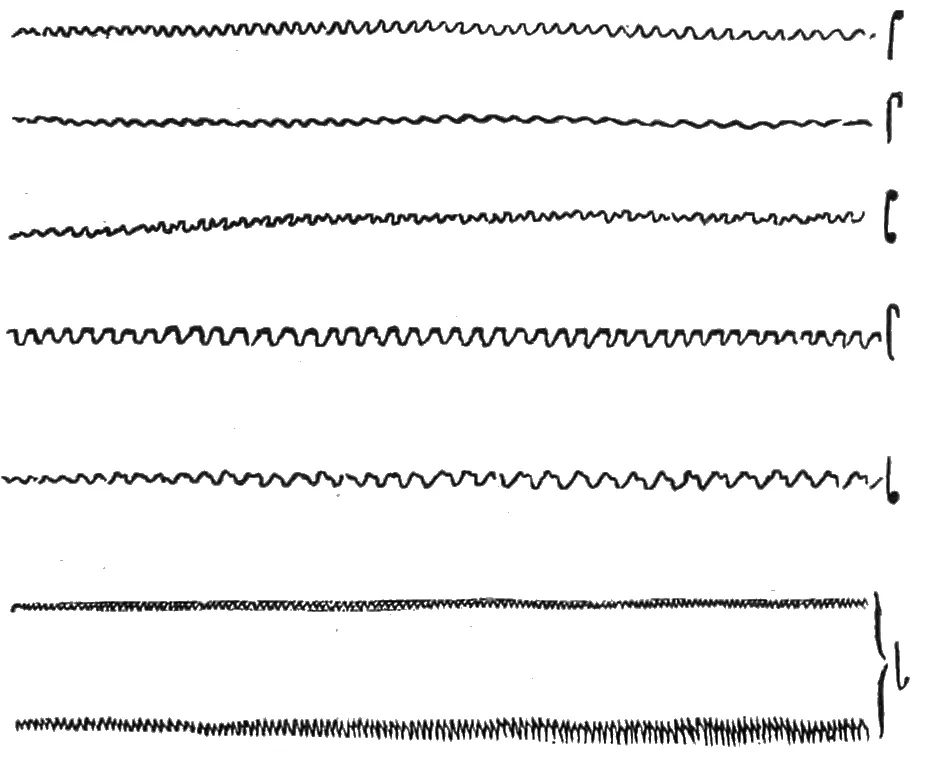
Fig. 11.
After applying these principles to the construction
of a telegraphic system for multiple transmissions,
Mr. Bell lost no time in making use of
his researches to improve the vocal training of deaf
mutes. ‘It is well known,’ he said, ‘that deaf
mutes are dumb merely because they are deaf,
and that there is no defect in their vocal organs to
incapacitate them from utterance. Hence it was
thought that my father’s system of pictorial symbols,
popularly known as visible speech, might prove a
means whereby we could teach the deaf and dumb
to use their vocal organs and to speak. The great
success of these experiments urged upon me the
advisability of devising methods of exhibiting the
vibrations of sound optically, for use in teaching
the deaf and dumb. For some time I carried on
experiments with the manometric capsule of Koenig,
and with the phonautograph of Léon Scott. The
scientific apparatus in the Institute of Technology
in Boston was freely placed at my disposal for
these experiments, and it happened that at that
time a student of the Institute of Technology, Mr.
Maurey, had invented an improvement upon the
phonautograph. He had succeeded in vibrating
by the voice a stylus of wood about a foot in length
which was attached to the membrane of the phonautograph,
and in this way he had been enabled to
obtain enlarged tracings upon a plane surface of
smoked glass. With this apparatus I succeeded in
producing very beautiful tracings of the vibrations
of the air for vowel sounds. Some of these tracings
are shown in fig. 11. I was much struck with this
improved form of apparatus, and it occurred to me
that there was a remarkable likeness between the
manner in which this piece of wood was vibrated
by the membrane of the phonautograph and the
manner in which the ossiculæ of the human ear
were moved by the tympanic membrane. I determined
therefore to construct a phonautograph
modelled still more closely upon the mechanism
of the human ear, and for this purpose I sought
the assistance of a distinguished aurist in Boston,
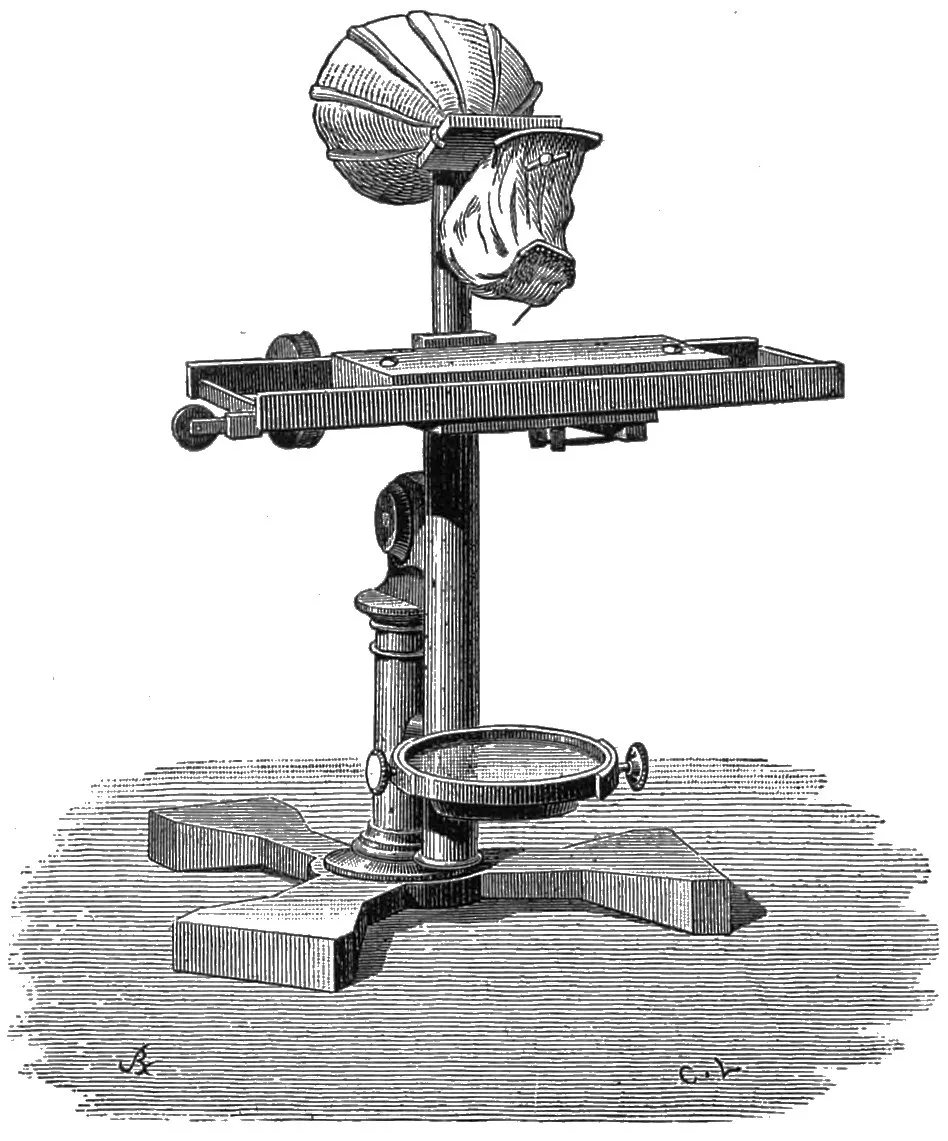
Dr. Clarence J. Blake. He suggested the use of the
human ear itself as a phonautograph, instead of
making an artificial imitation of it. The idea was
novel, and struck me accordingly, and I requested
my friend to prepare a specimen for me, which he
did. The apparatus, as finally constructed, is
shown in fig. 12. The stapes was removed, and a
stylus of hay about an inch in length was attached
to the end of the incus. Upon moistening
the membrana tympani and the ossiculæ with
a mixture of glycerine and water, the necessary
mobility of the parts was obtained; and upon singing
into the external artificial ear the stylus of hay
was thrown into vibration, and tracings were obtained
upon a plane surface of smoked glass passed
rapidly underneath. While engaged in these experiments
I was struck with the remarkable disproportion
in weight between the membrane and
the bones that were vibrated by it. It occurred to
me that if a membrane as thin as tissue paper
could control the vibration of bones that were,
compared to it, of immense size and weight, why
should not a larger and thicker membrane be able
to vibrate a piece of iron in front of an electro-magnet,
in which case the complication of steel
rods shown in my first form of telephone, could be
done away with, and a simple piece of iron attached
to a membrane be placed at either end of the
telegraphic circuit?
Fig. 12.
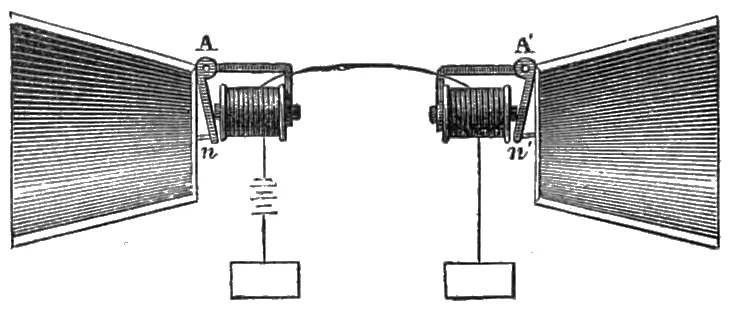
‘For this purpose I attached the reed A (fig. 13)
loosely by one extremity to the uncovered pole
h of the magnet, and fastened the other extremity
to the centre of a stretched membrane of goldbeaters’
skin n. I presumed that upon speaking in
the neighbourhood of the membrane n, it would be
thrown into vibration and cause the steel reed A
to move in a similar manner, occasioning undulations
in the electrical current that would correspond
to the changes in the density of the air during the
production of the sound; and I further thought
that the change of the intensity of the current at
the receiving end would cause the magnet there to
attract the reed A′ in such a manner that it should
copy the motion of the reed A, in which case its
movements would occasion a sound from the membrane
n′ similar in timbre to that which had occasioned
the original vibration.
Fig. 13.Fig. 14.
‘The results, however, were unsatisfactory and
discouraging. My friend Mr. Thomas A. Watson,
who assisted me in this first experiment, declared
that he heard a faint sound proceed from the telephone
at his end of the circuit, but I was unable
to verify his assertion. After many experiments
attended by the same only partially successful
results, I determined to reduce the size and weight
of the spring as much as possible. For this purpose
I fastened a piece of clock spring, about the size
and shape of my thumbnail, firmly to the centre of
the diaphragm, and had a similar instrument at the
other end (fig. 14); we were then enabled to obtain
distinctly audible effects. I remember an experiment
made with this telephone, which at the time
gave me great satisfaction and delight. One of
the telephones was placed in my lecture-room in
the Boston University, and the other in the basement
of the adjoining building. One of my
students repaired to the distant telephone to observe
the effects of articulate speech, while I uttered
the sentence, “Do you understand what I say?”
into the telephone placed in the lecture-hall. To
my delight an answer was returned through the
instrument itself, articulate sounds proceeded from
the steel spring attached to the membrane, and I
heard the sentence, “Yes, I understand you perfectly.”
It is a mistake, however, to suppose that
the articulation was by any means perfect, and expectancy
no doubt had a great deal to do with my
recognition of the sentence; still, the articulation
was there, and I recognised the fact that the indistinctness
was entirely due to the imperfection of
the instrument. I will not trouble you by detailing
the various stages through which the apparatus
passed, but shall merely say that after a time I
produced the form of instrument shown in fig. 15,
which served very well as a receiving telephone.
In this condition my invention was exhibited at the
Centennial Exhibition in Philadelphia. The telephone
shown in fig. 14 was used as a transmitting
instrument, and that in fig. 15 as a receiver, so
that vocal communication was only established in
one direction.
Fig. 15.
‘The articulation produced from the instrument
shown in fig. 15 was remarkably distinct, but its
great defect consisted in the fact that it could not
be used as a transmitting instrument, and thus two
telephones were required at each station, one for
transmitting and one for receiving spoken messages.
‘It was determined to vary the construction of
the telephone, and I sought by changing the size
and tension of the membrane, the diameter and
thickness of the steel spring, the size and power of
the magnet, and the coils of insulated wire around
their poles, to discover empirically the exact effect
of each element of the combination, and thus to
deduce a more perfect form of apparatus. It was
found that a marked increase in the loudness of the
sounds resulted from shortening the length of the
coils of wire, and by enlarging the iron diaphragm
which was glued to the membrane. In the latter
case, also, the distinctness of the articulation was
improved. Finally, the membrane of goldbeaters’
skin was discarded entirely, and a simple iron plate
was used instead, and at once intelligible articulation
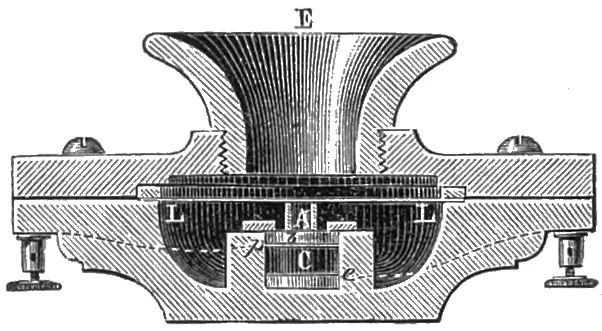
was obtained. The new form of instrument is
that shown in fig. 16, and, as had been long anticipated,
it was proved that the only use of the battery
was to magnetise the iron core of the magnet, for
the effects were equally audible when the battery
was omitted and a rod of magnetised steel substituted
for the iron core of the magnet.
‘It was my original intention, and it was always
claimed by me, that the final form of telephone
would be operated by permanent magnets in place
of batteries, and numerous experiments had been
carried on by Mr. Watson and myself privately for
the purpose of producing this effect.
Fig. 16.
‘At the time the instruments were first exhibited
in public the results obtained with permanent
magnets were not nearly so striking as when a
voltaic battery was employed, wherefore we thought
it best to exhibit only the latter form of instrument.
‘The interest excited by the first published
accounts of the operation of the telephone led many
persons to investigate the subject, and I doubt not
that numbers of experimenters have independently
discovered that permanent magnets might be employed
instead of voltaic batteries. Indeed one
gentleman, Professor Dolbear, of Tufts College,
not only claims to have discovered the magneto-electric
telephone, but I understand charges me
with having obtained the idea from him through the
medium of a mutual friend.
Fig. 17.
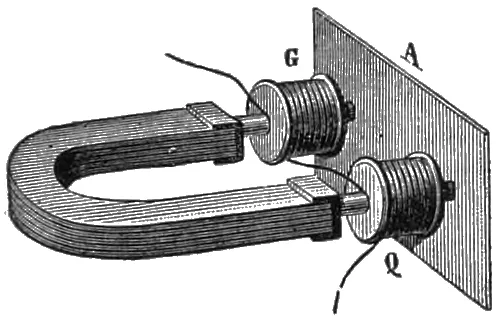
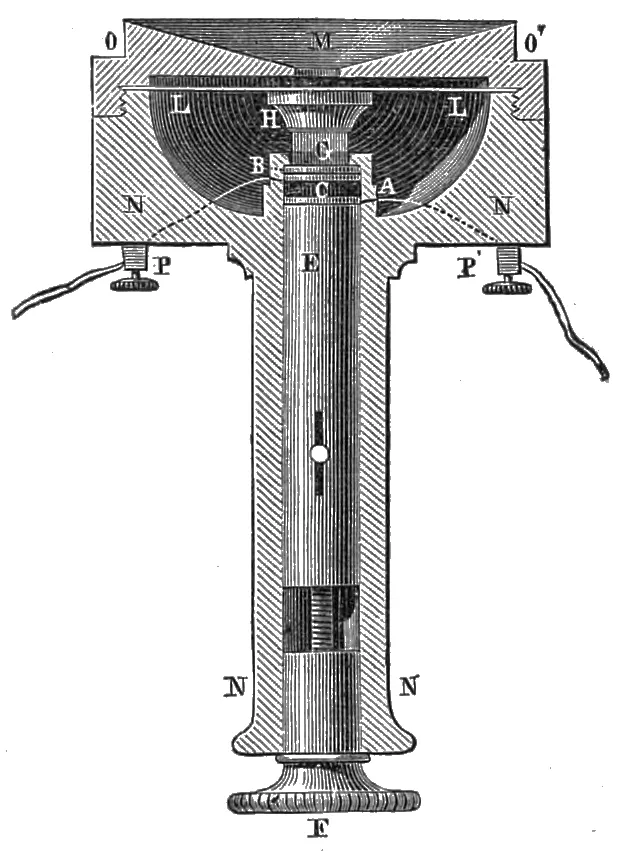
‘A still more powerful form of apparatus was
constructed by using a powerful compound horseshoe
magnet in place of the straight rod which had
been previously used (see fig. 17). Indeed the
sounds produced by means of this instrument were
of sufficient loudness to be faintly audible to a
large audience, and in this condition the instrument
was exhibited in the Essex Institute, in Salem,
Massachusetts, on February 12, 1877, on which
occasion a short speech shouted into a similar
telephone in Boston, sixteen miles away, was heard
by the audience in Salem. The tones of the
speaker’s voice were distinctly audible to an
audience of 600 people, but the articulation was
only distinct at a distance of about 6 feet. On the
same occasion, also, a report of the lecture was
transmitted by word of mouth from Salem to
Boston, and published in the papers the next
morning.
Fig. 18.
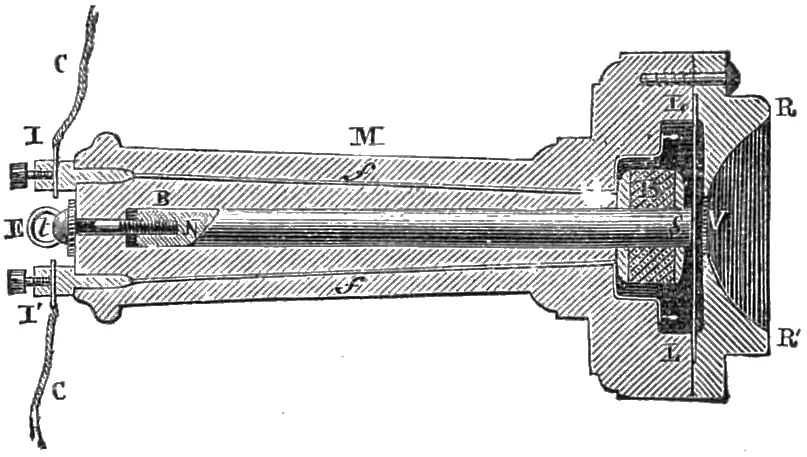
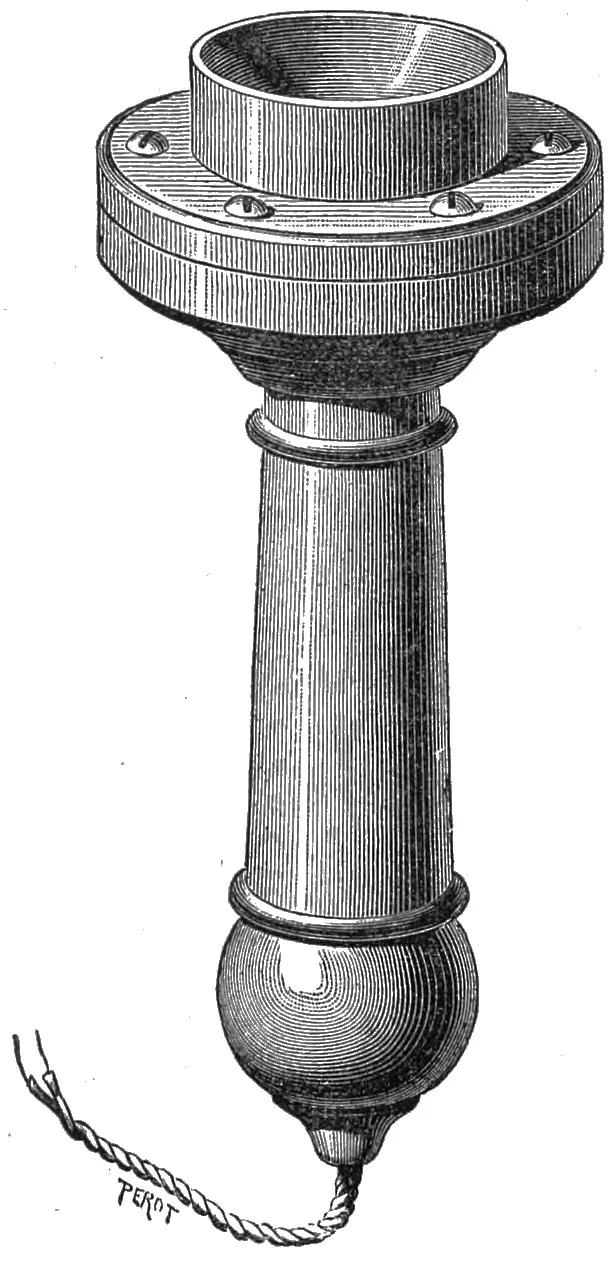
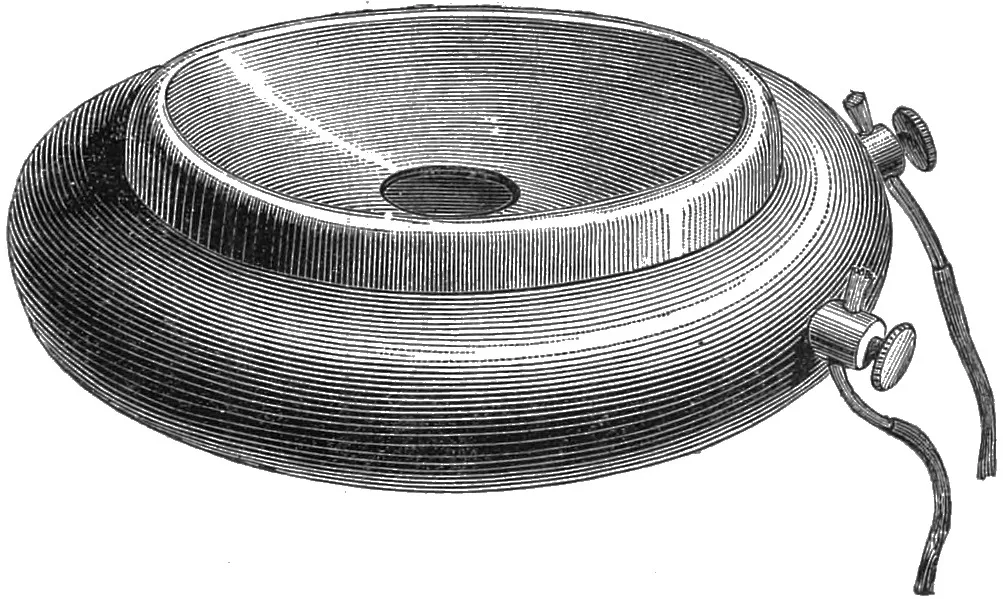
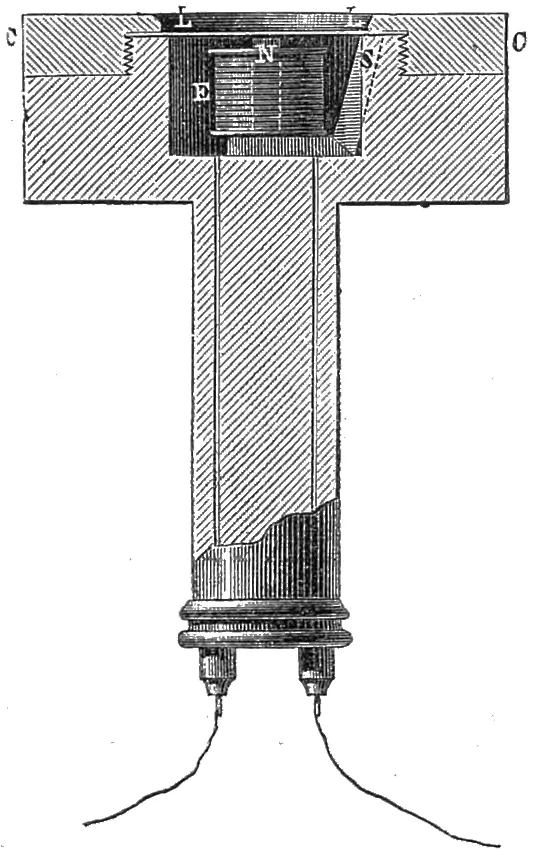
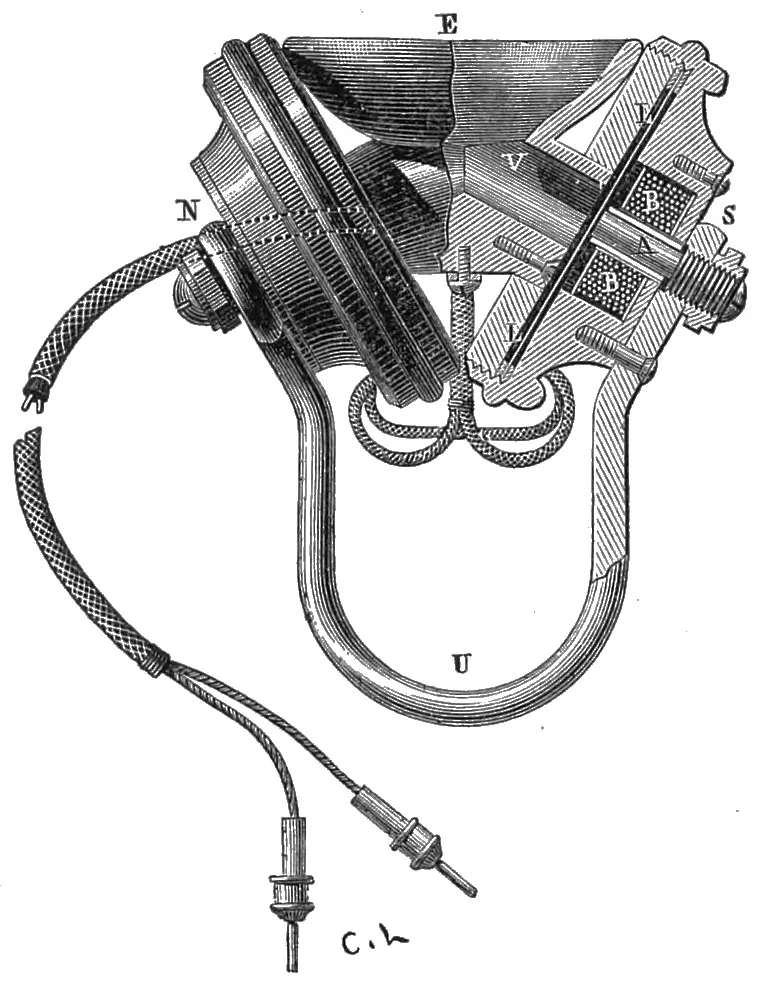
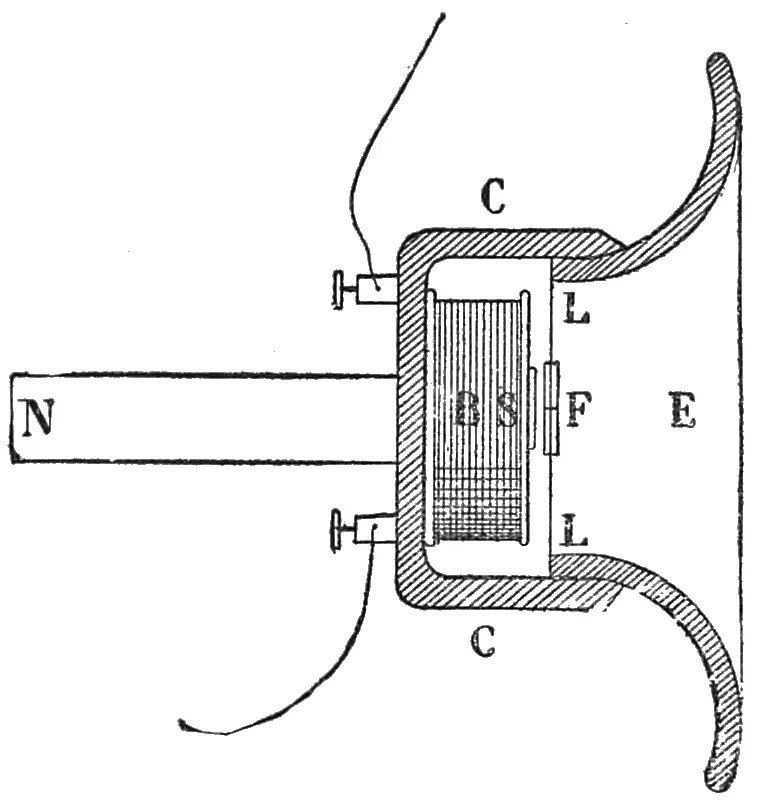
‘From the form of telephone shown in fig. 16
to the present form of the instrument (fig. 18) is
but a step. It is in fact the arrangement of fig. 16
in a portable form, the magnet N S being placed
inside the handle, and a more convenient form of
mouthpiece provided.
‘And here I wish to express my indebtedness
to several scientific friends in America for their co-operation
and assistance. I would specially mention
Professor Peirce and Professor Blake, of Brown
University, Dr. Channing, Mr. Clarke, and Mr.
Jones. It was always my belief that a certain ratio
would be found between the several parts of a
telephone, and that the size of the instrument was
immaterial; but Professor Peirce was the first to
demonstrate the extreme smallness of the magnets
which might be employed. The convenient form
of mouthpiece shown in fig. 17, now adopted by
me, was invented solely by my friend Professor
Peirce.’
Fig. 19.
Another form of transmitting telephone exhibited
in Philadelphia, intended for use with the
receiving telephone (fig. 15), is represented by fig. 19.
A platinum wire attached to a stretched membrane
completed a voltaic circuit by dipping into
water. Upon speaking to the membrane, articulate
sounds proceeded from the telephone in the distant
room. The sounds produced by the telephone
became louder when dilute sulphuric acid, or a
saturated solution of salt, was substituted for the
water. Audible effects were also produced by the
vibration of plumbago in mercury, in a solution of
bichromate of potash, in salt and water, in dilute
sulphuric acid, and in pure water.
Mr. Bell goes on to say:
‘I have found also that a musical tone proceeds
from a piece of plumbago or retort carbon when
an intermittent current of electricity is passed
through it, and I have observed the most curious
audible effects produced by the passage of reversed
intermittent currents through the human body. A
rheotome was placed in circuit with the primary
wires of an induction coil, and the fine wires were
connected with two strips of brass. One of
these strips was held closely against the ear, and a
loud sound proceeded from it whenever the other
slip was touched with the other hand. The
strips of brass were next held one in each hand. The
induced currents occasioned a muscular tremor in
the fingers. Upon placing my forefinger to my
ear a loud crackling noise was audible, seemingly
proceeding from the finger itself. A friend who
was present placed my finger to his ear, but heard
nothing. I requested him to hold the strips himself.
He was then distinctly conscious of a noise
(which I was unable to perceive) proceeding from
his finger. In this case a portion of the induced
currents passed through the head of the observer
when he placed his ear against his own finger; and it
is possible that the sound was occasioned by a vibration
of the surfaces of the ear and finger in contact.
‘When two persons receive a shock from a
Ruhmkorff’s coil by clasping hands, each taking
hold of one wire of the coil with the free hand, a
sound proceeds from the clasped hands. The
effect is not produced when the hands are moist.
When either of the two touches the body of the
other, a loud sound comes from the parts in contact.
When the arm of one is placed against the arm of
the other, the noise produced can be heard at a
distance of several feet. In all these cases a
slight shock is experienced so long as the contact
is preserved. The introduction of a piece of paper
between the parts in contact does not materially
interfere with the production of the sounds, but
the unpleasant effects of the shock are avoided.
‘When an intermittent current from a Ruhmkorff’s
coil is passed through the arms, a musical
note can be perceived when the ear is closely
applied to the arm of the person experimented
upon. The sound seems to proceed from the
muscles of the fore-arm and from the biceps
muscle. Mr. Elisha Gray4 has also produced
audible effects by the passage of electricity through
the human body.
‘An extremely loud musical note is occasioned
by the spark of a Ruhmkorff’s coil when the
primary circuit is made and broken with sufficient
rapidity; when two rheotomes of different pitch are
caused simultaneously to open and close the primary
circuit, a double tone proceeds from the spark.
‘A curious discovery, which may be of interest
to you, has been made by Professor Blake. He
constructed a telephone in which a rod of soft iron,
about six feet in length, was used instead of a permanent
magnet. A friend sang a continuous
musical tone into the mouthpiece of a telephone,
like that shown in fig. 17, which was connected
with the soft iron instrument alluded to above.
It was found that the loudness of the sound produced
in this telephone varied with the direction in
which the iron rod was held, and that the maximum
effect was produced when the rod was in the position
of the dipping-needle. This curious discovery
of Professor Blake has been verified by myself.
‘When a telephone is placed in circuit with a
telegraph line, the telephone is found seemingly to
emit sounds on its own account. The most extraordinary
noises are often produced, the causes of
which are at present very obscure. One class of
sounds is produced by the inductive influence of
neighbouring wires and by leakage from them, the
signals of the Morse alphabet passing over neighbouring
wires being audible in the telephone, and
another class can be traced to earth currents upon
the wire, a curious modification of this sound revealing
the presence of defective joints in the wire.
‘Professor Blake informs me that he has been
able to use the railroad track for conversational
purposes in place of a telegraph-wire, and he
further states that when only one telephone was
connected with the track the sounds of Morse
operating were distinctly audible in the telephone,
although the nearest telegraph-wires were at least
forty feet distant; and Professor Peirce has observed
the most curious sounds produced from a telephone
in connection with a telegraph-wire during the
aurora borealis.’
Mr. Bell went on to describe instances in
which airs sung or played upon a musical instrument
are transmitted by a telephone, when it is
not known whence they come; but the strongest
proof of the extraordinary sensibility of this
instrument consists in its becoming possible by its
means to transmit speech through bodies which
might be supposed to be non-conductors. Thus
communication with the earth through the human
body can be made in spite of the intervention of
shoes and stockings; and it may even be effected
if, instead of standing on the ground, the person
stands on a brick wall. Only hewn stone and
wood are a sufficient hindrance to communication,
and if the foot touches the adjoining ground, or
even a blade of grass, it is enough to produce
electric manifestations.
Mr. Bell says in conclusion:
‘The question will naturally arise, Through
what length of wire can the telephone be used?
In reply to this, I may say that the maximum
amount of resistance through which the undulatory
current will pass, and yet retain sufficient force to
produce an audible sound at the distant end, has
yet to be determined; no difficulty has, however,
been experienced in laboratory experiments in
conversing through a resistance of 60,000 ohms,
which has been the maximum at my disposal.
On one occasion, not having a rheostat at hand, I
may mention having passed the current through
the bodies of sixteen persons, who stood hand in
hand. The longest length of real telegraph line
through which I have attempted to converse has
been about 250 miles. On this occasion no
difficulty was experienced so long as parallel lines
were not in operation. Sunday was chosen as the
day on which it was probable other circuits would
be at rest. Conversation was carried on between
myself in New York, and Mr. Thomas A. Watson
in Boston, until the opening of business upon the
other wires. When this happened the vocal
sounds were very much diminished, but still audible.
It seemed, indeed, like talking through a storm.
Conversation, though possible, could be carried on
with difficulty, owing to the distracting nature of
the interfering currents.
‘I am informed by my friend Mr. Preece that
conversation has been successfully carried on
through a submarine cable, sixty miles in length,
extending from Dartmouth to the Island of
Guernsey, by means of hand telephones.’
Fig. 20.
Mr. Elisha Gray’s Share in the Invention of the
Telephone.—We have seen that if Mr. Bell was the
first to construct the speaking telephone in a practical
form, Mr. Gray had at the same time conceived
the idea of an instrument also capable of reproducing
speech, and the description given of it in
his caveat was so precise that if it had been made
from his design, it would have acted perfectly.
This was, in fact, afterwards proved by him. In
order that our readers may judge from their own
knowledge of the share which should be ascribed to
Mr. Elisha Gray in the invention of the telephone,
we reproduce in fig. 20 the drawing which accompanied
the caveat in question.
The sender, as we see, is composed of a sort
of tube, closed at its lower end by a membrane
to which a platinum wire is fixed; this wire dips
into a liquid of moderate conducting power, and
an electrode made of platinum, in communication
with a battery, is fixed at the bottom of the
vessel containing the liquid. The receiver is composed
of an electro-magnet, of which the armature
is fixed to the centre of a membrane, stretched
on a kind of resonator or ear-trumpet which is
held to the ear, and the two instruments are united
by the line wire as we see in the plate.
Under these conditions, the undulatory currents
necessary for the reproduction of speech were obtained
in a mode analogous to that pointed out by
Mr. Bell in his specification, that is, by the variations
of resistance in the liquid layer interposed
between the platinum wires of the transmitter;
and their action, exerted on an electro-magnet, of
which the armature was fixed on the diaphragm of
the resonator, was produced under more favourable
conditions than in Mr. Bell’s specification (see
fig. 13), since that gentleman regards this arrangement
(represented in fig. 14) as an important improvement
on his first conception.
The whole importance of the invention rests
on the intervention of undulatory currents, which,
as we have seen, are indispensable for the reproduction
of speech, and it concerns us to know
whether it was Mr. Bell or Mr. Gray who first declared
their importance; for in both the specifications
deposited on February 14, 1876, the use of
undulatory currents was declared to be indispensable.
Mr. Gray asserts that he had recognised
their importance for the transmission of combined
sounds as early as 1874; but Mr. Bell believes that
the undulatory currents mentioned by Mr. Gray at
that time were only currents analogous to those he
had designated under the name of pulsatory currents,
which we have represented in fig. 8. We
have seen that since these currents only represent
the abrupt elevations and depressions of intensity,
they are unfit for the reproduction of articulate
sounds, which, on the contrary, demand that the
variations of intensity should result from successive
efforts, in exact correspondence with all the
inflections of the sonorous vibrations effected by
the voice. Mr. Bell’s claim to priority on this question
has been recognised by the American Patent
Office, since he has been placed in possession of
the patent. However this may be, Mr. Gray’s
telephonic system was complete, and we see in it,
as we have already said, the origin of the battery
telephones, which have recently produced such important
results. Let us now consider the relation
which this system bears to Mr. Bell’s.
The Bell system, as we have seen, although
making use of a battery in the first instance, only
obtained the diminution and increase of electric
force necessary for the articulation of words by
means of induction currents produced by the
movements of an armature of soft iron, currents
of which the intensity was consequently due to the
range and inflections of these movements. The
battery only intervened in order to communicate
magnetic force to the inducer. This use of induced
currents in telephonic transmissions was
already of great importance, since various experiments
subsequently made have proved their superiority
to voltaic currents for this purpose. But
experience soon convinced Mr. Bell that a powerful
inductive apparatus worked by a battery was
not only unnecessary for the action of this apparatus,
but that a permanent magnet, very small and
weak, would provide sufficient currents. This discovery,
in which, as we have seen, Mr. Peirce had
some share, was of great importance, since it became
possible to reduce the size of the instrument considerably,
so as to make it portable and adapted
for sending and receiving; and it was shown that
the telephone was the most sensitive of all instruments
in revealing the action of currents. If,
therefore, Mr. Bell was not the first to employ the
successful mode of transmitting articulate words, it
must be said that he sought, like Mr. Gray, to solve
the problem by means of undulatory currents, and
that he obtained these currents by the effect of induction,
a system which, as soon as it was perfected,
led to the important results with which we are all
acquainted. If he had only given to the astonished
world an instrument capable of reproducing
speech telegraphically, his fame would be great;
for this problem had hitherto been regarded as
insoluble.
Mr. Gray’s claims to the invention of the telephone
are given in the following summary from
a very interesting work, entitled ‘Experimental
Researches on Electro-harmonic Telegraphy and
Telephony:’
‘1. I was the first to discover the means of
transmitting compound sounds and variable inflections
through a closed circuit by means of two or
more electric waves.
‘2. I assert that I was the first to discover and
utilise the mode of reproducing vibrations by the
use of a magnet receiver constantly supplied with
electric action.
‘3. I also assert that I was the first to construct
an instrument consisting of a magnet with a circular
diaphragm of magnetic substance, supported by
its edge at a little distance from the poles of a
magnet, and capable of being applied to the transmission
and reception of articulate sounds.’
It is a curious fact, worth recording here, that
Mr. Yates, of Dublin, in 1865, when trying to improve
Reiss’s telephone, realised to a certain extent
Mr. Gray’s conception of the liquid transmitter; for
he introduced into the platinum contacts of Mr.
Reiss’s instrument a drop of water which adapted
it for the reproduction of articulate sounds. However,
no notice was then taken of this result.
EXAMINATION INTO THE FUNDAMENTAL PRINCIPLES ON WHICH BELL’S TELEPHONE IS BASED.
Although the preceding account would suffice
to make the principle of Bell’s telephone intelligible
to persons acquainted with electric science,
this would not be the case with the majority of
our readers, and we therefore think it necessary
to enter into some details as to the source of the
electric currents which are employed in telephonic
transmissions. These details seem to us the more
necessary, since many persons still believe that
Bell’s telephones are not electric, because they do
not require a battery, and they are often confounded
with string telephones, so that the difference
of price between Bell’s instruments and
those hawked in the streets seems astonishing.
Without defining what is meant by an electric
current, which would be too elementary, we may
say that electric currents can be produced by different
causes, and that, in addition to those which
are due to batteries, strong currents are also produced
by the force exerted by magnets on a conducting
circuit properly arranged. Such currents
are called induction currents, and are used in Bell’s
telephone. In order to understand how they are
developed under these conditions, it will be enough
to examine what takes place when the pole of a
magnet is brought near to, and withdrawn from, a
closed circuit. To do this, let us suppose a copper
wire attached to a galvanometer in the form of a
circle, and that one pole of a permanent magnet is
directed towards the centre of the circle. Now
observe what happens:
1. At the moment when the magnet approaches
an electric current arises, causing the galvanometer
to deviate to one side. This deviation will be great
in proportion to the extent of the movement, and
the tension of the current will be great in proportion
to the abruptness of the movement. The
current will however be only instantaneous.
2. At the moment when the magnet is withdrawn,
a fresh current of the same nature will arise,
but it will appear in an opposite direction from the
former. It will be what is called a direct current,
because it is in the same direction as the magnetic
current of the magnet which produces it, while the
other current is called inverse.
3. If, instead of advancing or withdrawing the
magnet by means of a single movement, it is
advanced in jerks, a succession of currents in the
same direction is produced, of which the existence
can be ascertained by the galvanometer when
there is a sufficient interval between the movements,
but when the intervals are very slight the currents
are interfused; and since inverse effects take place
when the magnet is moved in a contrary direction,
the needle of the galvanometer follows the movements
of the magnet, and to a certain extent
stereotypes them.
4. If, instead of reacting on a simple closed
circuit, the magnet exerts its force on a considerable
number of circumvolutions of this circuit, that
is, on a bobbin of coiled wire, the effects will be considerably
increased, and they will be still greater
if there be a magnetic core within the bobbin,
since the inducing action will then be more effectually
exerted throughout the bobbin. As the
magnetic core, when it is magnetised and demagnetised
under the influence of its approach to or
withdrawal from the inducing magnet, is subject to
the reaction from all the fluctuations which occur in
the movements of the magnet, the induced currents
which ensue are perfectly defined.
5. If, instead of a movable magnet, we suppose
it to be fixed in the centre of the coil, the
induced currents of which we have spoken may
then be determined by modifying its force. In
order to do so, it is enough that an iron armature
should react upon its poles. When this armature
is brought close to one of the poles, or to both at
once, it acquires force, and produces an inverse
current, that is, a current in the direction which
would have corresponded to an approach of the
magnet to the closed circuit. On its withdrawal
the inverse effect is produced; but in both cases the
induced currents correspond with the extent and
direction of the movements accomplished by the
armature, and consequently they may reproduce
its movements by their effects. If this armature is
an iron plate, which vibrates under the influence
of any sound in this disposition of the electro-magnetic
system, the alternate movements of the
plate will be transformed into the induced currents,
and these will be stronger or weaker, more or less
definite, according to the range and complexity of
the vibrations: they will, however, be undulatory,
since they will always result from successive and
continuous movements, and will consequently be
in the conditions which, as we have seen, are required
for the transmission of speech.
As for the action produced upon the receiver,
that is, on the instrument for reproducing speech,
it is somewhat complex, and we shall have occasion
to speak of it presently; but we can get a general
impression of it, if we consider that the effects
produced by the induced currents of variable
intensity, which traverse the coil of the electro-magnetic
system, must determine, by the magnetisations
and demagnetisations which ensue, the
vibrations of the armature disk; these vibrations,
more or less amplified and defined, exactly represent
those of the disk before which the speaker
stands, and can only be obtained from them. The
effects are, however, in reality more complex,
although they are produced under analogous conditions,
and we shall have more to say about
them when we come to speak of the experiments
made with the telephone. It must meanwhile be
observed that, for the reproduction of speech, it is
not necessary that the magnetic core should be of
soft iron, since the vibratory effects may follow
from differential as well as from direct magnetisation.
ORDINARY ARRANGEMENT OF THE BELL TELEPHONE. — DIFFERENT ARRANGEMENTS OF TELEPHONES.
The arrangement most generally adopted for
the telephone is the one represented in fig. 21.
It consists of a kind of circular wooden box, fitted
to the extremity of a handle M, which is also of
wood, and contains the magnetic bar N S. This
bar is fixed by means of a screw t, and is so
arranged as to be moved forward and backward by
tightening or loosening the screw, a condition
necessary in order to regulate the instrument. At
the free extremity of the bar the magnetic coil
B is fixed; this must, according to MM. Pollard
and Garnier, be made of wire No. 42, so as to present
a considerable number of spirals. The ends
of this coil generally terminate at the lower end of
the handle in two copper rods f, f, which traverse
its length, and are fastened to two binding-screws
I, I′, where the line wires C, C are fixed. In the
instruments made by M. Bréguet there are, however,
no binding-screws, but a little twist, made of
two flexible wires covered with gutta-percha and
silk, is fastened to the two rods. A wooden cap is
screwed to the end of the handle, and the twist
passes through a hole made in this cap, so that
there is no inconvenience in working the instrument.
By laying hold of the ends of the wire twist
with pliers it is possible to join them to the circuit.
This instrument is represented in fig. 22.
Fig. 21.
By another arrangement, the wires of the coil
end immediately in the binding-screws which are
placed below the wooden box, but this arrangement
is inconvenient.
Above the pole of the magnetic bar is placed
the iron vibrating plate L L, which is coated either
with black or yellow varnish, with tin or blue oxide,
but which must always be very thin. This plate
is in the form of a disk, and by its rim, resting on a
caoutchouc ring, it is firmly fixed to the circular
edges of the wooden box, which is for this purpose
made in two pieces. These pieces are adjusted to
each other, either by screws or by spirals cut in
half the thickness of the wood. This disk ought to
be as near as possible to the polar end of the
magnet, yet not so near as to produce contact
between the two by the vibrations of the voice.
Finally, the mouthpiece R R′ (fig. 21), which is in
form of a wide funnel, terminates the upper part of
the box, and should be so arranged as to leave a
certain space between the disk and the edges of
the hole V, which is open in its centre. The size of
the box should be so calculated as to permit of its
acting as a sounding-box, without however provoking
echoes and a confusion of sounds.
Fig. 22.
When the instrument is properly made, it will
produce very marked effects; and M. Pollard, one
of the first Frenchmen to take up the study of
telephones, has written as follows on the subject:
‘The instrument which I have prepared gives
results which are truly astonishing. In the first
place, when considering the resistance, the introduction
into the circuit of five or six persons does
not sensibly diminish the intensity of sounds. On
putting an instrument to each ear, the sensation is
precisely the same as if the correspondent were
speaking some yards behind. The intensity, the
clearness, the purity of tone are irreproachable.
‘I can speak to my colleague in quite an undertone,
scarcely breathing as I may say, and persons
placed within two yards of me will be unable to
catch a single word of our conversation.
‘On the part of the receiver, if anyone raises
his voice to call me, I hear the call in all parts of
my office, at least when silence prevails there; at
any rate, when I am seated at my table with the
instrument some yards off, I can always hear
the call. In order to increase the intensity of
sound, I fitted the mouthpiece with a copper
horn of conical shape, and under these conditions
words spoken in my bureau two or three yards
from the mouthpiece can be heard at the other
end of the line; from my station, a little more than
a yard from the tube, I can hear and speak to my
colleague without effort.’
In using the ordinary Bell telephone, it is
necessary to speak distinctly before the mouthpiece
of the telephone which is handled, while the
listener placed at the corresponding station keeps
the mouthpiece of the receiver to his ear. These
two instruments form a closed circuit with the two
wires which connect them, but one is enough to
make the transmission perfect, if care is taken to
place both instruments in connection with the
earth, which thus takes the place of the second
wire. M. Bourbouze asserts that the intensity of
sound in the telephone is much increased by employing
this expedient, but we believe that this
increase depends upon the conditions of the circuit,
although he asserts that the fact can be proved in a
circuit not exceeding eighty yards.
For practical purposes it is necessary to have
two telephones at each station, so as to hold one to
the ear while speaking through the other, as in fig. 23.
It is also much more easy to hear with a
telephone applied to each ear, in which case they
are held as in fig. 24. In order not to fatigue the
arms, an arrangement has been made by which they
are held before the ears by a strap and spring which
goes round the head.
Fig. 23.
The sending power of the telephone varies
with different voices. Mr. Preece asserts that
shouting has no effect, and that, in order to obtain
a favourable result, the intonation must be clear,
the articulation distinct, and the sounds emitted
must resemble musical sounds as much as possible.
Mr. Wilmot, one of the electricians employed
by the Post Office, says that he has been able to
make himself heard on circuits through which no
other voices were audible. The vowel sounds are
most readily transmitted, and among other letters e,
g, j, k, and q are always repeated more imperfectly.
The ear requires practice, and the faculty of hearing
varies in a surprising degree in different people.
Singing is very distinctly heard, as well as wind
instruments, especially the cornet-à-piston, which,
when played in London, was heard by thousands of
people in the Corn Exchange at Basingstoke.
Fig. 24.
According to Mr. Rollo Russell, it is not
necessary to isolate the circuit of a telephone when
the distance is relatively slight; thus, with a circuit
of about 430 yards, it is possible to use a simple
copper wire, laid on the grass, without destroying
the telephonic transmission from a small musical
box, as long as the two wires do not touch each
other. Transmission took place, even when the
circuit was buried in moist earth for a length of
thirty-five yards, or immersed in a well for a length
of forty-eight yards. The words transmitted under
such conditions did not differ from those transmitted
by an isolated circuit.
The telephone may be heard at the same
moment by several listeners, either by connecting
the wires which unite the telephones in correspondence
(near the receiving telephone) with
branch wires of other telephones, which may be
done up to the number of five or six, in short
circuits; or by means of a little sounding-box
closed by two thin membranes, one of which is
fixed on the vibrating disk. When a certain
number of acoustic tubes are connected with the
membrane, Mr. M’Kendrick asserts that several
people can hear distinctly.
Telephones may also transmit speech to different
stations simultaneously, by inserting them on
the same circuit, and experiments made at New
York showed that five instruments placed in
different parts of the same telegraphic line could be
made to speak in this way. In the telephonic experiments
made on the canal lines in the department
of the Yonne, it was ascertained that on a wire
seven miles and a half in length, on which several
telephones were placed at varying distances, three
or four persons were able to converse with each
other through the telephones, and each could
hear what the other was saying. The questions
and answers could be understood, even in crossing.
It was also possible, by placing a telephone on a
second wire, a little over five miles in length, and
half a yard distant from the other, to hear the conversation
exchanged on the first wire by following
it to a distance not exceeding a mile and a quarter.
Even the different voices of the two speakers could
be distinguished.
Since the telephone made its appearance in
Europe, several inventors have asserted that they
are able to make a telephone speak so as to be
audible in all parts of a large hall. It has been
shown that this was accomplished by Mr. Bell, and
in this respect we do not see that those who have
attempted to improve the telephone have attained
results of greater importance. It is certain that
the ordinary telephone can emit musical sounds
which become perfectly audible in a tolerably
large room, while the instrument is still attached
to the wall. We should also remember the results
obtained by MM. Pollard and Garnier in the
experiments made at Cherbourg to connect the
mole with the Préfecture Maritime.
The mole at Cherbourg is, as we know, a kind
of artificial island thrown up before the town in
order to make an anchorage. The forts which
have been constructed on the mole are connected by
submarine cables with the military port and with
the Préfecture Maritime. On one occasion, after
making experiments in the Préfet’s study on one
of the cables applied to a telephone, several persons
were talking together in the room, and were much
surprised to hear the bugle sound the retreat, the
sound appearing to come from one part of the
room. It was found, on examination, that the
telephone hung to the wall was occupied with
this performance. On enquiry, it appeared that
one of the manipulators on the mole station had
amused himself by sounding the bugle before the
telephone on that station. The mole is more than
three miles from Cherbourg, and the Préfecture Maritime
is in the centre of the town. Yet these telephones
had been roughly made in the dockyard
workshops; and we have here another proof of the
small amount of accuracy required for the successful
working of these instruments.
Fig. 25.
Telephones of various construction on the
Bell model are to be seen at M. C. Roosevelt’s,
Mr. Bell’s agent in Paris, 1, Rue de la Bourse.
They are, for the most part, constructed by M.
Bréguet, and the model in the greatest request,
exclusive of the one we have described, is the
great square model, with a horseshoe magnet enclosed
in a flat box, and a horn on its upper side,
which serves as a mouthpiece. This system is
represented in fig. 25, and it has been neatly constructed
at Boston under the best conditions. In
this new model, made by Mr. Gower, the magnet
is composed of several plates terminated by magnetic
cores of iron, to which the coils are fixed,
and the whole is covered with a thick layer of
paraffin. The sounds thus reproduced are much
stronger and more distinct. Mr. Gower, who is
now Mr. Roosevelt’s partner, has made considerable
improvements in the different forms of Mr.
Bell’s instrument. There is one model in the form
of a snuff-box, in which the magnet is twisted into
a spiral, so as to maintain its length in a circular
form. The pole, which is in the centre of the
spiral, is furnished with an iron core, to which the
induction coil is fastened, and the cover of the
snuff-box supports the vibrating disk as well as
the mouthpiece: this model is represented in fig. 26.
In another model, called the mirror telephone,
the preceding arrangement is fitted on to a handle
like the glass of a portable mirror, and there is a
mouthpiece on one of the lateral faces, so that the
speaker uses the instrument as if he were speaking
before a chimney screen.
Fig. 26.
Mr. Bailey has different models of telephones
worked by a battery or by the Edison carbon of
which we shall speak presently, and these, as well
as the telephones by Messrs. Gray and Phelps,
are more successful in conveying sound on a long
line of wire.
The prodigious results attained with the Bell
telephones, which were at first discredited by many
scientific men, necessarily provoked, as soon as their
authenticity was proved, innumerable researches
on the part of inventors, and even of those who
were originally the most incredulous. A host of
improvements and modifications have consequently
been suggested, which are evidently not without
interest, and must now be considered by us.
BATTERY TELEPHONES.
The Edison Telephone.—One of the earliest and
most interesting improvements made in the Bell
telephone is that introduced by Mr. Edison in
the early part of the year 1876. This system is
indeed more complicated than the one we have
just considered, since it requires a battery, and
the sending instrument differs from the receiving
instrument; but it is less apt to be affected by
external causes, and transmits sound to a greater
distance.
The Edison telephone, like Mr. Gray’s, which
we have already had occasion to mention, is based
upon the action of undulatory currents, determined
by the variations in the resistance of a conductor
of moderate conducting power, which is inserted in
the circuit, and the vibrations of a diaphragm before
which the speaker stands react upon it. Only, instead
of employing a liquid conductor, which is
practically useless, Mr. Edison has attempted to use
semi-conducting solid bodies. Those which were
most suitable from this point of view were graphite
and carbon, especially the carbon extracted from
compressed lamp-black. When these substances
are introduced into a circuit between two conducting
plates, one of which is moveable, they are capable
of modifying the resistance of the circuit almost in
the same proportion as the pressure exerted upon
them by the moveable plate,5 and it was seen that,
in order to obtain the undulatory currents necessary
for the production of articulate sounds, it was
enough to introduce a disk of plumbago or of lamp-black
between the vibrating plate of a telephone
and a platinum plate placed in connection with
the battery. When the telephone disk is placed
in circuit, its vibrations before the disk of carbon
produce a series of increasing and decreasing
pressures, thus causing corresponding effects in
the intensity of the transmitted current, and these
effects react in an analogous manner on the undulatory
currents determined by induction in the
Bell system. In order to obtain good results,
however, several accessory arrangements were
necessary, and we represent in fig. 27 one of the
arrangements made in this part of Mr. Edison’s
telephonic system.
Fig. 27.
In this figure a section of the instrument is
given, and its form greatly resembles that of Bell.
L L is the vibrating disk; O′ O, the mouthpiece; M,
the opening to the mouthpiece; N N N, the case for
the instrument, which is, like the mouthpiece, made
of ebonite, and below the disk it presents a rather
large cavity, and a tubular hole which is scooped in
the handle. In its upper part this tube terminates
in a cylindrical rim, furnished with a worm on which
is screwed a little rod with a ridge on its inner side,
and the rheostatic system is placed within this tube.
The system consists, first, of a piston E, fitted to
the end of a long screw E F, and the turning of the
button will move the piston up or down within a
certain limit. Above this piston there is fitted a
very thin platinum plate A, connected by a flexible
chain and a wire with a binding-screw P′. Another
plate B, exactly similar, is connected with the
binding-screw P, and the carbon disk C is placed
between these two plates. This disk is composed
of compressed lamp-black and petroleum, and its
resistance is one ohm, or 110 yards, of telegraphic
wire. Finally, an ebonite disk is fastened to the
upper platinum plate, and an elastic pad, composed
of a piece of caoutchouc tube G, and of a cork
disk H, is interposed between the vibrating plate
L L and the disk B, in order that the vibrations of
the plate may not be checked by the rigid obstacle
formed by the whole rheostatic system. When
these different parts are in position, the instrument
is regulated by the screw F, and this is easily
done by screwing or unscrewing it until the receiving
telephone gives out its maximum of sound.
Fig. 28.
In another model, represented in fig. 28, which
has produced the best results in the distinctness
with which sounds are transmitted, the vibrating
plate L L is supported on the disks of the secondary
carbon conductor C by means of a little iron
cylinder A, instead of the caoutchouc pad, and
the pressure is regulated by a screw placed below
e. The mouthpiece E of the instrument is more
prominent, and its opening is larger. Finally, the
instrument, which is cased in nickel silver, is without
a handle. The rigid disk b, resting on the
first platinum plate p, is of aluminium instead of
ebonite.
Fig. 29.
The receiving telephone somewhat resembles
that of Mr. Bell, yet it presents some differences
which can be understood from the examination of
fig. 29. The magnet N S is horseshoe in form,
and the magnetising coil E only covers one of
the poles, N: this pole is precisely in the centre of
the vibrating plate L L, while the second pole is
near the edge of this plate. The size of the plate
itself is considerably reduced: its superficies is
about the same as that of a five-franc piece, and it
is enclosed in a kind of circular groove, which keeps
it in a definite position. In consequence of this
arrangement the handle of the instrument is of
solid wood, and the vacant space for the electro-magnetic
system is somewhat larger than in the
Bell model; but an arrangement is made for subduing
the echo, and there is a kind of sounding-box
to magnify the sound. It is evident that the relation
which the electro-magnetic system bears to the
vibrating disk must increase the sensitiveness of
the instrument; for as the pole S is in close contact
with the disk L L, the latter is polarised, and
becomes more susceptible to the magnetic influence
of the second pole N, which is separated from it
by an interval not exceeding the thickness of a
sheet of coarse paper. In Mr. Edison’s two
instruments, the receiver and sender, the upper
part C C, corresponding to the vibrating disk, instead
of being fixed by screws to the handle, is
screwed on to the handle itself, which makes it
much more easy to dismount the instrument.
Mr. Edison has varied the form of his instruments
in many ways, and their cases have of late
been made of metal with a funnel-shaped mouthpiece
of ebonite.
When Mr. Edison had ascertained, as indeed
Mr. Elisha Gray had done before him, that induced
currents are more favourable to telephonic
transmissions than voltaic currents, he transformed
the currents from the battery which passed through
his sender into induced currents by making them
pass through the primary circuit of a carefully insulated
induction coil; the line wire was then put
into communication with the secondary wire of the
coil. We shall afterwards describe some experiments
which show the advantages of this combination:
for the present we can only point out the fact,
for it is now an integral quality of almost all the
systems of battery telephones.
Edison’s Chemical Telephone.—The curious and
really useful effects produced by Mr. Edison with
his electro-motograph prompted, about the beginning
of the year 1877, his idea of applying the principle of
this instrument to the telephone for the reproduction
of transmitted sounds; and he obtained such
interesting results that the author of an article on
telephones, published in the ‘Telegraphic Journal,’
August 15, 1877, put forward this invention as one
of the finest of the nineteenth century. It certainly
appears to have given birth to the phonograph,
which has lately become famous, and has so much
astonished men of science.
To understand the principle of this telephone,
we must give some account of Mr. Edison’s electro-motograph,
discovered in 1872. This instrument
is based upon the principle that if a sheet of paper,
prepared with a solution of hydrate of potash, is
fastened on a metallic plate which is united to the
positive pole of a battery, and if a point of lead
or platinum connected with the negative pole is
moved about the paper, the friction which this
point encounters ceases after the passage of the
current, and it is then able to slide as if upon a
mirror until the current is interrupted. Now, as
this reaction may be effected instantaneously under
the influence of extremely weak currents, the
mechanical effects produced by these alternations
of arrest and motion may, by a suitable arrangement
of the instrument, determine vibrations in
correspondence with the interruptions of current
produced by the transmitter.
In this system the telephonic receiver consists
of a resonator and a drum mounted on an axis and
turned by a winch. A paper band, wound upon a
reel, passes over the drum, of which the surface is
rough, and a point tipped with platinum, and fitted
to the end of a spring which is fixed in the centre
of the resonator, presses strongly on the paper.
The current from the battery, first directed on the
spring, passes by the platinum point through the
chemical paper, and returns by the drum to the
battery. On turning the winch, the paper moves
forward, and the normal friction which is produced
between the paper and the platinum point pushes
the point forward, while producing by means of
the spring a tension on one side of the resonator;
but since the friction ceases at each passage of the
current through the paper, the spring is no longer
drawn out, and the resonator returns to its normal
position. Since this double effect is produced by
each vibration made in the sender, a series of
vibrations takes place in the resonator, repeating
those of the sender, and consequently the musical
sounds which affected the sender are reproduced
to a certain extent. According to the American
journals, the results produced by this instrument
are astonishing: the weakest currents, which would
have no effect on an electro-magnet, become perfectly
efficacious in this way. The instrument can
even reproduce with great intensity the highest
notes of the human voice, notes which can hardly
be distinguished by the use of electro-magnets.
The sender nearly resembles the one we have
previously described, except that, when it is used
for musical sounds, a platinum point is employed
instead of the disk of carbon, and it ought not to
be in constant contact with the vibrating plate.
According to the ‘Telegraphic Journal,’ it consists
simply of a long tube, two inches in diameter,
having one end covered with a diaphragm formed
of a thin sheet of copper, and kept in its place by
an elastic ring. A small platinum disk is riveted
to the centre of the copper diaphragm, and a point
of the same metal, fitted with a firm support, is
adjusted before the disk. When the singer stands
before the diaphragm, its vibration causes it to
touch the platinum point, and produces the number
of breaks in the current which corresponds to the
vibration of the notes uttered.
The experiments lately made in America, in
order to decide on the merits of various telephonic
systems, show that Mr. Edison’s telephone gives
the best results. The ‘Telegraphic Journal,’ May 1,
1878, states that on April 2 Mr. Edison’s carbon
telephone was tested between New York and Philadelphia
on one of the numerous lines of the West
Union. The length of the line was 106 miles, and
ran parallel to other wires almost throughout
its length. The effects of induction caused by
telegraphic transmissions through the adjacent
wires were enough to make speech inaudible
through the other telephones, but they had no
influence on Edison’s telephone, which was worked
with a battery of two cells and a small induction
coil, and Messrs. Batchelor, Phelps, and Edison
were able to converse with ease. Mr. Phelps’
magnetic telephone, which is considered to be the
most powerful of its kind, did not afford such good
results.
In the experiments made between the Paris
Exhibition building and Versailles, the jury commission
was able to ascertain that the results were
equally favourable.
Telephones by Colonel Navez.—Colonel Navez
of the Belgian Artillery, inventor of the well-known
balistic chronograph, has endeavoured to improve
the Edison telephone by employing several disks
of carbon instead of one. He considers that the
variations of electric resistance produced by carbon
disks under the influence of unequal pressure depend
chiefly on their surface of contact, and he
consequently believes that the more these surfaces
are multiplied, the greater the differences in question
will be, just as it happens when light is polarised
through ice. He adds that these disks act
well by their surfaces of contact, since, if they are
separated by copper disks, the speech reproduced
ceases to be articulate.6
I am not surprised to learn that Colonel Navez
has found a limit to the number of carbon disks,
for the reproduction of speech in this system is
due both to the greatness of the differences of
resistance in the circuit, and to the intensity of
the transmitted current. If therefore the instrument’s
sensitiveness to articulate sounds is increased
by increasing the number of imperfect contacts
in the circuit, the intensity of the transmitted
sounds is diminished, and thus sounds lose their
power. There is consequently a limit to be observed
in the number of carbon disks placed upon
each other; and it depends on the nature of the
imperfect contacts which are employed, and on the
tension of the electric generator.
In order to stop the unpleasant musical vibrations
which accompany telephonic transmissions,
Colonel Navez employs for the vibrating plate of
the sender a silver-plated copper disk, and for
the vibrating plate of the receiver an iron disk
lined with brass and soldered together. He also
employs caoutchouc tubes with mouthpieces and
ear-tubes for the transmission and reception of
sound, and these instruments are placed level on a
table. For this purpose the magnetised bar of the
receiving telephone is replaced by two horizontal
magnets, acting through a pole of the same nature
on a little iron core which carries the coil, and
which is placed vertically between the two magnets.
He necessarily makes use of a small Ruhmkorff
coil to transform the electricity of the battery into
induced electricity.
Fig. 30.Fig. 31.
Figs. 30 and 31 represent the two parts of this
telephonic system. The carbon battery is in C
(fig. 30), the vibrating disk in L L, and the mouthpiece
E, fitted to a caoutchouc tube T E, corresponds
at the lower end to the vibrating disk. The carbon
battery is placed in metallic contact with the circuit
by a platinum rod E C, and the vibrating disk
also communicates with the circuit through a binding-screw.
In the receiving telephone (fig. 31) the
upper part is arranged much as in the ordinary
telephones, except that, instead of a mouthpiece,
the instrument is fitted with an ear-tube T O. The
two horseshoe magnets, A, A, which communicate a
uniform polarity to the iron core N, support the
induction coil B. The two terminals of this
receiver are connected with the supplementary
wire of the induction coil, and the two terminals of
the sender are connected with the two ends of
the primary of this coil, and with the battery which
is inserted in the circuit near this instrument.
The Pollard and Garnier Telephones.—The
battery telephone made by MM. Pollard and
Garnier differs from the foregoing in this particular:
it simply employs two points of graphite, mounted
in metallic porte-crayons, and these points are
directly applied against the vibrating plate with a
pressure which must be regulated. Fig. 32 represents
the arrangement adopted, which, however,
may be infinitely varied.
L L is the vibrating tin plate, above which is the
mouthpiece E, and P, P′ are the two graphite points
with their porte-crayons. There is a screw on the
lower part of the porte-crayons which is fixed in a
hole pierced in a metallic plate C C, and by this
means the pressure of the pencils against the disk
L L can be regulated. The metallic plate C C is
made in two pieces, placed side by side, but
insulated from each other, so that they may be placed
in communication with a cylindrical commutator,
and by its means the circuit can be arranged in
different ways. Since the commutator consists of
five sheets, the transition from one combination to
another is instantaneous, and these combinations
are as follows:
1. The current enters by the pencil P, passes
into the plate, and so to line.
2. The current enters by the pencil P′, passes
into the plate, and so to line.
3. The current comes simultaneously by the two
pencils P and P′, goes into the plate, and thence to
line.
4. The current comes by the pencil P, goes
thence to the plate, then into the pencil P′, and so
to line.
Fig. 32.
By this means there are two elements of combination,
which may be employed separately, or by
coupling them for tension or quantity.
When the pencils are properly regulated and
give a regular transmission of equal intensity, the
effects produced in the transition from one combination
to another may be easily studied, and it has
been ascertained: first, that in a short circuit there
is no appreciable change, whatever be the combination
employed; secondly, that when the circuit
is long, or of great resistance, the tension arrangement
is the best, and this in proportion to the length
of the line.
This telephonic system, like the two preceding
ones, requires an inducing machine to transform
voltaic into induced currents: we shall presently
speak of this important accessory of these instruments.
Besides this arrangement, MM. Pollard and
Garnier have employed the one we have represented
in fig. 5, which has given better results. We shall
see presently that it can be used as the receiving
organ of sounds. In each case the two carbons
must be placed in contact, and subjected to a
certain initial pressure, which should be regulated
by the screw fitted to the support of the lower
carbon.
As for the receiving telephone, the arrangement
adopted by MM. Pollard and Garnier is the same
as Bell’s, except that they employ tin plates and
helices of greater resistance. This resistance ranges
in fact from 100 to 125 miles. ‘We have always
held,’ these gentlemen say, ‘that whatever may
be the resistance of the outer circuit, there is an
advantage in increasing the number of spirals,
even when using wire No. 42, which is the one we
prefer.’
Fig. 33.
M. Hellesen’s Reaction Telephone.—M. Hellesen
believed that the vibrations produced by the voice
on the carbon of a telephonic sender would be
magnified if the moveable part of the rheotome
were subjected to an electro-magnetic action resulting
from the vibrations themselves, and he has
contrived a sender, which is based on the principle
shown in fig. 33, and which has the merit of forming
in itself the inducing apparatus intended to transform
the voltaic currents employed. This instrument is
composed of a vertical iron tube, supported on a
magnetic bar N S, and surrounded by a magnetising
coil B B, above which is fixed an inducing
helix of fine wire I I, communicating with
the circuit. Within the tube there is a lead pencil
C, held by a porte-crayon which can be raised or
lowered by means of a screw V fixed below the
magnetic bar. Finally, above this pencil, there is
an iron vibrating plate L L, with a platinum point
in communication with the battery in its centre;
the local circuit communicates with the pencil by
means of the magnetising helix B, and for this
purpose one end is soldered to the iron tube.
From this arrangement it follows that the
vibrations of the plate L L, at the moment when it
comes nearest to the pencil, tend to become greater
in consequence of the attractive force exerted on
the plate, and as the pressure of the lead pencil is
increased, it increases the differences of resistance
which result from it, and consequently causes
greater variations in the intensity of the transmitted
currents.
Reaction Telephone of Messrs. Thomson and
Houston.—The telephonic arrangement we have
described has lately been adopted by Mr. Elihu
Thomson and Mr. Edwin J. Houston, who, on
June 21, 1878, two months after M. Hellesen explained
his system to me,7 published an article in
‘The English Mechanic and World of Science’
about an instrument very similar to that of M.
Hellesen.
In their instrument, the current, which passes
through a body of moderately conducting capacity,
acts on an electro-magnet provided with an induction
coil, and this electro-magnet reacts on the
diaphragm, in order to increase the range of its
vibrations, and to create at the same moment two
electric actions in the same direction: the only
difference lies in the arrangement of the contact of
this indifferent conductor with the vibrating plate.
Instead of a simple contact effected by pressure
between this plate and a carbon pencil, a fragment of
the same substance with a sharpened point is fixed
on the vibrating plate, and it dips into a drop of
mercury which has been poured into the receptacle
made for it at the upper end of the electro-magnet.
In other respects, the arrangement of the instrument
is that of an ordinary telephone, and the iron rod
of the electro-magnet represents the magnetised
bar of the Bell telephone. The inventors assert
that this instrument can be used both as a sender
and receiver, and it is in the following manner
that it is worked in each case.
When the instrument is transmitting, the morsel
of carbon dips more or less into the mercury, and
consequently differences are produced in the surfaces
of contact, according to the range of vibrations
made by the plate; the current varies in
intensity in proportion to this range, and induced
currents in the induction coil result from these variations;
the induced currents react on the receiving
telephone, as in Bell’s instrument, and are further
strengthened by those which are produced electrically
by the movement of the diaphragm before
the induction coil, and the iron of the electro-magnet.
When the instrument is used as a receiver, the
usual effects are displayed, for since the iron of the
electro-magnet is magnetised by the current, its
conditions are precisely those of the ordinary Bell
telephone, and the induced currents reach it in the
same manner, only with greater intensity. Messrs.
Thomson and Houston assert that their system has
produced excellent results, and that by it the sound
of the voice is much less altered than in other
telephones.
Telephones with batteries and liquid senders.—We
have seen that in 1867 Mr. Gray conceived
the idea of a telephonic system based on the
differences of resistance effected in a circuit completed
by a liquid, when the layer of liquid interposed
between the electrodes varies in thickness
under the influence of the vibrations of the telephonic
plate which is in communication with one
of these electrodes. This system has since been the
subject of study by several inventors, among others
by MM. Richemond and Salet; and I give some of
the accounts which have been published respecting
their researches.
Another telephone for the reproduction of
articulate sounds, which M. Richemond terms the
electro-hydro telephone, has been recently patented
in the United States. It resembles that of Mr.
Edison in some respects, but instead of making use
of carbon disks to modify the resistance of the
circuit, water is employed, and this water is placed
in communication with the circuit and battery by
means of two platinum points, one of which is fixed
on the metallic diaphragm which vibrates under the
influence of the voice. As the vibrations of the diaphragm
transport the point which is attached to it to
different parts of the interpolar layer of liquid, they
diminish or increase the electric resistance of this
layer, and cause corresponding variations in the
intensity of the current traversing the circuit. The
receiving telephone is of the usual kind. (See
‘Telegraphic Journal,’ September 15, 1877.)
M. Salet writes: ‘I thought it would be interesting
to construct a telephone in which there
should be absolute solidarity in the movements
of the two membranes, and for this purpose I
have availed myself of the great resistance of
liquids. Mr. Bell had already obtained some
results by attaching to the vibrating membrane a
platinum wire communicating with a battery, and
dipping more or less into a metallic vessel, itself
connected by the line with the receiving telephone
and containing some acidulated water. I have substituted
for the platinum wire a small aluminium
lever supporting a disk of platinum, and at a very
slight distance from it there is a second disk in connection
with the line. The vibrations of the membrane,
tripled or quadrupled in their range, are not
altered in form, thanks to the small size and light
weight of the lever: they cause variations in the
thickness of the liquid layer traversed by the
current, and consequently in its intensity, and these
variations cause corresponding differences in the
attractive force of the receiving electro-magnet.
Under its influence the receiving membrane executes
movements which are identical with those of
the sending membrane. The sound transmitted
is very distinct, and its timbre is perfectly maintained,
a result which might have been anticipated.
The consonants, however, are not so clearly pronounced
as those transmitted by Mr. Bell’s instrument.
This inconvenience is most apparent when
the lever is heavy, and might easily be obviated.
The electrolysis also produces a continual murmur,
but this does not interfere with the distinctness of
the sound.
‘Since on this system the voice is not required
to produce, but only to direct the electric current
generated by a battery, the intensity of the sound
received might in theory be increased at pleasure.
I have in fact been able to make the receiver emit
very powerful sounds, and I think that this advantage
greatly counterbalances the necessity of employing
a battery, and a somewhat delicate sending
instrument. Unfortunately it can only be
used for moderate distances. Assuming that any
displacement of the transmitting membrane increases
the resistance to a degree equivalent to
five or six hundred yards of wire: if the line is five
hundred yards long, the intensity of the current
will be reduced by one half, and the receiving
membrane will take up a fresh position, considerably
differing from the first; but if the line is three
hundred miles in length, the intensity of the current
will only be modified by a thousandth part. An
immense battery must therefore be employed in
order that this variation may be translated by a
sensible change in the position of the receiving
membrane.’ (See ‘Comptes Rendus de l’Académie
des Sciences,’ February 18, 1878.)
M. J. Luvini, in an article inserted in ‘Les
Mondes,’ March 7, 1878, has suggested a system
of rheotome by means of a current, for battery
telephones, which, although complicated, possibly
offers some advantages, since it produces currents
alternately reversed. In this system, the vibrating
disk of the sender, which should be in a vertical
position, reacts on a moveable horizontal wire,
turned back at a right angle, and supporting on
each of its branches two platinum points which
dip into two bulbs, filled with a liquid of moderate
conducting capacity. The two branches of this
wire, insulated from each other, are placed in communication
with the two poles of the battery, and
the four cups into which the platinum wire dips
communicate inversely with the line and the
earth by means of platinum wires immoveably
fixed in the cups. It follows from this arrangement,
that when the distances are duly regulated
between the fixed and moveable wires, two equal
currents will be opposed to each other across
the line circuit when the diaphragm is motionless;
but as soon as it vibrates, the respective
distances of the wires will vary, and it follows from
this that there will be a differential current, of which
the intensity will correspond with the extent of the
displacement of the system, or with the range of
vibrations, and the direction will vary with the
movements above or below the line of the nodes of
vibration. In this way the advantage of the induced
currents is obtained.
Telephones with a battery and voltaic arcs.—In
order to obtain variations of resistance of still
greater sensitiveness than is the case with liquids
or pulverised substances, the idea has been suggested
of employing conductors of heated gas,
and several arrangements of battery telephones
have been made in which the circuit was completed
by a stratum of air, separating the vibrating disk
from a platinum point, which serves to excite an
electric discharge of high tension. Under these
conditions, the stratum of air becomes the conductor,
and the intensity of the current which
traverses it corresponds to its thickness. This
problem has been solved, either by means of
voltaic currents of high tension, or by a Ruhmkorff
coil.
The former system was arranged by M. Trouvé,
and he writes as follows on the subject in the
journal ‘La Nature’ of April 6, 1878: ‘A metallic
vibrating membrane forms one of the poles of a
high tension battery; the other pole is fastened
before the disk by a micrometer screw which can
be adjusted so as to vary the distance from the disk
according to the tension of the battery, but without
ever coming in contact with it. The distance
must not in any case exceed that to which the
discharge of the battery can extend. Under these
conditions, the membrane which vibrates under the
influence of the waves of sound has the effect of
constantly modifying the distance between the
two poles, and thus of continually varying the intensity
of the current: consequently the receiving
instrument (a Bell telephone, or telephone with an
electro-magnet) is subjected to magnetic variations,
corresponding to the variations of the current which
affect it, and this has the effect of making the
receiving instrument vibrate at the same moment.
This kind of telephonic instrument relies, therefore,
on the possibility of varying within wide limits the
resistance of the outer circuit of a high-tension
battery, in which the poles are not in contact. In
order to vary the conditions of this resistance, it is
also possible to interpose some vapour or other
medium, such as air, or gas of greater or less
rarity.’
M. Trouvé thinks that he was successful with
his battery of small disks, moistened with sulphate
of copper and sulphate of zinc, arranging these
elements, to the number of five or six hundred, in
glass tubes of small diameter. It is well known
that it is unnecessary for the elements to be of
large size in order to obtain tension currents.
M. de Lalagade has suggested an analogous
mode by employing for the formation of the arc
a current of which the tension is increased by inserting
a strong electro-magnet into the circuit.
This electro-magnet acts on a Hughes magnet in
order to produce induction currents capable of
making the receiving instrument act. M. de
Lalagade says that a Bunsen battery, or one of six
cells with bichromate of potash, will be enough
to produce a continuous voltaic arc between the
vibrating plate of a telephone and a platinum
point which is sufficiently remote to avoid contact.
It is necessary, however, to begin with a contact, in
order to produce the formation of this arc. In M.
de Lalagade’s system, the vibrating plate should
have in its centre a small platinum plate, in order
to obviate the oxidising effects of the spark. The
inventor asserts that sounds transmitted in this
way, and reproduced in a telephone of which the
electro-magnetic system is set upon a sounding-box,
will have greater intensity than the sounds
transmitted by an ordinary telephone, and the
speaker will appear to be close to the ear.
Mercury Telephones.—These systems are based
on the physical principle discovered by M. Lippmann,
that if a layer of acidulated water is placed above
mercury, and connected with it by an electrode
and wire, every mechanical action which exerts
pressure on the surface of the mercury, and alters
the form of its meniscus, will cause an electric
reaction, capable of producing a current with a
force which corresponds to the mechanical action
exerted. Conversely, every electric action produced
on the circuit of such a system will occasion
a displacement of the meniscus, and consequently
its movement, which will be more marked in proportion
to the smallness of the tube in which the
mercury is placed, and to the greatness of the
electric action. This electric action may result
from a difference of potential in the electric condition
of the two extremities of the circuit, which
communicate with the electric source employed, or
with some electric generator.8
Fig. 34.
In accordance with these effects, it is intelligible
that if two tubes TT, pointed at the end, and containing
mercury, are plunged into two vessels VV
(fig. 34) containing acidulated water and mercury,
and metallic wires, P P, Q Q, are used, first to connect
the columns of mercury in the tubes, and secondly
the layers of mercury at the bottom of the two vessels,
the tubes being a little removed from the surface of
the mercury in the vessels, we shall then have a
metallic circuit, completed by two electrolytes,
one of which will be subjected to the mechanical
or electrical effects produced in the other. If two
vibratory plates BB are placed above the tubes,
and one of these is caused to vibrate, the other
will reproduce these vibrations, influenced by the
vibratory movements communicated by the corresponding
column of mercury. The vibrations
themselves will be in connection with the electrical
discharges resulting from the movements of the
column of mercury in the first tube, which are
mechanically produced. If an electric generator is
introduced into the circuit, the effect which we
have just analysed will be caused by modifications
in the potential of this generator, in consequence
of electro-capillary effects. But if no generator
is employed, the action will result from electric
currents determined by the electro-capillary attraction
itself. In the latter case, however, the instrument
must be more delicately made, in order to
obtain more sensitive electric reaction, and M. A.
Bréguet describes his instrument as follows.
‘The instrument consists of a tube of thin
glass, a few centimètres in length, containing alternate
drops of mercury and acidulated water, so as to
constitute so many electro-capillary elements, connected
in tension. The two ends of the tube are
fused together, yet so as to allow a platinum wire
to touch the nearest drop of mercury on each side.
A small circle of thin deal is fixed at right angles to
the tube by its centre, thus providing a surface of
some extent, which can be applied to the ear when
the instrument is a receiver, and to make the tube
more mobile under the influence of the voice
when the instrument is a sender. The following
are the advantages offered by instruments of this
construction:—
‘1. They do not involve the use of a battery.
‘2. The disturbing influence of the resistance of
a long line is almost destroyed in these instruments,
although it is still appreciable in the Bell
telephone.
‘3. Two mercury telephones, coupled together
as we described above, are absolutely correlative,
in this sense, that even different positions in the
equilibrium of the mercury in one of them produce
different positions of equilibrium in the
opposite instrument. It is therefore possible to
reproduce at a distance, without a battery, not
merely faithful indications of oscillatory movements,
which is done by the Bell telephone, but
also the exact image of the most general movements.’
Friction Telephones.—Mr. E. Gray has quite
recently applied the principle of producing sounds
by the friction of animal tissues to the construction
of a speaking telephone which may be heard
through a whole room, like the singing condenser.
He obtains this result by means of clockwork,
which causes the rotation of the metallic disk of
which we have spoken (p. 23), and on which a piece
of skin is so arranged as to produce friction. A
carbon or liquid telephone is placed at the sending
station, in such a way as to react on an induction
coil, as in the systems of Edison, Navez, or
Pollard, and speech is reproduced on the rotating
disk, and is audible, as we have said, without
the necessity of approaching the ear to the instrument.
The best arrangement of the metallic disk on
which the animal tissue rubs is that of a cylindrical
box, of which the outer lid is made of a thin sheet
of zinc with a highly polished, slightly oxidised
surface; for the agent of friction, glove-leather
slightly moistened with acidulated water may be
used, or a sinew of an ox, or skin taken from the
ear or tail of a pig.
MODIFICATIONS INTRODUCED IN THE CONSTRUCTION OF THE BELL TELEPHONES.
The modifications which we have been considering
relate to the principle of the instrument;
those which we have now to consider are only
modifications in the form and arrangement of the
different organs which form the Bell telephone
itself, and which have been designed with the
object of increasing the intensity and distinctness
of the sounds produced.
Telephones with several diaphragms.—When we
remember that the induced currents caused in a
magnet result from the vibratory movements of
the diaphragm, and that these are produced by the
vibrations of the stratum of air interposed between
this diaphragm and the vocal organ, it necessarily
follows that if these vibrations of the air react on
several diaphragms, each attached to its electro-magnetic
organ, several induced currents might be
caused simultaneously, and if these were properly
connected, their effects on the receiver would be
so much the more intense, since the sounds produced
would result from the combination of
several sources of sound. Several inventors, starting
from this argument, have planned instruments
of varying ingenuity, which we will now describe,
but without being able to declare who was the
first to realise this idea. It is in fact so simple,
that it probably suggested itself to the minds
of several inventors at the same time, and we see
that while M. Trouvé proposed this improvement
in France in November 1877, it was tried
in America and discussed in England, where
indeed it was not expected to produce very
favourable results. Mr. Preece wrote on the subject
in a paper entitled ‘On some Physical Points connected
with the Telephone,’ which was published in
April 1878. He observes that all the attempts
to improve the telephone have ended in disappointment
and failure. One of the first attempts
of the kind was made by Mr. Wilmot, who expected
to obtain favourable results by augmenting
the number of diaphragms, helices, and magnets,
connecting the helices in a series, and causing them
to act simultaneously, so as to increase the energy
of the currents developed by the influence of the
voice; but experience showed that when the instrument
acted directly, the vibratory effect of
each of the diaphragms decreased in proportion to
their number, and the general effect remained the
same as with a single diaphragm. Mr. Wilmot’s
instrument was made in the beginning of October
1877, and that of M. Trouvé was only an imitation
of it.
On the other hand, we see that if the telephones
with several membranes were not successful in
England, this was not the case in America, for the
telephones which experience has shown to give the
best results in that country are those of Mr. Elisha
Gray and Mr. Phelps, and these have several diaphragms.
It is evident that there are details of construction
in these instruments which may appear
insignificant in theory, and which are notwithstanding
very important from a practical point of
view, and we believe that it is to this circumstance
that instruments of this kind owe their success or
failure. Thus, for example, it seems that the
vibrations of air caused in the mouthpiece ought to
be immediately directed on the surface of the diaphragms
by means of distinct channels; it is
necessary that the empty space round each diaphragm
should be sufficiently limited to prevent
echoes and interruptions, unless the case is so large
that there is no danger of such effects. Above all, it
is necessary that the organs should be fixed in some
material unsusceptible of reverberation, and for this
reason a preference is given to iron or ebonite. It is
certain that when the instrument is properly made,
its effects are superior to those of the Bell telephones,
and it is asserted in the ‘Telegraphic Journal’ that
experiments were made with one of these instruments
before the Royal Society, in London, May
1, 1878, and that the intensity of sound was in
proportion to the number of diaphragms. This
instrument was designed by Mr. Cox Walker, of
York, and possessed eight diaphragms. He considers
that this is the arrangement which gives the
best results.
Fig. 35.
Mr. Elisha Gray’s System.—Mr. Elisha Gray’s
last system, which we represent in fig. 35, is one
of those which have given the best effects. It
is made, as we see, of two telephones, side by side,
to which correspond two tubes, issuing from a common
mouthpiece E. One of these telephones is seen
in section in the plate, the other in elevation, and
they correspond to the two branches of a nickel-plated
horseshoe magnet N U S, which may serve as
a suspension ring. In that part of the plate which
represents the section, the induction coil is shown
in B, and the magnetic core, of soft iron, in A,
which is screwed to the polar end of the magnet S;
the vibrating plate is in L L, and, as we see, the
tube of the mouthpiece terminates on its surface.
In another model there are four telephones side
by side, instead of two, and the effects produced
are still more marked.
Mr. Phelps’s System.—This system is only deduced
from the last, but there are two models of it.
In the larger one, which makes it possible to hear
as distinctly as if the person with whom conversation
is held were speaking in a loud voice in the
same room, the two telephones are placed parallel
to each other, and so as to present their diaphragms
vertically; the space between these two diaphragms
is occupied by a vertical tube, terminating at its
lower end in a horizontal tube corresponding to
the centres of the two diaphragms, and on this
tube the mouthpiece is fitted, which projects outside
the box in which the instrument is enclosed.
The induction coils, and the magnetic cores which
traverse them, follow the axis of the system, and
seem to constitute the axis of a wheel which
is polarised by the poles of a horseshoe magnet,
of which the position with reference to the surface
of the diaphragms can be regulated by moveable
screws. The appearance of the instrument somewhat
resembles a gyroscope, resting by a horizontal
axis on two shafts which issue from a flattened
horseshoe magnet.
Above this system there is the electro-magnetic
apparatus of the call-bell, in which there is nothing
peculiar, and which is like the German
alarums of which we shall speak at the end of this
account. This instrument is remarkable for strength
and clearness of sound, and especially for its freedom
from the Punch and Judy voice so displeasing
in other telephones.
Mr. Phelps’s small model is in the form of an
oblong or elliptical snuff-box, of which the two
centres are occupied by two telephonic systems,
influenced by the same magnet. This magnet is
placed in a horizontal position below the snuff-box,
and its poles correspond to the magnetic cores of
the coils. These cores are made of iron tubes,
split longitudinally in order to destroy irregular
induction reactions, and the iron diaphragms rest on
five spiral springs, which raise them above the
magnetic system. On their other surface the diaphragms
are provided with rings of some semi-elastic
substance, which prevent the central vibrations
of the disks from becoming complicated by
those of their edges. The lid, hollowed out in
very shallow cavities, is next placed upon the disks,
and there are channels of communication in it to
serve as a sounding-box. The mouthpiece corresponds
to one of these cavities, and the other is closed
by a small metallic stopper, which can be withdrawn
to regulate the instrument when necessary.
Since the vibrations of air are transmitted by the
channels to both cavities, the two telephones act
together, although at first sight only one of them
seems to be required to produce the effect.
Mr. Phelps praises the simultaneous effects produced
on the two instruments, which he ascribes,
first, to the semi-elastic ring surrounding the rim of
each disk, and acting as the hammer of the ear,
that is, as a damper; then, to the longitudinal splits
of the magnetic core, and lastly to the small size of
the cavities left above the vibrating disks. The
instrument is made of ebonite, grooved on the
surface in order to give a better grasp to the
hand.
Mr. Phelps has a new model, called the crown
telephone, which is now in use in America, together
with Mr. Edison’s carbon sender. In it each of
the two systems of the large model we have
described is worked by six horseshoe magnets
radiating round the magnetic core, and so arranged
that the north poles correspond to this core, and
the other poles to the circular rim of the diaphragm.
In this way the magnetic field is considerably
enlarged, and the sound much intensified.
In experiments recently made at Dr. Wells’s
church, New York, an assembly of three hundred
people were able to hear speech and vocal or
instrumental music distinctly in different parts of
the hall.
Mr. Cox Walker’s System.—This system, on
which we have already said a few words, has
exactly the arrangement of that by Mr. Elisha
Gray. The magnets which act upon the diaphragms
are horseshoe, and separate pipes, issuing from a
common mouthpiece, direct the vibrations of air
on the diaphragms. These, indeed, are only
defined parts of one diaphragm, bounded in a circle
by mouthpieces corresponding to the air-pipes, and
sufficiently restricted on their edges to limit the
field of vibration.
M. Trouvé’s System.—M. Trouvé has simplified
the arrangement of telephones with a double
diaphragm, by designing the instrument so as to
make Bell’s bar magnet react by both poles at
once on several disks. For this purpose, he
employs a tubular magnet, and winds a helix
throughout its whole length, as we see in fig. 36.
This magnet is maintained in a fixed position in
the centre of a small cylindrical box, of which the
base is slightly funnel-shaped, thus acting as a
mouthpiece and acoustic tube. It is consequently
pierced in the centre with a hole larger at a, the
station for speaking, than on the opposite side b.
Between the base and the poles of the magnet
there are two vibrating iron plates, M, M′, one of
which, M, is pierced with a hole a of the same
diameter as the hollow part of the magnet, and
consequently smaller than that of the mouthpiece.
Finally, several other plates n, n, n, are ranged in
parallel lines between these two plates, so that the
magnet and its helix may pass through them.
Fig. 36.
When anything is said before the mouthpiece
a, the waves of sound encountering the edges of
the plate M place it in vibration, and, continuing
their passage inside the tubular magnet, they cause
the plate M′ to vibrate at the same time as M. A
double inducing action therefore takes place on the
tubular magnet, and this is translated by the
induced currents developed in the helix, which
have greater energy since each of the plates intensifies
the magnetic effects produced at the pole
opposite to the one they influence, which is always
the case with bar magnets when the inactive pole
is provided with an armature. This advantage
may even be obtained in the case of ordinary
telephones, if the screw which holds the magnet is
placed in contact with a mass of soft iron.
In M. Trouvé’s arrangement, the induced
currents therefore possess greater energy; but he
adds that the sounds reproduced will also be
strengthened by the multiplicity of vibratory
effects, and by the enlargement of the magnetic
effects, which results from a better arrangement of
the magnets.
‘When the ear is placed at a,’ M. Trouvé writes,
‘it perceives immediately the sounds produced by
the first plate M, and those of the second plate
reach the ear through the interior of the magnet.
This new arrangement is well adapted for an
experimental comparison of the results produced
by a telephone with a single membrane (a Bell
telephone), and those produced by a telephone with
several membranes. It is in fact enough to listen at
the two faces of the telephone alternately, in order
to perceive at once the difference of intensity in
the sounds produced. Those collected at a, on
the side of the pierced iron plate, appear manifestly
doubled in intensity compared with those
collected at b on the side of the simple membrane
which forms the ordinary telephone.
‘The difference is still more striking if, in
transmitting or receiving a sound of invariable
intensity through a multiple telephone, the unbroken
membrane M′ is repeatedly prevented from
vibrating.’
Before making this arrangement M. Trouvé had
planned another, which he presented to the Académie
des Sciences, November 26, 1877, and which
we have glanced at in the beginning of this chapter.
He describes it in these terms:—
‘In order to increase the intensity of the effects
produced in the Bell telephone, I have substituted
for the single membrane a cubic chamber, of which
each face is, with one exception, formed of a vibrating
membrane. Each of these membranes, put in
vibration by the same sound, influences a fixed magnet,
which is also provided with an electric circuit.
In this way, by connecting all the currents generated
by the magnets, a single intensity is obtained,
which increases in proportion to the number of magnets
influenced. The cube might be replaced by a
polyhedron, of which the faces might be formed of
an indefinite number of vibrating membranes, so as
to obtain the desired intensity.’
M. Demoget’s System.—Several other systems of
telephones with multiple membranes have been
proposed. One of them, planned by M. Demoget,
consists in placing before the vibrating disk of the
ordinary Bell telephone, separated by the space of
a millimètre, one or two similar vibrating disks,
taking care to pierce in the centre of the first a
circular hole of the same diameter as that of the bar
magnet, and to pierce a larger hole in the second
membrane. The inventor asserts that the distinctness
as well as the intensity of sounds is increased
in this way.
‘By this arrangement,’ says M. Demoget, ‘since
the vibrating magnetic mass is larger in proportion
to the magnet, the electro-motive force of the
currents generated is increased, and consequently
the vibrations of the disks of the second telephone
are more perceptible.’
Mr. McTighe’s Telephone.—In this telephone,
which has several diaphragms, there is a horseshoe
magnet, and instead of placing the coils upon the
poles, there is a single coil fastened to an iron
core, which is inserted between wide polar appendices
fitted to the two poles of the magnet. These
appendices consist of thin plates, which act as
vibrating plates.
Modifications in the arrangement of Telephonic
Organs.—We see that the forms given to the Bell
telephone are very varied, and this is still more
the case with its constituent organs, without, however,
producing any remarkable improvements.
Mr. Preece observes that little has been gained by
varying the size and strength of the magnets, and
the best effects have been obtained by using the
horseshoe magnets directed by Mr. Bell himself.
The telephone was certainly introduced into Europe
with the arrangement which is theoretically the
best, although Mr. Bell is still occupied in improving
it. This is also the opinion of M. Hellesen, who,
like Mr. Preece, has made many experiments on
this point; but this has not deterred several
people from declaring that they have discovered
the way of making a telephone speak so as to be
audible to an assembly of people.
Of the different instruments made with this object,
that of M. Righi seems to be the most important.
It was lately tried with success at the Académie
des Sciences, the Conservatoire des Arts et Métiers,
and the Press pavilion of the Exhibition.
Fig. 37.
The receiver is only a Bell telephone of large
size, with a diaphragm of parchment L L (fig. 37),
in the centre of which there is a sheet-iron disk F.
This membrane is stretched on a large funnel E,
which is fixed on a box C C, containing the electro-magnetic
coil B: and the magnet N S, much larger
than in the ordinary instruments, issues from the
box, and serves as its support.
Fig. 38.
The sender resembles the one represented
in fig. 19, except that, instead of liquid, M. Righi
employs plumbago mixed with powdered silver,
and the platinum needle is replaced by a metallic
disk D (fig. 38). The receiver I, which contains the
powder, is supported on a spring R, which can be
pushed up and down by a regulating screw V, and
the whole is fitted into a box C C, and supported
on a foot P. The speaker places himself above
the mouthpiece E, and the vibrations transmitted
to the membrane L L cause the variations of resistance
in I which are necessary for the transmission
of speech, as in the Edison system. Two
Bunsen cells are enough to set the instrument
at work, and it will make the sound of a trumpet
or flute audible throughout a room. Vocal music,
which is less intense, is necessarily transmitted to
a rather less distance, and words spoken in the
natural voice are heard by those standing about
two yards and a half from the instrument.
The maximum distance at which the instrument
has been worked with the battery only is
twenty-eight miles, the distance between Bologna
and Ferrara, and for greater distances it is necessary
to have recourse to induction coils.
In this case, an induction coil is introduced
into the circuit at each station, and its primary
wire is traversed by a current from the local battery,
and so also is the sender, which is elsewhere
connected with the receiver by a commutator.
The secondary circuit of these coils is completed
through the earth and line wire. From
this arrangement it follows that the induced
current which influences the receiver in correspondence,
only produces its effect after a second
induction, produced on the primary wire of the
local coil, and it appears that this is a sufficient
effect; but the advantage of this arrangement is,
that it is possible to receive and transmit sounds
without the aid of anything but the commutator.
Among other arrangements which have been
suggested, we may mention one in which, instead
of the bar magnet, a horseshoe magnet is used,
with a vibrating plate placed between its poles.
For this purpose the poles are tipped with iron, and
one of them is pierced with a hole which corresponds
to the mouthpiece of the instrument. The
two branches of the magnet are also furnished with
magnetising helices. When anything is spoken
before the hole, the vibrating plate causes induced
currents in the two helices: these currents would
be of opposite direction if the poles were of like
nature, but, since the magnetic poles are of contrary
nature, they are in the same direction. The
vibrating plate then acts like the two plates of
M. Trouvé’s instrument, which we have described
above.
In another arrangement, lately made by Ader,
the receiver is only an ordinary two-branched
magnet, of which the armature is supported, at
about two millimètres from its poles, by a glass
plate to which it is glued, and the plate itself is
fastened to two rigid supports. In order to hear it
is only necessary to apply the ear to the plate. The
sender is a moveable rod of iron or carbon, which
rests on a fixed piece of carbon, with no pressure
except its own weight, and it supports a concave
disk, to which the speaker applies his mouth.
These two parts are so arranged as to move horizontally,
so that, when the instrument is suspended,
the circuit is forcibly disconnected by the fact of its
position, and is therefore closed until anyone takes
it up to speak. Speech is well reproduced by this
system, and may be transmitted to some distance if
it is made on a larger scale.
Again, an anonymous inventor, in a little note
inserted in ‘Les Mondes,’ February 7, 1878, writes
as follows: ‘Since the intensity of the currents
produced in the telephone is in proportion to the
mass of soft iron which vibrates before the pole of
the magnet, and since, on the other hand, the plate
is sensitive in proportion to its tenuity, I employ,
instead of the ordinary plate, one reduced by nitric
acid to the least possible thickness, and I fix it to
a circle of soft iron, which keeps it stretched and
forms part of the same substance. This circle is
placed in a circular opening made inside the compartment.
The intensity of a telephone is much
increased when such a system replaces the ordinary
plate, even at one end of the line.’
In order to obtain vibrating plates of extreme
tenuity, M. E. Duchemin thought of employing
very thin plates of mica, sprinkled with pulverised
iron fixed to the plate by a layer of silicate of
potash. The inventor asserts that it is possible to
correspond in a low voice with the aid of this system;
but it has this inconvenience, that the plate
will be broken by speaking too loud.
Professor Jorgenson, of Copenhagen, has also
made a Bell telephone which produces very
intense sounds, and which has permitted him to
observe some curious effects. In this instrument,
the magnet is made in a mode analogous to Nicklès’
tubular magnets. There is first a cylindrical
magnet with a core of soft iron at its upper end,
to which the coil is fitted; next, a magnetised tube,
formed of a steel ring, which encloses the first magnetic
system, and is connected with it by an iron
tube. Finally, above the polar extremities of this
system, there is the vibrating disk, with the same
arrangement as that of ordinary telephones, and
of which the superficies is large. If this plate is
only a millimètre in thickness, the words spoken
can be heard throughout a room; but the sounds
lose their clearness when the ear is approached to
the vibrating plate, the words are confused, and there
is the reverberation which is observed on speaking
in a place apt to produce echoes: the listener is, in
fact, stunned by the sounds produced. On using a
thicker plate—one, for example, of three or four
millimètres—the telephone only produces the effect
of the ordinary instruments, and it is necessary
to apply the ear to it.
M. Marin Maillet, of Lyons, has suggested that
the sounds reproduced by the telephone might be
increased by reflecting them through a certain
number of reflectors, which, by concentrating them
in a focus on a resonator, would considerably
enlarge them. Since this idea was not accompanied
by experiments, it can hardly be regarded as
serious.
TELEPHONIC EXPERIMENTS.
Since Mr. Bell’s experiments of which an account
has been given in the early part of this
work, much study has been given by men of
science and inventors to the effects produced in
this curious instrument, so as to ascertain its theory
and deduce improvements in its construction. We
will take a glance at these researches in succession.
Experiments on the Effects produced by Voltaic
and Induced Currents.—The comparative study of
the effects produced in the telephone by voltaic and
induced currents was one of the first and most
important. In 1873, as we have seen, Mr. Elisha
Gray converted the voltaic currents, which he
employed to cause the vibrations of his transmitting
plate, into induced currents by means of an
induction coil, such as Ruhmkorff’s. The voltaic
currents then traversed the primary helix of the
coil, and the induced currents reacted on the
receiving instrument, producing on its electro-magnetic
system the vibrations excited at the sending
station. When Mr. Edison designed his battery
telephone, he had recourse to the same means to
work his receiving telephone, since he had ascertained
that induced currents were superior to voltaic
currents. But this peculiarity of Mr. Edison’s
arrangement was not clearly understood from the
descriptions which reached Europe, so that several
persons believed that they had invented this arrangement—among
others, Colonel Navez and MM.
Pollard and Garnier.
Colonel Navez, in an interesting paper on the
new telephonic system, presented to the Belgian
Royal Academy, February 2, 1878, only suggests
this arrangement as a mode of reproducing speech
at a great distance; but he quotes no experiment
which distinctly shows the advantages of this combination.
Twenty days later, MM. Pollard and
Garnier, unacquainted with Colonel Navez’s
researches, sent to me the results they had obtained
by similar means, and these results appeared
to me so interesting that I communicated them to
the Académie des Sciences, February 25, 1878.
In order that the importance of these results may
be clearly understood, I will repeat the text of M.
Pollard’s letter, addressed to me on February 20,
1878:
‘With the object of increasing the variations of
electric intensity in the Edison system, we induce
a current in the circuit of a small Ruhmkorff coil,
and we fix the receiving telephone to the extremities
of the induced wire. The current received has the
same intensity as that of the inducing current, and
consequently the variations produced in the current
which works the telephone have a much wider
range. The intensity of the transmitted sounds is
strongly increased, and the value of this increase
depends upon the relative number of spirals in the
inducing and induced circuits. Our attempts to
determine the best proportions have been laborious,
since it is necessary to make a coil for each experiment;
we have hitherto obtained excellent results
with a small Ruhmkorff coil reduced to its simplest
form, that is, without condenser or contact-breaker.
The inducing wire is No. 16, and is wound in five
layers; the induced wire is No. 32, and in twenty
layers. The length of the coil is seven centimètres.
‘The following is the most remarkable and
instructive experiment: When setting the sender
to work with a single Daniell cell, there is no
appreciable effect at the receiving station, at least
in the telephone which I have made, when it is
in immediate connection with the circuit; after
inserting the small induction coil, sounds become
distinctly audible, and their intensity equals that
of good ordinary telephones. Since the battery
current is only moderately intense, the points of
plumbago are not worn down, and the regulating
apparatus lasts for a long while. When a stronger
battery is used, consisting of six cells of bichromate
of potash (in tension) or twelve Leclanché
cells, sufficient intensity is obtained by the direct
action to make sounds nearly as audible as
in ordinary telephones; but when the induction
coil is inserted, the sounds become much more
intense, and may be heard at a distance of from
fifty to sixty centimètres from the mouthpiece.
Songs may, under such circumstances, be heard
at a distance of several yards; but the relative
increase does not appear to be so great as in the
case of the single Daniell cell.’
On the other hand, ‘Les Mondes,’ March 7,
1878, contains an account of a series of experiments
made by Signor Luvini, Professor of Physics
at the Military Academy of Turin, which proved
that the introduction of electro-magnets into the
circuit which connects the two telephones sensibly
increases the intensity of sound. The maximum
effect is produced by placing one close to the transmitting,
and the other close to the receiving
telephone, and the introduction of other magnets
is of no use. The inducing wire of a Ruhmkorff
coil, when introduced into such a circuit, excited
no sensible effects of induction in the induced
circuit, and consequently could not set the telephone
in connection with this circuit at work. But
the current of a Clarke machine produces sounds
resembling the beats of a drum, which are deafening
when the ear is applied to the instrument:
they become very faint, however, at the distance of
a mètre. The currents of a Ruhmkorff machine are
still more energetic, and the sound fills a whole
room. By modifying the position of the lever of
the coil, the sound passes through different tones,
which are always in unison with the breaks of the
current, at least up to a certain pitch.
This property of currents induced by the
Ruhmkorff coil has enabled M. Gaiffe to obtain by
their means a very simple mode of regulating
telephones, so as to produce in them the maximum
amount of sensibility. For this purpose he places
the telephone he proposes to regulate in the circuit
of an induction instrument with moveable helices
and graduated intensities. The sounds which
result from the vibrator are then reverberated from
the telephone, and are audible at a distance from
the instrument; by using a screw-driver, it is
possible to adjust the screw to which the free end
of the bar magnet of the instrument is fixed. It
can be tightened or loosened, so as to advance or
withdraw the other end of the magnet from the
vibrating plate of the telephone, and the process is
repeated until the maximum intensity of sound is
obtained.
On the other hand, as the sounds given out by
the two telephones in correspondence are intense in
proportion to the degree of unison in the vibrations
produced by them, it is necessary to select those
which emit the same sounds for the same given
note; and the mode we have just described may be
employed with advantage, since it will be enough
to observe what instruments give the same note
in the condition of maximum sensibility, when
regulated in the same way by the induction machine.
It is very important that the telephones in
correspondence should be well matched, not only to
ensure clear transmissions, but also with reference
to the tone of voice of those who are to use it.
The sound becomes more audible when the tone
of voice corresponds to the telephonic tone; and
for this reason some telephones repeat the voices
of women and children better than those of men,
and with others the reverse takes place.
The telephonic vibrations vary in different
instruments, and these variations may be noted in
the way we have indicated.
The advantages of induced currents in telephonic
transmissions may be easily understood, if
we consider that the variations of resistance in the
circuit, resulting from the greater or less range in
the vibrations of the transmitting plate, are of constant
value, and can only manifest their effects
distinctly in short circuits; consequently the articulate
sounds which result from them can only be
really appreciable in circuits of great resistance.
According to Mr. Warren de la Rue’s experiments
(reported in the ‘Telegraphic Journal,’ March 1,
1878), the currents produced by the vibrations
of the voice in an ordinary telephone represent
in intensity those of a Daniell cell traversing
100 megohms of resistance (or 10,000,000 kilomètres);
and it is plain that the simple question of
greater or less intensity in the currents acting on
the receiving telephone is not the only thing we
have to consider. With an energetic battery, it is
evident, in fact, that the differential currents will
always be more intense than the induced currents
produced by the action of the instrument. I
myself am inclined to believe that induced currents
owe the advantages they possess to the succession
of inverse currents and their brief duration. These
currents, of which M. Blaserna considers that the
duration does not exceed 1/200 of a second, are much
more susceptible than voltaic currents of the multiplied
vibrations which are characteristic of phonetic
vibrations, and especially since the succession
of inverse currents which take place discharge the
line, reverse the magnetic effects, and contribute to
make the action more distinct and rapid. We
cannot therefore be surprised that the induced
currents of the induction coil, which can be produced
under excellent conditions at the sending
station, since the circuit of the voltaic current
is then very short, are able to furnish results, not
only more effective than the voltaic currents from
which they take their origin, but even than the induced
currents resulting from the action of the Bell
telephone, since they are infinitely more energetic.
As for the effects produced by the currents of
Bell telephones, which are relatively great when we
consider their size, they are easily explained from
the fact that they are produced under the influence
of the vibrations of the telephone plate, so that
their variations of intensity always maintain the
same proportion, whatever may be the resistance of
the circuit, and consequently they are not effaced
by the distance which divides the two telephones.
Experiments on the part taken by the different
telephonic organs in the transmission of speech.—In
order to introduce all the improvements of which a
telephone is capable, it is important to be quite
decided as to the effects produced in the several
parts of which it is composed, and as to the part
taken by the several organs which are at work. To
attain this object several men of science and
engineers have undertaken a series of experiments
which have produced very interesting results.
One of the points on which it was most important
to throw light was that of ascertaining
whether the vibrating plate used in their telephone
receivers by Messrs. Bell and Gray is the only cause
of the complex vibrations which reproduce speech,
or if the different parts of the electro-magnetic
system of the instrument all conduce to this effect.
The experiments made by Mr. Page in 1837 on the
sounds produced by the resonant electro-magnetic
rods, and the researches pursued in 1846 by Messrs.
de la Rive, Wertheim, Matteucci, &c., on this curious
phenomenon, allow us to state the question, which
is certainly more complex than it at first appears.
In order to start from a fixed point, it must
first be ascertained whether a telephone can transmit
speech without a vibrating plate. Experiments
made by Mr. Edison9 in November 1877, with
telephones provided with copper diaphragms, which
produced sounds, make the hypothesis credible; and
it received greater weight from the experiments
made by Mr. Preece and Mr. Blyth. The fact was
placed beyond a doubt by Mr. Spottiswoode (see
the ‘Telegraphic Journal’ of March 1, 1878), who
assures us that the vibrating plate of the telephone
may be entirely suppressed without preventing the
transmission of speech, provided that the polar extremity
of the magnet be placed quite close to the
ear; and it was after this that I presented to the
Académie des Sciences my paper on the theory
of the telephone, which led to an interesting discussion
of which I shall speak presently. At first
the authenticity of these results was denied, and
then an attempt was made to explain the sounds
heard by Mr. Spottiswoode as a mechanical transmission
of the vibrations, effected after the manner
of string telephones; but the numerous experiments
which have subsequently been made by Messrs.
Warwick, Rossetti, Hughes, Millar, Lloyd, Buchin,
Canestrelli, Wiesendanger, Varley, and many others,
show that this is not the case, and that a telephone
without a diaphragm can transmit speech electrically.
Colonel Navez himself, who had first denied
the fact, now admits that a telephone without a
diaphragm can emit sounds, and even, under certain
exceptional conditions, can reproduce the human
voice; but he still believes that it is impossible to
distinguish articulate words.
This uncertainty as to the results obtained by
the different physicists who have studied the
matter shows that at any rate the sounds thus
reproduced are not clearly defined, and that in
physical phenomena, only appreciable to our senses,
the appreciation of an effect so undefined must
depend on the perfection of our organs. We shall
presently see that this very slight effect can be
largely increased by the arrangement adopted by
Messrs. Bell and Gray, and we shall also see that,
by a certain mode of magnifying the vibrations, it
has been decisively proved that a telephone without
a diaphragm can readily reproduce speech. I
proceed to give the description of such a telephone,
which was shown by Mr. Millar at the meeting of
the British Association at Dublin in August 1878.
This instrument consists of a small bar magnet,
three inches in length and 5/16 of an inch in width
and thickness, and a copper helix (No. 30) of
about six mètres in length is wound round the bar.
It is fixed in a box of rather thick pasteboard,
fitted above and below with two zinc plates, which
render it very portable. With a telephonic battery
sender and a single Leclanché cell, speech can
be perfectly transmitted; the whistling of an air,
a song, and even the act of respiration become
audible. It seems also that the instrument can
act without a magnet, merely with a piece of iron
surrounded by the helix; but the sounds are then
much fainter.
Signor Ignace Canestrelli obtained the same
results by making one of the carbon telephonic
senders react on a telephone without a diaphragm,
by means of an induction coil influenced
by two Bunsen cells. He writes as follows on
the subject:
‘With this arrangement I was able to hear the
sound of any musical instrument on a telephone
without a diaphragm: singing, speaking, and
whistling were perfectly audible. Whistling could
be heard, even when the telephone without a
diaphragm was placed at some distance from the
ear. In some cases, depending on the pitch of the
voice, on the distance of the sending station, and on
the joint pressure exerted by the carbons, I could
even distinguish words.
‘I finally discharged the currents of the transmitter
into the coils of insulated copper wire with
which the two poles of a magnet were provided.
This magnet was placed on a musical box, made
of very thin slips of wood, and on placing the ear
at the opening of the box I obtained the same
results as with the ordinary telephones without a
diaphragm.’
M. Buchin, after repeating experiments of the
same kind as the above, intimates that it is easy
to hear the sounds produced by a telephone without
a diaphragm, by introducing into the ear the
end of an iron rod, of which the other end is applied
to the active pole of the bar magnet of the
telephone. (See ‘Le Journal d’Electricité,’ October
5, 1878.)
I repeat finally the account of some experiments
made by Mr. Hughes and M. Paul Roy
which are interesting from our present point of
view.
1. If an armature of soft iron is applied to the
poles of an electro-magnet, with its two branches
firmly fixed on a board, and if pieces of paper are
inserted between this armature and the magnetic
poles, so as to obviate the effects of condensed
magnetism; if, finally, this electro-magnet is connected
with a speaking microphone, of the form
given in fig. 39, it is possible to hear the words
spoken in the microphone on the board which
supports the electro-magnet.
2. If two electro-magnets are placed in communication
with a microphone, with their poles of
contrary signs opposite to each other, and if their
poles are separated by pieces of paper, speech will
be distinctly reproduced, without employing armature
or diaphragm. These experiments are, however,
delicate, and demand a practised ear.
3. If, instead of causing the current produced
by a microphone to pass through the helix of a
receiving telephone, it is sent directly into the bar
magnet of this telephone in the direction of its axis—that
is, from one pole to another—the words pronounced
in the microphone may be distinctly heard.
This experiment by M. Paul Roy indicates, if it
is exact, that the electric pulsations which traverse
a magnet longitudinally will modify its magnetic
intensity. The experiment, however, demands
verification.
Another point was obscure. It was important
to know whether the diaphragm of a telephone
really vibrates, or at least if its vibrations could
involve its displacement, such as occurs in an
electric vibrator, or in wind instruments which
vibrate with a current of air. M. Antoine Bréguet
has made some interesting experiments on the
subject, which show that such a movement cannot
take place, since speech was reproduced with great
distinctness from telephones with vibrating plates
of various degrees of thickness, and he carried the
experiment so far as to employ plates fifteen centimètres
in thickness.10 When pieces of wood,
caoutchouc, and other substances were laid upon
these thick plates, the results were the same. In
this case it cannot be supposed that the plates
were moved to and fro. I have moreover ascertained,
by placing a layer of water or of mercury on
these plates, and even on thin diaphragms, that no
sensible movement took place, at least when the
induced currents produced by the action of speaking
were used as the electric source. No ripples
could be seen on the surface of the liquid, even
when luminous reflectors were employed to detect
them. And indeed it can hardly be admitted that
a current not more intense than that of a Daniell
element, which has traversed 10,000,000 kilomètres
of telegraphic wire—a current which can only
show deviation on a Thomson galvanometer—should
be powerful enough to make an iron plate as
tightly stretched as that of a telephone vibrate by
attraction, even if we grant that the current was
produced by laying a finger on the diaphragm.
Very nice photographic experiments do, however,
show that vibrations are produced on the
diaphragm of the receiving telephone; they are
indeed excessively slight, but Mr. Blake asserts
that they are enough to cause a very light index,
resting on the diaphragm, to make slight inflections
on a line which it describes on a register.
Yet this small vibration of the diaphragm does not
show that it is due to the effect of attraction, for it
may result from the act of magnetisation itself in
the centre of the diaphragm.11 An interesting experiment
by Mr. Hughes, repeated under different
conditions by Mr. Millar, confirms this opinion.
If the magnet of a receiving telephone consists
of two magnetised bars, perfectly equal, separated
from each other by a magnetic insulator,
and they are so placed in the coil as to bring
alternately the poles of the same and of contrary
signs opposite to the diaphragm, it is known that
the telephone will reproduce speech better in the
latter case than in the former. Now, if the effects
were due to attraction, this would not be the case;
for the actions are in disagreement when the poles
of contrary signs are subjected to the same electric
influence, while they are in agreement when these
poles are of like signs.
On the other hand, it is known that if several
iron plates are put together in order to form the
diaphragm of the receiver, the transmission of
sounds is much stronger than with a simple diaphragm;
and yet the attraction, if it has anything
to do with it, could only be exerted on one of the
diaphragms.
It further appears that it is not merely the
magnetic core which emits sounds, but that they
are also produced with some distinctness by the
helices. Signor Rossetti had already ascertained
this fact, and had even remarked that they could be
animated by a slight oscillatory movement along
the bar magnet, when they were not fixed upon it.
Several observers, among others M. Paul Roy, Herr
Wiesendanger, and Signor Canestrelli, have since
mentioned similar facts, which are really interesting.
‘If,’ writes M. Paul Roy, ‘a coil of fine wire,
which is at the extremity of the bar magnet of a
Bell telephone, receives the pulsatory currents
transmitted by a carbon telephone, it is only necessary
to bring the coil close to the ear in order to
hear the sounds.
‘The sounds received in this way are very faint,
but become much stronger if a piece of iron is introduced
into the circuit coil. A magnet acts with
still greater force, even when it consists of a simple
magnetised needle. Finally, the sound assumes its
maximum intensity when an iron disk is inserted
between the ear and the coil.
‘By placing the end of the coil to the ear, and
sending a current through it from the bar magnet,
it is ascertained that the sound is at its minimum
when the neutral line of the magnet is enclosed by
the coil, and that it increases until attaining its
maximum, when the magnet is moved until one of
its poles corresponds to the coil.
‘This fact of the reproduction of sounds by a
helix is universal. Every induction coil and every
electro-magnet are capable of reproducing sound
when the currents of the sender are of sufficient
intensity.’
Signor Canestrelli writes as follows: ‘With the
combination of a carbon telephone and one without
diaphragm or magnet—that is, with only a
simple coil—I was able to hear whistling through
the coil, placed close to the ear. This coil was of
very fine copper wire, and the currents were produced
through an induction coil by two Bunsen
elements. The contacts of the telephone were
in carbon, and it was inserted in the primary
circuit.
‘I fastened the coil to the middle of a tightly
stretched membrane which served as the base of a
short metal cylinder. When a magnet was placed
near this part of the coil, the sounds were intensified,
and when I fixed the magnet in this position,
I could hear what was said.
‘I afterwards substituted for the magnet a
second coil, fastened to a wooden bar, and on
causing the induced currents to pass into both coils
at once I was able to hear articulate speech, although
not without difficulty.
‘Under these latter conditions I found it possible
to construct a telephone without a magnet,
but it required a strong current, and it was necessary
to speak into the sender in a special manner,
so as to produce strong and concentrated sounds.’
Another very interesting experiment by M. A.
Bréguet shows that all the constituent parts of the
telephone—the handle, the copper rims, and the
case, as well as the diaphragm and the electro-magnet—can
transmit sounds. M. Bréguet ascertained
this fact by the use of string telephones,
which he attached to different parts of the telephone
on which the experiment was made. In
this way he was not only able to establish a correspondence
between the person who worked the
electric telephone and the one who was listening
through the string telephone, but he also made
several string telephones act, which were attached
to different parts of the electric telephone.
These two series of experiments show that
sounds may be obtained from different parts of the
telephone without any very appreciable vibratory
movements. But Signor Luvini wished for a further
assurance of the fact, by ascertaining whether the
magnetisation of any magnetic substance, followed
by its demagnetisation, would involve a variation
in the form and dimensions of this substance. He
consequently caused a large tubular electro-magnet
to be made, which he filled with a quantity of
water, so that, when its two ends were corked, the
liquid should rise in a capillary tube fitted to one
of the corks. In this way the slightest variations
in the capacity of the hollow part of the electro-magnet
were revealed by the ascent or descent of
the liquid column. He next sent an electric
current of varying intensity through the electro-magnet,
but he was never able to detect any
change in the level of the water in the tube;
although by this arrangement he could measure a
change of volume of 1/30 of a cubic millimètre. It
appears from this experiment that the vibrations
produced in a magnetic substance under the influence
of successive magnetisations and demagnetisations,
are wholly molecular. Yet other experiments
made by M. Canestrelli seem to show that
these vibrations are so far sensible as to produce
sounds which can be detected by the microphone.
He writes as follows on the subject:
‘When the broken currents of an induction
coil are discharged into a coil placed on a sounding-box,
it is possible to hear at a little distance the
sounds produced by the induced currents thus
generated. On approaching the magnet to the
opening of the coil, these sounds are intensified,
and the vibrations of the magnet become sensible
to the touch; this vibration might even be made
visible by suspending the magnet inserted into
the coil to a metallic wire, which is fitted to a membrane
stretched on a drum, and the latter will
then reproduce sounds. When the same magnet
is suspended to a microphone, it is possible, with
the aid of a telephone, to ascertain the same effects,
which are then increased.’
We shall presently consider how these different
deductions are to be interpreted, so as to render
the true theory of the telephone intelligible; but,
before doing so, we will mention some other experiments
which are not without interest.
We have seen that the experiments of Messrs.
Edison, Blyth, and Preece, show that sounds may
be reproduced by a telephone with a diaphragm
made of some unmagnetic substance, and they also
show, which is still more curious, that these sounds
may be transmitted under the influence of induced
currents produced by these diaphragms when they
are placed in vibration before the magnet. Messrs.
Edison and Blyth had already adduced this fact,
which was received with incredulity, but it has
been confirmed by Mr. Warwick in an article
published in the ‘English Mechanic.’ He writes
that in order to act upon the magnet, so as to produce
induced currents, something possessed of
greater energy than gas must first be made to
vibrate. It is not, however, necessary that this
substance should be magnetic, for diamagnetic
substances act perfectly.12 Mr. Preece sought for
the cause in the induced currents developed in
any conducting body when a magnet is moved
before it, currents which give rise to the phenomenon
discovered by Arago and known by the
name of magnetism by rotation. Yet these facts do
not appear to us to be sufficiently well established
to make the theory worthy of serious consideration,
and it is possible that the effects observed resulted
from simple mechanical transmissions.
To conclude the account of these experiments,
we will add that Mr. W. F. Barrett thinks it somewhat
difficult to define the mode of vibration of the
diaphragm, since, while a certain amount of compression
exerted on the iron destroys the sounds
resulting from the peculiar effects of magnetisation,
a still stronger compression causes them to reappear.
It is certain that the question is full of
obscurity, and demands great research: it is enough
to have shown that the theory hitherto held is insufficient.
On the other hand, Colonel Navez considers
that the intensity of sound reproduced in a telephone
depends not only on the range of vibrations,
but also on the vibrating surface and the effect it
produces on the stratum of air which transmits the
sound. (See paper by Colonel Navez in the
‘Bulletin de l’Académie de Belgique,’ July 7,
1878.)
Experiments on the Effects which result from
Mechanical Shocks communicated to different parts
of a Telephone.—If a piece of iron is applied to the
screw which holds the magnet of the ordinary telephone,
it is observed that the transmitted sounds are
more distinct, owing to the force supplied to the
active pole of the magnet; but at the moment when
the piece of iron is applied to the screw a distinct
noise is heard, which seems to be due to the mechanical
vibrations caused in the magnet at the moment
of the shock. M. des Portes, a lieutenant in the
French navy, has lately made some interesting
experiments on this class of phenomena. He has
observed that if, in a telephonic circuit of 90
yards completed by the earth, the sending telephone
is reduced to a simple magnet, provided
with the coil which constitutes its electro-magnetic
organ, and if this magnet is suspended vertically
by a silken thread, with the coil above it, a blow
struck upon the magnet, either by a copper rod or
a piece of wood, will cause distinct sounds to be
produced in the receiving telephone—sounds which
will increase in intensity when the blow is struck
close to the coil, and which will become still
stronger, but less clear, if a vibrating plate of soft
iron is placed in contact with the upper pole of the
magnet.
When the striking instrument is made of iron,
the sounds in question are more strongly marked
than if it is of wood, and when the magnet has a
vibrating disk applied to its active pole, a vibration
of the disk takes place at the moment when the
shock is heard.
If the striking body is a magnet, the sounds
produced resemble those obtained when it is of
iron, if the effect is produced between poles of the
same nature; but if the poles are of contrary
natures, a second noise is heard after each blow,
which is produced by drawing away the magnet,
and which appears to be a blow struck with much
less force. The sound is of course increased if the
magnet is provided with its vibrating disk.
If words are uttered on the vibrating disk of
the sending telephone, when it is applied to the
pole of the magnet, various sounds are heard on
the receiving telephone, somewhat similar to those
produced by vibrating one of the strings of a
violin, and the sound made in withdrawing the
disk from contact with the magnet is distinctly
heard in the receiver.
The person who applies his ear to the vibrating
disk of the sender when it is arranged as above,
may hear the voice of anyone who speaks into
the receiver, but cannot distinguish the words,
owing, no doubt, to the condensed magnetism at
the point of contact between the magnet and the
vibrating disk, which slackens the magnetic variations
and makes it more difficult for them to take
place.
A coil is not necessary in order to perceive the
blows struck upon the magnet with a rod of soft
iron. It is enough to wind three turns of naked
conducting wire, which acts as line wire, round one
end of the magnet, and the sounds perceived cease,
as in other experiments, when the circuit is broken,
plainly showing that they are not due to mechanical
transmission. It is a still more curious fact
that if the magnet is placed in the circuit, so as to
form an integral part of it, and if the two ends of
the conducting wire are wound round the ends of
the magnet, the blows struck upon the latter with
the soft iron rod are perceived in the telephone
as soon as one pole of the magnet is provided with
a vibrating disk.
I have myself repeated M. des Portes’ experiments
by simply striking on the screw which, in
ordinary telephones, fastens the magnet to the instrument,
and I have ascertained that, whenever the
circuit was complete, the blows struck with an ivory
knife were repeated by the telephone: they were, it
is true, very faint when the vibrating disk was removed,
but very marked when the disk was in its
place. On the other hand, no sound was perceived
when the circuit was broken. These sounds
were louder when the blows were struck upon the
screw than when they were struck on the pole of
the magnet itself above the coil: for this reason,
that in the first case the magnet could vibrate
freely, while in the second the vibrations were
stifled by the fixed position of the bar magnet.
These effects may be to some extent explained
by saying that the vibrations caused in the magnet
by the shock produce undulatory displacements of
the magnetised particles in the whole length of the
bar, and that induced currents would, according to
Lenz’s law, result in the helix from these displacements—currents
of which the force would increase
when the power of the magnet was further excited
by the reaction of the diaphragm, which acts as an
armature, and also by that of the striking instrument
when it also is magnetic. Yet it is more difficult to
explain M. des Portes’ later experiments, and the
effect may be produced by something more than
the ordinary induced currents.
These are not the only experiments which
show the effects produced under the influence of
molecular disturbance of various kinds. Mr.
Thompson, of Bristol, has observed that if a piece
of iron and a tin rod placed perpendicularly on the
iron are introduced into the circuit of an ordinary
telephone, it is enough to strike the tin rod in
order to produce a loud sound in the telephone.
He has also shown that if the two ends of a bar
magnet are enclosed by two induction coils which
are placed in connection with the circuit of a telephone,
and if the flame of a spirit lamp is moved
below the magnet in the space dividing the two
coils, a distinct sound is heard as soon as the flame
exerts its influence on the bar magnet. This effect
is undoubtedly due to the weakening of the magnetic
force of the bar which is produced by the
action of heat. I have myself observed that a
scratching sound on one of the wires which connect
the telephones is heard in both of them, at
whatever point in the circuit the scratch is made.
The sounds produced are indeed very faint, but they
can be distinctly heard, and they become more
intense when the scratch is made on the binding-screws
of the telephone wires. These sounds
cannot result from the mechanical transmission of
vibrations, since they are imperceptible when the
circuit is broken. From these experiments it appears
that some sounds which have been observed
in telephones tried on telegraph stations may
arise from the friction of the wires on their supports—a
friction which produces those very intense
sounds which are sometimes heard on telegraphic
wires.
Theory of the Telephone.—It appears from the
several experiments of which we have spoken
that the explanation generally given of the effects
produced in the telephone is very imperfect, and
that the transmission of speech, instead of resulting
from the repetition by the membrane of the
receiving telephone (influenced by electro-magnetism)
of vibrations caused by the voice on the
membrane of the transmitting membrane, is due
to molecular vibrations produced in the whole
electro-magnetic system, and especially on the
magnetic core contained in the helix. These vibrations
must be of the same nature as those
which have been observed in resonant electro-magnetic
rods by MM. Page, de la Rive, Wertheim,
Matteucci, &c., and these have been employed
in telephones by Reiss, by Cecil and Leonard
Wray, and by Vanderweyde.
According to this hypothesis, the principal
office of the vibrating plate consists in its reaction,
in order to produce the induced currents when the
voice has placed it in vibration, and by this reaction
on the polar extremity of the bar magnet it
strengthens the magnetic effects caused in the
centre of the bar when it vibrates under the electro-magnetic
influence, or at least when it is affected
by the magnet. Since the range of these vibrations
for a single note is great in proportion to the
flexibility of the note, and since, on the other hand,
the variations in the magnetic condition of the
plate are rapid in proportion to the smallness of
its mass, the advantage of employing, as Mr.
Edison has done, very thin and relatively small
plates is readily understood. In the case of transmission,
the wider range of vibration increases the
intensity of the induced currents transmitted. In
the case of reception the variations in the magnetising
force which produces the sounds are rendered
clearer and more distinct, both in the armature
membrane and in the bar magnet: something
is gained, therefore, in each case. This hypothesis
by no means excludes the phonetic effects of the
mechanical and physical vibrations which may be
produced in the armature plate under the influence
of magnetisation and demagnetisation to which it
is subjected, and these join their influence to that
of the magnetic core.
What is the nature of the vibrations sent into
the receiving telephone? This question is still
obscure, and those who have studied it are far
from being in agreement: as early as 1846 it was
the subject of an interesting discussion between
MM. Wertheim and de la Rive, and the new discoveries
render it still more complex. M. Wertheim
considers that these vibrations are at once
longitudinal and transverse, and arise from attractions
exchanged between the spirals of the
magnetising helix and the magnetic particles of
the core. M. de la Rive holds that in the case we
are considering the vibrations are simply longitudinal,
and result from molecular contractions and
expansions produced by the different combinations
assumed by the magnetic molecules under the
influence of magnetisation and demagnetisation.
This appears to us to be the most natural explanation,
and it seems to be confirmed by the
experiment made by M. Guillemin in 1846. M.
Guillemin ascertained that if a flexible iron rod,
surrounded by a magnetising helix, is kept in position
by a vice at one end, and bent back by a weight
at the other, it can be made to return instantly to
its normal position by sending a current through
the magnetising helix. This recovery can in such
a case be due to nothing but the contraction
caused by the magnetic molecules, which, under the
influence of their magnetisation, tend to produce
intermolecular attractions, and to modify the elastic
conditions of the metal. It is known that when
iron is thus magnetised it becomes as hard as steel,
and a file makes no impression on its surface.
It is at any rate impossible to dispute that
sounds are produced in the magnetic core, as well
as in the armature, under the influence of intermittent
electric action. These sounds may be
musical or articulate; for as soon as the sender has
produced the electric action required, there is no
reason why vibrations which are effected in a
transverse or longitudinal direction should transmit
the one more than the other. These vibrations
may, as we have seen, be termed microscopic.
Signor Luvini, who shares our opinion of the
foregoing theory, does not, however, think it wholly
satisfactory, unless account is taken of the reaction
caused by the bar magnet on the helix which surrounds
it. ‘There cannot,’ he says, ‘be action without
reaction, and consequently the molecular action
produced in the magnet ought to cause corresponding
variations in the helix, and these two effects ought to
contribute to the production of sounds.’ He supports
this remark by a reference to Professor Rossetti’s experiment,
of which we have spoken above.
We believe, however, that this double reaction
of which Signor Luvini speaks is not indispensable,
for we have seen that insulated helices can produce
sounds; it is true that the spirals, reacting on each
other, may be the cause of this.
The difficulty of explaining the production of
sounds in an electro-magnetic organ destitute of
armature caused the authenticity of the experiments
we have described to be at first denied, and
Colonel Navez started a controversy with us which
is not likely to be soon terminated; yet one result
of this controversy is that Colonel Navez was obliged
to admit that the sound of the human voice may be
reproduced by a telephonic receiver without a disk.
But he still believes that this reproduction is so faint
that it is not possible to recognise articulate words,
and he maintains that the transverse vibrations of
the disk, which are due to effects of attraction, are
the only ones to reproduce articulate speech with
such intensity as to be of any use.
It is certain that the articulation of speech
requires a somewhat intense vibration which cannot
easily be produced in a telephone without a
diaphragm; for it must be remembered that in an
instrument so arranged, the magnetic effects are
reduced in a considerable ratio, which is that of the
magnetic force developed in the magnet, multiplied
by itself, and that so faint an action as that effected
in a telephone becomes almost null when, in consequence
of the suppression of the armature, it is
only represented by the square root of the force
which produced it. It is therefore possible that
the sounds which are hardly perceptible in a telephone
without a diaphragm become audible when
the cause which provokes them is multiplied by
itself, and when there are in addition the vibrations
produced in the heart of the armature itself, influenced
by the magnetisations and demagnetisations
to which it is subjected.
In order to show that the action of the
diaphragm is less indispensable than Colonel
Navez seems to imagine, and that its vibrations
are not due to electro-magnetic attractions, it will
be enough to refer to Mr. Hughes’s experiments,
which we have mentioned above. It is certain
that if this were the effect produced, we should
hear better when the two bar magnets present
their poles of the same nature before the diaphragm,
than when they present the poles of
contrary natures, since the whole action would then
converge in the same direction. Again, the more
marked effects obtained with multiple diaphragms
in juxtaposition completely exclude this hypothesis.
It is, however, possible that in electro-magnetic
telephones the iron diaphragm, in virtue of the rapid
variations of its magnetic condition, may contribute
to render the sounds clearer and more distinct; it
may react in the way the tongue does; but we
believe that the greater or less distinctness of the
articulate sounds must be chiefly due to the range
of vibrations. Thus Mr. Hughes has shown that
the carbons of metallised wood employed in his
microphonic speakers were to be preferred to
retort carbons for the transmission of speech, for
the very reason that they had less conductivity,
so that the differences of resistance which result
from differences of pressure are more marked,
and consequently it is easier to seize the different
degrees of vocal sounds which constitute articulate
speech.
It must be clearly understood that what we
have just said only applies to the Bell telephone,
that is, to a telephone in which the electric currents
have such a faint intensity that it cannot be supposed
there is any external attractive effect. When
these currents are so energetic as to produce such
an effect, a transverse electro-magnetic vibration
certainly takes place, which is added to the molecular
vibration, and helps to increase the sounds
produced. But it is no less true that this transverse
vibration by attraction or by movement of
the diaphragm is not necessary for the reproduction
of sounds, whether musical or articulate.
We are not now concerned with the discussion
of magnetic effects; there has been an advance in
science since Colonel Navez started the controversy,
and we must ask how his theory of the movements
of the telephone diaphragm by attraction
will explain the reproduction of speech by a
receiving microphone destitute of any electro-magnetic
organ, and I can assert that my experiments
show that there can be no mechanical
transmission of vibrations, since no sound is
heard when the circuit is broken or deprived of
its battery. Colonel Navez must therefore accept
the molecular vibrations. This certainly gives us
a new field for study; but it is because European
men of science persist in remaining bound by
incomplete theories that we have allowed the
Americans who despise them to reap the glory of
the great discoveries by which we have lately been
astonished.
The experiments quoted above show that
sounds may be reproduced not only by simple
helices without an electro-magnetic organ, but
also by the plates of a condenser, in spite of the
pressure exerted upon them; and when we add
to this the effects I have just pointed out, it may
be supposed that vibrations of sound must result
from every reaction between two bodies which has
the effect of producing abruptly and at close intervals
modifications in the condition of their
electric or magnetic equilibrium. It is known that
the presence of ponderable matter is necessary for
the production of electric effects, and it is possible
that the molecular vibrations of which I have
spoken may be the result of molecular movements,
due to the variations of the electric force which
holds the molecules in a special condition of reciprocal
equilibrium.
In conclusion, the theory of the telephone and
microphone, considered as reproductive organs of
speech, is still far from being perfectly clear, and
it would be imprudent to be too positive on questions
of such recent origin.
The theory of the electric transmission of
sounds in electro-magnetic telephones is somewhat
complex. It has been seen that they can be
obtained from diaphragms of non-magnetic substance,
and even from simple mechanical vibrations
produced by shocks. Are we to ascribe them in
the first case to the inductive reaction of the
magnet on the vibrating plate, and in the second
case to the movements of magnetic particles before
the spirals of the helix? The matter is still very
obscure; yet it is conceivable that the modifications
of the inducing action of the magnet on the
vibrating diaphragm may involve variations in the
magnetic intensity, just as we can admit an effect
of the same kind due to the approach and withdrawal
of the magnetic particles of the spirals of
the helix; M. Trève, however, believes that there
is in the latter case a special action, which he has
already had occasion to study under other circumstances,
and he sees in the current thus caused the
effect of the transformation of the mechanical
labour produced amidst the magnetic molecules.
The question is complicated by the fact that these
effects are often produced by purely mechanical
transmissions.
There is another point to consider, on which
Colonel Navez has made some interesting remarks;
that is, whether the effects in the receiver
are stronger with permanent than with temporary
magnets. In the first model of the telephone,
exhibited by Mr. Bell at Philadelphia, the receiver
was, as I have said, made of a tubular electro-magnet,
furnished with a vibrating disk at its
cylindrical pole; but this arrangement was abandoned
by Mr. Bell, with the object, as he states
in his paper, of rendering his instrument both
a receiver and a sender.13 Yet Colonel Navez
maintains that the magnet plays an important
part, and is even indispensable under the present
conditions of its form. ‘It is possible,’ he says,
‘under certain circumstances, and by making the
instrument in a special way, to make a Bell receiver
speak without a permanent magnet, yet with an
instrument of the usual construction the sound
ceases when the magnet is withdrawn and replaced
by a cylinder of soft iron. In order to restore the
voice of the telephone, it is enough to approach
the pole of a permanent magnet to the cylinder
of soft iron. It follows from these experiments
that a Bell telephone cannot act properly unless
the disk is subjected to an initial magnetic tension
obtained by means of a permanent magnet. It
is easy to deduce this assertion from a consideration
of the theory.’
The assertion may be true in the case of Bell
telephones, which are worked by extremely weak
currents, but when these currents are relatively
strong, all electro-magnets will reproduce speech
perfectly, and we have seen that M. Ader made
a telephone with the ordinary electro-magnet
which acted perfectly.
The action of the currents sent through the
helix of a telephone can be easily explained.
Whatever may be the magnetic conditions of the
bar, the induced currents of different intensity
which act upon it produce modifications in its
magnetic state, and hence the molecular vibrations
follow from contraction and expansion. These
vibrations are likewise produced in the armature
under the influence of the magnetisations and demagnetisations
which are produced by the magnetic
action of the core, and they contribute to the
vibrations of the core itself, while at the same
time the modifications in the magnetic condition
of the system are increased by the reaction of the
two magnetic parts upon each other.
When the bar is made of soft iron, the induced
currents act by creating magnetisations of greater
or less energy, followed by demagnetisations which
are the more prompt since inverse currents always
succeed to those which have been active, and this
causes the alternations of magnetisation and demagnetisation
to be more distinct and rapid.
When the bar is magnetised, the action is differential,
and may be exerted in either direction, according
as the induced currents corresponding to
the vibrations which are effected pass through the
receiving coil in the same or opposite direction as
the magnetic current of the bar. If these currents
are in the same direction, the action is strengthening,
and the modifications are effected as if a
magnetisation had taken place. If these currents
are of opposite direction, the inverse effect is
produced; but, whatever the effects may be,
the molecular vibrations maintain the same
reciprocal relations and the same height in
the scale of musical sounds. If the question
is considered from the mathematical point of
view, we find the presence of a constant, corresponding
with the intensity of the current, which
does not exist in mechanical vibrations, and which
may possibly be the cause of the peculiar tone of
speech reproduced by the telephone, a tone which
has been compared to the voice of Punch. M.
Dubois Raymond has published an interesting
paper on this theory, which appeared in ‘Les
Mondes,’ February 21, 1878, but we do not reproduce
it here, since his remarks are too scientific
for the readers for whom this work is intended.
We will only add that Mr. C. W. Cunningham
asserts that the vibrations produced in a telephone
cannot be manifested under precisely the same conditions
as those which affect the tympanum of the
ear, because the latter has a peculiar funnel-shaped
form, which excludes every fundamental note, specially
adapted to it, and this is not the case with
the bars and magnetic plates which possess fundamental
notes capable of greatly altering the half-tones
of the voice. He considers the alteration of
the voice observed in the telephone must be ascribed
to these fundamental notes.
M. Wiesendanger’s Thermophone.—M. Wiesendanger,
in an article inserted in the ‘English
Mechanic and World of Science,’ September 13,
1878, ascribes the reproduction of speech in certain
telephones to vibratory movements resulting from
molecular expansions and contractions produced
by variations of temperature, and these variations
would follow from the currents of varying intensity
which are transmitted through the telephonic
circuits. He was conscious of one objection to
this theory, namely, that the movements of expansion
and contraction due to heat are slowly
produced, and consequently are not capable of
substantial action, rapid enough to produce vibrations;
but he considers that molecular effects need
not take place under the same conditions as those
which are displayed in the case of material substances.
M. Wiesendanger believes that this hypothesis
will explain the reproduction of speech in the
receiving microphones of Mr. Hughes, and that it
may even be applied to the theory of the electro-magnetic
telephone, if we consider that a magnetising
helix, as well as a magnetic core, round
which an electric current circulates, is more or
less heated, according to the intensity of the
current which traverses it, especially when the wire
of the helix and the core are bad conductors of
electricity and of magnetism. Pursuing this idea,
M. Wiesendanger has sought to construct telephones
in which calorific effects are more fully
developed, and with this object he used very fine
wire of German silver and platinum to make the
coils. He ascertained that these coils could produce
sounds themselves, and, to increase their intensity,
he put them between disks of iron, or on
tin tubes, placed on resonant surfaces close to the
disks. In this way he says that he was able to
make a good receiving telephone without employing
magnets. He afterwards arranged the instrument
in different ways, of which the two following
are the most noteworthy.
In the first, the electro-magnetic system was
simply formed by a magnetic disk with a helix
wound round it, of which the wire was in connection
with the circuit of a microphone, and which
was fastened to the centre of the parchment membrane
of an ordinary string telephone; the disk
consisted of two iron plates separated by a carbon
disk of smaller diameter, and the whole was so
compressed as to form a solid mass.
In the second, the helix was wound on a tin
tube, six inches long and five-eighths of an inch in
diameter, which was soldered by merely a point to
the centre of the diaphragm of an ordinary telephone.
The inventor asserts that the tube and diaphragm
only act as resonators, and that the sounds
produced by this instrument are nearly the same
as those obtained from the ordinary string telephone:
the tunes of a musical box were heard,
and the reproduction of speech was perfect, both
in intensity and in distinctness of sound; it even
appeared that telephonic sounds were audible with
the tin tube alone, surrounded by the helix. M.
Wiesendanger says that ‘these different receiving
telephones show clearly that the diaphragm and
magnet are not essential, but merely accessory,
parts of a telephone.’
VARIOUS EXPERIMENTS MADE WITH THE TELEPHONE.
We must now consider a series of experiments
which demonstrate the wonderful properties of the
telephone, and which may also give some indication
of the importance of the influences by which it is
liable to be affected.
Experiments by M. d’Arsonval.—We have seen
that the telephone is an extremely sensitive instrument,
but its sensitiveness could scarcely be appreciated
by ordinary means. In order to gauge it, M.
d’Arsonval has compared it to the nerve of a frog,
which has hitherto been regarded as the most
perfect of all galvanoscopes, and it appears from
his experiments that the sensitiveness of the
telephone is two hundred times greater than that of
the frog’s nerve. M. d’Arsonval has given the
following account of his researches in the records of
the Académie des Sciences, April 1, 1878:
‘I prepared a frog in Galvani’s manner. I
took Siemens’ instrument of induction, used in
physiology under the name of the chariot instrument.
I excited with the ordinary pincers the
sciatic nerve, and I withdrew the induced coil until
the nerve no longer responded to the electric excitement.
I then substituted the telephone for
the nerve, and the induced current, which had
ceased to excite the latter, made the instrument
vibrate strongly. I withdrew the induced coil, and
the telephone continued to vibrate.
‘In the stillness of night I could hear the
vibration of the telephone when the induced coil
was at a distance fifteen times greater than the
minimum at which the excitement of the nerve
took place; consequently, if the same law of inverse
squares applies to induction and to distance,
it is evident that the sensitiveness of the telephone
is two hundred times greater than that of the nerve.
‘The sensitiveness of the telephone is indeed
exquisite. We see how much it exceeds that
of the galvanoscopic frog’s leg, and I have thought
of employing it as a galvanoscope. It is very
difficult to study the muscular and nervous currents
with a galvanometer of 30,000 turns, because
the instrument is deficient in instantaneous action,
and the needle, on account of its inertia, cannot
display the rapid succession of electric variations,
such as are effected, for example, in a muscle thrown
into electric convulsion. The telephone is free from
this inconvenience, and it responds by vibration to
each electric change, however rapid it may be. The
instrument is therefore well adapted for the study
of electric tetanus in the muscle. It is certain that
the muscular current will excite the telephone, since
this current excites the nerve, which is less sensitive
than the telephone. But for this purpose some
special arrangement of the instrument is required.
‘It is true that the telephone can only reveal
the variations of an electric current, however faint
they may be; but I have been able, by the use
of a very simple expedient, to reveal by its means
the presence of a continuous current, also of extreme
faintness. I send the current in question
into the telephone, and, to obtain its variations, I
break this current mechanically with a tuning-fork.
If no current is traversing the telephone, it remains
silent. If, on the other hand, the faintest current
exists, the telephone vibrates in unison with the
tuning-fork.’
Professor Eick, of Wurzburg, has also used the
telephone for physiological researches, but in a
direction precisely opposite to that explored by
M. d’Arsonval. He ascertained that when the
nerves of a frog were placed in connection with a
telephone, they were forcibly contracted when anyone
was speaking into the instrument, and the force
of the contractions chiefly depended on the words
pronounced. For instance, the vowels a, e, i produced
hardly any effect, while o and especially u
caused a very strong contraction. The words Liege
still, pronounced in a loud voice, only produced a faint
movement, while the word Tucker, even when
spoken in a low voice, strongly agitated the frog.
These experiments, reminding us of those by
Galvani, were necessarily based on the effects produced
by the induced currents developed in the
telephone, and they show that if this instrument is
a more sensitive galvanoscope than the nerve of a
frog, the latter is more susceptible than the most
perfect galvanometer.
Experiments by M. Demoget.—In order that he
might compare the intensity of the sounds transmitted
by the telephone with the intensity of
original sounds, M. Demoget placed two telephones
in an open space. He held the first to
his ear, while his assistant withdrew to a distance,
constantly repeating the same syllable with the
same intensity of tone in the second instrument.
He first heard the sound transmitted by the telephone,
and then the sound which reached him
directly, so that comparison was easy, and he
obtained the following results.
At a distance of 93 yards the original and the
transmitted sounds were received with equal intensity,
while the vibrating disk was about 5 centimètres
from the ear. At this moment, therefore,
the relative intensity was as 25 to 81,000,000. In
other words, the sound transmitted by the telephone
was only 1/3000000 of the emitted sound. ‘But,’
said M. Demoget, ‘since the stations at which we
worked could not be regarded as two points freely
vibrating in space, the ratio may be reduced by
one half on account of the influence of the earth,
and the sound transmitted by the telephone may
be supposed to be 1,500,000 times weaker than
that emitted by the voice.
‘Again, since we know that the intensity of the
two sounds is in proportion to the square of the
range of vibrations, it may be concluded that the
vibrations of the two telephone disks were in direct
proportion to the distance, that is, as 5 to 9,000,
or that the vibrations of the sending telephone
were eighteen hundred times greater than those
of the receiving telephone. These latter may
therefore be compared to molecular vibrations, since
the range of those of the sending telephone was
extremely small.
‘Without in any degree detracting from the
merit of Bell’s remarkable invention,’ continues M.
Demoget, ‘it follows from what I have said above
that the telephone, considered as a sending instrument,
leaves much to be desired, since it only
transmits the 18/100 part of the original power; and
if it has produced such unexpected results, this
is due to the perfection of the organ of hearing,
rather than to the perfection of the instrument itself.’
M. Demoget considers this loss of power which
takes place in the telephone to be chiefly owing
to the eight transformations in succession to which
sound is subjected before reaching the ear, setting
aside the loss due to the electric resistance of the
line, which might in itself suffice to absorb the
whole force.
In order to estimate the force of the induced
currents which act upon a telephone, M. Demoget
has attempted to compare them with currents of
which the intensity is known, and which produce
vibrations of like nature and force: for this purpose
he has made use of two telephones, A and B, communicating
through a line 22 yards in length.
He placed a small file in slight contact with the
vibrating disk of the telephone A, and caused friction
between the file and a metallic plate: the sound
thus produced was necessarily transmitted by the
telephone B, with an intensity which could be
estimated. He then substituted a battery for the
telephone A, and the file was introduced into
the circuit by connecting it with one of the poles.
The current could only be closed by the friction of
the file with the plate, which had a spring, and was
in communication with the other end of the circuit.
In this way broken currents were obtained, which
caused vibration in the telephone B, and produced
a sound of which the intensity varied with the
strength of the battery current. In this way M.
Demoget endeavoured to find the electric intensity
capable of producing a sound similar to that of the
telephone A, and he ascertained that it corresponded
in intensity to that produced in a small thermo-electric
battery formed of an iron and a copper
wire, two millimètres in diameter, flattened at the
end, and soldered to the tin: the faint current produced
by this battery only caused a short wire
galvanometer to deviate two degrees.
This estimate does not appear to us to unite so
many conditions of accuracy as to enable us to
deduce from it the degree of sensitiveness possessed
by a telephone, a sensitiveness which the experiments
of Messrs. Warren de la Rue, Brough, and
Peirce show to be much greater. Mr. Warren de la
Rue, as we have seen, used Thomson’s galvanometer,
and compared the deviation produced on
the scale of this galvanometer with that caused by
a Daniell cell traversing a circle completed by
a rheostat: he ascertained that the currents discharged
by an ordinary Bell telephone are equivalent
to those of a Daniell cell traversing 100
megohms of resistance, that is, 6,200,000 miles
of telegraphic wire. Mr. Brough, the Director
of Indian Telegraphs, considers that the strongest
current which at any given moment causes a Bell
telephone to work does not exceed 1/1000000 of the
unit of current, that is, one Weber, and the current
transmitted to the stations on the Indian telegraphic
line is 400,000 times as strong. Finally,
Professor Peirce, of Boston, compares the effects
of the telephonic current with those which would
be produced by an electric source of which the
electro-motive force should be 1/200000 part of a volt,
or one Daniell cell. Mr. Peirce justly remarks
that it is difficult to estimate the real value of
these kinds of currents at any precise sum, since it
essentially varies according to the intensity of the
sounds produced on the transmitting telephone; but
it may be affirmed that it is less than the 1/1000000 part
of the current usually employed to work the instruments
on telegraphic lines.
Signor Galileo Ferraris, who has recently published
an interesting treatise on this question in the
‘Atti della Reale Accademia delle Scienze di
Torino’ (June 13, 1878), states that the intensity of
the currents produced by the ordinary Bell telephone
varies with the pitch of the sound emitted.
Experiments by M. Hellesen, of Copenhagen.—In
order to estimate the reciprocal effects of different
parts of a telephone, M. Hellesen has made telephones
of the same size with three different arrangements
which act inversely to each other. The first
was of the ordinary form, the second like that of Bell’s
first system, that is, with a membrane supporting a
small iron armature on its centre, instead of a vibrating
disk, and the third telephone consisted of a
hollow cylindrical magnet, with the vibrating disk
fixed to one of its poles, and the disk was adapted
to move before a flat, snail-shaped spiral, of which
the number of spirals equalled those of the two other
helices. In this last arrangement, the induced
currents resulting from the vibrations of the voice
might be assimilated to those which follow from
the approximation and withdrawal of the two
parallel spirals, one of which should be traversed by
a current. It is this last arrangement which Mr.
Bell has adopted as producing the best effects, and
it is rare in the history of discoveries that an
inventor hits at once on the best arrangement of his
instrument.
Experiments by M. Zetsche.—There are always a
few perverse minds, impelled by a spirit of contradiction
to deny evidence, and thus they attempt to
depreciate a discovery of which the glory irritates
them. The telephone and the phonograph have
been the objects of such unworthy criticism. It has
been said that electric action had nothing to do
with the effects produced in the telephone, and that
it only acted under the influence of mechanical
vibrations transmitted by the conducting wire, just
as in a string telephone. It was in vain to demonstrate
to these obstinate minds that no sound
is produced when the circuit is broken, and in order
to convince them M. Zetsche has made some experiments
to show, from the mode in which sound
is propagated, that it is absurd to ascribe the sound
produced in a telephone to mechanical vibration.
He wrote to this effect in an article inserted in the
‘Journal Télégraphique,’ Berne, January 25, 1878:
‘The correspondence by telephone between
Leipzig and Dresden affords another proof that
the sounds which reproduce words at the receiving
station are due to electric currents, and not to
mechanical vibrations. The velocity with which
sound is transmitted by vibrations on the wire, in
the case of longitudinal undulations, may be estimated
at three miles one furlong a second, so that
the sound ought to traverse the distance from
Leipzig to Dresden in 25 seconds. The same time
ought to elapse before receiving the answer. Consequently
there should be an interval of more than
three-quarters of a minute allowed for each exchange
of communication, which is by no means the case.’
Experiments which may be made by anyone.—We
will conclude this chapter, devoted to the
account of the different experiments made with
the telephone, by the mention of a singular experiment,
which, although easily performed, has only
been suggested a few months ago by a Pennsylvanian
newspaper. It consists in the transmission
of speech by a telephone simply laid on some part
of the human body adjacent to the chest. It has
been asserted that any part of the body will produce
this effect, but according to my experience,
I could only succeed when the telephone was firmly
applied to my chest. Under such conditions, and
even through my clothes, I could make myself
heard when speaking in a very loud voice, from
which it appears that the whole of the human body
takes part in the vibrations produced by the voice.
In this case, the vibrations are mechanically
transmitted to the diaphragm of the sending telephone,
not by the air, but by the body itself acting
on the outside of the telephone.
THE MICROPHONE.
The microphone is in fact only the sender
of a battery telephone, but with such distinctive
characteristics that it may be regarded as an
original invention which is entitled to a special
name. The invention has lately given rise to an
unfortunate controversy between its inventor, Mr.
Hughes, and Mr. Edison, the inventor of the carbon
telephone and the phonograph—a controversy
which has been embittered by the newspapers, and
for which there were no grounds. For although
the scientific principle of the microphone may
appear to be the same as that of Mr. Edison’s
carbon sender, its arrangement is totally different,
its mode of action is not the same, and the effect
required of it is of quite another kind. Less than
this is needed to constitute a new invention.
Besides, a thorough examination of the very
principle of the instrument must make us wonder
at Mr. Edison’s claim to priority. He cannot
in fact regard as his exclusive possession the discovery
of the property possessed by some substances
of moderate conductivity of having this
power modified by pressure. In 1856, and often
subsequently, as for example in 1864, 1872, 1874,
and 1875, I made numerous experiments on this
point, which are described in the first volume of
the second edition of my ‘Exposé des applications
de l’Electricité,’ and also in several papers presented
to the Académie des Sciences, and inserted in their
Comptes rendus. M. Clarac again, in 1865, employed
a tube made of plumbago, and provided
with a moveable electrode, to produce variable
resistances in a telegraphic circuit. Besides, in
Mr. Edison’s telephonic sender, the carbon disk, as
we have seen, must be subjected to a certain
initial pressure, in order that the current may
not be broken by the vibrations of the plate on
which it rests, and consequently the modifications
of resistance in the circuit which produce articulate
sounds are only caused by greater or less increase
and diminution of pressure, that is, by differential
actions. We shall presently see that this is not
the case with the microphone. In the first place,
the carbon contact is effected in the latter instrument
on other carbons and not with platinum
disks, and these contacts are multiple. In the
second place, the pressure exerted on all the points
of contact is excessively slight, so that the resistances
can be varied in an infinitely greater ratio than in
Mr. Edison’s system; and for this very reason it
is possible to magnify the sounds. In the third
place, a microphone can be made of other substances
besides carbon. Finally, no vibrating disk
is needed to make the microphone act; the simple
medium of air is enough, so that it is possible to
work the instrument from some little distance.
We do not therefore see the grounds for Mr.
Edison’s assertions, and especially for the way in
which he has spoken of Messrs. Hughes and
Preece, who are well known in science and are in
all respects honourable men. I repeat my regret
that Mr. Edison should have made this ill-judged
attack on them, since it must injure himself, and is
unworthy of an inventor of such distinction. If we
look at the question from another point of view,
we must ask Mr. Edison why, if he invented the
microphone, he did not make us acquainted with
its properties and results. These results are indeed
startling, since the microphone has in so short a time
attracted general attention; and it is evident that
the clear-sighted genius of this celebrated American
inventor would have made the most of the discovery
if it were really his. The only justification for Mr.
Edison’s claim consists in his ignorance of the
purely scientific discoveries made in Europe, so
that he supposed the invention of the microphone
to be wholly involved in the principle which he
regards as his peculiar discovery.
In Mr. Hughes’s instrument which we are now
considering, the sounds, instead of reaching the
receiving stations much diminished, which is the
case with ordinary telephones, and even with that
of Mr. Edison, are often remarkably increased, and
it is for this reason that Mr. Hughes has given to
this telephonic system the name of Microphone,
since it can be employed to discover very faint
sounds. Yet we must add that this increase really
takes place only when the sounds result from
mechanical vibrations transmitted by solid substances
to the sending instrument. The sounds
propagated through the air are undoubtedly a
little more intense than in the ordinary system,
but they lose some of their force, and therefore it
cannot be said that in this case the microphone
has the same effect upon sounds as the microscope
has on objects on which light is thrown. It is true
that with this system it is possible to speak at a
distance from the instrument, and I have even been
able to transmit conversation in a loud voice, when
standing at a distance of nine yards from the
microphone. When close to the instrument, I was
also perfectly able to make myself heard at the
receiving station while speaking in a low voice, and
even to send the sounds to a distance of ten or
fifteen centimètres from the mouthpiece of the
receiving telephone by raising the voice a little;
but the increase of sound is not really very evident
unless it is produced by a mechanical action transmitted
to the standard of the instrument.
Thus the steps of a fly walking on the stand
are clearly heard, and give the sensation of a
horse’s tread; and even a fly’s scream, especially at
the moment of death, is said by Mr. Hughes to be
audible. The rustling of a feather or of a piece of
stuff on the board of the instrument, sounds
completely inaudible in ordinary circumstances, are
distinctly heard in the microphone. It is the same
with the ticking of a watch placed upon the
stand, which may be heard at ten or fifteen
centimètres from the receiver. A small musical
box placed upon the instrument gives out so
much sound, in consequence of its vibratory
movements, that it is impossible to distinguish the
notes, and in order to do so it is necessary to
place the box close to the instrument, without
allowing it to come in contact with any of its
constituent parts. It therefore appears that the
instrument is affected by the vibrations of air, and
the transmitted sounds are fainter than those heard
close to the box. On the other hand, the
vibrations produced by the pendulum of a clock,
when placed in communication with the standard
of the instrument by means of a metallic rod, are
heard perfectly, and may even be distinguished
when the connection is made by the intervention of
a copper wire. A current of air projected on the
system gives the sensation of a trickle of water heard
in the distance. Finally, the rumbling of a carriage
outside the house is transformed into a very intense
crackling noise, which may combine with the ticking
of a watch, and will often overpower it.
Different Systems of Microphones.—The microphone
has been made in several ways, but the one
represented in fig. 39 is the arrangement which
renders it the most sensitive. In this system, two
small carbon cubes, A, B, are placed one above the
other on a vertical wooden prism; two holes are
pierced in the cubes to serve as sockets for a spindle-shaped
carbon pencil, that is, with the points fined
off at the two ends, and about four centimètres
long: if of a large size, the inertia will be too
great. One end of this pencil is in the cavity of
the lower carbon, and the other must move freely
in the upper cavity which maintains it in a position
approaching to that of instable equilibrium, that
is, in a vertical position. Mr. Hughes states that the
carbons become more effective if they are steeped
in a bath of mercury at red heat, but they will act
well without undergoing this process. The two
carbon cubes are also provided with metallic contacts
which admit of their being placed in connection
with the circuit of an ordinary telephone in
which a Leclanché battery has been placed, or one,
two, or three Daniell cells, with an additional resistance
introduced into the circuit.
Fig. 39.
In order to use this instrument, it is placed on
a table, with the board which serves to support it,
taking care to deaden any extraneous vibrations
by interposing between this board and the table
several folds of stuff so arranged as to form a
cushion, or, which is better, a belt of wadding, or
two caoutchouc tubes: what is said by a person
standing before this system is immediately reproduced
in the telephone, and if a watch is placed on
the stand, or a box with a fly enclosed in it, all
its movements are heard. The instrument is so
sensitive that words said in a low voice are most
easily heard, and it is possible, as I have already
said, to hear the speaker when he is standing
nine yards from the microphone. Yet some precautions
are necessary in order to obtain good
results with this system, and besides the cushions
placed beneath the instrument to guard it from the
extraneous vibrations which might ensue from any
movements communicated to the table, it is also
necessary to regulate the position of the carbon
pencil. It must always rest on some point of the
rim of the upper cavity; but as the contact may be
more or less satisfactory, experience alone will
show when it is in the best position, and it is a
good plan to make use of a watch to ascertain
this. The ear is then applied to the telephone,
and the pencil is placed in different positions until
the maximum effect is obtained. To avoid the
necessity of regulating the instrument in this way,
which must be done repeatedly by this arrangement,
MM. Chardin and Berjot, who are ingenious
in the construction of telephones on this
pattern, have added to it a small spring-plate, of
which the pressure can be regulated, and which
rests against the carbon pencil itself. This system
works well.
Fig. 40.
M. Gaiffe, by constructing it like a scientific
instrument, has given the instrument a more elegant
form. Fig. 40 represents one of his two models.
In this case, the cubes or carbon dice are supported
by metallic holders, and the upper one E is made
to move up and down a copper column G, so as to be
placed in the right position by tightening the screw V.
In this way the carbon pencil can be made to
incline more or less, and its pressure on the upper
carbon can be altered at pleasure. When the pencil
is in a vertical position, the instrument transmits
articulate sounds with difficulty, on account of the
instability of the points of contact, and rustling
sounds are heard. When the inclination of the
pencil is too great, the sounds are purer and more
distinct, but the instrument is less sensitive. The
exact degree of inclination should be ascertained,
which is easily done by experiment. In another
model M. Gaiffe substitutes for the carbon pencil
a very thin square plate of the same material,
bevelled on its lower and upper surfaces, and revolving
in a groove cut in the lower carbon. This
plate must be only slightly inclined in order to
touch the upper carbon, and under these conditions
it transmits speech more loudly and distinctly.
I must also mention another arrangement, devised
by Captain Carette of the French Engineers,
which is very successful in transmitting inarticulate
sounds. In this case the vertical carbon is pear-shaped,
and its larger end rests in a hole made in
the lower carbon; its upper and pointed end goes
into a small hole made in the upper carbon, but so
as hardly to touch it, and there is a screw to regulate
the distance between the two carbons. Under
such conditions, the contacts are so unstable that
almost anything will put an end to them, and consequently
the variations in the intensity of the
transmitted current are so strong that the sounds
produced by the telephone may be heard at the
distance of several yards.
Fig. 41.
Fig. 41 represents another arrangement, devised
by M. Ducretet. The two carbon blocks are
at DD′, the moveable carbon pencil is at C, the telephone
at T, and the binding screws at BB′. An
enlarged figure of the arrangement of the carbons
is given on the left. The arm which holds the
upper carbon D is fastened to a rod, bearing a plate
P′, of which the surface is rough, and a little cage
C′, made of wire netting, can be placed upon the
plate, so as to enable us to study the movements
of living insects.
When speech is to be transmitted with a force
which can make the telephone audible in a large
room, the microphone must have a special arrangement,
and fig. 42 represents the one which Mr.
Hughes considers the most successful, to which
he has given the name of speaker.
Fig. 42.
In this new form, the moveable carbon which is
required to produce the variable contacts is at C, at
the end of a horizontal bar B A, properly balanced
so as to move up and down on its central point.
The support on which the bar oscillates is fastened
to the end of a spring plate in order that it may
vibrate more easily, and the lower carbon is placed
at D below the first. It consists of two pieces laid
upon each other, so as to increase the sensitiveness
of the instrument, and we represent the upper piece
at E, which is raised so as to show that when it is
desired only one of these carbons need be used.
For this purpose the carbon E is fastened to a
morsel of paper, which is fixed to the little board
and contributes to the articulation. A spring R, of
which the tension can be regulated by the screw t,
serves to regulate the pressure of the two carbons.
Mr. Hughes recommends the use of metallised charcoal
prepared from deal.14 The whole is then enclosed
in a semi-cylindrical case H I G, made of
very thin pieces of deal, and the system is fixed,
together with another similar system, in a flat box,
M J L I, which, on the side M I, presents an opening
before which the speaker stands, taking care to
keep his lower lip at a distance of two centimètres
from the bottom of the box. If the two telephones
are connected for strength, and if the battery
employed consists of two cells of bichromate of
potash, it is possible to act so strongly on the current,
that, after traversing an induction coil only
six centimètres long, a telephone of Bell’s square
model can be made to speak, so as to be heard
from all parts of a room; a speaking tube, about a
yard long, must indeed be applied to it. Mr.
Hughes asserts that the sounds produced by it are
nearly as loud as those of the phonograph, and
this is confirmed by Mr. Thomson.
M. Boudet de Paris has lately invented a
microphone speaker of the same kind, with which
it is possible to make a small telephone utter a loud
sound. An induction coil, influenced by a single
Leclanché cell, must be employed.
Suppose that a very small carbon rod with
pointed ends is placed at the bottom of a box, of
about the size of a watch. One end of the rod
rests against a morsel of carbon, which is fastened
to a very thin steel diaphragm, placed before a
mouthpiece which acts as a lid to the box, and is
screwed above it. Next suppose that a small piece
of paper, folded in two, in the shape of the letter
V, is fixed above that part of the carbon in contact
with the carbon of the diaphragm. This constitutes
the instrument, and in order to work it, it
must be held in a vertical position before the mouth,
at a distance of about three centimètres, and it is
necessary to speak in the ordinary tone. If the
telephone is placed in direct communication with
this instrument, it will send the voice to a distance.
Without employing a Leclanché cell, the voice
may be heard at the distance of ten yards, if one of
the carbons used for the phonograph is placed
before the mouthpiece of the telephone.
In this system, the sensitiveness of the instrument
is entirely due to the slightness of the contact
between the two carbons, and the slight elasticity
of the folded paper constitutes the contact. Perhaps
the paper itself has some influence; at any rate the
most delicate spiral spring is incapable of producing
the same effect, and it is necessary to suspend the
instrument vertically, in order that the weight of
the moveable carbon may not affect it. It can be
regulated by depressing or elevating that part of
the paper which rests on the carbon rod.
Although it is possible to work all telephones
with this instrument, some are more effective than
others. The mouthpiece must be concave, and the
diaphragm must be close to its rim, and must be
made of a particular kind of tin. The ordinary
diaphragm does not act well, and M. Boudet de
Paris has tried several, so as to obtain the maximum
effect.
It is certain that when the instruments are as
well regulated as those which the inventor has
deposited with me, their results are really surprising.
It is even possible, by using several microphones at
the sending station, to obtain the reproduction of
duets, and even of trios, with remarkable effect.
With this kind of microphone speaker M.
Boudet de Paris is able to transmit speech into a
snuff-box telephone, merely consisting of a flat
helix of wire, placed before a slightly magnetised
steel plate, and without insertion of a magnetic
core. A single Leclanché cell was enough. An
experiment of the same nature was tried in England,
but it was found necessary to use six Leclanché
cells.
Fig. 43Fig. 44.
The microphone may also be made of morsels
of carbon pressed into a box between two metallic
electrodes, or enclosed in a tube with two electrodes
represented by two elongated fragments of carbon.
In the latter case the carbons ought to be as cylindrical
as possible, and those made by M. Carré for
the Jablochkoff candles are very suitable. Fig. 43
represents an instrument of this kind which M.
Gaiffe arranged for me, and which, as we shall see,
serves as a thermoscope (fig. 44). It is composed
of a quill filled with morsels of carbon, and those
at the two ends are tipped with metal. One of
these metal tips ends in a large-headed screw which,
by means of its supports A B, is able to press more
or less on the morsels of carbon in the tube, and
consequently to establish a more or less intimate
contact between them. When the instrument is
properly regulated, speech can be reproduced by
speaking above the tube. It is therefore a microphone
as well as a thermoscope. Mr. Hughes has
remarked one curious fact, namely, that if the different
letters of the alphabet are pronounced separately
before this sort of microphone, some of them
are much more distinctly heard than others, and it
is precisely those which correspond to the breathings
of the voice.
A microphone of this kind may be made by
substituting for the carbon powders of more or
less conductivity, or even metal filings. I have
shown in my paper on the action of substances of
moderate conductivity, that such power varies considerably
with the pressure and the temperature;
and as the microphone is based on the differences
of conducting power which result from differences
of pressure, we can understand that these powders
may be used as a means of telephonic transmission.
In a recent arrangement of this system Mr. Hughes
has made the powder adhere together with a sort
of gum, and has thus made a cylindrical pencil
which, when connected with two electrodes which
are good conductors, can produce effects analogous
to those we have just described. As I have said,
it is possible to use metal filings, but Mr. Hughes
prefers powdered charcoal.
Mr. Blyth states that a flat box, about 15 inches
by 9, filled with coke, and with two tin electrodes
fixed to the two ends, is one of the best arrangements
for a microphone. He says that three of
these instruments, hung like pictures against the
wall of a room, would suffice, when influenced
by a single Leclanché cell, to make all the sounds
produced in a telephone audible, and especially
vocal airs. Mr. Blyth even asserts that a microphone
capable of transmitting speech can be made
with a simple piece of coke, connected with the
circuit by its two ends, but it must be coke: a retort
carbon, with electrodes, will not act.
It is a remarkable property of these kinds of
microphones that they can act without a battery,
at least when they are so arranged as to form a
voltaic element for themselves, and this can be
done by throwing water on the carbons. Mr. Blyth,
who was the first to speak of this system, does not
distinctly indicate its arrangement, and we may
assume that his instrument did not differ from the
one we have already described, to which water
must have been added. In this way, indeed, I have
been able to transmit not only the ticking of a
watch and the sounds of a musical box, but speech
itself, which was often more distinctly expressed
than in an ordinary microphone, since it was free
from the sputtering sound which is apt to accompany
the latter. Mr. Blyth also asserts that sounds
may be transmitted without the addition of water,
but in this case he considers that the result is due
to the moisture of the breath. Certainly much
moisture is not required to set a voltaic couple in
action, especially when a telephone is the instrument
of manifestation. The ordinary microphone
may be used without a battery, if the circuit in
which it is inserted is in communication with the
earth by means of earthen cakes; the currents
which then traverse the circuit will suffice to make
the tickings of a watch placed upon the microphone
perfectly audible. M. Cauderay, of Lausanne,
in a paper sent to the Académie des Sciences,
July 8, 1878, informs us that he made this experiment
on a telegraphic wire which unites the Hôtel
des Alpes at Montreux with a châlet on the hill—a
distance of about 550 yards.
The Microphone used as a Speaking Instrument.—The
microphone can not only transmit speech,
but it can also under certain conditions reproduce
it, and consequently supply the place of the receiving
telephone. This seems difficult to understand,
since a cause for the vibratory motion
produced in part of the circuit itself can only be
sought in the variations in intensity of the current,
and the effects of attraction and magnetisation have
nothing to do with it. Can the action be referred
to the repulsions reciprocally exerted by the contiguous
elements of the same current? Or are we
to consider it to be of the same nature as that
which causes the emission of sounds from a wire
when a broken current passes through it, so that
an electric current is itself a vibratory current, as
Mr. Hughes believes? It is difficult to reply to
these questions in the present state of science; we
can only state the fact, which has been published
by Messrs. Hughes, Blyth, Robert Courtenay, and
even by Mr. Edison himself. I have been able to
verify the fact myself under the experimental conditions
indicated by Mr. Hughes, but I was not so
successful in the attempt to repeat Mr. Blyth’s experiments.
This gentleman stated that in order to
hear speech in a microphone it would be enough to
use the model made from fragments of carbon, as
we have described, to join to it a second microphone
of the same kind, and to introduce into the circuit
a battery consisting of two Grove elements. If
anyone then speaks above the carbons of one of
the microphones, what is said should be distinctly
heard by the person who puts his ear to the other,
and the importance of the sounds thus produced
will correspond with the intensity of the electric
source employed. As I have said, I was unable
by following this method to hear any sound, still
less articulate speech; and if other experiments had
not convinced me, I should have doubted the correctness
of the statement. But this negative experiment
does not in fact prove anything, since it
is possible that my conditions were wrong, and that
the cinders which I employed were not subject to
the same conditions as Mr. Blyth’s fragments of
coke.
Fig. 45.
With respect to Mr. Hughes’s experiments, I
have repeated them with the microphone made by
MM. Chardin and Berjot, using that by M. Gaiffe
as the sender, and I ascertained that with a battery
of only four Leclanché cells, a scratch made
on the sender, and even the tremulous motion
and the airs played in a little musical box placed
on the sender, were reproduced—very faintly,
it is true—in the second microphone; in order
to perceive them, it was enough to apply the ear
to the vertical board of the instrument. It is true
that speech was not reproduced, but of this Mr.
Hughes had warned me; it was evident that with
this arrangement the instrument was not sufficiently
sensitive.
A different arrangement of the microphone is
required for the transmission and the reproduction
of speech by this system, and a section of the one
which Mr. Hughes found most successful is given
in fig. 45. It somewhat resembles Mr. Hughes’s
microphone speaker, placed in a vertical position,
and the fixed carbon is fastened to the centre of
the stretched membrane of a string telephone.
The ear or mouth tube is at A, the membrane at
D D, the carbon just mentioned at C: this carbon is of
metallised charcoal prepared from deal, and so also is
the double carbon E, which is in contact with it and is
fastened to the upper end of the little bar G I.
The whole is enclosed in a small box, and the
pressure exerted on the contact of the two carbons is
regulated by a spring R and a screw H. The tube
of the telephone serves as an acoustic tube for
the listener, and Mr. Hughes’s speaker, described
above, acts as sender. It is hardly necessary to say
that the two instruments are placed at each end of
the circuit, that the carbons are connected with the
two poles of a battery of one or two cells of bichromate
of potash, or two Bunsen or six Leclanché cells,
and the two instruments are connected by the line
wire. Under such conditions, conversation may be
exchanged, but the sounds are always much less
distinct than they are in a telephone.
I was able to ascertain this fact with a roughly
made instrument brought from England by Mr.
Hughes. MM. Berjot, Chardin, and de Méritens,
who were also present at the experiments, were
able with me to hear speech perfectly, and I have
since successfully repeated the experiment alone,
but it does not always succeed, and under its present
conditions the instrument has no importance
in a scientific point of view. It is evident that the
instrument can dispense with any support, and the
little box then forms the handle of the instrument;
in this case the two binding screws are placed at the
end of this handle, as in a telephone. The microphone
speaker with a disk, represented in fig. 5,
which acts as sender to the singing condenser, can
be used, when properly regulated, as a receiving
microphone. M. Berjot has obtained good results
from a little instrument of the same kind as that
in fig. 45, but with a metal diaphragm, and the
microphonic system consists of a cylindrical piece of
carbon resting on a small disk of the same substance,
which is galvanised and soldered to the
diaphragm. The whole is enclosed in a small
round box, with its upper part cut in the form of a
mouthpiece.
It seems that all microphone senders with disks
can reproduce speech more or less perfectly; it is
a question of adjusting and refining the carbon
points of contact. A weak battery, consisting of a
single Leclanché cell, is better for these instruments
than a strong battery, precisely because
of the effects of oxidation and polarisation, which
are so energetically produced at these points of
contact when the battery is strong.
The effects of the microphone receiver explain
the sounds, often very intense, produced by
the Jablochkoff candles when they are influenced
by electro-magnetic machines. These sounds
always vibrate in unison with those emitted by the
machine itself, and they result, as I have already
shown, from the rapid magnetisations and demagnetisations
which are effected by the machine.
These effects, observed by M. Marcel Deprez,
were particularly marked in M. de Méritens’ first
machines.
Other Arrangements of Microphones.—An arrangement
such as we have just described has
been employed by M. Carette to form an extremely
powerful microphone speaker. The only difference
is that the stretched membrane is replaced by
a thin metallic disk: he fastens one of the carbons
to the centre of this disk, and applies to it the
other carbon, which is pointed, and held by a
porte-carbon with a regulating screw, so that the
pressure which takes place between the two carbons
may be regulated at pleasure. By this arrangement
speech may be heard at a distance from
the telephone. In other respects it resembles the
telephone sender represented in fig. 5.
M. de Méritens has executed the system represented,
fig. 45, on a large scale, forming the tube
A B of a zinc funnel a yard in length, and in this
way he has been able to magnify the sounds, so
that a conversation held in a low voice, three or
four yards from the instrument, has been produced
in a telephone with more sonorous distinctness. The
instrument was placed on the floor of the apartment,
with the opening of the funnel above, and
the telephone was in the cellars of the house.
The form of the microphone has been varied
in a thousand ways, to suit the purposes to which
it was to be applied. In the ‘English Mechanic
and World of Science,’ June 28, 1878, we see the
drawings of several arrangements, one of which is
specially adapted for hearing the steps of a fly. It
is a box, with a sheet of straw paper stretched on
its upper part; two carbons, separated by a morsel
of wood, and connected with the two circuit wires,
are fastened to it, and a carbon pencil, placed
crosswise between the two, is kept in this position
by a groove made in the latter. A very weak
battery will be enough to set the instrument at
work, and when the fly walks over the sheet of
paper it produces vibrations strong enough to
react energetically on an ordinary telephone.
The instrument must be covered with a glass globe.
When a watch is placed on the membrane, with its
handle applied to the morsel of wood which divides
the two carbons, the noise of its ticking may be
heard through a whole room. Two carbon cubes
placed side by side, and only divided by a playing-card,
may also be used instead of the arrangement
of carbons described above. A semicircular
cavity, made in the upper part of the two carbons,
in which are placed some little carbon balls,
smaller than a pea and larger than a mustard seed,
will make it possible to obtain multiple contacts
which are very mobile and peculiarly fit for telephonic
transmissions. This arrangement has been
made by Mr. T. Cuttriss.
Several other arrangements of microphones
have been devised by different makers and inventors,
such as those of Messrs. Varey, Trouvé,
Vereker, de Combettes, Loiseau, Lippens, de
Courtois, Pollard, Voisin, Dumont, Jackson, Paterson,
Taylor, &c., and they are more or less satisfactory.
The instruments of MM. Varey, Trouvé,
Lippens, and de Courtois are the most interesting,
and we will describe them.
M. Varey’s microphone consists of a sounding
box of deal, mounted in a vertical position on a
stand, and two microphones are arranged on
either side of it, with vertical carbons united for
tension. A small Gaiffe cell of chloride of silver,
without liquid, is applied to the standard of the
instrument, and is enough to make it work perfectly.
This system is extremely sensitive.
M. Trouvé’s microphones, represented in figs. 46,
47, 48, are extremely simple, so that he is able
to sell them at a very moderate price. They
generally consist of a small vertical cylindrical
box, as we see in the figure, with disks of carbon
at its two ends, which are united by a carbon rod,
or by a metallic tube tipped with carbon. This
rod or tube turns freely in two cavities made in
the carbons, and the box, while acting as a sounding
box, becomes at the same time a prison for the
insects whose movements and noises are the objects
of study.
Fig. 46.
These boxes may be suspended on a cross-bar
(fig. 47) by the two communicating wires, so as to be
completely insulated. In this case the ticking of a
watch placed upon the board, friction, and external
shocks are hardly heard, but on the other hand the
sound vibrations of the air alone are transmitted,
and they acquire great distinctness. We have often
repeated these experiments, and have always found
that the tones of the voice were perfectly preserved.
The model represented fig. 48 is still more
simple, and appears to be the latest development
of this kind of instrument. It consists of a stand
and a disk united by a central rod. The upper
disk moves round the central rod, and permits
the vertical carbon to assume any inclination
which is desired. It is evident that the instrument
will become less sensitive when the carbon
is more oblique.
Fig. 47.
We must also mention a very successful microphone
devised by M. Lippens. It is a slightly
made box, like that of M. Varey, and on its
opposite faces there are applied, on two frames
left empty for the purpose, two thin plates of
hardened caoutchouc, in the centre of which inside
the box, two carbons are fastened, and on their
outer surface a half-sphere is hollowed.
Fig. 48.
The interval between the two carbons hardly
amounts to two millimètres, and a carbon ball is
inserted into the two cavities which form its
spherical case. This ball is supported by a spiral
spring which can be extended more or less by means
of a wire wound on a windlass which is fixed
above the instrument, like the spring of an electric
telegraph instrument. By means of this spring,
the pressure of the carbon ball against the sides of
the cavity which contains it can be regulated at
pleasure, and the sensitiveness of the instrument
and its capacity for transmitting speech can be
adjusted. Under these conditions, the vibrations
of the caoutchouc plates directly affect the microphone,
and the currents of air have no influence
on it, so that the effects are more distinct. It is so
sensitive that it is best for the speaker to place
himself at the distance of at least 50 centimètres
from the instrument. M. Lippens’ instrument is a
pretty one, mounted on a wooden stand, which is
neatly turned.
In order to put an end to the sputtering usual
in microphones, it occurred to M. de Courtois to
prevent any cessation of contact between the
carbons by keeping them close together, and to
effect the variations of resistance necessary for
articulate sounds by making them slide over each
other, so as to insert a shorter or longer portion of
the carbon in the circuit. For this purpose a
vibrating disk is placed in a vertical position in a
rigid frame, and a small conducting rod, terminated
by a pointed carbon, is applied to it, with this
carbon point resting on another flat piece of carbon
placed below it. Influenced by the vibrations of
the disk, the carbon point moves to and fro, effecting
more or less extensive contacts with the lower
carbon, and thus producing variations of resistance
which almost correspond to the range of
vibrations on the disk.
Experiments made with the Microphone.—I must
now mention the interesting experiments which led
Mr. Hughes to the invention of the remarkable
instrument of which we have spoken, as well as
those undertaken by other scientific men, either
from a scientific or a practical point of view.
Believing that light and heat can modify the
conductivity of bodies, Mr. Hughes went on to
consider whether sound vibrations, transmitted to
a conductor traversed by a current, would not
also modify this conductivity by provoking the
contraction and expansion of the conducting molecules,
which would be equivalent to the shortening
or lengthening of the conductor thus affected. If
such a property existed, it would make it possible
to transmit sounds to a distance, since variations in
the conductivity would result from variations corresponding
to the intensity of the current acting on
the telephone. The experiment which he made
on a stretched metal wire did not, however, fulfil
his expectation, and it was only when the wire
vibrated so strongly as to break, that he heard a
sound at the moment of its fracture. When he
again joined the two ends of the wire, another
sound was produced, and he soon perceived that
imperfect contact between the two broken ends of
wire would enable him to obtain a sound. Mr.
Hughes was then convinced that the effects he
wished to produce could only be obtained with a
divided conductor, and by means of imperfect
contacts.
He then sought to discover the degree of
pressure which it was most expedient to exert
between the two adjacent ends of the wire, and for
this purpose he effected the pressure by means of
weights. He ascertained that when the pressure
did not exceed the weight of an ounce on the
square inch at the point of connection, the sounds
were reproduced with distinctness, but somewhat
imperfectly. He next modified the conditions of the
experiment, and satisfied himself that it was unnecessary
to join the wires end to end in order to
obtain this result. They might be placed side by
side on a board, or even separated (with a conductor
placed crosswise between them), provided that the
conductors were of iron, and that they were kept in
metallic connection by a slight and constant pressure.
The experiment was made with three Paris points,
and arranged as it appears in fig. 49, and it has
since been repeated under very favourable conditions
by Mr. Willoughby Smith with three of the
so-called rat-tail files, which made it possible to
transmit even the faint sound of the act of
respiration.15
Fig. 49.
He afterwards tried different combinations of
the same nature, which offered several solutions of
continuity, and a steel chain produced fairly good
results, but slight inflections, like those caused by
the timbre of the voice, were not reproduced, and
he tried other arrangements. He first sought to
apply metallic powders to the points of contact;
powdered zinc and tin, known in commerce under
the name of white bronze, greatly increased the
effects obtained; but they were unstable, on
account of the oxidation of the contacts; and it
was in seeking to solve this difficulty, as well as
to discover the most simple means of obtaining a
slight and constant pressure on the contacts, that
Mr. Hughes was led to the arrangement, previously
described, of carbons impregnated with mercury,
and he thus obtained the maximum effect.16
Mr. Hughes considers that the successful effects
of the microphone depend on the number and
perfection of the contacts, and this is doubtless the
reason why some arrangements of the carbon
pencil in the instrument described above were
more favourable than others.
In order to reconcile these experiments with
his preconceived ideas, Mr. Hughes thought that,
since the differences of resistance proceeding from
the vibrations of the conductor were only produced
when it was broken, the molecular movements were
arrested by the lateral resistances which were equal
and opposite, but that if one of these resistances
were destroyed, the molecular movement could be
freely developed. He considers that an imperfect
contact is equivalent to the suppression of one of
these resistances, and as soon as this movement
can take place, the molecular expansions and
contractions which result from the vibrations must
correspond to the increase or diminution of resistance
in the circuit. We need not pursue Mr.
Hughes’s theory further, since it would take too
long to develope it, and we must continue our
examination of the different properties of the
microphone.17
Carbon, as we have said, is not the only
substance which can be employed to form the
sensitive organ of this system of transmission.
Mr. Hughes has tried other substances, including
those which are good conductors, such as metals.
Iron afforded rather good results, and the effect
produced by surfaces of platinum when it was
greatly subdivided was equal, if not superior, to
that furnished by the mercurised carbon. Yet
since the difficulty of making instruments with this
metal is greater, he prefers the carbon, which
resembles it in being incapable of oxidation.
We have already said that the microphone may
be used as a thermoscope, in which case it must
have the special arrangement represented in fig. 43.
Under these conditions, heat, reacting on
the conductivity of these contacts, may cause
such variations in the resistance of the circuit that
the current of three Daniell cells will be annulled
by approaching the hand to the tube. In
order to estimate the relative intensity of the
different sources of heat, it will be enough to
introduce into the circuit of the two electrodes A
and B, fig. 43, a battery P, of one or two Daniell
cells, and a moderately sensitive galvanometer
G. For this purpose one of 120 turns will suffice.
When the deviation decreases, it shows that the
source of heat is superior to the surrounding atmosphere;
and conversely, that it is inferior when
the deviation increases. Mr. Hughes says that the
effects resulting from the intervention of sunshine
and shadow are shown on the instrument by considerable
variations in the deviations of the galvanometer.
Indeed it is so sensitive to the slightest
variations of temperature that it is impossible to
maintain it in repose.
I have repeated Mr. Hughes’s experiments
with a single Leclanché cell, and for this purpose
I employed a quill, filled with five fragments
of carbon, taken from the cylindrical carbons
of small diameter which are made by M. Carré for
the electric light. I have obtained the results
which are mentioned by Mr. Hughes, but I ought
to say that the experiment is a delicate one.
When the pressure of the fragments of carbon
against each other is too great, the current traverses
them with too much force to allow the calorific
effects to vary the deviation of the galvanometer,
and when the pressure is too slight, the current
will not pass through them. A medium degree of
pressure must therefore be effected to ensure the
success of the experiment, and when it is obtained,
it is observed that on the approach of the hand to
the tube, a deviation of 90° will, after a few
seconds, diminish, so that it seems to correspond
with the approach or withdrawal of the hand.
But breathing produces the most marked effects,
and I am disposed to believe that the greater
or less deviations produced by the emission of
articulate sounds when the different letters of the
alphabet are pronounced separately, are due to
more or less direct emissions of heated gas from
the chest. It is certain that the letters which require
the most strongly marked sounds, such as A, F, H,
I, K, L, M, N, O, P, R, S, W, Y, Z, produce the
greatest deviations of the galvanometric needle.
In my paper on the conductivity of such bodies
as are moderately good conductors, I had already
pointed out this effect of heat upon divided substances,
and I also showed that after a retrograde
movement, which is always produced at once,
a movement takes place in an inverse direction to
the index of the galvanometer when heat has been
applied for some instants, and this deviation is
much greater than the one which is first indicated.
In a paper published in the ‘American Scientific
Journal,’ June 28, 1878, Mr. Edison gives some
interesting details on the application of his system
of a telephonic sender to measuring pressures,
expansions, and other forces capable of varying the
resistance of the carbon disk by means of greater
or less compression. Since his experiments on
this subject date from December 1877, he again
claims priority in the invention of using the microphone
as a thermoscope; but we must observe that
according to Mr. Hughes’s arrangement of his
instrument, the effect produced by heat is precisely
the reverse of the effect described by Mr. Edison.
In fact, in the arrangement adopted by the latter,
heat acts by increasing the conductivity acquired
by the carbon under the increased pressure produced
by the expansion of a body sensitive to heat:
in Mr. Hughes’s system, the effect produced by
heat is precisely the contrary, since it then acts
only on the contacts, and not by means of pressure.
Therefore the resistance of the microphone-thermoscope
is increased under the influence of
heat, instead of being diminished. This contrary
effect is due to the division of some substance
which is only a moderate conductor, and I have
shown that under such conditions these bodies,
when only slightly heated, always diminish the
intensity of the current which they transmit. I
believe that Mr. Edison’s arrangement is the best
for the thermoscopic instrument, and makes it
possible to measure much less intense sources of
heat. Indeed he asserts that by its aid the heat of
the luminous rays of the stars, moon, and sun may
be measured, and also the variations of moisture in
the air, and barometric pressure.
This instrument, which we give fig. 50, with
its several details, and with the rheostatic arrangement
employed for measuring, consists of a
metallic piece A fixed on a small board C, and on
one of its sides there is the system of platinum
disks and carbons shown in fig. 28. A rigid piece
G, furnished with a socket, serves as the external
support of the system, and into this socket is
introduced the tapering end of some substance
which is readily affected by heat, moisture, or
barometric pressure. The other extremity is
supported by another socket I, fitted to a screw-nut
H, which may be more or less tightened by a
regulating screw. If this system is introduced into
a galvanometric circuit a, b, c, i, g, provided with
all the instruments of the electric scale of measure,
the variations in length of the substance inserted
are translated by greater or less deviations of the
galvanometric needle, which follow from the differences
of pressure resulting from the lengthening
or shortening of the surface capable of expansion
which is inserted in the circuit.
Fig. 50.
The experiments on the microphone made in
London at the meeting of the Society of Telegraphic
Engineers on May 25, 1878, were wonderfully
successful, and they were the subject of an
interesting article in the ‘Engineer’ of May 31,
which asserts that the whole assembly heard the
microphone speak, and that its voice was very like
that of the phonograph. When the meeting was
informed that these words had been uttered at
some distance from the microphone, the Duke of
Argyll, who was present, while admiring the important
discovery, could not help exclaiming that
this invention might have terrible consequences,
since, for instance, if one of Professor Hughes’s
instruments were placed in the room in Downing
Street, in which Her Majesty’s ministers hold their
cabinet council, their secrets might be heard in the
room in which the present meeting took place.
He added that if one of these little instruments
were in the pocket of Count Schouvaloff, or of
Lord Salisbury, we should at once be in possession
of the secrets for which all Europe was anxiously
waiting. If these instruments were able to repeat
all the conversations held in the room in which they
stood, they might be really dangerous, and the
Duke thought that Professor Hughes, who had
invented such a splendid yet perilous instrument,
ought next to seek an antidote for his discovery.
Dr. Lyon Playfair, again, thought that the microphone
ought to be applied to the aërophone, so
that by placing these instruments in the two Houses
of Parliament, the speeches of great orators might
be heard by the whole population within five or six
square miles.
The experiments lately made with the microphone
at Halifax show that the Duke of Argyll’s
predictions were fully justified. It seems that a
microphone was placed on a pulpit-desk in a church
in Halifax, and connected by a wire about two
miles long with a telephone placed close to the bed
of a sick person, who was able to hear the prayers,
the chanting, and the sermon. This fact was communicated
to me by Mr. Hughes, who heard it
from a trustworthy source, and it is said that
seven patients have subscribed for the expense of an
arrangement by which they may hear the church
services at Halifax without fatigue.
The microphone has also lately been applied to
the transmission of a whole opera, as we learn from
the following account in the ‘Journal Télégraphique,’
Berne, July 25, 1878:—
‘A curious micro-telephonic experiment took
place on June 19 at Bellinzona, Switzerland. A
travelling company of Italian singers was to perform
Donizetti’s opera, “Don Pasquale,” at the theatre of
that town. M. Patocchi, a telegraphic engineer,
took the opportunity of making experiments on
the combined effects of Hughes’s carbon microphone
as the sending instrument, and Bell’s telephone
as the receiver. With this object he placed a
Hughes microphone in a box on the first tier, close
to the stage, and connected it by two wires, from
one to half a millimètre in thickness, to four Bell
receivers, which were placed in a billiard-room
above the vestibule of the theatre, and inaccessible
to sounds within the theatre itself. A small battery
of two cells, of the ordinary type used in the
Swiss telegraphic service, was inserted in the circuit,
close to the Hughes microphone.
‘The result was completely successful. The
telephones exactly reproduced, with wonderful
purity and distinctness, the instrumental music of
the orchestra, as well as the voices of the singers.
Several people declared that they did not lose a
note of either, that the words were heard perfectly;
the airs were reproduced in a natural key, with
every variation, whether piano or forte, and several
amateurs assured M. Patocchi that by listening to
the telephone they were able to estimate the musical
beauty, the quality of the singers’ voices, and the
general effect of the piece, as completely as if they
had been among the audience within the theatre.
‘The result was the same when resistances
equivalent to 10 kilomètres were introduced into
the circuit, without increasing the number of cells
in the battery. We believe that this is the first
experiment of the kind which has been made in
Europe, at least in a theatre, and with a complete
opera; and those who are acquainted with the
delicacy and grace of the airs in “Don Pasquale” will
be able to appreciate the sensitiveness of the combined
instruments invented by Hughes and Bell,
which do not suffer the most delicate touches of
this music to be lost.’
Although experiments with the microphone are
of such recent date, they have been very various,
and among other curious experiments we learn
from the English newspapers that the attempt has
been made to construct an instrument on the same
principle as the telephone, which shall be sensitive
to the variations of light. It is known that some
substances, and particularly selenium, are electrically
affected by light, that is, that their conductivity
varies considerably with the greater or less
amount of light which is shed upon them. If,
therefore, a circuit in which a substance of this
nature is inserted, is abruptly subjected to a somewhat
intense light, the increase of resistance which
results from it ought to produce a powerful sound
in a telephone inserted in the circuit. This fact has
been verified by experiment, and Mr. Willoughby
Smith infers from it, as we have already suggested,
that the effects produced in the microphone
are due to variations of resistance in the circuit,
which are produced by more or less close contacts
between imperfect conductors.
In order to obtain this effect under the most
favourable conditions, Mr. Siemens employs two
electrodes, consisting of network of very fine platinum
wire, fitting into each other like two forks, of
which the prongs are interlaced. These electrodes
are inserted between two glass plates, and a drop
of selenium, dropped in the centre of the two pieces
of network, connects them on a circular surface large
enough to establish sufficient conductivity in the
circuit. It is on this flattened drop that the ray of
light must be projected.
APPLICATIONS OF THE MICROPHONE.
The applications of the microphone increase
in number every day, and in addition to those of
which we have just spoken, there are others of
really scientific and even of practical interest.
Among the number is the use which can be made
of it as a system of relays for telegraphy, in
science for the study of vibrations imperceptible to
our senses, in medicine and surgery, and even in
manufactures.
Its application to Scientific Research.—We have
seen that several physicists, including Messrs.
Spottiswoode, Warwick, Rossetti, Canestrelli,
Wiesendanger, Lloyd, Millar, Buchin, and Blyth,
have been able to hear what is said in a telephone
which has no iron diaphragm, but it was so difficult
to establish the fact that it has been often disputed.
More certain evidence was desirable, and the
microphone is an opportune agent for affording it.
The ‘Telegraphic Journal’ of September 1, 1878,
observes that M. du Moncel, in order to claim the
victory in his controversy with Colonel Navez,
had still to show that the sounds which appeared
to be inarticulate in telephones without a diaphragm
might become intelligible if they were
intensified. This has been done for him by the
use of Mr. Hughes’s microphone, and the following
experiments were made for the purpose.
1. If a magnetising coil, surrounding a bar of
soft iron, is inserted in the circuit of a microphone,
with a battery of three cells, the ticking of a
watch and other sounds of the same kind may be
heard on approaching the ear to the electro-magnet
which has been thus constituted. It is true
that these sounds are very faint when they are
not amplified, but if the electro-magnet is fastened
to a board, and a second microphone is fixed to the
same board, the sounds produced by the electro-magnet
are magnified, and become distinctly audible
in the telephone which is placed in connection with
this second microphone.
2. These sounds may be further amplified by
resting one of the extremities of the core of the
electro-magnet on one of the poles of a permanent
magnet, which is fixed upon the board. Articulate
speech may then be heard in the telephone which
is placed in connection with the microphone resting
on the board, and the point at issue between
MM. Navez and Du Moncel is completely decided
in this way: for the auxiliary microphone can
only propagate and amplify the vibration of
articulate sounds, which are communicated by
the bar magnet of the coil to the board on which
the two instruments are placed. In this way it
would be possible to render articulate sounds perceptible
to M. Navez, when transmitted by the
bar magnet of a telephone without a diaphragm.
3. When a second bar magnet rests on the
free pole of the electro-magnet, so as to present to
it a pole of the same nature as the one with which
it is already in communication—in a word, if a bar
is placed between the two poles of a horseshoe
electro-magnet, the effects are still more marked,
and hence it may be assumed that the bar reacts
as an armature, by concentrating the lines of magnetic
force in the vicinity of the helix.
4. When the two poles of a horseshoe magnet
are inserted together inside a coil, their effects are
equally energetic, although by this arrangement
one of the poles might be expected to neutralise
the effect of the other: but the most important
effects have been obtained by placing an armature
of soft iron across the poles of the magnet which
has been already inserted in the coil. Under these
conditions articulate sounds are distinctly heard.
These experiments were confirmed by Mr. F.
Varley, in a letter published in the ‘Telegraphic
Journal’ of September 15, 1878, and among the
fresh experiments mentioned by him, we will quote
those which he made with an iron tube inserted in
a helix, in which the two opposite poles of two bar
magnets are introduced. These poles are only
separated from each other by the interval of an
inch, so that the centre of the iron tube may be
strongly magnetised.
Mr. Varley says that this last arrangement
reproduces the articulate sounds which issue from a
sending microphone, and this experiment is more
decisive than that of Professor Hughes, in which
case it might be supposed that the bar magnet,
resting on the polar end of an electro-magnetic
bar, was only a modification of the disk in the
Bell telephone, set in vibration by the alternate
currents passing through the helix, and that these
vibrations were communicated to the board, and
became sensible when enlarged by the microphone.
But such an objection cannot be alleged in the
case of the arrangement described above, for since
the sound is produced between the current passing
into the helix and the magnetic current of the bar,
it can only be the result of a vibration produced
by a disturbance of the reciprocal relations subsisting
between these two elements. Mr. Varley
adds that these experiments confirm M. du Moncel’s
researches, which have thrown considerable light
upon the causes which are at work in the action of
the speaking telephone, and with which we have
hitherto been imperfectly acquainted.
Its application to Telephonic Relays.—In February
1878, I first began to consider the mode of forming
telephonic relays, but I was checked by the discovery
that there was no vibration in the receiving
telephone, and I made the following communication
on the subject to the Académie des Sciences
on February 25:—‘If the vibrations of the disk in
the receiving telephone were the same as those of
the sending telephone, it is easy to see that if a
telephone with a local battery, acting both as
sender and receiver, were substituted for the receiving
telephone, it might, by the intervention of
the induction coil, act as a relay, and might therefore
not only amplify the sound, but also transmit
it to any distance. It is, however, doubtful whether
the vibrations of the two corresponding disks are
of the same nature, and if the sound be due to
molecular contractions and expansions, the solution
of the problem becomes much more difficult. Here
is therefore a field for experiments.’ These experiments
have been successfully made by Mr.
Hughes, who acquainted me with them early in
June 1878, and they led to the discovery of a most
interesting system of microphonic relays.
On a wooden board of moderate size, such as a
drawing board, he placed a microphone with a
carbon brought to a fine point at each end, and fixed
in a vertical position. One or more telephones were
placed in the circuit, with their membranes facing
the board, and a continuous sound was heard,
sometimes resembling a musical note, sometimes
the singing of boiling water in an oven; and the
sound, which could be heard at a distance, went
on indefinitely, as long as the electric force was exerted.
Mr. Hughes explains this phenomenon in
the following way.
The slightest shock which affects the microphone
has the effect of sending currents, more or
less broken, through the telephones, which transform
them into sound vibrations, and since these
are mechanically transmitted by the board to
the microphone, they maintain and even amplify
its action, and produce fresh vibrations on the
telephones. Thus a fresh action is exerted on
the microphone, and so on indefinitely. Again,
if a second microphone, in connection with another
telephonic circuit, be placed upon the same
board, we have an instrument which acts as a
telephonic relay, that is, it transmits to a distance
the sounds communicated to the board, and these
sounds may serve either as a call, or as the elements
of a message in the Morse code, if a Morse
manipulator is placed in the circuit of the first
microphone. Mr. Hughes adds that he has made
several very successful experiments with this system
of instruments, although he only employed a
Daniell battery of six cells without any induction
coil. By fastening a pasteboard tube, 40
centimètres in length, to the receiving telephone,
he was able to hear in all parts of a large room
the continuous sound of the relay, the ticking of a
watch, and the scratching of a pen upon paper.
He did not try to transmit speech, since it would
not have been reproduced with sufficient distinctness
under such conditions.
Since this first attempt, Mr. Hughes has arranged
another and still more curious system of microphonic
relays, for which two microphones with
vertical carbons are required. He places two
microphones of this description on a board, and
connects one of them with a third microphone,
which acts as a sender, while the second is in communication
with a telephone and a second battery:
in this way the words uttered before the sender are
heard in the telephone, without employing any
electro-magnetic organ for the telephonic relay.
In August 1878, Messrs. Houston and Thomson
likewise arranged a system of telephonic relays
which only differs from that of Mr. Hughes in the
particular of having the microphone fixed on the
diaphragm of the telephone, and not on the board
beside it. The system consists of three vertical
microphones, which can be combined for tension or
quantity, according to the conditions for which they
are required. The model of this instrument was
represented in the ‘Telegraphic Journal’ of August
15, 1878, to which we must refer our readers, if
they wish for further information on the subject.
Its application to Medicine and Surgery.—The
extreme sensitiveness of the microphone suggested
its use for the observation of sounds produced
within the human body, so that it might serve as a
stethoscope for listening to the action of the lungs
and heart. Dr. Richardson and Mr. Hughes are
now busy in the attempt to carry out this idea, but
so far the result is not very satisfactory, although
they still hope to succeed. Meanwhile, M. Ducretet
has made a very sensitive stethoscopic microphone,
which we represent in fig. 51. It consists
of a carbon microphone C P, with a simple contact,
of which the lower carbon P is fitted to one of M.
Marais’ tambourines with a vibrating membrane T.
This tambourine is connected with another T′, by a
caoutchouc tube, which is to be applied to the
different parts of the body which demand auscultation,
and which is therefore termed the tambour
explorateur. The sensitiveness of the instrument is
regulated by means of a counterpoise P O, which is
screwed upon the arm of a bent lever, and to
this the second carbon C is fixed. The extreme
sensitiveness of M. Marais’ tambourines in transmitting
vibrations is well known, and since their
sensitiveness is further increased by the microphone,
the instrument becomes almost too impressionable,
since it reveals all sorts of sounds, which
it is difficult to distinguish from each other. Such
an instrument can only be of use when entrusted
to experienced hands, and a special education of
the organ of hearing is needful, in order to turn it
to account.
Fig. 51.
In a work lately published by M. Giboux on
the application of the microphone to medicine, this
stethoscopic system is rather severely criticised, and
not without reason if, as M. Giboux asserts, it is
only sensitive to the movements which take place
on the surface of the body, and those which are
internal are either lost or altogether changed in
character. But without pronouncing on the improvements
which may ultimately be made in the
instrument, M. Giboux thinks that its most important
use in medical practice consists in its allowing
a certain number of students to observe with the
professor the different sounds of the body, to study
them with him in their different phases, and thus
to profit more readily by his teaching. A microphonic
circuit might bifurcate between several telephones,
so that each person might hear for himself
what is heard by others.
The most important application of the instrument
to surgical purposes has lately been made by
Sir Henry Thompson, aided by Mr. Hughes, for
the examination of the bladder in cases of stone.
It enables him to ascertain the presence and
precise position of calculi, however small they may
be. For the purpose of research, he uses a sound,
made of a Maillechort rod, a little bent at the end,
and placed in communication with a sensitive
carbon microphone. When the sound is moved
about in the bladder, the rod comes in contact with
stony particles, even if they are no
larger than a pin’s head, and friction
ensues, producing in the telephone
vibrations which can be easily distinguished
from those caused by the
simple friction of the rod on the
soft tissues of the sides of the
bladder. The arrangement of the
instrument is shown in fig. 52.
The microphone is placed in the
handle which contains the sound,
and is the same as that given in
fig. 42, but of smaller size, and
the two conducting wires e which
lead to the telephone, issue from
the handle by the end a opposite
to that bb to which the sound dd
is screwed. As this instrument
is not intended to reproduce speech,
retort carbons instead of wood
carbons may be used.
Fig. 52.
Some deaf people, whose sense
of hearing is not completely destroyed,
have been able to hear by
an expedient based upon the principle of the microphone.
For this purpose two telephones, connected
by a metallic crown, which is placed on the temples,
are applied to the ears of the deaf person, and the
telephones are placed in communication with a
battery microphone, which hangs to the end of a
double conducting wire. The deaf man keeps the
microphone in his pocket, and presents it as an
acoustic tube to the person who wishes to converse
with him. Mr. Hughes’s speaker, represented
fig. 42, is the one used.
Various Applications.—The microphone may be
used in many other ways, some of which are suggested
in the ‘English Mechanic’ of June 21,
1878. The article states that by means of this
instrument, engineers will be able to estimate the
effects of the vibrations caused on old and new
buildings by the passage of heavy loads; a soldier
will be able to discover the enemy’s approach when
he is several miles off, and may even ascertain
whether he has to do with artillery or cavalry; the
approach of ships to the neighbourhood of torpedoes
may be automatically heralded on the coast
by this means, so that an explosion may be produced
at the right moment.
It has also been proposed to use the microphone
to give notice of an escape of gas in coal-mines.
The gas, in escaping from between the
seams of coal, makes a whistling noise, which might,
with the aid of the microphone and telephone, be
heard at the top of the shaft. Again, it has been
suggested that the microphone might be used as a
seismograph to reveal the subterranean noises
which generally precede earthquakes and volcanic
eruptions, and which would be much intensified by
this instrument. It might even be of use to Signor
Palmieri for his observations in the Vesuvius
Observatory.
The microphone has also been used by Mr.
Chandler Roberts to render the diffusion of gaseous
molecules through a porous membrane sensible to
the ear.
As might have been expected, the acclamation
with which Mr. Hughes’s invention was received
led to the assertion of other claims to priority, and
in addition to that of Mr. Edison, on which we
have already given our opinion, there are several
others, showing that if some microphonic effects
were discovered at different times before the date
of Mr. Hughes’s discovery, they could not have
been considered important, since they were not
even announced. Among the number was that of
Mr. Wentworth Lascelles Scott, specified in the
‘Electrician’ of May 25, 1878, and that of M. Weyher,
presented to the Société de Physique, Paris,
in June 1878. Another, made by M. Dutertre, is
of somewhat greater importance, for his experiments
were reported in the Rouen papers in
February of the same year: yet there is no just
ground for such claims, since the earliest date of
his experiments is subsequent to the experiments
first made by Mr. Hughes. These began early in
December 1877, and in January 1878 they were
exhibited to officials of the Submarine Telegraph
Company, as Mr. Preece declared in a letter addressed
to the several scientific men.
EXTERNAL INFLUENCE ON TELEPHONIC TRANSMISSIONS.
The obstacles which occur in telephonic transmissions
proceed from three causes: 1. The intensity
of sound is diminished by the loss of current in
transmission—a loss which is much greater in the
case of induced currents than in those received from
a battery. 2. Confusion is caused by the influence of
adjacent currents. 3. The induction from one wire
to another. This last influence is much greater
than is usually supposed. If two perfectly insulated
wires are placed side by side, one in communication
with the circuit of an electric bell, and the
other with the circuit of a telephone, the latter
will repeat the sounds of the bell with an intensity
often great enough to act as a call without applying
the instrument to the ear. MM. Pollard and
Garnier, in their interesting experiments with the
induced currents of the Ruhmkorff coil, have
ascertained that in this way not merely sounds may
be obtained which correspond with the induced
currents resulting from the action of the primary
current, but also those which result from the action
of the secondary current on other helices, which
are termed currents of the second order. These
different reactions frequently cause the telephonic
transmissions made on telegraphic lines to be disturbed
by irregular sounds, arising from the electric
transmissions on adjoining lines; but it does not
appear that these influences altogether neutralise
each other, so that conversation held in the ordinary
way and a message sent in the Morse code may be
heard simultaneously.
At the Artillery School, Clermont, a telephonic
communication has been established, for the sake
of experiments, between the school and the butts,
which are at a distance of about eight miles. Another
communication of the same kind has been
established between the Clermont Observatory and
the one at Puy-de-Dôme, which is nearly nine miles
from the former. These two lines are carried on
the same posts for a course of six miles, together with
an ordinary telegraphic wire, and for a distance of
330 yards there are seven other such wires. The two
telephonic wires are separated from each other by
a space of 85 centimètres. The following facts
have been observed under these conditions.
1. The school telephone is perfectly able to
read off from their sound the Morse messages
which pass through the two adjacent telegraph
wires, and the ticking of the instrument does not
at all interfere with the vocal communication of
the telephone, nor render it inaudible.
2. The two adjacent telegraphic lines, although
not in contact, confuse their messages together, and
it has sometimes been possible to hear messages
from Puy-de-Dôme at the school through the wire
which runs to the butts, although the distance
between the two lines is nowhere less than 85
centimètres.
These inconveniences have been in some degree
remedied by inserting strong resistances in the
circuit, or by putting the current to earth at some
distance from the telephonic stations.
M. Izarn, Professor of Physics at the Lycée,
Clermont, holds that telephonic electric currents
may readily be turned aside by the earth, especially
if in the course of their passage they encounter
metallic conductors, such as gas or water pipes.
He writes as follows on the subject, in a paper
addressed to the Académie des Sciences, on May
13, 1878:—‘I set up a telephone in the Clermont
Lycée with a single wire, more than 50 yards in
length, which crosses the court-yard of the Lycée,
and goes from the laboratory, where it is suspended
to a gas-burner, to a room near the porter’s lodge,
where it is suspended to another gas-burner.
When I applied my ear to the telephone, I could
distinctly hear the telegraphic signals, Morse or
otherwise, which came either from the telegraph
office at Clermont, or from the telephone office
which was at work between the School of Artillery
and the butts below Puy-de-Dôme, a distance of
eight miles. I could overhear words, and especially
the military orders issued at the butts for the
purpose of being heard at the school. Yet my
wire is perfectly independent of those used for
signalling, and is even very remote from them; but
as the wires of the telegraph office and of the
School of Artillery go to earth at a little distance
from the gas-pipes, it is probable that this phenomenon
is caused by a diversion of the current produced
in my wire, by means of the earth and the
network of metal pipes.’
Mr. Preece made the same remark in his notice
of ‘some physical points connected with the
telephone.’ Again, we read in the ‘Telegraphic
Journal’ of June 15, 1878, that in a telephonic
concert transmitted from Buffalo to New York, the
singers at Buffalo were heard in an office placed
outside the telegraphic circuit in which the transmission
was effected. On enquiry, it was ascertained
that the wire through which the telephonic
transmission took place, was at one point in its
course close to the one which directly transmitted
the musical sounds, but the distance between the
two wires was not less than ten feet.
When the circuits are altogether metallic, there
is much less risk of confusion, and M. Zetzche
declares that sounds proceeding from other wires
are in this case little heard, and then only
momentarily, so that it is much more easy to hear
with this arrangement than with the one in
ordinary use. ‘It is not,’ he says, ‘the resistances
of the wire, but rather the diversions of the current
near the posts, which interfere with telephonic
correspondence on long lines above ground. This
was proved by the following experiments:—I
connected the telegraphic line from Dresden to
Chemnitz with a line from Chemnitz to Leipzig
(54 miles), which made a circuit of 103 miles, going
to earth at its two extremities. There was no
communication between Dresden and Leipzig, but
Leipzig and Dresden could communicate with
ease, in spite of the greater extent of line. I broke
the connection with earth, first at Leipzig, then
simultaneously at Leipzig and Dresden, and I
observed the following effects. When insulation
took place at Leipzig only, the telephone could be
heard at the stations of Dresden, Riesa, and
Wurzen; when the line was insulated at both ends,
the communication was good between the two
latter stations, but it was observed that at the
intermediate station the words spoken at Wurzen
were more distinctly heard than the words spoken
at Riesa were heard at Wurzen. Since the distance
from Wurzen to Leipzig is little more than half
that from Riesa to Dresden, there are consequently
nearly twice as many posts on the latter line, which
carry the currents to earth, and hence I conclude
that these diversions of current explain the
possibility of conversing on an insulated line, and
also why sounds are more distinctly heard at the
Riesa station in consequence of the greater intensity
of current still remaining on the line.’
Some vibrations also result from the action of
currents of air on telegraphic wires, which produce
the humming sound so well known on some lines,
and these may also react on the telephone; but
they are in this case generally mechanically
transmitted, and they may be distinguished from
the others, if the sounds which ensue are heard
after the telephone is excluded from the circuit by
a break with a short circuit and after the communication
to earth established behind the telephone
has been broken.
The induced reactions caused by the line wires
on each other are not the only ones which may be
observed on a telephonic circuit: every manifestation
of electricity near a telephone may produce
sounds of greater or less force. Of this we have
already given a proof in M. d’Arsonval’s experiments,
and others by M. Demoget demonstrate the
fact still more clearly. In fact, if a small bar
magnet provided with a vibrator be placed before
one of the telephones of a telephonic circuit, and
the vibrating plate of the telephone be removed, in
order to draw away the sound produced by the
vibrator, its humming noise may be distinctly
heard on the second telephone of the circuit; a
noise which attains its maximum when the two extremities
of the electro-magnet are at their nearest
point to the telephone without a diaphragm, and it
is at its minimum when this electro-magnet is
presented to it along its neutral line. M. Demoget
supposes that the action which is exerted in this
instance is that of a magnet exerting two inducing
actions which are opposite and symmetrical, with
a field limited by a double paraboloid and with an
axis, according to his experiments, which extended
55 centimètres beyond the magnetic core, and a
vertical diameter of 60 centimètres. He believes
that in this way it would be easy to telegraph on
the Morse system, and that, in order to do so, it
would only be necessary to apply a key to the inducing
electro-magnet.
Mr. Preece points out three ways of overcoming
the difficulty presented by the induced reactions
caused by the wires on each other.
1. By increasing the intensity of the transmitted
currents, so as to make them decidedly stronger
than the induced currents, and to reduce the
sensitiveness of the receiving telephone.
2. To place the telephonic wire beyond the
range of induction.
3. To neutralise the effects of induction.
The first mode may be effected by Edison’s
battery system, and we have seen that it is very
successful.
In order to put the second mode in practice,
Mr. Preece says that it would be necessary to
study the two kinds of induction which are
developed on telegraphic lines: electro-static
induction, analogous to that produced on submarine
cables, and electro-dynamic induction, resulting
from electricity in motion. In the former
case, Mr. Preece proposes to interpose between the
telephone wire and the other wires a conducting
body in communication with the earth, capable of
becoming a screen to the induction by itself absorbing
the electro-static effects. He says that this
might be accomplished by surrounding the telegraphic
wires adjacent to the telephonic wire with
a metallic envelope, and then plunging them in
water. He adds that the effects of static induction
are not completely destroyed in this way, since the
substance used is a bad conductor, but they are
considerably reduced, as he has proved by experiments
between Dublin, Holyhead, Manchester, and
Liverpool. In the second case, Mr. Preece admits
that an iron envelope might paralyse the electro-dynamic
effects produced by absorbing them, so
that if insulated wires were employed, covered with
an iron case, and communicating with the earth, the
two induced reactions would be annulled. We will
not follow Mr. Preece in his theory as to these
effects—a theory which seems to us open to question,
but we content ourselves with pointing out
his proposed mode of attenuation.
In order to carry out the third expedient, it
might be thought that it would be enough to
employ a return wire instead of going to earth, for
under such conditions the currents induced on one
of the wires would be neutralised by those resulting
from the same induction on the second wire,
which would then act in an opposite direction; but
this mode would only be successful when there is
a very small interval between the two telephone
wires, and they are at a considerable distance from
the other wires. When this is not the case, and
they are all close together, as in submarine or
subterranean cables, consisting of several wires,
this mode is quite inefficient. A small cable,
including two conductors, insulated with gutta-percha,
may be successfully carried through the
air.
The use of two conductors has the further
advantage of avoiding the inconvenience of stray
currents on the line and through the earth, which,
when the communications to earth are imperfect,
permit the line current to pass more or less easily
into the telephonic line.
In addition to the disturbing causes in telephonic
transmission we have just mentioned, there
are others which are also very appreciable, and
among them are the accidental currents which are
continually produced on telegraphic lines. These
currents may proceed from several causes, at one
time from atmospheric electricity, at another from
terrestrial magnetism, at another from thermo-electric
effects produced upon the lines, at another
from the hydro-electric reactions produced on the
wires and disks in communication with the earth.
These currents are always very unstable, and
consequently they are likely, by reacting on the
transmitted currents, to modify them so as to
produce sounds upon the telephone. Mr. Preece
asserts that the sound proceeding from earth
currents somewhat resembles that of falling water.
The discharges of atmospheric electricity, even
when the storm is remote, produce a sound which
varies with the nature of the discharge. When it
is diffused and the clap takes place near at hand,
Dr. Channing, of Providence, U.S., says that the
sound resembles that produced by a drop of fused
metal when it falls into water, or, still more, that of
a rocket discharged at a distance: in this case it
might seem that the sound would be heard before
the appearance of the flash, which clearly shows
that the electric discharges of the atmosphere only
take place in consequence of an electric disturbance
in the air. Mr. Preece adds that a wailing
sound is sometimes heard, which has been compared
to that of a young bird, and which must
proceed from the induced currents which terrestrial
magnetism produces in the metallic wires when
placed in vibration by currents of air.
M. Gressier, in a communication made to the
Académie des Sciences on May 6, 1878, has
spoken of some of these sounds, but he is totally
mistaken in the source to which he ascribes them.
‘In addition to the crackling sound caused by
the working of telegraph instruments on the
adjacent lines, a confused murmur takes place in
the telephone, a friction so intense that it might
sometimes be thought that the vibrating disk was
splitting. This murmur is heard more by night
than by day, and is sometimes intolerable, since it
becomes impossible to understand the telephone,
although nothing is going on in the office to disturb
the sound. The same noise is heard when
only one telephone is used. A good galvanometer
inserted in the circuit reveals the presence of
sensible currents, sometimes in one direction, sometimes
in another.’
I studied these currents for a long time with
the galvanometer, and made them the subject of
four papers which were laid before the Académie
des Sciences in 1872, and I am convinced that
they have in general nothing to do with atmospheric
electricity, but result either from thermo-electric
or hydro-electric influence. They take
place constantly and in all weathers on telegraph
lines, whether these lines are insulated at one end,
or in contact with the earth at both ends. In the
first case, the polar electrodes of the couple are
formed by the telegraph wire and the earth plate,
generally of the same nature, and the intermediate
conducting medium is represented by the posts
which support the wire and the earth which completes
the circuit. In the second case, the couple
is formed in almost the same way, but the difference
in the chemical composition of the ground at
the two points where the earth plates are buried, and
sometimes their different temperature, exert a
strong influence. If only the first case be considered,
it generally happens that on fine summer
days the currents produced during the day are
inverse to those which are produced by night, and
vary with the surrounding temperature in one or
the other direction. The presence or absence of
the sun, the passage of clouds, the currents of air
involve abrupt and strongly marked variations,
which may be easily followed on the galvanometer,
and which cause more or less distinct sounds in the
telephone.
During the day, the currents are directed from
the telegraph line to the earth plate, because
the heat of the wire is greater than that of the
plate, and these currents are then thermo-electric.
During the night, on the other hand, the wire
is cooled by the dew, which causes a greater oxidation
on the wire than that which takes place on the
plate, and the currents then become hydro-electric.
I say more about these currents because, in
consequence of a mistaken belief as to their origin,
it has been supposed that the telephone might
serve for the study of the variations of the atmospheric
electricity generally diffused through the air.
Such an application of the telephone would, under
these conditions, be not only useless, but also misleading,
by inducing the study of very complex
phenomena, which could lead to nothing more
than I have already stated in my different papers
on the subject.
Certain local influences will also produce sounds
in the telephone. Thus the distension of the
diaphragm by the moist heat of the breath, when
the instrument is held before the mouth in speaking,
causes a perceptible murmur.
From the electro-static reactions, so strongly
produced on the submarine cables, in consequence
of electric transmissions, it might be supposed
that it would not be easy to hold telephonic correspondence
through this kind of conductor, and, to
ascertain the fact, an experiment was made on the
cable between Guernsey and Dartmouth, a distance
of sixty miles. Articulate speech, only a little indistinct,
was, however, perfectly transmitted. Other
experiments, made by Messrs. Preece and Wilmot,
on an artificial submarine cable, placed in conditions
analogous to those of the Atlantic cable,
showed that a telephonic correspondence might be
kept up at a distance of a hundred miles, although
the effects of induction were apparent. At the distance
of 150 miles, it was somewhat difficult to hear,
and the sounds were very faint, as if some one were
speaking through a thick partition. The sound diminished
rapidly until the distance of 200 miles was
reached, and after that it became perfectly indistinct,
although singing could still be heard. It was
even possible to hear through the whole length of
the cable, that is, for 3,000 miles, but Mr. Preece
believed this to be due to the induction of the condenser
on itself: he holds, however, that singing
may be heard at a much greater distance than
speech, owing to the more regular succession of
electric waves.
Mr. Preece also made experiments on the subterranean
telegraphs between Manchester and
Liverpool, a distance of 30 miles, and found no
difficulty in exchanging correspondence; and it
was the same with the cable from Dublin to Holyhead,
a distance of 67 miles. This cable had seven
conducting wires, and when the telephone was connected
with one of them, the sound was repeated
through all the others, but in a fainter degree.
When the currents of the telegraphic instruments
passed through the wires, the induction was apparent,
but not so great as to prevent telephonic
communication.
ESTABLISHMENT OF A TELEPHONIC STATION.
Although the telephonic system of telegraphy
is very simple, yet certain accessory arrangements
are indispensable for its use. Thus, for example,
an alarum call is necessary, in order to know when
the exchange of correspondence is to take place,
and information that the call has been heard is
likewise necessary. An electric bell is therefore
an indispensable addition to the telephone, and
since the same circuit may be employed for both
systems, if a commutator is used, it was necessary
to find a mode of making the commutator act automatically,
so as to maintain the simple action of
the system which constitutes its principal merit.
MM. Pollard and Garnier’s System.—With
this object, MM. Pollard and Garnier devised a
very successful arrangement last March, which
employs the weight of the instrument to act upon
the commutator.
For this purpose, they suspended the instrument
to the end of a spring plate, fastened between
the two contacts of the commutator. The circuit
wire corresponds with this plate, and the two contacts
correspond, the one with the telephone, the
other with the bell. When the telephone hangs
below the spring-support, that is, when it is not at
work, its weight lowers the spring plate on the
lower contact, and the communication of the line
with the bell is established: when, on the other
hand, the telephone is raised for use, the spring
plate touches the higher contact, and communication
is established between the line and telephone.
In order to make the bell sound, it is only
necessary to establish, on the wire which connects
the line with the bell contact of the commutator,
a breaker which can both join and break the
current, and which communicates on one side with
the contact of the bell, and on the other with
its battery. The ordinary push of an electric
bell will be sufficient, if it is supplied with a
second contact, but MM. Pollard and Garnier
wished to make this action also automatic, and consequently
they devised the arrangement represented in
fig. 53.
Fig. 53.
In this system, as well as in those which have
since been devised, two telephones are employed,
one of which is constantly applied to the ear, and
the other to the mouth, so as to make it possible to
speak while listening. The telephones are supported
by three wires, two of which contain flexible conductors,
while the third only acts as a support.
Two of the four wires of the two telephones are
connected with each other, and the other two are
connected with the two binding screws of the
commutator t, t′: the wires without conductors are
suspended to the extremities of the two flexible
plates l, l′, which correspond with earth and line.
When at rest, the weight of the telephones
presses the two plates l, l′, on the lower contacts
S, S′, but when the instruments are taken up
these plates press against the higher contacts.
The two bell wires terminate on the lower
contacts, those of the telephones on the higher contacts,
and one of the poles of the battery is
connected with the lower contact on the left S′, the
other with the higher contact on the right T.
When at rest, the system is applied to the
electric bell, and the current sent from the opposite
station will follow the circuit LlS S′ S′l′T, so that
the call will be made. On taking up the two
telephones, the circuit of the bell system is broken,
and that of the telephones is established, so that the
current follows the course LlTt t′T′l′T. If only
one telephone is held at a time, the current is sent
into the bell system of the opposite station, and
follows the route + P SlL Tl′T′tP —. In this
way the three actions necessary for calling, corresponding,
and enabling the corresponding instrument
to give a call, are almost involuntarily made.
System by MM. Bréguet and Roosevelt.—In the
system established by the Paris agents of the Bell
company, the arrangement resembles the one just
described, except that there is only one spring
commutator, and the call is made with the push of
an ordinary electric bell. A mahogany board is
suspended from the wall, and on it are arranged,
first, the ordinary electric bell system, with a sending
push fixed below it; second, two forks supporting
two telephones, one of which is fastened to the
bar of a commutator, arranged as a Morse key.
The two telephones are connected by two conducting
wires, so arranged as to be capable of extension,
and two of their four binding screws are in immediate
connection with each other, and the other
two with the earth, line, and battery, by means of
the commutator, the sending push, and the bell
system. The arrangement is shown in fig. 54.
Fig. 54.
The commutator A consists of a metallic bar
a c, bearing the suspension fork of one of the telephones
F′ below its point of articulation: it ends in
two pins a and c, below which the two contacts of
the commutator are fixed, and a spring compresses
the lower arm of the bar, so as to cause
the other arm to rest constantly on the higher
contact. For greater security a steel tongue a b
is fastened to the lower end of the bar, and rubs
against the small shaft b, which is provided
with two insulated contacts, corresponding to
those of the board. The bar is in communication
with the line wire by means of the call-push,
and the upper of the two contacts we have just
described corresponds with one of the telephone
wires which is inserted in the same circuit, while
the other corresponds with the bell system S,
which is in communication with earth. It follows
from this arrangement, that when the right telephone
presses its whole weight on the support, the
bar of the commutator is inclined on the lower
contact, and consequently the line is in direct
communication with the bell, so that the call can
be made. When, on the other hand, the telephone
is removed from its support, the bar rests on the
higher contact, and the telephones are connected
with the line.
Pressure on the sending push serves to call the
corresponding station: the connection of the line
with the telephones is then broken, and it is
established with the battery of the sending station,
which sends its current through the bell of the
corresponding station. In order to obtain this
double effect, the contact spring of the sending
push generally rests upon a contact fastened to a
piece of wood shaped like a joiner’s rule, which
covers it in front, and below this spring there is a
second contact, which communicates with the positive
pole of the station battery. The other contact
corresponds with the line wire, and a connection
takes place between the earth wire and the negative
pole of the station battery, so that the earth wire
is common to three circuits:
1st. To the telephone circuit. 2nd. To that of
the bell system. 3rd. To that of the local battery.
The second fork, which supports the telephone
on the right, is fixed to the board, and is independent
of any electric current.
It is clear that this arrangement may be varied
in a thousand ways, but the model we have just
described is the most practical.
Edison’s System.—The problem becomes more
complex in the case of battery telephones, since
the battery must be common to both systems, and
the induction coil must be inserted in two distinct
circuits. Fig. 55 represents the model adopted in
Mr. Edison’s telephone.
Fig. 55.
In this arrangement, there is a small stand C
on the mahogany board on which the bases of
the two telephones rest. The bell system S is
worked by an electro-magnetic speaker P, which
serves, when a Morse key is added to the system,
for exchange of correspondence in the Morse code,
if there should be any defect in the telephones, or
to put them in working order. Above the speaker
there is a commutator with a stopper D to adapt
the line for sending or receiving, with or without
the bell; and below the stand C the induction coil,
destined to transform the voltaic currents into
induced currents, is arranged in a small closed
box E.
When the commutator is at reception, the line is
in immediate correspondence either with the speaker
or with the receiving telephone, according to the
hole in which the stopper is inserted; when, on the
other hand, it is at sending, the line corresponds to
the secondary circuit of the induction coil. Under
these conditions the action is no longer automatic;
but since this kind of telephone can only be usefully
employed for telegraphy, in which case those
who work it are acquainted with electric apparatus,
there is no inconvenience in this complication.
CALL-BELLS AND ALARUMS.
The call-bells applied to telegraphic service
have been arranged in different ways. When the
vibrating bells are in use, like those of which we
have just spoken, it is necessary to use a battery,
and the advantages offered by telephones with
induced currents are thus sensibly diminished. In
order to dispense with the battery, the use of the
electro-magnetic bell has been suggested.
In this case there are usually two bells, with a
hammer oscillating between them, and a support
formed of the polarised armature of an electro-magnet.
The electro-magnetic instrument is placed
below this system; it is turned by a winch, and
sends the currents, alternately reversed, which are
necessary to communicate the vibratory movement
to the hammer, and this movement is enough to
make the two bells tinkle. Below the winch of this
electro-magnetic instrument there is a commutator
with two contacts, which adapts the instrument
for sending or receiving.
M. Mandroux has simplified this system, and
has reduced it to small dimensions by the following
arrangement. He fixes two magnetic cores,
furnished with coils, on each of the two poles of a
horseshoe magnet, composed of two bars connected
by an iron coupler, and between the
poles expanded by these four cores he inserts an
armature, within which there is a steel spring
fastened to one of these poles. In this way the
armature is polarised, and oscillates under the
influence of the reversed currents transmitted by
an instrument of the same kind provided with an
induction system. These oscillations may have
the effect of producing the sound of a call-bell, and
the induction system may consist of a manipulating
key, fastened to a duplex system of armature,
regularly applied to the magnetic cores, taken in
pairs. On communicating a series of movements
to this manipulator, a series of induced currents
in an inverse direction are produced, which cause
the armature of the corresponding station to act
as we have already seen, and which may even,
when necessary, furnish a series of Morse signals
for a suitable manipulation. On account of the
small size of this system, it might be applied to
the telephonic service of the army.
The Bell Telephone Company in Paris has
arranged another little call-system which is quite
satisfactory and has the advantage of acting as a
telephone at the same time. The model resembles
the one we have termed a snuff-box telephone,
and it has a button commutator by means of
which the instrument is placed in communication
with the electro-magnetic system of the instrument,
or with a battery which is able to make the telephone
vibrate with some force. To make a call,
the button must be pressed, and the battery
current is communicated to the corresponding
instrument, which begins to vibrate when the call
is made; and when notice is given of the receipt of
the signal, the pressure on the button is removed,
and it becomes possible to speak and receive as in
ordinary telephones.
Fig. 56.
M. de Weinhold’s System.—M. Zetzche speaks
highly of an alarum devised by Professor A. de
Weinhold, which resembles that by M. Lorenz,
represented in fig. 56. Its organ of sound consists
of a steel bell T, from 13 to 14 centimètres in
diameter, and toned to give about 420 double
vibrations in a second. ‘Its diameter and tone,’ he
says, ‘are important, and any great departure from
the rule laid down diminishes the effect. The
opening of the bell is below, and it is fixed on a
stand by its centre. A slightly curved bar magnet,
provided at its two ends with iron appendices enclosed
in a coil, traverses the stand. The bar
magnet of the telephone also terminates in an iron
appendix enclosed in a coil. In both cases the
changes produced in the magnetic condition appear
to be more intense than they are in magnets without
appendices. The bar magnet is placed within
the bell in the direction of one of its diameters, so
that the appendices almost touch its sides.
‘When the bell is struck on a spot about 90°
from this diameter with a wooden clapper M, which
acts with a spring, and is withdrawn by stretching
the spring and then letting it go, as in a bell for
the dinner-table, the vibrations imparted to it send
currents into the coils, and these currents produce
identical vibrations on the iron disk of the telephone,
which are intensified by a conical resonator
fitted to the telephone, so as to be easily
heard some paces off. For ordinary use, the bell
coil is broken into a short circuit by means of a
metallic spring R, and consequently, when the bell is
struck, the spring must be opened so as not to break
the circuit. An instrument of the same kind has
also been devised by Herr W. E. Fein at Stuttgardt.’
Fig. 57.Fig. 58.
MM. Dutertre and Gouault’s System.—One of
the most ingenious solutions of the problem of
making the telephone call has recently been
proposed by MM. Dutertre and Gouault. Figs. 57
and 58 represent the opposite faces of the
instrument. It consists of a kind of snuff-box
telephone, like the one shown in fig. 26, and it is
so arranged as to send or receive the call, according
to the way in which it is placed on its stand,
which is only an ordinary bracket fastened to the
wall. When it is placed on the bracket so as to
have the telephone mouthpiece on the outside, it is
adapted for receiving, and can then give the call.
When, on the other hand, its position on the
bracket is reversed, it permits the other station to
make the call, by producing vibrations on a
vibrator under the influence of a battery, and
these vibrations reverberate in the corresponding
instrument with sufficient force to produce the call.
If the instrument is taken up, and the finger is
placed on a small spring button, it may then be
used as an ordinary telephone.
In this instrument, the magnet N S (fig. 57) is
snail-shaped, like others we have mentioned, but
the core of soft iron S, to which the coil E is
fastened, can produce two different effects on its
two extremities. On the one side, it reacts on a
small armature which is fastened to the end of a
vibrating disk C, fig. 58; the armature is placed
against a contact fastened to the bridge B, and
constitutes an electro-magnetic vibrator. For this
purpose the bridge is in metallic communication
with the coil wire, of which the other end corresponds
with the line wire, and the spring C is
mounted on an upright A, which also supports
another spring D G acting on two contacts, one
placed at G, and corresponding to the earth wire,
the other at H, and connected with the positive
pole of the battery. A small moveable button,
which passes through a hole in the lid of the box,
and projects beyond it, is fixed at G, and all this
part of the instrument faces the bottom of the box.
The upper part consists of the vibrating disk and
the mouthpiece, so that the mechanism we have
described is all mounted on an inner partition
forming a false bottom to the box.
When the box rests upon its base, on the side
shown in fig. 58, the button at G presses on the
spring D G, and raises it so as to break the connection
with the battery; the coil of the instrument
is then united to the circuit, and consequently
receives the transmitted currents, which follow this
route: line wire, coil E, bridge B, spring C, spring
D G, earth contact. If these currents are transmitted
by a vibrator, they are strong enough to
produce a noise which can be heard in all parts of
a room, and consequently the call may be given in
this way. If the currents are due to telephonic
transmission, the instrument is applied to the ear,
care being taken to put the finger on the button G,
and the exchange of correspondence takes place
as in ordinary instruments; but it is simpler and
more manageable to insert a second telephone in
the circuit for this purpose. When the box is
inverted on its mouthpiece, and the button G
ceases to press on the spring D G, the battery current
reacts on the vibrator of the instrument, and
sends the call to the corresponding station, following
this route: I D A C B E, line, earth and battery;
and the call goes on until the correspondent
breaks the current by taking up his instrument,
thus warning the other that he is ready to
listen.
System of M. Puluj.—There is yet another call
system, devised by M. Puluj. It consists of two
telephones without mouthpieces, connected together,
and with coils placed opposite the branches
of two tuning-forks, tuned as nearly as possible to
the same tone. A small metal bell is fixed between
the opposite faces of the tuning-forks, and a
wire stretched near them is provided with a small
ball in contact with their branches. When the
tuning-fork at the sending station is put in vibration
by striking it with an iron hammer covered with
skin, the tuning fork at the other station vibrates
also, and its ball strikes upon the bell. As soon as
the signal is returned by the second station, mouthpieces
with iron diaphragms are fastened to the telephones,
and the correspondence begins. It seems
that, by the use of a resonator, the sound which
reaches the receiving station may be so intensified
as to become audible in a large hall, and the bell
signal may be heard in an adjoining room, even
through a closed door.
Mr. Alfred Chiddey’s System.—This arrangement
consists of a slender copper tube, eight
inches long, and with an orifice of 1/30 of an inch,
of which the lower end is soldered to the diaphragm
of a telephone. A branch joint, to which an india-rubber
tube is fitted, connects it with a gas jet,
which is lighted and surrounded with a lamp shade,
in such a way as to make it produce, under given
conditions, sounds resembling those of the singing
flames. A perfectly similar system is arranged at
the other end of the line, in such a way that the
sounds emitted in each case shall be precisely in
unison. If the two systems are so regulated as
not to emit sounds in their normal condition, they
can be made to sing by causing a tuning-fork in the
vicinity of one or the other to vibrate the same note,
and then the corresponding flame will begin to sing,
producing a vibration in the diaphragm of the
telephone with which it is in correspondence, and
hence will follow the vibration of the diaphragm of
the other telephone, and consequently the vibration
of the flame of the calling instrument. In this way
the call signal may be made without the intervention
of any battery.
APPLICATIONS OF THE TELEPHONE.
The applications of the telephone are much
more numerous than might be supposed at the first
glance. As far as the telegraphic service is concerned,
its use must evidently be rather limited,
since it cannot register the messages sent, and the
speed of transmission is inferior to that of the
improved system of telegraphs; yet in many cases
it would be very valuable, even for a telegraphic
system, since it is possible to work it without any
special telegraphic training. The first comer may
send and receive with the telephone, and this is
certainly not the case even with the simplest forms
of telegraphic instruments. This system is therefore
already in use in public offices and factories, for communication
in mines, for submarine works, for the
navy, especially when several vessels manœuvre
in the same waters, some towed by others; finally,
for military purposes, either to transmit orders to
different corps, or to communicate with schools of
artillery and rifle practice. In America the municipal
telegraphic service and that of telegraphs
limited to the area of towns are conducted in this
way, and it is probable that this system will soon
be adopted in Europe. Indeed, a service of this
kind was established in Germany last autumn at
the telegraph offices of some towns, and the
London Post Office is now thinking of establishing
it in England.
But, besides its use for the purposes of correspondence,
the telephone can be useful to the telegraphic
service itself by affording one of the
simplest means of obtaining a number of simultaneous
transmissions through the same wire,
and even of being combined in duplex with the
Morse telegraphs. Its applications in the microphonic
form are incalculable, and the proverb which
declares that ‘walls have ears’ may in this way be
literally true. It is alarming to think of the consequences
of such an indiscreet organ. Diplomatists
must certainly redouble their reserve, and tender
confidences will no longer be made with the same
frankness. On this point we cannot think that
much will be gained, but on the other hand the
physician will probably soon make use of this
invention to ascertain more readily the processes
going on within the human body.
APPLICATION OF THE TELEPHONE TO SIMULTANEOUS
TELEGRAPHIC TRANSMISSIONS.
The simultaneous transmission of several
messages through the same wire is one of the most
curious and important applications of the telephone
to telegraphic instruments which can be made, and
we have seen that it was this application which led
Messrs. Gray and Bell to the invention of speaking
telephones. The admiration which these instruments
have excited has thrown the original idea
into the background, although it has perhaps a
more practical importance. We will now consider
these systems.
An articulating telephone is not necessary in
order to obtain simultaneous transmission: the
musical telephones devised by MM. Petrina, Gray,
Froment, &c., are quite sufficient, and a brief explanation
of their principle will make this intelligible.
Suppose that there are seven electro-magnetic
vibrators at the two corresponding stations, which
are tuned with the same tuning-fork on the
different notes of the scale, and suppose that a
key-board, resembling the Morse telegraph key, is
arranged so that, by lowering the keys, electric
reaction takes place on each vibrator: it is easy to
see that these vibrators may be made to react in
the same way on the corresponding vibrators of the
opposite station; but they must be tuned on the
same note, and the sounds emitted will continue
while the keys are lowered. By keeping them
down for a shorter or longer time, the long or
short sounds which constitute the elements of
telegraphic language in the Morse system may be
obtained, and consequently an audible transmission
becomes possible. Let us now suppose that a
telegraphist accustomed to this mode of transmission
is placed before each of the vibrators, and
that they transmit different messages at the same
moment in this way: the telegraphic wire will be
instantaneously traversed by seven currents, broken
and massed upon each other, and they might be
expected to produce a medley of confused sounds
on the vibrators at the receiving station; but since
they each harmonise with the corresponding vibrator,
they have no sensible influence except on
those for which they are intended. The dominant
sound may be made still more distinct by applying
a Helmholtz resonator to each vibrator,18 that
is, an acoustic instrument which will only vibrate
under the influence of the note to which it is tuned.
In this way it is possible to select the transmitted
sounds, and only to allow each employé to hear
that which is intended for him. Consequently,
however confused the sounds may be on the receiving
vibrators, the person to whom do is assigned will
only receive do sounds, the person to whom sol is
assigned will only receive sol sounds, so that correspondence
may be carried on as well as if they had
each a special wire.
In the mode we have described, this telegraphic
system only admits of audible transmissions, and
consequently cannot register messages. To supply
this defect, it has been suggested to make the
receiving vibrators react on registers, so arranging
the latter that their electric organ may present such
magnetic inertia, that, when it is influenced by the
vibrations of sound, its effect may be maintained
throughout the time of vibration. Experiments
show that a Morse receiver, worked by the current
of a local battery, will be enough for this purpose;
so that if the musical vibrator is made to react as
a relay, that is, on a contact in connection with the
local battery and the receiver, the dots and dashes
may be obtained on it which are the constituent
elements of the Morse code.
On these principles, and considering that the
musical spaces separating the different notes of the
scale are such as may be easily distinguished by
the resonator, seven simultaneous transmissions
may be obtained on the same wire; but experience
shows that it is necessary to be content with a
much smaller number. Yet this number may
easily be doubled by applying the mode of transmission
in an opposite direction to the system.
Mr. Bell states that the idea of applying the
telephone to multiple electric transmissions occurred
simultaneously to M. Paul Lacour of Copenhagen,
to Mr. Elisha Gray of Chicago, to Mr. Varley
of London, and to Mr. Edison of New York; but
there is some confusion here, for we have already
seen, from reference to the patents, that Mr.
Varley’s system dates from 1870, that of M. Paul
Lacour from September 1874, that of Mr. Elisha
Gray from February 1875, and those of Messrs. Bell
and Edison were still later. Yet it appears from
Mr. Gray’s specification that he was the first to
conceive and execute instruments of the kind. In
fact, in a specification drawn up on August 6,
1874, he distinctly put forward the system we
have described, and which is the basis of those
of which we have still to speak. This specification
was only an addition to two others made
out in April and June 1874. Mr. Varley’s system
has only an indirect relation to the one we have
described. It appears from what Mr. Bell said on
the subject in a paper addressed to the Society
of Telegraphic Engineers in London, that he himself
only attaches a secondary interest to this
invention.
He said that he had been struck with the idea
that the greater or less duration of a musical sound
might represent the dot and dash of the telegraphic
alphabet, and it occurred to him that simultaneous
telegraphic transmissions, of which the number
should only be limited by the delicacy of the sense
of hearing, might be obtained by suitable combinations
of long and short sounds, and that these
should be effected by a keyboard of tuning-forks
applied to one end of a telegraphic line, and so
arranged as to react electrically on electro-magnetic
instruments striking on the strings of a piano.
For this purpose it would be necessary to assign
an employé to each of the keys for the service of
transmission, and to arrange that his correspondent
should only distinguish his peculiar note among all
those transmitted. It was this idea, Mr. Bell adds,
which led to his researches in telephony.
For several years he sought for the best mode
of reproducing musical sounds at a distance by
means of vibrating rheotomes: the best results were
given by a steel plate vibrating between two contacts,
of which the vibrations were electrically produced
and maintained by an electro-magnet and a
local battery. In consequence of its vibration, the
two contacts were touched alternately, and the two
circuits were alternately broken; the local circuit
which kept the plate in vibration, and the other
which was connected with the line, and reacted on
the distant receiver, so as to effect simultaneous
vibrations in it. A Morse key was placed in the
latter circuit near the sending instrument, and
when it was lowered, vibrations were sent through
the line; when it was raised, these vibrations
ceased, and it is easy to see that, by lowering the
key for a longer or shorter time, the short and long
sounds necessary for the different combinations of
telegraphic language could be obtained. Moreover,
if the vibrating plate of the receiving instrument
were so regulated as to vibrate in unison with the
sending instrument in correspondence, it would
vibrate better with this sender than with another
whose plate was not so adjusted.
It is evident that different sounds might be
simultaneously transmitted with several plates
by this arrangement of contact breaker, and that
at the receiving station the sounds might be distinguished
by each employé, since the one which
corresponds to the fundamental note of each vibrating
plate is reproduced by that plate. Consequently,
the sounds produced by the vibrating plate of do,
for example, will only be audible at the receiving
station on the plate tuned to do, and the same will
be the case with the other plates; so that the
sounds will reach their destination, if not without
confusion, yet with sufficient clearness to be distinguished
by the employés.
Mr. Bell sums up the defects still existing in
his system as follows:—1st. The receiver of the
messages must have a good musical ear, in order to
distinguish the value of sounds. 2nd. Since the
signals can only take place when the transmitted
currents are in the same direction, two wires must
be employed in order to exchange messages on
each side.
He surmounted the first difficulty by providing
the receiver with an instrument which he called
the vibrating contact breaker, and which registered
automatically the sounds produced. This contact
breaker was placed in the circuit of a local battery,
which could work a Morse instrument under certain
conditions. When the sounds emitted by the instrument
did not correspond with those for which
it had been tuned, the contact breaker had no
effect on the telegraphic instrument: it only acted
when the sounds were those which were to be interpreted,
and its action necessarily corresponded to
the length of the sounds.
Mr. Bell adds that he applied the system to
electro-chemical telegraphs; but we need not dwell
on this part of the invention, since, as we have said,
it is no longer his special study.
System of M. Lacour of Copenhagen.—M.
Lacour’s system was patented on the 2nd September,
1874, but his experiments were commenced on
the 5th June of the same year. Since M. Lacour
believed that the vibrations would be imperceptible
on long lines, his first attempts were made on a
somewhat short line; but in November 1874 fresh
experiments were made between Fredericia and
Copenhagen on a line 225 miles in length, and it
was ascertained that vibratory effects could be
easily transmitted, even under the influence of a
rather weak battery.
Fig. 59.
In M. Lacour’s system, the sending instrument
is a simple tuning-fork, placed in a horizontal
position, and one of its arms reacts on a contact
breaker, which can produce precisely the same
number of discharges of currents as there are vibrations
of the tuning-fork. If a Morse manipulator
is inserted in the circuit, it is evident that if it is
worked so as to produce the dots and dashes of the
Morse alphabet, the same signals will be reproduced
at the opposite station, and the signals will
be manifested by long and short sounds, if an
electro-magnetic receiver is connected with the
circuit. This sender is shown fig. 59.
Fig. 60 represents M. Lacour’s receiver. It
consists of a tuning-fork F made of soft iron, not of
steel like the sending tuning-fork, and each of its
branches is inserted in the bobbin of an electro-magnetic
coil C C; two distinct electro-magnets M M
react close to the extremities of the fork, in such a
way that the polarities developed on the two
branches of the fork under the influence of the
coils C C should be of contrary signs to those of the
electro-magnets M M.
Fig. 60.
If this double electro-magnetic system is inserted
in a line circuit, it follows that, for each discharge
of the transmitted current, a corresponding
attraction of the branches of the tuning-fork will take
place, and consequently there will be a vibration,
producing a sound, if the discharges are numerous.
This sound will naturally be short or long in proportion
to the duration of the sender’s action, and
it will be the same as that of the tuning-fork in that
instrument. Again, if one branch of the tuning-fork
reacts on a contact P inserted in the circuit of the
local battery communicating with a Morse receiver,
traces will be produced on this receiver of length
varying with the duration of the sounds, for the
Morse electro-magnet will be so quickly affected
by the successive breaks in the current that its
armature will remain stationary throughout each
vibration. ‘I have not yet been able,’ said M.
Lacour in an address delivered before the Danish
Academy of Science in 1875, ‘to calculate the
time necessary for the production of definite vibrations
in the tuning-fork. Different factors have to be
considered, but experiment has shown that the
time which elapses before the local circuit is broken
is such a small fraction of a second as to be almost
inappreciable, even when the current is very weak.
‘Since intermittent currents only affect a
tuning-fork on condition that it vibrates in unison
with the one which produces them, it follows that
if a series of sending tuning-forks, tuned to the
different notes of the scale, is placed at one end of
a circuit, and if a similar series of electro-magnetic
tuning-forks, in exact accordance with the first, is
placed at the other end of the circuit, the intermittent
currents transmitted by the sending tuning-forks
will be added to each other without becoming
confused, and each of the receiving tuning-forks
will only be affected by the currents emitted by the
tuning-fork in unison with it. In this way the combinations
of elementary signals representing a
word may be telegraphed simultaneously.’
M. Lacour enumerates the ways in which this
system may be applied as follows: ‘If the keys in
connection with the sending tuning-forks are placed
side by side, and are lowered in succession, or two
or three together, it will be enough to play on the
keys as on a musical instrument, in order that the
air may be heard at the receiving station, or the
signals transmitted simultaneously may each belong
to a different message. This system will
therefore allow the furthest station on a line to
communicate with one or several intermediate
stations, and vice versa, without disturbing the
communication at other stations. In this way two
stations can exchange signals, unperceived by the
rest. The power of sending many signals at once
affords a good means of improving the autographic
telegraph. In the instruments now in use, such as
those of Caselli and D’Arlincourt, there is only
one tracing stylus, and this stylus must pass over the
whole surface of the telegram in order to obtain a
copy of it, but with the telephone a certain number
of styli may be placed side by side in the form
of a comb, and this comb need only be drawn in a
certain direction to pass over the surface of the
telegram. In this way a more faithful copy will
be obtained in a shorter time.’
M. Lacour also observes that his system
possesses a merit already pointed out by Mr.
Varley, namely, that the instruments permit the
passage of ordinary currents without revealing
their presence, whence it follows that the accidental
currents which often disturb telegraphic transmissions
will have no effect on these systems.
M. Lacour began without applying an electro-magnetic
system to his instrument in order to
maintain the movement of the tuning-fork, but he
soon saw that this accessory was indispensable,
and he made the tuning-forks themselves electro-magnetic.
It also occurred to him to convert the
transmitted currents into pulsatory currents by inserting
an induction coil in the circuit, which was
also done by Mr. Elisha Gray. Finally, in order
to obtain the immediate action of the tuning-forks
and the immediate cessation of their action, he
constructed them so as to reduce their inertia as
much as possible. This was effected by inserting
the two branches of the tuning-fork in the same
coil and by lengthening its handle, and turning
it back so that it might pass through a second
coil, dividing into two branches and embracing
the two vibrating branches, but without touching
them. When a current traverses both coils, it
produces, in the kind of horseshoe magnet formed
by the two systems, opposite polarities which provoke
a double reaction in the vibrating branches—a
reaction by repulsion exerted by the two
branches in virtue of the same polarity, and a
reaction by attraction by the other two branches
in virtue of their opposite polarities; and this
double action is repeated by the movements of
a contact breaker applied to one of the vibrating
branches of the tuning-fork.
Fig. 61.
Mr. Elisha Gray’s System.—According to the
system originally patented, each sender, represented
fig. 61, consists of an electro-magnet M M resting
below a small copper tablet B S, in such a way
that its poles pass through this tablet and are on
a level with its upper surface. A steel plate A S
is fixed above these poles; its tension can be regulated
by means of a screw S; and another screw
c is placed on the plate, and is in electric communication
with a local battery R′ by means of a
Morse key. Below the plate A S there is a contact
d connected with the line wire L; this contact is
met by the plate at the moment of its attraction
by the electro-magnet, and breaks the current of a
line battery P, which acts on the receiver of the
opposite station. Finally, the electric communication
established between the local battery R′ and
the electro-magnet, as may be seen in the figure,
produces vibrations in the steel plate A S at each
lowering of the key, as in the case of ordinary vibrations—vibrations
which, with a suitable tension of
the plate and a given intensity of the battery R′, can
produce a definite musical note. Moreover, since
at each vibration the plate A S meets the contact,
discharges of the line current take place through
the line L, and react on the receiving instrument,
causing it to reproduce exactly the same vibrations
as those of the sending instrument.
Fig. 62.
The receiving instrument represented fig. 62
exactly resembles the one we have just described,
except that there is no contact d below the vibrating
plate A S, and the contact c, instead of communicating
with the line wire, is in electric connection
with a register E and a local battery P. It
follows from this arrangement that when the plate
A S vibrates under the influence of the broken
currents passing through the electro-magnet M M,
similar vibrations are sent through the register;
but if the electro-magnetic organ of this register
is properly regulated, these vibrations can only
produce the effect of a continuous current, and hence
the length of the traces left on the instrument will
vary with the duration of the sounds produced.
In this way the registration of the dashes and dots
which constitute the signs of the Morse vocabulary
will be effected.
If it is remembered that the plate A S vibrates
under the influence of electro-magnetic attractions
more readily in proportion to their approximation
in number to the vibrations corresponding to
the fundamental sound it can emit, it becomes clear
that if this plate is tuned to the same note as that of
the corresponding instrument, it will be rendered
peculiarly sensitive to the vibrations transmitted by
the sender, and the other vibrations which may
affect it will only act faintly. Moreover, a resonator
placed above the plate will greatly increase this
predisposition; so that if several systems of this
kind, tuned to different notes, produce simultaneous
transmissions, the sounds corresponding to
the different vibrations will be in a certain sense
selected and distributed, in spite of their combination,
into the receivers for which they are specially
adapted, and each of them may retain the traces
of the sounds emitted by adding the register, which
may be so arranged as to act as an ordinary Morse
receiver. Mr. Gray states that the number of
sending instruments and independent local circuits
may be equal to that of the tones and semitones
of two or more octaves, provided that each vibrating
plate be tuned to a different note of the scale.
The instruments may be placed side by side, and
their respective local keys, arranged like the keys
of a piano, will make it easy to play an air combining
notes and chords; there may also be an
interval between the instruments, which may be
sufficiently far from each other to allow the employés
to work without being distracted by sounds
not intended for them.
In a new arrangement, exhibited at the Paris
Exhibition, 1878, Mr. Gray considerably modified
the way of working the various electro-magnetic
organs which we have just described. In this case,
the plates consist of tuning-forks with one branch
kept in continual vibration at both stations, and
the signals only become perceptible by intensifying
the sounds produced. This arrangement follows
from the necessity of keeping the line circuit always
closed for multiple transmissions of this nature, so
as to react with pulsatory currents, which are alone
able, as we have already seen, to retain the individual
character of several sounds simultaneously
transmitted.
Fig. 63.
Under these conditions, the sender consists,
as we see (fig. 63), of a bar tuning-fork, a, which
is grooved for the passage of a runner, heavy
enough to tune the fork to the desired note, and it
oscillates between two electro-magnets e and f and
two contacts I and G. The difference of resistance
in the electro-magnets is very great: in the one f
the resistance is equal to 2¾ miles of telegraphic wire,
in the other it does not exceed 440 yards. When
electric communication is established as we see in
the figure, the following effect takes place. Since the
current of the local battery through the two electro-magnets
is broken by the rest-contact of the Morse
key H, the plate a is subject to two contrary
actions; but since the electro-magnet f has more
turns than the electro-magnet e, its action is preponderant,
and the plate is attracted towards f, and
produces a contact with the spring G, which opens
a way of less resistance for the current. Since the
current then passes almost wholly through G, b, 1,
2, B, the electro-magnet is now able to act; the
plate a is then attracted towards e, and, by producing
a contact on the spring I, it sends the current
of the line B P through the telegraphic line, if the
key H is at the same time lowered on the sending
contact: if not, there will be no effect in this direction,
but since the plate a has left the spring G, the
first effect of attraction by the electro-magnet f
will be repeated, and this tends to draw the plate
again towards f. This state of things is repeated
indefinitely so as to maintain the vibration of the
plate, and to send out signals corresponding with
these vibrations whenever the key H is lowered.
The elastic nature of the plate makes these vibrations
more easy, and it ought also to be put in
mechanical vibration at the outset.
The receiver, represented fig. 64, consists of an
electro-magnet M, mounted on a sounding-box C,
and having an armature formed by a tuning-fork
L L firmly buttressed on the box by a cross bar T.
There is a runner P on the armature, sliding in a
groove, which makes it possible to tune the vibrations
of the tuning-fork to the fundamental note of
the sounding-box C, which is so arranged as to
vibrate in unison with it. Under these conditions,
the box as well as the tuning-fork will act as an
analyser of the vibrations transmitted by the currents,
and may set the register at work by itself
reacting on a breaker of the local current. To
obtain this result, a membrane of gold-beater’s
skin or parchment must be stretched before the
opening of the box, and a platinum contact must be
applied to it, so arranged as to meet a metallic
spring connected with any kind of register or a
Morse instrument, when the membrane vibrates. As,
however, in America the messages are generally
received by sound, this addition to the system is
not in use.
Fig. 64.
The instrument is not only regulated by the
runner P, but also by a regulating screw V which
allows the electro-magnet M to be properly
adjusted. The regulating system is made more
exact by the small screw V, and the instrument is
connected with the line by the binding screw B.
Of course this double arrangement is necessary for
each of the sending systems.
As I have already said, seven different messages
might theoretically be sent at once in this way,
but Mr. Gray has only adapted his instrument for
four; he has, however, made use of the duplex
system, which allows him to double the number of
transmissions, so that eight messages may be sent
at the same time, four in one direction, and four in
another.
Mr. Hoskins asserts that this system has been
worked with complete success on the lines of the
Western Union Telegraph Company, from Boston
to New York, and from Chicago to Milwaukee.
Since these experiments were made, fresh improvements
have rendered it possible to send a much
larger number of messages.
Mr. Gray has also, aided by Mr. Hoskins,
devised a system by which telephonic messages
may be sent on a wire previously used for Morse
instruments. Mr. Varley had already solved this
problem, but Mr. Gray’s system seems to have
produced important results, and has therefore a
claim to our attention. We do not, however, describe
it here, since it is not within the lines marked out
for us, and those who are interested in the subject
will find all the necessary details in a paper inserted
in the ‘Journal of the Society of Telegraphic Engineers,
London,’ vol. vi.
Mr. Varley’s System.—This system is evidently
the earliest in date, since it was patented in 1870,
and the patent describes the principle of most of the
arrangements which have since been adopted by
Messrs. Lacour, Gray, and Bell. It is based upon
the use of his own musical telephone, which we
have already described, but with some variations
in its arrangement, which make it somewhat like
the Reiss system.
It was Mr. Varley’s aim to make his telephone
work in conjunction with instruments with ordinary
currents, by the addition of rapid electric waves,
incapable of making any practical change in the
mechanical or chemical capacity of the currents
which serve for the ordinary signals, yet able to
make distinct signals, perceptible to the ear and
even to the eye. He says: ‘An electro-magnet
offers at first a great resistance to the passage of
an electric current, and may consequently be regarded
as a partially opaque body with respect to
the transmission of very rapid inverse currents or
of electric waves. Therefore, if a tuning-fork, or an
instrument with a vibrating plate, tuned to a given
note, be placed at the sending station, and so
arranged as to be kept in constant vibration by
magnetic influence, the current which acts upon it
must be passed into two helices placed one above
the other so as to constitute the primary helix of
an induction coil: in this way it will be possible to
obtain in two distinct circuits two series of rapidly
broken currents, which will correspond to the two
directions of the vibrations of the tuning-fork,
and we shall also have the induced currents produced
in the secondary helix by these currents,
which may act on a third circuit. This third
circuit may be placed in connection with a telegraphic
line previously used by an ordinary telegraphic
system, if a condenser is applied to it, and
in this way two different transmissions may be
obtained simultaneously.’
Fig. 65.
Fig. 65 represents the arrangement of this
system. D is the vibrating plate of the tuning-fork
designed to produce the electric contacts necessary
to maintain it in motion. These contacts are at S
and S′, and the electro-magnets which affect it are
at M and M′. The induction coil is at I′, and the
three helices of which it is composed are indicated
by the circular lines which surround it. There is a
Morse manipulator at A, another at A′, and the
two batteries which work the system are at P and
P′. The condenser is at C, and the telephone is at
the end of the line L.
When the vibration of the plate D tends to the
right, and the electric contact takes place at S′,
the current of the battery P′, after traversing the
primary helix, reaches the electro-magnets M M′,
which give it an impulse in the contrary direction.
When, on the other hand, it tends to the left, the
current is sent through the second primary circuit,
which will be balanced by the first. Consequently
there will be a series of reversed currents in the induced
circuit corresponding to the key A′, which will
alternately charge and discharge the condenser C,
thus sending into the line a corresponding series of
electric undulations which will react on the telephone
placed at the end of the line; and as the
duration of the transmitted currents will vary with
the time that the key A′ is lowered, a correspondence
in the Morse code may be obtained
in the telephone, while another correspondence is
exchanged with the key A and the ordinary Morse
receivers.
In order to render the vibratory signals visible,
Mr. Varley proposes to use a fine steel wire,
stretched through a helix and facing a narrow slit,
to reproduce the vibrations. A light, which is
intercepted by the wire, is placed behind the slit.
As soon as a current passes, the wire vibrates and
the light appears. A lens is placed so as to
magnify the image of the luminous slit, and project
it on a white screen while the wire is in vibration.
VARIOUS USES OF THE TELEPHONE.
Its domestic application.—We have seen that
telephones may be used with advantage in public
and private offices: they can be set up at a much
less expense than acoustic tubes, and in cases
where the latter would never be employed. With
the aid of the calls we have described, they offer
the same advantages, and the connection between
the instruments is more easily concealed. The
difference of price in establishing them is in the
ratio of one to seven.
For this purpose electro-magnetic telephones
are evidently the best, since they require no battery
and are always ready to work. They are already
in use in many Government offices, and it is probable
that they will soon be combined with electric
bells for the service of hotels and of large public
and private establishments: they may even be
used in private houses for giving orders to servants
and porters, who may thus save visitors from the
fatigue of a useless ascent of several storeys.
In factories, telephones will certainly soon replace
the telegraphic communication which has already
become general. They may not only be used
for ordinary messages, but to call for help in case of
fire, and they will become an integral part of several
systems already established for this purpose.
In countries which have free telegraphic communication,
the telephone has already replaced in
great measure the private telegraph instruments
which have hitherto been in use; and if the same
privilege is extended to France, no other mode of
correspondence will be used.
Its application to telegraphic service.—The
advantage to be derived by the telegraphic service
from the telephone is rather limited, since, as far as
the speed of transmission is concerned, it is of less
value than many of the telegraphic instruments
now in use, and the messages which it produces
cannot be registered. Yet in municipal offices not
overburdened with messages they offer the advantage
of not requiring a trained service. On longer
lines their use would be of little value. The ‘Berne
Telegraphic Journal’ has published some interesting
remarks on this subject, of which the following is a
summary.
1st. In order to send a message with the special
advantages of the system, the sender ought to be
able to address his correspondent without the intervention
of an official. Those who are acquainted
with the network of wires know this to be impossible.
Intermediate offices for receiving messages
are essential, and the public cannot be admitted to
those set apart for sending and receiving; consequently
the sender must deliver a written message.
2nd. If the message is written, the chief advantage
of the instrument is lost, since it must
be read and uttered aloud, which could not be
done if expressed in a language with which the
employés were unacquainted.
3rd. The instruments now in use at the telegraph
offices can transmit messages more quickly
than if they were spoken.
In Germany, however, a telephone service has
been established in several telegraph offices, and its
possible advantages are enumerated as follows in
the official circular which created it:
‘The offices which will be opened to the public
for the service of telephonic messages in Germany
will be regarded as independent establishments;
yet they will be in connection with the ordinary
telegraph offices, which will undertake to send
telephonic messages through their wires.
‘The transmission will take place as follows:
The sending office will request the receiving office
to prepare the instrument; as soon as the tubes
are adjusted, the sending office will give the signal
for despatching the verbal message.
‘The sender must speak slowly and clearly,
without raising his voice; each syllable must be
distinctly pronounced; the final syllables especially
must be well articulated, and there must be a pause
after each word, in order to give the receiver time
to write it down.
‘When the telegram has been received, the
employé at the receiving office must verify the
number of words; then he must repeat through the
telephone the whole message without pausing, so
as to make sure that there is no mistake.
‘In order to ensure secrecy, the telephones are
placed apart, where persons unconnected with the
service cannot hear the verbal message, and the
employés are forbidden to reveal to anyone the
names of the correspondents.
‘The charge for telephonic messages, as for the
ordinary telegraphic services, is at the rate of so
much a word.’
The use of the telephone has also been suggested
for verifying the perfect junction of telegraphic
wires. It is certain that, if the junction is complete,
no abnormal sounds will be heard, or only those
which result from accidental currents; but if the
junction is bad, the imperfect contacts which take
place produce variations in electric intensity which
are translated into the more or less marked sounds
observed in the telephone.
M. Mauborgne, the electrician attached to the
Northern Railway of France, has lately used the
telephone instead of the galvanometer to ascertain
the condition of the circuits in correspondence with
the instruments in use for electric signals. The
reactions produced on the galvanometer needle by
the pieces of iron which are placed at the sides of
the railway often make its indications uncertain,
and a strong wind produces irregular movements
in the instrument which interfere with observations.
It was also necessary to place the galvanometer
with due regard to the points of the compass,
and to wait for the needle to settle, which
involved loss of time. The operation is easily
accomplished with the telephone, since the strokes
of the call-bell are distinctly reproduced; it is
made to ring by working the contacts which need
verification, and in the same way the condition of
the battery can be ascertained.
Application to military purposes.—Since the
telephone was invented, numerous experiments
have been made in different countries to ascertain
whether it would be of use in military operations.
These experiments have hitherto been only
moderately satisfactory, on account of the noise
inseparable from an army, which generally makes it
impossible to hear the telephone, and every means
of intensifying its sounds has been eagerly sought.
It was at first supposed that the discovery of
the microphone had solved the problem, and I
received many enquiries from military schools on
the subject, but I have not been able to see that
anything has been gained from this point of view.
The telephone is, however, of great use in schools of
artillery and rifle practice. Now that firearms carry
so far, it has become necessary to be informed by
telegraph of the points hit on the target, in order to
judge of the accuracy of aim, and for this purpose
telegraphic targets were suggested; but telephones
are much to be preferred, and they are now used
with good effect.
If the telephone is unsuited for the service of
the flying telegraph in the field, it may be of great
use in the defence of towns, to transmit the orders
of the commandant to different batteries, and even
for the exchange of correspondence with captive
balloons sent to hover over fields of battle.
In spite of the difficulties attending its use, the
experiment was made by the Russians in the late
war: the cable wire of communication was 500 or
600 yards long, and so light that it could be laid
by one man. The ‘Telegraphic Journal’ of March
15, 1878, states that the bad weather did not
interfere with the working of the instruments; but
the noise made it difficult to hear, and it was
necessary to cover the head with a hood to intercept
external sounds. This cannot be considered
a satisfactory result, yet the telephone may be of
great service to an army by intercepting the
enemy’s messages: a bold man, provided with a
pocket telephone, who placed himself in a retired
spot, might divert the current of the enemy’s
telegraphic wire into his telephone, and get possession
of all his despatches, as we saw was the case
at Clermont. He might even do this by diverting
the current to earth or to a rail of the railway line.
These are suggestions for future research, and it is
probable that they may some day be turned to
practical account.
Its application to the navy.—The telephone may
be of the greatest use in naval matters, for the
service of electro-semaphores, for island forts and
ships at anchor. M. Pollard says that ‘experiments
made between the Préfecture Maritime at
Cherbourg, the semaphores and the forts on the
mole, demonstrate the advantage there would be in
establishing telephones at these stations, since they
would ensure an easy communication between the
vessels of a squadron and the land they are
approaching. By sinking small cables which come
to the surface of the water along mooring chains,
and terminate in buoys or cases which remain
permanently in the harbour, the ships of war may
in this way place themselves in communication with
the Préfecture Maritime as they cast anchor, and,
by temporarily connecting the vessels together
with light cables, the admiral may communicate
freely with the whole squadron.’
The telephone has been tried on board ship for
transmitting orders, but without success, on account
of the noise always going on in a vessel.
The telephone may be usefully applied to the
service of submarine torpedoes. We have already
seen how it may be applied in connection with the
microphone, but it may also be used in firing the
torpedoes after the exact position of the enemy’s
ship has been ascertained from two reconnaissances
taken from different parts of the coast.
The telephone, again, makes it possible to
verify the condition of torpedoes, and to ascertain
if there is any fault in the circuit within the explosives.
For this purpose a very weak current
has been used, and a galvanometer is not always
able to indicate the fault, while the extreme sensitiveness
of the telephone will do so in the simplest
way.
Captain M’Evoy, of the American Army, suggested
a way of ascertaining, while on shore, the
condition of torpedoes under water, by connecting
the buoys which support them with the land by
means of a telephonic line. By inserting, in the
buoy which supports the torpedo, metallic disks,
so arranged as to vibrate with every movement
caused by the waves upon the buoy, a continuous
noise will be heard in the telephone, after the
circuit has been completed by the metallic disks;
and the noise will go on as long as the disks
continue to oscillate, and will cease as soon as the
buoy is completely covered by the water. When
it ceases, therefore, if not affected by some accidental
cause, it may be supposed that the
enemy’s ship is passing over the buoy.
M. Trève, again, has shown that the telephone
might be used with advantage for the telegraphic
communication between vessels in tow, and
M. des Portes has applied it with good effect to
diving operations. In this instance, one of the
glass panes in the helmet is replaced by a copper
plate in which the telephone is framed, so that the
diver need only make a slight movement of his
head in order to receive or address communications
to those in charge of the apparatus. With this
system the keels of vessels may be examined, and
an account given of their condition, without bringing
up the divers, which has hitherto been necessary.
M. de Parville, the able and learned editor
of the Journal Scientifique and the science department
of the Journal des Débats, has suggested a
new and interesting application of the telephone.
It concerns the possibility of making use of it to
determine the precise position of the magnetic
meridian, that is, the true direction of the magnetised
needle.
For this purpose a Bell telephone is necessary,
of which the magnetic core is formed of an iron
rod a mètre in length, kept, by a suitable suspension,
at nearly the same angle of inclination as a
dipping-needle. This rod will be magnetised under
the influence of terrestrial magnetism, and the
telephone will be able to transmit the sounds produced
by some sort of vibrator placed near its
mouthpiece. These sounds will be strong in proportion
to the degree of magnetisation of the bar;
and if the telephone is turned round the horizon,
keeping the bar at the same angle of inclination, the
sounds transmitted to the receiving telephone will
be greatest when the axis of the bar is in the plane
of the magnetic meridian, and least when it is at
90°. It will therefore be possible to ascertain from
the direction of the axis at the moment when
the sounds are no longer heard, the exact inclination
of the magnetic needle from north to south, for
it will be given by the perpendicular to the line
which is followed by the axis of the iron bar at
that moment.
It is possible that, with this system, the disturbing
influence on the magnetic needle of the mass of
iron in iron-plated vessels might be almost destroyed,
and a more exact orientation than that of
the compass might be obtained. The same process
may make it possible to estimate and measure the
variations of terrestrial magnetism. M. de Parville
has not himself tried to apply this system; but Mr.
Blake’s experiments, of which we spoke in an early
part of this work, make it probable that it might
be done with advantage.
Application to industry.—One of the earliest
and most important applications of the telephone
is that which was first made to the service of
mines in England and America in the autumn
of 1877. The great length of the galleries is
well known, and had already involved the use of
the electric telegraph for transmitting orders; but
the miners did not understand how to work these
instruments, and the service was ill performed.
Thanks to the telephone, through which the first
corner can send and receive a message, there is no
longer any difficulty in the communication between
the galleries and the surface of the mine.
The ventilation of mines can also be regulated
by the aid of telephones. If one of these instruments
is placed near a wheel kept in motion by
the air which passes through the ventilating shaft,
and another is placed in the inspector’s office he
can ascertain by the sound if the ventilation is duly
carried on, and if the machine works regularly.
Application to scientific research.—M. d’Arsonval’s
experiments, which we have already mentioned,
show that the telephone can be used as an extremely
sensitive galvanoscope; but since it can
only produce sounds under the influence of broken
currents, the circuit on which the experiment is
made must be divided at rather close intervals. It
has been seen that it is not even necessary to insert
the telephone in the circuit: it may be influenced,
when at a distance, either immediately or by the
induction of the broken current on a circuit placed
parallel to the first, and the force of these effects
may be increased by the reaction of a core of
iron, round which the inducing circuit is wound.
The drawback to this system is that the direction
of the current is not ascertained, so that it cannot
be used as a measuring instrument; but, on the
other hand, it is so sensitive, so easy to arrange,
and so inexpensive, that it might be of the greatest
use as a galvanoscope.
Mr. Warren de La Rue has also made use of the
telephone in his researches into the electric discharges
of high-tension batteries, in order to
follow the different phases of the discharge during
the luminous phenomena which it produces. In
this way he ascertained that when a condenser is
placed in connection with a battery formed of a
considerable number of insulated elements, and is
gradually discharged through a Geissler tube, a
dull and faint sound is heard in the telephone, as
long as the stratifications of light appear to be
perfectly stable; but the sound becomes considerably
stronger, and sometimes even piercing,
in proportion to the diffusion of these stratifications,
and to their approach to the point of
extinction: whence it is shown that the discharge
of a battery into tubes in which a vacuum has been
made is intermittent.
Mr. Spottiswoode has repeated the same experiments
with the discharges of Holtz machines,
and with large condensers, and he found that the
most piercing sounds produced by the telephone
coincided with the greatest development of the
stratifications. These sounds, however, sometimes
ceased for a moment. It was even possible to
ascertain, from the intensity of the sounds produced,
the differences of tension which might be
manifested in the charge of the condenser and
the slackening of the machine’s motion, and the
differences of intensity in these sounds might in
some cases exceed an octave. The fall in the
scale generally appeared in half-tones instead of
gradually, and the introduction of resistances into
the circuit modified the sounds very much: they
might even be intensified by approaching the
finger to the discharging tube.
From experiments made with the telephone
between Calais and Boulogne, it appears that this
instrument might be applied with advantage to the
science of projectiles. In fact, in some artillery
practice which took place on the shore at Boulogne,
a telephone was placed close to the gun, and the
explosion was heard at a distance of nearly two
miles, where the projectile fell. It was possible to
estimate its velocity by measuring the lapse of
time between the moment when the projectile left
the gun, and its fall. This calculation is usually
made by observing the flash from the cannon’s
mouth; but in some cases, as in a fog or in practice
at long ranges, the telephone may be usefully
substituted for ocular observation. On the field
of battle, an observer, provided with a telephone
and placed on a hill, might rectify from a distance
the aim of his battery, which is generally established
in a sheltered and less elevated place.
THE PHONOGRAPH.
Mr. Edison’s Phonograph, which has for the last
year attracted so much attention, is an instrument
which not only registers the different vibrations
produced by speech on a vibrating plate, but reproduces
the same words in correspondence with the
traces registered. The first function of this instrument
is not the result of a new discovery. Physicists
have long sought to solve the problem of registering
speech, and in 1856 Mr. Leo Scott invented an
instrument well known to physicists under the
name of Phonautograph, which completely solved the
difficulty: this instrument is described in all the
more detailed treatises on physics. But the second
function of the Edison instrument was not realised
nor even mentioned by Mr. Scott, and we are surprised
that this able inventor should have regarded
Mr. Edison’s invention as an injurious act of spoliation.
We regret on his own account, since no
one has wished to deprive him of the credit he
deserves, that he should have published a pamphlet
on the subject, couched in terms of such asperity,
which proves nothing, and only states facts which
were well known to all physicists. If any other
person could claim the invention of the phonograph,
at least in its most curious property of reproducing
speech, it would certainly be M. Charles Cros; for
in a sealed paper deposited at the Académie des
Sciences, April 30, 1877, he pointed out the
principle of an instrument by means of which
speech might be reproduced in accordance with
the marks traced on a register like that of the
phonautograph.19 Mr. Edison’s patent, in which the
principle of the phonograph is first indicated, is
dated July 31, 1877, and he was still only
occupied with the repetition of the Morse signals.
In this patent Mr. Edison described a mode of
registering these signals by means of indentations
traced with a stylus on a sheet of paper wound
round a cylinder, and this cylinder had a spiral
groove cut on its surface. The tracings thus
produced were to be used for the automatic transmission
of the same message, by passing it again
under a stylus which should react on a current
breaker. In this patent, therefore, nothing is said
of the registration of speech or of its reproduction;
but, as the ‘Telegraphic Journal’ of May 1, 1878,
observes, the foregoing invention gave him the
means of solving this double problem as soon as
it was suggested to him. If we may believe the
American journals, this suggestion soon came, and
it was the result of an accident.
In the course of some experiments Mr. Edison
was making with the telephone, a stylus attached
to the diaphragm pierced his finger at the moment
when the diaphragm began to vibrate under the
influence of the voice, and the prick was enough to
draw blood. It then occurred to him that if the
vibrations of the diaphragm enabled the stylus
to pierce the skin, they might produce on a flexible
surface such distinct outlines as to represent all the
undulations produced by the voice, and even that
the same outlines might mechanically reproduce the
vibrations which had caused them, by reacting on
a plate capable of vibrating in the same way as
that which he had already used for the reproduction
of the Morse signals. From that moment the
phonograph was discovered, since there was only a
step between the idea and its realisation, and in
less than two days the instrument was made and
tried.
This is an ingenious story, yet we would rather
believe that the discovery was made in a more
serious spirit. In fact, such an inventor as Mr.
Edison, who had discovered the electro-motograph,
and had applied it to the telephone, was already
on the way to discover the phonograph, and we
think too well of his powers to attach much credit
to this American romance. Besides, Mr. Edison
was well acquainted with Mr. Scott’s phonautograph.
Mr. Edison’s phonograph was only patented in
January 1877. Consequently, when we look at the
principle of the invention, M. Cros undoubtedly
may claim priority; but it is a question whether the
system described in his sealed paper, and published
in the Semaine du Clergé, October 8, 1877, would
have been capable of reproducing speech. Our
doubt seems justified by the unsuccessful attempts
of the Abbé Leblanc to carry out M. Cros’ idea.
When we have to do with such undulating and
complex vibrations as those involved in the reproduction
of articulate words, it is necessary that
the stereotyping should in some sense be effected
by the words themselves, and their artificial reproduction
will necessarily fail to mark the slight differences
which distinguish the delicate combinations
of speech. Besides, the movements performed by
a point confined to a groove that follows a sinusoidal
curve cannot be effected with all the freedom
necessary for the development of sounds, and the
friction exerted on the two edges of the groove
will often be of a nature to stifle them. A distinguished
member of the Société de Physique, when
I exhibited the phonograph to that society, justly
said that Mr. Edison’s whole invention consisted in
the thin metallic sheet on which the vibrations are
inscribed; this sheet permits the movements of the
vibrating plate to be directly stereotyped, and
thereby the problem is solved. It was necessary to
find such an expedient, and it was done by Mr.
Edison, who is therefore the inventor of the phonograph.
After M. Cros, and before Mr. Edison, MM.
Napoli and Marcel Deprez attempted to make a
phonograph, but with so little success that they
believed at one time the problem to be insoluble,
and threw doubts on Mr. Edison’s invention
when it was announced to the Société de Physique.
They subsequently resumed their labours, and lead
us to hope that they may eventually produce a
phonograph of more perfect construction than that
of Mr. Edison. We shall have more to say on this
subject.
In conclusion, the mechanical reproduction of
speech was first effected by Mr. Edison, and in so
doing he has accomplished one of the most curious
and important discoveries of our time, since it has
shown that this reproduction was much less complicated
than had been supposed. Yet the theoretical
consequences of the discovery must not be
exaggerated, since I do not consider it by any
means proved that our theories on the voice are
incorrect. There is in fact a great difference
between the reproduction of a sound which has
been uttered, and the mode in which the same
sound was produced. The reproduction may be
easily effected, as M. Bourseul has remarked, as
soon as a mode has been discovered of transmitting
the vibrations of air, however complex they
may be; but in order to produce the complex
vibrations of speech by the voice, several special
organs must be exercised—first, the muscles of the
throat; secondly, the tongue, the lips, and even the
teeth—and for this reason an articulating machine
is necessarily very complex.
Surprise was expressed that the speaking
machine, which was brought from America two
years ago, and exhibited at the Grand Hôtel, Paris,
was so extremely complicated, since the phonograph
solved the problem in such a simple way.
This is because the latter instrument only reproduces
speech, while the former utters it, and the
inventor of the speaking machine had to employ
in his mechanism all the organs which are
necessary in our organism for the reproduction of
speech. The problem was infinitely more complex,
and this invention has not attracted all the attention
it deserved. We shall speak of it presently.
We must now describe the phonograph and the
different applications which have been, or which
may be, made of it.
Description of Phonograph, and mode of using
it.—The first and best known model of this instrument,
which we represent in fig. 66, simply consists
of a registering cylinder R, set in motion with the
hand by a winch M, before which a vibrating plate
is placed, furnished on its face with a telephone
mouthpiece E, and on the reverse side with a tracing
point. This tracing point, which is seen at s
in the section of the instrument given in fig. 68, is
not fixed directly on the plate; it rests on a spring
r, and a caoutchouc pad c is placed between it and
the vibrating disk. This pad is formed of the end
of a tube which is designed to send the vibrations
of the plate to the point s without stifling them.
Another pad a, placed between the plate L L and
the rigid support of the point, moderates in some
degree these vibrations, which, without this precaution,
would generally be too powerful.
Fig. 66.
The cylinder, of which the axis A A (fig. 66) is
cut at one end like a screw, to enable it to make
a lateral progressive movement simultaneously
with the rotatory movement effected on itself, has
on its surface a narrow screw-thread coinciding
with that of the axis, and when the tracing point is
inserted, it is able to pass along it for a distance
corresponding to the time occupied in turning the
cylinder. A sheet of tinfoil or of very thin copper
is carefully applied to the surface of the cylinder,
and it should be slightly pressed down upon it,
so as to show a faint tracing of the groove, and
to allow the point of the vibrating disk to be placed
in a proper position. The point rests on the foil
under a pressure which must be regulated, and for
this purpose, as well as to detach the cylinder when
it is desired to place or take away the tinfoil, there
is the articulated system S N which sustains the
support S of the vibrating disk. This system consists
of a jointed lever in which there is a nut
screw for the screw R. The handle N at the end of
the lever allows the tracing system to be turned
aside when the screw R is loosened. In order to
regulate the pressure of the tracing point on the
sheet of tinfoil, it is enough to turn the screw R
loosely in its socket, and to tighten it as soon as
the right degree of pressure is obtained.
This is the simple system by which speech can
engrave itself on a plate in durable characters, and
it works in the following manner.
Fig. 67.
The speaker stands before the mouthpiece E,
as before a telephone or an acoustic tube, and
speaks in a strong, emphatic voice, with his lips
pressed against the walls of the mouthpiece, as we
see in fig. 67; at the same moment he turns the
handle of the cylinder, which is provided with a
heavy fly-wheel in order that the movement may
be regular. Influenced by the voice, the plate L L
begins to vibrate, and sets the tracing point at work,
which presses on the tinfoil at each vibration, and
produces a furrow whose depth varies along its
course in correspondence with the unequal vibrations
of the disk. The cylinder which moves at the same
time presents the different parts of the groove of
which we have spoken to the tracing point in succession;
so that when the spoken sentence comes
to an end, the design which has been pricked out,
consisting of a succession of reliefs and depressions,
represents the registration of the sentence itself.
The first part of the operation is therefore accomplished,
and by detaching the sheet from the instrument
the words may be put away in a portfolio.
We have now to see how the instrument is
able to reproduce what has been so easily inscribed.
For this purpose it is only necessary to repeat
the process, and the identical effect will be reproduced
in an inverse sense. The tracing stylus is
replaced at the end of the groove it has already
traversed, and the cylinder is again set in motion.
When the engraved track passes again under the
point, it has a tendency to raise it and to impart to
it movements which must necessarily be the repetition
of those which first produced the tracing.
The vibrating plate is obedient to these movements,
and begins to vibrate, thus producing the same
sounds, and consequently the same words; yet
since there is necessarily a loss of power in this
double transformation of mechanical effects, the
speaking tube C is attached to the mouthpiece E
in order to intensify the effects. Under these conditions
the words reproduced by the instrument
may be heard in all parts of a hall, and it is startling
to hear this voice—somewhat shrill, it must
be admitted—which seems to utter its sentences
from beyond the grave. If this invention had
taken place in the middle ages, it would certainly
have been applied to ghostly apparitions, and it
would have been invaluable to miracle-mongers.
Fig. 68.
As the height of the notes of the musical scale
depends on the number of vibrations effected by a
vibrating substance in a given time, speaking will
be reproduced in a tone of which the pitch will
depend on the velocity of rotation given to the cylinder
on which the tinfoil is wound. If the velocity
is the same as that which was used in registration,
the tone of the words reproduced is the
same as that in which they were uttered. If the
velocity is greater, the tone is higher; if less, the
tone is lower; but the accent of the speaker may
always be recognised. Owing to this peculiarity
the reproduction of songs is nearly always defective
in instruments turned by the hand; they sing out
of tune. This is not the case when the instrument
is moved by a well-regulated system of clockwork,
and in this way a satisfactory reproduction of a
duet has been obtained.
The words registered on tinfoil can be often reproduced;
but the sounds become fainter and more
indistinct at each repetition, since the tracings in
relief are gradually effaced. The reproduction on
copper is more successful, but if intended to be
permanent the sheets must be stereotyped, and in
this case the instrument must be differently arranged.
An attempt has been made to obtain speech
from the phonograph by taking the words registered
inversely to their true direction. In this way
the sounds obtained were necessarily quite unlike
the words uttered; yet Messrs. Fleeming Jenkin and
Ewing have observed that not only are the vowels
unchanged by this inverse action, but consonants,
syllables, and even whole words may be reproduced
with the accent they would have if spoken
backwards.
The sounds produced by the phonograph,
although fainter than those of the voice which produced
the registered tracing, are strong enough to
react on the ordinary string telephone, and even on
a Bell telephone; and as in this case the sounds do
not go beyond the instrument, and can only be
heard by the person who is using it, it is easy to ascertain
that the sound has not been produced by
trickery.
Mr. Edison presented his phonograph to the
Académie des Sciences through me, March 11, 1878,
and when his agent, M. Puskas, caused the wonderful
instrument to speak, a murmur of admiration was
heard from all parts of the hall—a murmur succeeded
by repeated applause. A letter appeared in the
newspapers from one of the persons present, in
which he said that ‘the learned Academy, generally
so cold, had never before abandoned itself to such
enthusiasm. Yet some members of a sceptical turn
of mind, instead of examining the physical fact,
ascribed it to moral causes, and a report soon ran
through the room which seemed to accuse the
Academy of having been mystified by a clever ventriloquist.
Certainly the spirit of ancient Gaul is
still to be found among the French, and even in
the Academy. One said that the sounds emitted
by the instrument were precisely those of a ventriloquist.
Another asked if the movements of M.
Puskas’ face and lips as he turned the instrument
did not resemble the grimaces of a ventriloquist. A
third admitted that the phonograph might emit
sounds, but believed that it was much helped by
the manipulator. Finally, the Academy requested
M. du Moncel to try the experiment, and as he
was not accustomed to speak into the instrument,
it was unsuccessful, to the great joy of the incredulous.
Some members of the Academy, however,
desiring to ascertain the real nature of the effects,
begged M. Puskas to repeat the experiments before
them in the secretary’s office under such conditions
as they should lay down. M. Puskas complied with
this request, and they were absolutely satisfied with
the result. Yet others remained incredulous, and
it was necessary that they should make the experiment
for themselves before they accepted the fact
that speech could be reproduced in so simple a way.’
The anecdote I have just related cannot be interpreted
to the discredit of the Académie des
Sciences, since it is especially bound to preserve
the true principles of science intact, and only to
accept startling facts after a careful examination.
Owing to this attitude, all which emanates from the
Academy can be received with complete confidence;
and we cannot approve too highly of reserve which
does not give way to the first impulse of enthusiasm
and admiration.
The failure of my experiment at the Academy
was simply due to the fact that I spoke at too
great a distance from the vibrating disk, and that
my lips did not touch the sides of the mouthpiece.
Some days later, at the request of several of my
colleagues, I made repeated trials of the instrument,
and I soon succeeded in making it speak as
well as the supposed ventriloquist; but I learned
at the same time that practice is necessary to ensure
success. Some words are reproduced more readily
than others; those which include many vowels
and many r’s come out better than those which
abound in consonants, and especially in s’s. It is
therefore not surprising that, even in the case of an
experienced manipulator like Mr. Edison’s agent,
some of the sentences uttered by him are more audible
than others.
The simultaneous repetition of several sentences
in different languages by registering one over the
other is one of the most surprising effects of the
phonograph. As many as three different sentences
have been obtained; but in order to distinguish
them through the confused sounds which result
from placing one over the other, it is necessary that
different persons, giving special attention to a particular
sentence, should thus separate them and
understand their sense. Vocal airs may, in the
same way, be registered over the word tracings, and
in this case it is more easy to distinguish them.
There are several models of phonographs. The
one represented in fig. 66 has been chiefly used for
public experiments, but there is a small model,
generally sold to the public, in which the cylinder
is much longer, and serves at once for register
and fly-wheel. This instrument gives good
results, but can only be used for short sentences.
In this model, as indeed in the other, the words are
more easily registered by fastening a small tube in
the form of a prolonged speaking-trumpet to the
mouthpiece; the vibrations of the air are thus
concentrated on the vibrating disk, and act with
greater energy. The tenuity of the vibrating disk
adds to the efficiency of the instrument, and the
tracing point may be fitted directly to this disk.
Fig. 69.
I need not describe particularly the phonograph
which acts by clockwork. The instrument resembles
the one represented fig. 66, except that it is mounted
on a rather high table, to give room for the descent
of the weight which moves the clockwork; the mechanism
is applied directly to the axis of the cylinder,
supplying the place of the winch, and is regulated
by a small fly-wheel. The wheel used in an
English system has been adopted, but we prefer
that of M. Villarceau, which has small wings.
Since it is always difficult to fit the tinfoil to
the cylinder, Mr. Edison has tried, with good
success, to obtain the tracing on a plane surface of
tinfoil, by means of the arrangement represented
fig. 69. In this new model, the plate on which the
tin or copper sheet is to be applied has a spiral
grooving, of which one end corresponds to the
centre of the plate, and the other to its outer
edges. The plate is set in motion by a powerful
system of clockwork, of which the velocity is regulated
with reference to the length of the turns of
the spiral. The vibrating disk is arranged as in
the former instrument, and is placed above this
plate; the tracing point may, by means of a
movement of progression imparted to the system,
follow the spiral groove from the centre of the plate
to its circumference.
It must not be supposed that all the tinfoil
used for phonographic registration is equally good.
The foil must be of a definite thickness, and combined
with a definite amount of lead. That which
is used for wrapping chocolate, and indeed all foil
of French manufacture, is too thin and too exclusively
made of tin to produce good results, and M.
Puskas was obliged to import some from America
to continue his experiments. The relative proportion
of lead and tin has not yet been defined, and
the selection of foil has been made empirically;
but as the use of the phonograph becomes more
general, this proportion must be ascertained, and
it may easily be done by analysing the composition
of the foil which gives the best results.
Fig. 70.
The arrangement of the tracing point is also of
much importance for the successful action of the
phonograph. It must be very slender and very
short (not exceeding a millimètre in length), so as
to register distinctly the smallest vibrations of the
vibrating disk without deviating from the normal
direction of the cylinder, which might be the case,
if it were long, on account of the unequal friction
exerted on the tinfoil. It must also be made of a
metal which has no tendency to tear the metallic
sheet. Iron appears to combine most of the conditions
demanded.
The phonograph is still in its infancy, and it is
probable that it may soon be enabled to register
speech without the necessity of speaking into a
mouthpiece. According to the newspapers, Mr.
Edison has already discovered a way of collecting,
without the aid of an acoustic tube, the sounds uttered
at a distance of three or four feet from the
instrument, and of printing them on a metallic sheet.
From this there is only a step to the power of inscribing
a speech uttered in a large hall at any
distance from the phonograph; and if this step is
taken, phonography may be substituted with advantage
for shorthand. We add in a note the instructions
given by M. Roosevelt to the purchasers
of phonographs, so as to enable them to work the
instrument.20
Considerations on the theory.—Although the explanation
we have given will make the effects of the
phonograph intelligible, it leads to a curious question
which has greatly interested physicists—namely,
how it is that the tracing made on so yielding a
surface as tin can, when retraced by the stylus, of
which the rigidity is relatively great, produce a
vibratory movement without being completely
destroyed. To this we reply that the retracing is
effected with such extreme rapidity that the effects
of active force which are developed only manifest
themselves locally, and that under these conditions
the mechanical effects exerted are as energetic in
soft as in hard substances. The curious experiment,
related in so many books on physics, must
be remembered, of a plank pierced when a candle
serves as the projectile of a gun. The various accidents
caused by the discharge of paper waddings
must also be remembered. Under such conditions
the motion imparted to the molecules which receive
the shock has not time to be transmitted to the
whole mass of the substance to which they belong,
and these molecules are compelled to separate from
it, or at any rate to produce, when the substance is
capable of vibration, a centre of vibration which
diffuses waves throughout its surface, and produces
sounds.
Several scientific men, among others Messrs.
Preece and Mayer, have carefully studied the form
of the tracing left by the voice on the tinfoil of the
phonograph, and they observe that it greatly resembles
the outline of the singing flames so well
shown by Herr Koenig’s instruments. Mr. Mayer
wrote on this subject in the ‘Popular Science
Monthly Review’ of April 1878.
He said that he had been successful in reproducing
a splendid tracing on smoked glass, which
gave in profile the outline of the vibrations of sound
registered on the tinfoil with their varying curves.
For this purpose he fastened to the spring support
of the tracing point of the phonograph a slender
rod, terminating in a point, which pressed obliquely
against the plate of smoked glass, and, since the
latter was in a vertical position, a movement imparted
to the rod enabled it to produce a sinusoidal
tracing. By this arrangement, when the phonograph
was at work, two systems of tracings were
produced at the same moment, of which one was
the profile of the other.
Mr. Mayer had not, at the time he wrote, been
long enough in possession of the instrument to
make many experiments with it, but from a study
of some of its curves it appeared to him that the
registered outlines bore a strong resemblance to
those of Koenig’s singing flames.
Fig. 71.
Fig. 71 represents the tracing which corresponds
to the letter a when pronounced as in bat, in the
three systems of registration. That corresponding
to line A is an enlarged reproduction of the tracing
left on the tinfoil; that corresponding to line B
represents its profile on the sheet of smoked glass.
Finally, line C shows the outline of Koenig’s singing
flames, when the same sound is produced quite
close to the membrane of the register. It must be
quite close, since the form of the tracing produced
by a pointer attached to a vibrating membrane,
when influenced by composite sounds, depends on
the distance intervening between the membrane
and the source of sound, and an infinite variety in
the form of the tracing may be obtained by modifying
the distance. In fact, when this distance is
increased, the waves of sound which result from
composite sounds react on the membrane at
different moments of their emission. For example,
if the composite sound is formed of six harmonics,
the displacement of the source of vibration from
the first harmonic by ¼ the length of a wave will
respectively remove the second, third, fourth, fifth,
and sixth harmonics ½, ¾, 1, 1¼, 1½ the length of a
wave, and consequently the outline resulting from the
combination of waves will no longer be the same as
it was before the displacement of the source of sound,
although the perception of the sounds remains the
same in both cases. This principle is clearly
demonstrated by Koenig’s instrument, by lengthening
and shortening an extensible tube, inserted
between the resonator and the vibrating membrane,
which is placed close to the flame; and this explains
the disagreement of physicists as to the composition
of vocal sounds which they have analysed by
means of the singing flames.
Mr. Mayer adds that these facts further show
that we cannot hope to read the impressions and
tracings of the phonograph, which not only vary
with the nature of the voice, but also with the
different moments at which the harmonics of the
voice are emitted, and with the relative differences
in the intensities of these harmonics.
Notwithstanding this assertion, we reproduce
(fig. 72) an extremely curious tracing sent to us by
Mr. Blake, which represents the vibrations produced
by the words ‘Brown, University: how do
you do?’ They were photographed by means of
an index fastened to a vibrating disk on which a
ray of light was thrown. The word ‘how’ is
particularly remarkable for the combined forms of
the inflections of the vibrations.
Recent experiments seem to show that the more
the vibrating membrane of the phonograph
resembles the human ear in its construction, the
better it repeats and registers the sound vibrations:
it should be stretched, as far as possible, in the
same way as the tympanum is stretched by the
hammer of the ear, and moreover it should have
the same form, since the vibrations of air are in
this case much more effective.
Fig. 72.
Mr. Edison considers that the size of the opening
of the mouthpiece has considerable influence
on the distinct articulation of speech. When the
sounds are pronounced before the whole surface of
the diaphragm, some hissing sounds are lost. They
are, on the contrary, intensified when these sounds
reach the diaphragm through a narrow orifice with
sharp rims. If the opening is toothed on its flattened
rims, the hissing consonants are delivered
more clearly. Speech is reproduced more perfectly
when the mouthpiece has a covering of some thickness,
so arranged as to deaden the sounds arising
from the friction of the tracing point on the tin.
Mr. Hardy has rendered the registration of
phonographic tracings more easy by adding a small
ebonite tube, resembling the mouthpiece of a wind
instrument, to the mouthpiece of the phonograph.
USES OF THE PHONOGRAPH AND ITS FUTURE. — FABER’S AMERICAN SPEAKING MACHINE.
Mr. Edison has lately published in the ‘North
American Review’ of May-June 1878 an article on
the future of the phonograph, in which he himself
discusses the different applications which may be
made of this instrument. Without sharing all his
anticipations, which appear to us to be very premature,
we think that some extracts from his paper
may be interesting.
‘In order to furnish a basis on which the
reader may take his stand ... a few categorical
questions and answers are given upon the essential
features of the principle involved.
‘1. Is a vibrating plate or disk capable of receiving
a complex motion which shall correctly represent
the peculiar property of each and all the
multifarious vocal and other sound waves?
‘The telephone answers affirmatively.
‘2. Can such complex movement be transmitted
from such plate by means of a single embossing
point attached thereto, to effect a record
upon a plastic material, by indentation, with such
fidelity as to give to such indentations the same
varied and complex form? And if so, will this
embossing point, upon being passed over the record
thus made, follow it with such fidelity as to transmit
to the disk the same variety of movement, and
thus effect a restoration or reproduction of the
vocal or other sound waves, without loss of any
property essential to producing on the ear the
same sensation as if coming direct from the original
source?
‘The answer to this may be summed up in
a statement of the fact that ... the writer has
at various times during the past weeks reproduced
these waves with such degree of accuracy in each
and every detail as to enable his assistants to read,
without the loss of a word, one or more columns of a
newspaper article unfamiliar to them, and which
were spoken into the apparatus when they were
not present. The only perceptible loss was found
to be in the quality of the utterance, a non-essential
in the practical application of the instrument.
Indeed, the articulation of some individuals has
been perceptibly improved by passage through the
phonograph, the original utterance being mutilated
by some imperfection of lip and mouth formation,
and these mutilations corrected or eliminated by
the mechanism of the phonograph.21
‘3. Can a record be removed from the
apparatus on which it was made, and replaced
upon a second without mutilation or loss of
effective power to vibrate the second plate?
‘This is a mere mechanical detail, presenting
no greater obstacle than having proper regard for
the perfect interchangeableness of the various
working parts of the apparatus—not so nice a
problem as the manufacture of the American
watch.
‘4. What as to the facility of placing and removing
the second sheet, and as to its transportation
by mail?
‘But ten or fifteen seconds suffice for such placing
or removing. A special envelope will probably
be required, the weight and form of which, however,
will but slightly increase the cost of postage.
‘5. What as to durability?
‘Repeated experiments have proved that the
indentations possess wonderful enduring power,
even when the reproduction has been effected by
the comparatively rigid plate used for their
production. It is proposed, however, to use a
more flexible plate for reproducing, which, with a
perfectly smooth stone point—diamond or sapphire—will
render the record capable of from fifty to
one hundred repetitions, enough for all practical
purposes.
‘6. What as to duplication of a record and its
permanence?
‘Many experiments have been made, with
more or less success, in the effort to obtain electrotypes
of a record, and the writer is informed that it
has very recently been successfully accomplished.
He can certainly see no great practical obstacle in
the way. This, of course, permits of an indefinite
multiplication of a record, and its preservation for
all time.
‘7. What is the requisite force of wave impinging
upon the diaphragm, and the proximity of the
mouth to the diaphragm, to effect a record?
‘These depend in great measure upon the
volume of sound desired in the reproduction. If
the reproduction is to be made audible to an
assembly, considerable force is requisite in the
original utterance; if for the individual ear, only
the ordinary conversational tone (even a whisper
has been reproduced). In both cases the original
utterances are delivered directly in the mouthpiece
of the instrument. An audible reproduction
may, however, be had by speaking at the instrument
from a distance of from two to three feet in loud
tone. The application of a flaring tube or funnel
to collect the sound waves, and the construction of
an especially delicate diaphragm and embossing
point, &c., are the simple means which suggest
themselves to effect this....
‘The foregoing presentment of the stage of
development reached by the several essential
features of the phonograph demonstrates the
following faits accomplis:
‘1. The captivity of all manner of sound
waves, hitherto designated as “fugitive,” and their
retention.
‘2. Their reproduction with all their original
characteristics, without the presence or consent
of the original source, and after the lapse of any
period of time.
‘3. The transmission of such captive sounds
through the ordinary channels of commercial intercourse
and trade in a material form, for purposes of
communication.
‘4. Indefinite multiplication and preservation
of such sounds, without regard to the existence or
non-existence of the original source.
‘5. The captivation of sounds, with or without the
knowledge or consent of the source of their origin...
‘The apparatus now being perfected in
mechanical details will be the standard phonograph,
and may be used for all purposes, except
such as require special form of matrix, such as
toys, clocks, &c., for an indefinite repetition of the
same thing. The main utility of the phonograph
being, however, for the purposes of letter-writing
and other forms of dictation, the design is made
with a view to its utility for that purpose.
‘The general principles of construction are, a flat
plate or disk, with spiral groove on the face, worked
by clockwork underneath the plate; the grooves are
cut very closely together, so as to give a great total
length to each length of surface—a close calculation
gives as the capacity of each sheet of foil nearly
40,000 words. The sheets being but ten inches
square, the cost is so trifling that but a hundred words
might be put on a single sheet economically....
‘The practical application of this form of
phonograph is very simple. A sheet of foil is
placed in the phonograph, the clockwork set in
motion, and the matter dictated into the mouthpiece
without other effort than when dictating to a
stenographer. It is then removed, placed in suitable
form of envelope, and sent through the
ordinary channels to the correspondent for whom
it is designed. He, placing it upon his phonograph,
starts his clockwork, and listens to what his
correspondent has to say.’
Since this paper by Mr. Edison appeared in
June 1878, he has applied the phonograph to
several other purposes, among which we may
mention that of registering the force of sounds on
railways, and especially on the metropolitan
atmospheric railway in New York. The instrument
which he has made for this purpose resembles
that by Mr. Leo Scott, and bears the same name.
It is described and represented in the ‘Daily
Graphic’ of July 19, 1878, as well as the aerophone,
the megaphone, and the microtasimeter, which is
adapted for astronomical observations. We should
exceed the limits laid down for this volume, if we
were to give a more detailed account of these
inventions.
M. Lambrigot, one of the officials on the
telegraphic lines in France, and the author of
various improvements in the Caselli telegraph, has
shown me a phonographic system of his own
invention in which it is reduced to its simplest
form. He sent me the following description of his
system.
‘The instrument consists of a wooden slab
placed vertically on a stand and firmly fixed upon
it. There is a round opening in the middle of the
slab, covered by a tightly stretched sheet of
parchment bearing a steel knife, which, like the
tracing point of the phonograph, is intended to
trace the vibrations. A solid block rises from
the stand to the middle of the slab, and supports a
slide on which a runner can move in front of the
slab. There is a strip of glass on this runner, of
which one side is covered with stearine. When the
runner is moved to and fro, the stearine comes in
contact with the knife and takes the mould of its
form, which is curved throughout.
‘A sound places the sheet of parchment in
vibration, and imparts its movement to the knife,
which traces various lines on the surface of the
stearine.
‘The reproduction thus obtained on the strip of
glass is subjected to the ordinary processes of metallisation.
By galvanism a deposit of copper is
obtained which reproduces the lines in an inverse
way. In order to make the metallic plate speak,
it is necessary to pass a point of ivory, wood,
or horn lightly over the signs, and, by moving it
more or less quickly, the different tones can be
heard, just as they were spoken.
‘Since copper is relatively harder than lead, the
copper plate on which the vibrations are traced
will afford an unlimited number of reproductions.
To obtain this result, a lead wire must be applied
to the plate, and due pressure must be exerted on
it. The wire is flattened and takes the impression
of all the traces which then appear in relief.
If the edge of a card is passed through this impressed
tracing, the same sounds are produced as
those which are obtained from the copper plate.’
M. Lambrigot suggests that the speaking plates
might be useful in many ways: for example, they
might make it easy to learn the correct pronunciation
of foreign languages, since a sufficient number
might be collected to make a sort of vocabulary
which would give the accent of the words most in
use in a given language.
By this simple process M. Lambrigot has been
able to obtain a strong impression, within a copper
groove, of the vibrations caused by the voice, and
they are so distinctly engraved that whole sentences
may be heard, if they are retraced by the sharpened
point of a match. It is true that the reproduction
is imperfect, and that those words are only to be
distinguished which were previously known; but it
is possible that better results will be obtained from
improvements in the system, and at any rate
the distinct impression of the vibrations of the
voice on a hard metal is a really interesting discovery.
I have made one somewhat important observation
in the working of the phonograph—namely,
that if speech is registered on the instrument in a
very hot room, and it is then carried to a colder
room, the reproduction of speech is imperfect in proportion
to the difference of temperature. This is
probably owing to considerable modifications in the
elasticity of the caoutchouc pad which is inserted
between the tracing point and the vibrating disk:
perhaps differences of expansion in the tinfoil
have also some effect.
About two years ago the newspapers announced
with some pomp that a speaking machine had
reached Paris, which far surpassed Vaucanson’s
duck, and which would attract general attention.
Unfortunately the invention was not in the first
instance brought forward with any scientific
authority, and was soon relegated to take a place
among the curiosities exhibited by conjurors. In
a country so essentially critical and sceptical as
France, there are always those who profess incredulity,
and who will even resist evidence, and it was
asserted that the machine only spoke because its
exhibitor was an able ventriloquist. This is an old
assertion which has lately been made with reference
to the phonograph. Some scientific papers echoed
the absurdity, and the speaking machine was so
discredited that it is now unnoticed, although it is a
most ingenious and interesting conception. When
will our country be cured of the error of denying
everything without due examination?
Since we ourselves only judge of things after
having seriously considered them, we think it just
to vindicate the truth as to Mr. Faber’s machine,
and this can only be done by an exact description
of it.
As I said in the last chapter, there is a great
difference between the production and the reproduction
of a sound, and a machine like the phonograph,
adapted for the reproduction of sound,
may differ essentially from a machine which really
speaks. In fact, the reproduction even of articulate
sounds may be very simple, as soon as we possess
the means of stereotyping the vibrations of air
necessary to transmit these sounds; but in order
to produce them, and especially to emit the complex
vibrations which constitute speech, it is
necessary to set in motion a number of special
organs, fulfilling more or less exactly the functions
of the larynx, the mouth, the tongue, the lips, and
even the nose. For this reason, a speaking machine
is necessarily very complicated, and this is precisely
the case with the machine we are now considering.
Such a machine is not now made for the first time,
and the Academy has lately been reminded of a
speaking head which was in the possession of the
philosopher Albertus Magnus in the thirteenth
century, and which was destroyed by St. Thomas
Aquinas as a diabolical invention.
Mr. Faber’s speaking machine was exhibited two
years ago at the Grand Hôtel, and may now be seen
in the room adjoining M. Robert Houdin’s theatre,
the same room in which Mr. Giffard exhibited the
telephone. It consists of three distinct parts: 1st,
of a large bellows worked by a pedal, which produces
the currents of air necessary for the production
of sounds, and to some extent acts as the
lungs; 2nd, a vocal instrument, consisting of a
larynx accompanied by diaphragms of various
forms to modify the sounds, of a mouth with
caoutchouc lips and tongue, and of a tube with an
outlet somewhat resembling the nasal cavities;
3rd, of a system of jointed levers and of pedals,
terminating in keys like those of a piano.
The most interesting part of the machinery, of
which we represent the principle fig. 73, is the
vocal apparatus, which involved the severest study
of physics in order to succeed in the production of
articulate sounds. It consists, first, of a rather
thick caoutchouc tube, within which there is a kind
of whistle L, as in a clarionet. The whistle consists
of a small caoutchouc cylinder with a longitudinal
slit, and before this is placed a very thin ivory
plate lined with caoutchouc. This plate is fixed
at one end to the cylinder, and deviates slightly
from it at its free end, so as to permit the current
of air projected from the bellows S to penetrate
between the two parts, and to cause the vibrations
in the ivory plate necessary for the production of
a sound. The extremity of the caoutchouc cylinder
is closed on this side, and is fitted to an iron rod t
which comes out of the pipe, and is connected
with a system of bars, corresponding to the keyboard
of a piano, by which the force of sounds
can be regulated. This force depends on the width
of the opening between the tongue and the cylinder.
Fig. 73.
The whistle, which plays the part of the
larynx, is necessarily placed opposite the opening of
the bellows, and a sort of tourniquet M is fastened
to the opening itself, which is able to move on
certain conditions, so that it may produce the
rolling sound of r. This is done by fastening before
the opening a diaphragm in which there is a somewhat
wide and long slit, and this slit can be almost
closed by a little bar of the same size M, revolving
on a transverse axis which supports it by its
centre. In its normal condition, this little bar is
kept in a slanting position by cords attached to
the keyboard, and the air ejected by the bellows
readily traverses the slit in order to reach the
larynx; but two dampers are fastened to the rods
which transmit movement, with which the cords
just mentioned are also connected. On lowering
the notes of the key-board, the passage of air is contracted,
and the little plate begins to oscillate and to
press against a band of leather, producing by its
vibration an action similar to that produced by the
cricket. This little tourniquet only begins to act
when the dampers are lowered by a pedal worked
by the hand; and this is also the case with the iron
rod t, which modifies the acuteness of the sounds
passing through the larynx.22
Below the larynx tube, which is only five
centimètres in length, there is another pipe G,
also of caoutchouc, which terminates in a spherical
cavity connected with the outer air by a caoutchouc
tube I, slightly raised, and closed by a valve, of
which the movements are regulated by a pedal
worked by the keyboard. When the valve is
open, the sounds emitted through the larynx are
somewhat nasal.23 The larynx communicates with
the mouth through a square funnel-shaped pipe,
to which six metallic diaphragms D are fastened;
the diaphragms are placed in a vertical position
behind each other, and have indentations on their
lower end, which are intended to diminish more or
less the orifice for the current of air, and to impede
its passage with greater or less force. The diaphragms,
which we represent separately fig. 74, are
connected with the keyboard by jointed iron rods t,
and, for the emission of most articulate sounds,
several of the diaphragms are moved at the same
moment and at different heights. We shall return
to this subject.
Fig. 74.
The mouth consists of a caoutchouc cavity O,
somewhat resembling the human mouth, and forming
a continuation to the channel we have just described.
The tongue C, likewise modelled on the human
tongue, is placed within the mouth, and connected
with two jointed rods t, t, fastened to its two
opposite ends, so as to enable the tongue to raise
its tip, or touch the palate, in obedience to the
notes of the keyboard. The lower caoutchouc lip
A can also be more or less closed, according to the
action of the keyboard on its special rod. Finally,
a circular metallic piece E, following the shape of
the mouth, is placed above the upper lip, with a
small opening in it to admit of the pronunciation
of the letter f.
The keyboard has fourteen notes, of different
lengths, producing the following letters when
lowered, a, o, u, i, e, l, r, v, f, s, ch, b, d, g. The
longest corresponds to g, and the shortest to a.
There are two pedals below the g note and those
of b and d, corresponding with the opening of the
tube which produces nasal sounds, and to the rod
which regulates the opening of the larynx, and
this makes it possible to obtain p, t, and k from the
notes b, d, g. The mechanical effects produced by
lowering the different notes in succession are as
follows:—
1. The a note moves the first five diaphragms.
2. o also moves these five diaphragms, but
varies the pitch, and closes the mouth a little.
3. u does the same, only further closing the
mouth.
4. t moves a single diaphragm, raises the tip of
the tongue, and opens the mouth more widely.
5. e moves six diaphragms, throws the tongue
further back, and opens the mouth still more.
6. l moves five diaphragms, sends the tongue
against the palate, and further opens the mouth.
7. r moves six diaphragms and the tourniquet,
lowers the tongue, and somewhat closes the mouth.
8. v moves five diaphragms, almost closes the
mouth, and keeps the tongue down.
9. f lowers the circular appendix of the upper
lip, and almost entirely closes the mouth.
10. s moves three diaphragms, half closes the
mouth, and half raises the tongue.
11. ch moves three diaphragms, keeps the
mouth half closed, and further lowers the tongue.
12. b moves five diaphragms, closes the mouth,
and keeps the tongue completely down.
13. d moves six diaphragms, keeps the mouth
three parts closed, and raises the tongue a little.
14. g moves five diaphragms, keeps the mouth
three parts closed, and the tongue completely down.
m is produced by lowering note b and opening
the valve of the pipe which gives nasal sounds.
n is obtained by lowering note d and opening
the same valve.
h is obtained from note s by lowering the pedal
which acts upon the larynx, and half closing it.
Since the other letters of the alphabet are compound
sounds, they can be produced by combinations
of the preceding letters.
Although the words pronounced by this
machine are distinct, they are spoken in a uniform,
drawling tone, which might, I should have thought,
have excluded the idea of imposition. Some of
them are indeed far from distinct, yet the results
are not less remarkable; and when we consider the
amount of study and experience which must have
been applied to the combination of all these
arrangements, it seems surprising that physicists
have not given more attention to such an interesting
machine.
As for the mechanical execution, it is impossible
to admire too highly the simple and ingenious
manner in which all the complicated movements
of the different vocal organs have been connected
with the keyboard, of which the mechanism has
been so calculated as only to produce the precise
action of the organ which is required for any
given effect. For this purpose, the notes of the
keyboard regularly increase in length, so as to
produce at a single touch different mechanical
effects on the rods which act upon the mechanism;
and since most of the notes are required to react
simultaneously on the whole mechanism, the rods
which transmit the movement are fastened to a
series of jointed levers which cross the notes of the
keyboard at right angles. Pegs of different length
are fastened to the notes at this junction, so as to
produce the simultaneous action of the different
organs of the machine.
The public will believe that the assertions of
ventriloquism are unfounded when I add that I
myself have made the machine speak.
APPENDIX. — FOOTNOTES — Transcriber’s Notes
The Perrodon System of Telephonic Alarum.—Captain
Perrodon, of the French Artillery, has lately improved the
system invented by MM. Dutertre and Gouault, by a
self-acting call. For this purpose he has fastened a spring
contact before the diaphragm, combined with the diaphragm
and the electro-magnetic system so as to form a
vibrator. The vibrations thus produced are strong
enough to resound in an ordinary telephone, so as to
make the call audible in spite of external noises.
The system has been arranged in different ways. In
one arrangement, a small plate of tinfoil is glued to the
outer surface of the diaphragm, and the end of the telephone
coil wire is connected, below the inner surface of
the mouthpiece, with a silver wire soldered to a spring
plate, which constitutes the contact of the vibrator. This
spring plate, slightly curved, is fixed below one of the
binding-screws of the telephone, and terminates at its
free end in a regulating screw by which the interval
between the contacts can be regulated, and the instrument
can be arranged as a telephonic organ. To do this, the
screw can be withdrawn, and inserted in a nut which
establishes direct connection between the line and the
telephone coil. It is easy to adapt an ordinary telephone
to this system.
In another arrangement M. Courtot’s mirror telephone
has been employed, and a sort of spring pedal is inserted
in the wood of the mouthpiece, which terminates in a
bent silver wire, supporting an index adapted to make a
contact with a square plate soldered to the diaphragm.
The battery is placed in connection with the spring of the
pedal, and one end of the telephone coil-wire communicates
as before with the diaphragm. When a call is to be
made, the pedal must be pressed, and the battery immediately
communicates with the silver wire which, with
the diaphragm, constitutes the vibrator, and an electric
vibration is sent through the circuit, and produces the
call. For receiving, the pedal is allowed to revert to its
normal position, and the index of the pedal, touching
the contact in connection with the diaphragm, establishes
direct communication between the two telephones, while
breaking the contact of the silver wire with the diaphragm,
so that the battery cannot act.
It appears that experiments made at the musketry
school at Orleans for a distance of 370 miles have been
very successful.
M. Varey’s Microphone Speaker.—M. Varey has
recently arranged a successful microphonic speaker, in
which the principle of the microphone represented in fig. 39
is maintained. The system of three vertical carbons is
arranged inside a sort of snuff-box, of which the lid is
made of a thin plate of mica, horn, or ebonite. The
snuff-box is provided with two hinged arms, so that it
may be placed in the most convenient position for speaking,
and at the same time the sensitiveness of the instrument
can be regulated. A small battery, consisting of
two Gaiffe cells of chloride of silver, is placed in the
pedestal on which the instrument stands, and sets the
microphone at work without further trouble. In this
way the speaker can be used like an ordinary telephone,
and is not affected by vibrations of air. Only vibrations
of sound react upon it.
Microphonic Speaker by Fitch.—Mr. Pope states that
this speaker has produced excellent results in America.
It is merely Edison’s carbon telephone reduced to its
simplest form. It consists of a small cylindrical box,
which has a mouthpiece like the one represented fig. 28.
The box contains two carbon disks of the same diameter
as itself, and is lined with a kind of felt. Metal wires,
inlaid in a groove scooped on the circumference of the
carbons, place them in communication with the circuit
and battery, and transmission takes place by means of the
vibrations of the upper carbon, which is directly influenced
by the voice without the intervention of any diaphragm.
These vibrations, which can be freely developed in consequence
of the elasticity of the felt pad which supports
the lower carbon, produce on the surface of contact of
the two carbons the modifications of intensity of current
necessary for the reproduction of speech, in the same way
as other microphones.
An induction coil is necessarily employed for a long
circuit, and the effects of induction in the adjacent
wires are modified by two rheostats introduced into the
circuit at its two extremities.
Further remarks on the theory of the Telephone.—Following
the example of a certain sceptic in the Académie
des Sciences, Colonel Navez continues to maintain the
theory first formed as to the mode in which the telephone
acts, in spite of the clearest proofs of its insufficiency;
but most scientific men who consider the question have
come round to our opinion, and admit the concurrence
of several causes in the reproduction of speech by this
remarkable instrument. Mr. Fleeming Jenkin writes to
this effect in the new edition of a treatise on Electricity
and Magnetism.
He observes that a singular fact has been discovered
by several persons, who have ascertained that not merely
non-magnetic and non-conducting bodies can be substituted
for the diaphragms of receiving telephones, but
that they will act without a diaphragm at all. In this
case it is evident that we have to do with the sounds
discovered by Page, and that they are produced by the
magnet itself, in which each molecular movement constitutes
the source of the sound produced. This sound
becomes articulate as soon as its increase and decrease
can follow the increasing or decreasing action of the voice
which produces it at the sending station. It is certain
that when the transmitted currents are due to the action
of the Bell diaphragm, the sounds due to the Page effects
ought to correspond with those which would be given by
iron diaphragms adapted to the receiving instruments;
so that, when a telephone has an iron diaphragm, there are
in fact two voices, that of the diaphragm, which is strong,
and that of the magnet, which is weak. When a disk of
wood is substituted for one of iron, it acts as a sounding
board for the Page effect, and when the disk is of metal,
induction is developed by the magnetic modifications, and
tends to produce vibration, thus developing a third source
of sound, which may be called the Ampère effect.
Finally, a fourth source of sound may result from the
induced effects produced in the wire itself in consequence
of changes in the intensity of current. These sounds,
first observed by M. de la Rive, have since been studied
by Mr. Fergusson of Edinburgh (vide ‘Telegraphic
Journal’ of November 1, 1878).
Mr. Fleeming Jenkin’s opinion only differs from mine
in his ascribing the energy of sound acquired by a telephone
with an iron diaphragm to the preponderance of
sounds in the latter, whereas I consider it to be chiefly
due to the increase of energy in the whole magnetic
system produced by the reaction of the two magnetic
parts on each other. If the two effects could be taken
singly, it is probable that the sounds produced by each
of them separately would be similar, since in magnetic
effects the reaction and action are equal. But as
they are combined, it becomes difficult to assign to each
the share which belongs to it in the general effect
observed. Besides, it is quite possible that the sounds
of the diaphragm may appear to be stronger and more
distinct because it is nearer to the ear than the magnet,
and because the effects of magnetisation and demagnetisation
are then more easily produced in consequence of
the mass of the magnetic body being smaller.
Mr. Fleeming Jenkin goes on to say that the question
of the displacement of surface in the diaphragm and
magnet is very complex, but that he thinks it impossible
to deny the existence of such displacement, since the air
which acts as the vehicle of sound between the ear and
the source of sound is placed in vibration; yet this displacement
maybe effected quite otherwise than by flexion.
Suppose that the magnetic molecules of these bodies are
drawn together by magnetisation, which tends to diminish
the intermolecular space which separates them, the points
of surface of the substance corresponding to these intervals
will be elevated in a manner equivalent to a displacement
of surface, and the effect of this will be the
same as a flexion movement. At the moment of demagnetisation
a depression instead of an elevation will take
place, and the vibratory movements will thus be produced
without any electro-magnetic attraction, and it is precisely
these vibrations which Mr. Fleeming Jenkin terms molecular
vibrations. He evidently does not mean that such
attractions cannot take place: they may react, together
with the molecular vibrations, when the electric force is
capable of producing them. He adds that the reproduction
of sounds by a condenser, by simple coils, and by a
carbon microphone, has convinced him that the action
just analysed requires generalisation.
We have recently seen an article by Mr. Hughes in
the ‘Telegraphic Journal,’ Nov. 15, 1878, in which, to our
surprise, he not only opposes all the theories he has
hitherto held, but cites experiments which are quite
inconclusive, since they were performed under conditions
in which electro-magnetic effects must necessarily be displayed.
He made use of voltaic currents produced by a
battery of three Daniell cells. In order to estimate the
transverse effects resulting in such a case from attraction,
the experiments he mentions are wholly unnecessary:
they may be felt with the hand. On the other hand, he
has evidently forgotten that the currents employed in a
Bell telephone have no influence on a very sensitive
galvanometer.
M. Pollard’s Microphone.—This microphone, which
has been arranged in several ways, essentially consists of
a carbon rod kept in a horizontal position by a wire, and
resting on two other vertical carbons. The upright of
the arm which holds the wire can revolve together with
this arm, and is thus able to regulate the pressure of the
horizontal carbon on the two vertical carbons. It appears
that this instrument is extremely sensitive, and that the
regulation effected on the two contacts is better than when
it is effected on one only. It is fair to add that M.
Voisin previously sent me the sketch of a somewhat
similar arrangement.
M. Dutertre has also made use of such an arrangement
in what he calls the Dolmen microphone. Three
pieces of coke in the form of a dolmen, that is, two uprights,
supporting a third and horizontal carbon, are
placed in circuit. M. Gouault has informed me that
speech was well transmitted by this instrument, and it is,
like that of Mr. Blyth, which succeeded it, of wonderful
simplicity.
This microphone, as well as one composed of two
pieces of lead-pencil placed in a watch-case, and connected
by a piece of money, were exhibited to the
Industrial Society at Rouen, February 1, 1878, of which
an account was published in the Bulletin of that society.
M. Ader’s Electrophone.—M. Ader has recently constructed
a remarkable telephonic instrument, which
reproduces speech and song in a quite exceptional and
simple way. It consists of a drum 15 centimètres in
diameter, covered with parchment at one end only. Six
small tin armatures, one centimètre in length and two
millimètres in width, are fixed in the centre of the parchment
in a circle six centimètres in diameter. Six
microscopic electro-magnets, whose distance from the
armatures can be regulated by a screw, are placed
opposite the armatures within a wooden circle. The
magnets are horseshoe, with branches 12 millimètres long
and 4 millimètres in diameter, including the coils, and the
magnetic core is 1½ millimètre thick. They are all in
connection, and act simultaneously under the sole influence
of the battery current. The sender is the same
as that of M. Ader described before. With this instrument
speech may be heard at a distance of six or seven
yards, and songs are much more distinctly heard than in
the singing condenser. Owing to the simplicity of the
arrangement, the instrument is not costly.
The extraordinary effects of this telephone are due to
the small size of the electro-magnets, which, as we believe,
produce much more rapid magnetic effects than those of
larger size. M. Ader has also made a small ordinary
telephone based on this principle, of which the sounds
are much stronger than in others.
Modification of Bell Telephone.—Mr. Gower has recently
made a new system of telephone without a battery,
which not only reproduces speech loudly enough to be
heard at the distance of eight or nine yards from the instrument,
but will also transmit it when the speaker is at
a moderate distance from the sending instrument. In
this latter case, indeed, the receiving telephone must be
brought close to the ear. Although this double problem
had already been solved by the use of telephones with
microphonic senders, the results furnished by the instruments
in question are still more curious, since they are
obtained without batteries, and are even more distinct.
In this new system, which is only an improvement on
Bell’s square model, the horseshoe magnet is of a
peculiar form, which renders it more powerful. It is
formed of a kind of half-circle of magnetised steel, with
its two ends turned back, so as to form a diameter of the
circle, only this diameter is divided in the centre: so that
the two poles of the magnet are placed one before the
other, as in Faraday’s electro-magnet. The poles are
tipped with iron, terminating in front in two thin iron
plates, on which are placed the electro-magnetic coils,
which are oblong, and constitute the magnetic core.
The diaphragm, thicker than the ordinary diaphragms, is
of tin, and is fixed firmly to the edges of the circular box
which encloses the whole, and which forms a kind of
sounding-box. The box is made of copper, and the
diaphragm is so firmly fastened to it as to become
homogeneous with it, and to give out a sound when the
box is touched, which is not the case in ordinary telephones.
This is one of the conditions which make the
instrument a better conductor of sound. The magnet is
also much more powerful. It is magnetised by a current
from a powerful Gramme machine, which acts upon it for
almost twenty minutes. The instrument has, strictly
speaking, no mouthpiece: the lid of the box which
supports the diaphragm, and is separated from it by a
space of two millimètres, has merely a hole bored in it
above the centre of the diaphragm, and into this hole
either a tin trumpet, 50 centimètres in length, is screwed,
when the instrument is required to reproduce or transmit
speech to a distance, or an acoustic tube when it is to
be used like an ordinary telephone. The remarkable
part of the system is that the instrument can itself give
a very loud call by only breathing into it instead of
speaking.
For this purpose a small oblong opening is made in
the diaphragm at a half diameter from its centre, and
behind this the reed of an harmonium is applied to a
square copper plate fixed on the diaphragm itself. On
using the bellows the expelled air passes through this
little hole, and, on reaching the reed, sets it in vibration,
and produces a sound of which the acuteness
depends on the conditions of the vibrating plate. This
addition to the diaphragm in no way alters its properties
in the reproduction of speech, so that, after using the
bellows, conversation may begin, and the receiving telephone
repeats what is said after emitting a sound somewhat
resembling the note of a bugle. The instrument
is then provided with the speaking tube of which we have
spoken.
Nothing can be more remarkable than this power of
listening to conversation while seated in an armchair
six or seven yards from the instrument, nor is it necessary
to move in order to reply. The correspondent, indeed,
must be close to the acoustic tube in order to speak and
listen, and he must speak rather loud in order to be
heard at any distance from the other station. But the
listener receives the sounds so amplified that it might be
supposed that a giant was speaking, and conversation
held in a low tone may even be distinguished. These
results are really extraordinary, and even to those
familiar with such effects this incessant progress is surprising.
These results may be ascribed to the following
causes:—
1. First, that the conditions of the magnet are better
than those of ordinary instruments.
2. That the diaphragm is also thicker, larger, and
better stretched.
3. That the box is of metal, and calculated to act as
a sounding-box.
4. The speaking trumpet magnifies the sounds.
5. The acoustic tubes concentrate the sound waves
on the centre of the diaphragm.
Note on some fresh Experiments with Telephones
without any Diaphragm.
In a paper published March 4, 1878, I made some
suggestions on the theory of the sounds produced in the
telephone, and on the contradictory assertions of
physicists as to the transmission of speech by ordinary
telephones when devoid of diaphragm. These remarks
induced M. Ader to undertake some experiments which
not only demonstrate the truth of my opinion, but bring
to light some fresh facts which may be of great importance
to acoustic science.
M. Ader has in fact not only succeeded in making a
telephone without a diaphragm speak, but he has made
it speak more loudly and with less alteration of the voice
than we find to be the case with a small model of the
ordinary telephone. No one, therefore, can now maintain
that the sounds produced by the magnetic cores are
so faint that they cannot be taken into account among
the effects produced, and that it is at any rate impossible
for them to reproduce articulate sounds.
To obtain this result, M. Ader reduced the size of the
magnetic core to that of a simple iron wire, one millimètre
in diameter, and he fastened it by one of its ends
to a small wooden board. Under these conditions, it
was enough to fasten a small helix of fine wire on this
iron wire, and to apply the board to the ear in order to
hear speech distinctly, with the aid of a microphonic
speaker actuated by a voltaic current. But the range
of sound was considerably increased if a mass of metal
was applied to the free end of the iron wire: in this case
it was possible to hear when the wooden board was
removed to a distance of ten or fifteen centimètres from
the ear.
If the wire is in contact with masses of metal at each
end, the effect is further increased; but the two masses
must not be in metallic communication with each other,
and must be to some extent insulated by a more or less
elastic medium. If the metallic masses are soldered to
the wire, the effects are still greater.
M. Ader was also able to reproduce speech by using
a simple coil without a magnetic core, but in this case
the spirals must be open, and not pressed together. If they
are steeped in gum, no sound is heard, but speech will
become instantly audible if a wire or a magnetised needle
is inserted in the coil, or even if a second metallic helix is
placed in the circuit: always provided that one of the
ends of these magnetic organs rests upon, or is fastened
to, the board on which the coil is fixed.
M. Ader has likewise obtained a very distinct reproduction
of speech at a distance of two or three yards from
the instrument by inserting between the two stretched
membranes of two tambourines a bent wire which acts as
a spring and passes through an electro-magnetic coil.
Under these conditions, magnetisation of the wire in a
greater or less degree affects its elasticity and causes
vibrations which are magnified by the membranes, and
transmitted sounds are reproduced with intensity. Unfortunately
articulate speech is less distinct with this
system than with the one I described before.
M. Ader has often had occasion to make one curious
remark, namely, that the timbre of the voice and its high
or low key varies with the degree of tension given to the
wire; but if the fundamental note of the wire is deadened
by pressing it between the fingers, the sounds reproduced
then become dull and monotonous. They are also
somewhat fainter.
Signor Carlo Resio has also observed that in a telephone
sender the variations of intensity in the current
correspond with the vibrations caused by speech, and
these are reproduced by corresponding variations in a
liquid column, which may thus act as a telephone
receiver, and consequently may reproduce speech without
any electro-magnetic organ, as in a microphone
speaker. Under these conditions, however, a layer of
water is inserted between the platinum electrodes and
the surrounding air, and consequently this liquid layer
must be put in vibration under the influence of varying
intensities of current.
Mr. Edison has also now made a practical application
of the chemical telephone we have mentioned before.
The trials made with it have been very satisfactory,
showing that sounds transmitted in this way can be heard
in a large room.
PRINTED BY
SPOTTISWOODE AND CO., NEW-STREET SQUARE
LONDON
1 Mr. Gray, in an article inserted in the Telegrapher of October
7, 1876, enters into full details of this mode of transmitting sounds
by the tissues of the human body, and he gives the following as the
conditions in which it must be placed to obtain a favourable result:
1. The electricity must be of a high tension, in order to have an
effect perceptible to the ear.
2. The substance employed to touch the metallic plate must be
soft, flexible, and a good conductor, up to the point of contact: it
must then interpose a slight resistance, neither too great nor too
small.
3. The disk and the hand, or any other tissue, must not only be
in contact, but the contact must result from rubbing or gliding over
the surface.
4. The parts in contact must be dry, so as to maintain the required
degree of resistance.
2 He cites the following names in his account of electric telephony:—Page,
Marrian, Beatson, Gassiot, De la Rive, Matteucci,
Guillemin, Wertheim, Wartmann, Janniar, Joule, Laborde, Legat,
Reiss, Poggendorf, Du Moncel, Delezenne, Gore, &c. Vide Mr.
Bell’s paper, in the Journal of the Society of Telegraphic Engineers
in London, vol. vi. pp. 390, 391.
3 This statement is disputed by Mr. Elisha Gray, owing, as we
shall see, to a misunderstanding as to the word undulatory current.
4 Elisha Gray. Eng. Pat. Spec. No. 2646, Aug. 1874.
5 This property has long been known, but not applied. In 1856,
in the second edition of my Exposé des applications d’Electricité, I
pointed them out in speaking of the contact-breakers. I also spoke
of them in a paper on electro-magnets (published in the Annales
télégraphiques, 1865), and in several articles laid before the Académie
des Sciences in 1872 and 1875 on the conductivity of filings and
conducting powders. M. Clérac, in 1865, also used them to obtain
variable resistances.
6 In 1865 I was able to verify this observation when tightening
the spirals of an electro-magnet on a naked wire. The greater the
number of spirals under pressure, the more definite were the differences
of resistance in the magnetising helix.
7 M. Hellesen communicated the plan of his instrument to me
on May 3, 1878, and his experiments were made in Copenhagen
three weeks earlier.
8 M. M. J. Page had already noticed that if a telephone is placed
in the circuit of the primary helix of an induction coil, while the
secondary helix of this instrument is placed in the circuit of one of
M. Lippmann’s capillary electrometers, a movement of the mercurial
column of the electrometer takes place at each word, and this movement
is effected towards the capillary end of the tube, in whatever
direction the current is sent by the telephone. This is because the
mercury always tends to move more rapidly at its capillary end than
at the other extremity.
9 Mr. Edison, in a letter written November 25, 1877, writes
that he has made two telephones which act with copper diaphragms,
based on Arago’s effects of magnetism by rotation. He ascertained
that a copper diaphragm might replace the iron plate, if its thickness
did not exceed 1/32 of an inch. The effect produced is slight when
the copper diaphragm is placed between two corresponding instruments;
but when the sender only is furnished with the copper
diaphragm, and the receiver is arranged as usual, communication
becomes easy.
Mr. Preece repeated these experiments, but he only obtained
very slight and indistinct effects: he consequently believes that they
are of no practical use, although very interesting in theory.
10 Mr. Bell had previously made a like experiment, which suggested
to him that molecular vibrations had as much to do with the
action of the telephone as mechanical vibrations.
11 M. Bosscha, who has published in the Archives néerlandaises
an interesting paper on the intensity of electric currents in the telephone,
says that the minimum intensity of currents necessary to
produce a sound in a telephone by the vibration of its diaphragm
may be less than 100/1000 of a Daniell element, and the displacement
of the centre of the diaphragm would then be invisible. He was
unable to measure exactly the range of movements produced in the
diaphragm by the influence of the voice, but he believes it to be
less than the thousandth part of a millimètre; and from this it follows
that, for a sound of 880 vibrations, the intensity of the induced currents
developed would be 0·0000792 of the unit of electro-magnetic
intensity.
12 Mr. Warwick describes his experiments as follows: ‘The magnets
employed were nearly of the usual size, 1½ inch in diameter,
and nearly eight times as long. At first I employed iron disks, but
I found them to be unnecessary. When I had discarded them, I
tried several substances: first a thin disk of iron, which answered
perfectly both for sender and receiver. A disk of sheet iron,
about ⅒ of an inch in thickness, did not act so well, but all that
was said was quite understood. In making experiments with the
disks, I simply placed them above the instrument, without fixing
them in any way: the wooden cover and the conical cavity were
also laid aside, because the transmission and reception could be
effected as well without them. This part of the instrument seems to
be superfluous, since, when the disk is simply placed level to the ear,
the sound seems to be increased by being brought nearer. Although
iron acts better than anything, it appears that iron disks are not
absolutely necessary, and that diamagnetic substances also act
perfectly. I wished that my assistant, who was at some distance,
and could not hear any direct sound, should continue his calculations.
I took away the iron disk and placed across the instrument a wide
iron bar, an inch thick. On applying my ear to it, I could hear
every sound distinctly, but somewhat more faintly. A piece of
copper, three inches square, was substituted for it: although the
sound was still distinct, it was fainter than before. Thick pieces of
lead, zinc, and steel were alternately tried. The steel acted in
almost the same way as the iron, and, as in the other cases, each
word was heard faintly but distinctly. Some of these metals are
diamagnetic, and yet the action took place. Some non-metallic
substances were next tried; first a piece of window-glass, which
acted very well. The action was faint with a piece of a wooden
match-box; but on using pieces of gradually increasing thickness
the sound was sensibly increased, and with a piece of solid wood,
1½ inch in thickness, the sound was perfectly distinct. I next
replaced it by an empty wooden box, which acted very well. A
piece of cork, ½ inch thick, acted, but somewhat faintly. A block
of razor-stone, 2 inches thick, was placed upon the instrument; and,
on applying the ear to it, it was quite easy to follow the speaker.
I then tried to hear without the insertion of any substance, and, on
applying my ear quite close to the coil and magnet, I heard a faint
sound, and on listening attentively I understood all that was said.
In all these experiments the sounds were perceived, but the sounds
transmitted or attempted did not act precisely alike. The sound of
a tuning-fork, placed on the iron disk itself or on the case of the
instrument, was clearly heard: thin iron disks were more effective
for articulate speech. With other substances, stone, solid wood, glass,
zinc, &c., the sound of the tuning-fork was heard, whether it rested
upon them, or the vibrating fork was held above them. These substances
were not adapted for transmitting the sound of the voice.
These were all laid aside, and the sounding instrument was held
directly above the pole of the magnet: the sound was clearly heard,
although there was nothing but air between the end of the magnet
and the tuning-fork. The sound was perhaps less intense when the
tuning-fork was held directly above the pole, than when it was at
the end of the magnet. I next tried if my voice could be heard
with this arrangement. The result was rather doubtful, but I think
that some action must have taken place, for the tuning-fork was
heard when it was simply vibrated near the pole. The effect of the
voice can only have differed in the degree of intensity: it was too
faint to be heard at the other extremity. I repeated these effects;
I assured myself of them, and I succeeded in transmitting sounds
distinctly on the pole without a disk, and, on the other hand, by
applying my ear to the instrument, I was able to hear distinctly all
that was said, although there was no disk.’
13 These are his own words: ‘The articulation produced from the
instrument was remarkably clear, but its great defect consisted in
the fact that it could not be used as a sending instrument, and thus
two telephones were required at each station, one for transmitting
and one for receiving spoken messages.’
14 These carbons are made by heating, in a temperature gradually
raised to white heat, fragments of deal of a close fibre, which is
enclosed in an iron tube or box hermetically sealed.
15 Mr. Willoughby Smith varied this experiment by placing a
packet of silk threads coated with copper on the disconnected ends
of the circuit, which were arranged at right angles with each other.
Under these conditions the instrument became so sensitive, that the
current of air produced by a lamp placed above the system, caused
a decided crackling noise in the telephone.
16 Mr. Hughes observes on this subject that carbon is a valuable
material for such purposes, since it does not oxidise, and its
effects are greater when combined with mercury. He takes the
prepared charcoal used by artists, brings it to a white heat, and
suddenly plunges it in a bath of mercury, of which the globules instantly
penetrate the pores of charcoal, and may be said to metallise
it. He also tried charcoal coated with a deposit of platinum, or
impregnated with chloride of platinum, but this was not more successful
than the former method. If the charcoal of fir-wood is
brought to a white heat in an iron tube, containing tin and zinc, or
any other metal which readily evaporates, it is metallised, and is
adapted for use if the metal is subdivided in the pores of charcoal
and not combined with it. When iron is introduced into carbon
in this way it is one of the most effective metals. The charcoal of
fir-wood, in itself a bad conductor, may thus acquire great conducting
power.
17 Mr. Hughes remarks that the vibrations which affect the microphone,
even in speaking at a distance from the instrument, do not
proceed from the direct action of the sound waves on the contacts of
the microphone, but from the molecular vibrations produced by it
on the board which serves to support the instrument; he shows, in
fact, that the intensity of sounds produced by the microphone is in
proportion to the size of the surface of this board, and when the
sending microphone is enclosed in a cylindrical case, its sensitiveness
is not much diminished if the surface of the box enclosing the whole
is sufficiently large. From this point of view he has sought to increase
the sensitiveness of his instruments by fixing the frame on
which the moveable parts of the sender and receiver revolve on a
spring plate.
18 Helmholtz’s resonator is based upon the principle that a volume
of air contained in an open vase emits a certain note when
placed in vibration, and that the height of the note depends on the
size of the vase and of its opening. Helmholtz makes use of a globe
with a large opening on one side and a small one on the other,
and the small one is applied to the ear. If a series of musical notes
take place in the air, the one which is in harmony with the fundamental
note of the globe is intensified, and can be distinguished
from the rest. The same effect takes place when, on singing to
a piano accompaniment, some strings are heard to vibrate more
strongly than others, namely, those which vibrate in unison with
the sounds emitted. The resonators are made in various ways;
those most generally used are cases of different lengths which also
serve as sounding-boxes.
19 I give the text of M. Cros’ sealed paper, opened by his
request, at the Académie des Sciences, December 3, 1877:—‘Speaking
generally, my process consists in obtaining traces of the
movement to and fro of a vibrating membrane, and in using this
tracing to reproduce the same movements, with their intrinsic
relations of duration and intensity, either on the same membrane
or on one adapted to give out the sounds which result from this
series of movements.
‘It is therefore necessary that an extremely delicate tracing, such
as may be obtained by passing a needle over a surface blackened
by fire, should be transformed into a tracing, capable of sufficient
resistance to guide an index which will transmit its movements to
the membrane of sound.
‘A light index is fastened to the centre of a vibrating membrane;
it terminates in a point (a metallic wire or tip of a feather) which
rests on a surface which has been blackened by fire. This surface
forms part of a disk, to which the double action of rotation and
rectilinear progression has been given. If the membrane is at
rest, the point will trace a simple spiral; if the membrane vibrates,
there will be undulations in the spiral, and these undulations will
represent the precise movements of the membrane in their duration
and intensity.
‘By a well-known photographic process a transparent tracing of
the undulations of the spiral can be represented by a line of similar
dimensions on some resisting substance, tempered steel for
example.
‘When this is done, this resisting surface is placed in a turning
machine which causes it to revolve and advance with a velocity and
motion similar to those by which the registering surface was
actuated. A metallic point if the tracing is concave, or a grooved
index if it is in relief, is kept upon the tracing by a spring, and the
index which supports this point is connected with the centre of the
membrane which produces the sounds. Under these conditions,
the membrane will be actuated not by the vibrating air, but by the
tracing which guides the index, and the impulses will be precisely
similar in duration and intensity to those to which the registering
membrane was subjected.
‘The spiral tracing represents equal successions of time by
increasing or decreasing lengths. There is no inconvenience in
this, since the turns of the spiral are very close together, if only the
circumference of the turning circle is used; but then the central
surface is lost.
‘In all cases the tracing of the helix on a cylinder is much
more satisfactory, and I am now trying to make this idea practicable.’
20 Never make a contact between the stylus and the cylinder until
the latter is covered with the tinfoil. Do not begin to turn the
cylinder until assured that everything is in its place. Take care,
when the stylus returns to the point of departure, to bring the
mouthpiece forward. Always leave a margin of from five to ten
millimètres on the left and at the beginning of the sheet of tinfoil;
for if the stylus describes the curve on the extreme edge of the
cylinder, it may tear the sheet or come out of the groove. Be
careful not to detach the spring of the caoutchouc pad.
To fix the tinfoil, apply varnish to the end with a paint-brush;
take this end between the finger and thumb of the left hand, with the
sticky part towards the cylinder; raise it with the right hand and
apply it quite smoothly to the cylinder; bring round the sticky end,
and join them firmly.
To adjust the stylus and place it in the centre of the groove,
bring the cylinder to the right, so as to place the stylus opposite the
left extremity of the tinfoil; bring forward the cylinder gently and
by degrees, until the stylus touches the tinfoil with force enough to
imprint a mark. Observe if this mark is quite in the centre of the
groove (in order to do this, make a mark with the nail across the
cylinder), and if it is not, adjust the stylus to the right or left by means
of the little screw placed above the mouthpiece. The depth of the
impression made by the stylus should be ⅓ millimètre, just enough for
it to leave a slight tracing, whatever the range of vibrations may be.
To reproduce the words, the winch must be turned with the
same velocity as when they were inscribed. The average velocity
should be about eighty turns a minute.
In speaking, the lips must touch the mouthpiece, and deep
guttural sounds are better heard than those which are shrill. In
reproducing, the tightening screw must be loosened and brought in
front of the mouthpiece, the cylinder must be brought back to its
point of departure, the contact between the stylus and the foil must
be renewed, and the cylinder must again be turned in the same
direction as when the sentence was spoken.
To increase the volume of reproduced sound, a tube of cardboard,
wood, or horn may be applied to the mouthpiece; it must be
of a conical form, and its lower end should be rather larger than
the opening of the mouthpiece.
The stylus consists of a No. 9 needle, somewhat flattened on its
two sides by friction on an oiled stone. The caoutchouc pad which
connects the plate with the disk serves to weaken the vibrations of
the plate. If this pad should come off, heat the head of a small
nail, apply it to the wax which fastens the pad to the plate or to the
spring, so as to soften it; then press the caoutchouc lightly, until it
adheres to the place from which it was detached. The pads must
be renewed from time to time, as they lose their elasticity. Care must
be taken in replacing them not to injure the vibrating plate, either
by too strong a pressure or by grazing it with the instrument employed
to fix the pad.
The first experiments should be with single words or very short
sentences, which can be extended as the ear becomes accustomed to
the instrument’s peculiar tone.
The tone is varied by accelerating or slackening the rotatory
movement of the cylinder. The cries of animals may be imitated.
Instrumental music may be reproduced by placing a cardboard
tube before the mouthpiece. The airs should be played in rapid
time, since, when there is no system of clockwork, they will be
more perfectly reproduced than those which are played slowly.
21 We confess that we find it difficult to believe in this property
of the phonograph, from which we have only heard the harsh and
unpleasant voice of Punch.
22 The action of this pedal is effected by two little rockers, so
connected that the upper damper is lowered a little before the lower
damper is raised—a condition necessary to produce the quivering
motion of the plate which furnishes the rolling r.
23 The arrangement of this part of the instrument is remarkable
in this particular, that in the case of certain letters the air is ejected
with more or less force through the pipe I, while in the case of
other letters the air is drawn into the same tube. Since I was
unable to see the internal arrangement of these cavities, I can only
give an imperfect account of the mechanism at work.
Punctuation, hyphenation, and spelling were made
consistent when a predominant preference was found
in the original book; otherwise they were not changed.
Simple typographical errors were corrected; unbalanced
quotation marks were remedied when the change was
obvious, and otherwise left unbalanced.
Illustrations in this eBook have been positioned
between paragraphs and outside quotations.
Footnotes, originally at the bottoms of the pages that referenced them,
have been collected, sequentially renumbered, and placed near the end of
the book.
The Table of Contents is not well-coordinated
with the actual text. The Transcriber has not
added missing entries, but has attempted to
correct page number discrepancies.
Several diagrams use labels with prime marks, but
the accompanying explanations do not
always include the prime marks.