It is commonly said at the present time that the
opening of the twentieth century is a period of unusual
advancement in all that has to do with the school. It
would be pleasant to feel that we are living in such an
age, but it is doubtful if the future historian of education
will find this to be the case, or that biographers
will rank the leaders of our generation relatively as
high as many who have passed away, or that any great
movements of the present will be found that measure
up to certain ones that the world now recognizes as
epoch-making. Every generation since the invention of
printing has been a period of agitation in educational
matters, but out of all the noise and self-assertion, out
of all the pretense of the chronic revolutionist, out of all
the sham that leads to dogmatism, so little is remembered
that we are apt to feel that the past had no problems
and was content simply to accept its inheritance.
In one sense it is not a misfortune thus to be blinded
by the dust of present agitation and to be deafened by
the noisy clamor of the agitator, since it stirs us to
action at finding ourselves in the midst of the skirmish;
but in another sense it is detrimental to our progress,
since we thereby tend to lose the idea of perspective,
and the coin comes to appear to our vision as large as
the moon.
In considering a question like the teaching of geometry,
we at once find ourselves in the midst of a skirmish
of this nature. If we join thoughtlessly in the noise, we
may easily persuade ourselves that we are waging a
mighty battle, fighting for some stupendous principle,
doing deeds of great valor and of personal sacrifice. If,
on the other hand, we stand aloof and think of the
present movement as merely a chronic effervescence,
fostered by the professional educator at the expense of
the practical teacher, we are equally shortsighted. Sir
Conan Doyle expressed this sentiment most delightfully
in these words:
The dead are such good company that one may come to
think too little of the living. It is a real and pressing danger
with many of us that we should never find our own thoughts
and our own souls, but be ever obsessed by the dead.
In every generation it behooves the open-minded,
earnest, progressive teacher to seek for the best in the
way of improvement, to endeavor to sift the few grains
of gold out of the common dust, to weigh the values of
proposed reforms, and to put forth his efforts to know
and to use the best that the science of education has to
offer. This has been the attitude of mind of the real
leaders in the school life of the past, and it will be that
of the leaders of the future.
With these remarks to guide us, it is now proposed
to take up the issues of the present day in the teaching
of geometry, in order that we may consider them calmly
and dispassionately, and may see where the opportunities
for improvement lie.
At the present time, in the educational circles of the
United States, questions of the following type are causing
the chief discussion among teachers of geometry:
1. Shall geometry continue to be taught as an application
of logic, or shall it be treated solely with reference
to its applications?
2. If the latter is the purpose in view, shall the
propositions of geometry be limited to those that offer
an opportunity for real application, thus contracting the
whole subject to very narrow dimensions?
3. Shall a subject called geometry be extended over
several years, as is the case in Europe,[1] or shall the
name be applied only to serious demonstrative geometry[2]
as given in the second year of the four-year high school
course in the United States at present?
4. Shall geometry be taught by itself, or shall it be
either mixed with algebra (say a day of one subject
followed by a day of the other) or fused with it in the
form of a combined mathematics?
5. Shall a textbook be used in which the basal propositions
are proved in full, the exercises furnishing the
opportunity for original work and being looked upon as
the most important feature, or shall one be employed in
which the pupil is expected to invent the proofs for the
basal propositions as well as for the exercises?
6. Shall the terminology and the spirit of a modified
Euclid and Legendre prevail in the future as they have
in the past, or shall there be a revolution in the use of
terms and in the general statements of the propositions?
7. Shall geometry be made a strong elective subject,
to be taken only by those whose minds are capable of
serious work? Shall it be a required subject, diluted to
the comprehension of the weakest minds? Or is it now,
by proper teaching, as suitable for all pupils as is any
other required subject in the school curriculum? And
in any case, will the various distinct types of high schools
now arising call for distinct types of geometry?
This brief list might easily be amplified, but it is sufficiently
extended to set forth the trend of thought at the
present time, and to show that the questions before the
teachers of geometry are neither particularly novel nor
particularly serious. These questions and others of similar
nature are really side issues of two larger questions
of far greater significance: (1) Are the reasons for teaching
demonstrative geometry such that it should be a
required subject, or at least a subject that is strongly
recommended to all, whatever the type of high school?
(2) If so, how can it be made interesting?
The present work is written with these two larger
questions in mind, although it considers from time to
time the minor ones already mentioned, together with
others of a similar nature. It recognizes that the recent
growth in popular education has brought into the high
school a less carefully selected type of mind than was
formerly the case, and that for this type a different kind
of mathematical training will naturally be developed. It
proceeds upon the theory, however, that for the normal
mind,—for the boy or girl who is preparing to win out
in the long run,—geometry will continue to be taught as
demonstrative geometry, as a vigorous thought-compelling
subject, and along the general lines that the experience
of the world has shown to be the best. Soft mathematics
is not interesting to this normal mind, and a sham
treatment will never appeal to the pupil; and this book
is written for teachers who believe in this principle,
who believe in geometry for the sake of geometry, and
who earnestly seek to make the subject so interesting
that pupils will wish to study it whether it is required
or elective. The work stands for the great basal propositions
that have come down to us, as logically arranged
and as scientifically proved as the powers of the pupils
in the American high school will permit; and it seeks to
tell the story of these propositions and to show their
possible and their probable applications in such a way
as to furnish teachers with a fund of interesting material
with which to supplement the book work of their classes.
After all, the problem of teaching any subject comes
down to this: Get a subject worth teaching and then
make every minute of it interesting. Pupils do not
object to work if they like a subject, but they do
object to aimless and uninteresting tasks. Geometry
is particularly fortunate in that the feeling of accomplishment
comes with every proposition proved; and,
given a class of fair intelligence, a teacher must be
lacking in knowledge and enthusiasm who cannot foster
an interest that will make geometry stand forth as the
subject that brings the most pleasure, and that seems
the most profitable of all that are studied in the first
years of the high school.
Continually to advance, continually to attempt to
make mathematics fascinating, always to conserve the
best of the old and to sift out and use the best of the
new, to believe that "mankind is better served by
nature's quiet and progressive changes than by earthquakes,"[3]
to believe that geometry as geometry is so valuable
and so interesting that the normal mind may rightly
demand it,—this is to ally ourselves with progress.
Continually to destroy, continually to follow strange
gods, always to decry the best of the old, and to have no
well-considered aim in the teaching of a subject,—this is
to join the forces of reaction, to waste our time, to be
recreant to our trust, to blind ourselves to the failures
of the past, and to confess our weakness as teachers. It
is with the desire to aid in the progressive movement,
to assist those who believe that real geometry should
be recommended to all, and to show that geometry is
both attractive and valuable that this book is written.
With geometry, as with other subjects, it is easier to
set forth what are not the reasons for studying it than
to proceed positively and enumerate the advantages.
Although such a negative course is not satisfying to
the mind as a finality, it possesses definite advantages
in the beginning of such a discussion as this. Whenever
false prophets arise, and with an attitude of pained
superiority proclaim unworthy aims in human life,
it is well to show the fallacy of their position before
proceeding to a constructive philosophy. Taking for a
moment this negative course, let us inquire as to what
are not the reasons for studying geometry, or, to be
more emphatic, as to what are not the worthy reasons.
In view of a periodic activity in favor of the utilities
of geometry, it is well to understand, in the first place,
that geometry is not studied, and never has been studied,
because of its positive utility in commercial life or
even in the workshop. In America we commonly allow
at least a year to plane geometry and a half year to
solid geometry; but all of the facts that a skilled
mechanic or an engineer would ever need could be
taught in a few lessons. All the rest is either obvious
or is commercially and technically useless. We prove,
for example, that the angles opposite the equal sides of
a triangle are equal, a fact that is probably quite as
obvious as the postulate that but one line can be drawn
through a given point parallel to a given line. We then
prove, sometimes by the unsatisfactory process of reductio
ad absurdum, the converse of this proposition,—a fact
that is as obvious as most other facts that come to our
consciousness, at least after the preceding proposition
has been proved. And these two theorems are perfectly
fair types of upwards of one hundred sixty or seventy
propositions comprising Euclid's books on plane geometry.
They are generally not useful in daily life, and
they were never intended to be so. There is an oft-repeated
but not well-authenticated story of Euclid that
illustrates the feeling of the founders of geometry as
well as of its most worthy teachers. A Greek writer,
Stobæus, relates the story in these words:
Some one who had begun to read geometry with Euclid, when
he had learned the first theorem, asked, "But what shall I get
by learning these things?" Euclid called his slave and said,
"Give him three obols, since he must make gain out of what he
learns."
Whether true or not, the story expresses the sentiment
that runs through Euclid's work, and not improbably
we have here a bit of real biography,—practically
all of the personal Euclid that has come down to us
from the world's first great textbook maker. It is well
that we read the story occasionally, and also such words
as the following, recently uttered[4] by Sir Conan Doyle,—words
bearing the same lesson, although upon a different
theme:
In the present utilitarian age one frequently hears the question
asked, "What is the use of it all?" as if every noble deed
was not its own justification. As if every action which makes for
self-denial, for hardihood, and for endurance was not in itself a
most precious lesson to mankind. That people can be found to
ask such a question shows how far materialism has gone, and how
needful it is that we insist upon the value of all that is nobler
and higher in life.
An American statesman and jurist, speaking upon a
similar occasion[5], gave utterance to the same sentiments
in these words:
When the time comes that knowledge will not be sought for
its own sake, and men will not press forward simply in a desire
of achievement, without hope of gain, to extend the limits of
human knowledge and information, then, indeed, will the race
enter upon its decadence.
There have not been wanting, however, in every age,
those whose zeal is in inverse proportion to their experience,
who were possessed with the idea that it is the
duty of the schools to make geometry practical. We
have them to-day, and the world had them yesterday,
and the future shall see them as active as ever.
These people do good to the world, and their labors
should always be welcome, for out of the myriad of
suggestions that they make a few have value, and these
are helpful both to the mathematician and the artisan.
Not infrequently they have contributed material that
serves to make geometry somewhat more interesting, but
it must be confessed that most of their work is merely
the threshing of old straw, like the work of those who
follow the will-o'-the-wisp of the circle squarers. The
medieval astrologers wished to make geometry more
practical, and so they carried to a considerable length
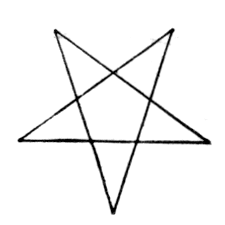
the study of the star polygon, a figure that they could
use in their profession. The cathedral builders, as their
art progressed, found that architectural drawings were
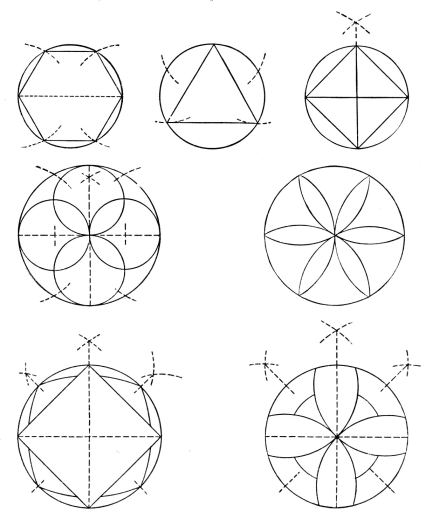
more exact if made with a single opening of the compasses,
and it is probable that their influence led to the
development of this phase of geometry in the Middle
Ages as a practical application of the science. Later, and
about the beginning of the sixteenth century, the revival
of art, and particularly the great development of painting,
led to the practical application of geometry to the
study of perspective and of those curves[6] that occur
most frequently in the graphic arts. The sixteenth and
seventeenth centuries witnessed the publication of a large
number of treatises on practical geometry, usually relating
to the measuring of distances and partly answering
the purposes of our present trigonometry. Such were
the well-known treatises of Belli (1569), Cataneo (1567),
and Bartoli (1589).[7]
The period of two centuries from about 1600 to about
1800 was quite as much given to experiments in the
creation of a practical geometry as is the present time,
and it was no doubt as much by way of protest against
this false idea of the subject as a desire to improve
upon Euclid that led the great French mathematician,
Legendre, to publish his geometry in 1794,—a work
that soon replaced Euclid in the schools of America.
It thus appears that the effort to make geometry practical
is by no means new. Euclid knew of it, the Middle
Ages contributed to it, that period vaguely styled the
Renaissance joined in the movement, and the first three
centuries of printing contributed a large literature to the
subject. Out of all this effort some genuine good remains,
but relatively not very much.[8] And so it will be with
the present movement; it will serve its greatest purpose
in making teachers think and read, and in adding to
their interest and enthusiasm and to the interest of their
pupils; but it will not greatly change geometry, because
no serious person ever believed that geometry was taught
chiefly for practical purposes, or was made more interesting
or valuable through such a pretense. Changes in
sequence, in definitions, and in proofs will come little by
little; but that there will be any such radical change in
these matters in the immediate future, as some writers
have anticipated, is not probable.[9]
A recent writer of much acumen[10] has summed up
this thought in these words:
Not one tenth of the graduates of our high schools ever enter
professions in which their algebra and geometry are applied to
concrete realities; not one day in three hundred sixty-five is a
high school graduate called upon to "apply," as it is called, an
algebraic or a geometrical proposition.... Why, then, do we
teach these subjects, if this alone is the sense of the word "practical"!...
To me the solution of this paradox consists in boldly
confronting the dilemma, and in saying that our conception of
the practical utility of those studies must be readjusted, and that
we have frankly to face the truth that the "practical" ends we
seek are in a sense ideal practical ends, yet such as have, after all,
an eminently utilitarian value in the intellectual sphere.
He quotes from C. S. Jackson, a progressive contemporary
teacher of mechanics in England, who speaks of
pupils confusing millimeters and centimeters in some
simple computation, and who adds:
There is the enemy! The real enemy we have to fight against,
whatever we teach, is carelessness, inaccuracy, forgetfulness, and
slovenliness. That battle has been fought and won with diverse
weapons. It has, for instance, been fought with Latin grammar
before now, and won. I say that because we must be very careful
to guard against the notion that there is any one panacea for
this sort of thing. It borders on quackery to say that elementary
physics will cure everything.
And of course the same thing may be said for mathematics.
Nevertheless it is doubtful if we have any other subject
that does so much to bring to the front this danger of
carelessness, of slovenly reasoning, of inaccuracy, and of
forgetfulness as this science of geometry, which has been
so polished and perfected as the centuries have gone on.
There have been those who did not proclaim the utilitarian
value of geometry, but who fell into as serious an
error, namely, the advocating of geometry as a means of
training the memory. In times not so very far past, and
to some extent to-day, the memorizing of proofs has been
justified on this ground. This error has, however, been
fully exposed by our modern psychologists. They have
shown that the person who memorizes the propositions
of Euclid by number is no more capable of memorizing
other facts than he was before, and that the learning of
proofs verbatim is of no assistance whatever in retaining
matter that is helpful in other lines of work. Geometry,
therefore, as a training of the memory is of no more value
than any other subject in the curriculum.
If geometry is not studied chiefly because it is practical,
or because it trains the memory, what reasons can
be adduced for its presence in the courses of study of
every civilized country? Is it not, after all, a mere fetish,
and are not those virulent writers correct who see nothing
good in the subject save only its utilities?[11] Of this
type one of the most entertaining is William J. Locke,[12]
whose words upon the subject are well worth reading:
... I earned my living at school slavery, teaching to children
the most useless, the most disastrous, the most soul-cramping
branch of knowledge wherewith pedagogues in their insensate
folly have crippled the minds and blasted the lives of thousands
of their fellow creatures—elementary mathematics. There is no
more reason for any human being on God's earth to be acquainted
with the binomial theorem or the solution of triangles, unless
he is a professional scientist,—when he can begin to specialize in
mathematics at the same age as the lawyer begins to specialize
in law or the surgeon in anatomy,—than for him to be expert in
Choctaw, the Cabala, or the Book of Mormon. I look back with
feelings of shame and degradation to the days when, for a crust
of bread, I prostituted my intelligence to wasting the precious
hours of impressionable childhood, which could have been filled
with so many beautiful and meaningful things, over this utterly
futile and inhuman subject. It trains the mind,—it teaches boys
to think, they say. It doesn't. In reality it is a cut-and-dried subject,
easy to fit into a school curriculum. Its sacrosanctity saves
educationalists an enormous amount of trouble, and its chief use
is to enable mindless young men from the universities to make a
dishonest living by teaching it to others, who in their turn may
teach it to a future generation.
To be fair we must face just such attacks, and we
must recognize that they set forth the feelings of many
honest people. One is tempted to inquire if Mr. Locke
could have written in such an incisive style if he had not,
as was the case, graduated with honors in mathematics
at one of the great universities. But he might reply that
if his mind had not been warped by mathematics, he
would have written more temperately, so the honors in
the argument would be even. Much more to the point is
the fact that Mr. Locke taught mathematics in the schools
of England, and that these schools do not seem to the
rest of the world to furnish a good type of the teaching
of elementary mathematics. No country goes to England
for its model in this particular branch of education,
although the work is rapidly changing there, and Mr.
Locke pictures a local condition in teaching rather than
a general condition in mathematics. Few visitors to the
schools of England would care to teach mathematics as
they see it taught there, in spite of their recognition of
the thoroughness of the work and the earnestness of
many of the teachers. It is also of interest to note that
the greatest protests against formal mathematics have
come from England, as witness the utterances of such
men as Sir William Hamilton and Professors Perry,
Minchin, Henrici, and Alfred Lodge. It may therefore
be questioned whether these scholars are not unconsciously
protesting against the English methods and
curriculum rather than against the subject itself. When
Professor Minchin says that he had been through the
six books of Euclid without really understanding an
angle, it is Euclid's text and his own teacher that are
at fault, and not geometry.
Before considering directly the question as to why
geometry should be taught, let us turn for a moment to
the other subjects in the secondary curriculum. Why,
for example, do we study literature? "It does not lower
the price of bread," as Malherbe remarked in speaking
of the commentary of Bachet on the great work of
Diophantus. Is it for the purpose of making authors?
Not one person out of ten thousand who study literature
ever writes for publication. And why do we allow pupils
to waste their time in physical education? It uses valuable
hours, it wastes money, and it is dangerous to life
and limb. Would it not be better to set pupils at sawing
wood? And why do we study music? To give pleasure
by our performances? How many who attempt to
play the piano or to sing give much pleasure to any but
themselves, and possibly their parents? The study of
grammar does not make an accurate writer, nor the study
of rhetoric an orator, nor the study of meter a poet, nor
the study of pedagogy a teacher. The study of geography
in the school does not make travel particularly easier,
nor does the study of biology tend to populate the earth.
So we might pass in review the various subjects that
we study and ought to study, and in no case would we
find utility the moving cause, and in every case would
we find it difficult to state the one great reason for the
pursuit of the subject in question,—and so it is with
geometry.
What positive reasons can now be adduced for the
study of a subject that occupies upwards of a year in the
school course, and that is, perhaps unwisely, required of
all pupils? Probably the primary reason, if we do not
attempt to deceive ourselves, is pleasure. We study
music because music gives us pleasure, not necessarily
our own music, but good music, whether ours, or, as is
more probable, that of others. We study literature
because we derive pleasure from books; the better the
book the more subtle and lasting the pleasure. We
study art because we receive pleasure from the great
works of the masters, and probably we appreciate them
the more because we have dabbled a little in pigments
or in clay. We do not expect to be composers, or poets,
or sculptors, but we wish to appreciate music and letters
and the fine arts, and to derive pleasure from them and
to be uplifted by them. At any rate, these are the nobler
reasons for their study.
So it is with geometry. We study it because we derive
pleasure from contact with a great and an ancient body
of learning that has occupied the attention of master
minds during the thousands of years in which it has been
perfected, and we are uplifted by it. To deny that our
pupils derive this pleasure from the study is to confess
ourselves poor teachers, for most pupils do have positive
enjoyment in the pursuit of geometry, in spite of the
tradition that leads them to proclaim a general dislike
for all study. This enjoyment is partly that of the game,—the
playing of a game that can always be won, but that
cannot be won too easily. It is partly that of the æsthetic,
the pleasure of symmetry of form, the delight of fitting
things together. But probably it lies chiefly in the mental
uplift that geometry brings, the contact with absolute
truth, and the approach that one makes to the
Infinite. We are not quite sure of any one thing in
biology; our knowledge of geology is relatively very
slight, and the economic laws of society are uncertain to
every one except some individual who attempts to set
them forth; but before the world was fashioned the
square on the hypotenuse was equal to the sum of the
squares on the other two sides of a right triangle, and it
will be so after this world is dead; and the inhabitant of
Mars, if he exists, probably knows its truth as we know
it. The uplift of this contact with absolute truth, with
truth eternal, gives pleasure to humanity to a greater or
less degree, depending upon the mental equipment of the
particular individual; but it probably gives an appreciable
amount of pleasure to every student of geometry who
has a teacher worthy of the name. First, then, and foremost
as a reason for studying geometry has always stood,
and will always stand, the pleasure and the mental uplift
that comes from contact with such a great body of human
learning, and particularly with the exact truth that it
contains. The teacher who is imbued with this feeling
is on the road to success, whatever method of presentation
he may use; the one who is not imbued with it is
on the road to failure, however logical his presentation
or however large his supply of practical applications.
Subordinate to these reasons for studying geometry
are many others, exactly as with all other subjects of the
curriculum. Geometry, for example, offers the best developed
application of logic that we have, or are likely to
have, in the school course. This does not mean that it
always exemplifies perfect logic, for it does not; but to
the pupil who is not ready for logic, per se, it offers an
example of close reasoning such as his other subjects do
not offer. We may say, and possibly with truth, that
one who studies geometry will not reason more clearly
on a financial proposition than one who does not; but in
spite of the results of the very meager experiments of the
psychologists, it is probable that the man who has had
some drill in syllogisms, and who has learned to select
the essentials and to neglect the nonessentials in reaching
his conclusions, has acquired habits in reasoning that
will help him in every line of work. As part of this
equipment there is also a terseness of statement and a
clearness in arrangement of points in an argument that
has been the subject of comment by many writers.
Upon this same topic an English writer, in one of the
sanest of recent monographs upon the subject,[13] has
expressed his views in the following words:
The statement that a given individual has received a sound
geometrical training implies that he has segregated from the
whole of his sense impressions a certain set of these impressions,
that he has then eliminated from their consideration all irrelevant
impressions (in other words, acquired a subjective command of
these impressions), that he has developed on the basis of these
impressions an ordered and continuous system of logical deduction,
and finally that he is capable of expressing the nature of
these impressions and his deductions therefrom in terms simple
and free from ambiguity. Now the slightest consideration will
convince any one not already conversant with the idea, that the
same sequence of mental processes underlies the whole career of
any individual in any walk of life if only he is not concerned
entirely with manual labor; consequently a full training in the
performance of such sequences must be regarded as forming an
essential part of any education worthy of the name. Moreover,
the full appreciation of such processes has a higher value than is
contained in the mental training involved, great though this be,
for it induces an appreciation of intellectual unity and beauty
which plays for the mind that part which the appreciation of
schemes of shape and color plays for the artistic faculties; or, again,
that part which the appreciation of a body of religious doctrine
plays for the ethical aspirations. Now geometry is not the sole
possible basis for inculcating this appreciation. Logic is an alternative
for adults, provided that the individual is possessed of
sufficient wide, though rough, experience on which to base his
reasoning. Geometry is, however, highly desirable in that the
objective bases are so simple and precise that they can be grasped
at an early age, that the amount of training for the imagination is
very large, that the deductive processes are not beyond the scope of
ordinary boys, and finally that it affords a better basis for exercise
in the art of simple and exact expression than any other
possible subject of a school course.
Are these results really secured by teachers, however,
or are they merely imagined by the pedagogue as a justification
for his existence? Do teachers have any such
appreciation of geometry as has been suggested, and even
if they have it, do they impart it to their pupils? In
reply it may be said, probably with perfect safety, that
teachers of geometry appreciate their subject and lead
their pupils to appreciate it to quite as great a degree as
obtains in any other branch of education. What teacher
appreciates fully the beauties of "In Memoriam," or of
"Hamlet," or of "Paradise Lost," and what one inspires
his pupils with all the nobility of these world classics?
What teacher sees in biology all the grandeur of the
evolution of the race, or imparts to his pupils the noble
lessons of life that the study of this subject should suggest?
What teacher of Latin brings his pupils to read
the ancient letters with full appreciation of the dignity
of style and the nobility of thought that they contain?
And what teacher of French succeeds in bringing a pupil
to carry on a conversation, to read a French magazine,
to see the history imbedded in the words that are used,
to realize the charm and power of the language, or to
appreciate to the full a single classic? In other words,
none of us fully appreciates his subject, and none of us
can hope to bring his pupils to the ideal attitude toward
any part of it. But it is probable that the teacher of
geometry succeeds relatively better than the teacher of
other subjects, because the science has reached a relatively
higher state of perfection. The body of truth in
geometry has been more clearly marked out, it has been
more successfully fitted together, its lesson is more patent,
and the experience of centuries has brought it into a
shape that is more usable in the school. While, therefore,
we have all kinds of teaching in all kinds of subjects,
the very nature of the case leads to the belief that
the class in geometry receives quite as much from the
teacher and the subject as the class in any other branch
in the school curriculum.
But is this not mere conjecture? What are the results
of scientific investigation of the teaching of geometry?
Unfortunately there is little hope from the results of
such an inquiry, either here or in other fields. We cannot
first weigh a pupil in an intellectual or moral balance,
then feed him geometry, and then weigh him again, and
then set back his clock of time and begin all over again
with the same individual. There is no "before taking"
and "after taking" of a subject that extends over a year
or two of a pupil's life. We can weigh utilities roughly,
we can estimate the pleasure of a subject relatively, but
we cannot say that geometry is worth so many dollars,
and history so many, and so on through the curriculum.
The best we can do is to ask ourselves what the various
subjects, with teachers of fairly equal merit, have done
for us, and to inquire what has been the experience of
other persons. Such an investigation results in showing
that, with few exceptions, people who have studied
geometry received as much of pleasure, of inspiration,
of satisfaction, of what they call training from geometry
as from any other subject of study,—given teachers of
equal merit,—and that they would not willingly give up
the something which geometry brought to them. If this
were not the feeling, and if humanity believed that
geometry is what Mr. Locke's words would seem to
indicate, it would long ago have banished it from the
schools, since upon this ground rather than upon the
ground of utility the subject has always stood.
These seem to be the great reasons for the study of
geometry, and to search for others would tend to weaken
the argument. At first sight they may not seem to justify
the expenditure of time that geometry demands, and
they may seem unduly to neglect the argument that
geometry is a stepping-stone to higher mathematics.
Each of these points, however, has been neglected purposely.
A pupil has a number of school years at his
disposal; to what shall they be devoted? To literature?
What claim has letters that is such as to justify the
exclusion of geometry? To music, or natural science,
or language? These are all valuable, and all should be
studied by one seeking a liberal education; but for the
same reason geometry should have its place. What subject,
in fine, can supply exactly what geometry does?
And if none, then how can the pupil's time be better
expended than in the study of this science?[14] As to the
second point, that a claim should be set forth that geometry
is a sine qua non to higher mathematics, this belief
is considerably exaggerated because there are relatively
few who proceed from geometry to a higher branch of
mathematics. This argument would justify its status as
an elective rather than as a required subject.
Let us then stand upon the ground already marked
out, holding that the pleasure, the culture, the mental
poise, the habits of exact reasoning that geometry brings,
and the general experience of mankind upon the subject
are sufficient to justify us in demanding for it a reasonable
amount of time in the framing of a curriculum.
Let us be fair in our appreciation of all other branches,
but let us urge that every student may have an opportunity
to know of real geometry, say for a single year,
thereafter pursuing it or not, according as we succeed in
making its value apparent, or fail in our attempt to present
worthily an ancient and noble science to the mind
confided to our instruction.
The shortsightedness of a narrow education, of an
education that teaches only machines to a prospective
mechanic, and agriculture to a prospective farmer, and
cooking and dressmaking to the girl, and that would
exclude all mathematics that is not utilitarian in the
narrow sense, cannot endure.
The community has found out that such schemes may be well
fitted to give the children a good time in school, but lead them
to a bad time afterward. Life is hard work, and if they have
never learned in school to give their concentrated attention to that
which does not appeal to them and which does not interest them
immediately, they have missed the most valuable lesson of their
school years. The little practical information they could have
learned at any time; the energy of attention and concentration
can no longer be learned if the early years are wasted. However
narrow and commercial the standpoint which is chosen may be,
it can always be found that it is the general education which pays
best, and the more the period of cultural work can be expanded
the more efficient will be the services of the school for the practical
services of the nation.[15]
Of course no one should construe these remarks as
opposing in the slightest degree the laudable efforts that
are constantly being put forth to make geometry more
interesting and to vitalize it by establishing as strong
motives as possible for its study. Let the home, the
workshop, physics, art, play,—all contribute their quota
of motive to geometry as to all mathematics and all other
branches. But let us never forget that geometry has a
raison d'être beyond all this, and that these applications
are sought primarily for the sake of geometry, and that
geometry is not taught primarily for the sake of these
applications.
When we consider how often geometry is attacked by
those who profess to be its friends, and how teachers who
have been trained in mathematics occasionally seem to
make of the subject little besides a mongrel course in
drawing and measuring, all the time insisting that they
are progressive while the champions of real geometry are
reactionary, it is well to read some of the opinions of the
masters. The following quotations may be given occasionally
in geometry classes as showing the esteem in
which the subject has been held in various ages, and at
any rate they should serve to inspire the teacher to
greater love for his subject.
The enemies of geometry, those who know it only imperfectly,
look upon the theoretical problems, which constitute the most
difficult part of the subject, as mental games which consume time
and energy that might better be employed in other ways. Such a
belief is false, and it would block the progress of science if it
were credible. But aside from the fact that the speculative problems,
which at first sight seem barren, can often be applied to useful
purposes, they always stand as among the best means to
develop and to express all the forces of the human intelligence.—Abbé
Bossut.
The sailor whom an exact observation of longitude saves from
shipwreck owes his life to a theory developed two thousand years
ago by men who had in mind merely the speculations of abstract
geometry.—Condorcet.
If mathematical heights are hard to climb, the fundamental
principles lie at every threshold, and this fact allows them to be
comprehended by that common sense which Descartes declared
was "apportioned equally among all men."—Collet.
It may seem strange that geometry is unable to define the
terms which it uses most frequently, since it defines neither
movement, nor number, nor space,—-the three things with which it
is chiefly concerned. But we shall not be surprised if we stop to
consider that this admirable science concerns only the most simple
things, and the very quality that renders these things worthy
of study renders them incapable of being defined. Thus the very
lack of definition is rather an evidence of perfection than a
defect, since it comes not from the obscurity of the terms, but
from the fact that they are so very well known.—Pascal.
God eternally geometrizes.—Plato.
God is a circle of which the center is everywhere and the circumference
nowhere.—Rabelais.
Without mathematics no one can fathom the depths of philosophy.
Without philosophy no one can fathom the depths of
mathematics. Without the two no one can fathom the depths
of anything.—Bordas-Demoulin.
We may look upon geometry as a practical logic, for the truths
which it studies, being the most simple and most clearly understood
of all truths, are on this account the most susceptible of
ready application in reasoning.—D'Alembert.
The advance and the perfecting of mathematics are closely
joined to the prosperity of the nation.—Napoleon.
Hold nothing as certain save what can be demonstrated.—Newton.
To measure is to know.—Kepler.
The method of making no mistake is sought by every one.
The logicians profess to show the way, but the geometers alone
ever reach it, and aside from their science there is no genuine
demonstration.—Pascal.
The taste for exactness, the impossibility of contenting one's
self with vague notions or of leaning upon mere hypotheses, the
necessity for perceiving clearly the connection between certain
propositions and the object in view,—these are the most precious
fruits of the study of mathematics.—Lacroix.
Bibliography. Smith, The Teaching of Elementary Mathematics,
p. 234, New York, 1900; Henrici, Presidential Address before
the British Association, Nature, Vol. XXVIII, p. 497; Hill, Educational
Value of Mathematics, Educational Review, Vol. IX,
p. 349; Young, The Teaching of Mathematics, p. 9, New York,
1907. The closing quotations are from Rebière, Mathématiques
et Mathématiciens, Paris, 1893.
The geometry of very ancient peoples was largely the
mensuration of simple areas and solids, such as is taught
to children in elementary arithmetic to-day. They early
learned how to find the area of a rectangle, and in the
oldest mathematical records that have come down to us
there is some discussion of the area of triangles and the
volume of solids.
The earliest documents that we have relating to geometry
come to us from Babylon and Egypt. Those from
Babylon are written on small clay tablets, some of them
about the size of the hand, these tablets afterwards having
been baked in the sun. They show that the Babylonians
of that period knew something of land measures, and perhaps
had advanced far enough to compute the area of a
trapezoid. For the mensuration of the circle they later
used, as did the early Hebrews, the value π = 3. A tablet
in the British Museum shows that they also used
such geometric forms as triangles and circular segments
in astrology or as talismans.
The Egyptians must have had a fair knowledge of
practical geometry long before the date of any mathematical
treatise that has come down to us, for the building
of the pyramids, between 3000 and 2400 B.C., required
the application of several geometric principles. Some
knowledge of surveying must also have been necessary
to carry out the extensive plans for irrigation that were
executed under Amenemhat III, about 2200 B.C.
The first definite knowledge that we have of Egyptian
mathematics comes to us from a manuscript copied
on papyrus, a kind of paper used about the Mediterranean
in early times. This copy was made by one Aah-mesu
(The Moon-born), commonly called Ahmes, who probably
flourished about 1700 B.C. The original from which
he copied, written about 2300 B.C., has been lost, but the
papyrus of Ahmes, written nearly four thousand years ago,
is still preserved, and is now in the British Museum. In
this manuscript, which is devoted chiefly to fractions and
to a crude algebra, is found some work on mensuration.
Among the curious rules are the incorrect ones that the
area of an isosceles triangle equals half the product of
the base and one of the equal sides; and that the area of
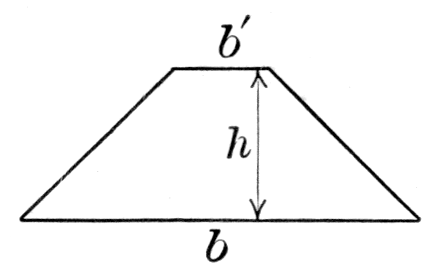
a trapezoid having bases b, b', and the nonparallel sides
each equal to a, is ½a(b + b'). One noteworthy advance
appears, however. Ahmes gives a rule for finding the
area of a circle, substantially as follows: Multiply the
square on the radius by (16/9)2, which is equivalent to
taking for π the value 3.1605. This papyrus also contains
some treatment of the mensuration of solids, particularly
with reference to the capacity of granaries.
There is also some slight mention of similar figures, and
an extensive treatment of unit fractions,—fractions that
were quite universal among the ancients. In the line of
algebra it contains a brief treatment of the equation of
the first degree with one unknown, and of progressions.[16]
Herodotus tells us that Sesostris, king of Egypt,[17]
divided the land among his people and marked out the
boundaries after the overflow of the Nile, so that surveying
must have been well known in his day. Indeed, the
harpedonaptæ, or rope stretchers, acquired their name
because they stretched cords, in which were knots, so as
to make the right triangle 3, 4, 5, when they wished to
erect a perpendicular. This is a plan occasionally used
by surveyors to-day, and it shows that the practical
application of the Pythagorean Theorem was known long
before Pythagoras gave what seems to have been the first
general proof of the proposition.
From Egypt, and possibly from Babylon, geometry
passed to the shores of Asia Minor and Greece. The
scientific study of the subject begins with Thales, one of
the Seven Wise Men of the Grecian civilization. Born
at Miletus, not far from Smyrna and Ephesus, about
640 B.C., he died at Athens in 548 B.C. He spent his
early manhood as a merchant, accumulating the wealth
that enabled him to spend his later years in study. He
visited Egypt, and is said to have learned such elements
of geometry as were known there. He founded a school
of mathematics and philosophy at Miletus, known from
the country as the Ionic School. How elementary the
knowledge of geometry then was may be understood
from the fact that tradition attributes only about four
propositions to Thales,—(1) that vertical angles are
equal, (2) that equal angles lie opposite the equal sides
of an isosceles triangle, (3) that a triangle is determined
by two angles and the included side, (4) that a diameter
bisects the circle, and possibly the propositions about the
angle-sum of a triangle for special cases, and the angle
inscribed in a semicircle.[18]
The greatest pupil of Thales, and one of the most
remarkable men of antiquity, was Pythagoras. Born
probably on the island of Samos, just off the coast of
Asia Minor, about the year 580 B.C., Pythagoras set forth
as a young man to travel. He went to Miletus and
studied under Thales, probably spent several years in
Egypt, very likely went to Babylon, and possibly went
even to India, since tradition asserts this and the nature
of his work in mathematics suggests it. In later life he
went to a Greek colony in southern Italy, and at Crotona,
in the southeastern part of the peninsula, he founded
a school and established a secret society to propagate his
doctrines. In geometry he is said to have been the first
to demonstrate the proposition that the square on the
hypotenuse is equal to the sum of the squares upon
the other two sides of a right triangle. The proposition
was known in India and Egypt before his time, at any
rate for special cases, but he seems to have been the first
to prove it. To him or to his school seems also to have
been due the construction of the regular pentagon and
of the five regular polyhedrons. The construction of the
regular pentagon requires the dividing of a line into
extreme and mean ratio, and this problem is commonly
assigned to the Pythagoreans, although it played an
important part in Plato's school. Pythagoras is also
said to have known that six equilateral triangles, three
regular hexagons, or four squares, can be placed about
a point so as just to fill the 360°, but that no other regular
polygons can be so placed. To his school is also due
the proof for the general case that the sum of the angles
of a triangle equals two right angles, the first knowledge
of the size of each
angle of a regular
polygon, and the
construction of at
least one star-polygon,
the star-pentagon,
which became
the badge
of his fraternity.
The brotherhood
founded by Pythagoras
proved
so offensive to the
government that
it was dispersed
before the death
of the master.
Pythagoras fled to
Megapontum, a seaport
lying to the
north of Crotona,
and there he died
about 501 B.C.[19]
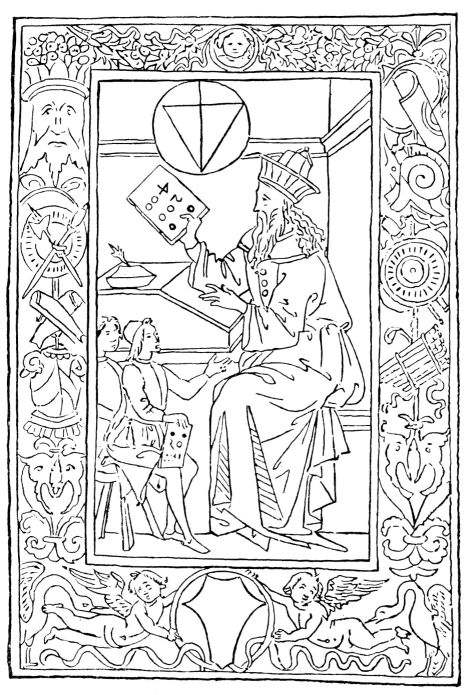 Fanciful Portrait of Pythagoras
Calandri's Arithmetic, 1491
Fanciful Portrait of Pythagoras
Calandri's Arithmetic, 1491
For two centuries after Pythagoras geometry passed
through a period of discovery of propositions. The state
of the science may be seen from the fact that Œnopides
of Chios, who flourished about 465 B.C., and who had
studied in Egypt, was celebrated because he showed
how to let fall a perpendicular to a line, and how to
make an angle equal to a given angle. A few years
later, about 440 B.C., Hippocrates of Chios wrote the
first Greek textbook on mathematics. He knew that the
areas of circles are proportional to the squares on their
radii, but was ignorant of the fact that equal central
angles or equal inscribed angles intercept equal arcs.
Antiphon and Bryson, two Greek scholars, flourished
about 430 B.C. The former attempted to find the area of
a circle by doubling the number of sides of a regular
inscribed polygon, and the latter by doing the same for
both inscribed and circumscribed polygons. They thus
approximately exhausted the area between the polygon
and the circle, and hence this method is known as the
method of exhaustions.
About 420 B.C. Hippias of Elis invented a certain
curve called the quadratrix, by means of which he
could square the circle and trisect any angle. This
curve cannot be constructed by the unmarked straightedge
and the compasses, and when we say that it is
impossible to square the circle or to trisect any angle,
we mean that it is impossible by the help of these two
instruments alone.
During this period the great philosophic school of
Plato (429-348 B.C.) flourished at Athens, and to this
school is due the first systematic attempt to create exact
definitions, axioms, and postulates, and to distinguish between
elementary and higher geometry. It was at this
time that elementary geometry became limited to the
use of the compasses and the unmarked straightedge,
which took from this domain the possibility of constructing
a square equivalent to a given circle ("squaring the
circle"), of trisecting any given angle, and of constructing
a cube that should have twice the volume of a given
cube ("duplicating the cube"), these being the three
famous problems of antiquity. Plato and his school
interested themselves with the so-called Pythagorean
numbers, that is, with numbers that would represent
the three sides of a right triangle and hence fulfill the
condition that a2 + b2 = c2. Pythagoras had already given
a rule that would be expressed in modern form, as
¼(m2 + 1)2 = m2 + ¼(m2 - 1)2. The school of Plato found
that ((½m)2 + 1)2 = m2 + ((½m)2 - 1)2. By giving various
values to m, different Pythagorean numbers may be
found. Plato's nephew, Speusippus (about 350 B.C.),
wrote upon this subject. Such numbers were known,
however, both in India and in Egypt, long before this
time.
One of Plato's pupils was Philippus of Mende, in
Egypt, who flourished about 380 B.C. It is said that he
discovered the proposition relating to the exterior angle
of a triangle. His interest, however, was chiefly in
astronomy.
Another of Plato's pupils was Eudoxus of Cnidus
(408-355 B.C.). He elaborated the theory of proportion,
placing it upon a thoroughly scientific foundation. It is
probable that Book V of Euclid, which is devoted to
proportion, is essentially the work of Eudoxus. By means
of the method of exhaustions of Antiphon and Bryson
he proved that the pyramid is one third of a prism, and
the cone is one third of a cylinder, each of the same base
and the same altitude. He wrote the first textbook
known on solid geometry.
The subject of conic sections starts with another pupil
of Plato's, Menæchmus, who lived about 350 B.C. He
cut the three forms of conics (the ellipse, parabola, and
hyperbola) out of three different forms of cone,—the
acute-angled, right-angled, and obtuse-angled,—not noticing
that he could have obtained all three from any form
of right circular cone. It is interesting to see the far-reaching
influence of Plato. While primarily interested
in philosophy, he laid the first scientific foundations for
a system of mathematics, and his pupils were the leaders
in this science in the generation following his greatest
activity.
The great successor of Plato at Athens was Aristotle,
the teacher of Alexander the Great. He also was more
interested in philosophy than in mathematics, but in
natural rather than mental philosophy. With him comes
the first application of mathematics to physics in the
hands of a great man, and with noteworthy results. He
seems to have been the first to represent an unknown
quantity by letters. He set forth the theory of the
parallelogram of forces, using only rectangular components,
however. To one of his pupils, Eudemus of
Rhodes, we are indebted for a history of ancient geometry,
some fragments of which have come down to us.
The first great textbook on geometry, and the
greatest one that has ever appeared, was written by
Euclid, who taught mathematics in the great university
at Alexandria, Egypt, about 300 B.C. Alexandria was
then practically a Greek city, having been named in
honor of Alexander the Great, and being ruled by the
Greeks.
In his work Euclid placed all of the leading propositions
of plane geometry then known, and arranged them
in a logical order. Most geometries of any importance
written since his time have been based upon Euclid,
improving the sequence, symbols, and wording as occasion
demanded. He also wrote upon other branches of
mathematics besides elementary geometry, including a
work on optics. He was not a great creator of mathematics,
but was rather a compiler of the work of others,
an office quite as difficult to fill and quite as honorable.
Euclid did not give much solid geometry because not
much was known then. It was to Archimedes (287-212
B.C.), a famous mathematician of Syracuse, on the island
of Sicily, that some of the most important propositions
of solid geometry are due, particularly those relating to
the sphere and cylinder. He also showed how to find the
approximate value of π by a method similar to the one
we teach to-day, proving that the real value lay between
3-1/7 and 3-10/71. The story goes that the sphere and cylinder
were engraved upon his tomb, and Cicero, visiting
Syracuse many years after his death, found the tomb by
looking for these symbols. Archimedes was the greatest
mathematical physicist of ancient times.
The Greeks contributed little more to elementary
geometry, although Apollonius of Perga, who taught at
Alexandria between 250 and 200 B.C., wrote extensively
on conic sections, and Hypsicles of Alexandria, about
190 B.C., wrote on regular polyhedrons. Hypsicles was
the first Greek writer who is known to have used sexagesimal
fractions,—the degrees, minutes, and seconds
of our angle measure. Zenodorus (180 B.C.) wrote on
isoperimetric figures, and his contemporary, Nicomedes
of Gerasa, invented a curve known as the conchoid, by
means of which he could trisect any angle. Another contemporary,
Diocles, invented the cissoid, or ivy-shaped
curve, by means of which he solved the famous problem
of duplicating the cube, that is, constructing a cube that
should have twice the volume of a given cube.
The greatest of the Greek astronomers, Hipparchus
(180-125 B.C.), lived about this period, and with him
begins spherical trigonometry as a definite science. A
kind of plane trigonometry had been known to the
ancient Egyptians. The Greeks usually employed the
chord of an angle instead of the half chord (sine), the latter
having been preferred by the later Arab writers.
The most celebrated of the later Greek physicists was
Heron of Alexandria, formerly supposed to have lived
about 100 B.C., but now assigned to the first century A.D.
His contribution to geometry was the formula for the
area of a triangle in terms of its sides a, b, and c, with s
standing for the semiperimeter ½(a + b + c). The formula
is
Probably nearly contemporary with Heron was Menelaus
of Alexandria, who wrote a spherical trigonometry.
He gave an interesting proposition relating to plane
and spherical triangles, their sides being cut by a transversal.
For the plane triangle ABC, the sides a, b, and
c being cut respectively in X, Y, and Z, the theorem
asserts substantially that
(AZ/BZ) · (BX/CX) · (CY/AY) = 1.
The most popular writer on astronomy among the
Greeks was Ptolemy (Claudius Ptolemaeus, 87-165 A.D.),
who lived at Alexandria. He wrote a work entitled
"Megale Syntaxis" (The Great Collection), which his
followers designated as Megistos (greatest), on which account
the Arab translators gave it the name "Almagest"
(al meaning "the"). He advanced the science of trigonometry,
but did not contribute to geometry.
At the close of the third century Pappus of Alexandria
(295 A.D.) wrote on geometry, and one of his theorems,
a generalized form of the Pythagorean proposition, is
mentioned in Chapter XVI of this work. Only two
other Greek writers on geometry need be mentioned.
Theon of Alexandria (370 A.D.), the father of the
Hypatia who is the heroine of Charles Kingsley's well-known
novel, wrote a commentary on Euclid to which
we are indebted for some historical information. Proclus
(410-485 A.D.) also wrote a commentary on Euclid, and
much of our information concerning the first Book of
Euclid is due to him.
The East did little for geometry, although contributing
considerably to algebra. The first great Hindu writer
was Aryabhatta, who was born in 476 A.D. He gave the
very close approximation for π, expressed in modern
notation as 3.1416. He also gave rules for finding the
volume of the pyramid and sphere, but they were incorrect,
showing that the Greek mathematics had not yet
reached the Ganges. Another Hindu writer, Brahmagupta
(born in 598 A.D.), wrote an encyclopedia of
mathematics. He gave a rule for finding Pythagorean
numbers, expressed in modern symbols as follows:
He also generalized Heron's formula by asserting that
the area of an inscribed quadrilateral of sides a, b, c, d,
and semiperimeter s, is
The Arabs, about the time of the "Arabian Nights
Tales" (800 A.D.), did much for mathematics, translating
the Greek authors into their language and also bringing
learning from India. Indeed, it is to them that modern
Europe owed its first knowledge of Euclid. They contributed
nothing of importance to elementary geometry,
however.
The greatest of the Arab writers was Mohammed ibn
Musa al-Khowarazmi (820 A.D.). He lived at Bagdad and
Damascus. Although chiefly interested in astronomy, he
wrote the first book bearing the name "algebra" ("Al-jabr
wa'l-muqābalah," Restoration and Equation), composed
an arithmetic using the Hindu numerals,[20] and paid much
attention to geometry and trigonometry.
Euclid was translated from the Arabic into Latin in
the twelfth century, Greek manuscripts not being then
at hand, or being neglected because of ignorance of the
language. The leading translators were Athelhard of
Bath (1120), an English monk; Gherard of Cremona
(1160), an Italian monk; and Johannes Campanus
(1250), chaplain to Pope Urban IV.
The greatest European mathematician of the Middle
Ages was Leonardo of Pisa[21] (ca. 1170-1250). He was
very influential in making the Hindu-Arabic numerals
known in Europe, wrote extensively on algebra, and
was the author of one book on geometry. He contributed
nothing to the elementary theory, however. The
first edition of Euclid was printed in Latin in 1482, the
first one in English appearing in 1570.
Our symbols are modern, + and - first appearing in
a German work in 1489; = in Recorde's "Whetstone of
Witte" in 1557; > and < in the works of Harriot (1560-1621);
and × in a publication by Oughtred (1574-1660).
The most noteworthy advance in geometry in modern
times was made by the great French philosopher Descartes,
who published a small work entitled "La Géométrie"
in 1637. From this springs the modern analytic
geometry, a subject that has revolutionized the methods
of all mathematics. Most of the subsequent discoveries
in mathematics have been in higher branches. To the
great Swiss mathematician Euler (1707-1783) is due,
however, one proposition that has found its way into
elementary geometry, the one showing the relation
between the number of edges, vertices, and faces of a
polyhedron.
There has of late arisen a modern elementary geometry
devoted chiefly to special points and lines relating
to the triangle and the circle, and many interesting propositions
have been discovered. The subject is so extensive
that it cannot find any place in our crowded curriculum,
and must necessarily be left to the specialist.[22] Some idea
of the nature of the work may be obtained from a mention
of a few propositions:
The medians of a triangle are concurrent in the centroid,
or center of gravity of the triangle.
The bisectors of the various interior and exterior angles
of a triangle are concurrent by threes in the incenter or
in one of the three excenters of the triangle.
The common chord of two intersecting circles is a
special case of their radical axis, and tangents to the
circles from any point on the radical axis are equal.
If O is the orthocenter of the triangle ABC, and
X, Y, Z are the feet of the perpendiculars from A, B, C
respectively, and P, Q, R are the mid-points of a, b, c
respectively, and L, M, N are the mid-points of OA, OB,
OC respectively; then the points L, M, N; P, Q, R; X,
Y, Z all lie on a circle, the "nine points circle."
In the teaching of geometry it adds a human interest
to the subject to mention occasionally some of the historical
facts connected with it. For this reason this brief
sketch will be supplemented by many notes upon the
various important propositions as they occur in the several
books described in the later chapters of this work.
We know little of the teaching of geometry in very
ancient times, but we can infer its nature from the
teaching that is still seen in the native schools of the
East. Here a man, learned in any science, will have a
group of voluntary students sitting about him, and to
them he will expound the truth. Such schools may still
be seen in India, Persia, and China, the master sitting
on a mat placed on the ground or on the floor of a
veranda, and the pupils reading aloud or listening to
his words of exposition.
In Egypt geometry seems to have been in early times
mere mensuration, confined largely to the priestly caste.
It was taught to novices who gave promise of success
in this subject, and not to others, the idea of general
culture, of training in logic, of the cultivation of exact
expression, and of coming in contact with truth being
wholly wanting.
In Greece it was taught in the schools of philosophy,
often as a general preparation for philosophic study.
Thus Thales introduced it into his Ionic school, Pythagoras
made it very prominent in his great school at
Crotona in southern Italy (Magna Græcia), and Plato
placed above the door of his Academia the words, "Let
no one ignorant of geometry enter here,"—a kind of
entrance examination for his school of philosophy. In
these gatherings of students it is probable that geometry
was taught in much the way already mentioned for the
schools of the East, a small group of students being
instructed by a master. Printing was unknown, papyrus
was dear, parchment was only in process of invention.
Paper such as we know had not yet appeared, so that
instruction was largely oral, and geometric figures were
drawn by a pointed stick on a board covered with fine
sand, or on a tablet of wax.
But with these crude materials there went an abundance
of time, so that a number of great results were
accomplished in spite of the difficulties attending the
study of the subject. It is said that Hippocrates of Chios
(ca. 440 B.C.) wrote the first elementary textbook on
mathematics and invented the method of geometric reduction,
the replacing of a proposition to be proved by
another which, when proved, allows the first one to be
demonstrated. A little later Eudoxus of Cnidus (ca.
375 B.C.), a pupil of Plato's, used the reductio ad absurdum,
and Plato is said to have invented the method
of proof by analysis, an elaboration of the plan used by
Hippocrates. Thus these early philosophers taught their
pupils not facts alone, but methods of proof, giving them
power as well as knowledge. Furthermore, they taught
them how to discuss their problems, investigating the
conditions under which they are capable of solution.
This feature of the work they called the diorismus, and
it seems to have started with Leon, a follower of Plato.
Between the time of Plato (ca. 400 B.C.) and Euclid
(ca. 300 B.C.) several attempts were made to arrange the
accumulated material of elementary geometry in a textbook.
Plato had laid the foundations for the science, in
the form of axioms, postulates, and definitions, and he
had limited the instruments to the straightedge and the
compasses. Aristotle (ca. 350 B.C.) had paid special attention
to the history of the subject, thus finding out
what had already been accomplished, and had also made
much of the applications of geometry. The world was
therefore ready for a good teacher who should gather
the material and arrange it scientifically. After several
attempts to find the man for such a task, he was discovered
in Euclid, and to his work the next chapter is
devoted.
After Euclid, Archimedes (ca. 250 B.C.) made his great
contributions. He was not a teacher like his illustrious
predecessor, but he was a great discoverer. He has left
us, however, a statement of his methods of investigation
which is helpful to those who teach. These methods
were largely experimental, even extending to the weighing
of geometric forms to discover certain relations, the
proof being given later. Here was born, perhaps, what
has been called the laboratory method of the present.
Of the other Greek teachers we have but little information
as to methods of imparting instruction. It is
not until the Middle Ages that there is much known
in this line. Whatever of geometry was taught seems
to have been imparted by word of mouth in the way of
expounding Euclid, and this was done in the ancient
fashion.
The early Church leaders usually paid no attention
to geometry, but as time progressed the quadrivium, or
four sciences of arithmetic, music, geometry, and astronomy,
came to rank with the trivium (grammar, rhetoric,
dialectics), the two making up the "seven liberal
arts." All that there was of geometry in the first thousand
years of Christianity, however, at least in the great
majority of Church schools, was summed up in a few
definitions and rules of mensuration. Gerbert, who
became Pope Sylvester II in 999 A.D., gave a new
impetus to geometry by discovering a manuscript of
the old Roman surveyors and a copy of the geometry of
Boethius, who paraphrased Euclid about 500 A.D. He
thereupon wrote a brief geometry, and his elevation to
the papal chair tended to bring the study of mathematics
again into prominence.
Geometry now began to have some place in the
Church schools, naturally the only schools of high rank
in the Middle Ages. The study of the subject, however,
seems to have been merely a matter of memorizing.
Geometry received another impetus in the book written
by Leonardo of Pisa in 1220, the "Practica Geometriae."
Euclid was also translated into Latin about this time
(strangely enough, as already stated, from the Arabic
instead of the Greek), and thus the treasury of elementary
geometry was opened to scholars in Europe. From
now on, until the invention of printing (ca. 1450), numerous
writers on geometry appear, but, so far as we know,
the method of instruction remained much as it had always
been. The universities began to appear about the thirteenth
century, and Sacrobosco, a well-known medieval
mathematician, taught mathematics about 1250 in the
University of Paris. In 1336 this university decreed
that mathematics should be required for a degree. In
the thirteenth century Oxford required six books of
Euclid for one who was to teach, but this amount of
work seems to have been merely nominal, for in 1450
only two books were actually read. The universities of
Prague (founded in 1350) and Vienna (statutes of
1389) required most of plane geometry for the teacher's
license, although Vienna demanded but one book for the
bachelor's degree. So, in general, the universities of the
thirteenth, fourteenth, and fifteenth centuries required
less for the degree of master of arts than we now require
from a pupil in our American high schools. On the other
hand, the university students were younger than now,
and were really doing only high school work.
The invention of printing made possible the study of
geometry in a new fashion. It now became possible for
any one to study from a book, whereas before this time
instruction was chiefly by word of mouth, consisting of
an explanation of Euclid. The first Euclid was printed
in 1482, at Venice, and new editions and variations of
this text came out frequently in the next century.
Practical geometries became very popular, and the reaction
against the idea of mental discipline threatened
to abolish the old style of text. It was argued that
geometry was uninteresting, that it was not sufficient in
itself, that boys needed to see the practical uses of the
subject, that only those propositions that were capable
of application should be retained, that there must be a
fusion between the demands of culture and the demands
of business, and that every man who stood for mathematical
ideals represented an obsolete type. Such writers
as Finæus (1556), Bartoli (1589), Belli (1569), and
Cataneo (1567), in the sixteenth century, and Capra
(1678), Gargiolli (1655), and many others in the seventeenth
century, either directly or inferentially, took this
attitude towards the subject,—exactly the attitude that
is being taken at the present time by a number of
teachers in the United States. As is always the case,
to such an extreme did this movement lead that there
was a reaction that brought the Euclid type of book
again to the front, and it has maintained its prominence
even to the present.
The study of geometry in the high schools is relatively
recent. The Gymnasium (classical school preparatory
to the university) at Nürnberg, founded in 1526,
and the Cathedral school at Württemberg (as shown by
the curriculum of 1556) seem to have had no geometry
before 1600, although the Gymnasium at Strassburg
included some of this branch of mathematics in 1578,
and an elective course in geometry was offered at
Zwickau, in Saxony, in 1521. In the seventeenth century
geometry is found in a considerable number of
secondary schools, as at Coburg (1605), Kurfalz (1615,
elective), Erfurt (1643), Gotha (1605), Giessen (1605),
and numerous other places in Germany, although it
appeared but rarely in the secondary schools of France
before the eighteenth century. In Germany the Realschulen—schools
with more science and less classics
than are found in the Gymnasium—came into being in
the eighteenth century, and considerable effort was made
to construct a course in geometry that should be more
practical than that of the modified Euclid. At the opening
of the nineteenth century the Prussian schools were
reorganized, and from that time on geometry has had
a firm position in the secondary schools of all Germany.
In the eighteenth century some excellent textbooks on
geometry appeared in France, among the best being that
of Legendre (1794), which influenced in such a marked
degree the geometries of America. Soon after the opening
of the nineteenth century the lycées of France
became strong institutions, and geometry, chiefly based
on Legendre, was well taught in the mathematical divisions.
A worthy rival of Legendre's geometry was the
work of Lacroix, who called attention continually to the
analogy between the theorems of plane and solid geometry,
and even went so far as to suggest treating the related
propositions together in certain cases.
In England the preparatory schools, such as Rugby,
Harrow, and Eton, did not commonly teach geometry
until quite recently, leaving this work for the universities.
In Christ's Hospital, London, however, geometry
was taught as early as 1681, from a work written by
several teachers of prominence. The highest class at
Harrow studied "Euclid and vulgar fractions" one
period a week in 1829, but geometry was not seriously
studied before 1837. In the Edinburgh Academy as
early as 1885, and in Rugby by 1839, plane geometry
was completed.
Not until 1844 did Harvard require any plane geometry
for entrance. In 1855 Yale required only two
books of Euclid. It was therefore from 1850 to 1875
that plane geometry took a definite place in the American
high school. Solid geometry has not been generally
required for entrance to any eastern college, although
in the West this is not the case. The East teaches plane
geometry more thoroughly, but allows a pupil to enter
college or to go into business with no solid geometry.
Given a year to the subject, it is possible to do little
more than cover plane geometry; with a year and a half
the solid geometry ought easily to be covered also.
Bibliography. Stamper, A History of the Teaching of Elementary
Geometry, New York, 1909, with a very full bibliography
of the subject; Cajori, The Teaching of Mathematics in the
United States, Washington, 1890; Cantor, Geschichte der Mathematik,
Vol. IV, p. 321, Leipzig, 1908; Schotten, Inhalt und
Methode des planimetrischen Unterrichts, Leipzig, 1890.
It is fitting that a chapter in a book upon the teaching
of this subject should be devoted to the life and labors
of the greatest of all textbook writers, Euclid,—a man
whose name has been, for more than two thousand years,
a synonym for elementary plane geometry wherever the
subject has been studied. And yet when an effort is
made to pick up the scattered fragments of his biography,
we are surprised to find how little is known of
one whose fame is so universal. Although more editions
of his work have been printed than of any other book
save the Bible,[23] we do not know when he was born,
or in what city, or even in what country, nor do we
know his race, his parentage, or the time of his death.
We should not feel that we knew much of the life of
a man who lived when the Magna Charta was wrested
from King John, if our first and only source of information
was a paragraph in the works of some historian
of to-day; and yet this is about the situation in
respect to Euclid. Proclus of Alexandria, philosopher,
teacher, and mathematician, lived from 410 to 485 A.D.,
and wrote a commentary on the works of Euclid. In
his writings, which seem to set forth in amplified form
his lectures to the students in the Neoplatonist School
of Alexandria, Proclus makes this statement, and of
Euclid's life we have little else:
Not much younger than these[24] is Euclid, who put together
the "Elements," collecting many of the theorems of Eudoxus,
perfecting many of those of Theætetus, and also demonstrating
with perfect certainty what his predecessors had but insufficiently
proved. He flourished in the time of the first Ptolemy, for
Archimedes, who closely followed this ruler,[25] speaks of Euclid.
Furthermore it is related that Ptolemy one time demanded of
him if there was in geometry no shorter way than that of the
"Elements," to whom he replied that there was no royal road
to geometry.[26] He was therefore younger than the pupils of
Plato, but older than Eratosthenes and Archimedes; for the
latter were contemporary with one another, as Eratosthenes
somewhere says.[27]
Thus we have in a few lines, from one who lived perhaps
seven or eight hundred years after Euclid, nearly
all that is known of the most famous teacher of geometry
that ever lived. Nevertheless, even this little tells
us about when he flourished, for Hermotimus and Philippus
were pupils of Plato, who died in 347 B.C.,
whereas Archimedes was born about 287 B.C. and was
writing about 250 B.C. Furthermore, since Ptolemy I
reigned from 306 to 283 B.C., Euclid must have been
teaching about 300 B.C., and this is the date that is
generally assigned to him.
Euclid probably studied at Athens, for until he himself
assisted in transferring the center of mathematical
culture to Alexandria, it had long been in the Grecian
capital, indeed since the time of Pythagoras. Moreover,
numerous attempts had been made at Athens to do exactly
what Euclid succeeded in doing,—to construct a
logical sequence of propositions; in other words, to write
a textbook on plane geometry. It was at Athens, therefore,
that he could best have received the inspiration to
compose his "Elements."[28] After finishing his education
at Athens it is quite probable that he, like other savants
of the period, was called to Alexandria by Ptolemy
Soter, the king, to assist in establishing the great school
which made that city the center of the world's learning
for several centuries. In this school he taught, and here
he wrote the "Elements" and numerous other works,
perhaps ten in all.
Although the Greek writers who may have known
something of the life of Euclid have little to say of him,
the Arab writers, who could have known nothing save
from Greek sources, have allowed their imaginations the
usual latitude in speaking of him and of his labors.
Thus Al-Qifṫī, who wrote in the thirteenth century,
has this to say in his biographical treatise "Ta'rīkh al-Ḥukamā":
Euclid, son of Naucrates, grandson of Zenarchus, called the
author of geometry, a Greek by nationality, domiciled at Damascus,
born at Tyre, most learned in the science of geometry, published
a most excellent and most useful work entitled "The Foundation
or Elements of Geometry," a subject in which no more general
treatise existed before among the Greeks; nay, there was no one
even of later date who did not walk in his footsteps and frankly
profess his doctrine.
This is rather a specimen of the Arab tendency to
manufacture history than a serious contribution to the
biography of Euclid, of whose personal history we have
only the information given by Proclus.
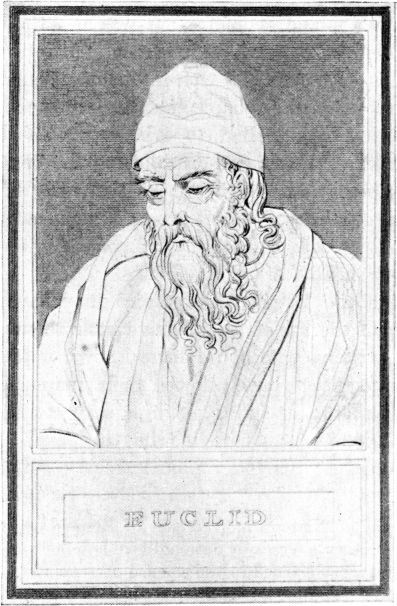 Euclid
From an old print
Euclid
From an old print
Euclid's works at once took high rank, and they are
mentioned by various classical authors. Cicero knew of
them, and Capella (ca. 470 A.D.), Cassiodorius (ca. 515
A.D.), and Boethius (ca. 480-524 A.D.) were all more
or less familiar with the "Elements." With the advance
of the Dark Ages, however, learning was held in less and
less esteem, so that Euclid was finally forgotten, and
manuscripts of his works were either destroyed or buried
in some remote cloister. The Arabs, however, whose
civilization assumed prominence from about 750 A.D. to
about 1500, translated the most important treatises of
the Greeks, and Euclid's "Elements" among the rest.
One of these Arabic editions an English monk of the
twelfth century, one Athelhard (Æthelhard) of Bath,
found and translated into Latin (ca. 1120 A.D.). A little
later Gherard of Cremona (1114-1187) made a new
translation from the Arabic, differing in essential features
from that of Athelhard, and about 1260 Johannes
Campanus made still a third translation, also from
Arabic into Latin.[29] There is reason to believe that
Athelhard, Campanus, and Gherard may all have had
access to an earlier Latin translation, since all are quite
alike in some particulars while diverging noticeably in
others. Indeed, there is an old English verse that relates:
The clerk Euclide on this wyse hit fonde
Thys craft of gemetry yn Egypte londe ...
Thys craft com into England, as y yow say,
Yn tyme of good Kyng Adelstone's day.
If this be true, Euclid was known in England as early
as 924-940 A.D.
Without going into particulars further, it suffices to
say that the modern knowledge of Euclid came first
through the Arabic into the Latin, and the first printed
edition of the "Elements" (Venice, 1482) was the
Campanus translation. Greek manuscripts now began
to appear, and at the present time several are known.
There is a manuscript of the ninth century in the Bodleian
library at Oxford, one of the tenth century in the
Vatican, another of the tenth century in Florence, one
of the eleventh century at Bologna, and two of the
twelfth century at Paris. There are also fragments containing
bits of Euclid in Greek, and going back as far as
the second and third century A.D. The first modern
translation from the Greek into the Latin was made by
Zamberti (or Zamberto),[30] and was printed at Venice in
1513. The first translation into English was made by Sir
Henry Billingsley and was printed in 1570, sixteen
years before he became Lord Mayor of London.
Proclus, in his commentary upon Euclid's work,
remarks:
In the whole of geometry there are certain leading theorems,
bearing to those which follow the relation of a principle, all-pervading,
and furnishing proofs of many properties. Such theorems
are called by the name of elements, and their function may be
compared to that of the letters of the alphabet in relation to
language, letters being indeed called by the same name in Greek
[στοιχεια, stoicheia].[31]
This characterizes the work of Euclid, a collection of
the basic propositions of geometry, and chiefly of plane
geometry, arranged in logical sequence, the proof of
each depending upon some preceding proposition, definition,
or assumption (axiom or postulate). The number
of the propositions of plane geometry included in the
"Elements" is not entirely certain, owing to some disagreement
in the manuscripts, but it was between one
hundred sixty and one hundred seventy-five. It is
possible to reduce this number by about thirty or forty,
because Euclid included a certain amount of geometric
algebra; but beyond this we cannot safely go
in the way of elimination, since from the very nature of
the "Elements" these propositions are basic. The efforts
at revising Euclid have been generally confined, therefore,
to rearranging his material, to rendering more modern
his phraseology, and to making a book that is more
usable with beginners if not more logical in its presentation
of the subject. While there has been an improvement
upon Euclid in the art of bookmaking, and in
minor matters of phraseology and sequence, the educational
gain has not been commensurate with the effort
put forth. With a little modification of Euclid's semi-algebraic
Book II and of his treatment of proportion, with
some scattering of the definitions and the inclusion of
well-graded exercises at proper places, and with attention
to the modern science of bookmaking, the "Elements"
would answer quite as well for a textbook to-day
as most of our modern substitutes, and much better
than some of them. It would, moreover, have the advantage
of being a classic,—somewhat the same advantage
that comes from reading Homer in the original instead
of from Pope's metrical translation. This is not a plea
for a return to the Euclid text, but for a recognition of
the excellence of Euclid's work.
The distinctive feature of Euclid's "Elements," compared
with the modern American textbook, is perhaps
this: Euclid begins a book with what seems to him the
easiest proposition, be it theorem or problem; upon this
he builds another; upon these a third, and so on, concerning
himself but little with the classification of propositions.
Furthermore, he arranges his propositions so
as to construct his figures before using them. We, on
the other hand, make some little attempt to classify our
propositions within each book, and we make no attempt
to construct our figures before using them, or at least
to prove that the constructions are correct. Indeed, we
go so far as to study the properties of figures that we
cannot construct, as when we ask for the size of the
angle of a regular heptagon. Thus Euclid begins Book I
by a problem, to construct an equilateral triangle on a
given line. His object is to follow this by problems on
drawing a straight line equal to a given straight line,
and cutting off from the greater of two straight lines a
line equal to the less. He now introduces a theorem,
which might equally well have been his first proposition,
namely, the case of the congruence of two triangles, having
given two sides and the included angle. By means of
his third and fourth propositions he is now able to prove
the pons asinorum, that the angles at the base of an isosceles
triangle are equal. We, on the other hand, seek to group
our propositions where this can conveniently be done,
putting the congruent propositions together, those about
inequalities by themselves, and the propositions about
parallels in one set. The results of the two arrangements
are not radically different, and the effect of either upon
the pupil's mind does not seem particularly better than
that of the other. Teachers who have used both plans
quite commonly feel that, apart from Books II and V,
Euclid is nearly as easily understood as our modern
texts, if presented in as satisfactory dress.
The topics treated and the number of propositions in
the plane geometry of the "Elements" are as follows:
| Book I. |
Rectilinear figures |
48 |
| Book II. |
Geometric algebra |
14 |
| Book III. |
Circles |
37 |
| Book IV. |
Problems about circles |
16 |
| Book V. |
Proportion |
25 |
| Book VI. |
Applications of proportion |
33 |
| |
—— |
| |
173 |
Of these we now omit Euclid's Book II, because we
have an algebraic symbolism that was unknown in his
time, although he would not have used it in geometry
even had it been known. Thus his first proposition in
Book II is as follows:
If there be two straight lines, and one of them be cut into any
number of segments whatever, the rectangle contained by the two
straight lines is equal to the rectangles contained by the uncut
straight line and each of the segments.
This amounts to saying that if x = p + q + r + ···, then
ax = ap + aq + ar + ···. We also materially simplify
Euclid's Book V. He, for example, proves that "If
four magnitudes be proportional, they will also be proportional
alternately." This he proves generally for any
kind of magnitude, while we merely prove it for numbers
having a common measure. We say that we may
substitute for the older form of proportion, namely,
a : b = c : d,
the fractional form a/b = c/d.
From this we have ad = bc.
Whence a/c = b/d.
In this work we assume that we may multiply equals
by b and d. But suppose b and d are cubes, of which,
indeed, we do not even know the approximate numerical
measure; what shall we do? To Euclid the multiplication
by a cube or a polygon or a sphere would have
been entirely meaningless, as it always is from the
standpoint of pure geometry. Hence it is that our treatment
of proportion has no serious standing in geometry
as compared with Euclid's, and our only justification for
it lies in the fact that it is easier. Euclid's treatment
is much more rigorous than ours, but it is adapted to
the comprehension of only advanced students, while ours
is merely a confession, and it should be a frank confession,
of the weakness of our pupils, and possibly, at
times, of ourselves.
If we should take Euclid's Books II and V for granted,
or as sufficiently evident from our study of algebra, we
should have remaining only one hundred thirty-four propositions,
most of which may be designated as basal propositions
of plane geometry. Revise Euclid as we will, we
shall not be able to eliminate any large number of his
fundamental truths, while we might do much worse than
to adopt these one hundred thirty-four propositions in
toto as the bases, and indeed as the definition, of elementary
plane geometry.
Bibliography. Heath, The Thirteen Books of Euclid's Elements,
3 vols., Cambridge, 1908; Frankland, The First Book of Euclid,
Cambridge, 1906; Smith, Dictionary of Greek and Roman Biography,
article Eukleides; Simon, Euclid und die sechs planimetrischen
Bücher, Leipzig, 1901; Gow, History of Greek Mathematics,
Cambridge, 1884, and any of the standard histories of
mathematics. Both Heath and Simon give extensive bibliographies.
The latest standard Greek and Latin texts are Heiberg's,
published by Teubner of Leipzig.
From time to time an effort is made by some teacher,
or association of teachers, animated by a serious desire
to improve the instruction in geometry, to prepare a new
syllabus that shall mark out some "royal road," and it
therefore becomes those who are interested in teaching
to consider with care the results of similar efforts in
recent years. There are many questions which such an
attempt suggests: What is the real purpose of the movement?
What will the teaching world say of the result?
Shall a reckless, ill-considered radicalism dominate the
effort, bringing in a distasteful terminology and symbolism
merely for its novelty, insisting upon an ultralogical
treatment that is beyond the powers of the learner,
rearranging the subject matter to fit some narrow notion
of the projectors, seeking to emasculate mathematics by
looking only to the applications, riding some little hobby
in the way of some particular class of exercises, and cutting
the number of propositions to a minimum that will
satisfy the mere demands of the artisan? Such are some
of the questions that naturally arise in the mind of
every one who wishes well for the ancient science of
geometry.
It is not proposed in this chapter to attempt to answer
these questions, but rather to assist in understanding the
problem by considering the results of similar attempts.
If it shall be found that syllabi have been prepared
under circumstances quite as favorable as those that
obtain at present, and if these syllabi have had little or
no real influence, then it becomes our duty to see if
new plans may be worked out so as to be more successful
than their predecessors. If the older attempts have led to
some good, it is well to know what is the nature of this
good, to the end that new efforts may also result in
something of benefit to the schools.
It is proposed in this chapter to call attention to four
important syllabi, setting forth briefly their distinguishing
features and drawing some conclusions that may be
helpful in other efforts of this nature.
In England two noteworthy attempts have been made
within a century, looking to a more satisfactory sequence
and selection of propositions than is found in Euclid.
Each began with a list of propositions arranged in proper
sequence, and each was thereafter elaborated into a textbook.
Neither accomplished fully the purpose intended,
but each was instrumental in provoking healthy discussion
and in improving the texts from which geometry is
studied.
The first of these attempts was made by Professor
Augustus de Morgan, under the auspices of the Society
for the Diffusion of Useful Knowledge, and it resulted
in a textbook, including "plane, solid, and spherical"
geometry, in six books. According to De Morgan's plan,
plane geometry consisted of three books, the number of
propositions being as follows:
| Book I. |
Rectilinear figures |
60 |
| Book II. |
Ratio, proportion, applications |
69 |
| Book III. |
The circle |
65 |
|
|
—— |
| Total for plane geometry |
194 |
Of the 194 propositions De Morgan selected 114
with their corollaries as necessary for a beginner who
is teaching himself.
In solid geometry the plan was as follows:
| Book IV. |
Lines in different planes, solids contained by planes |
52 |
| Book V. |
Cylinder, cone, sphere |
25 |
| Book VI. |
Figures on a sphere |
42 |
| |
—— |
| Total for solid geometry |
119 |
Of these 119 propositions De Morgan selected 76 with
their corollaries as necessary for a beginner, thus making
190 necessary propositions out of 305 desirable ones,
besides the corollaries in plane and solid geometry. In
other words, of the desirable propositions he considered
that about two thirds are absolutely necessary.
It is interesting to note, however, that he summed up
the results of his labors by saying:
It will be found that the course just laid down, excepting the
sixth book of it only, is not of much greater extent, nor very different
in point of matter from that of Euclid, whose "Elements"
have at all times been justly esteemed a model not only of easy
and progressive instruction in geometry, but of accuracy and
perspicuity in reasoning.
De Morgan's effort, essentially that of a syllabus-maker
rather than a textbook writer, although it was published
under the patronage of a prominent society with which
were associated the names of men like Henry Hallam,
Rowland Hill, Lord John Russell, and George Peacock,
had no apparent influence on geometry either in England
or abroad. Nevertheless the syllabus was in many respects
excellent; it rearranged the matter, it classified the propositions,
it improved some of the terminology, and it reduced
the number of essential propositions; it had the
assistance of De Morgan's enthusiasm and of the society
with which he was so prominently connected, and it was
circulated with considerable generosity throughout the
English-speaking world; but in spite of all this it is
to-day practically unknown.
A second noteworthy attempt in England was made
about a quarter of a century ago by a society that was
organized practically for this very purpose, the Association
for the Improvement of Geometrical Teaching. This
society was composed of many of the most progressive
teachers in England, and it included in its membership
men of high standing in mathematics in the universities.
As a result of their labors a syllabus was prepared, which
was elaborated into a textbook, and in 1889 a revised
syllabus was issued.
As to the arrangement of matter, the syllabus departs
from Euclid chiefly by separating the problems from the
theorems, as is the case in our American textbooks, and
in improving the phraseology. The course is preceded
by some simple exercises in the use of the compasses and
ruler, a valuable plan that is followed by many of the
best teachers everywhere. Considerable attention is paid
to logical processes before beginning the work, such
terms as "contrapositive" and "obverse," and such rules
as the "rule of conversion" and the "rule of identity"
being introduced before any propositions are considered.
The arrangement of the work and the number of
propositions in plane geometry are as follows:
| Book I. |
The straight line |
51 |
| Book II. |
Equality of areas |
19 |
| Book III. |
The circle |
42 |
| Book IV. |
Ratio and proportion |
32 |
| Book V. |
Proportion |
24 |
| |
—— |
| Total for plane geometry |
168 |
Here, then, is the result of several years of labor by a
somewhat radical organization, fostered by excellent
mathematicians, and carried on in a country where elementary
geometry is held in highest esteem, and where
Euclid was thought unsuited to the needs of the beginner.
The number of propositions remains substantially
the same as in Euclid, and the introduction of some
unusable logic tends to counterbalance the improvement
in sequence of the propositions. The report provoked
thought; it shook the Euclid stronghold; it was probably
instrumental in bringing about the present upheaval
in geometry in England, but as a working syllabus it has
not appealed to the world as the great improvement upon
Euclid's "Elements" that was hoped by many of its early
advocates.
The same association published later, and republished
in 1905, a "Report on the Teaching of Geometry," in
which it returned to Euclid, modifying the "Elements"
by omitting certain propositions, changing the order and
proof of others, and introducing a few new theorems.
It seems to reduce the propositions to be proved in
plane geometry to about one hundred fifteen, and it
recommends the omission of the incommensurable case.
This number is, however, somewhat misleading, for
Euclid frequently puts in one proposition what we in
America, for educational reasons, find it better to treat
in two, or even three, propositions. This report, therefore,
reaches about the same conclusion as to the geometric
facts to be mastered as is reached by our later
textbook writers in America. It is not extreme, and it
stands for good mathematics.
In the United States the influence of our early wars
with England, and the sympathy of France at that time,
turned the attention of our scholars of a century ago
from Cambridge to Paris as a mathematical center. The
influx of French mathematics brought with it such works
as Legendre's geometry (1794) and Bourdon's algebra,
and made known the texts of Lacroix, Bertrand, and
Bezout. Legendre's geometry was the result of the
efforts of a great mathematician at syllabus-making, a
natural thing in a country that had early broken away
from Euclid. Legendre changed the Greek sequence,
sought to select only propositions that are necessary to
a good understanding of the subject, and added a good
course in solid geometry. His arrangement, with the
number of propositions as given in the Davies translation,
is as follows:
| Book I. |
Rectilinear figures |
31 |
| Book II. |
Ratio and proportion |
14 |
| Book III. |
The circle |
48 |
| Book IV. |
Proportions of figures and areas |
51 |
| Book V. |
Polygons and circles |
17 |
| |
—— |
| Total for plane geometry |
161 |
Legendre made, therefore, practically no reduction in
the number of Euclid's propositions, and his improvement
on Euclid consisted chiefly in his separation of
problems and theorems, and in a less rigorous treatment
of proportion which boys and girls could comprehend.
D'Alembert had demanded that the sequence of propositions
should be determined by the order in which they
had been discovered, but Legendre wisely ignored such
an extreme and gave the world a very usable book.
The principal effect of Legendre's geometry in America
was to make every textbook writer his own syllabus-maker,
and to put solid geometry on a more satisfactory
footing. The minute we depart from a standard text
like Euclid's, and have no recognized examining body,
every one is free to set up his own standard, always
within the somewhat uncertain boundary prescribed by
public opinion and by the colleges. The efforts of the
past few years at syllabus-making have been merely
attempts to define this boundary more clearly.
Of these attempts two are especially worthy of consideration
as having been very carefully planned and
having brought forth such definite results as to appeal
to a large number of teachers. Other syllabi have been
made and are familiar to many teachers, but in point of
clearness of purpose, conciseness of expression, and form
of publication they have not been such as to compare
with the two in question.
The first of these is the Harvard syllabus, which is
placed in the hands of students for reference when trying
the entrance examinations of that university, a plan
not followed elsewhere. It sets forth the basal propositions
that should form the essential part of the student's
preparation, and that are necessary and sufficient for proving
any "original proposition" (to take the common
expression) that may be set on the examination. The
propositions are arranged by books as follows:
| Book I. |
Angles, triangles, parallels |
25 |
| Book II. |
The circle, angle measure |
18 |
| Book III. |
Similar polygons |
10 |
| Book IV. |
Area of polygons |
8 |
| Book V. |
Polygons and circle measure |
11 |
| Constructions |
21 |
| Ratio and proportion |
6 |
| |
—— |
| Total for plane geometry |
99 |
The total for solid geometry is 79 propositions, or 178
for both plane and solid geometry. This is perhaps the
most successful attempt that has been made at reaching
a minimum number of propositions. It might well be
further reduced, since it includes the proposition about
two adjacent angles formed by one line meeting another,
and the one about the circle as the limit of the inscribed
and circumscribed regular polygons. The first of these
leads a beginner to doubt the value of geometry, and
the second is beyond the powers of the majority of students.
As compared with the syllabus reported by a
Wisconsin committee in 1904, for example, here are 99
propositions against 132. On the other hand, a committee
appointed by the Central Association of Science and
Mathematics Teachers reported in 1909 a syllabus with
what seems at first sight to be a list of only 59 propositions
in plane geometry. This number is fictitious,
however, for the reason that numerous converses are
indicated with the propositions, and are not included
in the count, and directions are given to include
"related theorems" and "problems dealing with the
length and area of a circle," so that in some cases
one proposition is evidently intended to cover several
others. This syllabus is therefore lacking in definiteness,
so that the Harvard list stands out as perhaps
the best of its type.
The second noteworthy recent attempt in America is
that made by a committee of the Association of Mathematical
Teachers in New England. This committee was
organized in 1904. It held sixteen meetings and carried
on a great deal of correspondence. As a result, it prepared
a syllabus arranged by topics, the propositions of
solid geometry being grouped immediately after the
corresponding ones of plane geometry. For example, the
nine propositions on congruence in a plane are followed
by nine on congruence in space. As a result, the following
summarizes the work in plane geometry:
| Congruence in a plane |
9 |
| Equivalence |
3 |
| Parallels and perpendiculars |
9 |
| Symmetry |
20 |
| Angles |
15 |
| Tangents |
4 |
| Similar figures |
18 |
| Inequalities |
8 |
| Lengths and areas |
17 |
| Loci |
2 |
| Concurrent lines |
5 |
| |
—— |
| Total for plane geometry |
110 |
Not so conventional in arrangement as the Harvard
syllabus, and with a few propositions that are evidently
not basal to the same extent as the rest, the list is nevertheless
a very satisfactory one, and the parallelism shown
between plane and solid geometry is suggestive to both
student and teacher.
On the whole, however, the Harvard selection of basal
propositions is perhaps as satisfactory as any that has
been made, even though it appears to lack a "factor of
safety," and it is probable that any further reduction
would be unwise.
What, now, has been the effect of all these efforts?
What teacher or school would be content to follow any
one of these syllabi exactly? What textbook writer
would feel it safe to limit his regular propositions to
those in any one syllabus? These questions suggest
their own answers, and the effect of all this effort seems
at first thought to have been so slight as to be entirely
out of proportion to the end in view. This depends,
however, on what this end is conceived to be. If the
purpose has been to cut out a very large number of the
propositions that are found in Euclid's plane geometry,
the effort has not been successful. We may reduce this
number to about one hundred thirty, but in general,
whatever a syllabus may give as a minimum, teachers
will favor a larger number than is suggested by the
Harvard list, for the purpose of exercise in the reading
of mathematics if for no other reason. The French
geometer, Lacroix, who wrote more than a century ago,
proposed to limit the propositions to those needed to
prove other important ones, and those needed in practical
mathematics. If to this we should add those that
are used in treating a considerable range of exercises, we
should have a list of about one hundred thirty.
But this is not the real purpose of these syllabi, or at
most it seems like a relatively unimportant one. The
purpose that has been attained is to stop the indefinite
increase in the number of propositions that would follow
from the recent developments in the geometry of
the triangle and circle, and of similar modern topics, if
some such counter-movement as this did not take place.
If the result is, as it probably will be, to let the basal
propositions of Euclid remain about as they always have
been, as the standards for beginners, the syllabi will
have accomplished a worthy achievement. If, in addition,
they furnish an irreducible minimum of propositions
to which a student may have access if he desires
it, on an examination, as was intended in the case of the
Harvard and the New England Association syllabi, the
achievement may possibly be still more worthy.
In preparing a syllabus, therefore, no one should hope
to bring the teaching world at once to agree to any great
reduction in the number of basal propositions, nor to
agree to any radical change of terminology, symbolism,
or sequence. Rather should it be the purpose to show
that we have enough topics in geometry at present, and
that the number of propositions is really greater than
is absolutely necessary, so that teachers shall not be
led to introduce any considerable number of propositions
out of the large amount of new material that has
recently been accumulating. Such a syllabus will always
accomplish a good purpose, for at least it will provoke
thought and arouse interest, but any other kind is bound
to be ephemeral.[32]
Besides the evolutionary attempts at rearranging and
reducing in number the propositions of Euclid, there
have been very many revolutionary efforts to change his
treatment of geometry entirely. The great French mathematician,
D'Alembert, for example, in the eighteenth
century, wished to divide geometry into three branches:
(1) that dealing with straight lines and circles, apparently
not limited to a plane; (2) that dealing with surfaces;
and (3) that dealing with solids. So Méray in
France and De Paolis[33] in Italy have attempted to fuse
plane and solid geometry, but have not produced a system
that has been particularly successful. More recently
Bourlet, Grévy, Borel, and others in France have produced
several works on the elements of mathematics that may
lead to something of value. They place intuition to the
front, favor as much applied mathematics as is reasonable,
to all of which American teachers would generally agree,
but they claim that the basis of elementary geometry in
the future must be the "investigation of the group of
motions." It is, of course, possible that certain of the
notions of the higher mathematical thought of the nineteenth
century may be so simplified as to be within the
comprehension of the tyro in geometry, and we should be
ready to receive all efforts of this kind with open mind.
These writers have not however produced the ideal
work, and it may seriously be questioned whether a work
based upon their ideas will prove to be educationally any
more sound and usable than the labors of such excellent
writers as Henrici and Treutlein, and H. Müller, and
Schlegel a few years ago in Germany, and of Veronese
in Italy. All such efforts, however, should be welcomed
and tried out, although so far as at present appears there
is nothing in sight to replace a well-arranged, vitalized,
simplified textbook based upon the labors of Euclid
and Legendre.
The most broad-minded of the great mathematicians
who have recently given attention to secondary problems
is Professor Klein of Göttingen. He has had the
good sense to look at something besides the mere question
of good mathematics.[34] Thus he insists upon the
psychologic point of view, to the end that the geometry
shall be adapted to the mental development of the pupil,—a
thing that is apparently ignored by Méray (at least
for the average pupil), and, it is to be feared, by the
other recent French writers. He then demands a careful
selection of the subject matter, which in our American
schools would mean the elimination of propositions that
are not basal, that is, that are not used for most of the
exercises that one naturally meets in elementary geometry
and in applied work. He further insists upon a
reasonable correlation with practical work to which
every teacher will agree so long as the work is really
or even potentially practical. And finally he asks that
we look with favor upon the union of plane and solid
geometry, and of algebra and geometry. He does not
make any plea for extreme fusion, but presumably he
asks that to which every one of open mind would agree,
namely, that whenever the opportunity offers in teaching
plane geometry, to open the vision to a generalization
in space, or to the measurement of well-known solids, or
to the use of the algebra that the pupil has learned, the
opportunity should be seized.
In considering the nature of the textbook in geometry
we need to bear in mind the fact that the subject is being
taught to-day in America to a class of pupils that is not
composed like the classes found in other countries or in
earlier generations. In general, in other countries, geometry
is not taught to mixed classes of boys and girls.
Furthermore, it is generally taught to a more select
group of pupils than in a country where the high school
and college are so popular with people in all the walks
of life. In America it is not alone the boy who is interested
in education in general, or in mathematics in
particular, who studies geometry, and who joins with
others of like tastes in this pursuit, but it is often the
boy and the girl who are not compelled to go out and
work, and who fill the years of youth with a not over-strenuous
school life. It is therefore clear that we cannot
hold the interest of such pupils by the study of
Euclid alone. Geometry must, for them, be less formal
than it was half a century ago. We cannot expect to
make our classes enthusiastic merely over a logical
sequence of proved propositions. It becomes necessary
to make the work more concrete, and to give a much
larger number of simple exercises in order to create
the interest that comes from independent work, from a
feeling of conquest, and from a desire to do something
original. If we would "cast a glamor over the multiplication
table," as an admirer of Macaulay has said that the
latter could do, we must have the facilities for so doing.
It therefore becomes necessary in weighing the merits
of a textbook to consider: (1) if the number of proved
propositions is reduced to a safe minimum; (2) if there
is reasonable opportunity to apply the theory, the actual
applications coming best, however, from the teacher as
an outside interest; (3) if there is an abundance of
material in the way of simple exercises, since such material
is not so readily given by the teacher as the seemingly
local applications of the propositions to outdoor
measurements; (4) if the book gives a reasonable amount
of introductory work in the use of simple and inexpensive
instruments, not at that time emphasizing the formal
side of the subject; (5) if there is afforded some opportunity
to see the recreative side of the subject, and to
know a little of the story of geometry as it has developed
from ancient to modern times.
But this does not mean that there is to be a geometric
cataclysm. It means that we must have the same safe,
conservative evolution in geometry that we have in other
subjects. Geometry is not going to degenerate into mere
measuring, nor is the ancient sequence going to become
a mere hodge-podge without system and with no incentive
to strenuous effort. It is now about fifteen hundred
years since Proclus laid down what he considered the
essential features of a good textbook, and in all of our
efforts at reform we cannot improve very much upon his
statement. "It is essential," he says, "that such a treatise
should be rid of everything superfluous, for the superfluous
is an obstacle to the acquisition of knowledge; it
should select everything that embraces the subject and
brings it to a focus, for this is of the highest service to
science; it must have great regard both to clearness and
to conciseness, for their opposites trouble our understanding;
it must aim to generalize its theorems, for the division
of knowledge into small elements renders it difficult
of comprehension."
It being prefaced that we must make the book more
concrete in its applications, either directly or by suggesting
seemingly practical outdoor work; that we must increase
the number of simple exercises calling for original
work; that we must reasonably reduce the number of
proved propositions; and that we must not allow the
good of the ancient geometry to depart, let us consider
in detail some of the features of a good, practical, common-sense
textbook.
The early textbooks in geometry contained only the
propositions, with the proofs in full, preceded by lists of
definitions and assumptions (axioms and postulates).
There were no exercises, and the proofs were given in
essay form. Then came treatises with exercises, these
exercises being grouped at the end of the work or at the
close of the respective books. The next step was to the
unit page, arranged in steps to aid the eye, one proposition
to a page whenever this was possible. Some effort
was made in this direction in France about two hundred
years ago, but with no success. The arrangement has so
much to commend it, however, the proof being so much
more easily followed by the eye than was the case in the
old-style works, that it has of late been revived. In this
respect the Wentworth geometry was a pioneer in America,
and so successful was the effort that this type of
page has been adopted, as far as the various writers were
able to adopt it, in all successful geometries that have
appeared of late years in this country. As a result, the
American textbooks on this subject are more helpful and
pleasing to the eye than those found elsewhere.
The latest improvements in textbook-making have
removed most of the blemishes of arrangement that remained,
scattering the exercises through the book, grading
them with greater care, and making them more
modern in character. But the best of the latest works
do more than this. They reduce the number of proved
theorems and increase the number of exercises, and they
simplify the proofs whenever possible and eliminate the
most difficult of the exercises of twenty-five years ago.
It would be possible to carry this change too far by putting
in only half as many, or a quarter as many, regular
propositions, but it should not be the object to see how
the work can be cut down, but to see how it can be
improved.
What should be the basis of selection of propositions
and exercises? Evidently the selection must include the
great basal propositions that are needed in mensuration
and in later mathematics, together with others that are
necessary to prove them. Euclid's one hundred seventy-three
propositions of plane geometry were really upwards
of one hundred eighty, because he several times combined
two or more in one. These we may reduce to about
one hundred thirty with perfect safety, or less than one
a day for a school year, but to reduce still further is
undesirable as well as unnecessary. It would not be
difficult to dispense with a few more; indeed, we might
dispense with thirty more if we should set about it,
although we must never forget that a goodly number in
addition to those needed for the logical sequence are
necessary for the wide range of exercises that are offered.
But let it be clear that if we teach 100 instead of 130,
our results are liable to be about 100/130 as satisfactory. We
may theorize on pedagogy as we please, but geometry
will pay us about in proportion to what we give.
And as to the exercises, what is the basis of selection?
In general, let it be said that any exercise that pretends
to be real should be so, and that words taken from science
or measurements do not necessarily make the problem
genuine. To take a proposition and apply it in a manner
that the world never sanctions is to indulge in deceit.
On the other hand, wholly to neglect the common applications
of geometry to handwork of various kinds is to
miss one of our great opportunities to make the subject
vital to the pupil, to arouse new interest, and to give a
meaning to it that is otherwise wanting. It should always
be remembered that mental discipline, whatever the
phrase may mean, can as readily be obtained from a genuine
application of a theorem as from a mere geometric
puzzle. On the other hand, it is evident that not more
than 25 per cent of propositions have any genuine applications
outside of geometry, and that if we are to attempt
any applications at all, these must be sought mainly in
the field of pure geometry. In the exercises, therefore,
we seek to-day a sane and a balanced book, giving equal
weight to theory and to practice, to the demands of the
artisan and to those of the mathematician, to the applications
of concrete science and to those of pure geometry,
thus making a fusion of pure and applied mathematics,
with the latter as prominent as the supply of genuine
problems permits. The old is not all bad and the new is
not all good, and a textbook is a success in so far as it
selects boldly the good that is in the old and rejects with
equal boldness the bad that is in the new.
Lest the nature of the exercises of geometry may be
misunderstood, it is well that we consider for a moment
what constitutes a genuine application of the subject. It
is the ephemeral fashion just at present in America to
call these genuine applications by the name of "real
problems." The name is an unfortunate importation,
but that is not a matter of serious moment. The important
thing is that we should know what makes a problem
"real" to the pupil of geometry, especially as the
whole thing is coming rapidly into disrepute through
the mistaken zeal of some of its supporters.
A real problem is a problem that the average citizen
may sometime be called upon to solve; that, if so called
upon, he will solve in the manner indicated; and that is
expressed in terms that are familiar to the pupil.
This definition, which seems fairly to state the conditions
under which a problem can be called "real" in the
schoolroom, involves three points: (1) people must be
liable to meet such a problem; (2) in that case they
will solve it in the way suggested by the book; (3) it
must be clothed in language familiar to the pupil. For
example, let the problem be to find the dimensions of a
rectangular field, the data being the area of the field and
the area of a road four rods wide that is cut from three
sides of the field. As a real problem this is ridiculous,
since no one would ever meet such a case outside the
puzzle department of a schoolroom. Again, if by any
stretch of a vigorous imagination any human being should
care to find the area of a piece of glass, bounded by the
arcs of circles, in a Gothic window in York Minster, it is
fairly certain that he would not go about it in the way
suggested in some of the earnest attempts that have been
made by several successful teachers to add interest to
geometry. And for the third point, a problem is not real
to a pupil simply because it relates to moments of inertia
or the tensile strength of a steel bar. Indeed, it is unreal
precisely because it does talk of these things at a time
when they are unfamiliar, and properly so, to the pupil.
It must not be thought that puzzle problems, and
unreal problems generally, have no value. All that is
insisted upon is that such problems as the above are not
"real," and that about 90 per cent of problems that go
by this name are equally lacking in the elements that
make for reality in this sense of the word. For the other
10 per cent of such problems we should be thankful, and
we should endeavor to add to the number. As for the
great mass, however, they are no better than those that
have stood the test of generations, and by their pretense
they are distinctly worse.
It is proper, however, to consider whether a teacher is
not justified in relating his work to those geometric forms
that are found in art, let us say in floor patterns, in domes
of buildings, in oilcloth designs, and the like, for the
purpose of arousing interest, if for no other reason. The
answer is apparent to any teacher: It is certainly justifiable
to arouse the pupil's interest in his subject, and to
call his attention to the fact that geometric design plays
an important part in art; but we must see to it that our
efforts accomplish this purpose. To make a course in
geometry one on oilcloth design would be absurd, and
nothing more unprofitable or depressing could be imagined
in connection with this subject. Of course no one
would advocate such an extreme, but it sometimes seems
as if we are getting painfully near it in certain schools.
A pupil has a passing interest in geometric design. He
should learn to use the instruments of geometry, and
he learns this most easily by drawing a few such patterns.
But to keep him week after week on questions
relating to such designs of however great variety, and
especially to keep him upon designs relating to only one
or two types, is neither sound educational policy nor
even common sense. That this enthusiastic teacher or
that one succeeds by such a plan is of no significance;
it is the enthusiasm that succeeds, not the plan.
The experience of the world is that pupils of geometry
like to use the subject practically, but that they are
more interested in the pure theory than in any fictitious
applications, and this is why pure geometry has endured,
while the great mass of applied geometry that was brought
forward some three hundred years ago has long since
been forgotten. The question of the real applications of
the subject is considered in subsequent chapters.
In Chapter VI we considered the question of the
number of regular propositions to be expected in the
text, and we have just considered the nature of the exercises
which should follow those propositions. It is well
to turn our attention next to the nature of the proofs of
the basal theorems. Shall they appear in full? Shall
they be merely suggested demonstrations? Shall they
be only a series of questions that lead to the proof?
Shall the proofs be omitted entirely? Or shall there be
some combination of these plans?
The natural temptation in the nervous atmosphere of
America is to listen to the voice of the mob and to proceed
at once to lynch Euclid and every one who stands
for that for which the "Elements" has stood these two
thousand years. This is what some who wish to be considered
as educators tend to do; in the language of the
mob, to "smash things"; to call reactionary that which
does not conform to their ephemeral views. It is so easy
to be an iconoclast, to think that cui bono is a conclusive
argument, to say so glibly that Raphael was not a great
painter,—to do anything but construct. A few years
ago every one must take up with the heuristic method
developed in Germany half a century back and containing
much that was commendable. A little later one who
did not believe that the Culture Epoch Theory was vital
in education was looked upon with pity by a considerable
number of serious educators. A little later the man
who did not think that the principle of Concentration in
education was a regula aurea was thought to be hopeless.
A little later it may have been that Correlation was the
saving factor, to be looked upon in geometry teaching as
a guiding beacon, even as the fusion of all mathematics
is the temporary view of a few enthusiasts to-day.[35]
And just now it is vocational training that is the catch
phrase, and to many this phrase seems to sound the
funeral knell of the standard textbook in geometry. But
does it do so? Does this present cry of the pedagogical
circle really mean that we are no longer to have geometry
for geometry's sake? Does it mean that a panacea
has been found for the ills of memorizing without understanding
a proof in the class of a teacher who is so inefficient
as to allow this kind of work to go on? Does it
mean that a teacher who does not see the human side of
geometry, who does not know the real uses of geometry,
and who has no faculty of making pupils enthusiastic
over geometry,—that this teacher is to succeed with
some scrappy, weak, pretending apology for a real work
on the subject?
No one believes in stupid teaching, in memorizing a
textbook, in having a book that does all the work for a
pupil, or in any of the other ills of inefficient instruction.
On the other hand, no fair-minded person can condemn
a type of book that has stood for generations until something
besides the mere transient experiments of the
moment has been suggested to replace it. Let us, for
example, consider the question of having the basal propositions
proved in full, a feature that is so easy to condemn
as leading to memorizing.
The argument in favor of a book with every basal
proposition proved in full, or with most of them so
proved, the rest having only suggestions for the proof,
is that the pupil has before him standard forms exhibiting
the best, most succinct, most clearly stated demonstrations
that geometry contains. The demonstrations
stand for the same thing that the type problems stand
for in algebra, and are generally given in full in the same
way. The argument against the plan is that it takes
away the pupil's originality by doing all the work for
him, allowing him to merely memorize the work. Now
if all there is to geometry were in the basal propositions,
this argument might hold, just as it would hold in algebra
in case there were only those exercises that are solved
in full. But just as this is not the case in algebra, the
solved exercises standing as types or as bases for the
pupil's real work, so the demonstrated proposition forms
a relatively small part of geometry, standing as a type,
a basis for the more important part of the work. Moreover,
a pupil who uses a syllabus is exposed to a danger
that should be considered, namely, that of dishonesty.
Any textbook in geometry will furnish the proofs of
most of the propositions in a syllabus, whatever changes
there may be in the sequence, and it is not a healthy condition
of mind that is induced by getting the proofs
surreptitiously. Unless a teacher has more time for the
course than is usually allowed, he cannot develop the
new work as much as is necessary with only a syllabus,
and the result is that a pupil gets more of his work from
other books and has less time for exercises. The question
therefore comes to this: Is it better to use a book
containing standard forms of proof for the basal propositions,
and have time for solving a large number of
original exercises and for seeking the applications of
geometry? Or is it better to use a book that requires
more time on the basal propositions, with the danger of
dishonesty, and allows less time for solving originals?
To these questions the great majority of teachers answer
in favor of the textbook with most of the basal propositions
fully demonstrated. In general, therefore, it is a
good rule to use the proofs of the basal propositions as
models, and to get the original work from the exercises.
Unless we preserve these model proofs, or unless we
supply them with a syllabus, the habit of correct, succinct
self-expression, which is one of the chief assets of geometry,
will tend to become atrophied. So important is this
habit that "no system of education in which its performance
is neglected can hope or profess to evolve men and
women who are competent in the full sense of the word.
So long as teachers of geometry neglect the possibilities
of the subject in this respect, so long will the time devoted
to it be in large part wasted, and so long will their pupils
continue to imbibe the vicious idea that it is much more
important to be able to do a thing than to say how it can
be done."[36]
It is here that the chief danger of syllabus-teaching
lies, and it is because of this patent fact that a syllabus
without a carefully selected set of model proofs, or without
the unnecessary expenditure of time by the class, is
a dangerous kind of textbook.
What shall then be said of those books that merely
suggest the proofs, or that give a series of questions that
lead to the demonstrations? There is a certain plausibility
about such a plan at first sight. But it is easily
seen to have only a fictitious claim to educational value.
In the first place, it is merely an attempt on the part of
the book to take the place of the teacher and to "develop"
every lesson by the heuristic method. The questions are
so framed as to admit, in most cases, of only a single
answer, so that this answer might just as well be given
instead of the question. The pupil has therefore a proof
requiring no more effort than is the case in the standard
form of textbook, but not given in the clear language of
a careful writer. Furthermore, the pupil is losing here,
as when he uses only a syllabus, one of the very things
that he should be acquiring, namely, the habit of reading
mathematics. If he met only syllabi without proofs, or
"suggestive" geometries, or books that endeavored to
question every proof out of him, he would be in a sorry
plight when he tried to read higher mathematics, or even
other elementary treatises. It is for reasons such as these
that the heuristic textbook has never succeeded for any
great length of time or in any wide territory.
And finally, upon this point, shall the demonstrations
be omitted entirely, leaving only the list of propositions,—in
other words, a pure syllabus? This has been sufficiently
answered above. But there is a modification of
the pure syllabus that has much to commend itself to
teachers of exceptional strength and with more confidence
in themselves than is usually found. This is an arrangement
that begins like the ordinary textbook and, after
the pupil has acquired the form of proof, gradually
merges into a syllabus, so that there is no temptation to
go surreptitiously to other books for help. Such a book,
if worked out with skill, would appeal to an enthusiastic
teacher, and would accomplish the results claimed for
the cruder forms of manual already described. It would
not be in general as safe a book as the standard form,
but with the right teacher it would bring good results.
In conclusion, there are two types of textbook that
have any hope of success. The first is the one with all
or a large part of the basal propositions demonstrated in
full, and with these propositions not unduly reduced in
number. Such a book should give a large number of
simple exercises scattered through the work, with a relatively
small number of difficult ones. It should be modern
in its spirit, with figures systematically lettered, with
each page a unit as far as possible, and with every proof
a model of clearness of statement and neatness of form.
Above all, it should not yield to the demand of a few who
are always looking merely for something to change, nor
should it in a reactionary spirit return to the old essay
form of proof, which hinders the pupil at this stage.
The second type is the semisyllabus, otherwise with
all the spirit of the first type. In both there should be
an honest fusion of pure and applied geometry, with no
exercises that pretend to be practical without being so,
with no forced applications that lead the pupil to measure
things in a way that would appeal to no practical
man, with no merely narrow range of applications, and
with no array of difficult terms from physics and engineering
that submerge all thought of mathematics in the
slough of despond of an unknown technical vocabulary.
Outdoor exercises, even if somewhat primitive, may be
introduced, but it should be perfectly understood that
such exercises are given for the purpose of increasing the
interest in geometry, and they should be abandoned if
they fail of this purpose.
Bibliography. For a list of standard textbooks issued prior to
the present generation, consult the bibliography in Stamper, History
of the Teaching of Geometry, New York, 1908.
From the standpoint of theory there is or need be no
relation whatever between algebra and geometry. Algebra
was originally the science of the equation, as its name[37]
indicates. This means that it was the science of finding
the value of an unknown quantity in a statement of
equality. Later it came to mean much more than this,
and Newton spoke of it as universal arithmetic, and
wrote an algebra with this title. At present the term is
applied to the elements of a science in which numbers
are represented by letters and in which certain functions
are studied, functions which it is not necessary to specify
at this time. The work relates chiefly to functions involving
the idea of number. In geometry, on the other hand,
the work relates chiefly to form. Indeed, in pure geometry
number plays practically no part, while in pure
algebra form plays practically no part.
In 1687 the great French philosopher, Descartes, wishing
to picture certain algebraic functions, wrote a work
of about a hundred pages, entitled "La Géométrie," and
in this he showed a correspondence between the numbers
of algebra (which may be expressed by letters) and
the concepts of geometry. This was the first great step
in the analytic geometry that finally gave us the graph
in algebra. Since then there have been brought out from
time to time other analogies between algebra and geometry,
always to the advantage of each science. This has
led to a desire on the part of some teachers to unite
algebra and geometry into one science, having simply a
class in mathematics without these special names.
It is well to consider the advantages and the disadvantages
of such a plan, and to decide as to the rational
attitude to be taken by teachers concerning the question
at issue. On the side of advantages it is claimed that
there is economy of time and of energy. If a pupil is
studying formulas, let the formulas of geometry be studied;
if he is taking up ratio and proportion; let him do
so for algebra and geometry at the same time; if he is
solving quadratics, let him apply them at once to certain
propositions concerning secants; and if he is proving that
(a + b)2 equals a2 + 2ab + b2, let him do so by algebra
and by geometry simultaneously. It is claimed that not
only is there economy in this arrangement, but that the
pupil sees mathematics as a whole, and thus acquires
more of a mastery than comes by our present "tandem
arrangement."
On the side of disadvantages it may be asked if the
same arguments would not lead us to teach Latin and
Greek together, or Latin and French, or all three simultaneously?
If pupils should decline nouns in all three
languages at the same time, learn to count in all at the
same time, and begin to translate in all simultaneously,
would there not be an economy of time and effort, and
would there not be developed a much broader view of
language? Now the fusionist of algebra and geometry
does not like this argument, and he says that the cases
are not parallel, and he tries to tell why they are not.
He demands that his opponent abandon argument by
analogy and advance some positive reason why algebra
and geometry should not be fused. Then his opponent
says that it is not for him to advance any reason for
what already exists, the teaching of the two separately;
that he has only to refute the fusionist's arguments, and
that he has done so. He asserts that algebra and geometry
are as distinct as chemistry and biology; that they
have a few common points, but not enough to require
teaching them together. He claims that to begin Latin
and Greek at the same time has always proved to be
confusing, and that the same is true of algebra and
geometry. He grants that unified knowledge is desirable,
but he argues that when the fine arts of music and color
work fuse, and when the natural sciences of chemistry
and physics are taught in the same class, and when we
follow the declension of a German noun by that of a
French noun and a Latin noun, and when we teach drawing
and penmanship together, then it is well to talk of
mixing algebra and geometry.
It is well, before deciding such a question for ourselves
(for evidently we cannot decide it for the world),
to consider what has been the result of experience. Algebra
and geometry were always taught together in early
times, as were trigonometry and astronomy. The Ahmes
papyrus contains both primitive algebra and primitive
geometry. Euclid's "Elements" contains not only pure
geometry, but also a geometric algebra and the theory of
numbers. The early works of the Hindus often fused
geometry and arithmetic, or geometry and algebra. Even
the first great printed compendium of mathematics, the
"Sūma" of Paciuolo (1494) contained all of the branches
of mathematics. Much of this later attempt was not,
however, an example of perfect fusion, but rather of assigning
one set of chapters to algebra, another to geometry,
and another to arithmetic. So fusion, more or less
perfect, has been tried over long periods, and abandoned
as each subject grew more complete in itself, with its own
language and its peculiar symbols.
But it is asserted that fusion is being carried on successfully
to-day by more than one enthusiastic teacher,
and that this proves the contention that the plan is a
good one. Books are cited to show that the arrangement
is feasible, and classes are indicated where the work is
progressing along this line.
What, then, is the conclusion? That is a question
for the teacher to settle, but it is one upon which a
writer on the teaching of mathematics should not fear
to express his candid opinion.
It is a fact that the Greek and Latin fusion is a fair
analogy. There are reasons for it, but there are many
more against it, the chief one being the confusion of
beginning two languages at once, and the learning simultaneously
of two vocabularies that must be kept separate.
It is also a fact that algebra and geometry are
fully as distinct as physics and chemistry, or chemistry
and biology. Life may be electricity, and a brief cessation
of oxidization in the lungs brings death, but these
facts are no reasons for fusing the sciences of physics,
biology, and chemistry. Algebra is primarily a theory
of certain elementary functions, a generalized arithmetic,
while geometry is primarily a theory of form with a highly
refined logic to be used in its mastery. They have a few
things in common, as many other subjects have, but they
have very many more features that are peculiar to the
one or the other. The experience of the world has led
it away from a simultaneous treatment, and the contrary
experience of a few enthusiastic teachers of to-day proves
only their own powers to succeed with any method. It
is easy to teach logarithms in the seventh school year,
but it is not good policy to do so under present conditions.
So the experience of the world is against the plan
of strict fusion, and no arguments have as yet been
advanced that are likely to change the world's view. No
one has written a book combining algebra and geometry
in this fashion that has helped the cause of fusion a
particle; on the contrary, every such work that has
appeared has damaged that cause by showing how unscientific
a result has come from the labor of an enthusiastic
supporter of the movement.
But there is one feature that has not been considered
above, and that is a serious handicap to any effort at
combining the two sciences in the high school, and this
is the question of relative difficulty. It is sometimes said,
in a doctrinaire fashion, that geometry is easier than
algebra, since form is easier to grasp than function, and
that therefore geometry should precede algebra. But
every teacher of mathematics knows better than this.
He knows that the simplest form is easier to grasp than
the simplest function, but nevertheless that plane geometry,
as we understand the term to-day, is much more
difficult than elementary algebra for a pupil of fourteen.
The child studies form in the kindergarten before he studies
number, and this is sound educational policy. He
studies form, in mensuration, throughout his course in
arithmetic, and this, too, is good educational policy.
This kind of geometry very properly precedes algebra.
But the demonstrations of geometry, the study by pupils
of fourteen years of a geometry that was written for
college students and always studied by them until about
fifty years ago,—that is by no means as easy as the
study of a simple algebraic symbolism and its application
to easy equations. If geometry is to be taught for
the same reasons as at present, it cannot advantageously
be taught earlier than now without much simplification,
and it cannot successfully be fused with algebra save by
some teacher who is willing to sacrifice an undue amount
of energy to no really worthy purpose. When great
mathematicians like Professor Klein speak of the fusion
of all mathematics, they speak from the standpoint of
advanced students, not for the teacher of elementary
geometry.
It is therefore probable that simple mensuration will
continue, as a part of arithmetic, to precede algebra, as
at present; and that algebra into or through quadratics
will precede geometry,[38] drawing upon the mensuration
of arithmetic as may be needed; and that geometry will
follow this part of algebra, using its principles as far as
possible to assist in the demonstrations and to express
and manipulate its formulas. Plane geometry, or else a
year of plane and solid geometry, will probably, in this
country, be followed by algebra, completing quadratics
and studying progressions; and by solid geometry, or a
supplementary course in plane and solid geometry, this
work being elective in many, if not all, schools.[39] It is
also probable that a general review of mathematics,
where the fusion idea may be carried out, will prove to
be a feature of the last year of the high school, and one
that will grow in popularity as time goes on. Such a
plan will keep algebra and geometry separate, but it
will allow each to use all of the other that has preceded
it, and will encourage every effort in this direction. It
will accomplish all that a more complete fusion really
hopes to accomplish, and it will give encouragement to
all who seek to modernize the spirit of each of these
great branches of mathematics.
There is, however, a chance for fusion in two classes
of school, neither of which is as yet well developed in
this country. The first is the technical high school that
is at present coming into some prominence. It is not probable
even here that the best results can be secured by
eliminating all mathematics save only what is applicable
in the shop, but if this view should prevail for a time,
there would be so little left of either algebra or geometry
that each could readily be joined to the other. The actual
amount of algebra needed by a foreman in a machine
shop can be taught in about four lessons, and the geometry
or mensuration that he needs can be taught in eight
lessons at the most. The necessary trigonometry may take
eight more, so that it is entirely feasible to unite these
three subjects. The boy who takes such a course would
know as much about mathematics as a child who had read
ten pages in a primer would know about literature, but he
would have enough for his immediate needs, even though
he had no appreciation of mathematics as a science. If
any one asks if this is not all that the school should give
him, it might be well to ask if the school should give
only the ability to read, without the knowledge of any
good literature; if it should give only the ability to sing,
without the knowledge of good music; if it should give
only the ability to speak, without any training in the use
of good language; and if it should give a knowledge of
home geography, without any intimation that the world
is round,—an atom in the unfathomable universe about us.
The second opportunity for fusion is possibly (for it
is by no means certain) to be found in a type of school
in which the only required courses are the initial ones.
These schools have some strong advocates, it being
claimed that every pupil should be introduced to the
large branches of knowledge and then allowed to elect
the ones in which he finds himself the most interested.
Whether or not this is sound educational policy need
not be discussed at this time; but if such a plan were
developed, it might be well to offer a somewhat superficial
(in the sense of abridged) course that should embody
a little of algebra, a little of geometry, and a little
of trigonometry. This would unconsciously become a
bait for students, and the result would probably be some
good teaching in the class in question. It is to be hoped
that we may have some strong, well-considered textbooks
upon this phase of the work.
As to the fusion of trigonometry and plane geometry
little need be said, because the subject is in the doctrinaire
stage. Trigonometry naturally follows the chapter
on similar triangles, but to put it there means, in our
crowded curriculum, to eliminate something from geometry.
Which, then, is better,—to give up the latter portion
of geometry, or part of it at least, or to give up
trigonometry? Some advocates have entered a plea for
two or three lessons in trigonometry at this point, and
this is a feature that any teacher may introduce as a bit
of interest, as is suggested in Chapter XVI, just as he
may give a popular talk to his class upon the fourth
dimension or the non-Euclidean geometry. The lasting
impression upon the pupil will be exactly the same as
that of four lessons in Sanskrit while he is studying
Latin. He might remember each with pleasure, Latin
being related, as it is, to Sanskrit, and trigonometry being
an outcome of the theory of similar triangles. But that
either of these departures from the regular sequence is
of any serious mathematical or linguistic significance
no one would feel like asserting. Each is allowable on
the score of interest, but neither will add to the pupil's
power in any essential feature.
Each of these subjects is better taught by itself, each
using the other as far as possible and being followed by a
review that shall make use of all. It is not improbable
that we may in due time have high schools that give less
extended courses in algebra and geometry, adding brief
practical courses in trigonometry and the elements of the
calculus; but even in such schools it is likely to be found
that geometry is best taught by itself, making use of all
the mathematics that has preceded it.
It will of course be understood that the fusion of algebra
and geometry as here understood has nothing to
do with the question of teaching the two subjects simultaneously,
say two days in the week for one and three
days for the other. This plan has many advocates, although
on the whole it has not been well received in this
country. But what is meant here is the actual fusing of
algebra and geometry day after day,—a plan that has
as yet met with only a sporadic success, but which may
be developed for beginning classes in due time.
There are two difficult crises in the geometry course,
both for the pupil and for the teacher. These crises are
met at the beginning of the subject and at the beginning
of solid geometry. Once a class has fairly got into Book I,
if the interest in the subject can be maintained, there are
only the incidental difficulties of logical advance throughout
the plane geometry. When the pupil who has been
seeing figures in one plane for a year attempts to visualize
solids from a flat drawing, the second difficult place
is reached. Teachers going over solid geometry from
year to year often forget this difficulty, but most of them
can easily place themselves in the pupil's position by looking
at the working drawings of any artisan,—usually simple
cases in the so-called descriptive geometry. They
will then realize how difficult it is to visualize a solid
from an unfamiliar kind of picture. The trouble is usually
avoided by the help of a couple of pieces of heavy cardboard
or box board, and a few knitting needles with
which to represent lines in space. If these are judiciously
used in class for a few days, until the figures are understood,
the second crisis is easily passed. The continued
use of such material, however, or the daily use of either
models or photographs, weakens the pupil, even as a
child is weakened by being kept too long in a perambulator.
Such devices have their place; they are useful
when needed, but they are pernicious when unnecessary.
Just as the mechanic must be able to make and to visualize
his working drawings, so the student of solid
geometry must be able to get on with pencil and paper,
representing his solid figures in the flat.
But the introduction to plane geometry is not so easily
disposed of. The pupil at that time is entering a field
that is entirely unfamiliar. He is only fourteen or fifteen
years of age, and his thoughts are distinctly not on geometry.
Of logic he knows little and cares less. He is not
interested in a subject of which he knows nothing, not
even the meaning of its name. He asks, naturally and
properly, what it all signifies, what possible use there is
for studying geometry, and why he should have to prove
what seems to him evident without proof. To pass him
successfully through this stage has taxed the ingenuity of
every real teacher from the time of Euclid to the present;
and just as Euclid remarked to King Ptolemy, his patron,
that there is no royal road to geometry, so we may affirm
that there is no royal road to the teaching of geometry.
Nevertheless the experience of teachers counts for a
great deal, and this experience has shown that, aside from
the matter of technic in handling the class, certain suggestions
are of value, and a few of these will now be set forth.
First, as to why geometry is studied, it is manifestly
impossible successfully to explain to a boy of fourteen
or fifteen the larger reasons for studying anything whatever.
When we confess ourselves honestly we find that
these reasons, whether in mathematics, the natural sciences,
handwork, letters, the vocations, or the fine arts,
are none too clear in our own minds, in spite of any pretentious
language that we may use. It is therefore most
satisfactory to anticipate the question at once, and to set
the pupils, for a few days, at using the compasses and
ruler in the drawing of geometric designs and of the
most common figures that they will use. This serves
several purposes: it excites their interest, it guards
against the slovenly figures that so often lead them to
erroneous conclusions, it has a genuine value for the
future artisan, and it shows that geometry is something
besides mere theory. Whether the textbook provides
for it or not, the teacher will find a few days of such
work well spent, it being a simple matter to supplement
the book in this respect. There was a time when some
form of mechanical drawing was generally taught in the
schools, but this has given place to more genuine art
work, leaving it to the teacher of geometry to impart
such knowledge of drawing as is a necessary preliminary
to the regular study of the subject.
Such work in drawing should go so far, and only so
far, as to arouse an interest in geometric form without
becoming wearisome, and to familiarize the pupil with
the use of the instruments. He should be counseled
about making fine lines, about being careful in setting
the point of his compasses on the exact center that he
wishes to use, and about representing a point by a very
fine dot, or, preferably at first, by two crossed lines.
Unless these details are carefully considered, the pupil
will soon find that the lines of his drawings do not fit
together, and that the result is not pleasing to the eye.
The figures here given are good ones upon which to
begin, the dotted construction lines being erased after
the work is completed. They may be constructed with
the compasses and ruler alone, or the draftsman's
T-square, triangle, and protractor may be used, although
these latter instruments are not necessary. We should
constantly remember that there is a danger in the slavish
use of instruments and of such helps as squared paper.
Just as Euclid rode roughshod over the growing intellects of
boys and girls, so may instruments ride roughshod over their
growing perceptions by interfering with natural and healthy intuitions,
and making them the subject of laborious measurement.[40]
The pupil who cannot see the equality of vertical angles
intuitively better than by the use of the protractor is
abnormal. Nevertheless it is the pupil's interest that
is at stake, together with his ability to use the instruments
of daily life. If, therefore, he can readily be
supplied with draftsmen's materials, and is not compelled
to use them in a foolish manner, so much the
better. They will not hurt his geometry if the teacher
does not interfere, and they will help his practical drawing;
but for obvious reasons we cannot demand that the
pupil purchase what is not really essential to his study
of the subject. The most valuable single instrument of
the three just mentioned is the protractor, and since a
paper one costs only a few cents and is often helpful
in the drawing of figures, it should be recommended
to pupils.
There is also another line of work that often arouses
a good deal of interest, namely, the simple field measures
that can easily be made about the school grounds.
Guarding against the ever-present danger of doing too
much of such work, of doing work that has no interest
for the pupil, of requiring it done in a way that seems
unreal to a class, and of neglecting the essence of geometry
by a line of work that involves no new principles,—such
outdoor exercises in measurement have a positive
value, and a plentiful supply of suggestions in this
line is given in the subsequent chapters. The object is
chiefly to furnish a motive for geometry, and for many
pupils this is quite unnecessary. For some, however,
and particularly for the energetic, restless boy, such
work has been successfully offered by various teachers
as an alternative to some of the book work. Because
of this value a considerable amount of such work will
be suggested for teachers who may care to use it, the
textbook being manifestly not the place for occasional
topics of this nature.
For the purposes of an introduction only a tape line
need be purchased. Wooden pins and a plumb line can
easily be made. Even before he comes to the propositions
in mensuration in geometry the pupil knows, from
his arithmetic, how to find ordinary areas and volumes,
and he may therefore be set at work to find the area of
the school ground, or of a field, or of a city block. The
following are among the simple exercises for a beginner:
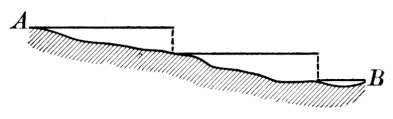
1. Drive stakes at two corners, A and B, of the school
grounds, putting a cross on top of each; or make the
crosses on the sidewalk, so as to get two points between
which to measure. Measure from A to B by holding the
tape taut and level, dropping perpendiculars when necessary
by means of the
plumb line, as shown in
the figure. Check the
work by measuring from
B back to A in the same way. Pupils will find that their
work should always be checked, and they will be surprised
to see how the results will vary in such a simple
measurement as this, unless very great care is taken. If
they learn the lesson of accuracy thus early, they will
have gained much.

2. Take two stakes, X, Y, in a field, preferably two
or three hundred feet apart, always marked on top with
crosses so as to have exact points from which to work.
Let it then be required to stake out or "range" the line
from X to Y by placing
stakes at specified
distances. One boy stands at Y and another at X, each
with a plumb line. A third one takes a plumb line and
stands at P, the observer at X motioning to him to
move his plumb line to the right or the left until it is
exactly in line with X and Y. A stake is then driven
at P, and the pupil at X moves on to the stake P. Then
Q is located in the same way, and then R, and so on.
The work is checked by ranging back from Y to X. In
some of the simple exercises suggested later it is necessary
to range a line so that this work is useful in making
measurements. The geometric principle involved is that
two points determine a straight line.
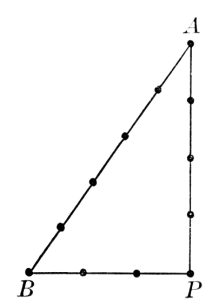
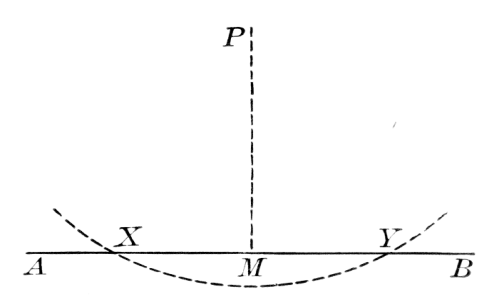
3. To test a perpendicular or to draw
one line perpendicular to another in a
field, we may take a stout cord twelve
feet long, having a knot at the end of
every foot. If this is laid along four feet,
the ends of this part being fixed, and it
is stretched as here shown, so that the
next vertex is five feet from one of these ends and three
feet from the other end, a right angle will be formed.
A right angle can also be run
by making a simple instrument,
such as is described in
Chapter XV. Still another
plan of drawing a line perpendicular
to another line
AB, from a point P, consists
in swinging a tape from P, cutting AB at X and Y, and
then bisecting XY by doubling the tape. This fixes the
foot of the perpendicular.
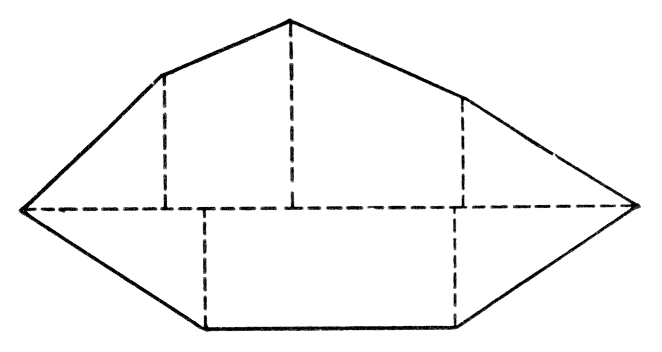
4. It is now possible to find
the area of a field of irregular
shape by dividing it into
triangles and trapezoids, as
shown in the figure. Pupils
know from their work in arithmetic how to find the area
of a triangle or a trapezoid, so that the area of the field
is easily found. The work may be checked by comparing
the results of different groups of pupils, or by drawing
another diagonal and dividing the field into other triangles
and trapezoids.
These are about as many types of field work as there
is any advantage in undertaking for the purpose of securing
the interest of pupils as a preliminary to the work in
geometry. Whether any of it is necessary, and for what
pupils it is necessary, and how much it should trespass
upon the time of scientific geometry are matters that can
be decided only by the teacher of a particular class.
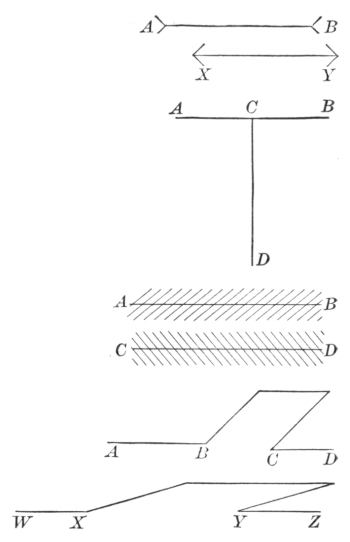
A second difficulty of the pupil is seen in his attitude
of mind towards proofs in general. He does not see why
vertical angles should be proved equal when he knows
that they are so by looking at the figure. This difficulty
should also be anticipated by giving him some opportunity
to know the weakness of his judgment,
and for this purpose figures like
the following should be placed before
him. He should be asked which of these
lines is longer, AB or XY. Two equal
lines should then be arranged in the form
of a letter T, as here shown, and he should
be asked which is the longer, AB or CD.
A figure that is very deceptive, particularly
if drawn larger and with
heavy cross lines, is this one in which
AB and CD are really parallel, but
do not seem to be so. Other interesting
deceptions have to do with
producing lines, as in these
figures, where it is quite
difficult in advance to tell whether AB and CD are in
the same line, and similarly for WX and YZ. Equally
deceptive is this figure, in which it is difficult to tell
which line AB will lie along when produced. In the
next figure AB appears to be curved
when in reality it is straight, and CD
appears straight when in reality it is
curved. The first of the following
circles seems to be slightly
flattened at the points P,
Q, R, S, and in the second
one the distance BD seems
greater than the distance
AC. There are
many equally
deceptive figures,
and a
few of them
will convince
the beginner
that the proofs
are necessary
features of geometry.
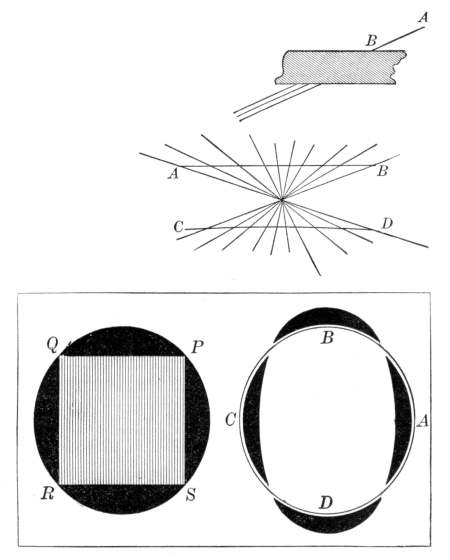
It is interesting, in connection with the tendency to
feel that a statement is apparent without proof, to recall
an anecdote related by the French mathematician, Biot,
concerning the great scientist, Laplace:
Once Laplace, having been asked about a certain point in his
"Celestial Mechanics," spent nearly an hour in trying to recall the
chain of reasoning which he had carelessly concealed by the
words "It is easy to see."
A third difficulty lies in the necessity for putting a considerable
number of definitions at the beginning of geometry,
in order to get a working vocabulary. Although
practically all writers scatter the definitions as much as
possible, there must necessarily be some vocabulary at
the beginning. In order to minimize the difficulty of
remembering so many new terms, it is helpful to mingle
with them a considerable number of exercises in which
these terms are employed, so that they may become fixed
in mind through actual use. Thus it is of value to have
a class find the complements of 27°, 32° 20', 41° 32' 48",
26.75°, 33-1/3°, and 0°. It is true that into the pure geometry
of Euclid the measuring of angles in degrees does
not enter, but it has place in the practical applications,
and it serves at this juncture to fix the meaning of a new
term like "complement."
The teacher who thus anticipates the question as to
the reason for studying geometry, the mental opposition
to proving statements, and the forgetfulness of the meaning
of common terms will find that much of the initial
difficulty is avoided. If, now, great care is given to the
first half dozen propositions, the pupil will be well on his
way in geometry. As to these propositions, two plans of
selection are employed. The first takes a few preliminary
propositions, easily demonstrated, and seeks thus to introduce
the pupil to the nature of a proof. This has the
advantage of inspiring confidence and the disadvantage
of appearing to prove the obvious. The second plan discards
all such apparently obvious propositions as those
about the equality of right angles, and the sum of two
adjacent angles formed by one line meeting another, and
begins at once on things that seem to the pupil as worth
the proving. In this latter plan the introduction is usually
made with the proposition concerning vertical angles,
and the two simplest cases of congruent triangles.
Whichever plan of selection is taken, it is important
to introduce a considerable number of one-step exercises
immediately, that is, exercises that require only one significant
step in the proof. In this way the pupil acquires
confidence in his own powers, he finds that geometry is
not mere memorizing, and he sees that each proposition
makes him the master of a large field. To delay the
exercises to the end of each book, or even to delay
them for several lessons, is to sow seeds that will result
in the attempt to master geometry by the sheer process
of memorizing.
As to the nature of these exercises, however, the mistake
must not be made of feeling that only those have
any value that relate to football or the laying out of a
tennis court. Such exercises are valuable, but such exercises
alone are one-sided. Moreover, any one who
examines the hundreds of suggested exercises that are
constantly appearing in various journals, or who, in the
preparation of teachers, looks through the thousands of
exercises that come to him in the papers of his students,
comes very soon to see how hollow is the pretense of
most of them. As has already been said, there are relatively
few propositions in geometry that have any practical
applications, applications that are even honest in
their pretense. The principle that the writer has so often
laid down in other works, that whatever pretends to be
practical should really be so, applies with much force to
these exercises. When we can find the genuine application,
if it is within reasonable grasp of the pupil, by all
means let us use it. But to put before a class of girls
some technicality of the steam engine that only a skilled
mechanic would be expected to know is not education,—it
is mere sham. There is a noble dignity to geometry,
a dignity that a large majority of any class comes to
appreciate when guided by an earnest teacher; but the
best way to destroy this dignity, to take away the appreciation
of pure mathematics, and to furnish weaker candidates
than now for advance in this field is to deceive
our pupils and ourselves into believing that the ultimate
purpose of mathematics is to measure things in a way in
which no one else measures them or has ever measured
them.
In the proof of the early propositions of plane geometry,
and again at the beginning of solid geometry, there
is a little advantage in using colored crayon to bring out
more distinctly the equal parts of two figures, or the
lines outside the plane, or to differentiate one plane from
another. This device, however, like that of models in
solid geometry, can easily be abused, and hence should
be used sparingly, and only until the purpose is accomplished.
The student of mathematics must learn to grasp
the meaning of a figure drawn in black on white paper,
or, more rarely, in white on a blackboard, and the sooner
he is able to do this the better for him. The same thing
may be said of the constructing of models for any considerable
number of figures in solid geometry; enough
work of this kind to enable a pupil clearly to visualize
the solids is valuable, but thereafter the value is usually
more than offset by the time consumed and the weakened
power to grasp the meaning of a geometric drawing.
There is often a tendency on the part of teachers in
their first years of work to overestimate the logical powers
of their pupils and to introduce forms of reasoning
and technical terms that experience has proved to be
unsuited to one who is beginning geometry. Usually but
little harm is done, because the enthusiasm of any teacher
who would use this work would carry the pupils over
the difficulties without much waste of energy on their
part. In the long run, however, the attempt is usually
abandoned as not worth the effort. Such a term as "contrapositive,"
such distinctions as that between the logical
and the geometric converse, or between perfect and partial
geometric conversion, and such pronounced formalism
as the "syllogistic method,"—all these are happily
unknown to most teachers and might profitably be
unknown to all pupils. The modern American textbook
in geometry does not begin to be as good a piece of logic
as Euclid's "Elements," and yet it is to be observed that
none of these terms is found in this classic work, so that
they cannot be thought to be necessary to a logical treatment
of the subject. We need the word "converse," and
some reference to the law of converse is therefore permissible;
the meaning of the reductio ad absurdum, of a
necessary and sufficient condition, and of the terms "synthesis"
and "analysis" may properly form part of the
pupil's equipment because of their universal use; but
any extended incursion into the domain of logic will be
found unprofitable, and it is liable to be positively harmful
to a beginner in geometry.
A word should be said as to the lettering of the figures
in the early stages of geometry. In general, it is a
great aid to the eye if this is carried out with some system,
and the following suggestions are given as in accord
with the best authors who have given any attention
to the subject:
1. In general, letter a figure counterclockwise, for
the reason that we read angles in this way in higher
mathematics, and it is as easy to form this habit now as
to form one that may have to be changed. Where two
triangles are congruent, however, but have their sides
arranged in opposite order, it is better to letter them so
that their corresponding parts appear in the same order,
although this makes one read clockwise.
2. For the same reason, read angles counterclockwise.
Thus ∠A is read "BAC," the reflex angle on the outside
of the triangle being read "CAB." Of course this is not
vital, and many authors pay no
attention to it; but it is convenient,
and if the teacher habitually
does it, the pupils will also tend
to do it. It is helpful in trigonometry,
and it saves confusion
in the case of a reflex angle in
a polygon. Designate an angle by a single letter if
this can conveniently be done.
3. Designate the sides opposite angles A, B, C, in a
triangle, by a, b, c, and use these letters in writing proofs.
4. In the case of two congruent triangles use the letters
A, B, C and A', B', C', or X, Y, Z, instead of letters
chosen at random, like D, K, L. It is easier to follow a
proof where some system is shown in lettering the figures.
Some teachers insist that a pupil at the blackboard
should not use the letters given in the textbook, hoping
thereby to avoid memorizing. While the danger is probably
exaggerated, it is easy to change with some system,
using P, Q, R and P', Q', R', for example.
5. Use small letters for lines, as above stated, and
also place them within angles, it being easier to speak of
and to see ∠m than ∠DEF. The Germans have a
convenient system that some American teachers follow
to advantage, but that a textbook has no right to require.
They use, as in the following figure, A for the point, a for
the opposite side, and the Greek letter α (alpha) for
the angle. The learning of the first three Greek letters,
alpha (α), beta (β), and gamma (γ), is not a hardship,
and they are worth using, although Greek is so little
known in this country to-day that
the alphabet cannot be demanded of
teachers who do not care to use it.
6. Also use small letters to represent
numerical values. For example,
write c = 2πr instead of C = 2πR.
This is in accord with the usage in
algebra to which the pupil is accustomed.
7. Use initial letters whenever convenient, as in the
case of a for area, b for base, c for circumference, d for
diameter, h for height (altitude), and so on.
Many of these suggestions seem of slight importance
in themselves, and some teachers will be disposed to
object to any attempt at lettering a figure with any regard
to system. If, however, they will notice how a class
struggles to follow a demonstration given with reference
to a figure on the blackboard, they will see how helpful
it is to have some simple standards of lettering. It is
hardly necessary to add that in demonstrating from a
figure on a blackboard it is usually better to say "this
line," or "the red line," than to say, without pointing to
it, "the line AB." It is by such simplicity of statement
and by such efforts to help the class to follow demonstrations
that pupils are led through many of the initial
discouragements of the subject.
No definite rules can be given for the detailed conduct
of a class in any subject. If it were possible to formulate
such rules, all the personal magnetism of the teacher,
all the enthusiasm, all the originality, all the spirit of
the class, would depart, and we should have a dull, dry
mechanism. There is no one best method of teaching
geometry or anything else. The experience of the schools
has shown that a few great principles stand out as generally
accepted, but as to the carrying out of these principles
there can be no definite rules.
Let us first consider the general question of the employment
of time in a recitation in geometry. We might
all agree on certain general principles, and yet no two
teachers ever would or ever should divide the period
even approximately in the same way. First, a class should
have an opportunity to ask questions. A teacher here
shows his power at its best, listening sympathetically to
any good question, quickly seeing the essential point,
and either answering it or restating it in such a way
that the pupil can answer it for himself. Certain questions
should be answered by the teacher; he is there
for that purpose. Others can at once be put in such a
light that the pupil can himself answer them. Others
may better be answered by the class. Occasionally, but
more rarely, a pupil may be told to "look that up for
to-morrow," a plan that is commonly considered by students
as a confession of weakness on the part of the
teacher, as it probably is. Of course a class will waste
time in questioning a weak teacher, but a strong one need
have no fear on this account. Five minutes given at the
opening of a recitation to brisk, pointed questions by the
class, with the same credit given to a good question as
to a good answer, will do a great deal to create a spirit
of comradeship, of frankness, and of honesty, and will
reveal to a sympathetic teacher the difficulties of a class
much better than the same amount of time devoted to
blackboard work. But there must be no dawdling, and
the class must feel that it has only a limited time, say
five minutes at the most, to get the help it needs.
Next in order of the division of the time may be the
teacher's report on any papers that the class has handed
in. It is impossible to tell how much of this paper work
should be demanded. The local school conditions, the
mental condition of the class, and the time at the disposal
of the teacher are all factors in the case. In general,
it may be said that enough of this kind of work is necessary
to see that pupils are neat and accurate in setting
down their demonstrations. On the other hand, paper
work gives an opportunity for dishonesty, and it consumes
a great deal of the teacher's time that might better
be given to reading good books on the subject that
he is teaching. If, however, any papers have been submitted,
about five minutes may well be given to a rapid
review of the failures and the successes. In general, it is
good educational policy to speak of the errors and failures
impersonally, but occasionally to mention by name
any one who has done a piece of work that is worthy of
special comment. Pupils may better be praised in public
and blamed in private. There is such a thing, however,
as praising too much, when nothing worthy of note has
been done, just as there is danger of blaming too much,
resulting in mere "nagging."
The third division of the recitation period may profitably
go to assigning the advance lesson. The class questions
and the teacher's report on written work have
shown the mental status of the pupils, so that the teacher
now knows what he may expect for the next lesson.
If he assigns his lesson at the beginning of the period, he
does not have this information. If he waits to the end,
he may be too hurried to give any "development" that
the new lesson may require. There can be no rule as to
how to assign a new lesson; it all depends upon what
the lesson is, upon the mental state of the class, and not
a little upon the idiosyncrasy of the teacher. The German
educator, Herbart, laid down certain formal steps in
developing a new lesson, and his successors have elaborated
these somewhat as follows:
1. Aim. Always take a class into your confidence.
Tell the members at the outset the goal. No one likes
to be led blindfolded.
2. Preparation. A few brief questions to bring the
class to think of what is to be considered.
3. Presentation of the new. Preferably this is done by
questions, the answers leading the members of the class
to discover the new truth for themselves.
4. Apperception. Calling attention to the fact that this
new fact was known before, in part, and that it relates
to a number of things already in the mind. The more
the new can be tied up to the old the more tenaciously
it will be held.
5. Generalization and application.
It is evident at once that a great deal of time may be
wasted in always following such a plan, perhaps in ever
following it consciously. But, on the other hand, probably
every good teacher, whether he has heard of Herbart
or not, naturally covers these points in substantially
this order. For an inexperienced teacher it is helpful to
be familiar with them, that he may call to mind the
steps, arranged in a psychological sequence, that he
would do well to follow. It must always be remembered
that there is quite as much danger in "developing" too
much as in taking the opposite extreme. A mechanical
teacher may develop a new lesson where there is need
for only a question or two or a mere suggestion. It
should also be recognized that students need to learn to
read mathematics for themselves, and that always to
take away every difficulty by explanations given in
advance is weakening to any one.
Therefore, in assigning the new lesson we may say
"Take the next two pages," and thus discourage most
of the class. On the other hand, we may spend an unnecessary
amount of time and overdevelop the work of those
same pages, and have the whole lesson lose all its zest.
It is here that the genius of the teacher comes forth to
find the happy mean.
The fourth division of the hour should be reached, in
general, in about ten minutes. This includes the recitation
proper. But as to the nature of this work no definite
instructions should be attempted. To a good teacher
they would be unnecessary, to a poor one they would be
harmful. Part of the class may go to the board, and as
they are working, the rest may be reciting. Those at the
board should be limited as to time, for otherwise a premium
is placed on mere dawdling. They should be so
arranged as to prevent copying, but the teacher's eye is
the best preventive of this annoying feature. Those at
their seats may be called upon one at a time to demonstrate
at the blackboard, the rest being called upon for
quick responses, as occasion demands. The European
plan of having small blackboards is in many respects
better than ours, since pupils cannot so easily waste
time. They have to work rapidly and talk rapidly, or
else take their seats.
What should be put on the board, whether the figure
alone, or the figure and the proof, depends upon
the proposition. In general, there should be a certain
number of figures put on the board for the sake of rapid
work and as a basis for the proofs of the day. There
should also be a certain amount of written work for the
sake of commending or of criticizing adversely the proof
used. There are some figures that are so complicated as
to warrant being put upon sheets of paper and hung
before the class. Thus there is no rule upon the subject,
and the teacher must use his judgment according to the
circumstances and the propositions.
If the early "originals" are one-step exercises, and a
pupil is required to recite rapidly, a habit of quick
expression is easily acquired that leads to close attention
on the part of all the class. Students as a rule recite
slower than they need to, from mere habit. Phlegmatic
as we think the German is, and nervous as is the American
temperament, a student in geometry in a German
school will usually recite more quickly and with more
vigor than one with us. Our extensive blackboards have
something to do with this, allowing so many pupils to
be working at the board that a teacher cannot attend to
them all. The result is a habit of wasting the minutes
that can only be overcome by the teacher setting a definite
but reasonable time limit, and holding the pupil
responsible if the work is not done in the time specified.
If this matter is taken in hand the first day, and special
effort made in the early weeks of the year, much of the
difficulty can be overcome.
As to the nature of the recitation to be expected from
the pupil, no definite rule can be laid down, since it varies
so much with the work of the day. In general, however,
a pupil should state the theorem quickly, state exactly
what is given and what is to be proved, with respect
to the figure, and then give the proof. At first it is
desirable that he should give the authorities in full,
and later give only the essential part in a few words. It
is better to avoid the expression "by previous proposition,"
for it soon comes to be abused, and of course the
learning of section numbers in a book is a barbarism. It
is only by continually stating the propositions used that
a pupil comes to have well fixed in his memory the basal
theorems of geometry, and without these he cannot make
progress in his subsequent mathematics. In general, it is
better to allow a pupil to finish his proof before asking
him any questions, the constant interruptions indulged
in by some teachers being the cause of no little confusion
and hesitancy on the part of pupils. Sometimes it is well
to have a figure drawn differently from the one in the
book, or lettered differently, so as to make sure that the
pupil has not memorized the proof, but in general such
devices are unnecessary, for a teacher can easily discover
whether the proof is thoroughly understood, either by
the manner of the pupil or by some slight questioning.
A good textbook has the figures systematically lettered
in some helpful way that is easily followed by the class
that is listening to the recitation, and it is not advisable
to abandon this for a random set of letters arranged in
no proper order.
It is good educational policy for the teacher to commend
at least as often as he finds fault when criticizing
a recitation at the blackboard and when discussing
the pupils' papers. Optimism, encouragement, sympathy,
the genuine desire to help, the putting of one's self in the
pupil's place, the doing to the pupil as the teacher would
that he should do in return,—these are educational policies
that make for better geometry as they make for better life.
The prime failure in teaching geometry lies unquestionably
in the lack of interest on the part of the pupil,
and this has been brought about by the ancient plan of
simply reading and memorizing proofs. It is to get away
from this that teachers resort to some such development
of the lesson in advance, as has been suggested above.
It is usually a good plan to give the easier propositions
as exercises before they are reached in the text, where
this can be done. An English writer has recently contributed
this further idea:
It might be more stimulating to encourage investigation than
to demand proofs of stated facts; that is to say, "Here is a figure
drawn in this way, find out anything you can about it." Some
such exercises having been performed jointly by teachers and
pupils, the lust of investigation and healthy competition which is
present in every normal boy or girl might be awakened so far as
to make such little researches really attractive; moreover, the
training thus given is of far more value than that obtained by
proving facts which are stated in advance, for it is seldom, if ever,
that the problems of adult life present themselves in this manner.
The spirit of the question, "What is true?" is positive and
constructive, but that involved in "Is this true?" is negative and
destructive.[41]
When the question is asked, "How shall I teach?"
or "What is the Method?" there is no answer such as
the questioner expects. A Japanese writer, Motowori,
a great authority upon the Shinto faith of his people,
once wrote these words: "To have learned that there is
no way to be learned and practiced is really to have
learned the way of the gods."
The interest as well as the value of geometry lies
chiefly in the fact that from a small number of assumptions
it is possible to deduce an unlimited number of
conclusions. With the truth of these assumptions we are
not so much concerned as with the reasoning by which
we draw the conclusions, although it is manifestly desirable
that the assumptions should not be false, and that
they should be as few as possible.
It would be natural, and in some respects desirable, to
call these foundations of geometry by the name "assumptions,"
since they are simply statements that are assumed
to be true. The real foundation principles cannot be
proved; they are the means by which we prove other
statements. But as with most names of men or things,
they have received certain titles that are time-honored,
and that it is not worth the while to attempt to change.
In English we call them axioms and postulates, and there
is no more reason for attempting to change these terms
than there is for attempting to change the names of
geometry[42] and of algebra.[43]
Since these terms are likely to continue, it is necessary
to distinguish between them more carefully than is
often done, and to consider what assumptions we are
justified in including under each. In the first place, these
names do not go back to Euclid, as is ordinarily supposed,
although the ideas and the statements are his.
"Postulate" is a Latin form of the Greek αιτημα (aitema),
and appears only in late translations. Euclid stated in
substance, "Let the following be assumed." "Axiom"
(αξίωμα, axioma) dates perhaps only from Proclus (fifth
century A.D.), Euclid using the words "common notions"
(κοιναὶ εννοιαι, koinai ennoiai) for "axioms," as Aristotle
before him had used "common things," "common principles,"
and "common opinions."
The distinction between axiom and postulate was not
clearly made by ancient writers. Probably what was in
Euclid's mind was the Aristotelian distinction that an
axiom was a principle common to all sciences, self-evident
but incapable of proof, while the postulates were
the assumptions necessary for building up the particular
science under consideration, in this case geometry.[44]
We thus come to the modern distinction between
axiom and postulate, and say that a general statement
admitted to be true without proof is an axiom, while a
postulate in geometry is a geometric statement admitted
to be true, without proof. For example, when we say
"If equals are added to equals, the sums are equal," we
state an assumption that is taken also as true in arithmetic,
in algebra, and in elementary mathematics in general.
This is therefore an axiom. At one time such a
statement was defined as "a self-evident truth," but this
has in recent years been abandoned, since what is evident
to one person is not necessarily evident to another,
and since all such statements are mere matters of assumption
in any case. On the other hand, when we say,
"A circle may be described with any given point as a
center and any given line as a radius," we state a special
assumption of geometry, and this assumption is therefore
a geometric postulate. Some few writers have sought to
distinguish between axiom and postulate by saying that
the former was an assumed theorem and the latter an
assumed problem, but there is no standard authority for
such a distinction, and indeed the difference between a
theorem and a problem is very slight. If we say, "A
circle may be passed through three points not in the
same straight line," we state a theorem; but if we say,
"Required to pass a circle through three points," we
state a problem. The mental process of handling the two
propositions is, however, practically the same in spite of
the minor detail of wording. So with the statement,
"A straight line may be produced to any required
length." This is stated in the form of a theorem, but it
might equally well be stated thus: "To produce a straight
line to any required length." It is unreasonable to call
this an axiom in one case and a postulate in the other.
However stated, it is a geometric postulate and should
be so classed.
What, now, are the axioms and postulates that we are
justified in assuming, and what determines their number
and character? It seems reasonable to agree that they
should be as few as possible, and that for educational
purposes they should be so clear as to be intelligible to
beginners. But here we encounter two conflicting ideas.
To get the "irreducible minimum" of assumptions is to
get a set of statements quite unintelligible to students
beginning geometry or any other branch of elementary
mathematics. Such an effort is laudable when the results
are intended for advanced students in the university, but
it is merely suggestive to teachers rather than usable
with pupils when it touches upon the primary steps of
any science. In recent years several such attempts have
been made. In particular, Professor Hilbert has given a
system[45] of congruence postulates, but they are rather
for the scientist than for the student of elementary
geometry.
In view of these efforts it is well to go back to Euclid
and see what this great teacher of university men[46]
had to suggest. The following are the five "common
notions" that Euclid deemed sufficient for the purposes
of elementary geometry.
1. Things equal to the same thing are also equal to each
other. This axiom has persisted in all elementary textbooks.
Of course it is a simple matter to attempt criticism,—to
say that -2 is the square root of 4, and +2 is also
the square root of 4, whence -2 = +2; but it is evident
that the argument is not sound, and that it does not invalidate
the axiom. Proclus tells us that Apollonius attempted
to prove the axiom by saying, "Let a equal b,
and b equal c. I say that a equals c. For, since a equals
b, a occupies the same space as b. Therefore a occupies
the same space as c. Therefore a equals c." The proof is
of no value, however, save as a curiosity.
2. And if to equals equals are added, the wholes are equal.
3. If equals are subtracted from equals, the remainders
are equal.
Axioms 2 and 3 are older than Euclid's time, and are
the only ones given by him relating to the solution of
the equation. Certain other axioms were added by later
writers, as, "Things which are double of the same
thing are equal to one another," and "Things which are
halves of the same thing are equal to one another." These
two illustrate the ancient use of duplatio (doubling) and
mediatio (halving), the primitive forms of multiplication
and division. Euclid would not admit the multiplication
axiom, since to him this meant merely repeated addition.
The partition (halving) axiom he did not need, and if
needed, he would have inferred its truth. There are also
the axioms, "If equals are added to unequals, the wholes
are unequal," and "If equals are subtracted from unequals,
the remainders are unequal," neither of which
Euclid would have used because he did not define "unequals."
The modern arrangement of axioms, covering
addition, subtraction, multiplication, division, powers,
and roots, sometimes of unequals as well as equals, comes
from the development of algebra. They are not all needed
for geometry, but in so far as they show the relation of
arithmetic, algebra, and geometry, they serve a useful
purpose. There are also other axioms concerning unequals
that are of advantage to beginners, even though
unnecessary from the standpoint of strict logic.
4. Things that coincide with one another are equal to one
another. This is no longer included in the list of axioms.
It is rather a definition of "equal," or of "congruent,"
to take the modern term. If not a definition, it is certainly
a postulate rather than an axiom, being purely geometric
in character. It is probable that Euclid included it to
show that superposition is to be considered a legitimate
form of proof, but why it was not placed among the
postulates is not easily seen. At any rate it is unfortunately
worded, and modern writers generally insert the
postulate of motion instead,—that a figure may be
moved about in space without altering its size or shape.
The German philosopher, Schopenhauer (1844), criticized
Euclid's axiom as follows: "Coincidence is either mere
tautology or something entirely empirical, which belongs
not to pure intuition but to external sensuous experience.
It presupposes, in fact, the mobility of figures."
5. The whole is greater than the part. To this Clavius
(1574) added, "The whole is equal to the sum of its
parts," which may be taken to be a definition of "whole,"
but which is helpful to beginners, even if not logically
necessary. Some writers doubt the genuineness of this
axiom.
Having considered the axioms of Euclid, we shall now
consider the axioms that are needed in the study of
elementary geometry. The following are suggested, not
from the standpoint of pure logic, but from that of the
needs of the teacher and pupil.
1. If equals are added to equals, the sums are equal.
Instead of this axiom, the one numbered 8 below is often
given first. For convenience in memorizing, however, it
is better to give the axioms in the following order:
(1) addition, (2) subtraction, (3) multiplication, (4)
division, (5) powers and roots,—all of equal quantities.
2. If equals are subtracted from equals, the remainders
are equal.
3. If equals are multiplied by equals, the products are
equal.
4. If equals are divided by equals, the quotients are equal.
5. Like powers or like positive roots of equals are equal.
Formerly students of geometry knew nothing of algebra,
and in particular nothing of negative quantities. Now,
however, in American schools a pupil usually studies
algebra a year before he studies demonstrative geometry.
It is therefore better, in speaking of roots, to limit them
to positive numbers, since the two square roots of 4
(+2 and -2), for example, are not equal. If the pupil
had studied complex numbers before he began geometry,
it would have been advisable to limit the roots still further
to real roots, since the four fourth roots of 1 (+1, -1,
+√(-1), -√(-1)), for example, are not equal save in
absolute value. It is well, however, to eliminate these
fine distinctions as far as possible, since their presence
only clouds the vision of the beginner.
It should also be noted that these five axioms might
be combined in one, namely, If equals are operated on by
equals in the same way, the results are equal. In Axiom 1
this operation is addition, in Axiom 2 it is subtraction,
and so on. Indeed, in order to reduce the number of
axioms two are already combined in Axiom 5. But there
is a good reason for not combining the first four with
the fifth, and there is also a good reason for combining
two in Axiom 5. The reason is that these are the axioms
continually used in equations, and to combine them
all in one would be to encourage laxness of thought
on the part of the pupil. He would always say "by
Axiom 1" whatever he did to an equation, and the
teacher would not be certain whether the pupil was
thinking definitely of dividing equals by equals, or had
a hazy idea that he was manipulating an equation in
some other way that led to an answer. On the other
hand, Axiom 5 is not used as often as the preceding
four, and the interchange of integral and fractional exponents
is relatively common, so that the joining of these
two axioms in one for the purpose of reducing the total
number is justifiable.
6. If unequals are operated on by positive equals in the
same way, the results are unequal in the same order. This
includes in a single statement the six operations mentioned
in the preceding axioms; that is, if a > b and if
x = y, then a + x > b + y, a - x > b - y, ax > by, etc.
The reason for thus combining six axioms in one in the
case of inequalities is apparent. They are rarely used in
geometry, and if a teacher is in doubt as to the pupil's
knowledge, he can easily inquire in the few cases that
arise, whereas it would consume a great deal of time
to do this for the many equations that are met. The
axiom is stated in such a way as to exclude multiplying
or dividing by negative numbers, this case not being
needed.
7. If unequals are added to unequals in the same order,
the sums are unequal in the same order; if unequals are
subtracted from equals, the remainders are unequal in the
reverse order. These are the only cases in which unequals
are necessarily combined with unequals, or operate upon
equals in geometry, and the axiom is easily explained to
the class by the use of numbers.
8. Quantities that are equal to the same quantity or to
equal quantities are equal to each other. In this axiom the
word "quantity" is used, in the common manner of the
present time, to include number and all geometric magnitudes
(length, area, volume).
9. A quantity may be substituted for its equal in an
equation or in an inequality. This axiom is tacitly assumed
by all writers, and is very useful in the proofs of geometry.
It is really the basis of several other axioms, and
if we were seeking the "irreducible minimum," it would
replace them. Since, however, we are seeking only a
reasonably abridged list of convenient assumptions that
beginners will understand and use, this axiom has much
to commend it. If we consider the equations (1) a = x
and (2) b = x, we see that for x in equation (1) we may
substitute b from equation (2) and have a = b; in other
words, that Axiom 8 is included in Axiom 9. Furthermore,
if (1) a = b and (2) x = y, then since a + x is the
same as a + x, we may, by substituting, say that
a + x = a + x = b + x = b + y. In other words, Axiom 1
is included in Axiom 9. Thus an axiom that includes
others has a legitimate place, because a beginner would
be too much confused by seeing its entire scope, and
because he will make frequent use of it in his mathematical
work.
10. If the first of three quantities is greater than the
second, and the second is greater than the third, then the
first is greater than the third. This axiom is needed several
times in geometry. The case in which a > b and
b = c, therefore a > c, is provided for in Axiom 9.
11. The whole is greater than any of its parts and is
equal to the sum of all its parts. The latter part of this
axiom is really only the definition of "whole," and it
would be legitimate to state a definition accordingly and
refer to it where the word is employed. Where, however,
we wish to speak of a polygon, for example, and
wish to say that the area is equal to the combined areas
of the triangles composing it, it is more satisfactory to
have this axiom to which to refer. It will be noticed
that two related axioms are here combined in one, for a
reason similar to the one stated under Axiom 5.
In the case of the postulates we are met by a problem
similar to the one confronting us in connection with the
axioms,—the problem of the "irreducible minimum" as
related to the question of teaching. Manifestly Euclid
used postulates that he did not state, and proved some
statements that he might have postulated.[47]
The postulates given by Euclid under the name
αἰτήματα (aitemata) were requests made by the teacher
to his pupil that certain things be conceded. They were
five in number, as follows:
1. Let the following be conceded: to draw a straight line
from any point to any point.
Strictly speaking, Euclid might have been required to
postulate that points and straight lines exist, but he evidently
considered this statement sufficient. Aristotle
had, however, already called attention to the fact that a
mere definition was sufficient only to show what a concept
is, and that this must be followed by a proof that
the thing exists. We might, for example, define x as a
line that bisects an angle without meeting the vertex,
but this would not show that an x exists, and indeed it
does not exist. Euclid evidently intended the postulate
to assert that this line joining two points is unique,
which is only another way of saying that two points
determine a straight line, and really includes the idea
that two straight lines cannot inclose space. For purposes
of instruction, the postulate would be clearer if
it read, One straight line, and only one, can be drawn
through two given points.
2. To produce a finite straight line continuously in a
straight line.
In this postulate Euclid practically assumes that a
straight line can be produced only in a straight line; in
other words, that two different straight lines cannot have
a common segment. Several attempts have been made to
prove this fact, but without any marked success.
3. To describe a circle with any center and radius.
4. That all right angles are equal to one another.
While this postulate asserts the essential truth that a right
angle is a determinate magnitude so that it really serves as an invariable
standard by which other (acute and obtuse) angles may be
measured, much more than this is implied, as will easily be seen
from the following consideration. If the statement is to be proved,
it can only be proved by the method of applying one pair of right
angles to another and so arguing their equality. But this method
would not be valid unless on the assumption of the invariability of
figures, which would have to be asserted as an antecedent postulate.
Euclid preferred to assert as a postulate, directly, the fact
that all right angles are equal; and hence his postulate must be
taken as equivalent to the principle of invariability of figures, or its
equivalent, the homogeneity of space.[48]
It is better educational policy, however, to assert this
fact more definitely, and to state the additional assumption
that figures may be moved about in space without
deformation. The fourth of Euclid's postulates is often
given as an axiom, following the idea of the Greek
philosopher Geminus (who flourished in the first century
B.C.), but this is because Euclid's distinction between
axiom and postulate is not always understood. Proclus
(410-485 A.D.) endeavored to prove the postulate, and
a later and more scientific effort was made by the Italian
geometrician Saccheri (1667-1733). It is very commonly
taken as a postulate that all straight angles are
equal, this being more evident to the senses, and the
equality of right angles is deduced as a corollary. This
method of procedure has the sanction of many of our
best modern scholars.
5. That, if a straight line falling on two straight lines
make the interior angle on the same side less than two right
angles, the two straight lines, if produced indefinitely, meet
on that side on which are the angles less than the two right
angles.
This famous postulate, long since abandoned in teaching
the beginner in geometry, is a remarkable evidence of
the clear vision of Euclid. For two thousand years mathematicians
sought to prove it, only to demonstrate the
wisdom of its author in placing it among the assumptions.[49]
Every proof adduced contains some assumption
that practically conceals the postulate itself. Thus the
great English mathematician John Wallis (1616-1703)
gave a proof based upon the assumption that "given a
figure, another figure is possible which is similar to the
given one, and of any size whatever." Legendre (1752-1833)
did substantially the same at one time, and offered
several other proofs, each depending upon some equally
unprovable assumption. The definite proof that the
postulate cannot be demonstrated is due to the Italian
Beltrami (1868).
Of the alternative forms of the postulate, that of
Proclus is generally considered the best suited to beginners.
As stated by Playfair (1795), this is, "Through a
given point only one parallel can be drawn to a given
straight line"; and as stated by Proclus, "If a straight
line intersect one of two parallels, it will intersect the
other also." Playfair's form is now the common "postulate
of parallels," and is the one that seems destined
to endure.
Posidonius and Geminus, both Stoics of the first century
B.C., gave as their alternative, "There exist straight
lines everywhere equidistant from one another." One
of Legendre's alternatives is, "There exists a triangle
in which the sum of the three angles is equal to two
right angles." One of the latest attempts to suggest a
substitute is that of the Italian Ingrami (1904), "Two
parallel straight lines intercept, on every transversal
which passes through the mid-point of a segment included
between them, another segment the mid-point of which
is the mid-point of the first."
Of course it is entirely possible to assume that through
a point more than one line can be drawn parallel to a
given straight line, in which case another type of geometry
can be built up, equally rigorous with Euclid's.
This was done at the close of the first quarter of the
nineteenth century by Lobachevsky (1793-1856) and
Bolyai (1802-1860), resulting in the first of several
"non-Euclidean" geometries.[50]
Taking the problem to be that of stating a reasonably
small number of geometric assumptions that may form a
basis to supplement the general axioms, that shall cover
the most important matters to which the student must
refer, and that shall be so simple as easily to be understood
by a beginner, the following are recommended:
1. One straight line, and only one, can be drawn through
two given points. This should also be stated for convenience
in the form, Two points determine a straight line.
From it may also be drawn this corollary, Two straight
lines can intersect in only one point, since two points
would determine a straight line. Such obvious restatements
of or corollaries to a postulate are to be commended,
since a beginner is often discouraged by having
to prove what is so obvious that a demonstration fails
to commend itself to his mind.
2. A straight line may be produced to any required length.
This, like Postulate 1, requires the use of a straightedge
for drawing the physical figure. The required length is
attained by using the compasses to measure the distance.
The straightedge and the compasses are the only two
drawing instruments recognized in elementary geometry.[51]
While this involves more than Euclid's postulate, it is a
better working assumption for beginners.
3. A straight line is the shortest path between two points.
This is easily proved by the method of Euclid[52] for the
case where the paths are broken lines, but it is needed
as a postulate for the case of curve paths. It is a better
statement than the common one that a straight line is
the shortest distance between two points; for distance is
measured on a line, but it is not itself a line. Furthermore,
there are scientific objections to using the word
"distance" any more than is necessary.
4. A circle may be described with any given point as a
center and any given line as a radius. This involves the
use of the second of the two geometric instruments, the
compasses.
5. Any figure may be moved from one place to another
without altering the size or shape. This is the postulate
of the homogeneity of space, and asserts that space is
such that we may move a figure as we please without
deformation of any kind. It is the basis of all cases of
superposition.
6. All straight angles are equal. It is possible to prove
this, and therefore, from the standpoint of strict logic, it
is unnecessary as a postulate. On the other hand, it is
poor educational policy for a beginner to attempt to
prove a thing that is so obvious. The attempt leads to
a loss of interest in the subject, the proposition being
(to state a paradox) hard because it is so easy. It is, of
course, possible to postulate that straight angles are equal,
and to draw the conclusion that their halves (right
angles) are equal; or to proceed in the opposite direction,
and postulate that all right angles are equal, and draw
the conclusion that their doubles (straight angles) are
equal. Of the two the former has the advantage, since
it is probably more obvious that all straight angles are
equal. It is well to state the following definite corollaries
to this postulate: (1) All right angles are equal;
(2) From a point in a line only one perpendicular can be
drawn to the line, since two perpendiculars would make
the whole (right angle) equal to its part; (3) Equal
angles have equal complements, equal supplements, and equal
conjugates; (4) The greater of two angles has the less complement,
the less supplement, and the less conjugate. All
of these four might appear as propositions, but, as already
stated, they are so obvious as to be more harmful than
useful to beginners when given in such form.
The postulate of parallels may properly appear in connection
with that topic in Book I, and it is accordingly
treated in Chapter XIV.
There is also another assumption that some writers
are now trying to formulate in a simple fashion. We
take, for example, a line segment AB, and describe circles
with A and B respectively as centers, and with a
radius AB. We say that the circles will intersect as at
C and D. But how do we know that they intersect? We
assume it, just as we assume that an indefinite straight
line drawn from a point inclosed by a circle will, if produced
far enough, cut the circle twice. Of course a
pupil would not think of this if his attention was not
called to it, and the harm outweighs the good in doing
this with one who is beginning the study of geometry.
With axioms and with postulates, therefore, the conclusion
is the same: from the standpoint of scientific
geometry there is an irreducible minimum of assumptions,
but from the standpoint of practical teaching this
list should give place to a working set of axioms and
postulates that meet the needs of the beginner.
Bibliography. Smith, Teaching of Elementary Mathematics,
New York, 1900; Young, The Teaching of Mathematics, New
York, 1901; Moore, On the Foundations of Mathematics, Bulletin
of the American Mathematical Society, 1903, p. 402; Betz, Intuition
and Logic in Geometry, The Mathematics Teacher, Vol. II, p. 3;
Hilbert, The Foundations of Geometry, Chicago, 1902; Veblen,
A System of Axioms for Geometry, Transactions of the American
Mathematical Society, 1904, p. 343.
When we consider the nature of geometry it is evident
that more attention must be paid to accuracy of definitions
than is the case in most of the other sciences. The
essence of all geometry worthy of serious study is not
the knowledge of some fact, but the proof of that fact;
and this proof is always based upon preceding proofs,
assumptions (axioms or postulates), or definitions. If
we are to prove that one line is perpendicular to another,
it is essential that we have an exact definition of "perpendicular,"
else we shall not know when we have reached
the conclusion of the proof.
The essential features of a definition are that the term
defined shall be described in terms that are simpler than,
or at least better known than, the thing itself; that this
shall be done in such a way as to limit the term to the
thing defined; and that the description shall not be
redundant. It would not be a good definition to say that
a right angle is one fourth of a perigon and one half of
a straight angle, because the concept "perigon" is not so
simple, and the term "perigon" is not so well known,
as the term and the concept "right angle," and because
the definition is redundant, containing more than is
necessary.
It is evident that satisfactory definitions are not always
possible; for since the number of terms is limited, there
must be at least one that is at least as simple as any
other, and this cannot be described in terms simpler than
itself. Such, for example, is the term "angle." We can
easily explain the meaning of this word, and we can
make the concept clear, but this must be done by a certain
amount of circumlocution and explanation, not by
a concise and perfect definition. Unless a beginner in
geometry knows what an angle is before he reads the
definition in a textbook, he will not know from the definition.
This fact of the impossibility of defining some of
the fundamental concepts will be evident when we come
to consider certain attempts that have been made in this
direction.
It should also be understood in this connection that a
definition makes no assertion as to the existence of the
thing defined. If we say that a tangent to a circle is an
unlimited straight line that touches the circle in one
point, and only one, we do not assert that it is possible
to have such a line; that is a matter for proof. Not in
all cases, however, can this proof be given, as in the
existence of the simplest concepts. We cannot, for example,
prove that a point or a straight line exists after we
have defined these concepts. We therefore tacitly or
explicitly assume (postulate) the existence of these
fundamentals of geometry. On the other hand, we can
prove that a tangent exists, and this may properly be
considered a legitimate proposition or corollary of elementary
geometry. In relation to geometric proof it is
necessary to bear in mind, therefore, that we are permitted
to define any term we please; for example, "a
seven-edged polyhedron" or Leibnitz's "ten-faced regular
polyhedron," neither of which exists; but, strictly speaking,
we have no right to make use of a definition in a proof
until we have shown or postulated that the thing defined
has an existence. This is one of the strong features of
Euclid's textbook. Not being able to prove that a point,
a straight line, and a circle exists, he practically postulates
these facts; but he uses no other definition in a
proof without showing that the thing defined exists, and
this is his reason for mingling his problems with his
theorems. At the present time we confessedly sacrifice
his logic in this respect for the reason that we teach
geometry to pupils who are too young to appreciate
that logic.
It was pointed out by Aristotle, long before Euclid,
that it is not a satisfactory procedure to define a thing
by means of terms that are strictly not prior to it, as
when we attempt to define something by means of its
opposite. Thus to define a curve as "a line, no part of
which is straight," would be a bad definition unless
"straight" had already been explicitly defined; and to
define "bad" as "not good" is unsatisfactory for the
reason that "bad" and "good" are concepts that are
evolved simultaneously. But all this is only a detail
under the general principle that a definition must employ
terms that are better understood than the one defined.
It should be understood that some definitions are much
more important than others, considered from the point
of view of the logic of geometry. Those that enter into
geometric proofs are basal; those that form part of the
conversational language of geometry are not. Euclid
gave twenty-three definitions in Book I, and did not
make use of even all of these terms. Other terms, those
not employed in his proofs, he assumed to be known,
just as he assumed a knowledge of any other words in
his language. Such procedure would not be satisfactory
under modern conditions, but it is of great importance
that the teacher should recognize that certain definitions
are basal, while others are merely informational.
It is now proposed to consider the basal definitions of
geometry, first, that the teacher may know what ones
are to be emphasized and learned; and second, that he
may know that the idea that the standard definitions can
easily be improved is incorrect. It is hoped that the
result will be the bringing into prominence of the basal
concepts, and the discouraging of attempts to change in
unimportant respects the definitions in the textbook used
by the pupil.
In order to have a systematic basis for work, the definitions
of two books of Euclid will first be considered.[53]
1. Point. A point is that which has no part. This
was incorrectly translated by Capella in the fifth century,
"Punctum est cuius pars nihil est" (a point is that
of which a part is nothing), which is as much as to say
that the point itself is nothing. It generally appears,
however, as in the Campanus edition,[54] "Punctus est
cuius pars non est," which is substantially Euclid's wording.
Aristotle tells of the definitions of point, line, and
surface that prevailed in his time, saying that they all
defined the prior by means of the posterior.[55] Thus a point
was defined as "an extremity of a line," a line as "the
extremity of a surface," and a surface as "the extremity of
a solid,"—definitions still in use and not without their
value. For it must not be assumed that scientific priority
is necessarily priority in fact; a child knows of "solid"
before he knows of "point," so that it may be a very good
way to explain, if not to define, by beginning with solid,
passing thence to surface, thence to line, and thence to
point.
The first definition of point of which Proclus could
learn is attributed by him to the Pythagoreans, namely,
"a monad having position," the early form of our present
popular definition of a point as "position without
magnitude." Plato defined it as "the beginning of a line,"
thus presupposing the definition of "line"; and, strangely
enough, he anticipated by two thousand years Cavalieri,
the Italian geometer, by speaking of points as "indivisible
lines." To Aristotle, who protested against Plato's definitions,
is due the definition of a point as "something
indivisible but having position."
Euclid's definition is essentially that of Aristotle, and
is followed by most modern textbook writers, except as
to its omission of the reference to position. It has been
criticized as being negative, "which has no part"; but
it is generally admitted that a negative definition is
admissible in the case of the most elementary concepts.
For example, "blind" must be defined in terms of a
negation.
At present not much attention is given to the definition
of "point," since the term is not used as the basis
of a proof, but every effort is made to have the concept
clear. It is the custom to start from a small solid,
conceive it to decrease in size, and think of the point as
the limit to which it is approaching, using these terms in
their usual sense without further explanation.
2. Line. A line is breadthless length. This is usually
modified in modern textbooks by saying that "a line is
that which has length without breadth or thickness,"
a statement that is better understood by beginners.
Euclid's definition is thought to be due to Plato, and
is only one of many definitions that have been suggested.
The Pythagoreans having spoken of the point as a
monad naturally were led to speak of the line as dyadic,
or related to two. Proclus speaks of another definition,
"magnitude in one dimension," and he gives an excellent
illustration of line as "the edge of a shadow," thus
making it real but not material. Aristotle speaks of a
line as a magnitude "divisible in one way only," as contrasted
with a surface which is divisible in two ways,
and with a solid which is divisible in three ways. Proclus
also gives another definition as the "flux of a point,"
which is sometimes rendered as the path of a moving
point. Aristotle had suggested the idea when he wrote,
"They say that a line by its motion produces a surface,
and a point by its motion a line."
Euclid did not deem it necessary to attempt a classification
of lines, contenting himself with defining only
a straight line and a circle, and these are really the only
lines needed in elementary geometry. His commentators,
however, made the attempt. For example. Heron
(first century A.D.) probably followed his definition of
line by this classification:
|
|
|
|
|
| | | Straight | | |
| Lines | | | | Circular circumferences |
| | | Not straight | | Spiral shaped |
| | | | | Curved (generally) |
Proclus relates that both Plato and Aristotle divided
lines into "straight," "circular," and "a mixture of the
two," a statement which is not quite exact, but which
shows the origin of a classification not infrequently found
in recent textbooks. Geminus (ca. 50 B.C.) is said by
Proclus to have given two classifications, of which one
will suffice for our purposes:
|
|
|
|
|
| | | Composite (broken line forming an angle) |
| Lines | | | | Forming a figure, or determinate. (Circle, ellipse, cissoid.) |
| | | Incomposite | | Not forming a figure, or indeterminate and extending without a limit. (Straight line, parabola, hyperbola, conchoid.) |
Of course his view of the cissoid, the curve represented
by the equation y2(a + x) = (a - x)3, is not the modern
view.
3. The extremities of a line are points. This is not
a definition in the sense of its two predecessors. A
modern writer would put it as a note under the definition
of line. Euclid did not wish to define a point as the
extremity of a line, for Aristotle had asserted that this
was not scientific; so he defined point and line, and then
added this statement to show the relation of one to the
other. Aristotle had improved upon this by stating that
the "division" of a line, as well as an extremity, is a
point, as is also the intersection of two lines. These
statements, if they had been made by Euclid, would
have avoided the objection made by Proclus, that some
lines have no extremities, as, for example, a circle, and
also a straight line extending infinitely in both directions.
4. Straight Line. A straight line is that which lies
evenly with respect to the points on itself. This is the least
satisfactory of all of the definitions of Euclid, and emphasizes
the fact that the straight line is the most difficult
to define of the elementary concepts of geometry.
What is meant by "lies evenly"? Who would know
what a straight line is, from this definition, if he did not
know in advance?
The ancients suggested many definitions of straight
line, and it is well to consider a few in order to appreciate
the difficulties involved. Plato spoke of it as
"that of which the middle covers the ends," meaning
that if looked at endways, the middle would make it
impossible to see the remote end. This is often modified
to read that "a straight line when looked at endways
appears as a point,"—an idea that involves the postulate
that our line of sight is straight. Archimedes made the
statement that "of all the lines which have the same
extremities, the straight line is the least," and this has
been modified by later writers into the statement that
"a straight line is the shortest distance between two
points." This is open to two objections as a definition:
(1) a line is not distance, but distance is the length of a
line,—it is measured on a line; (2) it is merely stating
a property of a straight line to say that "a straight line
is the shortest path between two points,"—a proper postulate
but not a good definition. Equally objectionable is
one of the definitions suggested by both Heron and
Proclus, that "a straight line is a line that is stretched
to its uttermost"; for even then it is reasonable to think
of it as a catenary, although Proclus doubtless had in
mind the Archimedes statement. He also stated that "a
straight line is a line such that if any part of it is in a
plane, the whole of it is in the plane,"—a definition that
runs in a circle, since plane is defined by means of
straight line. Proclus also defines it as "a uniform line,
capable of sliding along itself," but this is also true of a
circle.
Of the various definitions two of the best go back to
Heron, about the beginning of our era. Proclus gives
one of them in this form, "That line which, when its
ends remain fixed, itself remains fixed." Heron proposed
to add, "when it is, as it were, turned round in the same
plane." This has been modified into "that which does
not change its position when it is turned about its extremities
as poles," and appears in substantially this
form in the works of Leibnitz and Gauss. The definition
of a straight line as "such a line as, with another
straight line, does not inclose space," is only a modification
of this one. The other definition of Heron states
that in a straight line "all its parts fit on all in all
ways," and this in its modern form is perhaps the most
satisfactory of all. In this modern form it may be stated,
"A line such that any part, placed with its ends on any
other part, must lie wholly in the line, is called a straight
line," in which the force of the word "must" should be
noted. This whole historical discussion goes to show
how futile it is to attempt to define a straight line.
What is needed is that we should explain what is meant
by a straight line, that we should illustrate it, and that
pupils should then read the definition understandingly.
5. Surface. A surface is that which has length and
breadth. This is substantially the common definition of
our modern textbooks. As with line, so with surface,
the definition is not entirely satisfactory, and the chief
consideration is that the meaning of the term should be
made clear by explanations and illustrations. The shadow
cast on a table top is a good illustration, since all idea
of thickness is wanting. It adds to the understanding of
the concept to introduce Aristotle's statement that a surface
is generated by a moving line, modified by saying
that it may be so generated, since the line might slide
along its own trace, or, as is commonly said in mathematics,
along itself.
6. The extremities of a surface are lines. This is open
to the same explanation and objection as definition 3,
and is not usually given in modern textbooks. Proclus
calls attention to the fact that the statement is hardly
true for a complete spherical surface.
7. Plane. A plane surface is a surface which lies
evenly with the straight lines on itself. Euclid here follows
his definition of straight line, with a result that is
equally unsatisfactory. For teaching purposes the translation
from the Greek is not clear to a beginner, since
"lies evenly" is a term not simpler than the one defined.
As with the definition of a straight line, so with that of
a plane, numerous efforts at improvement have been
made. Proclus, following a hint of Heron's, defines it
as "the surface which is stretched to the utmost," and
also, this time influenced by Archimedes's assumption
concerning a straight line, as "the least surface among
all those which have the same extremities." Heron gave
one of the best definitions, "A surface all the parts of
which have the property of fitting on [each other]." The
definition that has met with the widest acceptance, however,
is a modification of one due to Proclus, "A surface
such that a straight line fits on all parts of it." Proclus
elsewhere says, "[A plane surface is] such that the
straight line fits on it all ways," and Heron gives it in this
form, "[A plane surface is] such that, if a straight line
pass through two points on it, the line coincides with it
at every spot, all ways." In modern form this appears as
follows: "A surface such that a straight line joining any
two of its points lies wholly in the surface is called a
plane," and for teaching purposes we have no better definition.
It is often known as Simson's definition, having
been given by Robert Simson in 1756.
The French mathematician, Fourier, proposed to define
a plane as formed by the aggregate of all the straight
lines which, passing through one point on a straight line
in space, are perpendicular to that line. This is clear,
but it is not so usable for beginners as Simson's definition.
It appears as a theorem in many recent geometries.
The German mathematician, Crelle, defined a plane as
a surface containing all the straight lines (throughout
their whole length) passing through a fixed point and
also intersecting a straight line in space, but of course this
intersected straight line must not pass through the fixed
point. Crelle's definition is occasionally seen in modern
textbooks, but it is not so clear to the pupil as Simson's.
Of the various ultrascientific definitions of a plane that
have been suggested of late it is hardly of use to speak
in a book concerned primarily with practical teaching.
No one of them is adapted to the needs and the comprehension
of the beginner, and it seems that we are not
likely to improve upon the so-called Simson form.
8. Plane Angle. A plane angle is the inclination to
each other of two lines in a plane which meet each other
and do not lie in a straight line. This definition, it will
be noticed, includes curvilinear angles, and the expression
"and do not lie in a straight line" states that the lines
must not be continuous one with the other, that is, that
zero and straight angles are excluded. Since Euclid does
not use the curvilinear angle, and it is only the rectilinear
angle with which we are concerned, we will pass
to the next definition and consider this one in connection
therewith.
9. Rectilinear Angle. When the lines containing
the angle are straight, the angle is called rectilinear. This
definition, taken with the preceding one, has always
been a subject of criticism. In the first place it expressly
excludes the straight angle, and, indeed, the angles of
Euclid are always less than 180°, contrary to our modern
concept. In the second place it defines angle by
means of the word "inclination," which is itself as difficult
to define as angle. To remedy these defects many
substitutes have been proposed. Apollonius defined
angle as "a contracting of a surface or a solid at one
point under a broken line or surface." Another of the
Greeks defined it as "a quantity, namely, a distance between
the lines or surfaces containing it." Schotten[56]
says that the definitions of angle generally fall into
three groups:
a. An angle is the difference of direction between two
lines that meet. This is no better than Euclid's, since
"difference of direction" is as difficult to define as
"inclination."
b. An angle is the amount of turning necessary to
bring one side to the position of the other side.
c. An angle is the portion of the plane included between
its sides.
Of these, b is given by way of explanation in most
modern textbooks. Indeed, we cannot do better than
simply to define an angle as the opening between two
lines which meet, and then explain what is meant by
size, through the bringing in of the idea of rotation.
This is a simple presentation, it is easily understood,
and it is sufficiently accurate for the real purpose in
mind, namely, the grasping of the concept. We should
frankly acknowledge that the concept of angle is such
a simple one that a satisfactory definition is impossible,
and we should therefore confine our attention to having
the concept understood.
10. When a straight line set up on a straight line makes
the adjacent angles equal to one another, each of the equal
angles is right, and the straight line standing on the other
is called a perpendicular to that on which it stands. We
at present separate these definitions and simplify the
language.
11. An obtuse angle is an angle greater than a right
angle.
12. An acute angle is an angle less than a right angle.
The question sometimes asked as to whether an angle
of 200° is obtuse, and whether a negative angle, say
-90°, is acute, is answered by saying that Euclid did
not conceive of angles equal to or greater than 180°
and had no notion of negative quantities. Generally to-day
we define an obtuse angle as "greater than one and
less than two right angles." An acute angle is defined
as "an angle less than a right angle," and is considered
as positive under the general understanding that all
geometric magnitudes are positive unless the contrary
is stated.
13. A boundary is that which is an extremity of anything.
The definition is not exactly satisfactory, for a
circle is the boundary of the space inclosed, but we
hardly consider it as the extremity of that space. Euclid
wishes the definition before No. 14.
14. A figure is that which is contained by any boundary
or boundaries. The definition is not satisfactory, since
it excludes the unlimited straight line, the angle, an
assemblage of points, and other combinations of lines
and points which we should now consider as figures.
15. A circle is a plane figure contained by one line such
that all the straight lines falling upon it from one point
among those lying within the figure are equal to one another.
16. And the point is called the center of the circle.
Some commentators add after "one line," definition 15,
the words "which is called the circumference," but these
are not in the oldest manuscripts. The Greek idea of a
circle was usually that of part of a plane which is bounded
by a line called in modern times the circumference,
although Aristotle used "circle" as synonymous with
"the bounding line." With the growth of modern mathematics,
however, and particularly as a result of the
development of analytic geometry, the word "circle" has
come to mean the bounding line, as it did with Aristotle,
a century before Euclid's time. This has grown
out of the equations of the various curves, x2 + y2 = r2
representing the circle-line, a2y2 + b2x2 = a2b2 representing
the ellipse-line, and so on. It is natural, therefore, that
circle, ellipse, parabola, and hyperbola should all be
looked upon as lines. Since this is the modern use of
"circle" in English, it has naturally found its way into
elementary geometry, in order that students should not
have to form an entirely different idea of circle on beginning
analytic geometry. The general body of American
teachers, therefore, at present favors using "circle"
to mean the bounding line and "circumference" to mean
the length of that line. This requires redefining "area
of a circle," and this is done by saying that it is the
area of the plane space inclosed. The matter is not of
greatest consequence, but teachers will probably prefer
to join in the modern American usage of the term.
17. Diameter. A diameter of the circle is any straight
line drawn through the center and terminated in both directions
by the circumference of the circle, and such a straight
line also bisects the circle. The word "diameter" is from
two Greek words meaning a "through measurer," and it
was also used by Euclid for the diagonal of a square,
and more generally for the diagonal of any parallelogram.
The word "diagonal" is a later term and means
the "through angle." It will be noticed that Euclid
adds to the usual definition the statement that a diameter
bisects the circle. He does this apparently to justify his
definition (18), of a semicircle (a half circle).
Thales is said to have been the first to prove that a
diameter bisects the circle, this being one of three or
four propositions definitely attributed to him, and it is
sometimes given as a proposition to be proved. As a
proposition, however, it is unsatisfactory, since the proof
of what is so evident usually instills more doubt than
certainty in the minds of beginners.
18. Semicircle. A semicircle is the figure contained
by the diameter and the circumference cut off by it. And
the center of the semicircle is the same as that of the circle.
Proclus remarked that the semicircle is the only plane
figure that has its center on its perimeter. Some writers
object to defining a circle as a line and then speaking
of the area of a circle, showing minds that have at least
one characteristic of that of Proclus. The modern definition
of semicircle is "half of a circle," that is, an arc of
180°, although the term is commonly used to mean both
the arc and the segment.
19. Rectilinear Figures. Rectilinear figures are
those which are contained by straight lines, trilateral figures
being those contained by three, quadrilateral those contained
by four, and multilateral those contained by more than four,
straight lines.
20. Of trilateral figures, an equilateral triangle is that
which has its three sides equal, an isosceles triangle that
which has two of its sides alone equal, and a scalene triangle
that which has its three sides unequal.
21. Further, of trilateral figures, a right-angled triangle
is that which has a right angle, an obtuse-angled triangle
that which has an obtuse angle, and an acute-angled triangle
that which has its three angles acute.
These three definitions may properly be considered
together. "Rectilinear" is from the Latin translation of
the Greek euthygrammos, and means "right-lined," or
"straight-lined." Euclid's idea of such a figure is that of
the space inclosed, while the modern idea is tending to
become that of the inclosing lines. In elementary geometry,
however, the Euclidean idea is still held. "Trilateral"
is from the Latin translation of the Greek tripleuros
(three-sided). In elementary geometry the word "triangle"
is more commonly used, although "quadrilateral"
is more common than "quadrangle." The use of these
two different forms is eccentric and is merely a matter
of fashion. Thus we speak of a pentagon but not of a
tetragon or a trigon, although both words are correct in
form. The word "multilateral" (many-sided) is a translation
of the Greek polypleuros. Fashion has changed
this to "polygonal" (many-angled), the word "multilateral"
rarely being seen.
Of the triangles, "equilateral" means "equal-sided";
"isosceles" is from the Greek isoskeles, meaning "with
equal legs," and "scalene" from skalenos, possibly from
skazo (to limp), or from skolios (crooked). Euclid's limitation
of isosceles to a triangle with two, and only two,
equal sides would not now be accepted. We are at present
more given to generalizing than he was, and when
we have proved a proposition relating to the isosceles
triangle, we wish to say that we have thereby proved it
for the equilateral triangle. We therefore say that an
isosceles triangle has two sides equal, leaving it possible
that all three sides should be equal. The expression
"equal legs" is now being discarded on the score of inelegance.
In place of "right-angled triangle" modern
writers speak of "right triangle," and so for the obtuse
and acute triangles. The terms are briefer and are as
readily understood. It may add a little interest to the
subject to know that Plutarch tells us that the ancients
thought that "the power of the triangle is expressive of
the nature of Pluto, Bacchus, and Mars." He also states
that the Pythagoreans called "the equilateral triangle
the head-born Minerva and Tritogeneia (born of Triton)
because it may be equally divided by the perpendicular
lines drawn from each of its angles."
22. Of quadrilateral figures a square is that which is both
equilateral and right-angled; an oblong that which is right-angled
but not equilateral; a rhombus that which is equilateral
and not right-angled; and a rhomboid that which
has its opposite sides and angles equal to one another, but
is neither equilateral nor right-angled. And let all quadrilaterals
other than these be called trapezia. In this definition
Euclid also specializes in a manner not now generally
approved. Thus we are more apt to-day to omit the oblong
and rhomboid as unnecessary, and to define "rhombus"
in such a manner as to include a square. We use "parallelogram"
to cover "rhomboid," "rhombus," "oblong,"
and "square." For "oblong" we use "rectangle," letting
it include square. Euclid's definition of "square"
illustrates his freedom in stating more attributes than are
necessary, in order to make sure that the concept is clear;
for he might have said that it "is that which is equilateral
and has one right angle." We may profit by his method,
sacrificing logic to educational necessity. Euclid does not
use "oblong," "rhombus," "rhomboid," and "trapezium"
(plural, "trapezia") in his proofs, so that he might well
have omitted the definitions, as we often do.
23. Parallels. Parallel straight lines are straight
lines which, being in the same plane and being produced indefinitely
in both directions, do not meet one another in
either direction. This definition of parallels, simplified
in its language, is the one commonly used to-day. Other
definitions have been suggested, but none has been so
generally used. Proclus states that Posidonius gave the
definition based upon the lines always being at the same
distance apart. Geminus has the same idea in his definition.
There are, as Schotten has pointed out, three
general types of definitions of parallels, namely:
a. They have no point in common. This may be expressed
by saying that (1) they do not intersect, (2)
they meet at infinity.
b. They are equidistant from one another.
c. They have the same direction.
Of these, the first is Euclid's, the idea of the point
at infinity being suggested by Kepler (1604). The second
part of this definition is, of course, unusable for
beginners. Dr. (now Sir Thomas) Heath says, "It seems
best, therefore, to leave to higher geometry the conception
of infinitely distant points on a line and of two
straight lines meeting at infinity, like imaginary points of
intersection, and, for the purposes of elementary geometry,
to rely on the plain distinction between 'parallel'
and 'cutting,' which average human intelligence can
readily grasp."
The direction definition seems to have originated with
Leibnitz. It is open to the serious objection that "direction"
is not easy of definition, and that it is used very
loosely. If two people on different meridians travel due
north, do they travel in the same direction? on parallel
lines? The definition is as objectionable as that of
angle as the "difference of direction" of two intersecting
lines.
From these definitions of the first book of Euclid we
see (1) what a small number Euclid considered as basal;
(2) what a change has taken place in the generalization
of concepts; (3) how the language has varied. Nevertheless
we are not to be commended if we adhere to
Euclid's small number, because geometry is now taught
to pupils whose vocabulary is limited. It is necessary to
define more terms, and to scatter the definitions through
the work for use as they are needed, instead of massing
them at the beginning, as in a dictionary. The most
important lesson to be learned from Euclid's definitions
is that only the basal ones, relatively few in number,
need to be learned, and these because they are used as the
foundations upon which proofs are built. It should also
be noticed that Euclid explains nothing in these definitions;
they are hard statements of fact, massed at the
beginning of his treatise. Not always as statements, and
not at all in their arrangement, are they suited to the
needs of our boys and girls at present.
Having considered Euclid's definitions of Book I, it
is proper to turn to some of those terms that have been
added from time to time to his list, and are now usually
incorporated in American textbooks. It will be seen that
most of these were assumed by Euclid to be known by
his mature readers. They need to be defined for young
people, but most of them are not basal, that is, they are
not used in the proofs of propositions. Some of these
terms, such as magnitudes, curve line, broken line, curvilinear
figure, bisector, adjacent angles, reflex angles,
oblique angles and lines, and vertical angles, need
merely a word of explanation so that they may be used
intelligently. If they were numerous enough to make it
worth the while, they could be classified in our textbooks
as of minor importance, but such a course would cause
more trouble than it is worth.
Other terms have come into use in modern times that
are not common expressions with which students are
familiar. Such a term is "straight angle," a concept not
used by Euclid, but one that adds so materially to the
interest and value of geometry as now to be generally
recognized. There is also the word "perigon," meaning
the whole angular space about a point. This was excluded
by the Greeks because their idea of angle required it to
be less than a straight angle. The word means "around
angle," and is the best one that has been coined for the
purpose. "Flat angle" and "whole angle" are among
the names suggested for these two modern concepts.
The terms "complement," "supplement," and "conjugate,"
meaning the difference between a given angle and
a right angle, straight angle, and perigon respectively,
have also entered our vocabulary and need defining.
There are also certain terms expressing relationship
which Euclid does not define, and which have been so
changed in recent times as to require careful definition at
present. Chief among these are the words "equal," "congruent,"
and "equivalent." Euclid used the single word
"equal" for all three concepts, although some of his
recent editors have changed it to "identically equal"
in the case of congruence. In modern speech we use the
word "equal" commonly to mean "like-valued," "having
the same measure," as when we say the circumference of
a circle "equals" a straight line whose length is 2πr,
although it could not coincide with it. Of late, therefore,
in Europe and America, and wherever European
influence reaches, the word "congruent" is coming into
use to mean "identically equal" in the sense of superposable.
We therefore speak of congruent triangles
and congruent parallelograms as being those that are
superposable.
It is a little unfortunate that "equal" has come to
be so loosely used in ordinary conversation that we cannot
keep it to mean "congruent"; but our language will
not permit it, and we are forced to use the newer word.
Whenever it can be used without misunderstanding,
however, it should be retained, as in the case of "equal
straight lines," "equal angles," and "equal arcs of the
same circle." The mathematical and educational world
will never consent to use "congruent straight lines," or
"congruent angles," for the reason that the terms are
unnecessarily long, no misunderstanding being possible
when "equal" is used.
The word "equivalent" was introduced by Legendre
at the close of the eighteenth century to indicate equality
of length, or of area, or of volume. Euclid had said,
"Parallelograms which are on the same base and in the
same parallels are equal to one another," while Legendre
and his followers would modify the wording somewhat
and introduce "equivalent" for "equal." This usage
has been retained. Congruent polygons are therefore
necessarily equivalent, but equivalent polygons are not in
general congruent. Congruent polygons have mutually
equal sides and mutually equal angles, while equivalent
polygons have no equality save that of area.
In general, as already stated, these and other terms
should be defined just before they are used instead of
at the beginning of geometry. The reason for this, from
the educational standpoint and considering the present
position of geometry in the curriculum, is apparent.
We shall now consider the definitions of Euclid's Book
III, which is usually taken as Book II in America.
1. Equal Circles. Equal circles are those the diameters
of which are equal, or the radii of which are equal.
Manifestly this is a theorem, for it asserts that if the
radii of two circles are equal, the circles may be made to
coincide. In some textbooks a proof is given by superposition,
and the proof is legitimate, but Euclid usually
avoided superposition if possible. Nevertheless he might
as well have proved this as that two triangles are congruent
if two sides and the included angle of the one
are respectively equal to the corresponding parts of the
other, and he might as well have postulated the latter
as to have substantially postulated this fact. For in
reality this definition is a postulate, and it was so considered
by the great Italian mathematician Tartaglia
(ca. 1500-ca. 1557). The plan usually followed in America
to-day is to consider this as one of many unproved
propositions, too evident, indeed, for proof, accepted by
intuition. The result is a loss in the logic of Euclid, but
the method is thought to be better adapted to the mind
of the youthful learner. It is interesting to note in this
connection that the Greeks had no word for "radius,"
and were therefore compelled to use some such phrase as
"the straight line from the center," or, briefly, "the from
the center," as if "from the center" were one word.
2. Tangent. A straight line is said to touch a circle
which, meeting the circle and being produced, does not cut
the circle.
Teachers who prefer to use "circumference" instead
of "circle" for the line should notice how often such
phrases as "cut the circle" and "intersecting circle"
are used,—phrases that signify nothing unless "circle"
is taken to mean the line. So Aristotle uses an expression
meaning that the locus of a certain point is a circle,
and he speaks of a circle as passing through "all the
angles." Our word "touch" is from the Latin tangere,
from which comes "tangent," and also "tag," an old
touching game.
3. Tangent Circles. Circles are said to touch one
another which, meeting one another, do not cut one another.
The definition has not been looked upon as entirely
satisfactory, even aside from its unfortunate phraseology.
It is not certain, for instance, whether Euclid meant that
the circles could not cut at some other point than that
of tangency. Furthermore, no distinction is made between
external and internal contact, although both forms
are used in the propositions. Modern textbook makers
find it convenient to define tangent circles as those that
are tangent to the same straight line at the same point,
and to define external and internal tangency by reference
to their position with respect to the line, although
this may be characterized as open to about the same
objection as Euclid's.
4. Distance. In a circle straight lines are said to be
equally distant from the center, when the perpendiculars
drawn to them from the center are equal.
It is now customary to define "distance" from a point
to a line as the length of the perpendicular from the point
to the line, and to do this in Book I. In higher mathematics
it is found that distance is not a satisfactory
term to use, but the objections to it have no particular
significance in elementary geometry.
5. Greater Distance. And that straight line is said
to be at a greater distance on which the greater perpendicular
falls.
Such a definition is not thought essential at the
present time.
6. Segment. A segment of a circle is the figure contained
by a straight line and the circumference of a circle.
The word "segment" is from the Latin root sect,
meaning "cut." So we have "sector" (a cutter), "section"
(a cut), "intersect," and so on. The word is not
limited to a circle; we have long spoken of a spherical
segment, and it is common to-day to speak of a line segment,
to which some would apply a new name "sect."
There is little confusion in the matter, however, for the
context shows what kind of a segment is to be understood,
so that the word "sect" is rather pedantic than
important. It will be noticed that Euclid here uses
"circumference" to mean "arc."
7. Angle of a Segment. An angle of a segment is
that contained by a straight line and a circumference of a
circle.
This term has entirely dropped out of geometry, and
few teachers would know what it meant if they should
hear it used. Proclus called such angles "mixed."
8. Angle in a Segment. An angle in a segment is
the angle which, when a point is taken on the circumference
of the segment and straight lines are joined from it to
the extremities of the straight line which is the base of the
segment, is contained by the straight lines so joined.
Such an involved definition would not be usable to-day.
Moreover, the words "circumference of the segment"
would not be used.
9. And when the straight lines containing the angle cut
off a circumference, the angle is said to stand upon that
circumference.
10. Sector. A sector of a circle is the figure which,
when an angle is constructed at the center of the circle, is
contained by the straight lines containing the angle and the
circumference cut off by them.
There is no reason for such an extended definition,
our modern phraseology being both more exact (as seen
in the above use of "circumference" for "arc") and more
intelligible. The Greek word for "sector" is "knife"
(tomeus), "sector" being the Latin translation. A sector is
supposed to resemble a shoemaker's knife, and hence the
significance of the term. Euclid followed this by a definition
of similar sectors, a term now generally abandoned
as unnecessary.
It will be noticed that Euclid did not use or define the
word "polygon." He uses "rectilinear figure" instead.
Polygon may be defined to be a bounding line, as a circle
is now defined, or as the space inclosed by a broken line,
or as a figure formed by a broken line, thus including
both the limited plane and its boundary. It is not of
any great consequence geometrically which of these ideas
is adopted, so that the usual definition of a portion of a
plane bounded by a broken line may be taken as sufficient
for elementary purposes. It is proper to call attention,
however, to the fact that we may have cross polygons
of various types, and that the line that "bounds" the
polygon must be continuous, as the definition states.
That is, in the second of these figures the shaded portion
is not considered a polygon. Such
special cases are not liable to arise,
but if questions relating to them are
suggested, the teacher should be
prepared to answer them. If suggested
to a class, a note of this
kind should come out only incidentally
as a bit of interest, and
should not occupy much time nor
be unduly emphasized.
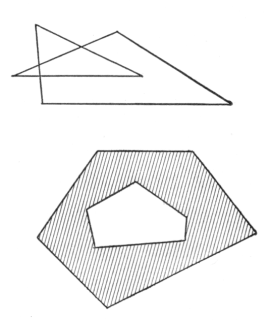
It may also be mentioned to a class at some convenient
time that the old idea of a polygon was that of a convex
figure, and that the modern idea, which is met in higher
mathematics, leads to a modification of earlier concepts.
For example, here is a
quadrilateral with one
of its diagonals, BD, outside
the figure. Furthermore,
if we consider a
quadrilateral as a figure
formed by four intersecting
lines, AC, CF, BE, and EA, it is apparent that this
general quadrilateral has six vertices, A, B, C, D, E, F,
and three diagonals, AD, BF, and CE. Such broader
ideas of geometry form the basis of what is called
modern elementary geometry.
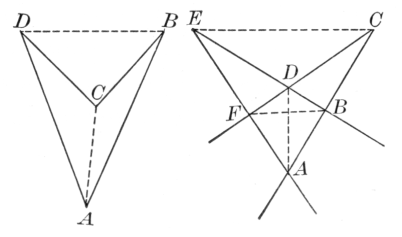
The other definitions of plane geometry need not be
discussed, since all that have any historical interest have
been considered. On the whole it may be said that our
definitions to-day are not in general so carefully considered
as those of Euclid, who weighed each word with
greatest skill, but they are more teachable to beginners,
and are, on the whole, more satisfactory from the educational
standpoint. The greatest lesson to be learned from
this discussion is that the number of basal definitions to
be learned for subsequent use is very small.
Since teachers are occasionally disturbed over the form
in which definitions are stated, it is well to say a few
words upon this subject. There are several standard
types that may be used. (1) We may use the dictionary
form, putting the word defined first, thus: "Right
triangle. A triangle that has one of its angles a right
angle." This is scientifically correct, but it is not a complete
sentence, and hence it is not easily repeated when
it has to be quoted as an authority. (2) We may put
the word defined at the end, thus: "A triangle that has
one of its angles a right angle is called a right triangle."
This is more satisfactory. (3) We may combine (1)
and (2), thus: "Right triangle. A triangle that has one
of its angles a right angle is called a right triangle."
This is still better, for it has the catchword at the
beginning of the paragraph.
There is occasionally some mental agitation over the
trivial things of a definition, such as the use of the words
"is called." It would not be a very serious matter if
they were omitted, but it is better to have them there.
The reason is that they mark the statement at once as a
definition. For example, suppose we say that "a triangle
that has one of its angles a right angle is a right
triangle." We have also the fact that "a triangle whose
base is the diameter of a semicircle and whose vertex
lies on the semicircle is a right triangle." The style of
statement is the same, and we have nothing in the phraseology
to show that the first is a definition and the second
a theorem. This may happen with most of the definitions,
and hence the most careful writers have not consented
to omit the distinctive words in question.
Apropos of the definitions of geometry, the great
French philosopher and mathematician, Pascal, set forth
certain rules relating to this subject, as also to the axioms
employed, and these may properly sum up this chapter.
1. Do not attempt to define terms so well known in
themselves that there are no simpler terms by which to
express them.
2. Admit no obscure or equivocal terms without
defining them.
3. Use in the definitions only terms that are perfectly
understood or are there explained.
4. Omit no necessary principles without general agreement,
however clear and evident they may be.
5. Set forth in the axioms only those things that are
in themselves perfectly evident.
6. Do not attempt to demonstrate anything that is so
evident in itself that there is nothing more simple by
which to prove it.
7. Prove whatever is in the least obscure, using in the
demonstration only axioms that are perfectly evident
in themselves, or propositions already demonstrated or
allowed.
8. In case of any uncertainty arising from a term employed,
always substitute mentally the definition for the
term itself.
Bibliography. Heath, Euclid, as cited; Frankland, The First
Book of Euclid, as cited; Smith, Teaching of Elementary Mathematics,
p. 257, New York, 1900; Young, Teaching of Mathematics,
p. 189, New York, 1907; Veblen, On Definitions, in the Monist,
1903, p. 303.
The old geometry, say of a century ago, usually consisted,
as has been stated, of a series of theorems fully
proved and of problems fully solved. During the nineteenth
century exercises were gradually introduced, thus
developing geometry from a science in which one learned
by seeing things done, into one in which he gained power
by actually doing things. Of the nature of these exercises
("originals," "riders"), and of their gradual
change in the past few years, mention has been made in
Chapter VII. It now remains to consider the methods
of attacking these exercises.
It is evident that there is no single method, and this is
a fortunate fact, since if it were not so, the attack would
be too mechanical to be interesting. There is no one
rule for solving every problem nor even for seeing how
to begin. On the other hand, a pupil is saved some time
by having his attention called to a few rather definite
lines of attack, and he will undoubtedly fare the better
by not wasting his energies over attempts that are in
advance doomed to failure.
There are two general questions to be considered:
first, as to the discovery of new truths, and second, as to
the proof. With the first the pupil will have little to do,
not having as yet arrived at this stage in his progress.
A bright student may take a little interest in seeing what
he can find out that is new (at least to him), and if so, he
may be told that many new propositions have been discovered
by the accurate drawing of figures; that some
have been found by actually weighing pieces of sheet
metal of certain sizes; and that still others have made
themselves known through paper folding. In all of these
cases, however, the supposed proposition must be proved
before it can be accepted.
As to the proof, the pupil usually wanders about more
or less until he strikes the right line, and then he follows
this to the conclusion. He should not be blamed for
doing this, for he is pursuing the method that the world
followed in the earliest times, and one that has always
been common and always will be. This is the synthetic
method, the building up of the proof from propositions
previously proved. If the proposition is a theorem, it is
usually not difficult to recall propositions that may lead
to the demonstration, and to select the ones that are
really needed. If it is a problem, it is usually easy to
look ahead and see what is necessary for the solution
and to select the preceding propositions accordingly.
But pupils should be told that if they do not rather
easily find the necessary propositions for the construction
or the proof, they should not delay in resorting to
another and more systematic method. This is known as
the method of analysis, and it is applicable both to theorems
and to problems. It has several forms, but it is of
little service to a pupil to have these differentiated, and
it suffices that he be given the essential feature of all
these forms, a feature that goes back to Plato and his
school in the fifth century B.C.
For a theorem, the method of analysis consists in
reasoning as follows: "I can prove this proposition if I
can prove this thing; I can prove this thing if I can prove
that; I can prove that if I can prove a third thing," and
so the reasoning runs until the pupil comes to the point
where he is able to add, "but I can prove that." This
does not prove the proposition, but it enables him to
reverse the process, beginning with the thing he can
prove and going back, step by step, to the thing that he
is to prove. Analysis is, therefore, his method of discovery
of the way in which he may arrange his synthetic
proof. Pupils often wonder how any one ever came to
know how to arrange the proofs of geometry, and this
answers the question. Some one guessed that a statement
was true; he applied analysis and found that he could
prove it; he then applied synthesis and did prove it.
For a problem, the method of analysis is much the
same as in the case of a theorem. Two things are involved,
however, instead of one, for here we must make
the construction and then prove that this construction is
correct. The pupil, therefore, first supposes the problem
solved, and sees what results follow. He then reverses
the process and sees if he can attain these results and thus
effect the required construction. If so, he states the process
and gives the resulting proof. For example:
In a triangle ABC, to draw PQ parallel to the base AB,
cutting the sides in P and Q, so that PQ shall equal AP + BQ.
Analysis. Assume the problem solved.
Then AP must equal some part of PQ as
PX, and BQ must equal QX.
But if AP = PX, what must ∠PXA equal?
∵ PQ is || AB, what does ∠PXA equal?
Then why must ∠BAX = ∠XAP?
Similarly, what about ∠QBX and ∠XBA?
Construction. Now reverse the process. What may we do to ⦞A and
B in order to fix X? Then how shall PQ be drawn? Now give the proof.
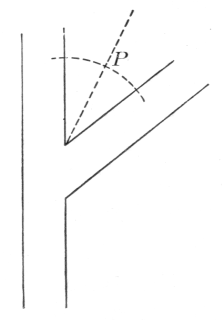
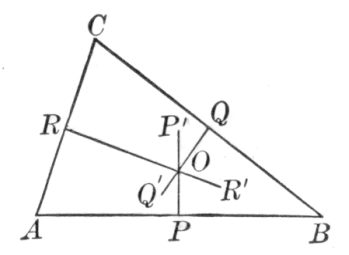
The third general method of attack applies chiefly to
problems where some point is to be determined. This
is the method of the intersection of loci. Thus, to locate
an electric light at a point eighteen feet
from the point of intersection of two
streets and equidistant from them, evidently
one locus is a circle with a radius
eighteen feet and the center at the vertex
of the angle made by the streets,
and the other locus is the bisector of the
angle. The method is also occasionally
applicable to theorems. For example,
to prove that the perpendicular bisectors
of the sides of a triangle are concurrent. Here the
locus of points equidistant from A and B is PP', and
the locus of points equidistant from
B and C is QQ'. These can easily be
shown to intersect, as at O. Then O,
being equidistant from A, B, and C,
is also on the perpendicular bisector
of AC. Therefore these bisectors are concurrent in O.
These are the chief methods of attack, and are all
that should be given to an average class for practical
use.
Besides the methods of attack, there are a few general
directions that should be given to pupils.
1. In attacking either a theorem or a problem, take
the most general figure possible. Thus, if a proposition
relates to a quadrilateral, take one with unequal sides
and unequal angles rather than a square or even a
rectangle. The simpler figures often deceive a pupil
into feeling that he has a proof, when in reality he has
one only for a special case.
2. Set forth very exactly the thing that is given, using
letters relating to the figure that has been drawn. Then
set forth with the same exactness the thing that is to be
proved. The neglect to do this is the cause of a large
per cent of the failures. The knowing of exactly what
we have to do and exactly what we have with which to
do it is half the battle.
3. If the proposition seems hazy, the difficulty is probably
with the wording. In this case try substituting the
definition for the name of the thing defined. Thus instead
of thinking too long about proving that the median
to the base of an isosceles triangle is perpendicular to
the base, draw the figure and
think that there is given
AC = BC,
AD = BD,
and that there is to be proved that
∠CDA = ∠BDC.
Here we have replaced "median," "isosceles," and "perpendicular"
by statements that express the same idea in
simpler language.
Bibliography. Petersen, Methods and Theories for the Solution
of Geometric Problems of Construction, Copenhagen, 1879, a
curious piece of English and an extreme view of the subject, but
well worth consulting; Alexandroff, Problèmes de géométrie
élémentaire, Paris, 1899, with a German translation in 1903;
Loomis, Original Investigation; or, How to attack an Exercise
in Geometry, Boston, 1901; Sauvage, Les Lieux géométriques
en géométrie élémentaire, Paris, 1893; Hadamard, Leçons de
géométrie, p. 261, Paris, 1898; Duhamel, Des Méthodes dans les
sciences de raisonnement, 3e éd., Paris, 1885; Henrici and Treutlein,
Lehrbuch der Elementar-Geometrie, Leipzig, 3. Aufl., 1897;
Henrici, Congruent Figures, London, 1879.
Having considered the nature of the geometry that
we have inherited, and some of the opportunities for
improving upon the methods of presenting it, the next
question that arises is the all-important one of the subject
matter, What shall geometry be in detail? Shall
it be the text or the sequence of Euclid? Few teachers
have any such idea at the present time. Shall it be a
mere dabbling with forms that are seen in mechanics or
architecture, with no serious logical sequence? This is an
equally dangerous extreme. Shall it be an entirely new
style of geometry based upon groups of motions? This
may sometime be developed, but as yet it exists in the
future if it exists at all, since the recent efforts in this
respect are generally quite as ill suited to a young pupil
as is Euclid's "Elements" itself.
No one can deny the truth of M. Bourlet's recent
assertion that "Industry, daughter of the science of the
nineteenth century, reigns to-day the mistress of the
world; she has transformed all ancient methods, and
she has absorbed in herself almost all human activity."[57]
Neither can one deny the justice of his comparison of
Euclid with a noble piece of Gothic architecture and of
his assertion that as modern life demands another type
of building, so it demands another type of geometry.
But what does this mean? That geometry is to exist
merely as it touches industry, or that bad architecture is
to replace the good? By no means. A building should
to-day have steam heat and elevators and electric lights,
but it should be constructed of just as enduring materials
as the Parthenon, and it should have lines as pleasing as
those of a Gothic façade. Architecture should still be
artistic and construction should still be substantial, else
a building can never endure. So geometry must still
exemplify good logic and must still bring to the pupil a
feeling of exaltation, or it will perish and become a mere
relic in the museum of human culture.
What, then, shall the propositions of geometry be, and
in what manner shall they answer to the challenge of the
industrial epoch in which we live? In reply, they must
be better adapted to young minds and to all young minds
than Euclid ever intended his own propositions to be.
Furthermore, they must have a richness of application
to pure geometry, in the way of carefully chosen exercises,
that Euclid never attempted. And finally, they
must have application to this same life of industry of
which we have spoken, whenever this can really be found,
but there must be no sham and pretense about it, else
the very honesty that permeated the ancient geometry
will seem to the pupil to be wanting in the whole subject.[58]
Until some geometry on a radically different basis shall
appear, and of this there is no very hopeful sign at present,
the propositions will be the essential ones of Euclid,
excluding those that may be considered merely intuitive,
and excluding all that are too difficult for the pupil who
to-day takes up their study. The number will be limited
in a reasonable way, and every genuine type of application
will be placed before the teacher to be used as
necessity requires. But a fair amount of logic will be
retained, and the effort to make of geometry an empty
bauble of a listless mind will be rejected by every worthy
teacher. What the propositions should be is a matter
upon which opinions may justly differ; but in this
chapter there is set forth a reasonable list for Book I,
arranged in a workable sequence, and this list may fairly
be taken as typical of what the American school will probably
use for many years to come. With the list is given
a set of typical applications, and some of the general information
that will add to the interest in the work and
that should form part of the equipment of the teacher.
An ancient treatise was usually written on a kind of
paper called papyrus, made from the pith of a large reed
formerly common in Egypt, but now growing luxuriantly
only above Khartum in Upper Egypt, and near Syracuse
in Sicily; or else it was written on parchment, so called
from Pergamos in Asia Minor, where skins were first
prepared in parchment form; or occasionally they were
written on ordinary leather. In any case they were generally
written on long strips of the material used, and
these were rolled up and tied. Hence we have such an
expression as "keeping the roll" in school, and such
a word as "volume," which has in it the same root as
"involve" (to roll in), and "evolve" (to roll out). Several
of these rolls were often necessary for a single treatise,
in which case each was tied, and all were kept together
in a receptacle resembling a pail, or in a compartment
on a shelf. The Greeks called each of the separate parts
of a treatise biblion (βιβλίον), a word meaning "book."
Hence we have the books of the Bible, the books of
Homer, and the books of Euclid. From the same root,
indeed, comes Bible, bibliophile (booklover), bibliography
(list of books), and kindred words. Thus the books of
geometry are the large chapters of the subject, "chapter"
being from the Latin caput (head), a section under a new
heading. There have been efforts to change "books" to
"chapters," but they have not succeeded, and there is
no reason why they should succeed, for the term is clear
and has the sanction of long usage.
Theorem. If two lines intersect, the vertical angles are
equal.
This was Euclid's Proposition 15, being put so late
because he based the proof upon his Proposition 13, now
thought to be best taken without proof, namely, "If a
straight line set upon a straight line makes angles, it will
make either two right angles or angles equal to two right
angles." It is found to be better pedagogy to assume
that this follows from the definition of straight angle,
with reference, if necessary, to the meaning of the sum of
two angles. This proposition on vertical angles is probably
the best one with which to begin geometry, since it
is not so evident as to seem to need no proof, although
some prefer to rank it as semiobvious, while the proof
is so simple as easily to be understood. Eudemus, a
Greek who wrote not long before Euclid, attributed
the discovery of this proposition to Thales of Miletus
(ca. 640-548 B.C.), one of the Seven Wise Men of Greece,
of whom Proclus wrote: "Thales it was who visited
Egypt and first transferred to Hellenic soil this theory
of geometry. He himself, indeed, discovered much, but
still more did he introduce to his successors the principles
of the science."
The proposition is the only basal one relating to the
intersection of two lines, and hence there are no others
with which it is necessarily grouped. This is the reason
for placing it by itself, followed by the congruence
theorems.
There are many familiar illustrations of this theorem.
Indeed, any two crossed lines, as in a pair of shears or
the legs of a camp stool, bring it to mind. The word
"straight" is here omitted before "lines" in accordance
with the modern convention that the word "line" unmodified
means a straight line. Of course in cases of
special emphasis the adjective should be used.
Theorem. Two triangles are congruent if two sides
and the included angle of the one are equal respectively to
two sides and the included angle of the other.
This is Euclid's Proposition 4, his first three propositions
being problems of construction. This would therefore
have been his first proposition if he had placed his
problems later, as we do to-day. The words "congruent"
and "equal" are not used as in Euclid, for reasons already
set forth on page 151. There have been many attempts
to rearrange the propositions of Book I, putting in separate
groups those concerning angles, those concerning
triangles, and those concerning parallels, but they have
all failed, and for the cogent reason that such a scheme
destroys the logical sequence. This proposition may
properly follow the one on vertical angles simply because
the latter is easier and does not involve superposition.
As far as possible, Euclid and all other good geometers
avoid the proof by superposition. As a practical
test superposition is valuable, but as a theoretical one it
is open to numerous objections. As Peletier pointed out
in his (1557) edition of Euclid, if the superposition of
lines and figures could freely be assumed as a method of
demonstration, geometry would be full of such proofs.
There would be no reason, for example, why an angle
should not be constructed equal to a given angle by
superposing the given angle on another part of the plane.
Indeed, it is possible that we might then assume to bisect
an angle by imagining the plane folded like a piece of
paper. Heath (1908) has pointed out a subtle defect in
Euclid's proof, in that it is said that because two lines
are equal, they can be made to coincide. Euclid says,
practically, that if two lines can be made to coincide,
they are equal, but he does not say that if two straight
lines are equal, they can be made to coincide. For the
purposes of elementary geometry the matter is hardly
worth bringing to the attention of a pupil, but it shows
that even Euclid did not cover every point.
Applications of this proposition are easily found, but
they are all very much alike. There are dozens of measurements
that can be made by simply constructing a
triangle that shall be congruent to another triangle. It
seems hardly worth the while at this time to do more
than mention one typical case,[59] leaving it to teachers who
may find it desirable to suggest others to their pupils.
Wishing to measure the distance
across a river, some boys sighted
from A to a point P. They then
turned and measured AB at right
angles to AP. They placed a stake
at O, halfway from A to B, and
drew a perpendicular to AB at B.
They placed a stake at C, on this
perpendicular, and in line with O and P. They then found
the width by measuring BC. Prove that they were right.
This involves the ranging of a line, and the running
of a line at right angles to a given line, both of which
have been described in Chapter IX. It is also fairly
accurate to run a line at any angle to a given line by
sighting along two pins stuck in a protractor.
Theorem. Two triangles are congruent if two angles
and the included side of the one are equal respectively to
two angles and the included side of the other.
Euclid combines this with his Proposition 26:
If two triangles have the two angles equal to two angles respectively,
and one side equal to one side, namely, either the side
adjoining the equal angles, or that subtending one of the equal
angles, they will also have the remaining sides equal to the remaining
sides, and the remaining angle to the remaining angle.
He proves this cumbersome statement without superposition,
desiring to avoid this method, as already stated,
whenever possible. The proof by superposition is old,
however, for Al-Nairīzī[60] gives it and ascribes it to some
earlier author whose name he did not know. Proclus
tells us that "Eudemus in his geometrical history refers
this theorem to Thales. For he says that in the method
by which they say that Thales proved the distance of ships
in the sea, it was necessary to make use of this theorem."
How Thales did this is purely a matter of conjecture,
but he might have stood on the top of a tower rising
from the level shore, or of such headlands as abound
near Miletus, and by some simple instrument sighted to
the ship. Then, turning, he might have sighted along
the shore to a point having the same angle of declination,
and then have measured the distance from the tower
to this point. This seems more reasonable than any of
the various plans suggested, and it is found in so many
practical geometries of the first century of printing that
it seems to have long been a common expedient. The stone
astrolabe from Mesopotamia, now preserved in the British
Museum, shows that such instruments for the measuring
of angles are very old, and for the purposes of
Thales even a pair of large compasses would have answered
very well. An illustration of the method is seen
in Belli's work of 1569, as here shown. At the top of
the picture a man is getting the angle by means of the
visor of his cap; at the bottom of the picture a man is
using a ruler screwed to a staff.[61] The story goes that
one of Napoleon's engineers won the imperial favor by
quickly measuring the width of a stream that blocked
the progress of the army, using this very method.
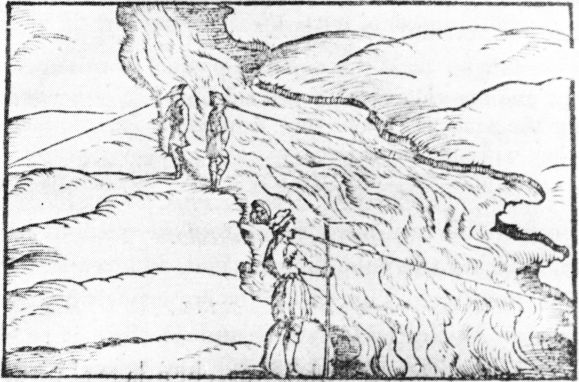 Sixteenth-Century Mensuration
Belli's "Del Misurar con la Vista," Venice, 1569
Sixteenth-Century Mensuration
Belli's "Del Misurar con la Vista," Venice, 1569
This proposition is the reciprocal or dual of the preceding
one. The relation between the two may be seen
from the following arrangement:
Two triangles are congruent
if two sides and the included
angle of the one are equal respectively
to two sides and the
included angle of the other.
Two triangles are congruent
if two angles and the included
side of the one are equal respectively
to two angles and the
included side of the other.
In general, to every proposition involving points and
lines there is a reciprocal proposition involving lines and
points respectively that is often true,—indeed, that is
always true in a certain line of propositions. This relation
is known as the Principle of Reciprocity or of Duality.
Instead of points and lines we have here angles
(suggested by the vertex points) and lines. It is interesting
to a class to have attention called to such relations,
but it is not of sufficient importance in elementary
geometry to justify more than a reference here and there.
There are other dual features that are seen in geometry
besides those given above.
Theorem. In an isosceles triangle the angles opposite
the equal sides are equal.
This is Euclid's Proposition 5, the second of his theorems,
but he adds, "and if the equal straight lines be
produced further, the angles under the base will be equal
to one another." Since, however, he does not use this
second part, its genuineness is doubted. He would not
admit the common proof of to-day of supposing the vertical
angle bisected, because the problem about bisecting
an angle does not precede this proposition, and therefore
his proof is much more involved than ours. He makes
CX = CY, and proves ⧌XBC and YAC congruent,[62] and
also ⧌XBA and YAB congruent. Then from ∠YAC he
takes ∠YAB, leaving ∠BAC, and so on
the other side, leaving ∠CBA, these
therefore being equal.
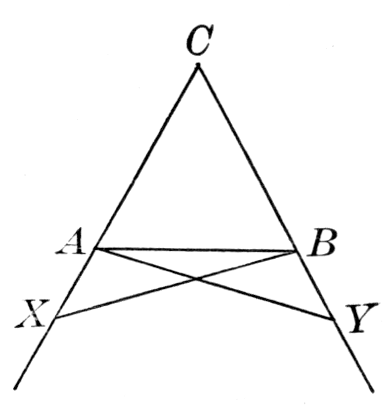
This proposition has long been called
the pons asinorum, or bridge of asses, but
no one knows where or when the name
arose. It is usually stated that it came
from the fact that fools could not cross this bridge, and
it is a fact that in the Middle Ages this was often the
limit of the student's progress in geometry. It has however
been suggested that the name came from Euclid's
figure, which resembles the simplest type of a wooden
truss bridge. The name is applied by the French to
the Pythagorean Theorem.
Proclus attributes the discovery of this proposition to
Thales. He also says that Pappus (third century A.D.),
a Greek commentator on Euclid, proved the proposition
as follows:
Let ABC be the triangle, with AB = AC. Conceive of this as
two triangles; then AB = AC, AC = AB, and ∠A is common;
hence the ⧌ABC and ACB are congruent, and ∠B of the one
equals ∠C of the other.
This is a better plan than that followed by some textbook
writers of imagining ⧍ABC taken up and laid down
on itself. Even to lay it down on its "trace" is more
objectionable than the plan of Pappus.
Theorem. If two angles of a triangle are equal, the sides
opposite the equal angles are equal, and the triangle is isosceles.
The statement is, of course, tautological, the last five
words being unnecessary from the mathematical standpoint,
but of value at this stage of the student's progress
as emphasizing the nature of the triangle. Euclid stated
the proposition thus, "If in a triangle two angles be equal
to one another, the sides which subtend the equal angles
will also be equal to one another." He did not define
"subtend," supposing such words to be already understood.
This is the first case of a converse proposition
in geometry. Heath distinguishes the logical from the
geometric converse. The logical converse of Euclid I, 5,
would be that "some triangles with two angles equal are
isosceles," while the geometric converse is the proposition
as stated. Proclus called attention to two forms
of converse (and in the course of the work, but not
at this time, the teacher may have to do the same):
(1) the complete converse, in which that which is given
in one becomes that which is to be proved in the other,
and vice versa, as in this and the preceding proposition;
(2) the partial converse, in which two (or even more)
things may be given, and a certain thing is to be proved,
the converse being that one (or more) of the preceding
things is now given, together with what was to be proved,
and the other given thing is now to be proved. Symbolically,
if it is given that a = b and c = d, to prove that
x = y, the partial converse would have given a = b and
x = y, to prove that c = d.
Several proofs for the proposition have been suggested,
but a careful examination of all of them shows
that the one given below is, all things considered, the
best one for pupils beginning geometry and following the
sequence laid down in this chapter. It has the sanction
of some of the most eminent mathematicians, and while
not as satisfactory in some respects as the reductio ad absurdum,
mentioned below, it is more satisfactory in most
particulars. The proof is as follows:
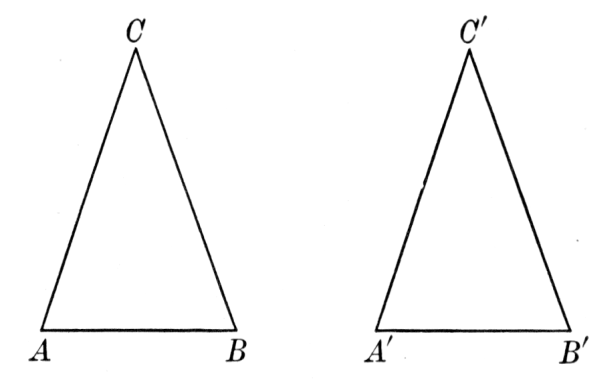 Given the triangle ABC, with the angle A equal to the angle B.
To prove that AC = BC.
Proof. Suppose the second triangle A'B'C' to be an exact reproduction
of the given triangle ABC.
Turn the triangle A'B'C' over and place it upon ABC so that
B' shall fall on A and A' shall fall on B.
Then B'A' will coincide with AB.
Since ∠A' = ∠B', Given
and ∠A = ∠A', Hyp.
∴∠A = ∠B'.
∴B'C' will lie along AC.
Similarly, A'C' will lie along BC.
Therefore C' will fall on both AC and BC, and hence at their
intersection.
∴B'C' = AC.
But B'C' was made equal to BC.
∴AC = BC. Q.E.D.
If the proposition should be postponed until after the
one on the sum of the angles of a triangle, the proof
would be simpler, but it is advantageous to couple it with
its immediate predecessor. This simpler proof consists
in bisecting the vertical angle, and then proving the two
triangles congruent. Among the other proofs is that of
the reductio ad absurdum, which the student might now
meet, but which may better be postponed. The phrase
reductio ad absurdum seems likely to continue in spite
of the efforts to find another one that is simpler. Such
a proof is also called an indirect proof, but this term is
not altogether satisfactory. Probably both names should
be used, the Latin to explain the nature of the English.
The Latin name is merely a translation of one of several
Greek names used by Aristotle, a second being in English
"proof by the impossible," and a third being "proof
leading to the impossible." If teachers desire to introduce
this form of proof here, it must be borne in mind
that only one supposition can be made if such a proof
is to be valid, for if two are made, then an absurd conclusion
simply shows that either or both must be false,
but we do not know which is false, or if only one is false.
Theorem. Two triangles are congruent if the three sides
of the one are equal respectively to the three sides of the other.
It would be desirable to place this after the fourth
proposition mentioned in this list if it could be done, so
as to get the triangles in a group, but we need the fourth
one for proving this, so that the arrangement cannot be
made, at least with this method of proof.
This proposition is a "partial converse" of the second proposition
in this list; for if the triangles are ABC and A'B'C',
with sides a, b, c and a', b', c', then the second proposition asserts
that if b = b', c = c', and ∠A = ∠A', then a = a' and the triangles are congruent, while this proposition asserts that if a = a', b = b',
and c = c', then ∠A = ∠A' and the triangles are congruent.
The proposition was known at least as early as Aristotle's
time. Euclid proved it by inserting a preliminary
proposition to the effect that it is impossible to have on
the same base AB and the same side of it two different
triangles ABC and ABC', with AC = AC', and BC = BC'.
The proof ordinarily given to-day, wherein the two triangles
are constructed on opposite sides of the base, is
due to Philo of Byzantium, who lived after Euclid's time
but before the Christian era, and it is also given by Proclus.
There are really three cases, if one wishes to be
overparticular, corresponding to the three pairs of equal
sides. But if we are allowed to take the longest side for
the common base, only one case need be considered.
Of the applications of the proposition one of the most
important relates to making a figure rigid by means of
diagonals. For example, how many diagonals must be
drawn in order to make a quadrilateral rigid? to make
a pentagon rigid? a hexagon? a polygon of n sides. In
particular, the following questions may be
asked of a class:
1. Three iron rods are hinged at the extremities,
as shown in this figure. Is the figure
rigid? Why?
2. Four iron rods are hinged, as shown in
this figure. Is the figure rigid? If not, where
would you put in the fifth rod to make it rigid?
Prove that this would accomplish the result.
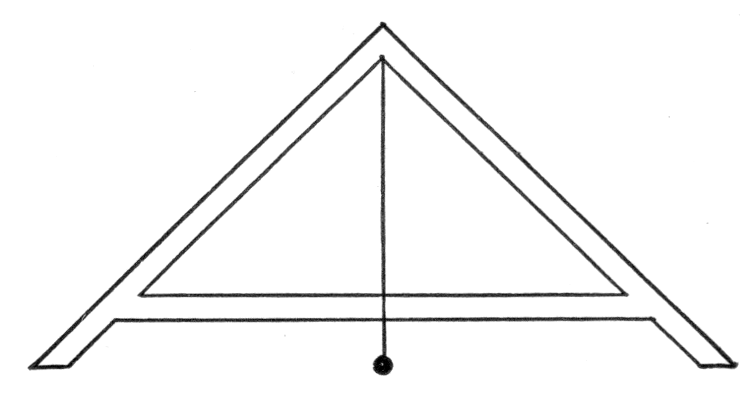
Another interesting application relates to the most
ancient form of leveling
instrument known to us.
This kind of level is pictured
on very ancient
monuments, and it is still
used in many parts of the
world. Pupils in manual training may make such an instrument,
and indeed one is easily made out of cardboard.
If the plumb line passes through the mid-point of the base,
the two triangles are congruent and the plumb line is
then perpendicular to the base. In other words, the base
is level. With such simple primitive instruments, easily
made by pupils, a good deal of practical mathematical
work can be performed. The interesting old illustration
here given shows how this form of level
was used three hundred years ago.
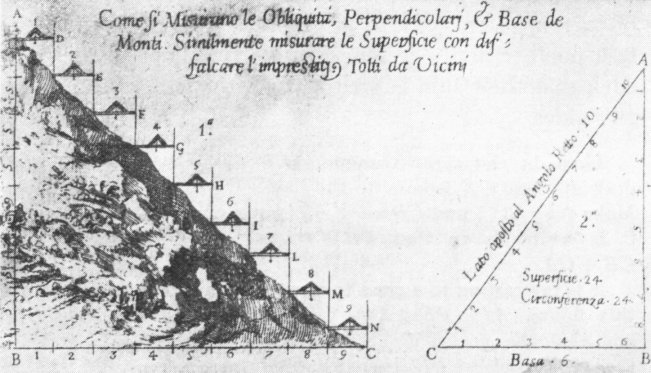 Early Methods of Leveling
Pomodoro's "La geometria prattica," Rome, 1624
Early Methods of Leveling
Pomodoro's "La geometria prattica," Rome, 1624
Teachers who seek for geometric
figures in practical mechanics will
find this proposition illustrated in
the ordinary hoisting apparatus of
the kind here shown. From the study
of such forms and of simple roof
and bridge trusses, a number of the
usual properties of the isosceles triangle may be derived.
Theorem. The sum of two lines drawn from a given
point to the extremities of a given line is greater than
the sum of two other lines similarly drawn, but included
by them.
It should be noted that the words "the extremities
of" are necessary, for it is possible to draw from a certain
point within a certain triangle two lines to the base
such that their sum is greater than the sum of the other
two sides.
Thus, in the right triangle ABC
draw any line CX from C to the base.
Make XY = AC, and CP = PY. Then
it is easily shown that PB + PX > CB + CA.
It is interesting to a class to have a teacher point out that, in
this figure, AP + PB < AC + CB, and AP' + P'B < AP + PB,
and that the nearer P gets to AB,
the shorter AP + PB becomes, the
limit being the line AB. From this
we may infer (although we have not
proved) that "a straight line (AB) is
the shortest path between two points."
Theorem. Only one perpendicular can be drawn to a
given line from a given external point.
Theorem. Two lines drawn from a point in a perpendicular
to a given line, cutting off on the given line equal
segments from the foot of the perpendicular, are equal and
make equal angles with the perpendicular.
Theorem. Of two lines drawn from the same point in
a perpendicular to a given line, cutting off on the line unequal
segments from the foot of the perpendicular, the more
remote is the greater.
Theorem. The perpendicular is the shortest line that
can be drawn to a straight line from a given external point.
These four propositions, while known to the ancients
and incidentally used, are not explicitly stated by Euclid.
The reason seems to be that he interspersed his problems
with his theorems, and in his Propositions 11 and 12,
which treat of drawing a perpendicular to a line, the
essential features of these theorems are proved. Further
mention will be made of them when we come to consider
the problems in question. Many textbook writers put the
second and third of the four before the first, forgetting
that the first is assumed in the other two, and hence
should precede them.
Theorem. Two right triangles are congruent if the
hypotenuse and a side of the one are equal respectively to
the hypotenuse and a side of the other.
Theorem. Two right triangles are congruent if the
hypotenuse and an adjacent angle of the one are equal respectively
to the hypotenuse and an adjacent angle of the
other.
As stated in the notes on the third proposition in this
sequence, Euclid's cumbersome Proposition 26 covers
several cases, and these two among them. Of course this
present proposition could more easily be proved after the
one concerning the sum of the angles of a triangle, but
the proof is so simple that it is better to leave the proposition
here in connection with others concerning triangles.
Theorem. Two lines in the same plane perpendicular
to the same line cannot meet, however far they are produced.
This proposition is not in Euclid, and it is introduced
for educational rather than for mathematical reasons.
Euclid introduced the subject by the proposition that, if
alternate angles are equal, the lines are parallel. It is,
however, simpler to begin with this proposition, and
there is some advantage in stating it in such a way as to
prove that parallels exist before they are defined. The
proposition is properly followed by the definition of
parallels and by the postulate that has been discussed
on page 127.
A good application of this proposition is the one concerning
a method of drawing parallel lines by the use of
a carpenter's square. Here two lines are drawn perpendicular
to the edge of a board or a ruler, and these are
parallel.
Theorem. If a line is perpendicular to one of two
parallel lines, it is perpendicular to the other also.
This, like the preceding proposition, is a special case
under a later theorem. It simplifies the treatment of
parallels, however, and the beginner finds it easier to
approach the difficulties gradually, through these two
cases of perpendiculars. It should be noticed that this
is an example of a partial converse, as explained on page
175. The preceding proposition may be stated thus: If
a is ⊥ to x and b is ⊥ to x, then a is || to b. This proposition
may be stated thus: If a is ⊥ to x and a is || to b,
then b is ⊥ to x. This is, therefore, a partial converse.
These two propositions having been proved, the usual
definitions of the angles made by a transversal of two
parallels may be given. It is unfortunate that we have
no name for each of the two groups of four equal angles,
and the name of "transverse angles" has been suggested.
This would simplify the statements of certain other propositions;
thus: "If two parallel lines are cut by a transversal,
the transverse angles are equal," and this includes
two propositions as usually given. There is not as yet,
however, any general sanction for the term.
Theorem. If two parallel lines are cut by a transversal,
the alternate-interior angles are equal.
Euclid gave this as half of his Proposition 29. Indeed,
he gives only four theorems on parallels, as against five
propositions and several corollaries in most of our American
textbooks. The reason for increasing the number is
that each proposition may be less involved. Thus, instead
of having one proposition for both exterior and interior
angles, modern authors usually have one for the exterior
and one for the interior, so as to make the difficult subject
of parallels easier for beginners.
Theorem. When two straight lines in the same plane
are cut by a transversal, if the alternate-interior angles are
equal, the two straight lines are parallel.
This is the converse of the preceding theorem, and is
half of Euclid I, 28, his theorem being divided for the
reason above stated. There are several typical pairs of
equal or supplemental angles that would lead to parallel
lines, of which Euclid uses only part, leaving the other
cases to be inferred. This accounts for the number of
corollaries in this connection in later textbooks.
Surveyors make use of this proposition when they
wish, without using a transit instrument, to run one line
parallel to another.
For example, suppose two boys are laying out a tennis court
and they wish to run a line through P parallel to AB. Take a
60-foot tape and swing it around P until the other end rests on
AB, as at M. Put a
stake at O, 30 feet
from P and M. Then
take any convenient
point N on AB, and
measure ON. Suppose
it equals 20 feet.
Then sight from N
through O, and put a stake at Q just 20 feet from O. Then P and Q
determine the parallel, according to the proposition just mentioned.
Theorem. If two parallel lines are cut by a transversal,
the exterior-interior angles are equal.
This is also a part of Euclid I, 29. It is usually followed
by several corollaries, covering the minor and obvious
cases omitted by the older writers. While it would
be possible to dispense with these corollaries, they are
helpful for definite reference in later propositions.
Theorem. The sum of the three angles of a triangle is
equal to two right angles.
Euclid stated this as follows: "In any triangle, if one
of the sides be produced, the exterior angle is equal to the
two interior and opposite angles, and the three interior
angles of the triangle are equal to two right angles." This
states more than is necessary for the basal fact of the proposition,
which is the constancy of the sum of the angles.
The theorem is one of the three most important propositions
in plane geometry, the other two being the so-called
Pythagorean Theorem, and a proposition relating
to the proportionality of the sides of two triangles. These
three form the foundation of trigonometry and of the
mensuration of plane figures.
The history of the proposition is extensive. Eutocius
(ca. 510 A.D.), in his commentary on Apollonius, says
that Geminus (first century B.C.) testified that "the
ancients investigated the theorem of the two right
angles in each individual species of triangle, first in the
equilateral, again in the isosceles, and afterwards in the
scalene triangle." This, indeed, was the ancient plan,
to proceed from the particular to the general. It is the
natural order, it is the world's order, and it is well to
follow it in all cases of difficulty in the classroom.
Proclus (410-485 A.D.) tells us that Eudemus, who
lived just before Euclid (or probably about 325 B.C.),
affirmed that the theorem was due to the Pythagoreans,
although this does not necessarily mean to the actual
pupils of Pythagoras. The proof as he gives it consists in
showing that a = a´, b = b´, and
a´ + c + b´ = two right angles.
Since the proposition about
the exterior angle of a triangle
is attributed to Philippus
of Mende (ca. 380 B.C.), the figure given by Eudemus
is probably the one used by the Pythagoreans.
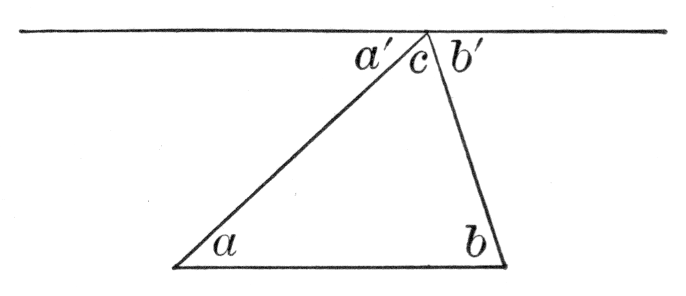
There is also some reason for believing that Thales
(ca. 600 B.C.) knew the theorem, for Diogenes Laertius
(ca. 200 A.D.) quotes Pamphilius (first century A.D.) as
saying that "he, having learned geometry from the
Egyptians, was the first to inscribe a right triangle in
a circle, and sacrificed an ox." The proof of this proposition
requires the knowledge that the sum of the angles,
at least in a right triangle, is two right angles. The proposition
is frequently referred to by Aristotle.
There have been numerous attempts to prove the
proposition without the use of parallel lines. Of these
a German one, first given by Thibaut in the early part
of the eighteenth century, is among the most interesting.
This, in simplified
form, is as follows:
Suppose an indefinite
line XY to lie
on AB. Let it swing
about A, counterclockwise,
through
∠A, so as to lie on
AC, as X'Y'. Then
let it swing about C,
through ∠C, so as to lie on CB, as X''Y''. Then let it swing about
B, through ∠B, so as to lie on BA, as X'''Y'''. It now lies on AB,
but it is turned over, X''' being where Y was, and Y''' where X
was. In turning through ⦞A, B, and C it has therefore turned
through two right angles.
One trouble with the proof is that the rotation has
not been about the same point, so that it has never been
looked upon as other than an interesting illustration.
Proclus tried to prove the theorem by saying that, if
we have two perpendiculars to the same line, and suppose
them to revolve about their feet so as to make a
triangle, then the amount taken from the right angles
is added to the vertical angle of the triangle, and therefore
the sum of the angles continues to be two right
angles. But, of course, to prove his statement requires a
perpendicular to be drawn from the vertex to the base,
and the theorem of parallels to be applied.
Pupils will find it interesting to cut off the corners
of a paper triangle and fit the angles together so as to
make a straight angle.
This theorem furnishes an opportunity for many interesting
exercises, and in particular for determining the
third angle when two angles of a triangle are given,
or the second acute angle of a right triangle when one
acute angle is given.
Of the simple outdoor applications of the proposition,
one of the best is illustrated in
this figure.
To ascertain the height of a tree or
of the school building, fold a piece of
paper so as to make an angle of 45°.
Then walk back from the tree until the
top is seen at an angle of 45° with the
ground (being therefore careful to have the base of the triangle
level). Then the height AC will equal the base AB, since ABC
is isosceles. A paper protractor may be used for the same purpose.
Distances can easily be measured by constructing a
large equilateral triangle of heavy pasteboard, and standing
pins at the vertices for the
purpose of sighting.
To measure PC, stand at some
convenient point A and sight along
APC and also along AB. Then
walk along AB until a point B is
reached from which BC makes with
BA an angle of the triangle (60°).
Then AC = AB, and since AP can be measured, we can find PC.
Another simple method of measuring a distance AC
across a stream is shown in this figure.
Measure the angle CAX,
either in degrees, with a protractor,
or by sighting along a
piece of paper and marking
down the angle. Then go along
XA produced until a point B is
reached from which BC makes
with A an angle equal to half
of angle CAX. Then it is easily shown that AB = AC.
A navigator uses the same principle when he "doubles
the angle on the bow" to find his distance from a lighthouse
or other object.
If he is sailing on the course ABC and notes a lighthouse
L when he is at A, and takes
the angle A, and if he notices
when the angle that the lighthouse
makes with his course
is just twice the angle noted
at A, then BL = AB. He has
AB from his log (an instrument
that tells how far a ship goes in a given time), so he knows
BL. He has "doubled the angle on the bow" to get this distance.
It would have been possible for Thales, if he knew
this proposition, to have measured the distance of the
ship at sea by some such device as this:
Make a large isosceles triangle out of wood, and, standing at
T, sight to the ship and along the shore on a line TA, using the
vertical angle of the triangle.
Then go along TA until a point
P is reached, from which T and S
can be seen along the sides of a
base angle of the triangle. Then
TP = TS. By measuring TB, BS
can then be found.
Theorem. The sum of two sides of a triangle is greater
than the third side, and their difference is less than the
third side.
If the postulate is assumed that a straight line is the
shortest path between two points, then the first part of
this theorem requires no further proof, and the second
part follows at once from the axiom of inequalities. This
seems the better plan for beginners, and the proposition
may be considered as semiobvious. Euclid proved the
first part, not having assumed the postulate. Proclus tells
us that the Epicureans (the followers of Epicurus, the
Greek philosopher, 342-270 B.C.) used to ridicule this
theorem, saying that even an ass knew it, for if he wished
to get food, he walked in a straight line and not along
two sides of a triangle. Proclus replied that it was one
thing to know the truth and another thing to prove it,
meaning that the value of geometry lay in the proof
rather than in the mere facts, a thing that all who seek
to reform the teaching of geometry would do well to
keep in mind. The theorem might simply appear as a
corollary under the postulate if it were of any importance
to reduce the number of propositions one more.
If the proposition is postponed until after those concerning
the inequalities of angles and sides of a triangle,
there are several good proofs.
For example, produce AC to X,
making
CX = CB.
Then ∠X = ∠XBC.
∴ ∠XBA > ∠X.
∴ AX > AB.
∴ AC + CB > AB.
The above proof is due to
Euclid. Heron of Alexandria (first century A.D.) is
said by Proclus to have given the following:
Let CX bisect ∠C.
Then ∠BXC > ∠ACX.
∴∠BXC > ∠XCB.
∴CB > XB.
Similarly, AC > AX.
Adding, AC + CB > AB.
Theorem. If two sides of a triangle are unequal, the
angles opposite these sides are unequal, and the angle opposite
the greater side is the greater.
Euclid stated this more briefly by saying, "In any triangle
the greater side subtends the greater angle." This
is not so satisfactory, for there may be no greater side.
Theorem. If two angles of a triangle are unequal, the
sides opposite these angles are unequal, and the side opposite
the greater angle is the greater.
Euclid also stated this more briefly, but less satisfactorily,
thus, "In any triangle the greater angle is
subtended by the greater side." Students should have
their attention called to the fact that these two theorems
are reciprocal or dual theorems, the words "sides" and
"angles" of the one corresponding to the words "angles"
and "sides" respectively of the other.
It may also be noticed that the proof of this proposition involves
what is known as the Law of Converse; for
(1) if b = c, then ∠B = ∠C;
(2) if b > c, then ∠B > ∠C;
(3) if b < c, then ∠B < ∠C;
therefore the converses must necessarily be true as a matter of
logic; for
if ∠B = ∠C, then b cannot be greater than c without violating
(2), and b cannot be less than c without
violating (3), therefore b = c;
and if ∠B > ∠C, then b cannot equal c without violating (1),
and b cannot be less than c without violating
(3), therefore b > c;
similarly, if ∠B < ∠C, then b < c.
This Law of Converse may readily be taught to pupils,
and it has several applications in geometry.
Theorem. If two triangles have two sides of the one
equal respectively to two sides of the other, but the included
angle of the first triangle greater than the included angle of
the second, then the third side of the first is greater than
the third side of the second, and conversely.
In this proposition there are three possible cases:
the point Y may fall below AB, as here shown, or on
AB, or above AB. As an exercise for pupils all three
may be considered if desired. Following Euclid and
most early writers, however, only one case really need
be proved, provided that is the most difficult one, and is
typical. Proclus gave the proofs of the other two cases,
and it is interesting to pupils to work them out for themselves.
In such work it constantly appears that every
proposition suggests abundant opportunity for originality,
and that the complete form of proof in a textbook is not
a bar to independent thought.
The Law of Converse, mentioned on page 190, may be
applied to the converse case if desired.
Theorem. Two angles whose sides are parallel, each to
each, are either equal or supplementary.
This is not an ancient proposition, although the Greeks
were well aware of the principle. It may be stated so as
to include the case of the sides being perpendicular,
each to each, but this is better left as an exercise. It is
possible, by some circumlocution, to so state the theorem
as to tell in what cases the angles are equal and in what
cases supplementary. It cannot be tersely stated, however,
and it seems better to leave this point as a subject
for questioning by the teacher.
Theorem. The opposite sides of a parallelogram are
equal.
Theorem. If the opposite sides of a quadrilateral are
equal, the figure is a
parallelogram.
This proposition is
a very simple test for
a parallelogram. It
is the principle involved in the case of the common
folding parallel ruler, an instrument that has long been
recognized as one of the valuable tools of practical geometry.
It will be of some interest to teachers to see one of
the early forms of this
parallel ruler, as shown
in the illustration.[63] If
such an instrument is
not available in the
school, one suitable for
illustrative purposes
can easily be made
from cardboard.
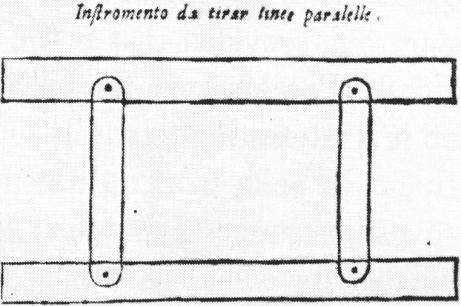 Parallel Ruler of the Seventeenth Century
San Giovanni's "Seconda squara
mobile," Vicenza, 1686
A somewhat more
complicated form of
this instrument may
also be made by pupils in manual training, as is shown in
this illustration from Bion's great treatise. The principle
involved may be
taken up in class, even
if the instrument is
not used. It is evident
that, unless the workmanship
is unusually good,
this form of
parallel ruler is not as
accurate as the common
one illustrated
above. The principle is sometimes used in iron gates.
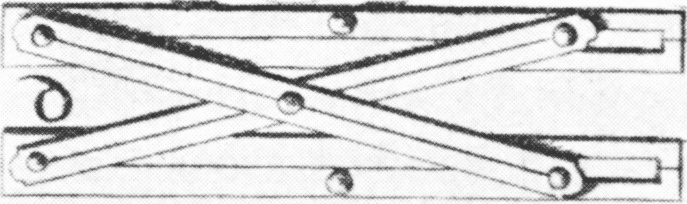 Parallel Ruler of the Eighteenth Century
N. Bion's "Traité de la construction ... des
instrumens de mathématique,"
The Hague, 1723
Theorem. Two parallelograms are congruent if two
sides and the included angle of the one are equal respectively
to two sides and the included angle of the other.
This proposition is discussed in connection with the
one that follows.
Theorem. If three or more parallels intercept equal
segments on one transversal, they intercept equal segments
on every transversal.
These two propositions are not given in Euclid,
although generally required by American syllabi of the
present time. The last one is particularly useful in subsequent
work. Neither one offers any difficulty, and
neither has any interesting history. There are, however,
numerous interesting
applications
to the last
one. One that is
used in mechanical
drawing is here
illustrated.
If it is desired to
divide a line AB into
five equal parts, we
may take a piece of
ruled tracing paper
and lay it over the
given line so that line
0 passes through A,
and line 5 through B. We may then prick through the paper
and thus determine the points on AB. Similarly, we may divide
AB into any other number of equal parts.
Among the applications of these propositions is an interesting
one due to the Arab Al-Nairīzī (ca. 900 A.D.).
The problem is to divide a line into any number of equal
parts, and he begins with the case of trisecting AB. It
may be given as a case of practical drawing even before
the problems are reached, particularly if some preliminary
work with the compasses and straightedge has been
given.
Make BQ and AQ' perpendicular to AB, and make BP = PQ =
AP' = P'Q'. Then ⧍XYZ is congruent to ⧍YBP, and also to
⧍XAP'. Therefore AX = XY = YB. In the same way we might
continue to produce BQ until it is
made up of n - 1 lengths BP, and
so for AQ', and by properly joining
points we could divide AB into n
equal parts. In particular, if we join
P and P', we bisect the line AB.
Theorem. If two sides of a
quadrilateral are equal and parallel, then the other two sides
are equal and parallel, and the figure is a parallelogram.
This was Euclid's first proposition on parallelograms,
and Proclus speaks of it as the connecting link between
the theory of parallels and that of parallelograms. The
ancients, writing for mature students, did not add the
words "and the figure is a parallelogram," because that
follows at once from the first part and from the definition
of "parallelogram," but it is helpful to younger
students because it emphasizes the fact that here is a
test for this kind of figure.
Theorem. The diagonals of a parallelogram bisect each
other.
This proposition was not given in Euclid, but it is
usually required in American syllabi. There is often
given in connection with it the exercise in which it is
proved that the diagonals of a rectangle are equal. When
this is taken, it is well to state to the class that carpenters
and builders find this one of the best checks in laying
out floors and other rectangles. It is frequently
applied also in laying out tennis courts. If the class is
doing any work in mensuration, such as finding the area
of the school grounds, it is a good plan to check a few
rectangles by this method.
An interesting outdoor application of the theory of
parallelograms is the following:
Suppose you are on the side of this stream opposite to XY,
and wish to measure the length of XY. Run a line AB along
the bank. Then take a carpenter's square, or even a large book,
and walk along AB until you reach P, a point from which you
can just see X and B along
two sides of the square. Do
the same for Y, thus fixing
P and Q. Using the tape,
bisect PQ at M. Then walk
along YM produced until you
reach a point Y' that is exactly
in line with M and Y,
and also with P and X. Then walk along XM produced until
you reach a point X' that is exactly in line with M and X, and
also with Q and Y. Then measure Y'X' and you have the length
of XY. For since YX' is ⊥ to PQ, and XY' is also ⊥ to PQ, YX'
is || to XY'. And since PM = MQ, therefore XM = MX' and
Y'M = MY. Therefore Y'X'YX is a parallelogram.
The properties of the parallelogram are often applied
to proving figures of various kinds congruent, or to constructing
them so
that they will be
congruent.
For example, if
we draw A'B' equal
and parallel to AB,
B'C' equal and parallel
to BC, and so on, it is easily proved that ABCD and A'B'C'D'
are congruent. This may be done by ordinary superposition, or
by sliding ABCD along the dotted parallels.
There are many applications of this principle of parallel
translation in practical construction work. The principle
is more far-reaching than here intimated, however,
and a few words as to its significance will now be in place.
The efforts usually made to improve the spirit of
Euclid are trivial. They ordinarily relate to some commonplace
change of sequence, to some slight change in
language, or to some narrow line of applications. Such
attempts require no particular thought and yield no
very noticeable result. But there is a possibility, remote
though it may be at present, that a geometry will be
developed that will be as serious as Euclid's and as
effective in the education of the thinking individual.
If so, it seems probable that it will not be based upon
the congruence of triangles, by which so many propositions
of Euclid are proved, but upon certain postulates
of motion, of which one is involved in the above illustration,—the
postulate of parallel translation. If to this
we join the two postulates of rotation about an axis,[64]
leading to axial symmetry; and rotation about a point,[65]
leading to symmetry with respect to a center, we have a
group of three motions upon which it is possible to base
an extensive and rigid geometry.[66] It will be through
some such effort as this, rather than through the weakening
of the Euclid-Legendre style of geometry, that any
improvement is likely to come. At present, in America,
the important work for teachers is to vitalize the geometry
they have,—an effort in which there are great
possibilities,—seeing to it that geometry is not reduced
to mere froth, and recognizing the possibility of another
geometry that may sometime replace it,—a geometry
as rigid, as thought-compelling, as logical, and as truly
educational.
Theorem. The sum of the interior angles of a polygon
is equal to two right angles, taken as many times less two
as the figure has sides.
This interesting generalization of the proposition about
the sum of the angles of a triangle is given by Proclus.
There are several proofs, but all are based upon the possibility
of dissecting the polygon into triangles. The point
from which lines are drawn to the vertices is usually taken
at a vertex, so that there are n - 2 triangles. It may however
be taken within the figure, making n triangles, from
the sum of the angles of which the four right angles about
the point must be subtracted. The point may even be
taken on one side, or outside the polygon, but the proof
is not so simple. Teachers who desire to do so may suggest
to particularly good students the proving of the
theorem for a concave polygon, or even for a cross polygon,
although the latter requires negative angles.
Some schools have transit instruments for the use of
their classes in trigonometry. In such a case it is a good
plan to measure the angles in some piece of land so as to
verify the proposition, as well as show the care that must
be taken in reading angles. In the absence of this exercise
it is well to take any irregular polygon and measure
the angles by the help of a protractor, and thus accomplish
the same results.
Theorem. The sum of the exterior angles of a polygon,
made by producing each of its sides in succession, is equal to
four right angles.
This is also a proposition not given by the ancient
writers. We have, however, no more valuable theorem
for the purpose of showing the nature and significance
of the negative angle; and teachers may arouse a great
deal of interest in the negative quantity by showing to
a class that when an interior angle becomes 180° the
exterior angle becomes 0, and when the polygon becomes
concave the exterior angle becomes negative, the theorem
holding for all these cases. We have few better
illustrations of the significance of the negative quantity,
and few better opportunities to use the knowledge of
this kind of quantity already acquired in algebra.
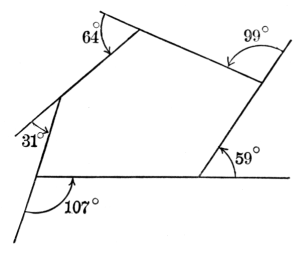
In the hilly and mountainous parts of America, where
irregular-shaped fields are more common than in the
more level portions, a common
test for a survey is that of finding
the exterior angles when the
transit instrument is set at the
corners. In this field these angles
are given, and it will be seen
that the sum is 360°. In the
absence of any outdoor work a
protractor may be used to measure the exterior angles
of a polygon drawn on paper. If there is an irregular
piece of land near the school, the exterior angles can be
fairly well measured by an ordinary paper protractor.
The idea of locus is usually introduced at the end of
Book I. It is too abstract to be introduced successfully
any earlier, although authors repeat the attempt from
time to time, unmindful of the fact that all experience
is opposed to it. The loci propositions are not ancient.
The Greeks used the word "locus" (in Greek, topos),
however. Proclus, for example, says, "I call those locus
theorems in which the same property is found to exist
on the whole of some locus." Teachers should be careful
to have the pupils recognize the necessity for proving
two things with respect to any locus: (1) that any
point on the supposed locus satisfies the condition; (2)
that any point outside the supposed locus does not
satisfy the given condition. The first of these is called
the "sufficient condition," and the second the "necessary
condition." Thus in the case of the locus of points in a
plane equidistant from two given points, it is sufficient
that the point be on the perpendicular bisector of the
line joining the given points, and this is the first part of
the proof; it is also necessary that it be on this line, i.e.
it cannot be outside this line, and this is the second part
of the proof. The proof of loci cases, therefore, involves
a consideration of "the necessary and sufficient condition"
that is so often spoken of in higher mathematics. This
expression might well be incorporated into elementary
geometry, and when it becomes better understood by
teachers, it probably will be more often used.
In teaching loci it is helpful to call attention to loci in
space (meaning thereby the space of three dimensions),
without stopping to prove the proposition involved.
Indeed, it is desirable all through plane geometry to refer
incidentally to solid geometry. In the mensuration of
plane figures, which may be boundaries of solid figures,
this is particularly true.
It is a great defect in most school courses in geometry that
they are entirely confined to two dimensions. Even if solid geometry
in the usual sense is not attempted, every occasion should
be taken to liberate boys' minds from what becomes the tyranny
of paper. Thus the questions: "What is the locus of a point equidistant
from two given points; at a constant distance from a given
straight line or from a given point?" should be extended to space.[67]
The two loci problems usually given at this time,
referring to a point equidistant from the extremities of
a given line, and to a point equidistant from two intersecting
lines, both permit of an interesting extension to
three dimensions without any formal proof. It is possible
to give other loci at this point, but it is preferable merely
to introduce the subject in Book I, reserving the further
discussion until after the circle has been studied.
It is well, in speaking of loci, to remember that it is
entirely proper to speak of the "locus of a point" or the
"locus of points." Thus the locus of a point so moving
in a plane as constantly to be at a given distance from
a fixed point in the plane is a circle. In analytic geometry
we usually speak of the locus of a point, thinking
of the point as being anywhere on the locus. Some
teachers of elementary geometry, however, prefer to
speak of the locus of points, or the locus of all points,
thus tending to make the language of elementary geometry
differ from that of analytic geometry. Since it is a
trivial matter of phraseology, it is better to recognize
both forms of expression and to let pupils use the two
interchangeably.
Having taken up all of the propositions usually given
in Book I, it seems unnecessary to consider as specifically
all those in subsequent books. It is therefore
proposed to select certain ones that have some special
interest, either from the standpoint of mathematics or
from that of history or application, and to discuss them
as fully as the circumstances seem to warrant.
Theorems. In the same circle or in equal circles equal
central angles intercept equal arcs; and of two unequal
central angles the greater intercepts the greater arc, and
conversely for both of these cases.
Euclid made these the twenty-sixth and twenty-seventh
propositions of his Book III, but he limited them as follows:
"In equal circles equal angles stand on equal circumferences,
whether they stand at the centers or at the
circumferences, and conversely." He therefore included
two of our present theorems in one, thus making the
proposition doubly hard for a beginner. After these two
propositions the Law of Converse, already mentioned on
page 190, may properly be introduced.
Theorems. In the same circle or in equal circles, if
two arcs are equal, they are subtended by equal chords; and
if two arcs are unequal, the greater is subtended by the
greater chord, and conversely.
Euclid dismisses all this with the simple theorem,
"In equal circles equal circumferences are subtended by
equal straight lines." It will therefore be noticed that
he has no special word for "chord" and none for "arc,"
and that the word "circumference," which some teachers
are so anxious to retain, is used to mean both the whole
circle and any arc. It cannot be doubted that later
writers have greatly improved the language of geometry
by the use of these modern terms. The word "arc" is
the same, etymologically, as "arch," each being derived
from the Latin arcus (a bow). "Chord" is from the
Greek, meaning "the string of a musical instrument."
"Subtend" is from the Latin sub (under), and tendere
(to stretch).
It should be noticed that Euclid speaks of "equal
circles," while we speak of "the same circle or equal
circles," confining our proofs to the latter, on the supposition
that this sufficiently covers the former.
Theorem. A line through the center of a circle perpendicular
to a chord bisects the chord and the arcs subtended
by it.
This is an improvement on Euclid, III, 3: "If in a
circle a straight line through the center bisects a straight
line not through the center, it also cuts it at right angles;
and if it cuts it at right angles, it also bisects it." It is
a very important proposition, theoretically and practically,
for it enables us to find the center of a circle if we
know any part of its arc. A civil engineer, for example,
who wishes to find the center of the circle of which some
curve (like that on a running track, on a railroad, or in
a park) is an arc, takes two chords, say of one hundred
feet each, and erects perpendicular bisectors. It is well
to ask a class why, in practice, it is better to take these
chords some distance apart. Engineers often check their
work by taking three chords, the perpendicular bisectors
of the three passing through a single point. Illustrations
of this kind of work are given later in this chapter.
Theorem. In the same circle or in equal circles equal
chords are equidistant from the center, and chords equidistant
from the center are equal.
This proposition is practically used by engineers in
locating points on an arc of a circle that is too large to be
described by a tape, or that cannot easily be reached from
the center on account of obstructions.
If part of the curve APB is known, take P as the mid-point.
Then stretch the tape from A to B and draw PM perpendicular
to it. Then swing the length
AM about P, and PM about B,
until they meet at L, and stretch
the length AB along PL to Q.
This fixes the point Q. In the
same way fix the point C. Points
on the curve can thus be fixed
as near together as we wish. The chords AB, PQ, BC, and so
on, are equal and are equally distant from the center.
Theorem. A line perpendicular to a radius at its
extremity is tangent to the circle.
The enunciation of this proposition by Euclid is very
interesting. It is as follows:
The straight line drawn at right angles to the diameter of a
circle at its extremity will fall outside the circle, and into the
space between the straight line and the circumference another
straight line cannot be interposed; further, the angle of the semicircle
is greater and the remaining angle less than any acute
rectilineal angle.
The first assertion is practically that of tangency,—"will
fall outside the circle." The second one states, substantially,
that there is only one such tangent, or, as we say
in modern mathematics, the tangent is unique. The third
statement relates to the angle formed by the diameter
and the circumference,—a mixed angle, as Proclus
called it, and a kind of angle no longer used in elementary
geometry. The fourth statement practically asserts
that the angle between the tangent and circumference is
less than any assignable quantity. This gives rise to a
difficulty that seems to have puzzled many of Euclid's
commentators, and that will interest a pupil: As the
circle diminishes this angle apparently increases, while
as the circle increases the angle decreases, and yet the
angle is always stated to be zero. Vieta (1540-1603),
who did much to improve the science of algebra, attempted
to explain away the difficulty by adopting a notion of
circle that was prevalent in his time. He said that a
circle was a polygon of an infinite number of sides
(which it cannot be, by definition), and that, a tangent
simply coincided with one of the sides, and therefore
made no angle with it; and this view was also held by
Galileo (1564-1642), the great physicist and mathematician
who first stated the law of the pendulum.
Theorem. Parallel lines intercept equal arcs on a circle.
The converse of this proposition has an interesting
application in outdoor
work.
Suppose we wish to run
a line through P parallel
to a given line AB. With
any convenient point O as a
center, and OP as a radius,
describe a circle cutting
AB in X and Y. Draw PX.
Then with Y as a center
and PX as a radius draw
an arc cutting the circle in Q. Then run the line from P to Q.
PQ is parallel to AB by the converse of the above theorem, which
is easily shown to be true for this figure.
Theorem. If two circles are tangent to each other, the
line of centers passes through the point of contact.
There are many illustrations of this theorem in practical
work, as in the case of cogwheels. An interesting
application to engineering is seen in the case of two parallel
streets or lines of track which are to be connected
by a "reversed
curve."
If the lines are
AB and CD, and
the connection is
to be made, as
shown, from B to
C, we may proceed as follows: Draw BC and bisect it at M. Erect
PO, the perpendicular bisector of BM; and BO, perpendicular to
AB. Then O is one center of curvature. In the same way fix O'.
Then to check the work apply this theorem, M being in the line
of centers OO'. The curves may now be drawn, and they will be
tangent to AB, to CD, and to each other.
At this point in the American textbooks it is the
custom to insert a brief treatment of measurement, explaining
what is meant by ratio, commensurable and
incommensurable quantities, constant and variable, and
limit, and introducing one or more propositions relating
to limits. The object of this departure from the ancient
sequence, which postponed this subject to the book on
ratio and proportion, is to treat the circle more completely
in Book III. It must be confessed that the treatment
is not as scientific as that of Euclid, as will be
explained under Book III, but it is far better suited to
the mind of a boy or girl.
It begins by defining measurement in a practical way,
as the finding of the number of times a quantity of any
kind contains a known quantity of the same kind. Of
course this gives a number, but this number may be a
surd, like √2. In other words, the magnitude measured
may be incommensurable with the unit of measure, a
seeming paradox. With this difficulty, however, the
pupil should not be called upon to contend at this stage
in his progress. The whole subject of incommensurables
might safely be postponed, although it may be treated in
an elementary fashion at this time. The fact that the
measure of the diagonal of a square, of which a side is
unity, is √2, and that this measure is an incommensurable
number, is not so paradoxical as it seems, the
paradox being verbal rather than actual.
It is then customary to define ratio as the quotient of
the numerical measures of two quantities in terms of a
common unit. This brings all ratios to the basis of
numerical fractions, and while it is not scientifically so
satisfactory as the ancient concept which considered the
terms as lines, surfaces, angles, or solids, it is more practical,
and it suffices for the needs of elementary pupils.
"Commensurable," "incommensurable," "constant,"
and "variable" are then defined, and these definitions
are followed by a brief discussion of limit. It simplifies
the treatment of this subject to state at once that there
are two classes of limits,—those which the variable
actually reaches, and those which it can only approach
indefinitely near. We find the one as frequently as we
find the other, although it is the latter that is referred
to in geometry. For example, the superior limit of a
chord is a diameter, and this limit the chord may reach.
The inferior limit is zero, but we do not consider the
chord as reaching this limit. It is also well to call the
attention of pupils to the fact that a quantity may decrease
towards its limit as well as increase towards it.
Such further definitions as are needed in the theory of
limits are now introduced. Among these is "area of a
circle." It might occur to some pupil that since a circle
is a line (as used in modern mathematics), it can have no
area. This is, however, a mere quibble over words. It
is not pretended that the line has area, but that "area
of a circle" is merely a shortened form of the expression
"area inclosed by a circle."
The Principle of Limits is now usually given as follows:
"If, while approaching their respective limits, two
variables are always equal, their limits are equal." This
was expressed by D'Alembert in the eighteenth century
as "Magnitudes which are the limits of equal magnitudes
are equal," or this in substance. It would easily be possible
to elaborate this theory, proving, for example, that
if x approaches y as its limit, then ax approaches ay as
its limit, and x/a approaches y/a as its limit, and so on. Very
much of this theory, however, wearies a pupil so that
the entire meaning of the subject is lost, and at best the
treatment in elementary geometry is not rigorous. It is
another case of having to sacrifice a strictly scientific
treatment to the educational abilities of the pupil. Teachers
wishing to find a scientific treatment of the subject
should consult a good work on the calculus.
Theorem. In the same circle or in equal circles two
central angles have the same ratio as their intercepted arcs.
This is usually proved first for the commensurable
case and then for the incommensurable one. The latter
is rarely understood by all of the class, and it may very
properly be required only of those who show some aptitude
in geometry. It is better to have the others understand
fully the commensurable case and see the nature
of its applications, possibly reading the incommensurable
proof with the teacher, than to stumble about in the darkness
of the incommensurable case and never reach the
goal. In Euclid there was no distinction between the
two because his definition of ratio covered both; but, as
we shall see in Book III, this definition is too difficult
for our pupils. Theon of Alexandria (fourth century
A.D.), the father of the Hypatia who is the heroine of
Kingsley's well-known novel, wrote a commentary on
Euclid, and he adds that sectors also have the same ratio
as the arcs, a fact very easily proved. In propositions of
this type, referring to the same circle or to equal circles,
it is not worth while to ask pupils to take up both cases,
the proof for either being obviously a proof for the other.
Many writers state this proposition so that it reads
that "central angles are measured by their intercepted
arcs." This, of course, is not literally true, since we can
measure anything only by some thing, of the same kind.
Thus we measure a volume by finding how many times
it contains another volume which we take as a unit, and
we measure a length by taking some other length as a
unit; but we cannot measure a given length in quarts nor
a given weight in feet, and it is equally impossible to
measure an arc by an angle, and vice versa. Nevertheless
it is often found convenient to define some brief expression
that has no meaning if taken literally, in such way
that it shall acquire a meaning. Thus we define "area of
a circle," even when we use "circle" to mean a line;
and so we may define the expression "central angles are
measured by their intercepted arcs" to mean that central
angles have the same numerical measure as these arcs.
This is done by most writers, and is legitimate as explaining
an abbreviated expression.
Theorem. An inscribed angle is measured by half the
intercepted arc.
In Euclid this proposition is combined with the preceding
one in his Book VI, Proposition 33. Such a
procedure is not adapted to the needs of students to-day.
Euclid gave in Book III, however, the proposition (No.
20) that a central angle is twice an inscribed angle standing
on the same arc. Since Euclid never considered an
angle greater than 180°, his inscribed angle was necessarily
less than a right angle. The first one who is known
to have given the general case, taking the central angle
as being also greater than 180°, was Heron of Alexandria,
probably of the first century A.D.[68] In this he was
followed by various later commentators, including Tartaglia
and Clavius in the sixteenth century.
One of the many interesting exercises that may be
derived from this theorem is seen in the case of the
"horizontal danger angle" observed
by ships.
If some dangerous rocks lie off
the shore, and L and L' are two
lighthouses, the angle A is determined
by observation, so that A
will lie on a circle inclosing the
dangerous area. Angle A is called
the "horizontal danger angle." Ships passing in sight of the two
lighthouses L and L' must keep out far enough so that the angle
L'SL shall be less than angle A.
To this proposition there are several important corollaries,
including the following:
1. An angle inscribed in a semicircle is a right angle.
This corollary is mentioned by Aristotle and is attributed
to Thales, being one of the few propositions with which
his name is connected. It enables us to describe a circle
by letting the arms of a carpenter's square slide along
two nails driven in a board, a pencil being held at the
vertex.
A more practical use for it is made by machinists
to determine whether a casting is a true semicircle. Taking
a carpenter's square as here
shown, if the vertex touches the
curve at every point as the square
slides around, it is a true semicircle.
By a similar method a circle may
be described by sliding a draftsman's
triangle so that two sides touch two tacks driven
in a board.
Another interesting application of this corollary may be seen
by taking an ordinary paper protractor ACB, and fastening a
plumb line at B. If the protractor is so held that the plumb line
cuts the semicircle at C,
then AC is level because
it is perpendicular to the
vertical line BC. Thus, if
a class wishes to determine
the horizontal line
AC, while sighting up a
hill in the direction AB,
this is easily determined
without a spirit level.
It follows from this corollary, as the pupil has already
found, that the mid-point of the hypotenuse of a right
triangle is equidistant from the three vertices. This is
useful in outdoor measuring, forming the basis of one of
the best methods of letting fall a perpendicular from an
external point to a line.
Suppose XY to be the edge of a sidewalk, and P a point in the
street from which we wish to lay a gas pipe perpendicular to the
walk. From P swing a cord or
tape, say 60 feet long, until it meets
XY at A. Then take M, the mid-point
of PA, and swing MP about
M, to meet XY at B. Then B is
the foot of the perpendicular, since
∠PBA can be inscribed in a semicircle.
2. Angles inscribed in the same
segment are equal.
By driving two nails in a board, at A and B, and taking an
angle P made of rigid material (in particular, as already stated,
a carpenter's square), a pencil placed at P will generate
an arc of a circle if the arms slide along A
and B. This is an interesting exercise for pupils.
Theorem. An angle formed by two chords
intersecting within the circle is measured by
half the sum of the intercepted arcs.
Theorem. An angle formed by a tangent
and a chord drawn from the point of tangency is measured
by half the intercepted arc.
Theorem. An angle formed by two secants, a secant
and a tangent, or two tangents, drawn to a circle from an
external point, is measured by half the difference of the
intercepted arcs.
These three theorems are all special cases of the general
proposition that the angle included between two
lines that cut (or touch) a circle is measured by half the
sum of the intercepted arcs. If the point passes from
within the circle to the circle itself, one arc becomes zero
and the angle becomes an inscribed angle. If the point
passes outside the circle, the smaller arc becomes negative,
having passed through zero. The point may even "go to
infinity," as is said in higher mathematics, the lines then
becoming parallel, and the angle becoming zero, being
measured by half the sum of one arc and a negative arc
of the same absolute value. This is one of the best
illustrations of the Principle of Continuity to be found
in geometry.
Problem. To let fall a perpendicular upon a given line
from a given external point.
This is the first problem that a student meets in most
American geometries. The reason for treating the problems
by themselves instead of mingling them with the
theorems has already been discussed.[69] The student now
has a sufficient body of theorems, by which he can prove
that his constructions are correct, and the advantage of
treating these constructions together is greater than that
of following Euclid's plan of introducing them whenever
needed.
Proclus tells us that "this problem was first investigated
by Œnopides,[70] who thought it useful for astronomy."
Proclus speaks of such a line as a gnomon, a
common name for the perpendicular on a sundial,
which casts the shadow by which the time of day is
known. He also speaks of two kinds of perpendiculars,
the plane and solid, the former being a line perpendicular
to a line, and the latter a line perpendicular
to a plane.
It is interesting to notice that the solution tacitly
assumes that a certain arc is going to cut the given line
in two points, and only two. Strictly speaking, why may
it not cut it in only one point, or even in three points?
We really assume that if a straight line is drawn througha point within a circle, this line must get out of the
circle on each of two sides of the given point, and in
getting out it must cut the circle twice. Proclus
noticed this assumption and endeavored to prove it.
It is better, however, not to raise the question with
beginners, since it seems to them like hair-splitting to
no purpose.
The problem is of much value in surveying, and teachers
would do well to ask a class to let fall a perpendicular
to the edge of a sidewalk from a point 20 feet from
the walk, using an ordinary 66-foot or 50-foot tape.
Practically, the best plan is to swing 30 feet of the tape
about the point and mark the two points of intersection
with the edge of the walk. Then measure the distance
between the points and take half of this distance, thus
fixing the foot of the perpendicular.
Problem. At a given point in a line, to erect a perpendicular
to that line.
This might be postponed until after the problem to
bisect an angle, since it merely requires the bisection of
a straight angle; but considering the immaturity of the
average pupil, it is better given independently. The
usual case considers the point not at the extremity of
the line, and the solution is essentially that of Euclid.
In practice, however, as for example in
surveying, the point may be at the extremity,
and it may not be convenient
to produce the line.
Surveyors sometimes measure PB = 3 ft.,
and then take 9 ft. of tape, the ends being
held at B and P, and the tape being stretched
to A, so that PA = 4 ft. and AB = 5 ft. Then
P is a right angle by the Pythagorean Theorem. This theorem
not having yet been proved, it cannot be used at this time.
A solution for the problem of erecting a perpendicular
from the extremity of a line that cannot be produced,
depending, however, on the problem of bisecting an angle,
and therefore to be given after that problem, is attributed
by Al-Nairīzī (tenth century A.D.)
to Heron of Alexandria. It is also
given by Proclus.
Required to draw from P a perpendicular
to AP. Take X anywhere on
the line and erect XY ⊥ to AP in the
usual manner. Bisect ∠PXY by the line XM. On XY take
XN = XP, and draw NM ⊥ to XY. Then draw PM. The proof
is evident.
These may at the proper time be given as interesting
variants of the usual solution.
Problem. To bisect a given line.
Euclid said "finite straight line," but this wording is
not commonly followed, because it will be inferred that
the line is finite if it is to be bisected, and we use "line"
alone to mean a straight line. Euclid's plan was to construct
an equilateral triangle (by his Proposition 1 of
Book I) on the line as a base, and then to bisect the
vertical angle. Proclus tells us that Apollonius of Perga,
who wrote the first great work on conic sections, used a
plan which is substantially that which is commonly found
in textbooks to-day,—constructing two isosceles triangles
upon the line as a common base, and connecting
their vertices.
Problem. To bisect a given angle.
It should be noticed that in the usual solution two
arcs intersect, and the point thus determined is connected
with the vertex. Now these two arcs intersect twice, and
since one of the points of intersection may be the vertex
itself, the other point of intersection must be taken. It
is not, however, worth while to make much of this matter
with pupils. Proclus calls attention to the possible suggestion
that the point of intersection may be imagined
to lie outside the angle, and he proceeds to show the
absurdity; but here, again, the subject is not one of value
to beginners. He also contributes to the history of the
trisection of an angle. Any angle is easily trisected by
means of certain higher curves, such as the conchoid of
Nicomedes (ca. 180 B.C.), the quadratrix of Hippias of
Elis (ca. 420 B.C.), or the spiral of Archimedes (ca. 250
B.C.). But since this problem, stated algebraically, requires
the solution of a cubic equation, and this involves,
geometrically, finding three points, we cannot solve the
problem by means of straight lines and circles alone. In
other words, the trisection of any angle, by the use of the
straightedge and compasses alone, is impossible. Special
angles may however be trisected. Thus, to trisect an
angle of 90° we need only to construct an angle of 60°,
and this can be done by constructing an equilateral triangle.
But while we cannot trisect the angle, we may
easily approximate trisection. For since, in the infinite
geometric series 1/2 + 1/8 + 1/32 + 1/128 + ..., s = a ÷ (1 - r),
we have s = 1/2 ÷ 3/4 = 2/3. In other words, if we add 1/2
of the angle, 1/8 of the angle, 1/32 of the angle, and so
on, we approach as a limit 2/3 of the angle; but all
of these fractions can be obtained by repeated bisections,
and hence by bisections we may approximate the
trisection.
The approximate bisection (or any other division) of
an angle may of course be effected by the help of the
protractor and a straightedge. The geometric method is,
however, usually more accurate, and it is advantageous
to have the pupils try both plans, say for bisecting an
angle of about 49-1/2°.
Applications of this problem are numerous. It may be
desired, for example, to set a lamp-post on a line bisecting
the angle formed by two streets that
come together a little unsymmetrically,
as here shown, in which case the bisecting
line can easily be run by the use
of a measuring tape, or even of a
stout cord.
A more interesting illustration is,
however, the following:
Let the pupils set a stake, say about 5 feet high, at a point N
on the school grounds about 9 A.M., and carefully measure the
length of the shadow, NW, placing a small wooden pin at W.
Then about 3 P.M. let them watch until the shadow
NE is exactly the same length that it was when
W was fixed, and then place a small wooden pin
at E. If the work has been very carefully done,
and they take the tape and bisect the line WE,
thus fixing the line NS, they will have a north
and south line. If this is marked out for a short
distance from N, then when the shadow falls on
NS, it will be noon by sun time (not standard
time) at the school.
Problem. From a given point in a given line, to draw
a line making an angle equal to a given angle.
Proclus says that Eudemus attributed to Œnopides
the discovery of the solution which Euclid gave, and which
is substantially the one now commonly seen in textbooks.
The problem was probably solved in some fashion before
the time of Œnopides, however. The object of the problem
is primarily to enable us to draw a line parallel to
a given line.
Practically, the drawing of one line parallel to another
is usually effected by means of a parallel ruler (see
page 191), or by the use of draftsmen's
triangles, as here shown, or even more
commonly by the use of a T-square,
such as is here seen. This illustration
shows two T-squares used for drawing
lines parallel to the sides of a board upon which the
drawing paper is fastened.[71]
An ingenious instrument described
by Baron Dupin is illustrated
below.
To the bar A is fastened the sliding
check B. A movable check D
may be fastened by a screw C. A
sharp point is fixed in B, so that as
D slides along the edge of a board, the point marks a line parallel
to the edge. Moreover, F and G are two brass arms of equal length
joined by a pointed screw H
that marks a line midway between
B and D. Furthermore,
it is evident that H will draw
a line bisecting any irregular
board if the checks B and D
are kept in contact with the
irregular edges.
Book II offers two general lines of application that
may be introduced to advantage, preferably as additions
to the textbook work. One of these has reference to topographical
drawing and related subjects, and the other
to geometric design. As long as these can be introduced
to the pupil with an air of reality, they serve a good purpose,
but if made a part of textbook work, they soon
come to have less interest than the exercises of a more
abstract character. If a teacher can relate the problems
in topographical drawing to the pupil's home town, and
can occasionally set some outdoor work of the nature
here suggested, the results are usually salutary; but if
he reiterates only a half-dozen simple propositions time
after time, with only slight changes in the nature of the
application, then the results
will not lead to a cultivation
of power in geometry,—a
point which the writers
on applied geometry usually
fail to recognize.
One of the simple applications
of this book relates to
the rounding of corners in
laying out streets in some of our modern towns where
there is a desire to depart from the conventional
square corner. It
is also used in laying
out park walks
and drives.
The figure in the
middle of the page
represents two streets,
AP and BQ, that
would, if prolonged,
intersect
at C. It is required
to construct
an arc so that they shall begin to curve at P and Q, where
CP = CQ, and hence the "center of curvature" O must be found.
The problem is a common one in railroad work, only here AP
is usually oblique to BQ if they are produced to meet at C, as in
the second figure on page 218. It is required to construct an
arc so that the tracks shall begin to curve at P and Q, where
CP = CQ.
The problem
becomes a little
more complicated,
and correspondingly
more interesting,
when we
have to find the
center of curvature
for a street
railway track that must turn a corner in such a way
as to allow, say, exactly 5 feet from the point P, on
account of a sidewalk.
The problem becomes
still more difficult
if we have two
roads of different
widths that we
wish to join on a
curve. Here the
two centers of
curvature are
not the same,
and the one
road narrows to the other on the curve. The solutions
will be understood from a study of the figures.
The number of problems of this kind that can easily
be made is limitless, and it is well to avoid the danger
of hobby riding on this or any similar topic. Therefore
a single one will suffice to close this group.
If a road AB on an arc described
about O, is to be joined to road
CD, described about O', the arc BC
should evidently be internally tangent
to AB and externally tangent
to CD. Hence the center is on
BOX and O'CY, and is therefore
at P. The problem becomes more
real if we give some width to the
roads in making the
drawing, and imagine
them in a park that
is being laid out with
drives.
It will be noticed
that the above problems
require the erecting
of perpendiculars,
the bisecting of angles,
and the application of
the propositions on tangents.
A somewhat different
line of problems is
that relating to the passing
of a circle through
three given points. It
is very easy to manufacture
problems of this
kind that have a semblance
of reality.
For example, let it be required to plan a driveway from the
gate G to the porch P so as to avoid a mass of rocks R, an arc
of a circle to be taken. Of course, if we allow pupils to use the
Pythagorean Theorem at this time (and for metrical purposes this
is entirely proper, because they have long been familiar with it),
then we may ask not only for the drawing, but we may, for
example, give the length from G to the point on R (which we
may also call R), and the angle RGO as 60°, to find the radius.
A second general line of exercises adapted to Book II
is a continuation of the geometric drawing recommended
as a preliminary to the work in demonstrative geometry.
The copying or the making of designs requiring the describing
of circles, their inscription in or circumscription
about triangles, and their construction in various positions
of tangency, has some value as applying the various
problems studied in this book. For a number of
years past, several enthusiastic teachers have made much
of the designs found in Gothic windows, having their
pupils make the outline drawings by the help of compasses
and straightedge. While such work has its value,
it is liable soon to degenerate into purposeless formalism,
and hence to lose interest by taking the vigorous
mind of youth from the strong study of geometry to the
weak manipulation of instruments. Nevertheless its value
should be appreciated and conserved, and a few illustrations
of these forms are given in order that the teacher
may have examples from which to select. The best way
of using this material is to offer it as supplementary
work, using much or little, as may seem best, thus giving
to it a freshness and interest that some have trouble in
imparting to the regular book work.
The best plan is to sketch rapidly the outline of a
window on the blackboard, asking the pupils to make a
rough drawing, and to bring in a mathematical drawing
on the following day.
It might be said, for example, that in planning a Gothic window
this drawing is needed. The arc BC is drawn with A as a
center and AB as a radius. The small arches are described with
A, D, and B as centers and AD as a radius.
The center _P_ is found by taking A and B
as centers and AE as a radius. How may
the points D, E, and F be found? Draw
the figure. From the study of the rectilinear
figures suggested by such a simple
pattern the properties of the equilateral
triangle may be inferred.
The Gothic window also offers some interesting possibilities
in connection with the study of the square. For
example, the illustration given on page 223 shows a
number of traceries involving the construction of a square,
the bisecting of angles, and the describing of circles.[72]
The properties of the square, a figure now easily
constructed by the pupils, are
not numerous. What few
there are may be brought
out through the study of art
forms, if desired. In case these
forms are shown to a class, it
is important that they should
be selected from good designs.
We have enough poor
art in the world, so that geometry
should not contribute any more. This illustration
is a type of the best medieval Gothic parquetry.[73]
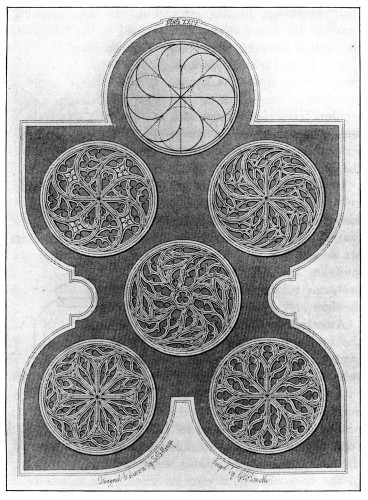 Gothic Designs employing Circles and Bisected Angles
Even simple designs of a semipuzzling nature have
their advantage in this connection. In the following
example the inner square contains all of the triangles,
the letters showing where they may be fitted.[74]
Still more elaborate designs,
based chiefly upon the square
and circle, are shown in the
window traceries on page 225,
and others will be given in
connection with the study of
the regular polygons.
Designs like the figure below
are typical of the simple forms,
based on the square and circle,
that pupils may profitably incorporate in any work in
art design that they may be doing at the time they are
studying the circle and the
problems relating to perpendiculars
and squares.
Among the applications of
the problem to draw a tangent
to a given circle is the
case of the common tangents
to two given circles. Some
authors give this as a basal
problem, although it is more
commonly given as an exercise or a corollary. One of
the most obvious applications of the idea is that relating
to the transmission of circular motion by means of a
band over two wheels,[75] A and B, as shown on page 226.
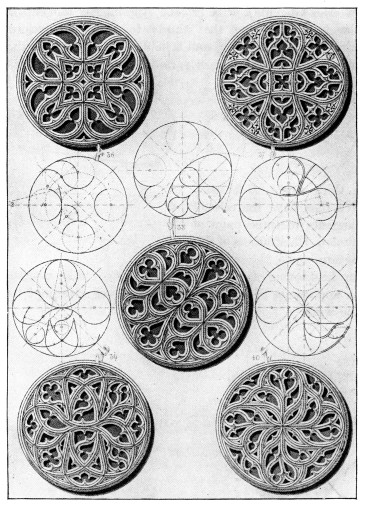 Gothic Designs employing Circles and Bisected Angles
The band may either not be crossed (the case of the two
exterior tangents), or be crossed (the interior tangents),
the latter allowing the wheels to turn in opposite
directions. In case the band is liable to change its length,
on account of stretching or variation in heat or moisture,
a third wheel, D, is used.
We then have the case of
tangents to three pairs of
circles. Illustrations of this
nature make the exercise
on the drawing of common tangents to two circles assume
an appearance of genuine reality that is of advantage to
the work.
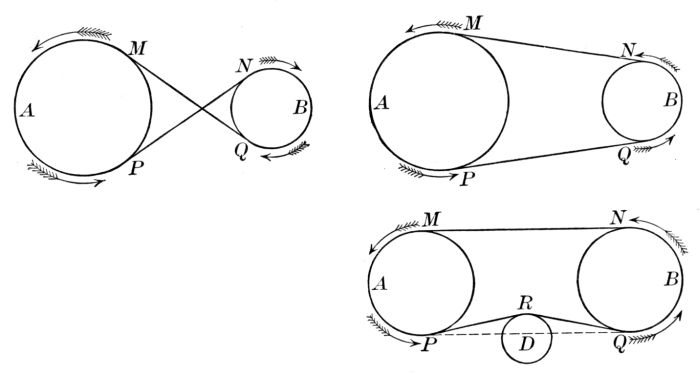
In the American textbooks Book III is usually assigned
to proportion. It is therefore necessary at the
beginning of this discussion to consider what is meant
by ratio and proportion, and to compare the ancient and
the modern theories. The subject is treated by Euclid
in his Book V, and an anonymous commentator has told
us that it "is the discovery of Eudoxus, the teacher of
Plato." Now proportion had been known long before
the time of Eudoxus (408-355 B.C.), but it was numerical
proportion, and as such it had been studied by the
Pythagoreans. They were also the first to study seriously
the incommensurable number, and with this study the
treatment of proportion from the standpoint of rational
numbers lost its scientific position with respect to geometry.
It was because of this that Eudoxus worked out
a theory of geometric proportion that was independent
of number as an expression of ratio.
The following four definitions from Euclid are the
basal ones of the ancient theory:
A ratio is a sort of relation in respect of size between two
magnitudes of the same kind.
Magnitudes are said to have a ratio to one another which are
capable, when multiplied, of exceeding one another.
Magnitudes are said to be in the same ratio, the first to the
second and the third to the fourth, when, if any equimultiples
whatever be taken of the first and third, and any equimultiples
whatever of the second and fourth, the former equimultiples alike
exceed, are alike equal to, or alike fall short of, the latter equimultiples
respectively taken in corresponding order.
Let magnitudes which have the same ratio be called proportional.[76]
Of these, the first is so loose in statement as often to
have been thought to be an interpolation of some later
writer. It was probably, however, put into the original
for the sake of completeness, to have some kind of statement
concerning ratio as a preliminary to the important
definition of quantities in the same ratio. Like the definition
of "straight line," it was not intended to be taken
seriously as a mathematical statement.
The second definition is intended to exclude zero and
infinite magnitudes, and to show that incommensurable
magnitudes are included.
The third definition is the essential one of the ancient
theory. It defines what is meant by saying that magnitudes
are in the same ratio; in other words, it defines a
proportion. Into the merits of the definition it is not
proposed to enter, for the reason that it is no longer
met in teaching in America, and is practically abandoned
even where the rest of Euclid's work is in use. It should
be said, however, that it is scientifically correct, that it
covers the case of incommensurable magnitudes as well
as that of commensurable ones, and that it is the Greek
forerunner of the modern theories of irrational numbers.
As compared with the above treatment, the one now
given in textbooks is unscientific. We define ratio as "the
quotient of the numerical measures of two quantities of
the same kind," and proportion as "an equality of ratios."
But what do we mean by the quotient, say of √2 by √3?
And when we multiply a ratio by √5, what is the meaning
of this operation? If we say that √2 : √3 means a
quotient, what meaning shall we assign to "quotient"?
If it is the number that shows how many times one number
is contained in another, how many times is √3 contained
in √2? If to multiply is to take a number a
certain number of times, how many times do we take it
when we multiply by √5? We certainly take it more
than 2 times and less than 3 times, but what meaning
can we assign to √5 times? It will thus be seen that
our treatment of proportion assumes that we already
know the theory of irrationals and can apply it to geometric
magnitudes, while the ancient treatment is independent
of this theory.
Educationally, however, we are forced to proceed as
we do. Just as Dedekind's theory of numbers is a simple
one for college students, so is the ancient theory of proportion;
but as the former is not suited to pupils in the
high school, so the latter must be relegated to the college
classes. And in this we merely harmonize educational
progress with world progress, for the numerical theory
of proportion long preceded the theory of Eudoxus.
The ancients made much of such terms as duplicate,
triplicate, alternate, and inverse ratio, and also such as
composition, separation, and conversion of ratio. These
entered into such propositions as, "If four magnitudes
are proportional, they will also be proportional alternately."
In later works they appear in the form of
"proportion by composition," "by division," and "by
composition and division." None of these is to-day of
much importance, since modern symbolism has greatly
simplified the ancient expressions, and in particular the
proposition concerning "composition and division" is
no longer a basal theorem in geometry. Indeed, if our
course of study were properly arranged, we might well
relegate the whole theory of proportion to algebra,
allowing this to precede the work in geometry.
We shall now consider a few of the principal propositions
of Book III.
Theorem. If a line is drawn through two sides of a
triangle parallel to the third side, it divides those sides
proportionally.
In addition to the usual proof it is instructive to consider
in class the cases in which the parallel is drawn
through the two sides produced, either below the base
or above the vertex, and also in which the parallel is
drawn through the vertex.
Theorem. The bisector of an angle of a triangle divides
the opposite side into segments which are proportional to
the adjacent sides.
The proposition relating to the bisector of an exterior
angle may be considered as a part of this one, but it is
usually treated separately in order that the proof shall
appear less involved, although the two are discussed together
at this time. The proposition relating to the exterior
angle was recognized by Pappus of Alexandria.
If ABC is the given triangle, and CP_1, CP_2 are respectively
the internal and external bisectors, then AB is divided harmonically
by P1 and P2.
∴AP1 : P1B = AP2 : P2B.
∴AP2 : P2B = AP2 - P1P2 : P1P2 - P2B,
and this is the criterion for the harmonic progression still seen in
many algebras. For, letting AP2 = a, P1P2 = b, P2B = c, we have
a/c = (a - b)/(b - c),
which is also derived from taking the reciprocals of a, b, c, and
placing them in an arithmetical progression, thus:
1/b - 1/a = 1/c - 1/b,
whence (a - b)/ab = (b - c)/bc,
or (a - b)/(b - c) = ab/bc = a/c.
This is the reason why the line AB is said to be divided harmonically.
The line P1P2 is also called the harmonic mean between
AP2 and P2B, and the points A, P1, B, P2 are said to form an
harmonic range.
It may be noted that ∠P2CP1, being made up of halves of
two supplementary angles, is a right angle. Furthermore, if the
ratio CA : CB is given, and AB is given, then P1 and P2 are both
fixed. Hence C must lie on a semicircle with P1P2 as a diameter,
and therefore the locus of a point such that its distances from
two given points are in a given ratio is a circle. This fact, Pappus
tells us, was known to Apollonius.
At this point it is customary to define similar polygons
as such as have their corresponding angles equal
and their corresponding sides proportional. Aristotle
gave substantially this definition, saying that such figures
have "their sides proportional and their angles
equal." Euclid improved upon this by saying that they
must "have their angles severally equal and the sides
about the equal angles proportional." Our present
phraseology seems clearer. Instead of "corresponding
angles" we may say "homologous angles," but there
seems to be no reason for using the less familiar word.
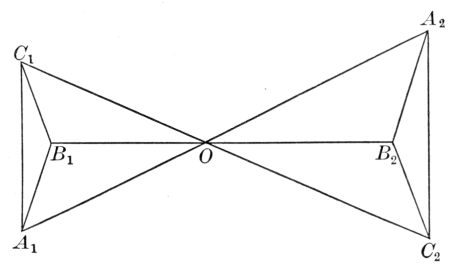
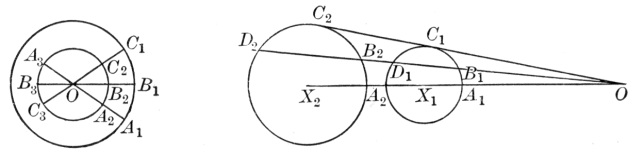
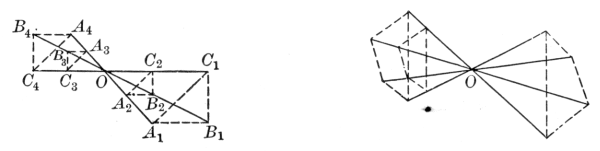
It is more general
to proceed by first
considering similar
figures instead of
similar polygons,
thus including the
most obviously similar
of all figures,—two
circles; but such a procedure is felt to be too
difficult by many teachers. By this plan we first define
similar sets of points, A1, A2, A3, ..., and B1, B2, B3, ...,
as such that A1A2, B1B2, C1C2, ... are concurrent in O,
and A1O : A2O = B1O : B2O = C1O : C2O = ... Here the
constant ratio A1O : A2O is called the ratio of similitude,
and O is called the center of similitude. Having defined
similar sets of points, we then define similar figures as
those figures whose points form similar sets. Then the
two circles, the four triangles, and the three quadrilaterals
respectively are similar figures. If the ratio of similitude is
1, the similar figures become symmetric figures, and they
are therefore congruent. All of the propositions relating
to similar figures can be proved from this definition, but
it is customary to use the Greek one instead.
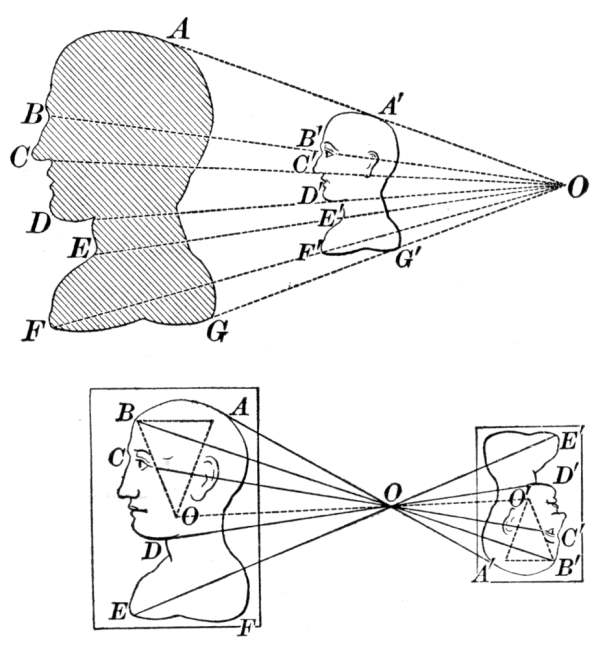
Among the interesting applications of similarity is
the case of a shadow, as here shown, where the light is
the center of similitude.
It is also well
known to most high school
pupils that in
a camera the lens
reverses the image.
The mathematical
arrangement is here
shown, the lens inclosing
the center of similitude.
The proposition
may also be applied to
the enlargement of maps
and working drawings.
The propositions concerning
similar figures have no particularly interesting
history, nor do they present any difficulties that call for
discussion. In schools where there is a little time for
trigonometry, teachers sometimes find it helpful to begin
such work at this time, since all of the trigonometric
functions depend upon the properties of similar triangles,
and a brief explanation of the simplest trigonometric
functions may add a little interest to the work.
In the present state of our curriculum we cannot do
more than mention the matter as a topic of general
interest in this connection.
It is a mistaken idea that geometry is a prerequisite
to trigonometry. We can get along very well in teaching
trigonometry if we have three propositions: (1) the
one about the sum of the angles of a triangle; (2) the
Pythagorean Theorem; (3) the one that asserts that two
right triangles are similar if an acute angle of the one
equals an acute angle of the other. For teachers who
may care to make a little digression at this time, the
following brief statement of a few of the facts of trigonometry
may be of value:
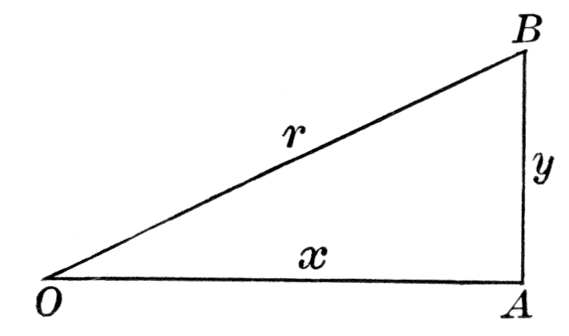
In the right triangle OAB we shall let AB = y, OA = x,
OB = r, thus adopting the letters of higher mathematics. Then,
so long as ∠O remains the same, such
ratios as y/x, y/r, etc., will remain the same,
whatever is the size of the triangle.
Some of these ratios have special
names. For example, we call
y/r the sine of O, and we write sin O = y/r;
x/r the cosine of O, and we write cos O = x/r;
y/x the tangent of O, and we write tan O = y/x.
Now because
sin O = y/r, therefore r sin O = y;
and because cos O = x/r, therefore r cos O = x;
and because tan O = y/x, therefore x tan O = y.
Hence, if we knew the values of sin O, cos O, and tan O for the
various angles, we could find x, y, or r if we knew any one of them.
Now the values of the sine, cosine, and tangent (functions of
the angles, as they are called) have been computed for the various
angles, and some interest may be developed by obtaining them
by actual measurement, using the protractor and squared paper.
Some of those needed for such angles as a pupil in geometry is
likely to use are as follows:
| Angle |
Sine |
Cosine |
Tangent |
Angle |
Sine |
Cosine |
Tangent |
| 5° |
.087 |
.996 |
.087 |
50° |
.766 |
.643 |
1.192 |
| 10° |
.174 |
.985 |
.176 |
55° |
.819 |
.574 |
1.428 |
| 15° |
.259 |
.966 |
.268 |
60° |
.866 |
.500 |
1.732 |
| 20° |
.342 |
.940 |
.364 |
65° |
.906 |
.423 |
2.145 |
| 25° |
.423 |
.906 |
.466 |
70° |
.940 |
.342 |
2.748 |
| 30° |
.500 |
.866 |
.577 |
75° |
.966 |
.259 |
3.732 |
| 35° |
.574 |
.819 |
.700 |
80° |
.985 |
.174 |
5.671 |
| 40° |
.643 |
.766 |
.839 |
85° |
.996 |
.087 |
11.430 |
| 45° |
.707 |
.707 |
1.000 |
90° |
1.000 |
.000 |
∞ |
It will of course be understood that the values are correct only
to the nearest thousandth. Thus the cosine of 5° is 0.99619, and
the sine of 85° is 0.99619. The entire table can be copied by a
class in five minutes if a teacher wishes to introduce this phase
of the work, and the author has frequently assigned the computing
of a simpler table as a class exercise.
Referring to the figure, if we know that r = 30 and ∠O = 40°,
then since y = r sin O, we have y = 30 × 0.643 = 19.29. If we
know that x = 60 and ∠O = 35°, then since y = x tan O, we have
y = 60 × 0.7 = 42. We may also find r, for cos O = x/r, whence
r = x/(cos O) = 60/0.819 = 73.26.
Therefore, if we could easily measure ∠O and could
measure the distance x, we could find the height of a
building y. In trigonometry we use a transit for measuring
angles, but it is easy to measure them with sufficient
accuracy for illustrative purposes by placing an ordinary
paper protractor upon something level, so that the center
comes at the edge, and then sighting along a ruler held
against it, so as to find the angle of elevation of a building.
We may then measure the distance to the building
and apply the formula y = x tan O.
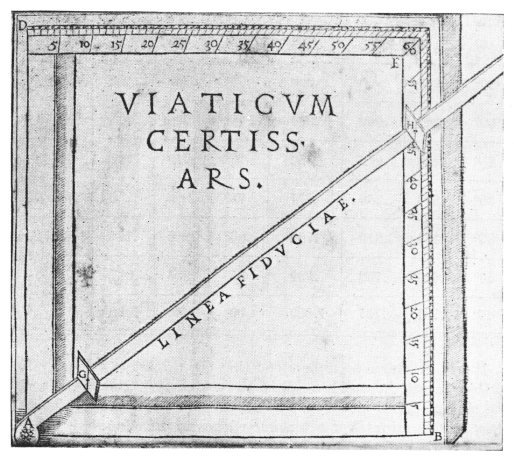 A Quadrant of the Sixteenth Century
Finaeus's "De re et praxi geometrica," Paris, 1556
It should always be understood that expensive apparatus
is not necessary for such illustrative work. The
telescope used on the transit is only three hundred years
old, and the world got along very well with its trigonometry
before that was invented. So a little ingenuity
will enable any one to make from cheap protractors about
as satisfactory instruments as the world used before 1600.
In order that this may be the more fully appreciated, a
few illustrations are here given, showing the old instruments
and methods used in practical surveying before
the eighteenth century.
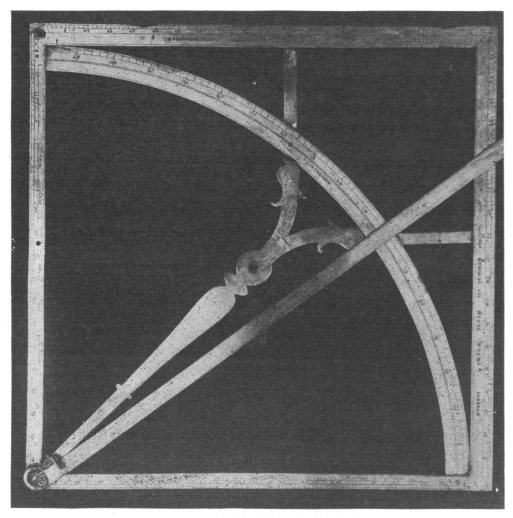 A Quadrant of the Seventeenth Century
The illustration on page 236 shows a simple form of
the quadrant, an instrument easily made by a pupil who
may be interested in outdoor work. It was the common
surveying instrument of the early days. A more elaborate
example is seen in the illustration, on page 237,
of a seventeenth-century brass specimen in the author's
collection.[77]
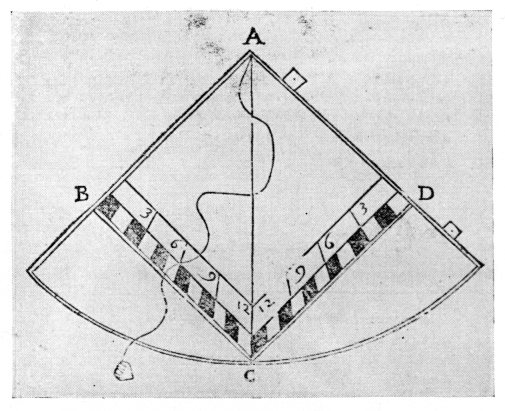 A Quadrant of the Seventeenth Century
Bartoli's "Del modo di misurare," Venice, 1689
Another type, easily made by pupils, is shown in the
above illustration from Bartoli, 1689. Such instruments
were usually made of wood, brass, or ivory.[78]
Instruments for the running of lines perpendicular to
other lines were formerly common, and are easily made.
They suffice, as the following illustration shows, for
surveying an ordinary field.
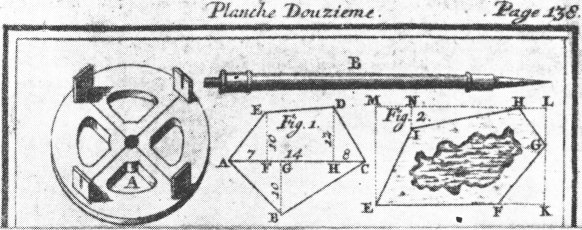 Surveying Instrument of the Eighteenth Century
N. Bion's "Traité de la construction ... des instrumens de mathématique,"
The Hague, 1723
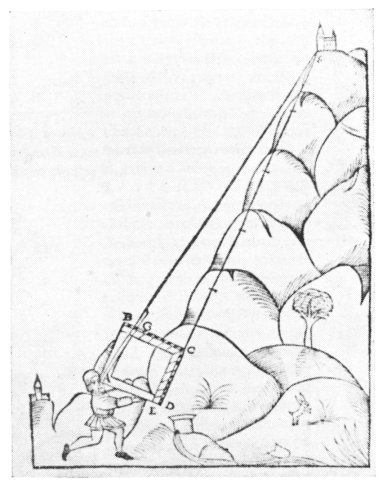 The Quadrant Used for Altitudes
Finaeus's "De re et praxi geometrica,"
Paris, 1556
The quadrant was practically used for all sorts of
outdoor measuring. For example, the illustration from
Finaeus, on this page,
shows how it was used
for altitudes, and the
one reproduced on page
240 shows how it was
used for measuring
depths.
A similar instrument
from the work
of Bettinus is given
on page 241, the distance
of a ship being
found by constructing
an isosceles triangle.
A more elaborate
form, with a pendulum
attachment, is
seen in the illustration
from De Judaeis, which also appears on page 241.
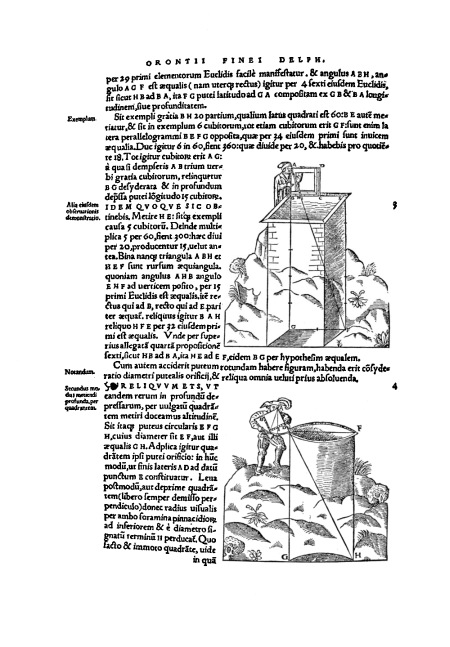 The Quadrant Used for Depths Finaeus's "Protomathesis," Paris, 1532
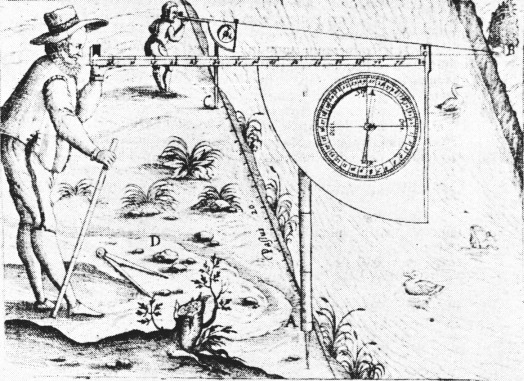 A Quadrant of the Sixteenth Century
De Judaeis's "De quadrante geometrico," Nürnberg, 1594
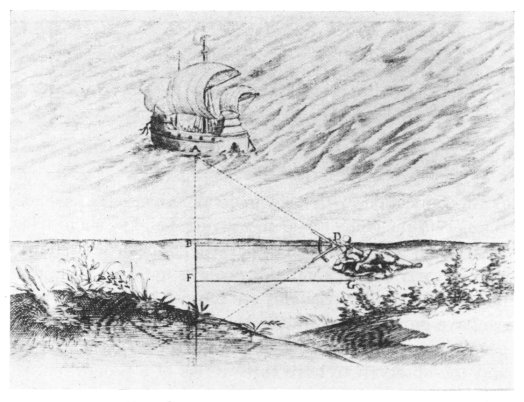 The Quadrant Used for Distances
Bettinus's "Apiaria universae philosophiae mathematieae," Bologna, 1645
The quadrant finally developed into the octant, as
shown in the following illustration from Hoffmann, and
this in turn developed into the sextant, which is now used
by all navigators.
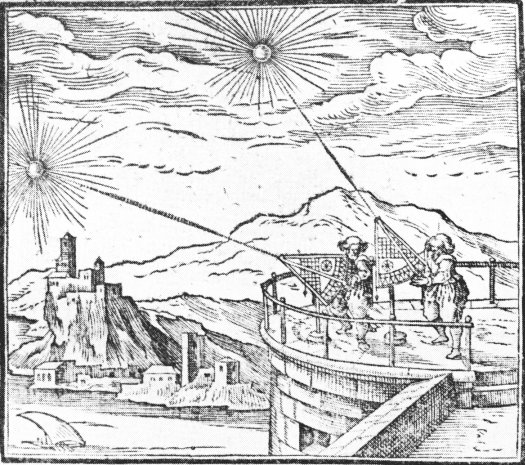 The Octant
Hoffmann's "De Octantis," Jena, 1612
In connection with this general subject the use of
the speculum (mirror) in measuring heights should be
mentioned. The illustration given on page 243 shows
how in early days a simple device was used for this purpose.
Two similar triangles are formed in this way, and
we have only to measure the height of the eye above the
ground, and the distances of the mirror from the tower
and the observer, to have three terms of a proportion.
All of these instruments are easily made. The mirror
is always at hand, and a paper protractor on a
piece of board, with a plumb line attached, serves
as a quadrant. For a few cents, and by the expenditure
of an hour or so, a school can have almost as
good instruments
as the ordinary
surveyor had before
the nineteenth
century.
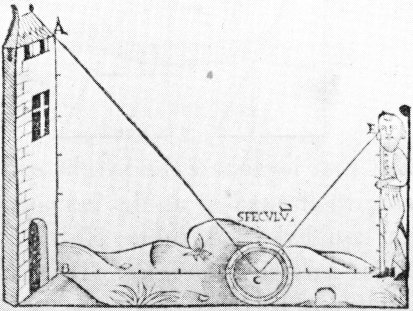 The Speculum
Finaeus's "De re et praxi geometrica,"
Paris, 1556
A well-known
method of measuring
the distance
across a stream
is illustrated in
the figure below,
where the distance
from A to some
point P is required.
Run a line from A to C by standing at C in line with A and P.
Then run two perpendiculars from A and C by any of the methods
already given,—sighting on
a protractor or along the edge of
a book if no better means are at
hand. Then sight from some point
D, on CD, to P, putting a stake
at B. Then run the perpendicular
BE. Since DE : EB = BA : AP,
and since we can measure DE,
EB, and BA with the tape, we can
compute the distance AP.
There are many variations of this scheme of measuring
distances by means of similar triangles, and pupils may
be encouraged to try some of them. Other figures are
suggested on page 244, and the triangles need not be
confined to those having a right angle.
A very simple illustration of the use of similar triangles
is found in one of the stories told of Thales. It is related
that he found the height of the pyramids by measuring
their shadow at the instant when his own shadow
just equaled his height. He thus had the case of two
similar isosceles triangles. This is an interesting exercise
which may be tried about the time that pupils are leaving
school in the afternoon.
Another application of the same principle is seen in a
method often taken for measuring the height of a tree.
The observer has a large right triangle
made of wood. Such a triangle is shown in
the picture, in which AB = BC. He holds AB
level and walks toward the tree until he just
sees the top along AC. Then because
AB = BC,
and AB : BC = AD : DE,
the height above D will equal
the distance AD.
Questions like the following
may be given
to the class:
1. What is the
height of the tree
in the picture if the
triangle is 5 ft. 4 in. from the ground, and AD is 23 ft. 8 in.?
2. Suppose a triangle is used which has AB = twice BC.
What is the height if AD = 75 ft.?
There are many variations of this principle. One consists
in measuring the shadows of a tree and a staff at
the same time. The height of the staff being known, the
height of the tree is found by proportion. Another consists
in sighting from the ground, across a mark on an
upright staff, to the top of the tree. The height of the
mark being known, and the distances from the eye to
the staff and to the tree being measured, the height of
the tree is found.
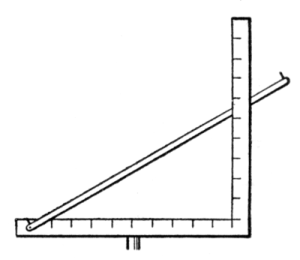
An instrument sold by dealers for the measuring of
heights is known as the hypsometer. It is made of brass,
and is of the form here shown.
The base is graduated in equal
divisions, say 50, and the upright
bar is similarly divided. At the
ends of the hinged radius are two
sights. If the observer stands
50 feet from a tree and sights at
the top, so that the hinged radius
cuts the upright bar at 27, then he knows at once that the
tree is 27 feet high. It is easy for a class to make a fairly
good instrument of this kind out of stiff pasteboard.
An interesting application of the theorem relating to
similar triangles is this: Extend your arm and point to a
distant object, closing your left eye and sighting across
your finger tip with your right eye. Now keep the finger
in the same position and sight with your left eye. The
finger will then seem to be pointing to an object some
distance to the right of the one at which you were pointing.
If you can estimate the distance between these two
objects, which can often be done with a fair degree of
accuracy when there are houses intervening, then you
will be able to tell approximately your distance from the
objects, for it will be ten times the estimated distance
between them. The finding of the reason for this by
measuring the distance between the pupils of the two
eyes, and the distance from the eye to the finger tip, and
then drawing the figure, is an interesting exercise.
Perhaps some pupil who has read Thoreau's descriptions
of outdoor life may be interested in what he says
of his crude mathematics. He writes, "I borrowed the
plane and square, level and dividers, of a carpenter, and
with a shingle contrived a rude sort of a quadrant, with
pins for sights and pivots." With this he measured the
heights of a cliff on the Massachusetts coast, and with
similar home-made or school-made instruments a pupil
in geometry can measure most of the heights and distances
in which he is interested.
Theorem. If in a right triangle a perpendicular is
drawn from the vertex of the right angle to the hypotenuse:
1. The triangles thus formed are similar to the given
triangle, and are similar to each other.
2. The perpendicular is the mean proportional between
the segments of the hypotenuse.
3. Each of the other sides is the mean proportional
between the hypotenuse and the segment of the hypotenuse
adjacent to that side.
To this important proposition there is one corollary of
particular interest, namely, The perpendicular from any
point on a circle to a diameter is the mean proportional
between the segments of the diameter. By means of this
corollary we can easily construct a line whose numerical
value is the square root of any number we please.
Thus we may make AD = 2 in., DB = 3 in., and erect
DC ⊥ to AB. Then the length of DC will be √6 in., and we may
find √6 approximately by measuring DC.
Furthermore, if we introduce negative magnitudes into geometry,
and let DB = +3 and DA = -2, then DC will equal √(-6).
In other words, we have a justification for
representing imaginary quantities by lines
perpendicular to the line on which we represent
real quantities, as is done in the graphic
treatment of imaginaries in algebra.
It is an interesting exercise to have a class find, to
one decimal place, by measuring as above, the value of
√2, √3, √5, and √9, the last being integral. If, as is
not usually the case, the class has studied the complex
number, the absolute value of √(-6), √(-7), ..., may be
found in the same way.
A practical illustration of the value of the above
theorem is seen in a method for finding distances that
is frequently described in early printed books. It seems
to have come from the Roman surveyors.
If a carpenter's square is put on top of an upright stick, as here
shown, and an observer sights along the arms to a distant point
B and a point A
near the stick, then
the two triangles
are similar. Hence
AD : DC = DC : DB.
Hence, if AD and
DC are measured,
DB can be found.
The experiment is an interesting and instructive one for a class,
especially as the square can easily be made out of heavy pasteboard.
Theorem. If two chords intersect within a circle, the
product of the segments of the one is equal to the product
of the segments of the other.
Theorem. If from a point without a circle a secant
and a tangent are drawn, the tangent is the mean proportional
between the secant and its external segment.
Corollary. If from a point without a circle a secant
is drawn, the product of the secant and its external segment
is constant in whatever direction the secant is drawn.
These two propositions and the corollary are all parts
of one general proposition: If through a point a line is
drawn cutting a circle, the product of the segments of the
line is constant.
If P is within the circle, then xx' = yy'; if P is on the circle,
then x and y become 0, and 0 · x' = 0 · y' = 0; if P is at P3, then
x and y, having passed through 0, may be considered negative if
we wish, although the two
negative signs would cancel
out in the equation; if P is
at P4, then y = y' and we
have xx' = y2, or x : y = y : x',
as stated in the proposition.
We thus have an excellent
example of the
Principle of Continuity,
and classes are always interested to consider the result
of letting P assume various positions. Among the possible
cases is the one of two tangents from an external
point, and the one where P is at the center of the
circle.
Students should frequently be questioned as to the
meaning of "product of lines." The Greeks always used
"rectangle of lines," but it is entirely legitimate to speak
of "product of lines," provided we define the expression
consistently. Most writers do this, saying that by the
product of lines is meant the product of their numerical
values, a subject already discussed at the beginning of
this chapter.
Theorem. The square on the bisector of an angle of a
triangle is equal to the product of the sides of this angle
diminished by the product of the segments made by the
bisector upon the third side of the triangle.
This proposition enables us to compute the length of a
bisector of a triangle if the lengths of the sides are known.
For, in this figure, let a = 3, b = 5, and c = 6.
Then ∵ x : y = b : a, and y = 6 - x,
we have x/(6 - x) = 5/3.
∴ 3x = 30 - 5x.
∴ x = 3 3/4, y = 2 1/4.
By the theorem, z2 = ab - xy
= 15 - (8 7/16) = 6 9/16.
∴ z = √(6 9/16) = 1/4 √105 = 2.5+.
Theorem. In any triangle the product of two sides is
equal to the product of the diameter of the circumscribed
circle by the altitude upon the third side.
This enables us, after the Pythagorean Theorem has
been studied, to compute the length of the diameter of
the circumscribed circle in terms of the three sides.
For if we designate the sides by a, b, and c, as usual, and let
CD = d and PB = x, then
(CP)2 = a2 - x2
= b2 - (c - x)2.
∴ a2 - x2 = b2 - c2 + 2cx - x2.
∴ x = (a2 - b2 + c2) / 2c.
∴ (CP)2 = a2 - ((a2 - b2 + c2) / 2c)2.
But CP · d = ab.
∴ d = 2abc / √(4a2c2 - (a2 - b2 + c2)2).
This is not available at this time, however, because the
Pythagorean Theorem has not been proved.
These two propositions are merely special cases of
the following general theorem, which may be given as
an interesting exercise:
If ABC is an inscribed triangle, and through C there are
drawn two straight lines CD, meeting AB in D, and CP,
meeting the circle in P, with angles ACD and PCB equal,
then AC × BC will equal CD × CP.
Fig. 1 is the general case where D falls between A and B. If CP
is a diameter, it reduces to the second figure given on page 249. If
CP bisects ∠ACB, we have Fig. 3, from which may be proved the
proposition given at the foot of page 248. If D lies on BA produced,
we have Fig. 2. If D lies on AB produced, we have Fig. 4.
This general proposition is proved by showing that ⧌ADC
and PBC are similar, exactly as in the second proposition given
on page 249.
These theorems are usually followed by problems of
construction, of which only one has great interest, namely,
To divide a given line in extreme and mean ratio.
The purpose of this problem is to prepare for the construction
of the regular decagon and pentagon. The
division of a line in extreme and mean ratio is called
"the golden section," and is probably "the section"
mentioned by Proclus when he says that Eudoxus
"greatly added to the number of the theorems which
Plato originated regarding the section." The expression
"golden section" is not old, however, and its origin is
uncertain.
If a line AB is divided in golden section at P, we have
AB × PB = (AP)2.
Therefore, if AB = a, and AP = x, we have
a(a - x) = x2,
or x2 + ax - a2 = 0;
whence x = - a/2 ± a/2√5
= a(1.118 - 0.5)
= 0.618a,
the other root representing the external point.
That is, x = about 0.6a, and a - x = about 0.4a, and a is
therefore divided in about the ratio of 2 : 3.
There has been a great deal written upon the æsthetic
features of the golden section. It is claimed that a line
is most harmoniously divided when it is either bisected
or divided in extreme and mean ratio. A painting
has the strong feature in the center, or more often at a
point about 0.4 of the distance from one side, that is, at
the golden section of the width of the picture. It is said
that in nature this same harmony is found, as in the
division of the veins of such leaves as the ivy and fern.
Book IV treats of the area of polygons, and offers a
large number of practical applications. Since the number
of applications to the measuring of areas of various kinds
of polygons is unlimited, while in the first three books
these applications are not so obvious, less effort is made
in this chapter to suggest practical problems to the teachers.
The survey of the school grounds or of vacant lots
in the vicinity offers all the outdoor work that is needed
to make Book IV seem very important.
Theorem. Two rectangles having equal altitudes are to
each other as their bases.
Euclid's statement (Book VI, Proposition 1) was as
follows: Triangles and parallelograms which are under the
same height are to one another as their bases. Our plan of
treating the two figures separately is manifestly better
from the educational standpoint.
In the modern treatment by limits the proof is divided
into two parts: first, for commensurable bases; and second,
for incommensurable ones. Of these the second may
well be omitted, or merely be read over by the teacher
and class and the reasons explained. In general, it is
doubtful if the majority of an American class in geometry
get much out of the incommensurable case. Of
course, with a bright class a teacher may well afford to
take it as it is given in the textbook, but the important
thing is that the commensurable case should be proved
and the incommensurable one recognized.
Euclid's treatment of proportion was so rigorous that
no special treatment of the incommensurable was necessary.
The French geometer, Legendre, gave a rigorous
proof by reductio ad absurdum. In America the pupils
are hardly ready for these proofs, and so our treatment
by limits is less rigorous than these earlier ones.
Theorem. The area of a rectangle is equal to the
product of its base by its altitude.
The easiest way to introduce this is to mark a rectangle,
with commensurable sides, on squared paper, and
count up the squares; or, what is more convenient, to
draw the rectangle and mark the area off in squares.
It is interesting and valuable to a class to have its
attention called to the fact that the perimeter of a rectangle
is no criterion as to the area. Thus, if a rectangle
has an area of 1 square foot and is only 1/440 of an
inch high, the perimeter is over 2 miles. The story of
how Indians were induced to sell their land by measuring
the perimeter is a very old one. Proclus speaks of
travelers who described the size of cities by the perimeters,
and of men who cheated others by pretending to
give them as much land as they themselves had, when
really they made only the perimeters equal. Thucydides
estimated the size of Sicily by the time it took to sail
round it. Pupils will be interested to know in this connection
that of polygons having the same perimeter and
the same number of sides, the one having equal sides
and equal angles is the greatest, and that of plane figures
having the same perimeter, the circle is the greatest.
These facts were known to the Greek writers, Zenodorus
(ca. 150 B.C.) and Proclus (410-485 A.D.).
The surfaces of rectangular solids may now be found,
there being an advantage in thus incidentally connecting
plane and solid geometry wherever it is natural to do so.
Theorem. The area of a parallelogram is equal to the
product of its base by its altitude.
The best way to introduce this theorem is to cut a
parallelogram from paper, and then, with the class, separate
it into two parts by a cut perpendicular to the
base. The two parts may then be fitted together to make
a rectangle. In particular, if we cut off a triangle from
one end and fit it on the other, we have the basis for the
proof of the textbooks. The use of squared paper for
such a proposition is not wise, since it makes the measurement
appear to be merely an approximation. The cutting
of the paper is in every way more satisfactory.
Theorem. The area of a triangle is equal to half the
product of its base by its altitude.
Of course, the Greeks would never have used the
wording of either of these two propositions. Euclid, for
example, gives this one as follows: If a parallelogram
have the same base with a triangle and be in the same parallels,
the parallelogram is double of the triangle. As to the
parallelogram, he simply says it is equal to a parallelogram
of equal base and "in the same parallels," which
makes it equal to a rectangle of the same base and the
same altitude.
The number of applications of these two theorems is
so great that the teacher will not be at a loss to find
genuine ones that appeal to the class. Teachers may
now introduce pyramids, requiring the areas of the triangular
faces to be found.
The Ahmes papyrus (ca. 1700 B.C.) gives the area of
an isosceles triangle as ½ bs, where s is one of the equal
sides, thus taking s for the altitude. This shows the
primitive state of geometry at that time.
Theorem. The area of a trapezoid is equal to half the
sum of its bases multiplied by the altitude.
An interesting variation of the ordinary proof is made by
placing a trapezoid T', congruent to T, in the position here
shown. The parallelogram
formed equals a(b + b'),
and therefore
T = a · (b + b')/2.
The proposition should be discussed for the case b = b', when
it reduces to the one about the area of a parallelogram. If b'= 0,
the trapezoid reduces to a triangle, and T = a · b/2.
This proposition is the basis of the theory of land surveying,
a piece of land being, for purposes of measurement,
divided into trapezoids and triangles, the latter
being, as we have seen, a kind of special trapezoid.
The proposition is not in Euclid, but is given by
Proclus in the fifth century.
The term "isosceles trapezoid" is used to mean a
trapezoid with two opposite sides equal, but not parallel.
The area of such a figure was incorrectly given by the
Ahmes papyrus as ½(b + b')s, where s is one of the equal
sides. This amounts to taking s = a.
The proposition is particularly important in the surveying
of an irregular field such as is found in hilly
districts. It is customary to consider the field as a polygon,
and to draw a meridian line, letting fall perpendiculars
upon it from the vertices, thus forming triangles
and trapezoids that can easily be measured. An older
plan, but one better suited to the use of pupils who may
be working only with the tape, is given on page 99.
Theorem. The areas of two triangles which have an
angle of the one equal to an angle of the other are to each
other as the products of the sides including the equal angles.
This proposition may be omitted as far as its use in
plane geometry is concerned, for we can prove the next
proposition here given without using it. In solid geometry
it is used only in a proposition relating to the
volumes of two triangular pyramids having a common
trihedral angle, and this is usually omitted. But the theorem
is so simple that it takes but little time, and it adds
greatly to the student's appreciation of similar triangles.
It not only simplifies the next one here given, but teachers
can at once deduce the latter from it as a special case by
asking to what it reduces if a second angle of one triangle
is also equal to a second angle of the other triangle.
It is helpful to give numerical values to the sides of
a few triangles having such equal angles, and to find the
numerical ratio of the areas.
Theorem. The areas of two similar triangles are to
each other as the squares on any two corresponding sides.
This may be proved independently of the preceding proposition
by drawing the altitudes p and p'. Then
⧍ABC/⧍A'B'C' = cp/c'p'.
But c/c' = p/p',
by similar triangles.
∴ ⧍ABC/⧍A'B'C' = c2/c'2,
and so for other sides.
This proof is unnecessarily long, however, because of the
introduction of the altitudes.
In this and several other propositions in Book IV
occurs the expression "the square on a line." We have,
in our departure from Euclid, treated a line either as a
geometric figure or as a number (the length of the line),
as was the more convenient. Of course if we are speaking
of a line, the preferable expression is "square on the
line," whereas if we speak of a number, we say "square
of the number." In the case of a rectangle of two lines
we have come to speak of the "product of the lines,"
meaning the product of their numerical values. We are
therefore not as accurate in our phraseology as Euclid,
and we do not pretend to be, for reasons already given.
But when it comes to "square on a line" or "square of
a line," the former is the one demanding no explanation
or apology, and it is even better understood than the
latter.
Theorem. The areas of two similar polygons are to each
other as the squares on any two corresponding sides.
This is a proposition of great importance, and in due
time the pupil sees that it applies to circles, with the necessary
change of the word "sides" to "lines." It is well
to ask a few questions like the following: If one square
is twice as high as another, how do the areas compare?
If the side of one equilateral triangle is three times as
long as that of another, how do the perimeters compare?
how do the areas compare? If the area of one square is
twenty-five times the area of another square, the side of
the first is how many times as long as the side of the
second? If a photograph is enlarged so that a tree is
four times as high as it was before, what is the ratio of
corresponding dimensions? The area of the enlarged
photograph is how many times as great as the area of
the original?
Theorem. The square on the hypotenuse of a right triangle
is equivalent to the sum of the squares on the other
two sides.
Of all the propositions of geometry this is the most
famous and perhaps the most valuable. Trigonometry is
based chiefly upon two facts of plane geometry: (1) in
similar triangles the corresponding sides are proportional,
and (2) this proposition. In mensuration, in general, this
proposition enters more often than any others, except
those on the measuring of the rectangle and triangle. It
is proposed, therefore, to devote considerable space to
speaking of the history of the theorem, and to certain
proofs that may profitably be suggested from time to
time to different classes for the purpose of adding interest
to the work.
Proclus, the old Greek commentator on Euclid, has
this to say of the history: "If we listen to those who
wish to recount ancient history, we may find some of
them referring this theorem to Pythagoras and saying
that he sacrificed an ox in honor of his discovery. But
for my part, while I admire those who first observed the
truth of this theorem, I marvel more at the writer of the
'Elements' (Euclid), not only because he made it fast
by a most lucid demonstration, but because he compelled
assent to the still more general theorem by the irrefragable
arguments of science in Book VI. For in that
book he proves, generally, that in right triangles the
figure on the side subtending the right angle is equal to
the similar and similarly placed figures described on the
sides about the right angle." Now it appears from this
that Proclus, in the fifth century A.D., thought that
Pythagoras discovered the proposition in the sixth century
B.C., that the usual proof, as given in most of our
American textbooks, was due to Euclid, and that the
generalized form was also due to the latter. For it should
be made known to students that the proposition is true
not only for squares, but for any similar figures, such as
equilateral triangles, parallelograms, semicircles, and
irregular figures, provided they are similarly placed on
the three sides of the right triangle.
Besides Proclus, Plutarch testifies to the fact that
Pythagoras was the discoverer, saying that "Pythagoras
sacrificed an ox on the strength of his proposition
as Apollodotus says," but saying that there were
two possible propositions to which this refers. This
Apollodotus was probably Apollodorus, surnamed Logisticus
(the Calculator), whose date is quite uncertain,
and who speaks in some verses of a "famous proposition"
discovered by Pythagoras, and all tradition makes
this the one. Cicero, who comments upon these verses,
does not question the discovery, but doubts the story of
the sacrifice of the ox. Of other early writers, Diogenes
Laertius, whose date is entirely uncertain (perhaps the
second century A.D.), and Athenæus (third century A.D.)
may be mentioned as attributing the theorem to Pythagoras,
while Heron (first century A.D.) says that he
gave a rule for forming right triangles with rational integers
for the sides, like 3, 4, 5, where 32 + 42 = 52. It
should be said, however, that the Pythagorean origin has
been doubted, notably in an article by H. Vogt, published
in the Bibliotheca Mathematica in 1908 (Vol. IX
(3), p. 15), entitled "Die Geometrie des Pythagoras,"
and by G. Junge, in his work entitled "Wann haben
die Griechen das Irrationale entdeckt?" (Halle, 1907).
These writers claim that all the authorities attributing
the proposition to Pythagoras are centuries later than
his time, and are open to grave suspicion. Nevertheless
it is hardly possible that such a general tradition, and
one so universally accepted, should have arisen without
good foundation. The evidence has been carefully
studied by Heath in his "Euclid," who concludes with
these words: "On the whole, therefore, I see no sufficient
reason to question the tradition that, so far as
Greek geometry is concerned ..., Pythagoras was the
first to introduce the theorem ... and to give a general
proof of it." That the fact was known earlier, probably
without the general proof, is recognized by all modern
writers.
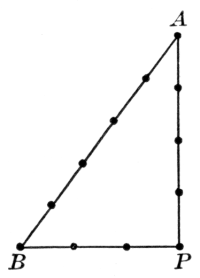
Pythagoras had studied in Egypt and possibly in the
East before he established his school at Crotona, in southern
Italy. In Egypt, at any rate, he could easily have
found that a triangle with the sides 3, 4, 5, is a right
triangle, and Vitruvius (first century B.C.) tells us that
he taught this fact. The Egyptian harpedonaptae (rope
stretchers) stretched ropes about pegs so as to make
such a triangle for the purpose of laying
out a right angle in their surveying, just
as our surveyors do to-day. The great
pyramids have an angle of slope such as
is given by this triangle. Indeed, a papyrus
of the twelfth dynasty, lately discovered
at Kahun, in Egypt, refers to four of
these triangles, such as 12 + (3/4)2 = (1-1/4)2.
This property seems to have been a matter of common
knowledge long before Pythagoras, even as far east as
China. He was, therefore, naturally led to attempt to
prove the general property which had already been
recognized for special cases, and in particular for the
isosceles right triangle.
How Pythagoras proved the proposition is not known.
It has been thought that he used a proof by proportion,
because Proclus says that Euclid gave a new style of
proof, and Euclid does not use proportion for this purpose,
while the subject, in incomplete form, was highly
esteemed by the Pythagoreans. Heath suggests that
this is among the possibilities:
⧌ABC and APC are similar.
∴ AB × AP = (AC)2.
Similarly, AB × PB = (BC)2.
∴ AB(AP + PB) = (AC)2 + (BC)2,
or (AB)2 = (AC)2 + (BC)2.
Others have thought that Pythagoras derived his
proof from dissecting a square and showing that the
square on the hypotenuse must equal the sum of the
squares on the other two sides, in some such manner
as this:
Here Fig. 1 is evidently h2 + 4 ⧌.
Fig. 2 is evidently a2 + b2 + 4 ⧌.
∴ h2 + 4 ⧌ = a2 + b2 + 4 ⧌, the ⧌ all being congruent.
∴ h2 = a2 + b2.
The great Hindu mathematician, Bhaskara (born 1114
A.D.), proceeds in a somewhat similar manner. He draws
this figure, but gives no proof. It is evident
that he had in mind this relation:
h2 = 4 · ab/2 + (b - a)2 = a2 + b2.
A somewhat similar proof can be
based upon the following figure:
If the four triangles, 1 + 2 + 3 + 4, are taken
away, there remains the square on the hypotenuse.
But if we take away the two shaded rectangles,
which equal the four triangles, there
remain the squares on the two sides. Therefore
the square on the hypotenuse must equal the
sum of these two squares.
It has long been thought that the truth of the proposition
was first observed by seeing the tiles on the
floors of ancient temples. If they
were arranged as here shown, the
proposition would be evident for
the special case of an isosceles
right triangle.
The Hindus knew the proposition
long before Bhaskara, however,
and possibly before Pythagoras.
It is referred to in the old religious
poems of the Brahmans, the "Sulvasutras," but the date
of these poems is so uncertain that it is impossible to
state that they preceded the sixth century B.C.,[79] in which
Pythagoras lived. The "Sulvasutra" of Apastamba has
a collection of rules, without proofs, for constructing
various figures. Among these is one for constructing
right angles by stretching cords of the following lengths:
3, 4, 5; 12, 16, 20; 15, 20, 25 (the two latter being multiples
of the first); 5, 12, 13; 15, 36, 39; 8, 15, 17; 12,
35, 37. Whatever the date of these "Sulvasutras," there
is no evidence that the Indians had a definite proof of
the theorem, even though they, like the early Egyptians,
recognized the general fact.
It is always interesting to a class to see more than
one proof of a famous theorem, and many teachers find
it profitable to ask their pupils to work out proofs that
are (to them) original, often suggesting the figure. Two
of the best known historic proofs are here given.
The first makes the Pythagorean Theorem a special
case of a proposition due to Pappus (fourth century
A.D.), relating to any kind of a triangle.
Somewhat simplified, this proposition asserts that if ABC is
any kind of triangle, and MC, NC are parallelograms on AC, BC,
the opposite sides
being produced to
meet at P; and
if PC is produced
making QR = PC;
and if the parallelogram
AT is constructed,
then AT =
MC + NC.
For MC = AP = AR, having equal bases and equal altitudes.
Similarly, NC = QT.
Adding, MC + NC = AT.
If, now, ABC is a right triangle, and if MC and NC are
squares, it is easy to show that AT is a square, and the proposition
reduces to the Pythagorean Theorem.
The Arab writer, Al-Nairīzī (died about 922 A.D.),
attributes to Thābit ben Qurra (826-901 A.D.) a proof
substantially as follows:
The four triangles T can be proved congruent. Then if we
take from the whole figure T and T', we have left the squares on
the two sides of the right angle. If we take
away the other two triangles instead, we have
left the square on the hypotenuse. Therefore
the former is equivalent to the latter.
A proof attributed to the great artist,
Leonardo da Vinci (1452-1519),
is as follows:
The construction of the following figure is evident. It is
easily shown that the four quadrilaterals ABMX, XNCA, SBCP,
and SRQP are congruent.
∴ ABMXNCA
equals SBCPQRS
but is not congruent
to it, the congruent
quadrilaterals
being differently
arranged.
Subtract the congruent
triangles
MXN, ABC, RAQ,
and the proposition
is proved.[80]
The following is an interesting proof of the proposition:
Let ABC be the original triangle, with AB < BC. Turn the
triangle about B, through 90°, until it comes into the position
A'BC'. Then because it has been turned through 90°, C'A'P
will be perpendicular to AC. Then
1/2(AB)2 = ⧍ABA',
and 1/2(BC')2 = ⧍BC'C,
because BC = BC'.
∴ 1/2((AB)2 + (BC)2) = ⧍ABA' + ⧍BC'C.
∴ 1/2((AB)2 + (BC)2)
= ⧍AC'A' + ⧍A'C'C
(For ⧍ABA' + ⧍BC'A' + ⧍A'C'C is
the second member of both equations.)
= 1/2A'C' · AP
+ 1/2A'C' · PC
= 1/2A'C' · AC
= 1/2(AC)2.
∴ (AB)2 + (BC)2 = (AC)2.
The Pythagorean Theorem, as it is generally called,
has had other names. It is not uncommonly called
the pons asinorum (see page 174) in France. The Arab
writers called it the Figure of the Bride, although the
reason for this name is unknown; possibly two being
joined in one has something to do with it. It has also
been called the Bride's Chair, and the shape of the
Euclid figure is not unlike the chair that a slave carries
on his back, in which the Eastern bride is sometimes
transported to the wedding ceremony. Schopenhauer,
the German philosopher, referring to the figure, speaks
of it as "a proof walking on stilts," and as "a mouse-trap
proof."
An interesting theory suggested by the proposition is
that of computing the sides of right triangles so that they
shall be represented by rational numbers. Pythagoras
seems to have been the first to take up this theory,
although such numbers were applied to the right triangle
before his time, and Proclus tells us that Plato also contributed
to it. The rule of Pythagoras, put in modern
symbols, was as follows:
n2 + ((n2 - 1)/2)2 = ((n2 + 1)/2)2,
the sides being n, (n2 - 1)/2, and (n2 + 1)/2. If for n we put 3, we have
3, 4, 5. If we take the various odd numbers, we have
n = 1, 3, 5, 7, 9, ···,
(n2 - 1)/2 = 0, 4, 12, 24, 40, ···,
(n2 + 1)/2 = 1, 5, 13, 25, 41, ···.
Of course n may be even, giving fractional values.
Thus, for n = 2 we have for the three sides, 2, 1-1/2, 2-1/2.
Other formulas are also known. Plato's, for example, is
as follows:
(2n)2 + (n2 - 1)2 = (n2 + 1)2.
If 2n = 2, 4, 6, 8, 10, ···,
then n2 - 1 = 0, 3, 8, 15, 24, ···,
and n2 + 1 = 2, 5, 10, 17, 26, ···.
This formula evidently comes from that of Pythagoras
by doubling the sides of the squares.[81]
Theorem. In any triangle the square of the side opposite
an acute angle is equal to the sum of the squares of the
other two sides diminished by twice the product of one of
those sides by the projection of the other upon that side.
Theorem. A similar statement for the obtuse triangle.
These two propositions are usually proved by the
help of the Pythagorean Theorem. Some writers, however,
actually construct the squares and give a proof
similar to the one in that proposition. This plan goes
back at least to Gregoire de St. Vincent (1647).
It should be observed that
a2 = b2 + c2 - 2b'c.
If ∠A = 90°, then b' = 0, and this
becomes
a2 = b2 + c2.
If ∠A is obtuse, then b' passes through 0 and becomes negative,
and a2 = b2 + c2 + 2b'c.
Thus we have three propositions in one.
At the close of Book IV many geometries give as
an exercise, and some give as a regular proposition, the
celebrated problem that bears the name of Heron of
Alexandria, namely, to compute the area of a triangle
in terms of its sides. The result
is the important formula
Area = √(s(s - a)(s - b)(s - c)),
where a, b, and c are the sides,
and s is the semiperimeter
½(a + b + c). As a
practical application the
class may be
able to find
a triangular piece of land, as here shown, and to measure
the sides. If the piece is clear, the result may be
checked by measuring the altitude and applying the
formula a = ½bh.
It may be stated to the class that Heron's formula is
only a special case of the more general one developed
about 640 A.D., by a famous Hindu mathematician, Brahmagupta.
This formula gives the area of an inscribed
quadrilateral as √((s - a)(s - b)(s - c)(s - d)), where
a, b, c, and d are the sides and s is the semiperimeter.
If d = 0, the quadrilateral becomes a triangle and we
have Heron's formula.[82]
At the close of Book IV, also, the geometric equivalents
of the algebraic formulas for (a + b)2, (a - b)2, and
(a + b)(a - b) are given. The class may like to know
that Euclid had no algebra and was compelled to prove
such relations as these by geometry, while we do it now
much more easily by algebraic multiplication.
Book V treats of regular polygons and circles, and
includes the computation of the approximate value of π.
It opens with a definition of a regular polygon as one
that is both equilateral and equiangular. While in elementary
geometry the only regular polygons studied are
convex, it is interesting to a class to see that
there are also regular cross polygons. Indeed,
the regular cross pentagon was the badge of the
Pythagoreans, as Lucian (ca. 100 B.C.) and an
unknown commentator on Aristophanes (ca. 400 B.C.)
tell us. At the vertices of this polygon the Pythagoreans
placed the Greek letters signifying "health."
Euclid was not interested in the measure of the circle,
and there is nothing in his "Elements" on the value of π.
Indeed, he expressly avoided numerical measures of all
kinds in his geometry, wishing the science to be kept
distinct from that form of arithmetic known to the
Greeks as logistic, or calculation. His Book IV is devoted
to the construction of certain regular polygons,
and his propositions on this subject are now embodied
in Book V as it is usually taught in America.
If we consider Book V as a whole, we are struck
by three features. Of these the first is the pure geometry
involved, and this is the essential feature to be
emphasized. The second is the mensuration of the circle,
a relatively unimportant piece of theory in view of the
fact that the pupil is not ready for incommensurables,
and a feature that imparts no information that the pupil
did not find in arithmetic. The third is the somewhat
interesting but mathematically unimportant application
of the regular polygons to geometric design.
As to the mensuration of the circle it is well for us to
take a broad view before coming down to details. There
are only four leading propositions necessary for the mensuration
of the circle and the determination of the value
of π. These are as follows: (1) The inscribing of a regular
hexagon, or any other regular polygon of which the
side is easily computed in terms of the radius. We may
start with a square, for example, but this is not so good
as the hexagon because its side is incommensurable with
the radius, and its perimeter is not as near the circumference.
(2) The perimeters of similar regular polygons are
proportional to their radii, and their areas to the squares
of the radii. It is now necessary to state, in the form of
a postulate if desired, that the circle is the limit of regular
inscribed and circumscribed polygons as the number
of sides increases indefinitely, and hence that (2) holds
for circles. (3) The proposition relating to the area of a
regular polygon, and the resulting proposition relating
to the circle. (4) Given the side of a regular inscribed
polygon, to find the side of a regular inscribed polygon
of double the number of sides. It will thus be seen that
if we were merely desirous of approximating the value
of π, and of finding the two formulas c = 2πr and a = πr2,
we should need only four propositions in this book upon
which to base our work. It is also apparent that even if
the incommensurable cases are generally omitted, the
notion of limit is needed at this time, and that it must
briefly be reviewed before proceeding further.
There is, however, a much more worthy interest than
the mere mensuration of the circle, namely, the construction
of such polygons as can readily be formed by the use
of compasses and straightedge alone. The pleasure of constructing
such figures and of proving that the construction
is correct is of itself sufficient justification for the
work. As to the use of such figures in geometric design,
some discussion will be offered at the close of this chapter.
The first few propositions include those that lead up
to the mensuration of the circle. After they are proved
it is assumed that the circle is the limit of the regular
inscribed and circumscribed polygons as the number of
sides increases indefinitely. This may often be proved
with some approach to rigor by a few members of an
elementary class, but it is the experience of teachers that
the proof is too difficult for most beginners, and so the
assumption is usually made in the form of an unproved
theorem.
The following are some of the leading propositions of
this book:
Theorem. Two circumferences have the same ratio as
their radii.
This leads to defining the ratio of the circumference
to the diameter as π. Although this is a Greek letter,
it was not used by the Greeks to represent this ratio.
Indeed, it was not until 1706 that an English writer,
William Jones, in his "Synopsis Palmariorum Matheseos,"
used it in this way, it being the initial letter of
the Greek word for "periphery." After establishing the
properties that c = 2πr, and a = πr2, the textbooks follow
the Greek custom and proceed to show how to
inscribe and circumscribe various regular polygons, the
purpose being to use these in computing the approximate
numerical value of π. Of these regular polygons two
are of special interest, and these will now be considered.
Problem. To inscribe a regular hexagon in a circle.
That the side of a regular inscribed hexagon equals
the radius must have been recognized very early. The
common divisions of the circle in ancient art are into
four, six, and eight equal parts. No draftsman could
have worked with a pair of compasses without quickly
learning how to effect these divisions, and that compasses
were early used is attested by the specimens of these
instruments often seen in museums. There is a tradition
that the ancient Babylonians considered the circle of the
year as made up of 360 days, whence they took the circle
as composed of 360 steps or grades (degrees). This tradition
is without historic foundation, however, there being
no authority in the inscriptions for this assumption of the
360-division by the Babylonians, who seem rather to have
preferred 8, 12, 120, 240, and 480 as their division numbers.
The story of 360° in the Babylonian circle seems to
start with Achilles Tatius, an Alexandrian grammarian
of the second or third century A.D. It is possible, however,
that the Babylonians got their favorite number 60
(as in 60 seconds make a minute, 60 minutes make an
hour or degree) from the hexagon in a circle (1/6 of
360° = 60°), although the probabilities seem to be that
there is no such connection.[83]
The applications of this problem to mensuration are
numerous. The fact that we may use for tiles on a
floor three regular polygons—the triangle, square, and
hexagon—is noteworthy, a fact that Proclus tells us
was recognized by Pythagoras. The measurement of
the regular hexagon, given one side, may be used in
computing sections of hexagonal columns, in finding
areas of flower beds, and in other similar cases.
This review of the names of the polygons offers an
opportunity to impress their etymology again on the
mind. In this case, for example, we have "hexagon"
from the Greek words for "six" and "angle."
Problem. To inscribe a regular decagon in a given circle.
Euclid states the problem thus: To construct an isosceles
triangle having each of the angles at the base double
of the remaining one. This makes each base angle 72° and
the vertical angle 36°, the latter being the central angle
of a regular decagon,—essentially our present method.
This proposition seems undoubtedly due to the Pythagoreans,
as tradition has always asserted. Proclus
tells us that Pythagoras discovered "the construction of
the cosmic figures," or the five regular polyhedrons, and
one of these (the dodecahedron) involves the construction
of the regular pentagon.
Iamblichus (ca. 325 A.D.) tells us that Hippasus, a
Pythagorean, was said to have been drowned for daring
to claim credit for the construction of the regular dodecahedron,
when by the rules of the brotherhood all credit
should have been assigned to Pythagoras.
If a regular polygon of s sides can be inscribed, we may
bisect the central angles, and therefore inscribe one of 2s
sides, and then of 4s sides, and then of 8s sides, and in
general of 2ns sides. This includes the case of s = 2 and
n = 0, for we can inscribe a regular polygon of two sides,
the angles being, by the usual formula, 2(2-2)/2 = 0,
although, of course, we never think of two equal and
coincident lines as forming what we might call a digon.
We therefore have the following regular polygons:
From the equilateral triangle, regular polygons of 2n · 3 sides;
From the square, regular polygons of 2n sides;
From the regular pentagon, regular polygons of 2n · 5 sides;
From the regular pentedecagon, regular polygons of 2n · 15 sides.
This gives us, for successive values of n, the following
regular polygons of less than 100 sides:
From 2n · 3, 3, 6, 12, 24, 48, 96;
From 2n, 2, 4, 8, 16, 32, 64;
From 2n · 5, 5, 10, 20, 40, 80;
From 2n · 15, 15, 30, 60.
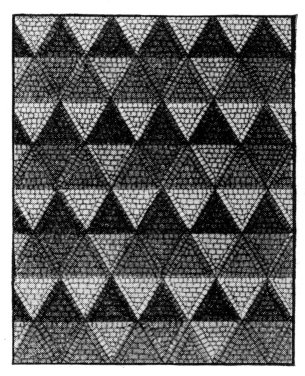 Roman Mosaic found at Pompeii
Gauss (1777-1855), a celebrated German mathematician,
proved (in 1796) that it is possible also to inscribe a
regular polygon of 17 sides, and
hence polygons of 2n · 17 sides,
or 17, 34, 68, ..., sides, and also
3 · 17 = 51 and 5 · 17 = 85 sides,
by the use of the compasses
and straightedge, but the proof
is not adapted to elementary
geometry.
In connection with the study
of the regular polygons some
interest attaches to the reference
to various forms of decorative
design. The mosaic floor,
parquetry, Gothic windows, and patterns of various
kinds often involve the regular figures. If the teacher
uses such material, care should be taken to exemplify
good art. For example, the equilateral triangle and its
relation to the regular hexagon
is shown in the picture
of an ancient Roman
mosaic floor on page 274.[84]
In the next illustration
some characteristic Moorish
mosaic work appears,
in which it will be seen
that the basal figure is
the square, although at
first sight this would not seem to be the case.[85] This is
followed by a beautiful
Byzantine mosaic, the
original of which was
in five colors of marble.
Here it will be seen
that the equilateral triangle
and the regular
hexagon are the basal
figures, and a few of the
properties of these polygons
might be derived
from the study of such
a design. In the Arabic
pattern on page 276
the dodecagon appears
as the basis, and the remarkable
powers of the Arab designer are shown in the
use of symmetry without employing regular figures.
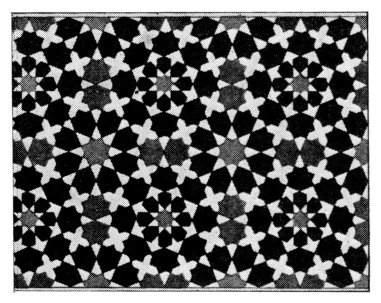 Mosaic from Damascus
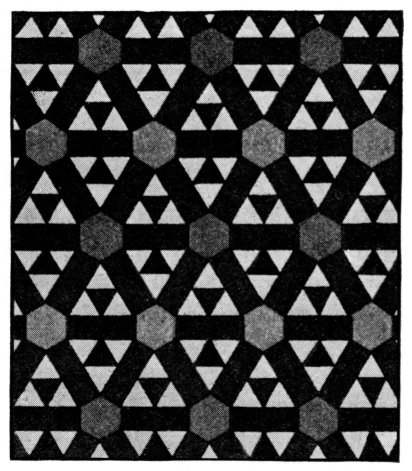 Mosaic from an Ancient Byzantine Church
Problem. Given the side and the radius of a regular
inscribed polygon, to find the side of the regular inscribed
polygon of double the number of sides.
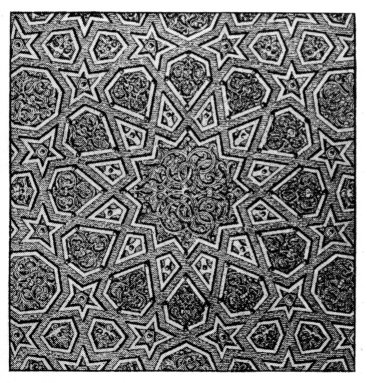 Arabic Pattern
The object of this proposition is, of course, to prepare
the way for finding the perimeter of a polygon of 2n
sides, knowing that of n
sides. The Greek plan was
generally to use both an
inscribed and a circumscribed
polygon, thus approaching
the circle as a
limit both from without
and within. This is more
conclusive from the ultrascientific
point of view, but
it is, if anything, less conclusive
to a beginner, because
he does not so readily
follow the proof. The plan of using the two polygons was
carried out by Archimedes of Syracuse (287-212 B.C.)
in his famous method of approximating the value of π,
although before him Antiphon (fifth century B.C.) had
inscribed a square (or equilateral triangle) as a basis for
the work, and Bryson (his contemporary) had attacked
the problem by circumscribing as well as inscribing a
regular polygon.
Problem. To find the numerical value of the ratio of
the circumference of a circle to its diameter.
As already stated, the usual plan of the textbooks
is in part the method followed by Archimedes. It is
possible to start with any regular polygon of which
the side can conveniently be found in terms of the
radius. In particular we might begin with an inscribed
square instead of a regular hexagon. In this case we
should have
| |
Length of Side |
Perimeter |
| s4 = 1.414... |
= 1.41 |
5.66 |
| s8 = √(2-√(4-1.4142)) |
= 0.72 |
5.76 |
and so on.
It is a little easier to start with the hexagon, however,
for we are already nearer the circle, and the side
and perimeter are both commensurable with the radius.
It is not, of course, intended that pupils should make
the long numerical calculations. They may be required
to compute s12 and possibly s24, but aside from this they
are expected merely to know the process.
If it were possible to find the value of π exactly, we
could find the circumference exactly in terms of the
radius, since c = 2πr. If we could find the circumference
exactly, we could find the area exactly, since a = πr2.
If we could find the area exactly in this form, π times a
square, we should have a rectangle, and it is easy to construct
a square equivalent to any rectangle. Therefore, if
we could find the value of π exactly, we could construct a
square with area equivalent to the area of the circle; in
other words, we could "square the circle." We could also,
as already stated, construct a straight line equivalent to
the circumference; in other words, we could "rectify the
circumference." These two problems have attracted the
attention of the world for over two thousand years, but
on account of their interrelation they are usually spoken
of as a single problem, "to square the circle."
Since we can construct √a by means of the straightedge
and compasses, it would be possible for us to square
the circle if we could express π by a finite number of
square roots. Conversely, every geometric construction
reduces to the intersection of two straight lines, of
a straight line and a circle, or of two circles, and is
therefore equivalent to a rational operation or to the
extracting of a square root. Hence a geometric construction
cannot be effected by the straightedge and
compasses unless it is equivalent to a series of rational
operations or to the extracting of a finite number of
square roots. It was proved by a German professor,
Lindemann, in 1882, that π cannot be expressed as an
algebraic number, that is, as the root of an equation
with rational coefficients, and hence it cannot be found
by the above operations, and, furthermore, that the solution
of this famous problem is impossible by elementary
geometry.[86]
It should also be pointed out to the student that for
many practical purposes one of the limits of π stated
by Archimedes, namely, 3-1/7, is sufficient. For more
accurate work 3.1416 is usually a satisfactory approximation.
Indeed, the late Professor Newcomb stated that
"ten decimal places are sufficient to give the circumference
of the earth to the fraction of an inch, and thirty
decimal places would give the circumference of the
whole visible universe to a quantity imperceptible with
the most powerful microscope."
Probably the earliest approximation of the value of
π was 3. This appears very commonly in antiquity, as
in I Kings vii, 23, and 2 Chronicles iv, 2. In the Ahmes
papyrus (ca. 1700 B.C.) there is a rule for finding the
area of the circle, expressed in modern symbols as (8/9)2d2,
which makes π = 256/81 or 3.1604....
Archimedes, using a plan somewhat similar to ours, found
that π lay between 3-1/7 and 3-10/71. Ptolemy, the great Greek
astronomer, expressed the value as 3-17/120, or 3.14166.... The
fact that Ptolemy divided his diameter into 120 units
and his circumference into 360 units probably shows, however,
the influence of the ancient value 3.
In India an approximate value appears in a certain poem
written before the Christian era, but the date is uncertain.
About 500 A.D. Aryabhatta (or possibly a later writer of
the same name) gave the value 62832/20000, or 3.1416. Brahmagupta,
another Hindu (born 598 A.D.), gave √(10), and
this also appears in the writings of the Chinese mathematician
Chang Hêng (78-139 A.D.). A little later in China,
Wang Fan (229-267) gave 142 ÷ 45, or 3.1555...; and
one of his contemporaries, Lui Hui, gave 157 ÷ 50, or
3.14. In the fifth century Ch'ung-chih gave as the limits
of π, 3.1415927 and 3.1415926, from which he inferred
that 22/7 and 355/113 were good approximations, although he
does not state how he came to this conclusion.
In the Middle Ages the greatest mathematician of
Italy, Leonardo Fibonacci, or Leonardo of Pisa (about
1200 A.D.), found as limits 3.1427... and 3.1410....
About 1600 the Chinese value 355/113 was rediscovered by
Adriaen Anthonisz (1527-1607), being published by his
son, who is known as Metius (1571-1635), in the year
1625. About the same period the French mathematician
Vieta (1540-1603) found the value of π to 9 decimal
places, and Adriaen van Rooman (1561-1615) carried
it to 17 decimal places, and Ludolph van Ceulen (1540-1610)
to 35 decimal places. It was carried to 140 decimal
places by Georg Vega (died in 1793), to 200 by Zacharias
Dase (died in 1844), to 500 by Richter (died in 1854),
and more recently by Shanks to 707 decimal places.
There have been many interesting formulas for π,
among them being the following:
π/2 = 2/1 · 2/3 · 4/3 · 4/5 · 6/5 · 6/7 · 8/7 · 8/9 · .... (Wallis, 1616-1703)
4/π = 1 + 1/2
+ 9/2
+ 25/2
+ 49/2
+ .... (Brouncker, 1620-1684)
π/4 = 1 - 1/3 + 1/5 - 1/7 + .... (Gregory, 1638-1675)
π/6 = √(1/3) · (1 - 1/(3 · 3) + 1/(32 · 5) - 1/(33 · 7) + ...).
π/2 = (log i) / i. (Bernoulli)
π/(2√(3)) = 1 - 1/5 + 1/7 - 1/11 + 1/13 - 1/17 + 1/19...,
thus connecting the primes.
π2 / 16 = 1 - 1/22 - 1/32 + 1/42 - 1/52 + 1/62 - 1/72 - 1/82 + 1/92 + ....
π/2 = x/2 + sin x + (sin2 x) / 2 + (sin3 x) / 3 + .... (0 < x < 2π)
π/4 = 3/4 + 1/(2 · 3 · 4) - 1/(4 · 5 · 6) + 1/(6 · 7 · 8) - ....
2π2/3 = 7 - (1/(1 · 3) + 1/(3 · 6) + 1/(6 · 10) + ...).
π = 2n√(2 - √(2 + √(2 + √(2 + √(2...))))).
Students of elementary geometry are not prepared
to appreciate it, but teachers will be interested in the
remarkable formula discovered by Euler (1707-1783),
the great Swiss mathematician, namely, 1 + eiπ = 0. In
this relation are included the five most interesting quantities
in mathematics,—zero, the unit, the base of the
so-called Napierian logarithms, i = √(-1), and π. It was
by means of this relation that the transcendence of
e was proved by the French mathematician Hermite,
and the transcendence of π by the German Lindemann.
There should be introduced
at this time, if it has not already
been done, the proposition
of the lunes of Hippocrates
(ca. 470 B.C.), who proved a
theorem that asserts, in somewhat
more general form, that if three semicircles be
described on the sides of a right triangle as diameters,
as shown, the lunes L + L' are
together equivalent to the triangle T.
In the use of the circle in design
one of the simplest forms suggested by
Book V is the trefoil (three-leaf), as
here shown, with the necessary construction
lines. This is a very common
ornament in architecture, both with rounded ends and
with the ends slightly pointed.
The trefoil is closely connected with hexagonal designs,
since the regular hexagon is formed from the
inscribed equilateral triangle by doubling the number of
sides. The following are designs that are easily made:
It is not very profitable, because it is manifestly unreal,
to measure the parts of such figures, but it offers
plenty of practice in numerical work.
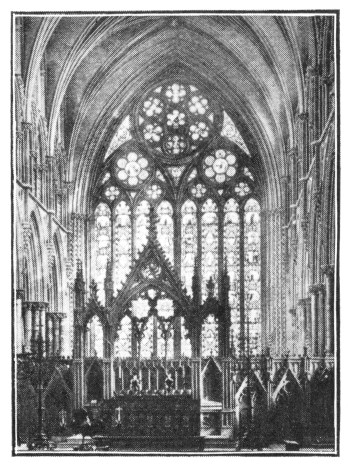 Choir of Lincoln Cathedral
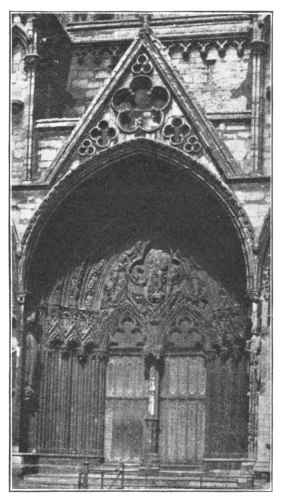 Porch of Lincoln Cathedral
In the illustrations of
the Gothic windows given
in Chapter XV only the
square and circle were generally
involved. Teachers
who feel it necessary or
advisable to go outside the
regular work of geometry
for the purpose of increasing
the pupil's interest or
of training his hand in the
drawing of figures will find
plenty of designs given in
any pictures of Gothic cathedrals.
For example, this
picture of the noble window
in the choir of Lincoln
Cathedral shows the use of
the square, hexagon, and
pentagon. In the porch of
the same cathedral, shown
in the next illustration, the
architect has made use of the
triangle, square, and pentagon
in planning his ornamental
stonework. It is
possible to add to the work
in pure geometry some work
in the mensuration of the
curvilinear figures shown in
these designs. This form of
mensuration is not of much
value, however, since it
places before the pupil a problem that he sees at once
is fictitious, and that has no human interest.
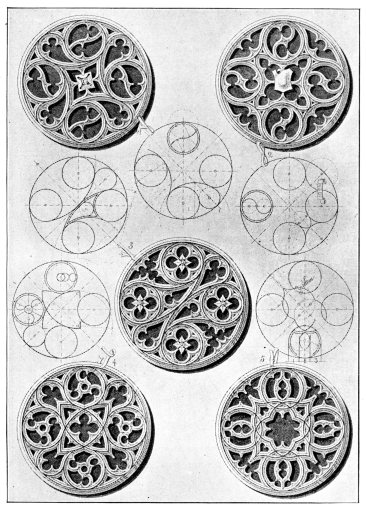 Gothic Designs employing Circles and Bisected Angles
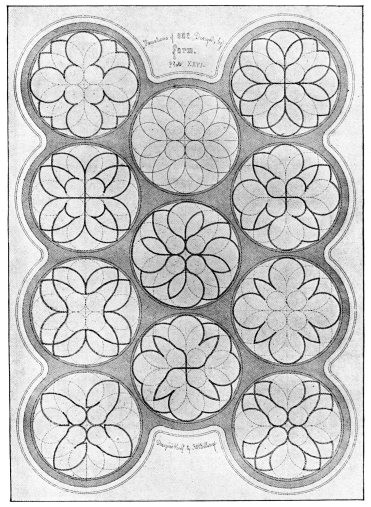 Gothic Designs employing Circles and Squares
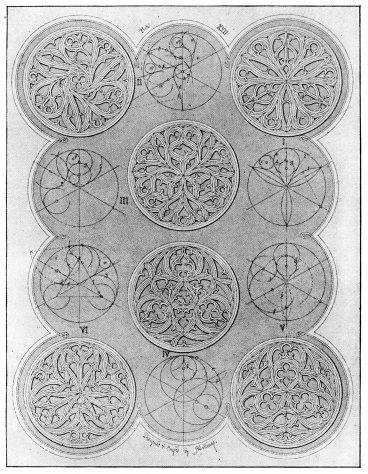 Gothic Designs employing Circles and the Equilateral Triangle
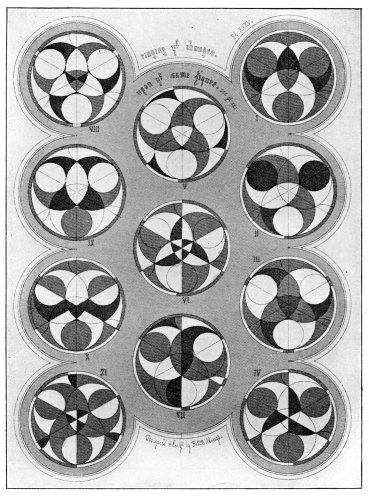 Gothic Designs employing Circles and the Regular Hexagon
The designs given on page 283 involve chiefly the
square as a basis, but it will be seen from one of the
figures that the equilateral triangle and the hexagon also
enter. The possibilities of endless variation of a single design
are shown in the illustration on page 284, the basis
in this case being the square. The variations in the use
of the triangle and hexagon have been the object of
study of many designers of Gothic windows, and some
examples of these forms are shown on page 285. In more
simple form this ringing of the changes on elementary
figures is shown on page 286. Some teachers have used
color work with such designs for the purpose of increasing
the interest of their pupils,
but the danger of thus
using the time with no serious
end in view will be
apparent.
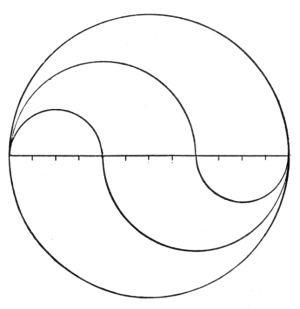
In the matter of the mensuration
of the circle the annexed
design has some interest. The
figure is not uncommon in
decoration, and it is interesting
to show, as a matter of pure geometry, that the area
of the circle is divided into three equal portions by means
of the four interior semicircles.
An important application of the formula a = πr2 is
seen in the area of the annulus, or ring, the formula being
a = πr2 - πr'2 = π(r2 - r'2) = π(r + r') (r - r'). It is
used in finding the area of the cross section
of pipes, and this is needed when we wish to
compute the volume of the iron used.
Another excellent application is that of
finding the area of the surface of a cylinder,
there being no reason why such simple cases from solid
geometry should not furnish working material for plane
geometry, particularly as they have already been met
by the pupils in arithmetic.
A little problem that always has some interest for
pupils is one that Napoleon is said to have suggested to
his staff on his voyage to Egypt: To divide a circle into
four equal parts by the use of circles alone.
Here the circles B are tangent to the circle A at the points of
division. Furthermore, considering areas, and taking r as the
radius of A, we have A = πr2, and
B = π(r/2)2. Hence B = 1/4A, or the
sum of the areas of the four circles
B equals the area of A. Hence the
four D's must equal the four C's,
and D = C. The rest of the argument
is evident. The problem has
some interest to pupils aside from
the original question suggested by
Napoleon.
At the close of plane geometry
teachers may find it helpful to have the class make
a list of the propositions that are actually used in proving
other propositions, and to have it appear what ones are
proved by them. This forms a kind of genealogical tree
that serves to fix the parent propositions in mind. Such
a work may also be carried on at the close of each book,
if desired. It should be understood, however, that certain
propositions are used in the exercises, even though they
are not referred to in subsequent propositions, so that
their omission must not be construed to mean that they
are not important.
An exercise of distinctly less value is the classification
of the definitions. For example, the classification of polygons
or of quadrilaterals, once so popular in textbook
making, has generally been abandoned as tending to
create or perpetuate unnecessary terms. Such work is
therefore not recommended.
There have been numerous suggestions with respect
to solid geometry, to the effect that it should be more
closely connected with plane geometry. The attempt
has been made, notably by Méray in France and de Paolis
in Italy, to treat the corresponding propositions of plane
and solid geometry together; as, for example, those relating
to parallelograms and parallelepipeds, and those
relating to plane and spherical triangles. Whatever the
merits of this plan, it is not feasible in America at present,
partly because of the nature of the college-entrance requirements.
While it is true that to a boy or girl a solid
is more concrete than a plane, it is not true that a geometric
solid is more concrete than a geometric plane.
Just as the world developed its solid geometry, as a
science, long after it had developed its plane geometry,
so the human mind grasps the ideas of plane figures
earlier than those of the geometric solid.
There is, however, every reason for referring to the
corresponding proposition of plane geometry when any
given proposition of solid geometry is under consideration,
and frequent references of this kind will be made
in speaking of the propositions in this and the two succeeding
chapters. Such reference has value in the
apperception of the various laws of solid geometry, and
it also adds an interest to the subject and creates some
approach to power in the discovery of new facts in relation
to figures of three dimensions.
The introduction to solid geometry should be made
slowly. The pupil has been accustomed to seeing only
plane figures, and therefore the drawing of a solid figure
in the flat is confusing. The best way for the teacher to
anticipate this difficulty is to have a few pieces of cardboard,
a few knitting needles filed to sharp points, a
pine board about a foot square, and some small corks.
With the cardboard he can illustrate planes, whether
alone, intersecting obliquely or at right angles, or parallel,
and he can easily illustrate the figures given in the textbook
in use. There are models of this kind for sale, but
the simple ones made in a few seconds by the teacher or
the pupil have much more meaning. The knitting needles
may be stuck in the board to illustrate perpendicular or
oblique lines, and if two or more are to meet in a point,
they may be held together by sticking them in one of
the small corks. Such homely apparatus, costing almost
nothing, to be put together in class, seems much more
real and is much more satisfactory than the German
models.[87]
An extensive use of models is, however, unwise. The
pupil must learn very early how to visualize a solid from
the flat outline picture, just as a builder or a mechanic
learns to read his working drawings. To have a model
for each proposition, or even to have a photograph or a
stereoscopic picture, is a very poor educational policy.
A textbook may properly illustrate a few propositions by
photographic aids, but after that the pupil should use
the kind of figures that he must meet in his mathematical
work. A child should not be kept in a perambulator all
his life,—he must learn to walk if he is to be strong and
grow to maturity; and it is so with a pupil in the use of
models in solid geometry.[88]
The case is somewhat similar with respect to colored
crayons. They have their value and their proper place,
but they also have their strict limitations. It is difficult
to keep their use within bounds; pupils come to use them
to make pleasing pictures, and teachers unconsciously fall
into the same habit. The value of colored crayons is two-fold:
(1) they sometimes make two planes stand out
more clearly, or they serve to differentiate some line that
is under consideration from others that are not; (2) they
enable a class to follow a demonstration more easily by
hearing of "the red plane perpendicular to the blue one,"
instead of "the plane MN perpendicular to the plane PQ."
But it should always be borne in mind that in practical
work we do not have colored ink or colored pencils commonly
at hand, nor do we generally have colored crayons.
Pupils should therefore become accustomed to the pencil
and the white crayon as the regulation tools, and in
general they should use them. The figures may not be
as striking, but they are more quickly made and they
are more practical.
The definition of "plane" has already been discussed
in Chapter XII, and the other definitions of Book VI are
not of enough interest to call for special remark. The
axioms are the same as in plane geometry, but there is
at least one postulate that needs to be added, although
it would be possible to state various analogues of the
postulates of plane geometry if we cared unnecessarily
to enlarge the number.
The most important postulate of solid geometry is as
follows: One plane, and only one, can be passed through
two intersecting straight lines. This is easily illustrated,
as in most textbooks, as also are three important corollaries
derived from it:
1. A straight line and a point not in the line determine
a plane. Of course this may be made the postulate,
as may also the next one, the postulate being placed
among the corollaries, but the arrangement here adopted
is probably the most satisfactory for educational purposes.
2. Three points not in a straight line determine a plane.
The common question as to why a three-legged stool
stands firmly, while a four-legged table often does not,
will add some interest at this point.
3. Two parallel lines determine a plane. This requires
a slight but informal proof to show that it properly follows
as a corollary from the postulate, but a single sentence
suffices.
While studying this book questions of the following
nature may arise with an advanced class, or may be
suggested to those who have had higher algebra:
How many straight lines are in general (that is, at the
most) determined by n points in space? Two points
determine 1 line, a third point adds (in general, in
all these cases) 2 more, a fourth point adds 3 more,
and an nth point n - 1 more. Hence the maximum is
1 + 2 + 3 + ... + (n - 1), or n(n-1)/2, which the pupil
will understand if he has studied arithmetical progression.
The maximum number of intersection points of n straight
lines in the same plane is also n(n - 1)/2.
How many straight lines are in general determined by
n planes? The answer is the same, n(n - 1)/2.
How many planes are in general determined by n
points in space? Here the answer is 1 + 3 + 6 + 10 + ... +
(n - 2)(n - 1)/2, or n(n - 1)(n - 2)/(1 × 2 × 3). The same
number of points is determined by n planes.
Theorem. If two planes cut each other, their intersection
is a straight line.
Among the simple illustrations are the back edges of
the pages of a book, the corners of the room, and the
simple test as to whether the edge of a card is straight
by testing it on a plane. It is well to call attention to
the fact that if two intersecting straight lines move
parallel to their original position, and so that their intersection
rests on a straight line not in the plane of those
lines, the figure generated will be that of this proposition.
In general, if we cut through any figure of solid
geometry in some particular way, we are liable to get
the figure of a proposition in plane geometry, as will
frequently be seen.
Theorem. If a straight line is perpendicular to each
of two other straight lines at their point of intersection, it
is perpendicular to the plane of the two lines.
If students have trouble in visualizing the figure in
three dimensions, some knitting needles through a piece
of cardboard will make it clear. Teachers should call
attention to the simple device for determining if a rod is
perpendicular to a board (or a pipe to a floor, ceiling, or
wall), by testing it twice, only, with a carpenter's square.
Similarly, it may be asked of a class, How shall we test
to see if the corner (line) of a room is perpendicular to
the floor, or if the edge of a box is perpendicular to one
of the sides?
In some elementary and in most higher geometries the
perpendicular is called a normal to the plane.
Theorem. All the perpendiculars that can be drawn to
a straight line at a given point lie in a plane which is
perpendicular to the line at the given point.
Thus the hands of a clock pass through a plane as the
hands revolve, if they are, as is usual, perpendicular to
the axis; and the same is true of the spokes of a wheel,
and of a string with a stone attached, swung as rapidly as
possible about a boy's arm as an axis. A clock pendulum
too swings in a plane, as does the lever in a pair of scales.
Theorem. Through a given point within or without a
plane there can be one perpendicular to a given plane, and
only one.
This theorem is better stated to a class as two
theorems.
Thus a plumb line hanging from a point in the ceiling,
without swinging, determines one definite point in
the floor; and, conversely, if it touches a given point in
the floor, it must hang from one definite point in the ceiling.
It should be noticed that if we cut through this
figure, on the perpendicular line, we shall have the figure
of the corresponding proposition in plane geometry,
namely, that there can be, under similar circumstances,
only one perpendicular to a line.
Theorem. Oblique lines drawn from a point to a plane,
meeting the plane at equal distances from the foot of the
perpendicular, are equal, etc.
There is no objection to speaking of a right circular
cone in connection with this proposition, and saying
that the slant height is thus proved to be constant. The
usual corollary, that if the obliques are equal they meet
the plane in a circle, offers a new plan of drawing a
circle. A plumb line that is a little too long to reach
the floor will, if swung so as just to touch the floor,
describe a circle. A 10-foot pole standing in a 9-foot
room will, if it moves so as to touch constantly a fixed
point on either the floor or the ceiling, describe a circle
on the ceiling or floor respectively.
One of the corollaries states that the locus of points
in space equidistant from the extremities of a straight
line is the plane perpendicular to this line at its middle
point. This has been taken by some writers as the definition
of a plane, but it is too abstract to be usable. It
is advisable to cut through the figure along the given
straight line, and see that we come back to the corresponding
proposition in plane
geometry.
A good many ships have
been saved from being wrecked
by the principle involved in
this proposition.
If a dangerous shoal A is near
a headland H, the angle HAX is
measured and is put down upon
the charts as the "vertical danger angle." Ships coming near the
headland are careful to keep far enough away, say at S, so that
the angle HSX shall be less than this danger angle. They are
then sure that they will avoid the dangerous shoal.
Related to this proposition is the problem of supporting
a tall iron smokestack by wire stays. Evidently
three stays are needed, and they are preferably placed
at the vertices of an equilateral triangle, the smokestack
being in the center. The practical problem may
be given of locating the vertices of the triangle and of
finding the length of each stay.
Theorem. Two straight lines perpendicular to the same
plane are parallel.
Here again we may cut through the figure by the plane
of the two parallels, and we get the figure of plane geometry
relating to lines that are perpendicular to the same
line. The proposition shows that the opposite corners of a
room are parallel, and that therefore they lie in the same
plane, or are coplanar, as is said in higher geometry.
It is interesting to a class to have attention called
to the corollary that if two straight lines are parallel to
a third straight line, they are parallel to each other; and
to have the question asked why it is necessary to prove
this when the same thing was proved in plane geometry.
In case the reason is not clear, let some student try to
apply the proof used in plane geometry.
Theorem. Two planes perpendicular to the same
straight line are parallel.
Besides calling attention to the corresponding proposition
of plane geometry, it is well now to speak of the
fact that in propositions involving planes and lines we
may often interchange these words. For example, using
"line" for "straight line," for brevity, we have:
| One line does not determine a plane. |
One plane does not determine a line. |
| Two intersecting lines determine a plane. |
Two intersecting planes determine a line. |
| Two lines perpendicular to a plane are parallel. |
Two planes perpendicular to a line are parallel. |
| If one of two parallel lines is perpendicular to a plane, the other is also perpendicular to the plane. |
If one of two parallel planes is perpendicular to a line, the other is also perpendicular to the line. |
| If two lines are parallel, every plane containing one of the lines is parallel to the other line. |
If two planes are parallel, every line in one of the planes is parallel to the other plane. |
Theorem. The intersections of two parallel planes by
a third plane are parallel lines.
Thus one of the edges of a box is parallel to the next
succeeding edge if the opposite faces are parallel, and
in sawing diagonally through an ordinary board (with
rectangular cross section) the section is a parallelogram.
Theorem. A straight line perpendicular to one of two
parallel planes is perpendicular to the other also.
Notice (1) the corresponding proposition in plane
geometry; (2) the proposition that results from interchanging
"plane" and (straight) "line."
Theorem. If two intersecting straight lines are each
parallel to a plane, the plane of these lines is parallel to
that plane.
Interchanging "plane" and (straight) "line," we have:
If two intersecting planes are each parallel to a line, the
line of (intersection of) these planes is parallel to that
line. Is this true?
Theorem. If two angles not in the same plane have
their sides respectively parallel and lying on the same side
of the straight line joining their vertices, they are equal
and their planes are parallel.
Questions like the following may be asked in connection
with the proposition: What is the corresponding
proposition in plane geometry? Why do we need
another proof here? Try the plane-geometry proof here.
Theorem. If two straight lines are cut by three parallel
planes, their corresponding segments are proportional.
Here, again, it is desirable to ask for the corresponding
proposition of plane geometry, and to ask why the
proof of that proposition will not suffice for this one.
The usual figure may be varied in an interesting manner
by having the two lines meet on one of the planes, or
outside the planes, or by having them parallel, in which
cases the proof of the plane-geometry proposition holds
here. This proposition is not of great importance from
the practical standpoint, and it is omitted from some of
the standard syllabi at present, although included in
certain others. It is easy, however, to frame some interesting
questions depending upon it for their answers,
such as the following: In a gymnasium swimming tank
the water is 4 feet deep and the ceiling is 8 feet above
the surface of the water. A pole 15 feet long touches the
ceiling and the bottom of the tank. Required to know
what length of the pole is in the water.
At this point in Book VI it is customary to introduce
the dihedral angle. The word "dihedral" is from the
Greek, di- meaning "two," and hedra meaning "seat."
We have the root hedra also in "trihedral" (three-seated),
"polyhedral" (many-seated), and "cathedral"
(a church having a bishop's seat). The word is also, but
less properly, spelled without the h, "diedral," a spelling
not favored by modern usage. It is not necessary
to dwell at length upon the dihedral angle, except to
show the analogy between it and the plane angle. A
few illustrations, as of an open book, the wall and floor
of a room, and a swinging door, serve to make the concept
clear, while a plane at right angles to the edge
shows the measuring plane angle. So manifest is this
relationship between the dihedral angle and its measuring
plane angle that some teachers omit the proposition
that two dihedral angles have the same ratio as their
plane angles.
Theorem. If two planes are perpendicular to each
other, a straight line drawn in one of them perpendicular
to their intersection is perpendicular to the other.
This and the related propositions allow of numerous
illustrations taken from the schoolroom, as of door edges
being perpendicular to the floor. The pretended applications
of these propositions are usually fictitious, and
the propositions are of value chiefly for their own interest
and because they are needed in subsequent proofs.
Theorem. The locus of a point equidistant from the
faces of a dihedral angle is the plane bisecting the angle.
By changing "plane" to "line," and by making other
obvious changes to correspond, this reduces to the analogous
proposition of plane geometry. The figure formed
by the plane perpendicular to the edge is also the figure
of that analogous proposition. This at once suggests that
there are two planes in the locus, provided the planes of
the dihedral angle are taken as indefinite in extent, and
that these planes are perpendicular to each other. It
may interest some of the pupils to draw this general
figure, analogous to the one in plane geometry.
Theorem. The projection of a straight line not perpendicular
to a plane upon that plane is a straight line.
In higher mathematics it would simply be said that
the projection is a straight line, the special case of the
projection of a perpendicular being considered as a
line-segment of zero length. There is no advantage,
however, of bringing in zero and infinity in the course
in elementary geometry. The legitimate reason for the
modern use of these terms is seldom understood by
beginners.
This subject of projection (Latin pro-, "forth," and
jacere, "to throw") is extensively used in modern mathematics
and also in the elementary work of the draftsman,
and it will be referred to a little later. At this time, however,
it is well to call attention to the fact that the projection
of a straight line on a plane is a straight line or a
point; the projection of a curve may be a curve or it may
be straight; the projection of a point is a point; and the
projection of a plane (which is easily understood without
defining it) may be a surface or it may be a straight
line. An artisan represents a solid by drawing its projection
upon two planes at right angles to each other,
and a map maker (cartographer) represents the surface
of the earth by projecting it upon a plane. A photograph
of the class is merely the projection of the class
upon a photographic plate (plane), and when we draw a
figure in solid geometry, we merely project the solid upon
the plane of the paper.
There are other projections than those formed by lines
that are perpendicular to the plane. The lines may be
oblique to the plane, and this is the case with most
projections. A photograph, for example, is not formed
by lines perpendicular to a plane, for they all converge
in the camera. If the lines of projection are all perpendicular
to the plane, the projection is said to be orthographic,
from the Greek ortho- (straight) and graphein
(to draw). A good example of orthographic projection
may be seen in the shadow cast by an object upon a piece
of paper that is held perpendicular to the sun's rays. A
good example of oblique projection is a shadow on the
floor of the schoolroom.
Theorem. Between two straight lines not in the same
plane there can be one common perpendicular, and only
one.
The usual corollary states that this perpendicular is
the shortest line joining them. It is interesting to compare
this with the case of two lines in the same plane.
If they are parallel, there may be any number of common
perpendiculars. If they intersect, there is still a common
perpendicular, but this can hardly be said to be between
them, except for its zero segment.
There are many simple illustrations of this case. For
example, what is the shortest line between any given
edge of the ceiling and the various edges of the floor of
the schoolroom? If two galleries in a mine are to be
connected by an air shaft, how shall it be planned so as
to save labor? Make a drawing of the plan.
At this point the polyhedral angle is introduced. The
word is from the Greek polys (many) and hedra (seat).
Students have more difficulty in grasping the meaning
of the size of a polyhedral angle than is the case with
dihedral and plane angles. For this reason it is not good
policy to dwell much upon this subject unless the question
arises, since it is better understood when the relation
of the polyhedral angle and the spherical polygon
is met. Teachers will naturally see that just as we
may measure the plane angle by taking the ratio of
an arc to the whole circle, and of a dihedral angle by
taking the ratio of that part of the cylindric surface
that is cut out by the planes to the whole surface, so we
may measure a polyhedral angle by taking the ratio of
the spherical polygon to the whole spherical surface. It
should also be observed that just as we may have cross
polygons in a plane, so we may have spherical polygons
that are similarly tangled, and that to these will correspond
polyhedral angles that are also cross, their representation
by drawings being too complicated for class
use.
The idea of symmetric solids may be illustrated by a
pair of gloves, all their parts being mutually equal but
arranged in opposite order. Our hands, feet, and ears
afford other illustrations of symmetric solids.
Theorem. The sum of the face angles of any convex
polyhedral angle is less than four right angles.
There are several interesting points of discussion in
connection with this proposition. For example, suppose
the vertex V to approach the plane that cuts the edges
in A, B, C, D, ..., the edges continuing to pass through
these as fixed points. The sum of the angles about V
approaches what limit? On the other hand, suppose V
recedes indefinitely; then the sum approaches what
limit? Then what are the two limits of this sum?
Suppose the polyhedral angle were concave, why would
the proof not hold?
Book VII relates to polyhedrons, cylinders, and cones.
It opens with the necessary definitions relating to polyhedrons,
the etymology of the terms often proving
interesting and valuable when brought into the work
incidentally by the teacher. "Polyhedron" is from the
Greek polys (many) and hedra (seat). The Greek
plural, polyhedra, is used in early English works, but
"polyhedrons" is the form now more commonly seen in
America. "Prism" is from the Greek prisma (something
sawed, like a piece of wood sawed from a beam).
"Lateral" is from the Latin latus (side). "Parallelepiped"
is from the Greek parallelos (parallel) and
epipedon (a plane surface), from epi (on) and pedon
(ground). By analogy to "parallelogram" the word
is often spelled "parallelopiped," but the best mathematical
works now adopt the etymological spelling
above given. "Truncate" is from the Latin truncare
(to cut off).
A few of the leading propositions are now considered.
Theorem. The lateral area of a prism is equal to the
product of a lateral edge by the perimeter of the right
section.
It should be noted that although some syllabi do not
give the proposition that parallel sections are congruent,
this is necessary for this proposition, because it shows
that the right sections are all congruent and hence that
any one of them may be taken.
It is, of course, possible to construct a prism so oblique
and so low that a right section, that is, a section cutting
all the lateral edges at right angles, is impossible. In
this case the lateral faces must be extended, thus forming
what is called a prismatic space. This term may or may
not be introduced, depending upon the nature of the class.
This proposition is one of the most important in Book
VII, because it is the basis of the mensuration of the
cylinder as well as the prism. Practical applications are
easily suggested in connection with beams, corridors, and
prismatic columns, such as are often seen in school buildings.
Most geometries supply sufficient material in this
line, however.
Theorem. An oblique prism is equivalent to a right
prism whose base is equal to a right section of the oblique
prism, and whose altitude is equal to a lateral edge of the
oblique prism.
This is a fundamental theorem leading up to the
mensuration of the prism. Attention should be called
to the analogous proposition in plane geometry relating
to the area of the parallelogram and rectangle, and to
the fact that if we cut through the solid figure by a
plane parallel to one of the lateral edges, the resulting
figure will be that of the proposition mentioned. As in
the preceding proposition, so in this case, there may be
a question raised that will make it helpful to introduce
the idea of prismatic space.
Theorem. The opposite lateral faces of a parallelepiped
are congruent and parallel.
It is desirable to refer to the corresponding case in
plane geometry, and to note again that the figure is
obtained by passing a plane through the parallelepiped
parallel to a lateral edge. The same may be said for the
proposition about the diagonal plane of a parallelepiped.
These two propositions are fundamental in the mensuration
of the prism.
Theorem. Two rectangular parallelepipeds are to each
other as the products of their three dimensions.
This leads at once to the corollary that the volume of
a rectangular parallelepiped equals the product of its
three dimensions, the fundamental law in the mensuration
of all solids. It is preceded by the proposition
asserting that rectangular parallelepipeds having congruent
bases are proportional to their altitudes. This
includes the incommensurable case, but this case may
be omitted.
The number of simple applications of this proposition
is practically unlimited. In all such cases it is advisable
to take a considerable number of numerical exercises in
order to fix in mind the real nature of the proposition.
Any good geometry furnishes a certain number of these
exercises.
The following is an interesting property of the rectangular
parallelepiped, often called the rectangular solid:
If the edges are a, b, and c, and the diagonal is d, then
(a/d)2 + (b/d)2 + (c/d)2 = 1. This property is easily proved by the
Pythagorean Theorem, for d2 = a2 + b2 + c2, whence (a2 + b2 + c2) / d2 = 1.
In case c = 0, this reduces to the Pythagorean Theorem. The
property is the fundamental one of solid analytic geometry.
Theorem. The volume of any parallelepiped is equal
to the product of its base by its altitude.
This is one of the few propositions in Book VII where
a model is of any advantage. It is easy to make one
out of pasteboard, or to cut one from wood. If a wooden
one is made, it is advisable to take an oblique parallelepiped
and, by properly sawing it, to transform it into a
rectangular one instead of using three different solids.
On account of its awkward form, this figure is sometimes
called the Devil's Coffin, but it is a name that it
would be well not to perpetuate.
Theorem. The volume of any prism is equal to the
product of its base by its altitude.
This is also one of the basal propositions of solid
geometry, and it has many applications in practical
mensuration. A first-class textbook will give a sufficient
list of problems involving numerical measurement,
to fix the law in mind. For outdoor work, involving
measurements near the school or within the knowledge
of the pupils, the following problem is a type:
If this represents the cross section of a railway embankment
that is l feet long, h feet high, b feet wide at the bottom, and
b´ feet wide at the top, find the number of
cubic feet in the embankment. Find the volume
if l = 300, h = 8, b = 60, and b´ = 28.
The mensuration of the volume of the
prism, including the rectangular parallelepiped
and cube, was known to the ancients. Euclid
was not concerned with practical measurement, so that
none of this part of geometry appears in his "Elements."
We find, however, in the papyrus of Ahmes, directions for
the measuring of bins, and the Egyptian builders, long
before his time, must have known the mensuration of
the rectangular parallelepiped. Among the Hindus, long
before the Christian era, rules were known for the construction
of altars, and among the Greeks the problem
of constructing a cube with twice the volume of a given
cube (the "duplication of the cube") was attacked by
many mathematicians. The solution of this problem is
impossible by elementary geometry.
If e equals the edge of the given cube, then e3 is its volume
and 2e3 is the volume of the required cube. Therefore the edge
of the required cube is e∛2. Now if e is given, it is not possible
with the straightedge and compasses to construct a line equal to
e∛2, although it is easy to construct one equal to e√2.
The study of the pyramid begins at this point. In
practical measurement we usually meet the regular
pyramid. It is, however, a simple matter to consider
the oblique pyramid as well, and in measuring volumes
we sometimes find these forms.
Theorem. The lateral area of a regular pyramid is
equal to half the product of its slant height by the perimeter
of its base.
This leads to the corollary concerning the lateral area
of the frustum of a regular pyramid. It should be
noticed that the regular pyramid may be considered as
a frustum with the upper base zero, and the proposition
as a special case under the corollary. It is also possible,
if we choose, to let the upper base of the frustum pass
through the vertex and cut the lateral edges above that
point, although this is too complicated for most pupils.
If this case is considered, it is well to bring in the general
idea of pyramidal space, the infinite space bounded
on several sides by the lateral faces, of the pyramid.
This pyramidal space is double, extending on two sides
of the vertex.
Theorem. If a pyramid is cut by a plane parallel to
the base:
1. The edges and altitude are divided proportionally.
2. The section is a polygon similar to the base.
To get the analogous proposition of plane geometry,
pass a plane through the vertex so as to cut the base.
We shall then have the sides and altitude of the triangle
divided proportionally, and of course the section
will merely be a line-segment, and therefore it is similar
to the base line.
The cutting plane may pass through the vertex, or it
may cut the pyramidal space above the vertex. In either
case the proof is essentially the same.
Theorem. The volume of a triangular pyramid is equal
to one third of the product of its base by its altitude, and
this is also true of any pyramid.
This is stated as two theorems in all textbooks, and
properly so. It is explained to children who are studying
arithmetic by means of a hollow pyramid and a hollow
prism of equal base and equal altitude. The pyramid
is filled with sand or grain, and the contents is poured
into the prism. This is repeated, and again repeated,
showing that the volume of the prism is three times the
volume of the pyramid. It sometimes varies the work
to show this to a class in geometry.
This proposition was first proved, so Archimedes asserts,
by Eudoxus of Cnidus, famous as an astronomer,
geometer, physician, and lawgiver, born in humble circumstances
about 407 B.C. He studied at Athens and in
Egypt, and founded a famous school of geometry at
Cyzicus. His discovery also extended to the volume of
the cone, and it was his work that gave the beginning
to the science of stereometry, the mensuration part of
solid geometry.
Theorem. The volume of the frustum of any pyramid
is equal to the sum of the volumes of three pyramids whose
common altitude is the altitude of the frustum, and whose
bases are the lower base, the upper base, and the mean proportional
between the bases of the frustum.
Attention should be called to the fact that this formula
v = 1/3 a(b + b' + √(bb')) applies to the pyramid by letting
b' = 0, to the prism by letting b = b', and also to the parallelepiped
and cube, these being special forms of the prism.
This formula is, therefore, a very general one, relating to
all the polyhedrons that are commonly met in mensuration.
Theorem. There cannot be more than five regular convex
polyhedrons.
Eudemus of Rhodes, one of the principal pupils of
Aristotle, in his history of geometry of which Proclus
preserves some fragments, tells us that Pythagoras
discovered the construction of the "mundane figures,"
meaning the five regular polyhedrons. Iamblichus speaks
of the discovery of the dodecahedron in these words:
As to Hippasus, who was a Pythagorean, they say that he
perished in the sea on account of his impiety, inasmuch as he
boasted that he first divulged the knowledge of the sphere with
the twelve pentagons. Hippasus assumed the glory of the discovery
to himself, whereas everything belongs to Him, for thus
they designate Pythagoras, and do not call Him by name.
Iamblichus here refers to the dodecahedron inscribed
in the sphere. The Pythagoreans looked upon these five
solids as fundamental forms in the structure of the universe.
In particular Plato tells us that they asserted
that the four elements of the real world were the tetrahedron,
octahedron, icosahedron, and cube, and Plutarch
ascribes this doctrine to Pythagoras himself. Philolaus,
who lived in the fifth century B.C., held that the elementary
nature of bodies depended on their form. The
tetrahedron was assigned to fire, the octahedron to air,
the icosahedron to water, and the cube to earth, it being
asserted that the smallest constituent part of each of
these substances had the form here assigned to it.
Although Eudemus attributes all five to Pythagoras, it
is certain that the tetrahedron, cube, and octahedron
were known to the Egyptians, since they appear in their
architectural decorations. These solids were studied so
extensively in the school of Plato that Proclus also
speaks of them as the Platonic bodies, saying that
Euclid "proposed to himself the construction of the
so-called Platonic bodies as the final aim of his arrangement
of the 'Elements.'" Aristæus, probably a little
older than Euclid, wrote a book upon these solids.
As an interesting amplification of this proposition, the
centers of the faces (squares) of a cube may be connected,
an inscribed octahedron being thereby formed.
Furthermore, if the vertices of the cube are A, B, C, D,
A', B', C', D', then by drawing AC, CD', D'A, D'B', B'A,
and B'C, a regular tetrahedron will be formed. Since the
construction of the cube is a simple matter, this shows
how three of the five regular solids may be constructed.
The actual construction of the solids is not suited to
elementary geometry.[89]
It is not difficult for a class to find the relative areas of
the cube and the inscribed tetrahedron and octahedron.
If s is the side of the cube, these areas are 6s2, (1/2)s2√3,
and s2√3; that is, the area of the octahedron is twice
that of the tetrahedron inscribed in the cube.
Somewhat related to the preceding paragraph is the fact
that the edges of the five regular solids are incommensurable
with the radius of the circumscribed sphere. This
fact seems to have been known to the Greeks, perhaps
to Theætetus (ca. 400 B.C.) and Aristæus (ca. 300 B.C.),
both of whom wrote on incommensurables.
Just as we may produce the sides of a regular polygon
and form a regular cross polygon or stellar polygon,
so we may have stellar polyhedrons. Kepler, the great
astronomer, constructed some of these solids in 1619,
and Poinsot, a French mathematician, carried the constructions
so far in 1801 that several of these stellar
polyhedrons are known as Poinsot solids. There is a
very extensive literature upon this subject.
The following table may be of some service in assigning
problems in mensuration in connection with the regular
polyhedrons, although some of the formulas are too
difficult for beginners to prove. In the table e = edge of
the polyhedron, r = radius of circumscribed sphere, r' =
radius of inscribed sphere, a = total area, v = volume.
|
|
|
|
|
|
| Number of Faces |
4 |
6 |
8 |
12 |
20 |
| r |
e√(3/8) |
(e/2)√3 |
e√(1/2) |
(e/4)√3(√5 + 1) |
e√((5 + √5)/8) |
| r' |
e√(1/24) |
e/2 |
e√(1/6) |
(e/2)√((25 + 11√5)/10) |
(e√3)/12(√5 + 3) |
| a |
e2√3 |
6e2 |
2e2√3 |
3e2√(5(5 + 2√5)) |
(5e2)√3 |
| v |
(e3/12)√2 |
e3 |
(e3/3)√2 |
((e3)/4)(15 + 7√5) |
((5e3)/12)(√5 + 3) |
Some interest is added to the study of polyhedrons by
calling attention to their occurrence in nature, in the
form of crystals. The computation of the surfaces and
volumes of these forms offers an opportunity for applying
the rules of mensuration, and the construction of the
solids by paper folding or by the cutting of crayon or
some other substance often arouses a considerable interest.
The following are forms of crystals that are occasionally
found:
They show how the cube is modified by having its
corners cut off. A cube may be inscribed in an octahedron,
its vertices being at the centers of the faces of
the octahedron. If we think of the cube as expanding,
the faces of the octahedron will cut off the corners of the
cube as seen in the first figure, leaving the cube as shown
in the second figure. If the corners are cut off still more,
we have the third figure.
Similarly, an octahedron may be inscribed in a cube,
and by letting it expand a little, the faces of the cube
will cut off the corners of the octahedron. This is seen
in the following figures:
This is a form that is found in crystals, and the computation
of the surface and volume is an interesting
exercise. The quartz crystal, an hexagonal pyramid on
an hexagonal prism, is found in many parts of the
country, or is to be seen in the school museum, and
this also forms an interesting object of study in this
connection.
The properties of the cylinder are next studied. The
word is from the Greek kylindros, from kyliein (to roll).
In ancient mathematics circular cylinders were the only
ones studied, but since some of the properties are as
easily proved for the case of a noncircular directrix, it is
not now customary to limit them in this way. It is convenient
to begin by a study of the cylindric surface, and
a piece of paper may be curved or rolled up to illustrate
this concept. If the paper is brought around so
that the edges meet, whatever curve may form a cross
section the surface is said to inclose a cylindric space.
This concept is sometimes convenient, but it need be
introduced only as necessity for using it arises. The
other definitions concerning the cylinder are so simple
as to require no comment.
The mensuration of the volume of a cylinder depends
upon the assumption that the cylinder is the limit
of a certain inscribed or circumscribed prism as the
number of sides of the base is indefinitely increased. It
is possible to give a fairly satisfactory and simple proof
of this fact, but for pupils of the age of beginners in
geometry in America it is better to make the assumption
outright. This is one of several cases in geometry
where a proof is less convincing than the assumed
statement.
Theorem. The lateral area of a circular cylinder is
equal to the product of the perimeter of a right section of
the cylinder by an element.
For practical purposes the cylinder of revolution
(right circular cylinder) is the one most frequently
used, and the important formula is therefore l = 2πrh
where l = the lateral area, r = the radius, and h = the
altitude. Applications of this formula are easily found.
Theorem. The volume of a circular cylinder is equal
to the product of its base by its altitude.
Here again the important case is that of the cylinder
of revolution, where v = πr2h.
The number of applications of this proposition is, of
course, very great. In architecture and in mechanics
the cylinder is constantly seen, and the mensuration of
the surface and the volume is important. A single illustration
of this type of problem will suffice.
A machinist is making a crank pin (a kind of bolt) for an
engine, according to this drawing. He considers it as weighing
the same as three steel cylinders having the diameters and lengths
in inches as here shown, where 7-3/4"
means 7-3/4 inches. He has this formula
for the weight (w) of a steel
cylinder where d is the diameter and
l is the length: w = 0.07πd2l. Taking
π = 3-1/7, find the weight of the pin.
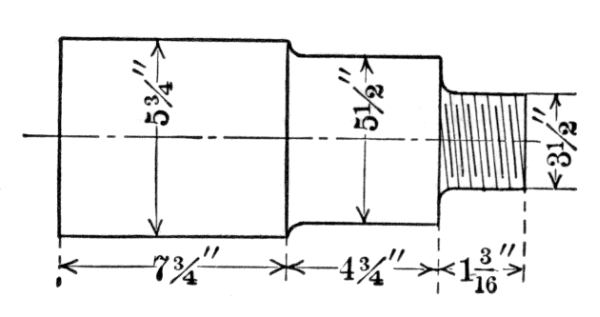
The most elaborate study of the cylinder, cone, and
sphere (the "three round bodies") in the Greek literature
is that of Archimedes of Syracuse (on the island of
Sicily), who lived in the third century B.C. Archimedes
tells us, however, that Eudoxus (born ca. 407 B.C.) discovered
that any cone is one third of a cylinder of the same
base and the same altitude. Tradition says that Archimedes
requested that a sphere and a cylinder be carved
upon his tomb, and that this was done. Cicero relates
that he discovered the tomb by means of these symbols.
The tomb now shown to visitors in ancient Syracuse as
that of Archimedes cannot be his, for it bears no such
figures, and is not "outside the gate of Agrigentum,"
as Cicero describes.
The cone is now introduced. A conic surface is easily
illustrated to a class by taking a piece of paper and rolling
it up into a cornucopia, the space inclosed being a
conic space, a term that is sometimes convenient. The
generation of a conic surface may be shown by taking a
blackboard pointer and swinging it around by its tip so
that the other end moves in a curve. If we consider a
straight line as the limit of a curve, then the pointer may
swing in a plane, and so a plane is the limit of a conic
surface. If we swing the pointer about a point in the
middle, we shall generate the two nappes of the cone,
the conic space now being double.
In practice the right circular cone, or cone of revolution,
is the important type, and special attention should
be given to this form.
Theorem. Every section of a cone made by a plane
passing through its vertex is a triangle.
At this time, or in speaking of the preliminary definitions,
reference should be made to the conic sections.
Of these there are three great types: (1) the ellipse,
where the cutting plane intersects all the elements on
one side of the vertex; a circle is a special form of the
ellipse; (2) the parabola, where the plane is parallel to
an element; (3) the hyperbola, where the plane cuts
some of the elements on one side of the vertex, and the
rest on the other side; that is, where it cuts both nappes.
It is to be observed that the ellipse may vary greatly in
shape, from a circle to a very long ellipse, as the cutting
plane changes from being perpendicular to the axis to
being nearly parallel to an element. The instant it
becomes parallel to an element the ellipse changes suddenly
to a parabola. If the plane tips the slightest
amount more, the section becomes an hyperbola.
While these conic sections are not studied in elementary
geometry, the terms should be known for general
information, particularly the ellipse and parabola. The
study of the conic sections forms a large part of the
work of analytic geometry, a subject in which the figures
resemble the graphic work in algebra, this having
been taken from "analytics," as the higher subject is
commonly called. The planets move about the sun in
elliptic orbits, and Halley's comet that returned to view
in 1909-1910 has for its path an enormous ellipse.
Most comets seem to move in parabolas, and a body
thrown into the air would take a parabolic path if it
were not for the resistance of the atmosphere. Two of
the sides of the triangle in this proposition constitute a
special form of the hyperbola.
The study of conic sections was brought to a high
state by the Greeks. They were not known to the Pythagoreans,
but were discovered by Menæchmus in the
fourth century B.C. This discovery is mentioned by
Proclus, who says, "Further, as to these sections, the
conics were conceived by Menæchmus."
Since if the cutting plane is perpendicular to the axis
the section is a circle, and if oblique it is an ellipse, a
parabola, or an hyperbola, it follows that if light proceeds
from a point, the shadow of a circle is a circle,
an ellipse, a parabola, or an hyperbola, depending on
the position of the plane on which the shadow falls.
It is interesting and instructive to a class to see these
shadows, but of course not much time can be allowed
for such work. At this point the chief thing is to have
the names "ellipse" and "parabola," so often met in
reading, understood.
It is also of interest to pupils to see at this time the
method of drawing an ellipse by means of a pencil
stretching a string band that moves about two pins
fastened in the paper. This is a practical method, and
is familiar to all teachers who have studied analytic
geometry. In designing elliptic arches, however, three
circular arcs are often joined, as here shown, the result
being approximately an
elliptic arc.
Here O is the center of
arc BC, M of arc AB, and N
of arc CD. Since XY is perpendicular
to BM and BO, it
is tangent to arcs AB and BC,
so there is no abrupt turning
at B, and similarly for C.[90]
Theorem. The volume of a circular cone is equal to
one third the product of its base by its altitude.
It is easy to prove this for noncircular cones as well,
but since they are not met commonly in practice, they
may be omitted in elementary geometry. The important
formula at this time is v = 1/3πr2h. As already stated,
this proposition was discovered by Eudoxus of Cnidus
(born ca. 407 B.C., died ca. 354 B.C.), a man who, as
already stated, was born poor, but who became one of
the most illustrious and most highly esteemed of all
the Greeks of his time.
Theorem. The lateral area of a frustum of a cone of
revolution is equal to half the sum of the circumferences of
its bases multiplied by the slant height.
An interesting case for a class to notice is that in which
the upper base becomes zero and the frustum becomes a
cone, the proposition being still true. If the upper base
is equal to the lower base, the frustum becomes a cylinder,
and still the proposition remains true. The proposition
thus offers an excellent illustration of the elementary
Principle of Continuity.
Then follows, in most textbooks, a theorem relating
to the volume of a frustum.
In the case of a cone of revolution v = (1/3)πh(r2 + r'2 + rr').
Here if r' = 0, we have v = (1/3)πr2h, the volume of a cone. If r' = r,
we have v = (1/3)πh(r2 + r2 + r2) = πhr2, the volume of a cylinder.
If one needs examples in mensuration beyond those
given in a first-class textbook, they are easily found.
The monument to Sir Christopher Wren, the professor
of geometry in Cambridge University, who became the
great architect of St. Paul's Cathedral in London, has a
Latin inscription which means, "Reader, if you would
see his monument, look about you." So it is with practical
examples in Book VII.
Appended to this Book, or more often to the course
in solid geometry, is frequently found a proposition
known as Euler's Theorem. This is often considered too
difficult for the average pupil and is therefore omitted.
On account of its importance, however, in the theory of
polyhedrons, some reference to it at this time may be
helpful to the teacher. The theorem asserts that in any
convex polyhedron the number of edges increased by
two is equal to the number of vertices increased by the
number of faces. In other words, that e + 2 = v + f.
On account of its importance a proof will be given that
differs from the one ordinarily found in textbooks.
Let s1, s2, ···, sn be the number of sides of the various faces,
and f the number of faces. Now since the sum of the angles
of a polygon of s sides is (s - 2)180°, therefore the sum of the
angles of all the faces is (s1 + s2 + s3 + ··· + sn - 2f)180°.
But s1 + s2 + s3 + ··· + sn is twice the number of edges, because
each edge belongs to two faces.
∴ the sum of the angles of all the faces is
(2e - 2f)180°, or (e - f)360°.
Since the polyhedron is convex, it is possible to find some
outside point of view, P, from which some face, as ABCDE,
covers up the whole figure, as in this illustration. If we think
of all the vertices projected on ABCDE, by lines through P,
the sum of the angles of all the faces will be the same as the
sum of the angles of all their projections on ABCDE. Calling
ABCDE s1, and thinking
of the projections as
traced by dotted lines
on the opposite side of
s1, this sum is evidently
equal to
(1) the sum of the
angles in s1, or (s1 - 2)
180°, plus
(2) the sum of the
angles on the other side
of s1, or (s1 - 2)180°, plus
(3) the sum of the angles about the various points shown as
inside of s1, of which there are v - s1 points, about each of which
the sum of the angles is 360°, making (v - s1)360° in all.
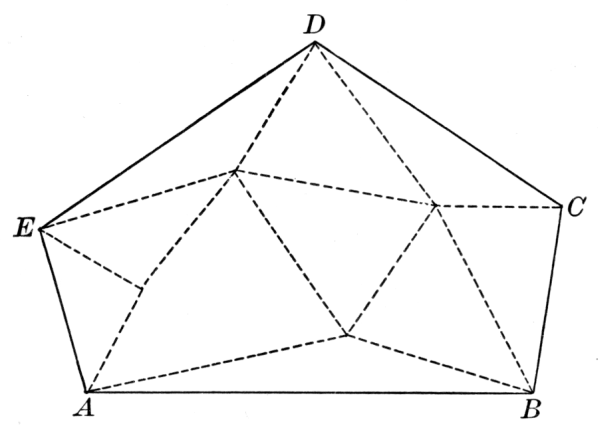
Adding, we have
(s1 - 2)180° + (s1 - 2)180° + (v - s1)360° = ((s1 - 2) + (v - s1))360°
= (v - 2)360°.
Equating the two sums already found, we have
(e - f)360° = (v - 2)360°,
or e - f = v - 2,
or e + 2 = v + f.
This proof is too abstract for most pupils in the high
school, but it is more scientific than those found in any
of the elementary textbooks, and teachers will find it of
service in relieving their own minds of any question as
to the legitimacy of the theorem.
Although this proposition is generally attributed to
Euler, and was, indeed, rediscovered by him and published
in 1752, it was known to the great French
geometer Descartes, a fact that Leibnitz mentions.[91]
This theorem has a very practical application in the
study of crystals, since it offers a convenient check on the
count of faces, edges, and vertices. Some use of crystals,
or even of polyhedrons cut from a piece of crayon,
is desirable when studying Euler's proposition. The
following illustrations of common forms of crystals may
be used in this connection:
The first represents two truncated pyramids placed
base to base. Here e = 20, f = 10, v = 12, so that
e + 2 = f + v. The second represents a crystal formed
by replacing each edge of a cube by a plane, with the
result that e = 40, f = 18, and v = 24. The third represents
a crystal formed by replacing each edge of an
octahedron by a plane, it being easy to see that Euler's
law still holds true.
Book VIII treats of the sphere. Just as the circle
may be defined either as a plane surface or as the bounding
line which is the locus of a point in a plane at a given
distance from a fixed point, so a sphere may be defined
either as a solid or as the bounding surface which is the
locus of a point in space at a given distance from a fixed
point. In higher mathematics the circle is defined as the
bounding line and the sphere as the bounding surface;
that is, each is defined as a locus. This view of the circle
as a line is becoming quite general in elementary geometry,
it being the desire that students may not have to
change definitions in passing from elementary to higher
mathematics. The sphere is less frequently looked upon
in geometry as a surface, and in popular usage it is always
taken as a solid.
Analogous to the postulate that a circle may be described
with any given point as a center and any given
line as a radius, is the postulate for constructing a sphere
with any given center and any given radius. This postulate
is not so essential, however, as the one about the
circle, because we are not so concerned with constructions
here as we are in plane geometry.
A good opportunity is offered for illustrating several
of the definitions connected with the study of the
sphere, such as great circle, axis, small circle, and pole,
by referring to geography. Indeed, the first three propositions
usually given in Book VIII have a direct bearing
upon the study of the earth.
Theorem. A plane perpendicular to a radius at its
extremity is tangent to the sphere.
The student should always have his attention called
to the analogue in plane geometry, where there is one.
If here we pass a plane through the radius in question,
the figure formed on the plane will be that of a line
tangent to a circle. If we revolve this about the line of
the radius in question, as an axis, the circle will generate
the sphere again, and the tangent line will generate the
tangent plane.
Theorem. A sphere may be inscribed in any given
tetrahedron.
Here again we may form a corresponding proposition
of plane geometry by passing a plane through any three
points of contact of the sphere and the tetrahedron. We
shall then form the figure of a circle inscribed in a triangle.
And just as in the case of the triangle we may
have escribed circles by producing the sides, so in the
case of the tetrahedron we may have escribed spheres
by producing the planes indefinitely and proceeding in
the same way as for the inscribed sphere. The figure is
difficult to draw, but it is not difficult to understand,
particularly if we construct the tetrahedron out of
pasteboard.
Theorem. A sphere may be circumscribed about any
given tetrahedron.
By producing one of the faces indefinitely it will cut
the sphere in a circle, and the resulting figure, on the
plane, will be that of the analogous proposition of plane
geometry, the circle circumscribed about a triangle. It
is easily proved from the proposition that the four perpendiculars
erected at the centers of the faces of a tetrahedron
meet in a point (are concurrent), the analogue
of the proposition about the perpendicular bisectors of
the sides of a triangle.
Theorem. The intersection of two spherical surfaces is
a circle whose plane is perpendicular to the line joining the
centers of the surfaces and whose center is in that line.
The figure suggests the case of two circles in plane
geometry. In the case of two circles that do not intersect
or touch, one not being within the other, there are
four common tangents. If the circles touch, two close up
into one. If one circle is wholly within the other, this
last tangent disappears. The same thing exists in relation
to two spheres, and the analogous cases are formed
by revolving the circles and tangents about the line
through their centers.
In plane geometry it is easily proved that if two circles
intersect, the tangents from any point on their common
chord produced are equal. For if the common chord is
AB and the point P is taken on AB produced, then the
square on any tangent from P is equal to PB × PA.
The line PBA is sometimes called the radical axis.
Similarly in this proposition concerning spheres, if
from any point in the plane of the circle formed by the
intersection of the two spherical surfaces lines are drawn
tangent to either sphere, these tangents are equal. For
it is easily proved that all tangents to the same sphere
from an external point are equal, and it can be proved
as in plane geometry that two tangents to the two
spheres are equal.
Among the interesting analogies between plane and
solid geometry is the one relating to the four common
tangents to two circles. If the figure be revolved about
the line of centers, the circles generate spheres and the
tangents generate conical surfaces. To study this case
for various sizes and positions of the two spheres is one
of the most interesting generalizations of solid geometry.
An application of the proposition is seen in the case of an
eclipse, where the sphere O' represents the moon, O the earth, and
S the sun. It is also seen in the case of the full moon, when S
is on the other side of the earth. In this case the part MIN is
fully illuminated by the moon, but the zone ABNM is only partly
illuminated, as the figure shows.[92]
Theorem. The sum of the sides of a spherical polygon
is less than 360°.
In all such cases the relation to the polyhedral angle
should be made clear. This is done in the proofs usually
given in the textbooks. It is easily seen that this is true
only with the limitation set forth in most textbooks,
that the spherical polygons considered are convex. Thus
we might have a spherical triangle that is concave, with
its base 359°, and its other two sides each 90°, the sum
of the sides being 539°.
Theorem. The sum of the angles of a spherical triangle
is greater than 180° and less than 540°.
It is for the purpose of proving this important fact
that polar triangles are introduced. This proposition
shows the relation of the spherical to the plane triangle.
If our planes were in reality slightly curved, being small
portions of enormous spherical surfaces, then the sum of
the angles of a triangle would not be exactly 180°, but
would exceed 180° by some amount depending on the
curvature of the surface. Just as a being may be imagined
as having only two dimensions, and living always
on a plane surface (in a space of two dimensions), and
having no conception of a space of three dimensions, so
we may think of ourselves as living in a space of three
dimensions but surrounded by a space of four dimensions.
The flat being could not point to a third dimension
because he could not get out of his plane, and we
cannot point to the fourth dimension because we cannot
get out of our space. Now what the flat being thinks is
his plane may be the surface of an enormous sphere in
our three dimensions; in other words, the space he lives
in may curve through some higher space without his being
conscious of it. So our space may also curve through
some higher space without our being conscious of it. If
our planes have really some curvature, then the sum of the
angles of our triangles has a slight excess over 180°. All
this is mere speculation, but it may interest some student
to know that the idea of fourth and higher dimensions
enters largely into mathematical investigation to-day.
Theorem. Two symmetric spherical triangles are
equivalent.
While it is not a subject that has any place in a school,
save perhaps for incidental conversation with some group
of enthusiastic students, it may interest the teacher to
consider this proposition in connection with the fourth
dimension just mentioned. Consider these triangles,
where ∠A = ∠A', AB = A'B', AC = A'C'. We prove them
congruent by superposition, turning one over and placing
it upon the other. But suppose
we were beings in Flatland,
beings with only two dimensions
and without the power to point
in any direction except in the
plane we lived in. We should
then be unable to turn ⧍A'B'C' over so that it could coincide with ⧍ABC, and we should
have to prove these triangles equivalent in some other
way, probably by dividing them into isosceles triangles
that could be superposed.
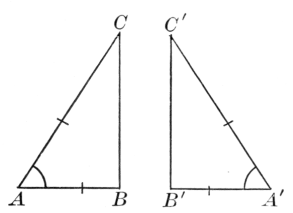
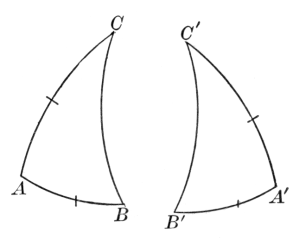
Now it is the same thing
with symmetric spherical triangles;
we cannot superpose
them. But might it not be
possible to do so if we could
turn them through the fourth
dimension exactly as we turn
the Flatlander's triangle through our third dimension?
It is interesting to think about this possibility even
though we carry it no further, and in these side lights
on mathematics lies much of the fascination of the
subject.
Theorem. The shortest line that can be drawn on the
surface of a sphere between two points is the minor arc of
a great circle joining the two points.
It is always interesting to a class to apply this practically.
By taking a terrestrial globe and drawing a
great circle between the southern point of Ireland and
New York City, we represent the shortest route for ships
crossing to England. Now if we notice where this great-circle
arc cuts the various meridians and mark this on
an ordinary Mercator's projection map, such as is found
in any schoolroom, we shall find that the path of the
ship does not make a straight line. Passengers at sea
often do not understand why the ship's course on the
map is not a straight line; but the chief reason is that
the ship is taking a great-circle arc, and this is not, in
general, a straight line on a Mercator projection. The
small circles of latitude are straight lines, and so are
the meridians and the equator, but other great circles
are represented by curved lines.
Theorem. The area of the surface of a sphere is equal
to the product of its diameter by the circumference of a great
circle.
This leads to the remarkable formula, a = 4πr2. That
the area of the sphere, a curved surface, should exactly
equal the sum of the areas of four great circles, plane
surfaces, is the remarkable feature. This was one of the
greatest discoveries of Archimedes (ca. 287-212 B.C.),
who gives it as the thirty-fifth proposition of his treatise
on the "Sphere and the Cylinder," and who mentions
it specially in a letter to his friend Dositheus, a mathematician
of some prominence. Archimedes also states
that the surface of a sphere is two thirds that of the
circumscribed cylinder, or the same as the curved surface
of this cylinder. This is evident, since the cylindric
surface of the cylinder is 2πr × 2r, or 4πr2, and
the two bases have an area πr2 + πr2, making the total
area 6πr2.
Theorem. The area of a spherical triangle is equal to
the area of a lune whose angle is half the triangle's spherical
excess.
This theorem, so important in finding areas on the
earth's surface, should be followed by a considerable
amount of computation of triangular areas, else it will
be rather meaningless. Students tend to memorize a
proof of this character, and in order to have the proposition
mean what it should to them, they should at
once apply it. The same is true of the following proposition
on the area of a spherical polygon. It is probable
that neither of these propositions is very old; at
any rate, they do not seem to have been known to the
writers on elementary mathematics among the Greeks.
Theorem. The volume of a sphere is equal to the product
of the area of its surface by one third of its radius.
This gives the formula v = (4/3)πr3. This is one of the
greatest discoveries of Archimedes. He also found as a
result that the volume of a sphere is two thirds the
volume of the circumscribed cylinder. This is easily
seen, since the volume of the cylinder is πr2 × 2r, or
2πr3, and (4/3)πr3 is 2/3 of 2πr3. It was because of these
discoveries on the sphere and cylinder that Archimedes
wished these figures engraved upon his tomb, as has
already been stated. The Roman general Marcellus conquered
Syracuse in 212 B.C., and at the sack of the city
Archimedes was killed by an ignorant soldier. Marcellus
carried out the wishes of Archimedes with respect to
the figures on his tomb.
The volume of a sphere can also be very elegantly
found by means of a proposition known as Cavalieri's
Theorem. This asserts that if two solids lie between
parallel planes, and are such that the two sections made
by any plane parallel to the given planes are equal in
area, the solids are themselves equal in volume. Thus,
if these solids have the same altitude, a, and if S and S'
are equal sections made by a plane parallel to MN,
then the solids have the same volume. The proof is simple,
since prisms
of the same altitude,
say a/n, and
on the bases S and
S' are equivalent,
and the sums of
n such prisms are
the given solids;
and as n increases, the sums of the prisms approach the
solids as their limits; hence the volumes are equal.
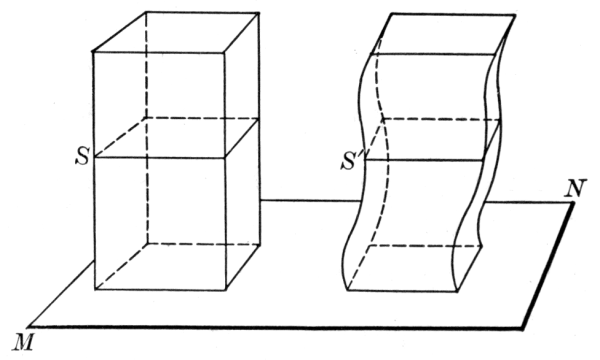
This proposition, which will now be applied to finding
the volume of the sphere, was discovered by Bonaventura
Cavalieri (1591 or 1598-1647). He was a
Jesuit professor in the University of Bologna, and his
best known work is his "Geometria Indivisilibus," which
he wrote in 1626, at least in part, and published in 1635
(second edition, 1647). By means of the proposition it is
also possible to prove several other theorems, as that the
volumes of triangular pyramids of equivalent bases and
equal altitudes are equal.
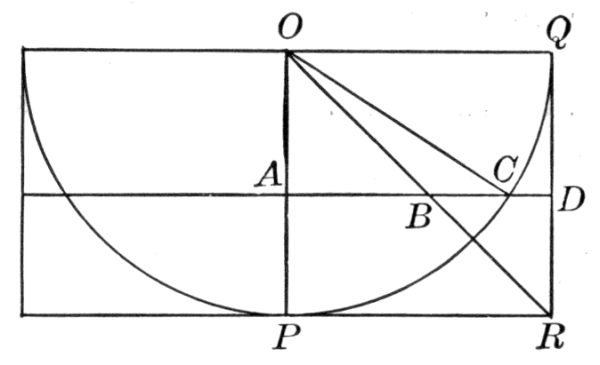
To find the volume of a sphere,
take the quadrant OPQ, in the
square OPRQ. Then if this figure
is revolved about OP, OPQ
will generate a hemisphere, OPR
will generate a cone of volume
(1/3)πr3, and OPRQ will generate a cylinder of volume πr3. Hence
the figure generated by ORQ will have a volume πr3 - (1/3)πr3, or
(2/3)πr3, which we will call x.
Now OA = AB, and OC = AD; also (OC)2 - (OA)2 = (AC)2, so that
(AD)2 - (AB)2 = (AC)2,
and π(AD)2 - π(AB)2 = π(AC)2.
But π(AD)2 - π(AB)2 is the area of the ring generated by BD,
a section of x, and π(AC)2 is the corresponding section of the
hemisphere. Hence, by Cavalieri's Theorem,
(2/3)πr3 = the volume of the hemisphere.
∴ (4/3)πr3 = the volume of the sphere.
In connection with the sphere some easy work in
quadratics may be introduced even if the class has had
only a year in algebra.
For example, suppose a cube is inscribed in a hemisphere
of radius r and we wish to find its edge, and thereby its surface
and its volume.
If x = the edge of the cube, the diagonal of the base must be
x√2, and the projection of r (drawn from the center of the base
to one of the vertices) on the base is half of this diagonal,
or (x√2)/2.
Hence, by the Pythagorean Theorem,
r2 = x2 + ((x√2)/2)2 = (3/2)x2
∴ x = r√(2/3),
and the total surface is 6x2 = 4r2,
and the volume is x3 = (2/3)r3√(2/3).
In the Valley of Youth, through which all wayfarers
must pass on their journey from the Land of Mystery to
the Land of the Infinite, there is a village where the pilgrim
rests and indulges in various excursions for which
the valley is celebrated. There also gather many guides
in this spot, some of whom show the stranger all the
various points of common interest, and others of whom
take visitors to special points from which the views are
of peculiar significance. As time has gone on new paths
have opened, and new resting places have been made
from which these views are best obtained. Some of the
mountain peaks have been neglected in the past, but of
late they too have been scaled, and paths have been
hewn out that approach the summits, and many pilgrims
ascend them and find that the result is abundantly worth
the effort and the time.
The effect of these several improvements has been a
natural and usually friendly rivalry in the body of guides
that show the way. The mountains have not changed,
and the views are what they have always been. But
there are not wanting those who say, "My mountain
may not be as lofty as yours, but it is easier to ascend";
or "There are quarries on my peak, and points of view
from which a building may be seen in process of erection,
or a mill in operation, or a canal, while your mountain
shows only a stretch of hills and valleys, and thus
you will see that mine is the more profitable to visit."
Then there are guides who are themselves often weak
of limb, and who are attached to numerous sand dunes,
and these say to the weaker pilgrims, "Why tire yourselves
climbing a rocky mountain when here are peaks
whose summits you can reach with ease and from which
the view is just as good as that from the most famous
precipice?" The result is not wholly disadvantageous,
for many who pass through the valley are able to approach
the summits of the sand dunes only, and would make
progress with greatest difficulty should they attempt to
scale a real mountain, although even for them it would
be better to climb a little way where it is really worth
the effort instead of spending all their efforts on the
dunes.
Then, too, there have of late come guides who have
shown much ingenuity by digging tunnels into some of
the greatest mountains. These they have paved with
smooth concrete, and have arranged for rubber-tired cars
that run without jar to the heart of some mountain.
Arrived there the pilgrim has a glance, as the car swiftly
turns in a blaze of electric light, at a roughly painted
panorama of the view from the summit, and he is assured
by the guide that he has accomplished all that he would
have done, had he laboriously climbed the peak itself.
In the midst of all the advocacy of sand-dune climbing,
and of rubber-tired cars to see a painted view, the
great body of guides still climb their mountains with
their little groups of followers, and the vigor of the
ascent and the magnificence of the view still attract all
who are strong and earnest, during their sojourn in the
Valley of Youth. Among the mountains that have for
ages attracted the pilgrims is Mons Latinus, usually
called in the valley by the more pleasing name Latina.
Mathematica, and Rhetorica, and Grammatica are also
among the best known. A group known as Montes
Naturales comprises Physica, Biologica, and Chemica,
and one great peak with minor peaks about it is called
by the people Philosophia. There are those who claim
that these great masses of rock are too old to be climbed,
as if that affected the view; while others claim that the
ascent is too difficult and that all who do not favor the
sand dunes are reactionary. But this affects only a few
who belong to the real mountains, and the others labor
diligently to improve the paths and to lessen unnecessary
toil, but they seek not to tear off the summits nor do
they attend to the amusing attempts of those who sit
by the hillocks and throw pebbles at the rocky sides of
the mountains upon which they work.
Geometry is a mountain. Vigor is needed for its
ascent. The views all along the paths are magnificent.
The effort of climbing is stimulating. A guide who
points out the beauties, the grandeur, and the special
places of interest commands the admiration of his group
of pilgrims. One who fails to do this, who does not
know the paths, who puts unnecessary burdens upon
the pilgrim, or who blindfolds him in his progress, is
unworthy of his position. The pretended guide who
says that the painted panorama, seen from the rubber-tired
car, is as good as the view from the summit is
simply a fakir and is generally recognized as such. The
mountain will stand; it will not be used as a mere commercial
quarry for building stone; it will not be affected
by pellets thrown from the little hillocks about; but its
paths will be freed from unnecessary flints, they will be
straightened where this can advantageously be done, and
new paths on entirely novel plans will be made as time
goes on, but these paths will be hewed out of rock, not
made out of the dreams of a day. Every worthy guide
will assist in all these efforts at betterment, and will
urge the pilgrim at least to ascend a little way because
of the fact that the same view cannot be obtained from
other peaks; but he will not take seriously the efforts of
the fakir, nor will he listen with more than passing
interest to him who proclaims the sand heap to be a
Matterhorn.
- Ahmes, 27, 254, 278, 306
- Alexandroff, 164
- Algebra, 37, 84
- Al-Khowarazmi, 37
- Allman, G. J., 29
- Almagest, 35
- Al-Nairīzī, 171, 193, 214, 264
- Al-Qifṫī, 49
- Analysis, 41, 161
- Angle, 142, 155;
- trisection of, 31, 215
- Anthonisz, Adriaen, 279
- Antiphon, 31, 32, 276
- Apollodotus (Apollodorus), 259
- Apollonius, 34, 214, 231
- Applied problems, 75, 103, 178, 186, 192, 195, 203, 204, 209, 215, 217, 242, 267, 295, 317
- Appreciation of geometry, 19
- Arab geometry, 37, 51
- Archimedes, 34, 42, 48, 139, 141, 215, 276, 278, 314, 327, 328
- Aristæus, 310
- Aristotle, 33, 42, 134, 135, 137, 145, 154, 177, 209
- Aryabhatta, 36, 279
- Associations, syllabi of, 58, 60, 64
- Assumptions, 116
- Astrolabe, 172
- Athelhard of Bath, 37, 51
- Athenæus, 259
- Axioms, 31, 41, 116
- Babylon, 26, 272
- Bartoli, 10, 44, 238
- Belli, 10, 44, 172
- Beltinus, 239, 241
- Beltrami, 127
- Bennett, J., 224
- Bernoulli, 280
- Bertrand, 62
- Betz, 131
- Bezout, 62
- Bhaskara, 232, 268
- Billings, R. W., 222
- Billingsley, 52
- Bion, 192, 239
- Boethius, 43, 50
- Bolyai, 128
- Bonola, 128
- Books of geometry, 165, 167, 201, 227, 252, 269, 289, 303, 321
- Bordas-Demoulin, 24
- Borel, 11, 67, 196
- Bosanquet, 272
- Bossut, 23
- Bourdon, 62
- Bourlet, 67, 165, 196
- Brahmagupta, 36, 268, 279
- Bretschneider, C. A., 30
- Brouncker, 280
- Bruce, W. N., 199
- Bryson, 31, 32, 276
- Cajori, 46
- Calandri, 30
- Campanus, 37, 51, 135
- Cantor, M., 29, 46
- Capella, 50, 135
- Capra, 44
- Carson, G. W. L., 18, 96, 114
- Casey, J., 38
- Cassiodorius, 50
- Cataneo, 10, 44
- Cavalieri, 136, 329
- Chinese values of π, 279
- Church schools, 43
- Cicero, 34, 50, 259, 314
- Circle, 145, 201, 270, 287;
- squaring the, 31, 32, 277
- Circumference, 145
- Cissoid, 34
- Class in geometry, 108
- Clavius, 121
- Colleges, geometry in the, 46
- Collet, 24
- Commensurable magnitudes, 206, 207
- Conchoid, 34
- Condorcet, 23
- Cone, 315
- Congruent, 151
- Conic sections, 33, 315
- Continuity, 212
- Converse proposition, 175, 190, 191
- Crelle, 142
- Cube, duplicating the, 32, 307
- Cylinder, 313
- D'Alembert, 24, 67
- Dase, 279
- Decagon, 273
- Definitions, 41, 132
- De Judaeis, 239, 241
- De Morgan, A., 58
- De Paolis, 67
- Descartes, 38, 84, 320
- Diameter, 146
- Dihedral, 298
- Diocles, 34
- Diogenes Laertius, 259
- Diorismus, 41
- Direction, 150
- Distance, 154
- Doyle, Conan, 8
- Drawing, 95, 221, 281
- Duality, 173
- Duhamel, 164
- Dupin, 11, 217
- Duplication problem, 32, 307
- Dürer, 10
- Educational problems, 1
- Egypt, 26, 40
- Eisenlohr, 27
- Engel and Stäckel, 128
- England, 14, 46, 58, 60
- Epicureans, 188
- Equal, 151, 153
- Equilateral, 147
- Equivalent, 151
- Eratosthenes, 48
- Euclid, 33, 42, 43, 44, 119, 125, 135, 156, 165, 167 ff., 201 ff., et passim;
- editions of, 47, 52;
- efforts at improving, 57;
- life of, 47;
- nature of his "Elements," 52, 55;
- opinions of, 8
- Eudemus, 33, 168, 171, 185, 216, 309
- Eudoxus, 32, 41, 48, 227, 308, 314, 317
- Euler, 38, 280, 318
- Eutocius, 184
- Exercises, nature of, 74, 103;
- how to attack, 160
- Exhaustions, method of, 31
- Extreme and mean ratio, 250
- Figures in geometry, 104, 107, 113
- Finaeus, 44, 239, 240, 243
- Fourier, 142
- Fourth dimension, 326
- Frankland, 56, 117, 127, 135, 159
- Fusion, of algebra and geometry, 84;
- of geometry and trigonometry, 91
- Gargioli, 44
- Gauss, 140, 274
- Geminus, 126, 128, 149
- Geometry, books of, 165, 167, 201, 227, 252, 269, 289, 303, 321;
- compared with other subjects, 14;
- introduction to, 93;
- modern, 38;
- of motion, 68, 196;
- reasons for teaching, 7, 15, 20;
- related to algebra, 84;
- textbooks in, 70
- Gerbert, 43
- Gherard of Cremona, 37, 51
- Gnomon, 212
- Golden section, 250
- Gothic windows, 75, 221 ff., 274, 282
- Gow, J., 29, 56
- Greece, 28, 40
- Gregoire de St. Vincent, 267
- Gregory, 280
- Grévy, 67
- Gymnasia, geometry in the, 45
- Hadamard, 164
- Hamilton, W., 14
- Harmonic division, 231
- Harpedonaptae, 28
- Harriot, 37
- Harvard syllabus, 63
- Heath, T. L., 49, 56, 119, 126, 127, 135, 149, 159, 170, 175, 228, 261
- Hebrews, 26
- Henrici, O., 11, 14, 25, 164, 196
- Henrici and Treutlein, 68, 164, 196
- Hermite, 281
- Herodotus, 28
- Heron, 35, 137, 139, 141, 209, 259, 267
- Hexagon, regular, 272
- High schools, geometry in the, 45
- Hilbert, 119, 131
- Hipparchus, 35
- Hippasus, 273, 309
- Hippias, 31, 215
- Hippocrates, 31, 41, 281
- History of geometry, 26
- Hobson, 166
- Hoffmann, 242
- Holzmüller, 320
- Hughes, Justice, 9
- Hypatia, 36
- Hypsicles, 34
- Hypsometer, 245
- Iamblichus, 273, 309
- Illusions, optical, 100
- Ingrami, 128
- Instruments, 96, 178, 236
- Introduction to geometry, 93
- Ionic school, 28
- Jackson, C. S., 12
- Jones, W., 271
- Junge, 259
- Karagiannides, 128
- Karpinski, 37
- Kaye, G. B., 232
- Kepler, 24, 149
- Kingsley, C., 36
- Klein, F., 68, 89
- Kolb, 222
- Lacroix, 24, 46, 62, 66
- Langley, E. M., 291
- Laplace, 101
- Legendre, 10, 45, 62, 127, 128, 152
- Leibnitz, 140, 150
- Leon, 41
- Leonardo da Vinci, 264
- Leonardo of Pisa, 37, 43, 279
- Lettering figures, 105
- Limits, 207
- Lindemann, 278, 281
- Line defined, 137
- Lobachevsky, 128
- Loci, 163, 198
- Locke, W. J., 13
- Lodge, A., 14
- Logic, 17, 104
- Loomis, 164
- Ludolph van Ceulen, 279
- Lycées, geometry in, 45
- M'Clelland, 38
- McCormack, T. J., 11
- Measured by, 208
- Memorizing, 12, 79
- Menæchmus, 33, 316
- Menelaus, 35
- Méray, 67, 68, 196, 289
- Methods, 41, 42, 115
- Metius, 279
- Mikami, 264
- Minchin, 14
- Models, 93, 290
- Modern geometry, 38
- Mohammed ibn Musa, 37
- Moore, E. H., 131
- Mosaics, 274
- Müller, H., 68
- Münsterberg, 22
- Paciuolo, 86
- Pamphilius, 185
- Pappus, 36, 230, 263
- Parallelepiped, 303
- Parallels, 149, 181
- Parquetry, 222, 274
- Pascal, 24, 159
- Peletier, 169
- Perigon, 151
- Perry, J., 13, 14
- Petersen, 164
- Philippus of Mende, 32, 185
- Philo, 178
- Philolaus, 309
- π, 26, 27, 34, 36, 271, 278, 280
- Plane, 140
- Plato, 25, 31, 41, 48, 129, 136, 137, 309, 310
- Playfair, 128
- Pleasure of geometry, 16
- Plimpton, G. A., 51, 52
- Plutarch, 259
- Poinsot, 311
- Point, 135
- Polygons, 156, 252, 269, 274
- Polyhedrons, 301, 303, 310
- Pomodoro, 179
- Pons asinorum, 174, 265
- Posidonius, 128, 149
- Postulates, 31, 41, 116, 125, 292
- Practical geometry, 3, 7, 9, 44
- Printing, effect of, 44
- Prism, 303
- Problems, applied, 75, 103, 178, 186, 192, 195, 203, 204, 209, 215, 217, 242, 267, 295, 317
- Proclus, 36, 47, 48, 52, 71, 127, 128, 136, 137, 139, 140, 149, 155, 186, 188, 197, 212, 214, 253, 258, 310, 311
- Projections, 300
- Proofs in full, 79
- Proportion, 32, 227
- Psychology, 12, 20
- Ptolemy, C., 35, 278;
- king, 48, 49
- Pyramid, 307
- Pythagoras, 29, 40, 258, 272, 273, 310
- Pythagorean Theorem, 28, 36, 258
- Pythagorean numbers, 32, 36, 263, 266
- Pythagoreans, 136, 137, 185, 227, 269, 309
- Quadrant, 236
- Quadratrix, 31, 215
- Quadrilaterals, 148, 157
- Quadrivium, 42
- Questions at issue, 3
- Rabelais, 24
- Radius, 153
- Ratio, 205, 227
- Real problem defined, 75, 103
- Reasons for studying geometry, 7, 100
- Rebière, 25
- Reciprocal propositions, 173
- Recitation in geometry, 113
- Recorde, 37
- Rectilinear figures, 146
- Reductio ad absurdum, 41, 177
- Regular polygons, 269
- "Rhind Papyrus," 27
- Rhombus and rhomboid, 148
- Riccardi, 47
- Richter, 279
- Roman surveyors, 247
- Saccheri, 127
- Sacrobosco, 43
- San Giovanni, 192
- Sauvage, 164
- Sayre, 272
- Scalene, 147
- Schlegel, 68
- Schopenhauer, 121, 265
- Schotten, 46, 135, 149
- Sector, 154, 156
- Segment, 154
- Semicircle, 146
- Shanks, 279
- Similar figures, 232
- Simon, 38, 56, 135
- Simson, 142
- Sisam, 11
- Smith, D. E., 25, 37, 51, 52, 119, 131, 135, 159
- Solid geometry, 289
- Speusippus, 32
- Sphere, 321
- Square on a line, 257
- Squaring the circle, 31, 32, 277
- Stäckel, 128
- Stamper, 46, 83
- Stark, W. E., 172, 238
- Stereoscopic slides, 291
- Stobæus, 8
- Straight angle, 151
- Straight line, 138
- Suggested proofs, 81
- Sulvasutras, 232
- Superposition, 169
- Surface, 140
- Swain, G. F., 13
- Syllabi, 58, 60, 63, 64, 66, 67, 80, 82
- Sylvester II, 43
- Synthetic method, 161
- Tangent, 154
- Tartaglia, 153
- Tatius, Achilles, 272
- Teaching geometry, reasons for, 7, 15, 20;
- development of, 40
- Textbooks, 32, 33, 41, 70, 80, 82
- Thales, 28, 168, 171, 185, 210
- Theætetus, 48, 310
- Theon of Alexandria, 36
- Thibaut, 185
- Thoreau, 246
- Trapezium, 148
- Treutlein, 68, 164
- Triangle, 147
- Trigonometry, 234
- Trisection problem, 31, 215
- Trivium, 42
- Universities, geometry in the, 43
- Uselessness of mathematics, 13