There are three kinds of human knowledge which stand strikingly distinct
from all the rest. They lie at the foundation. They constitute the roots
of the tree. In other words, they are the means, by which all other
knowledge is acquired. I need not say, that I mean, Reading, Writing,
and Calculation.
Teachers do not perhaps always consider, how entirely and essentially
distinct these three are from all the rest. They are arts; the
acquisition of them is not to be considered as knowledge, so much as the
means, by which knowledge may be obtained. A child, who is studying
Geography, or History, or Natural Science, is learning facts,—gaining
information; on the other hand, the one who is learning to write, or to
read, or to calculate, may be adding little or nothing to his stock of
knowledge. He is acquiring skill, which, at some future time, he may
make the means of increasing his knowledge, to any extent.
This distinction ought to be kept constantly in view, and the teacher
should feel that these three fundamental branches stand by themselves,
and stand first in importance. I do not mean to undervalue the others,
but only to insist upon the superior value and importance of these.
Teaching a pupil to read, before he enters upon the active business of
life, is like giving a new settler an axe, as he goes to seek his new
home in the forest. Teaching him a lesson in history, is, on the other
hand, only cutting down a tree or two for him. A knowledge of natural
history, is like a few bushels of grain, gratuitously placed in his
barn; but the art of ready reckoning, is the plough, which will remain
by him for years, and help him to draw out from the soil an annual
treasure.
The great object, then, of the common schools in our country, is to
teach the whole population to read, to write, and to calculate. In fact,
so essential is it, that the accomplishment of these objects should be
secured, that it is even a question whether common schools should not be
confined to them. I say it is a question, for it is sometimes made so,
though public opinion has decided, that some portion of attention, at
least, should be paid to the acquisition of additional knowledge. But
after all, the amount of knowledge, which is actually acquired at
schools, is very small. It must be very small. The true policy is, to
aim at making all, good readers, writers, and calculators, and to
consider the other studies of the school important, chiefly as practice,
in turning these arts to useful account. In other words, the scholars
should be taught these arts, thoroughly, first of all, and in the other
studies, the main design should be to show them how to use, and interest
them in using, the arts they have thus acquired.
A great many teachers feel a much stronger interest in the one or two
scholars they may have, in Surveying, or in Latin, than they do in the
large classes, in the elementary branches, which fill the school. But a
moment's reflection will show, that such a preference is founded on a
very mistaken view. Leading forward one or two minds, from step to step,
in an advanced study, is certainly far inferior, in real dignity and
importance, to opening all the stores of written knowledge, to fifty or
a hundred. The man who neglects the interests of his school, in these
great branches, to devote his time to two or three, or half a dozen
older scholars, is unjust both to his employers and to himself.
It is the duty, therefore, of every teacher, who commences a common
district school, for a single season, to make, when he commences, an
estimate, of the state of his pupils, in reference to these three
branches. How do they all write? How do they all read? How do they
calculate? It would be well if he would make a careful examination of
the school, in this respect. Let them all write a specimen. Let all
read; and let him make a memorandum of the manner, noticing how many
read fluently, how many with difficulty, how many know only their
letters, and how many are to be taught these. Let him ascertain also,
what progress they have made in Arithmetic,—how many can readily
perform the elementary processes, and what number need instruction in
these. After thus surveying the ground, let him form his plan, and lay
out his whole strength in carrying forward, as rapidly as possible, the
whole school, in these studies. By this means he is acting, most
directly and powerfully, on the intelligence of the whole future
community in that place. He is opening to fifty or a hundred minds,
stores of knowledge, which they will go on exploring, for years to come.
What a descent now from such a work as this, to the mere hearing of the
recitation of half a dozen boys in Surveying!
I repeat it, that a thorough and enlightened survey of the whole school
should be taken, and plans formed for elevating the whole mass, in those
great branches of knowledge, which are to be of immediate practical use
to them in future life.
If the school is of higher order, the teacher should, in the same
manner, before he forms his plans, consider well what are the great
objects which he has to accomplish. He should ascertain what is the
existing state of his school, both as to knowledge and character;—how
long, generally, his pupils are to remain under his care,—what are to
be their future stations and conditions in life, and what objects he can
reasonably hope to effect for them, while they remain under his
influence. By means of this forethought, and consideration, he will be
enabled to work understandingly.
It is desirable, too, that what I have recommended, in reference to the
whole school, should be done with each individual. Ascertain, (by other
means however than formal examination,) to what stage his education has
advanced, and deliberately consider what objects you can reasonably
expect to effect for him, while he remains under your care. You cannot
indeed always form your plans to suit, so exactly, your general views in
regard to the school and to individuals, as you could wish. But these
general views will, in a thousand cases, modify your plans, or affect in
a greater or less degree, all your arrangements. They will keep you to a
steady purpose, and your work will go on far more systematically and
regularly, than it would, if, as in fact many teachers do, you were to
come headlong into your school, take things just as you find them, and
carry them forward at random, without end or aim.
This survey of your field being made, you are prepared to commence
definite operations, and the great difficulty, in carrying your plans
into effect, is, how to act more efficiently on the greatest numbers at
a time. The whole business of public instruction, if it goes on at all,
must go on by the teacher's skill in multiplying his power, by acting on
numbers at once. In most books on education, we are taught, almost
exclusively, how to operate on the individual. It is the error into
which theoretic writers almost always fall. We meet, in every
periodical, and in every treatise, and in fact, in almost every
conversation on the subject, with remarks, which sound very well by the
fire-side, but they are totally inefficient and useless in school, from
their being apparently based upon the supposition, that the teacher has
but one pupil to attend to at a time. The great question in the
management of schools, is not, how you can take one scholar, and lead
him forward, most rapidly, in a prescribed course, but how you can
classify and arrange numbers, comprising every possible variety, both
as to knowledge and capacity, so as to carry them all forward
effectually together.
The extent to which a teacher may multiply his power, by acting on
numbers at a time, is very great. In order to estimate it, we must
consider carefully what it is, when carried to the greatest extent, to
which it is capable of being carried, under the most favorable
circumstances. Now it is possible for a teacher to speak so as to be
easily heard by three hundred persons, and three hundred pupils can be
easily so seated, as to see his illustrations or diagrams. Now suppose
that three hundred pupils, all ignorant of the method of reducing
fractions to a common denominator, and yet all old enough to learn, are
collected in one room. Suppose they are all attentive and desirous of
learning, it is very plain that the process may be explained to the
whole at once, so that half an hour spent in that exercise, would enable
a very large proportion of them to understand the subject. So, if a
teacher is explaining to a class in Grammar, the difference between a
noun and verb, the explanation would do as well for several hundred, as
for the dozen who constitute the class, if arrangements could only be
made to have the hundreds hear it. But there are, perhaps, only a
hundred in the school, and of these a large part understand already the
point to be explained, and another large part are too young to attend to
it. I wish the object of these remarks not to be misunderstood. I do not
recommend the attempt to teach on so extensive a scale; I admit that it
is impracticable; I only mean to show in what the impracticability
consists, namely, in the difficulty of making such arrangements as to
derive the full benefit from the instructions rendered. They are, in the
nature of things, available to the extent I have represented, but, in
actual practice, the full benefit cannot be derived. Now, so far as we
thus fall short of this full benefit, so far there is, of course, waste;
and it is difficult or impossible to make such arrangements as will
avoid the waste, in this manner, of a large portion of every effort,
which the teacher makes.
A very small class instructed by an able teacher, is like a factory of a
hundred spindles, with a water-wheel of power sufficient for a thousand.
In such a case, even if the owner, from want of capital, or any other
cause, cannot add the other nine hundred, he ought to know how much of
his power is in fact unemployed, and make arrangements to bring it into
useful exercise, as soon as he can. The teacher in the same manner,
should understand what is the full beneficial effect, which it is
possible, in theory, to derive from his instructions. He should
understand, too, that just so far as he falls short of this full effect,
there is waste. It may be unavoidable; part of it unquestionably is,
like the friction of machinery, unavoidable. Still, it is waste; and it
ought to be so understood, that by the gradual perfection of the
machinery, it may be more and more fully prevented.
Always bear in mind then, when you are devoting your time to two or
three individuals in a class, that you are losing a very large part of
your labor. Your instructions are conducive to good effect, only to the
one tenth or one twentieth of the extent, to which, under more favorable
circumstances, they might be made available. And though you cannot
always avoid this loss, you ought always to be aware of it, and so to
shape your measures, as to diminish it as much as possible.
We come now to consider the particular measures to be adopted, in giving
instruction.
The objects which are to be secured, in the management of classes, are
twofold,
- Recitation.
- Instruction.
These two objects are, it is plain, entirely distinct. Under the latter,
is included all the explanation, and assistance, and additional
information, which the teacher may give his pupils, and, under the
former, such an examination of individuals, as is necessary to secure
their careful attention to their lessons. It is unsafe to neglect either
of these points. If the class meetings are mere recitations, they soon
become dull and mechanical: the pupils generally take little interest in
their studies, and imbibe no literary spirit. Their intellectual
progress will, accordingly, suddenly cease, the moment they leave
school, and cease to be called upon to recite lessons. On the other
hand, if instruction is all that is aimed at, and recitation, (by
which I mean, as above explained, such an examination of individuals as
is necessary to ascertain that they have faithfully performed the tasks
assigned,) is neglected, the exercise soon becomes not much more than a
lecture, to which those, and those only, will attend, who please.
The business, therefore, of a thorough examination of the class must
not be omitted. I do not mean, that each individual scholar must, every
day, be examined; but simply that the teacher must, in some way or
other, satisfy himself, by reasonable evidence, that the whole class are
really prepared. A great deal of ingenuity may be exercised, in
contriving means for effecting this object, in the shortest possible
time. I know of no part of the field of a teacher's labors, which may be
more facilitated, by a little ingenuity, than this.
One teacher, for instance, has a spelling lesson to hear. He begins at
the head of the line, and putting one word to each boy, goes regularly
down, each successive pupil calculating the chances whether a word,
which he can accidentally spell, will or will not come to him. If he
spells it, the teacher cannot tell whether he is prepared or not. That
word is only one among fifty, constituting the lesson. If he misses it,
the teacher cannot decide that he was unprepared. It might have been a
single accidental error.
Another teacher, hearing the same lesson, requests the boys to bring
their slates, and as he dictates the words, one after another, requires
all to write them. After they are all written, he calls upon the pupils
to spell them aloud as they have written them, simultaneously, pausing a
moment after each, to give those who are wrong, an opportunity to
indicate it, by some mark opposite the word misspelled. They all count
the number of errors and report them. He passes down the class, glancing
his eye at the work of each one, to see that all is right, noticing
particularly those slates, which, from the character of the boys, need a
more careful inspection. A teacher, who had never tried this experiment,
would be surprised at the rapidity with which such work will be done by
a class, after a little practice.
Now how different are these two methods, in their actual results! In the
latter case, the whole class are thoroughly examined. In the former, not
a single member of it, is. Let me not be understood to recommend exactly
this method of teaching spelling, as the best one to be adopted, in all
cases. I only bring it forward as an illustration of the idea, that a
little machinery, a little ingenuity, in contriving ways of acting on
the whole, rather than on individuals, will very much promote the
teacher's designs.
In order to facilitate such plans, it is highly desirable that the
classes should be trained to military precision and exactness in these
manipulations. What I mean by this, may perhaps be best illustrated, by
describing a case: it will show, in another branch, how much will be
gained by acting upon numbers at once, instead of upon each individual
in succession.
Imagine, then, that a teacher requested all the pupils of his school,
who could write, to take out their slates, at the hour for a general
exercise. As soon as the first bustle of opening and shutting the desks
was over, he looked around the room, and saw some ruling lines across
their slates, others wiping them all over on both sides, with sponges,
others scribbling, or writing, or making figures.
"All those," says he, with a pleasant tone and look, "who have taken out
any thing besides slates, may rise."
Several, in various parts of the room, stood up.
"All those, who have written any thing since they took out their slates,
may rise too, and those who have wiped their slates."
When all were up, he said to them, though not with a frown or a scowl,
as if they had committed some very great offence;
"Suppose a company of soldiers should be ordered to form a line, and
instead of simply obeying that order, they should all set at work, each
in his own way, doing something else. One man, at one end of the line,
begins to load and fire his gun; another takes out his knapsack, and
begins to eat his luncheon; a third amuses himself by going as fast as
possible through the exercise; and another still, begins to march about,
hither and thither, facing to the right and left, and performing all the
evolutions he can think of. What should you say to such a company as
that?"
The boys laughed.
"It is better," said the teacher, "when numbers are acting under the
direction of one, that they should all act exactly together. In this
way, we advance much faster, than we otherwise should. Be careful
therefore to do exactly what I command, and nothing more."
"Provide a place, on your slates, large enough to write a single
line," added the teacher, in a distinct voice. I print his orders in
italics, and his remarks and explanations in Roman letter.
"Prepare to write."
"I mean by this," he continued, "that you place your slates before you,
with your pencils at the place where you are to begin, so that all may
commence precisely at the same instant."
The teacher who tries such an experiment as this, will find, at such a
juncture, an expression of fixed and pleased attention upon every
countenance in school. All will be intent; all will be interested. Boys
love order and system, and acting in concert; and they will obey, with
great alacrity, such commands as these, if they are good-humoredly,
though decidedly expressed.
The teacher observed in one part of the room, a hand raised, indicating
that the boy wished to speak to him. He gave him liberty by pronouncing
his name.
"I have no pencil;" said the boy.
A dozen hands, all around him, were immediately seen fumbling in pockets
and desks, and, in a few minutes, several pencils were reached out for
his acceptance.
The boy looked at the pencils, and then at the teacher; he did not
exactly know, whether he was to take one or not.
"All those boys," said the teacher, pleasantly, "who have taken out
pencils, may rise."
"Have these boys done right, or wrong?"
"Right;" "Wrong;" "Right;" answered their companions, variously.
"Their motive was to help their classmate out of his difficulties; that
is a good feeling, certainly."
"Yes sir; right;" "Right."
"But I thought you promised me a moment ago," replied the teacher, "not
to do any thing, unless I commanded it. Did I ask for pencils?"
A pause.
"I do not blame these boys at all, in this case, still it is better to
adhere rigidly to the principle, of exact obedience, when numbers are
acting together. I thank them, therefore, for being so ready to assist a
companion, but they must put their pencils away, as they were taken out
without orders."
Now such a dialogue as this, if the teacher speaks in a good-humored,
though decided manner, would be universally well received, in any
school. Whenever strictness of discipline is unpopular, it is rendered
so, simply by the ill-humored and ill-judged means, by which it is
attempted to be introduced. But all children will love strict
discipline, if it is pleasantly, though firmly maintained. It is a
great, though very prevalent mistake, to imagine, that boys and girls
like a lax and inefficient government, and dislike the pressure of
steady control. What they dislike is, sour looks and irritating
language, and they therefore very naturally dislike every thing
introduced or sustained by their means. If, however, exactness and
precision in all the operations of a class and of the school, are
introduced and enforced, in the proper manner, i. e., by a firm, but
mild and good-humored authority, scholars will universally be pleased
with them. They like to see the uniform appearance,—the straight
line,—the simultaneous movement. They like to feel the operation of
system, and to realize, while they are at the school room, that they
form a community, governed by fixed and steady laws, firmly but
pleasantly administered. On the other hand, laxity of discipline, and
the disorder which will result from it, will only lead the pupils to
contemn their teacher, and to hate their school.
By introducing and maintaining such a discipline as I have described,
great facilities will be secured for examining the classes. For example,
to take a case different from the one before described; let us suppose
that a class have been performing a number of examples in Addition. They
come together to the recitation, and under one mode of managing
classes, the teacher is immediately beset, by a number of the pupils,
with excuses. One had no slate; another was absent when the lesson was
assigned; a third performed the work, but it got rubbed out; and a
fourth did not know what was to be done. The teacher stops to hear all
these, and to talk about them; fretted himself, and fretting the
delinquents by his impatient remarks. The rest of the class are waiting,
and having nothing good to do, the temptation is almost irresistible to
do something bad. One boy is drawing pictures on his slate, to make his
neighbors laugh; another is whispering, and two more are at play. The
disorder continues, while the teacher goes round examining slate after
slate, his whole attention being engrossed by each individual, as the
pupils come to him successively, while the rest are left to themselves,
interrupted only by an occasional harsh or even angry, but utterly
useless rebuke from him.
But under another mode of managing classes and schools, a very
different result would be produced.
A boy approaches the teacher to render an excuse, the teacher replies,
addressing himself, however, to the whole class, "I shall give all an
opportunity to offer their excuses presently. No one must come till he
is called."
The class then regularly take their places in the recitation seats; the
prepared and unprepared together. The following commands are given and
obeyed, promptly. They are spoken pleasantly, but still in the tone of
command.
"The class may rise."
"All those, that are not fully prepared with this lesson, may sit."
A number sit, and others, doubtful whether they are prepared or not, or
thinking that there is something peculiar in their cases, which they
wish to state, raise their hands, or make any other signal which is
customary to indicate a wish to speak. Such a signal ought always to be
agreed upon, and understood in school.
The teacher shakes his head; saying "I will hear you presently. If
there is, on any account whatever, any doubt whether you are prepared,
you must sit."
"Those that are standing may read their answers, to No. 1. Unit figure?"
Boys. "Five."
Teacher. "Tens?"
B. "Six."
T. "Hundreds?"
B. "Seven."
While these numbers are thus reading, the teacher looks at the boys, and
can easily see whether any are not reading their own answers, but only
following the rest. If they have been trained to speak exactly together,
his ear will also at once detect any erroneous answer, which any one may
give. He takes down the figures given by the majority, on his own slate,
and reads them aloud.
"This is the answer obtained by the majority: it is, undoubtedly right.
Those, who have different answers may sit."
These directions, if understood and obeyed, would divide the class
evidently into two portions. Those standing, have their work done, and
done correctly, and those sitting, have some excuse or error to be
examined. A new lesson may now be assigned, and the first portion may be
dismissed; which, in a well regulated school, will be two-thirds of the
class. Their slates may be slightly examined, as they pass by the
teacher, on their way to their seats, to see that all is fair; but it
will be safe to take it for granted, that a result, in which a majority
agree, will be right. Truth is consistent with itself, but error, in
such a case, never is. This, the teacher can, at any time, show, by
comparing the answers that are wrong; they will always be found, not
only to differ from the correct result, but to contradict each other.
The teacher may now, if be pleases, after the majority of the class have
gone, hear the reasons of those who were unprepared, and look for the
errors of those whose work was incorrect; but it is better to spend as
little time as possible, in such a way. If a scholar is not prepared, it
is not of much consequence, whether it is because he forgot his book,
or mistook the lesson; or if it is ascertained that his answer is
incorrect, it is, ordinarily, a mere waste of time, to search for the
particular error.
"I have looked over my work, sir," says the boy, perhaps, "and I cannot
find where it is wrong." He means by it, that he does not believe that
it is wrong.
"It is no matter if you cannot," would be the proper reply, "since it
certainly is wrong; you have made a mistake in adding, somewhere, but it
is not worth while for me to spend two or three minutes apiece with all
of you, to ascertain where. Try to be careful next time."
The cases of those who are unprepared at a recitation, ought, by no
means, to be passed by, unnoticed, although it would be unwise to spend
much time in examining each, in detail.
"It is not of much consequence," the teacher might say, "whether you
have good excuses, or bad, so long as you are not prepared. In future
life, you will certainly be unsuccessful, if you fail, no matter for
what reason, to discharge the duties which devolve upon you. A
carpenter, for instance, would certainly lose his work, if he should not
perform it faithfully, and in season. Excuses, no matter how reasonable,
will do him little good. So in this school. I want good recitations, not
good excuses. I hope every one will be prepared to-morrow."
It is not probable, however, that every one would be prepared the next
day, in such a case; but, by acting steadily on these principles, the
number of delinquencies would be so much diminished, that the very few
which should be left, could easily be examined in detail, and the
remedies applied.
Simultaneous recitation, by which I mean the practice of addressing a
question to all the class, to be answered by all together, is a
practice, which has been for some years rapidly extending in our
schools, and, if adopted with proper limits and restrictions, is
attended with great advantage. The teacher must guard against some
dangers, however, which will be likely to attend it.
1. Some will answer very eagerly, instantly after the question is
completed. They wish to show their superior readiness. Let the teacher
mention this, expose, kindly, the motive which leads to it, and tell
them it is as irregular to answer before the rest, as after them.
2. Some will defer their answers, until they can catch those of their
comrades, for a guide. Let the teacher mention this fault, expose the
motive which leads to it, and tell them that, if they do not answer
independently, and at once, they had better not answer at all.
3. Some will not answer at all. The teacher can tell by looking around
the class who do not, for they cannot counterfeit the proper motion of
the lips, with promptness and decision, unless they know what the answer
is to be. He ought occasionally to say to such an one, "I perceive you
do not answer;" and ask him questions individually.
4. In some cases, there is danger of confusion in the answers, from the
fact that the question may be of such a nature, that the answer is long,
and may, by different individuals, be differently expressed. This evil
must be guarded against, by so shaping the question, as to admit of a
reply in a single word. In reading large numbers, for example, each
figure may be called for by itself, or they may be given one after
another, the pupils keeping exact time. When it is desirable to ask a
question to which the answer is necessarily long, it may be addressed to
an individual, or the whole class may write their replies, which may
then be read in succession.
In a great many cases where simultaneous answering is practised, after a
short time, the evils above specified are allowed to grow, until at last
some half dozen bright members of a class answer for all, the rest
dragging after them, echoing their replies, or ceasing to take any
interest in an exercise, which brings no personal and individual
responsibility upon them. To prevent this the teacher should exercise
double vigilance, at such a time. He should often address questions to
individuals alone, especially to those most likely to be inattentive and
careless, and guard against the ingress of every abuse, which might,
without close vigilance, appear.
With these cautions, the method here alluded to will be found to be of
very great advantage in many studies; for example, all the arithmetical
tables may be recited in this way; words may be spelled, answers to sums
given; columns of figures added, or numbers multiplied; and many
questions in History, Geography, and other miscellaneous studies,
answered, especially the general questions asked for the purpose of a
review.
But besides being useful as a mode of examination, this plan of
answering questions simultaneously, is a very important means of fixing
in the mind, any facts, which the teacher may communicate to his pupils.
If, for instance, he says some day to a class, that Vasco de Gama was
the discoverer of the passage round the Cape of Good Hope, and leaves it
here, in a few days, not one in twenty, will recollect the name. But let
him call upon them all to spell it, simultaneously, and then to
pronounce it distinctly, three or four times in concert, and the word
will be very strongly impressed upon the mind. The reflecting teacher
will find a thousand cases, in the instruction of his classes, and in
his general exercises, in the school, in which this principle will be of
great utility. It is universal in its application. What we say, we fix
by the very act of saying it, in the mind. Hence reading aloud, though a
slower, is a far more thorough method, than reading silently; and it is
better, in almost all cases, whether in the family, or in sabbath, or
common schools, when general instructions are given, to have the leading
points fixed in the mind, by questions, answered simultaneously.
But we are wandering a little from our subject; which is, in this part
of our chapter, the methods of examining a class, not of giving or
fixing instructions.
Another mode of examining classes, which it is important to describe,
consists in requiring written answers to the questions asked. The form
and manner, in which this plan may be adopted, is various. The class may
bring their slates to the recitation, and the teacher may propose
questions successively, the answers to which all the class may write,
numbering them carefully. After a dozen answers are written, the teacher
may call, at random, for them; or he may repeat a question, and ask
each pupil to read the answer he had written; or he may examine the
slates. Perhaps this method may be very successfully employed in
reviews, by dictating to the class, a list of questions, relating to the
ground they have gone over, for a week, and to which they are to prepare
answers, written out at length, and to be brought in at the next
exercise. This method may be made more formal still, by requiring a
class to write a full and regular abstract of all they have learned,
during a specified time. The practice of thus reducing to writing what
has been learned, will be attended with many advantages, so obvious that
they need not be described.
It will be perceived that three methods of examining classes have now
been named, and these will afford the teacher the means of introducing a
very great variety, in his mode of conducting his recitations, while he
still carries his class forward steadily in their prescribed course.
Each is attended with its peculiar advantages. The single replies,
coming from individuals specially addressed, are more rigid, and more to
be relied upon;—but they consume a great deal of time, and while one is
questioned, it requires much skill, to keep up interest in the rest. The
simultaneous answers of a class awaken more general interest, but it
is difficult, without special care, to secure, by this means, a thorough
examination of all. The written replies, are more thorough, but they
require more time, and attention, and while they habituate the pupil to
express his thoughts in writing, they would, if exclusively adopted,
fail to accustom him to an equally important practice, that of the oral
communication of his thoughts. A constant variety, of which these three
methods should be the elements, is unquestionably the best mode. We not
only, by this means, secure in a great degree the advantages which each
is fitted to produce, but we gain, also, the additional advantage and
interest of variety.
By these, and perhaps by other means, it is the duty of the teacher to
satisfy himself that his pupils are really attentive to their duties. It
is not perhaps necessary, that every individual should be, every day,
minutely examined; this is, in many cases, impossible. But the system of
examination should be so framed, and so administered, as to be daily
felt by all, and to bring upon every one, a daily responsibility.
We come now to consider the second general head, which was to be
discussed in this chapter.
The study of books alone, is insufficient to give knowledge to the
young. In the first stage, learning to read, a book is of no use
whatever, without the voice of the living teacher. The child cannot take
a step alone. As the pupil, however, advances in his course, his
dependence upon his teacher for guidance and help, continually
diminishes, until, at last, the scholar sits in his solitary study, with
no companion but his books, and desiring, for a solution of every
difficulty, nothing but a larger library. In schools, however, the
pupils have made so little progress in this course, that they all need
more or less of this oral assistance. Difficulties must be explained;
questions must be answered; the path must be smoothed, and the way
pointed out, by a guide, who has travelled it before, or it will be
impossible for the pupil to go on. This is the part of our subject,
which we now approach.
The great principle which is to guide the teacher, in this part of his
duty, is this; Assist your pupils, in such a way, as to lead them, as
soon as possible, to do without assistance. This is fundamental. In a
short time they will be away from your reach; they will have no teacher
to consult; and unless you teach them how to understand books
themselves, they must necessarily stop suddenly in their course, the
moment you cease to help them forward. I shall proceed, therefore, to
consider the subject, in the following plan:—
- Means of exciting interest in study.
- The kind and degree of assistance to be rendered.
- Miscellaneous suggestions.
1. Interesting the pupils in their studies. There are various principles
of human nature, which may be of great avail, in accomplishing this
object. Making intellectual effort, and acquiring knowledge, are always
pleasant to the human mind, unless some peculiar circumstances render
them otherwise. The teacher has, therefore, only to remove obstructions,
and sources of pain, and the employment of his pupils will be, of
itself, a pleasure.
"I am going to give you a new exercise to-day," said a teacher to a
class of boys, in Latin. "I am going to have you parse your whole
lesson, in writing. It will be difficult, but I think you may be able to
accomplish it."
The class looked surprised. They did not know what parsing in writing
could be.
"You may first, when you take your seats, and are ready to prepare the
lesson, write upon your slates, a list of the ten first nouns, arranging
them in a column. Do you understand so far?"
"Yes sir."
"Then rule lines for another column, just beyond this. In parsing nouns,
what is the first particular to be named?"
"What the noun is from."
"Yes; that is, its nominative. Now you may write, at the head of the
first column, the word Nouns, and at the head of the second, Nom.,
for nominative. Then rule a line for the third column. What shall this
contain?" "The declension." "Yes; and the fourth?" "Gender." "The
fifth?" "Number."
In the same manner the other columns were designated; the sixth, was to
contain case; the seventh, the word, with which the noun was connected,
in construction; and the eighth, a reference to the rule.
"Now I wish you," continued the teacher, "to fill up such a table as
this, with ten nouns. Do you understand how I mean?"
"Yes sir;" "No sir;" they answered, variously.
"All who do understand may take their seats; as I wish to give as little
explanation, as possible. The more you can depend upon yourselves, the
better."
Those who saw clearly what was to be done, left the class, and the
teacher continued his explanation to those who were left behind. He made
the plan perfectly clear to them, by taking a particular noun, and
running it through the table, showing what should be written opposite
to the word, in all the columns; and then dismissed them.
The class separated, as every class would, in such a case, with strong
interest in the work before them. It was not so difficult as to perplex
them, and yet it required attention and care. They were interested and
pleased;—pleased with the effort which it required them to make, and
they anticipated, with interest and pleasure, the time of coming again
to the class, to report and compare their work.
When the time for the class came, the teacher addressed them somewhat as
follows:
"Before looking at your slates, I am going to predict what the faults
are. I have not seen any of your work, but shall judge altogether from
my general knowledge of school-boys, and the difficulties I know they
meet with Do you think I shall succeed?"
The scholars made no reply, and an unskilful teacher would imagine, that
time spent in such remarks, would be wholly wasted. By no means. The
influence of it was to awaken universal interest in the approaching
examination of the slates. Every scholar would be intent, watching, with
eager interest, to see whether the imagined faults would be found upon
his work. The class was, by that single pleasant remark, put into the
best possible state, for receiving the criticisms of the teacher.
"The first fault, which I suppose will be found, is, that some are
unfinished."
The scholars looked surprised. They did not expect to have that called a
fault.
"How many plead guilty to it?"
A few raised their hands, and the teacher continued.
"I suppose that some will be found partly effaced. The slates were not
laid away carefully, or they were not clean, so that the writing is not
distinct. How many find this the case with their work?"
"I suppose that, in some cases, the lines will not be perpendicular, but
will slant, probably towards the left, like writing."
"I suppose also, that, in some cases, the writing will be careless, so
that I cannot easily read it. How many plead guilty to this?"
After mentioning such other faults as occurred to him, relating chiefly
to the form of the table, and the mere mechanical execution of the work,
he said:
"I think I shall not look at your slates to-day. You can all see, I have
no doubt, how you can considerably improve them, in mechanical
execution, in your next lesson; and I suppose you would a little prefer
that I should not see your first imperfect efforts. In fact, I should
rather not see them. At the next recitation, they probably will be much
better."
One important means by which the teacher may make his scholars careful
of their reputation, is to show them, thus, that he is careful of it
himself.
Now, in such a case as this, for it is, except in the principles which
it is intended to illustrate, imaginary, a very strong interest would be
awakened in the class, in the work assigned them. Intellectual effort,
in new and constantly varied modes, is in itself a pleasure, and this
pleasure the teacher may deepen and increase very easily, by a little
dexterous management, designed to awaken curiosity, and concentrate
attention. It ought, however, to be constantly borne in mind, that this
variety should be confined, to the modes of pursuing an object, which is
permanent, and constant, and steadily pursued. For instance, if a little
class are to be taught simple addition, after the process is once
explained, which may be done, perhaps, in two or three lessons, they
will need many days of patient practice, to render it familiar, to
impress it firmly in their recollection, and to enable them to work with
rapidity. Now this object must be steadily pursued. It would be very
unwise for the teacher to say to himself; my class are tired of
addition, I must carry them on to subtraction, or give them some other
study. It would be equally unwise, to keep them many days performing
example after example, in monotonous succession, each lesson a mere
repetition of the last. He must steadily pursue his object, of
familiarizing them fully with this elementary process, but he may give
variety and spirit to the work, by changing occasionally the modes. One
week he may dictate examples to them, and let them come together to
compare their results; one of the class being appointed to keep a list
of all who are correct, each day. At another time, each one may write an
example, which he may read aloud to all the others, to be performed and
brought in at the next time. Again, he may let them work on paper, with
pen and ink, that he may see how few mistakes they make, as mistakes in
ink, cannot be easily removed. He may excite interest by devising
ingenious examples, such as finding out how much all the numbers from
one to fifty will make, when added together, or the amount of the ages
of the whole class; or any such example, the result of which they might
feel a little interest in learning. Thus the object is steadily pursued,
though the means of pursuing it, are constantly changing. We have the
advantage of regular progress in the acquisition of knowledge truly
valuable, while this progress is made, with all the spirit and interest
which variety can give.
The necessity of making such efforts as this, however, to keep up the
interest of the class in their work, and to make it pleasant to them,
will depend altogether upon circumstances; or rather, it will vary much
with circumstances. A class of pupils somewhat advanced in their
studies, and understanding and feeling the value of knowledge, will need
very little of such effort as this; while young and giddy children, who
have been accustomed to dislike books and school, and every thing
connected with them, will need more. It ought, however, in all cases, to
be made a means, not an end;—the means to lead on a pupil to an
interest in progress in knowledge itself, which is, after all, the
great motive, which ought to be brought, as soon and as extensively as
possible, to operate in the school-room.
Another way to awaken interest in the studies of the school, is to bring
out as frequently, and as distinctly, as possible, the connexion between
these studies and the practical business of life. The events which are
occurring around you, and which interest the community in which you are
placed, may, by a little ingenuity, be connected, in a thousand ways,
with the studies of the school. If the practice, which has been already
repeatedly recommended, of appropriating a quarter of an hour, each day,
to a general exercise, should be adopted, it will afford great
facilities for doing this.
Suppose, for example, while the question between the General Government
and the State of South Carolina, was pending, and agitating the whole
country, almost every one looking, with anxious interest, every day, for
intelligence from the scene of the conflict, that the teacher of a
school, had brought up the subject, at such a general exercise as has
been mentioned. He describes, in a few words, the nature of the
question, and, in such a manner, as to awaken, throughout the school, a
strong interest in the result of the contest. He then says,
"I wish now to make you all more fully acquainted with this case, and
the best way of doing it, which occurs to me, is as follows:
"There are several studies in school, which throw light upon this
controversy; especially History, Geography, and Political Economy. Now,
I shall take the classes in these studies, for a day or two, out of
their regular course, and assign them lessons which relate to this
subject, and then hear them recite in the General Exercise, that you may
all hear. The first class in Geography may take therefore, for their
next lesson, the State of South Carolina; to-morrow they will recite in
the hearing of the whole school, when I shall make such additional
explanations, as will occur to me. The next day, I shall assign to the
class in History, a passage giving an account of the formation of this
government; and afterwards lessons will be recited from the Political
Class Book, explaining the mode of collecting money for the use of our
government, by duties, and the relative powers of the General and State
Governments. After hearing all these lessons recited, with my remarks in
addition, you will be the better able to understand the subject, and
then I shall bring in a newspaper now and then, and keep you acquainted
with the progress of the affair."
Now the propriety of taking up the particular subject, which I have
here introduced, by way of illustration, in such a way, would depend
altogether upon the character and standing of the school; the age and
mental maturity of the scholars, and their capacity to understand the
circumstances of such a case, and to appreciate those considerations
which give interest to it. The principle however, is applicable to all;
and one such experiment, dexterously carried through, will do more
towards giving boys and girls, clear and practical ideas of the reason
why they go to school, and of the importance of acquiring knowledge,
than the best lecture on such a subject, which ever was delivered.
There is no branch of study attended to in school, which may, by
judicious efforts, be made more effectual in accomplishing this
object,—leading the pupils to see the practical utility, and the value
of knowledge, than composition. If such subjects as are suitable themes
for moral essays, are assigned, the scholars will indeed dislike the
work of writing, and derive little benefit from it. The mass of pupils
in our schools, are not to be writers of moral essays or orations, and
they do not need to form that style of empty, florid, verbose
declamation, which the practice of writing composition in our schools,
as it is too frequently managed, tends to form. Assign practical
subjects,—subjects relating to the business of the school,—or the
events taking place around you. Is there a question before the
community, on the subject of the location of a new school-house? Assign
it to your pupils, as a question for discussion, and direct them not to
write empty declamation, but to obtain, from their parents, the real
arguments in the case, and to present them, distinctly and clearly, and
in simple language, to their companions. Was a building burnt by
lightning in the neighborhood? Let those who saw the scene, describe it;
their productions to be read by the teacher aloud; and let them see that
clear descriptions please, and that good legible writing can be read
fluently, and that correct spelling, and punctuation, and grammar, make
the article go smoothly and pleasantly, and enable it to produce its
full effect. Is a public building going forward in the neighborhood of
your school? You can make it a very fruitful source of subjects and
questions, to give interest and impulse to the studies of the
school-room. Your classes in geometry may measure,—your arithmeticians
may calculate, and make estimates,—your writers may describe its
progress, from week to week, and anticipate the scenes, which it will in
future years exhibit.
By such means, the practical bearings and relations of the studies of
the school-room, may he constantly kept in view; but I ought to guard
the teacher, while on this subject, most distinctly, against the danger
of making the school-room a scene of literary amusement, instead of
study. These means of awakening interest, and relieving the tedium of
the uninterrupted and monotonous study of text books, must not encroach
on the regular duties of the school. They must be brought forward with
judgment and moderation, and made subordinate and subservient to these
regular duties. Their design is, to give spirit, and interest, and a
feeling of practical utility, to what the pupils are doing, and if
resorted to, with these restrictions, and within these limits, they will
produce powerful, but safe results.
Another way to excite interest, and that of the right kind in school, is
not to remove difficulties, but to teach the pupils how to surmount
them. A text book so contrived as to make study mere play, and to
dispense with thought and effort, is the worst text book that can be
made, and the surest to be, in the end, a dull one. The great source of
literary enjoyment, which is the successful exercise of intellectual
power, is, by such a mode of presenting a subject, cut off. Secure
therefore severe study. Let the pupil see that you are aiming to secure
it, and that the pleasure which you expect that they will receive, is
that of firmly and patiently encountering and overcoming difficulty; of
penetrating, by steady and persevering effort, into regions, from which
the idle and the inefficient are debarred; and that it is your province
to lead them forward, not to carry them. They will soon understand this,
and like it.
Never underrate the difficulties which your pupils will have to
encounter, or try to persuade them that what you assign is easy. Doing
easy things is generally dull work, and it is especially discouraging
and disheartening for a pupil to spend his strength in doing what is
really difficult for him, when his instructer, by calling his work easy,
gives him no credit, for what may have been severe and protracted labor.
If a thing is really hard for the pupil, his teacher ought to know it,
and admit it. The child then feels that he has some sympathy.
It is astonishing how great an influence may be exerted over a child, by
his simply knowing that his efforts are observed and appreciated. You
pass a boy in the street, wheeling a heavy load, in a barrow; now simply
stop to look at him, with a countenance which says, "that is a heavy
load; I should not think that boy could wheel it;" and how quick will
your look give fresh strength and vigor to his efforts. On the other
hand, when, in such a case, the boy is faltering under his load, try the
effect of telling him, "Why, that is not heavy; you can wheel it easily
enough; trundle it along." The poor boy will drop his load, disheartened
and discouraged, and sit down upon it, in despair. No, even if the work
you are assigning to a class is easy, do not tell them so, unless you
wish to destroy all their spirit and interest in doing it; and if you
wish to excite their spirit and interest, make your work difficult, and
let them see that you know it is so. Not so difficult as to tax their
powers too heavily, but enough so, to require a vigorous and persevering
effort. Let them distinctly understand too, that you know it is
difficult,—that you mean to make it so,—but that they have your
sympathy and encouragement, in the efforts which it calls them to make.
You may satisfy yourself that human nature is, in this respect, what I
have described, by some such experiment as the following:—Select two
classes, not very familiar with elementary arithmetic, and offer to each
of them the following example in Addition:—
| 1 | 2 | 3 | 4 | 5 | 6 | 7 | 8 | 9 |
| 2 | 3 | 4 | 5 | 6 | 7 | 8 | 9 | 1 |
| 3 | 4 | 5 | 6 | 7 | 8 | 9 | 1 | 2 |
| | &c. &c. |
The numbers may be continued, according to the obvious law regulating
the above, until each one of the nine digits has commenced the line. Or,
if you choose Multiplication, let the example be this:—
| Multiply | 123456789 |
| by | 123456789 |
Now, when you bring the example to one of the classes, address the
pupils as follows:
"I have contrived for you a very difficult sum. It is the most difficult
one that can be made, with the number of figures contained in it, and I
do not think that any of you can do it, but you may try. I shall not be
surprised if every answer should contain mistakes."
To the other class, say as follows:—
"I have prepared an example for you, which I wish you to be very careful
to perform correctly. It is a little longer than those you have had
heretofore, but it is to be performed upon the same principles, and you
can all do it correctly, if you really try."
Now under such circumstances the first class will go to their seats with
ardor and alacrity; determined to show you that they can do work, even
if it is difficult. And if they succeed, they come to the class the next
day, with pride and pleasure. They have accomplished something, which
you admit it was not easy to accomplish. On the other hand, the second
class will go to their seats, with murmuring looks and words; and with a
hearty dislike of the task you have assigned them. They know that they
have something to do, which, however easy it may be to the teacher, is
really difficult for them, and they have to be perplexed and wearied
with the work, without having at last, even the little satisfaction of
knowing that the teacher appreciates the difficulties with which they
had to contend.
2. We now come to consider the subject of rendering assistance to the
pupil, which is one of the most important and delicate parts of a
teacher's work. The great difference, which exists among teachers, in
regard to the skill they possess in this part of their duty, is so
striking that it is very often noticed by others; and perhaps skill here
is of more avail, in deciding the question of success or failure, than
any thing besides. The first great principle, is, however, simple and
effectual.
(1.) Divide and subdivide a difficult process, until your steps are so
short, that the pupil can easily take them.
Most teachers forget the difference between the pupil's capacity and
their own, and they pass rapidly forward, through a difficult train of
thought, in their own ordinary gait, their unfortunate followers vainly
trying to keep up with them. The case is precisely analagous to that of
the father, who walks with the step of a man, while his little son is by
his side, wearying and exhausting himself, with fruitless efforts to
reach his feet as far, and to move them as rapidly, as a full gown man.
But to show what I mean by subdividing a difficult process, so as to
make each step simple, I will take a case which may serve as an example.
I will suppose that the teacher of a common school, undertakes to show
his boys, who, we will suppose, are acquainted with nothing but
elementary arithmetic, how longitude is ascertained, by means of the
eclipses of Jupiter's satellites; not a very simple question, (as it
would, at first view, strike one,) but still one which, like all others,
may be, merely by the power of the subdivision alluded to, easily
explained. I will suppose that the subject has come up at a general
exercise,—perhaps the question was asked in writing, by one of the
older boys. I will present the explanation, chiefly in the form of
question and answer, that it may be seen, that the steps are so short,
that the boys may take them themselves.
"Which way," asks the teacher, "are the Rocky Mountains from us?"
"West," answer two or three of the boys.
In such cases as this, it is very desirable that the answers should be
general, so that throughout the school, there should be a spirited
interest in the questions and replies. This will never be the case, if a
small number of the boys only take part in the answers; and many
teachers complain, that, when they try this experiment, they can seldom
induce many of the pupils to take a part.
The reason ordinarily is, that they say that any of the boys may
answer, instead of that all of them may. The boys do not get the idea
that it is wished that an universal reply should come from all parts of
the room in which every one's voice should be heard. If the answers were
feeble, in the instance we are supposing, the teacher would perhaps say;
"I only heard one or two answers: do not more of you know where the
Rocky Mountains are? Will you all think, and answer together? Which way
are they from us?"
"West," answer a large number of boys.
"You do not answer fully enough yet; I do not think more than forty
answered, and there are about sixty here. I should like to have every
one in the room answer, and all precisely together."
He then repeats the question, and obtains a full response. A similar
effort will always succeed.
"Now, does the sun, in going round the earth, pass over the Rocky
Mountains, or over us, first?"
To this question, the teacher hears a confused answer. Some do not
reply; some say, "Over the Rocky Mountains;" others, "Over us;" and
others still, "The sun does not move at all."
"It is true that the sun, strictly speaking, does not move; the earth
turns round, presenting the various countries, in succession, to the
sun, but the effect is precisely the same as it would be, if the sun
moved, and accordingly I use that language. Now, how long does it take
the sun to pass round the earth?"
"Twenty four hours."
"Does he go towards the west, or towards the east, from us?"
"Towards the west."
But it is not necessary to give the replies; the questions alone will be
sufficient. The reader will observe that they inevitably lead the pupil,
by short and simple steps, to a clear understanding of the point to be
explained.
"Will the sun go towards, or from, the Rocky Mountains, after leaving
us?"
"How long did you say it takes the sun to go round the globe, and come
to us again?"
"How long to go half round?" "Quarter round?"
"How long will it take him to go to the Rocky Mountains?"
No answer.
"You cannot tell. It would depend upon the distance. Suppose then the
Rocky Mountains were half round the globe, how long would it take the
sun to go to them?" "Suppose they were quarter round?"
"The whole distance is divided into portions called degrees; 360 in all.
How many will the sun pass, in going half round? In going quarter
round?"
"Ninety degrees then make one quarter of the circumference of the globe.
This you have already said will take six hours. In one hour then, how
many degrees will the sun pass over?"
Perhaps no answer. If so, the teacher will subdivide the question, on
the principle we are explaining, so as to make the steps such that the
pupils can take them.
"How many degrees will the sun pass over in three hours?"
"Forty-five."
"How large a part of that, then, will he pass, in one hour?"
"One third of it."
"And what is one third of forty-five?"
The boys would readily answer fifteen, and the teacher would then dwell
for a moment, on the general truth, thus deduced, that the sun, in
passing round the earth, passes over fifteen degrees every hour.
"Suppose then it takes the sun one hour to go from us to the river
Mississippi, how many degrees west of us, would the river be?"
Having thus familiarized the pupils to the fact, that the motion of the
sun is a proper measure of the difference of longitude between two
places, the teacher must dismiss the subject, for a day, and when the
next opportunity of bringing it forward occurs, he would perhaps take
up the subject of the sun's motion as a measure of time.
"Is the sun ever exactly over our heads?"
"Is he ever exactly south of us?"
"When he is exactly south of us, or in other words, exactly opposite to
us, in his course round the earth, he is said to be in our meridian. For
the word meridian means a line drawn exactly north or south from any
place."
There is no limit to the simplicity which may be imparted, even to the
most difficult subjects, by subdividing the steps. This point for
instance, the meaning of meridian, may be the subject, if it were
necessary, of many questions, which would render it simple to the
youngest child. The teacher may point to the various articles in the
room, or buildings, or other objects without, and ask if they are or are
not in his meridian. But to proceed:
"When the sun is exactly opposite to us, in the south, at the highest
point to which he rises, what o'clock is it?"
"When the sun is exactly opposite to us, can he be opposite to the Rocky
Mountains?"
"Does he get opposite to the Rocky Mountains, before, or after, he is
opposite to us?"
"When he is opposite to the Rocky Mountains, what o'clock is it there?"
"Is it twelve o'clock here, then, before, or after it is twelve o'clock
there?"
"Suppose the river Mississippi is fifteen degrees from us, how long is
it twelve o'clock here, before it is twelve o'clock there?"
"When it is twelve o'clock here then, what time will it be there?"
Some will probably answer "one," and some "eleven." If so, the step is
too long, and may be subdivided thus:
"When it is noon here, is the sun going towards the Mississippi, or has
he passed it?"
"Then has noon gone by, at that river, or has it not yet come?"
"Then will it be one hour before, or one hour after noon?"
"Then will it be eleven, or one?"
Such minuteness and simplicity would, in ordinary cases, not be
necessary. I go into it here, merely to show, how, by simply subdividing
the steps, a subject ordinarily perplexing, may be made plain. The
reader will observe that in the above, there are no explanations by the
teacher, there are not even leading questions; that is, there are no
questions whose form suggests the answers desired. The pupil goes on
from step to step, simply because he has but one short step to take at a
time.
"Can it be noon, then," continues the teacher, "here and at a place
fifteen degrees west of us, at the same time?"
"Can it be noon here, and at a place ten miles west of us, at the same
time?"
It is unnecessary to continue the illustration, for it will be very
evident to every reader, that by going forward in this way, the whole
subject may be laid out before the pupils, so that they shall perfectly
understand it. They can, by a series of questions like the above, be led
to see by their own reasoning, that time, as denoted by the clock, must
differ in every two places, not upon the same meridian, and that the
difference must be exactly proportional to the difference of longitude.
So that a watch, which is right in one place, cannot, strictly speaking,
be right in any other place, east or west of the first: and that, if the
time of day, at two places, can be compared, either by taking a
chronometer from one to another, or by observing some celestial
phenomenon, like the eclipses of Jupiter's satellites, and ascertaining
precisely the time of their occurrence, according to the reckoning at
both; the distances east or west, by degrees, may be determined. The
reader will observe, too, that the method by which this explanation is
made, is strictly in accordance with the principle I am
illustrating,—which is by simply dividing the process into short
steps. There is no ingenious reasoning on the part of the teacher, no
happy illustrations; no apparatus, no diagrams. It is a pure process of
mathematical reasoning, made clear and easy by simple analysis.
In applying this method, however, the teacher should be very careful not
to subdivide too much. It is best that the pupils should walk as fast as
they can. The object of the teacher should be to smooth the path, not
much more than barely enough to enable the pupil to go on. He should not
endeavor to make it very easy.
(2.) Truths must not only be taught to the pupils, but they must be
fixed, and made familiar. This is a point which seems to be very
generally overlooked.
"Can you say the Multiplication Table?" said a teacher, to a boy, who
was standing before him, in his class.
"Yes sir."
"Well, I should like to have you say the line beginning nine times one."
The boy repeated it slowly, but correctly.
"Now I should like to have you try again, and I will, at the same time,
say another line, to see if I can put you out."
The boy looked surprised. The idea of his teacher's trying to perplex
and embarrass him, was entirely new.
"You must not be afraid," said the teacher; "you will undoubtedly not
succeed in getting through, but you will not be to blame for the
failure. I only try it, as a sort of intellectual experiment."
The boy accordingly began again, but was soon completely confused by the
teacher's accompaniment; he stopped in the middle of his line saying,
"I could say it, only you put me out."
"Well, now try to say the Alphabet, and let me see if I can put you out
there."
As might have been expected the teacher failed. The boy went regularly
onward to the end.
"You see now," said the teacher to the class which had witnessed the
experiment, "that this boy knows his Alphabet, in a different sense,
from that in which he knows his Multiplication table. In the latter, his
knowledge is only imperfectly his own; he can make use of it only under
favorable circumstances. In the former it is entirely his own;
circumstances have no control over him."
A child has a lesson in Latin Grammar to recite. She hesitates and
stammers, miscalls the cases, and then corrects herself, and if she gets
through at last, she considers herself as having recited well; and very
many teachers would consider it well too. If she hesitates a little
longer than usual, in trying to summon to her recollection a particular
word, she says, perhaps, "Don't tell me," and if she happens at last to
guess right, she takes her book with a countenance beaming with
satisfaction.
"Suppose you had the care of an infant school," might the instructer say
to such a scholar; "and were endeavoring to teach a little child to
count, and she should recite her lesson to you in this way; 'One, two,
four, no, three;—one, two, three,— — stop, don't tell me,—five—no
four—four—, five,— — — I shall think in a minute,—six—is that
right? five, six, &c.' Should you call that reciting well?"
Nothing is more common than for pupils to say, when they fail of
reciting their lesson, that they could say it at their seats, but that
they cannot now say it, before the class. When such a thing is said for
the first time, it should not be severely reproved, because nine
children in ten honestly think, that if the lesson was learned so that
it could be recited any where, their duty is discharged. But it should
be kindly, though distinctly explained to them, that, in the business of
life, they must have their knowledge so much at command, that they can
use it, at all times, and in all circumstances, or it will do them
little good.
One of the most common causes of difficulty in pursuing mathematical
studies, or studies of any kind, where the succeeding lessons depend
upon those which precede, is the fact that the pupil, though he may
understand what precedes, is not familiar with it. This is very
strikingly the case with Geometry. The class study the definitions, and
the teacher supposes they fully understand them; in fact, they do
understand them, but the name and the thing are so feebly connected in
their minds, that a direct effort, and a short pause, are necessary to
recall the idea, when they hear or see the word. When they come on
therefore to the demonstrations, which, in themselves, would be
difficult enough, they have double duty to perform. The words used do
not readily suggest the idea, and the connexion of the ideas requires
careful study. Under this double burden, many a young geometrician sinks
discouraged.
A class should go on slowly, and dwell on details, so long as to fix
firmly, and make perfectly familiar, whatever they undertake to learn.
In this manner, the knowledge they acquire will become their own. It
will be incorporated, as it were, into their very minds, and they cannot
afterwards be deprived of it.
The exercises which have for their object this rendering familiar what
has been learned, may be so varied as to interest the pupil very much,
instead of being tiresome, as it might, at first be supposed.
Suppose, for instance, a teacher has explained to a large class in
grammar, the difference between an adjective and an adverb: if he leave
it here, in a fortnight, one half would have forgotten the distinction,
but by dwelling upon it, a few lessons, he may fix it for ever. The
first lesson might be to write twenty short sentences containing only
adjectives. The second to write twenty, containing only adverbs. The
third, to write sentences in two forms, one containing the adjective,
and the other expressing the same idea by means of the adverb, arranging
them in two columns, thus,
He writes well. | His writing is good.
Again, they may make out a list of adjectives, with the adverbs derived
from each, in another column. Then they may classify adverbs on the
principle of their meaning, or according to their termination. The
exercise may be infinitely varied, and yet the object of the whole may
be, to make perfectly familiar, and to fix for ever in the mind, the
distinction explained.
These two points seem to me to be fundamental, so far as assisting
pupils through the difficulties which lie in their way, is concerned.
Diminish the difficulties as far as is necessary, by merely shortening
and simplifying the steps, and make thorough work as you go on. These
principles carried steadily into practice, will be effectual, in
leading any mind through any difficulties which may occur. And though
they cannot perhaps be fully applied to every mind, in a large school,
yet they can be so far acted upon, in reference to the whole mass, as to
accomplish the object for a very large majority.
3. General cautions. A few miscellaneous suggestions, which we shall
include under this head, will conclude this chapter.
(1.) Never do any thing for a scholar, but teach him to do it for
himself. How many cases occur, in the schools of our country, where the
boy brings his slate to the teacher, saying he cannot do a certain sum.
The teacher takes the slate and pencil,—performs the work in
silence,—brings the result,—and returns the slate to the hands of his
pupil, who walks off to his seat, and goes to work on the next example;
perfectly satisfied with the manner in which he is passing on. A man who
has not done this a hundred times himself, will hardly believe it
possible that such a practice can prevail. It is so evidently a waste of
time, both for master and scholar.
(2.) Never get out of patience with dulness. Perhaps I ought to say,
never get out of patience with any thing. That would perhaps be the
wisest rule. But above all things, remember that dulness and stupidity,
and you will certainly find them in every school, are the very last
things to get out of patience with. If the Creator has so formed the
mind of a boy, that he must go through life slowly and with difficulty,
impeded by obstructions which others do not feel, and depressed by
discouragements which others never know, his lot is surely hard enough,
without having you to add to it the trials and suffering, which sarcasm
and reproach from you, can heap upon him. Look over your school-room,
therefore, and wherever you find one, whom you perceive the Creator to
have endued with less intellectual power than others, fix your eye upon
him with an expression of kindness and sympathy. Such a boy will have
suffering enough from the selfish tyranny of his companions; he ought to
find in you, a protector and friend. One of the greatest pleasures which
a teacher's life affords, is, the interest of seeking out such an one,
bowed down with burdens of depression and discouragement,—unaccustomed
to sympathy and kindness, and expecting nothing for the future, but a
weary continuation of the cheerless toils, which have imbittered the
past;—and the pleasure of taking off the burden, of surprising the
timid disheartened sufferer by kind words and cheering looks, and of
seeing, in his countenance, the expression of ease and even of
happiness, gradually returning.
(3.)The teacher should be interested in all his scholars, and aim
equally to secure the progress of all. Let there be no neglected ones in
the school room. We should always remember that, however unpleasant in
countenance and manners that bashful boy, in the corner, may be, or
however repulsive in appearance, or unhappy in disposition, that girl,
seeming to be interested in nobody, and nobody appearing interested in
her, they still have, each of them, a mother, who loves her own child,
and takes a deep and constant interest in its history. Those mothers
have a right too, that their children should receive their full share of
attention, in a school which has been established for the common and
equal benefit of all.
(4.) Do not hope or attempt to make all your pupils alike. Providence
has determined that human minds should differ from each other, for the
very purpose of giving variety and interest to this busy scene of life.
Now if it were possible for a teacher, so to plan his operations, as to
send his pupils forth upon the community, formed on the same model, as
if they were made by machinery, he would do so much, towards spoiling
one of the wisest of the plans which the Almighty has formed, for making
this world a happy scene. Let it be the teacher's aim to cooperate with,
not vainly to attempt to thwart the designs of Providence. We should
bring out those powers with which the Creator has endued the minds
placed under our control. We must open our garden to such influences as
shall bring forward all the plants, each, in a way corresponding to its
own nature. It is impossible, if it were wise, and it would be foolish,
if it were possible, to stimulate, by artificial means, the rose, in
hope of its reaching the size and magnitude of the apple-tree, or to
try to cultivate the fig and the orange, where wheat only will grow. No;
it should be the teacher's main design, to shelter his pupils from every
deleterious influence, and to bring every thing to bear upon the
community of minds before him, which will encourage, in each one, the
developement of its own native powers. For the rest, he must remember
that his province is to cultivate, not to create.
Error on this point, is very common. Many teachers, even among those who
have taken high rank, through the success with which they have labored
in this field, have wasted much time, in attempting to do what can never
be done; to form the character of those brought under their influence,
after a certain uniform model, which they have conceived as the standard
of excellence. Their pupils must write just such a hand, they must
compose in just such a style, they must be similar in sentiment and
feeling, and their manners must be formed according to a fixed and
uniform model; and when, in such a case, a pupil comes under their
charge whom Providence has designed to be entirely different from the
beau ideal adopted as the standard, more time and pains, and anxious
solicitude is wasted in vain attempts to produce the desired conformity,
than half the school require beside.
(5.) Do not allow the faults or obliquities of character, or the
intellectual or moral wants, of any individual, of your pupils, to
engross a disproportionate share of your time. I have already said, that
those who are peculiarly in need of sympathy or help, should receive the
special attention they seem to require; what I mean to say now, is, do
not carry this to an extreme. When a parent sends you a pupil, who, in
consequence of neglect or mismanagement, at home, has become wild and
ungovernable, and full of all sorts of wickedness, he has no right to
expect, that you shall turn your attention away from the wide field,
which, in your whole school-room, lies before you, to spend your time,
and exhaust your spirits and strength, in endeavoring to repair the
injuries which his own neglect has occasioned. When you open a school,
you do not engage, either openly or tacitly, to make every pupil who
may be sent to you, a learned or a virtuous man. You do engage to give
them all faithful instruction, and to bestow upon each such a degree of
attention, as is consistent with the claims of the rest. But it is both
unwise and unjust, to neglect the many trees in your nursery, which by
ordinary attention, may be made to grow straight and tall, and to bear
good fruit, that you may waste your labor upon a crooked stick, from
which all your toil can secure very little beauty or fruitfulness.
Let no one now understand me to say, that such cases are to be
neglected. I admit the propriety, and in fact, have urged the duty, of
paying to them a little more than their due share of attention. What I
now condemn is the practice, of which all teachers are in danger, of
devoting such a disproportionate and unreasonable degree of attention to
them, as to encroach upon their duties to others. The school, the whole
school, is your field, the elevation of the mass, in knowledge and
virtue, and no individual instance, either of dulness or precocity,
should draw you away from its steady pursuit.
(6.) The teacher should guard against unnecessarily imbibing those
faulty mental habits, to which his station and employment expose him.
Accustomed to command, and to hold intercourse with minds which are
immature and feeble, compared with our own, we gradually acquire habits,
that the rough collisions and the friction of active life, prevent from
gathering around other men. Narrow-minded prejudices and prepossessions
are imbibed, through the facility, with which, in our own little
community, we adopt and maintain opinions. A too strong confidence in
our own views on every subject, almost inevitably comes, from never
hearing our opinions contradicted or called in question; and we express
those opinions in a tone of authority and even sometimes of arrogance,
which we acquire in the school-room, for there, when we speak, nobody
can reply.
These peculiarities show themselves first, and in fact, most commonly,
in the school-room; and the opinions thus formed, very often relate to
the studies and management of the school. One has a peculiar mode of
teaching spelling, which is successful almost entirely through the
magic influence of his interest in it, and he thinks no other mode of
teaching this branch, is even tolerable. Another must have all his
pupils write on the angular system, or the anti-angular system, and he
enters with all the zeal into a controversy on the subject, as if the
destiny of the whole rising generation, depended upon its decision. Tell
him that all that is of any consequence in any handwriting, is, that it
should be legible, rapid, and uniform, and that, for the rest, it would
be better that every human being should write a different hand, and he
looks upon you with astonishment, wondering that you cannot see the
vital importance of the question, whether the vertex of an o should be
pointed or round. So in every thing. He has his way in every minute
particular,—a way from which he cannot deviate, and to which he wishes
every one else to conform.
This set, formal mannerism is entirely inconsistent with that
commanding, intellectual influence, which the teacher should exert in
the administration of his school. He should work, with what an artist
calls boldness and freedom of touch. Activity and enterprise of mind
should characterize all his measures, if he wishes to make bold,
original, and efficient men.
(7.) Assume no false appearances, in your school, either as to knowledge
or character. Perhaps it may justly be said to be the common practice of
teachers in this country, to affect dignity of deportment in the
presence of their pupils, which, in other cases, is laid aside; and to
pretend to superiority in knowledge, and an infallibility of judgment,
which no sensible man would claim before other sensible men, but which
an absurd fashion seems to require of the teacher. It can however
scarcely be said to be a fashion, for the temptation is almost
exclusively confined to the young and the ignorant, who think they must
make up by appearance, what they want in reality. Very few of the older,
and more experienced, and successful instructers in our country, fall
into it at all. But some young beginner, whose knowledge is very
limited, and who, in manner and habits, has only just ceased to be a
boy, walks into his school-room with a countenance of forced gravity,
and with a dignified and solemn step, which is ludicrous even to
himself. I describe accurately, for I describe from recollection. This
unnatural, and forced, and ludicrous dignity, cleaves to him like
disease, through the whole period of his duty. In the presence of his
scholars, he is always under restraint,—assuming a stiff, and formal
dignity, which is as ridiculous as it is unnatural. He is also obliged
to resort to arts which are certainly not very honorable, to conceal his
ignorance.
A scholar, for example, brings him a sum in arithmetic, which he does
not know how to perform. This may be the case with a most excellent
teacher,—and one well qualified for his business. In order to be
successful as a teacher, it is not necessary to understand every thing.
Instead, however, of saying frankly, I do not understand that example, I
will look at it and examine it, he looks at it embarrassed and
perplexed, not knowing how he shall escape the exposure of his
ignorance. His first thought is, to give some general directions to the
pupil, and send him to his seat to make a new experiment, hoping that in
some way or other, he scarcely knows how, he will get through; and, at
any rate, if he does not, the teacher at least gains time by
manœuvre, and is glad to postpone his trouble, though he knows it
must soon return.
All efforts to conceal ignorance, and all affectation of knowledge not
possessed, are as unwise as they are dishonest. If a scholar asks a
question which you cannot answer, or brings you a difficulty which you
cannot solve, say frankly, "I do not know." It is the only way to avoid
continual anxiety and irritation, and the surest means of securing real
respect. Let the scholars understand that the superiority of the teacher
does not consist in his infallibility, or in his universal acquisitions,
but in a well balanced mind, where the boundary between knowledge and
ignorance is distinctly marked; in a strong desire to go forward, in
mental improvement; and in fixed principles of action, and systematic
habits. You may even take up in school, a study entirely new to you, and
have it understood at the outset, that you know no more of it than the
class commencing, but that you can be their guide, on account of the
superior maturity and discipline of your powers, and the comparative
ease with which you can meet and overcome difficulties. This is the
understanding which ought always to exist between master and scholars.
The fact that the teacher does not know every thing, cannot long be
concealed, if he tries to conceal it; and in this, as in every other
case, HONESTY IS THE BEST POLICY.
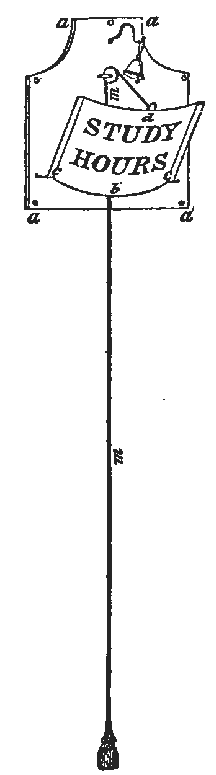 Of course the construction may be varied very much, and it may be more
or less expensive, according to the wishes of the teacher. In the first
apparatus of this kind which I used, the plate was simply a card of
pasteboard, from which the machine took its name. This was cut out with
a penknife, and after being covered with marble paper, a strip of white
paper was pasted along the middle, with the inscription upon it. The
wire c c and a similar one at the top of the plate, were passed
through a perforation in the pasteboard, and then passed into the
board. Instead of a pulley, the cord, which was a piece of twine, was
passed through a little staple made of wire and driven into the board.
The whole was made in one or two recesses in school, with such tools and
materials as I could then command. The bell was a common table bell,
with a wire passing through the handle. The whole was attached to such a
piece of pine board as I could get on the occasion. This coarse
contrivance was, for more than a year, the grand regulator of all the
movements of the school.
Of course the construction may be varied very much, and it may be more
or less expensive, according to the wishes of the teacher. In the first
apparatus of this kind which I used, the plate was simply a card of
pasteboard, from which the machine took its name. This was cut out with
a penknife, and after being covered with marble paper, a strip of white
paper was pasted along the middle, with the inscription upon it. The
wire c c and a similar one at the top of the plate, were passed
through a perforation in the pasteboard, and then passed into the
board. Instead of a pulley, the cord, which was a piece of twine, was
passed through a little staple made of wire and driven into the board.
The whole was made in one or two recesses in school, with such tools and
materials as I could then command. The bell was a common table bell,
with a wire passing through the handle. The whole was attached to such a
piece of pine board as I could get on the occasion. This coarse
contrivance was, for more than a year, the grand regulator of all the
movements of the school.