Copyright, 1907, by The Taylor-Trotwood Publishing Co. All rights reserved.
Entered as second-class matter, January 12, 1907, at the post-office at Nashville, Tennessee.
THE TAYLOR-TROTWOOD MAGAZINE ADVERTISEMENTS
CATALOGUE OF OUR 50c BOOKS. Hunter & Co., Nashville, Tenn.
In writing to advertisers please mention the Taylor-Trotwood Magazine
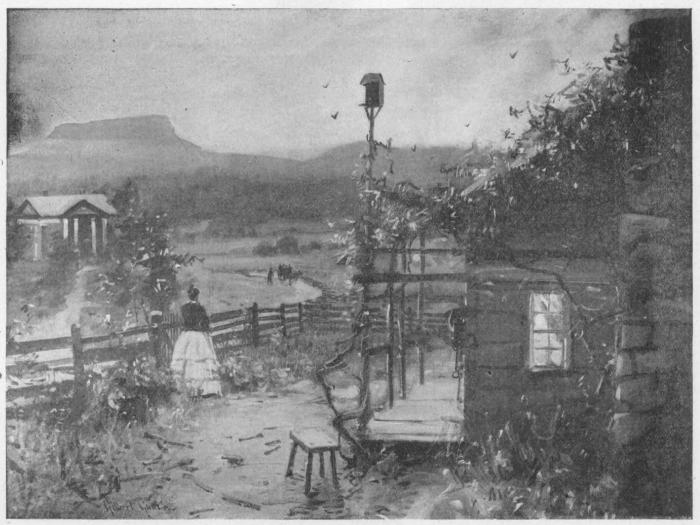
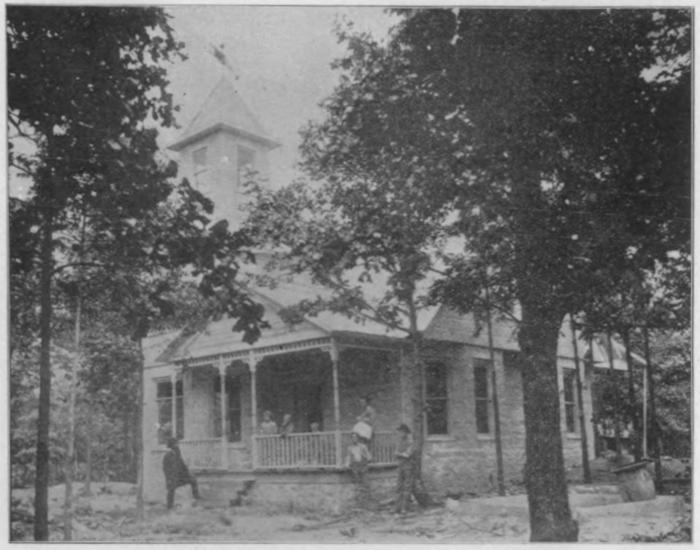
“Standing at the small gate, now off its hinges,
she took in all the surroundings and tried to imagine Ervin amid them”—The
Shadow of the Attacoa, page 626
VOL. IV
MARCH, 1907
NO. 6
FAMOUS THRESHOLDS IN WASHINGTON — THE OCTAGON HOUSE
By Annie Riley Hale
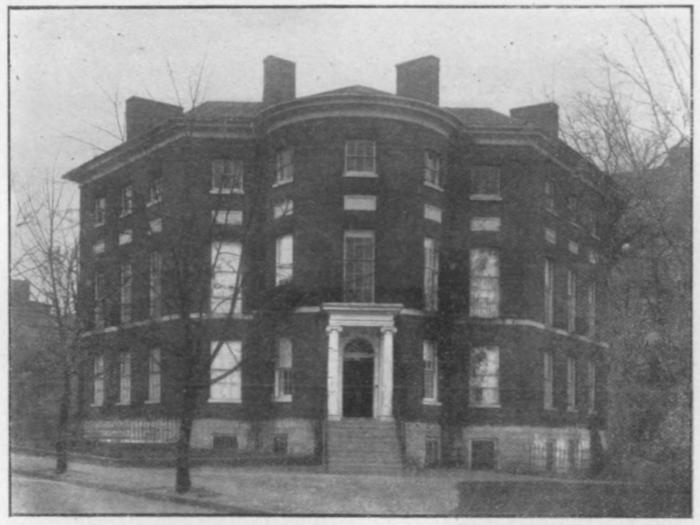
At the northwest corner
of New York
Avenue and Eighteenth
Street, within
a stone’s throw of the
War, State and Navy
Department, and almost
within the shadow
of the Corcoran
Art Gallery, is a
queer old red brick
structure, with stone steps leading up
to the white-pillared portico, which is
known in Washington as the “Octagon
House.”
As a historic mansion, as a “haunted
dwelling,” and as a unique piece of
Colonial architecture, the Octagon
has a triple claim to a place in the catalogue
of “famous thresholds.”
Back in 1798—that same year in
which George Washington laid the
cornerstone of his “two buildings” on
North Capitol Street—another Virginian,
Colonel John Tayloe, moved by
the persuasive arguments of our first
President and first real estate boomer
for the Federal City, decided to
build his “town residence” in Washington,
instead of Philadelphia, as was
his original intention.
Colonel Tayloe’s Virginia estate,
“Mt. Airy,” comprised eight thousand
fertile acres along the Rappahannock,
with five hundred slaves and
a superb villa, all inherited from his
father, a member of the House of Burgesses,
who built the Mt. Airy country
seat in 1758, on a scale of magnificence
unsurpassed at that period in
this country.
The site of the Octagon was purchased
from Mr. Benjamin Stoddert,
our first Secretary of the Navy, an
office created by the first Adams.
It is related that General Washington
was much interested in the Octagon,
frequently riding by on horseback
to watch the progress of its building,
though he was not permitted to
witness its completion. Singularly
enough, it was begun in the same year,
finished in the same year (1801) and
designed by the same architect (Dr.
Thornton) as his own house on Capitol
Hill. The Octagon was well and
strongly built and set in a triangular
lot which conformed to the street
lines. The rear premises, in which
were located the stables and servants’
quarters, were enclosed by a high
brick wall, now broken in places, and
ivy-grown.
When finished, this was the finest
private residence in the Federal City,
as it antedated the more stately Van
Ness mansion by a number of years,
and from its unique style of architecture
was regarded as the show house
of the surrounding country.
The irregular perimeter of its walls—whence
the name “Octagon”—includes
five sides and six angles for the
main body of the house, with two
short sides, and a circular swell across
the front—demonstrating that the
owner had to strain a point and round
a curve for its christening. The exterior
exhibits many windows of the
old-fashioned, small-pane pattern, and
from the rear giant old trees fling their
flickering shade athwart them.
THE OCTAGON HOUSE
The interior of the house was modeled
to fit the outward circumference,
the doors, sash and glass in the circular
vestibule being made on the circle
and all still in working order.
In the niches prepared for them
are exhibited two old cast-iron wood
stoves, which crackled their good
cheer for generations long past, but
which evidently owe their present lustre
to more recent furbishings. The
doors on the ground floor are all of
mahogany, and in an excellent state
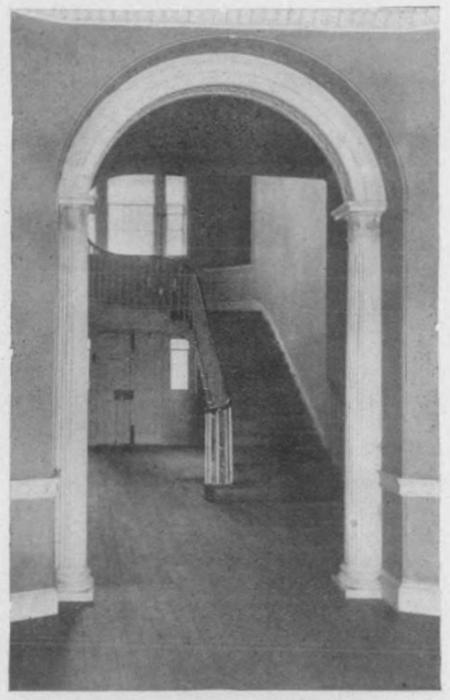
of preservation, as is likewise the railing
to the stairway leading from the
main hall up to the third story—a
frail, insubstantial-looking affair with
its slender wooden pilasters and narrow
rail; yet, owing to the fact that
every fourth pilaster is of iron, and
the railing of mahogany, this old stairway
has stood the test to which more
massive balustrades have succumbed.
The rooms, eleven in all, are few, as
compared with the size of the building,
but the area of some of them
might easily accommodate a modern
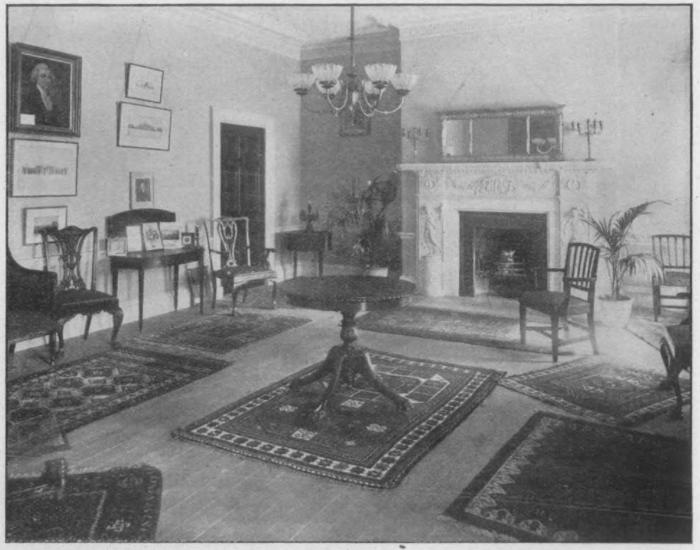
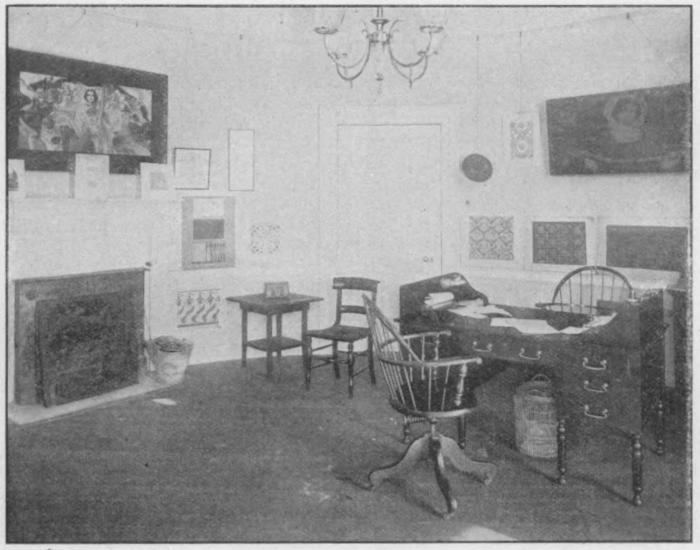
housekeeping apartment. To the right
of the main hall is the spacious drawing
room, which has been the scene
of many a brilliant assemblage in the
days long gone, where the bas-relief
figures on the mantel imported from
London, watched the going and coming
of the men and women who made
history. Upon the estimate of an expert,
it is said that the cost of reproducing
this mantel in marble nowadays
would be two thousand dollars.
Opposite the drawing room, to the
left of the hall, is the long, high dining
room, studded with windows and
flooded with western light. Turning
back the clock of time for almost a
century, one sees gathered around this
generous board a distinguished company,
including Jefferson, Madison,
Monroe and John Quincy Adams;
Hamilton, Marshall, Jay and Pinckney;
Webster, Calhoun, Clay and Randolph;
Decatur, Porter, Lafayette,
Steuben, Sir Edward Thornton and
other notabilities.
DRAWING ROOM
Although it is not recorded that any
of the Tayloes shone very conspicuously
in their country’s annals by reason
of any great service rendered in positions
of public trust, yet because of
their great wealth and social prominence,
their lives touched at various
points many of the great names which
emblazon the pages of history. At the
time he took possession of his Octagon
home, in 1801, Colonel Tayloe’s
income was seventy-five thousand dollars
a year—three times as much as
the President’s salary at that period—and
the unbounded hospitality dispensed
from his two households at Mt.
Airy and the Octagon, embodied the
most splendid features of the regal
Old South.
He was married at the early age of
twenty-one, to Miss Ann Ogle, daughter
of Governor Benjamin Ogle, of
Maryland. Descended from the Corbins,
Gwynnes, Platers and Fauntleroys,
connected by the marriage of his
sisters with the Lees, Pages, Washingtons,
Carters, Beverleys and Lomaxes
of Virginia, and by his own
marriage with the Bladens, Taskers,
and Ogles, of Maryland, Colonel Tayloe’s
social prestige was limitless.
One does not live long in Washington
ere he learns to uncover and speak
softly before a lineage which reaches
to the “Eastern shore,” either of Virginia
or of Maryland; and when a line
is discovered which connects both
these aristocratic strongholds—well,
words are but poor things, and a solemn
hush is the most approving corollary.
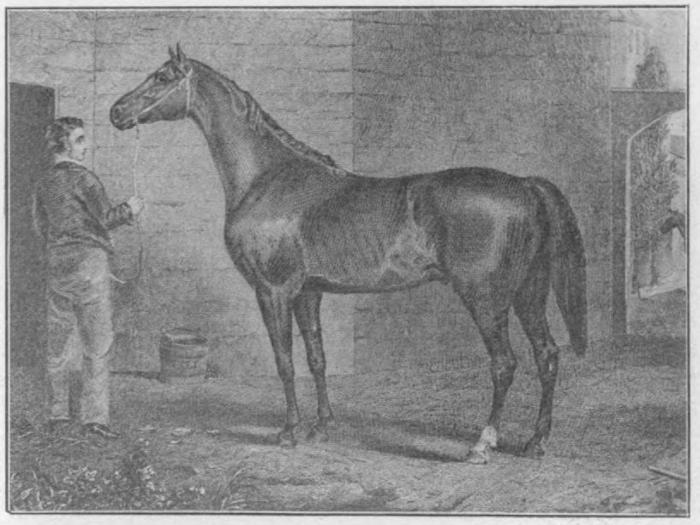
ECLIPSE
Colonel Tayloe was educated at
Eton and Cambridge, England. He
was noted for the urbanity of his manners,
for the splendor of his equipages
and for his lavish hospitality. In 1802,
conjointly with Governor Ridgeley, of
Maryland, Colonel Tayloe laid out the
Washington City Race Course on the
Holmead Farm, about two miles north
of the President’s house, near the present
Mount Pleasant. For a number of
years, the Colonel was at the head of
the turf in his native state at a time
when the turf was much affected by
the aristocratic sportsmen of the old
régime. He kept in his stables at Mt.
Airy a large number of blood horses.
He owned the celebrated Leviathan,
Gallatin, Sir Charles, Sir Archy
and others; and from his imported
thoroughbreds were descended the
most famous coursers in the early annals
of the American turf. From the
Tayloe stables came Eclipse and
Henry—“the North and the South”—who
ran the celebrated sectional
race on the Long Island course in
1823, in which Henry was beaten,
and the success of Eclipse was attributed
to the manipulation of a
jockey named Purdy. The victory
was received with uproarious shouts,
Eclipse was led to the stand amid
the strains of “The Conquering Hero,”
and there followed a jubilee in New
York. Whereupon, John Randolph,
of Roanoke, who was present, remarked:
“I am glad no one on the
course thought of nominating Purdy
for the Presidency, for it would have
been carried by acclamation!”
In 1818 Colonel Tayloe built the
old Willard Hotel, on Pennsylvania
Avenue and Fourteenth Street, which
was enlarged and improved by his son,
Mr. Benjamin Ogle Tayloe, in 1844,
when it became and has since continued
the most fashionable hotel of the
Federal City.
Colonel Tayloe was in his day the
largest contributor to St. John’s Episcopal
church, which was the first building
erected on Lafayette Square after
the War of 1812, and is popularly
known as “the President’s church,”
from the fact that more Presidents
have attended it than any other in the
city, probably because of its proximity
to the White House. Colonel Tayloe
presented to this church the massive
silver service which formerly belonged
to the old church of Lunenburg, in
Richmond County, Virginia.
CIRCULAR ROOM IN WHICH TREATY OF GHENT WAS SIGNED
Colonel Tayloe’s occupancy of the
Octagon embraced the administrations
of four Presidents—Jefferson, Madison,
Monroe and John Quincy Adams—and
ceased in 1828, just as the picturesque
figure of “Old Hickory” rose
above the Presidential horizon. In
1814, after the burning of the White
House by the British, the hospitality
of the Octagon was tendered to the
homeless President and his bewitching
“Dolly,” and for six or eight months
it was transformed into “the President’s
house,” Colonel and Mrs. Tayloe
retiring to their country seat for
the nonce. In the circular room over
the round vestibule, Madison signed
the Treaty of Ghent, February, 1815,
which closed our second war with
Great Britain. The table at which the
treaty was signed is still in the possession
of the Tayloe family.
The fact that Madison is esteemed
one of our most intellectual and scholarly
Presidents, that his state papers
exhibit not only statecraft, but literary
construction of a high order, and that
a distinguished Southern Senator in a
recent speech in Congress named him
“more than any other man the author
of the American Constitution,” gives
peculiar piquancy to the following
story, which is vouched for by Mr.
Benjamin Ogle Tayloe:
When a member of Congress in
Philadelphia, Mr. Madison boarded in
the house of Mrs. Payne, the mother
of “Dolly,” at that time the beautiful
Widow Todd. Mr. Madison, attracted
by the personal charms of the fascinating
young widow, sent her a book
to read and requested her opinion of
it—presumably with a view to sounding
her mental depth. Whereupon,
Mrs. Todd, who, Mr. Tayloe says, was
always more remarkable for beauty,
tact and manner than for depth of intellect,
asked Colonel Burr, who
boarded there, also, to write her reply
to Mr. Madison, which he accordingly
did.
Shortly afterward, Madison offered
himself to the handsome and intellectual
widow, and was accepted. This
story tallies with the statement from
other sources that Burr made the
match between Madison and the
sprightly Dolly, but if our accomplished
fourth President really was ensnared
by the schoolgirl ruse, he certainly
had no occasion to complain of
his matrimonial bargain. For in the
judgment of her contemporaries and
of all succeeding generations, no lady
has ever done the honors of the White
House more gracefully and acceptably
to all parties than the gracious and
lovely Dolly Madison. Her brilliant
levees and various functions at the
Octagon during her brief sojourn
there are among the richest traditions
of early official life in the Federal
city.
Dr. William Thornton, the architect
of the Octagon, was remarkable
for his talents, benevolence and eccentricities.
He was the first architect of
the Capitol at Washington, and was
appointed one of the three original
commissioners to lay off the city.
At the request of Jefferson, he furnished
designs for the University of
Virginia. He was born in the West
Indies, of Quaker parentage, and educated
in England and Scotland. A
man of science, he was head of the
Patent Office from the time of Washington’s
administration to that of
Monroe, and claimed to have preceded
Fulton in the application of steam as
a propeller of boats, and to have made
experiments on the Delaware before
Fulton made his on the Hudson.
This claim naturally brought the
two into collision, and their quarrel
consisted in writing pamphlets against
each other, apropos of which, Thornton
is said to have declared: “I killed
Fulton with that last pamphlet of
mine!” Dr. Thornton married the
daughter of an English lady who kept
a fashionable school for young ladies
in Philadelphia, and is reputed to have
stood much in awe of both his wife
and mother-in-law—a condition of
mind which finds scant compensation
in worldly honors. The ladies were allies
in their opposition to his leaning
toward the turf, to which, despite his
Quaker blood, the Doctor was passionately
addicted. This brought him into
close association with Colonel Tayloe,
and their deaths occurred in the same
year, 1828.
After her husband’s death, Mrs.
Tayloe retired from society, although
she continued to make the Washington
house her principal home until her
death, nearly thirty years later. One
of her granddaughters, yet living in
the District, is authority for the fact
that for more than fifty years the Octagon
was lighted solely by candles.
Although gas was introduced prior to
Mrs. Tayloe’s death, she would never
permit its use in the Octagon, looking
upon it as a “dangerous innovation,”
and clinging to her candles to the last.
The granddaughter remembers as one
of the distinct impressions of her childhood,
the sockets over the doorways
which held these wax illuminators.
The Tayloe occupancy of the Octagon
ceased with Mrs. John Tayloe’s
death, in 1855, though its ownership
did not pass from the family until its
purchase by the American Institute of
Architects, in 1903.
Between the dates 1855 and 1865,
the Catholic Sisters of St. Matthew’s
Parish taught a girls’ school in the
Octagon, and from 1866 to 1879 it was
leased by the government for the “Hydrographic
Office,” incorporated by
Congress in 1866 as a branch of the
Navy Department.
Then for nearly twenty years the
Octagon was given over to silence,
cobwebs, mice and ghosts, the last
the inevitable tenants of all deserted
dwellings which have been the scene
of departed grandeur.
A Virginian of good birth—whose
fortunes had fallen on evil days, and
who was wont to seek solace in the
flowing bowl and nepenthic drug—having
been installed as custodian of
the place, greatly assisted popular
superstition by the recital of his own
pipe-dream imaginations. As one
of the present Tayloes remarked—“you
had only to fee the caretaker,
and get a ghost-story spun to your
liking.”
HALL AND STAIRWAY, SCENE OF THE REPUTED SUICIDE
Indeed, what with a mythical Miss
Tayloe flinging herself over the third
story balustrade to escape the pangs
of misplaced affection, and a British
officer—“nameless here forevermore”—walling
up an octoroon slave girl in
the wine cellar; with bells ringing at
all hours of the night through the
empty rooms, and heart-rending
sighs breathing from hidden nooks
and passages, the Octagon is particularly
rich in spooky traditions, which
neither the incredulous smile of daylight,
nor the disapproving frown of
the family can wholly dispel. So often
have they been repeated, and so closely
interwoven with the history of the
old house—whole works of fiction
having been built on them—that when
one goes from the warm sunlight
across this colonial threshold, pushing
back the heavy curved door with
its iron bar and ponderous key, the
sensation in one’s spinal region is distinctly
creepy. The eye wanders apprehensively
up the thin, winding
stairway to the third floor and back to
the spot in the hall directly beneath,
where the fatal plunge was made; and
descending the narrow, worn stairs
to the basement, one involuntarily listens
in expectant dread for the smothered
groan or sigh from behind those
mouldy bricks.
Mr. Glenn Brown, the accommodating
secretary of the American Institute
of Architects, which now owns and occupies
the Octagon, tells of a more objectionable
class of tenantry than the
ghosts, when the architects first took
charge of the building in 1899. The
faithless caretaker had rented out the
rooms to irresponsible negroes, and
the architects found several families
of them domiciled in the erstwhile
abode of Presidents. To remove the
squalor and damage consequent upon
such occupancy, and to restore and
preserve the colonial architecture of
the once splendid mansion, the Institute
expended three thousand dollars,
resulting in handsome and artistic
headquarters, in all respects worthy
of such an organization.
It may not be generally known that
prior to 1850, the profession of architecture
was not in good repute in
America; that carpenters and contractors
were much more highly esteemed
than architects, the former, in contrast
to the latter, being classified as “practical
persons.”
In 1857, in the city of New York,
a dozen young architects met in the
office of Richard Upjohn, for the purpose
of considering the organization
of a society of architects, whose object
should be the promotion of schools
for architecture, the publication of
journals and raising the standard of
public taste in regard to it. This was
the genesis of the American Institute
of Architects, which now numbers
eight hundred members and ten past
presidents, of whom Richard Upjohn
was the first; another, Thomas U.
Walter, designed the present wings of
the Capitol, and another, Richard M.
Hunt, designed the Administration
Building, at the World’s Fair, and the
famous “Biltmore,” at Asheville,
North Carolina.
The circular room on the second
floor of the Octagon, once President
Madison’s executive office, is now the
business office of the Institute, and
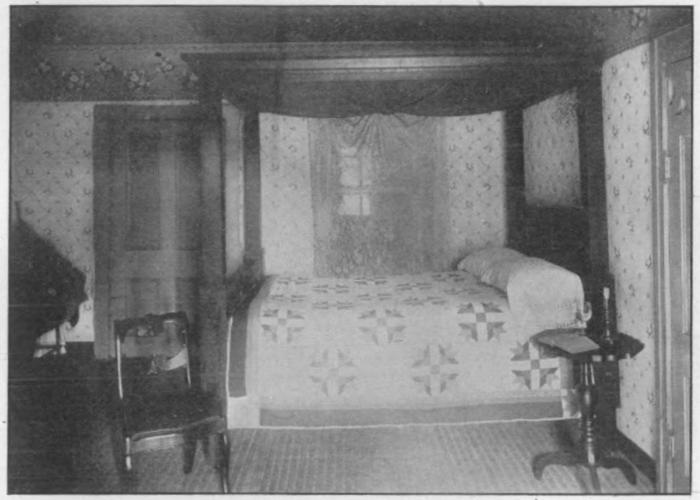
Dolly Madison’s bedroom has been
converted into an exhibit room for the
American Academy in Rome.
Through the courtesy of the secretary,
the writer was permitted to explore
the back yard and peep into the
stable lot, in which is located a large
stone block—“whereby hangs a tale.”
A granddaughter of Colonel Tayloe’s,
who spent much of her youth at
the Octagon, affirms that this stone
was used by the postilions in mounting.
Yet to the frenzied fancy of
more than one chronicler of local history,
this was the “slave block,” from
which were auctioned some of those
five hundred slaves ascribed to John
Tayloe, and is referred to in pompous
and melodramatic phrase as “doing satanic
duty through the years.” Opposed
to this is the well authenticated
fact that Colonel Tayloe never sold
any of his dusky retinue, and his wife’s
reply when questioned as to the number
of her husband’s slaves: “He has
five hundred servants, but only one
slave. I am slave to them all,” is
fraught with much historic truth
which is pretty generally overlooked
in the portrayal of ante-bellum types
of Southern women.
Other pious visitors to the Octagon
kitchen, looking through the same lens
as the discoverers of the “slave block,”
beheld in the long iron “spits,” used
for roasting meats, unique instruments
of torture for the hapless slaves!
These stories indicate that other imaginations
besides the inventors of
ghostly legends, have been busy with
the long-suffering Octagon; these encrustations
of false over the true cannot,
however, detract from the real
interest of the history of this dignified
old mansion.
FATE’S IRONY
He fought against his weakness; weary,
Heartsick, he, amid his failures, died.
Then one who knew him, knew how near he
Came to conq’ring with the hurts he bore;
Knew the reachings of his nature,
And the sweetness of his heart at core;
Knew the baffled will, the down-crushed pride;
From his effort plucked up courage,
Turned the failure into story,
From it won renown and glory.
Amy E. Blanchard.
HISTORIC HIGHWAYS OF THE SOUTH — CHAPTER XVIII—THE BLUNDERS OF SHILOH
By John Trotwood Moore
The more one studies Shiloh, the
more contradictory it becomes. It will
ever remain an incongruous battle. On
the Union side it was a battle of unpreparedness—though
not of dishonorable
surprise—and on both sides a
battle of blunders. And never in any
battle of any war that I have ever read
did Chance—old-fashioned, historic,
blind Chance—play a more conspicuous
part.
Some of the big chances, standing
out in the light of to-day like gray
ghosts above the battlefield, are:
First—The chance that cut Buell
off one day too late for the Union
cause.
Second—The chance that put him
there one day too soon for the Confederates.
Third—The chance which Grant
took—and which he says in his autobiography
he would not have taken
with the riper knowledge gained later
in the war—of not entrenching.
Fourth—The chance of mud and
rain, which delayed Johnston one day
in bringing on the fight.
Fifth—The chance of one fateful
bullet amid ten thousand harmless
ones, striking an artery not hit once
in ten thousand times in battle, and
striking from the boards the only head
on either side which had absolutely a
clear conception of the entire battle
to be, planned by himself with consummate
skill and executed, till stricken
to death, like a thunderbolt of Jove
in the brain of Mars. He alone, I
repeat, of all the host of generals, Federals
and Confederates, who swarmed
booted and bedecked around the contending
hosts of that day, had definite
plans, knew what was to be done, and
held the doing of it in the hollow of his
hand, and his name was Albert Sidney
Johnston.
Sixth—The great chance Beauregard
had for ending the fight on the
first day, instead of calling off the
troops until the fatal to-morrow.
Seventh—The chance—ay, the blunder—of
Grant in recalling Lew Wallace
from a position which a most
gracious and generous fate had given
him. A chance which gave to Wallace
the opportunity for his own fame and
the fame of Grant’s army—the chance
of falling upon the flank and rear of
the eager, neglectful, front-fighting
Confederates, of breaking their hearts
as Johnston’s death could never have
done. This was a greater chance than
Jackson had at Fredericksburg when
he utterly defeated the Yankee army;
it was as great as the chance Blücher
had at Waterloo; greater than Bonaparte’s
at Austerlitz.
In thinking of Stonewall Jackson
and Johnston, did God in His wisdom
know it was best that the Confederacy
should not be, as we all now know it,
and take these two men from life that
it might not come to pass?
And there we are at it again: For
God’s decision is man’s destiny.
Now, are not these chances enough?
Or is it Law, Cause and Effect, Adjustment,
Nature—God?
To know—to see clearly—to understand
that one paragraph, who would
not be willing to go hence to-night?
For if it is God and immortality, there
would be no fears, doubts, pitiless days
of self communion, ending in that pale
despair which strikes into the soul of
every man whose soul is his own and
who thinks. And if it is all Chance
(a thought repellant and unbelievable
to one who thinks), or even the Great
Unchance of fixed, immutable, but unloving
and uncaring Law—as many
believe—then why suffer to this palsied,
dust-turning end?
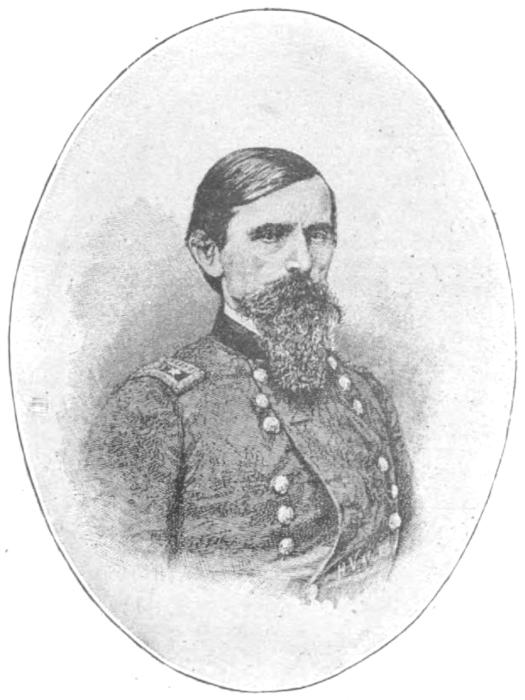
GENERAL LEW WALLACE
From the lips of babes, from the
humble and the ignorant, what wisdom!
Here is some of it:
On a morning after a cyclone where
I once lived, amid the death of nearly
threescore people, and the wreck of
homes, a friend met an old negro,
whose wife and children had been
killed, and his home blown away.
There was the usual compassion and
condolence and trust from the learned
man, who had lost nothing. But the
old negro said: “Marster, the man
that you calls God—yo’ God—it ’pears
to me that he do about as much harm
as he do good!”
I have wondered since—often and
often—if our God—the God our little
minds have been able to grasp—to
whom some people falsely attribute
revenge and cruelty and murder—if he
is not as the old negro said; and I have
prayed that I might live to know the
God Which Is, and that he would permit
me to understand the things which
do stagger me now!
Were these things really
chances? Take each one of
them and sift it to its very
beginning—follow up the
broad stream of each till you
find the first drop of its
water trickling over the
blind bluff of the thing unknown
which staggers and
stops you, and even to that
last tiny drop you will
stand and find no answer to
the question, and before that
drop you will stop again,
look up at the stars and ask
the same question: “Is it
Chance, is it Law, or is it
God?”
Let us take the first one:
Why was Buell a day late?
A thousand little things—a
march from Nashville to Savannah,
planned with ample
time, yet delayed. What delays?
Hundreds of them—follow
up any one of them
and it will end in the drop.
Let me give you one which
came under my personal recollection:
Some ten years ago
I stopped one night at a hotel
in Chicago, known as the Kuhn
House. After registering, the proprietor
sought me out. He had been one
of Buell’s chief engineers, and upon
seeing where I was from—Columbia,
Tennessee—he wanted to know if the
old bridge across Duck River at that
point was still standing. “It was
there,” he said, “that we saved Grant’s
army and made him President instead
of prisoner. I was given two days”—I
think that is the time he stated—“to
repair the bridge, the flooring of
which had been torn up and the structure
half burned before we reached it.
But we had heard rumors of a great
battle pending near Savannah and
though we had received messages from
General Grant saying there was no
need for undue haste, we were marching
for all we were worth. I felt,
somehow, that great things were at
stake, and I doubled my force and
worked day and night completing the
repairs so that the artillery might pass
over in just half the time given me;
and that time saved, put us in Savannah
twelve hours to our good. I have
often wondered what would have happened
had I taken my full time to repair
that old bridge over Duck River
at Columbia.”
Chance. Might-have-been! Tell
me what they are and I will tell you
what God is!
Grant and Buell threshed out their
differences years ago before they both
passed into the shadowland, and nothing
is more interesting than the grave
and dignified controversy between
these two men. Grant, great as he was
in war, was out of his element with
a pen in his hand; and in the written
battle, Buell, to my mind, has worsted
him. Nor was it Buell’s fault that
this controversy arose. It came about
from the exaggerated desire of the
friends of the Army of the Tennessee
to shield Grant and Sherman from the
blunders they so clearly made and
which should have been acknowledged
by them like men, instead of trying to
belittle the part that Buell played. For
Buell had enough to his own credit.
In his very able article in The Century,
Buell demonstrates at least very
clearly to his own mind:
First. That Grant and Sherman
were neglectful in preparing for this
battle.
Second. That Grant’s army was too
badly scattered, and he, himself, too
far away from the front when the battle
opened.
Third. That Grant and Sherman
were surprised.
Fourth. That they were whipped.
Fifth. and (Q. E. D.) that Buell
saved them.
Here is Buell’s very succinct, graphic
and convincing statement in the beginning
of his paper and argued
throughout with the greatest ability:
“An army comprising seventy regiments
of infantry, twenty batteries of artillery
and a sufficiency of cavalry lay for two
weeks and more in isolated camps, with a
river in its rear and a hostile army, claimed
to be superior in numbers, twenty miles
distant in its front, while the commander
made his headquarters and passed his
nights nine miles away, on the opposite
side of the river. It had no line or order
of battle, no defensive works of any sort,
no outposts, properly speaking, to give
warning or check the advance of an enemy,
and no recognized head during the absence
of the regular commander. On a Saturday
the hostile force arrived and formed
in order of battle, without detection or
hindrance, within a mile and a half of the
unguarded army, advanced upon it the
next morning, penetrated its disconnected
lines, assaulted its camps in front and
flank, drove its disjointed members successively
from position to position, capturing
some and routing others, in spite
of much heroic individual resistance, and
steadily drew near the landing and depot
of its supplies in the pocket between the
river and an impassable creek. At the
moment, near the close of the day, when
the remnant of the retrograding army was
driven to refuge in the midst of its magazines,
with the triumphant enemy at half-gunshot
distance, the advance division of
a reinforcing army arrived on the opposite
bank of the river, crossed and took position
under fire at the point of attack; the
attacking force was checked and the battle
ceased for the day. The next morning
at dawn the reinforcing army and a fresh
division belonging to the defeated force
advanced against the assailants, followed
or accompanied by such of the broken columns
of the previous day as had not lost
all cohesion, and, after ten hours of conflict,
drove the enemy from the captured
camps and the field.”
It will be seen from the statement
in his article that one of the strongest
points he made as to the unpreparedness
of Grant’s army is the repeated
fateful turning of the flanks of the
different divisions throughout the day,
in one of which Prentiss was captured.
He says:
“The outflanking so common in the
Union report at Shiloh is not a mere excuse
of the inferior commanders. It is
the practical consequence of the absence
of a common head and the judicious use
of reserves to counteract partial reverses
and preserve the front of battle.”
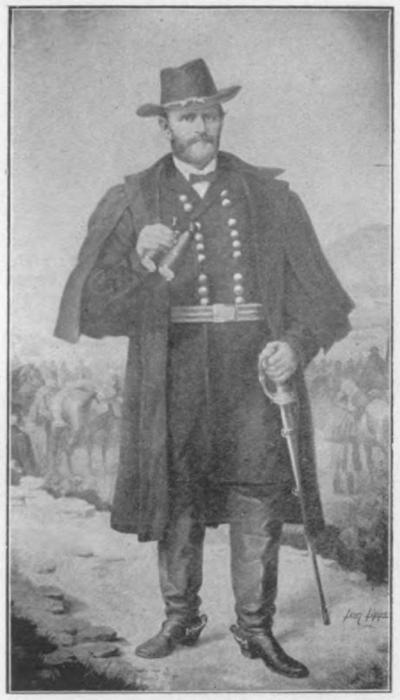
GENERAL GRANT.
As he appeared at the time of Shiloh
From this alone he argues all the
misfortunes of the different divisions
acting independently and without a
common head. Their flanks turned
again and again as each fell back with
no warning from the others. And this
is his graphic statement of the critical
ending of the first day’s fight:
“Before the incumbrance of their success
was entirely put out of their day, the
Confederates pressed forward to complete
a seemingly assured victory, but it was too
late. John K. Jackson’s brigade and the
Ninth and Tenth Mississippi of Chalmer’s
brigade crossed Dill’s ravine, and their
artillery on the south side swept the bluff
at the landing, the missiles falling into the
river far beyond. Hulbert had hurriedly
gotten into line in rear of the siege
guns, as they are called in the official report,
posted a half-mile from the river,
but for five hundred yards from the landing
there was not a soldier or any organized
means of defense. Just as the danger
was perceived Colonel Webster, Grant’s
Chief of Artillery, rapidly approached Colonel
Fry and myself. The order of getting
the battery which was standing in
park into action was expressed simultaneously
by the three of us, and was promptly
executed by Colonel Webster’s immediate
exertion. General Grant came up a few
minutes later, and a member of his escort
was killed in that position. Chalmer’s
skirmishers approached within one hundred
yards of the battery. The number in view
was not large, but the gunners were already
abandoning their pieces, when Ammen’s
brigade, accompanied by Nelson,
came into action. The attack was repelled
and the engagement ended for the day....
We know from the Confederate report
that the attack was undertaken by
Chalmer’s and Jackson’s brigade, as above
stated; that the reserve artillery could
effect nothing against the attacks from
under the shelter of Dill’s ravine; that
the fire of the gunboats was equally harmless
on account of the elevation which it
was necessary to give the guns in order to
clear the top of the bluff, and that the final
assault, owing to the show of resistance,
was delayed. Jackson’s brigade made its
advance without cartridges, and when they
came to the crest of the hill and found the
artillery supported by infantry, they shrank
from the assault by bayonet alone. Jackson
went in search of co-operation and
support, and in the meantime the attack
was superseded by the order of the Confederate
commander calling off his troops
for the day.”
His description of how things
looked when he landed at Pittsburg
Landing, of the demoralized condition
of Grant’s army, is graphic in the extreme:
“On the shore I encountered a scene
which has often been described. The face
of the bluff was crowded with stragglers
from the battle. The number that at different
times has been estimated at five thousand
in the morning to fifteen thousand in
the evening. The number at nightfall
would never have fallen short of fifteen
thousand, including those who had passed
down the river, and the less callous, but
still broken and demoralized, fragments
about the camps on the plateau near the
landing. At the top of the bluff all was
confusion. Men mounted and on foot and
wagons with their teams and excited drivers,
all struggling their way closest to the
river, were mixed up in apparently inextricable
confusion with a battery of artillery
which was standing in park without
men or horses to man or move it.”
There lives near me in honor and
good name, General Gates P. Thruston,
one of the greatest scholars of the
South, and perhaps the greatest living
ethnologists of this country. He was
with Buell, and corroborates his chief,
and he refers me to General Lew Wallace’s
oration, delivered at Shiloh,
April 6th, 1903, in which General
Wallace uses the following language:
“Did any of you, my friends, ever hear
of an army fighting a battle without a commander?
No? Well, that was the case
with the Army of the Tennessee at the
beginning of the first day here. The five
divisions on the field had each its chief, to
be sure; but none of the five chiefs was
in general command. Instead of one
supreme governing will, nowhere so essential
as in battle, there were five officers,
each independent of the others. Between
them things were done by request, not orders.
No one of them was responsible for
what the others did. I am sure you will
see the enormity of the disadvantage. You
will even wonder that there was any resistance
made.
“I may not pass this point without an
explanation. To do so would be grossest
injustice. General Grant, as everybody
knows, was in command of the Army of
the Tennessee at the time. By order of
General Halleck, his headquarters were
at Savannah, ten miles below Pittsburg
Landing. Hearing the guns, he made all
haste to the scene of action, arriving there
four hours after the attack began. It was
then too late for him to change the day.
The battle had passed beyond his control.
“A strange circumstance that, certainly;
but what will you say to this I offer you
next? The Confederate army left Corinth
for Pittsburg Landing on Thursday, in the
afternoon. It moved in three corps—Hardee’s,
Bragg’s, Polk’s—with Breckinridge’s
three brigades in reserve. The intention
was to attack the Army of the
Tennessee Saturday morning, but it was
not until late Saturday afternoon that the
entire army reached its destination and
was deployed. Here, now, is the marvel.
How was it possible to move the three
great army corps into as many lines of
battle, each behind the other, within two
miles of Shiloh Church, without making
their presence known? Were there any
Union pickets out? How far out could
they have been? Had they no eyes, no
ears? It would seem not. For at five
o’clock Sunday morning, when Hardee
moved to the attack—I give you all permission
to wonder while you listen—neither
General Grant at Savannah nor
one of his division commanders on the
field knew of the peril, or even suspected
it.”
Of the other great chance or blunder
of Shiloh—Grant’s recall of Lew Wallace—let
us now speak. Early in my
study of this battle I stumbled on this
so unexpectedly that it filled me with
surprise. It was beyond doubt the
greatest opportunity of Shiloh, as I
mentioned in a previous paper. The
story of it by Lew Wallace himself,
is the most interesting paper ever written
about that battlefield. For many
years the distinguished author of “Ben-Hur”
was made the scapegoat of Shiloh.
He bore it like the man he was,
but history will now vindicate him and
nothing has given me greater pleasure
than to contribute my share toward
his vindication in this series of papers.
At the time I arrived at the conclusion
I did concerning General Wallace’s
brilliant movement during the
first day’s fight, I did not know that
he had ever explained it himself, but
seeing the position I took, and the conclusions
I deduced, a friend has sent
me the account General Wallace wrote
of it himself and turned it over to
General James Grant Wilson to be
published by General Wilson after the
death of the author. This was done
last January by the Appletons,[1] and
it is useless to add that the author of
“Ben-Hur” has told in no usual way
the graphic story of that blunder of
his superior which made Wallace a
scapegoat instead of a hero of that
much misunderstood fight. I quote
only part of it, but this part bristles
with interest, and is enough:
“On the 6th, the memorable Sunday, a
sentinel woke me from sleep on the
steamboat serving me for headquarters.
He reported cannonading up the river.
When I reached the hurricane deck dawn
was breaking. The air was humid and
heavy, but still. The guns were quite audible.
Five minutes—ten—and then the
irregular pounding, sometimes distinct,
sometimes muffled, kept scurrying down
the yellow flood of the river. Directly the
camp on the bluff became astir.
“My staff officers reported to me. One
of them (Lieutenant Ware) I sent to Colonel
Smith with directions to form his
brigade and conduct it to ‘Stoney Lonesome.’
Another (Major James R. Ross)
was dispatched at speed to Colonel Thayer
with orders to have everything ready to
move; continuing his ride, he bore an order
to Colonel Wood of the Third Brigade to
break camp, send baggage and property to
the landing (Crump’s) and bring his regiments
to the rendezvous at ‘Stoney Lonesome.’
The purpose of these orders was
to have the division ready for movement
when General Grant, who was at Savannah
for the night, should pass in his dispatch
boat going up the river.
“About 8:30 o’clock General Grant drew
alongside, and a conversation, substantially
(almost literally) the following, took place:
“‘Have you heard the firing?’ he asked.
“‘Yes, I have been listening to it since
daybreak.’
“‘What do you think of it?’
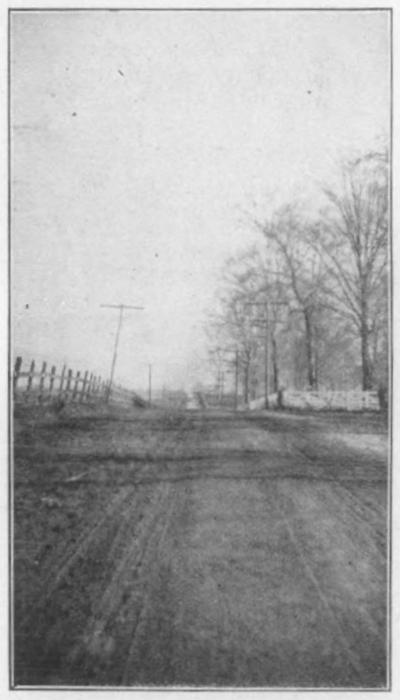
NASHVILLE PIKE, NEAR SPRING HILL, DOWN
WHICH ROAD BUELL MARCHED
“‘It is undoubtedly a general engagement.’
“‘What have you in your front?’
“‘There is nothing reported.’
“He then said, after thought: ‘Very well.
Hold yourself in readiness for orders.’
“‘But, General, I ordered the concentration
about daylight. I am ready now.’
“Again he reflected. He seemed uncertain.
It afterwards came out that he believed
the real attack would be on me.
Presently he repeated: ‘Hold yourself in
readiness to move in any direction.’ The
pilot bell rang, the lashings were removed
and his steamer put off up-stream hard as
it could go.
“There was general disappointment
among my officers. I was disappointed;
but without remark I left the boat. My
last order at the Landing was to have a
horse saddled and bridled and hitched to
a tree on the bluff, that a messenger coming
down the river with an order for me
might bring it without delay. Thereupon
I rode out to ‘Stoney Lonesome,’ where
Smith and Thayer were waiting, arms
stacked. The Third Brigade had not yet
arrived.
“The men were clustered together in
groups. They were doing little talking.
Their faces were turned to the south,
listening. Occasionally musketry could be
heard accompanying the artillery. Smith
and Thayer and their staff officers collected
around me, and were surprised when
I told them the order General Grant had
left me.
“Ten o’clock, and still the air laden with
noises of the struggle going on—still no
order; 10:30—yet no order. Smith got
into his saddle and rode away, saying: ‘I
guess Grant sees he can get along without
us.’
“Eleven o’clock. The firing was no longer
continuous, but at intervals and in outbursts.
Thayer suggested that an order
might have been started and the messenger
intercepted. I thought not; for if the situation
on the field called for us, the possibility
of an accident to a courier by land
would necessitate sending him by boat. So
I ordered a staff officer, Major Ross, to
ride to the landing and see if anything
had come down by the river. About half
a mile down the road he met an officer on
the horse I had left, who asked him where
General Wallace was. Ross told him;
then he asked, in turn, if he had orders for
General Wallace. The officer said he had,
and gave the Major a paper, which the
Major read. In a short time Captain Baxter,
a Q. U. of General Grant’s, introduced
himself to me and placed the paper in my
hand, saying: ‘Here is an order.’
“Our watches showed 11:30 o’clock. The
officers of my staff and of Thayer’s closed
around me while I read. The paper was
a half sheet of foolscap, dented with boot
heels and soiled with tobacco juice, and it
was folded, not enveloped. The writing
was in pencil. Strangest of all, no signature
was attached. I passed the paper to
Thayer to read, and, turning to Baxter,
asked: ‘How is the fighting going, Captain?’
“Baxter replied: ‘Very well. We are repulsing
them all along the line.’
“The paper was returned to me, and I
read it a second time, and, noticing its
deficiencies, inquired:
“‘Who is this from, Captain?’
“‘General Grant.’
“‘Why is it not signed?’
“He then explained: ‘I received the
order verbally. Not being used to carrying
orders, I picked the paper from the
floor of the cabin as I came down and
wrote what you see. I was afraid I might
make a mistake.’
“General Grant, speaking of the order,
has several times said that he sent it to
me not later than 10 o’clock; that it directed
me to march to Pittsburg Landing
by the lower or river road; that he gave it
verbally to a staff officer, and did not know
what it was when delivered to me. Of
course, he could not know, but I do; and
others, some dead, some living, who read
it, have given their accounts of it, so that
I can speak with confidence. Here it is—as
I received it, mark you—almost verbatim:
“‘You will leave a sufficient force at
Crump’s Landing to guard the public property
there; with the rest of your division
march and form junction with the right of
the army, your line at right angles with
river, and be governed by circumstances.’
“Observe, if you please, that the words
by the lower or river road to Pittsburg
Landing are omitted, leaving nothing but
a naked direction for me to march and
form junction with the right of the army.
“Do I deny General Grant’s version of
the order? I believe he ordered me to
Pittsburg Landing by the river road because
he says he did, and because at 10
o’clock, when the whole army was slowly
and sullenly retiring to the river, it was
the order logically right and first to present
itself. Moreover, by inserting in the body
of the order actually brought to me the
words ‘to Pittsburg Landing by the lower
or river road,’ we have sense in the other
direction to ‘form my line of battle at right
angles with the river,’ otherwise without
sense. At the right of the army, out three
miles from the Landing, how was the angle
to be ascertained? Why, then, did I not
lead my column to Pittsburg Landing?
And I answer, because the order Captain
Baxter delivered to me contained no mention
of Pittsburg Landing or of any road.
Satisfied that I comprehended it, I passed
the paper to Colonel Thayer; others about
us at the moment read it. I gave it finally
to Captain Kneffler, my Adjutant-General,
who probably stuck it under his sword belt.
It was lost during the day. On account of
its informality, he attached no importance
to it, and, as I shared the opinion, I never
blamed him.
“My first thought was, where is the right
of the army? Captain Baxter’s good news
settled the point. If not where it was in
the morning, then Sherman must have advanced.
In short, Sherman’s camp was
now my goal, and I knew it was just beyond
the bridge at the junction of Owl and
Snake Creeks, on the road from Pittsburg
Landing to Purdy. To get to it by the
shortest route and in the quickest time
from the corner of the V my brigades
were in, I must take the right-hand road.
General Grant has said in a footnote of
his ‘Memoirs’ that, in the absence of an
express direction, if I had been an older
soldier I would have marched to Pittsburg
Landing, and thence, as from a base,
out to Sherman. I think not. He forgot
the news I had from Baxter as to the condition
of the battle; besides which, by
taking the right line of the road fork, the
distance of the march would be reduced
nearly, if not quite, three miles; in addition
to which, again, the column would
be on the very road Myers had bridged
and corduroyed for me. So I sent word
to Myers to lead out for the Owl Creek
bridge next to Sherman’s camp.
“I asked myself, to be sure, if we are
beating the enemy, and he is on the run,
why the want of me? And why the order
to form my line at right angles with the
river? I could not answer, but rested implicitly
on the order. Grant was on the
ground—he knew—that was enough. The
idea of defeat never entered my mind;
and starting, as I was, with intelligence of
a victory already won by our army, what
ground is there for the imputation that I
had the achievement of some special glory
in purpose?
“The road we were pursuing had been
well repaired. The cavalry had done its
work substantially, and we bowled along.
By the firing we could tell we were nearing
the battle. We took no note of time.
Somewhere about half after one o’clock—I
remember the head of the column was reported
in the vicinity of the Owl Creek
bridge—a cavalry officer, quite young and
capless, covered with mud, slashed across
the forehead, rode up from the rear and
asked:
“‘Are you General Wallace?’
“Without pulling rein, I replied.
“‘General Grant,’ he said, ‘has sent me
to tell you to hurry up.’
“Up? To the right of the army, of
course; so I returned: ‘Give General
Grant my compliments, and tell him I will
be up in a few minutes.’
“The courier rode off the way he came—a
circumstance which, if I had had the
slightest suspicion that my movement was
in error, would have prompted calling him
back for question.
“So, in absolute unconsciousness of mistake,
I pushed on. Several times officers
came to me and remarked upon the firing
so far down on our left. And it was curious.
Had we been repulsing the enemy,
he should have been in the south, not so
nearly in the southeast. But I settled the
point, at least to my own satisfaction. ‘The
fighting has ceased on front of Sherman;
but they are keeping it up away over
on our left.’ From the position my column
was then in, the left of our army
should have been well down toward the
river in an almost easterly direction—certainly
far enough in that direction to dispose
of the only mistake General Grant
attributes to me in the footnote corrective
of the text in his ‘Memoirs.’
“Finally the revelation overtook me. A
second messenger came up from the rear.
It was Captain Rowley, well known as of
General Grant’s staff. He it was who reported
to his chief that he found me marching
to Purdy and several miles farther
from the battlefield than when I started.
From ‘Stoney Lonesome,’ Purdy lies west;
whereas the road upon which he overtook
me runs almost due south, and Shiloh
Church, marking the left of Sherman’s
camp, could not have been to exceed two
miles from where Rowley and I held the
conversation, which I will give very nearly
in exact words. The fact is, he was himself
out of his reckoning, if not lost.
“‘I’ve had a devil of a time to find you,’
he said, in high excitement.
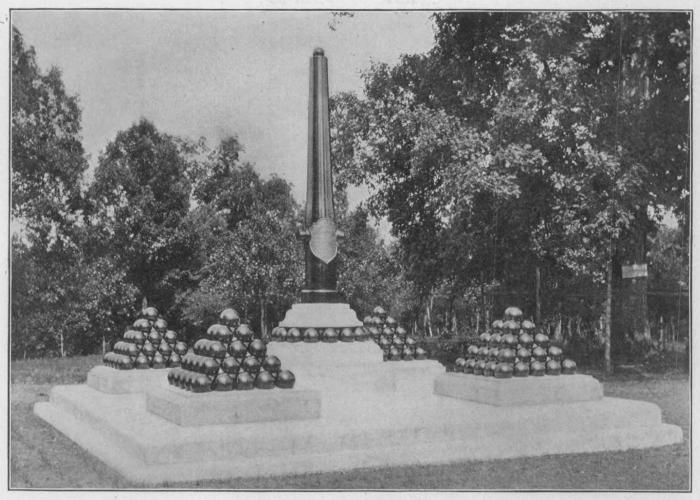
JOHNSTON’S MONUMENT AT SHILOH
“‘I am sorry to have put you to trouble,’
I returned, checking my horse. ‘What
is it?’
“‘The General has sent me to hurry
you up.’
“‘That’s the second message of the kind
in ten minutes. I don’t understand it.’
“‘Where are you going, anyhow?’
“‘To join Sherman.’
“‘Sherman!’
“‘Yes.’
“‘Come to one side with me.’ We went
a little out of the road.
“‘Great God!’ he said, ‘don’t you know
that Sherman has been driven from his
camp? And that the whole army is now
within half a mile of the landing, and it’s
a question if we are not all to be driven
into the river?’
“To my exclamations Captain Rowley
went into details. There are kinds of fear;
but nothing of that nature can shoot one’s
marrow so to the core as the dread of
making a mistake in a situation such as
Rowley then flung me. Yet I could see
with astonishing distinctness that I had led
my division into the rear of the rebel army,
or rather that the whole victorious army
was between me and Grant.
“My first impulse was to go on. A vigorous
assault upon the enemy’s rear might
turn defeat into victory. Two years later,
at City Point, General Grant told me that
if he had known at Shiloh what he then
knew he would have ordered me where I
started to go. To which I add, if I had
known the moment Rowley was talking
to me that General Nelson was on the right
bank of the Tennessee, with a possibility
of crossing his division to the left bank at
Pittsburg Landing before night, I would
have continued my march at all hazards.
As it was, I did not even know that General
Buell was within fifty miles of Savannah.
Why, in the morning at Crump’s
Landing, General Grant did not tell me
that a considerable part of the Army of
the Ohio was within supporting distance
of the Army of the Tennessee has been
a mystery to me from that day to this.
It must have been that he did not yet believe
there was seriousness in the rebel
demonstration at Pittsburg Landing.
“Captain Rowley, it is to be observed,
did not estimate that there was a mistake
in my movement to the right of the army.
I told him it was plain that I was in the
rear of the rebel army, and asked categorically:
‘What does General Grant want
me to do? Do you bring me an order from
him?’
“‘Yes,’ he replied. ‘General Grant wants
you to go to Pittsburg Landing, and he
wants you there like hell.’
“‘Very well, I shall obey him,’ I said.
‘But it will be necessary for me to back
out of this and find a cross road to take
the column into the river road. You have
just come through the swamps; stay, now,
and pilot me.’
“He declined, and presently left me;
then, thinking to find a crossing into the
river road before the head of the column
would lap the foot, I sent Captain Kneffler,
who was still with Major Myers at the
Owl Creek bridge, intelligence of the altered
situation and a desire that he would
remain with Myers and help take care of
the rear. Thereupon I ordered a counter-march
by brigades. The tactics of the
movement have been criticised, and I now
think justly. I should have resorted to a
right-about of column.
“Note, now, please—when we thus
changed direction, from the south facing
north, it was to march completely around
the left flank of the Confederate army.
Note, also—when the counter-march was
ordered, not only was my cavalry holding
the bridges at Owl Creek, scarcely a half-mile
from the bluff on which the right of
Sherman’s division rested in the morning,
but Thayer’s advance guard had been some
time turned into the Hamburg-Purdy
road, and could not have been to exceed
three-quarters of a mile from the bridge.
And, marvelous to say, not a sign of the
enemy had been seen! The inference is
that the rear of the Confederates was unguarded.
Indeed, it has been told me by
reputable officers of their side that at the
time of my approach there were fully as
many of their soldiers looting and drinking
in the captured camps as there were of
ours burrowing under the bluffs down at
the landing. Who shall tell the result had
I been permitted to go on in my march?
Many a time, seeing as we see in dreams,
I have beheld Thayer’s deployed regiments
moving through those tented streets, a
wave crested with bayonets, and heard the
demoralized hordes rushing panic-stricken
upon their engaged lines. And now, in
moments when personal ambition gets the
better of me, I hold Rowley’s coming my
greatest quarrel with Fortune. Oh, if he
had remained lost in the woods an hour
longer!”
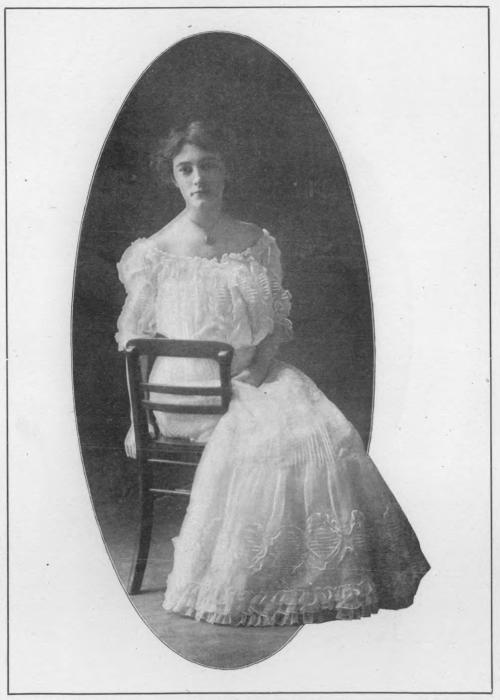
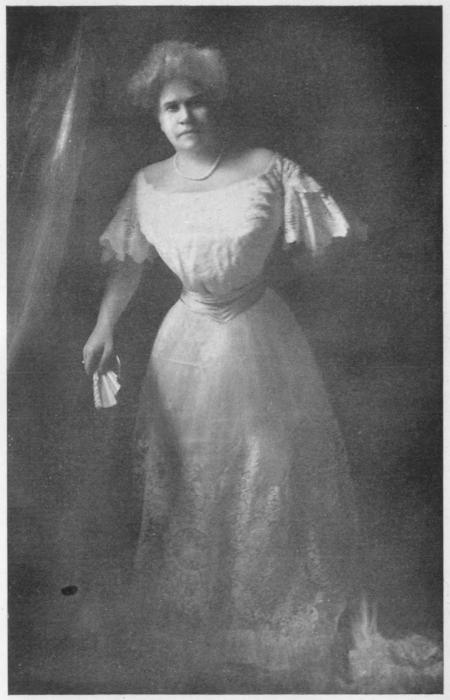
MISS ALETHA VARDAMAN
Daughter of the Governor of Mississippi
Sweeney, Jackson
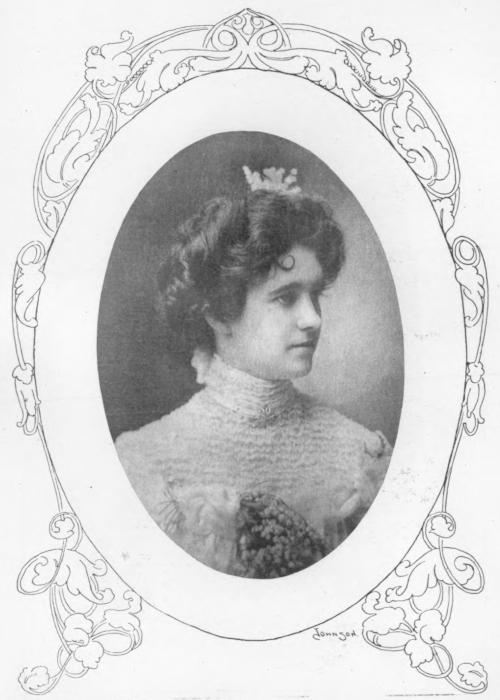
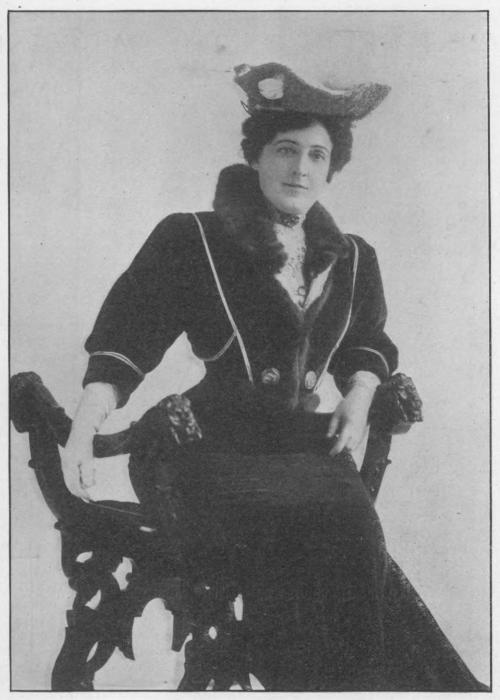
MRS. J. C. W. BECKHAM
Wife of the Governor of Kentucky
G. B. Waggener, Philadelphia
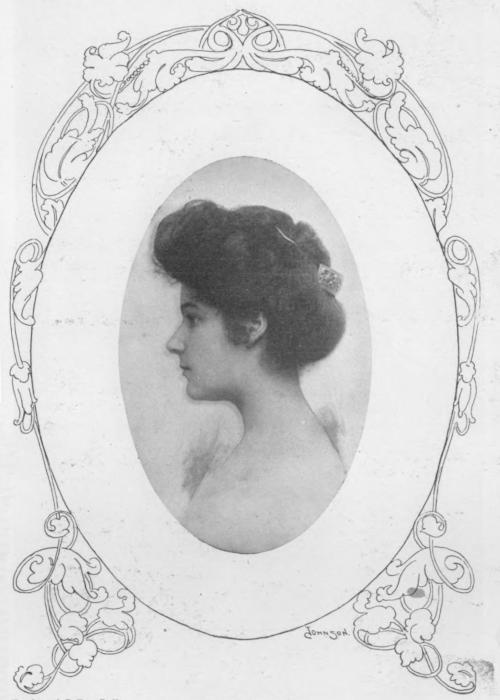
MISS EULALIE GORMAN
Dallas
Voorhees & DeVoe, Dallas
MRS. THEODORE PERRY SHONTS, OF WASHINGTON
MRS. WILLIAM ATKINSON JONES
Warsaw, Virginia
AUNT HETTY ON THE “WET AND THE DRY”
By Louise Clarke Pyrnelle
[The editors feel that they will not be treating their readers fairly
unless they call especial attention to this picture of Alabama negro life
and the unusual cleverness of the dialect.—Editors Taylor-Trotwood.]
The town of Luckville
had been from
its very beginning
“wet;” that is, there
had always been a
saloon or “doggery,”
at which whisky
could be bought by
the pint, quart or gallon.
But the discovery
of phosphate beds in the river near
town had brought in a number of
new residents, many of them “temperance
folks.” So at the next election
the town voted “dry,” and no
liquor could be bought there except
from the drug store by a doctor’s
prescription.
This law remained in force for three
years, and now, on the verge of another
election, the opposing factions
were busily and earnestly at work for
their respective sides. It was at this
time and under these conditions that
Aunt Hetty began loudly to proclaim
her opinions on the “wet and the
dry.”
“Humph! De whi’ fo’ks is all de
time er-gittin’ up some kin’ er ructions
er nuther ’long uv deyse’fs! Dat’s
des whut mek me say whut I does—dat
de whi’ fo’ks is de cuttin’upist
an’ de gwineonist fo’ks dat de good
Lawd evah made! Dey’s er-votin’,
er dey’s er-fightin’, er dey’s er-co’tin’
up teh de cote-house, er dey’s er-doin’
sump’n er-nudder dat-a-way de whole
indurin’ resistunce uv dey time! Now
dey’s ’scussin’ uv de ’wet an’ de dry’!
Humph!
“Hit’s all one teh me! I knows I
ain’t er-gwine teh hab no bar-room
mahse’f, an’ I ain’t er-gwine teh
pestah nobuddy frum habin’ er bar-room
ef dey wants one. Dat’s des
perzac’ly whar I stan’s.
“I done seen de wuckin’s uv de bar-rooms,
an’ ergin, on de yutheh han’,
I done seen de wuckin’s uv de drug-sto’.
I done study uv ’em bofe thu’
de ’newvehmunts uv dat ole niggah
Pomp, whut nomuhnates hisse’f
mah husbun’—do’ I ain’t nevah seen
no mighty ’mount uv husbun’ ’bout
him. He’s des er lazy, biggity, ornerary
ole black niggah, whut got
hisse’f tied up in de bon’s er macremony
des feh teh git his vittles an’ his
lodgmunts. But he done bin er-livin’
er-long uv me now er-gwine
on a mighty heap uv yeahs, an’ I got
so used teh see him er-hangin’ ’roun’
mah house tell hit ’pyears lak I cyarn’
do bedoutin’ him—lak sump’n’s er-missin’
ef he ain’t dar.
“But ’scusin’ all dat, he sho’ is de
ontemperatist man, white er black,
dat evah wuz bawn! He des natch’ly
bleedged feh teh drink ef he knows
dar’s enny kin’ uv liquidmunts er-roun’!
W’en de whi’ fo’ks had de
bar-rooms ole Pomp he got pow’ful
pyeart! He tuck’n tuck my ax an’
went all er-bout er-splittin’ an’ er-cuttin’
up wood—but de Lawd knows
he ain’t nevah cut an’ split none feh
me! An’ den he digged in de blossom
patches feh de whi’ fo’ks. An’
let er-lone all er dat, mah hens got
teh doin’ mighty cur’s—dey’d cackle
lak dey wuz er-layin’ pow’ful, but I
nevah could fin’ de fust rudemunts
uv er aig. I mought er done a onjustice
to de po’ ole niggah, but I
’spicioned him ’caze I hearn tell uv
him er-sellin’ aigs, an’ hit don’t ’pyeah
natch’l feh er man teh sell aigs w’en
he ain’ got no hens uv his own feh
teh lay ’em. Dem two ingrejunces—hens
an’ aigs—des ’pintedly b’long to
one er-nuther. Ef you got hens
you’ll git aigs, an’ ef you ain’t you
won’t. Dat is, not natch’ly! Uv
co’se dey is shawt cuts you kin take
feh to git ’em, an’ I ’spicioned mah
ole man uv takin’ dem vehy cuts—an’
mah aigs wid ’em.
“Well, dem an’ his wuckin’s fotch
him in a little sal’ry, an’ evah night
he’d go teh de bar-room. Ef he had
fo’ bits he’d buy er fo’-bit bottle; ef
he had two bits he’d buy er two-bit
bottle; so, ’cordin’ teh his bits wuz
de size uv his bottle. Den he’d stan’
er-roun’ an’ tell his ’speriunces an’
notate his tales, an’ sing his chunes,
an’ de gen’l’mun would treat him to
beeh an’ segahs. An’ des es long es
dat bar-room stay open, ole Pomp,
he’d stay dar. An’ evah night hit wuz
de same thing! Evah regitimate
cent Pomp could scrape up stopped
slap dar in dat bar-room!
“So I wusht teh de Lawd de whi’
fo’ks ’d shet up dem bar-rooms, an’
bless de Libbin’ Goodness, dey tuck’n
done dat vehy thing!
“Den dey made de law dat nobuddy
could git er drink ’ceptin’ ef dey wuz
sick an’ had de doctah’s subscription
feh teh git it by. W’en dat ole Pomp
got er clear ondehstan’in’ uv dat ’ar
law he des hump hisse’f! De niggah
wuck so hahd an’ step er-roun’ so
pyeart, an’ look so ’ligious-minded
dat I got mighty holped up erbout
him. But, umph-umph, honey, dat
ole niggah, he sho’ sly! W’en Sat’d’y
night come he ties er hank’cheh ’roun’
his ole jaws an’ gits him er stick an’
limps up teh de drug sto’. W’en de
doctah notice him he say, ‘O-o-oh,
Lawdy-Lawdy,’ lak he mos’ daid.
An’ de doctah ax him, ‘Whut’s de
mattah wid you, Uncle Pomp?’ An’
dat weekid ole Christyun niggah,
whut’s es strong es er natch’l bawn
oxen, he ’lowed, ‘O-o-oh, Lawdy, doctah,
I feels pow’ful bad, thank Gawd!’
‘Whut seem teh huht you now?’ sez
de doctah, an’ ole Pomp ’spon’s back
teh him, ‘Well, suh, I don’t perzac’ly
know des whut it is. I got er miz’ry
in de off side, an’ I’se afeerd I’se
busted de rim outeh mah stomach. I
knows I got a achin’ in de pit uv mah
back, an’ mah livah’s all gummed up!
An’ dis laig—o-o-oh—hit seem lak
hit ain’t hung right er sump’n—hit
ain’t plum, somehow. So I thought
I’d ax you ef you’d be so onscruperlous,
suh, as teh gib me er subscription
teh git a drap uv whisky teh rub
on intun’ly, suh, on dese stiff ole
j’ints uv mine, ef you please, suh.’
“So dat ole backslidin’ niggah, he
wuck on de doctah’s symphonies tell
de doctah gib him de subscription, an’
he gib de doctah fo’ bits. An’ on top
uv dat he hatter gib er dollar an’ er
quawteh fo’ de vehy same kin’ an’
same remount uv whisky dat he git
frum de bar-room feh fo’ bits befo’!
Lawzy, chillun, hit wuz des lak I bin
er-tellin’ you! An’ evah week hit
wuz de same prefawmunts tell hit set
me teh studyin’. An’ I done ’pintedly
come to dis ’clusion, dat ef er man is
got teh hab whisky—des natch’ly
boun’ an’ ’bleedged feh teh hab it, hit
don’t mek much diff’unce whedder it
come frum de bar-room er frum de
drug sto’. An’ ef dey calls de bar-room
de ‘wet’ an’ de drug sto’ de ‘dry,’
den de mos’ diff’unce is ’twixt an’
’tween er dollah an’ six bits—countin’
de subscription—an’ fo’ bits. So I
tells you dis, honey, w’en it comes to
bar-rooms an’ drug sto’s hit’s des nip
an’ tuck—mos’ly tuck.”
MY LOVE
By LILLIAN WESTER
You have been mine, O Love!
One fair, sweet day;
Last night you left the courts of men
And passed my way.
I did not ask, O Love!
In wish nor prayer,
For one so strong, so wholly good,
To think me fair.
I did but hope, O Love!
From humble sphere,
To sing one song so true that you
Might pause to hear;
Might pause, and find, O Love!
That path more sweet,
When Chance should bring you once again
Where strayed my feet.
But then you came, O Love!—
’Twas night with me—
You smiled and drove the shadows far,
And I could see.
You took my hands, O Love!
And with your eyes
You looked my soul away from me
To where yours lies.
I weep, my Life, my Love!
But then the tears
Are for the days before you came,
Not coming years.
You came, my King, my Love!
And in your eyes
I lost the fear of days, and found
A Paradise!
OLD HICKORY
BORN AT WAXHAW SETTLEMENT, MARCH 15, 1767
DIED AT THE HERMITAGE, JUNE 8, 1845
By Robert L. Taylor
The most noted character in
American history, one whom
the coming ages will number
among the truly great, was born at
a point so obscure that its exact location
is still in dispute. On the remote
frontier of the Carolina colony,
whose boundary lines were uncertain;
far up on the forest-clad banks of the
Catawba, whose slopes were just beginning
to feel the pioneer’s axe; on
the fifteenth day of March, 1767, Andrew
Jackson was presented to humanity.
The story of his mother partakes
of the tragic, the heroic and the pathetic.
The daughter of a fairly prosperous
linen weaver of Carrickfergus,
she linked her destiny with young Andrew
Jackson, a Scotch-Irishman,
and, after a few years at home, they
left the shores of the Emerald Isle,
seeking fortune in the new colonies.
Scarcely had they fixed their abode
in the Waxhaw Settlement and begun
to make a home, when death
claimed the young husband, and the
bereaved widow was left almost destitute,
with two young sons, Hugh
and Robert, her sole dependence.
Within a few days Andrew was born,
and necessity forced her to send her
eldest son, Hugh, to live with a relative,
while she and the two younger
made their home with another.
Here in the primeval forests young
Andrew began to imbibe that love of
liberty which fitted him later so to
bless humanity. His education was
obtained in the old field school, but,
impatient of its restraints and loving
best the rifle and the chase, he spent
the earlier years in developing the
sinews of a vigorous manhood.
When yet a mere lad the sweep of
the Revolution reached the Waxhaw
Settlement, and Mrs. Jackson willingly
gave her two older boys to the
service of the colonies, but clung to
her youngest born until the insult of
a British officer gave intensity to an
inclination that was destined to cost
England so dear.
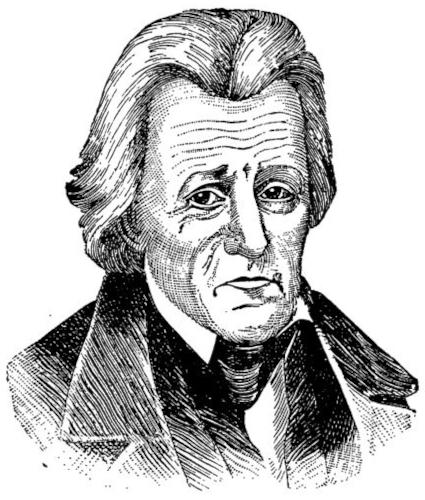
OLD HICKORY
Peace found young Andrew bereft
of mother, brothers and worldly inheritance,
but with a vigorous constitution,
a chivalrous sense of moral
duty and a deep, abiding love for his
country, he set out resolutely upon
an unexampled career, the chief characteristic
of which in earlier years
was reckless daring, in which he was
unconsciously laying the foundations
for that intrepid adherence to right
principle that later set him apart and
above his fellows. Of uncommon
mental endowment, he easily acquired
such education as was then
obtainable and adopted the profession
of law, and when but twenty-one
years of age he fell in with the adventurous
spirit of the times on the
frontier and made his way with the
pioneers into the Southwest Territory.
After lingering in the Watauga
settlements a time, he followed
the trail still farther into the wilderness
until he reached the beautiful
basin of the Cumberland, where he
took up his final abode.
There, from the first, he took his
place easily and naturally as a leader
of men and began to work out that
great destiny which will link his name
indissolubly with liberty and free
government as long as men love to
be free, the symbol of the soundest
and strongest fundamental principle
in government ever conceived by man.
Measured by the moral standards
now obtaining, many of his acts and
habits in those earlier years cannot be
justified, although there is little to
indicate that they were held to be
reprehensible then. His chief characteristic
was towering and intolerant
mastery of men, his greatest foible
was his love for a race-horse, and he
left nothing further to be done in
following both bents, and yet he was
actuated in everything by the highest
conception of honor and principle,
and imparted dignity and the virtue
of his own indomitable character to
every transaction in which he engaged.
The annals of men do not afford,
and fiction has never conceived, an
instance of more sublime devotion to
womanhood than Andrew Jackson
held for his wife. He loved her with
an intensity of tenderness that was
the exact antithesis of that fierce and
stormy love of adventure and aptitude
for arms that possessed him; and
if nothing else were known of him
but this, it would enshrine his name
forever. She could not have been
less than a charming, loving woman
to have deserved the devotion of such
a man and held it to the end, and she
sleeps now by his side under a slab
inscribed with a tribute by his hand
that for entreating tenderness of sweet
affection is scarcely paralleled:
“Here lie the remains of Mrs. Rachel
Jackson, wife of President Jackson, who
died the 22d of December, 1828, aged 61.
Her face was fair, her person pleasing,
her temper amiable, her heart kind; she
delighted in relieving the wants of her
fellow-creatures and cultivated that divine
pleasure by the most liberal and unpretending
methods; to the poor she was a
benefactor, to the wretched a comforter,
to the prosperous an ornament; her piety
went hand in hand with her benevolence,
and she thanked her Creator for being permitted
to do good. A being so gentle and
so virtuous, slander might wound, but
could not dishonor. Even death, when he
tore her from the arms of her husband,
could but transport her to the bosom of
her God.”
Jackson’s character as a warrior
and a statesman are so conspicuous
as to dwarf by comparison his record
as a lawyer. It is said that he filed
seventy lawsuits for clients in the first
month of his practice, and that out of
one hundred and ninety-two cases before
the court in 1790 he was counsel
in forty-two. Three years later his
cases numbered seventy-two out of
one hundred and fifty-five, and the
next year he increased this to two
hundred and twenty-eight out of three
hundred and ninety-seven. It was no
inconspicuous lawyer who could make
such record as this. But for his
other resplendent traits, his reputation
as a jurist might rest more securely,
but it doubtless suffered much
by his own indisposition to build his
fame upon it.
He was only eight years in Tennessee
before being made Major-General
of militia, which in those
times meant active service in the field.
His career as a soldier needs scant
recapitulation here to establish the
statement that it was characterized by
a most unselfish patriotism. He hesitated
at nothing when his country’s
interests were in jeopardy, creating
opportunities and anticipating the
power to meet them, daring even to
invade a friendly territory, to disobey
superior orders, to take fate and destiny
in his own hands at any peril to
himself.
It was this same unchanging, unconquerable
spirit of invincible daring
that characterized his administration
of the government and nerved him to
defy and conquer the money power
that was then dominating the country
through the United States Bank and
gave him power to meet and quell the
turbulent and dangerous doctrine of
the right of a state to nullify a proper
act of Congress.
The most conspicuous service rendered
to mankind by Andrew Jackson
was the creation and enforcement
of the political cult that is expressed
in his name. “Andy Jackson Democracy”
has no mere partisan significance,
but it denotes a principle and
power in popular government that
is to save to America forever the right
of the people to rule themselves—the
invincible strength of a central government
based upon the supreme
power of the separate states acting in
harmony.
What was the secret of Jackson’s
power? Whence came the attraction
that drew men to him as the magnet
draws the needle? It is not difficult
to find the secret of his popularity
with the pioneers. He appealed to
them through his devotion to the
“sport of kings,” for no man loved a
fast horse or would risk more upon
its prowess than he, and he led the
sport in which the people most delighted.
And then he stood first in
all the feats of daring to which
frontiersmen were addicted—a perfect
shot, swift of foot, a mighty
wrestler, capping it all off with a spirit
of chivalrous gallantry and a gentlemanly
bearing that rendered him superb.
But what drew the sage of
Monticello to him? What gave him
such mastery in statecraft and
charmed men to his standard? It was
his inherent, unswerving love of human
liberty, his tense loyalty and
stern faith in the institutions of his
country, his immaculate conception of
right and duty, and the superb fearlessness
that possessed him, that made
the man convincing.
It is said that Jackson has more biographers
than any other national
character. His career was so replete
with incidents inviting interpretation
that writers are drawn to it like flies
about the sugar-bowl. Of no other
man can historians resort to panegyric
in substitute of statement and be
justified by public criticism. There
are perhaps more anecdotes told of
him than any other public man, and
never one that does not denote courage
and power and strength. Indicative
of his intuitive powers of quick
decision is the story that when the
subject of a site for a new treasury
building to replace that burned by the
British was broached one day, he was
walking on Pennsylvania Avenue.
With instant emphasis, he struck his
stick upon the ground and said: “Put
it here!” And there it stands to-day.
No man has lived who had a simpler
human way of loving his friends
and hating those who hurt him than
Andrew Jackson. His fiercest wrath,
however, was reserved for those who
dared traduce his wife. In his Florida
campaign, when supplies failed the
army, he set the example of eating
nuts and roots and berries. One of
his friends at the other end of a long
table at a barbecue became involved in
a difficulty, which Jackson no sooner
perceived than he cried, “I’m coming!”
and, mounting the table, strode
its full length to the rescue. He was
singularly tender to little folks. How
touching is the picture of this grim
warrior, the seasoned duelist, the fierce
hater, tenderly wrapping a sugar-rag
for a ragged papoose found in a Creek
village after a battle, and nursing it
until he could send it to a friendly
woman in Montgomery! Such was
his hold upon the affections of his
people that a certain traveler, reaching
a Tennessee town the day after
he was elected President, found the
populace engaged in applying tar and
feathers to two reckless burghers who
had dared to vote against the General!
And there is still a happy valley
somewhere in remote Arcadia, we
are told, where the old men hobble to
the polls quadrennially in November
and cast a loyal vote for “Andy Jackson.”
His faculty for remembering faces
and names was marvelous. In 1832,
returning from Washington to Nashville,
he was tendered a reception at
Cincinnati. A rough-looking fellow
was seen trying to make his way past
the reception committee. The General’s
keen eye spied him and at once
he darted forward. “Hello, Ned!”
was his hearty greeting, and, turning
to his bewildered committee, he explained:
“One of my old boys in the
Fourth Infantry, gentlemen—had to
release him from the guard-house
once or twice for fighting or stealing
chickens, but he was a good soldier,
gentlemen.” “How long since you
have seen him, General?” asked one
of the committee. “Oh,” was the
matter-of-course answer, “it’s about
twelve years. I saw him on guard at
the Governor’s house the day I left
Pensacola.”
Early in the spring of 1845, after
his arduous campaign in Polk’s behalf,
General Jackson’s health began
to fail. He met the idea of death with
that same fortitude which nerved him
when a lad of thirteen to suffer a
sabre cut rather than black a British
officer’s boots.
His career, which had been like the
blaze of the sun in the fierceness of its
glory, melted into a passing away as
tranquil as a summer evening. The
majestic energy of an indomitable will
gave way to the gentleness of a heart
rich in the tenderest affections. No
man in private life more completely
possessed the hearts of all around him;
no man ever retired from public life
with more complete mastery of the
affections of the people. No man was
more truly and typically American in
his ideas; no man expressed them
more boldly or more sincerely. He
was always, under all circumstances,
wholly sincere and true. I cannot do
better, in closing, than to quote from
George Bancroft, the historian.
“Up to the last,” he says, “he dared
do anything that it was right to do.
He united personal and moral courage
beyond any man of whom history
keeps the record.
“Before the nation, before the
world, before coming ages, he stands
forth the representative, for his generation,
of the American mind. And
the secret of his greatness is this; by
intuitive conception he shared and
possessed all the creative ideas of his
country and his time; he expressed
them with dauntless intrepidity; he
enforced them with an immovable
will; he executed them with an electric
power that attracted and swayed the
American people. The nation, in his
time, had not one thought of which he
was not the boldest and clearest expositor.
“Not danger, not an army in battle
array, not wounds, not widespread
clamor, not age, not the anguish of
disease, could impair in the least degree
the vigor of his steadfast mind.
The heroes of antiquity would have
contemplated with awe the unmatched
hardihood of his character; and
Napoleon, had he possessed his disinterested
will, could never have been
vanquished. He conquered the wilderness;
he conquered the savage; he
conquered the bravest veterans trained
on the battlefields of Europe; he conquered
everywhere in statesmanship;
and when death came to get the mastery
over him, he turned the last
enemy aside as tranquilly as he had
done the feeblest of his adversaries,
and passed from earth in the triumphant
consciousness of immortality.”
Notwithstanding the fact of his incomparable
successes at the bar, on
the bench, in Congress and on the field
of battle, which demonstrate his sense
and genius, and although his state
papers compare well with those of any
President, there are yet those living
who believe him to have been illiterate.
If Colonel Colyar’s masterly “Life
and Times of Andrew Jackson” had
naught else to commend it, it would
deserve the commendation of the
American people in its complete
refutation of the charge of illiteracy,
all-sufficient and incontestable.[2]
His faithful old body-servant remained
at the Hermitage and kept his
grave green through all the years, and
to all visitors who came he talked
about “de Gin’ral” as though he were
still in the flesh. The story is told that
soon after the death of Old Hickory
a visitor asked old Alfred if he thought
General Jackson went to heaven.
“I don’t know, boss,” promptly replied
the old man, “whether de Gin’ral
went to heben or not, but dar’s one
thing I does know—he did if he
wanted to!”
[2] Life and Times of Andrew Jackson. By A. S. Colyar, Nashville: Marshall and Bruce.
DALE’S HIGHLANDERS
By Captain H. W. Carpenter United States Marine Corps
One of the finest examples of
what discipline can do in affecting
the conduct of soldiers
and others whose lives are passed
amid dangerous surroundings, is furnished
by the charge of Dale’s Highlanders
at the battle of New Orleans,
January 8, 1815, just ninety-two years
ago.
In order to understand just what
this charge meant to the brave Scots,
it is necessary to summarize briefly
the events which preceded the memorable
battle, a fight which, as one of
General Andrew Jackson’s cannoneers
expressed it, “was lost before the
fighting began,” for a peace was
signed while the preliminary movements
were going on.
A powerful British fleet with a large
military force under Sir Edward Pakenham,
brother-in-law of the Duke of
Wellington, sailed from the West Indies
to attack New Orleans and arrived
in Lake Borgne about December
twentieth, 1814. The small American
flotilla which opposed their landing
was destroyed, and the troops disembarked
on Pine Island.
Finding themselves in a swamp, the
British floundered through the mud
until about nightfall of the first day
of the advance, ground suitable for
a bivouac was discovered near the
Mississippi River, and not far from
the position along the Rodriguez Canal,
which had been selected by General
Jackson for the defense of the
city. Here, behind hastily constructed
works of mud and cotton bales,
were drawn up the defenders, composed
of a few United States regular
artillery, volunteers from New
Orleans and Kentucky, many of the
latter unarmed; a force of pirates and
smugglers from Baratara Bay, under
their captains, Dominique and Beluche;
and last, but not least, about
twenty-five hundred backwoods riflemen
from the Cumberland Valley, in
all not above thirty-two hundred men.
Hardly were the invaders established
in their bivouac before they
were rudely disturbed by a night attack
from the Americans, during
which they, for the first time, discovered
the prowess of the backwoodsman
and his long rifle, and during the
short fight which followed lost two
hundred and thirteen killed and
wounded, and seventy captured.
Reinforcements, which increased
their number to thrice that of the
Americans, having arrived from the
fleet, the invaders remained in or near
their bivouac until the morning of
December thirtieth, 1814, but never
for a moment were they permitted to
be at peace; for by day their hiding
places were sought out by the guns
of the gunboat Carolina, at anchor in
the river, and as soon as night enfolded
them the backwoodsmen took up
the bloody work. Sentries were shot
down as they walked their posts, and
to enjoy the warmth or light of the
camp fire was but to court almost certain
death from the unerring rifles.
Knife and tomahawk also played their
parts, until the harassed British were
not only panic-stricken at the swift
death which overtook so many of
them, but bitterly complained of the
uncivilized methods of their adversaries.
The situation became so serious that
Sir Edward himself came up from the
ships to take over the command from
General Keane, and plans were at once
perfected to relieve matters by attacking
the troublesome enemy. The
commander in chief could not be made
to believe that there was anything to
be feared from backwoodsmen and untried
militia when they were confronted
by the pride of the British army in
battle formation.
The Americans had been very busy
with their works in the meantime, and
had also mounted thereon five small
field pieces, so that when, on the morning
of the fourth day after Sir Edward’s
arrival, a force of about two
thousand men advanced to storm
their position they were ready and met
the adversaries with such a storm of
well directed lead and iron that they
were repulsed, and being unable to
withdraw from the field sought shelter
in the ditches and drains until,
under cover of darkness, they were
able to retreat, leaving over one hundred
dead upon the field.
Sir Edward had become convinced
that these men behind the mud walls
were something different from the
militia he had been accustomed to denounce,
and therefore called a council
of war and erected a battery composed
of sugar hogsheads, mounting
thirty-five guns within a third of a
mile from General Jackson’s works.
The attack was then renewed, but it
was a repetition of the first one, so
far as results were concerned, for the
infantry were repulsed and the battery
with its thirty-five guns completely
dismantled. The British loss in this
attack was eighty-odd killed and
wounded, beside the thirty-five guns.
Reinforcements again arriving from
the fleet. Sir Edward, furious and
chagrined, determined, for his honor
as well as for his safety, to renew
the assault with such a force as would
overwhelm the militia by mere weight
of numbers, if nothing else, and therefore
remained inactive for eight days
in order to allow his men to get over
the ill-effects of the two former failures,
and to bring up every available
man for the final effort.
On the morning of January 8th
the British were early astir, and it
was soon discovered from the American
lines that the enemy was about
to deliver his assault in three columns.
General Keane’s Foot and Colonel
Rennie’s Rifles formed the left of the
British line; General Gibbs, with
three thousand Peninsular Veterans,
the right; Dale’s Highlanders, nine
hundred and fifty strong, the center,
and a force of about two thousand
foot, under General Lambert, as a reserve—in
all, about eighty-five hundred
men.
Over them all hung a silence as of
the grave, for none knew better than
these men that they were about to
march to almost certain death at the
hands of the backwoodsmen and their
long rifles. At break of day, by rocket
signal, the columns moved into position;
but some plantation buildings
which concealed the advance of the
Rifles having been set on fire by the
American guns and the attack unmasked,
Colonel Rennie promptly ordered
a charge, for he had already
been discovered by Commodore Patterson
in the Louisiana, whose guns
were decimating his ranks. The riflemen
were immediately met by such
a hail of bullets and grape from the
breastwork guns and the backwoods
rifles that they hesitated, halted, and
the few that remained erect finally
sought safety in flight, leaving General
Keane, Colonel Rennie, and two-thirds
of their number killed or
wounded on the field.
Owing to some misunderstanding,
the attack of General Gibbs’ column
was delayed, but, after some hesitation,
advanced to within one hundred
yards of the works, where they were
met by such a storm of American lead
as to kill General Gibbs and to cause
his men to melt away like snow before
the summer sun.
Word of all this came to Sir Edward,
who was with the Highlanders,
and Colonel Dale was at once
ordered to advance ahead of the wreck
of General Gibbs’ force, which command
was at once obeyed by the Scots,
who started forward steadily and with
bagpipes playing, only to be engulfed
in the rout of the comrades in retreat.
Colonel Dale was killed, Sir Edward
Pakenham fell pierced by three balls,
and, as all that remained of the other
columns were in retreat, the fight was
lost beyond repair.
The brave and thoroughly disciplined
Highlanders alone remained.
They could not advance, they would
not retreat, so they remained where
they were, under the galling fire of
the long rifles, until out of the original
nine hundred and fifty scarce four
hundred remained alive and erect.
Lieutenant Lavack achieved the distinction
of being the only Englishman
over the walls that day. The remaining
Highlanders surrendered and
no hostile British soldier remained
upon the field. The fight was short,
sharp and decisive, lasting but thirty
minutes.
General Lambert, with the reserves,
did not come within range, but of the
six thousand British actually engaged,
two thousand one hundred had
fallen—more than one in every three.
Of the fourteen hundred wounded,
six hundred died within the week.
Seven hundred and thirty dead were
buried where they fell.
The American loss was only eight
killed and thirteen wounded by artillery
fire. The British retreated to
their ships and sailed away, and New
Orleans was saved, but discipline only
could have caused that magnificent
charge of Dale’s Highlanders at a
time when they very well knew the
battle was lost and the way in which
they were to go was strewn with the
bodies of those who had gone before.
THE FALSE FRANCISCO
By William A. Branan
Jones felt bad about it. Demurely
distant, she sat in the
patio of her father’s casa, black
of eye and red of lip, the most interesting
sight he had seen south of
the Rio Grande; and not a decent
word could he say to her in her own
language.
For Jones had never been in Mexico
before—nor did his course at Columbia
embrace the study of Spanish.
Had his knowledge of baseball,
football and highballs been a source
of honor, no doubt he would have
graduated at the head of his class;
but to his everlasting shame be it said,
he was sadly deficient in the languages.
So he gave vent to a few remarks of
some warmth—in English, of course,
confident that the little señorita would
not detect the quality of his foreign
expressions.
Now, Jones was not in Chihuahua
for his health, either in the strict or
common usage of the word; in fact,
his shoulders were rather broad for
his height, and the healthy color of his
cheek carried no sign of affliction.
And as for the other use of the word,
Jones had departed from his home in
the States with ease and without undue
haste—nor had a description of
his person been wired to the Mexican
officials on his departure.
But Jones was a tourist in the truest
sense. He had nowhere in particular
to go, and he took his time to get
there. In less than three days after
his arrival in Chihuahua he was worse
than a peon about the sunny side of
the house; in less than a week he had
caught the spirit of mañana and could
lie like a native when the occasion required;
in truth, he was an idler in an
idle land.
After a few days in Chihuahua
Jones had secured apartments at a
Mexican hotel of the smaller sort, the
better to get in touch with the language
and customs of the people as
soon as possible. His landlord was
one of the wiry, working class of
Mexicans, with a genial smile that
never called for less than un peso;
but it was the landlord’s dark-eyed
daughter who caught the eye of Jones.
Now, she was seated on one of the
long, low benches in the patio of her
father’s hotel, her head slightly
shaded by the flowers and foliage behind
her, while the sun streamed in
spots and showed the clear color of
her face and hands. Jones thought
he had never seen anything quite so
charming as the play of sunshine and
shadow—and the pretty head with its
black lace mantilla. But how was he
to express emotion? or admiration?
or anything? Certainly not in Spanish—if
so, it must of necessity be a
brief and painful expression.
Still, Jones was of a sturdy New
England stock that had despised difficulties
as far back as the Mayflower,
and was not to be deterred by the lack
of a common medium. He cleared
his throat, shuffled his feet so as to
attract attention to his maneuver and
crossed the patio to where she was
seated.
“Do you habla English, señorita?”
he began, bravely enough.
“No, señor,” she said, with a demure
droop of the eyes and a little
smile.
“The deuce you don’t!” he started
to ejaculate, but wisely refrained,
aware that its appropriate application
would hardly appeal to her. Instead,
he began again: “Ahem!—perhaps—er—I
might hablo Spanish, then: no
sabe mucho myself,” he added, as if
with a sudden inspiration.
But the maid merely tapped the
stone floor with a small slipper to the
distant music of a band in the plaza
around the corner, and made no effort
to help him in his dilemma, though
she sent him a smile of reassurance
when he flushed and made a move to
withdraw.
And then a glorious idea occurred
to Jones. There was Francisco, the
remarkably radiant Francisco, all
smiles because of his connection with
the casa! Francisco was not only
chief cook, but enjoyed the distinction
of serving his own dishes in the dining
room—and washing them afterwards.
Jones remembered with satisfaction
the smattering of choice English,
with a French flavor, that Francisco
was wont to perpetrate on the guests
of the house. Francisco’s English
was bad enough, thought Jones, but
not quite as bad as it might have
been—especially in those lucid intervals
when he was anxious to see if the
Americano’s purse-string pulled con
mucho gusto. Certainly Francisco
should be given a chance; he should
act as interpreter; he should tell the
señorita what he (Jones) thought of
her, and perchance he (Jones) might
find out what she thought of him.
“Eet ees that the señor weeshes
that I make the speech for heem?”
Francisco inquired, with a polite shrug
of the shoulders, when Jones explained
to him the emergency of the
situation.
“That’s just it,” Jones answered;
“you see, neither of us understands
the other, and—well, I rather like her
looks, you know, Francisco. Sabe?”
“Si, señor,” and Francisco cleared
away the remainder of a highly seasoned
supper—then the two left the
dining-room together. There were
no longer any sunbeams to bring out
the beauty of the flowers in the patio;
but the landlord’s daughter was still
sitting there in the twilight.
“Señorita—” Francisco paused with
eloquent eyes, then turned to Jones
for further instructions.
“Tell her,” said Jones, in a hoarse
whisper, “tell her that she’s the most
exquisite—no, no, don’t tell her that—tell
her that she will catch cold out
here in the patio,” he stammered.
“Señor, the señorita will run far eef
you espeak like that,” Francisco remarked,
with a deprecatory gesture of
his brown hands.
“Well, tell her that I am delighted
to see her looking so well,” was the
next effort of the persistent Jones.
“But yes—that ees more well.”
Then Francisco turned to the daughter
of the house, indicated Jones with
a curve of his thumb and spoke rapidly
in Spanish. It might as well have
been Dutch for all the good Jones
got out of Francisco’s enthusiastic expressions.
But the señorita smiled
sweetly enough, and gave a glance
from under her long lashes that was
worth a world of trouble to Jones.
“A-ha!—we’re coming on, eh—Francisco?
Now, tell the young lady
that I—that she looks like a lovely
little—er—rosebud.”
Again Francisco jabbered eloquently,
eyes, hands and tongue making
his meaning clear, apparently, for
the señorita shyly drooped her head
and replied coyly.
“Tell her,” prompted Jones, devouring
the star-like face, set in its frame
of jetty ringlets, “tell her I am going
to walk around the plaza. Ask
her if she is going.”
“She says she cannot to go this
night,” was the translation he received.
“She ees painful.”
“Well—er—tell her—er—”
“That you go to dream of her, you
theenk of her alone only?” suggested
the accommodating Francisco.
“Yes, and—er—tell her that I—that
we—will talk again. Tell her
that—will you, Francisco?”
After Francisco had conveyed this
expression in its proper form, with all
the courtesy of the occasion, the two
retired—Francisco to the cocina,
where the dishes were waiting to be
washed, Jones to promenade in the
plaza and swing his cane to the music
of La Paloma. Visions of further
conversations with the distracting
beauty flitted before him as he strolled
under the orange trees—visions
wherein the useful Francisco figured
not at all; wherein he saw himself
holding a little rose-leaf hand and
uttering sweet nothings which needed
neither bad Spanish nor broken English
for their interpretation.
Jones was shocked, to say the least;
and for a moment he could hardly
catch his breath, much less command
the attention of the lovers. There
they were, two of them—in fact, it
usually takes two to complete such a
scene. The young Romeo was leaning
against the bars of her casement
window, his face upturned to hers;
their hands were clasped through the
grating, their heads were close together,
and every now and then Jones
thought he saw—
It was an ideal scene—to the participants—re-acted
there in the moonlight
from some Shakespearean play,
till Jones rang down the curtain with
a laugh of ominous portent. For one
of the lovers was Francisco and the
other—well, the other was the landlord’s
daughter.
“Hello, there, Francisco, you rascal—what
are you doing there?”
Jones demanded. It was eleven
o’clock and Jones had just returned
from the plaza.
Francisco turned quickly, dropped
the little hand held in his own, said
something of sinister sound in Spanish
which could hardly be translated
into English, then—“Eet ees you, ees
eet, señor?—so surpreesed am I! I—I
was—how the Engleesh?—hold
hands weeth the señorita, ees eet not?”
“It is,” commented Jones, rather
emphatically: “but I would like to
know what right you—you—”
“You see,” interrupted Francisco,
cheerfully conscious that explanations
were in order, “the señorita have made
the promeese to marry weeth me.
We have eengaged—ees eet not?—to
marree us if the papa of the señorita
wills.”
“Ah, I see!” and Jones gave a low
whistle of dawning discernment. Then
a sarcastic smile spread over his face.
“But may I be so bold as to inquire,
Francisco,” he resumed, “what part
you played in that interesting conversation
of ours this evening? Why
didn’t you tell me you were engaged
to her?”
“Eet was thees way, señor. Eet
was the leetle trick of mine to see the
señorita and say the speech for myself.
When you say to me to tell the
señorita that you are delighted to see
her look so well, I say the Americano
ees deelighted to see you look so well,
señorita—and Francisco lofe you!”
“Well, I’ll be hanged! You infernal—”
but Jones checked himself.
“And when the señor say to tell the
señorita that he will be glad to say
the speech some other time, I tell the
señorita that Francisco will be glad
to meet her to-night at her weendow
on the Calle Aldama. For I love the
señorita—ees eet not so, queridita?”
For answer a small hand found its
way through the bars of the window
to the false Francisco, and Jones
heard a low laugh of love and music.
THE STATE HOUSE OF MARYLAND
By George W. McCreary
The most historic building in
Maryland is the State House
at Annapolis, the present one
having been preceded by two
others. The first was built in 1696,
and a curious account of its condition
is to be found in Volume 20, of the
Maryland Archives. This building
had a short but somewhat tragic history.
In the Journal of the House of
Delegates for 1699, it is recorded:
“Memorandum that on thursday,
July 13, about four or five of the clock
in the afternoone a violent flash of
Lightning broke into the State House
at Annapolis, the house of Delegates
being there sitting, which Instantly
Killed Mr. James Crauford one of
the members for Calvert County &
hurt & wounded Severall other members
and Shattered & broke most part
of the Dores and window Cases belonging
to the said house & sett the
said State house on fier in one of the
upper Chambers & Severall other
Damages but the fire was presently
Quenched by the Diligence & Industry
of his Excy. Nathaniel Blakistone
his Majtyes. Govr.”
In the Journal of 1702 it is referred
to as a “Stadt House.”
In 1704 the State House burned
down, but how the fire originated
neither the records nor tradition show.
The second State House was finished
in 1706, and stood where the
present one now stands. It was in
the form of an oblong built of
brick, and entered by a hall, opposite
to the door of which were the judges’
seats, for this building seems to have
been used as a courthouse as well as a
State House. Over the judges’ seats
was a full length portrait of Good
Queen Anne.
A cupola or dome surmounted the
building, and was surrounded with a
balustrade and furnished with seats
for those who wished to view the
scenery.
On the north of this State House
an armory was built, in which the
arms of the Province were arranged,
and when the room was lighted up by
the wooden chandelier, the effect must
have been brilliant.
Portraits of Queen Anne and Lord
Baltimore hung in this room, which
was often used as a ballroom.
On the west stood the famous King
William School, established under an
act of 1696, and afterwards succeeded
by the well-known St. John’s College.
In 1769 £7,000 sterling was appropriated
to erect the present State
House, the corner stone of which was
laid by Governor Robert Eden on
March 28, 1772.
David Ridgely, the annalist of Annapolis,
tells us that “there is a tradition
that on Governor Eden’s striking
the stone with a mallet, which was
customary on such occasions, there
was a severe clap of thunder, although
not a cloud was to be seen, the day
being clear and beautifully serene.”
In 1773 a copper roof was put on,
but was blown off in 1775 during a
violent gale.
The dome was not added till after
the Revolution, and is built of wood.
The height internally to the top of
the dome is 113 feet, externally to the
tip of the spire is 200 feet. The
length of the building is 120 feet, the
depth 82 feet. The architect was
Joseph Clark.
An excellent view of the State
House with grounds, plans, etc., with
surrounding buildings as they then
stood, is given in the Columbian
Magazine for February, 1789.
Its magnificent site, fifty-eight feet
above sea-level, with its simple architecture,
has at all times excited the
admiration of strangers and citizens
alike.
From time to time various additions
have been made, the latest being the
addition ordered by the Legislature
of 1902, in order to accommodate the
General Assembly.
Through the efforts of Governor
Warfield, an ardent lover of all that
is patriotic, the old Senate Chamber
in which Washington resigned his
Commission in 1783, has been restored
to its original condition. The scene
of this act is depicted in the well-known
picture by Trumbull.
The treaty of peace with Great
Britain, and the convention of 1786
were both held in this building, which
is especially sacred to all Marylanders,
on account of the associations which
cluster around it.
CAPITOL, ANNAPOLIS, MARYLAND
MEN OF AFFAIRS
Of the younger classical scholars in
America, one of the best known is
Professor Mitchell Carroll, of the
George Washington University,
Washington, D. C. Mr. Carroll was
born in North Carolina and reared in
Virginia. His father was Rev. John
L. Carroll, D.D., a prominent Baptist
minister. He received the degree of
Master of Arts from Richmond College
at the age of eighteen, being the
youngest student of the college ever
to attain this distinction. After some
experience in teaching, he entered the
Johns Hopkins University for the pursuit
of graduate studies in Greek
and Latin, where he was successively
scholar and fellow, and in 1893 received
the degree of Doctor of Philosophy.
He has since passed some
years in study abroad, one at the Universities
of Leipsic and Berlin, the
others in the American schools at Athens
and in Rome. He was for two
years Professor of Greek in Richmond
College, and since 1899 has been head
of the classical department in the
George Washington University. He
has taken a prominent part in the recent
development of the University,
especially in the promotion of scientific
publications, of which he is Director.
DR. MITCHELL CARROLL
Professor Carroll is also one of the
national secretaries of the Archaeological
Institute of America, and has
traveled extensively in its interests,
founding affiliated societies of the Institute
in St. Louis, Cincinnati, Salt
Lake City, San Francisco and in the
Northwest. He holds membership
in the American Philological Association
and in many other learned societies.
Mr. Carroll is an official in the Calvary
Baptist Church, of Washington,
and is the teacher of the celebrated
Vaughan class for young men, which
is one of the largest and best organized
young men’s classes in the world.
He is also a lecturer and an author.
In addition to his contributions to the
literature of classical philology, he has
published two volumes on the history
of Greek women, and was one of the
editors of the “World’s Orators.”
In September, 1897, Mr. Carroll
married Miss Caroline Moncure Benedict,
daughter of Major E. D. Benedict,
of Brooklyn. Their home, “Belair,”
is in Cleveland Park, one of
Washington’s loveliest suburbs.
Mr. Buffington is an excellent example
of the generation that was born
after industrial conditions in the South
had been altered by the Civil War.
He was born in 1863, in Huntingdon,
West Virginia, his father belonging
to a prominent family there, and his
mother being a member of the Nicholas
family, of Culpeper County, Virginia.
After the close of the war, Mr.
Buffington’s father moved his family
to Covington, Kentucky, and he spent
his youth in that city, studying in the
public schools and at Chickering Institute,
Cincinnati. In the year 1881
he entered Vanderbilt University,
where he remained for two years, returning
to Covington to engage in the
manufacture of wire and nails. Close
application to business, earnestness
and an unlimited capacity for pushing
his work along, built up the business,
and in 1890 his company moved to
larger quarters in Anderson, Indiana.
After eight years of telling work in
this new and enlarged field, Mr. Buffington
was called to assume the directorship
of the American Steel and
Wire Company in Chicago, and a year
later was made President of the Illinois
Steel Company, the largest concern
of its kind west of Pittsburg.
E. J. BUFFINGTON
Mrs. Buffington was Miss Drucilla
Moore, daughter of Judge Laban T.
Moore, of Catlettsburg, Kentucky.
Their handsome home is in Evanston,
where may be found quite a colony of
Kentuckians.
It was eminently fitting that the
most intimate friend of the late Sam
Jones should succeed him as mayor of
Toledo. Mr. Whitlock, while understanding
better than any other man
in Toledo the political beliefs of
“Golden Rule Jones,” is, like him, a
man of marked individuality, and will
not be bound by the traditions of any
man or party. Like Mr. Jones, he
owes his nomination and election directly
to the people and pays no allegiance
to any political machine, boss
or party. Like Jones, his only ambition
is to make Toledo a city where
the Golden Rule is really the governing
principle and not merely an empty
phrase; and to make the men of the
city realize and live up to the liberty
and independence of their manhood.
At the death of Jones, the corruptionists
flocked to the city hall and endeavored
to resume their old-time control
of municipal affairs, but the common
people, whom Jones had taught
to recognize the rights and duties of
citizenship, went unorganized, but
solidly, to the polls and elected Brand
Whitlock.
BRAND WHITLOCK
We know Mr. Whitlock by his literary
work. He has been a newspaper
man for years, and has published three
successful novels—“The Thirteenth
District,” a novel of politics; “Her Infinite
Variety,” and “The Happy Average,”
the last said to be autobiographical.
He is also a lawyer and is
a close student of current affairs. He
is an idealist who believes in the present
fulfillment of his dreams, and believes
that all the problems of life,
whether social or political, depend for
their solution on the intelligence of the
individual. To him the people are the
foundation of public power and public
officials but their hired servants.
He maintains that the people can and
should conduct their own government
without the aid of political machines,
and that representative government
is possible in the present day. His
only message to the people is that the
power is theirs and that they should
never allow any man or set of men to
take it away from them. He makes
no promises, simply pledging himself
to represent the whole people.
There is one thing of which Mr.
Whitlock allows himself to be proud.
It is the Juvenile Court Bill, of Ohio,
which he drew and was greatly instrumental
in having passed by the legislature.
It provides for a separate
court for the hearing of children under
sixteen, and it is Mr. Whitlock’s
earnest hope that a state “junior republic”
may be the final outcome of
the work.
Dr. W. M. L. Coplin is another
Southerner who has attained distinction
in the city of Brotherly Love. He
was born in Bridgeport, West Virginia,
in 1864. He was educated at
Lindsay Military Academy, Fairmont
State Normal School, Mt. Union College,
and later at Jefferson Medical
College, Philadelphia, from which institution
he graduated in 1886. After
practicing his profession for nine
years, he accepted the position of Professor
of Pathology and Bacteriology
in the Vanderbilt University, Nashville,
Tennessee, where he remained
one year. He then returned to Philadelphia
to assume the duties of a similar
chair in the Jefferson Medical College
and to become Director of the
Laboratories of the Jefferson Medical
College Hospital, positions which he
still occupies. He has held professorships
in three medical colleges and a
number of national, state and municipal
positions. For the last ten years
he has devoted his entire time to teaching
and departmental organization, in
which he has shown peculiarly successful
capabilities.
Dr. Coplin is an ardent research
worker, and has conducted numerous
investigations along scientific lines;
his experiments have rendered the
medical world invaluable aid in solving
some of its most difficult problems.
He is a voluminous writer on subjects
connected with Pathology, Bacteriology
and Sanitation, and is widely
known by his contributions to magazines.
The fourth edition of his Manual
of Pathology has just been issued,
and the Manual of Practical Hygiene
is in process of revision.
DR. W. M. L. COPLIN
In November, 1905, the mayor of
Philadelphia bestowed upon Dr. Coplin
the highest honors which his adopted
city could tender a physician—the
appointment of Director of the Department
of Public Health and Charities,
a position for which he is peculiarly
fitted, on account of his rare
administrative qualifications.
Probably the most uplifting tendency
of the times is that looking
towards the nationalization of instruction
in the universities of the chief
countries of the world, shown by the
Rhodes scholarships at Oxford; the
Roosevelt Chair of American Institutions
at the University of Berlin, endowed
by an American banker;
Mr. Stillman’s million-dollar gift to
the Beaux Arts in Paris and the
American Academy of Art at Rome;
the Hyde foundation for Harvard
professors at the Sorbonne; the Baron
de Coubertin’s prizes at Princeton,
Leland Stanford and Tulane Universities;
the Duc de Loubat’s foundation
for the study of American Antiquities
at the National College of France;
and the opening, in the University of
Paris, of a department for the study
of the History and Outlines of American
Law.
CHARLES F. BEACH, JR.
The Paris Law School has five
thousand students—about seven times
as many as our largest law schools—and
they are drawn from every country
in Europe. The effect of such
instruction on such a large and influential
body of opinion can scarcely
be estimated. The lecturer chosen
for this course by the University was
Mr. Charles Fisk Beach, Jr., who had
already discharged similar duties in
an American law school and whose
writings on American economic topics
have been widely quoted. Mr. Beach
was born in Kentucky, fifty-two years
ago, and is a graduate of Centre College.
After completing a law course
at Columbia University he went
abroad and studied at the University
of Paris. He then returned
to his native country and began the
practice of law, paying especial attention
to railway and corporation law,
and acting as counsel for various corporations
and lecturing on Civil Law
and Equity Jurisprudence.
In 1896 he established himself as
consultation lawyer counsel in London
and Paris, this experience further
adding to his fitness for the post to
which he was chosen by the French
university. Mr. Beach’s first year’s
work proved so successful that the
university extended its scope to include
American institutions as well as
the history and general outline of our
legal system. His field of efforts has
been extended also to include alternate
lectures at Paris and Lille the
first half of the term and at Bordeaux
and Toulouse the latter half.
At the time of the great expansion
of American commercial, financial and
political influence in Europe, and especially
just now, when efforts are being
made to induce trading in American
securities on the Paris Bourse and to
influence French investment in America,
this phase of educational reciprocity,
conducing to a better understanding
of our institutions, promotes
the welfare of the world, and particularly
our own special interests
abroad.
INDUSTRIAL EDUCATION IN THE SOUTH — II COLLEGE OF INDUSTRIAL ARTS, DENTON, TEXAS
By Lillian Kendrick Byrn
SPECIMENS IN DRAWING AND DESIGN
The history of a nation is determined
by the home life of
its people. Just as the prosperity
of the individual home depends
upon the efficiency and care of the
partners in its making, so does the
welfare of a nation hang on the ability
and earnestness of the individual
citizens. The rise of our own nation
is due to the determination of our
forefathers to found a government
which, from the national down
through the state, county and city
forms, should be based upon the simple
principles of upright family life.
Our ideas of social life and social
equality could not have been conceived
under the influence of European
institutions. Here, where those
in the humblest walks of life may be
the nobility, and where honor is conferred
for merit alone, we have developed
social customs to correspond
with our American spirit, and, proceeding
on independent and original
lines, we have made our industrial
and commercial system to control the
busiest marts, to break the records of
history, to fairly alarm the world.
The chief element of the American
spirit is the appreciation of high
ideals, not only in the national life,
but in the education, the culture and
the industrial life of the individual.
When we see new openings on already
established lines, it is characteristic
of us as a people to pursue these
openings, even though they lead in
directions directly opposed to those
which we have hitherto followed.
Thoroughness and earnestness are
the keynotes of American progress,
and these are the characteristics
which to-day give us our commanding
position among the nations.
Is it not fitting and necessary that
a nation of such religious, social,
political and commercial originality
and progress should develop co-ordinate
with these a system of education?
The free public school system
is among the purest and most
effectual of our democratic institutions.
It has fostered the American
spirit, it has laid the foundation for
an American culture; it has, in large
part, made possible the present success
in American industrial life.
Although it is many years since the
doctrine of learning through doing
was first promulgated, it has remained
for the present generation to make
the general application. Educators
have been slowly, but surely, arriving
at the conclusion that the university
ideals of Europe, which naturally
dominated our higher educational institution
during the first century of
our history, and which still hold sway
in certain of our colleges, are not
sufficient for our needs. Present-day
conditions demand an education
which will afford culture and practical
preparation for the common
duties at the same time. There
is a loud and emphatic call
for our schools to cultivate
the executive quality in our
young men and women and
to prepare them for immediate,
well-directed action in
the affairs of life. Many of
our states have answered
nobly the call for schools
where boys can be trained
along practical lines which
make for success and usefulness.
Nearly every state has its
Agricultural and Mechanical College.
This is all very well for the boys, but
how about the girls?
In past years institutions which
were organized primarily to meet the
needs of men for their professional
or business training have, largely from
a spirit of chivalry and esteem,
been opened to women. Also, largely
from a spirit of social concern, some
of the best friends of womankind
have, in a degree, popularized the
typical woman’s college. In both
cases much good has been accomplished,
but in neither case have the
needs of the education of women been
fully met. Men’s colleges that have
been opened to women have given
them the same training as is provided
for men, and the majority of the
women’s colleges have patterned their
curricula after the same assumption.
This theory leads women to
contemplate man’s occupations and
professions as their only field of action,
and, while it may be the best
in many individual cases, it does not
provide for the mass of women the
kind of higher education mostly
needed. From a social standpoint, I
believe in the co-education of the
sexes, for education is but a preparation
for life, and it seems the plain
plan of creation for men and women
to mingle, but from a practical standpoint
co-education is not always advantageous,
resulting too frequently,
as stated, in making woman the competitor
of man, instead of fitting her
to work on her own peculiar lines.
BASKETRY WORK BY STUDENTS
The young woman whose education
has been based upon efficient
scholarship, together with domestic
and industrial training of a practical
type, brings into the marriage relation
a comradeship which grows out of
her ability to sustain her part of the
partnership. It is a womanly instinct
to want to enter her legitimate
realm—the home. Equipped with the
training which gives her a righteous
sovereignty, the integrity of that home
is assured. Is it not worth our while
to promote as many such homes as
possible?
What is a rational education for the
home-maker? If the ideal mother
must have, in addition to a literary
education, a knowledge of kindergarten,
general needlework, including
dressmaking, art in at least its elementary
forms, bookkeeping, the
chemistry of foods and practical cooking,
house cleaning, first aid to the
injured and nursing, and yet have the
time and strength to be a comfort and
companion to her husband and a
teacher to her children, is it not asking
too much of women?
The answer is plain. While many
of our household industries must
necessarily be placed in outside hands,
the power controlling these industries
must remain in the hands of the home-makers.
These demands are not more
than a woman can meet, for the same
training that enables her to know all
this teaches her the laws governing
her physical self, how to control and
conserve her energies so that they
may be expended to the best advantage.
It prepares
her for
making and
maintaining
a good home, the
highest and best
profession that
a woman can
enter; and the
mother in the
home, teaching,
as she does, by
precept as well
as by example,
during the greater
part of the
twenty-four
hours, has need
of a scientific
training for her lifelong occupation.
There are many women who do not
surround themselves with the security
of home, there to peacefully work out
life’s problems. Many find it necessary
to enter the industrial and commercial
fields, and a preparation which
commands for these a living salary is
imperative.
Texas, one of the youngest states,
but already outstripping many of her
elders in the spirit of progressiveness,
has taken up the question of the industrial
training of her girls with
characteristic vigor. With a system
of state public schools provided for
by the allotment of public lands, whose
revenues furnish a magnificent school
fund, with a State University in the
first rank among its kind, with State
Normal Schools in every district
whose population warrants it, with an
Agricultural and Mechanical College
second to none, and with manual
training in practice in city schools all
over the state, she established, by an
act of the Legislature in 1901, the
school known as the College of Industrial
Arts. Denton, situated about
midway between Dallas and Fort
Worth and somewhat north of them,
was selected as the site of the school.
The idea met with hearty support all
over the state, and it opened in September,
1903, with one hundred and
eighty-six students, representing
eighty-eight out of the two hundred
and thirty-four counties of the state.
TYPEWRITING.
These girls come from the country,
town and city; from the homes of
bankers, lawyers, real estate men,
mechanics, contractors, stockmen,
teachers, druggists, farmers, ministers,
merchants and physicians. Some are
the daughters of widows and some are
orphan girls. Some have earned, in
whole or in part, the means by which
they maintain themselves, while some
are contributing to their own support
by working while in school. Some of
them entered on teachers’ certificates,
some on high school diplomas, but the
great majority entered on examination.
The student body is not only thoroughly
democratic, but it is composed
of earnest, conscientious, hard-working
students, who appreciate
their opportunity of obtaining a thorough,
practical education.
The college is situated on the outskirts
of Denton, in a campus of seventy
acres of rising ground overlooking
the city and surrounding country.
It is well supplied with large,
shady trees, and is covered with Bermuda
grass. In the rear is a fine
grove of oaks, where it is proposed
to erect additional dormitories and
class-rooms when the financial growth
of the school admits of it. At present
only the main building has been
finished.
GARDENING.
In the basement of this is found
the creamery, equipped with churns,
separators, cream ripeners, butter
workers, cream testers, bottling apparatus
and scales. All is deliciously
clean and dainty, and visitors are
allowed to enjoy the products as they
are finished. Here the girls are given
a scientific, practical knowledge of
butter and cheese-making and the
care and handling of dairy products
for the market, including pasteurization
and sterilization; the use of hand
and power separators and testers, acid
testing and churning, beside instruction
in dairy bacteriology and the
composition and good value of milk,
butter and cream.
In another well-lighted apartment,
with cement floor, is the laundry, with
complete outfits for hand and machine
work. Here again the practice is supplemented
with lectures showing reasons
for washing—sanitary and
aesthetic; study of fibres and how to
cleanse each, illustrated by practical
work in cotton, linen and silk; the
effect of soft and hard water and how
to treat them; the preparation and use
of different cleansing agents.
The basement also contains the
manual training rooms, where wood
carving, wrought-iron work and modeling
are taught. In a broad sense,
all of the manual and laboratory work
in the curriculum is in the nature of
manual training, but especial attention
is given to the branches mentioned
and to weaving and basketry
and other work which prepares students
for positions as manual training
teachers in the public schools.
On the first floor are the President’s,
Secretary’s and other offices,
and the art room. This department
provides technical courses in drawing,
applied design and painting. The
work is designed to develop the
imaginative and creative faculty from
the first, and to give thorough training
along industrial lines. Lecture
rooms and the library occupy the rest
of the first floor, while the second
is devoted to the chemical and photographic
laboratories and the commercial
school.
CLASS IN BEE CULTURE
This department is always well attended,
and the course is exceptionally
interesting, including, as it does,
a study of the routes and growth of
commerce, the production centers and
markets of the world, the relative
value and importance of staple articles
and where they are obtained;
bookkeeping, including household accounts;
business correspondence; penmanship;
filing and other clerical
work; reporting; stenography. It is
intended to meet the demand for
more broadly intelligent and more accurate
office workers in commercial
lines.
On the third floor are the cooking
and sewing schools. An electric program
clock in the main office
automatically calls off the time for
changes of classes in the corridors on
all the floors.
One of the most thorough departments,
and one which opens up new
avenues for woman’s work, is that of
the Rural Arts. The spring term of
the first year is devoted to a study of
the principles of fruit, flower and
vegetable growing. Each student has
a garden for practice, and the care of
the products until maturity and their
packing for shipment are shown. Bee
culture is another branch of this department.
The students set up hives,
examine bees, select queens and learn
how to manipulate swarms and take
the honey. Poultry keeping belongs
to the list of popular studies. Nearly
every woman has a natural interest
in the care of chickens. The class has
incubators and brooders, and looks
after the houses and runs, feeding and
improvement of stock and preparation
for cooking or market.
In all of the courses literary work
has a prominent place. Industrial
training is most valuable, but, taken by
itself, it is not sufficient. The work at
the College of Industrial Arts is arranged
in proper proportions for the
best, all-round, practical training for
life’s work. In the early part of the
course the literary feature naturally
receives emphasis, connecting with
school work previously done by the
students, and preparing them for the
deeper appreciation of the scientific
features of the industrial courses.
Nor are the lighter arts neglected.
Vocal music, physical culture, expression
and modern languages—all find
a place in the curriculum.
The health of the girls is a first
consideration. The college physician
teaches physiology and hygiene, and
renders his services to the sick. With
pure water from a deep artesian well
and the delicious home products of the
school, however, combined with the
exercise and regular life of the students,
there is a minimum of sickness.
Tennis and basketball seem to be
the most popular games. A student
Glee Club furnishes a social feature,
while there are several literary societies
and a flourishing Young Women’s
Christian Association.
Who may attend the college? All
white girls of good morals who have
attained the age of sixteen years, who
have a fair knowledge of the common
school subjects, who wish to continue
their education, including a thorough,
practical training, and who come to
the college with the clear and earnest
purpose of doing their best work.
The living expenses are small, there
being a number of co-operative clubs
in the town, and all expenses being
reasonable. The college has no appropriation
for paying the way of pupils
without means, but there are a number
of ways by which the cost of living
may be reduced or made by extra
work.
President Work thus summarizes
the mission of this institution: “We
want to meet the need of our times in
training women who will be competent,
intelligent and refined; well fitted
for self-support, if this should be
necessary; thoroughly prepared for
woman’s work in the industrial and
commercial world, if they so choose
to labor; well trained for companionship
with worthy manhood and for
motherhood.”
THE MEASURE OF A MAN — CHAPTER VII
By John Trotwood Moore
It was early in December, 1814. It
had been a hot summer in New Orleans,
and the fall had brought little
frost, scarcely enough to kill the vegetation.
A sallowness lay over the
landscape, a callousness and an unknown
dread.
All the fall this dread had lain over
the city—the dread of the British.
And strange rumors had been mingled
with that dread—rumors which shook
the fair Creole city to its depths, for
they were a gallant and romantic people,
and the things which touched
their women touched them; and never
before in all their history had any
such foe threatened them in any such
language as came mingled with the
rumors of the approaching British—this
threat which they had sent of
“Beauty and Booty.”
And never had any threat so stirred
a people to desperate resistance; for
the French Creole is chivalric and his
woman is his god. And the Southern-American—who
was fully one-half of
the people at that time in New Orleans—is
more than chivalric—he is
a fighter.
At first, in the sallow, stagnated
city, they had heard vague things with
scarcely any confirmation—of the
British landing at Pensacola and Mobile,
and the Creole city gave a sigh
of relief, for it was higher up the
coast the dreaded British would land,
and not in their fair town.
Then came a rumor which thrilled
them and threw them into a fervor
of patriotic enthusiasm—they were
wild in rejoicing—it was too good—it
could not be true! But it was, and
they knew of it the next day—positively,
surely, from Lafitte, the Baratarian
pirate, whom Jackson had pardoned
and given the rights of an
American citizen. It was Lafitte who
told them that for the first time in
this war the British had been whipped
and driven out, both from Pensacola
and Mobile, and that by a backwoods
fighter who was already headed for
New Orleans and with the same troops
which had annihilated the Indians and
driven the British from Pensacola.
There were bonfires and rejoicings
that night. And Lafitte also was a
hero, though his crimes had been many
and his robberies more.
And they had pictured great things
of this Jackson in the interval; surely
he was a man magnificent, in gold
tinsel and booted and in velvet and
stars—a new Napoleon, a Louis the
Fourteenth, armed cap-a-pie, in a new
land to avenge their old foe. They
would now defy the British—let them
come!—long live Jackson!
It threw them into renewed spasms
of exertion. Things had been dead,
but now they were alive again; and
Major Planché, the intrepid, rushed
around to harangue his brave guards
and call upon them to defend their
country to the last!
It was several days later before they
saw him, and then their enthusiasm
went the way of all French ebullition.
For it was a small party of horsemen
who came in on the road leading from
old Fort St. John to the city, a gray-haired,
sallow, emaciated, gaunt, but
terribly in earnest man, riding at their
head. One glance from the Creoles
and they knew he needed treatment
for malaria, and they wondered how
he sat his horse at all. And his dress—this
proud Napoleon—it was absurd!
Great boots, too big for his feet and
legs, threadbare uniform and a little
leathern cap on his head!
But his eyes—his way of going at
things, his quick cut to the heart of
things, his quiet assurance to the people
who crowded around him—so sure
that it carried absolute certainty and
so bravely said that it fired them to
the fighting pitch: “They’ll not enter
New Orleans save over my dead
body!”
Juliette had been in New Orleans
long enough to love the place—as all
who live in it long enough do—when
one morning she received a note from
Mrs. Edward Livingston to come over
and help her entertain General Jackson
and his staff at dinner.
“My husband,” the lady wrote, “has
been appointed his aide-de-camp, and
we shall give them a royal welcome.
But I do confess, my dear, that I
scarcely know how I shall be able to
entertain this wild General from Tennessee—so
do come and help me.”
Juliette smiled and flushed indignantly.
“A wild General from Tennessee!
Mother,” she said to the
older lady, “listen! Is there not a
surprise in store for her?”
The Livingston mansion, the most
fashionable home in the city, had been
lighted with many candles when Juliette
arrived. From its wide-pillared
portico a negro butler ushered her in
where a hum of feminine voices
greeted her and a beautiful sight met
her eyes. Besides herself, a dozen of
the most beautiful society women of
New Orleans had been asked to help
receive the noted Indian fighter.
“Oh, what does he look like?” cried
one, as soon as she saw Juliette and
greeted her, “and how shall we do
to please him? I am told you know
him well, ma chérie—does he wear
coon caps, and, O, what do you call
it?—furs?”
Mrs. Livingston came up, smiling:
“Now, my dear, you must act as my
aide-de-camp. You must introduce
me and all these girls to the General
and his staff, and do taste the punch
and see if I have put enough whiskey
in, for they say he drinks it straight
out of a dipper!”
There were sounds of footsteps on
the portico and the clatter of swords
against spurs. The bevy of pretty
women fell back in line behind their
hostess, with:
“There they are, now!”
Juliette fell back with the others,
her face pale, for just as they came
into the door her quick eye had seen
them, Major Livingston ushering them
in—and Trevellian among them.
Then her heart began to thump so
loudly—her breath to come so quickly
that she felt as if she should faint.
She had heard of his deeds and his
rapid promotion. Mrs. Jackson herself
had written her over a month ago—how
he had led the troops into Pensacola,
taking a battery which was
threatening them with a squad of men.
How he had helped at Ft. Bowser,
driving the British out and (for Mrs.
Jackson would not omit this, since she
had written the letter for no other purpose)—he
had been promoted to the
colonelcy of the Tennessee regiment
in place of Bristow, captured by the
British and taken off in their man-of-war
as it ran out of Pensacola: “And
Mr. Jackson says,” she wrote, “that he
had met them secretly and was acting
without authority at a critical time.”
All this had gone through her mind
as she saw them advancing. She
smiled when she saw General Jackson’s
magnificent bow to Mrs. Livingston,
and that lady’s look of surprise,
as with courtly grace, he turned and
introduced to her each of his officers.
In turn she introduced him to the
ladies and when he reached Juliette he
stopped, raised and kissed her hand,
saying:
“I am delighted to see you so soon
after my arrival, my dear, for I was
just going to look you up,” and then
with a wonderful memory for French
and American names, he turned and
introduced each of his officers to the
younger hostess and the younger
ladies, pronouncing their names as if
he had been familiar with them
always. Taking Mrs. Livingston by
the hand he conducted her to a sofa
and seated her amid the hum and hubbub
of younger voices mingling.
Juliette turned. It was a pretty girl
whispering in her ear.
“Is this your backwoodsman? He
is a prince.”
She turned, looking for a corner—anywhere
to be rid of Trevellian’s eyes.
She saw him coming towards her, led
by General Jackson. Seizing her by
the arm as if to prevent escape and
holding Trevellian also for the same
purpose: “I wish you to greet and
congratulate Colonel Trevellian, my
dear,” said the general, his eyes flashing
proudly.
“I am happy to congratulate you,
sir,” she said, her face paling, her
knees trembling.
He took her hand, pressed it and
turned away.
But in that pressure she knew he
loved her yet and she—never had hated
herself more, for she loved him.
The evening was nearly over. It
had been a memorable one for all, for
Jackson’s assurance had made them
all assured.
“Oh, he will whip them,” said Mrs.
Livingston to Juliette; “he can do
anything. Backwoodsman?—he is a
prince. What reserve power, what
force—what natural leadership! And
do you know,” she pouted, “he has not
touched any of my fine dishes—he is
sick—he eats only a little rice and
milk. Oh, I wish I could keep him
here and nurse him! But I know,
dear, I feel the city is safe.”
Trevellian had talked to each of his
hostess’ guests; he had spent the evening
seemingly satisfied with the chattering,
jolly beauties around him, but
his thoughts were continually with
Juliette. For it had been many months
since he had seen her, and he, too,
had yearned. And then when she
shook his hand—that pressure, ever so
slight, but it meant, and he knew it—that
she loved him.
Could he seek her and speak to her
again? Had she not said and done
enough to cause a renewal of his advances?
While she was thinking he walked
over mechanically, but his heart beating
as it never had before. She was
alone, near the window on the vine-covered
veranda looking over the cooling,
dew-gathering landscape of the
mild December night.
“I hope you have found it pleasant
living here,” he said, “and that you
will suffer no fright from the fear of
the British.”
“I am not in the least afraid,” she
said, smiling toward General Jackson,
who, fatigued, was stretched out on a
sofa before a small fire, while a number
of young people listened to his
talk.
Trevellian shook his head. “It is a
terribly serious thing. Half our troops
are still in the woods marching here.
The Kentuckians have not yet arrived.
We have only 2,000 troops of all kinds
yet in the city, and Lafitte places the
English he met on the sea at 10,000
alone, to say nothing of their sailors
and marines and ships of war. But
the General,” he went on proudly, “I
believe he thinks he could whip them
himself, and he would try it. I do not
say this to frighten you, but I wish
you to be prepared. If the British
were to land before our other troops
come, God only knows how we could
stop them. I think we should all have
to die here.”
She looked up at him quickly and in
that look he saw all the sorrow of love
in her eyes.
“I, myself,” he said, “do not expect
to live through this fight. I do not
want to, and that is why I have come
to speak to you for the last time.”
He saw her frame quiver and tears
spring to her eyes, but he went on:
“I shall leave with General Jackson
a letter my father wrote to me before
he died, and which I found among his
papers a few days after I first met
you. After this fight is over I want
him to deliver it into your hands—then
you may think differently,” he
added, “and I should not want you to
think evil of me after I am dead.”
“Tell me now,” she said, and turning
she came up and stood looking
into his face, her eyes moist and yet
afire with love and hope. “Tell me
now. I do so wish to hear you say.”
He could not restrain himself. He
stooped and laid his lips on hers.
“It is my first—my last,” he said,
and though she clung to his neck for
one brief moment and he heard her
sob, he shook her quietly off, and answered
the call to horse that was
sounded in the yard where his commander
and his aides had mounted
and were ready to go.
“Goodbye, my darling,” he whispered.
“I shall go on, knowing I have
your love and if I fall know that you
were mine—forever.”
[To be continued.]
A VISION
My thoughts were earthy, and the tainted springs
And ugly chattels of the city lay
Along my path—when, as one doth obey
A subtle call, soul-heard, that instant brings
A voice, a vision of diviner things—
I looked, and, lo! the sky, of softest gray,
Was radiant with roseate tint and play
Of light on clouds like wide, seraphic wings.
Then faded all around me while my heart
Was fixed on that bright cloudscape, passing fair,
Tranquil and shining o’er the sordid mart
As tho’ the embodiment of purest prayer.
Ah, Master of all Beauty, would that we
Each day some vision of Thyself might see!
Ingram Crockett.
THE FIRST CAMP MEETING IN AMERICA
By Helen Harcourt
How and when did
the now familiar
camp meeting originate?
Very few
among us can answer
that question.
Very few know that
this unique means
of attracting the
masses, especially
those who, from necessity
or choice, rarely enter a church
door, took its rise in this country in
the year 1799. Those were early days,
and primitive customs, and quiet, rural
simplicity were the rule, for the population
of the young republic was still
small and scattered, but for the most
part, that very simplicity made the
people all the more susceptible to any
unusual religious influences.
In the eastern part of the country,
in the last year of the eighteenth century,
a remarkable revival spread from
hamlet to hamlet, from town to town,
but the tidal wave of religion was not
long confined to that section. It quickly
flowed westward and southward. Kentucky
and Tennessee, which were then
attracting many home seekers, were
especially affected by the wave of religious
enthusiasm that swept with resistless
power all over the United
States. Veritable cyclonic centers of
religious forces appeared at the same
time in many parts of the country,
north, south, east and west. Everywhere
the power was seen and felt.
Escape from its overwhelming
presence was impossible. “The great
revival” was the universal subject of
conversation, and of wonder.
Wherever a few houses were clustered
together, wherever a single pioneer’s
hut arose in the wilderness, there
would soon be tethered the horse of
the itinerant preacher.
An apt illustration of this truth is
given in an anecdote related by Dr.
Abel Stevens, the historian of
Methodism. An itinerant preacher
once hailed one of these solitary pioneers,
and asked permission to preach
in his cabin.
“What,” exclaimed the astonished
pioneer, “are you here, too?
I lived in Virginia and a Methodist
preacher came along and
my wife got converted. I fled into
North Carolina, where I had hardly
got settled before another preacher
came along and part of my family
were converted. I went to Kentucky,
and they followed me there, but I
thought this time I would get beyond
their reach. And now I have hardly
got to this settlement till here comes
another preacher, wanting to preach
right in my cabin.”
“My friend,” said the itinerant, “I
advise you to make terms of peace
with the Methodist preachers, for you
will find them everywhere you go in
this world. And when you die, if you
go to Heaven, you will find plenty of
them there, and if you go to hell, as
you will if you don’t repent, I fear you
will find some of them there, too!”
The pioneer thought it best to surrender.
In this great religious outburst,
strict denominationalism was swallowed
up, and lost to sight. The discussion
of mere creeds was forgotten
in the deeper demonstration of true
Christianity. In the Southern States,
more particularly in Kentucky and
Tennessee, the movement was particularly
strong. The sturdy Scotch-Irish
element which was there in force,
came together at the meetings with
skeptics, and non-professors of all
shades and degrees. All-day services
were held on week days as well as on
Sundays. Throngs gathered from far
and near, until their numbers became
so great that no building could shelter
them. Still there was no thought of
camping on the spot. After the conclusion
of each service, the people
sought their respective stopping places
remaining there until time for the next
meeting.
It was late in the year 1799 that two
brothers, John and William McGee,
the first a local Methodist preacher,
the other a Presbyterian, started on an
evangelistic tour from Tennessee into
Kentucky. On their way they attended
a sacramental service held by
a Presbyterian minister named McGreechy,
on the Red river. The events
that followed were a new experience to
the brothers, and were never forgotten.
William McGee, who was a personal
friend of McGreechy’s, and, also, as
we have noted, a Presbyterian, introduced
his brother, John, and the latter
was invited to “address the congregation
from the pulpit.” He accepted
the invitation.
“I do not know,” he writes of this
incident, “that God ever favored me
with more light and liberty than He
did each day while I endeavored to
convince the people that they were
sinners, and urged the necessity of repentance,
of a change of nature to
one of grace, and held up to their view
the greatness, freedom, and fullness of
salvation which was in Christ Jesus,
for lost, guilty, condemned sinners.”
There were five preachers present,
taking part in the daily services by
rotation. Four of these were Presbyterians,
McGreechy, Rankin, Hodge
and William McGee, the fifth being
John McGee, the Methodist. The effect
of their earnest exhortations was
marked, and the frequent tears of their
hearers gave evidence of their power
in awakening sleeping consciences. On
the last day of these revival meetings,
during the “useful discourse of the
Rev. Mr. Hodge a woman in the east
end of the house got an uncommon
blessing, broke through order and
shouted for some time, then sat down
in silence.” Thus writes the Rev. John
McGee.
This woman, whose name has not
been recorded, thus has the doubtful
honor of being the pioneer shouter at
an American revival meeting. As we
all know in these days, she was but the
first of thousands. But at that time it
was altogether so new and out of
order that during the interim that
soon followed, after which it was John
McGee’s turn to preach, McGreechy,
Rankin and Hodge went out of the
house, their sense of ecclesiastical propriety
having suffered a severe shock
at the violent demonstrations during
the services. They felt compelled to
withdraw their countenance from what
they considered an exhibition of irreverence.
The two McGees were thus left
alone to address and guide the aroused
congregation. For a time they sat in
perplexed silence, the people remaining
in their seats. All over the house there
was a subdued sound of moaning and
weeping. Everyone seemed to be waiting
for something more to happen,
though no one knew what the something
might be. William McGee, who,
as we have noted, was a Presbyterian,
presently quitted his seat on the platform,
and deliberately seated himself
on the floor, evidently too absorbed in
thought to be conscious of this odd
proceeding. Yet no one smiled, or
seemed to wonder at his act. The strain
of waiting was too severe, too intense,
for smaller matters to intervene.
As for John McGee himself, he tells
us that “a power which caused me to
tremble was upon me.” He told the
story of that unique experience in a
letter written on June 23d, 1820, to
the Rev. Thomas L. Douglas, presiding
elder of the Nashville district of
the Tennessee conference of the Methodist
Episcopal church.
“Having a wish to preach,” he says,
“I strove against my feelings. At
length I rose up and told the people
that I was appointed to preach, but
that there was a greater than I preaching.”
Then followed, instead of the
usual form of sermon, a recital of experiences
effected by the power of the
spirit. McGee’s words were so earnest
and impassioned that of his hearers
many broke silence. “The woman at
the east end of the house again
shouted tremendously. I left the pulpit
to go to her, and as I went along
through the people it was suggested to
me ‘You know these people are much
for order. They will not bear this confusion.
Go back and be quiet.’ I
turned to go back and was near falling.
The power of God was strong upon
me. I turned again, and losing sight
of the fear of man, I went through the
house shouting and exhorting with all
possible ecstasy and energy, and the
floor was soon covered with the slain.
Their screams for mercy pierced the
Heavens and mercy came down. Some
found forgiveness and many went
away from that meeting feeling unutterable
agonies of soul for redemption
in the blood of Jesus. This,” concludes
the letter of the Rev. John McGee,
“was the beginning of that
glorious revival of religion in this
country which was so great a blessing
to thousands, and from this meeting
the camp meetings took their rise.”
In this quaint narrative, therefore,
we see the inauguration of the great
revival meetings which soon came to
be so largely attended that it was
necessary to build open arbors to accommodate
the attendance. The movement
gathered strength as it spread
north, south, east and west, and camping
on the spot followed as a natural
result of the sustained enthusiasm.
From its first inception the plan and
idea of camp meeting life was to lift
the mind for a season out of, and beyond
all worldly cares, and thus to
permit the soul to feast on things
spiritual. The idea appealed at once
to the primitive people of the rural
communities even more than to those
of the cities. The simple life of the
camp was something they could understand
and were used to. It was a mode
of life that they loved as well. Its
popularity was such from the very outset
that it was no uncommon thing for
the farmer who could not provide for
the attendance of all his family at the
meetings, to load his big wagon with
cots, bedding, provisions and his family,
and live in it, and under it on the
camp grounds, if he could not procure
a tent, contented with any sort of a
shelter, so long as the meetings continued,
which was sometimes for several
weeks.
The early camp grounds were attractive,
yet very simple in their arrangements.
A thickly wooded site
was always chosen, preferably on the
banks of a river or lake. Always, of necessity,
there was water near by, even
if the camp could not be directly on its
shores. Willing hands cleared away
the underbrush, made rude benches
of logs, the ground under them being
strewn with new mown hay, fresh
straw or pine needles. Other willing
workers marked off the boundaries
for the circle of tents and prepared
the place for the preachers, building a
platform and a rustic pulpit. Then
there was the “mourners’ bench”. This
was an important point, and was never
omitted. It was a big log supported
by stout forked branches driven into
the ground in front of the pulpit.
Gleaming through the dark, flickering
shadows of the dense foliage overhead,
were seen the white-tented temporary
homes of the people, while behind
them rose the blue smoke of the
many outdoor kitchen fires, where
green branches and twigs served for
fuel. Iron kettles on rustic cranes
hung over the fires, and in the hot
ashes the savory odor of roasting potatoes
or apples rose on the air, mingling
with the aroma of coffee, the smell of
roasting or stewing or frying meats
and fish.
The program for each day was
varied, although almost continuous.
First came a sunrise prayer service, at
which the young people were most in
evidence, as also at the vesper service,
which preceded the regular evening
sermon. At 9 o’clock were held “tent
meetings,” preparatory to the general
service and morning sermon at 10:30.
At 2 o’clock was held the second
service of the day, with a sermon. Before
the evening service began family
prayers were held in the tents, while
out of the twilight, from tent and
woods, resounded various hymns
blending in a wild harmony of praise.
Then came a short period of restful
silence, while the call of the horn, or a
voice from the pulpit, was awaited. At
the sound tent doors were thrown open
and the eager throngs hurried to the
place of “the preaching.”
The night scenes at these camp
meetings were really awe-inspiring.
The congregation was literally surrounded
by a circle of fire. Even the
trees back in the shadows were festooned
with candles, while small fires,
the remains of the supper-getting,
smouldered in their midst. On each
side, and to the rear of the seated
throng, were half a dozen or more
large platforms, eight or ten feet high,
supported on heavy tree trunks. They
were covered a foot deep with damp
earth, and on this roaring fires were
built of full length logs. The fierce
crackle and thunder of the flames, the
clouds of sparks that flew up to be lost
in the overhanging foliage, the dense
smoke that mounted to the skies, and
the weird, uncanny shadows that
seemed to be instinct with life as they
crept out of the inky darkness beyond
the flickering circle of light, united to
make the scene eloquent of awe.
After each of the three sermons of
the day, the preachers “exhorted” and
urged the penitent, sin-convicted soul
to kneel at the altar, and to seek the
mourner’s bench. These “after meetings,”
as they were called, were really
the most strikingly characteristic
features of the camp. So mighty was
the power at work in individual hearts,
so great the effect of mental and physical
exhaustion, that many fell prostrate
in the straw before the mourners’
bench, and lay there as if dead. Others,
again, were differently affected, and
uttered wild shouts of “hallelujah” and
“amen,” which, so far from disturbing
the preacher, seemed rather to urge
him on to use yet more force in the
delivery of his message of salvation for
the penitent sinner.
The singing at these camp meetings
was in charge of a regular chorister,
but he was often unable to guide the
great volume of sound that broke out
again and again from the hearts of
the excited people, who sang with
more spirit than knowledge or rhythm.
The leaders who guided and supported
the meetings were sincere and
devout, and many of them were of
social and political prominence. Men
and women of the first respectability
were constant in attendance, and many
of them joined in the work as earnestly
as the preachers themselves. The
peculiar manifestations of the “after-meetings”
are thus referred to by John
McGee in the letter previously mentioned
to his Presiding Elder:
“The nights were truly awful. The
people were differently exercised,
some exhorting, some shouting, some
weeping, some praying, and some crying
for mercy, while others lay as if
dead on the ground. Some of the
spiritually wounded fled to the woods,
and their groans could be heard all
through the grounds, like the groans
of dying men. From thence many
came into the camp rejoicing and
praising God.”
Such scenes prevailed wherever
camp meetings were held, the people,
ministers, laity, saints and sinners
yielding miraculously, as it seemed,
to the sway of some strong spiritual
influence. That many wild and eccentric
things were done and said, and
that the borderland of fanaticism was
often overstepped, cannot be denied.
But, in spite of these extravagances
of speech and action, which were certainly
hindrances rather than the opposite,
the good effects of the camp
meeting were almost universally acknowledged.
The moral transformations
that followed it in many communities
were conspicuous, although,
alas! such is human nature, they were
not always permanent in all cases
of sudden and violent “conversion.”
But, in spite of backslidings, many
and often, the camp meetings of early
days, as well as those of the present,
were, and are, productive of good, and
serve their purpose of awakening the
slumbering conscience. The eccentric
manifestations of feeling so characteristic
of the earlier meetings have, as
a rule, toned down in these modern
and more repressive times, but they
are not yet wholly subdued.
The Shadow of the Attacoa — SYNOPSIS OF PRECEDING CHAPTERS — CHAPTER XLVI— Continued — CHAPTER XLVII — CHAPTER XLVIII — CHAPTER XLIX — CHAPTER L
By Thornwell Jacobs
Commenced in the April number.
Ervin McArthur, bearing the nickname
of “Satan” on account of his ungovernable
temper, learns printing at the office of the
Dunvegan (N. C.) Democrat and loves
Colonel Preston’s daughter. The colonel,
objecting to a love affair between his
aristocratic daughter and a son of “poor
whites,” shifts the youth to a place on the
Charleston Chronicle. Here, the Civil War
coming on, he distinguishes himself by his
journalistic ability and by his inventions of
war-engines. In these last he is ably assisted
by Helen Brooks, a Boston girl visiting
Charleston relatives. She learns to
love the inventor and his cause, and he
struggles between his allegiance to Helen
Preston and his newly awakened love. He
returns to Dunvegan on furlough and in
an altercation with his old time chum,
Henry Bailey, the latter meets his death.
Ervin escapes, and another friend, Ernest
Lavender, is tried and convicted. Ervin
confesses and is tried, but cleared on proof
discovered by Helen Preston that the crime
was committed by Mack Lonovan, who,
wishing to marry Helen Brooks, destroys
the only living witness to his secret marriage
with half-witted Nance West.
Ervin returns to Charleston and invents
the ironclad torpedo, destined, when copied
by the Federals, to destroy the Confederate
Navy. He also constructs a submarine torpedo
boat, and while preparing for his
initial trip has an interview with Helen
Brooks.
He decides to attack the Housatonic instead
of the New Ironsides, as Helen has
confessed that one whom she loves is on
the latter. The Housatonic is sunk, also
the torpedo, Ervin alone being rescued and
captured. Sent to the stockade on Morris’
Island, he finds Tait Preston, who is
about to be exchanged on account of a
wound. Ervin determines to escape.
After some weeks he does so, being
wounded in the flight. At this time his
dragoon pigeon being accidentally loosened
by Mrs. Adams, returns to Dunvegan and
Helen Preston leaves her father, who is
at home on sick leave, to nurse her lover.
Arriving at Charleston, she learns that his
friends there suppose him to have been
destroyed in the sinking of the Housatonic,
but the faithful girl continues her search
until she finds him on James’ Island and
nurses him back to health.
In the meantime Mrs. Corbin and her
family have fled to Columbia and are
among the sufferers when that city is
burned. Charleston surrenders and the
Chronicle is confiscated.
Their officers, captains and colonels,
stood by them and watched the
doomed city burn. A woman with her
clothes on fire rushed screaming from
the door of her home. Hoarse cries
for help came in the darkness. A lost
child called piteously, “Mother!
Mother!” Drunken negroes fired
pistols into the faces of the women.
As they bore Bessie on, seeking for
a quiet place, some drunken men,
thinking they were bearing treasures,
flashed their firearms in the women’s
faces and cried:
“Stop—hand over your silver and
gold!”
Like the spring of a tiger, a blue
arm shot out and a pistol flashed. One
of the men sank, stunned, on the sidewalk,
and another with a shattered
arm rolled backward.
“The brutes!” “Old Secesh” muttered,
“and to think that these boys
wear the blue!”
They were passing a graveyard,
and Mrs. Corbin touched Helen’s arm.
“Look!” she exclaimed, in amazement.
They were opening the graves.
They laid Bessie down on the grass,
not far from the old convent, and as
they looked up they saw nuns and
girls filing sadly out, the priest, with
uplifted crucifix, leading the way.
The convent had been fired.
“I must see General Sherman!”
Helen cried. “Auntie, stay here. I
will go for a doctor and get aid, too.”
“I will stay and guard the lady,”
said “Old Secesh.”
“I’ll go wid Miss Helen.”
They turned and looked. Old Joe
had found them. So they went in
search of aid and a physician. They
had gone scarcely a block, when Helen
recognized Mandy, a neighbor’s cook.
She was sitting on top of a great
wagon full of furniture and household
goods—mahogany chairs, china,
paintings—and the coachman was
driving the wagon. Thinking that
Mandy had bravely rescued her mistress’s
goods, Helen cried:
“Mandy, where are you going?”
“Laws a-massy,” came back the answer
of the fat negress from over the
top of the pearl-handled fan she was
using, though it was the dead of winter.
“Laws a-massy, chile, I sholy
is gwine back into de Union.”
And almost simultaneously Helen
heard a moaning voice call to a neighbor
in the darkness:
“They have broken the chimes of
St. Michael’s! What will Charleston
do?”
As they went on, scenes of horror
were on every side. Stores were being
gutted and their contents strewn
into the streets. Hose, pierced with
bayonet holes, lay over the sidewalks.
Flaming camphine balls were firing
every house that the wind had spared.
Suddenly they were stopped by a
crowd of men which blocked their
pathway. In their midst was a reverend
gentleman, and by his side was
his wife. It was Mr. Shand, pastor
of the church.
“Open that box,” a soldier said.
“Gentlemen, I have not the key,”
the minister replied.
“What’s the use o’ lyin’? What
you got in there?”
“It is the communion service of our
church.”
“Ach, mein Gott,” another broke
in. “Vat a pious shentlemen!” A
coarse, loud laugh followed.
“Look here, hand us that key.” One
of them took him by the collar.
“I have told you I have not the
key.”
“Well, your watch, then.”
“It is in the ashes of my home.”
“Search him!”
But they found nothing.
Then the Dutchman spied old Joe,
dressed in his best suit.
“Hello, you tam plack nigger! Vot
for you haf some fine shoes on your
tam plack feet?”
Old Joe looked bewildered.
“Zhuck off dem poots.”
“Marster, sholy you ain’t gwine ter
take mah onliest pair o’ boots?”
“Zhuck off dem poots, I tell you.
Look at dees!” and his bayonet came
alarmingly near Joe’s head. So the
darky sat down regretfully and pulled
his boots off.
“Ach, py tam, vot for a nigger haf
zocks, dagleich? Zhuck dem off
oncest!”
“Laws a-massy, you sholy ain’ gwine
take mah socks, too, is you, marster?”
“Ach, you plack pup, vere did you
get dem goot glozes already? Come
away from the ladies already oncest.
Py tam, I vants dem zoots, too!”
So he drew the reluctant darky
aside, and in a few moments old Joe
came back a soldier, lugubrious
enough in his baggy trousers and
short-armed coat. By that time the
men, failing to open the chest of communion
vessels, had borne it off in
triumph on their shoulders.
“Mr. Shand, oh, sir, can you tell
me where General Sherman is?” Helen
asked.
“I saw him a moment ago, Miss
Brooks, just around the corner,” the
outraged pastor declared.
They fled on, and as they turned the
corner they suddenly heard loud cries,
and saw a group of men in front of
them. A negro lay dead in the center,
and General Sherman was asking of
the mob:
“Men, who did this?”
“He slacked us,” one of the soldiers
replied.
“Well, men, it is bad. Don’t let it
occur again.”
By this time Helen reached them
and stood near to the General.
“Are you General Sherman?” she
asked.
“I am, madam,” he answered, stepping
over the dead body of the negro
to her side.
“General Sherman, I am Helen
Brooks, sister of Captain Henry
Brooks, whom you know.”
“I am happy to know—”
“General, this is no time for pleasantries.
In the name of the lowly
Jesus, I beg of you stop this horrible
outrage!”
“It is not my doing, Miss Brooks.
I would stop it if I could, but it is beyond
my power.”
“Beyond your power, General Sherman?
Do you think these men would
dare to do these things without your
assent? Do you mean that your captains
and colonels and lieutenants
would rob, and loot, and pillage, and
murder, and allow their men to do it,
if you said it should not be done? Is
this the power you have over your
army? Look at those men throwing
their firebrands on that house here
under your very eyes! Do they fear
Sherman’s anger or court Sherman’s
favor?”
“Do you want a guard, Miss
Brooks?”
“Want a guard! What mockery!
General, I have just come from a
house where the guards you sent set
fire to the house they were guarding
and burnt it down over the head of
a young mother while she was giving
birth to her first-born. Shame, shame
on you, sir, and yours!”
“Madam, this is war! We did not
commence it.”
“General Sherman, you know my
family, or you would not have listened
to me so far. You know how my
father has sacrificed half his fortune
for the Union cause, and how my
brother well-nigh gave his life. And
now—mark my words, sir—this is not
a deed of war or necessity, but of infamous,
vindictive hate, and the time
will come when even in our loved
Northland men will repudiate your
deeds!”
There was a crash as a house near
by fell in. A great mass of sparks
and smoke belched upwards.
They passed through the burning
streets, past squads of drunken soldiers,
and at last found the little group
gazing sadly at the sick woman.
“How is Bessie?” Helen asked.
“She—is—dead.”
“And the child?”
“It is unborn.”
The gleam of the burning houses
lit up her pale face and tinged the
brown locks with gold. Helen knelt
and kissed the lips cold in death, and
“Old Secesh” turned away with a
groan.
There are those who think that they
have seen the face of her whom men
call Tragedy. They see an old man,
and his quivering lips are still whispering
the name of her whom they used
to touch so passionately. In his trembling
hand is a letter, faded, brown,
tear-stained. He reads and reads,
though he might have thrown it away
thirty years ago, and not a word would
have been lost, so deeply are they cut
in his heart. “Look!” say they, “he is
praying still for her return,” and the
colonel would start in fright, so sure
would he be that they had seen him.
“Surely,” say they, “this is Tragedy.”
It is not. It is her cousin, Hope.
They see a woman, and she, too, is
waiting, but the man stands by her
side. Each of her myriad dreams
used to fly to him; now they cannot;
they are dead. They are dead, and
so is he—the man she loved—tho’
many years after she is buried, his
pulse will be strong and his step elastic.
A catafalque, gilded, perhaps, but
within a dead thing lies—a human
heart, and it is her husband! It used
to beat for her joyfully in the days
when she needed it sorely, but, oh,
not so sorely as now! It will never
thrill for her again. Then these wise
men look up and say: “Love has died,
and yet his body remains unburied.
Is not this Tragedy?” It is not. It
is but an older sister.
They follow the tracks of one who
has fled far back into the blackest
cavern of the darkest woods, fled with
a little babe in her arms, fled to hide
her shame. Its father is not there,
though he swore never so faithlessly
to be a loyal lover, and then a loving
husband to her who holds the little
one in her arms, kissing it, and then
despising it, and then kissing it again
and again. She loves this child of
shame while he—he breaks the vows
which once he intended to keep. Then
the wise men turn and say: “Truth
is dead and will not live until God
awakes and asks Lucifer who defiled
this lily of His own garden in the pool
of his passion. Is not this Tragedy?”
It is not, but it is her shadow. She
is near now. Come and see her form.
Runs a boy, blowing kisses to the
butterflies, and teaching the honey
bees where to search for the flowers,
whence the sweetest nectar may be
drawn. Thus clearly has he discovered
all else save her who is seeking
him. Lo! He is a youth now, and
daily he hears her whisperings in his
ears, and sometimes so close does she
come that her gentle touch may be
felt on his cheek, and her soft fingers
rest lightly on his shoulder. Many
years he lived, but love came not into
his life. At last he is white-haired
and knows—that he is old. His gasp
and his heavy breathing, his pulse—they
are feeling it anxiously. They
know that it is taking two steps backward
and one forward. They need
not feel his brow nor his feet. They,
too, at last are cold. Then they say:
“This is Tragedy! A man dying who
has never seen love—surely this is
Tragedy!”
It is.
Such were the thoughts of Colonel
Masters as, with a slow and halting
gait, he had wandered down to the
burnt district and reached the Battery,
now overgrown with weeds. The
great game was over! With the hand
of a past master, he had played his
cards—and lost. Was it his fault?
So now, when his plans were in
ruins and his eyes in tears, when his
heart was breaking, and his back
bending low beneath the burden of accumulating
toils, he murmured
slowly:
“Return ye, O memories; return
ye and quickly come like a whisper of
God from His far off garden of joy!
Die not in all the years that shall
elapse before I shall burn new kisses
upon new lips—kisses long feigned
and passion-wrapt, nor let your spirit
of love grow dim, nor your spirit
of power abate! Come ye, as in
time past, ye have come—sweeping
away the clouds that gather over
the head of earth’s lonely pilgrim,
stilling the breakers that form in madness
on life’s reefs, hushing the storms
that roar and howl and threaten in
the darkness! Still may ye come, ye
echoes of the voice of God, bidding
me be true, pleading with me to hope
and trust, gently lifting my thoughts
to the blue empyrean above, where
there shall be no more night!”
“Colonel Masters!”
He looked up in astonishment.
“I have been looking for you all over
the city, sir,” the young telegraph boy
explained.
With trembling hand the white-haired
editor took the brown message.
His lips quivered as he tore it open.
Would it be some new sorrow?
Col. Masters, Charleston, S. C.:
Columbia razed. The Cause is lost.
Father killed in battle.
Helen.
“Oh, God, it is not true—it cannot
be true!” The massive form of the
great man shook as a tower that is
falling, and his face seemed to be fast
taking on the lines of the ghastly few
who survived the black hole of Calcutta.
“Forgive me, Colonel, but we read
the message at the office!”
In his soul, the rosy-lipped dawn
was kissing away the dewy tears of a
long, weary night, and Ioskeha had
claimed Attacoa.
But the boy was looking at him in
amazement. Great wells of joy were
evidently springing up in his heart.
A new man was being formed before
the lad’s eyes. Slowly the stature increased;
the stoop of the shoulders
that had labored despairingly disappeared.
Only a deadly pallor told of
the past.
“Go!” he cried to the lad. “Quick,
go!”
Then he leaned heavily against the
twisted iron rail of the Battery promenade,
that some cannon ball had
struck spitefully.
“It is a lie,” he said, slowly, but his
face was burnished with joy. “It’s
too good to be true!”
How long had seemed the waiting
till God should shift the scene! And
how vain the straining of the eyes
for the faintest movement of the
proscenium! He had used to think as
a student that he understood how
slow the Unchanging One was in doing
things, but he had not then put
it away in his heart, nor meditated
over it in sorrow. He had almost
ceased to expect another act, though
he believed in it, and it hurt him
when the curtain quivered as if it
were lifting at last.
Sometimes he wished he knew that
the play was over altogether and that
he was on the untrodden way homeward;
but when the melancholia
passed he heard distinctly the rumble
of the scenery behind the curtain,
and it was as if the footlights were
already aglow. Once there had been
music while he waited. It was when
Helen, her daughter, came to visit
Charleston. Yet her coming would
only add tragedy to the denouement.
It introduced another complication
into a play already tangled, but it
lightened the burden of his accumulating
toils.
Now at last the curtain had risen
and the final scheme stood revealed.
The old actors who had begun the play
with him had all vanished save one,
and the stage was almost empty. The
chairs were there—vacant—chairs that
other playgoers had loved in previous
acts. He, almost alone, had been
chosen by the great Playwright, to live
and be, and perhaps triumph.
By the window of Beacon Street,
that looked over toward the west
and the south, there sat a lonely
woman. “After all,” she said to herself,
as the bitterness of her thoughts
puckered her heart more and more,
“this world is but one of the seventy-four
comedies with which the Eternal
amuses himself.”
The deep tragedy of her life had
embittered her soul and of late she had
grown more and more to tell herself
alone her thoughts. Now that her
husband was dead, each wound would
re-open. Yet memory came with little
pictures of the Ashley, of the golden
rice fields, of one who had loved her
there. And these pictures made the
dull gray of the Boston evening slowly
light up with glory. A mocking bird
swings in the orchard bough at Camellia-on-the-Ashley,
the mellow notes
of the cotton pickers are wafted softly,
lowly—
“Swing low, sweet chariot—comin’ for to carry me home,
Swing low, sweet chariot, comin’ for to carry me home.”
Thus her thoughts were gentle,
sweet, like the cooing of a mother’s
first-born, winsome as his first smile,
which makes her forget her hour of
travail.
A dog bays in the distance, a deer
bounds again into the forest—a young
man comes from the chase—a smile, a
kiss—an—
She waked suddenly from her
dream. Some one was coming up the
street, staring earnestly at the numbers.
He was an elderly man, who
moved as softly toward the grave as
the gentle notes of the flute sinking
along the last octave. Yet there was
life in his step, and she could see
that he handled himself well on the
slippery pavement, where the half-melted
snow had frozen again. There
was a look about his face that touched
a chord down in her heart, and the expression
he wore as if he, an old man,
were almost a youth again, set her
once more to dreaming.
The bell rang. “A gentleman to see
you, ma’am,” said Hilda, entering.
“He will not give his name. He says
he is from Charleston.”
A man in whose eyes an infinite fire
seemed burning, entered close on
Hilda’s heels.
“Mrs. Brooks,” he said, and his
voice made her think of the notes of a
passion swept violin, “I trust you will
pardon my intrusion in this manner,
and I scarcely know how to explain it
so that it will seem less rude.” He
was staring intently at the woman before
him. His deep eyes took in the
details of her mourning garments, her
face with its fine lines of settled sadness
and the abundant threads of white
sprinkled through the thick brown
braids, gathered under her widow’s
cap.
Her mother’s heart prompted the
swift question:
“You come from Charleston? Helen—is
she—?”
“Your daughter is quite well,
madam, and safe in the little hamlet
of Dunvegan, in North Carolina,
whither I—whither she and her aunts
were conveyed after the burning of—.”
He paused, knowing the thoughts
that the name of Columbia would
awaken.
Sighing deeply, Mrs. Brooks motioned
her visitor to a chair and looked
at him inquiringly. “I am pleased
to see you, sir,” she said courteously;
“I knew and loved Charleston well
in my girlhood.”
“You were, before your marriage,
Miss Lezare? Forgive me if I seem
rudely inquisitive.”
“Yes, sir, Lezare was my maiden
name.”
“Ah, yes—Lezare of Camellia?
While you were living there was there
a man—Masters, Charles Masters?”
“Stop, sir!” she interrupted. “What
right have you to bring back that
name into my life—what—?”
“Has it then left your life?” he
asked, with a touch of fear in his
voice. “Forgive me if I have given
you pain, madam. My honor is my
pledge that I mean no wrong. It is
necessary—do you understand?—absolutely
necessary for me to proceed.”
She was silent and seemed as one
lost in a deep forest who seems to see
a face in the darkness about.
“This man Masters was among
those who went to Texas in her struggle
for independence, was he not,
madam? And after the battle of San
Jacinto was reported among the killed?
He loved a young lady of Charleston,
one whom you may know—a young
lady whose proud family were opposed
to her union with one who had
come to Charleston a penniless youth
and had been the architect of his own
fortunes—they preferred a wealthy
young Bostonian, who brought letters
to every family of influence in the
state. You knew this, madam?”
His eyes asked pardon for this direct
question and his voice was low with
tenderness.
“Yes, yes, I knew this,” she responded,
lacing and interlacing her
slow, slender fingers. “What—what
more?”
“You doubtless know, too, madam,
that the report of his death was false
and that he returned after peace was
declared, to find his sweetheart had
wedded his rival and gone to Boston
to live. What you do not know”—here
his voice took on a deep, full ring of
joy—“is that he never, for one moment,
never did and never has, doubted his
sweetheart’s truth. To many men it is
given to pass with unseeing eyes the
holy worth of a woman’s love, but to
Charles Masters it was given to know,
when he had plighted his troth in the
garden at Camellia, the sacredness of
the gift that was his. Never once
since then has his reverence for it or
his belief in it failed.”
Colonel Masters was doing more
than telling a harrowing story—he
was reading his own fate in her eyes.
“Sir,” Mrs. Brooks started from
her chair, “I will give you all I have
in this world, I will give you all God
gives me in Heaven to say those words
again!”
Word by word her voice had risen,
growing stronger under the intense
passion of her soul till it touched the
highest note of her life, till it quivered
like the tremulous tones of the flute
thrilled at the holy reaches of the
Infinite Beyond.
“He still believes!”
“Then where is he? Has he—”
She shrank back from him, for there
was a smile on his features, and though
faces grow old, smiles never do.
Reading her thoughts, he lifted her
hand to his lips, and it was to her as
when the mute touches the chords of
the violin. The music was deep and
plaintive, and the strain was one that
makes all things possible.
“He is here!”
A cold, sleety rain was falling on
the street outside, and the ice was
forming on the elms of Beacon street.
The shadows which sprang from the
window that looked toward the west
and the south lengthened themselves
along the floor. Men hastened homeward
in the gathering night, and a
damp darkness settled down over the
bleak landscape.
But they sat by the window that
looked toward the west, and though
they faced the sunset, they saw it not,
for the morning had come.
Far, far away in the Silver Creek
Valley the sun was setting, and the
purple shadow of the mystic Attacoa
lay like a mighty altar upon the land.
The Spring had come, and in her
bosom she bore myriads of beautiful
flowers wrapped in mantles of living
green, as though she would make less
bare the way for the shattered
soldier in gray as he wearily wended
homeward; as though she would make
less bitter the sight of blackened
chimneys or rotting doorsteps. Scarlet
flowers sprang from the red earth
of a thousand battlefields, and the
deep periwinkle grew rich on the
bodies of sunken heroes. Slowly and
wearily the tattered men turned again
homeward.
And of an evening, when all was
so still in the valley that the wood
thrush took heart to flutter to the
azaleas by the piazza of Sunahlee,
a young woman walked up the long,
red hill that led to the house. Dreamily
she gazed toward the west, where
the mighty Attacoa reared its dark
bulk. Something she knew of the
legends attached to it. For Ervin,
in the fullness of their sympathy, had
told her lovingly of his highland
home, and it gave her a thrill of sweetest
pain to fit his descriptions to the
landmarks around. She had been in
such close attendance upon her aunt,
who, since Bessie’s death, had been
prostrated, that her observations had
been made for the most part from the
balcony of the old hotel; but to-day,
for the first time, she walked
along the road she knew Ervin had
trod many times and looked out over
aspects once familiar to his eye. She
paused before a large gate. Inside
she saw a weed-grown driveway leading
up to a dilapidated house, plainly
handsome in its prime. As she looked
she heard the sound of something
coming up the long, red hill. There
was no sound of hoofs, but as she
peered into the gathering twilight
she made out the forms of a number
of shaggy dogs drawing a rattling
old buggy.
It was Uncle Ben. He did not see
her until he had alighted stiffly to open
the rusty gate.
“Howdy, Mistis, howdy!” His old
voice, though feeble, had a hearty
ring to it that encouraged Helen to
ask him who lived there.
“Dis is S’nahlee, Mistis, Cunnel
Tom Preston’s place. I would ax you
to come in, Mistis, ’cause de Prestons
dey sholy always wuz hospitable—but
dey ain’t none of ’em lef’ now, ’ceptin’
of de ole Cunnel, an’ he don’ know
nothin’ that’s goin’ on—hasn’t even
reelized Miss Helen’s death. This
war’s bin awful hard on we-all.”
He sighed, and Helen, who recognized
the name, asked:
“Is there no hope for Colonel Preston’s
recovery?”
“No’m, I don’t reckon so. Me’n
Miz McArthur—she useter live ’cross
de road dar in dat little ole log cabin—we
nusses him careful all day an’ all
night. But he thinks I’m Marse
Tait—he died jes’ ’fore Miss Helen
did—an’ he thinks she’s Miss Helen,
an’ he keeps tellin’ us whut a big hero
Marse Ervin wuz wid his battlementary
injines, an’ now he’s willin’
fer him to marry Miss Helen an’ take
charge of the Dimocrat—but, Lawd,
Lawd, whut does people do dese days
to put in de paper?”
His dogs had walked through the
gate and he now drew it carefully to,
taking off his shabby old hat in response
to Helen’s “good-night.”
She turned to the cabin across the
road. Standing at the small gate, now
off its hinges, she took in all the surroundings
and tried to imagine Ervin
at home amid them. She could fancy
the whole story of his youthful love
for the patrician girl at the big white
mansion. Perhaps it was a burning
ambition to make a name worthy of
her which had led him to Charleston.
Perhaps—but no! Deep in her heart
Helen Brooks knew that, whatever
fancies he had known, Ervin McArthur
had given all his heart to but
one woman, and that woman herself.
She stood long in regretful self-questioning,
yet somehow a spirit of
deep peace pervaded all her being.
Twilight had fled before the coming
of the moon, and she drank in eagerly
its gentle glory on the scene about
her. In the distance she heard the
swift rattle of wheels, this time with
quick hoof-beat accompaniment. At
the parting of the roads the vehicle
stopped and she heard the tones of
men.
“Good-night, old fellow!” called a
cheery voice.
“Good luck to you. We must all
do the best we can to build up our
country again.”
Helen turned to leave the gate. A
figure came toward her in the dim
light. She drew back again, but as
he seemed about to turn in at the gate,
she stepped forward.
“Do you seek Mrs. McArthur, sir?”
she asked, thinking it must be a comrade
coming to tell Ervin’s mother
some news of her boy’s last hours.
“Yes, madam, I do. Do you know
her? Is she well?” He leaned against
the gatepost and Helen could see, despite
the deep shadow cast by his
broad hat, the pallor of his face.
“Oh, yes,” she hastened to reassure
him, “she is quite well. I do not
know her. I am refugeeing here, but
I have just heard that Mrs. McArthur
had been nursing Colonel Preston
across the way for some months. You
will find her there.” She hesitated
a moment, then asked: “You bring
news of her son’s death?”
“Death? Is he dead? I did not
know he was dead.” He had stepped
back into the shadow as though to
conceal his emotions, and she could
not see the joy in his eyes, and mistook
the heaving of his breast for sorrow,
and, because she could not longer
conceal her tears, she bowed her head
upon the gatepost.
“Pardon me, madam,” he said, at
length, “but would it be rude in me
to ask you—”
“It is my oversight—Brooks is the
name, Helen Brooks. I and my two
aunts and an old negro servant are
refugees.”
“Ervin—poor boy—do you know—do
you mind telling me how—he
died?”
“In the defense of Charleston—have
you heard of his wonderful inventions?
He went out one night to
sink a ship with his new submarine
and his boat sank, and all were lost.”
“All?”
“Yes, all.”
He was bowed like one in grief,
and neither spoke for a while.
“And, Miss Brooks—he—I used
to hear regularly from Ervin, he had
some friends—a Mrs. Corbin, I believe.”
“She is my aunt, and is here now.”
“And a Colonel somebody—I—”
“Colonel Masters. He was the
editor of the paper where Mr. McArthur
worked.”
“Ah, he loved the old man well.
You knew him, too, did you not?
Why would he go in that torpedo
boat—why did not some one stop
him?”
She was silent while the tears
sprang to her eyes again.
“You must pardon my speaking of
this,” he continued. “There was a
girl who lived in Charleston—he did
not write her name—I only know he
loved her—do you—could you tell
me?” He leaned forward, watching
her face. “Do you know who she
was?”
There was no concealing it any
longer.
“Oh, sir,” she said, “I—he—loved—”
“He loved you! Ah, tell me no
more! Then we are brother and sister
in sorrow.”
And Attacoa, the mount where the
light had conquered the darkness,
looked down on them as fateful, as
inscrutable, as mercilessly silent as the
enigmatic Croatan.
He bowed his head and covered his
eyes with his hands, all the while
looking at her intently through his
fingers.
“Only one thing may I ask,” he
said at length, “did Ervin—did he
know you loved him—when he died?”
“Yes—he—knew—it—only—”
“Only he—”
“Thought there was another—”
“Another?”
“There were reasons why I could
not tell him.”
“And those reasons?”
“I cannot tell you.”
“I beg a thousand pardons—from
what I know, I judge he must have
thought you loved a man in the
Northern army—”
“Yes.”
“And you did not?”
“No, I did. I loved him with all
my heart—but—”
“But he didn’t love you?”
“But he was my brother!”
The man quivered as though a
thousand arrows had suddenly been
drawn from his bosom, and then
quickly came out of the shadow and
took her hands. “Helen!”
With a scream of joyous surprise,
because in a moment all the world
had been changed, she threw her arms
around his neck.
“Oh, dear God!” she cried. “It is
he!”
There is a quaintly pious inscription
in Dunvegan graveyard, chiseled
as if by a hand that trembled, upon
the gray tombstone farthest back of
all those by the side of the Little
Church in Under the Oaks. It reads:
ERVIN McARTHUR,
From Whom the Daemon Was Cast Out.
A General in the Army of God.
It was only the last line which was
not so directed to be inscribed by the
will of him who lies beneath it.
The visitor smiles as he reads until
he hears of the prowess of the youth
who won fame and honor and glory
in the city by the sea and meditates
upon how great his after life must
have been to have merited so pleasant
a comparison. The story is still
easy to hear in Dunvegan, where his
name is often coupled with Dr. Allerton’s,
but not to the curious and gossiping.
One must first have left the
parlor and have become a boon companion
of the living-room—and one
must be a lover of Dunvegan. Then
if the night be dark, so dark that
Tawiskara may seem to have come
back to Attacoa, the story is his, the
story of Ervin McArthur, out of
whom the Daemon was cast.
They say in Dunvegan that somewhere
in the heart of every man there
dwells Tawiskara, the Daemon of
Darkness. According to his own way
and in his own time, he manifests his
power. To one he suggests, to another
he promises, and the third he
compels—and he must needs go whom
the Daemon drives. At the wrong
moment, the psychological moment of
weakness, he takes hold of a man and
a deed is done, a tiny indiscretion or
a horrible crime, as the Daemon wills.
They believe in Dunvegan that
McArthur was but a type of all men,
that the evil heritage of the Shadow
of the Attacoa came upon him in exaggerated
form because it was needful
that the works of God might be
manifested in him. They still speak
with such pious quaintness in the
dreamy village. And they tell their
child who shows the evil heart of how
Ervin McArthur fought in his awful
death-struggle on Attacoa with
Tawiskara, the Dark One, and endured
unto blood, striving against his
sin; of how he, as all men may do,
in the strength of Ioskeha, cast the
Daemon out.
It is thus that they apologize for
the horror with which his life-story
was laden, it being in their eyes like
the black, ill-odored ink of the press
which is yet needful to make the page
of each story perfect. They shudder
in the telling of it, as the reader must
have shuddered in hearing—these are
they who hear the mutterings of
Tawiskara in their own hearts. And
there must be those who dwell in Dunvegan
who call the story precious because
that through it they have been
delivered from much tribulation and
anguish of spirit which comes to all
those who would perfect the light of
their souls by exorcising the Daemons
that infest it. These consider that in
the horror of the story lies its true
meaning and value, and they discountenance
the softer versions which
have sprung up with the newer generation
in the village. If their souls
have known deeper night than that
of Ervin McArthur, let them love the
parable of how they were delivered.
So there are pilgrims who sometimes
visit the little graveyard where
the shadows are dense at noonday,
and where Ervin McArthur lies. They
tread lightly upon the blue periwinkle,
and there are those who loose reverently
the sandals from their feet for
fear that God may be near in some
wayside bush.
The End.
HISTORY OF THE HALS — CHAPTER XVIII—HOW THE BISHOP BROKE THE RECORD
Gentlemen:—I write to ask that in the
very interesting “History of the Hals,” now
running in your magazine, you will persuade
Mr. Moore to include the famous story,
“How the Bishop Broke the Record.” This
was published years ago in the “Horse Review,”
and is the best thing of its kind
ever written. I know hundreds of people
who have said they would like to see it
again and it ought to be in the “History of
the Hals.” Very truly yours,
A. L. Camp, Jr.
(Old Wash is a Baptist and it was with
great difficulty and many misgivings that I
induced him to go out to the Episcopal
church recently and hear the Bishop of
Tennessee preach. The old man went wild
over the sermon and this is the peculiar
way he took to tell about it.)
“Wal, sah, I went in dar an’ sot
down in dat part of de gran’stand set
off fur de colored folks. I look erroun’
an’ seed leetle bannisters an’
things runnin’ ’roun’ ’bout de pooties’
an’ neates’ mile track you eber seed,
wid de fence all painted wid gold an’
lit up wid ’lectric lights. B’utiful pictures
hung up in de club house gallery
an’ de soft light cum in through
de painted winders. I tell you, sah,
dese yere Piscolopiums kno’ how to
keep up dey church track, if dey do
stick to de high-wheel sulky, an’
kinder think dat er record made dar,
at dat way ob gwine, will ’title ’em to
registration in de final year book
quicker’n enny yudder track. An’ it
wuz er good un—for it run erroun’
es smooth es er widder’s courtship, an’
it hed bin harrered an’ scraped an’
rolled till it wus es slick as er carpet
ob banana peels.
“You ain’t nurver noticed how
dese church tracks differ frum one
ernudder, hes you, Boss?” asked the
old man, with a sly smile. “Wal, dey
do. Now, ef dat hed bin er Mefodis’
track it wouldn’t er had no fence erroun’
it, kinder free fur all, no money
to be paid at de gate, and free lunch
fur ebrybody. If it hed er bin a Baptis’
track it would er bin out in some
big medder bottom, an’ stid ob bein’
roun’ it would jes’ foller de meanderin’s
ob de ribber, handy fur spungin’
off de horses. An’ dey wouldn’t ’low
nuffin’ to go on dat track but pacers,
either, an’ dey must all be ob de Hal
fambly—kinder close kin, yer kno’.
De Presberterians would er hed dey
track es roun’ es it cu’d be, an’ sech
er high, whitewashed fence ’roun’ it
dat nobody cu’d see ober it, an’ ’bout
ebry ha’f hour dey would run out er
big fo’-hoss sprinkler, furever sprinklin’
it, eben fur de yearlin’ races. Oh,
it’s funny ter see how dey all differ!”
he said.
“But dar dis one wuz, es pooty es
it cu’d be, an’ free fur all. An’ jes’
off to de lef’ dey hed de nices’ leetle
jedges’ stan’, all painted in silver an’
trimmed wid gold, while de timers’
box sat on de right, wid leetle peep-holes
in it an’ pictures ob flyin’
things wid wings jes’ erbove—hosses
dat hed broke de records, I ’spec.
Jes’ den de ban’ in de ban’ stan’ struck
up de sweetes’ music I urver heerd.
It went all through my soul an’ made
me feel like I wus er chile ergin an’
my good ole mammy, long dead an’
gone, wus singin’ me ter sleep at de
cabin on de ole plantashun to de tune
ob ‘De Ole Folks at Home.’ Den de
perfume floated out like de smell ob
de jess’mins I useter smell by de cabin
do’, an’ de candles flickered on de
quarter posts like de fireflies in de
dusk ob my childhood days, an’ all
dese things jes’ made me hongry to
heah sum gospil ergin. Bimeby sum
leetle angel boys, all dressed in white,
wid shinin’ collars, cum marchin’ in,
singin’ an’ bringin’ programs fur
de races in dey han’s—leastwise dat’s
whut I tuk ’em to be. I tell you, sah,
it wuz gran’, an’ es I sot dar an’ tuck
it all in an’ looked at dat shinin’ track
wid de golden fence, I sed to myself:
“‘Great Scott! but ef dey can’t go
fast on dis track, I lakter kno’ whut
de yuse ob tryin’ enny yudder!’
“When de music stopped, de feller
in de jedges’ stan’ made some ’nouncements,
an’ den he ’lowed dat de Bishop
ob Tennessee would go er exerbishun
mile ergin time, an’ den I heerd de
bell ring tingerling, tingerling, an’ de
ban’ struck up lively lak, an’ de Bishop
cum pacin’ in. Soon es I looked at
’im, sez I:
“‘He’ll do—he’s er good un! Got
mos’ too much riggin’ on ’im to suit
my taste, but den ebry man knows
whut’s bes’ fur his own hoss. Ef he
wuz mine I’d take off dat sweater an’
white blankit wid red embroidery, dem
knee boots an’ dat obercheck. His
gait’s all right an’ true es clockwork,
an’ he don’t need nuffin’ but er pair ob
quarter boots an’ fo’-ounce shoes. But
dat’s all right,’ I said ergin, ‘eberybody
knows whut’s bes’ fur his own
hoss, an’ dem fancy riggin’s am pooty,
ter-be-sho’.’
“Graceful? He wus es graceful es
er swan on er silver lake, an’ es he
paced up de quarter stretch to sco’
down I seed dat he wuz gwinter
gib de recurd er close call. Down he
cum so smooth you cudden’t see his
riggin’, an’ es nachul es er eagle draps
frum his mountin’ peak in de valley
belo’. Dey didn’t hafter say ‘go’ to
him but onc’t, an’ den he went erway
lak er winged angel on de top spar ob
er flyin’ yot.
“‘He that loseth his life for my
sake shall save it,’ he said, an’ ebry
lick he hit went home to de ole man’s
hart. Oh, hit wuz er clip. He tuck
up Greek art an’ literachure an’ he
painted it so beautiful you cu’d see de
statue ob Diana beam outen his eyes
an’ de grace ob Apollo fall frum his
hands. Away he went at dat pooty
clip till he sud’n’y shifted his gait an’
struck de follies ob dis wurl, an’ den
I seed whut all dat riggin’ wus fur,
fur he turned it into er toga an’ he
looked like Jupiter es he shook de roof
wid his speed an’ his stride.
“‘He’s gwine too fast fur de fus’
quarter,’ I sed, as I sot holdin’ my
bref; but befo’ de wurds wuz out he
seed it, too, an’ he check up er leetle,
an’ he cum down es gently es de summer
winds play—but er-gittin’ dar all
de time!—an’ den he tell us how all
dis art an’ all dis interlect wa’nt
nuffin’ ef we didn’t lub God an’ do
right an’ lib pure libes, an’ his voice
wus lak de music ob de winds in de
valley, an’ ebrything he say jes’ peer
to be dat way an’ no argyment—and
all de time he wuz jes’ er-gittin’ dar—an’
es he passed de fus’ quarter I
cudden’t help it, I jes’ tuck out my
ole watch an’ snapped it, an’ dar it
stood—thirty seconds, holy Moses!
“But dat didn’t wind ’im, fur he
started in de naixt quarter so fas’ I
tho’t sho’ he gwine fly in de air.
But he didn’t. He fairly burnt up de
track ob sin an’ folly an’ littleness an’
meanness, an’ he made de leetle rail
birds ob selfishness fly to de woods,
an’ de touts ob scandal slunk erway,
an’ de drivers of trick an’ cheat
hunted fer ernuther track, an’ de
timers of folly throwed erway dey
watch—an’ all de time he wus er-gittin’
dar—an’ he nurver teched hissef
nur struck er boot nur missed his
clip, an’ he made de ole high wheel
sulky trimble all over lak er leaf in
de storm, an’ he showed how ebrybody
reap whut dey sow; how de
artis’ lib in art, an’ de poit in poltry,
an’ de patriot in de harts ob his countrymen,
all arter dey dun dead an’
buried. An’ ‘Oh,’ he ses, so sarchin’
lak I see de folks trimble, ‘ef you
lib fur de wurl you’ll die wid de wurl;
but ef you lib fur God you’ll nurver
die!’ An’ I cu’d see it all so plain an’
so quick an’ so terribul an’ so true I
jes’ pulled out my ole timer ergin es
he passed de ha’f, an’ click! dar she
stood—59½!
“‘By de horn ob de tabbernacle,’
sez I, ‘he can’t keep up dat clip! Dat’s
de ha’f dat burnt up Joe Patchen!’
“But I tell you, Boss, his name was
P’inter—he had no noshun ob quittin’.
He spun erlong on de straight
stretches lak he had er runnin’ mate,
an’ you’d wonder whut hilt ’im to de
yearth. Den he ease up gently on de
turns ob de track—whar he hit de
doubters an’ de ’siety an’ de fools dat
grasp at de bubbles ob wealth an’
folly on de ribber, an’ let de mighty
stream wid all its depth an’ grandeur
pass onnoticed to de ocean’—as he
sed, he ease up dar an’ ketch his bref
so gently lak, an’ sorrerful, you’d
think he gwine stop an’ weep fur ’em,
an’ you feel lak weepin’ yourse’f, fur
yore own follies an’ de follies ob de
wurl—but all de time he wus gittin’
dar!—an’ ef he did ease up es he went
up de hill, it wus only jes’ long enuf
ter let de light shine down on ’im
frum heben, an’ he seemed ter linger
jes’ er minnit in de sweetnes’ ob its
glory.
“I wiped erway a tear an’ snapped
my ole timer ergin—1:30½! ‘Dat’s
good Baptis’ doctrine,’ sez I, ‘ef it am
a trifle speedy. Lord, ef he do bust
de recurd I hope you’ll gib ’im de
Atlantic Ocean to spunge off in—sumpin’
in keepin’ wid his own nachur.’
An’ I sing sof’ly to myse’f dat
good ole hymn, sung by Moses an’
de profets so long ergo:
Baptis’, Baptis’ is my name,
I’m Baptis’ till I die;
I’ve been baptized in de Baptis’ church,
Gwinter eat all de Baptis’ pie!
Hard trials,
Great tribelashuns, chilluns,
Hard trials,
I’m gwine ter leab dis wurl’.
“But bless you, honey, he wus jes’
playin’ on dem yudder quarters; he
commenced ter pace now. He got
right down on de groun’, an’ dough
he didn’t make no fuss an’ you cudn’t
see er moshun, nur eben de spokes ob
de sulky, he talked lak er dyin’
muther to her wayward boy. He
scorned de track ob dis wurl an’
seemed ter be pacin’ in de pure air ob
God, an’ yit he didn’t rouse er angry
wind, nur bring out de loud shouts
frum de wurldly gran’ stan’, nur de
hoozars of victory, nur de wild frenzy
ob delight—but des tears, sweet
tears. I cried lak er baby. I furgot
ter time ’im. De sof’ light cum in
frum de winder ob God an’ got inter
de winder ob de ole man’s hart. De
smell ob de yearthly flowers wus
turned to heabenly ones, an’ when his
sof’, ’pealin’ voice died away an’ de
sweet, ’pealin’ music commenced, I
cudn’t tell whar de sermin ended an’
de music begun, dey run togedder so.
I sot in er sort ob er dream; I wanted
ter go ter heaben; I heerd de white
folks all pass quietly out; I heerd de
notes ob de organ die erway, but I
sot in de cornder, way off by mysef,
an’ thanked God dat I’d seed de light
an’ heerd de recurd ob salvation
busted.”
THE QUEST OF POAQUITA
By Horatio Lankford King
“Traditions?” repeated Buck
Eye Pete with inimitable scorn,
as he deftly balanced a battered
coffee pot over the camp fire,
“them was once the bane an’ joy o’ my
life. I fair radiated with dreams o’
romance, hidden treasure, an’ sich like.
Why, there was a pre-historic time in
my credulous natur when I was looney
on Pirate Morgan an’ babbled o’ Montezuma’s
sarcophagus o’ buried valuables
an’ heagern wives with unholy an’
covetious eye. An’ that’s what sent me
an’ Chinook Bill on that foolhardy adventcher
into darkest Sonora in the
quest o’ the fabled city o’ Poaquita.”
Buck Eye Pete went back to his seat
beyond the hot glare of the camp fire,
puffed tentatively at a villainous looking
pipe and gazed mournfully and
with lack-lustre eye into the surrounding
wall of darkness. Then, seeing no
objection, he continued:
“An’ if this hyere august body votes
a majority I’ll be the wag es wags a
tale, es Shakespeare said.”
We settled ourselves in divers comfortable
positions and nodded a unanimous
consent.
“To begin, this deed o’ valor, gents
an’ fellow mavericks,” pursued Buck
Eye Pete, “was committed in the year
of our Lord 1880, an’ me an’ Chinook
Bill deserted the peaceful path o’ cow-punchin’
an’ chucked the fair dame o’
nameless peril under her purty chin.
But be the consequence o’ that deed o’
valor on my own head, fer Chinook
Bill was one o’ them trustin’ children
es would turn an indignant rattler
from a devilish purpose. Chinook Bill
had that ca’m eye o’ the poet, the voice
o’ the south wind an’ a hankerin’ fer
the beauties o’ virgin natur an’ was
gifted with a most marvelous arrangement
in his inside which would belch
information, mediaeval er otherwise,
like a heifer’s cud, which he would
afterwards masticate with great an’
convincin’ effusion. So this is how it
come about. We had been grazin’ a
bunch o’ cattle on the Bear Paw
Plateaus, an’ was some seven weeks
out an’ sure lonesome fer company
when in a fit o’ desperation I made a
suggestion to allay the fevered angwee
o’ our fettered sperits. An’ Chinook
Bill fell to with a spontaniety an’ enthusiasm
es was plum disgustin’ in a
man es had full possession o’ his
mental faculties. But that ain’t sayin’
es how I was took with the dreams o’
averice myself. It was one fair day,
the name an’ date o’ which has been
lost in the remorseless flight o’ time,
we come upon a Mexican’s cabin down
in the El Raso Pass, which is still an
unknown quantity in them beautifully
colored railroad posters. This Mex
had a helpmate, two ragged urchins in
the way o’ off-spring with a mixture o’
mangy sheep an’ a pack o’ dawgs es
would back ’emselves agin a convenient
angle o’ the hut, scratch their ears
an’ growl while me an’ Chinook Bill
held forth in intellectual conversation
with the Mex. They was ha’f Injuns
an’ had lived there since they didn’t
know when, but it was some time conjoinin’
that mystic period when the
Jesuits evacuated suddent from their
mission, the noble ruins o’ said mission
still liftin’ majestic columns o’ doby
brick in the purple haze o’ a poetic twilight
a little ways down the valley.
Well, whilst we was enjoyin’ our repast
o’ tortillas an’ goat’s milk in the
main dinin’ room Chinook Bill’s artistic
eye discovered a incongruous dis-sim-oo-larity
in the Mex’s selection o’
household furnitcher, which was sure
marvelous to look upon to the unconverted
eye o’ good taste, which consisted
o’ sacred emblems in onyx, a
gilded throne chair which was fit for
a pope, a carved mahogany altar table
an’ a stately array o’ books bound in
stained sheep skin. Chinook Bill takes
down one o’ them tomes o’ learnin’ an’
grows exultant yet arful perplexed at
the contents thereof. An’ on the cover
o’ every one o’ them books was a
mouth with two fingers placed over it,
which Chinook Bill opines was meant
to convey their secret import an’ was
forbidden knowledge excep’ to them es
wore the cassock an’ paced the sacred
patio o’ righteous an’ worldly exclusion.
“‘Where you get these?’ says
Chinook Bill, polite.
“‘Mission,’ says the Mex.
“‘Buy,’ says Chinook Bill, ‘five dollars’.
“‘Bueno,’ says the Mex, an’ we peel
him a fiver. Then we packed our purchases
on a burro an’ hikes fer the
range.
“It was that night before the camp-fire
I was translatin’ the Spanish in one
o’ them tomes o’ learnin’ when I ups
suddent like with a yell an’ slaps
Chinook Bill a ponderous blow o’ enlightment.
“‘Attention!’ says I, ‘here is an unexpurgated
account o’ the mysterious
city o’ Poaquita which lies in the far
interior o’ the Sonora wilderness an’
was once ruled by the descendants o’
Montezuma an’ to which some monks
was led captive in that distant time
when the mind o’ man runneth not to
the contrary! Then I read the glowin’
account, and Chinook Bill waddles his
cud an’ looks attentive.
“‘Well’, says he, final, ‘what’s the
color in yer pan?’
“‘Gold and hidden treasure’, says I,
an’ I read some more from the forbidden
book.
“‘Do you believe it?’ says Chinook
Bill arter a pause an’ a long breath,
like a woman.
“‘Believe?’ says I. ‘Is there anything
to dispute it? Have you happened
to peroose anything in the way
o’ discursive literatchure es would substantiate
the impunity o’ a bitter denial?’
“‘I cyaint say es I have,’ says
Chinook Bill.
“‘Well, then,’ says I, ‘it stands that
Poaquita is a potent factor es regyards
conjective research, an’ I’m the man es
would re-continue that search with
joyful alacrity.’
“Then Chinook Bill, the trustin’
child, rose up an’ voiced to the impassioned
stars a like sentiment.
“‘Here’s the map an’ general directions’,
says I, ‘an it’s left fer the
valorous to finish a chapter in this
splendid drama es was enacted under
the opalescent skies o’ a new world.’
“So the next sun seen us pushin’ fer
headquarters with them long horns, an’
with our resignations in our pockets.
“Ol’ Señor Mendez meets us ten
mile off, demandin’ explanations abundant
an’ sooperfulous forthwith.
“‘What’s this?’ says he, when I
hands him the resignations, pompous.
“‘Them es read may run,’ quoths I
sweetly.
“‘Then run, in the name of a goat,
you Americanos sin verguenza! I keel
you, dogs, beasts for bring here back
my cattles to starve!’ Then he outs
with a gun an’ begins to punctuate his
wrath with methodic cracks at my boot
heels.
“‘This is a shame,’ says Chinook
Bill, ‘an’ a arful breach o’ ediket,’
an’ he prompt starts in to retaliate;
then I picks up courage an’ adds
my relay o’ lead an’ fluent invective.
“Ol’ José Mendez sets up a howl,
an’ says:
“‘How much I owe you Americanos?’
“‘Three months apiece,’ says I,
‘which is two hundred an’ forty dol’
fer the two o’ us, an’ mighty quick.’
“‘Caramba!’ says he, ‘I pay you,
then you skeep inmediatamente.’
“‘We’re arful obliged,’ says I, sarcastic.
Then we mounts an’ makes
trail fer Carbola, which was situate
about forty miles away, due south. We
hit terra firma only where elevation
was considerable an’ generally
porphyry rock, an’ rode into that little
unsanctified hamlet in a hooricane
cloud o’ dust.
“‘Whew!’ says I, ‘a golden sunset
an’ sich a ’ristocratic quietoode! One
would natcherally concloode they was
arful stuck-up.’
“‘Maybe they don’t happen to remember
us,’ says Chinook Bill,
ominous an’ his feelin’s hurt.
“‘It sure is a insult,’ says I.
“‘An’ nobody to give us a ovation,’
says Chinook Bill, almost tearful.
“‘It’s a snub,’ says I, ‘an’ Greasers
at that!’
“It’s too quiet to be real,’ comments
Chinook Bill, still ominous.
“‘Terrible oppressive,’ I agrees.
“Then we stops at the edge o’ town
an’ shakes hands solemn like. Chinook
Bill gets poetic an’ weeps copious.
“‘Maybe it will be the last chance,’
says he in a small voice, ‘an’ we will be
eat up by cruel Injuns. We cyaint let
the opportunity pass,’ says he. Then
he recites some poetry es says opportunity
never knocks but oncet. ‘An’ it
’ud be a shame not to do it.’
“‘A arful shame,’ concedes I, then
we shakes hands again.
“‘Are you ready?’ says Chinook
Bill.
“‘I’m dancin’ with suppressed hylarity,’
says I.
“Then we put spurs an’ whoops her
up, shootin’ promiscuous. When we
come to a halt an’ the smoke cleared,
I says:
“‘Did you see anything, Bill?’
“‘Nope,’ says he, ‘but things is
lightin’ up.’
“‘Folks is so curious,’ says I.
“‘Plum disgustin’,’ says Chinook
Bill. ‘Al’ays interruptin’ an’ no
privacy fer a healthy, robust body.’
“‘It’s a second insult,’ says I, an’ we
whoops her up again.
“We uncovered aguardiente an’
keno sommers an’ anchored fer the
night. We played fast an’ keerless, but
somehow we couldn’t get shet o’ any o’
our wealth. So we give it up es a bad
job an’ apologized fer shuckin’ the
dealers. It was arful unsocial, an’ I
was fer layin’ over next day to show
’em we was gentlemen, but Chinook
Bill was fer findin’ Poaquita. So we
laid in a stock o’ provisions an’ packed
’em on some burros. Then we held a
conference back o’ the liquor shop with
the alcalde o’ the town. This gent plentytentiary
carried a small-sized totem
pole in one hand which was called
in Mex a official staff, an’ exoodes
a treatise on the statutes es he wipes
the perspiration from his aesthetic
brow. We leans back agin our assortment
o’ Chicago tins an’ listens grave.
Final he ceases his harrabaloo an’
says:
“‘The señores will kindly consider
theirselves under arrest.’
“‘Fer what?’ asks Chinook Bill,
with a snap o’ his baby blue eyes.
“‘Fer disturbin’ the peace,’ says the
aesthetic one, wavin’ his totem pole.
“‘What’s the penalty?’ says I.
“‘Imprisonment er twenty pesos,’
says the alcalde.
“‘Nixey,’ says Chinook Bill, ‘here’s
a fiver.’
“‘Mil gracias,’ says the aesthetic
one, an’ he bows to the earth humble
an’ kisses his fingers coquettish. ‘An’
may I inquire fer where the señores
mean to depart?’
“‘Sure,’ says Bill, with a wink,
‘Africa.’
“‘Bueno,’ says the alcalde. ‘Var
good. A beautiful country I hear,
señores. Adios. Now git, pronto!’
“So we mounts, gives a last partin’
salute, an’ hits them burros up. We
druv constant fer ten days, an’ it was
sure a God forsooken country we
pushed into. First it was mesquite
an’ cactus, then cactus and mesquite,
an’ a few deflections in the way o’
hills. Then we begun to climb devious
into regions o’ supernal ca’m, an’ the
beautiful panorama changed its garment
... right in the middle o’
day, gents, an’ there we was with the
tropics below us an’ a numerous supply
o’ strange fauna in the way o’ monkeys
an’ green parrots an’ yaller panthers.
Then we started down devious on
tother side and hit the deep timber, an’
us cow punchers. Imagine! An’
every day Chinook Bill got more an’
more worrit an’ turrible reticent.
“‘You ain’t a-skeered?’ says I,
tauntin’.
“‘Huh, me?’ says he. ‘No, suh, but
it’s sure annoyin’, this. Here we are
in a natcheral temperate latitoode an’
hotter’n South Ameriky. It’s Chinook
Bill who’s been up agin all the varyin’
shades o’ topographical insanity, but
this is the infinitism o’ phantasy. It
will get me nervous yet, an’ I hate to
get nervous. But, in defiance o’ my
cringin’ natur I’m bound to view the
ancient glories o’ the fabled city o’
Poaquita.’ Then he takes another
swag at that aguardiente an’ shrinks
into a state o’ pensive isolation, fightin’
stegomyia as big as yer fist with meek
fortitoode. Then there come a earthquake,
which seismic convulsion
yanked one o’ our pack mules down a
chasm, our coolinary implements attached.
Me an’ Chinook Bill sits down
on the brink to listen to the musical
cantinkerlations o’ tin kitchen ware fer
ha’f a hour afterwards.
“‘If there be any Injuns within a
radius o’ fifty miles,’ says Chinook Bill,
‘that infernal racket will start ’em on
the war path.’ An’ we sure soon
come across the immegiate signs o’
them savages, an’ Chinook Bill got
more reticent an’ lookin’ arful pale
under the gills an’ wild in the eye, a
drinkin’ o’ that aguardiente an’ the
chills. Oncet we was lyin’ in the shade
o’ some rocks tryin’ to get some sleep.
Chinook Bill dozes off an’ his pipe tilts
between his teeth an’ the ashes burns
a hole in his jeans. When it struck the
sensitive tissue he ups with a wild
screech, both guns cocked, an’ fires
promiscuous. I see the light o’ the
fever in his eye an’ the tremblin’ frenzy
an’ I rolls over behind a convenient
boulder. It was sure distractin’ to witness
sich a waste o’ energy an’ precious
ammunition, an’ I begins to yell
frantic. He glares tragic in my direction,
flops on his stummick an’ begins
to wiggle, them Colts barkin’ tuneful.
Then I has a arful presentment o’
homicide an’ shies down the mountain
with becomin’ velocity, Chinook Bill in
hot an’ lusty pursuit. But it wasn’t no
use to run. So I intrenches an’ lets
him burn powder. Arter he’d gone
through his cartridge belt I bombarded
him with capsules de quinine an’ demanded
him to partake.
“‘Are you the chief?’ says he.
“‘Shame on you, Chinook Bill,’
says I, ‘to want ter assassinate yer
bosom friend.’
“Bill looks sheepish an’ says, defiant:
“‘I been shot in the laig by a atrocious
vision what sneaked up from behint
me.’
“‘Shoo!’ says I, ‘it was the fire of
yer pipe.’
“Chinook Bill looks at the hole in
his jeans an’ grows absent.
“‘If you’ll never tell on me, Pete,’
says he, ‘I’ll bless yer ol’ age with my
gratitoode. Come out an’ shake
hands.’
“‘Have another capsule de quinine,’
says I, doubtful.
“‘You don’t trust your bosom
friend,’ says he, reproachful.
“I put a hand to my heart an’ repeats:
“‘Your sad plight bereaves me
much, dear friend, but I am guided by
the light o’ a deeper understandin’.
Have another capsule de quinine an’
rest yer tired bones in yon cool shade.’
“‘Well, all right,’ says Chinook Bill,
meek. ‘I shore do feel like I swallowed
a horned toad frog with a hoss
collar adornin’ his neck. I’m a sick
man haunted by turrible hallucinations.
But it ain’t the fire water, Pete, er
cowardice. Maybe it’s the curse that
visits the avaricious. I’m sore perplexed,’
an’ Chinook Bill taps his
forehead sorrowful.
“‘You been readin’ that forbidden
book too much,’ says I.
“‘It’s been a great revelation to me,’
says Chinook Bill, ‘the sufferings o’
them captured monks es went crazy
with the fever an’ tried to manslaughter
one another.’
“‘Suppose I got took down?’ says I.
“‘It’s what been troublin’ me,’ says
Chinook Bill, ‘an’ es a matter o’ precaution
I vote we fill our shootin’ irons
with blanks before we retire.’
“‘Chinook Bill,’ says I, ‘that was the
voice o’ genius what spoke.’
“‘Arter that we made vows o’ constancy
an’ took a swag at the aguardiente
to seal the compact. Then we
courted the arms o’ Morpheus. But it
wasn’t long afore I woke up suddent,
feelin’ light in the top o’ my head an’
grabbed my brace o’ pistols. I begun
to stare wild, same es Chinook Bill, an’
seein’ Chinook Bill sleepin’ sound an’
a little elephant sittin’ on his nose I
rose up an’ fired, indignant. Then a
whole lot more little elephants jumped
down from the trees, an’ there was
some es played jews-harps an’ others
es blowed trombones, an’ I grew
speechless and frantic. Chinook Bill
wakes up out of a unpleasant nightmare,
an’ takin’ in the sitchooation at a
glance, joins in the fusillade afore inquirin’
politely what might be the
natur o’ the disturbance. An’ it soon
oozes through my gray matter that Bill
ain’t taking no notice o’ them little elephants,
but makin’ deadly an’ sinister
skirmishes at my sacred person.
“‘You infernal idjit,’ yells I, ‘shoot
the elephants!’
“‘I knowed you was the chief,’ says
he, ‘but you won’t fool me no more.’
“‘Chinook Bill,’ says I, ‘I have fer
you a deep an’ all absorbin’ compassion.’
“‘You was that atrocious vision
what sneaked up from behint and shot
me in the laig,’ says he.
“‘Shame on you, Chinook Bill,’ says
I. ‘I was only tryin’ to save you from
the vicious tusks o’ them elephants.’
Then there was some more skirmishin’
an’ parley an’ we agreed to shake
hands over a glass of aguardiente and
quinine.
“About sundown we discovered ancient
ruins in the side o’ a cliff with
heagern idols in shockin’ dissabille sittin’
on their hams a-grinnin’ pleasant
from their pedestals. We passed the
time o’ day with them, then Chinook
Bill, like the great Balboa, poured
aguardiente on the haid o’ one an’ dedicated
our discovery in the name o’ the
Society o’ Natural History and Palezoic
Research. We proceeds thence
deeper into the unknown by the pallid
light o’ the moon. Ruins an’ heagern
idols was now plentiful, an’ Chinook
Bill opines we was nearin’ our goal
fast, an’ the while the topography was
gettin’ queerer. Chinook Bill, still
with the fever in his eye, recites
Shakespeare blatant an’ called to the
wilderness to deliver his Desdemona to
his grievin’ heart. I laughs scornful,
an’ whilst we was rejoicin’ thus we
was suddenly confronted by a pack o’
ha’f naked Injuns es rose up out o’
the cañon an’ begun to chunk poisoned
arrows at us. Chinook Bill bids me
stay my wrath an’ lifts a imperious
hand.
“‘Hold!” says he, ‘noble red men.
Do I address the illustrious descendants
o’ the Montezumas?’
“‘Ickle-hickle-juicy-woosy, eat ’em
alive,’ says one what wore a Queen
Anne collar o’ his ancestor’s teeth an’
dances fantastic on his painted toes.
Then a big fat one takes the boards an’
shows a covetable row o’ white molars
in a kingly grin. Him an’ Bill swap
secret lodge signs, then his Nibbs approaches
an’ pinches Chinook Bill on
the arm, then he dances on his toes
like the one with the Queen Anne collar.
“‘Iggle-woggle-plenty-good-fer-soup,’
says he, an’ makes some more
goo-goo eyes at Chinook Bill while
Bill gets out that forbidden book an’
reads some heagern Sanscrit therefrom.
His Nibbs rolls on the ground
joyful, then he waves his spear an’
holds a animated confab with his
faithful subjects.
“‘You maverick,’ says I to Chinook
Bill, ‘what you givin’ these pore benighted
sons o’ the forests?’
“‘I’m repeatin’ the golden text o’
the god Itchlatichlahoola,’ says Chinook
Bill, ‘an’ they are plumb skally-dasted
at my marvelous display o’
heagern eridition. We’re the children
o’ the sun due to make a visitation to
this world every hundred years to deliver
the compliments o’ Itchlatichlahoola.
Now we shall be conveyed into
Poaquita with pomp an’ eat o’ the fat
o’ the land.’
“After a hurried confab his Nibbs
dances back an’ says es how glad he
was to see us an’ pinches Chinook Bill
on the arm again. Bill does the spine
curvitoore an’ says es how glad he was
to be back jest fer the sake o’ ol’ lang
syne, but allowed it didn’t do his dignity
no credit to be sampled as a
special kind o’ eatable an’ wouldn’t be
pinched no more, then elaborated es
how he wouldn’t stand fer it, no how,
he bein’ a natcheral high-strung, free
American durin’ them decades es when
he wasn’t employed by Itchlatichlahoola
as a winged Mercury, an’ lived
in the more temporal clime o’ Arizona
by choice, all of which was evident
mistook by his Nibbs who shies up to
me an’ takes a pinch at my biceps. I
succumbs to consumin’ wrath immegiate
an’ lands the high chieftain between
the eyes unceremonious. Then
there was revolution an’ carnage in the
air, an’ me an Chinook Bill went down
before the heagern horde, but to show
our bravery Bill recites Horatius at the
Bridge an’ annihilates a portion o’ his
Nibbs’ faithful subjects in his dramatic
gesticulations o’ same. We was tied to
a chariot which had no wheels but was
drug like a snow-scrape over the
ground an’ conveyed into Poaquita.
We reached that metropolis about sun-up
where we was tied to a stone pillar
in the square an’ exhibited to a pack o’
screechin’ hags es played May-pole
around us an’ jabbered worse nor
green parrots. Of all wild things es
live next to the bosom o’ natur there
ain’t anything es beats the make-up o’
the gentle sex. They’re a four-flush
always.
“‘What’s up?’ says I to Chinook
Bill, who was gazin’ mournful on the
heagern rites.
“‘We’re the blumdest idjits es ever
roped a stray maverick, that’s what,’
says he. ‘Why didn’t we think of it?’
“‘Think o’ what?’ says I.
“‘That them messengers from Itchlatichlahoola
must in course be sent
back from whence they come ...
ergo, we perish on the sacrificial altar
like them pore priests did.’
“‘You move me to expostulation,’
says I.
“‘But there shines the glimmer o’
hope,’ says Chinook Bill.
“‘Eloocidate,’ says I.
“‘His Nibbs, the king, has discovered
the rejuvenatin’ properties o’ that
remainin’ jug o’ aguardiente. From
my place o’ vantage I observe that he
retires to the rear o’ his palace an’ is
fast lubricatin’ his system with that
highly soperiferous nectar. The harem
is in an uproar an’ the foundation o’ a
great nation is totterin’ an’ his women
folks is desolvin’ rapidly in the ether
landscape. The chamberlain, the secretary
o’ war an’ the House o’ Lords is
holdin’ special session. I think the
whole city is contemplatin’ a ignominious
flight. His Nibbs is a regular
Nero an’ is callin’ fer Rome to be burnt
to banish the monotony o’ his moody
reflections. Such is the potency o’ the
Greaser’s mescal!’
“‘Then there is indeed hope,’ says I,
es the next moment his Nibbs, the
king, gives a bibulous war whoop an’
emerges into the open with that jug o’
aguardiente strapped to his middle, a
bloody spear held aloft an’ a glitter in
his eye. The special session o’ the
House o’ Lords adjourns immegiate
an’ takes to the tall timber, the noble
kinsman o’ the great Montezuma givin’
obligin’ chase. Then a new inspiration
o’ sacrilege an’ carnage hatches in his
Majesty’s volatile brain an’ with a turrible
war whoop he wheels right about
an’ charges into the temple o’ Itchlatichlahoola
es the high priest an’ his
retinue o’ lesser lights bolts from
another door with the sacred emblems
o’ that gracious divinity tucked under
their arms, an’ they went the way o’
the House o’ Lords likewise. His
Nibbs re-appears snortin’ in triumph
an’ circles like a vexed steer, a-lookin’
fer something to dispute the bloody
laurels o’ his victory. When he sights
us he is shaken by a great felicity an’
his attitoode is one o’ blandishin’ uncertitoode,
es if he entertained a fearful
idee we was tantalizin’ visions an’
would melt at the touch. The agony o’
his suspense was something prostratin’
an’ I lets out a yell o’ ‘Whoa, Buck!’
just to relieve his mind, an’ then hyere
he come, fust on one side the square,
then the other, dancin’ mad. Chinook
Bill gives another encouragin’ whoop,
an’ his Nibbs cuts the pigeon wing an’
begins to circle, that jug o’ aguardiente
cuttin’ heraldic devices in the much
disturbed atmosphere, his fat arms
pluggin’ chaos an’ his feet comin’
down an’ combustin’ with terra firma
like the rattle o’ a ore chute, an’ a-lookin’
fer the world like one o’ them
hell vultures es picked our trail
through the Sonora Mountains.
“‘What’s the natcheral sequence o’
these French ballet fantastics?’ says I.
“‘It’s the unconscious promptin’s o’
great mental endowment,’ says Chinook
Bill. ‘Jest at present he’s executin’
the Circle o’ Archimedes an’
formin’ a planetary tablet o’ the high
heavens; incident’ly he’s performin’
our heagern rituals which precedes a
quick an’ horrible despatch o’ the soul
from the mortal coil.’
“‘Then, alas! It’s death!’ says I.
“‘But we might divert his mind,’
says Bill.
“‘Eloocidate,’ says I again.
“Fer answer Chinook Bill draws
forth with his free hand a bottle o’
Arizona Snake Bite to be took in drops
diluted with much water an’ swallowed
instant so es to lessen the convulsions
o’ agony.
“‘I been tryin’ fer the last two
months to get strong enough to ease
the cork an’ enjoy the heavenly odor o’
this, but I ain’t been robust enough,’
says he, sorrowful. ‘So let them es are
more agile an’ spry inherit what the
gods bequeath to the valorous.’
“‘It ’ud be cruelty to animals,’ says I.
“‘I ain’t offerin’ it es a nerve tonic,’
says Chinook Bill, snappish, ‘an’ I ain’t
dilatin’ on its many virchores, but if
there is any heagern about es would
defy the components o’ this devilish
concoction o’ ancient alchemy let him
beware,’ says he.
“His Nibbs no sooner sets his eye
on that bottle o’ yaller perdition
liquified afore he wants it, an’ licks his
lips voracious.
“‘I cyaint endoore that look o’ deep
reproach,’ says Chinook Bill; ‘he must
have it.’
“‘It ’ud be cruelty to animals not to,’
says I, ‘an’ we ain’t runnin’ no Keely
cure, fer a fact. Besides, he’ll resort
to physical violence if we don’t hand
over the dream maker prompt.’
“‘An’ whilst he is pluckin’ purple
poppies from sweet fancy’s lurid canvas,’
says Chinook Bill softly, ‘we’ll
leave our respects to the House o’
Lords an’ depart instant. It’s me who’s
pinin’ fer the range.’
“‘The dream o’ avarice no longer
disturbs the tranquillity o’ my peace-lovin’
natur’,’ says I. ‘Me fer the sweet
alfalfa of the cowland.’
“Thereon, we viewed the mad potations
o’ his Nibbs in anxious silence,
an’ when he begun to fight invisible
cobras an’ pluck bits o’ poetic thought
from space we took opportunity by the
forelock an’ broke fer sweet freedom,
an’ was soon lickin’ time out o’ the
landscape. After we’d chucked two
days behind us we slowed up fer observation
an’ to get our bearin’s by
the water shed. Ten more moons an’
we sights Californy Gulf an’ civilization.
We sold antique relics an’ old
Chippendale furnitchur, with the forbidden
books throwed in fer good
measure, to a private expedition
headed by a Harvard professor. Then
we got a full supply o’ the paraphernalia
o’ railroad travel, takes forcible
possession o’ the rear coach an’ begins
a long deferred celebration. It ’ud be
trivial to say es how we blowed in to
Phoenix, it bein’ said the dust ain’t
settled there yet—exceptin’ in the
extreme sooburbs o’ that thrivin’
town. But I know we found white
man’s whiskey an’ was shucked clean—exceptin’
to our irreproachable
character—in a protracted game
o’ monte, an’ was chiefly delayed
by them indispensable altercations
es come up in the course o’ one’s
sojourn through them deludin’ hazes
an’ prismatic colorin’s o’ a magnificent
jag. After we’d drowned the contagion
o’ heagernism in our orthidox
constitutions we mounts the broncos
bought previous to that little escapade
an’ hikes fer the range. We follers
our noses across the El Pinto country
until we struck the Bar Y outfit, implores
a ice-bound individgooal es was
chef and bottle washer fer a hand-out
an’ incident’ly asks the foreman fer a
job. We gets both, an’ fer two months
pursooes the quiet paths o’ temperance
an’ thrift until a worldly maverick by
the name o’ O’Hooley drifts into camp
an’ tells how he’d struck it rich in the
Little Pecan country an’, guided by a
impulse of philanthropy, was ridin’
cross territory a-tellin’ o’ his great discovery—.
But that’s another story,”
said Buck Eye Pete, “an’ it’s me fer
a cup o’ Mocha-Java an’ a siesta.”
NAPOLEON — PART VII—NAPOLEON III
By Anna Erwin Woods
The year 1848 came bearing revolution
on its wings. Again France
cast aside the Bourbon dynasty, and
declared for a republic. Once more
began the exile of King Louis Philippe;
driven from his native land in
old age, as in youth.
The man of Boulogne and Strasbourg
waited and watched his opportunity.
A republican, a great minister,
a member of the provisional government
declared, “The renown of
Napoleon remains as one of those immense
souvenirs which extend over
the history of a people, and cover it
with an eternal splendor. All that is
popular in this glory we accept with
eagerness; the proscription of his
family by the France of to-day would
be a shame.” France gave heed to
these words and the National Assembly
declared: “Article 6 of the law of
April 10, 1852, relative to the banishment
of the Bonaparte family is abrogated.”
Another republican leader made the
following assertion: “The Republic
is like the sun. Allow the nephew of
the Emperor to approach it, I am
sure he will disappear in its beams.”
Events proved that it was not the
nephew of the emperor who was to
disappear. But, in fact, the real antagonist
of the republic was not the
living nephew—it was the dead emperor
himself, the ever-living name—Napoleon.
Living or dead, France belonged
to him.
After thirty-three years of proscription
and exile, Louis Napoleon
was elected by his native city of Paris
to a seat in the National Assembly.
On December 20, 1848, Charles
Louis Napoleon was declared President
of the Republic of France. The
question arose, “Will he take the oath
of office wearing the costume of Napoleon
as First Consul, or appear in
military dress?” Upon taking his oath
the Prince-President wore a black
coat with the star of the Legion of
Honor.
During the year 1852, the vote of
the people of France was taken as to
whether or not the imperial dignity
should be re-established in the person
of Prince Louis Napoleon. And “by
the grace of God and the National
Will” Charles Louis Napoleon became
“Napoleon III, Emperor of the
French.” On the night of December
1, 1852, the dignitaries of the new Empire
went to the Palace of St. Cloud
carrying the Imperial Crown, and the
next day the proclamation of the empire
was made in Paris with stately
ceremony. The Emperor Napoleon
III rode from the palace of St. Cloud
to the Tuileries. The procession
marched between lines of soldiers
with arms presented; the cannon
roared, the bells rang gaily, and the
military bands played “Partant pour
la Syrie,” the stirring air composed
by Queen Hortense.
Mrs. Jessie Benton Fremont (whom
it is scarcely necessary to mention as
being the daughter of Thomas H. Benton
and the wife of John C. Fremont)
says in “Souvenirs of My Life”: “We
saw the official entrance into Paris of
the Emperor, our position on the
Champs Elysées being about midway
between the Arc de Triomphe and the
Tuileries. On that 2nd day of December,
1852, the courage of Louis
Napoleon was tested. The republicans
who had put him in power, had
warned him that he should die if he
altered the republican form of government.
Whether he had courage
or not I do not know. What I do
know is that I saw him ride, alone, no
troops, not a single officer within forty
feet of him to his front or rear,
and open space on either side of him,
along the broad avenue densely lined
by crowds. Quite separated and
alone, his head bare, holding in one
hand the reins, in the other his hat.
Only his horse was to share any harm
that might come to him. To us the
thrill of response to such evident courage
came with sudden conviction and
the applause from our balcony was
strong and sincere.”
England hastened to recognize the
new Emperor, and the other Great
Powers promptly followed her example.
Immense sums of money were
voted by the National Assembly to be
placed at the disposal of the Emperor
in order to maintain the splendor of
his position. The prisoner of Ham
had become the absolute ruler of the
foremost nation of continental Europe.
In the hour of triumph, in the midst
of his state and magnificence the
friends of his years of adversity were
not forgotten. Charles Thelin, the
devoted valet, became Treasurer of
the Privy Purse—a purse much heavier
than the one from which Thelin
had paid for the workman’s costume
at Ham! None of the adherents of
the evil days of Louis Napoleon were
forgotten; in his heart there seemed
to rest a grateful memory of every
kindness.
“Now, too, the joy most like divine,
Of all I ever dreamed or knew;
To see thee, hear thee, call thee mine—
Oh, Fate, and wilt thou give that, too?”
To most men comes love’s young
dream, and then ambition. To this,
which is the common fate, this man
of strange destiny, Louis Napoleon,
was to offer a contradiction. His life
was now passed under triumphal
arches, listening to words of adulation.
It was at Fontainebleau that the
great Emperor had signed his abdication
and taken leave of his guard as
he departed for his first captivity upon
the Island of Elba. And it was at
Fontainebleau that Napoleon III sat
unmoved and listened to these words:
“Our single wish is that, having been
the last to salute Napoleon I, we may
be the first to salute Napoleon III.”
But it is with emotion which he could
not control that on the spot where he
and his mother had stood together,
sad pilgrims (1831), he heard these
words in her honor: “Crowned
artist, queen of grace and genius,
mother of a glorious child, preserved
by her through exile and danger to
give repose to France.”
With his wildest dreams realized,
he felt that to be admired is nothing;
the thing is to be loved. His heart
was filled with reveries and longings;
he aspired after the greatest happiness
in life—love in marriage. His
words were: “Until now my position
has prevented me from marrying;
amidst the cares of government, I
have, alas! at this hour, in my own
country, from which I have so long
been absent, neither intimate friends
nor acquaintances of childhood, nor
relatives who could give me the sweetness
of family life!”
After the coup d’état the friends
and ministers of Louis Napoleon
greatly desired that he should form
an alliance with some princess of royal
or imperial blood. The daughter of
his cousin, the Grand Duchess of
Baden, had married Prince Gustavus
Vasa of Sweden, son of King Gustavus
IV. The daughter of this marriage,
Princess Caroline Vasa (afterwards
Queen of Saxony), was the person
selected to become the wife of
Napoleon III. It seems that the Emperor
of Austria had to be consulted,
and his refusal was positive, in consideration
of the fate of the two
Archduchesses, Marie Antoinette and
Marie Louise, who had been placed
by Austria upon the throne of France.
Louis Napoleon seemed to feel no regret
as to the failure of the negotiation,
as his heart was by no means
engaged in it.
There was at this time in Paris a
young Spanish lady of noble birth and
high position and of very extraordinary
beauty, Mademoiselle de Montijo,
Comtesse de Teba. Like all foreigners
of distinction, she and her mother,
the Comtesse of Montijo, were received
at the Elysée Palace by the
Prince-President with the attention
due their rank. When first he met her,
in 1849, he was very deeply impressed
by her great beauty, elegance
and grace, and this feeling seemed
constantly to increase. Although he
treated her with the most marked reserve
and dignity, his happiness was
in being at her side. He inaugurated
a series of sojourns at his palaces at
Compiègne and Fontainebleau, where
she and her mother were among his
guests.
Her manner was full of charm and
grace, and her nature of enthusiasm
and poetry. Her conversation was
bright and glowing, and the Emperor
could not conceal the joy he felt in
listening to her, nor the admiration
aroused by her graceful and intrepid
horsemanship. He was himself a
bold and elegant rider, and in the forests
of his country palaces he ordered
that hunts should be given with the
most brilliant surroundings.
Although her radiant beauty attracted
the attention of all, none
dreamed that in Mademoiselle de
Montijo they saw their future Empress.
The Emperor never departed
from the most correct reserve; accustomed,
as he was, to master and conceal
his emotions, although softened,
subdued and fascinated, his attitude
throughout towards his lovely guest
was irreproachable. Possibly his
projected marriage was already settled
in his own mind. Although an Emperor,
and a man who wore a mask of
gentle calmness in most trying moments,
he was, at this time, above all
else, a lover.
One bright autumnal morning, as
they walked in the park, the beautiful
Spaniard, full of poetical fancy, admired
the magical effect of the dewdrops
upon the clover leaves. The
Emperor quietly drew aside one of
his courtiers, who left in a few moments
for Paris. The next evening
there was a lottery drawn, and it was
managed that Mademoiselle de Montijo
should draw a clover leaf sparkling
with superb diamonds. Simply,
the Emperor was desperately in love;
to him, as to any other man of deep
sentiment, above all things earthly,
even crowns and sceptres, was a beautiful
face, the most beautiful sight of
all, and the sweetest harmony was the
tone of voice of the woman he loved.
On January 1st, 1853, he asked her
in marriage, and on January 22nd, he
summoned before him, in the throne-room
of the Tuileries, the great constituent
bodies of the empire to receive
his announcement. In a clear and emphatic
manner and voice he spoke:
“Gentlemen, I comply with the wish
so often manifested by the country by
coming to announce to you my marriage....
For the last seventy
years foreign princesses have ascended
the steps of the throne, only to see
their offspring scattered by war or
revolution. One woman alone has
seemed to bring happiness and to live
longer than others in the people’s
memory; and this woman, the good
and modest wife of General Bonaparte,
was not the issue of royal
blood.” This homage paid to his
grandmother, the Empress Josephine,
was greeted with applause and cries of
“Long live the Emperor!” After
speaking at length with regard to matters
of state, with great emotion he
expressed all his affection for his betrothed:
“She who has become the
object of my preference is of lofty
birth.... Gifted with all the
qualities of the soul, she will be the
ornament of the throne, as in the hour
of danger she would become one of its
courageous supporters.... Catholic
and pious, she will address to
Heaven the same prayers that I do for
the welfare of France; gracious and
good, she will, in the same position, I
firmly hope, renew the virtues of the
Empress Josephine.”
He ended with these heartfelt
words: “I come, then, gentlemen, to
say to France, I have preferred a
woman whom I love and respect to an
unknown person, the advantages of an
alliance with whom would be mingled
with sacrifices. In placing independence,
the qualities of the heart,
family happiness above dynastic
prejudices, I shall not be less strong,
because I shall be more free. Very
soon, in betaking myself to Nôtre
Dame, I shall present the Empress to
the people and the army; the confidence
they have in me will assure their
sympathy for her whom I have chosen,
and you, gentlemen, in learning to
know her, will be convinced that this
time also I have been inspired by
Providence.”
As soon as the announcement was
made Mme. de Montijo and her
daughter were installed in the Elysée
Palace, where they were to reside until
the marriage should take place,
and where the Emperor went every
day to pay court to his betrothed and
to carry her bouquets. He laid not
only his crown, but his heart, at her
feet. This man, daring in deeds and
gentle in feeling, had undergone deep
pangs of suffering. Venerating his
father, devotedly loving his brother
and idolizing his mother, he had, one
by one, been bereft of all near and
dear to him. He seemed to long to
take in his protecting arms and in his
loving heart a woman whom he could
love and honor and cherish as his wife,
one worthy to be at his side upon a
throne.
The Municipal Council of Paris had
determined to offer to the Emperor’s
betrothed a magnificent set of diamonds.
The Prefect of the Seine received
the following letter:
M. Prefect: I am much affected on learning
the generous decision of the Municipal
Council of Paris, which thus displays its
sympathetic adhesion to the union the Emperor
is contracting. Nevertheless, I experience
a painful sentiment when I think
that the first public act attaching to my
name at the moment of the marriage is to
be a considerable expense for the city of
Paris. Permit me then not to accept your
gift, however flattering to me; you would
make me happier by employing in charity
the sum you have fixed upon for the purchase
of the ornaments the Municipal Council
wished to offer me. I desire that my
marriage shall not be the occasion of any
new expense to the country to which I belong
henceforward; and the sole thing I
aspire to is to share with the Emperor the
love and esteem of the French people. I
beg you, M. Prefect, to express all my
gratitude to the Council, and to receive for
yourself the assurance of my distinguished
consideration.
Eugenie, Comtesse de Teba.
Elysée Palace, January 26, 1855.
The money was employed in founding
an establishment where poor
young girls should receive a professional
education, and which they
would leave only when provided with
suitable positions. This establishment
was to bear the name of the Empress
and be placed under her protection.
To be continued
With Bob Taylor — SENTIMENT AND STORY — THE PARADISE OF FOOLS PART XII
Oh, what a wonderful magician and
what a tyrant king is Love, the
King of Kings!
Look at the care-worn faces in the
offices and counting rooms and on the
business marts of the world. Look
out yonder at the millions in the factories
and fields, with beaded brows,
and knotted muscles, and calloused
hands, coining thought into gold, and
sweat into silver. There is a mighty
power moving on those restless tides;
they are sowing and reaping for the
helpless and the innocent; Love hath
written his name in every heart, and
in every life there is a love story. Now
look yonder in the purple glow of
eventide, how the millions dissolve
and vanish among the shadows. The
law of the King has been obeyed, and
labor finds its sweet reward in the palace
of love, by the brawling brook of
laughter, on the brink of the river of
song.
But, Lord, how soon the palace
crumbles! And how surely the vibrant
streams run dry when labor leaves his
task undone, or toil takes his gold to
other shrines!
If you would keep the loom of love
in motion, you must be a flying shuttle
of industry by day and spend your
evenings at home. The shuttle delivers
the thread; you must deliver the
bread and grease the bobbins with
butter.
The shuttle is always in its place.
Art thou, O King? When the light
is smiling through the window out
into the darkness, and thy home is
ringing with the laughter and song of
children within, art thou there to
laugh and sing with them? And when
the baby cries in the dead hours of the
night, dost thou meekly wear thy yoke
of love and walk the floor and sweetly
sing to thy screaming progeny?
Alas! too often thou art found
where sherry glows and champagne
flows and the night is very, very
merry, O King!
I saw a truant old gentleman vanish
from his labors to a carousal one
evening, and that night he went home
as drunk as a lord, with unsteady
steps and slow, dreading the storm
within, and softly singing to himself
as he went:
“I wish my wife was an angel, far, far away!”
The queen of the household, who
had been nursing her rage, met him
at the door with a face like a drawn
tomahawk; and the clock struck one,
and she struck, too, as he entered.
“How dare you come home to me
at this hour of the night?” she
shouted in her anger.
“Why, my dear, it was jis’ ten
o’clock when I left prayer meetin’, an’
I come right straight home.”
“Yes, prayer meeting! You look
like prayer meeting! Look at the
hands on the dial of that clock; it
has just struck one.”
“Well, now, madam,” he said, “if
you propose to believe a durned little
dollar-and-a-half clock before you’ll
believe your husband, that’s all right;
but I shall certainly think that I have
not found the amiable spirit in this
palace of love which I expected to find
on my arrival.”
And the threads of love popped,
and the loom stopped for several
hours.
An uncrowned old King went to his
little palace one night under the influence
of King Alcohol, as usual.
His unhappy wife let him in at the
door and burst into tears and said:
“Husband, why do you come home
every night in this drunken condition?”
“Why,” he said, “my dear, you are
so pretty that I jist naturally love to
look at you double!”
Did you ever see a tramp tramping
by and pausing at your door to beg
a benediction—not of love, but of
bread? What cared this wandering
boy for love? His heart was in the
grave; he was the “somnambulist of
a shattered dream;” he was a romance
in rags, a seedy poem, a tattered song,
crumpled by the hand of fate and
thrown into the waste-basket of oblivion.
He halted at a farmhouse one rainy
day and proposed to kill all the rats
on the place for his dinner. “Very
well,” said the farmer, “it’s a bargain.”
He called his neighbors in to
see the killing. The tramp ate for an
hour, and when he had finished he
called for a spade. Seating himself
in the middle of the room, he raised
the spade over his shoulder and
shouted: “Now fetch on your rats!”
He stopped at an old fellow’s door
and told him he was a dentist, and
smilingly proposed to put a good set
of teeth in a fresh apple pie for nothing.
I saw love enter the gubernatorial
door to plead for love one day, and
the old mother sat and wept in the
presence of the Governor, while the
aged father told the story of a love
that was wrecked long ago, a life that
was ruined, and a lover that wandered
away with the death wound in his
heart. Then I heard him tell the
story of a tramp whose journey had
ended at last within the prison walls;
and I went out with them and stood
at the gate of hell. I looked in and
saw the ghastly stripes of shame and
the pallid faces of crime moving to
and fro, laboring under the lash of
justice and shrinking from the scorn
of their fellow man. I entered and
looked again; there was not a smile
nor a single peal of laughter, but melancholy’s
ghost of song still lingered
behind the iron bars to comfort languishing
love.
I saw children of tender age in that
vortex of living death, and I said,
“Hell was not made for children;”
and I dragged them out and delivered
them to their mothers. I saw youths
who had committed crime in the heat
of passion, dying in disgrace, and I
dragged them out and sent them home,
some with a new hope and some to
die. I saw repentant men who had
suffered long enough, and I dragged
them out and gave them to their wives
and their children. I saw the erstwhile
tramp, the romance in rags, the
tattered song, now the striped doxology
of a misspent life; two trembling
hands pointed to him. I turned to the
old folks and said: “His crime was
not great, and you are old and feeble;”
and I dragged him out and left them
weeping upon his bosom.
An overbearing lawyer once shouted
to an old lady whom he was examining
on the witness stand:
“Madam, please confine yourself to
the facts!”
The old lady turned around to him
and said:
“Well, sir, you are no gentleman;
that’s a fact.”
An old doctor examined his patient
one afternoon and coldly said to him:
“You are dying, sir; have you any
wish to express before you pass over
the river?”
“Yes,” said the patient, feebly, “I
wish I had employed another doctor.”
The world loves us if we succeed;
it despises us if we fail; it piles ice
around its benefactors, and gives the
meed of praise to genius only when
genius is in the grave. But what do
words of praise avail to lift the shadows
from a path no longer pressed by
weary feet? Why fill the hands of the
dead with flowers which you have
withheld from the living? Who would
not rather have one smile, one tender
word to-day, than to know that a
million roses would be heaped upon
his coffin? Who would not rather live
and dream among the flowers of love
than to sleep the dreamless sleep beneath
a wilderness of flowers?
Then why not let the Gulf Stream
of love flow on? For its warm current
breathes upon the icy shores of
mortal life and makes them blossom
with laughter and song. Love is the
soul of the beautiful, the true and the
good; it is all there is of happiness.
But “the course of true love never
did run smooth.” Listen to my tale
of woe. An absent-minded old bachelor
once fell in love with a beautiful
girl and instantly prepared for battle
with the flounced and powdered enemy.
At first his plans worked well,
and he was about to win a great victory
over all the swells in town; but
an accident happened which changed
his destiny and wrecked his hopes of
conquest and happiness. The church
bell rang one bright Sabbath morning,
and he knew that his idol would be
there; and he diked himself in faultless
style and curled his sorrel moustache
till it looked like the tail of a
pug. The excitement of the occasion
made him more absent-minded than
ever, and he waited until the worshipers
had assembled, and then
walked down the aisle in triumph, the
observed of all observers, with his
overcoat hanging on his arm; but the
maiden looked at his overcoat and
blushed; the preacher looked at it and
smiled, and the congregation looked
at it and broke into laughter; and the
old bachelor looked down, and it was
his every-day pantaloons. His hope
exploded like a bubble in the air, and
he dropped the garment and flew.
We have stepped over the threshold
of the twentieth century. What
greater wonders will it unfold to us?
It may be that another magician,
greater even than Edison, the “Wizard
of Menlo Park,” will rise up and coax
the very laws of nature into easy compliance
with his unheard-of dreams.
I think he will construct an electric
railway in the form of a huge tube,
and call it the “electro-scoot,” and passengers
will enter it in New York and
touch a button and arrive in San Francisco
two hours before they started!
I think a new discovery will be
made by which the young man of the
future may stand at his “kiss-o-phone”
in New York and kiss his
sweetheart in Chicago with all the delightful
sensations of the “aforesaid
and the same.”
I think some Liebig will reduce
foods to their last analyses, and, by
an ultimate concentration of their elements,
will enable the man of the
future to carry a year’s provisions in
his vest pocket. The dude will store
his rations in the head of his cane, and
the commissary department of a whole
army will consist of a mule and a pair
of saddlebags. A trainload of cabbage
will be transported in a sardine
box and a thousand fat Texas cattle
in an oyster can.
Power will be condensed from a
forty-horse engine to a quart cup.
Wagons will roll by the power in their
axles, and the cushions of our buggies
will cover the force that propels them.
The armies of the future will fight
with chain lightning, and the battlefields
will be in the air.
Some dreaming Icarus will perfect
the flying machine, and upon the
aluminum wings of the swift Pegasus
of the air social, civic and military
parades will be held.
The rainbow will be converted into
a Ferris wheel; all men will be bald-headed;
the women will run the government—and
then I think the end of
time will be near at hand!
A great many youths think that if
a man has brain-power he can accomplish
anything. So he can, but a
study of the men who are failures, the
men who fill our penitentiaries and
our sanitariums, will show that unless
ability is ballasted with character,
its possessor is unstable and untrustworthy.
There is a tremendous power
in ability, boys, when added to character.
I saw a poor old bachelor live all
the days of his life in sight of paradise,
too cowardly to put his arm
around it and press it to his bosom.
He shaved and primped and resolved
to marry every day in the year for
forty years. But when the hour for
love’s duel arrived, when he stood
trembling in the presence of rosy
cheeks and glancing eyes, and beauty
shook her curls and gave the challenge,
his courage always oozed away, and he
fled ingloriously from the field of
honor.
Far happier than the bachelor is old
Uncle Rastus in his cabin, when he
holds Aunt Dinah’s hand in his and
asks: “Who’s sweet?” And Dinah
drops her head over on his shoulder
and answers, “Bofe uv us.”
A thousand times happier is the
frisky old widower with his pink bald
head, his wrinkles and his rheumatism,
who
Wires in and wires out,
And leaves the ladies all in doubt.
As to what is his age and what he is worth,
And whether or not he owns the earth.
He “toils not, neither does he spin,”
yet Solomon in all his glory was not
more popular with the ladies. He is as
light-hearted as “Mary’s little lamb.”
He is acquainted with every hog path
in the matrimonial paradise and knows
all the nearest cuts to the sanctum
sanctorum of woman’s heart. But his
jealousy is as cruel as the grave. Woe
unto the bachelor who dares to cross
his path!
An old bachelor in my native mountains
once rose in church to give his
experience, in the presence of his old
rival, who was a widower, and with
whom he was at dagger’s points in the
race to win the affections of one of the
sisters in Zion. Thus the pious old
bachelor spake: “Brethren, this is a
beautiful world. I love to live in it
just as well to-day as I ever did in
my life. And the saddest thought that
ever crossed this old brain of mine is,
that in a few short days at best, these
old eyes will be glazed in death and
I’ll never get to see my loved ones in
this world any more.” And his old
rival shouted from the amen corner:
“Thank God!”
Oliver Wendell Holmes says:
“Our brains are seventy year clocks.
The angel of life winds them up once
for all, closes the case, and gives the
key into the hand of the resurrection
angel.” When I read this I thought,
what a stupendous task awaits the
angel of the resurrection, when all the
countless millions of old rickety,
rusty, worm-eaten clocks are to be resurrected,
and wiped, and dusted, and
repaired, for mansions in the skies!
There will be every kind and character
of clock and clockwork resurrected on
that day. There will be the Catholic
clock with his beads, and the Episcopalian
clock with his ritual. There
will be an old clock resurrected on that
day wearing a broadcloth coat buttoned
up to the throat; and when he is
wound up he will go off with a whizz
and a bang. He will get up out of the
dust shouting, “Hallelujah!” and he
will proclaim “sanctification!” and
“falling from grace!” as the only true
doctrine by which men shall go sweeping
through the pearly gates into the
new Jerusalem. And he will be recognized
as a Methodist preacher, a little
noisy, a little clogged with chicken
feathers, but ripe for the Kingdom of
Heaven.
There will be another old clock resurrected
on that day, dressed like the
former, but a little stiffer and
straighter in the back, and armed with
a pair of gold spectacles and a manuscript.
When he is wound up he will
break out in a cold sepulchral tone
with, firstly: “foreordination!” secondly:
“predestination!” and, thirdly: “the
final perseverance of the saints!” He
will be recognized as a Presbyterian
preacher, a little blue and frigid, a
little dry and formal, but one of God’s
own elect, and he will be labeled for
Paradise.
There will be an old Hard-shell
clock resurrected, with throat
whiskers, and wearing a shad-bellied
coat and flap breeches. And when he
is wound up a little, and a little oil is
poured into his old wheels, he will
swing out into space on the wings of
the gospel with:
“My Dearly Beloved Brethren-ah;
I was a-ridin’ along this mornin’
a-tryin’ to study up somethin’ to
preach to this dyin’ congregation-ah;
and as I rid up by the old mill
pond-ah; lo and behold! there was an
old snag a-stickin’ up out of the middle
of the pond-ah; and an old mud turtle
had clim up out uv the water and was
a settin’ up on the old snag a-sunnin’
uv himself-ah; and lo! and behold-ah!
when I rid up a leetle nearer to him-ah,
he jumped off of the snag, ‘ker
chug’ into the water, thereby proving
emersion-eh!”
Our brains are clocks, and our
hearts are the pendulums. If we live
right in this world, when the Resurrection
Day shall come, the Lord God
will polish the wheels, and jewel the
bearings, and crown the casements
with stars and with gold. And the
pendulums will be harps encrusted
with precious stones. They will swing
to and fro on angel wings, making
music in the ear of God, and flashing
His glory through all the blissful
cycles of eternity!
The mornings come, the evenings go,
Till raven locks turn white as snow;
The evenings go, the mornings come,
Till hearts are still and lips are dumb;
The morning steals the stars in vain,
For evening steals them back again.
The mornings are the rapturous
thoughts of God; the evenings are
His glorious dreams. We think within
His thoughts, and dream within
His dreams. The sun and stars are
His mighty looms on which he weaves
the lights and shadows that tint the
earth and sky with colors divine.
But let those looms of light for a
moment stop; let their blissful shuttles
cease to fly, and instantly, this
beautiful world of ours, with all its
bloom and beauty blighted, with all
its mirth and music hushed, would lie
naked and dead on the cold bosom
of eternal night.
So it is with human life. It hath
its spirit looms, and its throbbing
shuttles forever delivering to the warp
and woof of hope and memory, the
shining threads of human kindness,
and weaving them into gossamer webs
of love around our hearts and in our
homes. Every tender word we speak;
every blessing we bestow is a thread
of sunshine woven into somebody’s
life; and all the smiles and sympathies
which come to us from other
hearts are threads of light and love
woven into our own. But let the
loom of love for a moment stop; let
its blissful shuttle cease to fly, and
that moment happiness will lie dead
on the hearthstone, and laughter will
perish among the roses at the door.
All men are Kings, but love is King
of Kings. His imperial chariot rumbles
over the cobblestones of human
hearts, and the sighing millions are
his worshipers. Wealth bows its
haughty head before his throne, and
pays penance with jewels and gold;
labor bends the reverent knee and
counts its beads of sweat; commerce
folds its snowy wings and kneels on
the billows in mute but eloquent
adoration, and art chisels down the
cold white prison walls of shapeless
marble and leads dumb beauty forth,
a breathless prayer to love.
Love is the only despot against
whose tyranny no nation ever rebels;
his yoke is the twining of tender
arms, and the crack of his whip is a
guileless kiss. Love is a regal anarchist;
he climbs the ladder of laughter
and throws bomb shells of mirth
into the palace of the heart. Love is
a royal minstrel; he scales the harp
strings of song and serenades the
soul. Love rides on the wings of butterflies,
and, with his silken lariat,
lassoes strolling lovers, and leads them
down among the golden rod and
clover blossoms. The dimples in the
chin of mirth are the tell-tale tracks
of love; and he lurks among the roses
that bloom on beauty’s cheek.
With Trotwood — THE RIGHTS OF CHILDHOOD
[This address, delivered January 18th, 1907, before the convention of the
Tennessee County Superintendents and Teachers, is compiled from notes by
Mr. Settle of the Daily American, and from memory after delivery
by its author, Mr. Moore having made no notes at the time, the speech
being the occasion of extemporaneous talks at the close of an educational
rally. From many sources has come the request that it be reproduced
here.—Editor.]
I thank you, Mr. Chairman, for your
very kind introduction concerning my
“Bishop of Cottontown,” and the fact
that you see in it an appeal for the
childhood of the land. And I thank
you, ladies and gentlemen, for the
privilege of addressing you on this
subject, so full of great and far reaching
interest. And in the beginning
permit me to say to you that I, myself,
have been a teacher, and that I
consider it the grandest profession of
all those which make for the uplifting
of the human race, save, perhaps, one.
If you doubt that I have been there—to
use the pungent vernacular of the
times—if you doubt that I am familiar
with the hardships, trials, ay, and the
triumphs of the average teacher, permit
me to relate this anecdote as the
stamp of the coin, the chip of the block
of the profession.
In my younger days, when the Alabama
law required that a teacher
should teach hygiene and physiology
along with other studies—the object
being to show the effects of alcohol on
the human body—there came to my
school a big, double-jointed plow boy,
whose opportunities for education had
been few, but he was of that stuff
from which many of the great men of
the republic have been made. After
six months of grammar and hygiene,
when the class was required to write a
composition on the human anatomy,
this is the marvelous work of art handed
into me by the man of the plow:
“The human anatermy is devided into
three parts, the Head, the Chist and
the Stummic. The Head contains the
brains, if any. The Chist contains the
lights and the liver. The Stummic
contains the bowels. There are five
bowels, a, e, i, o, u and sometimes w
and y.”
Have I not been there, my friends?
The rights of childhood—that is the
subject you have given me, Mr. Chairman.
Why, you might as well have
asked me to speak upon the rights of
God. You know, and I know, and all
within the sound of my voice know,
what are the rights of childhood—the
right to an education, to health, to
play, to work in proportion to its age
and strength, to a fair chance and a
square deal in this greatest country of
the world’s greatest age.
We know, I say, what are the rights
of a child. The question I wish to put
to you is, are they getting those rights?
The distinguished gentleman and
ex-Governor who has just preceded
me, has said most eloquently much
that I myself do most heartily endorse.
And while I dislike to sound in this assembly
one discordant note—to strike
one chord of the minor here—where
all seem so satisfied, I feel that I shall
not be true to the great cause of childhood
if I fail to say what I do know.
It is good for us, now and then, to be
shown our shortcomings. It is well
for us to see at times into our soul of
souls. It is progress to search after
better things. Self-sufficiency is retrogression;
self satisfaction is decay,
and contentment is the sure messenger
of degeneracy and death. There is no
god as great as the God of Discontent.
False glory is the masque of ignorance
and self-conceit is the gaudy mantle of
the king’s fool.
In telling you then, as the collected
teachers and county superintendents of
this state, that you have done nobly
and performed your solemn duties, the
distinguished gentleman has used an
hyperbole which strikes me with ironical
exaggeration and which has
aroused in me this flow of bitterness
and gall which I shall now pour out
upon your complacent heads. And I
do if with this amendment—that if you
are doing your duty, if you have
fought for the rights of childhood as
you should and failed, then the law
makers of this state, and the people of
the state who send that kind every two
years to this capitol are fearfully, wonderfully
and criminally derelict in
their duty to the children of their own
firesides. For I have it from the lips of
your chairman himself, in a speech he
delivered in Columbia last fall, that in
all the forty-five members of the great
United States, in numbers of natural
born illiterates, North Carolina stands
at the very bottom and Tennessee,
your own Tennessee, in which you are
doing such noble, uplifting work,
stands next to her, holding in her hand
the black flag of illiteracy.
Does the full force of this get into
your peripatetic souls to ruffle the
feathers of your immaculate conceit?
Great God, it hurts me to think of
North Carolina, the birthplace of my
father and all his fathers before him
that I know anything of, the birthplace
of Polk and Shelby and Robertson
and a host of others as great
sons as ever God gave to the republic,
the land of the Anglo-Celt, of
patriotism and tar-heel gameness—it
hurts me, I repeat, to learn that she
stands at the foot, and Tennessee, her
daughter and her equal in past grandeur,
patriotism and principles, stands
next!
Don’t look at me as if you did not
want to hear it! Neither do I want
to hear it, but it is sometimes good
for us to hear the truth—the truth
even to crucifixion.
You may be ignorant, but God
knows you will fight! Then fight for
the white children of your state—fight
these laws and the politicians
who made them with strings to them—made
them to be evaded. Fight for
more and better schools and the abolition
of child labor until your state
stands in the column where its pedigree
and its past record entitles it to
stand!
For you will fight, thank the Lord!
I journeyed last spring to New Orleans
just to see the plain upon which
Tennesseans stood and fought to a
bloody finish the bullies of beef-eating
England and secured by their victory
to our nation the Louisiana Purchase
and a century of foreign peace, which
the memory of that battle strengthens
yet in the minds of their children.
The old ditch was a swamp of water
lilies; the breastworks had gone back
to the plain; but the great Mississippi
flowed on to the sea, unhampered by
Spaniard or Briton, the great artery
of a boundless, unbroken and undivided
country. And I stood upon a
soil made American by the blood of
Tennesseans; I looked up at a sky
purple, blue and beautiful, thrown
over the landscape by the God of our
fathers, even as a king of old would
throw his royal purple over the masterpieces
of the great master. And
on the sky and on the land and on the
bosom of the mighty river I read:
JACKSON—JACKSON—JACKSON!
As I stood there the fighting spirit
of my Irish sires came back to me as
I saw the ghosts of those long-haired
Tennesseans standing behind that
bloody ditch fighting for the country
which God had ordained should belong
to them and the oppressed of the
world. The hot blood surged in my
cheek as I thought of the 60,000 little
white children of the South and the
2,000,000 in the cotton mills and factories
and mines and sweatshops of the
nation, robbed of their rights of childhood
by the greed of gold, the graft
of politicians and the low ignorance
and lazy debasement of their own
parents, stealing from them not only
the rights of an education, but even
the right of life! And as the blood
surged in my head, beating drumbeats
in my brain and marshalling in the
fine frenzy of prophetic visions the
gray host that stood shoulder to shoulder
there, I saw again that sallow-faced
leader, with the form of a battle
spear and the eyes of a god, riding
up and down the long lines—bloody,
blasphemous and brave—and forever
settling with the invaders the issue
they had postponed, but not abandoned,
at Yorktown. And, seeing
him, I saw again that pitiful picture
in the Waxhaw Settlement—the Irish
immigrant mother, her husband but
a week ago buried in a poor white’s
grave, two babes at her knees and this
one at her breast, with no money and
no home and no bread for their
mouths, and I said: “Thank God,
there were no cotton mills in South
Carolina then, or Andrew Jackson
would have died there before he was
grown, in the lint and the dust and
the grind of them, robbed of his childhood
and of his chance in life!”
For he also was a poor white, just
the meat for a nice, religious director
of a cotton mill!
I thought of another Tennessean,
and this time I stood in the Alamo,
and again I saw ghosts—for who that
has blood in his veins can stand there
and not see them? And this was another
poor white who died there before
he would pull down the flag that
floated above him, or could notch on
the stock of his rifle the dead Mexicans
who were piled up before him—dead—giving
to his country an
empire and to her coming children
an inspiration that is greater than
land and gold, “yea, than much fine
gold.” And I thanked God again that
in his youth there had been no cotton
mills in Tennessee to do for Davy
Crockett what the bear and panther
and Indian could never do.
For he, too, was a poor white, and
in his day would have been as good
for a cotton mill as a coonskin for a
pint of whiskey. And his little life
would have gone out behind their
shuttles of steel instead of the invader’s
bayonet, and the mention of
his name would have brought no
trumpet-blast from the lips of fame:
“Thermopylae had her messenger of
defeat. The Alamo had none!”
Again I thought of a fighting Tennessean,
also a poor white, in his
youth, and the legitimate prey of the
cotton mills—running his gunboats up
Mobile Bay in spite of the bellowing
forts and the broadsides of death and
the hell of the hidden torpedo. And
suddenly the engine stopped and a
faint heart shouted from below:
“Back—back—torpedoes!” But Farragut,
from the greatest post of danger,
shouted down: “Damn the torpedoes—go
ahead!”
My friends, a man who would steal
from a child his childhood, that which
makes all his after life worth living,
who would filch from it its body, brain
and soul, is a human torpedo—a torpedo
of hell. And, in the language of
Farragut, I say unto you: “Damn
them and go ahead!”
There was Forrest, another fighting
Tennessean and a poor little white
trash, one with fifteen brothers and
sisters—just the ideal family made for
the maw of a cotton mill—for upon
such families do they declare their
dividends. And if there had been
mills in his day there would doubtless
have been no Fort Donelson, Tishomingo
Creek and Streight’s Raid. He
also, like all his fighting predecessors,
was a swearing Tennessean. And so
I thank heaven for a good, honest,
mouth-filling oath in a noble cause.
And again I say unto you: “By the
Eternal, stand up for the children of
your land!”
They tell me that certain animals in
the lower forms of life eat their
young—a form of disease which we
recognize in the sick hen which eats
her egg and the swine which devours
its young. Good God! Has our
boasted civilization reached the sick
and abnormal stage of its existence
that it would live upon its young?
Has too much wealth and too much
glory and too much selfishness and
high living made again of some men
the man-eater that lived before Adam,
except that the hair of his body and
his tusks and his claws are gone, and
now he is the clean-looking, well-fed,
well-groomed son of hell that would
fatten on the blood of his own
breed? Talk not about his being a
Christian, a follower of the sweet and
beautiful Savior—the Christ, who,
when he had hunted in all the mystic
chambers of his God-like mind for
some simile to express perfect purity
and what we might hope to see in
heaven, took the little poor ones in
his arms and said: “This is what you
must become—this is the kingdom of
heaven.”
Once Sargent S. Prentiss, the
greatest orator who ever saw the light
of day in this country, because his
speech was poetry and fire and reason,
made a speech in New Orleans in behalf
of the starving poor of Ireland.
It was only ten minutes’ long, but it
sent a shipload of food to Ireland.
And he used in that speech a thought
which Shakespeare has never surpassed.
“He who is able and will not
contribute to such a cause as this is
not a man and has no right to wear the
form. He should be sent back to the
mints of nature and there reissued
out of baser metal, a counterfeit on
humanity!”
THE TESTER-BED AND ITS OLD-TIME COVERINGS
By Susie Gentry
Just now, when everyone who
can has a “tester-bed,” the subject
of these relics and their
coverings is an interesting one.
The days of mahogany and rose-wood
were also the days of handicraft
of both needle and loom; and many
were the beautiful articles of needlework
and textiles that added grandeur
and dignity to the tester—the chef
d’oeuvre of the mechanic’s art.
For every-day wear there were the
hand-spun and woven white counterpanes
in a variety of patterns: “The
Honey-comb,” “Snowball,” “Walls of
Jericho” and “O and N” were the
most common designs. These were
finished around three sides with a
hand-tied or woven fringe, in depth
from three inches to that of a hand’s
length; they were very large, and
hung down all around almost to the
floor, that the trundle-bed under the
big bed might not be visible.
For the “company room,” to be used
on “grand opportunities”—as an Icelandic
friend designated the special
occasions on which the writer was to
wear her gift of a hand-embroidered
silver bullion belt—was the tufted
counterpane, of most intricate and
elaborate design. This was the outcome
of some magic knowledge possessed
by only the weavers of that
bygone day. It had the design or pattern
thrown up by little loops of the
thread, quite short, that gave it the
name of “tufted,” and a cameo effect—a
flat background, with a raised design.
The pattern most liked was
“The Star.” This was an eight-pointed
star in the center, smaller
ones surrounding it, with an elaborate
border of the “Greek Key,” finished
with the always accompanying fringe.
The “Stuffed Spread” was another
favorite covering, and the most prized
of all except the silk quilt. The
“Stuffed Spread” was made of a fine,
closely woven white cambric and
“back-stitched” (in stitches as even
and close as those of the sewing machine
of to-day), in lines of the width
of a large knitting-needle apart, thus
tracing the patterns of grapes and
leaves, birds, baskets of flowers, bowls
of fruit and geometric designs.
AN OLD TESTER-BED
These little cases were stuffed with
bits of cotton, by using a goose quill
with which to push the cotton in, until
the spread came forth a thing of
beauty in its risen cords, and to be
cherished by many generations for its
exquisite needlework, ingenuity and
patience, as exemplified by “Great-grandmother”
or “Father’s Aunt Sallie.”
Then there were the knitted
and crocheted counterpanes, which
have been revived in our day: the
“Oak-leaf,” the “Shell,” “Heart”
and “Star;” the crocheted ones to be
used over a colored “comfort” of such
color as the taste dictated.
The “Applied-work” was another
prized covering. The background of
this was white cambric or domestic,
with lovely roses and leaves, or morning
glories in their natural colors, cut
from “painted cambric” or “chintz
calico,” and applied to the spread in
a central design and border. The
spaces of white were most beautifully
quilted in intricate patterns of every
description. We have seen one such
spread, made by a Kentucky woman,
quilted in the center with the arms of
the United States.
The patch-work quilts were made
of or “pieced” in the favorite patterns
of “The Rose and Bud,” “The
Swamp Lily,” “The Sunflower,” “The
Tree of Paradise,” “The Kentucky
Feather,” “The Rising Sun,” “Log
Cabin” and other designs displaying
equal ingenuity in their origin and
in their execution. These were in as
natural colors as could be gotten in
the “oil calicos,” which consisted of
reds, yellows, blues and greens and
the “fast pinks.” Some really beautiful
and artistic effects were achieved
by those who had artistic taste.
There were the silk quilts—not
usual, as silk was not so easily obtainable
as to-day—that were used
only on bridal and festive occasions,
when kindred and friends from afar
were expected, and for whom the
“fatted calf” was killed and all the
best possessions brought into use.
Some of the designs for these were
the “Lone Star,” “Small Stars,”
“Pickle-dish,” “Hexagon” and
“Block” patterns. These were the joy
and pride of the thrifty, beauty-loving
housewife. For winter wear, the
wool or cotton, sometimes mixed,
home-dyed and home-woven coverlets,
were used; in patterns of the “Rose of
Sharon,” the “Walls of Troy” and
many now forgotten names and designs.
The colors were combinations
of red, white, blue or green, with an
introducing of black here and there.
Flat feather bolsters were used on
these beds, the ends of the slips hanging
down, and ornamented with eyelet
embroidery or netted lace.
Nowadays the coverlets are frequently
used as portieres, and they are
quite artistic and handsome for this
purpose.
The word tester is of curious
origin, coming down to us from the
Norman testere, a head covering. The
English speedily contracted this to
“tester,” which name they gave to
helmets. Chaucer speaks of “the
shieldes brighte, testers and trappures”
of the Crusaders, and later the
word came to apply to the canopy
placed over the bed to support the
draperies which protected the sleeper
from wandering draughts, so plentiful
in those old stone castles. Sir Horace
Walpole writes early in the eighteenth
century of a visit to a friend’s
seat, where he found “no tester to the
bed and slept with the saddles and
portmanteaus heaped on me to keep
off the cold.” Our colonists brought
the tester-bed with them, but in this
balmy climate they were able to dispense
with the curtains; they did not,
however, leave off the mountainous
feather bed, which necessitated the aid
of “a pair of steps” to reach its downy
heights. By its side was placed the
candle-stand, with its brass candle-stick
and snuffers; and in the days
“when grandma danced the minuet”
with grandpa, brave in satin knee-breeches
and buckled shoon, they
dreamed of no possibility of rest more
hygienic than that obtained on the
home-cured goose feathers, with the
home-spun sheets, blankets and counterpanes
which covered their tester-beds.
AUNT JANE’S MOCKING-BIRD
By Alma L. Stewart
“De sassy little deb’l, if dat jes’
don’t beat anything I eber
seed,” Aunt Jane was saying,
as she vigorously knocked the well-worn
breadtray against the windowsill,
if a hole two by four cut in the
side of the little log cabin can be said
to have a window sill, to dislodge the
fragments of dough left from the
preparation of the morning meal.
After a few more well-intended
knocks she dried the tray and hung
it and the dishcloth on their own nail
back of the small stove, and grasping
the corner of her apron she dried her
hands and was mopping her face as
she turned and saw me in the doorway.
“Laws a-massy, Missus, whar’d yer
drap from? Come in, dat is, ef yer
can find de way wid so much trash
strowin’ roun’.
“Git out in de yard, niggers,” she
said to a group of dirty, half-naked
little negroes, who were investigating
the mysteries of a sardine can under
the table. In their effort to obey their
seemingly irate mother, they nearly
upset the rickety old table, one leg of
which was propped up with a broken
brick that Aunt Jane had brought
from the sidewalk of the town four
miles away for that very purpose.
“Bricks is sca’ce in dese parts,” she
had said to a neighbor, who had “ax’d
her what in de world she wuz gwin’ter
do wid dat brick?” And so the
vanquished pickaninnies with timorous
backward glances, disappeared,
rubbing their heads as they went.
“Viney, do git dat cher fer Miss
Annie. Jes’ lay dem clothes on de
bed. My soul alibe, Missus, dese
here niggers nearly runs me
’stracted.” And she turned to me
with the air of one whose last hope
was gone.
But I knew how to take Aunt
Jane’s moods, for she would have
torn anyone else literally to pieces had
they dared to intimate anything detrimental
to the “life and charuc’ter of
her chillun.” And so I seated myself
comfortably in Aunt Jane’s only
rocker, which she declared no one
ever sat in “’cept her white folks.”
Meanwhile she busied herself with
the pots and pans of the stove, talking
as fast as she could, asking me a
hundred questions about the members
of my family. I had come to see her
about taking my laundry. My present
washwoman had rubbed all the buttons
off my husband’s shirts, and insisted
on starching the nether parts
of them, while my own cambric ones
and linen dresses were as limber as
Aunt Jane’s proverbial dishrag. Aunt
Jane had been in our family when
a girl and I felt that I could depend
upon her.
“Law, Miss Annie, dat nigger don’t
know de fust rudermints erbout
washin’ an’ irun’n.” And she gave
her pan a telling scrape by way of
emphasis.
“Talk ter me ’bout dese town niggers,”
and she went to the same little
window to empty her dish-pan into
the pig-trough placed beneath it, for
convenience Aunt Jane had said.
“Well, ef he ain’t dar agin,” she
exclaimed, turning to me as if I knew
who “he” was.
“What is it, Jane?” I asked, going
to the window myself, wondering
what was outside of the window to
call forth all these exclamations.
“Oh, it’s dat sassy little deb’l, dat
yander rascal ob a mocking-bird—er-mind
out, Missus, don’t tech dat table
wid putty white dress o’ yourn. Dis
here hole ain’t fit fer yer ter come in
no how—but dat bird, he do beat all
I eber seed. He ain’t skeered o’ nothin’,
and sing! My, tain’t nothin’ like
it! I do b’leve he sings all de night
long. Why, de tother night ’bout
twelve er’ clock, Jake come in ’bout
half drunk. Jake’s alright when he’s
sober, but jes’ let him git drunk, he’s
de deb’l hissef, dat’s all’s to it. So
when he git dat way I gits out, me
an’ de chillun’.
“Well, we went out yander under
dat Cherokee rose yer see by de fence
dar, and laid low. We wuz skeer’d
purty nigh ter death. Ever’thing wuz
jes’ as quiet an’ still, ’cept Jake blusterin’
roun’ wid de pans in de cabin,
when all ter wunce dat bird jes’
broke out, mos’ like a brass-band,
right over our heads. I tell yer, Miss
Annie, it made me feel creepy. Seem’d
like hev’un wuz right over us, while
dar wuz de bad place purty close by,
’cause Jake wuz a raisin’ a terrible
roukus wid de pans try’nter find
somp’in ter eat.
“So, dat’s de way ’tis, Missus,” and
she nodded her head meditatively,
“when de deb’l is try’nter raise a
roukus wid yer hearts an’ souls, de
angels is right over yer singin’ all de
time, ef we’ll be still an’ listen.” And
she stopped in a thoughtful attitude.
But her reverie was rudely broken
up by such din of screaming and yelling
as only half-starved African
youngsters are capable of making.
“What on de top side er creashun
ails dem yunguns?” she exclaimed, as
we both went to the door. There we
saw Viney armed with a long dog-fennel,
followed by the others similarly
equipped, in a wild dash for a lanky
black cat. We both laughed at the
pursuit. But, suddenly, above their
yells Aunt Jane caught the distress
call of the mocking-bird. That was
enough for her. She seized her battling
stick and flew after them, coming
quickly to where they were gathered
in a fence corner.
“Lemme in here, git erway niggers,”
as she breathlessly tumbled two
of them over one another, and with
a terrific whack came down upon the
fastened cat, who was still tenaciously
gripping the dying bird.
I stood transfixed, not realizing what
had taken place, until I saw them returning
to the house. Viney was
dragging the lifeless body of the thief
tied by his hind leg to her apron
string, while the boys were meting
out vengeance to him in no unstinted
terms, slashing him vigorously with
one hand, the other busily engaged
holding up their disjointed pantaloons.
In the lead was Aunt Jane. The
little pile of grey feathers on the
corner of her apron, resting tenderly
on her hand, was all that was left of
her “sassy little deb’l,” the beautiful
mocking-bird.
SOME SOUTHERN WRITERS — JAMES RYDER RANDALL
By Kate Alma Orgain
As a rule all national airs
have been composed rapidly,
under the strong inspiration of
some moment of intense and
enthusiastic feeling, and their writers
little dreamed at the time of the power
and influence their passionate appeals
would have. National lyrics play an
important part in every country’s history.
What has moved and held the
army of France like “The Marseillaise
Hymn?” Nothing rouses the Southern
soldier like our glorious “Dixie,”
and since the hour when the notes and
words of “Maryland, My Maryland”
first sounded on the air, the noble song
has always started the pulse-beat
higher and faster in every Southern
heart.
It is a pleasant fact for all Southern
people, of Irish descent, to remember
that the four grand lyric poems of the
South were written by Irishmen, or
men of Irish parentage. “Dixie” was
the work of Dan Emmet, “The Bonnie
Blue Flag” that of Harry McCarthy,
“The Conquered Banner” came
from Father Ryan, and “Maryland,
My Maryland,” whose beauty has
thrilled the souls of thousands, was, as
we know, written by James Ryder Randall.
In a letter received by the writer
not long ago, Mr. Randall says that on
his father’s side he is of Irish descent,
thus giving us in our Southern airs a
quartette of Irish talent. Mr. Randall
was born in Baltimore in 1839, received
the principal part of his education
at Georgetown, D. C., where he
went to school from his tenth to his
seventeenth year. Here he obtained a
fine classical education, but owing to
delicate health could not entirely finish
his course. His work in life has been
chiefly editorial, and at different times
he has been connected with the newspapers
of Augusta, New Orleans and
Baltimore, and has never devoted himself
exclusively to literature. In 1861
James Ryder Randall was, though
very young, a professor at Poydras
College upon the Fausse Rivière of
Louisiana. Only a stripling, just from
school, with a soul full of poetry and
romance, the condition of the South,
the first gun at Fort Sumter, the scent
of the battle afar, thrilled his ardent
heart, and “one sleepless night in
April, in a second story room of Poydras
College, seated at a little old
wooden desk,” he wrote the lyric poem
that has been called the “Marseillaise
of the Confederacy.” The song, set to
music of an old college melody,
“Lauringer Horatius,” by its passionate
appeal, caught the attention of the
Southern heart, and was sung in field
and camp, in cottage and palace. It
was first set in print in the New Orleans
Delta.
JAMES RYDER RANDALL
Mr. Randall wrote also a number of
other beautiful poems, among them
being “The Sole Sentry,” “Arlington,”
“John Pelham,” and “The Cameo
Bracelet.” “The Unconquered Banner”
was written in reply to Father
Ryan’s “Conquered Banner,” and its
beauty and spirit can be seen by even a
few lines:
“Men die, but principles can know no death,
No last extinguishment of mortal breath.
We fought for what our fathers held in trust;
It did not fall forever in the dust.”
Hardly less noted at the time of
publication than “Maryland, My
Maryland,” was the poem “There’s
Life in the Old Land Yet.”
In a late paper from Columbus,
Ohio, we find the following from Atherton
Hastings:
“It was my good fortune to
meet recently in New Orleans Mr.
James Ryder Randall, the author of
‘Maryland, My Maryland.’ He is an
old man now, but vigorous in mind and
body. He talked freely and without
prejudice of the one-time sectional differences.
Individually, he had no
apologies for the part he played in the
great conflict. His sentiments on the
basic principles that once divided the
South from the North were perhaps
mellowed by age, but not materially
changed. I could scarcely realize that
this mild-mannered old man, with the
soft Southern voice, was the same who,
nearly half a century ago, lighted and
held aloft the wildly flaming torch of
Southern patriotism.”
Modestly and with quiet dignity Mr.
Randall still pursues his editorial
work, publishing in New Orleans, The
Morning Star, a paper of great purity
and strong high purpose. Shall we
wait, holding silently our alabaster
boxes of love and praise till the green
sod covers the author of “Maryland,
My Maryland,” the song which, Atherton
Hastings says, “did more to unite
the Confederate States than any other
one force?”
The state of Maryland is thinking
of having a homecoming of her sons
and daughters, and will ask James
Ryder Randall to be her guest of
honor. Why should not the writer of
“Maryland, My Maryland” be thus
honored by all our Southern states at
various reunions? Colonel J. Frank
Supplee, of Baltimore, says he has
“never found any section of this country
in which this noble song is unknown.”
We can in no better way instill
love of country into the hearts of
our young people than through our
national songs, and we should see to it
that “Maryland, My Maryland” be
sung, and that the memory of its
author be kept fresh and green in the
heart of every child.
SOME QUAINT OLD BALLADS
By Virginia Chambers
Mammy used to sing
them to us—those
quaint, old ballads.
Now, there are
mammies and mammies,
and our mammy
considered herself
a “quality lady.”
She and all her family
had always been
house servants, and,
as such, looked with utter contempt
upon the “field hands.”
Mammy tried to live up to her exalted
position; and while she had many
of the characteristics of her race, she
had tried to imitate “Ole Mistis” until
her manners were almost ludicrously
dignified and prim. As a result of this,
the songs with which she entertained
us were those she had heard from the
grandees of old Virginia, when she
was young. I am growing old myself,
and Mammy was an old woman when
I was a child, so her songs belong to
many generations past, being, most of
them, evidently from England.
I can only give them as I remember
them, having never seen one of them
in print; and as they are but a child’s
recollections of an ignorant old negro’s
songs, it is to be presumed that they
are very faulty. However, even as we
heard them, they seem worth preserving.
The mind can easily call up the picture—the
locusts and catalpas clustered
around the back porch of our old
plantation home—Mammy in her low
chair under our favorite tree—the
baby in her lap—the group of children
all around her, all waiting impatiently
for her to croon the baby to sleep and
go with us to gather the jasmine flowers
for “Miss ’Gusta’s” pomatum, or
the raspberries for “Ole Mistis’s”
lunch.
We must have been of a sentimental
turn, for the chief favorite was a doleful
ditty, called
Lord Lovell
Lord Lovell, he stood at his castle gate,
A-combing his milk-white steed,
When out came the lady Nancy Bell,
To wish her lover good speed-speed-speed,
To wish her lover good speed.
“Oh, where are you going, Lord Lovell?” she said,
“And where are you going?” said she.
“I’m going away, Lady Nancy Bell,
Strange countries for to see-see-see,
Strange countries for to see.”
And when he’d been gone a year and a day,
Strange countries for to see,
A languishing thought came over his mind.
His lady-love for to see-see-see,
His lady-love for to see.
So he rode and he rode on his milk-white steed,
Till he came to London town,
And there he heard the great church bell,
And the people were gathered around-’round-’round,
And the people were gathered around.
“Oh, what is the matter?” Lord Lovell, he said,
“And what is the matter?” said he.
And then they said: “A lady is dead;
Some called her the Lady Nancy-cy-cy,
Some called her the Lady Nancy.”
Lady Nancy, she died as it might be to-day,
Lord Lovell, he died on the morrow;
Lady Nancy, she died of pure, pure love,
Lord Lovell, he died of sorrow-row-row,
Lord Lovell, he died of sorrow.
Lady Nancy was buried on one hill top;
Lord Lovell was buried on t’other;
And out of her bosom there grew a red rose,
And out of her lover’s a brier-er-er,
And out of her lover’s a brier.
They grew and they grew, to the church steeple top,
And they couldn’t grow any higher;
And then they formed a true lover’s knot, knot,
Which all true lovers admire-er-er,
Which all true lovers admire.
The tune is even more ridiculous
than the words, and the repetition in
each stanza is positively ludicrous.
Next in our esteem was a comic
hunting song, of which I recall these
stanzas:
They hunted and they hollered,
And the first thing they did find
Was a frog in the marshes,
And that they left behind.
Look a-there, now! Look a-there!
Some said it was a frog,
And some said nay;
Some said it was a bird
With its feathers shot away.
Look a-there, now! Look a-there!
So they hunted and they hollered,
And the next thing they did find
Was the moon in the elements,
And that they left behind.
Look a-there, now! Look a-there!
Some said it was the moon,
And some said nay;
Some said it was a cheese
With the half cut away.
Look a-there, now! Look a-there!
So they hunted and they hollered,
And the next thing they did find
Was a barn in the meadow,
And that they left behind.
Look a-there, now! Look a-there!
Some said it was a barn,
And some said nay;
Some said it was a church
With the steeple blown away.
Look a-there, now! Look a-there!
So they hunted and they hollered,
And the next thing they did find
Was an owl in the bushes,
And that they left behind.
Look a-there, now! Look a-there!
Some said it was an owl,
And some said nay.
Some said it was the Devil
And they all ran away!
Look a-there, now! Look a-there!
This irreverent mention of His Satanic
Majesty was, to our childish ears,
almost an unpardonable sin, and we
went to our little beds shuddering and
confessing ourselves “miserable sinners,”
even to have listened to such a
word.
A third ballad seems to belong to
old colonial times. It went thus:
In good old Colony times,
When we were under the king,
Three sons of Moore’s were turned out doors
Because they could not sing, sing,
Because they could not sing.
The first one, he was a miller,
And the second, he was a weaver,
And the third one, he was a little tailor,
With the broadcloth under his arm, arm,
With the broadcloth under his arm.
Now the miller, he stole corn,
And the weaver, he stole yarn,
And the little tailor, he stole broadcloth,
For to keep these three rogues warm,
For to keep these three rogues warm.
But the miller got drowned in his pond,
And the weaver got tangled in his yarn;
And the devil clapped his claw on the little tailor,
With the broadcloth under his arm, arm,
With the broadcloth under his arm.
There were many others, but I do
not remember them well enough to
write them out. Barbara Allen was a
great favorite, but with that all are familiar.
Occasionally, as a great treat, Mammy
would unbend sufficiently to let us
have some of the little negroes from
the quarters come down to the house
and sing for us, and while we loved
Mammy’s old-fashioned ditties best,
we were always vastly entertained by
such coon songs as
Snake baked a hoe-cake,
An’ set the frawg to mind it.
Lizard come an’ stole it,
An’ frawg, he couldn’t find it!
And this, with accompaniment of
patting and shuffling:
Wake up, Jacob, let’s go hunt’n’,
An’ ketch us a skel’ton to cook with a punk’n.
Wake up, Amos, day is a-breakin’,
Peas in the pot an’ hoe-cake a-bakin’.
Books and Authors — Don Q in the Sierra. By K. and H. Prichard. Philadelphia: J. B. Lippincott Co. Price, $1.50. — Saul of Tarsus. By Elizabeth Miller. Indianapolis: Bobbs-Merrill Co. Price, $1.50. — A Child’s Book of Abridged Wisdom. By Childe Harold. New York: Paul Elder & Co. Price, $1.50. — Over in the Meadow. By Olive A. Wadsworth. New York and San Francisco: Morgan Shepard Co. Price, $1. — The Romance of John Bainbridge. By Henry George, Jr. New York: The Macmillan Co. Price, $1.50. — Romance Island. By Zona Gale. Indianapolis: Bobbs-Merrill Co. Price, $1.50. — Highways and Byways of the Mississippi Valley. By Clifton Johnson. New York: The Macmillan Co. Price, $2. — The Upper Hand. By Emerson Gifford Taylor. New York: A. S. Barnes & Co. Price, $1.50. — Famous Actor Families in America. By Montrose J. Moses. New York: T. Y. Crowell & Co. Price, $2. — Blind Alleys. By George Cary Eggleston. Boston: Lothrop, Lee & Shepard Co. Price, $1.50.
LILLIAN KENDRICK BYRN
The thousands of admirers of “Don
Q,” the crafty bandit, elusive and
fearless, with claws under velvet that
tear with merciless fury when roused
to action, will be delighted with these
new chronicles of further thrilling adventures
of that mysterious character.
The joint authorship of the “Don Q”
stories is the rather unusual combination
of mother and son, who, having
traveled extensively in Spain and
Spanish America, are able to put the
local color into their stories with sure
hands. It would, perhaps, be saying
too much to declare that the portrait
of the bandit is drawn from acquaintance
with the original character,
but no one can doubt that the
authors have met with many adventures
and heard many stories at first
hand which have suggested the polished
outlaw.
This story presents Saul during the
time of his persecution of the Nazarenes
and the death of St. Stephen
of Galilee, before he became St. Paul
of the Christian Church. The period
immediately succeeding the crucifixion
is the most stirringly interesting
of any in the world’s history. Never
before or since has there been such
a wave of deep feeling, of psychological
uplift and high thought, mingled
with the warring of the fiercest passions
and the basest corruption. Miss
Miller has given us, as in “The Yoke,”
a skillful weaving of heart-stirring incidents
and a love story of the purest
and noblest type.
A delight to the beauty-loving soul
is this little book for the amusement of
the children, bound in heavy gray
boards, with quaint, corded back and
heavy hand-pressed paper. The drawings
and marginal decorations are in
true Childe Harold style, which is a
guarantee of their worth.
Mrs. Wadsworth has elaborated and
improved an old nursery classic.
The first eight topics are in their original
form, but she has added four
others in the same style, and Mabel
Wood Hill has set them to appropriate
music. Each full page is prefaced by
another verse on the same subject, but
in different meter, and the whole is
beautifully bound in brown boards,
with line decorations of birds and
beasts in colors, the drawings being the
handiwork of Marguerite Wood and
Harold Sichel.
A big factory for art stained glass is
not a likely place to look for romance,
but Mr. George has laid in such a
scene a story of fascinating interest.
The action covers also the great West
and mining, timber cutting and the
practice of law in those regions. The
central theme of the story, however,
is a study of municipal government
under existing methods of election and
maintenance. Conspiracies, lobbying,
bribery, blackmailing and other concomitants
of present-day government
politics are laid bare in a convincing
manner, while the love story keeps
and holds the reader’s interest in these
questions.
The discovery of a fourth dimension
is surely a very interesting thing and
no one can give a more thrilling account
of the consequences of such a
discovery than the gifted Zona Gale,
whose Pelleas and Ettarre stories are
so widely known and loved. The adventure,
the mystery and swift rush
of events are so thrilling in this island
of Miss Gale’s discovery that the reader
loses himself in the absorbing account,
and it is only when the book
is laid down with a sigh when finished
that he realizes that he has been filching
time from his usual rest or occupation
for a sojourn in the regions of
enchantment.
This is a thoroughly excellent and
descriptive account of the many lovely
nooks and corners that dot the great
valley of the “Father of Waters.” It
is also a study of the types of the inhabitants
of the section and contains
much interesting and valuable historical
matter. The illustrations are from
the author’s own camera and add
greatly to the interest of the chronicle.
In the ’squire’s house, in a New England
house, there has been a tragedy
in the night. Later a piratical seafarer
appears and the village becomes
the scene of strange adventures. The
mysterious bringing of a little girl to
the squire’s house, her subsequent
bringing up and the winning of the old
man’s reluctant affections, her love affair,
complicated with the reappearance
of the sailor, whose power over
the ’squire only adds to the mystery,
and the final adjustment of all the
puzzling questions, bringing happiness
and justice to all, makes a readable
story.
A rare value attaches to this book
from the fact that it is not only a succinct
account of the actors who have
made a name on the American stage
and transmitted to their children their
talent, but also reproduces a number
of interesting old portraits, which are
of the greatest value to the student of
the beginnings of the American stage.
The histories of such well-known
families as the Jeffersons, the Drews
and Barrymores, the Booths and
other favorites will find readers
everywhere. The whole matter is
well treated and beautifully illustrated.
The titles of Mr. Eggleston’s previous
books, “A Carolina Cavalier,” “Evelyn
Byrd,” “A Daughter of the South,”
etc., show the chosen field of his work
to be the painting of Southern romances.
In “Blind Alleys,” however,
he has selected an entirely different
field and has given us a significant
and typical study of social conditions
in New York. There is a sweet and
wholesome love story, of course. Indeed,
there are two of them, and altogether
the novel is one of exceptional
interest.
WITH OUR READERS — FRANCE AND THE CHURCH — A DUCK HUNT IN KANSAS — THE DREAM AND THE BUSINESS
This department is open to our readers for the expression of their
opinions on questions of public interest. The editors, while inviting
contributions bearing on measures and events of general interest,
reserve the right to exclude such matter as is not deemed suitable,
and are not responsible for opinions expressed.
A great epoch is transpiring in the republic
of France—greater, in fact, than the
triumphant continuance of the French
democracy. The passing of the power of
the Roman Catholic Church in that country
presents a more marvelous condition
or situation than the continued perpetuation
of the republican form of government.
The Church of Rome, saving a few
years of Huguenot power, and the short-lived
revolution preceding the advent of
Napoleon, has, for more than ten centuries,
linked its history with that of France. In
fact, the latter has, since the days of
Charles Martel, been known as the “eldest
daughter of the church.” And what a history!
A Roman pope crowned King Pepin
in the eighth century and Napoleon in the
nineteenth. Not a line of history, of romance,
of tradition, of public or private
right, or public or private wrong, but
through the ages has been mingled with
her name. From Flanders, on the English
channel, to Provence on the Mediterranean,
from Lorraine, on the east, to Gascoigne in
the west, it was all Catholic, and Roman
Catholic. The counts of Paris, Flanders,
and of Anjou; the dukes of Burgundy,
Normandy, of Guise; and the Bourbon
Princes, were all originally Roman Catholics.
Who is there that has not in the morning
of life read with delight of the martial
prowess and religious fervor of Jeanne
d’Arc, the Maid of Orleans? Her love of
her church, and her love for her country,
ought to be remembered by men who are
now playing fast and loose with the fortunes
of both. Who but will admit that
their Excellencies, Cardinals Richelieu and
Mazarin, with their imperious sway, did
more to extend the glory of France than
either of the great Louises under whom
they ministered? What student of French
history could forget the names of La Valliere,
De Montespan, and Maintenon,
brilliant, charming, but dissolute, who, losing
royal favor, sought and found solace
in the sacred precincts of the cloister?
The grand cathedrals at Rheims, at Rouen;
Nôtre Dame and the Madeleine at Paris;
the many rare and splendid chapels to the
famous chateaux of monarchs, and princes,
that line the Loire, the Seine, the Rhone,
and Garonne—do they not speak in ancient
protest to the late separation and sequestration?
Who but that remembers the
sweet, dignified bearing, and devout humility
of the peasant husband and wife bowed
in prayer, in the field, at the ringing of the
angelus, as portrayed by Millet? Typical
of religious France! Can such things be
swept away and become a mere memory at
the beck of secular and temporal power?
The French Revolution of 1789 with its
consequent vulgar excess brought about in
1801 the so-called “Concordat,” it being a
carefully drawn agreement between Pius
VII and Napoleon, which restored, with
material restrictions, the power of the
church in France. When one writes of the
church in France he means the Roman
Catholic Church, for ninety per cent of the
communicants of religion there belong to
that denomination. There is little or no
doubt but that Napoleon overreached the
Pope in that agreement. Only divinity
itself could have coped with the masterly
genius of that most wonderful man—the
“man of destiny”—who, in changing the
map of the world by his sword, wrought
a greater change in its human affairs
through his policies. Much church property
had been confiscated during the revolution,
and had passed from the state to
other hands. The titles, so acquired, to
that property were to be left undisturbed by
the restoration of the church. Again, the
government reserved, in the Concordat, the
right to nominate the archbishops and
bishops of the church, and assumed and
asserted the right to determine their attitude
between the Vatican and the state.
The law of “Separation,” as it is called,
was passed December 5th, 1905, by which
annual stipends, previously guaranteed by
the state to bishops and priests were abolished,
and the churches, parochial residences,
and buildings used for religious
purposes, including monasteries, convents,
seminaries, all, should fall under the authority
of the state to be regulated by
civil corporations known as “associations
of worship.” The law provided twelve
months from its passage, that it should be
ratified by the church.
The civil associations are to hold the
church property and have the right to dictate
the mode and manner of the worship
therein, even the uses for which the property
shall be employed.
Is it any wonder that Pius X, speaking
for Rome, should have rejected such a
law? To confiscate one’s property is one
thing—to have the power to dictate one’s
form of worship is quite another thing.
Any gendarme with the order in his hand
issued by any upstart official could disperse
at pleasure the worshippers at any sanctuary
in the republic. The French law is
not a mere separation of church and state;
far more, it is a subjection of the church
to the state.
In France the seats of the mighty in the
main are filled now by the disciples of Voltaire—men
of the type of Jaures, Delpech,
and Clemenceau. M. Briand, the Minister
of Education, the reputed author of the
“Associations” bill, is charged with declaring
in a public speech to the educational
authorities under him:
“The time has come to root up from the
minds of French children the ancient faith
which has served its purpose, and replace
it with the light of free thought. It is
time to get rid of the Christian idea. We
have hunted Jesus Christ out of the army,
the navy, the schools, the hospitals, the insane
asylums, the orphan asylums and the
law courts; and now we must hunt him
out of the state altogether.”
In such a fight Christendom itself ought
to have a sympathy. The chief Rabbi of
France, M. Lehmann, one of a religion
long persecuted, of this action of the
French Assembly, says:
“How could one think on the one hand
that the state should suppress establishments
which had been guaranteed by nearly
every constitution since 1791, and protected
by every law, and, by means of the same
act, should seize the property they have
acquired with its approbation?... What
we want is that places of worship should
belong to those who have built them and
who pray in them, and that every religious
denomination should preserve the form of
organization which is the most conformable
to its traditions and aspirations.”
Surely a member of a so-called Protestant
communion may say amen! to the
foregoing quotation. Surely, any American
stands for freedom of religious belief,
as well as that private property shall not
be taken for public use, without just compensation.
Think of the millions in value
sequestrated under the French law of 1905,
aside from other considerations! What a
beautiful and dignified protest has the
world recently heard from Archbishop Ireland,
not only intellectually the foremost
churchman of his faith, but almost unparalleled
among orators of this or any other
land. Of the rape of the French church,
among other things, he says:
“For the moment the situation is, undoubtedly,
serious—and serious for the one
as for the other of the contestants. Yet,
seen more near, it reveals no coloring of
despair, either for France, or for the
Church of France. A bright morning, I
dare predict, will at a not distant time
dawn over the field of battle, dropping
from the skies sunshine and peace and begetting
both in the Church and in France,
joy and exultation that the passage-at-arms,
angry as it once was, has opened the way
to a clearer understanding of mutual interests,
to a warmer glow of olden mutual
love.
“The Catholic Church,—of course I love
her, and I champion her cause with delight.
And France, too, I love. While I shall
blame her, I shall not forget all that she
has been, during her storied centuries, to
mankind and the Church, and I now bid
my hearers to nurture no rancor against
her, and if I beckon her to defeat, it is
that she rise from defeat greater and more
glorious than victory could have made
her.”
Those who have followed with discerning
eyes this oldest of human institutions
among the works of the ages, will look
forward with hope to a speedy and healthy
reconciliation between the government of
France and a religious institution which for
longer than a thousand years has been part
and parcel of it; which has conserved in
great degree its morals, contended for the
peace of its citizens, and especially, during
the monarchies, added glory and renown,
wherever opportunity offered. The Roman
Church has ever been an hierarchy, believing
in hallowed or consecrated authority,
in what concerns religious order or government,
and too often, doubtlessly, extending
this idea to secular or state affairs—yet, on
the whole, who is so wise as to declare
what better results had been to us now
had other influences dominated at the many
great and appalling crises in history which
that ancient organization has had to face?
This aside, however, will the Christian governments
of the world lie by without a
protest to this wholesale confiscation, and
avowed determination to uproot religion in
the very heart of Europe, when it is their
custom to make formidable protests against
the action of Turkey in Armenia, and
against atrocities of every nature repellant
to civilization?
As a humble communicant of a Protestant
Church, personally an unworthy Christian,
I have taken the pains to give a very
abridged history of what is passing in
France, and registering a feeble public
protest against it.
John Francis Lockett.
Henderson, Ky., Jan., 1907.
Cedar Vale, Kans., Nov. 18, 1906.
Dear Trotwood: I have read your
Christmas goose hunt and think it great.
Let me take you a duck hunt in this territory,
the land of the Osages, the richest
tribe in America. Their pasture lands lie
some fifteen miles to the south, and extend
for forty to fifty miles to the south
and west of here, a vast tract of rich grazing
land settled along the larger streams.
Beaver Creek heads in the state and flows
in a general direction nearly south. Salt
Creek, some eight or ten miles east of
Beaver, also flows nearly south. In order
to secure a supply of water for their herds
of Texas cattle, the cattlemen that hold
leases on the grass land between the two
creeks have constructed ponds, or tanks,
in the heads of the draws and ravines that
start off in either direction, and carry the
surplus water of early spring. By throwing
up a bank of earth across a draw near its
head a pond from 150 to 200 yards in length
and from 50 to 75 yards wide and eight to
ten feet deep is secured, and this usually
lasts the year round.
In the spring and latter part of our winter
the ducks, and sometimes geese, stop
for several weeks to pick up corn after the
cattle that are fed along the creeks, and it
is then that the ducks use these ponds as a
roosting place. Situated, as they are, five
or six miles from any human habitation,
back on a high prairie, not even a bush or
tree in sight, the lay of the country sloping
to the east and west, the ducks appear
to think they have found a safe retreat
from the merciless hunter. Not so, however.
It is here that the pot-shot hunter
is in his glory. Sometimes, in early spring,
just after a northwester has blown itself out,
and we get a few warm days, I have seen
these ponds full of ducks; yes, and sitting
out in the grass on each side for a good
hundred yards in each direction. It was
just such a time as this, during the first
days of March, 1903, that I and my good
Swede friend, Norling, found ourselves
camped about a mile below one of the
tanks in a small draw that ran off in the
direction of Beaver Creek. We had selected
this particular pond for our night’s sport
because we knew that a bunch of some
2,000 head of cattle was being fed over on
Beaver about five miles away, and then we
had stopped at the pond before going into
camp to see if there were any signs. It
did not require an old hunter to see the
signs there. The damp ground around the
edge of the pond was strewn with loose
feathers and stamped and patted where the
ducks had roosted along the water’s edge
until it looked like the floor of a large
poultry yard.
The sun had just set and there was a
bank of red in the west, the wind was coming
in little gusts from the north and the
night promised to be clear. The moon
would be up in about an hour.
“There they come,” said Norling, in a
low voice, and then, just across the narrow
draw, a bunch of a dozen or so passed, flying
close to the ground and headed straight
for the pond. It was still light enough to
see them when they reached the pond.
They did not circle, as is usual with ducks
about to light, but raised slightly just before
reaching the pond, and then, poised
for a second, appeared to drop in, and so
still was the evening and the wind blowing
from the pond toward us, we could hear
the water splash as they struck it.
So intensely had our interest been fixed
on the first bunch we had not noticed others
that were coming. Scarcely had the
first ones settled before another flock began
to drop in, and now they seemed to be
coming in a steady stream. There was a
continuous splash, splash, splash, as one
after another they settled in the water.
For at least an hour they came in this way.
“By Jimminy, George, I believe already
there is so many in there as we could with
us home take! Let us see how many we
could rake down for the first shots,” said
Norling. The moon was up now and cast
a dark shadow from one side to the other
of the draw. Taking a piece of white chalk
from my pocket I drew a heavy white line
between the barrels of my gun from sight
to sight.
“What is that for?” asked Norling.
“Well, you see, if you are aiming too
high you see a long white mark, if too low
you cannot see it at all, and when just
right you only see a small white spot, and
when shooting by moonlight this enables
you to shoot with a good deal of accuracy,”
I replied.
“Come on, now, and be careful. A step
in this dry grass would make noise enough
to send every duck out of that pond. Follow
this cow path and keep down low so
they won’t see your head over the dump.
The pond is nearly full of water.”
We were nearly half way, now, and it
would not do to talk, not even to whisper,
as a duck has very sharp hearing. The
sharp whistle call of the sprig tail seemed
to nearly drown the quack, quack of the
mallard, and the splash, splash of the water
against the dam told us we had but a few
yards farther to go. At the foot of the
dam we crawled on hands and knees until
by stepping to our feet our heads and
shoulders were above the dump. And
then such a sight! The slight noise we
made as we rose to our feet caused every
duck in the water and on the banks to
turn in our direction, and the rays of the
moon fell on their white breasts and was
reflected back here and there by an open
patch of water. But only for an instant
did this scene remain. Just one quick
glance and then our guns came to our
shoulders, a long white streak, then a small
white dot in line with a thousand white
breasts, a flash and a sharp report, followed
by the greatest quacking, splashing and
whirr of wings I had ever heard. So
great was the noise made by the immense
flock taking wing that I could not hear the
report of the second barrel of my own gun.
A few more shots were fired at crippled
ducks that were still able to swim, a short
wait for the wind to drift the dead ones
to the bank, and then we picked up thirty-one
dead ducks, all stopped by our first
four shots. Sport and meat enough for
one night?
Just write me a line a few days before
you come and I will meet you at the train;
and, by the way, I have some colts three
years old by The Peacher, 2.17¼, pacing at
two years old, and by the summaries the
best sire of the season owned in Kansas.
These colts are out of mares by Bertran,
2.20, and Capitalist, 2.29½, and they can
step some, too. Better come about the 10th
of March.
Yours truly,
George Beuoy.
(Hobbes)
The year 1906 was pre-eminently a year
of the so-called fiction of psychology.
This is hardly a passing fad. The more
enlightened and cultured a people, the more
are they interested in character study.
Men and women and motives are more
entertaining than mere beauty of description,
or complicated plot. And the really
successful novels of the year are written
by women, and seem to be concerned with
the intricate workings of the feminine
mind.
Not since the appearance of “Lily Bart”
in “The House of Mirth” have we had such
a striking character as “Sophy Firmalden”
in “The Dream and The Business,” by John
Oliver Hobbes.
This, Mrs. Craigie’s last work, is certainly
one of the cleverest productions of
the year.
A very unusual feature of this book is a
letter from the Hon. Joseph H. Choate to
the publishers expressing his appreciation
of Mrs. Craigie as woman and author.
The refined atmosphere that permeates
all her works—the delicate touch peculiarly
Mrs. Craigie’s own—are compelling
features of this brilliant book.
Clever dialogue there is in abundance.
Conservatism exists in America “only
in Webster, side by side with the word pre-historic.”
That radical nature inherent in all Americans
seems to have been toned down by
Mrs. Craigie’s English education and environment.
The conservative English
spirit, just blended with a certain amount
of American radicalism to add flavor, presents
some most attractive views of life
and living.
It was pathetic, as well as a sad blow to
the literary world, that Mrs. Craigie should
die just as this book went to press.
James Firmalden was full of illusion,
impetuous and enthusiastic. He started
out in life with the mistaken idea that the
“most important acts in a man’s life—the
choosing of a career and of a wife—are
accidents.” There is always a youthful affair.
James Firmalden’s was with Nannie
Cloots. As Lord Marlesford said, “This
is always the way with women, sooner or
later they make you play the fool exceedingly.”
“The Cloots family were already
on his shoulders.” He developed with age;
broke their engagement and had the manhood
to tell the “loyal lie.” Ever afterwards
he led a single, uncompleted life.
Dr. Firmalden, the Oxford minister, was
one of the many who tried to believe he
had gained wisdom with age, but, like numerous
elderly persons, he had only lost the
power of wondering.
His sermons usually contained many
“shiny, well-worn platitudes which are always
tedious.”
Sophy Firmalden, one of the leading
characters, endowed with good looks and
native wit, was never very happy. One is
never wholly satisfied. “The child wears
the mother’s skirts enviously while the
mother mourns her youth.”
“There was that fastidious and elusive
instinct in Sophy which always makes for
suffering.”
Inclined to fanaticism and moody, an
over developed conscience kept her from
marrying the one man she loved because he
was irreligious. They were never at ease
together for their relation could never degenerate
into common comradeship.
Sent abroad to forget Lessard, she
thought she had done so, and married another.
“What a charred trail she left in
her path!” Becoming cynical, she said
“she would never again allow herself to
care much for anybody—it was always so
disappointing.” She declared there were
two kinds of men, “Those who were born
to protect us, and those who were born
to understand us”—her husband belonged
to the former.
She knew little of the world—had not
even seen “Fedora.” One of her friends
said it could not harm her—she could not
possibly understand it.
She had a passion for good clothes. “A
girl who is satisfied with her wardrobe can
bear many privations.” “Sophy’s silk
dresses were the source of much fortitude
in her domestic philosophy.”
James Firmalden’s first love, Nannie
Cloots, was of obscure origin—her mother
having once been an ornament of the ballet.
Reared with a fanatical regard for appearances,
she was “picturesque, artless and
fresh in her absurd ideas.”
“She was a chaser after celebrities—and
wore claret-colored silk at ten o’clock in
the morning. Her chief delight was to associate
with frumpish Philistines.” “She
saw the world; and found it stuffed with
sawdust.”
Henry Firmalden was ruled by his wife.
“In the city, he was a man who could show
great decision and force of will—but at
home he was docile, silent and often hungry.”
Lady Burghwallas, one of the minor
characters, belonged to the class “who
must have their social illusions nourished
by the newspapers.”
Lessard belonged to the Bohemian set.
Of Huguenot extraction, he was of a defiant
mood, accompanied with melancholy
characteristic of the sect from which he
sprang.
An “aristocratic vagabond,” he was a man
of the world with a wayward heart. Spontaneous
and unconventional, he was disposed
to quarrel with the established order
of things.
He was a singer and also a mediocre
dramatist, who was admired by certain
“long-haired men who should have been
born women, and by short-haired women
who should have not been born at all.”
Gloriana Twomley is an overdressed
woman, but clever after a fashion. She
had tact to manage her husband in such a
way as to keep him happy, and at the same
time make him entirely satisfied with her
work. He never realized it, “for the less
wit a man has, the less he knows that he
wants it.” Her relationship was large.
There were many “in-laws” and she was
kept busy trying to regulate their affairs.
The most entertaining character in the
whole book is Lady Marlesford. Vivacious,
tactful and pretty, her highly disciplined
mind could bear agitation, pain or anything
better than being bored. She and her husband
were of a violently different temperament.
He, selfish, exacting and unresponsive,
could not appreciate her brilliant
mind. Her keen sense of humor made him
nervous. Whenever he said anything but
the obvious, she invariably asked, “Who
said that?” In conversation, she always
kept him “mentally out of breath.” “The
pair having exhausted their dislike, were
almost attached to each other by a common
bond of suffering.”
It is impossible to read “The Dream and
The Business” understandingly and fail to
be entertained.
Mark Harwell Pettway.
THE FAMILY SCRAP BOOK — L’ENVOI — “STONEWALL JACKSON’S WAY” — SOME TIME — LARK — WEARY OF MYSELF — THE JULEP — HOW WE RISE — A FABLE.
We have begun this department expecting our readers to make it. It has
been suggested by a number of our readers, and there is no department
that should be more popular. There are few of us who have not in old
scrap books, or elsewhere, something—in prose or poetry—that we
cherish; that has become part of our souls. Send them in, thus
preserving them and permitting others to enjoy them.
When earth’s last picture is painted and the tubes are twisted and dried,
When the oldest colors have faded and the youngest critic has died,
We shall rest—and, faith, we shall need it—lie down for an aeon or two
Till the Master of all good workmen shall set us to work anew.
And those that were good shall be happy, they shall sit in a golden chair,
They shall splash at a ten-league canvas with brushes of comet’s hair;
They shall find real saints to draw them—Magdalene, Peter and Paul—
They shall work for an age at a sitting and never be tired at all.
And only the Master shall praise us, and only the Master shall blame;
And no one shall work for money, and no one shall work for fame;
But each for the joy of the working, and each in his separate star,
Shall draw the thing as he sees it for the God of Things as They Are!
—Rudyard Kipling.
Come, stack arms, men! Pile on the rails,
Stir up the camp-fire bright;
No growling if the canteen fails,
We’ll make a roaring night.
Here Shenandoah brawls along,
There burly Blue Ridge echoes strong,
To swell the brigade’s rousing song
Of “Stonewall Jackson’s way.”
We see him now—the queer slouched hat
Cocked o’er his eye askew;
The shrewd, dry smile; the speech so pat,
So calm, so blunt, so true.
The “Blue-Light Elder” knows ’em well:
Says he, “That’s Banks—he’s fond of shell;
Lord save his soul! we’ll give him—” Well!
That’s “Stonewall Jackson’s way.”
Silence! Ground arms! Kneel all! Caps off!
Old Blue Light’s goin’ to pray.
Strangle the fool that dares to scoff!
Attention! it’s his way.
Appealing from his native sod,
In forma pauperis to God:—
“Lay bare thine arm! stretch forth thy rod!
Amen!” That’s “Jackson’s way.”
He’s in the saddle now. Fall in!
Steady! the whole brigade!
Hill’s at the ford, cut off; we’ll win
His way out, ball and blade!
What matter if our shoes are worn?
What matter if our feet are torn?
“Quick step! we’re with him before morn!”
That’s “Stonewall Jackson’s way!”
The sun’s bright lances rout the mists
Of morning, and, by George!
Here’s Longstreet, struggling in the lists,
Hemmed in an ugly gorge;
Pope and his Dutchman, whipped before.
“Bay’nets and grape!” hear Stonewall roar;
“Charge, Stuart! Pay off Ashby’s score!”
In “Stonewall Jackson’s way.”
Ah, maidens, wait and watch and yearn
For news of Stonewall’s band!
Ah, widow, read with eyes that burn,
That ring upon thy hand!
Ah, wife, sew on, pray on, hope on!
Thy life shall not be all forlorn:
The foe had better ne’er been born
That gets in “Stonewall’s way.”
—John Williamson Palmer.
Last night, my darling, as you slept
I thought I heard you sigh,
And to your little crib I crept
And watched a space thereby,
And then I stooped and kissed your brow,
For oh, I love you so—
You are too young to know it now
But some time you will know.
Some time when in a darkened place
When others come to weep
Your eyes shall look upon a face
Calm in eternal sleep,
The voiceless lips, the wrinkled brow,
The patient smile will show—
You are too young to know it now
But some time you will know.
Look backward then, into the years
And see me here to-night—
See, oh my darling, how my tears
Are falling as I write;
And feel once more upon your brow
The kiss of long ago—
You are too young to know it now
But some time you will know.
—Eugene Field.
Bird of the wilderness,
Blithesome and cumberless,
Sweet be thy matin o’er moorland and lea!
Emblem of happiness,
Blest is thy dwelling-place—
Oh, to abide in the desert with thee!
Wild is thy lay, and loud;
Far in the downy cloud
Love gives it energy—love gave it birth.
Where, on thy dewy wing,
Where art thou journeying,
Thy lay is in heaven, thy love is on earth.
O’er fell and fountain sheen,
O’er moor and mountain green,
O’er the red streamer that heralds the day;
O’er the cloudlet dim,
O’er the rainbow’s rim,
Musical cherub soar, singing away.
Then, when the gloaming comes,
Low, in the heather blooms,
Sweet will thy welcome and bed of love be!
Emblem of happiness,
Blest is thy dwelling-place—
Oh, to abide in the desert with thee!
—James Hogg.
The following is poetry—every line of
it—and infinitely good. It is by Matthew
Arnold.
Weary of myself and sick of asking
What I am and what I ought to be,
At this vessel’s prow I stand, which bears me
Forward, forward o’er the starlit sea.
And a look of passionate desire
O’er the sea and to the stars I send;
Ye who from my childhood up have claimed me,
Calm me, ah compose me to the end!
“Ah, once more,” I cried, “ye stars, ye waters,
On my heart your mighty charm renew;
Still, still let me, as I gaze upon you,
Feel my soul becoming vast like you!”
From the intense, clear, star-sown vault of heaven
O’er the lit sea’s unquiet way
In the rustling night-air came the answer:
“Wouldst thou be as these are? Live as they.
“Unaffrighted by the silence round them,
Undisturbed by the sights they see,
These demand not that the things without them
Yield them love, amusement, sympathy.
“And with joy the stars perform their shining,
And the sea its long-silvered roll;
For self-poised they live, nor pine with noting
All the fever of some differing soul.
“Rounded by themselves, and unregardful
In what state God’s other works may be,
In their own tasks all their powers pouring,
These attain the mighty life you see.”
O air-born voice! long since, severely clear,
A cry like thine in mine own heart I hear;
“Resolve to be thyself, and know that he
Who finds himself loses his misery.”
—Matthew Arnold.
’Tis said that the gods on Olympus of old—
And who the bright legend profanes with a doubt?—
One night at their revels by Bacchus were told
That the last butt of nectar had somehow run out.
But determined to send ’round the goblet once more,
They sent to the fair immortals for aid
In composing a draught which, till drinking was o’er,
Should throw every wine ever drunk in the shade.
Grave Ceres herself blithely yielded the corn;
And the spirit that dwells in each amber-hued grain,
And which first had its birth in the dews of the morn,
Was taught to steal out in bright dew drops again.
Pomona, whose choicest of fruits on the board
Lay scattered profusely in everyone’s reach,
When called on a tribute to cull from her hoard,
Expressed the mild juice of the delicate peach.
The spirits were mingled, while Venus looked on
With glances so fraught with sweet, magical power
That the honey of Hybla e’en when it was gone
Has never been wiped from the draught till this hour.
Flora then from her bosom of fragrancy took
And with roseate fingers pressed down in the bowl,
All dripping and wet, as it came from the brook,
The herb whose aroma should flavor the whole.
The draught was delicious, each god did exclaim.
Yet something yet wanted, they all did bewail,
But juleps the drink of immortals became
When Jove himself added a handful of hail.
—Hoffman.
Heaven is not reached at a single bound,
But we build the ladder by which we rise
From the lowly earth to the vaulted skies.
And we mount to the summit round by round.
I count this thing to be grandly true,
That a noble deed is a step toward God,
Lifting the soul from the common sod
To a purer air and a broader view.
We rise by the things that are under our feet,
By what we have mastered of greed and gain,
By the pride deposed and the passion slain,
And the vanquished ills that we hourly meet.
We hope, we aspire, we resolve, we trust,
When the morning calls us to life and light;
But our hearts grow weary, and ere the night
Our lives are trailing in sordid dust.
We hope, we aspire, we resolve, we pray,
And we think that we mount the air on wings,
Beyond the recall of sensual things,
While our feet still cling to the heavy clay.
Wings for the angels, but feet for the men,
We may borrow the wings to find the way,
We may hope and aspire and resolve and pray,
But our feet must rise or we’ll fall again.
Only in dreams is a ladder thrown
From the weary earth to the sapphire walls;
But the dreams depart and the vision falls,
And the sleeper awakes on his pillow of stone.
Heaven is not reached at a single bound,
But we build the ladder by which we rise
From the lowly earth to the vaulted skies,
And we mount to the summit round by round.
—J. G. Holland.
The mountain and the squirrel
Had a quarrel;
And the former called the latter “Little Prig.”
Bun replied,
“You are doubtless very big;
But all sorts of things and weather
Must be taken in together,
To make up a year
And a sphere.
And I think it no disgrace
To occupy my place.
And if I’m not so large as you,
You are not so small as I,
And not half so spry!
I’ll not deny you make
A very pretty squirrel track;
Talents differ; all is well and wisely put;
If I cannot carry forests on my back,
Neither can you crack a nut.”
—Ralph Waldo Emerson.
DICKSON COUNTY, TENNESSEE
By W. O. Thomas
Probably there is no county in the
state that is attracting as much attention
at the present time as the County
of Dickson. It lies on the meridial line
that clearly defines the mineral and gas
belt forming one of the earth’s great
arteries connecting the oil fields of
Pennsylvania with the oil fields of
Texas, and is rich in every constituent
that contributes to the material wants
of mankind.
BUSINESS SECTION OF DICKSON
Dickson County contains an area of
650 square miles. The county forms a
great watershed, draining into the
Cumberland river on the north and the
Duck river on the south. It is watered
by many confluents of these streams.
Thus the county is cut up into innumerable
rich and productive valleys,
fringed by fruitful uplands that are in
turn crowned by great forests of virgin
timber. Talk to any lumberman and
he will lament the decadence of the
timber production. Yet it is a fact that
nature’s storehouse still contains a
vast reserve supply of this product, and
that the present generation will not
live to see it exhausted.
The soil of Dickson County is very
diverse. Any crop produced in the
temperate zone can be grown with
profit in this county. Corn, wheat,
oats, barley, rye, tobacco, sorghum,
peanuts, melons, and all kinds of small
fruits thrive to perfection. The northern
side of the county is within the
Clarksville dark tobacco district, while
other sections produce a long leaf tobacco,
rivaling in its quality and fibre
the famous Sumatra wrapper. The
conditions of soil and climate seem
especially favorable to this industry,
and it is quite certain that tobacco
growing will be one of the future
staples of Dickson County. The conditions
are ideal for the cultivation of
Irish and sweet potatoes, tomatoes and
that class of fruits and vegetables.
DICKSON HOME OF JOHN T. CRAIN,
Southern Representative G. P. Dodge Lumber Co., Chicago
Lands in Dickson County range in
price from $2 to $200 an acre. This is
a wide range, but it is so. In Bell’s
Bend, where the Harpeth river sweeps
in a broad semi-circle and doubles back
on itself, hugging on either side a long,
narrow bluff, the land is priceless.
Here it was that Montgomery Bell
swayed the rod of empire in the palmy
days of yore. He has long since been
gathered to his fathers, but his name
and fame are traditional in this state,
and Montgomery Bell Academy at
Nashville is a monument to his generosity
and philanthropy.
Montgomery Bell was a thrifty Vermonter
who settled in Tennessee
about the beginning of the eighteenth
century. He acquired vast tracts of
land in Dickson County, and laid the
foundations of his prosperity in the
manufacture of pig iron. He was either
directly or indirectly interested in not
less than six of these furnaces in Dickson
County. They were all operated by
water power, steam being an unknown
quantity at that time. It is written
down in the book of chronicles that
Dickson County and Montgomery Bell
helped Old Hickory win the battle of
New Orleans. For it was the old Cumberland
Furnace, on Barton’s Creek,
now known as the Warner Furnace,
and owned by the Tennessee Iron &
Coal Company, that moulded the cannon
balls for that memorable battle,
and helped repel the proud British
invader. Any school boy in Dickson
County can tell you this, and it is a
bit of history of which the citizens are
justly proud.
RESIDENCE OF W. C. SMITH, AT DICKSON
To-day there exists in Bell’s Bend
the strangest monument to Montgomery
Bell that ever man had to perpetuate
his memory. This man was a
builder of iron furnaces. He built them
wherever he could find water power.
To him water power meant useful opportunity.
I have spoken of the narrow
bluff that divides the Harpeth in
its magnificent sweep through Bell’s
Bend. This bluff is so narrow that a
man can stand on its ridge and easily
cast a stone into the river on either
side. Right here Montgomery Bell
had a tunnel blasted through the bluff,
and by means of a wing dam drew the
waters of the Upper Harpeth through
this opening in a mighty, resistless current
that afforded unlimited water
power for the operations of a blast
furnace. And there it is to-day, singing
its stormy requiem to the memory
of a man and age that have passed into
the shade, but yet inviting in its prodigal
waste and riotous power the hand
of capital and enterprise to harness it
anew.
In timber, soil, minerals and climate
Dickson County is well dowered.
Many of these industries are yet in
their infancy. It has been demonstrated
that its phosphates are as good
as those of Hickman County, and only
wait on the capitalist. As for oil, at
the present time the Standard Oil
Company is preparing to sink two
wells near Dickson. It is well known
that this section is underlaid by the
best of illuminating oil, equal to the
Pennsylvania product. The Brown oil
wells, on Jones’ Creek, twelve miles
northwest of Dickson, have been
opened for many years and have
pumped as high as twenty barrels a
day of fine illuminating oil. This territory
is nearly all under lease, and the
indications are that the time is ripe for
its exploitation.
One of the most interesting towns in
Dickson County is Ruskin. Ruskin was
founded a number of years ago as a
Socialist colony. Here was to be exemplified
the truth of the doctrine that
all men are created free and equal. It
was to be a practical demonstration. It
will take another story to tell how and
why it failed. About a year ago the
property was acquired by some
earnest, ambitious school men. To-day
Ruskin is the seat of Ruskin-Cave
College, with a faculty of eleven
teachers and students from twelve
states. The village is owned and controlled
by the school board. The full
college course compares well with
state institutions. The college presents
some very remarkable features that entitle
it to favorable consideration. W.
A. Hughes is business manager and R.
E. Smith president.
LIBRARY RUSKIN’S CAVE COLLEGE
Dickson is the chief commercial
town in Dickson County. Charlotte is
the county seat, but it has a population
of only a few hundred. The population
of Dickson numbers about three
thousand. Within five years it has almost
doubled its inhabitants. It has a
chancery and circuit court and a larger
and costlier courthouse than the
county seat. Being accessible by three
railroads, it is the logical commercial
and political center of the county. It
is also the educational center. In addition
to a good public school system,
it is the seat of the Dickson Normal
College. This is a co-educational institution.
The college building is
modern and commodious in its every
appointment. It is situated in a beautiful
grove of native oaks, on a broad
table land overlooking the town of
Dickson. A corps of trained teachers
is in charge of the work. The curriculum
embraces a four-years’ course,
beginning with an exhaustive study of
the common school branches and including
a comprehensive course in language,
science and mathematics. T. B.
Loggins, A.M., is the principal of the
college. The enrollment includes students
of both sexes from all parts of
the state.
The Hudson Business College is also
located in Dickson, and is doing a fine
work in fitting young people for the
business world.
Dickson is a plucky town. Twice
within a decade it has risen from its
ashes. In 1893 the town was practically
destroyed by fire, not over half a dozen
business houses remaining. Nearly all
the buildings destroyed were of frame
and were replaced by substantial brick
structures. In November, 1905, another
disastrous fire broke out, eating the
heart out of the business section and
entailing a loss of $200,000. With
characteristic energy, the work of rebuilding
was immediately begun, and
to-day the burned district is covered by
even handsomer buildings than those
destroyed. In addition to this new
buildings are going up in every direction,
and the town is experiencing a
building boom unprecedented in its history.
REV. A. N. KELLY
Founder of Beulah Colony
Dickson is on the main line of the N.,
C. & St. L. railroad, forty-two miles
from Nashville. It is the terminus of
the Centreville branch of the same
road, and also the Clarksville branch
of the L. & N. These roads tap many
small towns that are tributary to Dickson,
and in addition it has a fine interior
trade.
Socially and morally Dickson is
abreast of the best towns in the State.
Every religious phase of evangelical
faith is represented. The personnel of
the pulpit is much above the average.
Fraternal and social organizations
flourish. The town has three banks and
there are six in the county. The aggregate
deposits amount to nearly half
a million dollars. In all the essentials
of life Dickson and Dickson county are
in the forefront of progress.
RESIDENCE OF A. N. KELLY AT BEULAH.
Dickson county has a well organized
Farmers’ Institute. N. R. Sugg is
president and R. H. Hicks, of Dickson,
secretary. The association meets once
a month and is doing a good work in
stimulating interest in agricultural
pursuits.
To write of Dickson County without
making special mention of “Beulah”
would be omitting one of the most interesting
features connected with the
development of this county. Beulah is
designed to be Plato’s Ideal Republic
on a small scale.
It is a colony of home seekers who
have been attracted thither by the
salubrious climate and the remarkably
low-priced lands of this section.
It is located six miles from
Dickson, on the Centreville branch of
the N., C. & St. L. R. R. It is not far
from the line that divides Dickson and
Hickman Counties, and within a few
miles lies Bon Aqua, a summer resort
famous for its healthgiving waters and
resinous atmosphere.
Rev. A. N. Kelly is a man of remarkable
personality. He is an evangelist
and Christian scholar of national
reputation. He is an idealist and a
man of practical affairs. This is an unusual
combination and yet a very useful
one when it exists. For it is the
man behind the gun who wins the battles.
These are some of the things Reverend
Kelly has accomplished in two
years:
He found Beulah almost a wilderness.
Hundreds of acres of land could
be bought for from $2 to $4 an acre.
An occasional settler eked out a scanty
livelihood in a primitive way, for the
lands in this immediate neighborhood
were known as the “Barrens,” and it
had never entered into the mind of
man to give them a practical test. To-day
a thriving colony, ever increasing
in circumference, marks the spot. Cosy
cottages dot the landscape. A comfortable
schoolhouse and church building
have been erected. The land is being
rapidly cleared and is found productive
beyond expectation. Much of
the land is fast increasing in value, but
as compared with more thickly populated
sections is still ridiculously
cheap. For families of small means,
who are looking for a pure, healthful
environment, where they may cultivate
their own vine and fig tree under comfortable
and easy circumstances, this
section offers unusual advantages.
Only the better class of citizens is desired,
for this is designed to be a community
of Christian people. Not
fanatics, mind you, with visionary and
impractical ideas of life, but clean,
wholesome people, honest and honorable
in their dealings, and with high
ideals that propel them constantly upward
in the battle of life.
I spent a pleasant day at Beulah,
and Rev. Mr. Kelly unfolded to me
some of his plans. He is a man of
great faith and very useful and noble
purposes. It was interesting to talk
with the man, to note his fine optimism
and invincible energy and courage. He
is a college graduate, with a roomy
brain and a dynamic spirit. He knows
no such thing as the impossible.
Small fruits and vegetables grow
to perfection here. The soil is a sub-clay,
and, being virgin, retains its pristine
strength and vigor. Apples and
peaches, and all kinds of vegetables,
grow to perfection. A canning factory
is in course of operation to utilize these
products. The growing of cantaloupes
on a large scale will be undertaken this
season. Large tracts of land adjacent
to the railroad between Beulah and
Hohenwald, a stretch of thirty miles,
have been secured for this purpose,
and a contract has been entered into
with the railroad for the marketing
of the crop.
Within the limits of this article it is
impossible to more than touch on Beulah,
its many desirable features, its
splendid possibilities. To those more
than casually interested, a letter addressed
to Rev. A. N. Kelly, Burns,
Rural Route No. 2, will bring full information.