Copyright, 1907, by The Taylor-Trotwood Publishing Co. All rights reserved.
Entered as second-class matter, January 12, 1907, at the post-office at Nashville, Tennessee.
THE TAYLOR-TROTWOOD MAGAZINE ADVERTISEMENTS
In writing to advertisers please mention the Taylor-Trotwood Magazine
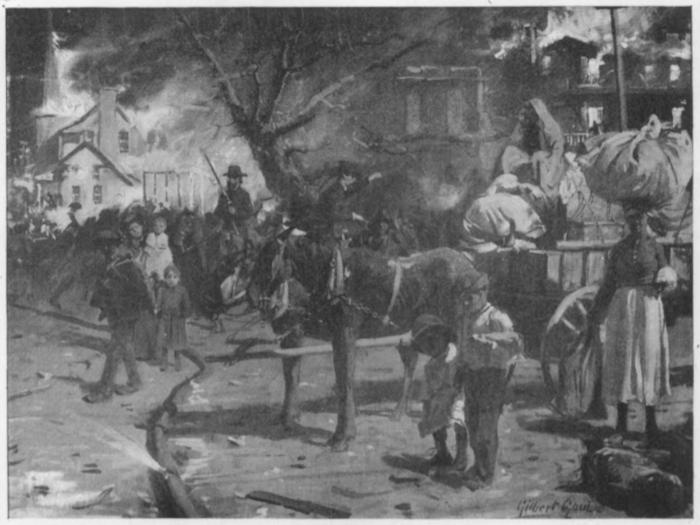
“As they went out they saw some firemen
trying to put out the flames....”—The Shadow of the Attacoa,
page 511
VOL. IV
FEBRUARY, 1907
NO. 5
THE JAMESTOWN EXPOSITION
By James Hines
It would be impossible to estimate
the loss to the world had
the first white English-speaking
settlement, founded at Jamestown,
Virginia, in 1607, resulted in failure.
Had it been abandoned, as was once
the intention of the surviving colonists,
it would have had a deterrent
effect on similar and subsequent expeditions,
and would have changed the
complexion of American history.
Those who comprised the first settlement
encountered almost insurmountable
obstacles before reaching
these shores. For months they braved
the perils of the sea, and were buffeted
by storms, but their heroism and
tenacity of purpose never faltered.
The real test, however, of endurance
was manifested after landing and in
establishing the settlement that definitely
dates the United States.
During December, 1606, this history-making
party sailed from England,
and on May 16, 1607, they landed on
a peninsula which juts into the James
River. They named the place Fort
James. Subsequently it was called
James City, and finally James Town.
For nearly two centuries it has been
an island, and for more than two
hundred years it has been abandoned.
Two fires destroyed the town, one
during Bacon’s rebellion, in 1676, the
other an accident, twenty years later,
after which the seat of government
was moved to Williamsburg. The
ruins of the old church tower remain
on the site,—a crumbling monument
of the first colonial settlement. The
excavations showing where the Governor’s
mansion and the House of
Burgesses stood; the Ambler mansion,
twice destroyed by fire, and the old
graveyard, with its historic tombs
and inscriptions, are still to be seen.
The work of these hardy pioneers
in establishing the colony was often
interrupted by savage attacks of Indians,
and their energies were greatly
impaired by fever and lack of necessary
sustenance. Indeed, so greatly
had their ranks been depleted that,
when Newport arrived from England,
a few months later, with men and
provisions, but thirty-eight of the
original party were alive. It was
greatly due to John Smith, the heroic
leader, that the settlers held out as
long as they did.
An untimely accident deprived the
colony of the valuable services of
Smith, and caused it to come nearly
to an end. Smith’s successor had not
the ability, courage or prestige to
govern as he had done, and a turbulent
element began to assume an aggressive
attitude toward the Indians,
who resented it. The result of this
aggression was that trading parties,
bent on peaceful measures, were massacred,
and, consequently, in the
spring of 1610 famine together
with all its accompanying sufferings,
stared the colonists in the face.
They were a haggard, disheartened,
miserable group of men and women.
To continue at James Town appeared
impossible, and, by popular vote it
was decided, though the bravest could
not restrain their emotion at failure,
that it must be abandoned. Accordingly,
June 7, the dejected aggregation
boarded their ships and cleared
for home. When they reached Hampton
Roads, a sail was observed, which
proved to be the Governor’s boat.
His ships were in the Roads, and the
settlers returned to their village, and
there enacted one of the most pitiful,
yet dramatic, scenes in the world’s
history.
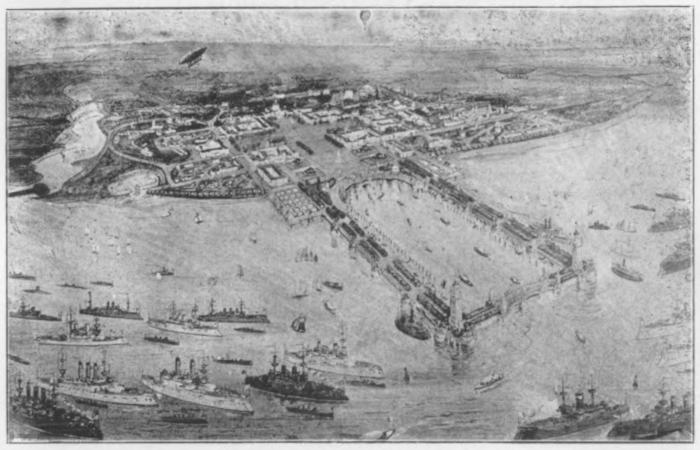
BIRD’S-EYE VIEW OF JAMESTOWN EXPOSITION
Copyright, 1906. Jamestown Official Photograph Corporation,
Norfolk
The timely and unexpected arrival
of the Governor was greeted with
frantic shouts of welcome and joy by
the discouraged colonists. His coming
immediately infused new life, and
their affectionate embraces of one
another gave way to fervent prayer.
Their story was related to Lord Delaware,
and, as he landed, he fell upon
the ground and offered thanks to
God that his arrival had saved
Virginia.
Following that memorable day in
1610, there was never a question concerning
the continuance of the Virginia
colony. Before the arrival of
Lord Delaware, the settlement had
been ruled by more or less despotic
measures. Under Smith, the despotism
had been beneficent, if not benevolent.
Following the rule of Delaware
and Sir Thomas Dale, a more liberal
policy was inaugurated, with the administration
of Yeardley, and Virginia
began to make gigantic strides.
Cattle and sheep were raised; crops
were planted; poultry and domestic
animals received attention; horses
were brought over and utilized for
farming and travel. In addition to
these necessaries of life, tobacco,
which was destined to become the
standard of value and exchange, was
extensively cultivated. From out of
a condition of chaos, everything became
plentiful, and Virginia began to
offer attractive inducements to immigrants.
The pioneers had conquered
dangers and enjoyed comparative
affluence.
Finally, the colonists insisted on the
right of self-government, and received
limited recognition. In the old
church, at James Town, June, 1619,
Governor Yeardley summoned the
first legislative body ever assembled
in America, and formally opened the
General Assembly of Virginia. It
was modeled after the English Parliament,
an upper and lower house,
called the House of Burgesses and
the Council.
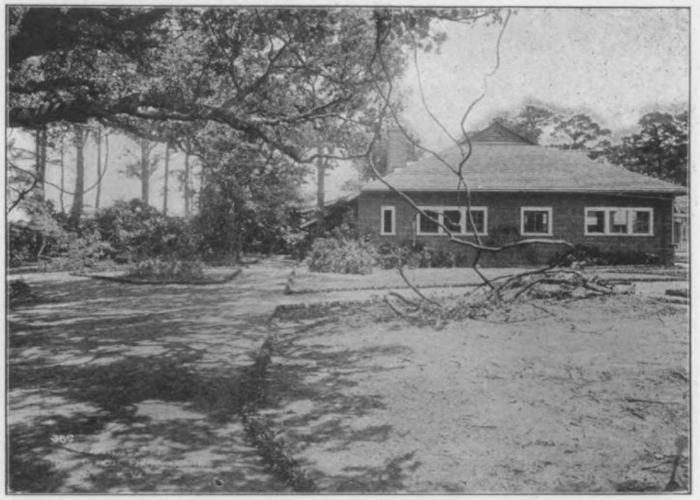
WESTERN VIEW OF COPPER, SILVER AND
WOOD-WORKING SHOPS.
Copyright, 1906. Jamestown Official Photograph Corporation,
Norfolk
This legislative body had the effect
of making the people proud of their
home and confident of themselves.
From James Town grew all the settlements
that overspread Virginia,
and its prosperity induced the settlements
which dotted the coast from
Florida to Canada.
It is the great achievements intervening
between the founding of this
settlement and the present period that
the Jamestown Ter-Centennial will
commemorate by a historic, educational
and industrial exhibition, in
conjunction with the greatest naval
and military display ever witnessed
in the world, to be held this year on
the waters and historic shores of
Hampton Roads, near Norfolk, Virginia.
The heroic deeds and collateral
events in all the colonies will be fully
and faithfully portrayed, and place
before the people a contrasting picture
of seventeenth century civilization
with that of the nineteenth. It
will be a veritable epilogue of the
nation’s development from the little
Virginia village to a republic of
nearly one hundred million people,
stretched from ocean to ocean, and
from the Great Lakes to the Gulf,
with insular possessions in both
tropics, and an empire in the frozen
Arctic.
In observing the three hundredth
anniversary of this important historical
event, the State of Virginia,
very properly, took the initiative, and,
by a joint resolution of the General
Assembly, provided that a fitting ceremonial
should attend the event. President
Roosevelt issued a proclamation
inviting all the nations of the world
to participate, and declared that “The
first settlement of English-speaking
people on American soil, at Jamestown,
in 1607, marks the beginning of
the United States. The three hundredth
anniversary of the event must
be commemorated by the people of
our Union as a whole.”
Nearly every world-power has accepted
this invitation, and will send
warships, soldiers and marines to take
part in the greatest naval rendezvous
ever assembled, while the troops will
unite in international drills, maneuvers
and demonstrations. Aside from
this participation, many foreign countries
will be represented by industrial
exhibits.
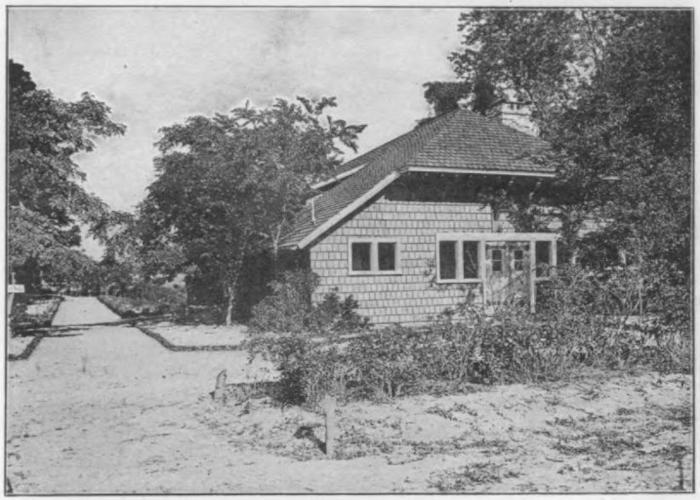
CORNER OF MODEL SCHOOL. SCHOOL GARDEN IN THE REAR
CARED FOR BY THE SCHOOL CHILDREN OF NORFOLK
Copyright, 1906. Jamestown Official Photograph Corporation,
Norfolk
It will be the most historical exposition
ever attempted, the dominating
motive being to impress upon the visitor
the history of this nation. Situated
in the most historic section of
the country, amid the scenes of great
civil and naval conflicts, whose outcome
have more than once been decisive
in national affairs, the very atmosphere
is redolent of the nation’s
story. Congress has approved the exposition,
and has endorsed its purpose
with splendid appropriations, exceeding
those made for any exposition,
with the exception of the Chicago and
St. Louis World’s Fairs. Every executive
department of the Government
will make an exhibit; the Smithsonian
Institution and National Museum;
Bureau of American Republics; the
Library of Congress, and the Fish
Commission. The Life Saving Service
will give exhibitions, and a building
is provided for a separate negro
exhibit. Alaska, Porto Rico and the
Philippines will also be represented
in the Government display.
Nearly all of the states have joined
in the celebration, and have made liberal
appropriations. In addition,
others are expected to participate,
thus insuring a display of the resources
of the states in such magnitude
as cannot fail to attract and interest
all classes of visitors.
Within twenty minutes’ ride of
Norfolk, Portsmouth, Hampton,
Newport News and Old Point Comfort
is Sewell’s Point, the site
of the exposition. In this vicinity
nature and man have combined to
create a territory supremely attractive
and beautiful. The grounds face
Hampton Roads, and embrace more
than four hundred acres in area,
forming a beautiful setting for the
architecture of the exhibit buildings,
which will be entirely of the colonial
period. The beautiful and commodious
buildings under construction are
the Auditorium, History and Art, Education
and Social Economy, Manufactures
and Liberal Arts, Virginia
Manufactures, Medicine and Sanitation,
Machinery, Electricity and
Ordnance, Transportation, Marine
Appliance, Foods, Agriculture
and Horticulture, Forestry,
Fish and Game, Mines and
Metallurgy buildings, aside from
numerous special buildings and
pavilions. There are no less than
six buildings devoted to Arts and
Crafts alone.
COMMEMORATIVE MONUMENT TO JOHN SMITH,
ERECTED BY THE UNITED STATES, AT JAMESTOWN, VIRGINIA.
Copyright, 1906. Jamestown Official Photograph Corporation,
Norfolk
The whole group will suggest the
baronial structures of the seventeenth
century in England. With massive
Corinthian columns, surrounded by
verdant trees, they will constitute an
everlasting picture of grandeur and
beauty. Several enlarged replicas of
old American homes will preserve the
identical outlines, and will conform in
proportion. The Arts and Crafts Village
will be a scene of active interest,
where skilled hand-workers will display
the possibilities of the finished
products in metals and wood, in which
machinery has no part.
Within sight of the exposition are
forts, a navy yard, and one of the
largest shipbuilding plants in the
world; while on the banks of the
James river stand the finest examples
of colonial architecture in America.
Hampton, just across the Roads, is
the oldest continuous settlement of
Englishmen in America. The most
famous naval encounter of the
Civil War, between the Monitor
and Merrimac, took place within
sight of the exposition grounds.
This naval duel revolutionized
battleship construction and naval
warfare. Upon these same historic
waters will ride at anchor the
greatest fleet of warships, representing
every type of fighting machine
in the navies of the world. The evolution
of shipbuilding will be interestingly
illustrated by the reproduction
of the three ships, Susan Constant,
the Godspeed and Discovery, which
brought the Jamestown colonists to
this country. This display of marine
architecture of different periods makes
possible a comprehensive study of its
development. The shores hereabout
are crowded with earthworks erected
by Southern and Federal troops during
the Civil War. There is hardly
a strategic position near these waters
which does not bear evidence of fortifications,
and the final negotiations
which ended the conflict were concluded
at a conference on Hampton
Roads between President Lincoln, Mr.
Seward and Alexander Stephens.
Hence, it is possible to traverse the
ground consecrated by those patriots
whose names are household words in
American history; to view the monuments
commemorative of events from
the first landing of the colonists in
1607, through the stirring events of
1776, through the later historical epoch
of 1812 and 1860, Yorktown and Great
Bridge, and to 1865, when this section
was enriched by the blood of heroes
who fought with Lee, Jackson and
Grant in the most sanguinary strife
ever recorded.
Another distinguishing feature of
the exposition will be the military display
of the United States, the troops
of which, together with those of foreign
countries, will form a permanent
encampment during the exhibition.
The horticultural and cut flower exhibit
will surpass in design and beauty
all previous attempts along this line.
Displays of flowers and potted plants
will be made in the Court of the
States, where will be shown in profusion
of number and variety—asters,
chrysanthemums, dahlias, gladioli, peonies,
rhododendrons, sweet peas,
roses, etc. The work of transplanting
trees, plants and shrubs in the general
decorative scheme has been practically
completed. A unique feature is the floral
fence, which forms a semi-circle
around the exposition grounds. The
frame is of wire, upon which crimson
rambler, honeysuckle and trumpet vine
intertwine in artistic effect. Monster
oaks, tall pines, cedars, maples, willows
and elms are on the grounds to
afford ample shade, while native flower-bearing
and evergreen shrubs and
fruit trees will enter into the general
scheme of landscape beautification.
By comparison, from a monetary
standpoint, with the St. Louis Exposition,
the management of the latter expended
$50,000,000, while the Jamestown
will hardly exceed $5,000,000.
But it must be remembered that the
amount spent at St. Louis produced
everything at the fair by purchase.
There were no monuments of national
or historic interest, hence, the wide
discrepancy in the amount invested.
The sum expended by the Jamestown
Exposition will simply pay for the exhibit
buildings, beautifying the site and
adorning the water front. An estimate
by a competent statistician places
the money value to be represented at
this exposition at no time less than
$150,000,000, while the foreign display
on the water will probably represent
twice the sum, or $300,000,000, six
times the cost of the Louisiana Purchase
Exposition. The difference is at
once strikingly obvious.
The Jamestown Exposition will differ
from the St. Louis Fair in that it
will be historic, while the latter was
mainly industrial. Every conceivable
object of historic interest which can
be secured will be on view at the Ter-Centennial,
and as the surrounding
country is a prolific source from which
to gather this class of exhibits, it will
far excel in historic interest.
A few of the distinctive features of
the exposition will include: the first
international submarine races; prize
drills by regiments of all countries;
the largest motor boat regatta ever
held; yacht races in which all nations
will compete; more naval and military
bands than were ever before gathered
together; the highest tower ever erected
in America, if not in the world;
the largest parade ground; sea bathing
at the border of the grounds;
dirigible airships for commercial uses;
an enclosed sea basin with an area of
1,280,000 square feet; an exact reproduction
of old Jamestown; stupendous
pyrotechnic reproduction of war scenes
and unique night harbor illumination.
Norfolk, the exposition city and
“Golden Gate of the Atlantic,” penetrated
by the salt air of the ocean, is
free from climatic complaints. Its
geographical location and the fortunes
of war add to its interest and prominence,
and it is replete with reminiscent
features. It is a great commercial
center, within twelve hours’ ride of
more than 21,000,000 population, and
within twenty-four hours’ ride of
39,000,000 people. Possibly its most
historic structure standing, in a well
preserved condition, is old St. Paul’s
Church, erected in 1739, twice fired on
by the British, and still retaining, imbedded
in its walls, a shell fired by
Lord Dunmore’s fleet, January 1,
1776.
The descendants of hardy settlers
contemporaneous with Captain John
Smith and his associates, followed by
the cavaliers that settled Virginia, are
to be found now, as then, foremost in
business, social, religious and political
affairs. From them have issued those
who have made names that are referred
to with pride in the conduct
of state and national affairs. Although
the “Mother of States,” and foremost
in the making of American history, all
of her children did not yield to the
temptation of forsaking their birthright
of fair lands, and it is the present
generation that has made possible
the splendid celebration commemorative
of the first settlement of this
country by their ancestors.
It is small wonder, then, that all
roads this year will lead to Tidewater
Virginia and the Jamestown Ter-Centennial,
which will throw open its
gates to the world April 26.
A PLEA
Take you such gold as I have, old Time;
’Tis a trifling thing that you win;
For what is gold but a sordid lure,
All blotched with the blood of men?
’Tis little I care for the filthy stuff,
And less is my need thereof;
Take you such gold as I have, old Time,
But leave me a little love!
Take you the cold world’s praise, old Time;
’Tis hollow and false, I know;
For Honor, at best, is an empty name,
And Fame but a trumpet the foolish blow;
Take them and bid them fly fast from me,
Fly fast as a homing dove;
Take you the cold world’s praise, old Time,
But leave me a little love!
Yea, leave me a little love, old Time,
And take you all else you prize;
For Love will sweeten the saddest heart
Like a blossom from Paradise.
’Tis the goodliest gift of God to man,
A treasure fine gold above;
So, take you all else you prize, old Time,
But leave me a little love!
Hilton R. Greer.
ONCE MORE THE DREAM
By W. M. Shields
Once more the dream! Once more the dream!
That brings with undiminished gleam
The light that shone upon my youth
From regions of untarnished Truth.
Before this stoic mockery,
Called wisdom of maturity,
Could dim the luster of its glow.
Or ere its cares could stem the flow
Of love from thy great heart to me—
Thy heart of hills, my Tennessee.
Once more the dream! Once more the dream!
And all old things unaltered seem;
Restored are joys I counted lost
Beyond a time all worry-tossed.
The streams yet wear a silver sheen
Despite the years of change between;
The bird songs have their olden thrill,
The woods are cool upon the hill,
And partial Nature smiles on thee,
Who art her queen, my Tennessee.
Once more the dream! Once more the dream!
And floats to me upon the stream
From Memory’s generous spring some form
Or voice I loved beyond the storm.
And thus does Memory surely prove
Herself an angel, born of Love.
’Tis not a dead past that she brings,
For past is present when she sings.
And thus old joys once known with thee,
I live again, my Tennessee.
Thus let me dream! Thus let me dream!
Nor Time deprive me of a beam.
For, oh, that heart is happiest
Which dwells on pleasures past and best!
And that heart bides in saddest gloom
That broods upon some ill to come.
Let these old joys and loves be mine
Till life shall drift beyond the line
From heaven that is to heaven to be,
From thy warm heart, my Tennessee.
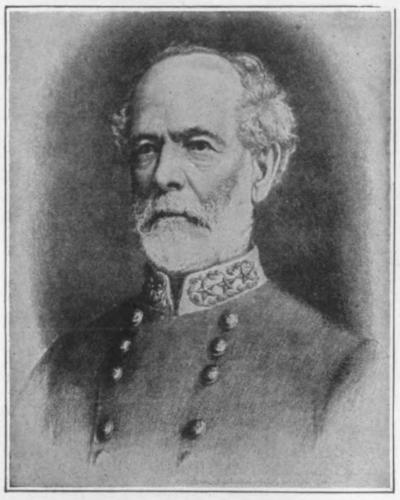
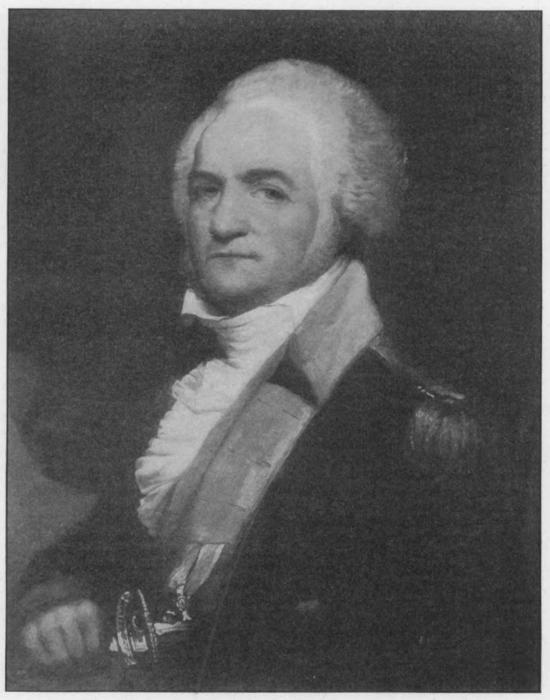
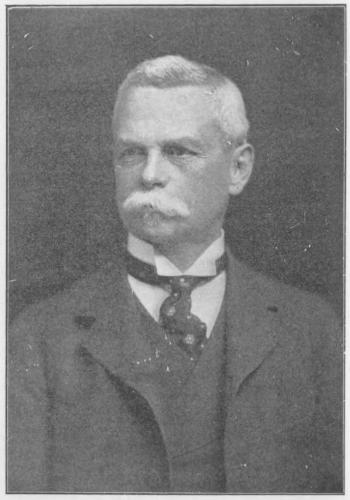
GENERAL JOSEPH E. JOHNSTON
Born at Longwood, Prince Edward County, Virginia, February 3, 1807
Died at Washington, District of Columbia, March 21, 1891
By Robert L. Taylor
When the restless
spirit of Johnston
took its flight from
earth the South bade
farewell to as brave a
knight as ever shivered
a lance “when
knighthood was in
flower.” His death
following so quickly
that of William T.
Sherman, was a dramatic coincidence.
They had fought a long and bloody
duel—hilt to hilt and toe to toe, and
the arena extended from the Mississippi
River to the Atlantic Ocean.
Sherman advanced with sword and
torch in the hands of his splendid
army; Johnston met him with strategy
and the stubborn resistance of his thin
lines of gray; the duel ended only
when the resources of military art
were exhausted and the shattered remnant
of Johnston’s weary columns was
overthrown by Sherman’s overwhelming
numbers. When the conflict was
ended and the battle flags were furled,
these two great captains met in the
capital of the republic and shook hands
across the bloody chasm. Sherman
died in February, 1891, and Johnston,
broken in health and feeble with
age, was one of his pall-bearers, an
office which he had also performed at
the funeral of his friend, General
Grant. A month later he joined the
silent hosts to which these antagonists
on many a field of glory had preceded
him.
Joseph Johnston was the eighth son
of Judge Peter Johnston and Mary
Woods, of Virginia, whose Scotch ancestors
had lived and prospered and
passed away on the old plantation at
Osborne’s Landing. The boy was a
born soldier and foreshadowed his
brilliant career, even when a child at
his mother’s knee. The story is told
that his father took him coon-hunting
one night, and he became so interested
in describing and illustrating military
tactics to the negro boy who attended
him that they became separated from
the hunters, and fell so far behind that
they could not reach them with their
voices. Jo made the boy dismount and
kneel on the ground with his gun presented,
in imitation of a hollow square
of infantry. Then he withdrew and
re-appeared as a regiment of cavalry,
charging down upon the hollow
square; but his horse was not a war-steed
and was totally untrained in
battle, and suddenly shying from the
squatted infantry, threw the cavalry
regiment to the ground. His biographer,
Robert M. Hughes, says, “of
course he was wounded—he always
was on every available occasion.”[1]
The growth and development of the
lad increased his determination to be a
soldier. So marked was his predilection
that his father, who had served
under “Light Horse Harry Lee” in the
Revolution, gave him his sword, although
he was next to the youngest
son. Young Johnston treasured it,
and kept it bright till 1861, when the
tocsin of Civil War was sounded, and,
like Lee, he drew it in defense of his
native State, although, like Lee, he
was opposed to secession.
GENERAL JOSEPH E. JOHNSTON
The comparison of the characters
of Johnston and Lee is most interesting.
Born in the same year, entering
West Point at the same time and
graduating in the same class (that of
1829), they both saw their first active
military service under General Scott.
Johnston accompanied Scott on his arduous
campaign in the Florida Indian
war, and later to Mexico. While Lee
was engaged in boundary work in
Texas, Johnston was performing a
similar work for his government on
the Canadian line. From early manhood
they were fast friends and were
bound together by the same associations,
the same surroundings and the
same interests throughout all their
lives. Both came from the Mexican
War with the title of colonel. Both
were opposed to secession, but both resigned
their commissions in the United
States army and entered the service
of the Stars and Bars with the rank
of colonel. Both supported, with consummate
ability and unfaltering courage,
the cause they held dear, and
when this cause went down in defeat
both met the verdict with quiet dignity.
Both refused safety and honors
abroad, preferring to give their abilities
to rebuilding a united nation, and
both lived to have abundant proof of
the respect and esteem in which all
people held them.
It would be useless to seek to measure
the relative capacity of these two
classmates. The circumstances surrounding
their operations were not
the same, the generals opposing them
were unlike and their methods of campaign
were necessarily different. It
is safe to say that both applied, as far
as possible, the tactics and principles of
war taught them at their alma mater.
“Johnston’s Narrative,” which he
wrote and published in 1875, explains
his tactics and his reasons for adopting
them and have been held in high repute
by students of military art on
both sides of the ocean ever since their
publication.
Like Lee, Johnston never failed to
gain the respect and confidence of his
men. “Although,” says Mr. Hughes
in his admirable biography, “Johnston
was never allowed to retain command
of one army long enough to achieve
the great results which only flow from
long association ... he never
failed to win the love of his men. They
trusted him because they knew that
their blood would not be wasted....
They admired him because they
knew he would not ask them to go
where he would not go himself. His
order was ‘Follow,’ not ‘Go.’...
They called him their Game Cock, because
of his gallantry and martial
bearing, and strove to emulate him in
courage and coolness.”
“Farewell, old fellow,” was the
parting salute of one of his men, “we
privates loved you because you made
us love ourselves.”
Johnston’s personal character was
no less admirable than his public career.
Unselfishness, modesty, purity,
courtesy, charity, devotion to home
and family ties ever characterized him
in public and in private.
After his surrender to Sherman at
Durham’s Station, North Carolina, he
retired to Savannah, Georgia, putting
the war and its issues behind him,
using his great influence to renew the
national allegiance and to cultivate a
new patriotism that should embrace
the whole country. In 1877 he returned
to Richmond, and in the following
year was elected to the House
of Representatives. On the expiration
of his term he was appointed Commissioner
of Railroads by President
Cleveland and continued to reside in
Washington until his death. He met
here both Grant and Sherman, and,
as already said, became fast friends
with his former foes and acted as pallbearer
at the funeral of each.
I sat with Jo Johnston in the Forty-sixth
Congress of the United States. I
was young and he was ripe in years
and experience. I sought him and cultivated
him and never tired of listening
to the story from his lips of his
maneuvers in the last days of the Confederacy.
He was small of stature,
square built, and straight as an arrow,
with a big round bald head and keen
gray eyes that glittered like stars.
Congress was not congenial to him—he
was not an orator but a soldier;
he was not a statesman, but a general.
He knew how to wield an army but
was helpless on the battlefield of argument.
During the fiercest fights of
the two great contending parties on
the floor of the house, he daily walked
to and fro like a caged lion, his head
up, his eyes sparkling and his whole
attitude one of excitement, yet taking
no part in the struggle. But he was
a faithful representative of his people,
and was loved by all who knew him.
In 1887 he received a crushing blow
in the death of his wife. Their childlessness
and her invalidism and the
long years of army life had drawn
them together in an unusual degree,
and he was never able to recover his
old time joy in life after his loss.
Naturally the distinguished veteran
was in great demand on the occasion
of re-union and memorial exercises.
Always averse to anything savoring of
publicity, he attempted to fill these engagements
in an unobtrusive way, but
at times the enthusiasm of his old followers
put all his efforts to naught.
This was shown at the memorial exercises
at Atlanta in the spring of 1890,
of which an Atlanta paper gives the
following account:
“As the last carriage drove away,
the Governor’s Horse Guard came up
the street, forty strong, under command
of Captain Miller. The company
was an escort to the hero of the
day. With the Governor’s Horse
Guard came a carriage drawn by two
black horses. In that carriage was
General Joseph E. Johnston. The old
hero sat upon the rear seat, and beside
him was General Kirby Smith....
The carriage was covered with flowers.
‘That’s Johnston! that’s Jo Johnston!’
yelled some one. Instantly the
Governor’s Horse Guard, horses and
men, were displaced by eager, battle-scarred
veterans. The men who fought
under the hero surrounded the carriage.
They raised it off the paved
street, and they yelled themselves
hoarse. Words of love, praise, and
admiration were wafted to the hero’s
ears. Hands pushed through the sides
of the carriage and grasped the hands
of the man who defended Atlanta. The
crowd grew and thickened. Captain
Ellis tried to disperse it, but could not.
Then the police tried; but the love of
the old soldiers was greater than the
strength of both Captain Ellis and Atlanta’s
police force. For ten minutes
the carriage stood still; then, as it began
to move, some one called out,
‘Take the horses away!’ Almost instantly
both horses were unhitched,
and the old men fought for their
places in the traces. Then the carriage
began to move. Men who loved
the old soldier were pulling it. Up
Marietta street it went to the Custom-house,
then it was turned, and back
toward the opera house it rolled. The
rattle of the drum and the roll of the
music were drowned by the yell of the
old soldiers; they were wild, mad
with joy; their long pent-up love for
the old General had broken loose. Just
before the carriage reached the opera
house door a tall, bearded veteran on
a horse rode to the side. Shoving his
hand through the open curtain, he
grasped the hand of General Johnston
just as a veteran turned it loose. The
General looked up. ‘General Johnston!’
cried the veteran. General
Johnston continued to look up. His
face showed a struggle. He knew the
horseman, but he could not call his
name. ‘Don’t you know me, General—don’t
you know me?’ exclaimed the
horseman. In his voice there was almost
agony. ‘General Anderson, General,’
said Mrs. Milledge. General
Johnston heard the words, and, rising
almost from his seat, exclaimed, ‘Old
Tige! Old Tige! Old Tige!’ The
two men shook hands warmly. Tears
were flowing down the cheeks of each.
‘Yes, Old Tige it is, General,’ said
General Anderson, ‘and he loves you
as much now as ever.’”
A simple headstone in the Greenmount
Cemetery, at Baltimore, marks
the sleeping place of Johnston, beside
his wife, who was Miss Lydia McLane,
of Baltimore.
[1] General Johnston. By R. M. Hughes, New York: D. Appleton & Co. Great Commanders
Series.
EVENING
Sunset; and purple mist
Upon the mountain’s crest,
And pale blue trails of smoke that slowly twist
Into the West.
Soft airs that whisper “Rest,”
And sunset clouds of gold;
A bird’s low murmur from its hidden nest
Across the wold.
Red rose leaves falling, falling,
’Neath swiftly fading skies,
The faint, far voices of dead summers calling,
All ghostly-wise.
Twilight and darkening woods;
Smell of the dew-drenched sod;
And over all, while perfect silence broods,
The peace of God.
Allen Clark, Jr.
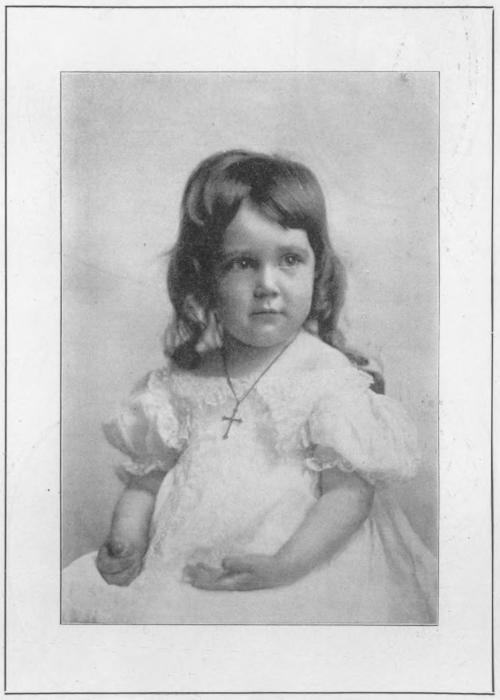
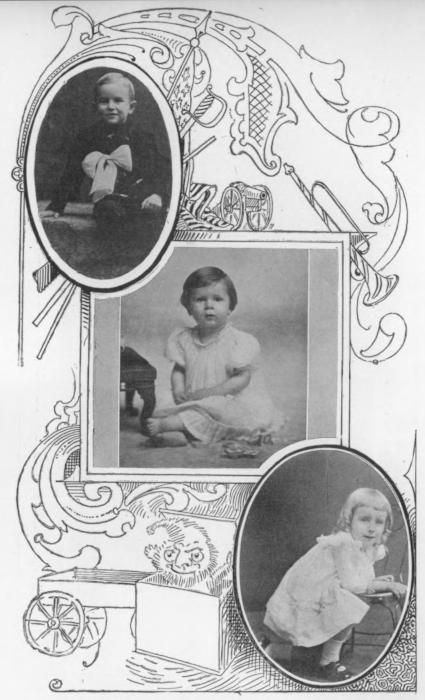
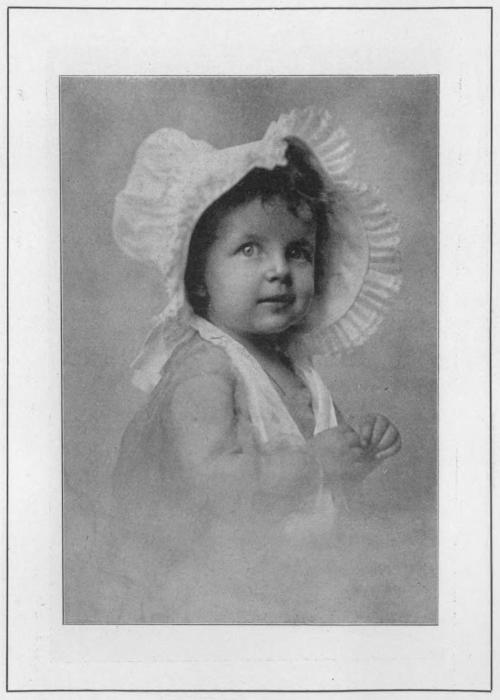
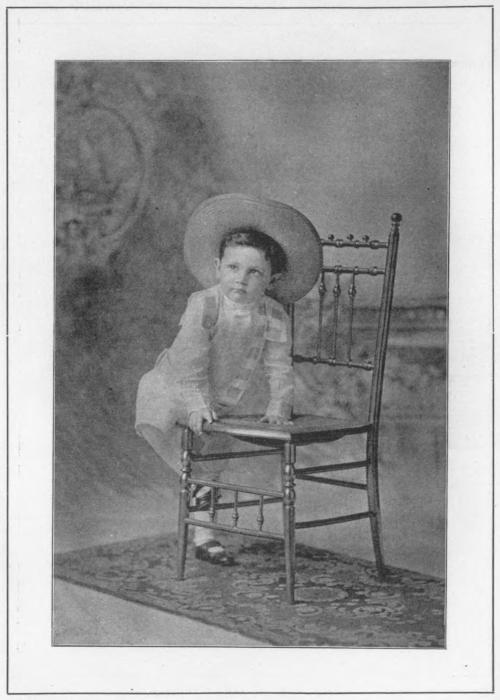
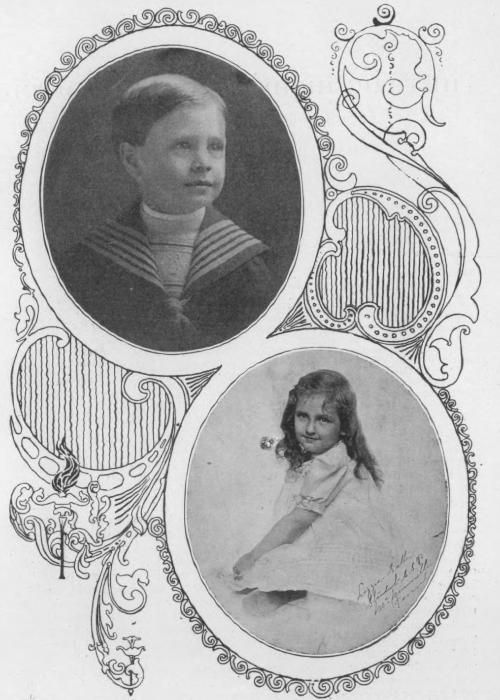
LITTLE CITIZENS OF THE SOUTH
MARGARET MCNUTT Crossville, Tennessee
Taylor, Nashville
CLAUDE DESHA ANDERSON, JR. Memphis
HAMILTON PARKS, JR. Nashville
JAMES HARBERT BENNETT Trenton, Tennessee
FLORENCE KENT WULFF Louisville
Standiford, Louisville
ALBERT STOCKTON LINDSEY, JR. Jackson, Tennessee
Strauss, St. Louis
WILLIAM STATES JACOBS, JR. Houston, Texas
Taylor, Nashville
EDITH HOLT McMinnville, Tennessee
Southern School of Photography, McMinnville
HISTORIC HIGHWAYS OF THE SOUTH — CHAPTER XVII—A BOY AT SHILOH
By John Trotwood Moore
By John A. Cockerill
Mr. John Trotwood Moore, Editor ofTaylor-Trotwood
Magazine:
Dear Sir: There are many persons who
credit to the pen of Mr. John A. Cockerill
the best war story ever written. As you
will remember, Mr. John A. Cockerill was
the distinguished editor of the St. Louis
Post Dispatch, also editor-in-chief of the
Cincinnati Enquirer. Later he was the editor-in-chief
of the New York World, and altogether
was one of the most brilliant descriptive
writers this country has ever produced.
He died a few years ago in Cairo,
Egypt, being at the time of his death connected
with the New York Herald.
At the outbreak of the war in 1861, John
A. Cockerill was about fifteen years old, and
the recruiting officers had refused to enlist
him in the ranks of the fighting line by
reason of his youth, but accepted him as
a drummer boy in the Twenty-fourth Ohio
Infantry, in which regiment his brother
was then a first lieutenant and later captain
and colonel.
It is in no way surprising to the personal
friends of John A. Cockerill that anything
written by him should be the best of its
kind. The best war story ever written is on
the Battle of Shiloh, as seen by John A.
Cockerill, which story I send you herewith,
with the earnest request that you permit it
to occupy a place in your interesting and
valuable Historic Highways of the South.
Yours very truly,
Theodore F. Allen, Cincinnati, Ohio.
[The editor agrees with Mr. Allen that
this story is above praise and should find an
abiding place in history.]
Shiloh Church, April 6th, 1862.
Here is a date and a locality indelibly
burned into my memory. I was
then an enlisted fourth-class musician
in the Twenty-fourth Ohio Regiment,
in which my elder brother was
a first lieutenant, and afterwards captain
and colonel, successively. I had
campaigned in Western Virginia, and
had seen some of the terrors and horrors
of war at Philippi and Rich Mountain,
and some of its actualities in a
winter campaign in the Cheat Mountain
district. During the winter of
1861, my command was sent to Louisville,
Kentucky, where General Buell
was organizing his splendid army of
the Ohio for active operations against
Bowling Green and Nashville. My
regiment was assigned to General Nelson’s
command, and the early spring
found us on the left flank of the army,
on the north side of Green River.
With unexpected suddenness Nelson’s
division was sent back one day in
March to the Ohio River, where it
was placed on transports and headed
for the Cumberland River to participate
in Grant’s movement against
Fort Donelson. Before reaching that
point, intelligence was received of the
capture of that stronghold, and our
flotilla proceeded to Paducah, Kentucky.
At that point General W. T.
Sherman was organizing his recruits
from Ohio, Indiana and Illinois for
the forward movement up the Tennessee
River. I had been taken ill on
the steamer en route, and my father,
who at that time commanded the Seventieth
Ohio, stationed at Paducah,
took me in his personal charge. Two
days later my regiment sailed up the
Cumberland River and was with the
first brigade to enter Nashville. When
I had reached the convalescent stage,
I asked permission to rejoin my command,
but General Sherman said the
armies of Grant and Buell would form
a coalition somewhere up the Tennessee
River, and I would be better off
in my father’s care than elsewhere.
Thus it happened that I was with
the army of General Sherman when
it felt its way up the turbid Tennessee
as far as Pittsburg Landing, and
it so happened that I was at Shiloh
Church on the morning of that terrible
onslaught by General Johnston’s
army on Sherman’s division, which
held the advance of Grant’s army.
I have often wondered what sort of
a soldier I must have appeared at that
time. I can remember myself as a
tall, pale, hatchet-faced boy, who could
never find in the Quartermaster’s department
a blouse or a pair of trousers
small enough for him, nor an
overcoat cast on his lines. The regulation
blue trousers I used to cut off
at the bottom, and the regulation overcoat
sleeves were always rolled up,
which gave them the appearance of
having extra military cuffs, which
was a consolation to me.
The headquarters mess had finished
its early breakfast, and I had just
taken my place at the table on Sunday
morning, April 6th, when I heard ominous
shots along our adjacent picket
lines. In less than ten minutes there
was a volley firing directly in our
front, and from my knowledge of campaigning
I knew that a battle was on,
though fifteen minutes before I had
no idea that any considerable force
of the enemy was in the immediate
front of our cantonment. The Seventieth
Ohio Regiment, and the brigade
to which it was attached, commanded
by Colonel Buckland, of Ohio, formed
on its color lines under fire, and although
composed of entirely new
troops, made a splendid stand. At
the first alarm, I dropped my knife
and fork and ran to my father’s tent,
to find him buckling on his sword. My
first heroic act was to gather up a
beautiful Enfield rifle which he had
saved at the distribution of arms to
his regiment because of its beautiful
curly maple stock. I had been carrying
it myself on one or two of the
regimental expeditions to the front,
and had some twenty rounds of cartridges
in a box which I had borrowed
from one of the boys of Company I.
By the time I had adjusted my cartridge
box and seized my rifle, my
father was mounted outside, and, with
a hurried good-bye, he took his place
with his regiment. By this time the
bullets were whistling through the
camp and shells were bursting overhead.
Not exactly clear in my mind what
I intended to do, I ran across to the
old log Shiloh Church, which stood
on the flank of my father’s regiment.
On my right the battle was raging with
great ferocity, and stretching away to
my left and front one of the most
beautiful pageants I have ever beheld
in war was being presented. In the
very midst of the thick wood and rank
undergrowth of the locality was what
is known as a “deadening,” a vast,
open, unfenced district, grown up with
rank, dry grass, dotted here and there
with blasted trees, as though some
farmer had attempted to clear a farm
for himself and had abandoned the
undertaking in disgust. From out of
the edge of this great opening came
regiment after regiment, and brigade
after brigade of the Confederate
troops. The sun was just rising in
their front, and the glittering of their
arms and equipments made a gorgeous
spectacle for me. On the farther edge
of this opening, two brigades of Sherman’s
command were drawn up to
receive the onslaught. As the Confederates
sprang into this field, they
poured out their deadly fire, and, half
obscured by their smoke, advanced as
they fired. My position behind the old
log church was a good one for observation.
I had just seen General Sherman
and his staff pushing across to
the Buckland brigade. The splendid
soldier, erect in his saddle, looked a
veritable war eagle, and I knew history
was being made in that immediate
neighborhood. Just then a field
battery from Illinois, which had been
cantoned a short distance in the rear,
came galloping up with six guns and
unlimbered three of them between Shiloh
Church and the left flank of the
Seventieth Ohio. This evolution was
gallantly performed. The first shot
from this battery, directed against the
enemy on the right opposite, drew the
fire of a Confederate battery and the
old log church came in for a share of
its compliments. This duel had not
lasted more than ten minutes when a
Confederate shell struck a caisson in
our battery and an explosion took
place, which made things in that spot
exceedingly uncomfortable. The captain
was killed, and his lieutenant,
thinking he had done his duty, and,
doubtless, satisfied in his own mind
that the war was over so far as he
was concerned, limbered up his remaining
pieces, and, with such horses
as he had, galloped to the rear and
was not seen at any other time, I believe,
during the two days’ engagement.
By this time the enemy was pressing
closely on my left flank, and Shiloh
Church, with its ancient logs, was
no longer a desirable place for military
observation. I hurried over to
my father’s camp, taking advantage
of such friendly trees as presented
themselves on the line of my movement,
and there found a state of disorder.
The tents were pretty well
ripped with shells and bullets, and
wounded men were being carried past
me to the rear. As I stood there, debating
in my mind whether to join my
father’s command or continue my independent
action, three men approached,
carrying a sorely wounded
officer in a blanket. They called me
to assist them, and as my place really
was with the hospital corps, being a
non-combatant musician, I complied
with their request. We carried the
poor fellow some distance to the rear,
through a thick wood, and found there
a scene of disorder amounting to panic.
Men were flying in every direction,
commissary wagons were struggling
through the underbrush, and the roads
were packed with fugitives and baggage
trains, trying to carry off the
impedimenta of the army. Finding a
comparatively empty wagon, we placed
our wounded officer inside, and then,
left at liberty, I started on down toward
the river. I had not proceeded
more than a mile when I encountered
a brigade of Illinois troops, drawn up
in battle array, apparently waiting for
orders. It was General McArthur’s
Highland Brigade, the members of
which wore Scotch caps, and I must
say that a handsomer body of troops
I never saw. These fellows had been
at Fort Donelson, and they counted
themselves as veterans. They had
their regimental band with them,
their flags were all unfurled, and they
were really dancing impatiently to the
music of the battle in front of them.
As I sauntered by a chipper young
lieutenant, sword in hand, stopped me
and said: “Where do you belong?”
“I belong to Ohio,” was my reply.
“Well, Ohio is making a bad show of
herself here to-day,” he said. “I have
seen stragglers from a dozen Ohio regiments
going past here for half an
hour. Ohio expects better work from
her sons than this.” As I was one of
Ohio’s youngest sons, my state pride
was touched. “Do you want to come
and fight with us?” he asked. I responded
that I was willing to take a
temporary berth in his regiment. He
asked me my name and especially inquired
whether I had any friends on
the field. I gave him my father’s name
and regiment, and saw him make a
careful entry in a little pass book,
which he afterward placed in the bosom
of his coat, as he rather sympathetically
informed me that he would see,
in case anything should happen to me,
that my friends should know of it.
Thus I became temporarily attached to
Company B, of the Ninth Illinois Regiment,
McArthur’s brigade. Several
other men from other regiments who
had been touched by this young officer’s
patriotic appeals also took places
in our ranks.
Rather a strange situation that for a
boy—enlisting on a battle field, in a
command where there was not a face
that he had ever seen before; only one
face indeed, that had the least touch of
sympathy in it, and that belonging to
the young officer who had mustered
him.
We waited here for three-quarters
of an hour before receiving the command
to move. During that time, one
of the regimental bands played “Hail,
Columbia.” It was the first and only
time that I heard music on a battle
field. Finally the order came to move
to the front. By this time the stream
of fugitives on the road rendered it almost
impassable, but we forced our
way through them, and in due time
reached the point where our men were
being severely driven. At first we
were sent to strengthen the line from
point to point, and twice that morning
our brigade was moved up to support
field batteries, which service, I must
say from my brief experience, is the
most annoying in modern warfare.
These batteries drew not only the artillery
file of the enemy, but they furnished
a point for the concentrated fire
of all the infantry in front. To be in
supporting position was to receive all
the bullets that were aimed at the battery,
and which, of course, usually
vexed the rear. The shells intended
for the battery in your front have a
habit always of flying too high or
bursting just high enough in air to
make it pleasant for the troops who
are held in comparative inactivity.
Under these conditions, we hugged the
ground very closely, and fallen timber
of every kind was most gratefully and
thankfully recognized. It is amazing
how slowly time passes under these
circumstances. I am sure there were
occasions that morning when twenty
minutes’ exposure to fire behind these
field batteries seemed to me an entire
week. Everything looked weird and
unnatural. The very leaves on the
trees, though scarcely out of bud,
seemed greener than I had ever seen
leaves, and larger. The faces of the
men about me looked like no faces
that I had ever seen on earth. The
roar and din of the battle in all its
terror outstripped my most fanciful
dreams of pandemonium. The
wounded and butchered men who
came out of the blue smoke in front
of us and were dragged or sent hobbling
to the rear, seemed like bleeding
messengers come to tell us of the fate
that awaited us.
It was with the greatest sense of
relief that we received orders to move
to the left, to face again that awful
wave of fire which seemed to be all
the morning moving toward our
flank. The Confederate divisions
came into action at Shiloh Church by
the right, with a view to penetrating
to the river, and taking us in flank
and rear. It was along in the afternoon
some time that we were pushed
over to the extreme left of the forward
line. I had no watch, and could have
no idea of the hour of the day, except
as I saw the shadows formed by the
sun. Up to this time our command
had suffered but little, but a dreadful
baptism of fire was awaiting us. For
a moment I realized that we were on
the extreme left of our army; that my
regiment was the left of the brigade;
that I was temporarily attached to
Company B of the regiment, which
practically placed me on the left flank
of that heroic army. I know all this
because there was no firing in our
front, and no sound of battle to our
left, but steady, steady, steady from
the right of us rolled the volleys which
told us that the enemy was working
around to our vicinity. I saw General
McArthur, our commander, at this
point, and as I remember, his hand
was wrapped with a handkerchief, as
though he had been wounded. By his
orders, we pushed across a deep ravine
which ran parallel with our front, and
in five minutes we had taken up a position
on its opposite bank, facing the
enemy. Everybody felt that the critical
moment had come. The terrible
nervous strain of that day was nothing
compared with the feeling that
now the time had come for us to show
our mettle. The faces of that regiment
were worth studying at that
moment. Not one that was not pale;
not a lip that was not close shut; not
an eye that was not wild; not a hand
that did not tremble in this awful,
anxious moment. Presently the messengers
came—pattering shots from
out the dense growth in our front,
telling of the advance of the skirmish
line. On our part, no response. No
enemy could be seen, but the purple
wreaths of smoke here and there told
of the men who were feeling their way
toward our lines. A nervous man,
unable to stand the strain, let off his
musket in our line. This revealed
our presence. With a suddenness that
was almost appalling, there came
from all along our front a crash of
musketry, and the bullets shrieked over
our heads and through our ranks.
Then we delivered our fire. In an
instant the engagement was general
at this point. There were no breech-loaders
in that command, and the process
of loading and firing was tedious.
As I delivered my second shot, a musket
ball struck a small bush in my
front, threw the splinters in my face,
and whistled over my shoulder. I may
say that I was startled, but I kept loading
and firing without any idea whatever
as to what I was firing at. Soon
the dry leaves, which covered the
ground about us, were on fire, and
the smoke from them added to the
general obscurity. Two or three men
had fallen in my vicinity. At this
moment the young lieutenant who had
my descriptive list in his coat bosom,
and who was gallantly waving his
sword in the front, was struck by a
bullet and fell instantly dead, almost
at my feet. Then it was that I realized
my utter isolation and shuddered at the
thought of a fate impending—“Dead
and unknown.”
By this time the fire from the enemy
in our front—it was the division of
General Hardee turning the flank of
the Federal position—became so terrible
that we were driven back into the
ravine. Here we were comparatively
safe. We could load our pieces, crawl
up the bank of the ravine, fire and
fall back, as it were. But many poor
fellows who crawled up this friendly
embankment fell back dead or
wounded; and in one instance, as I
crouched down loading my piece, a
man who had been struck above me,
fell on top of me and died by my side.
It was here, in this terrible moment,
that I, boylike, thought of the peaceful
Ohio home, where a loving, anxious
mother was doubtless thinking of me,
and with the thought that perhaps my
father had been killed, came a natural
desire to be well out of the scrape.
Notwithstanding, I kept firing as long
as my cartridges lasted. These gone,
a fierce sergeant, with a revolver in
his hand, placed its muzzle close to
my ear and fiercely demanded why I
was not fighting. I told him that I
had no cartridges. “Take cartridges
from the box of the man there,” he
said, pointing to the dead man who
had just fallen upon me. Mine was
an Enfield rifle, and my deceased
neighbor’s cartridges were for a
Springfield rifle. I had clung to this
beautiful Enfield, with its maple stock,
which my father had selected, and I
was determined that it should not
leave my hands. While this scene was
passing, the enemy came upon us full
charge, and, looking up through the
smoke of the burning leaves and beyond
a washout which connected with
our ravine, I saw their gray, dirty
uniforms. I heard their fierce yells,
I saw their flag flapping sullenly in
the grimy atmosphere. That was a
sight which I have never forgotten;
I can see the tiger ferocity in those
faces yet; I can see them in my
dreams. For what might they not
have appeared to me, terrified boy that
I was!
It was at this point that our blue
line first wavered. Out of the ravine,
over the bank, we survivors poured,
pursued by the howling enemy. I
remember my horror at the thought of
being shot in the back, as I retreated
from the top of the bank and galloped
as gracefully as I could with the
refluent human tide. Just by my side
ran a youthful soldier, perhaps three
years my senior, who might, for all I
knew, have been recruited as I was. I
heard him give a scream of agony,
and, turning, saw him dragging one
of his legs, which I saw in an instant
had been shattered by a bullet. He
had dropped his rifle, and as I ran to
his support he fell upon my shoulder,
and begged me, for God’s sake, to help
him. I half carried him for some distance,
still holding to my Enfield rifle,
with its beautiful curly stock, and
then, seeing that I must either give
up the role of good Samaritan or drop
the rifle, I threw it down and continued
to aid my unfortunate companion.
All this time the bullets were
whistling more fiercely than at any
time during the engagement, and the
woods were filled with flying men,
who, to all appearances, had no intention
of rallying on that side of the
Tennessee River. My companion was
growing weaker all the while, and
finally I set him down beside a tree,
with his back toward the enemy, and
watched him for a few moments, until
I saw that he was slowly bleeding to
death. I knew nothing of surgery at
that time, and did not even know how
to staunch the flow of blood. I called
to a soldier who was passing, but he
gave no heed. A second came, stood
for a moment, simply remarked “he’s
a dead man,” and passed on. I saw
the poor fellow die without being able
to render the slightest assistance.
Passing on, I was soon out of range
of the enemy, and in a moment I realized
how utterly famished and worn
out I was. My thirst was something
absolutely appalling. I saw a soldier
sitting upon the rough stump of a tree
gazing toward the battle, and, observing
that he had a canteen, I ran to
him and begged him for a drink. He
invited me to help myself. I kneeled
beside the stump, and, taking his canteen,
drained it to the last drop. He
did not even deign to look at me during
the performance, but he anxiously
inquired how the battle was going in
the front. I gave him information
which did not please him in the least,
and moved on toward the point known
as the landing, toward which all our
fugitives seemed to be tending. But
my friend on the stump—I shall never
forget him. How gratefully I remember
that drink of warm water from
his rusty canteen! Bless his military
soul, he probably never knew what a
kindness he rendered me!
A short distance beyond the place
where I had obtained my water supply
I found a squadron of jaded cavalry
drawn up, and engaged in the
interesting work of stopping stragglers.
In the crowd of fear-stricken
and dejected soldiers I found there, I
saw a man who belonged to my
father’s regiment; I recognized him
by the letters and number on his hat.
Inquiring the fate of the regiment, he
told me that it had been entirely cut
to pieces, and that he had personally
witnessed the death of my father—he
had seen him shot from his horse.
This intelligence filled me with dismay,
and I then determined, non-combatant
that I was, that I would retire
from that battlefield. Watching my
opportunity, I joined an ambulance
which was passing, loaded with
wounded, and by some means escaped
the vigilance of the cavalrymen, who
seemed to be almost too badly scared
to be on any sort of duty. When
through this line, I pushed my way on
down past the point where stragglers
were being impressed and forced to
carry sand bags up from the river, to
aid in the construction of batteries
for some heavy guns which had been
brought up from the transports. I
passed these temporary works, by the
old warehouse, turned into a temporary
field hospital, where hundreds of
wounded men, brought down in
wagons and ambulances, were being
unloaded, and where their arms and
legs were being cut off and thrown
out to form gory, ghastly heaps. I
made my way down the plateau overlooking
the river. Below lay thirty
transports at least, all being loaded
with the wounded. All around me
were baggage wagons, mule teams,
disabled artillery teams, and thousands
of panic-stricken men. I saw, here
and there, officers gathering these
men together into volunteer companies,
and marching them away to the
scene of battle. It took a vast amount
of pleading to organize a company of
even fifteen or twenty, and I was particularly
struck by the number of
officers who were engaged in this interesting
occupation. It seemed to me
that they were out of all proportion
to the number of fugitives in the
vicinity. While sitting on the bank,
overlooking the road below, between
the beach and the river, I saw General
Grant. I had seen him the day before
review his troops on the Purdy road,
while a company of Confederate cavalrymen,
a detachment of Johnston’s
army, watched the performance from a
skirt of woods some two miles away.
When I saw him at this moment he
was doing his utmost to rally his
troops for another effort. It must
have been about half past four in the
afternoon. The General rode to the
landing, accompanied by his staff and
a bodyguard of twenty-five or thirty
cavalrymen. I heard him begging
the stragglers to go back and make
one more effort to redeem themselves,
accompanying his pleadings with the
announcement that reinforcements
would soon be on the field, and that
he did not want to see his men disgraced.
Again I heard him proclaim
that if the stragglers before him did
not return to their commands he would
send his cavalry down to drive them
out. In less than fifteen minutes his
words were made good. A squadron
of cavalry, divided at either end of
the landing, and riding towards each
other with drawn sabres, drove away
every man found between the steep
bank and the river. The majority of
the skulkers climbed up the bank,
hanging by the roots of the trees, and
in less than ten minutes after the
cavalry had passed, they were back in
their old places. I never saw General
Grant again until I saw him as President
of the United States.
While sitting on the high bank of
the river I looked across to the opposite
side, and saw a body of horsemen
emerging from the low cane brakes
back of the river. In a moment I saw
a man waving a white flag with a red
square in the center. I knew that
he was signalling, for I had seen the
splendid corps of Buell’s army, and I
recognized that the men with that flag
were our friends. Sitting by me were
two distracted fugitives, who also saw
the movement on the other side of the
river. Said one of them to his companion:
“Bill, we are gone now.
There’s the Texas cavalry on the
other side of the river!” The red
square had misled him. Fifteen minutes
later I saw the head of a column
of blue emerge from the woods beyond
and move hurriedly down toward
the river’s edge. Immediately the
empty transports moved over to that
side of the river, and the first boat
brought over a figure which I recognized.
The vessel was a peculiar one,
belonging in Southern waters, and
had evidently been used as a ferry
boat. On its lower forward deck, which
was long and protruding, sat a man of
tremendous proportions, on a magnificent
Kentucky horse, with bobbed tail.
The officer was rigged out in all his
regimentals, including an enormous
hat with a black feather in it. I knew
that this was General Nelson, commonly
known as “Fighting Bull Nelson.”
I ran down to the point where
I saw his boat was going to land, and
as she ran her prow up on the sandy
beach, Nelson put spurs to his horse
and jumped him over the gunwale.
As he did this, he drew his sword and
rode right into the crowd of refugees,
shouting: “Damn your souls, if you
won’t fight, get out of the way and let
men come here who will!” I realized
from the presence of Nelson that my
regiment (the Twenty-fourth Ohio)
was probably in that vicinity. I asked
one of the boat hands to take me on
board, and, after some persuasion, he
did so. The boat recrossed, and as soon
as I got on shore, I ran down to
where the troops were embarking to
cross the river to the battlefield. I
soon found Ammen’s Brigade, and my
regiment. Hurrying on board one of
the transports, I climbed to the hurricane
deck and there found my
brother with his company. He was
looking across the river, where the
most appalling sight met his vision.
The shore was absolutely packed
with the disorganized, panic-stricken
troops who had fled before the terrible
Confederate onslaught, which had
not ceased for one moment since early
that morning. The noise of the battle
was deafening. It may be imagined
that my brother was somewhat surprised
to see me. I made a hurried
explanation of the circumstances
which had brought me there, and gave
him news of my father’s death. Then
I asked him for something to eat.
Astonished, he referred me to his
negro servant, who luckily had a
broiled chicken in his haversack,
together with some hard bread. I
took the chicken, and as we marched
off the boat, I held a drumstick in
each hand, and kept by my brother’s
side as we forced our way through the
stragglers, up the road from the landing
and on to the plateau, where the
battle was even then almost concentrating.
Right there I saw a man’s
head shot off by a cannon-ball and saw,
immediately afterward, an aide on
General Nelson’s staff dismounted by
a shot, which took off the rear part
of his saddle and broke his horse’s
back. At the same time I did not stop
eating. My nerves were settled, and
my stomach was asserting its rights.
My brother finally turned to me, and,
after giving me some papers to keep,
and some messages to deliver in case
of death, shook me by the hand and
told me to keep out of danger, and,
above all things, to try and get back
home. This part of his advice I readily
accepted. I stood and saw the
brigade march by, which, in less than
ten minutes, met the advance of the
victorious Confederates, and checked
the battle for that day. It was then
that the gunboats in the river, and the
heavy siege guns on the bank above,
added their remonstrating voices as
the sun went down, and the roar of
battle ceased entirely.
That night on the shore of the Tennessee
River was one to be remembered.
Wandering along the beach
among the rows of wounded men waiting
to be taken on board the transports,
I found another member of the
Seventieth Ohio named Silcott. He
had a harrowing tale of woe to relate,
in which nearly all his friends and
acquaintances figured as corpses, and
together we sat down on a bale of hay
near the river’s edge. By this time
the rain had set in. It was one of
those peculiar, streaming, drenching,
semi-tropical downpours, and it never
ceased for a moment from that time
until far into the next day. With
darkness came untold misery and discomfort.
After my companion had
related the experiences of the day, I
curled myself up on one side of the
hay bale, while he occupied one edge
of it, and soon fell asleep. Every few
moments I was awakened by a terrible
broadside, delivered from the two
gunboats which lay in the center of
the river a hundred yards or so above
me. They were the Lexington and
the A. O. Tyler, I believe; wooden
vessels, reconstructed from western
steamboats and supplied with ponderous
columbiads. These black monsters,
for some reason, kept up their
fire all through the night, and the
roar of this cannonading and the
shrieking of the shells, mingled with
the thunders of the rainstorm, gave
very little opportunity for slumber.
Still, I managed to doze very comfortably
between broadsides. And my
recollection of the night is that from
these peaceful naps I was aroused
every now and then by what appeared
to be a tremendous flash of lightning,
followed by the most awful thunder
ever heard on the face of the earth.
These discharges seemed to me to lift
me four or five inches from my water-soaked
couch. To add to the general
misery the transports which were
bringing over Buell’s troops had a
landing within twenty feet of my lodgment.
All night long they wheezed
and groaned and came and went, with
their freight of humanity, and right
by my side marched all night long the
poor fellows who were being pushed
out to the front to take the places on
the battle line for the morrow. By
this time the roadway was churned
into mud knee deep, and as regiment
after regiment went by with that peculiar
slosh, slosh of marching men in
mud, and the rattling of canteens
against bayonets and scabbards, so
familiar to the ear of the soldier, I
could hear in the intervals the low
complaining of the men and the urging
of the officers: “Close up, boys, close
up,” until it seemed to me that if
there was ever such a thing as Hades
on earth, I was in the fullest enjoyment
of it. As fast as a transport unloaded
its troops, the gangway was
hauled in, the vessel dropped out, and
another took the vacant place and the
same thing was gone over again. Now
and then a battery of artillery would
come off the boat, the wheels would
stick in the mud, and then a grand turmoil
of half an hour would follow,
during which time every man found in
the neighborhood would be impressed
to aid in relieving the embargoed gun.
The whipping of the horses and the
cursing of the drivers was less soothing,
if anything, than those soul shattering
gunboat broadsides. There
never was a night so long, so hideous,
or so utterly uncomfortable.
As the gray streaks of dawn began
to appear, the band of the Thirteenth
Regulars on the deck of one of the
transports, came into the landing, playing
a magnificent selection from “Il
Trovatore.” How inspiring that music
was! Even the poor, wounded men
lying in front on the shore seemed to
be lifted up, and every soldier seemed
to receive an impetus. Soon there was
light enough to distinguish objects
around, and then came the ominous
patter of musketry over beyond the
river’s bluff, which told that the battle
was on again. It began just as a
shower of rain began and soon deepened
into a terrible hail storm, with
the booming artillery for thunder accompaniment.
I was up and around
and started immediately toward the
front, for everybody felt now that the
battle was to be ours. Those fresh
and sturdy troops from the Army of
the Ohio had furnished a blue bulwark,
behind which the incomparable one-day
fighters of Grant and Sherman
were to push to victory. The whole
aspect of the field in the rear changed.
The skulkers of the day before seemed
to be imbued with genuine manhood,
and thousands of them returned to the
front to render good service. In addition
to this, six thousand fresh men
under General Lew Wallace, who had
marched from Crump’s Landing, ten
miles away, had arrived during the
night, and the tide of battle was now
setting towards Corinth. I met a comrade
drying himself out by a log fire,
about a quarter of a mile from the
landing, who had by some process secured
a canteen of what was known
as Commissary Whisky. He gave me
one drink of it and that constituted
my breakfast. Cold, wet and depressed,
as I was, that whisky, execrable
though it was, brought such
consolation as I had never found before.
I have drunk champagne in
Epernay, I have sipped Johannisberger
at the foot of its sunny mount,
I have tasted the regal Montpulsanio,
but, by Jove, I never enjoyed a drink
as I did that swig of common whisky,
on the morning of the 7th of April,
1862! While drying myself by this
fire I saw a motley crowd of Confederate
prisoners marched past, under
guard. As they waded along the muddy
road, some of the cowardly skulkers
indulged in the badinage usual on
such occasions, and one of our fellows
called out to know what company that
was. A proud young chap in gray
threw his head back, and replied,
“Company Q, of the Southern Invincibles,
and be damned to you.” That
was the spirit of the day and the hour.
At 10 o’clock, the sound of the battle
indicated that our lines were being
pushed forward, and I made up my
mind to go to the front. I started
with my companion, and in a very
short time we began to see about us
traces of the terrible battle of the day
before. We were then on the ground
which had been fought over late Sunday
evening. The underbrush had literally
been mowed off by the bullets
and great trees had been shattered by
the terrible artillery fire. In places,
the bodies of the slain lay upon the
ground so thick that I could step from
one to the other. This without exaggeration.
The pallid faces of the
dead men in blue were scattered among
the blackened corpses of the enemy.
This to me was a horrible revelation,
and I have never yet heard a scientific
explanation of why the majority of
the dead Confederates on that field
turned black. All the bodies had been
stripped of their valuables, and
scarcely a pair of boots or shoes could
be found upon the feet of the dead. In
most instances, pockets had been cut
open, and one of the pathetic sights
that I remember was a poor Confederate,
lying on his back, while by his
side was a heap of ginger cakes and
sausage, which had tumbled out of his
trousers pockets, cut by some infamous
thief. The unfortunate man
had evidently filled his pocket the day
before with the edibles, found in some
sutler’s tent, and had been killed before
he had an opportunity to enjoy
his bountiful store. There was something
so sad about this that it brought
tears to my eyes. Farther on I passed
by the road the corpse of a beautiful
boy in gray, who lay with his blonde
curls scattered about his face, and his
hands folded peacefully across his
breast. He was clad in a bright and
neat uniform, well garnished with
gold, which seemed to tell the story
of a loving mother and sisters who
had sent their household pet to the
field of war. His neat little hat lying
beside him bore the number of a
Georgia regiment, embroidered, I am
sure, by some tender fingers, and his
waxen face, washed by the rain of the
night before, was that of one who had
fallen asleep, dreaming of loved ones
who waited his coming in some anxious
home. He was about my age. He
may have been a drummer! At the
sight of that poor boy’s corpse I burst
into tears, and started on. Here beside
a great oak tree I counted the
corpses of fifteen men. One of them
sat stark against the tree, and the
others lay about as though during the
night, suffering from wounds, they
had crawled together for mutual assistance
and there had died. The blue
and the gray were mingled together.
This peculiarity I observed all over
the field. It was no uncommon thing
to see the bodies of Federal and Confederate
lying side by side as though
they had bled to death, while trying
to aid each other. In one spot I saw
an entire battery of Federal artillery,
which had been dismantled in Sunday’s
fight, every horse of which had
been killed in his harness, every tumbrel
of which had been broken, every
gun of which had been dismounted,
and in this awful heap of death lay
the bodies of dozens of cannoneers.
One dismounted gun was absolutely
spattered with the blood and brains
of the men who had served it. Here
and there in the field, standing in the
mud, were the most piteous sights of
all the battlefield—poor, wounded
horses, their heads drooping, their
eyes glassy and gummy, waiting for
the slow coming of death, or for some
friendly hand to end their misery. How
those helpless brutes spoke in pleading
testimony of the horror, the barbarism
and the uselessness of war! No
painter ever did justice to a battlefield
such as this, I am sure.
As I pushed onward to the front, I
passed the ambulances and the wagons
bringing back the wounded, and talked
with the poor, bleeding fellows who
were hobbling toward the river, along
the awful roads or through the dismal
chaparral. They all brought news of
victory. Toward evening I found myself
in the neighborhood of the old
Shiloh Church, but could get no tidings
of my father’s regiment. Night
came on and I lay down and fell asleep
at the foot of a tree, having gathered
up a blanket soaked with water, which
I could only use for a pillow. It rained
all night. The battle had practically
ended at 4 o’clock that evening, and
the enemy had slowly and silently
withdrawn toward Corinth. Next
morning I learned that my father’s
regiment had been sent in pursuit of
the enemy, and nobody could tell when
it would return. I found the camp,
and oh, what desolation reigned there!
Every tent had been pillaged, and in
my father’s headquarters, the gentlemen
of the enemy who had camped
there two nights before had left a
duplicate of nearly everything they
had taken. They had exchanged their
dirty blankets for clean ones, and had
left their old, worn brogans in the
place of boots and shoes which they
had appropriated, and all about were
the evidences of the feasting that had
gone on during that one night of
glorious possession. I remained there
during the day, and late that evening
the Seventieth Ohio came back to its
deserted quarters after three days and
two nights of most terrible fighting
and campaigning.
At its head rode my father, whom I
had supposed to be dead, pale, haggard
and worn, but unscathed. He
had not seen me nor heard of me for
sixty hours. He dismounted, and,
taking me in his arms, gave me the
most affectionate embrace my life had
ever known, and I realized then how
deeply he loved me. That night we
stayed in the old bullet ridden and shot
torn tent and told of our adventures,
and the next day I had the pleasure of
hearing General Sherman compliment
my father for his bravery, and say,
“Colonel, you have been worth your
weight in gold to me.”
Many years after, speaking one day
to General Sherman, I asked him,
“What do you regard as the bloodiest
and most sanguinary battle of the
Civil War?”
“Shiloh,” was the prompt response.
And in this opinion I heartily concur.
Note—The killed and wounded in the
two days’ Battle of Shiloh numbered nearly
twenty thousand Federals and Confederates,
or about thirty per cent of the entire number
engaged. These figures become the
more significant when it is remembered that
a very large proportion of the troops engaged
on both sides were absolutely raw
and were at Shiloh in their first baptism
of fire. These losses again become most
significant when compared with the losses
in the world’s most noted battles. Waterloo
is considered one of the most desperate
and bloody fields chronicled in European
history, and yet Wellington’s casualties were
less than twelve per cent. In the great
battles of Marengo and Austerlitz, sanguinary
as they were, Napoleon lost less than
fifteen per cent, while at Shiloh, Americans
fighting against Americans, the killed and
wounded numbered more than twice the
casualties of the Duke of Wellington’s
Army at Waterloo.
SATAN FISHING
Ole Satan went a fishin’ when de Lawd he fus’ made man,
En all de fish dat cum his way he never fail to lan’.
He had all diff’unt kind er bait to suit dey appetite,
En all de patience in de worl’ to wait fer dem to bite;
He cotch Eve wid a apple, en ole Adam wid de core,
Changed his bait en went on fishin’, en he kep’ a-ketchin’ more;
De sinners breed tremendous fas’ en cum a-swimmin’ by,
He drap de hook, dey dive en bite, he lan’ ’um high en dry.
En he sets dar still a-fishin’, wid a wicked, sinful look,
En des to hoodoo niggers, he hangs chickens on his hook,
Er a great, big watermelon, er a white man’s ’tater hill,
Er sump’n des ez certain ter be swallered pas’ de gill.
So mo’ners, turn yo’ haids away, keep lookin’ to de right,
Ef yo’ never fools aroun’ de bait you’ll never want to bite;
Turn f’um de things dat tempt de flesh en watch out fer yo’ souls
En yo’ won’t be ’mungst de suckers dat he fries upon de coals!
W. M. Goodman.
AMERICANS AT THE PEACE CONGRESS
By Hayne Davis
Secretary of the American Delegation
The fourteenth Session of the
Interparliamentary Union was
notable in many respects. First,
it was held in the capital of the greatest
country in the world, not only in
its area, but in the fact that it is the
oldest representative of the idea of
Parliamentary Government. It was
in the year 1253 that the first Representative
Parliament of England assembled
at London. This was the
first appearance of this idea in the
presence of the royal families which
were then reigning in Europe. Indeed,
it may be properly called the first
appearance of this idea in the modern
political world, though of course parliaments
have existed in other parts of
the world in previous centuries. But
between those early efforts at democratic
government and the modern
regime, a long period of darkness came
over the world, and it is perhaps safe
to say that the modern era in the political
world began with the assembling
of the first Representative Parliament
in England.
The fundamental idea of democracy
is government in the affairs of to-day
by persons who are elected by the people
of to-day, whereas the fundamental
proposition in all other forms of government
is that the people of the past
have a right to impose their ideas upon
the people of the present, through the
form of hereditary office-holding and
established religious organizations.
This being true, it is nothing but right
that the United States should be
strongly represented at this great
conference composed of the people’s
representatives from practically every
nation in the world. The United
States Congress has been represented
by a delegation at only three
previous conferences of the Interparliamentary
Union, namely, the one at
St. Louis, in 1904; the one at Brussels,
in 1905; and the present one. At
each of these, except this present one,
the Democratic side of the American
delegation has been much weaker than
the Republican side, there being as a
rule only a few Democrats in the delegation,
and in no case a Democrat of
national reputation. The Democratic
side of the delegation at this fourteenth
conference of the Interparliamentary
Union was as large in numbers
as the Republican side, and contained
the leader of the Democratic
party in Congress, Mr. John Sharpe
Williams, and the leader of the Democratic
party in this country, Hon. W. J.
Bryan. This fact is of great importance
to the cause of international arbitration,
not only in the United
States, but also in Europe, because it
has resulted in perfect unity between
Mr. Bartholdt, who is a Republican,
and the leaders of the Democratic party
in the United States. Mr. Bartholdt
has taken the lead in this progressive
movement, not only among the law-makers
of the United States, but of
the whole world, by calling for a second
conference at The Hague, and by
putting forward a proposition which
has now received the express approval
of the ablest leaders of the Democratic
party in the United States. Both Mr.
Williams and Mr. Bryan have expressly
and powerfully espoused the
ideas which Mr. Bartholdt has put forward,
and which have now received
the sanction of the Interparliamentary
Conference. Furthermore, both Mr.
Williams and Mr. Bryan have come
forward with propositions of their
own. With Mr. Roosevelt already committed
to the plans of the Interparliamentary
Union, and with the probable
Democratic candidate at the next election
committed even more strongly,
the lovers of peace and justice in the
Old and in the New World have a
right to count absolutely upon the
support of the next President of the
United States, not only for these progressive
steps toward permanent peace
which have heretofore been advocated
in Europe, but for more advanced
steps than were deemed practical at
any time in the past, either in Europe
or America.
WILLIAM RANDAL CREWER
Originator of the Interparliamentary Union
In the Interparliamentary Union we
have an organization composed of the
most progressive statesmen in all the
law-making bodies of the world, and
they have been guided with remarkable
wisdom to the declaration of a policy
against which no sound argument can
be raised, because it calls for arriving
at the ultimate aim of permanent
peace, by walking in the way that leads
there, and by taking each step in due
order. Thus no existing condition is
ignored, however much we may be
opposed to it as a permanent fact.
Take, for instance, the question in regard
to the arrest or limitation of
armaments, which was raised by Baron
d’Estournelles. It was inevitable that
this should cause hostile comment
from some quarter, and the closing
scenes of the conference brought out
this comment. The Duke of Argyll
presided, and it was his privilege to
respond to the toast of all the nations
represented in the Interparliamentary
Conference. The banquet was held in
a hall decorated with flags of the various
regiments of the British army;
and in various parts of the great building
there were figures of the men who
had distinguished themselves in the
countless battles which have been
fought by the British people, not only
in these islands, but in all parts of the
world. The Duke of Argyll took advantage
of this ocular demonstration
of the fact of war, in the distant and
near past, to express his belief that
the people of England would see similar
occurrences in the future. He then
proceeded to remark that perhaps it
might be better if the Interparliamentary
people would fly nearer to the
ground. He did not use these words,
but the idea was that there was danger
of getting in the clouds above the
things that were capable of realization.
This thought is but natural when one
considers more or less carelessly the
great questions which are being wrestled
with by the Interparliamentary
Union, and by the various organizations
which have permanent peace as
their ultimate aim. I believe, however,
that a careful consideration of the
things advocated by the Interparliamentary
Union will prove that the
Duke of Argyll has not differentiated
between this organization and some of
the other organizations which have
peace as the object for which they
struggle. Speaking from an American
point of view, it would seem as natural
to say that the men who formed the
United States were idle dreamers seeking
the impossible, because previous to
the organization of the United States
there was no such body in existence,
as it is now to say that practical statesmen
who can win and hold seats in
national parliaments and who can control
the action of great political parties
are idle dreamers because they
recognize the fact that existing conditions
are not right, and that there is
a way out of these wrong conditions,
and that they propose to find that
way. Everyone will admit that it is
not right for people on two sides of
a stream ten miles wide or twenty
miles wide, or even a thousand miles
wide, to continually go to war with
one another when they all know how
to administer justice through political
institutions. Of course the question
arises whether the people can be induced
to establish institutions on a
world-wide scale, such as have been
established during past centuries, first
on a small scale, then on a comparatively
large scale, and finally on a continental
scale. Passing from the abstract
to the concrete, here we have in
this conference of the Interparliamentary
Union two men who have held a
seat in the United States Congress for
fourteen years, one a Republican and
the other a Democrat. The Republican,
the Hon. Richard Bartholdt, has
proposed that an international deliberative
body be formed as speedily as
possible, but without authority to enact
law, in which all the nations who have
commercial dealings with each other
shall have representatives. His idea
is that this body will be able to discover
ways of improving the law of nations,
and the method of its administration,
and that upon its suggestions
the several nations will give effect to
these good ideas. He believes also
that in due time this international deliberative
body will, by the wisdom
with which it acts, be able to satisfy
the responsible statesmen of all countries
that they can safely trust to such
a body the declaration of general principles
of law to govern the conduct
of the nations in their intercourse with
each other. It is believed that in due
time, through the development of this
body, the people of the various nations
will acquire the right to vote on international
questions by ballot instead of
bullet. To regard this as impracticable
or even untimely is simply to ignore
the essential facts of history during the
past centuries, and the speed with
which good ideas can be made effectual
for large areas at the present time,
on account of the great and valuable
discoveries which have been made and
applied recently to the intercourse between
the people of the various nations.
Coupled with this proposition, Mr.
Bartholdt has suggested as eminently
practical the formulation of a general
Treaty of Arbitration, which gives
The Hague Court jurisdiction over the
questions included in it, whether there
is only one or half a dozen classes of
questions that are made arbitrable according
to its terms, or whether, as in
the case of Denmark and Holland, no
reservation whatever is made. Mr.
Bartholdt simply proposes to let each
nation designate the classes of questions
which it will consent to refer to
arbitration, and to grant The Hague
Court jurisdiction over those questions,
the treaty to become operative
between all nations ratifying and between
each nation and all other nations,
so far as they designate the
same classes of questions as arbitrable
under its terms. In the meantime all
nations, according to his proposition,
shall remain free to arm themselves
as heavily as they think their interests
may require.
LORD WEARDALE
President British Group, Interparliamentary Union
Mr. John Sharpe Williams, who has
succeeded in placing himself at the
head of the Democratic party in the
Lower House in the United States
Congress, not only approves of these
practical propositions made by Mr.
Bartholdt, but he proposes that the
judges of The Hague Court shall be
paid ample salaries, coupled with a
prohibition against their appearing in
any case that comes before this International
Court, or acting as counsel to
any government in any international
controversy. This will enable these
judges to devote themselves immediately
to the task of codifying the law
of nations, which is certainly in a most
confused and unsatisfactory condition,
owing to the fact that it contains many
contradictory doctrines announced by
particular nations to fit their interests
at particular crises, and which have
not received the approval of other
countries. Certainly a commission of
competent jurists to codify those principles
of law which should be generally
recognized by the nations, and to
bring into harmony with sound principles
those doctrines about which
there is not a complete unity of opinion,
can be counted upon to do work
of this kind as successfully as similar
commissions for the codification of national
or State laws. Furthermore, the
most capable statesmen of the various
countries can be counted on to protect
their countries’ interests as faithfully
and effectually as if those gentlemen
were sent out at the head of an armed
force.
CONGRESSMAN JOHN SHARPE WILLIAMS
Mr. William Jennings Bryan, who
has twice been the candidate of a great
political party for the highest and most
responsible office in one of the greatest
countries in the world, and who
has himself been one of its national
law-makers, can hardly be looked upon
as too idealistic for the practical affairs
of the world. Mr. Bryan now comes
forward and places his unqualified,
indeed, his earnest approval, upon this
plan for the earliest possible organization
of the International Conference
at The Hague upon a firm and permanent
foundation, without authority at
the beginning to enact their resolutions
into laws binding upon the nations,
but with the right to assemble at stated
intervals, upon their own initiative,
for the discussion of such international
questions as the current of events may
make paramount, and for suggesting
to the various governments of the
world suitable and timely amendments
to the law of nations, and in the present
method of its administration.
COUNT ALBERT APPONYI
President Hungarian Group, Interparliamentary Union
Furthermore, Mr. Bryan proposed
at this conference and declared his intention
of hereafter throwing the full
weight of his influence in favor of an
agreement between nations to refer all
questions to arbitration in the first
instance, even though the several governments
reserve the right, in matters
affecting their vital interests or national
honor, to appeal from the decision
of the arbitrators to a conflict upon
the battlefield. Even if the nations of
Europe found themselves unable at
this moment to agree to this proposition,
there is certainly nothing in the
proposition that is unwise in the abstract,
and if nothing is ever proposed
which the world is not ready at the instant
to adopt, it is utterly impossible
to make any progress at all. But
in the light of the salient facts of history,
Mr. Bryan’s proposition is certainly
entitled to the immediate consideration
of every statesman in the
world, and, in my judgment, it can
count on acceptance in a comparatively
short time. The people of England have
probably not yet forgotten the fact that
if the Duke of Argyll had lived previously
to the twenty-second day of
June, 1819, he would have had the
right, under the laws of England, to
prove that he owned the estate of
which he is now the distinguished
possessor, by defeating any claimant
to the same on the field of personal
encounter in the presence of the judges
of this great nation. I do not happen
to know how long the family of Argyll
has been taking account of itself, but
I venture to say that some of the ancestors
of the present duke were
among those whose sentiment against
the trial by jury of questions affecting
title to land made it impracticable to
substitute judicial decisions for wage
of battle in such questions several centuries
ago. But opinions change—principles
never. Therefore, it is eminently
wise and practical for the progressive
statesmen of to-day to put
forward the idea of judicial decisions
in the place of trials by battle, in those
controversies which are international
in character; and those statesmen who
dare to do this are rendering to our
day and generation a service similar
in character, but greater in value, to
that which was rendered in past ages
by those noble men who dared to
throw themselves against anything
that was wrong, however firmly established
in the customs of their country,
and who gave over the struggle
to substitute Right for Might, even
though the fruition of their labors did
not come in their own lifetime.
H. LA FONTAINE
Member Hungarian Group, Interparliamentary Union
It is certainly a cause for congratulation
throughout the whole world
that eminent and practical statesmen
in both of the great parties in the
United States have declared that, so
far as the United States are concerned,
the substitution of law for war is soon
to be made a part of the practical politics
of their country.
This is the time, therefore, for all
men who have their country’s welfare
at heart to come forward and labor for
the present realization of these practical
plans, because they are right, because
they are the only way out of
wrong conditions. The world will be
brought to the adoption of these ideas
quickly or after a long delay, according
to the action or inaction of the
men who have their hands upon the
reins of government, and who are influential
in the formation of public
opinion in their own particular countries.
Under such circumstances, the
part of wisdom is to join hands in
the effort to travel the right road, instead
of pausing to consider the length
of the journey or the obstacles to be
overcome in taking it.
Looking over the crises which have
brought the world forward, and at the
conditions which surround us at the
present time, it is plain that the prospects
for achieving what is now proposed
are much better than those
which surrounded the men who
achieved the best things in the past, in
every country which now has a part
to play in the world’s political drama.
The prospects of peace and justice not
only within the existing political organizations,
but in their relations with
one another, were never so good as
to-day, because the principle of Parliamentary
Representative government
has been applied during the past few
centuries, to a greater or less degree,
in almost every nation of the world,
and this has prepared each of these
nations to participate more easily and
more effectively in the application of
this principle to the affairs common
to them all. While it is certainly true
that under existing conditions each nation
must make such preparation for
its own preservation and the enforcement
of its rights in the world as
may seem to it necessary, considering
the dangers which surround it, and
while the Duke of Argyll is only stating
the truth in saying that England
will probably have to add more flags
to her present array of military decorations,
it is also true that the principle
which can minimize the danger
of and in due time destroy the necessity
for war, has been discovered
and is now in operation, to some
degree, in almost every nation in the
world. This principle has been put
forward for practical application in
the affairs common to all nations, has
been accepted by men who have heretofore
been entrusted with the highest
positions of responsibility in the operation
of their national government, who
have demonstrated that the confidence
reposed in them was not undeserved.
It is, therefore, simply a question of
working out the problem according to
a known rule, as truly as when the
rule in mathematics is known and the
work of solving the problem according
to it is all that remains to be done.
FREDERICK A. BRIDGMAN
By Lillian Kendrick Byrn
Without the resolution in your hearts to do good work, so long as your right hands
have motion in them, and to do it whether the issue be that you die or live, no life
worthy the name will ever be possible to you; while in once forming the resolution
that your work is to be well done, life is really won here and forever.—John Ruskin.
These words of the greatest art critic
of modern times have been the inspiration
of Mr. Bridgman’s work ever
since, as a youth of nineteen, he commenced
his artistic career as draughtsman
in the American Bank Note Company,
of New York. After six months’
experience in this department he was
transferred to the vignette department,
where he displayed the same
fidelity and ability which has ever
characterized his work. His hours
were from nine until five, but he rose
at four and painted until eight each
morning and each evening he returned
to his home to paint until a late hour.
Occupying, as he now does, the enviable
position of being a medallist of
the Paris Salon several times over, not
to mention medals from Münich, London
and Berlin and the decoration of
the Cross of the Legion of Honor and
similar honors, Mr. Bridgman owes
his eminence as much to his indefatigable
work and his determination as to
his talent.
There have been artists distinguished
from the fact that their genius
was bizarre or their point of view extraordinary,
and others preëminent
because they solved, with the ease of
genius, the general problems of their
art. It is to the latter class that this
Southern painter belongs—the class
which expresses clearly and forcefully
the essential life elements, in contradistinction
to the eccentric, exaggerated
striving after the weird, which
marks the work of the others, whose
success is at best, ephemeral.
There is contained in a picture nothing
less than all that it is capable of inspiring
to our thoughts and imagination.
Art, like nature, can only show
us what we are capable of seeing and
it is this faculty for showing not only
the subtle sense of atmosphere to the
critics but the beauty of life to all observers,
which marks Mr. Bridgman’s
pictures.
Mr. Bridgman’s studies in Paris
were made at the celebrated Suisse
atelier and at the Ecôle des Beaux
Arts, under Gérôme. He painted in
Brittany several years, and in 1872
he went to Algeria, where the beauty
of the African scenes inspired him to
write, as well as to paint. His Winters
in Algeria, illustrated with his own
sketches, was brought out by a leading
American publishing house and
was pronounced by Sir Lambert Playfair,
thirty years British Consul at
Algiers, to be the best book ever issued
on this subject. His Burial of a Mummy
on the Nile, painted in Africa, is
owned by James Gordon Bennett. It
was this picture which brought him
the Cross of the Legion of Honor, as
well as a medal, when exhibited at
the Paris Exposition, 1878. At the
second Exposition, held in 1889, he
was made President of the American
Section of Fine Arts. Other paintings
owned by Americans are The Family
Bath, in Mrs. Ayres’ gallery in New
York, and The Procession of the Sacred
Bull Apis, in the Corcoran Gallery,
at Washington.
MR. F. A. BRIDGMAN
The Bridgman studio is one of the
most interesting in Paris. The door
is devoid of bell or knocker, but on
pushing it open a zither-like instrument
is struck, producing vibrant
chords of harmony. A small ante-chamber
containing a Renaissance
marble and casts of Donatello’s angels
opens into the studios, which consist
of three rooms, charmingly surrounding
an Oriental patio, with mosaic
pavement and blue-tiled fountain
and walled in by lattice work from
Cairo. Moorish and Arabic mosque
lamps and Persian and Indian tapestries
give a complete Eastern tone to
the court. The principal room is ornamented
quite to the lofty ceiling
with panels, hangings and furniture
of the twelfth century, or Renaissance
period. The keynote of this room is
dull green, mingled with the brown of
the old woodwork and the gold of its
decorations. From this room one
passes by way of the fountain, whose
gold fish and lotus flowers tempt one
to linger, to a quaint stairway of
carved oak, which leads to the Egyptian
and Greek rooms above. The
sanctuary of the ancient Egyptian period
is announced, so to speak, by the
white lotus bud columns, supporting
bas-reliefs of flamingoes and a boat
carrying twenty donkeys and two men,
crossing the Nile. At each side of the
entrance statues of Isis and Osiris, in
green basalt, sit as placidly as four
thousand years ago.
IN A GARDEN OF MUSTAPHA, ALGIERS
Paris Salon, 1906
While a large part of Mr. Bridgman’s
furnishings have been collected
during his travels, they have been supplemented
by friezes, furniture and ornaments
designed by the artist in keeping
with his idea of giving each room
a complete and distinct individuality.
This character note is especially dominant
in the Egyptian room, with its
painted and gilded cedar wood chairs
and its bas-reliefs of Egyptian life.
The coloring is dark blue, relieved by
gilding in the decorations and hieroglyphics,
and lighted by electric lotus
flowers.
In the Greek room a frieze of black
and terra cotta, reproduced from the
old Etruscan vases, runs round the
ceiling. Over the mantel stands the
frontal of a temple, copied after the
lines of the Parthenon. Minerva presides
in this shrine, guarded by small
Tanagra figurines on the shelf below.
There are also some fragments of
Etruscan ware. It is a wonderful
place to dream in, and a hard place
to leave, the more so as Mr. Bridgman
exercises hospitality on a scale of typical
Southern generosity. There is
something in the personality of the
man himself—a certain candor or simplicity
which, in spite of the cosmopolitan
finish of world-wide travel and experience,
in spite of honors and acclamation,
remains typical of his native
section. Tuskegee, Alabama, is his
birthplace, his father being a physician
of note throughout the state.
ARAB CAVALIERS, ALGIERS
Besides Winters in Algeria, Mr.
Bridgman has written several books
in French, among them Anarchy in
Art and The Idol and the Ideal, the
latter being a poem in blank verse,
whose dramatis personae are an artist
and a young girl.
Nor do painting and writing complete
the list of the Alabamian’s talents.
He is a devoted musician, finding
rest and inspiration in the study of
harmonic sound. He always carries
with him a musical notebook, jotting
down, wherever he may be, any melody
or detail of orchestration that
strikes him. He is now finishing a
symphony, parts of which have been
played in classical concerts at Vichy
and at Monte Carlo. With such varied
gifts it is not surprising that his pictures
have a lyrical, musical quality,
pulsating with the rhythmical movement
of life. He has the supreme
painter’s gift of conveying not only
the effect of air and sunlight, but
also the psychic atmosphere of a
scene, the glamor, the romance of
the Orient.
Mr. Bridgman says, and his views
are indicative of that noble discontent
which incites artists to yet higher efforts,
“The actual picture is never the
perfect one. It is always the next
undertaking in which shall be realized
the qualities so much sought after.”
MEN OF AFFAIRS
Robert Joseph Fisher was born at
Athens, Tennessee. His father, Richard
M. Fisher, was of German descent,
and moved to Tennessee from
Virginia. His mother, Ann M. Gettys,
is of Scotch-Irish descent, and was
born at Gettysburg, Pennsylvania,
which town was founded by, and took
its name from, her grandfather. Mr.
Fisher received a collegiate education
at the East Tennessee Wesleyan University,
at Athens, and while at school
stood at the head of his classes, showing
a marked predilection for mathematics.
On account of business reverses
sustained by his father, he left
school and began business life as a
clerk in a store in his native town.
Subsequently he became teller in the
Cleveland National Bank, at Cleveland,
in his native state. Upon the
death of his father, in 1883, Mr.
Fisher returned to Athens and organized
the First National Bank of
Athens, of which he was the cashier
and principal executive officer for
about thirteen years. During this
period Mr. Fisher promoted, and was
a leading spirit in, the organization of
the principal industries of his home
town, which resulted in doubling the
population of the place in a few years.
ROBERT JOSEPH FISHER
He was offered the position of
cashier in national banks at Chattanooga
and Knoxville, but declined.
In 1892 he conceived the idea of the
Fisher Book Typewriter and Billing
Machine, for writing in bound books
and for billing in commercial houses.
During the succeeding four years he
devoted every spare moment to improving
his machine, to making his
own drawings therefor, to taking out
numerous patents, and to overcoming
the problems and difficulties which
only those who attempt to originate a
machine of more than two thousand
parts can appreciate. In 1896 he resigned
his position in the bank, to devote
his entire attention to his inventions.
The Fisher Typewriter Company
was organized, and two years
and one hundred thousand dollars were
spent before his first perfect machine
was produced. The machines were
manufactured at Athens for several
years, notwithstanding Mr. Fisher
was laughed at when he stated that
he was going to manufacture in the
South a piece of mechanism as nice
as a watch, and in which measurements
of one-half of one-thousandth
of an inch were common; but the machines
were made in the South as
accurately as they could have been
made anywhere.
After a few years, realizing that
it would require a million of dollars
to successfully manufacture and introduce
his machine, and that this
money could not be obtained in the
South, he sold his stock and royalty
interests in the company to eastern
capitalists. A large factory, employing
nearly one thousand skilled mechanics,
now manufactures his machines
at Harrisburg, Pennsylvania,
and several millions of dollars have
been invested in the business. The
principal office of the company is in
New York, with branches in all of
the principal cities of the world.
There is scarcely a large business in
the North and East that does not use
his machine, one firm in Chicago
alone using four hundred of them.
For several years after disposing of
his interests in the company, Mr.
Fisher retained a connection with it
as its inventor. After returning to
Athens, Mr. Fisher erected the Athens
Hosiery Mills, of which he is the sole
proprietor, and which is the largest
individual business enterprise in his
native county.
Although this business lays a heavy
tax on his time and energy, it does
not prevent the continuance of his inventions.
Over seventy-five different
patents, in this and foreign countries,
attest his unabated zeal in this work.
In 1900 he was awarded the John
Scott Medal for meritorious invention
by the city of Philadelphia, on the
recommendation of Franklin Institute.
The Fisher home, in Athens, is one
of typical Southern comfort, Mrs.
Fisher, who comes from the prominent
Gauche family of New Orleans, delighting
in the exercise of hospitality
no less than in her devotion to the
welfare of her husband and two
young sons.
To rise, in a few short years, by
sheer force of character—by pluck
and brains—from a humble beginning
as a clerk in a small retail business in
a country town to an eminence where
one becomes the cynosure of all eyes
in business, is a rare experience, indeed.
And yet that has happened in the
life of a citizen of New Orleans—William
Perry Brown, the Cotton
King.
WILLIAM PERRY BROWN
He was born on a farm, and lived
there until well advanced in his teens.
When not at school, in his early
years, the lad did chores about his
home, the Civil War having left his
father, who was a Confederate soldier
of unblemished record, in reduced
circumstances, as were all the
people of his section. Under such
circumstances, young Brown’s training
and habits were on lines that tend
to build character. They taught him,
in his youth, the obligations of duty,
the essentiality of self-denial and self-control,
of faith in himself, and of
hope for success. The lessons were
not unheeded.
In meeting difficulties and overcoming
obstacles in business which would
paralyze an operator of less heroic
mold, he is cool, collected, resourceful.
Neither by change of countenance,
speech nor manner does he ever betray
any fear he may feel as to the outcome
of the situation in which he is
placed.
He is practical, and does things in
a common-sense way, avoiding the
spectacular as much as possible—his
self-reliance and self-assertion being
less conspicuous in speech than action.
Mr. Brown’s faith in the idea that
cotton has been selling too low is not
a thing of a day’s growth. He is an
observer of men and a student of
events, noting causes and the effects
produced. Therein lies the secret of
his success. He realizes that supply
and demand regulate prices, when
market conditions are normal—free
from manipulation to produce, by artful
management, deceptive situations.
In 1898-99 cotton was selling at and
around 4¾ cents in New Orleans,
and at still lower figures at interior
points—a price showing on its face
the staple was selling below the cost
of production. The condition was abnormal.
Mr. Brown saw it, and realized
it could not long endure. Looking
backward, he had the wisdom to
perceive that for several years preceding
the production of cotton had not
kept pace with the consumption; that
consumption was limited, not by the
acreage, which, under favorable circumstances,
could be planted, but by
the labor that could be commanded to
till the fields and gather the crop. He
saw that the prosperity of the country,
the world over, was drawing
laborers from the cotton fields to furnish
them more remunerative employment
in industrial pursuits and enterprises,
where the profits on manufactured
products, and in their transportation
and distribution, enabled capital
to pay bigger wages than could be
earned on the farm. As “the stars in
their courses fought against Sisera”
of old, so the sun and the seasons,
and the prosperity of the country,
producing a scarcity of labor for
farm work, fought the bears, causing
cotton production to lag while speeding
its consumption. The inevitable
followed. The demand exceeded the
supply, and the natural tendency of
prices was upward. Seeing the unusually
strong statistical position of
cotton, and anticipating the inescapable
results that would follow such
conditions, if the markets were intelligently
watched and artful manipulation
to lower prices prevented, Mr.
Brown set himself to work legitimately
to aid the staple to “corner itself.”
The management of the campaign for
months was all that could have been
expected. The plan was happily conceived,
and executed with great courage
and skill. Prices advanced until,
in January, 1904, it looked as though
they would soar to the skies. The effort
to punish the Southern operators
leading the fight—the men who were
reared on cotton plantations and sympathized
with the producers, because
brought up among them, and who also
knew the long suffering entailed by
low prices—proved unavailing, until
Sully went by the board. The combinations
of Wall Street and wealthy
Wall Street bears to lower prices
and break down the bull leaders so far
succeeded, that, about February 1,
1904, Sully was driven to the wall
and prices sank so rapidly that plethoric
purses in a few seconds were
reduced to aching voids. Excitement
on the Cotton Exchanges of New
York and New Orleans ran to tidal
wave proportions. Seeing their fortunes
melt like mist before the morning’s
sun, men lost their heads and the
panic became appalling. It was like
Bedlam broken loose. Pandemonium
reigned, and there is no telling where
the decline would have stopped had it
not been for the iron nerve and reckless
indifference to the assaults of the
enemy on the part of the Napoleonic
bull leader. It was seemingly a Waterloo,
there is no doubt about that. But
the daring and intrepid leader rallied
enough of the Old Guard to escape
Helena. By many, it was thought, and
apparently with reason, the day of his
destiny was over with Captain Brown,
but it proved not so. He has gone
right along bulling the market off and
on from that day to this, as though the
dire day on which Sully’s sun went
down was a mere incident in his career.
The old-time speculators, as well as
spinners, have been made since then
unwillingly to pay something like the
prices which trade conditions undisturbed
justified. No trick or scheme
or effort known to the smooth manipulators
to bring about the downfall of
Brown, by a decline in cotton, have
been spared. So far, he has weathered
every storm and bids fair to continue
to ride the gale.
Mr. Winston claims, with Patrick
Henry, descent from the old Quaker
family of Winston, among the earliest
settlers of Virginia. His grandfather,
Pleasant Winston, having married a
Miss Clark, of Lynchburg, and thus
coming into possession of a number of
slaves which his religion forbade him
to hold and the laws of his state forbade
him to free, sent them to Liberia
to join the new colony founded there.
His oldest son, Bowling Henry Winston,
on his graduation from the University
of Virginia, removed to Indiana
and married there, becoming a
farmer. John Clark Winston was born
here in 1856. He was educated in Virginia
and at Haverford College in
Pennsylvania, graduating in 1881. It
was his intention to study law, but he
accepted a tempting offer to take
charge of the Western branch of a
Philadelphia publishing house, and the
fascination of this business so grew
upon him that in 1884 he entered it on
his own account. His first venture
was made in a small building in Philadelphia,
just opposite the imposing
structure which now bears his name.
While devoting himself to business
Mr. Winston has always maintained
an interest in religious, educational
and civic affairs.
JOHN CLARK WINSTON
As chairman of the Committee of
Seventy, he has taken a prominent
part in the reform movement in Philadelphia
which resulted in the overthrow
of the corrupt Republican organization.
Although a Republican
in National affairs, he has steadily
fought for non-partisanship in municipal
matters. The City Party was organized
by the Committee of Seventy
on the platform that city officers
should be chosen without regard to
political party, and solely in the interest
of honesty and efficiency.
Mr. Winston was made Chairman
of the Committee of Seventy at the
very beginning of the reform movement,
and may be regarded as one of
the originators of the movement. His
name was prominently mentioned in
connection with the nomination for
governor, and again for that of mayor,
but he has steadily avowed his disinclination
for holding office.
Mr. Winston was president of the
Haverford Alumni Association for
two years and has also taken an
active interest in the work of the Historical
Association and in several athletic
clubs.
Dr. Charles Chassaignac was born,
reared and educated, with the exception
of post-graduate work in European
universities, in New Orleans.
He graduated in medicine in 1883 at
the age of twenty-one. Since beginning
his practice Dr.
Chassaignac has been
identified with every
movement looking to the
sanitary and hygienic improvement
of his native
city. He was one of the
founders of and a member
of the first faculty of
the New Orleans Training
School for Nurses, which
was the first of its kind
established in the South.
It is managed by the New
Orleans Polyclinic, in
conjunction with the New
Orleans Sanitarium, a private
hospital which it
owns.
DOCTOR CHARLES CHASSAIGNAC
The New Orleans Polyclinic,
of which Dr. Chassaignac
is president, was
the first post-graduate
medical school in the
South, having been established
twenty years ago.
It draws students from
all parts of the union, but
particularly from the
South.
During the last epidemic
of yellow fever the
physicians of New Orleans did noteworthy
work all through the infected
districts, stamping out the scourge in
a shorter time than has ever been
done before. Dr. Chassaignac was
one of the promoters of the organized
and systematic effort which resulted
so successfully, doing efficient
work in the parish of Tallulah, where
the epidemic was stopped in two
weeks. It is safe to say that Louisiana’s
doctors and State Board of
Health have the situation too well in
hand to permit the dread disease to
gain a foothold again.
In the midst of the multitudinous
duties imposed by his lectures, his
public work and his large private
practice, Dr. Chassaignac finds time
to act as co-editor of the New Orleans
Medical and Surgical Journal,
one of the oldest of its kind in the
country. In addition, he has occupied
many of the prominent medical positions
in the city and state, having
served as president of the State Medical
Society, president of the Charity
Hospital Alumni Association and
three times president of the Orleans
Parish Medical Society. Mrs. Chassaignac
was Miss Jennie Morris, a
member of one of the oldest and most
distinguished families in New Orleans.
THE FIRST TWO GOVERNORS OF MISSISSIPPI — I. Governor Winthrop Sargent — II. Governor William C. C. Claiborne
By A. C. Chase
The first governor of
Mississippi Territory
was Winthrop Sargent,
a New Englander,
the record of
whose administration
lives in history because
of the discontent
and even open
dissensions that
marked it. Your
true Mississippian has always been
wont to hold this sour and selfish
Puritan—so characterized—who had
been foisted upon the young territory
through the prejudice of President
Adams, as solely answerable for all
these troubles. The leading historian
of Mississippi, J. F. H. Claiborne,
has depicted Sargent as so lacking
in the kindly virtues that the wonder
is, not that he was removed at the
close of his third year of office, but
that he had not been sooner thrust
forth through the just anger of the
people.
Recently the Mississippi Department
of History has sent out the first
volume of “Territorial Archives,”
containing the journals of the first
two executives of that state. These
papers, now for the first time printed,
are important for the light which they
throw upon Sargent’s character and
official record.
Winthrop Sargent was a native of
Massachusetts, well born and college
bred, who achieved a good record as
an officer of artillery during the Revolutionary
War. After the war he
worked as a surveyor, until in 1787
he was made secretary of the Northwest
Territory. In May, 1798, he
was made governor of the territory of
Mississippi. He was in very poor
health at the time and when he at last
reached Natchez, August 6, he was so
weak that he was taken to Concord
House, the old home of the Spanish
Governors, to rest and recover his
strength. Twelve days later, however,
he was able to make a brief address
before a large assemblage of
citizens at Natchez. In this he assured
the people of his solicitude for
their welfare, of his desire to so administer
the government as to deserve
and retain their confidence, and he
pledged himself to consider merit only
in his appointments to office.
It must be admitted that he showed
a sincere desire to make a good impression
upon his new constituency,
and the reason for his total failure is
not readily defined, from the evidence
of the record.
The historian Claiborne ascribes the
mistakes of Governor Sargent largely
to the influence of Andrew Ellicott.
The latter, sent to the territory in
1795 to lay out the boundary line
under the Spanish treaty, applied himself
after he arrived there to everything
but his business. He claimed
authority as a representative of the
government which his commission in
no way warranted, established himself
as a sort of adviser-in-chief of
all newcomers, and by ingratiating
himself with the Indian tribes of the
territory, he made no end of trouble
for the government by lavish promises
of gifts and privileges. It may well
be that this man Ellicott was by no
means as black as he has been painted,
but there is sufficient contemporary
evidence that he acted the part of a
mischief-maker in Mississippi. From
the journals, however, no evidence
can be obtained that he had any particular
influence with the governor.
And before the close of his first year
in office, Sargent fully recognized the
mischief that the surveyor’s meddling
in Indian affairs had caused.
WINTHROP SARGENT
Photographic facsimile of portrait by Gilbert Stuart, in the
Mississippi Hall of Fame
It should be remembered that Sargent,
having had a military training,
was disposed to expect more deference
to law and order than could fairly be
looked for in a frontier community.
The population of Mississippi at that
time was of a very mixed sort, being
made up of Spaniards, Frenchmen,
Indians, negroes, half-breeds of all
grades of parentage, renegade Americans
and British, and at the same time
a ruling class of exceptional uprightness
and intelligence. The fact that
the better element was outnumbered
by the heterogeneous class beneath
them, fully justified the governor’s
apprehension of lawless outbreaks,
which he sought to forestall by urging
the organization and arming of a
strong militia force. The opposition
which he met with in this eminently
wise measure, is in itself proof that
prejudice largely inspired the movement
against him.
Political feeling had a share therein,
beyond a doubt, for Sargent was
a Federalist, the appointee of a Federalist
President, whereas Mississippians
were, almost to a man, Jefferson
Republicans. Affiliation between them
was impossible, even had it not been
true that on one side was the frank,
easy-going, ardent temperament of
those resident in a land of torrid summers,
and, on the other, the unbending
austere, cold nature that has its home
in the land of ice and snow.
The administration of the Spanish
governors had been very lax, but it
had been popular. There were no
prisons in the territory when Sargent
came thither, a fact which Claiborne
adduces to prove the high grade of
morals then prevalent, but which really
recommend the territory no more
than the further fact that there were
no judges and no courts. Three persons
had been named as territorial
judges at the same time the executive
appointment was made, but one of
these only, Judge Bruin, was a resident
of the territory. Judge Tilton
did not arrive until January 10, 1799,
and Judge McGuire delayed his coming
until the following September.
How the absence of these officials embarrassed
the governor in his efforts
to organize his administration becomes
plain when we remember that
the enabling act of the territory rested
all legislative authority in the governor
and these judges. They and
they only were empowered to draw
up a code of laws for the territory.
These laws were imperatively needed,
and upon Sargent, harassed with a
thousand tasks and cares at once,
rested the sole responsibility for their
suitable nature and correct form.
Bruin was not a lawyer, nor was Tilton;
only McGuire, who did not appear
upon the scene until the hard
task was completed, possessed the
necessary legal knowledge therefor.
As soon as Tilton arrived in January,
the legislative work of the government
was begun, and the first law
of Mississippi Territory bears date of
February 28, 1799; others followed
as soon as they could be properly
framed. Though the governor
had declared, truthfully enough, in
December, when writing to the Secretary
of State, that the want of laws
kept territorial affairs in a condition
of absolute anarchy, yet no sooner
was the code drawn up than it was
violently attacked by the governor’s
political opponents. They declared
the laws to be unconstitutional, a
charge which Claiborne’s “History of
Mississippi” reiterates. But he also
charges Tilton and McGuire with
aiding the governor in this concoction
of laws in conflict with the Constitution
of the United States; whereas,
McGuire did not arrive in the territory
until nearly all of these laws
had been enacted. And it is worthy
of note, that notwithstanding all the
outcry against them, only two of the
Sargent laws were set aside, subsequently,
by Congress.
April 2, 1799, Governor Sargent
established the first two counties of
Mississippi Territory, by proclamation,
and provided a system of courts.
And if we judge him from his written
word, his efforts during following
months to provide by careful appointments
for worthy administration in
these courts, to promote order by the
organization of an efficient militia, to
avoid conflicts with discontented Indians
and disorderly white men, were
unceasing. And this is the more noteworthy,
since during this time, the
political opposition to him was steadily
growing, and, in spite of his efforts,
taking on daily a more bitter
tone. That this opposition was in a
sense honest, cannot be doubted from
the names of many connected with it,
but that its main impulse was political
malice, there is too much evidence
to show; and that it was by no means
warranted in any lack of principle or
dereliction from duty on the part of
the executive, the written record
shows plainly.
July 6, 1799, a popular meeting
was held under the Jeffersonian leaders,
to express disaffection toward the
governor. At this a circular was
drawn up, which was printed and
sent to each district urging the people
to meet and name delegates to bring
their grievances before the governor
and before Congress. This committee
drew up a letter to Governor Sargent,
the burden of which was a protest
against the machinations of Andrew
Ellicott, which, it was alleged,
had given rise to the many mistakes
made by the governor, and his misunderstandings
with his people. It
further prepared a memorial to Congress,
protesting against the laws that
had been framed by Sargent, and urging
the setting aside of the existing
territorial government, and the substitution
therefor of what was then
known as “the second grade of government,”
to-wit, a legislative assembly,
chosen by the people. This petition
laid before Congress in January,
was referred to a committee, which
in due time reported thereon, advocating
the substitution of an elective
general assembly for the existing territorial
government of Mississippi.
March 18, 1800, the House, in committee
of the whole, voted upon this
report, approving the change by a
vote of 54 to 37. With a few exceptions,
this was a strict party vote,
the Federalists all voting against the
measure, and the Jeffersonian Republicans
voting in its favor. This
change, it might be noted, was not
desired by all Mississippians, as there
accompanied it increased expense, and
a decided augmentation of the taxes
levied on the people. But it was an
advance in the history of the territory
that could not be retraced, and besides,
it was a triumph for the Jeffersonian
party not to be forgotten,
especially as the great leader of this
party had just taken his seat in the
White House at Washington.
The unfortunate Sargent, occupied
deeply with questions of administration,
with preserving the true relations
between the civil and military
forces, with watching out for Spanish
schemes to win the especial favor of
the Indians, with expounding the details
of the new laws to the untried
judges, seems not to have “caught
on” to the successful strategy of his
enemies for some time. At last, June
15, a package of papers received from
John Marshall, Secretary of State,
told him the whole story. His long
letter of reply to the secretary, intended
to vindicate himself in that official’s
good opinion, betrays not a
little bitterness, which assures us that
this austere, cold-blooded New Englander
had considerable human nature
in him after all.
He claimed, and unquestionably
with truth, that his duties had been
no light ones, saying: “To organize
a new government upon the very confines
of the power and energy of the
United States—amongst a people of
diversity of interests, sentiment and
language—acknowledgedly unversed
in jurisprudence, and not all distinguished
for their complacency—without
the aid of the territorial judges
to a late period, in ill health and under
the apprehension of an attack from a
foreign enemy, must be confessed an
arduous task; I draw not, however,
upon the good nature of my countrymen,
’tis justice only that I ask.”
He then proceeded to show how
much malice and misinformation lay
behind the attacks upon him, showed
that he had done the best that he
could under all circumstances, had
made the most careful appointments
in his power, and had in no sense attempted
to enrich himself at the expense
of the people. In a word, he
made a good defense, and if it
was quite unavailing he was not to
blame. The star of his party had
come to its setting time, and the orb
of the Jeffersonians was in the ascendant.
During the Adams administration
Sargent had been promised a leave
of absence when the general apprehension
of trouble with France had
passed away, and this privilege he
claimed soon after Jefferson’s inauguration.
He went to Washington
early in April, 1801, desiring to vindicate
the course of his administration
against the “mighty obloquy” that
had been cast upon it, and to seek the
justification of re-appointment. His
hopes, however, were dashed to the
ground by the receipt of a letter from
the President as soon as he reached
the capitol, transmitted through
James Madison, Secretary of State.
This declared: “That from various
and delicate considerations, which
entered into the appointment of a governor
for the Mississippi Territory,
it was expedient to fill the station
with another than himself, whose administration,
with whatever meritorious
intentions conducted, had not
been so fortunate as to secure the general
harmony, and the mutual attachment
between the people and the public
functionaries, so particularly necessary
for the prosperity and happiness
of an infant establishment.”
It was hard on Sargent, and I shall
always think better of him that instead
of shaking Mississippi dust from
his shoes, then and forever, he returned
to the territory a few months
later, quietly took up the life of a
planter, and bore a not unworthy part
in the task of building up the new
community, notably aiding in the establishment
of the first banking house
in the territory in 1809. He endured
much from the malice of others, but
gave none in return. He died while
on a visit to New Orleans, June 3,
1820, and his ashes sleep on the site
of his old plantation home, near
Natchez.
Exit Sargent—enter Claiborne.
Exit the man whose record as governor,
whether through native fault
or inexorable fate, was a conspicuous
failure, and enter one whose story
throughout was that of brilliant success.
In characteristics, the two men
were the very antipodes, each of the
other. The one, of austere temperament,
and stern, unbending manner;
the other of warm and genial nature,
in demeanor gracious and inviting.
Claiborne possessed in preëminent
degree the ready tact, the power of
always saying and doing the right
thing, in which the other was so
noticeably wanting.
William Charles Cole Claiborne
was a native of Virginia, born in
Sussex county. At the age of fifteen
he went to New York, then the seat
of government, and there was given
employment by the clerk of the Congress.
It was his good fortune while
in that work to attract the attention
of a number of leading men, who
became his friends for life. Jefferson
especially took him as a protégé,
and gave him books to read and good
advice. He read law in his spare
moments, went to Tennessee, was admitted
to the bar there, and took part
in the first constitutional convention
of the state. He received appointment
as Judge of the State Supreme
Court, by Governor Sevier, when he
was in his twenty-second year, and a
few months later was elected to Congress.
Claiborne was in Congress as member
from Tennessee when the petition
from Mississippi against Sargent was
presented; was on the committee to
which it was referred, and strongly
recommended the change of the form
of government in the territory. He
is known to have censured Sargent’s
course, and there is proof that Sargent
subsequently doubted whether
his motives in so doing were free from
self-interest. It is not, however,
necessary to think of Claiborne as
guilty of meanness of this sort. He
was no place-hunter, nor one who, at
any time in his life, placed self-seeking
above principle. He was an ardent
Jeffersonian, and his sympathy was
naturally with the party opposing the
governor. He was young, too, twenty
years Sargent’s junior, and his
rapid advancement had doubtless
rendered him a trifle “bumptious.”
But from his standpoint, the contentions
between Sargent and his people
were quite unnecessary, and should
not be tolerated.
WILLIAM C. C. CLAIBORNE
Photographic facsimile from the oil painting in the possession of
W. C. C. Claiborne, New Orleans
I think that Jefferson commissioned
Claiborne as governor of Mississippi,
not because he thought the young
man wanted the place, or for the adjustment
of any political bargain. He
named him because he was convinced
that such selection would prove to be
the right man in the right place, and
so indeed it was.
Claiborne reached Natchez, November
23, 1801, and one of his first
official acts was a message to the first
Legislature of Mississippi, meeting a
few days later. Records of the time
assure us that his suavity of manner
and speech made him popular with
all classes from the very first. But
his efforts to ensure perfect harmony
between contending factions of the
people were not immediately successful,
as is shown by a most unworthy
attack made by some members of the
new Legislature upon the justices of
the Territorial Supreme Court. This
came to nothing, however, and at the
election for representatives held in
July, 1802, so many of the contentious
spirits were relegated to private life,
that it might have been well judged
that the people at large were already
ashamed of their unfair actions
toward the previous governor.
I like to think of Claiborne as becoming
more charitable toward Sargent
as time went on and he learned
the many difficulties of the situation;
less inclined to censure the “contumacy”
of the older man in feeble
health, as he found the problems besetting
him difficult enough to tax
the powers of his own vigorous
strength. From his journals we
learn that the same hindrances which
harassed Sargent tormented his successor—the
imperfect military equipment
of the feeble garrisons, the need
of a trained militia, the interference
of Spanish plotters, the tendency of
the floating population toward brigandage,
the greed of the idle Indians,
and so on. One of his very
first requests of the authorities at
Washington was that he be allowed
the services of an interpreter, to aid
him in carrying on his dealings with
the Indians, a privilege for which
Sargent had begged in vain.
Things, however, improved rapidly
under the new incumbent, whose
talent for administration was the
most remarkable, perhaps, of his
many gifts. Few men more richly
endowed, not only in the line of pure
intellect, but also in that wisdom that
guides toward the best in man’s intercourse
with his fellows, have figured
in American history. During his
brief career as governor of Mississippi
he ensured the construction of
a government fort near Washington,
then the capital of the state; established
Jefferson College at Natchez,
the first institution of learning in the
great Southwest; laid out roads;
surveyed boundaries and mail routes;
prepared the new land, in fact, for
the forces of civilization on their way
to enter it. His dealings with the
robber bands that infested river traffic
and with the disaffected Indians was
prompt, decisive and thoroughly effective,
compelling the order so essential
to the prosperity of a young community.
When, in October, 1802, the port of
New Orleans was closed, by the Intendant
there, against foreign commerce
and the American right of deposit,
much feeling was aroused in
Mississippi, since the injury thereby
caused to American trade was great.
Governor Claiborne, in his letters to
the President and others, advocated
stern measures of retaliation, which
indeed would doubtless have been
tried, had it not been generally known
that Spain was negotiating for the
sale of Louisiana. Indeed, there was
more than a suspicion current as
early as 1801, that the sale had been
secretly consummated. In 1803,
when the purchase of this territory
by the United States from France was
announced, it was known that no further
fear of our encroaching neighbors
need be cherished; they were
now at our mercy.
One of the most important acts of
Claiborne’s administration was the
collection, at the request of James
Madison, Secretary of State, of facts
relative to land claims in Mississippi,
and conflicting titles thereto. These
included, Mr. Madison noted, not
only claims grounded upon two grants
of land made by Georgia to Mississippi,
but also claims under the
French government prior to 1763,
those derived from the British and
Spanish governments previous to the
Spanish treaty of 1795, and those
under Spanish title subsequent to this
treaty. On all these items Governor
Claiborne made a most exhaustive report,
which became the foundation on
which Congress based all future
measures for the settlement of local
land titles not only in Mississippi, but
other Southern states as well.
November 9, 1803, Governor Claiborne
received notification of his appointment
as commissioner, associated
with General James Wilkinson, to receive
from France the Louisiana Purchase,
and to succeed the Spanish
governor provisionally, until a government
for the new territory should
be established. This transfer was received
with all due ceremony, in the
building known as the Cabildo at New
Orleans, December 20, 1803.
Claiborne, though still nominally
governor of Mississippi, exercised no
further the functions of that office,
these devolving on his secretary, Cato
West. But he fulfilled the duties of
provisional governor of the newly acquired
province until October 2, 1804,
when he was made governor of the
“Territory of Orleans.” He served
in this capacity until this territory
was admitted to the Union as the
State of Louisiana, when he was elected
governor of the new state. He
held this office for two terms, after
which he was elected to the United
States Senate, January 13, 1817. He
did not live to take his seat in the
Senate, dying November 3, following.
Thus passed away, at the early
age of forty-two, one who had already
given a long life of active effort to
his countrymen. Had he been spared
for twenty years longer, his would
surely have been one of the grandest
national careers of America’s first
century of history.
HOW OLD WASH PLAYED SANTA CLAUS
By Old Wash
“No, no, Marse John,”
said the old man, as
he staggered in the
other night, “don’t
git excited, it ain’t
de kuklux done it. I
ain’t seed eny o’ dem
sense I tried ter be
smart an’ own a few
po’ white fo’ks arter
de war. No, sah, it
ain’t kuklux,” and he tried to sit down,
but gave it up and held on to the
arm of a chair.
I was horrified, for I had never
seen the old man look like that. His
head was bandaged in cotton batting
and the eye he had left was trying to
look at me through a slit in an arnica
poultice.
“Sit down,” I cried, reaching for a
bottle of horse-medicine I kept for
him in the sideboard.
“I can’t, Marse John, I ain’t got a
spot lef’ to res’ on. I’m branded on
bofe hips wid de bar o’ de cannon
cracker. If I tries to recumber longerturdernal
I lays on de bran’ o’ de sky-rocket,
an’ if I goes in fur horizontal
recumbrance I gits on de spot lef’ by
torpedoes. Dar ain’t but one spot lef’
for me to res’ on. If dars a iron hook
in de wall jes’ hang me up on it by de
coat collar. I’ve be’n playin’ Sandy
Claws,” he groaned—“tryin’ to do lak
white fo’ks an’ lak de mos’ of dem
kerried my religgun too fur.”
I did what I could to help him.
“Ah, boss, didn’t you put a leetle
too much turbentine in dat whiskey?
Lord, but I’m a wrick o’ myself.
“If I had it my way,” he went on,
as he adjusted himself to a soft spot
on the sofa, “dar jes’ nurver would be
ernuther Kris’mus. We niggers copies
ev’y thing frum de white fo’ks, even
borrowin’ dey religgun. But I’m blest
ef it fits us eny mor’n it fits some o’
dem, an’ dis Kris’mus is jes’ a nuessence
an’ a nonsense. Why, boss, de
gloomes’ time o’ dey year is jes’ arter
Kris’mus. When de foolishness and
de fiahwucks is all over dar ain’t nuffin
lef’ but tucky feathers, taxes and
a tired stumic! You owe ev’ybody
from de grocer’s lergitermates to de
ole-skin nabur dat saunt you a cyard
headed, “De Foot-paths ob Peace,”
an’ spen’s de res’ ob de year scrappin’
wid you, kase you furgot to sen’ him
a fat pullit in return. Yo’ taxes is
due, yo’ wood is out, yo’ stumic is de
only thing you knows you own, kase
you kin feel dat’s in revolt, an’ you
spen’s de res’ ob de year takin’ to
cal’mel an’ tall timber.
“When you look ’roun’, sah, it’s jes’
awful—twixt dried holly hung around,
orange peelin’, dirt, chicken feathers
an’ fish bone, de home looks like a
wolf-den at weanin’ time, de chillun
ruint fur wuck an’ school, an’ dey
cough and cut up like distempered
colts. Yo’ wife’s made pincushens an’
Kris’mus gif’s till she broke you, and
her constertushun an’ gone to bed,
dey cows got garget when dey oughter
hab milk, an’ de cat you be’n tryin’ to
git rid of all de year bobs up wid a
basketful o’ kittins.
“Ain’t it strange, sah, dat we celerbrates
de buff-day of sech a man in
sech a way? He cum to tell us to be
meek, an’ we starts in fur mischief;
he tells us to git religgun, an’ we all
git drunk; he tells us to gib, an’ we
do it wid de hope o’ gittin’ mo’ in
return; he say be temprit, an’ we
start in to stuff. His whole life wuz to
entice us to heaven, an’ we gits so
happy at de very thought dat we ’megiately
starts off to hell wid a pocket
full o’ fiahwucks fur fear de Debil
didn’t hab enuff of his own down
dar!
“Hold on, old man,” I cried, “you
have expressed just what I have been
wanting to say all my life, but didn’t
have your flow of language! Excuse
me while I go to my iron safe and get
a bottle of Frank Chaffin’s twenty-year-old—that
horse medicine is not
good enough for such sentiments.
I’ve got the other in my safe and I
am the only man who knows the combination.”
“Ah, dat’s better, Marse John,” he
said a moment afterwards—“I’ve jes’
be’n scorin’ now—jes’ watch me pace.
“An’ swappin’ dese Kris’mus gif’s,
Lord, it do make me tired! It’s like
de time ole Marster tole ole Miss he
sold his fine hound fur a thousand
dollars, an’ ole Miss wuz so glad, kase
she hated dat hound, he sucked her
eggs. But she wuz hot when she
found out ole Marster had jes swapped
him fur two five hundred dollar pups.
“Dat’s Kris’mus givin’ all over.
“Kris’mus gif’s now is jes’ Kris’mus
gittin’, an’ ev’y man is jes tryin’ to git
his piece on earth an’ de good will o’
de other man long enuff to skin him
endurin’ de year.
“Now, dar’s Dinah. She starts in
right after Jinuary an’ spen’s de res’
o’ de year gittin ready fur Kris’mus,
an’ no heathen in Aferca spen’s a year
of harder wuck, whittlin’ his god out
o’ a gum-stump wid a clam shell, den
my ’liggus ole ’oman does fixin’ fur
Kris’mus. ‘Save it fur Kris’mus, Wash,’
is whut she chirps on frum Jinuary to
Jinuary. She’s tuck down de good
ole sign I useter hab up in de house,
‘Save a nickel and own a dime,’ an’
now all she’s got up is, ‘Save it all fur
Kris’mus!’ She drilled dis so in our
chillun dat it liketer led to a ’vorcement
wid our oldes’ gal, Sally. Sally
she married a nice nigger, but I soon
seed sumpin’ wuz wrong. De nigger
got mad an’ started for a ’vorcement,
an’ when I gits to de bottom of it, he
said Sally nurver had kissed him yit.
I gin dat gal a strappin’ an’ she ’fessed
up and sed she lubbed de nigger, but
she lubbed ’im so hard she wuz savin’
de fust kiss fur Kris’mus!
“I tell you, sah, it’s jes got redikerlus
de way we go on. Now heah’s de
way it wucks wid me:
“We spen’s de summer an’ fall
raisin’ a flock o’ tuckies es Kris’mus
gif’s fur our frien’s. Fur dese we gits
back a armful ob ‘Foot-paths ob Peace’
cyards, a few po’ pullits an’ a lot o’
candy made in Black Bottom an’
painted by dat Irish Dago you calls
Mike Angelo. Fur de fall lambs er
two we sen’s out mos’ly to de preachers,
we gits back sumpin’ dat looks
like wool, but it ain’t, on de painted
toys de chillun can’t eat; an’ fur de
good garments Dinah makes an’ distrubutes
’mong her frien’s, she gits
back cobweb collars dat you can’t
wear an’ hankerchefs dat you wouldn’t
no mo’ think o’ blowin’ your nose in
den you would in a sifter.
“An’ some fool ’oman had spent
a half a year a-makin’ ’em.
“O, we gits cyards a plenty. But
I’ve noticed dat de ones dat sen’s me
de ‘Foot-paths ob Peace’ is allers in a
scrap er fuss wid us, an’ de very nigger
dat led de prayer-meetin’ an’ sent
us dat framed card, ‘Our Faith is Our
Fishiency,’ ’loped wid our darter an’
tuck all de blooded chickens wid him
dat night. Eny way, he didn’t leab
us a fishiency—no, not eben a minnery.
“But I got enuff now sense I played
Sandy Claws last week.”
“You played Santa Claus after all
you have said?” I asked.
“Yes, boss, I played Sandy Claws,
an’ God knows I find his claws an’ his
paws, an’ heah I pause,” he winked,
looking toward the sideboard.
“Now, boss,” he said, after he
tapped the bottle, “I didn’t wanter
play dat Sandy Claws, but de church
saunt a committee of one—a mighty
hansum an’ hefty ’oman to see me—Sis
Tilly—an’ she begged me to do it
jes’ fur her sake. Now, es I sed she
wuz hansum an’ Dinah wuz bizy makin’
Kris’mus gif’s outen cotton battin,’
dog hair an’ exselsor, dat I knowed
she wouldn’t kno’ a side-steppin’ waltz
from a breakdown, so I ’cided to he’p
Sis Tilly out. Dis led to a lot o’
practicin’ twixt me an’ Sis Tilly at
de church, an’ by de time dat Kris’mus
night cum I wuz fitten an’ good. All
de sisterin he’p fix me up wid whiskers
an’ a pillar stumic an’ a big
pack o’ fiah-wucks an’ things on my
back, an’ when I wuz finished dey
said I wuz hansumer den dey eber
seed me befo’, an’ I had ’em, boss,
whar I could er started a church o’
my own wid all dem sisterin es charter
members. Two o’ de bes’ lookers
kissed me kase dey said dey nurver
had kissed Sandy Claws in dey life.
When it comes to inventin’ a reason
fur eatin’ furbiddin’ fruit don’t ole
Eve’s gals all over de wourl’ sho’ dey
pedigree? But Sis Tilly wuz de one
I wuz arter, an’ she sed she wuz
gwine ter kiss me arter de ball ef I
acted ole Sandy well.
“De sisterin’ had spent a week on
de tree an’ it looked mighty putty all
lit up, new candles all ober it an’ in
de house. De leetle niggers sot in de
front pew waitin’ fur ole Sandy lack
dey knowed him all dey life an’ de
church wuz full an’ all o’ dem happy
an’ me de biggest man in de bunch,
prancin’ behind de stage wid Kris’mus
in my bones an’ feelin’ like ole Tom
Hal at de fust signs of blue grass in
de spring. Brer Jones, de preacher,
wuz makin’ a leetle talk an’ tellin’ de
chillun de usual lies about ole Sandy,
an’ what a mighty man he wuz, an’
heah I cum prancin’ out, like a blin’
horse over potato rows. I wuz so
dazed when I cum out I couldn’t see
nuffin but holly an’ wool all ober de
house. But I seed Sis Tilly on de fus’
bench wid a big smile on reddy to
vote in de affermative.
“‘Dar’s old Sandy! Dar’s ole Sandy!’
dey all shouted, an’ sech a hurow!
“It wuz up ter me to act, boss, an’
I done my bes’, but I’ve reached dat
stage, like all ole men, when I thinks
I wants a whole lot mo’ than I do, an’
I out-acted myself. I ripped an’ I
r’ared, I pranced an’ I prared an’ shuck
my head at de chillun like a billy goat,
whilst ev’ybody howled an’ de organ
struck up.
“I’ve heerd, boss, dat Marse Horris
Greely sed dat ef our foresight wuz
es good es our hin’sight we’d be better
off by a dam sight, but dat is whar
Marse Horris wuz wrong—it wuz my
hin’sight dat went back on me, fur in
prancin’ an’ backin’ aroun’ I backed
dat pack o’ fiahwucks into a lighted
candle an’ jes es de congregashun
struck up dat good ole hymn, ‘Shell I
be kerried to de skies on flowery beds
o’ ease,’ I heerd sumpin’ goin’ off in
my rear like de parked guns at Shiloh
an’ I started to de skies sho’ nuff,
an’ nuffin but de cealin’ kept me frum
gwine on! It looked like ter me fur
ten minets I rid de air on fiahwucks.
Two cannon crackers tuck off my
boots, my pants went out de winder
actin’ as de tail ob a skyrocket, a torpedo
scattered my stumic till de feathers
looked like sno’ fallin’, I wuz sot
afiah from my shurt to my whiskers,
an’ ef I hadn’t lit in de baptismal pool
when I fell, God knows I wouldn’t a
bin heah to-night.
“I’d bin baptized twice befo, but I
nurver seed any candidate go into
de water so willing agin. I’ve allers
sed emershun wuz de only way o’ salvashun’,
an’ now, thank God, I kno’s
it!
“But so he’p me, boss, dem fiahwucks
wuz so spiteful dey eben kep’
a poppin’ under de watah. Dey sed
it wuz a sight ter see dey blue balls
an’ yaller balls an’ high balls cum
bilin’ outen dat baptismal pool an’
sprinklin’ Baptis’ niggers wid Presbeterian
dictrine.
“When I got up near ’nuff to peep
ober de brim, de mos’ o’ de congregashun
wuz under de benches, but
Br’er Jones had be’n blowed up a-straddle
de stove pipe an’ de benzine
and bar’s oil dat he’d greesed his hair
wid wuz a-fiah. One o’ my boots, wid
a skyrocket in it, had caught Sis Tilly
in de mouf jes es she opened it to lead
in de singin’. She couldn’t talk, but
she wuz gwine ’round makin’ signs
fur sumbody to git a boot jack an’
pull it out. Nearly eber nigger dar
had caught a red ball or a yaller ball
an’ wuz bilin’ out o’ doors an’ winders
cussin’ Sandy Claws an’ all his kin.
“By dis time I wan’t lookin’ fur
yellow balls nor black balls, but I sot
up to my neck in de watah beggin’
fur a high ball. Some still had sense
enuff lef’ to put out de fiah wid watah
frum de pool, an’ when dey pulled me
out I didn’t hab on nuffin but a dough
face, some burnt whiskers an’ patches
o’ chicken feathers an’ a leetle skin in
spots.
“No, boss, nobody b’leeves in Sandy
Claws dar now, nor in de preacher dat
lied to ’em, nor in me, dat tried to
find Sandy an’ found his claws. De
fac’ is, de plan ob salvashun is mighty
nigh blowed up in dat chu’ch.”
BECAUSE
By Catherine Carr
They were preëminently suited
to each other, The Bachelor and
The Single Lady. All the other
boarders saw that, and they marveled
among themselves at the blindness of
the two.
They were most excellent friends,
The Bachelor and The Single Lady,
their work forming community of interest.
He was an instructor of mathematics
at the college and she the
teacher of a heterogeneous mass of
foreign youth in the public school.
They had the same tastes in books and
pleasures—either preferred a botanizing
excursion to the theater—and they
were agreed on such homely but vital
questions as grape fruit for breakfast,
and the rareness of beef. It was an
affinity of heaven’s own making, The
Girl Who Sang declared.
The Girl Who Sang was particularly
impatient with them. She considered
that they had wasted quite
enough time already. She had romantic
ideals and was rather intense about
things. It was this, perhaps, which
gave her songs such charm.
The Bachelor and The Single Lady
were indulgent toward the intensities
of The Girl Who Sang, though they
did not in the least understand them
or her. They had no youthful memories
to help them to such comprehension,
for life had not been kind to the
days of their youth. They had been
dull and gray, and their present congenial
tasks had been achieved through
many struggles and much self-denial;
but neither had been embittered by
their trials, and The Single Lady’s
brown eyes were still bright and The
Bachelor was still a fine figure of a
man.
Three years of placid companionship
brought them to a night in May.
A notable night in May. The air was
soft and rich with sweet scents and
the moon was at its full. The Bachelor
and The Single Lady sat side by
side on the gallery, talking of vacation
plans with obvious matter-of-factness.
The young boarders sat about also on
the steps and the gallery railing, laughing
and talking, and saying things
with their eyes, for it was springtime
and life and the world were very fair.
And, by-and-by, The Girl Who Sang
went into the house and seated herself
at the piano.
And very soon the young people
had strolled away in pairs to the summer-house
and the shaded places of the
yard, and only The Bachelor and The
Single Lady remained on the gallery,
talking still of commonplace affairs.
Then the arc-light swaying before
the house flared up and flickered and
went out, and the moonlight reigned
supreme. On the flood of golden
moonlight floated the flood of golden
melody which was the singing of The
Girl.
She sang of love, as was natural
with one who was romantic and intense
about things.
A gay chanson at first, with a waltz
refrain which sent even sedate pulses
to beating the time. Presently The
Bachelor’s geological intentions were
being presented to the accompaniment
of its measure tapped out by The Single
Lady’s unconscious shoe-toe. And
then came a little thing all about
kisses and bliss. Such a silly little
trifle it was, yet gradually it overcame
the commonplace designs in The Bachelor’s
mind with subtle suggestion of
the delights it celebrated. To kiss
now—might it not indeed be a pleasing
experience? It had never occurred
so strongly to him before. He found
his imagination quite touched by the
idea. His recollections furnished only
kisses bestowed upon sisters and an
aunt or two, and they were suddenly
inadequate.
It was a lilting lay, this, where
lovers kissed and were glad, and it
quite got into the blood and set pictures
before the eye—vague, elusive
and yet of singular vividness. And
now the rhythm changed and The Girl
sang of love that had lost and was
sad. A tender cry of heart yearning—and
this, too, was very sweet. Better,
far better, the grave of love to
hallow the past than the lean memory-spaces
of one who had never
loved. The Bachelor involuntarily
cast about in his mind for scraps of
verse which said this very well, but
he had no storehouse of such things
and he could only go on feeling the
spirit of it all—intangibly, still with
distinct longing and desire.
And The Girl sang on—a varied
repertoire. A song of home—and life
in a single room and with meals at
a crowded table was no longer satisfying.
Home surely meant the place
apart which was one’s own—small,
even humble, as the heart-song of the
world tells it—but one’s own, and—“cozy.”
It was an admirably descriptive
word, “cozy.” The early death
of The Bachelor’s mother had deprived
his heart of this rhythm of remembrance,
too—but he knew quite
well now how it should be. And he
knew, too, that the center of it all
should be a well-loved woman. Was
not indeed the very spelling of home,
woman? The Bachelor taught “math”
and was not bothered by phonetics.
His conviction became entire while
The Girl sang a lullaby. Certainly, in
the last analysis, home was the woman
who was also mother. The whole picture
was easily encompassed—the
hearthfire and the keeper of it—a
woman of tender eyes crooning to the
wee bundle of life whose head rested
in the hollow of her arm. It was so
clear—so clearly to be seen, however
strange a vision for bachelor fancy,
and The Bachelor saw it in alluring
detail—and—all at once—with personal
application.
He turned and looked long at The
Single Lady, and the sight of her filled
all these places—and more.
She, too, had been silent for some
time, and her face was tender with
thought. Could it be that her thoughts
had been of like tenor to his own?
The corners of her mouth were bent
into a reflective smile that was very
sweet, and the light in her eyes was
soft—the light o’ dreams. If it could
only be that her thoughts were as his
thoughts—and of him! If only it
could be! The Bachelor’s blood quickened
and ran toward the hope, and
he knew that the worth of the world
lay in this balance.
And then the honey-sweet tones of
The Girl rippled out the familiar
strains of “Because I Love You.”
Surely it was the cause of life’s mysteries
and their solution, and the
delving of scientists was altogether
unnecessary. All of The Bachelor’s
pulses proclaimed it—and were glad.
“My only one regret—
Since then we never met,”
sang The Girl, and fear struck him
chill.
Not that—not that! The mere suggestion
emptied his life. The Bachelor
impulsively reached out and closed
his hand over his companion’s, which
was resting on the bench between
them.
“Dear”—he breathed rather than
spoke, and The Single Lady turned
her eyes from their dreamy contemplation
of something far away, to his,
but they did not look startled. It was
easily supposed that she, too, had
listened to the music which was as the
music of Isolde—“strangely-gentle,
love-persuading”—and had also seen
visions. Yet they remained silent,
harkening to the melody, which was
“saying all things” so immeasurably
well. It ceased, but the spell still
held them. The arc-light came on and
disputed the reign of the moonlight
with its cold white glare, but the illumination
of their world was still rose.
The Girl Who Sang came out on the
gallery, a frivolous whirlwind of frills
and furbelows, humming the end of
her song, “Because I love you, dear,
because I love you.” It was adequate
phrasing of the story of life.
The Girl halted before them and
swept them with comprehensive eyes.
“Oh—” she said, her tone mischievous,
daring, “o-h!”
The Single Lady looked down at
their clasped hands with a sudden
sensing of the conventions. She made
a movement of withdrawal, but The
Bachelor held her slender fingers fast.
She looked up and met his eyes. She
saw in them a compelling force
strangely mingled with pleading and
question.
“Yes—why—yes,” The Single Lady
said, in happy confusion.
“Yes. Of course!” said The Bachelor,
in happy decision.
THE SOUTH WIND’S SONG
Sweet and low, upon the wings of morn I come,
And bring to you fond mem’ries of the days gone by;
The fragrance of the rose, the drowsy bee’s low hum;
All these, and more, I weave for you in lullaby.
Upon the canvas stretched by the new-born sun
I paint quaint scenes of times both sad and gay;
Of dreary days, misspent when scarce begun;
Of happier times and scenes I sing my lay.
Soft and sweet and low, I sing my lullaby,
Soothing the tired soul to slumber and repose;
And bring to it, ’mid sounds of rarest melody,
The peace of mind, the calm, that waking, no one knows.
Susie Cornelia Connolly.
The Shadow of the Attacoa — SYNOPSIS OF PRECEDING CHAPTERS — CHAPTER XLIII — CHAPTER XLIV — CHAPTER XLV — CHAPTER XLVI
By Thornwell Jacobs
Commenced in the April number.
Ervin McArthur, bearing the nickname
of “Satan” on account of his ungovernable
temper, learns printing at the office of the
Dunvegan (N. C.) Democrat and loves
Colonel Preston’s daughter. The colonel,
objecting to a love affair between his
aristocratic daughter and a son of “poor
whites,” shifts the youth to a place on the
Charleston Chronicle. Here, the Civil War
coming on, he distinguishes himself by his
journalistic ability and by his inventions of
war-engines. In these last he is ably assisted
by Helen Brooks, a Boston girl visiting
Charleston relatives. She learns to
love the inventor and his cause, and he
struggles between his allegiance to Helen
Preston and his newly awakened love. He
returns to Dunvegan on furlough and in
an altercation with his old time chum,
Henry Bailey, the latter meets his death.
Ervin escapes, and another friend, Ernest
Lavender, is tried and convicted. Ervin
confesses and is tried, but cleared on proof
discovered by Helen Preston that the crime
was committed by Mack Lonovan, who,
wishing to marry Helen Brooks, destroys
the only living witness to his secret marriage
with half-witted Nance West.
Ervin returns to Charleston and invents
the ironclad torpedo, destined, when copied
by the Federals, to destroy the Confederate
Navy. He also constructs a submarine torpedo
boat, and while preparing for his
initial trip has an interview with Helen
Brooks.
He decides to attack the Housatonic instead
of the New Ironsides, as Helen has
confessed that one whom she loves is on
the latter. The Housatonic is sunk, also
the torpedo, Ervin alone being rescued and
captured. Sent to the stockade on Morris’
Island, he finds Tait Preston, who is
about to be exchanged on account of a
wound. Ervin determines to escape.
After some weeks he does so, being
wounded in the flight. At this time his
dragoon pigeon being accidentally loosened
by Mrs. Adams, returns to Dunvegan and
Helen Preston leaves her father, who is
at home on sick leave, to nurse her lover.
Arriving at Charleston, she learns that his
friends there suppose him to have been
destroyed in the sinking of the Housatonic,
but the faithful girl continues her search
until she finds him on James’ Island and
nurses him back to health. In the meantime
Mrs. Corbin and her family have fled to
Columbia, on the news of the approach of
General Sherman.
For the second time in his life, Ervin
McArthur was nursed back to
health by the gentle hands of the
maid of Sunahlee. By day her slim
fingers wrought incessantly for his
comfort, by night she rested in a rudely
made arm chair by his cot.
To Captain Dillard and the surgeon
the air of order, of complete sufficiency
in the rough cabin was a miracle, daily
enacted. Was a bandage necessary?
Helen produced it. Barley water?
Broth? They had merely to announce
Ervin’s needs and shortly she would
be found administering to them. Often
he was restless at night. Tossing uneasily
he would mutter—always of
Helen. Now he would speak with the
old-time winning raillery the girl remembered
so well, now seriously of
his inventions, astonishing her with
references to details which were beyond
her understanding.
“How little we know of the mental
processes of those we love!” she mused.
“While I mourned over the infrequency
of his letters, he was making
me his hourly companion and confidante.”
“It is Helen, dearest. Be calm now,
and sleep,” she would tenderly adjure
him, bringing the burning eyes searching
to hers.
“It is my little Helen,” he would
breathe in relief, and drop into slumber.
There were times when his delirium
became stormy. Raving, he would denounce
her fickleness, her rapacious
coquetry and her assumed sympathy.
At such times her loving coaxing
would fail to soothe him. “False!
Fickle! You merely want to add another
scalp to your belt! Oh, I could
turn savage, too, and bear you away
by force and keep you for my own in
some wild spot—ah, go away! Go
away!”
Helen, smoothing back the dark
locks, now dry with fever, felt a superstitious
fear in the presence of such
pronounced delirium.
“Ervin, your own Helen is here!
You know your own little Helen!”
“Heartless girl! I know you at last!
I never want to see you again.”
At last the fever abated, the wound
began to heal and one lovely morning
the dark eyes looked clearly into the
blue ones of his devoted nurse. Repressing
her tears of joy, she told him
of his illness, leading his mind back
to the circumstances of his escape.
Then, with gentle insistence, she
forced him to close his eyes and, holding
her hand, he fell into rational sleep.
Then the little maid might have been
seen slipping to her knees and weeping,
as she poured out her gratitude and joy
to the Divine Physician.
In the evening she sat by his side
again and told him all the news the
camp knew. He lay quietly regarding
her from his pillows.
“Helen,” he asked, “how long have
you been here?”
“To-morrow will be six weeks,” she
replied.
“You have lived in this rough camp
all that time and nursed me. You have
endured privation and provided me
with comforts—I know no hospital in
the world has snowier sheets than
these. Ah, Helen, what do I not owe
to your precious hands and your loving
heart? If you knew, if you only
knew, little girl, how you bring home
to me my utter unworthiness—fill my
inmost soul with burning remorse—”
“Hush, darling, do not excite yourself.”
She wiped away the tears that
trickled down the white cheeks and
took his head on her breast as a mother
takes her child to rest.
“My darling boy,” she crooned. “I
know you have been in the world and
have lived as a man lives, while I have
been sheltered in my little nook, loving
as a woman loves, and trusting as a
woman must. I have fretted sometimes,
Ervin—I would not have you
believe me more patient than I deserve.
But, dearest, I have seen more
of your heart and mind since I have
been here than I ever knew before. In
your delirium—”
“My delirium?” he interrupted.
“What did I rave about?”
“About me, you precious silly, and
about your work. You told me more
about your inventions than my poor
little head could ever understand, but it
showed me your feeling, dear. Sometimes,”
she went on, chidingly, “you
were harsh to your poor Helen and
denounced her as a heartless coquette,
and you wouldn’t be soothed. But of
course it was only delirium—I had
found the portrait in your pocket, and
I knew, dear.”
The sick man groaned and Helen
hastened to lay him back upon his pillow.
She bade him be quiet and close
his eyes.
“Helen,” he persisted, “how did you
know I was sick?”
“The dragoon came home—do you
remember our compact? I don’t know
what happy chance freed it, but I took
its return as a message from you and
sought until I found you.”
“You have always been my guardian
angel, haven’t you, dear? Even when
we were little you always shielded me
from the consequences of my own folly
and loved me through all my meanness.
And then that trial—oh, I can
never, never make it up to you! My
love and devotion the rest of my life
is yours, sweetheart, but it can never
repay you.”
“I am repaid now, Ervin,” she responded,
the quick tears dropping on
his forehead, as his thin hand drew
her face to his own.
The next morning Ervin woke to
find a twisted note in the rude arm
chair which had formerly held the
slim figure.
“Dear Ervin,” it ran. “Doctor
Gray says you are out of danger now,
and I must go back to my father. I
have just had a note from your mother
and she says he grows feebler every
day. Your mother will be in Charleston
by the time you can be moved, and
so I know my dear boy’s recovery is
assured.
“I am slipping away to spare you
the pain of parting, but I shall carry
away the memory of our sweet talk
of last night and my prayers for you
will go up night and day. Always
your loving
Helen.”
It was well that she hurried home
swiftly, for an enemy more fearful
than minie balls had attacked her. Ere
she left the city by the sea, her lips
were parched, and her tongue in the
glass looked like brick dust. Feverish
and dizzy, she left the little train at
the Dunvegan station and tried to
make her way as best she could
through the village. None knew she
was coming, and none met her. Some
girls saw her in the distance and wondered
if that reeling figure could be
Helen Preston returned to Dunvegan.
Out and over the old road she struggled
until the long hill must be climbed
that led up to Sunahlee. She remembered
vaguely how, in her childhood
days, she used to run up its steepness
with Ervin—she would be brave and
try it now. At the first step, she stumbled
and fell in the rhododendron
bushes by the wayside. “O God—”
she murmured, “I think I—am—going—to—faint—.
Keep—Ervin—well—for Jesus’—”
Uncle Ben had seen her fall, and
found her there unconscious. Faithful
in all things, he bore her to the
great house, his dogs pulling loyally
at their traces.
The physician came in due time, and
looked grave. Doctor Allerton was
there also. When he saw Doctor McIntyre’s
lips quiver he went to the window
and looked out past the ivy-covered
cabin, past the blue-peaked Wahaws,
past the gate of Heaven.
Each day found the blazing fever
stronger and its victim weaker.
One day she begged piteously for
water, and whispered, excitedly:
“He loves me; he told me he loved
no one else! He is coming back—”
The delirium that had once befriended
had now come to murder.
When another week had passed, the
Death-wind blew softly. From the
tomb of Tawiskara he came, and each
violet in the Silver Creek Valley knelt
humbly before him. The honeysuckle
nodded reverently as he passed, and
the soughing pine murmured a requiem.
He stopped at the wistaria that
clung round the porch and trembled
at his touch, and then passed onward
through the open window, and played
with the fair curls he had come to
claim. She seemed to hear his call
and to follow.
Down the great, wide steps she
went, in a snowy gown with sprays of
gentian that made it all the whiter,
down through the door to welcome
him, and on out into the moonlight.
By the wistaria she stood and smiled
at him.
He looked down into her face, and
his words were sweet. How love had
witched his features in answer to a
woman’s prayer!
He reached forth his hands to her,
and his summons seemed compelling.
With lissome grace she moved toward
his arms. His hand touched her breast,
his dark eyes enraptured her, the burning
passion of his soul thrilled each
cord of her responsive heart into ecstasy.
Then the watchers at the bedside,
who did not know that she had gone
down to meet her lover again under
the moonlit wistaria, saw the smile on
her face, watched the pale lips purse
winsomely and heard her whisper softly:
“Dare you!”
For four long years the unconquerable
Sumter had battled with the powerful
Federal navy, and for two hundred
and eighty days the iron had
hailed steadily upon her. Her defense
during the Great Rebellion of
1776-1783 had been glorious, but these
tired men in gray had far excelled
that record of bravery. In the first
war the heaviest cannon used was a
twenty-four pounder; in this, the lightest
was a twenty-four pounder, and
the heaviest went far into the hundreds.
When her walls were battered
down her garrison burrowed in the
sand, and they kept back the great
ironclads that would have done harm
to the cradle of secession.
But at last the day came when men
saw that the end was near, and General
Beauregard issued orders for the
evacuation of the city.
Grant and Thomas and Sherman
had each in his own way saved the
Union. General Lee, whom Europe
was comparing with Napoleon for generalship,
and Gustavus Adolphus for
religion, could not with a few thousands
any longer beat back the multitude
of his enemies. So Charleston
knew that she had striven and lost.
Colonel Masters, sitting in his office
on the evening of that fateful seventeenth
of February, 1865, was taking
up the foundations of his soul and repairing
each worn and battered stone.
His eyes were fixed with a look of infinite
sadness on the battle flag of the
Confederacy, and his thoughts were
on the Great Cause. It was not the
question of surrender or not surrender
that had made his eyes fade so
during the last two years of woe just
passed; nor was it any sharp animosity
against the Federal government or
the Stars and Stripes. These were
both parts of him, the first and greater
part, and only because they symbolized
the things he loved had he dethroned
them in his heart. Neither
had he forgotten how, beneath the
great eagle, he had led the Palmetto
boys at Churubusco, nor how long
men had called him the beloved president
of the New England Society. Nor
had he been turned aside by any love
for slavery, which he had considered,
since first he left fair Sudbury and
looked last upon the Wayside Inn, as
both morally and economically injurious.
Nevertheless he loved the Great
Cause.
Men’s hearts had grown bitter in
that struggle, but with it all he had
been calm, and he had been one of the
few who had seen beneath the waves
the deep current of the ocean that was
bearing both North and South to a
common danger. He knew how the
hearts of men had been changed, and
how soldiers who had come South at
first, being reproached, would reply:
“We came to save the Union; damn
the niggers!” But the government
and some of the people, grown bitter
from suffering loss, would not array
black against white, and back the African
with Union bayonets. Long ago,
led by the foresight of the departed
Petigru, he had seen the danger to
the white race of a Union victory.
Ah, Petigru! On whose grave was
written the words: “Unawed by opinion;
unseduced by flattery; undismayed
by disaster!” He could see
him now, swinging his green bag full
of books, on his way to the courtroom.
And now, just as clearly, he knew that
above all things else the North and
South must be one; that the bickering
jars of discord must be stopped
forever; that white, hand in hand with
white, might look upon the impending
danger without malice and without
reproach. So he asked himself that
night: “What is a man’s part?”
He had loved the Union and he had
loved the Confederacy, and he had
loved them both because they had both
loved liberty, for the basal passions
of each soul are made as distinct as
the shades of the blackjack leaves
when the autumn of their lives has
come, and in some hearts, as often as
may be seen on one gum tree, the colors
vary widely—half the leaves are
of a bright, yellow color, and half a
dark purple—but the branch that bears
the yellow and the limb that lifts the
purple are but parts of the trunk of
life.
But more than either Confederacy
or Union, he loved his race; and as
he sat there looking into the shadowy
faces of the coming years, he saw a
new thing in history; as he saw it he
shuddered, and the cold sweat stood
out in beads on his brow.
A mulatto people! Good God, it
must not be so! “They have saved
the Union; now they must help us
save the race.”
Then, as though there were a ring
in the words that might mean something
to coming generations, he repeated
softly: “We saved the Union,
now save the race.”
So, his heart still bursting with bitter
sadness, he walked out in the cool
air toward the Battery. It was the
night Fort Sumter was to be evacuated,
and he could see the lights of the
transports bearing the heavy-hearted
garrison to the mainland. Surely the
end had come at last. Then he looked
toward the west. Was the sun rising
again as though he would come back
to watch what men would do that
night? Then why was that glow, deep,
red, sullen in the land of the sunset,
and this full ten o’clock in the night?
Then suddenly, as if a poisoned arrow
had pierced his bosom, his heart quivered
with pain.
“Camellia!”
The great flames were leaping upward
toward the sky. The marble
Artemis would lift her snowy white
arms to hide her face from the sight.
The little wet violets at her feet would
droop in prayer. The olive tree by
the window, the little orange grove
of which Mrs. Corbin was so proud,
the well appointed premises filled with
slaves and buildings, all of these were
gone forever. And the black faces of
slaves were peering in terror from
the darkness. Camellia-on-the-Ashley
had perished as the horse of the Indian
is slain when his master dies.
Then to the right and west there
was another glow, but that he knew
well. It was the bridge of the Charleston
and Savannah Railway over the
Ashley.
And lo, in the very harbor itself a
bright light began to glow! The gunboats
were burning!
Then he turned, sick at heart, and
walked back through the deserted city,
back to the office; this sad-hearted
man whose dearest friend had perished
in the blowing up of the Housatonic.
“Ah, McArthur, I loved you,” the
old man said, as the tears sprang to
his eyes.
Then, ringing weirdly through the
streets, he heard a cry:
“We slew them, we conquered them!
Brave men! Five hundred thousand
men died in five minutes. Hurrah!”
The voice was familiar and the man
who spoke was coming toward him,
his long hair streaming in the wind.
He came nearer.
“Ah! friend, have you heard the
news? They have killed every man
in the South. We showed them how
to cut off their necks, a million at a
time. Then said I, ‘Behold victory
on a white horse, and his rider is
black!’”
It was Sam Tillett, who had borne
the flag when General Anderson surrendered
Sumter.
“Poor fellow,” said the colonel sadly,
passing him by. “A raving lunatic.”
And in the darkness the man ran on,
shouting:
“Victory! Victory! We have slain!
We have slain! Behold victory on
a white horse, and his rider is black—black—black!”
“And yet,” the colonel added, “it
is as he says.”
Then the editor went back to the
office and sat long and lonely in the
darkness. Automatically, he took a
sheet of writing paper and wrote the
heading for to-morrow’s editorial:
A MAN’S PART.
And all night long he sat and
thought, only somehow the charge at
Churubusco would come back, and the
violets of Sudbury, and a face that
he had long ago told himself that he
must never think of again, but which
had a way of coming in moments like
this, like the scent of roses from some
far-off garden of joy. Once he was
on the point of laying down the pen
and giving all up forever, but when
he saw the headlines of his editorial
he began again to ponder. The face
came back, the face he loved, and
smiled at him from behind the Stars
and Bars.
And somehow he could not think of
her, or her home, but his heart went
back to the old days and the Union
he loved. After all, was it not one
land, one race, one history, one hope?
So his eyes brightened and he wrote
a line beneath the caption:
WE MUST BE ONE.
Then the faces of five million slaves,
dark, passionate, yet humble; five million
black men and women who loved
their masters and constituted a laboring
class free from crime, penury and
jealousy. “They have served us well,”
he said. “New England brought them
here, we bought them here, and God
sought them here.”
He wrote a second sentence:
WE MUST BE FAIR.
Then the faces of the men at Bunker
Hill and Lexington and Yorktown
and King’s Mountain; those who
wrote the Mecklenburg Declaration of
Independence, and those who, two
years later, wrote the declaration of
the American nation, the faces of the
myriads of the men of the great white
race, and with them, one whom he
knew had loved him once by the golden
rice fields of Ashley, and he wrote
another line:
WE MUST BE WHITE.
“These three things,” said he, “constitute
what I want to say to my people.”
His heart was full, and his pen
moved swiftly over the paper. He
told the people of how they had once
loved the Union, how there was not
one who would read his words but
whose father would have died for the
Stars and Stripes. Then he spoke in
tender words of their long struggle
for independence, and how it could be
won only in the Union. He led them
gently to the Stars and Bars, and let
them kiss it as they laid it away forever,
and bade them try in the future
as they had in the past to play a masterful
part in the greater nation. Then
he broached the Great Cause, and
closed, saying:
“They are here and we are here
and God is here. Only one thing is
clear, and that is that we must love
mercy and do justice and walk humbly
before our God. The darker the
clouds grow, the more we are persuaded
that the two races must separate,
that the negro may grow to complete
manhood, that the white may
be saved from mulattodom. This is
the great war. In the unity of the
white race is our hope.”
There were many men and women,
worn with care and gray with sorrow,
who would read those words to-morrow,
and then, with closed eyes, bow
their heads in thought; and there were
many men and women with the weight
of the great defeat upon their shoulders,
who, in stubborn courage and
infinite pain, would restore the long-lowered
symbol of the Union to their
hearts and homes. Then the colonel
took the Stars and Bars that hung
above his desk and kissed it and threw
it into the fire, and from a drawer underneath
a mass of rubbish drew forth
the great eagle over whose breast was
the American eagis, and over whose
young waved the Stars and Stripes.
The snows of the North were upon
her neck, and the fire of the South
flashed in her eye, and he hung it
again above his desk and said:
“My country—my flag—my all!”
There was a hurried trampling of
feet on the stairway, and looking up
he saw a squad of men in blue entering
his office.
“Hello, here he is!” said the leader,
advancing. “Is this here where
the damned rebel sheet is bein’ published?”
He held in his hand a copy
of the Chronicle.
“This is the office of the Charleston
Chronicle, sir.” The colonel’s control
was complete.
“Well, who are you?”
“I am Charles W. Masters, the editor.”
“Editor of the worst sheet of infamy
and rebellion in the cradle of it
all. Damn you, we have come in here
to publish a Union paper! Here, read
this.”
The editorial the colonel had written
had fallen to the floor and floated
to the fire, where one corner began to
crumple in the heat.
The colonel read the order:
Office Provost Marshal, General D. S.,
Charleston, S. C., Feb. 20, 1865.
Special Order No. 1.
The Charleston Chronicle office is hereby
taken possession of by the military authority
of the United States. All materials and
property of said newspaper of every kind
will be turned over immediately to Messrs.
Gen. Whipple and J. W. Jackson, who are
hereby authorized to issue a loyal Union
paper. They will report to Lieut.-Col.
Woodford, Provost Marshal Gen. D. S.,
for all property taken possession of by them
under this order. They will keep possession
of this building now used for the paper.
By command of Maj. Gen. Q. A. Gilmore,
Lieut.-Col. 127th N. Y. Volunteers, Provost Marshal, Gen. D. S.
“Get out, old man! You may thank
your stars we don’t set the niggers on
you.”
And as the lonely man walked down
the long-trodden steps he seemed to
see below him on the stairway one
who had welcomed him at Camellia
long years ago. Her eyes looked up to
his as of yore, and the same sweet
smile parted her lips. But now her
arms were outstretched to him, and
she seemed to be trying to tell him
something that made her bosom heave
and her eyes fill with tears.
The women and old men left in the
city, and the entire Union army of occupation,
read with avidity the first
issue of the Chronicle under its new
management.
Things in the office were necessarily
in a jumble, so there was no original
editorial work to do. The news columns
told how the Palmetto State, the
ironclad Ervin had devised, had been
blown up, and how the dense volumes
of smoke had risen emblematically
and by some weird chance had formed
themselves into a symmetrical palmetto
tree, its leaves and branches
perfectly distinct; some had even seen
the rattlesnake coiled about the body.
There were tidings, too, of the great
fire at the Northeastern railway depot,
and of the explosions of gunpowder
there, killing more than a hundred
men, women and children. But most
readers looked eagerly for the editorial
page and found there a clipping from
the New York Independent.
“BABYLON IS FALLEN.”
So at last Charleston has fallen, plucked
like the golden apple of the fable that
turned to ashes in the grasp. The great
news is like wine to the pulse. The early
telegrams were thought too good to be
true. What a picture was that which
the Tribune’s correspondents presented to
us on Tuesday morning, of the flag hoisted
once again upon Fort Sumter, even though
waving from an oar blade for lack of a
flagstaff. The rebellion is humbled in the
city of its first haughtiness. Boastful, braggart
Charleston skulks away from itself,
and surrenders without firing one shot in
its own defense. The only heroism of the
retiring traitor was in exploding powder
for the horrible burning of their old women,
children and old men. Having lately robbed
both the cradle and the grave, they make
a strange variety in their barbarous custom
by now heaping the cradles into the
graves.
What a hideous sight saluted the eyes of
the Union troops as they entered the city—helpless
human beings, scalded, burned,
mutilated by those who ought to have been
their protectors; a city set on fire by its
own garrison when not a flame could touch
its enemy’s head, but only singe and roast
its own inhabitants. Terrible is the self-inflicting
retribution which an all-wise
Providence has decreed against this cockatrice’s
den. Except for Charleston, the rebellion
would never have been, and except
Charleston had been terribly scourged by
the war, poetic justice would have failed.
But “vengeance is mine, I will repay, saith
the Lord.” No battle and praises—worthy
defeat! No stout defense and honorable
capitulation! Nothing but the hanging of
a hound’s tail between his swiftly running
legs! Oh, shame, where is thy blush? Was
there any city in the South that specially
boasted its chivalry? That city was Charleston!
Oh, fallen Babylon! Oh, elegant city
of splendid lies! Rear now a monument to
thy shame and inscribe the obelisk with the
wisdom of Solomon: “Pride goeth before
destruction, and a haughty spirit before a
fall!” Now comes the question, will it
ever be worth while to rebuild Charleston?
Is her name worth saving? Is her site
worth a memory on the maps? Is her sin
less guilty than Sodom’s and her punishment
to be less heavy than Gomorrah’s?
And underneath it his many friends
read with some surprise a note from
Bob Dingley, whom the new management
styled “a distinguished Union
citizen who is now free to express his
sentiments.”
The rebellion is at an end, and now why
not discard old, worn-out theories? Let
every good citizen take the oath of allegiance.
These good Union men are our
best friends. See how they supply bread to
our citizens. What more is there to hope
from the flying rebels? Let every true
man acknowledge allegiance to the best
government that ever was.
Yours for Liberty and Union,
Bob Dingley.
There was a great gathering of abolitionists
in the fallen Babylon, and
William Lloyd Garrison came to see
how abolition prospered, and Colonel
Charles Anderson, brother of Major
Anderson, arm in arm with Dr. Theodore
Tilton, editor of the New York
Independent. Two ministers were recorded
as being present. Dr. Henry
Ward Beecher and Dr. R. S. Storrs,
Jr., and many others were in the company.
They said brave things over
Sumter and raised the flag in triumph.
In those days, too, St. Michael’s
saw strange things done within her
holy walls. One morning at eight
o’clock John Beesley, the sexton, who
loved the church as the colonel loved
a face of the long ago, came through
the north door and found a gathering
of men, women and children doing
things the like of which had never been
done before in those aisles. The old
wrought iron hinges that were brought
from England in the eighteenth century,
were being knocked off the doors
of the pews, and the handsome carved
work of the pews themselves broken
off as souvenirs. Upon the breast of
the high and holy pulpit, where men
had preached in the days of the Lord
Proprietors of the colonies, there
was an ancient I. H. N. monogram
done in choice inlays of rare woods.
The sexton saw with horror that it
had been knocked out of its place by
someone who had ascended the pulpit
of God to do it. These men and women
carried away their plunder.
Nor would it be permissible, save
to one who would make his story
whole, to leap in a sentence the two
years of horror and add that the I. H.
N. panel was returned to the rector
of St. Michael’s some years afterwards
by a clergyman whose name is not to
be told, with the remarkable statement
that he returned the monogram, as
there was no place in his church for
it.
There were two men who walked in
sadness through the deserted city and
came at nightfall to the old graveyard
of St. Michael’s and entered. It was
the hour when the worshippers gathered,
a little family band in their home,
for the weekly prayer meetings, and
the shadows would fall around the
old church and rest upon the graves
of the departed. Then, while they
lingered there with their God and
their dead, sometimes the spirits of
their fathers would come and join in
the service and sprinkle incense upon
the fire of their hearts; and the sunbeams
would linger a little longer to
bear the messages with them before
they sped away to their homes beyond
the mountains. Thus at the gloaming,
when lovers used to meet, would the
bridegroom of the Heavens come to
prepare the church as a bride adorned
for her husband.
It was an old burying ground and
many men whom the South loved were
buried there. The deepest passion of
the ancient city’s soul was her love
for her dead. One of the men led the
other to where lay the eloquent Hayne,
whose silver tongue had brought the
great Webster up to his greatest effort.
The other was Senator Wilson,
Webster’s successor in the Senate.
They looked at the graves grown over
with weeds, for men had gone rabbit
hunting in the shelled districts, and
owls filled the offices. The two men
were silent, nor could they find words
fit for the scene. Their thought was of
the great statesman, loved of all men,
yet whose doctrines had brought such
woe and destruction upon his city.
And now the weeds were covering the
grave of the apostle of secession and
the owls and the bats inhabited the
city of his love. With bared heads,
in silence they paused while the tears
welled into their eyes, then the senator
said to his companion, in a broken
voice:
“There is a way that seemeth right
unto man, but the end thereof are the
ways of death.”
The other answered: “If I had the
power of a great painter, I would paint
this scene—this ruined city under the
heel of the conqueror, this temple defiled
by vandals, and I would inscribe
it: ‘The successor of Webster at the
tomb of Robert Y. Hayne.’”
There was a band of soldiers that
heard the ringing words of Henry
Ward Beecher when the old flag was
raised again on the walls of Fort Sumter,
and shouted with the rest when
he charged the war upon a proud and
impatient aristocracy. These remembered
that one was buried in St. Phillips
graveyard, the proudest, most
dashing of them all. So when there
was a respite from duty they turned
into the Western Cemetery and were
seen by the simple grave of Carolina’s
hero. Not a tuft of grass seemed misplaced
about it.
“The arch-enemy!” one cried.
“Damn—” but he stopped suddenly,
like the boys of Dunvegan who must
needs go over the hill out of sight
of the moss-covered manse and the
little red church in under the oaks before
they could have heart to swear.
“John Caldwell Calhoun,” another
read. “It’s a wonder some of the boys
haven’t torn him out of there.”
“The old snook was a slick talker,
but he had more sentiment than sense.
None of those crazy loons down in
here could see that it was too late in
the day for slaves.”
It was heartlessly said, yet he, too,
had omitted his usual profane word,
like the little boy who drops the stolen
apple when he sees his mother’s
grave.
“Some night someone is going to
mistake his grave for hidden treasure
and open things up a bit, don’t you
think?” the second remarked, with a
glance they all understood.
But it had already been done, and
by those who had long mistaken John
C. Calhoun for hidden treasure. In
the deepest quiet of the night, before
the heel of the conqueror should tread
on hallowed ground, they had come,
loosing the sandals from their feet as
though God were in every bush in the
Western Cemetery; and fearful lest
an enemy should touch his holy dust
for desecration—tenderly, reverently,
they had lifted their hero’s ashes and
borne them away in secret till the
storm should be overpast.
Early in February of ’sixty-five, at
the home of Mrs. Liddell, in Columbia,
Jack Corbin and his wife and Helen
Brooks were sitting round the open
fire in the living room. The glow of
the firelight on the hearth threw fantastic
shadows over the rich furnishings
and lit up the forms of the three
who sat almost mournfully by his side.
The darkness of the evening was made
more dreary by the falling rain,
through which, in a few minutes, the
young captain must go to join his command.
His suit of gray was worn
and faded, and his felt hat that hung
outside was full of holes.
“I am glad,” he was saying, “that
old Joe is here. It was good of the
colonel to send him. I saw him as I
came, dressed up in a suit of Colonel
Masters’, and new shoes and hat—”
“Yes, Jack, and I am so glad that
Major Goodwin has said he will get
us a guard for this house if Sherman
comes.”
“He is coming, Bessie.”
“And you think there is no danger,
Jack, dear?”
“I should certainly think not, with
the examples the other generals on
both sides are setting. Grant would
not harm women, nor Thomas, nor
Meade, nor Lee. Why, Bessie, my
darling, Lee would hang a man who
insulted a woman or destroyed private
property. You remember when General
Gordon captured the city of York
just before the Battle of Gettysburg,
and the inhabitants were scared lest
he should burn the town, he said: ‘I
beg you to rest assured that the troops
behind me, though ill-clad and travel-stained,
are good men and brave—that
beneath their rough exteriors are
hearts as loyal to women as ever beat
in the breasts of honorable men; that
their own experience and the experience
of their mothers, wives and sisters
at home have taught them how
painful must be the sight of a hostile
army in their town; that under the
order of General Lee, non-combatants
and private property are safe; that the
spirit of lust and rapine has no place in
the spirits of those dust-covered men.’
He pledged the head of any soldier
under his command who destroyed private
property, disturbed the peace of
a single home, or insulted a woman.
And not a person was harmed, nor a
dollar’s worth of private property destroyed.
Surely, if a half-starved Confederate
force could be so knightly,
the great army of Sherman, backed by
unlimited supplies, will be as honorable.”
“I hear General Sherman says the
Emancipation Proclamation was only
a war act, and that he expects to own
a hundred slaves after the war is
over,” said Bessie, reassured.
“I met him over at Camellia before
the war,” Helen remembered; “he was
a polished gentleman, remarkably impressed,
with Southern hospitality.
Surely he will not forget the many
times he has broken bread with the
Carolinians. Barbarians do not forget
that, and if he cannot be as chivalrous
as Gordon he can at least be as
honorable as Morgan.”
They sat for a moment in silence.
“Jack, come up stairs with me before
you go,” Bessie murmured at
last. They went out together, and
Helen sat and looked into the firelight
and dreamed of fires that never fail.
The brave wife, leaning upon her
strong husband’s shoulder, led him to
a little room and stood with him by a
bed all covered with little garments.
She lit a candle, and its glow showed
him more of his wife’s heart than he
had ever before seen.
There, each in its place on the white
spread, were more than a full score of
little prophecies of a woman’s love and
joy and hope—a dainty cap intertwined
with pink ribbons and another
with blue; a tiny dress all stitched and
sewn with silk, and others just as
beautiful by it; some little coats of
softest flannel and silken braidings,
and a pair of tiny socks all crocheted
in pink and white, so small that Bessie
looked quaintly into her husband’s face
and said:
“Jack, dear, do you think anything
could be so tiny as to get into those?”
“Where did you get them, Bessie,
in this poor land of fire and poverty?”
“From Helen, the sweet girl. I
told her about it at the first, and she
had her brother smuggle them to her.
Oh, she is so lovely! And see the little
basket all covered with dotted swiss
and little ribbons intertwined in it;
and the soft little brush with ivory
handle, as soft as the silken hair it
will touch; and the tiny comb. And
do you see the little gold pins and the
silver powder box and the puff? And
she put in a dozen of the softest little
undervests. Jack, I love Helen.”
“And I do too.” The strong man’s
eyes looked suspiciously moist.
“Poor girl! When she gave them
to me last night she looked at them
so long and wistfully, and I knew
she was thinking about Ervin.”
“Sad, sad, Bessie; but his death was
the death of a hero.”
“I know it, darling, but—a woman—a
true woman—wants—a—a son of
her love—and life is a mockery without
it.”
Then they were silent for a moment,
and each deep in thought, until Bessie
said slowly, looking at the tiny garments
before her:
“Jack, do you think that is what
Jesus meant when He said He would
go and prepare a place for us?”
He kissed her then, and said a soldier’s
farewell, leaving her standing
at the bedroom door. When he had
descended the steps, Helen was still
looking into the fire.
“Helen,” he said, “we owe you much
already, but I want to ask another favor.”
“What is it, Jack?”
“Sherman is coming, and I am
afraid he will burn Columbia. They
say he is going to throw the Fifteenth
Corps into the city—the corps that fills
its tracks with blood and covers them
with ashes. The prisoners we have
taken all say so. Bessie is here alone.
Will you protect her? Here,” he said,
drawing from his pocket a small, ivory-handled
pistol, “take this and promise
me to do all to protect her, if she
needs it. You may need it, too.” Then
he walked out into the night and
looked up to the window of the little
room; Bessie was still standing with
the candle in her left hand, looking
lovingly down at the tiny garments
spread out on the bed, and Helen was
sitting in the room below, recalling
the face of the past, letting the memories
trip with light steps over her
soul, and listening to the vibrating of
the chords that had lain sore and silent
for so long.
It was a cozy little living room, and
the wind and the rain outside only
made it the cozier. Belated travelers
were still hurrying home on the streets
below, in the mud and rain. Every
now and then one of them looked in
at the window whence came the cheery
rays of light and thought as he saw
it of his own home and loved ones.
So Helen sat, and sitting, mused.
That fire, how brightly it glowed!
What a world of poetry and beauty
there was in it, from the deep, velvety
coals to the dark, gray ashes. And that
tiny, blue flame, how young it looked!
That was youth. The coals in the full
glow were impetuous manhood, and the
dark, somber ashes told her of a life
buried away, and reminded her that
dust shall return to the earth as it was,
and the spirit—the bright, pure, flaming
spirit, had it not already vanished
into the presence of the God who gave
it?
Then, too, the long, dark shadows
cast fitfully across the room by the irregular
bursts of flames, and the occasional
crackling of the good natured
logs, and, yes, there surely was a cricket
on the hearth. There are many
Helens, and readers will see the one
who sat by the fire that winter’s night
in the fated city, but each looks upon
his own Helen and the fire glows upon
his own hearthstone. One looks at
her and she at the fire, and the light
falling over her is bathing her beautiful
face till every feature is radiant
with its divine glow, and the most fascinating
tints seem to tinge each ringlet
of her hair, and to sleep and dream
in those dark, brown eyes. She, too,
was dreaming—though none gazed at
her there—of life and love, memories
which only they could bring, filling
her soul and steadying her nerves for
life’s actions.
Gazing, she dreamed of the glowing
embers, and they told her of life’s
struggle, fierce, hot and fiery, and their
crackling spoke of sharp surprises,
and every falling coal of losses and
separations. She watched the leaden
ashes gather over the bright embers,
and thought how she, too, would
some day return to the dust, after
her forehead was wrinkled with
age, as the fires of youth slowly burned
out, just as every seamed log before
her was seamed and scarred by the
flames. But these thoughts were only
for a moment, for the fire had just
been kindled in her heart, and she
would have to sit and watch it glow
and flicker and flame for a long time
yet. Oh, that the kind Father of all
spirits had granted that the leaden
ashes should have gathered at the
same time on her life-hearth as on his,
and that their fires might have died
out together! It was so hard to outlive
those she loved!
During the days that followed, wild
rumors came of fires and murder and
pillage; and the women and children
who would be left in Columbia after
Hampton’s cavalry had evacuated the
city trembled as they saw the nightly
glow in the southeast growing brighter
and the smoke growing daily
denser. Till at last on the memorable
fifteenth of February the men in blue
appeared on the Lexington side of
the Congaree and fiery shells fell without
warning into the city.
Helen, standing by the white pillars
of the old colonial porch, saw Major
Goodwin riding rapidly down the
street. He noticed her, too, and called,
“I will get you a guard—am going
now to see General Sherman.”
Then the bluecoats appeared here
and there in the outskirts of the city,
and Hampton’s cavalry hovered on the
north to see that all was well before
the evacuation. Soon the mayor returned
and brought with him four
Union soldiers.
“The general readily granted me the
guard for you, Miss Brooks,” he said.
“In fact, a regiment is to be marched
into the city to be used for guards by
those who want them. I surrendered
the city unconditionally, and I do not
fear much danger, as he promised me
that all would be as safe in his hands
as if I myself were in command.”
“And they will not fire it? Oh, how
good of them!”
“He asked me about our waterworks
and I told him they were in
good condition. He was pleased at
that, and said that he would be obliged
to burn the public buildings, but not
to-night, as it was too windy.”
“And there is no danger?”
“I don’t know—I don’t know. The
soldiers all say—that is, some of them
have told me that they would burn
Columbia; that it has been the common
talk around the camp fires for
a long time. Somehow, one of them
said, they had taken the idea that Columbia
accidentally fired would be a
particularly pleasant sight to General
Sherman. The Fifteenth Corps is in
the city; but you are safe. Your guard
will protect you, and I am glad, for
Bessie’s sake.
“And there is one other good thing
about it, Miss Brooks,” he continued.
“General Hampton very sensibly ordered
that no cotton be fired on the
streets and so far there is not a flame
in the city except the railway station
a mile away from town.”
So Helen went quietly back to Bessie’s
bedside and told her what the
Major had said, and the girl was glad
that her first-born could be born in
peace. The afternoon wore slowly on,
and the night began to cover the city.
Helen was sitting in the doorway
and the four guards were near. Knowing
the critical condition of her friend,
she ventured again to remark as to the
safety of the city.
“I wish I was as sure of getting
home safe as this house is to-night,”
said one of the soldiers, whose face
Helen could not like.
Then, as they looked toward the
northeastern part of the city, a blue
rocket shot high into the air. A moment,
and then a white one, followed
by a red. Helen turned and looked at
one of the guards, a gentlemanly fellow,
whom she had heard the others
call “Old Secesh.”
“My God!” he exclaimed, “they are
going to do it!”
The other three men rose and went
up stairs, taking lighted candles.
“Madam,” said “Old Secesh,” “that
signal you saw means that Columbia is
to be fired immediately. If you want
to save anything you had best do it.
It is a hellish outrage, but the men
want it, and they believe General
Sherman won’t mind it. I will help
you all I can.”
Even as he spoke a bright light shot
up in the northeast and down the
streets Helen could see men lighting
camphene balls and throwing them at
houses. She arose quickly to go to
Bessie’s bedside, and as she reached
the landing Mrs. Liddell suddenly appeared,
crying:
“Fire, fire! The guards are setting
fire to the lace curtains in their
rooms!”
“God save Sherman the record of
this outrage!” said the guard, who
had followed her. “Madam, may I
help you take the sick lady out?
There is no use in our trying to put
the fire out—the city is doomed.”
“What’s that, ‘Old Secesh?’ Can’t
you keep your mouth shet once?”
“Shame on you, men—you are not
worthy of the blue!”
But the men only laughed and stood
on the steps while the fire burned
above them.
“If Thomas or Grant only commanded
us, madam!” old Secesh said,
“this black chapter would not be written
this night.”
So he helped Helen and Mrs. Corbin
and Mrs. Liddell lift the fainting
woman in a blanket from the burning
house, and they bore her as gently
as they might down the street. As
they reached the gate, the flames burst
from the windows of the house, and
the street below was crowded with
men and women and children. Everywhere
balls saturated with turpentine
were being hurled at the houses. As
they went on they saw some firemen
trying to put out the flames, but the
soldiers, with their bayonets, punched
holes in the hose and slashed it with
sword and axe.
[To be continued.]
HISTORY OF THE HALS — CHAPTER XVII — THE FOUR HUNDRED AT THE HORSE SHOW — THE GRAVE ON THE BLUFF
By John Trotwood Moore
Now I’m forcibly reminded,
When I see them riding there,
One moment in the saddle
And the next one in the air,
That the saddest sham in nature
That I ever came across
Is a hundred-dollar saddle
On a twenty-dollar horse!
And again I’m just reminded,
When I see their tandem teams
And all the traps and trappings
Of their wildest English dreams,
That you’re always sure to notice
In their heavy, rumbling gigs,
The homeliest looking women
In the foreignest-looking rigs!
And yet again I notice,
With a mild, complacent smile,
That th’ eternal laws of fitness
Are at work there all the while.
And I grant them due forgiveness,
Let them rip it as they be—
For they dock their horses’ tails
To match the owner’s pedigree!
The most beautiful of all beautiful
rivers—bold-bluffed and
crooked, darkening in shadow
or shimmering in sunlight, and never
yet desecrated by the touch of a wheel
of commerce—is the Duck, rising
among the foothills to the east and
flowing through the blue limestone of
this Niagara period, like the Hudson,
to the Cumberland. It flows through
middle Tennessee and past the town I
call my home.
Many are the picturesque spots on
its banks. My favorite one is a huge
projecting rock, protected by large
upright ones nearly as immense, and
shooting out over tier upon tier of
rocks, down a hundred feet below, to
where the river runs like life—now
in sunshine, now in shadow. On this
rock, sheltered by others which form a
kind of background, I love to take
the lap-robe from the buggy, spread
it out, stretch out and enjoy the
scenery beyond—the valley rolling
away, the bend after bend of the
river, with the water flashing between
the iron bridge that spans from rock
to rock, the everlasting hills and the
eternal skies.
There is only one thing to mar the
beauty of this place. In ten feet of
my rock is a neglected grave. The
mound is sunken around it, clearly
defining the outlines. Even the bluegrass
refuses to grow on it, it is so
uncanny. I had often wondered whose
grave this was, neglected, unkept, forgotten.
“Perhaps,” I said, often to myself,
“it is the grave of some Federal soldier,
buried far away from home. No
doubt he fell in Hood’s raid, when that
soldier turned his back on Atlanta and
struck out for Tennessee, sweeping
everything before him to Nashville.
Somewhere in the North there is an
unknown grave in a human heart. Or,
it is just as apt to be,” I would add,
“one of those half-clad, half-fed
Johnny Rebs, frozen in that November’s
sleet, and thawed out in the
withering fire of Franklin. Foot-sore,
heart-sore, wounded and sick, he straggled
forty miles from Nashville, trying
to follow Hood’s forlorn hope back
to the Tennessee River, and died here.
Poor fellow, whoever he was!”
But not long ago an old darky
whom I sometimes saw wandering
around in the neglected graveyard
near, told me better. It is an old
graveyard, now full and neglected.
Under a big tree I can see the square
tombs of the father and mother, sisters
and brothers of James K. Polk.
I say graveyard purposely. Nowadays,
it is true, they call it cemetery.
Cemetery is Frenchy, from Latin, and
I suppose the name has been adopted
because it sounds better than the
Saxon graveyard. That other Saxon
word, God’s Acre, sounds better. As
if we could tone down the hideousness
of skeleton death with a French cutaway!
And I hope you will pardon
this digression when I tell you I hate
everything American that patterns
after French, and I love everything
English that clings to Anglo-Saxon.
William the Norman was a free booter,
a robber and a bully, and for my part
I am sorry that old Saxon Harold did
not wipe the face of the earth up with
him and his parley-vouzing crowd of
rakes at Hastings. England has never
had a king since that was half the man
Alfred was. We should have missed
all the mean and villainous Johns and
Richards, the devilish Henrys, the
profligate Charleses and the pigheaded,
blood-pudding and brainless
Georges. And I would not allow a
foreign grammar of any kind to be
taught in our public schools. For is
it not ideas which count, and not
words? One flag and one language,
and the man who tried to pull either
of them down I would—well, you have
heard the rest. Lord help us! Starving
out the most glorious, the most
beautiful, the strongest and the grandest
language in the world, the language
of Chaucer, Milton, Burns and
Byron, of Emerson and Carlyle, to
teach our children a mongrel mixture
that tends to mongrel morals!
But, as I was saying, the old darky
told me about a year ago who the
lonely occupant of the neglected grave
was. “Boss,” he said, as he sat up
against the slab that answered for a
headboard, “I thou’t eberybody
knowed dis grabe was de grabe of de
man dat was kicked to deff by a stallion
on de public square sixty years
dis spring. Dat’s all I knowed about
him, an’ dey buried him heah.”
After that I would often find myself
thinking of the unknown being who
slept there. Did he have a family,
and what became of them? What
strain of horse could in those days have
been so vicious? What stallion kicked
him? Stump-the-Dealer? No; Stump
was too lazy to kick. Kittrell’s Hal?
He was a baby. Could it have been—ah,
yes, happy thought! I have it. It
was one of those new trotting St.
Lawrences, or Messengers, that Major
Andrew Polk introduced in the country
about that time. The major was
showing him off the first Monday on
the square; a crowd of rustics gathered
around, thinking he was gentle,
like our Hals; one got too close to his
heels—a flash of a leg—a crash—a
bursted skull—a forsaken grave—and
the world moves on.
No doubt of it. And the lonely
occupant really holds a state record
and doesn’t know it: “First man in
Tennessee to be kicked to death by a
trotter!”
“This thing is getting interesting,”
I say to myself, “and I’ll romance on
that man a little—make him up a
pretty history in my mind.” I draw
my lap robe a little further in the
sun. How pleasant and delightful it
is! How sweet the spring breeze
comes from the South, and how the
water, from a fisherman’s paddle,
sparkles like diamonds far below.
On a sycamore tree that has grown
from the river bottom up opposite my
bluff, a crow suns himself and eyes
me foolishly. I never see a crow but
I think of Poe, the weird, wild genius,
and his heavenly rhythm. I don’t
exactly fancy that bird, and if I were
not too lazy I’d throw a pebble at him.
But let me go on with the history
of the man who was kicked to death.
“Shall I make him young or old?” I
asked myself. “Young. Why? Because
an old horseman would have had better
sense than to get too close to a
strange horse’s kicking end.” Again:
“Ten to one an old horseman would
have had the best horse in the world
himself and would have been staying
with him, telling everybody so, and
proving it by his pedigree, instead of
running around examining the hind
legs of some other fellow’s worthless
beast!
“Why, how nicely it all ravels out,”
I laughed. “This reminds me of
Conan Doyle. It must be so easy
to write a catchy little book, without
a line of literary merit in it, in which
having the causes all in your own
mind, you can reason back so glibly to
effect and make it sound so real to
thoughtless people. ‘Trilby,’ ‘Sherlock
Holmes!’ Lord, where are we
at that this kind of stuff can live in
the same age with the ‘Vicar of Wakefield’
and ‘Lorna Doone’?
“A young horseman,” I continued;
“ah, then, there is more of it. Perhaps:
“‘A nearer one still,
And a dearer one yet
Than all others.’”
The crow turned ’round and deliberately
winked his left graveyard
eye at me. The villain! He knows
the human heart. How fine the sunshine
feels! “What would I not
give,” I said aloud, “to know all that
poor fellow’s history!”
The sycamore bowed its limbs; the
crow gravely nodded his head. They
would like to hear it, too.
A shadow darkened my rock. I
glanced up, half frowning at being
interrupted just as I was making up
such a nice romance—with Poe’s raven
helping me, too! A man sat down
beside me. I didn’t notice him particularly,
because I didn’t want to. I
have a nasty habit of refusing to talk
when I want to think. I never could
do both at the same time. Indeed, I
think the working of the lower jaw
is fatal to the minds of most men.
Besides, this is my rock. This hour
is a slice of my time-cake (there are
just so many slices in it before Waiter
Death calls for the plate), and I have
the right to eat it without the help of
every loafing glutton who does not
know the difference between the husks
of idleness and the cake of labor.
Talk about woman’s rights! Let
the men get theirs first—the right to
call certain hours of their time their
own, without bowing, nodding, shaking
hands, joking, laughing, lying and
talking weather to every loafing acquaintance
whom idleness sends
along. Oh, Horace of my school days!
Oh, great master of satire, how I wish
I had remembered what you said to
the loafing bore who ran upon you
when you sat sweetly dreaming out
your work in the garden of Maecenas!
How I would feed that sarcasm to this
old loafer!
I glanced at this fellow as he sat
down. He was gray and grizzled. He
wore an old suit of jeans dyed with
copperas. On his head was an old
wool hat of many, many years ago.
Such clothes! I knew none such had
been in Tennessee “since the war.”
“He came,” I mentally said, “either
from Sleepy Hollow or—”
“Hello-o!” said the old chap, provokingly
taking the word out of my
mouth. I feigned sleep.
“I heard you say,” he went on, “that
you would like to know the history of
the man who sleeps in that grave
yonder.”
“Yes,” I growled, “but I was only
romancing. You see, I love to get off
here, away from everybody—especially
weather wizards and people that know
it all” (and I looked sternly at him)
“and think about life and the fool
things we are and do.”
“I can tell you that man’s history,”
he said, without noticing my remarks,
“and he knew more about the horses
of Tennessee than any man living to-day.
He raised Stump-the-Dealer
and—”
I sat upright.
“Just reach around under that rock
there in the shade, Colonel,” I said;
“yes, that’s it—Lincoln County, made
in 1877—help yourself. Don’t mind
the rock candy, the dried bit of lemon
and orange peel and the roasted slice
of East Tennessee peach in the bottom.
It is all right in spite of the
flavor. You see,” I continued, “lying
in the early spring on this clammy
rock, right over a muddy, half-frozen
river, is liable to give one a cold. I
don’t touch it often myself—just keep
it for my friends and—”
The crow laughed out loud and
winked both eyes alternately.
“Never mind,” said the old fellow,
drinking it all at a mouthful, to my
astonishment and consternation, and
tossing the bottle over the bluff, “that’s
good. Count me as one of your friends
hereafter, won’t you? You see, I
haven’t had a drink for sixty years.
Been out of the state. Shut up in a
dungeon, as it were; been—”
“Oh, you are one of those Tennesseans
that migrated to Texas,” I said,
laughing. “But go on with your history
of the man.”
The old fellow did not laugh. He
grimly stroked his long, grizzled
beard, and said: “I used to live here—right
here in this county. That was
sixty years ago. I was a horseman—I
knew a good one when I saw him.
By the way, I owned the best horse
that ever stood on iron. I owned old
Stump-the-Dealer.”
“What?” I cried excitedly; “you
owned old Stump? Heaven be
praised! I’ve been looking for you
for years. Tell me all about him!”
“Gently, gently,” he said; “that’s
what I want you to tell me. You see
I haven’t heard a man say ‘horse’ for
sixty years. In fact, you are the only
horseman I’ve spoken to for that time.
I seem to have lost my head—been in
a trance. Tell me what became of old
Stump.”
I looked at him in astonishment.
“How quickly that Lincoln County
acts,” I thought, and then aloud: “Oh,
Stump died forty-odd years ago.”
“Dead forty years,” he exclaimed;
“and what killed him?”
“Oh, I don’t know. It’s been so
long, but it seems I’ve heard he died
trying to pace over a row of salt barrels
and not break his gait.”
“And did he do it? Old Stump?
Did he break his gait?” he questioned,
excitedly.
“No—broke his neck,” I replied.
“Good,” was his verdict. “I knew
he’d break his neck before he’d break
his gait. Gone at last! Poor Stump!
And what became of Major Kittrell’s
colt? Hal they call him. I knew him,
too.”
“Died years ago,” I said. “Got
lost in the woods. Went out in
the wilderness to hunt for his pedigree
and never came home any more.”
“Well, well, that’s sad,” he muttered.
“I swapped a colt to Major
Kittrell for a black and measley jack—Simmons’
Jack by Leiper’s Creek. Can
you tell me what became of him?”
“Why, yes, I’ve heard of that chap
all my life. He took many premiums
and died years ago, but he left a numberless
progeny.”
“Where are they? I must have
one,” he added, “when I start in
again.”
“You’ll find them nearly all in the
last Congress,” I said, “if it hasn’t
adjourned yet.”
The old fellow smiled for the first
time. “Now tell me,” he said, “when
I left here in 1845 a chestnut gelding
named James K. Polk held the world’s
pacing record. They rode him a mile
in 2:27; was that ever beaten?”
The crow laughed so loud I thought
he’d fall off his perch.
“Not till last summer,” I said, with
a wink. “A Hal horse called Star
Pointer, a great grandson of the Kittrell
colt, paced a mile in a little better
than two minutes—”
“Look here, young man,” he broke
in, “I want the truth! You know no
horse ever did that. That’s flying.
Who rode him?”
“Why, we don’t ride horses now in
harness races. He was driven to a
bicycle sulky. A 2-year-old has paced
in 2:07¾, and there are more Hals
that have paced better than 2:10 than
you could count up in an hour.”
“What’s that?” he said, jumping up.
“Don’t you know we never break a
horse till he’s three? I can’t sit here,
young man, and have you tell me them
yarns any longer. Sixty years ago
I was a horseman. I told yarns, too,
and swapped horses and lied, and
bragged, and run down other people’s
stock, and well—I came to grief. And
if you had been where I have been for
sixty years you would be more careful
what you say. Tell me the truth about
some of them.”
“Why, I thought everybody knew
them,” I said. “I can’t imagine where
you have been. There was the first
great Hal racer, Little Brown Jug.
His three-heat record of 2:11¾,
2:11¼, 2:12½, was, for nearly ten
years, unbeaten.”
“What!” he cried, “done that three
times? Who rode him?”
“Why, hang it,” I cried, impatiently,
“nobody rode him! I told you they
quit that before I was born. And
Mattie Hunter and Bonesetter—they
were great racers. Mattie Hunter
was a little mare that was one of the
Big Four. Then there came later old
Hal Pointer—the greatest race horse
of them all. Why, he had a record of
2:04½ in a race—”
“Nearly two minutes in a race!
Phew!” he cried, blowing vigorously
through his long, thin, gray whiskers.
“Phew! What a lie!” and
something flew out of his dry lips and
rattled on the rocks.
I jumped back in astonishment.
“Excuse me,” he said, “them’s three
of my front teeth—they’ve been dry
for sixty years and hanging loose in
the jaw bone, like. I forgot myself
and blew too hard—”
He caught at his eye just in time
and put that back: “But go on, I
never heard anything as interestin’ as
them Hals.”
But I had forgotten the story, and
was watching him. Never had such
an uncanny feeling come over me. I
reached around under the rock for the
bottle.
“I got all of that at first,” he said.
“Now, look here—you go right on
with that story and don’t you move or
something might happen to you.”
I tried to laugh, but the cold sweat
stood on my face. I shook, trembling,
and looked to see how far it was to the
water.
“Go on.” He glared. “Go on, or
I’ll throw one of my eyes at you. Tell
me the rest.”
“I—ah—ah—oh; well, there was a
Brown Hal, the champion sire of his
day, and he’s still living. He has more
2:10 race records to the credit of his
get than any horse living or dead.
Here is his 2:10 list.” I rattled along,
trying to brace up and talk fast
enough to think of something else
except the uncanny thing before me.
“Let me see: Star Pointer, Hal Dillard,
Star Hal, Hal Chaffin, Elastic
Pointer, Hal Braden, New Richmond,
Storm, Brown Heels, Laurel and Silver
Hal, and he sired the dam of—”
“That’s a damn lie!” he snorted;
“no hoss could ’a’ done that!”
“Pardon me, Colonel,” I said, “and
if you’ll excuse me a minute I’ll step
up town and fetch a little more of
that—.”
“Set down,” he said, “and go on
with your lies.”
It was over eighty good feet to the
water over that bluff, but for a moment
I thought I’d try it.
“Look! Look!” he cried, pointing
down the Nashville pike, way below
us—“what’s that going along there
without hosses?”
“That’s a hoss-scarer,” I said, “an
automobile—a gas buggy—run without
horses. That crowd have run out
from Nashville in perhaps about two
hours. That blue line of smoke,” I
said, “away off yonder is the ten
o’clock express. It makes the run in
an hour and—”
He jumped up. “I don’t believe
any of your hoss lies, your gas-waggin
lies nor your express lies!” he cried.
“Why, didn’t I see General Jackson
when he went to Washington to be
inaugurated President of the United
States, moving in his own carriage
through the country? And Jeems K.
Polk, why he lives right yonder,” he
said, pointing up the street. “He is
my lawyer and was elicted President
jes’ the other year, and I saw him take
the stage for Nashville. It’s all a lie
you’ve made up.”
“I am telling you the truth. But
where have you been?” I asked.
He looked at me sorrowfully.
“Sixty years ago I was a horseman,
telling lies like the rest of you,
swapping yarns, bragging, boasting,
owning all the fast ones, and having
a mortgage on the future speed of the
universe. But one day something happened
to me; one day, on the square,
I got too close to a horse’s heels, trying
to show his owner an imaginary
curb. He kicked me. I’ve been dead
for sixty years. I’m the young man
whose history you’ve been so anxious
to learn,” he said, with a diabolical
grin. “Keep your seat,” he added,
as he saw I was edging away. “I
haven’t told you that history yet.
Don’t be in a hurry.”
The blood froze in my veins. He
had blocked my path up and nothing
remained but for me to jump over the
precipice. I rushed to the edge and
was just taking a farewell view of the
earth when the report of a gun, almost
in my ear, awoke me.
“Sorry to disturb you,” said a small
boy, as he lowered a single-barrel gun
from a rest he had on my rock, “but
I couldn’t help shootin’ that crow in
the sycamore there. He was jabbering
and acting like he had hydrophobia.
Did the old gun sound loud? It
liked to kicked me over. I forgot I
loaded it yesterday, and loaded it
again to-day. My!” and he rubbed
his shoulder and whistled through his
fingers.
“It didn’t sound too loud for me,
Sonny,” I said. “An earthquake would
have been welcome then. You just
about saved me from jumping over
that rock. Take this dollar, get you
all the ammunition you want, and kill
all the infernal crows you can. And
if ever anybody calls here to inquire
for me, just tell them I have found
another beautiful place out in a hundred-acre
field in a deep valley, and
five miles from any unknown graves
on lonely bluffs,” and I went after a
hot lemon punch to bring me back
from the weird land I had been in.
A Valentine Toast
By Ethel Morrison Lackey
Here’s to the King of an Empire,
Who rules with an absolute sway!
With never a fear that Pretenders
Are scheming his kingdom away!
His sceptre is only an arrow,
His crown but a small, curvéd bow,
Yet his subjects do yield such devotion
As no other monarch can know.
For the empire he rules with such power
Is the world of Fond Lovers, and they
Are pledging their faith and allegiance
On this, their King’s own, sacred day.
And so, with this host of true subjects,
’Tis fitting his praises we sing,
And drink, in joy’s wine, the glad toast
“To Cupid—Long live the King!”
NAPOLEON — PART VI—LOUIS NAPOLEON
By Anna Erwin Woods
He wrote to the Minister of the Interior:
“I come, M. Minister, to declare
to you that if the French Government
will permit me to go to Florence
and perform a sacred duty, I
promise, upon honor, to return and
become a prisoner again whenever the
Government expresses its desire that
I shall do so.” He also addressed a
letter to the king: “Sire, it is not
without keen emotion that I come to
ask Your Majesty, as a benefit, for
permission to leave France, even momentarily;
I, who have for the last
five years found an ample recompense
for the torments of captivity in the
air of my fatherland. But, at present,
my sick and infirm father demands
my care. In order to obtain my freedom
he has addressed himself to persons
known for their devotion to Your
Majesty; it is my duty, on my part, to
do all that depends upon me to reach
him. The Ministerial Council, not
thinking it within its competence to
grant the request I have made to go
to Florence, promising to return and
to become once more a prisoner when
the Government shall manifest its desire
for me to do so, I come, Sire,
with confidence, to make an appeal to
Your Majesty’s humane sentiments,
and to renew my request by submitting
it, Sire, to your high and generous
intervention. Your Majesty, I
am convinced, will appreciate as it
deserves a step which pledges my
gratitude in advance; and touched by
the isolated position in a foreign land
of a man who, on the throne, merited
the esteem of Europe will hear the
prayers of my father, and my own.
I beg Your Majesty to receive the
expression of my profound respect.”
The Council of Ministers thought
this letter insufficient to permit the exercise
of clemency by the king. The
leader of the Opposition went, in a
private capacity, to plead the situation
of the aged, infirm, solitary father,
comparing it with that of the
king, who was surrounded by a numerous
family. The government,
however, would not allow the petition
to be considered.
When Prince Louis Napoleon became
convinced that all his efforts
were unavailing, he took a resolution
which he afterwards described in a
letter as follows: “The desire to see
my father once more in this world
urged me to the most audacious enterprise
I ever attempted; one that
demanded more courage and determination
than Strasbourg or Boulogne,
since I was resolved not to
endure the ridicule attaching to a man
arrested under a disguise, and a failure
would have been insupportable.”
He confided his scheme to two persons
only, Dr. Conneau and Charles
Thelin. The doctor had carried his
devotion to such lengths that, even
during the previous year when it was
proposed that he should leave the prison,
he had declared: “I have elected
my domicile in the prison of Ham
and submit to all conditions which
the authorities have seen fit to impose
upon me.” Charles Thelin was fully
determined never to quit his master
and, as his captivity was entirely voluntary,
he was treated in a special
manner, and allowed to leave the
fortress at times and go about the
town. But for this fact, and one other,
the escape of the Prince would
have been impossible. Charles Thelin
bought in Ham the clothes in which
his master was disguised and arranged
all the details of the flight.
General de Montholon was not told
of the plan. The general had disapproved
of the Boulogne expedition, of
which he had been kept in ignorance
until the very moment of landing.
The prince well knew that he would
oppose the plan of escape, considering
it a fatal absurdity and folly.
When the prince acquainted Dr. Conneau
with his plans the latter made
every effort to dissuade him. Failure
seemed inevitable; indeed, so rash
seemed the attempt that the most unheard-of
audacity and coolness alone
could have rendered possible the miracle
of success. But the improbable
is sometimes true, and history furnishes
greater surprises than romance.
To glance at a plan of the fortress
of Ham it would be hard to realize
that any man had even been rash
enough to make such an attempt, and
without the connivance of a single
jailor or soldier. The prison of the
prince was on the side of the barracks
near the dungeon, at the back of the
court. To go out of the only door of
the fortress it was necessary, in the
first place, to pass in front of two
jailors, cross the entire length of the
court, go under the windows of the
commandant who lodged near the
drawbridge, then through the wicket
where there was an orderly, a sergeant,
a gate-keeper, a sentry, and
last, a post of thirty men.
That the Prince should conceive the
idea of going out alone, in broad daylight,
in sight of everybody, was a
contingency so strange, so incredible,
that not even the most suspicious jailor
would have admitted its possibility.
That the prisoner himself should have
thought of it was due, altogether, to
a peculiar condition of circumstances.
The commandant of the fortress had
asked for and been granted a sum of
money for the purpose of making some
indispensable repairs in the apartment
of the prince and the stairway leading
to it. There was a continual coming
and going of workmen in the court
and the prince remarked that they
were very carefully searched on coming
in but much less so on going out.
This was an illumination to him and
he determined that, disguised as a
workman, he would, in the presence
of all, leave the fortress in open daylight.
That a man who had for five years,
on this very spot, been subjected to the
closest scrutiny; whose every look,
movement, expression, had been closely
studied, should undertake to challenge
the alert watchfulness of this
strict guard, certainly indicated a daring
self-control which a writer of romance
would scarcely expect thoughtful
readers to accept as a characteristic
of even a very daring knight of the
middle ages, a hero of marvelous and
incredible adventures. That this
should have occurred within our own
prosaic generation, that many of those
still living should have looked upon
this man of gentle, quiet dignity,
brings to mind how immeasurably below
the strong realities of truth fall
the portrayals of romance upon the
mimic stage.
The dress of a workman was secured
by Charles Thelin and successfully
brought into the fortress; a blue
blouse soiled with plaster; a black wig
with long hair, a peaked cap rubbed
threadbare with pumice stone, a pair
of wooden sabots to make the prince
look taller.
Many years afterwards when the
splendors of the second empire, no
longer a dream but a magnificent
pageant, had dazzled mankind; after
the fatal day of Sedan and the revolution
of September which drove the
lovely Eugenie from Paris, among the
papers found at the Tuileries was a
bill for the articles used in this disguise.
It amounted to twenty-five
francs. Upon so small a sum rested
an empire. Through all those years
of imperial magnificence, this man,
with a heart full of sentimental longings,
preserved in his palace this little
paper memento of the hour which
tried his soul.
On May 26th, the workmen would
have completed their task; it was settled
that on the 25th the attempt should
be made. On the 24th, in bidding
General Montholon and his wife good
night, the prince embraced them with
an emotion which came near betraying
him; but neither of them suspected
what was going on.
The day dawned on the 25th of
May. The curé of Ham was to say
mass at the fortress, in the chapel on
the ground floor. Very early in the
morning the prince wrote this note
to him: “M. Dean, I should be glad
to have you put off until to-morrow
or the next day the mass you were to
celebrate to-day at the chateau; for,
as I suffered great pains on rising,
I am obliged to take a bath to alleviate
them.” This curé of Ham under
the reign of Napoleon III was made
a bishop and almoner of the Tuileries.
At half-past six o’clock in the morning
the workmen were already at work
renewing the paint on the staircase.
The captive abandoned himself to his
destiny and assumed his disguise.
The future emperor darkened his
complexion and shaved off his mustache.
Superstitious, and a fatalist,
he concealed, under his apparel, a
portfolio containing two letters, one
from his uncle, the great Emperor,
and the other from the Empress Josephine,
his grandmother. These letters
he regarded as talismans. It was
a grave imprudence to take them, for
if the fugitive had been arrested on
his way they would have betrayed
him.
His disguise accomplished, Prince
Louis Napoleon put a pipe between
his teeth and a plank on his shoulder.
This plank, inscribed with the letter
“N,” was one of his library shelves;
he believed it would bring him good
luck—it was the plank of his salvation.
“If the escape is a failure,” he
says, “I will not survive; if it succeeds
I shall become master of France.”
Romantic and eager for emotion, this
man of calm and gentle manner delighted
in thus braving fortune.
Charles Thelin asked the workmen
to take a drink; they accepted and
followed him into a room on the
ground floor. Two wardens, however,
were on duty; the prince passed
down the stairs putting the plank before
his face as he met one of the
wardens at the foot. He passed the
whole length of the court, keeping the
plank constantly between himself and
the sentinels. In passing the first sentry
he let his pipe fall, stooped to pick
up the pieces and then walked on.
He met the officer of the guard who
happened to be reading a letter and
did not notice him. He passed under
the commandant’s window to the only
door of the fortress; the soldiers at
the guard-house looked carelessly at
the workman as he came near them;
the drums rolled several times; the
orderlies opened the door; the fugitive
was outside the fortress. Just
then, two workmen looking at him attentively,
he shifted his plank to the
shoulder next to them and heard one
of them say: “It is Bertrand.”
In the meantime, Thelin, unrestricted,
to a certain degree, in his
comings and goings, had been talking
to the soldiers and remarked, as he
passed out of the fortress, that he
would not be back until quite late.
As soon as he was out of their sight
he sped to Ham for a cab which he
had engaged the day before, and hurried
to overtake the prince on the St.
Quentin road. A few days after,
Louis Napoleon wrote to a friend:
“When about half a league from
Ham, while awaiting Charles, I found
myself opposite the Cemetery Cross
and fell on my knees before it and
thanked God—ah, do not laugh at it!
There are instincts that are stronger
than all philosophic arguments.”
The prince hid his plank in a ditch,
and sitting down on the side of the
road, counted the minutes while he
waited for Thelin. At last he saw
him coming, and in about an hour
they reached St. Quentin. Outside
the city the prince alighted, leaving
Thelin to go on alone; he removed
his workman’s dress, hiding that also
in a ditch, and then walked on to
where he was to meet Thelin on the
Valenciennes road.
Thelin had taken another carriage
at St. Quentin, and overtaking the
prince, they arrived at Valenciennes
about 3 o’clock. Here they had to
wait two interminable hours for the
train to Brussels. While they were
waiting, Thelin heard a loud voice
calling him by name. Their hearts
sank in despair. It proved, however,
to be a former gendarme of Ham,
who was now employed on the railroad.
He asked for news of the prince
and had a long conversation with Thelin
but did not observe his companion.
The railway train at last drew up,
they entered, and soon passed the
boundary. The government of King
Louis Phillippe had lost its captive.
Eight hours after putting the plank
on his shoulder, Louis Napoleon was
in Belgium; twelve hours later he was
in England.
Just as he arrived in London
he passed an English acquaintance
(Lord Malmesbury) who was on
horseback and merely bowed in passing,
without having an opportunity
to speak. That evening Lord Malmesbury
met at dinner an attaché of the
French Embassy. “Have you seen
him?” said he. “Seen whom?” asked
the attaché. “Louis Napoleon; he has
just arrived in London.” The diplomat
left the table at once and went to
communicate the news to his chief.
All day long Dr. Conneau had experienced
almost as much emotion as
the fugitive himself. He well knew
how essential it was that several hours
should elapse before his flight should
be suspected; the slightest suspicion
would cause telegrams to be sent to
St. Quentin and Valenciennes for his
arrest. The great thing was to gain
time and to prevent any one from entering
the empty apartments. He
made a report that, after a sleepless
night, the captive had suffered so
much pain that he (the doctor) had
administered a medicine which caused
him to sleep; and he requested that
his patient should remain undisturbed.
The doctor had put a manikin in
the bed, made of a cloak and a silk
handkerchief. At seven o’clock in the
evening the commandant said to Dr.
Conneau: “If the prince is suffering
make your report. He has not been
seen all day. This is the third time
I have come here and asked to see
him. Now I wish to see him.” As
he opened the door the drums commenced
to roll and he remarked:
“That will awaken the prince; I think
I saw him turn in the bed.” He approached
and leaned over. “It seems
to me I do not hear him breathe.”
Looking more closely, in a moment he
perceived the manikin. He exclaimed
angrily, “What does this mean? Are
you playing a trick on me? Where is
the prince?”
“Mon ami,” said Dr. Conneau, “it
is useless to conceal it from you any
longer. The prince is gone.”
“Gone!” cried the commandant,
“How? When? Where?”
“Excuse me,” said Dr. Conneau,
“but that is my secret. I have done
my duty; do yours and search.”
“But, at least, tell me at what hour,”
insisted the commandant.
“At seven o’clock this morning,”
replied Dr. Conneau.
“Very well, sir,” sternly said the
commandant, “re-enter your prison.”
When Count de Montholon, who,
with his wife, had been the companion
of the prince in his captivity for six
years, found that he had left the fortress
without bidding him adieu, he
was not only surprised, but offended.
The following letter from the prince,
however, was placed in his hands:
My Dear General: You will be much astonished
by the decision I have taken, and
still more so that having taken it I did
not inform you of it sooner. But I thought
it was better to leave you in ignorance of
my plans, which date only a few days back;
and besides I was convinced that my escape
could not be otherwise than advantageous
to you and to other friends whom
I leave in prison. The government only
detains you on my account; and when it
sees that I have no intention of using my
liberty against it it will, I hope, open the
doors of all the prisons. Believe, dear general,
that I greatly regret having been unable
to see you and press your hand before
departure; but that would have been impossible;
my emotion would have betrayed
the secret I wished to keep. I will write
you as soon as I have reached a place of
safety. Adieu, my general; receive the assurance
of my friendship.
The commandant and two jailors
were charged with complicity in the
escape of the prince. Judgment was
rendered the next day and they were
acquitted. Dr. Conneau was condemned
to six months’ imprisonment
and no one ever saw a more cheerful
condemned man. Charles Thelin was
condemned in default to six months’
imprisonment.
The prince wrote at once:
London, May 27th, 1846.—My Dear Father:
The desire to see you again made me
attempt what otherwise I should never have
done. I have eluded the vigilance of four
hundred men and arrived in London safe
and sound. I have powerful friends here
and I am going to put them in use in trying
to reach you. I entreat you, my dear father,
to do all in your power in order that I
may speedily rejoin you. My address is
Count d’Arenenberg, Brunswick Hotel, Jermyn
Street, London.
Every effort was made by the prince
to reach his dying father; but at every
embassy he met refusal. King Louis,
counting the days and hours, watched
for the coming of his son. Alas! in
vain. Without having been granted
his prayer to see and bless his only
child, he died sad and alone in Italy,
July 25th, 1846. If to-day all men
go freely everywhere it is due to the
suffering caused Louis Napoleon at
this time. He resolved that if ever
he should come into power, he would
at once suppress all such impediments
as had caused him such torture. He
kept his resolution; other governments
were brought to act like his; and now
travelers may go without passports.
Few destinies have been so melancholy
as that of Louis Bonaparte,
former King of Holland. Against
his own inclinations he yielded to his
brother’s will and contracted a marriage
with Hortense Beauharnais, the
stepdaughter of his brother; and
yielding to the same powerful will he
became most reluctantly, King of Holland.
Upon the downfall of the great
emperor, he began, at the age of thirty-one,
a life of exile in foreign countries.
He was absolutely unlike his
great brother. His expression was
kindly; his eyes were full of gentleness
and in this his son resembled
him, as well as in a propensity to melancholy,
a blending of coldness and
affability, and a taste for literature
and humanitarian dreams. He was,
however, far more ardent, more ambitious,
more daring than his father.
His personal charm was greater; he
knew how to attract and win attachment;
and he had a confidence in his
star which was entirely wanting in
King Louis. Indeed, in the year 1846,
there seemed but one person in the
world who believed in the star of Louis
Napoleon; and that person was himself.
Calmly and patiently he waited
for the moment when it should rise
above the horizon, as yet absolutely
hazy. Who could have predicted that
in less than two years he would be,
by legal means, the head of the French
Government? And what imagination
could have pictured the triumphal entrance
into London of the Emperor of
the French, Napoleon III, the great
ally of England in whose honor all
the pomp and pageantry of the British
Empire was displayed? Let writers
of romance look always to the truths
of history for the wonderful.
His cousin, the daughter of the
Grand Duchess of Baden, said to him
one evening in London: “Now that
you are at liberty, will you resign
yourself to repose? Will you give
up these illusions which have cost
you so dear and whose cruel deceptions
have been so keenly felt by all
who love you?”
“My cousin,” replied the prince, “I
do not belong to myself but to my
name and my country. Although fortune
has twice betrayed me, my destiny
will be accomplished all the more
speedily.”
And, indeed, the hour expected by
this man of destiny was about to
strike.
[To be continued.]
THE MEASURE OF A MAN — CHAPTER VI
By John Trotwood Moore
The Hermitage of 1814 did not
look like the Hermitage of to-day.
Not until later did the
hero of New Orleans erect the substantial
home which for many years
was the Mecca of those who believed
in Jacksonian Democracy. At the time
of this story it was a plain but comfortable
log structure, differing but
little from similar ones built by the
pioneers of that age in their efforts to
establish homes in the wilderness.
But even as it stood it was no ordinary
home, sitting back from the pike
near the stone spring dairy, the castle
of hundreds of acres of as good lands
as ever the wilderness gave to civilization.
To-night it was lighted up and
ablaze with youth and gaiety. It was a
farewell party for Juliette Templeton,
and the youth of the land were there.
Out in the yard bonfires burned,
tended by negro slaves, whose dusky
forms, slipping like shadows here and
there, were silhouetted against the
dark background, huge giants of the
night. The fires lighted the lawn and
the ancient trees; above, a half moon
was rising, and the lighted lawn and
moon-lighted woods made a typical
scene of beauty and romance. Within
the house hundreds of candles were
stuck about in every conceivable nook
and corner, on window sill, on shelf
and on the huge logs themselves.
Upon the lawn were clusters of horses
tied to the limbs of trees, and carriages
in groups around them.
Within, the long dining tables
gleamed in linen and silver.
The dancing had already begun,
opening with a Virginia reel, in which
General Jackson led his fair guest
down the line with all that courtly
grace he could command when he
wished. And, indeed, there was incentive
for this gallantry, for never
had the old soldier led so stately a
beauty down the cotillion line, though
in his younger and cock-fighting North
Carolina days he had danced with
some beautiful women—and some who
were not!
He was smiling good-naturedly;
evidently he was thinking of them to-night.
“I have danced with some
famous ones in my youth, my dear,”
he said, bowing low over her hand,
“but never any that could compare
with you.”
She laughed, twinkling: “Tell me,
General, how old must a man be before
he quits giving the girls his sweet
talk?”
“Ah! that depends on the girl. Now,
in your case I would say about the
age of Methuselah.”
They were standing at the head of
the line waiting for their turn again.
Some one began to talk to her partner,
giving Juliette a chance to run her eyes
quickly down the room full of the
Hermitage neighbors and friends.
Neither Bristow nor Trevellian was
there. She was not surprised, for she
never expected to see Trevellian
again, and Bristow had not come back
since that night at the supper table
when he had dropped a careless remark
about Trevellian and met such a
subdued but pointed rebuke that it
took all of Aunt Rachael’s good nature
and Juliette’s tact to prevent an open
rupture. Yet, since then, in every
other way had Bristow shown his
attention—flowers, notes and all the
lover’s resources which his shrewd
nature could command.
But as for Trevellian—the shock
of that day had never left her. She
had put him resolutely aside; and yet,
often since then, in the night when
alone with her thoughts, she had begun
to doubt and to wonder—and then
to weep.
To weep. Ah, then it was she knew
she loved Trevellian! But that had
only been at night. In the day, never
had any one carried herself with more
dignity and poise.
She was glad that he was not here.
There was a hubbub around her. It
was their time again and the General
was tapping her on the arm. Again
they went down the line beneath the
eyes of an admiring crowd, and then
he gallantly led her to a seat.
“Now, Juliette,” he said, “I must
leave you to a younger and handsomer
beau, but while I have this chance,
there is something I must tell you,
because you will know of it soon
enough.”
He took his favorite seat. They
were alone in the corner of the room,
and the rough floor was shaking with
the boisterous dancing of healthy and
hilarious yeomanry.
“You are going to New Orleans to-morrow
and you will stop at Natchez
a day or two to catch the boat there.
We are sending you under the escort
of an old friend and his wife—Captain
Royston and wife—but the Captain
will report for duty there. I do not
know how the situation is at the front.
It is possible that you may have to
stop at Natchez for awhile, which
brings me to the point I wish to impress
upon you.”
She looked up at him quickly.
“The British,” he continued, “will
be on us very soon.”
“Not at New Orleans?” she paled.
“Everybody says at Pensacola or Mobile,
if at all.”
“Everybody knows but little,” said
the General, quietly. “My dear, I am
going to have to whip them at New
Orleans, and that before anybody
dreams of.”
“Oh, General—my mother—”
“Now if I had my way,” he went
on, “I would rather you stay here
awhile, for the British, whom I shall
have to fight, are the same that are
beating Bonaparte allies in Spain, and
the depredations they have committed
there have been notorious. But you
must, of course, go on to your mother—but
for that Mrs. Jackson and I
should not think of permitting you to
leave us, for it will be a fight to the
finish at New Orleans and—”
“I thank you so much for telling
me this, General. I shall tell mother
as soon as I arrive, and we shall pack
up everything so as to be prepared for
flight.”
The General rose quickly, his keen
eyes flashing and his face purpling
with rage.
“Prepare for flight? Do you think
I have told you my official business
to scare you? Do you think those
damned ruffians will ever get to New
Orleans except over the dead bodies
of me and my troops? I’ll drive them
into the river, what is left of them, and
you shall be there to see it. By the
Eternal, I swear it, and you shall see
the river red with their bloating carcasses!
I’ll pay off the score they have
piled on us on the lakes and at Washington
and on the sea. Prepare for
flight!” he said, cooling down, “why,
my dear, and you old Joe Templeton’s
daughter!”
He sat down, blowing his nose vigorously.
He looked around half
shamedly. She could almost see the
purple anger retiring before the mastery
of a mind whose first great instinct
was unmeasured calmness—a
calmness which, in spite of his nature,
he could command when he wished at
all times. A man who could both bluff
and fight.
“No,” he went on, after awhile,
“prepare to stay. I hate to see you
go, but aside from the fact that there
will be some very extraordinary fighting,
which you will have nothing to do
with, and need not see, New Orleans
will be as safe as the Hermitage.”
“Oh, General,” she apologized,
“please forgive me, I did not understand
you.”
His good nature returned, even his
jollity. It was his way—a thunderbolt
one moment, the next Jupiter
himself in all his calmness. He went
on talking to himself more than to
her.
“A thousand of my Tennesseans
have started to-day. Let me see—they
should be at Ditto Landing by—”
There was a volley in the yard and
loud cheers.
The General sprang up and went
quickly out. The dancers flocked to
windows, doors and out into the yard.
When Juliette went out she saw the
General surrounded by a strange
crowd. A glance told her it was
troops on their way to the front, and
Mrs. Jackson, who stood at her side,
said:
“Captain Trevellian’s company
going South, dear.”
The crowd had surged out into the
lawn where General Jackson had gone
to greet them, and Juliette found herself
also in the crowd, while around
her flocked the dancers to see their
friends and neighbors off once more to
the war.
Their commander had drawn them
up in line of battle, a gaunt, sinewy,
tanned and splendid sight under the
flaring lights of the bonfires. It was
not a very straight alignment as it
surged forward on both flanks, half
surrounding General Jackson and
their captain, both of whom they idolized.
They had given the General a
volley and salute, and now surged forward
to hear what he and their captain
had to say.
It was a picturesque sight and one
never to be forgotten. They were
dressed in typical costume of their
time, and yet there was a liveness and
manliness about it which stirred the
deeper emotions. Long hair above
swarthy, sunburnt faces, heavy coon
skin caps, hunting coats and buckskin
trousers, ending in the top of rawhide
boots. Powder horns, some of
gourds, but nearly all of buffalo
horns, hung over their shoulders by a
thong of deer hide. In their hands
they held, with butts on the ground,
the tall Decherd rifle, often taller than
the man behind it. In their belts was
a weapon no other army since the
days of Rome and Britain had ever
carried into war. It was a heavy
bear knife, often a foot or more long,
some of them two-edged, enclosed in
a holster of buckskin or calf. In the
faces themselves there dwelt a strange
mixture of fun and fight, of strange
horse talk and stranger horse plays.
And so they stood up, a grand and
picturesque sight, under the glare
of the lights, a more formidable and
savage foe than any they had ever
driven from the land.
There was another yell and volley of
huzzahs as General Jackson came forward.
The line was now broken and
they thronged around him. It was
Bill, Tom and Jim to him as he
clasped the hands that shook his. They
were friends of his, they loved him
and that was enough. The regiment
had camped for the night not far off
after their first day’s march.
“We hurd you was ginnin’ a treat,
Gin’ral,” shouted a long-haired, buckskin-clad
fellow in the line, “and we
’lowed we’d gin you a s’prize party.”
There was a roar at this hint and
another yell from the crowd, and in
the midst of it a negro came up with
two buckets full of whiskey, and tin
dippers, which General Jackson had
ordered from the smokehouse near the
kitchen.
“Attention, there, men! Ground
f’lock and get into line!” said their
captain.
The line surged back; the butts of
the rifles rested on the ground.
“Pass that whiskey down the line,
there,” said General Jackson to his
servants, and as the blacks started, one
at each flank, there was a deep silence.
They drank from the tin dippers as
indifferently as if it were water. Jackson
and Trevellian drank last, touching
their dippers “to health and a good
fight,” as the General said, at which
there was a cry from the line from a
swarthy sergeant:
“And a quick one—b’ar or British!
Lead us ag’in’ everything!”
It was indeed the sentiment. Arms
were now stacked and they broke into
groups, thronging around their commanders
as they talked to them, man
to man and face to face.
There was nothing concealed. It
was a big family of yeomanry, brave
and bent on ridding their country of
any foe their leaders pitted them
against. And General Jackson was
their father. Around him they gathered,
proud, trustful, with all the confidence
of big children and all the
daring, strong love of big men. And
their hearts were hot and vengeful—for
they were children in their tenderer
natures and saw things with the
eyes of children.
And the things they had seen had
stirred them to their fierce, quick fighting
depths. Cut off from the rest of
the world, wedged in between the
mountains, which barred them from
the east, and the savages on the south
and west, their government had neglected
them, left them to fight their
own battles against savage foe and
savage nature.
But they had fought, and now they
had followed Jackson from the Tennessee
to the Horse Shoe Bend—they
had swept a goodly land of a savage
foe, opened it for the white race, destroyed
their hated enemy’s most formidable
ally, and had an open and unmolested
road to the sea.
This they had done and asked nothing
from their country. This they
had done on acorns and parched corn,
in pestilence and swamp, in deadly
savage-brooding woods—fighting famine
and foe alike.
And now a greater fight was on.
Their country, she who had counted
them as naught until now, who had
paid no heed to their wants and their
sufferings, was now in a death struggle
with her ancient and bitterest foe.
And that foe had walked through the
land above them with rifle, torch and
tomahawk until it seemed that nothing
could stand up before them. They had
whipped the American army and scattered
her few weak, little ships and
now scoffed and derided her army to
the nations of the earth.
And though their country had forgotten
them, in the hearing of it all their
hearts burned but for vengeance, and
they forgot all their injustice when
they remembered it was their country
and that they, too, were Americans.
And then had come Jackson, and
his call to arms and his fierce fighting
spirit and the fiercer fighting love they
bore him.
“B’ar or British, Indian or devil,
lead us ag’in’ ’em, General!” they kept
shouting, again and again.
Juliette felt someone touch her arm.
It was Mrs. Jackson:
“Come, Juliette, all you girls—we are
going to hand them out the cakes. I
heard a hint of this—in fact, I was
warned, and Aunt Hannah, I think,
has baked them cakes enough.”
There was another shout from the
lines when great waiters of sliced cake
were brought out, and with the buckets
not yet empty and the tin dippers in
demand, there was a roar of jollity
and laughter and jokes.
As Juliette passed in among them
with a hamper of cake, a respectful
silence fell. Never had they seen such
a beautiful being as she. They were
backwoodsmen, and she from another
land. At first they stood back. Their
roughness and coarseness was only
skin deep—in their hearts was chivalry.
At last one reached out his hand
to help himself under the tactful smile
and reassuring nod of invitation and
the tie was broken by a loud banter at
his elbow:
“Stop right thar, Bill; you can’t
reach out an’ take poun’ cake from an
angel an’ me not be in it!”
In the roar of this sally they all
thronged round her to get some of that
cake from an angel. She was passing
around among them when someone
seized her by the shoulder and brought
her about face with:
“Come, fair waitress; forget not
your humbler friends.”
And she stood facing Trevellian and
General Jackson, who had thus called
her. Her heart pounded, the color,
despite her efforts at calmness, left
her cheeks; her knees trembled and
she almost dropped the waiter in his
hands. She saw his agitated but reserved
bearing, his hand going up
nervously to his hat, and in her confusion
she pushed forward her cake:
“Please have some.”
“I thank you, madam,” he replied
as indifferently as if she were an unknown
person to him and he reached
out to take it from the tray. But two
slices were uncut, and in her effort
to help him her hand touched his
and she felt the hot blood surge in her
cheeks. Looking up she met his eyes,
resigned, sad, but hotly determined in
the old flash that dared all, hoped all
and was afraid of nothing.
She read a thousand things in that
brief look, while her own heart all but
burst within her and her knees trembled
in feminine weakness.
And that which she read above all
else was that he had put her out of his
life.
Indignant—hurt—crushed by the
look, her pride stirred to madness with
herself and the world, with fierce hatred
of herself that she should care at
all, she pushed madly into the crowd
and away. Then she heard the General
calling her impatiently:
“Juliette, Juliette, my dear, you have
forgotten me.”
In shame and confusion she turned
again, though she felt that she should
die if she looked again into Trevellian’s
face.
And then she almost fell when she
did see. She stiffened frigidly and
hot, cruel anger swept over her as
her flashing eyes fell on William Trevellian.
The boy had ridden up as she turned
to go away. And now, on the small,
sinewy pony, which she remembered
too well, he sat his horse just behind
General Jackson, looking at her
with eyes that spoke as much admiration
as any old soldier in the group.
General Jackson himself had forgotten
her as he turned in laughing
enthusiasm to the boy and his pony.
Grasping him by the shoulder, he
cried:
“Why, little Ireland, you game little
devil, how came you here? And Paddy
Whack—ha—ha!”
The boy sat proud and beaming. To
his saddle was strapped a kettle drum.
He also was clad in buckskin and carried
a smaller rifle, while the big hunting
knife in his belt brought another
smile from the General.
“He ran off from school, General,”
she heard Trevellian saying; “came
into our camp to-night just as we were
leaving. He wants to go, and I haven’t
the heart to send him back.”
“General, don’t say I cannot,” pleaded
the boy. “I can shoot better than
I can ride. Let me go.”
General Jackson glanced up into the
little, excited face, the determined eye.
How handsome he was, and as he
turned his thoughts flashed, how like
Trevellian!
“General, General,” came again,
“we need a drummer, and I want to
fight them, too. I am a Trevellian;
didn’t you know it?”
“There is no doubt of that, boy.
Yes, go if you want to.” He turned to
Trevellian:
“By the Eternal, Trevellian, how
can the British expect to whip a people
whose very children beg to go out
and fight them?” He turned to the
boy: “Yes—go, boy; go fight the invaders
of your country, and God bless
and preserve you!”
Pale, trembling and with a bursting
heart which hated itself for her weakness,
Juliette slipped away and into the
house. From her own room she heard
the huzzahs, the rattling volley of parting
salute, and Trevellian’s command
of “fall in!” She heard the soft tread
if moccasined feet going into the
wooded night. Then there was wafted
faintly the uncouth, broken notes of a
tune that somehow held together till
it reached her:
“The girl I left behind me.”
She ran to the bed and buried her
head in the pillow. Was she the girl
he had left behind him? Would she
ever see him again? He hated her
now; she knew it, and yet she was so
weak as to love him. Why did she
not hate him also? Hate him as he
deserved to be for—
The rattle of a kettle-drum burst
into the music. Then cheers faint and
far-off, but saying: “Hurrah for the
drummer boy of the First Tennessee!”
She buried deeper her head and
sobbed louder.
[To be continued.]
MELLIE’S MAN
By William McLeod Raine
“Why don’t you-all git a man,
Mellie?”
Mrs. Chunn waited impatiently
for an answer, her potato knife
poised in air. She was a sallow lath
of a woman, dry and hard, with piercing
little black eyes that bored like
gimlets. Efficiency of management
was the dominant note of the widow.
She ruled like an autocrat, a kindly
one if people submitted gracefully, but
a firm one in any event. Three deceased
husbands had endured her sway
not unhappily. Each of them had fortunately
possessed the requisite sense
of humor.
Just now the gimlet eyes were
turned on the slim, fair girl who sat
shelling peas on the porch steps at her
feet. Mellie stirred uneasily, as under
compulsion, but offered no answer in
words. From her childhood she had
been much given to silence, an unconscious
refuge from the commonplace
world of Cache Bayou that misunderstood
her of necessity. A sweet, shy
creature with a rare color easily moved
to paint charming pictures of maidenly
embarrassment, one might well wonder
how this daughter of the swamps
had come to be endowed with so alien
a beauty. She suggested a native refinement
foreign alike to her training
and her environment.
Her stepmother repeated the question
with exactly the same inflection as
before.
“Don’t yo’, please,” implored the
girl, the color sweeping into her face.
Then, as if feeling the futility of protest,
she added, “I cayn’t, Maw. Yo’
know I ain’t that-a-way.”
“I reckon yo’ kin if yo’ try. You-all
air turned nineteen now. Do yo’ ’low
nevah to marry? Trouble is, you-all
air so meachin’ an’ touch-me-not. Hit
don’t do to be dumb’s a wild hawg
the whole enjurin’ time when men
folks is ’round. Yo’ got to brisk up
an’ be peart.”
The widow’s experience entitled her
to speak with authority. “Gittin’ a
man” had become almost a habit with
her. It spoke volumes for her efficiency
that men naturally gravitated
her way, despite her lack of feminine
graces. Temporarily, by reason of a
dispensation of Providence, she happened
to be husbandless, but it was a
condition she expected to change as
soon as she could decide on a suitable
successor for the late Shep Chunn. To
this selection she was giving her judgment
with cool detachment, quite unhampered
by the superfluous baggage
of sentiment. As a preliminary she
purposed to do her duty by her stepdaughter
and make her happy whether
she wanted to be or not.
“Co’se hit stands to reason that a
gyurl’s gotten to git a man or be plumb
looked down on,” she continued, a
note of finality in her voice. “Yo’
hain’t aimin’ to be a’ ol’ maid, air yo’,
Mellie? Well, yo’ shorely air hailed
that-a-way. Me’n Dave Wilson was
ma’ied befo’ I was sixteen. When he
up’n died I mo’ned a fittin’ time and
then tuk yo’ paw. I met up with Shep
ayfter yo’ po’ paw died. All told I
haint be’n a widow more’n fo’ years.”
The pardonable complacency of success
voiced itself in Mirandy Wilson-Briscoe-Chunn’s
recital. “This yere
kentry’s full of men an’ taint no trick
to make ’em think this yearth won’t
turn ’f they-all don’t git you. But yo’
cayn’t do hit by folding yo’ hands in
yo’ lap and actin’ like men folks plumb
skeer yo’ to death. Yo’ got to show
’em yo’re right smart partial to ’em.
An’ yit yo’ got to keep ’em jubious.
Naow the’ was Jim Dascom, jes’ possessed
to git you-all. He plumb
thought the world an’ all of yo’. Him
a-comin’ yere an’ a-comin’, slickin’ up
to go co’tin’ ever’ last night, an’ yo’
takin’ on like he was p’isen. Consequence
is, he up an’ tuk Seliny. ’N
she c’udn’t hold a candle to you-all
fer looks.”
The averted eyes of the slim, young
thing looked wistfully across the slash
to the bayou beyond. A poignant
shame flooded her, the sense of sacred
things profaned. Oh, if only her
mother had lived, the girl mother who
had died at her birth! Surely she
would have understood! Or even the
quiet slow-speeched father who had
petted and “muched” her in secret.
Since his death, ten years before, she
had been terribly alone. She had only
Jed—Jed Wilson, her stepmother’s
boy, the magnificent big brother of her
youth, who could do everything well
and yet condescended to like her and
be her comrade. But Jed was in far-away
Texas somewhere and had been
for four years.
“So I jes’ natchelly makes up my
mind to help yo’. I ’low to do by you-all
like yo’ own maw would. Air yo’
near through with them peas? I want
’em done right spank at twelve. Mose
Hughey’s a-comin’ to dinner.”
Mellie turned a startled face on her
stepmother. Her lips parted for
speech, but the protest died unvoiced.
What she had feared had come at last.
A kind of terror surged through her.
She was being prepared for the inevitable.
If Mrs. Chunn had set her
iron will on her marrying Hughey
there would be no escape for her. Yet
she knew she would rather die.
“I don’t want to—to marry,” she
besought. “I druther stay with yo’,
Maw.” The girl’s sweet, slow voice
seemed to caress the dialect and make
it lovable. “You-all have always be’n
so good to me sence I was a little trick.
Don’t yo’ make me marry ary man,
Maw Chunn.”
“Hit ce’tainly riles me to hear you-all
talk that-a-way. Hit’s plumb foolish.
I reckon yo’ got to do like other
folkses, Mellie Briscoe. But yo’ ain’t
time to talk about that naow. Yo’ run
along an’ slick up. I’ll ’tend to the
dinner.”
Hughey’s narrow little shifting eyes
gloated on the girl’s dainty youth and
ravished the innocence of her pure
outline, even while he ate voraciously
of the food before him. A wolf were
as fit to be mated with a lamb as the
long-jawed, yellow-toothed usurer’s
cunning with her fine maiden reserve.
Even to Mellie’s stepmother his outstanding
merit was the forty acres of
rich cotton land he owned.
That he had an understanding with
Mrs. Chunn was apparent, not less
clear than that he counted the girl already
his and the wooing a mere formality.
“Seems like nobody nevah cooked
sweet taters an’ co’n pone like you’uns
Miz Chunn. I ’low o’ co’se yo’ done
learned Miss Mellie haow.” His
wolfish little eyes leered at the girl.
Mrs. Chunn tossed the ball back, to
cover her stepdaughter’s silence.
“Mellie’s a mighty good cook,
Mistah Hughey, an’s yo’ say, I kin
recommend her pone.”
“Tha’s good. I’m a steady man an’
don’t go devilin’ ’round none. ’F I
ma’ied again,”—he was talking pointedly
at Mellie—“I druther have a woman
that c’d work an’ keep her mouth
shet than anything else. Kin you-all
tell me where I c’n git one that-a-way,
Miz Chunn?”
Mellie waited on him with a padlocked
tongue. When he had gorged
himself she slipped away and fled to
the hickory lead at the edge of the
bayou. In the heavy shade of the forest
she buried herself, trying to hide
from the shame and the horror of it
all. What could she do? How could
she escape the net which enmeshed
her? To whom could she turn for
help? Her throat ached with the intensity
of the passion of despair that
swept her.
Jed would have known what to do.
Jed would have saved her. But he
was a thousand miles away on some
unknown ranch. His mother’s domineering
temper had driven him away
from home in anger. They had heard
of him just once in the four years.
That was when the editor of their
country paper, stopping at Mrs.
Chunn’s over night, had mentioned
that her son was still one of the subscribers
to the Beebee Bee.
“Texas is a mighty big place, an’ a
mighty fine country I’ve heard, but I
reckon, Madam”—with a courtly
bow to Mrs. Chunn—“be it nevah so
humble the’s no place like home!”
“I ’low that’s why he makes out
without evah seeing it,” Jed’s mother
had returned dryly to the burst of editorial
oratory. Her boy was the one
weak spot in her inflexible armor of
autocracy. To have had him home
again she would willingly have made
him an exception to her own rule,
though she never admitted it even to
herself.
It was to Jed’s strength that the
girl’s weakness went fluttering out in
her hour of need. He would have understood,
as nobody else could. The
indolent, masterful force of him would
have won her battle for her. But
without him—fear rose in her throat
and choked her. She could not hold
out—she knew she could not hold out
against the quiet, steadfast, terrible
pressure her stepmother would bring
to bear.
Texas was a big country and far
away. The paper man from Beebee
had said that. But he had said, too,
that he sent his paper to Jed. If so,
he must know where he was living. In
the midst of the desert of her despair
there began to rise a tiny wellspring
of hope. She would write to Jed.
As it happened, Buck Drumley was
going to Beebee next day. Buck rented
on shares the west bottom from Mrs.
Chunn and worked it in cotton. No
faintest accent of intelligence disturbed
the blur of his vacant features,
and he got along very comfortably
without a chin. But Mellie could depend
upon the loyalty of this lank,
tow-headed product of the bayous
even if she could not upon his wisdom.
Her letter to the editor made verbal
explanations unnecessary.
Buck was delighted to oblige her,
and he swore himself to secrecy
with an air of conspiracy so patent
that the contorted winks he attempted
just before setting out threatened to
disclose everything to Mrs. Chunn.
“What in time’s ailin’ with yo’,
Buck Drumley?” demanded the
widow.
Buck’s jaw fell. It was Mellie who
suggested neuralgia.
“Tha’s hit, Miz Chunn, this yere
neuralgatism. Hit keeps a-devilin’
around me wuss’n toothache.”
He had to take half a cup full of
vile tasting “yarb” medicine, but he
got away at last with his secret still
undivulged. Fifty yards away he
slewed round in his seat to call back
with a fatuous smile, “I’ll sho’ly be
back by evenin’, Miss Mellie—three
o’clock at the furdest.” Fortunately
Mrs. Chunn had returned to her soapmaking
at the back door.
Mellie took the precaution to meet
her messenger down the road lest he
should blow up prematurely with his
information in the presence of her
stepmother. Buck fished, with much
difficulty, a slip of paper and a quarter
from the pocket of his jeans. The girl
selected them from a promiscuous
collection of buttons, strings, peppermints
and chewing tobacco.
“This yere’s the place where Jed
lives, leastways he useter,” pointing to
the address on the slip—“’n it didn’t
cost but six bits to put the piece in
the paper. Hit’s done fixed to go ever
week for a month.”
When Buck next went to town he
carried with him a letter addressed to
Jed Wilson, 99 Ranch, What Cheer,
Texas. A copy of the Beebee Bee
came back in his pocket. Mellie hid
the paper hurriedly, and waited to
look at it till she could get away to
the shadows of the hickory lead at the
edge of the bayou.
Among the advertisements she
found what she was seeking. A chance
copy of a New York paper, flung
from a train window by a traveling
man, had given her a model for her
first appearance in type.
“If this should meet the eye of Jed
he will know that the girl who hunted
’possums with him six years ago is in
great need.”
Hughey pushed his curious wooing
persistently. Nearly every evening
now he squirted tobacco juice from
the porch and bragged of himself and
his possessions at Mellie via Mrs.
Chunn. His greedy, cruel smile filled
the girl with a sick fear. Divining the
repulsion he inspired in her, he offered
no chance to give expression to it.
That the pressure of her environment
would wear out her will he was confident,
and he could afford to wait till
he was sure before he punished her
for her detestation of him. But he
scored it up against her none the less.
His approaches were no more obtrusive
than those of a spider, but
they were just as certain. Mellie felt
herself being taken for granted. He
said no word of love and asked none
of the privileges usually accorded the
successful wooer. None the less he
obsessed her every waking moment.
She was never oblivious of the encroaching
web he spun about her. The
time came when he and Mrs. Chunn
could discuss before her the details of
his marriage to her without spoken
protest on her part. She sat in an unconsenting
silence that became passionate
protest when she was alone
with her stepmother.
But she knew that she fluttered in
vain and that every passing week
brought her nearer the inevitable sacrifice.
If she could only die—but it
takes more than a breaking heart to
kill a healthy young woman! Her
misery could steal the roses from her
cheeks, could keep her tossing through
the long nights in an agony of sleepless
horror, but in the daytime she
dragged herself listlessly about her
work as usual.
“Mose ’lows he won’t be yere to-night.
He’s done gone to Beebee,”
Mrs. Chunn explained one evening.
Mellie faintly sighed her relief.
Mrs. Chunn laid her string of peppers
on the table and began on
another. She was watching the girl
without appearing to do so. “Ain’t
you-all keerin’ what fer he’s gone?”
Her stepdaughter’s hands fell into
her lap. She looked up with a face out
of which the color had been suddenly
driven.
“Yo’ gump, he’s aimin’ to git the
license to-morrow.”
Everything went black before Mellie’s
eyes. She caught at the arms of
the rocking chair and gripped them
desperately. Presently the blood beat
back to her heart.
Mrs. Chunn’s dry voice—miles
away in the haze—came to her distantly.
“’N’s I say, a gyurl that gits
fohty acres of good Arkinsaw bottom
land with her man is mighty lucky. I
reckon I done mighty well by you-all,
Mellie. Yo’ hadn’t ought to be so ill
and ongrateful.”
Mellie hurried out into the quiet
night. She was stifling, oppressed by
a deadly choking at her throat. She
fled through the slashed field, as if
driven by some impotent instinct to attempt
escape from the evil fate. Habit
led her to the big tree in the hickory
lead where she and Jed used to play.
Her despair was long past tears. She
could only lean her head against the
bark and give herself to long, dry sobbing
till her passion of self-pity had
spent itself.
Not till the man was almost beside
her did she hear the approaching footsteps
deadened by the soft carpet of
moss. Wheeling, she stood poised for
flight, an arrested picture of youth far
gone in grief.
Then, “Jed!” she cried, and he,
“Mel!”
It was too good to be true. The
girl’s voice quavered her doubt.
“Is it really you, Jed?”
“Hit shorely is, Mel. I seen yo’ advertisement
three days ago in an old
paper. I be’n away off on the roundup
and jest got back. Co’se I burnt
the wind back to help you-all out. I
seen someone slippin’ acrost the slash
an’ I suspicioned it might be my little
sis Mellie.”
She began to sob. “Oh, Jed, yo’
don’t know haow bad I be’n feelin’!
Yo’ can’t think haow often I be’n
wishin’ I was dead!”
His indolent, good-looking face took
on the dark expression she had seen
only once or twice.
“If anybody’s done you-all any
meanness, sis—”
The blood surged into her cheeks.
“Maw’s bound an’ ’termined that I’ll
ma’ie Mose Hughey. He’s gittin’ the
license to-day.”
“Mose Hughey?” The loose, graceful
Southern figure stiffened. “Maw
must be crazy!”
“He’s be’n a-pesterin’ me fer nea’ly
two months—an’ I hate him wuss than
a rattlesnake,” she flamed.
“He won’t pester yo’ any more,
sis,” said Jed grimly, and laid a caressing
arm across her shoulders.
Mellie moved out of the shadows
into the moonlight and instantly Jed’s
arm fell to his side. He stared at her
in dumb surprise. The thin, awkward
child of angles he had left had gone
forever, and in her place stood a
graceful creature of pliant curves.
Never had he seen so sweet and lovable
a face as the one upturned to him
with such frank confidence. No need
to question his heart. He had loved
her as a child, as a woman he loved
her still. That first, long look surprised
the truth from them both, made
it clear first to themselves and then
to each other.
Mrs. Chunn came out from the wide
gallery to the porch and peered into
the night. Two figures were moving
slowly toward the house along the
cedar shadowed path.
“Mellie, is that you?”
“Yes, Maw.”
“Who’s that with you?”
“It’s me, Mother. I’ve come home—to
stay.”
A sudden joy flashed into the hard
eyes of the mother, but she instantly
hid her tenderness as if it had been a
vice.
“Hit’s time,” was her grim comment.
He kissed her gaily. “That’s what I
thought, Mother.”
“Did Mellie tell you-all that she’s
a-goin’ to git married to-morrow?”
“Yes, we be’n talkin’ about it.”
“She’s a-gittin’ a good man,” defiantly.
Jed laughed. “He ain’t good enough
fer her.”
“Don’t yo’ put sech notions in her
head,” his mother told him sharply.
“No, Maw,” answered Jed with unwonted
humility. “Co’se I want her
to think she gits a good man when
she gits me.”
Mrs. Chunn’s beady eyes fastened
on him. Instantly she recognized a
defeat that was sweeter than victory,
but she was not yet prepared to admit
it. “Oh, she gits you-all, does she?
Well, I ’low she don’t git much ’f yo’
don’t make a better husban’ than yo’
do a son.”
She turned on her heel and went
into the house without more words.
Another woman stood first with her
boy now. Her jealousy was bitter.
But it was for the moment only, and
beneath it was to grow a deep satisfaction
that Jed had at last come to
anchorage near her.
Mellie followed her timidly into the
house. She found her stepmother
stringing peppers with an impassive
face. Kneeling down beside the older
woman, she slipped an arm round her.
“I jes’ cu’dn’t help loving Jed,
Maw. I reckon I always have, but I
didn’t know hit till I seen him so sudden-like
in the hickory lead. We’uns
are goin’ to be good child’en to you-all
and obedient.”
Mrs. Chunn gave a parched little
laugh. “Yes, hit looks like it.”
An impressionist’s sketch of a smile
touched Mellie’s lips.
“I done like yo’ said. I got a man,
Maw.”
With Bob Taylor — SENTIMENT AND STORY — THE PARADISE OF FOOLS PART XI
In an article accredited to my pen,
in the December number of this magazine,
the types had me telling a curious
tale of the singing of a whippoorwill,
on a certain joyous night
in the blessed Christmas of the sweet
long ago, and the question is raised
by certain ornithological experts
whether that doleful bird does its
warblings in the winter. It is best to
copy what the Washington Herald
says under the heading:
“Sweet Bells Out of Tune.”
Senator-elect Robert Love Taylor in one
of his famous lectures describes Christmas
in the mountains of his native state, and
says:
“When I was a young man in my teens
and twenties, the Christmas season was the
brightest of the year. I used to take my
fiddle under my arm at evening, when the
whippoorwill began to sing and the stars
began to twinkle, and hie me away to the
merrymakings in the mountains.”
To this statement the Nashville American
takes exception, and declares that no
one ever heard a whippoorwill singing in
the mountains of Tennessee during the latter
part of December. The American hints
that Mr. Taylor has tuned his instrument to
an unheard-of pitch, and that the music
he makes is discordant and badly out of
gear.
This treason right at the future Senator’s
very front door is hard for outsiders
to understand. It is very much to be feared
that the American has failed to measure
fully up to the opportunities offered for intimate
personal relations with the foremost
fiddler of the age. Perhaps the American
never heard a whippoorwill singing in December,
but that does not prove that “Bob”
Taylor hasn’t. Where “Bob” Taylor is,
there, also, are the whippoorwills, the mockingbirds,
the catbirds, and all the sweet
and soulful singers known to Dixieland.
It matters not the season, nor the hour, we
take it. Song birds hover ever in his wake,
and music hangs upon the lightest trembling
of his bow. Flowers have their hours to
fade, and the sun has its time to set, but
for “Bob” Taylor’s fiddle, all hours and
times are the same.
But even were it possible to believe that
whippoorwills came not to the melodious
pleadings of his bow, as a matter of cold
and prosaic fact, nevertheless, by reason
of the license granted all poets, this music
master of the hills and dales of Tennessee
would still have the right to claim their
presence. Why should the American be captious
about a little thing like that; especially
when the sentimental nature of the state’s
favorite son is so inevitably interwoven
with the warp and woof of the argument?
A prophet may be without honor save in
his own country, but a fiddler of “Bob”
Taylor’s fame deserves loyalty and cordial
praise from all.
Let the American cease from troubling,
and concede that the Senator-to-be has
“rings on his fingers and bells on his toes,
and that he shall have music wherever he
goes!”
It must be remembered, at the very
outset of this discussion, that the incident
happened in the days of my callow
youth, when all sorts of melodies
and things were buzzing in my head,
and life itself was one sweet song of
tuneful melody; that I was in love and
had a fiddle under my arm, alone in a
moonlit mountain cove on my way to
a dance, with a heart throbbing in
happy expectancy. It was just at this
excruciatingly delightful junction that
the twittering occurred which constitutes
the bone of this contention (if a
twitter can be called a bone) and to
that I deem it important to add some
observations by way of explanation,
refutation, and extenuation.
Observe, no man has ever heard me
say that it was in the nature of a whippoorwill
to sing at any season, but if
one lone bird upon a frozen limb away
up the mountain gorge in the dead
silence of a moonlit winter’s night,
should choose to violate its nature and
change its graveyard croakings into
purling song in harmony with the
melodies so sweetly and vociferously
vibrating in the heart of its lone, love-lorn
auditor, where is the harm? My
critics limit their denial to the time of
year, and I call my biographers’ attention
to the implied admission that the
whippoorwill does sing at some other
season. I leave them suspended upon
the horns of this dilemma of their own
brewing (horns are sometimes brewed)
and bid them extricate themselves if
they can, for I shall not lend a hand,
while I pass on to graver meditations.
That there were sweet and heavenly
harmonies hovering and quavering in
that mountain cove that ever-blessed
night in the happy long ago, is certain,
but whence came they? Was it
really the whippoorwill? And even if
it were, and its song was of that doleful,
screeching soul-rending stridulance
that startles ghosts and gives
haunts the creeps was it not sweet
music to the only ear that heard it?
Might it not have been the soul of
the fiddle stirred by a mountain breeze
to life, getting itself in tune with the
frantic transports of the heart against
which it lay? They say a soundpost
sometimes comes to life, and that all
the tuneful sprites that burrow and
buzz in the vibrant caverns of a fiddle
are set a-humming and a-thrumming
when Cupid peeps in at the slit.
Who can tell but that this might have
been the mellifluous sound that ravished
my ear then and is raising such
a hullabulloo now?
That there was heavenly music in
the air that night I take it none will
dare dispute, and that the heart of that
care-free swain trudging up the echoless
cove to swing corners with love
the live-long night and lave and slosh
his soul in rapturous revels, was tuned
to catch its faintest twang and magnify
into pealing orchestras of roaring
symphonies, and whooping, heavenly
harmonies, all living souls will surely
admit. What wonder then, that in
the tumultuous union of chromatic
confusion, when all the lyrics were
raving mad with ecstasy, that the
croaking of a whippoorwill might have
been taken for an angel’s harp or the
twittering of a catbird?
Thus much for speculation! Thus
much in tribute to the harmonies! And
now I come to hurl the cold truth slap
into the faces of my critics and bid
them make the most of it!
The types did do me wrong, aided
by some unmeant pencil slip along
the line between this cushioned sanctum
and the cobwebbed den where sits
and broods and rends his hair, a careworn
proofreader with genius in his
dreamy eye and smut upon his classic
nose. What I did write was changed,
transmogrified, warped, varied, and
subverted.
I mentioned not the whippoorwill.
I never heard one sing then, since, or
before; at any season, time, or place.
I heard a ravishing song that might
have wrought my very soul to ecstasy,
but as plain as pen can make it, I
wrote it then and there, “raccoon.”
I am a King. My realm hath no
boundary lines; the world is my kingdom.
I stamp my foot upon the earth
and jostle the universe. The sun
gives light for my pleasure, and the
timid stars tremble in my presence.
The oceans are my highways, and the
mountains are my temples on whose
purple domes I love to stand and
throw kisses at the angels, or look
down and view with rapture, the
peaceful flocks that graze and sleep on
a thousand sunny hillsides. All the
fruited and flowered landscapes that
swing between the seas are my royal
hanging gardens, and I walk in the
glow of their glory, and rest in the
gloam of their sweet solitudes. All
the springs that bubble there are mine,
and all the bright streams that leap
from cliff to crag, and from crag to
shadowy gorge are my wandering
minstrels singing to me of flowers
born to blush unseen, and speckled
trout that glint and glance in a thousand
brimming pools. All the wild
deer that spring from shady copse
and tangled coverts at the sound of
the hunter’s horn are my imperial
game, and for my princely sport.
The sly old fox in his red uniform
gaily leads the royal band, and plays
drum major for my bellowing hounds
and for me. The glossy herds come
lowing from green pastures, fragrant
with the breath of clover blossoms,
burdened with milk for me, and the
bees sweeten my lips with honey,
stolen from the lips of the flowers.
The hills unfold their purple mysteries
to herald my glory, and the valleys
flaunt their banners of gold and
shout, “Long live the King!” I love
to while away the dreamy summer
hours in the cool, green groves that
curtain the glimmering fields, where
all the joyous wings that brush the
air come fluttering to my leafy bowers,
and all the birds that sing warble
their sweetest notes for me.
I am a King. I dwell in the palace
of love, by the brawling brook of
laughter, on the brink of the river of
song. And so are all the sons and
daughters of Adam equal Kings and
Queens with me, whose hearts beat
time to nature’s music, and whose
souls are in love with the beautiful.
There is a crown of sunshine for
every brow by day; a coronet of stars
by night. The angels of light hover
above us all, and arch the heavens
with the rainbow of hope for all, and
bring from the vapory vineyards of
the clouds, the sparkling champagne
of pure crystal water to bless the lips
of all. All the delightful dreams that
spread their wings above the horizon
of the heart, all the glorious thoughts
that fly out from the heaven of the
brain, all the jubilees of joy that
crowd the circling hours of mortal
life are the regal gifts of God to mankind—the
royal heritage of all. There
are songs sweeter than were ever
sung; there is beauty which defies
even the brush of a Raphael, for you
and for me, and for us all.
On May 13, 1607, three boats anchored
off a peninsula which jutted
into Powhatan’s River, and there set
up a stockaded place of defence, which
they called James Fort. One hundred
and five settlers were left by the ships;
among these was John Smith, a wonderful
genius and adventurer, a man
destined to carry the infant colony
through perilous trials.
Smith and his men and those who
followed them made out of the fort
a town which they called James City,
and later Jamestown. From Jamestown
grew Virginia, and from Virginia,
these United States.
The Jamestown Ter-Centennial Exposition
will celebrate from the last of
April to the last of November, the
three hundredth anniversary of the
nation’s nativity. The beautiful waters
and the historic shores will witness
a magnificent tribute to those
faithful pioneers who with their energies,
aye with their very life-blood,
laid the foundation of our greatness.
It will be impossible to fail of gaining
information by a visit to the Exposition,
it matters not what the extent
of a man’s knowledge may be.
Every department of our national government
will be represented in miniature,
complete in every detail. Every
state will be represented by a reproduction
of some building connected
with its formative history, and the
whole will form an object lesson in the
history and development of our country
that will surpass any means of
teaching and interest ever before seen.
Nearly every state in the Union is
already at work upon its special buildings,
and of the Southern states, all
(at this writing) have commenced
work except Mississippi, Texas, Alabama
and Tennessee. It is certain that
these states will fall into line and their
respective legislatures ought not to fail
to make immediate appropriations in
order that the work may be worthily
and adequately completed by the opening
of the Exposition. Some of the
states whose legislatures could not be
awakened to sufficient patriotic pride
to make an appropriation, have made
up a fund by the efforts of their public-spirited
citizens, but Tennessee will
not need to resort to such methods.
The Volunteer State, whose affiliations
with Virginia, both in past history
and in present commercial development
are of the closest, will not
fail to help make this enterprise a
shining success. In view of the abundance
of her resources she cannot afford
not to make a showing of her
phenomenal growth from a struggling
and neglected mountain settlement to
her present proud position among the
galaxy of states. We have contributed
leaders and men, and the bone
and sinews for every movement which
has resulted in our national progress
and our supplies for future development
are unrivalled and inexhaustible,
and we cannot afford to be absent
when the showing of the states is
made.
I sat in a great theater at the
National Capital. It was thronged
with youth, and beauty, old age, and
wisdom. I saw a man, the image of
his God, stand upon the stage, and I
heard him speak. His gestures were
the perfection of grace; his voice was
music, and his language was more
beautiful than I had ever heard from
mortal lips. He painted picture after
picture of the pleasures, and joys, and
sympathies, of home. He enthroned
love and preached the gospel of humanity
like an angel. Then I saw
him dip his brush in ink, and blot out
the beautiful picture he had painted.
I saw him stab love dead at his feet.
I saw him blot out the stars and the
sun, and leave humanity and the universe
in eternal darkness, and eternal
death. I saw him like the serpent of
old, worm himself into the paradise
of human hearts, and by his seductive
eloquence and the subtle devices of
his sophistry, inject his fatal venom,
under whose blight its flowers faded,
its music was hushed, its sunshine
was darkened, and the soul was left
a desert waste, with only the new-made
graves of faith and hope. I saw
him, like a lawless, erratic meteor
without an orbit, sweep across the intellectual
sky, brilliant only in his self-consuming
fire, generated by friction
with the indestructible and eternal
truths of God.
That man was the archangel of
modern infidelity; and I said: How
true is holy writ which declares, “the
fool hath said in his heart, there is no
God.”
Tell me not, O Infidel, there is no
God, no Heaven, no Hell!
“A solemn murmur in the soul tells of a world to be,
As travelers hear the billows roll before they reach the sea.”
Tell me not, O Infidel, there is no
risen Christ!
When every earthly hope hath fled,
When angry seas their billows fling,
How sweet to lean on what He said,
How firmly to His cross we cling!
It is in the desert of evil, where
virtue trembles to tread, where hope
falters, and where faith is crucified,
that the infidel dreams. To him, all
there is of heaven is bounded by this
little span of life; all there is of pleasure
and love is circumscribed by a
few fleeting years; all there is of
beauty is mortal; all there is of intelligence
and wisdom is in the human
brain; all there is of mystery and infinity
is fathomable by human reason,
and all there is of virtue is measured
by the relations of man to man. To
him, all must end in the “tongueless
silence of the dreamless dust,” and all
that lies beyond the grave is a voiceless
shore and a starless sky. To
him, there are no prints of deathless
feet on its echoless sands, no thrill of
immortal music in its joyless air.
He has lost his God, and like some
fallen seraph flying in rayless night,
he gropes his way on flagging pinions,
searching for light where darkness
reigns, for life where death is
king.
What intelligence less than God
could fashion the human body? What
motive power is it, if it is not God,
that drives that throbbing engine, the
human heart, with ceaseless, tireless
stroke, sending the crimson streams
of life bounding and circling through
every vein and artery? Whence, and
what, if not of God, is this mystery
we call the mind? What is this mystery
we call the soul? What is it
that thinks and feels and knows and
acts? Oh, who can comprehend, who
can deny, the Divinity that stirs within
us!
I have wondered a thousand times
if an infidel ever looked through a
telescope. There is our mighty sun,
robed in the brightness of his eternal
fires, and with his planets forever
wheeling around him. Yonder twinkle
Mercury and Venus, and there is
Mars, the ruddy globe whose poles are
white with snow and whose other
zones seem dotted with seas and continents.
Who knows but that his roseate
color is only the blush of his flowers?
Who knows but that Mars may
now be a paradise inhabited by a blessed
race, unsullied by sin, untouched
by death? There is the giant orb of
Jupiter, the champion of the skies,
belted and sashed with vapor and
clouds; and Saturn, haloed with bands
of light and jeweled with eight ruddy
moons; and there is Uranus, another
stupendous world, speeding on in the
prodigious circle of his tireless journey
around the sun. And yet another orbit
cuts the outer rim of our system,
and on his lonely pathway the gloomy
Neptune walks the cold, dim solitudes
of space. In the immeasurable depths
beyond appear millions of suns, so distant
that their light could not reach
us in a thousand years. There, spangling
the curtain of the black profundity,
shine the constellations that sparkle
like the crown jewels of God. There
are double and triple and quadruple
suns of different colors, commingling
their gorgeous hues and flaming like
archangels on the frontier of stellar
space. If we look beyond the most distant
star the black walls are flecked
with innumerable patches of filmy
light like the dewy gossamers of the
spider’s loom that dot our fields at
morn. What beautiful forms we trace
among those phantoms of light! Circles,
ellipses, crowns, shields and spiral
wreaths of palest silver. And what
are they? Did I say phantoms of
light? The telescope resolves them
into millions of suns, standing out
from the oceans of white-hot matter
that contain the germs of countless
systems yet to be. And so far removed
from us are these suns that the
light which comes to us from them
to-day has been speeding on its way
for more than two million years.
What is that white belt we call the
Milky Way, which spans the heavens
and sparkles like a Sahara of diamonds?
It is a river of stars, it is a
Gulf Stream of suns; and if each of
these suns holds in his grasp a mighty
system of planets, as ours does, how
many multiplied millions of worlds
like our own are now circling in that
innumerable concourse?
Oh, where are the bounds of this
divine conception? Where ends this
dream of God? And is there no life
or intelligence in all this throng of
spheres? Are there no sails on those
far-away summer seas, no wings to
cleave that crystal air, no forms divine
to walk those radiant fields? Are
there no eyes to see those floods of
light, no hearts to share with ours that
love which holds all these mighty orbs
in place?
It cannot be! It cannot be! There
is a God! “The heavens declare His
glory and the firmament showeth His
handiwork.”
With Trotwood — WHEN I WAKE UP IN THE MORNING — TWO NOVELS OF THE YEAR — WHAT CONSTITUTES A SURPRISE — TWO WOMEN AND A HORSE — LITTLE MISS FIDDLE
When I wake up in the mornin’, in the laughin’, smilin’ mornin’,
With my soul keyed like a fiddle an’ my heart keyed like a lute,
An’ memory-maids come trippin’, an’ a-slidin’ an’ a-slippin’,
An’ floodin’ all my heart house with the faint notes of their flute—
Then my lips jus’ longs to utter little songs that kind o’ flutter
’Round the earthly cage that coops them, an’ would fly up in the light,
An’ to my soul a-yearnin’, little firefly thoughts come burnin’
An’ bringin’ spirit-lanterns that would lead it out of night—
When I wake up in the mornin’.
When I wake up in the mornin’, in that solemn, silent mornin’,
After long, long years of slumber, an’ long, long years of sleep,
When my spirit’s bird has rested in the heavenly air it breasted
An’ its golden pinions tested for their flight across the Deep—
Lord, I know my soul will flutter up to heaven, an’ will utter
In a clearer note the songs it only tried to sing below;
An’ these fitful, fiery flashes from the pale hope of my ashes
Will be altars of star incense in the glory of Thy glow—
When I wake up in the mornin’.
John Trotwood Moore.
I read two novels by two women
not long ago. I believe I should say
what my critical deductions were:
Too many novels are a dangerous
thing and two a year are pabulum
enough for a man. For men must
fight the life around them. Women
may dream, thank God, and right
beautifully do they dream.
These novels were “The Awakening
of Helena Richie,” by our country-woman,
Mrs. Margaret Deland,
and “Fenwick’s Career,” by Mrs.
Humphry Ward, an Englishwoman.
There are two kinds of writers: one is
retrospective and gets his food from
without—absorbs from what is seen,
heard, copied; what others say and
do; creates, but the creation is imitative;
there is lacking the great, broad
highway of initiatory genius. It may
be clever but it is never genius—versatile,
but never great.
The other is introspective—grows
from within. The best definition of
it, is, I love to think, God-given; and
its genius is limited only to what God
has put there in the beginning. It
copies from no man—it is Master.
Its flow is limitless, like the great
tides of the greater ocean, and, like
them, it grows as it goes. It does
nothing twice the same way—every
book is different, every poem, every
mood.
For books and poems are merely
the moods of Genius.
There is no place in literature for
the practical, the poised, the balanced,
the consistent, the saving, the so-called
sound men and women of the
world. To these God gave the all-sufficient
talent of taking care of
themselves. To Genius he gave the
greater gift of caring for all humanity.
“Helena Richie” is introspective.
“Fenwick’s Career” is retrospective,
and between them is a gulf boundless.
Woman, by nature, writes the spiritual
novel. Men write the novels
which do.
Neither of the novels above, in the
man-sense, do. Because they were
not written by men.
Compare “The Awakening of
Helena Richie” with “The Scarlet
Letter.” Hawthorne’s woman and
her preacher did things—people did
things all through his masterpiece.
And they reaped all the infamy and
anguish of it—the illegitimate child,
the pillory—death. And yet Hester
Prynne and her preacher-lover had
more excuse for their real wrong-doing
than the business love-pair who
set up their convenient and quasi establishment
in the village of Dr.
Lavendar. For the Puritan people
had the excuse of youth—of passion—and
the greater man-excuse of nature
and by them called nature-given.
But they forget that since the beginning
God has been improving on nature.
Helena and her lover merely
played with passion; the others were
passion. In Mrs. Deland’s people the
fires were out—it was a weak, sordid,
dissatisfied, half revengeful spoiled
child determination to be naughty for
naughty’s sake. They were a materialistic
pair of polite adulterers, doing
no harm to society, for they left no
scarlet track, and none to themselves,
for they were incapable of being hurt.
No man writer would care to have
picked up their miserable and naughty
little affair; and instead of ending as
it did, they might as well have been
permitted to go on into the society of
some city near them among those of
their kind and claimed they had been
married.
And not a gossiper of their set, had
she found it out, would have gone two
blocks to tell it to another.
Mrs. Deland is not Hawthorne, it
is true, but she is great—her novel is
great. It is introspective, virile, uplifting,
beautiful. Some of its characterization
is superb and one of its
characters, that of the old man who
knew things, who spotted character
when he smelt it as a setter dog the
unseen quail, is the best drawn of any
book of the year. The idiosyncratic
mood of the author—the only mood
by which genius may be known—for
it alone makes clear the line between
man and men—that cosmic idiosyncratic
insolence which stamps individual
authorship—if it be real
authorship—in this, no woman writer
of the year has approached her.
In the glow of the warmth of this
house of her soul genius, “The House
of Mirth” is a brilliant ice-castle in
the Klondike, and “A Fighting
Chance,” that mongrel thing brought
to life by the union of “Lady Rose’s
Daughter” and “The House of Mirth”—a
thing so clearly marked in its
genealogy that one can easily trace
each separate lineament of its doughy
countenance to either parent who is
responsible for its existence—this
thing of cigarette-smoking, russet-legged
quail-hunting, burning women,
and drunken, lewd-doped society
adulterers with not a real man or
woman in its pages, is the Dakota sod-hut
of novel houses.
But if “Helena Richie” suffers in
comparison with its great prototype,
Mrs. Ward’s book is wiped off the
map. In her book nobody does anything
and the years of marvelous anguish
they go through doing it should
give the sweet-sixteen readers who
glory in it enough sniffle-nose sufferings
to last them till next vacation.
This author glories in heroines a little
off-color in their moral make-up
with an over-weening desire to do
something naughty but never game
enough to score down to it. We
would love every silly one of them
more had they sinned and been sorry.
For the sack-clothed sins of real men
and women add most to their growth
and bigness.
Our sins make us.
Mrs. Ward’s books are all alike,
with a little variation in plot and people.
She cannot get away from the
illegitimate cross in her moral pedigree.
Her people are oftener paste-boards,
her characters the half-harmonized
personalities of incongruous
vaporings and she has made her literary
fame and money on the sad but
decadent frailty of that large, honest,
well-meaning, but common lot of us
who “do dearly love a lord.”
And these are my deductions: Between
Mrs. Deland’s and Mrs. Ward’s
novels have we not greater geniuses
at home? And between the unspeakable
Castellane and Marlborough—haven’t
we—honest now, ladies! better
husbands here?
John Trotwood Moore.
Trotwood loves to take as well as
to give and the following letter is too
rich to go into any waste basket. I
do not know the writer, but it has
been sent by an esteemed friend, a
colonel of an Ohio regiment who was
on the firing line at Shiloh, the letter
having been written to him by a comrade
now living in California. Of
him our correspondent writes:
“He spent four years in the Civil
War, and when he came home to Ohio
at the termination of the war he was
not yet old enough to vote.” But here
is his letter:
“My dear Colonel: I am enjoying
every inch of the text work in Trotwood’s—and
especially that part that
deals with the blue and gray paladins
that wrestled for a time on the flanges
of hell—in order to become better acquainted.
“Sometime, when you meet our
friend Trotwood, tell him you once
knew a trembling country boy, with
calliper legs, who enlisted in the earliest
earlies, and really thought for a
time that he was a quarter section of
Mars, until he hit Shiloh—and he has
never fully recovered confidence in
himself since. Even to this day, that
boy needs no map of the ‘high places’
between Shiloh Church and the river
bluffs. If there was a sunken road,
it was so far below the level of the
chain of pinnacles that youngster
made use of in ‘promoting’ distance
between section lines, that he only
knows of it by hearsay and tradition,
and that vortex called the ‘Hornet’s
Nest’ was omnipresent in that lad’s
ears until the following June. So far
as that youth remembers, the “Purdy
Road” only had one end leading in a
bee-line to the steamboat landing, and
he well remembers that large stocks
of cannon balls were bursting in job
lots as he crossed that open furnace
known as the ‘Jones Field.’ For a
number of days after the carnage at
Shiloh this stripling of the tented field
had no appetite for the ordinary
rations, and it is doubtful if the best
vaudeville extant could have made him
sit up and take notice. He was much
like Artemus Ward’s baby bear that
straddled a buzz saw—willing to quit.
Printer’s ink has been ladled out by
the pailful to show that Shiloh was
not a surprise; but the young truthful
James of this sketch says that it was
a ‘23’ for him—a powder and ball—before-breakfast
surprise, accompanied
by demoniacal yells that frayed
the atmosphere and loosened the tent-pins
of Sherman’s entire lines. If
the loss of tents, luggage, arms, munitions,
keepsakes, love letters, confidence,
pride and self-respect was not
enough to constitute evidences of a
full-grown surprise, there was certainly
nothing additional to throw in
unless it might be the epiglottis and
the back teeth. The youthful scion of
this preachment says he has no doubt
but the worthy men who wore the
gray have had many a hearty laugh
at the Herculean efforts of the North
to show that Shiloh was not a surprise.
Apropos of this, we are reminded
of Len Wardlow, who was
hurled from a sixth-story apartment
during the San Francisco earthquake
and lit in fifteen feet of water in an
open cistern; Len says he was not
one whit surprised, but for a very few
minutes he was d—d badly startled.
“About the best definition of a ‘surprise’
is that it’s the unexpected; now,
if, to drop into the language of Old
Wash, our hosts, Grant and Sherman
wuz expectin’ Deacons Johnsing and
Booragard to come over real airly on
dat Sunday mornin’ bringin’ dar Hornet’s
Nests and bloody anglers erlong
wid em, why in de name ob common
eruptions didn’t dey fix for em? Put
de house in order, have de different
parts layin’ on de music rack and put
all de perrotecknix whar de performers
could stick er match to ’em? Stid ob
dat, we all was a-actin’ as if no visitors
was gwine to call on us dat Sunday
mornin’ sure enough! Kase
Grant was trimmin’ his korns way
down at Savannah and Sharmin had
put on no biled shirt to welcome de
visitors. Ebber since dat Shiloh reception
de rank and file, de real workers,
hab all s’posed dat dey was sartinly
not fixed for de influx ob callers—and
’specially not so tarnal airly.
But de leaders, dem as was not dar
to hear de knockin’ on de front door,
and usher in Brer Johnsing, hab all
erlong said dat de kyards had been out
and de punch hole a simmerin’ for jist
sech a quiltin’ and we are willin’ to
’serverate de leaders ought to know.”
Dear Trotwood: Knowing your
fondness for satirizing women who
drive horses, I am sending you this
little true bill.
I was riding along the other week
near a small city when a hard shower
came up suddenly. Just before me I
noticed two ladies driving a very spirited
horse to a buggy. They were
evidently just from the town. Instead
of putting up the buggy top or drawing
out the rain cloth when the shower
came up, they each gave a little feminine
shriek and both grabbed at once
an umbrella, paying no attention
whatever to the lines, and bent way
over holding it over the rear end of
the horse, the rain pouring down on
them all the time. I followed them,
looking on in amazement—there they
were bending over the dashboard
catching a hard rain on their graceful
backs and well-fitting, new gowns and
holding an umbrella half way over the
southern half of a horse who was going
along well enough and perfectly
indifferent to the weather. For a mile
they drove thus, and I followed, wondering.
Finally, as I rode up to them,
my curiosity was so great that I
asked:
“Ladies, pardon me, but will you
tell me why you are holding that umbrella
over your horse and not protecting
yourselves?”
“Why—yes,” one of them faltered,
“we are scared nearly to death. You
see, it is a hired horse, and we don’t
know much about him, and when we
hired him the liveryman told us to be
very careful not to let him get the
rain under his tail or he would kick
us out and run away!”
C. R.
Dar now, Banjo!—t’ek yo’ sign in,—
Let Miss Fiddle sing her song.
O my h’art—I’m jes’ a pinin’—
Come, Miss Fiddle, come along—
Wid yo’ gleam of sun in show’rs,
Nights so sweet an’ days so ca’mful—
Wid yo’ birds an’ bees an’ flowers,
Fetchin’ music by de armful!
John Trotwood Moore.
SAMUEL SPENCER AS A FACTOR IN NATIONAL AFFAIRS — LOYALTY TO SOUTHERN INTERESTS — HIS NATIONAL SPIRIT — POWER IN ORGANIZATION
By Ismay Dooly
In the office of the general counsel
of the Southern Railroad in
Washington is a frame containing
a newspaper article relative to a
recent railroad trial, wherein the case
was one of national import.
An incident described in the article
relates to that lion of financial power,
Pierpont Morgan, who, after he had
given sworn testimony of vital importance,
was asked if he gave the facts
of his own knowledge.
“No,” was the reply, “not on my
own knowledge, but the information
was given to me by Samuel Spencer,
and I would swear to anything he
stated as a fact.”
This single tribute to the accuracy
of the late Samuel Spencer, president
of the Southern Railway, who was one
of the greatest men the South has
given to the nation’s productive machinery,
illustrates but one of the many
qualities of a man who for the past ten
years has been among the foremost
in the public eye of the republic.
He was a man whose career in public
and private life was the expression
of an accuracy proceeding not alone
from a sense of truth and justice, but
from a thorough and proficient knowledge
of any subject of which he was
in any way the exponent.
He was the highly educated man,
whose mental and almost instantaneous
grasp of people and things
was demonstrated in an adaptability
that served him in every relation and
situation.
He possessed as well a wonderful
power of perspective—the power to
discriminate between the worthy and
the little things, and to economize and
conserve his forces, to that extent
when he was equal to direct action
whenever the occasion demanded. Poise
and balance completed his equipment
for a life of great action.
He was one of the most successful
railroad men and promoters of industrial
institutions in the South, and
one who, from the first days of his
public career, has justly and fully presented
the claims of the South in her
higher achievement along every line.
In his splendid leadership of movements
entrusted to his guidance he
quickly demonstrated the ability expressive,
not alone of his loyalty to
the interests of the South, but his
broader aspiration that these interests
become national, and become so a part
of the forces upon which the nation as
a whole would find a common interest,
that he became one of the men looked
to by his fellow countrymen to solve
the great problems of our complex
twentieth century activities.
The expression of this broader aspiration
by which he made the interests
of his section the interests of the
nation illustrated one of the essential
principles of the highly evolved man—the
constructive principle—the one
that draws man to the building up of
big movements that the smaller ones
may be inspired to grow and become a
part.
That Mr. Spencer was an exponent
of this spirit was given national recognition
in the responsibilities that have
been thrust upon him, no greater example
of which could be given than in
his part in the recent rate bill agitation
in the United States Congress. He
was selected by the railroad systems of
the country as their representative before
the national body and was entrusted
with the responsibilities of personally
presenting their side of the
question.
SAMUEL SPENCER
His ready appreciation of the influences
necessary to bring to bear upon
the present status of problems in which
certain forces of the nation are retarded
in their processes of solving has
been seen in his personal alliance with
movements or organizations standing
for peace and arbitration and conciliatory
measures.
He was an influential member of the
National Civic Federation and his
opinions were no more highly regarded
by the president, August Belmont,
than by the vice president,
Samuel Gompers, the two men representing
at present the two great conflicting
national interests of capital
and labor.
A recent incident, widely discussed
at the time when Mr. Spencer’s ready
appreciation and acceptance of justice,
indicated his ability to assume great
responsibilities, was when the National
Civic Federation was agreed upon as
the medium of arbitration in the machinists’
strike on the Southern Railway
system in Knoxville.
Mr. Spencer, as president of the
Southern Railway, and other officials
of the road, including the vice president
and general manager, met James
O’Connell, the president of the International
Association of Machinists,
and the local officials of that organization
concerned along the line. The
federation was represented by the
chairman of the conciliation committee,
Hon. Seth Low; V. Everet Macy,
a capitalist; Ralph M. Easley, chairman
of the executive council, and
Samuel B. Donnelly, one of the labor
members representing the Typographical
Union. This resulted in the settlement
of the controversy through an
agreement reached by both sides in
conference.
In reference to the incident a member
of the federation in discussing it
with a Georgian said:
“I must tell you of the fine impression
made by your fellow Georgian,
Mr. Samuel Spencer, in the strong, impassioned
address he made to the labor
representatives at the conciliation
meeting. What he said was noble and
stirring, and the expressions of Mr.
Samuel B. Donnelly, one of our labor
members representing his side of the
controversy, and finally, the decision
of the presiding officer, Hon. Seth
Low, the Civic Federation representative,
made the occasion one fully
demonstrating the greatness of the co-operative
spirit for which the National
Civic Federation stands in uniting in
its membership men representing the
forces of the nation.”
These few incidents illustrate the
appreciation with which Mr. Spencer
was held by men representing great
national questions; the responsibility
thrown upon him by the railroads of
the country as their representative in
the House of Congress; his readiness
to assume the individual responsibility
thereof; his factorship in national organized
effort are many incidents that
entitle him to a position of Napoleonic
ascendency in the history of railroad
construction and development; to an
everlasting monument in the hearts of
the people of his native Southland,
and to a position of national recognition
among men standing for the highest
civilization making now the history
of the twentieth century.
Mr. Spencer was born in Columbus,
Georgia, in 1846. He went from the
military school of Marietta, Georgia,
into the Civil War, and served gallantly
under General Forrest’s command.
After the war he graduated
from the University of Georgia, and
subsequently from the University of
Virginia.
Soon afterward he became interested
in the construction work of
Southern railroads, and died president
of one of the greatest railroad systems
in the world.
THE OBSTACLE
’Twas but a little thing that lay
Athwart my path that long-gone day,
And yet I weakly let it lie,—
Just turned aside and passed it by,
Nor thought what the result might be.
Then others came who saw my track,
But no one moved the hindrance back,
So they, too, stepped out on the sod;
And many a weary foot has trod
The devious way first traced by me.
We reach at last the self-same goal,
But oh! the heaviness of soul
That overwhelms me when I look
On those who chose the path I took.
Lord, from the burden make me free!
Nay, son; in weakness thou didst turn;
And ever those who duty spurn,
Who clear not obstacles away,
Who cause men from the right to stray,
The influence of their acts must see.
Ida Louise Reveley.
Books and Authors — Whispering Smith. By Frank H. Spearman. New York: Chas. Scribner’s Sons. Price, $1.50. — Rich Men’s Children. By Geraldine Bonner. Indianapolis: Bobbs-Merrill Co. Price, $1.50. — The Heart and The Crown. By H. Rhea Woodman. New York and Washington: Neale Publishing Co. Price, $1.25. — The Voice of the Third Generation. By Henry Peck Fry. Chattanooga: MacGowan-Cooke Printing Co. Price, 25 cents. — The Distractions of Martha. By Marion Harland. New York: Chas. Scribner’s Sons. Price, $1.50. — Daddy’s Daughters. By Marion Ames Taggart. New York: Henry Holt & Co. Price, $1.25. — Polly of the Pines. By Adele E. Thompson. Boston: Lothrop, Lee & Shepard. Price, $1.25. — Animal Serials. By Edwarde Blaisdell. New York: T. Y. Crowell & Co. Price, $1. — The Spirit of the Orient. By George William Knox. New York: T. Y. Crowell. Price, $1.50. — Plantation Sketches. By Margaret Devereux. Boston: Houghton, Mifflin & Co. — Cozy Corner Confidences. By Walter Pulitzer. New York: Dodge Publishing Co. Price, 75 cents. — Book Treasures of Maecenas. By John Paul Bocock. New York: The Knickerbocker Press. — Augustine The Man. By Amélie Rives. (Princess Troubetzkoy). New York: John Lane Company. Price, $1.25. — The Count at Harvard. By Rupert Sargent Holland. Boston: L. C. Page & Co. Price, $1.50. — Uncle Charlie’s Poems. By Charles Noel Douglas. New York: J. S. Ogilvie Publishing Co. Price, 50 cents.
LILLIAN KENDRICK BYRN
Although his previous books have
shown Mr. Spearman as an observant
student of human nature, an excellent
story teller and a literary artist of
ability, the reader who picks up
“Whispering Smith” will lay it down
with the verdict that this character is
a genuine contribution to literature.
Without departing from the rules of
literary construction Mr. Spearman
has described scenes so far from
hackneyed that they seem absolutely
new in every element of their creation.
Whispering Smith is a secret service
agent for a Rocky Mountain railroad
and his business is to defend the enterprise
against all sorts of enemies
and rough and lawless characters
which abound in that region. He
owes his sobriquet to a certain softness
of voice, to which he adds a simple,
straightforward and unaffected
integrity. This is the principal character
in the story, beside the heroine,
a breezy, yet thoroughly feminine girl
brought up on a ranch. The rest of
the dramatis personae are the cowboys,
railroad men, bandits and other
types characteristic of the frontier, all
depicted to the life by one who knows
his subject.
Miss Bonner’s previous California
romances, “To-morrow’s Tangle” and
“The Pioneer,” have made for her a
wide circle of readers. “Rich Men’s
Children” is even stronger and more
thrilling in interest than its predecessors.
The conflicts of two generations
and the bold passions of the far
West are delineated with courageous
directness and dramatic vigor. The
whole story is absorbing and fascinating,
yet the author does not allow the
reader to lose sight of the purpose,
which is adhered to with remarkable
sincerity and fidelity.
This little volume contains fifty-one
sonnets, arranged under the sub-titles
of “The King’s Heart” and “The
Queen’s Crown.” The two themes
love and grief, are treated with a sustained
purity and artistic restraint
that will give this poetry high rank.
The heart verses, of which there are
twenty-five, are passionate and tender,
instinct with deep feeling, vividly
expressed. There are twenty-six of
the crown sonnets. These tell of a
great sorrow, now expressed in rapid,
incisive words and now reiterated in
graceful, musical measure. The volume
is a beautiful example of the
bookmaker’s craft, in soft morocco
binding, highly ornamented with gold,
deckle-edged, tinted paper, printed in
two colors.
The author of this sketch, a prominent
member of the Chattanooga bar,
has worked out a logical solution of
the race problem, which he presents in
a clear and concise way to his readers.
There have been many discussions
of this important question, but
few which are so clearly and logically
expressed, so dispassionately proven
and so well connected as Mr. Fry’s
views.
The publication of Mrs. Terhune’s
last novel added a pleasant feature to
the celebration of the author’s golden
wedding. An authority on household
matters of all kinds, this talented Virginian
selected for her latest theme
the experiences of a newly married
young couple, who move into a little
house in the suburbs and plunge at
once into housekeeping. It is the
simplest kind of housekeeping, and
yet to Martha—full of theories and
ideas as she is—it quickly becomes
very complicated. Her struggles with
seemingly simple recipes, and the extraordinary
food that is produced
by an apparently exact following
of the rules, are told in a brightly
humorous way that is irresistible.
Later, when increased prosperity
brings Martha face to face with the
servant problem, her difficulties are
equally grave. The way in which she
triumphs, however, will be an inspiration
to everyone struggling with the
same difficulties.
“Daddy” is an amiable, patient, literary
man, who, like many of his
kind, finds it difficult to make both
ends meet. His four daughters are
distinct individualities, each with a
separate charm, which is brought into
play in the course of the account of
the family happenings. Another family
of girls, with three brothers, lives
on the other side of the garden hedge,
and their joint excursions and adventures
form the incidents of this very
readable juvenile.
Miss Thompson is notable among
authors for the young for her understanding
of youthful character and the
sustained interest of her plots. Polly
is a revolutionary heroine, a little
rebel among the loyal Scots of the
Carolinas. She leaves her own home
and finds refuge with an uncle and
does her best for the colonies. The
ubiquitous Tarleton plays the villain
royalist and is completely outwitted
when he encounters the ready and
brave little Polly.
One of the most interesting of the
nonsense jingles offered for the holiday
trade is “Animal Serials.” The
rhymes are clever and amusing and
the illustrations are exceedingly apt.
The humor in each so thoroughly
corresponds to the other that they can
be appreciated by all youngsters.
Professor Knox has spent many
years in the East and in his beautifully
illustrated work on the manners
and customs of that part of the world
he has given us a valuable and interesting
picture of the awakening of the
spirit of progress there. This has
been especially noticeable since the
Russo-Japanese War; and the rapid
increase of our own holdings in the
Far East intensifies the profound import
of this problem. The author defines
sharply the difference between
the Eastern and the Western character
in the following paragraph: “Man
... seems overpowered by nature in
the East, but he attempts to conquer
it in the West.”
This collection of delicate sketches
of antebellum Southern life gives the
experiences of a Southern gentlewoman
who loves the old South and
who has the power to make others
know and love it. The reminiscences
possess the blended humor and pathos
which characterize the best descriptions
of plantation life, and bring
clearly before us the scenes of those
times. The manner of their telling is
finished and most readable, apart from
the interest attaching to the incidents
narrated.
Mr. Pulitzer’s sparkling cynicisms are
so well-known that readers pick up
his work with the certainty of enjoyment.
In these little “confidences” we
have a varied assortment of neatly-turned
maxims, perverted mottoes,
and sage, though sarcastic, advice.
The publishers have given the text a
most inviting cover and the marginal
decorations are especially attractive.
In the richest of morocco bindings this
memorial volume attracts the eye at
once. The forty poems are representative
specimens of the work of the
gifted author, who died recently. A
Virginian and a graduate of Washington
and Lee University, Mr. Bocock
first practiced law, but having from
his earliest youth had a passion for
the pen, he definitely entered journalism
in 1883. His newspaper work
covered a wide range but his best-known
work shows his love for the
classics, which the present little volume
also clearly reveals. The little
quatrain on “Oblivion” will show the
delicate charm of his poesy:
Sweet lotos-orbed, velvet-footed maid,
That slippest o’er the wrinkled ocean’s brim,
Garlanded with blue flowers of distance dim—
Is death the passport to thine Isles of Shade?
It is a far cry from “The Quick or the
Dead?” to “Sélene” and “Augustine
the Man,” but Amélie Rives has made
the transition without apparent effort.
In the form of a stirring drama she
traces the emotions and spiritual throes
of the Numidian bishop, the poet, the
lover, the father and afterwards the
saint. The work is indeed notable, carrying
the reader with irresistible interest
through Augustine’s changes of
philosophy and arousing the keenest
sympathy for the human side of the
man. The publishers in addition to a
binding charming in its simplicity,
have added an exquisitely etched portrait
of the author.
There is a perennial fascination in college
stories. Even to the uninitiated
the atmosphere of athletic sport, of
chaff and slang and frank absence of
interest in lectures is most alluring.
Mr. Holland has given us, in the adventures
of “The Count,” a thoroughly
interesting picture of life among
that class of students whose object is
merely to pass some years of agreeable
leisure at Harvard. The afternoon
teas, the musical evenings, the
“proms” and the games are all attractively
set forth.
Many who are familiar with Mr.
Douglas’ poems in St. Nicholas, Judge
and other periodicals will be surprised
to learn that he has been a “shut-in”
for ten years. His poems all show
the unfailing cheerfulness, the genial
wit and irresistible gayety which
marks the born optimist. He is
equally at home in children’s dialect
and coon songs. In addition to his
magazine contributions Mr. Douglas
manages a “Sunshine” department in
a number of periodicals, a league of
young readers, everyone of whom is
pledged to make this world a better
place to live in.
CLIFTON AND WAYNE COUNTY, TENNESSEE
By W. O. Thomas
The resources of Wayne County are
multiplex. Many counties may claim
special consideration because of fertility
of soil, or this one thing or that
one thing; but the varied resources
of Wayne County invite every line of
human endeavor. Here may be found
profit for the husbandman, the lumberman,
the iron-monger, the artisan
who would work in wood, the artificer
who deals with metallic substances,
the capitalist who invests in nature’s
inexhaustible storehouse. For this is
yet a virgin country, and nature,
fresh, virile and vigorous, awaits the
magic wand of Midas.
Wayne County has seven hundred
square miles of land, two hundred
square miles of which are underlaid
with iron deposits, almost all in sufficient
quantities and of a quality that
would justify actual investment and
operation. Indeed, in point of natural
wealth it would be hard to find a
county that surpasses Wayne. Timber,
iron ore, marble, building rock,
phosphate, kaolin, cement rock, mineral
paint, fertile valleys, sturdy, God-fearing,
liberty-loving people—what
more do you want—where else can
you find such a plethora of good
things? As we write, an endless procession
of wagons is passing, bearing
cross-ties, telegraph and telephone
poles, cotton and other farm products,
all consigned to merchants here or to
be shipped direct by way of the Tennessee
river—nature’s great highway—for
Clifton is a mighty part of commerce,
and is the entrepot for a vast
extent of territory.
For half a century the mainstay of
this section has been the timber and
tie industry. Yet in all this time the
timber has only been exhausted from
a ten or twelve mile fringe fronting
the Tennessee river. Some idea may
be gained of the immensity of this industry
when it is stated that there are
shipped annually from Clifton alone
3,000,000 feet of lumber and 300,000
cross-ties. The principal woods are
oak, poplar, ash, hickory, chestnut
and pine. There are several hundred
thousand acres of fine timber lands in
Wayne County that are yet untouched.
Wayne County unquestionably possesses
fine advantages for the farmer,
the stock man and the lumberman.
But it is as a mineral section its advantages
are so apparent and overwhelming
that the wonder grows that
a second Birmingham does not mark
the site where Clifton now stands. It
may all be explained in one phrase—lack
of railroad facilities. Clifton has
magnificent river facilities, and they
will be measurably increased when the
government work on Colbert Shoals
is completed. At present Clifton is
at the head of deep water navigation.
Straight through to St. Louis the
traffic is unimpeded the year round,
and boats touch at this point every
day. Yet, while this service is admirable,
it cannot altogether compensate
for the lack of railroad facilities.
However, the time is near at
hand when this deficiency will be
remedied. For some time a movement
has been in progress which it is
believed will eventuate in the building
of the Tennessee Industrial Railroad.
The road as surveyed will run
from Fox Bluff to Florence, Ala., a
distance of nearly two hundred miles.
Clifton is only forty-two miles east of
Florence, and that enterprising little
city is making every effort to get into
the Wayne County ore fields. It is
generally believed that the Frisco System
is behind this project. This
would give the Frisco an almost direct
line from the Birmingham and Wayne
County iron districts into St. Louis
and Chicago and open a great section
of country not now traversed by any
road.
I. G. RUSS
A prominent capitalist of Clifton, Tennessee
The only iron furnaces operated at
present in this county are two at
Allen’s Creek, a point on a branch of
the N., C. & St. L. Ry., about thirty
miles from Clifton. They are operated
by the Bon Air Coal & Iron
Company, and have a daily output of
about ninety tons each. In the earlier
days of its history, however, many
charcoal furnaces were scattered
throughout the county. In those days
no iron ranked higher than the
Brownsport pig. Because of its remarkable
tensile strength it was listed
several dollars higher than other pig.
Take an ordinary pig and strike it a
sharp blow with a heavy hammer, and
it will snap like glass. A bar of the
Brownsport pig would bend in the
shape of a crescent before it would
break.
The mineral field has long been regarded
as among the best in the
South. The ore occurs in banks and
pockets. At several places the banks
have developed a thickness of 110
feet. The material associated with
the ore is a red clay. It constitutes
by weight one-third of the mass, leaving
two-thirds ore. These ores are the
brown hematite. The analysis is not
variable, as in many sections of the
country, rarely running below 45 or
above 55 per cent metallic iron. The
percentage of this ore runs higher and
it is capable of being much more easily
and cheaply handled than the deposits
in the famous Birmingham district.
One lump of brown hematite iron ore
measuring sixty tons has been taken
from the Wayne County ore field.
The average analysis of this lump
was 57 per cent metallic iron and less
than 1 per cent phosphorus.
BEECH RIVER PHOSPHATE PROPERTY
Allen’s Creek, a town of 1,500 inhabitants,
deserves special mention
here because of the fact that the furnaces
and iron mines of the Bon Air
Coal & Iron Company are located there.
This company operates two furnaces
at Allen’s Creek, and mine both iron
ore and limestone. The concern also
manufactures a very high and superior
grade of silicon iron, which is
used all over the United States as a
softener by foundries and machine
shops, and for all purposes where a
fluid iron is required. Extensive
plants have been constructed for
washing the ore and preparing it for
the furnaces. Probably the largest
deposits of brown ore to be found in
the South are near Allen’s Creek and
are the property of the Bon Air Company.
At one point as much as 100,000
tons of the ore is known to have
been taken from one acre of land.
The management of the plant at Allen’s
Creek is in the hands of Mr. G.
W. Bragg, a very worthy and capable
man, who appears to have the interest
of the company at heart at all times.
The capacity of the furnaces is 200
tons of pig iron per day.
The coal mines of the Bon Air Company
are situated in Cumberland and
White counties, where three collieries
and two hundred coke ovens are in
operation. This is where all the celebrated
grades of Bon Air coal and
coke are mined and made ready for
market. The daily output is about
2,000 tons of coal and coke.
The Bon Air Coal & Iron Company
is one of the largest companies in the
South and its extensive business interests
are managed by the following
gentlemen: John P. Williams, president;
J. M. Overton, vice president;
W. C. Dibrell, treasurer, and C.
Cooper, secretary. The main business
office is in the Arcade Building, Nashville.
Here are inexhaustible deposits
of the Florida white rock, the best
phosphate known to commerce. A
field of it is being developed in the
adjoining county of Decatur, near
Parson’s. It runs from 75 to 83 per
cent B. P. L. It is far superior to the
Mt. Pleasant phosphate, containing as
it does but little deleterious substance.
This land is controlled by the Beech
River Phosphate Company. T. S.
Hughes, Clifton, Tenn., is secretary,
and Jno. A. Pitts, of Nashville, is
president.
The lands of this company, consisting
of 9,261 acres, are situated in Decatur
county, Tennessee, just west of
the Tennessee river, and from two to
seven miles distant from that stream,
and lie along both sides of Beech
river, a tributary of the Tennessee,
and the Perryville Branch of the
Nashville, Chattanooga & St. Louis
Railway—(originally the Tennessee
Midland).
The best rock as found analyzes as
follows:
Per cent
Moisture
50.
Mixed oxides, iron and aluminum
1.38
Bone phosphate
84.89
The composite analyses of twenty
different samples selected at random
from various parts of the property,
showed:
Per cent
Moisture
40.
Bone phosphate
74.98
Mixed oxides, iron and aluminum
2.49
These analyses were made by Prof.
J. C. Wharton, of Nashville, Tenn.
The location of the property is especially
favorable to transportation. A
large part of it is immediately on the
railroad, and all of it is easily accessible
by spur track; while if desired,
tramway could easily be provided for
carrying the output to Tennessee,
Ohio and Mississippi river points. It
is a difficult matter to make a computation
on the tonnage, but it has been
estimated by experts at from ten to
fifteen million tons. From the developments
as made, and the rock exposed,
a conservative calculation
places 500,000 tons in sight.
It has been demonstrated that the
rock can be prepared for market and
loaded on cars at Parsons, Tenn., for
$1.25 to $1.50 per ton, including all
expenses.
Underlying Clifton and adjacent to
it are inexhaustible beds of the best
hydraulic limestone cement-making
rock. This section also abounds in
acres for the manufacture of paints
and the finest of lithograph stone.
One mile from Clifton there is an
immense deposit of kaolin or Chinese
clay. It is a valuable constituent,
largely used in the manufacture of
pottery and the enameling of book
paper.
Eleven miles southeast of Clifton,
near the Waynesboro pike, between
Eagle and Hardin Creeks, are 1,225
acres of land on which are a fine deposit
of manganese. The analysis
shows 39.31 per cent manganese. The
veins run from five to fifteen feet on
the surface.
On Factor’s Fork is a great deposit
of building rock of peculiar and marvelous
quality. When first mined it is
so plastic that it may be easily fashioned
into any desirable shape, but a
few days exposure to the air hardens
it into the consistency of adamant. In
the same section has been found a fine
quality of lithographing stone. Concerning
phosphates, it may be added
that within the corporate limits of
Clifton may be seen a nine foot face
of the Mt. Pleasant phosphate.
It has been known for many years
that this section has shown evidence
of the presence of both oil and gas.
In his geology of Tennessee the late
Professor Killebrew showed that this
point shows the first indications of
these constituents south of the Cincinnati
uplift. Wayne County is in the
direct geological line with the oil
fields of Pennsylvania and Texas. At
Cincinnati the oil region stopped abruptly.
The next point where it was
taken up was in the Beaumont fields.
It is reasonable to suppose, however,
that oil exists somewhere on this line
nearer Cincinnati than Beaumont. It
is confidently predicted by experts
that oil will be found here at a depth
of less than one thousand feet.
FRANK HUGHES COLLEGE
Some very fine mineral and timber
property in the vicinity of Clifton is
owned by Mr. I. G. Russ. This land
is now on the market. It consists of
5,000 acres known as the Old Shannonville
or Bob Property; 2,000 acres
known as the Walker Furnace property;
and 1,200 acres known as the
Carrollville or Glen Kirk property.
Part of these lands are now under
option and every indication points to
a rapid development of these and
other similar properties in the near
future.
The Bob property is situated on the
east side of the Tennessee river, six
miles below Clifton. The land lies in
the big bend of the river and is two
miles wide at the narrowest point,
while it is sixteen miles around by
water. The elevation is high, making
it one of the healthiest points in the
state. Regular lines of steamboats
from St. Louis and Paducah, making
connections with all the railroad
points from Cairo, Ill., on the Ohio
river, to Florence, Ala., on the Tennessee,
pass this property at all seasons
of the year. The summers are
delightful, the winters are mild. The
erosion of limestone and iron has
given this land a strong soil and fitted
it well for grains, fruits, grasses, etc.
A more suitable piece of property for
colonization purposes cannot be found
in the United States. For this purpose
it has been subdivided into tracts
of about one hundred acres each.
There are 560 acres of bottom
land, 1,507 acres of flat land, and
3,376 acres of hill land. There is
enough red and white oak and pine
to make 500,000 cross-ties. It is estimated
that there are about two million
feet of hickory, one-half million
feet of ash, two hundred thousand
feet each of elm and gum, and three
to five hundred thousand feet of saw
oak, poplar and pine. There is also
a large amount of cedar and a vigorous
growth of young hickory.
RUSS HOTEL
The Walker Furnace property comprises
2,000 acres, and lies between
Clifton and Hardin’s Creek. It is
finely timbered and contains phosphates
and iron ore. In addition to
its other timbers it has a fine body of
chestnut, estimated to cut between
eight and ten thousand telegraph
poles.
The Carrollville or Glenkirk property
consists of 1,200 acres. It is historic
ground, as once upon a time the old
town of Carrollville came within one
vote of being made the capital of the
state. It embraces the site of Glenkirk,
one of the best shipping points
on the river. The land has a
phosphate deposit that fertilizes and
enriches it to such a degree that it
annually produces a heavy yield of
cotton, corn, fruit, grain and grass.
It also contains inexhaustible deposits
of cement and marble of a superior
grade.
Overland, Clifton is twenty-five
miles from Maury, the nearest railway
point. Direct by water it is
eighty-five miles from Johnsonville. A
splendid line of packets plies the Tennessee,
operated by the St. Louis &
Tennessee River Packet Company,
with headquarters in St. Louis. The
steamers include the Clyde, Kentucky,
Shiloh, Memphis, Savannah and Saltillo.
Recently the Chattanooga, an
independent boat, has been put in
commission by the enterprising citizens
of that city. Clifton is served by
all of these boats, thus giving a magnificent
service. The Shiloh is a mail
packet, and makes three round trips
a week between Danville and Savannah.
It is the fastest boat on the river,
and because of the regularity of its
schedule enjoys a large passenger traffic.
The overland trip from Allen’s
Creek takes one through Waynesboro,
the county seat of Wayne County.
This is a town of about eight
hundred people. Its newest acquisition
is a splendid court house, recently
finished at an expense of $25,000.
Waynesboro is also situated in the
midst of a great iron region and its
best days are yet to come.
Clifton has a population of 1,200
souls; for unlike some places, every
man, woman and child in Clifton has
a soul of rare quality. In all the essentials
that go to make good citizenship
Clifton is in the front ranks.
The people are earnest and conscientious,
have a firm grip on life, and
live it with unvarying fidelity to high
ideals.
WHARF SCENE AT CLIFTON, TENNESSEE
Clifton is the only town on the
Tennessee river between Florence and
Paducah that has an electric light and
ice plant. To go further than this, it
has the best equipped and most luxuriously
appointed hotel within the
same limits. It was built four years
ago by Mr. I. G. Russ at a cost of
$25,000, and is known far and wide
for its comfort and hospitality.
Three other things the town is
noted for—its newspaper, its bank
building and its college. The Clifton
Mirror is a co-operative institution,
owned by the business men of the
town. It is edited by one of the
stockholders—H. M. Jackson. As
a consequence the Clifton Mirror
scintillates with both original and reflected
brightness, and is doing a great
work in pushing this section to the
front.
The People’s Bank of Clifton is
steam heated and lighted by electricity
and possesses every modern
convenience.
Probably the greatest institution in
Clifton is the Frank Hughes College.
The college was only completed last
summer and the first term is now being
taught. Rev. J. Thompson Baker,
B.L., Ph.M., is the principal of the
college and he has gathered about him
a faculty of earnest, ambitious educators.
The school has met with phenomenal
success. The enrollment for
the first term is over two hundred.
The building is a splendid structure.
It was erected at a cost of $15,000. It
is steam-heated and lighted by electricity,
and possesses every modern
convenience. The money to build it
was raised by private subscription, and
it is a grand monument to the generosity
and faith and love of a noble
people.