ROBERT EDWARD LEE
Born January 19, 1807. Died October 12, 1870
By Robert L. Taylor
To write of Lee in the fulfilling
of his manifold duties would be
to fill volumes. Lee as an intrepid
young officer in the United
States army; as a practical military engineer;
as a man among men; as a
staunch patriot, a brilliant commander
and a magnanimous foe; a hero whose
strength was the might of gentleness
and self-command; the chief of a vanquished
army, setting an example of
noble submission; in the sanctity of
his home, consecrating his energies
to the restoration of a prostrate and
desolate country; as the head of a
great institution for the upbuilding of
character and scholarship; as parent,
as husband, friend; and as a modest,
God-fearing gentleman—in all of these
critical relations which constitute the
test of true greatness, the rich nature
of Robert Edward Lee shone with
unfailing steadfastness and brilliancy.
I cannot attempt, in the limits of a
magazine article, to do justice to
an inexhaustible subject. Why should
I when the most eloquent tongues and
pens of two continents have labored to
present, with fitting eulogy, the character
and career of our cavalier par excellence?
It is the South’s patent of
nobility that he is to-day regarded,
the world over, not only as ranking
with the greatest military geniuses history
has known, but as having less of
the selfish littleness of ordinary humanity
than any of his compeers. I
simply weave a wreath of memory to
offer on his natal day.
That he was the son of Light Horse
Harry Lee and Anne Carter, and was
born at Stratford, the Carter ancestral
home in Westmoreland, Virginia,
the nineteenth of January, 1807, are
well-known statistics. Miss Emily V.
Mason, in her “Popular Life of General
Lee,”[1] gives the following account
of his early life:
When he was but four years of age, his
father removed to Alexandria the better to
educate his children, and there are many
persons yet living in that old town who
remember him at that early age. From
these sources we are assured that his childhood
was as remarkable as his manhood
for the modesty and thoughtfulness of his
character, and for the performance of every
duty which devolved upon him.... At
this period General Harry Lee was absent
in the West Indies in pursuit of health, and
he died when Robert was eleven years of
age.... His mother was also an invalid,
and Robert was her devoted cavalier,
hurrying home from school to take her for
her drive, and assuming all the household
cares, learning at this time the self-control
and economy in all financial concerns which
ever characterized him....
General Lee used to say that he was
fond of hunting when a boy—that he would
sometimes follow the hounds on foot all
day. This will account for his well-developed
form, and for that wonderful strength
which was never known to fail him in all
the fatigues and privations of his after life.
It was natural that the son of Light
Horse Harry should desire to enter the
army, and he was doubtless also inspired
to take this step by a desire to
relieve his mother of the expense of
his maintenance and education. “At
West Point,” says General Fitzhugh
Lee,[2] “he had four years of hard
study, vigorous drill, and was absorbing
strategy and tactics to be useful
in after years. His excellent habits
and close attention to all duties did
not desert him; his last year he held
the post of honor in the aspirations of
cadet life—the adjutant of the corps.
He graduated second in a class of forty-six
and was commissioned second
lieutenant in the Corps of Engineers.
It is interesting to note that his eldest
son, George Washington Custis Lee,
also entered the Military Academy
twenty-one years after his father, was
also the cadet adjutant, graduated
first in his class and was assigned to
the Engineer Corps.” Of still greater
interest is the graduation, in 1902, of
his greatnephew, Fitzhugh Lee, Jr.,
who, on his graduation, was appointed
special aide to Mrs. Roosevelt.
Lee’s first assignment to duty was
at Fortress Monroe, where he remained
four years.
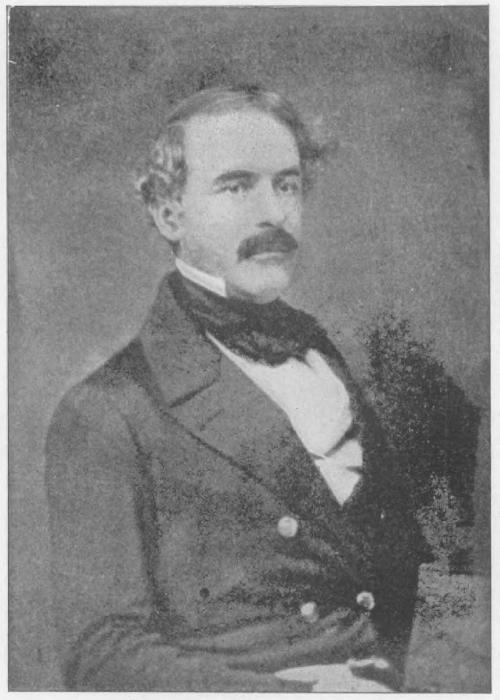
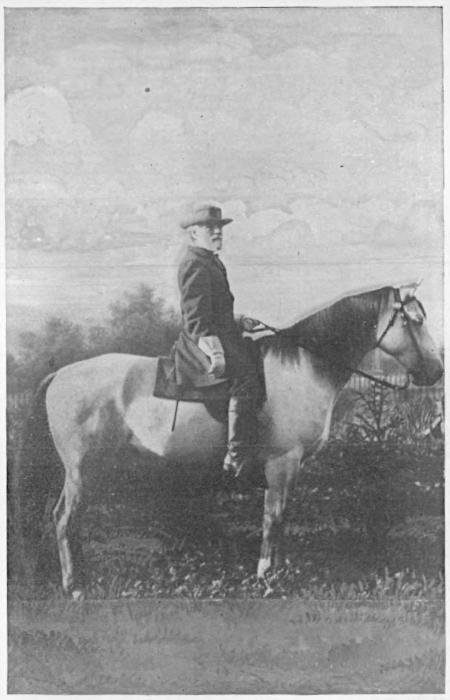
COLONEL R. E. LEE
About the time of the Mexican War
“He went much,” continues his
nephew biographer, “in the society of
ladies—always most congenial to him....
He was in love from boyhood.
Fate brought him to the feet of one
who, by birth, education, position and
family tradition, was best suited to be
his life companion. Mary, the daughter
of George Washington Parke Custis,
of Arlington, and R. E. Lee were
married on the thirtieth of June,
1831.”
The modesty of the newly married
couple was spared the modern newspaper
accounts of the bride’s wedding
garments, her trousseau and trunks,
the gifts and other intimate details
now demanded by an insatiate public.
Mrs. Lee was possessed of a strong
intellect, charming person and fascinating
manners, being at the same
time very domestic in her tastes, and
“such a housekeeper as was to be
found among the matrons of her day,”
says her friend, Reverend J. W. Jones,
who adds: “She was, from the beginning,
a model wife and mother.”[3]
A short account of the children
of this exemplary couple may not
be amiss here. George Washington
Custis Lee graduated, as has
been said, first in his class, and at
the time of the secession of Virginia
was an officer in the Engineer Corps.
He was appointed aide on President
Davis’s staff, became brigadier and
then major-general, and after the close
of the war was made professor of engineering
in the Virginia Military Institute
and succeeded his father as
president of Washington and Lee
University. This position he held for
twenty-six years, maintaining the high
standards set by his father. Since his
retirement, in 1897, he has resided at
Burke, Virginia.
William Henry Fitzhugh, the second
son, was a Harvard graduate and
was appointed lieutenant in the army
on the special application of General
Scott, but had resigned and was living
at home when the war came on, and
he raised a cavalry company, of which
he was made captain. He had command
of two companies and was made
major of the squadron. After the war
he served in the Virginia Senate and
in Congress until his death.
Robert E. Lee, junior, was a student
in the University of Virginia
when the war began, and promptly
enlisted in the Confederate army. He
served on the staff of his brother, General
W. H. F. Lee, and rose to the
rank of captain. Since the war he
has been a successful planter, and in
1905 he completed the “Recollections
of My Father,” truly a work of love.[4]
Miss Anne Carter Lee died during
the war, and Miss Agnes shortly after
the death of her devoted father. Miss
Mildred Lee died in 1905, and Miss
Mary Lee is still living, a prominent
figure in all social and historical matters
in her state and the national capital.
The oldest son was born at Fortress
Monroe, but the other children were
all born at Arlington, where Mrs. Lee
passed much of her time when her
husband was sent to distant stations.
Of Lee’s work as military engineer,
Mr. Jones says:
The system of river improvements devised
by Lee at St. Louis are still followed
there, and to his next work, at Fort Hamilton,
the city of New York owes its perfect
defenses to-day.
His campaign under General Scott,
in Mexico, was his first taste of actual
service, and history has recorded his
zeal, valor and undaunted energy in
that memorable conflict. He now entered
upon his real career. He was
breveted major at Cerro Gordo, lieutenant-colonel
at Churubusco, and colonel
at Chapultepec. General Scott
testified his appreciation in every report
he made to the War Department,
and Lee repaid the regard of his beloved
general with an extraordinary
admiration and devotion.
He brought his son, Robert, a mustang
pony from Mexico. “He was,”
writes Captain Lee, in his “Recollections,”
“for his inches, about as good
a horse as I ever met with. While he
lived ... he and Grace Darling,
my father’s favorite mare, were members
of our family. Grace Darling
was a chestnut mare of fine size and
great power. He bought her in Texas
from the Arkansas cavalry on his way
to Mexico, her owner having died on
the march out. She was with him
during all of the war, and was shot
seven times. As a little fellow I used
to brag of the number of bullets in
her, and would place my finger on the
scar made by each one.”
In 1852 he was appointed Superintendent
of the United States Military
Academy at West Point, where he remained
for three years, when he was
sent to Texas. His services on the
frontier covered a period of five years,
with one furlough home, during
which he was sent, in October,
1859, to capture John Brown, at Harper’s
Ferry. In February, 1861, he
was recalled from Texas and ordered
to report at Washington. He was not
in favor of secession, for he loved the
Union strongly, and he clung fondly
to the hope that the breach might be
closed, but he did not hesitate when
he saw that his state would secede. A
New York banker, an intimate friend
of General Scott, asked him at this
time, in the course of a conversation
on the art of war: “General, whom do
you regard as the greatest living soldier?”
General Scott replied immediately:
“Colonel Robert E. Lee is not
only the greatest soldier in America,
but the greatest now living in the
world. This is my firm conviction
from a full knowledge of his extraordinary
abilities, and if the occasion
ever arises, Lee will win this place
in the estimation of the whole world.”
Refusing the supreme command of the
United States army, he cast in his lot
with the Confederacy, and was placed
in command of the troops of Virginia.
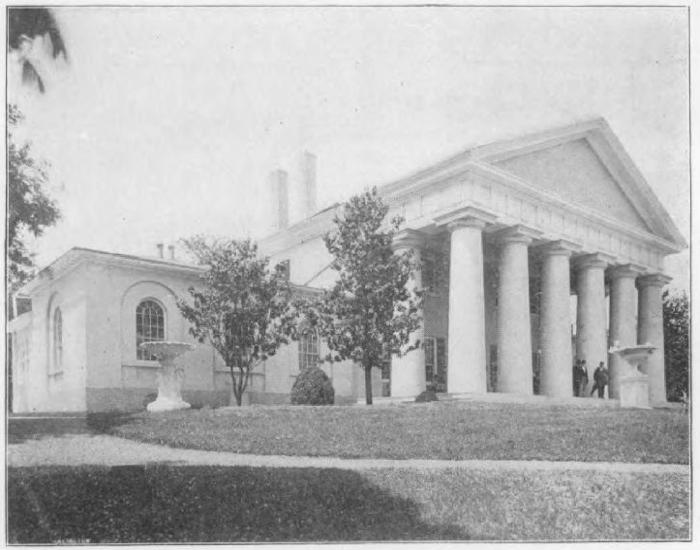
ARLINGTON, HOME OF THE LEES
Much discussion has been held concerning
the occupation of Arlington by
the Federal authorities, but it was
claimed that this was a justifiable act,
in view of the commanding position
of the property. The White House
and the department buildings near it
were only two miles and a half from
the highest point on the Arlington
grounds; the Capitol only three and
a half miles away, and Georgetown
less than a mile. A battery established
on the heights would have had the
whole of Washington at its mercy.
General Scott saw the importance of
this position, and, reluctant as he was
to turn Mrs. Lee from the lovely home
where he had so often received her
hospitality; deeply grieved as he must
have been to humiliate by his first
move one who had been his cherished
friend and trusted aide, he sent General
Mansfield to take it. “It is quite
probable,” wrote the latter in his report,
“that our troops assembled at
Arlington will create much excitement
in Virginia; yet, at the same time, if
the enemy were to occupy the ground
there a greater excitement would take
place on our side.”
Without going into particular details
of the four years of fighting, I
wish to quote Lord Wolseley’s beautiful
tribute to Lee:[5]
It is my wish to describe him as I saw
him in the autumn of 1862, when, at the
head of proud and victorious troops, he
smiled at the notion of defeat by any army
that could be sent against him. I desire to
make known to the reader not only the renowned
soldier, whom I believe to have
been the greatest of his age, but to give
some insight into the character of one whom
I have always considered the most perfect
man I ever met....
Outsiders can best weigh and determine
the merits of the chief actors on both sides....
On one side I can see, in the dogged
determination of the North, persevered in
to the end through years of recurring failure,
the spirit for which the men of Britain
have always been remarkable. It is a
virtue to which the United States owed
its birth in the last century.... On
the other hand, I can recognize the chivalrous
valor of those gallant men whom Lee
led to victory, who fought not only for
fatherland and in defense of home, but for
those rights most prized by free men.
Washington’s stalwart soldiers were styled
rebels by our king and his ministers, and
in like manner the men who wore the gray
uniform were denounced as rebels from the
banks of the Potomac to the headwaters
of the St. Lawrence.... As a looker-on,
I feel that both parties in the war have
so much to be proud of that both can afford
to hear what impartial Englishmen or
foreigners have to say about it.
Describing Lee’s appointment to the
command of the State Militia, he says:
General Lee’s presence commanded respect,
even from strangers, by a calm, self-possessed
dignity, the like of which I have
never seen in other men. Naturally of
strong passions, he kept them under perfect
control by that iron and determined
will of which his expression and his face
gave evidence. As this tall, handsome soldier
stood before his countrymen he was
the picture of the ideal patriot, unconscious
and self-possessed in his strength....
There was in his face and about his expression
that placid resolve which bespoke
great confidence in self, and which in his
case, one knows not how, quickly communicated
its magnetic influence to others.
Comparing Lee with the Duke of
Marlborough, he says:
They were gifted with the same military
instinct, the same genius for war. The
power of fascinating those with whom they
were associated, the spell which they cast
over their soldiers, ... their contempt
of danger, their daring courage, constitute
a parallel that it is difficult to equal between
any two other great men of modern times.
He repeats the following pleasantry
overheard between two Confederates,
after Pope’s dismissal:
Have you heard the news? Lee has resigned!
Good God! What for?
Because he says he cannot feed and supply
his army any longer, now that his commissary,
General Pope, has been removed.
A characteristic anecdote of Lincoln
is also given. He was asked how
many rebels were in arms and replied
that he knew the number to be one million,
“for,” said he, “whenever one
of our generals engages a rebel army
he reports that he has engaged a force
of twice his strength; now I know we
have half a million soldiers in the field,
so I am bound to believe the rebels
have twice that number.” General
Wolseley justly criticises the lack of
concerted action among our regiments.
No fair estimate of Lee as a general can
be made by a simple comparison of what he
achieved with that which Napoleon, Wellington
or Von Moltke accomplished, unless
due allowance is made for the difference
in the nature of the American armies
and of the armies commanded and encountered
by those great leaders. They were at
the head of perfectly organized, thoroughly
trained and well disciplined troops, while
Lee’s soldiers, though gallant and daring
to a fault, lacked the military cohesion and
efficiency, the trained company leaders ...
which are only to be found in a regular
army of long standing.
The Englishman concludes:
Where else in history is a great man to
be found whose whole life was one such
blameless record of duty nobly done? It
was consistent in all its parts, complete in
all its relations.
... The fierce light which beats upon
the throne is as that of a rushlight in comparison
with the electric glare which our
newspapers now focus upon the public man
in Lee’s position. His character has been
subjected to that ordeal, and who can point
to any spot upon it? His clear, sound
judgment, personal courage, untiring activity,
genius for war, and absolute devotion
to his state mark him as a public man, as
a patriot to be forever remembered by all
Americans.... I have met many of
the great men of my time, but Lee alone
impressed me with the feeling that I was in
the presence of a man who was cast in a
grander mould and made of finer metal than
all other men. He is stamped upon my
memory as a being apart and superior to
all others in every way; a man with whom
none I ever knew, a very few of whom I
have read, are worthy to be classed.
This was one of the popular songs
current after the close of the war:
I followed old Marse Robert
For four years, near about;
Got wounded in three places,
And starved at P’int Lookout.
Why Marse Robert? Major Stiles
gives the reason[6]:
The passion of soldiers for nicknaming
their favorite leaders, rechristening them
according to their own unfettered fancy, is
well known.... There is something
grotesque about most of them, and in many
seemingly rank disrespect.... However
this may be, “Marse Robert” is far
above the rest of soldier nicknames in
pathos and in power.
In the first place, it is essentially military ...
it rings true upon the elemental basis
of military life—unquestioning and unlimited
obedience.... There never could
have been a second “Marse Robert,” and
but for the unparalleled elevation and majesty
of his character and bearing, there
would never have been the first. He was
of all men most attractive to us, yet by
no means most approachable. We loved
him much, but we revered him more. We
never criticised, never doubted him; never
attributed to him either moral error or
mental weakness; no, not even in our secret
hearts or most audacious thoughts. I really
believe it would have strained and blurred
our strongest and clearest conceptions of the
distinction between right and wrong to have
entertained, even for a moment, the thought
that he had ever acted from any other than
the purest and loftiest motive.... The
proviso with which a ragged rebel accepted
the doctrine of evolution, that “the rest of
us may have descended or ascended from
monkeys, but it took a God to make
‘Marse Robert,’” had more than mere humor
in it.... We never compared him
with other men, either friend or foe. He
was in a superlative and absolute class by
himself. Beyond a vague suggestion, after
the death of Jackson, as to what might have
been if he had lived, I cannot recall even
an approach to a comparative estimate of
Lee.
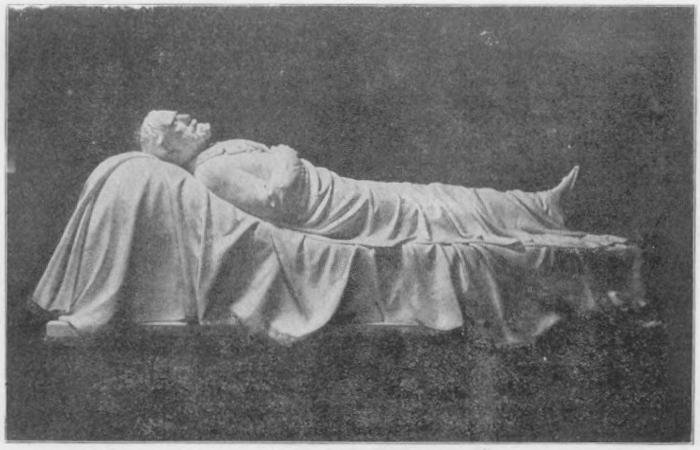
VALENTINE’S RECUMBENT LEE STATUE
At Washington and Lee University, Lexington, Virginia
Lee’s devotion to his soldiers and
theirs to him are referred to by one of
Pickett’s captains[7]:
Many of those who had been wounded in
the battle of the first day went into the
great charge on the third day with bandages
on their heads or arms, at sight of
which the imperturbable Lee shed tears....
Here was a devotion of which the Romans
of old had never dreamed; here was a holocaust
of sacrificial victims such as Greece
had never known! The men who at Marathon
and Leuctra bled were not greater heroes
than those who fell at Gettysburg.
In a small volume of War Sketches,
issued shortly after the war, I found
the following anecdote contributed to
a Washington paper by Miss Woolsey,
a nurse sent to Gettysburg with the
Sanitary Commission:
One of the Gettysburg farmers came
creeping into our camp three weeks after
the battle. He lived five miles only from
the town and had “never seen a Rebel.”
He heard we had some of them, and came
down to see them. “Boys, here’s a man who
never saw a Rebel in his life, and wants
to look at you.” There he stood, with his
mouth wide open, and there they lay in
rows, laughing at him. “And why haven’t
you seen a Rebel?” Mrs. ⸺ asked.
“Why didn’t you take your gun and help
to drive them out of your town?” “A feller
might er got hit,” which reply was quite
too much for the Rebels; they roared with
laughter up and down the tents.
After the surrender at Appomattox
General Lee joined his family at Richmond
for a short period of rest before
taking up the “burdens of life again.”
“There was,” writes General Long,[8]
“a continuous stream of callers at the
residence ... upon every hand
manifestations of respect were shown
him.” General Long gives some touching
incidents:
One morning an Irishman who had gone
through the war in the Federal ranks appeared
at the door with a basket well filled
with provisions, and insisted upon seeing
General Lee.... The general came
from an adjoining room and was greeted
with profuse terms of admiration. “Sure,
sir, you’re a great soldier, and it’s I that
know it. I’ve been fighting against you all
these years, an’ many a hard knock we’ve
had. But, general, I honor you for it; and
now they tell me you’re poor an’ in want,
an’ I’ve brought this basket an’ beg you to
take it from a soldier.”
Two Confederate soldiers, in tattered garments
and with bodies emaciated by prison
confinement, called upon General Lee and
told him they were delegated by sixty other
fellows around the corner “too ragged to
come themselves.” They tendered their beloved
general a home in the mountains,
promising him a comfortable house and a
good farm.
“Great and star-like as was the warrior,”
says Dr. Shepherd, “the man is
greater.”[9]
It is said that General Lee was offered
estates in England and in Ireland;
also the post of commercial
agent of the South at New York, and
many other tenders of a home or livelihood.
All of these he declined and
accepted the presidency of Washington
College, at Lexington.
Founded in 1789 under the name of
“Augusta Academy,” the name was
changed in 1782 to “Liberty Hall
Academy,” from which was sent a
company of students into the Revolution.
Washington, who had accepted
from the new State of Virginia 100
shares of the James River Company
only on condition that he might give
them to some school, chose this
academy for beneficiary, and the name
was changed in 1798 to “Washington
College.” The buildings, library and
apparatus had been sacked during the
Federal occupancy, and the country
was able to furnish only forty students
at the opening of the term of ’65-’66.
Nothing daunted, the new president
gathered around him an able faculty,
raised the standard of scholarship,
renovated the old buildings and secured
funds for new ones. He introduced
the “honor system” and knew
every student’s name, as well as his
class and deportment record. Asked,
at a faculty meeting, for a plan to induce
students to attend the chapel, he
advised: “The best way that I know
of is to set them the example,” which
he invariably did. This gives the keynote
to his remarkable influence.
The effect of his principles was all-powerful.
It is doubtful if any other
college in the world could show such
a high average of morals and scholarship
which obtained at Washington
College during Lee’s presidency of
five years.
I cannot resist relating an anecdote
given by another of our soldier-authors,
John Esten Cooke:[10]
Coming upon the chieftain conversing
cordially with an humbly clad
man, he supposed that it was, of
course, an old Confederate, the more
so as the general, looking after the retreating
figure, said kindly:
“That is one of our old soldiers who
is in necessitous circumstances.” Questioned,
however, he admitted that the
soldier had fought on “the other
side, but we must not think
of that,” was his verdict.
The death of General Lee,
on October 12, 1870, brought
forth more encomiums from the
press, personages of exalted
rank, and from the people generally
than has ever been accorded any man
who died in private life since Washington.
“I do not exaggerate,” says
Dr. Jones, “when I say that many
volumes would not contain the
eulogies that were pronounced,
for I undertook to make a partial
collection of them and have a
trunk full now.” In the cemetery near
him at Lexington bivouacs his great
lieutenant, Stonewall Jackson. They
were born in the same month, the one
on the nineteenth and the other on the
thirty-first of January. It is fitting
that they should lie near together. “I
know not,” further and most fittingly
continues Mr. Jones, who was chaplain
of the University, “how more appropriately
the tomb of Lee could be
placed. The blue mountains of his
loved Virginia sentinel his
grave. Young men from
every section throng the
classic shades of Washington
and Lee University, and delight
to keep ward and
watch at his tomb.”
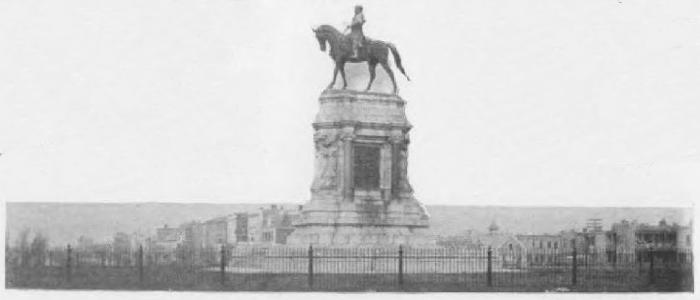
MERCIE’S MONUMENT, LEE CIRCLE, RICHMOND
I sing the hymn of the Conquered who fell in the battle of life,
The hymn of the wounded, the beaten, who died overwhelmed in the strife;
Not the jubilant song of the Victors for whom the resounding acclaim
Of nations was lifted in chorus, whose brows wore the chaplet of fame.
While the voice of the world shouts its chorus, its paeans for those who have won,
While the trumpet is sounding triumphant, and high to the breeze and the sun
Gay banners are waving, hands clapping and hurrying feet
Throwing after the laurel-crowned victors, I stand on the field of Defeat.
Speak, History! Who are Life’s victors? Unroll thy long annals and say;
Are they those whom the world called the victors, who won the success of a day?
The Martyrs or Nero? The Spartans who fell at Thermopylae’s tryst,
Or the Persians and Xerxes? His judge or Socrates? Pilate or Christ?
HISTORIC HIGHWAYS OF THE SOUTH — CHAPTER XVI—THE SECOND DAY AT SHILOH
By John Trotwood Moore
By Lewis M. Hosea
[We give way in this issue to Judge
Lewis M. Hosea, Judge of the Superior
Court of Cincinnati and late Brevet Major
U. S. Army, 16th U. S. Infantry, who gives
us the viewpoint as seen by Buell’s army.
In this paper by this distinguished gentleman,
appears the best description of how
it feels to be under fire and how the Confederate
columns appeared that we have
ever seen.
That particular description deserves to
live as a classic and no one may read it
without afterwards seeing “the surging
line of butternut and gray moving rapidly
across our front” and “the accompaniment
of a leaden blast of hell sweeping into one’s
face as though it were a sort of fierce and
deadly wind impossible to stand against.”
It will also be observed that Judge Hosea
takes decided issue as to certain facts
published in the History of the Shiloh Battlefield
Commission which we take pleasure
in publishing and will accord the same privilege
to any one who cares to reply, as it
is by this kind of personal testimony that
the truth of history is eventually established.
To the readers of Taylor-Trotwood we
wish to state that these Historic Highways
of the South have been running serially
through Trotwood’s Monthly for fifteen
months and include The Hermitage, The
Creek War Highways, New Orleans, Battle
of Franklin, Ft. Donelson, Shiloh and
others.—The Editor.]
The two days’ battle at Pittsburg
Landing on the Tennessee River,
fought on Sunday and Monday,
April 6th and 7th, 1862, viewed
from the standpoint of forty years
later, looms up as one of the most
significant contests of the great Civil
War. The entire battlefield was a wilderness
of scrub oak and kindred
growths, unbroken save by a few settlers’
clearings located at random upon
a plain traversed only by irregular
“woods-roads,” and by drainage
ravines leading by winding courses
into the two creeks bounding the field
of operations on the north and south—these
discharging into the Tennessee
River behind the Union Army.
The troops were for the most part
new and untried, and the conditions
of the ground made the transmission
of orders difficult and uncertain. It
was impossible for commanders of
large bodies to obtain a comprehensive
view of the field so as to perceive and
provide intelligently for the varying
exigencies of the battle as it progressed.
They could only guess the
swaying movements of the fight by
sounds of musketry and by the chance
reports of messengers who could locate
nothing by fixed monuments. Nor
could the men in ranks, or even regimental
officers, see beyond a limited
distance; and the direction of enfilading
or turning movements could be
discovered only by the course of bullets
among the trees or the tearing
of the ground by solid shot or shell.
These things made the battle a supreme
test of the quality of the individual
units of the army rather than
of any directing skill of its higher
commanders. The bulldog courage
of individual groups of men who hung
on and fought “to a finish,” or who,
like Prentiss, sacrificed themselves
where they stood because of no order
to withdraw, delayed the general advance
of the enemy and thus saved
the first day from overwhelming and
complete disaster. It became a case
of “night or Blücher;” and when,
toward evening, the leading regiments
of Buell’s army arrived upon the field
and interposed a fresh line of resistance,
the Union troops had been driven
from the field and huddled as a
mass of disorganized fragments in a
semicircle of half a mile radius about
the landing.
But the Confederates drew off
flushed with the spirit of victory and
ceased fighting only to prepare for an
expected certain and triumphant finish
in the morning. Knowing that they
had the Union forces hemmed in the
semicircle of their lines extending
from river to river, every Confederate
soldier fully believed that surrender
or annihilation of the Union forces
would be easy of accomplishment.
This was the spirit and purpose that
animated the Confederate forces on
Monday when they began to attack
soon after daylight on that second day.
To the forces of Buell, arriving during
the night on transports from Savannah
(on the river twenty miles below),
and marching up the bank in
the dim light of dawn to form a cordon
around the fragments of Grant’s
army, the scene was dismal and discouraging
in the extreme. Making
our way through the thousands of
men huddled on the bank, hearing at
every step the doleful prognostications
of defeat, the wooded plain above presented
to us visible proof of the disastrous
conflict of the day before in
the dead and wounded who lay unattended,
and the broken and discarded
arms and equipments that strewed
the ground. These were the sights
and sounds that greeted us as we
marched to our place in line of battle
on the second day; and they fully justified
the compliment paid us by our
brigade commander, General Lovell
H. Rousseau, who says, in his official
report of the battle in substance:
“Seldom have men gone into battle
under such discouraging circumstances,
and never have they borne themselves
more gallantly.”
In the personal reminiscences that
follow I shall speak more particularly
of the part taken by Rousseau’s brigade
of McCook’s division.
I was personally present throughout
the second day, as Adjutant of the
First Battalion, Sixteenth U. S. Infantry—which,
with similar battalions
of the Fifteenth and Nineteenth Infantry,
and the First Ohio, Fifth Indiana,
and Sixth Kentucky Volunteers—constituted
Rousseau’s brigade
(4th) of McCook’s division (2d) of
the Army of the Ohio commanded by
General Buell.
My position as adjutant gave me a
somewhat wider range of observation
than that of a line officer on duty with
a company, and I retain some very
distinct recollections of the battle,
which I will briefly state in so far as
they bear upon the movements of
Rousseau’s brigade; but I shall leave
others to speak of the severity of the
fighting, and leave to you to estimate
the quality of the service the brigade
rendered the Union cause.
Rousseau’s brigade reached Pittsburg
Landing during the night of the
6th of April, 1862, by steamers from
Savannah, and disembarked just before
day. On the level just back of
the landing, in the dim light of the
coming dawn, we deposited knapsacks
and advanced in a southwesterly direction
through the woods, passing
through camps (probably Hurlbut’s)
where our dead lay unburied as they
had fallen the day before. After a
short halt we were advanced and deployed
to the right and front at the
hither edge of a broad and shallow depression,
where a small brook coursed
on to our right through a comparatively
open forest without any visible
clearing. Here we were halted, muskets
loaded, and, in a short time, at
a little after six o’clock, we heard firing
toward our right rear, and almost
immediately our own skirmishers were
driven in and we were engaged with
a battle line of the enemy. Then followed
a steady and vigorous “stand-up”
musketry fight which lasted the
greater part of an hour, when the enemy
drew off, but soon renewed the
attack with greater vigor, only to be
again repulsed.
This position was probably on
Tilghman’s Creek, shown on the map
of the Shiloh Battlefield Commission
to which I shall refer; but the hour
stated on the map as eight o’clock is
wrong and should be six o’clock. By
eight o’clock we had been baptized
with fire and blood. Here Captain
Acker of the Sixteenth was killed, and
a number of other officers and men
were killed and wounded.
It is an old story, perhaps, to most
of you—this first experience of actual
battle; yet, even now, dimly remembered
through the intervening years,
it seems to me the most horrifying
experience that can possibly fall to
the lot of man.
First came the startling report of
a musket fired by one of our own
skirmishers out in our front; then a
crackling of responses from the woods
beyond, but we could see only a little
blue smoke rising above the undergrowth—for
it was early spring and
the green leaves were just beginning
to appear—and hear the skipping of
stray bullets through the branches
with a whirr of spent force. A stir
went through the lines and faces grew
pale, for we knew that the battle was
sweeping toward us and that these
shots were the first sprinkle of the
coming storm. The quiet command of
“Attention!” was obeyed ere it was
uttered; but the climax of first impressions
came with the order to
“load.” That order, like the jarring
touch upon the chemist’s glass, crystallized
the wild turmoil of thoughts
and focalized all upon the actual business
of war. I can realize now how
important a thing in war is the musket
as a steadying factor for overwrought
nerves; and how that first order to
“load!” brought the panicky thoughts
of men back with a sudden shock to
the realization that they were there
upon equal terms with the enemy to
do and not alone to suffer. I remember
the “thud” of the muskets as they
came down upon the ground almost
as one,—for our men had been well
drilled,—and the confused rattle of
drawing ramrods, and their ring in
the gun barrels as they rebounded in
ramming the charges home. Every
movement and every sound was an
encouragement; and in the reaction
of feeling the interchange of boastful
speech almost ripened into cheers.
But, meantime, the fire of skirmishers
increased to an almost continuous rattle
and grew closer, until—for all this
was a matter of minutes only—our
skirmishers could be seen coming in,
firing as they came, and half carrying
two or three wounded men. This, of
course, again deepened the tension of
nervous expectation, and faces took
on a look of grim determination, as
eyes peered forward to catch the first
glimpse of the approaching enemy.
As our skirmishers came into the lines,
there went a hoarse whisper down
the ranks, “There they are!”—and
looking out through the woods I saw
the flutter of battle flags and beneath
them a surging line of butternut and
gray moving rapidly across our front
just beyond the shallow ravine, perhaps
fifty or seventy-five yards away.
In a moment, as it seemed, there burst
forth a rattle of musketry that almost
drowned the command of our officers
to “fire at will!”
The first shock of battle is appalling.
The rattle deepens into a roar
as men get down to the work of loading
and firing rapidly; but it is not
alone the noise of firing that appals,
the vicious “whizz,” and “zip” past
the ears; the heavy “thud” of bullets
that strike the tree-trunks with the
force of sledge-hammer blows,—all
these make up a horrible din that has
no parallel on earth. But with it all
is the realization that this is but the
accompaniment of a leaden blast of
hell sweeping into one’s face as though
it were a sort of fierce and deadly
wind impossible to stand against; and
the rain of leaves and twigs cut from
the trees, and the occasional fall of
larger branches, heightens this impression
of a raging storm. After a
little the smoke obscures everything
and the battle goes on in an ever-increasing
acrid fog that would make
breathing impossible were it not for
the frenzy of battle that seizes upon
every other faculty, physical and mental,
and makes one oblivious to all
other surroundings.
Here and there a man drops his
musket, throws up his hands and falls
backward dead; or another lunges
heavily forward on hands and knees,
mortally wounded; and no one who
has seen it will ever forget that look
of agony unspeakable on the faces of
those stricken by sudden death in battle.
For what seemed an interminable
time the angry buzz of bullets clipped
by our ears and overhead; and I remember,
that, as I passed up and down
the line assisting the commanding officer
of the battalion in encouraging
the men to take time in loading carefully
and aiming low, a bullet struck
a musket in the hands of a young
Irishman of my own company, just
as he was about to bring it to his
shoulder, and the force of the impact
shattered the stock and turned him
partly about and almost threw him
down. I saw the blood spurt from his
arm, for he had in the excitement
rolled up his sleeves to handle his
piece the better. I sprang forward to
assist him; but with a cry of rage he
stripped off his sleeve, and with the
assistance of a comrade, bound up
his wound, which proved to be not
serious, and seized a dead comrade’s
musket beside him and went on with
the fight.
But after a time the whirr and hiss
of the bullets slackened and finally
ceased; finally, skirmishers were ordered
out to reconnoiter, while disposition
was made of the dead and
wounded. Soon, however the skirmishers
came hastily back and reported
new and heavier lines advancing, and
again we saw the battle-flags among
the trees, nearer than before. This
time, however, the fight opened with
the thunder of field guns whose missiles
went shrieking overhead with a
horrible sound that made the blood
run cold. Then came the order to
hug the ground and fire at will; and
the fight went on as before except that
as we had advanced a few rods down
the gentle declivity of the ravine, and
the line of the enemy was at a relatively
higher level, the majority of
bullets and the cannon shots passed
above us and but few came dangerously
close.
But the success of our first experience
seemed to tell upon the ranks,
and the coolness and deliberation of
both men and officers were noticeable
thenceforward; and soon the artillery
discharges ceased, and after a time
we knew, as before, by the lessening
of the whizz of bullets, that the enemy
had again yielded the ground in our
front.
As I look back upon it, it seems astonishing
how soon all the natural
feelings of apprehension and fear give
way to what has been aptly termed
the “battle rage” which lifts a man
up to a plane where the things of the
body are forgotten. Amid the roar
and din of musketry and the horrible
swish and shriek of shells, the intellect
seemed to be disembodied, and,
while conscious of the danger of being
hurled headlong into eternity at
any moment, the pressure upon the
brain seemed to deaden the physical
senses—fear among them. Fear came
later when the fight was over, just as
in the waiting moments before it began;
but throughout the day while the
battle was on I remember having a
singular feeling of curiosity about personal
experiences. I seemed to be
looking down upon my bodily self
with a sense of impersonality and wondering
why I was not afraid in the
midst of all this horrible uproar and
danger. I suppose this was the common
experience of soldiers, for if it
were not so, battles could not be
fought.
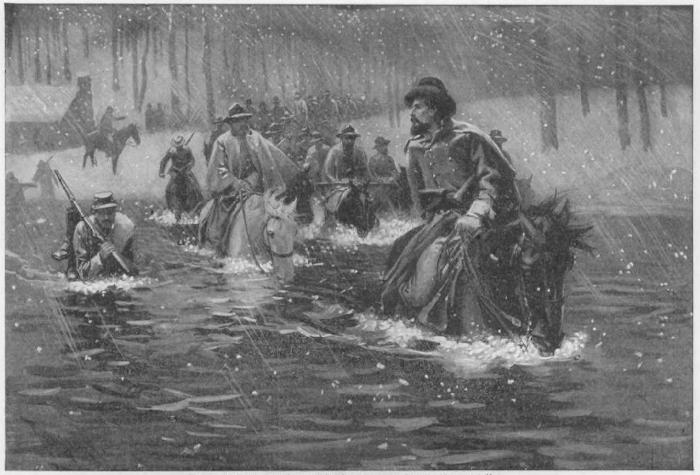
GENERAL FORREST AND HIS CAVALRY GOING OUT TO FORT DONELSON
From “Life of General Nathan Bedford Forrest.”
Copyright, 1899, by Harper & Brothers.
After repulsing the second attack,
at about eight o’clock, we moved forward
slowly across the brook, with
skirmishers advanced, fighting at intervals,
for the enemy stubbornly contested
the ground. On reaching a
clearing (probably the Duncan field)
in the line of our advance we were met
by an opposing concentration of the
enemy in great force at the far side
of it, who attempted a desperate
charge upon us. This was met by a
steady fire and an unswerving line;
and the fighting that ensued is described
by Judge Force, in his account
of the battle published in the “Campaigns
of the Civil War” by the Scribners
(p. 171), as a “desperate struggle”—and
indeed it was! Guenther,
with a section of Terrill’s battery,
arrived upon the scene, coming in upon
our right, which was unprotected,
at the crisis of this fight, and, as the
enemy gave way at our front and ran
together in a mass to pass through
a gate or break in a fence in the rear,
he directed his rapid discharges of
canister to the same point. The effect
upon the enemy was appalling and
horrible beyond all description. Among
our killed were Lieutenant Mitchell, a
most gallant officer of the Sixteenth,
and it was here also that Wykoff, then
a captain of the Fifteenth, lost his eye.
I recall one striking incident of a
personal character connected with this
part of the battle. A sergeant of C
Company, which I had commanded,
was wounded in the shoulder and disabled
though not vitally hurt. A moment
later, as the sergeant was making
his way to the rear, I was knocked
down by an exploding shell, whose
fragments relieved me of one boot-leg
and left one leg of my pants in
shreds, but fortunately left the leg intact,
except for a wrench and a few
bruises of no serious consequence. It
so happened that my sergeant saw
me fall, and, as he was among the first
of the wounded taken to Cincinnati,
he reported me as killed, to the great
distress of my family at home. My
brother, who came down a few days
later, found me very much alive,
though very ragged, very dirty, and
very thankful that the shell that took
my boot-leg took no more. I was
thankful even for the limp that made
me the subject of good-natured derision
for some days as I performed
my duties as adjutant on one leg.
We immediately followed in pursuit,
after this last fight, capturing two
field-guns from the enemy, and continued
the advance until we had repossessed
General McClernand’s headquarters
of Sunday, beyond which we
again met a determined resistance,
but eventually drove the enemy back
through a large open field into what
has been termed the “water oaks
thicket.”
The enemy seemed to be massed in
great force at and beyond this point
to oppose our further progress, and a
heavy line of battle occupied the woods
beyond the clearing on the hither edge
of which we were halted to replenish
our exhausted ammunition.
Our advance, though slow, had been
continuous and resulted in projecting
a sort of wedge into the enemy’s lines,
of which wedge we seemed to be the
apex. It resulted, therefore, naturally
and necessarily that the enemy concentrated
more and more in our immediate
front to break the force that
was gradually splitting them in two
and endangering their communications
in rear. Firing still continued
toward the rear on both flanks, for we
had considerably outstripped the general
advance. Our men fixed bayonets
and lay down under orders to
hold the position, if attacked, at all
hazards. The firing against us grew
quite heavy, but no reply was made,
although some were killed, among
them Lieutenant Keyes, a splendid officer
of the Sixteenth, with whom I
was standing arm in arm at the time
his summons came,—for among the
regulars it was not then considered
“good form” for officers to take shelter.
I have before spoken of the impact
of a minie bullet against a tree as like
the blow of a sledge hammer. The
Keyes incident gives a very realistic
illustration. As I have mentioned in
another place, Lieutenant Keyes and
I were standing arm in arm—my
right interlocked with his left,—in
rear of his company. We were, as I
recall, just exchanging sorrowful remarks
over the death of a Sergeant
Baker—a fine man—who received a
bullet through the forehead just a
moment before, while Keyes was exchanging
words with him. Just then
the sledge hammer struck one of us—for
a moment I did not know which—and
hurled us both to the ground
backwards. As I scrambled to a footing
I saw Keyes’ blanched face and
the torn garment showing the passage
of the bullet through the left shoulder
joint where a hasty examination
showed that the bony structure of the
vicinity had been shattered. He was
taken to the rear and died the second
day after.
Here, after a long wait, General
Sherman came, and I saw him for the
first time. I will let him tell you what
next occurred. General Sherman is
describing, in his official report of the
battle, his own movements as he came
up on our right; and is speaking of a
battery that had reached him at the
rear. He says:
“Under cover of their fire we advanced
until we reached the point
where the Corinth road crosses the
line of McClernand camp, and here
I saw for the first time the well ordered
and compact columns of General
Buell’s Kentucky forces whose soldierly
movements at once gave confidence
to our newer and less disciplined
men. Here I saw Willich’s
regiment advance upon a point of water
oak and thicket, behind which I
knew the enemy was in great strength,
and enter it in beautiful style.”
(The thicket described by General
Sherman, I may remark, was just beyond
the field on the edge of which
we were lying and through which it
was necessary to pass. The Thirty-second
Indiana was regarded as the
crack German regiment of our western
army.)
General Sherman continues:
“Then arose the severest musketry
fire I ever heard, and lasted some
twenty minutes when this splendid
regiment had to fall back.”
(The Thirty-second, let me explain
further, had passed around our left
and formed in our front, in the open,
in column of companies—“double column
to the center,” as the formation
is described by its commander in his
report. The absurdity of this formation
seemed to strike even the rank
and file, for it drew a direct and enfilading
fire from the extended line of
the enemy in front that reached even
the rear companies and gave rise to
the claim on their part that they had
been fired upon by the troops in their
own rear. This claim was and is, of
course, ridiculous. The regulars were
at that moment engaged in replenishing
their cartridge boxes in the rear
of Kirke’s brigade which had been in
reserve and had taken our position
temporarily for this purpose. The
claim was made as an excuse for a
most unmilitary blunder in placing a
column formation in the open in the
face of a battle line, and, as it naturally
resulted in a complete rout of the
regiment, some excuse was sought as
a salve for wounded pride).
General Sherman continues:
“This green point of timber is about
five hundred yards east of Shiloh
meeting house, and it was evident here
was to be the struggle. The enemy
could be seen also forming his lines to
the south.... This was about
2 p.m. The enemy had one battery
close by Shiloh and another near the
Hamburg road, both pouring grape
and canister upon any column of
troops that advanced upon the green
point of water oaks. Willich’s regiment
had been repulsed, but a whole
brigade of McCook’s division advanced
beautifully, deployed, and entered
this dreaded wood....
This I afterward found to be Rousseau’s
brigade of McCook’s division.
“Rousseau’s brigade moved in
splendid order steadily to the front
sweeping everything before it; and at
4 p.m. we stood upon the ground of
our original front line, and the enemy
was in full retreat....
“I am ordered by General Grant
to give personal credit where I think
it is due, and censure where I think
it merited. I concede that General
McCook’s splendid division from Kentucky
drove back the enemy along the
Corinth road, which was the great center
of the field of battle, where Beauregard
commanded in person, supported
by Bragg’s, Polk’s and Breckinridge’s
divisions.”
General Sherman lived many years
in the belief that he had fully and truly
stated the facts in this matter, but
we now know from a veracious history
to which I shall refer, “compiled
from the official records upon the authority
of the Shiloh Battlefield Commission,”
that what Sherman supposed
to be a concentration of the Confederate
army under Beauregard, including
many divisions under distinguished
leaders, was only Colonel
Looney, of the Shiloh Battlefield Commission,
with his regiment “augmented
by a few detachments” from others,
“driving back the Union line to the
Purdy road” and enabling the Confederate
army to “leisurely” walk away
unmolested without our even suspecting
it!
At the time Sherman came to us,
Willich, with his large regiment, was
just going into the open field and our
reserve brigade—Kirke’s—was taking
our position while we retired to the
road to get a supply of ammunition
which had come forward meantime;
so that Sherman saw the advance and
repulse of Willich, and the re-forming,
deploying and advance of Rousseau’s
brigade that so favorably attracted
his attention as to merit official
praise.
Between three and four o’clock in
the afternoon we had pushed the enemy,
still fighting, back to the vicinity
of Shiloh Church. This, as afterward
appeared, was Beauregard’s headquarters
which he vacated about two
o’clock, from prudential motives, and,
manifestly by an afterthought, sought
to minimize the fact of his own defeat
by making it appear that an order to
withdraw his army had been given
long before. As a matter of fact,
we know now from the records that
the only order given was an order
to the extreme wings of his army to
fall back to this very point as a concentration
of his forces against the
center of our army.
Rousseau’s brigade continued its
slow but relentless advance until we
reached and passed the church itself,
when the forces immediately in our
front in the vicinity of the road broke
in disorder, leaving, however, a considerable
body of the enemy on our
right against whom the regular battalions
right-wheeled and whom we
pursued half way through the former
camps of Sherman’s troops lying parallel
with the Shiloh branch, completing
the rout of all the enemy’s forces
in sight. They fled in disorder across
the branch, and we were ordered to
rejoin the brigade. At the final rout
of the enemy at 4 o’clock p.m., we
were astraddle of the camps of McDowell’s
brigade of Sherman’s division,
and this is what General Sherman
refers to when he says in his report:
“At 4 p.m. we stood upon the
ground of our original first line and
the enemy were in full retreat.”
In this final movement the troops
of Sherman took no part, nor was the
division of General Lew Wallace or
that of McClernand in sight. And this
is what General Sherman admits by
his frank confession that:
“General McCook’s splendid division
drove back the enemy along the
Corinth road which was the great center
of the field of battle.”
This crisis of the battle really lasted
from about noon, when we faced
the point of water oaks, until four
o’clock, when the enemy were routed
and fleeing in confusion across Shiloh
branch. If there was any rallying
force at all on the other side of this
branch, it made no demonstration and
certainly it was not a battle line of the
enemy as represented on the map of
the commission. The only rear-guard
stand mentioned in the reports was at
a point two miles further on and a
final stand by Breckinridge’s division
at Mickey’s still further toward Monterey.
A few of the Confederate authorities
place their final “withdrawal” at
two o’clock, and a few others at three,
but the overwhelming consensus of
testimony of the reports place the final
and complete rout of the enemy beyond
the Shiloh Church at and after
four o’clock; and Sherman again in
his report particularizes 4 p.m. as the
close of the engagement (p. 254).
After the fighting was over, General
Sherman came over to us in his
camps of the day before, and, speaking
to Major Carpenter (of the Nineteenth),
complimented most highly
the work of the brigade and particularly
of the regular battalions.
It was about this time also that
General Thomas J. Woods arrived
at the front, at the head of a brigade
of his division, and, as Major Lowe
reminds me, demanded in no “Sunday
school language” to be allowed to go
forward in pursuit of the enemy.
But the darkness was approaching,
and the impossibility of handling new
troops in the dark in a wilderness of
black jack was manifest, and the pursuit
was given over for the night.
The map of the commission shows
Wood’s entire division in line with us
and taking part at 2 p.m. in the great
and final crisis of the day, in which
the musketry fire was, as described
by General Force, “more severe than
any that occurred on the field in either
of the two days of the battle.” Wood’s
division was not there. One brigade
came upon the field just as the fighting
was over, at about four o’clock,
and the other did not leave the landing
until dark. General Force’s statement,
substantially to the same effect
in his history of the battle (p. 177 in
the Scribner’s Series) is:
“Wood’s division, arriving too late
to take part in the battle, pushed to
the front and engaged his skirmishers
with the light troops covering the retreat.”
General Buell’s report states the fact
as I give it from my recollection.
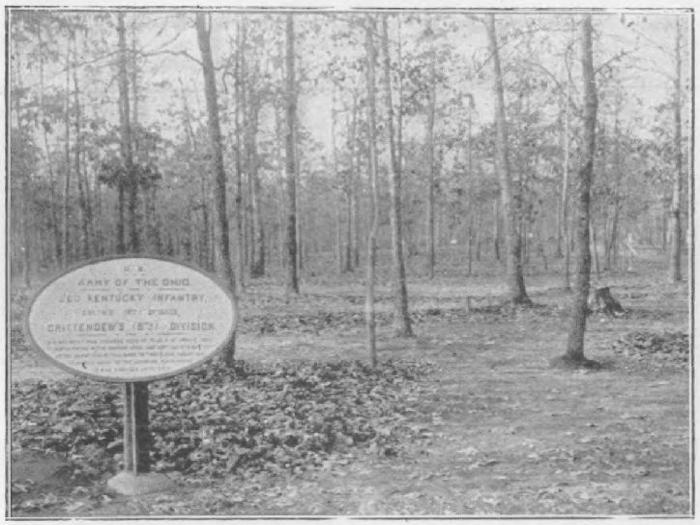
A TYPE OF TABLET SHOWING SHAPE ADOPTED FOR SECOND DAY’S BATTLE. THIS
PARTICULAR ONE MARKS A POINT ON “HORNET’S NEST”
In the year 1901, I addressed a letter
to the Shiloh Battlefield Commission,
at the invitation of its chairman,
stating the substance of the personal
recollections herein given, with a view
to the correction of some very serious
errors in its official blue print maps.
In this letter I referred to between
thirty and forty official reports of
field organizations engaged in the battle,
all showing that the errors complained
of existed; but from that day
to this no notice whatever has been
taken of the letter.
I had not then the slightest idea that
the commission intended to constitute
itself the official historian of the Battle
of Shiloh—for certainly the law of
its appointment contemplates no such
thing. But, during the year 1903,
there appeared from the press of the
Government Printing Office, Washington,
an innocent looking work
bearing on its title page the following:
“Shiloh National Park Commission.
The Battle of Shiloh, and the Organizations
Engaged. Compiled from the
Official Records by Major D. W.
Reed, Historian and Secretary, under
the Authority of the Commission,
1902. Washington, Government
Printing Office, 1903.”
There follows, on a subsequent
page, a preface addressed by the
Chairman of the Commission—
“To Shiloh Soldiers”—in which, referring
to the intent of the statute establishing
the Shiloh National Military
Park to perpetuate the history of the
battle on the ground where it was
fought, he expresses the desire of the
commission that “this history” (meaning
this publication) “shall be complete,
impartial, and correct,” etc. He
then states, that, “to ensure this accuracy,
all reports have been carefully
studied and compared. The records
at Washington have been thoroughly
searched and many who participated
in the battle have been interviewed....
It is, therefore, desired that
the statements of the book be earnestly
studied by every survivor of Shiloh
and any errors or omissions be reported
to the commission with a view to
the publication of a revised edition of
the report.”
This so-called official “history” of
the battle contains in permanent form
the same erroneous maps put forth as
blue prints in 1901. The history proper
devotes about sixteen pages to a
description of the first day’s operations
of the Army of the Tennessee, and
one page to those of the second day
covering the participation of the Army
of the Ohio. Short as is the latter
portion of the history, we learn that
the weight of numbers really decided
the issue before the fight began; and,
while Beauregard made a show of resistance
for a while, along about dinner
time he sent Colonel Looney (of
the Shiloh Battlefield Commission)
with his regiment “augmented by detachments
from other regiments,” who
charged and “drove back the Union
line,” and enabled Beauregard to safely
cross Shiloh branch with his army
and leisurely retire to Corinth thirty
miles away! So skillfully was all this
done, we are told, that the Confederate
army “began to retreat at 2.30 p.m.
without the least perception on the
part of the enemy” (the Union forces)
“that such a movement was going on”—and
this is put forth as “history!”
When we look at the maps to which
we are referred in connection with
this account of the second day’s battle,
the astonishing accuracy and completeness
of this contribution to history
begins to dawn upon us. There
we find that the Union troops, after
a late breakfast, came upon the field
and did a little skirmishing with the
enemy, who, as the odds were against
them, could not be expected to stay in
the game, and withdrew while the
Union forces were at dinner, without
letting us know anything about it.
And we are told that this is real history,
based upon an exhaustive search
and comparison of all the records,
compiled by a distinguished official
body, assisted by a “historian,” and
this is published by the Government
of the United States!
Lest it be thought that I exaggerate,
let me here quote the principal portion
of this veracious history of the second
day’s battle. Beginning with the
statement that the battle of the second
day was opened by Lew Wallace
attacking Pond’s brigade, it continues:
“The 20,000 fresh troops in the Union
army made the contest an unequal
one, and though stubbornly contested
for a time, at about two o’clock General
Beauregard ordered the withdrawal
of his army. To secure the withdrawal
he placed Colonel Looney of the
Thirty-eighth Tennessee, with his regiment,
augmented by detachments
from other regiments, at Shiloh
Church, and directed him to charge
the Union center. In this charge Colonel
Looney passed Sherman’s headquarters
and pressed the Union line
back to the Purdy road; at the same
time General Beauregard sent batteries
across the Shiloh branch and placed
them in battery on the high ground
beyond. With these arrangements
Beauregard at four o’clock safely
crossed Shiloh branch with his army
and placed his rear guard under
Breckinridge in line upon the ground
occupied by his army on Saturday
night. The Confederate army retired
leisurely to Corinth, while the Union
army returned to the camps that it had
occupied before the battle.”
The final touch—“the Union army
returned to the camps it had occupied
before the battle”—shows how negligible
a quality, in the mind of these
able historians, was the contribution of
Buell’s fresh troops who seem to have
been spectators but nothing more.
HOW OLE WASH GOT RID OF HIS MOTHERS-IN-LAW
I was telling ole Wash the other
night that I thought the President
was a great man and that
if he didn’t make any break from now
on, as for instance about knocking out
states’ rights and undue blowing about
the devilish little Japs who are itching
to scrap with us, he would rank
among the great presidents.
The old man was thoughtful for
awhile, looking into the fire.
“Wal, boss, he sho’ is got all the
year-marks—a senserble, dermestic
wife an’ no signs of a muther-in-law.
Now, sah, befo’ eny man kin be great
he must fus’ ax his wife an’ arter he
gits her consent he mus’ ax his muther-in-law.
Now, sah, no man kin be
great, don’t keer how much ’bility he’s
got, if his wife is in society an’ his
muther-in-law is in de house. You
can look all down de line, sah, an’
when you finds dat combinashun you’ll
find a man whose growin’ gourd
of greatness is liable to wilt eny day,
like Job’s, at de fus’ good jolt it gits.
Wid both of ’em in society an’ both in
de’ house, why, Lord, boss, his gourd
will nurver even sprout!
“Did I urver tell you ’bout my ’sperience
in dat line an’ how nigh I cum
to missin’ greatness, all on account of
a few muther-in-laws? It wuz a close
shave an’ if I hadn’t seed de way de
ship wuz headed an’ steered out from
dat combernashun, instead of bein’ de
gent’man an’ floserpher whose ’pinions
you so highly values,” he chuckled
modestly, “you’d a had a ole nigger
fit only fur de woodpile an’ de blackin’
bresh.
“Boss,” he laughed as he bit off a
chew of Brazil Leaf Twist, bred in
the hills of Maury, “did you kno’ the
ole man am a Only? The only man
dat ever lived dat had fo’ muther-in-laws
at unct—driv’ a fo’-in-han’ of
’em, so to speak! Oh, I kno’ what
you ’bout to say, sah,—but mine wuz
legitermates, de actu’l product of de
law an’ matremony.”
“Nonsense,” I said, “you couldn’t
have been married to four women
at once, as sly an old coon as you are.
Though I did hear Marse Nick Akin
say that he knew of his own knowledge
that you once had three wives
but gave two of them to the preacher
if he would make you an elder in
his church, which bargain was duly
consummated. Oh, I knew you were
driving a very long string of tandems,
old man, but four abreast? Tell about
it.”
He laughed so loud the pointer
jumped up from his bed on the rug
and barked.
“Did Marse Nick vi’late de conferdence
I composed in his veracity?” he
laughed again. “Wal, I jis’ well tell
it fur you’ll nurver guess how it wuz.
“Long in de fifties I spliced up wid
a likely young widder dat wuz de sod-relic
of Brer Simon Harris, a ’piscopal
brudder up at Nashville. Befo’
dat she had been de relic of several
gent’men of color. Fur a week or so
I wuz so busy co’rtin’ her dat I wa’n’t
very ’tickler jis’ whut her entitlements
an’ habilerments wuz, nur jis’ whut
mineral rights an’ easements went
wid de property.
“I’ve allers noticed it’s dat a way in de
co’rtin’ stage an’ hits a wise dispensashun
of ole Marster to trap us all into
matremony an’ make us blin’, like
snakes in August; an’ eb’ry one of us,
when he gits his seckin’ sight arter de
entrapment, wakes up to fin’ dat in
de deed to de state of matremony dar
has been passed wid de free-hold a
few hererditerments dat he didn’t cal’late
went wid de lan’.
“Sum of us, of co’rse nurver gits
dey seckin’ sight at all.
“But I ain’t talkin’ of dem. I’ve
nurver writ a fool’s almernac yit!
“But I claims I am de only man
dat urver got fo’ muther-in-laws, when
I didn’t ’spec’ to git eny!
“Arter a breef but very pinted co’rtship,
in which I done de usual close-settin’,
low-layin’ an’ tall lyin’, I
hitched up my team an’ driv’ up to
Nashville an’ married Sally. Arter
de circus I driv’ de team ’round to de
door fur to carry her home an’ I went
in fur to pack up her things. I got
’em all in one big box, fur Brer Simon
hadn’t been very felicertus in passin’
round de hat, an’ when I tuck it out
to de wag’n dar sot Sally an’ fo’ uther
ladies all es cheerful an’ happy as fo’
ole tabby-cats in a hay loft.
“’Dese am my muthers, Wash,’ sez
Sally sweetly, ’an’ of co’rse dey am all
gwine to lib wid us.’”
“‘Look heah, gal,’ sez I sorter faintly,
‘I ain’t nurver heerd of enybody
havin’ mor’n one muther.”
“‘Dese other three am jes’ as dear,’
seys she, p’intin’ to de three ole ladies,
‘dat’s Simon’s muther, dat’s
mine, an’ dem two ober dar—’
“Boss, I nearly had a fit! Do you
kno’ dat gal had de muthers of ebry
one of her fus’ husbands dar an’
claimin’ dey wuz mighty nigh to her?
“Dar wa’n’t nothin’ to do but to
git a divorcement an’ as I wa’n’t quite
ready fur dat yit, I made de bes’ of it
an’ driv’ off; but I knowed if dar wuz
ever a day when I needed sum brains
now wuz de time. An’ de three sod
muthers,—dat wuz de entitlement I
gib to de three muthers of Sally’s
dead husbands,—dey wuz jes’ plain
ole grannies, wid de usual tongue an’
de perviserty fer huntin’ up trouble
dat wuz natu’lly predistined fur sumbody
else.
“But Sally’s muther she wuz a fine
lookin’ ’oman, jes a shade heftier an’
handsumer than Sally so I teched her
mighty tenderly an’ gin her to onderstan’
dat I fully intended to fulfill to
de letter de scrip’tul injunshuns of
filial affecshuns. She wuz a hefty
’oman, boss, but she wuz es bossy es
she wuz hansum, es I found out. De
day she landed at home, sah, I seed
she’d sot in to own de place an’ in two
weeks, sah, sides ownin’ Sally an’ de
sod-muthers, she owned de mules, de
cow, de pigs an’ de farm, me an’ my
’ligious convicshuns an’ perlitical preferment.
“But es I wuz sayin’, boss, she wuz
a han’sum ’oman!
“Now I’m allers willin’ to be bossed
fur a while by a handsum ’oman, but
when it comes to dat batch of ole
sod-muthers dat looked like busted
bags of dried apples, dat wuz a nurr
thing. But I’ve noticed dar is allers
a kin’ of communercashun ’mong
women folks es to de bossin’ of a
man. It jis’ travels by grapevine, or
dis here wireless business in de air,
to de end dat when one ’oman kin
boss a man all of ’em think dey can
do it.
“An’ dey think right, only in dis
case de thinkin’ hadn’t all ben dun yit.
So dey all jes’ put me down as dead
easy.
“I let ’em hab free han’ till de honeymoon
wuz over. I didn’ think I
orter mix eny vinegar wid dat; but
by dat time de whole tribe of ’em wuz
needin’ sum of de salt dat Lot’s wife
got, an’ mebbe sum of de fire an’
brimstone dat wuz de ’casion of her
saltin’. Wal, sah, dey sot in fur infairs
an’ didn’t do nuthin’ but eat fur
two weeks. I had to give ’em three
infairs myself an’ then they gin to
nose aroun’ an’ git my naburs to have
infairs. Fur two weeks mo’ dar wa’n’t
nuffin but infairs fur de bride, an’
groom, fur my naburs wuz polite, all
wucked up by dese sod-muthers, till
dey wuzn’t a chicken or shote left in
five miles of my home, an’ if dar had
been a hard winter an’ de white folks’
chickens had-roosted high, we would
a had a hard time of it.
“Wal, I stood dat, ’caze dar wuz a
honeymoon an’ good eatin’ gwine on
wid it, but ’long ’bout de thud week
when de sod-mammies gin to tell me
how I orter roach my hair an’ run
my farm I gin to lay my plans fur
acshun.
“Dey wuz all ’piscopaliuns, boss,
es I wuz sayin’, an’ dey bleeved tarible
in Good Friday; an’ ev’ry Friday
wuz Good Friday wid dem when it
come to eatin’. When I seed my
chickens all gwine an’ de pigs an’
sich, I got so disgusted wid dese Good
Fridays dat I wanted to be a jay-bird
fur a while so I cud git off to hell ebry
Friday myse’f! Frum dat dey begin
to rub it in to me ’bout baptism an’
so forth an’ dat didn’t tend to make
me change in de resolushuns I had
fixed up. I went on fixin’ my plans
an’ layin’ low, meek as Moses outwardly
but inwardly full of wrath.
“By dis time dey gin to ax in all de
bredderin of de chu’ch to he’p ’em
eat an’ settin’ up by moonlight wid
’em a holdin’ han’s an’ prayin’. Now,
boss, de hefty one nurver mixed up
in dese small things—she wuz layin’
fur bigger game. She seed de sod-muthers
wuz managin’ it all right an’
as she knowed she owned dem an’
Sally an’ dey all owned me, why she
let it res’ at dat.
“Sides dat, as I sed, she wuz a
han’sum ’oman!
“I let it run on till de time whut
dey call Ash We’nesday come, when
dey all had a feast an’ special prayers
fur de souls of all who had died frum
de beginnin’ of de worl’ till den,—or
sumpin’ nurr like it. I had already
spent all my money an’ dey had ordered
lumber fur a new house, ’sides
orgernizin’ a society to build de nigger
preacher in town a rookery. Dey
called it a pay supper—an’ I did all
de payin’! It wuz all to cum off de
night of Ash We’nesday.
“Now dat Ash biziness sot me to
thinkin’. Here wuz my home turned
into a karnival of noise an’ carousin’
an’ drinkin’ an’ hoodoo’in’, an’ me payin’
fur it.
“‘Wal,’ sez I to myse’f, ‘I’ll jes’
turn dis thing into a Ash We’nesday
sho’ nuff, so I goes out an’ cuts down
a ash tree an’ makes me a good, lithe
stick dat would knock a bull down,
an’ den bounce back into yo’ han’s.
Dat wuz fur de bredderin. Den I
broke up a good ash-bar’l an’ made
de paddles handy fur de sisterin, an’
I sot ’em in de corner behin’ de cup’ard.
“De night cum, but by dat time dey
didn’t keer enuff fur me to ax me into
de feast. I wuz jes’ a common ole
Baptis’ nigger. I waited till dey wuz
all dar, de sod-muthers in white apruns,
candles burnin’ an’ dude niggers
an’ niggeresses frum town and ev’ry
whar, all s’posin’ to be payin’ fur a
thing dat finally cum outen my pocket.
I walked in an’ sot down by de fire,
but befo’ I got sot good, one of dem
dude niggers put a insultment on me.
“Dat suit me all right. I didn’t
want to start de fight in my own house—dat
wa’n’t good manners—but soon
es dat nigger put de insultment on
me, I wuz reddy.
“‘Frien’s, sez I, ‘I am a plain ole
Baptis’ nigger, but es I onderstan’ it,
dis am Ash We’nesday.’
“‘You bet it am, ole Moses,’ sez
one of de dudes, ‘an’ it ain’t a good
place fur Baptists to eat—dey am liabul
to hab de collect!’
“I didn’t see de p’int, but dey did,
an’ all laf’d.
“‘Yes,’ sez I, ‘he mout, but he is
mor’n apt to hab stumic enuff left to
read de burial sarvices over a few
dudes,’ an’ I lit in. I’d locked de do’
but fergot de winder; but I hearn
tell arterwards dat only two niggers
got out of dar wid a soun’ head, an’
dey didn’t stop runnin’ till Easter
mo’nin’!
“I lit on de sod-muthers early in de
game wid de staves of de ash bar’l
till dey wuz meet fur repentunce, an’
de nex’ mo’nin’ I sent ’em back to
town whar I foun’ dey all had husban’s
livin’ dat dey had quit fur a
easier job. Wal, dey had to take ’em
back.
“Now, boss, I wuz keerful not to
hurt Sally an’ her mammy—dey wuz
both han’sum women, es I wuz sayin’.
“I wuz now rid of de sod-muthers,
but how to git rid of Sally’s mammy
wuz de nex p’int. I’d figured dat out
too, case es I said, she wuz a han’sum
’oman. De tacticks I used, boss, is
whut’ll s’prize you.
“Bout de thud night when I had
her alone for a while on de little porch
an’ we wuz waitin’ fur Sally to git
supper, fur she had gone to wuck in
earnest arter she seed how handy I
wuz wid de ash bar’l, sez I:
“‘A good meny men hab muther-in-laws
dat am homely. I’m mighty
proud of mine,’ sez I, ‘she is so han’sum.’
“‘Why, Washin’tun!’ she sez, ‘does
you really think so?’
“I seed it tickled her, an’ arter a
while I slipped over closer an’ sed:
“‘An’ I nurver seed a muther-in-law
wid sech b’utiful eyes as you is
got,’ an’ I took her han’.
“Dat wuz mor’n she cu’d stan’ on
a col’ collar an’ you orter seed her
light out—light out an’ he’p git supper,
too!
“I let it res’ at dat. I’ve noticed dat
too many fo’ks plants dey truck too
fas’ in de spring. An’ at de same time
I’ve nurver let a late frost keep me
frum believin’ it’ll be summer by an’
by.
“De nex’ night I sot out on de po’ch
ag’in arter a hard day’s wuck an’ I
tuck my stan’ whar I wuz de night
befo’ fur I knowed de ole doe allers
crosses de creek at de same place. Sho
’nuff, by an’ by heah she cum tipperty-tip—tipperty-tip.
“An’ all she wanted wuz to ax
me if I thought de weather wuz
gwine ter change! I sot up close ag’in
an’ sed:
“‘Sum times a man makes a great
mistake by marryin’ in too big a hurry.’
“‘How’s dat?’ she sed, tickled to
death an’ nestlin’ up to me.
“‘Why,’ sez I, ‘he marries de gal an’
den he fin’s out dat whut ’ud suit him
bes’ wuz de muther-in-law—shoots at
de doe an’ kills de fawn,’ sez I, slippin’
my arm aroun’ her wais’.
“Up she jumps ag’in an’ goes up
mad lak an’ big es a balloon.
“‘Ain’t you ’shamed of yo’se’f?’ sez
she. ‘I’m gwine right in an’ tell Sally.’
“I knowed she wouldn’t an’ I set
back an’ chuckled. It wuz all wuckin’
to suit me an’ I seed dar would soon
be a complete separashun of de chu’ch
an’ de state.
“Now, boss, you’ll wonder des why
I’d play es hefty an’ han’sum a ’oman
es she is sich a trick, but I ’cided dat
one wife in de house am enuff in dat
place.
“De thud night I had it fixed. I
knowed she’d gone off mad, but I
knowed a ’oman, arter one huggin’, is
like a dog burryin’ a bone—he’ll leave
it fur awhile, but he’s sho to cum back
to it ag’in! I jes’ waited an’ let her
cum back, fixin’ my plans. I tole Sally
to set down in one corner of de po’ch
in de dark an’ keep quiet—dat I had
a s’prize fer her to sho’ how her virtuous
husban’ wuz bein’ inticed by de
Philistine.
“Dat wuz enuff—she sot.
“I waited till dark fore I cum an’
den I stomped aroun’, washed my face
an’ han’s, an’ lit my pipe. An’ heah
she cum tipperty-tip an’ all she wanted
to kno’ wuz, if de moon had riz!
“Boss, I let her do de talkin’, fur
she wuz ripe fur it, an’ ’bout de time
she tole me dat she lubbed me frum
de fus’ an’ dat I orter married her
stead of Sally, I heerd a scufflin’ in
de co’ner,—Sally riz up, dar wuz
much excitement an’ scatterment of
hair an’ when it wuz over dar wuz nobody
on dat place but me an’ Sally,
an’ I owned her.”
COLONIAL FOOTPRINTS — YORKTOWN
“Ring down the curtain of to-day
And give the past the right of way,
Till fields of battle red with rust
Shine through the ashes and the dust,
Across the age and burn as plain
As glowing Mars through window pane.
How grandly glow like grenadiers,
These heroes of a hundred years!”
MARY WASHINGTON
Our forefathers were great
fighters and excelled the
world as makers of history,
but unfortunately for us, they
were not writers of it. When a duty
was done or a great victory gained it
seemed not to demand the attention
from them that we of the present day
think it deserved, but was set aside
with perhaps a brief record. It had to
make way for new duties demanded
by the exigencies of the times.
While they carried the weight of the
nation on their young shoulders, they
have left us only “shreds and patches”
from which to deduce anything like
specific exactness of the manners and
customs of those early days of our
great country. It is, therefore, difficult
to elaborate the conditions of the
country and particularly the distinctive
qualities which made up the social
life of those who evolved and
produced, to us, the best government
in all the world.
The peculiar conditions of early
times invest our greatest leaders with
additional interest and make the fact
of their greatness stand out all the
more clearly. Schools were few and
travel much restricted. Only about
thirty families had good libraries. To
the women of that day has been ascribed
the honor of training the great
men of the nation. George Washington
was only eleven years old when
his father died. His mother daily
taught him from a manual of maxims
which he preserved and often consulted
in after life. A French general,
after a visit to Mary Washington,
said, “No wonder America produces
such great men when they have such
mothers.”
Thomas Jefferson’s father died
when he was fourteen. His mother
was said to have been unusually refined
and intellectual, evincing much
literary taste in the art of letter-writing.
This was the only field open to
a woman with literary proclivities at
that time. It was from her he inherited
his intellect, and in the training
of her boy all that was best and
noblest in her was brought to bear
upon the formation of his character.
These two mothers of great men are
not exceptions. History records the
names of many noble women who
have devoted their lives to their children,
not only in Virginia, but elsewhere.
Virginians admired the king and
the nobility but liked their own rights
better. They loved the pride and
pomp of aristocracy, but this was only
a matter of taste. When it came to
losing a freeman’s right they relegated
their aristocratic tastes to the background.
They loved the solemn ritual
of the church. Governor Spottswood
describes the Virginians of his time
as “living in gentlemanly conformity
with the Church of England,” and the
famous old chapel, built in 1632, now
familiarly called Old Bruton Church,
is consecrated by many hallowed associations.
Here worshiped the dauntless
Spottswood, himself, as well as
Lord de Botetourt, Lord Dunmore
and many others in a pew elevated
from the main floor and richly canopied.
And here worshiped many men
whose names are indissolubly bound
up with the conception of this grand
commonwealth. The churchyard is
the place of sepulture of some of Virginia’s
most distinguished men.
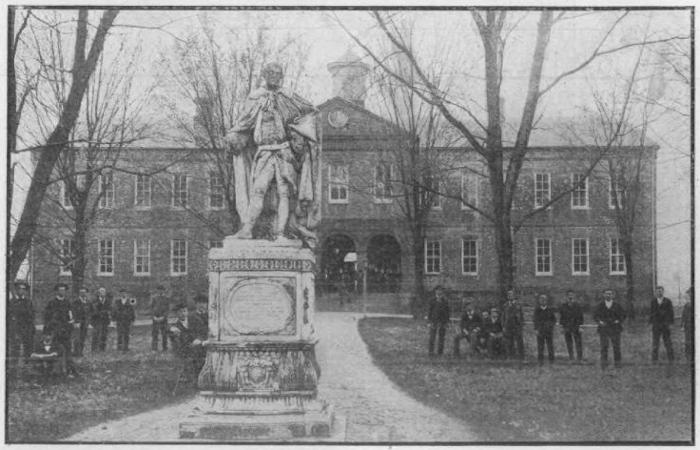
WILLIAM AND MARY COLLEGE
Nearly all the great Virginians were
descended from the Cavaliers. Washington
was the great-grandson of one
of them, and Madison, Monroe, the
Randolphs, Richard Henry Lee, and
others were also descendants of royalists.
Virginia succeeded in keeping
out the importation of felons. A number
of redemptioners, or political prisoners,
who were sold by the English
government to speculators, were traded
in the colonies, but misfortune being
their only crime, they became in
most cases useful citizens.
The men of that time were fond of
sport. Washington was ever an enthusiastic
fox hunter. Patrick Henry
was devoted to the woods, fields and
streams; he also played the fiddle and
danced with keenest zest. Social life
was ideal at that time. Each plantation
was a small principality and they
vied with each other in hospitality.
It was not unusual for a carriage full
of guests to arrive without warning,
and the visitors and their retinue were
the recipients of the most lordly hospitality
for days and sometimes weeks.
Card playing was much in vogue, and
under great provocation an oath or
two was sometimes found to be the
only expression that could do the
situation justice. It is said Washington
swore heartily at General Stephens
for losing the battle of Germantown
on account of drunkenness.
The dance after supper went without
saying, to the music of “the fiddlers
three.” It was a delight in which
the stately Washington often indulged,
with, it may be shrewdly
guessed, the belle of the ball for a
partner. In the hall of William and
Mary College hangs a picture which
represents him dancing the minuet
with Mary Cary. The Virginia Reel
called for the whole company. Flushed
and breathless, full of laughter and
fun they threaded its mazes in the
wee sma’ hours.
“Oh, the instruments are shattered and the strings are snapped in twain,
And the fiddles are forgotten and will never play again.
But above the stars eternal in their faded pinks and blues,
With the powder on their ringlets and the buckles on their shoes,
I shall see the beaux and sweethearts in the long procession kneel,
And their harps will play the music of the Old Virginia Reel.”
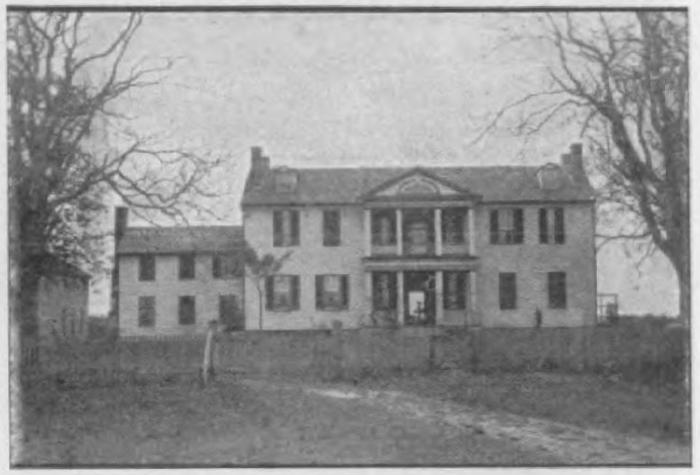
TAZEWELL HALL
William and Mary College, the oldest
of the American colleges except
Harvard, is situated in the old colonial
capital, Williamsburg, sometimes
called The Middle Plantation. Before
the college was burned the first time
it had many rare volumes marked with
the coats of arms of royalty and noblemen
whose names were connected with
its early days. Within its walls were
trained the youth of the eighteenth
century who were to consecrate their
lives to the cause of liberty. The
Reverend James Blair was its founder
and its first president. He went to
London and unfolded his scheme of
Christianizing the Indians and educating
the youth of America. Queen
Mary warmly approved of his plan.
King William was equally agreeable
and gave an order for two thousand
pounds sterling to be used in the erection
of the buildings. But when Seymour,
the Attorney-General, received
the order to draw up the charter and
pay the money, he was enraged. The
nation was engaged in an expensive
war, he said, and needed the money
for other and better purposes—why
was a college wanted in Virginia, anyhow?
Mr. Blair explained its purpose
as being that of preparing young
men for the ministry, adding that the
people of Virginia had souls to save
as well as the people of England. The
idea struck Seymour as particularly
absurd and maudlin; his retort, historically
recorded, was: “Souls! ⸺
your souls! Make tobacco!”
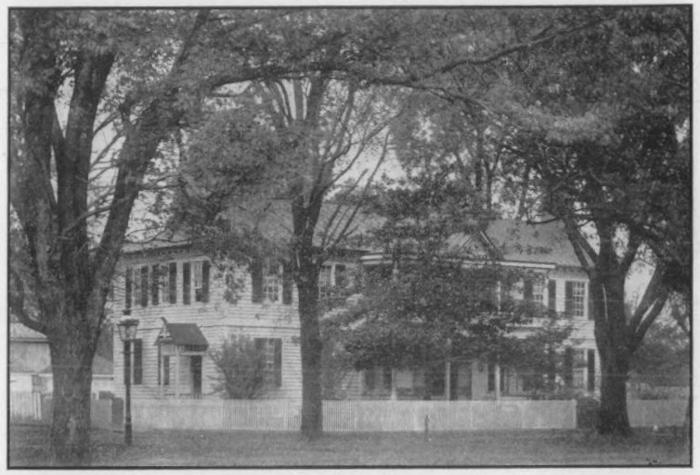
BASSETT HALL
The Phi Beta Kappa Society, the
first fraternal society in this country,
was organized at William and Mary
December 5th, 1776, and the first meeting
was held in the Apollo room at the
Raleigh tavern.
Jefferson, the first Democrat, was in
1764, five years after Washington had
been happily married to Martha Custis,
a gay young student at Williamsburg,
or “Devilsburg,” as he wrote of
it, in a letter to a friend, expressing
himself as being “as happy last night
as dancing with Belinda in the Apollo
room” could make him.
How close it brings our heroes, to
know intimately their youthful loves
and pleasures! “One touch of nature
makes the whole world kin.” To the
same chum, who seems to be in a like
manner transfixed with Cupid’s dart,
he writes later: “Have you any glimmering
of hope? How does ⸺
do? Had I better stay here and do
nothing or go down there and do less?
Inclination tells me to go, receive my
sentence and be no longer in suspense;
but reason says, ‘If you go and
your attempt proves unsuccessful you
will be ten times more wretched than
ever!’——I hear Ben Harrison has
been to Wilton. Let me know his success.”
Ben Harrison’s success at
Wilton, where he was courting Anne
Randolph, a cousin of Jefferson, was
greater than his own, for she married
him and had the honor of being the
wife of a signer of the Declaration of
Independence and a governor of Virginia.
Jefferson’s sweetheart might
have sat in like high places if she had
only smiled a little more. “Cupid
lacks the gift of prophecy and Fame
will not tell her secrets till the time
comes, for the sweetest lips that ever
smiled.” Lucy Grymes, a cousin, is
said to have been one of his sweethearts,
also beautiful Mary Coles, the
mother of Dolly Madison. It is told
of Washington that before he arrived
at wealth and distinction, he went
courting Mary Cary and was asked
out of the house by her father, the
old colonel, on the ground that his
daughter had been accustomed to ride
in her own coach.

MONUMENT AT YORKTOWN
The Duke of Gloucester Street in
Williamsburg still holds much that is
interesting. The foundation of the
old Capitol lies at one end and one
mile away at the other end still flourishes
the old college, William and
Mary. The courthouse, designed by
Sir Christopher Wren, bids fair to last
for generations yet. Across the green
stands Tazewell Hall, with its “ghost
rooms high up under the eaves.” This
was the home of the Randolphs. Bassett
Hall is on the other side and is
noted as having entertained Lafayette
within its walls. Thomas Moore was
also entertained here. It was at this
house he first saw the fireflies, which
he immortalized in his poem on the
Dismal Swamp.
“And all night long by her firefly lamp,
She paddles her white canoe.”
Martha Washington’s kitchen is yet
to be seen not far from Governor
Spottswood’s old Powder-Horn. Governor
Dunmore’s ice house is still
shown to strangers. Dunmore was
the last of the royal governors. Patrick
Henry, as was fitting, was the
first American governor to take his
seat in the vice-regal palace which has
now entirely disappeared to make way
for a model school.
There are two monuments at Yorktown
to commemorate the surrender
of Cornwallis, and the old customhouse
still stands, with moss-peaked
roof, thick walls, massive oaken doors
and shutters. It is said to have been
the first customhouse erected in
America.
In the colonial period, says a popular
writer, it was the rendezvous of the
gentlemen of the town and country
surrounding it. It was there that
the haughty young aristocrats took
snuff, fondled their hounds and probably
talked over the last Assembly ball,
and, mayhap, laughed about the conquests
made of their colleagues by the
bright eyes of the country-side belles.
There still stands an old weather-boarded
mansion whose antique roof
and fireplaces set across the corners
demand for it the reverence inspired
in us by a relic of bygone days. Here
in the sitting room were drawn up
the articles of capitulation and surrender.
It was historical long before
that, as being the country residence
of Governor Spottswood. Here he
held his mimic court, entertaining in
the most lavish and ostentatious manner
his knights of the Golden Horse
Shoe. Not far away is the foundation
of a curious building said to have
been a temple of worship built by
Governor Spottswood. The spectacular
taste of the governor gives this
an appearance of truth which is borne
up by the name of the surrounding
plantation. It is called Temple Farm.
HISTORY OF THE HALS — CHAPTER XVI — THE REVERY RACE
By John Trotwood Moore
[Note.—The History of this remarkable
family of horses was begun in the first
number of Trotwood’s Monthly, and has
proven to be so popular that nearly all
of the back numbers of the magazine have
been bought up and bound by the admirers
of this great family of horses. Orders are
coming in daily, often as many as ten to
twenty, for a complete set of last year’s
Trotwood. We regret, therefore, that we
will be unable to furnish back numbers
much longer. This History will be continued
during the year, including the story
of Brown Hal, Star Pointer, Mattie Hunter,
Hal Dillard, Old Brooks, Star Hal, Hal
B., and many others now known to fame.
It will close with a beautiful tribute to
the life and the career of Edward F. Geers,
the “Silent Man from Tennessee,” who is
to the turf world what Napoleon was to
war.—Pubs. Taylor-Trotwood.]
Quadrupe dante putrem sonitu quatit ungula
campum.—Virgil.
In days agone,
Upon that shore which mortals call the Unreturning Past,
What bursts of speed from gallant steed have come like bugle blast!
What battles have been fought and won, what names to fame been given,
What mighty shout has put to rout the thunder notes of heaven,
When, coming in his pride and scorn
The old horse won in days agone!
In days to come,
Upon that shore where Memory’s twilight skies hang o’er,
Oft will the old horse race as he has never raced before!
His silent ghost will come to post while spectral grandstands listen
To the noiseless beat of his phantom feet—as the silver moonbeams glisten
On the gray-haired horseman who tells it o’er—
How the old horse won in days of yore!
“Seeing an article in a turf paper
about pacing horses being natural
swimmers,” remarked a friend to
Trotwood a few days ago, “reminds
me of an experience I had a dozen
years ago down in the piney woods
of Alabama, that convinced me that
whether a pacer is a born swimmer
or not, one thing is certain, the trotting
horse I was driving that February
day didn’t act like he was a South
Sea Islander, by any means.
“You see,” he said, as a companionable
crowd of horsemen gathered
around him, and passed around the
cigar box, as a sign that a story
was about to begin, “I had been
courting down in that state and made
up my mind that I wanted to marry
a blue-eyed, pretty daughter of old
Major Blank, and I had about half
way convinced the girl that she wanted
to marry me, when this infernal non-swimming
horse had about upset the
whole thing. I hadn’t seen the girl
for about a month, so I boarded the
cars one bright day in February for
a short visit. I took precaution to get
the best ring I could find in Nashville
within my means—I knew the fit of
her finger pretty well—and I was as
dead certain of leaving that ring in
Alabama on the fourth finger of a
dimpled hand as I am to-day that little
Robert J. could pace round a draft
horse.
“I stopped at a small town, ten miles
from where she lived in the country,
at the house of a friend of mine, for
I had to hire a buggy and drive
through to the Major’s, as he lived
off the railroad. According to agreement,
the young lady had written me
a letter to that point, telling me how
glad they all would be to see me, accenting
the “all,” and ending up with
a message that made my heart beat
like a thumped horse, and enclosing
a bunch of violets tied with a few
deshabille strands of her own sunset
hair. By the way, this was in February
as I remarked, but what was the
name of that poet that said, ‘love
comes like a summer’s sigh?’
“Well, that letter made it July with
me.
“I would have been a married man
with an interesting family to-day,” he
remarked after a pause, with a sigh,
“if that friend of mine hadn’t been so
everlastingly clever. He had a dish-faced
trotter he had bought up in
Kentucky, at one of Shanklin’s sales,
that could go a mile in that Alabama
sand in about five minutes, and
do it with such a rip and tear and
splutter and dirt throwing that you
would think he was trotting ’round
the world in eighty days. I had often
bragged on the beast, just to please
my clerking friend, who thought I
knew every trotting horse personally,
in the world, and now I got in to it
by being so complimentary. Nothing
would do but I must drive that old,
shying, crow-hopping fool. And I
had it to do. After I got him out of
town he quit shying at the tree
shadows and the black-jack stumps on
the road side, and I thought I was
getting along pretty well. Considering
the fact that I was looking into a pair
of blue eyes all the way, and putting
a ring on an imaginary finger every
mile I went, while the trusting hand
to which it was attached nestled coyly
between my two big ones, and I smelt
the sweet perfume of violets in a wavy
mass of auburn hair that nestled, in
my mind’s eye, on my breast, I got
along without any other accident; but
was about to drive into a pretty rapid
sheet of water in my dreaming, and
perhaps end my own and Old
Crow’s—the horse’s—career at the
same time, when I heard a gruff voice
with true Southern accent and a
native nonchalance, say:
“‘You doan’t wanter go in washin’
this early in the season, do you, sah?”
“Well, I didn’t, and I waked up in
time to stop the fool horse and back
him out. The stranger watched me
get out and then proceeded to tell me
what I hadn’t had sense enough to
see before—that Raccoon Creek was
on a boom and Dead Deer Slough,
into which I was driving, would swim
a horse most anywhere. Now, a
slough, in the far South, is a low,
marshy place near the borders of a
creek or lake, and, while generally
dry in summer, in winter it manages
to get plenty of water from the overflowing
creek or lake nearby. This
one ran directly across the road leading
up to the foot of the bridge spanning
Raccoon Creek beyond, and,
though the bridge was partly under
water, I could see it was all right and
fully half of it, on the highest curve,
was clear of water. Moreover, the
other part was built on the bluff side
of the creek and seemed to be entirely
clear. So if I could only get to the
bridge I would be all right.
“‘You had better give it up to-day,
sah, and wait till mornin’,’ said the
stranger, who appeared much interested
in my movements. ‘The slough
will run down by then, and you can
get on the bridge easy. If there are
no stoops in it’—I afterwards learned
that stoops meant holes washed out
by the water—‘you will find no trouble
getting over. I’ll take keer of
you, sah,’ he added, with true Southern
hospitality, ‘for I want somebody
to play euchre with to-night. It’s been
raining for five days, and I knew old
Rack would be scudding along, so I
just rode down here to watch her, sah.’
“I thanked him, but told him I was
going over. I was young, boys, and
the picture of the old Major’s parlor
with the big wood fire sending sparks
up the chimney and then dying down
to adjust the shadowy light necessary
for the ring scene and the tableau
act, was too much for my youthful
head.
“‘But can that horse there swim?’
said the Southerner, with a more serious
expression. ‘It isn’t every horse
that can, my young frien’, an’ you
had better know what he can do before
you go into this mud-hole, sah.’
“‘Oh, I’ll soon teach him,’ I said,
with one of those laughs that a man
with more brass than sense is frequently
caught indulging in. ‘He’ll
have to swim or drown and you know
he’ll swim before he’ll do that.’
“But right there is where I failed
to size up that slanting-headed descendant
of old Messenger.
“Well, the Southerner was very
quiet and did not intrude his opinion
on me further. He sized me up
about right and decided to let me go
it. The buggy was out of the question
so I took old Crow out. Stripped
him of everything but the bridle and
put the lap robe on his back to help
break the angularity of my seat. By
the Southerner’s advice I pulled off
my pants and underclothing, tying
them around my shoulders, thrust my
stockings in my upper coat pocket to
keep them dry, tied my shoestrings
together and threw my shoes over my
shoulders, mounted my steed and
spurred him with my trembling heels—for
I was beginning to shake a little—into
the slough. The stranger
told me to let the horse have the bit
and keep him to the right of a line
of willows which he said skirted the
road. By no means was I to jerk
the beast, but guide him gently to
right or left with the line.
“Right here, I want to explain to
you that that horse had been listening
to us and had decided that now
was the time for him to suicide—a
thought he had had in his mind for
a year or two, I am sure. By doing
the job now he expected to kill two
birds with one stone, and I was the
other bird—a jay at that—for, looking
back at that roaring flood from
the standpoint of fifteen years’ more
sense, I am sure nobody but an idiot
would ever have tried it. Well, we
went in and I headed him for the willows,
and the water crept up to my
feet, then to my knees and was soon
on the horse’s withers. Right here I
expected to see him sail off with me
on his back, his tail streaming out,
his head on the wave, his ears laid
back and his nostrils dilated and sending
his steamy breath right and left;
but not much of a sail he made. I
forgot to tell you he had the longest
neck I ever saw on a horse, but I
didn’t know it was as long as it was,
or I’d never have gone in that slough.
Why, that neck was a telescope, and
after he got me in up to the armpits
he just lengthened it out a notch or
two above the waves whenever he
wanted to. I am not much on mathematics,
but I saw that, as he then
held it, it was fully six inches higher
than the top of my hat, and I imagined
I saw the faintest trace of a satanic
grin on his under lip as he let her
out another link and looked back at
me, as much as to say:
“‘Well, how do you like swimming?”
“I reached for my pocket knife to
cut his throat, but found I didn’t even
have on my drawers, and just then
the water gurgled up under my chin
and splashed in my ears and that
brute winked his left eye as he let
out another notch in that old telescopic
neck of his and walked along like he
was on dress parade. By this time
we were half-way across, and nothing
but my nose was out. I was just
thinking of getting up on his back on
my knees, when he stepped in a little
washout and my head went under like
a cork. I turned loose everything to
get air again, and was swept off before
I could say ‘Scat.’ I grasped
a willow just as I heard the stranger,
who had been sitting on a big, sloping-shouldered
gray Hal pacer, hello to me
to hold on, and his horse soon swam
out to the willow as naturally as if he
had done it every day for a year. He
circled in about forty feet of water before
reaching me, and, telling me to
catch his horse by the tail, he swam
quietly by and I lost no time in doing
as he said and getting back to land.
I lost my ten-dollar pants, but this
was more than offset by the hundred-dollars’
worth of common sense I had
tucked away in my head on the different
ways in which horses swim.
“And that horse—well, we sat on
the bank and watched that head go
leisurely across, lengthening out when
it struck a washout and contracting
on the ridges, with that same ironical
grin part—the ugliest mouth I ever
saw on a horse. At last he struck
the bridge, clambered up, shook himself
like a wet dog, looked back to see
if I was taking it all in, and struck
out to the Major’s on his own hook.
“But the worst was yet to come.
Just as I landed I heard a buggy turn
a sharp bend in the road, drive up
to where the Southerner and his horse
were pulling me out and—great
Caesar!—there sat in the buggy old
Major Blank and the angel of my
dreams. The girl shrieked and ducked
her head under the lap robe, while I
jumped back in that slough to hide
the southern half of me, and tried
to commit suicide by drowning, but
my youthful head was so corky I
couldn’t keep it under water long
enough. The old Major drove off
and started to his home by another
route, the kind gentleman fished me
out again, more dead than alive and
I went home, with my new friend just
in time to have a hard chill. I was
sick two weeks, during which time I
got it pretty straight that my clerking
friend had been courting my blue-eyed
beauty for six months himself,
and I will always believe that he
loaned me that horse just to get me
out of the way. Anyway, three days
afterwards he went down to the
Major’s to get the old horse, stayed
all night and fixed the wedding day,
while I was swimming imaginary
sloughs with my pulse at 105½.
“I got back home as quickly as I
could, and now, when I go to buy a
horse, I never ask, ‘How fast can he
go?’ but ‘How far can he swim?’”
And my bachelor friend struck up
a whistle which sounded like “After
the Ball” and walked off.
“Very few people”, said Capt.
Robert D. Smith, of Columbia,
Tenn., “know that the late Gen.
Wm. B. Bate, who died United States
Senator from Tennessee, told one of
the most pathetic horse stories of the
war. General Bate was here before
his death, attending the Confederate
reunion, and I reminded him of the
incident and got him to relate it again
as it happened. I never saw him so
much touched as when he told again
of the attachment of his horse, Black
Hawk, for him, and the animal’s
pathetic death at Shiloh. General Bate
is very modest and no braver man
ever lived; but I was there and saw
the incident and can tell you how it
was. At the battle of Shiloh General
Bate was then colonel of the Second
Tennessee. He had two horses which
he used; one, an ordinary, everyday
horse which he rode on the march
and other rough service; the other was
a magnificent black stallion—a thoroughbred
and Hal horse—black as a
crow and as beautiful as you ever saw.
He was a very stout horse, not leggy
as some thoroughbreds are, but symmetrical
and shapely, and as the General
always took a lively interest in
horses, this one had been selected for
him with great care and at a good
deal of expense. By the way, General
Bate says he has since heard of a
number of Black Hawk’s sons and
other descendants making most creditable
races. This horse was splendidly
equipped and used by Colonel Bate
only for parades, long marches where
stamina was needed and for battle.
The night before the battle of Shiloh
the commoner horse was stolen, and
the next morning at daylight I remember
what a superb looking object
our colonel presented on this
magnificent animal, who looked fit to
race for a kingdom or charge over
the guns of Balaklava.
“Men may talk about Gettysburg,
Franklin and other battles of the war,
but I want to see no stubborner or
bloodier fight than we had down there
amid the woods, around that little
church and on the banks of the Tennessee.
You may know what kind of
company we had to entertain us, when
I say that we struck Sherman’s line
first. Time and again we drove them
back and as often they reformed and
stubbornly contested every foot of the
way. The usual position of a colonel
is thirty feet to the rear of his regiment,
and it was in that position that
Colonel Bate first went into the fight.
The enemy gave way after the first
hard fight—in fact, I will always
think we took them a little unawares,
though I know that both Generals
Sherman and Grant did not think so,
probably owing to the fact that they
were not at the front when we began
the fight, not having anticipated
it to begin so soon—but arriving soon
after they heard the guns. At the
next stand they gave it to us hot, and
it was here our lines were nearly broken
and it was here that Colonel Bate
had to put himself in front of his
regiment before they would charge
with enough determination to drive
the boys in blue again. All this time
the battle was raging everywhere. We
had driven the Federal army past
Shiloh church, and towards the river,
where they finally made the desperate
stand that stopped us the next day
after Buell’s arrival.
“Time and again Colonel Bate led us
against Sherman’s brave boys—that
thoroughbred horse and rider always
in front. Once he made us a short
speech just before we had to charge
again, having been repulsed at the
first attempt. He said he wanted us
only to follow him and he would not
take us where he would not go himself.
This last fight was terrible. Before
we struck the enemy Colonel
Bate was shot out of the saddle, the
men fell around us right and left and
we charged on leaving all as they fell.
“Now the remarkable thing was
that horse. When Colonel Bate fell
the horse seemed to be at a loss what
to do. But as the regiment swept on,
he quickly fell into his place just in
the rear of the regiment and followed
us on into battle. We must have
fought on for a half mile after that,
and it was a strange sight to see that
horse following the regiment as stately
as if on dress parade, and it touched
every man to see him riderless.
“At the first opportunity an ambulance
was sent back to find the colonel
and take him to the field hospital,
some three miles in the rear. In the
confusion no one had thought of Black
Hawk, but it seemed he had not forgotten
his brave rider, for he actually
followed the path made by his colonel,
or rather those who carried him to the
hospital—almost tracking him by his
blood—straight up to the hospital tent,
and to the surprise of Colonel Bate,
who had been badly but not seriously
wounded in two places, one ball going
through his shoulder, he poked
his head in the tent door and affectionately
whinnied to his master while
the surgeon was dressing his wound.
The next instant he walked a few
paces in the weeds, staggered and fell
down dead. An examination showed
what no one had noticed: he had been
badly wounded in several places, one
of which proved fatal. General Bate
says he can still see that almost human
look Black Hawk gave him and that
last pathetic whinny as he walked
off to fall down and die.”
[Trotwood has heard Senator Bate
relate this incident himself and the
last time he met the old warrior at
dinner at the Maxwell House, Nashville,
Senator Bate related the above
incident and discussed very fondly
the pedigree and value of the Southern
breed of horses that could produce
such intelligent animals as Black
Hawk.]
THE MEASURE OF A MAN — CHAPTER V
[Note.—This story was begun in the November
number of Trotwood’s Monthly.
It opened with a pioneer horse race at
the Hermitage, in Tennessee, in which
Jack Trevellian, General Jackson and others
had entered their horses. Trevellian
was a young captain who had been in the
Creek wars with General Jackson, and
whom the old soldier loved very much.
Trevellian was in love with Juliette Templeton,
a guest of General Jackson. She
had not promised to marry him, but was in
love with him. She came to the race accompanied
by Colonel Bristow, also in love
with her. In the very graphic account of
the race, the horse of an unknown boy,
the son of an outcast woman, won, for
which he was about to be beaten by those
who had bet on the other horses, when
Trevellian came to his rescue, claiming the
boy was a Trevellian. “It is his son!”
said someone to Juliette Templeton, and
almost fainting she rode away from the
field.]
An hour afterwards there was a
halloo at the lower gate. It was answered
by the dogs, who rushed out,
barring the way, and stopping the
newcomer at the entrance. According
to pioneer custom, he sat on his
horse till the dogs had been called in
by their master.
At a word from Trevellian they
slunk back to their kennels.
“Good evening, Jack—you were not
expecting me, eh?”
“I am just as glad to see you, General—ride
in,” and he opened the gate
with a quick, nervous jerk. “I was
just about to have the blues,” he added—“yes,
we all have them at times.”
The older man seemed to have
guessed this, for he had dismounted
and hitched his horse, and, arm in arm,
they walked up the path to the house.
“I promised Mrs. Jackson I’d not
stay long, Jack, but as much as we love
them, boy, there are times when a
man must talk to a man. Nothing else
will do,” and he slapped the other affectionately
on the shoulder.
Both, for a while, were constrained,
and each knew it. Trevellian knew
what the older man had come for, and
the other knew that Trevellian had
guessed.
In endeavoring to be natural, the
General was slightly embarrassed, a
thing so unnatural with him that he
worried more as he recognized it. But
it convinced him how deeply interested
he was in the affair before him—how
much he cared for the future of
the young man at his side.
“That tobacco they raised at the
Hermitage while I was away this
year is not the best in the world, Jack,”
he said, passing his buckskin pouch
to the other, “but it will help us out.”
The two were soon smoking. It
was plain that the older man had
plans, and that he would soon unfold
them. Under any other circumstances
his talk would have been different—the
day’s racing, the banterings,
the jokes, the oft-repeated tales
of it, the speculation on this and that
event, the praise or condemnation of
horse or jockey.
To-night it was different. They
smoked in silence, and after a while
the General said:
“I heard from Washington to-day.”
Trevellian looked up quickly—expectantly.
“Not about Pensacola,” went on the
other, “but the treaty with the Creeks.
I am directed by the Secretary of War
to conclude it, and I will soon meet
them at Ft. Jackson. I’ll want you
to go with me—of course—and the
First Regiment.” He stopped and
tapped the young man lightly on the
arm:
“And that’s not all the troops I’ll
slip into that vicinity. I’ve a good excuse—there
has been no reply to my
letter concerning the landing of British
troops at Pensacola, and the treachery
of Spain in permitting it, and I’ll
take silence for consent, and with the
troops in the forts and on the frontier
I’ll order your regiment in and hold
all in good striking distance of that
nest of Spanish snakes. And we’ll
strike, Jack—we’ll strike!”
He arose and began to pace the
room.
“I’ll not stay tethered while Spain
permits our enemy to use her harbor
to shelter them. What do they know
at Washington, a thousand miles away,
with their ears sealed for fear they’ll
have another war on their hands? The
government—all governments are abstract
things, at best. It is the men
in them that count—the concrete
agents who carry out the things to be
done, and there are things every man
is called on to solve for himself, both
in war and in life—there are times
when the general is the government,
and if he fails to rise to the occasion
he is a flunk and a failure.”
He was still walking around the
room, talking more to himself than
to Jack.
“Now, the situation is this: I know.
The government doesn’t want to know.
It’s my business to fight and whip the
foes of my country. It’s my government’s
to keep out of more than one
fight at a time. That’s all right—but
when I can kill two bears with one ball,
it’s better than killing one of them
and wounding the other. The British
are swarming in Pensacola. They are
our enemy, and once securely entrenched
there they will entrench from
the Rio Grande to Mobile Bay. Then
it will be too late. In driving them
from Pensacola I’ll drive out Spain at
the same time and hold it so securely
that Spain may bluff for a while, but
will finally give in—and Florida will
be ours.”
And so he smoked and walked, planning
it all out, and in an hour it was
arranged, and the General grew calmer
and sat down again.
“Now, while we are gone, the election
will come off. To-day you had
Bristow beat—”
“You had him beat, General,” the
younger man smiled for the first
time.
The General gave his first chuckle.
The ice was broken.
“But now—” began the General.
“I am out of the race, sir,” said
Trevellian, rising. “I shall so announce
it to-morrow. I am going with
you and fight,” he added.
The General arose quickly: “No,
you are not out of it, Jack—not while
I am about.”
“What do you mean, General?”
He came over and stood face to face
with the older man.
“Let us be seated,” said the other.
“I will go into detail. Bristow remained
with us for supper to-night—”
The younger man was still silent.
“But first, Jack, shall I tell you all?”
Jack nodded.
“It was a little thing—perhaps I
should not speak of it. Mrs. Jackson
says”—and he smiled—“that for an
old Indian fighter I am taking on a
lot of romance since I returned, and
that you two have caused it. Well,
my heart is in this thing, and you
know it. But I loved Templeton and
I love you, my boy.”
The other bowed his head reverently.
“The girl loves you, Jack; I know it.
I know when a woman loves. She is
wretched to-night. Why, didn’t I see
her when she came home—in spite of
Bristow, everybody—everything—with
her face set like a flint monument in
grief. To-night she was weeping in
her room. Mrs. Jackson told me—by
God, but you have broken her heart,
and you must tell me, Jack.”
Jack arose hastily and walked the
room in silent agitation. At last he
stopped and stood before the other.
“I cannot, my General—my God, I
cannot! Blame me, cut me off from
your esteem and friendship as I am already
cut off from hers. This thing
is between me and my Maker.
“No man,” said the General, rising,
“has the right to ask of you
things which are between you and your
God. I do not want to know—and this
—is—”
“And I cannot tell you anything, my
friend—my more than friend.”
He stood before his father’s picture—the
Trevellian portrait that hung
above them on the wall. He bowed
his head in the agony of it all.
“I have never kept anything from
you before, and you know how hard it
is for me to do this, but—”
The other man was walking the
room. He turned and said:
“Well, then, I will tell you what
happened. Bristow has said enough
for me to challenge him—said it at
my table,” and his face flushed with
the purpling rage which could so
quickly mount to it. “My friends’
fights are my own, Jack—you know
that—”
“You have not challenged him, General?”
and Jack paled suddenly.
“I will to-morrow—as soon as Patton
Anderson can take him a note.
I’ll challenge him, and I’ll kill him.”
He came up closer to Jack.
“It’s not you and what he said I’m
thinking of. You only give me the
chance. I’ve been wanting to kill
him ever since that cowardly night.”
“You could not prove it before a
court-martial, General.”
“No, d—n him—no—I wish I could.
But there are things a man knows he
cannot prove by the red-tape letter of
the law which—no—no—he is too
smart to be caught. But I know it
and you know, and every man of sense,
that he treacherously instigated and
led the mutiny of those starved and
homesick troops in the Creek wilderness.
When—ha, Jack, you know it
was he!”
The General was getting hot.
“But you—you stopped it,” smiled
the other.
“Yes—with a rifle in their path, and
I wish I had shot him then. No, I am
not fighting your battles, young man.
You may take care of yourself, as I
said to him—I am going to kill him
for instigating that mutiny when the
life of the army and the fate of the
war hung on our fighting it to a finish.”
“But you will not challenge him,
General—you must promise me you
will not.”
The General turned purple with anger—his
eyes flashed indignantly into
those of the younger man. He stuck
his bony finger in Jack’s face and
fairly shrieked:
“D—n you, Jack, and your sissy,
foolish silence! Yes, sir, I will, unless
you tell me you are guilty—that
you are not worth Juliette’s love—that
the boy is your son. And if you
are silent, why then—”
“And if I am silent, General, why
then you will believe I am guilty and
let this thing pass?”
The General nodded.
“General, I must—I must—I cannot—I
must be silent.”
The General looked up.
Jack’s eyes were wet. The General
grasped his hand silently.
“By God, you are not guilty, Jack—you
will tell me in your own time. I
said I’d kill him, but—well, you’ve
spoiled my plans. I’ll let him go for
your sake.”
“For my sake, General, and I swear
to you you shall one day know. Let
him have the office—let him have the
girl. I’ll have my sacred promise to
the dead and my manhood left—that
I’ll never part with.”
[To be continued]
MEN OF AFFAIRS
It is quite fitting that the author of
Makers of Virginia History should
be chosen as Director of the Division
of History, Education and Social
Economy of the Jamestown Exposition.
Mr. Julian Alvin Carroll
Chandler brings to his work also an
experience of more than thirteen
years’ work in the educational field,
having been instructor at William and
Mary College, Richmond College,
Morgan College, Baltimore, and president
of the Woman’s College, Richmond.
Mr. Chandler holds degrees
from William and Mary,
Richmond College and
Johns Hopkins and has
long been an authority on
Southern history, being an
active member of the Virginia
Historical Society,
American Historical Association
and Society for the
Preservation of Virginia
Antiquities; and having
written Representation in
Virginia, History of Suffrage
in Virginia, Makers
of Virginia History and
Makers of American History
(joint author). Since
the year 1904 he has
been editor for the publishing
house of Silver,
Burdett & Co.—the only
Southern man who is editor
of a New York publishing
house.
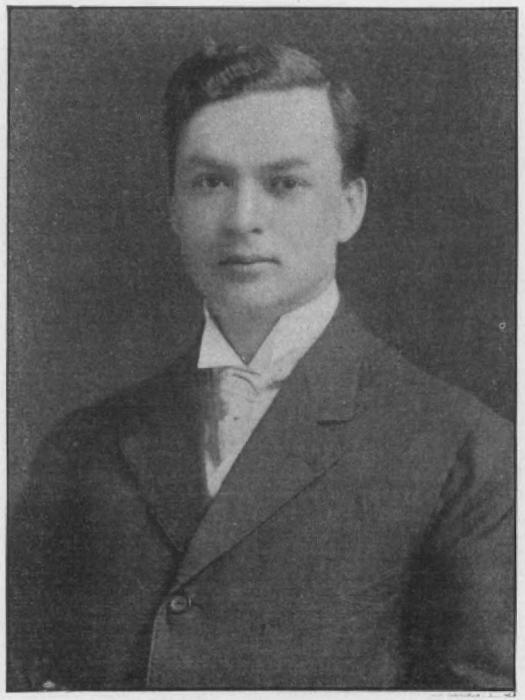
J. A. C. CHANDLER
Mr. Chandler’s interest
in the work of the Jamestown
Exposition and his
thorough knowledge of the
ground and departments
covered led to his being
asked to take charge of a
special department and he received a
year’s leave of absence from his publishing
house in order to accept the
position. His plans include a splendid
historical exhibit of the sources
of history as shown in rare documents
and letters, valuable relics, oil paintings
and statuary relating to the beginnings
of our country; an educational
exhibit, showing the best in
our schools throughout the country,
with especial stress upon the schools
of the South. Consolidation of
schools; grading of rural schools; the
establishment of county high schools
and county agricultural schools, teaching
of manual training and domestic
science will be fully brought out in
this exhibit and will contain much of
practical assistance to teachers in
all parts of the country. Mr. Chandler’s
indefatigable efforts and tireless
energy will make this department a
thoroughly interesting one. He is a
young man, having been born in
Guineys, Virginia, in 1872.
Joseph Forney Johnston, who was
elected Alternate United States Senator
in the Democratic Primary in
Alabama, in August last, was born in
Lincoln county, North Carolina, in
1843. He entered the Confederate
Army, as a private, in April, 1861,
served until the war closed, was
wounded four times, and rose to the
rank of captain. After the war closed,
he returned to Alabama, where he had
been studying law when the war commenced.
On being admitted to the
bar in 1866, he practiced law at Selma
until he removed to Birmingham,
in 1884, to accept the presidency of a
bank. He continued in the banking
business until he was elected governor
in 1896.
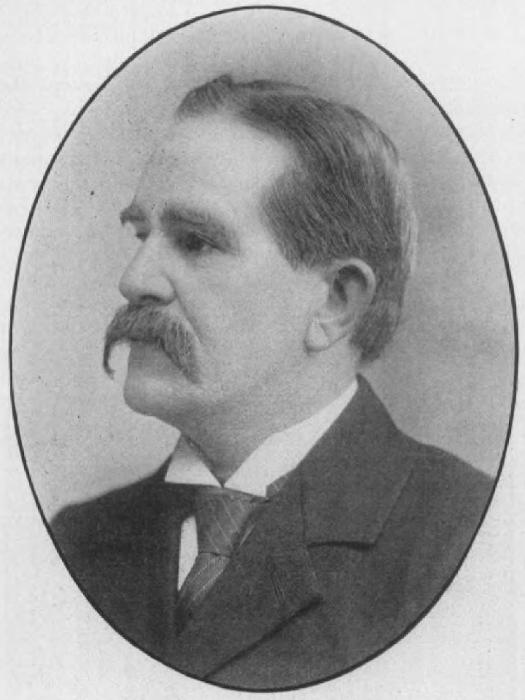
JOSEPH F. JOHNSTON
Whilst in Selma, he lead the movement
which overthrew Republican
rule, and served his party many years
as chairman of county,
congressional and state
committees. He never
held any office, and never
sought any, until he became
a candidate for governor.
In the panic of 1893,
he was one of the factors
that averted financial
disaster to Birmingham.
He was one of the organizers
and first president
of the Sloss Iron &
Steel Company; so that
when he became governor
he had behind him large
business experience, and a
wide knowledge of the
conditions and resources
of Alabama.
He was nominated for
governor in 1896, in one
of the most exciting campaigns
the state ever witnessed,
and in spite of the
opposition of the railroads,
great corporations and
money power.
When he became governor
he found a large deficit
in the state treasury, the public
schools languishing and the public
credit impaired. When he quit office,
after serving two terms, the deficit had
been wiped out, the terms of the public
schools largely extended, more
competent teachers secured by wise
laws compelling examinations, the
credit of the state at the highest point
ever reached, and the public service
the most efficient in the history of
the state. Every department of the
state government had lasting impression
made upon it by the firmness of
his grip; the laws and policies he established,
though severely criticised at
the time, have remained, through adverse
administrations, untouched, and
stand yet as monuments to his justice
and sagacity. We find from his record
that he began ten years ago the
fight on graft that is now sweeping
the country; that he has a mailed fist
that does cheerful and effective battle
with corrupt interests and all interests
that conflict with the laws and with
the rights of the public, and that he
can serenely stand under
fire until an ultimate victory
appears out of the
smoke of battle.
When we consider Mr.
Johnston’s past services,
his indomitable spirit, his
unvarying regard for the
public interest throughout
his entire career, his fearlessness,
aggressiveness
and candor, his large experience
in practical affairs,
as well as American
politics, it is not difficult
to see why the people have
chosen him for successive
honors.
It is rare that dominant
qualities of the kind possessed
by Governor Johnston
are coupled with a personality
so genial and winning
and so rare a faculty
for attaching warm friendships.
The boy released
from the Army of Northern
Virginia, with his
five scars, courageously
leaving the home of his
fathers to begin life in
Alabama with a capital stock consisting
of a mule and wagon and a box
of tobacco, was no more friendly, no
more kind-hearted and approachable
than is now this man of affairs and
broad renown, who has been chosen
by the democrats of Alabama for succession
to the United States Senate.
One of the heroes of the battle of
San Jacinto, that victory won by
sheer force of despair, was General
Edward Burleson, who commanded
the center at that famous encounter
with the blood-thirsty Santa Anna.
Subsequently, when the little republic
of the Lone Star was added to the
gallery of nations General Burleson
was made Commander-in-Chief of
the army and was one of the early
vice presidents of the republic. Originally
from North Carolina, General
Burleson removed in early youth to
Tennessee and followed Jackson on
his campaign which ended at New
Orleans, serving as one of “Old
Hickory’s” lieutenants. This experience
made him immensely valuable to
Sam Houston. The last legislature of
Texas placed a handsome portrait of
this pioneer public servant upon the
walls of its magnificent capital amidst
a goodly array of great and good men
whose efforts lifted Texas to her
present proud position among the
commonwealths of the union.
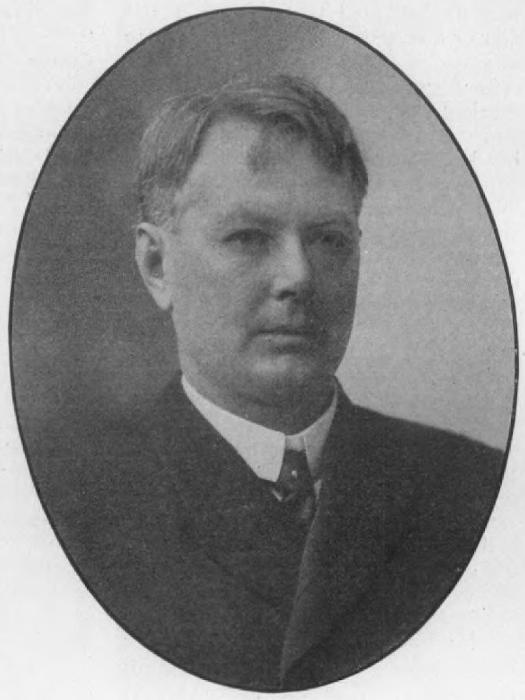
A. S. BURLESON
General Burleson’s son, Major Edward
Burleson, was also a soldier of
the young republic and helped to frame
its constitution. He settled at the
head of the lovely San Marcos river
and there the subject of this sketch,
Albert Sidney Burleson, was born on
the third of June, 1863. His father
was away fighting for the Confederate
cause at that time, as were five of
his mother’s brothers—one, Fergus
Kyle, a captain in the Terry Rangers.
It would seem that young Burleson
was pre-ordained to be either a soldier
or a statesman, with chances more
in favor of the former than the latter.
After graduating from the State
Agricultural and Mechanical College
and from Baylor University (founded
by his cousin, Reverend Rufus C.
Burleson), he decided on the law,
taking his degree at the State University,
and serving as Assistant City
Attorney at Austin for six years. He
next served four years as District Attorney
and was then elected to Congress.
He is now serving his fourth
term at Washington, where he has
served his state ably and well.
Last winter Mr. Burleson was put
on the appropriation committee and
has secured important appropriations
for his state, among them being appropriations
for experiments in exterminating
Johnson grass and the
boll weevil; experimental stations for
the cultivation of tobacco and tea; an
allowance of ten thousand dollars
yearly for the maintenance of a School
of Mines at the State University;
laws enabling Confederate Veterans
who took part in the Mexican and
Spanish wars to enter National Soldiers’
Homes; dam at El Paso (secured
in conjunction with the efforts
of Congressman Smith), thereby making
Texas a participant in the appropriations
for the reclamation of arid
lands; the reimbursement of nearly
half a million dollars for monies expended
by Texas in protecting her
frontier from Indian depredations.
Mr. Burleson is an expert on agricultural
matters and was a member of
the agricultural committee for two
terms. He is also the author of the
Cotton Statistics Law, by which the
control of the cotton market has been
wrested from the stock exchange, and
the regulation of prices placed in the
hands of the farmers. It is natural
and right that this law, so far-reaching
in its benefits, should be enacted
through the efforts of a representative
of our leading cotton state.
It is unnecessary to add that Mr.
Burleson is possessed of a wonderful
persistence and tireless energy which
enable him to accomplish everything
he undertakes. He takes his politics
seriously and he never stops working.
He is a forceful debater and makes a
dramatic speech, having the eloquence
of a man who believes what he says.
He is noted not only for this convincing
earnestness, but for the absolute
accuracy of all his statements and his
thorough mastery of every point he
presents. He has, withal, a vast
store of characteristic Western stories
and his jolly wit, coupled with his
loyalty to his friends, makes him one
of the most popular of congressmen.
SOME SOUTHERN WRITERS — IRWIN RUSSELL
By Kate Alma Orgain
This poet was born in Port Gibson,
Mississippi, and was among the first
of the Southern writers to recognize
the possibilities of negro dialect and
character in poetry and fiction,
and to picture in
poetry the unique relation
between the Southern
slave and his master.
It is not surprising that
there is no general knowledge
of this gifted writer,
for he passed away after a
brief struggle with life,
leaving only one collection
of poems, which was published
after his death by
the Century Company, in
1888. Irwin Russell’s
grandfather was a Virginian,
who moved west to
Ohio. Here the father of
Irwin was born. He married
a New York lady, and
going South he settled in
Port Gibson, where Irwin
and two other children
were born. At the outbreak
of the Civil War,
Irwin’s father cast his lot
with the Confederacy, and
after the war sent the boy
to St. Louis University in
St. Louis, conducted by the
Jesuit Fathers. Here he
became a diligent student, and his
young friends called him a “walking
encyclopedia.” He also gave evidence
of fine mathematical powers. After
graduation he returned to Mississippi
and began the practice of law. He
was in Port Gibson during the yellow
fever epidemic in 1878, and he
remained through the whole dreadful
tragedy of sickness, serving everywhere
as needed, a devoted nurse.
He never fully rallied from the fearful
strain and the harrowing scenes
through which he passed, for he was,
says W. W. Baskerville, “that rare
union of bright mind with frail body
through which the keenest appreciation
and most exquisite sensibility are
developed.”
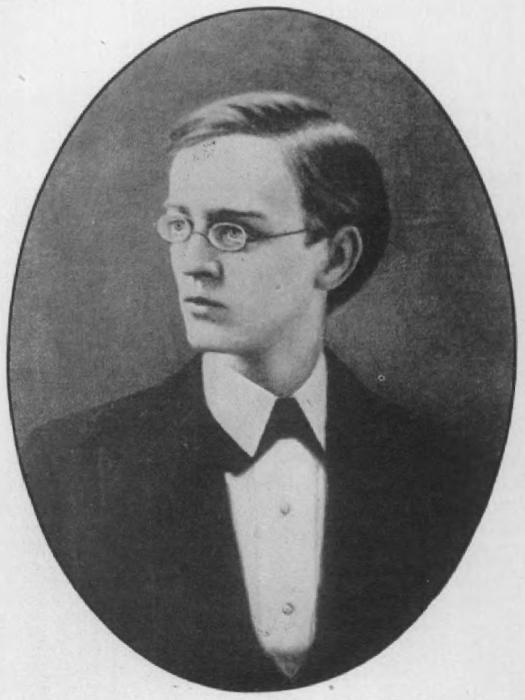
IRWIN RUSSELL
His father, Dr. William Russell,
who had also remained in Port Gibson
during the scourge, staying nobly
at his post of duty, sank under the
strain and died.
This left young Russell entirely dependent
upon himself. Joel Chandler
Harris says: “Russell always had
warm personal friends from whom he
could command everything that affection
could suggest.” Going to
New York, he took some literary matter
to Charles Scribner’s Sons, who
received him with great personal
kindness and encouraged him to
adopt the profession of authorship.
The climate, however, was too severe
to allow him to work in New
York and he fell ill with a low fever.
He determined to return to the South
and before he was quite recovered,
set out to work his passage on a boat
bound for New Orleans. He arrived
in port very weak and almost penniless,
but secured employment on the
Times, and with characteristic disregard
of health or personal comfort,
threw himself, heart and soul into his
work.
Although young, Russell gave remarkable
evidence of training in the
best of literature. He gave his work
hard, painstaking study, and his insight
into the peculiarities and pathos
and poetry of the negro character was
truly wonderful.
Thomas Nelson Page says: “Personally
I owe him much. It was the
light of his genius, shining through
his dialect poems that led my feet in
the direction I have since tried to follow.”
Dr. C. A. Smith says: “The appearance
of ‘Christmas Night in the
Quarters’ meant that Southern literature
was now become a true reproduction
of Southern conditions.”
Joel Chandler Harris says: “Irwin
Russell’s negro character studies rise
to the level of what, in a large way,
we term literature. I do not know
where there could be a more perfect
representation of negro character than
his operetta, ‘Christmas Night in the
Quarters.’ It is inimitable.”
Beginning with the arrival of the
negroes who are coming to “Uncle
Johnny Booker’s Ball,” this poem
says:
“Some take the path with shoes in hand,
To traverse muddy bottom-land:
Aristocrats their steeds bestride—
Four on a mule, behold them ride.
And ten great oxen draw apace
The wagon from ‘de oder place,’
With forty guests, whose conversation
Betokens glad anticipation.”
Arrived at the scene of merriment
the dance is preceded by a prayer by
“Brudder Brown,” who takes the
middle of the floor to “beg a blessin’
on dis dance.”
“O Mahsr! let dis gath’rin’ fin’ a blessin’ in yo’ sight!
Don’t jedge us hard fur whut we does—you knows it’s Chris’mus night;
An’ all de balunce ob de yeah we does as right’s we kin.
Ef dancin’s wrong, O Mahsr; let de time excuse de sin!
“We labors in de vineyard, wu’kin’ hard an’ wu’kin’ true;
Now, shorely you won’t notus, ef we eats a grape or two,
An’ takes a leetle holiday—a leetle restin’ spell,—
Bekase, nex’ week, we’ll start in fresh an’ labor twicet as well.
“Remember, Mahsr,—min’ dis now,—de sinfulness ob sin
Is ’pendin’ ’pon de spirit whut we goes an’ does it in:
An’ in a righchis frame ob min’ we’s gwine to dance an’ sing,
A feelin’ like King David, when he cut de pigeon-wing.
“You bless us, please, sah, eben ef we’s doin’ wrong to-night;
Kase den we’ll need de blessin’ more’n ef we’s doin’ right;
An’ let de blessin’ stay wid us, until we comes to die,
An’ goes to keep our Chris’mus wid dem sheriffs in de sky!”
“The rev’rend man is scarcely through,
When all the noise begins anew.
And with such force assaults the ears,
That through the din one hardly hears
Old fiddling ‘Josey’ sound his ‘A’,
Correct the pitch, begin to play.”
Then the dance begins.
“S’lute yo’ pardners!—scrape perlitely—
Don’t be bumpin’ ’gin de res’—
Balance all!—now, step out rightly;
Alluz dance yo’ lebbel bes’.
Fo’wa’d foah!—whoop up, niggers!
Back ag’in!—don’t be so slow!—
Sw-i-i-ing cornahs!—min’ de figgers!
When I hollers, den yo’ go.
Top ladies cross ober!
Hol’ on, till I takes a dram—
Gemmen solo!—yes, I’s sober—
Cain’t say how de fiddle am.
Hands around!—hol’ up yo’ faces,
Don’t be lookin’ at yo’ feet!
Swing yo’ pardners to yo’ places!
Dat’s de way—dat’s hard to beat
Sides fo’w’d!—when yo’s ready—
Make a bow as low’s you kin!
Swing acrosst wid opp’site lady!
Now we’ll let you swap ag’in:
Ladies change!—shet up dat talkin’;
Do yo’ talkin’ arter while!
Right an’ lef’!—don’t want no walkin’—
Make yo’ steps, an’ show yo’ style!
“And so the ‘set’ proceeds—its length
Determined by the dancers’ strength;
And all agree to yield the palm
For grace and skill to ‘Georgy Sam,’
Who stamps so hard, and leaps so high,
‘Des watch him!’ is the wond’ring cry—
‘De nigger mus’ be, for a fac’,
Own cousin to a jumpin’-jack!’
On, on the restless fiddle sounds,
Still chorused by the curs and hounds;
Dance after dance succeeding fast,
Till supper is announced at last.
That scene—but why attempt to show it?
The most inventive modern poet,
In fine new words whose hope and trust is,
Could form no phrase to do it justice!
When supper ends—that is not soon—
The fiddle strikes the same old tune;
The dancers pound the floor again,
With all they have of might and main;
Old gossips, almost turning pale,
Attend Aunt Cassy’s gruesome tale
Of conjurers, and ghosts, and devils,
That in the smoke-house hold their revels;
Each drowsy baby droops his head,
Yet scorns the very thought of bed:—
So wears the night, and wears so fast,
All wonder when they find it past,
And hear the signal sound to go
From what few cocks are left to crow.”
In the wee sma’ hours near daylight
Uncle Booker sings the story of
the first banjo.
“‘Dar’s gwine to be a’ oberflow,’ said Noah, lookin’ solemn—
Fur Noah tuk de ‘Herald,’ and he read de ribber column—
An’ so he sot his hands to wuk a-cl’arin’ timber-patches,
An’ ’lowed he’s gwine to build a boat to beat de steamah Natchez.
Ol’ Noah kep’ a-nailin’ an’ a-chippin’ an’ a-sawin’;
An’ all de wicked neighbors kep’ a-laughin’ and a-pshawin’;
But Noah didn’t min’ ’em, knowin’ whut wuz gwine to happen:
An’ forty days an’ forty nights de rain it kep’ a-drappin’.
Now, Noah had done cotched a lot of ebry sort o’ beas’es—
Ob all de shows a-trabelin’, it beat ’em all to pieces!
He had a Morgan colt an’ sebral head o’ Jarsey cattle—
An’ druv ’em ’board de Ark as soon’s he heered de thunder rattle.
“Den sech anoder fall ob rain! it come so awful hebby,
De ribber riz immejitely, an’ bu’sted thro’ de lebbee;
De people all wuz drownded out—’sep’ Noah an’ de critters,
An’ men he’d hired to work de boat—an’ one to mix de bitters.
“Now, Ham, de only nigger whut wuz runnin’ on de packet,
Got lonesome in de barber-shop, an’ c’u’dn’t stan’ de racket;
An’ so, fur to amuse he-se’f, he steamed some wood an’ bent it,
An’ soon he had a banjo made—de fust dat wuz invented.
“He wet de ledder, stretched it on; made bridge an’ screws an’ aprin;
An’ fitted in a proper neck—’twuz berry long an’ taprin’;
He tuk some tin, an’ twisted him a thimble fur to ring it;
An’ den de mighty question riz: how wuz he gwine to string it?
“De ’possum had as fine a tail as dis dat I’se a singin’;
De ha’rs so long and thick an’ strong,—des fit for banjo-stringin’;
Dat nigger shaved ’em off as short as washday dinner graces;
An’ sorted ob ’em by the size, f’om little E’s to basses.
“He strung her, tuned her, struck a jig,—’twuz ‘Nebber min’ de wedder,”—
She soun’ like forty-lebben bands a-playin’ all togedder;
Some went to pattin’; some to dancin’; Noah called de figgers;
An’ Ham he sot and knocked de tune, de happiest ob niggers!
“Now, sence dat time—it’s mighty strange—dere’s not de slightes’ showin’
Ob any ha’r at all upon de ’possum’s tail a-growin’;
An’ cur’i’s, too, dat nigger’s ways: his people nebber los’ ’em!—
Fur whar you finds de nigger—dar’s de banjo an’ de ’possum!”
The night is spent; and as the day
Throws up the first faint, fresh flash of gray,
The guests pursue their homeward way;
And through the field beyond the gin.
Just as the stars are going in,
See Santa Claus departing—grieving—
His own dear land of cotton leaving.
His work is done; he fain would rest
Where people know and love him best.
He pauses, listens, looks about;
But go he must: “his pass is out.”
So, coughing down the rising tears,
He climbs the fence and disappears.
Regarding the merits of Irwin Russell’s
verses one critic says: “They
have all a swinging gait, and you can
hear the rythmical pattering of the
feet, and see the swaying of the darky
figures in the walk round as you
read.”
Russell declared the pathos and
humor in the character of the real old-fashioned
negro of the South afforded
an inexhaustible amount of
material for both prose and poetry.
Like Sidney Lanier, Russell was
passionately fond of music, and became
a remarkably skillful performer
on the banjo.
He died at the early age of twenty-six:
suffering and sorrow and poverty
were his till the last. The brief struggle
ended in New Orleans, leaving
his beautiful contributions to Southern
dialect poetry for our heritage.
TWELFTH NIGHT REVELS
Of all the so-called
lighter plays of
Shakespeare, there
is none, perhaps,
which has a greater
charm of its
own than “Twelfth
Night; or, What
You Will.” There
is in its droll humor a spiciness, a
piquancy, unsurpassed by any of the
great dramatist’s own productions or
those of his contemporaries. Open
the volume where you will, and mingle
for a time with the fantastic revelers
of the play—what mirth, what
laughter, what drollery is here! The
spirit of the “Twelfth Night” is rampant.
But we can better appreciate
the aptness of the title if we see for
ourselves the merry-making which of
old universally prevailed at that season.
In the modern work-a-day world
of the present, but scant time is allotted
that highest and holiest joy of
the Christmastide, and long before
“Twelfth Night,” which falls upon
the sixth of the new month, we have
soberly resumed the accustomed
round of daily duties. From the busy,
bustling world of to-day it is refreshing
to turn back to the past again, and
lose ourselves in the joyous abandon
of the old-time festival.
It is “Twelfth Night” in “Merrie
England” in the days of the long ago,
and the Christmas festivities have lingered
on to find their culmination in
the revels of this night. Truly we find
here none of our modern haste in returning
to the prosaic realities of life,
and unconsciously we imbibe some of
the mirth-prevailing spirit. How gay
the shops in their holiday garb, and
what a goodly store of frosted cakes
the confectioner displays! It fairly
makes one’s mouth water to see them,
and catch a faint whiff of their spicy
fragrance, for these are the “Twelfth
Night” cakes of all sorts and sizes that
will find their way into every home
from the highest to the lowest. That
little lad turns away regretfully from
the huge frosted creation of the baker’s
skill to the wee modest one of
which his few jingling pence will soon
make him the proud possessor, and
then gives way good-naturedly to the
bustling dame who makes a judicious
selection from the varied assortment;
and so the happy throng moves in and
out, for “Twelfth Night” would scarce
be “Twelfth Night” without the cake,
the crowning glory of the feast.
The season brings a strange mingling
of mirth and superstition and
reverence. The smallest lad is familiar
with its origin, and can tell the
story of the three wise men who journeyed
from afar over plain and mountain,
until, led by the wondrous star
in the East, they knelt beside the cradle
of the infant King and worshiped
Him. The wealthier class bring their
gifts of gold and frankincense and
myrrh to place upon the altar, as did
those wise men of old, and the humble
rustic invokes a blessing upon his
harvest fields.
At dusk the farmer gathers around
him his friends and servants, and
together the strange little procession
makes its way across the freshly
turned sod to where the young wheat
is beginning to spring up. Here, on
the highest part of the ground, twelve
small fires and one large one are kindled.
Cider circulates freely while
they drink to the health of the company
and to the success of the future
harvest, and a fantastic circle gathers
around the larger fire to shout and
halloo until the welkin rings, and the
answer is borne back on the night
wind from all the neighboring hillsides
where similar fires glimmer dimly
in the distance. This ceremony
completed, the merry company return
home again, where the housewife and
her maids have been busily preparing
for the evening’s festivities. The table
fairly groans under its weight of
meats and puddings, and cakes with
caraways, and pitchers of sparkling
cider and ale, while a huge frosted
cake with a hole through the center
occupies the position of honor. After
supper a queer ceremony takes place.
The company follow the bailiff, or
keeper of oxen, to the wain-house,
where the master fills a cup with
strong ale, and, standing before the
finest and largest of the oxen, pledges
him a curious toast. He then produces
the big cake with the hole in
the center, and places it upon the ox’s
horn. The ox is tickled to make him
toss his head, and if he throw the cake
behind him, it is considered the mistress’
perquisite, but if before, the
bailiff claims the prize. More sport
of the same kind follows amidst the
laughter and shouts of the rustics assembled,
and then the boisterous
crowd returns home once more to
find the doors fast-barred; nor can
they gain admittance from the fair
ones within until they have earned it
with rollicking song and jest. Once
inside a scene of mirth and jollity
ensues, and all too quickly the moments
speed, for care is forgotten in
the joyous abandon of the present.
In the southern villages a friendly,
jovial crowd make their way to the
orchard and encircle the best-bearing
tree. In sparkling ale they drink a
toast, chanting in joyous unison,
“Here’s to thee, old apple tree,
Whence thou mayst bud and whence thou mayst blow,
And whence thou mayst bear apples enow.
Hats full! Caps full!
Bushel, bushel, sacks full,
And our pockets full, too. Huzza!”
How lustily the shout rings out on
the evening air, and then the merry
company return with empty pitchers,
only to be greeted by shouts of laughter
from behind the fast-closed doors.
Just a faint whiff of the goodly store
within, and the tantalizing demand to
guess what is on the spit. This, of
course, is some bit or dainty not likely
to be thought of, and when, after many
random hits and freely interchanged
jests, it is guessed at last, the doors
are thrown open, and the lucky clodpole
is rewarded with the much-prized
tidbit, amid the congratulations of
his less fortunate companions. So
with mirth and wassail speeds the
night away, for truly “care’s an enemy
to life.”
The simple-hearted rustic firmly believes
that by these timely ceremonies
and invocations he has helped to keep
the blight from his rye, and to insure
a goodly return from the well-laden
orchard trees. But “Twelfth Night”
festivities are by no means confined
to the simple, free-hearted sports of
field and farm. In palace and mansion
the feast is observed with great
splendor, with masque and pageant,
with rollicking song and mirth. Thousands
of pounds are spent in preparing
for the revels of a night. The
long table spread for the feast is a
wonder of art fresh from the hands
of the pastry cook and confectioner.
There are pasteboard castles to be
blown up in jest, the rarest of old
claret flowing like blood from the side
of a wounded stag, with all sorts of
curious and dainty conceits set forth
amid sparkling glass and silver, while
the guests playfully pelt one another
with eggshells filled with rose-water.
The cake, huge and shining in its
frosty whiteness, and wrought in elaborate
design, seems to tower over the
rest of the feast with a sort of proud
and smiling benignity, for reposing in
its capacious depth lies the fateful
prize of the evening, the bean which
proclaims the lucky finder king over
the evening’s festivities. The guests
cut for this amid good-natured laughter
and merriment, and when someone
more fortunate than the rest has
discovered it, they declare him with
one accord “king of the bean,” and
cheer him right lustily. The newly
crowned monarch is raised aloft to the
ceiling to mark a white cross upon one
of the great oaken beams, for thereby
will evil spirits be warded off for the
evening and through all the year to
come. The others then draw lots
and assume their parts of lords or
ministers of state, and each sustains
his character with mock dignity
throughout the revels. This quaint
old ceremony is observed in palace
and mansion and humbler household
as well, and a sort of good-natured
fellowship reigns supreme. The story
is told of how Mary, Queen of Scots,
when her maid was chosen queen,
lent her own royal robes, that the
part might be sustained with proper
dignity.
“Mirth and revel, jest and play,
Quickly wears the night away.”
The candles have sputtered and burnt
out, the tawdry tinsel is thrown aside
for the soberer garb of the real, and
Sir Francis Flatterer and Sir Randle
Rackabite have passed into the ranks
of everyday life. The laughter and
mirth are but a memory, and we come
back with a start to the daylight and
the present, with its unfinished duties
ever pressing for completion.
And Shakespeare’s “Twelfth Night”
lies open before us. From its pages
arise, through the master’s art, the
living forms of Sir Toby and Malvolio,
Viola and the Duke. “Grave
and gay, the lovers, the laughers,
and the laughed-at, are made to harmonize
in one scene and one common
purpose.” We can well imagine that
Twelfth Night in the Middle Temple
in the days of the long ago, when the
happy company of barristers and students
gathered to hear for the first
time, the drama fresh from the master’s
hand, when its exquisite poetry
charmed with new grace and melody
the ear of some secluded scholar, and
the antics of its revellers brought a
smile even to the lips of that grave
and formal dispenser of justice. One
commentator tells us that the title was
probably suggested by this, the first
night of its performance, but do we
not find a subtler significance in its
embodiment of the spirit of the season?
Is not the mirth and jest of
those old-time sports and festivities
aptly repeated here in this crowd of
revelling, laughter-creating personages,
in the drollery of Sir Toby
Belch and his comrades, and the fantastical
vanity of Malvolio? And as,
in the midst of those old-time Twelfth
Night revels, with their care-free
abandon and joy, we catch now and
then the sub-tone of the minor, and
the richer harmonies of life, a mere
glimpse of the simple love and faith
of those lives of the long ago, so it is
that we look past the boisterous merriment
of these jesting revellers of
the play to discern the true beauty of
the characters who stand in the half-light
behind. Then we become conscious
of a quiet harmony of color
and form, and we feel anew the poet’s
close touch with life and nature.
UNCLE ABRAHAM’S SERMON THE SEANCE
By John Marshall Kelly
Author of “The Resurrection,” “The Tempered Wind,” “The Christmas Tree,” etc.
I’se be’n heahin’ some
quare talk erbout
yoah doin’s dis pas’
week an’ some yuther
times, my heahers.
I’se be’n telled erbout
some uv dem
sayoncies you niggahs
hev be’n holdin’,
same’s lak dey do
up tuh Kunnel Simpson’s
house, an’ dat dar triflin’ yalleh
house gal uv his’n an’ dat mottled
yahd boy be’n lahnin’ you, my belubbed
flock, de wiles uv de debbil an’
claimin’ dey’s meejums an’ claihvoyans,
an’ hev be’n holpin’ you-alls talk
wif spookses an’ hobgoblins an’ onfamiliar
sperits.
Now, my chillen, bein’ as I is yoah
pasture an’ is set oveh you tuh gyahd
yoah morils an’ luk afteh yoah etehnal
welfaih, as I hev be’n put heah tuh
guide yoah tottehin’ feets in de paf
uv de wuhld, I’se boun’ tuh wahn you-alls
dat all sich things am onrighteous
an’ sinful an’ am tuh be ’voided an’
kep out uv de way uv, an’ dat you
am temptin’ fate er de debbil in all
sich puhfo’mances.
You-alls ought tuh know, my brudderns
an’ sisterns, dat dere ain’ no
comin’ back f’om de sperit wuhld, an’
dat any ’tempt tuh prove dat dey is am
a vexation uv sperit, an’s gwine bring
its own results. I wan’ you-alls tuh
’membeh dis tex’, an’ ’membeh hit well,
dat w’en Divehs went tuh hell an’
raised up he eyes in tohment an’ seed
Lazarus in ol’ Fatheh Ab’aham’s buzzum,
he axed tuh hev him sont foh er
speshil wahnin’ tuh he brothehs on
yea’th, tuh tell ’em tuh gib all dey
money tuh de Chu’ch an’ de poah, an’
tuh git some sores foh de dogs tuh
lick an’ go beggin’ an’ eat crum’s wif
de pupses so’s dey could be in glory
bimeby.
Well, now, you ’membeh dat, an’ you
’membeh lakwise dat he wuz tol’ dere
wuz fixed er unpassable gulf ’twixt an’
between an’ dat no one could cross hit,
an’ de people would’n’ heed no wahnin’
ef dey did hev one; he say’d hit
did’n’ mek no diff’unce ef dey wuz
tuh sen’ er dead man tuh come back,
dey would’n’ keer, ’cause Lazarus he
done riz once, jis’ tuh try ’em, an’
dat afteh he be’n dead foah days.
Now, you-alls ’membehs all dis, my
onrighteous travelehs tuh de bah uv
Gawd, an’ ’membehs dat ef sperits
could er come back dat ol’ money
grubbeh Divehs would er come back
an’ tol’ de little Divehs, an’ ol’ Mizziz
Divehs an’ de whole Divehs fambly,
’bout de trubble he wuz hevin’ down
dere an’ tuh wahn dem an’ caution
dem ’bout de way dey handled de
propehty w’at dey wuz spendin’ so
free.
Lazarus he hed no call tuh come
back, kaze he’d done shed he sores an’
wuz in good comp’ny at las’, an’ ’sides
afteh de sperimen’ he made onc’t dey
ain’ neveh gwine let no man come
back tuh wahn de people. Lazarus
he could’n’ an’ would’n’, an’ Divehs
he could’n’ an’ did’n’, an’ dat’s de way
wid all de res’.
Now, den, w’at’s all dis I heahs
’bout dem triflin’ niggahs callin’ up ol’
Job Mixon an’ hevin’ him tell de folkses
w’at dey done es little chillen, an’
tellin’ dem w’at dey done es grown
folkses, an’ doin’ uv hit in sich er foolish
way? Who eveh knowed ol’ Job
tuh do sich foolishness ez bumpin’ er
table, hey?
Jis’ ’magine ol’ Job, w’at wuz hung
foh muhdeh an’ w’at hed be’n a thief
all he life, gwine erbout dis wuhld es
er spook, follehin’ afteh dem puny little
house sehvants, rappin’ on tables
an’ bumpin’ de floor w’en dey say so!
“Dat you, Unc’ Job? Ef so, please
knock.”
Table raps; he mean yes.
“Is you happy oveh theah, Unc’
Job? Rap onc’t ef you is, an’ twic’t
ef you ain’.”
Den dey git two raps, strong an’
hahd, ’cause nobody’s fool ’nough tuh
’spect ol’ Job bein’ wheah he happy
less’n he could steal er kill.
Den some trim’lin’, puny little niggah
w’at won’ pass de graveyahd at
night, he say: “Ax him ’bout my
mammy; wheah she?” an’ den dat fool
meejum go th’oo some jinnyfluxins,
one rap A, two rap B, three rap C,
an’ spell out er whole lot en passel uv
trash w’at nobody kin dispute, an’
den dey say de sperit done answeh!
Yas, I know he tol’ erbout things
some uv you-alls done, an’ w’at you
thought nobody knowed, an’ you say
dat proof ernough. Proof ernough!
You need no proof! You guv hit
yoah own se’f.
“Mist’ Job, you knows uv anything
we-alls done w’at nobody else knows
in dis wuhld?”
Do he know anything you-alls done?
He doan’ need know; you-alls knows
yoah-selves, an’ yoah feah meks yoah
heaht palpehtate so foh feah dat somebody’ll
know, an’ yoah body ’gins tuh
quake an’ shake so dat you-all jis’
nachelly meks de little raps in yo’
agertations an’ yoah shivehin’ nervousness
jis’ raps “One rap A, two rap
B, three rap C,” an’ spells out de
deeds you’ve done foh dat meejum in
yoah feah.
You does hit yoahself, you frazzled
idjits! You tells uv yoah own sin!
You sits dere quakin’ in yoah shoes
or wif yoah bare toes rattlin’ on de
boahds, wif de trimble in you answehin’
evehy call uv dat finicky dun
gal, “One rap A, two rap B, three rap
C.”
Job, he mighty fine man tuh be ahbitratin’
uv you-alls fate; mighty fine
man, an’ one w’at ought tuh mek betteh
folkses outen you.
He wa’nt no good man on yearth;
he wa’nt good foh nuffin in dis life—but
he’s er mighty good wahnin’ dead,
an’ I hope he stay a good wahnin’,
an’ stay dead. De Lawd knows He
need him foh a wahnin’. He ought
tuh git some good outer Job, kaze He
sho’ got none heah, foh uv all de
liverashous coons w’at eveh lived he
wuz de liverashousest an’ de leas’ account
an’ de hahdest tuh kill.
He wuz a scand’lous niggah, Job
wuz, an’ no respecteh uv pussons, an’
no regahdeh uv uthority; he didn’
keer no moah foh er man’s ufficial
puhsition ner his sperityil capacity ’n
nothin’.
Why, I ’membehs jis es if hit war
yistiddy, how he hed de affront’ry tuh
offeh me a drink uv whisky onc’t!
Me, his pasture, an’ de watcheh oveh
his soul. I rebuked him, my heahehs,
an’ rebuked him seveahly, an’ he
neveh insulted me dat way erg’in. Yas,
suh! I gib him a lesson he neveh
fohgot, foh I tuk de whole quaht an’
didn’t gib him er drop uv hit an’ he
didn’t hev no moah.
Heah, oveh theah! You needn’
snicker! I knows w’at tuh do in er
’mehgency, an’ I won’ tek no levity
ner laughin’ at my sperityil methods,
an’ I’d do any uv you-alls de same
way; yas, I would, ’n you knows hit!
Job hed de ’dacity tuh ’vite me tuh
he house tuh er tuhkey dinneh onc’t,
too. Tuhkey, w’en he neveh raised a
tuhkey ’cept offen some w’ite man’s
roost, ner hed nothin’ but w’at he
stole. Dat sho’ wuz er fine tuhkey,
an’ I gib Job er nuther lesson an’
showed him dat stolen goods profiteth
little.
Dat tuhkey wuz er big gobbleh, an’
dere wuz nobody but me an’ Job
dere, an’ I seasoned dat buhd wif de
good wine w’at Job hed stole, an’ admonishuns
tuh be good an’ wahnin’s
f’om de wrath tuh come. Hit wuz er
hahd pull, but I finished dat tuhkey in
spite uv Job’s hints dat he ’spected
hit tuh las’ him er week. Hit sho’ly
would hev tasted good if hit hadn’t
b’en stoled an’ I hed tuh drink up de
wine w’at he hed ’prop’iated f’om
somewhere, but de sauce uv a deed
well did an’ a sinneh rebuked, almos’
made hit relish, an’ I held out tuh de
end.
Now I’s told you-alls ’bout dis tuh
show you how tuh meet de tempteh,
an’ if Job wuz er comin’ back heah in
de sperit an’ you-alls treated him
severe he’d go back tuh de place
wheah de Lawd put him, an’ let you-alls
alone.
Think uv ol’ Job Mixon as er angel
uv light, ol’ thief Job sent back heah
tuh talk tuh you folkses an’ tell you
w’at you-alls done did an w’at you
gwine tuh do! Yas, I sees hit, I sees
hit! Ol’ Job, w’at man hed tuh keep
in jail mos’ uv de time, an’ w’at wuz
a debbil in de flesh. De Lawd tried
tuh kill him time Kunnel Simpson
shot him in he henhouse; an’ tuk
’nutheh tuhn at him de time he got
dat whisky. De Lawd knowed he
wuzn’t fit foh dis wuhld w’en He made
dat wild mule w’at Job stole fall on
him an’ den tromp on him, an’ if hit
hed be’n anybody but Job, he’d hev
died.
A angel uv light, an’ foh fohty
yeahs de Lawd tried tuh git him
erway f’om you chillen, tuh gib you-all
a chanst foh glohy! An’ he’d ’a
be’n alive now if hit hadn’t be’n foh
shootin’ at a w’ite man an’ hangin’
three days ’foah anybody foun’ him.
Yas suh, no ord’nary hangin’ would
hev killed dat niggah, an’ de Lawd
knowed w’at He ’bout keepin’ any uv
us f’om findin’ him afteh he wuz
hung.
Claihvoyins! Meejums! Sayoncies!
Sperits an’ table rappin’s, an’
“One rap A, two rap B, an’ three
rap C!” Sperityilizzum, an’ nex’
thing Christian Science an’ some uv
you advanced niggahs will be goin’
’round heah wid yoah jaw tied up,
groanin’ wid de toofache an’ sayin’ dey
ain’ no sich thing es pain; some uv
you-alls wid razur blades in yoah annatohmmy
a-gnawin’ at yoah vitals,
sayin’ hit am ’maginary; dat de will
rules an you kain’t hurt de flesh!
Listen tuh me, you niggahs! Heah
yoah pasture! Keep ’way f’om sich
contrapshuns uv de debbil! Sen’ ol’
Job back tuh hell wheah he belong an’
keep ’way f’om de w’ite folkses’ fads!
Go on wid yoah conjurin’, if you mus’
hev er rickreation, an’ weah yoah
graveyahd rabbit feets, an’ yoah little
bags uv niggah wool; but keep ’way
f’om sperityilizzum an’ Christian
Science an’ all dere attendant evils;
eschew, as de poet say, dey alluremen’s,
’less some uv yoah wives an
sistehs an’ daughters tuhn out er
Mizziz Eddy an’ tries teh lead you in
pashtuhs new er indulges in holy
ghos’ chillen—dey’s nuff not ’counted
foh ’thout that.
Go on, my people an’ be yoahselves,
an’ hev pains an’ ha’nts, an’ leave de
painless dentistry uv life an’ de ’lightened
sperits tuh a w’ite an’ idle an’
moah civilized people; ’membeh dat
you hev er neveh-dyin’ soul teh save,
an’ beah in min’, night an’ day, de
feelin’ uv de song we is now gwine teh
sing:
I’se gwine tuh be a angel,
A long, tall angel;
I’se gwine be a angel, bye ’n bye!
A w’ite-robed angel,
A charcoal angel;
I’se gwine be a angel, bye ’n bye!
THE STORY OF THE YEAR-GIFTS TO BE TOLD TO THE CHILDREN ON NEW YEAR’S EVE
There was an old man, and he
was very old indeed—so old
that he did not know his own
age, though he knew the age of every
boy and girl, and every man and
woman, and every city, and every
country, in the world—so old that he
had seen the mountains rise out of the
land and the continents out of the
great oceans. He was very, very old
indeed, you see; the oldest man that
ever was. He had long, white hair
and a long, white beard that fell quite
down to his waist.
But though he was so very old, he
was very strong and healthy, so that
no one ever thought that he would
die. And because he was so, he was
able to accomplish everything. He
was never idle and never had been—no,
not for one minute. He worked
while people slept and while they
played; no one ever knew him to stop.
That is why he had done so very,
very much. For he had formed great
peoples so long ago that nobody but
he knows anything about them; and
many, many centuries ago had written
wonderful stories that we still
read; and had built great churches
and palaces, and painted beautiful
pictures, and carved beautiful statues,
and composed wonderful music, and
had discovered wonderful new ways
of doing things and wonderful elements
in earth and air that nobody
had thought of, and had done so many
things that ought to be done, that I
believe a thousand men could not tell
all of them if they wrote all their
lives.
He was very good, too, for he
meant that everything he did should
make people happier. But oftentimes
he made mistakes, and did things
wrong, or seemed to, and then people
suffered—sometimes only a few people
for a little while, and sometimes
many people for years and years. But
as soon as he saw that he had done
wrong or that things were not going
as they should, he set to work to undo
his mistake and make things come
right; and he never stopped until he
did this, so that people came to say
that he would bring everything right
in the end if only it were left to him.
And though he was so busy and so
old, he was always glad when he had
done good and was always happy with
people he had helped.
He had millions of children, too—millions
alive and millions dead. All
the people in the world were his children.
If there were a baby Hottentot
born, it was his; and if there were a
little Greenlander born, that was his,
too. Even the greatest man that ever
lived, whom we all love, whether we
think or not that he was just a man,
like others, was his child, and knew
it; for this is what he meant when
he said, “The hour is come.”
Now you may be very sure that
this kind, strange old man loved his
children or he would not have worked
so very long and hard for them. So
every twelve months he gave each of
them a wonderful present; not one
kind of present for one and another
for another, but just the same thing
for everybody. The little beggar-boy,
standing on his frost-nipped feet by
the king’s road, got just the same as
the king who rattled past in his
chariot and never gave him even a
copper; the poor Indian squaw, with
nothing to wear but an old wolf skin,
got just the same as the beautiful lady
who had wonderful silken dresses and
diamond necklaces and shoes with
golden buckles. Yet everybody got
just what he wanted, and would not
even think of trading off his present
for anything else in the world.
There never has been and never
will be anything worth so much as a
single one of these presents. If a boy,
or a girl, or a man either, had all the
silver mines of Mexico, and all the
gold mines of the Yukon, and all the
diamond fields of South Africa, they
would not be worth as much as just
one of these presents, for the presents
could be used in any way and for
anything. Yet all that this kind old
man asked of people was, please to
use the gifts the best they knew how.
If they did so, they were all happier,
but if they did not, they became very
miserable, and even the gifts themselves
were a sorrow to them.
Now there was a man and his wife
who had a son they loved greatly; and
they had made good use of their
presents and were happy. But one
day the boy said, “I want to take my
presents now and go to college.” The
mother was glad, but the father said,
“The way to use them is the way I
tell you. Then I’ll put mine with
yours, and we will use them both together.”
“I cannot, father,” the boy said.
“Mine were not meant to be used
that way.”
Then the boy left home so that he
could use his presents; and his mother
died: and his father was angry towards
him. The boy used as well as
he knew how the presents he received,
but he did not know well at first how
to use them (though he learned after
awhile), and he was very unhappy
and his life was almost ruined. And
his father continued angry with him,
and misused all his presents after that,
and was very miserable until he died;
for he saw that what his son had done
was right, yet he would not forgive
when he was asked, and all the gifts
he had received only made him feel
the sadder.
Again, there was an old man who
used his presents to make money. He
had always used them so, and he
meant always to use them so. He
would not use them to help people
who did not know how to use their
own, no, not even to help a friend.
But he could not do that, for nobody
would be friends with such a man.
He would not even use any part of
them to serve his country when it was
at war and needed him. And every
twelve months he was more miserable,
and swore he would give all the
money he had made, just for a little
happiness; yet every time he used his
gifts in the same selfish way.
At last the old, old man sent word
to this old man (who was nothing
but an hour-old babe beside the other),
that he might take back the next gift
at any time. The money-lover trembled
and shook; but in a little while
he had forgotten all about his warning
and was misusing the gift as he
had done with all he ever had. Then
came the old man one dark night, and
snatched back the present from the
miser. And the old man who had
never used his presents well, screamed
in his terror and fell back dead.
This stern, kindly old man gave his
gifts to nations, too, for the nations
were his children just the same as the
boys and girls. Now one time, in
midsummer, word was brought him
that he had a new nation child.
“I declare,” he exclaimed, “I’ve
only a piece of a present left for it.
That will be enough, though; the
child won’t live.”
But that was once the old man was
wrong, for the child did live; and it
made such good use of its present
that he gave it another, and another,
and another. And the nation kept
growing, for it used his gifts wisely,
and helped him to do away with many
things that were not good; and at last
it used his gifts to save weaker people
from hunger, and sword, and
what is worse than either.
And if there be such an old man
now (I hope there is, don’t you?), I
hope he has already taught us how to
use his gifts; and if there be such a
nation, the child of Father Time, I
pray that God has made it wise
enough so that the gifts of years will
make certain centuries of existence.
The Shadow of the Attacoa — SYNOPSIS OF PRECEDING CHAPTERS — CHAPTER XXXVII— Continued — CHAPTER XXXVIII — CHAPTER XXXIX — CHAPTER XL — CHAPTER XLI — CHAPTER XLII
By Thornwell Jacobs
Commenced in the April number.
Ervin McArthur, bearing the nickname
of “Satan” on account of his ungovernable
temper, learns printing at the office of the
Dunvegan (N. C.) Democrat and loves
Colonel Preston’s daughter. The colonel,
objecting to a love affair between his
aristocratic daughter and a son of “poor
whites,” shifts the youth to a place on the
Charleston Chronicle. Here, the Civil War
coming on, he distinguishes himself by his
journalistic ability and by his inventions of
war-engines. In these last he is ably assisted
by Helen Brooks, a Boston girl visiting
Charleston relatives. She learns to
love the inventor and his cause and he
struggles between his allegiance to Helen
Preston and his newly awakened love. He
returns to Dunvegan on furlough and in
an altercation with his old time chum,
Henry Bailey, the latter meets his death.
Ervin escapes and another friend, Ernest
Lavender, is tried and convicted. Ervin
confesses and is tried but cleared on proof
discovered by Helen Preston that the crime
was committed by Mack Lonovan, who,
wishing to marry Helen Brooks, destroys
the only living witness to his secret marriage
with half-witted Nance West.
Ervin returns to Charleston and invents
the ironclad torpedo, destined, when copied
by the Federals, to destroy the Confederate
Navy. He also constructs a submarine torpedo
boat and while preparing for his
initial trip has an interview with Helen
Brooks.
He decides to attack the Housatonic instead
of the New Ironsides, as Helen has
confessed that one whom she loves is on
the latter. The Housatonic is sunk, also
the torpedo, Ervin alone being rescued and
captured. Sent to the stockade on Morris’
Island, he finds Tait Preston, who is
about to be exchanged on account of a
wound. Ervin determines to escape.
But weeks passed and McArthur
was forced to stay and see himself
growing haggard, weak and filthy.
It grew cold and the ragged quilts
barely sufficed to cover the sand.
At last one day at dusk he determined
to make his escape or die. A
dense fog had settled down over the
island, and in the growing darkness
he could scarcely see the guards with
their guns pointed over the stockades.
It was absolute folly to attempt it,
but what was a worm-fed man not
willing to attempt? So, as his custom
was, he went into his tent, and by
his ragged pallet, asked a mercy from
his God, and then went out toward the
death-line. Well nigh crazed, he
thought in the fog he could safely
burrow a way unseen under the stockade.
He chose a spot midway between
a gullah negro (a lowlander from
the rice fields of the Combahee) and
a mulatto who spoke often of his
rights and liberty, and who was as
anxious that all should know of his
presence as a little game bantam cockerel
that has just learned how to crow.
Then, kneeling upon the sand, he cautiously
began work. A long, lanky
man from the mountains of North
Carolina saw him and followed:
“Friend, it’s death,” he whispered.
“It doesn’t matter.”
The sand was beginning to fly
when he heard a noise as though some
one was clambering up the poles of
the stockade. Listening, he stared
intently in the direction of the noise.
A gust of wind had blown off the cap
of the Combahee negro, and by means
of a rope he was letting himself down
to get it.
Was it a mercy?
At least it was a chance.
Stealing up in the darkness he
slapped his hand on the guard’s
shoulder.
“To whom do you belong, Jim?”
Taken by surprise, and noting instinctively
the white man’s voice, the
thin veneer of freedom and egotism
wore off.
“To ’state of Norris—on de main,
Marster.”
“Hand me that pistol from your
belt.”
Still under the power of the masterful
man, the negro handed it over.
Scarcely had McArthur taken it, however,
when the spell was broken.
“Looky ’ere, stan’ off dar. I’se one
of de gyards. I b’longs to Mr. Linkum
an’ myself, now. Stan’ off an’
gimme dat musket,” he quavered, trying
to re-assume his self-confidence.
Then he shivered as he felt the cold
steel against his temple.
“Don’t speak again, or I’ll kill you
instantly.”
Terrified, the negro fell to wringing
his hands, his teeth chattering convulsively.
“Take off those clothes,” ordered
Ervin, “cap, trousers, coat.”
While this was being done, a dark
gray form loomed up by his side out
of the fog.
“You got him? I’ll help you.”
It was the mountaineer.
McArthur handed him the pistol,
and divesting himself, took the negro’s
blue uniform and put it on.
“If he speaks, blow his brains out!”
“Ugh, ugh, ugh!” sobbed the negro,
trying hard to swallow even this
sound.
“Quick, what is your regiment?”
“Secon’ South Ca’lina. Marster,
please take down dat gun!”
“Who runs the ferry boat at Cumming’s
Point?”
“Hatchett an’ Simpson, Fifty-fourth
Massachusetts.”
“What is your company?”
“Company C, sah.”
“Who is the Captain?”
“Cap’n ain’t come, marster—name’s
Brown—’spectin’ him to-morrow.”
Quickly climbing the rope, he
picked up the gun of the guard, and
began descending. Neither was he to
be confused in the fog and darkness.
Many times in the Eseeolas had he
taken his bearings from a bucket, two
sticks and the pole star, as though he
were really lost.
“You git it?” It was the mulatto’s
voice.
“Yeah, aisy,” Ervin answered in
pure Combahee.
He went on down the parapet.
“Where you goin’, you blame bluegum
gullah?” the mulatto called.
“Huh, you swongerrin’ mighty rash
to a free nigger wid a gun!”
The mulatto laughed.
“If I c’d see you, I’d shoot you like
one of them d—n rebels. That’s a
fancy way you goin’ to camp.”
“’Tain’t matter about de road, so
long as ’e cah’y you to de right place,”
was the answer.
Thoroughly familiar with the island,
McArthur veered westward and
turned his face toward Battery Gregg.
As he passed it he was challenged.
“Cholly Smif—”
“What regiment?”
“Secon’ South Ca’lina.”
“What duty?”
“Gyardin’ dese d—n rebels.”
“Pass on, you black nigger braggart.”
“I ain’t lahgin’, mister. Take dese
white folks to lahge. Niggers cain’t
lahge nuttin’ to de Buckra. Sabby?”
“Get on, Combahee monkey,” called
the sentry, recognizing the low country
lingo.
Ervin passed on towards Cumming’s
Point, his eyes serving him in
good stead. Almost in a moment he
was by the landing. A towboat lay at
anchor, and a couple of mulatto men
were in charge of it.
“Hello!” hailed Ervin. His tone
was one of easy command.
“Hello,” one of them answered.
“Where are you going?”
“Been out to the Montauk—comin’
in—”
“Lay that boat alongside.”
“We have orders against it, sir,
except by special request.”
“Never mind about the orders. I
guess you don’t know Captain Brown,
of your own company. You are
Second South Carolina, aren’t you?”
“Yes, sir.”
“Company C?”
“Yes, sir,” and they saluted.
“You made a splendid charge at
Wagner. We nearly drove the rebs
out that night. There, bring her up.
You are detailed by Captain Emilio
to convey me to James’ Island, within
the Confederate lines. I am going to
do a little reconnoitering.”
So they pulled up the anchor, and
the towboat turned into the creeks
between Morris’ and James’ Island.
Scarcely had they gone a hundred
yards before a boat was pushed off
hurriedly after them, and a voice
called excitedly:
“Stop that boat! Hatchett, Simpson,
he’s a rebel prisoner! Stop!”
The two boatmen instantly ceased
rowing and looked at McArthur angrily.
Not a feature of his face
changed. Only his nostrils dilated
suggestively, and two little flames of
fire shot from his eyes.
“Take up those oars, men,” he said,
quietly, pointing his pistol at them.
“Row as if all hell were behind you.”
The men hesitated.
McArthur fired at the foremost, intentionally
grazing his clothes. At
the report of the pistol, they cowered
in mortal terror.
“Good God, marster, doan’ shoot
any mo,’ we’se rowin’!”
“Then row!” thundered the master.
“If they catch us I’ll kill you both!”
“Father,” whispered Helen Preston,
in the low voice of despair. “Father,
don’t you know me?”
The old warrior who loved Dunvegan
sat still as death in his arm
chair, a happy smile on his face.
“Father, it is Helen. Oh, father!
Don’t you know me?”
Slowly he opened his eyes with a
look of incredulous disappointment.
“Oh! Helen, child, is it you? Why
disturb me? I was with him—we had
just won a great victory—the men
were cheering old Traveler as he
came down the battle line—”
“But, father, you had been quiet
so long—I was afraid—I—”
He had sunk again into a stupor.
She rose heart-broken, and pressed
her wan face against the window
pane.
“He will die soon,” she murmured,
“and I shall be alone. Tait has Annie,
but Ervin is so far away! Oh, if he
could only come!”
She looked, as always, from the
window that faced the southwest,
where the ivy-covered cabin crouched,
only her eyes now wandered on over
the green wheat fields to the blue
range of the Wa-haws. Beyond them
Ervin was, Ervin who loved her, and
would come back some day, and claim
his highland lassie.
The twilight was falling gently in
the Silver Creek valley, the cooing of
the dove came softly from the piny
woods. She closed her eyes—and—
The fighting is ended, the tears are
over and gone. Of a glad day he
comes back stronger, nobler, manlier.
The little red church in under the oaks
is garlanded with roses. Annie is
playing the wedding march, and Dr.
Allerton—
“Miss Helen,” called a happy old
voice.
“Why, Ben—you—I was asleep
surely! What are you grinning at?”
Helen asked dazedly.
“I’se got some good news for de
young mistis! Ole Ben’s shorely got
some good news. De white pigeon
what was lost is come home!”
In her anguish she saw him
wounded—a great hole, perhaps, in
his breast. Pathetically crowning him
with her own motives, she hears him
tell them to loose the dragoon, reads
the one thought of his soul, that Helen
should know and come to him.
“Helen, my child,” a weak voice
called from the arm chair, “come near
me—do not go far away—I feel ill—my
child—it is so good to have you
with me at the last—so good to know
that you—will not go—a—”
He sank again into a stupor.
She slowly lifted her hand from his
forehead where he had lovingly placed
it. Her little figure trembled as a soul
before the breath of Jehovah. She
fell on her knees by the bedside, where
her mother had taught her to pray.
For an hour the duties fought bloodily
over her heart, then she rose and
went toward the stable.
Half an hour later Dr. Allerton
heard a knock on his door. He saw
her by the candle light.
“Helen, my child, what can—is he—dead?”
“Oh, Doctor,” she pleaded, piteously,
“tell me what to do!”
“Trust, my child,” he said, seating
her tenderly.
She told him all, and when it was
done he encouraged her.
“How good it is to know that your
brother is with him!”
“Tait? No, I have not even that
comfort. He is in Virginia.”
“He is everywhere.”
Then she understood.
“Oh, Doctor Allerton, may I go?
Tell me I may go!” she pleaded.
For a long while he sat silent, while
a memory of the long ago came stealing
through the closed window. A
face—a death—a promise kept
through forty long years of celibacy.
The face laughed at him as he sat
silent there, as if he had pleased her
well.
“Go,” he said.
And he raised his hand in benediction
and blessed her.
The fussy little engine had at last
completed its task and the train was
ready to start. A crowd of small boys
was hanging around it—the greatest
marvel of the world to the mountain
lads. Its big funnel-shaped smoke-stack
sent wonder’s own thrills down
their backs, and when the wheels
slipped on the cast iron rails they shook
with delight. “What a engine!” one
of them said. “It’s ’most as tall as a
man!”
The engineer was busy pulling off a
sliver that had started from one of the
rails, which experience had taught him
might creep upward, farther and farther,
till a car wheel caught it, and
sent it through the bottom of a passenger
coach, for it was but cast iron,
after all.
Helen Preston turned to go, and
her eyes caught sight of the Attacoa—highest
of all the Blue Ridge, save the
forehead of Grandfather’s Mountain.
The stranger coming to the village
sees it first, and the inhabitant turns
invariably as to an old friend to say
good-bye when he leaves.
“I love old Attacoa,” she said. “It
was there that Light conquered Darkness.”
One by one the mountains sank
away behind her, and the forest gave
way to the wheat. Pines and chunky
oats ran the fuzzy-fingered spruce and
slender limbed larches away, and at
last when night was settling down
over all, after a record-breaking run,
averaging twelve miles per hour, she
reached Charlotte, and the queer little
passenger coach with its twelve-paned
window sashes was abandoned.
It was early morning when she left
for Charleston, and from the window
of her car she watched the red embankments,
last semblances of things familiar,
become fewer and fewer, and
the soft, gray soil of the low country
take its place. The harsh blowing of
the engine became mellower as the
rolling hillocks flattened into fertile
plains and juniper trees hastened to
claim place by black, sluggish streams.
As she neared the city, interminable
cypress swamps closed in round them,
and long festoons of gray moss hung
from every limb. Forests of long
leaved pines took their places when
the track left the river bottoms, and
all the rocks crumbled into sand.
When the engine stopped for wood,
she heard a bob-white calling his mate,
and she fell asleep to dream of the
ruffed grouse in the Silver Creek
valley.
The depot was a long, low wooden
building, and Helen soon found a
colored driver who knew where the
Chronicle office was, knew Colonel
Masters and was sure he was in the
city. The cold of the mountain had
vanished, and the air was soft and
balmy as she drove through the
streets. At last they stood before
a two-storied building that faced the
bay, and over the door the sign of the
Chronicle could be deciphered. Underneath
was the simple legend, “What
is it but a map of busy life?”
Tremblingly mounting the steps,
she found herself looking through the
open door of the office. An old man
sat before the fireplace, holding a tattered
flag in his hand. His lips seemed
moving slowly, but Helen could not
hear his words, as he muttered:
“Ervin, my son, my son, would God
I had died for thee!”
“Is this Colonel Masters?” she inquired,
trying to be brave, as his kindly
blue eyes turned towards her.
“It is, madam, your servant, Colonel
Masters. Pray be seated.”
“Colonel Masters, I came to ask if
you could tell me where Mr. McArthur
is. He is ill somewhere, and I am
come to—to find him.”
He looked at her as if he were
reading a chapter in his own love
story.
“Is—he—ill?” he asked, slowly.
“Yes, sir, he is. I am sure he is.
I had hoped that you knew where!”
“I was not aware that he was—ill.”
“He must be—a messenger told
me!”
“Could he not tell you where?”
“No, it was not a messenger that
could speak.”
Colonel Masters understood. Such
messengers had spoken to him many
times.
“You loved him,” he said, simply.
A scarlet glow crept over her
cheeks.
“I—yes. When did you see him
last?”
“When I saw him last he was well,
I am sure he was well.”
“How long ago, sir, when—”
“May I be pardoned for asking the
name of my pretty inquisitor?”
“It is Helen Preston. I am from
Dunvegan.”
“He loved a Helen.”
Again the scarlet flush came. The
colonel noticed her eyes light for the
first time.
“I must go, sir. Can you not tell
me where to find him?”
“Yes, I know where you will find
him,” he said, smiling tenderly.
“Heaven will not be far from where
you find him.”
Helen returned his smile trustingly.
“Perhaps Mrs. Adams, his landlady,
has heard something of him. I will
send Joe to her house,” Colonel Masters
continued, looking, not at the
girl, but at the flag he held in his hand.
Helen insisted on accompanying Joe,
for her impatience could not brook
delay in her loving search.
Mrs. Adams herself came to the
door when Helen rang the bell, and
was stupefied with amazement at the
first question:
“Is Mr. McArthur in?”
“Mr. McArthur, madam? Has he
risen—has he come back?”
“He is ill somewhere—is it not
here?” Her heart sank, for she knew
already the answer.
“He—isn’t he dead?”
“Dead!”
The girl from the far hills fainted
on the doorstep.
Mrs. Adams bore her quietly to the
settee and stood over her till she
opened her eyes again.
“Did you—did he die here?”
“No, miss, now do be quiet. Maybe
he ain’t dead at all,” the good woman
said, soothingly.
“But the pigeon—did he—not loose
the pigeon last week?”
At the mention of the pigeon, Mrs.
Adams started. Could the girl, whose
accent betrayed her highland blood,
know that she had freed the dragoon?
It was an accident that he had escaped,
and he had disappeared instantly,
only circling once over the
house.
“To be sure, Miss, did he loose the
pigeon?”
“Yes, a white one—a big dragoon.”
“Well, now I wonder!”
Then a happy thought came to her.
“If he’s sick, Miss, he must be at
the hospital.”
Helen rose, half dazed.
“It is very, very strange,” she said.
“Nobody seems to know where he is,
yet you know—you must know. May
I go to his room?”
“Certainly, ma’am, but there hasn’t
anybody seen him in so long that how
could we be blamed for thinking him
dead?”
They had reached McArthur’s room.
Everything was neatly in place. Suddenly
Helen started. A glove with a
little brown splotch on it hung over a
daguerreotype portrait.
“Whose—whose is that?” she faltered.
“I don’t know, Miss; I don’t know
at all.”
“Did—did Mr. McArthur like—anybody?”
Mrs. Adams looked at her sharply.
“Mr. McArthur, Miss, didn’t ever
let anybody know his secrets!”
But Helen knew the woman knew,
and said quietly:
“You would not hurt my feelings,
please tell me.”
“Well, Miss, to be perfectly—that
is candid—I think he did.”
“And her name?”
“I think—that is—her name is
Helen.”
The highland lassie’s face beamed
with pleasure.
“Do you know where she lived?”
she asked, wishing to make very sure.
“I—not exactly—her home was not
here—I think it was in—”
“Never mind,” said Helen, hurriedly,
as if Dunvegan had already been
pronounced. “I will go to the hospital—perhaps
he is there.”
“Oh, Tait!” she sobbed, “I did not
know you were here. We all thought
you were in Virginia. Oh, I am so
glad you are here!”
“Here, Sis, here in this hospital
with a game leg?”
“But, Tait, I am here, and you can
tell me about Ervin. Is he, oh, brother,
is he dead?” The last words sank to
a terror’s whisper.
“Dead!” exclaimed her brother.
“Good gracious! No! He’s as ’live
as a Wa-haw squirrel. He’s captured,
that’s all. Cheer up, Sis, he’s all
right.”
“Oh, Tait, you are so sweet! Tell
me over again, tell me he is just captured!
But he—I know he is sick!”
“Not much, I guess. You can’t
make old Ervin sick.”
“I know he is ill, Tait, very ill, and
I am going to him. I am going to
him now.”
As she had left father, so she now
left brother, and following his directions,
passed out through the long
rows of wounded, into the street.
“Go to the Confederate post on
James’ Island,” Tait had said, “and
they will get a message through for
you. Tell Captain Dillard who you
are, Sis, and he’ll do all he can to help
you.” The words rang hopefully in
her ears.
She returned to the Chronicle office,
bearing the good news to Colonel
Masters, who immediately began arrangements
for her conveyance to
James’ Island. Joe and another trusty
man were detailed as escort. “I regret
exceedingly, my dear Miss Preston,”
the gallant colonel declared,
“that I am unable to accompany you
myself, but Ervin’s d⸺ absence—”
he corrected himself joyfully, “leaves
me tied here. Joe, however, will do
all that any one can do.”
Joe dressed in an old broadcloth
suit, Prince Albert coat, silk hat
crushed into an Egyptian ruin, and hair
almost white, made a striking picture.
Little tufts of gray hair grew here
and there on his scalp, like the scrubby
bushes that dot a far Eastern landscape.
Once in the boat with its sea-begrimed
sails, Helen began to take in
the beauty of the view. Far out in
the harbor, Sumter, the unconquerable,
looked like a little black box
floating on the water. Cumming’s
Point was on the right, Moultrie on
the left, and the famous hundred
pines, so tall that they were seen first
of all by the ships at sea, were near
at hand on James’ Island. These were
the charmed shores of which she had
dreamed so often, and now she saw
for herself the long low islands fringed
with dense deep forests, of palmetto
and live oak. The waving salt
marshes, too, now sought, now deserted
by the sea, seemed familiar, and
the deep estuaries and the silver ribboned
streams. As the boat moved
swiftly over the river, Joe told of the
winter residences of the rich planters
that lined the banks farther up,
of the golden rice fields and the
snowy drifts of sea island cotton, of
how the teal and mallard duck and
wild geese came from the great lakes
and wintered in the marshes, and fish
swarmed the channels through the rice
fields. Deer there were in the forest,
too, and tough-necked alligators,
which had to be pulled out of the mud
when the rice fields dried up in the
spring. Emboldened by her silence,
he described the great Christmas festival,
as it used to be, when for weeks
the servants in the great houses had
been busy. The river was deserted
now, but once sailing crafts of all
kinds made the Ashley look like a
blue heaven filled with white-winged
gulls, and from every bank and field
came the song of the happy laborers.
Time was when large schooners, fresh
from the rice fields along the banks,
were making for the Cooper River
wharves, and barges laden with snowy
cotton bales were being towed to the
city.
Captain Dillard himself met her on
James’ Island. Colonel Masters’ messenger
had found him.
“He is here!” she cried, as soon as
she saw the captain’s face. “Is he—is
he—how is he?”
“Why, Miss Preston, he is desperately
wounded. I can’t imagine
how you knew he was here.”
“I knew he was ill, too,” she murmured.
“Then an angel of God must have
told you, for it only happened a few
days ago, and we have kept it absolutely
secret.”
“A little bird told me,” she answered,
smiling.
“They almost captured him, but our
men heard the firing. Two negroes
were dead in the boat, and he had
emptied his revolver and was running
for the bushes. They shot him as he
made a dash for the woods.”
“Does he know anyone?”
“Absolutely no one, and nothing.
He is wildly delirious at times, but
here we are. Colonel Masters wrote
me that you had a right to see him.
I shall await your wishes.”
“I will go in now.”
He lay upon a pallet that loving
comrades had made in a cabin under
the shadow of the pines. His eyes
shone wildly, the unnatural brightness
intensified the pallor of his emaciated
face. As Helen entered, he seemed
to know her, and a smile lit up his wan
features, a smile which Helen prized
above her life. She bent low over his
pillow and he whispered, “Helen, darling!”
Great tears sprang to her eyes, for
she, too, had seen of the travail of her
soul and was satisfied.
“Helen,” he murmured, “we will
be married soon, in the little red
church in under the oaks. I will care
for you always, I will strike down
your enemies as I struck down the
man who smote you in the face!” His
voice rose to a shriek.
“He’s delirious again, madam,”
Captain Dillard said sadly, passing
out of the door.
But her heart was happy as was
the Dawn-Maiden’s when Ioskeha
came.
“He’s delirious now, but he knew
me,” she murmured, ecstatically, “he
knew me at first, and he loves me!”
“Ervin, darling boy,” she whispered.
“You love me, do you not, you love
only me?”
“I love—I love Helen—” he said,
vacantly.
And she clasped him again in her
arms, and covered his pale face with
kisses.
Hattie Corbin and Helen Brooks
sat by the fire in the living room. But
yesterday the news had come of the
sinking of the Housatonic and of the
submarine torpedo with terrible loss
of life on one and total loss on the
other. After the first heartrendings of
grief, Helen had sunk into stolid indifference
to everything and everybody.
The last scene between them,
and her note with the hastily scribbled
“It is too late,” on the back, crushed
her anew at each remembrance. Only
one thing had anyone dared to say
to her. It was Hattie who had spoken.
“Now, Helen, dear, you know how
much we love the Great Cause, who
give our all.”
So each day only found her face
more deeply lined with pain, and her
sympathy with the poor, wounded fellows
at the hospital more tender.
One day she was in the hospital and
passed by the bed of a poor patient
who had just been brought in from
Morris’ Island. His face was thin and
haggard, and the flesh had all gone
away from his bones. His right arm
was shattered and one eye had been
attacked by cancer. The poor fellow
called weakly:
“Miss, a favor, please ma’am.”
“Certainly, sir. What may I do for
you?”
“Could you write a letter for me,
Miss?”
“Indeed I shall. Wait until I get
the paper and ink.”
A few minutes later he was telling
her what to write.
“It’s to Miss Annie Little—I mean
Mrs. Tait Preston, at Dunvegan,
North Carolina,” and at the mention
of his loved one’s name, the sick man
groaned.
Helen was quick with attention at
the mention of Dunvegan.
“Dear Annie: I—am—sick——.
Can’t you—come to me? I was—captured
in—Virginia. About ten
left. Poor Ervin—”
“Ervin,” she said—“Ervin—”
“Ervin McArthur, ma’am.”
“Did you know him?”
“Yes, ma’am, I did—poor fellow.
He was the dearest comrade of us
all.”
“Now, what did—did you say?”
She controlled herself with a great
effort.
“Poor Ervin,” he confirmed, “built
a submarine tor—.” She stopped and
her eyes were full of tears.
“I can get some one else to write
it, ma’am—”
“I am ashamed of myself, sir, but
his death was so sad—he—”
“Good God! Is he dead?” The
sick man almost leaped from his bed.
She looked up sadly and replied:
“Yes, sir, he—is—dead!”
The poor fellow leaned back with
a groan and turned his face to the
wall, saying in a moan:
“Ervin, dear old boy, my comrade!
Ervin dead!” Then suddenly his eyes
flashed through the cancer.
“Damn them, the blasted fiends!
Starving a man on worms, shooting
them like dogs. Poor fellow, poor
Ervin. God have mercy on his
mother! Don’t tell Annie, Miss—don’t
tell her he’s dead. It would
kill his mother. He loved his mother—and
now he’s dead!”
Death—Love.
Love and Death are brothers, and
we would tell them so, could we but
persuade them to forget their mutual
hatred long enough to come and listen
to our words. For Love is life, and
Death is death, and they never meet.
Love never dies. There is a third
brother, the youngest of the three,
and his name is Fancy, who closely
resembles the oldest. Death often
crosses his pathway. His body, they
say, too, is often found stiff and cold
in human hearts, and cast out upon
the public highway, where those who
hate his elder brother, may see and
scorn, and say that Death is stronger
than Love. But it is not Love, it is
only the fickle one that resembles him.
Love never dies. Between him and his
grim brother the great gulf is fixed.
It is with the weak one that Death
walks arm in arm, for he seems to
meet often the dalliance of Fancy, and
plays daily with the infatuations of
youth, whom he can never call aright,
not knowing whether it is the ghost
of Love or the phantom of Death.
Love and death! We can hardly
distinguish between them as we meet
them upon the street. And so they
are ever strangers to us, though they
are often the guests of our hearts and
homes.
They treat us to the same, so that
one never knows whether it is Love
or Death who knocks at the door until
the latch is lifted, for their footsteps
are not heard. They are not alike
again after they have crossed the
threshold, not alike at all, ever. Each
knocks but once at the door of our
hearts, and if we do not answer, but
sit still and wait and there comes no
sound, not even the sound of his retreating
footsteps, it was Love. If
you do not answer, but sit still in the
gloom and silence, and there is no
other knock and the latch lifts, it is
Death.
And so we sit expectantly in our
humble homes, because we never know
when the latch is raised—never know
when that single knock will come, nor
which of the three faces will appear
when the door is opened. We tremble
as we open to the visitor, lest he be
Death, and glance furtively about the
apartments of our life, lest it be God.
But those of us who are wiser than
any others, always lift the latch, for
God and Death will enter anyway,
their knock being only a warning that
they are coming; and while it might
have been Love, the latch must be
lifted before he turns away into the
night, for he never enters unless the
door is opened.
The pathos of our lives and their
tragedies are dependent upon the order
of the coming of God and Love
and Death. If God comes first, we
are happy then, for he seems to know
when Love approaches, and so he is
never turned away. Sometimes Love
leaves the heart, but never if God
comes first, for he is truer in the presence
of the King, and the King is
happy when Love is near. Sometimes
Love comes first, and while he sits
waiting, Death knocks; then he flees
from the soul, for he fears the face
of his brother, unless God is there,
for Death always smiles when he sees
God. Sometimes Death comes first,
and then neither Love nor God can
enter. This and this only is Tragedy
with us in Dunvegan. Our children
never pass his home at night, and we
scarce dare breathe his name at midday—the
home, the name of the man
who died and saw neither Love nor
God.
About a week after the writing of
Tait’s letter, a pretty, girlish figure entered
the hospital, and finding no one
near, began searching the beds for the
face of some loved one. On the way
down she had been trying to prepare
herself for the meeting and tried to
make the bright eyes she remembered
grow dim, the strong muscles flabby,
and the hale glow of health on the
cheeks fade to pallor, but she could
not.
All the way from Dunvegan she had
been planning how she would see him,
among the others, on his white bed,
and the old, familiar face would look
as ever into hers. Now when she
turned into the wards and saw the
ghastly sights around her, she was
stunned for a moment. Men were
there looking ruefully at their stubs
of arms and fingers, men with every
imaginable part of their bodies shot
off, and one man who lay just beside
her, with his face turned away—Great
God!—suppose Tait should be like
him—. One eye was eaten out with
cancer; disease had laid hold of his
very vitals, and his right arm had
been amputated. The thought of him
made her sick, and she leaned against
the bedstead. Then, not daring to
look around, she went back to find a
nurse for directions. She had hardly
staggered a yard when she heard a
weak voice:
“Annie, Annie!”
Stopping at the sound of her name,
she paused to locate the sound.
“Annie, Annie, don’t you hear me?
Here I am.”
The voice was weak and husky and
unfamiliar, but the name was Annie.
She turned. It was the man whose
arm was gone, whose eye was eaten
out by cancer.
“Annie, Annie, I am Tait! Oh,
God, don’t you know me?”
The thin wasted hand held out in
entreaty. She knew that it was her
husband.
“Tait, darling boy! Oh, what have
they done to you? My darling, my
darling!”
Love—and—Death—a woman’s
love, a soldier’s death.
A few days later, women were gathering
in little groups about their homes
and the boys and old men left in the
city were congregated in the street.
Suddenly, as from a clear sky, the
news has come—Sherman was coming.
Mrs. Corbin and Helen and Hattie
were at breakfast when the morning
Chronicle came in and the news
was read.
Sherman coming! Flee, hide your
valuables, bury your silver! The few
soldiers in the city had been ordered
north to try to save the Confederacy
there. The city was defenseless. Even
the bells of St. Michael’s had been
sent to Columbia for safety.
“I am glad Bessie is in Columbia,”
Mrs. Corbin said, when it was read.
“The little babe will be born in peace
at least.” Bessie was the young bride
of Jack Corbin.
“Mother,” said Hattie, “you and
Helen must leave immediately.”
As though to emphasize her words,
a cannon ball crashed through the
house, whizzed by the speakers and
penetrated into the cellar. In an instant
they realized that it would have
exploded if it were going to, and so
sat quietly talking on, so used had
Charleston grown to her sorrows.
“You must go immediately. I will
get everything in order and follow
later on.”
So they left in a few days, for Mrs.
Corbin must needs be by Bessie, and
Helen would go with her aunt.
As they entered the car set apart
for ladies and their escorts, as was
the custom now, a woman in front of
them with a little baby, heard a voice
outside:
“Madam, please lend me your
baby.”
Her eyes were red and swollen with
weeping. She had been pressing her
child closely to her breast. She looked
down. It was a poor soldier with a
wounded arm who was going home.
Without a word she handed her baby
through the window, and in a few
minutes it bobbed up serenely at the
car door. The guard thinking it was
the man’s child, let him pass into the
more comfortable car.
“Thank you,” he said, seating himself
wearily and handing the baby
back.
Soon another soldier borrowed it,
and another also, before the train
started on its long, slow ride to
Columbia. The rolling stock had fairly
given out during the four years in
which nothing could be done to replenish
or repair it.
“Madam, will you give another lady
a seat?” she heard the conductor say
to the woman with the baby, who was
leaning on a package that lay on two
seats and was covered with a faded
shawl. The woman looked up and
moved and they saw that it was a
rude wooden coffin.
Her eyes were red and inflamed
with much weeping, and she spoke
softly in the accents of the hills.
“It is my husband; I am taking him
home.”
Nor did Helen know who the sweet
sufferer was, though she heard her
ask, when she left the train at Columbia,
when the next train went north to
Dunvegan.
General Sherman’s army was
marching through Georgia.
At daybreak the pillar of cloud went
before him, and at night great bonfires
of burning homes lit up their
rearward. The strong fled at their
approach, and the weak trembled and
prayed.
There was a day when the foragers
of the victorious veterans reached the
home of an old couple who lived with
their few slaves in the path of the devourer.
They had but returned from
the burial of a little baby boy, a colored
baby whose mother was the faithful
old cook, Mary Ann, and whose father
was a brother of the Chronicle’s Joe
in Charleston. They were standing
under the vine-colored doorway looking
at a dense smoke rising in the
direction of a neighbor’s, when a
squad of soldiers in blue came up.
“Old woman, we are hungry. Got
anything to eat?”
The best the white-haired grandmother
had was set before them, and
when it was gone—more. At last one
of them said:
“Madam, you had best hide everything
you have, or by this time to-morrow
you will have nothing.”
“Shet up, ol’ Secesh!” said another.
When the men had gone, they dug
little holes and hid their few treasures;
a dozen knives and forks and as many
spoons, and the old man took his
watch and put it far up the chimney.
By the time it was done, blue-coated
soldiers were swarming all over the
premises.
“Old man, come out here!”
When he followed some men into
the bushes, they made merry with the
grandmother.
“Old woman, where is your silver?”
Silence.
“Where is the silver?”
By this time the smoke-house was
on fire and a half dozen bales of cotton
were burning. The negro slaves gathered
in terror.
Soon the white-haired man came
back, his face purple, his eyes bloodshot,
his step tremulous.
“Give me my watch, Mary.”
“Why, Henry, it is not theirs!”
“Give it. They have choked me
nearly to death.”
The old man staggered to his chair.
They had taken him to the swamp,
and bending a small sapling over the
road, stretched a rope upon it and
said:
“Now, old man, tell where you keep
your gold.”
“I have no gold, gentlemen.”
“Don’t lie to us. We’ve heard all
that before. You might as well tell
us first as last. See that rope, you
know what it means.”
“I have told you the truth.” The
old man was thin and aged.
“Swing him up, boys.”
He dangled from the end of the
rope, and then they let him fall.
“Now, where is the gold?”
He did not understand at first, then
he said feebly:
“The gold—oh, yes, the gold—. I
am sorry, gentlemen, but I have no
gold.”
“Swing him up again.”
The jerk on his neck well-nigh
broke it, and the suffocation was almost
too much.
“Will you remember now where it
is?”
“The gold—oh, yes, gentlemen,”
dazedly, “I’m sorry, but I have no
gold.”.
“Swing the damned rebel once
more.”
It was really useless, for he was
insensible, and when he fell he looked
like a dead man. His withered old
hand and his thin gray hair and his
weak aged heart could not stand
much. He was totally unconscious.
“We nearly went too far that time,
boys.”
When he came to, they were bathing
his face in the brook.
“Oh, yes,” he said, involuntarily,
“the gold. It is as I have said—only
the watch I told you of at first. I am
an old man now and have no use for
gold.”
So they brought him back to the
house.
“Old woman, fork out that watch.”
“I will not do it.”
“You will!”
They were coming towards her
when the one whom they had called
“old Secesh,” entered, and they
stopped.
“Men, for shame! For shame! Don’t
dare touch that old woman! The first
man who touches these old people
will be shot,” he continued, raising
his gun, and they went sullenly out
into the yard.
And when they had gone, they had
taken all—the sweet potatoes in the
hills, the corn, bacon, flour, the cows,
cooking utensils, anything any one
wanted. And “old Secesh” stayed by
the aged woman’s side.
“It is a shame,” he said, apologetically.
“If only Grant were our commander!
This isn’t the way he and
Lee fight.”
At intervals other soldiers came, and
finding all taken, passed on. To one
she looked up reproachfully, and said,
as she listened to the groans of the
negroes about their burning cabins.
“And yet you say you are the
friends of our negroes?”
“We came to save the Union. Damn
the niggers,” was the reply she received;
and then the man continued:
“You think Georgy is havin’ a bad
time of it, old woman—jes’ wait till
we git to Ca’liny, we’ll grease her over
and burn her up. That’s where treason
begun, an’, by God, that’s where it
shall end!”
“Yes, and old Columbia’ll be red,
white and blue when we’re done,”
chimed in another.
At sunset the aged woman went out
into the empty yards and an old negro
mammy was sitting on her porch, her
body swaying backward and forward,
as is the custom of the race when in
the deepest misery. Occasionally a
low moan and the ringing of hands
in silent sorrow. Then seeing her
mistress approaching, she cried out:
“Mistis, what kind of folks is dese
here Yankees? Dey won’ eben let de
daid rest in de grabe.”
“Why, Mary Ann, what is it?”
“You know my little John, what was
buried yistiddy? Ain’t dey done tuk
him up and lef’ him on de top o’ de
groun’ fer de hogs to root?”
The soldiers had seen the fresh
earth, and they mistook the new-made
grave for hidden treasures, and “a little
dead nigger was not worth reburying.”
So the black mother rocked and
moaned in horror and agony.
And that night by the campfires
not far away, a man was warming his
hands and saying:
“Dees tarn rebels down here tink
dey haf a hard time in Georgy—jus’
wait till we strike South Ca’liny oncet.
We’ll burn ’em up all to oncet already.”
“Have you heard what Sherman
says, Dutchy?” a soldier asked.
“I know what Cheneral Sherman
haf say, and I will carry it oud entirely.
Ve vill burn up that Columbia
ven de tree rockets goes up oncet. Ve
vill gif dem hell already, dey hadn’t
ought ter lef’ de glorious union,” and
he laughed knowingly.
“General Sherman didn’t say that.”
“Ach, mein Gott, don’t I know vat
Cheneral Sherman say and tink? Ach,
he ain’t say nothings, aber he think
a blicky full. You jus’ vait till we burn
dat Columbia, and Cheneral Sherman
vill be dere and von’t say one word,
py tam!”

To be continued
THE RACE PROBLEM
The present race problem is
cognate to the African slavery
problem, which preceded it
in point of time. Slavery
was a grievous fault, and grievously
hath the South answered it. Morally,
the whole country is responsible for its
introduction.
The slave trade, the most degrading
and offensive branch of slavery,
was carried on by New England, they
being a maritime people, and the
South, an agricultural section then,
bought the negroes as laborers. Then
came the day when it was to shake
the foundation stones of the republic.
It was agitated in pulpit and hall; in
song and in story. The art of the
novelist, the moving strains of sacred
song, and the dagger of the assassin,
were alike employed to arouse interest
and zeal in the fate of the poor, downtrodden
negro.
These were the abolitionists whose
chief seat was Boston, whose place of
rendezvous was Faneuil Hall, a place
made historic by great speeches and
great meetings there in the early days,
by the lovers of free institutions. Plymouth
pulpit added its voice, and the
days of slavery were then numbered;
but the country was to be baptized
with fire, and with blood, if nothing
better. These people were fanatics,
and fanaticism has been defined as
“a popular movement acting without
reason or judgment, always, however,
founded upon some religious or philanthropic
idea or sentiment, to give it
character and volume.”
This bird of dark plumage and portentous
croak, winged its way from
Exeter Hall, London, the parent body
of the American society meeting there.
Results will forever mark an object
lesson for true patriots, and practical
statesmen and sound a note of warning
against incorporating altruistic,
philanthropic fads, and the various
cults growing out of idealism into
party platforms and making use of
such explosive material to gain political
advantage.
Slavery was abolished in the English
colonies and elsewhere peacefully,
as would have ultimately happened
here; and though it may have been
delayed a half century, nay, even a
century, the net moral gain would
have been far greater.
England had slavery also, and the
Exeter Hall people, like those of Faneuil
Hall, were fanatics. They exalted
the negro and ascribed to him attributes,
qualities and possibilities
equal to those of the white race, and
hated his owners and the constitution,
government and laws of this republic
as founded by the fathers. To-day
many of the triflers with the stern facts
of anthropological and ethnological
science, who distort the truths of history
while laboring under the magic
spell of this fanaticism, confound all
dark, dusky or colored peoples with
the true negro of Africa. They have
credited the ancient civilization of
Egypt to the negro race, when many
school boys know that the Egyptians,
the founders of Thebes, of Memphis,
the builders of the pyramids, and the
carvers of the Sphinx, were Coptics,
not negroes. Neither Pharaoh, Ptolemy
nor Cleopatra, the fair sorceress
of the Nile, were negroes, though natives
of Africa.
When the Constitution of the United
States was framed many of the
delegates to the convention traveled
by private conveyance; and as slavery
existed both at the North and South,
many of them brought negro drivers
or servants to the meeting place. Slavery
was even then fully established,
recognized and protected by a clause
inserted in the Constitution as follows:
“No person held to service or
labor in one State under the laws
thereof, escaping into another, shall,
in consequence of any law or regulation
therein, be discharged from such
service or labor, but shall be delivered
upon claim of the party to whom such
service or labor may be due.”
This provision was adopted by the
convention without opposition, and
this solemn instrument, creating a
government among men, which was
to become at once the wonder and admiration
of the statesmen of the
world, bore the signatures of Washington,
Franklin, Hamilton and Madison,
but Senator Sumner, the leading
spirit of rabid fanaticism, in the
Senate of the United States, said that
it was “a covenant with hell;” and advised
resistance, by force if necessary.
Many Northern states enacted “personal
liberty laws” prohibiting the return
of fugitive slaves to their owners.
The Republican party was formed
upon this new-born craze, and incorporated
these new and strange
doctrines into its platform at Chicago,
in June, 1860; and in five months the
movement culminated in the election
of Mr. Lincoln to the presidency.
If there is one thing more than another
sedulously taught to Southern
youth as a political creed it was that
our government was based upon a
written constitution which should be
obeyed, upheld and respected; to do
otherwise was treasonable. The
South then viewed the situation with
horror and alarm.
Nat Turner, a negro preacher in
North Carolina, had, some years before,
fomented a servile insurrection
and in the night time the negroes rose
and murdered many white families.
John Brown, a white fanatic from
the West, had gone down to Virginia
and incited servile insurrection; and
having armed men, made war against
Virginia. He was taken, and after
trial for treason, was legally executed.
When his remains crossed the Potomac
river, going North, his casket
was covered with flowers, thus testifying
that his aborted efforts in Virginia
had many sympathizers. A
servile insurrection thenceforth became
a possibility to be thought of.
A servile insurrection meant efforts at
midnight assassination. The South is
now, as then, desirous of preserving
good order, peace and quiet, between
the two races, and the people of other
sections do not realize the situation.
These facts are of interest now only
in throwing light upon the view point
of the South, when a new political
party triumphed, the leading principle
of which was interference with
slavery. Aside from pecuniary considerations
as to the value of the
slaves, the effect upon the slaves themselves
of these agitations was a matter
of the deepest concern and the South
sought safety and repose in withdrawing
from the Union as a last resort.
Its people were divided on the subject
and the ordinances of secession
passed by narrow majorities, thus
showing that under normal conditions,
the South was strongly attached to
the Union.
It is painful to utter views not in
accordance with a well founded hope
for the final uplifting of all men, but
naught shall be set down in malice or
ill-will to an inferior and weaker race.
The white man of the South has a
duty and a burden; and if he has, as
has been often charged, suppressed
negro votes and elected legislatures,
he has, at the same time, in ten Southern
states, impoverished and ruined
by war, appropriated for negro schools
over one hundred millions of dollars.
While the South has encouraged the
negro in industrial, educational, and
moral training, and produced some
fine specimens of the negro race, still
there are millions who are just as they
were, and many good observers see
evidences of retrogression in the
generation since emancipation.
No prophetic vision can see, no intellect
can foretell, what the final result
will be. All sorts of speculations
have been indulged, extinction by absorption,
by a gradual dispersion over
the states, or, remaining in the South,
a co-equal parallel development of the
two races.
A race problem of course implies
race antagonisms, and the chief factor
in bringing about race antagonism is
not in the bare fact that the negro
vote is Republican, but in the fact that
the race, vote as a race, solidly, en
masse, and naturally, in view of the
manner of its emancipation. It is not
that white men see in mere party allegiance
a menace to good order, or are
intolerant of Republican politics, especially
the national and economic politics
of the party, for many are at heart
protectionists; but it is the perpetual
solidarity of the vote of the negro
race, voting as a race that sharply accentuates
race attrition. Much has
been spoken and written about the
solidarity of the Southern states in
voting, and little notice taken of the
cause, which is the solidarity of the
negro vote. Thus one solidarity begets
another solidarity, and the South
has not been in a normal condition,
politically, since emancipation.
Is there not a problem in this?
It is submitted to all fair minded
men whether it is not true—that if any
race whatever vote solidly and habitually,
as a race, be they German, Irish,
Jew, Negro or Chinese, that it would
inevitably produce race antagonism, in
any state in the union. The South
had at the close of the Civil War, its
share of the Whig party, who on account
of negro solidarity were driven
into white solidarity—the Democratic
party, and they and their descendants
have remained solidly there, voting
solidly against the solid negro vote.
In many parts of the South the negroes
outnumber the whites, and could
elect, if their solid vote was counted as
cast, judges, clerks and sheriffs, and
in at least three states, state officials,
a state of affairs as much to be desired
as a Chinaman mayor of San
Francisco, or governor of California.
The negro vote has been in some way
neutralized, or he has not voted the
full numerical strength of the race,
else such results must have followed.
The fact is, the negro has been practically
disfranchised for thirty-five
years, and the South has grown tired
of dishonesty in elections. Thus, by
restricting suffrage, the causa causans
is removed.
Under these constitutions a new
star of hope for civic virtue and fair
elections has just arisen upon the
Southern horizon. Throughout this
long midnight of political darkness
hope has been cherished of a brighter
day. The political wanton, or fanatic,
only, could seek to disturb, or obstruct
it. The best element of the
citizens of Alabama are not unlike,
and are morally and intellectually the
equals of citizens of other states, and
they may be trusted to do equal justice
to both races. With the right to vote
restricted, and the removal of the fear
of negro majorities, white men can
afford to divide and sternly call each
other to account at the ballot box.
Two parties are essential in the American
political system, and the best results
cannot be obtained without them.
When these new constitutions shall be
acquiesced in, or judicially tested and
sustained, solidarity in the South will
disappear; and the republic will rest
upon surer foundations. The constitutional
guarantees of life, liberty,
property, the pursuit of happiness,
with the facilities afforded him for
education, moral and industrial training,
are of far more value to the
negro than the political right to vote;
which in the present stage of his progress
has served only to make friction
between the races. After a time it
may be the part of wisdom to remove
present restrictions, and time alone
can point the way.
Intelligent and patriotic negroes
will not fail to discern, that when vast
masses of the race no longer vote
solidly against their white neighbors,
Southern white men will be more
and more disposed to enforce, in his
favor, the rights enumerated. In
other words, the race is restricted in a
purely political function, but it is enlarged
in every other direction by that
very restriction.
It may require the passing of several
generations of negroes to determine
their real capabilities under the
uplifting influence of American institutions,
for they have failed sadly in
other emancipation countries. There
were 6,000,000 Africans held as slaves
on this continent, at the beginning of
the century just closed. Only 883,602
of this number, were held in the
United States; about 2,000,000 by
Spain on the continent and West Indian
Islands, about 900,000 by England
on the continent and in the West
Indies. The remainder were held by
the Portuguese, Dutch, Danes and
Norwegians in their various colonies.
Their descendants have all been emancipated,
some for a hundred years,
some for only a few years, and they
furnish fields for observing the experiments
made with the negro as a
part and parcel of the social, political,
and economic affairs of those countries.
Emancipation occurred in Hayti in
1792, as an incident of the French
Revolution, and the negroes rose and
exterminated every man, woman and
child of the white race in the island,
with atrocious and revolting details
unrecorded. They then set up a republic,
a military despotism it was,
and such it has remained. Splendid
sugar and coffee plantations left untilled,
grew up in wild growths, the
rich resources of the island were consumed.
For a brief space the orderly
habits of the white race flickered, and
then went out in darkness, eclipsed by
a saturnalia of idleness and crime.
Negro nature, left to itself, relapsed
into barbarism.
“But,” says Froude, the most distinguished
modern English historian,
“behind the immorality, behind the
religiosity, there lies active and live,
the horrible revival of the West African
superstition; the serpent worship,
the child sacrifice, and the cannibalism.
There is no room to doubt it.”
A missionary assured me that an instance
of it occurred only a year ago,
within his personal knowledge. The
facts are notorious. A full account
was published in one of the local newspapers,
and the only result was that
the president imprisoned the editor
for exposing his country.[11]
Bishop Kingsley, who visited the
island in 1871, says: “The chief center
of this detestable system (Obeahism
or Vaudoux worship) is St. Vincent,
where, so I am told by one who
knows that island well, some sort of
secret college or school of the diabolic
prophets exists.... In Jamaica I
was assured by a non-conformist missionary,
who had long lived there,
Obeah is by no means on the decrease,
and in Hayti it is probably on the increase,
and taking, at least until the
fall and death of Salnave, shapes
which when made public in the civilized
world will excite more than mere
disgust. But of Hayti I shall be silent,
having heard more of the state of society
in that unhappy place than it is
prudent, for the sake of the few white
residents, to tell at present.”[12]
Again he says: “The same missionary
told me that in Sierra Leone
also, Obeah and poisoning go hand in
hand.” Ibid. p. 345.
Sir Spencer St. John, for twelve
years the British Minister to Hayti,
later Minister to Mexico, in a work
entitled “Hayti, the Black Republic,”
pp. 196-204, gives at length the horrible
details of these practices, as
brought out in a legal trial by the
evidence, to which trial he was an
eye witness. Several persons were
charged with, and convicted of, cannibalism.
A child being the victim,
was first offered as a sacrifice, to propitiate
the serpent. “In treating of
the black,” says Sir Spencer, “and the
mulatto, as they appeared to me during
my residence among them, I fear
that I shall be considered by some to
judge harshly. Such, however, is not
my intention. Brought up under Sir
James Brook, whose enlarged sympathies
could endure no prejudice of
race or color, I do not remember ever
to have felt any repugnance to my fellow
creatures on account of difference
of complexion. I have dwelt about
thirty-five years among colored people
of various races, and am sensible
of no prejudice against them” (pp.
8 and 9). “All who know me know
that I had no prejudice of color, and
if I place the Haytian in general in an
unenviable light, it is from a strong
conviction that it is necessary to describe
the people as they are, and not
as one would wish them to be. The
most difficult chapter to write was that
on Vaudoux worship and cannibalism.
I have endeavored to paint it in the
least sombre colors, and none who
know the country will think that I
have exaggerated; in fact, had I listened
to the testimony of many experienced
residents I should have described
rites at which dozens of human
victims were sacrificed at a time.
Everything I have related has been
founded on evidence collected in
Hayti, from Haytian official documents,
from trustworthy officers of the
Haytian government, my foreign colleagues,
and from respectable residents,
principally, however, from
Haytian sources.”
Sir Spencer St. John is an Englishman,
a gentleman, and in no way concerned
with the race problem under
discussion. His testimony should
stimulate honest inquiry among conservative
thinkers, and should sober
fanaticism. While the negro of the
Southern states has not fallen to the
level of the Haytian, there is abundant
proof in the history of every country
where emancipation has taken place,
that the negro race in every instance,
when left to guide itself, and the prop
of the white man’s rule withdrawn,
has retrograded—reverted to the original
type.
Retrogression, decay, vice and
Voodoism are the same in Jamaica
as in Hayti, modified now for the better,
since it has been changed from a
responsible colony, as classified in the
British Colonial system, to a crown
colony, and the elective franchise withdrawn
from the negroes. The crown
colonies are governed directly by the
home government.
Emancipation began there in 1838
and was accomplished through the
agitations of Exeter Hall. Jamaica
is one of the most fertile spots on the
earth’s surface; and tilled under the
direction of Englishmen, it was a garden
spot, producing vast quantities
of coffee and sugar, yielding a large
revenue to the government. Indolence
followed emancipation, and the once
beautiful plantations became waste
places. Poverty and want prevailed,
revenues failed, and the parliament
appointed committees to investigate.
The evidence taken showed that the
negroes had quit work, the plantations
had grown up in bush, and they had
squatted in the forests and along the
streams. The Exeter Hall Society
made many excuses and explanations,
and all failing to account for the negro’s
degeneracy, they finally urged
that he be given the right to vote, in
order to encourage him; and under
the tireless exertions of these fanatics,
parliament enacted a universal suffrage
law, with a proviso that the
voter should own some real estate,
but without specifying the amount.
The land had been abandoned and had
little value, and the Exeter Hall Society
bought a tract of about 1,200
acres, and gave it in small parcels to
the negroes until 50,000 of them were
qualified to vote under the law, which
was not passed anticipating such a
result.
The negroes then had a majority
over the whites, and speedily took
charge of the government of the
island, and nearly all white men left
their property and the country. “That
Jamaica,” says a British official, “was
a land of wealth, rivaling the East in
its means of riches—nay, excelling it
as a market for capital, as a place in
which money might be turned; and
that it now is a spot on the earth almost
more poverty stricken than any
other, so much is known to almost all
men.”
The little island of Barbadoes contained
160,000 negroes and about 300
white men, and as there was no waste
land for the negroes to squat upon,
and the white men took care that they
obtained no land so as to qualify, that
island has remained a highly cultivated,
prosperous and happy country.
These last named islands furnish
striking contrasts, and the islands of
Jamaica and Hayti are irrefragable
proofs that unrestricted negro suffrage
and negro government bring
desolation and ruin to both races; and
there is no instance to the contrary in
all of the emancipation colonies, including
the Hispano-American colonies.
San Domingo, once a Spanish colony,
and in which emancipation had
taken place, is naturally the most fertile
of these islands, and was abandoned
by Spain. During General
Grant’s term of office, a commission
was sent there to examine this island
and its resources, with a view of appropriating
it, and establishing a negro
state, by emigration from the
United States. Senator Sumner, the
leading exponent of abolition, defeated
its ratification in the Senate,
well knowing the negro’s incapacity
for self-government.
Out of the vast mass of evidence
the limits of this paper will not permit
more than a few opinions additional,
from travelers and men of science, in
each instance wholly disinterested in
American politics, being natives and
residents of other countries.
David Page, of Edinburgh, F. N.
S. & C., says: “However much mistaken
philanthropy may argue to the
contrary, there can be but little doubt
that the Ethiopian, or black man of
Africa, is inferior both to Mongol and
Malay, and still more to the Caucasian.
He has had possession of the
African Continent with all its variety
of situation, climate and produce,
from time immemorial, and yet has no
arts save the rudest, no literature, no
science, no temples, no ships, no cities,
no moral code; in most instances no
idea even of a Supreme Being; nothing
in fine, that removes him beyond
the desires and necessities of animal
existence.[13]”
Professor Page then quotes the
English traveler, Sir Samuel Baker,
and says: “Notwithstanding all this
and a thousand times more (he refers
to the Andamaner and the native of
Australia) there are some who still
argue about the equality of the human
race, and talk high sounding generalizations
regarding the unity and brotherhood
of men. As well might they
contend for equality of brothers of the
same family, or equal capacity among
the men and families of a nation. As
in the physical world there are suns,
systems, and satellites, so in the vital
and intellectual, there are higher and
lower, races born to command and
lead, and others as certainly destined
to obey and follow.
“It is not because one race has risen
under favorable circumstances, and
another retrograded or remained stationary
under conditions of an adverse
nature, but because of aboriginal
differences and capabilities, which no
circumstances can efface nor appliances
counteract.
“Brotherhood there may be and
ought to be, as far as the inherent instincts
of race toward race will permit;
and these instincts are not to be
disregarded with impunity; but as to
unity, if by unity is meant oneness of
power and tendency, it is an assertion
that all history and present experience
must deny. It is a mere phrase that
may please the unthinking ear, but it
is not a fact that can satisfy the
reason.[14]”
Captain Richard Burton, geographer,
explorer, ethnical psychologist,
a shrewd and sagacious observer,
says: “The study of psychology
in Eastern Africa is the study of
man’s rudimental mind; when subject
to the agency of material nature, he
neither progresses nor retrogrades.
“He would appear rather a degeneracy
from the civilized man than a
savage rising to the first step, were it
not for his apparent incapacity for
improvement. He has not the ring of
the true metal. There is no rich
nature as in the New Zealander for
education to cultivate. He seems to
belong to one of those childish races,
which, never rising to man’s estate,
fall like worn out links from the great
chain of animated nature. He unites
the incapacity of infancy with the unpliancy
of age. For centuries he has
been in direct intercourse with the
most advanced people of the Eastern
Coast (Arabs), still he has stopped
short at the threshold of progress; he
shows no sign of development; no
higher or varied orders of intellect
are called into being.[15]”
“I have,” says Du Chaillu, “been
struck with the steady decrease of the
population even during the short time
I have been in Africa, on the coast
and in the interior, but before I account
for it, let me raise my voice in
defense of the white man who has
been accused of being the cause of it.
Wherever he settles, the aborigines
are said to disappear. I admit that
such is the case; but the decrease of
the population had already taken place
before the white man came; the white
man noticed, but could not stop it.
The decrease of African population is
due to several causes—witchcraft taking
away more lives than ever the
slave trade did.
“I have found no vestige whatever
of ancient civilization. Other travelers
in different parts of Africa have
not been more successful—I think
everything tends to show, that the
negro is of great antiquity, and has
always remained stationary. As to
his future capabilities I think extreme
views have prevailed. Some think
that the negro will never rise higher
than he is; others think he is capable
of reaching the highest state of civilization.
I do not agree with either of
these opinions. I believe that the
negro may become a more useful
member of mankind than he is at
present, that he may be raised to a
higher standard, but if left to himself
he will soon fall back into barbarism,
for we have no example to the contrary.
“The efforts of missionaries for hundreds
of years have had no effect. The
missionary goes away and the people
relapse into barbarism. That he (the
African) will disappear in time from
the land I have but little doubt; and
that he will follow in the course of
time the inferior races who have preceded
him. So let us write his history.”[16]
The foregoing is from the pen of a
man of science, an eminent naturalist,
and is worthy of the thoughtful consideration
of all persons to whom
evidence has meaning.
That the present condition of the
negro in the Southern states is superior
to the African in his native lair,
or his descendants in other emancipation
countries, cannot be doubted. But
it should not be forgotten, that whatever
improvement there may be, is due
to the training of a superior race of
white men, for many generations, and
since emancipation, to the facilities for
education, morally, intellectually, and
industrially.
The Southern white man, under
normal conditions, in the absence
of excitement and irritating circumstances,
is the negro’s best friend. He
can here work out his destiny, slowly,
as natural law moves—through generations,
and he will reach his goal,
whether it be high or low, and no man
should obstruct, or deny him this. It
is only insisted that he is not yet
fitted for the elective franchise unrestricted—a
right, as jurists hold, not
springing out of man’s nature, but a
civil right to be conferred by the state
upon those most capable of its intelligent
exercise. Nor is it conferred
by the fourteenth and fifteenth amendments
to the constitution; those
amendments are merely limitations
upon the states preventing them from
enacting a law excluding negroes
from voting, because they are negroes.
They do not prevent restrictions
upon voting, if reasonable, and applied
to both races.
About one-fourth of the area of the
United States is directly afflicted with
this race problem, and while the people
of the South are more interested in
its wise management than the people
of other states, yet every patriot and
every business man looking forward
to that high destiny which awaits us
as a nation, must feel concerned for
its proper solution.
The matter should be put upon a
higher plane than party politics. Investments
and rapidly developing industries
in the South would be retarded
by partisan agitation, and
business men, acting through their organizations,
should seek to avert it.
It is believed that all of the Southern
states had, at the time of the adoption
of the fourteenth and fifteenth amendments,
universal suffrage fixed in their
constitutions, and since the legislatures
could not restrict suffrage under
the old constitutions, the effect of
those amendments, was to suddenly
enfranchise ex-slaves, while most of
their former owners were disfranchised
for participation in rebellion.
The latter was not unnatural, but
the former was, and must stand in
history as the extreme limit to which
partisan and fanatical passions have
carried men. The most rapacious exactions
of pecuniary indemnity, or the
stripping the conquered of the very
soil of their fathers, are in comparison
trifling inconveniences.
That one great enlightened section
of the white race, was willing to submerge
another great section of its
own race, beneath a sea of African
ex-slaves, has a parallel only in England’s
calling to its aid “the merciless
Indian savages, whose known rule of
warfare is an undistinguished destruction
of all ages, sexes and conditions.”
The one was an offense against life.
The other an offense against institutions.
The one violated every known rule
of civilized warfare; the other consigned
the conquered to the dominion
of African ex-slaves.
Both will live in history—both will
testify to enlightened men, the one, of
the horrors of war, the other, of the
baleful sequences of war.
By every consideration of prudence,
and the general welfare of all concerned
the status of the negroes of the
Southern states should not be interfered
with by congressional, or other
outside action. His unrestricted right
to vote, and his solid vote as a race,
have been the greatest impediments to
good government in the Southern
states. Never was there a more appropriate
field for the application of the
doctrine of laissez faire.
REMUS (WAS MY DOG) — BATTLE OF BURKE’S ORCHARD — AMBITION LURES
A SERIAL NARRATIVE OF
FUN, FISHING AND FIGHTING
FORTY YEARS AGO
BOY TALES FOR BALD HEADS
By Laps. D. McCord
Ed and I skinned our rabbits and
sunk them in the creek and kept on
over to Burke’s apple orchard, where
we found two dozen boys belonging
to all parts of town and representing
all the gangs and tribes and feuds.
Newspapers prate about Kentucky
feuds, Italian vendettas, the Mafia and
such petty things, as if they were in it
alongside of the Fayetteville feuds.
There were various and sundry deadly
schisms existing among the several
factions, with sub-feuds between the
minor clans, under-feuds, super-feuds,
and inter-feuds, until the feudal system
ramified the whole body politic of
Fayetteville boydom so thickly that
you could roust one up and make grim
visaged war wrinkle his front whenever
two or three boys were gathered
together, except at Sunday-school.
I have not a word in protest of the
outrage perpetrated upon us by the
Kentuckians and Italians, in imitating
our feuds. Everybody knows it is
a brazen infringement, but these people
are outside the jurisdiction of our
two judges.
The clans were dividing, and a
brawl brewing when we got there, and
it looked like there was going to be
about a five-pronged battle, with perhaps
a little side rock-polemics and
personal gouging disputations. Ed
and I did not know the merits of the
question under debate, but in those
days the code did not require you to
know the mere vulgar details and
causes. All you wanted to be certain
of was that the other fellows were
there. The world should rid itself of
the delusion that it requires any especial
aggravation to prompt a boy to
hit at any head he sees poking up.
The first thing I saw, Sam Ramsey
had climbed after a particularly red
apple that Bob Neeld had claimed the
week before, and when he shook it
down John Formwalt picked it up and
bit it. Fon Feeney, who belonged to a
subsection of the Ramsey Rooters, saw
the dirty deed, and he smashed John
on the jaw with a rotten apple, and
Bob grabbed the red apple. A boy
does not mind being hit with a pile
driver or a club, or being shoved off a
house backwards, or shaken out of a
tree, in a fair fight; but he despises to
be hit with anything soft and rotten.
When Fon hit John, Will McEwen
made a dive at Fon, but Bob Wilson
tripped him up and fell on top, and in
rushed eight fellows, looking for an
opening. John Formwalt, with rotten
apple smeared over his jaw and running
down under his shirt, was a terror
to see, and here he came making
for everybody in sight, but he ran jam
against Charlie Fulton’s fist, and
stopped to count the stars. Then Matt
Neill came frisking up to close the debate,
and Willis Bonner landed on
Matt’s snoot, and he hunted grass.
There was a mighty mixtry along
about then of gouging boys, and Sam
dropped out of the tree right on top
of the Kilkenny bunch and went for
every head in sight.
Spot Miller had been sparring for
an opening for an under-hook, and
was about to run his fist clean through
John Perkins, when Big Yaller Marshall
started for Spot and I punched
Big Yaller in the paunch and doubled
him up. It is swollen to this day. Fitzsimmons
hit Corbett just a little above
where I hit Big Yaller, but he wrote
me afterwards that he aimed at the
same place. Ed ran clean over Bob
Bright to get at George Morgan, who
had Bob Clark down rubbing dirt in
his mouth. It was just getting where
the fun was ripest when Bob Bright
called a truce. Bill Allen’s nose was
bleeding again, and the boys all wanted
to see that, for Bill had the out-bleedingest
nose ever stuck on mortal
face. I have seen it myself, coupled
with what other boys have seen and
sworn to, bleed four barrels on a
stretch, and a good deal on the ground,
judging by the way he messed up his
clothes and things around for ten feet,
though of course he may not have bled
more than half that much. Billy Hill
ran over home to get a bunch of keys
to hang down his back, and I rolled
up a piece of paper and made him put
it over his front gums and draw his
lip tightly over it. Hal McKinney
(his father was a doctor and Hal was
then a candidate) pressed his fingers
hard up and down by the side of Bill’s
nose, and Ed made Bill spit on a chip
and he went off and hid it under a
rock. That last is considered about
infallible, but it all failed on Bill’s
nose, and then Big Yaller told him
to scratch in the ground with his big
toe, and bleed forty drops in it and
cover it up with a leaf and say:
“Bloody nose, two big toes,
No more blood than this goes.”
Strange to say, that failed, too.
When Bill’s nose started in to play
ball it finished out nine innings. Bill
is no more, and a royal good fellow
he was, but I have seen him shed more
blood than Bragg’s army, and I can
prove it. Bob Bright started home
with Bill, where they knew better how
to humor his nose, and George Steel
laughed at John Formwalt’s smeared
face, and John doused him, and the
war broke out with worse sanguinary
symptoms than ever, the crowd gradually
dividing into two parties and
backing off and resorting to rocks. It
looks dangerous and bloody on ordinary
white paper like this to read
about two dozen boys, all throwing
rocks at short range, so thick and fast
that you might hold up your hat and
catch it full, and it looks like somebody
ought to get hurt, but they don’t
much. I never saw a boy knocked
more than one somerset at a time, and
besides that, a boy is as hard to hit
as a kildee.
Stooping for a rock, I dropped my
pistol and Spot Miller picked it up
and the boys all saw it, and peace
brooded instanter. Every fellow
dropped his rocks and crowded in, and
I had every marble in the crowd in
half an hour. While these negotiations
were proceeding Ed had climbed a
tree and a limb broke and he fell out
and broke his left arm. Ed always
regretted it when he broke his arm,
and I have seen the poor fellow almost
cry over it. It disqualified a fellow
for so many of the pursuits, forcing
him to lie up for the bone to knit.
Besides that, Bill Allen made arm-breaking
so common that the boys got
tired of it. Bill fell upon every rock
he came across and broke his arm, and
then he would rebreak it and break it
over in another place. At first it was
something to have your arm broken,
and a fellow was envied and looked
up to, but at that time a collar-bone
fracture was considered more recherché
and distingué. When I was a boy
you had to break all of a boy’s legs
and arms and things to disqualify him
for the game. One little measly fracture
was just fun, and kept a fellow
out of the garden. The only difference
that it made with Ed and me was
that I had to dig all the worms for
two weeks and sort o’ hold and piddle
around and back him up.
I went home with Ed—and don’t
you think they sent for a doctor? I
could have set it myself, but they did
not ask me; and, besides that, it did
not need setting. I would bet on Ed’s
arm growing out strong and straight
every time. He was that sort. If it
had been cut off it would not have surprised
anyone who knew him to see
another one grow out. I have already
told why it happened—because he
failed to make a cross mark and spit
in it before breakfast. I think now that
was also the reason I missed that rabbit—if
the reader persists in saying
that I did miss it. I am willing to admit
that the suspicions were against
me until I showed the wounds on the
rabbit, but I am not going to try to
cram anything down public credulity,
because I have several more things to
tell that I am not willing to swear to,
and it is necessary to have the confidence
of my creditors.
While Ed’s arm is knitting I will
gather up a few odds and ends that are
needed to round out these exciting
narratives. Ed could make a bow
and arrow that was a perfect Indian’s
dream, and I doubt if the Six Nations
had anything like them. Find a green
cedar limb about an inch thick and
cut it to three feet length; trim the
knots smooth and shave it just a little
each side of the center on the concave
side at the places where it must gently
bend; cut a notch on the side just at
the center for the arrow to rest in,
and string it with a stout cord. Cut
your arrows out of straight hickory
and make them plumb, and then take
a piece of tin about two inches square
and roll it into a sharp spike and fasten
it on tightly with a rivet. You can
send that arrow through a two-inch
plank and hit a tree two hundred
yards.
Tony was a little negro boy who
lived at Mrs. McEwen’s. We used to
hold him down on his back and prop
his eyes open and let the sun shine in.
One day I shied an arrow straight up
and it came down and struck Tony
on the forehead about the edge of the
hair and went in under the skin of
his forehead, clean down to his eyebrows,
and stood up like a flagstaff.
I pulled it out and made him tell that
a piece of stovewood flew up and hit
him.
I shot one of Dr. McKinney’s pigs
one day through and through, but I
did not mind the loss of the pig nearly
so much as the loss of the arrow. The
contrary little thing ran straight up to
the back gate, squealing, and I had no
chance to rescue my arrow. Bob McKinney
offered the arrow to me next
day, to see if I claimed it, but I was
too many for him—I had never seen
it before. They were also too many
for me—Joel, Bull Woolens, Tobe,
Hal and Bob—and it would have been
very unhealthy to claim it with five
McKinney boys to one me.
Remus suffered an accident one day
that came near disfiguring him for life.
I went into Doug Farquaharson’s barber
shop and Remus followed, and
then I came out and Remus tried to
follow, and there is where he made
the mistake of his life. Doug was a
negro who belonged to Colonel Farquaharson.
I hardly imagine that if
Doug had had the selection of his own
surname he would have hit upon such
an incongruous befuddlement of letters
to spell a name that was pronounced
plain “Ferguson,” but I mention
the name only to say that if you
take all the letters in it and rattle them
around in a milk-shake a week and
then sling them out promiscuous-like,
they would spell something that looks
a little like Remus’ face did when he
got out of that shop. There was a long
mirror on the wall right by the door,
and when I went out and closed the
door after me, Remus thought I went
out through the mirror, and he took
a running start and made a leap at
it. If Remus ever had any lurking
notion that he could jump through
a brick wall, offhand, he was cured
of it then. He tried his best, but it
would not work. He was the most surprised
dog when he bounced back that
ever carromed on a plate glass mirror,
but he was not half as much astonished
as he was messed up. His countenance
was utterly shipwrecked. No one has
ever heard me lay claim to any very
beatific personal beauty for Remus,
but I never knew a dog in my life
to lose more sweet elegance of expression
than Remus did in half a
second. I was about thirty yards off
when I heard Remus hit the wall, and
I thought I saw it bulge out a little,
and I stood there four minutes and
heard glass falling. I never went
back to Doug’s any more to see whether
or not the mirror was injured. I
was afraid I might do him some personal
injury for setting his mirror
where it could inveigle Remus into
making such a grave mistake. Four
minutes of rattling glass, and the door
opened and Remus popped out, with
Doug after him with a barber’s chair.
I broke for Frog Bottom and Remus
for home. He stayed under the
house a week, and when he came out
his tail was so firmly fixed between his
legs that a surgical operation was
necessary. I understand that the wall
where Remus hit is soft to this day,
and that once in a while a fragment of
glass falls out yet. It is worthy of remark,
and the statement carries with
it a solemn warning to the reader, that
I had neglected to spit in a cross mark
before breakfast that morning. The
very next day I saw a black snake
over my left shoulder, and a boil broke
out under my right arm that very
night. We cannot be too watchful,
brethren.
“Ed, dog-gone my cats ef I know
whether I want to fight Indians or
not! I’m afraid One-eyed Sam’ll have
’em all killed ’fore we kin git there.”
A new ambition had struck me and I
was wabbling between being a stage-driver
or an Indian fighter. Ed was
amazed and replied:
“Dod-bust it, Laze, ain’t we done
’greed to go, an’ got ready? They
ain’t nothin’ in this pokey ol’ country
to keep a fellow awake.”
“Huh! I’d druther be in Granville
Thompson’s place an’ drive the Huntsville
stage than to kill all the Indians
I ever see,” I ventured.
“If I thought there was any more
bugle horns in the worl’ lack Granville’s
an’ I could git to blow one, I’d
druther be one, too,” said Ed. “I’d
druther come a-sailin’ up the river
lane on top o’ that big ol’ stage a-yank-in’
them lines over four horses jes’
a-prancin’ an’ a-gallopin’, an’ a-toot-in’
a tune on that brass bugle—Ta-ta-te-ta-ra-ah!
Gen-tul-men! I’d druther
be that than to be a policeman almos’.
But we done promise the boys, Laze—how’re
we goin’ to git outer that?”
“’Spect we better not let on for a
while,” I said, “cause we mightn’t git
to drive a stage. But we gotter do
sump’un mighty quick, Ed. Dog-gone
ef I ain’t jes’ a-gittin’ hungry to smash
sump’un-nuther.”
“Git your pistol, Laze, an’ le’s go
over the river an’ kill hogs. That’ll
keep up the tas’e in our mouths ’till
we go Wes’.”
“I lack to clean forgot,” I said excitedly.
“’Sposin’ we run off with
that circus that’s a-comin’ nex’ week?
Betcher I kin ride stan’in’ up ef you’ll
let me put rozum on my stockin’ feet.”
“I done bin thinkin’ ’bout that, but
ef I don’t go out Wes’ I ’spect I’ll
hafter be a dod-busted preacher.
They’re jes’ after me at home all the
time to be a big preacher,” said Ed.
“I dunno whether to be a circus rider
or a preacher, Laze. Which’d you
druther?”
“Shucks, feller—anybody kin preach.
I want to be sump’un sho’nuf when
I git a man. I’d druther have a
grocery store lack Bill Yates’s than
to be a dratted presidin’ elder or a
bishop. Ef I had a store lack that
with nothin’ to do but to eat candy,
an’ cheese, an’ sardines, an’ pickles,
an’ sech things, an’ set up in the back
room an’ play the fiddle an’ chew terbacker
an’ spit, dog-gone my cats ef
I’d quit that to be a policeman or a
emperor.”
“So’d I,” said Ed, “but what’s the
use o’ tryin’ to do that? Betcher Bill
Yates’s got more’n fifty dollars worth
o’ goods. Nex’ time you’ll wanter be
a queen o’ somewheres. I never see
sech a feller for tryin’ to git to be the
bigges’ man in all this whole worl’.”
“They’re raisin’ me to be president,”
I said sorrowfully, “an’ I ’spect
I oughter be in Congress right now.
All of ’em at home don’t want me to
be nothin’ but some dad-gum little
thing lack that.”
“Well, if I hafter be a dod-busted
bishop an’ you nothin’ but president,
the boys’ll laugh us clean outer town,”
said Ed.
The foregoing conversation occurred
on our wood-pile one moonshiny
night about frost. There is no
telling what heights Ed and I might
have attained if our destinies had not
been controlled by persons totally devoid
of ambition to shine in the greater
walks of life.
[This isn’t all]
NAPOLEON — PART V—Continued PRINCE LOUIS NAPOLEON
In after years the Emperor Napoleon
III often said to great personages
who visited Paris during his reign:
“Go to the Conciergerie; it is very interesting.”
Notwithstanding the sadness which
filled his heart, the future sovereign
of France retained his faith in his
star. Madame Récamier, the friend
who, at nightfall, in the Coliseum at
Rome, had given words of sympathy
to his mother, came to visit the captive.
He had also the consolation of
receiving a kind message from his
father, King Louis.
At the Conciergerie, September 6th, 1840.
My Dear Father: I have not yet written
you because I was afraid of causing you
distress. But to-day, when I learn what interest
you have manifested in me, I come to
thank you and to ask your blessing as
the only thing which now has any value for
me. My sweetest consolation in misfortune
is to hope that your thoughts sometimes
incline toward me....
King Louis had always disapproved
of what he considered the vain hopes
of his son, and had never spared him
censure or remonstrance. On October
7, 1840, the captive was sent from
Paris to the fortress of Ham, condemned
to be incarcerated there for
life. He was carefully guarded; four
hundred infantrymen occupied the
barracks of the fortress and sixty sentinels,
scattered on every side, obeyed
strict orders.
In the beginning his captivity was
solitary. After a time the government
accorded him the precious favor
of having three faithful friends beside
him. Gen. Count de Montholon
came of an old and distinguished family,
a hero in the campaign in Italy,
at Austerlitz, Jena, Friedland, Wagram;
at the Emperor’s side at Waterloo;
accompanying him to St. Helena;
and in whose arms he died. He was
one of the executors of the Emperor’s
will, and the depository of his manuscripts.
Devoted to the nephew as
he had been to the uncle, before the
Court of Peers he spoke these words:
“I received the Emperor’s last sigh; I
closed his eyes; that is enough to explain
my conduct.” He requested and
obtained permission to be incarcerated
with the prince. His wife accompanied
him to the fortress of Ham, as
she had done to St. Helena.
Dr. Conneau had been secretary to
King Louis. He studied medicine in
Florence and intended to establish
himself in Paris as a physician, but
after going to visit Queen Hortense at
Arenensberg, he never left her. These
words occur in the Queen’s will: “I
give to Dr. Conneau a present of
twenty thousand francs and a watch
as a souvenir of his devotion in coming
to attend me. I greatly desire
that my son may retain him.” This
last wish was piously observed. During
the trial of her son, Dr. Conneau
sat on the bench at his side; he had
never left him, and asked to share
his captivity. Blondel was not more
faithful to Richard of the Lion Heart
than Dr. Conneau to Louis Napoleon.
Charles Thelin’s prayer to those in
authority was not for liberty, but for
captivity with a master to whom he
was not a valet, but a friend; to that
level the prince had raised him.
The prince was simply lodged. He
wrote: “I have a good bed, white
curtains, a round table and six chairs.”
He had also a looking glass measuring
thirty-six inches. In after years,
in looking into mirrors in palaces, he
many times recalled this looking-glass.
Upon two wooden shelves were placed
his silver toilet articles marked with
the imperial arms. After a time he
was allowed another room to be used
as a study, and in this were placed
some of his family souvenirs. Some
wooden shelves fastened on the wall
held the books and papers allowed for
his use; on one of these shelves he inscribed
the letter “N,” and said it
would bring him good luck. That
plank was destined to be the plank of
his salvation.
Everything intended for his personal
service was daily subjected to
the minutest examination. An allowance
of seven francs apiece was made
for the nourishment of the captives,
and their cooking was done by the
gate-keeper. The prince was allowed
to cultivate a little garden of about
a hundred feet on the rampart. “I
am occupied a good deal just now gardening,”
he writes. “The pleasure I
find makes me think that our nature
has many resources and consolations
unknown to those who are happy.”
The inhabitants of the town were
always asking for flowers from his
garden, and he took great pleasure
in sending them.
He gave collations to the school
children under an enormous lime tree
which has become legendary, and he
distributed medals among them, as
well as alms among the poor. The
curé of the town was the medium of
his bounty and became sincerely attached
to him. By his gentleness, affability,
simplicity and great kindness
he made friends even of his jailers;
captivating all with whom he came in
contact, beginning with the commandant
of the fortress. The soldiers were
forbidden to speak, stand or salute in
his presence; but they contrived means
of secretly showing their sympathy.
On this account the garrison had often
to be changed, and the sentry boxes
to be washed to efface inscriptions of
“Long live Napoleon!” “Long live
the Emperor!”
Prince Louis Napoleon was a magnificent
horseman. He was permitted
to buy a horse and ride in the courtyard.
He amused himself by galloping
up the glacis at full speed and
stopping suddenly on the summit of
the ramparts, on the very edge of the
precipice, the boldness of the rider
never failing to arouse the admiration
of all passers-by. Every detachment
of troops passing through the city
halted at the foot of the fortress to
catch a glimpse of the prisoner. It
would have been safer to have kept
in captivity forever, on distant seas,
this man so impassioned in feeling, so
calm and unmoved in expression, so
daring in action, so soft and gentle in
manner. What wonder that none
could understand him nor reconcile
the rash temerity of his deeds and the
impassive calmness of his attitude.
The prisoner of Ham made his prison
a place of meditation and study, silently
preparing his political future.
He wrote a great deal, and from these
written words can be comprehended
best his character, his ideas, his hopes,
his illusions, his sadness and concentrated
enthusiasm. These papers written
in imprisonment show the most
remarkably complex nature; the politician,
the conspirator. The man determined
to wield tremendous power
looks upon his prison as a vestibule
to the palace; the poetic, melancholy
dreamer breathes forth in every word
a sad, sentimental longing for love
and happiness.
The great captive lived six years
at St. Helena, converting his rock into
a monument, of imperishable glory.
Memory once more brought kings, as
suppliants, into his presence. The
mighty conqueror saw again all nations
tremble at his approach. The
captivity at St. Helena is an epilogue;
that at Ham a prologue.
The sad, poetic prisoner, filled with
dreams of a wonderful future, sustained
by unshaken faith in the star
of his destiny, had also passed six
years in his dreary prison; so far as
men could see, calmly accepting whatever
fate might bring. He had said:
“I prefer to be a captive on French
soil rather than a free man in foreign
land.”
In the year 1845 he received a letter
which changed his mind and influenced
his destiny. It was from his father,
for whom he had a profound veneration,
and towards whom he had ever
been faithful in the discharge of filial
duties. King Louis had not been
sparing in his blame of the vain hopes
which had led his son to the escapades
of Strasbourg and Boulogne. With
a gloomy memory, replete with bitterness,
of all the tempestuous glory
of his family, he looked with anger
and compassion upon this audacious
soul—his son who could throw himself
into the stormy ocean of human
greatness. A king against his will,
an unhappy husband, a loving father
deprived by fate of his children, his
life had been one of sadness and disappointment.
In August, 1845, he wrote:
My son, you deceive yourself strangely
if you believe me indifferent to your position
and your sufferings. Doubtless I am
unable to forget that you placed yourself
in this position out of mere wantonness,
but I suffer from your sufferings because
I had hoped for some solace in your happiness,
a happiness which should be independent
of all the glories of life. Moral sufferings
have reduced me to the point of being
no longer able to stand upright, or even to
rise from my chair without assistance; and
yet I have no one who can assist me. I
cannot even write any more, and you will
see from my signature how I can sign. I
have taken some measures for you, but it
is only too probable that they will be useless,
like all which have been attempted
hitherto.
The Prince replied:
Fortress of Ham, September 19th, 1845.—My
Dear Father: The first real joy I have
felt in five years I experienced in receiving
the friendly letter you were so kind as to
write me. M. Poggioli succeeded in reaching
me, and I was, at last, able to talk with
someone who is entirely devoted to us and
who saw you not long ago. How happy I
am to know that you always retain your
tenderness for me!... I am of your
opinion, my father, the older I grow, the
more I perceive the void around me, and
the more convinced I am that the only
happiness in this world consists in the reciprocal
affection of beings created to love
each other. What has touched me, affected
me most, is the desire you manifest to see
me again. To me this desire is a command,
and henceforward I will do all in my power
in order to render possible this meeting
which I thank you for desiring. Even the
day before yesterday I had determined to
make no effort to leave my prison. For
where should I go? What should I do,
alone again in foreign lands, far from my
own people? A grave in one’s native land
is better. But to-day a new hope lights
up my horizon, a new aim presents itself
to my endeavors; it is to go and surround
you with attentions and prove to you that if
for the last fifteen years many things have
come between our hearts, nothing has been
able to uproot filial piety, the first foundation
of all virtues; I have suffered much.
Sufferings have destroyed my illusions and
have dispelled my dreams; but happily
they have not weakened the faculties of the
soul, those faculties which permit one to
comprehend and love all that is good.
King Louis’ application for his son’s
release having proved fruitless, the
Prince resolved to make a personal
appeal to the French Government.
With Bob Taylor — SENTIMENT AND STORY — THE PARADISE OF FOOLS PART X
There was once a civilization in the beautiful land of the South more
brilliant than any that ever flourished in all the tide of time. About its ruins
there clings a pathetic story of vanished dreams made holier and sweeter by
lips that are dust and hearts that are stilled forever. There is nothing left
of that civilization now but the memory of its departed glory lingering
among its tombstones and monuments like the fragrance of roses that are
faded and gone. It was an imperial civilization, ruled from a throne of living
ebony; but like great Caesar, it fell at last, with a hundred gaping wounds,
and its bleeding corpse dissolved into ashes long ago on the funeral pile of
war. I would not recall those bloody wounds nor wake the hatreds of Civil
War, but rather let me lift the curtain and give you a glimpse of the glory
and the grave of that civilization.
I lift the curtain and see the old South enthroned amid the luxuries of
peace and plenty. Heaven never smiled upon a happier people nor upon a
land more beautiful; the eagles never soared under softer skies. I see the
white-columned mansions of the masters rising in groves of maple and live
oak, where perfect types of Caucasian beauty are wooed and won by men as
brave and courtly as ever shivered lances in the romantic days when knighthood
was in flower. I see the snowy cotton fields stretching away to the
horizon, alive with toiling slaves who, without a single care upon their hearts,
sing as they toil from early morn till close of day; and when their task is
done I hear them laughing and shouting at the negro quarters in the gathering
shadows of the evening. I see them swinging corners in the old Virginia
reel to the music of the banjo and the fiddle and the bow, until the dust
rises above them and swings corners with the moonbeams in the air. I see
the old black mammies soothing their masters’ children to sleep with their
lullabies. I see the whole black race rejoicing in their transplantation from
darkest Africa and gladly serving the white race who led them into the light
of civilization and the Christian religion, leaving not an infidel among all those
millions of slaves.
I lift the curtain and look again. I hear the tocsin of war. Unfaltering
courage and high-born chivalry with shimmering epaulets of gold and bright
swords gleaming proudly rode to glory and the grave; bayonets glittered
under the silken folds of the Stars and Bars, the shrill fife screamed and the
kettle drum timed the heavy tramp of the shining battalions as the infantry
deployed into line; and thunder-tongued batteries unlimbered on the bristling
edge of battle; a sea of white plumes nodded to the music of Dixie and ten
thousand sabres flashed as the cavalry hovered on the flanks and rear awaiting
the bugle signal for the charge. Then came the blinding flash and the
awful thunder peals where angry columns in frenzied fury met and the hills
were strewn with the dead and dying, and the very furrows of the fields
ran blood. They were fighting for their homes and the civilization of their
fathers as forward with the fierce and daring rebel yell the intrepid armies
of Lee and Jackson rushed into a hundred carnivals of death.
Once more I lift the curtain and see their decimated and half-starved
columns, ragged and bare-footed, exhausted and encompassed by overwhelming
numbers, reel backward in defeat and anguish at Appomattox; the harp
of Dixie is hung on a willow tree and the flag of its hope and glory goes
down in a flood of tears. Despair swept the harp strings of Father Ryan’s
heart, and the South’s poet priest poured out his soul in song:
“Furl that banner, for ’tis weary,
’Round its staff ’tis drooping dreary,
Furl it, fold it, it is best;
For there’s not a man to wave it,
And there’s not a sword to save it,
And there’s not one left to lave it
In the blood which heroes gave it,
And its foes now scorn to brave it.
Furl it, hide it, let it rest.”
I lift the curtain and look again. I see the clouds roll away. The laughter
of other days is hushed; the mansions lie in charred and blackened ruins,
and there is nothing left but mourning and requiems above a land of desolation
and of new-made graves. I see the triumphant armies of the Union, with
flags flying and bands playing the martial airs of victory, marching in pomp
and splendor through the grand avenues of their cities, amid the plaudits of
rejoicing millions, leaving the weak and helpless race they had emancipated
as a charge upon their ruined and impoverished masters. I see the remnants
of the Confederate armies giving shelter and food and raiment to this helpless
race and furnishing them with land and plows and mules, and building
school houses and taxing themselves to promote the education of the negro
children at their doors. I see the sturdy veterans at work in every department
of life, and new cities and towns rising in the track of war, and the
devastated South blossoming like the rose.
Now a vision of the future opens before me. I see the land of Washington
and Jefferson, of Jackson and Polk, of Hill and Gordon again the
richest land in all the world, not only in material wealth, but in the wealth
of brain and courage and manhood, and in the Cabinet and the Congress,
wielding again the destinies of the republic. I see generation after generation
weaving garlands of the lily and the rose and hanging them about the
monuments of those who wore the gray. I see the North and the South
clasping hands in eternal friendship and brotherhood, and Old Glory waving
above a united people for a thousand years to come.
The knightly spirit of the cavalier, that led their comrades to the opening
grave, inspired the heroes who still survived, to face the dark and lowering
future as bravely as they had faced the foe in the dreadful past; and buttoning
on their tattered jackets of gray, their paroles of honor, they turned their
tanned and tear-stained faces Southward and straggled back to Dixie to rebuild
their ruined homes and raise the domes and spires of a new civilization
in the air above the ashes of the old. Upon their faithful souls there is no
stain of treason; upon their noble brows they wore no bloody wreath of conquest,
but only the crown of honor. When impartial history shall be written
by the truthful and the just, the names of these men who knelt at the shrine
of the Old South and laid their hopes, their fortunes and their lives on its
sacred altar, shall shine with the names of the world’s greatest heroes, and
generations yet to be shall scatter flowers above their hallowed dust, as sweet
tokens of their undying love and their devotion to the precious memories
that cling about the folded Stars and Bars.

To the jaded politician who has grown weary of fishing for votes and
angling for suckers, there is surcease of sorrow in the brawling brooks
of the mountains, where the genuine speckled trout plays hide and seek with
the sunshine in the shoals, or sleeps in the darkening eddies, under the fragrant
bloom of the overhanging honeysuckles. To the overworked public
servant upon whose head the snows that never melt have too soon fallen, these
bright, leaping, laughing, dashing, buoyant mountain rivers are the symbols
of youth and the synonyms of happiness. On their grassy brinks he may sit
and listen to the singing of his reel and the swish of his line, and watch the
game black bass as he leaps up out of the middle of the stream, with the
hook in his mouth, and flashes in the sunlight, and then darts back to make
the reel sing and the line swish again. Or, if he wishes a diversity of sport
and pleasure, I will lend him one of my shotguns and a pair of my leggings,
and we will leave the trout and bass in the brook and brimming river and
follow my brace of beautiful Llewellyn bird dogs, “Fiddle” and “Bow,” into
the fields, and serenade the vanishing coveys with chilled shot and smokeless
powder. In such a life, in such a land there is no snow upon the heart; ’tis
always summer there.
We are the product of the labor and sacrifice of age—labor and sacrifice
which unknowingly worked out its own destiny in shaping ours. In our
turn we toil to-day that future generations may have such heritage as we
will to bequeath to them. Shall we permeate their lives with the dreariness of
drudgery, the weariness of eternal struggle, the unworthiness of our fellow
men and the hopelessness of reward? Or shall we live each day in joyousness
of spirit, in happy accomplishment of duty, in serene confidence in the
worth of mankind, believing that “God’s in his heaven, all’s right with the
world,” attracting to ourselves the happiness and sunshine we radiate?
Which is the better legacy to our posterity?
Common folks cannot understand so-called high-class music, nor the
figures of these newfangled dances, and, therefore, they are in a condition
which is beautifully illustrated by a tale I used to hear before politics snatched
me baldheaded. At an old-time country dance, the fiddlers rosined their bows
and took their places on the platform. The floor manager rose and imperiously
shouted: “Get your partners for a cotillion! All you ladies and gentlemen
who wear shoes and stockings will take your places in the center of
the room; all you ladies and gentlemen who wear shoes and no stockings will
take your places immediately behind them; and you barefooted crowd must
jig it around in the corners.”

Why mourn and brood over
broken fortunes and the calamities
of life? Why tarry
in the doldrums of pessimism,
with never a breeze to catch
your limp and drooping sails
and waft you on a joyous
wave? Pessimism is the nightmare
of the world. It is the
prophet of famine, pestilence
and human woe. It is the
apostle of the Devil, and its
mission is to impede the progress
of civilization. It denounces
every institution established for
human development as a fraud.
It stigmatizes law as the machinery
of injustice. It sneers
at society as hollow-hearted
corruption and insincerity. It
brands politics as a reeking
mass of rottenness, and scoffs
at morality as the tinsel of sin.
Its disciples are those who rail
and snarl at everything that is
noble and good, to whom a
joke is an assault and battery,
a laugh is an insult to outraged
dignity, and the provocation of
a smile is like passing an electric
current through the facial
muscles of a corpse.
God deliver us from the fools
who seek to build their paradise
on the ashes of those they
have destroyed! God deliver
us from the fools whose life-work
is to cast aspersions upon
the motives and characters of
the leaders of men! I believe
the men who reach high places
in politics are, as a rule, men
of sterling worth and intelligence,
and upon their shoulders
rest the safety and well-being
of the peace-loving, God-fearing
millions.
I believe the world is better
to-day than it ever was before.
I believe the refinements of
modern society, its elegant accomplishments,
its intellectual
culture, and its conceptions of
the beautiful, are glorious evidences
of our advancement toward
a higher plane of being.
I believe the superb churches
of to-day, with the glorious
harmonies of their choral music,
their great pipe organs,
their violins and cornets, and
their grand sermons, full of
heaven’s balm for aching hearts,
are expressions of the highest
civilization that has ever
dawned upon the earth. I believe
each successive civilization
is better and higher and
grander than that which preceded
it; and upon the shining
rungs of this ladder of evolution,
our race will finally climb
back to the Paradise that was
lost. I believe that the society
of to-day is better than it ever
was before. I believe that human
government is better and
nobler and purer than it ever
was before. I believe the church
is stronger and is making
grander strides toward the conversion
of the world and the
final establishment of the Kingdom
of God on earth than it
ever made before.
I believe that the biggest fools
in this world are the advocates
and disseminators of infidelity,
the would-be destroyers of the
Paradise of God.
With Trotwood — THE LAST DRIVE — THE PROBLEM OF LIFE — A QUAIL HUNT IN AN AUTOMOBILE A TRUE BILL
’Twas long ago, aye, long and long ago,
I see the starlight and the paling clouds
Which linger yet in Mem’ry’s afterglow,
Pale cheeks that lie amid a sky of shrouds.
The swell of Evening’s breathing all around.
The flocks of Fullness by Contentment led,
Heart incense, murmur’d from the grateful ground
Up to the fold of Faith, bright panoplied.
The fields, the fresh’ning air—earth odors from below,
Your laugh, your perfumed hair—gone long, so long ago.
’Twas long ago, aye, long and long ago,
So says the world, Sweet, reckoning thereby
From season unto season. They do not know—
We reckon—we—from mem’ry unto mem’ry.
And when one mem’ry overshadoweth
All others, as morning over moon-skies,
The pink of slumber o’er the pale of death,
It stands alone before my aching eyes—
That evening drive—the hush—the twilight’s deepening blue,
The sunset’s crimson in your blush: “I love you, too.”
Sweets, sweets, sweets, from a heart of sweets!
And sweets to a soul of sad despair—
Oh, love, to-night the Past the Present meets
With love’s own linkéd laughter in the air.
But, oh, you went from out my heart as goes
The full rose, blushing, to the frosts of death—
As autumn flowers to the winter snows;
And now, dear heart, O now I love you so,
I love you yet, altho’ ’twas long, so long ago.
The problem of life is not so
strange when taken in its relation
to things around us. The things
which to us seem incomprehensible are
often so merely from our own ignorance
or failure to look at them in the
light of existing environments. The
questions of life and death, could we
grasp them with the myriad of causes
before and after, which go with and
are a part of them, might even themselves
be understood. Of death we
know one thing which should rob it of
all fear, and that is that, as our coming
into the world was painless and
unconscious to us, so shall our going
out be; and that as we had no choice
in the matter of our coming in, so shall
we have none in the matter of our going
out, and that as we are a link in
the cause of events, we should accept
our position with the cheerful fortitude
of one upon whom a task has been
placed by an unseen Creator, relying
upon the justice of His wisdom to see
that it is not greater than we can bear.
For in the bearing of it lie all our
growth and all the strength and nobility
which shall fix our place in the life
to come.
It seems a paradox, indeed, to us to
think that we must die to live; yet if
we look around us we may see where
this same principle is carried out in
all the relations of the world; that we
grow not by what we get, but by what
we give; that we are developed not
through pleasure and play, but through
hard knocks and hard work; that we
are softened and ripened not through
happiness, but through pain and sorrow;
that use is growth, and idleness
is decay, and that from stone to star
and from plant to planet, disintegration
is the law of God, that greater
things may be built upon the ashes of
the past, and a grander life evolved
from the crucifixions of the present.
The reason we fail to properly understand
the workings of God in our
lives and the lives around us is because
we take too narrow a view of life.
We do not look far enough ahead, and
so we fail to harmonize things because
of the narrowness of the scope.
We see a child born, open its eyes
upon the world, suffer a little pain and
pass away as if it ne’er had been,
and we wonder why all of this for
nothing. We see injustice elevated
and the wicked people prosper and
thrive, and things that are great come
to naught, and things that are little
become great, and in our short-sightedness
we complain and doubt, and
rush after the short cuts and practice
the bad because, for the time being,
it seems more profitable than the good.
These, indeed, would seem paradoxes,
and well might we doubt, and do, if
we look at it only from the transitory
standpoint of temporal life. Nay, the
very fact that such seeming injustice
can live, that a young life should be
taken, that fraud and envy should
prosper, is our strongest evidence
that this life is but a link in a chain,
and a very short link at that; that
there is one grand principle of recompense
in all nature and all law, and
that as surely as God lives, and the
universe lives, and this law lives, so
surely will all things be adjusted and
evened up. With this view of it, then,
we can readily see how the young life
that is taken here has that much more
to its credit in a land and living a life
that is nobler, and that wrong and injustice
may grow gray-headed here;
but so sure as the great laws of centrifugal
and centripetal force act in
unison to balance and adjust, there
shall be a balancing in which the gray
head of every wrong shall pay back,
with interest and to the last farthing,
in another life, the over-drawn account
it made in this.
We know nothing—we are too small
to know. But we do see this—everywhere,
always, forever and around us:
that everything is balanced, and that
Balance is the Great Law of the Universe.
Will this Great Law then balance
everything, from star-dust to star,
from force to effect, and leave man’s
life unbalanced?
John Trotwood Moore.
My telephone rang and I laid down
my pen.
“Hello, Trotwood,” called my neighbor,
one of those strenuous business
men who goes at things with a rush
from daybreak till dark. He has made
a pile, but like all such he has got
hold of the handle of things and can’t
turn loose. Some day he will turn up
his toes and leave a handsome widow
with a tempting competency.
“Hello, I say; is that you, Trotwood?
Yes? Well, say, let’s go
after quail this morning. Ever see
such a pretty day?”
“Never did,” I replied. “It’s glorious,
and I am ready for a quail hunt
any day except Sunday—never had
any luck on Sunday, you know.”
“I’ll be around in my new automobile
in ten minutes.”
“Oh, say,” I shot back, “now, that’s
another thing. I’ve never been out
of town in one of those things—they
are not bred right, and besides I’ve
got religious scruples on that subject.
Cut it out, Horatius. I’ll have the
little mare and buggy hooked up by
the time you get here.”
I heard him laugh derisively. “Nonsense!
Why, man, I’m going way
up on Bear Creek pike—fifteen miles—and
we want to go flying, for it’s 9
o’clock now. But I’ll have you there
in forty minutes. Now, the little mare
would be two hours and then dead
tired for a long drive back home.
Say, no use talking—I’ll be there in
ten minutes; have your pointer ready;
I’ll bring my two setters;” and he rang
off.
“I guess I’m in it,” I said to myself,
as I went off to put on my hunting
clothes. But I remembered that
the Bear Creek pike was not a very
public thoroughfare, and no one that
I knew would be likely to meet me.
“If it gets out on me,” I said, “I’ll
prove that I didn’t want to. Besides,
this new hunting cap I’ve got would
make Moses look like a Turk in
Hades—nobody’ll ever know it.”
The truth is, I wanted to go hunting—it
was in my blood that morning,
and these beautiful December days
with a hazy glow on the blue hills
and that stillness that comes like a
dropping nut in a forest, and the sunshine
spiked with the faintest crisp of
a frost would put it into anybody’s
blood—anybody who had it. And
when the infection hits you there is
only one antidote—a dog, gun, a tramp
over the hills and—whirr! bang! bang!
And to-day was ideal. I had felt
it all morning—the cool, bracing air
with that little frosty aroma of leaves
curling to crispness under the first
blight of things, and that other delightful
odor of pungent woodland
damp with frost-biting dew. And the
hills blue and beautiful are alone worth
going to meet, and the trees crimson in
the hectic flush of the dying year.
Jack, my pointer, was jumping all
over me and turning dogsprings of delight.
“Down, Jack! Heigh ho, old boy;
that machine is against my religion,
but I’d go hunting in a negro hearse
to-day. Besides,” I said, with a
twinge of conscience, “he’ll get us to
the field in forty minutes, and the little
mare is getting old and we’ve got
a late start.”
I sighed and felt better. I had
fought so long and said so much for
the horse, and now—now—it was inexorable;
they were being driven to
their fate—they had to go before the
relentless wheel of progress. I was
virtually admitting it, I, who had said
I’d never—
I shouldered my gun. Somehow it
didn’t seem like the old, joyous hunt.
At the front gate the automobile
stood—a pretty thing, to be sure. Its
owner was smiling, goggle-eyed and
all aglow, his hand on the wheel, or
whatever you call the steering end of
it.
“Jump in, Trotwood, old man—we
must be in a hurry. Slap Jack in there
behind with my two setters. Be in a
hurry! By George! I know where
there are a dozen coveys, and we’ll be
there in forty minutes. Hi, Jack!
what’s the matter? Get in! Confound
him, what’s the matter with that old
dog?”
I was lugging Jack and trying to
get him in. He was kicking like a
half-roped steer. He had always
jumped to his place in the little buggy,
but now—
I knew what was the matter. Even
Jack, dog that he was, had his principle,
and he was man enough to say
so. While I—
I turned crimson.
“Get in, old boy,” I begged. “We’ll
be there in a jiffy. Dead bird—good
doggie.”
I got him in, with his head down and
his tail between his legs. To all intents
he was going to a funeral. I
turned quickly away, for I could not
stand the scorn and dumb reproach of
his eyes. Right then I would have
quit and gone back, but I didn’t want
to hurt my friend’s feelings.
“Jump in, jump in—let’s be going,”
he shouted, in his nervous, business
way. “Oh, just a minute! There—you’re
on the ground. Say, here, take
this and give that starting crank a
whirl. I’m not very expert myself,”
he went on, “and I sometimes forget;
but you’re on the ground—there—right
there!”
I took the crank and put it in the
spindle he pointed out.
“Now give her a whirl, old man—a
good twist—there!”
I gave her a whirl—several of them.
I whirled her like blue blazes. I kept
on whirling, while her owner grasped
the wheel and his eyes danced nervously,
as he expected her to flash into
the throb that said steam was on.
But she didn’t flash and I kept
whirling.
“Faster, Trotwood, harder!” he
cried.
I whirled and whirled. I began to
get warm. The sweat began to pour
off.
“Say,” I said, gasping for breath,
“this beats turning a grindstone. What
the devil—”
“Why, I canth—thee—” he lisped
“Turnth again—quick—a tharp,
sthnappy onth!”
I turned her again, quick, sharp and
snappy. The thing pulled heavy and
felt like an unoiled grindstone, just out
of the store. My arms ached, the
sweat poured off and my back was
nearly broken.
I gave her a final desperate twist,
and—there she was!
Dead as a log wagon.
“Confound it,” I said, mopping my
forehead and staggering up; “I could
have curried the mare and hitched her
up six times. Why, something’s wrong
with your old gas-wagon,” I went on,
getting hot. “I’ll not turn this crank
any more,” I said; “I’ll be so sore in
my arms I couldn’t hold my gun
straight to-day.”
He looked puzzled—annoyed.
“Why, I can’t thee—” he began to
lisp again.
“What’s that you’ve got in your
mouth?” I jerked out. “You don’t
lisp that way naturally.”
A smile broke over his face. He
took out a little, black peg and roared.
It was too funny—to him.
“Beg yo’ pardon, old boy—beg yo’
pardon—ha—ha—ha! Good joke.
That’s the switch plug. You take it
out when the machine’s idle, and I
forgot to put it back in the little hole.
Here,” he said, sticking it in—“and
it connects the current—ha—ha—good
joke—now give her a whirl.”
I gave the whirl, but in no manner
to enjoy the joke. I heard her fire
up and begin to throb. We moved off
beautifully. We began to fly up the
smooth pike, my hand back in Jack’s
collar, for fear he’d jump out and
suicide. I dared not turn round to
look the honest dog in the eyes.
“Fine, fine—ain’t this fine, old
man?” cried my friend enthusiastically,
as we buzzed up the road. “Look
at your watch—nine-twenty. Ah, now
we’ll be in the field at ten sharp—sharp—two
good hours for hunting
before we eat our pocket lunch.
“Now, your little old mare,” he
laughed, “would take up those fifteen
miles by now? Say! ha! ha!—acknowledge
the corn, old man—the decree
has gone forth—it’s all over with
the old pacers.”
I growled and said nothing. So
did Jack. It was good, though, the
way we were eating up space and getting
nearer to the birds—those game,
nervy, whirring birds that dart like
winged flashes of thunder before your
gun.
We whirled over the bridge at the
river at lightning speed. I saw the
sign up about the fine for going over
faster than a walk, but how—
“How can an automobile walk—ha-ha!”
he shouted, for he had read it
also and divined my thoughts and
winked knowingly at me. “That applies
to horses and jackasses and
such,” he laughed—“things that walk.
But this don’t walk, eh?”
Honk! Honk!
He was blowing for a stray mule to
get out of his way.
The mule got, tail up, and settled
into a barbed wire fence, which he
tried to jump, but only succeeded in
cutting up his countenance.
Honk! Honk! “Get out of the way,
if that’s all the sense you’ve got. My!
but ain’t we buzzing?”
I nodded, beginning to become exhilarated
myself.
“This is pretty good,” I admitted.
“I begin to see how you people soon
become speed crazy. We’ll get the
birds to-day,” I warmed up, “and I
thank you for—look out! stop!”
He stopped, but not in time. It
was a nervous-looking, old, fleabitten,
gray mare, full of Stackpole Traveler,
Dan Rice and Boston blood. I had
seen it so often that I knew the very
turn of its tail. In the buckboard she
was pulling were three country girls,
fat, solidly happy, their lines wabbling
around anywhere, and the old mare
going where she listeth. They were
the kind of girls I knew and loved in
my sappy days down in Alabama. I
used to commence to kiss ’em about
Christmas, knowing they’d wake up
and respond about the Fourth of July.
Two of them amply filled up the buckboard,
but, as usual, a third one had
piled on top of the others somewhere,
and—
“Great heaven, Horace!” I shouted.
“Stop—that one there on top is holding
a baby.”
I sprang out, for I saw the old mare
begin to squat, her old, scared, brown
eyes blazing in her white face like
holes in a big lard can. I heard her
snort like a scared bear and saw her
feet pattering jigs all over the pike.
Then she whirled, running into a
fence, where, between the overturned
buckboard, the shafts and the rail
fence, she stood wedged upon her
hind legs, pawing the air.
But the girls surprised me. Without
a change in their fat, immutable,
expressionless faces, they simply rolled
out on the pike in a bunch, the baby on
top, like snow folks tilted over by a
boy.
They got up, dusting their frocks.
They had taken it for granted. It was
all right. There was not a squawk—not
even from the baby, as one of them
picked it up and I grabbed the bits and
straightened out the old mare.
“I hope you ladies aren’t hurt,” said
my friend from the roadside, in his
machine.
“Sally, is you hurt?” asked the fattest
one.
“Naw,” she grunted.
“Mamie, is you?”
Mamie merely wiggled.
“Is Tootsy hurt?”
Tootsy was eating an apple, with unblinking
eyes fixed on the wonderful
machine.
Nothing was hurt but the harness.
That was hurt before they started,
but I had to spend the next twenty
minutes patching it up. Finally we
got them all in, Tootsy on top. No
word had they spoken, but I could see
they were eying me with that country
suspicion that makes every maid of
them rate every man she meets in the
road as Lothario, Jr., or a prince in
disguise.
“Now, ladies, you are all right,” I
said, trying to keep cheerful; “and I
am so glad none of you were hurt.”
Then one of them drawled, but looking
over toward the distant horizon:
“Ain’t you named Mister Trotwood?”
I turned red and pleaded guilty.
“After all you’ve writ, I don’t think
you had oughter done this,” and they
all drove sedately off, still looking
toward the horizon.
“Now, that’s the worst thing about
automobiles,” said Horatius, after we
started again—“these fool country
horses. Why, I waited till this time of
day, thinking they’d all be in town by
now, for they get up with the chickens.
Anyway, we are not likely to
meet any more of them.”
“I hope not,” I sighed, pulling out
a cigar and a match. I struck the
match, as I’d always done in the buggy.
It was blown out before the sulphur
burned.
“You can’t do that in an automobile,”
he yelled; “we’re going too
fast. Like to stop for you, but we’re
fairly humming—be there in half an
hour, old man.” Honk! honk!
We had turned a bend in the road.
“Great Caesar!” I shouted. “Nobody
going to town! Look!”
His jaws dropped. There they were.
We could see for half a mile, and so
help me heaven, but this was the procession
that passed as we pulled out
of the narrow pike on the roadside,
consumed with impatience to get to
the field, the machine throbbing beneath
us like a loft over a bran dance.
First, an old sorrel mare, a worn-out
buggy of the vintage of 1874, and two
old ladies.
The whole thing approached gingerly,
creeping up like a yellow cat.
It was a toss-up as to which of the
two’s eyes popped the biggest, or had
her mouth shut tightest. The old
mare was game, and sidled up, and
just as I saw the wheels begin to form
in her head and the occupants throw
down the lines and begin to pop two
pair of country-yarned legs out of the
two sides of the buggy, exclaiming:
“Fur ther Lord’s sake thar, Mister,
ketch ’er!”
I jumped out and had her by the
bits.
One of them relieved herself by
spitting snuff over the dashboard,
while the other took it out on me,
deprecating the day when “Sech folks
an’ things blocks up ther public trail—an’
so he’p me, ain’t that thar Mister
Trotwood, an’ my old man bred this
mar’ by his say so! Trotwood Ananias,”
she sniffed, as she drove off.
The next were right on us—two
slick, three-year-old sugar mules,
hauling a load of darkies. They came
on in a rattling clip, making more
noise than a freight train, jollying,
laughing and cackling. The men were
on plank seats across the wagon, the
women in high-back hickory chairs,
squatting low and feeling as good as
Senegambians usually do in a white
man’s country, where he does all the
worrying and thinking and they do
all the loafing and eating.
They passed us without a wabble.
I expected that, for a mule, like a
negro, never sees anything until he
has passed it. I saw the gate of the
wagon had been taken out in the rear
to let the damsels in; also the chickens,
the coop of ducks, a bundle of
coon-skins, pumpkins, a sack of unwashed
wool, some spare ribs and a
tub of only such nice chitlings as a
country mammy can prepare. They
passed, and then the scare got into
those three-year-old corn feds good,
by way of their tails. For I saw these
straighten out first, then their ears.
I saw the big driver fall back on the
lines, and—
“Whoa, dar!”
They jumped twenty feet the first
jump, and ran half a mile in spite of
his lugging and sawing. But the first
jump was enough. The damage was
done then, for everything in it but
the driver, who held on to the reins,
came boiling out of the rear. Up the
road for half a mile was a telegraph
line of chitlings—the rest were mixed
up. They all rose but one damsel,
weighing close to 468 pounds. She
sat still. A young buck went to help
her up.
“G’way f’m heah, nigger—wait till
I see ef my condiments is busted,”
she cried, feeling her sides and her
chest. “Sides, I wants Brer Simon
to hope me up.”
Brother Simon helped her and she
was all right.
We gave her a dollar and the others
a quarter each. It was expensive, but
I deemed it just.
Dey wuz all right den!
The following then passed with
more or less hesitancy, shying and
plunging:
A surrey and team; a boy and his
best girl; a log wagon and four mules,
the leaders rushing by in terror, pulling
the wheelers by the neck, as they
were trying to go the other way.
Old ’Squire Jones on his roan Hal
pacer. The horse got half-way by before
he decided that the goggle eyes
on the roadside had him. Well—no
goggle eyes had ever caught any of
his tribe—not yet! In bucking to
wheel, he tapped the old ’squire in the
mouth with his poll. The old man had
been raised a Presbyterian, with Baptist
propensities, and he made the
ozone sulphuric. He brought his horse
back to the scratch, spurring and
swearing. It was all right this time,
till the old horse looked into the
back of the machine. True to the fool
in his pedigree, he knew what the machine
was, because he had never seen
one before; but the dogs—they were
things he had seen all his life, and
he bolted backward again, jamming
the old squire’s stomach against the
pommel and his back against the
cantle. It was time to go, and we shot
out, leaving the old horse waltzing into
town on his hind legs.
“I didn’t hear his last remarks,” I
said, as we went along. “They seemed
to be rather personal.”
“Let ’em go,” said Horatius. “You
wouldn’t want to put them in your
scrap book.”
“I don’t think the mare and buggy
would have made us all these enemies,”
I remarked, “and we would
have been there by now. Do you know
it’s eleven o’clock?”
“We’ve got a fine run, now,” he
apologized. “We’ll be there in thirty
minutes.”
“We’ll be there by night,” I snarled.
“Say, we’ll just call it a ’possum hunt,
eh?”
This made him mad, and he did not
speak till he got to the big hill.
Here at the foot we stopped and sat,
throbbing.
Horatius fumbled with a side brake
a moment, touched a pedal and looked
wise.
“What’s all this for?” I asked.
“I’m resting for a little headway
before taking that steep hill. And
say, while we’re at it, you ought to
know something about a machine—you
might be called on to help me in
an emergency.”
I turned pale. Up to this time I
had felt secure. Now I understood
something of the feelings of that pair
of mules that never saw danger until
they had passed it.
“Why, I thought you knew all about
it,” I began.
“Of course I do, but something
might happen to me. You might be
thrown on your own resources. Now
here,” he went on, “this little lever
at your foot is the sparker—it quickens
things—the next one is the throttle;
that means more power. This
is the switch-plug here; this is the
starting crank and this the brake.
Now remember and watch me start.”
He did, the thing starting slowly
up the hill and then beginning to go
in little jumps, exactly like a horse
galloping.
“Pull him down,” I growled; “he’s
broken his gait—” for I felt every moment
as if it would soon wabble and
quit. But he kept galloping and I
settled down and began unconsciously
to wabble my body as I would in motion
to a galloping horse. I couldn’t
help it. I glanced at Horatius—he was
doing the same, but hitching at the
side crank all the time, and we were
bobbing like two Muscovy ducks over
a mud hole.
It was uncomfortable—it was uncanny.
“Confound you,” I growled, “I tell
you the thing’s galloping—he’s all
tangled up; bring him down.”
Snap, went something, and Horatius
breathed easy.
“All right now,” he said, as we began
to climb the hill beautifully. Over
the top we went, and then—down—down!
How she did fly! My heart
jumped into my throat. I held my
breath and felt that same feeling I
used to feel pumping in a swing when
I’d soar up to the top and start down
again. The same when I started down
the elevator from the 19th story of
the Masonic Temple and felt my legs
give way and threw my arms around
the neck of the elevator boy and
begged him for heaven’s sake to stop
until I got my breath and my legs in
speaking distance of each other, and
collected the rest of myself.
“Stop her,” I cried, “down—this—hill—I’m—feeling—queer—Lord—I’m—stop,
I tell you!”
“It’s easy,” he laughed. “Do it yourself—on
that brake—there—just to
teach you—there!”
Gasping for breath and pale with
fright, I kicked up the little pedal—
The thing bumped twenty feet!
“Don’t!” I heard him yell. “Good
Lord, that’s the throttle!”
I saw a big ditch on the other side
of us. I saw his hand dart quickly to
his side.
Like all man and woman-kind, in
emergencies with a horse, I do the
fool thing—grab at the reins. This
instinct overpowered me. I grabbed
the brakes to help him. I over-did it.
It stopped so quickly it actually kicked
up behind. It stopped like a twelve-inch
ball striking armor plate. I went
over clear across the ditch. The three
dogs were faithful and they followed.
Horatius tried it, but the steering
wheel stopped him.
“It was my fault,” I said, as I
limped up, after the dogs got off of
me. “I grabbed at your reins, I guess—thought
you were running away.”
But the sudden stop had sprung
something, and Horatius was out fixing
it. He had pulled off his cap and
got under the machine, and I saw the
beaded sweat begin to rise on the
crown of his bald head, like bubbles
on a mill pond.
This did me a world of good. I
lighted a cigar, propped up and began
to smoke.
For half an hour he tinkered and
tinkered. I smoked and gave him such
bits of sarcastic encouragement as happened
into my head. I reminded him
that Tempus was fugiting, and that it
was already quite 9:50 and we were
still ten miles from nowhere; that the
little mare would have been there by
now, and we would still have had
some friends left on the Bear Creek
pike.
“Consider the lilies that ride in automobiles,”
I quoted—“they toil not,
neither do they spin, and yet I say
unto you that that old gray mare, in
all her glory never worked as hard
as you are working now.”
It was my time, and Jack and I enjoyed
it, sensible dog that he was.
After every bit of such he’d wink and
fairly guffaw.
Horatio was working hard. He was
groveling in the dirt to do it, too,
and that suited me also. I could gauge
his efforts by the sweat drops that
arose on his bald spot, growing and
then bursting like soap bubbles, to roll
down his collar.
“Plague it,” he said at last, rising,
“I can’t see very well without my
glasses. Say, stop your guying, now,
and look under here and see if you can
see what’s wrong.”
I got out as leisurely as a lord; all
I could see was a small coil of wire,
red hot. “I see it,” I said, solemnly.
“The thing’s appendix is red hot. Give
me an axe and I’ll open it up.”
Jack howled with delight. I thought
he’d die. Horatius smiled grimly. But
it was one that said:
“I’ll even this up yet.”
“Put in your shells; we’ll hunt
around toward that farm house, and
up there I’ll ’phone to town and have
Smith come out and fix it.”
Thus he spoke, and I agreed. In
fact, there was nothing else to do. We
rolled the machine aside, the dogs were
let out, and we were soon quartering
a field toward a farm house.
“Whose place is this?” I asked, as
the dogs began to hunt down the wind.
“Old Bogair’s a French Canadian.
He came here three years ago from
Canada—ticklish old fellow, but he
knows me, and it’s all right.”
I felt secure, for while the game law
is very strict, requiring written permission
to hunt on one’s premises,
intended as a guard against pot hunters,
no gentleman ever objected to
another hunting on his farm.
We started through a cedar wood in
a glady spot and I saw Jack beginning
to nose the wind and to throw up his
head for quail. Then I heard my companion
calling lustily for me to come.
I rushed up, Jack at my heels.
“What is it?” I asked.
“A coon—a big coon—up in that
cedar tree. Get on the other side,
quick!”
I ran around, and, sure enough, up
among the branches, trying to hide,
but showing the end of a brindled and
streaked tail, was the coon.
In a trice I let him have it, and he
came crashing through the branches.
Jack ran up and seized it, shaking. I
saw yellow eyes, ears laid back, and
the coon spitting and fighting for life.
It was dying, but struck out, tearing
Jack’s nose to threads. I ran up and
planted the heel of my hunting boot
on its neck, while Jack howled with
his lacerated nose.
“That’s a funny looking coon,” I
said, as I eyed the thing suspiciously. I
heard Horatius laugh and saw him
turn and make a break for the road.
I looked up—old Bogair had run up,
red-faced and breathless.
“By gar,” he yelled, as soon as he
saw what I’d done, “vut fur you keeld
ze house cat fur? Vut fur?”
It was true; but never had I seen a
tomcat look more like a coon. On
a distant hillside I could see my deserting
friend rolling on the grass and
shouting.
In vain I apologized. Old Bogair
kept dancing around and shouting:
“Vut fur you keel ze house cat fur?
Vut fur?”
“What are you damaged?” I said
at last, with disgust.
“Ah, en passant—dees one from
T’ronto, I breeng. Hee’s registaire—fife
tallar, an’ fife fur treespaire.”
I paid it like a man. Old Bogair
smiled and bowed, with his hand on
his stomach.
“Eet vus all right now.”
I took up the cat by the tail.
“Vut fur, you don’t vant heem,” he
gasped.
“Yes, I do,” I said, hotly. “He’s
mine. I’ve paid for him and I want to
take him over yonder and rub him
under the nose of that villain that induced
me to go hunting in an automobile
and steered me on the premises
of a confounded Dago who keeps registered
cats that look exactly like coons
when up a tree.”
He thought I was complimenting
him.
“Voila—I t’ank you,” he said, bowing
again, with his hand on his stomach.
I hunted around an hour before I
went to the machine. I waited to cool
off. Jack found a fine covey, and I
missed them right and left. I had lost
my nerve and my luck.
When I reached the machine, Horatius
was in, blinking, and we said not
a word. It was my time to freeze.
Smith had run out from town and
fixed it. A little wire the size of a
pencil point had got an inch out of
place, and it had been as dead as a
log wagon on us.
It was now exactly 3:30, but we decided
we still had a chance to get a
covey. We made the next three miles
in beautiful time, meeting only one
man driving a game, high-headed
horse that swept by us without giving
us the least notice.
“If they were all bred like that
one,” I said, “a man in a machine
might think he had some rights on the
road.”
“Glad you are beginning to see the
other side,” said Horatius.
I shut up.
“We’ll be there by four,” he said;
“just the time the birds begin to feed
good. Oh, we’ll get a few yet. It’s
a long lane, you know. Our luck
is turning.”
“This is fun,” I said, as we flew
along the newly gravelled road parallel
with the creek—“fine—give it to
her.”
The scenery was beautiful; the
bluffs were draped in clustering red
berries, and the woods old gold and
crimson. The water foamed over the
lime rocks, glowing iridescent in the
sun, and the air was bracing as we
buzzed along.
Honk! Honk! “Let her up!” I cried,
as a touch of speed mania got into
me. “Say, I see how it is,” I said,
“why a man soon gets the speed mania
in him. Horsemen can’t blame you,
for they have got it, too.”
“Oh, we’re riding,” he cried. “You
have an hour yet.”
We were indeed riding—along a
narrow path of the road rising to a
rather abrupt hill. Rising and peeping
over, I saw a long procession of
creeping things, their ears just shining
above the hill we were both ascending.
“Halt! Stop!” I cried.
It was too late—everlastingly too
late! We were meeting a negro funeral
procession—good old Uncle Pete,
as good an old-time darky as ever
lived. I had known him well, a fellow
of infinite jest. But I did not recognize
him promptly, now—at least as
I soon saw him.
I hate to write what followed. I
felt faint and sick.
Be it known that every negro loves
to be buried behind white mules. It
is his glory and his religion. This kind
was hauling Uncle Pete. Now, a
white mule is an old mule, and the
older the mule, the bigger the fool, and
when they peeped over the top of that
hill, only to butt into a goggle-eyed
demon, they did what mules always
do. When I first saw them I was looking
at the north end of that funeral
procession. The next instant I was
looking at the south end. And as the
thing turned over once to adjust itself
to different direction, a venerable old
darky shot out of the rear end of that
hearse, followed by a two-dollar coffin,
and everything in that two miles
of vehicles turned tail at the same
time.
I jumped out, grabbing my hunting
coat, which I knew held a flask of
whiskey, and rushed pell-mell through
the woods for the creek bank. All I
wanted was a little water in that whiskey.
After fixing myself so I would not
faint, I went back in time to see that
everything had been fixed and the
thing headed north again.
“No, sah, it didn’t hurt Brer Pete,”
the preacher was explaining to Horatius;
“but it did upsot some ob de
sisterin, an’ dey fainted when he come
outer de back end ob dat kerridge so
nachul an’ briefly. No, sah; nobody’s
hurt, sah; it wuz jes’ a sivigerus accerdent.”
“How much money have you, Horatius?
I’ve spent all mine on dead and
registered cats,” I said, bitterly.
He had plenty, and tipped the whole
two miles of them, as they passed by,
singing: “Jordan is a hard road to
travel.”
And never had that old song seemed
so real to me!
“I stop right here,” I said, after assuring
myself that I would not faint
again. “The sun is setting; we’ve been
out all day, and found nothing but a
cat and a corpse.”
Our experience had taken our nerve,
and we waited two hours by the roadside,
way after dark, until we’d seen
everything we met in the morning go
back home.
Then we lit up and reached home at
ten o’clock.
The Angel and the Cherub met me
at the gate, scared to death.
“So glad you’re safe,” she cried,
kissing me. “I know you’ve got a
full bag—you’ve never failed, and,
oh, Dearie, I’ve invited a dozen ladies
over to-morrow for lunch, promising
quail on toast—so I do hope nothing
has happened.”
By this time the Cherub was climbing
over me, shouting: “Daddy, show
me old Bob White—show me old Brer
Rabbit.”
The bitterness of it went into me.
“Quail on toast?” I cried with sarcasm.
“Change it now, my dear;
write them all a note at once and tell
them tom-cat is better, for it’s all I’ve
killed to-day. Just make it tom-cat on
toast.”
I left her crying and saying she believed
I had taken a drink. But that
was false—to keep from suiciding, I
had drunk the whole flask!
Trotwood.
Books and Authors — On Newfound River. By Thomas Nelson Page. New York: Chas. Scribner’s Sons. Price, $1.50. — The Amulet. By Charles Egbert Craddock. New York: Macmillan & Co. Price, $1.50. — Old Creole Days. By George W. Cable. New York: Chas. Scribner’s Sons. Price, $2.50. — Their First Formal Call. By Grace MacGowan Cooke. New York: Harper & Bros. Price, $1. — Life and Sayings of Sam Jones. By Mrs. Jones and Reverend Walt Whitcomb. Atlanta: J. L. Nichols & Co. Price, $2.50. — A Knight of the Cumberland. By John Fox, Jr. New York: Chas. Scribner’s Sons. Price, $1.25. — By the Eternal. By Opie Read. Chicago: Laird & Lee. Price, $1.50.

LILLIAN KENDRICK BYRN
Mr. Page, whose place among the
foremost of living American authors
no one disputes, has given us, in “On
Newfound River,” a charming love
story. It is not so long or so elaborate
as “Red Rock,” but the author says
of it: “It does not pretend to be a
novel. It is, on its face a love story
of simple country life in Old Virginia
... the incidents are those which
might have taken place in a rural
community before the war where the
gentry ruled in a sort of manorial
manner, and their poorer neighbors
bore a relation to them, part retainer,
part friend.” The illustrations are by
John Edwin Jackson, a young Southern
artist who has risen to the front
rank in the illustrating world by the
merit and sympathetic quality of his
work.
The history and characters of the
Tennessee Mountains seem to have
become the peculiar property of Miss
Murfree, who is never so happy as
when in this particular field. In her
latest book, which, like “The Story of
Old Fort Loudon,” deals with the
early settlement of this state, she gives
a stirring history of the vicissitudes
of the early settlers, and the terrible
vengeance of the Cherokees. As the
time antedates the Revolution by thirteen
years the heroine is a lovely,
highborn English girl, while the hero
is a sturdy young product of colonial
training and education. While it is
an engrossing love story, it is also
a distinct contribution to American
romantic history.
Mr. Cable’s delightful book, his
first volume, by the way, was published
in 1879, and so popular has it
proven that it goes through several
editions every year. Each issue seems
more artistic than the last, but surely
the illustrations can never be better
than those which Albert Herter has
given this Christmas. He has caught
the very spirit of the Creoles, their
grace, their jauntiness, their naive
simplicity. It may not be generally
known that Mr. Cable, born of a Puritan
mother and a Virginia father,
started out on a promising newspaper
career in New Orleans, after returning
from the Confederate army in
1865; a career which came to grief
because he refused to edit the theatrical
column, having a deep-rooted
prejudice against the stage. He then
became a clerk in a cotton firm and his
Creole sketches, done at odd times, appeared
in Scribner’s Magazine, where
they speedily won for him the recognition
in the world of letters which his
later work has so well upheld.
The laughable experience of two
country lads who go to make their
first call on the girls they admire is
rendered still more quaintly comical
by Peter Newell’s inimitable drawings.
One of the boys had prepared
for the ordeal by a faithful study of
“Hints and Helps to Young Men in
Business and Social Relations,” but
the principles expounded therein
prove very poor working dependences.
“When seated,” the “Hints and
Helps” advised, “ask the young lady
who her favorite composer is. Name
yours. Ask her pet poet. Name
yours.” The sufferings the boys endured
in trying to follow these instructions,
the humiliating climax that
ended their first attempt to fulfill the
social amenities, make a thoroughly
enjoyable story.
Carrying out what was perhaps his
last request, within one week after
the death of this beloved man, his old
co-worker, Mr. Holcomb, with several
stenographers, under the advisement
of the bereaved widow, began working
night and day, arranging and
weaving together into tangible shape
“The Life and Sayings of Sam
Jones.” The result is a book replete
with anecdote, incident and narrative,
all showing the forceful and vigorous
character, the personal magnetism,
the practical knowledge of human
nature and the winning tenderness of
this foe to cant and sham. These
qualities, coupled with his homeliness
of speech, every word of which was
a sledge hammer blow to the wicked,
brought the rich and poor, the ignorant
and the educated to hear him.
He knew how to excite his auditors
to laughter one minute and to tears
the next. He knew how to reach the
hearts of the callous, and how to encourage
the struggling. The volume
is profusely illustrated and will probably
be put through several editions.
Mr. John Fox, Jr., the author of the
popular “Little Shepherd of Kingdom
Come,” was born in Bourbon
county, Kentucky, the very heart of
the bluegrass region. At fifteen he
entered Kentucky University and from
there went to Harvard, where he
graduated the youngest of his class.
He first thought of studying law, but
became attached to the staff of the
New York Times and has had a passion
for the pen ever since. His interest
in the life of the Kentucky
mountaineers led to his first book, “A
Modern Europa,” and the success of
this first effort led to the writing of
others. At the outbreak of the Spanish
War, Mr. Fox joined the Rough
Riders, but left the service to act as
special correspondent for Harper’s
Weekly. His experience there furnished
the material for his next novel,
“Crittenden.” After the war he returned
to his home and has been engaged
in writing steadily since, having
a half dozen or more stories to his
credit. The study of the mountain
dialect is particularly interesting to
Mr. Fox. He has found, he says,
over two hundred words used in his
section that were in use in Chaucer’s
time. His latest book is a realistic
description of the life and old-world
ideals still to be found in the remote
mountain districts, and is written in
his usual sympathetic vein.
This silhouette of the illustrious and
ever fascinating Old Hickory far exceeds
anything that has previously appeared
from the pen of the Arkansas
author. It deals with the life and
adventures of Jackson up to and
through the battle of New Orleans,
showing clearly the integrity, the invincible
determination, and the kindliness,
withal, of the hero. Two duels
are described and through the story
runs a pretty romance, which meets
and overcomes obstacles, aided by the
future president. It goes without
saying that Mr. Read has introduced,
or rather brought out, a strong element
of humor throughout the book.
BUSINESS NOTICES
REUBEN WATSON BOYETT,
Amory, Mississippi
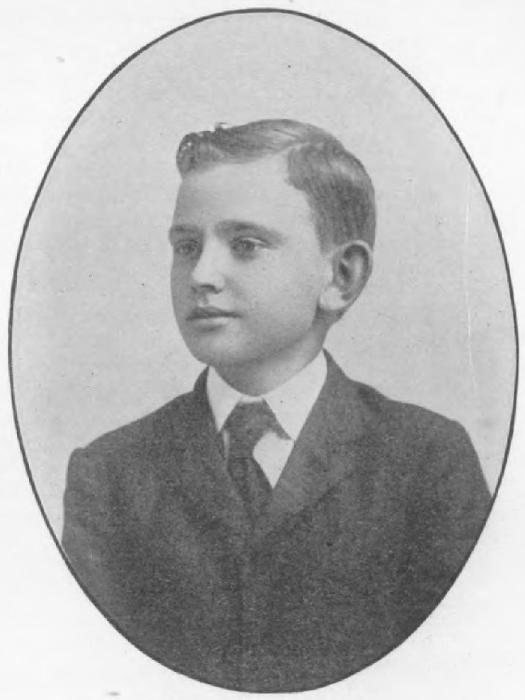
REUBEN WATSON BOYETT
Young Mr. Reuben Watson Boyett,
whom we take especial pleasure
in introducing to Bob Taylor’s readers,
resides at Amory, Mississippi, and
although only thirteen years of age,
is the champion local solicitor of subscriptions.
The people in that part of
Mississippi stand loyally by him. A
travelling agent through that region
recently was met everywhere with the
response that the subscription had been
promised young Boyett. He is a
handsome young fellow, but he is better
than that: he is what the slangster
calls a “live wire”—pushing, energetic,
honest, prompt, a boy who is sure
to become a successful man. His
work for Bob Taylor’s is being widely
emulated, but other agents must get
very busy to pass him.
Don’t fail to read the ad of The
Commoner and Bob Taylor’s Magazine
in combination in this issue.
Bryan’s paper and Taylor’s magazine
should be in every family. By reading The
Commoner you understand the political situation
at all times, and it’s bound to be
particularly interesting during the next
twelve months. Whether you are for or
against Bryan, he’s an important factor in
this country—keep up with him. Bob Taylor’s
Magazine differs from other magazines
as Bob Taylor differs from other men.
If you already take the magazine, tell your
friends about it. Get some subscribers for
us—many or few—and we’ll pay you well.
CHRONIC ASTHMA CURED
Miraculous Recoveries from Asthma and
Catarrh Due to Vienna Treatment.
Evidence of the wonderful cures effected
by the Vienna Toxico Treatment in Asthma,
Catarrh and Bronchitis continue to pour
in from all parts of the country. Diseases
of the respiratory tract have evidently this
time met their master. Obstinate cases are
cured in less than sixty days. The dose is
minute and acts directly on the membranes
and tissues, and it has a wonderful tonic
effect.
The Toxico Laboratory, 1269 Broadway,
New York City, who are the sole dispensers,
have generously offered to send a test treatment
to every sufferer who will write for it.
Gray & Dudley Hardware Company, of
Nashville, Tenn., offer free a 50-cent cook
book to housekeepers who send them the
name of the most prominent stove dealer
nearest to them. It’s a good cook book;
costs you nothing. Write for it and say
you saw the offer in Bob Taylor’s Magazine.
The Massachusetts Squab Co., Box 878,
Whitman, Mass., are offering bargains in
pigeons. See their ad in another column.