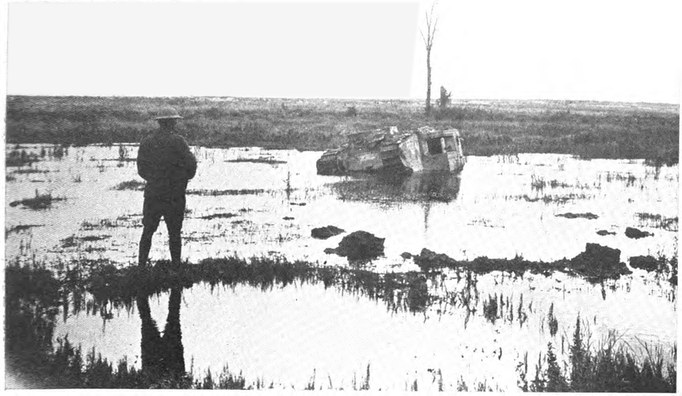
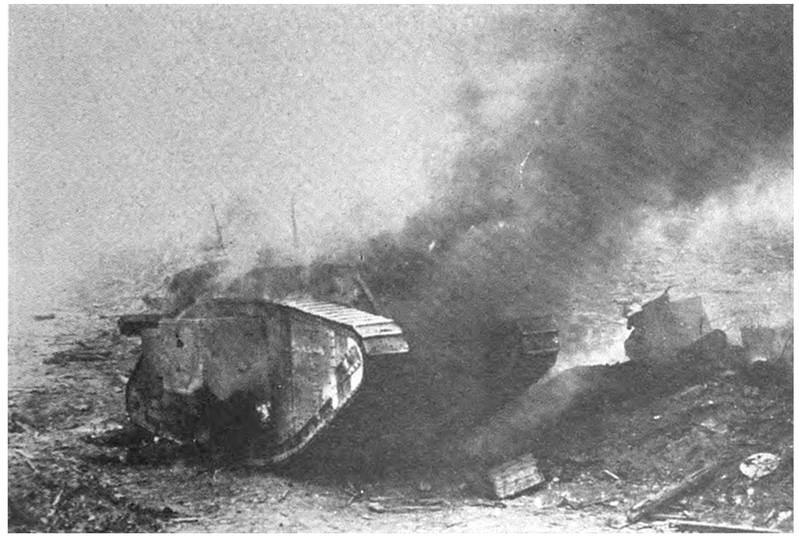
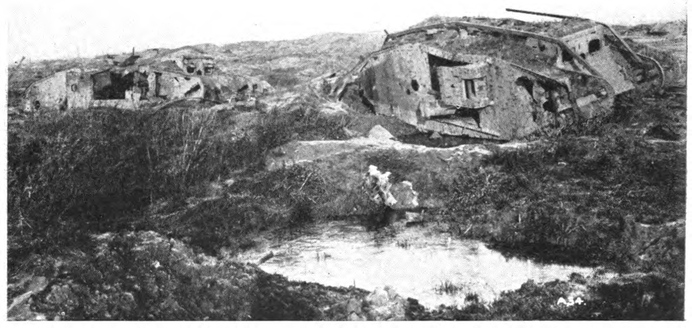
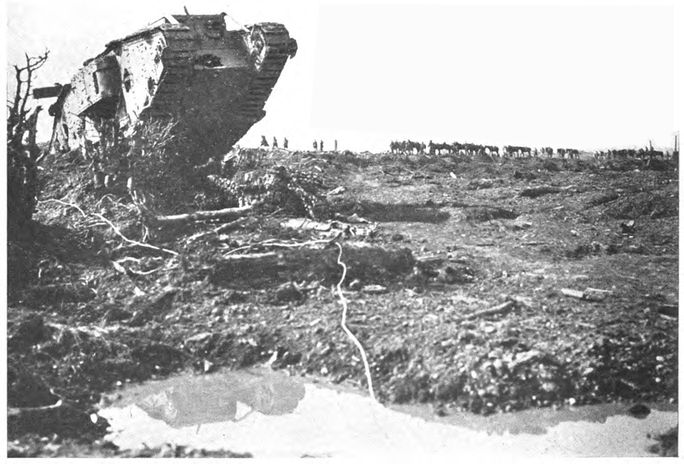
This book uses footnote anchors at the beginning
of some quoted text to refer to footnotes crediting
the sources of those quotes. It also uses
mid-paragraph footnote anchors to refer to
other kinds of footnotes.
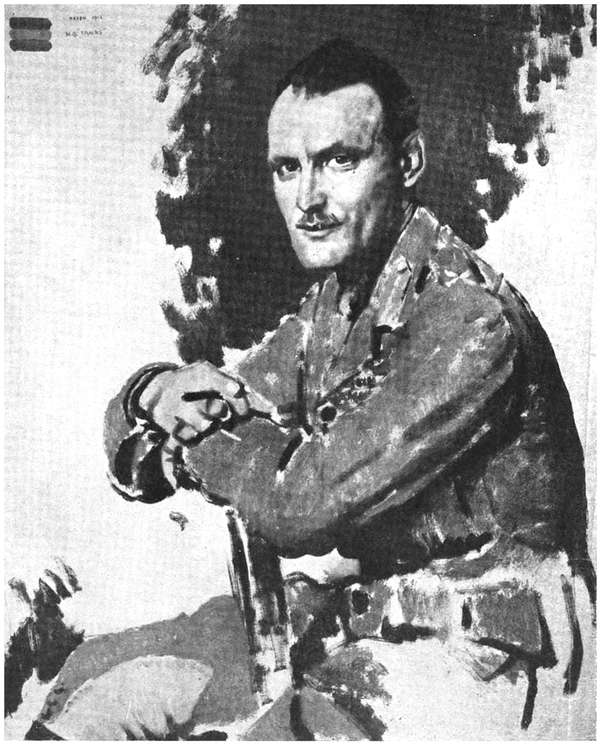
MAJOR-GENERAL HUGH ELLES, C. B., D. S. O.
FROM A PORTRAIT BY SIR WILLIAM ORPEN, A. R. A.
THE TANK CORPS
BY Major CLOUGH WILLIAMS-ELLIS, M.C. AND
A. WILLIAMS-ELLIS
WITH AN INTRODUCTION BY Major-General H. J. ELLES, C.B., D.S.O.
COMMANDER OF THE TANK CORPS
ILLUSTRATED
NEW YORK
GEORGE H. DORAN COMPANY
NEWYORK
GEORGE H. DORAN COMPANY
COPYRIGHT, 1919,
BY GEORGE H. DORAN COMPANY
PRINTED IN THE UNITED STATES OF AMERICA
INTRODUCTION
My dear Williams-Ellis,
You ask me for a foreword to your history, and
invite me, too, to agree to, criticise, or even refute the
conclusions of your Epilogue.
The first task I undertake with pleasure, though I feel
it would be more justly and more skilfully done either
by one of the pioneers who sowed that we might reap,
or by the rare thinker who in our own time has contributed
so much to keep us on the lines of clear understanding
and progress.
As to the second task I must decline a direct reply,
and for many reasons I can no more than touch generally
upon the questions you have dealt with in so interesting
a way. I find them, however, not yet sufficiently
remote in time, either to be clear themselves, or
to be distinctly placed in a picture itself still obscure.
* * * * *
Of the early days of the Tanks, and of the early
struggles, difficulties and hopes of the pioneers, I have
no first-hand knowledge—to comment at any length
upon them would be out of place. They do, however,
represent a remarkable effort of persistent and courageous
faith, of determination to succeed in the face of
lukewarmness and even scepticism, of the overcoming
of many practical difficulties. Above all, they present
a great clearness of vision on the part of three men in
particular—Swinton, Stern and d’Eyncourt.
It is remarkable that one of the first official papers
on the tactical use of Tanks, written by General
Swinton early in 1915, should have been almost literally
translated into action on August 8, 1918.
To General Swinton, too, is due the implanting, into
all ranks, of the fundamental idea of the Tank as a
weapon for saving the lives of infantry. This idea was
indeed the foundation of the moral of the Tank Corps,
for it spread from the fighting personnel to the depots
and workshops, and even to the factories.
More than anything else, it was this sentiment which
kept men ploughing through the mud of 1917, in the
dark days when often the chance of reaching an objective
had fallen to ten per cent.; which kept workshops
in full swing all round the clock on ten and eleven hour
shifts for weeks and, once, for months on end; which,
finally, secured from the factories an intensive and remarkable
output.
Sir Albert Stern brought to his labours a whole-hearted
energy and enthusiasm unsurpassed. But more
practical than this alone, he ensured initial production
by a contempt for routine and material difficulties
and a resilience to rebuff as fortunate as they were
courageous.
To Sir Eustace d’Eyncourt, the only member of the
original Committee still officially connected with us, a
great debt is due. We have been fortunate to have
had at our disposal an engineer of his wide practical
experience, who devoted much of his scanty leisure to
our guidance both in policy and in detail, whose sagacious
counsels have more than once checked the impetuosity
of some of his associates.
* * * * *
Before passing to the aspects of Tank history with
which I have been directly concerned, I wish to make
reference to two organisations vital to the Tank Corps
in the field. For if that represented the point of the
spear, they combined to form a most solid and dependable
shaft.
The first of these two was the Training Organisations
set up in England to produce the men; second,
the manufactories which produced the machines.
The task of the Training Centre and the cadet schools
was particularly onerous. The organisation of any
new instructional centre in the haste and pressure of
the time was no easy task—its work was often thankless
and subject to much ill-informed and light-hearted
criticism.
The Training Centre of the Tank Corps had additional
difficulties. There was no guidance as to training—the
entire system had to be thought out from the
beginning, and continually modified by the experience
of the battlefield—instructors had not only to be found
but trained—esprit de corps and discipline had to be
built up; and all this against time.
It may perhaps be a compensation to the many
officers and men who lived laborious days, and were
not rewarded by seeing the results of their work in
the field, to know that “France” has never been under
any illusion as to the great thoroughness of their work.
* * * * *
The work carried through in the munitions factories,
and the ingenuity and solid labour that backed the
efforts of the soldier in the field, are perhaps not yet
fully appreciated by the fighting men. In France one
might hear of sporadic unrest, but till one met with it,
one realised nothing of the genuine faithful grind at
production of objects of whose destination the worker
often knew nothing, of the blind patience under duress
of shortage, and of crowded accommodation; of hope
deferred.
The Tank Corps was fortunate indeed in having
established at an early date close relations with its
workers, and more fortunate still at a critical time in
being able to declare a substantial dividend on the
capital of wealth, labour and brains entrusted to it by
its section of industrial Britain.
Once touch was obtained with the worker himself, the
interest taken by J. Bull in the factory, in T. Atkins
in the field, was more than fully proved, not only by
the demand for copies of accounts of Tank actions, but
by the steadily increased output that was maintained.
The thing is only natural. Put a man or a woman
to turn out bolts from a machine for eight hours a
day, and you will get a certain result. Tell her or him
that the bolts will go into a Tank that will fight probably
in six weeks’ time; that the Tank will save lives
and slay Huns; that yesterday Tanks did so-and-so;
that last week No. 10567, made in Birmingham, and
commanded by Sergeant Jones of Cardiff, rounded up
five machine-guns ... you will get quite a different
result; moreover, it is John Bull’s right and due to be
told these things.
We had not got quite a complete result in this direction,
but we were getting near it, and perhaps our co-operation
of the back and the front was as nearly a
microcosm of an ideal national co-operation in war as
has been achieved. We aimed at Team Work.
* * * * *
You who have coped in a short compass with the
whole story of Tanks can well realise the difficulties of
dealing concisely, even by comment, with the kaleidoscopic
events of two and a half crowded years—with
the questions of organisation, training, personnel, design,
supply, fighting, reorganisation, workshops, experiments,
salvage, transportation, maintenance.
I shall attempt no more than to supplement your
admirably drawn narrative as to one or two points
which appear to me to be of major importance or
interest.
* * * * *
The employment of Tanks in the field was one long
conflict between policy and expediency. Policy seemed
always to demand that we should wait until all was
prepared, until sufficient masses of machines should be
ready to use in one great attack that would break the
German defensive system. Expediency necessitated the
employment of all available forces at dates predetermined,
and in localities fixed for reasons other than
their suitability as Tank country. Battles are not won
with Tanks alone, and in early 1917, for example, the
Tank was still a comparatively untested machine. Indeed,
the later issues of the Mark I. developed weaknesses
in detail so alarming as to preclude anything
more than a short-lived effort in battle.
Not until the Mark IV. machine was well into delivery
could a guarantee as to its degree of mechanical
reliability be given, and by that time the trend of the
year’s campaigning was unalterably fixed.
And so it was that it was our fate up to the first
Cambrai battle to “chip in when we could” in conditions
entirely unfavourable.
The employment of Tanks in Flanders has often been
criticised, without intelligent appreciation of the fact
that had they not fought in Flanders they would have
probably fought nowhere. Better, therefore, that they
should fight and pull less than half their weight, and
still save lives, than that they should stand idle while
tremendous issues were at stake.
* * * * *
If employment in the field was a struggle between
policy and expediency, the principles of production and
design represented a direct conflict of opposing policies,
resulting happily in compromise. The fighting man,
conscious of the weaknesses of the earlier weapons,
and visualising development which he believed to be
obtainable, and knew to be necessary, and the soldier-engineer
overburdened with difficulties of maintenance
and cursed with the nightmare of Spares and Spares
and more Spares—both cried aloud from France for
rapid progress in design.
In England the other side of the picture was presented
with equal force. The process of bulk production
necessitates orders placed long in advance, materials
were difficult to obtain, plans of track work and
workshop organisation are not susceptible of change
without delay, change, too, entailing irritation of factory
staffs and workmen. Production once agreed to
and embarked upon, a very complicated machinery is
with difficulty set in motion. To stop or change this
machinery results often in a loss of output which is in
no way compensated by the improvements ultimately
obtained.
The same problem must have occurred in many
branches of war production. The best, however, is
only the enemy of the good, if the good is good
enough.
You have portrayed the difficulties arising from these
conditions in Chapter V. The picture you draw belongs
to the earlier stages, when the two sides worked rather
upon regulation than upon formula. The later stages
of the war saw a very full appreciation of each other’s
point of view and the growth of a very sturdy spirit of
co-operation, which carried us over more than one difficulty
to meet which special appliances or special construction
were necessary.
* * * * *
The Tank, as a weapon, has been threatened with several
crises. Some have been averted by intelligent forecast
in specification. Some have been dealt with by the
improvisations of the engineers both in France and in
England. Some have disappeared before a general improvement
in design. You, I think, have touched on
one crisis only—the mud crisis. The mud crisis was
defeated at long last, but the swamp crisis, never. Although
none of the other troubles was of long duration,
any one of them, unless cured, would have caused a
permanent disappearance of the arm.
Failure of rollers was succeeded by failure of
sprockets. Sprockets and rollers were hardly cured
when the Germans produced a very reliable armour-piercing
bullet. This after a very short innings was
defeated by the arrival of the Mark IV. Tank. The
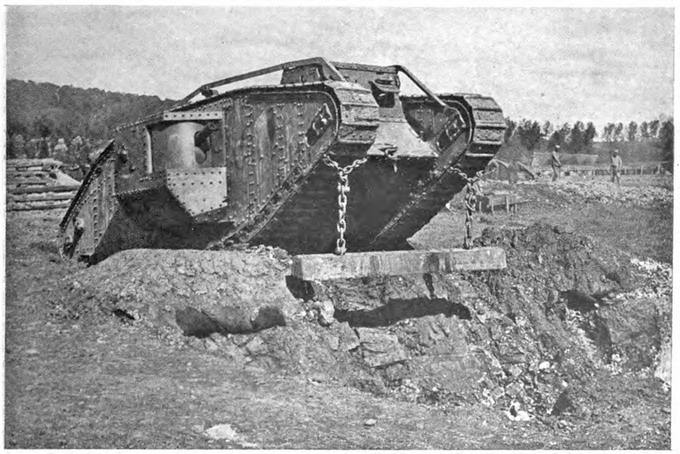
Mark IV. Tank was barely rescued from the mud of
Flanders by the invention of the unditching beam, when
we discovered that the Hindenburg trenches were about
one foot too wide to cross without some form of help
to the Tank. This difficulty was overcome, but about
this time the effect of concentrated machine-gun fire
upon Mark IV. Tanks must have become known to the
Germans, as also their vulnerability to the ordinary
field gun. The position with regard to both splash and
casualties from guns firing over the sights, was becoming
serious when the arrival of Mark V. Tank, with its
increased handiness and speed, put an end to the splash
difficulty for ever, and defeated the field gun for a good
long time.
So on to the last days of the war, when we were able
to look forward to 1919 with a certain knowledge that
we had much in hand against any measure of opposition—short
of a superior Tank—that the enemy could
produce.
The idea undoubtedly exists still in the minds of certain
people that the particular form of Tank which they
have seen or fought with represents the latest word in
design. It does not. The latest Tank produced in any
bulk was the type that marched through London on
July 19. It has never fought, and it represents the
last word only of the elementary series of Tanks of
which Mark I. was the original.
* * * * *
If finality in design has by no means been approached
in the war, the same may be said as regards the employment
of the then existing types. This depended, after
due consideration of their limitations and powers, on
the training of personnel, not only of the Tank Corps,
but essentially of infantry too. Lack of time, lack of
opportunity, and wastage of trained personnel were the
great difficulties which confronted commanders of
every arm and formation in their efforts to reach even
average standards of skill in only a few of the commoner
phases of warfare. With the Tank Corps the
additional difficulties of mechanical training were no
more than balanced by freedom from the trench routine
of troops employed for defence. For the infantry Tank,
the training of Tank personnel alone is not sufficient.
In the assault, Tanks are no more than a part of infantry,
an integral part of the troupes d’assaut. For
real success, i.e., cheap success, not only must the two
arms train and re-train together, but they should live
together, feed together, and drink together.
Much was attempted and much was done to supplement
the lack of opportunity by demonstration, lectures,
attachments. But by reason of the incomplete
military education of our hastily-trained troops it was
necessary to limit manœuvre and tactics on the battlefield
to the simplest elements. Anything in the nature
of finesse had to be avoided. Skilful use of ground and
mutual fire support were things hoped for more often
than achieved.
It was a question of bulk production against time,
but the results obtained only prove how much more
could be achieved with the same material had conditions
of training been those of peace time with its long
service and rigorous and plentiful supervision.
* * * * *
The preceding paragraph may seem ungracious from
one who has had the privilege of commanding a great
force of citizen soldiers. It is nevertheless true that
soldiering, like any other trade, takes time and experience
to learn—that though there may be many who,
being engineers, or advocates, or business men, or
farmers, learn soldiering with great aptitude, the great
bulk of any body of men, call them regular soldiers or
citizen soldiers, require a deal of training under the
best instructors, if they are to draw the full advantage
from the ever varying conditions of the battlefield.
* * * * *
I have alluded above to the Tank Corps as a citizen
force. It was, indeed, peculiarly so, for of the 20,000
odd souls that went to compose it, perhaps not more
than two or three per cent. were professional soldiers;
and, while the General Staff officers on H.Qs. were
almost without exception regulars, the whole of the
Administrative and Engineering staffs with one solitary
exception were drawn from various civil vocations.
Moreover, units as they came into being were built
up, not on any old-time tradition of a parent regiment,
but each one very much around the personality of its
own commanding officer. And it has indeed been interesting
to watch the development of particular idiosyncrasies
of whole battalions and companies from the
characters of their leaders.
Your record has faithfully set forth what has been
accomplished by these troops. They are well able to
sustain criticism in the light of their achievements.
* * * * *
I have alluded before to the esprit de corps, founded
as it was upon the sentiment of saving of life—a sentiment
to which appeal has never failed. Other factors
went to strengthen it. It was braced by a high standard
of results demanded, by the determination to make
good in spite of partial first successes. But the
strongest element in it was the faith in our weapon—the
machine necessary to supplement the other machines
of war, in order to break the stalemate produced
by the great German weapon, the machine-gun—our
mobile offensive answer to the immobile defensive man-killer.
* * * * *
It is indeed a curious reflection that the Germans
before committing themselves to their great final offensive,
should not have followed to their logical conclusion
the preparations which they made for the preceding
phases of the war with such meticulous forethought.
In 1914, they removed from the path of their attacking
infantry the prepared obstacles of permanent fortification
by means of specially-constructed machines—siege
cannon of unprecedented size. Later, they developed
the machine-gun in bulk, and so modified the preconceived
course of warfare to their own advantage for
defence. It is astonishing that for their final offensive
effort, they should not have equipped their men with
armament for overcoming the very defence in depth
supported by the very machine-guns from which they
had reaped so much advantage in the previous years.
And yet we see them in March, 1918, reverting after
an initial attack, powerfully covered by artillery fire,
to the same attempt to break through with men that
had failed in 1914. Although machine-gun support was
stronger, there was little help from the other arms beyond
scanty artillery support and considerable frightfulness
of day and night bombing and long-range bombardment.
The German infantry was well, often magnificently,
led, whether in Picardy or Flanders; and one
could not watch the work of the strong offensive patrols
without intense admiration of their skill and courage.
The Germans failed against defence in depth. The
elements that were wanting were those of continuous
mobility necessary to overcome such defence, against
which infantry without powerful support and plentiful
supply sooner or later become powerless. The Germans
lacked the means to move and to supply their guns
rapidly. They lacked Tanks to produce surprise or to
carry forward the battle as an alternative to guns.
They lacked lorries, they lacked cross-country vehicles.
With us, when the tide turned, the converse was the
case, and it was at least a part reason of success against
an enemy who fought bravely and often bitterly almost
to the end.
* * * * *
Whether you justly appraise the contribution of the
Tank Corps towards the final victory is for history to
declare—at some interval yet—but I am hardy enough
to give you a parable in the terms of a great national
pastime.
Rugby football of all games affords the closest
analogy to war—to warfare on the Western Front the
parallel, without labouring the detail, is remarkable.
In the early nineties the accepted tactics of the game
demanded a distribution of the team into nine forwards
and six backs. The orthodox believed in forward play,
and in emergency sometimes even a tenth forward
would be added at the expense of one back.
At this time there occurred in the annual matches
between two countries an uninterrupted series of defeats
for one. As a measure of resource or despair, I
do not know which, a new distribution was made in
its forces. Instead of nine, eight forwards were played,
one back was added—the fourth three-quarter.
The tactics were for the forwards to hold the opposing
attack and for the backs to play offensively. The
game is historic. For three-quarters of the match the
nine forwards pressed the eight heavily, and these were
very hard put to it to maintain their lines. In the last
phase of the game one of the four three-quarters got
away unmarked, the game was won and lost.
That was twenty-five years ago. The rules of the
game remain unchanged, but the distribution of the
players has been modified and the tactics of teams have
developed on the lines of that historic match and
beyond.
Whether the parallel of the Tank Corps to the extra
three-quarter is a completely true one history will
record in due season. What, however, we may claim is
that the fourth three-quarter after a nervous start, in
which perhaps he was sometimes out of his place, nevertheless
on more than one occasion got away unmarked;
that he ran straight even when he was being heavily
tackled and drew the opposition for his side; that he
went down well to the rushes of the German forwards;
and that, finally, he more than once handled the ball
in the great combined run which took his team from
within its own twenty-five over the opponents’ goal line.
A BRIEF ACCOUNT OF THE TANK, ITS CREW AND ITS
TACTICAL FUNCTIONS, AS THEY WERE AT THE
DATE OF THE ARMISTICE
The secrets of the Tank Corps have been so well
kept that there are few civilians who even now know
anything of Tanks or their crews beyond what might
be learned from photographs, or a distant view of
“Egbert” or some other War Bond or Olympian
Tank.
The Censorship has seen to it that the civilian has
had no opportunity of making himself familiar with
the tactical opportunities and problems that the use
of Tanks has introduced or with the conditions under
which Tank crews fight.
It is for the civilian reader that the present chapter
is intended. He is to be given some idea of the oak
tree before he is invited to dissect the acorn.
If he has no idea of the appearance and habits of
the Tanks that fought at the Canal du Nord or that
pushed back the enemy at Mormal, he cannot be expected
to thrill as he should over the vicissitudes of
the first converted Holt Tractor. For to one who had
never seen the engine of a through express the history
of “Puffing Billy” would almost certainly prove insufferably
tedious.
The authors, therefore, propose to deal, very briefly,
with the modern Tank before plunging the reader into
the dark ages of 1914, where, to pursue our analogy,
Watt’s kettle-lid and the “Rocket” dwell obscurely.
Every detail of Tank Corps’ training, equipment, and
tactics has been modified in view of some limitation
or opportunity arising from the structure of the Tank
itself. Therefore, though this book is principally concerned
with the development of the Tank Corps rather
than with the intricate evolution of the Tanks themselves,
the reader will find it necessary to have a general
idea of the construction and workings of the different
types of machine.
It would indeed be as idle to describe the anatomy
of a snail or a lobster without mention of its shell, as
to endeavour to separate the story of the Tank Corps
from that of its Tanks.
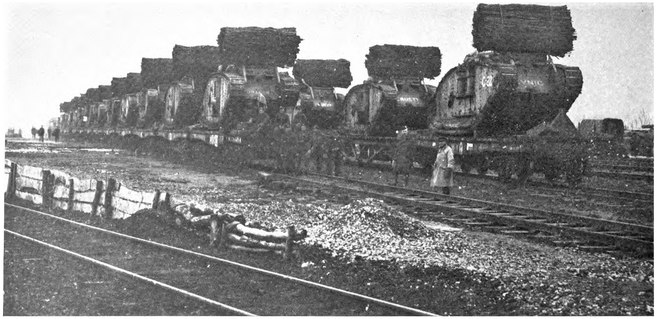
When the War ended in November, 1918, there were,
besides obsolete types which were still used for such
work as carrying and the towing of supply sledges,
three main types of Tank. First, the Mark V., which
was 26 ft. long, 8 ft. 4 in. wide, weighed 27 tons, and
had a horse-power of 150. The Male Tanks carried two
6-pounder guns, and one Hotchkiss gun. The Female
carried five Hotchkiss machine-guns and no 6-pounder
guns.
The Mark V. Star.—This Tank resembled the Mark
V., except that it had a length of 32 ft. 6 in., and was
designed for the transport of infantry and for the
traversing of trenches too wide for the Mark V. Each
had a normal speed of about five miles an hour, and
was protected by armour up to five-eights of an inch
thick.
They were both so designed as to turn easily at their
maximum speed, and carried attachments for use on
soft ground, which increased the grip of the tracks.
Each was fought by a crew consisting of a subaltern
and seven men, three drivers (two of whom normally
fought the Hotchkiss guns), and three gunners.
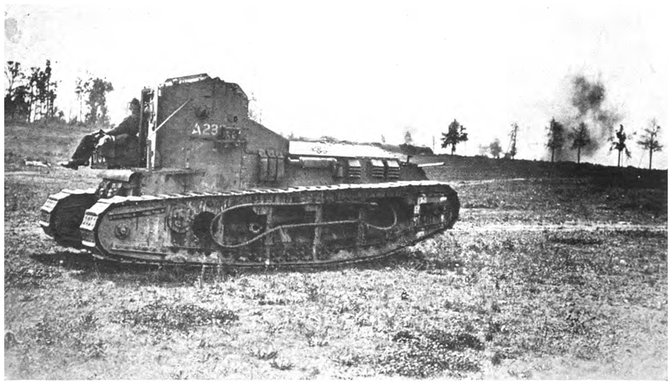
The third type was the Whippet. The tracks were
nearly as long as those of a heavy Tank, but the body
had been reduced to a small cab perched at the back,
rather as an urchin rides a donkey. It was armed with
two machine-guns, managed by a crew of three men,
and developed a speed of seven miles an hour. Whippets
were designed for use as raiders and in conjunction
with cavalry. In practice, however, the cavalry
was seldom able to act with them. Partly in consequence
of this, partly owing to the state of open warfare
being of such short duration, the Whippets,
though having brilliant feats to their credit (see the
exploits of “Musical Box,” Chapter XIII), remained
creatures of promise rather than of achievement.
As a rule Male Mark V. Tanks were used against
Pill-Boxes and other “strong points,” while the special
work of Female Tanks was to deal with hostile infantry
(for example, by sitting astride and thus enfilading
their trenches), and then to finish the process of flattening
the enemy’s wire which the Male Tanks had
begun.
All three types of Tank were capable of going across
country. That is to say they could, for example, follow
a pack of hounds anywhere, except perhaps in the Fens.
Ditches, heavy plough, banks, walls, hedges, or fences
could all be negotiated.
Tanks could also go over many obstacles—notably
over wire—where the Field, even were they willing
“to take a windmill in the harbour of the chase,” must
go round.
But as a moment’s reflection will show, there must
remain in every country certain features which will
prove absolute barriers to the progress of Tanks.
Chief among these are canals and deep rivers (unless
spanned by strong bridges), very steep railway cuttings,
railway embankments, marsh, or woods in which
the trees are too strong to be pushed over, and too
dense-set to be steered through.
Besides these natural, or at least civilian, obstacles,
there will be inevitable military obstacles in any country
that has been fought over.
For example, old half-blown-in trench systems make
ground “awkward,” and Tanks operate at extreme
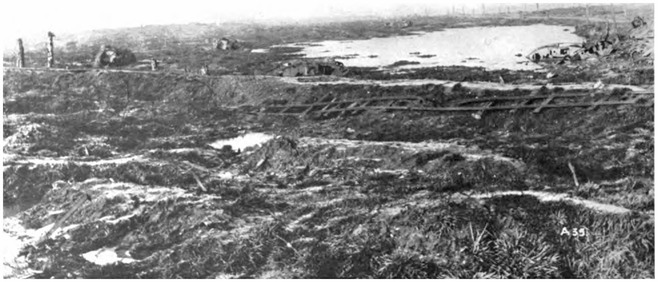
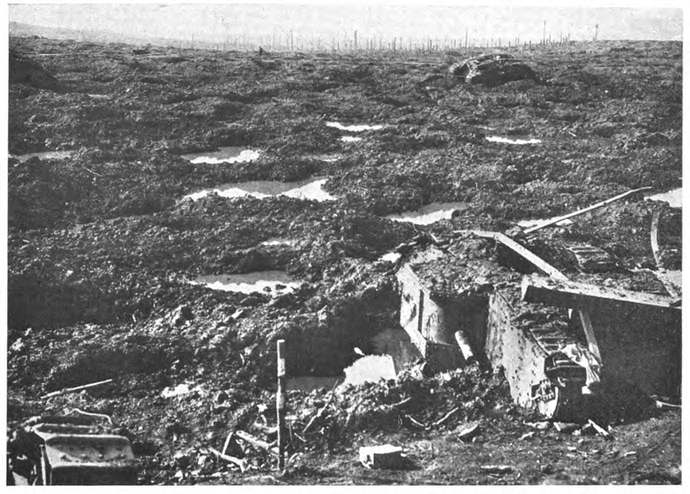
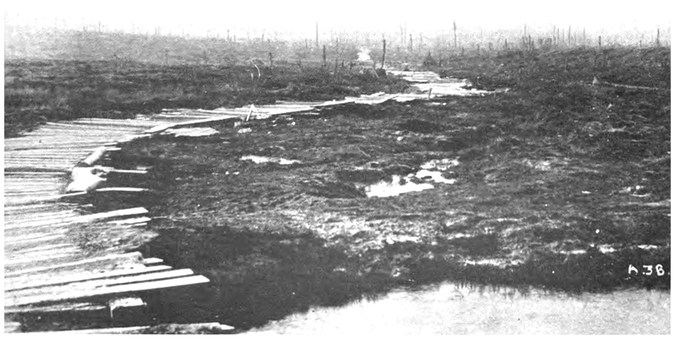
disadvantage in country like that round Ypres, which
was by 1917 a continuous network of water-logged shell
and mine craters, with no original ground left at all.
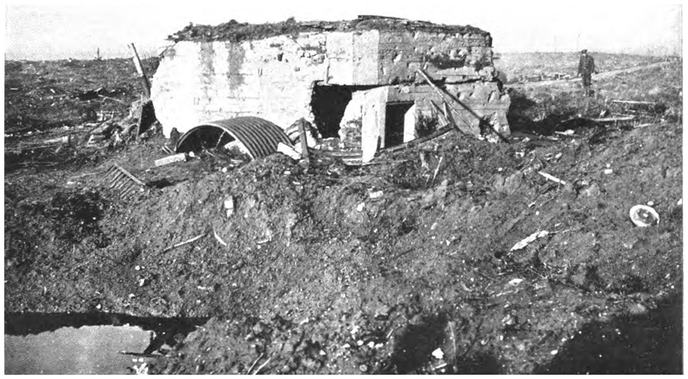
Again, by the close of hostilities the number of anti-Tank
devices employed by the Germans was very considerable.
They paid the new arm the compliment of
an intricate system of defence and counter-offence
which included concealed Tank traps made on the
model of elephant-pits, formidable double-traversed
trenches, a branch of special anti-Tank artillery,
heavily reinforced concrete stockades, and an elaborate
system of land mines.
With so many obstacles to avoid or to negotiate, with
their fate often hanging upon a prompt and accurate
use of their guns, the crew inside the Tank were doomed
by the conditions under which they fought to an almost
incredibly limited view of the surrounding world.
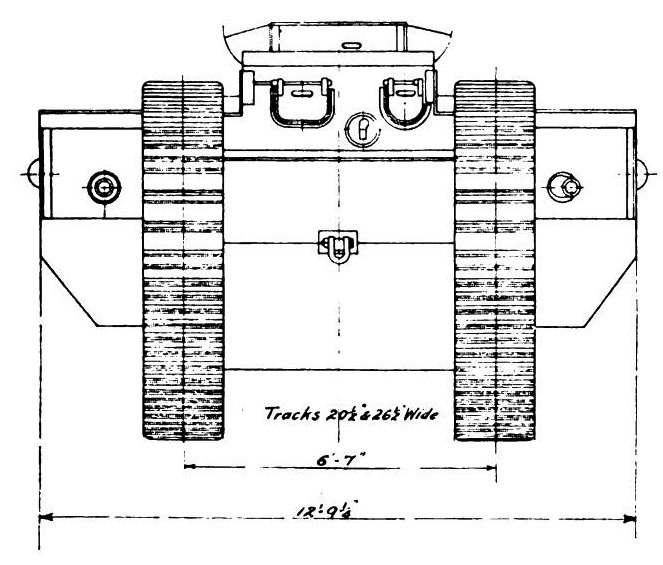
GENERAL ARRANGEMENT OF MARK V. TANK—FRONT VIEW
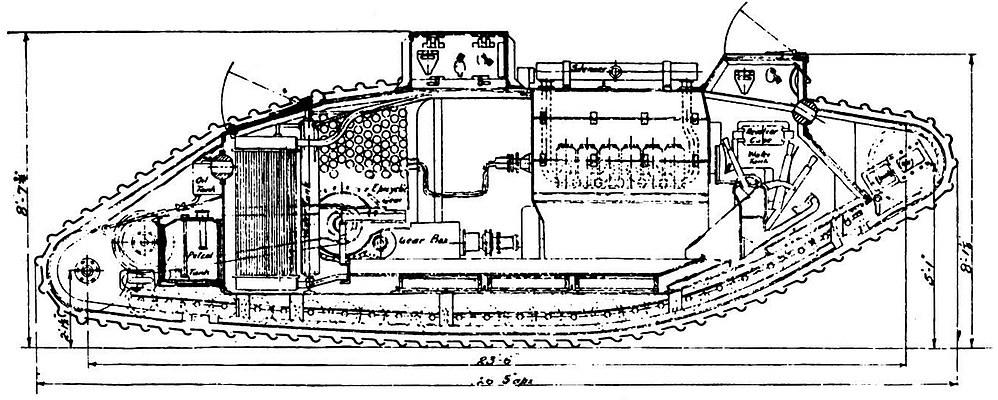
GENERAL ARRANGEMENT OF MARK V. TANK—SECTIONAL ELEVATION
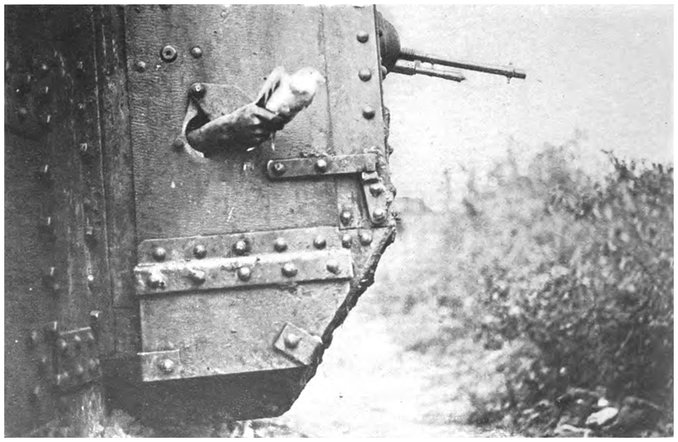
When the flaps were closed (see diagram showing
interior of a Mark V. Tank), as they had to be
directly the Tank came under close fire, the crew were
in almost complete darkness, and had to rely upon
their periscope or, alternatively, upon minute eye-holes
(about the size of the capital O’s used in this text)
bored through the armour-plating. If the fire was at
all heavy the periscope was usually quickly put out of
action, and the officer and gunners had only the extremely
limited view afforded by these holes.
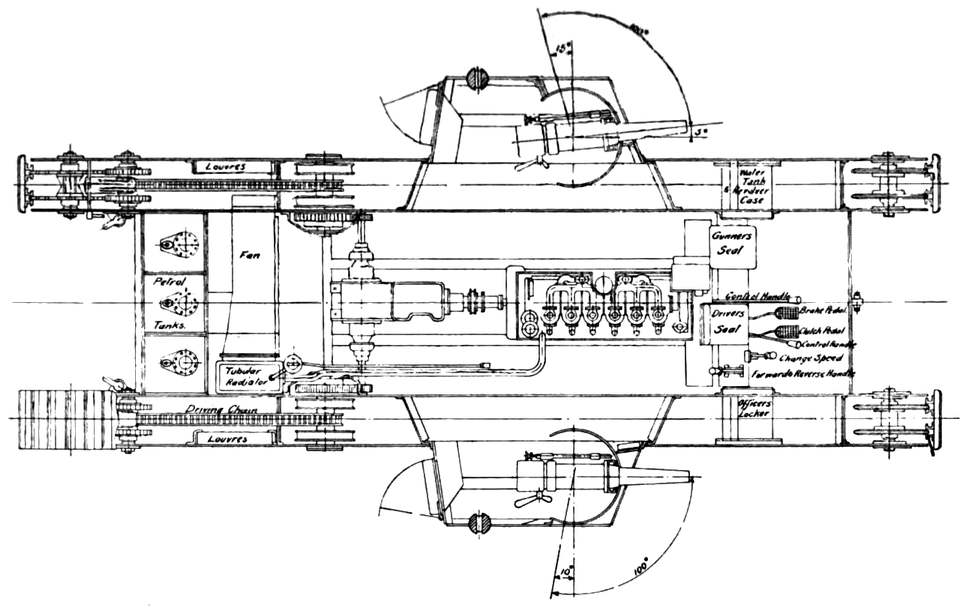
GENERAL ARRANGEMENT OF MARK V. TANK—SECTIONAL PLAN
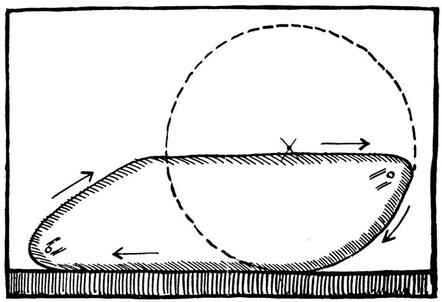
DIAGRAM SHOWING HOW THE CATERPILLAR METHOD OF
TRACTION CARRIED OUT THE PRINCIPLE OF THE
“LARGE-WHEELED TRACTOR.” SEE NOTE AT END OF CHAPTER II.
They were thus almost entirely dependent upon their
maps, the special Tank compass, and upon the information
which a preliminary reconnaissance of the ground
had given them.
This circumstance not only profoundly modified the
training of the officers and crews, but also necessitated
the organisation of what was almost a new service.
This service was the “Reconnaissance” branch of the
Intelligence. When the Tank Corps was ordered to
take part in an attack, the Reconnaissance Staff was
responsible for the preliminary survey of the proposed
battle site for a report as to where and how Tanks
could best operate, and finally for a series of detailed
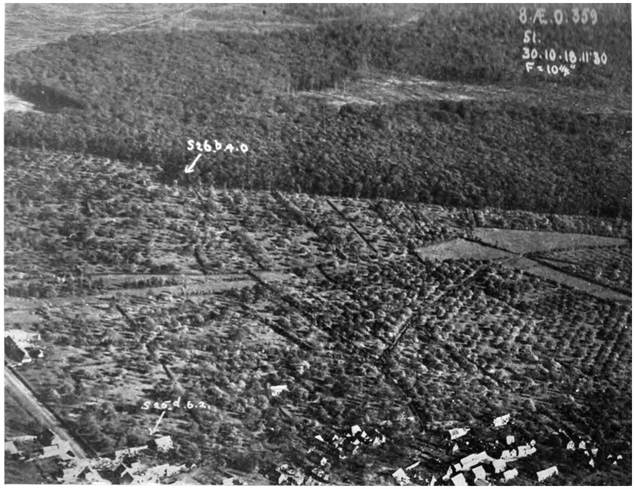
maps and sketches. In these maps and sketches the
route of every individual Tank was set forth from
landmark to landmark, together with the assigned objectives
of each machine and the obstacles which it was
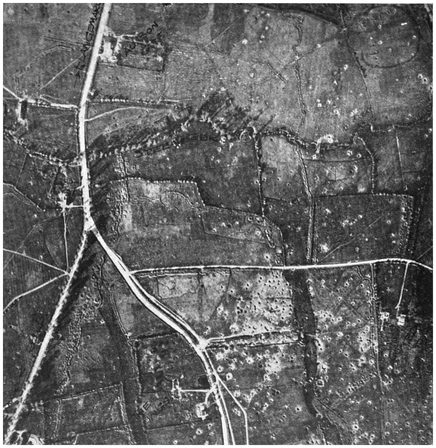
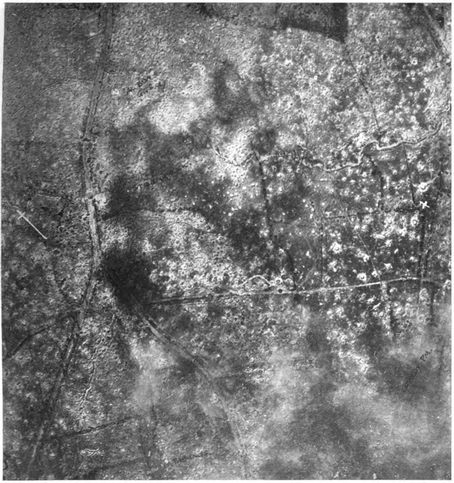
likely to encounter. These maps and sketches were
compiled from aerial surveys, captured German maps
and documents, information gained from local inhabitants,
accounts given by prisoners, the original Ordnance
survey, and from personal reconnaissance. By
1918 this system had been so developed that the
infantry came to rely almost entirely upon their accompanying
Tanks for direction.
This added greatly to the importance and responsibility
of the work both of Tank Reconnaissance officers
and of commanders.
Topographical information can only be adequately
conveyed to a more or less trained receiver, and it was
therefore found necessary to add an elementary course
on Reconnaissance to the already long list of subjects
in which the members of every Tank crew must train.
The crew were an assemblage of experts.
An average of about a month was spent by every soldier
at the training depots and battle-practice grounds.
Here each man did about ten days’ course as a driver
or gunner, learned revolver-shooting, signalling, and
the management of carrier pigeons, and went through
a gas course. In view of the probability of casualties,
each man was also given a working knowledge of
every other man’s job. But most vital of all—the conditions
under which Tank crews fought being out of
the common trying and arduous—the scheme of training
aimed at creating a high sense of discipline; that
esprit de corps and that tradition of valour which
teaches men to endure the unendurable.
This supreme end it achieved, as a perusal of the Tank
Corps Honours List will show.
Such, then, were the Tanks and their crews in the
autumn of 1918.
In the pages which follow, the reader will see from
how crude an embryo the Tank sprang, and through
what hair-breadth escapes alike from official overlaying
and annihilation by the enemy, it passed in the four
years of which we are about to relate the history.
CHAPTER II — I — II — III — IV
THE EARLIEST TANKS—GENERAL SWINTON—ADMIRAL
BACON—THE HOLT TRACTOR AND THE EVOLUTION
OF THE “LAND CRUISER”
The War had only been in progress for a few weeks
when the first idea of the first Tank was born almost
simultaneously in the minds of General E. D. Swinton,
Major Tulloch, Captain Hetherington and Mr. Diplock,
and—if we are to believe rumour and their own account
of the affair—of several hundreds of other gentlemen.
“Born” is perhaps not quite the appropriate word.
At any rate it is to be understood, if not in a Pickwickian,
at least in a Pythagorean sense.
For by 1914 the Tank had successively passed
through several tentative and inconclusive incarnations.
In 1482 Leonardo da Vinci invented a kind of Tank;1
a wooden “War Cart” was used by the Scottish in the
fifteenth century.2
There were designs for a Tank for the Crimea, but
the project of this weapon was abandoned as being barbarous.
Lastly, a really practical design for a kind of
“Caterpillar” to be driven by steam was made in 1888.
A trial machine was even constructed. But Fate decreed
that all trace of design and model should be instantly
lost, only apparently to be rediscovered after
the modern Tank had been thought out afresh.
Why, if the Tank was constantly being invented, did
it as constantly disappear? The reason appears to
have been that, like the early aeroplanes, all these abortive
machines had failed in one particular.
The engine was not powerful enough. The steam
Tank had not in the least answered the riddle. The
horse-power could, it is true, be almost indefinitely
increased, but, like a kind of Old Man of the Sea, the
engine weight would have increased proportionately
and the “free” power have been no more.
Indeed till the invention of the petrol engine the Tank
was doomed to be unpractical. Its three essentials—armour-plating,
guns, and ability to surmount obstacles
and traverse open country—demanded a large amount
of this “free” power.
Only, therefore, when an engine was produced whose
proportion of power to weight was about 100 H.P. to
every ten hundredweight, did the Tank become a possible
and effective engine of war.
Thus, till the time was ripe the Tank had been doomed
to enjoy very brief excursions into the actual, and to
sojourn, long forgotten, beyond the waters of Lethe.
Does memory survive transmigration? Were General
Swinton and his co-inventors aware of the Crimea
Tank and the 1888 Tractor? In any case the matter
is not one of great importance, for—to put it briefly—ultimately
their Tank went, and the others did not.
By October, 1914, Colonel Swinton and Captain
Tulloch had independently worked out the details of
an engine of war. Like the other early inventors, they
imagined a machine that was to “arise” out of a
cross between an armoured car and an agricultural
tractor. It was to be slower, more formidable and far
heavier than any armoured car that had yet been seen,
a kind of “Land Cruiser” capable of plodding on its
caterpillar feet across country right up to the enemy’s
gun positions. Like the other early “mobile machine-gun
destroyers,” it was to be strongly armed with guns
and machine-guns, and so heavily steel-plated as to be
impervious to shrapnel, H.-E. fragments and rifle bullets.
It was to cross trenches with ease, and was to be
capable either of cutting or of flattening the enemy’s
wire in the mere act of its progress.
By November Colonel Swinton and Captain Tulloch
were in close touch with one another, and the child of
their fancy descended from the clear regions of pure
thought to battle its slow way forward amid the fogs
and thornbrakes of actual experiment and official
memoranda.
Well-informed readers will perhaps wonder why the
present authors have singled out Captain Tulloch and
Colonel Swinton from amid “the press of knights.”
Do they intend to lay the laurel on their brows? To
declare that they alone invented the Tank?
The chroniclers pretend to no such judicial powers.
Be theirs rather the genial rôle of the Dodo in Alice
in Wonderland, who at the end of the Caucus-race
allotted one of Alice’s comfits to each of the competitors.
As far, however, as they can disentangle the complexities
of the evidence, it does appear to have been
through these two enthusiasts that the Tank idea first
took tangible shape. The notion was in the air, perhaps
it took unsubstantial form in other minds before
October, 1914,—it seems probable that it did in Mr.
Diplock’s and Mr. McFee’s, for example. Perhaps, too,
in other minds it was later to take clearer and more
practical shape.
But it does seem to have been Colonel Swinton and
Captain Tulloch who, first of the band of pioneers, had
the courage and the practical energy to forward a somewhat
startling notion in official quarters.
For Mr. Diplock’s first “Pedrail” machine, whose
plans he laid before Lord Kitchener and Mr. Winston
Churchill in November, 1914, was a Gun Tractor, not a
fighting machine. It was not till February 1915 that
Mr. Diplock (in conjunction with a Committee appointed
by Mr. Churchill) officially so much as contemplated
the building of a “Land Cruiser.”
Fortunately one of the first of the Swinton memoranda
was submitted through Colonel Sir Maurice
Hankey, Secretary to the Committee of Imperial Defence,
who was an early and active friend to the idea
of the new arm.
Difficulties, however, abounded. Many were actual,
some were imaginary.
For example, it was urged that to design and build
such machines would take over a year. Surely the war
would be over!
Then when the counsels of those kill-joys prevailed
who believed that the war would “hold,” and it was
decided to experiment with the “mobile machine-gun
destroyers,” various technical difficulties arose.
It was difficult to procure some of the essentials without
elaborate manufacture and the making of special
tools, and makeshift parts were, therefore, substituted.
Fitted with these makeshifts, the Land Cruisers were
a disappointment.
The first tests were carried out in February 1915,
when Captain Tulloch’s adaptation of the Holt Tractor
was given a trial. It did not prove a complete failure,
and much was learned from the experiment. For example,
the machine was unexpectedly effective in rolling
in the wire which it had been originally intended
that its automatic “lobster-claw” wire-cutters should
alone deal with.
In June Admiral Bacon’s Forster-Daimler Tractor of
155 H.P., fitted with a self-bridging apparatus, was experimented
with.
This, too, proved disappointing, in so far as the device
was to fulfil the proposed functions of a Land Cruiser.
It refused to cross trenches, though it proved a practical
Tractor, and it was later used in “trams” of eight
machines for the transport of 15-in. guns.
The position, therefore, in June 1915, as far as the
War Office was concerned, was as follows: Proposals
had been put forward by Colonel Swinton, Admiral
Bacon, and Captain Tulloch, and submitted to the War
Office; certain trials had been made, the result of which
was, in the view of the authorities, to emphasise the
engineering and other difficulties. It was only in June
that the War Office ascertained that investigations on
similar lines were being carried out by the Admiralty.
For the Admiralty, with a large land force at its
disposal, had been for some time casting about for
means whereby the men of that force might go into
battle more in Navy fashion, that is (to misquote the
“heroic Spanish gunners”) with something better than
serge, “joined to their own invincible courage,” between
them and the enemy’s bullets.
Mr. Churchill had, as early as January 1915, written
a letter to the Prime Minister expressing his entire
agreement with Colonel Hankey’s remarks “on the subject
of special mechanical devices for taking trenches.”
The idea of employing a large armoured shield on
wheels, or of using ordinary steam tractors on which a
small bullet-proof shelter had been fitted, had been considered.
Mr. Churchill interested himself personally in
the scheme, and he and his expert, Major Hetherington
of the R.N.A.S.—the third independent inventor—worked
hard to evolve and then “push” a practical
machine.
In the early spring of 1915 a Committee, called the
Land Ship Committee, was appointed,3 and many designs
of wheel and caterpillar tractors were submitted
to it. One of these designs was especially interesting
not only for its astonishing appearance, but for the influence
which it exerted upon the “profile” of the
future Tank. The curious will find a brief account of
it in the Note at the end of the chapter. It was Mr.
Churchill’s Committee who called in Major Wilson, Mr.
Tritton, and Mr. Tennyson d’Eyncourt as consultants,
“when a design was evolved which embodied the form
finally adopted for Tanks.”
Thus, while the honour of the first designs and experiments
belongs to the War Office, it was to the enterprise
of this Admiralty Committee that most of the
credit of the evolution of the Mark I. Tank was due.
It was, as we have said, apparently not until the
Admiralty Committee had been at work for some time
that the Director of Fortifications and Works, on behalf
of the War Office, ascertained that the Admiralty
had designs for a “Land Cruiser” in hand.
The two Departments met at Wormwood Scrubs to
witness the Admiralty’s trials of a Killen-Straight
tractor. It was a remarkable occasion, for a number of
men who were destined profoundly to influence the history
of the Tanks now saw a foreshadowing of such an
engine for the first time.
Among them were Lord Kitchener, Mr. Lloyd George,
Mr. Balfour, and Mr. McKenna. Mr. Winston Churchill
was also there, but to him an armoured tractor was no
novelty.
After this gathering the Tank enthusiasts of the two
Departments fell upon each other’s necks, swore eternal
friendship, and in the middle of June formed a Joint
Committee, of which Lieutenant Stern was Secretary.
Tanks—when any existed which would work—were
to be a military service in the Department of the
Master-General of Ordnance.
The Admiralty was to continue its work of designing,
was to provide cash for experiments, and Mr. Churchill,
its late First Lord, was to continue his invaluable work
as a propellant. All seemed prosperous, for the representatives
of the two Services appear to have worked
pretty harmoniously, and the better informed and more
progressive heads of Departments on both sides showed
an interested benevolence.
But unfortunately—especially at the War Office—there
appear to have been a certain number of obstructionists.
One senior Officer, fearing, one supposes, to be diverted
from his ideal of the official attitude by the sight
of these ungodly engines, refused so much as to attend
the trials. The Adjutant-General (then no doubt, poor
man, sufficiently harassed) rigidly refused a single man
for the new arm. Fortunately, the Joint Committee was
resourceful, and, after a preliminary appeal to Mrs.
Pankhurst for militant suffragists,4 they induced the
Admiralty to turn over to them the 20th Squadron of
the Armoured Car Reserve, and to increase the strength
of this unit from 50 to 600 men.
By July Colonel Swinton—another of the Tank’s
best sources of power—had returned to France. G.H.Q.
was later to be more propitious, but now the taste of
those inconclusive experiments was still in its mouth,
and their chief technical adviser had begun to have
horrid doubts about the whole affair. “Caterpillars,”
he remarked, that he had lately seen “could only go at
the rate of 1½ miles an hour on roads, were very slow
in turning, and nearly every bridge in the country
would require strengthening to carry them.” “It was
necessary to descend from the realms of imagination
to solid fact.”
Colonel Swinton explained and exhorted and expostulated.
Meanwhile the Joint War Office and Admiralty Committee
system was too simple to last.
From August 1915 to August 1917, when the “New”
Tank Committee was formed, the control and administration
of Tank manufacture and design were extraordinarily
tentative and shifting. Necessarily so. The
home organisation had to expand very rapidly, and constantly
to adapt itself to changed conditions of Tank
tactics abroad and Tank manufacture at home.
Even the multiplicity of the authorities concerned
seems to have been to a great extent inevitable. The
Tank had, of course, initially complicated its early history
by starting life in Infantry puttees and a south-wester.
At the point we have reached, its story plunges into a
whirling quicksand of departments, branches, committees,
and conferences, which were reorganised and rearranged—changed
hats and functions with bewildering
frequency. This tangle of activity Colonel Swinton
throughout made it his hobby to understand and his
business to co-ordinate.
The present historians, on the contrary, feel tempted
to adopt the simple method of their Hebrew predecessor,
who, having picked out one plum, so often blandly
continues: “And the rest of the acts of the Trench
Warfare Department and all that they did, are they
not written in the book of the archives of the War
Office?”
However, it is possible that the Hebrew historian
honestly believed that the lost books of the Chronicles
were really available to the inquiring reader. The
present authors have no such illusion about War Office
papers, and therefore propose to give at least an outline
of the vicissitudes and fluctuations of early Tank control.
The chief persons of the Drama remain throughout:
The War Office: (1) In its capacity as Ordnance, and
(2) in its capacity as General Staff. Later (3) as the
Tank Department, War Office.
G.H.Q.: (1) In its main capacity, and as (2) The
Experiments Committee.
Later, the H.B.M.G.C.
Finally, the Tank Corps.
The Admiralty: (1) In its capacity as the Land Ship
Committee, and (2) as Squadron 20 of the R.N.A.S.
The Ministry of Munitions: (1) In its capacity as the
Trench Warfare Department; (2) in its capacity as the
Inventions Department. (3) Later, as the Mechanical
Warfare Supply Department (really another Tank
Committee). (4) Later still, as the Tank Supply Department.
The successive Main Tank Committees: (1) The Joint
Naval and Military Committee (which did not survive
Act I.). (2) The Tank Supply Committee, afterwards
called the Advisory Committee of the Tank Supply
Department, and divided into a main committee and a
sub-committee. (It was this sub-committee which afterwards
formed the backbone of the very active and
occasionally criticised M.W.S.D., before referred to).
Later, (3) after a gap, the First Tank Committee;
(4) the Second reconstructed Tank Committee.
Grand Chorus of Directors General, Interdepartmental
Conferences, Manufacturers, and Workshop
Personnel.
We find that the period from August 1915 to February
1916 constitutes a kind of Act I. in the history
of Tank administration and manufacture, for the 1914
and early 1915 period is too dim and legendary to serve
as anything but prologue.
During the whole of the Act I. period it was the
Admiralty and the Joint Land Ship Committee which
played the “leads.”
It was the Admiralty which defrayed the whole cost
of the extensive experimental work and provided the
necessary personnel, and it was by members of the
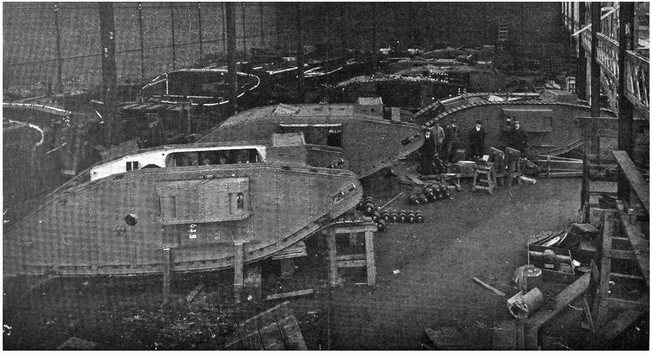
Joint Committee in consultation that the Mark I. Tank,
“Mother,” was ultimately designed.
On September 11, two months after Colonel Swinton’s
visit, the Experiments Committee, G.H.Q., laid
down in an excellent and far-sighted memorandum
what were the qualities which they desired should be
aimed at in designs for the caterpillar cruiser and what
were the tactical purposes which it must serve.
By September 28 the Joint Committee had so far perfected
the design of “Mother” as to have had a wooden
dummy (officially described as a “mock-up”) made,
and on that day her counterfeit was inspected at
Wembley by an Interdepartmental Conference, and approved.
Some weeks elapsed while the Joint Committee
worked out the further details of their machine, and
about December 3 Mr. Churchill wrote a Memorandum
entitled “Variants of the Offensive,” in which he paradoxically
accentuated the value of defensive armour as
a preservative of mobility. There was to be a new
form of attack. It was to be launched at night under
the guidance of searchlights. Caterpillar Tractors
were to breach the enemy’s line, and then turn right
and left. The Infantry were to follow them closely
under cover of bullet-proof shields.
On Christmas Day Sir Douglas Haig (who had lately
taken over from Sir John French, and who as yet
“knew not Joseph”) read the paper with interest, and
pinned a pencil slip upon it, “Is anything known about
the Caterpillar referred to in para. 4, page 3?”
No time was lost in finding out, and a few days later
G.H.Q. sent an officer to England to inquire into the
matter. This officer was Lieutenant-Colonel Hugh
Elles, who was afterwards to be the first Tank General.
By the end of January 1916 the experimental machine—no
pasteboard simulation, but “Mother” herself—was
complete, and on February 2 the official trial was
held at Hatfield, before the Army Council and a representative
of G.H.Q.
“Mother” made good, and G.H.Q. asked to be supplied
with a certain number of the Land Cruisers. A
small Executive Tank Supply Committee with much
fuller powers than the old Joint Committee, was formed
under the Presidency of Lieutenant (now Colonel Sir
Albert) Stern, and orders were at once given to begin
manufacture.
So ended Act I.
The first scene of Act II. (March to mid-August)
was occupied with one of the most dramatic achievements
of the War.
This was the manufacture at Lincoln of the first 150
“Land Ships” ordered by the Government, in the space
of six months, and in absolute secrecy.
The public discussed the phantom Russians who travelled
through England by night. It discussed the Germans
who nightly signalled to each other throughout
the inland counties. But it did not discuss the large
water-tanks or cisterns that were being made for Petrograd,
Egypt, or Mesopotamia, or some such place.
That this vital secrecy was kept for months by hundreds
of people was chiefly due to the happy effect of
copious and imaginative lying.
There was no mystery about these grotesque armour-plated
creatures! They were not really for Mesopotamia
at all. Every one knew that.
The Russian Government had ordered them. They
were ridiculous things? Of course they were. It was
a Russian design. Was there not even an inscription
in Russian characters on them? At least they might
frighten the Germans if they served no other useful
purpose.
Tradition relates that when the first drawings were
brought to the manager’s office of the factory which had
been selected for the manufacture of the “water-carriers,”
the manager and his staff expressed themselves
as being seriously concerned for the sanity of
the designers, and of those who submitted such drawings
to practical men like themselves.
They were, however, let into the secret of the real
part which Tanks were to play, and though still profoundly
incredulous, decided, like good citizens, to carry
out whatever work was asked of them. The vital necessity
of secrecy having been impressed upon them, they
were asked—tradition continues—what arrangements
they would like made about sentries and the isolation
of their workpeople. After a little consideration they
answered that they would only guarantee that the
secret should be kept on condition that they were given
a completely free hand and not interfered with.
They proposed to have no sentries, no “isolated
area” to proclaim trumpet-tongued, “Here is a
secret!”
They desired merely to propound a satisfactory system
of lies, to give an “alternative explanation”—to
put it more delicately—and to carry out their work
with a disarming publicity.
After some hesitation the authorities consented to
this strange system. We shall see how, on September
15, “wisdom was justified of her children.”
The factory where these curious interviews are reported
to have taken place was that of Messrs. Forsters,
Agricultural Implement Manufacturers of Lincoln.
We almost literally beat our ploughshares into swords.
In London, changes in Tank administration were
going on as usual. The trend as far as supply and
manufacture were concerned was towards centralisation.
A Tank Supply Department was created at the Ministry
of Munitions, and the Tank Supply Committee
changed its name to “Advisory Committee of the Tank
Supply Department.” In August this Committee—gradually,
as it were—turned into the Mechanical Warfare
Supply Department before alluded to. Lieutenant
(by now Colonel Stern was at its head.)
In the M.W.S.D. were now concentrated three separate
functions:
They were Tank designers; they were responsible for
supply; they were responsible for the final inspection
of machines. The future was to show that such concentration
had some drawbacks as well as many obvious
advantages.
Note.—The genesis of the “large-wheeled tractor”
was as follows: Trenches with a parados and parapet
about 4 ft. high were being constructed by the enemy
in Flanders.
The engineers consulted by the Land Ship Committee
gave it as their considered opinion that if these obstacles
were to be crossed, a wheel of not less than 15 ft.
diameter would be necessary.
Machines with these gigantic wheels were actually
ordered, but the wooden model that was knocked together
as a preliminary at once convinced even its best
friends that the design was fantastic, and that any
machine of the kind would be little better than useless
on account of its conspicuousness and vulnerability.
However, the “big wheel” idea did not utterly die,
for in the upturned snout of the Mark I. Tank we have,
as it were, its “toe” preserved, the track turning
sharply back at about axle level, instead of mounting
uselessly skyward, as would have been the case had not
the old wheel idea been supplanted by that of the sliding
track.
CHAPTER III — Part I — I — II — Part II — I — II
THE TANK CORPS IN EMBRYO
Not till Act III. do we get the opening of the main
plot of our drama. For it was only at the end of
March, 1916 that recruiting for the new arm began,
and therefore that “The Fighting Side” first appeared.
5“At the end of March certain officer cadets with
engineering experience and drawn from the 18th, 19th,
and 21st Royal Fusiliers, were asked to volunteer their
services for what they were given to understand was an
experimental armoured car unit. (The Armoured Car
Section of the Motor Machine Gun Corps.)
“Those who decided to throw in their lot with the
new Service were interviewed by Colonel Swinton and
Colonel Bradley, who, in the course of their examination,
threw out no hints as to further details relative
to the new unit. Results of these interviews were communicated
on the Thursday before Easter Friday, when
successful volunteers were informed that they were to
be granted temporary commissions in the M.M.G.C.,
and were despatched the same morning to report to the
M.M.G.C. Headquarters at Bisley. Upon arrival further
information was received from the Adjutant that
short leave would be granted for the purpose of obtaining
kit, and that all officers would report their return
with kit, on the following Tuesday evening.
“During the week that followed Easter the two first
selected Companies, i.e., ‘K’ and ‘L,’ were formed,
officers being posted to one or other of the Companies.”
Specially selected officers and men of the original
M.M.G.C. formed the nucleus of these Companies, and
the Companies were formed into a Battalion as further
reinforcements arrived. On the Monday after Easter
Bank Holiday training began, instructions being given
in the use of the Vickers and Hotchkiss .303 Machine
Guns and later in the Hotchkiss 6-pounder Naval
gun.
An officer who arrived in about the second batch tells
how he and another man from the same regiment were
sent down to Bisley after the usual brief but formidable
interview with Colonel Swinton. They arrived at
Brookwood Station only to be told that the ever mysterious
Motor Machine Gun Corps had left two days
before for Siberia.
Tableau!
“Siberia” proved, however, to be a camp not so far
from Bisley as to be beyond the radius of the station
cab in which they both presently set off.
No Tanks were, of course, yet available for training,
and therefore instruction was concentrated upon the
use of the three guns, “each officer, N.C.O. and man
being required to pass out at the examination.”
6“With the above exception, physical drill and an
occasional route march, no further training of military
character was imposed; thus in the early summer of
1916 practically all the personnel of the new branch
of the service were efficient in the manipulation of the
three guns in question. During the whole of the foregoing
period no further information other than widely
different rumours could be obtained by the junior personnel
of the Unit as to the purposes for which they,
or the experimental armoured car, would be used.”
About June it became increasingly evident that if the
Land Cruisers were to be fought that year, production
must be accelerated.
“A very limited number of officers, N.C.O.’s and men,
totalling about one dozen, were despatched to Lincoln
and other centres, where they were employed in connection
with what they later understood to be Tank production.”
Meanwhile, a very carefully chosen and elaborately
prepared training area had been organised on Lord
Iveagh’s estate near Thetford, and as soon as information
came that the first machines would soon be available
for training, the Battalion was again moved.
This time the still mystified companies found themselves
in a camp more ringed about than was the palace
of the Sleeping Beauty, and more zealously guarded
than the Paradise of a Shah. Three rows of plantations
and shelter belts guarded them from the eyes of
the profane, and the intruder or the breaker of camp
must pass six lines of sentries assisted by cavalry
patrols.
A highroad which ran through the training ground
was closed, and all inhabited farms within the area
were evacuated. No civilians were allowed under any
pretext to pass the guard, nor were troops allowed to
leave the area except on production of special passes
which were very difficult to get.
Once an aeroplane from a neighbouring aerodrome
flew over, moved by a friendly spirit of inquiry. It was
immediately greeted with a hail of machine-gun bullets
and was obliged to depart in some haste.
For now the Tanks had to appear in their true character
as fighting machines, and needed a better screen
than Russian Fairy Tales. The machines had been long
expected. Almost daily some one in the camp had
“heard” an unfamiliar engine throb, and when this
happened the entire camp would rush out to see if
“they” had come.
The wildest rumours were afoot.
The car could climb trees! It could swim! It could
jump like a flea!
Any one who has lived in an ordinary camp where
there were no secrets and remembers what rumours
flourished on the most ethereal food, can imagine their
growth in a camp where there was a real mystery.
But at last, towards the beginning of June, a limited
number of Mark I. machines were detrained at a special
railhead within the area.7 The training of the Battalion
now began in earnest. Machines and men were
destined to be launched in little over six weeks’ time
into the then newly begun Somme offensive.
Two types of Tank were detrained, “Big Willie” and
“Little Willie.” The Mark I. (Big Willie) was very
different from the Mark V. machine described in
Chapter I.
It took four men to drive it. It had an unwieldly
two-wheeled tail, or to give this appendage its official
name, a “Hydraulic Stabiliser.” By this device it
could let itself down gently over a drop of over 5 ft.,
and partly with the aid of it, the machine was steered.
In practice, compared with the handy Mark V., the
whole steering arrangement of the Mark I. was extraordinarily
clumsy and laborious. She would not turn
sharply at all on rough ground, and had to be coaxed
to any change of direction. Her engine and tracks also
needed constant adjustment, the rollers being an everlasting
source of trouble. Drivers and mechanics who
have handled both machines, seem to regard the running
of a Mark V. as child’s-play after struggling with
the caprices of “Mother.”
“Little Willie” was used only as a training Tank,
as in practice he was found to have a defective balance.
His centre of gravity was misplaced, and he was, besides,
too short for the work of crossing trenches.
But there were other than technical problems awaiting
solution.
It would be difficult to over-estimate the difficulties
which confronted those officers who were responsible for
the preliminary training of the Heavy Section of the
Machine Gun Corps; no one had ever actually fought
inside a Tank, and it was, therefore, upon the spirit of
prophecy alone that they must rely in their preparations.
There was no manual to help them. They had,
however, one very excellent official document, the secret
Notes on the Employment of Tanks, which was issued
in February 1916 (signed “E. D. S.”8), which gave
an extraordinarily good forecast of what the rôle of
Tanks would probably be when in action.
But the paper was very short and very objective, and
was more concerned with an analysis of the place of
the Tanks in the orchestra of battle than with the difficulties
presented by their individual score.
This was where the training of the first Tank crew
fell short—almost inevitably. Their teachers had a
rather hazy mental picture of the actuality of battle.
They did not squarely face the essential question upon
whose answer all specific training and all specific
preparation depend, the question, that is, “What is it
going to be like?”
Thus, though they did teach most of the essentials,
they left out half a dozen subjects of which an accurate
knowledge was, as we shall see, ever afterwards held
to be absolutely necessary.
One of their difficulties was the shortness of the
time. What must the crews know? Would physical fitness
or map reading prove more important when the
day came? Signalling or esprit de corps? Visual
training or revolver drill? There was no time for
everything. There were, however, obviously three or
four essentials. Most of the officers and men were already
first-rate engineers or mechanics, but they must
be trained exactly in the strange machine they were to
use. They must understand the peculiarities of Tanks,
and, if possible, of their individual Tank, the monster
which they had to render animate.
They must be thoroughly at home with their Vickers
guns, be accurate shots with them, be able to remedy
all stoppages, and to strip their weapons with speed and
accuracy. Above all, crews must train together, be accustomed
to work under their officer, each with his special
work as brakeman, gearsman, driver or gunner, but
each still part of an organic whole. They must also
attain to a certain physical level, must undergo some
visual training, and must know how to fire a revolver.
All this and more was achieved, for the men were
picked individuals of more than ordinary intelligence,
and soon became extraordinarily keen on their work.
9“If anything went wrong with the Tank, they used
to look upon it not as a bore but as a pleasure to put it
right.... We felt a terrific pride in our Company
and Section, and also as a Tank crew against other
crews. There was always healthy competition, and this
competition carried us right out to France....
Besides that, Tank Commanders had the very great
advantage of training their crews themselves....
We knew our men thoroughly.”
But, as another Tank Commander wrote afterwards:
“The first Company to go out had to work at tremendous
speed. The Tanks did not arrive till the last
minute, and I and my crew did not have a Tank of our
own the whole time we were in England ... as our
Tank went wrong the day it arrived.... Again we
had no reconnaissance or map reading ... no practices
or lectures on the compass.... We had no signalling
... and no practice in considering orders.
This was a thing I very much missed when I got out
to France. When you work with a Division you get
very long orders, and you have to analyse these orders
to discover what concerns you and what does not....
We had no knowledge of where to look for information
that would be necessary for us as Tank Commanders,
nor did we know what information we should
be likely to require.”
No one, in short, had sat down to imagine a Tank
in action from within.
We had official painters in France, but alas! we had
no official writers of prophetic fiction.
The history of the attack on Morval shows that this
probably inevitable lack of, say, an official clairvoyant,
this dependence upon methods of trial and error, though
it ultimately did little to hurt the development of
Tanks, did very much to prevent the Tank personnel
from feeling satisfied by their début.
It must have been with some sense of having taken a
momentous step that the authorities sanctioned the
manufacture of 150 Tanks after witnessing the trials at
Hatfield.
We were short of men and short of steel, and to divert
steel from shells and men from the infantry was a grave
decision. Our rulers were for a moment, perhaps,
granted the gift of prevision. They saw that the new
weapon might prove the sword that was ultimately to
tip the level balance, and to break the intolerable equilibrium
which had settled on the line from the Alps to
the sea.
This prophetic mood did fitfully visit the authorities.
For a few months they would, as it were, have faith,
and personnel would be granted and machines would be
ordered.
Then perhaps for half a precious year they would
relapse and backslide and revert, till Colonel Swinton,
the Fighting Side, and all the other missionaries and
preachers of the Tank Corps almost despaired.
But in February 1916 there was much to uphold
them. The situation demanded some desperate remedy.
The balance hung deadly level. We could hold the
Germans now, but for how long? The race for the coast
had been a draw, and the First Battle of Ypres had
ended open warfare on the Western Front.
10“Quick-firing field guns and the machine-guns used
defensively, proved too strong for the endurance of the
attackers, who were forced to seek safety by means of
their spades rather than through their rifles. Whole
fronts were entrenched, and, except for a few small
breaks, a man could have walked by trench, had he
wished to, from Nieuport almost into Switzerland.”
The Germans were dug in.
11“And with the trench came wire entanglements—the
horror of the attack—and the trinity of trench,
machine-gun, and wire made the defence so strong that
each offensive operation was brought to a standstill.
“The problem which then confronted us was a two-fold
one:
“Firstly, how could the soldier in the attack be protected
against shrapnel, shell-splinters and bullets?
Helmets were reintroduced, armour was tried, shields
were invented, but all to no great purpose.
“Secondly, even if bullet-proof armour could be
invented, which it certainly could, how were men laden
down with it going to get through the wire entanglements
which protected every position?”
It was, in fact, impossible for infantry alone to attack
such positions without the most extensive artillery
preparation. The enemy and his trenches and his wire
must be blown out of the ground. This was the accepted
answer to the problem of the deadlock. But as yet we
had not got the shells. We were straining every nerve
to reach the solution by bombardment, but in February
1916 we had not got the necessary ammunition. Was
there no other answer to the problem? Nothing that
could be done meanwhile?
This was the mood in which the missionaries of the
“mobile machine-gun destroyer” found the High Command.
Had we had shells in February 1916 we should
not have had the Tank. We must have waited another
year for it, till, in fact, we had found out the defects
of the hoped-for solution by bombardment.
The German, who was full fed with ammunition, felt
at this early date no urging to go out and seek any such
fantastic remedy. His High Command would have
laughed at the idea of Tanks as Dives may have laughed
at hungry Lazarus’ antics over broken victuals.
So, while our shells were making, we built Tanks.
And Fate, whose taste in humour is not ours, and who
knew what we did not, namely, that the Tank and prolonged
artillery preparation are alternative weapons,
decreed that both shells and Tanks should be ready for
the Somme offensive.
It was thus upon a “substructure” of the new artillery
preparation that we gaily imposed the Tank. We
were to take fourteen months in working out the proposition
that they could never be effectively used together.
The Tanks had been designed for the sort of conditions
which had prevailed at Loos. Their training
grounds had been carefully modelled on the “Loos”
pattern. By the time Tanks could be put into the field,
a year later, our artillery superiority had completely
changed the nature of the fighting.
At Beaumont-Hamel in November 1916, for example,
we fired off as much ammunition as was expended
in three weeks at the Battle of Loos.
On the Somme—owing to our having advanced—four
miles of churned-up, shell-pitted ground had to be
crossed before the front line could be reached. It had
also—to state the case after the manner of the author of
Erewhon—become the fashion, just before the day of
battle, for the attacking side to blast the ground which
they were about to cross to the condition of plum pudding
on stir-up Sunday. This blasting process, moreover,
necessarily gave the enemy several days’ warning
of any proposed attack.
It had also incidentally had another effect upon the
industrious German. When we were bombarded our
chief idea was retaliation; when the German was shelled
he dug.
So it had come about that on the Somme, everywhere
behind the German lines, were great electrically-lit and
comfortably warmed dug-outs, where a company or so
could lie secure thirty or forty feet below ground and
there wait for the bombardment to “blow over.” Then
they would emerge ready to welcome our infantry.
Thus the system of the, say, six days’ artillery preparation,
though it did very much to raise our moral and
depress that of the enemy in time resulted in an almost
complete system of enemy counter-measures, and in a
state of the battle-ground which caused attackers and
attacked to be almost immobile. The system, necessary
as had been our adoption of it, had not solved the problem
of the deadlock.
The Tank, as we have said, had been intended for use
on reasonably sound ground. It was also to be a surprise
weapon. Not once for the next fourteen months
did we omit to give the enemy at least five days’ notice
of our proposed attacks, nor did we decline to co-operate
with his artillery in reducing the intended battle-ground
to a morass. It was, therefore, not till the First Battle
of Cambrai, when we did adopt other tactics, that Tanks
came by their own.
CHAPTER IV — I — II — III — IV
THE FIRST TANK BATTLES—THE ATTACK ON MORVAL,
FLERS, THE QUADRILATERAL, THIEPVAL AND
BEAUMONT-HAMEL
It was not till the Somme offensive, which was
launched on July 1, 1916, had been in progress for two
months and a half, that it was found possible for the
new arm to take its place in the fighting. We have
seen how, secretly, urgently, behind a rich curtain of
ingenious and circumstantial lies, the manufacture of
the Tanks had been going on. How, secretly, urgently,
the crews had been training for their unknown job.
Of the fifty Tanks which were destined to take part
in the battle of September 15, about thirteen left England
on August 15, and the rest followed at intervals
and in driblets as the limited transport allowed. The
last batch arrived on August 30 and, like its fellows,
proceeded to the training centre at Yvrench. Here
trenches had been dug and wire entanglements erected,
and machine-gun and 6-pounder practice could be carried
out after a fashion. But there was no staff of instructors,
the ranges were too short, and the conditions
for battle practice quite unlike those which prevailed
on the Somme. But it had to suffice. The Tanks were
wanted at once, and by September 10 “C” and “D”
Companies had arrived in the forward area, their H.Q.
being established at the Loop. It was thus within a
week of their arrival forward that Tanks were called
upon to take part in the attack.
The battle had now been in progress for nearly ten
weeks. We had advanced and occupied a depth of four
miles of devastated country.
Most of the men and many of the officers had not
been to France before. They found themselves in a
strange world. Endless lines of transport crawled over
incredibly bad roads bordered by gaunt stumps of trees
and by a sordid and tragic litter of dead men and horses,
rags, tin cans, rotting equipment, and derelict transport.
The enemy was counter-attacking over the whole of
the thirty-mile front, and the sound of our guns was
everywhere. At night the stream of lorries never ceased,
and at some point or other in our line, far away, a star
shell could always be seen sailing up from behind a rise
of ground, giving some fringe of shattered wood, or
ruined sugar factory, a fleeting silhouette against its
cold white light.
All ranks were desperately busy, from the mechanics
who had new spare engine parts to adjust, to those in
command who had their own minds and those of several
Major-Generals to make up. Colonel Brough had commanded
when the Tanks disembarked, but had now
handed over to Colonel Bradley, and he and the Army
Corps, and Divisional Commanders with whom he conferred
on the 13th seem, perhaps inevitably, to have
been as uncertain how to wield the new weapon as were
the Tank Commanders of such details as how to fit
their new camouflage covers or anti-bombing nets.
In an advance when ought a Tank to start? If it
started too soon it would draw the enemy barrage; if
it started too late the infantry would reach the first
objective before it, and it would be of no use.
This and other similar dilemmas darkened their counsels,
and it was finally decided that the Tanks’ start
should be so timed that they reached the first objective
five minutes before the infantry, and, further that Tanks
should be used in twos and threes against strong points.
No special or detailed reconnaissance work had been
done, and a somewhat indigestible mass of aerial photographs
was presented by the Divisional Staff to the bewildered
Tank Commanders, many of whom had never
seen such things before.12
Much more useful were a series of maps with routes
marked out and annotated with the necessary compass
bearings, and a detailed time-table with full barrage
and other particulars. At least they would have been
more useful had not all orders been changed in such a
way at the last moment as to invalidate almost every
route and hour which they showed.
Meanwhile the Tank crews and commanders had been
enjoying three or four days of almost comically complete
nightmare. In the first place, they had all manner
of mechanical preoccupations—newly arrived spare engine
parts to test, new guns to adjust, box respirators
to struggle with, and an astounding amount of “battle
luggage” to stow away. But worst of all, they found
themselves regarded as the star variety-turn of the
Western Front.
Already, before leaving Thetford, they had given a
demonstration before the King and several members of
the Cabinet. At Yvrench they had performed before
General Joffre, Sir Douglas Haig, and the greater part
of the G.H.Q. Staffs,13 but on reaching the Loop they
found to their horror that it was to be “Roses, roses,
all the way.” A Tank Commander wrote bitterly:
“It rather reminded me of Hampstead Heath. When
we got there we found that the Infantry Brigades had
been notified that the Tanks were to perform daily from
9 to 10 and from 2 to 3, and every officer within a large
radius and an enormous number of the Staff came to
inspect us. We were an object of interest to every one.
This did not help on one’s work.”
On the 13th they were to move the Loop to the point
of assembly, and the problems of “housekeeping” became
acute.
14“The officer and each man carried two gas helmets
and one pair of goggles, and in addition to their ordinary
service caps, a leather ‘anti-bruise’ helmet; we
also had a large field dressing as well as an ordinary
first-aid dressing. The usual equipment consisted of
revolver, haversack, water-bottles and iron rations.
There are eight people in a Tank, and as soon as they
get in they naturally take off all these things, which lie
about on the floor, unless you devise some method of
packing all your equipment.... We carried, in addition
to iron rations, sixteen loaves and about thirty
tins of food, cheese, tea, sugar and milk. These took
up a lot of room. We also had one spare drum of
engine oil and one of gear oil, two small drums of grease,
three water-cans and two boxes of revolver ammunition
... four spare Vickers barrels, one spare Vickers
gun, a spare barrel for the Hotchkiss and two wire-cutters.
We also had three flags for signalling purposes,
which unfortunately proved to have been lost when they
were really wanted.”
But Captain Henriques’ list was, even so, not complete.
Many Tanks also carried two carrier pigeons,
33,000 rounds of S.A. ammunition for their machine-guns,
a lamp-signalling set, and a telephonic contrivance
consisting of an instrument and one hundred yards of
cable wound upon a drum. The second instrument was
to be left at the “jumping-off place,” and the Tank was
to unwind the cable as it advanced, relating its experiences
the while to the telephone operator or other interested
person in the rear. What was to happen when the
Tank began to traverse the hundred and first yard we
do not know. In practice the device was not used.
But that was not all. The orders, time-tables and
maps upon which the Tank Commanders depended,
proved to have been issued in insufficient quantities.
“For every three Tanks only one set of orders had
been issued, and only one map supplied: consequently
we had to grasp these orders before we passed them on
to the other two officers.”
However, at 5 p.m. on the day before the battle, these
written orders were cancelled and new verbal instructions
substituted. Roughly, the Tanks were to operate
as follows:—
On the right with the 14th Corps, ten Tanks were to
work with the Guards Division, and seven with the 6th
and 56th Divisions, their objectives being Ginchy and
the Quadrilateral.
On the left eight Tanks were allotted to the 3rd Corps,
operating through High Wood and East of Martinpuich.
The 15th Corps had seventeen Tanks attached, and the
Reserve (5th) Army—fighting between Pozières and
Martinpuich—had six tanks.
With all these groups of Tanks the preliminary moving
up into the first-line positions—in the pitch dark,
through the mud and in and out of the shell-holes of
badly crumped ground—proved most arduous, and a
good many Tanks broke down in the process. One Tank
Commander who struck a narrow sunken road remarks:
“It was full of the bodies of dead Boches, and my
driver did not like going along it.”
For the Tanks’ crews the remainder of the night
passed in a final tightening of loose tracks and adjustment
of the engines, and in listening to the steadily increasing
crash and roar of the British bombardment.
The strain on men and officers had been tremendous.
Most of them seem to have started the battle having had
no sleep for over twenty-four hours.
They were desperately anxious, too, that Tanks should
prove their worth, and the Mark I. machine was too
capricious to give them much assurance.
To this list of discomforts must be added that most
of the men had never heard guns before, and that the
lying-up places were close to our batteries.
The morning of the 15th was fine with a thin ground
mist, and at six o’clock the thunder of the British artillery
rose to a final hurricane. The barrage crept forward,
and our Tanks and infantry crossed the parapets.
The Germans seemed to have heard no breath of the
nature of the new arm which was to be used against
them, and the light haze added greatly to the looming
mystery of the approaching Tanks.
Official documents that were later on captured from
the enemy revealed something of the deep psychological
effect that our Tanks had had on the German infantry.
These significant admissions might have done more to
convince our own High Command of the great potentialities
of the new weapon than they actually did.
One of the best known individual Tank exploits was
that of the machine belonging to “C” Company, which
helped a New Zealand and an English division in their
assault upon Flers.
This was the furthest penetration achieved by any
Tank that day.
This machine led its infantry, and these had their
first taste of entering a village which they knew bristled
with enemy machine-guns without suffering a single
casualty.
The adventure had all the exhilaration of surprise,
and the men, who had nerved themselves for the usual
ordeal of house-to-house fighting, laughed at the astonishing
anticlimax presented by their own and the Tanks’
stately progress down an almost empty street.
“All dressed up and no one to fight.”
It was on this occasion that the airmen’s now famous
message was sent back, a message whose repetition
rather galled the Tank Corps in the days of ill-rewarded
effort that still lay between it and its final triumphs:
“A Tank is walking up the High Street of Flers with
the British Army cheering behind.”
Of two other Tanks which did particularly well, the
first, a male, entered Gueudecourt, where it attacked a
German Battery and destroyed a field gun; the other
gave great assistance to attacking infantry which was
held up by wire and machine-guns. The Tank Commander
placed his machine astride the trench and enfiladed
it; the Tank then travelled along behind the
trench and 300 Germans surrendered and were taken
prisoners.
The following is a short summary of the returns of
Tanks engaged.
The casualties among Tank personnel were insignificant,
though one officer of great promise was lost:
49
Tanks were employed.
32
reached their starting-points.
9
pushed ahead of the infantry and caused considerable loss to the enemy.
9
others did not catch up the infantry but did good work in “clearing up.”
5
became ditched.
9
broke down from mechanical trouble.
Of these last fourteen, some served as useful rallying-points
for the infantry after they had become immobile,
and several could have been extricated in time to render
some service if they had not been knocked out by indirect
hits.
Crews who had been obliged to abandon their Tanks
either got out their machine-guns and continued fighting
or helped the wounded.
The battle had been essentially experimental. What
opinion had been formed of the Tanks?
We now know what was the opinion of the German
infantry. The German High Command seems in public
to have ignored the new arm.
In a secret “Instruction” the Chief of the Staff of
the 3rd Army Group, however, reminds units that they
must “hold ground at whatever cost” and “defend
every inch of ground to the last man.”
“The enemy in the latest fighting have employed new
engines of war as cruel as effective.”
THE ORIGINAL THIEPVAL MARK I. TANK WITH ANTI-BOMB ROOF AND “TAIL”
FIELD CAMOUFLAGE
Every possible counter-measure is to be used against
these “monstrous engines,” which will probably be
adopted on an extensive scale by the British.
To our own infantry the Tank appeared as a lusty
friend, who had at last found a convenient way of dealing
with the hitherto deadly partnership of wire and
machine-gun—a friend, too, who had a grotesqueness of
gait and appearance which was intrinsically endearing.
A wounded London Territorial said:
“‘Old Mother Hubbard’ they called her and lots of
other funny names as well. She looked like a pantomime
animal or a walking ship with iron sides moving
along, very slow, apparently all on her own, and with
none of her crew visible. There she was, groanin’ and
gruntin’ along, pokin’ her nose here and there, stopping
now and then as if she was not sure of the road, and
then going on—very slow, but over everything.
“It was her slowness that scared us as much as anything,
and the way she shook her wicked old head and
stopped to cough. It was a circus—my word! I only
saw her for about ten minutes. She came humping out
of the fog at one end of the line and humped into it
again at the other. The last I saw of her was when she
was nosing down a shell crater like a great big hippopotamus
with a crowd of Tommies cheering behind.”
To the British High Command the Tanks appeared
as engines of war which showed considerable promise.
They must overcome certain mechanical weaknesses, and
tactics must be further modified to suit their peculiarities.
The G.H.Q. attitude was, in short, that of men
satisfied, though not enthusiastic, and was well expressed
by Sir Douglas Haig in his Somme Despatch:
“Our new heavily armoured cars, known as ‘Tanks,’
now brought into action for the first time, successfully
co-operated with the infantry, and coming as a surprise
to the enemy rank and file, gave valuable help in breaking
down their resistance.”
The despatch goes on to mention the taking of Flers.
The delight of the British and French Press knew no
bounds. The correspondents threw up their hats and
set to ransack their dictionaries for octosyllables in
which to describe the new “All British” destroyer of
Germans.
It was “Diplodocus Galumphant,” it was a “Polychromatic
Toad.” It was a “flat-footed monster” which
“performed the most astonishing feats of agility as it
advanced, spouting flames from every side.”
“It ‘leant’ against a wall until it fell and then
crawled over the fallen débris.
“It went irresistibly through High Wood, the trees
smashing like matchwood before it.
“It went up to machine-gun emplacements, ‘crushed
the gun under its ribs,’ and passed on, spitting death
at the demoralised Germans.
“It ‘stamped’ down a dug-out as though it were a
wasps’ nest.
“It crashed through broken barns and houses,
‘straddled’ a dug-out and fired enfilading shot down
German trenches.
“It put a battery and a half of guns out of action at
Flers.”
Reuter added a cow-catcher to its equipment.
The French Press was enthusiastic:
“At the precise moment when the bombardment
stopped, the Germans had the surprise of seeing advance
in front of the waves of assaulting troops, enormous
steel monsters from which spurted a continuous fire of
great violence. One would have described them as gigantic
infernal machines. Their front, which was
shaped like a ram, smashed down every obstacle. The
heavy automobiles bounded across the overturned and
uneven ground, breaking through the barbed wire and
jumping the trenches. In the German ranks there was
a really mad terror. A prey to panic, the soldiers of
the German Emperor fell back in haste, abandoning
their arms, ammunition and equipment.”
And how did the Tank personnel itself view the events
of the day?
Half choked with the engine fumes, boxed up for
many hours without respite in the intolerable clamour
and shaking of their machines, or, worse, having
wrestled for hours under heavy shelling with a broken-down
Tank, they were inclined to see the exasperations
of the battle rather than its successes. It is indeed curious
to note the difference in tone between the accounts
of those who saw the Tanks dispassionately from without
and those who had weltered within, between those
who saw what the Tanks did and those whose view of
achievement was obscured by a knowledge of what
might have been.
The Tank Corps was too keen to be in the least satisfied
by the measure of success which it had achieved.
Only the Press and the Germans perceived that a
new “Excalibur” had been forged in England. “Out
of the mouths....”
After the battle, such of the Tanks as could go under
their own power rallied, and steps were at once taken
to salve as many as possible of those which had become
incapacitated.
From this point, till all available Tanks had been
used up and till the ground became finally impossible
in mid-November, Tanks were to be constantly employed
in insignificant numbers in a series of small experimental
actions.
This method of fighting by twos and threes against
special strong points was afterwards discarded, as it
proved unsatisfactory. Several of these small actions
were nevertheless very successful, and showed in miniature
some special purpose which Tanks could serve, or
illustrated the importance of some special Tank organisation.
For example, Thiepval showed how Tanks could be
used without artillery preparation, and Beaumont-Hamel
showed the importance of a good Reconnaissance
Branch. These small actions were therefore important,
not in themselves, but because they were microcosms.
In one or two unsuccessful actions it was rather the
state of the ground which spoiled the battle than
mistaken tactics.
For as the campaign drew on conditions became worse
and worse. By the beginning of October the Army in
general, and particularly the Tanks, had a foretaste of
the miseries of Flanders. The general conditions of
this part of the campaign are admirably described by
Colonel Buchan in his History of the War:
“October was one long succession of tempestuous
gales and drenching rains.
“To understand the difficulties which untoward
weather imposed on the Allied advance, it is necessary
to grasp the nature of the fifty square miles of tortured
ground which three months’ fighting had given them,
and over which lay the communications between their
fighting line and the rear.... Not the biggest mining
camp or the vastest engineering undertaking had
ever produced one tithe of the activity which existed
behind each section of the battle line. There were
places like Crewe, places like the outskirts of Birmingham,
places like Aldershot or Salisbury Plain....
“There were now two No Man’s Lands. One was
between the front lines; the other lay between the old
enemy front and the front we had won. The second
was the bigger problem, for across it must be brought
the supplies of a great army....
“The problem was hard enough in fine weather; but
let the rain come and soak the churned-up soil, and
the whole land became a morass. There was no pavé,
as in Flanders, to make a firm causeway. Every road
became a water-course, and in the hollows the mud was
as deep as a man’s thighs....
“The expected fine weather of October did not come.
On the contrary, the month provided a record in wet,
spells of drenching rain being varied by dull, misty
days, so that the sodden land had no chance of drying.
The carrying of the lower spurs—meant as a preliminary
step to a general attack—proved an operation so
full of difficulties that it occupied all our efforts during
the month, and with it all was not completed. The
story of these weeks is one of minor operations, local
actions with strictly limited objectives undertaken by
only a few battalions. In the face of every conceivable
difficulty we moved gradually up the intervening
slopes.”
Such was the setting of this batch of experimental
actions. The first of them took place on September 25,
when two small parties of Tanks were employed in two
distinct actions; the first with the 3rd Corps, and the
second on September 25 and 26 with the 15th Corps near
Gueudecourt.
The first was a failure. Only two Tanks had been
allotted; one was ditched on the way to the starting-point,
and the other machine was caught in the enemy
barrage and knocked out.
Very different is the story of the Tanks operating
with the 15th Corps at Gird Trench near Gueudecourt,
when with the help of a low-flying aeroplane 1500 yards
of trench and 370 prisoners were taken by one Tank
at a cost to us of five casualties.
The story is told in the Somme Despatch:
“In the early morning a Tank started down the portion
of the trench held by the enemy from the north-west,
firing its machine-guns and followed by bombers.
The enemy could not escape, as we held the trench at its
southern end. At the same time an aeroplane flew
down the length of the trench, also firing a machine-gun
at the enemy holding it. These then waved white
handkerchiefs in token of surrender, and when this was
reported by the aeroplane the infantry accepted the surrender
of the garrison. By 8.30 a.m. the whole trench
had been cleared, great numbers of the enemy had
been killed, and eight officers and 362 other ranks
made prisoners. Our total casualties amounted to
five.”
At noon on September 26 an attack was launched by
General Gough’s reserve army on Thiepval. Eight
Tanks co-operated.
It was the second attack that we had made on Thiepval,
of which the Germans had made a most formidable
fortress. The ground had been blasted into the familiar
alternation of crumbling mounds and water-logged
holes, and the shattered houses and splintered trees—particularly
a certain row of apple trees—stood up
forlornly amid the general desolation.
From the point of view of the Tanks, however, the
action was important, because here for the first time
Tanks were employed in a surprise attack.
No artillery preparation was used, and
“our men were over the German parapets and into the
dug-outs before machine-guns could be got up to repel
them.”
A large number of prisoners were taken, and in the
Somme Despatch the attack was noted as “highly successful,”
and the Tanks as having given “valuable assistance.”
By the middle of October 1916 when Tanks were next
in action, the ground was hopelessly sodden, and the
story of the month which ensued might, with an alteration
of place names, be taken for a narrative of the
campaign in Flanders. Than this there is no greater
condemnation.
It would be tedious to particularise the five or six
minor actions in which Tanks played, or more often endeavoured
to play, a part between October 17 and November
18. Excepting in the interesting little action
which took place at Beaumont-Hamel, to which we have
alluded before, no further light was to be thrown upon
the uses and capabilities of the new arm.
The following account of the Beaumont-Hamel fighting
was given to the authors by a Tank Officer who was
present:
“At the end of September it became clear that the
Somme battle was fizzling out. The ratio of ‘cost’ to
‘results’ became more and more unsatisfactory; every
advance, too, made the devastated and almost roadless
area an ever greater problem.
“It was decided that an attack, if possible a surprise
attack, should be launched on the flank of the Somme
battle. The position selected was roughly from about
Serre to the high ground some half a mile south of the
river Ancre. This sector had, of course, been attacked
at the beginning of the Somme battle in July, but the
attack had been a complete failure, and this front had
relapsed into comparative quiet.
“Tanks were collected and again entrained, the new
detraining station being Acheux. This was the first of
the many flank moves carried out with Tanks in order
that a fresh front might be engaged.
“On arrival at Acheux, however, at the beginning of
October, very bad weather set in and the preparations
for the attack were delayed. Day after day the rain
continued, and the ground in the battle zone became
steadily worse and worse. It was a trying time for the
officers and men of ‘C’ and ‘D’ Companies, as they
were not in very good accommodation just outside
Acheux, expecting daily to move up to battle. It was
not until the beginning of November, however, that a
move was made by night via Beausart to Auchonvillers
and La Signy Farm. The Tanks having reached these
lying-up places, the rain came down even faster than
before, and a study of aeroplane photographs of the proposed
battle sector showed that all the old shell-holes
and many of the old trenches had filled up with water,
and that the greater part of the front was in a hopeless
condition for that type of Tank (i.e., Mark I.).
“Just before the day of the Battle, November 13, it
was decided to send back nearly all the Tanks from
La Signy Farm, and some of those from Auchonvillers,
only a few being held in readiness in case the infantry
advance should give scope for their use further ahead on
better ground.
“Three Tanks of ‘A’ Company were due to attack
with the main assault on November 13; and one of
them succeeded in penetrating into the enemy’s position
and advancing for some distance along the enemy’s
support line and nearly reaching the Ancre before it
became ‘ditched.’
“Further north the attack had met with considerable
success, except that the village of Beaumont-Hamel
had held out for some hours. Tanks had been called
upon to assist, and two of them had advanced along the
road to Beaumont-Hamel; just about the time that they
reached the village the remainder of the German garrison
capitulated. Between Beaumont-Hamel and the
river Ancre a considerable body of Germans were holding
out in the enemy front and support trenches; although
troops of the 63rd Division had reached the outskirts
of Beaucourt well in the rear of this body of
men, they continued to hold out throughout the day.
Tanks were again called upon to deal with this situation.
They reached the position the next morning, being
led up by a trench mortar officer of the Division concerned.
One Tank succeeded in crossing the very large
German front trench, but, unfortunately, became stuck
soon afterwards; the second Tank came to grief just
before it reached the enemy front trench. It appeared
that a deadlock had again been reached, and the crews
of the Tanks were in a precarious position. On examining
the ground about them the Officer Commanding the
leading Tank (which incidentally was leading no longer,
since it was stuck and all too stationary) noticed that
the whole area appeared to be shimmering with white.
On opening the front flap of the Tank and obtaining a
better view, it was seen that all the German garrison,
some 400 in number, appeared to have found something
white to wave in token of surrender; those who could
not produce anything better were waving lumps of
chalk about or bits of board or rifle-stocks which they
had rapidly chalked white. The situation was rather
an embarrassing one for so small a number as the crew
of Two Tanks to deal with; fortunately, however, it was
possible by signs, and with the assistance of the infantry,
to ‘mop up’ these 400 prisoners before they realised
that both the Tanks were stuck and out of action.
“Some of the worst of the ground was now in our
line, and an effort was made to get the Tanks through
this bad zone in order that they might continue to attack
in the neighbourhood of Beaucourt. Efforts were
made to prepare a track for the Tanks by means of a
considerable digging party, but when the Tanks reached
the very broken ground just north of the Ancre, they
became one after another firmly stuck; with enormous
efforts they were dug out, and succeeded in getting a
few yards further, only to stick again. It was heart-breaking
work, which would undoubtedly have been
rendered far easier if the Tanks had then had the unditching
beams which were only introduced some time
later.
“Finally, on the evening of the 17th, only one Tank
had succeeded in getting through this bad zone and
reaching the comparatively good ground beyond. The
crew, to whom great credit is due, had already been
working continuously for some days and night, and were
not only exhausted, but had had no time to carry out
any reconnaissance of the position which was to be attacked
at dawn the next day. There being, however,
only one Tank, made it of greater importance than ever
that it should be made the most of. It was decided that
it should be used against the very strong position known
as the Triangle, which was a redoubt on the high ground,
roughly midway between Beaumont-Hamel and Beaucourt.
The ground about this redoubt was, unfortunately,
also very heavily shelled, and a frontal approach
with the infantry was impossible, and it was necessary
for the Tank to go in on the flank while the infantry
attacked the position frontally. It was realised that the
first necessity was that the Tank should reach this redoubt
as rapidly as possible, and during the night a
route was taped slightly beyond our front line and directing
the Tank straight for the Triangle. The weather
was now much colder, and the frost rendered the
ground less hopelessly outside the capacity of the Tank.
“Just before dawn, however, a fresh difficulty arose,
and tried still further the already severely tried expedition.
It began to snow, and the white tape which was
to guide the Tank was obliterated.”
Captain Hotblack (now Major, D.S.O., M.C.), the
Reconnaissance Officer who had done the taping, was
the only man who had reconnoitred this piece of ground,
and he immediately volunteered to lead the Tank upon
which so much depended.
Taking what little cover he could in shell-holes full
of ice and water, he walked in front of the Tank past
our front line close up to the Triangle. Marvellously
enough, not one among the hail of bullets which greeted
him and the Tank found its mark. Having succeeded in
this arduous enterprise and having guided the machine
to its position, he returned to report on the progress of
the action. The light was now improving, and the Tank
started its “rolling up” movement along the German
trenches.
The machine was now so much in the midst of the
enemy that the German artillery did not dare to open
upon it, and the Tank poured in a devastating fire from
its machine-guns not only upon the men in the trenches,
but also upon some horse transport behind the enemy
lines.
But, meanwhile, the infantry was hung up in another
part of the field, and the Tank was urgently needed.
At that time signal communication to the Tanks was
very imperfect, and there seemed no way of letting the
Tank Commander know of the new development.
Again Major Hotblack came forward and again he
crossed the fire-swept zone undeterred. He reached the
Tank and piloted it back behind our lines, where a renewed
attack was planned.
But before the tired crew could be sent out again, the
wind changed and it began to thaw. The ground over
which the Tank had passed with difficulty when it was
hard became impassable, and the project was abandoned.
It was for this remarkable piece of work that Major
Hotblack was awarded his D.S.O.
The incident naturally had far-reaching results. An
inspiring deed, especially if it be one demanding skill
as well as courage, will influence and “set the tone”
of a new unit or a new branch of an old service. It is
far more effectual than the most convincing arguments
as to the necessity for a high standard of conduct and
of competence. Much of the subsequent efficiency of the
Reconnaissance Branch of the Tank Corps may be traced
to this incident.
Reconnaissance took its proper place, it was recognised
as a fighting service, and its work was seen to be
a necessary preliminary to every action.
Of the total of about ten Tanks engaged in other
small actions which took place at this period, hardly
one machine had satisfactory records to look back upon.
On November 18 ended the Tanks’ first short campaign.
If it did not close in a blaze of glory, at least it
had been sufficiently successful for the authorities to
decided not upon doubling but on quadrupling their
establishment.
CHAPTER V — I — II — III
WINTER TRAINING, EXPANSION AND READJUSTMENTS
Though plans for expansion and the complete reorganisation
of the unit on a large scale had been begun
directly after the results of the action of September 15
were known, little of the actual work of training could
be started till the end of November, when the “veteran”
Tank personnel were at last available as instructors.
They were, as we have said, withdrawn on November
19 and moved to the Bermicourt area, which had been
already prepared for them.
They were the leaven—less than one “old” Company
to each new Battalion—who must impart their knowledge
and experience to the new men.
A subaltern who had seen any fighting with the Tanks
would suddenly find himself regarded as the greatest
living expert on some obscure technical point, and the
newly joined who had never seen a Tank “looked with
awe upon these battle-tried warriors.”
Men and officers were allowed to volunteer for the
Tank Corps from other units either in France or at
home. The notion of fighting in a Tank was popular,
for on many of the men of the old arms—especially the
infantry—the ordinary battle routine had—to put it
conservatively—begun to pall.
Therefore, there was no difficulty as to supplies of
men whenever the authorities turned the tap.
15“We came from the infantry, from the cavalry, from
the artillery, from the Machine Gun Corps, the Motor
Machine Gun Corps, the Flying Corps, the Army Service
Corps, and even from the Navy.”
At first each individual wore the dress of his original
unit, so that there was a strange collection of uniforms
at Bermicourt—Scottish bonnets and kilts, riding
breeches, and bandoleers, every conceivable dress, even
to naval blue.
15“The spirit of adventure called us to the Tanks
... and so the call for volunteers found us ready, and
when the word of acceptance came, our hearts beat
quickly and our hopes were high ... some of us were
selected because we were machine-gunners, and others
because we were motor drivers. But there were many
of us to whom the machine-gun and the motor were incomprehensible
things. But in the end we did not find
this lack of knowledge any handicap; for the Army
authorities, who were wiser than we, knew that to men
of average intelligence these things were easy to learn;
and to our very great amazement we found that a week
was all that was necessary thoroughly to master any
machine-gun ... and that it only took us two weeks
to grasp the principle of the internal combustion engine
and the mechanism of the Tank.”
At Bermicourt and at Wool the deficiencies of the old
Thetford training were realised. The experience gained
on the Somme had been assimilated. Instructors now
knew exactly what they must teach, and this time the
spirit of the course of training was definite and businesslike.
The whole scheme was most carefully planned to ensure
a proper balance, and the right amount of time
was allotted to the different courses.
At first the work consisted chiefly in the training of
more instructors, for the expansion of the Corps was to
be rapid. The “settings” of all the courses showed
great advances on the Thetford model, for at last the
practice grounds could be made to resemble the actuality.
There were old trenches and shell and mine craters,
and the men were at once taken over bad ground,
until the conditions of this curious progress became
things of custom.
16“There is not one of us who will ever forget his
first ride—the crawling in at the sides, the discovery
that the height did not permit a man of medium stature
to stand erect, the sudden starting of the engine, the
roar of it all when the throttle opened, the jolt forward,
and the sliding through the mud that followed, until
at last we came to the ‘jump’ which had been prepared.
Then came the downward motion, which suddenly threw
us off our feet and caused us to stretch trusting hands
toward the nearest object—usually, at first, a hot pipe
through which the water from the cylinder jackets
flowed to the radiator. So, down and down and down,
the throttle almost closed, the engine just ‘ticking over,’
until at last the bottom was reached, and as the power
was turned full on, the Tank raised herself to the incline,
like a ship rising on a wave, and we were all
jolted the other way, only to clutch again frantically
for things which were hot and burned, until at last, with
a swing over the top, we gained level ground. And in
that moment we discovered that the trenches and the
mud and the rain and the shells and the daily curse
of bully beef had not killed everything within, for there
came to us a thrill of happiness in that we were to sail
over stranger seas than man had ever crossed, and set
out on a great adventure.”
The necessity of regularising and systematising the
Reconnaissance Branch had not been forgotten, and a
separate Reconnaissance Service—really a specially
adapted branch of “Intelligence”—was set up, under
Major Hotblack.
The first organised work of the Branch was to be done
in the preparations for the Battle of Arras, and it is
at that period that we shall see the tentative beginnings
of the very special system which was later on
developed.
For the present “Reconnaissance” spent its time lecturing
and being lectured, and in preparing maps or
training areas for theoretical or practical exercises in
the new art of Tank warfare.
By February 1917, when individual courses came to
an end and unit training began, the H.B.M.G.C. was
about 9000 strong.
Warmed by the sun of official approval, and watered
with a kindly dew of Memoranda and official “definitions,”
Companies had budded into Battalions and later
Battalions were to burgeon into Brigades.
Even by this early date the authorities had decided
that ultimately three Brigades of three Battalions each
should be formed.
Each Battalion was to be equipped with seventy-two
machines and to consist of four fighting sections, a
Headquarters Section and a Battalion Workshop, besides
that curious collection of miscellaneous individuals,
tailors, barbers, shoemakers and clerks, which is
necessary in every unit. General Elles was to command
in France, and took over on September 29 with the
rank of Colonel. His “charter” was as follows:
“The Headquarters in France is to command the
Heavy Branch M.G.C. in the field, to be responsible for
the advanced training and for the Tactical employment
of the Corps under the command of the C.-in-C.”
He was also to have a large Central Depot and Repairing
Shop in his charge.
In England there was to be a Headquarters directly
under the War Office and which was to administer the
Corps as a whole. The home Headquarters was to be
responsible for the provision of men, for supplies of
“technical material,” the preliminary training of units,
and the maintenance of units in France as regards men,
machines, material and spare parts.
The experienced reader will perceive in this system
of dual control a very promising sowing of dragon’s
teeth.
No one who has had an inside knowledge of the growth
of any unit or of any institution whatsoever during the
War will be surprised at the fact that the Tank Corps
did not escape the common lot. It suffered from growing
pains.
Is there a new Ministry, a new Hospital, a new Factory,
a new Battalion, nay, a single new Committee, the
tiniest Association of Allotment Holders, the smallest
Village Ladies’ Work Depot, that did not?
Among such organisations there are but two categories—those
who have the candour to acknowledge
that they went through such a period, and those who
still dare not trust themselves to allude to it. Perhaps
if we consider the examples that come within our own
experience, we shall find that the stronger and more
vital the new unit, the more capable and full of character
the men who moved it, the more marked was that
initial stage of uncomfortable adolescence.
The settling down, before responsibilities and prerogatives
had been properly paired and allotted to the right
individuals. The time when one department was still
irritable from overwork and another exasperated by not
being given enough responsibility. We have all of us
known such a time, and most of us now look back upon
its very real miseries with a kind of mingled wonder
and amusement. Not otherwise do the pioneers of the
Tanks look back upon their awkward age.
As soon as the programme of expansion had been decided
upon17 the question of how Tank production
could be increased became an exceedingly important
one. Owing to the inevitable loss in battle, and still
more to the unfortunate defects of the type of the track
roller then supplied, there were not enough Tanks even
for the training scheme proposed for France, where
there were in December 1916 only sixteen machines in
working order. The needs of the big training centre
which was setting up at Wool could not at present be
met at all, and the accumulation of any adequate
reserve of fighting Tanks was, for the moment, impossible.
The Mechanical Warfare Supply Department was
now responsible for Tank production, and they had the
task of arranging for the building of the 1000 Tanks
which had been sanctioned on September 29.
In November the M.W.S. Department made an unofficial
forecast of the probable rate of production. This
forecast they confirmed officially on February 1.
The total output of Tanks was to be roughly as follows:
1917
January
50
February
50
March
120
April
120
May
140
June
200
July
240
August
260
September
280
Of these, after March at least eighty per month were to
be of the Mark IV. type, of which, with the Mark IV.a,
there was to be a total of over 1000.
In August or September, a proportion of the output
was to be of the greatly improved Mark V. type. Actually
at the end of March only sixty Tanks could be
scraped together for the Battle of Arras, and most of
these were machines that had been repaired after the
Somme.
Not a single Mark IV. machine arrived in France
until April 22, after the Battle of Arras had been fought
and won, and no Mark V. machines until March 23,
1918. The entire programme was, in short, many
months late.
The M.W.S.D. were, however, not altogether blameable
for the occasionally somewhat astonishing discrepancy
between their promises and performance.
It is, in fact, related for the defence that even the
airy promises had their purpose—that the very discrepancies
which the Fighting Side viewed aghast were
deliberately created by the wily M.W.S.D. as bogies with
which to scare supine manufacturers or reluctant Government
Departments.
“What!” the M.W.S.D. would say. “You can’t do
better than that! But look what we’ve actually promised!
And just see what sort of names our partners the
Fighting Side are calling us already! You must do
better.” A duly enraged Fighting Side must have made
an unsurpassable Jorkins.
In any case, however, it was usually only the M.W.S.D.’s
promises which could even be called in question.
Considering the means at their disposal and the difficulties
which surrounded them, their practical efforts
were praiseworthy.
Their troubles came chiefly from three sources. Some
of the difficulties from each were inevitable, and some
were not.
First there were the physical difficulties of manufacture.
The shortage both of labour and material was
acute, and at the period with which we are now concerned,
Tanks came low in the Ministry of Munitions’
priority list. Shells, guns, aeroplanes and even transport
lorries all took precedence of Tanks.
A second difficulty was the habit which the Authorities
had of blowing alternately hot and cold, according
as Tanks momentarily did well or ill in the field. This
resulted in a tendency towards a see-saw of alternate
periods of slackness and overwhelming hurry in the
factories.
Tradition relates that Sir Albert Stern (the Director-General
of the M.W.S.D.) here played a most useful
part. He used his whole influence to maintain a steady
output, acting, in fact, as a kind of stabiliser.
The third set of difficulties came from the M.W.S.D.’s
own Tank designers, and from technical experts of
the Fighting Side in France. Both constantly asked for
small alterations in design. Often these alterations
were necessary; frequently they were more or less frivolous
even when they came from what might be considered
the best source, that is, from those who fought the
Tanks.
If the M.W.S.D. was sometimes accused of adopting
an academic attitude towards the results of the “acid
test” of battle, it may as truly be said of the Fighting
Side that they often underrated the difficulties and problems
of manufacture and failed to appreciate how often
quality could only be obtained by a disproportionate
sacrifice of quantity.
About the end of December 1916, when the dual control
of Tank affairs had been working for nearly three
months, it became obvious that the system was not one
that would easily stand the strain of active operations.
The Tank Corps had outgrown it, and the shoe would
soon begin to pinch. General Elles thus summarised
the position in his report of December 31:
“In France. The fighting organisation is under a
junior officer who faute de mieux has become responsible
for initiating all important questions of policy, design,
organisation and personnel through G.H.Q., France,
and thence through five different branches at the War
Office.
“In England. Administrative and training organisation
are under a senior officer, located 130 miles from
the War Office, with a junior Staff Officer (Staff-Captain)
in London to deal with the five branches above
mentioned.
“The system is working now because Headquarters
in France have been free from the questions of operations
for most of the last six weeks, and have, therefore,
been in a position to deal imperfectly and at a distance
with the larger aspects of the whole matter.
“This will not be possible when operations become
a more pressing obligation, as they are now doing.
“Then, this duty must devolve either on the five War
Office branches, not one of which, I submit with all
respect, can have any comprehensive grip of the subject,
or on the G.O.C., Administrative Centre, who is out of
continued personal touch either with the War Office or
the requirements in this country, and is, moreover, debarred
by his charter from really having any control or
direction except at the instance of his Junior.
“In actual fact, the Director-General of Mechanical
Warfare Supply, an official of the Ministry of Munitions,
at the head of a very energetic body, becomes the
head of the whole organisation. This officer, owing to
his lack of military knowledge, requires and desires
guidance, which none of the five departments at the
War Office can, and which the G.O.C., Administrative
Centre, is not in a position to, give him.
“In effect the tail in France is trying to wag a very
distant and headless dog in England. We have had one
check already in the matter of the increased weight of
Mark IV. which it is possible may have serious results
as regards transportation.
“In view of the inevitable expansion and great possibilities
of this arm of the Service, I wish to urge most
strongly that a Directorate (however small to begin
with) be formed at the War Office on the lines of the
Directorate of Aeronautics. Its functions to be to study
possibilities of development, to watch design and supply,
to co-ordinate training and administer the Corps as a
whole. The officer in charge to be a senior officer, free
to travel and empowered to issue definite instructions
and decisions as to requirements to the Ministry of
Munitions.”
As a result of this remonstrance, General Capper was
appointed to the War Office, and the first Tank Committee
was set up in the following May.
This Committee was commissioned “to systematise
and strengthen liaison between the Army and the Ministry
of Munitions.”
But when we consider the list of its members we do
not find a single representative of the still drooping
“tail.”18
However, the appointment of the Committee proved
to be a step in the right direction, and an improvement
began to be felt immediately.
Officers of the Tank Corps now took charge of the
final running trials of all Tanks. The M.W.S.D. submitted
their designs to the Committee, and in several
other small particulars the control exercised by the
Military side was increased.
But in August the Committee was rent asunder.
A Memorandum was submitted by the two military
members, calling attention to the long and serious delays
that were still occurring in the preparation of new
kinds of Tanks, after the execution of the designs had
been approved by the Tank Committee.
The delays, it stated, were largely due to the absence
of direct intercourse between the Committee as a body
and the actual designer, and they recommended that
the designer should be ex officio a member of the Committee.
Sir Albert Stern and Sir Eustace Tennyson d’Eyncourt
dissented strongly from this Memorandum—we
are not told upon what grounds—and in October a new
Tank Committee was formed.
At last—upon this new Committee—the “tail” was
fully represented, and the Committee met fortnightly
alternately in France and in England, so keeping in
touch with both factors in its work. A satisfactory
organisation seems, in fact, to have been found, and
the interests of all the departments involved in manufacturing
and fighting these complex machines seem at
last to have been adequately represented. After October
difficulties appear to have been halved.
But this happier era did not dawn till after the
Battle of Arras had been won, and the long misery of
the Flemish campaign had somehow been endured.
Meanwhile, as far as Tank control was concerned,
things went on much as before.
The reader is to imagine that just such “growing
pains” and just such difficulties, correspondences and
memoranda filled in the background for the next six
months, while the fighting at Arras, at Messines and in
Flanders, whose story we are about to relate, was in
progress.
CHAPTER VI — I — II — III — IV — V Bullecourt
THE BATTLES OF ARRAS AND BULLECOURT
The Reconnaissance Officers were the first of the
Junior personnel to learn that operations were contemplated
for early April, and that the new battle was
to be fought before the town of Arras on the banks of
the river Scarpe. By the beginning of March, the first
small parties of Battalion and Company Reconnaissance
Officers had begun to leave Bermicourt.
It was rumoured that this offensive was going to be
the blooding of the 1st Brigade; it was to be on a much
larger scale than any the Tanks had taken part in on
the Somme. It was said that sixty machines would be
thrown in in one action. The Tanks were going to have
an opportunity of making a name for themselves, and of
justifying all the embarrassingly pleasant things that
the newspapers had said of them in the previous September.
For this lavish praise had spread a gloom over
the Tank Corps; they had been unmercifully twitted by
unfeeling gunners and infantrymen who knew the real
facts.
The newspapers had succeeded in making their intercourse
with any but battalions fresh from England one
unbearable round of facile jest. Never had any unit,
save, perhaps, the London Scottish, been so unmercifully
hailed as “Mother’s blue-eyed boy.”
By March they lusted for blood, and the first whispers
of battle were listened to with a satisfied expectancy.
The new 1st Brigade of the Heavy Branch Machine
Gun Corps was a very much more assured body than
the little band of pioneers who had waited so anxiously
for the dawn on September 15, 1916.
Owing to delays in manufacture, they were still only
equipped with 60 Mark I. Tanks instead of about 120
Mark I.’s and Mark IV.’s, as had been hoped. Still, the
March 1917 Mark I. was very different from the September
1916 Mark I. The most striking improvement
was the shedding of the cumbersome and ineffectual
“Tail” or hydraulic stabiliser.
Most of the machines had also undergone a most careful
overhauling at the hands of the indefatigable vulcan,
at the Battalion workshops, and those innumerable tiny
adjustments, repairs and improvements which constitute
“tuning up” had been made.
The machine-gun armament, too, had been modified,
the Hotchkiss being replaced by the Lewis gun. A new
contrivance for use on soft ground had also been fitted,
consisting of stout little cigar-shaped splinter-bars, a
yard or so in length, attached to the track by means of
chains.
But more particularly crews had had proper time to
train and they knew that they knew their work. Their
officers, too, were sure that they would this time be
properly supplied with maps and detailed orders.
Therefore, officers and crews got on with their own
battle preparations, or, later, rehearsed the coming
action with the infantry, with a good heart.
In the front line active preparations had begun. The
Reconnaissance Officers, several of whom took up their
quarters in the half-deserted town of Arras, had each
had his area allotted to him, and they were busy helping
“Q” side to find suitable positions for the supply
dumps, for at this time there was no system of supply
Tanks. Every tin of petrol, every round of ammunition,
had, therefore, to be carried by hand from the railhead,
and the task was one which took weeks to complete.
It was calculated that had supply Tanks been available
each machine would have saved a carrying party
of 300 men. The real work of the Reconnaissance Officers,
however, was to observe the enemy’s lines and
the country which lay beyond them.
Much of this country, even within our own lines, was
practically unknown to us, as the greater part of the
sector selected for attack had only just been “uncovered”
by the sudden and unforeseen German retirement.
On this portion of the line the retirement had occurred
about a month before the battle was due. As in other
parts of the line, and as the enemy had intended, the
retirement had proved extremely embarrassing. We
had carefully selected a site for our battle, and the
chosen ground had been thoroughly studied.
The sudden change to a piece of imperfectly known
country involved an enormous amount of extra photographing,
map-making, sketching and reconnaissance
generally. This was merely troublesome; more uncomfortable
was the element of uncertainty which the retirement
introduced.
Would the enemy stand? And, if so, where? Was
there some trap being prepared for us? It was uncanny,
for it was contrary to the tradition of more than two
years of trench warfare.
The final scheme of the attack was, however, planned
on the assumption that the enemy would give battle.
For he now held a line of great natural strength which
he had improved with extraordinary skill and energy.
The scheme, as it affected the Tanks, was shortly this.
The general object of the action was to achieve a
rapid success. That is, to inflict a wound in the first
twenty-four hours, severe enough to force the enemy to
bring up his reserves, thus depleting his line near
Soissons and Reims, where the French offensive was to
be launched immediately afterwards.
A proportion of Tanks was allotted to each of the
Armies taking part.
1. With the First Army (“D” Battalion) to the
North:
Eight Tanks were to operate against Vimy Heights
and the village and heights of Thélus, considered
amongst the most formidable enemy positions in France.
Tanks were to play a subsidiary part, as the soil here
was a soft heavy loam, highly unfavourable to Tanks.
2. With the Third Army (“C” Battalion):
Forty Tanks were to operate, some north, some south
of the river Scarpe. This sector contained several notorious
strong points, such as the Harp and Telegraph
Hill. The ground here was hard and chalky and afforded
good going for Tanks, though it was intersected
by old trench lines and had been heavily crumped.
3. With the Fifth Army (“D” Battalion):
Twelve Tanks were to operate in the region of Lagnicourt.
Here the ground conditions were bad. The roads
especially had been destroyed, and it was found impossible
to bring up sufficient artillery for a preliminary
bombardment. Therefore, on this sector Tanks were to
play a leading part, preceding the infantry and largely
replacing the barrage. This action was not to be
launched till about forty-eight hours after that on the
other two sectors. Zero day was to be April 9, and the
attack was to be made at dawn.
Till the night before the battle the work of preparation
had gone smoothly.
Maps had been issued, stores stood ready, pack animals
and limbers were at hand to form advanced dumps.
The Reconnaissance Officers had taken little parties
of Tank Commanders to the best observation posts in
their sectors, and had there shown them the ground
they must cross and expounded their maps to them.
All the Tanks had been brought safely to their railheads
and successfully detrained, and now they lay
waiting in their tankodromes. “C” (afterwards No.
3) Battalion lay in Arras itself. The town had been
most carefully prepared for troops to assemble and wait
in.
Great chalk quarries underlay it, and these had been
linked up and lit with electricity, and here two divisions
could lie thirty feet underground secure from the
heaviest shelling.
The Tanks had chosen the Citadel as their assembly
place. There in the great grassy ditch of the old
Vauban Fort they lay, nosing for cover into the re-entrant
angles of the tall cliff of mellow brickwork that
towered above them.
As soon as it was dark, on the night of April 8–9,
the Tanks set off on their journey up the line.
There had been a question as to the route which these
Tanks were to follow.
The alternatives were a long detour round the head
of a shallow valley or a short cut over ground of questionable
soundness.
The short cut had finally been decided upon, and,
on the Reconnaissance Officer’s report, the Battalion
had applied for enough brushwood and sleepers to build
a rough causeway.
Owing to transport misunderstandings and difficulties,
only a very small proportion of this material
arrived in time. It was, however, decided still to chance
the short cut. Brushwood had been laid in some of
the worst places and the ground had a firm top. It
was thought probable that this would, after all, bear
the weight of the Tanks.
Alas, the hope was vain! The smooth turf proved
to be no more than a crust, covering a veritable bog,
and it broke through when the column was about halfway
across. In the darkness six Tanks floundered one
after another into the morass.
The scene which followed is described by an officer
who was present:
“Never shall I forget the scene at Achicourt on the
eve of the battle. It was round about midnight when
I got there and pitch dark save for the fitful light from
the still burning village19 near by and the flashes of
the guns.
“We had got word of ‘trouble near the railway crossing,’
and trouble indeed there was.
“There, sunk and wallowing in a bog of black mud,
were some half-dozen Tanks—Tanks that should by
then have been miles ahead and getting into their battle
position for the attack at dawn.
“Instead, here were the machines on which so much
depended, lying helpless and silent at all sorts of
ominous angles, and turned this way and that in their
vain struggles to churn their way out of the morass.
“About them were great weals and hummocks of mud
and ragged holes brimming with black slime. The
crews, sweating and filthy, were staggering about and
trying to help their machines out by digging away the
soil from under their bellies and by thrusting planks
and brushwood under their tracks. Now and again an
engine would be started up and some half-submerged
Tank would heave its bulk up and out in unsteady
floundering fashion, little by little and in wrenching
jerks as the engine was raced and the clutch
released.
“Then the tracks of a sudden would cease biting and
would rattle round ineffectively, the ground would give
way afresh on one side, and the Tank would slowly
heave over and settle down again with a perilous list,
the black water awash in her lower sponson. No lights
could be shown on account of enemy observation, and
at any time he might reopen with his heavy artillery,
which had already been blasting the immediate neighbourhood
earlier in the night.
“Altogether it was a desperate and discouraging
business for those of us who knew that there were
infantry already assembled for the morning’s assault
who had practised with us, who looked to us for a lead
across the German wire, and who must now do as best
they might without us.”
In the event, however, it did not turn out as blackly
as those at the Achicourt slough had feared.
Had the approach march of the Tanks been run to
time, the column would almost certainly have come in
for the blowing up of the ammunition dump at
Achicourt, which was hit and exploded by a German
shell soon after nightfall.
Also, the half-dozen Tanks that were extricated from
the bog too late to join in that morning’s attack, provided
a small local reserve that later proved of the utmost
value and had an appreciable effect on the course
and ultimate issue of the battle.
The ruins of Achicourt continued to smoulder
through the night.
20“It had just been very badly shelled by the enemy.
Two sides of the square were burned and blasted away
(it had been all right, nearly, when I passed through
it a few days before). The ruins still smoked and
glowed, and shadowy working parties shovelled rubbish
into shell craters to make them passable for transport
and cleared a way through the sorry wreck. Smashed
limbers, strings of dead mules, burnt-out and buckled
motor lorries, transport wagons, and the like, all rather
weird and depressing, the red glow of some other conflagration
as a background, and this stabbed with the
flicker of white light from our guns, little and great—thousands
of them (actually), a throbbing roar in the
distance, and fit to deafen you anywhere near. The
great thing is to go about with an open mouth. It
equalises the pressure on your ear-drums. I am acquiring
a permanent droop of the lower jaw. Anyway, a
discouraged, shell-shaken sentry told me that one could
not go through for the shells, mostly our own, exploding
in the fire, and refused to let me take the car in. It
did not look anything like as bad as he tried to make
out—from the danger point of view—and indeed when
I walked through there were the working parties
stolidly filling up the craters by the light of the glowing
ruins. Having fulfilled my mission, I got back to
report at Brigade Headquarters about 4 a.m., and then
set out again at 4.30 to follow the battle and note and
report the doings of our Willies.”
A DERELICT. VALLEY OF THE SCARPE
A BURNING TANK
“DIRECT HITS”
BELLIED ON A TREE-STUMP AND SUBSEQUENTLY HIT
At about 3.30 a.m. heavy rain had begun to fall, and
all day the armies fought amid intermittent storms of
sleet and drenching rain.
21“Our bombardment was quite unimaginable—all
that could possibly be desired, I should think, for accuracy,
evenness and intensity. The final barrage was
a really wonderful sight; just at dawn the grey sky
ablaze with star shells and coloured rockets all along
the line, nothing else to be seen.
“Then when it got a little lighter and the barrage
had crept on, we could see thousands of our men popping
up from their barely visible ‘assembly slits’ in
the ground and pouring up the slope in a slow-moving,
loose sort of crowd with no discernible formation, and
with and among them, the Tanks.
“They had previously come up across an apparently
deserted valley over the heads of our waiting infantry
in their shelter trenches. They appeared breasting the
hill and disappeared over the brow together with the
attacking waves of troops. The enemy’s shrapnel and
high explosives that came back were almost laughable
in comparison with what we put over them, and our
casualties were, on the whole, unusually light. Where
I was watching was reported to be the hardest nut on
the whole line.22
“What with the barrage and the Tanks the defence
appears to have just collapsed, and a few minutes and
a few casualties gave us possession of a wonderful redoubt
that the enemy had lavished extraordinary ingenuity
and industry in preparing for many months
past.
“I saw it all from a hedge in a hillside about 1000
yards away. I had determined on the spot, and, as
luck would have it, I found when I got there that there
was a half-finished observation post with a lovely little
pit to jump down into if things got hot. However,
there was no need to use it. It was only getting into
it that was rather exciting. I got spattered with débris
time and again, but by tacking, waiting, and using the
country, I got through without any real unpleasantness.
“It’s been a real thoroughgoing victory so far as we
can see and hear—or rather hear, for I only saw the
first phase. Good old Willies, it’s partly their victory,
too, as all can see. Wonderful messages come in, a
dozen or more to the hour, reports, telegrams, telephone
messages, kite balloons, aeroplanes, pigeon letters, etc.,
and nearly all good, awfully good.
“‘We have reached Z.22.B.64 and are going strong.’
“‘Have taken Tilloy Village.’
“‘Over 2000 prisoners in our Corps cages already,
including thirty officers and a Battalion Commander.’
“‘Nine hundred prisoners, scared and starved, moral
rotten.’
“‘Have reached the Blue Line,’ Signed Daphne,
‘Consolidated at Y.13.C.68 to 15.D. Central,’ only we
don’t consolidate, we just hammer on line after line
exactly to programme and as never before.
“‘Tanks seen zero plus 5 hours 15 minutes in the
“Howitzer Valley” accompanied by infantry. Guns
still in position, gunners not.’
“And so on; and our blue cardboard slips representing
infantry and little red flags, denoting Tanks, march
on and on and on.”
Partly owing to the weather conditions and partly
because the sixty Tanks were strung out along so wide
a front, Tank Commanders had been told to act more
or less independently against the strong points which
had been allotted to them. Once zero had struck, therefore,
the history of the battle becomes, from the Tank
point of view, chiefly that of the exploits of individual
machines.
The only exception is the history of the eight Tanks
operating with the Canadians at Vimy. Alas! their
story is easily summarised.
It had been originally decided that if the weather
was wet no Tanks were to operate on this sector at all,
as the condition of the ground was already exceptionally
bad. The eight were to be sent down to reinforce
the 5th Army where the going was good.
As luck would have it, April 7 and 8 were fine, and it
was determined that the Tanks should not be sent down,
but should go in on the ridge. When a drenching rain
set in two hours before zero it was too late to alter the
plan of attack. The result was as had been expected.
Every Tank without exception ditched or got stuck
in No Man’s Land or in the enemy front line.
Therefore, the Tanks claim no share in the Canadians’
brilliant and historic taking of the ridge.
So great was the Canadians’ élan, and so successful
was our barrage, that by the time the Tanks were extricated
there was happily no rôle for them to play.
They were, therefore, withdrawn as quickly as possible,
and were, after all, sent down to reinforce the 5th
Army.
With the 3rd Army, several Tanks performed interesting
exploits.
Second Lieutenant Weber’s Tank, “Lusitania,” for
example, spent an exciting and profitable two days.
This machine was some three hours late in starting
owing to trouble with the secondary gear. Just as it
was getting off, word was brought that the infantry
was held up. The arrival of the Tank effected an entire
change in the situation, and a machine-gun placed in
a wood north of the railway having been silenced by
the Tank’s 6-pounder fire, it proceeded towards the
Blue Line. The infantry advanced at the same time,
and both reached the next enemy trench together.
The movement was carried out in such close alignment
that the Tank was prevented from making use of
its guns and enfilading the trench, but the Germans,
unable to face the combined attack, held up their hands
and surrendered. The Tank then cruised along the
railway towards Fleury Redoubt, firing as it went with
its 6-pounder and Lewis guns. The Germans made
haste to evacuate the Redoubt, and could be seen to
take refuge in a dug-out close to a railway arch.
The Tank drew on towards the arch, firing in its
progress at any object suggesting a machine-gun emplacement.
Near the arch it found itself under our
own barrage and also shelled by an anti-Tank gun. It
accordingly wheeled about, reclimbed the slope it had
just descended, and signalled to the infantry to come
on. Then, returning to the arch, it mounted guard
while the infantry unearthed the Germans who had
taken refuge in the dug-out. This point disposed of
and a steep bank hindering further advance, it was
found necessary to take a southerly course to find a
more possible place for climbing, the engine having become
badly overheated. Indeed, so hot was it that the
machine now jibbed at the easiest exit from the valley
that could be found, and there was nothing for it but
to wait until the engine should cool down.
On the instant that the Tank Commander announced
his decision to lie-up, down dropped each man of the
crew where he sat or stood, overcome by heat and the
cumulative exhaustion of days and nights of almost
ceaseless preparation.
Shells whined and droned overhead, and would now
and again pitch in the valley on this or that side of
the Tank, throwing up a brown cascade of earth with
a reverberating crash.
Along the western bank of the valley were the excavated
and concreted pits that had sheltered the enemy’s
guns for two and a half years. From some the pieces
had been withdrawn, in others our fire had caught the
gunners and their teams in the very act, and the valley
bottom was strewn with tragic heaps—guns, limbers,
men and horses, huddled together in shapeless tangles
of brown and grey, or tossed apart to lie singed and
torn amongst the short grass and the shell-holes.
Down near the railway arch through which the valley
track led to the river Scarpe, one diminutive Highlander
had paraded a drove of some 200 prisoners who
had somehow come under his sole charge.
They were neatly lined up in fours, each man with
his hands above his head, and as they drooped from
weariness or fidgeted from fear of the shells that continued
to fall haphazardly about them, their small and
solitary escort would flourish, and more than flourish
his bayonet. Up would go the 400 hands once more
and the parade be restored to order.
Not for nothing had one young Scotsman been taught
the value of discipline.
By the time the engine had cooled down, the crew
been roused, and the far bank surmounted, the infantry
were well on their way to their objective. Dropping
into third gear the Tank gradually gained on them, and
its commander, observing that they had entered the
German trench, swung half right and took a course
through the barbed wire parallel to it. On the flank
of the 15th Division, the trench was seen to be still in
German hands. The Tank opened fire accordingly with
6-pounders and machine-guns, doing what damage it
could. It caused a redoubt to be evacuated, it searched
out and caused two snipers to surrender, and later in
the evening, in answer to an urgent request from a
Colonel of infantry, it approached within fifty yards of
a trench and silenced two out of four machine-guns.
Then, the already defective magneto giving out altogether
and the Tank being brought to a standstill, it
opened a heavy fire along the trench with Lewis and
6-pounder guns. Having thus killed many Germans,
and the engine refusing to restart, the commander at
9.30 p.m. decided to abandon the Tank, after a full
twelve hours in action.
It had then been dark for some time, and the Germans
had kept up a lively fire on the stranded Tank with
rifles and machine-guns, taking aim at the chinks and
loopholes through which the lights shone out in tell-tale
beams.
For hour after hour, those within had striven laboriously
yet vainly to set their engines going, and so to
bring their Tank safely back out of its gallant maiden
action. But nothing availed, and, the enemy fire becoming
more intense and accurate, the lights were
switched off and the preparations for evacuation made
in total darkness.
It was first necessary to find out where our own line
lay and to warn our infantry that the crew would be
coming in.
Sergeant Latham at once volunteered for this reconnaissance,
and crawled out of the Tank into the lesser
blackness of the night. Rifles spat and stray bullets
cracked and whined impartially around, and British
and German rifles and bullets sound very much alike.
However, partly by judgment and partly by luck,
Sergeant Latham stumbled into our own lines and
warned the garrison of the trench to fire high as the
crew from the derelict Tank would soon be coming in.
It was as well that the sergeant succeeded in delivering
his message, as a relief had taken place under cover
of the night, and the new garrison had been told nothing
of the Tank out in front, and would certainly
have greeted the returning crew as enemy
raiders.
Next day, having procured a new magneto, the Tank
Commander and some of his crew set out for their machine
with better hope of salving her.
They were approaching the battle front when an agitated
battery commander hailed them and sought information
as to the Tank out to his front. Hearing
that it was a derelict that they were on their way to
try to bring in, he exclaimed, “Thank God for that!
I’ve been blasting that part this morning. I didn’t
know about the Tank, and I’ve just got a direct hit on
it that’s crumpled it up. I feared it might have been
manned.”
So ended the short but valiant career of the avenging
“Lusitania.” For his very gallant command, Second
Lieutenant Weber received an immediate award of the
Military Cross, and Sergeant Latham the Military
Medal. The specific action for which the latter was
decorated is officially described as follows:
“76441 Sgt. F. Latham, ‘C’ Batt., awarded M.M. for
conspicuous gallantry and devotion to duty. During
the Battle of Arras on April 9, 1917, whilst passing
through a severe enemy barrage, lengths of barbed wire
were caught up by the tracks of his Tank which pulled
the camouflage cover over the exhaust openings, and
caused the whole mass to catch fire. Without waiting
for orders Sergeant Latham climbed on top of the Tank
and removed the burning material. Later on this
N.C.O. displayed the greatest courage whilst attempting
to dig out his Tank under heavy fire.”
Another Tank, commanded by Second Lieutenant
S. S. Ching, in this sector was late in starting, and had
barely caught up its infantry when it became ditched.
It held out, however, for no less than three days while
the fighting eddied about it.
It made most active use of its 6-pounders, thereby
effectively protecting the right flank of its infantry.
Another Tank fell bodily into an old gun emplacement
near Neuville-Vitasse which had been carefully
turfed over.
By the night of the 9th the force of the first wave
was spent, and though, as we have seen, many units
were continuously in action for the next three days,
for the bulk both of Tanks and infantry April 10 was
spent in consolidating positions or digging out and repairing
Tanks.
On April 11 the attack on Bullecourt and two other
lesser actions were fought. One of the two minor
attacks was that on Monchy, in which six Tanks took
part.
It was highly successful owing chiefly to the extremely
gallant way in which the machines were fought.
The Tanks took the village practically unassisted and
held it for two hours till the infantry came up.
Unfortunately, there were no further supplies of
Tanks to exploit the success or more might have been
achieved. The second attack was made from Neuville-Vitasse
down the Siegfried Line. Four Tanks took
part and did great execution, all the machines returning
safely.
The stars in their courses seem to have fought
against the success of the attack against Bullecourt in
which eleven Tanks co-operated with the Australians.
It will be remembered that the 5th Army attack was
not to be launched till some time after that in the other
sectors. Also that the state of the roads was such that
it was impossible to bring up enough artillery for a
preliminary bombardment. Therefore the Battle of
Bullecourt was to have been a first wave attack in
which a small number of Tanks were to play the lead.
The eleven Tanks were to have advanced in line upon
the Siegfried defences east of Bullecourt. Some were
then to have wheeled west to attack Bullecourt itself,
while others were to move east down the German trench
system, a third party pushing straight ahead to Riencourt
and Hedecourt.
The attack was to have been made at dawn on
April 10, and at nightfall on the 9th the Tanks began
their move up to their battle positions behind the railway
embankment. All day the weather had been cold
and stormy, and the Tanks had not gone half a mile
before a violent snow blizzard came on, blotting out
every landmark. Most of the troops who had moves
to make that night were confounded in the swirling
darkness, and though the eleven Tanks did not stray
far, their pace had to be reduced to a crawl and at dawn
they were still far from their battle stations. The Australian
infantry, who had already assembled at the
railway embankment, had to be withdrawn under heavy
shelling, the whole attack postponed, and the manner
of it much modified. All next night the snow fell.
When the attack did take place on the 11th, it proved,
both for Tanks and infantry, a costly little failure.
The day dawned clear and against the whiteness of the
snow every advancing Tank and its broad double track,
stood out sharply. Further, the Australian infantry
wading through the snow, found the path made by the
Tanks irresistible and followed in long lines strung
out along their tracks. Thus Tanks and infantry provided
the Germans with the most perfect artillery targets
imaginable.
Of the eleven Tanks, nine were knocked out by direct
hits before their work was half accomplished. Worst
of all, two Tanks which, with about 200 Australians,
pressed on nearly five miles to Riencourt and Hedecourt,
found their right unprotected owing to our
failure to advance the other part of our line. The Germans
organised a sweeping counter-attack, and the two
villages, the infantry and the Tanks, were surrounded
and taken.
23
“The First Battle of Bullecourt was a minor
disaster—the three brigades of infantry lost very
heavily indeed—and the company of Tanks had been
apparently nothing but a broken reed.
“For many months after, the Australians distrusted
Tanks—‘the Tanks had failed them’—‘the Tanks had
let them down.’” We shall see that it was not till
after the Battle of Hamel that their confidence was
restored.
Not a single Tank survived to rally after the battle.
But our worst loss was that of the two Tanks which
were “taken alive,” for examination of the captured
machines revealed to the enemy how effective a weapon
was their armour-piercing bullet against the Mark I.
After this action a German Order was issued that
every man should be provided with five rounds of the
“K” (armour-piercing) ammunition, and every machine-gun
with several hundred. As long as the
Mark I. was used, these bullets were to cause heavy
casualties among Tanks and their crews.
For the next ten days Tanks were busy refitting. By
the 20th thirty of the original sixty Tanks were fit
again for action, and on April 23 eleven Tanks were
employed in two and threes to help on the infantry advance
on the line of Monchy-Rœux-Gavrelle.
Again the feature of the day was the fine individual
work.
The story of a Tank which worked opposite Rœux is
told in the Honours and Awards List in the note on
Sergeant J. Noel’s D.C.M.:
“During the battle of Arras on April 23 this N.C.O.
took command of his Tank after his officer had been
wounded. He fought his Tank with the greatest gallantry
and skill, putting out of action many machine-guns
and killing numbers of the enemy, besides taking
fifty prisoners. His action enabled the infantry to gain
possession of the Chemical Works. He brought his
Tank back safely to its starting-point. His skill and
gallantry were beyond all praise. He was continuously
in action for nine hours.”
This was the first time a Tank was commanded in
action by an N.C.O.
Another pause followed the actions of the 23rd. Of
the sixty Tanks which had gone in on the 9th, not many
machines remained that could soon be repaired.
However, twelve Tanks were somehow made “battle-worthy,”
and on May 3 were sent in for the last time
before the Brigade was withdrawn to rest and to be
re-equipped at Wailly, their new training ground.
A party of four operated between Croisilles and St.
Léger and became heavily engaged in a fight at close
quarters against bombs and trench mortars.
The second group of eight Tanks made another assault
upon Bullecourt.
Though individuals did extremely well, the attack
was once more unsuccessful, as, though Tanks reached
their objective, they were obliged to retire again.
No less than ten Military Medals and a D.C.M. were
awarded to men and N.C.O.’s of the Tanks who took
part in this little action.
The Germans had learnt their lesson, and Tanks and
crews suffered heavily from armour-piercing bullets.
Several of the decorations were given to drivers who
had brought their Tanks safely out of action when
themselves severely wounded.
With this second attack on Bullecourt ended, as far
as the Tanks were concerned, the Battle of Arras.
There were not many 1st Brigade Tanks to withdraw
to Wailly nor many unwounded men to man them. It
was, however, with feelings very different from those
of the “veterans” of the Somme that officers and men
left the battle.
The careful training at Bermicourt with its well-planned
courses, its boxing, and its games was justified.
Men and officers could not have displayed a finer fighting
spirit. The value of their work was recognised by
all the units with whom they fought.
Major-General Williams, commanding the 37th division,
wrote of “C” Battalion’s work in the attack on
Monchy:
“It was a great achievement, and in itself more than
justifies the existence of the Tanks. Officers and men
concerned deserve the highest credit.”
Lieut.-General Aylmer Haldane, commanding the 6th
Corps, wrote to Colonel Baker-Carr, commanding the
1st Brigade, on April 13:
“... I am really most grateful for all the Tanks
and their commanders have done, and the great success
of this Corps is only attributable to the help you have
given us. This has been my first experience of the co-operation
of Tanks, and I certainly never again want
to be without them, when so well commanded and led.”
Not only had the personnel done extraordinarily well,
their conduct being “a triumph of moral over technical
difficulties,” but on the whole the general work of the
Tanks had been a success.
These were briefly the technical lessons of the battle:
Tanks should be used in masses.
They should be concentrated.
A large reserve should always be kept in hand.
Mark I. machines are not suitable for use on very
wet or very heavily shelled ground.
Signal and supply Tanks are essential.
In fine, the chief obstacle to a still fuller measure of
success had been that there were 60, and not 260, Tanks
available.
CHAPTER VII — I — II — III — The “Hush” Operation I
THE BATTLE OF MESSINES AND THE “HUSH” OPERATION
“And little would’st thou grudge them
Their greater depth of soul.
Thy partners in the torch race,
Though nearer to the goal.”—Ionica.
In many battles in which Tanks later took part, two
or more Tank Brigades would be associated. But the
Battles of Arras and Messines belong, the former to the
1st and the latter to the 2nd Brigade exclusively.
The 2nd Brigade had been formed exactly like the 1st.
That is to say, a nucleus of Somme “Tank Veterans”
had been reinforced by picked volunteers from the other
branches of the Service. Like the 1st Brigade they
trained in France, in the Bermicourt area. The unknown
author of the 2nd Battalion history gives an
amusing account of this training in which sports of all
kinds, rugger, soccer, snow fights, boxing and swimming,
helped in the “edification” as well as the more
serious courses.
One feature of the period was, as usual, a shortage
of instructional machines.
Dummy Tanks were therefore used for several practice
attacks. The dummies were made of wood and
canvas and were carried from within by their crew of
seven.
“They looked for all the world like some drab-coloured
prehistoric monster with as many legs as a
centipede. A high wind blew during a certain ‘action’
in March, and made things most difficult. By the time
the final objective was reached many of the Tanks were
in a state of collapse, the torn canvas revealing the perspiring
machinery to the amused gaze of the onlookers.
The remains of the Tanks were, however, most useful
for firewood and the renovation of beds.”
The account goes on to relate the delightful keenness
of the men, and how their interest in their training was
so great that such serious contretemps as getting in late
for tea “were regarded as nothing.”
The 2nd Brigade was to be equipped with Mark IV.
Tanks as soon as a supply was available.
The first batch of machines arrived in France towards
the end of April.
The Mark IV. Tank was an improved Mark I., and
did not differ very materially from its predecessor in
design.
These were, briefly, the principal improvements:
First, its armour was of a special steel which was
impervious to the German armour-piercing bullet.
Secondly, the sponsons were of a better pattern. In
the Mark I. they had to be completely unshipped whenever
the Tank was moved by rail; in the Mark IV. they
were so constructed that they could be “pushed in”
sufficiently for railway transport.
Thirdly, a new and heavier design of track rollers
and links was introduced.
Fourthly, danger from fire was reduced by the petrol
tank (protected, of course, by special armour-plates)
being outside and at the back of the machine.
There were also other minor improvements in armament,
and the total weight of the Tank was slightly
reduced.
Such was the weapon which was to be first tried at
Messines, and such was the unit which was at the same
time to make its début.
The Battle of Messines did not prove one in which
Tanks were able to show to any particular advantage;
this not because of adverse conditions, but because of
the battle’s very success. It was throughout an extremely
well-planned little action, and would probably
have been perfectly successful even without the co-operation
of Tanks.
An expert military critic has said of it:
“The Battle of Messines, one of the shortest and best
mounted limited operations of the War, was in no sense
a Tank battle.”
It was perhaps a little hard on the 2nd Brigade, who
fought throughout with particular gallantry, that more
of the laurel could not fall to them.
For not only was the 2nd Brigade’s maiden battle
notable for gallantry in the field, but also for the very
high standard of the Staff work—the administrative
arrangements indeed long remaining the model for subsequent
Tank operations.
So inspiring a little action was it, so well planned
and executed in every stage, that the 2nd Brigade themselves
felt that they had been privileged in playing even
a relatively minor part in such an assault.
Though Tanks proved useful in several phases of the
battle, Tank Commanders are the first to attribute the
successes of the day to the artillery, the tunnelling
companies and the infantry.
They had early established particularly cordial relations
with the infantry, and it is said that a Maori Unit
of the 2nd Anzac Corps gave expert help to the 2nd
Tank Battalion in camouflaging its machines.
Messines was to be a prelude to a more considerable
attack in the Ypres Salient. The village of Messines
itself and the Wytschaete Ridge were to be taken, thus
securing the British Right for the Ypres attack, and
depriving the enemy of dominating ground.
The advance was to be a very short one, and the rôle
of the Tanks was to be subsidiary to that of gunners,
sappers and infantry.
Land Mines were to be a special feature of the action.
The explosion of twenty of these containing over a million
pounds of ammonal was to be the signal for attack
on the morning of June 7.
Some of the mines had been ready for more than a
year, and we had constructed nearly five miles of galleries.
The Germans too had not been idle.
At the time of our attack we knew that the enemy
was driving a gallery leading to our Hill 60 mine. By
careful listening we judged that if our offensive were
launched on the date arranged the enemy’s counter-mine
would just fail to reach us. He was, therefore, allowed
to proceed.
Altogether seventy-two Mark IV. Tanks were to be
employed, and, the lesson of Arras having been learnt,
twelve Mark I. and Mark II. Tanks had been converted
into supply machines. Each of these was able to bring
up sufficient petrol, ammunition and other stores to
replenish five fighting Tanks.
Forty Tanks were to cross the parapet at zero hour
and the rest of the Tanks were to be held in reserve.
They were to be distributed as follows:—
To the North: twelve Tanks were to work with the
10th Corps, whose objective was the Oosttaverne line.
In the Centre: sixteen Tanks were attached to the 9th
Corps, who were to capture Wytschaete.
To the South: twenty Tanks were to fight with the
2nd Corps, who were to take Messines and a strong
point named Fanny’s Farm, the reserves pushing on to
capture the Oosttaverne line in the second phase of the
attack.
The weather had been fine and hot for nearly three
weeks before the battle, and a heavy thunder shower
which fell on June 6 hardly laid the dust which had
hung for weeks in a hazy curtain over the approach
roads.
The Tanks were as usual moved up during the night
before the action. It was very dark, with heavy
thunder clouds hiding the moon.
24“The last part of the approach march will never
be forgotten by those who took part in it.
“The enemy took it into his head to bombard with
lachrymatory and other gas shells, and the night was
so black that it was impossible to keep gas-masks on the
whole time.
“So with streaming eyes, with no sort of light, with
Tank Commanders and drivers coughing and spluttering,
the Tanks forged ahead over this area of unseen
trenches, barbed wire and shell-holes, the men buoyed
up by the knowledge of the shock the Hun would receive
in an hour or so.”
Zero hour was to be at dawn.
Somewhere north of Wytschaete a German dump had
caught fire, and the red flames streamed up against
the pale summer sky.
It grew lighter, and our aeroplanes and balloons began
to go up, dark against the dawn.
Our unusual activity in the air did not escape the
watchful enemy, and his suspicions were soon thoroughly
aroused.
He began to send up rockets calling for barrage fire,
and soon his guns were responding with growing
emphasis.
At seven minutes past three our artillery stopped,
and the rattle of machine-guns stood out in the comparative
silence.
There was a pause. A low rumbling was heard.
The earth rocked and quivered until with a prolonged
and rending crash a screen of fire rose where the German
front lines had been.
Masses of earth were hurled skywards, and as they
rose gleamed for a moment purple and gold in the first
rays of the sun. They writhed and shifted, fantastically
swaying, and shot through with flames. Balls of fire
were hurled in every direction, and the air quivered and
vibrated with the shock. Before the tortured earth
could fall again, down came the stunning roar and crash
of the British barrage; and Tanks and infantry were
over the parapet.
By 7 a.m. the Anzacs were in Messines, and both
Tanks and infantry had reached Fanny’s Farm by
noon, their day’s objective gained.
One Tank working with the 2nd Corps reached its
final objective (at a distance of about two miles) in an
hour and forty minutes.
A Tank led the Ulstermen and the Southern Irish of
the 9th Division into Wytschaete.
By about three o’clock three Tanks had reached
Oosttaverne, and they patrolled the ground beyond the
village till their accompanying Welsh and West Country
troops came up.
By nightfall we held our final objective everywhere,
and had besides captured 7300 prisoners and 67 guns,
94 trench mortars and a very large number of machine-guns.
All through the night of the 7th-8th the Germans
launched small hastily organised counter-attacks, and
in repelling one of these, chance enabled three Tanks
to play a curious and useful part.
Three of the Tanks, which had helped in the capture
of Oosttaverne, had ultimately got ditched near a place
named Joye Farm.
It was impossible to extricate them in the darkness,
and the crews stood by, hoping to get them out as soon
as it was light again.
Meanwhile towards morning word came that the
Germans were going to counter-attack.
In the position in which the Tanks lay, the crews were
able to train their 6-pounders against the enemy, who
had been seen massing in the Wanbeke Valley. As the
Lewis guns could not be brought to bear, they were dismounted,
and the rest of the crews operated them from
neighbouring shell-holes.
25“Word was sent to the infantry to warn them of
the coming attack, and to ask for co-operation. They
replied that they had run short of ammunition for their
Lewis gun, and some was supplied to them from the
Tanks.”
The attack did not develop as early as had been expected,
but when it came it was in force.
From about 6.30 onwards the enemy repeatedly attempted
to advance, raking the Tanks with a hail of
armour-piercing bullets, which, however, failed to
penetrate.
They were driven off every time with heavy loss, until
at 11.30 a.m. our artillery opened and dispersed them
with barrage fire.
The failure of their armour-piercing bullets against
the Mark IV. must have proved something of a disappointment
to the enemy.
It is curious to trace the effort which the Germans
made to keep up with our development of the Tank.
For once, we had moved first, and the enemy was
always to be a lap behind.
No sooner had he discovered how effective was his
“K” bullet against the Mark I. Tank, than we confronted
him with the Mark IV., against which it was
powerless.
The Germans always had rather hazy ideas as to the
capabilities and habits of our current Tank. They had
had ample opportunity of examining two Tanks which
lay derelict in their lines on the Somme, yet until the
Battle of Arras they believed that Tanks were largely
dependent on the use of roads, and that therefore pits
and other obstacles in roads must form a useful anti-Tank
defence.
26“It was also not till the later stages of the Battle
of Arras that the enemy realised from some captured
Tanks near Bullecourt that the ‘K’ bullet was effective
against the type of Tank that had been in use against
them since September 1916.
“By the time the enemy had fully realised this, however,
the old Tanks were used up, and at Messines the
Mark IV. had made its appearance and the chance of
the armour-piercing bullet was over....
“After Messines the Germans began to realise the
importance of artillery as a defence against Tanks, and
‘the chief rôle allotted to the infantry was to keep its
head’ and leave the rest to the guns....
“Prominence was given to indirect fire27 of guns of
both heavy and light calibres on approaching Tanks.
In spite of several dawn attacks the enemy laid great
stress on what he called ‘Distant Defence,’ and a few
special anti-Tank guns, about two per divisional front,
were placed in specially covered positions.”
It was not till the Battle of Cambrai in November
1917 that he was to discover by chance the one effective
weapon against Tanks. That is to say, Direct Fire by
field guns.
Before it was decided to fight the enemy at Messines
there had been an idea of an attack near Lens, and
most of the reconnaissance for such a battle had been
carried out.
Like many another battle of the War, it was never
fought, and remained only the shadow of an operation.
Of all these shadows and projected attacks, the one
which had attracted more interest than any other was
in active preparation while the 2nd Brigade was fighting
at Messines.
This was the revised and abridged version of the
famous “Hush” operation, that is, of the projected
attack on the Belgian coast.
The first time such a notion had been suggested was
in the spring of 1916, and elaborate plans were then
made for a surprise landing in and near Ostend.
But we were obliged to co-operate with the French,
and to fight instead on the Somme. The First Battle
of the Somme, however, developed into a “slogging
match” and lasted through the rest of that campaigning
season.
Next year the idea was again brought up. This time
Tanks were to take part. The scheme was a less ambitious
one, and the landing was to be effected between
Ostend and the Allied line about Nieuport. A special
detachment of Tanks was located at Erin, and started
training for the difficult manœuvre of climbing the sea
wall which here protects the coast. This training was
carried out as secretly as possible, and it was given out
that its object was the surmounting of some of the
Lille fortifications, a figment which for long satisfied
the minds of the curious.
The problem to be solved was an exceedingly complex
one.
The mere landing of Tanks on an open beach is no
light matter. When that beach is heavily defended by
an alert and resourceful enemy, when it is commanded
and enfiladed by a concentration of artillery of all
calibres concealed amongst the dunes, and when in
addition the shelving beach is crowned by a steep sea
wall of concrete, a landing would seem to have but
small chance of success. Still, there was a chance, and
the stake at hazard being a big one, big risks might be
cheerfully accepted.
The general plans for the enterprise having been approved
in the highest quarters, were then very carefully
worked out down to the smallest details by a little band
of experts, prominent amongst whom were Admiral
Bacon, Lieut.-Colonel Philip Johnson, and Major Hotblack.
The whole of the projected landing was elaborately
staged, and long and patiently rehearsed—the Tanks
playing the lead in what the whole various cast hoped
was to be a really notable success.
Immense pontoons 600 ft. in length were specially
built to carry the landing parties—armies in little with
representatives almost of every arm and branch except
the cavalry.
These strange craft were to be lashed between a
couple of monitors, and so pushed across the channel
and up the beach at certain selected points, points that
exhaustive air reconnaissance and photography at all
states of the tide had indicated as most suitable.
Actual trials of the pontoons and their monitor
escorts were made in the secret waters of the Thames,
and officers of the Tank Corps would suddenly disappear
on unknown missions, to reappear as suddenly
with no memory as to where they had been or what
they had seen in the interval.
The sea wall itself might well have been designed as
a special defence against sea-borne hostile Tanks, its
smooth concave face and projecting coping making it
absolutely unscalable by an honest Tank.
The wall was of recent construction, and by a fortunate
chance the Belgian architect who had designed
it had escaped to France with all his drawings.
From his plans an exact reproduction of a length of
the wall was made.
There in the experimental ground it stood, perfectly
smooth, and worst of all, ending at the top in a curl-over
coping.
At least, however, the engineers now knew the extent
of their problem.
In the first place, the Tanks had to get up somehow,
and in the second place, when they were up they had
to help haul up guns and transport lorries.
After “trying on” various devices, the Tanks at last
adopted what was practically a portable ramp for the
occasion.
The Tank, until it reached the sea wall, carried it
well in the air on a long spar supported by wire
hawsers.
Then the ramp was lowered on to the pair of little
wheels with which it was fitted. On these the Tank
pushed it up the incline, wheelbarrow fashion, until
further progress was stopped by the coping.
The two wheels were then immediately shed, and steel
spikes on the under side of the work were driven into
the concrete by the weight of the Tank, which now, disengaging
itself, proceeded to climb up its own scaling
ladder which it had thus placed in position. But the
lorries and guns had still to be provided for.
The angle formed by the inclined plane and the level
ground above the retaining wall was a sharp one.
Besides, it must be understood that the inclined plane
used by the Tanks fitted in under the concrete lip. At
the point of junction between the ground and the inclined
plane there was, therefore, a considerable bump.
Both the acuteness of the angle and this “bump” made
it necessary to adopt some less back-breaking device for
the four-wheeled vehicles. A strong gangway, like a
see-saw, was therefore employed, and up this they were
hauled, the weight of the gun or lorry gently tipping
the board down when it passed the balancing
point.
But the landing was never made, and for this many
elaborate explanations have been put forward.
Two circumstances seem, however, sufficient to explain
the apparent withdrawal of our hands from the
plough.
The first was what seemed a trivial attack which the
Germans made on July 10.
It will be remembered that the Belgian inundations
stretched inland opposite Nieuport, almost from the
mile-wide belt of dry ground next the sea which was
formed by the sand dunes. Through these dunes cut
the river Yser, and near the coast we held both banks
of the river. When the time came, General Rawlinson
could have moved his troops forward freely over the
numerous bridges which had been made, to join hands
with the landing party for whom he had so long been
waiting.
In the dune and polder country trenches were impossible,
and our defence here consisted of breastworks
built in the sand.
Now it had been abundantly and constantly proved
throughout 1915 and 1916 that any advanced trench
system could be taken at any time by the side which
was prepared to mass sufficient troops and guns for the
purpose.
The Germans could have stretched out their hands at
any moment for this bit of coast.
They chose not to grasp it until they imagined that
our plans, whatever they might be, were complete, and
when their attack would probably cause us the maximum
of inconvenience. Therefore, it was on July 10
that, after a tremendous bombardment, they attacked
the position in overwhelming force. Our defence
was gallant but vain, and by the evening the Germans
had captured the northern part of our bridgeheads.
It is true that we succeeded in holding Nieuport
itself, but the loss of even the small strip of ground to
the north of it rendered the assembly of troops in that
area for our own attack, which was to co-operate with
the coast landing, almost impossible.
The second and more weighty circumstance was the
fatal slowness of our main advance at Ypres.
In the next chapters we shall consider these tragic
months, whose slow passage swept away so many
schemes and hopes, and made unfruitful so much
thought and labour.
Enough that the “Hush” operation was swept silently
away with the rest. As late as the beginning of
October, however, the men who had planned so cunningly,
whose minds had surmounted so many difficulties,
still hoped that their work might not prove barren.
But by the middle of the month it had become clear
that the landing could not take place, and the end of
October the special Tank detachment was finally disbanded.
CHAPTER VIII — II — III — IV — V
THE FLANDERS CAMPAIGN—PREPARATIONS FOR THE
THIRD BATTLE OF YPRES
The Third Battle of Ypres represented the remaining
fragment of what was to have been a great and
extensive campaign. It was the stump of a tree shorn
down to shoulder height and bare of leaves and
branches.
One circumstance after another had postponed the
execution of the large design. Troops which had been
earmarked for it had had to be diverted to other parts
of the front.
We had had to put it off to co-operate more closely
with the French, and certain other obstacles had arisen,
the full story of which has not even yet been told.
The Battle of Messines was over by June 12, but it
was considered that if an attack in the strongly fortified
Ypres Salient was to have a real chance of success, it
must be an attack in force, a regular full-dress battle,
for which the preparations were then held to be necessarily
extremely elaborate.
About six weeks were therefore to elapse before the
attack was launched. Once launched, however, the attackers
must gain their objectives rapidly. That was
essential to the plan.
The Russian front was crumbling. Germany was
bringing troops and guns westward. We should soon
be face to face with an enemy so strongly reinforced
that our chance of victory in an attack would be slight.
28“It was in some degree a race against time. If a
true strategic purpose was to be effected before winter,
the first stages must be quickly passed. The high
ground east of the Salient must be won in a fortnight,
to enable the British to move against the German bases
in West Flanders and clear the coastline.”
Not only must we hasten because we faced an enemy
whose strength would be increasing daily, but because
we were to attack in Flanders, and the summer would
be far spent before we could complete our preparations.
The enemy’s lines lay on the slopes of the semicircle
of low hills that overlook Ypres. Behind him lay
another swampy valley, which rose again to another
slightly higher crescent of hills.
In the inner arena lay the ruins of Ypres, and, set
in the marshy levels and immediately overlooked by the
first semicircle of hillocks and more distantly by the
second, lay our lines.
29“The territory lying within the crescent was practically
all reclaimed swamp land including Ypres and
as far back as to St. Omer, both of which, a few hundred
years ago, were seaports. All agriculture in this
area depended on careful drainage, the water being carried
away in innumerable dykes. So important was
the maintenance of this drainage system considered,
that in normal times a Belgian farmer who allowed his
dykes to fall into disrepair was heavily fined.”
Across this terrain two great armies had faced each
other for nearly three years.
The Salient was, after Verdun, the most tortured of
the Western battlefields. Constant shelling of the low
ground west of the ridges had blocked or diverted the
streams and the natural drainage, and turned it into a
sodden wilderness.
If August was a wet month, as it had been the year
before for the Battle of the Somme, our chance of success
was scanty.
30“Much rain would make a morass of the Salient
where Tanks could not be used, transport could scarcely
move, and troops would be exposed to the last degree of
misery.”
However, the previous shelling of the ground was as
nothing compared with the bombardment which we now
intended to inflict.
Every corner of the enemy’s ground was to be
drenched with our fire.
31“The present battle was to be preceded by the
longest bombardment ever carried out by the British
Army, eight days’ counter-battery work (begun on
July 7) being followed by sixteen days’ intense bombardment.
The effect of this cannonade was to destroy
the drainage system and to produce water in the shell-holes
formed, even before the rain fell.”
The enemy had for long been in no doubt of our intentions.
The coming battle was much discussed in
Germany.
General von Armin (Commander of the German 4th
Army) was to remain strictly on the defensive.
He was to “put in time,” to “poke,” in fact, until
the big movement of troops from the East should have
thoroughly reconstituted the Western Front.
We were to be allowed to waste our time and our
forces in petty gains of unimportant territory, and to
eat our hearts out in the slough.
To this end, and because the waterlogged soil of
Flanders did not allow of the making of another Siegfried
Line, the enemy had devised a new tactical
method.
Directly the theory of this method is understood,
many of the once puzzling circumstances of this battle
become comprehensible.
It involved the use of but one comparatively new contrivance,
the “pill-box.” The “pill-box,” first seen at
Messines, was a small concrete fort. Sometimes it only
stood up a yard or two above the ground. More often
it stood well up, concealed within the ruins of a derelict
farm.
It held a garrison of anything up to thirty or forty
men, and bristled with machine-guns.
The tactics themselves in which the pill-boxes figured
are admirably described by Mr. Buchan:
“The enemy’s plan was to hold his first line—which
was often a mere string of shell-craters linked by a
trench—with a few men, who would fall back before
an assault. He had his guns well behind, so that they
should not be captured in the first rush, and would be
available for a barrage when his opponents were entangled
in the ‘pill-box’ zone. Finally, he had his reserves
in the second line, ready for the counterstroke
before the assault could secure the ground won....
Any attack would be allowed to make some advance;
but if the German plan worked well, this advance would
be short-lived, and would be dearly paid for. Instead
of the cast-iron front of the Siegfried area, the
Flanders line would be highly elastic, but would spring
back into position after pressure with a deadly
rebound.”
The thoroughness and success with which this plan
was carried out may be read in the story of Glencorse
Wood, of St. Julien, and of many another bitterly
fought “Minor Action.”
In the meantime, the enemy watched us from his vantage
ground, and day and night harassed us with his
shelling, his aerial bombing, and his gas.
On our side the preparations for a formidable attack
continued steadily.
32“The various problems inseparable from the mounting
of a great offensive, the improvement and construction
of roads and railways, the provision of an adequate
water supply and of accommodation for troops, the
formation of dumps, the digging of dug-outs, subways
and trenches, and the assembling and registering of
guns, had all to be met and overcome in the new theatre
of battle, under conditions of more than ordinary disadvantage.
“On no previous occasion, not excepting the attack
on the Messines-Wytschaete Ridge, had the whole of
the ground from which we had to attack been so completely
exposed to the enemy’s observation. Even
after the enemy had been driven from the Messines-Wytschaete
Ridge, he still possessed excellent direct observations
over the Salient from the east and south-east,
as well as from the Pilckem Ridge to the north.
Nothing existed at Ypres to correspond with the vast
caves and cellars which proved of such value in the
days prior to the Arras battle, and the provision of
shelter for the troops presented a very serious problem.”
It was a problem which in some sectors proved
insoluble, and troops and working parties had to come
up night by night into the forward area, going back
far behind the lines at dawn.
Like their fellows of every other arm, members of
the Tank Corps carried out their battle preparations
under conditions of peculiar difficulty.
But the 1st Brigade of Tanks had something more
than indiscriminate harassing fire and “area shoots”
to trouble them.
The enemy had obtained information of our tankodrome
in Oosthoek Wood from a British prisoner, who
was either a garrulous fool or a very treacherous
knave.
A soldier belonging to a certain infantry regiment,
had betrayed every detail of the whereabouts of the
Tanks of the 1st Brigade, and of the programme of their
movements. A German document was captured setting
forth the whole of this creature’s evidence and explaining
its value and significance. The official account of
this murderous piece of treachery was periodically read
out on parade to all Tank units, and formed the text
of many discourses on the vital importance of strict
secrecy and high moral. The name of this man will
for ever have a sinister sound for all who served in the
Tank Corps.
Fortunately for us, the Germans seem to have but
half believed his story—at any rate, the shelling to
which they thereafter periodically subjected the secret
tankodrome was, though accurate, never so heavy as
such an important target would have seemed to warrant.
Perhaps the Germans, having no illusions as to
what fighting in Flanders meant, and being reasonably
alive to the natural limitations of Tanks, scouted the
idea of a Tank attack being possible or being even seriously
contemplated. Be that as it may, they certainly
failed to act on the very valuable information given
them in anything like an adequate way.
Still, after some days of well-directed shelling and
bombing, it was decided to withdraw the whole of the
personnel from Oosthoek Wood, and to lodge them in
camps in the plantations just north of Château Lovie,
where the Headquarters of the 1st Brigade was already
established.
Hither, too, had come the Advanced Headquarters of
the Tank Corps, the original intention of occupying a
most eligible house in the town of Poperinghe being
given up, in view of the inconvenience caused by the
periodic shelling of the place and the consequent interruption
of communications.
The advance Reconnaissance party had spent some
weeks in the town, and had been considerably annoyed
by frequent and accurate high-velocity shelling.
The concentration of personnel which thus came
about seemed inconvenient enough at first, but turned
out most usefully, and liaison between the Brigade and
its battalions had never been so good.
There were forward dumps to be established with the
aid of the supply Tanks.33
Very special preparations had to be made in order to
bring the Tanks within striking distance of the enemy.
The roads were reserved for lighter traffic. The enemy
shelling was too heavy for railway making to be possible
beyond the detraining camps at Oosthoek
Wood.
Tentative attempts to push the line further on were
constantly made, and as constantly detected and discouraged
by the enemy.
The Tanks must have some sort of independent routes
of their own over the innumerable small waterways that
must be crossed.
The Kemmelbeke, the Lambardtheke, and in some
places the Yser Canal, all lay in the way. Miles of
rough causeways over the marshes had to be built;
splinter-proof shelters for the various advanced Headquarters,
and, further back, camps, Tank “stables,”
storage sheds, kitchens and so forth, had all to be constructed.
Such a programme of work was beyond the unaided
power of the Tank Corps, and therefore the 184th Tunnelling
Company was allotted to the Corps, one section
to each Brigade.
Much of the canal bridging and of the track making
was done under fire, shrapnel, gas and H.E.
Often a series of shells, bursting on the newly laid
causeway would undo a day’s work in a few minutes.
Half the time the men had to wear gas-masks, and almost
always they worked knee-deep in liquid mud or
in the oozy bed of some little “beke.”
Yet in no instance did the 184th Tunnelling Company
fail to carry out the work allotted to it.
One very ingenious piece of mechanism for use on
the Tank itself had been evolved at Central Workshops
in view of the Flanders mud. This was the “Unditching
Beam.” It was a massive baulk of teak, iron shod
at the ends, and having heavy chains whereby it might
be secured to the tracks when it was needed.
Its length was somewhat greater than the width of
the Tank over its tracks, and therefore ordinarily it
was carried lengthwise along the back of the machine.
Its battle position was across the Tank, where it
rested on the raised guide-rails which served to lift it
clear of the conning-tower, the silencer and the other
excrescences above the armoured back.
To these guide-rails it was secured by special holdfasts
to prevent it from breaking adrift when the Tank
pitched or rolled amongst the shell-holes.
When the Tank got “bellied,” these holdfasts had to
be released and the drag-chains attached to the tracks
by one of the crew climbing out on to the roof—the feat
being one of some danger when in the near presence of
the enemy.
The beam having been duly attached, the differential
gear would be locked and the clutch released, when the
revolving tracks would carry the beam over the nose of
the Tank, from which it would dangle by its two track-chains
until dragged beneath the Tank itself.
If the ground proved loose and boggy beyond a certain
point, the beam would merely be dragged under
the Tank to come up again behind, clogged and dripping
with mud and leaving the “ditched” Tank still
wallowing on its belly.
Sometimes Tanks would thrash away with their unditching
beams until their vain efforts to struggle out
of some quaking quagmire on to better ground overheated
the engines or caused the machine to settle down
so hopelessly in the oozing mud as to be flooded out.
Save on the very worst ground, however, the unditching
beam proved a most effective contrivance, and but
little could have been done in the Ypres fighting without
it.
A FLANDERS PILL-BOX
THE UNDITCHING BEAM IN ACTION
THE STEENBECK VALLEY BEFORE THE BATTLE
THE STEENBECK VALLEY AFTER BOMBARDMENT
The Reconnaissance Side had also been busy during
the weeks of preparation.
To facilitate the movement of Tanks over the battlefield
a new system was made use of, by which a list of
compass bearings from well-defined points to a number
of features in the enemy’s territory was prepared, thus
enabling direction to be picked up.
This system was to prove invaluable when, later, the
tides of battle had obliterated all the nearer landmarks,
and men wandered hopelessly lost in the increasing
desolation.
The Reconnaissance Officers’ methods of observation
did not differ from those they had employed at
Arras.
They used artillery O.P.’s, they flew over the enemy
lines, a “supply of prisoners” for special examination
was allotted to them, they talked to refugees, they observed,
made and annotated maps, and drew many
panoramas, and made detailed raised maps in plasticine.
By early July they had collected a great mass of information
that was not only vitally important to the
Tank Corps, but also of great use to the other arms.
Very carefully constructed from information collected
from all sources, a huge sand model was laid out
by the 19th Corps in Oosthoek Wood. Every hillock or
depression, every road, railway, trench, stream, ruin,
spinney, or other landmark, was faithfully reproduced
to scale. The miniature trenches were formed in
lengths of cast concrete, the trees were represented by
little evergreen bushes, and real water lay in the pools
and shallows of the Lilliputian Steenbeek.
The model covered nearly an acre—a man to the same
scale would have been about the size of a normal
mouse.
At one side of the model was a high wooden platform
raised on a scaffolding and reached by a ladder,
and from this point of vantage this Ypres Salient in
little could be overlooked and memorised as from a kite
balloon.
For several weeks before the day appointed for the
battle, the platform was almost constantly occupied by
groups of officers. Indeed, it was seldom unoccupied
during daylight from the time it was erected to the
eve of the great attack, and round and across the model
perpetually wandered little groups of officers and N.C.O.’s
with maps and notebooks and orders—discussing,
pointing, explaining. Generals personally conducted
their immediate subordinates over the mimic battlefield,
whilst N.C.O.’s were coached by their Company Commanders.
From a liaison point of view the model was invaluable.
Individual Tank Commanders there met the infantry
officers with whom they were actually to fight,
and would walk and talk over “the ground” together,
until they were perfectly clear about their own and each
other’s rôles, routes, objectives and time-tables, after
which mutual esteem and confidence would be cemented
and reinforced at the dinner table.
In this and similar ways a close and cordial entente
was established between the Tanks and their partners
the infantry, and there were many battlefield incidents
that showed vividly how much success depended on this
personal liaison and good fellowship.
There was to be nothing novel in our general plan of
assault.
34 “The 5th Army attack was to be carried out on
well-recognised lines; namely, a lengthy artillery preparation
followed by an infantry attack on a large scale
and infantry exploitation until resistance became severe,
when the advance would be halted and a further
organised attack prepared on the same scale. This methodical
progression was to be continued until the exhaustion
of the German reserves and moral created a
situation which would enable a complete break through
to be effected.”
Tanks were everywhere to be auxiliary, and were to
be employed to deal with strong points and for “mopping
up” behind the infantry.
There was, however, one great improvement in the
method of using them.
They were to be used in definite “waves.” That is
to say, supposing thirty-six Tanks were to be employed
on a sector where the Germans had established the usual
three lines of defence, twelve Tanks would start at zero
and be used to take the first objective. Meanwhile, the
second wave would have been advancing, and as soon
as the first objective had been taken by the first wave,
the second wave would pass through them and on to
the second objective. The third party of twelve would
advance in the same way—a wave to each objective.
The method did not, as a matter of fact, have a good
trial on this occasion, for, in the first place, the Tanks’
first objective was only the infantry second objective;
and as we have seen, the enemy did not this time employ
his usual method of three set lines at all.
Altogether three Brigades of Tanks were to be employed
with the 5th Army.
Tank Brigade Commanders were to keep in touch with
Corps Commanders, Tank Battalions were to act with
Divisions, Tank Companies (twelve fighting Tanks)
with Brigades, and individual Tanks with Battalions.
The three Brigades were to be distributed as follows:—
A. 2nd Corps (consisting of the 24th, 30th, 18th, 8th
and 25th Divisions).
2nd Tank Brigade (“A” and “B” Battalions).
72 Tanks to be allotted as follows:—
1st Objective
16
2nd”
24
3rd ”
24
The remainder to be held in reserve.
The main objective was to be the Broodseinde Ridge.
The ground in this area was broken by swamps and
woods; only three approaches were possible for Tanks,
and these formed dangerous defiles.
B. 19th Corps (consisting of the 15th, 55th, 16th and
36th Divisions).
3rd Tank Brigade (“C” and “F” Battalions).
72 Tanks to be arranged as follows:—
1st Objective
24
2nd”
24
Reserve
24
The main objective was to be a section of the Gheluvelt-Langemarck
line.
On the 19th Corps front the valley of the Steenbeek
was in a terrible condition, innumerable shell-holes and
pools of water existed, the drainage of the Steenbeek
having been seriously affected by the shelling.
C. 18th Corps (consisting of the 39th, 51st, 11th and
48th Divisions).
1st Tank Brigade (“D” and “G” Battalions).
36 Tanks to be allotted thus:—
1st Objective
12
2nd”
12
Corps Reserve
12
They were to seize the crossings of the Steenbeek and
establish posts beyond it.
On the 18th Corps front the ground between our front
line and Steenbeek was cut up and sodden. The Steenbeek
itself was a difficult obstacle, and the only good
crossing was at St. Julien, thus forming a dangerous
defile.
Thirty-six Tanks belonging to the 1st Brigade were
held in Army Reserve.
Such was the battle order of the Tanks.
Zero was fixed for 3.30 a.m. on July 31. By the last
week in July misty weather with often a drizzle of rain
at night had set in.
Our preparations were complete, but it was perhaps
not without a certain anxiety that our commanders
awaited the issues of the engagement.
By none might such an uneasiness have been felt with
better reason than by General Elles.
The Army had staked much upon a gamble, but at
least it had not been forced to stake its prestige. General
Elles must have been conscious that the very existence
of the Tank Corps might hang upon the fortunes of
the coming attack.
CHAPTER IX — II — III — IV
THE THIRD BATTLE OF YPRES
“Quenched in a boggy Syrtis, neither sea
Nor good dry land—nigh foundered, on he fares,
Treading the crude consistence; half on foot.”
Paradise Lost.
The night of July 30 was dark and wet, and towards
morning a fine mizzling rain blurred the outlines of the
star shells that lit up the lines. Along fifteen miles of
front the English and German guns had roared against
each other all night.
The waiting men shivered in their wet assembly
trenches.
About three o’clock on the morning of the 31st there
was a lull in the firing. A low soaking blanket of Scotch
mist had crept up and lay heavily enfolding the opposing
armies. Zero hour was drawing near. All along
the front, men were feeling for the little footholds above
the fire-step.
At 3.50 the streaming darkness was rent along the
seven miles of attack. Thermite and blazing oil flared
out, and such a barrage as had not yet been crashed
upon the enemy’s line, and infantry and Tanks scrambled
and lurched in the darkness in and out of shell-holes
over the torn and slimy ground.
The German front line fell at once along the whole
seven miles. Until nearly eight o’clock men and Tanks
could hardly get through the mud fast enough to come
to grips with the enemy. On each Corps front there
were many machines that got ditched on the enemy front
line as they nosed about here and there, seeking to mop
up lurking machine-gun nests and snipers.
There some of them remained stuck fast, not having
seen the main body of the enemy at all, so immediate had
been his retreat.
His artillery was, however, active enough, and as the
Tanks floundered or stuck utterly in the mud, his guns
and his low-flying aeroplanes took steady toll.
All morning we pressed on, the enemy Command
patiently conserving the power of its armies.
The doings of a group of Tanks belonging to the 3rd
Brigade give an extraordinarily good idea of this part
of the action. They were fighting on the 19th Corps
front.
35“At 11.30 a.m. message was received that a Battalion
of Argyll and Sutherland Highlanders were held
up on the right. Tank ‘Canada’ moved in this direction
and silenced enemy machine-guns in the Railway
Embankment, assisted by the Tank ‘Cuidich’n Rich.’
When patrolling in front of the infantry whilst they
were consolidating, Tank bellied.
“At the same time enemy barrage came down, and
both Tank ‘Canada’ and Tank ‘Cuidich’n Rich’ received
direct hits. Five of the crew remained with the
infantry, and assisted in repelling a counter-attack, two
of the men being wounded.
“... Tank ‘Cape Colony’ arrived at Low Farm
and proceeded in front of the infantry. Came under
heavy shell-fire and bellied. Whilst unditching, Tanks
‘Cyprus’ and ‘Culloden’ were observed under heavy
fire from anti-Tank guns, which were in position on the
high ground beyond. Both ‘Cyprus’ and ‘Culloden’
were seen to be hit.
“‘Cape Colony’ then came under heavy M.G. fire
from both flanks. On request of infantry ‘Cape Colony’
proceeded to a wood on right flank, where they were
held up.
“Although not fired upon from the Tank, several
enemy machine-gunners surrendered to the infantry, on
seeing the Tank approach. ‘Cape Colony’ now turned
N.E. towards Beck House, where a good view of anti-Tank
guns, which had been shelling ‘Cyprus’ and ‘Culloden,’
was obtained. Whilst manœuvring to take these
guns in flank or rear, the Tank sank in a swamp, water
rising to the engine cover. Boche aeroplanes circled low
overhead whilst unsuccessful attempts were made to
unditch. Enemy shelling then became very heavy, so
Lewis guns were taken out and Tank locked up.
“... Flag Tank ‘Cumbrae’ was delayed half an
hour by bellying in a trench near Bill Cottage, went in
front of the infantry towards second objective. Opened
fire on enemy who were disappearing in direction of
Delva Farm. Ground was quite water-logged, and Tank
bellied in a borrow pit. Whilst digging out was fired
at by a sniper, and by an aeroplane flying low overhead.
Time was then zero plus 9 hours (i.e., 12.50 p.m.).
“... Tank ‘Caithness’ came under sniper and
machine-gun fire near Beck House. No bullets penetrated
armour-plating. Proceeded in company with
Tank ‘Carstairs,’ which silenced enemy M.G. fire. Cameron
Highlanders then advanced, and Tank followed,
bellied near Zonnebeke Stream. Mud was up to floor
level and door of sponson was pushed off its hinges.
Enemy aeroplane circled overhead, and fired on them
whilst attempting to unditch. Eventually Tank ‘Carstairs’
came to the rescue, and Tank was got clear.
“... Tank ‘Culloden’ had her unditching gear
carried away by barbed wire near Hill Cottage. Unditching
beam was recovered, but again broke lose, until
secured with rope. Just west of Frost House shell burst
under front of Tank. Whilst crossing light railway
half-way between Frost House and Square Farm, a
second shell hit roof door and killed one gunner. Tank
stopped, and it was found petrol pressure pipe was cut.
Time 9.15 a.m. A third shell struck behind right sponson.
Crew were withdrawn from Tank, and took up a
position in shell-holes near Square Farm. Tank was
still being shelled, undoubtedly by an anti-Tank gun,
about ten shells being fired at it in five minutes, six of
which hit the Tank.
“Tank ‘Cyprus’ was then seen to be hit by the same
anti-Tank gun. At 10.15 a.m. survivors of Tanks ‘Culloden’
and ‘Cyprus,’ together with undamaged Lewis
guns, withdrew to Battalion Rallying Point, after
pigeon messages had been despatched reporting the
situation.
“... Tank ‘Carstairs’ arrived at Black Line near
Beck House, but infantry had not then arrived.
“Tank soon bellied in boggy ground, but was unditched
successfully. Just west of Borry Farm Tank
‘Caithness’ was found badly bellied, and with unditching
gear lost.
“Having been informed by 6th Cameron Highlanders
that the second objective had been captured, Tank ‘Carstairs’
hitched on to Tank ‘Caithness’ and towed it
out. Enemy shell-fire was extremely heavy, and an
aeroplane flew over, firing at crew with machine-guns
during the operation.
“Instructions were then received to return to Battalion
Rallying Point.”
Another very gallant action was fought by a Tank
crew also belonging to this Battalion.
They started the battle in a Tank named “Ca’
Canny” under command of Lieutenant H. P. M. Jones,
who was killed near Wilde Wood. The crew carried
on under command of Corporal Jenkins until about 11
p.m., when the Tank “bellied” hopelessly. Corporal
Jenkins withdrew his Lewis guns and crew, and, placing
some of them on the top of the Tank and some on the
ground, kept up an effective fire on the enemy, who were
then attempting a small counter-attack.
He then transferred his men to another Tank,
“Clyde,” whose crew had all been wounded. They
fought this Tank for a further two hours, but at about
three o’clock “Clyde,” too, stuck in the mud and proved
inextricable. He and his crew then returned on foot
to their Battalion Rallying Point.
With the 18th Corps, the 1st Brigade Tanks were on
several occasions signalled for by fairly distant parties
of infantry, who proceeded to “set” them at strong
points that were giving trouble. This system worked
extremely well, and had a particularly impressive moral
effect on the enemy. Several occasions are recorded
on which enemy garrisons did not wait for the Tank
which had been thus “whistled up” to get near enough
to fire, but surrendered as soon as they saw it
coming.
Our advance had continued for about ten hours, that
is, till nearly three in the afternoon, when our enterprise
seemed to have succeeded.
As early as nine in the morning we held the whole of
our second objective north of Westhoek.
By the afternoon we had entered St. Julien, Frezenberg
and the Pommern Redoubt, and had taken the
crossings of the Steenbeek and Stirling Castle.
Glencorse Wood and Inverness Copse had proved
more difficult, but even here we held a footing on the
ridge.
We had “riven the oak,” we were now to feel the
force of the rebound.
That afternoon in a downpour of rain the enemy
counter-attacked along the fronts of all three Corps.
There was a fierce struggle, in which in many instances
Tanks were able to do a good deal of execution.
We were shelled out of St. Julien. North of it we
withdrew to the line of the Steenbeek, and we were
obliged to fall back from all but the western outskirts
of Westhoek.
All afternoon we slowly lost ground, yet when night
fell we could still boast a battle well begun. It was,
after all, never meant to be a one-day attack, and to-morrow
we should start well. We had everywhere taken
and held our first objective, that is, the low muddy ridge
from which the enemy had so closely threatened the
original Ypres arena.
The second flat valley and the higher ridge from Passchendaele
to Staden now lay before us.
At least we were in a good position for to-morrow’s
attack. Mr. Buchan thus in effect analyses our gains:
Along two-thirds of our line of attack we held our
first objectives. On half of the remaining third we had
only fallen just short of our final objective. On the remaining
sixth we had even slightly exceeded our final
objective. We had besides taken 6000 prisoners and a
quantity of machine-guns.
All that night the enemy counter-attacked us doggedly,
resolved upon driving us down again. All night
we fought to keep what we had won, and prepared the
redoubled blow that we meant to deliver next day.
That blow was destined never to be struck. The
wind that brought the rain blew out our hopes of victory.
36 “The weather had been threatening throughout the
[first] day, and had rendered the work of our aeroplanes
very difficult from the commencement of the battle.
During the afternoon, while fighting was still in progress,
rain began, and fell steadily all night.
“Thereafter, for four days, the rain continued without
cessation.... The low-lying, clayey soil, torn by
shells and sodden with rain, turned to a succession of
vast muddy pools. The valleys of the choked and overflowing
streams were speedily transformed into long
stretches of bog, impassable except by a few well-defined
tracks, which became marks for the enemy’s artillery.
To leave these tracks was to risk death by drowning,
and in the course of the subsequent fighting on several
occasions both men and pack animals were lost in this
way. In these conditions operations of any magnitude
became impossible, and the resumption of our offensive
was necessarily postponed until a period of fine weather
should allow the ground to recover. As had been the
case in the Arras battle, this unavoidable delay in the
development of our offensive was of the greatest service
to the enemy. Valuable time was lost, the troops opposed
to us were able to recover from the disorganisation
produced by our first attack, and the enemy was
given the opportunity to bring up reinforcements.”
It was nearly a fortnight before the 5th Army could
again attack.
The disappointment of the Higher Command was
acute; acute, too, were the physical and mental miseries
suffered during that fortnight by the Tank Corps and
all the other arms engaged.
Their magnificent efforts, their sacrifices, were of no
avail. There they lay day after day, drenched by the
inexorable rain, those in the forward area half choked
in the rising streams of liquid mud.
It was in no sunny frame of mind that the 5th Army
Headquarters Staff read the verdict of the three Corps
upon the day’s work done by the Tanks.
The three Summaries were agreed that the courage
and perseverance shown by Tank personnel had been
admirable.
A DEADLY SWAMP (THE WRECKS OF SIX TANKS MAY BE COUNTED)
“CLAPHAM JUNCTION” NEAR SANCTUARY WOOD
“THE SALIENT”
One Corps, however, had given way thoroughly to the
spirit of the time. They practically reported that Tanks
had been of no use to any one, and moreover that they
were never likely to be. With the 30th Division they
had been unable to deal with certain machine-gun emplacement;
with the 24th they had been late, they always
drew enemy shell-fire; and with the 8th Division
one Tank had even lost direction and been reported as
firing on our own men.
Another Corps had found Tanks helpful, and said all
they could for them.
Tanks had greatly assisted the Gordons and Black
Watch at Frezenberg, they had dealt effectively with
concrete dug-outs; with the 55th Division they had
broken the wave of an enemy counter-attack at Winnipeg,
and everywhere their moral effect on the enemy
had been of great assistance. Twenty-four Tanks had
been put out of action by bad going or shell-fire.
A third Corps with fewer machines had in many cases
reached their objective without being held up. The
Tanks had in these cases merely followed the infantry,
but they reported that without Tanks the capture of the
strongly wired position of Alberta would have cost the
39th Division dear, and that on the Steenbeek near
Ferdinand Farm the enemy, who had bolted at the mere
sight of a Tank, had been “dealt with” at ease with a
machine-gun by infantry of the 51st Division.
Upon these Summaries and upon later failures the
Commander of the 5th Army was subsequently to base
a generally unfavourable report upon Tanks.
The report may be condensed into a simple syllogism:—
1. Tanks were unable to negotiate bad ground.
2. The ground on a battlefield will always be bad.
3. Therefore Tanks are no good on a battlefield.
He added to this, that being no longer a surprise
to the enemy, he considered that Tanks had lost their
moral effect, and had no value used in masses.
This report was not officially presented for some
weeks, but the Higher Tank Command must early have
perceived the drift of affairs. The events of the first
day and the manner in which those events were interpreted
gave only too much data to the prophetic spirit.
The junior Tank personnel knew little of what was going
on. Like Burns’s mouse, they were only touched by
the present, the throwing away of what had cost them
so many weeks of toil. To the Higher Tank Command
was reserved Burns’s own fate:
“But, och! I backward cast my ee
On prospects drear!
And forward, tho’ I canna see,
I guess and fear.”
What would be the results of the initial ill-success of
the battle, and of the further Tank failures which seemed
only too probable when an advance which had begun so
ill was continued, after perhaps two or three inches more
rain?
How were the final arbiters, G.H.Q. and the War
Cabinet, going to regard such failures? Tanks had been
employed under grotesque conditions, and after all, they
had failed in common with every other arm. Were the
events of the next few weeks to be disastrous enough to
consign them irrevocably to Bottomless Perdition?
At best their hopes of expansion would most probably
be nipped. Their establishment would be reduced, and
Tanks would be used in petits paquets again, by ones
and twos as they had been in the past, because, once
more, there would never be enough machines for an
effective action.
As the days wore on, and the rain continued (at the
rate often of an inch a day), one of these alternative
fates seemed inevitable.
The gloomy surmises of the Tank Headquarters Staff
were only too well founded. The authorities were in
fact suffering from one of the worst cold fits which the
pilots of the Tank Corps at home and abroad ever endured.
Tank Corps Headquarters heard it all. They knew
well enough that in well-informed but irresponsible
London circles the remark, “I hear the Tanks are going
to be abolished,” was a common one; that often in
such gossip circumstances of person and date would be
added.
For all this they had no certain refutation. If only
Tanks could even now do something that would catch
the eye of authority. Some little “show” exploit. Something
that would at least make a summary condemnation
unlikely. The battle would have to be continued
some day. Tanks would have to play their part, but in
that intolerable swamp was it likely that they would
do anything except engulf themselves—literally and
metaphorically—yet deeper than before?
There, however, lay the Tanks’ best hope. Chance
and their own exertions might bring them a success
even in Flanders.
Thirty-six Tanks belonging to the 1st Brigade had remained
in Army Reserve. On August 16, the weather
having been less wet for a day or two, the first and most
considerable of a series of renewed attacks was to be
made.
Twelve Tanks were to co-operate with the infantry on
the Langemarck-St. Julien front.
On the night of the 13th the Tanks began to move
up. The roads were already congested with other traffic,
and the Tanks were not to be allowed to make use of
them.
37“The country they had to traverse was all very
deep in mud, and the Tanks wallowed on their bellies
in ground too soft for the tracks to hold. The approach
was continued during the following night, but in spite
of the repeated use of unditching beams, the mutual
help of Tanks in towing each other, and the valuable
assistance of a Tunnelling Company, it was recognised
on the 15th that none but the four leading Tanks could
hope to reach the line in time to take part in the battle.
These four made strenuous efforts to complete the journey
the next night, but without success. None of them
could overcome the difficulties of the ground, and the
infantry had to go into attack without them.”
The infantry attacked, and after the action a nest of
pill-box strongholds north-east of St. Julien still remained
untaken.
Like most of these little fortresses, they had been
extremely skilfully placed. An unwary advance would
be trapped in their wire just within convenient range of
their machine-guns.
They were so small, scattered, and well concealed as
to be almost impossible targets for heavy guns, and as
they were built of reinforced concrete at least three feet
thick, the ordinary high-explosive shell thrown by a field
gun had no effect upon them.
This particular nest consisted of four pill-boxes of
more than average size.
Three of them were hidden in the ruins of farmsteads.
That in the Mont du Hibou was manned by a garrison
of about eighty men, and the Cockcroft was still more
strongly held. Triangle Farm and Hillock Farm were
slightly smaller. It was essential that they should be
taken, and General Sir Ivor Maxse, commanding the
18th Corps, was informed by the Brigadiers concerned
that their capture would probably cost us 600 to 1000
casualties. He and Colonel Baker-Carr (commanding
1st Brigade of Tanks) then considered the possibility
of a Tank attack.
Colonel Baker-Carr, admirably undismayed by the
dismal events of the 16th, optimistically guaranteed the
fortresses at half the estimated cost to the infantry, and
the attack was arranged. One innovation he specially
asked for. There was to be no shelling, but he was to
be granted the concealment of a smoke barrage. Having
once decided to entrust the affair to the Tanks, General
Maxse was zealous to give them every possible chance
of success and did not hesitate to modify his orders to
suit their considered demands. Only twelve Tanks were
to be employed, and they and their infantry were to
use the roads for as far as these served them. Colonel
Baker-Carr decided to form a composite Company from
“G” (7th) Battalion under the command of Major
Broome.
The resulting action, small as were the numbers engaged,
will ever find a place in the annals of the Tank
Corps.
38“In spite of the appalling condition of the ground,
for it had now been raining steadily for three weeks,
a very memorable feat of arms was achieved.”
The four strong points were triumphantly captured.
39“Phenomenal results were obtained at very little
cost, for instead of 600 to 1000 casualties, the infantry
following the Tanks only sustained fifteen!”
At 4.45 a.m. on the morning of August 19, the artillery
isolated the doomed strongholds in clouds of dense
smoke.
The action had been carefully rehearsed. Two Tanks
were to be used against each pill-box, and they were to
take them in rear, so striking where the forts were most
vulnerable, and at the same time cutting off the garrison’s
retreat.
Just before six o’clock the enveloping manœuvre was
complete, and the first pill-box—Hillock Farm—fell,
nearly all its garrison having fled.
At 6.15 two Tanks reached the Mont du Hibou, and
fired forty rounds from their 6-pounder guns into the
back door of the stronghold. Sixty of the garrison fled,
of whom about half escaped or were shot down, and
the rest surrendered to the infantry as soon as it came
up.
Triangle Farm fell ten minutes afterwards. The garrison
had put up a fight against the Tanks and our
infantry killed them all, mostly with the bayonet.
At the Cockcroft the attacking Tank40 got ditched
within fifty yards of its victim. But at sight of it the
garrison of over 100 “withdrew.” The Tank and its
infantry immediately opened fire with their Lewis guns,
and more than half the fugitives fell.
41“Our infantry then consolidated the Cockcroft.
This completed the capture of all objectives.
“The Tanks waited till consolidation was well forward
before returning.
“Casualties—Infantry: no killed, 15 wounded.
“Tank Personnel—Killed: Officers, none; other
Ranks, 2. Wounded: Officers, 2; other Ranks, 10.”
In one of the strong points we found a German officer
who had been hanged by his men.
The St. Julien attack, as it was afterwards called,
proved a sufficient counterblast to the 5th Army report.
The friends of the Tank Corps made the most of it.
It was a brilliant little exploit, and once brought to
notice, the casualty figures pleaded too loudly to be
ignored.
It is probably no exaggeration to say that it was in
some measure to the Tanks which won the little Battle
of St. Julien that the Tank Corps owed the opportunity
of winning the Battle of Cambrai.
From August 22 till October 9, by which time hope of
British success at Ypres had been more or less abandoned,
the Tanks fought in about a dozen minor actions.
They made almost as many more unavailing attempts
to fight. Like the rest of the Army, they spent much
vain labour and knew the weariness of much frustrated
effort. They made elaborate and toilsome movements in
preparation for attacks which were never launched.
They struggled night after night to get up to some battle
which eventually had to take place without them. Tanks
had now invariably to move upon the roads, as the
ground between had finally and definitely been reduced
to impassable swamp. The roads naturally formed
standing targets for the German gunners. We lost
heavily in men and machines. General Elles had originally
estimated that one machine in two would get into
effective action. Now, in view of the appalling ground
conditions, he revised this, only reckoning on one machine
in ten getting into effective contact with the
enemy. This modest estimate was as a matter of fact
seldom exceeded.
Whenever Tanks did get into action, however, they
usually did well, though rarely decisively, in spite of
the standard of extraordinary courage which was steadfastly
maintained by the crews.
The briefest review of most of these depressing little
engagements is all that need be given. They were remarkable
for nothing except the heroic patience shown
day after day by every arm of our attacking forces.
On August 22 a minor attack was launched by all
three Corps. Small parties of Tanks fought with each.
With the 2nd Corps in Glencorse Wood four Tanks
of the 2nd Brigade were of some service, and did considerable
execution.
With the 19th Corps eighteen Tanks of the 3rd Brigade
were used on the off-chance of their being able to
reach the objectives. The going was more than ordinarily
atrocious, the whole of the Frezenberg-Zonnebeke
road having been shot away. One Tank fought a
very remarkable action, engaging the enemy near “Gallipoli”
for sixty-eight hours.
With the 18th Corps twelve Tanks of the 1st Brigade
headed an attack on Bülow Farm, Vancouver, Winnipeg,
and other strong points. They proved useful, and
several Tanks were in action for longish periods.
Two things are remarkable about this operation: first,
that every Tank which ventured to leave the road instantly
bellied. One was “drowned” in six or seven
feet of water.
Secondly, the remarkable way in which they affected
enemy moral. In several instances parties of the enemy
surrendered at the sight of them. Prisoners in their
examination said that they could have held up infantry,
but “felt helpless against Tanks.”
Next day, on August 23, four 2nd Brigade Tanks went
into action near Inverness Copse. The operation had
had to be undertaken in a hurry, liaison was bad, and
the attack a failure.
On August 26 four Tanks fought with the 33rd Division
in the neighbourhood of Jerk House (near Glencorse
Wood). The morning was misty, and an enemy
shell unfortunately exploded a dump of smoke bombs
just behind our lines. The attack was a failure. That
night an inch of rain fell, and four Tanks which were to
have operated with the 14th Division next day, August
27th, never reached their starting-point. Thirteen men
were wounded and an officer killed on the way up.
Nearly three weeks elapsed before Tanks were again
in action, and several battalions from the 2nd and 3rd
Brigades were moved back to a new training area near
Arras. A certain number of “Replacement Tanks”
were issued to remaining battalions. The 1st Brigade
stood ready in case they should be wanted at short
notice, but no attacks of any sort were launched, probably
partly on account of weather, and partly because
a section of the 5th Army front was in process of transfer
to the 2nd Army.
By the middle of September the relief had been completed,
and again we endeavoured to press on.
On September 20 a fairly successful assault was made
along the whole line. 2nd Brigade Tanks took part near
Inverness Copse, and 1st Brigade Tanks near Triangle
and Wurst Farms. But the ground being known to be
unusually appalling in both areas, they had been given
minor parts. These parts they played with fair success,
and they undoubtedly scared the enemy a good deal.
On the 18th Corps front 3rd Battalion Tanks had rather
better luck.
The efforts made by the crews to get to the battle
at all were superhuman.
Trees had been felled across the road by the enemy,
resting breast high on their branches and the tall stumps
from which they were not completely severed. At
Wurst Farm also this kind of obstacle had been opposed
to the Tanks—the butts of the trees lying obliquely and
at a slope, forming a barrier very difficult to surmount.
If one leading machine got into difficulties struggling
in the dark through or over these obstacles, the whole
string of Tanks behind would be hung up, the deep
swamps on either hand making it impossible to leave the
road.
The Tanks, however, arrived, and are reported to
have “inflicted many casualties.”
On September 26 fifteen Tanks operated near Zonnebeke
Village. The attack was not a success, though the
Tanks did a great deal of good work.
On October 4 took place the last two actions of this
battle in which Tanks succeeded in playing a part. The
first was fought by twelve Tanks of the 1st Brigade, who
had the honour of taking part in the capture of Poelcapelle.
It was a most successful little attack, and after
reducing three strong points which guarded the outskirts,
the Tanks hunted through the main street and
out beyond the village.
In the other action four Tanks of the 1st Battalion
were to take part in an attack upon Juniper Cottage on
the line of the Reutelbeek.
Not only was this, like the other, a successful little
action, it was ennobled by affording the background to
one of the most patiently courageous actions of the
War.
It was on October 4 that Captain Robertson fell upon
completing a service for which he was posthumously
awarded the V.C.
Tanks and infantry were to endeavour to cross the
Reutelbeek and drive the enemy from the positions which
they held on the further bank.
There was only one bridge over the marshy stream.
If, in the half-light of the early morning and in the
confusion of battle, they missed this crossing-place, their
one chance of success was gone.
Captain Robertson, the officer commanding the section
of Tanks, early realised that here lay the crux of
the little operation for whose success he was responsible.
For three days and nights he and his servant, Private
Allen (subsequently awarded the D.C.M.), went carefully
backwards and forwards over the ground under
heavy fire, taping the routes for the Tanks.
Working without a break, this task took him until
half-past nine on the night before the action.
It was time to get the machines up.
He started out at once again with his Tanks. The
weather was dark and misty, and from inside a Tank it
was impossible to see the way over the heavily shelled
ground. Captain Robertson therefore walked ahead;
they reached the assembly point in good time, and at
6 a.m. on October 4 he led them into action.
In imagining the rest of the story we are to remember
that Captain Robertson had already been continuously
under fire and without sleep for three days and nights.
The roads and every other landmark had all been
wiped out by the shelling, but the bridge still stood.
Captain Robertson still led his Tanks on foot, facing
besides the shells an intense close-range machine-gun
and rifle fire. He must have known that to go forward
on foot means certain death.
He and his convoy were by now well ahead of the
infantry. Still he led his Tanks on, carefully and patiently
guiding them at a foot’s pace towards their objective.
They reached the bridge, and one by one the Tanks
crossed over. He led them on towards a road that would
take them straight up to the enemy positions, the machine-gun
fire growing more and more intense as they
advanced.
They reached the road, and as they reached it, Captain
Robertson at last fell, shot through the head.
But the Tanks went on, and succeeded in their mission.
The object for which Captain Robertson had so
deliberately sacrificed his life was achieved.
The 2nd and 3rd Brigades had by now gone back to
Arras to refit their machines, and to replenish their
ranks. The 1st Brigade, however, made two more efforts
to take part in the fighting. The battle was by now
recognised as a serious British check. The Germans’
“elastic tactics” and the weather had together delayed
us for so long that they had defeated us.
We had inflicted heavy losses on the enemy, and had
in the act suffered still more severely ourselves.
Our hopes of clearing the coast were gone.
At the end of ten weeks we had achieved gains which
had been on the programme for the first fortnight.
The whole plan of campaign had to be reconsidered,
and to take Passchendaele must now be our ultimate ambition.
On October 7 two Tanks were to operate ahead of
their infantry and endeavour to capture two fortified
farms. Halfway to their objective a derelict Tank
blocked the way, and the two advancing machines became
ditched on trying to make a détour. By the
time they had been unditched it was too late to
go on.
On the 9th eight Tanks were to have attacked strong
points on the Poelcapelle Road. At midnight on the
night of the 8th-9th they started for their objectives.
The road was everywhere encumbered with blown-up
limbers and the bodies of dead teams.
Large shell-holes had been blown in it.
The Tanks managed to get on as far as the Poelcapelle
cross-roads, but the enemy then began to shell the road
heavily. The leading Tank ditched in a new shell-hole,
the second Tank as it waited to pass was set on fire by
a direct hit.
These two wrecks formed a complete barrier to the
advance of the rest of the column.
No way being found by which the surviving Tanks
could circumvent the obstacle, and the shelling having
grown hotter, it was decided to return.
But they had not gone far on the return journey when
they discovered that on the way up the last machine of
the column had somehow fouled an old derelict Tank.
The remaining machines were trapped, and could
neither go forward nor back.
The efforts of their crews proved vain, and they were
all five lost, some being hit by enemy shells and the crews
killed or wounded, and some ditched in vain efforts to
make their escape across country.
The enemy continued to shell the road, which was one
we were obliged to use, and it was a work of extreme
hazard and difficulty to clear it of the wrecks by which
it was completely blocked.
The work was, however, performed. Every night for
a week Major G. L. Wilkes,42 the 1st Brigade Engineer,
used to go up the road as far as he could in a Tank.
Then he would get out and work till morning. Most of
the wrecks he blew up, some he and his small party of
men were able to tip over into the swamp.
The scene on the first of these expeditions is thus described
by an engineer officer who accompanied him:
“I left St. Julien in the dark, having been informed
that our guns were not going to fire. I waded up the
road, which was swimming in a foot or two of slush;
frequently I would stumble into a shell-hole hidden by
the mud. The road was a complete shambles and strewn
with débris, broken vehicles, dead and dying horses and
men; I must have passed hundreds of them as well as
bits of men and animals littered everywhere. As I
neared Poelcapelle our guns started to fire; at once the
Germans replied, pouring shells on and around the road;
the flashes of the bursting shells were all round me. I
cannot describe what it felt like; the nearest approach
to a picture I can give is that it was like standing in the
centre of the flame of a gigantic Primus stove. As I
neared the derelict Tanks, the scene became truly appalling:
wounded men lay drowned in the mud, others
were stumbling and falling through exhaustion, others
crawled and rested themselves up against the dead to
raise themselves a little above the mud. On reaching
the Tanks I found them surrounded by the dead and
dying; men had crawled to them for what shelter they
would afford. The nearest Tank was a Female. Her
left sponson doors were open. Out of these protruded
four pairs of legs; exhausted and wounded men had
sought refuge in this machine and dead and dying lay
in a jumbled heap inside.”
So ended the tragedy of October 9, the last of a series
of hopeless adventures.
A few Tanks were later moved up to a new railhead,
with the hope that better weather might enable them to
take part in the final attack on Passchendaele, the attack
which was to end the Flanders offensive. But the
weather did not mend, and it was without the help of
Tanks that by a final effort the heights of Passchendaele
were stormed and taken in the first week of November.
We held our gains. The high ground was
ours, the weary armies might rest, and the tragic nightmare
of the Third Battle of Ypres was over at last.
When time brought the verdict of the Official Despatch
upon the work of the Tanks, it was neither an unjust
nor an unkindly one:—
43“Although throughout the major part of the Ypres
battle, and especially in its later stages, the condition
of the ground made the use of Tanks difficult or impossible,
yet whenever circumstances were in any way favourable,
and even when they were not, very gallant and
valuable work has been accomplished by Tank Commanders
and crews on a great number of occasions.
Long before the conclusion of the Flanders offensive
these new instruments had proved their worth, and
amply justified the labour, material and personnel diverted
to their construction and development.”
It was not to be long before the Corps had an opportunity
of proving their worth indeed.
CHAPTER X — PART I — I — II — III — IV — V — Part II ( November 30 )
THE FIRST BATTLE OF CAMBRAI
“On they move
Indissolubly firm; nor obvious hill
Nor straightening vale, nor wood nor stream divides
Their perfect ranks.”
Paradise Lost.
All through the later part of the Ypres struggle the
Tank Corps had turned their eyes towards certain
other parts of the line with a longing as for The Delectable
Mountains.
They imagined places in dry rolling chalk country
where a Tank could travel on the surface of the ground.
They dreamed of battles in which the artillery had
neither given the enemy weeks of warning nor helped
him to reduce the ground to a swamp or the likeness of
an ash heap.
A starving man does not picture every circumstance
of a meal, a drowning man the sensations of warmth
and solidity, more vividly than did the Tank Corps call
up their dream battle.
General Elles and his Staff had several places in mind
in which such a battle might be fought. Perhaps they
dwelt most affectionately on the thoughts of some sector
of the Hindenburg line, some high rolling chalk plateau
anywhere south of Arras.
Several such delightful spots lay in the domain of
General Sir Julian Byng’s 3rd Army. Perhaps he had
some sort of operation in view already! In September
General Elles hopefully paid him a visit as he lay at
Albert. They conferred.
The Army Commander had, indeed, an idea of attacking.
More, he had already independently worked out the
place, and many of the details, of just such an attack
as the Tank Corps had been sighing for.
Together the two Generals worked at the scheme and
a draft plan was forwarded to G.H.Q.
G.H.Q., however, could not allow the attack for the
present. The Ypres affair must first be thrashed out,
but when that was ended, say by early November, then
such an attack would have their blessing.
Meanwhile the two conspirators waited eagerly, all
the while working out and perfecting their plans.
At last, on October 20, the scheme was finally sanctioned,
and Z day was fixed for November 20. Still only
four members of the Tank Corps Staff knew of the project,
and these four immediately stole off to our lines
near Havrincourt to make a preliminary survey of the
new site.
The First Battle of Cambrai was to be a single-minded
battle. It was to fulfil in the simplest way the prime
function of war, that is, to destroy the forces of the
enemy.
To attain this end it was to rely upon surprise, audacity,
and rapidity of movement.
Its main action was to be completed in about twenty-four
hours, during which time it was proposed to penetrate
the Hindenburg Line, which here consisted of four
systems of trenches. Territorial gains were not to be
so much considered as were the destruction and capture
of enemy personnel and material. In other words, we
were out to kill and chivvy Germans. The system of
attack was to be one completely new for a full-dress
battle. There was to be no artillery preparation whatever.
To all appearance the front line was to be perfectly
normal up to the very moment of attack, when
two Army Corps and three Brigades of Tanks were
suddenly to hurl their whole weight against the
enemy.
Such tactics demanded that the most complete secrecy
should be maintained up to zero hour itself, and for the
second time in the history of the Tanks a vital secret
was successfully kept.
The area to be raided lay just south of Cambrai. It
was an open rolling chalk plateau, which had lain uncultivated
for two years, and was now covered with a
thin growth of wan grey grass.
From north-west to south-east the low ridges ran,
save where the dominating hump of Bourlon’s wood-crowned
Hill ran across the grain of the country.
On either flank of this area, sometimes at right angles
to the curve of our lines, sometimes running parallel
to the German lines, ran the Canal du Nord and the
Canal de l’Escaut.
The slopes were nowhere very steep, but the levels
were everywhere varied by spurs and—so-called—“ravines.”
One of these, which lay just within the German
lines, and parallel to our front, for some time gave grave
concern both to the Tanks and to other arms, who apparently
coupled it in their minds with the Grand Cañon
of Colorado. Its name sounded so formidable, and it
was marked so large on the map! It might well prove
a serious obstacle to the progress of Tanks. A series of
exhaustive reconnaissances carried out by the Tank
Corps, however, dispelled this alarming legend and the
“Grand Ravine” stood revealed as being no more than
a shallow dry field ditch which could be jumped by any
rabbit of reasonable activity.
The German defences, the famous Hindenburg Line,
lay wide and strong across the spurs. The main line of
resistance had been everywhere well placed on the reverse
slopes of the main ridges, and was invisible from
our lines. Only from the air and from rare posts of
vantage could we see a length of it. There were three
lines of trenches, each trench anything up to 15 ft. wide,
with an outpost line thrown forward to screen these
main defences. In front of the main line lay band upon
band and acre upon acre of dense wire; nowhere was
it less than 50 yards deep, and here and there it jutted
out in great salients flanked by batteries of machine-guns.
Never had we before been faced with such a
wilderness of wire.
It was calculated that to cut it with artillery would
have taken five weeks and cost twenty millions of money.
Not only was the actual “ditch” of the trench believed
to be in most places some 12 ft. wide and 18 ft.
deep, but at either side, the parados and parapet (each
about 2 ft. 6 in. high) were, we had reason to believe,
so sloped as to increase the effective width to about 16
to 18 ft.
These were the dimensions of some trenches captured
by us at Arras, and for such trenches we had to be prepared.
The space to be cleared was too wide for a Tank. A
special means of crossing was, however, devised by the
Staff of the Central Workshops at Erin.
This was a special huge fascine made of about seventy-five
ordinary bundles of brushwood, strongly compressed
and bound by heavy chains.
It was carried on the nose of the machine, and could
be released by a touch from inside the Tank by a specially
ingenious releasing gear, and dropped neatly into
the trench.
The manufacture of the 350 fascines and the fitting
of the Tanks with the releasing gear was a piece of
work of which the Central Workshops have reason to
be proud. They received the order for 350 fascines and
110 Tank sledges on October 24, when they had already
for some months been working at high pressure, chiefly
upon Tanks salved from the Salient.
To fulfil the new order the shops worked day and
night for three weeks.
To make the fascines, 21,000 ordinary stout bundles
of brushwood, such as are used for road repairing, were
unloaded at the Central Workshops.
Here eighteen Tanks had been specially fitted up, for
binding and fastening these into bundles of sixty or
seventy.
The Tanks acted in pairs, pulling in opposite directions
at steel chains which had been previously wound
round and round the bundles.
So great was the pressure thus exerted that, months
afterwards, an infantryman in search of firewood, who
found one of these fascines and gaily filed through its
binding chain, was killed by the sudden springing open
of the bundle.
When they were ready, each bundle weighed a ton
and a half, and it took twenty of the Chinese coolies
employed at the Central Workshops to roll one of them
through the mud. On one occasion 144 fascines had to
be loaded on to trucks within twenty-four hours. Concurrently
with the fascines the Central Workshops
achieved the making of the 110 Tank sledges. The whole
of the timber needed for this work had to be sawn out
of logs. Besides this they repaired and issued 127
Tanks.
Each Tank could only carry one fascine, and once it
had dropped it into a trench had no means of picking
it up again. There were, however, three broad trenches
to be crossed.
This circumstance had to be taken into account in the
general scheme of attack. Every detail of this plan had
been most ably worked out either by Lieut-Colonel Fuller
himself (G.S.O.I. to the Tank Corps), or by the Staff
whom he inspired. Every movement and formation
which we are going to describe had been reduced to an
exact drill, several special exercises being evolved for
the occasion. One of them, a simple platoon drill for
the infantry, was, we are told by an official historian,
based upon a drill described by Xenophon in the Cyropædia,
and attributed by him to Cyrus of Persia (circa
500 B.C.).
Very briefly the main plan was as follows:—
The whole line of attack was divided into areas for
three Tanks who formed a section and worked together.
Of these one was an “Advance Guard Tank,” and the
other two were “Infantry Tanks.”
The advance guard Tank was to go straight forward
through the enemy’s wire, and, turning to the left without
crossing it, to shoot along the fire trench which lay
in front of it.
Its object was to keep down the enemy and protect
the two infantry Tanks. These the while both made for
one selected spot in the trench; the left-hand one cast
in its fascine, crossed the trench on it, turned to the left
and worked down the fire trench; the right-hand Tank
crossed the fire trench on the first Tank’s fascine, and
made for the second trench, dropped in its fascine, and
crossing, worked down this second trench. Meanwhile
the advance guard Tank had swung round and crossed
over the first and second trenches on the fascines of the
two infantry Tanks, and it therefore moved forward
with its own fascine still in position for the third
line.
The infantry were also divided into three forces and
worked in single file. The first force were “Trench
Clearers.” They worked with the Tanks, and helped to
clear up trenches and dug-outs. They carried small
red flags with which they marked the paths which the
Tanks had made through the wire. The second were the
“Trench Stops,” who, as it were, played the net over
the rabbit hole to the Tank’s ferret. The third force
were the “Trench Garrisons,” who took over the
trenches as they were captured.
One feature of the combined Tank and infantry training
for this battle was particularly interesting.
They had not very long to work together, yet it was
essential that the infantry should have confidence in the
trench-spanning and wire-cutting power of the Tanks.
Infantry units were therefore invited by the Tank
Corps to build their own defences and entanglements,
the Tanks guaranteeing to cross the trenches and chew
up the wire of their best efforts.
Some very formidable and ingenious defences were
made.
The Tanks, however, everywhere carried out their
guarantee, to the great edification of the infantry.
The following table gives briefly the allocation of
Tanks and infantry to the various objectives:
Allocation of Fighting Tanks
1st Brigade Battalions.
Tanks (No.)
3rd Corps Divisions.
D (4)
42
On Right: 51st.
E (5)
42
51st and 62nd.
G (7)
42
On Left: 62nd.
Objectives: Havrincourt, Flesquières.
Of each battalion: thirty-six Tanks for 1st, 12 (plus
survivors) for 2nd Objective.
Exploitation towards Fontaine, Bourlon Wood, the
Bapaume-Cambrai Road, Bourlon Village and Graincourt.
Bridges over Canal du Nord.
2nd Brigade Battalions.
Tanks (No.)
4th Corps Divisions.
B (2)
42 on Right.
6th.
H (8)
42 on Left.
6th.
Objectives: Beaucamp, Villers, Plouich Road.
Exploitation towards Marcoing, Preny Chapel, and
Nine Wood.
Exploitation towards Crèvecœur, Masnières, and Marcoing.
The part to be played by the artillery was carefully
worked out. There was to be no preliminary bombardment,
but as soon as the attack was launched the heavy
guns were to begin counter-battery work and were to
shrapnel the bridges along the Canal.
At the same time a jumping barrage of smoke shells
and H.E. was to cover the advance of the Tanks and
infantry.
The secrecy of the attack made it impossible for any
registering shots to be fired, and the ranges could be
worked out in theory only.
Several squadrons of the R.A.F. were to co-operate,
flying low; their especial work being to bomb enemy
Headquarters.
The cavalry were also billed to co-operate.
Special wire-pulling Tanks fitted with grapnels were
employed to clear convenient broad lanes through the
wire for them, and their needs were throughout carefully
considered.
For one reason and another, however, the cavalry did
not, after all, find it possible to take much part in the
fighting.
The preparations for the battle were of the thorough
and laborious kind always requisite for a “full-dress”
attack.
An immense amount of railway movement was necessary
in order to bring up the three Tank Brigades, whose
component parts were a good deal scattered. Thirty-six
trainloads of twelve Tanks each had to be dealt with,
and their stores besides.
For the sake of secrecy all this movement was done
after dark. There were only two minor accidents, otherwise
the whole scheme was worked out exactly to programme.
The usual huge dumps of petrol and grease and
special stores had to be formed. Most of them were made
in neighbouring woods, where the Tanks also lay up.
Havrincourt Wood and Desert Wood were, for instance,
used for main dumps, and as lying-up places for the 1st
and 2nd Brigades, for in these woods the hornbeam
undergrowth had not yet shed its leaves and the Tanks
and their stores could lie in perfect secrecy.
For the 3rd Brigade, however, there was no wood
conveniently near, and the Tanks lay out in a village
with camouflage clothes thrown over them, painted to
represent bricks and tiles.
For the forward dumps splendid work was done by
the 3rd Army’s light railways, who handled astonishing
masses of stores; for example, 165,000 gallons of
petrol, 541,000 rounds of 6-pounder ammunition, and
5,000,000 rounds of S.A.A.
Beyond the light railways the Tank fills were transported
by supply Tanks.
All these preparations had to be carried out as secretly
as possible. Moves were made after dark.
No new wheel tracks must be made. There must be
no reference to the battle over the telephone. There
must be no extra horse or mechanical transport seen
about in daylight.
The concentration of Tanks in the background was
explained by the establishment of an alleged new training
area. Tank Corps Headquarters established with
the army at Albert was disguised under the plausible
alias of “The Tank Corps Training Office.”
There must be no increase in aeroplane activity for
reconnaissance purposes.
The same troops were to continue to hold the line, the
attacking forces passing through them, and those in the
line were as far as possible to be kept in the dark as
to the new operations. There was always a danger of
men in the trenches being taken prisoner in some raid,
and the less they knew the better. Oosthoek Wood had
not been forgotten.
All the Reconnaissance Officers and the Tank Staff
who had to frequent the line wore non-committal burberries
and discreet tin hats; one well-known Staff
Officer even went to the length of affecting blue glasses;
in fact, in the matter of disguise the line was only
drawn at ginger whiskers. The cars they came in had
their distinguishing badges taken off, and their drivers
were carefully primed with cock-and-bull stories with
which to explain their presence. Staff and Reconnaissance
Officers slunk about, above all avoiding Headquarters
and those other social centres which etiquette
enjoins must be first called upon by all who visit other
people’s trenches. Friends were stealthily avoided, and
a curious jumble of assorted and obvious lies was
gradually put into circulation.
At the Lyceum the villain conducts his affairs in this
sort of way without arousing the least suspicion in any
one, but in real life, and particularly in the line where
a look-out must constantly be kept for spies, such conduct
is apt to cause remark.
Before Cambrai embarrassing situations frequently
arose which could be elucidated only by the drawing
aside of some justly indignant Commanding Officer for
a few minutes’ whispered conversation.
At the 1st Brigade Headquarters in Arras there was
a locked room with “No admittance” written large
upon the door. Here were ostentatiously hung spoof
maps of other topical districts and a profusion of plans
lay spread about.
The Reconnaissance Officer always hoped that this
room was duly ransacked by the “unauthorised person,”
for whose visit he had taken such pains to prepare.
One more precaution was most carefully observed in
the line itself. Exactly the amount of artillery fire to
which the enemy was accustomed must be continued,
and from guns of the calibre which he expected. It was
considered that more or less shooting, or the use of
guns to which he was not accustomed, would be sure
to alarm him.
For more than a week before the battle there was
no rain. Low, creeping mists screened our movements
and made it almost impossible that the enemy should
have seen us from the air.
But the time was, nevertheless, an anxious one.
On the night of the 18th-19th the enemy raided our
line and captured some of our men.
We were uncertain how much these men knew, and
how much information they would give under examination.
If under prompt examination they gave away the
gist of our plans the enemy would have twenty-four
hours in which to bring up reserves. There was, however,
nothing to be done except to await the event.
There was yet one other particular in which the
Battle of Cambrai was to differ from other battles.
In modern warfare the place of the General commanding
any considerable body of troops is almost invariably
in the rear at some point where communications
are good and whence he can effectively control his
reserves.
His leadership is more a matter of the spirit and
moral which he can infuse into his troops, than of his
actual presence in the forefront of the battle. But
General Elles had determined to lead his Tanks in person.
All the available machines were to be used, there
would be no reserves for him to handle. He would be
best placed, he argued, in his Flag Tank where he could
keep his hand on the pulse of the battle. It must have
been with great satisfaction that he perceived that he
would here once more be able to indulge his remarkable
penchant for battles, a penchant from whose gratification
his responsibilities as a commander had now long
(officially) debarred him.
On the evening before the attack he issued his Special
Order to the Tank Corps. It was not the incitement
to “do their damnedest” which the contemporary
Press fathered upon him. That spurious fosterling he
hated the worse, the more he perceived its popularity.
His authentic Order was as follows:—
“Special Order, No. 6
“1. To-morrow the Tank Corps will have the chance
for which it has been waiting for many months, to
operate on good going in the van of the battle.
“2. All that hard work and ingenuity can achieve
has been done in the way of preparation.
“3. It remains for unit commanders and for Tank
crews to complete the work by judgment and pluck in
the battle itself.
“4. In the light of past experience I leave the good
name of the Corps with great confidence in your hands.
“5. I propose leading the attack of the Centre Division.
November 19, 1917.
(Signed) Hugh Elles,
“B.-G. Commanding Tank Corps.”
The statement that the G.O.C. was to lead the attack
came as a great surprise to every one; it was probably
a greater surprise to some of the authorities than it was
even to the Tank Corps themselves. This decision was
generally accepted with pleasure by the fighting troops,
but many of the more thoughtful were filled with very
great anxiety. It was clear that the General’s Tank,
the “Hilda,” was going to be thrust close behind the
barrage in a conspicuous position flying the flag; the
dangers that it ran were, therefore, greater than those
run by any of the other Tanks. On the other hand, it
was generally realised that the Tank Corps had, in this
action, a very great deal at stake; it risked not merely
machines and the lives of its officers and men, but its
very existence. If the Tanks failed to make good this
time there is little doubt that this type of mechanical
warfare would have been abandoned for some time at
least. On November 20, therefore, the Tank Corps was
“all in” in every sense of the word.
At 4.30 on the morning of the 20th a heavy burst of
firing from the enemy made us fear for the integrity
of our secret, but to our great relief it died away, and
for an hour before zero (6 a.m.) quiet reigned along
almost the whole front of attack.
From documents captured during the battle we found
that up to the 18th the Germans had issued such reports
as “The enemy’s work is confined to the improvement
of his trenches and wire.” But the prisoners
whom the Germans had taken on the night of the 18th
had yielded more interesting information. On the
strength only of their preliminary examination the
Germans moved reserve machine-guns up to Flesquières.
At the last moment a higher enemy authority seems
to have again examined the prisoners, and, too late, an
urgent warning was sent down to all units in the line
to maintain a sharp lookout and to issue armour-piercing
bullets immediately.
This message we found half transcribed in a front-line
signal dug-out.
Six o’clock had struck.
Under cover of the mist the whole line of 350 Tanks
moved forward, led by General Elles’ Flag Tank, the
“Hilda.” As they moved a thousand concealed guns
hailed down their fire upon the German line. Even
through the din of the barrage and the clamour of their
own engines the Tank crews could hear, as they advanced,
the tearing and snapping of the German wire
as they trampled it under them. The bewildered enemy
was overwhelmed. He had only one last hope. Perhaps
the wide trenches themselves would hold back this
inexorable company!
But when each of the second line of Tanks stopped,
ducked its head, laid its “stepping stone” in the trench
and crawled easily over it, the enemy completely lost
his balance.
All along the line men fled in panic. Only at a few
tactical points did our onrush meet with any real opposition.
The surprise, the novel tactics, the crushing
onrush of the Tanks proved too much in those first
confounding minutes for one of the best fighting armies
the world had ever seen.
The “Hilda” reached the outposts line in the van
of the battle; the resistance here was only slight, but
General Elles succeeded in picking up a few targets
which he pointed out to the gunners. It is reported that
he did most of his observing with his head thrust up
through the hatch in the roof of the Tank, using his
feet in the gunner’s ribs to indicate targets.
Once the Tanks were astride the enormous Hindenburg
ditch, the enemy only offered resistance in a few
places. The “Hilda,” still carrying the flag which had
been several times hit but not brought down, went on
to her first objective line, which included the main
Hindenburg front, and support lines.
But the General’s holiday was over. The great problem
had been triumphantly solved.
The next most pressing need would be for reorganisation.
If any of the Tanks were required to operate again
the next day, that reorganisation must be begun at
once. So reluctantly leaving the “Hilda” to carry on
to further objectives, the General came back on foot,
somewhat impeded by various parties of “unmopped
up” Germans who insisted on surrendering to him. By
the afternoon, General Elles was back at his Headquarters,
functioning by telephone and shorthand-typist
in the manner usual to Generals.
Here and there, after the first rush, a desperate
handful of the enemy would be rallied by their officers
to defend some point of vantage.
At Lateau Wood on the right of the attack heavy
fighting took place, including a duel between a Tank
and a 5.9 in. howitzer. Turning on the Tank the
howitzer fired, shattering and tearing off most of the
right-hand sponson of the approaching machine, but
fortunately not injuring its vitals; before the German
gunners could reload, the Tank was upon them, and in
a few seconds the great gun was crushed in a jumbled
mass amongst the brushwood surrounding it.
A little to the west of this wood the Tanks of “F”
(the 6th) Battalion, which had topped the ridge, were
speeding down on Masnières. One approached the
bridge, the key to the Rumilly-Seranvillers ridge, upon
the capture of which so much depended. The bridge
had, as the Tank Commander knew, been damaged
either by shell-fire or by the German sappers. It was,
however, most important that he should cross, and he
very pluckily, therefore, went for it. As the Tank
neared the centre of the bridge, there was a rending of
steel girders—the bridge had broken, and as it collapsed
the Tank disappeared into the waters of the canal.
Other Tanks arriving, and not being able to cross, assisted
the infantry to do so by opening a heavy covering
fire.
The Tank that had fallen into the canal had been let
down quite gradually into the water as the bridge slowly
subsided.
There was but one loss. The wig of one of the crew
got knocked off as his head emerged from the manhole,
and it floated away down the canal and was never seen
again. Lost to view, its memory was kept green for
many months by its injured owner’s claims for compensation.
The dilemma which most cruelly racked the official
mind was the question whether a wig came under the
heading of “Field Equipment,” “Loss of a Limb,”
“Medical Comfort,” “Clothing,” “Personal Effects,”
or “Special Tank Stores.” Finally, however, its owner
did receive monetary compensation for his loss.
But the genius of Comedy had not done with the
Tanks.
45“The town had been evacuated so suddenly by the
enemy that some civilian population still remained.
“Two cows belonging to the German Town Major
were solemnly presented by their French civilian keeper
to Major Hammond as a token of the joy that the inhabitants
felt at their liberation.”
These absurd camp followers remained for long the
most cherished possessions of the Battalion, and accompanied
them wherever they went.
PREPARING FOR THE CAMBRAL. A TRAIN OF TANKS WITH FASCINES IN POSITION
THE BAPAUME-CAMBRAI ROAD
A TANK CRUSHING DOWN THE ENEMY’S WIRE
At Flesquières the 51st Highland Division, which
was using an attack formation of its own, was held up;
it appears that the Tanks outdistanced the infantry, or
that the tactics adopted did not permit of the infantry
keeping close enough up to the Tanks. As the Tanks
topped the crest, they came under direct artillery fire
at short range and suffered heavy casualties.
No less than sixteen Tanks were knocked out by a
single field gun.
This gun was at the west end of the village, and from
its position the Tanks were each outlined against the
sky as they topped the ridge. Its story is told in Sir
Douglas Haig’s Despatch, with a generosity which
might well have encouraged what the Tank crews considered
a most undesirable spirit in enemy gunners:
“Many of the hits upon our tanks at Flesquières
were obtained by a German artillery officer who, remaining
alone at his battery, served a field gun single-handed
until killed at his gun. The great bravery of
this officer aroused the admiration of all ranks.”
There was stiff fighting at Havrincourt, and before
nightfall the 62nd Division and its Tanks had captured
Graincourt. Several Tanks even pushed on beyond
towards Bourlon Wood and the Cambrai road, but by
this time the infantry were too exhausted to follow.
By 4 p.m. on November 20 one of the most astonishing
battles in all history had been won, and as far as
the Tank Corps was concerned, tactically finished.
There were no reserves of Tanks, and the crews that
had fought all day were now very spent and weary.
The infantry were still more exhausted and a further
advance was impossible. The night was spent by Tank
crews and infantry in resting, and by the Staff in planning
a renewed attack for the next day.
A letter home from a Tank officer describes a typical
scene:
“We had captured the village of Havrincourt that
morning, or rather its ruins, and it was in the one remaining
room of the once magnificent Château that
General John Ponsonby, commanding the 40th Division,
established his Headquarters and convened a conference
for ten o’clock in the evening.
“The road thither had already been sufficiently restored
to permit of cars getting through, granted skilful
driving and good luck.
“Felled trees, wire, breastworks, and other barriers
had been cleared aside, trenches and craters on both
sides of No Man’s Land had been roughly filled in,
whilst the notorious ‘Grand Ravine’ had been made
passable for carriage folk by the judicious placing of a
few fascines.
“There were a round dozen of us at the conference, a
muddy, rather blear-eyed party, some in tin hats and
trench coats, revolver girt—some in honorific red and
gold—all with slung gas-masks.
“General Ponsonby and his G.S.O.I. sat on an old
packing-case with a map spread out before them on
another, lit by the dancing flicker of two guttering candles
stuck into German beer bottles. General Elles and
Colonel Baker-Carr were there with a chorus of Commanding
Officers, Company Commanders and Reconnaissance
Officers from the 1st Tank Brigade.
“An armed sentry stood at the breach in the wall
that served for doorway—signallers and orderlies entered
and left the little circle of yellow light, stirring
up the dust from the fallen débris on the broken
floor.
“One felt uneasily conscious of forming part of a
Graphic picture entitled ‘Advanced Headquarters,’ or
‘Planning the Battle.’
“Anyway, the battle was eventually planned and to
the satisfaction of all parties present. The G.S.O.I.
finished writing his operation orders for the morning’s
attack, the conference dissolved, and we stumbled out
once more into the night, each of us with some job
to get done before the dawn.
“To me it fell to push on to the advanced Headquarters
of the Infantry Brigades concerned to explain
the plans for the morrow’s battles and to deliver certain
necessary maps to the Tank Commanders who would be
co-operating.
“I slung the maps for easier porterage along a pole
that I and my orderly shouldered and from which they
dangled in swaying white packages to the great interest
and mystification of passing troops, to whom the
bearers and the pole were invisible in the inky dark.
“It was a weary way up to Graincourt with nothing
but gun flashes and infrequent star-shells to light the
way, but at last we reached it.
“Two of the Infantry Brigades had, we found, established
their Headquarters in a sort of catacomb underneath
the ruined church—a wonderful place, part
mediæval and part the work of the industrious
Hun.
“Down and down you went—the old vaulted brickwork
giving place to stout German timbering—until at
the very bottom, some hundred feet below the floor of
the church, the steep stairway ended in a gallery off
which opened a whole street of little chambers.
“The place was insufferably hot and stuffy to one
fresh in from the cold of the outer night; there was haze
and reek of tobacco smoke and cooking, half drowning
the stale dank smell, inseparable from a deep dug-out
that has been long occupied—especially by Germans.
“Graincourt had been taken by surprise and had
changed hands so quickly that we had taken over these
very eligible Headquarters as a going concern ‘ready
furnished for immediate occupation.’
“So sudden, indeed, had been the change of tenancy
that the two Boche engineers whose job it was to run
the electric lighting plant had been captured in their
own subterranean engine-room and were even now
stolidly carrying on their old duties, seemingly but little
concerned by the fact that they were now ‘under entirely
new management.’
“As it turned out, it was very well for us that we
did capture and retain this precious pair, for when they
found that they were going to be kept on to run the
lighting as before, they quite shamelessly said:
“‘Well, if that’s the case, there’s just one little point
we ought to warn you about, and that is, if any one
moves what looks like the main switch—as any one
would who didn’t know, when starting up the plant—the
demolition charges would be blown. If you would
like these removed in case of accidents, we can show
you where to dig for them—we know exactly where to
find them, as it was our job to lay them.’
“Even whilst I was there, I saw these ruffians superintending
the removal of case after case of high-explosive
from cunningly concealed chambers behind
the timber linings and under floors.
“The cramped stairways, galleries and cubby-holes
were crowded with odd specimens of all ranks and arms,
some eating or talking, others huddled uneasily asleep,
with the constant tide of traffic pouring over their
sprawling limbs.
“Electric lights burned brilliantly, and the engine
sent a steady shiver through the timbered walls like
the vibrations of a steamer.
“Like a ship breasting the waves, too, were the intermittent
thud and tremor of bursting shells in the village
high overhead, or the replies of our own artillery.
“Telephones buzzed, a typewriter rattled away, and
the clatter of plates being washed in a bucket made one
wonder wistfully whether it would occur to any one to
suggest that you might be hungry.
“One Brigadier, presumably the first come, sat in the
utmost pomp and luxury in a sumptuous arm-chair of
crimson plush, a ci-devant drawing-room table before
him, on which was spread a large-scale detailed map of
Bourlon Wood—a very valuable legacy left behind by
the over-hasty Boches.
“On the walls were framed oleographs of Hindenburg
and the Kaiser, whilst a gilt clock still kept German
time as it ticked above the door.
“Two tiers of wire rabbit-net bunks lined one side
of the little chamber, and a smart little stove surmounted
by a fine old mirror adorned the other.
“They are pretty sound on Home Comforts are the
Boches, and they don’t think twice about pinching anything
they fancy from the unfortunate natives.
“Like another much advertised system of furnishing,
‘It’s so simple’! ‘Deferred Payment,’ if they will
have it so—deferred, but payment at the last—payment
good and plenty or I’ll eat my tin hat—including visor
and lining.”
The next day (November 21) saw composite companies
of Tanks fighting in co-operation with new infantry.
But though the infantry was new, it was unfortunately
not fresh. Sir Julian Byng had no rested troops
at all at his disposal. It may be said that the whole
of the subsequent history of the battle and its sequel
hinges upon these two points. All our infantry was
weary in the extreme, and most of it had never co-operated
with Tanks before.
Consequently many strong points, though they were
finally captured, gave us more trouble than they should.
On the 21st, Tanks attacked several villages and
strong points with success.
Thirteen Tanks of “B” (2nd) Battalion surrounded
the village of Cantaing. They met with a stubborn resistance
as they closed in upon it. To this they replied
vigorously with machine-gun and 6-pounder fire, and
by noon the enemy had been driven out.
Two Tanks also, of “B” Battalion, were sent for by
the infantry, who were held up by heavy machine-gun
fire outside Noyelles. In half an hour they succeeded
in crushing all resistance, setting fire to an ammunition
dump and patrolling the village till the infantry took
over.
Neither Tank was in the least hurt, and there were
no casualties among the crews.
Twelve Tanks of “H” (8th) Battalion received
orders soon after 8 a.m. to attack Fontaine-Notre-Dame.
The village was six miles distant, and the Tanks came
in for severe fighting on the way there.
They reached their objective at about 4.30. By 5.30
they had captured it and were withdrawn after handing
it over to the infantry.
But next day a furious German counter-attack dislodged
our garrison.
We were determined to possess it, and on the 23rd
attacked again in force.
The enemy was prepared, and a desperate battle
ensued among the houses. Twenty-four Tanks from
“B” and “H” Battalions had entered the village first,
whereupon the enemy retired to the tops of the houses
and rained down bombs and bullets upon the roofs of
the machines.
The Germans were in force, and in the narrow streets
it was difficult for the Tanks to bring an effective fire
to bear upon them.
The infantry was too weary to clear the place, and
after patrolling the streets the Tanks withdrew, as soon
as darkness covered their retreat.
On the same day thirty-four Tanks of the 1st Brigade
supported a brilliant attack made by the 40th Division
upon Bourlon Wood. The wood was captured after a
sharp struggle. The Tanks then pressed on towards the
village, but as at Fontaine, the infantry, who had suffered
severe casualties in the taking of the wood, was
too exhausted to follow up.
On November 25 and 26 we renewed our attack upon
Fontaine-Notre-Dame and again tried to capture
Bourlon Village.
In the end, however, both these important points remained
in enemy hands.
A week had now elapsed since the launching of the
battle.
According to the original scheme, the action should
not have been continued for more than three days, but
in spite of our original “Self-Denying Ordinance” as
to ground, when desirable posts of vantage were actually
in our hands, we had fallen a prey to “land
hunger,” and had still fought on and continued to advance
in order to consolidate these new and delightful
possessions.
But now we held the extremely important tactical
point formed by the heights of Bourlon Wood, and it
was plain that to take Fontaine and Bourlon Village
would cost us more than they were worth to us.
We had done all and more than all we set out to do.
The troops urgently needed resting. They had had no
proper rest before the battle, and now despite their
sense of victory they were extraordinarily spent.
The Tanks’ crews, too, were almost fought to a standstill,
and owing to the constant daily necessity there
had been for hurrying composite companies into action,
their units had become inconveniently disorganised.
So on November 27 we rested from our labours and
counted the spoil.
46“Whatever may be the future historian’s dictum as
to its value, the First Battle of Cambrai must always
rank as one of the most remarkable battles ever fought.
On November 20, from a base of some 13,000 yards in
width, a penetration of no less than 10,000 yards was
effected in twelve hours (at the Third Battle of Ypres
a similar penetration took three months), 8000 prisoners
and 100 guns were captured, and these prisoners
alone were nearly double the casualties suffered by the
3rd and 4th Armies during the first day of the battle.
It is an interesting point to remember that in this battle
the attacking infantry were assisted by 690 officers and
3500 other ranks of the Tank Corps, a little over 4000
men, or the strength of a strong brigade, and that these
men replaced artillery for wire-cutting, and rendered
unnecessary the old preliminary bombardment. More
than this, by keeping close to the infantry, they effected
a much higher co-operation than had ever before been
attainable with artillery. When on November 21 the
bells of London pealed forth in celebration of the victory
of Cambrai, consciously or unconsciously to their
listeners they tolled out an old tactics and rang in a
new—Cambrai had become the Valmy of a new epoch
in war, the epoch of the mechanical engineer.”
It was a weary but satisfied body of men that General
Elles inspected at Havrincourt on November 29 when
the party broke up.
The 1st and 3rd Brigades were entraining immediately
for Mult and Bray respectively, and the 2nd was
to follow them in a few days’ time.
Good-byes were exchanged, and, as every one thought,
the curtain rung down upon the First Battle of
Cambrai.
In order to understand the events that followed, we
have to imagine a victorious but very weary British
Army holding a newly consolidated salient against an
enemy whom they have just roused to a revengeful fury
by a sudden stinging slap in the face.
The enemy had been horribly frightened, and now
that he had recovered he realised how urgently his prestige
demanded signal vindication. We were, it would
seem, half expecting in a tired unimaginative sort of
way that he might hit at us on the new Bourlon Wood
flank of our salient. On the Gouzeaucourt side were
old-established defences. These we held thinly—it
never entering our heads apparently that he would attack
an old piece of the line.
But the German Army Commander, General von der
Marwitz, had an ambitious scheme in his mind. He
meant to pinch off our salient and, if possible, to capture
the entire third and fourth Corps, who held it. His
right wing was to operate from Bourlon southward, and
his left from Masnières westwards, the two attacks
converging on Havrincourt and Metz.
The attack was launched shortly after daylight on
November 30, and failed completely on the right
against Bourlon Wood; here the enemy was caught by
our artillery and machine-guns and mown down by
hundreds. On the left, however, the attack succeeded;
first, it came as a surprise; secondly, the Germans
heralded their assault by lines of low-flying aeroplanes,
which made our men keep down and so lose observation.
Under the protection of this aeroplane barrage
and a very heavy trench mortar bombardment the German
infantry advanced and speedily captured Villers
Guislain and Gouzeaucourt.
It was not till nearly ten o’clock on November 30
that Brigadier-General Courage of the 2nd Tank Brigade
received a telephone message warning him of the
attack.
The Tanks had been definitely “dismissed,” and were
busy refitting, and at that moment every machine was
in complete déshabillé. Many of the engines were in
process of being tinkered with, and not a single Tank
was filled up or contained its battle equipment. Those
whom some emergency has obliged to get out an
ordinary car on a cold winter’s morning when it has
neither petrol, oil, nor water in it, and has half its
engine strewn about the garage, will understand the
difficulties that faced the Tank Corps. They will realise
that when no less than twenty-two Tanks of “B”
(2nd) Battalion had started for the battle by 12.40,
a very smart piece of work had been done. Very soon
fourteen Tanks of “A” (1st) Battalion followed them,
and by two o’clock twenty Tanks of “H” (8th) Battalion
were able to move up in support.
In the words of Sir Douglas Haig’s Despatch, “Great
credit is due to the officers and men of the (2nd) Tank
Brigade for the speed with which they brought their
Tanks into action.”
By the time the first twenty Tanks reached Gouzeaucourt,
however, the Guards, who had been hurried up
with all speed, had managed to retake it, and the Tanks
were therefore pushed out as a screen to cover their
consolidation.
Here they remained all day, beating off enemy
counter-attacks.
All day along both sides of the salient the enemy
hammered fiercely at our lines. Here and there he penetrated
them. Cooks, servants, and signallers, every
available man, was given a rifle and put into the line,
and the Despatch tells of wonderful individual deeds
that were done as the battle surged and eddied confusedly.
We did not propose to allow the Germans to
hold their new possessions, the points of vantage out of
which they had hustled us.
On December 1, Tanks, Guards, and dismounted
Indian cavalry hit back against Villers Guislain and
Gauche Wood.
“Tanks were,” the Despatch notes, “in great measure
responsible for the capture of the wood. Heavy fighting
took place for this position, which it is clear that the
enemy had decided to hold at all costs. When the
infantry and cavalry finally took possession of the wood,
great numbers of German dead and smashed machine-guns
were found. In one spot four German machine-guns,
with dead crews lying round, were discovered
within a radius of twenty yards. Three German field
guns, complete with teams, were also captured in this
wood.
“Other Tanks proceeded to Villers Guislain, and in
spite of heavy direct artillery fire three reached the
outskirts of the village, but the fire of the enemy’s
machine-guns prevented our troops advancing from the
south from supporting them, and the Tanks ultimately
withdrew.”
For two more days the enemy pressed on against us,
and the battle raged round Bourlon, Fontaine, Marcoing,
and La Vacquerie.
Everywhere he dented in our line, and by December 4
the outline of our front showed an impossible series of
irregularities. We must either renew the attack on a
big scale, or make up our minds
47“to withdraw to a more compact line on the Flesquières
Ridge.
“Although this decision involved giving up important
positions most gallantly won, I had no doubt as to
the correct course under the conditions. Accordingly,
on the night of December 4–5 the evacuation of the
positions held by us north of the Flesquières Ridge was
commenced. On the morning of December 7 this withdrawal
was completed successfully without interference
from the enemy.”
It is as well that the enemy did not “interfere,” for
through some oversight the Tanks did not receive due
notice of the intended withdrawal, and certain salvage
parties, busily at work on disabled Tanks, in forward
positions, knew nothing of the evacuation until, to their
astonishment, they found our infantry streaming back
past them in the darkness. There was then nothing
for it but to abandon the wrecks and to get back themselves
with such gear as they could carry.
So ended the second phase of the battle.
It had been an exceedingly vexatious business.
Putting the best construction we could upon it, we
had to admit to having been caught napping. The German
attack had thrown us into complete, if momentary,
confusion. But afterwards, when the situation could
be calmly reviewed, contemporary criticism was unanimously
agreed that we had, after all, suffered little but
moral damage. And from that sort of damage the
British have the art of deriving wholesome instruction
in a unique degree. We braced ourselves up, and determined
that this sharp rap over the knuckles should do
us good.
But to the Tank Corps the exploits of the 2nd Brigade
were more directly advantageous.
Amid the hubbub and confusion the Tank crews, like
the Guards and the 2nd Cavalry Division, had known
but one impulse—they had gone straight east against
the enemy. That was the pole to which their compass
pointed.
While everything had been doubt and hesitation they
had had but one thought, to fill and adjust their machines
and hurry them forward. At 9 a.m. the Tank
crews had been peacefully preparing to break camp and
leave for their training area. By four in the afternoon
seventy-three Tanks had been launched with decisive
effect against the enemy.
To many High Commanders who had believed that
Tanks could only be used in a “full-dress” attack after
weeks of preparation, the events of November 30 came
as a joyful revelation.
So for the Tanks ended the 1917 campaign.
CHAPTER XI — I — II — III — IV — V
THREE NEW TYPES OF TANK—THE DEPOT—CENTRAL
WORKSHOPS
The “Fighting Side” had now been for many months
almost exclusively engaged with “operations,” and having
fought themselves nearly to a standstill at the
Battle of Cambrai, were now in as urgent need of reorganisation
as were their machines of overhaul and
repair.
The present chronicle has also for long followed their
fortunes, with not a glance to spare for the activities
of the manufacturing and other organisations which
played the supporting parts “Aaron and Hur” to the
Fighting Side’s “Moses.”
At the period we have reached it is high time to pick
up the dropped histories of the other persons of the
drama. For while the Tank Corps had been fighting,
manufacturers had been busy, and a huge network of
auxiliary services and organisations had grown up, by
means of which the whole Corps was to rise rejuvenated
from its ashes.
Before the Tanks fought their next pitched battle the
Mark V. had come into being, Whippet Tanks had been
issued, a heavy type of infantry-carrying Tank had been
designed, and for fast work on good roads a Battalion
of Armoured Cars had grown up.
Besides this, a complete system of Supply Tanks and
Field Maintenance Companies for salvage and supplies
had been gradually evolved during the course of the
last campaign.
The Tank Corps Depot had been enormously enlarged,
and had moved to its final “location” on the
coast near Le Tréport.
The Home Depot at Wool had also increased, and
there had been changes and developments at the Ministry
of Munitions and in the Tank production side
generally.
It is in fact impossible in a single chapter to give
more than a brief indication of this universal and increasing
“back area” activity.
To begin with the changes in the home organisation
and in the production of Tanks.
The “New” Tank Committee was, as we have already
related, a success.
In December 1917 and January 1918 it saw a rather
interesting new phase, when Majors Drain and Alden,
of the U.S. Tank Corps, attended certain of its meetings,
and when the manufacture for the British and
American Armies of the Mark VIII. or “Allied Tank”
was decided upon. This Tank was never fought, but its
projection is perhaps interesting as an example of inter-Allied
solidarity.
By January 1918 proposals for an expansion from
nine to eighteen Battalions and for a reorganisation of
Tank control had been put forward.
These proposals were eventually (in April 1918)
discussed by the Inter-Allied Tank Committee, a sort
of sub-committee of the Versailles Conference, on which
the British, French and American Tank Corps were
represented.
But neither men nor really constructive thought
could then be spared from the immediate needs of meeting
the German onrush, and nothing was done to
realise their proposals until that onrush was finally
stemmed.
But in July 1918 the business was taken up again.
It was decided to expand the Tank Corps to thirty-four
Battalions armed with about six thousand machines.
In December 1917 the manufacturing situation was
not particularly satisfactory. As late as August 20 the
Commander-in-Chief had, it will be remembered, laid
down, in an official letter, an order of priority in which
there were four categories preferred to Tanks.
“The manufacture of Tanks should not be allowed to
interfere in any way with:
“(1) The output of aeroplanes.
“(2) The output of guns and ammunition.
“(3) The provision of mechanical transport, spare
parts therefor, and petrol tractors up to the scale demanded.
“(4) The provision of locomotives up to the scale
demanded.
And though by December the views of the authorities
had changed considerably, the sudden expansion of the
Tank building programme was not easy.
In October 1917, 700 Mark IV. Tanks had already
been delivered in France, and a balance of about 500
was still due. But the Fighting Side was anxious that
these should not all be of the unimproved Mark IV.
pattern. For up to now no change in the design had
been made since the first Mark IV. had been delivered.
It was decided, therefore, that some of the 500 should
be given Ricardo engines and Epicyclic gears, and that
others should be fitted as Supply Tanks.
The M.W.S.D. hoped to build about 1600 new Heavy
Tanks, 800 of which were to be of the Mark V. type and
ready by May 1, and the others to be of other heavy
types, probably Mark V. star and Mark VI., while 385
Whippet (“Medium A”) Tanks were also to be ready
by May 1918.
Further, there was to be a small cadre of Salvage
Tanks and of special infantry Supply Tanks, two of the
latter being able to carry complete supplies for an
infantry Brigade for one day.
A large number of these Tanks were as before to be
built by the Metropolitan Carriage and Wagon Company.
A very brief account of most of these new types of
Tank has already been given in Chapter I., and it is not
necessary to repeat here the details of their speeds,
armament, and so forth.
Salvage Tanks were usually Mark IV. Tanks on which
special gear, such as winches and small cranes, had been
fitted for hoisting wrecks out of the mud, or for towing.
The Supply Tank was a Mark IV. fitted with very
capacious sponsons. In order to save weight these carriers
were not made as fully armoured as the fighting
Tanks.
The Gun Carrier Tank was a machine with an elongated
tail which formed a platform whence it was intended
that a 60-pounder gun or a 6-in. howitzer could
be fired.
The Tank Corps Armoured Cars were of the usual
turreted pattern, and were armed with machine-guns.
But more important than any other new development
was the improvement in the main issue of heavy Tanks,
an improvement which is very well described by the
historian of the 13th Battalion:
“The old Mark IV. type had serious disadvantages.
Its engine power on bad ground was insufficient, and
the clumsy secondary gears made turning slow and difficult
as well as requiring the services of at least two
members of the crew in addition to the driver. This,
in battle, became a heavy handicap upon the fighting
powers of the Tank. The officer was hampered by the
need to attend to brakes, and a gunner called upon suddenly
to help alter gears would lose the fleeting chance
of firing at favourable targets. In the new Mark V.
Tank these troubles largely disappeared. An engine of
new design gave both greater speed and greater turning
power, while a system of epicyclic gears made turning
easy and under the sole control of the driver. The
officer was free to supervise his crew, the gunner was
free to use his weapons to the best advantage. Add that
a greatly increased field of view was obtained by the
addition of an observer’s turret, and it will be understood
that an immense advance in type had been
secured.”
The Mark V. had, however, one serious drawback.
Its ventilation was extremely faulty. We shall see later
how serious a disadvantage this was to prove.
There were also to be changes in the technical and
mechanical engineering side of the Tank Corps itself,
by which an economy of man-power was to be effected.
When the Tank Corps was first formed each Company
had its own workshops, and this system lasted to
the end of 1916. Then in the course of the winter reorganisation,
Company Workshops were abolished and
Battalion Workshops were substituted.
By the autumn of 1917 the experiment was tried of
centralising still further and merging Battalion into
Brigade Workshops, and early in 1918 it was decided
to take the last step and to concentrate all repairs in
the Central Workshops.
This system, which achieved a great economy of
skilled men, was made possible by a very clear line of
demarcation being drawn between Repairs and Maintenance,
a principle which had been laid down by
Colonel F. Searle, D.S.O., the chief engineer of the
Corps and the head of the whole mechanical side of the
Tanks.
No damaged part was ever to be repaired on the field;
mechanical efficiency was to be maintained by the
broken bit of mechanism being immediately replaced by
a complete new part.
This replacement was carried out by the crew, whose
efficiency as mechanics was enormously increased by
being thus made responsible for their own machines.
One point had, of course, to be carefully attended to
in carrying out this system. There had to be a very efficient
supply organisation by which the necessary spares
were quickly available in the field.
When the crew had removed the damaged part from
the Tank, it was sent back to the Central Workshops
to be repaired.
Here a specially skilled man would be always employed
upon damages to one particular part.
48“For example, broken unions of petrol pipes commonly
occur in all petrol engines, and if a small unit
workshop exists, the brazing out and repair of such
broken unions can be carried out there. But in order to
do this a coppersmith must be kept at the unit workshop,
and only part of his time will be employed in this
work of brazing petrol unions. If now, however, all
broken unions, from every unit, are sent back to a Central
Workshop for repair, there is a sufficient amount of
work of this description to keep one man, or possibly
two or three men fully employed all their time.
“These men become absolute experts in brazing
broken unions, and before very long can do in a few
minutes a job which would take a coppersmith with the
unit workshop an hour or two to carry out.”
It is interesting to trace what might have been the
itinerary of a Tank from the time it left the manufacturers
in about Midsummer 1917, till after going into
action in, say, the Third Battle of Ypres.
On completion every Tank was first sent to testing
grounds at Newbury, where it was manned by No. 20
Squadron R.N.A.S. From here it was forwarded to
Richborough, whence it was shipped by the Channel
ferry and received at Le Havre by another detachment
of Squadron 20. Thence it went to Bermicourt, was
again tested, this time by Tank Corps personnel, and
then handed on to the Central Stores at Erin. These
stores were first established in 1917, and eventually consisted
of over seven acres of railway siding and six acres
of buildings. The Central Workshops were at one time
also installed here, but as more accommodation became
necessary they were moved to Teneur, about a mile and
a half away.
From the Central Stores the Tanks would be issued
to Battalions as needed.
For example, during the Third Battle of Ypres a
large number of Tanks were supplied to Companies
actually in the line. We will suppose that a particular
Tank was so supplied, and received a bullet through its
carburettor during one of the small actions of the end
of October.
The crew would immediately draw a new carburettor
from the neighbouring mobile advanced store, which
was run by one of the two Tank Salvage or Field Companies.
Thus re-equipped the Tank would again go into
action, perhaps within a day of being damaged.
This time we will suppose that the Tank got knocked
out between the first and second objective by a direct
hit, the unwounded members of the crew going forward
with their Lewis guns and leaving the Tank stranded
and immovable.
The position of the derelict having been reported,
men from a Tank Salvage Company would go up that
night, probably under shell-fire, and possibly in full
view of the enemy whenever a Véry light went up.
The experts would arrive at the wreck with their
favourite set of repairing tools, possibly consisting of
the specially designed Tank-repairing outfit, but more
probably of a few pet spanners, some odd lengths of
tubing and a coil of copper wire. They would toil at
the Tank till dawn.
Sometimes after one or more nights spent like this
they would induce the Tank to go. In the Ypres area
Tanks were sometimes salved that had completely disappeared
into the mud. Sometimes it was possible to
tow a machine away, particularly after the special salvage
Tanks with their hoisting gear came into use.
Sometimes only disjecta membra, such as engine parts,
6-pounders, or parts of the gears or transmissions, could
be saved.
During the two years of their existence the Field
Companies, at the lowest computation, saved two or
three million pounds’ worth of stores, a work which
they did not accomplish without heavy cost to themselves.
We will suppose that the Tank whose history we have
followed was salved whole.
The next step would be that it would be entrained
by the Field Company and sent back to the Central
Workshops at Teneur.
This was really a vast engineering works covering
about twenty acres of ground, where, besides a very
large number of trained and expert mechanics, more
than a thousand Chinese coolies worked.
These coolies often became very dexterous artisans.
Here, in endless ranks down the long shops, they
would toil indefatigably, in the summer stripped to the
waist, their brown bodies gleaming in the white light of
the arc lamps or in the glow of the forges, or in the
winter dressed in their loose blue quilted jackets and
close caps with curious rabbits’ fur ear-lappets.
Possibly the shattered or burnt-out Tank would have
to be almost entirely rebuilt, two wrecked Tanks providing,
perhaps, parts enough to make one good one.
Here, finally, the reconstructed Tank would be tested
and sent back to the Central Stores.
Possibly it would have been reduced to a sort of
“C. III.” category, and made into a Supply Tank.
Possibly it would have been fitted with all the latest
gadgets, and come out from its reforging a better
weapon than it was originally.
For the activities of the Central Workshops were not
confined to mere repair. It will be remembered how
they distinguished themselves in the matter of the
lightning delivery of fascines, releasing gear, and supply
sledges for the Battle of Cambrai.
A large proportion, too, of the experiments which led
to improvements in the design of Tanks were carried
out here; for example, the long Tank and the unditching
beam were of Central Workshops origin, and here
the officers who fought the Tanks could have their ideas
for gadgets sympathetically reviewed and put to practical
proof by the band of expert engineers that Lieut.-Colonel
Brocklebank had brought together. But they
were more than mere experts; they were enthusiasts
whose unflagging zeal had created the marvel of Central
Workshops where there had been bare ploughland
so short a time before.
We have traced a Tank from its setting forth from
home with unscratched paint through the vicissitudes
of battle to its remoulding as a greatly improved machine
or to its relegation to “Permanent Base.”
How would the military history run of a member of
a Tank crew which had fought, say, at the Battle of
Cambrai?
We have already related how the Tank Corps was
chiefly recruited in early days, that is, either from
among mechanical experts or from volunteers from
other branches of the Service. Later men with no special
qualifications were taken by direct enlistment. We
will suppose, however, that 1234 Pte. John Smith got
his transfer from the West Surreys when in the line
in about June 1917, and that at that moment the training
schools in France had no vacancies. To their great
joy, therefore, Pte. Smith and his batch would be sent
home for training to the Tank Depot at Wool.
Here was a huge camp where men like themselves,
who had seen fighting, and also men fresh from the
Recruiting Depots, were being formed into the new
Tank Battalions. By July about nine of these new
Battalions were in training. The men went through
the usual recruits’ curriculum. First of all, drill, discipline
and physical training; then individual courses in
Tank Gunnery, Driving and Maintenance. Then they
would go through the Signalling, Revolver and
Compass Schools, the Gas and Reconnaissance
Schools.
There was also here an Officer Cadet Preliminary
Training Company where the same sort of instruction
was given. Gunners at this time did all their firing
practice with 6-pounders at the Naval School of Gunnery,
Chatham, or rather, to be exact, on “H.M.S.
Excellent,” Whale Island. All the other courses were
gone through in and around the camp.
Practically, only individual instruction was given at
Wool, and their collective and tactical training was
done by the men at Bermicourt, after their arrival in
France. At Wool it was reckoned that, with this important
omission, nearly four months would usually be occupied
in raising and training a Tank Battalion. It
would, therefore, be towards the end of September that
Pte. Smith found himself in France.
He was, he found, to be detailed to one of the old
Battalions, and was, therefore, despatched to the Training
and Reinforcement Depot, then established at Erin,
and later to be moved to Le Tréport.
Here he was attached to a Reception Company, put
through a kind of examination in the subjects he had
studied at Wool, but passing satisfactorily and his
records being duly completed, he was issued with his
kit and equipment and posted to his Company. He
was soon sent to join it at an improvised training area
where it was at this moment “resting” from the Battle
of Ypres. It was not actually having a particularly
restful time, as tactical training with the infantry was
in progress, and there was more than enough night
work in the programme.
SLEDGE-TOWING TANK TAKING UP SUPPLIES
BERMICOURT CHATEAU NEAR ST. POL.
TANK CORPS MAIN HEADQUARTERS
GUN-CARRYING TANK TAKING UP A HOWITZER
A WHIPPET GOING IN
This phase did not last long, however, for the Company
was soon sent back to join its Battalion in the
Salient, where they executed an astonishing number of
moves and were considerably shelled, but never succeeded
in getting into action.
After that they were hurried off to do intensive training
for Cambrai. Then came the battle, in the last
three days of which a very much exhausted 2nd Driver
Smith was wounded in the face by a bullet splash. The
trouble was not serious enough to get him to England,
and on his return from an all too brief stay in a Hospital
in France, he again found himself at the Depot.
This time, after only a day in the Reception Company
and after a medical examination, he was posted for
fourteen days to the Seaside Rest Camp at Merlimont.
This Rest Camp consisted of rows and rows of rather
pretty bungalows built among the sand dunes. Here
both men and officers were given a very pleasant time,
though they were still under military discipline and had
a certain number of parades to keep. For the officers
there was a comfortable club, and for the men an exceedingly
well-run Y.M.C.A. hut, where there were concerts
or pierrot shows almost nightly—either home-grown
or imported.
Games and, in summer, swimming and bathing were
great features. There is no doubt, first, that the Camp
was immensely popular, and, secondly, that the Tank
Corps owed a good deal of its cheerful spirit and high
moral to the refreshment which the Camp afforded to
many a weary body and mind.
After this fortnight by the sea Smith rejoined his
Battalion, and was, with the rest of the Tank world,
plunged into winter training.
The general organisation of the 1917–18 training,
though, of course, on a much larger scale, was very
much like that of the previous winter. New training
centres had been established and old centres extended.
But perhaps a chronicle of the numbers who passed
through these courses of instruction at Wailly, Le
Tréport, Bermicourt and Merlimont, and of the sequence
in which the different Brigades took their turns
at the different areas, might prove less interesting than
a brief account of what was actually taught and of the
sort of way a syllabus would be carried out.
In the official “Instructions for the Training of the
Tank Corps in France” these are the sort of general
principles we find laid down:
“All work must be carried out at high pressure.
Every exercise and movement should, if possible, be
reduced to a precise drill.
“Games will be organised as a definite part of training
(see S.S. 137, ‘Recreational Training’).
“Order is best cultivated by carrying out all work
on a fixed plan. Order is the foundation of discipline.
Small things like marching men always at attention to
and from work, making them stand to attention before
dismissing them, assist in cultivating steadiness and
discipline. Each day should commence with a careful
inspection of the billets and the men, or some similar
formal parade. Strict march discipline to and from
the training grounds must be insisted upon.
“It is an essential part of training for war that the
men are taught to care for themselves, so as to maintain
their physical fitness. To this end the necessity
for taking the most scrupulous care of their clothing,
equipment and accoutrements will be explained to
them.”
The following is the syllabus (slightly condensed) of
a Maintenance Course for Tank Commanders:
How to drive a Tank.
How to set a magneto.
When an engine is misfiring or overheating.
When an engine is knocking too badly to continue
working or is not pulling.
When carburation is bad.
When a Tank is at such an angle that it is dangerous
to run the engine.
The causes of engine failures and how to correct
them.
How the autovac works.
The correct tension for fan belts.
When an engine bed is loose.
How much petrol, oil, grease, and water should be
used during average hour’s run.
When road chain sprocket wheels or pinions should
be changed.
How long it takes to change a set of sprocket wheels
and pinions.
When a track or the Coventry driving chains are too
slack.
When a clutch is too fierce, and how to correct it.
When a clutch is slipping, and how to adjust it.
When secondary gears are too much worn for further
service, and what is the effect of their not being fully
in mesh.
How long it takes to change such gears.
When tracks or secondary gears are over or under
lubricated.
When brakes are operative or not.
How long it takes to prepare a Tank for a day’s run.
How long it takes thoroughly to clean and adjust a
Tank after a day’s work.
How long it takes to detrain Tanks and adjust
sponsons.
How the equipment of a Tank should be stowed.
The appliances which are necessary to dismantle
various sections of a Tank, and how it should be done.
That it is just as necessary for a Company Commander
to inspect Tanks daily as it is for a Cavalry
Squadron Commander to inspect his horses.
For an interesting “Immediate Action Course,” i.e.,
first aid to the engine, the following directions are
given to instructors:
“In order to inspire confidence at the outset, particular
stress should be laid upon the fact that in a
Tank there are practically only three causes of engine
failure—Valves—Ignition—Petrol.
“If this is borne in mind, a very little experience
in the simple operations connected with these three
functions, coupled with a little training in diagnosis,
will enable students to deal very easily with troubles
as they occur.
“Drivers should know by the ‘feel’ of their engine
whether it is firing correctly or not, and any member
of a crew ought to be able to detect and report at once
any irregularity in the sound of an exhaust from outside
the machine.
“When the students have been through a course
(using the book) of what to do when:
“1. The Engine won’t start,
“2. Engine starts and stops after a few Revs,
“3. Irregular sound of exhaust—machine will not
climb,
“4. Popping back of Carburettor,
“5. Overheating and knocking,
the Instructor is to set up faults for the students to
remedy.”
He is given ideas for nearly fifteen ways of producing
the symptom “Engine won’t start.”
“It is suggested that the Instructor should insert a
piece of paper between the platinum points in the little
magneto, or fit a faulty contact breaker with a stiff
rocker in the big magneto, or smear segments and outside
of the distributor with a little dirty oil; if he desires
to queer the plugs, he may insert one with its gap
closed up or bridged with dirt or with a cracked insulation.
To produce symptom No. 2, he may insert a punctured
float in the Carburettor or insert a piece of rag in
the passage between the float chamber and the jets, or
block a cock under the Autovac. Or in order to produce
an irregular sound in the exhaust and to make the
machine refuse to climb, he may remove the roller and
pin from one or more inlet valves; or place two faulty
plugs in the engine. To make the engine overheat, he
is to insert an extra link in the Radiator Fan Bolt,
open the Air Slide, or start a leak in one or more of
the water outlet elbows. He may make the engine tap
and rattle by adjusting the valves with abnormal clearances,
and so on with the number of other defects, which
each student in turn is to be called upon to diagnose
and remedy.”
For the conduct of a “Refresher” Battle Practice
Course the following points are suggested for the guidance
of instructors:
“The ammunition required for each man firing will
be 20 rounds of shell, 5 rounds of case shot, and 250
rounds of S.A.A.
“Before beginning a Battle Practice, the following
points must be seen to:
“That each practice or scheme is of a practical
nature, i.e., that it should bring out certain lessons
under as near battle conditions as possible.
“All ports, etc., in the Tanks will be closed during
the practice. Targets should represent as nearly as possible
those met with in action. The practice must not
be hurried and the Tank must never contain more than
the normal crew. Students should be allowed to ride
on the top of the Tanks, in order to observe the fire
effect. In this way, by observing the faults of others,
they should be able to avoid committing the same errors
themselves, when their turn comes to fire.
“Battle Practice exercises must be regarded by the
Tank Crews as what the Field firing practices are to the
Infantry.
“Vizors and Gas-Masks must frequently be worn
during a Battle Practice Course.
“Before the Battle Practice begins, Crews and Gunners
will form up outside the Tanks and the scheme of
attack will be explained to them; also how it is intended
to carry out the attack and what are their objectives.
All drivers and gunners must fully understand the
scheme of attack and what is expected of them; they
must be told to ask their Tank Commander to explain
any point that does not appear clear to them. Positions
where Anti-Tank guns are expected must be
pointed out to them on a map, and other information of
this type may be given. This will add to the keenness
and interest of the men.
“Drivers must be reminded that the goodness or badness
of the shooting will probably depend upon their
driving.
“The Gunnery Officer must see that the targets are
sited properly; he should always go over the Course in
a Tank previous to the practice to satisfy himself on
these points.
“If flashes are to be used, or moving targets employed,
he must see that the fatigue men know their
work, and the Gunnery Officer should always give these
fatigue men one rehearsal before a Battle Practice
Course, as it is most important for everything to go
smoothly on the day.
“N.C.O. Instructors must be told off, one to each gun
in the Tank which is firing, and their duty will be to
see that points taught in the elementary training are
brought into play and that the necessary safety precautions
are adhered to.
“There will always be a conference at the end of each
Battle Practice exercise. All members of the crews,
students, instructors, etc., will attend. Constructive
criticism and encouragement should be the tone of the
conference. Faults brought to light should be carefully
explained so that all can hear, learn and correct, in the
future. The Gunner is as anxious to learn and to improve
his shooting as is the Instructor to have a pupil
who will do him credit.”
Very excellent courses were also arranged in the
Reconnaissance Schools. But almost the most interesting
of the Reconnaissance Side’s activities was the
series of improvised courses—outdoor schemes, indoor
practices and lectures which they arranged during the
weary time while the Tank Corps “stood to quarters”
through January, February and early March 1918.
The events of this time we propose to chronicle in the
next chapter but one.
There had by this time been many other Tank activities
which we have not at present chronicled at all. The
French had trained and equipped a Tank Corps. The
Americans were busy with Tanks, and a Detachment of
our own Corps had fought in two engagements in
Palestine.
Note to Chapter XI
Stories of the early days of Wool are related in the
6th Battalion History.
When the first few consignments of Tanks were sent
to the Camp at Bovington from Wool Station the most
elaborate precautions were taken to secure the machines
from the eyes of the profane.
The route was guarded by military policemen marshalled
by A.P.M.’s. All civilian traffic was stopped,
and—as if the Tanks had been so many Lady Godivas—all
the blinds in the front rooms of the farms and cottages
which bordered the roads had to be drawn, and
all the inhabitants were relegated to the back rooms.
This ritual was observed every time a batch of Tanks
arrived.
One farmer remarked that he was delighted to help
keep the secret in any manner that seemed good to the
authorities, but he thought they might like to know that
a day or two before a Tank had broken down and that
he and his horses had helped to tow it into his yard,
where it had remained for forty-eight hours.
CHAPTER XII — American Tanks — Tanks in Palestine The Second and Third Battles of Gaza, April and November 1917 — The Third Battle of Gaza
THE FRENCH TANK CORPS—AMERICAN TANKS AND
BRITISH TANKS IN EGYPT
It is said that there is something in the Anglo-Saxon
mind which has a special affinity for committees.
“Enough,” said the logical Asiatic when the doctrine
of the Trinity was being explained to him by the English
missionary, “I understand you perfectly. It is a
Committee of three.”
At least, there is no doubt that the British Tank
sprang from committees, and was matured and licked
into shape entirely by a large assortment of these excellent
bodies.
So with the American Tank Corps. Three or four
names are equally illustrious in its early annals.
But with the French, one man, and one man only,
stands out as the Father and Mother of Tanks. He
was the General Swinton, the Sir Albert Stern, and the
General Elles of the French Tanks. That is to say, he
was first the principal independent inventor, deriving
his inspiration (in early 1915) from Holt Tractors which
he saw at work with the British. Then he was for long
the principal “propellant” of the Tank idea in official
quarters, and was the Commander-in-Chief’s delegate to
the Ministry of Munitions in the matter of Tanks.
Finally, on September 30, 1916, he was gazetted “Commandant
de l’Artillerie d’Assaut49 aux Armées.”
So much did the personality of this remarkable man
permeate and vitalise the French Tank Corps that we
offer no apology to the reader in setting forth the
following delightful miniature biography of General
Estienne by the hand of Major Robert Spencer, the
British Liaison Officer to the French Tank Corps:
“Jean Baptiste Eugène Estienne was born at Condé
en Barrois (Lorraine) on November 7, 1860. Owing to
the trend of events during the Franco-Prussian War of
1870–71 his school, the Lycée of Bar le Duc, was forced
to shut, and it was whilst enjoying an enforced holiday
at the age of ten years at Condé with his parents that
his idea of embracing a military career was born. He
was one day an interested spectator of the passage of
a column of Prussian artillery through the paved streets
of his native town, and was lost in youthful admiration
of this display of military power. He hastened back to
tell his parents of his decision one day to enter as a
conqueror into a town with his guns clattering behind
him.
“From this hour he became wedded to an artillery-man’s
life, and in due course passed in and out of the
famous École Polytechnique, where his mathematical
ability enjoyed full scope.
“In due course, too, he passed through the artillery
school of Fontainebleau, and in 1884 entered the garrison
town of Vannes as a Second Lieutenant.
“Promoted Captain in 1891, he completed his studies
in the use of the collimateur50 and became the apostle
of the use of direct fire for field artillery, which he eventually
succeeded in introducing in the French Army.
In 1909 he was summoned to Vincennes with a view to
determining if any use could be made of aeroplanes in
conjunction with field artillery, and succeeded in establishing
a part for F.A. aircraft service. This, however,
was transferred to the R.E. and Lieut.-Colonel Estienne
consequently asked to be returned to regimental duty.
“In 1913 he was again summoned to Vincennes to
continue his research, and was here at the outbreak of
war, when he obtained command of the 22nd Regiment
of Artillery. This he commanded in Belgium and
throughout the retreat from Charleroi to the Seine. He
had with him his two experimental aeroplanes, which
rendered invaluable service during the Battle of the
Marne, where he served under General Pétain.
“It was during the retreat that Colonel Estienne first
spoke to members of his Staff of the future which would
attend a machine capable of crossing ploughed fields
and trenches, transporting arms and men. With this
thought in his mind he was wont to invite his casual
visitors and members of his Staff to assume all manner
of peculiar attitudes under tables, etc., with a view
to determining how many human beings could conveniently
be crammed in a certain cubic area.
“His last command before being selected to father
the future Chars d’Assaut was at Verdun, when he did
not hesitate to employ a barrage of his heavy guns to
break up a threatening German attack.
“As a man he appears to enjoy perpetual youth. He
is short of stature, with no neck and a large round head.
His hair is white, plentiful and worn en brosse, and he
appears to be clean-shaven, so short is his clipped white
moustache.
“Two things strike one immediately, the charm of
his perennial smile and the quick brilliance of his brown
eyes.
“As a raconteur he is inimitable, whilst as a lecturer
his marvellous power of expression, his command of
vocabulary and his convincing use of simile make it possible
for him to communicate to his less erudite audiences
a certain measure of his vast knowledge. This is
by no means confined to military subjects, and his power
of quotation from the classics is marked, whilst he has
at least once published a lengthy poem in a volume
dealing with the mathematics of gunnery.
“As an ardent philologist, he bristles all over at the
sound of the word ‘Tancque’ from French lips, and
opens a violent crusade against the use of foreign words
as a substitute for good French equivalents.
“His voice is loud and resonant and his speech accompanied
by frequent gestures, his favourite being the
placing of his left hand flat upon his chest as if he implies
that his utterances emanate from his heart.
“He possesses many characteristic attitudes, and
when in conversation is often to be seen tossing his képi
from one side of his head to the other. In fact it is
scarcely ever to be seen except jauntily tilted over one
ear.
“His admiration for the cavalryman at the head of
a triumphal entry into a town is reduced to nothingness
by his conviction that he is useless in modern war. He
would prefer to see a victorious General enter a town
on foot, escorted by a section of Chars d’Assaut, as
being more typical of the present-day battlefield.
“He is himself a great walker, and may frequently be
seen alone, wearing, as is his wont, a pair of pale blue
spats or gaiters, a relic of the Empire uniform, and in
summer no socks.
“This latter habit was recommended to him by a
friend, and its adoption by him is typical of the man
in that he is always prepared to give careful thought
and personal trial to any scheme laid before him.
“To this quality, added to his immense personal
charm and vast experience, is due his undoubted right to
rank amongst the big men of this war, a successful issue
to which has ever been the dream of his life.”
On December 1, 1915, Colonel Estienne wrote an official
letter to the Commander-in-Chief of the French
Armies in which he outlined the idea of a new engine of
war exactly as Colonel Swinton had done earlier in the
year to our own War Office. A few days later he was
given an interview at French General Headquarters,
when he was able to enlarge upon his theories as to the
new arm. Here he must, one conjectures, have received
some encouragement, for about a week afterwards he
visited the Schneider Engineering Works in Paris
and discussed mechanical details with the management.
But the good seed which Colonel Estienne had sown
at Headquarters would, he knew, take some time to
germinate. He returned to his command, now the artillery
of the 3rd Corps, at that time before Verdun. All
the while he kept unofficially in touch with the Schneider
Works.
At last, about February 25, 1916, he learned that the
Under-Secretary’s Department for Artillery had decided
to place an order for 400 armoured vehicles with
Schneider’s.
But about two months later, at the end of April, he
heard a more surprising piece of news.
The Under-Secretary’s Department had, without the
approval of the Commander-in-Chief or any notice to
him, Estienne, placed an order for a further 400 vehicles
of a different and heavier type, driven by a petrol-electric
motor.
Curious as was their parentage, these 400 machines
were actually made and were known as the St. Chamond
Tanks. It is said to have been upon stolen drawings
of this type that the Germans afterwards based their
still heavier, “Hagens” and “Schultzes.”
In the course of the summer, the new French Ministry
of Munitions formed an experimental and instructional
area at Marly-le-Roi, and in the early autumn,
Colonel Estienne was gazetted to the command of the
French Tanks, and, as we have said, to be delegate, as
far as this arm was concerned, from the Commander-in-Chief
to the Ministry of Munitions.
Like the British, the French were beginning to need
a name for their new engine of war.
But more logical than we, instead of an absurd, if
pleasant, nickname, they chose “Artillerie d’Assaut,”
which they contracted into the letters “A.S.,” as being
more agreeable to the ear than “A.A.”
Apparently Colonel Estienne had no preliminary
inkling of what our activities had been in the “Land
Cruiser” direction.
It is interesting to conjecture how eagerly he must
have read of what was happening on the Somme during
the fortnight before he was finally gazetted to his new
post. His “heart” must, indeed, have been “at our
festival” when the British Tanks were everywhere acclaimed
by the public, and when even the most conservative
soldiers had to admit that the new weapon
had at least earned a right to further trial.
In October 1916 a training centre for personnel was
established at Champlieu, on the southern edge of the
Forest of Compiègne, and here in December the first
lot of sixteen Schneider Tanks were delivered, other
batches both of Schneiders and St. Chamonds following
them during the succeeding months, until, in April 1917,
nine Schneider Companies and one St. Chamond Company
and their crews were ready for action.
On April 16, 1917, French Tanks took part in their
first battle, fighting with the 5th French Army in the
attempted penetration of the Chemin des Dames.
Of the eight Schneider Companies employed, five succeeded
in reaching their third and final objectives, but
owing to lack of previous training with the infantry, the
attack as a whole was not very successful, and the
Tanks, though they played an exceedingly gallant part,
suffered severely.
A week or two later, one St. Chamond and two
Schneider Companies took part in a hurriedly prepared
operation with the 6th Army.
The Schneiders did extremely well, but of sixteen St.
Chamond machines, only one managed to cross the German
trenches. All through the summer months, the 6th
French Army was preparing another attack on the west
of the Chemin des Dames, and for this battle, warned
by their previous experiences, infantry and Tanks
trained diligently together, special detachments known
as troupes d’accompagnement being taught how to help
the Tanks over trenches.
But the agile mind of Colonel Estienne was not content.
He had had another idea. This time his mind had
worked at the idea of the armoured attacking force from
a slightly different standpoint.
He envisaged waves of armoured skirmishers attacking
in open order, each man possessing besides his
armour a quick-firing weapon with which he could shoot
as he advanced.
Now, armour which will protect from machine-gun
and rifle fire is too heavy for human legs. The armour
must be independently propelled. More, if its occupant
is to fire as he advances, it must carry him as well as
itself. This postulates an engine, and if there is an
engine, there must be a second man to look after it.
This set of propositions he laid before the Rénault firm
in July 1916, and the design of the famous Rénault Tank
was evolved.
But the Ministry would have none of it.
However, the designs were worked out in greater detail,
and at the end of November 1916 Colonel Estienne
proposed to the Commander-in-Chief that a number of
such machines should be constructed. A few, he explained,
had already been ordered to act as “Command”
Tanks for the heavy Battalions. The Commander-in-Chief
consented to a trial.
This, however, was not held until March 1917, and
when it had been held, the Ministry were still not convinced.
Therefore, still further demonstrations were arranged
in May, when at last they ceased to doubt, and finally,
in June 1917, ordered 3500 of the new machines.
In October the five Companies of heavy Tanks, which
had been in training all summer, were launched when
the 6th Army delivered its blow at Malmaison.
As before, the Schneider Companies were successful,
and again the St. Chamond Tanks were nearly all unable
so much as to get into action.
Still, at the end of October the general verdict was
that the French heavies had justified themselves, though
many soldiers of the old school still doubted their
utility.
But in November the British Tanks fought the Battle
of Cambrai, and all doubts were finally dispelled from
the French mind.
It is to be imagined that Colonel Estienne did not fail
to rub in the facts proved by that engagement.
They were facts which it was impossible to deny or to
overlook. The Ministry removed its hold from the
brakes, and from that moment life behind the scenes of
the French Tank Corps became happy. It was decided
to form thirty light Tank Battalions, each Battalion to
consist of seventy-five machines, and the firms of
Schneider, Rénault and Berliet were all set to work
upon their manufacture, while over a thousand
machines were ordered in America.
All the winter of 1917–18, the French Tank Corps,
like the British, continued to train and to organise.
For the future of the French Tanks was to be a brilliant
one.
Those matchless givers of “unsolicited testimonials,”
the German General Staff, attributed the great victories
which the late summer of 1918 brought to the French
arms, chiefly to the employment of “masses of Tanks.”
Naturally the annals of the French Tank Corps are
full of stories of individual deeds of gallantry.
Chevrel, R. C., Brigadier, 505th Regt., Chars Légers.
“In the course of an attack he refused to abandon
his Tank, which remained isolated in the German lines.
Protected by his turret, he ceaselessly opened machine-gun
fire on the surrounding enemy, and shot down with
his revolver those who succeeded in approaching the
Tank and who called upon him to surrender. For
thirty-six hours he never slackened. Finally rescued by
our advancing troops, he immediately undertook the
unditching of his Tank and volunteered to support the
further advance of the infantry, and then brought his
Tank to the rallying point.
Médaille militaire and Croix de Guerre with Palm.”—Official
Gazette, dated October 26, 1918.
Cellier, Pierre, Brigadier in 35th Co., 11th Heavy
Battery.
“This soldier, on July 18, when his Tank had been
hit by a shell, placed himself at the head of fifteen American
soldiers and stalked a position whence the Germans
were using many machine-guns to resist the attack.
These he engaged with an automatic rifle and forced the
Germans to surrender after an hour’s struggle. This
act resulted in the capture of fifteen officers, including
one Colonel, guns and numerous machine-guns.
Chevalier de la Légion d’Honneur and Croix de Guerre
with Palm.”—Official Gazette.
Dr. Gilles, Raoul Jules Gustave, Cte. in the 506th Regt.,
Chars Légers.
“Although blinded by wounds, brought his Tank back
into French lines guided (by signals tapped on his
shoulders) by the Tank Commander Maréchal de
logis Joseph, who was himself wounded in the
stomach.
Médaille militaire and Croix de Guerre with Palm.”—Official
Gazette, No. 2127 “D,” July 26, 1918.
Colonel Estienne was promoted to the rank of General
of Division and received the Cravat de la Légion
d’Honneur, and the Commander-in-Chief of the French
Armies issued the following special Order of the Day to
the French Tank Corps:
“Vous avez bien mérite (de) la Patrie.”
By the time the United States of America declared
War (April 1917) the value of Tanks had already been
demonstrated in battle by the British in the Somme Offensive,
and by the end of October 1916 the French were
already training with their first machines. It is not,
therefore, surprising that the Americans, with their
great experience of Tractors (it was, the reader will
remember, an American Tractor that was the chief ingredient
in the make-up of the Mark I.) had a strong
desire to include this new arm in their Expeditionary
Force.
Colonel Rockenbach, who was later to command the
American Tank Corps in the field, was detailed to initiate
preliminaries. He arrived in France in June
1917, and followed General Pershing to Chaumont, the
United States General Headquarters, where he immediately
occupied himself with the future organisation
of the Corps.
By September 23, 1917, the provisional American
Tank Corps establishment had been approved. It was
to be of a size to match the original Expeditionary
Force, which was to be limited to twenty Divisions and
ten replacement Divisions—that is to say, to one Army.
The American Tank Corps in France was to consist of
five Heavy and twenty Light Battalions, with the usual
complement of Headquarters Units, Depot Companies,
instructors and Workshops; and, in the United States,
a Training Centre, accommodating two Heavy and two
Light Battalions, was to be maintained. When the
American Expeditionary Force was increased to three
Armies, a new Tank Establishment was authorised to
match it. There were to be five Brigades per Army.
These Brigades were to consist of one Heavy and two
Light Battalions. The Light Tanks were to be of the
French Rénault type, and the Heavy were to be of the
British pattern. The first Tanks with which the Americans
were equipped were, in fact, actually of French or
British manufacture, but as soon as an establishment
was sanctioned, Tank manufacture was pushed forward
in America, and by the time the Armistice was signed,
there were several thousand American-made machines
ready for shipment.
So keen on the Tanks were Americans, that private
enterprise was not idle, and early in October 1918 a
three-and-a-half-ton Ford Tank arrived in France. This
tank, indeed, had the honour to be the first American-made
Tank to appear in France. But though it was
extremely agile and handy, its designers had not quite
succeeded in producing a genuine fighting machine. It
could, however, be turned out quickly and in great quantities,
and in spite of its defects, it was thought in
America that it would be worth while to continue its
construction, and tradition has it that no less than
10,000 of these little Ford Tanks were ordered.
In the autumn of 1917, a number of American officers
who were later on to have charge of the organising
and training of the new Tank Corps were sent on visits
to the British and French Brigades, to learn as much
as they could, both from the mistakes and successes of
the two older Corps. By February 1918, there were a
large number of volunteers for the American Tank
Corps, some in England at Wool, who were to form the
American Heavy Section, and others (about 500) at
Burg in France, where a Training Centre was being
formed for instruction in the Light French Rénault
machines. At Burg were ten French Tanks which were
used for training purposes, and in the course of the
summer, as the personnel to be trained increased, this
number was added to, and at the end of August 124
Rénault Tanks were delivered to the Training Centre
for impending operations.
Two Light Battalions were formed into a Brigade
under Colonel G. S. Patton, Junr., and they proceeded to
the St. Mihiel Salient. Here they went into action with
the First American Army on September 12, the first
occasion on which United States Forces fought independently.
But, alas, it was our First Battle of the Somme over
again! Nobody quite understood the habits of the new
beasts, and unfortunately both Battalions were called
upon to trek over twenty kilometres to their lying-up
places from the railhead, and, the ground in the back
area being very difficult, they did not succeed in catching
up the infantry at all on the first day. The enemy
resistance was, however, very feeble, as they had already
decided to give up the Salient, but misfortune still
dogged the unhappy Tanks. They had run out of
petrol, and no supplies being immediately available,
they were not able to get into action on the second
day.
On the third day, however, they did get into the fight,
but by this time the enemy had been thoroughly demoralised
by the American infantry, and there was little
more for them to do than to receive the surrender of a
number of prisoners. The two Battalions suffered
hardly at all in casualties and were withdrawn practically
intact.
The American Light Tanks next appeared at the beginning
of October in the Argonne, in operations where
they fought side by side with French Tank Units. This
time the two Battalions had much better luck, and
though they must have been a good deal handicapped by
the fact that they and the infantry with whom they
were to co-operate had had no opportunity of training
together, the Tanks rendered good service. All the
machines were launched on the first day, although in
the original plan of the battle, it had been proposed to
hold back a reserve for the second day; but the infantry
had been held up, and the reserve Tanks had, instead,
to go to the rescue in the afternoon of the first day.
From this time to October 13 these two Battalions were
continuously at the disposal of the infantry. But, as
with us in the early days, the infantry do not seem to
have had a very clear idea of the uses and limitations of
the Tanks, and the Battalions were frequently called
upon to traverse many weary miles—much to the detriment
of their machines—without finally being ordered
into action. On one or two occasions they were used
for independent reconnaissance and for unsupported
assaults upon positions which the infantry had failed
to capture. By the middle of October the long distance
covered and losses in battle had caused the numbers of
the two Battalions to dwindle exceedingly, and they
were formed into a provisional Company, which accompanied
the advance of the American Forces right up to
the Armistice.
A Third Light Battalion had also been mobilised and
supplied by the French with seventy-two Tanks. Recruiting,
too, had been continued and there were no
less than 7000 officers and men awaiting admission to
the Corps at Burg alone.
Meanwhile, on August 24, 1918, the 301st U. S.
Heavy Battalion had left Wool for France, and was
almost immediately sent to the forward area, where it
was attached to begin with to the 1st and later to the
4th and 2nd British Tank Brigades. With the 4th Brigade
and still later with the 2nd Tank Brigade the
301st was, as we shall see in Chapters XX and XXI,
destined to take part in several successful actions.
The 301st had based its methods of training almost
entirely upon British lines, and though the American
Tank Corps would undoubtedly have struck out improvements
and methods of its own had the war gone on, the
301st, being throughout its active service brigaded with
British Tanks, very wisely adopted a battle organisation
practically uniform with the British. Only in minor
details did their habits vary. Their reconnaissance procedure,
for instance, was almost exactly like ours, except
for one improvement. Special Reconnaissance
N.C.O.’s relieved Reconnaissance Officers, Tank Commanders
and Section Commanders from the work of
guiding the machines on approach marches. From the
tankodromes to the lining-up points the Tanks were in
charge of these N.C.O.’s, who were directly under the
orders of the Battalion Reconnaissance Officer. This
system worked out extremely well.
In later chapters we shall see how worthy a representative
both of the arms of the United States and of
the best traditions of the British Tank Corps the 301st
Battalion proved themselves in the supreme test of
battle.
In February 1919, to the regret of their British colleagues,
the men of the 301st sailed for America, when
General Elles expressed the sentiments of all ranks of
his Corps in a special order.
“February 15, 1919.
“1. On the departure of the 301st American Tank
Battalion, I wish to place on record my appreciation of
the services it has rendered.
2. The Battalion has practically formed part of the
British Tank Corps since April 1918, and while fully
maintaining its national identity, has co-operated with
British troops and adapted itself to British methods
with a spirit that deserves fullest recognition.
3. In the field the 301st Battalion, after experiencing
heavy casualties in its first engagement at
Bony, which might have deterred less determined
troops, volunteered for the next action, in which, as in
subsequent ones, it inflicted heavy casualties upon the
enemy at Brancourt, the Selle and Catillon.
4. I feel I am voicing the opinion of all commanders
and troops who have been associated with them, in expressing
sincere regret at the departure of our American
comrades and in wishing them all good fortune in
the future.
(Signed) H. J. Elles, Major-General,
Commanding Tank Corps in the Field.”
“Gaza yet stands, but all her sons are fallen,
All in a moment overwhelmed and fallen.”
Samson Agonistes.
The Tanks that had fought in the Battle of the Somme,
in the autumn of 1916, had proved successful enough for
the authorities to consider that a test ought to be made
of their capabilities in some other theatre of war.
Accordingly a small—a very small—detachment of
Tanks was sent to “assist our troops in the Sinai
Peninsula.”
Unfortunately only eight Tanks were ultimately sent,
and further,51“through an unfortunate error, old experimental
machines were sent out instead of new ones
as intended.”
The experiment was thus upon so extremely miniature
a scale that it cannot be said to have proved anything
save what was already clear, that is, the general proposition
that with a few mechanical modifications Tanks
are perfectly suitable to desert warfare.
The Tanks were, of course, too few to exert any influence
upon the fortunes of war in Palestine, and the
two actions in which they fought amid palms and cactuses
and lay up in groves of fig trees, form a curious,
rather than an important, little incident in their
history.
The field on which they fought was like the plain of
Flanders, one of those ominous lands which seem predestined
for ever to witness the strife of men.
52“The land from the Wadi el Arish—the ancient
‘River of Egypt’—to the Philistian plain had for
twenty-six hundred years been a cockpit of war. Sometimes
a conqueror from the north like Nebuchadnezzar,
Napoleon and Mehemet Ali, or from the south like Ali
Bey, met the enemy in Egypt or Syria, but more often
the decisive fight was fought in the gates. Ascalon,
Gaza, Rafa, El Arish, are all names famous in history.
Up and down the strip of seaward levels marched the
great armies of Egypt and Assyria, while the Jews
looked fearfully on from their barren hills.... In
this gate of ancient feuds it had now fallen to Turkey’s
lot to speak with her enemy.”
In December 1916 a little company of 22 officers and
226 other ranks, under Major Nutt, embarked with their
eight Tanks at Devonport and Avonmouth and landed
in Egypt in January.
The first business was to show the Staffs of the various
fighting units, with whom they were to co-operate, exactly
what Tanks could and could not do.
Demonstrations were therefore given among the sand
dunes near Kilban, a village which lies between Port
Said and El Kantara on the Suez Canal.
One day in February—the exact date seems uncertain53—the
detachment received orders to entrain immediately
for the fighting zone, and within three hours
of receiving the message, the whole little force with its
Tanks and accessories was travelling towards the forward
area. A delay occurred half-way, at El Arish,
which had only recently been captured, but next morning
the Tank Train arrived at its destination, Khan
Yunus, an old Crusaders’ stronghold, surrounded by fig
groves and lying inland about fifteen miles south-west
of Gaza.
Here the detachment remained for about ten days.
During these ten days the First Battle of Gaza had
come to an end.
Gaza had not been captured, as, though we had fought
in its streets, we had just not been able to keep up the
attack long enough to keep what we had gained owing
to lack of water.
In his despatch, General Murray, the Commander-in-Chief
of the Egyptian Expeditionary Force, characterised
it as a most successful operation which only the
waterless nature of the country had prevented from being
“a complete disaster to the enemy.”
We had been obliged to withdraw again to our water
supplies, but we immediately began to prepare a second
attack in greater force.
This time great cisterns were set up forward, and
filled with rail-borne water. Three weeks of careful
preparation were allowed for what was to prove one
of the most hotly contested actions fought in the Eastern
theatre.
We were to attack a Turkish force of about 30,000
men which lay upon a front of some sixteen miles, between
Gaza on the north and Hereira and Sheria to the
south-east.
Two ridges, Sheikh Abbas and Mansura, run almost
at right angles to the coast and command the town of
Gaza from the south, and the capture of these heights
was allotted to the 52nd, 53rd, and 54th Divisions.
On their left flank was the sea, and their right, on the
Hereira front, was protected by the Desert Column,
consisting of cavalry units and of the Imperial Camel
Corps which was manned by Australian, New Zealand,
and British personnel.
The eight Tanks were to be widely spaced along the
crucial five miles of attack. The 53rd Division nearest
to the sea was to have two Tanks, which were to be held
in reserve until the infantry had taken their first objective.
Next to them the 52nd Division was to have
four Tanks, which were to support the infantry in the
attack on the Mansura Ridge. With the 54th Division,
two Tanks were to support the attack on the Sheikh
Abbas Ridge. The battle was to be in two phases; the
Turkish outer defences were to be taken in the first
phase, and in the second his inner ring was to be broken
through and Gaza itself taken.
It was a country of sand dunes, deep nullahs, and
criss-cross ridges, a labyrinth admirably adapted to defence
and containing endless natural machine-gun positions.
Between Gaza and the sea the enemy had built
a double line of trenches and redoubts54“strongly held
by infantry and machine-guns well placed and concealed
in impenetrable cactus hedges built on high mud banks
and enclosing orchards and gardens on the outskirts of
the town.”
The Tank Detachment had been able to do little or no
reconnaissance; routes had been arranged to the starting-places,
and petrol and ammunition dumps had been
formed in convenient places, but no forward preparations
had been possible.
All eight Tanks reached their assembly places before
daybreak on April 17, and at zero hour, the dawn of
what promised to be a day of scorching heat, the first
phase of the attack was successfully launched.
The advance of the 53rd and 52nd Divisions came as
a complete surprise to the Turks, and the six Tanks did
not come into action at all on the first day, as the enemy
fled from his trenches and strongholds in complete confusion,
and the slow Mark I.’s and Mark II.’s had no
chance of getting in at him. The outer defence line had
fallen by seven that morning. The two Tanks, however,
on the 54th Division’s front saw a good deal of fighting.
One received a direct hit and was destroyed, but the
other did admirable work in clearing the enemy out of
his trenches, north-west of the Abbas Ridge. The Tank
inflicted heavy casualties, and our infantry had only to
come up and occupy the defences which the Turks had
abandoned.
By the evening the three attacking Divisions found
themselves in satisfactory positions on high ground, and
proceeded to entrench themselves and to prepare for the
second phase.
On the morning of April 19 we again attacked, this
time upon a wider front, a French man-of-war and two
British monitors supporting on the left, and the Australians
on the right. The three original Divisions were,
however, once more to deliver the main blow.
A very stiff programme was outlined for the seven
surviving Tanks.
The four with the 52nd in the centre had finally four
lines of defence to attack, and their orders were changed
during the night before the action.
With the 53rd Division two Tanks were to work
separately, each having a succession of objectives, while
with the 54th the single Tank had only one redoubt
allotted to it.
This time the Turks were ready for us.
One of the Tanks with the 53rd Division, the “Tiger,”
led the infantry advance on its sector. The enemy was
quickly driven from our first objective, Samson Ridge.
The Tank went on to the second objective, the El Arish
redoubt, but the infantry being unable to follow, after
being in action for six hours and having fired 27,000
rounds from its machine-guns, the Tank withdrew, all
its crew being wounded.
On the front of the 52nd Division, our advance was
hotly contested.
The Turks had massed hundreds of machine-guns
along their entire front, but on this sector their fire was
particularly intense. One tank was able to do good
service at Outpost Hill, which it helped to clear before
receiving a direct hit.
Of the other three Tanks, one fell into a gully, the
sides of which unexpectedly crumbled under its weight;
another was put out of action by a direct hit, while the
third eventually rallied.
The objective of the Tank fighting with the 54th Division
was a particularly strong redoubt. The work was
held in force, but the garrison soon surrendered on the
advance of the Tank. Our infantry immediately took
over the position, which the Turks forthwith proceeded
to shell.
It was not long before the Tank was hit and one of its
tracks broken, and the Turks, counter-attacking,
eventually captured Tank, infantry and redoubt.
By nightfall our position all along the line was unfavourable.
The left of the 54th Division was more or
less in the air. We had, in several parts of the line,
been forced off the lately won main ridges. We had
lost 7000 men, and our troops were worn out by the dust
and heat, and were once more short of water. The
battle had to be admitted as a failure. The Tanks had
been too few and of too old a type for the work they had
been given.
Their co-operation was, however, much appreciated,
and they were considered to have given a good deal of
protection to the infantry.
It is interesting to note that by the time the battle
was over these antiquated machines are said, on an
average, each to have covered forty miles of country.
The Second Battle of Gaza had been so completely
unsuccessful that the troops who had been engaged
in it had to be withdrawn from their advanced positions.
The Tanks were concentrated in a fig grove to the
rear. Here, no work being found for them, they stayed
till October, being reinforced by three Mark IV.
machines.
General Allenby had now succeeded to the command,
and there was to be another attack upon Gaza, for the
town and its defences effectually barred our further advance
along the coast or towards Jerusalem.
We were this time to operate upon a still wider front.
The usual shock troops, the same three Divisions and
their eight Tanks, were to attack nearest the coast.
Next to them, a mixed force of French, Italian and
West Indian troops were to make feint raids near Outpost
Hill.
Opposite Gaza itself several cavalry Divisions,
mounted and dismounted, were to attack, and from
Hereira to Beersheba a synchronised assault was to be
made by the Australians. The position was, in fact, to
be turned by an extensive flanking movement.
On October 23, 1917, the Tanks moved up to a new
station on the beach.
From here, on horseback and by boat, the new area
was thoroughly reconnoitred. This was the special
country of cactus hedge and strong mud bank, and in
it had been dug a veritable labyrinth of trenches. It
had been a country of small fig groves and of little irrigated
gardens, and its close boundaries afforded unending
cover to the enemy. However, it was divided into
Tank sectors, and by dint of patient toil, the Tank Commanders
at last formed a more or less coherent picture
of the intricacies. Tank Officers and N.C.O.’s were attached
to each Brigade with which they were to work,
for ten days before the battle.
Most of the Tanks were detailed to bring up R.E.
stores, such as wire, pickets, shovels and sandbags for
their infantry. These things they were to carry on their
roofs.
The first phase of the attack, timed in consideration
of a full moon for an hour before midnight, was to be
independent of Tanks, and was to consist of an infantry
attack protected by a creeping barrage. While this attack
was going on, six of the Tanks were to move to their
starting-points, in order to be ready to advance at
3 a.m. Two Tanks were held in reserve. It will be
observed that the plans, preparations and liaison were
in general much more complete than for the Second
Battle of Gaza, but unfortunately one mistake of that
battle was repeated.
The six first-line Tanks were given among them no
less than twenty-nine objectives to attack.
At eleven o’clock on the night of November 1–2, the
first phase of the battle began.
The 156th Infantry Brigade attacked Umbrella Hill,
the first objective. The Turks were taken completely
by surprise, there was little resistance, and even their
artillery seemed too startled to fire.
Unfortunately, however, the smoke of the battle and
a dense haze made so thick an atmosphere that not a
ray of the expected moonlight reached the combatants,
and the infantry had to fight and the Tanks to manage
their approach march in profound darkness.
Also, when the enemy’s artillery at last woke up, it
was to open a heavy fire on our back areas, where the
second wave was gathering. All the Tanks, however,
came safely through and were at their stations half an
hour before the second zero at 3 a.m.
The Turkish resistance had by now stiffened, and
when the Tanks and the fresh infantry advanced behind
a heavy barrage it was to meet with dogged opposition.
The two Tanks detailed to the El Arish redoubt were,
after a stiff fight, successful in driving the enemy out
of the enclosed stronghold, and were making their way
through the maze of trenches, cactus hedges and gardens
beyond, when one received a direct hit and the
other got ditched in the darkness. Both crews at once
joined the infantry. Slowly, scrambling up the mud
banks, often fighting hand to hand in the darkness, we
advanced. The Turks were fighting stubbornly, but inch
by inch we pushed them back. The remaining Tanks
lumbered slowly on.
At last all along the coast all the objectives were
taken. No. 6 Tank captured Sea Post, and, followed by
the infantry, moved along the enemy’s trenches, crushing
down the wire as far as Beach Post. It successively
attacked three other strong points and deposited its
R.E. stores at the appointed place. It was again moving
forward to attack a certain isolated Turkish trench
when one track broke, so ending a brilliant innings. The
crew went on, but the Tank had to be temporarily
abandoned.
The two reserve Tanks both caught fire through the
empty sandbags with which their roofs were loaded
being set ablaze by the heat of their exhaust pipes.
The coastal attack had done its work, and the Turks’
hold upon Gaza had been loosened.
The other attackers, the troops who had advanced
from Beersheba, broke through the enemy’s resistance
completely, and drove them back for nine miles on an
eight-mile front.
The battle was decisive, and after about three days’
fighting our troops at last entered Gaza. Our persistency
in attack was well rewarded. The Spectator, commenting
on the battle, said, “Samson took away the
gates of Gaza, but General Allenby has secured the
gates of Palestine.”
On the whole the Tanks had been a success.
All machines except one reached their first objectives;
four reached their second, third, and fourth,
and one Tank reached its fifth.
All five damaged machines were afterwards salved.
This was the last Tank action fought with the Army
of Palestine, for, for some reason or other, the repaired
and renovated Tanks were never used again.
Later, however, during the Turkish retreat, we had
great trouble in rounding up the tattered and wandering
Turkish rearguard.
We felt the need of some sort of sheep-dog, so a mission
was sent to France to ask for a number of Whippet
Tanks.
By an ironical chance, this mission reached Tank
Headquarters in France on March 21, the very day the
German offensive was launched. It need not be added
that no Whippets were sent.
There seemed no work left for the heavies, and the
Tank Detachment, therefore, handed over their
machines to the Ordnance Department at Alexandria,
and returned to England.
The story of the Tank Corps from the beginning of
February to nearly the end of March 1918 is one of
waiting and expectancy, of strategic moves to unexpected
places, of diligent rehearsal for first nights upon
which the curtain never rose, of endless preparations
for events which never happened.
And through all the moves, in all the odd billets, or
in the open fields, when—in hourly expectation of the
German attack—Tanks and their crews lay ready
under the hedges, run the Tank Corps’ Pinkerton-like
efforts at self-improvement, its determination to finish
its winter training.
From before the middle of January we had been perfectly
aware that the enemy meant to strike and to
strike hard. He held a wasting security. We were waxing
and he was waning. He was still our superior, still
had more men available, but by Midsummer he knew
that the Allies would outnumber him.
He had troubles, we knew, at home too, troubles for
which the only salve was victory.
We had besides long known that before the war ended,
whenever and however that end might come, we must
expect a last desperate struggle. It would be the last
spring of the wounded beast in which he might still find
our throats, the last staggering blast of the hurricane
by which the ship might still be confounded and overwhelmed.
Every sign spoke of the coming storm, but none told
from which quarter we must expect it. The Germans
were concentrating in such a way—at the base of the
great salient formed by their line—that they could plant
their blow wherever it might at the last moment seem
good to them.
For better or worse, it was decided that our available
forces were to be impartially distributed all along the
line. Not that we had very much choice, as with our
limited resources a concentration at any one strategic
point must imply virtual gaps in our defence elsewhere.
For we had in January taken over an additional forty
miles of line, and the men for whom the High Command
in France had so frequently pleaded had not been
sent out to them.
We were in for a lean three months, and to hold the
extended line was as much as we could hope to
accomplish.
The British and French Spring Campaign must be a
defensive one. There was no longer a Russian front,
and till the Americans were ready—which could not be
till Midsummer at earliest—the Germans would have a
numerical preponderance of nearly a quarter of a million
men. Besides this, their position on interior lines and
their superior lateral railway communications could at
any moment give them an overwhelming local
superiority.
However, we had faced worse odds before. We could
form a strong line and cunning schemes of defence
against which the enemy would hammer in vain. Our
first defence was a deep forward zone. It consisted first
of an outpost line and second of a “line of resistance.”
The line of resistance was extremely carefully laid
out. About every mile redoubts of special strength were
so arranged that on this sector an attack would be entrapped
into our wire and held exposed to a cross-fire
from our machine-guns.
The line was, in fact, to offer “patches” of resistance,
and so break up the ordered advance of the
enemy, who was to arrive at the next line, the “battle
zone,” weakened and disorganised.
Here the main fight was to take place, and upon this
zone we lavished all our skill and industry, and, having
faith, we prepared no serious positions in rear of it.
The Tanks were spaced out all along a sixty-mile
front.
Near Lens in the 1st Army area was the 1st Tank
Brigade.
The 2nd Brigade was in 3rd Army Reserve at Haplincourt,
near Bapaume.
The 3rd Brigade—which was in process of being
equipped with Whippet Tanks—was also in 3rd Army
Reserve.
The 4th Brigade was attached to the 5th Army and
established itself in camps near Péronne.
The 5th Brigade was in process of forming, and therefore
had no definite task allotted to it, though, as we
shall see, the 13th (its nucleus) Battalion actually saw
a considerable amount of fighting.
Each Tank Brigade got out a defence scheme in conjunction
with the Army to which it was attached. As a
rule the Tanks—which had been moved up as secretly
as possible—were to lie in ambush till the last moment,
and then, emerging—as General Elles described it—“like
Savage Rabbits from their holes,” were to fall
upon the Germans in flank or rear.
His phrase struck the fancy of the Tank Corps, and
the whole of this period is frequently referred to tout
court as “Savage Rabbits,” somewhat to the bewilderment
of the uninitiated.
Their schemes prepared, their Tanks in position, after
an exhaustive reconnaissance, the Tank Corps waited, a
process which all troops find both tedious and demoralising,
unless some really profitable means can be found
of employing their time.
For the Tank Corps the need of the moment was
further training. Several of the Battalions had been
dragged untimely from half-finished courses, several
were almost fresh from Wool, and had still most of their
tactical training to do. Everywhere there were units and
individuals who had lost “school attendances” to make
up.
The great difficulty was that Battalions and even
Companies were so spread out and scattered that it was
almost impossible to collect the students for instruction.
The regular curriculums were out of the question, so
the directors of Tank training immediately set to work
to evolve new courses that would fit the altered circumstances.
In some ways the Reconnaissance Side fared best.
Their chief instructional material—the actual country
to be fought over—was there for their students to
study, and even when the pupils were so scattered that
a sufficient audience could not be collected for a formal
lecture, many ingenious little practical schemes could
be carried out and written work could always be done.
They had a fairly definite standard to aim at. Had
the battalions remained in the training areas, every
officer and man would have been put through a five
days’ course in Reconnaissance. Under normal conditions
such courses were arranged more or less as follows:
On the first day, the students heard an introductory
lecture, practised chalk layering, heard a short discourse
on map reading, did a practical comparison of
map and country upon which they had to answer
questions.
On the second day, visualising country from a map
was taught, and practice indoors was gone through with
a model. In the afternoon panorama sketching was
practised, a short lecture heard, some visualising was
done and the characterisation of landmarks was practised,
the day being finished up by night guiding.
On the third morning, close observation of a certain
sector, involving sketches and notes, was undertaken,
and visibility practices carried out. Later, the students
were taken for an “observation march,” and having described
the features of the country they had traversed,
they had to write a report upon the new sector which
they had observed in the morning, and upon this report
they were later questioned.
On the fourth day, a new sector was visited, upon
which they had previously made notes from a map.
These notes they had to compare with reality, and to
notice whether their imagination had been faulty. A
lecture on obstacles commonly found on approach
marches followed, and one on aerial photographs with
practical work. Night work followed, with special reference
to the study of the stars.
On the fifth day, oblique and other aerial photographs
were compared with the actual ground, and a
lecture was delivered summing up the special points of
the course.
Sometimes, however, during the “Savage Rabbit”
period, lectures were possible, and for these occasions a
rather new type of discourse was evolved, in which the
broader aspects of Reconnaissance and of the study of
country were dealt with.
Local history was recalled:—how men had lived and
fought in the villages and cornfields that lay immediately
about them; how that great abbey church that
stood alone was erected by a group of pious merchants
as a thankoffering for their town’s escape from the
plague; how to this little town the Revolution had
brought a Committee of Public Safety, and how it had
held its red assize in the coffee-room of the Hôtel de
l’Europe, or how Bonaparte had lain at this or that
château on his way to the Camp at Boulogne.
Or again, the lecture might be more strictly military
and concern the place of Reconnaissance amongst the
arts of war, and the action and reaction of one arm of
the Service upon another—the ever-present trilogy of
wire, trench and machine-gun, new theories of artillery
work, the latest fashions in tactics or the effects of the
latest poison-gas.
Then, where some isolated Tank Company or even
section lay ready day and night by its machines and
lectures were impossible, an itinerant instructor would
set the exiles little schemes to carry out.
The two following exercises are typical:—
“Two small parties of officers go at different times to
positions from which a good view is obtainable. They
pick out landmarks, etc., and their peculiarities, taking
notes or making sketches. From these notes or sketches
each party writes out three or four questions on landmarks,
general observation, routes taken, etc. On their
return the two parties exchange their questions,
answers are written, and these answers returned to the
writers of the questioners to correct.
“Catch questions, such as ‘How many windows had
such and such a house?’ will, of course, be discountenanced,
and only useful tests permitted.
“Exercise II.—The student was asked to sketch the
outline of a cottage from about 800 yards distant. He
then had to consider from the position of the house on
the map, and the contour lines of the ground, what the
appearance of that cottage would be likely to be from
a different point of view. Of this hypothetical elevation
he had then to make an outline sketch, and finally
to walk over the ground and compare his imaginings
with actuality.”
Practices for approach marches were also given by
means of an exercise on tape laying and the taking of
compass bearings.
And still the Germans stayed their hands, and still
we waited and speculated upon what the coming campaign
might hold for us. For the Tank Corps it seemed
certainly to portend a new form of warfare—the Tank
duel.
All sorts of things were rumoured concerning the
German preparations, and the sheets of the Tank Corps
Intelligence Summary for late February are full of
little items of information of a perfectly new kind.
Tanks of some sort were certainly being made at
Krupp’s.
Prisoners had been caught who described them as
larger and heavier than the British machines. We had
reason to believe that men were being withdrawn from
certain other units to form Tank crews.
Then, in the next day’s Summary, it would be reported
that airmen had found out that in certain Regimental,
Brigade, and Divisional training schemes which
were being carried out by the enemy, horses and wagons
were being used, representing Tanks. Combined infantry
and Tank attacks of all sorts appeared to be being
rehearsed. Again, some recently captured prisoners
said that a few derelict Tanks, which the Germans had
taken at Cambrai, were being put into order, they
seemed to think, as training rather than as fighting
machines.
It is to be imagined that the notion of the new warfare,
of meeting their kind in combat for the first time,
was exceedingly interesting to all ranks of the Tank
Corps; and there was not a single hut in a single camp
where wonderful new ideas for tactics and manœuvres
wherewith to annihilate the new enemy, were not really
elaborated.
We did not know that the bitterness and anxiety of a
long retreat lay before us; a retreat whose gall and
wormwood were to enter into our very souls, and of
whose confused events it is even now almost impossible
to write either with accuracy or impartiality.
CHAPTER XIV — I — II — III Villers Bretonneux
THE MARCH RETREAT
“A mile around the city,
The throng stopped up the ways;
A fearful sight it was to see
Through two long nights and days.
“For aged folks on crutches,
And women great with child,
And mothers sobbing over babes
That clung to them and smiled,
And sick men borne in litters
High on the necks of slaves,
And troops of sun-burned husbandmen
With reaping-hooks and staves.
“And droves of mules and asses
Laden with skins of wine,
And endless flocks of goats and sheep,
And endless herds of kine,
And endless trains of waggons
That creaked beneath the weight
Of corn-sacks and of household goods,
Choked every roaring gate.
“Now, from the rock Tarpeian,
Could the wan burghers spy
The line of blazing villages
Red in the midnight sky.
The Fathers of the City,
They sat all night and day,
For every hour some horseman came
With tidings of dismay.”
Lord Macaulay.
About March 14 the 3rd and 5th Armies were warned
by their aerial reconnaissance that a new and ominous
concentration was taking place behind the enemy’s
lines.
These two Armies, to which the 2nd, 3rd, and 4th
Tank Brigades were, it will be remembered, attached,
held the line which lay between Bullecourt to the north
and St. Quentin to the south.
Behind them lay the old Somme battlefields, and
about them was a dry, rather bare, downland country
with few woods and divided up by broad valleys that
ran east and west across it. It was a part of the line
upon which we had long considered the blow might
probably fall.
The 3rd and 5th Armies, now on the alert, immediately
set about raiding the enemy and, having captured
the desired prisoners and examined them, were
consistently told the same story.
Thursday, March 21, was to be the day of attack.
The weather, which had been clear and bright for a
week or two, broke on Tuesday, the 19th, and all day it
rained heavily. On the night of the 20th a thick mist
came up and lay densely over the downs. Such weather
conditions only made an attack the more certain, and all
along the line Tanks were moved forward into their
allotted positions.
At two o’clock in the morning of the 21st the British
line was warned to expect an attack. The forward zone
was already fully manned, but at 4.30 an order was
sent out to man the battle zone. Nor was the order
premature. The mist still lay heavily over the lines, and
under its cover the Germans had secretly pushed up
their troops until all along the front between Bullecourt
and La Fère, they had massed thirty-seven divisions on
a line little more than a mile from our outposts.
The drama was about to begin. At a quarter to five
every German battery from the Marne to Dunkirk
opened fire. Such a bombardment had never been
known before, and it reached its zenith on the fronts
of the 3rd and 5th Armies.
Torrents of gas shells and high explosives were
poured out upon our forward and battle lines, upon
our Headquarters, upon our artillery positions, and
upon all our lines of communication.
The batteries of the 3rd and 5th Armies replied as
best they could, but owing to the mist our artillery observers
were helpless. It was impossible to see fifty
yards ahead, and the German fire seemed to crash upon
us out of some alien planet.
By 8 or 9 o’clock the first parties of Germans had
begun to advance, to cut our wire here and there along
the front of attack, and to filter unobtrusively through
our outpost line.
We began to perceive that the enemy was behaving in
a most unaccountable way. Even by 10 o’clock—as far
as we could learn in the confusion—he seemed in some
places to have made no attempt at an infantry attack
at all. In others compact but apparently isolated little
parties of Guards or Cockchafers, or men from some
other picked regiment, had pushed right through our
forward zone and were away beyond the places where
the cross-fire from our machine-guns was to have
checked them, before the men in the redoubts, half-blind
amid the clouds of gas, had realised that any Germans
had crossed No Man’s Land. Again and again the garrisons
were overwhelmed from the rear before they
could send back any warning to the men behind in the
battle zone. When they did endeavour to signal, the
S.O.S. would be blanketed in the mist.
Only too often the first news of the attack to reach
our batteries was the appearance of German infantry
on their flank and rear.
There would be nothing left but to mow down the
enemy at point-blank range, till finally the gun crews
were overwhelmed by the in-flooding tide.
As at Ypres, we had begun amazedly to feel that we
were up against a type of tactics against which we had
never fought before. Our conjecture was perfectly
right. It was a system of surprise, and of the theory of
Sturmtruppen carried to its extreme conclusion. Mr.
Buchan has likened the new method to the advance of
a hand whose finger-tips are shod with steel pushing
its way into a soft substance.
In practice the assault was conducted as follows:
The infantry attack was preceded by a short but extremely
intense bombardment in which a large proportion
of gas was used.
This was followed by the advance at irregular intervals
of clusters of highly trained assault troops, carrying
light trench mortars or machine-guns (each cluster
really constituting a kind of human Tank. It was well,
indeed, for us that they were no more than mere flesh
and blood, and neither armoured nor engined.) These
clusters, which were closely followed and supported by
the field batteries, made gaps through which the line
troops poured, guided by an elaborate system of flares
and rockets.
Each section of the defence might thus find itself
caught between the “fingers”—outflanked and encircled.
Each body of the advancing enemy was under the
command of a specially trained officer, whose leadership
generally proved a model of skill and initiative; each
detachment was instructed to push on as far as its
strength allowed, and every man carried iron rations
for several days.
When a regiment had advanced as far as it was able,
another took its place, the waves of the advance thus
leapfrogging over each other in an endless chain.
The dangers of such tactics are obvious, but on
March 21 the system was portentously successful.
As in all disasters, events seemed to move with a
terrible rapidity.
A moment before the motor accident you are a free
man; a moment after and you are involved in an endless
line of consequences which have sprung up while
you could hold your breath, and amid whose mushroom
growth you may wander for the rest of your life.
Five hours after the opening of the German cannonade
the world seemed to have changed for the two
armies which had stood in the path of the hurricane.
In the course of the next fourteen days the Germans
were to sweep forward for forty miles, and their advance
was even then to be checked, not by the British
Army, but by the gradual attenuation of their supply
system.
The whole fourteen days of the retreat were completely
confused. Units were inextricably mixed, and
communications were impossible.
Some sort of immediate action was always having to
be taken by junior Commanders on information which
they justly believed to be untrustworthy. There were
often more Germans to the flank of any given body than
to its front. When we try to form any general conception
of the events of this period, we seem to see the
actors moving in a kind of mist from which they emerge
for a moment, perform some action which may or may
not appear relevant, and then disappear again into the
confusion, leaving us to guess at the meaning of the
play. As far as the events of such a time can be
chronicled, we propose for this fortnight to follow
separately the doings of the three Tank Battalions
chiefly involved, and to make no effort to present a
coherent picture of this return to the reign “of Chaos
and old Night.”
The 4th and 5th Battalions (4th Brigade) lay near
Cartigny (south of Péronne).
On the morning of the 21st the two Battalions of
Tanks were moved up into the line, two Tanks of the
4th Battalion counter-attacking at Peizière and clearing
a railway cutting of the enemy.
On the 22nd all the Tanks were ordered into action.
The infantry were retreating, and their chief duty was
to gain time and to cover that retreat.
Twelve Tanks of the 5th Battalion attacked the enemy
at Hervilly Wood, and several from the 4th Battalion
near Epehy. Both detachments suffered rather
severely.
At this point the two Battalions seem to have more
or less parted company.
Seventeen Tanks belonging to the 5th Battalion rallied
at Cartigny that night, and next day (the 23rd)
were ordered to retire over the Somme.
The only available crossing place was the bridge at
Brie, a few miles to the south.
They set off immediately, but the enemy advance was
too rapid for them. They were unable to cross the
bridge, and, lest they should fall into the hands of the
enemy, all the machines were destroyed by their crews.
The story of one of these Tanks is told in the 5th
Battalion History:
“Second Lieutenant T. E. Van Zeller’s Tank was
covering the withdrawal of the infantry across the
Somme, moving from Cartigny to Brie on the east side
of the river. He inflicted severe casualties on the
enemy, and was under heavy and continuous shell-fire.
On arriving at Brie late in the afternoon of the 23rd,
he found that the bridge was about to be blown up, and
that his Tank could not cross. He accordingly destroyed
his Tank, and then directed his crew in assisting to
carry wounded across the bridge. Finding two men
seriously wounded who had been left behind, he decided,
with three of his crew, to make an effort to rescue them
at the last moment.
“When half-way across, the bridge was blown up in
front and behind them. Second Lieutenant Van Zeller,
however, succeeded in getting the whole party across
the débris under heavy shell-fire, and finally brought
them back behind our lines on the west side of the
river.
“For this he was awarded the M.C., and the three
members of his crew who assisted in the last plucky
effort were each awarded the Military Medal.”
There were other places where the now “dismounted”
Tank crews could cross the river.
But they had no means of transport, and were, therefore,
obliged to burn or otherwise destroy most of their
stores and kit.
Indeed, as a rule, the Lewis guns from the Tanks
were their only salvage.
One Staff Sergeant, however, hid away or buried a
number of his tools, and six months later, when the
British advance swept back again, they were recovered.
By March 24 the Battalion had lost all its Tanks.
But in almost every case the Lewis guns had been
salved.
As the crews fell back they were immediately organised
as Lewis gun detachments, and distributed
along the line wherever their help was most needed.
Colonel O’Kelly, Commanding the 5th Tank Battalion,
had to use his own initiative in the matter, as
communications were by this time hopelessly disorganised
and the need was instant.
Once, too, a detachment had been sent off, as it were
disappeared, and each party had to rely upon its individual
Commander.
Tank crews had had no training in this kind of warfare,
but the strange dilemmas in which a Tank frequently
finds itself had accustomed them to the unexpected,
and thus left alone they displayed plenty of
initiative.
The chief work which fell to them was that of forming
rearguards and of protecting the retreat of the
infantry.
Food and ammunition were both short, and they, like
the other troops, suffered many hardships.
Each of these Lewis gun detachments was made up of
about four officers and forty men, and they ordinarily
had twelve Lewis guns with them.
Three such detachments fought near Masvillers and
Merlaincourt, others near Villers Bretonneux, Caix,
Harbonnières and Marcourt, the general retreat carrying
them back almost to Amiens.
Again and again small parties failed to get the orders
to retire in time, and had to fight their way back after
being surrounded and cut off by the enemy.
Sometimes they fought with French infantry, but
chiefly with the Sherwoods, Queen’s and Royal Fusiliers
of the 19th Corps.
Extraordinarily good individual work was done, as
the list of honours shows. The story of a 5th Battalion
detachment gives a typical picture:
55“The 5th detachment under the command of Lieutenant
Pitt, consisted of Second Lieutenants Whyte and
Storm, forty-one men and seven guns. On March 28
this detachment was attached to ‘Carey’s Force’ and
ordered to hold the line on each side of the Villers
Bretonneux—Warfusée—Abancourt Road, a position
which was to be held for two days at all costs.
“While placing his guns, Lieutenant Pitt was
wounded and Second Lieutenant Whyte took over the
command.
“A Vickers gun section was in position north of the
road, so Second Lieutenant Whyte posted his guns on
the south side. The infantry holding the line at this
point were all low category men and convalescents, and
not more than twenty men had any experience of holding
a rifle.
“At 6 p.m. on the 28th, word was received that the
enemy were about to attack and, at close range, machine-gun
fire was opened on them.
“The infantry began to fall back, but were rallied by
Second Lieutenant Whyte and Captain Bingham, M.C.,
and taken back to their former position.
“Second Lieutenant Whyte then assumed command
of this section. At 10 p.m. the enemy again attacked,
but were again driven back by the Lewis gun
fire.
“On the following day (29th) the enemy launched
an attack on the right, but it was completely broken up
by enfilade fire from Second Lieutenant Whyte’s guns,
the enemy suffering extremely heavy casualties. Some
relief was afforded on the night of 29th-30th by cavalry,
who came up on the right of this sector.
“Enemy machine-guns and snipers were very active,
but two of the former and three snipers were accounted
for by Lewis gun fire. Second Lieutenant Whyte held
the line until 10.30 p.m. on the 31st, when he was relieved
by Australian troops.
“For his gallant defence of this position Second
Lieutenant Whyte was awarded the M.C.
“Corporal S. Archbold working under Second Lieutenant
Whyte showed conspicuous gallantry throughout
these trying days. Single-handed he worked his Lewis
gun, carrying it and its ammunition to a new position,
firing it and loading his magazines without assistance
for twenty-four hours. During this period he helped
in breaking two enemy attacks.
“On the 30th he was wounded in the head by a
sniper, but continued to work his gun all day until he
was ordered by his officer to the dressing-station. This
devotion to duty gained for him the D.C.M. Another
member of this party, Pte. W. Lyon, was awarded the
M.M. for carrying important messages in broad daylight
across the open under heavy machine-gun and
rifle fire at 200 yards range.”
Between March 24 and April 2 the 5th Battalion had
sent a total of eighty-four Lewis guns and crews into
the line.
Every available man had gone, cooks, officers’ servants,
clerks and orderlies. They had suffered heavy
casualties, and on April 4 the Battalion, or what was
left of it, was taken to Auchy by lorry.
Here they drew Hotchkiss guns, and began to train
again. But they were not to be left long in peace.
On April 12 they had orders to form again as a Lewis
gun Battalion, and next day found them once more in
the forward area, this time at Meteren, not far from
Hazebrouck, where they relieved an infantry Battalion
which had held a switch line through the village and an
isolated point near Meteren Church. On April 15 they
got news that the enemy had captured high ground between
Neuve Eglise and Bailleul, and on the 16th the
enemy advanced on Meteren.
“Breaking through a section of trench which had
been left unmanned, they forced back the infantry on
the right and also ‘B’ Company, and got behind the
latter. No. 8 section was entirely cut off and lost.
“Second Lieutenant Carter showed great presence of
mind at this juncture. He was Reconnaissance Officer
of his Company. On seeing the position caused by the
enemy break-through, he immediately rallied and reorganised
the various parties as they fell back and took
up a line in rear. He was all the time under heavy
shell-fire.
“The position of ‘C’ Company had then become
precarious.
“Second Lieutenant Dawson, assisted by Second
Lieutenant Bayliss, immediately placed four of his guns
in the open, covered the now exposed flank and held up
the attack. During the night of the 27th-28th he dug
a trench, connecting these isolated posts with our
original line, and posted his guns in this new trench.
The enemy mounted two guns behind a hedge about 200
yards in front of the position. These two guns, however,
were knocked out before firing a shot. The Germans
also tried to assemble behind this same hedge for
an attack; but they were driven back with heavy
casualties. This well-thought-out defence performed
throughout under frontal and enfiladed fire, saved the
company from an attack which would have endangered
the entire position.”
On April 17 the Battalion, except for twenty guns,
was relieved by the Argyll and Sutherland Highlanders.
After helping to hold back one more serious attack, the
remaining gun crews were finally withdrawn and joined
the rest of the Battalion at the Mont des Cats.
On April 24 detachments of the 5th Battalion, which
were helping to man the line before Kemmel, were
heavily in action.
The enemy attacked after a fierce bombardment, and
Kemmel Hill was taken.
On the 29th the enemy opened a heavy gas and H.E.
barrage and attacked Mont Rouge in force. They were
driven away, but returned again and again, always
being beaten off.
At last in the first days of May the Battalion was
relieved, and was sent back to the training and rest
area at Blangy, the Divisional General having complimented
the gun crews upon their conduct in the
field.
The story of the 4th Battalion is very like that of the
5th. All through the last days of March there was the
same heartbreaking destruction of machines that had
run out of petrol or grease, or were suffering from some
slight defect which there was no time to rectify. Again
kits and orderly-room material had to be burnt, and
again the Lewis guns were salved. The usual Lewis
gun detachments were formed, but this time did not
have quite so much fighting, their chief battle being on
March 26, on the Bray-Albert road, where they did
exceedingly well.
The 2nd Battalion was near Maricourt when the crash
came, and twenty-five of their Tanks went into action
on the afternoon of March 22.
56“The Tanks had to come into view when they
crossed the Bapaume-Cambrai road, and as soon as the
enemy spotted them coming into action, very heavy machine-gun
fire was brought to bear upon them, to be
followed in a few minutes by heavy direct artillery fire.
Several Tanks were knocked out by shells almost as
soon as they arrived amongst the enemy infantry, who
were found to be very numerous, as if massing for a
further advance.
“The appearance of the Tanks seems to have been
a complete surprise to the enemy infantry, who became
disorganised and retired some distance in confusion.
“The Tanks carried out the attack without any infantry,
and practically no artillery, co-operation.
“The casualties both in Tanks and personnel were
heavy, but the attack achieved its object, in that it
upset the plans of the enemy and delayed any further
attack on their part for nearly twenty-four hours. It
was known at the time by the Staff that the enemy was
massing for an attack at once, and the appearance of
the Tanks rendered this impossible.
“The first Tanks came out of action about 7.30 p.m.”
Of the twenty-five Tanks which went into action only
six came out undamaged, and the Battalion was not
really in a fit state to fight again without reorganisation.
But the enemy were still advancing, and the Albert-Bapaume
road had to be defended at all costs.
So on the 24th the surviving Tanks were manned and
sent forward again, and the Tankless crews were
formed into Lewis gun detachments.
They waited all through the night of the 24th expecting
to be sent forward.
No orders came till midday on March 25, when
they were sent to the 3rd Tank Brigade Camp near
Bray, which they later in the day were ordered to
burn to prevent it from falling into the hands of the
enemy.
All next day the infantry fell back, and with them
the Lewis gun teams.
Some idea of the confusion may be gathered from
the fact that at this moment the 2nd Battalion was
separated into no less than eight parts, none of which
could communicate quickly enough with its fellows to
make any combined action possible.
The 8th and 10th Battalions still had some Tanks
in going order, and, on the day when the 3rd Army was
forced across the old Somme battlefield, they fought an
exceedingly good rearguard action on either side of the
Albert-Bapaume road. The Tanks received a special
message of commendation from the General Commanding
the 3rd Army.
Another incident—of which the authors have not been
able to obtain many particulars—was the action fought
by a scratch Tank force formed out of all the fighting
Tanks from the driving school, Aveluy.
The 7th Battalion was one of several which were not
in the path of the hurricane, and consequently lost no
Tanks.
A certain number of its men were, however, organised
as Lewis gun detachments, and by mid-April saw a considerable
amount of fighting.
One such detachment was attached to the 61st Division
near Nieppe Forest, and with them manned a line
of fortified shell-holes.
There were no trenches and the country was absolutely
flat. The whereabouts of the enemy was extremely
uncertain. The Tank Lewis gunners held
about a mile and a half of improvised line, their headquarters
being a little farmhouse not far from Merville.
Hardly had the detachment taken over than the enemy
put down a hot barrage. A Reconnaissance Officer who
was present described the events that followed in a
letter home:
“I went out of the northern door of the farm. A
beastly sniper’s bullet whizzed past my head, and then
another and another. The bullets were all coming from
the north, and it seemed as though Fritz had made his
way through the town and would get us from the rear.
This is what he did do. A sergeant was killed next to
me, and Norton57 told me to go back to Divisional
Headquarters and report the situation. After I had
been there about an hour, a runner came back to say
Norton had been wounded, and soon after we heard that
the enemy had broken through to the north of the
Canal. Just at that moment General Elles came up
and asked what the situation was, and having heard
that there were some Tanks and men of another Battalion
on the northern side of the Canal, said he would
go up and see for himself. He had his A.D.C. with
him, and took me along as well. We motored right up
to where we came in touch with our men, who were
being pushed back on the north of the Canal. We then
got out of the car and went forward on foot. The
General had not even his tin hat on, but his red and
gold. He went out beyond the withdrawing infantry
and taking out his map, held a council of war, a council
not uninterrupted by machine-gun bullets.
“He then sent me back a couple of hundred yards
and told me to stop every man on a certain cross-road,
reorganise them and make them take up fresh positions.
This I did, and we thus re-established a line.
The General took command and made his Headquarters
in a small house until shelled out of it and into a neighbouring
ditch. I was sent back to Divisional Headquarters
to report and get some more ammunition.
When I returned the situation was pretty well the
same, and we were holding on all right. The General
then suggested that we might see in which houses the
enemy really were. During these investigations Ian
Stewart went forward by himself on our flank, and had
a private battle with a company of Germans, killing,
amongst others, one who was on a bicycle, and himself
returning on the captured machine, the original rider’s
papers in his pocket.
“We were relieved about 7 p.m. by a new Division,
and I got back to Divisional Headquarters about 9. The
next morning the C.O. turned up with the rest of the
Battalion.”
The 3rd Tank Battalion, whose camp at Bray had
been destroyed, were now a fully fledged Whippet unit.
During the first few days the Whippets saw no
actual fighting but were subject to plenty of alarms,
and made a great number of fruitless excursions from
place to place.
At the Bray Camp there had been, unfortunately, a
certain number of Whippet machines which were temporarily
laid up with engine trouble.
But there were no spare parts and no time for repairs,
and a good many machines had to be blown up
“unblooded.”
On March 26 two Companies of the 3rd Battalion
were moved to Mailly-Maillet Wood.
As soon as the machines had arrived the Company
Commanders went out to reconnoitre the position near
the village (Mailly-Maillet).
The result of their investigations is typical of the
whole retreat:
58“The position on the front between Beaumont-Hamel
and Hébuterne proved to be very obscure, a gap
in our line appearing to exist between these two places.
The only troops of ours to be found consisted of two
small posts of about one platoon each on the outskirts
of Colincamps, the ground to the front and between
them being occupied by enemy patrols and machine-gunners.”
About noon the Whippets arrived at the village. The
situation was explained to the Section Commanders,
and half the Tanks proceeded down the main street
while the rest guarded the two flanks.
A small body of our infantry which was holding the
village had been on the point of falling back before the
rapidly advancing enemy when the Tanks arrived.
The Tanks had gone forward almost beyond the village,
when suddenly, round the edge of the wood, they
met 300 of the enemy advancing in close formation.
The Germans were too much surprised to attempt to
resist, and fled in disorder.
A number of them were shot down by the Whippet’s
machine-guns, and many surrendered to the infantry
who had by now arrived.
The remnant scattered, and were pursued by the
Tanks right on to the outskirts of Auchonvillers.
The two Whippets remained out on patrol for about
an hour, but no further attack was attempted, and they
returned to the village about 3 p.m. Later in the afternoon
the gap in our lines was filled by the arrival of
a New Zealand Division. This successful little action
is interesting as the first ever fought by the Whippets.
There were several other sections of Whippets and
heavy Tanks out on patrol on this and the following
days.
Several Tanks of the 10th Battalion fought in Rossignol
Wood on two occasions, and Whippets of the 2nd
Battalion were in action near Bouzencourt in a blinding
rainstorm.
Everywhere it was the same story of villages the question
of whose ownership was “obscure” of gaps in the
line which the Tanks had to bridge for a critical hour
or two, often firing their machine-guns into the advancing
waves of the enemy until the guns grew hot and
jammed and the Tanks had to retreat. Often they
would go back till their petrol gave out, and the crews
had to blow up their machines.
The new Medium A machines (the Whippets) acquitted
themselves extremely well, and there were
astonishingly few cases of mechanical trouble.
The Battalion histories describe many pitiful scenes
which took place during the retreat, the fate of the
inhabitants, for whom our withdrawal meant complete
ruin, striking the eye-witnesses as the most distressing
feature of the whole business.
59“During the withdrawal the condition of the villagers
was pitiful. Women and children and old men
crazed with fright with liveliest memories of the conduct
of the Germans in the area occupied by them, were
to be seen streaming westwards from their homes, pushing
their meagre possessions before them in hand-carts
and alternately invoking the aid of their Saints and
calling down their wrath upon the hated Boche.”
Nor was the retreat only tragic to those of the Tank
Corps who had to witness the supreme misery of these
processions of the Cross. There was a lesser unhappiness
for the tacticians of the Tank Corps in the contemplation
of the appalling waste of Tank machines and
men.
The Tanks had been far too scattered ever to pull
their weight.
60“To hit with them as they were distributed on
March 21 was like hitting out with an open hand instead
of with a clenched fist.
“When the German blow fell there was no time to
hit and simultaneously to close the fingers.”
Out of 370 Tanks which were fit to fight, only 180
saw any action, a great many machines running out of
supplies or being incapacitated by some temporary mechanical
trouble, and so lost without having fired a shot.
The fault lay in the fact that the infantry Commanders
under whom they were acting did not fully
understand the functions and limitations of the Tank,
or realise that as the final loss of a good many Mark
IV. machines in such a retreat was inevitable, it would
have been much better to give the Tanks a run for
their money.
It was not till the German offensive had lasted for
more than a month that opposing Tanks at last met in
battle.
The enemy had pushed us back to within six or seven
miles of Amiens, and he now planned a more or less
full-dress attack upon positions on high ground, which
were, in fact, the outer defences not only of the town,
but of the vital Amiens-Paris railway. A break through
on this sector would be a serious disaster, and the situation
was an anxious one. The weather was unsettled,
and the mornings often still misty in the Somme
country.
At 6.30 on April 23 the river fog lay thick, and under
cover of this mist the Germans attacked the whole of
the line south of the Somme after a short and particularly
intense bombardment.
A company of heavy Tanks of the 1st and seven Whippets
of the 3rd Battalion had been hastily moved up into
the domain of the 3rd Corps, north and south of Villers
Bretonneux, where it was rumoured that the Germans
were going to use Tanks, and, in fact, when at last the
first little knots of German infantry appeared through
the fog, three huge forms accompanied them.
It was over Tanks of this type, the “Schultz” and
the “Hagan,” that the little boys of London scrambled
so delightedly on the Horse Guards Parade in the
spring of 1919. Now all we could see of them, as they
lumbered slowly through the fog, was that they were
a good deal larger and heavier than the heavy British
Tanks, and that they were rather tortoise shaped, the
armoured “shell” everywhere coming down over the
tracks like a sort of crinoline.
They broke right through our line, opening a way
for the infantry which was following them. But three
of our Tanks, under Captain F. C. Brown, M.C., happened
to be on their way to the very spot (Cachy) where
the German Tanks had attacked. Unfortunately two of
the three were females, whose machine-guns were not
of much use against the new thick-skinned enemy.
However, they went on, hoping for chinks in their
opponents’ armour, but in spite of their superior power
of manœuvre both the females were soon knocked out
by shells from the German Tanks.
The one male Tank, under Lieutenant Mitchell, was
now opposed to three undamaged enemy machines, each
more heavily armoured than the British Tank. Lieutenant
Mitchell, however, immediately engaged them
and, after some dodging of the salvos of his three
antagonists, who seemed to be trying to close upon him,
he managed to obtain a direct hit with one of his six-pounders
upon the leading German. Twice again he
fired, each time hitting the same machine. The third
shot completed its discomfiture; in its efforts to get
away it fell into a sandpit, where it lay on its side, its
tracks still rattling round ineffectively.
With its first enemy definitely out of action, the
British Tank turned upon the other two.
But they had not waited, and had already discreetly
turned tail, leaving Lieutenant Mitchell master of the
situation.
Such was the rather inglorious end of the Germans’
first endeavour to meet the British Tank Corps with its
own weapons.
It was not far from the scene of this strange encounter
that about half an hour later seven Whippets
came into action, debouching from north of Cachy,
attacking the enemy on the ridge between Villers
Bretonneux and Hangard Wood. The ridge was held by
machine-gun groups concealed in shell-holes, while on
the eastern slopes two German Battalions were forming
up in the open ready to attack. The Whippets
moved from shell-hole to shell-hole, destroying the machine-gun
groups, and then proceeded to deal with the
infantry. Their success was terrible. They got right
in among the enemy, who had absolutely no cover, and
mowed the unhappy Germans down in ranks as they
stood. At least 400 of the enemy are estimated to have
been killed, and the rest at last fled in confusion, the
threatened attack being completely broken up.
Not only were these two Battalions disposed of, but
by nightfall it was clear that for the time being at
least some circumstance had definitely held up the German
advance. We did not know it, but our defences
had withstood and survived the last hungry lickings of
the great spring tide.
Its impulse was too far spent to overflow the frail
dam of our Villers Bretonneux positions. The German
advance had reached slack water.
There had been one incident which had genuinely
cheered the hard pressed men of the Tank Corps. At
the very blackest moment of the retreat, when machines
were being sacrificed by the dozen, and when the grey
waves of the German infantry seemed to pursue our
weary men with endless, tireless iteration, General
Elles received a telegram from Mr. Docker, the chairman
of the Metropolitan Carriage Company of Birmingham:—
“A resolution has been passed unanimously by the
Works people of the Metropolitan Carriage Company
to forgo any holidays, and to do their utmost to expedite
delivery of Tanks to assist their comrades in the
Field.”
CHAPTER XV — II — III — IV — VI
THE EQUILIBRIUM—MINOR ACTIONS—HAMEL—THE
BALLON D’ESSAI
It is not perhaps too fanciful to envisage the battles
of April 24, 25 and 26, though they were by no means
uniformly satisfactory little actions, as belonging to a
different and a happier era than the action of Villers
Bretonneux itself. On the 23rd we had been fighting
for our lives. Through the three subsequent days’ fighting,
it began to be more and more obvious that a change
had taken place. Either through our desperate efforts
to save Amiens, or by the workings of some deeper
cause, spent and disorganised as we were, we had begun
to pull level with the Germans again. The change was
slight, but none the less palpable.
On the 25th, a few Tanks of the 1st and 3rd Battalions
fought with the 3rd Corps in a counter-attack
against the most advanced of the new German positions
in the Bois d’Aquenne. The Tanks did a good deal of
execution, and we succeeded in driving in some of the
forward German posts.
On the 26th, four Tanks of the 1st Brigade had an
interesting experience.
The Allied forces on this part of the line consisted of
a most curious mixture of arms and races.
The scene, for example, in a neighbouring wood about
ten days before is thus described by the historian of the
1st Battalion:
“The Bois d’Abbé presented a most picturesque
spectacle, and any one taking the trouble to walk
through it could have had the unique experience of seeing
practically every branch of both the British and
French Armies represented. In this wood were to be
found Tanks of all descriptions, Mark IV.’s, V’s, Whippets
and French Rénaults, heavy and light artillery,
British infantry, Australians, French cavalry and infantry,
Moroccans, and lastly a detachment of the Legion
of Frontiersmen mounted on little Arab ponies,
which presented a strange contrast to the heavy Percherons
of the artillery.”
On April 26, it was in company with the Moroccan
Division that the 1st Battalion fought.
The enemy had launched a strong attack against the
Front held by these troops at 6 a.m. on the morning of
the 26th, under cover of the usual heavy mist. Very
soon, however, a section of Tanks under Captain Groves
got right in amongst the advancing Germans and inflicted
heavy casualties upon them. The French
Colonial infantry, who had been obliged to fall back,
immediately rallied and brought the German assault to
a standstill. In the course of the action Second Lieutenant
Wilson’s Tank found itself among some German
heavy guns, which it attacked with case shot61 and
machine-gun fire, wounding most of their crews and killing
the rest. Mr. Wilson then patrolled up and down
some trenches held by the enemy and cost them very
heavy losses by his enfilading fire. Eventually, having
fired every round of ammunition in his Tank, he decided
to go back, but while he was on his way, his magneto
broke down. However, he sent back a messenger to
fetch a new magneto, and after this had been fitted,
he returned to the rallying point, his Tank having suffered
the total casualties of two men slightly wounded.
On the 28th, another Company of the same Battalion
again co-operated with the Moroccan Division. This
time it was the Allies who were the attackers, their objective
being the Hangard Wood. Owing to a mistake,
the four Tanks did not get into action until rather late.
Second Lieutenant Jones’ Tank, however, fought a very
good action, clearing out a great number of machine-gun
nests in the Wood, and generally giving a great
deal of help to the Moroccan infantry in their advance.
The Tank stayed in the Wood, until all its ammunition
had been expended, and then, the infantry deciding not
to make a further attack, it was withdrawn and rejoined
its Company.
Except a small action of the 1st Battalion on May 2,
the Tank Corps saw no fighting for the next six weeks,
and it was not till July 4 that they fought again in any
considerable action.
The general situation in May was still such as to
cause our High Command a certain anxiety. It is easy
to be wise after the event and say that the Germans
must obviously have outrun their transport and overtaxed
the limited road capacity of the devastated area
which lay behind them. In early May this, though true,
was not obvious. Meanwhile, we had been too much
weakened by the disasters of the last six weeks to be
able to counter-attack. Consequently, the enemy had
the same opportunities for reconstruction as we had
ourselves, and although we felt confident that after such
a hurricane of battles there must be a breathing space
for both Armies, we were by no means certain what
would be the respective rôles of the two opposing sides
when the struggle came to be resumed. Our most pressing
need was the filling of the gaps in our Divisions and
the closing of the huge breaches which the German advance
had made in our defensive systems. The greatest
need was for men. We had, it is true, to lay out new
trench lines and reconstruct such old systems as already
existed, but it was not likely that the enemy would
afford us time to establish new defences comparable
with those which he had already proved his power of
overrunning. Therefore it was to procuring new and
well-trained troops that our chief efforts must be directed.
The men procured, there must be railways upon
which to move them.
62“The depth to which the enemy had penetrated in
the Somme and Lys valleys had disrupted important
lateral lines of railway, and had created a situation of
extreme gravity with regard to the maintenance of communications
in Northern France. At Amiens, Béthune,
and Hazebrouck, much-used railway junctions had been
brought under the effective fire of the enemy’s guns,
while the railway centre at St. Pol was threatened. To
relieve the situation a comprehensive programme of
railway construction was undertaken.”
Some 200 miles of broad-gauge track was laid between
April and July and a complete series of new defences
were built, involving, incredible as it may seem, 5000
miles of trench. Nor were Tanks left out of the scheme
of reorganisation. But, alas! owing to the extreme need
of infantry reinforcements, and the difficulty of immediately
re-arming Battalions which had lost their Tanks
during the Retreat, this “reconstruction” all but took
the form, not of augmentation, but of diminution. It
was proposed to reduce the number of Tank Brigades
from six to four. The appearance of enemy Tanks, however,
soon quashed this project. Not only had the Corps
lost heavily in machines, but the fighting done by the
Lewis gun Units had been of a particularly strenuous
kind, and several Battalions had sustained such casualties
in trained and experienced men as to cause great
anxiety at Tank Headquarters. However, the Tank
Corps were only in the same predicament as the rest of
the British Army, and there was nothing for it but
to gather up the bits with as much grace as possible
and to start away as quickly as might be on the work
of reconstruction. All through May, Mark V. machines
were arriving in France at the rate of about sixty a
week. Some of the Battalions which had not taken any
part in the Retreat had been left in their original areas,
in case the Germans should attack, so that we find Battalions
(for example of the 1st Brigade) doing “Savage
Rabbit” as late as the middle of May. For the most
part, however, the Corps was gathered together undergoing
intensive training in the Bermicourt area. All
Tank Units were to be ready for action—re-armed, re-equipped
and re-trained—by August 1.
The Central Workshops set to work in early June to
prepare sledges for supply haulage, bridges upon which
the Whippets could cross wide obstacles, and “Cribs”
for the heavy Tanks. There “Cribs” were big hexagonal
oaken crates, reinforced with steel, which were
an improved and lighter version of the fascines which
were improvised for the Battle of Cambrai. Training
grounds and workshops hummed with the preparations,
and when, in the last days of July, the call came, it was,
as we shall see, found possible to launch 400 Tanks at
little over a week’s notice.
It was while the Corps was training at Bermicourt
that the foundation of the excellent relations which ever
afterwards existed between Tanks and the French infantry
was laid. A great number of French troops happened
to be billeted in and around the Tank Corps area,
and their keenness to learn all they could about our
machines and their tactics afforded great pleasure to
the men of the British Tank Corps. General Le
Maistre, commanding the 10th French Army, particularly
asked that Tank demonstrations should be held for
the Units of his command. This was done, and all
through May and June two or three of these demonstrations
were given weekly. Besides French troops, representatives
from a number of British and Colonial
Corps, and the Canadian and Australian Corps, also
came to watch, to their great edification.
We have said that only a few minor Tank actions
were fought during the last part of May and the month
of June. Two of these small encounters, however, were
rather interesting. To begin with, the 17th Armoured
Car Battalion fought its first action in company with
the French on June 11. At 9.30 on the morning of
June 10 orders were received by Colonel Carter, commanding
the Battalion, to report to the 1st French
Army at Contay. At Contay instructions were issued
for the Battalion to proceed to Ravenel, near St. Just.
The Battalion got this order by telephone, and although
the night was very dark and wet, and the roads crowded
with traffic, it reached Ravenel after a sixty miles’
journey by five in the morning of June 11. That same
day it went into action with the 10th French Army in
its counter-attack at Belloy. Two sections of the Armoured
Cars engaged the enemy with machine-gun fire,
but unfortunately the roads here were piled high with
every sort of débris. This prevented the cars from
being as active as they were to prove themselves
later.
The second small action was a night raid, interesting
as the first in which Tanks had ever been engaged.
Here the 10th Battalion fought in conjunction with the
4th Corps. We were endeavouring to capture a series
of posts near Bucquoy, only five Platoons of infantry
and five female Tanks being employed. The raid began
at about half-past eleven at night. We were met with
a heavy barrage from trench mortars and machine-guns,
and the infantry were held up. The Tanks, however,
managed to push forward, and carried on the attack in
the pitch dark by themselves. As they advanced they
met with a number of large parties of Germans, into
the “brown” of which they fired. The Tanks certainly
accounted for a great many of the enemy, though it
being, as we have said, extremely dark, it was impossible
to make a very exact computation of the “bag.”
Curiously enough, not a single Tank was damaged by
the trench mortar barrage, which was extremely heavy.
One Tank was swarmed over by a particularly bold
party of the enemy and the crew shot them down with
their revolvers. Later on this same Tank managed to
rescue a wounded infantry officer who had earlier been
taken prisoner by the Germans. The raid is interesting
as it demonstrated the possibility of manœuvring Tanks
in the dark through the enemy’s lines—not a single machine
lost direction—and also showed how much protection
was afforded to the machines by their invisibility.
By the middle of June the British High Command
had grown anxious to make some test of the position
of things on the enemy’s side of the line. This they
proposed to do by a more or less limited and tentative
attack, an attack which might, if it was successful, be
utilised as a dress rehearsal for larger ventures, or
which, if it failed, would not commit us too deeply.
The Australians had been constantly harassing their
vis à vis on the Villers Bretonneux Front, and the High
Command gave out that for this and other reasons they
considered that a better place than the sector opposite
Villers Bretonneux could hardly be found from which
to launch our ballon d’essai. What those “other reasons”
were did not appear for nearly a month after the
battle had been fought. It was proposed that between
sixty and seventy Tanks belonging to the 5th Brigade
should be employed. Our attack was to have a strictly
limited objective, its ostensible purpose being to capture
the spur running from the main Villers Bretonneux
plateau towards the Somme, on the east side of Hamel,
and thus to gain important observation and incidentally
a useful jumping-off place for any subsequent advance.
“Z” day was to be on July 4.
Directly the attack had been decided upon, Tanks
and Australians began their combined training in the
area of the 5th Tank Brigade. Tank units were at once
permanently affiliated to corresponding Australian infantry
units with whom they were to fight, and by this
means a very close comradeship was cultivated. It was
(tradition relates), most necessary that some special
steps should be taken to ensure the confidence of the
Australian infantry in the Tank Corps, for, in the absence
of artillery preparation, upon the Tanks would
almost entirely depend the success and prestige of the
Australians in this first Allied offensive since the March
disaster.
Now the Australians, though having, as it were, a
natural affinity for the activity and surprise of a Tank
as against a prepared artillery attack, were not inclined
to bestow their approval on the Tanks without due
cause being given.
They still had vivid memories of the tragedy of errors
of the Bullecourt incident in 1917.
They were, however, very open-minded, and the battle
partners had not long been in training together before
their relations were particularly cordial.
Coy and hard to please as were the Australians in
the beginning, the triumphant success of their partnership
in battle left them no memory of their earlier shyness,
and made them vociferous in their praises of a
combination that the Tanks had long felt would prove
notably effective.
The plan of the attack soon took exact shape. It is
worth more or less detailed consideration, as it was
upon the lines of the Battles of Cambrai and Hamel
that all set Tank attacks were afterwards based.
63“The operation was to be conducted as a direct
advance of infantry and Tanks in two waves, under
cover of a rolling artillery barrage. From a Brigade
point of view, the points of chief interest lay, first, in
the preliminary arrangements with the Australian
Corps and the infantry concerned; secondly, in the
somewhat intricate plans for assembling Tanks at their
start lines with due provision for concealment; and,
thirdly, in the methods devised for bringing up large
quantities of infantry supplies to the final objective. At
a conference held by the Australian Corps three days
prior to the action the plans were finally settled and no
alteration in these was permitted after that date. Thus
infantry and Tank officers were able to confer in perfect
faith that their mutual arrangements would be carried
out without change, and this method was adhered
to in all subsequent operations of a prepared type with
the Australian Corps. Tanks were employed on a scale
that was large in proportion to the front attacked, the
saving of casualties to the infantry being made the most
important factor in the plan.”
The main tactical features of the attack were the
strongholds of Vaire Wood, Hamel Wood, Pear-shaped
Trench and Hamel Village. There was no defined system
of trench, except the old British lines just east of
Hamel which the enemy now occupied, and which had,
of course, been originally sited to face east. For the
rest, the German defensive consisted in machine-gun
nests.
The attacking forces were the 4th Australian Division
and four companies of American infantry. The Artillery
was to provide a rolling barrage, behind which the
infantry were to advance, followed by the Tanks, which
were only to pass ahead of them when resistance was
encountered. This last arrangement did not prove a
good one.
The going was good, and the fertile country lay still
and smiling in its Midsummer pride. The camp allotted
to the Tanks lay five miles behind the line in the angle
formed by the meeting of the Somme and the Luce.
64“It was an ideal spot in which to spend the summer
months. In the cool of the evening, looking toward
the west over the uncut cornfields, we could obtain a
wonderful view of the old city of Amiens, its large
cathedral, with the numbers of smaller church spires
and smokeless chimneys clustering around it, being outlined
against the setting sun. Toward the east one saw
the ruined village of Villers Bretonneux standing on
Hill 104, its château dominating the surrounding wreck
of houses. It was hard to believe that the line was so
close until the view was suddenly obliterated by the
familiar sight of bursting shrapnel and the heavy smoke
of the gas shells.”
The sixty fighting Tanks which were employed in the
attack were divided into two waves, the first of forty-eight,
and the second of twelve machines. As the advance
intended was but a short one, the usual gigantic
system of supply dumps was not necessary. On the
contrary, each fighting Tank carried forward ammunition
and water for the infantry, and the four supply
Tanks were detailed to carry up R.E. supplies and other
stores.
65“Each of these four machines eventually delivered
a load of about 12,500 lbs. within 500 yards of the final
objective and within half an hour of its capture. The
total amount of supplies delivered on July 4 at 40 lbs.
per man represented the loads of a carrying party 1,250
men strong. The number of men used in the supply
Tanks was twenty-four.”
No precise information as to time and place had been
given to the Tank Corps till just a week before the battle;
but as the area had been carefully reconnoitred for
the last two months, very little had to be done to complete
this side of the preparations.
On the night of July 1–2, the Tanks were moved up
to the assembly point, an early move which was the
result of the Australians’ last lingering doubts as to the
capacity of the Tanks for arriving in time at rendezvous.
No chance was thus given to any Tank of being
late in the starting line.
Machines of “C” flight of No. 8 Squadron of aeroplanes
were to make their début as honorary members
of the Tank Corps on the morrow, for the wonderful
potentialities of aeroplane and Tank co-operation were
now fully realised, and the Tank Corps had been
allotted a squadron of its own.
At three o’clock on the morning of July 4, almost
before the sky had begun to lighten, the Tank engines
were swung up all along our line, and at two minutes
past the hour sixty graceful Mark V.’s slid forward
after their infantry, two low-flying aeroplanes escorting
them. As the Tanks moved along, the crew’s blessed the
sweet running of their new machines, for there had not
been a single mechanical hitch of any sort, and they
knew that the shrewd eyes of the Australians had been
fixed like gimlets upon them.
But the whole day was to be one long triumph for
the Mark V.
Here and there as the attack surged forward the
Tanks were leading, following close behind the bursting
shells. Here and there the Australians were ahead.
The enemy’s infantry put up little or no fight, but their
machine-gunners resisted us with the tenacious courage
which we had learned to expect.
But our onrush was inexorable. The new Tanks were
possessed, the Germans found, of a deadly power of
manœuvre which they used to the full, expending little
ammunition upon machine-gun nests, but, even when
they had passed an emplacement by in the first rush,
swinging swiftly round on the wretched gunners and
crushing guns and crews beneath them. As a Tank
chronicler somewhat grimly remarks: “This method
eliminated all chance of the enemy coming to life again
after the attack had passed by.”
Over 200 machine-guns were accounted for during
the day. There were also other and rarer little groups
of picked men which the Tanks here and there routed
out of the standing crops.
These little parties, generally consisting of three
men, were armed with a special rifle of gigantic size
designed to be fired—like our Lewis gun—from a bipod.
Its projectile was a heavy steel-cored armour-piercing
bullet.
It was a new anti-Tank weapon, a weapon from which
the Germans hoped great things.
With the 13th Battalion, a Tank which had advanced
ahead of the infantry, came upon some enemy dug-outs,
on the far side of a trench too broad for their machine
to cross. From these dug-outs the enemy were keeping
up a hot fire.
The Tank Commander, Second Lieutenant Edwards,
and Private Benns, immediately got out of their Tank
and attacked the garrison on foot. Between them the
two killed seven of the enemy with their revolvers, and
the rest they took prisoners, and handed over to the
infantry at the first opportunity.
There were many fine pieces of individual work, especially
instances of Tanks helping each other under
heavy fire, and there is little doubt that it was to this
friendly co-operation, this towing of lame Tanks out
of hot corners, the astonishingly low casualties in machines
were partly due.
The despatch tells how the battle fared all along the
line.
“Moving up and down behind the barrage, the Tanks
either killed the enemy or forced him to take shelter in
dug-outs, where he became an easy prey to the infantry.
Hamel was taken by envelopment from the flanks and
rear, the enemy was driven from Vaire Wood, and at
the end of the day our troops had gained all their objectives
and over 1500 prisoners.”
Our little success had been complete and triumphant.
No less than fifty-seven of the sixty fighting Tanks
came through the day without a scratch, the infantry
killed and wounded amounted to less than half the
German prisoners who passed through our cages; and
as we have seen, the battle between Tanks and machine-guns
being à l’outrance, the proportion of Germans
killed to those made prisoners had been unusually high.
As for the Tank crews, they suffered only thirteen
men wounded. To our great satisfaction also, the five
damaged machines were all salved, and thus the armament
of the Mark V.’s could not be investigated by the
enemy.
But at first almost the most striking characteristic of
the victory seemed the perfect co-operation between
Tanks and infantry.
The Tanks and the Australians were equally enthusiastic
over one another’s performances. The Australians
were surprised and delighted at the weight and solidity
which the sixty Tanks had lent their impact, and at the
sense of support and comradeship which their men had
experienced.
The Tank Corps were equally impressed by the
superb moral of the Australians,66 “who never considered
that the presence of Tanks exonerated them from
fighting, and who took instant advantage of any opportunity
created by the Tanks.”
A generous and lasting friendship had been established.
The 5th Tank Brigade and their Australians
were destined throughout their coming partnership to
prove an almost invincible combination.
But it was not alone the battle partners who were
pleased and surprised.
The whole Allied front rang with the news of victory.
We had sent up our tentative ballon d’essai, and behold
it had sailed up, high above our highest expectations
and now hung, a token in the sky. All men might
know that though Apollyon had straddled all across the
way, we had beaten him and were at last come out of
the Valley of Humiliation.
CHAPTER XVI — II
WITH THE FRENCH—THE BATTLE OF MOREUIL
The 5th Brigade and the Australians had sworn
eternal friendship with a refreshing enthusiasm.
They were like two schoolgirl friends, not to be separated,
and at Vaux, whither they had retired for combined
training, metaphorically went about all day with
their arms round each other’s waists.
Therefore, when on July 17 orders reached the 5th
Tank Brigade that they were to send a Battalion south
to fight with the French, consternation reigned.
If anybody went it would have to be the 2nd Battalion,
which had not fought at Hamel at all.
But surely some way out could be found by which the
Australians’ own Brigade of Tanks should not be thus
cruelly dismembered?
And the authorities, with positively avuncular benevolence—after
a little humming and hahing—were
actually induced to make another arrangement; as the
friends firmly believed, solely upon their representations.
There were, however, other more military considerations.
The attack was still to be under Brigadier-General
Courage, but an extra Battalion, the 9th, should be
added to the Brigade for the occasion.
This apparently whimsical outcry of the new-found
affinities, and the yielding of the authorities, were to
be justified thrice over in the events of the next few
months.
For at this early period a little thing might upset the
forging of a weapon which was to prove the two-edged
sword with which we were to “smite Amalek hip and
thigh.”
As soon as it had been decided that the 9th Battalion
was to go, preparations were at once begun.
The French plans were already well advanced before
the Tanks came upon the scene at all. The attacking
troops had indeed been in the area since April, but the
Tanks felt that they would be eternally disgraced if
they were obliged so much as to hint that they would
like even a day’s postponement of this, their first battle
with the French.
Indeed in this battle we see the first instance of the
wonderful “speeding up” which the Allied Army underwent
almost as soon as the joint command was concentrated
in the hands of Marshal Foch.
An officer who was present throughout the battle and
its preliminaries writes:
“On a certain Wednesday General Elles and General
Courage had an interview at 3 p.m. with the 4th Army
Commander and were consulted as to the project.
“At 4.30 they saw General Debeney (the French
Army Commander) and the French Corps Commander,
when railheads and a general scheme of movement were
decided upon.
“That night the 9th Battalion was warned, and the
battle took place at dawn on the following Tuesday.”
Practice makes perfect, and we gradually discovered
that the kind of full-dress attacks for which we had
always, as a matter of course, allowed a month of preparation,
could, in fact, be staged in half that time.
We see in the huge Battle of Amiens, of which only
ten days’ notice was given to the troops who took part,
how great a reform we managed to accomplish.
The attack was to be at dawn on July 23, and was to
be—like Hamel—a more or less limited and experimental
battle.
Its immediate object was to seize St. Ribert Wood in
order to outflank Mailly Raineval from the south, to
abolish certain highly objectionable German batteries
which lay near St. Ribert, and to advance the French
field guns eastward in such a way that they would bear
upon the high ridges which dominate the right bank of
the river Avre.
The country here was undulating and the soil well
drained, and, except for a number of large and
very dense woods, there were very few Tank obstacles.
There were to be three objectives. The first was a
line which ran through the Bois des Sauvillers, Adelpare
Farm, and Les-Trois-Boqueleaux. Twelve Tanks
and four Battalions of French infantry were detailed
for its capture.
The second objective included the clearing of the
plateau to the north of the Bois des Sauvillers, and the
capture of a corner of the Bois de Harpan. Twenty-four
Tanks were allotted to this objective and four infantry
Battalions.
The third was a line of German posts, known as the
“Blue Line,” covering the second objective, and was to
be attacked by a strong force of infantry and all the
surviving Tanks. The whole attack was to be preceded
by a short intense bombardment, including heavy
counter-battery work, and the creeping barrage was to
consist of a mixture of high explosive and smoke. The
Tanks were to attack in sections of three, two in front
and one in immediate support, the infantry advancing
in small groups close behind the Tanks.
Three days before the battle the officers of the 9th
Battalion and some of the Staff of the 5th Brigade came
down to the battle site, and, helped by the Staff of the
French 3rd Division, made a pretty thorough reconnaissance
of the ground. That same evening the Tanks
detrained at Contay.
The 9th Battalion had been busy doing such tactical
training as was possible with its new colleagues on the
5th Brigade training ground. The time was short and
the difficulties of language great, but in spite of this a
very friendly understanding had been come to.
Besides this, it had had an unusual amount of
trekking to do.
It had had over eight miles to travel across country
to its place of entrainment. From Contay, the rail terminus,
the Tanks moved in all over another eight miles
before they got into action.
At ten o’clock on the night before the battle the Tanks
were informed that the attack, which was to have been
at dawn, was postponed until 5.30. By this time it
would, the Tank crews somewhat ruefully reflected, be
broad daylight.
However, there was nothing to be done but to hope
that the wind would help our smoke screens.
The weather had for some time been fine, but on the
morning of attack heavy rain began to fall, driven up
by a south wind.
The prospect of a really effective smoke cloud did not
seem very great.
However, it was in the best of fighting spirits that
the Tanks and their infantry went forward at zero hour—indeed,
though it was no walk-over and all arms suffered
fairly heavily, high spirits seem to have particularly
characterised both French and British in this
battle.
A member of the Tank Corps testifies naïvely to the
way in which the Tanks had got their tails up.
“Brigadier-General Courage, who was much in evidence,
was continually visiting the Battalion and conversing
with the officers. From the nature of his suggestions
and advice, a very ordinary thinker could
easily come to the conclusion that he did not care for
the Germans.”
As the first wave Tanks and infantry advanced, they
found that the enemy was putting down a fairly heavy
barrage in many places. However, moving ahead of the
infantry, the Tanks cleared Arrachis Wood, destroying
a number of machine-guns, and after a slight resistance,
captured the first objective—Sauvillers Village, Adelpare
Farm and Les-Trois-Boqueleaux—fifteen minutes
before the infantry arrived. Two Tanks were knocked
out by shells.
In the second phase, the Tanks of “B” and “C”
Companies moved forward in support of their infantry
on either side of Sauvillers Wood. As they swept forward,
they outstripped the French patrols, but after a
while turned back to maintain touch. It was by now
about 9.30 a.m. The Tanks could not immediately find
their partners, and unfortunately, as they were thus
cruising about, no less than six Tanks were put out of
action, one after another, by a single battery, apparently
one of those lurking to the south of St. Ribert
Wood, and whose destruction was one of the objects of
the attack.
In another sector a Battalion Commander in the 51st
Regiment of French Infantry, which was moving up in
support, determined that if possible he would attack
Harpon Wood, and asked the officer commanding “B”
Company of Tanks for assistance. The Company Commander
immediately entered into the scheme with
alacrity and between them a plan of attack for the
French infantry and the seven Tanks was rapidly arranged.
This little improvised action was a great success,
Tanks and infantry duly capturing the Wood and
at least one hostile battery. Only two Tanks were
damaged.
It was not far from Harpon that Captain Dalton’s
Tank, in the confusion due to the smoke, got some distance
ahead of its infantry. Near the Wood, Captain
Dalton located an enemy battery. After a little
manœuvring he managed to get a direct hit upon one of
the guns and drove off the crews of the other pieces with
machine-gun fire, thus silencing the whole battery. He
then manœuvred his Tank into position to tow back one
of the enemy guns, but at this moment his machine received
a direct hit, and shortly after, a second shell
added to the damage. Captain Dalton evacuated his
crew, and, having done so, made every effort to get back
to the derelict Tank, for it must be remembered that as
yet no Mark V. had ever fallen into German hands. He
was under intense machine-gun fire and in direct view
of the enemy, but, realising the importance of blowing
up the remains of his Tank, he still attempted the adventure.
But it was in vain, for as he was thus trying
to crawl up, he was severely wounded in the thigh. He
managed, however, to drag himself back into the French
lines.
Nor was Second Lieutenant C. Mecredy, a Section
Commander, less anxious that his knocked-out Tank
should be completely destroyed rather than fall into the
hands of the enemy.
He had been advancing ahead of his infantry, when a
shell from a concealed field gun hit the Tank in which
he was leading the attack. At once seizing up a number
of smoke bombs, he got out of his machine, went back,
and, throwing down his bombs, put up a smoke curtain
to cover the Tanks that were following him, lest they
should share the fate of his own machine. His
manœuvre was perfectly successful, for under cover of
the smoke the other Tanks changed their direction and
escaped the guns. With some difficulty Mr. Mecredy
managed to dodge his way back to his Tank, under
heavy hostile shelling and machine-gun fire, successfully
blew it up, and was preparing to go back when he discovered
that one of his crew was lying wounded in the
leg in a very exposed place. This man he managed to
bring back with him to safety.
By the evening all the three objectives had been
gained, and the French Command were very well satisfied
with the success of the action.
Especially delighted was the General Commanding
the 3rd Division—General Bourgon—who was a great
friend of the British Tank Corps, and who had been as
anxious as we that no hitch should mar this first combined
battle.
Both French and British had suffered rather heavy
casualties, the French 3rd Division, with whom we
had acted, losing over seven hundred officers and
men.
Fifteen Tanks out of thirty-six had been knocked out
by direct hits, and of the fifteen rather a large proportion
were beyond salving.
However, the enemy’s losses were also heavy. The
prisoners totalled over eighteen hundred, and we took
5 field guns, 45 trench mortars and 275 machine-guns.
Before the 9th Battalion went back to the training
area it had the honour of being inspected by General
Debeney, commanding the 1st French Army.
He was kind enough to express extreme pleasure at
the way in which the Tanks fought, and in his special
Order of the Day gave the Battalion praise of which
they will ever be proud.
“Finally, I owe a special tribute of thanks to the Battalion
of British Tanks, whose powerful and devoted
assistance has aided and assured our success.
“Commanded by an experienced and skilful leader,
the Tanks have again added to that rich harvest of
laurels which this new arm has not ceased to gather
since its first appearance in September 1916. They
have given to the Division the finest example of bravery,
of energy, of comradeship in action, and of training for
war carried to the highest degree of perfection. Their
assistance has enabled the infantry to gain a brilliant
victory in which they themselves share largely.”
Finally, as a token of comradeship between the
French troops of the 3rd Division and the 9th Tank Battalion,
this Battalion had the honour of being presented
with the badge of the 3rd French Division. Since that
day they have worn it proudly on their left sleeve.
CHAPTER XVII — I — II — III — IV — V — VI — VII — VIII — IX
THE BATTLE OF AMIENS, OR BATTLE OF AUGUST 8
The ambitious offensive which the Germans had
launched on July 15 had collapsed. Our somewhat
tentative counter-offensive at Hamel had been surprisingly
successful, and there had been a complete change
in the general military situation.
The German reserves were, it would seem, nearly used
up, while ours—fresh troops which had become available
during the spring and early summer—had now been incorporated
and trained. Better still, the American
Army was growing rapidly.
We were at last ready again to take the offensive on
a grand scale.
On July 23, when the success of the battles of the 18th
was well assured, a conference was held in which General
Foch asked that the British, French, and American
Armies should each simultaneously take the offensive.
Their assaults were to be immediate.
On the British front, after some consideration of the
rival merits of various battle sites, it was decided that
the attack was to be delivered to the east of Amiens on
a front extending from Albert to Montdidier, and was to
have for its immediate object the freeing of the Paris-Amiens
railway, whose proximity to the German lines
had proved so exceedingly hampering to our transport
arrangements.
If the battle was successful, our advance could be
exploited in a second attack directed towards the St.
Quentin-Cambrai line. This line was one whose integrity
was of vital importance to the enemy, as he had
long ago confessed in the labour and money which he
had poured out upon the vast elaborations of the
Hindenburg defences.
For, twenty miles behind the Hindenburg Line lay
the great railway centres round Maubeuge, the key position
of his whole system of lateral communication.
If we could once penetrate so far, we should cut the
only communications by which the German forces to the
south in Champagne could be supplied and maintained,
and should sever these troops completely from the
group of German Armies operating in Flanders.
Of this great enterprise the first step was the ever
memorable Battle of Amiens.
Preparations for the great attack were instantly begun.
The battle plans were first made known in the last
days of July to the commanders who were to take part,
“Z” day being fixed for August 8.
The three Brigades of Tanks which were to fight, (the
5th, 3rd, and 4th) had their first intimation of what
was afoot on July 27, and their orders were confirmed
on August 4.
Briefly, these were the general lines on which the
battle was to be fought.
Preparations were to be rushed through. They were
to be as secret as brief.
The battle itself was to be in two phases.
First, an attack without artillery preparation, but
under the protection of a creeping barrage. The whole
action was to be very much on the lines of the First
Battle of Cambrai, save that this time (1) an even
larger number of Tanks—about 430 including Whippets—were
to head the battle; (2) that light skirmishing
lines of infantry were to be used; and that (3) as
at Hamel we were this time attacking a more or less
improvised defence line. The second phase of the attack,
which was to be made by a fresh wave of troops,
was to start about four hours after zero, that is, after
the first objective had been taken.
During this second phase, the artillery was to be
moved up and we were to advance without a barrage.
On the right was to be the Canadian Corps, and with
them the 4th Brigade67 of Tanks was to fight.
In the centre, with the Australian Corps its usual
battle partner, the 5th Tank Brigade,68 was again to
operate.
On the left, north of the Somme, two Divisions of the
3rd Corps were to have the 10th Tank Battalion attached
to them.
Behind these three bodies three cavalry Divisions, the
3rd Brigade of Whippet Tanks, and the 17th Battalion
of Armoured Cars, were to be concentrated.
Their work was chiefly the exploitation of the second
phase. The Armoured Car Battalion had only just returned
from operations with the French.
69“When the 6th French Cavalry Division was withdrawn
to rest, the 17th Battalion proceeded to Senlis,
and at 9 a.m., having just entered this town, it received
orders to proceed forthwith to Amiens and report to the
Headquarters of the Australian Corps. Amiens, which
was nearly 100 miles distant, was reached the same
night.
“On arriving, Lieut.-Colonel Carter was informed
that his unit was to take part in the projected attack
east of that town. The chief difficulty foreseen in an
armoured car action in this neighbourhood was the
crossing of the trenches. Although only one day was
available wherein to find a solution to this difficulty,
it was accomplished by attaching a small force of Tanks
to the Battalion. These Tanks were used to tow the
armoured cars over the obstacles, or rather along the
tracks the Tanks formed through them. This solution
proved eminently successful.”
Short as was the time for preparations, an elaborate
deceptive scheme was planned and carried out, to make
it seem that we intended to fight in Flanders. Canadians
were put into the line on the Kemmel front, where
in due course the enemy identified them. Ostentatious
Headquarters and Casualty Clearing Stations were conspicuously
disposed about the area. Throughout the
1st Army sector our wireless stations hummed with
messages about the concentration of troops, and arrangements
were made to make it seem that a great
assembling of Tanks was taking place near St. Pol.
Here, indeed, Tanks elaborately trained with infantry
on fine days—days, that is to say, on which the enemy’s
long-distance reconnaissance and photographic aeroplanes
were likely to be at work behind our lines.
The ruse was perfectly successful and—as we found
out afterwards—the news of our “great projected attack
in Flanders” soon spread, and by the time we
were ready to strike on the Somme the enemy was
momentarily expecting to be attacked in force in the
north.
Meanwhile, hectic days and still more hectic nights
were being passed near Amiens.
The reader is to imagine that elaborate preparations
such as were described as the preliminaries to Cambrai
and which took a month to carry out, had now to be
executed in a little over a week.
Reconnaissance had to be carried out, details of plans
and liaison arranged, and dumps had to be made, the
last on an unprecedentedly large scale, so great a number
of Tanks never having gone into action together
before.
In the centre (the Australian sector) certain units in
the 5th Brigade had been newly equipped with Mark V.
star infantry-carrying Tanks. No one was very familiar
with these machines, and so, in addition to other preparations,
such units had infantry-carrying to practise
with their Australians. One circumstance greatly added
to the fraternal feeling of the 5th Brigade towards
their familiar battle partners. As soon as the final
conference was ended, General Monash laid down the
principle that on no consideration should any alteration
be allowed in the plans as then approved. It
was therefore possible for all the Tank units to work
out the details of their schemes in perfect confidence.
The battlefield lay on either bank of the river Somme,
which ran to the north of the area of attack, and as far
as Péronne, almost at right angles to the lines of the
two armies.
South of it, a number of gullies, roughly parallel to
the battle front, ran down to the river from high ground
which formed the watershed between the Somme and
the small river Luce.
Two of these steep gullies, the Cérisy Valley, and
another which ran from Morcourt almost to Harbonnières,
were to be great features in the battle, forming
as they did admirable cover for the concealment of batteries
or for the assembling of troops for a counter-attack.
The following notes on the Luce were given to the
author by Major Hotblack:—
“The river Luce, though only a small marshy stream,
formed the great difficulty of the plan of operations.
“Part of it was in the French lines, and as to put up
fresh bridges would have attracted the enemy’s attention,
the attacking troops had to cross it in a few places
and deploy afterwards in the dark.
“In that sector where the Luce flowed within the
enemy’s lines, it ran diagonally across the front of attack
of the Canadian Division.
“A great deal of trouble was taken in finding out all
possible details of this little river, and it caused anxiety
to every one concerned from the Field-Marshal himself
downwards.
“The Luce sector of the front lay within the lines then
held by the French, and in addition to various Reconnaissance
Officers, Major-General Lipsett, commanding
the 3rd Canadian Division, and Brig.-General Hankey,
commanding the 4th Tank Brigade, carried out personal
reconnaissance of the river in general and Domarat
Bridge in particular.
“Both these General Officers had great reputations
for personal gallantry, and always endeavoured to see
for themselves what the conditions really were before
committing their troops.
“The French troops then holding the line, knowing
nothing beyond the fact that they were to be relieved
by the British, expressed the greatest astonishment and
admiration for our thoroughness and for the remarkable
conscientiousness and pertinacity of our Generals and
General Staff Officers, in so frequently visiting the forward
positions of an unhealthy sector. We had no
choice but blandly to assure them that this was their
unvarying practice whenever a relief of any sort was
contemplated.”
As another result of the great secrecy that had been
imposed, no officer knew who else was in the secret, and
on one occasion Major Hotblack and another British
officer met on the banks of the Luce and each made
lengthy explanations which explained everything except
the real reason why they were there. Two days
later these officers met at a conference on the operations,
and congratulated each other on the plausibility
of their several explanations. It had been no easy
matter to pretend that it was quite a normal thing for
them to paddle in the Luce in close proximity to the
enemy.
On the day all went well, however, and the information
about the river proved to be correct to the last
detail, and as had been anticipated, though the bridges
in the enemy lines had been blown up, the gaps were
sufficiently small for Tanks to cross on the abutments.
Generally speaking, the going was good, and the fact
that the weather had been reasonably fine for some time
before the day of attack made our preparations the
easier.
All night, for four or five nights before the battle,
the carrying Tanks had plied up and down, forming
dumps of tens of thousands of gallons of petrol and
water and millions of rounds of ammunition.
At last the time came for the final moving up of both
the fighting and supply Tanks to their assembly positions,
about two miles behind the lines.
No. 1 Gun Carrier Company of Tanks had been allotted
to the 5th Australian Division, and lay up in an
orchard north of Villers-Bretonneux.
All went well till the late afternoon of August 7,
when a chance shot from the enemy set one of these
Tanks blazing.
The enemy promptly began to shell the area heavily,
and destroyed nearly the whole Company of Tanks and
their loads. It was on this occasion that Second Lieutenant
Henderson Smith was awarded the Military
Cross.
The following account of his action appears in the
list of “Honours and Awards”:—
“As soon as the first Tank was hit, Second Lieutenant
Smith rushed to the scene and collected men to
aid him, and so initiated the work of rescuing the
Tanks. He showed the utmost skill in organising the
withdrawal of Tanks from the blaze.
“Although several of his helpers were men from other
units and inexperienced in Tank work, this gallant officer
succeeded in moving two Tanks away from the heart
of the fire. This bold action undoubtedly enabled the
people on his right to save three Tanks. Unfortunately
these two Tanks were hit and set on fire by the explosions
on other Tanks. On each occasion Second Lieutenant
Smith was the last to leave the blazing machine.
The Tanks were loaded with explosives for the infantry,
gun-cotton, bombs, trench mortars, etc., besides two fills
of petrol each.”
The shelling was an uncomfortable incident, not only
because of the loss at the last moment of the machines
and of the masses of stores which they carried, but because
such a bombardment might be an indication that
the enemy suspected the presence of Tanks.
However, as at Cambrai, there was nothing to be
done, and it remained only to try to hurry forward
more stores to replace those which had been burnt. This
was successfully accomplished.
Final lying-up places for the 300 heavy Tanks had
been arranged all along the front at about 4000 yards
from the front line.
At about the time when the Tanks were moving up to
these “jumping-off places” the enemy may have been
somewhat puzzled to observe that a number of large
aeroplanes with exceedingly noisy engines kept flying
about between the lines. In any case, what he did not
observe was the noise made by 300 advancing Tanks.
The night of the 7th-8th was damp and still, and at
about four o’clock on the 8th a dense ground mist had
begun to drift up the river valley. Soon the whole air
was one silent white sea of vapour. So thick was it that
the assaulting infantry and Tanks had immediately to
prepare to move entirely by compass, for it was impossible
to see a yard ahead through the dense silent
blanket.
Nothing, it would seem, was further from the Germans’
thoughts than that the steaming quiet of the early
autumn morning was to be so terribly broken. At a
quarter past four his lines were perfectly silent. He
was far from being in a truculent mood in this sector,
and for a week his attitude had been unobtrusive. Here
and there a German sentry, his grey greatcoat silvered
like gossamer by the pearls of the mist, would cough,
stamping his feet as he peered listlessly through the fog
for stray trespassers in No Man’s Land.
Suddenly at 4.20 our massed artillery opened an intense
fire along the eleven miles of front.
The German front line was drenched in a hurricane of
shells, and behind, his unprepared batteries were for
some time completely smothered by the violence of our
fire.
Before the Germans had had time to recover their
wits, all along the line the Tanks emerged by tens and
twenties upon them out of the fog.
The forward positions were completely overwhelmed,
the Tanks not so much destroying the enemy with their
fire as simply running down his machine-gun emplacements
and crushing crews and guns beneath them.
Our first wave was soon out beyond the enemy’s
lightly held front-trench system, and the survivors and
the second wave were fighting their way through his
scattered machine-gun emplacements towards the first
phase objective.
With the Australians in the centre, a Company of the
13th Battalion advanced rapidly over undulating country,
apparently “swallowing the ground” of both first
and second phases at a run.
70“The method of attack was adapted to suit the
ground; leaving the infantry established on a crest,
Tanks would go forward across the valley, maintaining
fire on isolated machine-gun posts, and gain positions
on the forward ridge. In all cases this induced the
enemy to give themselves up, and enabled the infantry
to advance to the next crest. On the right of this sector
‘B’ Company quickly placed their infantry in their
final first phase objective north of the main road. ‘C’
Company on the left had more trouble; a field gun placed
on the high ground across the river near Chipilly was in
position to enfilade the advance, and knocked out three
Tanks. This for some time caused a withdrawal by the
infantry. By noon, however, the remaining Tanks had
placed their infantry in the required final positions, and
all active opposition had ceased. Throughout the operation
there was abundant evidence of the hasty retreat
of the enemy. In the gully south-east of Morcourt a
transport-park, complete with wagons and harness, was
left behind, and at the southern end of the same gully
a field canteen was found well stocked with light wines
and German beer.”
With the Canadians also the advance was rapid, but
here the mist was so thick that Tank sections got completely
mixed up and fought cheerfully all over each
other’s areas.
The carefully planned and methodical assault had to
give place to a more or less primitive mêlée in which
each Tank generally sought out and slew Germans wherever
they might happen to find them.
Though far from scientific, this method when allied
with the élan of the Canadian infantry proved highly
successful.
With the 3rd Corps the fighting was heavier, and
more difficulty was experienced in advancing. The
heavy Tanks and infantry, however, soon everywhere
held the line whose capture was to mark the end of the
first phase (i.e., Marcelcave, and the Cérisy Valley to
south of Morlancourt).
The second phase of the attack, which started four
hours after zero, was very different from the first. The
mist which had hampered but concealed our approach
had now given place to brilliant sunshine. The enemy
had had ample warning and had time to dispose his
“stout-hearted artillery and machine-gunners” to meet
the advance. In these conditions his resistance stiffened.
With the Australians,71 “Enemy field batteries firing
over open sights engaged and knocked out Tanks, some
in the neighbourhood of Bayonvillers and near Cérisy
Village. The crews were, however, in many cases able
to move forward with their Hotchkiss guns and put the
hostile batteries out of action. The surviving Tanks
pressed on to the final objective, the Australian infantry
being quick to seize the openings that had been made.”
The final objective allotted to the 2nd Tank Battalion
was Harbonnières Village.
The machine-gun and artillery fire had been heavy.
However, the first-wave Tanks rallied at the Cérisy Valley
and with the rest of the Battalion launched the
attack on the second objective.
Lieut.-Colonel Bryce led his Tanks triumphantly to
the successive capture of all the objectives allotted to
them—Warfusée, Lamotte, Bayonvillers, and a number
of other villages.
At last they reached Harbonnières, their last objective,
and, still on foot, Colonel Bryce entered the
place with his leading Tanks and ran up an Australian
flag over the village.
In the naïve words of “Honours and Awards,” “This
had a most stimulating effect on every one.”
In the same sector, Lieutenant Percy Eade and his
Tank (of the 2nd Battalion) appear to have captured
a village single-handed, and, best of all, to have solemnly
demanded a receipt upon handing it over to the
Australians.
72“During the attack on the 8th inst. this officer
showed great initiative, skill and bravery in dealing
with unexpected resistance by the enemy.
“On being informed by the infantry that Marcelcave
was still holding out and was endangering their right
flank, he arranged a scheme of attack with the infantry
commander and proceeded to quell the opposition. He
destroyed at least six machine-guns with their crews,
besides taking many prisoners. He then handed over
the village to the infantry, from whom he took a receipt.
After regaining his position and during the second
phase of the attack, he heard opposition coming
from Bayonvillers, so he proceeded towards that village.
As he was approaching it from the south-west he discovered
a group of three light field guns, two of which
were firing at him at short range. These guns had already
knocked out several Tanks. With great gallantry
and determination he manœuvred his Tank in
their direction, and so directed the fire of his own guns
that he dispersed the gunners. After running over one
of the field guns, he proceeded into the village, where
his Tank was directly responsible for capturing at least
forty of the enemy.
“Throughout the whole of the operation, this Tank
Commander set his crew a magnificent example of courage
and determination. (Immediate Reward.)”
The 13th Battalion History is particularly full of allusions
to the excellence of their relations with their
battle partners, the Australians.
All Tanks of this Battalion displayed on a painted
board the colours of their own infantry, of whom one
N.C.O. stayed with each crew and rode as an observer
in the Tank on the day of battle. It may here be noted
that these Australian N.C.O.’s were of the greatest use
in keeping touch with the infantry, and incidentally
returned to their units with a largely enhanced opinion
of the courage and endurance of the Tank Corps
personnel.
In the second phase one Tank was of service in keeping
touch between two Companies of infantry, until a
gap in the line could be closed.
With the Canadians, the second phase was equally
hot. A typical action was fought by a machine belonging
to the 14th Battalion.
73“Second Lieutenant Gould’s Tank was pushing on
towards the Red Line, which overlooked the valley running
south. Here the enemy were found to be organising
for a counter-attack. Enemy transport with a large
number of stragglers, estimated at 1000, was in full retreat
up the road, and in the valley itself a force estimated
at half a battalion was forming up and being
reinforced by other parties coming over the hill in rear.
All the time this Tank was under heavy fire from
machine-guns and snipers from the left flank and rear.
Fire was opened with 6-pounders on the transport and
direct hits observed. M.G. fire was also directed with
good effect on the excellent targets in the valley, causing
confusion and disorganisation in the enemy ranks. With
the prolonged running at high speed the interior of the
Tank rapidly became unbearable through heat and
petrol fumes, and the crew were forced to evacuate it
and to take cover underneath. At this moment two of
the crew were wounded, one was sick, one fainted and
one was delirious. Fortunately, before the enemy could
take advantage of the lull, two Whippet Tanks and a
body of cavalry came up, and the enemy in the valley
began to retreat over the hill.”
The 1st Tank Battalion, with the Canadians, suffered
extremely severely.
74“Owing to the French having been held up, the
British were subjected to a heavy enfilade fire from the
villages of Beaucourt and Le Quesneu and nine of the
eleven Tanks belonging to ‘A’ Company received direct
hits from a field battery firing over open sights from
Le Quesneu. The majority caught fire and were burnt
out, and very severe casualties resulted, three out of
the four Section Commanders being killed and the remaining
one wounded and captured. This disaster was
followed by a particularly heroic action on the part of
Second Lieutenant Cassell, who observed the destructive
fire of the battery, and, passing through the burning
victims of its shells, steered straight on to it, in an attempt
to avenge the destruction of his comrades. His
heroism was in vain, for before he had proceeded many
yards he received a shell through the front of his Tank
which put it out of action and killed Second Lieutenant
Cassell and most of his crew.”
Meanwhile, the Whippets and the cavalry had pushed
forward.
They and the armoured cars were to press on beyond
the limits of the infantry and heavy Tank attack.
Generally the Whippets were to precede the cavalry,
in order to silence machine-guns, deal with wire, if any,
and generally to pave the way.
In practice, however:
75“Difficulty was found in maintaining touch with
cavalry owing to the impossibility of keeping up with
galloping horsemen on the one hand, and to the impossibility
of a mounted advance in the face of heavy
machine-gun fire on the other hand. Thus, two sections
of ‘C’ Company, 3rd Battalion lost touch with their
cavalry in climbing a steep hill out of Ignaucourt
Valley.”
There were, in fact, innumerable instances of liaison
difficulties.
“Another Company was ordered to obtain touch with
3rd Cavalry Brigade, but on reporting to the rendezvous,
no cavalry was seen.
“Zero hour had been postponed three hours, but this
was not known till later.
“Being unable to obtain touch with the cavalry, assistance
was rendered about noon to Canadian infantry
attacking Beaufort and Warvillers. This attack was
successful and Whippets rendered great assistance.”
Far happier was the lot of certain Whippets which
played an independent part. The following is a first-hand
account of the adventures of one such machine,
the ever-to-be-remembered Whippet, “Musical Box.”
SMOKE SCREEN AND SEMAPHORE
A TANKADROME
As the story will show, for many months no news was
obtained of the fate of the machine or of her crew of one
officer, Lieutenant C. B. Arnold, and two men, Gunner
Ribbans and Driver Carney, and it was not till January
1919 that the following amazing tale appeared in
Weekly Tank Notes:—
“On August 8, 1918, I commanded Whippet ‘Musical
Box’ in ‘B’ Company, 6th Battalion. We left the
lying-up point at zero (4.20 p.m.) and proceeded across
country to the south side of the railway at Villers-Bretonneux.
We crossed the railway, in column of sections,
by the bridge on the eastern outskirts of the town.
I reached the British front line and passed through the
Australian infantry and some of our heavy Tanks (Mark
V.), in company with the remainder of the Whippets of
‘B’ Company. Four sections of ‘B’ Company proceeded
parallel with the railway (Amiens-Ham) across
country due east. After proceeding about 2000 yards
in this direction I found myself to be the leading
machine, owing to the others having become ditched,
etc. To my immediate front I could see more Mark V.
Tanks being followed very closely by Australian infantry.
About this time we came under direct shell-fire
from a 4-gun field battery, of which I could see the
flashes, between Abancourt and Bayonvillers. Two
Mark V. Tanks, on my right, were knocked out. I saw
clouds of smoke coming out of these machines and the
crews evacuate them. The infantry following the heavy
machines were suffering casualties from this battery. I
turned half-left and ran diagonally across the front of
the battery, at a distance of about 600 yards. Both my
guns were able to fire on the battery, in spite of which
they got off about eight rounds at me without damage,
but sufficiently close to be audible inside the cab, and I
could see the flash of each gun as it fired. By this time
I had passed behind a belt of trees running along a
roadside. I ran along this belt until level with the battery,
when I turned full-right and engaged the battery
in rear. On observing our appearance from the belt of
trees, the gunners, some thirty in number, abandoned
their guns and tried to get away. Gunner Ribbans and
I accounted for the whole lot. I cruised forward, making
a detour to the left, and shot a number of the enemy,
who appeared to be demoralised, and were moving
about the country in all directions. This detour brought
me back to the railway siding N.N.W. of Guillaucourt.
I could now see other Whippets coming up and a few
Mark V.’s also. The Australian infantry, who followed
magnificently, had now passed through the battery position
which we had accounted for and were lying in a
sunken road about 400 yards past the battery and
slightly to the left of it. I got out of my machine and
went to an Australian full Lieutenant and asked if he
wanted any help. Whilst talking to him, he received a
bullet which struck the metal shoulder title, a piece of
the bullet-casing entering his shoulder. While he was
being dressed, Major Rycroft (horse) and Lieutenant
Waterhouse (Tanks) and Captain Strachan of ‘B’
Company, 6th Battalion, arrived and received confirmation
from the Australian officer of our having knocked
out the field battery. I told Major Rycroft what we had
done, and then moved off again at once, as it appeared
to be unwise for four machines (Lieutenant Watkins
had also arrived) to remain stationary at one spot. I
proceeded parallel with the railway embankment in an
easterly direction, passing through two cavalry patrols
of about twelve men each. The first patrol was receiving
casualties from a party of enemy in a field of corn.
I dealt with this, killing three or four, the remainder
escaping out of sight into the corn. Proceeding further
east, I saw the second patrol pursuing six enemy. The
leading horse was so tired that he was not gaining appreciably
on the rearmost Hun. Some of the leading
fugitives turned about and fired at the cavalryman when
his sword was stretched out and practically touching
the back of the last Hun. Horse and rider were brought
down on the left of the road. The remainder of the
cavalrymen deployed to right, coming in close under
the railway embankment, where they dismounted and
came under fire from the enemy, who had now taken up
a position on the railway bridge, and were firing over
the parapet, inflicting one or two casualties. I ran the
machine up until we had a clear view of the bridge, and
killed four of the enemy with one long burst, the other
two running across the bridge and on down the opposite
slope out of sight. On our left I could see, about three-quarters
of a mile away, a train on fire being towed by
an engine. I proceeded further east, still parallel to
the railway, and approached carefully a small valley
marked on my map as containing Boche hutments. As
I entered the valley (between Bayonvillers and Harbonnières)
at right angles, many enemy were visible
packing kits and others retiring. On our opening fire
on the nearest, many others appeared from huts, making
for the end of the valley, their object being to get
over the embankment and so out of our sight. We
accounted for many of these. I cruised round, Ribbans
went into one of the huts and returned, and we counted
about sixty dead and wounded. There were evidences
of shell-fire amongst the huts, but we certainly accounted
for most of the casualties counted there. I
turned left from the railway and cruised across country,
as lines of enemy infantry could be seen retiring. We
fired at these many times at ranges of 200 yards to 600
yards. These targets were fleeting, owing to the enemy
getting down into the corn when fired on. In spite of
this, many casualties must have been inflicted, as we
cruised up and down for at least an hour. I did not see
any more of our troops or machines after leaving the
cavalry patrols already referred to. During the cruising,
being the only machine to get through, we invariably
received intense rifle and machine-gun fire. I
would here beg to suggest that no petrol be carried on
the outside of the machine, as under orders we were
carrying nine tins of petrol on the roof, for refilling purposes
when well into the enemy lines (should opportunity
occur). The perforated tins allowed the petrol
to run all over the cab. These fumes, combined with
the intense bullet splash and the great heat after being
in action (by this time) nine to ten hours, made it
necessary at this point to breathe through the mouth-piece
of the box respirator, without actually wearing
the mask.
MOVING UP. BATTLE OF AMIENS
THE ARMOURED CARS GOING UP
“At 2 p.m. or thereabouts I again proceeded east,
parallel to the railway and about 100 yards north of it.
I could see a large aerodrome and also an observation
balloon at a height of about 200 ft. I could also see
great quantities of motor and horse transport moving
in all directions. Over the top of another ridge on my
left I could see the cover of a lorry coming in my direction;
I moved up out of sight and waited until he topped
the bridge, when I shot the driver. The lorry ran into a
right-hand ditch. The railway had now come out of the
cutting in which it had rested all the while, and I could
see both sides of it. I could see a long line of men retiring
on both sides of the railway, and fired at these at
ranges of 400 to 500 yards, inflicting heavy casualties.
I passed through these and also accounted for one horse
and the driver of a two-horse canvas-covered wagon on
the far side of the railway. We now crossed a small
road which crossed the main railway, and came in view
of large horse and wagon lines—which ran across the
railway and close to it. Gunner Ribbans (R.H. gun)
here had a view of south side of railway and fired continuously
into motor and horse transport moving on
three roads (one north and south, one almost parallel
to the railway, and one diagonally between these two).
I fired many bursts at 600 to 800 yards at transport
blocking roads on my left, causing great confusion.
Rifle and machine-gun fire was not heavy at this time,
owing to our sudden appearance, as the roads were all
banked up in order to cross the railway. There were
about twelve men in the middle aisle of these lines. I
fired a long burst at these. Some went down and others
got in amongst the wheels and undergrowth. I turned
quarter-left towards a small copse, where there were
more horses and men, about 200 yards away. On the
way across we met the most intense rifle and machine-gun
fire imaginable from all sides. When at all possible,
we returned the fire, until the L.H. revolver port
cover was shot away. I withdrew the forward gun,
locked the mounting and held the body of the gun
against the hole. Petrol was still running down the inside
of the back door. Fumes and heat combined were
very bad. We were still moving forward and I was
shouting to Driver Carney to turn about, as it was impossible
to continue the action, when two heavy concussions
closely followed one another and the cab burst
into flames. Carney and Ribbans got to the door and
collapsed. I was almost overcome, but managed to get
the door open and fell out on to the ground, and was
able to drag out the other two men. Burning petrol
was running on to the ground where we were lying. The
fresh air revived us, and we all got up and made a short
rush to get away from the burning petrol. We were all
on fire. In this rush Carney was shot in the stomach
and killed. We rolled over and over to try to extinguish
the fumes. I saw numbers of the enemy approaching
from all round. The first arrival came for me with
a rifle and bayonet. I got hold of this, and the point of
the bayonet entered my right forearm. The second
man struck at my head with the butt end of his rifle,
hit my shoulder and neck, and knocked me down. When
I came to, there were dozens all round me, and any one
who could reach me did so and I was well kicked. They
were furious. Ribbans and I were taken away and
stood by ourselves about twenty yards clear of the
crowd. An argument ensued, and we were eventually
marched to a dug-out where paper bandages were put
on our hands. Our faces were left as they were. We
were then marched down the road to the main railway.
There we joined a party of about eight enemy, and
marched past a field kitchen, where I made signs for
food. We had had nothing since 8.30 p.m. on the night
previous to the action, and it was 3.30 p.m. when we
were set on fire. We went on to a village where, on
my intelligence map, a Divisional Headquarters had
been marked. An elderly stout officer interrogated me,
asking if I was an officer. I said ‘Yes.’ He then asked
various other questions, to which I replied, ‘I do not
know.’ He said, ‘Do you mean you do not know or you
will not tell me?’ I said, ‘You can take it whichever
way you wish.’ He then struck me in the face, and
went away. We went on to Chaulone to a canvas hospital,
on the right side of the railway, where I was injected
with anti-tetanus. Later I was again interrogated,
with the same result as above, except that instead
of being struck, I received five days’ solitary confinement
in a room with no window, and only a small
piece of bread and a bowl of soup each day. On the
fifth day I was again interrogated, and said the same as
before. I said that he had no right to give me solitary
confinement, and that unless I were released, I should,
at first opportunity, report him to the highest possible
authority. The next day I was sent away, and
eventually reached the camp at Freiburg, when I found
my brother, Captain A. E. Arnold, M.C., Tank Corps.
The conduct of Gunner Ribbans and Driver Carney was
beyond all praise throughout. Driver Carney drove
from Villers-Bretonneux onwards.
“(Signed) C. B. Arnold, Lieut.,
“6th Tank Battalion.
“January 1, 1919.”
The Tank was found close to the small railway on the
eastern side of the Harbonnières-Rosières Road.
The final stage of the day’s battle had been reached by
early afternoon.
The armoured cars, moving rapidly east along the
main roads, did much to complete the demoralisation
of the enemy.
76“The enemy, once in retreat, became completely
demoralised. One heard from the commanders of the
armoured cars which were returning on the main
Villers-Bretonneux road, how they chased excited German
Staff cars and officers through the ruined village
of Faucourt, and eventually had been held up, because
the enemy’s traffic was so congested on the roads behind
his lines that they could penetrate no further. The Air
Force were then reported to have completed this confusion,
by obtaining some excellent results in flying low
over these roads....
“The cars which had turned northwards entered
Proyart and Chuignolles, two moving up to the river
Somme. At Proyart the cars found the German troops
at dinner; these they shot down and scattered in all
directions, and then moving westwards met masses of
the enemy driven from their trenches by the Australians.
In order to surprise these men who were moving
eastwards, the cars hid in the outskirts of Proyart
and only advanced when the enemy was between fifty
and one hundred yards distant, when they moved forward,
rapidly shooting down great numbers. Scattering
from before the cars at Proyart, the enemy made
across country towards Chuignolles, only to be met by
the cars which had proceeded to this village, and they
were once again fired on and dispersed. Near Chuignolles
one armoured car obtained ‘running practice’
with its machine-guns at a lorry full of troops, and kept
up fire until the lorry ran into the ditch. There were
also several cases of armoured cars following German
transport vehicles, without anything unusual being suspected,
until fire was opened at point-blank range.
“Although more than half the cars were out of action
by the evening of the 8th, there were no casualties
amongst their personnel sufficiently serious to require
evacuation.”
The Mark V. star Tanks successfully reached the
day’s final objective and delivered their infantry machine-gunners
on the line which was to be the limit of
our advance.
That they were duly “delivered” is, however, about
as much as can be said of many of these unfortunates.
The motion, the heat, and the fumes of the inside of
a Tank closed for action, almost invariably proved too
much for all but the Tank’s own well-salted crew.
Consequently where little fire had been met with, the
machine-gunners had come up either riding or walking
behind it.
Where the fire had been heavy and they had been
sternly ordered in and the Tank closed up, they had
been delivered flushed, feverish, and either vomiting or
extremely faint and quite unfit for duty until they had
been given at least a couple of hours’ rest.
The Australian Corps and their Tanks had alone
taken about 7900 prisoners, and our total captures
amounted to over 13,000 prisoners, and more than 300
guns, besides all kinds of stores and ammunition.
Along the eleven miles of attack we had advanced to a
depth of nearly seven miles, and (except Le Quesnoy,
which we captured before dawn on the 9th) the whole
of the outer defences of Amiens had been taken. The
armoured cars and some of the cavalry had, as we have
seen, been in action far beyond. It was north of the
Somme that our advance had been most hotly contested,
but even here we had pushed forward considerably and
the enemy’s casualties had been particularly heavy.
The Paris-Amiens railway was completely disengaged,
and the Despatch characterises the first day’s
fighting as a “sweeping success.”
All night, to the east beyond the limit of our advance,
we could hear the enemy blowing up his ammunition
dumps.
All night his transport and limbers streamed eastwards,
and all night our airmen hung upon his retreating
columns.
Next morning we attacked again along the whole
line, no less than 155 Tanks being actually engaged.
The Australians advanced upon Lihons, Framerville
and Vauxvillers, while on their right the Canadians
continued the attack south of the Amiens-Chaulnes
railway.
In the attack on Framerville, out of thirteen Tanks
engaged, only one was hit.
This fact was attributable to the admirable co-operation
between the infantry and Tanks.
77“Riflemen working hand in hand with the machines
picking off the enemy’s field gunners, as soon as the
Tanks came into observation. At Vauxvillers, seven
Tanks went into action just before noon, unaccompanied
by infantry and without artillery support. After the
Tanks had gone forward a little way, the 5th Australian
Division followed up and not only captured the high
ground, but the village itself, which was not included
in their original objective.”
Near Rosières the opposition stiffened, and here no
less than eight Tanks were knocked out by a German
battery which came into action near Lihons. It was
not until 5 p.m. that this battery was silenced, and we
did not reach Lihons that night.
78“The day’s operations were especially interesting
through the rapidity with which the enemy got his field
batteries into action from commanding positions against
Tanks advancing in broad daylight. He also employed
a number of low-flying aeroplanes against the infantry,
but as these did not carry bombs their fire had no effect
upon the Tanks. The resistance put up by his riflemen
and machine-gunners was feeble, and showed clearly the
moral effect of the victorious advance of the previous
day.”
With the Canadians as many Tanks as possible were
rallied and about fifty-five went into action. They went
forward, as before, in waves, the same Tank Battalions
working with the same Infantry Divisions as on the
previous day.
North of the Somme, with the 3rd Corps (which included
the 33rd American Division) the 10th Tank Battalion
put sixteen Tanks into action.
They had a hard task round Chipilly, where the
enemy had a large number of machine-guns cleverly
concealed in woods and gullies. By the early evening,
however, all the objectives were taken, and our positions
advanced in line with those which we held south
of the river, an advance achieved at a cost of five
casualties to the sixteen machines engaged.
The Whippets’ action, in as far as they were billed
to act with the cavalry, was disappointing. By some
fault of liaison they were kept too long at Brigade
Headquarters.
At Beaufort and Warvillers, however, they were able
to give great help to the infantry by chasing hostile
machine-gunners out of the standing corn and shooting
them down as they fled.
On the whole August 9th was a successful day, for
we continued to push forward steadily all along our
line.
We had, in fact, pushed forward so far that all along
the line during the next day’s fighting we reached the
old trench systems of the First Battle of the Somme.
And it was this fact, combined with the usual and
inevitable petering out of all attacks which are not supported
by immense reserves, that now slowed our rate
of advance down to nothing. Two days later we left
off hammering.
The 10th proved an unfortunate day for the Tanks,
for though we advanced, the eighty-five Tanks engaged
suffered heavily in every sector.
With the Canadians, owing to orders having been
issued late, the hour of attack had to be altered, and it
finally took place in daylight without smoke.
A stubborn resistance was encountered, and of the
forty-three Tanks engaged no less than twenty-three
received direct hits.
Before Warvillers the cavalry and Whippets had a
particularly poor time of it, the old trench systems and
the old shelled area, of which the enemy had taken
ingenious and thorough advantage, proving too much
for both arms.
With the Australians a rather remarkable night attack
was arranged.
During the three previous days’ fighting it had been
found very inconvenient to have the Somme Valley as
an inter-corps boundary, and General Monash was
allowed to extend his territory northward in such a
way that the Australians should hold both sides of the
valley.
An encircling movement was, therefore, undertaken,
of which Captain Denny, M.C., M.P., gives the following
account in his article on the work of the Australians
which appeared in the Daily Telegraph of April 1919:
“The 3rd and 4th Australian Divisions were ordered
to carry out an encircling operation on the night of
August 10–11 in order to cut off the Etinehem spur
north of the Somme and the ridge east of Proyart, south
of the Somme. The general lines of the operation both
to the north and the south of the river were similar.
Columns were to move along defined roads leaving the
objectives well to the flanks, and then encircle the
enemy positions. Each column was accompanied by
Tanks, and was to move in an easterly direction, and
then to wheel inwards towards the Somme. It was recognised
that this action involved certain risks, as Tanks
had never been tried by night in this way, but in
view of the condition of the enemy’s moral at this stage
it was considered that the effect of the advance of the
Tanks and infantry would lead immediately to the collapse
of the defence.
“The action north of the river was entirely successful.
South of the river the enemy bombed the forward
area heavily early in the night, causing considerable
delay in the preparations for the attack. Progress was
at first slow owing to heavy enemy artillery and machine-gun
fire and the disorganisation caused by the
bombing. Two of the Tanks allotted for the operations
were destroyed or put out of action very soon after
zero hour.”
Almost from the outset of the attack heavy enemy
machine-gun fire was encountered from the large enemy
dump by the side of the main road. Tanks were unable
in the dark to locate these machine-guns, and could not
do much to assist the infantry. It was therefore decided
to abandon the operation and withdraw the infantry
under cover of unaimed fire from the Tanks, who
were themselves recalled when the infantry had got
clear away.
It was not till the evening of August 12 that Tanks
and infantry were able to advance in this sector, and
that we gained the positions east of Proyart.
By August 11 the Tank Corps reserves were used up,
and the Tanks and their crews were almost fought to a
standstill. They had had three days of continuous fighting
and marching, and of the thirty-eight Tanks which
went into action on the 11th there was not one but
badly needed overhauling. The crews were completely
exhausted. We have already described the conditions
under which the men fought in the Mark V. Tank, and
how after an average of three hours in a closed Tank
whose guns are in action, all men begin to suffer from
severe headache and giddiness, and most from sickness,
a high temperature and heart disturbance.
After the Battle of Amiens the crews of most of the
surviving Tanks had fought for three days, not three
hours, and 50 per cent. of them were on the verge of
collapse. However, as we have said, thirty-eight machines
and crews were scraped together, and on
August 11 ten Tanks of the 2nd Battalion helped in
the taking of Lihons by the Australians. These Tanks
had an approach march of eight miles before they
reached their jumping-off places.
With the Canadians, Tanks attacked Domeny and
twice entered the village, but the 4th Canadian Division
could not get forward to consolidate, owing to lack of
support on the right.
On the 12th, while six Tanks were still thrashing
out the Proyart affair north of the Somme, the 4th and
5th Brigades were withdrawn, to be followed next day
by the remainder of the Tanks.
We called a halt, and the Battle of Amiens was
at an end, for it was again at last the Allies who
chose the time and the place where they would offer
battle.
Commanders who had the bitter taste of the forced
actions of the March retreat in their mouths, must have
savoured this easy choice extraordinarily. There is
something thrilling in the assured words of the Despatch.
We did not care for the new battle site! We
would change it and fight elsewhere!
“The derelict battle area which now lay before our
troops, seared by old trench lines, pitted with shell-holes,
and crossed in all directions with tangled belts
of wire, the whole covered by the wild vegetation of
two years, presented unrivalled opportunities for stubborn
machine-gun defences....
“I therefore determined to break off the battle on
this front, and transferred the front of attack from
the 4th Army to the sector north of the Somme, where
an attack seemed unexpected by the enemy. My intention
was for the 3rd Army to operate in the direction
of Bapaume so as to turn the line of the old Somme
defences from the north.”
We struck at once. Only four days were given to the
Tanks for overhauling machines and patching up the
crews, for on August 21 we opened the new battle.
Meanwhile it was hard to realise how great was the
moral and physical blow which we had dealt the Germans.
The July attacks had been tentative, but the
Battle of Amiens was the decisive victory, the sure proof
that the Germans had lost all hope of winning the War
by force of arms.
But at the time we could not read the thundering
sign of our deliverance with certainty. We could see
only what were the more immediate results of the battle.
79“Within the space of five days the town of Amiens
and the railway centring upon it had been disengaged.
Twenty German Divisions had been heavily defeated by
thirteen British Infantry Divisions and three Cavalry
Divisions, assisted by a regiment of the 33rd American
Division and supported by some 400 Tanks. Nearly
22,000 prisoners and over 400 guns had been taken by
us, and our line had been pushed forward to a depth
of some twelve miles in a vital sector. Further, our
deep advance, combined with the attacks of the French
Armies on our right, had compelled the enemy to
evacuate hurriedly a wide extent of territory to the
south of us.
“The effect of this victory—following so closely after
the Allied victory on the Marne—upon the moral both
of the German and British troops was very great.
Buoyed up by the hope of immediate and decisive victory,
to be followed by an early and favourable peace,
constantly assured that the Allied reserves were exhausted,
the German soldiery suddenly found themselves
attacked on two fronts and thrown back with
heavy losses from large and important portions of their
earlier gains. The reaction was inevitable and of a
deep and lasting character.
“On the other hand, our own troops felt that at last
their opportunity had come, and that, supported by a
superior artillery and numerous Tanks they could now
press forward resolutely to reap the reward of their
patient, dauntless, and successful defence in March and
April.”
We knew, however, that we had still hard fighting before
us, and we were careful to analyse every phase of
the action to see if we could not learn some practical
lesson from it that should help us in the coming months.
The Tank Command noted several points “for reference.”
In the first place, the battle would have been
ended the quicker if the Tanks had had a larger general
reserve.
Then neither the Mark V. nor the Whippet was fast
enough for open warfare.
Had we then possessed machines such as we have
now,80 of double the speed of the Mark V., and having
a radius of action of 100 miles and more, we should, at
a modest estimate, have finished the battle on the first
day.
Last, we had not used our Whippets to the best advantage.
The 3rd (Light) Brigade Commander, Brig.-General
Hardress-Lloyd, thus admirably summarised the lessons
of the battle, and laid down alternative principles upon
which the light machines might be used:
“I do not think it advisable to attempt to use the
present Whippet in conjunction with cavalry. Better
results would have been obtained during these operations
if Whippets had been working in close liaison with
Mark V. Tanks and infantry.
“The Whippet is not fast enough to conform to
cavalry tactics in the early stages of a battle.
“The Whippets’ rôle should be to push on amongst
the retreating enemy and prevent him from reorganising,
engage reinforcements coming up, eventually
enabling the infantry to make a further advance, capture
prisoners, guns, etc.
“... They must move forward in close touch with
the heavy Tanks so as to be near enough up to go
though when required. If kept back with the cavalry
the speed of the Whippet is not sufficient to enable the
machine to be in the forward position at the required
moment, and its offensive power will be seriously
diminished.”
But it was not for us that the battle of August 8
had its chief lessons.
The German High Command waxed eloquent with indignant
exhortation, and demanded passionately that
the experiences of the German Army should be utilised,
and that such things as had occurred on the 8th should
never happen again.
On August 11 General Ludendorff issued a secret
Order:
“Troops allowed themselves to be surprised by a
mass attack of Tanks, and lost all cohesion when the
Tanks suddenly appeared behind them, having broken
through under cover of a mist, natural and artificial.
The defensive organisation, both of the first line and
in the rear, was insufficient to permit of a systematic
defence.... As a weapon against Tanks, the prepared
defence of the ground must play a larger part
than ever, and the aversion of the men to the pick and
shovel must be overcome at all hazards.... Especially
there must be defences against Tanks. It was
absolutely inadmissible that the Tanks, having penetrated
into our advance line without meeting with
obstacles or anything, should be able to push on along
the roads or beside them for miles.... The principle
that a body of troops even when surrounded must
defend their ground, unless otherwise ordered, to the
last man and the last cartridge, seems to have fallen
into oblivion ... a large proportion of our ranks
fight unskilfully against Tanks. A Tank is an easy
prey for artillery of all calibres....”
An account follows of measures for the proper disposition
of artillery against Tanks, and the rest of the
Order is occupied with directions to the infantry concerning
the question at what range the anti-Tank rifle
and gun are most effective. The consideration of these
points is long and exhaustive. Ludendorff further
hopes much from “the active and inventive genius of
the lower ranks of the non-commissioned officers to arrange
Tank traps, and demands that every encouragement
should be shown to those who show any inventive
talent.”
These were but peddling remedies. When, as at
Amiens, the understanding between infantry and Tanks
is almost perfect, and when the magnificent élan of an
assault by Australians and Canadians is supported by
the weight of 400 Tanks, not even the troops of what
was the best-trained Army in the world can stand the
concerted shock of their attack.
A Special Order was issued on August 16 by General
Sir Henry Rawlinson, the 4th Army Commander:
“Tank Corps.—The success of the operations of
August 8 and succeeding days was largely due to the
conspicuous part played by the 3rd, 4th and 5th Brigades
of the Tank Corps, and I desire to place on record
my sincere appreciation of the invaluable services rendered
both by the Mark V. and the Mark V. star and
the Whippets.
“The task of secretly assembling so large a number
of Tanks entailed very hard and continuous work by
all concerned for four or five nights previous to the
battle.
“The tactical handling of the Tanks in action made
calls on the skill and physical endurance of the detachments
which were met with a gallantry and devotion
beyond all praise.
“I desire to place on record my appreciation of the
splendid success that they achieved, and to heartily congratulate
the Tank Corps as a whole on the completeness
of their arrangements and the admirable prowess
exhibited by all ranks actually engaged on this occasion.
There are many vitally important lessons to be
learned from their experiences. These will, I trust, be
taken to heart by all concerned and made full use
of when next the Tank Corps is called upon to go into
battle.
“The part played by the Tanks and Whippets in the
battle on August 8 was in all respects a very fine performance.
“(Signed) H. Rawlinson, General,
“Commanding 4th Army.
“Headquarters, 4th Army, “August 16, 1918.”
Nor were the Australians less generous.
The following message is typical of many. It was
sent to Brig.-General Courage (commanding 5th Tank
Brigade) by the 4th Australian Divisional Commander:
“G.O.C. 5th Tank Brigade.
“I wish to express to you and the command associated
with us on August 8 and following days, on
behalf of the 4th Australian Division, our deep appreciation
of the most gallant service rendered during our
offensive operations by the Tank Corps. The consistent
skill and gallantry with which the Tanks, individually
and collectively, were handled during the battle, was
the admiration of all ranks of the infantry with whom
they were so intimately associated, and our success was
due in a very large measure to your efforts.
“We hope sincerely, that in future offensive operations
in which we may take part, we shall have the
honour to be associated with the same units of the Tank
Corps as during the operations on August 8 and following
days.
“(Signed) E. G. Sinclair McLagan, “Major-General,
“Commanding 4th Australian Division.”
Finally, in a congratulatory telegram after the battle,
the Commander-in-Chief paid a high tribute to the skill
and bravery displayed by the Tank Corps in the gaining
of this signal victory.
CHAPTER XVIII — I — II — III — IV — V
THE GERMAN ATTITUDE—“MAN-TRAPS AND GINS”—THE
BATTLE OF BAPAUME
We had, as we have said, called a halt to the Battle
of Amiens.
But the pause was to be only one of a few days.
The new battle was to be fought in the area which lay
between the rivers Somme and Scarpe, and for his selection
of this particular place Sir Douglas Haig in his
Despatch gives two reasons.
“The enemy did not seem prepared to meet an attack
in this direction, and, owing to the success of the Fourth
Army, he occupied a salient, the left flank of which was
already threatened from the south. A further reason
for my decision was that the ground north of the Ancre
River was not greatly damaged by shell-fire, and was
suitable for the use of Tanks. A successful attack between
Albert and Arras in a south-easterly direction
would turn the line of the Somme south of Péronne, and
gave every promise of producing far-reaching results.
It would be a step forward towards the strategic objective
St. Quentin-Cambrai.”
It is interesting to see how high a place Tanks now
held in the estimation of the General Staff, and how
carefully their peculiarities were considered.
But it was not only the British High Command which
had begun to busy itself with the natural history of the
Tank.
Since the lesser battles of July and the greater battle
of August 8, the attitude of the German G.H.Q. had
entirely changed.
When we first began to use Tanks it will be remembered
that the Germans, though perfunctorily alluding
to them as “cruel and detestable,” had in effect sneered
at them as makeshifts by which we hoped to supplement
our scanty supply of more legitimate munitions of war.
Besides, their contempt for all we did being sincere,
the Tanks’ British parentage damned them without
further investigation.
“Search and see, for out of Galilee cometh no good
thing.”
The Germans themselves made their attitude perfectly
clear.
“The use of 300 British Tanks at Cambrai (1917)
was a ‘battle of material,’ and the German Higher
Command decided from the very outset not to fight a
‘battle of material.’”
Their policy was masses of men rather than mechanism,
quantity rather than quality.
The best men went to machine-gun units and to assault
troops. In many cases the remainder of the
infantry were of little fighting value, though many of
the men might have been otherwise usefully employed
in a war which, if not one of material, was at least one
in which economic factors played a large part.
The German Higher Command was able, however, to
look at an order of battle, showing some 250 Divisions
on paper.
But the Germans were thus naturally not in a position
to find the labour for the construction of additional
material, such as Tanks; they were, besides, concentrating
any labour and any suitable material they possessed
upon the work of submarine making.
It seems clear that the whole policy, at least as far as
Tanks was concerned, was regretted before the end of
the War.
The following now well known extracts from German
documents indicate the effect of our Tanks on the German
Army:
“Staff officers sent from G.H.Q. report that the reasons
for the defeat of the Second Army81 are as follows:
“1. The fact that the troops were surprised by the
massed attack of Tanks, and lost their heads when the
Tanks suddenly appeared behind them, having broken
through under cover of natural and artificial fog.
“2. Lack of organised defences.
“3. The fact that the artillery allotted to reserve infantry
units at the disposal of the Higher Command
was wholly insufficient to establish fresh resistance with
artillery support against the enemy who had broken
through and against his Tanks.
“Ludendorff, 11. 8. 18.”
“Crown Prince’s Group of Armies. “12. 8. 18.
“G.H.Q. reports that during the recent fighting on
the fronts of the 2nd and 18th Armies, large numbers
of Tanks broke through on narrow fronts and pushing
straight forward, rapidly attacked battery positions and
the headquarters of divisions.
“In many cases no defence could be made in time
against the Tanks, which attacked them from all sides.
“Anti-Tank defence must now be developed to deal
with such situations.”
Signal Communication—
“Messages concerning Tanks will have priority over
all other messages or calls whatsoever.”
“Order dated 8. 9. 18.”
The first efforts at combating Tanks made by the German
High Command were half contemptuously instituted
chiefly to reassure their infantry, who seemed to
them, for no particular reason, liable to extraordinary
fits of nerves and panic upon the approach of their new
assailants.
The measures of defence were ill devised and carelessly
used.
In the autumn of 1917, it will be remembered that the
Germans had captured a number of our Mark IV.
machines.
These they used for the purposes of propaganda,
parading them in the streets of Berlin and showing
them to the Army, as a man might demonstrate the
harmless nature of snakes by the aid of a tame cobra.
The infantry were lectured to about the miseries endured
by the crews who manned Tanks, as to their
mechanical defects, their vulnerability and general
worthlessness. For example, the following passage appeared
in an Order issued to the 7th German Cavalry
Division. It will be gathered from the text that the
Order was illustrated by detailed drawings.
“7th Cavalry ‘Schützen’ Div. Div. H.Q. 26.9.18.
“Subject:—Anti-Tank Defence.
“Divisional Order
“1. General.
“The infantry must not let itself be frightened by
Tanks. The fighting capacity of the Tank is small
owing to the bad visibility, and the shooting of the
machine-guns and guns is cramped and inaccurate as
the result of the motion.
“It has been proved that the Tank crews are nervous
and are inclined to turn back, or leave the Tank, even
in the case of limited fire effects, such as a light T.M.
(Trench Mortar) barrage at 800–1000 yards. In order
to make it more difficult for the artillery, the Tanks
pursue a zigzag course towards their objective.
“The hostile infantry follows Tanks only half-heartedly.
Experience shows that hostile attacks are
soon checked by aimed machine-gun and artillery fire.
Co-operation between the Tanks and their infantry detachments
must be hindered as much as possible. The
arms should be separated and destroyed in detail. All
projectiles which do not hit the armour-plating at right
angles ricochet off instead of penetrating. Artillery,
light trench mortar and anti-Tank rifle fire is effective
against all portions of the Tank, especially against the
broadside and the cab (framed in red in the illustrations).
Machine-gun and rifle fire with A.P. bullets, on
the other hand, should be aimed especially at the observation
and machine-gun loopholes (framed in green
and blue in the illustrations).”
But the enemy was not content with a merely dialectical
defence. Among other practical measures the
Germans, with curious inconsequence, decided to form
a small Tank Corps of their own, partly armed with
new Tanks of German manufacture and partly with
captured British machines.
But here a little unexpected awkwardness arose. The
infantry from whom they now wished to recruit their
Tank crews, had unfortunately been completely convinced
by the unanswerable arguments which they had
just heard, and now thoroughly believed in the perfect
uselessness, the extreme vulnerability, of Tanks.
Thus it came about that the German Tank Corps was
made up of a quite astonishingly reluctant and half-hearted
body of men. Altogether, only fifteen German
Tanks were ever manufactured, and only twenty-five
captured British Mark IV. Tanks were repaired, so that
the whole affair amounted to but little.
The German Tanks were, as we have said, much
heavier and larger than the British or French heavy
Tanks, though, as we have noted, they rather resembled
the French St. Chamond. They could not cross large
trenches or heavily shelled ground, owing to their shape,
and the lack of clearance between the ground and the
body. On smooth ground, their speed was good—being
about eight miles an hour.
Their armour was thick and tough, capable of withstanding
armour-piercing bullets, and, at a long range,
even direct hits from field guns not firing armour-piercing
shells. Only the front of the Tank was, however,
sufficiently strong for this, and the roof was scarcely
armoured at all.
They were very vulnerable to the splash of ordinary
small arms ammunition, owing to the numerous crevices
and joints left in the armour-plate.
The most interesting feature of these otherwise exceedingly
bad machines was the fact that they ran on a
spring track. The use of springs for so heavy a Tank
was the one progressive departure in the German
design.
Their crew consisted of an officer and no less than
fifteen other ranks. This huge crew, twice that of a
heavy British Tank, actually went into action in a Tank
24 feet long by 10 feet wide. However, the close association
of the crew was merely physical, for they were
composed of no less than three distinct arms, and appear
to have done little or no training together as a
crew.
There were the drivers who were mechanics, there
were the gunners who were artillerymen, and the
machine-gunners who were infantrymen. Members of
the British Tank Corps were at one time much puzzled
by German Tank prisoners’ statements, that on such
or such an occasion the infantry had spoiled their shooting,
or that the artillery had not backed them up, in
circumstances when there was no particular question
of co-operation with other arms. They came afterwards
to understand that the anathema’d representatives
of rival arms were inside the machine, not out.
But in reality rival machines constituted but a small
part of the German anti-Tank measures, for, as we have
said, after the victories of July and early August,
these begin to be panic-stricken in their elaboration, and
after the Battle of Amiens, we find Ludendorff himself
pouring out his soul on the subject.
He obviously realised that anti-Tank defences had
been neglected, and he probably saw also that this neglect
was going to be difficult to explain to an Army and
a public which, as the result of failures, were about to
become extremely critical of their leaders.
After the Battle of Amiens, therefore, the Germans
began feverishly to set their house in order, and we find
special Staff Officers appointed at the Army, Corps,
Divisional and Brigade Headquarters, whose sole duty
it was to organise the anti-Tank defences within their
formation.
A special artillery was told off and divided into two
sections. The first was to provide a few forward silent
guns in each divisional sector. They were to remain
hidden till the moment of our attack, and then to concentrate
upon our Tanks. These guns, however, proved
apt to be smothered by our barrage, or not to be able
to distinguish their prey in the half-light of our dawn
attacks. Secondly, there were to be reserve guns whose
duty it was to go forward and take up previously reconnoitred
positions after the Tank attack had been
launched. It was generally from these pieces that the
Tanks had most to fear. Finally, all German batteries,
including howitzers, had general instructions to plan
their positions in such a way that advancing Tanks
would be subject to a direct fire at about 500 or 600
yards range. In the event of a Tank attack, the engagement
of our machines was now to be the first call
upon the artillery, to the exclusion of counter-battery
or any other work. As for the infantry, the chief rôle
allotted to them was “to keep their heads,” and “to
keep calm.” Other Orders instructed them to move to
a flank in the event of a Tank attack. “No advice was
given, however, as to how this was to be done when
Tanks were attacking on a frontage of twenty or thirty
miles.”
A large armoury of special anti-Tank weapons arose,
and of these the most important was the anti-Tank rifle,
of which we have spoken before.
82 “The weapon weighed 36 lb. and was 5½ feet long.
It had no magazine and fired single shots, using A.P.
ammunition of .530 calibre. It was obviously too conspicuous
and too slow a weapon to be really effective
against Tanks, though the steel core could penetrate
the armour of British Tanks at several hundred yards
range.
“The chief disadvantage of the anti-Tank rifle, however,
was that the German soldier would not use it.
He was untrained in its use, afraid of its kick, and still
more afraid of the Tanks themselves. It is doubtful if
one per cent. of the A.T. rifles captured in our Tank
attacks had ever been fired.”
Road obstacles, such as carts full of stones, linked up
with wire cables, concrete stockades and mines, provided
a good deal of the rest of the enemy anti-Tank
stock-in-trade. Of mines there was a considerable
variety. They ranged from elaborate specially made
pieces of apparatus to high explosive shells, buried and
hastily fitted with a device by which the weight of the
Tank exploded them.
They were sometimes buried in lines across roads, and
sometimes extensive minefields were laid. Their singular
ineffectiveness always seemed somewhat mysterious
to members of the Tank Corps, the proportion of effort
to result seeming always many tons of mine to each
Tank damaged.
However, we always thought we might some day encounter
a really effective type of mine, and possibly the
Germans were satisfied if their efforts so much as made
our monsters walk delicately, for in an elaborate document,
giving every kind of anti-Tank defence instructions,
they somewhat pathetically conclude: “Every
obstacle, even if it only checks the hostile Tank temporarily,
is of value.”
But there was one form of weapon which was, we
felt sure, bound to be evolved by the Germans. It was
one which we were not at all anxious to encounter. We
imagined a weapon which should practically be the
machine-gun version of the anti-Tank rifle; that is to
say, a weapon which could pour out a stream of high-velocity,
large-calibre bullets at the rate of two hundred
a minute. Actually it was almost precisely such
an engine that the Germans had got in their “Tuf”
machine-gun, of which an interesting account is given
in Weekly Tank Notes.
The name was an abbreviation for “Tank und
Flieger” (tank and aeroplane), for it was against these
enemies that this machine-gun was intended. It was to
consist of no less than 250 pieces, which were made by
sixty different factories, of which the Maschinen Fabrik
Augsburg Nürnberg, was the only one entrusted with
the assembling and mounting. The projectile fired was
to be 13 millimetres in diameter. From experiments
made with captured Tanks, the Germans ascertained
that these bullets could pierce steel plates of 30 millimetres
in thickness. No less than six thousand of these
guns were to be in the field by April 1919, and delivery
was to begin early in the previous December—just a
month too late.
However, when the Armistice was signed, the firms
were already in possession of the greater part of the
stores and raw material for the manufacture of the
guns, a quantity of which were by then well on the way
to completion. Immediately after the signing of the
Armistice, all the factories were instructed by telephone
to continue manufacturing the “Tuf,” and about November
20 they received confirmation in writing of this
order, and were instructed to keep on their workmen at
all costs. Our occupation of the left bank of the Rhine
proved a serious drawback to a continuation of the
manufacture, as it completely interrupted communication
between several of the factories. The Pfaff Works
of Kaiserlautern (Palatinate) and the great Becker steel
works of Frefeld, which played an important part in
the manufacture of the guns, had to close down, both
being on the left bank of the Rhine.
The Minister of War throughout the period of its
manufacture asked for daily and minute reports as to
the progress of the “Tuf,” and it was given priority over
both submarines and aeroplanes. But once more, as
ever in all that concerned Tanks, the Germans were several
months too late. We were never destined to face
this particular weapon with the Mark V. The modern
Tank fears it not at all.
Our chronicle has now reached the three last, and the
decisive months of the war.
It was a period of continuous fighting, in which a
battle begun in any particular sector would spread
along the front on either hand, until at last, by the
middle of October, the whole line was in roaring conflagration;
and by the second week in November the
blaze had swept on almost to the borders of Germany,
and the forces of the enemy had withered and shrivelled
before it.
At first we made a series of more or less set attacks.
Then came the break through the Hindenburg Line
after the Second Battle of Cambrai, and the hastily-organised
running fights of October, which culminated in
the complete overthrow of German arms.
The whole period is at the moment of writing exceedingly
difficult to dissect and to classify into definite
battles, it being usually a matter of opinion when one
engagement can be said to have ended and another to
have begun. The nomenclature even is still fluid. Take,
for example, the vast inchoate battle which raged from
August 21 and 23 and culminated on September 2. It
was fought by three separate armies. There were at
least three principle “Z” days, and the battle seems
to be indifferently known as the Battle of Bapaume, the
Second Battle of Arras, or even as the Battle of Amiens.
Nor if the historian were to attempt to name it by date
would it be clearly more proper to call it the Battle of
August 23 or 21. There is a good deal to be said for
the German plan of christening their battles by some
fancy name, or dubbing them “Kaiserchlact” or “Clarence,”
according to one’s taste. A campaign of nameless
battles is apt to defy Clio’s efforts at dissection and
tidy arrangement, and to defeat her longing to see a
neat row of actions dried, classified, and labelled in her
Hortus Siccus.
We have indicated the changes which had taken place
in the attitude of our own and the German High Commands
toward Tanks. Much had been learnt by the
Tank Corps themselves, and much had been regularised
and systematised in their methods. We find that by
August, Tank Corps preparation for a battle had been
so completely reduced to a routine that to attempt to
chronicle the preparation for any of our set attacks
would be to make a mere cento, whose pieces might be
culled from particulars already recorded for Cambrai,
for Hamel and for Amiens. We therefore trust that the
reader, without hearing any enumeration of gallons of
petrol, tons of grease, or acres of maps, will understand
that each of these “formal” battles was preceded by
the usual herculean tasks of preparation.
The Battle of Bapaume was, as we have already said,
to constitute a sequel to the Battle of Amiens (August
8). On August 21 the 3rd Army was to launch an attack
to the north of the Ancre with the general object
of pushing the enemy back towards Bapaume. Meanwhile
the 4th Army was to continue its pressure on the
enemy south of the river. August 22 was to be a
“slack” day and was to be used to get troops and guns
into position on the 3rd Army front. The principal
attack was to be delivered on the 23rd by the 3rd Army,
and those divisions of the 4th Army which lay to the
north of the Somme, the rest of the 4th Army fighting
a covering action on the flank of the main operation.
Afterwards, if our efforts were successful, the whole of
both Armies were to press forward with their utmost
vigour and exploit any advantage we might have gained.
If our success was such as to force the enemy back from
the high ground he held, thus securing our southern
flank, the 1st Army was further to make another attack
immediately to the north. This gradual extension of the
front of assault was intended to mislead the enemy as
to where the main blow would fall and cause him to
throw in his reserves piecemeal.
A large number of Tanks were to be concentrated in
the 3rd Army area. They were to attack between
Moyenneville and Bucquoy with the 4th and 6th Corps.
With them the 1st and 2nd Brigades were to operate.
With the 4th Army the 3rd Corps was to attack on
August 23, between Bray and Albert, and the 4th Tank
Brigade was to assist in this assault. Then, with the
portion of the 4th Army which operated south of the
Somme, namely, the Australians, the 5th Tank Brigade
was as usual to co-operate, their action also taking place
on the 23rd. In the course of the two days’ operations
the 3rd, 6th, 7th, 14th, 15th, 11th, 12th, 10th and 17th
Battalions were to be employed.
The total of 280 machines seems at first sight a curiously
small one, considering the number of battalions involved,
but it must be remembered that most units had
been hotly in action at Amiens ten days before, and
that some battalions could not muster more than sixteen
fighting Tanks, pending repairs and a fresh issue
of machines.
Supply Tanks and aeroplanes were to co-operate as
usual, the latter in greater strength than before; for
just before the battle No. 73 Squadron, armed with Sopwith
Camels, was attached to the Tank Corps, in addition
to No. 8 Squadron for counter-gun work.
One of the most prominent features of the whole sector
of attack was the Albert-Arras railway, which lay
some distance behind the enemy’s front line. It proved
to have been carefully prepared for defence by the
enemy, being commanded at point-blank range by a
large number of field guns, which had been specially and
secretly withdrawn from more forward positions, and
all the sections of the line where it would be possible
for the Tanks to cross—that is to say, the “neutral”
portions where the line was neither embanked nor in a
cutting—were not only carefully registered, but were
blocked by concrete and iron anti-Tank stockades.
The attack was to be opened at 4.55 a.m. on the 21st
by the 4th and 6th Corps and their Tanks.
The morning dawned in the inevitable white blanket
of mist which now always seemed to accompany our
attacks. Till nearly 11 a.m. it was impossible to see
more than a few yards ahead, and it was with the greatest
difficulty that the Tanks kept their direction. If,
however, the mist was confusing to us, it was doubly
so to the enemy. The Germans were completely taken
by surprise; we even found candles still burning in the
trenches when we crossed them, and papers and equipments
were scattered broadcast, bearing witness to a
hurried flight.
GERMAN ANTI-TANK GUNNERS
(FROM A PHOTOGRAPH FOUND ON A PRISONER)
AN ANTI-TANK GUN IN A STEEL CUPOLA (VPRES)
A CAPTURED GERMAN TANK
A GERMAN ANTI-TANK RIFLE
We carried the front line so easily that we soon realised
we must be up against a system of defence rather
like that which the Germans had adopted at Ypres. He
was keeping his reserves well in rear of a lightly-held
outpost line, and, as we have said, unknown to us, his
guns had been withdrawn in such a way as to cover the
railway.
The Armoured Cars and the Whippets both took an
active part in the attack on Bucquoy. At the entrance
of the village a large crater had been blown in the road
over which the armoured cars were hauled, after a
smooth path had been beaten down across it by a Whippet.
The cars then sped on through the enemy’s lines,
reaching Achiet-le-Petit ahead of our infantry, and
silenced a number of machine-guns. Two of the cars
received direct hits, one of them being burnt and completely
destroyed.
During the attack on Courcelles, Captain Richard
Annesley West of the 6th Battalion took charge of some
infantry who had lost their bearings in the dense fog.
He gathered up all the scattered men he could find. He
was mounted, and in the course of the morning he had
two horses shot under him; but after the second horse
had been shot he went on with his work on foot. Having
rallied the infantry, he continued his original task
of leading forward his Tanks, and our capture of
Courcelles was chiefly due to his individual initiative
and gallantry. He was awarded a bar to his
D.S.O.
About eleven o’clock the greater number both of Mark
V. Tanks and Whippets had reached the line of the railway.
A few leading Tanks had even crossed it, when
all in a moment the mist lifted with the suddenness of a
withdrawn curtain. A blazing sun appeared, and each
advancing Tank stood out clearly under its bright light.
The German artillery, which was covering the railway,
immediately directed a deadly fire on the Tanks, and
each individual machine became the centre of a zone of
bullets and bursting shells. The infantry as they advanced
had to avoid these little whirlwinds of fire. It
was at this time that most of the thirty-seven Tanks
which were hit by shells during the day were
accounted for.
It was a good day for the enemy from an anti-Tank
point of view, such a day indeed as they were never to
repeat.
Second Lieutenant Hickson of the 3rd Tank Battalion
was one of the few who had got his Tank across the line
just before the mist lifted. As the sun came out he found
himself right in front of the enemy’s batteries at point-blank
range. His Whippet was immediately hit, but he
managed to get his two men away in safety. The artillery
and machine-gun fire was extremely heavy, but
without any thought of his own safety, he at once went
back on foot to warn a number of other Tanks which
were about to cross the railway at the same place. In
this he was successful and undoubtedly saved a large
number of machines from being knocked out. Later,
though the spot was still under heavy fire, he made several
ineffectual efforts to salve his Tank.
The weather could hardly have done us a worse turn.
Had the mist lasted for half an hour longer the Tanks
would have been able to overrun the artillery positions
without being seen. However, the lifting of the fog at
least enabled the aeroplanes attached to the Tanks to go
up. The counter-gun machines at once flew out to attack
the hostile batteries, and a good deal of execution
was done.
All the rest of the day we fought under a blazing sun.
The German resistance was curiously patchy; here
and there we found every inch of our advance disputed,
the machine-gunners and artillerymen fighting their
weapons till the last moment, and the reserves launching
small counter-attacks whenever opportunity offered.
Here and there large parties, a hundred and more
strong, would surrender before the Tanks had time to
open fire.
The Tank crews,—especially of the Mark V.’s and the
Whippets, whose ventilation was less adequate than the
old Mark IV.’s—suffered greatly from the terrific heat.
In one or two instances the whole crew of a Mark V.
seems to have become unconscious through the appalling
heat, the fumes from their own engines, and the gas
used by the enemy, the unconsciousness being followed
by temporarily complete loss of memory and extreme
prostration.
Inside the Whippets, though the men fared slightly
better, the lack of ventilation was equally fatal to
efficiency.
83“The heat temporarily put several Whippets out of
action as fighting weapons.
“On a hot summer’s day one hour’s running with
door closed renders a Whippet weaponless except for
revolver fire.
“The heat generated is so intense that it not only
causes ammunition to swell so that it jams the gun,
but actually in several cases caused rounds to explode
inside the Tank.
“Guns became too hot to hold, and in one case the
temperature of the steering wheel became unbearable.”
But evening came at last, and with the darkness the
two armies disengaged.
We had suffered more casualties than we had quite
bargained for—chiefly owing to the accident of the mist—but
upon the whole we were well satisfied with the
events of the day.
We had reached the general line of the railway practically
along the whole front of attack. We had captured
Achiet-le-Petit and Longeast Wood, Courcelles
and Moyenneville. Most important of all, the position
we needed for the launching of our principal attack had
been successfully gained and we had taken over 2000
prisoners.
CHAPTER XIX — I — II — III — IV — V
BREAKING THE DROCOURT-QUÉANT LINE—THE BATTLE
OF EPEHY
We have said that August 22 had, in the original plan,
been devoted to consolidation and to the moving up of
guns. Only the 3rd Corps in the 4th Army area, with
its twenty-four Tanks of the 4th and 5th Battalions,
launched an interim attack on the Bray-Albert
front.
We gained all our objectives. The 18th Division
crossed the river Ancre, captured Albert by an enveloping
movement from the south-east, and our line between
the Somme and the Ancre was now advanced well to the
east of the Bray-Albert road.
The left of the 4th Army was taken forward in conformity
with the rest of our line.
The way had now been cleared for what was really
the main attack, though it was not the attack in which
the greatest number of Tanks were employed.
The assault opened on August 23 by a series of
attacks on the whole of a thirty-three-mile front, that
is to say, from our junction with the French, north of
Lihons, to the spot near Mercatel, where the Hindenburg
Line from Quéant and Bullecourt joined the old
Arras-Vimy defence of 1916.
The hundred Tanks which went into action on this
day were nearly all fresh machines which had not
fought on the 21st.
They were distributed in groups along the fronts of
both the 3rd and 4th Armies.
South of the Somme, with the Australians near
Chuignolles, the largest group of nearly sixty Tanks
went into action. They were machines belonging to the
2nd, 8th and 13th Battalions.
The enemy had withdrawn their anti-Tank guns to
the top of the ridge, which it was impossible for Tanks
to climb except at one spot. Upon this one crossing-place
they had trained their guns, and here several
Tanks suffered direct hits.
We attacked as usual without a preliminary bombardment
and met with a desperate resistance, the German
machine-gunners defending their posts with extraordinary
heroism, and often firing their guns till the very
moment when they and their weapons were crushed to
the earth by an attacking Tank.
A particularly interesting account of the action is
given in the 13th Battalion History—
“It was soon evident that the enemy were prepared
to make a stout resistance; there was no definite trench
system, but nests of machine-guns were encountered in
organised shell-holes almost from the start; while Saint
Martin’s Wood and the gully to the east of this, Herleville
Wood, and the quarry at its southern end, were all
strongly held by machine-guns in prepared emplacements.
As before, the German gunners fought with
magnificent pertinacity and courage; one Tank Commander
claimed to have knocked out over thirty
machine-guns, and this claim was supported by the
infantry with him; the estimates of several other Tanks
were almost as high. These machine-guns were provided
with armour-piercing bullets, and Tanks were
pitted all over and in many places penetrated by these.
There is no doubt that by themselves becoming the targets
for these batteries, the Tanks saved many casualties
among the infantry. With the machine-guns well
in hand, the Australian infantry were quick to seize the
chances of advance, and by 6.30 a.m. were all established
in their final objectives. After sunrise the heat
of the day became oppressive in the open air, and in the
Tanks intolerable. Several cases were reported of men
becoming delirious during the action. The cause appears
to be three-fold: the weather conditions were trying
even to fresh men; in many cases the composite
crew had recently endured the strain of action without
a complete rest to follow; and a third disadvantage,
which was inherent in the design of the Mark V. Tank,
was now for the first time becoming evident. In these
engines the heat generated by the explosion of the propelling
gases is very great, and the exhaust pipes
speedily become red, and even white hot. In a new
engine this is merely an inconvenience, but after a certain
period of use the joints of the exhaust pipes tend
to warp, and thus to release into the inner air the carbon
gases of the explosion. These gases, if breathed
continuously, even in small quantities, produce exhaustion,
mental confusion and finally unconsciousness.
Further, the effect is cumulative, and a man once poisoned
by the fumes becomes more quickly affected by
further exposure to them. The study of these conditions
and the remedy for them became henceforward
a matter of the first importance.
“Of the twelve Tanks of the 13th Battalion which
started in this action, seven reached their final objectives.
Five Tanks received direct hits from enemy field
guns, the crews in these cases going on with their
Hotchkiss guns and assisting the infantry forward.
“Eventually nine Tanks rallied to Company Headquarters,
two of these being towed out of action by their
friends.”
Altogether in this part of the battle 2000 prisoners
and the important villages of Chuignolles, Herleville
and Chuignes had fallen to us before nightfall.
It was the same story all along the line.
In the 3rd Army area, where altogether sixty-five
Tanks fought in several fairly widely separated groups,
the battle was opened rather earlier by a moonlight
attack, which began just before 4 a.m. against the village
of Gomiécourt. In the 6th Corps’ domain, the 3rd
Division was supported by ten Mark IV. Tanks of the
12th Battalion. They attacked Gomiécourt, carried it
triumphantly and captured 500 prisoners. To the north
of them, in the second phase, the Guards Division, with
four Mark IV.’s, captured the village of Hamelincourt.
At Bihucourt, just beyond Achiet-le-Grand, 300 of the
enemy were forced by Tanks to surrender to the infantry.
In one Whippet Tank, the officer and the
sergeant were both killed, and the private drove his
Tank into action by himself, when a target presented
itself, locking his back axle and firing his Hotchkiss
gun.
Later in the morning, some of the Whippets of the
6th Battalion were operating with the infantry of the
4th Corps to the east of Courcelles. It was suddenly
noticed that the artillery barrage table had been altered,
and that the rate of progress of the barrage was now
100 yards in four minutes, that is to say, considerably
slower than it had been originally intended. The Tanks
were therefore obliged to manœuvre and wheel about, in
order to let the barrage keep ahead. They were constantly
under anti-Tank gun fire at this time. Seven
of the Whippets, however, did not wait, but passed
through our barrage, and getting beyond it, surprised
and scattered large numbers of the enemy who had
taken cover. As the Germans ran, the Whippet machine-gunners
were able to inflict heavy casualties upon them.
Meanwhile, these seven Tanks were played upon by a
perfect hail of machine-gun fire, especially from the
direction of Achiet-le-Grand. Changing their direction,
they advanced upon the troublesome machine-guns and
succeeded in cutting off several hundred of the enemy
north of the village, who had been holding up an attack
by our infantry. The Whippets headed and drove them
neatly towards our lines, where the King’s Royal Rifles
immediately took them prisoners. Achiet-le-Grand was
captured with extraordinary small losses.
Owing to the better weather conditions, aeroplane co-operation
was much more successful throughout the day
than it had been on August 21.
Messages dropped by aeroplanes were invaluable in
keeping the whole straggling action in hand, and in giving
information, by means of which commanders could
send up reserves where they were wanted.
The following will give the reader an idea of the sort
of information that the aeroplanes were constantly
furnishing.
“Four Whippets seen in G. 21, two Mark IV. and
several Whippets seen in G. 15d, all moving S.E.
“Several Whippets and Mark V. seen in G. 16a, G. 10
and 11d, proceeding S.E.
“We do not hold Bihucourt.”
The counter-Tank gun work done on this day was
also exceedingly successful, the following is the report
of an action fought by a counter Gun Machine:
“No. 73 Squadron.
“At 1.15 p.m. batteries were observed unlimbering
and coming into action near Béhagnies. Twenty-four
bombs were dropped and nearly 2000 rounds fired at
these batteries, causing the greatest confusion. Several
limbers were overturned, and horses stampeded,
and the personnel scattered in all directions.”
Altogether we had every reason to be satisfied by the
events of the day, and we prepared to continue the
action with all possible vigour on the morrow.
But by August 24, there were only fifty-three Tanks
of the 1st, 3rd and 4th Brigades fit for action, and
nearly all the units which went in on this day were
motley collections from various Battalions. One composite
unit of the 11th Battalion fought a very successful
action in conjunction with the 4th Corps, in spite
of the fact that their orders reached them late and that
they had an approach march of six or seven miles.
They managed to catch up the infantry and all their
objectives were taken.
In the course of the afternoon, Tanks belonging to
the 9th Battalion attacked and met with very stubborn
resistance opposite Mory Copse, where the Hindenburg
Line was strongly held. Here more than one enemy
garrison refused to surrender and had all to be killed.
One party of about sixty was accounted for by four
rounds of 6-pounder case shot.
One machine, which was doing a piece of reconnaissance
work near Croisilles later in the day, had a particularly
exciting experience. The crew was forced to
evacuate the Tank on account of the phosphorus bombs
with which the enemy had drenched it. Before leaving
it, the officer in command turned the head of his machine
towards home and started the Tank on its lonely
way; then, almost choked with the fumes, he got out
and walked between the front horns of the moving
machine till the inside of the Tank was clear of phosphorus.
All the while, he and the machine were completely
surrounded by the enemy. In the end, he got his
Tank home in safety.
On the 4th Army front, five Tanks of the 1st Battalion
attacked at dawn with the 47th Division in an effort to
recapture Happy Valley, which had been lost by us on
the previous afternoon. The attack was exceedingly
successful, and besides our original objective, the large
village of Bray was added to our gains.
For the next week, the fighting consisted of a series
of small local engagements for the most part improvised
on the spot by the Divisions concerned.
Tanks fought every day in one part of the line or
another, and every day we forced a stubbornly resisting
enemy further and further back.
We propose only to give a short account of most of
the actions of this period.
On August 25, about forty-two Tanks were again in
action in little “blobs,” strung out on the fronts of the
4th and 6th Corps. Tanks from the 3rd, 7th, and 10th
Battalions went into action, the 9th Battalion attacking
with the Guards Division, north of Mory. Owing to the
dense mist, co-operation between Tanks and infantry
was phenomenally difficult and the attack was not very
successful. During the engagement one Tank had five
of its crew wounded by anti-Tank rifle bullets.
On the Canadian Corps front an attack was carried
out on August 26, near Fampoux and Neuville-Vitasse,
with the help of Tanks of the 9th and 11th Battalions.
Near Monchy several Tanks were knocked out, the
crews joining the infantry to repel a local counter-attack.
The sergeant of one crew hearing that the enemy
had captured his Tank, collected his men and charged
forward to recover it, arriving at one sponson door of
the machine as the enemy were scrambling out of the
opposite one.
The Tank Corps records characterise August 27 as
“an uneventful day.” Fourteen Tanks of the 9th and
11th Battalions were used for mopping up points of resistance.
On the 28th no Tanks went into action at all.
But the 29th was more memorable, for on this day
the enemy evacuated Bapaume, and in a minor attack
on Frémicourt Lieutenant C. H. Sewell won the
V.C.
It was a very small engagement south-west of
Beugnâtre, in which only four Whippet Tanks took
part.
The following is extracted from the report of the engagement
sent in by Lieutenant Sewell’s Commanding
Officer:
“At about 2 p.m. on the afternoon of August 29,
‘Whippets’ of the 3rd (Light) Tank Battalion reached
the Quarry near the ‘Monument Comémoratif,’ south-west
of Favreuil. Acting under instructions received
from the New Zealand Division, one Section of ‘Whippets’
under Lieutenant C. H. Sewell was ordered forward
to clear up the situation on the front of the 3rd
New Zealand Rifle Brigade before Frémicourt and the
Bapaume-Cambrai road, where the infantry were reported
to be held up by machine-gun fire.
“On reaching the railway line south-east of Beugnâtre
in advance of our infantry, enemy batteries and
machine-guns opened heavy fire on the Section of
‘Whippets.’ In manœuvring to avoid the fire and to
retain formation, Car No. A.233, commanded by Lieutenant
O. L. Rees-Williams, side-slipped in a deep shell
crater and turned completely upside down, catching
fire at the same time.
“Lieutenant Sewell, in the leading ‘Whippet,’ on
seeing the plight of Lieutenant Rees-Williams’ car, immediately
got out of his own ‘Whippet’ and came to
the rescue; with a shovel he dug an entrance to the
door of the cab, which was firmly jammed and embedded
in the side of the shell-hole, forced the door open
and liberated the crew.
“Had it not been for Lieutenant Sewell’s prompt and
gallant action, the imprisoned crew might have been
burnt to death, as they were helpless to extricate themselves
without outside assistance.
“During the whole of this time ‘Whippets’ were
being very heavily shelled and the ground swept by
machine-gun fire at close range. On endeavouring to
return to his own car, Lieutenant Sewell was unfortunately
hit several times, his body being subsequently
found lying beside that of his driver, Gunner Knox. W.,
also killed, just outside the Tank, which at that time
was within short range of several machine-guns and
infantry gun-pits.”
The rescued men were emphatic in their praise of
the gallant manner in which Lieutenant Sewell had
saved them from a peculiarly horrible form of death.
On the 30th, the 3rd Division was to undertake operations
designing to seize the villages of Ecoust and
Longâtte with the trench system beyond. Six Tanks of
the 12th Battalion were to operate, and in anticipation
of their orders had already moved forward to the head
of the Sensée Valley. Unfortunately their orders did
not reach the Battalion till 9 p.m. on the night before
the battle. The night was intensely dark, and as luck
would have it, the Reconnaissance Officer who alone
knew the ground had been recalled to England that day,
and there still remained nearly four miles by the
shortest route before the Tanks reached the jumping-off
place. It was clear the machines would have their
work cut out if they were to reach the place in time.
The whole operation was dogged by misfortune. The
taping party took the wrong direction in the pitch dark,
and when at last the Tanks reached the point where
the infantry guides were to lead them the rest of the
way, the guide for the left-hand section lost himself and
the Tanks completely before they had gone half the
distance. For an hour the Tanks and their conductor
wandered about the devastated wastes about Ecoust.
The guide could not even point out on the map where
the infantry were formed up. At last the Section
Commander went forward by himself and managed to
discover the whereabouts of the front line and his own
position, but only to find he was nearly a mile away
and it wanted five minutes to “zero.” It was impossible
that he should reach the battle in time, and he
withdrew his Section according to instructions as he
was in an exposed position. Thus the unfortunate infantry
went over the top unaccompanied by a single
Tank. The assault was a complete failure and the
infantry suffered heavy casualties.
84“On August 31 a further action took place. ‘C’
Company of the 15th Battalion under Captain G. A.
Smith assisting the 185th Brigade in attacking Vaulx-Vraucourt
from the south.
“Five Tanks reached their objectives, one failing
owing to mechanical trouble; these Tanks did considerable
execution and rendered great assistance to the
infantry. Again heavy machine-gun and anti-Tank
rifle fire were encountered. After the show the Tanks
themselves bore mute witness to what they had been
through. In particular the Tank ‘Opossum,’ commanded
by Lieutenant C. F. Uzielli, had very little
paint left on its sides because of bullet marks. The
infantry suffered heavily. In one case the strength of
a platoon on reaching its objective was only three men.”
But we had reached a stage of the battle when it was
clear that another considerable effort on our part would
be well worth the making.
The enemy’s resistance showed him passionately
anxious to gain time. He retreated with extreme reluctance.
It was the moment to redouble our blows.
The actual small operations carried out by the
Tanks during these last few days were only a minor
consideration. Tanks and infantry were busy preparing
for a considerable attack which was to take place
on September 2. On this day, the whole vast battle
reached its zenith and we broke the famous Drocourt-Quéant
Line which we had failed to reach in April
1917. This line was a switch which joined on to the
Hindenburg system. Though we had had scant time
for elaborate preparation, the attack was to be practically
a full-dress affair, eighty-one Tanks being put in
on a comparatively small area. We were expecting a
heavy resistance and our dispositions were very carefully
made. The order of our attack was as follows,
starting from the south:
With the 4th Corps near Villers-au-Flos the 7th
Tank Battalion.
With the 6th Corps near Lagnicourt and Moreuil the
12th and 6th Battalions of the 1st Brigade, and against
the actual Drocourt-Quéant Line with the Canadians
and the 17th Corps as many Tanks as the 9th, 11th and
14th Battalions of the 3rd Brigade could muster (about
forty in all).
The battle was to be fought in the intricate country
of the Sensée Valley, and active operations were taking
place throughout the time of preparation for the renewed
battle. It was, therefore, under conditions of exceptional
difficulty that the Tanks assembled, some of
them being obliged to travel along our front across
areas which were far from healthy. The enemy’s defences
had been built in the Spring of 1917. They were
remarkable for extremely strong belts of wire, and we
expected that every effort would be made by the Germans
to hold these defences at all cost.
Zero was at 5.30 a.m. and a clear dawn was just
breaking when we launched our attack.
On the Lagnicourt sector, Tanks of the 12th Battalion
immediately came under tremendous fire from field
guns and anti-Tank rifles.
As it grew lighter, we discovered that a number of
the heavy rifles were being fired with great effect from
a derelict Whippet. This nest was soon dealt with by
a male Tank.
One female Tank in this sector fired over 4000 rounds
of S.A.A., until, having all its Lewis guns except one
disabled, and five of its crew severely wounded, it
endeavoured to return, its Commander, Lieutenant
Saunders, alternately driving, working the brakes and
firing the remaining gun. As the Tank was thus being
successfully withdrawn, a direct hit set it on fire and
the wounded men were rescued with great difficulty.
It was not far from Lagnicourt that the Whippets
of the 6th Battalion operated.
They were commanded by Lieut.-Colonel West, of
whose action on August 21 we have already told the
story:
85“On the night of September 1–2, nine Whippets,
under Captain C. H. Strachan, left Gomiécourt to
attack in the direction of Lagnicourt. Owing to the
pressure at which the Tanks had been working for the
last five weeks, little time had been available for overhauling,
and as the Tanks were running badly, it was
impossible to get them up in time for zero hour. The
Commanding Officer, Lieut.-Colonel R. A. West, D.S.O.,
M.C., left camp early on the morning of September 2,
with two mounted orderlies. It was his intention to
get up with the Whippets before they went into action,
by Lagnicourt. He went as far as the infantry on
horseback, in order to watch the progress of the battle,
and to ascertain when to send the Whippets forward.
He arrived at the front line when the enemy were in
process of delivering a strong local counter-attack.
The infantry battalion had suffered heavy officer casualties,
and its flanks were exposed. Realising that there
was a danger of the Battalion giving way, he at once
rode in front of them, under extremely heavy machine-gun
and rifle fire, and rallied the men. In spite of the
fact that the enemy were now close upon him, he took
charge of the situation, and detailed N.C.O.’s to replace
officer casualties. He then rode up and down in front
of the men, in face of certain death, encouraging all, and
calling upon them to ‘Stick it, men and show them
fight.’ His last words were ‘For God’s sake put up
a good fight.’ He fell, riddled by machine-gun
bullets.”
The infantry had been inspired to redoubled efforts
by Colonel West’s example and the hostile attack was
defeated. He had originally come to the Battalion as
a Company Commander, and had been awarded the
D.S.O. for his work in the Arras battle. Between
August 8 and September 2, he was awarded the M.C.,
a bar to his D.S.O., and, for his last action, the V.C.
Elsewhere the fighting was not so heavy, and on the
whole we met with less opposition than we had expected.
In the Canadian sector, the armoured cars were
working in close conjunction with Tank Corps aeroplanes.
At one moment a number of cars were going
along a road, when four machines were hit by shells
from hidden batteries. Their accompanying aeroplanes,
however, immediately attacked the German guns so
vigorously that the crews of the disabled cars, though
completely surrounded by the enemy, were able to
escape capture.
By noon, on the Canadian section, the whole elaborate
maze of wire, trenches and strong points, which constituted
the Drocourt-Quéant Line, was in our hands, but
elsewhere there was hard fighting until dusk, especially
on the reverse slopes of Dury Ridge. Dury itself we
took, capturing the Town Major. Our task had not,
however, we considered, been quite completed that day,
and next morning Tanks and infantry prepared to “tidy
up” the line, especially Maricourt Wood.
But long before zero hour, at 5.20, a glare of burning
dumps in the east seemed to show that the enemy were
already withdrawing, and, in fact, when the Tanks went
over just after dawn, they encountered scarcely any opposition
at all, save a perfunctory fire from rearguard
machine-gunners. Small parties of the enemy were
found in dug-outs, waiting to be captured. His infantry
and guns were already well on their way back to
the Canal du Nord.
The Second Battle of Arras was over and we had
pierced the renowned Drocourt-Quéant Line and had
delivered a blow from which the enemy’s moral never
quite recovered.
Since August 21, in all, some 500 Tanks had been in
action, and except for one or two minor failures every
attack had culminated in a cheap success. We had
pushed forward for fifteen or twenty miles along about
thirty miles of front.
86“During the night of September 2–3, the enemy fell
back rapidly on the whole front of the 3rd Army and
the right of the 1st Army. By the end of the day, he
had taken up positions along the general line of the
Canal du Nord, from Péronne to Ypres, and thence east
of Hermies, Inchy-en-Artois and Ecoust St. Quentin to
the Sensée, east of Lecluse. On the following day he
commenced to withdraw also from the east bank of the
Somme, south of Péronne, and by the night of September
8 was holding the general line Vermand—Epehy—Havrincourt,
and thence along the east bank of the
Canal du Nord.
“The withdrawal was continued on the front of the
French forces on our right.
“Throughout this hasty retreat our troops followed
up the enemy closely. Many of his rearguards were cut
off and taken prisoner; on numerous occasions our forward
guns did great execution among his retiring
columns, while our airmen took full advantage of the
remarkable targets offered them. Great quantities of
material and many guns fell into our hands.”
But the Tank Brigades were, all of them, in such
urgent need of refitting, of new machines and of fresh
crews, that after the 3rd they had to be withdrawn into
G.H.Q. reserve, and, “faint with pursuing,” were unable
to take any further part in the battle for just over
a fortnight.
Even so, that fortnight was spent, not in rest, but in
feverish preparation of the most arduous kind. We had
begun to practise the fitting of Cribs, for we were getting
back to the Hindenburg Line.
The other dogs of war were in full cry. The Tanks
did not propose to waste time.
By September 18, the 5th Brigade was able to put
a few machines into the field. They belonged to the
2nd Battalion, which had not fought since the earlier
stages of the last battle.
This time the Tanks were to be put in the south, in
the 4th Army area.
There were to be about twenty Tanks, and they were
to work with the Australians and the 9th and 3rd Corps
on a wide front between Epehy and Villeret.
87“The operations about to be undertaken by the 4th
Army aimed at the capture of the Hindenburg Outpost
Line in order (1) to secure direct observation over the
main Hindenburg Line, and (2) to allow our artillery
positions to be advanced in preparation for the assault
on the main positions.”
The area attacked had a front of about fourteen
miles, thus a Battalion of twenty Tanks could merely
be employed against certain known strong points.
Eight Tanks were allotted to the 3rd Corps on the
left, eight Tanks in the centre were to work with the
1st and 4th Divisions of the Australian Corps.
On the 9th Corps sector on the right, four Tanks were
allotted to the 6th Division.
The night had been fine, but when zero hour came
(5.20) it was raining heavily, and all day the weather
was dull and cloudy, visibility being often bad enough
to make the Tank Commanders glad of their compasses.
88“The company operating with the 3rd Corps had
for their two main objectives the villages of Epehy and
Ronssoy. The former place was taken with no great
resistance, the enemy surrendering in numbers on the
appearance of the Tanks. Ronssoy was more stoutly
defended; here machine-gun fire with armour-piercing
bullets was very heavy, and anti-Tank rifles were also
freely used. Two Tanks had for their objective the very
strong organisation of trenches and fortified cottages
known as the Quadrilateral, which formed the key to
the German Defensive System between Fresnoy and
Selency.”
During the attack two Tanks belonging to “C” Company
fought an extremely gallant action.
89“Fresnoy was the line of the first objective, but in
going forward, the infantry came under heavy machine-gun
fire from the Quadrilateral on their right flank.
Both officers, unseen by one another in the mist and
smoke, headed their Tanks straight for the thickest of
the fire. Second Lieutenant G. F. Smallwood arrived
first and encountered terrific resistance, with which he
was successfully dealing when his Tank became ditched
while crossing a sunken road, all guns but one being
covered. It was impossible to use the unditching beam
owing to the intense fire from short range. At this moment
Second Lieutenant W. R. Hedges, driving his own
Tank, as the driver had been killed and the second driver
badly wounded, appeared from the mist heading for the
Quadrilateral with all guns firing. Captain Hamlet,
the Section Commander, was also inside this Tank.
Just as Second Lieutenant Hedges was appearing to get
the upper hand of the enemy his Tank burst into flames.
Desperate efforts were apparently made to put these
out, but after five minutes Captain Hamlet and the
crew jumped out of the Tank on the right-hand side
straight into the arms of the Huns, who had surrounded
the Tank. Second Lieutenant Hedges, however, sprang
out from the other side and darted through them though
subject to a heavy fire. Though hit two or three times
he reached the shelter of the sunken road about fifty
yards from Second Lieutenant Smallwood’s Tank. The
latter left the Tank and brought Second Lieutenant
Hedges back with him. Heavy shelling all round the
Tank compelled its evacuation, and Second Lieutenant
Smallwood and crew took up a position with their
machine-guns and successfully held off the enemy.
Later on, the infantry, who had been held up some 200
yards behind, were able to come up and take over the
post. Meanwhile Second Lieutenant Hedges had been
sent to a Dressing Station, but he never arrived there.
This very gallant officer’s fate is still unknown.”
On the 9th Corps front progress was slow, but by the
end of the day we held Ronssoy and Hargicourt.
A good idea is given of the minor mechanical difficulties
of this part of the campaign in the 2nd Battalion
History:
“Liaison, reconnaissance and Tank maintenance
were rendered far more difficult than usual owing to
the lack of transport, which was in such a state that no
car, box-body, lorry or motor-cycle could be relied upon.
The nearest M.T. Park for repairs was twenty-five miles
away. Long treks by night meant work on Tanks by
day. Reconnaissance and liaison had often to be carried
out on foot with consequent loss of time. There
was very little rest or sleep for any one between September
13 and 18.”
We did not renew the advance till the 21st, when nine
Tanks helped the attack on the 3rd Corps front against
the Knoll and Guillemont and Quennemont Farms.
Two of these Tanks were of the Mark V. Star pattern
and carried forward infantry machine-gunners.
But we were up against a desperate enemy resistance,
machine-guns firing armour-piercing bullets, anti-Tank
rifles, field guns and land mines all being used against
us.
The attack did not succeed in gaining us the coveted
positions, and we were to pay dearly for this failure.
Again two days elapsed, and meanwhile (on the 20th)
the 8th, 16th and 13th Battalions, and the 5th Supply
Co. had been brought forward.
There was a big enterprise in view.
This hitherto more or less isolated sector of attack
was to be “federated” with the new vast projected
attack which was to be made by no fewer than three
Armies, their blows timed to fall in rapid succession.
Meanwhile a piece of ground which we coveted remained
in enemy hands.
We were anxious to hold the high ground north of
Selency and to clear up the formidable Quadrilateral
south of Fresnoy.
The 9th Corps, therefore, was to attack on a two-division
front with the aid of twenty Tanks of the newly
arrived 13th Battalion.
The plans were discussed at a conference held on
September 22, and the Tanks brought up to the assembly
points by skeleton crews that same night.
The fighting crews were brought up by lorry the following
afternoon, according to the wise practice which
was now beginning to be generally employed, whenever
there was enough personnel to make it possible. The
final approach march was begun at 8.30 p.m. the night
of the 23rd.
90“After Clearing St. Quentin Wood, in which some
delay was caused by overhead signal wires, which had
to be passed from hand to hand to avoid catching the
semaphore standards, Tanks had to pass through a
heavy harassing fire in which gas shell was largely employed.
Thus the latter part of the march was made
with Tanks closed and gas masks often worn; in consequence
the crews, especially of the company working on
the left, suffered greatly from gas and petrol fumes.
While waiting on the Start Lines, Tanks were heavily
shelled, and enemy ’planes twice during the night
dropped flares exactly over the sections with the 6th
Division on the right.”
Anti-Tank guns were extremely active throughout the
operation.
Three Tanks, which with their infantry penetrated
right into the Quadrilateral, were all put out of action
by a single gun.
Altogether, the Tanks suffered a 50 per cent. loss of
machines in this action.
However, we won some of the points of observation
that were needed for the next attack, and though we
failed to hold the Quadrilateral we had practically outflanked
and sterilised it by the end of the day.
So ended the little Battle of Epehy.
Our advance had not been a long one, for the enemy
had contested every yard with a desperate valour.
His losses had been enormous, and this minor battle
added no less than 12,000 prisoners and 100 guns to the
Allied “bag.”
CHAPTER XX — Part I — I — II — Part II — I — II — III
THE SECOND BATTLE OF CAMBRAI, OR THE BATTLE OF
CAMBRAI-ST. QUENTIN
The enemy was in full retreat, but we had every reason
to suppose that once he had got “home,” back to
the Hindenburg Line, he would resist our further attempts
to advance with all his strength.
If we attacked the line and our assault was successful,
and we could break his defences, the way, as we
have said, lay clear to the heart of his great system of
lateral railway communications. We could cut his
forces completely in two. But besides this, if we could
beat him here on his chosen battleground, if we could
wound him, even behind the rampart upon which he
had for years spent such an infinity of toil, where, in the
open unprepared country behind, could he hope to withstand
us? The lists were set for a struggle à outrance,
the two forces faced each other grimly, for upon the
fortunes of the champions in this combat hung the fate
of the German nation. It was to be a Tank attack. We
were to make the assault on a very wide front, and were
to continue our system of hitting in rapid succession in
alternate Army areas. The last blow had been delivered
by the 4th Army on September 18. The new battle was
to be begun by the 1st and 3rd Armies.
91“On the 1st and 3rd Army fronts, strong positions
covering the approaches to Cambrai between the Nord
and Schelde Canals, including the section of the Hindenburg
Line itself north of Gouzeaucourt, were still in the
enemy’s possession. His trenches in this sector faced
south-west, and it was desirable that they should be
taken in the early stages of the operation, so as to render
it easier for the artillery of the 4th Army to get into
position.”
To the south, as soon as certain points of vantage,
Quennemont Farm, the Knoll and Bellicourt, were in
our hands, there was to be a lull, and the 4th Army was
to attack in strength on the 29th, two days later—as
soon, that is, as the Germans had had time thoroughly
to involve their reserves in the first mêlée.
Meanwhile the Tank Brigades had to be rapidly reorganised
and redistributed, the Battalions being almost
all reshuffled. About one-third of the available machines
were to be put in on the northern part of the front, and
the other two-thirds were to fight with the 4th Army on
the 29th.
For the sake of clarity, it is simpler to treat the two
halves of the battle separately, for though they were
completely interdependent and formed part of one strategic
conception, each offered very distinct tactical
problems of its own. In each the ground had very
marked topographical features, features that gave to
each half a special character.
We have said that the 1st and 3rd Armies were to
strike first. Tanks belonging to the 7th and 11th Battalions
of the 1st Brigade were to fight with the Canadians
and the 4th Corps opposite Bourlon and Gouzeaucourt,
and the 2nd Brigade was to contribute the 15th
Battalion, which was to co-operate with the 17th Corps
opposite Graincourt and Flesquières.
Altogether fifty-three fighting Tanks were to be
employed.
As in the 4th Army sector, the peculiar lie of the
country was the chief influence which shaped our battle
tactics, as in the 4th Army area a canal was the central
feature of the attack.
In the First Battle of Cambrai the Tanks had all attacked
from south of the northward bend of the Canal
du Nord near Havrincourt, and so worked up the
enemy’s side of this great obstacle.
Now we were in a better position to force a direct
crossing, both strategically and mechanically, and the
hazardous venture was to be attempted. Direct ground
reconnaissance of the Canal itself was impossible, as
the enemy held the hither bank in strength, but every
conceivable source of information was exhaustively exploited
in the endeavour to find crossing-places for the
Tanks, that might offer at least a possibility of success.
Daring flights were made by special observers in low-flying
aeroplanes, and a wonderful mosaic was pieced
together from successive sets of air-photographs.
This was annotated, re-photographed, enlarged, and
circulated to all concerned for further amplification and
annotation as additional information was collected;
Major Macavity of the Canadian Corps Intelligence,
and Captain Oswald Birly of 1st Army Headquarters,
being largely responsible for the thoroughness of this,
as well as of several previous “over-the-line” surveys.
In addition, the Garde Champêtre, the Ponts et Chaussées
service, and the engineers’ working drawings for
the Canal, were all laid under contribution, as well as
the evidence of a number of prisoners, refugees and
repatriés.
From such sources and on such evidence the requisite
number of crossings were at length determined on, and
the Tanks definitely and severally allotted to them, for
good or ill.
But when all had been done, there were one or two
points about which there still remained a disquieting
element of doubt.
At one of these, where aerial photographs showed a
breach through the retaining banks of the dry Canal
that just might, or that just might not, allow sufficient
width for Tanks to cross, a crossing was imperative for
the local success of the attack. Somehow, a passage had
to be positively assured—and there seemed but one sure
way of keeping our contract with the infantry, who
were to storm the Canal at that place.
A bridge was to be formed of three old and obsolete
Tanks, upon the broad backs of which their juniors and
betters might scramble across and get to close quarters
with the enemy. Four elderly machines, warranted unsound,
were accordingly sought out, specially stiffened
up with internal timber struts, and allotted the self-sacrificing
task of slithering down into the Canal bed,
and there swinging and shunting until they lay side
by side ready for the fighters to crawl over them.
Under the heading “A Bridge of Tanks,” the actual
crossing was very vividly described in the Press.
“Paris, September 28.
“A French correspondent relates the following interesting
episode which happened in the battle yesterday.
“It had been decided that a Tank detachment of the
older types should lead the attack, expose themselves to
the enemy fire, and, on arriving at the brink of the
Canal, drop themselves into the bed so as to form an
improvised bridge from one Tank to the other. The
fast Tanks were to follow, and this new rapid type was
to pass over the backs of their older comrades, opening
out a path for the infantry. Volunteers were asked for
this post of danger, and for one crew wanted ten crews
offered themselves. Lots had to be drawn finally to
choose the heroic winners of this contest of honour. The
wonderful feat was accomplished. The old scarred
Tanks, covered with ancient gashes and wounds proudly
gained in the fighting on the Somme, and in the fighting
of over a year ago before Cambrai, took for the last time
their slow and massive way, and plunged with noble
abnegation over the edge. Over their bodies the new
strong Tanks passed with giant strides, our soldiers
followed them to victory, and shortly after eight o’clock
they penetrated Flesquières.”
As a matter of fact, the actuality fell somewhat short
of this description. The veteran machines found themselves
quite unequal to the long trek, and even the least
decrepit of the four finally doddered to a standstill
whilst yet miles away from the Canal.
So there was no “Bridge of Tanks” after all,
though, as things turned out, its absence embarrassed
no one, with the possible though unlikely exception of
the “close-up” correspondent.
Most fortunately the doubtful crossing proved practicable,
and all machines, save one that struck a land-mine,
passed safely over.
The attack was, as usual, at dawn, and, as the first-wave
Tanks and infantry went over the top, they met
with fierce resistance. On the right we encountered
particularly strong opposition near Beaucamp Ridge.
The 11th Battalion History remarks upon the extraordinarily
gallant fighting of the enemy on this
sector.
“In some cases they even attempted to pull the
machine-guns and 6-pounders out of the Tanks. We inflicted
many casualties by actually running over
machine-guns and infantry, as well as by our fire.”
Indeed, the Germans here constantly counter-attacked
throughout the day, so important did they deem the position.
In spite of them, however, we successfully established
our right flank.
Just to the north of them the Guards and the 3rd Division
forced a crossing of the Canal in face of their heavy
machine and field gun fire, captured Ribecourt and
Flesquières, the Guards taking Arival Wood and pushing
north of Premy Chapel, where the 2nd Division took
up the advance.
The 15th Battalion History tells the story of four
Tanks which were co-operating with the Guards Division.
It is typical of this part of the battle. On the
northern outskirts of Flesquières they awaited the arrival
of the 1st Grenadiers, filling in the interval by
helping the Gordons in their occupation of the village.
When the Guards arrived the situation was still somewhat
obscure, and Major Skeggs, commanding the
Tanks, made a daring forward reconnaissance from
Flesquières towards Premy Chapel.
The Tanks were brought round north of the village
immediately, engaging a number of machine and field
guns, which were firing from Arival Wood. In order
to cover the advance of the infantry, the Tanks had to
come up over a bare stretch of country, exposed to direct
fire from a number of field pieces.
Two Tanks, “Orchid” and “Othello,” were soon
knocked out, and 2nd Lieutenant Riddle’s “Orestes”
and Sergeant Whatley’s “Oribi” only were left.
But it was in the centre that the Tanks fought their
chief battle. Under cover of darkness, the Canadians
and the 63rd Division had moved down the west bank of
the Canal near Mœuvres and Sains-lez-Marquion. In the
half light of dawn they stormed the Canal itself. The
resistance here was far from well organised.
92“Silkem Chapel and Wood Switch were packed
with enemy infantry, who were in great confusion, unable
to move one way or the other. The Tank ‘Odetta,’
commanded by Second Lieutenant C. W. Luck, did great
execution there, bringing all his guns to bear on the
enemy, and using case shot at point-blank range.”
All day the 15th Battalion fought.
“About 4.30 p.m. the G.S.O.3, 63rd Division, brought
up a Brigadier-General (brigade not ascertained), who
asked if Tanks could go forward with his Brigade, who
were then about to resume the advance. He was informed
that they had very little petrol left, but would
go on if he (the Brigadier-General) would accept responsibility
for Tanks being stranded right forward
without petrol. The Brigadier-General agreed to this,
and said he wanted to get his Brigade on to the Marquion
Line.
“The two Tanks went forward and picked up the
infantry north of Graincourt. From this point they
preceded the infantry, encountering practically no opposition.
“Beyond Anneux, the Tanks came under a lot of
machine-gun fire from the direction of Fontaine-Notre-Dame.
Both Tanks were turned broadside on, and fire
was brought to bear on the German machine-guns in
order to support the infantry advancing on the left.
Parties of the enemy, who were seen coming over the
crest towards the Marquion Line, were engaged by all
Tank guns which could be brought to bear. The enemy
ran away and many casualties were caused.
“Soon after this some heavy shells, believed to have
been fired from trench mortars, fell very close to the
Tanks. These two Tanks reached a point about 1000
yards from Cantaing before completing their work.
“Petrol was then almost finished, crews were much
exhausted, having left the final lying-up place at about
twelve midnight, on September 26–27. The work required
of the Tanks was completed, so they were withdrawn
to a point well east of the Canal.”
Meanwhile our line had been pushed on east of Anneux
to Fontaine-Notre-Dame. Bourlon Village had
been carried by the 7th Tank Battalion and the Canadians.
We had passed through Bourlon Wood, which
was now wholly in our possession.
On the extreme left a Division of the 22nd Corps had
also crossed the Canal, cleared Sauchy-Lestrée and had
moved on northward.
The air co-operation had been particularly effective
throughout the day. The work of the 8th Squadron had,
however, been a good deal hampered, as they had concentrated
on the 4th Army front for the recent fighting
there, and therefore had a long flight and difficult signal
communications when ordered to work with the 3rd and
1st Armies. However, their arrangements with their
Tank partners were, as usual, admirable. With the 7th
Battalion, who, with the Canadians, had been set the
task of crossing the Canal du Nord opposite Inchy, and
then taking Bourlon Village, co-operation was particularly
good; not only were vital messages dropped at
Battalion Headquarters, but a gun which was firing on
three of our Tanks from Bourlon Wood was effectively
bombed, and twice the airman chased its crew away with
his machine-gun.
INFANTRY ADVANCING BEHIND TANKS. A PRACTICE ATTACK AT BERMICOURT
THE ST. QUENTIN CANAL TUNNEL, BELLICOURT
CARRIER PIGEON BEING RELEASED
On September 28 Tanks of the 7th and 11th Battalions
fought again at Baillencourt. Seven Tanks of
the 11th Battalion with the 5th Corps captured Villers
Guislain and Gonnelieu.
By the evening of the 28th we had taken all our objectives,
and had advanced beyond our old high-water
line of the First Battle of Cambrai. Fontaine-Notre-Dame,
Bourlon Village, Epinoy and Haynecourt were
all ours, and we had captured over 10,000 prisoners and
200 guns. The Tanks had suffered heavy casualties, but
they had not suffered them in vain.
We have said that in the original battle scheme, certain
points of vantage, Quennemont, the Knoll, and
Bellicourt, were assumed to be in our hands a day or
so before the main attack on the 4th Army front was
launched.
These fortified heights were of importance owing to
the singular geography of this sector of the line.
All along this piece of the front, more or less parallel
to the lines of the armies, runs—deep and broad—the
St. Quentin Canal.
For three and a half miles, however, between Bellicourt
and Vendhuille it runs underground through a
tunnel.
We have seen how, in the northern part of the line,
the enemy had relied upon the Canal du Nord to form
the principal obstacle to an attack.
In August we had captured a document which proved
that he realised that if we attacked at all in the south,
and whether we attacked with Tanks or not, it would be
in that three-and-a-half-mile gap that our heaviest blow
would fall.
The photograph gives an excellent notion why we had
to avoid certain sectors of the Canal at all costs, and
Sir Douglas Haig, in his Despatch, gives an admirable
idea of some of the complex features which the topography
here possessed.
“The general configuration of the ground through
which this sector of the Canal runs, produces deep cuttings
of a depth in places of some sixty feet; while between
Bellicourt and the neighbourhood of Vendhuille
the Canal passes through a tunnel for a distance of
6000 yards. In the sides of the cuttings the enemy had
constructed numerous tunnelled dug-outs and concrete
shelters. Along the top edge of them he had concealed
well-sited concrete or armoured machine-gun emplacements.
The tunnel itself was used to provide living
accommodation for troops, and was connected by
shafts with the trenches above. South of Bellicourt the
Canal cutting gradually becomes shallow, till at
Bellenglise the Canal lies almost at ground level. South
of Bellenglise the Canal is dry.
“On the western side of the Canal, south of Bellicourt,
two thoroughly organised and extremely heavily
wired lines of continuous trench run roughly parallel
to the Canal, at average distances from it of 2000 and
1000 yards respectively. The whole series of defences,
with the numerous defended villages contained in it,
formed a belt of country varying from 7000 to 10,000
yards in depth, organised by the employment of every
available means into a most powerful system, well meriting
the great reputation attached to it.”
On the three and a half miles of front, where alone
Tanks and artillery could cross the line of the Canal,
the outpost system which everywhere protected the
Hindenburg Line, was doubly reinforced, and gained a
natural strength from its position on the heights, beneath
which the Canal had burrowed.
Only a very “full dress” attack on so highly organised
a system as the Hindenburg Line was likely to be
successful, and in order to launch such an attack it was
essential that we should already hold the Knoll and
Guillemont and Quennemont Farms.
We have seen how in the last day or two of the battle
of Epehy we assaulted the line again and again, duly
captured the sector opposite Bellicourt, but how, two
days before the main attack was to be launched, the
Knoll and Quennemont were still in the hands of the
enemy.
This state of affairs caused grave anxiety, as the whole
set-piece attack was based on the idea of using this line
as a “jumping-off” position.
It had been intended that the two American Divisions,
which were to fight on this sector, should only be put in
when this line had been secured.
It was now decided that they must themselves make
a final effort to capture the outpost line before the main
assault, which was due for dawn on September 29.
Therefore, at dawn on the 27th, the 27th American
Division, assisted by twelve Tanks of the 4th Battalion,
again attacked under cover of a creeping barrage.
93“The attack met with strong opposition, and the
final position reached was the subject of conflicting reports
from the troops engaged and from the air observers.
Subsequent events showed that small parties
of Americans and Tanks had reached the vicinity of
their objective, and had very gallantly maintained
themselves there; but the line as a whole was not materially
advanced by the day’s operations.... The
barrage could not now be brought back on this flank
owing to the knowledge that parties of American troops,
as well as a number of American wounded, would be
exposed to our own fire. Also any alteration in the
barrage plans, which had already been issued, would
inevitably lead to confusion.”
Either, therefore, the whole main attack must be delayed,
or the American divisions and some of the British
troops north of them must start some 1000 yards behind
their barrage, and from a very indefinite jumping-off
line.
The latter course was decided upon.
94“The artillery start line, as originally planned, was
to hold good, and the troops of the 27th American Division
would form up for the attack on a line as far forward
as possible, and would be assisted by an additional
number of Tanks. The strength in Tanks was augmented
to such an extent as should easily overwhelm the
enemy resistance west of the start line. It was thought
that this, with the slow rate of barrage, would enable
the Americans to carry out their task.”
But there was yet one more difficulty, a serious obstacle
of which we were serenely unaware. A British
anti-Tank minefield, consisting of rows of buried heavy
trench-mortar bombs, each holding 50 lb. of ammonal,
had been put down just prior to our loss of the area in
March 1918, and of this minefield no information had
reached the Tanks.
It will thus be seen that the dice were very heavily
loaded against success on this part of the front before
day dawned on the eventful 29th of September, 1918.
The whole attack was to be on a twelve-mile front.
The infantry were to take advantage of a number of
foot-bridges, which our bombardment had prevented the
enemy from getting out to destroy, and in some places
our men were prepared to wade or swim through the
water.
It was expected, however, that the chief resistance
would be offered on the famous three and a half miles.
Altogether about 175 Tanks, including the new American
Battalion, were to be launched, and four Corps were
to be involved.
To the 9th Corps on the right, the 5th, 6th and 7th
Tank Battalions of the 3rd Brigade were allotted.
In the centre, with the Australian and American
Corps, the 1st, 4th and 301st American Battalions of
the 4th Brigade were to fight.95
The 8th, 13th and 16th Battalions of the 5th Tank
Brigade were to be held in 4th Army Reserve.
Almost up to zero hour on the 29th we still hoped to
get news that we held the Knoll and Quennemont. But
no reassuring message came through.
It was thus in a very singular world that the 301th
American Tank Battalion was destined to make its
debut.
96“The 301st’s reconnaissance before the battle was
very efficiently carried out in spite of many disadvantages.
The taping especially was a classic example of
pluck and efficiency. It must be borne in mind that
this was no quiet front, and that the attempts to take
his outpost line had made the Boche exceedingly nervous
and alert. In consequence, the nights preceding the
battle were some of the dirtiest I’ve experienced. The
Battalion R.O. (I’ve forgotten his name), one Company
R.O. (Lieutenant T. C. Naedale) and a sergeant were
knocked out whilst supervising the taping. Lieutenant
Naedale got his wounds dressed and continued his work
up till zero hour. It is worthy of mention, in connection
with this incident, that each American Tank had
its own tape laid out over our front line towards the
Boche by the Company R.O.’s. Tank Commanders told
me afterwards that they had to start fighting before the
end of their tape was reached.”
When the dawn broke the usual mist lay thick and
added its quota of confusion to the uncertainties of the
morning.
All along the line, the battle swayed confusedly, developing
into what was perhaps the most complete
“mix-up” of any battle of the War.
To the north, the fighting was extremely heavy.
Owing to the employment of an effective barrage
having been impossible, the American 27th Division suffered
severely from the fire of massed hostile machine-guns
from the moment the attack began.
Just as the Tanks of the 301st were moving up in
support, ready to deal with the machine-guns which
were, as an eye-witness describes it, by now “mowing
down the other Americans in swathes,” no less than
ten machines struck upon the forgotten minefield.
The American Tanks experienced the bitterest of
war’s accidents, useless destruction at the hands of their
own colleagues.
The explosions were terrific, the whole bottom of
many machines being torn out and a large proportion
of the crews being killed.
A little further to the south our attack was progressing
well.
Tanks of the 4th and 5th Battalions and their infantry
had pushed forward. The intricate trench system
and the confusion of wire and dug-outs, however,
were responsible for a certain loss of cohesion, so that by
the time the village of Bellicourt had been reached the
attacking troops were some distance behind the barrage,
and a good deal of the weight had gone out of the
assault.
But though several large parties of the enemy still
held out, we had, on this sector, actually penetrated the
Hindenburg Line before noon.
But now the mist began to lift. The enemy still held
Quennemont Farm and the land to the north of it in
great strength, and from that high ground they were
now beginning to be able to see well enough to pour a
devastating fire into the backs of the troops who were
advancing in the Bellicourt Sector. The situation was
critical and called for immediate action.
Major Hotblack, the Head of the Tank Corps Intelligence,
who was watching the progress of the battle near
this point, luckily realised the situation before the
enemy and rushed to try to improvise a diversion. He
fortunately found two Tanks97 which were waiting,
ready to take part in a later stage of the attack. With
the permission of the Battalion Commander, the two
machines were hastily set going, and Major Hotblack
jumped into the leading Tank. The machines were
driven rapidly towards Quennemont Ridge. There was
no body of infantry immediately available, and with the
weather in its present mood, there was no time to wait;
so the two Tanks without artillery or infantry support
attacked what afterwards proved to be an unbroken
sector of the enemy’s front.
But if confusion reigned in the British line, there is
no doubt that the Germans, though fighting exceedingly
well, were far from clear about the actual position. In
the confusion, they appear to have mistaken the two
isolated machines for a considerable force. The two
Tanks successfully made their way on to the heretofore
impregnable Ridge, and actually succeeded in driving
the enemy off it, killing large numbers of the defenders
and capturing a quantity of machine-guns. Then at last
the German field gunners awoke to the situation, and
being otherwise unharassed, opened a devastating fire
upon the two presumptuous machines. They succeeded
in hitting and setting fire to both of them, the crews
being obliged to evacuate, having suffered considerable
casualties.
Major Hotblack, though partially blinded, was able to
carry on, but the only other officer was severely
wounded, and a derisory little force—one officer and
five or six men, was thus left to hold the Ridge. Quite
undaunted, they immediately set to work to prepare for
the German counter-attack which, now that the Tanks
were out of action and ablaze, seemed imminent. There
was an abundance of enemy machine-guns lying about,
and some of these were got ready for action, for the
Tanks’ own guns had been destroyed when the machines
were knocked out.
While these guns were being turned round ready for
their late owners, the tiny garrison was joined, first by
an Australian and then by an American officer, each
with an orderly, who had each separately come out to
try and find out the position of affairs. The situation
was rapidly explained to them, and was soon made
clearer still by the expected counter-attack from the
Germans. Twice during the previous week’s fighting,
the enemy had regained this Ridge when it was held in
force. This time less than a dozen men successfully
held it against them, and although almost every one of
the defenders was wounded, they held out until relief
came, several hours later.
For his part in this action Major Hotblack was
awarded a bar to his Military Cross. This was his last
action in the war, as the wounds he received on this
occasion incapacitated him till the Armistice had been
signed.
It is rather interesting to note that this officer was
wounded five times during the course of the war—on
four occasions in the head; but so admirable is our hospital
system that he is now practically none the worse
for his experiences.
On the extreme right of the battle the attack of the
9th Corps was a complete success, the 46th Division
particularly distinguishing itself in the capture of
Bellenglise.
98“Equipped with lifebelts, and carrying mats and
rafts, the 46th Division stormed the western arm of the
Canal at Bellenglise and to the north of it, some crossing
the Canal on foot bridges, which the enemy was
given no time to destroy, others dropping down the sheer
sides of the Canal wall, and, having swum or waded to
the far side, climbing up the farther wall to the German
trench lines on the eastern bank.”
The Tanks were, of course, unable to cross with their
infantry. They moved on Bellicourt, crossed over the
tunnel at the nearest point, and swung south, working
down the further bank of the Canal and arriving just
in time to take part in the attack on Monchy.
Our success here was so complete that one division
alone captured 4000 prisoners and seventy guns.
Many of these batteries were taken from the rear by
Tanks and infantry while they were still in action, the
enemy not realising in the least that they had been outflanked.
At the end of the day it was pretty clear what must
be the ultimate result of the battle. But our front was
extremely ragged and the breaches we had driven in
the Hindenburg Line but narrow.
So for some days our attacks continued on all fronts;
from north of Cambrai, where the 7th Battalion Tanks
and the Canadians met with a desperate resistance,
right down to our junction with the French 1st Army
south of St. Quentin.
With the exception of a party of six machines belonging
to the 1st Brigade, who helped in an attack just
north of Cambrai, all the Tank actions of this period
were fought in the 4th Army area, where we were busied
in driving in the wedge whose thin end we had inserted
with so much effort on September 29.
On the 30th, twenty Tanks belonging to the 5th, 6th,
13th and 7th Battalions fought in different groups, none
with striking success, in one or two cases owing to the
fact that the fresh infantry who had been brought up
were unaccustomed to Tanks, and that liaison was
therefore defective.
The village of Bony, which had just been entered by
the Armoured Cars on the 29th, still held out stubbornly.
On October 1, Tanks of the 9th Battalion were engaged
with the 32nd Division in an attack on a part of
the line near Joncourt. In this action the Tanks made
very successful use of smoke screens.
On the 2nd no Tanks fought, but on October 3 about
forty machines went into action.
As on the previous days, we met with stubborn resistance,
and as on the previous days, foot by foot, inch
by inch, we pushed our line forward, always patiently
enlarging the width of the holes we had pierced.
A new attack on a large scale was now contemplated,
and for this assault the Tank Corps had to furnish between
eighty and ninety machines, some on the 3rd,
some on the 4th Army front. Preparations were immediately
begun, and no Tanks fought on the 4th.
Our line, however, had just reached the outskirts of
two large villages, Montbrehain and Beaurevoir, and
we were anxious not to begin the day of our new attack
with street fighting—of all forms of warfare the most
incalculable.
Therefore, the Australians and the 16th Tank Battalion
attacked Montbrehain, and after fighting a strenuous
but brilliant little action, captured it.
The last phase of the Cambrai-St. Quentin battle was
at hand; nay more, the last phase of the warfare we had
known for nearly four years.
The next day we were to match our strength against
that torn and breached, but still formidable ruin, that
had once been the Hindenburg Line.
CHAPTER XXI — I “ Tank Corps Intelligence Summary, October 8th ” — II — III The Battle of the Selle — IV
THE SECOND BATTLE OF LE CATEAU—THE RUNNING FIGHT
“An attack was launched this morning between Cambrai
and St. Quentin on a front of eighteen miles, which
was entirely successful—all objectives being gained—in
spite of obstinate machine-gun defence.
“Heavy Tanks and Whippets co-operated.
“The line now runs N. and E. of Niergnies—E. of
Seranvillers and La Targette—Esnes Mill—E. edge of
Esnes—through Briseux Wood—Walincourt—Audigny
trench line to Walincourt Wood—W. of Walincourt—N.
and E. of Serain—E. of Prémont—E. of Brancourt—E.
of Beauregard.
“Depth of penetration varies, the maximum being
6000 yards.
“The French continued the attack on the southern
portion of the battle front and made progress in the
vicinity of Fontaine Utetre and Essigny le Petit.
“A large number of prisoners have been taken, but
the actual numbers are not yet known.
“The enemy made a heavy counter-attack from the
direction of Awoingt against our line between Niergnies
and Seranvillers, and the situation at Forenville is not
quite clear.
“In this counter-attack the enemy used captured
British Tanks. Seven appeared in the sunken road N.E.
of Niergnies without any infantry support. Our infantry
used enemy anti-Tank rifles, and four or five
enemy Tanks are reported to have been put out of
action.”
This was the form in which the news of what proved
the last set action of the war reached resting Tank Battalions,
and the great Tank organisation behind the
lines.
The whole action had somehow seemed unusually
dramatic. There was now everywhere a sense of
momentousness of events. We knew in our hearts that
the hour had come. Still, the enemy had so often revealed
unexpected strengths, we had so often been
tricked into optimism, and now we fought with a sort
of surprised joy in thrusting home, of feeling the
German resistance really crumble under our
blows.
Every time we struck we were feverishly impatient at
our own weariness, a weariness which delayed the next
blow. We longed to be sure, to strike again and again,
no matter how, and so end the long nightmare.
All through that last month we hurried on, blind with
fatigue, too eager for the next battle to have been
fought, too deeply concerned with the culmination of
the great drama, to care what had been the details of
our achievements in the last action.
It is difficult in attempting any chronicle of this
period not to feel again the impatience of the hour, or
to achieve enough detachment to describe the individual
threads out of which the great pattern of victory was
woven.
To return to the attack of October 8.
Besides the very good action fought by Whippets of
the 3rd and 6th Battalions near Serain and Prémont,
there were two particularly interesting features in the
attack: first, the action fought by the 301st American
and 1st Tank Battalions; and, second, the German
counter-attack with Tanks which is mentioned in the
Summary.
Nineteen Tanks of the 301st went into action opposite
Serain, doing great execution.
99“In one railway cutting near Brancourt, which
was a mass of machine-guns, I counted nearly fifty
mangled Boches who had been caught in enfilade with
case shot as the Tanks crossed the line. The infantry
casualties were very low, and all agreed on the masterly
way the American Tank gunners had dealt with M.G.
opposition.
“The pièce de résistance of the battle was the performance
of Major Sasse, D.S.O., for which he received
his decoration.
“As on a former occasion, he went into action in the
Wireless Tank. After the capture of Brancourt he left
his Tank this side of the village and went forward to
reconnoitre. He eventually ascended the church tower
in order to get a forward view of the battle. While doing
this a very heavy bombardment of the village commenced,
and Major Sasse noticed that the infantry had
begun to retire. He accordingly descended and tried to
find the officer in charge of the troops on the spot. Not
being able to do this he assumed command himself,
stopped the retirement and organised the troops as a
defensive force round the outskirts of the village. Lewis
guns were posted and the men ordered to resist any attempt
on the part of the Boche to retake the village,
should this be made. As was expected, a determined
counter-attack developed, which was successfully beaten
off by Major Sasse’s detachment. This occurred a second
time, and Major Sasse sent off a wireless message
for help. He was rescued some hours later from a somewhat
precarious position by American reinforcements.”
It was to Tanks of the 12th Battalion that the interesting
lot fell of meeting captured British Mark IV.
Tanks in action.
Four Tanks belonging to “A” Company were in the
neighbourhood of Niergnies when the enemy launched
a strong counter-attack. The battlefield was thick with
smoke and it was not yet fully light, and when in the
half-dark the Tank crews and infantry saw four Tanks
advancing to meet them, they supposed that the
strangers belonged to “C” Company, who had been sent
to execute an encircling movement, and who had, they
imagined, somehow been able to outflank the enemy with
extraordinary speed. “L 16,” commanded by Captain
Rowe, was near a farm named Mont St. Meuve when the
Tanks appeared in sight, and the foremost was within
fifty yards before Captain Rowe realised that it was an
enemy machine. He immediately fired a 6-pounder shot
at it which disabled it, but almost at the same time
“L 16” was hit by two shells, one of which came
through the cab, wounding Captain Rowe and killing
his driver. The Tank Commander immediately got his
crew out and crossed over to “L 19,” which was near at
hand, and led it forward towards the German machines,
of whose presence it was still unaware. “L 19” had
already had five men wounded, had been on fire, and
having no gunners left, could not use its 6-pounders.
Its Commander, Second Lieutenant Worsap, however,
nothing daunted, immediately engaged the enemy with
his Lewis guns until the Tank received a direct hit
which set it on fire a second time. There was nothing
now to be done but to evacuate the machine, and as the
German counter-attack seemed to be succeeding, Mr.
Worsap blew up the wreck of his Tank.
“L 12,” the third Tank, a male, was hit and finally
disabled before its Commander and crew had discovered
that the strange Tanks did not belong to “C”
Company. There remained “L 8” under Lieutenant
Martell, but this Tank had a leaky radiator and was
almost out of water. It, too, had been hit, and three of
its Lewis guns put out of action. Lieutenant Martell,
however, sent his crew back, and he and an artillery
officer managed to get up to a captured German field
gun, which the two turned round and used against the
enemy’s Tanks, almost immediately obtaining a direct
hit on one of them. Two of the German machines were
now accounted for. And now at last a genuine “C”
Company Tank—a female—appeared and finally drove
or scared away the two remaining German machines.
The situation was restored, and the infantry, who had
retired before the counter-attack, went forward again
and reoccupied the ridge beyond Niergnies. A comparison
of the British and German accounts of this
action is not unentertaining.
German Wireless News
“During the heavy fighting south of Cambrai on October
8, German ... Tanks and a column of infantry
advanced ... behind a wall of artificial fog. The
German Tanks, which were feeling their way forward,
surprised a large number of Englishmen who were
standing in disordered groups. By means of machine-gun
fire and Tank gunfire the English were driven
back. The English troops on the eastern outskirts of
Niergnies took to flight and evacuated. On the Cambrai-Crévecœur
Road there were five English Tanks advancing
in support of their own infantry. As they came
into sight of the German Tanks the English Tanks
stopped, and they were set on fire by their own crews.”
By the end of the day we had advanced and widened
our line along the whole front of the attack, and the
next day was devoted to exploitation.
HIS MAJESTY THE COLONEL-IN-CHIEF AND GENERAL ELLES
SPECIAL ORDER NO. 18.
By Major-General H. J. Elles, C.B., D.S.O., Commanding TANK CORPS in the Field.
18th October, 1918.
1. His Majesty the King was graciously pleased to become COLONEL-IN-CHIEF of
the Tank Corps on the 17th instant.
2. The following telegram was sent on behalf of the TANK CORPS:
“To H. M. the King,
“The news that your Majesty has graciously consented to become Colonel-in-Chief
of the Tank Corps has just been received here. All ranks are deeply
sensible of this signal honour conferred upon the Corps and are determined to
continue worthy of it.
GENERAL ELLES.
“Advanced H. Q. Tank Corps.
In the Field. 17th October.”
3. The following reply has been received:
“To MAJOR-GENERAL H. J. ELLES. H. Q. Tank Corps, In the Field.
“I sincerely thank you for the message which you have conveyed to me in
the name of all ranks of the Tank Corps.
“I am indeed proud to be Colonel-in-Chief of this great British organization
invented by us which has played so prominent a part in our recent victories.
“I wish you all every possible good luck.
GEORGE R. I., Colonel-in-Chief.
Buckingham Palace.
LONDON, 18th October.”
(Signed) H. J. ELLES, Major-General.
Commanding Tank Corps in the Field.
The enemy was in full retreat and a rapid advance
met with the feeblest opposition. The contemporary
record in the Tank Corps Intelligence Summary remarks
this feature.
MANUFACTURE
“October 9.
“A penetration of over six miles has been made
towards Le Cateau, and in the area gained, twenty-six
villages have been occupied.
“Tanks again co-operated.
“Shortly after midnight our troops commenced the
attack N. of Cambrai, capturing Ramillies and securing
a bridgehead over the Escaut Canal at Pont D’Aire.
“The whole of Cambrai was occupied this morning....
“Air reports state that there is great confusion on
roads N.E. and S.E. of Le Cateau, and that our
low-flying scouts have been shooting at record targets....
“The number of prisoners taken in yesterday’s attack
by the British Armies amounted to 6300, and by the
French in the St. Quentin area 1200. No detail yet received
of captures to-day.”
The Battle of Cambrai-St. Quentin was at an end,
and the Hindenburg Line had now to all intents and
purposes ceased to exist, broken as it was on a front of
nearly thirty miles.
Before the whole British forces in France, from north
of Menin to Bohain, seven miles north-west of Guise,
open country stretched, uncut by trench, unhung by
wire. The time for exploitation had arrived.
Considering our comparative numerical weakness, the
lateness of the season and the nature of the country, to
have fought their way so far had been a notable performance.
Now to carry out a rapid pursuit was beyond
even the endeavours of the infantry. For the German
Army, though beaten, was not yet broken.
100“A pursuit by cavalry was unthinkable, for the
German rearguards possessed many thousands of
machine-guns, and as long as these weapons existed,
pursuit, as cavalry dream it to be, was utterly impossible.
One arm alone could have turned the present defeat
into a rout—the Tank, but few of these remained,
for since August 8 no less than 819 machines had been
handed over to salvage by the Tank Battalions, and
these Battalions themselves had lost in personnel 550
officers and 2557 other ranks, out of a fighting state of
some 9500.”
The 3rd, 4th, 5th, 7th and 15th Battalions—or what
was left of them—had all to be withdrawn into G.H.Q.
reserve on October 12.
As fast, however, as the weariness of our infantry and
the fewness of our Tanks allowed, we pursued the flying
but still coherent German Divisions.
Again and again the enemy tried to turn, to stand
just so long behind some natural defence as should enable
him to organise his retreat. He still had a hope
that a shortened line might enable him to make a final
rally, if only, meantime, too headlong a flight had not
reduced his army to a mob, and if the advance of the
Allies could be stemmed for a little before the vital
centre of Maubeuge.
Seven Tanks of the 5th Battalion had advanced with
the French and the 9th Corps near Riquerval Wood; but
the first action of this new type, in which any considerable
number of machines took part, was the Battle of the
Selle River, which began in the 4th Army area on
October 17.
101“Our operations were opened on October 17 by an
attack by the 4th Army on a front of about ten miles
from Le Cateau southwards, in conjunction with the
French 1st Army operating west of the Sambre and
Oise Canal. The assault, launched at 5.20 a.m., was
delivered by the 9th, 2nd American and 13th Corps....
The enemy was holding the difficult wooded
country east of Bohain, and the line of the Selle north
of it, in great strength, his infantry being well supported
by artillery.”
The 4th was the Tank Brigade concerned.
The 1st Battalion was allotted to the 9th Corps on
the right.
The 2nd American Corps in the centre fought as usual
with the 301st American Battalion.
On the left the 13th Corps had the 16th Battalion,
while the 6th Tank Battalion was in Army reserve.
The Germans had chosen their battle ground with
great skill. They held the right bank of the Selle, and
the river itself, therefore, threaded No-Man’s-Land.
This particular choice of a defence was undoubtedly
dictated by a fear of Tanks. There had been heavy
rain, and the river was in flood.
102“Very little was known of the stream, except that
it varied every few yards in nature, breadth and depth;
and the only way of establishing safe crossing-places
for the Tanks, was by personal reconnaissance.
“This work was done successfully by the R.O.’s of
the 1st and 301st Battalions, which were fighting alongside
each other.
“The reconnaissance necessary on the front of the
301st promised to be extremely dangerous and the success
rather doubtful, owing to the presence of several
unlocated Boche posts on our side of the stream. It
was a question of slipping through these unobserved,
gaining the necessary information, and coming back
again through their lines.
“Lieutenant T. C. Naedale, Battalion R.O., undertook
to do this in the company of an infantry guide from the
sector. This officer walked down the stream 500 yards,
literally under the noses of the Boche posts, and returned
to our lines with the requisite intelligence. He
was thus able to pick safe crossings for all his Tanks.”
At 5.30 a.m. on October 17, the fog was so thick that
Tanks had to move forward on compass bearings. The
infantry could see nothing, and had, in many cases, to
rely almost entirely on the Tanks as guides. Every
Tank of the forty-eight carried a crib, and with their
help, north of St. Souplet and of Molain, both Tank
Battalions crossed the river in safety at the previously
selected fords.
The Germans had clearly relied almost entirely upon
the flooded river for their defence, and it was only here
and there that we met with any opposition. Isolated
posts would, however, occasionally hold out with great
vigour, and what with the fog and the irregular speed
of our advance, the whole battle was an exceedingly
confused one. The enemy was well supplied with artillery,
and wherever the fog permitted made good use of it.
At about 10 a.m. the infantry, who were badly held
up by machine-guns near Demilieue, summoned Whippets
of the 6th Battalion to their help. A number of
machines immediately hurried up, but even then, so
heavy was the machine-gun fire, that it was only with
great difficulty that the infantry could advance even
under cover of the Whippets. Just as they were approaching
the village, three Whippets were knocked out
in rapid succession by a single field gun. Deprived of
the cover of these machines, the infantry had to retire
again. It was not till considerably later that the village
was taken.
On the 18th and 19th the infantry managed to make
good progress, and at 2 p.m. on the 20th we made
another attack, still on the line of the Selle, north of
Le Cateau.
Only four Tanks of the 11th Battalion were employed.
The enemy’s resistance was serious, for he had been
able to erect strong wire entanglements along the
greater part of the line. This time, there being no
available fords, the Tanks successfully crossed the river
by means of an under-water sleeper bridge, which the
Sappers had secretly constructed at night, the enemy
being quite unaware of its existence, until, to their dismay,
they saw the Tanks crossing over it.
There was severe fighting round Neuvilly, Solesmes
and Haspres, but we gained all our objectives on the
high ground east of the Selle, all the four Tanks successfully
reaching their final goal.
Our capture of these positions on the river Selle was
immediately followed up by a larger bid, this time for
the general line running from the Sambre Canal along
the edge of Mormal Forest to the neighbourhood of
Valenciennes. We were to make a night attack on a
fifteen-mile line in the 4th Army area, the 9th, 5th and
13th Corps being supported by thirty-seven Tanks from
the 10th, 11th, 12th and 301st (American) Battalions.
Zero hour was 1.30 a.m. Unfortunately the hoped-for
moonlight was shrouded, and the night misty and
dark. To add to our difficulties, the enemy was shelling
freely with gas. Gas-masks had to be worn, and
through them it was impossible to see anything. Consequently
we did not make much progress until dawn.
But directly it was light we went ahead, the Tanks had
fine shooting at “ground game,” and a great amount
of case shot was fired, and both Tanks and infantry
ultimately won through to their objectives.
Next day the 17th Corps took up the attack in the
1st Army area, so extending our line of assault a further
five miles north to the Schele. No Tanks, however,
operated at this stage of the 1st Army’s offensive,
but six machines belonging to the 10th Battalion attacked
near Robewsart. One of these Tanks managed
to explode a German ammunition dump with a lucky
shot from one of its 6-pounders. This threw the enemy
into great confusion, whilst the explosion of his own
shells helped us considerably with the killing.
We had now reached another—the last—stage of the
battle. The nature of the terrain had begun to change,
for we were travelling at last.
103“Despite the unfavourable weather and the determined
opposition at many points from the German
machine-gunners, in two days our infantry and Tanks
had realised an advance of five or six miles over difficult
country.”
We had now reached the half wooded, half pasture
and orchard country which lay on the outskirts of the
Forest of Mormal, “like fringe upon a petticoat,” and
the last of our battles had been fought amid the trees
of the Bois L’Evêque and of Pommereuil.
We were within a mile of Le Quesnoy, which lay in
a clearing in the Forest.
There was no chance of giving our machines an overhaul.
It was therefore in a state of mechanical “efficiency,”
which a little while before we should have
said made any sort of fighting out of the question, that
most of the remaining Tanks gaily tackled this difficult
piece of the advance.
CHAPTER XXII — I — II — III
THE ROUT—MORMAL FOREST—THE BATTLE OF THE SAMBRE—THE
ARMISTICE
“Some greater issue was at stake, some mightier cause, than ever
before the sword had pleaded or the trumpet had proclaimed.”
De Quincey.
On November 4, the 1st, 3rd and 4th Armies were to
deliver an attack on a combined front of about thirty
miles, from the Sambre to the north of Oisy and
Valenciennes. The country across which our advance
was to be made was exceedingly difficult: in the south,
the river Sambre had to be crossed almost at the outset.
In the centre the great Forest of Mormal, though here
and there thinned by German foresters, still presented
a formidable obstacle. In the north lay the strongly
fortified town of Le Quesnoy, which was defended
naturally by several streams which ran parallel to the
line of our advance, offering the enemy repeated opportunities
for a successful defence.
On November 2, we fought a small action west of
Landrecies. We were anxious to improve our position
near Happegarbes before the big attack on the
4th.
Only three Tanks of the 10th Battalion took part.
Unfortunately, although we took all our objectives,
the Germans suddenly plucked up heart, launched a
surprise attack, and we lost them again before nightfall.
The Battle of Mormal Forest was the last set Tank
attack of the War, and for it we could only scrape together
just thirty-seven machines.
Tank units were bled almost white. Sections took the
place of companies, companies of battalions, and Tanks
were parcelled out in such a way that the very most
might be made of their scanty numbers.
At dawn, after an intense bombardment, Tanks and
infantry moved forward to the assault under a heavy
barrage, and it was not long before they had penetrated
the enemy’s positions on the whole battle front.
On the right of the attack, zero was at 5.45. The 9th
Corps, which, it will be remembered, was supported by
four sections of the 10th Tank Battalion, pushed forward
and captured Catillon, where the Tanks fought a
particularly good action. The infantry were able to
cross the Sambre at this place, capturing a lock some
two miles to the south of it. By two hours after zero
two battalions of infantry were east of the river.
The Tanks with the 13th Corps were also extremely
successful, especially in the neighbourhood of Hecq,
Preux and the north-western edge of the Forest of
Mormal.
An account of the fighting on this central part of
the line is given in the Tank Corps Intelligence Summary.
“The early morning was fine and clear, but a dense
mist came up with the dawn and persisted until about
8.30. In addition, the country S.W. of Mormal Forest
is peculiarly enclosed with thick orchards, quick-set
fences and hedgerow trees, confining visibility to no
more than fifty yards or so, under the best conditions.
The infantry largely depended on the Tanks to give
them their direction, and many of the latter had to
steer exclusively by compass. By this means they were
able to keep approximately to their allotted routes, and
were of considerable help to the infantry in breaking
through the dense hedges (some wired) and in dealing
with machine-guns. In places the enemy barrage came
down heavily with a high proportion of gas, whilst elsewhere
it was inconsiderable. Resistance also was unusually
‘patchy,’ some few M.G. posts holding out well,
whilst many others, though well sited and camouflaged,
were found not to have fired a round. A show of resistance
was put up at Landrecies bridge by some 300 German
infantry and machine-gunners, but they gave in
when outflanked by the crossing of the canal on rafts
further to the south. The enemy had lined some of the
hedges with deep and very well camouflaged rifle-pits,
which here and there were held in strength. The main
body of the enemy, however, appears to have been withdrawn
a kilometre or so in rear of his forward positions
just prior to our attack. French inhabitants of the
most forward villages state that he started withdrawing
at five o’clock this morning. In a number of instances
the enemy was found hiding, unarmed, awaiting an
opportunity to surrender. In one village over fifty
Germans emerged from the house cellars where they
had been hiding together with the inhabitants. Other
Germans attempted to hide themselves in trees and
were dealt with with case shot. A number of anti-Tank
rifles were found in rifle-pits, etc., but appear to have
been made little or no use of. There were instances
of detached field guns being sited to enfilade hedges and
cover crests, but so far no reports have come in as to
their effect—if any. One Brigade operating with
Tanks is reported to have had over 350 prisoners
through its cage before 11 a.m., including a Regimental
Commander and part of his Staff, whilst one Division
reported over 1000 prisoners by 12.30. A German
pigeon loft (complete with birds) was captured in
Landrecies. Air visibility was nil until after 9 a.m.,
and communication therefore difficult.
“Later.—Prisoners now reported 10,000 with 200
guns.”
It was at Landrecies that three supply Tanks managed,
despite their almost complete lack of arms or
armour, to take a most gallant and effective part in the
battle.
These three Tanks were working for the 25th Division,
and were carrying up material to rebuild one of
the numerous bridges that the Germans had destroyed;
as they drew near their rendezvous they found that the
enemy was still holding the place in some strength, and
had succeeded in stopping the advance of our infantry.
As the Tanks approached they began to draw fire and
their situation became precarious. With great pluck
and resource the Tanks decided to go on, and rely on
their appearance (which was similar to that of the fighting
Tanks) to drive the enemy from his position. One
Tank became a casualty, but the other two went straight
for the enemy. Even when the Tanks got close up, the
Germans were still under the impression that they were
being faced by fighters, and part of the garrison put up
their hands, whilst the remainder fled.
With the 5th Corps, the 1st Company of the 9th Battalion
encountered stiff resistance, but nevertheless they
pushed forward far into the Forest of Mormal.
The Tanks were particularly active in the attack on
Jolimetz, just south of Le Quesnoy, when they and the
37th Division took upwards of 1000 prisoners, and later
in the afternoon and evening pushed on into the heart
of the Forest. North of them the New Zealanders had
surrounded Le Quesnoy by 8 a.m. Here also Tanks
were operating.
By the end of the day we had made a five-mile advance,
reaching the general line Fesny-Landrecies—centre
of Mormal Forest—and five miles beyond
Valenciennes.
104“In these operations and their developments twenty
British Divisions utterly defeated thirty-two German
Divisions, and captured 19,000 prisoners and more than
450 guns. On our right the French 1st Army, which
had continued the line of attack southwards to the
neighbourhood of Guise, kept pace with our advance,
taking 5000 prisoners and a number of guns.
“By this great victory the enemy’s resistance was
definitely broken. On the night of November 4–5 his
troops began to fall back on practically the whole battle
front.”
But the Tank Corps was at last at an end of its
resources both in machines and in men.
Pending reinforcements from England, they could at
the moment muster but eight machines that could be
sent after the flying enemy, and therefore, though the
Armoured Cars went on, it was on November 5 that the
last Tank action of the War was fought, when eight
Whippets of the 6th Battalion took part in an attack
of the 3rd Guards Brigade, on the northern outskirts
of the Forest of Mormal.
The weather was atrocious and the country most difficult
for a combined operation, for it was intersected
by numerous ditches and fences, which rendered it ideal
for the rearguard actions which the Germans were now
fighting all along their front.
105“At 10 a.m. on the morning of November 5 the
3rd Guards Brigade, having pushed through the 1st
and 2nd Brigades, were ordered to continue the advance
by bounds.”
THE WESTERN EDGE OF MORMAL FOREST
A “WIRELESS” TANK
No definite orders had reached the Whippets’ Company
Commander as to what part—if any—his machines
were to play.
He and the General commanding the 3rd Guards
Brigade, however, came to the conclusion that in view
of the nature of the ground and the fact that the
Bultiaux River would have to be crossed in the first
stage of the battle, the Whippets should lead the attack
upon the second, third and final objectives only.
Two Tanks proved unfit for action, owing to mechanical
trouble. The three Tanks which covered the
advance of the Grenadiers found themselves in a country
of small orchards divided by extremely high hedges,
where it was most difficult to locate the enemy
machine-guns whose fire was here considerable.
The Whippets therefore worked up and down the
hedges like ratting terriers, being ordered to106“fire
short bursts along them for moral effect even when no
enemy were visible.” This they did, and found a few
fleeting targets before returning to get in touch with
the infantry.
Two Whippets which were co-operating with the
Scots Guards met with a good deal of opposition.
Twice had they and the infantry attempted to capture
and consolidate high ground beyond the village of
Buvignies.
The driver of the first Tank was hit as he was endeavouring
to put right a minor mechanical trouble,
and the second Tank went on alone.
In attempting to run over an enemy rifle-pit, it ran
on to a jagged tree stump and was damaged, finally
breaking down in the enemy’s lines beyond Buvignies.
107
From accounts of civilians, who were behind the
enemy’s lines, it appears that the crew held out till
midnight, the Tank being then blown up.
“They also reported that after the Tanks had been
through Buvignies the enemy hurriedly departed, and
also vacated the railway, which had been holding up
the Grenadiers.”
The 3rd Guards Brigade pushed forward unopposed
for a mile and a half during the night, but when darkness
came the four remaining Whippets were ordered
to rally.
“It was decided not to use these four on the following
day, and work was concentrated on getting fit the
six Whippets which might be made available to trek
or fight.”
For, though that through all this period we knew
well enough that the end had come, in these last few
days of the War we acquired a new tradition. It became
the magnificent custom of the British Army to act
as though the War would go on for ever.
The spirit that says, “I’ve been lucky so far. Why
tempt Providence with the War won, anyway?” must
have reared its head in every man. But it was rigorously
kept down, and never among the attacking troops
in these last tense days was there found any inclination
to spare themselves or to spoil our victory by
undue chariness of life and limb. Not only in the racking
circumstances of the battlefield, but also behind the
lines, this new tradition was manifest, and after the
5th the Tank crews were everywhere feverishly engaged,
day and night, in refitting and furbishing up their machines
on the complete assumption that they would
surely be called upon to fight again. Everywhere, too,
the Staffs were busy endeavouring to build up an
organised fighting force from the scarred, battle-weary
remnants of the Corps.
The Tank Corps’ record since August 8 was indeed
a remarkable one. There had been ninety-six days of
almost continuous battle since that great Tank attack,
and in these ninety-six days about two thousand Tanks
and Armoured Cars had been engaged.
Nearly half this number of machines had been handed
over to salvage. Of these, 313 had been sufficiently
badly damaged to be sent to Central Workshops, who
had repaired no less than 204 of them and reissued
them to battalions. Of the whole 887, only fifteen
machines had been struck off the strength as beyond
repair.
The personnel, too, had been lamentably reduced.
However, the total strength of the Tank Corps on
August 7, 1918, had been considerably under that of
a single infantry division, and in the old days of the
artillery battles, such as the First Battle of the Somme,
an infantry division often sustained 4000 casualties in
twelve hours. In comparison, the Tanks’ losses of just
3000 in three months, out of a fighting strength of under
10,000, seem comparatively light. They were heavy
enough, however, effectually to cripple the Corps for
several weeks.
Meanwhile the last act of the great drama was being
played out.
Though there were for the moment no Tanks to share
in the culminating glories, our forces were pushing forward
along the whole front. On November 6 and 7 the
enemy’s resistance had very much weakened. Early on
the morning of the 7th the Guards entered Bavay; next
day Avesnes fell. Six cars of the Tank 17th Armoured
Car Battalion here did excellent service in conjunction
with “Bethell’s Force,” the cars, “full out,” putting
roadside machine-guns out of action and in many cases
preventing the flying enemy from blowing up the crossroads
behind his rearguards. Hautmont was captured,
and our troops reached the outskirts of Maubeuge, the
goal upon which our eyes had for so long been fixed.
To the north of Mons the enemy was now rapidly withdrawing.
All through the night of November 7–8 we
could see the glare of burning dumps behind the German
lines, and could hear the irregular clamour of their
detonations. At Tournai the enemy abandoned his
bridgehead without a fight.
On the 9th the enemy was in full retreat on the whole
front; the Guards entered Maubeuge at the moment
when the Canadians were approaching Mons. The
whole of our 2nd Army crossed the Schelde, and next
day all five British Armies advanced in line, preceded
by cavalry, cyclists and Armoured Cars.
Only round Mons was any opposition met with, and
at dawn on November 11 the Third Canadian Division
captured the town, killing or taking prisoner the whole
of the German garrison.
It was the last of the tasks of slaughter to which our
hands were to be forced.
For four days there had been a coming and going of
envoys and of messages. For four days men and women
in England had listened and waited, restless and
sick with expectancy, with a sudden realisation of
their longing to emerge from the long nightmare.
On November 11, just after eleven in the morning, the
church bells were rung in every town and village at
home; and in France the expected message was quietly
passed from mouth to mouth. There is no need to
describe a moment which no reader of this book will
ever forget.
EPILOGUE — I — II — III — IV
And what, the reader will ask, is the conclusion of
the whole matter?
First, how far did Tanks really contribute to our
overthrow of the Germans?
Secondly, what would be the place of the Tank if
another war broke out within the next generation; and,
thirdly, what place are Tanks going to be given in the
reconstituted British Army?
As far as they can be answered, we will reply to
these questions in order. For upon the performances
of the Tanks in this war, will be—or should be—based
the answers to the other questions, and on this point
we propose to call the evidence of three or four expert
witnesses.
For the rest, the reader has had an opportunity of
studying a large mass of evidence for himself.
He has seen how, when the line from Switzerland to
the sea had been formed, both armies sought some means
of putting an end to the stalemate.
How to both the Allies and the Germans the solution
by artillery was the first to occur. How, secondly, we
and the Germans each according to our national habits
of mind, thought of another solution. The Germans—who
were chemists—of gas, used treacherously in
despite of signed undertakings to the contrary; we, who
were mechanics, of a self-propelled shield, from behind
which we could direct an effective fire.
He knows how gas was countered, after the first surprise,
by means of various air-filtering devices; but how
the Tank gradually revolutionised warfare, because
there was no particular specific or antidote to the Tank,
which depended not so much upon surprise as on the
simple factors of its enormous fire power, and its ability
to surmount obstacles. For whether the troops attacked
had fought against Tanks before or no, the Tank
crushed down wire and smothered machine-gun fire just
the same.
Marshal Foch is the first of our witnesses.
He sketches the evolution of the Tank, and describes
the circumstances which called it into being, in his foreword
to the English translation of his republished
Principles of War. He has dealt with the old slowness
of “digging in.”
We translate his words literally:
“The machine-gun and the barbed-wire entanglement
have permitted defences to be organised with indisputable
rapidity. These have endowed the trench,
or natural obstacle, with a strength which has permitted
offensive fronts to be extended over areas quite impracticable
until this time.... The offensive for the time
was powerless, new weapons were sought for, and, after
a formidable artillery had been produced Tanks were
invented—i.e. machine-guns or guns protected by
armour, and rendered mobile by petrol, capable, over
all types of ground, to master the enemy’s entanglements
and his machine-guns....
“Thus it is the industrial power of nations that has
alone permitted armies to attack, or the want of this
power has reduced them to the defensive.”
Monsieur Loucheur—in January 1919 French Minister
of Munitions—was a strong advocate for Tanks
in the French Army.
“There are two kinds of infantry: men who have
gone into action with Tanks, and men who have not;
and the former never want to go into action without
Tanks again.”
Sir Douglas Haig’s summing up in his Despatch,
though necessarily conservative, is not therefore the less
significant:
“Since the opening of our offensive on August 8
Tanks have been employed in every battle, and the importance
of the part played by them in breaking the
resistance of the German infantry can scarcely be exaggerated.
The whole scheme of the attack of August 8
was dependent upon Tanks, and ever since that date
on numberless occasions the success of our infantry has
been powerfully assisted or confirmed by their timely
arrival. So great has been the effect produced upon the
German infantry by the appearance of British Tanks
that in more than one instance, when for various reasons
real Tanks were not available in sufficient numbers,
valuable results have been obtained by the use of
dummy Tanks painted on frames of wood and canvas.
“It is no disparagement of the courage of our infantry
or of the skill and devotion of our artillery, to
say that the achievements of those essential arms would
have fallen short of the full measure of success achieved
by our armies had it not been for the very gallant and
devoted work of the Tank Corps, under the command of
Major-General H. J. Elles.”
Lastly, what is the opinion of the enemy?
Herr Maximilian Harden in a speech upon the causes
of the German defeat, gave first place to the “physical
shock of the Tank,” at which “Ludendorff had
laughed.”
Speaking for the Minister of War in the Reichstag,
General Wrisberg said:
“The attack on August 8 between the Avre and the
Ancre was not unexpected by our leaders. When,
nevertheless, the English succeeded in achieving a great
success the reasons are to be sought in the massed employment
of Tanks and surprise under the protection
of fog....
“The American Armies should not terrify us....
More momentous for us is the question of Tanks.”
The G.O.C. of the 51st German Corps, in an Order
dated July 23, 1918, remarks: “As soon as the Tanks
are destroyed the whole attack fails.”
On October 23 the German Wireless published the following
statement by General Scheuch, Minister of War:
“Germany will never need to make peace owing to
a shortage of war material.
“The superiority of the enemy at present is principally
due to their use of Tanks.
“We have been actively engaged for a long period
in working at producing this weapon (which is recognised
as important), in adequate numbers.
“We shall thus have an additional means for the
successful continuance of the war, if we are compelled
to continue it.”
The following passage occurred in a German Order
issued on August 12, 1918:
“It has been found that the enemy’s attacks have
been successful solely because the Tanks surprised our
infantry, broke through our ranks, and the infantry
thought itself outflanked.”
The German Press was also very generally inclined
to attribute the German failure to the Allied use of
Tanks, and their attitude is well illustrated by the following
paragraph which appeared early in October, a
time when German journalists seem to have been most
carefully instructed from official quarters. It was their
task to prepare the German people for surrender.
“The successes which the Allies have gained since
the First Battle of Cambrai do not rest on any superior
strategy on the part of Foch or on superiority in numbers,
although the latter has undoubtedly contributed
to it. The real reason has been the massed use of Tanks.
Whereas the artillery can only cut wire and blot out
trenches with an enormous expenditure of ammunition,
the Tank takes all these obstacles with the greatest of
ease, and will make broad paths in which the advancing
infantry can follow. They are the most dangerous
foe to hostile machine-guns. They can approach machine-gun
nests and destroy them at close range. The
great danger of the Tank is obvious when one considers
that the defence of the front battle zone chiefly relies
on the defensive value of the machine-guns, and that
the armour of the Tank renders it invulnerable to rifle
fire, and that only seldom and in exceptional cases is
machine-gun fire effective. The infantry is therefore
opposed to an enemy to whom it can do little or no
harm.”
The question of the place of Tanks in the next war
has been answered with the greatest emphasis by some
enthusiastic advocates of this arm.
The possession of a superior weapon, they say, ensures
victory to the army which possesses it. In war,
any army, even if led by a mediocre General, can safely
meet an army of the previous century, though the old
force be led by the greatest military genius of his age.
108“Napoleon was an infinitely greater general than
Lord Raglan, yet Lord Raglan would, in 1855, have
beaten any army Napoleon could have brought against
him, because Lord Raglan’s men were armed with the
Minie rifle.
“Eleven years after Inkerman Moltke would have
beaten Lord Raglan’s army hollow, not because he was
a greater soldier than Lord Raglan, but because his
men were armed with the needle gun.
“Had Napoleon, at Waterloo, possessed a company of
Vickers machine-guns, he would have beaten Wellington,
Blücher, and Schwartzenburg combined, as completely
as Lord Kitchener beat the Soudanese at
Omdurman. It would have been another ‘massacre of
the innocents.’”
In every case, they say, the superior weapon would
have defeated the great tactician before he had had
time to show his mettle. To repeat the words of the
German journalist: “Their infantry would be opposed
to an enemy to whom it could do little or no harm.”
We shall not discuss here the materialistic argument,
except to say that if it were entirely true, savages and
badly-equipped Tribesmen would never have completely
beaten well-armed civilised troops. Yet they have done
so on frequent occasions. Witness the First Afghan
War, the Zulu Wars, the American-Indian Wars, and a
host of minor actions. Material only wins hands down
when the moral of the side possessing it is at least fairly
comparable to that of its opponents. Otherwise
Byzantium with its “Greek Fire” would have ruled
the world.
According to this “material” school of thought, we
have in Tanks our superior weapon. They will be developed
upon more than one line, and we shall have
cross-country equivalents for all arms and services except
heavy artillery, the Navy and the Air Force.
Mr. Hugh Pollard, writing in the English Review of
January 1919 states the case of the mechanical warfare
and Tank enthusiasts, with great vigour and ingenuity.
“Even at present there is no effective answer to
Tanks but possibly other Tanks, and in the Tank we
have rediscovered a modern application of a very old
principle. The Tank is the most economical method of
using man-power in war, and it also affords the highest
possible percentage of invulnerability to the soldiers
engaged.
“The armament problems of the future will be limited
to three fleets of armoured machines, in which a
very limited highly specialised number of men operate
the largest possible number of weapons in the most
effective way. Armoured fleets at sea, armoured aeroplanes,
and armoured landships, or Tanks—these will
be our forces for war.”
Tanks of various speeds and carrying various
weapons, will replace both infantry and cavalry, for
one full size modern heavy Tank holding eight men
has the aggressive power of a hundred infantry with
rifles, bayonets, bombs and Lewis guns. The Whippet
has about the same speed and radius as cavalry, and
one Whippet holding two men “could withstand the
onslaught of a cavalry regiment and kill it off to the
last man and the last horse without being exposed to
the least danger or inconvenience.” We shall soon regard
the heroic tale of how men once exposed their
defenceless bodies to machine-gun fire and shells, and
depended for the élan of their assault upon the weight
of human limbs and the endurance of human muscles
as almost legendary.
“Most people think of a Tank as a rather ludicrous
but effective engine of war. They look upon it as a
mechanical novelty, and are content to assume that the
Tank of to-day is not much of an improvement upon the
earliest Tanks of the Somme battle, and that it is a war
implement of indifferent importance. The real facts
are entirely different, for the Tank of to-day is simply
an infant, a lusty two-year-old, and there is no mechanical
limit to its future. This may seem the remark
of a fanatic, but it is perfectly true....
“The Tank of to-day is a little thing compared with
the obvious developments which will result in the Tank
of the future, but even as it stands to-day it is the most
economical fighting machine yet devised. A Tank uses
petrol instead of muscle, and it extracts the highest
possible fighting or killing value out of the men inside
it; they can give their blows without being exposed to
injury in return, and, above all things, they can fight
while moving—a thing outside the powers of the infantry
or guns of the land forces.”
The arguments of those who maintain that the Tank
must always be dependent upon the older arms are
nearly all based upon the assumption that the Tank is
already limited. “It is pointed out that they cannot
cross rivers, that they are not proof against shell-fire,
against mines, against special forms of attack. The
answer is that the Tank of to-day may be subject to
casualties, but all the skill and resources of the German
nation have failed to produce an effective answer to
Tanks, that river after river has been crossed, that line
after line of ‘impregnable’ defences have fallen, that
deeply écheloned artillery particularly arranged to
fight Tanks has failed before Tank and aeroplane attack.
We come to a war of sea, air, and land fleets
acting in co-operation. Anti-Tank artillery is vulnerable
to armoured planes. The big commercial
freight-carrying planes of the future might even fly
light Tanks into the heart of hostile territory. The unprotected
men and arms of the present day must
disappear.”
And here another question is suggested—a question
upon which the civilian ought to satisfy himself. Let
us for the moment assume that it is superiority
in weapons, not better generalship, not a more stubborn
“will to win,” that decides the fate of
war.
What reason have we to suppose that it will be
superiority in Tanks and not in some other weapon, in
aeroplanes for example, that will decide the next conflict?
At present, when we try to imagine war upon a foreign
army waged on one side by air alone, we encounter
a dozen mechanical difficulties even in our attempted
picture of the first stages: the enormous paraphernalia
of bases, the ground-staff, fuel, weather conditions, difficulties
of landing, and finally, what is perhaps the fundamental
difficulty.
The aeroplane alone, like the big gun, is not an engine
by whose means it is possible to come into decisive contact
with an enemy who chooses to remain on the
ground. The rabbits can always go to earth when they
see the gliding shadow of the hawk.
Till both sides are equipped solely for air combat,
Tanks or infantry will still be needed to play the part
of ferret.
But these difficulties will almost certainly some day
be overcome.
When they have been solved, then the day of the
comparatively cumbersome Tank, with its dependence
upon shipping and rail transport will be over. But that
will not be in our time we are assured. To us, therefore,
“War in the Air” remains of a somewhat
academic interest. We have got to see to it that we
survive the present.
For can the most optimistic of us truthfully declare,
as he casts his eye over the world, as he looks from
Middle Europe to the Far East, from Russia to Mexico,
from the Balkans to Egypt, or from Asia Minor to the
confines of India, that we need not even consider the
possibility of a war within his own generation?
Alas, no!
Now having for the moment dismissed the purely air
war from our calculations, we can be pretty certain
that a war between civilised countries fought within
that period would not differ utterly from the war which
is just over, and that a war between a civilised and an
uncivilised country would differ from it only along
well-known lines.
We have heard a good deal of evidence which makes
it appear certain that, every other factor having cancelled
out, the fact that the French and British possessed
Tanks and the Germans did not, was just enough
to win the last war for the Allies. Let us then
sedulously cultivate the grub of the present that we
may survive to see the more glorious butterfly of the
future—perhaps the aerial Tank. Shall we neglect the
Tank because it seems likely that in this (as please
Heaven in most other affairs) our sons will go one
better?
The British and French led, and in 1919 still lead,
absolutely with Tanks.
If we like to carry on, we have such a start both in
design and manufacturing experience, that we could
easily make it impossible for any other nation to draw
abreast of us during the period after which we are
assuming the “Tank Age” in military evolution may
conceivably be over.
It is, of course, impossible to be too discreet as to
the new machines which have already been made and
tested, or as to the new projects which exist.
Perhaps the position can be best indicated by saying
that progress has been so rapid of late that those who
know, would probably be delighted to sell any number
of Mark V. Tanks to a prospective enemy.
The present writers are ignorant whether we have determined
to keep our lead or no. Shall we have the
foresight, when it comes to the remodelling of the
Army, to give to Tanks the place they ought to hold in
it? Shall we be willing to spend money on experiments,
money which we must spend if we want to keep that
lead? Will the Tanks be given the facilities for both
mechanical and tactical training that they ought to
have? We may so easily slide back into our old groove.
It is always hard to turn to new ways, and to give a
preponderating place in the “New Model” to Tanks,
would certainly be to effect a very radical change.
There does seem to be a certain fear that the Army and
the public may feel that the Tanks are all right for War,
but hardly the thing for soldiering.
And yet how well the requirements of a strong force
of Tanks would in reality fit the kind of framework
which the wisest minds seem agreed should be our
Army of the future. We ought to have, they say, a
small and highly specialised Standing Army, and behind
that a vast Citizen Army on the basis of the Territorial
system. What weapon could be more suitably
added to the gun and the aeroplane than the Tank in
the Regular Army? Our Standing Army would thus
consist of a nucleus of mechanical experts.
Nor need the question of finance ever rise spectre-like
between us and the idea of a strong force of Tanks,
for the Tank is an absurdly cheap weapon compared
with its co-efficient of infantry.
But there is another direction in which, if it claim any
considerable place in our Standing Army, the Tank
must make good. That army may at any moment be
called upon to undertake police work in any part of
the world.
The Tank, even the old Mark I., is, as we saw at
Gaza, suitable for desert warfare. The Mark V. and
Whippets with General Denikin’s force in Russia have
been prodigiously successful, and there are probably
few species of campaign against a semi-civilised enemy
in which the newer “Medium” Tanks would not do
admirably.
Another point is that “minor wars” are fought by
us with as much avoidance of bloodshed as is compatible
with the bringing of our opponents to reason.
A weapon which admittedly affected the moral even
of admirably disciplined troops like the Germans to a
phenomenal degree, is particularly well adapted to this
purpose.
It is infinitely more humane to appal a rioter or a
savage by showing him a Tank than to shoot him down
with an inoffensive looking machine-gun.109
There is yet one final consideration.
The reader may still very properly object: “Though
the Tank may, as it rather begins to appear, have been
the decisive factor in the last War, and though it might
be very convenient to use it again, before we put our
money on it, literally and metaphorically, for the
future, are we sure that it is a weapon which suits the
British soldier? Time was when at the direction of
Military Experts we spent a great deal of money upon
the building of forts at home and abroad which were
never of the slightest use to any one, because they did
not suit our style of fighting. What reason have we to
suppose that we shall like the Tank as a permanent
addition on a large scale to the equipment of our
Army?” The present authors consider this line of
criticism a very proper one. They differ from the
“hardshell” advocates of the superior weapon in considering
it of the greatest importance that the balance
and poise of the broadsword should suit the hand that
is to wield it. But they believe that the Tank, like
the ship and the aeroplane, is a weapon peculiarly
suited to the British temperament, and that fundamentally
it was for that reason that we, and not some
other nation, first evolved it. For good or ill, our Commanders
both on land and sea have certain peculiarities.
Our men dislike standing on the defensive. They hate
digging, and in the present War were beaten by the
Germans every time at this particularly unpopular
form of activity. Also, almost worse than digging, do
they hate carrying things on their backs, and we are
noted among all nations as the least tolerant of burdens.
All these peculiarities have filled the ranks of
the Navy and of the Cavalry, and all these peculiarities
are suited by the aeroplanes and the Land Ships. Our
Commanders, like their men, prefer to be the attackers,
and like a war of movement. Almost the whole creed
of Nelson, our most popular fighting-hero, was expressed
in his assertion that the first and last duty of
an Admiral was to find out the enemy’s fleet and to
attack it, and in his famous signal, “Engage the enemy
more closely.”
Further, our leaders particularly and temperamentally
dislike a large butcher’s bill. It was, indeed, their
extreme reluctance to send unprotected men to meet the
hail of bullets from German machine-guns, that lay behind
most of the ostensible reasons for which the Tanks
were first given a trial. It was a deciding factor. We
may even perhaps say without seeming fantastic that
it was their inhumanity which cost the Germans the
War. They had no bowels of compassion, and were just
as ready to send the “infantry equivalent” (say seventy
unprotected men) over the top as they were to put in
seven men enclosed in armour. To them it was the
coldest question of military expediency. Purely upon
military considerations they decided against the seven
clad in armour. Our Commanders, though in theory
they were inclined to agree with the German Higher
Command, though they recognised the ultimate cruelty
of the policy of “cheap war,” and knew, with Nelson,
that they had not come to the Western Front to preserve
their lives, were yet tempted by the idea of using
steel and petrol in place of flesh and blood. More than
once in the course of the chequered career of the Tanks
it was this consideration which saved the Corps from
extinction.
But it is not, of course, enough that the Tank offers
protection to those who fight in it. A trench or a hole
in the ground will do the same. But the Tank is essentially
a mobile weapon of offence. It is the weapon for
the nation which does not fight willingly, but when it
fights, fights to win, and to win quickly with as little
bloodshed as possible. It is the weapon for men who,
if they must fight, like to fight like intelligent beings
still subjecting the material world to their will, and
who are most unwillingly reduced to the rôles of mere
marching automata, bearers of burdens and diggers of
the soil, rôles from which the patient German did not
seem averse.
The creed of the present writers can be very briefly
summarised. A considerable amount of evidence points
to the conclusion that in the phase at which military
science has arrived, and at which it will probably remain
for at least a generation, a superior force of Tanks
can always tip the scales of the military balance of
power.
Within the period of a generation, a time may again
come when we shall have to defend our lives and our
liberties. We lead the world in the design and manufacture
of Tanks. Let us not abandon that lead in the
production and use of a vital weapon.
We know too well the tragic cost of one day of war,
and it has been said that had we been visibly prepared
the Germans would not have attacked.
Obviously we cannot be going to fall again so quickly
into an old error. We certainly intend to be armed,
but who can say that through sheer absence of mind
it will not be with arquebuses? Surely not for the sake
of Army precedent, for the sake of emphasising our
pacific intentions, for the sake of saving a little money,
or even—dearest of all—for the luxury of “not bothering”
about our Army, must we lose our present unparalleled
position of advantage. This advantage is not
only a material one. The Tanks are accustomed to win.
Do not let us throw away a fine tradition of victory.
Of all that, in our agony of striving we gained by the
way, let us lose nothing.
1 “I am building secure and covered chariots which are invulnerable,
and when they advance with their guns into the midst of the foe even
the largest enemy masses must retreat, and behind them the infantry
can follow in safety and without opposition.”
2 It differed from an ordinary chariot in that the two little fat
hollow-backed horses, which are depicted as providing the motive power,
were like the crew, enclosed within the wooden armour.
3 It appears to have been the Committee which investigated Mr.
Diplock’s machine, with some additional members.
4 Although the appeal was necessarily tentative and unofficial, and
no details of the nature of the work could be given, sixty women
immediately volunteered.
12 See Plate, Chapter VIII. (An unannotated air photograph of
badly crumped ground.)
13 Among other Army Commanders was General Sir H. S. Rawlinson,
who was later to be so good a friend to the Tanks. On this occasion,
however, it is said that their performances left him completely cold and
unconvinced.
15 Sergeant Littledale of the Tank Corps writing in the Atlantic
Monthly.
16 Sergeant Littledale of the Tank Corps writing in the Atlantic
Monthly.
17 The progress of this decision has been slightly telescoped, the
“operative” resolutions only being recorded, and the story of a good
deal of proposal and counter-proposal omitted.
Chairman.—Major-General Sir J. Capper. War Office.—Lieut.-Colonel Sir J. Keane. Lieut.-Colonel Mathew-Lannaw. Ministry of Munitions.—Lieut.-Colonel Stern. Sir Eustace Tennyson d’Eyncourt.
27 Indirect fire may be defined as fire directed towards the spot where
you believe the enemy to be. Fire is called “direct” when the target
can be seen.
33 The size of these dumps was now always computed in “Tank Fills.”
1 fill consisting of: 60 galls. of Petrol. 10 galls. of Oil. 20 galls. of Water. 10 lb. of Grease. 10,000 rounds of S.A. Ammunition for a Female Tank,
or 200 rounds of 6-pdr. Ammunition
and 6000 rounds of S.A. Ammunition for a Male.
53 Major Forsyth-Major (the Second in Command of the E.T.D.), on
whose report through Colonel Fuller this summary is largely based,
was torpedoed on his return to England in 1918 and all his maps and
documents were lost.
109 Tradition relates that had General Swinton had his way, the Tanks
for Palestine would have had hideous faces and minatory texts from the
Koran painted upon them.
Transcriber’s Notes
Punctuation, hyphenation, and spelling were made
consistent when a predominant preference was found
in the original book; otherwise they were not changed.
Simple typographical errors were corrected; unbalanced
quotation marks were remedied when the change was
obvious, and otherwise left unbalanced.
Illustrations in this eBook have been positioned
between paragraphs and outside quotations. In versions
of this eBook that support hyperlinks, the page
references in the List of Illustrations lead to the
corresponding illustrations.
The text always uses “moral”, not “morale”.
The index was not checked for proper alphabetization
or correct page references.
Chapter XV does not have a Section “V”; the
section after “IV” is “VI”; no pages or text are missing.