Frank had heard a great deal about the
city, but he had never seen it, for he lived
more than a hundred miles from New
York, and still farther from Boston. His
father and mother had made visits to
both these places, several times, but it had
never been convenient to them to take
Frank. On their return, they always
brought him many pretty presents of
books or toys, and they told him about
every thing they had seen there, which
they thought would interest him, and he
imagined the city to be the most delightful
place in the world.
Frank had no brother, and only one
little sister, who was a very pretty play-thing
for him, but not much of a companion.
There was one boy in the neighbourhood,
a farmer's son, with whom
Frank played a great deal.
The school was not near them, and
Frank's mother had taught him every
thing he knew. This was not more than
other boys usually know at his age, but
Frank thought he knew a great deal, for
he had never seen a boy so well educated
as himself. In the little village where he
lived, none of the other boys were so fortunate
as to have mothers, who could
spare their time to instruct them, and the
school was a poor one, so Frank thought
himself very wise. When his mother perceived
this, she invited his little friend,
the farmer's son, Sam Brown, to come to
her house and study with Frank. Sam
was a year older than Frank, a good and
intelligent boy, and he gladly accepted the
invitation. Frank was soon obliged to
make unusual exertion to keep up with
him, but the pleasure he felt in having a
companion in his studies, compensated
him for his trouble.
About this time, Mr. Courtland, Frank's
father, went to Boston to attend the legislature,
of which he was a member. He
was absent many weeks, and Frank
thought he never would come home. It
was winter, and although Frank and Sam
were industrious in their studies, and had
much amusement in coasting, skating,
making snow houses and images, the time
appeared very long. At last, the stage
which had driven past the house day after
day, stopped before the gate, and Mr.
Courtland jumped out. Frank was at the
bottom of the walk before the trunk was
taken off by the driver, and after he had
welcomed his father, ran back to be the
first to tell the good news to his mother,
who was in her own room on the other
side of the house, and did not even hear
the noise of the carriage.
When Mr. Courtland had got warm
and taken tea, he opened his trunk and
took out some books and a little printing
press, and the model of a mill which could
be taken to pieces and put together again,
which he presented to Frank; and a
beautiful doll dressed in the fashion, and
some toys for his little daughter Ann.
He also gave Frank a very pretty book,
which he had bought for Sam, for he told
him that he knew he would be pleased to
have Sam get a present as well as himself.
Frank ran directly over to the farmer's to
carry it, and received as much pleasure in
giving the book to Sam, as from those he
had for himself.
'Now father,' said Frank, (when he returned,)
'tell me about Boston; shall I
ever see it, I wonder?'
'Yes, my dear,' said his father; 'I
think you will see it very soon.'
'Are you in earnest?'
'Yes, truly. I have written to your
mother about my plans; but I perceive
she has not thought it best to tell you.'
'Perhaps she don't intend to let me go,'
said Frank.
'I believe she is rather reluctant,' answered
Mr. Courtland; but I have persuaded
her to consent to it. My plan,
Frank, is to send you to school. I have
thought for some time, that it would be
advantageous to you to go from home,
where you would be obliged to act more
for yourself than you do now; and where
you would learn some things which you
cannot learn here.'
'But I am sure,' said Frank, 'mother
can teach me anything; and I know now,
more than any boy in the village except
Sam; who is a year older than I am.'
'Except Sam,' said his father, 'the only
boy who has received any good instruction!
When you go to a school, my
son, you will find many boys, who know
more than yourself, and some that are
more capable; but I hope you will not
find any, more amiable or honest. I
think you are a dutiful, good boy, Frank;
if I did not, I should not be willing to
trust you so far away from your mother
and myself.'
'Why, am I to go alone! go without
mother!' said Frank.
'Yes:—for neither your mother nor
myself wish to go to school: we must stay
at home, and take care of little Ann, and
the house, and the farm.'
'I don't believe I shall be contented
there, without any of my friends; if it is
Boston, or the most delightful place in the
world.'
'If you are not contented, I shall bring
you home; for you could not learn to advantage,
unless you were happy; and I
should not willingly place you where you
were not so.'
'Then I may come home if I don't like
it.'
'Yes.'
'I think then, I shall be willing to go.'
'I expect, Frank,' said Mr. Courtland,
'that you will feel a little strange at first,
and even homesick; but you will not
yield to this, but wait till you have become
acquainted with your teachers, and
schoolfellows; and see if your studies and
amusements do not enable you to get
through the day very pleasantly; and
then, although you may not like it as well
as home, I think you are such a sensible
child, that you will content yourself to
remain, if it is important to your education
that you should do so. But Frank,
it is not in Boston, after all, that you are
to live, though very near there. I did at
first think of letting you reside with your
Aunt Willard, and go to some one of the
excellent day schools which are kept in
Boston; but I heard of a situation a few
miles out of the city, which pleased me
better. Mr. and Mrs. Reed, who keep it,
are delightful people; I went to see them
myself. They have a charming house,
garden and play ground. Twenty or thirty
boys live with them. They have no
children of their own; but they love
these children, and treat them exactly as
if they were really their own. I never
saw a school, which appeared to me to
possess so many of the pleasures and advantages
of home, as this does. Mrs.
Reed is particularly lovely in her person,
manners, and kind and attentive to the
scholars. I expect you will love her next
to your mother, before you have been
there six weeks.'
'It may be next, father;' said Frank;
'but I think there will be a long, long way
between mother and Mrs. Reed, or Mrs.
any body else. Am I to go so soon?'
'Not immediately; your mother tells
me, she wishes you to write a better hand,
to spell correctly, and to get on a little
more, in arithmetic first.'
'O, I will be very industrious,' said
Frank. 'Why did you not tell me about
this plan, mother, when you urged me to
study, and said you had a good reason
for wishing me to get longer lessons than
I had done before?'
'Because,' answered his mother, 'the
plan was not decided on; and I hoped my
asking it would be the strongest inducement
I could offer.'
'Well, I did try, but I should have tried
more, if I had known that I was going
where all the boys knew so much.'
'This is one reason why I consent to
your going,' said his mother. 'I find
you do not learn as fast, as with your talents
you ought; because you have not
the ambition or the sympathy, by which
you would be excited, among a number of
boys of your own age.'
'Mother, why do you look so sober;'
said Frank; 'are you sorry I am going.
Father won't send me, unless you consent.'
'I have consented, Frank; because I
think it will be for your advantage to go;
but I cannot feel happy when I think of
parting with you.'
'O mother, don't speak about parting;
I shall never be able to go, if you do,—if
my staying with you makes you happy, I
don't think I ought to go.'
'If you do well and learn fast, and continue
as good and innocent as you now
are; this will make me happier than even
keeping you at home.'
'Well, I am sure I shall do that.'
'Not so sure yet, my dear. You have
little idea of the trials and temptations
you may meet with; you know you cannot
bear trials very well, Frank.'
'But I shall learn to bear them. You
told father so, last summer, when I broke
my flower-pot.'
'You will learn this better away from
home,' said Mrs. Courtland; 'and this is
another reason why I consent to your absence.'
'I think going from home is to cure me
of all my faults.'
'It will afford you the best opportunity
of curing them; but after all, this must
depend on yourself.'
Although Frank's pleasure at the prospect
of seeing the city of Boston, was
somewhat damped by the thought of
leaving his parents, he was eager to go;
and so rapid was his improvement, in
consequence of this excitement, that his
mother became more and more satisfied it
was best for him to leave her; and her
selfish desire to retain her son, who was
the joy and the occupation of almost all
her hours, gave way to her views for his
improvement. She could not but perceive,
that Frank had some of those little
faults to which children brought up in private
are peculiarly liable; and she trusted
that her religious and moral instructions
had sunk too deeply into his heart, to be
overpowered by the temptations to which
in his new situation, far away from her
care, he might be exposed.
Before the weather and roads were sufficiently
settled, to venture on so long a
journey, Frank was all prepared to depart;
he had been very attentive to his lessons,
particularly in writing, and although he
was but twelve years old, few persons of
any age, wrote a better hand.
His mother provided every thing for
his comfort and amusement, which affection
and a thorough acquaintance with his
habits could devise. He was fond of
amusing himself with drawing; and could
draw remarkably well for his age. His
mother made him a neat port-folio, and
filled it with paper; and a case for his
pencils, pen-knife, &c.; and when she
found he was not to set off as soon as she
had expected, she employed herself in the
evening in filling a book with drawings,
which would answer for patterns for him.
There were landscapes, animals and flowers,
all very simple, but quite pretty and
interesting.
She did not show it to Frank till it was
finished.
'When did you draw this, mother?'
said Frank; 'I have not seen you drawing
for a long time; you have been making
my clothes every day from morning
till night.'
'I did it after you were in bed.'
How kind, thought Frank, though he
did not say it; for children do not often
speak when they are much moved by
kindness.
'They are beautiful,' at last he exclaimed;
'just such as I like.'
'When you are in want of amusement,
you can copy these,' said his mother;
'and then you will think of me.'
'And so I shall, let me do what I will.'
'I hope so,' said his father; 'it will be
your surest talisman.'
'Talismans are good things, father.
I wish there were real ones in the world;
such as I have read about, in the Arabian
nights. If I had one to take away with
me, you would always feel sure that I was
safe.'
'If you kept it; but you know, they
may be lost.'
'O, I should keep it; never fear that.'
'Well, there are no such things except
in fiction. God will protect you my son;
and to his protection I willingly trust
you; only try yourself to do right. Good
night,—day after to-morrow, if the weather
is fine, we are to start.'
'So soon, father,' said Frank, and his
eyes filled with tears; but neither of his
parents spoke of this, though it gave them
pleasure to see it.
The next day was a busy scene at Mr.
Courtland's; every body was employed
in the preparations for the journey.
Frank was rejoiced to find, that his father
himself intended to take him; as he had
proposed his going with a friend, who expected
to have occasion to visit Boston
about this time. Frank was indebted to
his mother for this pleasure. Mr. Courtland
found that it would lessen his wife's
solicitude at parting with her son, to have
his father go with him, and remain a short
time, to ascertain whether he was contented;
and this decided him to relinquish
his first plan.
At the tea table this evening, every one
was very sober; even the lively little Ann
was silent. After tea, they all went to the
piazza to look at the sky, which was brilliant
with the setting sun.
'This promises a fair day for our journey,'
said Mr. Courtland; 'are you all
ready, Frank?' but Frank could not answer;
and his mother turned away and
went to her own chamber, for she did not
wish to let Frank witness the effect of her
feelings, lest his heart should fail him,
when he came to bid her good bye. In a
few minutes, she recovered her self-command,
and returning to the parlour, told
Frank she should like to call with him, on
several of the neighbors, that he might
take leave of them; particularly of Sam
and his family. All were very sorry that
Frank was to quit the village for so long
a time. Sam, who, though a manly boy,
was not much accustomed to self-control,
wept aloud; and said he should have no
one to study or to play with.
'I will write you letters, Sam,' said
Frank, 'and tell you about all the fine
things in Boston, and the school, and
what sort of boys there are there. I shall
not like any of them, I am sure, as well as
I do you. Will you write to me?'
'Yes,' said Sam with more composure.
'Good bye,' said Frank.
Although Frank was to rise earlier than
usual, the next morning; yet his parents
unconsciously suffered his bed hour to pass
by. They were engaged in conversation
with him; impressing on his mind the
importance of resolution and self-control,
and endeavouring to acquaint him with
the temptations and trials to which he
would be exposed, among such a number
of boys; many of whom, probably, had
not been as carefully educated as himself;
and who might have some bad habits and
propensities, which Frank, without watchfulness
on his part, would be in danger of
imitating. At last, Mr. Courtland looked
at his watch, and was surprised to find it
almost ten o'clock.
When Frank went to his own room, his
mother followed him. 'I will lock your
trunk to-night, Frank, and tie up your
travelling bag, and place all your things
in readiness, for fear you should over-sleep
yourself in the morning.'
'No I shan't, mother; I am not in the
least sleepy, and feel as if I should not get
to sleep till daylight.'
'This excitement will cause you to be
very drowsy, after you have once been
asleep,' said she.
'I have one more thing to put in your
trunk,' added his mother; 'which I expect
you to value very much, and take the
greatest care of. You know you wished
for a talisman the other night; here is
one, whose power to preserve you from
what I regard as the greatest danger, to
which you are exposed, will I think prove
effectual.'
'A real talisman! why, father told me
there were no such things, except in fiction;
where did you get it? will it really
preserve me from harm as long as I keep
it? Is there a charm in it?'
'You can judge for yourself as soon as
you look at it. It is from moral harm;
from the danger of temptation, to do
what you know to be wrong, that I expect
it to preserve you;—this is the harm
from which I have ever been most anxious
to guard you,—this is the harm
which I most dread, when you are removed
from my care and inspection.'
The talisman was contained in a small
box. Frank took it out of his mother's
hand, opened it and looked at it steadily
for a moment, and then exclaimed, 'O,
it is beautiful: it will, it will, mother,
preserve me.'
'Keep it safe, my son; consult it every
night, when you go to bed; it will inform
you if the day has been passed with
innocence and improvement; if you can
regard it with pleasure, you have nothing
to fear; but if otherwise, attend to its admonitions;—do
not let it appeal to you in
vain.'
Frank's cheeks were wet with tears;
his mother indulged herself in one long,
close embrace, and uttering only 'God
bless you,'—left the room. Frank was
alone. He put the box in his trunk; far
down, where he thought it would be safest,
and locked the trunk, which his
mother in her emotion had forgotten to
do, and then remained a moment motionless.
He had thoughts and feelings which
he had never before experienced; and
formed resolutions which it seemed to
him, at that time, would never be broken.
He then said his prayers with fervour and
satisfaction; as soon as his head was on
the pillow he fell asleep; and did not, as
his mother had apprehended, wake, till
called to breakfast. In a few moments, he
made his appearance with a serious and
satisfied air; and when the stage drove up,
went off with a far better grace, than his
parents had anticipated.
We will not attempt to describe his
mother's desolate feelings, when her husband
and son were fairly out of sight.
None of my young readers can estimate a
mother's feelings, though they know that
they are the kindest and truest in the
world. Neither can we stop to tell about
Frank's journey, lest the story should be
too long. Every thing was new and engaging
to him; the weather was fine, and
on the second day, they arrived just before
sunset, at the door of Mrs. Willard,
who was standing on the balcony with
her two little girls, looking out for the
coach.
Mrs. Willard's house was more elegantly
furnished than any one Frank had ever
seen. He was so much pleased in looking
round on the pictures, mirrors, &c.
that he did not feel so badly, as he had expected.
What he liked best to look at,
however, was his Aunt, who was his
mother's sister, and resembled her, though
she was older and as Frank thought, not
nearly so handsome. Her kind manner
soon placed him at ease. She told him,
she supposed he would like to change his
dusty clothes, and refresh himself after so
long a journey; and led him to a chamber,
where he found his baggage had been
already carried. A servant came to ask
if he wished any assistance; but Frank,
who had been accustomed to wait on himself,
said 'no, I thank you, Sir;' which
made the servant smile; for he perceived
that Frank did not take him for a servant:—indeed,
he was better dressed than most
of the people whom Frank had ever seen.
A consciousness of his mistake glanced
across Frank's mind; and the thought
that he should be taken for an ignorant
country boy, made him blush. He unlocked
his trunk, found every thing safe,
even his talisman; at which he gave a
look, and soon perceived that the mistake
he had made with regard to the servant,
was one he need not be ashamed of, he
resumed his composure and was dressed
and looked fresh and happy, when his
Aunt called him to tea.
After tea, Mr. Courtland asked Frank
if he should like to walk about a little, as
he had been sitting in the coach all day.
He said yes; and they went into the mall
and common, which were near his Aunt's
house. Though the twilight was fast
fading away, the view looked beautifully;
the grass was green, but the trees were not
in full leaf; for they are elm trees, which
are the last to show their foliage, and the
earliest to lose it; a few willows near the
pond were in leaf or rather in blow, as it
is the blossom which appears first. Round
the pond, were a group of boys; some
running up and down the little hill on its
border, others sailing boats and ships.
'How many boys!' said Frank.
'More than you ever saw in your
whole life before,' said his father. 'I
hope to see you playing in just such a
group before many days.'
The next morning, Mr. Courtland said
to his son, 'I will devote this morning to
shewing you something of the city; and
after dinner, I will take you out to Mr.
Reed's, for I wish you to be there a few
days before my return, that I may tell your
mother how you like it.'
'O do allow Frank to pass a day or two
with us, before he goes to school,' said
his Aunt; 'we wish to get acquainted
with him a little. You shall take him
round the town this morning, and in the
afternoon we will all ride into the country,
and let Frank see something of our vicinity,
which you know, is thought equal
to the environs of any city in the Union.
It does not look as well now as it will a
month hence, to be sure. We will call at
Mr. Reed's on our return. They are
friends of mine, you know, and we will
introduce Frank to them, but not leave
him there to night.'
'If you think this arrangement best,
sister,' said Mr. Courtland, 'I will agree
to it, although this will detain me some
days longer. It will suit his mother, I
imagine, no less than it will Frank.'
Frank felt his Aunt's kindness, and
thanked her sincerely for her invitation.
He said the plan certainly pleased him;
for he expected to feel pretty badly when
he went to school.
'I don't think you will,' said his cousin
Emily,—'it is a delightful place, and you
will like Mr. and Mrs. Reed. Mr. Reed
is a droll man; he always makes me
laugh, whenever he comes here: he has
so many diverting anecdotes to tell, about
the boys. Do you remember the monkey
he told us about, mother; which the boys
had taught to take up slates, set sums on
them, and then hand them to each boy, as
he came up to the desk, just like the master.'
'I should not think Mr. Reed would
like that; was not he angry,' said Frank.
'O no, indeed,' answered Emily; 'he is
too good natured; the boys did not mean
to take off Mr. Reed; but had the monkey
for their master, when they were
playing school. One day, a gentleman entered
the school room to speak to Mr.
Reed, and the monkey followed; and
when Mr. Reed left his desk, and went to
the other side to meet the gentleman, up
jumped the monkey in his place, and began
to take up the slates which lay on the
desk and set sums; and some boys went
up to receive them, which made Mr. Reed
and the stranger laugh very much. It
took so long to get settled, and bring the
school to order again, that they were
obliged to keep in half an hour beyond
the usual time, before all their recitations
were finished. So the boys, Mr. Reed
said, took good care that the monkey
should not play any more of his tricks in
school time.'
We need not tell any Boston children
what Frank saw in his walk, or his ride;
and perhaps not many others will ever
read this story. They stopped at Mr.
Reed's about 5 o'clock; which was the
tea hour; and the bell was ringing and the
boys flocking in. Mrs. Reed came to the
door to meet her friend.
'You see,' said she, 'that it is just our
tea time; for our children prefer having
their supper as soon as school is out, that
they may have the remainder of the afternoon
to play, without interruption; and
I like to accommodate them in these little
matters.—Will you take your tea with
them, or will you walk in the garden till
it is over; and let us have our tea by ourselves?'
'I should prefer joining your family
circle,' replied Mrs. Willard. 'I have
brought my nephew to introduce to you,
who is to be your scholar,—here he is;
master Frank Courtland, Mrs. Reed.'
Mrs. Reed took his hand; 'you are
welcome here, my little fellow,' said she;
'we shall try to make you love us.'
Frank thought he had never been greeted
so kindly by a stranger before; and he
did not feel the least reluctance to take
Mrs. Reed's hand, and accompany her to
the tea room. There were collected boys
of all sizes; most of them, however, about
the age of Frank; they were all conversing
very pleasantly and familiarly together;
and appeared to be under no restraint,
with Mr. and Mrs. Reed. One young
gentleman had just come from town, and
was giving an account of a fire which had
taken place there the day before. It was
a house of his cousin's; the fire had caught
in the upper story and consumed that and
the roof; but was extinguished before it
did farther damage.
'Did it burn the house down, James?'
said Mr. Reed.
'No; I think it burned the house up,
Sir,' he replied.
Frank joined in the laugh which this
little sally of wit excited; for it does not
take much to make a group of boys
laugh.
Mrs. Reed called two or three boys to
her and introduced them to Frank; and
told them to take him into the garden and
play ground. The others soon followed.
The mere sight of so many merry, lively
fellows, was exhilarating to Frank; who
had lived in retirement, and to whom society
of his own age was a rare pleasure.
The young gentlemen into whose hands
he was entrusted, were very polite and attentive.
They did not laugh among themselves
at any of Frank's peculiarities, or
express surprise at his ignorance of many
things, which they knew. Their manners
were as much attended to as their
minds. Mr. Reed told them he wished to
live among gentlemen, as well as scholars.
They led Frank to their own gardens;
each boy had a bed; and many had violets
and hyacinths in blow, which they
gathered and presented to Frank.
'What, have you all gardens?' said he;
'I am glad of that. I regretted very much
leaving my garden, and still more my little
sister's, of which I had the care: but
I have left a kind friend behind, who has
promised to be my gardener.'
'What is his name?'
'Sam Brown; he is a farmer's son, a
very fine boy, and the only play-fellow I
have had.'
'We have some farmer's sons in our
school; they are clever fellows, and help
us about our gardens, and we help them
about their lessons. But should not you
like to see your garden?'
'Mine!' said Frank; 'how came I to
have a garden?'
'Why, a month ago, Mr. Reed told us,
you were coming here in April; and said
you were from the country, and would no
doubt be fond of gardening; and so he
told us that any of us who liked, might
choose a spot, and get it ready, and put
what we could find in it. Such a number
of boys offered, that we had to draw
lots; for Mr. R. said that four only should
undertake it; and I am one of the four,'
said the speaker: whose name was William
Gardiner. 'We laid it out in four
divisions, with a circle in the middle; and
Mr. Reed said we might put roots in the
circle; but that we must leave the beds
empty, because you would like to plant
them yourself.'
Frank went to the spot, and found a
rose bush in the centre, and the whole
circle filled with roots. There was a
beautiful crocus in blow, and strawberries
and violets; with many other plants,
which do not bloom till late in the season.
'I must bring out some seeds with me
to plant,' said Frank.
'No, you need not,' said William Gardiner;
'we shall all give you some of ours,
and that will make more than you will
want.'
'You are very kind,' said Frank, 'I told
my friend Sam, when I left home, that I
did not think I should see any boys, whom
I should like as well as him; but I suspect
I shall find myself mistaken. What is
that frame and those posts for?' said
Frank.
'O, that is our gymnasium; did you
never hear of gymnastics?'
'No, what are they?'
'Why, I don't wonder he never has
heard of them,' said Tom Blanchard; 'it
is a new thing here. This was put up only
last fall.'
'It is to teach us various sorts of exercise,
climbing, jumping, &c.' said Albert
Lawrence. 'Do you see that tall pole? I
believe I can climb up to the top, though
it is smooth.' He immediately ran off,
and to Frank's astonishment, ascended
the pole, which was 30 feet high, and
when he had reached the top, took off his
cap, swung it, and put it on again, and
came down in safety. A few minutes after,
Emily came out and called, 'cousin
Frank, we are going home now.'
'What already?' said Frank. And he
took a friendly leave of the boys, who
begged him to come out soon.
When they were in the carriage, Mr.
Courtland asked Frank if the place answered
his expectations.
'O yes, it is pleasanter than I expected;
and I admire the boys; will they always
be as kind, I wonder?'
'Perhaps not,' said Mr. Courtland;
'people are usually polite to strangers.'
'I suspect you will always find them so,
Frank,' said his aunt. 'I have been
there a great deal, and think it the most
harmonious family I ever knew. They
have so many occupations and amusements,
and Mr. and Mrs. Reed are so familiar
and affectionate, that all their talents
and good feelings are called forth.
They have no time for weariness, and rarely
any cause of dissatisfaction.'
After two more days had elapsed,
Frank's father asked him if he was then
willing to go to school; and he answered
'yes,' without any hesitation. It was
proposed that he should come into town,
and pass Sunday with his aunt, whenever
he felt inclined.
'If you are a good walker, Frank,' said
she, 'you will always find companions;
many of the boys walk in and out the
same day, although it is four miles.'
'O, that is nothing,' said Frank; 'I
have walked ten miles in a day, many a
time.'
Frank took a cheerful leave of his aunt
and cousins, and even of his father, who
told him he should be out, once or twice
before he returned home. The boys came
up to welcome Frank, as soon as he arrived;
and told him they were glad he had
come to stay. For the next day was a
holiday, and they were going into the
woods to collect wild flowers and evergreens.
Frank had a bed to himself, and William
Gardiner had another in the same
room. William told him there were four
in some of the apartments; and that after
they came up at night, they could talk
till ten o'clock, if they wished, provided
they were not noisy; and that they took
this time to settle all their plans.
'We have a great many plans,' said
William, 'and some of the boys agree to
them, and some do not; some are fond of
fun, and don't mind a little mischief; and
some are cowardly fellows, whom we can't
get to undertake anything, unless it is so
plain and easy, that there is no fun in it.'
Frank did not exactly understand the
drift of this speech, except that he perceived
that William called those cowardly
boys, who minded doing a little mischief.
Frank had always thought the
fear of doing wrong, was a praise-worthy
feeling; but he had not the resolution to
tell William so, lest he should class him
at once, with the cowardly boys.
'Now,' said William, 'if you are a
boy of spirit, I will tell you a plan we
have for to-morrow.'
Frank had omitted to take his talisman
out of his trunk that night, as he did not
wish to look at it before any one: the
image of it, however, was strongly impressed
on his mind; and this idea inspired
him with resolution, not to join in any
plan, he thought wrong.
'I do not know what you call spirit,'
said Frank; 'but I am not afraid of doing
any thing, because it is difficult or
dangerous, if it is not wrong.' These
remarks made William hesitate to communicate
his plan to Frank. At last he
said, 'Will you promise not to tell, if you
don't choose to join? you must know we
all hate tell-tales; and a boy would have
no comfort here, who told.'
'I shall never be a tell-tale,' said
Frank; 'I dislike them myself; they are
mean fellows. I promise not tell,' added
he, his curiosity much excited.
'You know,' said William, 'we are
all, (that is, a great many of us) going into
the woods to get evergreens to make
arbours of, and to set out in our play
ground; we do this very often, and some
of the trees take root; there are six alive,
which was set out last fall.'
'That may be,' said Frank; 'for fall is
the best time to set out trees.'
'I believe it is not for evergreens,' said
William; 'but that is no matter, for if
they do not live, we have the pleasure of
getting them, which is the thing we care
most for. Well, we are going off early,
soon after breakfast, and stay till sunset.
We are to take some cakes, crackers, and
cheese, for our dinner. Mrs. Reed, who
you must know, if you have not found it
out already, is kindness itself, has provided
them for us, on condition that we will
not buy nuts or raisins, or such things at
the store, because some of the boys have
been made sick by them. We have promised
her we would not buy any thing,
but oranges; and when we make Mrs.
Reed a promise, we always keep it
through thick and thin.'
'It is very wrong to break a promise
to any body,' said Frank.
'So it is,' replied William; 'I don't
like to make a promise, and so I seldom
make one, for I hate to be tied down to
any thing. But I must make haste, and
tell you, or it will strike ten, and then we
must all be mum.'
'Now when we get up into the woods,
we want to have a little fun, as well as
work; and after we have got our trees,
and some wild flowers, we are going to
send up a balloon.'
'A balloon!' exclaimed Frank, 'can
boys manage a balloon?'
'Hush, don't speak so loud—you promise
not to tell, and I will inform you all
about it. A man in Boston makes paper
balloons to send up on election days, Independence,
and such days; some of us
boys have clubbed together, and got money
enough to buy a small one, and the
materials for filling it with gas. I want
to send up a cat in it; but James Alcott
is such a chicken-hearted fellow, he
will not consent, and I suppose we must
give that up.'
'Where is the balloon,' said Frank.
'Where you would never guess—in
this room, folded up very snug, in a box
in my trunk. Now you know we must
have some fire, to make the gas, and that
we could not get in the woods.'
'Why, yes you could,' said Frank,
'with a tinder box. Sam Brown, and I
have made many a fire in the woods, in
that way.'
'This is too much trouble, besides we
have not any tinder box. But I have
bought a box of phosphoric matches,
which take fire spontaneously, as it is called;
that is, right off, as soon as they come
to the air. I was afraid to bring them into
the house, for Mrs. Reed has told us
never to bring any here; she had the bed-clothes
set on fire by a box, a boy once
had in his room. I have put them under
a stone in one corner of the play ground.
When we get to the wood, we shall make
a halt, and choose a captain who is to
command the rest; then the captain will
say, we have a plan for some fun, all those
who join, come on my right, and those
who do not, on my left. There is the
clock striking ten, so I can't tell any more;
you will see the rest to-morrow, but not
a word of it to any one. Good night.'
Frank could not go to sleep immediately;
the communication William had
made, perplexed him very much; he did
not clearly see any thing wrong in it; he
was just going to ask him, if Mr. Reed
knew of their project, but remembered
that not another word could be said.
His thoughts naturally turned to home,
and he wished himself there, quietly laid
in his own room, without doubts or
hopes in his mind. 'My mother told me
I should meet with many temptations, to
do what I thought wrong. I wonder if
this is going to be one of them. I will
look at my talisman: 'let it not appeal to
you in vain,' were her last words that
night. Frank joined to these reflections a
sincere prayer for assistance from God,
for the welfare of his parents, and dear
little sister, and fell asleep.
Morning came; William did not speak
of the subject of their last night's conversation;
Frank, who was modest, and a
stranger, did not like to introduce it. At
one time, he thought of not joining the
party to the woods; he knew that if he
remained at home, he should be far from
the temptation, whatever it might be: but
he did not know what reason to give,
for declining a proposal, with which he
seemed so much pleased, the night before;
he feared that he should be regarded as
one of the cowardly boys, and get a bad
name, the first thing, on coming to the
school. He was called out of his room,
suddenly, and did not look at his talisman;
and after breakfast, joined the scholars
in the play ground, without having
come to any decision.
They all took it for granted, that he
was going, and called on him to assist
them in making preparations. Mr. Reed
had lent them his hand-cart, in which they
placed their knives, axes, hoes, and their
baskets of provision, some tin tumblers,
and a pitcher, to get water from the
brook. Frank looked in vain for the
box containing the balloon, and began to
think the project had been abandoned.
Presently William Gardiner called out,
'Boys, let's take some of our cloaks to
sit on, or in case it would rain, or be chilly.
I will run up and get mine; shall I
bring yours, Frank?'
'O no, I scarcely ever need a cloak, and
the weather is very fine to day.'
Several boys, however, approved the
proposal, and William Gardiner offered
to fetch them all from their rooms. He
soon came out, with a large bundle of
cloaks; then giving three cheers, off they
started, fifteen of them. The others were
either too young, to engage in such an
expedition, or had gone to pass the holiday
with their friends in town.
When they had proceeded about two
miles, drawing the cart by turns, they halted,
as William had described, and after
some altercation, chose Albert Lawrence
for captain. He was a tall, manly-looking
boy, and as soon as the choice was made,
took an epaulet out of the cart, which he
said they had put in for the captain, and
fastened it on his shoulder, and a cane,
which he shouldered like a gun. The
address was then made, but nothing was
announced, as to the nature of the plan.
Only five boys remained on the left side.
Frank was not one of these; almost unconsciously
when he saw the majority
start for the captain's right side, he went
too. William Gardiner seized his hand;
'you are the right sort—one of the brave
ones; I see I was not mistaken,' and he
gave a significant nod to the captain. Although
this speech was made with a look
of approbation and kindness, it did not
excite such a pleasant feeling in Frank, as
the approving smile of his friends had always
done before, and he made no reply.
'You who will not agree to join us,
must promise not to tell,' said the captain;
'for if you do, we will never forgive
you, nor speak to you again. Promise
solemnly.' They all promised, well
knowing that their residence in the school
would be intolerable, under the odium of
the character of tale bearers. The captain
added, 'we shall work first, and play last.
First, we must get all our trees, roots, and
flowers, and fill the cart; then, we will
meet on the flat rock, at the top of yonder
hill, and eat our dinner, and then I will
explain, and hope you will consent to join
the majority.'
When this was accomplished, and the
feast spread out, the boys became merry,
and talkative. The captain in an insinuating
way, divulged their purpose, and produced
the box containing the balloon,
from among the bundles of cloaks, which
as Frank now perceived, were taken only
for the sake of concealing it. The phosphoric
matches were then displayed; the
method of inflating the balloon described;
and its beautiful appearance and ascent
represented, in glowing language. All
were excited and exclaimed, 'let us see it,
let us see it.' When it was opened, and
the gay colours and streamers met the
view, their pleasure rose still higher, one
or two of those who refused at first to
join in the plan, now said, they saw no
harm in it, and that they should like to
see it go up.
'That is as you please,' said the captain—'if
you stay to see it go up, you are
each one of us, and take your share in the
blame and the danger; if you will not
run this risk, file off to the other end of
the wood, and amuse yourselves with
picking flowers; for you had better keep
your eyes on the ground; it will go up so
high in the air, that you can't help seeing
it, if you look up; and this you will have
to own, should any one ask if you saw the
balloon.'
'Perhaps it will never be heard of,' said
one.
'I shall take care of that,' replied William
Gardiner, 'if it goes well. I have
written a paragraph already, which I intend
to put in the newspaper, describing
the ascent of a beautiful and mysterious
balloon, which, it is presumed, must have
come from the clouds, and contain a heavenly
visitant, as no trace or account of it
whatever, can be found on the earth.'
'That will set people a guessing well,'
said one of the group.
'Now let us begin to prepare; there is
no time to be lost,' said the captain.
'You ten, who came on my right this
morning, I count my own, if you are true
men; for a deserter is a meaner fellow than
a coward.'
Whatever good resolutions, were rising
in Frank's mind, were all put down, by
this last remark.
'I say,' said Thomas Blanchard, one
of the five, 'I see no harm in setting off a
balloon for our amusement, if we had
asked Mr. Reed's consent, and if it were
not for the fire; but you know, Gardiner,
we have been forbid to take fire into the
woods, ever since the time, when we liked
to have burned up the country, by
leaving some there, which kindled and
spread so fast, it might not have been extinguished,
but for a lucky shower; and
you know, I promised Mr. Reed I would
have nothing to do with fire, in the woods
again; and he said as I was the ringleader,
if I did not, he should hope the others
would not.'
'There is more than one ringleader in
the school, luckily for the cause of fun,'
said Gardiner. 'But if you have promised,
there is an end of it—start off. The
only reason why we did not tell of the
balloon, was on account of the fire. But
we made no promise. So we are not
obliged to keep any. We only listened,
but did not speak. Besides, that was in
August, when every thing was as dry as
tinder; there is no chance of burning any
thing at this early season. Move off with
your five righteous, they can't save the
city.'
Owing to the resolution of Tom Blanchard,
those who with himself had in the
morning kept on the left side, slowly took
their departure. Frank respected, and
envied the little band; but that word deserter
rung in his ears, and he remained.
After his choice was irrevocably fixed,
he endeavoured to frame excuses for his
conduct.
'It was no project of mine,' said he to
himself; 'I have not been forbidden to
take fire into the woods; I was a stranger
to the rules of the school; who can blame
me for what I had taken no share in?'
These considerations put an end to any
farther effort, to take the right course, but
did not restore his tranquility, or enable
him to enter into the frolic, with as much
relish as the others, who as soon as the
five were out of sight, appeared to be relieved
from all restraint, and immediately
commenced their operations.
What was William Gardiner's dismay,
when he found that he had omitted to put
up a part of the direction for inflating the
balloon.
'This is a pretty business, indeed,' said
Albert Lawrence, 'to spoil all our fun, by
such carelessness; what can you have done
with it?'
'I don't know; it was on two pieces
of paper, and only one of them is here.
In my hurry this morning, to get the box
safely into the cart, I must have left the
other in my trunk.'
Frank at first rejoiced at this accident;
but the disappointment evinced by his
companions, excited his sympathy.
'Don't any of you know how it ought
to be done?' said the captain. 'He shall
be king forever if he can tell. Did not
you attend a course of chemical lectures,
last winter, William.'
'Yes, and it was that which first put it
into my head, to have a balloon; I wish
I had been a little more attentive to the
lectures, though, and then I should have
remembered how to fill it; but the truth
was, I only went to see the experiments.'
Frank was acquainted with the process;
his mother had taught it to him, together
with many other things in chemistry; and
whatever she taught him, he had learned
thoroughly. He perceived at once, that
here was an opportunity of obliging his
companions, making himself popular, and
of showing off his superior learning. Vanity
filled his heart, he forgot every other
consideration.
'Will you let me read the part, which
you have?' said Frank.
'Why, do you know any thing about
it?' asked the captain, with an air of surprise.
'I believe I do,' said Frank.
He then went on, and stated with clearness
and accuracy, the whole process.
The manner of all the boys towards him,
was changed at once, and they treated him
with marked attention.
'I told you he was a right one, and a
wise one, too, only you were not acquainted
with him,' said William Gardiner. 'I
saw it the first day he came out. Come
King Francis the first, issue your orders;
we are your willing and obedient slaves.'
Frank now entered heart and hand into
the business; all his scruples were forgotten.
He directed each step in the process.
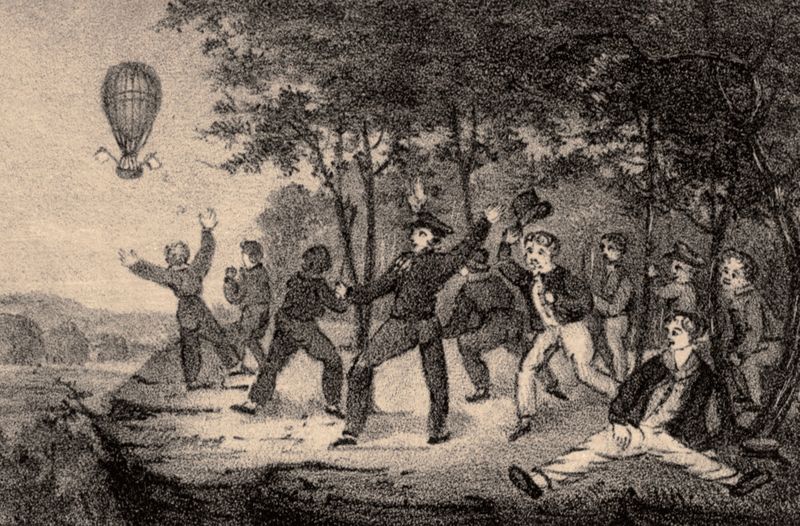
All was successful. The balloon
ascended with a graceful, easy motion;
floated awhile over their heads, the
streamers dancing in the breeze, then
rose so high, as to be a mere speck—afterwards,
it took a horizontal direction, and
having traversed the air, during half an
hour, rapidly descended, and fell, they
could not see exactly where.
When it first sprung up, a most exhilarating
shout issued from the group, then
in perfect silence, they all followed with
their eyes, every motion of the graceful
form, and when it was gone, Frank was
the first to exclaim, 'was it not glorious!'
'Glorious! glorious!' they all uttered.
There seemed to be no damper to their
enjoyment; each one talked as fast as he
could, of its grace, beauty, motion and
colour; and every now and then, turning
to Frank, they said,
'It is all owing to you; was it not
worth coming for? I am glad you did
not move off with that cowardly band,
we should have lost all our fun.'
Frank's heart did not echo this sentiment,
and his former feelings returned;
his sense of duty was too keen to leave him
in quiet possession of his triumph, and he
said nothing to all their congratulations.
Some of the boys thought this was owing
to modesty, but William Gardiner suspected
the true cause.
All marks of the proceeding were carefully
obliterated, and the spot covered
with stones, both for the purpose of concealment,
and to note the scene of their
festivity. At half an hour before sunset,
the whole party met at the foot of the
hill, where they had left their cart. No
questions were asked by the smaller number,
when they came up. They had
gathered a large basket full of wild flowers,
which they had laid in wet towels,
to keep them fresh, that they might present
them to Mrs. Reed. She was very
fond of flowers, and usually had her parlour
ornamented with them, from the earliest
in spring, to the latest of autumn.
These wild flowers reminded Frank of
his mother, for whom he had so often
gathered them, and a sadness came over
him.
'I wish I had gathered some for Mrs.
Reed,' exclaimed he.
'Do you,' said Tom Blanchard; 'I will
give you a bunch of mine.'
'No, I thank you, I cannot tell her I
gathered them myself.'
'That's honest,' said the captain; 'no,
let the boys have their flowers, they have
a right to all the praise.'
When they reached home, it was after
sunset. Mrs. Reed was at the door.
'I am glad to see you all safe at last,'
said she; 'I began to be a little anxious; I
hope you have enjoyed yourselves.'
'O yes,' said several, 'we had a royal
time.'
Tom brought forth the basket of flowers,
and presented them to Mrs. Reed.
'All these for me,' said she; 'you have
been very industrious in my behalf. I am
pleased to be remembered when absent. I
thank you all, for I suppose all have contributed.'
Tom only made a low bow, and retired.
'Tom is generous,' whispered William
Gardiner, 'to let us share in the credit of
the flowers, is he not Lawrence?'
'How is my young friend, Frank
Courtland?' said Mrs. Reed. 'It seems
to me, you look sober; I hope you like
our rural sports; perhaps you are fatigued.'
'Not in the least,' said Frank.
'Then it may remind you a little too
much of home; your father has been here,
and was pleased to hear you were gone on
the party, and said you would be in your
element in the woods. I told him I was
glad that he was not uneasy at our letting
you go away, for a whole day, with so
many wild fellows'—he said 'no, he believed
he might trust to his son's discretion;
at least, he should never know, till
he had put him to the trial.'
These words were daggers to Frank's
heart; but he was obliged to command
himself, and Mrs. Reed perceiving that
the mention of his father, had affected
him, changed the subject, and inquired
about the manner, in which they had
passed the day.
Albert Lawrence and William Gardiner
were the spokesmen. They gave an animated
and amusing account, of their journey
to the wood, and various little adventures
in cutting down, and cutting up
the trees, and roots—of their feast on the
flat-rock, &c. They told nothing that
was not strictly true; and with this degree
of honesty, appeared to satisfy their
consciences, and to feel no compunction
for the important part, which they had
entirely omitted. They made out incident
and occupation enough apparently,
to fill the day. Mrs. Reed listened with
interest and pleasure, to the account, and
bestowed on them a smile, to which Frank
wished from the bottom of his heart, that
he could feel himself entitled.
Frank retired to his own room, before
his companions, and his first impulse was
to get his talisman, which he had not
looked at for ten days. But a strong disinclination
to open the box, arose in his
mind. When at last he got resolution to
do this, the sight brought compunction
to his heart, such as he had never known
before.
'It is deception that I have been guilty
of,' was the distinct feeling of his mind.
'I never have deceived before. I am
not as my mother has often called me,
an honest boy; nobody deserves that
name, who is not above all deception.
Why am I alone here, without a friend?
what can I do? it will weigh upon my
mind, and I have no one to consult; if
Tom Blanchard was not so much older
than I am, I could consult him; yet he is
such a stranger. If I write about it to
mother, it will grieve her too much. If
we are found out, I shall never be willing
to stay here another day. I will repent
of my fault; I will pray for pardon; I
will be more watchful of myself; I will
never omit to consult my talisman again.'
These ideas, passed rapidly, and some
of them indistinctly, through Frank's
mind, in much less time, than it would
take any one, to read them. He heard
the steps of the boys, coming up to bed,
shut his trunk, assumed a more composed
aspect, and began to undress.
'Don't go to bed yet,' said William Gardiner,
as he entered the room, 'we are
going to set in Albert's chamber a little
while, and talk over things.'
Frank followed, almost unconsciously.
'Did not we make a good account of
our day,' said Gardiner.
'It was good, as far as it went,' answered
Frank, 'but it was not a true one.'
'I should be glad to be informed what
there was in it untrue?'
'The part you did not tell,' said Frank.
'I am sorry to offend any of you, but I
shall not be satisfied with myself, unless
I declare, that I think we have done
wrong; and if it were not for betraying
my companions, I should confess the
whole to Mr. Reed, bad as it would make
me feel; but I will never lisp a word of
it to any one. I hope Gardiner, you will
not put that paragraph in the paper, for
that will excite attention, and I think we
may never hear of it again.'
'I have not any very serious intention
of doing that,' said Gardiner, smiling;
'and I agree with you, that the less there
is said of it, the better for us. We had a
grand time; it went off nobly. You are
a freshman, Frank; when you have been
longer among boys, you will get used to
their pranks, and not mind a little concealment.
I think as much of honour, as
any body need to, and would not tell a lie,
or break a promise, to escape a good flogging;
but there is no fun, when every
thing is done in open daylight.'
Notwithstanding these, and other reckless
expressions of Gardiner, and Lawrence,
they could not disguise to themselves,
the increased respect which they
felt for Frank, in consequence of his bold
avowal of his sentiment, and it would
never have occurred to them, at that moment,
to have called Frank a coward.
Frank's secret mortification at his fault
did not wear off, and he gradually assumed
a shy and reserved manner, towards Mr.
and Mrs. Reed, which disappointed them,
as he had appeared very frank the first
time they saw him, and they were afraid
he was not contented. Mrs. Reed, however,
in time, gained his confidence, by
her gentle and judicious conduct. She
did not press him to converse either with
herself, or any one else. She suggested
objects of curiosity and enterprise, which
drew him out, and displayed the quickness
of his intellect, and the delicacy of
his feelings. It must be owned, Frank
became a favorite with her. This refinement,
and even his reserve, interested
her, and he was a frequent companion of
her walks and rides.
In one of these excursions, when Frank
was driving Mrs. Reed in their little waggon,
Miss Reed, a niece of hers, who was
also in the carriage, said, 'do aunt, if you
go near the spot, call and see how old
widow Black's granddaughter is.'
'What is the matter with her?'
'Why, have you not heard? it is a very
strange thing. She went up into the
woods to get spruce, winter green, and
herbs for her grandmother, to make that
nice beer, which you know she sells to
travellers, who pass by her hut; there she
trod on something, which set her stocking
on fire, for she had a large hole in
her shoe; she stamped, and stamped on
it; but this did not put it out, but only
made it burn more, and she had the
thought to run as fast as she could to the
brook, which, fortunately, was not far
off. She put her foot in the water, and
this relieved the pain, and as she believed,
extinguished the fire; but as soon as she
took it out of the water, it burnt again,
and it never occurred to her to take off
her stocking, till she reached home, dreadfully
burned, and she has been unable to
move a step, since.'
'Oh dear!' exclaimed Frank, with an
emotion, which struck both the ladies, as
very peculiar, 'do go to see her. I have a
recipe for a burn. My mother told me
always to keep it in my pocket-book; it
is very efficacious, even after the wound
has been made some time.'
The tears rolled down Frank's cheeks,
in spite of all his efforts to check them.
He remembered, the phosphoric matches,
and could not doubt it must have been
some of these carelessly dropped, and so
covered, as not to get to the air, till the
little girl had disturbed them, with her
foot, which caused the mischief.
They stopped at the hut, and found the
child as described.
'It is a very mysterious thing,' said the
old woman; 'did you ever hear before,
ma'am, of fire, which water would not
put out?'
'Yes,' replied Mrs. Reed; 'there is a
substance, called phosphorus, which, although
kept under water, for a long time,
will burn as soon as it comes into the air,
and by stamping on a small piece, it is
spread about, and burns quicker. I don't
see, however, how this could have got into
the woods.'
The girl was suffering a great deal.
Frank produced his recipe, but the ingredients
were not to be found in this humble
abode, nor could they be obtained
nearer than the apothecary's, in the village.
'May I run back for them,' said Frank?
'What, three miles!' said Mrs. Reed,
'no, there is not time; but we will ride
back, as quick as possible, and send for
them.'
'And then may I return, and bring
them?' asked Frank, with great earnestness.
'Why, you are a noble young gentleman,'
said the grandmother, 'to take so
much pains for us poor folks.'
Frank felt more ashamed, than pleased,
at this praise, his heart telling him all the
while, that he was making but imperfect
reparation for his fault.
When they got home, he ran to the
apothecary's, with the prescription. It
took some time to make the preparation,
and it was nearly dark, before he returned.
Mr. Reed said it was too late to trust
Frank so far alone, as there was no moon.
'Then let one of the big boys go with
me; let Tom Blanchard go.'
'Why, you are very earnest, my little
fellow,' said Mrs. Reed.
'Mrs. Reed thinks it will answer to-morrow
morning.'
'I will walk there, and back again,
if you are afraid to trust me with the
horse.'
'No,' said Mr. Reed, 'what should I
say to your father, if any accident happened
to you? I will let my man Amos, go
on horseback, and take it; there is no
need of any one's accompanying him; he
knows the place.'
It was a disappointment to Frank, not
to go, for he wanted to give the little girl
some money; yet he did not like to send
it.
'I must go,' said he, inadvertently.
'What is it makes you so eager in this
affair,' asked Mr. Reed; 'it is quite unusual
for you.'
Frank made no answer, for he could
not tell the truth. Mr. Reed then turned
away; and William Gardiner, who had
gathered the story by listening to their
conversation, came to Frank, and whispered
in his ear, 'they will guess something,
if you appear so earnest.'
Frank said no more. Amos took the
medicine, and did not get back, till after
Frank was in bed.
The next day, Frank longed to ask permission
to go and inquire after the little
girl, but had not courage. Mrs. Reed,
remembering his feeling, the day before,
proposed going, and asked him to drive
her. When they arrived, Frank had the
satisfaction to find that the application had
allayed the pain, and would evidently
cure the burn.
Frank went to the girl, and gave her a
dollar, and begged her to accept it from
him.
'I must first ask grandmother,' said
she; which she did immediately.
'That is a large sum,' said Mrs. Reed,
who was attracted by the little girl's question,
to her grandmother. 'That is a
large sum for you to give away; how
came you to have so much?'
'My father,' answered Frank, 'said
that I should have a dollar a month, while
I was at school, for pocket expenses; I
shall be able to do without, till next month.
I would rather give it to her, than do
any thing else with it.'
'I believe,' said Mrs. Reed, 'you could
not give it where it is more needed, and
as you sacrifice your own pleasure, merely,
in making the donation, I shall not
object.'
'That I shan't,' said Frank, in the same
emphatic manner, which she had observed
the evening before, and which appeared
quite unaccountable to her.
They then took leave, after promising
to call again the next time they rode that
way.
Though Frank knew that money was a
poor compensation for the little girl's pain,
and could not obliterate the recollection
of the circumstance which occasioned it,
from his mind, yet the consciousness of
having made a personal sacrifice, was the
most satisfactory feeling he had experienced
since the unfortunate day of the balloon.
Frank looked at his talisman, with
more pleasure than he had done, since
that time, and he began to resume his
cheerfulness, and to make greater improvements
in his studies. The mysterious
way, in which the little girl's foot
was burned, was several times alluded to,
and the boys who had shared in the balloon,
felt in jeopardy, whenever this happened,
but the balloon itself was never
heard of. It had probably caught in the
tops of some trees, in a distant and unfrequented
wood.
Lawrence, Gardiner, and the other
boys, who had joined in the plan, soon
ceased to feel any compunction, for the
deed, and engaged in new projects of diversion,
some of them innocent, while in
others, they betrayed the want of nice,
moral feeling, so rarely found, in those
whose early impressions have not been
carefully watched.
Frank, however, never forgot the lesson.
It was a long time before he could
even look at his talisman, without recurring
to it, painfully, and seeing a stain on
his character, which before, had been unblemished.
We must pass over many weeks, and
even months, of Frank's school life, during
which time, he had become quite domesticated,
in Mr. Reed's family, and felt
as much at ease there, as he did at home.
His attachment to Mrs. Reed, had increased
as his father had predicted, and he acknowledged
that he loved her, now, next
to his mother, and not such a great distance
between them, either. I shall only
insert one or two letters, written by
Frank, during this period.
'Dear Mother,
I do not wonder that
you thought my last letter formal, for I
wrote it on composition day, that is, on
Thursday morning. All the scholars
write something; either choose a theme,
or write a letter to one of their friends.
They show their composition to the master,
who corrects it, and awards to each,
so many merits. I got quite a high mark
for that letter, though I believe it was for
the hand writing. I knew it was not the
least like such an one, as I should write,
all by myself. I told Mrs. Reed what you
said about it, and she advised me, to write
to you in play hours, not show it to any
one, and tell you every thing I could think
of. So I have determined to write my
play hour letters to you, mother, and my
composition letters to father; and if you
do not think this is treating you fair, I
will now and then, write a composition
letter to you; but I do not know as I
shall ever venture to send one of the other
kind, to father.
I suppose you will excuse me for telling
you, that I am second of all the school, in
arithmetic, as nobody else will tell you,
and it will please you very much to know
it. We had a trial of skill the other day;
each took the same sum, it was a dreadful
hard one, each began at the same moment.
William Gardiner, who is fourteen years
old, finished his first; I handed mine up
second; when they were all done, Mr.
Reed examined them, and only twelve
were right, out of twenty; and mine was
one of those which had 'correct' written
on it. Mr. Reed praised me very much,
and said I had paid great attention to his
instructions, in cyphering, and that if the
other boys had been as attentive, they
might, at least, have equalled one so much
younger than many of them. I was delighted
when Mr. Reed spoke of my success
at table, and praised me to Mrs. Reed,
and after dinner, she came up to me, and
took my hand, and said, in such a kind
manner, 'I am glad you have gained so
much credit, Frank.' I did feel elated, I
must own, mother. When I went up to
my room, at night, I took out my talisman:
as soon as I put my eyes on it, I
perceived the reason of my doing the sum
right, and where the praise was due. It
was to you, who took such pains, just before
I left home, to make me perfect in the
four first rules of arithmetic, so that let
me cypher in what rule I may, I am sure
to get right, because I never miss in adding,
subtracting, multiplying or dividing;
and the truth is, I have been less attentive
to Mr. Reed's instructions in arithmetic,
than most of the others, because I knew
so well, for he takes great pains in this
branch. After looking on my talisman a
few moments, I was no longer at a loss
what I ought to do, and though it was
rather disagreeable, I resolved on it.
I had not the courage to apply to Mr.
Reed, but I went to Mrs. Reed, and told
her, I did not deserve the praise of being
more attentive to arithmetic than the
other boys; for in the whole, I had been
less so, and that several of those who failed
yesterday, had been very attentive;
and then I explained how it happened,
that I did the sum, and asked her to tell
Mr. Reed, that although the boys did not
succeed as well as myself, yet they deserved
as much praise for attention. This
was in the morning, and I believe she told
Mr. Reed after school; for at dinner this
day, he began and said—'young gentlemen,
I owe you an apology. I find you
have been quite as attentive in your arithmetic,
as Frank Courtland has;' and then he
repeated what I had said, but added he,
this 'ingenuousness deserves still higher
praise, than what I bestowed yesterday.
If Frank Courtland is not the best arithmetician,
is he not the most honest boy
in the school?' 'Yes sir, yes sir,' they
all called out, and clapped their hands
loud enough to stun us. This is the happiest
moment I have had, since I left home;
and if you knew some things which I
cannot tell you, then you would understand
why it delighted me so exceedingly,
to be called an honest boy.
I have been three days, writing this letter,
and yet I have not said half I want to
say. I must beg you to excuse the writing,
for I have written a good deal of it
on the steps of the barn door, a shady
place, where I often sit with my port-folio,
you made me, and my little pocket inkstand.
Love to Sam, I hope he has received
my last letter; love to father, and
a kiss to little Ann.
Your affectionate Son,
Frank.'
'Dear Sam,
I thank you for your long
letter. I am glad you have written to me
at last; for I began to think you never
would. You need not have waited till
you could write a better hand; for I am
not obliged to show the letters I receive,
unless I choose. I did show yours, because
it was written so well. Mr. Reed
said, that it did you great credit and also
your instructor; so I thought I would
tell him that it was mother who had
taught you. He said he wished he could
have another of mother's pupils in his
school; and I wish to my heart you could
come. There are many clever boys here.
I like some of them very much; but they
think differently from you and I in many
respects. They get into scrapes and get
out of them wonderfully. They used to
lead me into them, when I first came; but
they don't invite me now, for they know
I will not join them, if I think it wrong.
They are good boys on the whole; and
William Gardiner and Albert Lawrence
are so brave and droll, and kind, that I
can't help liking them; and so do all the
boys. Thomas Blanchard is an excellent
fellow, though rather serious; he is three
years older than I am. He helped me
very much about my latin, when I first
came, or I am sure, I never should have
got along; for it is harder than any thing
I ever learned; and you must not suppose
that it is as easy to learn a thing at school,
as with mother; for you know how much
patience she has, and how clear she makes
it before she has done. I am glad you
continue your studies with mother, for I
know you are very desirous of learning,
and it must be a great amusement to her.
As Tom Blanchard was so kind in helping
me to get my latin lessons, I have
taught him to draw. You will wonder
how I could do this, since I know so little
myself. I remembered mother's instructions
and repeated them to him, and
lent him my pencils and all my patterns;
he is such a genius, that he has got on far
before me, and draws very prettily. He
has taken a view of Mr. Reed's house and
garden for me. As I know you would
like to see what a pleasant place I live in,
I am going to send it to you. Tom says,
he shall not be affronted. Will you shew
it to mother? and tell sister Ann, that if
she can write as well as you tell of, I
wish she would write me a letter. I
should be proud to shew one from a little
sister, six years old.
I had no chance to send this letter the
day I wrote; therefore I will fill the sheet.
We had a grand time, the day before
yesterday. It was the fourth of July;
we wished very much to celebrate it, and
asked Mr. Reed a month before it came, to
let us have some music, and invite the
young ladies of this village, and some
from Boston, and have a dance. Mrs.
Reed begged him to consent, and so he
did. My cousins came, and a great many
more; and William Gardiner thought my
cousin Emily was the prettiest girl in the
room. I had a share in planning a very
pleasant part of the entertainment. I
proposed to Gardiner, Lawrence, and
some of our best fellows, that after we
had danced some time, we should take
the musicians out among the trees in the
garden; and that while the company were
sitting down to rest, they should strike up
some fine tunes, which would attract them
to the door, and into the garden; and
then we would have a number of sky
rockets sent up, all at once, from the bottom
of the garden. We boys were to
club and pay for the rockets, and no one
else was to know a lisp of the plan. I insisted
on asking Mr. Reed's leave; but
we wanted to surprise Mrs. Reed, so she
was not told of it.
Mr. Reed consented on condition that
we would take our allowance of spending
money, and not incur any further expense,
to which we agreed. And then we
thought of another thing, which made it
very pretty. We formed an arbour of
evergreen branches and flowers and hung
in it some coloured lamps, which William
Gardiner procured in town; for he is a
capital fellow to do any thing that he sets
about. Tom Blanchard made a transparency,
and wrote on it, 'In honor of
Mrs. Reed,' which was to be put over the
entrance of the arbour. But Albert Lawrence
and some others said this was not
appropriate; as it was the fourth of July,
we ought to have something about independence.
I thought they were right,
though I was sadly disappointed, that we
could not pay the compliment to Mrs.
Reed. Tom altered the motto, and put
the word independence on it.
The sky rockets went off grandly, and
the arbour looked beautifully when it was
lighted. Mrs. Reed and some of the ladies
sat in it, and we handed them some
fruit and flowers, of both which we had a
great variety and abundance from the garden.
If you do not know what coloured
lamps or transparencies are, I will tell you
when I come home, or you can ask mother.
I shall have enough to tell you; we
are always having some pleasant thing on
foot; but we are obliged to study very
hard, to procure these indulgences; for
they are all given as rewards. I found
this studying very tiresome when I first
came: yet now I am used to it, I can do
more in an hour, than I could in a forenoon
at home.
Please to give my respects to your father
and mother and brothers. Your affectionate
friend,
Frank.'
The summer months passed rapidly
away.—Frank continued to meet with
temptations, which as he usually had the
strength to resist them, served to confirm
his self-control. If, as was now and then
the case, he was betrayed into vanity,
peevishness or imprudence, the sight of
his faithful talisman brought conviction
of the error to his mind, and inspired him
with resolution, to make all the reparation
in his power. The boys all loved and respected
him; and many, who from timidity
used to join a party they disapproved,
were now emboldened, by his example,
to abide by their better judgment, and
mischievous projects became gradually less
popular in the school.
Frank was spirited and active, and
never refused to join in any thing however
hazardous or fatiguing, provided it
was not dishonorable. No one would
venture to say, he wanted courage or ingenuity;
though William Gardiner and a
few others, still persevered in asserting,
that he was squeamish; and they ascribed
this to his having been kept during the
first years of his life, out of the society of
boys of his own age. The purity and
moral sensibility which were by this
means preserved in his character, more
than compensated for any little defects,
which the retirement of his childhood
had occasioned. His kind and judicious
parents had selected the right moment to
change the influence to which he had been
subjected; and had sent him from home
when his principles had gained sufficient
strength to resist the danger, to which a
contact with others less pure than himself,
might expose them; and before any
bad habits or narrow views had become
fixed in his character.
One such boy in a large school, so attractive
in his manners and disposition,
and at the same time, so inflexible in virtue,
is of inestimable value. Their good
influence over the other boys, the majority
of whom are of that uncertain class
who always follow a leader, and whose
destiny depends on their finding a good
or a bad one, cannot be too highly appreciated.
Mr. Reed was fully aware of this,
and it was with great pleasure that he
communicated to his wife, a letter he had
received from Mr. Courtland, requesting
that Frank might return home to pass the
autumn vacation, and engaging a place
for him for the next term.
We shall only relate one more of the
many little incidents which occurred to
Frank, during this summer, and then take
our leave.
'Frank,' said Mr. Reed one pleasant afternoon,
'you like a long walk; will you
do me the favor to take this letter to
Squire Brazer's and get an answer? It
must go to night.'
'Yes, with pleasure,' answered Frank;
and took his hat.
'You would like a companion?'
'If you please. Shall I ask William
Gardiner?'
'You need not hurry yourselves; but
take a pleasant walk and pick blackberries
by the way; only get home by dark.'
The boys walked on a mile or two,
stopping now and then to gather berries,
and some of the last wild roses, which
yet remained, in a few sequestered spots;
and conversing very pleasantly, when
they approached an old house, standing
back from the road, and nearly concealed
by a row of elm trees. At the fence, by
the road side, was standing very quietly,
though not fastened, an old horse, and
rather a shabby chaise.
'That's Parson Allen's chaise,' said
William Gardiner. I'll warrant you, he
is making a sermon a mile long, to the
old maids within; who, no doubt are listening
to him with the most flattering attention:
for I suspect, a call from a gentleman
is a rare occurrence to them.'
'Yes,' said Frank, laughing; 'I dare
say we might ride to the Squire's and
back again in his chaise, before the sermon
was ended; and the old horse would
like it better, than standing here in the
sun.'
'It is rather provoking,' said Gardiner;
'that as there is so much shade, he could
not be put in it.'
'I make no doubt he was,' replied
Frank; 'when the parson first stopped;
but probably the sun has moved on to
another place, since that time.'
'That is a good thought of yours,
Frank,' said Gardiner; 'come get in, I
will take all the risk, and pay all damages.
It would be a lucky hit for his reverence,
if we broke the vehicle, and had
to get a new one.'
'More lucky for him than for us,' said
Frank, who had his foot on the step,
ready to get in; 'second thoughts are
best; no, we had better not.'
'There is your ridiculous particularity;
I don't believe there is another boy in the
school, would refuse.—If the parson
should come out, and find the horse had
walked off, he would only go back and
make the old ladies another sermon,
which would be so much the more for the
good of their souls.'
Frank's good genius prevailed; his talisman
rose up to his thoughts like a guardian
angel, and he said, 'it will be safest
not to go.'
'Well, I will not be baulked of the
ride,' said William,—'Lawrence says,
that I once took the lead in every thing;
but that now I am no better than your
shadow; and that you govern me entirely;
so I will go, if it is only to tell him, I
have acted once for myself.'
'I will walk on with the letter,' said
Frank, 'and shall probably meet you on
my return.'
William Gardiner jumped into the
chaise, and by dint of twitching the reins,
and applying the whip, succeeded in getting
the horse into a trot, and was soon
out of sight. Frank proceeded with a
light step, and a still lighter heart, and
delivered the letter. After waiting half
an hour for the answer, he returned,
walking very fast, as it was late. When
he passed the old house, he saw Mr. Allen's
horse and chaise standing exactly in
the same position in which they first
found it; and a short distance beyond, he
overtook William.
'You have been gone for ever,' said he;
'why, I do believe I have rode six miles,
at least. I left the chaise in the same
spot; nobody but yourself, I will venture
to say, is the wiser for the expedition;
for I turned down that unfrequented lane.'
They reached home before night;
Frank delivered the answer to Mr. Reed.
Gardiner told of his ride to Albert Lawrence
and a few other boys. They had a
good laugh,—said it was a capital trick,
and they thought it would be a real kindness
to the horse, to relieve him occasionally,
from the tiresome business of standing
an hour or two, in the same spot.
The next evening, the minister called
on Mr. Reed, and finding he was in the
play room, and all the boys round him,
(for he often passed an hour with them in
this way,) he walked in. Mr. Allen was
an amiable man, and a group of happy
young folks was always a pleasing sight
to him.
The boys were relating remarkable occurrences;
each one trying to recollect
something strange, which he had lately
heard or read of.
'I believe I can tell a singular story,
which happened only yesterday,' said
Mr. Allen; though it may be rather too
sad to relate in this merry company. But
they may as well look on the shadows
now and then, in the morning of life; for
their turn must come. I went yesterday
afternoon to call on the Miss Bradford's,
worthy women as any in my parish. The
special object of this visit, however, was
not themselves, but their niece, Miss Alice
Bradford; who has been in a consumption
for more than a year, and came out
here six weeks ago, for the benefit of the
country air. The change was rather
hurtful than beneficial; she failed fast, and
became too ill to be carried back. I had
not, however, thought her quite so near
her end, as she proved to be. When I
got there yesterday afternoon, I entered
into prayer with her, and found her spirit
peaceful and resigned. The piety and innocence
of her short life, gave tranquility
and hope to her dying hour. Neither she
nor her aunts appeared to apprehend immediate
dissolution. I had witnessed too
many death-bed scenes, not to know its
symptoms, even when most deceitful.
Her aunt said, that she appeared to have
but one earthly wish remaining; and that
they hoped to gratify, the next morning.
It was to see her younger sister, who had
been purposely kept away; as the sight of
Alices' sufferings distressed her exceedingly.
My mother has gone before me, said
the sweet girl. I am ready to join her;
though I had hoped it might be the will
of our Heavenly Father that I should be
spared to my sister. Not as I will, but as
thou wilt, she added, after a moment's
pause, and a great struggle; but I should
like to take leave of her and give her a
few words of advice; as they are the
last, they will make a deep impression on
her mind. I called one of the ladies aside,
and told her the present was the only
time; I did not believe her niece would
be alive in the morning. She shuddered,
and exclaimed, what shall I do! how can
I send for her sister now. I have no
horse,—no man. I will go, I replied; my
horse is at the door I shall be back before
it is late; I will go directly. Thank
you, sir; thank you a thousand times;
do go directly—and she returned to prepare
the young woman to receive her sister.
When I went to the bottom of the avenue,
my horse and chaise were not there;
by the marks in the road, I found he had
turned round, and presumed he had taken
a homeward direction. I hastened there,
when I arrived out of breath at home, no
one had seen him. I resolved to lose no
more precious time, for I knew that the
sands must be nearly all out in the poor
young creature's glass: so I hurried to
Dr. Parker to beg him to lend me his
chaise; the Dr. had gone to visit at
Brookline: then I went to farmer Thomson;
he willingly lent his horse, but had
neither chaise nor waggon. I determined
to go over to Mr. Welles' and borrow his
chaise. In doing this, I of course, passed
by Miss Bradford's house. I had lost
nearly an hour and a half,—there I found
my horse standing exactly as I had left
him, in the former part of the afternoon.
I could not stop to make either inquiries
or reflections; but got in, hastened into
town, and brought the young sister out in
the shortest time possible.
Soon after my departure from Miss
Bradford's, the unequivocal symptoms of
death began to come on; but the poor
creature made great exertion to keep up
her strength, anxiously expecting the arrival
of her sister, and wondering at the
delay. She took some drops which revived
her a good deal; and half an hour
before I arrived, conversed freely with
her aunts; spoke of her perfect reliance
on the goodness of God, and the merits of
the Saviour, and gave many injunctions
in case she did not see her sister. Ere we
reached there, it was too late. She took
her sister's hand, looked up in her face
with an expression of disappointment
which I shall never forget; but she was
speechless. The hour and a half which I
lost, in looking for a chaise, deprived her
of that last and most earnestly desired satisfaction,
the power of taking leave of her
sister, and of giving her the invaluable instructions
of her dying hour.
I went there again, this morning. She
lived till daylight, but did not speak. The
sister is overwhelmed with grief.—'Could
she have spoken to me,—could I have
been with her but one hour earlier I could
have borne it,' was all she said.'
Every one present was deeply affected
by the narration; all mirth ceased, and
tears and sobs came in its place. Mr.
Reed was himself surprised at the effect it
had produced on some of the boys, touching
as it was; he remarked a deadly paleness
on William Gardiner's countenance;
little did he suspect the true cause.
'I fear I have thrown a gloom over
your happy family,' said Mr. Allen. 'It
was not my intention to make the sad relation
when I came among you; but I
was led to it from the singular circumstance
of my horse having gone off; for I
have used him ten years, and never knew
any thing of the sort to happen before.
He knows all my parishioners' doors, I
believe, as well as I do, and has never
shown before, that he thought my visits
to them too long.
I should have imagined that some mischievous
fellow had taken him; but every
body, even the smallest boy round this
part of the country knows the animal,
and I can't believe that there is one among
them, would play me such a trick, and if
any one had done so, I should not probably
have found the horse returned quietly
to the same spot in which I left him.'
'I must believe,' said Mr. Reed, 'that
the horse was led away; and I would
make inquiry about it.'
Will Gardiner could stand this no longer,
but slipped out of the room, lest some
questions should be asked.
'Did you pass Miss Bradfords' on your
way to squire Brazer's, or did you take
the other road, Frank?' said Mr. Reed.
'I passed that way,' answered Frank.
'Did you observe the horse and chaise,
as you went?'
'Yes, it was at the gate.'
'And on your return?'
'It was there then also.'
'Well, well, say no more about it, Mr.
Reed,' said the good clergyman; 'if it
was a piece of mischief, I leave the person
who committed it, to the reproaches of
his own conscience; he need suffer no
greater punishment, if he has any feeling.
Though I own it would be a satisfaction
to me to know, that my old faithful horse
was not to blame.'
Mr. Allen took leave, and the boys
soon retired. When Frank went to his
room he found William Gardiner in bed;
and believing him to be asleep, took a
long look at his talisman, revolving in
his mind, whether it was his duty to tell
all that he knew about the horse, or to be
silent on the subject, for William's sake.
He remained undecided; but felt no pain
or compunction, for he was conscious,
that as soon as he had found out the right
course, he should not fail to adopt it.
After he had been in bed a short time,
William Gardiner raised his head and
said, 'Frank, are you asleep.'
'No.'
'Why don't you talk then.'
'I thought you were asleep.'
'No, I am wide awake; I can't get to
sleep. What is that little box you have
been looking at, so earnestly.'
'It is something.'
'Well I suppose it is; but do you want
to keep it a secret; if you do, I won't ask.'
'Why no, not exactly,' said Frank; 'it
is something my mother gave me, the
night before I left home.'
'Well, what is it, I say?'
'It is a talisman,' said Frank, rather
hesitatingly.
'A talisman; what is that?'
'Have you never read of talismans in
fairy tales? it is a charm which protects
you from danger, as long as you keep it
and consult it.'
'I know that is the description of them,
in genii and fairy tales; but you do not
believe in such things do you?'
'No, but this is real; it has a charm
for me, to keep me from doing wrong;
this is the danger which my mother expected
it would secure me against.'
'If it has that sort of power, I wish I
had had it this afternoon; then I should
have let alone that horse and chaise. Was
it the talisman which made you turn
away, when your foot was on the step,
and you were just ready to jump in?'
'It was the thought of it, I am persuaded.
I consult it so frequently, and like
to look at it so much, that now it is fixed
in my mind; and I see it as distinctly, as
if it were really in my hand, whenever I
am going to do wrong.'
'And does it stop you short, as it did
this afternoon?' said William.
'Unless I am very earnest indeed, too
earnest to attend to its admonitions.'
'What did it say to-night, when you
looked at it?' asked William.
Frank repeated what the parson had
said, after William left the room; the
questions Mr. Reed asked, with his own
answers; and told William that he was
trying to come to a decision, what he
ought to do.
'O you won't tell, will you? It is an
evil spell that prompts you to betray a
friend. Besides, what good can it do? If
it could restore to the poor dead creature
that one hour, I would tell myself instantly.'
'I have decided not to tell,' said Frank,
'without your consent.'
'Don't ask me to give that; it is impossible.'
'Why, you said just now, you would
tell yourself, to restore that lost hour.
This I know cannot be done; but something
as valuable, which you have lost
yourself, may be restored, by confessing
the truth.'
'What is that?'
'Your own peace of mind; have you
not lost that?'
'Yes, I have; I cannot shut my eyes
without beholding that speechless, dying
girl; it is frightful; I never was such a
coward before. But I shall get over it I
know, in a few days. Whenever I get into
a scrape, I always feel horridly at first,
for fear I should be found out,—but I
never am, and I soon forget it.'
'But the consequences are seldom so serious,
of any of our pranks,' said Frank.
'Why there was the widow's granddaughter
who was burned so badly, all
owing to my carelessness in dropping that
piece of phosphorus, or some of the
matches, on the day of our balloon frolic.
It troubled me when I first heard of it, as
much as it did you. I bought her a new pair
of shoes, and I have given her or her grandmother
something every time I go that
way; and persuaded several of the other
boys to do so too. The old woman said
the last time I was there, that she hoped
she should be brought to a realizing sense
that every thing was ordered for the best;
for Sally's accident had proved a real
blessing to the family.'
'It is striking ten, William;' said Frank.
'Is it?' replied William.—'O dear! I
shall never get asleep.'
Frank waked earlier than usual, the
next morning; and he found William up
and dressed.
'How early you are up,' said he.
'I am going to take a walk,' replied
William. 'I feel as if I should smother,
if I stay any longer shut up here.'
'Should you like to have me go with
you?' said Frank.
'Will you? that's a good fellow.'
After they had walked a little way in
silence, Gardiner said, 'I am glad Frank,
that I know you have got something to
help you to do right; for now there don't
seem to be such a difference between us.
Albert said, he believed you had a good
genius always at your elbow, when you
declined going into swimming with us,
the day after the guards were broken by
the high wind; and Mrs. Reed said your
good genius was your virtuous thoughts;
but she did not know the whole. If I
had not gone at that time, Greenville
would have been drowned; for there was
not a fellow among them all, who had the
courage to jump in after him when he
floated outside the bars; so I can't reproach
myself for that.'
'You said,' replied Frank, 'Mr. Reed
commended your courage very much:
but he told you you were as wrong as the
others in going; and that we must not do
evil that good may come of it.'
'Well, Frank,' said William, 'what
would you do in my place about the
chaise? suppose I go and tell parson Allen
the whole truth; where is the use of
it? It would only disgrace the school, to
have it talked about all over the neighborhood;
and injure the other boys as well
as myself.'
'I agree with you,' said Frank; 'but
can't you tell Mr. Reed?'
'How could that make the matter any
better?'
'You would be relieved from the dread
you now feel, of being found out.'
'That is something, I acknowledge; for
I never did feel so badly about being found
out before.'
'Then,' said Frank, 'if you confess the
fault and say you are sorry, you will have
made all the reparation in your power,
and your conscience will be lightened of a
load.'
'I know it, and if I had your talisman,
perhaps I should.'
'But you may, if you choose, have the
good genius which Mrs. Reed thinks I
have—virtuous thoughts.'
'I wish I always did have them, I am
sure.'
'If you once brought your mind to
confess this,' said Frank; 'I think you
would never engage in any more mischief.
You know that Mr. Reed told you the day
you saved Greenville, that you were a noble
fellow; and if you could break yourself
of your little mischievous propensities,
you might be one of the first in his
school, in character, as you now are in
talents.'
'Yes,' said William; 'and I remember
he advised me to make you my model;
and if I had the courage, I would do as
you advise.'
'Will you agree to this,' asked Frank;
'you know the questions Mr. Reed asked
me about the horse.'
'Yes.'
'I was sorry not to be able to tell all I
knew; this will make it natural enough
for me to speak of it first; and then I will
say I had your consent to tell the whole;
that you are very sorry, and are determined
to break off your mischievous habits.'
'What will the boys say when they
know it?' said William.
'Perhaps Mr. Reed will not choose to
tell them; and if he does, all those whose
opinions are worth caring for, will think
the better of you.'
'I believe they will,' said William; 'for
I know we did not think any the less of
you, for what you said, the night of the
balloon. Frank, I consent; only I should
feel better to have you tell it to Mrs. Reed
first, and let her tell Mr. Reed,—she is so
kind, she will make the very best that can
be made of it; and she will not say a harsh
word to me.'
'I will,' returned Frank; 'take courage,
you will never be sorry, when it is
once told,—like having a tooth out, it
will be soon over, and you will be relieved.'
'When shall you tell?' asked William.
'When I get a suitable opportunity;
don't be too anxious.'
As soon as Frank found Mrs. Reed disengaged,
he related to her the whole affair;
and represented as he could, with
sincerity, that it was only meant as a harmless
joke. He said as little of himself as
possible, throughout the narration; and
omitted almost entirely, the persuasion he
was obliged to use, to induce William to
take this step. Mrs. Reed sent for William
into her own room, and remained
alone with him some time; treating him
with the tenderness of a mother, and taking
care to say nothing which should make
him regret for an instant, that he had
opened his heart to her.
She then dismissed him, and in the
course of the day communicated the matter
to her husband; who, though mortified
to find that the disgrace of such an
affair belonged to any member of his family;
yet rejoiced at this proof of an ingenuousness
in William Gardiner, which
he had almost begun to despair of ever
seeing in his character.
In the interview which succeeded, he
did not inform William whether he should
disclose the truth to Mr. Allen or not; indeed,
he had not at that time, made up
his mind on the subject.—But he said he
should not mention it to any one of the
scholars. This indulgence he thought
due to the great effort he knew it must
have cost William to make the confession.
'I never should have done it, but for
Frank; he persuaded me into it.'
'He is your good genius then, William;
and I advise you to attach him as closely
to your side as possible. Some how or
other, he contrives to discern and preserve
the right course more perfectly than any
of you.'
'I believe,' said Frank, 'I do not deserve
more praise on that account, than
the others.'
'And why not, if you do in fact excel
them?'
'Because,' said Frank, with some embarrassment,—
'Shall I tell?' said William.
'Yes.'
'Because he has something which none
of us have; which helps him in doing
right.'
'That must be a valuable possession in
such a little world as this school,' said Mr.
Reed; 'what can it be?'
'A talisman,' answered William;
'which his mother gave him, and said
that it would secure him against all harm.'
'From moral harm,' said Frank; 'only
from doing what I know to be wrong.'
'If he only just looks at it,' said William,
'it makes him do right.'
'It inspires me with courage to do
right,' said Frank.
'May we see this curious treasure?' asked
Mr. Reed.
'Yes sir,' said Frank. 'I have intended
to show it to Mrs. Reed, for some time.'
Frank ran up to his trunk, took it out
and brought it into Mrs. Reed's room.
He opened the box and presented it to
her. She smiled and looked surprised.
'There is a charm indeed; I do not
wonder at its magical influence.—It is,
said she—looking up at Frank,—
'My mother's picture,' he answered.
'What a delightful countenance,' exclaimed
Mr. Reed. A glance at such features
would, I am sure, drive away all
evil thoughts. 'Especially if they were a
mother's,' said Mrs. Reed; 'and these were
the lips from which had proceeded, all
your lessons of virtue.'
'I can have no such talisman,' exclaimed
William, with a sigh. 'I have no
mother. I do not remember her face.
She died when I was an infant.'
'This is a great excuse for your faults,'
observed Mr. Reed. 'Nothing can supply
a mother's place entirely, in the important
period of childhood. But you
have found a friend who may be a talisman
to you, through life, if you will but
adhere to him.'
'That I shall, I am resolved,' replied
William; 'if he will adopt me.'
'Affection for a worthy object,' said
Mrs. Reed; 'whether it be parent or
friend, is a talisman which has preserved
many a noble youth from the dangers of
temptation.'
I trust it will not be uninteresting to our
young friends to be informed, that Frank
and William's friendship, increased every
year; and that it was a source of mutual
advantage through life. When Frank
went home in the vacation, his parents
were delighted with his improvement in
looks and manners; he had acquired a
manly air, a clear and ready manner of
expressing himself. His progress in his
studies exceeded their expectations; and
his mother told him she was repaid for
the sacrifice she had made in parting
with him.
The vacation passed away; and when
Frank returned to school, both his father
and mother accompanied him to Boston.
Mrs. Courtland was very desirous of becoming
acquainted with Mr. and Mrs.
Reed, to whom she and her husband felt
so much indebted for the happiness and
improvements which Frank had found in
their family.
Sam Brown's father was so much struck
with Frank's improvement, that he resolved
to send his son to the same school;
though it was rather difficult for him to
afford the expense of it. Sam was a boy
of fine talents, and well rewarded his father's
exertion. He entered college at
the same time with Frank and William
Gardiner. They were so attached to each
other, that they went by the name of the
friendly trio; and having quitted the University
with honour, became highly respectable
and worthy men.
Frank was his mother's pride in manhood,
as he had been her hope and comfort
in youth.
NEW BOOKS,
FOR JUVENILE AND SUNDAY SCHOOL LIBRARIES,
PUBLISHED AND SOLD BY
WAIT, GREENE & CO.
The Happy Valley.
The Happy days, 2 parts.
The Warning.
The Talisman: a tale for Boys.
Little Edward, the Good Boy.
Life of Leigh Richmond.
—N. B. The above are just published.
The Well spent Hours—bound.
Helen and Maria, 3 parts.
Sketches of Natural History.
Sketches of Wallington Family.
Ann Beaumont.
Ellen Sinclair.
Harry Hobart.
Susan and her Lamb.
Sunday School Hymn Book.
Sunday School Hymn Book. 1st part separate.
Wm Cooper and his family.
Biographical Sketches of great and good men.
The above Books are among a large collection,
for sale by W. G. & Co., which have been
carefully examined, and are recommended to
the public.
They also publish
The Juvenile Miscellany, at $2 per year;
also—The Christian Teacher's Manual, at $2
per year.
Transcriber's Note:
Obvious typographical errors, including several cases of missing or incorrect punctuation, were repaired.
In the list of books at the end, ditto marks in the original have been replaced by the actual words they represent.