The scene is Barrackpore, the date March 29,
1857. It is Sunday afternoon; but on the
dusty floor of the parade-ground a drama is being
enacted which is suggestive of anything but Sabbath
peace. The quarter-guard of the 34th Native
Infantry—tall men, erect and soldierly, and nearly
all high-caste Brahmins—is drawn up in regular
order. Behind it chatters and sways and eddies a
confused mass of Sepoys, in all stages of dress and
undress; some armed, some unarmed; but all fermenting
with excitement. Some thirty yards in
front of the line of the 34th swaggers to and fro a
Sepoy named Mungul Pandy. He is half-drunk
with bhang, and wholly drunk with religious fanaticism.
Chin in air, loaded musket in hand, he
struts backwards and forwards, at a sort of half-dance,
shouting in shrill and nasal monotone, “Come
out, you blackguards! Turn out, all of you! The
English are upon us. Through biting these cartridges
we shall all be made infidels!”
The man, in fact, is in that condition of mingled
bhang and “nerves” which makes a Malay run
amok; and every shout from his lips runs like a
wave of sudden flame through the brains and along
the nerves of the listening crowd of fellow-Sepoys.
And as the Sepoys off duty come running up from
every side, the crowd grows ever bigger, the excitement
more intense, the tumult of chattering voices
more passionate. A human powder magazine, in a
word, is about to explode.
Suddenly there appears upon the scene the English
adjutant, Lieutenant Baugh. A runner has
brought the news to him as he lies in the sultry
quiet of the Sunday afternoon in his quarters. The
English officer is a man of decision. A saddled
horse stands ready in the stable; he thrusts loaded
pistols into the holsters, buckles on his sword, and
gallops to the scene of trouble. The sound of
galloping hoofs turns all Sepoy eyes up the road;
and as that red-coated figure, the symbol of military
authority, draws near, excitement through the Sepoy
crowd goes up uncounted degrees. They are about
to witness a duel between revolt and discipline,
between a mutineer and an adjutant!
Mungul Pandy has at least one quality of a good
soldier. He can face peril coolly. He steadies himself,
and grows suddenly silent. He stands in the
track of the galloping horse, musket at shoulder,
the man himself moveless as a bronze image. And
steadily the Englishman rides down upon him! The
Sepoy’s musket suddenly flashes; the galloping horse
swerves and stumbles; horse and man roll in the
white dust of the road. But the horse only has
been hit, and the adjutant struggles, dusty and
bruised, from under the fallen beast, plucks a loaded
pistol from the holster, and runs straight at the
mutineer. Within ten paces of him he lifts his
pistol and fires. There is a flash of red pistol-flame,
a puff of white smoke, a gleam of whirling sword-blade.
But a man who has just scrambled up,
half-stunned, from a fallen horse, can scarcely be expected
to shine as a marksman. Baugh has missed
his man, and in another moment is himself cut down
by Mungul Pandy’s tulwar. At this sight a Mohammedan
Sepoy—Mungul Pandy was a Brahmin—runs
out and catches the uplifted wrist of the victorious
Mungul. Here is one Sepoy, at least, who cannot
look on and see his English officer slain—least of all
by a cow-worshipping Hindu!
Again the sound of running feet is heard on the
road. It is the English sergeant-major, who has
followed his officer, and he, too—red of face, scant
of breath, but plucky of spirit—charges straight at
the mutinous Pandy. But a sergeant-major, stout
and middle-aged, who has run in uniform three-quarters
of a mile on an Indian road and under
an Indian sun, is scarcely in good condition for
engaging in a single combat with a bhang-maddened
Sepoy, and he, in turn, goes down under the
mutineer’s tulwar.
How the white teeth gleam, and the black eyes
flash, through the crowd of excited Sepoys! The
clamour of voices takes a new shrillness. Two
sahibs are down before their eyes, under the
victorious arm of one of their comrades! The
men who form the quarter-guard of the 34th, at
the orders of their native officer, run forward a few
paces at the double, but they do not attempt to
seize the mutineer. Their sympathies are with him.
They halt; they sway to and fro. The nearest
smite with the butt-end of their muskets at the
two wounded Englishmen.
A cluster of British officers by this time is on the
scene; the colonel of the 34th himself has come
up, and naturally takes command. He orders the
men of the quarter-guard to seize the mutineers,
and is told by the native officer in charge that the
men “will not go on.” The colonel is, unhappily, not
of the stuff of which heroes are made. He looks
through his spectacles at Mungul Pandy. A six-foot
Sepoy in open revolt, loaded musket in hand—himself
loaded more dangerously by fanaticism
strongly flavoured with bhang—while a thousand
excited Sepoys look on trembling with angry sympathy,
does not make a cheerful spectacle. “I felt
it useless,” says the bewildered colonel, in his official
report after the incident, “going on any further in
the matter.... It would have been a useless
sacrifice of life to order a European officer of the
guard to seize him.... I left the guard and reported
the matter to the brigadier.” Unhappy
colonel! He may have had his red-tape virtues, but
he was clearly not the man to suppress a mutiny.
The mutiny, in a word, suppressed him! And let
it be imagined how the spectacle of that hesitating
colonel added a new element of wondering delight
to the huge crowd of swaying Sepoys.
At this moment General Hearsey, the brigadier
in charge, rides on to the parade-ground: a red-faced,
wrathful, hard-fighting, iron-nerved veteran, with
two sons, of blood as warlike as their father’s, riding
behind him as aides. Hearsey, with quick military
glance, takes in the whole scene—the mob of excited
Sepoys, the sullen quarter-guard, the two red-coats
lying in the road, and the victorious Mungul Pandy,
musket in hand. As he rode up somebody called
out, “Have a care; his musket is loaded.” To
which the General replied, with military brevity,
“Damn his musket!” “An oath,” says Trevelyan,
“concerning which every true Englishman will make
the customary invocation to the recording angel.”
Mungul Pandy covered the General with his
musket. Hearsey found time to say to his son, “If
I fall, John, rush in and put him to death somehow.”
Then, pulling up his horse on the flank of the
quarter-guard, he plucked a pistol from his holster,
levelled it straight at the head of the native officer,
and curtly ordered the men to advance and seize
the mutineer. The level pistol, no doubt, had its
own logic; but more effective than even the steady
and tiny tube was the face that looked from behind
it, with command and iron courage in every line.
That masterful British will instantly asserted itself.
The loose line of the quarter-guard stiffened with
instinctive obedience; the men stepped forward;
and Mungul Pandy, with one unsteady glance at
Hearsey’s stern visage, turned with a quick movement
the muzzle of his gun to his own breast,
thrust his naked toe into the trigger, and fell, self-shot.
He survived to be hanged, with due official
ceremonies, seven days afterwards.
It was a true instinct which, after this, taught
the British soldier to call every mutinous Sepoy a
“Pandy.” That incident at Barrackpore is really
the history of the Indian Mutiny in little. All its
elements are there: the bhang-stimulated fanaticism
of the Sepoy, with its quick contagion, running
through all Sepoy ranks; the hasty rush of the
solitary officer, gallant, but ill-fated, a single man
trying to suppress a regiment. Here, too, is the
colonel of the 34th, who, with a cluster of regiments
on the point of mutiny, decides that it is “useless”
to face a dangerously excited Sepoy armed with a
musket, and retires to “report” the business to his
brigadier. He is the type of that failure of official
nerve—fortunately very rare—which gave the Mutiny
its early successes. General Hearsey, again, with his
grim “D⸺ his musket!” supplies the example of
that courage, swift, fierce, and iron-nerved, that in
the end crushed the Mutiny and restored the British
Empire in India.
The Great Mutiny, as yet, has found neither its
final historian, nor its sufficient poet. What other
nation can show in its record such a cycle of heroism
as that which lies in the history of the British in
India between May 10, 1857—the date of the Meerut
outbreak, and the true beginning of the Mutiny—and
November 1, 1858, when the Queen’s proclamation
officially marked its close? But the heroes in
that great episode—the men of Lucknow, and Delhi,
and Arrah, the men who marched and fought under
Havelock, who held the Ridge at Delhi under Wilson,
who stormed the Alumbagh under Clyde—though
they could make history, could not write it. There
are a hundred “Memoirs,” and “Journals,” and “Histories”
of the great revolt, but the Mutiny still waits
for its Thucydides and its Napier. Trevelyan’s “Cawnpore,”
it is true, will hold its readers breathless with its
fire, and movement, and graphic force; but it deals
with only one picturesque and dreadful episode of
the Great Mutiny. The “History of the Mutiny,” by
Kaye and Malleson, is laborious, honest, accurate;
but no one can pretend that it is very readable. It
has Kinglake’s diffuseness without Kinglake’s literary
charm. The work, too, is a sort of literary duet of a
very controversial sort. Colonel Malleson, from the
notes, continually contradicts Sir John Kaye in the
text, and he does it with a bluntness, and a diligence,
which have quite a humorous effect.
Not only is the Mutiny without an historian, but
it remains without any finally convincing analysis
of its causes. Justin McCarthy’s summary of the
causes of the Mutiny, as given in his “History of Our
Own Times,” is a typical example of wrong-headed
judgment. Mr. McCarthy contemplates the Mutiny
through the lens of his own politics, and almost regards
it with complacency as a mere struggle for
Home Rule! It was not a Mutiny, he says, like that
at the Nore; it was a revolution, like that in France
at the end of the eighteenth century. It was “a
national and religious war,” a rising of the many
races of India against the too oppressive Saxon. The
native princes were in it as well as the native soldiers.
The plain facts of the case are fatal to that theory.
The struggle was confined to one Presidency out of
three. Only two dynastic princes—Nana Sahib and
the Ranee of Jhansi—joined in the outbreak. The
people in the country districts were passive; the
British revenue, except over the actual field of strife,
was regularly paid. If their own trained native
soldiery turned against the British, other natives
thronged in thousands to their flag. A hundred
examples might be given where native loyalty and
valour saved the situation for the English.
There were Sepoys on both sides of the entrenchment
at Lucknow. Counting camp followers, native
servants, &c., there were two black faces to every white
face under the British flag which fluttered so proudly
over the historic Ridge at Delhi. The “protected”
Sikh chiefs, by their fidelity, kept British authority
from temporary collapse betwixt the Jumna and the
Sutlej. They formed what Sir Richard Temple calls
“a political breakwater,” on which the fury of rebellious
Hindustan broke in vain. The Chief of Pattalia
employed 5000 troops in guarding the trunk road
betwixt the Punjaub and Delhi, along which reinforcements
and warlike supplies were flowing to the
British force on the Ridge. This enabled the whole
strength of the British to be concentrated on the
siege. The Chief of Jhind was the first native ruler
who appeared in the field with an armed force on the
British side, and his troops took part in the final
assault on Delhi. Golab Singh sent from his principality,
stretching along the foot of the Himalayas,
strong reinforcements to the British troops besieging
Delhi. “The sight of these troops moving against
the mutineers in the darkest hour of British fortunes
produced,” says Sir Richard Temple, “a profound
moral effect on the Punjaub.”
If John Lawrence had to disband or suppress
36,000 mutinous Sepoys in the Punjaub, he was able
to enlist from Ghoorkas and Sikhs and the wild
tribes on the Afghan borders more than another
36,000 to take their places. He fed the scanty and
gallant force which kept the British flag flying before
Delhi with an ever-flowing stream of native soldiers
of sufficient fidelity. At the time of the Mutiny
there were 38,000 British soldiers in a population
of 180,000,000. If the Mutiny had been indeed a
“national” uprising, what chances of survival would
the handful of British have had?
It is quite true that the Mutiny, in its later stages,
drew to itself political forces, and took a political
aspect. The Hindu Sepoy, says Herbert Edwardes,
“having mutinied about a cartridge, had nothing to
propose for an Empire, and fell in, of necessity, with
the only policy which was feasible at the moment, a
Mohammedan king of Delhi. And so, with a revived
Mogul dynasty at its head, the Mutiny took the form
of a struggle between the Moslem and the Christian
for empire, and this agitated every village in which
there was a mosque or a mollah.” But the emergence
of the Mogul dynasty in the struggle was an afterthought,
not to say, an accident. The old king at
Delhi, discrowned and almost forgotten, was caught
up by the mutineers as a weapon or a flag.
The outbreak was thus, at the beginning, a purely
military mutiny; but its complexion and character
later on were affected by local circumstances. In
Oude, for example, the Mutiny was welcomed, as it
seemed to offer those dispossessed by the recent annexation,
a chance of revenge. At Delhi it found a
centre in the old king’s palace, an inspiration in
Mohammedan fanaticism, and a nominal leader in
the representative of the old Mogul dynasty. So the
Mutiny grew into a new struggle for empire on the
part of some of the Mohammedan princes.
Many of the contributing causes of the Mutiny are
clear enough. Discipline had grown perilously lax
throughout Bengal; and the Bengal troops were, of
all who marched under the Company’s flag, the most
dangerous when once they got out of hand. They consisted
mainly of high-caste Brahmins and Rajpoots.
They burned with caste pride. They were of incredible
arrogance. The regiments, too, were made up largely
of members of the same clan, and each regiment had
its own complete staff of native officers. Conspiracy
was easy in such a body. Secrets were safe. Interests
and passions were common. When the British
officers had all been slaughtered out, the regiment, as
a fighting machine, was yet perfect. Each regiment
was practically a unit, knit together by ties of common
blood, and speech, and faith, ruled by common
superstitions, and swayed by common passions.
The men had the petulance and the ignorance of
children. They believed that the entire population
of England consisted of 100,000 souls. When the
first regiment of Highlanders landed, the whisper ran
across the whole Presidency, that there were no more
men in England, and that, in default of men, the
women had been sent out! Later on, says Trevelyan,
the native mind evolved another theory to explain
the Highlanders’ kilts. They wore petticoats, it was
whispered, as a public and visible symbol that their
mission was to take vengeance for the murder of
English ladies.
Many causes combined to enervate military discipline.
There had been petty mutinies again and
again, unavenged, or only half avenged. Mutineers
had been petted, instead of being shot or hanged.
Lord Dalhousie had weakened the despotic authority
of the commanding officers, and had taught the
Sepoy to appeal to the Government against his
officers.
Now the Sepoy has one Celtic quality: his loyalty
must have a personal object. He will endure, or
even love, a despot, but it must be a despot he can
see and hear. He can be ruled; but it must be by a
person, not by a “system.” When the commander of a
regiment of Sepoys ceased to be a despot, the symbol
and centre of all authority, and became only a knot in
a line of official red tape, he lost the respect of his
Sepoys, and the power to control them. Said Rajah
Maun Singh, in a remarkable letter to the Talookdars
of his province: “There used to be twenty to twenty-five
British officers to every 1000 men, and these
officers were subordinate to one single man. But
nowadays there are 1000 officers and 1000 kings
among 1000 men: the men are officers and kings
themselves, and when such is the case there are no
soldiers to fight.”
Upon this mass of armed men, who had lost the
first of soldierly habits, obedience, and who were
fermenting with pride, fanaticism, and ignorance,
there blew what the Hindus themselves called a
“Devil’s wind,” charged with a thousand deadly
influences. The wildest rumours ran from barracks
to barracks. One of those mysterious and authorless
predictions which run before, and sometimes cause,
great events was current. Plassey was fought in
1757; the English raj, the prediction ran, would
last exactly a century; so 1857 must see its fall.
Whether the prophecy was Hindu or Mohammedan
cannot be decided; but it had been current for a
quarter of a century, and both Hindu and Mohammedan
quoted it and believed it. As a matter of
fact, the great Company did actually expire in 1857!
Good authorities hold that the greased cartridges
were something more than the occasion of the Mutiny;
they were its supreme producing cause. The history
of the greased cartridges may be told almost in
a sentence. “Brown Bess” had grown obsolete;
the new rifle, with its grooved barrel, needed a
lubricated cartridge, and it was whispered that the
cartridge was greased with a compound of cow’s fat
and swine’s fat, charged with villainous theological
properties. It would destroy at once the caste of
the Hindu, and the ceremonial purity of the Mohammedan!
Sir John Lawrence declares that “the
proximate cause of the Mutiny was the cartridge
affair, and nothing else.” Mr. Lecky says that
“recent researches have fully proved that the real,
as well as the ostensible, cause of the Mutiny was
the greased cartridges.” He adds, this is “a shameful
and terrible fact.” The Sepoys, he apparently
holds, were right in their belief that in the grease
that smeared the cartridges was hidden a conspiracy
against their religion! “If mutiny,” Mr. Lecky adds,
“was ever justifiable, no stronger justification could
be given than that of the Sepoy troops.”
But is this accusation valid? That the military
authorities really designed to inflict a religious wrong
on the Sepoys in the matter of the cartridges no one,
of course, believes. But there was, undoubtedly,
much of heavy-handed clumsiness in the official
management of the business. As a matter of fact,
however, no greased cartridges were actually issued
to any Sepoys. Some had been sent out from England,
for the purpose of testing them under the
Indian climate; large numbers had been actually
manufactured in India; but the Sepoys took the
alarm early, and none of the guilty cartridges were
actually issued to the men. “From first to last,”
says Kaye, “no such cartridges were ever issued to
the Sepoys, save, perhaps, to a Ghoorka regiment,
at their own request.”
When once, however, the suspicions of the Sepoys
were, rightly or wrongly, aroused, it was impossible
to soothe them. The men were told that they might
grease the cartridges themselves; but the paper in
which the new cartridges were wrapped had now,
to alarmed Sepoy eyes, a suspiciously greasy look,
and the men refused to handle it.
The Sepoy conscience was, in truth, of very
eccentric sensitiveness. Native hands made up the
accused cartridges without concern; the Sepoys
themselves used them freely—when they could get
them—against the British after the Mutiny broke
out. But a fanatical belief on the part of the
Sepoys, that these particular cartridges concealed
in their greasy folds a dark design against their
religion, was undoubtedly the immediate occasion
of the Great Mutiny. Yet it would be absurd to
regard this as its single producing cause. In order
to assert this, we must forget all the other evil
forces at work to produce the cataclysm: the
annexation of Oude; the denial of the sacred right
of “adoption” to the native princes; the decay of
discipline in the Sepoy ranks; the loss of reverence
for their officers by the men, &c.
The Sepoys, it is clear, were, on many grounds,
discontented with the conditions of their service.
The keen, brooding, and somewhat melancholy
genius of Henry Lawrence foresaw the coming
trouble, and fastened on this as one of its causes.
In an article written in March 1856, he says that
the conditions of the Indian Army denied a career
to any native soldier of genius, and this must put
the best brains of the Sepoys in quarrel with the
British rule. Ninety out of every hundred Sepoys,
he said in substance, are satisfied; but the remaining
ten are discontented, some of them to a dangerous
degree; and the discontented ten were the best
soldiers of the hundred! But, as it happened, the
Mutiny threw up no native soldier of genius, except,
perhaps, Tantia Topee, who was not a Sepoy!
“The salt water” was undoubtedly amongst the
minor causes which provoked the Mutiny. The
Sepoys dreaded the sea; they believed they could
not cross it without a fatal loss of caste, and the
new form of military oath, which made the Sepoy
liable for over-sea service, was believed, by the
veterans, to extend to them, even though they had
not taken it: and so the Sepoy imagination was
disquieted.
Lord Dalhousie’s over-Anglicised policy, it may be
added, was at once too liberal, and too impatient, for
the Eastern mind, with its obstinacy of habit, its
hatred of change, its easily-roused suspiciousness.
As Kaye puts it, Lord Dalhousie poured his new wine
into old bottles, with too rash a hand. “The wine
was good wine, strong wine, wine to gladden the
heart of man;” but poured into such ancient and
shrunken bottles too rashly, it was fatal. It was because
we were “too English,” adds Kaye, that the
great crisis arose; and “it was only because we were
English that, when it arose, it did not overwhelm us.”
We trod, in a word, with heavy-footed British clumsiness
on the historic superstitions, the ancient habitudes
of the Sepoys, and so provoked them to revolt.
But the dour British character, which is at the root
of British clumsiness, in the end, overbore the revolt.
The very virtues of the British rule, thus proved its
peril. Its cool justice, its steadfast enforcement of
order, its tireless warfare against crime, made it hated
of all the lawless and predatory classes. Every native
who lived by vice, chafed under a justice which
might be slow and passionless, but which could not
be bribed, and in the long-run could not be escaped.
Some, at least, of the dispossessed princes, diligently
fanned these wild dreams and wilder suspicions
which haunted the Sepoy mind, till it kindled into
a flame. The Sepoys were told they had conquered
India for the English; why should they not now
conquer it for themselves? The chupatties—mysterious
signals, coming whence no man knew, and
meaning, no man could tell exactly what—passed
from village to village. Usually with the chupatti
ran a message—“Sub lal hojaega” (“everything will
become red”)—a Sibylline announcement, which
might be accepted as a warning against the too
rapid spread of the English raj, or a grim prediction
of universal bloodshed. Whence the chupatties
came, or what they exactly meant, is even yet a
matter of speculation. The one thing certain is, they
were a storm signal, not very intelligible, perhaps,
but highly effective.
That there was a conspiracy throughout Bengal for
the simultaneous revolt of all Sepoys on May 31,
cannot be doubted, and, on the whole, it was well for
the English raj that the impatient troopers broke out
at Meerut before the date agreed upon.
Sir Richard Temple, whose task it was to examine
the ex-king of Delhi’s papers after the capture of the
city, found amongst them an immense number of
letters and reports from leading Mohammedans—priests
and others. These letters glowed with fanatical
fire. Temple declared they convinced him that
“Mohammedan fanaticism is a volcanic agency,
which will probably burst forth in eruptions from
time to time.” But were Christian missions any
source of political peril to British rule in India? On
this point John Lawrence’s opinion ought to be final.
He drafted a special despatch on the subject, and
Sir Richard Temple, who was then his secretary, declares
he “conned over and over again every paragraph
as it was drafted.” It represented his final
judgment on the subject. He held that “Christian
things done in a Christian way could never be politically
dangerous in India.” While scrupulously abstaining
from interference in the religions of the
people, the Government, he held, “should be more
explicit than before”—not less explicit—“in avowing
its Christian character.”
The explanation offered by the aged king of Delhi,
is terse, and has probably as much of truth as more
lengthy and philosophical theories. Colonel Vibart
relates how, after the capture of Delhi, he went to
see the king, and found him sitting cross-legged on a
native bedstead, rocking himself to and fro. He was
“a small and attenuated old man, apparently between
eighty and ninety years of age, with a long white
beard, and almost totally blind.” Some one asked
the old king what was the real cause of the outbreak
at Delhi. “I don’t know,” was the reply; “I suppose
my people gave themselves up to the devil!”
The distribution of the British forces in Bengal, in
1857, it may be noted, made mutiny easy and safe.
We have learned the lesson of the Mutiny to-day,
and there are now 74,000 British troops, with 88
batteries of British artillery, in India, while the
Sepoy regiments number only 150,000, with 13 batteries
of artillery. But in 1857, the British garrison
had sunk to 38,000, while the Sepoys numbered
200,000. Most of the artillery was in native hands.
In Bengal itself, it might almost be said, there were
no British troops, the bulk of them being garrisoned
on the Afghan or Pegu frontiers. A map showing
the distribution of troops on May 1, 1857—Sepoys in
black dots, and British in red—is a thing to meditate
over. Such a map is pustuled with black dots, an
inky way stretching from Cabul to Calcutta; while
the red points gleam faintly, and at far-stretched
intervals.
All the principal cities were without European
troops. There were none at Delhi, none at Benares,
none at Allahabad. In the whole province of Oude
there was only one British battery of artillery. The
treasuries, the arsenals, the roads of the North-West
Provinces, might almost be said to be wholly in the
hands of Sepoys. Betwixt Meerut and Dinapore, a
stretch of 1200 miles, there were to be found only
two weak British regiments. Never was a prize so
rich held with a hand so slack and careless! It was
the evil fate of England, too, that when the storm
broke, some of the most important posts were in
the hands of men paralysed by mere routine, or in
whom soldierly fire had been quenched by the chills
of old age.
Of the deeper sources of the Mutiny, John Lawrence
held, that the great numerical preponderance
of the Sepoys in the military forces holding India,
was the chief. “Was it to be expected,” he asked,
“that the native soldiery, who had charge of our
fortresses, arsenals, magazines, and treasuries, without
adequate European control, should fail to gather extravagant
ideas of their own importance?” It was
the sense of power that induced them to rebel. The
balance of numbers, and of visible strength, seemed
to be overwhelmingly with them.
Taken geographically, the story of the Mutiny has
three centres, and may be covered by the tragedy
of Cawnpore, the assault on Delhi, and the heroic
defence and relief of Lucknow. Taken in order
of time, it has three stages. The first stretches
from the outbreak at Meerut in May to the end
of September. This is the heroic stage of the
Mutiny. No reinforcements had arrived from England
during these months. It was the period of
the massacres, and of the tragedy of Cawnpore. Yet
during those months Delhi was stormed, Cawnpore
avenged, and Havelock made his amazing march,
punctuated with daily battles, for the relief of Lucknow.
The second stage extends from October 1857,
to March 1858, when British troops were poured
upon the scene of action, and Colin Campbell recaptured
Lucknow, and broke the strength of the
revolt. The third stage extends to the close of 1858,
and marks the final suppression of the Mutiny.
The story, with its swift changes, its tragical sufferings,
its alternation of disaster and triumph, is a
warlike epic, and might rather be sung in dithyrambic
strains, than told in cold and halting prose. If
some genius could do for the Indian Mutiny what
Napier has done for the Peninsular War, it would be
the most kindling bit of literature in the English
language. What a demonstration the whole story
is, of the Imperial genius of the British race! “A
nation,” to quote Hodson—himself one of the most
brilliant actors in the great drama—“which could
conquer a country like the Punjaub, with a Hindoostanee
army, then turn the energies of the conquered
Sikhs to subdue the very army by which
they were tamed; which could fight out a position
like Peshawur for years, in the very teeth of the
Afghan tribes; and then, when suddenly deprived
of the regiments which effected this, could unhesitatingly
employ those very tribes to disarm and quell
those regiments when in mutiny—a nation which
could do this, is destined indeed to rule the world!”
These sketches do not pretend to be a reasoned
and adequate “history” of the Mutiny. They are,
as their title puts it, the “Tale” of the Mutiny—a
simple chain of picturesque incidents, and, for the
sake of dramatic completeness, the sketches are
grouped round the three heroic names of the Mutiny—Cawnpore,
Lucknow, and Delhi. Only the chief
episodes in the great drama can be dealt with in a
space so brief, and they will be told in simple fashion
as tales, which illustrate the soldierly daring of the
men, and the heroic fortitude of the women, of our
race.
On the evening of May 10, 1857, the church bells
were sounding their call to prayer across the parade-ground,
and over the roofs of the cantonment at
Meerut. It had been a day of fierce heat; the air
had scorched like a white flame; all day long fiery
winds had blown, hot as from the throat of a seven
times heated furnace. The tiny English colony at
Meerut—languid women, white-faced children, and
officers in loosest undress—panted that long Sunday
in their houses, behind the close blinds, and under
the lazily swinging punkahs. But the cool night
had come, the church bells were ringing, and in the
dusk of evening, officers and their wives were strolling
or driving towards the church. They little
dreamed that the call of the church bells, as it rose
and sank over the roofs of the native barracks, was,
for many of them, the signal of doom. It summoned
the native troops of Meerut to revolt; it
marked the beginning of the Great Mutiny.
Yet the very last place, at which an explosion
might have been expected, was Meerut. It was the
one post in the north-west where the British forces
were strongest. The Rifles were there, 1000 strong;
the 6th Dragoons (Carabineers), 600 strong; together
with a fine troop of horse artillery, and details of
various other regiments. Not less, in a word, than
2200 British troops, in fair, if not in first-class, fighting
condition, were at the station, while the native
regiments at Meerut, horse and foot, did not reach
3000. It did not need a Lawrence or a Havelock at
Meerut to make revolt impossible, or to stamp it
instantly and fiercely out if it were attempted. A
stroke of very ordinary soldiership might have accomplished
this; and in that event, the Great Mutiny
itself might have been averted.
The general in command at Meerut, however, had
neither energy nor resolution. He had drowsed and
nodded through some fifty years of routine service,
rising by mere seniority. He was now old, obese, indolent,
and notoriously incapable. He had agreeable
manners, and a soothing habit of ignoring disagreeable
facts. Lord Melbourne’s favourite question,
“Why can’t you leave it alone?” represented General
Hewitt’s intellect. These are qualities dear to the
official mind, and explain General Hewitt’s rise to
high rank, but they are not quite the gifts needed to
suppress a mutiny. In General Hewitt’s case, the
familiar fable of an army of lions commanded by an
ass, was translated into history once more.
On the evening of May 5 cartridges were being
served out for the next morning’s parade, and eighty-five
men of the 3rd Native Cavalry refused to receive
or handle them, though they were the old familiar
greased cartridges, not the new, in whose curve, as
we have seen, a conspiracy to rob the Hindu of his
caste, and the Mohammedan of his ceremonial purity,
was vehemently suspected to exist. The men were
tried by a court-martial of fifteen native officers—six
of them being Mohammedans and nine Hindus—and
sentenced to various terms of imprisonment.
At daybreak on the 9th, the whole military force
of the station was assembled to witness the military
degradation of the men. The British, with muskets
and cannon loaded, formed three sides of a hollow
square; on the fourth were drawn up the native
regiments, sullen, agitated, yet overawed by the
sabres of the Dragoons, the grim lines of the steady
Rifles, and the threatening muzzles of the loaded
cannon. The eighty-five mutineers stood in the
centre of the square.
One by one the men were stripped of their uniform—adorned
in many instances with badges and
medals, the symbols of proved courage and of ancient
fidelity. One by one, with steady clang of hammer,
the fetters were riveted on the limbs of the mutineers,
while white faces and dark faces alike looked on.
For a space of time, to be reckoned almost by hours,
the monotonous beat of the hammer rang over the
lines, steady as though frozen into stone, of the stern
British, and over the sea of dark Sepoy faces that
formed the fourth side of the square. In the eyes of
these men, at least, the eighty-five manacled felons
were martyrs.
The parade ended; the dishonoured eighty-five
marched off with clank of chained feet to the local
gaol. But that night, in the huts and round the
camp fires of all the Sepoy regiments, the whispered
talk was of mutiny and revenge. The very prostitutes
in the native bazaars with angry scorn urged
them to revolt. The men took fire. To wait for the
31st, the day fixed for simultaneous mutiny throughout
Bengal, was too sore a trial for their patience.
The next day was Sunday; the Sahibs would all be
present at evening service in the church; they would
be unarmed. So the church bells that called the
British officers to prayer, should call their Sepoys to
mutiny.
In the dusk of that historic Sabbath evening, as
the church bells awoke, and sent their pulses of
clangorous sound over the cantonment, the men of
the 3rd Native Cavalry broke from their quarters,
and in wild tumult, with brandished sabres and cries
of “Deen! Deen!” galloped to the gaol, burst open
the doors, and brought back in triumph the eighty-five
“martyrs.” The Sepoy infantry regiments, the
11th and 20th, ran to their lines, and fell into rank
under their native officers. A British sergeant, running
with breathless speed, brought the news to
Colonel Finnis of the 11th. “For God’s sake, sir,” he
said, “fly! The men have mutinied.”
Finnis, a cool and gallant veteran, was the last of
men to “fly.” He instantly rode down to the lines.
The other British officers gathered round him, and
for a brief space, with orders, gesticulations, and
appeals, they held the swaying regiments steady,
hoping every moment to hear the sound of the
British dragoons and artillery sweeping to the scene
of action. On the other side of the road stood the
20th Sepoys. The British officers there also, with
entreaties and remonstrances and gestures, were
trying to keep the men in line. For an hour, while
the evening deepened, that strange scene, of twenty
or thirty Englishmen keeping 2000 mutineers steady,
lasted: and still there was no sound of rumbling guns,
or beat of trampling hoofs, to tell of British artillery
and sabres appearing on the scene. The general was
asleep, or indifferent, or frightened, or helpless through
sheer want of purpose or of brains!
Finnis, who saw that the 20th were on the point of
breaking loose, left his own regiment, and rode over
to help its officers. The dusk by this time had deepened
almost into darkness. A square, soldierly figure,
only dimly seen, Finnis drew bridle in front of the
sullen line of the 20th, and leaned over his horse’s
neck to address the men. At that moment a fiercer
wave of excitement ran across the regiment. The
men began to call out in the rear ranks. Suddenly
the muskets of the front line fell to the present, a
dancing splutter of flame swept irregularly along the
front, and Finnis fell, riddled with bullets. The
Great Mutiny had begun!
The 11th took fire at the sound of the crackling
muskets of the 20th. They refused, indeed, to shoot
their own officers, but hustled them roughly off the
ground. The 20th, however, by this time were
shooting at every white face in sight. The 3rd Cavalry
galloped on errands of arson and murder to the
officers’ houses. Flames broke out on every side. A
score of bungalows were burning. The rabble in the
bazaar added themselves to the mutineers, and shouts
from the mob, the long-drawn-out splutter of venomous
musketry, the shrieks of flying victims, broke
the quiet of the Sabbath evening.
Such of the Europeans in Meerut that night as
could make their escape to the British lines were
safe; but for the rest, every person of European blood
who fell into the hands of the mutineers or of the
bazaar rabble was slain, irrespective of age or sex.
Brave men were hunted like rats through the burning
streets, or died, fighting for their wives and little
ones. English women were outraged and mutilated.
Little children were impaled on Sepoy bayonets, or
hewn to bits with tulwars. And all this within rifle-shot
of lines where might have been gathered, with a
single bugle-blast, some 2200 British troops!
General Hewitt did, indeed, very late in the evening
march his troops on to the general parade-ground,
and deployed them into line. But the Sepoys had
vanished; some on errands of murder and rapine,
the great body clattering off in disconnected groups
along the thirty odd miles of dusty road, barred by
two rivers, which led to Delhi.
One trivial miscalculation robbed the outbreak of
what might well have been its most disastrous
feature. The Sepoys calculated on finding the Rifles,
armed only with their side-arms, in the church. But
on that very evening, by some happy chance, the
church parade was fixed for half-an-hour later than
the previous Sunday. So the Native Cavalry galloped
down to the lines of the Rifles half-an-hour too
soon, and found their intended victims actually under
arms! They wheeled off promptly towards the gaol;
but the narrow margin of that half-hour saved the
Rifles from surprise and slaughter.
Hewitt had, as we have seen, in addition to the
Rifles, a strong troop of horse artillery and 600 British
sabres in hand. He could have pursued the mutineers
and cut them down ruthlessly in detail. The
gallant officers of the Carabineers pleaded for an
order to pursue, but in vain. Hewitt did not even
send news to Delhi of the revolt! With a regiment
of British rifles, 1000 strong, standing in line, he did
not so much as shoot down, with one fierce and
wholesome volley, the budmashes, who were busy in
murder and outrage among the bungalows. When
day broke Meerut showed streets of ruins blackened
with fire, and splashed red with the blood of murdered
Englishmen and Englishwomen. According to the
official report, “groups of savages were actually seen
gloating over the mangled and mutilated remains of
their victims.” Yet Hewitt thought he satisfied all
the obligations of a British soldier by peacefully and
methodically collecting the bodies of slaughtered
Englishmen and Englishwomen. He did not shoot
or hang a single murderer!
It is idle, indeed, to ask what the English at Meerut
did on the night of the 10th; it is simpler to say
what they did not do. Hewitt did nothing that
night; did nothing with equal diligence the next day—while
the Sepoys that had fled from Meerut were
slaying at will in the streets of Delhi. He allowed
his brigade, in a helpless fashion, to bivouac on the
parade-ground; then, in default of any ideas of his
own, took somebody else’s equally helpless advice,
and led his troops back to their cantonments to protect
them!
General Hewitt explained afterwards that while
he was responsible for the district, his brigadier,
Archdale Wilson, was in command of the station.
Wilson replied that “by the regulations, Section
XVII.,” he was under the directions of General
Hewitt, and, if he did nothing, it was because that
inert warrior ordered nothing to be done. Wilson,
it seems, advised Hewitt not to attempt any pursuit,
as it was uncertain which way the mutineers had
gone. That any attempt might be made to dispel
that uncertainty did not occur, apparently, to either
of the two surprising officers in command at Meerut!
A battery of galloper guns outside the gates of Delhi
might have saved that city. It might, indeed, have
arrested the Great Mutiny.
But all India waited, listening in vain for the
sound of Hewitt’s cannon. The divisional commander
was reposing in his arm-chair at Meerut;
his brigadier was contemplating “the regulations,
Section XVII.,” and finding there reasons for doing
nothing, while mutiny went unwhipped at Meerut,
and was allowed at Delhi to find a home, a fortress,
and a crowned head! It was rumoured, indeed,
and believed for a moment, over half India, that
the British in Meerut had perished to a man. How
else could it be explained that, at a crisis so terrible,
they had vanished so completely from human sight
and hearing? Not till May 24—a fortnight after
the outbreak—did a party of Dragoons move out
from Meerut to suppress some local plunderers in
the neighbourhood.
One flash of wrathful valour, it is true, lights up
the ignominy of this story. A native butcher was
boasting in the bazaar at Meerut how he had killed
the wife of the adjutant of the 11th. One of the
officers of that regiment heard the story. He suddenly
made his appearance in the bazaar, seized the
murderer, and brought him away a captive, holding
a loaded pistol to his head. A drum-head court-martial
was improvised, and the murderer was
promptly hanged. But this represents well-nigh the
only attempt made at Meerut during the first hours
after the outbreak to punish the mutiny and vindicate
law.
Colonel Mackenzie, indeed, relates one other incident
of a kind to supply a grim satisfaction to the
humane imagination even at this distance of time.
Mackenzie was a subaltern in one of the revolting
regiments—the 3rd Bengal Light Cavalry. When
the mutiny broke out he rode straight to the lines,
did his best to hold the men steady, and finally had
to ride for his life with two brother officers, Lieutenant
Craigie and Lieutenant Clarke. Here is
Colonel Mackenzie’s story. The group, it must be
remembered, were riding at a gallop.
The telegraph lines were cut, and a slack wire, which I
did not see, as it swung across the road, caught me full on
the chest, and bowled me over into the dust. Over my
prostrate body poured the whole column of our followers,
and I well remember my feelings as I looked up at the
shining hoofs. Fortunately I was not hurt, and regaining
my horse, I remounted, and soon nearly overtook Craigie
and Clarke, when I was horror-struck to see a palanquin-gharry—a
sort of box-shaped venetian-sided carriage—being
dragged slowly onwards by its driverless horse,
while beside it rode a trooper of the 3rd Cavalry, plunging
his sword repeatedly through the open window into
the body of its already dead occupant—an unfortunate
European woman. But Nemesis was upon the murderer.
In a moment Craigie had dealt him a swinging cut across
the back of the neck, and Clarke had run him through the
body. The wretch fell dead, the first Sepoy victim at
Meerut to the sword of the avenger of blood.
For the next few weeks Hewitt was, probably, the
best execrated man in all India. We have only to
imagine what would have happened if a Lawrence,
instead of a Hewitt, had commanded at Meerut that
night, to realise for how much one fool counts in
human history. That Hewitt did not stamp out
mutiny or avenge murder in Meerut was bad; his
most fatal blunder was, that he neither pursued the
mutineers in their flight to Delhi, nor marched hard
on their tracks to the help of the little British colony
there.
Lord Roberts, indeed, holds that pursuit would
have been “futile,” and that no action by the British
commanders at Meerut could have saved Delhi;
and this is the judgment, recorded in cold blood
nearly forty years afterwards, by one of the greatest
of British soldiers. Had the Lord Roberts of Candahar,
however, been in command himself at Meerut,
it may be shrewdly suspected the mutineers would
not have gone unpursued, nor Delhi unwarned!
Amateur judgments are not, of course, to be trusted
in military affairs; but to the impatient civilian
judgment, it seems as if the massacres in Delhi, the
long and bitter siege, the whole tragical tale of the
Mutiny, might have been avoided if Hewitt had
possessed one thrill of the fierce energy of Nicholson,
or one breath of the proud courage of Havelock.
CHAPTER II DELHI
Delhi lies thirty-eight miles to the south-west
of Meerut, a city seven miles in circumference,
ancient, stately, beautiful. The sacred Jumna runs
by it. Its grey, wide-curving girdle of crenellated
walls, is pierced with seven gates. It is a city of
mosques and palaces and gardens, and crowded
native bazaars. Delhi in 1857 was of great political
importance, if only because the last representative
of the Grand Mogul, still bearing the title of the
King of Delhi, resided there in semi-royal state.
The Imperial Palace, with its crowd of nearly 12,000
inmates, formed a sort of tiny royal city within Delhi
itself, and here, if anywhere, mutiny might find a
centre and a head.
Moreover, the huge magazines, stored with munitions
of war, made the city of the utmost military
value to the British. Yet, by special treaty, no
British troops were lodged in Delhi itself; there
were none encamped even on the historic Ridge
outside it.
The 3rd Cavalry, heading the long flight of
mutineers, reached Delhi in the early morning of
the 11th of May. They spurred across the bridge,
slew the few casual Englishmen they met as they
swept through the streets, galloped to the king’s
palace, and with loud shouts announced that they
had “slain all the English at Meerut, and had come
to fight for the faith.”
The king, old and nervous, hesitated. He had
no reason for revolt. Ambition was dead in him.
His estates had thriven under British administration.
His revenues had risen from a little over
£40,000 to £140,000. He enjoyed all that he asked
of the universe, a lazy, sensual, opium-soaked life.
Why should he exchange a musky and golden sloth,
to the Indian imagination so desirable, for the dreadful
perils of revolt and war? But the palace at
Delhi was a moral plague-spot, a nest of poisonous
insects, a vast household in which fermented every
bestial passion to which human nature can sink.
And discontent gave edge and fire to every other
evil force. A spark falling into such a magazine
might well produce an explosion. And the shouts
of the revolted troopers from Meerut at its gates
supplied the necessary spark.
While the old king doubted, and hesitated, and
scolded, the palace guards opened the gates to the
men of the 3rd Cavalry, who instantly swept in and
slaughtered the English officials and English ladies
found in it. Elsewhere mutiny found many victims.
The Delhi Bank was attacked and plundered, and the
clerks and the manager with his family were slain.
The office of the Delhi Gazette shared the same fate,
the unfortunate compositors being killed in the very
act of setting up the “copy” which told of the
tragedy at Meerut. All Europeans found that day
in the streets of Delhi, down to the very babies, were
killed without pity.
There were, as we have said, no white troops in
Delhi. The city was held by a Sepoy garrison, the
38th, 54th, and 74th Sepoy regiments, with a battery
of Sepoy artillery. The British officers of these regiments,
when news of the Meerut outbreak reached
them, made no doubt but that Hewitt’s artillery
and cavalry from Meerut would follow fierce and
fast on the heels of the mutineers. The Sepoys
were exhorted briefly to be true to their salt, and
the men stepped cheerfully off to close and hold the
city gates against the mutineers.
The chief scene of interest for the next few hours
was the main-guard of the Cashmere Gate. This was
a small fortified enclosure in the rear of the great
gate itself, always held by a guard of fifty Sepoys
under a European officer. A low verandah ran
around the inner wall of the main-guard, inside
which, were the quarters of the Sepoys; a ramp or
sloping stone causeway led to the summit of the
gate itself, on which stood a small two-roomed house,
serving as quarters for the British officer on duty.
From the main-guard, two gates opened into the city
itself.
The guard on that day consisted of a detachment
of the 38th Native Infantry. They had broken into
mutiny, and assisted with cheers and laughter at the
spectacle of Colonel Ripley, of the 54th N.I., with
other officers of that regiment, being hunted and
sabred by some of the mutinous light cavalry who
had arrived from Meerut. Two companies of the
54th were sent hurriedly to the gate, and met the
body of their colonel being carried out literally hacked
to pieces.
Colonel Vibart, one of the officers of the 54th, has
given in his work, “The Sepoy Mutiny,” a vivid
account of the scene in the main-guard, as he entered
it. In one corner lay the dead bodies of five
British officers who had just been shot. The main-guard
itself was crowded with Sepoys in a mood of
sullen disloyalty. Through the gate which opened
on the city could be seen the revolted cavalry
troopers, in their French-grey uniforms, their swords
wet with the blood of the British officers they had
just slain. A cluster of terrified English ladies—some
of them widows already, though they knew
it not—had sought refuge here, and their white
faces added a note of terror to the picture.
Major Abbott, with 150 men of the 74th N.I., presently
marched into the main-guard; but the hold
of the officers on the men was of the slightest, and
when mutiny, in the mass of Sepoys crowded into
the main-guard, would break out into murder, nobody
could guess.
Major Abbott collected the dead bodies of the
fallen officers, put them in an open bullock-cart,
covered them with the skirts of some ladies’ dresses,
and despatched the cart, with its tragic freight, to
the cantonments on the Ridge. The cart found its
way to the Flagstaff Tower on the Ridge, and was
abandoned there; and when, a month afterwards,
the force under Sir Henry Barnard marched on to
the crest the cart still stood there, with the dead
bodies of the unfortunate officers—by this time
turned to skeletons—in it.
Matters quickly came to a crisis at the Cashmere
Gate. About four o’clock in the afternoon there
came in quick succession the sound of guns from
the magazine. This was followed by a deep, sullen,
and prolonged blast that shook the very walls of the
main-guard itself, while up into the blue sky slowly
climbed a mighty cloud of smoke. Willoughby had
blown up the great powder-magazine; and the sound
shook both the nerves and the loyalty of the Sepoys
who crowded the main-guard. There was kindled
amongst them the maddest agitation, not lessened
by the sudden appearance of Willoughby and Forrest,
scorched and blackened by the explosion from which
they had in some marvellous fashion escaped.
Brigadier Graves, from the Ridge, now summoned
Abbott and the men of the 74th back to that post.
After some delay they commenced their march, two
guns being sent in advance. But the first sound of
their marching feet acted as a match to the human
powder-magazine. The leading files of Abbott’s men
had passed through the Cashmere Gate when the
Sepoys of the 38th suddenly rushed at it and closed
it, and commenced to fire on their officers. In a
moment the main-guard was a scene of terror and
massacre. It was filled with eddying smoke, with
shouts, with the sound of crackling muskets, of swearing
men and shrieking women. Here is Colonel
Vibart’s description of the scene:—
The horrible truth now flashed on me—we were being
massacred right and left, without any means of escape!
Scarcely knowing what I was doing, I made for the ramp
which leads from the courtyard to the bastion above.
Every one appeared to be doing the same. Twice I was
knocked over as we all frantically rushed up the slope, the
bullets whistling past us like hail, and flattening themselves
against the parapet with a frightful hiss. To this day it
is a perfect marvel to me how any one of us escaped being
hit. Poor Smith and Reveley, both of the 74th, were
killed close beside me. The latter was carrying a loaded
gun, and, raising himself with a dying effort, he discharged
both barrels into a knot of Sepoys, and the next moment
expired.
The struggling crowd of British officers and ladies
reached the bastion and crowded into its embrasures,
while the Sepoys from the main-guard below took
deliberate pot-shots at them. Presently a light gun
was brought to bear on the unhappy fugitives crouching
on the summit of the bastion. The ditch was
twenty-five feet below, but there was no choice. One
by one the officers jumped down. Some buckled
their sword-belts together and lowered the ladies.
One very stout old lady, Colonel Vibart records,
“would neither jump down nor be lowered down;
would do nothing but scream. Just then another
shot from the gun crashed into the parapet; somebody
gave the poor woman a push, and she tumbled
headlong into the ditch beneath.” Officers and
ladies scrambled up the almost perpendicular bank
which forms the farther wall of the ditch, and
escaped into the jungle beyond, and began their
peril-haunted flight to Meerut.
Abbott, of the 74th, had a less sensational escape.
His men told him they had protected him as long
as they could; he must now fly for his life. Abbott
resisted long, but at last said, “Very well. I’m off
to Meerut; but,” he added, with a soldier’s instinct,
“give me the colours.” And, carrying the colours
of his regiment, he set off with one other officer on
his melancholy walk to Meerut.
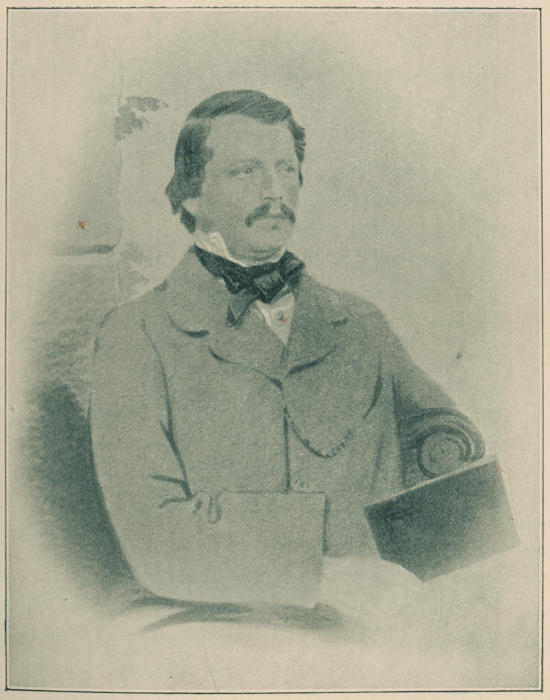
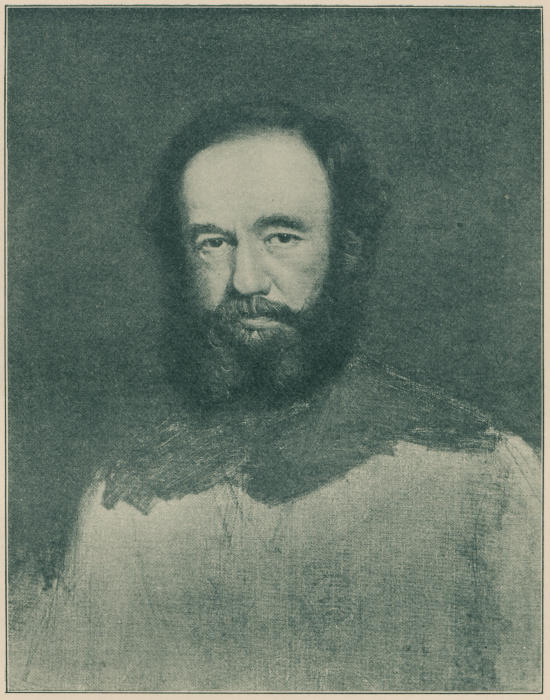
LIEUTENANT GEORGE WILLOUGHBY, Bengal Artillery
Reproduced, by kind permission of his niece, Miss Wallace, from a photograph of
an unfinished water-colour drawing, taken about 1857
The most heroic incident in Delhi that day was
the defence and explosion of the great magazine.
This was a huge building, standing some 600 yards
from the Cashmere Gate, packed with munitions of
war—cannon, ammunition, and rifles—sufficient to
have armed half a nation, and only a handful of
Englishmen to defend it. It was in charge of Lieutenant
Willoughby, who had under him two other
officers (Forrest and Raynor), four conductors (Buckley,
Shaw, Scully, and Crowe), and two sergeants
(Edwards and Stewart); a little garrison of nine
brave men, whose names deserve to be immortalised.
Willoughby was a soldier of the quiet and coolly
courageous order; his men were British soldiers of
the ordinary stuff of which the rank and file of the
British Army is made. Yet no ancient story or
classic fable tells of any deed of daring and self-sacrifice
nobler than that which this cluster of commonplace
Englishmen was about to perform. The
Three Hundred who kept the pass at Thermopylae
against the Persian swarms, the Three, who, according
to the familiar legend, held the bridge across the
Tiber against Lars Porsena, were not of nobler fibre
than the Nine who blew up the great magazine at
Delhi rather than surrender it to the mutineers.
Willoughby closed and barricaded the gates, and
put opposite each two six-pounders, doubly loaded
with grape; he placed a 24-pound howitzer so as
to command both gates, and covered other vulnerable
points with the fire of other guns. In all he
had ten pieces of artillery in position—with only nine
men to work them. He had, indeed, a score of
native officials, and he thrust arms into their reluctant
hands, but knew that at the first hostile shot
they would run.
But the Nine could not hope to hold the magazine
finally against a city in revolt. A fuse was
accordingly run into the magazine itself, some barrels
of powder were broken open, and their contents
heaped on the end of the fuse. The fuse was carried
into the open, and one of the party (Scully)
stationed beside it, lighted port-fire in hand. Willoughby’s
plan was to hold the magazine as long as
he could work the guns. But when, as was inevitable,
the wave of mutinous Sepoys swept over the
walls, Willoughby was to give the signal by a wave
of his hat, Scully would instantly light the fuse, and
the magazine—with its stores of warlike material, its
handful of brave defenders, and its swarm of eager
assailants—would vanish in one huge thunderclap!
Presently there came a formal summons in the
name of the King of Delhi to surrender the magazine.
The summons met with a grim and curt
refusal. Now the Sepoys came in solid columns down
the narrow streets, swung round the magazine, and
girdled it with shouts and a tempest of bullets. The
native defenders, at the first shot, clambered down
the walls and vanished, and the forlorn but gallant
Nine were left alone. Hammers were beating fiercely
on the gates. A score of improvised scaling-ladders
were placed against the walls, and in a moment the
Sepoys were swarming up. A gate was burst open,
but, as the assailants tried to rush in, a blast of grape
swept through them. Willoughby’s nine guns, each
worked by a single gunner, poured their thunder of
sound, and storm of shot, swiftly and steadily, on
the swaying mass of Sepoys that blocked the gate.
Lieutenant Forrest, who survived the perils of that
fierce hour, has told, in cool and soldierly language,
its story:—
Buckley, assisted only by myself, loaded and fired in
rapid succession the several guns above detailed, firing
at least four rounds from each gun, and with the same
steadiness as if standing on parade, although the enemy
were then some hundreds in number, and kept up a hot
fire of musketry on us within forty or fifty yards. After
firing the last round, Buckley received a musket ball in
his arm above the elbow; I, at the same time, was struck
in the left hand by two musket balls.
When, before or since, has there been a contest
so heroic or so hopeless? But what can Nine do
against twice as many hundreds? From the summit
of the walls a deadly fire is concentrated on the handful
of gallant British. One after another drops. In
another moment will come the rush of the bayonets.
Willoughby looks round and sees Scully stooping
with lighted port-fire over the fuse, and watching
for the agreed signal. He lifts his hand. Coolly
and swiftly Scully touches the fuse with his port-fire.
The red spark runs along its centre; there is
an earth-shaking crash, as of thunder, a sky-piercing
leap of flame. The walls of the magazine are torn
asunder; bodies of men and fragments of splintered
arms fly aloft. The whole city seems to shake with
the concussion, and a great pillar of smoke, mushroom-topped
and huge, rises slowly in the sky. It
is the signal to heaven and earth of how the Nine
British, who kept the great magazine, had fulfilled
their trust.
Of those gallant Nine, Scully, who fired the train,
and four others vanished, along with hundreds of
the mutineers, in one red rain. But, somehow,
they themselves scarcely knew how, Willoughby,
with his two officers, and Conductor Buckley found
themselves, smoke-blackened and dazed, outside the
magazine, and they escaped death, for the moment
at least.
The fugitives who escaped from the Cashmere
Gate had some very tragical experiences. Sinking
from fatigue and hunger, scorched by the flame-like
heat of the sun, wading rivers, toiling through
jungles, hunted by villagers, they struggled on, seeking
some place of refuge. Some reached Meerut,
others Umballa, but many died. Of that much-enduring
company of fugitives, it is recorded that
the women often showed the highest degree of fortitude
and patience. Yet more than one mother had
to lay her child, killed by mere exposure or heat,
in a nameless jungle grave; more than one wife
had to see her husband die, of bullet or sword-stroke,
at her feet.
But the fate of these wanderers was happier
than that of the Europeans left in the city. Some
twenty-seven—eleven of them being children and
eight women—took refuge in a house near the
great mosque. They held the house for three days,
but, having no water, suffered all the agonies of
thirst. The Sepoys set vessels of water in front of
the house, and bade the poor besieged give up their
arms and they should drink. They yielded, gave up
the two miserable guns with which they had defended
themselves, and were led out. No water was
given them. Death alone was to cool those fever-blackened
lips. They were set in a row, the eleven
children and sixteen men and women, and shot.
Let tender-hearted mothers picture that scene, transacted
under the white glare of the Indian sun!
Some fifty Europeans and Eurasians barricaded
themselves in a strong house in the English quarter
of the city. The house was stormed, the unhappy
captives were dragged to the King of Delhi’s palace,
and thrust into an underground cellar, with no
windows and only one door. For five days they
sweltered and sickened in that black hole. Then
they were brought out, with one huge rope girdling
them—men, women, and children, a pale-faced,
haggard, half-naked crowd, crouching under one of
the great trees in the palace garden. About them
gathered a brutal mob of Sepoys and Budmashes,
amongst whom was Abool Bukr, the heir-apparent
to the King of Delhi. The whole of the victims
were murdered, with every accompaniment of cruelty,
and it is said that the heir-apparent himself devised
horrible refinements of suffering.
Less than six months afterwards Hodson, of
Hodson’s Horse, shot that princely murderer, with
a cluster of his kinsfolk, under the walls of Delhi,
and in the presence of some 6000 shuddering natives,
first explaining, that they were the murderers of
women and children. Their bodies were brought
in a cart through the most public street of the city,
laid side by side, under the tree and on the very
spot where they had tortured and murdered our
women.
Mutiny grows swiftly. On Sunday night was fired,
from the ranks of the 20th Sepoys, the volley that
slew Colonel Finnis, and was, so to speak, the opening
note in the long miserere of the Mutiny. At four
o’clock on Monday afternoon the thunder of the
great magazine, as it exploded, shook the walls of
Delhi. Before the grey light of Tuesday morning
broke over the royal city every member of the British
race in it was either slain or a captive.
When a powder-magazine is fired, the interval of
time between the flash of the first ignited grain and
the full-throated blast of the explosion is scarcely
measurable. And if the cluster of keen and plotting
brains behind the Great Mutiny had carried out their
plans as they intended, the Mutiny would have had
exactly this bewildering suddenness of arrival. There
is what seems ample evidence to prove that Sunday,
May 31, was fixed for the simultaneous rising of all
the Sepoy regiments in Bengal. A small committee
of conspirators was at work in each regiment, elaborating
the details of the Mutiny. Parties were to be
told off in each cantonment, to murder the British
officers and their families while in church, to seize
the treasury, release the prisoners, and capture the
guns. The Sepoy regiments in Delhi were to take
possession of that great city, with its arsenal.
The outbreak at Meerut not merely altered the
date, it changed the character of the revolt. The
powder-magazine exploded, so to speak, in separate
patches, and at intervals spread over weeks. It was
this circumstance—added to the fact that the Sepoys
had rejected the greased cartridges, and with them
the Enfield rifle, against which Brown Bess was at a
fatal disadvantage—that, speaking humanly, robbed
the Mutiny of half its terror, and helped to save the
British Empire in India.
But, even allowing for all this, a powder-magazine—although
it explodes only by instalments—is a
highly uncomfortable residence while the explosion
is going on; and seldom before or since, in the long
stretch of human history, have human courage and
fortitude been put to such a test, as in the case of the
handful of British soldiers and civilians who held the
North-West Provinces for England during the last
days of May 1857.
Sir George Campbell, who was in Simla at the
time, has told the story of how he stood one day,
early in June, beside the telegraph operator in Umballa,
and listened while the wire, to use his own
words, “seemed to repeat the experience of Job.”
“First we heard that the whole Jullunder brigade
had mutinied, and were in full march in our direction,
on the way to Delhi. While that message was still
being spoken, came another message, to tell us that
the troops in Rajpootana had mutinied, and that
Rohilcund was lost; following which, I heard that
the Moradabad regiment had gone, and that my
brother and his young wife had been obliged to fly.”
Let it be remembered that the revolted districts
equal in area France, Austria, and Prussia put together;
in population they exceeded them. And
over this great area, and through this huge population,
the process described by the telegrams, to whose
rueful syllables Sir George Campbell listened, was
being swiftly and incessantly repeated. The British
troops did not number 22,000 men, and they were
scattered over a hundred military stations, and submerged
in a population of 94,000,000. Let the reader
imagine fifteen or sixteen British regiments sprinkled
in microscopic fragments over an area so vast, and
amongst populations so huge!
The Sepoy army in Bengal numbered 150,000 men,
and within six weeks of the shot which killed Colonel
Finnis at Meerut, of its 120 regiments of horse and
foot, only twenty-five remained under the British
flag, and not five of these could be depended upon!
A whole army, in a word, magnificently drilled, perfectly
officered, strong in cavalry, and yet more formidable
in guns, was in open and murderous revolt.
Some idea of the scale and completeness of the
Mutiny can be gathered from the single fact that
every regiment of regular cavalry, ten regiments of
irregular cavalry out of eighteen, and sixty-three out
of seventy-four regiments of infantry, then on the
strength of the Bengal army, disappeared finally and
completely from its roster!
In each cantonment during the days preceding the
revolt, the British officers on the spot were—to return
to our figure—like men shut up in a powder-magazine
with the train fired. There might be a
dozen or twenty British officers with their families at
a station held by a battery of native artillery, a
couple of squadrons of native horse, and a regiment
of native infantry—all plotting revolt and murder!
Honour forbade the British to fly. To show a sign of
mistrust or take a single visible precaution would be
to precipitate the outbreak. Many of the old Bengal
officers relied on their Sepoys, with a fond credulity
that nothing could alarm, and that made them blind
and deaf to the facts about them. “It was not,” says
Trevelyan, “till he saw his own house in flames, and
not till he looked down the barrels of Sepoy muskets,
and heard Sepoy bullets whizzing round his ears,
that an old Bengal officer could begin to believe that
his men were not as staunch as they ought to be.”
But all officers were not so blind as this. They
knew their peril. They saw the tragedy coming.
They walked day after day in front of the line of their
men’s muskets on parade, not knowing when these
iron tubes would break into red flame and flying
bullets. They lay down night after night, knowing
that the Sepoys in every hut were discussing the
exact manner and time of their murder. Yet each
man kept an untroubled brow, and went patiently
the round of his duty, thanking God when he had no
wife and child at the station to fall under the tender
mercies of the mutineers. Farquhar, of the 7th
Light Cavalry, writing to his mother at the time,
said, “I slept every night dressed, with my revolver
under my pillow, a drawn sword on my bed, and a
loaded double-barrelled gun just under my bed. We
remained in this jolly state,” he explained, “a fortnight.”
When the outbreak came, and the bungalows were
in flames, and the men were shouting and firing on
the parade-ground, it was a point of honour among
the officers to hurry to the scene and make one last
appeal to them, dying too often under the bullets of
their own soldiers. The survivors then had to fly,
with their women and children, and hide in the hot
jungle or wander over the scorching plains, on which
the white heat burns like a flame, suffering all the
torments of thirst and weariness, of undressed
wounds, and of wearing fever. If some great writer,
with full knowledge and a pen of fire, could write the
story of what was dared and suffered by Englishmen
and Englishwomen at a hundred scattered posts
throughout the North-West Provinces, in the early
stages of the Mutiny, it would be one of the most
moving and heroic tales in human records.
Sir Joseph Fayrer tells how, early in 1857, he was
a member of a tiger-shooting expedition into the
Terai. It was a merry party, and included some
famous shots and great civil officials. They had
killed their eleventh tiger when the first news of the
rising reached the party. “All my companions,”
says Fayrer, “except Gubbins, were victims of the
Mutiny during the year. Thomason was murdered
at Shah Jehanpore; Gonne in the Mullahpore district;
Colonel Fischer was killed by the men of his
own regiment; Thornhill was murdered at Seetapore;
Lester was shot through the neck during the siege of
Lucknow; Graydon was killed after the first relief of
Lucknow.” Swift-following deaths of this sort have
to be multiplied over the whole area of the Mutiny,
before we can realise what it cost in life.
Fayrer, as a single example of the sort of tragedies
which took place on every side, tells how his brother,
who was an officer in a regiment of irregular cavalry,
was killed. He was second in command of a detachment
supposed to be of loyalty beyond suspicion. It
had been sent by Lawrence from Lucknow to maintain
order in the unsettled districts. There was no sign that
the men intended to rise. The morning bugle had gone,
the troop was ready to start, and young Fayrer, who had
gone out, walked to a well with his charger’s bridle
over his arm, and was drinking water from a cup.
Suddenly one of his own troopers came up behind
him and cut him down through the back of the neck
with his tulwar. “The poor lad—only twenty-three—fell
dead on the spot, gasping out the word
‘mother’ as he fell.” The troopers instantly rode at
the three other British officers of the detachment.
One of these slew three Sepoys before he was killed
himself; the second, ill mounted, was overtaken and
slain; the third, a splendid rider, made a reckless
leap over a nullah, where his pursuers dared not
follow, and so escaped.
Before describing the great drama at Cawnpore, or
Lucknow, or Delhi, it is worth while to give, if only
as hasty vignettes, some pictures of what happened
at many of the stations scattered through Oude and
the Punjaub. They are the opening episodes of a
stupendous tragedy.
According to Sir Herbert Edwardes, it was the act
of an English boy that saved the Punjaub. A very
youthful operator—a mere lad—named Brendish, was
by some accident alone in the Delhi Telegraph
Office. When the Mutiny broke out he had to flee
like the rest; but, before leaving, he wired a somewhat
incoherent message to Umballa. “We must
leave office,” it ran; “all the bungalows are on fire,
burning down by the Sepoys of Meerut. They came
in this morning.... Nine Europeans are killed.”
That message reached Umballa, was sent on to
Lahore, and was read there as a danger-signal so expressive,
that the authorities at once decided to disarm
the native troops at that station. The cryptic
message was then flashed on to Peshawur, and was
there read in the same sense, and acted upon with the
same promptitude. Brendish was one of the few who
afterwards escaped from Delhi.
At some of the stations, where cool heads and
steadfast courage prevailed, the Sepoys were disarmed
with swiftness and decision. This was especially
the case in the Punjaub, where the cause of
England was upheld by the kingly brain of John
Lawrence, the swift decision of Herbert Edwardes,
and the iron courage of Neville Chamberlain and
of John Nicholson.
Lord Roberts has told how, on May 12, he was
present as scribe at a council of war held in Peshawur.
Round the table sat a cluster of gallant soldiers,
such as might well take charge of the fortunes
of a nation in the hour of its deadliest peril. Herbert
Edwardes was there, and Neville Chamberlain,
and Nicholson. They had to consider how to hold
the Punjaub quiet while all Bengal was in a flame
of mutiny. The Punjaub was a newly conquered
province; its warlike population might well be expected
to seize the first opportunity of rising against
its conquerors. It was held by an army of over
80,000 troops, and of these only 15,000 were British—the
rest, some 65,000, were almost sure to join the
Mutiny. For every British soldier in the Punjaub,
that is, there were four probable mutineers, while
behind these was a warlike population, just subdued
by the sword, and ready to rise again.
But the cool heads that met in that council were
equal to their task. It was resolved to disarm all
doubtful regiments, and raise new forces in their
stead in the Punjaub itself, and from its wild frontier
clans. A movable column, light-footed, hard-hitting,
was to be formed under Neville Chamberlain’s command,
with which to smite at revolt whenever it
lifted its head. So the famous Movable Column
came into being, commanded in turn by Chamberlain
and by Nicholson. That column itself had to
be purged heroically again and again to cleanse it
from mutinous elements, till it practically came to
consist of one field-battery, one troop of horse-artillery,
and one infantry regiment, all British. Then
it played a great part in the wild scenes of the
Mutiny.
Before new levies could be raised in the Punjaub,
however, the English had to give some striking
proof of decision and strength. No Indian race
will fight for masters who do not show some faculty
for command. The crisis came at Peshawur itself,
towards the end of May. The Sepoys had fixed
May 22 for rising against their officers. On the
21st the 64th Native Infantry was to march into
Peshawur, and on the following morning the revolt
was to take place. Herbert Edwardes and Nicholson,
however, were the last men in the world to be caught
off their guard. At 7 A.M. on the morning of the
21st, parade was held, and, as the result of some
clever manœuvres, the five native regiments found
themselves confronted by a line of British muskets,
and ordered to “pile arms.” The intending mutineers
were reduced, almost with a gesture, to the
condition of an unarmed mob, and that lightning-stroke
of decision saved the Punjaub. Levies poured
in; new regiments rose like magic; a loyal army
became possible.
Little more than a fortnight afterwards, Neville
Chamberlain discovered a plot in the 35th Native
Infantry, and promptly blew two ringleaders from
the guns, the first instance of that dramatic form
of punishment in the Mutiny. Later, when Nicholson
took command of the Movable Column, he was
compelled to disarm two native regiments, the 35th
and the 33rd. The 33rd was on its march to join
the column, and Nicholson conducted the business
with so nice an adjustment of time and method that
the 35th had been disarmed, and their muskets and
belts packed in carts and sent off to the fort, just as
the 33rd marched up. As it halted it found itself,
not side by side with a regiment of accomplices, but
in front of a long and menacing line of British
infantry and guns, and Roberts himself rode forward
with the order to its colonel to pile arms.
“What! disarm my regiment?” said that astonished
officer, who was serenely unconscious that there was
a mutinous brain under every shako in his regiment.
When the order was repeated, the old colonel
broke into actual tears. But there were sterner wills
and stronger brains than his in command, and the
33rd was, in turn, reduced to harmlessness.
At Lahore, again, the Sepoys had an elaborate
plot to kill their officers, overpower the European
troops, and seize the treasury and the guns. Lahore
was a city of 90,000 inhabitants, with a garrison of
2500 Sepoys in the city itself. The city troops were
to rise first, and their success was to be signalled to
Meanmeer, the military cantonment, six miles distant.
Mutiny at Lahore was to be followed by revolt
through all the military stations of the district, from
the Rabee to the Sutlej. The plot, however, was discovered.
General Corbett, a cool and gallant soldier,
resolved to disarm the whole native garrison.
On the night of May 12, three days before the date
fixed for the Mutiny, a military ball was to be held.
This arrangement was not changed, lest the suspicions
of the Sepoys should be aroused, and dancing
was kept up till two o’clock in the morning. Then
the officers at grey dawn hurried to the parade-ground,
where, by instructions issued the day before,
the whole brigade was assembled, nominally to hear
some general orders read. These were read in the
usual fashion at the head of each regiment. Then
some brigade manœuvres followed, and these were so
adroitly arranged that, at their close, the native regiments
found themselves in quarter-distance column,
with five companies of a British regiment, the 81st,
opposite them in line, the guns being still in the rear
of the 81st.
In a single sentence, brief and stern, the order was
given for the native regiments to “pile arms.” The
Grenadiers of the 16th, to whom the order was first
addressed, hesitated; the men began to handle their
arms; for one breathless moment it was doubtful
whether they would obey or fight. But simultaneously
with the words “pile arms,” the 81st had fallen back,
coolly and swiftly, between the guns, and the Sepoys,
almost at a breath, found themselves covered by a
battery of twelve pieces loaded with grape, the artillerymen
standing in position with burning port-fires,
whilst along the line of the 81st behind ran the stern
order, “Load,” and already the click of the ramrods
in the muskets was heard.
The nerve of the Sepoys failed! Sullenly they
piled arms, and 600 English, by adroitness and
daring, disarmed 2500 Sepoys without a shot! What
five minutes before had been a menace to the British
power was made harmless.
Montgomery, the chief civil officer at Lahore,
divides with Corbett the honour of the brilliant
stroke of soldiership which saved the city. Never
was there a less heroic figure in outward appearance
than that of Montgomery. He was short, stout, soft-spoken,
rubicund-faced, and bore, indeed, a ludicrous
resemblance to Mr. Pickwick as depicted by the
humorous pencil of “Phiz.” He was familiarly
known, as a matter of fact, to all Englishmen in his
province by the sobriquet of “Pickwick.” But
nature sometimes conceals an heroic spirit within
a very unheroic-looking body. If in outward look
there was something sheep-like in Montgomery’s
appearance, there was a lion-like strain in his
courage. He had only a hint of the coming storm.
A couple of scanty telegrams brought in the news
of the mutiny at Meerut and the seizure of Delhi.
With quick vision Montgomery read the temper of
the native troops at Meanmeer, and, with swifter decision
than even that of Corbett, he advised that they
should be instantly disarmed. That decision averted
a great disaster.
The whole story shows what is possible to clear
judgment and resolute courage; but where these
failed, or where some old Bengal officer retained his
blind and fond credulity as to the “staunchness” of
his men, then great tragedies became possible.
Thus at Futteghur, some seventy miles from Cawnpore,
the 10th Native Infantry, with some irregular
troops, held the cantonments. General Goldie was
divisional commander; Colonel Smith held command
of the 10th, and cherished a piously confident belief
in the loyalty of his Sepoys. The civilians, with a
shrewder insight into the state of affairs, believed
mutiny certain, and murder highly probable, and determined
to leave the station. On June 4 a little
fleet of boats, laden with almost the entire English
colony in the place—merchants, shopkeepers, missionaries,
with their wives and children—started
down the river, to the huge disgust of Colonel Smith,
who thought their departure a libel on his beloved
Sepoys. Part of the company found refuge with a
friendly Zemindar, while three boats, containing
nearly seventy persons—of whom forty-nine were
women and children—pushed on to Cawnpore. In
Cawnpore, however, though they were in ignorance of
the fact, Wheeler and his gallant few were already
fighting for life against overwhelming odds.
News soon reached the Sepoy lines at Cawnpore
that three boat-loads of Sahibs were on the river, and
a rush was made for them. The poor victims had
pulled in to the bank and were enjoying “afternoon
tea” when the horde of mutineers burst upon them.
Some tried to hide in the long grass, which was set
on fire above them. The rest, scorched, wounded,
half-naked, with bleeding feet—mothers trying to
shelter or carry their children—were dragged to the
presence of Nana Sahib. The ladies and children
were ordered to sit on the ground; their husbands,
with their hands tied, were arranged in careful order
behind them. Being thus picturesquely arranged for
easy murder, some files of the 2nd Cavalry were
marched up to kill the whole. The process was
lengthy, wives clinging to their husbands, mothers
trying to shelter their little ones with their own
bodies from the keen cavalry swords. Nana Sahib
watched the whole process with the leisurely and discriminating
interest of a connoisseur.
On June 18 Colonel Smith’s trusted Sepoys broke
into open revolt at the station, whence these poor
fugitives had fled. The little British garrison, consisting
of thirty fighting men, with sixty ladies and
children, took refuge in a low mud fort, and held it
for nearly three weeks. Then they fought their way
to their boats and fled. They were fiercely pursued.
One boat grounded, and its miserable passengers
were summarily murdered. Death by bullets, by
sunstroke, by drowning, pursued the rest. One boat-load
escaped, but escaped only to reach Cawnpore,
and to perish amid the horrors of the slaughter-house
there.
One survivor has left a record of that dreadful
voyage. He was in the boat that first grounded and
was boarded by the Sepoys. He describes how the
passengers were shot, and how “Major Robertson,
seeing no hope, begged the ladies to come into the
water rather than fall into their hands. While the
ladies were throwing themselves into the water I
jumped into the boat, took up a loaded musket, and,
going astern, shot a Sepoy.... Mr. and Mrs. Fisher
were about twenty yards from the boat; he had his
child in his arms, apparently lifeless. Mrs. Fisher
could not stand against the current; her dress, which
acted like a sail, knocked her down, when she was
helped up by Mr. Fisher.... Early the next morning
a voice hailed us from the shore, which we recognised
as Mr. Fisher’s. He came on board, and informed
us that his poor wife and child had been drowned in
his arms.”
For skill, daring, and promptitude, nothing exceeded
the fashion in which the incipient mutiny at
Multan was trampled out. At no other post were
the conditions more perilous. The garrison consisted
of a troop of native horse-artillery, two regiments of
native infantry, and the 1st Irregular Cavalry; the
only English troops were 50 artillerymen in charge
of the magazine. Here, then, were 50 British artillerymen,
without guns, opposed to over 3000 Sepoys—horse,
foot, and artillery!
The decisive factor in the problem was the character
of the British commander, Major Chamberlain.
His strong will and genius for command held the 1st
Irregular Cavalry steady. They were Hindus from
the neighbourhood of Delhi, with a full measure of
the superstition and pride of caste which swept away
other regiments. But they believed in their commander.
He swayed their imaginations as with a
touch of magic. The spell of his looks and voice, his
imperious will, overbore the impulse to revolt. His
men declared they would follow him to the death!
Chamberlain resolved to disarm the other native
regiments, and he performed the perilous feat, not
only with miraculous audacity, but with a miraculous
nicety of arrangement.
The 2nd Punjaub Infantry and the 1st Punjaub
Cavalry were to arrive at the station on a given
day. They were native troops, but could—for the
moment at least—be trusted. The new troops came
in at nightfall. At 4 A.M. the next morning the two
Sepoy regiments and a troop of native artillery were
marched out as if for an ordinary parade. They
were suddenly halted; the Punjaub troops quietly
marched betwixt them and their lines; the fifty
English gunners took their places beside the guns of
the native artillery, and a little band of Sikh cavalry
that could be trusted rode up to the flank of the guns.
Then Chamberlain gave the order to the suspected
regiments to “pile arms.” One Sepoy shouted,
“Don’t give up your arms! Fight for them;” but
his English adjutant instantly grasped him by the
throat, shook him as a terrier would shake a rat, and
flung him on the ground. The mutinous Sepoys
hesitated; their courage sank; they meekly piled
arms, were marched back weaponless to their barracks,
and the station was saved. But it was a great
feat to disarm a whole garrison with only fifty English
gunners. The regiment of irregular cavalry was
permanently saved by the spell of Chamberlain’s
authority, and, as a reward, is still the 1st Regiment
of Bengal Cavalry.
Some of the revolting regiments, it is satisfactory
to know, had very distressful experiences. They
found that mutiny was a bad investment. Let the
tale of the 55th, for example, be told. The regiment
broke into open mutiny at Mardan on May 22, fired
on their officers, and marched off to the hills with
the regimental colours and treasure. Its colonel,
Spottiswoode, blew out his brains in mingled grief
and despair when he saw his “faithful” Sepoys in
open revolt.
Meanwhile, the most menacing figure in all the
great drama of the Mutiny—that of Nicholson—made
its appearance on the track of the mutineers. Nicholson
overtook them on the 24th, after a ride of seventy
miles, slew 150, captured another 150 with the stolen
colours, and promptly executed forty of his prisoners
by blowing them from his guns. The rest of the
broken regiment crossed the border, were hunted
down by the hill-tribes, fell into the hands of Mohammedan
fanatics, were “converted” by the argument
of whip and sword, or were sold as slaves. “One fat
old subahdar,” says Mr. Cave-Browne, “was sold for
four annas (sixpence)”! Mutiny, it is clear, proved a
very bitter experience for the unhappy 55th! The
legend that has grown round the wanderings of this
broken regiment is told by Mr. Rudyard Kipling in
his vivid story, “The Lost Legion.”
CHAPTER III STAMPING OUT MUTINY
Perhaps the most characteristic story of Sepoy
outbreak is that at Allahabad. The city stands
at the junction of the Ganges and the Jumna, 500
miles from Calcutta, and, with its strong fortress and
great arsenal, was a strategic point scarcely second
in importance to Delhi. It had a population of
75,000, highly fanatical in temper. Its arsenal was
one of the largest in India, having arms for 40,000
men and great stores of artillery. Yet, with the
exception of the magazine staff, there was not a
British soldier in the city! It was garrisoned by the
6th Native Infantry, a wing of a Sikh regiment, the
9th, a battery of native artillery, and some native
cavalry.
Colonel Simpson of the 6th, who was in command,
cherished the most enthusiastic faith in his men.
He looked on his cherished Sepoys as a regiment of
mere dusky-skinned Sir Galahads; each one of them
was as faithful as Milton’s Abdiel! Some sixty
superannuated British artillerymen, the youngest of
them over fifty years of age, had been thrown hurriedly
into the fort itself as a garrison; and Colonel
Simpson strongly urged that his regiment should be
taken into the fort in their place as “a proof of confidence.”
This would have been like putting a committee
of wolves inside the fold!
At evening parade on June 6, Colonel Simpson
read to his Sepoys the formal thanks of the Governor-General
for their virtuous offer to go out and
fight the wicked mutineers at Delhi. He added a
glowing eulogium of their loyalty on his own account.
The Sepoys cheered, Colonel Simpson and
his fellow-officers adjourned to the mess-room, and
no doubt discoursed with great comfort on the
much-enduring fidelity of their men. Within four
hours of being thanked by Lord Canning and praised
by Colonel Simpson, the “faithful” Sepoys of the
6th Infantry had murdered seventeen officers and all
the women and children of English blood they could
capture, and were in full march to Delhi.
The tale is typical. At nine o’clock a bugle call
sounded from the lines—it was the signal for revolt.
The men rushed to arms. The Sepoy artillerymen
holding the bridge swung their guns round, and
opened fire on their officers. Harward and Alexander,
in command of the Native Irregular Horse,
and both officers of great promise, leaped into their
saddles, and galloped fiercely to the bridge to recapture
the guns. When they gave the order to
charge, their treacherous followers suddenly pulled
up; and, followed by only three troopers, the
officers rode at the guns. Alexander, rising in his
stirrups for one gallant sword-stroke, was shot
through the heart; and Harward had to gallop
for his life.
Simpson and his officers in the meanwhile ran to
the parade-ground to “expostulate” with their men.
Five officers were instantly shot down. Colonel
Simpson was beginning to address a new series of
compliments to his faithful Sepoys, but they turned
their muskets upon him, and interrupted his eloquence
with a volley. By some miracle he escaped
and galloped off to the fort. He had to ride past the
mess-house, and the mess guard turned out and took
pot shots at him as he rode. The unhappy colonel
reached the gate of the fort with a dying horse, a
wounded arm, and an entirely new theory of Sepoy
loyalty.
But was the fort itself safe? Its garrison consisted
of the sixty odd superannuated artillerymen, a few
civilian volunteers, the wing of a Sikh regiment, and
a company of the 9th Native Infantry. These men
held the gate, and were, of course, only waiting to
open it to their revolted comrades. If the Sikhs
joined hands with them, there remained nothing but
hopeless massacre for the British. And only five
days before, at Benares, it must be remembered, a
Sikh regiment had opened fire on its officers! As a
matter of fact, the Sikhs in the fort were effervescing
with excitement. Mutiny was in the air. Upon
whom the Sikh muskets might be turned, their
owners themselves scarcely knew. It was a crisis
of the sort which overwhelms weak men, but gives a
man of heroic will a supreme opportunity. And, fortunately,
a man with all the decision and courage
the moment needed was on the spot.
Lieutenant Brasyer had fought as a private in the
ranks through the Sutlej campaigns, and won a commission
by his coolness and daring. He possessed
exactly the genius needed for commanding irregular
soldiery. He was an athlete, a fine swordsman, a
man of the swiftest decision and most gallant courage.
He is not unworthy, indeed, to be ranked for leadership
and personal daring with Hodson of “Hodson’s
Horse.” Brasyer had first to master his Sikhs,
trembling on the verge of revolt themselves. Archibald
Forbes has described his method: “Standing
over the magazine with a red-hot iron in his hand,
he swore by Nanac, Ram Das, Govind, and all other
Gooroos of the Sikhs, that if his men did not promptly
fall in and obey his orders he would blow the regiment
to the Sikh equivalent of Hades.”
Brasyer’s glance and voice, his imperious will and
daring, mastered the Sikhs, and they fell obediently
into rank. He instantly marched them down, with
loaded muskets, to the gate, and, with the help of the
artillerymen with their port-fires, drove out the company
of Sepoys that held it, and the fort was saved!
But to master Sepoys in open revolt, by Sikhs on the
edge of revolt, was a great feat, and shows for how
much, at such a crisis, one clear heroic will counts.
That night Allahabad was given up to outrage and
murder. Only above the fort itself flew the flag of
England, and in the fort the handful of British
officers, determined that the great arsenal should not
fall into the hands of mutineers, were preparing
to copy Willoughby’s desperate example at Delhi.
Russell, of the artillery, who was in charge of the
magazine, ran trains of powder into it, and stood
ready to blow it up in the event of capture.
In the city itself every European or Eurasian was
hunted like a rat through the streets, and slain with
every accompaniment of cruelty. Outrage, in the
ordinary sense, was not, on the whole, a marked
feature of the Great Mutiny. The Sepoys, that is,
were on fire with cruelty rather than with lust. But
their cruelty spared neither age nor sex. The wife of
a captain, according to one story current at the time—and
perhaps not true—was literally boiled alive in
ghee, or melted butter. Children were tossed on
bayonets, men roasted in the flames of their own
bungalows; women were mutilated and dismembered.
The Sepoys plundered the Treasury, carrying
off some £300,000 in booty.
One detail of the Allahabad massacre peculiarly
shocked the imagination of British soldiers wherever
the tale was told. At the mess-table of the 9th, that
fatal night, there sat eight fresh-faced and boyish
cadets just out from England. They had not yet
joined their regiments, and military life, with all its
fun and excitement, lay in the glamour of the
unknown before them. When the bugle rang out on
the parade-ground these eight unposted boy ensigns
ran out with the other officers. They fell into the
hands of the mutineers, and seven had their throats
cut like sheep. The eighth, a boy of sixteen, was
left for dead, but survived in spite of horrible wounds
for four days, hiding himself in a ravine. On the
fifth day he was discovered, dragged to the native
lines, and thrust into a hut as a prisoner.
He found there a Christian catechist, who had
formerly been a Mohammedan, and who was being
tortured by the Sepoys to make him renounce his
faith. The catechist’s courage had given way, but
the gallant English lad—himself only sixteen years
of age—urged the unhappy catechist, “Don’t deny
Christ! Never deny Christ!” Neill reached Allahabad
in time to rescue both catechist and ensign.
But the ensign, Arthur Cheek, died of his wounds
four days after Neill’s arrival. He had joined his
regiment just eighteen days when murdered in this
tragical fashion by his own men. It may be imagined
how the massacre of the “poor little griffins” moved
the British soldier to wrath everywhere.
For a few days mutiny and riot reigned supreme at
Allahabad. Then, hot from Benares, there appeared
on the scene Neill with a handful of his “Lambs,” as
the Madras Fusileers, with admiring irony, were
called. “Thank God, sir,” said the sentry at the gate
of the fort, as Neill rode in; “you’ll save us yet!”
Neill is one of the cluster of great soldiers thrust
into sudden fame by the crisis of the Mutiny, and is
hardly to be judged by the standard of smaller men
and of a tamer period. He was of Scottish blood, an
Ayrshire man, with a vehement fighting quality, and
a strain of iron resolve, which had come to him,
perhaps, from a line of Covenanting ancestry. He
was a veteran soldier, accustomed to govern wild
clans and irregular troops, and had held high command
in the Turkish contingent in the Crimea. On
the domestic side, he was, as many stern and rough-natured
men are, of singular tenderness. He was
strongly religious, too, though he borrowed his religion
rather from the Old Testament than the New.
When the Mutiny broke out Neill found himself in
command of the Madras Fusileers, a regiment which
included many wild spirits in its ranks, but which, in
fighting quality, was a warlike instrument of singular
efficiency. Neill and his “Lambs” were summoned
from Madras by the crisis in Bengal, and Neill’s best
qualities, as well as his worst—his fighting impulse,
his Scottish pride of race, the natural vehemence of
his temper, his soldierly hate of mutiny, the wrath of
a strong man at outrages on women and children, and
his fierce contempt for the feebleness shown by some
of the “arm-chair colonels” of the Bengal Army—all
threw their owner into a mood in which he was prepared
to dare anything to crush the Mutiny and to
punish the mutineers.
The Fusileers landed on the railway wharf at Calcutta,
as night fell, on May 23. The great city of
Benares was on the verge of revolt, and Neill’s
“Lambs” were to be hurried up by express to its
rescue. The station-master told Neill that unless he
could get his men ashore in three minutes the train
would start without them. But Neill was not the
man to allow a railway time-table to stand betwixt
him and the suppression of a mutiny. With an
abrupt gesture, he put the station-master in charge
of a sergeant and a file of Fusileers. The unhappy
official shouted for help, but in another second
stokers, firemen, and guard were in a row against the
station wall, with a couple of “blue-caps” in charge
of each. At the double the Fusileers came up the
wharf, filed into the carriages, and the train, carrying
the left wing of the regiment, moved off to Raneegange;
thence the detachment was carried by bullock-carts
to Benares. Leaving the bulk of his men to follow,
Neill pushed on with the leading detachment to
Benares.
Nowhere, perhaps, did English courage shine out
with a clearer flame than at Benares. Benares is the
holy city of Hinduism; it had a population of
300,000, fanatical and turbulent in the highest
degree. The cantonment was held by three Sepoy
regiments—all pledged to revolt—150 men of a
British regiment, the 10th, and some thirty British
gunners, with half a battery of artillery, under the
command of Olpherts. But the cluster of soldiers
and civilians responsible for the city—Tucker the
commissioner, Frederick Gubbins the judge, Lind
the magistrate, Ponsonby the brigadier, and Olpherts
in command of the guns—held on to their post; by
mere cool audacity kept the turbulent city in awe,
and the mutinous Sepoys from breaking out; and
sent on to other posts in greater peril than their
own such scanty reinforcements of British troops
as reached them. In the Commissioner, Tucker, at
least, this heroic courage had a religious root. “The
twenty-second chapter of 2 Samuel,” he wrote to
Lord Canning, “was their stand-by.” “The Lord is
my rock, and my fortress, and my deliverer,” is the
opening verse of David’s song in that chapter; “the
God of my rock; in Him will I trust. He is my
shield, and the horn of my salvation, my high tower,
and my refuge.”
Neill reached the city on June 3, and found himself
on the very edge of a tragedy. The Sepoys had
arranged for an outbreak on the night of June 4.
The native troops numbered over 2000; the British
troops, as we have seen, consisted of 150 men of the
10th, and thirty artillerymen with three guns. To
these Neill added sixty of his “Lambs” whom he
had brought with him. Neill put the impress of his
vehement will on the brigadier, Ponsonby, in charge
of the station, and at half-an-hour’s notice it was resolved
to disarm the Sepoys.
The business was ill-managed. The Sepoys commenced
to shoot, the Sikhs turned on their officers.
Ponsonby, an old man, found “the sun” and the
strain of the scene too much for him, and visibly
broke down. He dismounted, and Neill, who had
been grimly watching the scene, said abruptly,
“General, I assume command.” Ponsonby assented
in silence, and Neill instantly opened on the mutineers
with grape and musketry fire, and, after a few
minutes’ furious shooting, Sikh and Sepoy fled. The
250, that is, destroyed, in a military sense, the 2000!
Having stamped out the Mutiny—or, rather,
scattered the mutineers—Neill devoted the next two
or three days to punishing it. The Governor-General
telegraphed orders to push on to Allahabad, but
Neill believed in making thorough work, and he
wired back, “Can’t move; wanted here.” And for
the next three days he kept the gallows busy, and
hanged without pause or pity. The Sepoys had shot
down their officers, and murdered women and children,
and Neill was bent on showing that this was
a performance which brought in its track swift and
terrible punishment. “Colonel Neill’s hangings”
were, no doubt, of heroic scale, and, looked at through
the cold perspective of forty years, wear a very black
aspect. But Neill, rightly or wrongly, held that to
strike, and to strike hard, and to strike swiftly, was
the one policy in such a crisis.
Benares being secure, Neill pushed on across the
seventy miles of dusty, heat-scorched road to Allahabad.
He started with only forty-four of his
“Lambs,” and covered the seventy miles in two night
marches. When they reached the Ganges, almost
every fourth man was down with sunstroke, Neill
himself being amongst the number, and his men only
kept him up by dashing buckets of water over his
head and chest. The boat pushed from the bank;
it was found to leak at a dozen points, and began to
sink. The “blue-caps” relanded, and their officer,
Spurgin, called for volunteers to beat the banks of
the river in search of another boat.
Almost every man able to walk volunteered, and,
in the heavy sand of the river-bank, with the
furnace-like heat of an Indian sun setting on fire
the very air they breathed, the Fusileers began
their search for a boat to carry them across to
Allahabad. More than one brave fellow fell and
died from heat and exhaustion. But a boat was
found, the gallant forty crossed, and marched—as
many of them as could still keep their feet—a
tiny but dauntless band, through the gates of
the fort.
Other detachments followed quickly, and Neill
flung himself with all the fire of his Scottish blood
into the task of restoring the British raj in the
great city. At daybreak he opened with his guns,
from the fort, on the suburb held by the revolted
Sepoys, and then sallied out with his scanty force,
and burnt it over their rebel heads. “I myself,”
he wrote to his wife, “was almost dying from complete
exhaustion;” but his fierce spirit overbore the
fainting body that carried it. He armed a river
steamer with a howitzer and a party of volunteer
riflemen, and employed it as a river patrol. He
launched the fierce Sikhs—by this time heartily
loyal—on the villages.
They were wild soldiers, gaunt, sinewy, and eager—the
“Singh log” (“the lion people”), as they
called themselves. Maude has left a graphic picture
of the Sikhs who, at Allahabad, followed
Brasyer as, with his flowing white beard, he led
them in pursuit of the broken Sepoys, or hung
with soldierly obedience on Neill’s stern orders.
“When no fighting was on hand,” he says, “squads
of the tall, upright, Hebraic-visaged Sikhs used to
march into their commanding officer’s tent, where
they stood at attention, in silence, with one hand
raised at the orthodox salute. ‘What do you want,
my men?’ was the question in Hindustani. ‘May
it please the protector of the poor, we want two
days’ leave.’ ‘What for?’ ‘To get drunk, Sahib!’
And their request, being considered reasonable, was
usually granted!”
Neill, by the way, had to use these by no means
ascetic Sikhs to keep his own “blue-caps” sober.
The stocks of all the merchants in the city were
practically without owners, and the finest champagnes
and brandies were selling at 6d. per bottle.
For a day or two it seemed probable that Neill’s
little force would be swept out of existence in
a mere ignoble torrent of drunkenness. Neill
threatened the whip and the bullet in vain; and
finally marched up the Sikhs and took peremptory
possession of all intoxicating drinks.
On June 18 the fighting was over, the British
were masters both of fort and city, where, fourteen
days before, they had been little better than prisoners
or fugitives. Then was repeated, in yet sterner
fashion, the retribution which had struck terror
through Benares. The gallows in Allahabad groaned
under its heavy and quick-following burdens. In
his diary Neill wrote: “God grant that I may have
acted with justice. I know I have with severity, but,
under all the circumstances, I trust for forgiveness.
I have done all for the good of my country, to re-establish
its prestige and power, and to put down
this most barbarous and inhuman insurrection.”
Then he recites cases of outrage and mutilation on
English ladies and on little children, with details
that still chill the natural blood with horror to
read.
The Sepoys, it is to be noted, when the fighting
was over, took their penalty with a sort of composed
fatalism, to the Western imagination very
amazing. Sir George Campbell tells the story of
the execution of an old native officer, a subhadar,
which he witnessed. “He was very cool and quiet,
and submitted to be executed without remonstrance.
But the rope broke, and he came down to the ground.
He picked himself up, and it was rather a painful
scene for the spectators. But he seemed to feel
for their embarrassment, and thought it well to
break the awkwardness of the situation by conversation,
remarking that it was a very bad rope,
and talking of little matters of that kind till another
rope was procured, which made an end of him!”
It would be easy to write, or sing, a new and more
wonderful Odyssey made up of the valiant combats,
the wild adventures, and the distressful wanderings
of little groups of Englishmen and Englishwomen,
upon whom the tempest of the Mutiny broke.
Forbes-Mitchell, for example, tells the story of
Robert Tucker, the judge at Futtehpore. Tucker
was a great hunter, and also, like many Indian
officials, an earnestly religious man, with an antique
sense of duty. When the Mutiny broke out he
despatched every European to Allahabad, but refused
to move himself. This solitary Englishman,
in a word, was determined to defend Futtehpore
against all comers! Believing the native officer in
charge of the police to be loyal, he sent a message
to him asking him to come and make arrangements
for the protection of the Treasury. This “loyal”
official sent back word that the judge Sahib need
not trouble himself about the Treasury; that, in
the cool of the evening, he, with his “loyal” police,
would come down and dismiss the dog of a judge
himself to Hades!
Tucker had a hunter’s armoury—rifles, smooth-bores,
and hog spears. He loaded every barrel, barricaded
every door and window, and waited quietly,
reading his Bible, till, when the cool breath of evening
began to stir, he saw the police and the local
budmashes, with the green banner of Islam fluttering
over their heads, marching down to attack him.
Tucker was offered his life on condition that he
abandoned his Christianity. Then the fight broke
out. For hours the musketry crackled, and was
answered by the sharp note of Tucker’s rifle. Before
midnight the brave judge lay, riddled with bullets
and pierced with many spear-thrusts, dead on his
own floor. But all round his house were strewn the
bodies of those who had fallen before his cool and
deadly aim.
Later on, at Kotah, a similar tragedy took place,
the story of which is told by George Lawrence.
Major Burton, the Resident at Kotah, with his two
sons—one aged twenty-one, the other a lad of sixteen—and
a single native servant, held the Residency
for four hours against native troops with artillery,
and a huge crowd of rioters. The Residency was at
last set on fire, and Major Burton proposed to
surrender on condition that the lives of his sons
were spared. The gallant lads indignantly refused
to accept the terms. They would all die together,
they declared. They were holding the roof of the
Residency against their assailants, and, as Lawrence
tells the story, “they knelt down and prayed for
the last time, and then calmly and heroically met
their fate.” The mob by this time had obtained
scaling-ladders. They swept over the roof, and slew
the gallant three. Major Burton’s head was cut off,
paraded round the town, and then fired from a gun.
One of the most surprising of these personal
adventures was that which overtook the Deputy
Commissioner of Delhi, Sir T. Metcalfe. Wilberforce,
in his “Unrecorded Chapter of the Indian
Mutiny,” tells the tale, and says he heard it twice
over from Sir T. Metcalfe’s own lips—though
Wilberforce’s stories sometimes are vehemently suspected
to belong to the realm of fiction rather than
of sober history. His account of Metcalfe’s adventure,
however, is at least ben trovato.
Metcalfe escaped from Delhi on horseback, hotly
pursued by some native cavalry. His horse broke
down, and in despair Metcalfe appealed to a friendly-looking
native to conceal him from his pursuers.
The man led him to a cave, told him he would
save him if possible, and, striking his horse on the
flank, sent it galloping down the road, while Metcalfe
crept through the black throat of the cave
into concealment. Presently Metcalfe heard his
pursuers ride up, fiercely question his protector, and
finally propose to search the cave.
On this my friend burst out laughing, and, raising his
voice so that I must hear, he said, “Oh yes, search the
cave. Do search it. But I’ll tell you what you will find.
You will find a great red devil in there; he lives up at
the end of the cave. You won’t be able to see him, because
the cave turns at the end, and the devil always stands
just round the turn, and he has got a great long knife
in his hand, and the moment your head appears round the
corner he will slice it off, and then he will pull the body
in to him and eat it. Go in; do go in—the poor devil is
hungry. It is three weeks since he had anything to eat,
and then it was only a goat. He loves men, does this red
devil; and if you all go in he will have such a meal!”
Metcalfe guessed that he was intended to hear this
speech and act upon it. The cave, a short distance
from the entrance, turned at right angles. He stood
with his sword uplifted just round the corner, while
a line of dismounted cavalry, in single file, one
daring fellow leading, came slowly up the cave. As
soon as the leader put his head in the darkness
round the corner, Metcalfe smote with all his
strength. The fellow’s head rolled from his body,
and his companions, with a yell of terror, and tumbling
one over another in the darkness, fled. “Did
you see him?” demanded Metcalfe’s friend outside.
“Do go back; he wants more than one.” But the
rebel cavalry had had enough. The men who had
gone up the cave declared that they had actually
seen the red fiend, and been scorched by the gleam
of his eyes; and, mounting their horses, they fled.
“Why did you save my life?” Metcalfe asked his
protector. “Because you are a just man,” was the
reply. “How do you know that?” asked Metcalfe.
“You decided a case against me in your court,” was
the unexpected reply. “I and all my family had
won the case in the inferior courts by lying, but you
found us out, and gave judgment against us. If you
had given the case for me I would not have saved
your life!”
Wilberforce tells another tale which graphically
illustrates the wild adventures of those wild days.
Early one morning he was on picket duty outside
Delhi, and in the grey dawn saw two men and a boy
hurrying along the road from the city. They were
evidently fugitives, and, telling his men not to fire
on them, Wilberforce went forward to meet them.
When the group came up the boy ran forward, threw
his arms round Wilberforce’s neck, and, with an exclamation
in English, kissed him. The “boy” was
a woman named Mrs. Leeson, the sole survivor of the
Delhi massacre. She had been concealed for more
than three months by a friendly native, and had at
last escaped disguised as an Afghan boy.
When the Mutiny broke out she, with some other
ladies and a few Englishmen, took refuge in a cellar,
and for nearly three days maintained a desperate
defence against the crowds attacking them. The
hero of the defence was a Baptist missionary, a
former shipmate of Wilberforce’s, “a very tall and
powerful man, with a bloodless face, grey eyes, a
broad jaw, and a determined mouth.” One by one
the men holding the cellar fell. Food failed, the
ammunition was exhausted, and at last, behind the
bodies of the fallen, piled up as a breastwork, stood
only the brave missionary, with nothing but his
sword to protect the crouching women and children.
“Stripped to the waist, behind the ghastly rampart
of the dead, the hero stood; and for hours this
Horatius held his own. At last he fell, shot through
the heart, and the bloodthirsty devils poured in.”
Mrs. Leeson was covered by some of the dead bodies,
and so escaped the doom of the other ladies, and at
night crept out of that pit of the dead. She wandered
through the dark streets, the only living
Englishwoman in the great city, and saw, hanging
up on the trees in the dusk, the headless trunks of
white children and the mutilated bodies of Englishwomen.
By happy chance she met a pitying native,
who concealed her until she escaped in the fashion
described, with more or less of imagination, by
Wilberforce.
CHAPTER IV CAWNPORE: THE SIEGE
The annals of warfare contain no episode so painful as
the story of this siege. It moves to tears as surely as the
pages in which the greatest of all historians tells, as only
he can tell, the last agony of the Athenian host in Sicily.
The sun never before looked on such a sight as a crowd of
women and children cooped within a small space, and exposed,
during twenty days and nights, to the concentrated
fire of thousands of muskets and a score of heavy cannon.
In these words Sir George Trevelyan sums up the
famous struggle round the low mud-walls of
Wheeler’s entrenchments at Cawnpore more than
forty years ago; a struggle in which Saxon courage
and Hindu cruelty were exhibited in their highest
measure, and which must always form one of the
most heartbreaking and yet kindling traditions of
the British race. Volumes have been written about
Cawnpore, but Trevelyan’s book remains its one
adequate literary record. The writer has a faculty
for resonant, not to say rhythmic prose, which recalls
the style of his more famous uncle, Macaulay, and
in his “Cawnpore” his picturesque sentences are
flushed with a sympathy which gives them a more
than literary grace.
Cawnpore at the time of the Mutiny was a great
city, famous for its workers in leather, standing on
the banks of the sacred Ganges, 270 miles S.E. from
Delhi, and about 700 miles from Calcutta. It was a
military station of great importance. Its vast magazine
was stored with warlike material of every sort.
It was the seat of civil administration for a rich
district. But the characteristic British policy, which
allows the Empire to expand indefinitely, without any
corresponding expansion of the army which acts as
its police and defence, left this great military station
practically in the hands of the Sepoys alone. The
British force at Cawnpore, in May 1857, consisted of
sixty men of the 84th, sixty-five Madras Fusileers,
fewer than sixty artillerymen, and a group of invalids
belonging to the 32nd. The Sepoy force consisted of
three strong infantry regiments and the 2nd Native
Cavalry—a regiment of very evil fame.
Here, then, were all the elements of a great tragedy—a
rich treasury and a huge arsenal, lying practically
undefended; a strong force of Sepoys, bitter with
mutiny; a turbulent city and crowded cantonments
festering with crime; and only a handful of British
soldiers to maintain the British flag! Had the British
consisted merely of fighting men, though they counted
only 300 bayonets against four regiments of splendidly
trained Sepoys, and a hostile population of 60,000,
their case would not have been desperate. But the
little British garrison had under its guard a great
company of women and children and sick folk—civilian
households, the wives and families of the
32nd, and many more. For every fighting man who
levelled his musket over Wheeler’s entrenchments
during the siege, there were at least two non-combatants—women,
or little children, or invalids. A
company so helpless and so great could not march;
it could not attack; it could only stand within its
poor screen of mud-walls and, with the stubborn and
quenchless courage natural to its blood, fight till it
perished.
General Sir Hugh Wheeler, who was in command
at Cawnpore, was a gallant soldier, who had marched
and fought for fifty years. But he had the fatal defect
of being over seventy-five years of age. A little man,
slender of build, with quick eye and erect figure, he
carried his seventy-five years with respectable energy.
But a man, no matter how brave, in whose veins ran the
chill and thin blood of old age, was tragically handicapped
in a crisis so fierce. Wheeler, moreover, who
had married a Hindu wife, was too weakly credulous
about the loyalty of his Sepoys. On May 18, scarcely
a fortnight before the Mutiny, he telegraphed to
Calcutta: “The plague is stayed. All well at
Cawnpore!” He had been warned that Nana Sahib
was treacherous, yet he called in his help, and put
the Treasury in his charge for safety! This was
committing the chickens, for security, to the benevolence
and “good faith” of the fox! Not four days
before the outbreak Wheeler actually sent back to
Lucknow fifty men of the 84th who had been sent to
him as a reinforcement. There was chivalry in that
act, but there was besotted credulity too.
CAWNPORE June 1857.
General Wheeler’s Entrenchment June 4th.-27th. 1857.
Walker & Cockerell sc.
But Wheeler’s most fatal mistake was in the choice
he made of the place where the British garrison was
to make its last stand. The Cawnpore magazine
itself was a vast walled enclosure, covering three
acres, with strong buildings and exhaustless store
of guns and ammunition, with the river guarding
one front, and a nullah acting as a ditch on another.
Here would have been shelter for the women and the
sick, a magnificent fighting position for the men,
abundant water, and a great store of cannon.
Wheeler, for reasons which nobody has ever yet
guessed, neglected this strong post. He allowed its
stores of cannon to be turned against himself. He
chose, instead of this formidable and sheltered post,
a patch of open plain six miles distant, with practically
no water supply. He threw up a slender wall
of earth, which a musket-ball could pierce, and over
which an active cow could jump, and he crowded
into this the whole British colony at Cawnpore.
“What do you call that place you are making out
on the plain?” asked the Nana’s Prime Minister,
Azimoolah, of a British officer. “You ought to call
it the ‘Fort of Despair.’” “No, no,” answered the
Englishman, with the pluck of his race, “we’ll call
it the ‘Fort of Victory!’” Nevertheless, when
Wheeler made that evil choice of a place of defence,
he was constructing a veritable Fort of Despair.
Wheeler, it seems, did not occupy the magazine,
as it was held by a Sepoy guard, and it would have
“shown mistrust,” and might have precipitated a
conflict, if he had attempted to move into it. But
what more expressive and public sign of “mistrust”
could be imagined than the construction of the entrenchment
in the open plain? And what could
more fatally damage British prestige than the spectacle
of the entire British community, military and
civilian, crowding into these worthless defences!
If Wheeler did not occupy the magazine, he might
have blown it up, and with that act have turned to
smoke all the resources of the rebels. This was left
to be done by Sepoy hands six weeks later. Meanwhile,
Wheeler left almost unlimited resources of
guns and munitions of war in the hands of the
mutineers—to be employed against himself!
In the grim pause, while waiting for the outbreak,
the British garrison showed a cool and gallant
patience. The women, children, and civilians took
up their quarters every night within the earthworks,
where some ten light guns were mounted. But to
“show their confidence” in their men, and, if possible,
still to hold them back from mutiny, the British
officers slept with their regiments. To lead a forlorn
hope up the broken slope of a breach, or to
stand in an infantry square while, with thunder of
galloping hoofs, a dozen squadrons of cavalry charge
fiercely down, needs courage. But it was a finer
strain of courage still which made a British officer
leave his wife and children to sleep behind the guns,
standing loaded with grape, to protect them from a
rush of mutineers, while he himself walked calmly
down to sleep—or, at least, to feign sleep—within
the very lines of the mutineers themselves!
On the night of June 4 came the outbreak. The
men of the 2nd Cavalry rushed to their stables,
mounted, and, with mad shouts and wild firing of
pistols, galloped off to seize the magazine and to
“loot” the Treasury; and as they went they burnt
and plundered and slew. The 1st Sepoys followed
them at once; the other two Sepoy regiments—the
53rd and 56th—hesitated. Their officers, with entreaties
and orders, kept them steady till the sun
rose, and then, unfortunately, dismissed them to
their tents. Here they were quickly corrupted by
their comrades, who had returned laden with booty
from the plundered Treasury.
But before they had actually broken into mutiny,
while they were yet swaying to and fro in agitated
groups, by some blunder a gun from Wheeler’s
entrenchments opened on the Sepoys’ lines. The
argument of the flying grape was final! The men
broke, and—a tumultuous mob—made for the city.
Even then, however, some eighty Sepoys kept their
fidelity, and actually joined the British within their
defences, and fought bravely side by side with them
for nearly twenty desperate days.
For a few wild hours murder raged through the
streets of Cawnpore. Then the mutineers turned
their faces towards Delhi. Had no malign influence
arrested their march the great tragedy might have
been escaped, and the word “Cawnpore” would not
be to-day the most tragical cluster of syllables in
British history. But at this point the subtle and evil
genius of Nana Sahib interposed with dire effect.
Nana Sahib—or, to give his proper name, Seereek
Dhoondoo Punth—was a Hindu of low birth, who
had been adopted by the Peishwa of Poonah, the
last representative of a great Mahratta dynasty, a
prince who had been dethroned, but assigned a royal
pension by the East India Company. Nana Sahib
on the Peishwa’s death, inherited his private fortune,
a sum computed at £4,000,000 sterling; but he also
claimed the great pension which the Peishwa enjoyed.
The Company rejected that claim, and henceforth
Nana Sahib was a man consumed with hate
of the British name and power. He concealed that
hate, however, beneath a smiling mask of courteous
hospitality. His agent had seen the wasted British
lines round Sebastopol, and reported to his master
that the British strength was broken. Nana Sahib,
too, who understood the Hindu character, saw that
the Sepoy regiments in Bengal were drunk with
arrogance, and inflamed to the verge of mere lunacy,
with fanatical suspicions, while a British garrison
was almost non-existent.
Here, then, were the elements of a great outbreak,
and Nana Sahib believed that the British raj was
about to perish. He threw in his lot with the mutineers,
but he had no idea of following them to Delhi,
and being merged in the crowd that plotted and
wrangled in the royal palace there. He would build
up a great power for himself round Cawnpore. He
might make himself, he dreamed, the despot of
Northern India. He might even, by-and-by, march
as a conqueror down the valley of the Ganges, fight
a new Plassey, very different from the last, and, to
quote Trevelyan, “renew the Black Hole of Calcutta,
under happier auspices and on a more generous
scale, and so teach those Christian dogs what it was
to flout a Mahratta!”
But, as a preliminary to all this, the great company
of Christian people within Wheeler’s lines must be
stamped out of existence. “The wolves, with their
mates and whelps, had been hounded into their den,
and now or never was the time to smoke them out
and knock on the head the whole of that formidable
brood.” So, with bribes, and promises, and threats,
Nana brought back the Sepoys, who had begun their
Delhi march, to Cawnpore.
On June 6, with an odd touch of official formality,
Nana sent in notice to General Wheeler that he was
about to attack his position. Sunday, June 7, was
spent in hunting from their various places of concealment
in Cawnpore all the unhappy Europeans who
lingered there. One trembling family was discovered
lurking under a bridge, another concealed in some
native huts. They were dragged out with shouts of
triumph and despatched. One Englishman, who had
taken refuge in a native house, held it against the
Sepoys till his last cartridge was expended, then
walked out and bade them cut his throat—a request
promptly complied with. When the safe and delightful
luxury of hunting out solitary Europeans
was exhausted, then began the attack on the British
entrenchments.
The odds were tremendous! In the centre of
Wheeler’s entrenchment stood two single-storeyed
barracks, built of thin brickwork, with verandas, and
one of them roofed with straw. The mud wall, which
formed the defence of the position, was four feet high,
so thin that a rifle-ball could pierce it, with rough
gaps made for the ten light pieces which formed the
artillery of the garrison. On the north side of the
entrenchment was a little triangular outwork, which
the British called the Redan. On its left front, some
four hundred yards distant, was a row of unfinished
barracks, part of which was held by the British, part
by the Sepoys, and which became the scene of the
most bloody fighting of the siege. Behind these
slender bulwarks was gathered a company of perhaps
a thousand souls, of whom more than half were
women and children.
At first the barracks gave to the non-combatants a
brief shelter; but the 24-pounders of the Sepoys
pierced them as though they had been built of
cheese, and before many hours they were shattered
into wreck, and the besieged were practically without
any shelter, not merely from the rain of lead, but
from the consuming heat of Indian suns and the
heavy dews of Indian nights.
Sometimes, indeed, the men dug holes in the earth,
into which their wives and children might creep and
be sheltered by a few planks from the intolerable
glare of the sun, and the incessant flight of hostile
bullets. Quite as commonly, however, a British
officer or civilian, as he crouched behind the poor
wall of earth, loaded musket in hand, saw the white
faces of his children as they slept or moaned, in the
ditch by his side, while the wasted figure of his wife
bent over them. There was no privacy, or shelter, or
rest. The supply of food quickly failed. There was
not water enough to satisfy the little children who
cried from thirst, or to bathe the shattered limbs of
the wounded. The men had the fierce excitement of
fighting; but who shall paint the anguish of English
ladies—wives and mothers—who could not find
water for their children’s fevered lips, or shelter them
from sun and bullet.
The imagination lingers pitifully over those groups
of British ladies sitting or crouching in the ditches
under the earthworks: “Unshod, unkempt, ragged
and squalid, haggard and emaciated, parched with
drought and faint with hunger, they sat waiting to
hear that they were widows. Woe was it in those
days unto them that were with child. There were
infants born during the terrible three weeks—infants
with no future.”
There were two wells in the encampment; one
which, to quote Trevelyan, “yielded nothing then,
which will yield nothing till the sea, too, gives up
her dead.” It was some two hundred yards from the
rampart, and lay open to the fire of the Sepoys’
batteries. It was turned into a sepulchre. Thither,
night by night, the besieged carried their dead, and
cast them into its depths with brief and whispered
prayer; while the guns of the Sepoys thundered
their requiem. Within three weeks 250 English people
were cast by English hands into that strange grave.
The other well lay also directly under hostile fire,
and on it the Sepoy gunners, trained by British
science, concentrated their fire night and day. Every
drop of water drawn from it may be said to have
been reddened with blood.
Over this handful of British people, faint with
hunger, fevered with thirst, wasted by sickness, half
mad with the sun’s heat, roared day and night a
tempest of hostile shot. Never before, perhaps, was
such a fire concentrated on one poor patch of soil.
The Sepoys could mount as many guns as they
chose, and almost of whatever calibre they pleased.
And they could fire, within a distance ranging from
300 to 800 yards, from under almost shot-proof
shelter. From roof and window of all the buildings
commanding the entrenchments streamed, with
scarcely a moment’s pause, showers of musketry
bullets. At night the Sepoys crept within pistol-shot,
and fired without cessation. Wheeler’s entrenchments
were literally girdled with fire; they were
whipped, day and night, with incessant volleys.
By the third day every window and door in the
poor barracks which served as shelter to the sick,
and to the women and children, had been beaten in;
and shell and ball ranged at will through the rooms.
One who saw the building after the siege wrote:
“The walls are riddled with cannon-shot like the
cells of a honeycomb. The doors are knocked into
shapeless openings. Of the verandas only a few
splintered rafters remain. At some of the angles the
walls are knocked entirely away, and large chasms
gape blackly at you.”
Never was a position more desperate; and never
was there one held with a valour more obstinate.
Wheeler’s men had everything that was most dear to
them at their backs, and everything that was most
hateful in their front; and under these conditions
how they fought may be imagined. In the scanty
garrison, too, were over a hundred officers of the
regiments in mutiny, fighters of the finest quality.
It was a corps d’élite; a garrison of officers!
Indian life, it may be added, develops all that is
proudest and most manly in the British character.
The Englishman there feels that he is a member of
an imperial and conquering race. To rule men is his
daily business. To hunt the fiercest game in the
world is his amusement. The men who knelt behind
Wheeler’s mud walls, had faced tigers in the
jungle, had speared the wild boar in the plains, had
heard the scream of a charging elephant. They were
steady of nerve, quick of eye, deadly of aim, proud
of their blood and race. They were standing at bay
over their wives and little ones, playing a game in
which the stake was a thousand British lives. And
never before, or since, perhaps, was more gallant
fighting done than behind Wheeler’s entrenchments.
The natural leaders of the garrison emerged in
such a crisis, and their names ought to awaken to-day
in British ears emotions of pride as lofty as that
which Greeks knew when, in the rolling and sonorous
cadences of Homer’s great epic, they heard the names
of the heroes who fought and died round classic
Troy. One of the most heroic figures in the siege
is that of Captain Moore, of the 32nd, in charge of
the cluster of invalids belonging to that regiment in
Cawnpore. Moore was an Irishman, though with
the fair hair and blue eyes proper to Saxon blood.
To say that he was fearless is a very inadequate
description of his temper. He delighted in the
rapture and glow of battle. His courage had in it
a certain cool and smiling quality that made flurry
or anxiety impossible. Moore, in fact, carried about
with him a sort of radiance, so that, as Trevelyan
puts it, “wherever he had passed he left men something
more courageous, and women something less
unhappy.” This fair-haired Irishman was a born
king of men, of unfailing resource and “dare-devil”
courage. He was wounded early in the siege, and
carried his arm in a sling, but he walked to and fro
calmly amid a tempest of bullets, and the men would
follow his cheerful leading against any odds.
The tiny little Redan on the north face of the
entrenchment was held by Major Vibart, of the 2nd
Cavalry. A dreadful cross-fire searched and raked
this little triangle of earth, and the handful of heroes
that held it had to be renewed again and again. But
the Redan kept up its splutter of answering fire day
and night for three weeks, and Vibart himself survived
the siege, to perish under Sepoy bullets on the
river. Ashe was a young artillery officer of great
promise; he commanded a battery of three guns
at the north-east corner of the entrenchments, and
seldom were guns better aimed and better fought.
Ashe had first to invent his gunners, and next to
improvise his shot, firing 6-pound balls, for example,
from a 9-pound muzzle. But his cool science and
sleepless activity made his battery the terror of the
Sepoys.
Delafosse, of the 53rd, one of the four men who
actually survived the siege, was an officer as daring
and almost as skilled as Ashe. He had charge of
three 9-pounder guns at the south-east angle. On
one occasion the carriage of a gun in his battery took
fire, and the wood, made as inflammable as tinder by
the fierce Indian sun, named and crackled. There
was powder—and the peril of explosion—on every
side. The Sepoys, noting the dancing flame, turned
all their guns on the spot. Delafosse crawled beneath
the burning carriage, turned on his back, and with
his naked hands pulled down the red splinters, and
scattered earth on the flames, fighting them in this
desperate fashion till two soldiers ran up to his help,
and the fire was put out.
Perhaps the most obstinate and bloody fighting
during the siege took place in the line of unfinished
barracks which crossed the S.W. angle of the entrenchments.
The Sepoys held the northern half of this
line of buildings. Of the three buildings to the south—which
completely commanded the entrenchment—what
was called “No. 4,” was held by a party of
amateur soldiers—civil engineers employed on the
East Indian railroads. There were a dozen of them,
young fellows more familiar with theodolites than
with rifles; but a cluster of English Lifeguards could
not have fought with cooler bravery. And the civil
engineers had a keenness of wit and a fertility of
mechanical resource which veteran soldiers might
easily have lacked.
Vainly the Sepoys pelted “No. 4” with 24-pounder
shot, scourged it with musketry fire, or made wild
rushes upon it. The gallant railway men devised
new barriers for the doors, and new shields for the
windows, and shot with cool and deadly aim, before
which the Sepoys fell like rabbits. “No. 4,” like
Hougoumont at Waterloo, might be battered into
wreck, but could not be captured. In the Memorial
Church at Cawnpore to-day, not the least touching
tablet is one upon which is inscribed:—
To the memory of the Engineers of the East India Railway,
who died and were killed in the great insurrection
of 1857. Erected in affectionate remembrance by their
brother Engineers in the North-Western Provinces.
Barrack No. 2 was a microscopic fortress, as fiercely
attacked, and as valiantly defended as Barrack No. 4.
It was first held by Lieutenant Glanville and a
party of fourteen officers. Glanville was desperately
wounded, and three-fourths of his heroic garrison
killed; then the barrack was put in charge of Mowbray
Thomson, of the 56th Native Infantry, one of
the two officers who survived Cawnpore. Only sixteen
men could find standing and fighting room in the
barrack. The sixteen under Mowbray Thomson consisted
of Ensign Henderson, a mere boy, half-a-dozen
Madras Fusileers, two plate-layers from the railway
works, and seven men of the 84th. As the garrison
dwindled under the ever-scorching fire that played
on the building, it was fed with new recruits. “Sometimes,”
says Mowbray Thomson, “a civilian, sometimes
a soldier came.” But soldier and civilian alike
plied his rifle with a grim and silent courage that
never grew flurried, and that never knew fear.
Mowbray Thomson, who was of an ingenious turn,
contrived a perch in the topmost angle of the barrack
wall, and planted there an officer named Stirling, who
was at an age when other lads are playing at cricket
with their schoolmates, but who was a quick and
most deadly shot, and who “bagged” Sepoys as a
sportsman, with a breech-loading shot-gun, might bag
pheasants in a populous cover. Sometimes, on an
agreed signal, the garrisons from No. 2 and No. 4
would dash out together, a little knot of ragged,
unwashed, smoke-blackened Sahibs, counting about
thirty in all, and running without regular order, but
with that expression on their faces which the Sepoys
knew meant tragical business; and, with musket and
bayonet or hog-spear, they would sweep the line of
barracks from end to end.
Nor was courage confined to the fighting men. In
one fierce sally, at an early stage of the siege, eleven
mutineers were captured. A desperate fight was
raging at the moment, and every man was required
at the front. A rope was hastily passed round the
wrists of the eleven captured Sepoys, and they were
put into the charge of the wife of a private of the
32nd, named Bridget Widdowson. Drawn sword in
hand, this soldier’s wife, who had little children of
her own in the beleaguered entrenchments, stood
over the eleven mutineers, while they squatted nervously
on their hams before her; and so business-like
was the nourish of her weapon, so keen the sparkle
in her eye, that not one man of the eleven dared to
move. It was only when a guard of the stronger sex
took Bridget’s place that the eleven, somehow, contrived
to escape. Later on in the siege the supply of
cartridges failed, and all the ladies were requisitioned
for their stockings, to be used in the construction of
new cartridges. When before, or since, did war claim
for its service such strange material!
The Sepoys, at intervals, made furious assaults
on the mud walls, but these were lined by shots
too deadly, and held by hands too strong, to make
success possible. Had the British, indeed, been the
attacking force, they would have swept over the
poor earthen barrier, not four feet high, with a
single charge, before the siege was a dozen hours
old. But, during the whole three weeks of their
attack, though the Sepoys, counting fighting men,
outnumbered their foes by, perhaps, thirty to one,
they never succeeded in even reaching the irregular
line of earth behind which the British stood.
Their best chance occurred when, on the eighth
night of the bombardment, the thatch on the
barrack used as a hospital, took fire. The whole
building was quickly in flames, and in their red
light the entrenchment, in every part, was as
visible as at noonday. The barrack was used as
a sleeping-place for the women and children of
the 32nd. These fled from the burning building,
but not all the sick and wounded could be rescued;
some perished in the smoke and flame. That was,
indeed, a night of horror. “The roar of the flames,”
says Trevelyan, “lost every ten seconds in the peal
of the rebel artillery; the whistle of the great shot;
the shrieks of the sufferers, who forgot their pain in
the helpless anticipation of a sudden and agonising
death; the group of crying women and children
huddled together in the ditch; the stream of men
running to and fro between the houses, laden with
sacks of provisions, and kegs of ammunition, and
living burdens more precious still; the guards
crouching silent and watchful, finger on trigger,
each at his station along the external wall; the
forms of countless foes, revealed now and again by
the fitful glare, prowling around through the outer
gloom”—all this made up a strangely terrible scene.
It is a proof of the quality of Moore’s daring that, by
way of proving to the Sepoys that this calamity had
not lowered the spirits of the garrison, he organised
on the following night a sally, and, with fifty picked
men, dashed out on the rebel lines, swept them
for many hundreds of yards, spiked a number of
24-pounder guns, and slew their gunners.
But the burning of the barracks was the fatal
turning-point of the siege. It destroyed the last
shelter of the sick and the women and children.
The whole stock of medicines and of surgical
appliances was consumed, and the wounded could
no longer have their injuries dressed. The eighty
odd Sepoys who formed part of the garrison had
been lodged in the building now burned. It was
deemed imprudent to allow them to mix with the
garrison generally, and they were told to provide
for themselves, and were allowed to steal out of
the entrenchment and escape.
The deaths amongst the British multiplied fast.
The fire of the Sepoys grew more furious. “The
round shot crashed and spun through the windows,
raked the earthworks, and skipped about the open
ground in every corner of our position. The bullets
cut the air, and pattered on the wall like hail. The
great shells rolled hissing along the floors and down
the trenches, and, bursting, spread around them
a circle of wreck and mutilation and promiscuous
destruction.”
How fast the poor besieged wretches perished
under this deadly hail may be imagined. A bomb,
for example, fell into a cluster of seven ladies and
slew them all in a breath. A soldier’s wife, carrying a
twin child on each shoulder, with her husband by her
side, was crossing a fire-raked angle of the entrenchment.
The same ball slew the husband, shattered
both elbows of the wife, and tore asunder the body
of one of the little twins. General Wheeler’s son
was lying wounded. His mother and two sisters
were busy tending him, his father looking on, when
a cannon-ball tore through the wall of the room
and smashed the wounded lad’s head literally to
fragments.
One well had been turned into a sepulchre;
to-day it is built over, and on the monument above
it is written this inscription:—
In a well under this enclosure were laid by the hands
of their fellows in suffering the bodies of men, women,
and children who died hard by during the heroic defence
of Wheeler’s entrenchment, when beleaguered by the
rebel Nana.
Then follows a verse from Psalm cxli:—
“Our bones are scattered at the grave’s mouth, as
when one cutteth and cleaveth wood upon the
earth. But mine eyes are unto Thee, O God the
Lord.”
The scanty supplies of water for that thirst-wasted
crowd had to be drawn from the other well, and
on it the Sepoys, day and night, concentrated their
fire. To draw from it was a literal service of death.
One brave-hearted civilian, named John MacKillop,
described himself as “no fighting man,” but claimed
to be appointed “captain of the well,” and devoted
himself to the business of drawing water, the most
dangerous task of the whole entrenchment. He
kept to his task for nearly a week, and then, while
drawing a vessel of water, was shot.
He staggered a few paces, mortally wounded, then
fell, but held up with his dying hands the vessel
filled with the precious fluid, and begged one who ran
to his help to carry it to the lady to whom he had
promised it. Bayard, dying on the banks of the
Secia, and handing the water for which he himself
thirsted to another dying soldier, has not a better
title to be remembered than simple-minded John
MacKillop, the “captain” of the Cawnpore well.
On June 24—when for nineteen days the wretched
garrison had been under gun-fire—Wheeler writes to
Lawrence, “All our carriages more or less disabled,
ammunition short.... We have no instruments, no
medicine: the British spirit alone remains; but it
cannot last for ever.... Surely we are not left to
die like rats in a cage.” Lawrence writes back on
June 27, giving what encouragement he can, and
warning him not to accept any terms. “You cannot
rely on the Nana’s promises. Il a tué beaucoup de
prisonniers.”
By the twenty-first day of the siege the position
of the British was hopeless. Food had almost completely
failed. Their guns had become unserviceable.
The unconquerable garrison was fast dwindling.
“At rare intervals behind the earthwork they stood—gaunt
and feeble likenesses of men—clutching
with muffled fingers the barrels of their muskets,
which glowed with heat intolerable to the naked
hand, so fierce was the blaze of the mid-day sun.”
They might have sallied out and cut their way
through their enemies, or died fighting amongst
them; and they would have done so fifty times over
but for one consideration. They could not take their
women and children with them; they could not
abandon them. There was the certainty, too, that the
Indian rains, long delayed, must soon burst upon them.
Then their firearms would be rendered useless; the
holes in which the women and children crouched
would be flooded; their wall of mud would be washed
away.
No sign of help came from without. Wheeler’s
last despatch, dated June 24, ended with the words,
“We want aid, aid, aid.” But not merely no aid, no
whisper even from the outer world reached the
unhappy garrison.
The Sepoys, on their part, were growing weary of
the siege. Their losses were enormous. They might
batter the entrenchments into dust, but they could
not capture an inch of the blackened area these shot-wrecked
lines of earth girdled. These Sahibs were
fiercer than wounded tigers. They were, indeed, perplexingly
and disquietingly aggressive. They were
perpetually making fierce little sallies, whose track
was marked by slaughtered Sepoys. Nana Sahib
felt there was real danger that his allies might
abandon their desperate task. He therefore undertook
to accomplish by craft what the Sepoys could
not do with cannon and bayonet.
Nana Sahib unearthed from some gloomy room in
the building which formed his headquarters a captive
Englishwoman waiting to be slaughtered, and
sent her as a messenger to the entrenchments on the
morning of June 24. “All those,” ran the brief
note, “who are in no way connected with the acts of
Lord Dalhousie, and are willing to lay down their
arms, shall receive a safe passage to Allahabad.”
Wheeler, with a soldier’s pride, was unwilling to
give up the patch of ground he held for the Queen.
The younger men, with the flame of battle in their
blood, were eager to fight to the bitter end. To trust
to the faith of mutineers, or to the humanity of a
Hindu of Nana Sahib’s tiger-like nature, they argued,
was a sadly desperate venture. Yet that way there
might lie a chance of life for the women and children.
Death was certain if the siege lasted. It might be
less certain if they capitulated.
The 25th was spent in negotiations. Moore and
two others met the Nana’s representatives at a spot
200 yards outside the entrenchments. They offered
to surrender on condition that they were allowed to
march out under arms, with sixty rounds of ammunition
to each man; that carriages were provided for
the wounded, the ladies, and the children; and that
boats, duly stocked with food, were supplied to carry
them to Allahabad. In the afternoon the Nana sent
in a verbal message saying that he accepted the terms,
and the British must march out that night. They
refused to do this, as they needed to make some
preparations. On this, the Nana sent an insolent
message announcing that he must have his will; that
if they delayed he would open on them with all his
guns; and, as they were perishing fast from mere
hunger, a few hours would leave not one of them
alive.
Whiting, a gallant soldier, met the insolent threat
with high courage. Let the Nana’s soldiers, if they
liked, he answered, try to carry the entrenchments.
They had tried in vain for three weeks to do so.
“If pushed to the last extremity,” Whiting added,
“they had powder enough in the magazine to blow
both armies into the Ganges!”
Then the Nana changed his tone, and grew
effusively polite. His emissaries condoled with
Wheeler for the sufferings he had gone through.
But, thanks to Allah, the Ever-Merciful, all was
ended now! The sahibs and the memsahibs had
nothing before them but a pleasant river voyage
to their friends! A committee of British officers,
under a guard of rebel cavalry, inspected the boats
gathered at the landing-place, scarcely a mile distant
from the entrenchments; at their request temporary
floors of bamboos were laid down in the boats,
and roofs of thatch stretched over them.
Nana Sahib, as a matter of fact, meant murder;
murder, sudden, bloody, and all-embracing. But he
enjoyed, so to speak, toying with his unconscious
victims beforehand. Over the gorgon-like visage of
murder he hung a smiling and dainty mask, and
with soft-voiced courtesy he consented to all arrangements
for the “comfort” of his victims!
That night at Cawnpore there were two busy
spots, a mile distant from each other. In the entrenchments
the poor survivors were preparing for
their march, a march—though they knew it not—to
the grave. Mothers were collecting the garments
of their little ones. Some paid a last sad visit to the
fatal well, where their dead were lying. Others were
packing their scanty possessions, intending to carry
them with them. Soldiers were cleaning their
muskets and storing their cartridges. And a mile
distant, Tantia Topee, the Nana’s general, was planting
his cannon and arranging his Sepoys so as to
pour upon the boats at a given signal a fire which
should slay the whole unhappy company they
carried.
CHAPTER V CAWNPORE: THE MURDER GHAUT
It was a company of some 450 persons—old and
young, sick and wounded, men, women, and
children—who filed out of Wheeler’s entrenchments
on the morning of June 27, in that sad pilgrimage.
Trevelyan describes the scene:—
First came the men of the 32nd Regiment, their
dauntless captain at their head; thinking little as ever
of the past, but much of the future; and so marching
unconscious towards the death which he had often courted.
Then moved on the throng of native bearers, groaning in
monotonous cadence beneath the weight of the palanquins,
through whose sliding panels might be discerned
the pallid forms of the wounded; their limbs rudely
bandaged with shirt-sleeves and old stockings and strips
of gown and petticoat. And next, musket on shoulder
and revolver in belt, followed they who could still walk
and fight. Step was not kept in those ranks. Little was
there of martial array, or soldier-like gait and attitude.
In discoloured flannel and tattered nankeen, mute and in
pensive mood, tramped by the remnant of the immortal
garrison. These men had finished their toil, and had
fought their battle, and now, if hope was all but dead
within them, there survived at least no residue of fear.
Vibart, in his single person, constituted the rearguard.
A wounded man lying in a bed carried by
four native bearers, an English lady walking by his
side, came out of the entrenchment shortly after the
rest had left. It was Colonel Ewart, of the 34th,
with his faithful wife. The little group could not
overtake the main body, and when it had passed out
of sight round a bend in the road a crowd of the
colonel’s own Sepoys stopped the poor wife and her
wounded husband. The porters were ordered to
lay the bed down, and with brutal jests the Sepoys
mocked their dying colonel. “Is not this a fine
parade?” they asked, with shouts of laughter.
Then, mirth giving place to murder, they suddenly
fell upon Ewart, and literally hewed him to pieces
under the eyes of his agonised wife. They told her
to go in peace, as they would not kill a woman, and
by way of comment on the statement one of them
stepped back to give himself room for the stroke,
and slew her with a single blow.
The road to the Ganges, a little over a mile in
length, crossed a little wooden bridge painted white,
and swung to the right down a ravine to the river.
“A vast multitude,” says Trevelyan, “speechless and
motionless as spectres, watched their descent into
that valley of the shadow of death.” Directly the
last Englishman had crossed the bridge and turned
down the lane, a double line of Sepoys was drawn
across the entrance to the Ghaut, and slowly the
great company made its way down to the river’s edge.
Some forty boats were lying there—eight-oared country
budgerows, clumsy structures, with thatched roofs,
and looking not unlike floating hay-stacks. They lay
in the shallow water a few yards from the bank.
A moment’s pause took place when the crowd of
sahibs and memsahibs, with their wounded and the
little ones, reached the water’s edge. There were no
planks by which they could reach the boats, none
of the boatmen spoke a word, or made a movement.
They sat silent, like spectators at a tragedy.
Then the crowd splashed into the water. The
wounded were lifted into the boats; women with
their children clambered on board; the men were
finding their places; the officers, standing knee-deep
in the river, were helping the last and feeblest to
embark. It was nine o’clock in the morning.
Suddenly, in the hot morning air, a bugle screamed
shrill and menacing, somewhere up the ravine. It
was the signal! Out of the forty boats the native
boatmen leaped, and splashed through the water to
the bank. Into the straw roofs of many of the boats
they thrust, almost in the act of leaping, red-hot
embers, and nearly a score of boats were almost
instantly red-crested with flames.
A little white Hindu temple high up on the bank
overlooked the whole scene. Here sat Tantia Topee,
the Nana’s general, with a cluster of Sepoy officers.
He controlled the whole drama from this point of
vantage like a stage-manager; and, on his signal,
from the lines of Sepoys who were lying concealed
in the undergrowth, from guns perched high on the
river-bank, and from both sides of the river at once,
there broke upon the forty boats, with their flaming
roofs and hapless crowds of white-faced passengers,
a terrific storm of shot.
Those slain by the sudden bullet were many, and
were happy in their fate. The wounded perished
under the burning flakes and strangling smoke of
the flaming straw roofs. Many leaped into the river,
and, crouching chin-deep under the sides of the
boats, tried to shelter themselves from the cruel
tempest of shot. Some swam out into the stream
till they sank in the reddened water under the
leisurely aim of the Sepoys. Others, leaping into
the water, tried to push off the stranded boats.
Some of yet sterner temper, kneeling under the
roofs of burning thatch, or standing waist-deep in
the Ganges, fired back on the Sepoys, who by this
time lined the river’s edge.
General Wheeler, according to one report, perished
beneath the stroke of a Sepoy’s sword as he stepped
out of his palkee. His daughters were slain with
him, save one, the youngest, who, less happy, was
carried off by a native trooper to die later. In the
official evidence taken long afterwards is the account
given by a half-caste Christian woman. “General
Wheeler,” she said, “came last in a palkee. They
carried him into the water near the boat. I stood
close by. He said, ‘Carry me a little farther towards
the boat.’ But a trooper said, ‘No; get out here.’ As
the general got out of the palkee head foremost, the
trooper gave him a cut with his sword through the
neck, and he fell into the water. My son was killed
near him. I saw it, alas! alas! Some were stabbed
with bayonets; others cut down. Little infants were
torn in pieces. We saw it, we did! and tell you only
what we saw. Other children were stabbed and
thrown into the river. The school-girls were burnt
to death. I saw their clothes and hair catch fire.”
Presently the fire of the Sepoys ceased, and the
wretched survivors of the massacre—125 in number—were
dragged ashore. They came stumbling up
the slope of the bank, a bedraggled company, their
clothing dripping with the water of the Ganges, or
soiled with its mud. They crept up the ravine down
which, a brief hour before, they had walked with
Hope shining before them. Now Grief kept pace with
them; Despair went before them; Death followed
after. They had left their dead in the river behind
them; they were walking to a yet more cruel fate
in front. “I saw that many of the ladies were
wounded,” said one witness afterwards; “their
clothes had blood on them. Some had their dresses
torn, but all had clothes. I saw one or two children
without clothes. There were no men in the party, but
only some boys of twelve or thirteen years of age.”
The sad company was marched back to the old
cantonment, where the Nana himself came out to
exult over his victims. Lady Canning, in her journal,
writes: “There were fifteen young ladies in Cawnpore,
and at first they wrote such happy letters,
saying time had never been so pleasant; it was
every day like a picnic, and they hoped they would
not be sent away; they said a regiment would come,
and they felt quite safe. Poor, poor things; not one
of them was saved.” How many of that girlish band
of fifteen perished, with flaming hair and dress, in
the boats? Or did they strand shivering in the icy
chill of terror, amongst the captives over whom the
tiger glance of Nana Sahib wandered in triumph?
After being duly inspected, these poor captives were
thrust into a couple of rooms in the Savada-house,
and left to what reflections may be imagined.
Three boats out of the forty, meanwhile, had
actually got away. Two drifted to the Oude shore,
and were overtaken by instant massacre. One boat,
however, had for the moment a happier fate. It
caught the mid-current of the Ganges, and went
drifting downwards; and that solitary drifting boat,
without oars or rudder, bearing up in its crazy planks
above the dark waters of the Ganges the sole survivors
of the heroic garrison of Cawnpore, started on a
wilder, stranger voyage than is recorded elsewhere
in all history.
It was Vibart’s boat; and by a curious chance it
included in its passengers the most heroic spirits
in the garrison. Moore was there, and Ashe, and
Delafosse; Mowbray Thomson swam out to it from
his own boat, and with him Murphy, a private of
the 32nd—two of the four who finally survived out
of the whole garrison. The boat was intended to
carry only fifty, but nearly a hundred fugitives were
crowded within its crazy sides.
A cannon-shot smashed its rudder. It had no
oars nor food. From either bank a hail of shot
pursued it. Every now and again the clumsy boat
would ground on some shallow; then, while the
Sepoys shot fast and furiously, a group of officers
would jump overboard, and push the clumsy craft
afloat again.
Moore, pushing at the boat in this fashion, with
broken collar-bone, was shot through the heart.
Ashe and Bowden and Glanville shared the same
fate. Soon the dying and the dead on the deck of
this shot-pelted boat were as many as the living.
“We had no food in the boat,” wrote Mowbray
Thomson afterwards; “the water of the Ganges
was all that passed our lips. The wounded and
the dead were often entangled together in the bottom
of the boat.”
When evening came the boat ran heavily aground.
Under the screen of darkness the women and children
were landed, and the boat, with great effort,
floated again; the Sepoys accompanying the operation
with volleys of musketry, flights of burning
arrows, and even a clumsy attempt at a fire-ship.
“No one slept that night, and no one ate, for food
there was none on board.”
When day broke the tragical voyage was continued,
still to an accompaniment of musketry
bullets. At two o’clock the boat stranded again.
“Major Vibart,” says Mowbray Thomson, “had been
shot through one arm on the preceding day. Nevertheless,
he got out, and, while helping to push off
the boat, was shot through the other arm. Captain
Turner had both his legs smashed, Captain Whiting
was killed, Lieutenant Harrison was shot dead.”
These are sample records from that strange log.
Towards evening a boat, manned by some sixty
Sepoys, appeared in pursuit, but it, too, ran upon a
sand-bank, and this gave the sahibs an opportunity
at which they leaped with fierce joy. From the
sorely battered boat, which had been pelted for
nearly two days and nights with bullets, a score of
haggard and ragged figures tumbled, and came
splashing, with stern purpose, through the shallows.
And then, for some twenty breathless minutes, the
Sepoys, by way of change, instead of being hunters,
became the hunted, and only some half-dozen, who
were good swimmers, escaped to tell their comrades
what the experience was like. Mowbray Thomson
tells the story in disappointingly bald prose. “Instead
of waiting for them to attack us,” he says,
“eighteen or twenty of us charged them, and few of
their number escaped to tell the story.”
Night fell black and stormy, and through falling
rain and the sighing darkness the boat, with its
freight of dead and dying, drifted on. It recalls the
ship of which Tennyson sang, with its “dark freight,
a vanished life.” In the morning it was found that
the boat had drifted into some backwater whence
escape was impossible. The Sepoys lined the bank
and fired heavily. Vibart, who was dying, but still
remained the master spirit of the little company,
ordered a sally. “Whilst there was a sound arm
among them that could load and fire, or thrust with
the bayonet,” says Kaye, “still the great game of the
English was to go to the front and smite the enemy,
as a race that seldom waited to be smitten.”
Mowbray Thomson and Delafosse, with some
twelve men of the 82nd and 34th, clambered over
the side of the boat, waded ashore, and charged the
Sepoys, who fled before them. They pressed eagerly
on, shooting and stabbing, but presently found new
crowds of the enemy gathering in their rear. The
gallant fourteen faced about, and fought their way
back to where they had left the boat. Alas! it had
vanished.
They commenced to march along the river-bank
in the direction of Allahabad, with an interval of
twenty paces between each man, so as to make the
fire of their pursuers less deadly. Shoeless, faint
with hunger, bareheaded, they fought their way for
some miles. Their pursuers grew rapidly in numbers
and daring. One Englishman had fallen; the
others wheeled suddenly round, and seized a small
Hindu temple, determined to make a last stand there.
There was just room enough for the thirteen to stand
upright in the little shrine. Their pursuers, after a
few minutes’ anxious pause, tried to rush the door;
but, as the historian of the fight puts it, “there was
no room for any of them inside”—though, as it
turned out, a good deal of room was required outside
for the dead bodies of those who had made the
attempt.
An effort was made to smoke out, and then to
burn out, the unconquerable sahibs. When these
devices failed, gunpowder was brought up, and arrangements
made for blowing the entire shrine, with
its indomitable garrison, into space. Seeing these
preparations, the British charged out. Seven of
them, who could swim, stripped themselves, and
headed the sally, intending to break through to the
river.
Seven naked sahibs, charging through smoke and
flame, with levelled bayonets, would naturally be a
somewhat disquieting apparition, and the seven had
no difficulty in breaking through their enemies, and
reaching the Ganges. The other six, who could not
swim, ran full into the Sepoy mass, and died mute
and fighting.
Then commenced the pursuit of the swimmers.
Two were soon shot and sank; a third, swimming
on his back, and not seeing where he was going,
struck a sandspit, where some natives were waiting to
beat out his brains at leisure. There remained four—Mowbray
Thomson, Delafosse, and two privates, a
pair of strong-limbed and brave-hearted Irishmen,
named Murphy and Sullivan. This heroic and
much-enduring four, diving like wild ducks at the
flash of hostile muskets, out-swam and out-tired their
pursuers. When at last they landed, they had between
them “a flannel shirt, a strip of linen cloth,
and five severe wounds”! They found refuge with a
friendly landowner, and reached the British lines,
though Sullivan died within a fortnight of reaching
the place of safety.
Meanwhile, what had happened to the boat after
the gallant fourteen left it? Its crew consisted of
little else than wounded men, dead bodies, and exhausted
women and children. Upon these swooped
down a great crowd of enemies. The boat was captured,
and its stem promptly turned back towards
Cawnpore. On the morning of June 30, the boat lay
again at the entrance of the fatal ghaut.
In the evidence taken long afterwards, there were
brought back, according to one native witness, sixty
sahibs, twenty-five memsahibs, and four children.
“The Nana ordered the sahibs to be separated from
the memsahibs, and shot. So the sahibs were seated
on the ground, and two companies of the Nadiree
Regiment stood ready to fire. Then said one of the
memsahibs, the doctor’s wife (What doctor? How
should I know?) ‘I will not leave my husband. If
he must die, I will die with him.’ So she ran and
sat down behind her husband, clasping him round
the waist. Directly she said this, the other memsahibs
said, ‘We also will die with our husbands,’
and they all sat down, each with her husband. Then
their husbands said, ‘Go back,’ but they would not.
Whereupon the Nana ordered his soldiers; and they,
going in, pulled them away forcibly. But they could
not pull away the doctor’s wife.”
Captain Seppings asked leave to read prayers before
they died. His hands were untied; one arm hung
broken, but, standing up, he groped in his pocket for
a little prayer-book, and commenced to read—but
what prayer or psalm, none now can tell. “After he
had read,” as the witness tells the story, “he shut the
book, and the sahibs shook hands all round. Then
the Sepoys fired. One sahib rolled one way, one another
as they sat. But they were not dead, only
wounded. So they went in and finished them off
with swords.” When all was over, the twenty-four
memsahibs, with their four children, were sent to
swell the little crowd of captives in Savada-house.
Some seventeen days of weeping life yet intervened
between them and the fatal Well.
The story of the final act in the great tragedy at
Cawnpore cannot be told without some account of
events outside Cawnpore itself. A relieving force had
been organised at Calcutta, of which Neill’s Fusileers
at Allahabad were the advance guard; but a leader was
wanted, and on June 17 Sir Patrick Grant brought
Havelock, “the dust of Persia still in the crevices of
his sword-handle,” to the Governor-General, saying,
“Your Excellency, I have brought you the man.”
Havelock was sixty-two years of age when the great
chance of his life came to him. A little man, prim,
erect, alert, quick-footed, stern-featured, with snow-white
moustache and beard. Havelock, no doubt,
had his limitations. A strain of severity ran through
his character. “He was always,” says one who served
under him, “as sour as if he had swallowed a pint of
vinegar, except when he was being shot at, and then
he was as blithe as a schoolboy out for a holiday.”
There is a touch of burlesque, of course, in that sentence;
but Havelock was, no doubt, austere of temper,
impatient of fools, and had a will that moved to its
end with something of the fiery haste and scorn of
obstacles proper to a cannon-ball. He was fond, too,
of making Napoleonic orations to his men, and had
a high-pitched, carrying voice, which could make
itself audible to a regiment. And the British soldier
in fighting mood is rather apt to be impatient of
oratory.
But Havelock was a trained and scientific soldier,
audacious and resolute in the highest degree; a deeply
religious man, with a sense of duty of the antique
sort, that scorned ease, and reckoned life, when
weighed against honour, as a mere grain of wind-blown
dust. And Havelock, somehow, inspired in
his men a touch of that sternness of valour we associate
with Cromwell’s Ironsides.
It is curious, in view of Havelock’s achievements
and after-fame, to read in the current literature of the
moment, the impression he made upon hasty critics
in Calcutta and elsewhere. The Friend of India,
the leading Calcutta journal, described him as a
“fossil general”! Lady Canning, in her journal,
writes: “General Havelock is not in fashion. No
doubt he is fussy and tiresome; but his little, old,
stiff figure looks as active and fit for use as if he were
made of steel.” She again and again refers to “dear
little old Havelock, with his fussiness”—“fussiness”
being in this case, little more than the impatience
of a strong will set to a great task, and fretted by
threads of red tape. Lord Hardinge had said, “If
India is ever in danger, let Havelock be put in command
of an army, and it will be saved.” And Havelock’s
after-history amply justified that prediction.
Havelock had about the tiniest force that ever set
forth to the task of saving an empire. It never was
able to put on the actual battlefield 1500 men.
There were 76 men of the Royal Artillery; less than
400 of the Madras Fusileers; less than 300 of the
78th Highlanders; 435 men of the 64th, and 190 of
the 84th, with 450 Sikhs of somewhat doubtful loyalty,
and 50 native irregular horse, whose disloyalty was
not in the least doubtful. Havelock’s reliable cavalry
consisted of 20 volunteers, amateurs mostly, under
Barrow.
Measured against the scale of modern armies,
Havelock’s force seems little more than a corporal’s
guard. But the fighting value of this little army was
not to be measured by counting its files. “Better
soldiers,” says Archibald Forbes, “have never trod
this earth.” They commenced their march from
Allahabad on July 7; they marched, and fought,
and conquered under the intolerable heat of an
Indian midsummer, and against overwhelming odds;
until when, on September 19—little more than eight
weeks afterwards—Outram and Havelock crossed the
Ganges in their advance on Lucknow, only 250 of
Havelock’s “Ironsides” were left to take part in that
advance. In the whole history of the war, men have
seldom dared, and endured, and achieved more than
did Havelock’s column in the gallant but vain
struggle to relieve Cawnpore.
Maude commanded its tiny battery; Hamilton led
the Highlanders; Stirling the 64th; the gallant, ill-fated
Renaud, the Fusileers. Stuart Beatson was
Havelock’s assistant adjutant-general; Fraser Tytler
was his assistant quartermaster—general. Of the
Highlanders—the Ross-shire Buff’s—Forbes says, “It
was a remarkable regiment; Scottish to the backbone;
Highland to the core of its heart. Its ranks
were filled with Mackenzies, Macdonalds, Tullochs,
Macnabs, Rosses, Gunns, and Mackays. The Christian
name of half the Grenadier company was Donald.
It could glow with the Highland fervour; it could be
sullen with the Highland dourness; and it may be
added, it could charge with the stern and irresistible
valour of the North.”
When the little force began its march for Cawnpore,
the soil was swampy with the first furious
showers of the rainy season, and in the intervals of
the rain, the skies were white with the glare of an
Indian sun in July. “For the first three days,” says
Maude, “they waded in a sea of slush, knee-deep
now, and now breast-high, while the flood of tropical
rain beat down from overhead. As far to right and
left as eye could pierce extended one vast morass.”
After these three days’ toil through rain and mud,
the rains vanished; the sky above them became like
white flame, and, till they reached Cawnpore, Havelock’s
troops had to march and fight under a sun that
was well-nigh as deadly as the enemy’s bullets.
On July 11 Havelock marched fifteen miles under
the intolerable heat to Arrapore. Camping for a
few hours, he started again at midnight, picked up
Renaud’s men while the stars were yet glittering in the
heaven, pushed steadily on, and at seven o’clock, after
a march of sixteen miles, camped at Belinda, four
miles out of Futtehpore. The men had outmarched
the tents and baggage, and were almost exhausted.
They had fallen out, and were scattered under the
trees, “some rubbing melted fat on their blistered
feet, others cooling their chafes in the pools; many
more too dead-beaten to do anything but lie still.”
It was Sunday morning.
Suddenly there broke above the groups of tired
soldiery the roar of cannon. Grape-shot swept over
the camp. Over the crest and down the opposite
slopes rode, with shouts and brandished tulwars, a
huge mass of rebel cavalry. It was a genuine surprise!
But the bugles rang out shrilly over the
scattered clusters of Havelock’s men. They fell
instantly into formation; skirmishers ran to the
front, and the enemy’s cavalry came to an abrupt
halt. It was a surprise for them, too. They had
expected to see only Renaud’s composite force—a
mere handful; what they beheld instead, was Havelock’s
steady and workmanlike front.
Havelock did not attack immediately. His cool
judgment warned him that his over-wearied soldiers
needed rest before being flung into the fight, and
orders were given for the men to lie down in rank.
Presently the rebel cavalry wheeled aside, and revealed
a long front of infantry, with batteries of
artillery, and the rebel general, finding the British
motionless, actually began a movement to turn their
flank.
Then Havelock struck, and struck swiftly and hard.
Maude’s battery was sent forward. He took his pieces
at a run to within 200 yards of the enemy’s front,
wheeled round, and opened fire. The British infantry,
covered by a spray of skirmishers armed
with Enfield rifles, swept steadily forward. The
rebel general, conspicuous on a gorgeously adorned
elephant, was busy directing the movements of his
force; and Maude tells the story of how Stuart
Beatson, who stood near his guns, asked him to
“knock over that chap on the elephant.” “I dismounted,”
says Maude, “and laid the gun myself, a
9-pounder, at ‘line of metal’ (700 yards) range,
and my first shot went in under the beast’s tail, and
came out at his chest, rolling it over and giving its
rider a bad fall.”
Its rider, as it happened, was Tantia Topee, the
Nana’s general; and had that 9-pound ball struck
him, instead of his elephant, it might have saved the
lives of the women and children in Cawnpore.
Meanwhile, the 64th and the Highlanders in one
resolute charge had swept over the rebel guns.
Renaud, with his Fusileers, had crumpled up their
flank, and the Nana’s troops, a torrent of fugitives,
were in full flight to Futtehpore. The battle was
practically won in ten minutes, all the rebel guns
being captured—so fierce and swift was the British
advance.
The rebel Sepoys knew the fighting quality of
the sahibs; but now they found a quite new fierceness
in it. Havelock’s soldiers were on fire to avenge
a thousand murders. And, flying fast, as Trevelyan
puts it, the Nana’s troops “told everywhere that the
sahibs had come back in strange guise; some draped
like women to remind them what manner of wrong
they were sworn to requite; others, conspicuous by
tall blue caps, who hit their mark without being seen
to fire—the native description of the Enfield rifle
with which the Madras Fusileers were armed.”
The fight at Futtehpore is memorable as being the
first occasion on which British troops and the rebel
Sepoys met in open battle. The Nana had shortly
before issued a proclamation announcing that the
British had “all been destroyed and sent to hell by
the pious and sagacious troops who were firm to their
religion”; and, as “no trace of them was left, it
became the duty of all the subjects of the Government
to rejoice at the delightful intelligence.” But
Futtehpore showed that “all the yellow-faced and
narrow-minded people” had not been “sent to hell.”
They had reappeared, indeed, with uncomfortable
energy, and a disagreeable determination to despatch
every Sepoy they could capture somewhere in that
direction!
Havelock’s men had marched nineteen miles, and
fought and won a great battle, without a particle of
food, and so dreadful was the heat that twelve men
died of sunstroke. Havelock camped on July 13 to
give his men rest, resumed his march on the 14th,
and on the morning of the 15th found the Sepoys
drawn up in great strength in front of a village called
Aong, twenty-two miles south of Cawnpore. Renaud
led his Fusileers straight at the village, and carried
it with a furious bayonet charge, but the gallant
leader of the “blue caps” fell, mortally wounded, in
the charge. Maude’s guns smashed the enemy’s
artillery, and when the Highlanders and the 64th
were seen coming on, the Sepoys again fled.
Havelock pressed steadily on, and found the
Sepoys had rallied and were drawn up in a strong
position, covered by a rivulet, swollen bank-high
with recent rains, known as Pandoo Nuddee. A fine
stone bridge crossed the river; it was guarded by a
24-pound gun, a 25-pound carronade, and a strong
force of infantry. Havelock quickly developed his
plan of attack. Maude raced forward with his guns,
and placed them at three different points, so as to
bring a concentric fire to bear on the bridge. Maude’s
first blast of spherical case-shell broke the sponge
staves of the heavy guns in the rebel battery, and
rendered them useless.
The Sepoys tried to blow up the bridge. But
Maude’s fire was hot; Stephenson, with his “blue
caps,” was coming up at the double, and the Sepoys
got flurried. They had mined the bridge, and the
mine was fired prematurely. The explosion shattered
the parapet of the bridge, but through the white
smoke came the Fusileers, their bayonets sparkling
vengefully. The Highlanders followed eagerly in
support. The bridge was carried, the guns taken,
the rebel gunners bayoneted, the rebel centre pierced
and broken, and the rebel army itself swept northwards,
with infinite dust and noise, in a mere tumult
of panic-stricken flight.
The British camped for the night on the battlefield.
At three o’clock in the morning, with the stars
sparkling keenly over their heads, and a full moon
flooding the camp with its white light, Havelock
formed up his men. He told them he had learned
there were some 200 women and children still held
as prisoners in Cawnpore, the survivors of the
massacre of June 27. “Think of our women and
the little ones,” he said, “in the power of those devils
incarnate.” The men answered with a shout, and,
without waiting for the word of command, went
“fours right,” and took the road.
It was a march of twenty miles. The sun rose
and scorched the silent and panting ranks of the
British with its pitiless heat. The Highlanders suffered
most; they were wholly unprepared for a summer
campaign, and were actually wearing the heavy
woollen doublets intended for winter use; but their
stubborn Northern blood sustained them. Every
now and again, indeed, some poor fellow in the ranks
dropped as though shot through the head, literally
killed with the heat. Nana Sahib himself held the
approach to Cawnpore, with 7000 troops and a powerful
artillery, and his position was found to be of great
strength.
Havelock studied it a few minutes with keen and
soldierly glance, and formed his plans. He had the
genius which can use rules, but which also, on occasion,
can dispense with rules. He violated all the
accepted canons of war in his attack upon the Nana’s
position. He amused the enemy’s front with the fire
of a company of the Fusileers, and the manœuvres
of Barrow’s twenty volunteer sabres, while with his
whole force he himself swept round to the right to
turn the Nana’s flank. Havelock, that is, risked his
baggage and his communications, to strike a daring
blow for victory.
As Havelock’s men pressed grimly forward, screened
by a small grove, they heard the bands of the Sepoy
regiments playing “Auld lang syne” and “Cheer,
boys, cheer,” and the sound made the men clutch
their muskets with a little touch of added fury. The
Sepoys discovered Havelock’s strategy rather late,
and swung their guns round to meet it. Their fire
smote the flank of Havelock’s column cruelly, but the
British never paused nor faltered. When Havelock
judged his turning movement was sufficiently advanced,
he wheeled the column into line. His light
guns were insufficient to beat down the fire of the
heavy pieces worked by the rebels, and he launched
his Highlanders at the battery. They moved dourly
forward under a heavy fire, till within eighty yards of
the guns. Then the bayonets came down to the
charge, and with heads bent low and kilts flying in
the wind, the Highlanders went in with a run. The
charge was in perfect silence, not a shot nor a shout
being heard; but it was so furious that mound and
guns were carried in an instant, and the village itself
swept through. As Forbes describes it, “Mad with
the ardour of battle, every drop of Highland blood
afire in every vein, the Ross-shire men crashed right
through the village, and cleared it before they dropped
out of the double.” They had crushed the enemy’s
left, taken its guns, and sent a great mass of Sepoys
whirling to the rear.
But the moment they emerged from the village,
the great howitzer in the Nana’s centre opened fire
upon the Highlanders, and once more the unequal
duel between bayonet and cannon had to be renewed.
Havelock himself galloped up to where the Highlanders
were reforming after the confusion and rapture
of their rush, and, pointing with his sword to the
great howitzer, pouring its red torrent of flame upon
them, cried: “Now, Highlanders! another charge like
that wins the day.”
The Gaelic blood was still on fire. The officers
could hardly restrain their men till they were roughly
formed. In another moment the kilts and bonnets
and bayonets of the 78th were pouring in a torrent
over the big gun, and the rebel centre was broken!
Meanwhile the 64th and 84th had thrust roughly
back Nana Sahib’s right wing; but, fighting bravely,
the Sepoys clung with unusual courage to a village
about a mile to the rear of the position they first held,
and their guns, drawn up in its front, fired fast and
with deadly effect.
The Highlanders, pressing on from the centre, found
themselves shoulder to shoulder with the 64th, advancing
from the left. Maude’s guns, with the teams
utterly exhausted, were a mile to the rear. Men were
dropping fast in the British ranks, worn out with
marching and charging under heat so cruel. In the
smoke-blackened lines men were stumbling from
very fatigue as they advanced on the quick red
flashes and eddying smoke of the battery which
covered the village. But Havelock, riding with the
leading files, knew the soldier’s nature “from the
crown of his shako down to his ammunition boots.”
“Who,” he cried, “is to take that village—the Highlanders
or the 64th?” Both regiments had Northern
blood in them—the 64th is now known as the North
Staffordshire—and that sudden appeal, that pitted
regiment against regiment, sent the stout Midlanders
of the 64th and the hot-blooded Gaels from the
clachans and glens and loch sides of Ross-shire,
forward in one racing charge that carried guns and
village without a check.
The battle seemed won, and Havelock, reforming
his column, moved steadily forward. But the Nana
was playing his last card, and his generals at least
showed desperate courage. They made a third stand
athwart the Cawnpore road, and within a short distance
of Cawnpore itself. A 24-pounder, flanked on
either side by guns of lighter calibre, covered the
Nana’s front, and his infantry, a solid mass, was
drawn up behind the guns. Havelock’s men had
marched twenty miles, and made a dozen desperate
charges. Their guns were far in the rear. Yet to
halt was to be destroyed.
Havelock allowed his men to fling themselves
panting on the ground for a few minutes; then,
riding to the front, and turning his back to the
enemy’s guns, so as to face the men, he cried in his
keen, high-pitched voice, “The longer you look at it,
men, the less you will like it! The brigade will
advance—left battalion leading.”
The left battalion was the 64th. Major Stirling
promptly brought forward his leading files, and
Havelock’s son and aide-de-camp galloped down,
and, riding beside Stirling, shared with him the
leadership of the charge—a circumstance for which
the 64th, as a matter of fact, scarcely forgave him,
as they wanted no better leadership than that of
their own major. There was less of élan and dash
about this charge than in the earlier charges of the
day; but in steady valour it was unsurpassed.
On came the 64th, silently and coolly. Havelock
himself, in a letter to his wife, wrote with a father’s
pride about his son. “I never saw so brave a youth,”
he wrote, “as the boy Harry: he placed himself
opposite the muzzle of a gun that was scattering
death into the ranks of the 64th Queen’s, and led
on the regiment under a shower of grape to its
capture. This finished the fight. The grape was
deadly, but he calm, as if telling George stories about
India.”
When the steady but shot-tormented line of the
64th found itself so near the battery that through
the whirling smoke they could see the toiling gunners
and the gleam of Sepoy bayonets beyond them, then
the British soldiers made their leap. With a shout
they charged on and over the guns, and through the
lines behind, and Nana Sahib’s force was utterly and
finally crushed. Havelock had not a sabre to launch
on the flying foe; but his tired infantry, who had
marched twenty miles, and fought without pause
for four hours, kept up the pursuit till the outer
edge of Cawnpore was reached. Then Havelock
halted them; and, piling arms, the exhausted soldiers
dropped in sections where they stood, falling
asleep on the bare ground, careless of food or tents.
They were aroused long before daybreak, and
through their ranks ran in whispers the story, grim
and terrible, of the massacre which, by only a few
hours, had cheated their splendid valour of its
reward.
How great was the valour, how stubborn the endurance,
shown thus far by Havelock’s men is not
easily realised. In nine days—betwixt July 7-16—they
had, to quote their commander’s words
“marched under the Indian sun of July 126 miles,
and fought four actions.” What better proof of
hardihood, valour, and discipline could be imagined?
But the British soldier is a queer compound, with
very sudden and surprising alternations of virtue.
When Cawnpore was won and plundered, immense
stores of beer and spirits fell into the hands of the
soldiers, and for a time it seemed as if Havelock’s
band of heroes would dissolve into a mere ignoble
gang of drunkards. Havelock promptly ordered
every drinkable thing in Cawnpore to be bought
or seized. “If I had not done this,” he wrote, “it
would have required one half my force to keep the
other half sober, and I should not have had a soldier
in camp!”
Whether the terror of Havelock’s advance on
Cawnpore actually caused the massacre of the English
captives there may be doubted; it certainly
hastened it. Nana Sahib, to whom murder was a
luxury, would no more have spared the women and
the children than a tiger would spare a lamb lying
under its paw. But even a tiger has its lazy moods,
and, say, immediately after a full meal, is temporarily
careless about fresh slaughter. Nana Sahib had
supped full of cruelty, and was disposed, for a brief
period at all events, to allow his captives to live.
Moreover, some of the women in his own harem sent
him word they would slay themselves and their
children if he murdered the memsahibs and their
little ones. But on the night of July 15 the
fugitives from Pandoo Nuddee reached Cawnpore,
amongst them being Bala Rao, the Nana’s brother
and general, who brought from the fight a bullet
in his shoulder, and a new argument for murder
in his heart.
In a council held between the Nana and his chief
officials that night, the fate of the captives was discussed.
Teeka Sing understood British nature so ill
that he argued Havelock’s men would be robbed
of their only motive for continuing their advance
on Cawnpore if the captives were slain. They might,
he urged, risk the perils of a new battle for the
sake of rescuing the captives, but not for the mere
pleasure of burying them. That they might have
the passion to avenge them did not enter into Teeka
Sing’s somewhat limited intelligence. Other chiefs
argued, again, that if the captives were allowed to
live, they might prove very inconvenient witnesses
against a good many people.
It is probable that the strongest argument on the
side of murder was the mere joy of killing somebody
with a white face. Havelock’s Fusileers and Highlanders
declined to allow themselves to be killed;
they were, in fact, slaying the Nana’s Sepoys with
disconcerting fury and despatch. But the heroes
who had fled again and again before a British force
one-fifth their number, could revenge themselves in
perfect security by slaying the helpless women and
children imprisoned in the Bebeeghur. So the order
for massacre went forth.
From July 1 the captives, 210 in number, had
been crowded into a small building containing two
rooms, each 20 ft. by 10 ft., and an open court some
fifteen yards square. In that suffering and helpless
crowd were five men, guessed to have been Colonels
Smith and Goldie, Mr. Thornhill, the judge of Futteghur,
and two others. They had neither furniture
nor bedding, nor even straw, and were fed daily on
a scanty ration of native bread and milk. Two of
the ladies were taken across each morning to the
Nana’s stables, and made to grind corn at a hand-mill
for hours together. This was done, not for the
sake of the scanty store of flour the poor captives
ground out, but by way of insult. To the Eastern
imagination, when a dead enemy’s womankind grind
corn in the house of his slayer, captivity has reached
its blackest depths. The English ladies, according
to native testimony, did not object to do the work
of slaves in this fashion, as it, at least, enabled them
to carry back a handful of flour to their hungry
little ones.
Sickness mercifully broke out amongst the captives,
and in a week eighteen women and seven
children died. A native doctor kept a list of these,
and after Havelock captured Cawnpore the list was
discovered. Months afterwards there was sad joy in
many an English household when, on the evidence of
this list, it was known that their loved ones had, in
this way, anticipated and escaped the Nana’s vengeance.
One poor wife, in the sadness of that captivity,
gave birth to a little one, and in the native doctor’s
list of deaths is the pathetic record—a tragedy in
each syllable—“An infant two days old.”
The evidence seems to show that during these
terrible days the women were not exposed to
outrage in the ordinary sense of that word, or to
mutilation, but every indignity and horror which
the Hindu imagination could plan short of that
was emptied upon them, and some of the younger
women, at least, were carried off to the harems of
one or other of the Nana’s generals. On the face
of the earth there could have been at the time no
other scene of anguish resembling that in the crowded
and darkened rooms of the Bebeeghur, where so great
a company of women and children, forsaken of hope,
with the death of all their dearest behind them, sat
waiting for death themselves.
Nana Sahib was an epicure in cruelty, and was
disposed to take his murders in dainty and lingering
instalments. At four o’clock on the afternoon of
July 15 he sent over some of his officers to the
Bebeeghur, and bade the Englishmen come forth.
They came out, the two colonels, the judge, a
merchant named Greenaway, and his son, and with
them a sixth, an English boy, fourteen years of
age, nameless now, but apparently willing to share
the perilous responsibilities of “being a man.” Poor
lad! Motherless, his name all unknown, his father,
perhaps, floating a disfigured corpse on the sliding
current of the muddy Ganges, he appears for a
moment, a slender, boyish figure, in the living
frescoes of that grim tragedy, and then vanishes.
Under the cool shade of a lime tree sat Nana
Sahib, dark of face, gaudy of dress, and round him
a cluster of his kinsmen and officers, Bala Rao
among them, whose wounded shoulder was now to
be avenged. Brief ceremony was shown to this
little cluster of haggard and ragged sahibs. A
grim nod from the Nana, a disorderly line of
Sepoys with levelled muskets and retracted lips,
and the six were shot down and their bodies cast
on the dusty roadside for every passer-by to spit at.
A little before five o’clock a woman from the
Nana’s household stepped inside the door of the
Bebeeghur, and looked over the crowd of weary
mothers and wan-faced children. A curious stillness
fell on the little company, while, in careless
accents, the woman gave the dreadful order: they
were “all to be killed”! One English lady, with
quiet courage, stepped up to the native officer who
commanded the guard, and asked “if it was true
they were all to be murdered.” Even the Sepoys
shrank from a crime so strange and wanton. The
officer bade the Englishwomen not to be afraid,
and the woman from the Nana’s harem was told
roughly by the soldiers that her orders would not
be obeyed.
It seemed monstrous indeed that an order which
was to send 200 helpless human beings to death
should be brought, like a message about some
domestic trifle, on a servant-woman’s lips. The
messenger vanished. The Sepoys on guard consulted
together and agreed that with their own
hands, at least, they would not slay the prisoners.
According to one account they were ordered by a
new messenger to fire through the windows upon the
company of women and children, many now praying
within. They obeyed the order to fire, and the
sudden wave of flame and smoke, with the crash
of twenty discharged muskets, swept over the heads
of the captive crowd within. But the Sepoys, of
design, fired high, and no one was wounded.
When Havelock’s men afterwards entered those
rooms, one little detail bore mute witness to the
use to which some of the ladies had turned the
few minutes which followed the volley of the Sepoys.
They evidently tore strips from their dresses, and
with them tried to tie the door fast; and still those
broken strips of linen and silk were hanging from
the door handles when Havelock’s men, two days
afterwards, entered Cawnpore.
Crime never wants instruments, and Nana Sahib
soon found scoundrels willing to carry out his orders.
It was a little after five o’clock—just when Stephenson’s
Fusileers and Hamilton’s Highlanders were
sweeping over the bridge at Pandoo Nuddee—that
five men, each carrying a tulwar, walked to the door
of the Bebeeghur. Two were rough peasants; two
belonged to the butcher’s caste; one wore the red
uniform of the Nana’s bodyguard. The five men
entered, and the shuddering crowd of women and
children was before them. The crowd, who watched
as the door opened, saw standing erect on the threshold
the English lady who had asked the native
officer whether they were all to be killed. Then the
door was closed, and over the scene that followed the
horrified imagination refuses to linger.
Wailing, broken shrieks, the sound of running feet
crept out on the shuddering air. Presently the door
opened, and the man in the red uniform of the Nana’s
bodyguard came out with his sword broken short off
at the hilt. There were 212 to be killed, and the
strain on steel blades as well as on human muscles
was severe!
He borrowed a fresh sword, and went back to his
work, again carefully closing the door behind him.
After a while he re-emerged once more with a broken
blade, and, arming himself afresh, returned a third
time to his dreadful business. It was dark when the
five men—all alike now with reddened garments—came
out and locked the door behind them, leaving
that great company of wives and mothers and little
children in the slaughter-house. The men had done
their work but roughly, and all through the night,
though no cry was heard in the Bebeeghur, yet
sounds, as if sighs from dying lips, and the rustle as
of struggling bodies, seemed to creep out into the
darkness incessantly through its sullen windows and
hard-shut doors.
At eight o’clock the next morning the five men
returned, attended by a few sweepers. They opened
the door, and commenced to drag the nearer bodies,
by their long tresses of hair, across the courtyard to
the fatal well, hard by. Then, amongst the bodies
lying prone over all the floor, there was a sudden
stir of living things. Were the dead coming back to
life?
Native evidence, collected afterwards, reports that
a few children and nearly a dozen women had contrived
to escape death by hiding under the bodies of
the slain. They had lain in that dreadful concealment
all night, but when the five returned they crept
out with pitiful cries. Some of these were slain
without parley; some ran like hunted animals round
the courtyard, and then threw themselves down the
well. One by one the victims were dragged out,
stripped, and, many of them yet living, were flung
into that dreadful grave.
One native witness, quoted by Trevelyan, says,
“There was a great crowd looking on; they were
standing along the walls of the compound. They
were principally city people and villagers. Yes, there
were also Sepoys. Three boys were alive. They were
fair children. The eldest, I think, must have been
six or seven, and the youngest five years. They
were running round the well (where else could they
go to?), and there was none to save them. No,
none said a word, or tried to save them.” The
youngest of these children, a tender little fellow,
lunatic with terror, broke loose and ran like a hare
across the courtyard. He was captured by an unsympathetic
spectator, brought back, and flung down
the well.
It was two days after this, on July 17, that three
men of the 78th entered the court, for Havelock was
now in possession of Cawnpore, and the Nana was a
fugitive. The whispers and gestures of the natives
drew their attention to the shut door of the bungalow.
One of the Highlanders pushed open the
door and stepped inside. “The next moment,” to
quote Archibald Forbes, “he came rushing out, his
face ghastly, his hands working convulsively, his
whole aspect, as he strove in vain to gasp out some
articulate sounds, showing that he had seen some
dreadful sight.” No living thing was in the place;
but the matting that covered the floor was one great
sponge of blood, and he who had crossed it found
himself, to borrow Burns’s phrase, “red wat shod.”
Little pools of blood filled up each inequality in
the rough floor. It was strewn with pitiful relics,
broken combs, pinafores, children’s shoes, little hats,
the leaves of books, fragments of letters. The plastered
wall was hacked with sword-cuts, “not high up,
as where men had fought, but low down and about
the corners, as if a creature had crouched to avoid a
blow.” Long locks of hair were strewn about, severed,
but not with scissors.
There were no inscriptions on the walls, but many
a pitiful record upon the scattered papers on the
floor. A few childish curls marked “Ned’s hair,
with love;” the fly-leaf of a Bible, with a loving
inscription—giver and recipient now both dead; a
prayer-book, pages splashed red where once praying
eyes had lingered. The pages of one grimly appropriate
book—Drelincourt’s “Preparation for Death”—were
scattered over the whole floor.
To write this story is a distress, to read it must be
well-nigh an anguish. Yet we may well endure to
know what our countrymen and countrywomen have
suffered. Their sufferings are part of the price at
which a great empire has been built.
Into what a passion of fury—half generous, half
devilish—the soldiers who looked on these things
were kindled may well be imagined. It will be remembered
that Neill compelled some of the Sepoys
captured at Cawnpore, and guilty of a share in this
tragedy—high-caste Brahmins—to clean up, under
the whip, a few square inches of the blood-stained
floor, and then immediately hanged them, burying
them in a ditch afterwards. These Brahmins, that
is, were first ceremonially defiled, and then executed.
That was an inhumanity unworthy of the
English name, which Lord Clyde promptly forbade.
Nana Sahib had fled the palace. Principality, and
power, and wealth, all had vanished. He was, like
Cain, a fugitive on the face of the earth. In what
disguises he hid himself, through what remote and
lonely regions he wandered, where he died, or how,
no man knows. His name has become an execration,
his memory a horror.
The Bebeeghur has disappeared. The site where
it once stood is now a beautiful garden. In the
centre of the garden, circled with a fringe of ever-sighing
cypresses, is a low mound, with fence of open
stonework. The circular space within is sunken, and
upon the centre of the sunken floor rises the figure—not
too artistic, unhappily—of an angel in marble, with
clasped hands and outspread wings. On the pedestal
runs the inscription: “Sacred to the perpetual
memory of the great company of Christian people,
chiefly women and children, who, near this spot, were
cruelly massacred by the followers of the rebel Nana
Doondoo Punth, of Bithoor, and cast, the dying and
the dead, into the well below, on the 15th day of
July 1857.”
CHAPTER VI LUCKNOW AND SIR HENRY LAWRENCE
And ever upon the topmost roof our banner of England flew.—Tennyson.
On the night of May 30, 1857, the steps of the
Residency at Lucknow witnessed a strange
sight. On the uppermost steps stood a group of
British officers in uniform. Sir Henry Lawrence was
there, with his staff; Banks, the chief commissioner;
Colonel Inglis, of the 32nd. The glare of a flaming
house a hundred and fifty yards distant threw on the
group a light as intense almost as noonday. Forty
paces in front of the group stood a long line of
Sepoys loading in swift silence. The light of the
flames played redly on their dark faces, on their
muskets brought quickly into position for capping.
For weeks the great city had been trembling on the
verge of revolt, and an officer of his staff had brought
Lawrence news that gun-fire that night, nine o’clock,
was to be the signal for the outbreak.
SIR HENRY LAWRENCE
Reproduced by permission of Sir Henry Waldemar Lawrence, from a drawing
in his possession
Lawrence had taken all human precautions, and
was familiar with such warnings as that now brought
to him, and he sat down with his staff to dinner with
iron composure. At nine o’clock there rolled through
the sultry darkness the sound of a gun, and silence
fell for a moment on the dinner party. Nothing
followed the roar of the gun. Lawrence leaned
forward with a smile on his face, and said to the
officer who brought the news, “Your friends are
not punctual.”
At that moment there rose in sharp succession on
the still night air the crack of a dozen muskets.
Then came the sound of running feet, the confused
shouts of a crowd. The Mutiny had come!
Lawrence, without a change of countenance, ordered
the horses, waiting ready saddled, to be brought
round, and, followed by his staff, went out on to the
Residency steps to wait for them. As they stood
there red flames were breaking out at a score of
points in the black mass of houses on which they
looked. The air was full of tumult. An English
bungalow only a hundred and fifty yards distant
broke into flame, showing how near the mutineers
were.
At that moment, with the tramp of disciplined
feet, a body of Sepoys came running up at the double
out of the darkness, and swung into line facing the
Residency steps. It was the native officer bringing
up the Residency guard; and, saluting Captain
Wilson, Lawrence’s aide-de-camp, he asked “if the
men should load.” These men were known to be
disloyal; before the morning dawned, as a matter of
fact, they were in open mutiny. Ought they to be
treated as loyal, and permitted to load with the
entire British staff of the city at the muzzles of their
muskets? Wilson reported the native officer’s question
to Lawrence. “Yes,” said he quietly, “let them
load,” and the group on the Residency steps quietly
watched while ramrods rang sharply in the musket
barrels, and the gun-nipples were capped. The sound
of ramrods falling on the leaden bullets was perfectly
audible in the hush; and, says Colonel Wilson, “I
believe Sir Henry was the only man of all that group
whose heart did not beat the quicker for it.”
Then there came a thrilling pause. These men
had the entire British staff at Lucknow before them
at point-blank distance! A single gesture, a shout,
and that line of muskets would have poured its
deadly fire upon the group on the Residency steps,
and with the sound of that one volley Lucknow
must have fallen, and perhaps the course of history
been changed.
These brave men standing there under the very
shadow of death knew this, and not a figure stirred!
Had there been the least sign of agitation or fear,
perhaps the Sepoys would have fired. But the cool,
steadfast bearing of that group of Englishmen put a
strange spell on the Sepoys. Another moment of
intensest strain, and the native officer gave a sharp
word of command. The magic of discipline prevailed:
the men swung round and marched off into
the darkness. But the fate of Lucknow and a thousand
British lives hung on those few critical moments.
It was the haughty, ice-cold courage of that heroic
group on the Residency steps which, for the moment,
averted a great disaster.
Sir Henry Lawrence is the hero of the earlier
stages of the siege of Lucknow, and it is difficult to
imagine a loftier or more gallant character. He
came of that sturdy, strong-brained North of Ireland
stock, which has given to the British Empire so many
gallant soldiers and famous administrators, so many
great engineers and captains of labour. Lawrence’s
face, with its long features, thin-flowing beard, deep-set,
meditative, not to say dreamy eyes, and high
cheek bones, was an odd compound of, say, Don
Quixote and Abraham Lincoln. His valour was
“a sword of Spain, the ice-brook’s temper”; but he
had better qualities than even valour of that fine
edge. He was an administrator of the first order.
His intellect had in it a curious penetrating quality,
and perhaps his brain alone forecast, in its true scale,
the great Mutiny which shook almost to its fall the
British rule in India. His courtesy, his unselfishness,
his passionate scorn of injustice, his generous pity
for the oppressed, gave a strange charm to Lawrence’s
character, while his meditative piety added gravity
and depth to it. The whole interval between the
tragedy of Cawnpore and the glory of Lucknow is
to be measured by the single personality of Henry
Lawrence. That he was of a different type from
Wheeler, explains how Lucknow escaped while
Cawnpore perished.
The two cities are about forty-five miles distant
from each other. Wheeler and Lawrence had each
to face, practically, the same situation, and with
resources not very unequal. Wheeler’s credulous
faith in his Sepoys flung away the last chance of
the ill-fated British in Cawnpore. It was this which
made him gather them within those thin lines of
earth, shelterless from shot or sunstroke, and
without supplies, where no fate except death or
surrender was possible. Lawrence, with surer insight,
measured the problem before him. He
chose wisely the spot where the British must make
their stand for existence. He gathered within the
lines he selected all the treasure and warlike resources
of the city, with supplies that a siege of
five months did not exhaust. And his splendid
foresight and energy saved Lucknow.
There is no space to tell here in detail the tale
of the noble courage and energy with which Lawrence
kept the seething and turbulent city from
revolt through May and June. The mere garrison
figures of Lucknow show Lawrence’s position. He
had 700 Europeans on whom he could rely. There
were 7000 Sepoys, all potential, and highly probable
mutineers. Beyond this was a great turbulent and
fanatical city, with a population of, say, 700,000, a
magazine waiting to explode at the touch of a match.
The peril was certain in its character, but was
uncertain in scale, and time, and form. Lawrence
had to arm himself against that vague, formless,
yet terrific peril, without letting those who watched
him closely and keenly discover that he was conscious
of its existence. He had to hide an anxious
brain behind a cheerful face; to prepare minutely
for swift-coming and desperate war, while wearing
the dress, and talking the language of peace; to
turn a hospitable Residency into a fortress; and
yet keep open doors and an open table. And he
did it all! When, the morning after Chinhut, the
Residency was closely and furiously besieged, it
was found to be provisioned, organised, and armed
for a stern and obstinate and, in the end, successful
defence!
Lawrence read the whole position of affairs so
truly that his forecast of events has in it a gleam
of something like prophecy, or of magic. “He told
me,” says Colonel Wilson, “that nearly the whole
army would go, but not, he thought, the Sikhs;
that in every native regiment there was a residuum
of loyal Sepoys, and he meant, if possible, to retain
these—as he actually did. If Cawnpore held out,
Lucknow would be unassailed; but if Cawnpore
fell, Lucknow would be hard pressed, and no succour
could reach the city before the middle of August;
that the outbreak would remain a revolt of the
Sepoys, and not a rising of the people.”
Lawrence’s own policy, meanwhile, was to fight
for time. Every hour the Mutiny could be postponed
lessened its chances of success. “Time,” he
writes in his diary on May 18, “is everything just
now; time, firmness, promptness, conciliation, prudence.”
But Lawrence had many difficulties in carrying
out that wise policy, some of them created by
the divided judgments of his own staff. Mr. Gubbins,
the financial commissioner, in particular, vehemently
mistrusted Lawrence’s mild handling of the Sepoys.
Gubbins was clever, audacious, quick-witted, fatally
over-quick, perhaps, in judgment, with a gift for
giving advice in confident—not to say imperious—accents,
which his official superiors found somewhat
trying. He valued his own advice, too, so highly
that he could not forgive the dulness in his
superiors which failed to discern its excellence, or
the hesitation which lingered in putting it into
practice. He was perpetually urging Lawrence to
disarm and expel all the native troops in Lucknow.
Yet Lawrence’s milder policy was justified by
events. Some seven hundred Sepoys remained true to
their salt, and served through the great siege with
a devotion and a courage beyond praise. “Neither
temptation nor threats from their comrades without,”
says Fayrer, “or hardships and privation
within, could induce them to desert. There is
nothing in the history of the Sepoy army more
creditable or honourable than their behaviour.”
Lawrence had other troubles with the Europeans
in Lucknow. An indiscreet editor in Lucknow published
some alarmist articles of a singularly mischievous
character, and Lawrence sent for him, and
warned him that, if he continued to write in a fashion
calculated to provoke mutiny, he would suppress his
paper. But Lawrence knew human nature too well
to believe that mere threats would keep a foolish
editor from committing folly. A few days afterwards,
happening to ride by the newspaper office, he
suddenly drew rein, and said to his staff, “Let us go
in and edit the paper for Mr. ⸺.” He entered,
said to the astonished editor, “Mr. ⸺, to show you
I bear no ill-will, I am come to write you a leading
article;” and, sitting down, dashed off an article expounding
the resources of the Government for meeting
and putting down a revolt. The article acted as
a tonic on native and European opinion in the city;
but it also captured the editor.
Lawrence had not a very keen sense of humour,
but occasionally humour—of a grim sort—broke out
from him. A Hindu of some rank advised that a
number of monkeys should be collected in the
Residency, and be attended and fed by high-caste
Brahmins. This would ensure the favour of all the
Hindu divinities, and would make the English popular.
Lawrence listened gravely, then said, “Your
advice is good. Come,” he said, rising and taking
his hat, “I will show you my monkeys.” He led the
way to a battery which had just been completed;
and laying his hand on an 18-pounder gun, said,
“See! here is one of my monkeys. That”—pointing
to a pile of shot—“is his food, and this”—laying his
hand on the shoulder of a sentry of the 32nd, who
stood at attention close by—“is the man who feeds
them. Now go and tell your friends of my
monkeys!”
The serene quality of Lawrence’s courage is shown
by a letter he writes to Raikes on May 30: “We are
pretty jolly ... but we are in a funny position....
We are virtually besieging four regiments—in a quiet
way—with 300 Europeans. I ... reside in cantonments
guarded by the gentlemen we are besieging.”
That very night, as it happened, the outbreak came!
On the last day of June the disastrous fight at
Chinhut brought affairs at Lucknow to a crisis. The
revolted regiments from Eastern Oude were marching
on Lucknow, and Lawrence, acting on the one
principle of British war in India—of striking and
never waiting to be struck—marched out to crush the
approaching mutinous regiments. His little force
consisted of 300 of the 32nd, 230 more or less loyal
Sepoys, 36 British volunteers on horseback, 120
native cavalry, and 10 guns, of which six were
manned by Sepoys. There was grave doubt as to
how the native artillery would behave; but Lawrence
said, “We must try and ‘blood’ them.”
As it happened, Lawrence was completely deceived
as to the strength of the enemy. He reckoned they
might number 5000; they were nearer 15,000, with
not less than thirty guns. By some accident, too,
the 32nd were marched out without having broken
their fast, and, marching eight miles under the glare
of an Indian sun, were exhausted before they fired a
shot.
The day at Chinhut, in brief, was one of blunders
and disasters. “Everything,” says Fayrer, “was
against us.” The force started late, and without adequate
preparation. The supplies of food and water
never came up. The men of the 32nd had to attack
when exhausted by heat, thirst, and fatigue, and want
of food. The native artillerymen deserted; the Sikh
cavalry fled. The one formidable gun the British
had, an 8-inch howitzer, was thrown out of action
owing to the elephant that drew it taking fright.
The British, in addition, were badly armed. Many
of their muskets would not go off. In the confusion
of the retreat an officer called on a private of the
32nd by name to turn round and fire on the enemy.
“I will do so, sir, if you wish,” said the man, “but it’s
no use! I have snapped six caps already and the
piece won’t go off.” The Sepoys, as it happened,
were armed with new and clean muskets.
The enormous number of the Sepoys enabled them
to outflank the scanty British force, and nothing remained
but retreat. There were many individual
acts of gallantry; but, in broken, desperately fighting
clusters, the 32nd had to fall back, many of the
men dropping from exhaustion or sunstroke while
they tried to fight. An officer in the battle has
described the huge mass of the Sepoys as it pressed
on the flank of the retreating British. “The plain,”
he says, “was one moving mass of men. Regiment
after regiment of the Sepoys poured steadily towards
us, the flanks covered with a foam of skirmishers.
They came on in quarter-distance columns, the standards
waving in their places, and everything performed
as steadily as possible. A field-day on parade
could not have been better.” Under the terrific fire
poured on their flank the gallant 32nd simply melted
away. Their colonel, Case, a splendid soldier, fell
desperately wounded, and one of the officers ran to
assist him. “Your place,” Case told him, “is with
your men. Never mind me. Leave me to die, but
stand by your men.”
Lawrence rode, hat in hand, wherever the fire was
fiercest, cheering the men; but again and again he
wrung his hands, and was heard to say, “My God! I
have brought them to this!” A great body of native
cavalry was about to charge down on the clusters of
broken red-coats, when the thirty-six volunteers on
horseback rode at them with such fury that the
whole hostile mass was broken, and, with its two
guns and sea of glittering sabres, was actually driven
off in flight! The retreating column had reached the
iron bridge; the Sepoys, outnumbering them by hundreds
to one, were pressing on, when Lawrence saved
them by a flash of warlike genius.
The British gun ammunition was exhausted, but
Lawrence ordered the empty guns to be planted
across the bridge, and the gunners to stand beside
them with lighted port-fires, and before the menace
of those unloaded guns the Sepoy pursuit was
arrested! Out of his little European force no fewer
than 112 men and five officers of the 32nd were slain.
The memory of those gallant men poisoned Henry
Lawrence’s dying moments. He blamed himself
because, as he said, he “had been moved by
the fear of man to undertake so hazardous an
enterprise.”
How darkly that night settled down on Lucknow
may be imagined. The scene when the broken
troops, blackened with dust, staggering with exhaustion,
bloody from wounds, came streaming into
the Residency, was one of the wildest confusion.
It seemed as if everything was lost. The victorious
Sepoys might carry the Residency with one breathless
rush. “The end of all things seemed to have
come,” says Dr. Fayrer—who was busy dressing
wounds amid all the tumult. “The poor ladies,”
he adds, “who, like others, were anticipating immediate
death, were perfectly calm, and showed
great fortitude.” Lady Inglis has told how she
“watched our poor soldiers returning—the most
mournful sight. They were straggling in by twos
and threes; some riding, some on guns, some supported
by their comrades.” “Almost every other
cavalry volunteer,” says another eye-witness, “was
encumbered with two, three, or even four foot-soldiers;
one perhaps holding his hand, another
laying fast hold on the crupper, or the tail of the
horse, or the stirrup, or on all together.”
Lady Inglis tells the story of how the news of
Colonel Case’s death was brought to his wife. “Mrs.
Case came up to me and said, ‘Oh, Mrs. Inglis, go to
bed. I have just heard that your husband and mine
are both safe.’ I said, ‘Why, I did not know Colonel
Case went out.’ Just then John (Colonel Inglis)
came in. He was crying, and after kissing me
turned to Mrs. Case and said, ‘Poor Case!’ Never
shall I forget the cry of agony from the poor
widow.”
It was at a crisis like this that the gallant and
masterful spirit of Henry Lawrence shone out. The
Sepoys had a saying that “when Lawrence Sahib had
looked once down to the ground, and once up to the
sky, and stroked his beard, he knew what to do.”
He had, that is, in an unrivalled degree, the faculty
of seeing into the heart of a difficulty, and the twin
faculty of swift decision. The disaster of Chinhut
had changed the whole situation. Lawrence had
armed and garrisoned a cluster of castellated buildings,
called the Mutchee Bhawan, about a thousand
yards from the Residency, for the purpose of over-awing
the city. But his losses at Chinhut made it
difficult to hold the Residency, and impossible to
hold both the Residency and the Mutchee Bhawan;
and on the morning of July 1, from a rough semaphore
on the roof of the Residency, a message was
signalled to the Mutchee Bhawan, “Retire to-night at
twelve. Blow up well.”
Colonel Palmer, of the 48th Native Infantry, was
in command at the Mutchee Bhawan; he called his
officers together, and laid his plans with perfect skill
and coolness. There was a magazine consisting of
250 barrels of gunpowder and nearly 1,000,000 cartridges;
these were put together in a huge pile; every
gun that could not be carried off was spiked, and at
midnight the garrison filed silently out, and the fuse
was lighted. The garrison reached the Residency
gate without meeting an enemy, and just as the last
man entered, with a shock as of an earthquake and a
flame that for a moment lit up half the city, Mutchee
Bhawan blew up. It turned out that a private of the
32nd was left drunk and sound asleep in the building.
He was blown up, of course, but the next morning
was standing, stark naked, hammering at the Residency
gate, shouting, “Arrah, then, open your ⸺
gates!”
Lawrence had thus concentrated all his force within
the lines of that scanty patch of soil which was to
witness a defence as heroic and stubborn as that of
Saragossa against the French, or of Jerusalem against
the Romans; and which for the next eighty-eight
days—till Havelock’s Highlanders, that is, with
blackened faces and crimsoned bayonets came
streaming through the Bailey Guard—was to be
ringed with the fire of hostile guns.
What was called the Residency was really an irregular
cluster of houses and gardens, covering an area
of about thirty-three acres, looking down from a
slight ridge upon the river Goomtee. In the centre
stood the Residency itself, a lofty three-storeyed building
with many windows and wide-circling verandahs:
a spacious and comfortable residence, but singularly
ill adapted for the purposes of war. The houses and
gardens around it had been woven together with
trenches and earthworks, with light batteries sprinkled
at regular intervals on each front, and the external
walls of the houses along the outer fronts were pierced
with loopholes. But in the whole position there was
not a defence anywhere that could resist artillery fire.
The whole position formed a rough, irregular pentagon.
What may be called the northern front looked
down a gentle slope, and across a line of native shops
called the Captan Bazaar, to the river, the north-western
angle being prolonged, like the horn of a
rhinoceros, to include a little point of rising ground
occupied by a residence known as Innes’s house.
The exterior defence was divided into seventeen
posts, each post having its commandant and its tiny
garrison of soldiers or of civilians, or of the few
Sepoys still faithful to their salt. And each post had
to fight, like Hal o’ the Wynd, for “its ain hand”;
to dig its own trenches, drive its own mines, make
sorties on its own account, and repel assaults with its
own muskets and bayonets as best it could. One
man from each post was detailed to fetch each morning
provisions for the day, but, for the rest, the little
cluster of smoke-blackened heroes held their post
with desperate valour on their own account, and
without communication with any other post. There
were no reliefs. Every man was on continuous duty
day and night, and if he cast himself down for a brief
and broken slumber, it was with his musket by his
side, and without undressing.
Innes’s post, at the extreme north-west angle, was
commanded by Lieutenant Loughnan with a little
garrison of clerks and men of the 32nd. Next came
a stretch of earthworks called the North Curtain,
under Colonel Palmer. The Redan, a projecting
battery of three guns, was held by Lieutenant Lawrence,
of the 32nd, with a few men of his regiment.
The hospital, an unsheltered post, was held by Lieutenant
Langmore; the Bailey Guard adjoining it by
Lieutenant Aitken, with some Sepoys of the 13th
Native Infantry. The post was armed with two
9-pounders and a howitzer, and the Sepoys regarded
the tiny battery entrusted to them with peculiar pride.
Following down the east face, Dr. Fayrer’s house
was held by Captain Weston, with some Sepoy pensioners;
Sago’s house was in charge of Lieutenant
Clery, of the 32nd, with some men of that regiment.
The Financial Commissioner’s office was held by
Captain Saunders, with a mixed garrison of uncovenanted
clerks and men of the 32nd; the Judicial
Commissioner’s office, or Germon’s post, as it was
called, was in charge of Captain Germon, and a batch
of Sepoys and clerks. Anderson’s garrison—a two-storeyed
house at the south-east angle of the position—was
held by Captain Anderson and a cluster of the
32nd, and some volunteers.
The Cawnpore battery formed the extreme east of
the southern face. This was armed with three light
guns, and was so completely under the enemy’s fire
that, when that fire was in full blast, no man could
live beneath it, and the commander of this post was
changed every day. The Sikhs’ square formed the
western angle of the south front, and was held by
Captain Harding, with some Sikh cavalry. Gubbins’
battery formed the southern extremity of the west
front; it had a mixed garrison of Sepoy pensioners,
some men of the 32nd, and some native levies raised
by Mr. Gubbins. The Racket-court, the Slaughterhouse,
the Sheep-pen, and the Church formed the
defences of the west front, and were held chiefly by
men of the commissariat department. The Residency
itself was held by a company of the 84th, under Captain
Lowe, as a reserve, though only once during the
siege was it called out.
Above the Residency flew, in haughty challenge to
the whole world, the flag of England. That flag provoked
in a quite curious degree the wrath of the
mutineers. Every gun that could be brought to bear
on it pelted it with shot, and again and again the
staff was carried away. But the damage was instantly
repaired, and through the whole of that desperate
siege, while the tumult of the fight raged on every
face of the entrenchments—
“Ever aloft on the palace roof the old banner of England blew!”
Upon this patch of soil, a little over thirty acres in
extent, ringed with trenches and palisades, with loopholed
house-walls and low earthworks, were gathered
some 3000 human beings. Of these, more than 600
were European women and children; nearly 700 were
native servants, non-combatants; another 700 were
Sepoys, of somewhat dubious loyalty. The real fighting
strength of the garrison consisted of 535 men of
the 32nd, 50 of the 84th, 89 artillerymen, 100 British
officers—mainly escapees from revolted regiments—and
153 civilians, mostly clerks, who now suddenly
had to exchange the pen for the musket and
bayonet.
About 900 British, that is, constituted the true
fighting force of Lucknow, and these 900 had to be
distributed amongst seventeen “posts,” or batteries,
and round the 2500 yards, or thereabouts, of constantly
threatened front. This gave an average of,
roughly, fifty men to each post, a number, of course,
which grew less every day.
The position had one remarkable feature. The
Residency resembled nothing so much as a low
island, set in a sea of native houses. Lawrence, with
wise prevision, had attempted to clear each front of
the Residency, and from June 12 he had some 600
workmen employed on this task. Nawabs’ palaces
and coolies’ huts alike were attacked with pickaxe
and gunpowder; but the undertaking was stupendous,
and practically only the upper storeys of these
houses were destroyed, so that they could not sweep
the British entrenchments with their fire. But the
lower walls were left standing, and these afforded
perfect cover to the Sepoys, and enabled them to
carry on their mining operations undetected.
Along the eastern face these houses were at distances
from the British entrenchments ranging from
twenty-five to fifty yards; on the southern face they
came up to within thirteen yards of the Residency
front, an interval, say, as wide as a city lane! So
close were the two hostile lines for those eighty-eight
desperate days, that the British could easily
overhear the talk of the Sepoys; and when bullets
ceased to fly across the narrow space between, expletives—couched
in shrill Hindu or in rough Anglo-Saxon—naturally
took their place!
The strength of the mutineers was a varying and
uncertain quantity. Sometimes it was wildly guessed
to have risen to 100,000, at other times to have sunk
to 30,000. Colonel Inglis, in his official report of
the siege, after speaking of “the terrific and incessant
fire day and night,” says “there could not have
been less than 8000 men firing at one time into our
position.” This describes the common experience of
eighty-eight days. And yet this great host, with
all their constant tempest of fire, their repeated
assaults, their innumerable mines, never gained a
single foot of that ground above which flew the flag
of England!
Sir Henry Lawrence’s keen and forecasting intellect
made the triumphant defence of Lucknow
possible, but in that defence he himself took the
briefest share. The siege practically began on July 1.
Lawrence had taken up his quarters in a room in
the Residency, which gave him a complete view
of the enemy, but was also peculiarly open to their
fire. On that first day the Sepoys threw an 8-inch
shell into the room where Lawrence was sitting, but
he escaped without injury. He was entreated to
change his quarters, but answered, with a laugh, he
did not think the enemy had a gunner good enough
to put a second shot through that same window!
He was still pressed, however, to change, and at last
he consented to do so “when he had arranged for
moving his papers.”
At 8 P.M. on July 2 Lawrence was lying on his
bed in this room, with Colonel Wilson sitting beside
him writing down some instructions from his lips.
Lawrence’s nephew, George, was reclining on a bed
a few feet distant from his uncle; a coolie sat on
the floor pulling the punkah. Suddenly, with a
terrific rush, a second shell from that fatal howitzer
broke into the room and exploded there. As George
Lawrence describes it, “There was an instant’s darkness,
and a kind of red glare, and a blast as of
thunder. I found myself uninjured, though covered
with bricks from top to toe.” The very clothes were
torn off Wilson’s body, but he, too, was uninjured.
Lawrence was the only member of the group struck
by the exploding shell, and he was mortally
wounded, the whole of the lower part of his body
being shattered.
Colonel Wilson tells graphically the story of the
exploding shell, the sheet of flame, the blast of
sound, the dust, the thick darkness, the strangling
smoke. He was himself thrown on the floor, and
lay for a few moments stunned. Staggering to his
feet, he cried, “Sir Henry, are you hurt?” “Twice
I thus called without any answer; the third time
he said, in a low tone, ‘I am killed.’” When the
dust cleared away, it was seen that the coverlet
on Lawrence’s bed, a moment before white, was
now crimsoned with his blood. He died on the
morning of July 4, and the story of the thirty-six
hours between his wound and his death is strangely
pathetic.
Fayrer, who was the resident surgeon, was brought
hurriedly in, and Lawrence in a whisper asked
him how long he had to live. A fragment of
the shell had struck the hip and comminuted the
upper part of the thigh-bone. The wound was
plainly fatal; and as the walls of the room in which
Lawrence lay were shaking continually to the stroke
of the enemy’s round-shot, the dying man was carried
to the verandah of Dr. Fayrer’s house, and there lay
through the night, while life ebbed away. The
Sepoys, somehow, got to know that Lawrence was
lying under this particular verandah, and they
turned on it what Fayrer describes as a “most
fiendish fire of round-shot and musketry.” Through
it all Lawrence kept the most perfect composure.
He named his successor, Major Banks, and dictated
exact and most luminous instructions as to the
conduct of the siege. No finer proof of his clear,
tenacious, forecasting intellect can be imagined than
is supplied by the counsels which, whispered with
dying breath, he gave to those on whom the responsibility
of the defence must rest. Lawrence
thought of everything and foresaw everything. The
whole tactics of defence—how to keep the English
members of the garrison in health, how to use the
Sepoys, how to economise the provisions. “Entrench,
entrench,” was the burden of his whispered counsels,
urged with dying lips. “Let every man,” he said,
“die at his post, but never make terms.” Only when
he mentioned his wife’s name did his iron composure
fail, and he wept those rare, reluctant tears which
strong men know. He wished to partake of the
Sacrament of the Lord’s Supper. The service was
held in the open verandah, the sound of the chaplain’s
voice being broken by the incessant crackle
of hostile muskets and the crash of cannon-ball.
Brave men knelt with unshamed tears by Lawrence’s
bedside, and partook of the Sacrament with him.
After it was over the dying man begged them to
kiss him. The whole story, indeed, recalls that
scene in the cockpit of the Victory, and the
dying Nelson’s “Kiss me, Hardy!” “Bury me,”
said Lawrence, “without any fuss, and in the same
grave with any men of the garrison who may die at
that time.” Then, records his biographer, “speaking
rather to himself than to those about him,” he
framed his own immortal epitaph, a sentence which
deserves to be remembered as long as Nelson’s
great signal itself, and which, indeed, has the same
key-word: “Here lies Henry Lawrence, who tried
to do his duty. May God have mercy on him.” It
is not so well known that Lawrence wished a verse
of Scripture should be added to his epitaph. To the
chaplain, Harris, he said, “This text I should like,
‘To the Lord our God belong mercies and forgivenesses,
though we have rebelled against Him.’”
“It was,” he added, with a sudden touch of loving
memory, “on my dear wife’s tomb.”
He was buried at nightfall. The combat was
raging fiercely along each front of the Residency’s
defences, and not an officer could follow the general
to his grave. Four men of the 32nd were detailed
to carry his body to its last rough resting-place.
Before they lifted the couch on which it lay, one
soldier drew down the sheet, and stooping, kissed
with rough and quivering lips the dead man’s forehead,
and each man of the party followed his example.
What better sign of soldierly honour could
be imagined? Lawrence’s burial curiously recalls
that of Sir John Moore at Corunna. He, too, was
buried, according to somewhat inaccurate tradition,
“darkly, at the dead of night,” and had for his
requiem the thunder of the foeman’s guns.
The story of the siege is, in the main, one of
personal combats; of the duels of hostile sharpshooters;
of desperate fighting underground in the
mines; of sorties by the few against the many;
of the assaults of thousands repulsed by scores. As
a type of the long-enduring courage with which
individual “posts” were held may be taken the
single fact that Captain Anderson, whose residence
formed what was called “Anderson’s post,” and who
had a garrison of only twenty men, held his position
for five months, though a battery of nine 9-pounder
guns was playing upon it almost day and night!
The standing orders were, “Keep under cover, be
always on the alert, and never fire a shot unless you
can see your man.” But it was very difficult to
enforce the first clause of those instructions, at least.
Lady Inglis tells how she once personally remonstrated
with a too daring private of the 32nd for
exposing himself too rashly, and reminded him of
the “instructions.” “Yes,” he said, “but it’s not
the way of Englishmen to fight behind walls!”
As a matter of fact, the sorties were incessant and
most daring, and were commonly got up by small
independent parties, who wished to clear out a house
held by the enemy, or silence a gun that proved too
tormenting. “The local sorties,” says Innes, “were
made generally by parties of not more than half-a-dozen
men.” They would choose their own leader,
creep out close to the site of some hostile gun or
picket, dash on it, spike the gun, kill a few of
the enemy, send the others flying, and return in
triumph!
In the more regular sorties an engineer officer
and a sergeant leading would run out, carrying a
bag of gunpowder or a couple of hand grenades.
If the door of the attacked house was open, grenades
were thrown in. If it were shut they drove in a
bayonet, or screwed a gimlet in its wood, suspended
a bag of powder to it, and lit the fuse. The moment
the crash came the stormers charged into the building,
bayoneted the Sepoys holding it, placed another
bag of gunpowder on the floor, lit the fuse, and fell
back, the house five minutes afterwards flying up
in fragments into the air. So expert did the men
become in these house attacks that they learned the
art of always going to the right, not the left, of a
doorway or passage, so that they could fire into it
without exposing the whole body.
This sort of fighting naturally brought the more
gallant spirits to the front. A private of the 32nd,
called Cooney, played a great part in these independent
combats. With a single comrade he charged
into an enemy’s battery, shouting, as he leaped over
the ridge of earth, “Right and left, extend!” so that
the Sepoys imagined a strong body was following,
and fled precipitately, leaving the ingenious Cooney
and his comrade to spike the guns at leisure!
Captain Birch says: “Cooney’s exploits were marvellous.
He was backed by a Sepoy named Kandiel,
who simply adored him. Single-handed, and without
any orders, Cooney would go outside our position,
and he knew more about the enemy’s movements
than anybody else. Over and over again he was put
into the guard-room for ‘disobedience of orders,’
and as often let out when there was fighting to be
done. On one occasion, he surprised one of the
enemy’s batteries into which he crawled, followed by
his faithful Sepoy, bayoneting four men, and spiking
the guns. He was often wounded, and several
times left his bed to volunteer for a sortie.” Cooney
was an Irishman, and loved fighting for its own sake.
He fell in a sortie made after Havelock’s relief.
Fayrer, the Residency surgeon, combined with
equal energy the somewhat contradictory duties of
inflicting wounds and of healing them. He worked
with tireless energy, attending to the sick and
wounded in the Residency itself. But he records,
“I have constant opportunity of using my guns
and rifles from the roof of my house, or from the
platform in front of it.” And when this indefatigable
doctor was not going his round among the sick and
dying, he was to be found on his house-roof bringing
down Sepoys with the deadly skill he had learned
in the jungle against tigers and deer.
The best shot on the British side was Lieutenant
Sewell, who, happy in the possession of a double-barrelled
Enfield rifle, from a loophole on the top
of the brigade mess, which commanded a thoroughfare
through the Sepoy position, bagged his men
as a good sportsman might bag pheasants in a
crowded cover. But the Sepoys, too, had their
marksmen, whose accuracy was deadly, and whose
exploits won from the British garrison the nicknames
of “Jim the Rifleman” and “Bob the Nailer.”
“Bob the Nailer,” from his perch high up in what
was called Johannes’ house, wrought deadly mischief.
The British at last paid him the compliment of
levelling a howitzer at him, and dropping a shell
into his eyrie. But shells were vain. It was discovered
afterwards that “Bob the Nailer,” when
he saw that the gun was about to fire, dropped
down into a sheltered room, to emerge, as soon as
the shell had exploded, with his fatal rifle once
more.
Once a dash was made at Johannes’ house, and
its garrison slaughtered, but “Bob the Nailer”
escaped, and there was not time to blow up the
house. Later in the siege a mine was run under his
perch, and Johannes’ house, crowded with Sepoys,
with “Bob the Nailer” at its summit, was blown
into space.
There were moments in the siege when, naturally,
the spirits of many in the garrison sank. The children
were dying from want of air, of exercise, of wholesome
food. They shrank into mere wizen-faced old
men—tiny skeletons with tightened, parchment-like
skin, instead of round, cherub-like faces. Scurvy
tainted the blood of the unfortunate garrison.
Sleeplessness and the ever-present atmosphere of
danger shook their nerves. Men stole out day after
day, at the risk of their lives, to gather the leaves
of a cruciferous plant, whose green leaves, unscorched
by the flame of powder, could be seen amongst the
ruins. A rank and dreadful stench of decaying
bodies hung over the shot-tormented Residency,
and poisoned the very air. Lady Inglis tells how
the ladies held rueful debate among themselves as
to the lawfulness of taking their own lives if the
Residency fell.
Amongst the Sepoys within the Residency, again,
as the few weeks grew into months and no relief
came, there spread a conviction that the fate of the
sahibs was sealed, and there were many desertions.
Sixteen went off in a body one night, headed by
a Eurasian with the very British name of “Jones.”
They left the post they held open to the enemy,
and scribbled on the walls in several places the
explanation, “Because we have no opium.” Jones
and his fellow-deserters, it is not unsatisfactory to
know, were shot by the Sepoys.
One of the ugly features of the siege was that
several European renegades—amongst them at least
one Englishman—were fighting on the side of the
mutineers. Rees says that at the battle of Chinhut
a European—“a handsome-looking man, well built,
fair, about twenty-five years of age, with light moustache,
and wearing the undress uniform of a European
cavalry officer”—headed a cavalry charge on
the men of the 32nd. He might have been a Russian,
but was vehemently suspected of being an Englishman,
who had forsaken both his faith and his race.
His name was even whispered, and Rees adds that he
was of good family. Two of his cousins were fighting
valiantly in the Residency against the rebels, a third
was wounded at Agra, a fourth held a high military
appointment. Yet this apostate was recognised laying
a gun against the Residency! His shrift would
have been particularly short had he fallen into British
hands. The British privates in the Residency, too,
were kindled to a yet higher temperature of wrath
by hearing the bands of the Sepoy regiments playing—as
if in irony—“God save the Queen” under the
shelter of the ruined buildings that came almost up
to the line of the British entrenchments.
But on the whole the average Briton is apt to be
grimly cheerful when a good fight is in progress, and
even this dreadful siege was not without its humours.
Thus Rees tells how, on the night of July 26, the
men of his post were spreading themselves out in
the chorus of “Cheer, Boys, cheer,” with the utmost
strength of their voices, when an alarm was given at
the front. They dashed out, and, with the unfinished
syllables of that chorus yet on their lips, found themselves
in the tumult and fury of a desperate assault.
After the fight was over they returned and finished
their interrupted song!
Innes, again, relates how, when a long mine of the
enemy had been seized, and two officers were exploring
its darkness, they heard the earth fall in behind
them. One of the two, famous for his resonant
laugh, shouted with a burst of merriment, “What
fun! They are cutting us off,” and turned round
gaily to charge on his foes!
Danger, in a word, had become an inspiring jest
to these brave spirits. “Sam” Lawrence, who commanded
the Redan, was famous for the cheerful
view he always took of affairs. It was known that
the Sepoys had several mines converging on the projecting
horn of the Redan, and Lawrence, as unconquerably
jolly as Mark Tapley himself, expressed his
view of the situation to his brigadier by saying, with
a laugh, that “he and his men expected very shortly
to be up amongst the little birds!”
On June 14, Fayrer records, “If we can believe our
enemies, we are the last Englishmen in the country.”
This might or might not be the case; but the garrison
determined grimly that, if they were the last of
their race, they would not disgrace it. In the vernacular
of the camp, they had agreed to “blow the
whole ⸺ thing into the air” rather than surrender.
“I was quite determined,” says Fayrer, “that they
should not take me alive, and I would kill as many
of them as I could before they took me.... Some
men asked me to give them poison for their wives, if
the enemy should get in. But this I absolutely refused
to do.”
Courage, when high-strung, sometimes evolves an
almost uncanny cheerfulness. The Sepoys brought
a mortar into action that dropped shell after shell on
one particular house. “We got the ladies up out of
the Tyekhana,” records Fayrer, and they amused
themselves by trying to be cheerful and singing part-songs
in the portico, to the rushing of shells and the
whistling of musket-balls. When before were such
songs attempted to such an accompaniment? But
the women of the Residency showed throughout a
courage quite as high as that of the men. During
the great assault on July 20, when, on the explosion
of a mine, the Sepoys attempted to storm the Residency
at half-a-dozen points, “every one,” says
Fayrer, “was at his post, and poured shot, shell,
grape, and musketry into them as hard as possible.
The noise was frightful, the enemy shouting and
urging each other on. It certainly seemed to me as
if our time had come. But all the poor ladies were
patiently awaiting the result in the Tyekhana.”
“During the whole siege,” says Gubbins, “I never
heard of a man among the Europeans who played
the coward. Some croaked, no doubt, many were
despondent, yet others grew grimly desperate during
those terrible days.” Gubbins relates how he was
one evening taken aside by an officer, who explained
that he had arranged with his wife that, if the Sepoys
forced their way in, he would shoot her. “She had
declared herself content to die by a pistol-ball from
his hand.” He offered to do the same friendly service
for Gubbins’s wife, if necessary, and wanted Gubbins
to undertake a like desperate office for his wife,
if required. To such desperate straits were civilised
and Christian men driven!
The courage shown by the women was uniform
and wonderful. Dr. Fayrer relates how a shell broke
in the bedroom where his wife was lying. It shattered
the room and set fire to the bedclothes with its
explosion. Fayrer ran in; and, he says, “My wife
immediately spoke to me out of the smoke, and said
she was not hurt. She was perfectly composed and
tranquil, though a 9-pound bombshell had just burst
by the side of her bed.”
There were three great all-round attacks, on July
20, August 10, and September 5. The most desperate,
perhaps, was that on the Cawnpore battery,
the most nearly successful that on the Sikh square.
The attack on the Sikh square was preceded by the
explosion of a mine which made a breach thirty feet
wide in the British defences, and buried seven of its
defenders under the ruins. There was good cover for
the enemy close up to the breach, and no reason why
they should not have swarmed in, except the argument
of the smoke-blackened, grim-looking sahibs
who suddenly appeared, musket in hand, to guard
the great gap.
A rush was, indeed, made by the Sepoys, and a
native officer of the Irregular Cavalry, who headed
the rush gallantly enough, actually crossed the line
of the entrenchments—the only mutineer who,
during the long siege, succeeded in putting his foot
on the soil held by the British. He was instantly
shot, and so cruel and swift was the fire poured in
upon the Sepoys that they fell back in confusion,
and under Inglis’s orders planks and doors were
brought quickly up, and arranged, one overlapping
the other, till the whole gap was covered, and a pile
of sand-bags built behind it.
Gubbins describes one critical moment in the
siege. On July 21st it was discovered the Sepoys
had dug through an adjoining wall and found their
way into a narrow lane which skirted the compound;
and, literally, only a canvas screen parted
them from the British position! Gubbins ran to the
single loophole which commanded the lane, and, with
his rifle, shot down every Sepoy who attempted to
cross it while the gap in the British defences was
being hurriedly built up. “At this moment,” he
says, “I heard the voice of a European behind me,
and, without turning my head, begged that the wall
in the rear of the mutineers might be loopholed and
musketry opened upon them. The person behind
me, it seems, was Major Banks. He approached my
post to get a sight of the enemy, and while looking
out incautiously received a bullet through the
temples. I heard the heavy fall, and turned for a
second. He was dead. He never moved, and I resumed
my guard over the enemy.” For two stern
hours Gubbins guarded the gap. Then assistance
came, the Sepoys were driven from their point of
vantage, and the gap in the defences built up.
Later on in the siege the fighting was carried on
beneath the surface of the earth. The Sepoys had
amongst them many men belonging to a caste famous
for skill with the spade, and from more than a score
of separate points they drove mines towards the entrenchments.
Spade had to fight spade; and, as
in the 32nd were many Cornishmen familiar with
mining work, these were employed to countermine
the enemy. The Sepoys undertook 37 separate
mines, and of these 36 were failures, only one—that
directed against the Sikh square—proving successful.
One of the most heroic figures in the immortal
garrison was Captain Fulton, the garrison engineer,
who, on the death of Major Anderson, took charge of
all engineering operations. Fulton was a superb engineer,
and all the stories of the siege do justice to
the part he played in the defence. Gubbins says he
was “the life and soul of everything that was persevering,
chivalrous, and daring,” and declares that he
deserved to be called “the Defender of Lucknow.”
Mr. Fulton, of Melbourne, a relation of this brave
man, still preserves the journal of the siege kept by
his kinsman. It is a document of real historical
value, and gives a graphic picture of the great
struggle from day to day. He tells again and again
how he met the enemy’s mines by countermines, how
he broke in upon them, swept them from their drive
like flying rabbits, and blew the whole affair up, as
he puts it, “with great enjoyment of the fun and
excitement!”
Fulton once found that they had driven a mine
close up to the wall of a house that formed part of
the British defence, and he could hear the sound of
pick and shovel distinctly. “I thought this very impudent,”
he writes; “they could be so easily met;
but it seemed a bore to begin to counter. So I just
put my head over the wall and called out in Hindustanee
a trifle of abuse and ‘Bagho! bagho!’—‘Fly!
fly!’—when such a scuffle and bolt took place I
could not leave for half-an-hour for laughing. They
dropped it for good—that was the best of the joke.”
Fulton took his full part in the general fighting.
Thus, in the assault on the Cawnpore battery, he relates
that he “found the enemy led by a man in pink,
whom I had noticed several times directing them as
they came up. I put a rifle-ball through him, and
then sent Tulloch to order hand-grenades, the second
of which, well thrown, cleared the ditch.” Here is
a picture, again, of one of Fulton’s many sorties to
destroy houses by which the British were annoyed:
We sneaked out of our lines into a house. I had only
a penknife, slow match, and port-fire in my hand, and was
followed close by two Europeans, and supported by a dozen
more. We expected to find the house empty, but George
Hutchinson, who was first, suddenly startled us by firing
his revolver and calling out “Here are twenty of them!”
The two Europeans—indeed, all of them—fell back a pace
or two; but I seized a musket from one, and ran forward.
They followed, and I put them in position to guard doors,
while I twitted the enemy with not showing their faces, as
I did, in front of the door, but standing with only their
firelocks showing. The chaff had the effect, for one dashed
out and fired at me, but I shot him instanter. They then
bolted as I gave the word “Charge!” and we blew up the
house. Great fun and excitement in a small way!
Fulton detected a mine the enemy had driven a
certain distance; he ran a short countermine to meet
it, and then sat patiently, revolver in hand, waiting
for the unconscious enemy to break through. “Some
one,” he relates, “looking for me, asked one of the
Europeans if I was in the mine. ‘Yes, sir!’ said
the sergeant, ‘there he has been for the last two
hours, like a terrier at a rat-hole, and not likely
to leave it either all day!’” It was to the energy,
skill, and daring of this gallant officer that the complete
defeat of the enemy’s mines was due.
The last entry in his journal is dated September 11;
on September 13 he was killed. Says Captain Birch,
“The death of this brilliant officer was occasioned by
one of the most curious of wounds. He had been
inspecting a new battery in an earthwork opposite
Mr. Gubbins’s house. He was lying at full length in
one of the embrasures, with a telescope in his hand.
He turned his face, with a smile on it, and said:
‘They are just going to fire,’ and sure enough they
did! The shot took away the whole of the back of
Captain Fulton’s head, leaving his face like a mask
still on his neck. When he was laid out on his back
on a bed, we could not see how he had been killed.
His was the most important loss we had sustained
after that of Sir Henry Lawrence.”
MAJOR-GENERAL SIR HENRY HAVELOCK, K.C.B.
From an engraving
CHAPTER VII LUCKNOW AND HAVELOCK
Lucknow is only forty-five miles from Cawnpore.
On July 25, Havelock, at the head of his
tiny but gallant force, by this time tempered in the
flame of battle to the quality of mere steel, crossed
the Ganges in a tempest of rain, and started to
rescue the beleaguered garrison of Lucknow from
the fate of Cawnpore. But it was not until September
25 that Outram and Havelock clambered through
the shot-battered gun embrasure in the low wall
beside the Bailey Guard at Lucknow, and brought
relief to the hard-pressed garrison. And the story
of those nine weeks is scribbled over with records of
daring and of achievement unsurpassed in the history
of war.
Havelock left 300 men under Neill to hold Cawnpore,
where rough but adequate entrenchments had
been thrown up. Furious rains had swollen the
Ganges, and it took him four days to transport his
little force across its turbid and far-extended waters.
He had under his command Neill’s “blue-caps,” the
64th, the 84th, the 78th, and Brasyer’s Sikhs, a force
not quite 1500 strong—of which only 1200 were
British—with ten small field-pieces and a troop of
sixty horsemen. And with this mere handful of
men a dozen strong positions had to be carried, a
great river crossed, and a huge city, swarming with
enemies, pierced!
LUCKNOW 1857.
Walker & Cockerell sc.
The village of Onao barred the road, some nine
miles from the banks of the Ganges. Every house
was held by Oude irregulars, a stubborn and hard-fighting
race; the rain-water, lying deep on both
flanks of the village, made a turning movement impossible.
The infantry had outmarched the guns,
and Havelock wished to keep them back till his artillery
came up.
But the men were fiercely impatient, and could
hardly be restrained. “Pray, sir,” urged Colonel
Hamilton, of the 78th, “let them go at the place and
have done with it.” Havelock nodded, and in an
instant Highlanders and Fusileers, vehemently racing
against each other, went at a run into the village.
Every house was a loopholed fortress, and the fighting
was stubborn and deadly. House after house
broke into flames, while clusters of Highlanders and
Fusileers broke through doors and windows. The
Oude men, to quote Forbes’s phrase, “fought like
wild cats while they roasted.” The 64th next came
up at the double, and the village was carried.
Beyond the village the flying guns of the enemy
halted, and drew up across the narrow causeway,
barring it with a fiery hedge of shot and flame; but
the “blue-caps,” their officers leading, swept like a
human whirlwind down on the guns, and the stubborn
Oude gunners, to a man, were bayoneted at
their pieces.
Six miles further the walled town of Bussarat
Gunj crossed the road, its gateway spanning the
whole width of the causeway. Havelock took his
guns within short range of the gateway, and commenced
to batter it, whilst he despatched the 64th
to turn the town and cut off the retreat of the enemy.
It was clever strategy, but the 78th and the Fusileers
were too quick, the 64th too slow. Highlanders and
“blue-caps” carried trench, gateway, and battery
with one sustained and angry rush, and as they
came storming through the gateway with bent heads
and bayonets at the charge, the enemy were driven,
a jumble of flying horsemen, galloping artillery, and
wrecked infantry, through the town beyond it. The
64th, it is said, marched reluctantly on their turning
movement. The men were eager to share the straight
rush at the gate.
Young Havelock, mistaking the men’s temper,
galloped up to the regiment with a message from
his impatient father that lost nothing in carrying—“If
you don’t go at the village I’ll send men that
will go, and put an everlasting disgrace on you!”
Brave men do not lightly endure the whip of a message
like that, and Forbes relates how a private
named Paddy Cavanagh leaped from the ranks, ran
single-handed in on the enemy, “cursing his comrades
with bitter Irish malisons as he sped, and was literally
hacked to pieces, fighting like a wild cat in the
ranks of his enemies”! How the 64th followed
where valiant Paddy Cavanagh had led may be
imagined; but the late arrival of the 64th had spoiled
Havelock’s combination, and he was too much given
to vehement rhetoric to spare the heavy-footed 64th
a lash of the whip. “Some of you,” he said in his
order of the day next morning, “fought yesterday as
if the cholera had seized your mind as well as your
bodies!”
Havelock had by this time marched fifteen miles,
fought two battles, used up one-third of his ammunition,
and lost by bullet or cholera about one-sixth of
his force. At this rate of progress he would reach
Lucknow with powderless guns and 600 bayonets!
Cawnpore itself, too, was threatened, and at Dinapore,
a vital point in the long water-line between Calcutta
and Allahabad, three regiments of Sepoys had broken
into mutiny, and threatened Havelock’s communications
with the capital.
Havelock consulted with Tytler, his quartermaster-general,
his chief engineer, and his son. Young
Havelock, with the effervescing and heady valour
of youth, was for “pushing on at all hazards”; the
older men declared this meant the entire destruction
of the force, and perhaps the loss of Lucknow, and
Havelock was too good a soldier not to agree with
this view. It was an act of nobler courage to fall
back than to advance, but Havelock’s fine-tempered
valour was equal to the feat, and he turned the faces
of his reluctant soldiers back to Cawnpore.
Neill, fierce and vehement by nature, when he
heard the news, despatched an amazing letter to
his chief.
“You ought not to remain a day where you are,”
he wrote. “You talk of advancing as soon as reinforcements
reach you. You ought to advance again,
and not halt until you have rescued, if possible, the
garrison of Lucknow.” Havelock, with that note of
shrill temper which ran through his character, was
the last man to endure exhortations of this peremptory
quality from a subordinate. “There must be
an end,” he wrote back, “to these proceedings at
once.” Nothing, he said, but the possible injury to
the public service prevented him from putting Neill
under immediate arrest! “But,” he added, “you
now stand warned. Attempt no further dictation!”
The truth is, both men were splendid soldiers, but
of a type so different that neither could understand
the other. Neill was of the silent, dour type; Havelock
was too shrill and vocal for him. Havelock, on
the other hand, often felt Neill’s stern silence to be
an unsyllabled reproof, and he more than suspected
Neill of the desire to overbear him. When Neill
joined him at Cawnpore, Havelock’s first words to
him were, “Now, General Neill, let us understand
each other. You have no power or authority here
whilst I am here, and you are not to issue a single
order here.” There were the elements of a very
pretty quarrel betwixt the two soldiers who were
upholding the flag of England at the heart of the
Mutiny; and yet, so essentially noble were both men,
and so fine was their common standard of soldierly
duty, that they laid aside their personal quarrel
absolutely, and stood by each other with flawless
loyalty till, under the fatal archway at the Kaisarbagh,
Neill fell, shot through the head.
Havelock telegraphed to Calcutta that he could
not resume his march to Lucknow till he had been
reinforced by 1000 infantry and Olpherts’ battery
complete. Yet on August 4, when he had been
reinforced by merely a single company and two guns,
he started afresh for Lucknow, won another costly
victory at Bussarat Gunj, and then fell back once
more on Cawnpore, with cholera raging amongst his
men. Almost every fourth British soldier under
his command was disabled either by sickness or
wounds. Havelock had simply to wait till reinforcements
came up; but he relieved his feelings while he
waited by marching out and destroying Bithoor, Nana
Sahib’s palace.
The days crept past leaden-footed; reinforcements
trickled in, so to speak, drop by drop. Not till
September 16 was Havelock ready for the final
march to Lucknow. And then Outram arrived to
supersede him! It was, in a sense, a cruel stroke to
Havelock. But he and Outram were tried comrades,
knitted to each other by a friendship woven of the
memories and companionship of many years, and
Outram was himself one of the most chivalrous and
self-effacing men that ever lived. The story of how
he refused to take the command out of Havelock’s
hands, confined himself to his civil office as commissioner,
and put himself, as a mere volunteer, under
Havelock’s orders, is an oft-told and most noble tale.
On September 19 Havelock crossed the Ganges, by
this time bridged, with a force numbering 3000 men
of all arms. The Madras Fusileers, the 5 th Fusileers,
the 84th, and two companies of the 64th, under Neill,
formed the first brigade. The second brigade, under
Colonel Hamilton, consisted of the 78th Highlanders,
the 90th, and Brasyer’s Sikhs. The artillery consisted
of three batteries, under Maude, Olpherts, and Eyre
respectively; and no guns that ever burned powder
did more gallant and desperate service than these.
The pieces, indeed, might well have been stored, as
heroic relics, in some great museum. The cavalry
was made up of 109 volunteers and 59 native horsemen,
under Barrow.
The rain fell as though another Noachian deluge
was imminent. The rice-fields on either side of the
road were either lakes or quagmires. The column,
however, pushed on with eager and cheerful, if wet-footed,
courage. The Sepoys held the village of
Mungulwagh strongly. Havelock smote them in
front with his artillery, turned their flank with his
infantry, marching—or rather splashing—through
the swamps, and when the Sepoys had been, in this
manner, hustled out of the town, he launched his
little squadron of cavalry upon them. Outram rode
among the troopers armed with nothing but a gold-mounted
cane, with which he thumped the heads
and shoulders of the flying enemy.
Here some mutineers, stained with special crimes,
fell into Havelock’s hands, and Maude, in his “Memories
of the Mutiny,” tells how Havelock asked him
“if he knew how to blow a man from a gun.” This
art does not form part of the curriculum at Woolwich,
but Maude could only touch his cap and
say he “would try.” Here is a grim picture of the
doings of that stern time:—
When we halted for the night, I moved one of my guns
on to the causeway, unlimbered it, and brought it into
“action front.” The evening was just beginning to grow
dusk, and the enemy were still in sight, on the crest of
some rising ground a few hundred yards distant. The
remainder of my guns were “parked” in a nice mango-tope
to the right of the road.... The first man led out
was a fine-looking young Sepoy, with good features, and a
bold, resolute expression. He begged that he might not
be bound, but this could not be allowed, and I had his
wrists tied tightly each to the upper part of a wheel of the
gun. Then I depressed the muzzle, until it pointed to the
pit of his stomach, just below the sternum. We put no
shot in, and I only kept one gunner (besides the “firing”
number) near the gun, standing myself about 10 ft. to the
left rear. The young Sepoy looked undauntedly at us
during the whole process of pinioning; indeed, he never
flinched for a moment. Then I ordered the port-fire to be
lighted, and gave the word “Fire!” There was a considerable
recoil from the gun, and a thick cloud of smoke
hung over us. As this cleared away, we saw two legs
lying in front of the gun, but no other sign of what had,
just before, been a human being and a brave man. At
this moment, perhaps from six to eight seconds after the
explosion, down fell the man’s head among us, slightly
blackened, but otherwise scarcely changed. It must
have gone straight up into the air, probably about 200
feet.
This was stern, uncanny occupation for a humane-minded
British officer! But the times were stern,
the crisis supreme.
On the evening of the second day’s march the air
was full of a faint, far-off, vibrating sound. It was
the distant roar of the enemy’s cannon breaking like
some angry and dreadful sea on the besieged Residency!
When the camp was pitched Havelock fired
a royal salute, hoping the sound would reach the ears
of the beleaguered garrison, and tell them rescue was
coming; but the faint wind failed to carry the sound
to the Residency. When the soldiers began their
march on September 23, Lucknow was only sixteen
miles distant, and by noon the Alumbagh was in
sight, held by a force of some 12,000 men.
Havelock turned the enemy’s right with his second
brigade, while he engaged the enemy’s guns with
Eyre’s battery in front. Olpherts, with his guns, was
sent to assist the turning movement. Here is a
stirring battle picture drawn by Forbes:—
At a stretching gallop, with some volunteer cavalry in
front of it, the horse battery dashed up the road past the
halted first brigade, which cheered loudly as the cannon
swept by, Neill waving his cap and leading the cheering.
On the left of the road there was a great deep trench full
of water, which had somehow to be crossed. Led by
Barrow, the cavalry escort plunged in, and scrambled
through, and then halted to watch how Olpherts would
conquer the obstacle. “Hell-fire Jack” was quite equal
to the occasion, and his men were as reckless as himself.
With no abatement of speed the guns were galloped into
the great trough. For a moment there was chaos—a wild
medley of detachments, drivers, guns, struggling horses,
and splashing water; and then the guns were out on the
further side, nobody and nothing the worse for the
scramble, all hands on the alert to obey Olpherts’ stentorian
shout, “Forward at a gallop!”
Hamilton’s men marched and fought knee-deep in
water; but the enemy’s right was smashed, his centre
tumbled into ruin, and the men of the 78th and
the Fusileers actually carried the Alumbagh in ten
minutes! To tumble 12,000 men into flight, and carry
the Alumbagh in this fashion, and in a space so
brief, was a great feat; and while the men were in
the exultation of victory, a messenger came riding in
with the news—unhappily not true—that Delhi had
fallen!
On the 24th the little force rested, while its leaders
matured their plans for the advance to the Residency.
Before them ran the great canal, the road crossing it
by what was called the Charbagh bridge. Havelock’s
plan was to bridge the Goomtee, the river into which
the canal ran, march along its further bank, round
the city to its north-west angle, and re-cross by the
iron bridge immediately in front of the Residency,
and in this way avoid the necessity of forcing his way,
with desperate and bloody street-fighting, through
the interlaced and tangled lanes of the city.
But the soil between the canal and the river was
little better than a marsh, and it was determined to
force the Charbagh bridge, advance on a lane which
skirted the left bank of the canal, then turn sharply
to the left, and fight a way across the city to the
Residency.
Three hundred footsore and sick men were left to
hold the Alumbagh. In the grey dawn of September
25, Havelock’s men, scanty in number, worn with
marching, and hardened with a score of fights, were
falling into line for the final march, which was to
relieve Lucknow. “The sergeants of companies,”
says an eye-witness, “acting on their orders, were
shouting ‘Fall out, all you men that are footsore or
sick;’ but many added the taunt, ‘and all you fellows
whose heart isn’t good as well!’” But no man fell
out of the ranks that grey September morning on that
coward’s plea! At half-past eight the bugles sang
out the advance, and with a cheer, and a quick step
which the officers could scarcely restrain from breaking
into the double, the men moved off for the last
act in this great adventure.
Maude’s guns moved first, covered by two
companies of the 5th (Northumberland) Fusileers.
Outram rode by Maude’s side with the leading gun.
Instantly, from a wide front, a cruel and deadly fire
smote the head of the little column. From the
enemy’s batteries on either flank, carefully laid and
admirably served, from the cornfields, from the
garden walls, from the house-roofs, a terrific fire of
musketry and cannon-shot lashed, as with a scourge
of flame, the causeway on which the English guns
were moving. Maude’s guns were halted, and opened
fiercely in answer to this fire. The men fell fast. A
musket-ball passed through Outram’s arm, but, says
Maude, “he only smiled, and asked one of us to tie his
handkerchief tightly above the wound.” The cluster
of British guns, with their gallant gunners, stood in
the very centre of a tempest of shot. Here is a picture,
drawn by Maude, of the carnage in his battery:—
Almost at the same moment the finest soldier in our
battery, and the best artilleryman I have ever known,
Sergeant-Major Alexander Lamont, had the whole of his
stomach carried away by a round shot. He looked up
to me for a moment with a piteous expression, but had
only strength to utter two words, “Oh! God!” when he
sank dead on the road. Just then another round shot
took off the leg, high up the thigh, of the next senior
sergeant, John Kiernan. He was afterwards carried
back to the Alumbagh, but soon died from the shock.
Kiernan was an excellent specimen of a Roman Catholic
North of Ireland soldier. He was as true as steel.
Another tragic sight on that road was the death of a
fine young gunner, the only one, I believe, who wore
an artillery jacket that day. A round shot took his
head clean off, and for about a second the body stood
straight up, surmounted by the red collar, and then fell
flat on the road. But as fast as the men of the leading
gun detachments were swept away by the enemy’s fire
I replaced them by volunteers from other guns. Several
times I turned to the calm, cool, grim general standing
near, and asked him to allow us to advance, as we could
not possibly do any good by halting there. He agreed
with me, but did not like to take the responsibility of
ordering us to go on.
At last the order to move on came, and Charbagh
bridge was reached. It was defended on the further
side by a solid earthen rampart 7ft. high, but with a
narrow slit in the middle through which one man
at a time could pass. It was armed with six guns,
two of them 24-pounders. Tall houses, crowded with
musketrymen, covered the bridge with their fire, and
solid battalions were drawn up in its rear. Maude
was planted with two of his guns in the open, and
within short range of the enemy’s battery, and commenced
a valiant duel with it. Outram led the 5th
Fusileers by a detour for the purpose of smiting
the battery at the bridge-head with a flank-fire.
Maude’s two guns were fighting six, at a distance
of 150 yards, and his gunners fell fast.
Again and again he had to call for volunteers to
work his guns from the Madras Fusileers lying down
under cover near him. The guns were of an ancient
pattern, and carried a large leathern pouch full of
loose powder for priming uses. “As the lane was
very narrow,” says Maude, “the two guns were exceedingly
close to one another, and when in their
recoil they passed each other, amid a shower of
sparks and smoke, they frequently set fire to the
loose powder in the priming pouches, and blew the
poor gunners up!” Yet Maude’s gallant lads worked
their guns unflinchingly.
Neill stood in a bay of a garden wall close by, with
his “blue-caps” lying down under cover, waiting till
Outram’s flanking movement should tell on the
enemy’s battery; and Maude, with his artillerymen
almost all shot down, said to young Havelock, “Do
something, in the name of Heaven!” Havelock
rode through the tempest of shot to Neill, and urged
an immediate rush on the bridge; but Neill, with
soldierly coolness, declared he would not move without
orders. Then young Havelock played a boyish
and gallant trick. He rode quietly off, turned round
a bend in the road, and a moment after came back
at a gallop, gave a smart salute to Neill as he pulled
up his horse on its haunches, and said, as though
bringing an order from his father, “You are to
carry the bridge at once, sir!”
At the word, Arnold, who commanded the “blue-caps,”
leaped to his feet and raced on to the bridge,
his men rising with a shout and following him.
Havelock and Tytler overtook him at a gallop, and
the bridge in a moment was covered with a mass of
charging soldiers.
But a blast of shots from the guns at its head—the
deep bellow of the 24-pounders sounding high
above the tumult—swept the bridge for a moment
clear. Arnold had fallen with both legs smashed,
Tytler’s horse had gone down with its brave rider;
only young Havelock and a corporal of the Fusileers,
named Jakes, stood unhurt. Havelock rode coolly
up to the rampart of earth, and, waving his sword,
called to the Fusileers to “come on”; and Corporal
Jakes, as he busily plied his musket, shouted to
Havelock, soothingly, “Never fear, sir! We’ll soon
have the beggars out of that!” All this took but a
few seconds of time; the Sepoys were toiling with
frantic energy to reload their guns. Then through
the white smoke came the rush of the Madras Fusileers—an
officer leading. Over the bridge, up the
seven-foot rampart, through the intervals betwixt
the guns as with a single impulse, came the levelled
bayonets and fierce faces of the charging British, and
the bridge was won!
The entire British force came swiftly over, the
78th was left to hold the bridge and form the rearguard,
while the British column swung round to the
right and pushed on through the narrow lane that
bordered the canal.
The 78th, while guarding the bridge, had a very
trying experience. A great force of the enemy came
down the Cawnpore road with banners flying and
loud beating of drums, and flung itself with wild
courage on the Highlanders. A little stone temple
stood a hundred yards up the road, commanding the
bridge; the Sepoys took possession of this, and from
it galled the Highlanders cruelly with their fire.
Hastings, of the 78th, stepped out to the front, and
called for volunteers to storm the temple. There
was an angry rush of Highlanders up the road; the
temple was carried at the point of the bayonet, and
then held as a sort of outwork to the bridge.
The Sepoys next brought up three brass guns,
and lashed temple and road alike with their fire.
Webster, an officer of the 78th, famous for his
swordsmanship and strength, called out, “Who’s for
these infernal guns?” and ran out, sword in hand.
His Highlanders followed him, but could not overtake
Webster, who sprang upon the guns, and slew a
gunner, just in the act of putting his linstock to the
touch-hole, with a stroke so mighty that it clove the
Sepoy through skull and jaws almost to the collar-bone!
The guns were captured, dragged with a
triumphant skirl of the pipes to the canal, and flung
in, and the Highlanders set off to follow the column.
They did not follow in its immediate track, but
made a wide sweep to the right, and both sections of
the column, with much stern fighting, reached what
was called the Chutter Munzil Palace. “Here,” says
Forbes, “were the chiefs of the little army. On his
big ‘waler’ sat Outram, a splash of blood across his
face, and one arm in a sling, the Malacca cane, which
formed his sole weapon in battle, still grasped in the
hand of the sound limb. Havelock, on foot, was
walking up and down on Outram’s near side, with
short steps. All around them, at a little distance,
were officers, and outside of the circle so formed
were soldiers, guns, wounded men, bullocks, camels”—all
the tumult, in a word, of the battle.
Outram and Havelock disagreed as to the next
step to be taken. Outram—the cooler brain of the
two—wished to halt for the night, and then to push
their way in the morning through the successive
courts of the palaces right up to the Residency.
Havelock was eager to complete the day’s work,
and reach the Residency with a final and desperate
rush.
A long, winding, and narrow street stretched before
them up to the Bailey Guard Gate, the entrance to
the Residency. It was true that every cross street
that broke its length was swept by the fire of the
enemy’s guns, that the houses were loopholed and
crowded with Sepoys, and from the flat roofs of the
houses above a tempest of fire would be poured upon
the British. But Havelock was full of warlike impatience.
“There is the street,” said he; “we see the
worst. We shall be slated, but we can push through,
and get it over.” Outram acknowledged afterwards
that he ought to have said, “Havelock, we have virtually
reached the Residency. I now take the command;”
but he added to the confession, “My temper
got a little the better of me, and I said, ‘In God’s
name, then, let us go on.’”
The Highlanders led, Havelock and Outram riding
with their leading files. Brasyer’s Sikhs followed.
It was, as Forbes says, “a true via dolorosa.” From
house-roof, from door, from window, from every cross
lane poured a tempest of shot, and through it the
British could only push with dogged, all-enduring
courage, seldom halting to fire back. And this
experience stretched over more than three-quarters
of a mile! Here is a little battle vignette taken
from Forbes:—
In the foremost company of the Highland regiment
were two staunch comrades, named Glandell and
M’Donough, Irishmen and Catholics among the Scots
and Presbyterians. In this street of death M’Donough’s
leg was shattered by a bullet. He fell, but was not left
to die. His stalwart chum raised the wounded man, took
him on his back, and trudged on with his heavy burden.
Nor did the hale man, thus encumbered, permit himself to
be a non-combatant. When a chance offered him to fire
a shot, Glandell propped his wounded comrade up against
some wall, and would betake himself to his rifle, while
it could be of service. Then he would pick M’Donough up
again, and stagger cheerily onward, till the well-deserved
goal of safety was reached.
The road at one point ran under an archway, and
here Neill met with his death-shot. He drew up his
horse by the arch quite coolly, and was steadying the
soldiers as they swept through it. A Sepoy leaned
forward from a window above the arch, with his
musket almost touching Neill’s head. Neill sat with
his face turned to his shoulder, watching a gun going
through the archway, when the Sepoy fired. His
bullet struck the side of Neill’s head above the ear,
and killed him instantly. Out of the tumult and
passion of the fight thus dropped, in a moment, this
most gallant of soldiers.
Still the fierce fight raged. Still, beaten with a
tempest of shot, the tormented column pushed on
its dogged way. Suddenly from the head of the
column rose a mighty shout. It was not the cry of
soldiers at the charge, full of the wrath of battle.
It was a great cry of exultation and triumph.
Through the grey twilight, dark with eddying
smoke, the leading files of the British had seen
the battered archway of the Bailey Guard. The
goal was reached.
The beleaguered garrison had listened, with what
eagerness may be imagined, to the tumult of the
fight as it crept nearer them. Its smoke was blowing
over their defences. Those who watched the advance
from the Residency could measure the approach of
the relieving force by the attitudes and gestures of
the Sepoys on the house-tops, as they fired furiously
down on the gallant column forcing its way along the
streets beneath them. The storm of sound grew
louder, clearer, deeper. Suddenly, through the
smoke and twilight, they caught a glimpse of
figures on horseback, the gleam of bayonets, the
white faces and red uniforms of British soldiers.
An earthwork blocked the Bailey Gate itself, but
the handful of men acting as the garrison of the
gate, pulled hurriedly back from its ragged embrasure
in the wall, to the left of the entrance, one of
the guns, and through that embrasure—Outram, on
his big Australian horse, leading—came the Highlanders,
with Havelock and his staff; then the
Sikhs; then the Fusileers. The Residency was
reached!
How the shout of exultation ran round the
seventeen shot-battered posts of the long-besieged
entrenchments can be imagined. The women, the
children, the very sick in the hospital, lent their
voices to that shout. The Highlanders, who came
first, poured their Celtic exclamations and blessings
on the men and women they had rescued. “We
expected to have found only your bones,” said one.
That the children were still alive filled the gallant
but soft-hearted Highlanders with amazed joy. “The
big, rough-bearded soldiers,” wrote one of the rescued
ladies, “were seizing the little children out of our
arms, kissing them with tears running down their
cheeks, and thanking God that they had come in
time to save them from the fate of those at
Cawnpore.”
Let it be remembered that for more than eighty
days the garrison had lived under the shadow of
death. No message, no whisper of news, from the
outside world had reached them. Their rescuers
were men of the same name and blood, who had
fought their way as if through the flames of the Pit
to reach and save them! And into what a mood of
passionate joy amongst the delivered, and of passionate
exultation and triumph amongst the deliverers,
the crowd which thronged the Residency that
night was lifted may be more easily imagined than
described. It was a night worth living for; almost
worth dying for.
Lady Inglis has told how she listened to the
tremendous cheering that welcomed the British
across the Residency lines, and how her husband
brought up “a short, quiet-looking, grey-haired
man,” who she guessed at once was Havelock. It
was a great triumph, but a great price was paid for it.
The relieving column, out of its 3000 men, lost in
killed or wounded more than 700, nearly one in every
four of its whole number!
One unfortunate incident marked the relief. As
the Highlanders approached the Bailey Guard Gate
they took Aitken’s men of the 13th for the enemy,
and leaped upon them with gleaming and angry
bayonets, and slew some before their blunder was
discovered. It was never imagined that the very
outpost of the heroic garrison would be found to
consist of Sepoys, fighting with such long-enduring
loyalty against their own countrymen. It was a very
cruel fate for these faithful Sepoys to perish under
the bayonets of the relieving force.
Still another remarkable incident may be described.
A cluster of doolies, with wounded officers and men,
lost its way in the tangled streets and was cut off.
Nine men of the escort, with five wounded, took
refuge in a small building which formed one side of
the gateway where Neill had been shot; and for a
whole day and night they defended themselves
against overwhelming numbers. Dr. Home, of the
90th, was one of the party, and has left a graphic
account of what is perhaps the most brilliant little
incident in the whole history of the siege.
The Sepoys kept up a bitter and tireless fire on the
single doorway of the room held by the nine. One of
the British, a Fusileer named M’Manus, stood outside
the doorway, sheltering himself behind a pillar, and
shot down man after man of the enemy. So cool and
quick and deadly was his fire that the Sepoys feared
to make a rush. At last their leader, to encourage
them, shouted there were but three sahibs in the
house, whereupon the whole fourteen, wounded included,
joined in a loud cheer to undeceive them.
Captain Arnold, of the Fusileers, lay wounded in one
of the abandoned doolies visible through the doorway.
Two gallant privates, Ryan and M’Manus,
charged out through the fire and carried their
officer into the house. They ran out a second time
and brought in a wounded private; but in each case
the comrade they carried was mortally wounded while
in their arms.
Again and again some leader of the Sepoys ran out,
heading a charge on the doorway; but each time the
leader was shot, and the Sepoys fell back. The sorely
beleaguered party was rescued the next morning. Just
when hope seemed to have abandoned them, a new
blast of musketry volleys was heard at a little distance,
and one of the Fusileers recognised the regular
sound. He jumped up, shouting, “Oh, boys, them’s
our own chaps!”
CHAPTER VIII LUCKNOW AND SIR COLIN CAMPBELL
Havelock fought his way through blood and
fire into the Residency, but he shrank from
leading a great procession of women and children
and wounded men along that via dolorosa—that
pathway of blood—by which, at so grim a cost, he
had himself reached the beleaguered garrison. The
Residency, it was clear, must be held, since the great
company of helpless women and children it sheltered
could not be carried off. So what Havelock and
Outram really accomplished was not so much a Relief
as a Reinforcement.
Outram assumed the command, and for six weeks
the greatly-strengthened garrison held its own with
comparative ease against the revolted swarms, reckoned—uncertainly—at
no less than 60,000 strong,
who still maintained a sullen blockade of the
Residency.
Early in November reinforcements were pouring
in from England, and a new actor appeared on the
scene. The crisis of the Mutiny called to the post
of commander-in-chief in India the best soldier Great
Britain possessed. Colin Campbell was not, perhaps,
a great general, in the sense in which Sir John
Moore, or Wellington, or Sir Charles Napier were
generals. But he was a tough, hard-fighting, much-experienced
soldier, with that combination of wariness
and fire which marks the Scotch genius for
battle. What he did not know of the details of a
soldier’s business might almost be described as not
worth knowing. He had served his apprenticeship
to war in the perils and hardships of Moore’s retreat
to Corunna. A list of the battles and sieges in which
he took part would cover almost the entire military
history of Great Britain between Corunna and the
Crimea. His cool skill and daring as a soldier are
picturesquely illustrated by the famous “thin red
line” incident at Balaclava; where, disdaining to
throw his troops into square, he received a charge
of Russian cavalry on a thin extended front, and
smote the assailing squadron into fragments with a
single blast of musketry.
Colin Campbell was sixty-five years of age, and
regarded his military career as over; but on July 11,
when the news of General Anson’s death reached
England, Lord Panmure offered Campbell the chief
command in India, and with characteristic promptitude
the Scottish veteran offered to start for India
the same afternoon! Campbell landed at Calcutta
on August 13, spent some weeks there in “organising
victory”—or, rather, in reorganising the whole shattered
military system of the Presidency—and on
October 27 hurried to the seat of war. He reached
Cawnpore on November 3, and on the 9th set out to
relieve Lucknow. “Our friends in Lucknow,” he
wrote to his sister, “have food only for five or six
days.” This was a mistake that cost the lives of
many brave men. Lawrence had provisioned the
Residency better than was imagined. But the delusion
of imminent starvation, which made Havelock
fight his way at such desperate speed and cost
into Lucknow, still prevailed, and governed British
strategy. Delhi had fallen by September 20—a
story yet to be told—and part of its besieging force
was thus available for a new march on Lucknow.
On the afternoon of November 11 Campbell reviewed
the relieving force at Buntera. It was modest
in numbers—counting only about 4700 men. But
war-hardened, and full of fiery yet disciplined daring,
it was as efficient for all the purposes of battle as
Napoleon’s Old Guard or Wellington’s famous Light
Division. The cavalry brigade included two squadrons
of the 9th Lancers, Hodson’s Horse, and three
squadrons of native cavalry. The Naval Brigade
was under Peel, the third son of the great Prime
Minister of England, one of the most daring yet
gentle spirits that ever fought and died for England.
Evelyn Wood, who served under him as middy
in the Crimea, describes him as “the bravest of the
brave,” and yet “an ideal English gentleman.” “His
dark brown wavy hair was carefully brushed back,
disclosing a perfectly oval face, a high square forehead,
and deep blue-grey eyes, which flashed when
he was talking eagerly, as he often did.” The Artillery
Brigade consisted of five batteries. The infantry
was made up of detachments from the 4th, the 5th,
the 23rd Fusileers, a wing of the 53rd, part of the
82nd, and the full strength of the 93rd Highlanders,
with some Sikh regiments.
The 93rd was 1000 strong, and 700 men in the
ranks carried the Crimean medal on their breasts.
It has been described as “the most Scotch of all
the Highland regiments,” and a strong religious—as
well as a rich Celtic—strain ran through its ranks.
Forbes-Mitchell, indeed, who marched in its ranks,
says the regiment constituted a sort of military
Highland parish, ministers and elders complete.
The elders were selected from among the men of all
ranks, two sergeants, two corporals, and two privates.
It had a regular service of communion plate, and the
communion was administered to the whole regiment
by its chaplain twice a year.
The 93rd was drawn up in quarter-distance column
on the extreme left of the line as Colin Campbell rode
down to review his forces that November afternoon.
It was in full Highland costume, with kilts and
bonnets and wind-blown plumes. Campbell’s Celtic
blood kindled when he reached the Highlanders.
“Ninety-third!” he said, “you are my own lads; I
rely on you to do the work.” And a voice from the
ranks in broadest Doric answered, “Ay, ay, Sir Colin,
ye ken us and we ken you; we’ll bring the women
and children out of Lucknow or die wi’ you in the
attempt.” And then from the steady ranks of the
Highlanders there broke a shout, sudden and deep
and stern, the shout of valiant men—the men of the
hardy North—pledging themselves to valiant deeds.
Here is the description given by an eye-witness
of the little army, less than 5000 strong, but of
such magnificent fighting quality, down whose ranks
Colin Campbell rode as the November sun was going
down:—
The field-guns from Delhi looked blackened and service-worn;
but the horses were in good condition, and the
harness in perfect repair; the gunners bronzed, stalwart,
and in perfect fighting case. The 9th Lancers, with their
gallant bearing, their flagless lances, and their lean but
hardy horses, looked the perfection of regular cavalry on
active service. Wild and bold was the bearing of the Sikh
horsemen, clad in loose fawn-coloured dress, with long boots,
blue or red turbans and sashes; and armed with carbine
and tulwar. Next to them were the worn and wasted
remains of the 8th and 75th Queen’s, who, with wearied
air, stood grouped under their colours. Then came the two
regiments of Punjab infantry, tall of stature, with fierce
eager eyes under their huge turbans—men swift in the
march, forward in the fight, and eager for the pillage. On
the left of the line, in massive serried ranks, a waving sea
of plumes and tartan, stood the 93rd Highlanders, who
with loud and rapturous cheers welcomed the veteran commander
whom they knew so well and loved so warmly.
On November 12 Campbell had reached the Alumbagh,
and, halting there, decided on the line of his
advance to the Residency. Instead of advancing
direct on the city, and fighting his way through loopholed
and narrow lanes, each one a mere valley of
death, he proposed to swing round to the right, march
in a wide curve through the open ground, and seize
what was known as the Dilkusha Park, a great enclosed
garden, surrounded by a wall 20 feet high,
a little over two miles to the east of the Residency.
Using this as his base, he would next move round to
the north of the city, forcing his way through a series
of strong posts, the most formidable of which were
the Secundrabagh and the Shah Nujeef, and so reach
the Residency. And the story of the fighting at those
two points makes up the tragedy and glory of the
Relief of Lucknow.
Outram, of course, was not the man to lie inertly
within his defences while Campbell was moving to
his relief. He had already sent plans of the city and
its approaches, with suggestions as to the best route,
to Campbell by means of a spy, and he was prepared
to break out on the line by which the relieving force
was to advance. But if Campbell could be supplied
with a guide, who knew the city as he knew the palm
of his own hand, this would be an enormous advantage;
and exactly such a guide at this moment presented
himself. A civilian named Kavanagh offered
to undertake this desperate mission.
Kavanagh was an Irishman, a clerk in one of the
civil offices, and apparently possessed a hundred disqualifications
for the business of making his way, disguised
as a native, through the dark-faced hordes
that kept sleepless watch round the Residency, and
through the busy streets of Lucknow beyond. He
was a big-limbed, fair man, with aggressively red
hair, and uncompromisingly blue eyes! By what histrionic
art could he be “translated,” in Shakespeare’s
sense, into a spindle-shanked, narrow-shouldered,
dusky-skinned Oude peasant? But Kavanagh was a
man of quenchless courage, with a more than Irish
delight in deeds of daring, and he had a perfect knowledge
of native dialect and character. He has left a
narrative of his adventure.
A spy had come in from Campbell, and was to
return that night, and Kavanagh conceived the idea
of going out with him, and acting as guide to the
relieving force. Outram hesitated to permit the
attempt to be made, declaring it to be too dangerous;
but Kavanagh’s eagerness for the adventure prevailed.
He hid the whole scheme from his wife, and, at half-past
seven o’clock that evening, when he entered Outram’s
headquarters, he was so perfectly disguised that
nobody recognised him. He had blackened his face,
neck, and arms with lamp-black, mixed with a little
oil. His red hair, which even lamp-black and oil
could hardly subdue to a colder tint, was concealed
beneath a huge turban. His dress was that of a
budmash, or irregular native soldier, with sword and
shield, tight trousers, a yellow-coloured chintz sheet
thrown over the shoulders, and a white cummerbund.
A little after eight o’clock Kavanagh, with his native
guide, crept to the bank of the Goomtee, which ran
to the north of the Residency entrenchment. The
river was a hundred yards wide, and between four
feet and five feet deep. Both men stripped, crept
down the bank, and slipped, as silently as otters, into
the stream. Here for a moment, as Kavanagh in his
narrative confesses, his courage failed him. The
shadowy bank beyond the black river was held by
some 60,000 merciless enemies. He had to pass
through their camps and guards, and through miles
of city streets beyond. If detected, he would certainly
perish by torture. “If my guide had been within my
reach,” he says, “I should perhaps have pulled him
back and abandoned the enterprise.” But the guide
was already vanishing, a sort of crouching shadow,
into the blackness of the further bank; and, hardening
his heart, Kavanagh stole on through the sliding
gloom of the river.
Both men crept up a ditch that pierced the river-bank
to a cluster of trees, and there dressed; and
then, with his tulwar on his shoulder and the swagger
of a budmash, Kavanagh went boldly forward with
his guide. A matchlock man first met the adventurous
pair and peered suspiciously at them from under
his turban. Kavanagh in a loud voice volunteered
the remark that “the night was cold,” and passed on.
They had to cross the iron bridge which spanned the
Goomtee, and the officer on guard challenged them
lazily from the balcony of a two-storeyed house.
Kavanagh himself hung back in the shade, while his
guide went forward and told the story of how they
belonged to a village some miles distant, and were
going to the city from their homes.
They were allowed to pass, ran the gauntlet of
many troops of Sepoys, re-crossed the Goomtee by
what was called the stone bridge, and passed unsuspected
along the principal street of Lucknow, jostling
their way through the crowds, and so reached the
open fields beyond the city. “I had not been in
green fields,” writes Kavanagh, “for five months.
Everything around us smelt sweet, and a carrot I
took from the roadside was the most delicious thing
I had ever tasted!” But it was difficult to find their
way in the night. They wandered into the Dilkusha
Park, and stumbled upon a battery of guns, which
Kavanagh, to the terror of his guide, insisted upon
inspecting.
They next blundered into the canal, but still wandered
on, till they fell into the hands of a guard of
twenty-five Sepoys, and Kavanagh’s guide, in his
terror, dropped in the dust of the road the letter he
was carrying from Outram to Campbell. Kavanagh,
however, kept his coolness, and after some parleying
he and his guide were allowed to pass on. The
much-enduring pair next found themselves entangled
in a swamp, and, waist-deep in its slime and weeds,
they struggled on for two hours, when they reached
solid ground again. Kavanagh insisted on lying
down to rest for a time. Next they crept between
some Sepoy pickets which, with true native carelessness,
had thrown out no sentries, and finally, just as
the eastern sky was growing white with the coming
day, the two adventurers heard the challenge, “Who
comes there?” from under the shadow of a great
tree!
It was a British cavalry picket, and Kavanagh
had soon the happiness of pouring into Sir Colin
Campbell’s ears the messages and information he
brought, while a flag, hoisted at twelve o’clock on
the summit of the Alumbagh, told Outram that his
messenger had succeeded, and that both the garrison
and the relieving force had now a common
plan. It is difficult to imagine a higher example of
human courage than that supplied by “Lucknow”
Kavanagh, as he was afterwards called, and never
was the Victoria Cross better won.
On the afternoon of the 15th Campbell made an
elaborate reconnaissance on his extreme left, and all
night he thundered in that direction with his guns,
and the enemy gathered in full strength on that line,
persuaded that the British would advance on it.
But by daybreak on the 16th Campbell was moving
off, light-footed and swift, by his right, exactly where
the enemy did not expect him! He had little over
3000 bayonets in his force, but he was strong in
artillery, counting in all thirty-nine guns, six mortars,
and two rocket-tubes, and he hoped to smash by the
weight of his fire every obstacle that stood in his
path to the Residency. Yet, be it remembered, he
was moving on the arc of a great fortified central
position, held by a hostile force not less than 60,000
strong, or more than fifteen times more numerous
than his own.
Blunt’s guns and a company of the 53rd formed
Campbell’s advance-guard. They crossed the canal,
followed for a mile the river-bank, and then swung
sharply to the left by a road which ran parallel to
the rear of the Secundrabagh. This was a great
garden, 150 yards on each face, with walls twenty
feet high, and a circular bastion at each angle, and
from its rear face, as the head of the British column
came in sight, broke an angry tempest of musket-shot,
a fire which, it must be remembered, smote the
advancing British column on the flank. Cavalry and
infantry were helpless in the narrow lane, and something
like a “jam” took place. Blunt, however, an
officer of great daring, with an enthusiastic belief
that British guns could go anywhere and do anything,
cut the knot of the difficulty. The bank of the lane
was so steep that it seemed impossible that horses
and guns could climb it, but Blunt, with cool decision,
put the guns in motion, swung the horses’ heads
sharply round, and, with whip and spur and shout,
his gunners drove the snorting, panting horses up the
bank into the open space under the fire of the
Secundrabagh.
Travers, with two of his 18-pounders, came stumbling
and struggling up the steep bank after Blunt.
The guns were swung round, and, within musket-shot
distance of the crowded walls and under a
tempest of bullets, they opened a breaching fire
on the face of the Secundrabagh. The British infantry
meanwhile, lying down under the bank of
the lane, waited for the moment of assault. Forbes-Mitchell
gives a very realistic picture of the march
up the lane, and the waiting under the shelter of
a low mud-wall while the breach was being made,
through which they must charge. Campbell himself,
before the men moved up, had given amusingly
prosaic instructions as to how they were to fight.
When they swept into the Secundrabagh they were
to “keep together in clusters of threes, and rely on
nothing but the bayonet.” The central man of each
group of three was to attack, and his comrades, right
and left, guard him with their bayonets, &c.
As the 93rd moved up the lane, Forbes-Mitchell
relates how they saw sitting on the roadside a naked
Hindu, with shaven head and face streaked with
white and red paint, busy counting his rosary, and
unmoved by the tumult of battle. A Highlander
said to a young staff-officer who was just passing,
“I would like to try my bayonet on the hide of
that painted scoundrel, sir; he looks a murderer.”
“Don’t touch him,” answered the staff-officer, “he
is a harmless Hindu mendicant; it is the Mohammedans
who are to blame for the horrors of the
Mutiny.” Scarcely had he spoken the words when
the Hindu stopped counting his beads, slipped his
hands under the mat on which he sat, and, with
a single movement, drew out a short bell-mouthed
blunderbuss and fired into the unfortunate staff-officer’s
breast, killing him instantly, and himself
dying a moment afterwards, under the reddened
bayonets of half-a-dozen furious Highlanders.
Sir Colin Campbell himself stood by the guns,
watching the balls tearing away flakes from the
stubborn bricks which formed the immense thickness
of the wall. Every now and then he repressed
the eagerness of the Highlanders or Sikhs, waiting
to make their rush. “Lie down, 93rd!” he said.
“Lie down! Every man of you is worth his weight
in gold to England to-day.” For nearly three-quarters
of an hour that strange scene lasted, the
British guns battering the tough brick wall, while
from hundreds of loopholes a tempest of bullets
scourged the toiling gunners. Twice over the detachments
at the guns had to be renewed before
the breach could be made.
The crouching infantry meanwhile could hardly
be restrained. A sergeant of the 53rd, a Welshman
named Dobbin, called out, “Let the infantry
storm, Sir Colin! Let the two Thirds at them”—meaning
the 53rd and 93rd—“and we’ll soon make
short work of the murdering villains.” Campbell,
always good-tempered when the bullets were flying,
recognised the man, and asked, “Do you think the
breach is wide enough, Dobbin?”
The three regiments waiting for the rush were
the 53rd, the 93rd, and a Sikh regiment—the 4th
Rifles; and suddenly they leaped up and joined in
one eager dash at the slowly widening breach.
Whether the signal to advance was given at all
is doubtful, and which regiment led, and which
brave soldier was first through the breach, are all
equally doubtful points.
Malleson says the rush on the Secundrabagh was
“the most wonderful scene witnessed in the war.”
No order was given; but suddenly the Sikhs and
the Highlanders were seen racing for the breach at
full speed, bonneted Highlander and brown-faced
Sikh straining every nerve to reach it first. A Sikh
of the 4th Rifles, he adds, outran the leading Highlander,
leaped through the breach, and was shot
dead as he sprang. An ensign of the 93rd, named
Cooper, was a good second, and, leaping feet first
through the hole like a gymnast, got safely through.
Hope Grant says that “before the order was given
a native Sikh officer started forward, sword in hand,
followed by his men.” The 93rd determined not
to let the Sikhs outcharge them, and instantly ran
forward. The Sikhs had a few yards’ start, but “a
sergeant of the 93rd, Sergeant-Major Murray, a fine
active fellow, outstripped them, jumped through the
opening like a harlequin, and, as he landed on the
other side, was shot through the breast and fell
dead.” Archibald Forbes says the first man through
the breach was an Irishman, Lance-Corporal Donnelly,
of the 93rd, killed as he jumped through the
breach; the second was a Sikh, the third a Scotchman,
Sergeant-Major Murray, also killed. Who shall
decide when there is such a conflict of testimony
betwixt the very actors in the great scene!
Roberts confirms Hope Grant in the statement
that a Highlander was the first to reach the goal, and
was shot dead as he reached the enclosure; and he
adds one curiously pathetic detail. A drummer-boy
of the 93rd, he says, “must have been one of the first
to pass that grim boundary between life and death;
for when I got in I found him just inside the breach,
lying on his back, quite dead, a pretty, innocent-looking,
fair-haired lad, not more than fourteen years
old.” What daring must have burned in that lad’s
Scottish blood when he thus took his place in the
very van of the wild rush of veterans into the Secundrabagh!
Forbes-Mitchell, who actually took part in the
charge, gives yet another account. The order to
charge, he says, was given, and the Sikhs, who caught
it first, leaped over the mud-wall, behind which they
were lying, shouting their war-cry, and, led by their
two British officers, ran eagerly towards the breach.
Both their officers were shot before they had run
many yards, and at that the Sikhs halted. “As soon
as Sir Colin saw them waver, he turned to the 93rd,
and said, ‘Colonel Ewart, bring on the tartan! Let
my own lads at them.’” Before the command could
be repeated, or the buglers had time to sound the
advance, “the whole seven companies like one man
leaped over the wall with such a yell of pent-up rage
as I never heard before nor since. It was not a cheer,
but a concentrated yell of rage and ferocity, that
made the echoes ring again; and it must have struck
terror into the defenders, for they actually ceased
firing, and we could see them through the breach
rushing from the outside wall to take shelter in the
two-storeyed building in the centre of the garden,
the gate and doors of which they firmly barred.”
The Secundrabagh, it must be remembered, was
held by four strong Sepoy regiments, numbering in
all from 2000 to 3000 men, many of them veteran
soldiers, wearing the medals they had won in British
service, and they fought with desperate courage.
The human jet of stormers through the gap in the
wall was a mere tiny squirt, but the main body of
the 93rd blew in the lock of the great gate with their
bullets, and came sweeping in.
Lord Roberts gives another version of this incident.
The Sepoys, he says, were driven out of the earthwork
which covered the gateway, and were swept
back into the Secundrabagh, and the heavy doors of
the great gateway were being hurriedly shut in the
face of the stormers. A subahdar of the 4th Punjab
Infantry reached the gate in time enough to thrust
his left arm, on which was carried a shield, between
the closing doors. His hand was slashed across by a
tulwar from within, whereupon he drew it out, instantly
thrusting in the other arm, when his right
hand, in turn, was all but severed from the wrist!
But he kept the gates from being shut, and in
another minute the men of the 93rd, of the 53rd,
and of the gallant Punjabee’s own regiment went
storming in.
The men of the 53rd again tried, with success,
another device. They lifted their caps on the tips
of their bayonets to a line of iron-barred windows
above their heads, and thus drew the fire of their defenders.
Then they leaped up, tore away the bars,
and, clambering on each other’s shoulders, broke
through. Forbes-Mitchell was the fifth or sixth man
through the breach, and was immediately fired upon
point-blank by a Sepoy lying in the grass half-a-dozen
yards distant. The bullet struck the thick
brass buckle on his belt, and such was the force of
the blow that it tumbled him head over heels.
Colonel Ewart came next to Forbes-Mitchell, who
heard his colonel say, as he rushed past him, “Poor
fellow! he is done for.” Ewart, a gallant Highlander,
of commanding stature, played a great part in the
struggle within the Secundrabagh. His bonnet was
shot or struck off his head, and, bareheaded, amidst
the push and sway and madness of the fight, he bore
himself like a knight of old.
The fight within the walls of the Secundrabagh
raged for nearly two hours, and the sounds that
floated up from it as the Sepoys, “fighting like
devils”—to quote an actor in the scene,—were driven
from floor to floor of the building, or across the green
turf of the garden, were appalling. The fighting
passion amongst the combatants often took queer
shapes. Thus one man, known amongst the 93rd as
“the Quaker,” from his great quietness, charged into
the Secundrabagh like a kilted and male Fury, and,
according to Forbes-Mitchell, quoting a verse of the
Scottish psalm with every thrust of his bayonet or
shot from his rifle:—
“I’ll of salvation take the cup,
On God’s name will I call;
I’ll pay my vows now to the Lord
Before His people all.”
Scottish psalm, punctuated with bayonet thrusts:
this surely is the strangest battle-hymn ever heard!
Ewart found that two native officers had carried
the regimental flag into a narrow and dark room, and
were defending themselves like wild cats. Ewart
leaped single-handed into the room, and captured
the colours, slaying both officers. The fight within
the Secundrabagh was by this time practically over,
and Ewart ran outside, and bareheaded, with blood-stained
uniform and smoke-blackened face, ran up to
Sir Colin as he sat on his grey horse, and cried, “We
are in possession, sir! I have killed the last two of
the enemy with my own hand, and here is one of
their colours.” “D⸺ your colours, sir!” was the
wrathful response of Sir Colin. “It’s not your place
to be taking colours. Go back to your regiment this
instant, sir.” Sir Colin had a Celtic shortness of
temper; the strain of waiting while the madness of
the fight raged within the great walls had told on his
nerves. He was eager to get his 93rd into regimental
shape again; and, as Forbes-Mitchell argues,
believed, from his appearance and bearing, that Ewart
was drunk! So he was: but it was with the passion
of battle!
The officers of Sir Colin’s staff read Ewart’s condition
more truly, and as this ragged, blood-stained
figure, carrying the captured flag, came running out
from the furnace of the great fight, they cheered
vehemently. Later in the day Sir Colin himself
apologised to Ewart for his brusqueness.
In the whole record of war there are not many
scenes of slaughter to be compared with that which
took place within the walls of the Secundrabagh.
The 53rd held the north side of the great quadrangle,
the Sikhs and the 93rd the east side, and a mixed
force, composed of several regiments, held the south;
on the west there was no escape. The great mass of
Sepoys in the centre of the quadrangle was thus
pelted with lead and fire from the three fronts. “We
fired volley after volley into the dense multitude,”
says Jones-Parry, “until nothing was left but a
moving mass, like mites in a cheese!”
Of the 2000 or 2500 Sepoys who formed the garrison
of the Secundrabagh not one man escaped. Its
whole area, when the fight was over, was red with
blood and strewn with the bodies of slain men. Four
whole regiments of mutineers were simply blotted
out. Many of the slain Sepoys wore Punjab medals
on their breasts; many, too, were found to have leave
certificates, signed by former commanding officers,
in their pockets, showing they had been on leave
when the regiment mutinied, and had rejoined their
regiment to fight against the British. The walls of
the Secundrabagh still stand, a long, low mound
along one side showing where the great company of
slain Sepoys were buried. What other patch of the
earth’s surface, of equal size, has ever witnessed more
of human valour and of human despair than those
few square yards of turf that lie within the shot-battered
walls of this ancient Indian pleasure-garden!
The British losses, curiously enough, were comparatively
light, except amongst the officers. The 93rd
had nine officers killed and wounded. The 4th
Punjab infantry went into the fight with four British
officers; two were killed, one was desperately wounded,
and the regiment was brought out of the fight by the
sole surviving officer, Lieut. Willoughby, himself only
a lad. He was recommended for the V.C., but did
not live to wear that much-coveted decoration, as
he was slain in fight shortly afterwards.
But the strongest post held by the rebels, in the
track along which the British were moving towards
the Residency, was the Shah Nujeef, a great and
massively-built mosque, girdled with a high loopholed
wall, and screened by trees and enclosures of
various kinds. Campbell brought up Peel, with his
Naval Brigade, to make a breach in the massive
walls of the Shah Nujeef, and that gallant sailor ran
his guns up within twenty yards of the loopholed
walls of the great mosque, and, swinging them round,
opened fire, while the gunners were shot down in
quick succession as they toiled to load and discharge
their pieces. “It was an action,” said Sir Colin in
his despatch afterwards, “almost unexampled in
war.” Peel, in a word, behaved very much as if
he were laying the Shannon alongside an enemy’s
frigate!
As the men ran up their guns to the walls of the
Shah Nujeef, Forbes-Mitchell says he saw a sailor lad,
just in front of him, who had his leg carried clean off
by a round shot, which struck him above the knee.
“He sat bolt upright on the grass, with the blood
spouting from the stump of his leg like water from
the hose of a fire-engine, and shouted, ‘Here goes a
shilling a day, a shilling a day! Remember Cawnpore,
93rd; remember Cawnpore! Go at them, my
hearties;’ and then sank down and died.”
But the defence of the Shah Nujeef was stubborn,
and for three hours Peel worked his guns under a
double cross-fire, and still his 18-pounders failed to
pierce the solid walls of the great mosque. The 93rd
were brought up, and, lying down under what shelter
they could secure, tried to keep down the musketry
fire from the walls, and many of them were shot down
by bullets or arrows from the summit of the mosque.
The external masonry had flaked off, leaving a rough,
irregular face, up which an active cat might possibly
have scrambled; and at this a battalion of detachments—in
which clusters from a dozen regiments
were combined—under the command of Major Branston,
was launched. The men ran forward with
utmost daring, but the wall was twenty feet high;
there were no scaling-ladders. It was impossible to
climb the broken face of the masonry. Branston
fell, shot, and his second in command, the present
Lord Wolseley, kept up the attack, making desperate
attempts to escalade.
A tree stood at an angle of the Shah Nujeef, close
to the wall, and giving the chance of firing over it.
Peel offered the Victoria Cross to any of his men who
would climb it. Two lieutenants and a leading seaman
named Harrison in a moment, with seamanlike
activity, clambered up the tree, and opened a deadly
fire on the enemy. Each man of the three was in
turn shot, but not till they had accomplished the task
they had undertaken.
Nightfall was coming on. It was impossible to
turn back; it seemed equally impossible to carry the
Shah Nujeef. Peel’s guns, firing for nearly three
hours at point-blank range, had failed to tear the
stubborn masonry to pieces. The answering fire, both
of cannon and musketry, from either flank, which
covered the face of the great mosque being assailed,
grew heavier every moment. Campbell then called
upon the 93rd, and told them he would lead them
himself, as the place must be carried. The lives of
the women and children inside the Residency were at
stake. A dozen voices from the ranks called out that
they would carry the place, right enough, but Sir
Colin must not expose his own life. “We can lead
ourselves,” cried one after another. Whether even
the 93rd could have clambered over the lofty and
unbroken walls of the Shah Nujeef may be doubted,
but at this moment the wit and daring of a Scotch
soldier saved the situation.
There are conflicting versions of the incident, but
Forbes-Mitchell shall tell the story:—
Just at that moment Sergeant John Paton, of my company,
came running down the ravine at the moment the
battalion of detachments had been ordered to storm. He
had discovered a breach in the north-east corner of the
rampart, next to the river Goomtee. It appears that our
shot and shell had gone over the first breach, and had
blown out the wall on the other side in this particular spot.
Paton told how he had climbed up to the top of the ramparts
without difficulty, and seen right inside the place, as
the whole defending force had been called forward to repulse
the assault in front. Captain Dawson and his company
were at once called out, and while the others opened
fire on the breach in front of them, we dashed down the
ravine, Sergeant Paton showing the way. As soon as the
enemy saw that the breach behind had been discovered,
and their well-defended position was no longer tenable, they
fled like sheep through the back gate next to the Goomtee,
and another in the direction of the Mootee Munzil. If
No. 7 company had got in behind them and cut off their
retreat by the back gate, it would have been Secundrabagh
over again.
Paton received the Victoria Cross for that signal
service. He was a soldier of the finest type, took part
in more than thirty engagements, and passed through
them all without so much as a scratch. Paton emigrated
in 1861 to Melbourne; a little later he entered
the service of the New South Wales Government,
and became Governor of Goulburn Gaol, retiring on
a pension in February 1896.
A quiet night followed a day so fierce. The troops
were exhausted. Their rifles, in addition, had become
so foul with four days’ heavy work that it was almost
impossible to load them. The next day, however, the
advance was continued, and position after position
was carried, the last being what was known as the
Mess-house. This was carried by a wing of the 53rd,
led by Captain Hopkins—“one of the bravest men
that ever lived,” says Malleson; “a man who literally
revelled in danger.” From the summit of the Mess-house
the Union Jack was hoisted as a signal to
the Residency, but on the flag the exasperated Sepoys
concentrated their fire, and twice in succession it was
shot down. Forbes-Mitchell says that a previous and
successful attempt to signal to the Residency had been
made from the Shah Nujeef. The adjutant of the
93rd, Lieutenant M’Bean, a sergeant, and a little
drummer-boy, twelve years old, named Ross, and tiny
for his age, climbed to the summit of the dome of the
Shah Nujeef, put a Highland bonnet on the tip of the
staff, waved the regimental colour of the 93rd, while
the boy sounded the regimental call shrilly on his
bugle.
The signal was seen and answered from the Residency,
its flag being raised and lowered three times;
but every Sepoy battery within range instantly opened
on the three figures on the summit of the dome. They
quickly descended, but little Ross turned, ran up
the ladder again like a monkey, and, holding on to
the spire of the dome with his left hand, blew the call
known as “The Cock of the North” as a blast of
defiance to the enemy!
Outram meanwhile was pushing cautiously on in
the direction of Campbell’s attack, occupying building
after building; and late in the afternoon Outram
and Havelock and Campbell had clasped hands on
the sloping ground in front of the Mess-house. A
hole had to be broken through the western wall
of the Pearl Palace enclosure to let the chiefs of
the beleaguered garrison through, and a slab in the
wall still marks the spot. Campbell, Havelock, and
Outram met on the slope outside the Mess-house,
and the meeting of three such soldiers under such
conditions was a memorable event. No red-coated
Boswell, unhappily, has told us how the veterans
greeted each other. The Kaisarbagh, strongly held
by the mutineers, overlooked the little patch of
rough soil on which the three famous soldiers stood,
and every gun that could be trained upon the group
broke into fire. It was to an accompaniment of
bellowing cannon, of bursting shells, and of whistling
bullets that Campbell, Havelock, and Outram exchanged
their first greeting.
Young Roberts, with Captain Norman, accompanied
Outram and Havelock back to the Residency,
and he has described how he passed from
post to post, held with such long-enduring and
stubborn courage by the relieved garrison. “When
we came,” he says, “to the Bailey Guard, and looked
at the battered walls and gateway, not an inch
without a mark of a round shot or bullet, we
marvelled that Aitken and Loughnan could have
managed to defend it for nearly five months.” It
was found difficult to get the relieved garrison to
talk of their own experiences; they were too hungry
for news from the outside world! Jones-Parry says,
“The first man of the garrison I met was my old
schoolfellow and chum, Meecham. He was an excellent
specimen of the condition of the defenders,
for he looked more like a greyhound than a man.
He was thin as a lath, and his eyes looked sunken
into his head.”
Lucknow was relieved; but to reach the Residency
had cost Sir Colin Campbell a loss of 45
officers and 496 men. Campbell found his position
difficult. He had broken through the besieging
force; he had not ended the siege. To hold the
Residency meant to be besieged himself. He decided
to bring off the Residency garrison, with the
women and children, abandoning the shot-wrecked
walls and foul trenches to the enemy. To evacuate
the Residency, carrying off in safety, through the
lines of a hostile force five times as numerous as
his own, 600 women and children, and more than
1000 sick or wounded men, was a great feat, but
Sir Colin Campbell accomplished it, and did it so
adroitly that not a casualty was incurred, and not
a serviceable gun abandoned. So completely, in
fact, did Sir Colin Campbell deceive the enemy
that their guns were pouring their fire angrily on
the Residency for at least four hours after the last
British soldier had left it!
Havelock died just as he was being carried out
of the slender and battered defences he had reached
and held so gallantly. He died of an attack of
dysentery, brought on, says Major Anson, “by running
nearly three-quarters of a mile under fire from
the Residency to meet the Commander-in-Chief and
greet him as his deliverer.”
He lies buried in the Alumbagh, the place Havelock
himself won by an assault so daring when
advancing to relieve Lucknow. He was buried on
the morning of November 25, and round his rude
coffin, on which the battle-flag lay, stood his sorrowing
comrades, a group of the most gallant soldiers
that earthly battlefields have ever known—Campbell,
and Outram, and Peel, and Adrian Hope, and
Fraser Tytler, and the younger Havelock, with men
of the Ross-shire Buffs and of the Madras Fusileers,
whom Havelock had so often led to victory. On
a tree that grew beside the grave the letter H
was roughly carved, to mark where Havelock’s body
lay. To-day the interior of the Alumbagh is a
garden, and a shapely obelisk marks the spot where
sleeps the dust of one of the bravest soldiers that
ever fought for the honour and flag of England.
CHAPTER IX THE SEPOY IN THE OPEN
The losses of the beleaguered English during the
siege of the Residency were, of course, great.
When the siege began the garrison consisted of 927
Europeans—not three out of four being soldiers—and
765 natives. Up to the date of the relief by
Havelock—87 days—350 Europeans, more than one
out of every three of the whole European force, were
killed or died of disease!
It is curious to note how all the swiftly-changing
events and passions of the Mutiny are reflected in
such of the diaries and journals of the period as have
been published; and frequently a view of the actors
in the great drama and of their actions is obtained
from this source, such as grave historians, much to
the loss of their readers, never give us. One of the
best diaries of the kind is that of Lady Canning, as
published in “The Story of Two Noble Lives,” by
Augustus J. C. Hare. This journal gives us dainty
little vignettes of the principal figures in the Mutiny,
with pictures of all the alternating moods of fear and
hope, of triumph and despair, as, moment by moment,
they were experienced by the little circle of
Government House in Calcutta. Here, for example,
is a quaint picture of Havelock, which Lady Canning
draws when the news reached Calcutta of his
death:—
Nov. 27.—We had a grievous piece of news from
Alumbagh. Havelock died two days ago. He died of
dysentery, worn out in mind and body.... It is curious
now to remember how his appointment was abused here,
when he was called “an old fossil dug up and only fit
to be turned into pipe-clay.” I knew him better than
almost any one, and used to try and keep him in good-humour
when he seemed a little inclined to be affronted.
He was very small, and upright, and stiff, very white and
grey, and really like an iron ramrod. He always dined in
his sword, and made his son do the same. He wore more
medals than ever I saw on any one, and it was a joke that
he looked as if he carried all his money round his neck.
He certainly must have had eleven or twelve of those
great round half-crown pieces.
Lady Canning goes on to picture Campbell’s
march back to Cawnpore, with his great convoy of
wounded men and women and children, and her
woman’s imagination fastens naturally on this long
procession of helpless human beings. “Sir Colin,”
she writes, “has sent off four miles long of women
and wounded!” Later on she reports the procession
as fourteen miles long! And no doubt the business
of transporting such a host of helpless creatures out
of a city which contained 60,000 hostile troops, and
across nearly fifty miles of an enemy’s country,
was a feat calculated to impress the human imagination.
Campbell had one tremendous source of anxiety.
He had to carry his huge convoy of non-combatants,
guns, treasure, and material across the slender, swaying
line of boats which bridged the Ganges at Cawnpore
before safety was reached. That bridge, indeed,
formed his only possible line of retreat. If it were
destroyed or fell into the enemy’s hands, the tragedy
of Cabul—where only one man escaped out of an
army—might have been repeated.
Campbell had left Windham to guard the bridge
and hold Cawnpore, but Windham had only 500 men—a
force scarcely stronger in fighting power than
that with which Wheeler held the fatal entrenchments—and
within easy striking distance was the
Gwalior contingent, numbering, with a fringe of
irregulars, some 25,000 men, with forty guns, the
most formidable and best-drilled force, on the Sepoy
side, in the whole Mutiny. At its head, too, was
Tantia Topee, the one real soldier on the enemy’s
side the Mutiny produced, with quite enough warlike
skill to see the opportunity offered him of
striking a fatal blow at Campbell’s communications.
If Windham’s scanty force had been crushed, and
the bridge destroyed, Campbell’s position would have
been, in a military sense, desperate, and the tragedy
of Cawnpore might have been repeated in darker
colours and on a vaster scale. Sound generalship
required Campbell to smash the formidable force
which threatened Cawnpore before advancing on
Lucknow; but Campbell took all risks in order to
succour the beleaguered Residency.
Having plucked the beleaguered garrison out of
the very heart of the enemy’s forces, it may be imagined
with what eagerness Campbell now set his face
towards Cawnpore again. There was no safety for
his helpless convoy till the bridge was crossed. For
days, too, all communications with Windham had
been intercepted. An ominous veil of unpierced
silence hung between the retreating English and
their base. Campbell set out from the Alumbagh on
the morning of November 27. All day the great
column crept along over the desolate plain towards
the Ganges. At nightfall they had reached Bunnee
Bridge, and that “veil of silence” was for a moment
lifted. Or, rather, through it there stole a faint deep
sound, full of menace, the voice of cannon answering
cannon! Windham was attacked! He was perhaps
fighting for his life at the bridge-head!
All through the night those far-off and sullen vibrations
told how the fight was being maintained, and
with what eagerness the march was resumed next
morning may be guessed. Forbes-Mitchell relates
how Campbell addressed the 93rd, and told them
they must reach Cawnpore that night at all costs.
The veteran was fond of taking his Highlanders into
his confidence; and he went on to explain:—
“If the bridge of boats should be captured before we
got there we would be cut off in Oude with 50,000 of our
enemies in our rear, a well-equipped army of 40,000 men,
with a powerful train of artillery, numbering over 40 siege
guns, in our front, and with all the women and children,
sick and wounded to guard. So, 93rd,” said the grand old
chief, “I don’t ask you to undertake this forced march in
your present tired condition without good reason. You
must reach Cawnpore to-night at all costs.” “All right,
Sir Colin,” shouted one voice after another from the ranks;
“we’ll do it!”
The men, it must be remembered, had not had their
clothes off or changed their socks for eighteen days,
and what a tax on the fortitude of the men that forced
march was, can hardly be realised. Alison tells the
story very graphically:—
Not a moment was to be lost. The danger was instant,
and the whole army eagerly pressed on towards the scene
of danger. At every step the sound of a heavy but distant
cannonade became more distinct; but mile after mile was
passed over, and no news could be obtained. The anxiety
and impatience of all became extreme. Louder and louder
grew the roar—faster and faster became the march—long
and weary was the way—tired and footsore grew the infantry—death
fell on the exhausted wounded with terrible
rapidity—the travel-worn bearers could hardly stagger
along under their loads—the sick men groaned and died.
But still on, on, on, was the cry. Salvoes of artillery were
fired by the field battery of the advanced guard in hopes
that its sound might convey to the beleaguered garrison a
promise of the coming aid. At last some horsemen were
seen spurring along the road; then the veil which had for
so long shrouded us from Windham was rent asunder, and
the disaster stood before us in all its deformity.
The story of Windham’s disastrous fight at Cawnpore
is a sort of bloody appendix to Campbell’s march
on Lucknow. It must be told here to make the tale
complete.
Windham was a soldier of a fine, if not of the
highest type, a man of immense energy and of cool
daring which, if it always saw the peril, scorned to
turn aside on account of it. His sobriquet was
“Redan” Windham, and no one who has read the
story of how, on September 8, 1855, he led the British
stormers through the embrasures of the Redan can
doubt that Windham’s courage was of a lion-like
quality. He was the first of the stormers of the
Second Division to cross the great ditch in front of
the Redan, and the first to clamber through an embrasure.
When his men—young soldiers belonging
to half-a-dozen separate regiments—hung back under
the great ramparts of the Redan, Windham thrice ran
forward alone with his brandished sword into the
centre of the work, calling on the men to follow.
He has told the story of how, again and again,
he went back to his men, patted them on the back,
and begged them to follow him.
Five times he sent to the rear for reinforcements,
and it shows the coolness of the man in the hell of
that great fight that, determined at last to go himself
in search of additional troops, he first turned to an
officer standing near and asked his name. Then he
said to him, “I have sent five times for support, now
bear witness that I am not in a funk”—at which the
officer smiled—“but I will now go back myself and
see what I can do.”
He went back, but before he could bring up new
troops, the men still clinging to the Redan gave
way, and the attack failed. Windham’s judgment was
challenged, but he was as brave as his own sword. He
no doubt had his limitations as an officer. Russell,
a perfectly good critic, says that he “seemed always
to have something to do in addition to something that
he had done already.” There was a certain note of
hurry in his character, that is, which does not add to
the efficiency of a leader. His failing as an officer,
Russell adds, was “reckless gallantry and dash”—grave
faults, no doubt, in a general, but faults which
are not without their compensations in a mere leader
of fighting men. This was the man whom Campbell
chose to keep the bridge at Cawnpore while he made
his dash for the relief of Lucknow.
Windham’s force consisted of 500 men, made up of
convalescent artillerymen, some sailors, and four companies
of the 64th. Some earthworks had been
thrown up to guard the bridge-head, but, in a military
sense, the position was scarcely defensible. Windham’s
orders were to forward with the utmost speed
to Campbell all reinforcements as they came up; to
keep a vigilant watch on the Gwalior contingent, and
hold the bridge to his last man and the last cartridge.
Windham sent on the reinforcements for a time,
loyally, but as the Gwalior contingent—which had
now been joined by Nana Sahib and all his forces—began
to press more menacingly upon him, he
strengthened himself by holding the troops as they
came up; until, at the moment when the fight commenced,
he had a force of some 1700 men. On November
19, the Gwalior contingent and their allies
were distributed in a semicircle round Cawnpore—the
nearest body being fifteen miles distant, the main
body some twenty-five miles off.
Windham, always disposed to attack rather than
wait to be attacked, first formed a plan for leaping
on these hostile forces in detail. He could move
from the interior of the circle; they were scattered
round a segment of its circumference. Windham
left 300 men to hold the bridge-head, and, with the
main body of his force, took a position outside the
town, in readiness for his dash. Two divisions of the
enemy were about fifteen miles to the north, on
either side of a canal running parallel to the Ganges.
Windham proposed to place 1200 men in boats on
the canal at nightfall, quietly steal up through the
darkness, and in the morning leap on the enemy on
either bank in turn and destroy them, then fall
swiftly back on his base.
It was a pretty plan, but Tantia Topee had his
military ideas too. He thrust forward the Gwalior
contingent along the road from the west, and on
November 25 their leading division crossed the
Pando River only three miles from Windham’s camp
outside Cawnpore. Windham promptly swung round
to his left, marched fiercely out—1200 men with
eight guns against 20,000 with twenty-five guns—and
fell impetuously on the head of the enemy’s nearest
column. He crumpled it up with the energy of his
stroke, and drove it, a confused mass, in retreat,
leaving three guns in Windham’s hands.
But from a ridge of high ground Windham was
able to see the real strength of the enemy. He had
crushed its leading division of 3000 men, but behind
them was the main body of 17,000 men with twenty
guns moving steadily forward. Windham’s killed and
wounded already amounted to nearly 100 men, and
he had no choice but to fall back. His scanty little
battery of six light guns, with undrilled gunners,
could not endure the fire of the heavy artillery
opposed to them.
Windham, with characteristic tenacity, would not
abandon the city and fall back on his entrenchments.
He took a position on open ground outside the town,
across what was called the Calpee road—the road,
that is, running to the north—and waited the
development of the enemy’s plans. In the town
were enormous stores—the supplies for Campbell’s
force, with Windham’s own baggage. He ought, no
doubt, to have sent all these back to the entrenchments,
and he admitted afterwards that he had blundered
in not doing so; and the blunder cost the
British force dearly.
The morning of the 27th dawned, and Windham
stood to arms. He could get no information as to
the enemy’s movements. He had no cavalry, and
his spies crept back to him horribly mutilated. He
could only wait for Tantia Topee’s stroke. That
general proved throughout the day that he had a
good soldierly head, and could frame a clever and
daring plan of battle.
Windham expected to be assailed on his left flank.
But at ten o’clock the roar of cannon broke out on his
right and on his front. A strong rebel force moving
on the Calpee road from the north struck heavily on
Windham’s front, while a yet stronger force coming
in from the east threw itself on his right flank. It
was in the main an artillery attack, and the rebel fire
was of overwhelming fury. At the front, the 88th
(the Connaught Rangers) and the Rifles, with a
battery of four guns, held their own valiantly. Some
companies of the 82nd and the 34th held the right
flank, and here, too, the fight was gallantly sustained.
Two battles, in brief, were in progress at the same
moment, and at each of the assailed points the
British numbered scarcely 600 bayonets, with two or
three guns, while at each point the artillery fire of
the enemy was of terrific severity.
For nearly five hours the tumult and passion of
the battle raged. At the front the British ammunition
began, at last, to fail, the native drivers deserted,
and Windham found it necessary to withdraw two
companies from his right flank to strengthen his
front. At that moment he discovered that Tantia
Topee—who up to this stage had maintained the
fight chiefly with his artillery, and had with great
skill gathered a heavy mass of infantry on the left
flank of the British—was developing a third attack
at that point. He thrust his infantry, that is, past
Windham’s left, and tried to seize the town, so as to
cut off the fighting front of the British from the
bridge.
Two companies of the 64th were brought up from
the scanty garrison at the bridge-head to check this
dangerous movement; and then Windham found
that the enemy had broken in on his right flank, and
were in possession of the lower portions of the town!
Windham was out-generalled, and had no choice
but to fall back on his entrenchments, and he had
to do this through narrow streets and broken ground
while attacked in front and on both flanks by a
victorious enemy ten times stronger than himself
in bayonets, and more than ten times stronger in
artillery. Adye says that the retreat to the entrenchments
“was made in perfect order, and not
a man was lost in the operation”; but on this
subject there is the wildest conflict of evidence.
Moore, the chaplain of Windham’s force, says “the
men got quite out of hand, and fled pell-mell for
the fort. An old Sikh officer at the gate tried to
stop them and to form them up in some order,
and when they pushed him aside and brushed past
him he lifted up his hands and said, ‘You are not
the brothers of the men who beat the Khalsa army
and conquered the Punjab!’” Mr. Moore goes on
to say that “the old Sikh followed the flying men
through the fort gate, and, patting some of them
on the back, said, ‘Don’t run, don’t be afraid; there
is nothing to hurt you.’” If there was disorder the
excuse is that the men were, for the most part,
young soldiers without regimental cohesion—they
were mere fragments of half-a-dozen regiments—they
had been for five hours under an overwhelming
artillery fire, and were exhausted with want
of food: and a retreat under such conditions, and
through a hostile city, might well have taxed the
steadiness of the best troops in the world. As a
matter of fact, the men of the 64th, the 34th,
and the 82nd held together with the steadiness of
veterans, and their slow and stubborn retreat, their
fierce volleys and occasional dashes with the bayonets,
quite cooled the ardour of the mutineers as they
followed the retreating British.
At one point, indeed, on the right flank of the
British there was a clear case of misconduct, and
the culprit was an officer. His name in all the
published reports is concealed under the charity of
asterisks. Campbell, in his despatch, says:—“Lieut.-Colonel
* * * misconducted himself on the 26th
and 27th November in a manner which has rarely
been seen amongst the officers of Her Majesty’s
service; his conduct was pusillanimous and imbecile
to the last degree, and he actually gave orders for
the retreat of his own regiment, and a portion of
another, in the very face of the orders of his General,
and when the troops were not seriously pressed by
the enemy.”
Every man who wears a red coat and a pair of
epaulettes is not necessarily a hero, and human
courage, at best, is a somewhat unstable element.
This particular officer had risen to high rank and
seen much service, but some failure of nerve, some
sudden clouding of brain, in the stress of that
desperate fight, made him play—if only for a
moment—the part both of an imbecile and a
coward, and surrender a position which was essential
to the British defence. He was court-martialled
after the fight and dismissed the service.
Windham’s retreat involved the sacrifice of all the
military stores in the town, a great supply of ammunition,
the mess plate, and the paymaster’s chests
and baggage of four Queen’s regiments, &c. Some
500 tents, as one item alone, were turned into a
huge bonfire that night by the exultant rebels. But,
though Windham had fallen back to the entrenchments
at the bridge-head, he was as ready for fight
as ever. He held a council of his officers that night
and proposed to sally out under cover of darkness
and fall on the enemy, a proposal which at least
proves the unquenchable quality of his courage.
This plan was not adopted, but, it being discovered
that a gun had been overturned and abandoned in
the streets of the city, Windham sent out 100 men
of the 64th, with a few sailors, to bring that gun
in. It was a feat of singular daring, carried out
with singular success, and this is how the story of
it is told by an officer who took part in the
adventure:—
We marched off under the guidance of a native, who
said he would take us to the spot where the gun lay. We
told him he should be well rewarded if he brought us to
the gun, but if he brought us into a trap we had a soldier
by him “at full cock” ready to blow his brains out. We
passed our outside pickets, and entered the town through
very narrow streets without a single Sepoy being seen, or
a shot fired on either side. We crept along. Not a soul
spoke a word. All was still as death; and after marching
this way into the very heart of the town our guide brought
us to the very spot where the gun was capsized. The
soldiers were posted on each side, and then we went to
work. Not a man spoke above his breath, and each stone
was laid down quietly. When we thought we had cleared
enough I ordered the men to put their shoulders to the
wheel and gun, and when all was ready and every man had
his pound before him I said “Heave!” and up she righted.
We then limbered up, called the soldiers to follow, and we
marched into the entrenchment with our gun without a
shot being fired.
On the morning of the 28th, Windham, still bent
on “aggressive defence,” sallied out to fight the
enemy in the open—or rather on either flank. On
the left front the Rifles and the 82nd, under Walpole,
thrashed the enemy in a most satisfactory
manner, capturing two 18-pounders. On the right,
the 64th and the 34th, under Carthew, fought for
hours with desperate courage. General Wilson, in
particular, led two companies of the 64th in a very
audacious attempt to capture a battery of the enemy.
Wilson himself was killed, and two officers of the
64th—Stirling and McCrae—were each cut down
in the act of spiking one of the enemy’s guns, and
the attempt, though gallant as anything recorded
in the history of war, failed.
When evening came the British had fallen back to
their entrenchments, upon which a heavy fire, both of
artillery and small arms, was poured. The enemy was
in complete possession of the town, and, planting some
guns on the bank of the river, tried to destroy the
bridge. “The dust of no succouring columns,” says
Alison, “could be seen rising from the plains of Oude,
and the sullen plunge of round shot into the river by
the bridge showed by how frail a link they were bound
to the opposite bank, whence only aid could arrive.”
Suddenly at this dramatic moment Campbell himself—who
had pushed ahead of his column—made
his appearance with his staff on the scene. Says
Alison:—
The clatter of a few horsemen was suddenly heard
passing over the bridge and ascending at a rapid pace the
road which leads to the fort. As they came close under
the ramparts, an old man with grey hair was seen to be
riding at their head. One of the soldiers recognised the
commander-in-chief; the news spread like wildfire: the
men, crowding upon the parapet, sent forth cheer after
cheer. The enemy, surprised at the commotion, for a few
moments ceased their fire. The old man rode in through
the gate. All felt then that the crisis was over—that the
Residency saved, would not now be balanced by Cawnpore
lost.
A characteristic incident marked Campbell’s arrival.
A guard of the 82nd held a hastily constructed tête de
pont which covered the bridge, and its officer, in
answer to Campbell’s inquiry as to how matters stood,
replied with undiplomatic bluntness that “the garrison
was at its last gasp.” At this announcement the
too irascible Sir Colin simply exploded. “He flew at
the wretched man,” says Lord Roberts, “as he was
sometimes apt to do when greatly put out, rating him
soundly, and asking him ‘how he dared to say of Her
Majesty’s troops that they were at the last gasp!’”
This, in Campbell’s ears, was mere egregious and incredible
treason!
With the arrival of Campbell and his convoy, and
the splendid little fighting force he commanded, the
story of what happened at Cawnpore becomes very
pleasant reading. On the morning of the 30th, the
further bank of the Ganges was white with the tents
and black with the masses of Campbell’s force. With
what wrath Campbell’s soldiers looked across the river
and saw all their baggage ascending, in the shape of
clouds of black smoke, to the sky may be guessed,
but not described. Many wrathful camp expletives,
no doubt, followed the upward curling smoke!
Peel’s heavy guns were swung round, and opened in
fierce duel with the enemy’s battery firing on the
bridge. One of the first shots fired from one of Peel’s
24-pounders struck the gun which Nana Sahib had at
last got to bear upon the bridge, and dismounted it.
An 8-inch shell next dropped amongst a crowd of his
troops, and they quickly fell back. Then the British
troops commenced to file across the river, still under
the fire of the enemy. The enemy’s advance batteries
were quickly driven back, and the great convoy began
to creep over the bridge.
For thirty-six hours the long procession of sick and
wounded, of women and children, of guns and baggage
crept across the swaying bridge. On the night of
the 29th, the mutineers tried to interrupt the process
by sending down fire-rafts upon the bridge. Tried
earlier, the scheme might have succeeded, or tried
even then with greater skill and daring, it might have
had some chance of success; as it was, it failed ignobly,
and the endless stream of non-combatants was brought
over the river into safety. Campbell, for all his fire
of courage—and it may be added of temper—had an
ample measure of Scottish coolness, and he kept
quietly within his lines for five days till his helpless
convoy had been despatched under escort to Allahabad,
and was beyond reach of hostile attack. Then,
with his force in perfect fighting form, he addressed
himself to the task of crushing the enemy opposed to
him.
His own force, steadily fed by reinforcements, by
this time numbered 5000 infantry, 600 sailors, and 35
guns; that of the enemy amounted to something like
25,000 men with 40 guns. Nana Sahib, with his mass
of somewhat irregular troops, occupied the left wing
between the city and the river; the Gwalior contingent,
still formidable in numbers and military efficiency,
occupied the town as a centre, and formed the
enemy’s right wing, thrust out into the plain towards
the canal. It was a very strong position. The enemy’s
left, perched on high wooded hills, was covered with
nullahs and scattered buildings. An attack on their
centre could only be made through the narrow and
crooked streets of the city, and was therefore almost
impossible. But their right lay open to Campbell’s
stroke, and if turned it would be thrust off the Calpee
road, its only line of retreat.
Campbell’s strategy was simple, yet skilful. Alison,
indeed, says, somewhat absurdly, that it will “bear
comparison with any of the masterpieces of Napoleon
or Wellington.” Kaye, too, says that the plan of this
battle “establishes the right of Sir Colin Campbell to
be regarded as a great commander.” Whether these
somewhat high-flown eulogiums are justifiable may
perhaps be doubted; but Campbell’s plan certainly
succeeded. Campbell, in brief, fixed the attention of
the enemy on their left wing—the one he did not
mean to attack—by opening on it on the morning of
the 6th with the roar of artillery. He paralysed the
centre with a feigned infantry assault, under Greathed.
Then by a swift and unexpected attack he shattered
the enemy’s right wing, at once smiting it in front
and turning its flank.
The drifting clouds of battle-smoke helped him to
concentrate, unobserved, on his left, a strong force
consisting of Hope, with the Sikhs, the 53rd, the
42nd, the 93rd, and Inglis with the 23rd, the 32nd,
and 82nd.
The iron hail of Campbell’s guns smote the town
cruelly, while the rattle of Greathed’s musketry formed
a sort of sharp treble to the hoarse diapason of the
artillery. Presently, through the white drifting smoke
of the guns, came the Rifles, under Walpole, firing on
the edge of the town, to Greathed’s left. Campbell
was still keeping back his real stroke, and this clatter
of artillery and musketry, and the clouds of drifting
battle-smoke, held the senses of the enemy. Suddenly,
from behind a cluster of buildings on the British
left, line after line of infantry moved quickly out. It
was Hope’s and Inglis’s brigades, which, in parallel
columns of companies, left in front, now—to quote the
language of an eye-witness—“shot out and streamed
on, wave after wave of glittering bayonets, till they
stretched far across into the plain, while the cavalry
and horse artillery, trotting rapidly out, pushed on
beyond them, raising clouds of dust, and covering
their advance.”
Campbell’s plan was now developed, and the enemy
opened all their guns with the utmost fury on the
steady lines of the two brigades. At a given signal,
the British columns swung round, formed front to the
enemy’s position, and, in perfect order, as Alison puts
it, “swept on with a proud, majestic movement”
against a cluster of high brick mounds which covered
the bridge across the canal—both bridge and mounds
being held in great force by the enemy. “Grouped
in masses behind the mounds, the rebels fired sharply,
while their guns, worked with great precision and
energy, sent a storm of shot and shell upon the plain,
over which, like a drifting storm, came the stout skirmishers
of the Sikhs and the 53rd, covering their
front with the flashes of a bickering musketry, behind
whom rolled in a long and serried line the 93rd and
42nd, sombre with their gloomy plumes and dark
tartans, followed, some hundred yards in rear, by
the thin ranks of Inglis’s brigade.”
The skirmishers quickly cleared the mounds,
and the Sikhs and the Highlanders went forward
at a run to the bridge. It was held with fierce
courage by the enemy. A sleet of shot swept along
its entire length. It seemed to be barred as by a
thousand dancing points of flame—the flash of musketry
and the red flames of the great guns.
As Sikhs and Highlanders, however, pressed sternly
forward, they heard behind them the tramp of many
feet and the clatter of wheels. It was Peel with his
sailors bringing up a 24-pounder. They came up at
a run, the blue-jackets “tailing on” to the ropes, and
clutching with eager hands the spokes of the wheels.
The gun was swung round on the very bridge itself,
and sent its grape hurtling into the ranks of the
Sepoys on the further side. Sikhs and Highlanders
kindled to flame at the sight of that daring act.
With a shout they ran past the gun, and across
the bridge; some leaped into the canal, splashed
through its waters and clambered up the further bank.
The bridge was carried! A battery of field artillery
came up at the gallop, thundered across its shaking
planks, and, swinging round, opened fire on the tents
of the Gwalior contingent, while the two brigades
pressed eagerly forward on the broken enemy.
Forbes-Mitchell, who fought that day in the ranks
of the 93rd, gives a very picturesque description of the
combat. Campbell, who was almost as fond of making
speeches as Havelock, and understood perfectly
how to stir the blood of his men, gave a brief address
to the 93rd before launching the turning movement.
He gave the Highlanders one somewhat quaint warning.
There was a huge accumulation of rum, Campbell
said, in the enemy’s camp; it had been drugged,
he added, by the enemy, and no man must touch it.
“But, 93rd!” he said, “I trust you! Leave that rum
alone!”
As a matter of fact, when the men swept with a
rush across the canal, they found the rum against
which Sir Colin had warned them standing—great
casks with their heads knocked out for the convenience
of intending drunkards—in front of the enemy’s
camp, with their infantry drawn up in columns behind
them. “There is no doubt,” says Forbes-Mitchell,
“that the enemy expected the British would break
their ranks when they saw the rum, and make a
rush for it, and they made careful and tempting provision
for that contingency.” That expectation forms a
somewhat severe commentary on the thirsty character
the British private had won for himself in India!
The 93rd, however, virtuously marched past the
rum barrels, while the supernumerary rank, as
Campbell had ordered, upset the barrels and poured
their contents out. It was, fortunately, not whisky!
Forbes-Mitchell, again, describes how, covered by
the heavy fire of Peel’s guns, their line advanced,
with the pipers playing and the colours in front
of the centre company. “By the time,” he says,
“we reached the canal, Peel’s blue-jackets were calling
out, ‘⸺ these cow-horses’—meaning the gun
bullocks. ‘Come, you 93rd! Give us a hand with
the drag-ropes as you did at Lucknow;’” and a
company of the 93rd slung their rifles and dashed
to the help of the blue-jackets! The sailors gave
a vehement cheer for “the red and blue,” and some
well-known vocalist in the ranks of the 93rd struck
up a familiar camp-song with that title, and, says
Forbes-Mitchell, “the whole line, including the skirmishers
of the 53rd and the sailors,” joined with
stentorian voices in singing—
“Come, all you gallant British hearts,
Who love the red and blue!”
The British line swept across the enemy’s camp,
and so complete was the surprise, so unexpected
was the onslaught, that the chupatties were found
in the very process of being cooked upon the fires,
the bullocks stood tied behind the hackeries, the
sick and wounded were lying in the hospitals. The
smith left the forge and the surgeon his patient
to fly from the avenging bayonets. Every tent
was found exactly as its late occupants had sprung
from it.
Beyond the camp the Gwalior contingent had
rallied, and stood drawn up in steady lines. The
eagerly advancing British line—to the wonder of
the men—was halted. Suddenly through some fields
of tall sugar-cane the 9th Lancers came galloping,
and behind them, masked by the close lines of the
Lancers, was a field battery. When the enemy saw
the gleaming tips of the British lances, they fell
instantly into squares of brigades, and opened fire
on the cavalry at a distance of about three hundred
yards. “Just as they commenced to fire,” says
Forbes-Mitchell, “we could hear Sir Hope Grant,
in a voice as loud as a trumpet, give the command
to the cavalry, ‘Squadrons outwards!’ while Bourchier
gave the order to his gunners, ‘Action front!’
The cavalry wheeled as if they had been at a review
on the Calcutta parade-ground, and thus uncovered
the guns.” The guns, charged with grape, were
swung round, unlimbered as quick as lightning
within about 250 yards of the squares, and round
after round of grape was poured into the enemy
with murderous effect, every charge going right
through, leaving a lane of dead from four to five
yards wide. The Highlanders could see the mounted
officers of the enemy, as soon as they caught sight
of the guns, dash out of the squares, and fly like
lightning across the plain!
The victory, in a word, was complete. The Gwalior
contingent was destroyed as a military force: its
camp, magazines, and guns fell into the hands of
the British, and Campbell urged a furious pursuit
of the broken soldiery along the Calpee road. For
fourteen miles the cavalry and horse artillery rode
at the gallop, capturing ammunition waggons and
baggage carts, dispersing and slaying such of the
infantry as still tried to keep some formation, till
at last the panting rebels flung away their arms,
and fled into the jungle, or crouched in the fields
of sugar-cane, seeking cover from the red sabres
and lances of the horsemen. The enemy’s centre
had no choice but to abandon the town, and fall
hurriedly back and melt into the general stream
of fugitives.
Nana Sahib, with the left wing, had the Bithoor
road, diverging widely from the Calpee road, for his
line of retreat, and Campbell pushed forward a
strong force under General Mansfield, his chief of
staff, to thrust the flying enemy off that road.
Mansfield was a brave man, singularly expert in
the routine work of a military office, but quite unfitted
for the rough shock of the battlefield. For
one thing, he was very short-sighted, and, as Malleson
puts it, “was too proud to trust to the sight
of others.” He reached the point where he commanded
the road, but halted his men, stared with
dim and spectacled eyes at the stream of fugitives,
with their guns, and allowed it all to flow past him
undisturbed and unpursued. Nana Sahib himself,
as it happened, rode somewhere amongst the fugitives,
unsmitten by British lead! Campbell had
to despatch Hope Grant the next day along the
Bithoor road, in pursuit of this wing of the fugitives,
and that fine soldier overtook the flying enemy
after a march of twenty-five miles, captured all their
guns, and tumbled them into hopeless ruin.
Campbell’s victory was splendid and memorable.
With 5000 men he had overthrown 25,000, captured
thirty-two guns and the whole of their baggage, and
driven his enemy in flying rout along two diverging
lines of retreat. And it was a victory won rather
by the brains of the general than by the bayonets
of the soldiers. Campbell’s entire loss in killed was
only ninety-nine of all ranks. The army of 25,000
Campbell overthrew so utterly, it must be remembered,
included the best-trained and most perfectly-equipped
native force in all India—the Gwalior
contingent, at least 10,000 strong.
CHAPTER X DELHI: HOW THE RIDGE WAS HELD
All the passion, the tragedy, and the glory of
the Indian Mutiny gathers round three great
sieges. We vaguely remember a hundred tales of
individual adventure elsewhere on the great stage
of the Mutiny; we have perhaps a still fainter and
more ghostly mental image of the combats Havelock
fought on the road to Lucknow, and the battles by
which Campbell crushed this body of rebels or that.
But it is all a mist of confused recollections, a
kaleidoscope of fast-fading pictures. But who does
not remember the three great sieges of the Mutiny—Cawnpore,
Lucknow, Delhi? The very names are
like beacon lights flaming through leagues of night!
At Cawnpore the British were besieged and destroyed,
a tragedy due to Wheeler’s fatal blunder
in choosing the site where the British were to make
their stand for life, and his failure in collecting provisions
for the siege. At Lucknow, again, the British
were besieged, but triumphed, becoming themselves
in turn the besiegers. Success here was due to the
genius of Henry Lawrence in organising the defences
of the Residency, and his energy in storing supplies
before the Mutiny broke out. The brave men who
died behind Wheeler’s ridges of earth, or in the
Slaughter Ghaut at Cawnpore, showed valour as lofty
and enduring as that of the men who held the Residency
with such invincible courage at Lucknow. But
the interval between the tragedy at Cawnpore and the
triumph at Lucknow is measured by the difference
between the two leaders, Wheeler and Lawrence.
Both were brave men, but Lawrence was a great
captain.
At Delhi the British, from the outset, were the
besiegers, and nothing in British history—not the
story of Sir Richard Grenville and the Revenge,
of the Fusileers at Albuera, or of the Guards at
Inkerman—is a more kindling tale of endurance
and valour than the story of how for months a
handful of British clung to the Ridge outside Delhi,
fighting daily with foes ten times more numerous
than themselves, and yet besieging—or maintaining
the show of besieging—the great city which was the
nerve-centre and heart of the whole Mutiny.
LORD LAWRENCE
Reproduced from the Life of Lord Lawrence by permission
R. Bosworth Smith, Esq.
At Cawnpore and Lucknow the British fought
for existence. At Delhi they fought for empire!
While the British flag flew from the Ridge at Delhi
it was a symbol that the British raj was still
undestroyed. It was a red gleaming menace of
punishment to all rebels. Had that flag fallen for
twenty-four hours, India, for a time at least, would
have been lost to England. But it flew proudly and
threateningly aloft, undestroyed by a hundred attacks,
till at last Nicholson led his stormers through the
Cashmere Gate, and the fate of the Mutiny was
sealed!
The mutineers from Meerut rode into Delhi on
May 11. It was the city of the Great Mogul. It
appealed by a thousand memories to both the race-pride
and the fanaticism of the revolted Sepoys.
Here the Mutiny found, not only a natural stronghold,
but an official head, and Delhi thus became a
far-seen signal of revolt to the whole of Northern
India. But on June 7—or less than four weeks
after Willoughby in heroic despair blew up the
great magazine at Delhi—Sir Henry Barnard’s
microscopic army made its appearance on the
Ridge, and the siege of Delhi began. It was a real
stroke of military genius that thus, from the earliest
outbreak of the Mutiny, kept a bayonet, so to speak,
pointed threateningly at its very heart!
And the hero of the siege of Delhi is not Barnard,
or Wilson, or Baird-Smith, or Neville Chamberlain,
or Nicholson—but a man who never fired a shot or
struck a sword-stroke in the actual siege itself—John
Lawrence. Lawrence, and not Havelock, nor
Outram, nor Canning, was the true saviour of the
British raj in India in the wild days of the Mutiny.
John Lawrence was five years younger than his
gallant brother Henry, who died in the Residency at
Lucknow. He had no visible gleam of the brilliancy
which makes Henry Lawrence a character so attractive.
Up to middle life, indeed, John Lawrence was
a silent, inarticulate, rugged man, with the reputation
of being a great worker, but whom nobody
suspected to be a genius, and for whom nobody—least
of all Lawrence himself—dreamed fame was
waiting. He came of that strong-bodied, strong-brained,
masterful race of which the North of
Ireland is the cradle. But England, Ireland, and
Scotland all had a share in the making of John
Lawrence. He was actually born in England. His
father was a gallant Irish soldier, who led the forlorn
hope at the storming of Seringapatam. His mother
was a lineal descendant of John Knox, the Scottish
reformer. And perhaps the characteristic traits of
the three countries never met more happily in a
single human character than in John Lawrence. In
Ulster he was known amongst his schoolmates as
“English John.” At Haileybury, in England, he
was looked upon as a typical Irishman.
The truth is, he was Englishman, Irishman,
Scotchman all in one. He had Celtic glow and fire
under a crust of Scottish silence and caution; and he
added the Englishman’s steady intelligence and passion
for justice to Scottish hard-headedness and the
generous daring of the Irish character. Or, to put
the matter in a different way, in any perilous crisis
he could survey the situation with the balanced
judgment of an Englishman; could choose his course
with the shrewd and calculating sagacity of a Scotchman;
then carry it out with Irish fire and daring!
Lawrence shone as a youth neither in studies nor
in games, and both as a youth and man he had a magnificent
faculty for silence. By blood and genius
he was a soldier. But duty was the supreme law of
life for him; and at the bidding of what he deemed
to be duty, he surrendered a soldier’s career and
entered the Indian Civil Service. His silent energy,
his strong brain, his passion for work, his chivalrous
loyalty to righteousness, quickly assured him a great
career. He was above the middle height, strongly
built, with an eager, forward gait. His massive head
gave him a sort of kingly look—the forehead broad,
the eyes deep-set and grey, but with a gleam in them
as of a sword-blade. The firm lips had a saddened
curve; the face was ploughed deep with furrows
of thought and work. His voice, when his feelings
were aroused, had a singular resonance and timbre,
and his whole aspect was that of silent, half-melancholy
simplicity and strength.
But Lawrence was exactly the man for a great
crisis. He had a kingly faculty for choosing fit instruments.
He saw with perfect clearness every
detail of the visible landscape; but he had also that
subtler vision—which only great poets and great
statesmen possess—of the tendencies and forces
which underlie external facts and determine their
flow. The Celtic element in him, perhaps, gave
Lawrence that rare and subtle faculty; but by virtue
of his Scottish strain he was essentially a man of
action. He could grasp a great purpose with a hand
of steel, and hold it unshaken through all the shocks
of conflict and adversity.
Lawrence, it may be added, was pre-eminently
fortunate in his officers. Partly by the attraction
which draws like to like, and partly by his own rare
genius for choosing fit instruments, he had gathered
round him a group of splendid soldiers and administrators,
all in the prime of life. Nicholson, for example,
was only thirty-five; Edwardes and Neville
Chamberlain only thirty-seven. The general average
of age, indeed, on Lawrence’s staff was much below
that of India in general. All the energy of youth, in
brief, was in Lawrence’s men; all the sagacity of
ripest statesmanship was in Lawrence himself.
Lawrence’s contribution to the history of the
Mutiny must be compressed into a dozen sentences.
In 1857 he was Chief Commissioner of the Punjaub,
the “land of the five rivers,” with a population of
20,000,000. The Punjaub was newly-conquered territory;
its population was the most warlike in India;
its frontiers marched for 800 miles with those of
Afghanistan, and the hill passes were held by wild
Moslem clans always ready to storm down with clattering
shield and gleaming spear on the fat, defenceless
plains at their feet. In eight years, under the régime
of the Lawrences, the Punjaub was rendered orderly,
loyal, and prosperous; while the Punjaub Frontier
Force, a body of 12,000 men, which kept the mountain
tribes in order, was perhaps the first body of native
troops which ever followed British officers into battle.
Then came the cataclysm of the Mutiny. As with
the shock of an earthquake, British rule in Northern
India seemed to crumble to the ground, and British
officers who yesterday were rulers of kingdoms and
cities, were to-day fugitives, or fighting in tiny and
broken clusters for their lives. The Mutiny, too, cut
Oude and the Punjaub off from the centre of authority
at Calcutta. For weeks no whisper from the
outside world reached Lawrence. He was left to
keep his own head and shape his own policy.
His policy may be told almost in a sentence. He
anticipated mutiny, and outpaced it. He disarmed
with iron resolution and swift decision all the Sepoy
regiments whose loyalty was doubtful, and put all
the forts, arsenals, treasuries, and strategic points in
the Punjaub under the guard of British bayonets.
Then he organised a movable column of European
troops—scanty in dimensions, but of the finest fighting
quality—under the command, first, of Neville
Chamberlain, and next of Nicholson; and this force
stood ready to strike at any point where mutiny
threatened to lift its head. In the Punjaub, that is,
mutiny was anticipated, robbed of weapons and left
helpless, and under the ceaseless menace of the light-footed,
almost ubiquitous, movable column.
Next, having dismissed into air, as with a gesture
of his hand, the army whose loyalty was tainted,
Lawrence had to create another native army, with
loyalty above reproach. And from the wild mountain
clans and the Sikhs—themselves a conquered
people—Lawrence actually created a new army, nearly
50,000 strong, with which he was able to crush the
very Sepoys who, under British leadership, had been
the conquerors of the Punjaub!
Lawrence’s genius and masterful will, too, determined
the whole strategy to be employed for the suppression
of the Mutiny. He settled the question that
Delhi must be instantly besieged. He formed a military
base for the siege at Umballa, a distance of a
hundred miles, and he kept sleepless guard over that
long line of communications. He fed the besieging
force with supplies and munitions of every kind;
reinforced it with, first, his own frontier troops, the
famous Guides and the Ghoorkas, and, later, with his
own movable column. He cast into the scale against
Delhi, in effect, his last coin, his last cartridge, and
his last man. And in that terrible game, on which
hung the fate of the British rule in India, Lawrence
won! “Through him,” wrote Lord Canning, “Delhi
fell.” And the fall of Delhi rang the knell of the
Mutiny.
MAJOR-GENERAL SIR HERBERT B. EDWARDES, K.C.B., K.C.S.I.
From a lithograph
Once, it is true, even John Lawrence’s iron courage
seemed to give way, or, rather, the strain of the peril
threw his cool judgment off its balance. The fate of
India visibly hung on Delhi. The force on the Ridge
was absurdly inadequate for its task, and Lawrence
conceived the idea that, to succeed at Delhi, it would
be necessary to abandon Peshawur, give up the Punjaub
to Dost Mohammed, and retire across the Indus.
There were three European regiments, with powerful
artillery, and the best native troops locked up beyond
the Indus. On the Ridge at Delhi they would decide
the issue of the siege. “If Delhi does not fall,” Lawrence
argued, “Peshawur must go. Let us abandon
the Punjaub for the sake of Delhi.”
It is still thrilling to read the sentences in which
Herbert Edwardes protested against this evil policy.
To abandon Peshawur, he urged, would be to fail not
only at Delhi, but all over India. “Cabul would
come again!” Lawrence quoted Napoleon against
Edwardes. Did not Napoleon ruin himself in 1814
by holding fast to the line of the Elbe instead of falling
back to the Rhine? But Edwardes knew the
Eastern mind. India is not Europe. To waver, to
seem to withdraw, to consent to disaster, was to be
ruined. To abandon the Punjaub, Edwardes warned
Lawrence, was to abandon the cause of England in
the East. “Every hand in India would be against us.
Don’t yield an inch of frontier!... If General Reed,
with all the men you have sent him, cannot get into
Delhi, let Delhi go. The Empire’s reconquest hangs
on the Punjaub.” Then he quotes Nelson against Lawrence.
“Make a stand! ‘Anchor, Hardy, anchor!’”
The quotation was, perhaps, not very relevant; but it
is curious to note how one brave spirit seems to speak
to another across half a century, and give a new edge
to its courage.
There can be no doubt that Edwardes showed, at
this moment, not only the more heroic temper, but
the sounder judgment of the two. Canning settled
the dispute. “Hold on to Peshawur to the last,” he
wrote; and the question was decided. But Lawrence’s
momentary lapse into indecision only sets in more
dazzling light his courage afterwards. It was after
he had seriously meditated abandoning the Punjaub
that he despatched the immortal movable column,
under Nicholson, 4200 strong, with a powerful battering-train,
to Delhi, thus feeding the gallant force on
the Ridge with his own best troops, and yet not giving
up “an inch of the frontier,” or abating one whit of
his own haughty rule in the Punjaub!
General Anson, as we have seen, was commander-in-chief
in India when the Mutiny broke out. He was
a brave man, had fought as an ensign at Waterloo,
and had seen forty-three years’ bloodless service
after that great battle. But his gifts were rather
social than soldierly. He was a better authority on
whist and horses than on questions of tactics and
strategy, and he was scarcely the man to face an army
in revolt. Lawrence acted as a military brain and
conscience for Anson, and determined that Delhi
must be attacked; though, as a matter of fact, Anson
had only three regiments of British troops, almost no
artillery, and absolutely no transport at his command.
On May 16 Anson held a council of war with his
five senior officers at Umballa, and the council
agreed unanimously that, with the means at Anson’s
command, nothing could be done. It is a curious
fact, showing the speed with which, from this point,
events moved, that, within less than two months
from the date of that council, all its members were
dead—either killed in battle, or killed by mere
exposure and strain! But Lawrence’s views prevailed.
“Pray, only reflect on the whole history of
India,” he wrote to Anson. “Where have we failed
when we have acted vigorously? Where have we
succeeded when guided by timid counsels?”
Anson and his advisers gave that highest proof
of courage which brave men can offer: they moved
forward without a murmur on an adventure which
they believed to be hopeless. From an orthodox
military point of view it was hopeless. Only, the
British empire in India has been built up by the
doing of “hopeless” things.
On May 24 Anson reached Kurnal, where his
troops were to arrive four days afterwards. On
the 26th Anson himself was dead, killed by cholera
after only four hours’ illness!
Sir Henry Barnard, who succeeded him, had been
Chief of the Staff in the Crimea. He was an utter
stranger to India, having landed in it only a few
weeks before. He was a brave soldier, and a high-minded
English gentleman; but he was, perhaps,
even less of a general than Anson. His force
consisted of 2400 infantry, 600 cavalry, and 22
field-guns. Barnard had to fight one fierce and
bloody combat before he reached the Delhi Ridge.
This took place on June 7. It was the first time the
British and the mutineers had met in the shock
of battle; and the Sepoys who had revolted at
Meerut, and the British troops who had been so
strangely held back from crushing the revolt at
the moment of its outbreak, now looked grimly at
each other across a narrow interval of sun-baked
turf. Lord Roberts says that when, as night fell
on June 6, it was known that the troops were to
move forward and attack the rebel force which
stood in their path to Delhi, the sick in hospital
declared they would remain there no longer, and
“many quite unfit to walk insisted upon accompanying
the attacking column, imploring their comrades
not to mention they were ill, for fear they
should not be allowed to take part in the fight!”
The rebels fought with an obstinacy unsurpassed
in the whole record of the Mutiny; but British
troops in such a mood as we have described, were
not to be stayed. The 75th carried the rebel guns
at the point of the bayonet; Hope Grant with his
scanty squadrons of horse swept round their left
flank. The British lost less than 200 killed and
wounded, the rebels lost over 1000 men and 13
guns; and, as night fell, Barnard took possession
of the famous Ridge. Then from the streets of
the revolted city, the crowds looked up and saw
the British flag, a gleaming and fluttering menace,
a stern prophecy of defeat and retribution, flying
from the Flagstaff Tower.
DELHI 1857.
Walker & Cockerell sc.
Delhi lies on the right bank of the Jumna; and
nearly six miles of massive stone wall twenty-four
feet high, with a ditch twenty-five feet broad and
nearly as many feet deep in front, sweep round the
city, forming a bow, of which the river is the string.
Napier, afterwards Lord Napier of Magdala, had employed
his rare skill as an engineer in strengthening
the defences of the city. The walls were knotted
with bastions, mounting 114 heavy guns. Behind
them was a huge fanatical population and over
40,000 revolted Sepoys, with some 60 field-guns
and exhaustless magazines of warlike supplies.
Every week, from one revolted station after another,
new waves of mutineers flowed into the
city. Some 3000 British soldiers, with a few battalions
of native troops, and 22 light guns, stood
perched on the Ridge to undertake the desperate
feat of besieging this huge stronghold!
The historic Ridge, it may be explained, is a low
hill, not quite sixty feet high, and some two miles
long, running obliquely towards the city walls. Its
left touches the Jumna itself, at a distance of more
than two miles from the city; its right was within
1200 yards of the hostile walls. At the middle of
the Ridge stood the Flagstaff Tower. On its right
extremity the Ridge overlooked the trunk road,
and was surrounded by a fringe of houses and
gardens, making it the weak point of the British
position. The various buildings along the crest of
the Ridge, Hindu Rao’s house, the observatory, an
old Pathan mosque, the Flagstaff Tower, &c., were
held by strong pickets, each with one or more
field-guns. The external slope of the Ridge was
covered with old buildings and enclosures, giving
the enemy dangerous shelter in their attacks. The
main body of the British was encamped on the
reverse slope of the Ridge.
Delhi, it will be seen, was in no sense “invested.”
Supplies and reinforcements flowed in with perfect
safety on its river front throughout the whole siege.
All that Barnard and his men could do was to keep
the British flag flying on the Ridge, and hold their
ground with obstinate, unquenchable courage, against
almost daily assaults, until reinforcements reached
them, and they could leap on the city.
The first reinforcement to arrive took the surprising
shape of a baby! One officer alone, Tytler,
of the 38th Native Infantry, had brought his wife
into the camp; she was too ill to be sent to the
rear, and, in a rough waggon for bed-chamber, gave
birth to a son, who was solemnly named “Stanley
Delhi Force.” The soldiers welcomed the infant
with an odd mixture of humour and superstition.
A British private was overheard to say, “Now we
shall get our reinforcements. This camp was formed
to avenge the blood of innocents, and the first reinforcement
sent us is a new-born infant!”
The next day the famous Guides sent by Lawrence
from his Frontier Force marched into camp, three
troops of cavalry and six companies of infantry,
under Daly, an officer of great daring and energy.
This little force had marched 580 miles in twenty
days, a feat of endurance unsurpassed in Indian
history. The cavalry consisted mainly of Afghans,
tall, swarthy, fierce-looking. The Ghoorkas were
sturdy, undersized little Highlanders, born fighters
all of them, and ready to follow their commanding
officer, Major Reid, on any dare-devil feat to which
he might lead them. The battalion numbered 490
men, and of these no less than 320—or three out
of four—were killed or wounded during the siege.
On the day of the assault (September 14) no fewer
than 180 of them, who were lying sick or wounded
in the hospital, volunteered for the assault, and
came limping and bandaged into the ranks of their
comrades, to join in the mad rush through the
Cashmere Gate!
The revolted Sepoys, on their side, were full of a
fierce energy quite unusual to them, and on the very
first day they flung themselves in great numbers,
and with great daring, on the detachment holding
Hindu Rao’s house. Two companies of the 60th
held this post, with two guns from Scott’s battery;
and for half the afternoon the quick flashes, the
white smoke of cannon, and the incessant rattle of
musketry round the assailed post told with what
fury the attack was being urged, and how stubbornly
the defence was being maintained.
At last the cavalry of the newly-arrived Guides
was sent at the enemy. They rode in upon the
Sepoys with magnificent courage, broke them into
flying fragments, and pursued them, wounding and
slaying, to the walls of the city. Their victory was
brilliant, but it was dearly bought, their commander,
Quentin Battye, being mortally wounded. He was
little more than a lad, but was almost worshipped by
his dark-faced horsemen. He had been an English
public-school boy, and, Lord Roberts says, was
curiously fond of quotations. Almost his last words,
spoken to a friend, were, “Good-bye! ‘Dulce et
decorum est pro patria mori.’ That’s how it is
with me, old fellow!” The victories of England
are still won, as in Wellington’s days, on the playing
grounds of its great schools.
The Guides found in the camp a soldier of mingled
yet splendid fame who had been their leader in
many a gallant charge—Hodson, of Hodson’s Horse.
Hodson had been, rightly or wrongly, under a cloud;
but the crisis of the Mutiny naturally gave, to the
most daring horseman and the most brilliant light
cavalry leader in India, a great opportunity. He
was now at the head of a body of irregular horse,
and one of Barnard’s most trusted officers. He was
tall, fair-haired, with bloodless complexion, heavy
curved moustache, and keen, alert, and what some
one called “unforgiving” eyes.
When the Guides, as they rode into the camp,
met Hodson, a curious scene took place. They
crowded round him with wild gesticulations and
deep-voiced, guttural shouts. “They seized my
bridle,” says Hodson himself, “my dress, hands,
and feet, and literally threw themselves down before
the horse with tears streaming down their faces!”
Hodson was the ideal leader for fierce irregulars like
the Guides, a brilliant swordsman, of iron nerve, and
courage as steadfast as the blade of his own sword.
And with leaders like Daly, and Hodson, and Reid,
and Battye, Sikhs and Ghoorkas made soldiers that
might have charged through Russian Life Guards,
or broken a square of Pomeranian Grenadiers!
On June 10 the Sepoys delivered another attack,
in great strength, on Hindu Rao’s house, which they
looked upon as the key of the British position, and
which was held on this day by the Ghoorkas under
Reid. The Sepoys hoped that the Ghoorkas would
join them, and, as they came on, instead of firing,
they waved their hands, and shouted, “Don’t fire.
We are not firing. We want to speak to you.
Come and join us.” “Oh yes! we are coming,”
answered the sturdy little Ghoorkas, with fierce,
jesting humour, and, running forward to within
thirty yards of the Sepoys, they poured a quick
and deadly fire upon them, driving them back with
great slaughter. From that stage of the siege,
Hindu Rao’s house, perhaps the most fiercely
attacked point in the British front, was held by
Reid and his Ghoorkas, and a better officer or
better men were not to be found on the Ridge.
The more eager spirits among the British were
burning to leap on the city, and, on June 12, a plan
of attack was actually prepared by the engineer officers
and Hodson, and approved by Barnard. The whole
force was to be divided into three columns; one was
to break its way through the Cashmere Gate, a second
through the Lahore Gate, a third was to fling itself on
the walls, and attempt an escalade—practically, the
same plan by which the city was finally carried. It
was a project, considering the force available for its
execution, almost insane in its daring; and Barnard,
though he consented to it, took no decided and
methodical steps to carry it out.
It would almost seem, indeed, as if physical strain,
want of sleep, and the terrible responsibility he was
carrying, had affected Barnard’s head. The situation
might well have taxed—and over-taxed—the brain of
a greater general than Barnard. The light guns of
the British, firing at a distance of a thousand yards,
could make no impression on the walls. Their
strength was dwindling daily; that of the enemy was
growing fast. And it was natural that the British
temper, under such conditions, should become explosive,
and that the more daring spirits were eager, in
the face of any risks, to come to the sword’s point with
their enemies. The General’s nerve was curiously
shaken. Hope Grant tells how Sir Henry Barnard
sent for him on the evening of the 12th: “He hushed
me into a whisper, and asked me if I thought any
person could possibly overhear us, adding, ‘There is
treason around us.’ Then he explained, ‘I mean to
attack the town to-night.’” Barnard’s manner produced
on Hope Grant’s mind the impression that his
brain was slightly off its balance.
At one o’clock that night the troops were suddenly
paraded, ammunition served out, and leaders assigned
to the three columns. But the 75th Foot had, somehow,
been left at the extreme front without orders,
and before they could be brought up the grey dawn
was breaking, and the proposed attack had to be abandoned.
Lord Roberts says that this “blunder” was
“a merciful dispensation, which saved the British
from an irreparable disaster.” That was not Hodson’s
judgment. In his journal he says: “The attack was
frustrated by the fears and absolute disobedience to
orders of ⸺, the man who first lost Delhi, and has
now, by his folly, prevented its being recaptured.” But
Hodson was more impatient and blunt-spoken than is
permissible to even a gallant soldier, and his diary
reflects, perhaps, rather the condition of his liver
than the deliberate judgment of his head. Thus he
writes: “That old woman ⸺, has come here for
nothing apparently, but as an obstacle; ⸺ is also
a crying evil to us!”
On the 12th, indeed, the Sepoys themselves were
attacking Flagstaff Tower with great fury, but were
repelled with steady valour. On June 14, General
Reed arrived in camp; he was in chief divisional command,
and should at once have taken over the charge
of the siege from Barnard; but a ride of 500 miles had
left him little better than a physical wreck, and Barnard
still remained in command.
On the 13th, 14th, and 15th there were new attacks
pluckily urged by the Sepoys, and repelled with cool
and stern courage by the British. “They came on,”
is Hodson’s summary, “very boldly, and got most
heartily thrashed.” On the 17th the British were
attacked along their whole front, and from almost
every direction, and an attempt was made to construct
a battery which would enfilade the Ridge.
Two small columns, under Tombs and Reid, were
sent out with a dash, broke up the proposed battery
in brilliant style, and drove the troops that covered
it in wild and bloody flight to the city walls.
Week after week the fighting went on most gallantly,
and the story gleams with records of shining pluck;
it rings with the clash of steel on steel; it thrills to
the rattle of musketry volleys and the deeper voice of
the cannon. Thus Hope Grant tells how, on the night
of the 19th, from sunset till half-past eleven, he kept
back, by repeated charges of squadrons of the 9th
Lancers and the Guides, with the help of some field-guns,
an attack on the rear of the British position.
The fighting was close and furious. As Daly came
up through the darkness into the fight, Tombs said,
“Daly, if you don’t charge, my guns are taken;” and
Daly, shaking his reins, and followed by a handful of
his Guides, dashed on the enemy, and saved the guns.
Colonel Yule, of the 9th Lancers, was killed; Daly
himself was severely wounded; and the enemy, in the
dark, worked round the flanks of the British guns,
and two of the pieces were on the point of being taken.
Hope Grant collected a few men, and rode fiercely
into the enemy’s ranks. His horse was shot, and,
galloping wildly into the mass of Sepoys, fell dead.
Hope Grant was thus left unhorsed in the darkness,
and in the midst of the enemy! His orderly, a fine,
tall Sowar, who had remained loyal when his regiment
mutinied, was in a moment by his side, and
cried, “Take my horse; it is your only chance of
safety.” Hope Grant refused the generous offer,
and, taking a firm grasp of the horse’s tail, bade the
Sowar drag him out of the mêlée. The next day
Hope Grant sent for the Sowar, warmly praised his
gallant conduct, and offered him a reward in money.
The brave fellow drew himself up with dignity,
salaamed, and said, “No, Sahib, I will take no
money.”
Seaton describes how, during that wild night combat,
they watched, from the Ridge above, the flashes
of the guns, rending the gloom with darting points
of flame, and listened to the shouts, the clash of
weapons, the crackle of the musketry that marked
the progress of the fight. Presently there came a
sudden glare, then a roar that for a moment drowned
all other sounds. One of the British limbers had
blown up. The fight was going badly. Then, out
of the darkness, came the cry of a human voice,
“Where is the General?” It was an officer asking
reinforcements, and three companies of the 1st
Fusileers, who were standing hard by, silent and
invisible in the dusk, were sent down to the fight.
They moved forward at the curt word of command:
presently the rolling crash of their volleys
was heard; a line of red, dancing points of fire
through the darkness marked their progress, and
the guns were saved!
June 23 was the centenary of Plassey, and a prediction,
widely spread amongst the Sepoys, announced
that on that day the raj of the British was to end.
As it happened, that particular day was also a great
religious festival for the Hindus, whilst it was the
day of the new moon, and so was held by Mohammedans
as a fortunate day. Accordingly an attack
of great fury, and maintained for eight long hours,
was made on the British right. Some reinforcements,
amounting to 850 men, were on the 22nd
within twenty miles of Delhi, and a staff officer was
despatched to hurry them on; and they actually
reached the Ridge in time to take part in the final
effort which drove back the enemy. Roberts says
that “no men could have fought better than did the
Sepoys. They charged the Rifles, the Guides, and
the Ghoorkas again and again.” But nothing could
shake the cool and obstinate—the almost scornful—valour
of the British.
Every available man in the camp was at the front,
and when the 2nd Fusileers and the 4th Sikhs, who
formed the approaching reinforcement, came pressing
on with eager speed to the crest of the Ridge,
over which the battle-smoke was drifting in dense
white clouds, they were at once sent into the fight,
and the enemy was finally driven back with a loss
of over 1600 men. It is not easy to picture the
exhaustion of the British at the close of a fight so
stern and prolonged. “When I arrived at Hindu
Rao’s,” wrote an eye-witness, “I found every one exhausted.
There were the 1st Fusileers and some
Rifles all done up. I went on to the new advanced
battery; it was crowded with worn-out men. The
artillerymen, likewise done up, had ceased firing;
another party of Rifles in a similar state in another
position. 120 men of the 2nd Fusileers, who had
marched twenty-three miles that morning and had
had no breakfast, were lying down exhausted. Three
weak companies of Ghoorkas were out as skirmishers;
but they, too, were exhausted, and the remainder were
resting under a rock. The heat was terrific, and the
thermometer must have been at least 140 degrees,
with a hot wind blowing, and a frightful glare.” Of
ten officers in the 2nd Fusileers five were struck
down by coup de soleil.
The next day Neville Chamberlain, Lawrence’s
favourite officer, rode into the camp, and assumed
the post of adjutant-general.
On July 3 Baird Smith reached the Ridge, and
took charge of the engineering operations of the
siege. On July 5 Sir Henry Barnard died, killed
by the burden of a task too great for him, and Reed
assumed command. He held it for less than ten
days, and then passed it over to Archdale Wilson,
who had shared in the discredit of Meerut, and who,
though a brave man, had scanty gifts of leadership.
Twice over during those days of fierce and prolonged
battle a time had been fixed for assaulting
the city, and twice the plan had been spoiled by an
earlier counter-attack of the enemy. Baird Smith,
on his arrival, approved of the scheme for an assault,
and urged it on Reed, who hesitated over it during
the brief period of his command, and then handed
it over as a perplexing legacy to his successor Wilson.
The proposal to leap on Delhi was finally abandoned;
but Baird Smith, the coolest brain employed in the
siege, recorded long afterwards his deliberate judgment
that “if we had assaulted any time between
the 4th and 14th of July we should have carried the
place.”
On July 9, an attack of great strength, and marked
by great daring, was made by the enemy, and was
almost lifted into success by the disloyalty of a
detachment of the 9th Irregular Cavalry. They
were on outpost duty, watching the trunk road.
They allowed the enemy to approach the British
position without giving warning, and when Hills,
who commanded two guns in front of the General’s
mound, ran out of his tent and leaped on his horse,
he found a troop of Carabineers in broken flight,
sweeping past him, and the enemy almost on his
guns. He shouted “Action front!” then, to give
his gunners a chance of firing, rode single-handed
into the enemy’s squadrons, a solitary swordsman
charging a regiment!
Hills actually cut down the leading man, and
wounded the second; then two troopers charging
him at once, he was rolled over, man and horse,
and the troops swept over him. Hills struggled,
bruised and half-dazed, to his feet, picked up his
sword, and was at once attacked by two of the
rebel cavalry and a foot soldier. Hills coolly shot
the first horseman riding down upon him, then
catching the lance of the second in his left hand,
thrust him through the body with his sword. He
was instantly attacked by the third enemy, and
his sword wrenched from him. Hills, on this, fell
back upon first principles, and struck his opponent
in the face repeatedly with his fist. But he was
by this time himself exhausted, and fell. Then,
exactly as his antagonist lifted his sword to slay
him, Tombs, who had cut his way through the
enemy, and was coming up at a gallop to help
his comrade, with a clever pistol-shot from a distance
of thirty paces killed the Sepoy. It was a
Homeric combat, and both Tombs and Hills received
the Victoria Cross.
The enemy meanwhile had galloped past the guns,
eager to reach the native artillery, which they hoped
would ride off with them. The 9th Lancers, however,
had turned out in their shirt-sleeves, and they,
riding fiercely home, drove off the enemy.
It is always interesting to listen to the story of
a gallant deed, as told by the doer himself. The
reckless valour which Lieutenant Hills showed in
charging, single-handed, a column of rebel cavalry,
in order to secure for his gunners a chance of
opening fire, can hardly be described by a remote
historian. But Hills has told the story of his own
deed, and an extract from his tale, at least, is worth
giving:—
I thought that by charging them I might make a commotion,
and give the gun time to load, so in I went at the
front rank, cut down the first fellow, slashed the next
across the face as hard as I could, when two Sowars
charged me. Both their horses crashed into mine at the
same moment, and, of course, both horse and myself were
sent flying. We went down at such a pace that I escaped
the cuts made at me, one of them giving my jacket an
awful slice just below the left arm—it only, however, cut
the jacket. Well, I lay quite snug until all had passed
over me, and then got up and looked about for my sword.
I found it full ten yards off. I had hardly got hold of it
when three fellows returned, two on horseback. The first
I wounded, and dropped him from his horse. The second
charged me with a lance. I put it aside, and caught him
an awful gash on the head and face. I thought I had
killed him. Apparently he must have clung to his horse,
for he disappeared. The wounded man then came up, but
got his skull split. Then came on the third man—a
young, active fellow. I found myself getting very weak
from want of breath, the fall from my horse having
pumped me considerably, and my cloak, somehow or other,
had got tightly fixed round my throat, and was actually
choking me. I went, however, at the fellow and cut him
on the shoulder, but some “kupra” (cloth) on it apparently
turned the blow. He managed to seize the hilt of
my sword, and twisted it out of my hand, and then we
had a hand-to-hand fight, I punching his head with my
fists, and he trying to cut me, but I was too close to him.
Somehow or other I fell, and then was the time, fortunately
for me, that Tombs came up and shot the fellow.
I was so choked by my cloak that move I could not until
I got it loosened. By-the-bye, I forgot to say that I fired
at this chap twice, but the pistol snapped, and I was so
enraged I drove it at the fellow’s head, missing him,
however.
The Sepoys had planted a battery of guns at a
point in their front called Ludlow Castle, and maintained
from it a constant fire on Metcalfe House.
Their skirmishers, too, crept up with great audacity,
and maintained a ceaseless fire on the British
pickets. It was necessary to silence this battery,
and early in the morning of August 12, without
call of bugle or roll of drum, a force of British,
Sikhs, and Ghoorkas, with a handful of cavalry,
stole down the slope of the Ridge in order to
carry the offending guns. The order was given for
profoundest silence, and almost like a procession
of shadows the little column crept over the Ridge
through the gloom, and disappeared in the midst
of the low-lying ground on its way to the rebel
guns.
Undetected in the sheltering blackness, the column
reached the sleeping battery. A startled Sepoy, who
caught through the haze and shadow a sudden
glimpse of stern faces and the gleam of bayonets,
gave a hasty challenge. It was answered by a volley
which ran like a streak of jagged flame through
the darkness, and with a rush the British—their
officers gallantly leading, and Sikh and Ghoorka
trying to outrace their English comrades—swept
on to the battery. The Sepoys succeeded in discharging
two guns on their assailants; but Lord
Roberts records that the discharge of the third
gun was prevented by a gallant Irish soldier named
Reegan. He leaped with levelled bayonet over the
earthwork, and charged the artilleryman, who was
in the very act of thrusting his port-fire on to the
powder in the touch-hole of the gun. Reegan was
struck at on every side, but nothing stopped him,
and the fierce lunge of his bayonet slew the artilleryman
and prevented the discharge of the gun.
Captain Greville, followed by two or three men,
flung himself on another gun, and slew or drove
off its gunners.
Hodson characteristically says, “It was a very
comfortable little affair!” As a matter of fact, it
was, for a dozen fierce minutes, a deadly hand-to-hand
combat. “The rebel artillerymen,” says
Roberts, “stood to their guns splendidly, and fought
till they were all killed.” The rebels, too, were in
great force, and as the passionate mêlée swayed to
and fro, and the muskets crackled fiercely, and angry
thrust of bayonet was answered by desperate stroke
of tulwar, the slaughter was great. Some 250 Sepoys
were slain, while the British only lost one officer and
nineteen men, though nearly a hundred more were
wounded. But the battery was destroyed, and four
guns brought back in triumph to the camp.
The return of the force was a scene of mad excitement.
A wounded officer sat astride one gun, waving
his hand in triumph. A soldier, with musket and
bayonet fixed, bestrode each horse, and dozens of
shouting infantrymen—many with wounds and torn
uniform, and all with smoke-blackened faces—clung,
madly cheering, to the captured pieces.
On August 7 there rode into the British camp
perhaps the most famous and daring soldier in all
India, the man with whose memory the siege of
Delhi, and the great assault which ended the siege,
are for ever associated—John Nicholson.
Nicholson was of Irish birth, the son of a Dublin
physician, who had seen twenty years’ service in
India—service brilliant and varied beyond even what
is common in that field of great deeds. There is no
space here to tell the story of Nicholson’s career, but
as he rode into the British camp that August morning,
he was beyond all question the most picturesque
and striking figure in India. He was a man of splendid
physique, and is said to have borne an almost bewildering
resemblance to the Czar Nicholas. He was
six feet two in height, strongly built, with a flowing
dark-coloured beard, colourless face, grey eyes, with
dark pupils, in whose depths, when he was aroused,
a point of steady light, as of steel or of flame, would
kindle. Few men, indeed, could sustain the piercing
look of those lustrous, menacing eyes. His voice had
a curious depth in it; his whole bearing a singular
air of command and strength—an impression which
his habit of rare and curt speech intensified. “He
was a man,” says one who knew him well, “cast in a
giant mould, with massive chest and powerful limbs,
and an expression, ardent and commanding, with a
dash of roughness; features of stern beauty, a long
black beard, and sonorous voice. His imperial air
never left him.” “Nicholson,” says Lord Roberts,
“impressed me more profoundly than any man I had
ever met before, or have ever met since.”
Nicholson, like the Lawrences, like Havelock, and
Herbert Edwardes, and many of the Indian heroes of
that generation, was a man of rough but sincere
piety, and this did not weaken his soldiership—it
rather gave a new loftiness to its ideals and a steadier
pulse to its courage. “If there is a desperate deed
to be done in India,” Herbert Edwardes told Lord
Canning, “John Nicholson is the man to do it”; and
exactly that impression and conviction Nicholson
kindled in everybody about him.
“He had,” says Mrs. Steel, “the great gift. He
could put his own heart into a whole camp, and
make it believe it was its own.” Such a masterful
will and personality as that of Nicholson took absolutely
captive the imagination of the wild, irregular
soldiery of which he was the leader.
What was Nicholson’s fighting quality, indeed, may
be judged, say, from the fashion in which he smashed
up the mutinous Sepoys at Mardan (as told in
Trotter’s “Life” of him), and chased them mile after
mile towards the hills of Swat, Nicholson leading the
pursuit on his huge grey charger, “his great sword
felling a Sepoy at every stroke!” His faculty for
strategy, and for swift, sustained movement is, again,
told by the manner in which he intercepted and destroyed
the Sealkote mutineers at the fords of the
Ravi on their way to Delhi, The mutineers were
two days’ march ahead of him, and Nicholson made a
forced march of forty-four miles in a single day, and
under a July sun in India, to get within stroke of
them. Nicholson’s little force started at 9 P.M. on
July 10, and marched twenty-six miles without a
break; after a halt of two hours they started on their
second stage of eighteen miles at 10 A.M. During
the hottest hour of the afternoon the force camped
in a grove of trees, and the men fell, exhausted, into
instant slumber.
Presently an officer, awakening, looked round for
his general. “He saw Nicholson,” says Trotter, “in
the middle of the hot, dusty road, sitting bolt upright
on his horse in the full glare of that July sun, waiting
like a sentinel turned to stone for the moment when
his men should resume their march!” They might
take shelter from the heat, but he scorned it. A
march so swift and fierce was followed by an attack
equally vehement, Nicholson leading the rush on the
enemy’s guns in person, and with his own sword
cutting literally in two a rebel gunner in the very act of
putting his linstock to the touch-hole of his cannon.
The worship of force is natural to the Eastern
mind; and, in 1848, when Nicholson was scouring the
country between the Attock and the Jhelum, making
incredible marches, and shattering with almost incredible
valour whole armies with a mere handful of
troops, the mingled admiration and dread of the native
mind rose to the pieties of a religion. “To this day,”
a border chief told Younghusband, twelve years after
Nicholson was dead, “our women at night wake
trembling, and saying they hear the tramp of Nikalsain’s
war-horse!” A brotherhood of Fakirs renounced
all other creeds, and devoted themselves to the worship
of “Nikkul-Seyn.” They would lie in wait for
Nicholson, and fall at his feet with votive offerings.
Nicholson tried to cure their inconvenient piety by
a vigorous application of the whip, and flogged them
soundly on every opportunity. But this, to the Fakir
mind, supplied only another proof of the great Irishman’s
divinity; and, to quote Herbert Edwardes, “the
sect of Nikkul-Seynees remained as devoted as ever.
Sanguis martyrum est semen Ecclesiæ! On one occasion,
after a satisfactory whipping, Nicholson released
his devotees on the condition that they would
transfer their adoration to John Becher; but as soon
as they attained their freedom they resumed their
worship of the relentless Nikkul-Seyn.” The last of
the sect, says Raikes, dug his own grave, and was
found dead in it shortly after the news came that
Nicholson had fallen at Delhi.
Nicholson’s ardour had made him outride the movable
column he was bringing up to reinforce the
besiegers; but on August 14, with drums beating
and flags flying, and welcomed with cheers by the
whole camp, that gallant little force marched in. It
consisted of the 52nd, 680 strong, a wing of the 61st,
the second Punjaub Infantry, with some Beloochees
and military police, and a field battery.
Work for such a force, and under such a leader, was
quickly found. The siege train intended to breach
the walls of Delhi was slowly creeping along the road
from the Punjaub, and with unusual daring a great
force of mutineers marched from Delhi to intercept
this convoy. The movement was detected, and on
August 25 Nicholson, with 1600 infantry, 400 cavalry,
and a battery of field guns, set out to cut off the
Sepoy force.
The rain fell in ceaseless, wind-blown sheets, as only
Indian rain can fall. The country to be crossed was
mottled with swamps. The roads were mere threads
of liquid mud, and the march was of incredible difficulty.
The enemy was overtaken at Nujutgurh, after
a sort of wading march which lasted twelve hours.
“No other man in India,” wrote a good soldier afterwards,
“would have taken that column to Nujutgurh.
An artillery officer told me that at one time the water
was over his horses’ backs, and he thought they could
not possibly get out of their difficulties. But he
looked ahead, and saw Nicholson’s great form riding
steadily on as if nothing was the matter.”
The rebels, 6000 strong, held an almost unassailable
position, edged round with swamps and crossed in
front by a deep and swift stream with an unknown
ford. In the dusk, however, Nicholson led his troops
across the stream. As they came splashing up from
its waters he halted them, and, with his deep, far-reaching
voice, told them to withhold their fire till
within thirty yards of the enemy. He then led
them steadily on, at a foot-pace, over a low hill, and
through yet another swamp, while the fire of the
enemy grew ever fiercer.
When within twenty yards of the enemy’s guns,
Nicholson gave the word to charge. A swift volley,
and an almost swifter rush, followed. The British in
a moment were over the enemy’s guns, Nicholson still
leading, his gleaming sword, as it rose and fell in desperate
strokes, by this time turned bloody red. Gabbett,
of the 61st, ran straight at one of the guns, and
his men, though eagerly following, could not keep
pace with their light-footed officer. He had just
reached the gun, fully twenty paces in advance of his
men, when his foot slipped, he fell, and was instantly
bayoneted by a gigantic Sepoy. With a furious
shout—a blast of wrathful passion—his panting
men came up, carried the gun, and bayoneted the
gunners.
BRIGADIER-GENERAL JOHN NICHOLSON
From a portrait in the East India United Service Club
Nicholson had the true genius of a commander.
The moment he had carried the guns he swung to
the left; and led his men in a rush for a bridge across
the canal in the enemy’s rear, which formed their
only line of retreat to Delhi. An Indian force is
always peculiarly sensitive to a stroke at its line of
retreat, and the moment Nicholson’s strategy was
understood the Sepoy army resolved itself into a
flying mob, eager only to outrun the British in the
race for the bridge. Nicholson captured thirteen
guns, killed or wounded 800 of the enemy, and drove
the rest, a mob of terrified fugitives, to Delhi, his
own casualties amounting to sixty.
His men had outmarched their supplies, and they
had at once to retrace their steps to Delhi. They
had marched thirty-five miles, under furious rains
and across muddy roads, and had beaten a force three
times stronger than their own, holding an almost impregnable
position, and had done it all in less than
forty hours, during twenty-four of which they had
been without food. It was a great feat, and as the
footsore, mud-splashed soldiers came limping into
the camp all the regimental bands on the Ridge
turned out to play them in.
The few hours preceding Nicholson’s arrival at the
Ridge were the darkest hours of the siege, and some
at least of the British leaders were hesitating whether
the attempt to carry the city ought not to be abandoned.
The circumstances, indeed, were such as
might well strain human fortitude to the breaking
point. The British force of all arms, native and
European, was under 6000. Its scanty and light
artillery commanded only two out of the seven gates
of Delhi. The siege, in fact, was, as one writer puts
it, “a struggle between a mere handful of men on an
open ridge and a host behind massive and well-fortified
walls.” Cholera was raging among the
British. The 52nd on August 14 marched into camp
680 strong with only six sick. On September 14—only
four weeks later, that is—the effectives of the
regiment were only 240 of all ranks. Nearly two
men out of every three had gone down!
There was treachery, too, in Wilson’s scanty force.
Their plans were betrayed to the enemy. The
slaughter amongst the British officers in the native
regiments was such as could only be explained by
the fact that they were shot down by their own men
from behind, rather than by their open foes in the
front. The one good service General Reed did
during his brief interval of command was to dismiss
from the camp some suspected regiments.
Archdale Wilson’s nerve, like that of Barnard
and of Reed, his predecessors, was shaken by the
terrific strain of the siege, and he contemplated
abandoning it. “Wilson’s head is going,” wrote
Nicholson to Lawrence on September 7; “he says
so himself, and it is quite evident he speaks the
truth.” It was due chiefly to John Lawrence’s
clear judgment and iron strength of will that a
step so evil and perilous was not taken. Lawrence
had flung his last coin, his last cartridge, his
last man into the siege, and he warned Wilson
that the whole fate of the British in India depended
on an immediate assault. “Every day,” he
wrote, “disaffection and mutiny spread. Every day
adds to the danger of the native princes taking part
against us.” The loyalty of the Sikhs themselves
was strained to the breaking point. Had the British
flag fallen back from the Ridge, not merely would
Delhi have poured out its armed host, 50,000 strong,
but every village in the north-west would have risen,
and the tragedy of the Khyber Pass might have been
repeated, on a vaster scale, upon the plains of Hindustan.
The banks of the Jumna might have seen
such a spectacle as Cabul once witnessed.
But there were brave men on the Ridge itself,
trained in Lawrence’s school, and in whom the spirit
of John Lawrence burned with clear and steady
flame. Baird Smith and Neville Chamberlain,
Norman and Nicholson, and many another, knew
that the fortunes and honour of England hung on
the capture of Delhi. Lord Roberts tells a curious
and wild story that shows what was Nicholson’s
temper at this crisis:—
I was sitting in Nicholson’s tent before he set out to
attend the council. He had been talking to me in confidential
terms of personal matters, and ended by telling me
of his intention to take a very unusual step should the
council fail to arrive at any fixed determination regarding
the assault. “Delhi must be taken,” he said, “and it is
absolutely essential that this should be done at once; and,
if Wilson hesitates longer, I intend to propose at to-day’s
meeting that he should be superseded.” I was greatly
startled, and ventured to remark that, as Chamberlain was
hors de combat from his wound, Wilson’s removal would
leave him (Nicholson) senior officer with the force. He
smiled as he answered, “I have not overlooked that fact.
I shall make it perfectly clear that, under the circumstances,
I could not possibly accept the command myself,
and I shall propose that it be given to Campbell of the
52nd. I am prepared to serve under him for the time
being, so no one can ever accuse me of being influenced
by personal motives.”
Roberts puts on record his “confident belief”
that Nicholson would have carried out this daring
scheme, and he adds that, in his deliberate judgment,
Nicholson was right. Discipline in a crisis
so stern counts for less than the public honour and
the national safety.
It is to be noted that on a still earlier date,
September 11—Nicholson had written to Lawrence
telling him Wilson was talking of withdrawing the
guns and giving up the siege. “Had Wilson carried
out his threat of withdrawing the guns,” adds
Nicholson, “I was quite prepared to appeal to the
army to set him aside, and elect a successor. I have
seen lots of useless generals in my day; but such an
ignorant, croaking obstructive as he is, I have never
hitherto met with!”
Fortunately, Wilson found a tonic in the spirit of
the men who sat round his council-table. “The
force,” he wrote to the Chief Commissioner, “will
die at their post.” Reinforcements came creeping
in, till the forces on the Ridge rose to 8748 men, of
whom, however, less than half were British. The
battering-train from Umballa, too, safely reached
the camp. It consisted of six 24-pounders, eight
18-pounders, and four 8-inch howitzers, with 1000
rounds of ammunition per piece. The huge convoy,
with its tumbrils and ammunition-carts, sprawled
over thirteen miles of road, and formed an amazing
evidence of the energy and resources of John
Lawrence.
Now at last the siege really began. Ground was
broken for the new batteries on September 7, at a
distance of 700 yards from the walls, and each
battery, as it was armed, broke into wrathful thunder
on the city. Each succeeding battery, too, was
pushed up closer to the enemy’s defences. Thus
Major Scott’s battery was pushed up to within 180
yards of the wall, and the heavy guns to arm it had
to be dragged up under angry blasts of musketry fire.
No fewer than thirty-nine men in this single battery
were struck down during the first night of its construction!
A section of No. 1 Battery took fire
under the constant flash of its own guns, and, as
the dancing flames rose up from it, the enemy
turned on the burning spot every gun that could
be brought to bear. The only way to quench the
fire was to take sand-bags to the top of the battery,
cut them open, and smother the fire with streams
of sand.
A Ghoorka officer named Lockhart called for
volunteers, and leaped upon the top of the battery,
exposed, without shelter, to a storm of cannon balls
and musket bullets. Half-a-dozen Ghoorkas instantly
followed him. Four out of the seven men—including
Lockhart himself—were shot down, but
the fire was quenched.
The fire of the batteries was maintained with
amazing energy and daring until September 13.
Colonel Brind, for example, records that he never
took off his clothes or left his guns from the moment
they opened on the 8th to the 14th inst.
CHAPTER XI DELHI: THE LEAP ON THE CITY
On September 13 four engineer officers—Medley
and Lang, Greathed and Home—undertook
the perilous task of examining the breaches in the
enemy’s defences. Medley and Lang were detailed
to examine the Cashmere Bastion, and Lang asked
to be allowed to go while it was yet daylight.
Leave was granted; and, with an escort of four
men of the 60th, he crept to the edge of the cover
on the British front, then coolly ran up the glacis
and sat down upon the top of the counterscarp,
under a heavy fire, studying the ditch and the two
breaches beyond, and returned unhurt, to pronounce
the breach practicable! It was necessary, however,
to ascertain the depth of the ditch, and Lang and
Medley were sent again, after nightfall, on this
business.
Medley himself may tell the story of the daring
adventure:—
It was a bright, starlight night, with no moon, and the
roar of the batteries, and clear, abrupt reports of the
shells from the mortars, alone broke the stillness of the
scene; while the flashes of the rockets, carcasses, and fireballs
lighting up the air ever and anon made a really
beautiful spectacle. The ghurees struck ten, and, as preconcerted,
the fire of the batteries suddenly ceased. Our
party was in readiness. We drew swords, felt that our
revolvers were ready to hand, and, leaving the shelter of
the picquet, such as it was, advanced stealthily into the
enemy’s country.... With the six men who were to
accompany us, Lang and I emerged into the open, and
pushed straight for the breach. In five minutes we found
ourselves on the edge of the ditch, the dark mass of the
Cashmere Bastion immediately on the other side, and the
breach distinctly discernible. Not a soul was in sight.
The counterscarp was sixteen feet deep, and steep. Lang
slid down first, I passed down the ladder, and, taking two
men out of the six, descended after him, leaving the other
four on the cope to cover our retreat.
Two minutes more and we should have been at the top
of the breach. But, quiet as we had been, the enemy
were on the watch, and we heard several men running
from the left towards the breach. We therefore reascended,
though with some difficulty, and, throwing ourselves
down on the grass, waited in silence for what was
to happen. A number of figures immediately appeared on
the top of the breach, their forms clearly discernible
against the bright sky, and not twenty yards distant.
We, however, were in the deep shade, and they could
not, apparently, see us. They conversed in a low tone,
and presently we heard the ring of their steel ramrods
as they loaded. We waited quietly, hoping that they
would go away, when another attempt might be made.
Meanwhile, we could see that the breach was a good one,
the slope being easy of ascent, and that there were no
guns on the flank. We knew by experience, too, that
the ditch was easy of descent. After waiting, therefore,
some minutes longer, I gave the signal. The whole of
us jumped up at once and ran back towards our own
ground. Directly we were discovered a volley was sent
after us. The balls came whizzing about our ears, but no
one was touched.
The other engineers performed their task with
equal coolness and daring, and at midnight all the
breaches were reported practicable, and it was
resolved that the assault should be made in the
morning.
Nicholson, at the head of a column of 1000 men—of
whom 300 belonged to the 75th—was to carry
the breach near the Cashmere Bastion. The second
column, under Brigadier Jones, composed of the 8th,
the 2nd Bengal Fusileers, and the 4th Sikhs—850
in all—was to assail the gap near the Water Bastion.
The third column, 950 strong, under Campbell, of
the 52nd, was to blow in the Cashmere Gate and
fight its way into the city. The fourth column,
under Major Reid, made up of the Guides’ Infantry,
Ghoorkas, and men from the picquets, was to break
in an entrance by the Lahore Gate. A reserve
column, 1000 strong, under Brigadier Longfield,
of the 8th, was to feed the attack at any point
where help was required. Five thousand men were
thus to fling themselves on a great city held by
50,000!
It was three o’clock in the morning, the stars
still burning in the measureless depths of the Indian
sky, when the columns stood in grim silence ready
for the assault. The chaplain of the forces records
that in not a few of the tents the service for
the day was read before the men went out into
the darkness to join the columns. The lesson for
the day, as it happened, was Nahum iii., and the
opening verse runs, “Woe to the bloody city! It
is full of lies and robbery.... Behold, I am against
thee, saith the Lord of Hosts.”
How do men feel who gather at such an hour
and for such a deed? Lord Roberts quotes from
a brother officer’s diary a curious little picture of
British soldiers preparing themselves for one of the
most daring exploits in the history of war:—
We each of us looked carefully to the reloading of our
pistols, filling of flasks and getting as good protection as
possible for our heads, which would be exposed so much
going up the ladders. I wound two puggaries or turbans
round my old forage cap, with the last letter from the
hills in the top, and committed myself to the care of
Providence. There was not much sleep that night in our
camp. I dropped off now and then, but never for long,
and whenever I woke I could see that there was a light in
more than one of the officers’ tents, and talking was going
on in a low tone amongst the men, the snapping of a lock
or the springing of a ramrod sounding far in the still air,
telling of preparation for the coming strife. A little after
midnight we fell in as quickly as possible, and by the light
of a lantern the orders for the assault were then read to
the men. Any officer or man who might be wounded was
to be left where he fell; no one was to step from the
ranks to help him, as there were no men to spare. If the
assault were successful he would be taken away in the
doolies, or litters, and carried to the rear, or wherever
he could best receive medical assistance. If we failed,
wounded and sound should be prepared to bear the worst.
No prisoners were to be made, as we had no one to guard
them, and care was to be taken that no women or children
were injured. To this the men answered at once by “No
fear, sir.” The officers now pledged their honour, on their
swords, to abide by these orders, and the men then promised
to follow their example.
At this moment, just as the regiment was about to
march off, Father Bertrand came up in his vestments,
and, addressing the Colonel, begged for permission to
bless the regiment, saying, “We may differ, some of us,
in matters of religion, but the blessing of an old man and
a clergyman can do nothing but good.” The colonel at
once assented, and Father Bertrand, lifting his hands to
heaven, blessed the regiment in a most impressive manner,
offering up at the same time a prayer for our success, and
for mercy on the souls of those soon to die.
The dash on the city was to have taken place at
three o’clock in the morning, but it was difficult to
collect all the men from the picquets who were to
take part in the assault, and day was breaking before
the columns were complete. The engineers, closely
examining the breaches, found that during the night
the Sepoys had blocked up the gaps with sand-bags
and had improvised chevaux de frise. The attack
was accordingly held back for a few minutes while
the British batteries re-opened for the purpose of
smashing the new defences.
The sun was clear of the horizon when, at a signal,
the batteries ceased. A sudden silence fell on the
slope of the Ridge and on the enemy’s wall. A
thrill ran through the waiting columns, as each man,
like a hound on the leash, braced himself up for the
desperate rush. Nicholson had been standing, silent
and alone, in front of his column; and now with a
gesture of his hand he gave the signal. A shout,
sudden, and stern, and fierce, broke through the air.
It came from the 60th Rifles, who with a vehement
cheer ran out to the front in skirmishing order, and
in a moment the four columns were in swift and
orderly movement. Then the enemy’s guns from
every point broke into flame!
It is impossible to compress into a few paragraphs
of cold type the story of that great assault; the fire
and passion of the charge, the stubborn fury of the
defence, the long, mad struggle through the streets.
And the fact that four desperate combats at as many
separate points broke out at once makes it still more
difficult to give any single connected picture of the
scene.
Nicholson led column No. 1 steadily forward till it
reached the edge of the jungle. Then the engineers
and storming party went forward at a run. They
reached the crest of the glacis, and stood there under
a perfect blaze of musketry. The stormers had outrun
the ladder parties! The ditch gaped sixteen
feet wide below them. The breach in front was
crowded with dark figures, shouting, firing, hurling
stones, all in a tempest of Eastern fury. The
ladders were quickly up, and were dropped into the
ditch. The men leaped down, and almost with the
same impulse swept up the further side—Nicholson’s
tall figure leading—and men and officers, contending
madly with each other who should be first, raced up
the broken slope of the breach, dashed the Sepoys
back in confused flight, and gained the city!
The second column was as gallantly led as the
first, and met with an almost fiercer resistance. At
the signal its storming party ran out from the
shelter of the Customs house. The two engineer
officers, Greathed and Ovenden, and twenty-nine
men out of the thirty-nine who formed the ladder
parties were instantly shot down; but the attack
never paused for an instant. The men of the 8th, the
Sikhs, and the Fusileers came on with a silent speed
and fury that nothing could stop. The ditch was
crossed, as with a single effort. One officer—little
more than a lad—Ensign Phillips, with soldierly
quickness, and with the help of a few riflemen,
swung round the guns on the Water Bastion, and
opened fire with them on the Sepoys themselves.
The assault of the third column, directed at the
Cashmere Gate, is, perhaps, the most picturesque
and well-known incident in the wild story of that
morning. This column did not find a breach; one
had to be made! Campbell brought up his column
within sight of the Cashmere Gate, but under cover;
then, at the signal, a little cluster of soldiers ran out
towards the gate. Its first section consisted of
Home, of the Engineers, with two sergeants and
ten sappers, each man carrying a bag containing
twenty-five pounds of gunpowder. Behind them
ran a firing party of the 52nd, under Salkeld. The
sight of that little, daring handful of men, charging
straight for the gate, so amazed the Sepoys that
for a few moments they stared at them without
firing. Then, from the wall on either side of the
gate, from above the gate itself, and from an open
wicket in its broad expanse, broke a sustained and
angry blaze of musketry!
To run steadily on in the teeth of such a fire was
a feat of amazing courage. But, Home leading, the
little cluster of heroes never faltered. The bridge in
front of the gate had been almost completely destroyed,
a single beam being stretched across the ditch;
and, in single file, each man carrying his bag of
powder, Home’s party—by this time reduced to nearly
one-half of its number—crossed, flung down the bags
of powder at the foot of the gate, and then leaped into
the ditch for cover, leaving the firing party behind to
make the explosion.
Salkeld came up at a run, carrying the port-fire in
his hand, his men, with bent heads, racing beside him.
Salkeld fell, shot through the leg and arm; but, like
the runner in Greek games, he handed the port-fire as
he fell to Corporal Burgess, who in turn, as he bent
over the powder, was shot dead. Lord Roberts says
that in falling he yet ignited the powder. Malleson,
on the other hand, says that Sergeant Carmichael
snatched the port-fire from the dying hand of Burgess,
lit the fuse, and then, in his turn, fell mortally
wounded. On this another brave fellow named
Smith, thinking Carmichael had failed, ran forward
to seize the port-fire, but saw the fuse burning, and
leaped into the ditch, just in time to escape the
explosion.
In a moment there was a blast as of thunder, and—not
the gate unfortunately, but merely the little
wicket in it, had vanished! The bugler from the
ditch sounded the advance; but such was the tumult
of battle now raging that the storming parties of the
52nd, waiting eagerly to make their rush, heard
neither the explosion nor the bugle-call. Campbell,
their colonel, however, had seen the flame of the explosion,
and gave the word. The storming party and
the supports, all intermixed, ran forward at the double,
they crossed, man after man, the single beam remaining
of the bridge, and crept through the wicket.
They found within the gate an overturned cannon,
and some blackened Sepoy corpses. The main body
followed, and from the two breaches and the Cashmere
Gate the three columns met, breathless, confused,
but triumphant, in the open space between the
Cashmere Gate and the church.
The fourth column alone of the assaulting parties
practically failed. A battle is always rich in blunders;
and the guns, which were to have accompanied the
column, somehow failed to arrive, and Reid, its commander,
pushed on without them. He had to face
an unbroken wall 18 feet high, lined with guns and
marksmen. Reid himself fell, wounded and insensible,
and there was some confusion as to who should
take his place as leader. It was expected that the
Lahore Gate would have been opened from within
by the advance of the first column, but, before the
Lahore Gate was reached from within the city by
the British, the fourth column found itself unable
to sustain the murderous fire from the walls, and fell
back into cover.
The Sepoys, in their exultation, actually ventured
upon a sally, and Hope Grant had to bring up the
scanty cavalry of the camp to check the advance of
the enemy.
The cavalry could not charge, for this would bring
them under the fire of the walls; they would not
withdraw, for this would uncover the camp. They
could only sit grimly in their saddles, and hold back
the enemy by the menace of their presence, while men
and horses went down unceasingly under the sleet of
fire which broke over them. “For more than two
hours,” says Hodson, “we had to sit on our horses,
under the heaviest fire, without the chance of doing
anything. My young regiment behaved admirably,
as did all hands. The slaughter was great. Lamb’s
troop lost twenty-seven men out of forty-eight, and
nineteen horses, and the whole cavalry suffered in
the same proportion.”
Hope Grant tells how he praised the 9th Lancers
for their cool steadiness, and the men answered from
the ranks that they were ready to stand as long as he
chose. “Hodson,” says one officer who was present,
“sat like a man carved in stone, apparently as unconcerned
as the sentries at the Horse Guards, and only
by his eyes and his ready hand, whenever occasion
offered, could you have told that he was in deadly
peril, and the balls flying among us as thick as hail!”
Delhi in shape roughly resembles an egg, and,
in the assault we have described, the British had
cracked, so to speak, the small end. Inside the
Cashmere Gate was a comparatively clear space,
a church, a Hindoo temple, and a mosque being
scattered along its southern boundary. These owed
their existence to the somewhat mixed piety of James
Skinner, a gallant soldier, who played a brilliant part
in Clive’s wars. His mother was a Hindoo lady,
his wife was a Mohammedan; and, being severely
wounded in some engagement, Skinner vowed, if he
recovered, he would build three places of worship—a
church, a temple, and a mosque! And the three
buildings which stand opposite the Cashmere Gate
are the fruits of that very composite act of piety.
The three assaulting columns, in broken order and
sadly reduced in numbers, but in resolute fighting
mood, were re-formed in the open space in front of
these buildings.
The third column, under Colonel Campbell, cleared
the buildings on its left front, and then pushed forward
on its perilous way straight through the
centre of the city towards the Jumma Musjid, a
huge mosque that lifted its great roof high above
the streets and gardens of the city more than two
miles distant. The first and second columns, now
practically forming one, swung to the right, and,
following the curve of the “egg” to which we compared
Delhi, proceeded to clear what was called the
Rampart Road, a narrow lane running immediately
within the wall round the whole city. It was intended
to push along this lane till the Lahore Gate
was reached and seized. The Lahore Gate is the
principal entrance into the city, the main street—the
Chandin Chouk, the Silver Bazaar—runs from
it to the King’s Palace, bisecting the “egg” which
forms the city. If this gate were carried, Delhi
was practically in the British possession.
The column, led by Jones, pushed eagerly on.
The Moree Gate and the Cabul Gate were seized,
the guns on the ramparts were captured, and the
leading files of the advance came in sight of the
Lahore Gate. A lane, a little more than two hundred
and fifty yards long, led to it; but that narrow,
crooked path was “a valley of death” more cruel
and bloody than that down which Cardigan’s Light
Cavalry rode in the famous charge at Balaclava.
The city wall itself formed the boundary of the
lane on the right; the left was formed by a mass
of houses, with flat roofs and parapets, crowded with
riflemen. The lane was scarcely ten yards wide
at its broadest part; in places it was narrowed to
three feet by the projecting buttresses of the wall.
About a hundred and fifty yards up the lane was
planted a brass gun, sheltered by a bullet-proof
screen. At the further extremity of the lane, where
the ground rose, was a second gun, placed so as to
cover the first, and itself covered by a bullet-proof
screen. Then, like a massive wall, crossing the
head of the lane, rose the great Burn Bastion, heavily
armed, and capable of holding a thousand men. A
force of some 8000 men, too, had just poured into
the city through the Lahore and Ajmeer Gates,
returning from the sally they had made on Reid’s
column; and these swarmed round the side and
head of the lane to hold it against the British.
Never, perhaps, did soldiers undertake a more
desperate feat than that of fighting a way through
this “gate of hell,” held by Sepoys, it will be noted,
full of triumph, owing to their repulse of the attack of
the fourth column under Reid already described. But
never was a desperate deed more gallantly attempted.
The attacking party was formed of the 1st Bengal
Fusileers; and, their officers leading, the men ran
with a dash at the lane. They were scourged with
fire from the roofs to the left; the guns in their
front swept the lane with grape. But the men
never faltered. They took the first gun with a
rush, and raced on for the second. But the lane
narrowed, and the “jam” checked the speed of
the men. The fire of the enemy, concentrated on
a front so narrow, was murderous. Stones and
round shot thrown by hand from the roofs and
parapets of the houses were added to musketry
bullets and grape, and the stormers fell back, panting
and bleeding, but still full of the wrath of battle,
and leaving the body of many a slain comrade scattered
along the lane.
Two or three men refused to turn back, and actually
reached the screen through which the further
gun was fired. One of these was Lieutenant Butler,
of the 1st Bengal Fusileers. As he came at the run
through the white smoke he struck the screen
heavily with his body; at that moment two Sepoys
on the inner side thrust through the screen with
their bayonets. The shining deadly points of steel
passed on either side of Butler’s body, and he was
pinned between them as between the suddenly appearing
prongs of a fork! Butler, twisting his head,
saw through a loophole the faces of the two Sepoys
who held the bayonets, and who were still vehemently
pushing, under the belief that they held
their enemy impaled. With his revolver he coolly
shot them both, and then fell back, pelted with
bullets, but, somehow, unhurt, to his comrades, who
were reforming for a second charge at the head of
the lane.
On came the Fusileers again, a cluster of officers
leading, well in advance of their men. Major Jacob,
who commanded the regiment, raced in that heroic
group. Speke was there, the brother of the African
explorer; Greville, Wemyss, and the gallant Butler
once again. The first gun in the lane was captured
once more, and Greville, a cool and skilful soldier,
promptly spiked it. But the interval betwixt the
first gun and the second, had to be crossed. It was
only a hundred yards, but on every foot of it a ceaseless
and fiery hail of shot was beating. The officers,
as they led, went down one by one. Jacob, one of
the most gallant soldiers of the whole siege, fell, mortally
wounded. Jacob’s special quality as a soldier was
a strangely gentle but heroic coolness. The flame of
battle left him at the temperature of an icicle; its
thunder did not quicken his pulse by a single beat,
and his soldiers had an absolute and exultant confidence
in the quick sight, the swift action, the
unfaltering composure of their gallant commander.
Some of his men halted to pick him up when he fell,
but he called to them to leave him, and press forward.
Six other officers, one after another, were
struck down; the rush slackened, it paused, the men
ebbed sullenly back; the second attack had failed!
Nicholson, as the officer in general command of the
assaulting columns, might well have remained at the
Cashmere Gate, controlling the movements of the
columns; but his eager, vehement spirit carried him
always to the fighting front. He first accompanied
Campbell’s column on its perilous march, but then
rejoined his own proper column just as it came in
sight of the Lahore Gate. The officers immediately
about him—men themselves of the highest daring—advised
that, as the attack of the fourth column had
failed, it would be wise strategy to hold strongly the
portion of the city they had carried and reorganise
another general assault. They had done enough for
the day. Their men had lost heavily, and were exhausted.
They were in ignorance of the fortunes of
the other columns.
But Nicholson’s fiery spirit was impatient of half
measures or of delays. He was eager, moreover, to
check the dangerous elation caused amongst the
Sepoys by their repulse of the fourth column. So he
resolutely launched a new assault on the Lahore Gate.
How gallantly the officers led in an attack which yet
their judgment condemned has been told.
Nicholson watched the twice-repeated rush of the
Fusileers, and the fall, one by one, of the officers who
led them. When the men for a second time fell back,
Nicholson himself sprang into the lane, and, waving
his sword, called on his men, with the deep, vibrating
voice all knew, to follow their general. But even
while he spoke, his sword pointing up the lane, his
face, full of the passion of battle, turned towards the
broken, staggering front of his men, a Sepoy leaned
from the window of a house close by, pointed his
musket across a distance of little more than three
yards at Nicholson’s tall and stately figure, and shot
him through the body. Nicholson fell. The wound
was mortal; but, raising himself up on his elbow, he
still called on the men to “go on.” He rejected impatiently
the eager help that was offered to him,
and declared he would lie there till the lane was
carried. But, as Kaye puts it, he was asking dying
what he had asked living—that which was all but
impossible.
Colonel Graydon tells how he stooped over the
fallen Nicholson, and begged to be allowed to convey
him to a place of safety; but Nicholson declared
“he would allow no man to remove him, but
would die there.” It was, in fact, a characteristic
flash of chivalry that made Nicholson at last consent
to be removed. He would allow no one to touch
him, says Trotter, “except Captain Hay, of the 60th
Native Infantry, with whom he was not upon friendly
terms. ‘I will make up my difference with you,
Hay,’ he gasped out. ‘I will let you take me back.’”
The lane was strewn with the British dead. To
carry it without artillery was hopeless. There were
no better soldiers on the Ridge than the 1st Bengal
Fusileers—“the dear old dirty-shirts” of Lord Lake.
When they, on the morning of that day, broke through
the embrasures of the Cashmere battery, one of their
officers has left on record the statement that “the
Sepoys fled as they saw the white faces of the Fusileers
looking sternly at them.” They fled, that is,
not from thrust of steel and flash of musket, but
before the mere menace of those threatening, war-hardened
countenances! The 1st, as a matter of fact,
had their muskets slung behind, to enable them to
use their hands in climbing the breach, and so, when
they came up the crest of the breach and through
the embrasures, the men had no muskets in their
hands. The threat written on their faces literally put
the Sepoys to flight. Where such men as these had
failed, what troops could succeed?
The column fell slowly and sullenly back to the
Cabul Gate, the wounded being sent to the rear.
Lord Roberts tells us that, being sent by Wilson to
ascertain how affairs were going on in the city, he
observed as he rode through the Cashmere Gate a
doolie by the side of the road without bearers, and
with evidently a wounded man inside. He says:—
I dismounted to see if I could be of any use to the occupant,
when I found, to my grief and consternation, that it
was John Nicholson, with death written on his face. He
told me that the bearers had put the doolie down and had
gone off to plunder; that he was in great pain, and wished
to be taken to the hospital. He was lying on his back, no
wound was visible, and but for the pallor of his face, always
colourless, there was no sign of the agony he must have
been enduring. On my expressing a hope that he was not
seriously wounded, he said, “I am dying; there is no
chance for me.” The sight of that great man lying helpless
and on the point of death was almost more than I
could bear. Other men had daily died around me, friends
and comrades had been killed beside me, but I never felt
as I felt then—to lose Nicholson seemed to me at that
moment to lose everything.
Nicholson’s fall, it is striking to note, impressed
every one in that tiny and heroic army at Delhi exactly
as it impressed Roberts. He lingered through
all the days of slow, stubborn, resolute fighting, which
won Delhi; but day by day the news about Nicholson’s
fluctuating life was almost more important
than the tidings that this position or that had been
carried. Nicholson was a man with Clive’s genius
for battle and mastery over men, while in the
qualities of chivalry and honour he deserved to be
classed with Outram or Havelock. He was only
thirty-seven when he died; what fame he might
have won, had he lived, no man can tell. He was
certainly one of the greatest soldiers the English-speaking
race has produced.
Many monuments have been erected to Nicholson;
one over his actual grave, another—with an unfortunately
elaborate inscription—in the parish church
at Lisburn. But the fittest and most impressive
monument is a plain obelisk erected on the crest
of the Margalla Pass, the scene, in 1848, of one of
his most daring exploits. There in the wild border
pass stands the great stone pillar, and round it still
gathers many a native tradition of the daring and
might of the great sahib. Sir Donald Macnab says
that when the worshippers of “Nikkul-Seyn” in
Hazara heard of his death, “they came together to
lament, and one of them stood forth and said there
was no gain from living in a world that no longer
held Nikalsain. So he cut his throat deliberately
and died.” The others, however, reflected that this
was not the way to serve their great guru; they
must learn to worship “Nikalsain’s God”; and
the entire sect actually accepted Christianity on
the evidence of Nicholson’s personality!
Campbell’s column, meanwhile, had fought its way
across two-thirds of the city, and come in sight of
the massive arched gateway of the Jumma Musjid.
But the engineers that accompanied the column had
fallen; Campbell had no artillery to batter down the
great gate of the mosque, and no bags of powder
with which to blow it up. He was, however, a
stubborn Scottish veteran, and he clung to his
position in front of the mosque till he learnt of
the failure to carry the Lahore Gate. Then, judging
with soldierly coolness that it would be impossible
to hold unsupported the enormously advanced position
he had won, he fell back in leisurely fashion
till he came into touch with the reserve column
at the Cashmere Gate.
The British columns had been fighting for over
six hours, and had lost 66 officers and 1104 men,
or very nearly every fourth man in the assaulting
force. Amongst the fallen, too, were many of the
most daring spirits in the whole force, the men who
were the natural leaders in every desperate enterprise.
Less than 4000 of the brave men who
followed Nicholson and Jones and Campbell across
the breaches or through the Cashmere Gate that
morning remained unwounded, and there were
40,000 Sepoys yet in Delhi! Of the great “egg,”
too, which formed the city, the British held only
the tiny northern extremity.
Under these conditions Wilson’s nerve once more
failed him. He doubted whether he ought to persist
in the assault. Was it not safer to fall back on the
Ridge? Repeatedly, in fact, through the days of
stubborn fighting which followed, Wilson meditated
the fatal policy of retreat. He was worn-out in mind
and body. His nerve had failed at Meerut when the
Mutiny first broke out; it threatened to fail again
here at Delhi, in the very crisis of the assault. To
walk a few steps exhausted him. And it was
fortunate for the honour of England and the fate
of India that Wilson had round him at that crisis
men of sterner fibre than his own. Some one told
Nicholson, as he lay on his death-bed, of Wilson’s
hesitations. “Thank God,” whispered Nicholson. “I
have strength yet to shoot him if necessary!”
Wilberforce, in his “Unrecorded Chapter of the
Indian Mutiny,” gives a somewhat absurd, and not
too credible, account of the incident which, according
to him, kept Wilson’s nerve steady at that crisis.
The 52nd, after so many hours of fighting, had fallen
back on the reserve at the Cashmere Gate, and Wilberforce,
who belonged to that regiment, was occupied
with a brother officer in compounding a “long” glass
of brandy and soda to quench his thirst. His companion
poured in so generous an allowance of brandy
that he was afraid to drink it. He says:—
Not liking to waste it, we looked round us, and saw
a group of officers on the steps of the church, apparently
engaged in an animated conversation. Among them was
an old man, who looked as if a good “peg” (the common
term for a brandy and soda) would do him good. Drawing,
therefore, nearer the group, in order to offer the
“peg” to the old officer, we heard our colonel say, “All
I can say is that I won’t retire, but will hold the walls
with my regiment.” I then offered our “peg” to the
old officer, whom we afterwards knew to be General
Wilson. He accepted it, drank it off, and a few minutes
after we heard him say, “You are quite right—to retire
would be to court disaster; we will stay where we are!”
“On such little matters,” Wilberforce gravely reflects,
“great events often depend!” The course of
British history in India, in a word, was decisively
affected by that accidental glass of brandy and soda
he offered to General Wilson! It tightened his
shaken nerves to the key of resolution! Wilberforce’s
book belongs rather to the realm of fiction
than of grave history, and his history-making glass
of brandy and soda may be dismissed as a flight of
fancy. It was the cool judgment and the unfaltering
daring of men like Baird Smith and
Neville Chamberlain, and other gallant spirits immediately
around Wilson, which saved him from
the tragedy of a retreat. When Wilson asked Baird
Smith whether it was possible to hold the ground
they had won, the curt, decisive answer of that fine
soldier was, “We must hold it!” And that white
flame of heroic purpose burnt just as intensely in
the whole circle of Wilson’s advisers.
The British troops held their position undisturbed
on the night of the 14th. The 15th was spent in
restoring order and preparing for a new assault.
There is a curious conflict of testimony as to
whether or not the troops had got out of hand
owing to mere drunkenness. It is certain that
enormous stores of beer, spirits, and wine were
found in that portion of the city held by the
British. Lord Roberts says, “I did not see a
single drunken man throughout the day of assault,
and I visited every position held by our troops
within the walls of the city.” This bit of evidence
seems final. Yet it would be easy to quote a dozen
witnesses to prove that there was drunkenness to
a perilous extent amongst the troops, and it is
certain that Wilson found it expedient to give
orders for the destruction of the whole of the vast
stores of beer and spirits which had fallen into his
hands.
A new plan of attack was devised by the
engineers. Batteries were armed with guns captured
from the enemy, and a destructive fire maintained
on the chief positions yet held in the city.
The attacks, too, were now directed, not along the
narrow streets and winding lanes of the city, but
through the houses themselves. Thus wall after
wall was broken through, house after house captured,
the Sepoys holding them were bayoneted,
and so a stern and bloody path was driven to the
Lahore Gate.
On the 16th the famous magazine which Willoughby
had blown up, when Delhi fell into the
hands of the rebels early in May, was captured,
and it was found that Willoughby’s heroic act had
been only partially successful. The magazine, that
is, was less than half destroyed, and the British
found in it no fewer than 171 guns, mostly of
large calibre, with enormous stores of ammunition.
The Sepoys read their doom in the constant flight
of shells from the British batteries in the city.
They read it, in almost plainer characters, in the
stubborn daring with which a path was being
blasted through the mass of crowded houses towards
the Lahore Gate. And from the southern
extremity of the city there commenced a great
human leakage, a perpetual dribble of deserting
Sepoys and flying budmashes.
Lord Roberts served personally with the force
driving its resolute way across houses, courtyards,
and lanes, towards the Lahore Gate, and he tells,
graphically, the story of its exploits. On September
19, the men had broken their way through to
the rear of the Burn Bastion. Only the width of the
lane separated them from the bastion itself. The
little party, 100 strong—only one-half of them
British—gathered round the door that opened on
the lane, the engineer officer burst it open, and
Gordon, of the 75th Foot, leading, the handful of
gallant men dashed across the lane, leaped upon the
ramp, raced up it, and jumped into the bastion.
They bayoneted or shot its guards, and captured
the bastion without losing a man!
The next day, with great daring, Roberts and
Lang of the Engineers, following a native guide,
crept through the tangle of courtyards and lanes,
till they reached the upper room of a house within
fifty yards of the Lahore Gate. “From the window
of this room,” says Roberts, “we could see beneath
us the Sepoys lounging about, engaged in cleaning
their muskets and other occupations; while some,
in a lazy sort of fashion, were acting as sentries
over the gateway and two guns, one of which
pointed in the direction of the Sabzi Mandi, the
other down the lane behind the ramparts, leading
to the Burn Bastion and Cabul Gate. I could see
from the number on their caps that these Sepoys
belonged to the 5th Native Infantry.” The troops
were brought up silently by the same route, and
leaped suddenly on the gate, capturing it, and slaying
or putting to terrified flight the Sepoys whom
Lang and Roberts had watched in such a mood of
careless and opium-fed unconcern only a few minutes
before.
The party that captured the Lahore Gate then
moved up the great street running from it through
the Silver Bazaar—its shops all closed—till they
reached the Delhi Bank, which they carried. Another
column forced its way into the Jumma Musjid,
blowing in its gates without loss.
CHAPTER XII DELHI: RETRIBUTION
There remained the great palace, the last stronghold
of the Mutiny, a building famous in history
and in romance. The 60th Rifles were launched
against it, the gates were blown open, and the troops
broke their way in. They found it practically
deserted. The garrison had fled, the king and his
household were fugitives, and the clash of British
bayonets, the tramp of British feet, rang through
the abandoned halls and ruined corridors of the
palace of the Mogul.
The flight of the garrison from the imperial palace
had been hastened by a very gallant feat of arms.
Between the palace and the bridge crossing the
Jumna is a strong fort, a sort of outwork to the
palace, called the Selingarh. An officer, Lieutenant
Aikman, with a party of Wilde’s Sikhs, had been
despatched to reconnoitre along the river front.
Aikman, who knew the ground thoroughly, and
who was of a daring temper, determined to make
a dash at the Selingarh, and so prevent the escape
of the king and his court across the river. With
his handful of Sikhs, Aikman carried the Selingarh
with one fierce rush, and seized the passage connecting
the rear gate of the palace with the fort,
thus plugging up that opportunity for flight. The
king, with his court, as it happened, had fled already,
but as Aikman held the rear gate of the
palace, while the 60th Rifles blew in its front gates,
all who remained in it were made prisoners.
That the imperial palace should have been carried
almost without loss of life seems wonderful. It
proves how completely the spirit of the Sepoys
had been broken by the fiery valour of the British
assaults. Yet even the capture of the palace was
marked by some curious, though isolated, examples
of courage on the part of the rebels.
Hope Grant, for example, records that a sentry
was found at one of the palace gates dressed and
equipped according to regulation, and marching up
and down on his beat with his musket on his
shoulder. “In a museum at Naples,” he adds, “is
to be seen the skull and helmet of a man who was
found buried at his post in a sentry-box in the
midst of the lava. The inscription states the
occupant to have been a ‘brave soldier’; but nothing
could have been braver or cooler than the
conduct of this Sepoy, who must have known that
his fate was sealed.” Roberts, who shared in the
rush for the palace gates, adds another curious
example of Sepoy courage. They found the recesses
in the long passage which led to the palace
buildings packed with wounded men, but about
thirty yards up the passage stood a Sepoy in the
uniform of a grenadier of the 37th Native Infantry.
The man stood quietly as the British came along
the passage, with his musket on his hip. Then he
coolly raised his musket and fired at the advancing
party, sending his bullet through the helmet of the
leading Englishman. Next, dropping his musket
to the level, he charged single-handed down on the
entire detachment of the 60th, and was killed!
Colonel Jones, who commanded the Rifles, sent
a pencilled note to Wilson announcing, with soldier-like
brevity, “Blown open the gate and got possession
of the palace.”
At sunrise on the morning of September 21 a royal
salute rang over Delhi, its pulses of deep sound proclaiming
to all India that the sacred city, the home
and stronghold of the revolt, was once more in
British hands. That same day Wilson moved in
from his rough camp on the Ridge, and established
his headquarters in the Dewan-i-khas, the king’s
private hall of audience.
But if Delhi was captured, the King of Delhi, with
all the leading figures in the Mutiny, yet remained
free, and might easily become the centre of new
troubles. The rebel commander-in-chief felt that
the game was up when the Burn Bastion was carried,
and he fled from the city that night, carrying with
him most of his troops. He urged the king to flee
with him, and to renew the war in the open country,
where his name would have all the magical charm
of a spell on the imagination of the common people.
But the unhappy king was old and tired. His nerve
had been dissolved in the sloth and sensualities of
an Indian court. His favourite wife strongly opposed
flight, in the interests of her child, whom she hoped
to see succeeding the king.
The unhappy monarch, in a word, could neither
flee nor stay, and he took refuge in a stately cluster
of famous buildings named Humayon’s Tomb, some
seven miles out of Delhi. Hodson, the daring and
famous captain of Light Horse, ascertained this, and
with some trouble extracted from Wilson permission
to attempt the capture of the king, with strict instructions
to promise him his life. Taking fifty picked
men from his regiment, Hodson rode out on one of
the most audacious expeditions ever undertaken.
The road to Humayon’s Tomb at one point runs
underneath a strong tower, where the king had at
first taken refuge, and which was still filled with his
adherents. Fierce dark faces looked down from its
parapets and from every arrow-slit in its walls as
Hodson, with his little cluster of horsemen, rode
past. But in the Englishman’s stern face and cool,
unflurried bearing there was something which awed
those who looked on him, and not a shot was fired as
the party rode by on their stern errand.
Hodson and his men reached the spot where the
tomb lifts its dome of stainless marble high in the
air. In one of the chambers of that great pillar sat,
trembling, the last heir of the house of Timour; in
the cloisters at its foot were some thousands of the
servants and hangers-on of the palace, armed and
excited.
For two hours Hodson sat in his saddle before the
gate, his men posted—a slender chain of cavalry—round
the tomb, while messengers passed to and fro
between him and the king. “Picture to yourself,”
said Hodson’s brother, when telling the story, “the
scene before that magnificent gateway, with the
milk-white domes of the tomb towering up from
within. One white man, amongst a host of natives,
determined to secure his prisoner or perish in the
attempt!”
The king at last consented to come out and deliver
himself to Hodson, but only on condition that he
repeated with his own lips Wilson’s promise of safety
for his life. Presently the king came out, carried
in a bullock-carriage, and Hodson spurred his horse
forward and demanded the king’s arms. The king
asked him whether he were Hodson Bahadur, and if
he promised him his life. Hodson gave the required
promise, but added grimly that if any attempt were
made at a rescue he would shoot the king down like
a dog! Then the procession, at a foot walk, moved
on to the city, thousands of natives following and
gazing in wonder at the lordly figure of that solitary
Englishman carrying off their king alone. But
Hodson’s calm and dauntless bearing acted as a
spell on the crowd.
Bit by bit the multitude slunk away, and, with his
fifty horsemen and his group of prisoners, Hodson
rode up to the Lahore Gate. “What have you got
in that palkee?” asked the officer on duty. “Only
the King of Delhi!” said Hodson. The clustering
guard at the gate were with difficulty kept from
cheering. The little group moved up the stately
Silver Bazaar to the palace gate, where Hodson
delivered over his royal prisoners to the civil officer
in charge. “By Jove, Hodson,” said that astonished
official, “they ought to make you Commander-in-Chief
for this!” When Hodson reported his success
to Wilson, that general’s ungracious and characteristic
comment was, “Well, I’m glad you’ve got him. But
I never expected to see either you or him again!”
Hope Grant tells how he went to see the fallen
monarch in his prison:—
He was an old man, said by one of the servants to be
ninety years of age, short in stature, slight, very fair for a
native, and with a high-bred, delicate-looking cast of
features. Truly the dignity had departed from the Great
Mogul, whose ancestors had once been lords of princely
possessions in India. It might have been supposed that
death would have been preferable to such humiliation, but
it is wonderful how we all cling to the shreds of life.
When I saw the poor old man he was seated on a wretched
charpoy, or native bed, with his legs crossed before him,
and swinging his body backwards and forwards with an
unconscious dreamy look. I asked him one or two questions,
and was surprised to hear an unpleasantly vulgar
voice answering from behind a small screen. I was told
that this proceeded from his begum, or queen, who prevented
him from replying, fearful lest he might say something
which should compromise their safety.
Sir Richard Temple, who prepared the evidence for
the trial of the ex-king of Delhi, paid many visits to
the ill-fated monarch during his confinement. “It
was a strange sight,” he says, “to see the aged man,
seated in a darkened chamber of his palace; the finely
chiselled features, arched eyebrows, aquiline profile,
the sickly pallor of the olive complexion, nervous
twitching of the face, delicate fingers counting beads,
muttering speech, incoherent language, irritable self-consciousness—altogether
made up a curious picture.
Here sat the last of the Great Moguls, the descendant
of emperors two centuries ago ruling the
second largest population in the world; who had
himself, though a phantom sovereign, been treated
with regal honours. He was now about to be
tried for his life by judges whose forefathers had
sued for favour and protection from his imperial
ancestors.”
But there still remained uncaptured the two sons
and the grandson of the king. The princes had a
very evil fame. They had tortured and slain English
prisoners. They had been the leading figures in the
Mutiny. Their hands were red with innocent blood,
the blood of little children and of helpless women.
The princes—Mirza Mogul, at one time the commander-in-chief
of the rebel forces, Mirza Khejoo
Sultan, and Mirza Aboo Bukir, the son of the late
heir-apparent—with some 6000 or 7000 followers,
had occupied Humayon’s Tomb after the king’s
capture, partly in a mood of fatalistic despair, and
partly with the expectation that they might find the
same mercy the king had found.
Macdowell, who was second in command of Hodson’s
Horse, tells how, on September 21, he got a
note from Hodson, “Come sharp; bring 100 men.”
He rode off at once, and, on meeting, Hodson explained
that he had ascertained that the three
princes were in Humayon’s Tomb, and he meant
to bring them in.
Hodson rode to the tomb, halted his troop outside
it, and sent in a messenger demanding the
surrender of the princes. They asked for a promise
of their lives, but Hodson sternly refused any such
pledge. As Hodson and Macdowell sat, side by
side, on their horses, they could hear the stormy
shouts of the followers of the princes begging to
be led out against the infidels. But Hodson’s
audacity and iron resolve prevailed, as they prevailed
the day before in the case of the king.
The princes sent word that they were coming; and
presently a small bullock-cart made its appearance.
The princes were in it, and behind came some
3000 armed retainers.
Hodson allowed the cart to come up to his line,
ordered the driver to move on, and then formed
up his troop, by a single, quick movement, between
the cart and the crowd. The troopers advanced at
a walk upon the crowd, that fell sullenly and reluctantly
back. Hodson sent on the cart containing
the princes in charge of ten of his men, while he
sternly, and step by step, pressed the crowd back
into the enclosure surrounding the tomb; then,
leaving his men outside, Hodson, with Macdowell
and four troopers, rode up the steps into the arch,
and called on the crowd to lay down their arms.
“There was a murmur,” says Macdowell, who tells
the story. “He reiterated the command, and (God
knows why, I never can understand it!) they commenced
doing so.” He adds:—
Now, you see, we didn’t want their arms, and under
ordinary circumstances would not have risked our lives
in so rash a way. But what we wanted was to gain
time to get the princes away, for we could have done
nothing, had they attacked us, but cut our way back,
and very little chance of doing even this successfully.
Well, there we stayed for two hours, collecting their
arms, and I assure you I thought every moment they
would rush upon us. I said nothing, but smoked all
the time, to show I was unconcerned; but at last, when
it was all done, and all the arms collected, put in a
cart, and started, Hodson turned to me and said, “We’ll
go now.” Very slowly we mounted, formed up the
troop, and cautiously departed, followed by the crowd.
We rode along quietly. You will say, why did we not
charge them? I merely say, we were one hundred
men, and they were fully 6000. I am not exaggerating;
the official reports will show you it is all true.
As we got about a mile off, Hodson turned to me and
said, “Well, Mac, we’ve got them at last”; and we
both gave a sigh of relief. Never in my life, under
the heaviest fire, have I been in such imminent danger.
Everybody says it is the most dashing and daring thing
that has been done for years (not on my part, for I
merely obeyed orders, but on Hodson’s, who planned
and carried it out).
Hodson and Macdowell quickly overtook the cart
carrying the princes, but a crowd had gathered
round the vehicle, and pressed on the very horses
of the troopers. “What shall we do with them?”
said Hodson to his lieutenant. Then, answering his
own question, he added, “I think we had better
shoot them here. We shall never get them in!”
And Hodson proceeded to do that daring, cruel,
much-abused, much-praised deed.
He halted his troop, put five troopers across the
road, in front and behind the cart, ordered the
princes to strip; then, taking a carbine from one
of his troopers, he shot them with his own hand,
first, in a loud voice, explaining to his troopers and
the crowd who they were, and what crimes they
had done. The shuddering crowd gazed at this
tall, stern, inflexible sahib, with his flowing beard,
white face, and deep over-mastering voice, shooting
one by one their princes; but no hand was lifted
in protest.
Hodson showed no hurry. He made the doomed
princes strip, that the act might seem an execution,
not a murder. He shot them with his own hand,
for, had he ordered a trooper to have done it, and
the man had hesitated, a moment’s pause might
have kindled the huge swaying breathless crowd
to flame.
Critics in an overwhelming majority condemn
Hodson’s act. Roberts, whose judgment is mildest,
says his feeling is “one of sorrow that such a
brilliant soldier should have laid himself open to
so much adverse criticism.” Hodson himself wrote
on the evening of the same day, “I made up my
mind at the time to be abused. I was convinced
I was right, and when I prepared to run the great
physical risk of the attempt I was equally game
for the moral risk of praise or blame. These have
not been, and are not, times when a man who
would serve his country dare hesitate as to the
personal consequences to himself of what he thinks
his duty.”
Perhaps, however, Hodson was scarcely a cool
judge as to what “duty” might be in such a case.
The outrages which accompanied the Mutiny had
kindled his fierce nature into a flame. “If ever I get
into Delhi,” he had said, weeks before, “the house
of Timour won’t be worth five minutes’ purchase!”
Hodson’s “five minutes” proved inadequate; but,
writing afterwards, on the very day he shot the
princes, he recorded, “In twenty-four hours I disposed
of the principal members of the house of
Timour the Tartar. I am not cruel, but I confess I
did rejoice in the opportunity of ridding the earth
of these ruffians.”
Macdowell writes the epitaph of the princes: “So
ended the career of the chiefs of the revolt and of
the greatest villains that ever shamed humanity.”
The bodies were driven into Delhi and cast on a
raised terrace in front of the Kotwallee. Cave-Browne,
who was chaplain to the forces at the time,
comments on the curious fact that this was the very
spot where the worst crimes of the princes had been
committed. “It was,” he says, “a dire retribution!
On the very spot where, four months ago, English
women and children had suffered every form of indignity
and death, there now lay exposed to the scoff
and scorn of the avenging army, three scions of the
royal house, who had been chief among the fiends of
Delhi.”
The story of the siege of Delhi is one of the most
wonderful chapters in the history of war. The besieging
army never amounted to 10,000 men; it sometimes
sank below 5000. For weeks the British had
thus to face an enemy exceeding themselves in
number sometimes by a ratio of ten to one, and
with an overwhelming superiority of artillery. They
fought no fewer than thirty-two battles with the
enemy, and did not lose one! For three months
every man, not sick, in the whole force had to be
under arms every day, and sometimes both by night
and day. The men were scorched by the heat of the
sun, wasted with dysentery and cholera, worn out
with toil.
A new and strange perplexity was added to the
situation by the fact that many of the native troops
on the Ridge were notoriously disloyal. The British
officers sometimes ran as much danger of being shot
by their own troops behind them as by the Sepoys
in front. Early in July the 4th Sikhs were purged
of Hindustanis, as these could not be trusted.
General Barnard had to abandon one plan of assault
on Delhi, because at the last moment he discovered
a conspiracy amongst the native soldiers in the camp
to join the enemy. The strength of the force was
sapped by sickness as well as by disloyalty.
On August 31, for example, out of under 11,000
men 2977 were in hospital. Of their total effective
force, nearly 4000—or two out of every five—were
killed, or died of wounds received in battle. Yet
they never lost heart, never faltered or murmured or
failed. And after twelve weeks of such a struggle,
they at last stormed in open day a strong city, with
walls practically unbreached, and defended by 30,000
revolted Sepoys. This is a record never surpassed,
and seldom paralleled, in history!
Months afterwards, Lawrence, looking from the
Ridge over the scene of the long and bloody struggle,
said to his companion with a sigh, “Think of all the
genius and bravery buried here!” The environs of
Delhi, the reverse slope of that rocky crest from
which the British guns thundered on the rebel city,
are indeed sown thick with the graves of brave men
who died to maintain the British Empire in India.
CHAPTER XIII THE STORMING OF LUCKNOW
With the fall of Delhi the tale of the Great
Mutiny practically ends. Lucknow, it is true,
remained to be captured. The broken forces of the
mutineers had to be crushed in detail. A new system
of civil administration had to be built up. The
famous Company itself vanished—the native prophecy
that the raj of the Company would last only
a hundred years from Plassey thus being curiously
fulfilled; and on September 1, 1858—less than a year
after Delhi fell—the Queen was proclaimed throughout
India as its Sovereign. But Hodson, who in
addition to being a great soldier had a wizard-like
insight into the real meaning of events, was right
when, on the evening of the day on which the British
flag was hoisted once more over the royal palace at
Delhi, he wrote in his journal: “This day will be a
memorable one in the annals of the empire. The
restoration of British rule in the East dates from
September 20, 1857.”
Yet there would be a certain failure in the dramatic
completeness of the story were it to end leaving
Lucknow in the hands of the rebels. The tale of
the storming of the capital of Oude must be added
as a pendant to that other great siege which planted
the British flag on the walls of Delhi.
There was, in a sense, no “siege” of Lucknow by
the British. There was no investment, no formal
approaches, no zigzag of trenches. It was a storm,
rather than a siege—though the fighting stretched
from March 2 to March 21, 1858. But it was the last
of the great military operations of the campaign
which crushed the Mutiny. The fall of the city
left the historic revolt without a centre. The war,
henceforth, always excepting the brilliant campaign
of Sir Hugh Rose in the Central Provinces, became
a guerilla campaign; a campaign of petty sieges, of
the hunting down of one Sepoy leader after another,
of the rout of this petty body of mutineers, or of that.
It is curious to note how great civilians and great
soldiers differed in judgment as to the policy of
undertaking the recapture of Lucknow at that particular
moment. Colin Campbell’s strategy was to
conduct a cool campaign in the hills of Rohilcund,
and leave Lucknow alone for the present. That city
would serve as a sort of draining ground, a centre
into which all the mutineers would flow; and
when cool weather came, Campbell, imprisoning
Lucknow in a girdle of converging columns, would
destroy or capture the mutineers in one vast “bag.”
This was leisurely and wary strategy; but it overlooked
the political elements in the problem. It
was the scheme of a soldier rather than of a
statesman. Lucknow, left for months undisturbed,
would be a signal of hope for every revolted chief
and mutinous Sepoy. It might well take the place
of Delhi as the brain and heart of the Mutiny.
It would be a sign to all India that the British did
not feel themselves strong enough, as yet, to strike
at the centre of the rebel power.
The civilian was wiser than the soldier, and Lord
Canning’s views prevailed. But it is worth noting
that Colin Campbell’s plan of “bagging” all the
mutineers with one vast, far-stretching sweep in
Lucknow would have been carried into effect on
Lord Canning’s lines, but for a double blunder, which
marked Campbell’s own conduct of the siege.
It was a great task to which the British Commander-in-chief
now addressed himself. Lucknow
was a huge honeycomb of native houses; a city more
than twenty miles in circumference, with a turbulent
population calculated variously at from 300,000
to 1,000,000 people. It had a garrison of 130,000
fighting men, with an overwhelming force of artillery.
The Sepoy leaders, too, who knew the value of the
spade in war, had spent months in making the city,
as they believed, impregnable. Both Havelock and
Colin Campbell, in fighting their way to the Residency,
had broken into the city from the eastern front; and
the Sepoys, with a touching simplicity, took it for
granted that the third attack on the city would follow
the lines of the earlier assaults. The British, that is,
would cross the canal, and force a path to the Residency
through the great gardens and stately buildings
which occupied the space betwixt the mass of the
city and the Goomtee; and they accordingly barred
this approach by a triple line of formidable defences.
The first was a vast flanked rampart, on the inner
side of the canal, and to which the canal served as
a wet ditch. The second was a great circular earthwork,
like the curve of a railway embankment,
which enclosed the Mess-house. Behind it rose what
was, in fact, the citadel of Lucknow, the Kaisarbagh,
or King’s Palace. Both these lines stretched from
the river on one flank, to the mass of houses which
constituted the town, on the other flank. They
might be pierced, they could not be turned; and they
bristled from flank to flank with heavy guns. The
third line was a stupendous earthwork, covering the
whole north front of the King’s Palace. Its guns
swept the narrow space betwixt the palace and the
river with their fire.
Each great building along this line of advance
was itself a fortress, and everything which ingenuity
could suggest, and toil execute, had been done to
make the defence formidable. The task of fighting
a way across these triple lines, and through this
tangle of fortified houses, each girdled with rifle-pits,
and loopholed from foundation to roof, might
well have been deemed impossible.
In the previous November Colin Campbell had
rescued the garrison of the Residency; but he was
compelled to surrender Lucknow itself to the rebels.
With great wisdom and audacity, however, he clung
to the Alumbagh, planting Outram there, with a force
of about 4000 men. The Alumbagh, thus held, was a
sort of pistol levelled at the head of Lucknow, or a spear
threatening its heart. It was a perpetual menace;
a sign that the British still kept their hold of the
revolted city, and, on some bloody errand of revenge,
would speedily return to it. The task of holding a
position so perilous exactly suited Outram’s cool brain
and serene courage. He had nothing of Nicholson’s
tempestuous valour, or of Hodson’s audacious daring.
He lacked initiative. The temper which made
Nelson, at Copenhagen, put the telescope to his blind
eye, when his admiral was trying to call him off from
the fight, was one which Outram could hardly have
understood; and it was a temper which certainly
never stirred in his own blood. But, given a definite
task, Outram might be trusted to do it with perfect
intelligence, and, if necessary, to die cheerfully in the
doing of it.
For three months he held that perilous post in
front of Lucknow, a tiny handful of troops bearding
a great revolted city, with a garrison of 100,000 fighting
men. He was attacked on front and rear and
flank, and, more than once, with a force of over 60,000
men. No less than six great attacks, indeed, can be
counted. But Outram held his post with exquisite
skill and unshaken valour. His troops were veterans;
his officers were fighters of unsurpassed quality.
Brasyer commanded his Sikhs; Barrow and Wale
led his scanty squadrons of horse; Vincent Eyre,
Olpherts, and Maude, commanded his guns. With
such troops, and such leaders, Outram, for more
than three months, held his daring post in front of
Lucknow, and beat back, with vast loss of life, the
attacks hurled upon him. And the Alumbagh,
thus victoriously held, served as a screen, behind
which Campbell’s forces gathered for the leap on
Lucknow.
Colin Campbell was happily delivered from the
evil condition which had hitherto fettered all the
operations of the British. He was not required to
attempt, with a handful of men, the task of a great
army. He had under his hands the finest fighting
force any British general in India had yet commanded,
an army of 31,000 men, with 164 guns. Of
these, 9000 were Ghoorkas—the Nepaulese contingent
under Jung Bahadur. It was late in reaching
the field, and Campbell doubted whether he ought
to wait for the Ghoorkas. But here, again, the
civilian proved wiser than the soldier. “I am sure,”
wrote Lord Canning, “we ought to wait for the Jung
Bahadur, who would be driven wild to find himself
deprived of a share in the work.” It was a political
gain of the first order to show the greatest fighting
prince in India arrayed under the British flag against
the Mutiny.
LIEUTENANT-GENERAL SIR JAMES OUTRAM, Bart., G.C.B.
From a painting by Thomas Brigstocke
Hope Grant, with the present Lord Roberts as his
A.A.G., commanded the cavalry; Archdale Wilson
the guns; Napier—afterwards of Magdala fame—the
engineers. Outram, Lugard, and Walpole commanded
the three infantry divisions. It was a fine
army, admirably officered and led, and made a perfect
fighting machine. And of all Campbell’s generals,
no one, perhaps, served him better than did Robert
Napier. He supplied the plan of attack, which made
the Sepoy defences worthless, and enabled Lucknow
to be carried, practically, in fourteen days, and at a
loss of only 125 officers and men killed, and less than
600 wounded.
The east front, which was to be attacked, resembled,
roughly, a boot laid on its side. A great canal, running
north and south, is the sole of the “boot”; the
river Goomtee curves round the toe, and, running
back sharply to the south, defines the top of the foot,
and stretches up to what may be described as the
ankle. The road across the Dilkusha bridge pierces
the centre of what we have called the “sole,” and
the triple line of Sepoy defences barred this line of
approach. Napier’s plan was to bridge the Goomtee,
pass a strong force, with heavy guns, in a wide sweep
round the “toe” of the boot, on the northern bank
of the river. The heavy guns, when placed in position
on the north bank, would take in reverse all the
Sepoy defences, and smite with a direct and overwhelming
fire the chief positions—the Mess-house,
the Secundrabagh, and the Residency, &c., which the
Sepoys held. The Sepoy generals had constructed
no defences on the north bank of the river, though
it was strongly held by the rebel cavalry. Outram
was to command the force operating from the north
bank of the river. When his guns had swept the
Sepoy defences from flank to flank, then the British
left would advance, cross the Dilkusha bridge, and
fight its way up to the Kaisarbagh and the Residency,
Outram, with his flanking gun-fire, always
pushing ahead.
The British right and left were thus like the two
blades of a pair of scissors, thrust through the web of
the Sepoy defences; and when the “scissors” closed,
those defences would be cut clean through from east
to west.
Campbell began his operations on the morning of
March 3. Forbes-Mitchell, who stood in the ranks of
the 93rd, looked out with a soldier’s eye over the
domed mosques and sky-piercing minarets of the
doomed city, sharp-cut against the morning sky. “I
don’t think,” he writes, “I ever saw a prettier scene.”
Forbes-Mitchell was not an artist, only a hard-fighting
private in the 93rd; but Russell of the
Times, who was familiar with all the great cities
of the world, was just as deeply impressed as Forbes-Mitchell
with the aspect that Lucknow wore that
fateful morning, when the red tide of war was about
to fill and flood its streets. This is how Russell
describes the scene: “A vision of palaces, minarets,
domes, azure and golden, cupolas, colonnades, long
façades of fair perspective, in pillar and column,
terraced roofs—all rising up amid a calm, still ocean
of the brightest verdure. Look for miles and miles
away, and still the ocean spreads, and the towers of
the fairy city gleam in its midst. Spires of gold
glitter in the sun. Turrets and gilded spheres shine
like constellations. There is nothing mean or squalid
to be seen. Here is a city more vast than Paris, as it
seems, and more brilliant, lying before us.”
But there was the grim face of war hidden beneath
the mask of smiling beauty which Lucknow presented
that March morning. The soldiers, as they stood in
their ranks, could see, line beyond line, the frowning
Sepoy defences; while, in the foreground, Peel, with
his blue-jackets, was getting his heavy 16-pounders
into position for the fierce duel about to begin. Colin
Campbell’s movement on his left, however, was but a
feint, designed to mislead the enemy’s generals. On
the night of the 4th the construction of two bridges
across the Goomtee was begun. On the morning of
the 5th one of them was completed, and the British
infantry crossed, and threw up earthworks to defend
the bridge-head. By midnight on the 5th both
bridges were complete, with their approaches, and by
four o’clock the troops were crossing. Hope Grant, in
command of the cavalry, covered their front, and
drove back the enemy’s horse.
The Queen’s Bays, a young regiment that had
never yet been engaged, were in the advance. They
got out of hand in their ardour, and rode recklessly
on a body of Sepoy horse, smashed them with their
charge, followed them over-eagerly into broken
ground, and under heavy gun-fire. They came back
broken from that wild charge, their major, Percy
Smith, was killed, and the Bays themselves suffered
badly.
Outram, meanwhile, had got round what we have
called the “toe” of the boot, and, swinging to the
left, followed the curve of the river bank till a point
was reached which took the first line of the Sepoy
defences beyond the river in reverse. Twenty-two
heavy guns had been brought, by this time, across
the river, and sites were chosen for two powerful
batteries. Nicholson, of the Engineers, tells how
he rode with Outram to the river bank, to choose
the position of the first battery. “Got close,” he
writes, “to the end of the enemy’s lines, and found
we could see into the rear of these works. Poor
creatures! They have not a grain of sense. They
have thrown up the most tremendous works, and
they are absolutely useless.” A stroke of clever
generalship, in a word, had turned the Sepoy lines
into mere paper screens.
A building, called the Chaker Kothi, or Yellow
House, had to be carried, as it commanded the site of
one of the batteries. Most of the Sepoys holding the
building fled when the British attacking party came
on, but nine of them stubbornly clung to their post,
and they fired so fast, and with so deadly an aim,
that they shot down more than their own number
before the position was carried. It was only, indeed,
by firing salvos from a troop of horse artillery that
this stubborn little garrison was driven out of the
building at last. Then, from the summit of the
Yellow House, a three-storey building, a flag—one of
the colours of the Bengal Fusileers—was set up, a
signal to the British left wing that Outram’s batteries
were in position.
On the morning of the 9th, Outram’s guns opened
on the first line of the Sepoy defences, that to which
the canal served as a wet ditch, with a fire that swept
it from flank to flank. Campbell was pouring the
fire of Peel’s guns upon the Martinere, which served
as a sort of outwork to the long canal-rampart, and
at two o’clock the Highland regiments—the 42nd
leading, the 93rd in support—were launched on the
enemy’s position. The men of the 93rd were too
impatient to be content with “supporting” the 42nd,
and the two regiments raced down the slope side
by side. Earthworks, trenches, rifle-pits were leaped
or clambered over, and almost in a moment the
Sepoys were in wild flight across the canal. The
Highlanders, with the 4th Punjaub Rifles, followed
them eagerly, and broke through the enemy’s first
line.
Outram’s first battery, as we have said, was sweeping
this line with a cruel flank fire. The Sepoys
had been driven from their guns in the batteries
that abutted on the river, and they seemed to be
deserted. Adrian Hope’s men were attacking, at
that moment, the farther, or southern, end of the
line; and Butler, of the 1st Bengal Fusileers, with
four privates, ran down to the bank of the river
and tried to attract the attention of the British
left, some third of a mile distant; but in vain. The
river was sixty yards wide, the current ran swiftly,
the farther bank was held by Sepoy batteries; and
though no Sepoys could be seen, yet it might well
be that scores were crouching under its shelter.
Butler, however, with the ready daring of youth,
threw off his coat and boots, scrambled down the
river bank, plunged into the stream and swam
across it. He climbed up the farther bank, mounted
the parapet of the abandoned work, and, standing
there, waved his arms to the distant Highlanders.
It was not a very heroic figure! His wet uniform
clung to his limbs, the water was running down hair
and face. The Sepoys nigh at hand, opened a sharp
fire upon him. But still that damp figure stood
erect and cool, showing, clear against the sky-line.
Butler was seen from the British left, and the
meaning of his gestures understood; but a staff
officer, with more punctiliousness than common
sense, objected to the troops moving along the line
till orders had been received to that effect. So a
brief delay occurred. Still that damp figure stood
aloft, shot at from many points, but vehemently
signalling. Now the Highlanders and Sikhs came
eagerly on, and Butler, having handed over to them
the battery which, wet and unarmed, he had captured,
scrambled down into the river, and swam
back to rejoin his regiment. It was a gallant
feat, and the Victoria Cross, which rewarded it, was
well earned.
That night the British were content with holding
the enemy’s first line. On the 10th Campbell, who,
for all his hot Scottish temper, was the wariest and
most deliberate of generals, was content with pushing
Outram’s batteries still farther up the north bank,
so as to command the Mess-house and the Begum’s
Palace. On the left, the building known as Banks’
House was battered with artillery, and carried. The
two blades of the scissors, in a word, had been thrust
far up into the city, and now they were to be closed!
Betwixt the positions held to the right and to the left,
stood the great mass of buildings known as the Begum
Kothi, the Begum’s Palace. This was strongly held,
and the fight which carried it was the most stubborn
and bloody of the whole operations of the siege.
The guns played fiercely upon it for hours; by
the middle of the afternoon a slight breach had
been effected, and it was resolved to assault. Forbes-Mitchell
says that the men of the 93rd were finishing
their dinner when they noticed a stir amongst
the staff officers. The brigadiers were putting their
heads together. Suddenly the order was given for
the 93rd to “fall in.” “This was quietly done,
the officers taking their places, the men tightening
their belts, and pressing their bonnets firmly
on their heads, loosening the ammunition in their
pouches, and seeing that the springs of their bayonets
held tight.” A few seconds were spent in these
grim preparations, then came the sharp word of
command that stiffened the whole regiment into
an attitude of silent eagerness. The Begum’s Palace
was to be rushed.
It was a block of buildings of vast size and
strength. The breach was little more than a scratch
in the wall of the gateway, which it needed the
activity of a goat to climb, and which only British
soldiers, daringly led, would have undertaken to
assault in the teeth of a numerous enemy. And
there were nearly 5000 Sepoys within that tangle
of courts! The storming party consisted of the
93rd and the 4th Punjaub Rifles, led by Adrian
Hope. The 93rd led, the Punjaubees were in support,
and the rush was fierce and daring. It is said
that the adjutant of the 93rd, McBean, cut down
with his own sword no less than eleven of the
enemy, in forcing his way through the breach;
and he won the Victoria Cross by his performance.
He was an Inverness ploughman when he enlisted
in the 93rd, and he rose through all its ranks until
he commanded the regiment.
Captain M’Donald was shot dead while leading his
men. His senior lieutenant took the company on,
until the charging crowd was stopped by a ditch
eighteen feet wide, and from twelve to fourteen feet
deep. The stormers leaped, with hardly a pause, into
the ditch, but it seemed impossible to climb up the
farther bank. Wood, of the Grenadier company, however,
clambered on the shoulders of a tall private,
and, claymore in hand, mounted the farther side.
The spectacle of a Highland bonnet and menacing
claymore, making its appearance above the ditch,
proved too much for the Sepoys. They fled, and
Wood pulled up man after man by the muzzle of
his rifle—the rifles, it may be mentioned as an interesting
detail, were all loaded, and on full cock!
Highlanders and Punjaubees, racing side by side, had
now broken into the great palace. Every doorway
was barred and loopholed, and the Sepoys fought
desperately; but the Highlanders, with the Punjaubees
in generous rivalry, broke through barrier after
barrier, till they reached the inner square, filled with
a mass of Sepoys. “The word,” Forbes-Mitchell says,
was “keep well together, men, and use the bayonet,”
and that order was diligently obeyed. The combat
raged for over two hours, the pipe-major of the 93rd
blowing his pipes shrilly during the whole time. “I
knew,” he said afterwards, “our boys would fight all
the better while they heard the bagpipes.” When
the main fight was over, in the inner court of the
Begum’s Palace, alone, over 860 of the enemy lay
dead. Colin Campbell himself described it as “the
sternest struggle which occurred during the siege.”
That most gallant, but ill-fated soldier, Adrian
Hope, personally led one of the storming parties. It
is said that he got in through a window, up to which
he was lifted, and through which he was pushed by
his men. He was sent headlong and sprawling upon
a group of Sepoys in the dark room inside. That
apparition of the huge, red-headed Celt tumbling
upon them, sword and pistol in hand, was too much
for the Sepoys, and they fled without striking a blow!
Perhaps the most gallant soldier that perished
within the blood-splashed courts of Begum Kothi
was Hodson, of “Hodson’s Horse.” Robert Napier
tells the story of how, when he was in the act of
reconnoitring the breach, he found Hodson suddenly
standing beside him, and saying, laughingly, “I am
come to take care of you.” The two watched the
rush of the stormers up the breach, and listened
to the sound of the fierce tumult within the walls.
Presently, arm-in-arm, they quietly climbed the
breach, and found the last embers of the conflict still
spluttering within. Napier was called away by some
duty and Hodson went forward alone.
At the back of the mosque ran a narrow lane,
bordered by rooms in which many of the flying
Sepoys had found shelter. Forbes-Mitchell says
they had broken open the door of one of these rooms,
and saw it was crowded with Sepoys. He placed
some of his party on each side of the door, and sent
back two men to the breach to get a few bags of gunpowder,
with slow matches fixed, intending to light
one of these and fling it into the room, by way of
summarily clearing out the Sepoys. At that moment
Hodson came quickly up, sword in hand. “Where
are the rebels?” he demanded grimly. Forbes-Mitchell’s
narrative runs: “I pointed to the door of
the room, and Hodson, shouting, ‘Come on,’ was about
to rush in. I implored him not to do so, saying
‘It’s certain death; wait for the powder; I’ve sent
men for powder-bags.’ Hodson made a step forward,
and I put out my hand to seize him by the shoulder
to pull him out of the line of the doorway, when he
fell back, shot through the chest. He gasped out a
few words, either, ‘Oh, my wife,’ or ‘Oh, my mother’—I
cannot now rightly remember—but was immediately
choked by blood.”
Colonel Gordon-Alexander, who took part in the
assault, and saw Hodson come on the scene, gives a
similar account of the manner in which Hodson
received his wound; but it illustrates the unreliability
of human testimony to notice how he and
Forbes-Mitchell, who were both actors in the tragedy,
flatly contradict each other from this point. Gordon-Alexander
says that a man of his company, whom he
had sent over to warn Hodson, “never stopped, but
ran in at the door and pinned the man who had shot
Hodson, with his bayonet, before he had time to
reload. There was only one other Sepoy in the
doorway, and he was bayoneted, too.” Forbes-Mitchell
says that after Hodson had been carried off, the bags
of powder, with slow matches in them, were brought
up. “These we lit, and then pitched the bags in
through the door. Two or three bags very soon
brought the enemy out, and they were bayoneted.
One of the 93rd, a man named Rule, rushed in
among the rebels, using both bayonet and butt of his
rifle, shouting, ‘Revenge for Hodson!’ and he killed
more than half the men single-handed.” But, according
to Gordon-Alexander, there were only two
Sepoys in the room, and no powder-bags were necessary
to drive them out!
Hodson was a soldier of real genius, but was pursued
through life, and to his very grave, by a swarm
of baseless calumnies. When he was buried, Colin
Campbell himself stood by the grave, and, as the
coffin of the dead soldier sank from sight, the British
commander-in-chief burst into tears. Those tears,
rolling down the cheeks of so great and fine a soldier,
are Hodson’s best vindication and memorial.
Meanwhile, some other formidable buildings—the
Secundrabagh, the Shah Nujeef, &c.—had fallen,
almost without resistance, into the hands of the
British. Outram was steadily pushing on along the
northern bank, and scourging with his flank fire each
position the Sepoys held. The 12th and the 13th
were employed by the engineers in pushing on a line
of advance through the houses, to the left of the
main road, thus avoiding the fire of the Sepoys. On
the morning of the 14th the Imambarah, a mass
of minarets, flat roofs, and long, ornamental frontage,
was stormed by Brasyer’s Sikhs. Outram, by this
time, had seized the iron bridge to the west of the
Residency. He was in a position to cork the neck
of the bottle, that is, and to make flight impossible
for the great mass of the Sepoys. But this splendid
position was thrown away by the first of the two
great blunders which mar Colin Campbell’s conduct
of the siege.
Outram asked permission to force the bridge, and
take the Sepoys, still holding the Kaisarbagh and
the Residency, in the rear. Campbell consented, but
forbade him crossing, if, in the process, he would lose
a single man. Now, the bridge was held in force by
the Sepoys, and guarded by a battery, and to force
it would necessarily risk many lives. But war is a
business of risks, and the gain beyond was enormous.
A soldier like Nicholson, or Neill, or Hodson, would
have interpreted Campbell’s order generously; or
they would have stormed the bridge without orders,
and would have trusted to the justification which
success always gives. But Outram was of a less
audacious type. An order, to him, was sacro-sanct.
He made no attempt to cross the bridge, but looked
on, while the defeated Sepoys streamed past in
thousands, escaping to the open country, there to
kindle the fires of a costly guerilla warfare.
The preparations to pass the bridge, it may be
added, were marked by fine valour on the part of
one of Outram’s engineers. Outram himself had, at
the beginning of the operations, thrown a barricade
across the bridge, to prevent the Sepoys crossing.
When, in turn, he himself had to force his way
across, it was necessary to remove this barricade, and
to do it in broad daylight, and under a fierce and
sustained fire from the Sepoys. Wynne, of the
Engineers, and a sergeant named Paul, undertook
the perilous task. They crept forward, crouching
under the parapet of the bridge; then, kneeling
down, they removed one sand-bag after another from
the barricade, passing each bag back along the line of
men, from hand to hand. But, as the level of the
barricade sank, the two gallant engineers were exposed
more fully to the Sepoy muskets. The fire
was furious. Yet Wynne and his companion coolly
pulled down the barricade, bag by bag, till the lowest
tier was reached, and then ran back unharmed.
Meanwhile, events elsewhere had moved too fast
for the British commander-in-chief. Brasyer’s Sikhs,
with some companies of the 10th Foot, had stormed
the Imambarah. The flying Sepoys took refuge in
the next and strongest of all the Sepoy works, the
citadel of the whole defence, the Kaisarbagh, a blaze
of gilded spires, cupolas and domes, all turned into
a vast fortification. The Sikhs and the 10th followed
vehemently and closely, while some of the men of
the 90th, led by young Havelock, carried a palace
close to the Kaisarbagh, from which they commanded
three of its bastions. They opened on them a fire
so deadly that the Sepoys fled from their guns. The
engineers wished to stay any further attack; the programme
for the day was exhausted, and, in Colin
Campbell’s leisurely tactics, nothing further was
meant to be done that day.
But the stormers were eager; Sikhs and Highlanders
alike had the fire of victory in their blood.
They clambered through an embrasure, and forced
their way into the Kaisarbagh, Havelock running
back and bringing up some companies of the 10th
Foot. Brasyer pushed out beyond the Kaisarbagh,
indeed, to the Mess-house. Franks and Napier
brought up new troops, and the Kaisarbagh itself
was swept from end to end.
All the wealth of India seemed to have been
gathered within that great mass of gilded walls, and
all this was now given up to mad and wasteful
plunder. The men, to use Russell’s phrase, were
“drunk with plunder.” They literally waded through
court after court, piled high with embroidered cloths,
gold and silver brocade, arms rough with jewels,
shawls heavy with gold, banners, cloaks, pictures,
vases. The men had the wealth of kings under their
feet!
It was a day of great deeds. Two successive lines
of defensive works, vast as railway embankments,
garrisoned by an army, and backed by a great
citadel, had been carried in succession. And yet the
chief military gain of this great feat was lost, owing
to Colin Campbell’s absurd order, which held Outram
back from carrying the iron bridge, and enabled the
flying Sepoys to escape in thousands, to relight the
flame of war throughout the whole of Oude.
It is amusing to know that Colin Campbell was
at first disgusted, rather than delighted, with the
daring rush which, with such indecent and unscientific
haste, carried the Kaisarbagh. He is said,
indeed, to have sent orders to Franks to evacuate
the great post. Franks, however, was both a fine
soldier and a hot-blooded Irishman, and he declined,
in the bluntest form of speech, to give up the great
stronghold his men had carried with a dash so
brilliant.
Campbell’s imagination, it seems, was haunted by
the sense that each Sepoy position, when it was
carried, was an abandoned powder-magazine, packed
thick with the possibilities of dreadful explosions.
And facts justified that uncomfortable belief. The
story of one such fatal explosion may be briefly told.
In the Jumma Musjid no less than nine cart-loads
of gunpowder were discovered. The powder was
packed in tin cases, and it was resolved to destroy
it by flinging the cases down a well. A line of men
was formed, and the cases passed quickly from hand
to hand. The first case flung down struck against
the side of the well, and exploded. The flame ran
from case to case along the whole line till it reached
the carts. The cases in the very hands of the men
exploded, the nine cart-loads went off in one terrific
blast of flame and sound, and, with one exception,
the whole party—numbering twenty-two men, with
two engineer officers in command—was killed. The
only man who escaped was the one that threw that
fatal first case down the well!
When the Kaisarbagh and the Mess-house fell,
and the third line of Sepoy defences was thus
carried, Lucknow was practically in the British
power. But on the next day, March 15, Colin Campbell,
wary and war-wise soldier though he was, committed
a second blunder, which helped to rob the
success of some of its best fruits. He realised the
blunder he committed when he held back Outram,
and to remedy it he perpetrated a further mistake.
He despatched his two cavalry brigades in pursuit
of the flying Sepoys, and despatched them on the
wrong roads. The absence of the cavalry created a
huge gap in the British lines on the north of the
Goomtee, and a great body of Sepoys, said to be more
than 20,000 strong, escaped through it unharmed.
“In this way,” says Lord Roberts, “the campaign,
which should then have come to an end, was protracted
for nearly a year by the fugitives spreading
themselves over Oude, and occupying forts and other
strong positions, from which they were able to offer
resistance to our troops till the end of May 1859;
thus causing needless loss of thousands of British
soldiers.” That is a severe condemnation to be
written by one great soldier on another.
Brigadier Campbell, with a strong body of horse
and guns, hovered outside the Musabagh, ready to
cut up the Sepoys when Outram had driven them
out of that building. For some mysterious reason,
and to the open disgust of the whole British army,
he failed to cut up the flying Sepoys. It was, for his
command, a day of inertness and failure; yet it was
lit up by one splendid dash of personal daring. A
small mud fort covered, at one point, the road along
which the Sepoys were flying, and Campbell sent
forward a party of cavalry—a troop of the 7th
Hussars and a squadron of Hodson’s Horse, with two
guns—to clear the Sepoys out of it. The guns flung
a couple of shells over the walls of the fort, and it
had the effect of a match flung into a beehive! The
bees flew out, eager to sting! Some fifty rebels,
headed by the village chief, a giant in size, suddenly
rushed from the gate of the fort on the guns. They
were upon the Hussars before they could be put in
motion to charge, and the three troop officers were
in an instant struck down. A cluster of the Sepoys
bent over one of the three, Banks, slashing and
thrusting at him, when Hegart, in command of the
Hussars, rode single-handed to his rescue.
He broke through the group, shooting right and
left with his revolver, wheeled and dashed through
them again. He had shot three, and knocked over a
fourth with the hilt of his sword, when two Sikhs
galloped up to his aid, and Banks was saved, only to
die of his wounds a few days later. When Hegart
emerged from the fight everything he had about
him, says Hope Grant, bore traces of his gallant
struggle. His saddle and his horse were marked
with sword-slashes, his sword-hilt was dinted, his
martingale was cut, the silk pocket handkerchief
with which his sword was tied to his wrist was
severed as cleanly as with a razor.
The capture of Lucknow, in a space of time so
brief, and at a cost so slight, was due in part, of
course, to the splendid leadership of the officers and
the daring of the men. But it was due, in even
greater measure, to the skill of the engineers. It
was an engineer’s plan that sent Outram, with his
heavy guns, across the Goomtee, round the “toe” of
the boot, and so took the lines of the Sepoys in
reverse. It was clever engineering, again, which
broke a way for the advance of the British left wing
through the houses to the left of the great road.
The Sepoys had taken it for granted that the
advance of the British would be up that road, and
they had turned it into a Valley of Death. Every
parapeted housetop that looked down on the road
was crowded with muskets. The road itself was
merely a double line of crenellated walls, inaccessible
to scaling ladders, swept by grape and case-shot from
every cross street, pelted by musketry from every
mosque roof and palace gable, and raked from end to
end with the fire of great guns. But all these elaborate
and terrible defences were made useless by the
fact that the British engineers tore a road for their
advance through the houses to the left of the great
road, until the Kaisarbagh itself was reached and
seized. The whole siege, indeed, is a lesson in the
value of science in war. Brains count for more, in
such a struggle, than even bullets.
The Residency itself fell with almost ludicrous
tameness. Outram, on the 16th, forced his way
across the Iron Bridge, and the Residency, though
crowded with Sepoys, was yielded with scarcely a
musket shot being fired in defence. The position
which the Sepoys tried, in vain, for more than eighty
days to carry, was taken by the British in less than
as many minutes!
Map of NORTHERN INDIA
showing distribution of troops on 1st. May 1857.
By permission, from Captain Trotter’s Life of John Nicholson, John Murray 1898.
Walker & Cockerell sc.
Lucknow did not fall, however, without one eccentric
and highly illogical flash of valour being shown
by the Sepoys. The Moulvie of Fyzabad was the
most obstinate and daring of the leaders thrown up
by the great Mutiny. He was a soldier, indeed, who,
on the Sepoys’ side, rivals Tantia Topee himself for
generalship; while, for personal daring, he leaves the
Nana’s general hopelessly behind. The Moulvie had
made his escape from Lucknow, but in a mood of
sudden wrath, turned his face towards the city again.
He returned, and occupied a strong building, from
which he was only expelled with much hard fighting
by the 93rd and the 4th Punjaub Infantry. The
fight was hopeless from the outset; the city had
fallen, further resistance was a mere idle waste of
life. Yet the Sepoys showed a more desperate
courage in this combat than at any other point
throughout the siege. For so much does the influence
of one brave man count!
Printed by Ballantyne, Hanson & Co.
Edinburgh & London
WORKS BY W. H. FITCHETT, B.A., LL.D.
Nelson and His Captains: Sketches of
Famous Seamen. With 11 Portraits and a Facsimile Letter. Crown 8vo, 6s.
PUNCH.—‘My Baronite, having read all Dr. Fitchett’s tales of battle on land,
thinks his best piece is his sea piece.... Saxon and Celt reading the glowing narrative
will feel proud to know it’s all true.’
ACADEMY.—‘A spirited picture of Nelson and his times.... The story which
the author has to tell is almost incredible in its directness of detail, but certainly fascinating
in its charm.’
The Tale of the Great Mutiny.Second Impression.
With 8 Portraits and 4 Plans. Crown 8vo, 6s.
GUARDIAN.—‘It is almost impossible to lay the book down. The Story of those
summer months of 1857 must ever appeal to English readers.’
BOOKMAN.—‘Written with all the swing and dash, with all the careful accuracy
and brilliant descriptive power which have made Dr. Fitchett’s books so deservedly
popular.’
How England Saved Europe: the Story
of the Great War (1793-1815).Second Impression. In 4 vols., crown 8vo,
with Portraits, Facsimiles, and Plans, 6s. each.
TIMES.—‘The story is broadly told, but very vigorously. It is not without significance
that this excellent “Story of the Great War,” at once popular in the best sense,
well-informed, full of instruction, and very attractively written, should be the work of a
Colonial writer.’
GUARDIAN.—‘Mr. Fitchett has achieved a real success, and the boy who cannot
read these volumes with pleasure (and profit) is hopeless. They are, if boyhood would
but see it, more enthralling than half the novels published.’
Fights for the Flag.Second Edition. With 16
Portraits, 13 Plans, and a Facsimile Letter of the Duke of Marlborough. Crown
8vo, 6s.
SPECTATOR.—‘“Fights for the Flag” is as good as “Deeds that Won the
Empire.” To say more than this in praise of the book before us is unnecessary, for
“Deeds that Won the Empire” was one of the best collection of popular battle studies
ever given to the public.... No writer ever had more completely the art of making
one realise how opposing forces move both by land and sea.’
REVIEW OF REVIEWS.—‘This is the second volume of the series which has
achieved one of the greatest literary successes of our time.... As a gift-book, or as a
book to take up and read at odd moments, or to devour at a prolonged sitting, this book
has few equals, and will probably equal or eclipse the popularity of its predecessors.’
Deeds that Won the Empire.Fourteenth
Edition. With 16 Portraits and 11 Plans. Crown 8vo, 6s.
SPECTATOR.—‘Not since Macaulay ceased to write has English literature produced
a writer capable of infusing such life and vigour into historical scenes. The
wholesome and manly tone of Mr. Fitchett’s book is specially satisfactory.... The
book cannot but take the reader by storm wherever it finds him.’
TIMES.—‘“Deeds that Won the Empire” is admirably conceived and written.
Wolfe’s striking feat of arms at Quebec, Hawke’s splendid victory in Quiberon Bay,
Busaco, Albuera, the Nile, the action of the Shannon and Chesapeake, with other
memorable fights by sea and land, are vividly described. Mr. Fitchett has not sacrificed
historical accuracy to dramatic effect, and his words ring true.’
Wellington’s Men: some Soldier-Autobiographies.
(‘Kincaid’s Adventures in the Rifle Brigade’; ‘Rifleman Harris’;
Anton’s ‘Military Life’; Mercer’s ‘Waterloo.’) Edited by W. H. Fitchett,
M.A., LL.D. Crown 8vo, 6s.
SPECTATOR.—‘Fitchett has ere this sounded the clarion and filled the fife
to good purpose, but he has never done better work than in rescuing from oblivion the
narratives which appear in this volume. Here we have the incidents of war told by the
actors themselves, and each actor saw a different side of the thing, and had his own way
of telling about it. We feel very grateful to Mr. Fitchett for his skilful editing of four
stories which ought not to be allowed to die.’
London: SMITH, ELDER, & CO., 15 Waterloo Place, S. W.
SMITH, ELDER, & CO.’S PUBLICATIONS.
THE LIFE OF HIS ROYAL HIGHNESS THE PRINCE CONSORT.
By Sir Theodore Martin, K.C.B. With Portrait and Views. 5 vols. Demy
8vo. 18s. each.
⁂ Also a ‘People’s Edition,’ in 1 vol., bound in cloth, 4s. 6d.; or in six parts,
6d. each. Cloth Cases for binding, 1s. each.
MORE LEAVES FROM THE JOURNAL OF A LIFE IN THE
HIGHLANDS, from 1862 to 1882. Fifth Edition. With Portraits and Woodcut
Illustrations. 8vo. 10s. 6d.
⁂ Also the Popular Edition, with Portrait and Woodcut Illustrations, fcp. 8vo. 2s. 6d.
THE LIFE OF LORD LAWRENCE. By R. Bosworth Smith, M.A.,
late Fellow of Trinity College, Oxford; Author of ‘Mohammed and Mohammedanism,’
‘Carthage and the Carthaginians,’ &c. Seventh Edition. 2 vols. large
crown 8vo. with 2 Portraits and 2 Maps, 21s.
LIFE OF SIR HENRY LAWRENCE. By Major-General Sir Herbert
Benjamin Edwardes, K.C.B., K.C.S.I., and Herman Merivale, C.B.
With Two Portraits. 8vo. 12s.
LIFE OF LIEUT.-GENERAL SIR JAMES OUTRAM. By Major-General
Sir Frederic J. Goldsmid, C.B., K.C.S.I. Second Edition. 2 vols.
demy 8vo. 32s.
RECOLLECTIONS OF A MILITARY LIFE. By General Sir John
Adye, G.C.B., R.A., late Governor of Gibraltar. With Illustrations by the
Author. Demy 8vo. 14s. net.
THE LIFE OF MAHOMET. From Original Sources. By Sir Wm. Muir,
K.C.S.I. Third Edition, with a New Map and several Illustrations. 8vo. 16s.
By the same Author.
THE MAMELUKE OR SLAVE DYNASTY OF EGYPT, 1260-1517
A.D. With 12 Full-page Illustrations and a Map. 8vo. 10s. 6d.
THE CALIPHATE: ITS RISE, DECLINE, AND FALL. With
Maps. Third Edition. Demy 8vo. 16s.
THE MERV OASIS: Travels and Adventures East of the Caspian
during the Years 1879-80-81, including Five Months’ Residence among the Tekkes
of Merv. By Edmond O’Donovan, Special Correspondent of the Daily News.
In 2 vols. demy 8vo. with Portrait, Maps, and Facsimiles of State Documents, 36s.
MERV: a Story of Adventures and Captivity. Epitomised from ‘The
Merv Oasis.’ By Edmond O’Donovan. With a Portrait. Crown 8vo. 6s.
ESSAYS ON THE EXTERNAL POLICY OF INDIA. By the
late J. W. S. Wyllie, C.S.I., India Civil Service, sometime Acting Foreign
Secretary to the Government of India. Edited, with a brief Life, by Sir W. W.
Hunter, B.A., LL.D. With a Portrait of the Author. 8vo. 14s.
THE INDIA DIRECTORY. For the Guidance of Commanders of
Steamers and Sailing Vessels. Compiled from latest British Official Publications.
Part I. Illustrated by Charts of Winds, Currents, Tides, Passages, and Compass
Variation. Revised Edition, with Supplementary Chapters. Super royal 8vo. 28s.Part II. Illustrated by Charts of Currents in opposite Monsoons. Super royal
8vo. 28s. By Commander Alfred Dundas Taylor, F.R.G.S., Indian Navy, late
Superintendent of Marine Surveys to the Government of India.
THE ANNALS OF RURAL BENGAL. From Official Records and
the Archives of Ancient Families. By Sir W. W. Hunter, LL.D. Vol. I. The
Ethnical Frontier. Fifth Edition. Demy 8vo. 18s. Also the new, revised, and
cheaper edition (the Seventh). Crown 8vo. 7s. 6d.
By the same Author.
ORISSA; or, The Vicissitudes of an Indian Province under Native and
British Rule. Being the Second and Third Volumes of ‘Annals of Rural Bengal.’
With Illustrations. 2 vols. demy 8vo. 32s.
A LIFE OF THE EARL OF MAYO, Fourth Viceroy of India. 2 vols.
Second Edition. Demy 8vo. 24s.
THE INDIAN EMPIRE: its Peoples, History, and Products. Third
and Standard Edition. With Map. Demy 8vo. 28s.
London: SMITH, ELDER, & CO., 15 Waterloo Place, S. W.
New Edition of W. M. Thackeray’s Works.
In Thirteen Volumes, Large Crown 8vo, Cloth, Gilt Top, 6s. each.
THE BIOGRAPHICAL EDITION OF
W. M. THACKERAY’S COMPLETE WORKS.
THIS NEW AND REVISED EDITION COMPRISES
ADDITIONAL MATERIAL and HITHERTO UNPUBLISHED
LETTERS, SKETCHES, and DRAWINGS
Derived from the Author’s Original Manuscripts and Note-Books,
AND EACH VOLUME INCLUDES A MEMOIR, IN THE FORM OF
AN INTRODUCTION,
BY MRS. RICHMOND RITCHIE.
⁂ The 13 Volumes are also supplied in Set Cloth Binding, Gilt Top, Price £3, 18s.
Contents of the Volumes:—
1. VANITY FAIR. With 20 Full-page Illustrations, 11 Woodcuts, a Facsimile Letter, and a
New Portrait.
2. PENDENNIS. With 20 Full-page Illustrations and 10 Woodcuts.
3. YELLOWPLUSH PAPERS, &c. With 24 Full-page Reproductions of Steel Plates by
George Cruikshank, 11 Woodcuts, and a Portrait of the Author by Maclise.
4. THE MEMOIRS OF BARRY LYNDON: The Fitzboodle Papers, &c. With 16 Full-page
Illustrations by J. E. Millais, R.A., Luke Fildes, A.R.A., and the Author, and 14
Woodcuts.
5. SKETCH BOOKS.—The Paris Sketch Book; The Irish Sketch Book; Notes of a Journey
from Cornhill to Grand Cairo, &c. &c. With 16 Full-page Illustrations, 39 Woodcuts, and
a Portrait of the Author by Maclise.
6. CONTRIBUTIONS TO ‘PUNCH,’ &c. With 20 Full-page Illustrations, 26 Woodcuts,
and an Engraving of the Author from a Portrait by Samuel Laurence.
7. THE HISTORY OF HENRY ESMOND; and THE LECTURES. With 20 Full-page
Illustrations by George Du Maurier, F. Barnard, and Frank Dicksee, R.A., and 11
Woodcuts.
8. THE NEWCOMES. With 20 Full-page Illustrations by Richard Doyle, and 11 Woodcuts.
9. CHRISTMAS BOOKS, &c. With 97 Full-page Illustrations, 122 Woodcuts, and a Facsimile
Letter.
10. THE VIRGINIANS. With 20 Full-page Illustrations, 6 Woodcuts, a Photogravure, and
a new Portrait.
11. THE ADVENTURES OF PHILIP; and A SHABBY GENTEEL STORY. With 24
Full-page Illustrations by Frederick Walker, A.R.A., and the Author, 6 Woodcuts, a
Facsimile of MS., and 2 Facsimile Letters.
12. LOVEL THE WIDOWER; ROUNDABOUT PAPERS; DENIS DUVAL, &c. With
20 Full-page and 11 Text Illustrations by Frederick Walker, A.R.A., Charles Keene,
and the Author, and 2 Pages of MSS. in Facsimile.
13. BALLADS AND MISCELLANIES. With 35 Full-page Illustrations by the Author,
George Cruikshank, and John Leech. 3 Portraits of Thackeray’s Ancestors, an Engraving
of the Author from a Drawing by Samuel Laurence, a Photogravure from a
Drawing by Chinnery of Thackeray at the age of 3, with his father and mother, and 35
Text Illustrations. The Volume also contains a life of Thackeray by Leslie Stephen,
and a Bibliography.
THE BOOKMAN.—“In her new biographical edition Mrs. Richmond Ritchie gives us
precisely what we want. The volumes are a pleasure to hold and to handle. They are just
what we like our ordinary every-day Thackeray to be. And prefixed to each of them we have
all that we wish to know, or have any right to know, about the author himself; all the circumstances,
letters, and drawings which bear upon the work.”
⁂ A Prospectus of the Edition, with Specimen pages, will be sent post free on application.
London: SMITH, ELDER, & CO., 15 Waterloo Place, S. W.
WORKS BY FRANK T. BULLEN, F.R.G.S.
Deep Sea Plunderings.Third Impression. With 8 Full-page
Illustrations by Arthur Twidle. Crown 8vo, 6s.
SPECTATOR.—“A new book of sea stories from Mr. Bullen is an event which all who
enjoy an exciting narrative set forth in a picturesque and animated manner have good reason
to be thankful for.... There is something in the book to please almost every taste, and
very little to call for serious criticism.... The book deserves to be, and will be, read by
all who look to literature to provide them with refreshment and recreation.”
TIMES.—“Mr. Bullen’s name is sufficient recommendation for a collection of most miscellaneous
stories, all smacking strongly of the brine. In ‘Deep Sea Plunderings’ be does
exciting and informing work, and in the depths of the ocean finds inexhaustible treasure.”
The Men of the Merchant Service. Being the Polity
of the Mercantile Marine for ‘Longshore Readers.’ Second Impression.
Large post 8vo, 7s. 6d.
SPECTATOR.—“The book is of great value, and of great interest to all the innumerable
people who are curious about the most romantic and separate of lives. But it is of importance,
secondly and chiefly, as Mr. Bullen’s appeal to the political sense of his country. Put as
briefly as possible, it comes to this. The control of the sea is vital to England; and the
English, though they continue to be a great ship-owning people, are less and less a seafaring
people. English ships are increasingly manned by foreigners and officered by foreigners.
We cannot commend his volume too earnestly to public consideration. England’s tenure of
her position in the world depends on her merchant marine no less than on her Navy, and in
neither one nor the other can she afford to rely on mercenaries.”
ACADEMY.—“We could not in a short space convey any idea of the variety of special
information—all so human and related-that Mr. Bullen gives.... We only prick a book
that is bulged with seacraft, and resembles the perfect sailor whose every hair is a ropeyarn
and every drop of blood Stockholm tar.”
The Cruise of the “Cachalot” Round the World
After Sperm Whales. By Frank T. Bullen, First Mate. The
volume includes a Letter to the Author from Rudyard Kipling. Ninth
Impression. With 8 Illustrations and a Chart. Large post 8vo, 8s. 6d.
TIMES.—“Mr. Bullen has a splendid subject, and be handles it with the pen of a master....
‘The Cruise of the Cachalot’ is a book which cannot but fascinate all lovers of the
sea, and all who can appreciate a masterly presentation of its wonder and its mystery, its
terrors and its trials, its humours and its tragedies.”
The Rev. Dr. HORTON, in his Sermon on behalf of the British and Foreign Bible
Society, referred to Mr. Bullen’s ‘Cruise of the Cachalot’ in the following terms:
“It is a very remarkable book in every way: it seems to me worthy to rank
with some of the writings of Defoe. It has absolutely taken the shine out of
some of the romantic literature of such writers as even Stevenson and Rudyard
Kipling. By the strange law that truth is more wonderful than fiction, this book
is more wonderful than the wildest dreams of the creator of imagination.”
The Log of a Sea-Waif. Being Recollections of the First Four
Years of my Sea Life. Third Impression. With 8 Full-page Illustrations
specially drawn by Arthur Twidle. Large post 8vo, 8s. 6d.
WORLD.—“We have read many stories of sea life, but do not remember to have been
so fascinated and enthralled by any of them as by this masterly presentation of the humours,
hardships, and minor tragedies of life in the forecastle.”
TIMES.—“Full of thrilling adventure, admirably told.... We must leave Mr. Bullen’s
touching story of his early struggles and adventures to speak for itself. His descriptive
powers are great, his literary imagination is vivid, and he finds abundant opportunities for
the display of both.”
London: SMITH, ELDER, & CO., 15 Waterloo Place, S. W.
PALL MALL GAZETTE.—“When the Haworth Edition was announced
we expected something with which no other version has
provided us, and we are not disappointed.”
In 7 Volumes. Large crown 8vo, cloth, gilt top, 6s. each.
THE HAWORTH EDITION
OF THE
LIFE AND WORKS OF
CHARLOTTE BRONTË (CURRER BELL)
AND HER SISTERS
EMILY AND ANNE BRONTË (ELLIS AND ACTON BELL)
WITH PORTRAITS AND ILLUSTRATIONS.
Including Views of places described in the Works, reproduced from Photographs
specially taken for the purpose by Mr. W. R. Bland, of Duffield, Derby,
in conjunction with Mr. C. Barrow Keene, of Derby,
Medallists of the Royal Photographic Society.
Introductions to the Works are supplied by Mrs. HUMPHRY WARD,
AND
An Introduction and Notes to Mrs. Gaskell’s “Life of Charlotte
Brontë” by Mr. CLEMENT K. SHORTER, the eminent Brontë
authority.
CONTENTS OF THE VOLUMES:
1. JANE EYRE. By Charlotte Brontë. With a Photogravure Portrait of
Charlotte Brontë, from a Drawing by G. Richmond, a Photogravure of Rochester
and Jane Eyre, from a Water-colour Drawing by Frederick Walker, A.R.A.; a
Facsimile of the Title-page of the first edition, and 8 Full-page Illustrations.
2. SHIRLEY. By Charlotte Brontë. With a Facsimile of the Title-page of
the first edition, and 10 Full-page Illustrations.
3. VILLETTE. By Charlotte Brontë. With a Photogravure Portrait of
M. Heger, Facsimiles of Title-page of the original edition and of a page of the
original MS., and 8 Full-page Illustrations.
4. THE PROFESSOR, by Charlotte Brontë, and POEMS, by Charlotte,
Emily, and Anne Brontë, and the Rev. Patrick Brontë, &c. With Facsimiles
of the Title-pages of the first editions, and 8 Full-page Illustrations.
5. WUTHERING HEIGHTS. By Emily Brontë. AGNES GREY. By
Anne Brontë. With a Preface and Biographical Notice of both Authors by
Charlotte Brontë. With a Portrait of Emily Brontë, Facsimiles of the Title-pages
of the first editions, and 8 Full-page Illustrations.
6. THE TENANT OF WILDFELL HALL. By Anne Brontë. With a
Portrait of Anne Brontë, a Facsimile of the Title-page of the first edition, and 6
Full-page Illustrations.
7. LIFE OF CHARLOTTE BRONTË. By Mrs. Gaskell. With an Introduction
and Notes by Clement K. Shorter. With nearly 100 hitherto unpublished
Letters from the Brontës, father and daughters, Photogravure Portraits of Mrs.
Gaskell and of the Rev. A. B. Nicholls, a Portrait of the Rev. Patrick Brontë, 11
New Illustrations, Facsimiles of a Letter by Charlotte Brontë, and of a page from
Charlotte Brontë’s MS. of “The Secret,” &c. &c.
⁂ THE LIFE AND WORKS OF THE SISTERS BRONTË are also to be had in 7 Vols.,
small post 8vo, limp green cloth, or, cloth boards, gilt top, price 2s. 6d. each;
and in small fcap. 8vo, bound in cloth, with gilt top, with Frontispiece to
each volume, price 1s. 6d. each; or the Set, in gold-lettered cloth case, 12s. 6d.
London: SMITH, ELDER, & CO., 15 Waterloo Place, S. W.
‘The magnum opus of our generation.’—Truth.
‘A work absolutely indispensable to every well-furnished library.’—The Times.
In 65 Volumes Royal 8vo Price 15s. each net, in cloth; or in half-morocco,
marbled edges, 20s. net.
DICTIONARY of NATIONAL BIOGRAPHY
AND SUPPLEMENT.
Edited by Sir LESLIE STEPHEN, K.C.B., and SIDNEY LEE.
(Volumes 1 to 21 edited by Leslie Stephen. Volumes 22 to 26 edited by Leslie Stephen
and Sidney Lee. Volumes 27 to 63, and the three Supplementary Volumes,
edited by Sidney Lee.)
A FEW REPRESENTATIVE OPINIONS OF THE PRESS.
TIMES.—‘One of the most enduring
and one of the most important
literary monuments of the time in
which we live. Indeed, it is no hyperbole
to say that the Dictionary is much more than
this. In many respects it is unique—in its
immense bulk and scope, in the high standard
of excellence it maintains throughout, in the
literary eminence and scholarly reputation
of so many of its contributors, in the amazing
regularity of its appearance from first to last.’
SPECTATOR.—‘A work of National
importance. It will by degrees and in course
of years correct a great national fault—the
tendency to forget men who are worthy of
remembrance.... No statue will recall an
eminent individual as this Dictionary of
Biography will recall them all. It is more
than a great monument to the eminent, for
it is also what a monument can seldom be—a
record of their deeds. As a whole the
work, which involved an infinity of labour,
much judgment, and some shrewd insight
into character, has been marvellously well
done, so that the great book will probably
never be superseded, and will possibly for
centuries give the first impress to the judgment
of the inquirer into the history and
doings of all English notables.’
LITERATURE.—‘The inception of
the work, its steady and business-like execution,
and its reception by the public mark
something like an epoch in English
literary history. Few publications even
in an age when collaboration is the fashion,
have brought together so many distinguished
writers; none certainly have done more to organise
research and turn it to a practical use.’
EDINBURGH REVIEW.—‘A Dictionary
of Biography on this scale is a
history of our race. The biographies of
sovereigns, and statesmen, and warriors,
written as they are in these volumes with
great fulness, do in fact contain the annals
of their lives. There is not in existence a
more complete history of England than is to
be found in these volumes.’
ATHENÆUM.—‘In fulness, in
thoroughness, and in general accuracy
it leaves little or nothing to be
desired. It compares very favourably with
its two foreign models in most essential
points; and in one, at least, it is distinctly
superior. Neither the German nor the
Belgian Dictionary indicates the sources
from which the matter in the text has been
drawn with equal completeness and precision.
A careful bibliographical note is appended to
even the shortest of the articles; and in some
of the longer ones this note becomes nothing
less than an exhaustive critical digest, the
utility of which can scarcely be rated too
highly.’
DAILY TELEGRAPH.—‘A Great
undertaking, worthily designed, and
admirably executed.... We may at
least say that the “Dictionary of National
Biography” has achieved in many respects
the ideal which was before the mind of
Plutarch when he wrote his “Lives of
Greeks and Romans” at once to amuse and
interest himself and to edify and enlighten
the world.’
MORNING POST.—‘The greatest
undertaking of the century in its own
field of endeavour.... It must justly
be said that this vast undertaking will fill a
yawning gap in the list of dictionaries, and
satisfy a want which must have been felt,
more or less strongly, by almost every
English writer.’
ENGLISH HISTORICAL REVIEW.—‘The
thoroughness of the work is such
that the Dictionary has become an indispensable
book of reference, and its
influence will be strongly felt on the scholarship
of the next generation.’
SPEAKER.—‘The book will last as
long as the English language, and
will preserve for all time not only the memory
of the greater personages of English history,
which is in no danger, but of that multitude
of smaller luminaries whose light would
otherwise have been lost.’
A Full Prospectus of ‘The Dictionary of National Biography,’ with
Specimen Pages, may be had upon application.
London: SMITH, ELDER, & CO., 15 Waterloo Place, S. W.
SMITH, ELDER, & CO.’S PUBLICATIONS.
AN ONLOOKER’S NOTE-BOOK. By the Author of
‘Collections and Recollections.’ Second Impression. Large post 8vo,
7s. 6d. net.
MORNING POST.—‘Mr. Russell’s book contains 43 chapters; the reader will
probably not agree with him in all, but in all he is entertaining, and a prescription of
three a day after meals would be an excellent aid to cheerfulness and digestion.’
THE ROLL-CALL OF WESTMINSTER ABBEY. By
E. T. Bradley (Mrs. A. Murray Smith), Author of ‘Annals of Westminster
Abbey,’ &c. With 24 Full-page Illustrations and 5 Plans. Third Impression.
Large crown 8vo, 6s.
TRUTH.—‘Incomparably the best of its kind that has yet appeared.’
SIR CHARLES WARREN AND SPION KOP. A Vindication.
By ‘Defender.’ With a Biographical Sketch, Portrait, and Map.
Large crown 8vo, 6s.
A NEW TRAFALGAR: a Tale of the Torpedo Fleet. By
A. C. Curtis. Crown 8vo, 6s.
DAILY CHRONICLE.—‘Mr. Curtis writes a stirring tale. His ideas are clearly
expressed, and his book is well worth reading.’
THE TALE OF THE GREAT MUTINY. By W. H.
Fitchett, B.A., LL.D., &c., Author of ‘Deeds that Won the Empire,’ ‘Fights
for the Flag,’ ‘Wellington’s Men,’ &c. Second Impression. With 8 Portraits
and 4 Maps. Crown 8vo. 6s.
GUARDIAN.—‘It is almost impossible to lay the book down. The story of those
summer months of 1857 must ever appeal to English readers.’
DEEP SEA PLUNDERINGS. A Collection of Stories of the
Sea. By Frank T. Bullen, F.R.G.S., Author of ‘The Cruise of the “Cachalot,”’
‘The Log of a Sea Waif,’ ‘The Men of the Merchant Service,’ &c. Third Impression.
With Eight Full-page Illustrations by Arthur Twidle. Crown 8vo. 6s.
SPECTATOR.—‘There is something in the book to please almost every taste....
It deserves to be, and will be, read by all who look to literature to provide them with
refreshment and recreation.’
THE LIFE OF LORD RUSSELL OF KILLOWEN.
By R. Barry O’Brien, Author of ‘Fifty Years of Concessions to Ireland,’ ‘The
Life of Charles Stewart Parnell,’ &c. Third Impression. With a Portrait.
Large 8vo. 10s. 6d.
SATURDAY REVIEW.—‘Mr. O’Brien has done an admirable piece of work, and
produced the best life of a lawyer that we remember to have seen.... There is not a
dull page from beginning to end.’
THE LIFE OF WILLIAM EWART GLADSTONE. By
Herbert W. Paul, Author of ‘Men and Letters.’ With a Portrait. Large post
8vo. 7s. 6d.
TIMES.—‘As a chronicle of facts Mr. Paul’s volume is singularly complete and
trustworthy, and the author does not write in any way as a partisan.’
A SAILOR’S LOG. By Robley D. Evans, Rear-Admiral in the
U.S. Navy. Second English Impression. With Illustrations. Large post
8vo. 8s. 6d.
TIMES.—‘A very racy and entertaining book. It is full of good stories and lively
adventures, very vividly told.’
THE SMALL FARM AND ITS MANAGEMENT. By
James Long, Author of ‘British Dairy Farming,’ ‘Farming in a Small Way,’
‘The Story of the Farm,’ ‘Our Food Supply,’ &c. Crown 8vo. 6s.
LIVERPOOL DAILY COURIER.—‘A lucid, most informing volume.... A
weighty contribution to the agricultural problem.’
London: SMITH, ELDER, & CO., 15 Waterloo Place, S. W.
NOVELS BY H. S. MERRIMAN.
THE VELVET GLOVE.Sixth Impression. Crown
8vo. 6s.
SKETCH.—‘Equal to, if not better than, the best he has ever written. “The
Velvet Glove” is the very essence of good romance.’
THE ISLE OF UNREST.Fifth Impression. With
Illustrations. Crown 8vo. 6s.
THE TIMES.—‘Capital reading, absorbing reading.... An exciting story with
“thrills” at every third page.’
THE GUARDIAN.—‘Altogether charming, serious yet gay, wholesome and manly,
fresh and full of interesting incident.’
RODEN’S CORNER.Third Edition. Crown 8vo. 6s.
TRUTH.—‘A novel I defy you to lay down when once you have got well into it.’
PUNCH.—‘For dramatic situation, intensity, and simplicity of narrative, it is
marvellous.... The plot is ingenious and new.’
IN KEDAR’S TENTS.Eighth Edition. Crown 8vo. 6s.
THE PALL MALL GAZETTE.—‘After the few first pages one ceases to
criticise, one can only enjoy.... In a word—the use of which, unqualified, is such
a rare and delicious luxury—the book is good.’
THE SOWERS.Twenty-second Edition. Crown 8vo. 6s.
THE GRAPHIC.—‘His absorbingly interesting story will be found very difficult
indeed to lay down until its last page has been turned.’
WITH EDGED TOOLS. Crown 8vo. 6s.; and fcp. 8vo.
boards, Pictorial Cover, 2s.; or, limp red cloth, 2s. 6d.
THE WESTMINSTER GAZETTE.—‘Admirably conceived as a whole, and,
most skilful in its details. The story never flags or loiters.’
FROM ONE GENERATION TO ANOTHER.
Crown 8vo. 6s.; and fcp. 8vo. boards, Pictorial Cover, 2s.; or,
limp red cloth, 2s. 6d.
THE ILLUSTRATED LONDON NEWS.—‘The book is a good book. The
characters of Michael Seymour and of James Agar are admirably contrasted.... There
is a very fair allowance of wrong-doing in the novel; but, on the other hand—which is
quite unusual in a story nowadays—things all come right at last.’
THE SLAVE OF THE LAMP. Crown 8vo. 6s.; and
fcp. 8vo. boards, Pictorial Cover. 2s.; or, limp red cloth, 2s. 6d.
THE MANCHESTER GUARDIAN.—‘A masterly story ... so like real
life, and so entirely unconventional.’
THE GREY LADY. Square 16mo. 4s.; or, with 12 Full-page
Illustrations by Arthur Rackham, crown 8vo. 6s.
THE BRITISH WEEKLY.—‘An interesting, thoughtful, carefully-written
story, with a charming touch of pensiveness.’
London: SMITH, ELDER, & CO., 15 Waterloo Place, S. W.