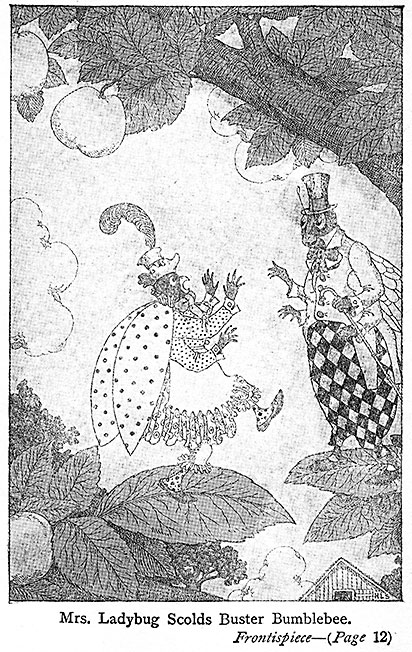
Little Mrs. Ladybug was a worker.
Nobody could deny that. To be sure, she
had to stop now and then to talk to her
neighbors, because Mrs. Ladybug dearly
loved a bit of gossip. At the same time
there wasn't anyone in Pleasant Valley
that helped Farmer Green more than she
did. She tried her hardest to keep the
trees in the orchard free from insects.
Some of her less worthy neighbors were
known sometimes to say with a sniff, "If
Mrs. Ladybug didn't enjoy her work she
wouldn't care about helping Farmer
Green. If she hadn't such a big appetite
she'd stop to chat even more than she
does now."
That might seem an odd remark—unless
one happened to know how Mrs.
Ladybug freed the orchard of the tiny
pests that attacked it. The truth of the
matter was this: Mrs. Ladybug ate the
little insects that fed upon the fruit trees.
Her constant toil meant that she devoured
huge numbers of Farmer Green's enemies.
Goodness knows what Farmer Green
would have done had Mrs. Ladybug and
all her family lost their taste for that
kind of fare. The orchard might have
been a sorry sight.
Perhaps it was only to be expected that
Mrs. Ladybug should have little patience
with folk that seemed lazy. She thought
that Freddie Firefly wasted too much of
his time dancing in the meadow at night.
She considered Buster Bumblebee, the
Queen's son, to be a useless idler, dressed
in his black velvet and gold. Having
heard that Daddy Longlegs was a harvestman,
she urged him to go to work for
Farmer Green at harvest time. And as
for the beautiful Betsy Butterfly, Mrs.
Ladybug found all manner of fault with
her.
Nothing made Mrs. Ladybug angrier
than to see Betsy Butterfly flitting from
flower to flower in the sunshine, followed
by her admirers.
"What can they see in that gaudy
creature?" Mrs. Ladybug often asked her
friends.
It will appear, from this, that Mrs.
Ladybug was not always as pleasant as
she might have been. Moreover, she was
something of a busybody and too fond of
prying into the affairs of others. And if
she didn't happen to approve of he
neighbors, or their ways, Mrs. Ladybug
never hesitated to speak her mind.
When she first appeared on Farmer
Green's place, wearing her bright red
gown with its black spots, everyone supposed
that Mrs. Ladybug was dressed in
her working clothes. And indeed she
was! Nor did she ever don any other.
"I've no time to fritter away," she declared
when somebody asked her what she
was going to wear to Betsy Butterfly's
party. "If I go to the party I'll just drop
in for a few minutes as I am, in my polka
dot."
Her neighbors thought that very
strange. They even whispered to one another
that they didn't believe Mrs. Ladybug
had anything else to wear.
Nor had she. Nor did she want any.
And it wasn't long before everybody
understood Mrs. Ladybug's ways. She
was so earnest that they couldn't help
liking her, no matter if her remarks were
a bit tart now and then.
Not only was Betsy Butterfly a beautiful
creature. She was pleasant to everybody.
And almost all her neighbors were just as
pleasant to her. Mrs. Ladybug was one
of the few that were sometimes disagreeable
to Betsy. For Mrs. Ladybug did
not approve of her. She thought that
Betsy Butterfly was frivolous. And she
frowned whenever she saw Betsy in her
beautiful costume.
"She never wears working clothes,"
Mrs. Ladybug often complained, when
talking to her friends. "Now, if Betsy
Butterfly would only wear something
plain and serviceable, as I do, once in a
while, people might have a different opinion
of her. She ought to try this hard-finished
red and black polka dot of mine.
It's a wonderful piece of goods."
One day Mrs. Ladybug was gossiping
in that fashion with Mehitable Moth, a
soberly clad person who was always a bit
jealous of the gorgeous Betsy. And
Mehitable Moth nodded her head to everything
that little Mrs. Ladybug said.
"What do you think of Betsy Butterfly's
wings?" Miss Moth inquired.
"They're all for show," Mrs. Ladybug
declared. "They're so flimsy and delicate
that Betsy Butterfly never dares venture
out in bad weather. Of what use would
I be to Farmer Green if I had wings like
hers? If I stayed under cover whenever
the sun didn't shine, the orchard would
soon be overrun with insects."
Now, it happened that Buster Bumblebee
was sipping nectar from a head of
clover near by. Of course, he wasn't listening
to what Mrs. Ladybug and Miss
Moth were saying. But he couldn't help
hearing their remarks. And being a
great admirer of Betsy Butterfly, he
wasn't at all pleased. He even buzzed
near the two gossipers and said to them,
"Can't you find something else to talk
about?"
"Such rudeness!" Mrs. Ladybug
gasped.
"What shocking manners!" cried Miss
Mehitable Moth.
They hoped that Buster Bumblebee
heard what they said. Anyhow, he flew
off in his blundering, clumsy way without
speaking to them again.
"Who is this Mrs. Ladybug, to pick
flaws in the beautiful Betsy Butterfly?"
he asked himself savagely. "Who is she
to find fault with Betsy's lovely wings?
If Mrs. Ladybug herself had wings, I
shouldn't think her chatter so strange.
But a person with no wings has no business
expressing his views of somebody
else's."
Buster Bumblebee was so out of patience
with Mrs. Ladybug that he lost his
taste for clover heads for the rest of the
afternoon. And that was a most unusual
thing with him. However, he could think
of nothing but Mrs. Ladybug and her unkind
speeches. And at last, meeting
Betsy Butterfly herself along towards sunset,
he stopped to tell how well she was
looking and how charming her colors
were.
Betsy Butterfly was not vain. She
laughed gayly and said, "You're very
kind to say those agreeable things."
"I can't help it," he replied heartily.
"Everybody's not like you," Betsy
Butterfly told him.
"Then you've been hearing about Mrs.
Ladybug!" he cried. "Somebody has
been tattling."
"It doesn't matter," Betsy Butterfly
assured him. "Perhaps it's good for me
to know that everyone doesn't admire
me."
Buster Bumblebee didn't agree with
her.
"I'll have to speak to Mrs. Ladybug,"
he declared.
"Oh, don't!" Betsy Butterfly begged
him; for she was as gentle as she was
beautiful and never wanted people to
quarrel on her account.
But Buster Bumblebee had made up
his mind and nothing could change it.
The next day Buster Bumblebee set out
for the orchard to find Mrs. Ladybug.
He wanted to warn her to stop talking
about Betsy Butterfly. But Buster
hadn't realized that it was not an easy
matter to say anything to Mrs. Ladybug.
Mrs. Ladybug always liked to do most of
the talking herself. She preferred to let
others listen.
He found her hard at work destroying
insects on an old apple tree. And when
she caught sight of him Mrs. Ladybug
paused in her labors.
"Well, young man!" she exclaimed,
looking at Buster severely. "Are you
idling this lovely day away? You don't
seem to be making any honey."
Buster wished that he had spoken first.
He certainly had had no intention of discussing
such matters as honey making.
"I don't need to make honey," he told
Mrs. Ladybug. "The workers in our
hive provide honey enough. Maybe you
didn't know that I'm of royal blood. I'm
the Queen's son. I don't have to work,"
he declared somewhat hotly.
"Rubbish!" cried Mrs. Ladybug, regarding
him with a frown. "Go get
yourself some working clothes! Take off
your black velvet and gold! And save
that suit for best!"
"You don't understand," Buster tried
to explain. "Being a Queen's son, I'm
expected to wear my court costume every
day."
"Nonsense!" Mrs. Ladybug retorted.
"The sooner you get such silly notions out
of your head, the better off you'll be.
Everybody ought to work. Too much
play is bad for folks."
Buster Bumblebee could feel himself
flushing. The neighbors were not expected
to address a Queen's son in that
fashion.
"That's exactly the way you talk about
Betsy Butterfly!" he exploded.
"Huh!" Mrs. Ladybug sniffed. "You
are a worthless pair. Betsy Butterfly's
wings—"
At this point Buster managed to interrupt
her.
"Don't talk about wings, please!" he
cried. "Who are you, to talk about
wings?—when you haven't any yourself."
Mrs. Ladybug started; and she gave him
a queer look. "What's that?" she inquired.
"What's that? Say that again!"
"You haven't any wings."
"Ho!" she laughed. "You're mistaken.
I have wings."
"Then you've left them at home," he
insisted.
Mrs. Ladybug smiled a very knowing
sort of smile. When he saw it Buster
Bumblebee couldn't help feeling uncomfortable.
Somehow he knew that he had
blundered. But just where he had erred
he was unable to decide.
"Watch sharp, young sir!" Mrs. Ladybug
bade him. "Watch sharp and perhaps
you'll be able to learn something."
Then Buster Bumblebee received the
surprise of his life. As he watched, little
Mrs. Ladybug opened her shell-like, black-dotted,
red back and spread a pair of delicate
brown wings.
"See these?" she said to Buster Bumblebee,
who gasped at her blankly. "I've
really two pairs of wings, because my
polka dot wing covers are actually wings
too—only folks don't usually call them by
that name."
Having spread her wings, Mrs. Ladybug
decided to take a short flight. And
with Buster gazing dully after her she
flitted off.
"I'll have to tell my mother, the Queen,
about this," he muttered.
Rusty Wren's wife was getting very impatient.
She was at home with her fast-growing
family of youngsters, at home in
the cherry tree near Farmer Green's
chamber window.
"Dear me!" Mrs. Wren exclaimed. "I
don't see what's keeping Rusty. It's at
least a quarter of an hour since he brought
any food to these children."
Mrs. Wren soon grew tired of waiting.
"I'll go and find him!" she said under
her breath. And telling her nestlings
that she would be back in a few minutes,
she hurried off towards the orchard.
"I thought so!" Mrs. Wren muttered
soon afterward, as she caught sight of her
husband. He was talking with Jolly
Robin, in the old apple tree where the
Robin family lived. "I thought so!"
"Have you forgotten your duty as a
parent?" Mrs. Wren asked her husband
in a tart voice, dropping down on a branch
right behind him.
Rusty Wren jumped.
"I've been here only a second or two,"
he faltered. "Mr. Robin and I had a
little business together."
"So I see," said Mrs. Wren. "So I
see. And now, if your business is finished,
allow me to remind you that you
have six hungry sons and daughters at
home." Then Mrs. Wren twitched herself
off her perch and flew back to the
cherry tree and her family.
"I declare," Rusty Wren remarked to
his friend Jolly Robin, "I must have
stayed here, talking with you, longer than
I thought. Those children have enormous
appetites. I'll have to work more
spryly than ever to get them fed before
sunset."
"I know how that is," said Jolly Robin
with a chuckle. Somehow he seemed
much more cheerful than his companion.
"I was actually glad when our last nestlings
were big enough to leave home and
hustle for themselves. But, of course,"
he added, "I still keep an eye on them."
Rusty Wren had already begun to hunt
for tidbits. Almost immediately he found
an ant, which he snatched up and carried
away. Back and forth he flew, making
dozens of trips between his house and the
orchard. Grubs and caterpillars, grasshoppers
and spiders—he seized them
wherever he could spy them and took
them home to his famishing children.
Though he worked his hardest, Mrs.
Wren hadn't a smile for him. And when
she said anything in his hearing, it was
some such remark as this: "You poor,
hungry dears! It's a pity you can't have
all you need to eat. I only hope your
scanty meals won't stunt your growth."
Naturally such speeches didn't make her
husband feel any more at his ease.
"I'll have to bring home something
special, to please her," he thought. "I
wish I could find some dainty that would
put her in better humor."
So he looked all around to see what he
could discover that was different from
the food he had been gathering. And it
wasn't long before he gave a chirp of delight.
"Here's a pretty beetle!" he cried.
"I know it will make Mrs. Wren smile
when I show it to her."
Thereupon Rusty Wren pounced upon
Mrs. Ladybug and bore her away, struggling,
in his bill.
Rusty Wren hurried home, carrying Mrs.
Ladybug despite her frantic efforts to
escape. She wriggled all her six legs at
the same time.
"She'll be pleased with this one,"
Rusty murmured, as he watched Mrs.
Ladybug's struggles. "Mrs. Wren will
certainly thank me when I give her this
morsel."
And she did.
"How lovely!" Mrs. Wren exclaimed
when Rusty gave her his captive.
And he was so glad that he hastened
away to try to find another just like that
one. But he hadn't gone far before he
said, "Ugh! I hope I haven't made a mistake.
I don't like the taste of that
beetle." And he dropped down upon the
ground and carefully wiped his bill upon
the grass.
He couldn't help feeling somewhat
worried.
"I don't believe the children will notice
anything wrong," he muttered. "So far,
they've never refused anything that was
offered them. But if Mrs. Wren tried to
eat that beetle herself, I fear there'll be
trouble."
And there was. Rusty knew it a few
minutes later, when little Mr. Chippy's
son, Chippy, Jr., came flitting up and
peeped in his childish voice, "Please, sir,
Mrs. Wren wants you at once."
There was nothing to do except to go
home. And Rusty went.
He found Mrs. Wren much upset.
"Are you trying to poison us?" she demanded.
"No, indeed—my love!" Rusty Wren
replied meekly.
"Well, you made a terrible mistake,
then," she declared.
Meanwhile Rusty Wren was looking all
around. Yet he couldn't see the pretty
beetle (meaning Mrs. Ladybug) anywhere.
"Somebody must have swallowed
it, anyhow," he thought.
"You must be more careful," his wife
told him severely. "That was a horrid-tasting
beetle that you brought home.
It's lucky I discovered that it was a queer
one. The children—poor dears!—are so
hungry that any one of them would have
bolted it had I offered it to him."
"Then you ate it yourself," Rusty
Wren faltered.
"Oh, no, I didn't," said his wife. "I
dropped it upon the ground. And no
doubt I'd have thrown it away, anyhow,
no matter how it tasted."
"Why?" he asked her. "I thought it
was a pretty beetle."
"It was pretty enough—I dare say,"
Mrs. Wren replied. "But it had a very
hard shell. It wouldn't have been safe to
feed it to the children. Nor should I have
cared to eat it myself."
"I thought it was a pretty beetle,"
Rusty said again. "It was such a gay
color—bright red, you know. It seemed
to me it would please the children, and
you, too."
Mrs. Wren still seemed to be somewhat
out of patience.
"When you gather food for the youngsters,
never mind about the color of it!"
she exclaimed. "If you want to bring
them playthings, that's another matter.
But don't fetch home any more pretty red
beetles for them to eat."
"Very well—my love!" said Rusty
Wren. And then he slipped away to hunt
for food, because the children were still
clamoring for more.
Mrs. Wren talked a good deal, afterward,
about her terrible experience. Yet
she never stopped to think about the
pretty beetle—about little Mrs. Ladybug.
For Mrs. Ladybug had had a dreadful
fright. Luckily she wasn't hurt. But it
was a long time before she was her usual
busy, able self again. And later, when
she told her friends about her adventure,
she said that she couldn't understand how
Rusty came to make such a mistake.
"I supposed," Mrs. Ladybug declared,
"that every bird in Pleasant Valley knew
I wasn't good to eat."
Farmer Green's garden was growing fast.
The sweet corn waved and rustled whenever
a breeze swept it. The beets and
carrots sent their pert tops a little higher
each day. The cabbages began to puff
their heads out as if they felt of some
importance in the world. And the potato
vines were actually pretty, with their
white blossoms amid the green leaves.
Farmer Green was very proud of his potatoes.
He said, in Mrs. Ladybug's hearing,
that they were the best he had ever
raised.
"I must fly over to the garden and have
a look at those potatoes," Mrs. Ladybug
thought. "It's always a pleasure to see
flourishing crops."
Before she found time to spare for her
visit to the garden a traveler entered the
orchard one day. At least, he had every
appearance of having come from other
parts. For he carried a traveling bag—an
old-fashioned carpetbag—and he
seemed to have lost his way.
As soon as Mrs. Ladybug saw him she
couldn't help thinking what a handsome
person he was. He wore a yellow coat.
And instead of being spotted with black,
as her gown was, it was striped.
"Good morning!" said the stranger.
"Good morning!" said Mrs. Ladybug.
"Can I be of any service to you?"
The stranger took off his cap. He was
a most polite chap.
"Perhaps you can help me," he replied.
"I'm looking for Farmer Green's vegetable
garden. Do you know where it is?"
"Indeed I do!" Mrs. Ladybug cried.
"It's at the end of this orchard, just beyond
the fence."
"And the potato patch—I suppose I'll
have no trouble finding that?" the
stranger went on.
"Follow your nose!" said Mrs. Ladybug.
"You're headed right for it now."
The stranger thanked her. And he
was about to move on. But of course
Mrs. Ladybug wanted to talk more than
that before he got away.
"The potatoes are fine this season," she
remarked.
The stranger looked greatly pleased.
"That's good news," he told her.
"Have you seen them yourself?"
"Not yet!" Mrs. Ladybug answered.
"But I heard Farmer Green say they were
fine. And he ought to know if anybody
does."
"He certainly ought," the stranger
agreed. Then, thanking Mrs. Ladybug
once more, he hurried toward the garden.
"One moment!" she called. There
were several questions that she wanted to
ask the newcomer. She was wildly curious
to know who he was and where he
came from and what business had brought
him to Pleasant Valley.
But he couldn't have heard her. Anyhow,
he was out of sight in no time, leaving
Mrs. Ladybug almost bursting with
the questions that had sprung to her lips.
"He might have waited a second," she
muttered. "But if he has traveled a long
way no doubt he's eager to get to his journey's
end."
Luckily Mrs. Ladybug had kept her
eyes open when talking with the gentleman
in the striped yellow coat. And as
he turned to leave her she looked closely
at his carpetbag. On one side of it she
read, in big letters:
P. BUG
COLORADO
Little Mrs. Ladybug was too excited to
work. Ever since meeting the stranger in
the orchard she had been able to think of
nothing but him. Perhaps if she hadn't
happened to notice his carpetbag, with the
words, "P. Bug, Colorado," upon its side,
she might not have been so stirred up.
Anyhow, Mrs. Ladybug kept wondering
what business had brought the stranger to
Pleasant Valley. She wished she could
find out what he was going to do in the
potato patch. She wanted to ask him why
he chose to have black stripes on his yellow
coat, instead of spots. How long had
he been traveling? When did he expect
to leave the farm? There was no end to
the questions that Mrs. Ladybug burned
to put to him.
Meanwhile she told the news to everybody
she saw. For Mrs. Ladybug dearly
loved to spread choice morsels of gossip.
It pleased her mightily to tell her neighbors
something they didn't know.
People listened to her story with great
interest. They were eager to learn all
about the stranger, whom Mrs. Ladybug
declared to be very handsome.
Mrs. Ladybug made her news last as
long as possible in the telling. She made
her neighbors wait a bit for every fact, so
they would enjoy it to the full. And
whenever she stopped anyone and told
him about the newcomer, Mrs. Ladybug
kept the best part until the last. She always
ended her remarks by saying, with
a most important air, "His name is Mr.
P. Bug. And he comes from Colorado."
That never failed to impress her listeners—which
was exactly what Mrs.
Ladybug wanted.
Since nobody asked her how she knew
the traveler's name, and where he came
from, Mrs. Ladybug did not trouble herself
to explain that she had read both
name and place upon his old-fashioned
carpetbag.
There was one thing that puzzled her
slightly, when she paused to think about
it. How did it happen that the elegant
stranger carried a most unfashionable
bag?
Mrs. Ladybug soon settled that question
to her own satisfaction.
"He's like me!" she decided. "Mr. P.
Bug is a hard worker and he doesn't care
for show. He's a plain person. No
doubt he put on that yellow coat to travel
in, because it's his best. But he'll wear
overalls, perhaps, if he starts to work in
the potato patch—as I suspect he will."
At last, however, Mrs. Ladybug met
with a rude shock. She was telling her
news to Peppery Polly Bumblebee, one of
the workers in the hive ruled by Buster
Bumblebee's mother, the well-known
Queen. And to Mrs. Ladybug's amazement,
when she related the name of the
stranger, and the place he came from,
Peppery Polly laughed in her face.
"Mr. P. Bug is not from Colorado,"
said Peppery Polly Bumblebee. "He has
never been off this farm."
Well, Mrs. Ladybug was staggered.
She gasped. She clung to a leaf to keep
from failing.
"I don't believe that!" she cried, as
soon as she could speak. "I'll find Mr.
Bug himself and learn the truth from
him."
Mrs. Ladybug was determined to know the
truth about Mr. P. Bug, the newcomer.
And as soon as she had fully recovered
from the rude blow that Peppery Polly
Bumblebee dealt her, she set out for
Farmer Green's garden and the potato
patch.
For some time Mrs. Ladybug flew back
and forth above the potato vines. It was
not an easy matter to find so small a person
as Mr. Bug in so big a field. But she
discovered him at last. And she was
somewhat surprised to see him still in his
elegant yellow coat, with the black stripes.
For Mrs. Ladybug had expected him to
be hard at work, in overalls.
To be sure, Mr. P. Bug did appear to be
busy about something or other. He was
so busy that he scarcely so much as
glanced at Mrs. Ladybug when she spoke
to him, mumbling "Good morning!" in
answer to her greeting, but not taking the
trouble to doff his cap.
"He's at work anyhow," thought
Mrs. Ladybug. "He's helping Farmer
Green." Then she alighted on the potato
vine where Mr. Bug was clinging.
"Don't you remember me?" she asked.
He shook his head. His mouth seemed
to be full of something—Mrs. Ladybug
wasn't sure what.
"Don't you recall speaking to me one
time?" she persisted.
After swallowing, he answered.
"I can't say I do!"
"I'm the person that told you how to
get to this potato patch," Mrs. Ladybug
explained. "When you met me in the orchard,
on your way from Colorado, you
stopped and asked me to direct you to
Farmer Green's potato patch."
For a moment or two Mr. Bug seemed
puzzled—especially when Mrs. Ladybug
mentioned Colorado. But by the time
Mrs. Ladybug had finished speaking, he
nodded.
"So I did!" he exclaimed. "I had forgotten
all about that. Though now that
you speak of it, I do remember meeting a
very talkative dame dressed in a polka
dot. Possibly I spoke to you about my
settling in the potato patch for the summer?"
"No!" said Mrs. Ladybug. "But I
thought I'd find you here. You seemed
in a great hurry to reach this place."
"So I was!" said Mr. P. Bug. "And
I'm glad I came. This is the finest potato
patch in the whole valley—so I have
been told."
"You must have seen a good many
others on your journey from Colorado,"
Mrs. Ladybug ventured. "It's a long
way from there to here, I suppose."
"I suppose it is," Mr. P. Bug murmured.
He seemed to be a bit impatient,
as if he were in haste to return to his
work and didn't care to talk any longer.
"I suppose you were weeks on the
road," Mrs. Ladybug went on. "Are you
going back to Colorado after you've finished
helping Farmer Green with the potato
crop?"
"Colorado!" he blurted. "I don't
know where that place is. I've never
been there in all my life."
Mr. P. Bug's statement amazed Mrs.
Ladybug. He said he had never been in
Colorado. More than that, he declared
he didn't even know where the place was.
Now, Peppery Polly Bumblebee had
told Mrs. Ladybug that Mr. P. Bug was
no stranger in Pleasant Valley. But
Mrs. Ladybug had not believed what she
said. Even hearing Mr. Bug's own
words, Mrs. Ladybug couldn't help doubting
them.
"Can it be true—" she asked him—"can
it be true that you've never been off
this farm?"
Mr. Bug quite plainly wished that she
would go away and stop bothering him.
"It can be—it is true," he replied carelessly.
At last Mrs. Ladybug had to believe
what she heard.
"Then you're a fraud!" she cried.
'"You're a cheat! For I read on your carpetbag,
when we met in the orchard, 'P.
Bug. Colorado.'"
"Oh!" said Mr. Bug with a smile.
"Oh! So that's where you got your odd
notion. I wondered how you happened to
make such a mistake."
"A perfectly natural mistake, I'm
sure!" Mrs. Ladybug exclaimed indignantly.
"Well, I dare say it is," he admitted.
"But you see, that's not my carpetbag.
At least, I didn't get it new. It belonged
to my great-great-great-grandfather. Indeed,
I'm not sure he wasn't even still
greater than I've said. He lived in Colorado
once—so I've been told. But I
was born and raised on this farm."
"If all this is true," said Mrs. Ladybug,
"what were you doing with that carpetbag?
And why did you ask me the
way to this potato patch?"
"I'm in a hurry to get to work," Mr.
Bug remarked. "I'll answer just this
once. When we met in the orchard I had
been away on a little vacation. And
Farmer Green's potato patch—so I
learned—had been moved since last year."
"Dear me!" Mrs. Ladybug wailed.
"People will laugh at me for having made
such a serious mistake."
But Mr. P. Bug didn't say anything
about that.
"Good-by!" he grunted. And he
crawled under a leaf, out of sight.
For once in her life Mrs. Ladybug
wasn't eager to talk to her neighbors.
On the contrary, she seemed to avoid
them. But Peppery Polly Bumblebee
called on her and asked her if she had
seen the handsome stranger, Mr. P. Bug.
"Yes!" said Mrs. Ladybug. "I've
talked with him. And it's true that he
has always lived here. There was a slight
mistake about his carpetbag. It belonged
to one of his ancestors. And since it
bears his ancestor's name and address,
naturally I thought they both belonged to
this Mr. Bug."
Peppery Polly laughed.
"If you don't believe what I tell you,
you can ask him yourself!" Mrs. Ladybug
snapped. "He's at work over in the
potato patch, helping Farmer Green."
Peppery Polly laughed again, more unpleasantly
than ever.
"Helping Farmer Green!" she exclaimed.
"He's eating the leaves off the
vines as fast as he can. I know that gentleman.
He's Mr. Potato Bug. And
he's one of the greatest pests on the
farm."
Chirpy Cricket was looking for Mrs.
Ladybug. He had news for her. Now, it
wasn't often that anybody could tell Mrs.
Ladybug anything. Usually she was the
one that told other people bits of gossip.
So Chirpy Cricket was specially eager to
find her and make known to her what he
had learned.
It was about Mrs. Ladybug's cousin.
At least, there was a person living in the
vegetable garden who claimed to be a
cousin of Mrs. Ladybug's.
Chirpy found Mrs. Ladybug in the orchard.
But strange to say, she didn't
seem at all interested in his news.
"I dare say I have a cousin in the garden,"
she told him. "Ours is a big family.
I have more cousins than I could
ever count. They're as plentiful as the
leaves on the trees. I can't stop my work
to go and see this one. If I called on all
my cousins I'd never have time to help
Farmer Green."
Chirpy Cricket looked disappointed.
He had expected Mrs. Ladybug to show
great interest in what he told her. She
certainly always thought that others
ought to pay strict attention when she related
the happenings about the farm.
And she always wanted them to act surprised
and pleased, too.
"Aren't you going to the garden?"
Chirpy Cricket demanded. "Don't you
intend to be polite to your cousin?"
"Humph!" said Mrs. Ladybug. "She
can't be any busier than I am. Why
doesn't she come to the orchard to call on
me?"
"She can't do that," he explained.
"Your cousin says that it wouldn't be etiquette.
She says you've lived on the
farm longer than she has."
"Rubbish!" Mrs. Ladybug scolded.
"I'm a plain working person. There's
too much to do, during the summer, for
me to bother with such nonsense."
Chirpy Cricket found her rather discouraging.
Still he hadn't given up hope
of making Mrs. Ladybug change her
mind.
"I fear you're making a mistake," he
remarked." You ought to see this cousin.
She's different from any of your family
that I've ever met before."
"How is she different?" Mrs. Ladybug
demanded, pausing in her pursuit of insects
on the leaves of the apple tree. At
last she began to show some signs of interest.
"I don't know," Chirpy Cricket replied.
"I can't say. Maybe it's her
clothes that make her look strange."
Mrs. Ladybug then started to ask him
questions—which was the best of proof
that her curiosity had been aroused.
"What sort of gown was my cousin
wearing?" she inquired. "Was it a red
polka dot, like mine?"
"I don't remember," he answered.
"What colors did she have on?"
"I didn't notice," said Chirpy Cricket.
Mrs. Ladybug gave him a look of disgust.
"Well, if that isn't just like a man!"
she spluttered. "Men never can tell how
a body's dressed. If I want to learn anything
more about this cousin of mine I
suppose I'll have to go and see her with
my own eyes."
And that afternoon she went to the
vegetable garden.
For Mrs. Ladybug, finding her unknown
cousin in Farmer Green's vegetable garden
was not an easy task. Since Chirpy
Cricket hadn't been able to tell Mrs. Ladybug
what colors her cousin wore, Mrs.
Ladybug didn't know what to expect.
"I wish I knew whether she was dressed
in red, black, blue, yellow or some other
color," Mrs. Ladybug complained to herself.
"But I don't know that. I don't
even know if she carries an umbrella."
There was nothing Mrs. Ladybug could
do except to ask everyone she met. So
she inquired right and left if anybody
happened to be acquainted with her
cousin. And at last Betsy Butterfly came
to Mrs. Ladybug's help.
"Look among the squash vines!" Betsy
Butterfly advised her. "I noticed somebody
there that looks a bit like you.
Maybe it's your cousin."
That was very kind of Betsy Butterfly.
Mrs. Ladybug was no friend of hers.
Indeed, Mrs. Ladybug had often found
fault with Betsy for being too pleasure-loving.
But Betsy Butterfly was not one
of the kind that nurses grudges. She was
only too glad to do Mrs. Ladybug a favor.
Mrs. Ladybug thanked her—albeit
somewhat grumpily. Then, flying to the
place where Farmer Green had planted
his squashes, she found a person at whom
she stared hard for a few moments.
"Do you want to speak to me?" this
strange lady inquired. She was a gay appearing
creature, dressed in yellow, with
black patches on it.
"I can't tell whether I care to talk to
you or not," said Mrs. Ladybug. "It all
depends. If you're my cousin, I do. If
you aren't, I don't."
The strange lady laughed lightly.
"I wonder—" she replied—"I wonder
if you are Mrs. Ladybug."
"I am," said Mrs. Ladybug.
"Then I'm your cousin!" cried the
other. "At last I've met you!" And she
rushed towards Mrs. Ladybug with every
intention of embracing her.
Mrs. Ladybug backed hastily away.
"Not so fast!" she exclaimed. "If you
really are my cousin, well and good! But
how do I know that you aren't an impostor?"
"A what?" the strange lady faltered.
She was, quite naturally, somewhat taken
aback by Mrs. Ladybug's coolness.
"How do I know that you're not a
cheat?" Mrs. Ladybug asked her.
"Have you any references?"
"Any what?" stammered the would-be
cousin.
"Any letters about yourself," Mrs.
Lady explained. "For all I know, you
may be dissembling."
"I may be whatting?" quavered the
lady in yellow.
"Dear me!" Mrs. Ladybug muttered to
herself. "Must I address this person in
words of one syllable?" Then, to her
companion she said bluntly, "Tell me why
you think you and I are related!"
"That's easy!" cried the yellow one.
"I belong to the Ladybug family."
Now, you might think that would have
satisfied Mrs. Ladybug. But she wasn't
convinced yet.
"My family—" she declared—"my
family are all famous workers. If you're
one of us, where are your working
clothes? Where's your red and black
polka dot?"
The cousin tittered. She seemed to be
a silly sort of creature.
"I haven't any red and black polka
dot," she replied. "These are my working
clothes that I'm wearing now."
Mrs. Ladybug shook her head. It was
plain that she didn't approve of those
clothes—nor of their wearer.
Mrs. Ladybug wished that she hadn't
come to the vegetable garden to see the
person who called herself Mrs. Ladybug's
cousin. She wasn't at all the sort of relation
that Mrs. Ladybug cared to have.
Although the stranger in yellow was
most agreeable, somehow Mrs. Ladybug
disliked her exceedingly. And strange to
say, Mrs. Ladybug couldn't have told exactly
what it was in her cousin that displeased
her. It wasn't alone the yellow
gown that the new cousin wore. Nor her
simpering smile. Nor her trifling manner.
It was something else—something
that made Mrs. Ladybug feel that she was
not to be trusted.
"I must hurry back to the orchard,"
Mrs. Ladybug announced. "There's
work waiting for me there. I really
ought not to have left it to come to see
you."
"Don't take your work so seriously!"
her cousin advised her. "You ought to
take more time for amusement. I hope
you'll come to see me often."
Mrs. Ladybug's opinion of the stranger
sank even lower.
"If some of us weren't earnest about
our work the rest of the world would have
a sorry time," she declared. "I may as
well tell you that I shall not be able to
call on you again. I shall be too busy.
And there's no use of my urging you to
come to see me, because of course you have
your work to do too."
"Oh, naturally!" said Mrs. Ladybug's
cousin with an odd smile. "Still, I could
leave it once in a while to make a cousinly
call."
"It won't be necessary," Mrs. Ladybug
told her. "If I need you, I'll send for
you." And she said to herself grimly,
under her breath, "She'll never hear from
me."
"If I can help you at any time, don't
fail to let me know," the cousin told Mrs.
Ladybug. "Doubtless I could be of some
service, though I'd always rather work on
vines—squash and pumpkin preferred."
Mrs. Ladybug thanked her. "I
shouldn't want her helping me," she
thought. "I'll warrant she's so careless
that she would do more harm than good."
And Mrs. Ladybug looked at the vine on
which they were standing.
"I see you're helping Farmer Green
with his squash vines at present," she remarked
aloud.
"Yes!" said her cousin. "I have this
one almost finished."
"Good!" said Mrs. Ladybug. And she
took a closer look at the vine. It seemed
far from healthy. In fact she noticed
that the leaves were tattered and torn.
"What are these great holes in the
squash leaves?" she inquired.
Her cousin fidgeted and made no reply.
Glancing at her, Mrs. Ladybug thought
she was growing a bit red in the face.
Then all at once Mrs. Ladybug guessed
the dreadful truth.
"You've been eating these leaves!" she
cried.
Her cousin tossed her head.
"A person has to eat something," she
retorted.
Mrs. Ladybug threw up her hands.
"I knew you weren't trustworthy," she
muttered. "I knew you weren't the sort
of relation I'd want anything to do with."
Then Mrs. Ladybug left her.
Later, when Chirpy Cricket met her, he
asked her if she had seen her cousin who
was spending the summer among the
squash vines. And he was astonished
when Mrs. Ladybug glared at him and
exclaimed:
"Never mention her to me again!"
Jennie Junebug was a frolicsome fat person.
And she was a great joker. The
joke that she loved most was this: she
loved to bump into people that were flying
through the air—to bump into them and
knock them, spinning, upon the ground.
Being much heavier than many of her
neighbors, Jennie Junebug suffered little
from such collisions. And she never
could understand why anybody should
find fault with her favorite sport. If a
body objected to her rough play Jennie
Junebug only laughed heartily.
"I don't mind when I take a tumble,"
she would retort. "So why should you?"
And if the sufferer complained that it
wasn't the tumble that hurt, so much as
the shock of her hard, bulky self, Jennie
would shake with merriment and crash
into him again.
Really, it was useless to try to reason
with her. The safest way was to avoid
her if possible, especially after dark.
For then was the time that she preferred
for her rowdy tricks.
Mrs. Ladybug couldn't abide her. Not
only did she dislike Jennie Junebug's
jokes. She disapproved of her treatment
of Farmer Green. For Jennie Junebug
did everything she could to ruin the trees
on the farm. She ate their leaves. And
that was one thing that Mrs. Ladybug
couldn't forgive in anybody.
"It's a shame—" Mrs. Ladybug often
said—"it's a shame, the way Jennie Junebug
riddles the foliage. Here I work my
hardest to save the leaves by ridding them
of tiny insects that feed upon them—insects
that suck the juices from the leaves
and make them wither. And there's Jennie
Junebug, trying her best to destroy
the leaves that I save.... It's enough to
make an honest person weep."
Perhaps Jennie Junebug wasn't so bad,
at heart, as Mrs. Ladybug thought her.
Maybe she was merely a gay, careless creature
who never stopped to consider that
she was injuring Farmer Green when she
hurt his trees. At least, that was what
some of Mrs. Ladybug's other neighbors
sometimes remarked.
But Mrs. Ladybug never could believe
that Jennie had a single good trait—unless
it was good nature. For she was always
ready with a laugh, no matter what
anybody said to her.
It was seldom that Mrs. Ladybug hesitated
to speak her mind right out to a
person if she happened to disapprove of
him. But she had always kept out of Jennie
Junebug's way. Jennie was many
times bigger than little Mrs. Ladybug.
Mrs. Ladybug trembled to think what
might happen to her if Jennie should ever
hurl her fat body against Mrs. Ladybug
with a dull, sickening thud.
"If that ever happens," Mrs. Ladybug
thought, "I fear I'll never be able to do
another day's work for Farmer Green.
It might be the end of me."
Now, in spite of her fears, Mrs. Ladybug
had even more than her share of courage.
And as time went on, and she saw
the awful havoc that Jennie Junebug
played with the trees, Mrs. Ladybug
reached the point where she couldn't any
longer stand by silently and let Jennie
Junebug riddle the leaves. "Something
will have to be done!" Mrs. Ladybug declared
to her friends. "I can't compel
Jennie Junebug to stop. She's too big
for me to handle.
"I'm going to have a talk with her,"
said Mrs. Ladybug.
Some busybody went straight to Jennie
Junebug and told her what Mrs. Ladybug
had said.
"Mrs. Ladybug is going to have a talk
with you," this meddling person told the
fat and frolicsome Jennie. "She wants
you to stop eating leaves. She says you
are doing your best—or your worst—to
hurt the trees that she is trying to save.
She claims that you are no friend of
Farmer Green's. She—"
Jennie Junebug broke in upon her companion
with a loud laugh.
"I'd like to have Mrs. Ladybug try to
speak to me," she chuckled. "If she
does, I'll have fun with her. I'll knock
her over. I'll send her spinning."
Jennie's friend seemed somewhat
alarmed at that.
"Now, be careful!" she begged the fat
lady. "Don't forget that Mrs. Ladybug
is a little creature! You'll injure her if
you're too rough with her."
"Ho! ho!" laughed Jennie Junebug,
and also, "Ha! ha!" She had to stop and
hold her sides, while she rocked back and
forth. "This is a great joke!" Jennie
cried. "Imagine Mrs. Ladybug trying to
talk with me! Why, she'll be lucky if she
can get her breath after I've flown into
her once."
"Dear me!" said the tale-bearer. "I
wish I hadn't mentioned this matter to
you. Of course, everybody knows that
Mrs. Ladybug talks too much. And I
thought maybe you'd enjoy meeting her
and making her keep still. But I had no
idea you would do her any harm."
"Bless you!" cried Jennie Junebug.
"I wouldn't harm a hair of her head!"
And she roared with laughter, for she had
made a joke. You see, Mrs. Ladybug had
no hair. She was quite bald.
Well, Mrs. Ladybug found Jennie Junebug
that very evening. She knew that
Jennie wasn't often seen except after sunset.
For Jennie loved to see the lights
twinkling through the gloom. And she
delighted in surprising people in the dark,
by flying bang! into them and knocking
them down. So Mrs. Ladybug didn't
leave her work and set out to seek this
dangerous fat lady until twilight came.
"Good evening!" said Mrs. Ladybug as
soon as she spied Miss Junebug. "Have
you a few minutes to spare? If you have,
I'd like to talk with you."
Jennie Junebug grinned broadly.
"I can give you a few seconds of my
valuable time," she replied. "I was just
going over to the meadow, for Freddie
Firefly will be there soon. He dances in
the meadow every night. And I like to
see his flickering light—and watch him
bounce when I hit him. So you'll have to
talk fast, for I'm in a hurry," said Jennie
Junebug.
"Good!" thought Mrs. Ladybug.
"She's going to listen to me, after all."
And then she fixed Miss Junebug with her
eye and spoke to her severely.
"Don't you think you ought—" she began.
And then Jennie Junebug bumped into
her, sending Mrs. Ladybug sprawling.
"Don't I think I ought to frolic with
you?" Jennie cried. "Certainly I do."
Mrs. Ladybug managed to rise off the
ground.
"Won't you please—" she started to
say.
"Won't I please knock you down? Of
course I will!" Jennie Junebug exclaimed.
And thereupon she struck Mrs.
Ladybug again.
Poor Mrs. Ladybug was much shaken.
In her fall she had dropped her umbrella,
and her handkerchief too. But she didn't
stop to pick them up. She scrambled to
her feet and rose into the air again, angrier
than she had ever been before in all
her life.
"I'll thank you—" she spluttered.
"You'll thank me if I'll do that again,
eh?" said Jennie Junebug, interrupting
her rudely. "Very well! Here goes!"
This time she gave Mrs. Ladybug a terrific
blow. She dropped upon the grass,
where she clung to a blade and swayed up
and down for a few moments, dizzy and
trembling. And she was gasping so hard,
in order to get her breath, that she
couldn't speak.
Watching her, Jennie Junebug shrieked
with laughter. Then, seeing Freddie
Firefly's light flashing in the meadow,
Miss Junebug hurried away.
"Such impudence!" Mrs. Ladybug
gasped, as soon as she could speak.
"That terrible Jennie Junebug didn't
care whether I ever got my breath or not."
After bowling Mrs. Ladybug over three
times, Miss Junebug had flown away, leaving
poor little Mrs. Ladybug clinging to a
blade of grass and wondering if she would
be able to move again.
Mrs. Ladybug had attempted to take
Jennie Junebug to task. She had intended
to berate Jennie for devouring the
leaves of Farmer Green's trees and to order
her to stop such damage at once. But
Jennie Junebug hadn't allowed her to say
much. In her playful way she had
knocked the breath out of Mrs. Ladybug.
"I must try some other plan," thought
Mrs. Ladybug. "And I'll have to have
help." So she sent Miss Moth over to the
meadow, to find Freddie Firefly and ask
him if he wouldn't come to the orchard
because Mrs. Ladybug wanted to talk with
him.
He came. He came at once; for he saw
Jennie Junebug looking for him. And he
was only too glad to escape her attentions.
He found her too rough to suit him.
Mrs. Ladybug quickly explained her
difficulty.
"What shall I do?" she asked him.
"I don't know," he answered. "I can't
do a thing with Jennie Junebug. She
knocks me down whenever I meet her.
She annoys me."
"It's not so much myself I'm thinking
of," said Mrs. Ladybug. "It's Farmer
Green's fruit trees that I'm disturbed
about. Jennie Junebug eats the leaves.
I must put an end to that."
"I have it!" Freddie Firefly exclaimed
suddenly. "I'll ask her why she doesn't
bump into Solomon Owl!"
Mrs. Ladybug didn't seem to care for
his suggestion. "What good would that
do?" she inquired.
"Ah!" he said. "Solomon Owl
wouldn't let her browbeat him. He'd
soon cure her of her rude pranks."
"Then please speak to her, and to Solomon
Owl at once—that is, if you dare
to," said Mrs. Ladybug.
"I'm not afraid of him," Freddie Firefly
boasted. "He won't touch me. He's
a-scared of my light." And then Freddie
Firefly flitted away.
He found Solomon Owl easily enough.
He had heard Solomon's Wha-wha, whoo-ah!
booming from the edge of the woods.
And he soon persuaded Solomon to fly
down into the meadow.
Solomon Owl sailed above the waving
grass, while Freddie Firefly spoke to Jennie
Junebug.
She liked his scheme. She thought it
would be a great joke to bump into solemn
Solomon Owl. And for once she forgot
to fling herself against Freddie Firefly.
Only a little while later she struck Solomon
Owl with an awful thud. To her
huge surprise she fell headlong, while he
merely paused in his low flight.
"Who struck me?" he bawled.
"Jennie Junebug!" said Freddie Firefly.
"Where is she now?" Solomon hooted.
"If I find her I'll fix her."
Jennie Junebug heard everything he
said. She was lying hidden in the grass
near-by. And she wouldn't have come
out for anything.
"I'll keep an eye out for her," Solomon
Owl announced. "I come to the meadow
often, a-mousing."
Jennie Junebug kept still as a mouse,
herself, until Solomon had gone back to
the woods. Then she stole forth from her
hiding place, showing a battered face to
her friends.
"Good-by, everybody!" she called.
"I'm going to move. I'm going 'way
down to the end of the valley to live....
I'm off already," she added, as she spread
her wings.
Nobody ever saw Jennie Junebug on
Farmer Green's place again.
And Mrs. Ladybug was more than satisfied.
Farmer Green's apple trees looked green
and flourishing. Thanks to Mrs. Ladybug—and
some of her relations—there
was scarcely an insect left on the leaves.
And since there was no more work to be
done in the orchard just then, and nothing
for her to eat, Mrs. Ladybug settled among
the raspberry bushes near the duck pond.
She said that they needed her attention.
One day she paused in her labors, feeling
that she had earned a few minutes'
rest. And she dropped out of the bushes
and strayed close to the water's edge.
A light breeze ruffled the surface of the
duck pond into tiny waves.
"What a terrible, rough sea there is
to-day!" Mrs. Ladybug murmured as she
gazed upon the troubled water. "Perhaps,
if I cling to a tall grass stalk, I can
get a better view of it."
She soon found a stalk that grew high
above all the rest. Crawling to the very
top of it Mrs. Ladybug was able to look
far out over the face of the pond.
"Goodness!" she said to herself. "I'm
glad I'm not out there in a ship."
A few moments later she happened to
glance down near the shore. And there,
to her horror, she beheld a frog.
He was not a big frog. On the contrary,
he was the tiniest frog that Mrs.
Ladybug had ever seen. He was sitting
on a lily pad, singing with a small, shrill
voice, which sounded exactly as if you
were tapping two marbles together.
Now, Mrs. Ladybug had all her life
stood in great fear of frogs. She didn't
dare move, as she gazed at this one with
eyes that popped almost out of her head.
He was a brownish person, with a yellow
throat which he puffed out like a bag
as he sang. And his skin was so rough
that Mrs. Ladybug shuddered as she
looked at it. Her own was very, very
smooth.
All at once the frog looked up and spied
Mrs. Ladybug staring at him.
She would have shrieked—had she been
able to.
Then Mrs. Ladybug did the thing that
she always did whenever she had a great
fright. She played dead. She pulled
her feet under her body, out of sight, and
stuck, motionless, to the grass stalk.
Nothing happened. And she was
about to take another sly look at the frog
when something moved the stalk of grass.
It was only the wind. But Mrs. Ladybug
didn't know that. She was sure that the
frog had touched it.
Then Mrs. Ladybug played her next
trick. She let go of the stalk and
dropped to the ground, where she lay
upon her side as if she would never move
again.
Once more she kept quite still. And
since nobody disturbed her, after a time
she opened her eyes.
She found herself looking straight into
those of the tiny frog, who still sat upon
his lily pad in the duck pond.
Mrs. Ladybug shut her eyes instantly.
She only hoped that the frog hadn't noticed
her action.
Mrs. Ladybug didn't know that the frog
she saw was a very timid fellow. His
name was Mr. Cricket Frog. He liked to
sit on a lily pad and sing. And his singing
sounded a good deal like the music
that Chirpy Cricket made. In fact, that
was the reason for his odd name.
Mr. Cricket Frog had a trick not unlike
the one that Mrs. Ladybug herself played
upon him. Whenever a fish, or any other
enemy, came near him, if he hadn't time to
hide in the mud at the bottom of the pond
Mr. Cricket Frog played dead. He would
float in the water as if lifeless, until his
enemy had gone off about his business.
He was so timid—this Mr. Cricket Frog—that
when he saw a stranger he would
sometimes play dead. And that was exactly
what happened when he caught sight
of Mrs. Ladybug as she clung to the grass
stalk near the edge of the duck pond and
stared at him.
Of course Mrs. Ladybug didn't know all
this. When she shut her eyes, and pulled
her feet under her body, she wasn't aware
that Mr. Cricket Frog was just as alarmed
as she was. Having closed her eyes, she
couldn't see him jump into the water and
float. She couldn't see him climb out
upon the lily pad again and gaze at her.
Now, the moment Mrs. Ladybug looked
at the frog the second time he took fright
anew. Once more he sprang from his
seat. Once more he floated like a chip
upon the surface of the pond. Once more
he crawled back to his seat, after he had
made up his mind that the danger had
passed.
So they played dead for a long time—both
Mrs. Ladybug and Mr. Cricket Frog.
And if he hadn't at last made up his mind
that she was afraid of him, they might
still be trying to fool each other.
"Pardon me, madam!" Mr. Cricket
Frog called to Mrs. Ladybug. "I see
you're a bit timid. I assure you I shall
not harm you."
At that Mrs. Ladybug opened her eyes
and looked at him. Slowly she thrust her
feet out from under her body. And then
she tried her wings. They were as good
as ever. Her fall had not injured them.
"You gave me a terrible fright," Mrs.
Ladybug told him.
Mr. Cricket Frog was very bold now.
"Why were you afraid of me?" he
asked her. "Do I look fierce?" he inquired
with a hopeful smile, as if he hoped
that he did, but scarcely dared think so.
"I'm afraid of all frogs," Mrs. Ladybug
explained. "Now, there's Ferdinand
Frog—"
"A rascal!" Mr. Cricket Frog cried.
"But, madam, I'm not in the least like
him. I wouldn't hurt you. In fact, I'd
protect you."
His words pleased Mrs. Ladybug. She
said that thereafter she should always feel
safe, with him in the neighborhood.
Mr. Cricket Frog bowed gallantly, with
his hand on his heart.
And Mrs. Ladybug went away without
guessing that he had himself played dead
because he had been in terror of her.
"What a brave gentleman he is!" Mrs.
Ladybug murmured.
There was one thing that Mrs. Ladybug
dreaded more than any other. That was—fire.
The slightest whiff of smoke sent
her into a flutter of alarm. The sight of
a blaze made her almost frantic.
Perhaps Mrs. Ladybug's neighbors—more
than she—were to be blamed for her
fear. Some of them had an unkind way
of frightening her. When they found her
a bit too prying with her countless questions
about this, that, and the other matter
that did not concern her, they said to
her:
"Aren't you worried, Mrs. Ladybug?
What if your house were on fire?
Wouldn't your children burn?"
Such questions never failed to send
Mrs. Ladybug hurrying away.
After a while people began to wonder
where Mrs. Ladybug went when she
dashed away like that. Nobody seemed
to know where she lived. They supposed
that she must fly to her home, wherever it
was.
To everybody's surprise, Mrs. Ladybug
appeared to want to keep the site of her
house a secret from all her friends.
When they asked her, point-blank, where
her house was, she always pretended not
to hear the question and left them. Or
she would begin to ask questions of her
own choosing, without answering theirs.
"Humph!" said some people. "Mrs.
Ladybug likes to pry into our affairs.
She wants to know all about our business.
And when she learns anything about anybody
else she can't rest until she has told
it to the whole neighborhood."
The more Mrs. Ladybug's friends
thought about her house, the harder
they tried to discover its whereabouts.
Sometimes they even mentioned fire to
her and then tried to follow her when she
hurried off. But she always managed to
give them the slip before she had gone
far.
Now and then somebody or other
thought he had found Mrs. Ladybug's
house. But in the end somebody else was
sure to prove that he was mistaken.
Once Freddie Firefly announced with
great pride that at last he knew where
Mrs. Ladybug was rearing her family.
"Her house," he explained, "is in a hole
in the ground, in the meadow."
And that night he led Miss Mehitable
Moth to the spot, lighting the way with his
flickering gleams.
She soon pointed out his mistake. He
had led her to the doorway of the Bumblebee
family, who were all sound asleep inside
their crowded house.
After that Freddie Firefly had to listen
to a good many titters from his friends.
"The idea!" they would say. "Mrs.
Ladybug must have a much bigger
house than the Bumblebee family's. She
couldn't squeeze her children into such
small quarters as theirs. Why, she has
more children than she can count."
There was great excitement in Farmer
Green's orchard. The neighbors came
a-flying and a-running and a-crawling
from all directions. And little Mrs.
Ladybug was the cause of the hurly-burly.
She had appeared with a strange, flaring
object hanging by a cord from her waist—if
she could be said to have a waist. The
queer, dangling thing had a handle at its
upper end. And when Mrs. Ladybug
moved a jingling, jangling sound might
have been heard.
In no time at all a crowd had gathered
around her. And some of the more curious
and ill-bred pointed at whatever it
was that puzzled them.
"What's that?" they asked Mrs. Ladybug.
Strange to say, she seemed pleased with
the stir that she had made.
"It's a dinner bell," she explained.
They gazed at it in wonder, until at last
somebody spoke up and demanded,
"What's it for?"
"To give the alarm with!" she replied.
"What alarm?" chimed a chorus of
voices, high and low.
Mrs. Ladybug smiled an odd sort of
smile as she answered, "The fire alarm, of
course! Everybody's always talking fire
to me. It makes me frightfully uneasy.
There's so little one can do alone in case
of fire. But now—" she added—"now
when anyone says 'Fire!' I'm going to
ring this bell with all my might."
Well, people didn't know what to say—then.
Later, however, they gathered
about in groups and talked a good deal
about Mrs. Ladybug and her dinner bell.
Miss Moth said that she feared Mrs.
Ladybug would disturb her rest if she
rang the bell in the daytime, when Miss
Moth was accustomed to sleep. Buster
Bumblebee hoped Mrs. Ladybug wouldn't
ring it at night, because he had a short
enough night's sleep as it was, with the
family trumpeter waking everybody in
the house about dawn. And Freddie
Firefly exclaimed that it would be very
annoying to him if Mrs. Ladybug gave
the alarm of fire whenever she saw his
flickering gleams on pleasant evenings in
the meadow.
If others were troubled, Mrs. Ladybug
herself was much pleased by her dinner
bell. She liked to hear it tinkle as she
worked. She said it was a cheerful sound
and so long as she wore it she never needed
to worry about being lost. It was as good
as a cowbell for letting the world know
one's whereabouts.
There was only one thing that annoyed
her. Since she hung the bell from her
waist nobody had mentioned fire to her.
Nobody had said a word about her children's
burning. It seemed as if none of
her neighbors wanted her to sound a fire
alarm. And if there was anything that
would have given her joy, it would have
been to seize the handle of her bell and
ring it madly.
There were even some people that complained
of the tinkle it made among the
apple trees.
Peppery Polly Bumblebee laughed at
them.
"You've brought this trouble upon
yourselves," she told them. "How can
you expect Mrs. Ladybug to keep the
tongue of the bell still? She can't even
keep her own tongue from wagging!"
No doubt Peppery Polly knew what she
was talking about. She had a very sharp
tongue, herself.
The whole countryside was dry. It
hadn't rained for weeks. The grass was
turning brown. The water in the river
was low. And Broad Brook was no more
than a narrow trickle. Every morning
the sun rose streaming hot, to beat down
upon Pleasant Valley all day long until it
sank—a round, red ball—behind Blue
Mountain each night.
At last, one afternoon, Farmer Green
and the hired man started for the woods
on a run. They had seen a wisp of smoke
curling up from the tree tops. And they
knew that the woods were on fire.
There was a high wind that day. And
if they hadn't worked lively there's no
telling how far the fire would have spread.
As it was, glowing bits came sailing down
from the hill and settled in the valley.
But luckily they did no damage. At
least, no other fire had started anywhere
when the men came home from the woods
and said that all was safe again.
Some of the small folk that lived in the
fields knew what was going on. But Mrs.
Ladybug never guessed that there had
been a fire. She was so busy, working
among the apple trees, that she hadn't noticed
any unusual stir. And no one took
the trouble to tell her about it.
Everyone had put thoughts of fire out
of his mind when along toward evening a
loud clanging rang out upon the air.
"What's that?" people asked one another.
And all at once somebody shouted, "It's
Mrs. Ladybug's dinner bell!"
Far and wide through orchard, garden
and meadow the neighbors took up the
cry. "Fire! Fire! Mrs. Ladybug's ringing
the alarm! Her house is on fire!"
Back and forth they hurried, trying to
find Mrs. Ladybug.
"At last—" they told one another—"at
last we're going to find out where her
house is."
And they did. At least, they soon discovered
Mrs. Ladybug standing beside a
blazing dwelling near the pasture fence.
With all her hands (and she had several!)
she was ringing her bell furiously.
"We'll help you!" her friends all cried.
"Don't worry, Mrs. Ladybug! We'll
have the fire out soon. Be calm!"
But there was nothing they could do.
The fire raged so fiercely that they
couldn't get near enough to it to fight it.
And before long it had burned itself out.
There was nothing left of the house but
ashes.
"What a pity!" said Mrs. Ladybug's
neighbors. "It was a fine, big house."
And then some one cried, "What about
the children? Where are they?"
Nobody knew. If Mrs. Ladybug did,
she was too overcome to speak.
People looked very solemn. They
hoped her children hadn't burned.
And then—then Mr. Meadow Mouse
came running up all out of breath.
"Sakes alive!" he screamed. "My
house is ruined. I wouldn't have had this
happen for anything. But it doesn't matter,
for I can easily build another."
Mrs. Ladybug's neighbors crowded
about her, all asking the same question.
"Wasn't this your house?"
"No!" she admitted. "No, it wasn't."
And then she made an astonishing confession.
"I've never owned a house," she
said. "I've never had one in all my life.
I can't have a house. I couldn't get one
that was big enough.
"I have so many children that I don't
know what to do," said little Mrs. Ladybug.
It was almost fall. The nights—and
some of the days—were chilly. Those
that had spent the whole summer out of
doors began to think about where they
should pass the winter. Yet everybody
was amazed by the news that Mrs. Ladybug
spread broadcast. She said that she
expected, soon, to go into winter quarters.
"Humph!" cried Daddy Longlegs' wife
when she heard what Mrs. Ladybug was
saying. "She never had any quarters, so
far as anyone knows. Mrs. Ladybug
hasn't been able to tear herself away
from the orchard long enough to live
anywhere except in the apple trees."
It was plain that Daddy Longlegs' wife
didn't believe what Mrs. Ladybug was
telling her neighbors. And there were
many more folk that agreed with her.
Little Mrs. Ladybug smiled a knowing
smile when she heard what her friends
thought.
"They'll see! They'll see!" she said.
"I'm going to spend the winter in the biggest
and finest house on this farm."
That was all she would tell. She
wouldn't breathe another word about her
plans. And naturally, every one became
very curious. There wasn't a soul that
wasn't agog to know what Mrs. Ladybug
intended to do.
The neighbors asked her, begged her,
teased her—some even threatened her.
But she declined to answer. She said
that if she told where she expected to pass
the cold months everybody would want to
go to the same place and maybe there
wouldn't be any room left for her.
Perhaps some of her friends had intended
to follow her into her winter quarters.
Anyhow, many of them looked
guilty when she made that remark. And
a few of them looked angry, and declared
that Mrs. Ladybug was selfish.
"If the house is as big as she claims it
is, it ought to hold a few extra guests without
being crowded," they grumbled.
"Guests—" said Mrs. Ladybug—"guests
should always wait for an invitation."
"Have you had one?" Buster Bumblebee
asked her.
Mrs. Ladybug did not answer his question.
Most people thought Buster Bumblebee
a stupid fellow. Many people paid
little heed to him. Yet strange to say, he
often hit the nail on the head, so to speak.
And this time he made Mrs. Ladybug
somewhat uncomfortable. She had had
no invitation to spend the winter in the
fine, big house. But she didn't care to
have her neighbors know that.
"There's just one thing to do," Buster
Bumblebee decided. "I'll ask the Carpenter
Bee if he's building a house for
her."
So he went to the big poplar by the
brook, where the Carpenter Bee lived.
And that mild person himself—sawdust-covered
as usual—answered Buster's
knock at his door.
"Are you building a house for Mrs.
Ladybug?" Buster Bumblebee inquired.
"No!" said the Carpenter. "We
couldn't agree. She wanted me to work
twelve hours a day. And I wanted to
work twenty-four. I told her I must
have some time to rest. But she couldn't
see things as I did."
Buster Bumblebee was puzzled.
"I don't understand," he said.
The Carpenter kindly made matters
clear to him.
"I rest only when I'm working," he explained.
The Carpenter Bee, who lived in the big
poplar by the brook, wasn't building a
house for Mrs. Ladybug. That skillful
woodworker hadn't been able to agree
with her—so he told Buster Bumblebee.
Furthermore, he knew nothing of Mrs.
Ladybug's present plans as to where she
was going to spend the winter.
Nor did anybody else. It was all a
great mystery. And Mrs. Ladybug
seemed to enjoy it far more than her
neighbors did. She was the only person
that could have solved it for them. And
she wouldn't.
At the same time she took delight in
talking about her winter quarters, as she
called the place where she intended to live
during cold weather.
"It will be cozy and warm there," she
often remarked to her callers, of whom
she had huge numbers. For there was
scarcely a person in the orchard or the
garden that didn't burn with curiosity to
know more about the fine, big house into
which Mrs. Ladybug expected to move.
"My winter quarters will be wind-proof,"
Mrs. Ladybug told them. And
that speech set them all to guessing again.
Almost everybody said then that she
was going to live underground.
"I shall not feel a drop of rain—not
even during the January thaw," Mrs.
Ladybug went on.
And then everybody had to begin guessing
all over again; for rain drops were
sure to trickle into an underground house
during a warm spell.
"You're going to live in a pumpkin!"
cried Buster Bumblebee.
And all the neighbors—even Mrs. Ladybug—laughed
when they heard that.
Buster knew of an old tune called "The
Bumblebee in the Pumpkin," and he cried
with some heat that he could think of no
reason why there shouldn't be "A Ladybug
in a Pumpkin."
"I told you my house was big—the biggest
one on the farm," Mrs. Ladybug reminded
him.
"Ah!" Chirpy Cricket exclaimed.
"Now I know! You're going to live in
the haystack. A haystack is cozy and
warm; it's wind-proof; it sheds water;
and there's nothing bigger anywhere."
It really seemed as if Chirpy Cricket
had solved the great mystery.
"He's guessed the riddle!" people said.
"You might as well admit now, Mrs.
Ladybug, that you're going to spend the
winter in Farmer Green's haystack."
But Mrs. Ladybug dashed their
hopes.
"You're wrong," she told her friends.
"And if to-night's as nippy as last night
was, perhaps you'll find out to-morrow
where I'm going. For I don't care to
freeze my toes here in the orchard."
That night it was colder than ever.
And the next day Mrs. Ladybug went all
around the orchard and the garden bidding
people good-by.
Still she wouldn't tell where she was going.
And if Daddy Longlegs hadn't happened
to stroll around the cherry tree outside
Farmer Green's chamber window
that afternoon, nobody would have known
where Mrs. Ladybug went. But Daddy
Longlegs saw her. And he hastened to
spread the news.
"Mrs. Ladybug has gone to spend the
winter in the farmhouse!"
Somehow Mrs. Ladybug's friends missed
her. The orchard seemed quite a different
place after she vanished inside the
farmhouse to stay there all winter long.
In spite of her sharp tongue and her prying
ways people discovered—now that she
was gone—that they had liked Mrs. Ladybug
more than they knew.
While she was with them in the orchard
they had often wished she wouldn't ask so
many questions. But now the days
seemed very long without Mrs. Ladybug
to inquire how and why and when and
where.
And then—then a rumor flashed from
lip to lip all the way across the garden and
the orchard and the meadow: "Mrs.
Ladybug is back again! She didn't stay
in the farmhouse a week."
And sure enough! the rumor proved to
be true. Mrs. Ladybug, looking rather
foolish, appeared in her old haunts among
the apple trees. She acted as if something
had occurred to upset her. And
though she seemed glad to be greeted by
all her old companions, she didn't want
them to ask her a single question as to
why she hadn't spent the whole winter,
instead of only a few days of early fall,
in Farmer Green's house.
If she thought her neighbors weren't
going to question her she was sadly mistaken.
Only a little while before they had asked
her a thousand and one questions about
where she was going to live during the
winter. And now they were all just as
curious to know why she had returned.
But this time they asked her a thousand
and two questions.
You couldn't say that her answers
weren't satisfying, because she didn't
make any answers at all.
Of course, things couldn't go on like
that forever. People had to know what
had changed Mrs. Ladybug's plans. And
in order to persuade the stubborn lady to
explain matters, a few of her friends
hinted that they expected they would have
to go to Farmer Green himself and learn
the truth.
"You may ask him if you wish," Mrs.
Ladybug told them. "But it won't do
you any good. He can't tell you what
happened because he doesn't know himself."
"Maybe the farmhouse was cold,"
Chirpy Cricket suggested.
Mrs. Ladybug made no comment on that
remark.
"Perhaps the roof leaked," said Daddy
Longlegs.
Still no sign from Mrs. Ladybug.
"She found that the farmhouse wasn't
wind-proof," said Daddy Longlegs' wife.
And Mrs. Ladybug didn't deny it; nor
did she say that that was so.
Then Buster Bumblebee made one of
his blundering speeches.
"It was a short winter, anyhow," he
said.
Mrs. Ladybug's neighbors couldn't help
tittering. And somehow their amusement
stung her into telling the truth about
the whole affair, right then and there.
"Mrs. Green and I didn't get on well
together," she confessed.
Mrs. Ladybug spoke at last. Her listeners
crowded close about her, jostling one
another in their eagerness to hear every
word she said. For Mrs. Ladybug was
recounting her adventures at the farmhouse.
"I flew in through an open window,"
Mrs. Ladybug began. And she heaved a
deep sigh, as if the telling of the tale was
costing her much pain.
"I said nothing to anybody," she explained,
"because I didn't wish to trouble
the family. I knew I could find my way
about the house after a little. And it
wasn't long before I had discovered the
stairway.
"I didn't walk on the stairs for fear
there might be mud on my feet," said Mrs.
Ladybug. "I didn't walk, but flew up to
the second floor and went into the first
chamber I saw. There was a fine, big
closet off that room. The door leading into
it was ajar; so I had no trouble slipping
inside it. And there, high up on a broad
shelf, I picked out the very spot where I
could have spent the winter with every
comfort in the world."
At this point Mrs. Ladybug was overcome
by her feelings for a few moments.
But the company waited politely until she
could go on with her story.
She soon continued.
"All went well—" said Mrs. Ladybug—"all
went well until one day—this morning,
to be exact—Mrs. Green opened the
closet door and began to brush and sweep
and wipe and dust. I heard her say that
she was doing her fall cleaning. And of
course that pleased me; for I was glad to
learn that she was a neat housekeeper.
"And then—" here Mrs. Ladybug's
voice broke slightly—"and then, the first
thing I knew she spied me and cried 'Ah,
ha! A Carpet Bug!'
"The next instant she whisked me off
the shelf with a brush. Of course I played
dead the moment she touched me. And I
fell into the dustpan and never so much
as wriggled a toe.
"Soon afterward Mrs. Green set the
dustpan beside the window which she had
already opened. That was my chance. I
seized it. I flew out of the window. And
here I am."
Mrs. Ladybug's listeners shook their
heads in sympathy.
"You had a narrow escape," they told
her." It's a wonder you got away."
"Yes!" said Mrs. Ladybug. "And I'm
glad now that that window was open. But
for a moment I didn't much care what became
of me. To think that anybody
should mistake me for a Carpet Bug!
Mrs. Green ought to know that the Carpet
Bug family are covered with black,
white and red scales. Ugh!"
Mrs. Ladybug shuddered. She was
smooth and shiny herself. So it wasn't
strange that she should have felt insulted.
"Anyhow," she added, "Mrs. Green is
the loser. Toward spring I would have
kept her house plants free from insects.
But now, of course, she'll have to do that
herself."
"Well," said the neighbors (or words to
this effect), "we're glad to see you again.
And now—tell us!—where do you expect
to spend the winter?"
"I'll let you decide that," Mrs. Ladybug
replied.
THE END
TUCK-ME-IN TALES
(Trademark Registered)
By ARTHUR SCOTT BAILEY
AUTHOR OF THE
SLEEPY-TIME TALES and SLUMBER-TOWN TALES
|
|
Colored Wrappers and Illustrations Drawn by
HARRY L. SMITH
|
A delightful and unusual series of bird and insect
stories for boys and girls from three to eight years old,
or thereabouts. |
THE TALE OF JOLLY ROBIN
THE TALE OF OLD MR. CROW
THE TALE OF SOLOMON OWL
THE TALE OF JASPER JAY
THE TALE OF RUSTY WREN
THE TALE OF DADDY LONG-LEGS
THE TALE OF KIDDIE KATYDID
THE TALE OF BETSY BUTTERFLY
THE TALE OF BUSTER BUMBLEBEE
THE TALE OF FREDDIE FIREFLY
THE TALE OF BOBBIE BOBOLINK
THE TALE OF CHIRPY CRICKET
THE TALE OF MRS. LADYBUG
THE TALE OF REDDY WOODPECKER
THE TALE OF GRANDMA GOOSE
|
|
GROSSET & DUNLAP, Publishers, NEW YORK
THE LITTLE WASHINGTONS
SERIES
By LILLIAN ELIZABETH ROY
|
Handsomely Bound. Colored Wrappers. Illustrated.
For Children 6 to 12 Years
|
| This series presents early American history in a manner
that impresses the young readers. George and Martha
Washington Parke, two young descendants of the famous
General Washington, follow in play, the life of the great
American.
|
THE LITTLE WASHINGTONS
Their thrilling battles and expeditions generally end in "punishment"
lessons read by Mrs. Parke from the "Life of Washington." The culprits
listen intently, for this reading generally gives them new ideas for
further games of Indian warfare and Colonists battles.
|
THE LITTLE WASHINGTONS' RELATIVES
The Davis children visit the Parke home and join zealously in the games
of playing George Washington. So zealously, in fact, that little Jim almost
loses his scalp.
|
THE LITTLE WASHINGTONS' TRAVELS
The children wage a fierce battle upon the roof of a hotel in New York
City. Then, visiting the Davis home in Philadelphia, the patriotic
Washingtons vanquish the Hessians on a battle-field in the empty lot back
of the Davis property.
|
THE LITTLE WASHINGTONS AT SCHOOL
After the school-house battle the Washingtons discover a band of gypsies
camping near their homes and incidentally they recover a stolen
horse which the gypsies had taken from a farmer.
|
THE LITTLE WASHINGTONS' HOLIDAYS
They spend a pleasant summer on adjoining farms in Vermont. During
a voyage they try to capture a "frigate" but little Jim is caught and
about to be punished by the Captain when his confederates save him.
|
THE LITTLE WASHINGTONS; FARMERS
Nero, the donkey, had never heard of George Washington, and so the
game the children had planned after reading the story of the General's life
on his farm turned out to be quite a different game altogether.
|
GROSSET & DUNLAP, Publishers, NEW YORK
Endpapers
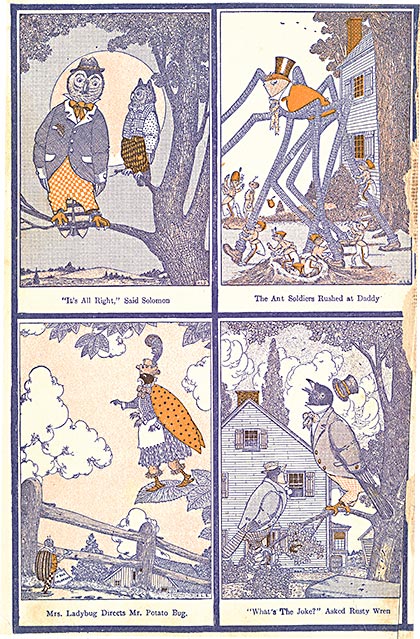 Left front endpaper
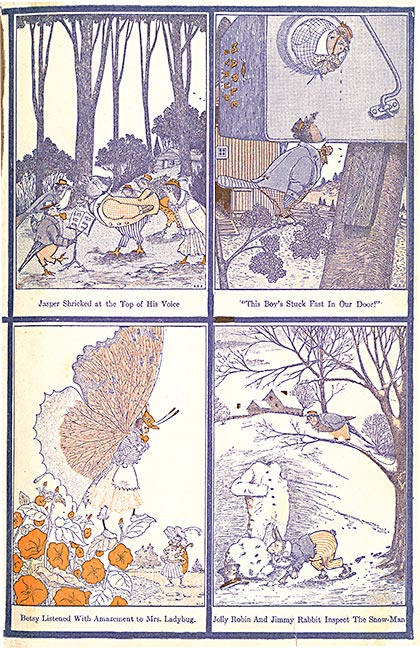 Right front endpaper
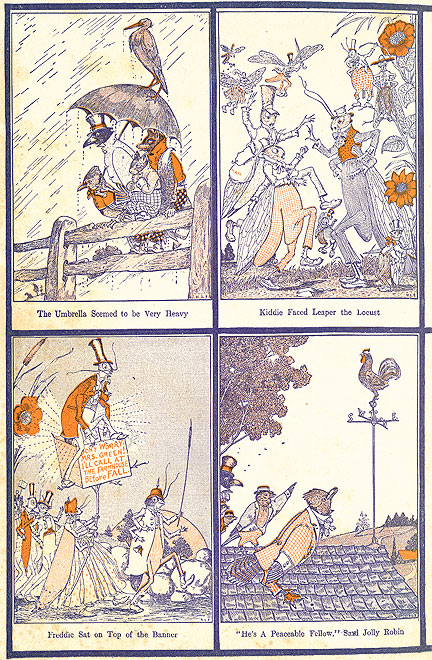 Left back endpaper
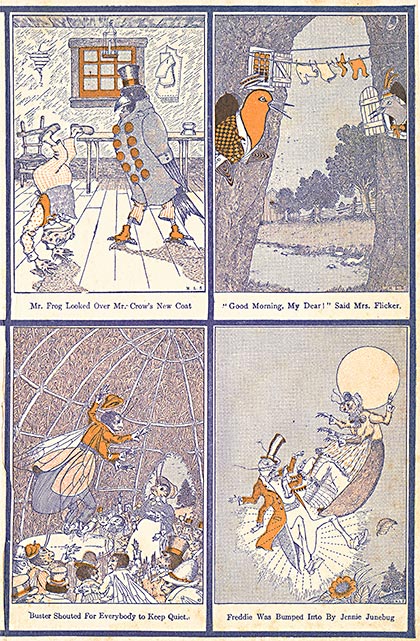 Right back endpaper