The party had come to an end; nobody was left except old Mr. Crow and
his friend Major Monkey.
Mr. Crow himself was fast growing sleepy, for it was almost dark. And he
wanted to fly home and go to bed. But he hardly felt that he ought to
leave just then.
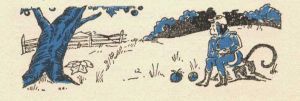
There was no doubt that the Major was in great pain. He kept one hand
pressed against the lowest button of his short red coat. His cap was
awry. And his wrinkled face showed a careworn and anxious look.
"How many apples have you eaten to-day?" Mr. Crow asked his friend.
"I haven't the slightest idea," the Major answered. "After I had
finished two dozen I lost count."
"My goodness!" Mr. Crow exclaimed. "It's no wonder you're ill.... We'll
hurry over to the pasture and see Aunt Polly Woodchuck, the herb doctor.
She'll know what to do for you."
Major Monkey was more than willing. So they set out at once. The Major
travelled through the tree-tops where he could, while Mr. Crow flew
slowly, alighting now and then to wait for his friend to overtake him.
In a little while they came to the pasture. And Major Monkey was glad to
find Aunt Polly at home.
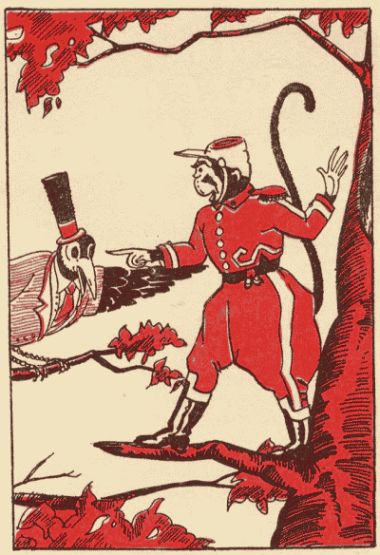
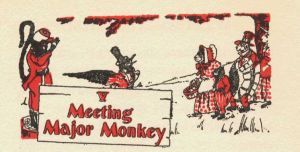
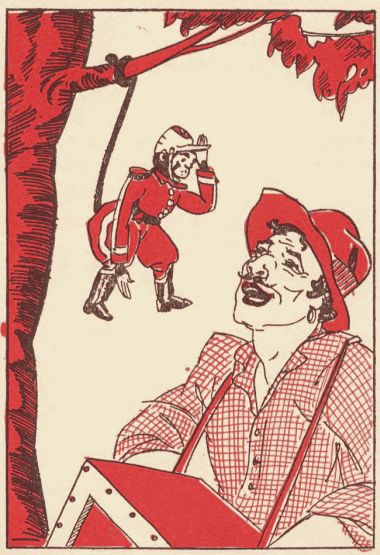
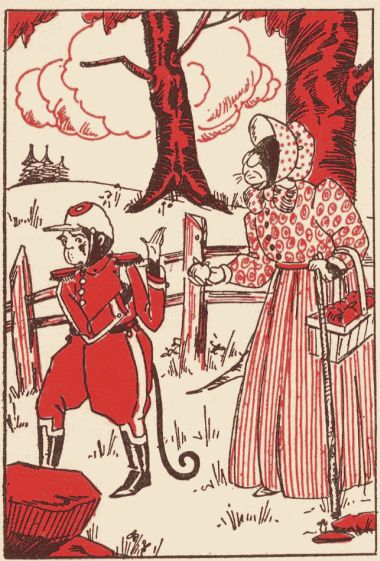 Aunt Polly Woodchuck Offered Him an Apple
She was a wise old lady. She knew right away, without being told, that
it was Major Monkey—and not Mr. Crow—that was ill.
"You're in pain," she remarked to the Major. "I knew it the moment I set
eyes on you."
Major Monkey moaned faintly.
"I hope you'll give me something to make me feel better," he wailed.
"I will," Aunt Polly Woodchuck promised. And putting her hand inside a
basket that she carried on her arm, she drew forth a red apple. "Here!"
she said, "eat this!"
Major Monkey drew back.
"No!" he groaned. "I don't want any more apples. I've had too many
already."
Aunt Polly Woodchuck shot a triumphant look at Mr. Crow.
"I thought so," she said. And she dropped the red apple back into her
basket. "Now," she went on, turning again to the Major, "I should like
to ask whether you're fond of corn."
Old Mr. Crow stepped forward quickly.
"I object!" he cried. "The less said about corn, the better!"
Aunt Polly Woodchuck hastened to explain that she meant no offense to
anyone.
"I merely wondered," she said, "whether you gave your guests corn to eat
at your party."
"Certainly not!" Mr. Crow exploded. "Certainly not!" And he glared at
the old lady as if to say: "Change the subject—for pity's sake!"
"You're a stranger in these parts, I take it," Aunt Polly said, turning
once more to Major Monkey. "No doubt you've been used to eating
different food from what you get hereabouts."
"That's so," the Major admitted. "I've been living mostly on boiled
rice, with a baked potato now and then."
"Ah! Cooked food!" said Aunt Polly. "And if you had that sort of fare,
you must have been living with men."
The Major looked uneasy.
"I don't care to talk about my past," he murmured. "Just you give me
something to warm my stomach a bit. That's all I ask of you."
Well, Aunt Polly Woodchuck handed him some peppermint leaves.
"Chew these," she directed him. "And if you don't feel better to-morrow
I'll lose my guess."
Major Monkey put the leaves into his mouth and made a wry face.
"Haven't you a lump of sugar to make this dose taste better?" he asked
her.
"There!" Aunt Polly cried. "You've been fed by men! I knew it all the
time."
Major Monkey made no comment on her remark. And settling his cap firmly
on his head he said that he must be going.
So he and Mr. Crow went off.
"Where are you going to spend the night?" Mr. Crow asked him as soon as
they were out of Aunt Polly's hearing.
"That haystack is a good place," said the Major. "I believe I'll live
there as long as I stay in Pleasant Valley."
"It's not far from the farmhouse," Mr. Crow observed. "Perhaps you could
steal—er—I mean find a little cooked food there now and then."
"That's an idea," Major Monkey told him. But he did not explain whether
he thought it a good one or not.
VIII — A Secret
When Major Monkey awoke the following morning his pain had left him.
Creeping from the haystack where he had slept, he cast longing eyes at
the red apples in the tree near-by. But he remembered his trouble of the
evening before. And he remembered likewise what Mr. Crow had said about
"finding" something to eat at the farmhouse.
But for some reason the Major wanted to avoid Farmer Green's house. To
be sure, he would have enjoyed sitting down with the family at the
breakfast table. But he was afraid something might prevent his leaving
after he had eaten.
Luckily Major Monkey was a person who could usually find a way out of
any difficulty. And now he made up his mind that a light meal of eggs
was the very thing he needed in order to begin the day right. So he went
straight to the woods and climbed the first tree he came to—a pine tree
just beyond the fence.
There Major Monkey found exactly what he was looking for. In a warbler's
nest, a dozen feet from the ground, he beheld five speckled eggs.
The owners of the nest were not at home. But knowing that one or the
other would soon return, the Major did not care to linger long over
their treasures.
He noticed that one of the eggs was bigger than the others.
"Really there are too many eggs here for this small nest," the Major
said to himself. "If I take the big one I'll be doing the owners a
favor."
So he picked up the big egg, and holding it carefully in one hand he
hurried away.
When he had put some distance between himself and the nest, Major Monkey
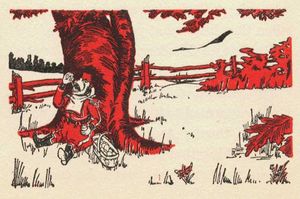
stopped to enjoy his breakfast. He was just on the point of opening the
egg, when who should come up but old Mr. Crow.
The Major quickly hid his breakfast behind his back.
"Good morning!" said Mr. Crow. "I hope you are feeling better to-day."
"Oh, yes—thank you!" said Major Monkey. "I'm quite well again."
Mr. Crow's sharp eyes pierced him through and through.
"What are you holding behind you?" he asked bluntly.
The Major saw that he was caught.
"It's my breakfast," he confessed, giving Mr. Crow a quick glance at
what was in his hand. "I—I found it," he said. "Wasn't I lucky?"
"A bird's egg!" Mr. Crow exclaimed disapprovingly. "What kind is it?"
"It's nothing but a Warbler's egg," Major Monkey replied.
The old gentleman smiled knowingly. And feeling more comfortable, Major
Monkey opened his hand and gave Mr. Crow a good look at his prize.
"That's too big for a Warbler's egg!" Mr. Crow cried.
"I found it in a Warbler's nest," Major Monkey insisted.
"Were there any more like this one in the nest?" Mr. Crow asked.
"Oh, yes!" the Major answered.
"Were they as big as this egg?" Mr. Crow inquired.
Major Monkey explained that they were not.
"Just as I supposed!" the old gentleman exclaimed. "This isn't a
Warbler's egg. It's a Cowbird's egg. And you've done that Warbler family
a good turn by taking it out of their nest.
"I know Mrs. Cowbird," he went on. "She's too lazy to bring up her own
children. So she sneaks through the woods and lays her eggs in other
folk's nests.... I must tell of this," Mr. Crow added. "People will
think very kindly of you when they hear what you have done."
But Major Monkey begged him not to mention the matter to anyone.
He pleaded so hard that at last Mr. Crow consented to keep the affair a
secret between them. And Mr. Crow couldn't help thinking that Major
Monkey was one of the most modest people he had ever met.
Then the Major opened the egg with great skill, and ate its contents
without spilling a drop.
"Now," he said, "now I'm ready for business."
IX — The Major Has a Plan
"What is your business, if I may ask?" Mr. Crow inquired of Major
Monkey.
"Lately I've been spending my time travelling," the Major replied. "But
you know I'm a soldier. And while I'm in Pleasant Valley I intend to
form an army."
Old Mr. Crow looked somewhat worried when he heard that.
"I hope you aren't going to guard the cornfield!" he said hastily.
Major Monkey set his fears at rest.
"We'll let Farmer Green do that," he said with a wink. "This is what
we'll do: we'll band ourselves together and we'll fight any strangers
that come to Pleasant Valley to live."
"That's not a bad plan," Mr. Crow remarked. "But it's lucky for you that
you didn't form the army before you got here yourself—else we'd have
had to fight you."
"Of course!" Major Monkey agreed. "But trust me not to make such a
mistake as that."
"Who's going to be in the army?" Mr. Crow wanted to know.
"Everybody!" the Major answered, with a wave of the hand that took in
the whole valley.
For as long as a minute old Mr. Crow was very thoughtful.
"I shall not care to be in it unless I can be a general," he announced
at last.
"Why, certainly!" said Major Monkey. "Certainly you shall be a general,
Mr. Crow."
Mr. Crow swelled himself up and looked as important as he could.
"Get everybody to come to the edge of the woods, near the pasture, early
to-morrow morning," Major Monkey commanded.
"Aren't you going to do any of the work?" Mr. Crow demanded. "I thought
generals didn't have to do anything except look wise."
"It's easier for you to get about than it is for me. But as soon as we
have our army together I'll take entire charge of it," Major Monkey
informed him.
Mr. Crow was satisfied. After all, it wouldn't really be work, he told
himself, to fly around and tell the people the news. In fact, the more
he thought about the plan the better he liked it.
So he bade Major Monkey good-by and hurried away.
When Mr. Crow had flown out of sight the Major rolled over and over on
the ground. And then he climbed a tree and swung by his tail from a
limb, while he made an odd, chuckling sound.
"A general!" he said. "General Crow! Why he never wore a uniform in
all his life!"
On the following morning the field-and forest-folk began gathering at
the edge of the woods near the pasture almost before it was light. And
when Major Monkey left his snug bed in the haystack and went to the
meeting-place he found an eager throng waiting for him.
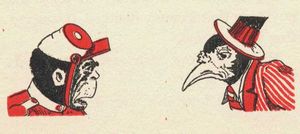
Old Mr. Crow was flitting about, talking in a loud voice, and ordering
people around to his heart's content.
"Silence!" Major Monkey commanded, as soon as he arrived. Mr. Crow
opened his mouth to speak. But Major Monkey cut him off short.
"The first thing a soldier has to learn is to obey," he barked.
"But I'm a general!" Mr. Crow protested.
"Well, these are general orders; so you'll have to obey 'em," said
Major Monkey glibly.
And poor old Mr. Crow didn't know what to say to that.
But he couldn't help looking rather grumpy.
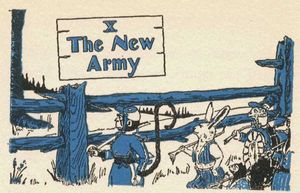
X — The New Army
"Now, then—fall in!" Major Monkey shouted to the whole company of
field-and forest-folk.
But nobody had the slightest idea what he meant.
"You don't suppose he expects us to fall in the brook, do you?" Tommy
Fox asked his nearest neighbor. If there was anything that Tommy
disliked, it was getting his feet wet.
Major Monkey soon saw that nobody knew what to do.
"Form a long line, two deep!" he directed.
And then there was trouble, because everyone wanted to be in the front
rank (as Major Monkey called it) in order to see everything.
After a good deal of jostling and squirming on the part of the company,
and much loud talk on the part of Major Monkey, the new army at last
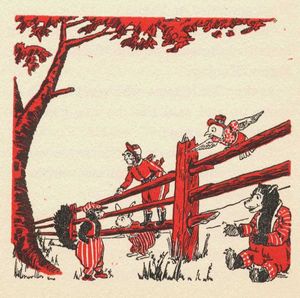
stood stretched out in a double line along the pasture-fence.
Major Monkey seemed much pleased as he walked up and down in front of
his soldiers. And then he happened to glance up.
There was Mr. Crow, perched on a limb over his head.
"Here, you!" the Major shouted. "Didn't you hear me say 'Fall in?'"
"Certainly!" said Mr. Crow. "But I'm a general, you know."
"Well, what of that?" the Major snapped. "So are all these people
generals! You didn't think—did you?—that I'd have anybody in my army
that wasn't at least a general?"
For a wonder, Mr. Crow said never a word. He was angry. But he didn't
want to be left out of the army. So he decided that he had better obey.
And he flapped down and took his place just in front of the front rank.
"You mustn't stand there!" Major Monkey said to him severely. "You're
late falling in. There's no place left for you. So you'll have to stand
behind all the others."
That was just a little more than old Mr. Crow could bear.
"I'll do nothing of the sort!" he squawked. "And I must say that this is
shabby treatment to receive from an old friend."
Major Monkey certainly didn't want any trouble right at the beginning.
So he hastened to soothe Mr. Crow's wounded feelings.
"Look here," he said to the old gentleman, "if I were you I shouldn't
care to be a common general."
"What else can I be?" asked Mr. Crow with a hopeful gleam in his eye.
"You can be the cook," the Major suggested. "There are dozens of
generals; but you'd be the only cook, you see."
Mr. Crow rather liked that idea.
"I accept your offer," he said somewhat stiffly. And then he marched
down the line and took his place behind it.
Major Monkey breathed a sigh of relief. He was glad that the trouble had
proved no worse. And now he turned once more to inspect the crowd of
generals that was to make up his army.
"Here, you!" he said suddenly, pointing to a brownish gentleman at one
end of the front rank. "What's your name?"
"Rusty Wren!" was the meek reply.
"Don't stick your tail up in the air like that!" Major Monkey cried.
"You're spoiling the looks of the whole army."
Rusty Wren replied that it was very hard for him to keep his tail down
for longer than a few moments at a stretch.
"I don't believe I'll be in the army," he announced. "Probably my wife
is wondering where I am this moment. So I'm going home." And thereupon
he flew away toward Farmer Green's dooryard, where he lived.
"Well, we're rid of him, anyhow," said Major Monkey. And then he
noticed something else that wasn't as it should have been.
"Here, you!" he called to Peter Mink. "Pull in your neck! It's too
long! It sticks out and spoils the looks of the whole army."
Now, Peter Mink was a rude fellow. And he made such a rude reply that
Major Monkey discharged him on the spot.
"Go away!" he cried. "We don't want any rowdies in our army."
XI — War in the Woods
Although Major Monkey had ordered him out of the army, Peter Mink
declared that he wasn't going till he was ready to leave.
"Very well," said the Major easily. "You may stay here; and we'll go."
But Peter Mink was an obstinate fellow. The moment the army started to
move, he went along with it. And what was worse, he insisted on walking
right behind Major Monkey, and trying to strut just as the Major did.
Some of the generals couldn't help snickering. And of course Major
Monkey couldn't overlook such behavior.
"Order in the ranks!" he shouted as fiercely as he knew how.
The generals stopped tittering at once. For a minute or two everybody
marched on in silence. And then the cry, "Halt!" rang suddenly out.
The generals all stopped. Major Monkey stopped, too. And his face seemed
more wrinkled than ever as he looked every general in the face.
Naturally, that took some time, for there were several dozens of them.
"Who shouted 'Halt?'" the Major asked at last.
But nobody knew. At least, nobody answered. And there was a good deal of
low talking and craning of necks. For some reason or other, everybody
peered at Peter Mink. But he stared straight ahead in the most innocent
fashion.
Major Monkey said nothing more. But he walked behind the army and picked
up a stick.
"Forward, march!" he commanded then. And as the army moved on, he
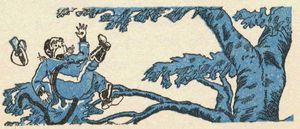
continued to walk in the rear, just behind old Mr. Crow.
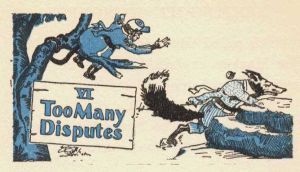
Soon the cry, "Halt!" sounded again. And as soon as he heard it, Major
Monkey threw his stick with great force and caught Peter Mink neatly in
the back of his head. Peter Mink toppled over where he stood.
"There!" Major Monkey remarked. "He won't bother us any more to-day."
And before the army had stopped gasping, he marched it forward again,
leaving Peter Mink stretched upon the ground.
Some of the generals objected, and said that they thought that Peter
Mink ought to be looked after.
But Major Monkey told them that they were in the army, and that it was
war, and they must expect even worse things to happen.
Now, Jimmy Rabbit was a tender-hearted chap. He couldn't bear the
thought of leaving even a rascal like Peter Mink wounded and alone.
"I think you ought to send the cook back to take care of him," Jimmy
told Major Monkey.
At that, Mr. Crow—who was the cook—spoke up and said that he was going
to stay with the army.
"I don't see," he said, "how you could get along without me. An army
without a cook is as good as lost."
Major Monkey promptly agreed with Mr. Crow.
"Certainly we mustn't get lost," he said. "If we were lost, the enemy
never could find us. And we might wander about in the woods for years
and years."
His remarks made some of the generals a bit uneasy. And one of them—a
soldier called Billy Woodchuck—announced that he would have to be
leaving.