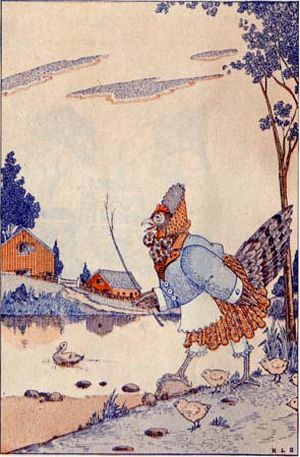
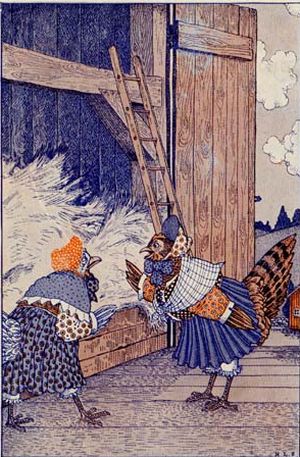
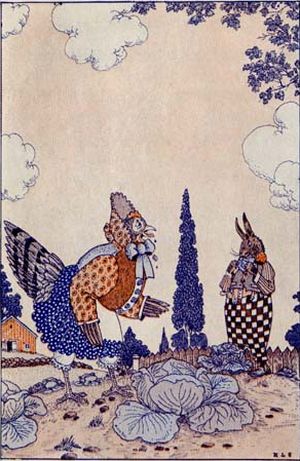
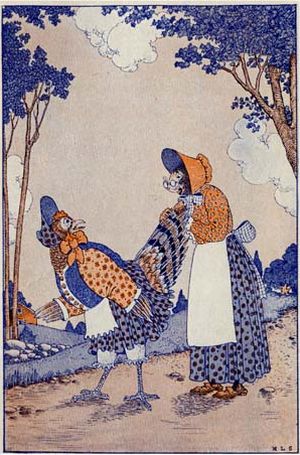
Henrietta Hen was waiting as patiently as she could for the fair to come
to an end. She tried to close her ears to the boasts of her neighbors on
either side of her, that they were going to win the first prize. She had
heard too many unpleasant remarks about herself to have even the
slightest hope of winning any prize at all—let alone the first.
"Anyhow, we'll be going home tonight," Henrietta said to herself. "And
I'll never, never, never come to another fair. I'll go and hide 'way up
high in the haymow where they can't find me before I'll spend another
week in a place like this."
While she was muttering under her breath like that some men came up to
her pen. And Henrietta Hen promptly squatted down in the furthest corner
of it, hoping they wouldn't say anything disagreeable about her. She
felt that she had already heard about all she could stand. She didn't
even look at her callers. And soon they moved away.
Then Henrietta glanced up. She noticed something blue dangling from the
front of her pen. And there was a greater commotion than ever on all
sides of her.
"What is it?" she cried. "What has happened?"
Neighbor Number 1, on her right, shot a spiteful look at her.
"Those stupid judges!" she spluttered. "They've made a terrible
blunder. They've gone and given you and your chicks the first prize. And
of course it was meant for me and mine!"
"It wasn't!" screamed Neighbor Number 2 (on Henrietta's left). "That
prize was intended for me and my children!"
"Who won second and third?" cried a noisy hen from across the way.
"They're both at the other end of the hall!" somebody shrieked.
"It's an outrage! It isn't fair! We've been cheated!" Henrietta Hen's
nearest neighbors clamored. But nobody paid any attention to them.
As for Henrietta, she didn't quite know how to act. She had intended,
when she left home, to do a good deal of strutting back and forth in her
pen, with now and then a pause to preen herself, to make sure that she
looked her best. But somehow she no longer cared to put on grand airs,
as of old. She remembered that some of the other hens at the fair had
been haughty and proud and had smoothed their feathers, declaring boldly
that they expected to win the first prize.
Henrietta had heard it said that fine feathers don't make fine birds.
And she knew at last what that meant. It meant that gay clothes and
lofty ways and boastful talk were of no account at all.
So Henrietta tried to behave as if nothing unusual had happened. She
told her chicks that they were going home that evening, and that she
would be glad to be back on the farm again, among plain home-folks.
At last Johnnie Green and his father came to load Henrietta and her
family into the wagon.
"Well," said the old horse Ebenezer to Henrietta. "Did you enjoy the
races?"
"I didn't have a chance to see them," she replied.
"That's a pity," he told her. And then he asked her, "What's that blue
tag hanging from your pen?"
"That—" said Henrietta—"that means that my chicks won the first
prize."
"She helped win it herself," cried old dog Spot, who was yelping about
the wagon. "Our little speckled hen was the best hen at the fair!"
"Nonsense!" Henrietta exclaimed. But, all the same, she couldn't help
being pleased.
THE END
SLUMBER-TOWN TALES
(Trademark Registered.)
By ARTHUR SCOTT BAILEY
AUTHOR OF THE
SLEEPY-TIME TALES and TUCK-ME-IN TALES
Colored Wrapper and Text Illustrations Drawn by HARRY L. SMITH
These are fascinating stories of farmyard folk for boys and girls from
about four to eight years of age.
THE TALE OF MISS KITTY CAT
When Mrs. Rat saw Miss Kitty Cat washing her face, she knew it meant
rain. And she wouldn't let her husband leave home without his umbrella.
THE TALE OF HENRIETTA HEN
Henrietta Hen was an empty-headed creature with strange notions. She
never laid an egg without making a great fuss about it.
THE TALE OF THE MULEY COW
The Muley Cow belonged to Johnnie Green. He often milked her; and she
seldom put her foot in the milk pail.
THE TALE OF TURKEY PROUDFOOT
A vain fellow was Turkey Proudfoot. He loved to strut about the farmyard
and spread his tail, which he claimed was the most elegant one in the
neighborhood.
THE TALE OF PONY TWINKLEHEELS
Pony Twinkleheels trotted so fast you could scarcely tell one foot from
another. Everybody had to step lively to get out of his way.
THE TALE OF OLD DOG SPOT
Old dog Spot had a keen nose. He was always ready to chase the wild
folk. And he always looked foolish when they got away from him.
THE TALE OF GRUNTY PIG
Grunty pig was a great trial to his mother. He found it hard not to put
his feet right in the feeding trough at meal time.
Grosset & Dunlap, Publishers, New York.
SLUMBER-TOWN TALES
(Trademark Registered.)
By ARTHUR SCOTT BAILEY
AUTHOR OF THE
SLEEPY-TIME TALES and TUCK-ME-IN TALES
Colored Wrapper and Text Illustrations Drawn by HARRY L. SMITH
This series of animal stories for children from three to eight years,
tells of the adventures of the four-footed creatures of our American
woods and fields in an amusing way, which delights small two-footed
human beings.
THE TALE OF CUFFY BEAR
THE TALE OF FRISKY SQUIRREL
THE TALE OF TOMMY FOX
THE TALE OF FATTY COON
THE TALE OF BILLY WOODCHUCK
THE TALE OF JIMMY RABBIT
THE TALE OF PETER MINK
THE TALE OF SANDY CHIPMUNK
THE TALE OF BROWNIE BEAVER
THE TALE OF PADDY MUSKRAT
THE TALE OF FERDINAND FROG
THE TALE OF DICKIE DEER MOUSE
THE TALE OF TIMOTHY TURTLE
THE TALE OF BENNY BADGER
THE TALE OF MAJOR MONKEY
THE TALE OF GRUMPY WEASEL
THE TALE OF GRANDFATHER MOLE
THE TALE OF MASTER MEADOW MOUSE
Grosset & Dunlap, Publishers, New York
1. Punctuation has been normalized to contemporary standards.
2. Frontispiece illustration relocated to after title page.
3. Typographic error corrected in original:
p. 53 "Whtiey" to "Whitey" ("said old Whitey.")