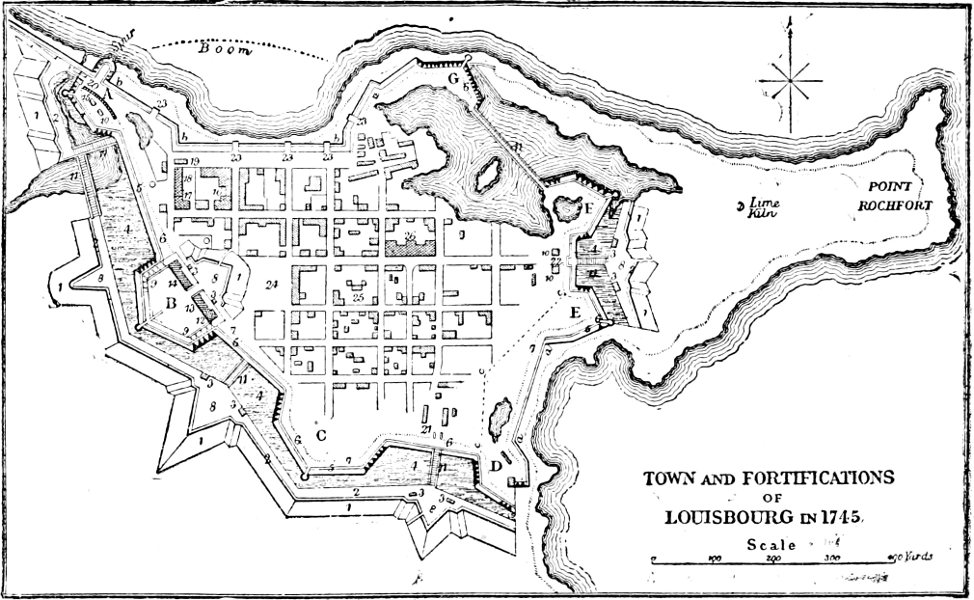
Camp Routine.
The routine of camp life is not without interest
as tending to show what was the temper of the
men under circumstances of unusual trial and
hardship. They were housed in tents, most of
which proved rotten and unserviceable, or in
booths, which they built for themselves out of
poles and green boughs cut in the neighboring
woods. The relief parties, told off each
day for work in the trenches, were
marched to their stations after dark, as the enemy’s
fire swept the ground over which they must
pass. For a like reason, the fatigue parties could
only bring up the daily supplies of provisions and
ammunition to the trenches from Gabarus Bay,
after darkness had set in. By great good-fortune,
the weather continued dry and pleasant; otherwise
the bad housing and severe toil must have
102
told on the health of the army even more severely
than it did, while work in the trenches would
have been suspended during the intervals of wet
weather.
Spirit of the Army.
A force like this, composed of men who were
the equals of their officers at home, not bound
together by habits of passive obedience formed
under the severe penalties of martial law, could
not be expected to observe the exact discipline of
regular soldiers. It was not attempted to enforce
it. Not one case of punishment for infraction of
orders is reported during the siege. But officers
and men had in them the making of far better soldiers
than the ordinary rank and file of armies.
There were men in the ranks who rose to be
colonels and brigadiers in the revolutionary contest.[22]
The hardest duty was performed without
grumbling; the most dangerous service
found plenty of volunteers; and Pepperell
himself has borne witness that nothing
pleased the men better than to be ordered off on
some scouting expedition that promised to bring
on a brush with the enemy.
This spirit is plainly manifest in the letters
103
which have been preserved. In one of them
Major Pomeroy tells his wife that “it looks as if
our campaign would last long; but I am willing
to stay till God’s time comes to deliver the city
into our hands.” The reply is worthy of a woman
of Sparta: “Suffer no anxious thoughts to rest in
your mind about me. The whole town is much
engaged with concern for the expedition, how
Providence will order the affair, for which religious
meetings every week are maintained. I leave you
in the hand of God.”
There is not a despatch or a letter of Pepperell’s
extant, in which this dependence upon the Over-ruling
Hand is not acknowledged. The barbaric
utterance that Providence is always on the side of
the strongest battalions would have shocked the
men of Louisburg as deeply as it would the men
of Preston, Edgehill, and Marston Moor. The
conviction that their cause was a righteous one,
and must therefore prevail, was a power still active
among Puritan soldiers: nor did they fail to give
the honor and praise of achieved victory to Him
whom they so steadfastly owned as the Leader of
Armies and the God of Battles.
104
There were not wanting incidents which the
soldiers treasured up as direct manifestations of
Divine favor. Moses Coffin, of Newbury, who
officiated in the double capacity of chaplain and
drummer, and who had been nicknamed in consequence
the “drum ecclesiastic,” carried a small
pocket-Bible about with him wherever he went.
On returning to camp, after an engagement with
the enemy, he found that a bullet had passed
nearly through the sacred book, thus, undoubtedly,
saving his life.
Frolics in Camp.
The relaxation from discipline has been more or
less commented upon by several writers, as if it
implied a grave delinquency in the head of the
army. We are of the opinion, however, that it
was the safety-valve of this army, under the
extraordinary pressure laid upon it. So while we
may smile at the comparison made by Douglass,
who says that the siege resembled a “Cambridge
Commencement,” or at the antics described by
Belknap,[23] we need not feel ourselves
bound to accept their conclusions. This
author says: “Those who were on the spot, have
frequently in my hearing laughed at the recital
105
of their own irregularities, and expressed their
admiration when they reflected on the almost
miraculous preservation of the army from destruction.
They indeed presented a formidable front
to the enemy, but the rear was a scene of confusion
and frolic. While some were on duty at the
trenches, others were racing, wrestling, pitching
quoits, firing at marks or birds, or running after
shot from the enemy’s guns for which they
received a bounty.”
Our Fascine Batteries.
In his unscientific way, Pepperell was daily
tightening his grasp upon Louisburg. Gridley,[24]
who acted in the capacity of chief engineer, had
picked up from books all the knowledge he
possessed, but he soon showed a natural
aptitude for that branch of the service.
Dwight, the chief of artillery, is not known ever
to have pointed a shotted gun in his life. Instead
of gradual approaches, of zigzags and épaulements,
the ground was simply staked out where
the batteries were to be placed. After dark the
working parties started for the spot, carrying
bundles of fascines on their backs, laid them on
the lines, and then began digging the trenches
106
and throwing up the embankment by the light of
their lanterns. All the batteries at Louisburg
were constructed in this simple fashion. The
work of making the platforms, getting up the
cannon, and mounting them, was attended with
far greater labor and risk.
The Advanced Battery opens Fire May 18.
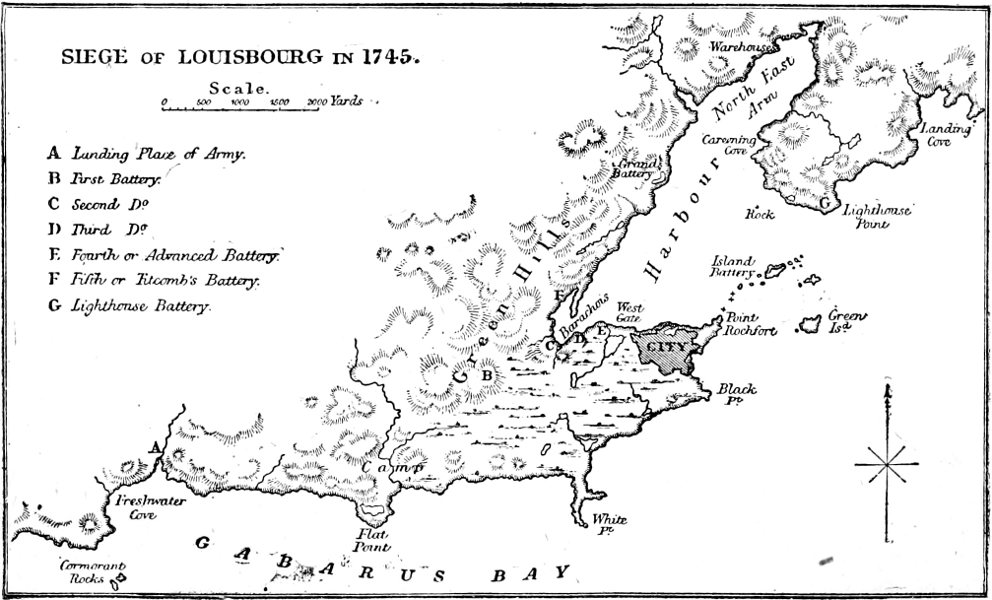
In this manner a fascine battery covered by a
trench in front, on which the provincials had been
working like beavers for two days and nights, was
raised within two hundred and fifty yards of the
West Gate, against which it began sending its shot
on the 18th. This was by much the
most dangerous effort that the besiegers
had yet made, and the enemy at once
trained every gun upon it that would bear, in the
hope of either demolishing or silencing the work.
It was so near that the men in the trenches, and
those on the walls, kept up a continual fire of musketry
at each other, interspersed with sallies of
wit, whenever there was a lull in the firing. The
French gunners, who were kept well supplied with
wine, would drink to the besiegers, and invite
them over to breakfast or to take a glass of wine.
107
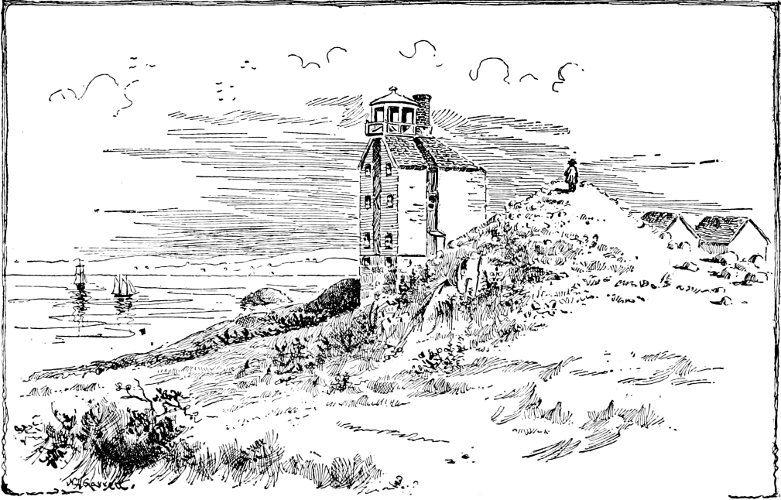
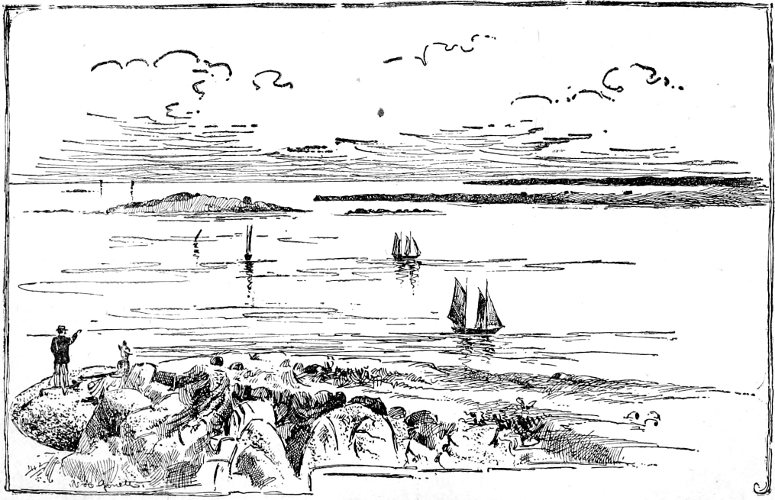
THE LIGHTHOUSE, WITH DÉBRIS OF OLD WORKS.
109
Cannon discovered.
In two days the fire of our guns had beaten
down the drawbridges, part of the West Gate,
and some of the adjoining wall. Pepperell complains
at this time of his want of good gunners,
also of a sufficient supply of powder to make good
the daily consumption, of which he had no previous
conception, but is cheered by finding
thirty cannon sunk at low-water mark
on the opposite side of the harbor, which he
designed mounting at the lighthouse forthwith,
for attacking the Island Battery. Gorham’s
regiment was posted there with this object. Thus
again were the enemy furnishing means for their
own destruction. Foreseeing that this fortification
would shut the port to ships coming to his
relief, Duchambon sent a hundred men across
the harbor to drive off the provincials. A sharp
fight ensued, in which the enemy were defeated.
Titcomb’s Battery at Work.
By this time another fascine battery situated by
the shore, at a point nine hundred yards from the
walls, began raking the Circular Battery
of the enemy, in conjunction with the
direct fire from our Advanced Battery.
It was called Titcomb’s, from the officer in charge,
Major Moses Titcomb of Hale’s regiment. These
110
two fortifications were now knocking to pieces
the northwest corner of the enemy’s ponderous
works, known as the Dauphin Bastion. We were
now playing on Louisburg from three batteries
on the shore of the harbor, three in the rear of
these, and had another in process of construction
at the lighthouse, all of which, except the last,
had been completed under fire within twenty days,
without recourse to any scientific rules whatever.
Capture of the Vigilant.
In spite of Warren’s watchfulness one vessel
had slipped through his squadron into Louisburg
unperceived, bringing supplies to the besieged,
An event now took place which, to use
Pepperell’s words, “produced a burst of
joy in the army, and animated the men with fresh
courage to persevere.” The annual supply ship
from France, for which our fleet had been constantly
on the lookout, had run close in with the
harbor in a thick fog, undiscovered by our vessels,
and wholly unsuspicious of danger herself. When
the fog lifted she was seen and engaged by the
Mermaid, a forty-gun frigate, until the rest of the
squadron could come to her aid, when, after a
spirited combat, the French ship was forced to
111
strike her colors. The prize proved to be the
Vigilant, a new sixty-gun ship, loaded with stores
and munitions for Louisburg. She was soon put
in fighting trim again, and manned by drafts made
from the army and transports.
Warren proposes to attack.
By the 24th, two more heavy ships, which the
ministry had sent out immediately upon receiving
Shirley’s advices that the expedition had been
decided upon,[25] now joined Warren, who at length
felt himself emboldened to ask Pepperell’s co-operation
in the following plan of attack. It was
proposed to distribute sixteen hundred men, to be
taken from the army, among the ships of war, all
of which should then go into the harbor and
attack the enemy’s batteries vigorously. Under
cover of this fire, the soldiers, with the
marines from the ships, were to land
and assault the city. Pepperell himself
was to have no share in this business, except as a
looker-on, but was to put his troops under the
command of an officer of marines who should
take his orders from Warren only.
This implied censure to the conduct of the
army and its chief, followed up the next day by
112
the tart question of “Pray how came the Island
Battery not to be attacked?” seems to have
goaded Pepperell into giving the order for a night
attack upon that strong post. Indeed, Pepperell’s
perplexities were growing every hour. On the
day he received Warren’s cool proposition to take
the control of the army out of his hands, he had
been obliged to send off a flying column in pursuit
of a force which his scouts had reported was at
Mirá Bay, fifteen miles from his camp. In fact,
the forces which Duchambon had recalled from
Annapolis were watching their chance either to
make a dash into Louisburg, or throw themselves
upon the besiegers’ trenches unawares.
Island Battery stormed May 27.
Gallantry of William Tufts, Jr.
Notwithstanding the hazard, it was determined
to storm the Island Battery. For this purpose,
four hundred volunteers embarked in whale-boats
on the night of the 27th, and rowed cautiously
round the outer shore of the harbor
toward the back of the island, in the expectation
of finding that side unguarded.
They were, however, discovered by the sentinels
in season to thwart the plan of surprise. The
garrison was alarmed. Still the brave provincials
113
would not turn back. Cannon and musketry were
turned on them from the island and city. Through
this storm of shot, by which many of the boats
were sunk before they could reach the shore, only
about half the attacking force passed unscathed.
In scrambling up the rocks through a drenching
surf, most of their muskets were wet with salt
water, and rendered useless. Not yet dismayed,
the assailants fought their numerous foes hand to
hand for nearly an hour. Captain Brooks, their
leader, was cut down in the mêlée.
One William Tufts, a brave lad of only
nineteen, got into the battery, climbed
the flagstaff, tore down the French colors, and
fastened his own red coat to the staff, under a
shower of balls, many of which went through his
clothes without harming him. Sixty men were
slain before the rest would surrender, but these
were the flower of the army, whose loss saddened
the whole camp, when the enemy’s exulting cheers
told the story of the disaster, at break of day.
About a hundred and eighty-nine men were either
drowned, killed, or taken in this desperate
encounter. It was an exploit worthy of the men,
114
but there was not one chance in ten of its being
successful. For once Pepperell had allowed
feeling to get the better of judgment by taking
that chance.
Pepperell could now say to Warren that his
proposal would not be agreed to. His effective
force had been reduced by sickness to twenty-one
hundred men, six hundred of whom were at that
moment absent from camp. As a compliance with
Warren’s requisition for sixteen hundred men
would be equivalent to exposing everything to the
uncertain chances of a single bold dash, Pepperell’s
council very wisely concluded that it was far
better to hold fast what had been gained, than to
risk all that was hoped for. They offered to lend
the commodore five hundred soldiers, and six
hundred sailors, if he would go and assault the
Island Battery, in his turn, but Warren’s only
reply was to urge the completion of the Lighthouse
Battery for that work.
The siege had now continued thirty days without
decisive results. So far Duchambon had
showed no sign of yielding, and Pepperell found
it difficult to get information as to the state of the
115
garrison. An expedient was therefore hit upon
which was calculated to test both the temper and
condition of the besieged thoroughly: for although
the capture of the Vigilant had been witnessed
from the walls of Louisburg, it had not produced
the impression that the besiegers had expected.
This was the key to what now took place.
Effect of Stratagem tried.
Maisonforte, captain of the Vigilant, was still
a prisoner on board the fleet. He was given to
understand that the provincials were
greatly exasperated over the cruel treatment
of some prisoners, who had been
murdered after they were taken, and he was asked
to write to Duchambon informing him just how
the French prisoners were treated, to the end that
such barbarities as had been complained of might
cease, and retaliation be avoided.
Maisonforte readily fell into the trap laid for
him. He unhesitatingly wrote the letter as
requested, it was sent to Duchambon by a flag,
and was delivered by an officer who understood
French, in order to observe its effect. The letter
thus conveyed to Duchambon the disagreeable
news of the Vigilant’s capture, of which he had
116
been ignorant, and it made a visible impression.
He now knew that his determination to hold out
in view of the expected succors from France, was
of no further avail. This correspondence took
place on the 7th.
Lighthouse Battery completed.
Island Battery silenced.
By the arrival of ships destined for the Newfoundland
station, the fleet had been increased to
eleven ships carrying five hundred and forty guns.
On the 9th two deserters came into our lines, who
said that the garrison could not hold out much
longer unless relieved. On the 11th, which was
the anniversary of the accession of George II., a
general bombardment took place, in
which the new Lighthouse Battery
joined, for the first time. The effect
of its fire upon the Island Battery was so marked,
that Warren now declared himself ready to join in
a general attack, whenever the wind should be fair
for it. For this attempt Pepperell pushed forward
his own preparations most vigorously. Boats were
got ready to land troops at different parts of the
town. The Circular Battery was about silenced.
All the 13th, 14th, and 15th a furious bombardment
was kept up. Our marksmen swept the
117
streets of the doomed city, with musketry, from
the advanced trenches, so that no one could show
his head in any part of it without being instantly
riddled with balls. The artillerists at the Island
Battery were driven from their posts, some even
taking refuge from our shells by running
into the sea. Our boats now passed in
and out of the harbor freely, with supplies, without
molestation. It was evident that the fall of this
much dreaded bulwark had brought the siege
practically to a close.
On the 14th the whole fleet came to an anchor
off the harbor in line of battle. It made a
splendid and imposing array. At the same time
the troops were mustered under arms, and
exhorted to do their full duty when the order
should be given them to advance upon the enemy’s
works. In the midst of these final preparations
for a combined and decisive assault, an ominous
silence brooded over the doomed city. It was
clear to all that the crisis was at hand.
Duchambon felt that he had now done all that a
brave and resolute captain could for the defence
of the fortress. He saw an overwhelming force
118
about to throw itself with irresistible power upon
his dismantled walls, in every assailable part at
once. His every hope of help from without had
failed him. Food for his men and powder for his
guns were nearly exhausted. He was now confronted
with the soldier’s last dread alternative of
meeting an assault sword in hand, with but faint
prospect of success, or of lowering the flag he
had so gallantly defended. The wretched inhabitants,
who had endured every privation cheerfully,
so long as there was hope, earnestly entreated him
to spare them the horrors of storm and pillage.
The Fortress surrenders.
On the 15th, in the afternoon, while the two
chiefs of the expedition were in consultation
together, Duchambon sent a flag to Pepperell
proposing a suspension of hostilities until terms
of capitulation should be agreed upon. This was
at once granted until eight o’clock of the following
morning. Duchambon’s proposals were then
submitted and rejected as inadmissible, but
counter proposals were sent him, to
which, on the same day, he gave his
assent, by sending hostages to both Pepperell and
Warren, saving only that the garrison should be
119
allowed to march out with the honors of war.
For reasons to be looked for, no doubt, in his pride
as a professional soldier, and in his reluctance to
treat with any other, he addressed separate notes
to the land and naval commanders. As neither
felt disposed to stand upon a point of mere
punctilio, Duchambon’s request was immediately
acceded to. A striking difference, however, is to
be observed between Pepperell’s and Warren’s
replies to the French commander. In his own
Pepperell generously, and honorably, makes the
full ratification of this condition subject to
Warren’s approval. In the commodore’s there is
not one word found concerning the general of the
land forces, or of his approbation or disapprobation,
any more than if he had never existed; but in
Warren’s note the extraordinary condition is
annexed “that the keys of the town be delivered
to such officers and troops as I shall appoint to
receive them, and that all the cannon, warlike and
other stores in the town, be also delivered up to
the said officers.”
On the 17th Warren took formal possession of
the Island Battery, and shortly after went into the
120
city himself to confer with the governor. In the
meantime, conceiving it to be his right to receive
the surrender, Pepperell had informed the governor
of his intention to put a detachment of his own
troops in occupation of the city defences that
same afternoon. This communication was immediately
shown to Warren, who at once addressed
Pepperell, in evident irritation, upon the “irregularity”
of his proceedings, until the articles of
surrender should have been formally signed and
sealed. The fact that he had just proposed
to receive the surrender of the fortress himself
was not even referred to, nor does it appear that
Pepperell ever knew of it. One cannot overlook,
therefore, the presence of some unworthy manœuvring,
seconded by Duchambon’s professional
vanity, to claim and obtain a share of the honor
of this glorious achievement, not only unwarranted
by the part the navy had taken in it, since it had
never fired a shot into Louisburg, or lost a man
by its fire: but calculated to mislead public opinion
in England.
An unpublished letter of General Dwight,
written three days after the entry of the provincial
troops, relates the closing scenes of this truly
memorable contest. It runs as follows:—
121
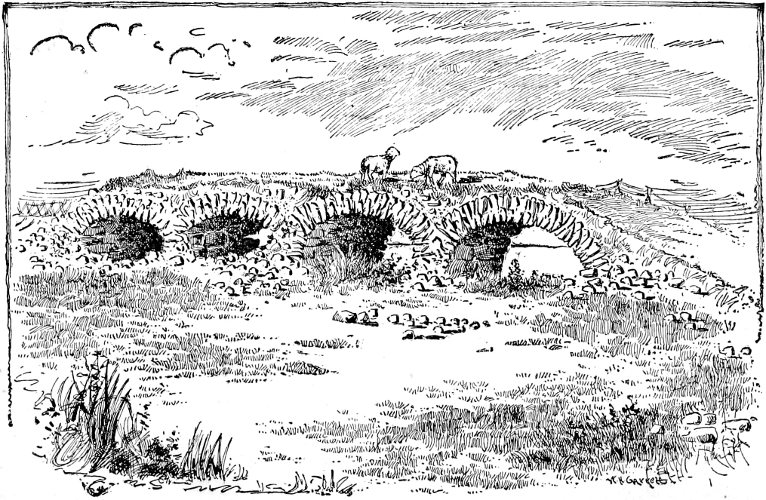
REMAINS OF CASEMATES AT LOUISBURG.
123
“We entered the city on Monday last (17th)
about five o’clock P.M., with colors flying, drums,
hautboys, violins, trumpets, etc. Gentlemen and
ladies caressing (the French inhabitants) as well
they might, for a New England dog would have
died in the holes we drove them to—I mean the
casemates where they dwelt during the siege.
“This fortress is so valuable, as well as large
and extensive, that we may say the one half has
not been conceived.... Sometimes I am ready
to say a thousand men in a thousand years could
not effect it. Words cannot convey the idea of
it.... One half of ye warlike stores for such a
siege were not laid in; however, the Vigilant
(French supply ship) being taken and Commodore
Warren’s having some supply of stores from New
England was very happy, and so it is that his
readiness has been more than equal to his
ability.”
Governor Duchambon puts his whole force at
thirteen hundred men at the beginning of the
siege, and at eleven hundred at its close. About
124
two thousand men were, however, included in the
capitulation, of which number six hundred and
fifty were veteran troops. The besiegers’ shot had
wrought destruction in the city. There was not
a building left unharmed or even habitable, by the
fifteen thousand shot and shells that Pepperell’s
batteries had thrown into it.
When Pepperell saw the inside of Louisburg
he probably realized for the first time the magnitude
of the task he had undertaken. On looking
around him, he said, with the expeditionary motto
in mind no doubt, “The Almighty, of a truth, has
been with us.”
As the expedition began, so it now ended, with
a prayer, which has come down to us as a part of
its history. Pepperell celebrated his entry into
Louisburg by giving a dinner to his officers.
When they were seated at table, the general
called upon his old friend and neighbor, the Rev.
Mr. Moody of York, to ask the Divine blessing.
As the parson’s prayers were proverbial for
their length, the countenances of the guests fell
when he arose from his chair, but to everybody’s
surprise the venerable chaplain made his
125
model and pithy appeal to the throne of grace in
these words:
“Good Lord! we have so many things to thank
thee for, that time will be infinitely too short to do
it: we must therefore leave it for the work of
eternity.”
[22]General John Nixon is one of those referred to.
[23]Douglass (Summary),
Belknap (“History of New Hampshire”)
and
Hutchinson (“History of Massachusetts Bay”) have accounts of
the Louisburg expedition. Douglass and Hutchinson wrote contemporaneously,
and were well informed, the latter especially, upon all points
relating to the inception and organization. Of their military criticism it
is needless to speak. There is a host of authorities, both French and
English, most of which are collected in Vol. V. “Narrative and Critical
History of America.”
[24]Richard Gridley subsequently laid out the works at Bunker
Hill and Dorchester Heights, in much the same manner.
[25]Shirley’s second messenger, Captain Loring, on presenting his
despatches, was allowed but twelve hours in London, being then ordered
on board the Princess Mary, one of the ships referred to.
126