THE TAHQUITCH MAIDEN
IT WAS a perfect August day in
the San Jacinto Mountains.
The morning dew still lay
upon the grass, but the early
mists which hover as benedictions
over the heated lower
plains, were unneeded in the cooler air of
our highland camp; and the soft blue of
the summer sky suggested only rest and
comfort.
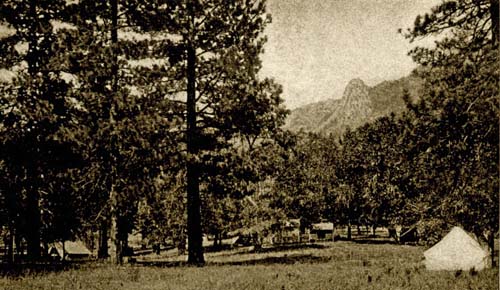
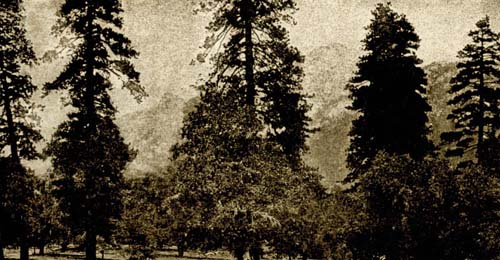
My hammock was swung under the
centuried pines of Strawberry Valley. I
had slipped away from the family tents
on the pretense of reading the Inferno;
but the gentle soughing of the pines, the
drowsy murmur of the flies which live
even in mountain climes, and the subdued
hum of my companion-campers’ voices
threw me quite out of conceit with scenes
of the lower world. My book fell from my
hands, and my half-closed eyes followed
unreproved my wandering thoughts.
Flecks of white cloud now floated in the
air, now touched the summits of the range
surrounding us, and brought out with
amazing distinctness the dim outlines of
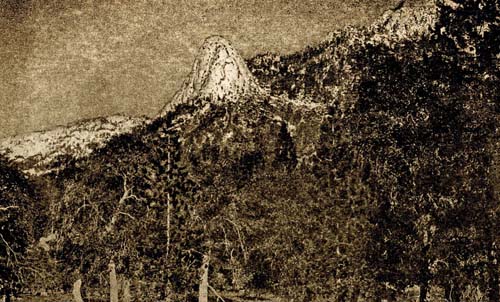
hill and peak. Huge Tahquitch looked
benignly down, and I could almost fancy
that I saw the hoary head of old San Jack
from above the line of intervening hills.
Suddenly I heard a sharp “Hello” from
the direction of the kitchen camp, followed
by Tom’s generous “Howdy” in reply.
Turning my head I saw an alert individual
in jeans and sombrero, with a dreary-looking
pony grazing at his side. The
man was talking eagerly, flinging his stalwart
arm in the direction of the mountain
whither my vagrant thoughts had just
been turning.
“Can he be the discoverer of a new
mine?” I wondered lazily. “Or perhaps a
peddler of curios? Well, he shall not disturb
me!” and I settled back into my hammock
and took up my book with sudden
energy. But Cousin Tom had spied me
peering over my pillow, and in a moment
he and his merry young wife and Cousin
Mollie closed about my swinging couch.
“Oh, we’ve such a splendid chance to
go to San Jacinto peak tomorrow!” they
cried in a breath. And Cousin Mollie
added, “It is the one trip needed to make
this the happiest summer on record. How
ridiculous that we ever thought of going
home without making it!”
Then Tom went on: “The whole affair
takes only three days; the trail is as easy
as a floor, the guide says, and the expense
just nothing at all!” And when I did not
answer, “Why do you look so glum? You
didn’t suppose we meant to leave you,
did you? Of course you are going with
us.” And the girls echoed, “Of course,
of course!”
I turned upon my cousins with indignant
scorn.
“Children,” I cried, “what are you talking
about? Are you mad, clean, stark
mad? I never rode a horse. I never saw
a mountain trail. I should starve on bacon
and dry bread. I am afraid to death
of rattlesnakes and bears. Do you think
I am an idiot? Of course I will not go!”
“Oh, now,” wheedled Tom, “don’t get
excited. I’ll wager you will enjoy it the
best of any of us. I tell you the trail is
nothing. Rattlesnakes! and bears! Besides
you are our guest, and we can’t go
and leave you behind.”
“Only think of the view!” shouted the
girls.
“Go to the mountains of the moon, if
you feel inclined,” was my steadfast answer,
“and take the view with you. I shall
never, never leave Strawberry Valley on
any such reckless venture.”
But even as I spoke I felt that sinking
of the heart which portends defeat to foolish
souls. As for my objections, Tom swept
them away as though they were chaff and
he a mighty wind. In mute despair I
turned to pater- and materfamilias who
had joined the group. Alas, for the first
time they failed me. So, when there was
no longer help in man—or woman—I
yielded, firmly convinced that I should
never see friends or kindred again, railing
at my own weakness of will. But my good
angel fluttered near, and so I went.
I need not dwell upon the perils of the
way. Sliding stones and slipping mules,
frightened horses and snapping cinches—these
are only incidents. He is preparing
a gruesome future for himself who asserts
that Tahquitch trail is “easy!” More than
once, as my unwilling bronco balked or
stumbled or insisted upon a wholly untrod
path, my frightened lips framed—not a
prayer! Then I girded anew the loins of
my resolution and clung yet more frantically
to the neck of my disgusted steed.
At noon we reached our first resting-place,
a little valley just at the base of old
Tahquitch. Then, fear almost forgot, the
glorious wonder of the way took possession
of me. Even now, as I recall that first
highland camp, a dreamy restfulness steals
over mind and heart. The soft, abundant
verdure of that rugged floor; the girded
strength of the everlasting hills; the burden
of myth and legend investing every
peak and rock and valley with half-suggested
mystery—it was worth the labor,
was it worth the fear?
Our resting space was all too brief, and
again we mounted our still wearied horses.
Another ride of terrors, and we camped
for the night at the very foot of the lordly
peak we were to scale next day. Hardly
a more enchanting spot can be imagined
than the little valley nest, apparently created
for our immediate needs. Huge cliffs
of rock on one side shut us protectingly
from the lofty range of hills beyond. On
the side opposite, the hills came down to
the very edge of the valley, but lovingly,
with no hint of the treacherous ravines
which scar their slopes. Beyond loomed
the hoary head of San Jacinto—threatening,
awful, grand.
After our meager supper we prepared
our beds of fragrant pine, topped with enormous
blankets. That done, we gathered
around the blazing camp-fire; and then
followed tales of aboriginal California,
Tom’s valiant stunt—an alleged Indian
waltz—songs and songs, and bye-and-bye
the glorious chant, “I will lift up mine
eyes unto the hills.” At ten o’clock the
embers of our cook-fires and the flickering
camp blaze were the only visible signs of
life.
Our sleeping-rooms were scattered here
and there, marked by different groups of
stalwart trees. Mollie and I, for economy
of warmth, made our bed together under
a clump of gigantic pines, taller and larger
than I had deemed it possible for pines to
grow. Mollie, careful of my health and
comfort, went to sleep upon the windward
side, and in just compensation for her generosity
claimed the heavier portion of the
clothing. I felt the force of her philosophy,
but philosophy would not keep me warm.
My teeth chattered and I could not sleep.
Moreover visions of the return over Tahquitch
trail haunted me. As the probable
catastrophes of descent were borne in upon
my mind I groaned aloud. Why had
I undertaken this wild scheme? Could I
ever ride down those shelving rocks? Perhaps
I should fall over the precipice where,
the guide assured us, a horse had rolled
the year before. Perhaps, and perhaps—I
had lain awake too many weary hours
not to recognize the symptoms. I was in
for a sleepless night.
I raised myself upon my elbow and
looked about me. When had I ever seen
such another night! The moon was full
and almost at its zenith. The tall pines
waved their tops gently in the breezes of
an upper atmosphere. The lower mountain
wind swept in gusts through the
valley. The camp-fire blaze still burned
dully in the stronger light of the glorious
moon. The shadows of the mountain
stood out in the clear moonlight as sharply
defined as in the day. I looked at my
watch—it was half-past twelve; one; two.
The night grew every moment more radiant,
but would it never end?
I had just returned my watch to my
pillow for the dozenth time, and had risen
at last to stir into circulation my frozen
blood, when my ear caught a low, peculiar
rumble, unlike anything I had ever heard
before. I stood motionless, too frightened
to rouse Mollie, yet consciously wondering
why she and the others did not wake.
A moment—and then I said to myself,
“It is an earthquake”; but knew perfectly
it was not. Another rumble; another—louder,
nearer, close at hand. My fear was
almost lost in wonder. Suddenly I cried:
“It is the Tahquitch spirits!”
Mollie moved uneasily, disturbed by my
voice. I was on the point of waking her
still further when the noise ceased. I had
forgotten the cold, but my teeth chattered
now from excitement. I waited five, ten
minutes—it seemed hours. Reluctantly I
returned to my bed and nestled under my
pitiable corner of blanket, but it had no
warmth for me and in a moment I threw
it off and sat up listening eagerly. Mollie
still slept on.
“I will not waken her if I hear the
sound again,” I said to myself. “Perhaps
her lack of faith in unseen beings forbids
any manifestation in her presence.”
I had scarcely formed the thought when
I heard once more the rumble, more distinct,
nearer every instant. In spite of my
eagerness to hear and see, I am confident
that every hair of my head began to rise.
Audibly sounder slept my doughty cousin.
Suddenly the rumble ceased, and a sharp
gust of wind swept down from the mountain
which lay at my right. I turned my
face in that direction. The height was
enveloped in a mist, and a light mist,
hardly more than a haze, floated in the air
around me. While I looked it began to
assume form and color. It was a horrible
dragon with outstretched claws and yawning
mouth; no, a man-warrior with flecks
of blood upon his shield. But even as I
looked the awful presence took the dim
outlines of a woman’s shape. I pinched
myself. I was wide awake.
STRAWBERRY VALLEY CAMP
“My hammock
swung under the
centuried pines
of Strawberry
Valley.”
A moment more, and the figure stood
out, distinct as the clear lines of the landscape—a
woman having the dark copper
skin and the gleaming eyes of the Indian
race, but with the height and bearing of
the stateliest Caucasian. Her long blanket
of scarlet and white hung trailing from
her shoulder. Scarlet cords were around
her wrists and ankles. A glittering chain
of shells and nuggets encircled her neck,
and a single massive nugget shone in her
long, black hair which was held in place
by a scarlet band. She raised her arm in
a gesture, perhaps of silence. The hand
was large and perfect and the arm well
moulded. She looked at me a moment
and then spoke.
“I am the Tahquitch Maiden. My people
have many legends regarding me, but
no Red man has seen my form nor heard
my voice since the day I disappeared from
yonder valley. For many generations I
have dwelt upon the peak named for the
Evil Spirit, whom my Indian kin believe
I serve. Often I have yearned to tell the
story of my fate—a fate so strange that
none have guessed aright its cause and
meaning. Often I have left my rocky fortress
to hover near to them who seemed
of mind and spirit like my own. But I
have sought their comradeship in vain.
In a long round of years, once only am I
seen or may I speak. Whenever, upon
the anniversary of the last night of my
stay among my people, another golden
moon lights up these scenes of beauty,
if any wander near these mountain heights,
whose hearts believe in truth and fortitude
and noble love; if, unsleeping, they have
watched throughout the hours which
mark the time when last I suffered among
mortals—to them I may appear and tell
in language of their own my story.
“This is the fateful night. For many
scores of years no other has been like it;
and no one lives whose heart has heard
my story.”
The maiden paused, and turned her face
toward the mists of Tahquitch Mountain.
I held my breath in silence, but my gaze
followed hers. The distant peaks remained
wrapped in clouds, which seemed too dense
for sun ever to lighten.
“Until they melt away,” she said, following
my thought, “none call me to
return.”
Then she began her story.
“My father was the chief of a noble
tribe, now vanished from the earth, then
filling the valley named for its burden of
wild strawberry. My mother was a maiden
of a tribe removed from here, far to the
east—perhaps a tribe of your own race.
At least she differed much from my father’s
people in face and form and mind. I have
heard few words regarding her, and my
memory of her grace and beauty is but
the memory of a child. Of gentle heart
she must have been, and my father, a
stern, strong warrior among warlike men,
made her his idol.
“I was an only child, and I grew up
as other Indian children, with few events
to make my years remembered. By my
mother I was fondly loved; my father
gave me little care or notice. Nothing
stands clear in my past until one day,
while I was still a child, there came a
great change in my life. My father, with
many stalwart braves, had gone upon a
bloody expedition against a powerful foe
some distance to the south, leaving behind
a small band of men to guard our camp.
These set out one morning to hunt the
deer which then, more fearlessly than now,
roamed over the neighboring hills. At
nightfall they had not returned, nor did
they ever come.
“All that day, haunted by a prophecy
of evil, my mother wandered pale and
anxious about the camp. The stolid Indian
women, themselves unmoved by threat
of danger, grumbled together at her restlessness
and fear, but to her they said no
word. As the afternoon wore away she
could control herself no longer. Taking my
hand she led me into the little teepee
which, contrary to the custom of Indian
men, my father had built for her with his
own hands, beside the valley stream.
“When we were alone and sheltered
from the gaze of her hard-faced companions,
she took me in her arms and threw
herself with me upon her couch of skins.
Then she wept. I, who had never seen a
man or woman weep, was filled with a
strange, wild fear. I struggled in her
arms, and when her tight clasp forced me
to lie still, I lay panting with fright. Soon,
seeing my terror, she checked her sobs
and stroked my long shining hair until my
fears were hushed. Then she said:
“‘Child, you are of your father’s mould
and spirit. You will become his pride and
joy, as I have been his love. Something
tells me that soon I shall go far from you,
into another land, among another people.
You will know little of your mother’s life
or love; for death will seal her lips, and
pride and love and grief your father’s.
Her kindred will be strangers to you, for
they are far distant from this place and
people, and when she left them to follow
one she better loved, they ceased to speak,
perhaps to think of her. Yet they are noble
and true and tender, and sometime they
will bring to you, perhaps, sympathy more
than your father’s race can give. But this
is not the thing I long to say. I would
leave with you another message straight
from your mother’s heart.
“‘Love fills the measure of a woman’s
life. Fear not to take and give. But when
suitors come to you from this and other
tribes, choose from them not at all or else
choose worthily. Rank, possessions, power
are glittering ornaments, but look not long
on them. Let your heart rest on him
whose soul meets yours and at its best.’
“That night our camp was entered by
the stealthy foe who had surprised and
killed our band of hunters. My mother
slew with her own hands the dark-faced
warrior who had rushed into our tent to
take me captive. She in turn was pierced
by the poisoned arrow of another of the
enemy. At midnight she lay dead.
“Before the first glow of another sunrise
had touched yon peak, my father returned
laden with spoils from a vanquished
foe. But his chant of victory was changed
to wailing. All that day he mourned alone;
but when midnight came again, he summoned
all his people, and, with solemn
dance and dirge, they buried my mother
beside the stream where she had dwelt.
Then he wreaked upon the enemy who
had despoiled his home, vengeance unspeakable.
“After my mother’s death my father’s
heart was turned toward me. I became
his frequent companion. Near the spot
where my mother’s teepee once stood, one
was reared for me. Indian maidens waited
upon me to do my bidding. Indian youths
brought gifts from the forest and the sea.
As I grew into womanhood, I kept my
mother’s skill and quickness; I was like her,
too, in form and bearing. But I was like
my father in my dark face and hair and,
most of all, in my unconquerable spirit.
As my mother had predicted, I became
his pride and joy. Braves from our own
tribe sought my hand, but I gave no sign of
pleasure; and for a time my father seemed
content. At length my haughty beauty
was known outside my people, and dark-browed
warriors came from other tribes
to win my favor. Some brought gifts of
skins and shells, gold, woven blankets, and
trophies of their strifes, and lay them at
my feet. Some performed before me feats
of skill or of endurance; some boasted their
rank and power. When they told my
father of their gifts or asked him for my
hand, at first he smoked in silence. Then,
when many went away unsatisfied or displeased,
he turned questioningly to me.
“‘What would you have?’ he asked,
and a gleam of anger showed itself in his
dark face.
“‘I would have the one I choose, as
strong and brave as these,’ I answered
proudly, ‘but something more. No one of
these has touched my heart. They are all
selfish and untrue. Something tells me to
choose no one among them.’
“This I said truly; but more than spoken
cause was the remembrance of my mother’s
words, ‘Set your heart on him whose
soul meets yours and at its best.’
“My father uttered only the grim ‘Ugh!’
which meant, I knew, a latent wrath; and
for the first time I was touched with a
vague uneasiness.
“Soon other suitors came and went. I
grew at length anxious and unhappy.
When would a lover come whose soul
was true, whose heart moved mine? My
father made me daily less his companion.
At last, when a young chief from the most
powerful of our neighboring tribes, offering
his gifts in vain, turned wrathfully
away, my father looked at me a moment
in dark displeasure. Then he led me to the
mighty oak which grew upon the outskirts
of our camp. It was the Tree of Judgment,
and underneath its spreading boughs had
many a trembling victim heard his direful
sentence.
“‘No maiden of our tribe has lived unwedded,’
he began. ‘You shall not disgrace
me nor my people. Other maidens are
given, without wish of their own, by chief
or parent to whom these will. You are
the daughter of a chief. To you I grant
the gift of choosing; but choose you must.
Though you were ten times worthy;
though your beauty moved the gods
above,—one from the mortals who seek
your hand you still shall wed. Or, if you
fail, in three moons you shall die.’
“He said, but his words fell upon a heart
as proud as his; a will as strong as his to
do or to endure. Yet I loved life, and
longed, too, with all a maiden’s fervor, for
a heart which should control my own.
The days went on, and no one appeared
whom I could love and trust. The warriors
and maidens of our tribe perceived
my father’s anger and held me in contempt.
Those who had served me ceased
to do my bidding. Old women turned hard
faces toward me and muttered curses
whenever I went near them. But my will
was still unconquered and my pride unbent.
Like a queen I moved among the
petty beings whom once I had ruled. My
father no longer looked upon me. My
heart yearned for his love but I could not
speak; I would not yield. No human being
praised, nor gave me words of sympathy,
save one alone.
UNDER SAN JACINTO
“The
shadows of the
mountain
stood out in
the clear
moonlight.”
“One day as I walked near the stream,
beside whose channel had flowed the good
and evil of my life, a crippled youth, a
white captive whom my father, moved by
strange feeling, once had saved from death,
suddenly appeared before me from behind
a neighboring tree. Without the word of
formal welcome wherewith he had been
used to greet me, he said, and looked not
at me as he spoke, but at the mountain
rock which hung above our camp:
“‘Brave daughter of your mother’s people,
you have done well. Endure. God—Manitou—will
not forget.’
“In a moment he was gone. I, who had
heard for long days no friendly voice and
who, hidden within my heart, carried no
little of my mother’s tenderness, sank upon
the spot where I was standing and wept
for joy.
“That night the youth was burned beneath
the Judgment Tree.
“At last arrived the day when I must
die; for none had come whom I could
choose, and the strong words of the dead
youth had helped me to endure. At sunrise
of the fatal day, my father called a
meeting of his people. Me he led before
them into the shadow of the dreaded oak.
When every woman and man and child
had come into his presence, he spoke
briefly:
“‘This maid, no longer child of mine,
has refused to do my will. She shall die;
but she shall die as befits the time when
she moved among you, the daughter of a
chief. When the moon rises full, come
again into this place.’
“To me he said no word, nor looked
upon me. All the long hours till night I
spent in secret dread, but with no signs of
fear upon my face. When night approached
I robed myself as now, and when
the messengers came to lead me to my
death, I walked erect and calm as I had
done in days of yore. As we passed the
spot whereon my mother’s teepee once
had stood, I thought I saw her there with
hand upraised in blessing. I felt no longer
dread or fear.
“Beside the tree where I had stood in
judgment twice before, was reared a lofty
pyre. Thither I walked and with firm step
mounted to its top unbound; for the proud
heart of my father knew that I would never
quail, even before the deadly flames. He,
clad in the garments of his rank, stood beside
the towering mass, and when I reached
its summit he gave a gesture of command.
At once a slow and mournful dirge began,
but it was one of curses, not of grief.
“Then gathered round the spot all
whom I had known in youth and childhood—warriors
whose favor I had slighted;
maidens jealous of my power; women
who had known my mother and despised
her for her gentleness and beauty; children,
half-grown youths who looked in
taunting wonder. On all their faces was
visible exulting joy. Long the fearful
dirge continued, and with each succeeding
measure the looks of hatred and of triumph
deepened.
“When at last the dread midnight came
and passed, my father hushed the crowd
to silence. Then he stooped and lighted
my pyre with his own hand. Once only
his eyes sought mine, and in that loveless
glance I saw—not pity, but unbounded
pride. As the flames rose high around me,
then, indeed, the frenzied triumph of the
crowd below burst from all bonds. They
danced and shouted and waved their
clumsy weapons in the air.
“Suddenly a crash louder than the loudest
thunder, broke through the shouts of
wild excitement. A rumble followed, growing
every moment nearer. The men and
women threw themselves upon the ground
and shrieked with terror. The fire at my
feet was quenched. A lurid mist encircled
Tahquitch Mountain. The moon’s light
was covered with a cloud. Then a voice
from out the darkness hushed to frightened
stillness the cries of the prostrate people.
“‘O child of noble heart,’ it said, ‘you
have been true. Your reward shall be beyond
the thought of mortals.’
“In an instant I had left the earth, borne
in the strong arms of wingèd warriors.
They carried me to the peak which, from
that time, men have named, in mistaken
faith, for the Spirit of wrath and evil doing.
“Since that day, from behind my stony
fortress, I have looked down upon the
deeds and ways of men; but no earthly
care touches me with sorrow. Sheltered
from mortal strife, serene among the gods
I live—happy, content, save for the sometime
yearning of my still human heart for
human warmth and understanding.
“The tribe of my people, smitten upon
the day I disappeared, I have seen die, and
their name has been forgotten. The oak
under which I stood, captive to truth and
purity, has crumbled to the earth; but I
live on and shall ever live, blessed with
unfading youth and happiness.”
Again I heard the low, long rumble
which had startled me at first. The clouds
on my right were lifted. The first rays of
the rising sun touched the camp with
glory. I turned my eyes, brimming with
tears, to meet its splendor, and when I
looked again, the maid had vanished.
Mollie still slept on. The stern lines of San
Jacinto stood out, more threatening than
beautiful. Our camping horses neighed,
restive under their night-long tethers. The
trail we had passed the day before, remained
a vague, still dreadful memory;
but my heart was free from terror. I
was conscious of a strange, exultant joy.
What to me were crags and stones and
bursting cinches? What—hardship, hunger,
weariness? What—the matchless
mountain vision we should soon behold?
I had seen the Tahquitch Maiden!
HERE ENDS THE TAHQUITCH MAIDEN
A TALE OF THE SAN JACINTOS TOLD
BY PHEBE ESTELLE SPALDING. THE
DECORATIONS BY JEAN OLIVER. PUBLISHED
BY PAUL ELDER & COMPANY
AND PRINTED FOR THEM BY THEIR
TOMOYE PRESS, UNDER THE DIRECTION
OF JOHN HENRY NASH, IN THE
CITY OF SAN FRANCISCO, DURING THE
MONTH OF JULY AND YEAR MCMXI.
TRANSCRIBER’S NOTE:
The decoration above appears as the page header on each text page after page 1.
Obvious typographical errors have been corrected.