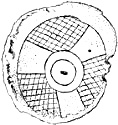
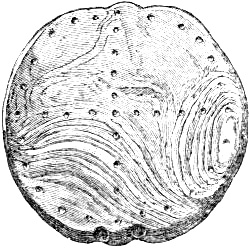
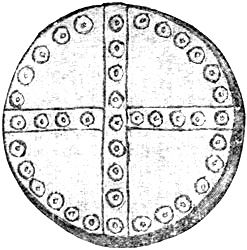
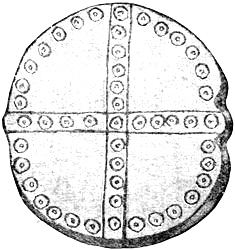
EXTREME ORIENT.
JAPAN.
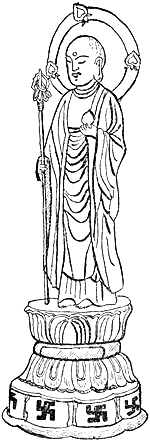
Fig. 29.
BRONZE STATUE OF BUDDHA.
Japan. Eight swastikas on
pedestal. Cane tintinnabulum
with six movable rings or
bells. One-fifteenth
natural size.
The Swastika was in use in Japan in ancient as well as modern times. Fig.
29 represents a bronze statue of Buddha, one-fifteenth natural size, from
Japan, in the collection of M. Cernuschi, Paris. It has eight Swastikas on
the pedestal, the ends all turned at right angles to the right. This
specimen is shown by De Mortillet[107] because it relates to prehistoric
man. The image or statue holds a cane in the form of a “tintinnabulum,”
with movable rings arranged to make a jingling noise, and De Mortillet
inserted it in his volume to show the likeness of this work in Japan with
a number of similar objects found in the Swiss lake dwellings in the
prehistoric age of bronze (p. 806).

Fig. 30.
JAPANESE POTTER’S
MARK ON PORCELAIN.
De Mortillet, “Musée
Préhistorique,”
Fig. 1248.
The Swastika mark was employed by the Japanese on their porcelain. Sir
Augustus W. Franks[108] shows one of these marks, a small Swastika turned
to the left and inclosed in a circle (fig. 30). Fig. 9 also represents a
mark on Japanese bronzes.[109]
KOREA.
The U. S. National Museum has a ladies’ sedan or carrying chair from
Korea. It bears eight Swastika marks, cut by stencil in the brass-bound
corners, two on each corner, one looking each way. The Swastika is normal,
with arms crossing at right angles, the ends bent at right angles and to
the right. It is quite plain; the lines are all straight, heavy, of equal
thickness, and the angles all at 90 degrees. In appearance it resembles
the Swastika in fig. 9.
CHINA.
In the Chinese language the sign of the Swastika is pronounced wan (p.
801), and stands for “many,” “a great number,” “ten thousand,” “infinity,”
and by a synecdoche is construed to mean “long life, a multitude of
blessings, great happiness,” etc.; as is said in French, “mille pardons,”
“mille remercîments,” a thousand thanks, etc. During a visit to the
Chinese legation in the city of Washington, while this paper was in
progress, the author met one of the attachés, Mr. Chung, dressed in his
robes of state; his outer garment was of moiré silk. The pattern woven in
the fabric consisted of a large circle with certain marks therein,
prominent among which were two Swastikas, one turned to the right, the
other to the left. The name given to the sign was as reported above, wan,
and the signification was “longevity,” “long life,” “many years.” Thus was
shown that in far as well as near countries, in modern as well as ancient
times, this sign stood for blessing, good wishes, and, by a slight
extension, for good luck.
The author conferred with the Chinese minister, Yang Yu, with the request
that he should furnish any appropriate information concerning the Swastika
in China. In due course the author received the following letter and
accompanying notes with drawings:
* * * I have the pleasure to submit abstracts from historical and
literary works on the origin of the Swastika in China and the
circumstances connected with it in Chinese ancient history. I have had
this paper translated into English and illustrated by india-ink
drawings. The Chinese copy is made by Mr. Ho Yen-Shing, the first
secretary of the legation, translation by Mr. Chung, and drawings by
Mr. Li.
With assurance of my high esteem, I am,
Very cordially,
Yang Yu.
Buddhist philosophers consider simple characters as half or incomplete
characters and compound characters as complete characters, while the
Swastika ![[Z]](https://openoldbooks.sgp1.digitaloceanspaces.com/books/the-swastika/images/img_z.jpg) is regarded as a natural formation. A Buddhist priest of
the Tang Dynasty, Tao Shih by name, in a chapter of his work entitled
Fa Yuen Chu Lin, on the original Buddha, describes him as having this
mark on his breast and sitting on a high lily of innumerable
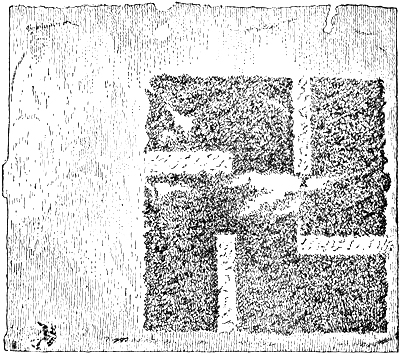
petals. [Pl. 1.]
is regarded as a natural formation. A Buddhist priest of
the Tang Dynasty, Tao Shih by name, in a chapter of his work entitled
Fa Yuen Chu Lin, on the original Buddha, describes him as having this
mark on his breast and sitting on a high lily of innumerable
petals. [Pl. 1.]
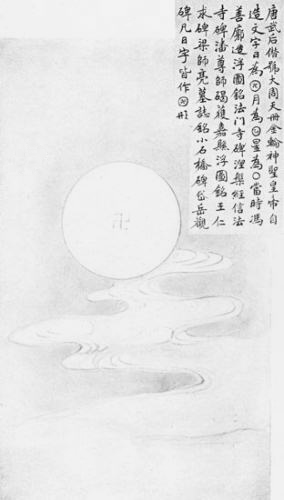
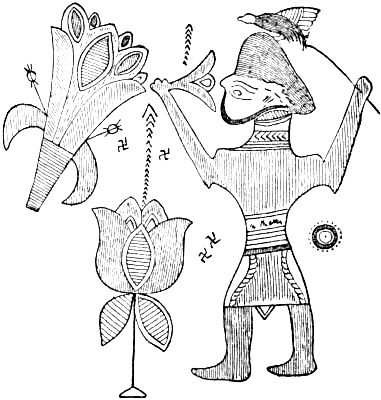
Empress Wu (684-704 A. D.), of the Tang Dynasty, invented a number of
new forms for characters already in existence, amongst which ![[Z circle]](https://openoldbooks.sgp1.digitaloceanspaces.com/books/the-swastika/images/img_swascir.jpg) was the word for sun,
was the word for sun, ![[symbol]](https://openoldbooks.sgp1.digitaloceanspaces.com/books/the-swastika/images/img_zcircle.jpg) for moon,
for moon, ![[circle]](https://openoldbooks.sgp1.digitaloceanspaces.com/books/the-swastika/images/img_circle.jpg) for star,
and so on. These characters were once very extensively used in
ornamental writing, and even now the word sun may be found
in many of the famous stone inscriptions of that age, which have been
preserved to us up to the present day. [Pl. 2.]
for star,
and so on. These characters were once very extensively used in
ornamental writing, and even now the word sun may be found
in many of the famous stone inscriptions of that age, which have been
preserved to us up to the present day. [Pl. 2.]
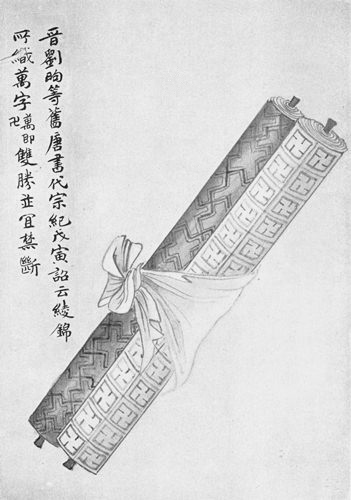
The history of the Tang Dynasty (620-906 A. D.), by Lui Hsu and others
of the Tsin Dynasty, records a decree issued by Emperor Tai Tsung
(763-779 A. D.) forbidding the use of the Swastika on silk fabrics
manufactured for any purpose. [Pl. 3.]
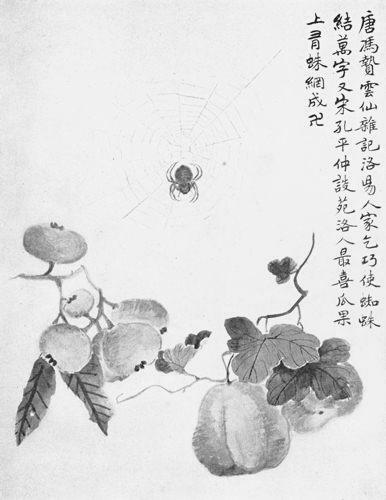
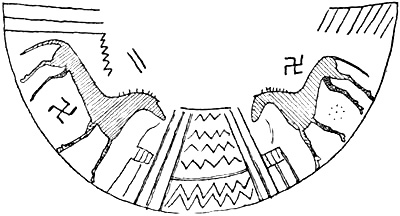
Fung Tse, of the Tang Dynasty, records a practice among the people of
Loh-yang to endeavor, on the 7th of the 7th month of each year, to
obtain spiders to weave the Swastika on their web. Kung Ping-Chung, of
the Sung Dynasty, says that the people of Loh-yang believe it to be
good luck to find the Swastika woven by spiders over fruits or melons.
[Pl. 4.]
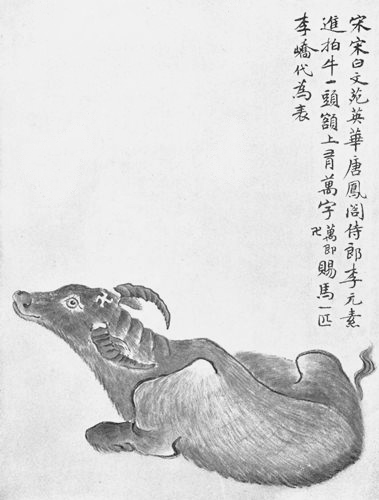
Sung Pai, of the Sung Dynasty, records an offering made to the Emperor
by Li Yuen-su, a high official of the Tang Dynasty, of a buffalo with
a Swastika on the forehead, in return for which offering he was given
a horse by the Emperor. [Pl. 5.]
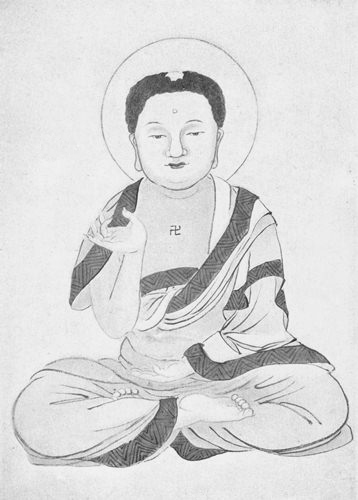
Plate 1. Origin of Buddha according to Tao Shih,
with Swastika Sign.
From a drawing by Mr. Li, presented to the U. S. National
Museum by Mr. Yang Yü, Chinese Minister, Washington, D. C.
Plate 2. Swastika Decreed by Empress Wu
(684-704 A. D.) as a Sign for Sun in China.
From a drawing by Mr. Li, presented to the U. S. National
Museum by Mr. Yang Yü, Chinese Minister, Washington, D. C.
Plate 3. Swastika Design on Silk Fabrics.
This use of the Swastika
was forbidden in China
by Emperor Tai Tsung (763-779 A. D.).
From a drawing by Mr. Li, presented to the U. S. National
Museum by Mr. Yang
Yü, Chinese Minister, Washington, D. C.
Plate 4. Swastika in Spider Web over Fruit.
(A good omen in China.)
From a drawing by Mr. Li, presented to the U. S. National
Museum by Mr. Yang Yü, Chinese Minister, Washington, D. C.
Plate 5. Buffalo with Swastika on Forehead.
Presented to Emperor of Sung Dynasty.
From a drawing by Mr. Li, presented to the U. S. National
Museum by Mr. Yang Yü, Chinese Minister, Washington, D. C.
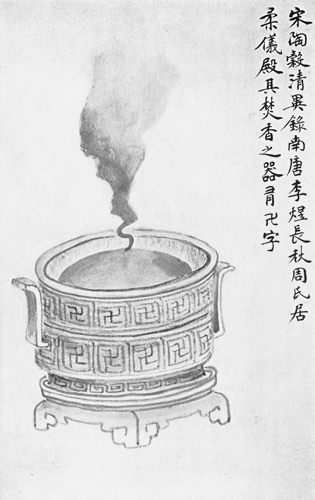
Plate 6. Incense Burner with Swastika Decoration.
South Tang Dynasty.
From a drawing by Mr. Li, presented to the U. S National
Museum Mr. Yang Yü, Chinese Minister, Washington, D. C.
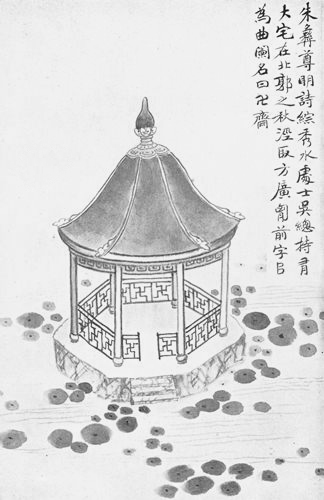
Plate 7. House of Wu Tsung-Chih of Sin Shui,
with Swastika in Railing.
From a drawing by Mr. Li, presented to the U. S. National
Museum by Mr. Yang Yü, Chinese Minister, Washington, D. C.
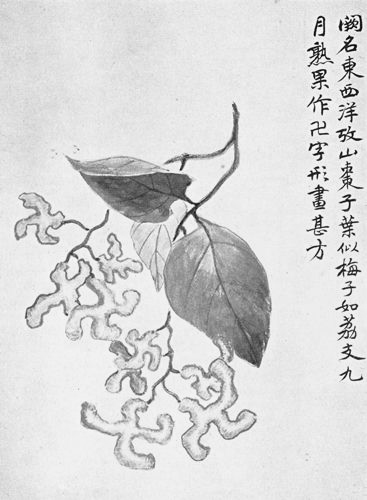
Plate 8. Mountain or Wild Date.—Fruit
Resembling the Swastika.
From a drawing by Mr. Li, presented to the U. S. National
Museum by Mr. Yang Yü, Chinese Minister, Washington, D. C.
The Ts’ing-I-Luh,
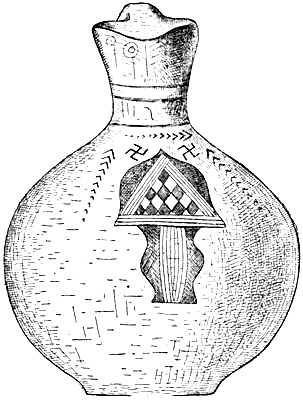
by Tao Kuh, of the Sung Dynasty, records that an Empress in the time of the South Tang Dynasty had an incense burner
the external decoration of which had the Swastika design on it. [Pl. 6.]
Chu I-Tsu, in his work entitled Ming Shih Tsung, says Wu Tsung-Chih, a
learned man of Sin Shui, built a residence outside of the north gate
of that town, which he named “Wan-Chai,” from the Swastika decoration
of the railings about the exterior of the house. [Pl. 7.]
An anonymous work, entitled the Tung Hsi Yang K’ao, described a fruit
called shan-tsao-tse (mountain or wild date), whose leaves resemble
those of the plum. The seed resembles the lichee, and the fruit, which
ripens in the ninth month of the year, suggests a resemblance to the
Swastika. [Pl. 8.]
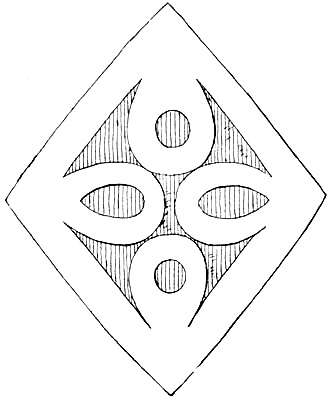
The Swastika is one of the symbolic marks of the Chinese porcelain.
Prime[110] shows what he calls a “tablet of honor,” which represents a
Swastika inclosed in a lozenge with loops at the corners (fig. 31). This
mark on a piece of porcelain signifies that it is an imperial gift.
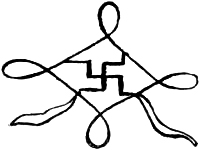
Fig. 31.
POTTER’S MARK ON PORCELAIN.
China. Tablet of honor, with Swastika.
Prime, “Pottery and Porcelain,”
p. 254.
Major-General Gordon, controller of the Royal Arsenal at Woolwich,
England, writes to Dr. Schliemann:[111] “The Swastika is Chinese. On the
breech chasing of a large gun lying outside my office, captured in the
Taku fort, you will find this same sign.” But Dumoutier[112] says this
sign is nothing else than the ancient Chinese character c h e, which,
according to D’Alviella,[113] carries the idea of perfection or
excellence, and signifies the renewal and perpetuity of life. And
again,[111] “Dr. Lockyer, formerly medical missionary to China, says the
sign is thoroughly Chinese.”
The Swastika is found on Chinese musical instruments. The U. S. National
Museum possesses a Hu-Ch’in, a violin with four strings, the body of which
is a section of bamboo about 3½ inches in diameter. The septum of the
joint has been cut away so as to leave a Swastika of normal form, the four
arms of which are connected with the outer walls of the bamboo. Another, a
Ti-Ch’in, a two-stringed violin, with a body of cocoanut, has a carving
which is believed to have been a Swastika; but the central part has been
broken out, so that the actual form is undetermined.
Prof. George Frederick Wright, in an article entitled “Swastika,”[114]
quotes Rev. F. H. Chalfont, missionary at Chanting, China, as saying:
“Same symbol in Chinese characters ‘ouan,’ or ‘wan,’ and is a favorite
ornament with the Chinese.”
TIBET.
Mr. William Woodville Rockhill,[115] speaking of the fair at Kumbum, says:
I found there a number of Lh’asa Tibetans (they call them Gopa here)
selling pulo, beads of various colors, saffron, medicines, peacock
feathers, incense sticks, etc. I had a talk with these traders,
several of whom I had met here before in 1889. * * * One of them had a
Swastika (yung-drung) tattooed on his hand, and I learned from this
man that this is not an uncommon mode of ornamentation in his country.
Count D’Alviella says that the Swastika is continued among the Buddhists
of Tibet; that the women ornament their petticoats with it, and that it is
also placed upon the breasts of their dead.[116]
He also reports[117] a Buddhist statue at the Musée Guimet with Swastikas
about the base. He does not state to what country it belongs, so the
author has no means of determining if it is the same statue as is
represented in fig. 29.
INDIA.
Burnouf[118] says approvingly of the Swastika:
Christian archæologists believe this was the most ancient sign of the
cross. * * * It was used among the Brahmins from all antiquity. (Voyez
mot “Swastika” dans notre dictionnaire sanskrit.) Swastika, or Swasta,
in India corresponds to “benediction” among Christians.
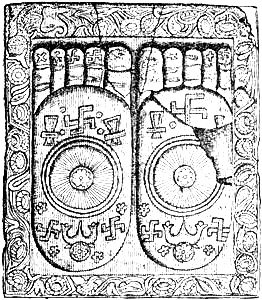
Fig. 32.
FOOTPRINT OF BUDDHA WITH SWASTIKA, FROM AMARAVATI TOPE.
From a figure by Fergusson and Schliemann.
The same author, in his translation of the “Lotus de la Bonne Loi,” one of
the nine Dharmas or Canonical books of the Buddhists of the North, of 280
pages, adds an appendix of his own writing of 583 pages; and in one (No.
8) devoted to an enumeration and description of the sixty-five figures
traced on the footprint of Çakya (fig. 32) commences as follows:
1. Svastikaya: This is the familiar mystic figure of many Indian
sects, represented
thus, ![[S]](https://openoldbooks.sgp1.digitaloceanspaces.com/books/the-swastika/images/img_s.jpg) , and whose name signifies, literally,
“sign of benediction or of good augury.” (Rgya tch’er rol pa, Vol. 11, p. 110.)
, and whose name signifies, literally,
“sign of benediction or of good augury.” (Rgya tch’er rol pa, Vol. 11, p. 110.)
* * * The sign of the Swastika was not less known to the Brahmins than
to the Buddhists. “Ramayana,” Vol. II, p. 348, ed. Gor., Chap. XCVII,
st. 17, tells of vessels on the sea bearing this sign of fortune. This
mark, of which the name and usage are certainly ancient, because it is
found on the oldest Buddhist medals, may have been used as frequently
among the Brahmins as among the Buddhists. Most of the inscriptions on
the Buddhist caverns in western India are either preceded or followed
by the holy (sacramentelle) sign of the Swastika. It appears less
common on the Brahmin monuments.
Mr. W. Crooke (Bengal Civil Service, director of Eth. Survey, Northwest
Provinces and Oudh), says:[119]
The mystical emblem of the Swastika, which appears to represent the
sun in his journey through the heavens, is of constant occurrence. The
trader paints it on the flyleaf of his ledger, he who has young
children or animals liable to the evil eye makes a representation of
it on the wall beside his doorpost. It holds first place among the
lucky marks of the Jainas. It is drawn on the shaven heads of children
on the marriage day in Gujarat. A red circle with Swastika in the
center is depicted on the place where the family gods are kept
(Campbell, Notes, p. 70). In the Meerut division the worshiper of the
village god Bhumiya constructs a rude model of it in the shrine by
fixing up two crossed straws with a daub of plaster. It often occurs
in folklore. In the drama of the Toy Cart the thief hesitates whether
he shall make a hole in the wall of Charudatta’s house in the form of
a Swastika or of a water jar (Manning, Ancient India, 11, 100).
Village shrines.—The outside (of the shrines) is often covered
with rude representations of the mystical Swastika.
On page 250 he continues thus:
Charms.—The bazar merchant writes the words “Ram Ram” over his
door, or makes an image of Genesa, the god of luck, or draws the
mystical Swastika. The jand tree is reverenced as sacred by Khattris
and Brahmins to avoid the evil eye in children. The child is brought
at 3 years of age before a jand tree; a bough is cut with a sickle and
planted at the foot of the tree. A Swastika symbol is made before it
with the rice flour and sugar brought as an offering to the tree.
Threads of string, used by women to tie up their hair, are cut in
lengths and some deposited on the Swastika.
Mr. Virchand R. Gandhi, a Hindu and Jain disciple from Bombay, India, a
delegate to the World’s Parliament of Religions at Chicago in 1893,
remained for some time in Washington, D. C., proselyting among the
Christians. He is a cultivated gentleman, devoted to the spread of his
religion. I asked his advice and assistance, which he kindly gave,
supervising my manuscript for the Swastika in the extreme Orient, and
furnishing me the following additional information relative to the
Swastika in India, and especially among the Jains:
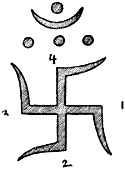
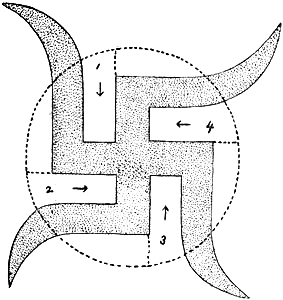
Fig. 33.
EXPLANATION OF
THE JAIN SWASTIKA,
ACCORDING TO GANDHI.(1) Archaic or protoplasmic
life; (2) Plant and animal
life; (3) Human life;
(4) Celestial life.
The Swastika is misinterpreted by so-called Western expounders of our
ancient Jain philosophy. The original idea was very high, but later on
some persons thought the cross represented only the combination of the
male and the female principles. While we are on the physical plane and
our propensities on the material line, we think it necessary to unite
these (sexual) principles for our spiritual growth. On the higher
plane the soul is sexless, and those who wish to rise higher than the
physical plane must eliminate the idea of sex.
I explain the Jain Swastika by the following illustration [fig. 33]:
The horizontal and vertical lines crossing each other at right angles
form the Greek cross. They represent spirit and matter. We add four
other lines by bending to the right each arm of the cross, then three
circles and the crescent, and a circle within the crescent. The idea
thus symbolized is that there are four grades of existence of souls in
the material universe. The first is the lowest state—Archaic or
protoplasmic life. The soul evolves from that state to the next—the
earth with its plant and animal life. Then follows the third
stage—the human; then the fourth stage—the celestial. The word
“celestial” is here held to mean life in other worlds than our own.
All these graduations are combinations of matter and soul on different
scales. The spiritual plane is that in which the soul is entirely
freed from the bonds of matter. In order to reach that plane, one must
strive to possess the three jewels (represented by the three circles),
right belief, right knowledge, right conduct. When a person has those,
he will certainly go higher until he reaches the state of liberation,
which is represented by the crescent. The crescent has the form of the
rising moon and is always growing larger. The circle in the crescent
represents the omniscient state of the soul when it has attained full
consciousness, is liberated, and lives apart from matter.
The interpretation, according to the Jain view of the cross, has
nothing to do with the combination of the male and female principle.
Worship of the male and female principles, ideas based upon sex,
lowest even of the emotional plane, can never rise higher than the
male and female.
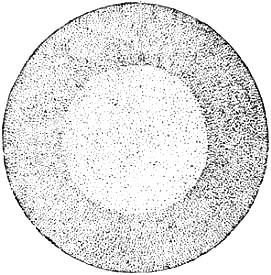 |
|
 |
Fig. 34a.
THE FORMATION OF THE JAIN
SWASTIKA—FIRST STAGE.
Handful of rice or meal, in circular form,
thinner in center. |
|
Fig. 34b.
THE FORMATION OF THE JAIN
SWASTIKA—SECOND STAGE.
Rice or meal, as shown in preceding figure,
with finger marks, indicated at 1, 2, 3, 4. |
The Jains make the Swastika sign when we enter our temple of worship.
This sign reminds us of the great principles represented by the three
jewels and by which we are to reach the ultimate good. Those symbols
intensify our thoughts and make them more permanent.
Fig. 34c.
THE FORMATION OF THE JAIN
SWASTIKA—THIRD STAGE.
Ends turned out, typifying animal, human,
and celestial life, as shown in fig. 33.
Mr. Gandhi says the Jains make the sign of the Swastika as frequently and
deftly as the Roman Catholics make the sign of the cross. It is not
confined to the temple nor to the priests or monks. Whenever or wherever a
benediction or blessing is given, the Swastika is used. Figs. 34 a, b,
c form a series showing how it is made. A handful of rice, meal, flour,
sugar, salt, or any similar substance, is spread over a circular space,
say, 3 inches in diameter and one-eighth of an inch deep (fig. 34a),
then commence at the outside of the circle (fig. 34b), on its upper or
farther left-hand corner, and draw the finger through the meal just to the
left of the center, halfway or more to the opposite or near edge of the
circle (1), then again to the right (2), then upward (3), finally to the
left where it joins with the first mark (4). The ends are swept outward,
the dots and crescent put in above, and the sign is complete (fig. 34c).
The sign of the Swastika is reported in great numbers, by hundreds if not
by thousands, in the inscriptions on the rock walls of the Buddhist caves
in India. It is needless to copy them, but is enough to say that they are
the same size as the letters forming the inscription; that they all have
four arms and the ends turn at right angles, or nearly so, indifferently
to the right or to the left. The following list of inscriptions,
containing the Swastikas, is taken from the first book coming to hand—the
“Report of Dr. James Burgess on the Buddhist Cave Temples and their
Inscriptions, Being a Part of the Result of the Fourth, Fifth, and Sixth
Seasons’ Operations of the Archæological Survey of Western India, 1876,
1877, 1878, 1879:”[120]
| |
Plate. |
Inscription
number. |
Direction
in which ends
are bent. |
| Bhaja |
XLIV |
2 |
To right. |
| Kuda |
XLVI |
26 |
Do. |
| Do |
XLVI |
27 |
To left. |
| Kol |
XLVI |
5 |
To right. |
| Karle |
XLVII |
1 |
Do. |
| Do |
XLVII |
3 |
Do. |
| Junnar |
XLIX |
5 |
Do. |
| Do |
XLIX |
6 |
To left. |
| Do |
XLIX |
7 |
To right. |
| Do |
XLIX |
8 |
To left. |
| Do |
XLIX |
9 |
To right. |
| Do |
XLIX |
10 |
Do. |
| Do |
XLIX |
11 (?) |
Do. |
| Do |
XLIX |
12 |
Do. |
| Do |
XLIX |
13 (?) |
Do. |
| Do |
XLIX |
13 (?) |
To left. |
| Do |
XLIX |
14 |
Do. |
| Do |
L |
17 |
To right. |
| Do |
L |
19 |
Do. |
| Nasik |
LII |
5 |
Do. |
| Do |
LV (Nasik 21) |
5 (?) |
Do. |
| Do |
LV (Nasik 24) |
8 (?) |
Do. |
Chantre[121] says:
I remind you that the (East) Indians, Chinese, and Japanese employ the
Swastika, not only as a religious emblem but as a simple ornament in
painting on pottery and elsewhere, the same as we employ the Greek
fret, lozenges, and similar motifs in our ornamentation. Sistres
[the staff with jingling bells, held in the hand of Buddha, on whose
base is engraved a row of Swastikas, fig. 29 of present paper] of
similar form and style have been found in prehistoric Swiss lake
dwellings of the bronze age. Thus the sistres and the Swastika are
brought into relation with each other. The sistres possibly relate
to an ancient religion, as they did in the Orient; the Swastika may
have had a similar distinction.
De Mortillet and others hold the same opinion.[122]
CLASSICAL ORIENT.
BABYLONIA, ASSYRIA, CHALDEA, AND PERSIA.
Waring[123] says, “In Babylonian and Assyrian remains we search for it
[the Swastika] in vain.” Max Müller and Count Goblet d’Alviella are of the
same opinion.[124]
Of Persia, D’Alviella (p. 51), citing Ludwig Müller,[125] says that the
Swastika is manifested only by its presence on certain coins of the
Arsacides and the Sassanides.
PHENICIA.
It is reported by various authors that the Swastika has never been found
in Phenicia, e. g. Max Müller, J. B. Waring, Count Goblet d’Alviella.[126]
Ohnefalsch-Richter[127] says that the Swastika is not found in Phenicia,
yet he is of the opinion that their emigrant and commercial travelers
brought it from the far east and introduced it into Cyprus, Carthage, and
the north of Africa. (See p. 796.)
LYCAONIA.
Lempriere, in his Classical Dictionary, under the above title, gives the
following:
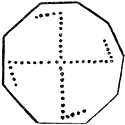
Fig. 35.
BRONZE PIN-HEAD
FROM CHEITHAN-THAGH.
De Morgan, “Au Caucase,”
fig. 177.
A district of Asia Minor forming the southwestern quarter of Phrygia.
The origin of its name and inhabitants, the Lycaones, is lost in
obscurity. * * * Our first acquaintance with this region is in the
relation of the expedition of the younger Cyprus. Its limits varied at
different times. At first it extended eastward from Iconium 23
geographical miles, and was separated from Cilicia on the south by the
range of Mount Taurus, comprehending a large portion of what in later
times was termed Cataonia.
Count Goblet d’Alviella,[128]
quoting Perrot and Chipiez,[129] states that
the Hittites introduced the Swastika on a bas-relief of Ibriz, Lycaonia,
where it forms a border of the robe of a king or priest offering a sacrifice to a god.
ARMENIA.
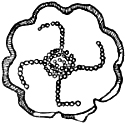
Fig. 36.
BRONZE PIN-HEAD
FROM AKTHALA.
De Morgan, “Au
Caucase,” fig. 178.
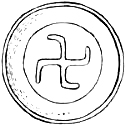
Fig. 37.
SWASTIKA MARK
ON BLACK POTTERY.
Cheithan-thagh.
De Morgan, “Au
Caucase,” fig. 179.
M. J. de Morgan (the present director of the Gizeh Museum at Cairo), under
the direction of the French Government, made extensive excavations and
studies into the prehistoric antiquities and archæology of Russian
Armenia. His report is entitled “Le Premier Âge de Métaux dans l’Arménie
Russe.”[130] He excavated a number of prehistoric cemeteries, and found
therein various forms of crosses engraved on ceintures, vases, and
medallions. The Swastika, though present, was more rare. He found it on
the heads of two large bronze pins (figs. 35 and 36) and on one piece of
pottery (fig. 37) from the prehistoric tombs. The bent arms are all turned
to the left, and would be the Suavastika of Prof. Max Müller.
CAUCASUS.
In Caucasus, M. E. Chantre[131] found the Swastika in great purity of
form. Fig. 38 represents portions of a bronze plaque from that country,
used on a ceinture or belt. Another of slightly different style, but with
square cross and arms bent at right angles, is represented in his pl. 8,
fig. 5. These belonged to the first age of iron, and much of the art was
intricate.[132] It represented animals as well as all geometric forms,
crosses, circles (concentric and otherwise), spirals, meanders, chevrons,
herring bone, lozenges, etc. These were sometimes cast in the metal, at
other times repoussé, and again were engraved, and occasionally these
methods were employed together. Fig. 39 shows another form, frequently
employed and suggested as a possible evolution of the Swastika, from the
same locality and same plate. Fig. 40 represents signs reported by
Waring[133] as from Asia Minor, which he credits, without explanation, to
Ellis’s “Antiquities of Heraldry.”
The specimen shown in
fig. 41 is reported by Waring,[134] quoting
Rzewusky,[135] as one of the several branding marks used on Circassian
horses for identification.
Fig. 38.
FRAGMENT OF BRONZE CEINTURE.
Swastika repoussé. Necropolis of Koban, Caucasus.
Chantre, “Le Caucase,” pl. 11, fig. 3.
Fig. 39.
BRONZE AGRAFE OR BELT PLATE.
Triskelion in spiral. Koban, Caucasus.
Chantre, “Le Caucase,” pl. 11, fig. 4.

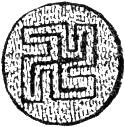
Fig. 40.
SWASTIKA SIGNS FROM ASIA MINOR.Waring, “Ceramic Art in Remote Ages,”
pl. 41, figs. 5 and 6.
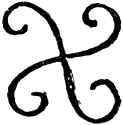
Fig. 41.
BRAND FOR HORSES
IN CIRCASSIA.
Ogee Swastika,
tetraskelion.
Waring,
“Ceramic Art in
Remote Ages,”
pl. 42, fig. 20
c.
Mr. Frederick Remington, the celebrated artist and literateur, has an
article, “Cracker Cowboy in Florida,”[136] wherein he discourses of the
forgery of brands on cattle in that country. One of his genuine brands is
a circle with a small cross in the center. The forgery consists in
elongating each arm of the cross and turning it with a scroll, forming an
ogee Swastika (fig. 13d), which, curiously enough, is practically the
same brand used on Circassian horses (fig. 41). Max
Ohnefalsch-Richter[137] says that instruments of copper (audumbaroasih)
are recommended in the Atharva-Veda to make the Swastika, which represents
the figure 8; and thus he attempts to account for the use of that mark
branded on the cows in India (supra, p. 772), on the horses in Circassia
(fig. 41), and said to have been used in Arabia.
ASIA MINOR—TROY (HISSARLIK).
Many specimens of the Swastika were found by Dr. Schliemann in the ruins
of Troy, principally on spindle whorls, vases, and bijoux of precious
metal. Zmigrodzki[138] made from Dr. Schliemann’s great atlas the
following classification of the objects found at Troy, ornamented with the
Swastika and its related forms:
Fifty-five of pure form; 114 crosses with the four dots, points or alleged
nail holes (Croix swasticale); 102 with three branches or arms
(triskelion); 86 with five branches or arms; 63 with six branches or arms;
total, 420.
Zmigrodzki continues his classification by adding those which have
relation to the Swastika thus: Eighty-two representing stars; 70
representing suns; 42 representing branches of trees or palms; 15 animals
non-ferocious, deer, antelope, hare, swan, etc.; total, 209 objects. Many
of these were spindle whorls.
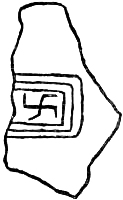
Fig. 42.
FRAGMENT OF
LUSTROUS
BLACK POTTERY.
Swastika, right.
Depth, 23 feet.
Schliemann,
“Ilios,” fig. 247.
Dr. Schliemann, in his works, “Troja” and “Ilios,” describes at length his
excavations of these cities and his discoveries of the Swastika on many
objects. His reports are grouped under titles of the various cities,
first, second, third, etc., up to the seventh city, counting always from
the bottom, the first being deepest and oldest. The same system will be
here pursued. The first and second cities were 45 to 52 feet (13 to 16
meters) deep; the third, 23 to 33 feet (7 to 10 meters) deep; the fourth
city, 13 to 17.6 feet (4 to 5½ meters) deep; the fifth city, 7 to 13
feet (2 to 4 meters) deep; the sixth was the Lydian city of Troy, and the
seventh city, the Greek Ilium, approached the surface.
First and Second Cities.—But few whorls were found in the first and
second cities[139] and none of these bore the Swastika mark, while
thousands were found in the third, fourth, and fifth cities, many of which
bore the Swastika mark. Those of the first city, if unornamented, have a
uniform lustrous black color and are the shape of a cone (fig. 55) or of
two cones joined at the base (figs. 52 and 71). Both kinds were found at
33 feet and deeper. Others from the same city were ornamented by incised
lines rubbed in with white chalk, in which case they were flat.[140] In
the second city the whorls were smaller than in the first. They were all
of a black color and their incised ornamentation was practically the same
as those from the upper cities.[141]
Zmigrodzki congratulated himself on having discovered among Schliemann’s
finds what he believed to be the oldest representation of the Swastika of
which we had reliable knowledge. It was a fragment of a vase (fig. 42) of
the lustrous black pottery peculiar to the whorls of the first and second
cities. But Zmigrodzki was compelled to recede, which he did regretfully,
when Schliemann, in a later edition, inserted the footnote (p. 350)
saying, that while he had found this (with a companion piece) at a great
depth in his excavations, and had attributed them to the first city, yet,
on subsequent examination, he had become convinced that they belonged to
the third city.
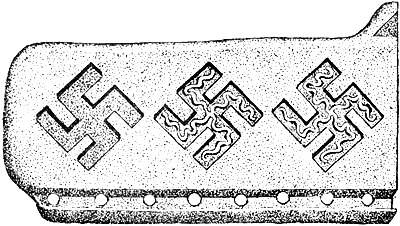
The Swastika, turned both ways and , was frequent in the third,
fourth, and fifth cities.
The following specimens bearing the Swastika mark are chosen, out of the
many specimens in Schliemann’s great album, in order to make a fair
representation of the various kinds, both of whorls and of Swastikas.
They are arranged in the order of cities, the depth being indicated in
feet.
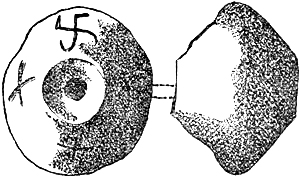 |
|
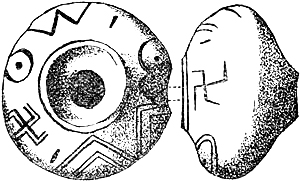 |
Fig. 43.
SPINDLE-WHORL WITH TWO SWASTIKAS
AND TWO CROSSES.
Depth, 23 feet.
Schliemann, “Ilios,” fig. 1858. |
|
Fig. 44.
SPINDLE-WHORL WITH TWO SWASTIKAS.
Depth, 23 feet.
Schliemann, “Ilios,” fig. 1874. |
Fig. 45.
SPINDLE-WHORL WITH TWO SWASTIKAS.
Depth, 23 feet.
Schliemann, “Ilios,” fig. 1919.
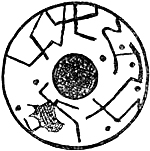
Fig. 46.
SPINDLE-WHORL WITH
TWO SWASTIKAS.
Depth, 28 feet.
Schliemann,
“Ilios,” fig. 1826.
The Third, or Burnt, City (23 to 33 feet deep).—The spindle-whorl shown
in fig. 43 contains two Swastikas and two crosses.[142] Of the one
Swastika, two arms are bent to the right at right angles, while the other
two are bent to the right in curves. The other Swastika has but two bends,
one at right angles, the other curved, both to the right. The specimen
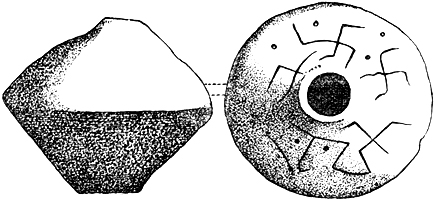
shown in fig. 44 has two Swastikas, in one of which the four arms are bent
at right angles to the left. The entire figure is traced in double lines,
one heavy and one light, as though to represent edges or shadows. The
second Swastika has its ends bent at an obtuse angle to the left, and at
the extremities the lines taper to a point. The whorl shown in fig. 45 is
nearly spherical, with two Swastikas in the upper part. The ends of the
four arms in both are bent at right angles, one to the right, the other to
the left. Fig. 46 represents a spindle-whorl with two irregular Swastikas;
but one arm is bent at right angles and all the arms and points are
uncertain and of unequal lengths. The rest of the field is covered with
indefinite and inexplicable marks, of which the only ones noteworthy are
points or dots, seven in number. In fig. 47 the top is surrounded by a
line of zigzag or dog-tooth ornaments. Within this field, on the upper
part and equidistant from the central hole, are three Swastikas, the ends
of all of which turn to the left, and but one at right angles. All three
have one or more ends bent, not at any angle, but in a curve or hook,
making an ogee. Fig. 48 shows a large whorl with two or three Swastikas on
its upper surface in connection with several indefinite marks apparently
without meaning. The dots are interspersed over the field, the Swastikas
all bent to the right, but with uncertain lines and at indefinite angles.
In one of them the main line forming the cross is curved toward the
central hole; in another, the ends are both bent in the same
direction—that is, pointing to the periphery of the whorl. Fig. 49 shows
a sphere or globe (see figs. 75, 88) divided by longitudinal lines into
four segments, which are again divided by an equatorial line. These
segments contain marks or dots and circles, while one segment contains a
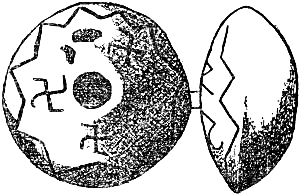
normal Swastika turned to the left. This terra-cotta ball has figured in a
peculiar degree in the symbolic representation of the Swastika. Greg says
of it:[143]
We see on one hemisphere the standing for Zeus (= Indra) the sky
god, and on the other side a rude representation of a sacred (somma)
tree; a very interesting and curious western perpetuation of the
original idea and a strong indirect proof of the standing for the
emblem of the sky god.
Fig. 47.
SPINDLE-WHORL WITH THREE SWASTIKAS.
Depth, 23 feet.
Schliemann, “Ilios,” fig. 1851.
Fig. 48.
SPINDLE-WHORL WITH SWASTIKAS.
Depth, 23 feet.
Schliemann, “Ilios,” fig. 1982.
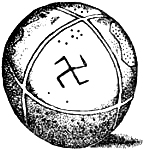
Fig. 49.
SPHERE DIVIDED INTO EIGHT
SEGMENTS, ONE OF WHICH
CONTAINS A SWASTIKA.Schliemann, “Ilios,”
fig. 1999.
Fig. 50 represents one of the biconical spindle-whorls with various
decorations on the two sides, longitudinal lines interspersed with dots,
arcs of concentric circles arranged in three parallels, etc. On one of
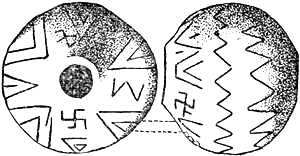
these sides is a normal Swastika, the arms crossing at right angles, the
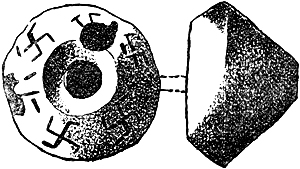
ends bent at right angles to the left. The specimen shown in fig. 51
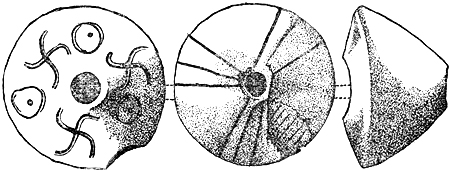
contains four perfect Swastikas and two inchoate and uncertain. Both of
the latter have been damaged by breaking the surface. The four Swastikas
all have their arms bent to the right; some are greater than at right
angles, and one arm is curved. Several ends are tapered to a point. Fig.
52 shows a whorl of biconical form. It contains two Swastikas, the main
arms of which are ogee forms, crossing each other at the center at nearly
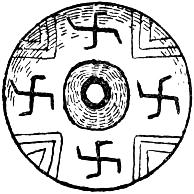
right angles, the ogee ends curving to the right. In fig. 53 the entire
field of the upper surface is filled with, or occupied by, a Greek cross,
in the center of which is the central hole of the whorl, while on each of
the four arms is represented a Swastika, the main arms all crossing at
right angles, the ends all bent to the right at a slightly obtuse angle.
Each of these bent ends tapers to a point, some with slight curves and a
small flourish. (See figs. 33 and 34 for reference to this flourish.) The
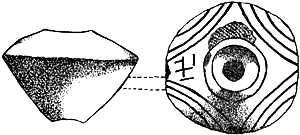
specimen shown in fig. 54 has a center field in its upper part, of which
the decoration consists of incised parallel lines forming segments of
circles, repeated in each one of the four quarters of the field. The
center hole is surrounded by two concentric rings of incised lines. In one
of these spaces is a single Swastika; its main arms crossing at right
angles, two of its ends bent to the left at right angles, the other two in
the same direction and curved.
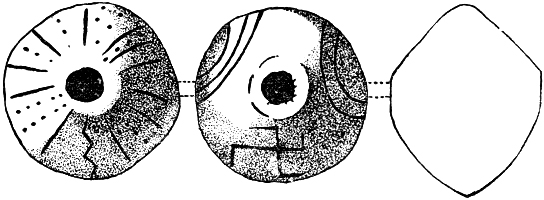
Fig. 50.
BICONICAL SPINDLE-WHORL WITH SWASTIKA.
Schliemann, “Ilios,” Fig. 1949.
 |
|
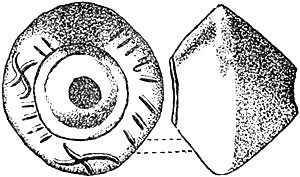 |
Fig. 51.
BICONICAL SPINDLE-WHORL WITH
SIX SWASTIKAS.
Depth, 33 feet.
Schliemann, “Ilios,” fig. 1859. |
|
Fig. 52.
BICONICAL SPINDLE-WHORL WITH
TWO OGEE SWASTIKAS.
Depth, 33 feet.
Schliemann, “Ilios,” fig. 1876. |
 |
|
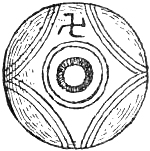 |
Fig. 53.
SPINDLE-WHORL WITH
FOUR SWASTIKAS.
Depth, 33 feet.
De Mortillet,
“Musée Préhistorique,”
fig. 1240. |
|
Fig. 54.
SPINDLE-WHORL WITH
ONE SWASTIKA.
Depth, 33 feet.
De Mortillet,
“Musée Préhistorique,”
fig. 1241. |
The Fourth City (13.2 to 17.6 feet deep).—Schliemann says:[144]
We find among the successors of the burnt city the same triangular
idols; the same primitive bronze battle-axes; the same terra-cotta
vases, with or without tripod feet; the same double-handled goblets
(σέπα ὰμφικύπελλα); the same battle-axes of jade, porphyry,
and diorite; the same rude stone hammers, and saddle querns of
trachyte. * * * The number of rude stone hammers and polished stone
axes are fully thrice as large as in the third city, while the masses
of shells and cockles accumulated in the débris of the houses are so
stupendous that they baffle all description. The pottery is coarser
and of a ruder fabric than in the third city. * * * There were also
found in the fourth city many needles of bone for female handiwork,
boar tusks, spit rests of mica schist, whetstones of slate, porphyry,
etc., of the usual form, hundreds of small silex saws, and some knives
of obsidian. Stone whorls, which are so abundant at Mycenæ, are but
rarely found here; all of those which occur are, according to Mr.
Davis, of steatite. On the other hand, terra-cotta whorls, with or
without incised ornamentation, are found by thousands; their forms
hardly vary from those in the third (the burnt) city, and the same may
be generally said of their incised ornamentation. * * * The same
representation of specimens of whorls are given as in the third city,
and the same observations apply.
 |
|
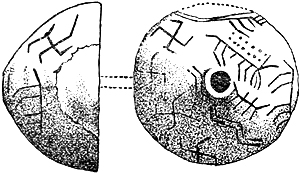 |
Fig. 55.
CONICAL SPINDLE-WHORL WITH
THREE OGEE SWASTIKAS.
Depth 13½ feet.
Schliemann, “Ilios,” fig. 1850. |
|
Fig. 56.
CONICAL SPINDLE-WHORL WITH
FOUR SWASTIKAS OF VARIOUS KINDS.
Depth 13½ feet.
Schliemann, “Ilios,” fig. 1879. |
| |
 |
|
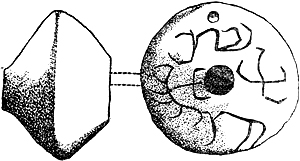 |
Fig. 57.
CONICAL SPINDLE-WHORL WITH SWASTIKAS.
Depth. 13⅓ feet.
Schliemann, “Ilios,” fig. 1894. |
|
Fig. 58.
BICONICAL SPINDLE-WHORL WITH
ONE SWASTIKA.
Depth, 13½ feet.
Schliemann, “Ilios,” fig. 1983. |
Fig. 59.
BICONICAL SPINDLE-WHORL WITH THREE OGEE SWASTIKAS.
Depth, 13½ feet. Schliemann, “Ilios,” fig. 1990.
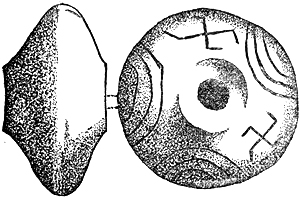 |
|
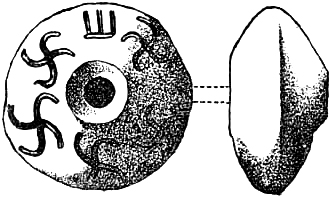 |
Fig. 60.
BICONICAL SPINDLE-WHORL WITH TWO SWASTIKAS.
Depth, 16½ feet.
Schliemann, “Ilios,” fig. 1863. |
|
Fig. 61.
BICONICAL SPINDLE-WHORL WITH FIVE OGEE SWASTIKAS.
Depth, 18 feet.
Schliemann, “Ilios,” fig. 1905. |
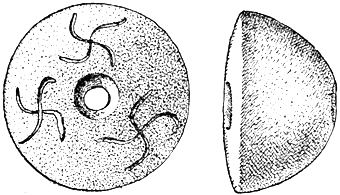
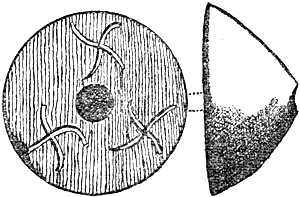
Fig. 55 shows a simple cone, the upper surface being flat and without
other decoration than three Swastikas equidistant from the hole and from
each other, all made by the two crossed ogee lines with ends curved to the
right. This specimen is much like that of Fig. 71 (Madam Schliemann
collection in the U. S. National Museum, Cat. No. 149704). Fig. 56 shows a
remarkable spindle-whorl. Its marks greatly excited the interest of Dr.
Schliemann, and he devoted much space to the discussion of these and
similar characters. The whorl is in the form of a cone. It bears upon its
conical surface four Swastikas, the ends of three of which bend to the
right and one to the left. There are but two of these ends which bend at
right angles. Most of them are at an obtuse angle, while the ends of two
are curved. Some taper to a point and finish with a slight flourish. The
other marks which so interested Dr. Schliemann were the chevron ornament
(zigzag), drawn in parallel lines, which, he strongly argued, and
fortified with many authorities, represented lightning. The second series
of marks he called a “burning altar.” This assertion he also fortified
with authorities and with illustrations of a similar sign from different
countries. (See fig. 101.) The third series of marks represented an
animal, name and character unknown, with a head or tusks with two large
branching horns or ears, a straight back, a stiff but drooping tail, four
legs, and two rows of the remarkable dots—seven in one, six in the
other—placed over the back of the animal. (See figs. 99 and 100.) Fig. 57
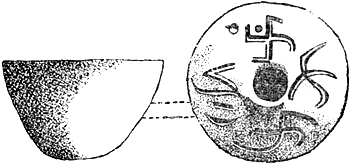
represents another cone-shaped whorl, the flat surface of which is
engraved with one perfect Swastika, the two arms crossing each other at
right angles and the two ends bending at right angles to the right; the
other two are curved, also to the right. Two of the other figures Dr.
Schliemann calls Swastikas, although they are uncertain in some of their
arms and angles. The fourth character he imagined to be an inchoate or
attempted Swastika. Fig. 58 shows a biconical whorl with curious and
inexplicable characters. One of them forms a crude Swastika, which, while
the main arms cross at right angles the ends are bent at uncertain angles,
three to the left and one to the right. These characters are so
undetermined that it is doubtful if they could have had any signification,
either ornamental or otherwise. Fig. 59 is almost conical, the flat
surface thereof being only slightly raised at the center. It is much the
same form as the whorls shown in figs. 55 and 71. The nearly flat surface
is the top, and on it, equidistant from the center hole and from each
other, are three ogee Swastikas of double lines, with their ends all
curved to the right. In the alternate spaces are small incised circles,
with dots in the centers. In fig. 60 a biconical whorl is shown. It has
three of the circle segments marked in equilateral positions, with three
or four parallel lines, after the style shown in Fig. 54. In the spaces
are two Swastikas, in both of which the two main arms cross at right
angles. Some of the ends bend at a right, and others at an obtuse, angle.
In one of the Swastikas the bent ends turn toward each other, forming a
rude figure 8. The specimen shown in fig. 61 is biconical, but much
flattened; it contains five ogee Swastikas, of which the ends of four bend
to the right and one to the left. In an interval between them is one of
the burning altars. Fig. 62 shows three Swastikas with double parallel
lines. The main arms cross each other at right angles; the ends are bent
at nearly right angles, one to the left, one to the right, and the other
both ways. Fig. 63 represents a spindle-whorl with a cup-shaped depression
around the central hole, which is surrounded by three lines in concentric
circles, while on the field, at 90 degrees from each other, are four ogee
Swastikas (tetraskelions), the arms all turning to the left and spirally
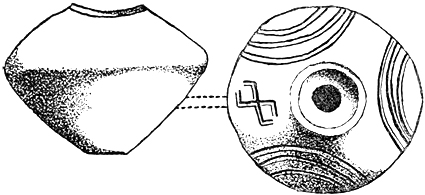
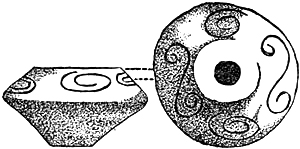
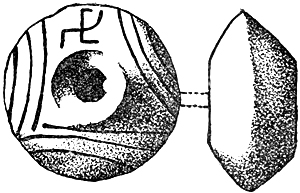
each upon itself. The specimen shown in fig. 64 is biconical, though, as
usual, the upper cone is the smallest. There are parallel lines, three in
a set, forming the segments of three circles, in one space of which
appears a Swastika of a curious and unique form, similar to that shown in
fig. 60. The two main arms cross each other at very nearly right angles
and the ends also bend at right angles toward and approaching each other,
so that if continued slightly farther they would close and form a
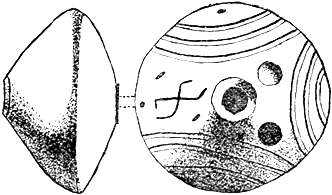
decorative figure 8. The specimen shown in fig. 65 is decorated with
parallel lines, three in number, arranged in segments of three circles,
the periphery of which is toward the center, as in figs. 60 and 64. In one
of the spaces is a Swastika of curious form; the main arms cross each
other at right angles, but the four ends represent different styles—two
are bent square to the left, one square to the right, and the fourth
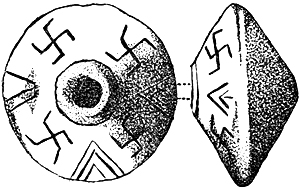
curves to the left at no angle. Fig. 66 shows a biconical whorl, and its
top is decorated to represent three Swastikas and three burning altars.
The ends of the arms of the Swastikas all bend to the left, some are at
right angles and some at obtuse angles, while two or three are curved; two
of them show corrections, the marks at the ends having been changed in one
case at a different angle and in another from a straight line to a curve.
Fig. 67 shows four specimens of Swastika, the main arms of all of which
cross at right angles. The ends all bend to the right, at nearly right
angles, tapering to a point and finishing with the slight flourish noted
in the Jain Swastika (fig. 34c). They are alternated with a chevron
decoration. Fig. 68 shows three Swastikas, the ends of the arms of which
are all bent to the left. One Swastika is composed of two ogee lines. Two
arms of another are curved, but all others are bent at right angles, some
of them tapering to points, finishing with a little flourish (figs. 67
and 34c). One of these ends, like that in fig. 66, has been corrected by
the maker. Fig. 69 represents one Swastika in which the main arms cross at
nearly right angles. Both ends of one arm turn to the left and those of
the other arm turn to the right in figure 8 style. One of the ends is
curved, the others bent at different angles. Fig. 70 shows the parallel
lines representing segments of a circle similar to figs. 60, 64, 65, and
69, except that it has four instead of three. It has one Swastika; the
main arms (of double lines) cross at right angles, the ends all curving to
the left with a slight ogee.
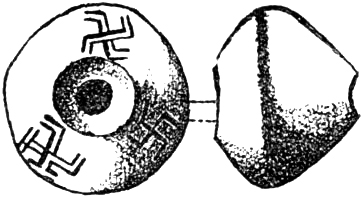 |
|
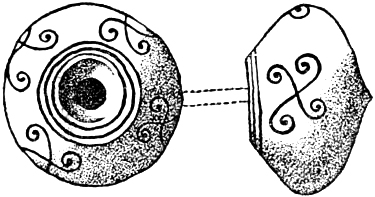 |
Fig. 62.
SPINDLE-WHORL WITH THREE SWASTIKAS.
Depth, 19.8 feet.
Schliemann, “Ilios,” fig. 1855. |
|
Fig. 63.
SPINDLE-WHORL HAVING FOUR OGEE SWASTIKAS
WITH SPIRAL VOLUTES.
Depth, 18 feet.
Schliemann, “Ilios,” fig. 1868. |
Fig. 64.
BICONICAL SPINDLE-WHORL WITH ONE SWASTIKA.
Depth, 19.8 feet.
Schliemann, “Ilios,” fig. 1865.
 |
|
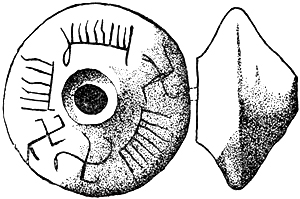 |
Fig. 65.
BICONICAL SPINDLE-WHORL WITH ONE SWASTIKA.
Depth, 19.8 feet.
Schliemann, “Ilios,” fig. 1866. |
|
Fig. 66.
BICONICAL SPINDLE-WHORL WITH THREE
SWASTIKAS AND THREE BURNING ALTARS.
Depth, 19.8 feet.
Schliemann, “Ilios,” fig. 1872. |
| |
 |
|
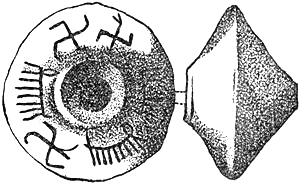 |
Fig. 67.
BICONICAL SPINDLE-WHORL WITH FOUR SWASTIKAS.
Depth, 19.8 feet.
Schliemann, “Ilios,” fig. 1873. |
|
Fig. 68.
BICONICAL SPINDLE-WHORL WITH THREE
SWASTIKAS OF DIFFERENT STYLES.
Depth, 19.8 feet.
Schliemann, “Ilios,” fig. 1911. |
Fig. 69.
BICONICAL SPINDLE-WHORL WITH ONE SWASTIKA
OF THE FIGURE-8 STYLE.
Depth, 19.8 feet.
Schliemann, “Ilios,” fig. 1861.
Fig. 70.
BICONICAL SPINDLE-WHORL WITH ONE SWASTIKA, SLIGHT OGEE.
Depth, 19.8 feet.
Schliemann, “Ilios,” fig. 1864.
Fig. 71.
CONICAL SPINDLE-WHORL WITH THREE OGEE SWASTIKAS.
Depth, 13.5 feet.
Gift of Madame Schliemann, Cat. No. 149704, U. S. N. M.
The U. S. National Museum was, during 1893, the fortunate recipient of a
collection of objects from Madame Schliemann, which her husband, before
his death, had signified should be given to the United States as a token
of his remembrance of and regard for his adopted country. He never forgot
that he was an American citizen, and, preparing for death, made his
acknowledgments in the manner mentioned. The collection consisted of 178
objects, all from ancient Troy, and they made a fair representation of his
general finds. This collection is in the Department of Prehistoric
Anthropology. In this collection is a spindle-whorl, found at 13½ feet
(4 meters) depth and belonging to the fourth city. It had three Swastikas
upon its face, and is here shown as fig. 71.[145]
The Fifth City.—Schliemann says:[146]
The rude stone hammers found in enormous quantities in the fourth city
are no longer found in this stratum, nor did the stone axes, which are
so very abundant there, occur again here. Instead of the hundreds of
axes I gathered in the fourth city, I collected in all only two here.
* * * The forms of the terra-cotta whorls, too, are in innumerable
instances different here. These objects are of a much inferior fabric,
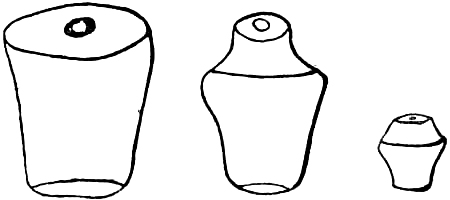
and become elongated and pointed. Forms of whorls like Nos. 1801,
1802, and 1803 [see figs. 72, 73, and 74], which were never found
before, are here plentiful.
Figs. 72, 73, 74.
FORMS OF WHORLS FROM THE FIFTH BURIED CITY OF HISSARLIK, FOR COMPARISON.
Schliemann, “Ilios,” figs. 1801, 1802, 1803.
The Sixth and Seventh Cities.—The sixth city is described in “Ilios,”
page 587, and the seventh on pages 608 and 618. Both cities contained
occasional whorls of clay, all thoroughly baked, without incised or
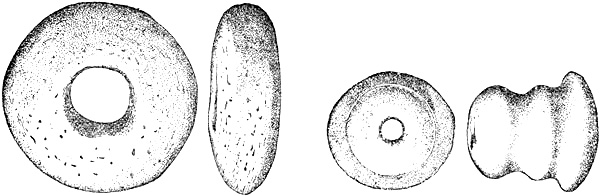
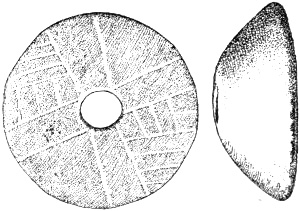
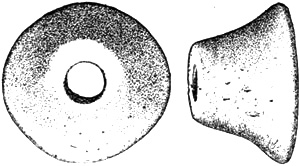
painted ornamentation, and shed no further light on the Swastika.
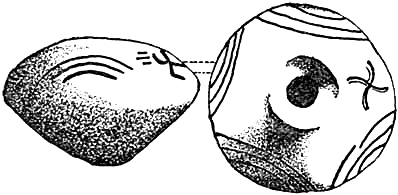
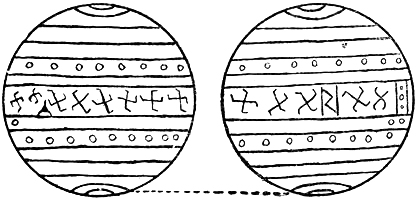
Fig. 75 represents the opposite hemispheres of a terra-cotta ball, found
at a depth of 26 feet, divided by incised lines into fifteen zones, of
which two are ornamented with points and the middle zone, the largest of
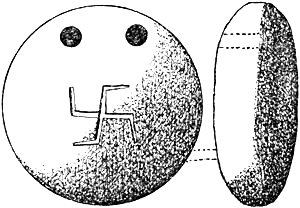
all, with thirteen specimens of and .
Fig. 75.
TERRA-COTTA SPHERE WITH THIRTEEN SWASTIKAS.
Third city. Depth, 26 feet. Schliemann, “Ilios,” figs. 245, 246.
Fig. 76.
TERRA-COTTA DISK WITH ONE SWASTIKA.
Schliemann, “Ilios,” fig. 1849.
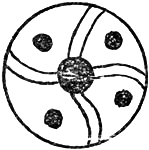
Fig. 77.
SPINDLE-WHORL WITH
OGEE SWASTIKA.
Third city.
Depth, 23 feet.
Schliemann,
“Ilios,” fig. 1822.
Zmigrodzki says[147] that there were found by Schliemann, at Hissarlik,
fifty-five specimens of the Swastika “pure and simple” (pp. 809, 826). It
will be perceived by examination that the Swastika “pure and simple”
comprised Swastikas of several forms; those in which the four arms of the
cross were at other angles besides right angles; those in which the ends
bent at square and other angles to the right; then those to the left
(Burnouf and Max Müller’s Suavastika); those in which the bends were, some
to the right and some to the left, in the same design; where the points
tapered off and turned outward with a flourish; where the arms bent at no
angle, but were in spirals each upon itself, and turned, some to the
right, some to the left. We shall see other related forms, as where the
arms turn spirally upon each other instead of upon themselves. These will
sometimes have three, five, six, or more arms, instead of four (p. 768).
The cross and the circle will also appear in connection with the Swastika;
and other designs, as zigzags (lightning), burning altars, men, animals,
and similar representations will be found associated with the Swastika,
and are only related to it by the association of similar objects from the
same locality. A description of their patterns will include those already
figured, together with Schliemann’s comments as to signification and
frequency. They become more important because these related forms will be
found in distant countries and among distant peoples, notably among the
prehistoric peoples of America. Possibly these designs have a
signification, possibly not. Dr. Schliemann thought that in many cases
they had. Professor Sayce supported him, strongly inclining toward an
alphabetic or linguistic, perhaps ideographic, signification. No opinion
is advanced by the author on these theories, but the designs are given in
considerable numbers, to the end that the evidence may be fully reported,
and future investigators, radical and conservative, imaginative and
unimaginative, theorists and agnostics, may have a fair knowledge of this
mysterious sign, and an opportunity to indulge their respective talents at
length. Possibly these associated designs may throw some light upon the
origin or history of the Swastika or of some of its related forms.
 |
|
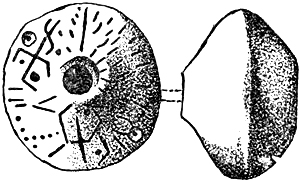 |
Fig. 78.
BICONICAL SPINDLE-WHORL WITH
IRREGULAR SWASTIKAS AND CROSSES.
Fourth city. Depth, 13.6 feet.
Schliemann, “Ilios,” fig. 1871. |
|
Fig. 79.
BICONICAL SPINDLE-WHORL WITH
UNCERTAIN AND MALFORMED SWASTIKAS.
Third city. Depth, 33 feet.
Schliemann, “Ilios,” fig. 1870. |
| |
 |
|
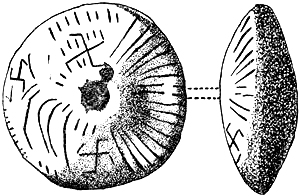 |
Fig. 80.
BICONICAL SPINDLE-WHORL WITH IRREGULAR
AND PARTLY FORMED SWASTIKAS
HAVING LARGE DOT IN CENTER.
Fourth city. Depth, 23 feet.
Schliemann, “Ilios,” fig. 1875. |
|
Fig. 81.
BICONICAL SPINDLE-WHORL, FLATTENED,
WITH TWO SWASTIKAS AND
INDEFINITE DECORATION.
Schliemann, “Ilios,” fig. 1947. |
Fig. 82.
BICONICAL SPINDLE-WHORL WITH ONE SWASTIKA
AND FOUR SEGMENTS OF CIRCLES.
Third city. Depth, 33 feet.
Schliemann, “Ilios,” fig. 1989.
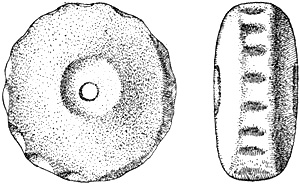
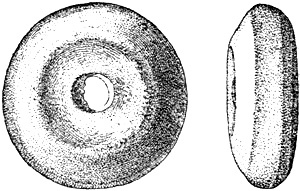
The specimen represented in fig. 76 is not a spindle-whorl, as shown by
the number and location of the holes. It bears a good representation of a
Swastika the form of which has been noticed several times. The two main
arms cross each other at nearly right angles. The ends of the arms all
bend to the right at a slightly obtuse angle and turn outward with a
flourish somewhat after the style of the Jain Swastika (fig. 34c). Fig.
77 represents a spindle-whorl with a Swastika of the ogee style curved to
the right. The center hole of the whorl forms the center of the sign. The
figure is of double lines, and in the interspaces are four dots, similar
to those in figs. 96-98, and others which Dr. Schliemann reports as
common, and to which he attributes some special but unknown meaning.
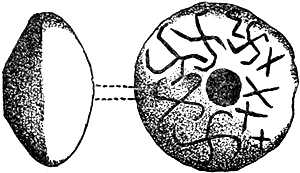
Swastikas and crosses of irregular shape and style are shown in the field
of fig. 78. Two fairly well formed Swastikas appear, both of the ogee
style, with the ends curved to the right. One is of the style resembling
the figure 8 (see figs. 60 and 64). Two others are crudely and irregularly
formed, and would scarcely be recognized as Swastikas except for their
association. Fig. 79 represents uncertain and malformed Swastikas. The
arms are bent in different directions in the same line. Two of the main
arms are not bent. The inexplicable dots are present, and the field is
more or less covered with unmeaning or, at least, unexplained marks. Fig.
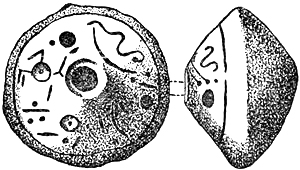
80 also illustrates the indefinite and inchoate style of decoration. One
unfinished Swastika appears which, unlike anything we have yet seen, has a
circle with a dot in the center for the body of the Swastika at the
crossing of the main arms. Fig. 81 shows two Swastikas, both crossing
their main arms at right angles and the ends bending also at right
angles—one to the right, the other to the left. This specimen is inserted
here because of the numerous decorations of apparently unmeaning, or, at
least, unexplained, lines. Fig. 82 shows four segmented circles with an
indefinite Swastika in one of the spaces. The ends are not well turned,
only one being well attached to the main arms. One of the ends is not
joined, one overruns and forms a sort of cross; the other has no bend.
Fig. 83 contains an unmistakable Swastika, the main arms of which cross at
right angles, turning to the left with an ogee curve. The peculiarity of
this specimen is that the center of the sign is inclosed in a circle, thus
showing the indifference of the Swastika sign to other signs, whether
cross or circle. The outer parts of the field are occupied with the
parallel lines of the circle segment, as shown in many other specimens.
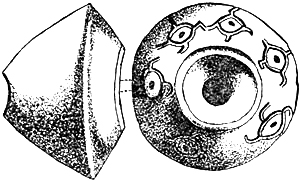
The specimen shown in fig. 84 is similar in style to the last. The bodies
of six Swastikas are formed by a circle and dot, while the arms of the
cross start from the outside of the circle, extending themselves in
curves, all of them to the right. (See fig. 13d.) It has no other
ornamentation. The same remark is to be made about the indifferent use of
the Swastika in association with cross or circle. We have seen many
Swastikas composed of the crossed ogee lines or curves. Figs. 85 and 86
show the same ogee lines and curves not crossed; and thus, while it may be
that neither of them are Swastikas, yet they show a relationship of form
from which the derivation of a Swastika would be easy.
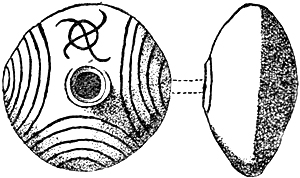
Fig. 83.
BICONICAL SPINDLE-WHORL, FLATTENED.
Ogee Swastika with central circle.
Third city. Depth, 23 feet.
Schliemann, “Ilios,” fig. 1987.
 |
|
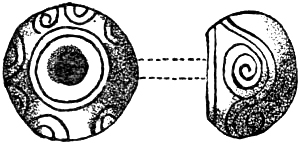 |
Fig. 84.
BICONICAL SPINDLE-WHORL WITH
SIX OGEE SWASTIKAS HAVING
CENTRAL CIRCLE AND DOT.
Third city. Depth, 23 feet.
Schliemann, “Ilios,” fig. 1862. |
|
Fig. 85.
SPHERICAL SPINDLE-WHORL WITH
FLATTENED TOP AND OGEE LINES
WHICH DO NOT FORM SWASTIKAS.
Schliemann, “Ilios,” fig. 1890. |
Fig. 86.
BICONICAL SPINDLE-WHORL WITH OGEE CURVES
WHICH ARE NOT CROSSED TO FORM SWASTIKAS.
Schliemann, “Ilios,” fig. 1889.
Attention has been called to decorations comprising segments of the
circles incised in these whorls, the periphery of which is toward their
centers (figs. 60, 64, 65, 69,
70, 82 and 83). Also to the mysterious dots
(figs. 46, 56, 75, 76,
77, 79, 84, 92,
96 and 97). Fig. 87 shows a
combination of the segments of three circles, the dots within each, and
two Swastikas. Of the Swastikas, one is normal, turning to the right; the
other turns to the right, but at an obtuse angle, with one end straight
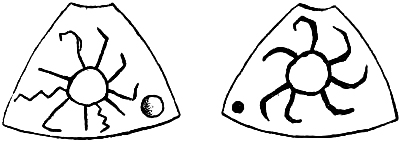
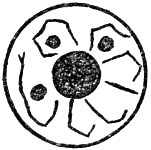
and the other irregularly curved. Fig. 88 represents two sections of a
terra-cotta sphere divided similar to fig. 49. Each of these sections
contains a figure like unto a Swastika and which may be related to it. It
is a circle with arms springing from the periphery, which arms turn all to
the left, as they do in the ogee Swastika. One has seven, the other nine,
arms. One has regular, the other irregular, lines and intervals. Fig. 89
represents a spindle-whorl of terra cotta nearly spherical, with
decoration of a large central dot and lines springing thereout, almost
like the spokes of a wheel, then all turning to the left as volutes. In
some countries this has been called the sun symbol, but there is nothing
to indicate that it had any signification at Hissarlik. One of the marks
resembles the long-backed, four-legged animal (figs. 99 and 100).[148]
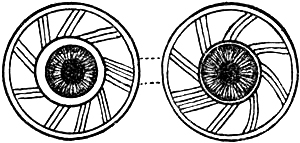
Figs. 90, 91, 92, and 93 show a further adaptation of the ogee curve
developed into a Swastika, in which many arms start from the center circle
around the central hole in the whorl, finally taking a spiral form. The
relation of this to a sun symbol is only mentioned and not specified or
declared. The inexplicable and constantly recurring dots are seen in fig. 90.
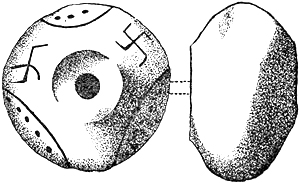
Fig. 87.
SPHERICAL SPINDLE-WHORL, FLATTENED.
Two Swastikas combined with segments and dots.
Schliemann, “Ilios,” fig. 1988.
Fig. 88.
SECTIONS OF TERRA-COTTA SPHERE.[149]
Central circles with extended arms turning to the left,
ogee and zigzag. Schliemann, “Ilios,” fig. 1993.
Fig. 89.
SPHERICAL SPINDLE-WHORL.
Large central dot with twelve arms, similar in form to
the ogee Swastika. Schliemann, “Ilios,” fig. 1946.
It is not contended that these are necessarily evolutions of the Swastika.
We will see farther on many lines and forms of decoration by incised lines
on these Trojan whorls, which may have had no relation to the Swastika,
but are inserted here because persons rich in theories and brilliant in
imagination have declared that they could see a resemblance, a relation,
in this or some other decoration. As objects belonging to the same
culture, from the same locality, and intimately associated with
unmistakable Swastikas, they were part of the res gestæ, and as such
entitled to admission as evidence in the case. The effect of their
evidence is a legitimate subject for discussion and argument. To refuse
these figures admission would be to decide the case against this
contention without giving the opposing party an opportunity to see the
evidence or to be heard in argument. Therefore the objects are inserted.
 |
|
 |
Fig. 90.
SPINDLE-WHORL.
Central dot with ogee
arms radiating therefrom
in different directions, but
in the form of a Swastika.
Third City. Depth, 29
feet. Schliemann, “Ilios,”
fig. 1830. |
|
Fig. 91.
SPINDLE-WHORL
WITH CENTRAL
HOLE AND
RADIATING ARMS.
Third city. Depth,
23 feet.
Schliemann,
“Ilios,” fig. 1842. |
Specimens of other crosses are presented because the Swastika is
considered to be a form of the cross. There may have been no evolution or
relationship between them; but no person is competent to decide from a
mere inspection or by reason of dissimilarity that there was not. We have
to plead ignoramus as to the growth and evolution of both cross and
Swastika, because the origin of both is lost in antiquity. But all are
fair subjects for discussion. There certainly is nothing improbable in the
relationship and evolution between the Swastika and the cross. It may be
almost assumed.
 |
|
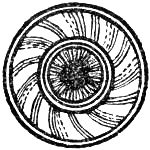 |
Fig. 92.
SPINDLE-WHORL WITH CENTRAL CIRCLE AND MANY ARMS.
Fourth city. Depth, 19.8 feet. Schliemann, “Ilios,” fig. 1837. |
|
Fig. 93.
SPINDLE-WHORL WITH
CENTRAL HOLE, LARGE
CIRCLE, AND MANY
CURVED ARMS.
Third city. Depth,
29 feet. Schliemann,
“Ilios,” fig. 1833. |
Evidence leading to conviction may be found in associated contemporaneous
specimens. M. Montelius, an archæologist of repute in the National Museum
at Stockholm, discovered eight stages of culture in the bronze age of that
country, which discovery was based solely upon the foregoing principle
applied to the fibulæ found in prehistoric graves. In assorting his stock
of fibulæ, he was enabled to lay out a series of eight styles, each
different, but with many presentations. He arranged them seriatim,
according to certain differences in size, style, elegance of workmanship,
etc., No. 1 being the smallest, and No. 8 the largest and most elaborate.
They were then classified according to locality and association, and he
discovered that Nos. 1 and 2 belonged together, on the same body or in the
same grave, and the same with Nos. 2 and 3, 3 and 4, and so on to No. 8,
but that there was no general or indefinite intermixture; Nos. 1 and 3 or
2 and 4 were not found together and were not associated, and so on. Nos. 7
and 8 were associated, but not 6 and 8, nor 5 and 7, nor was there any
association beyond adjoining numbers in the series. Thus Montelius was
able to determine that each one or each two of the series formed a stage
in the culture of these peoples. While the numbers of the series
separated from each other, as 1, 5, 8, were never found associated, yet
it was conclusively shown that they were related, were the same object,
all served a similar purpose, and together formed an evolutionary series
showing their common origin, derivative growth and continuous improvement
in art, always by communication between their makers or owners.
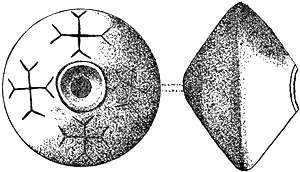
Fig. 94.
LARGE BICONICAL SPINDLE-WHORL.
Four crosses with bifurcated arms. Third city. Depth, 23 feet.
Schliemann, “Ilios,” fig. 1855.
 |
|
 |
|
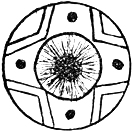 |
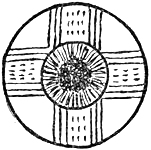
Fig. 95.
SPINDLE-WHORL.
Hole and large circle in
center with broad arms
of Greek cross. Third
city. Depth, 26.4 feet.
Schliemann, “Ilios,”
fig. 1820. |
|
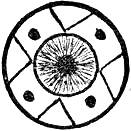
Fig. 96.
SPINDLE-WHORL.
Hole and large circle in
center. Extended parallel
arms with dots, forming
a Greek Cross. Third
city. Depth, 23 feet.
Schliemann, “Ilios,”
fig. 1817. |
|
Fig. 97.
SPINDLE-WHORL.
Greek cross. Tapering
arms with dots. Third
city. Depth, 23 feet.
Schliemann, “Ilios,”
fig. 1818. |
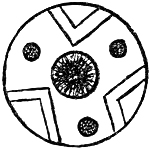
Fig. 98.
SPINDLE-WHORL.
Central hole and three
arms with dots. Third
city. Depth, 23 feet.
Schliemann, “Ilios,”
fig. 1819.
Thus it may be with the other forms of crosses, and thus it appears to be
with the circle and spiral Swastikas and those with ends bent in opposite
and different directions. Just what their relations are and at which end
of the series the evolution began, is not argued. This is left for the
theorists and imaginists, protesting, however, that they must not run wild
nor push their theories beyond bounds. Fig. 94 represents four crosses,
the main arms of which are at right angles, and each and all ends, instead
of being turned at an angle which would make them Swastikas, are
bifurcated and turn both ways, thus forming a foliated cross similar to
the Maya cross, the “Tree of life.” Figs. 95, 96, and 97 show Greek
crosses. The centers of the crosses are occupied by the central hole of
the whorl, while the arms extend to the periphery. In the centers of the
respective arms are the ubiquitous dots. The question might here be asked
whether these holes, which represented circles, stood for the sun symbol
or solar disk. The question carries its own answer and is a refutation of
those who fancy they can see mythology in everything. Fig. 98 is the same
style of figure with the same dots, save that it has three instead of four
arms. Figs. 99 and 100 each show four of the curious animals heretofore
represented (fig. 56) in connection with the Swastika. They are here
inserted for comparison. They are all of the same form, and one
description will serve. Back straight, tail drooping, four legs, round
head showing eye on one side, and long ears resembling those of a rabbit
or hare, which, in fig. 56, are called horns. The general remarks in
respect to the propriety of inserting crosses and burning altars (p. 824)
apply with equal pertinency to these animals and to the unexplained dots
seen on so many specimens. Fig. 101 shows both ends of a spindle-whorl,
and is here inserted because it represents one of the “burning altars” of
Dr. Schliemann, associated with a Swastika, as in figs. 61, 66, and 68,
and even those of figure-8 style (figs. 64 and 69).
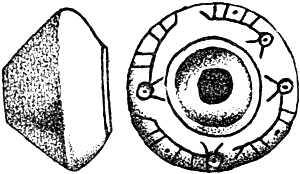
Fig. 99.
BICONICAL SPINDLE-WHORL.
Four animals are shown similar to those found
associated with the Swastika. Third city.
Depth, 33 feet. Schliemann, “Ilios,” fig. 1877.
Fig. 100.
BICONICAL SPINDLE-WHORL.
Four animals are shown similar to those found
associated with the Swastika. Fourth city.
Depth, 19.6 feet. Schliemann, “Ilios,” fig. 1867.
Fig. 101.
SPINDLE-WHORL WITH FIGURE-8 SWASTIKA (?)
AND SIX “BURNING ALTARS.”
Fourth city. Depth, 19.6 feet.
Schliemann, “Ilios,” fig. 1838.
Dr. Schliemann found, during his excavations on the hill of Hissarlik, no
less than 1,800 spindle-whorls. A few were from the first and second
cities; they were of somewhat peculiar form (figs. 72 and 74), but the
greatest number were from the third city, thence upward in decreasing
numbers. The Swastika pure and simple was found on 55 specimens, while its
related or suggested forms were on 420 (pp. 809, 819). Many of the other
whorls were decorated with almost every imaginable form of dot, dash,
circle, star, lozenge, zigzag, with many indefinite and undescribable
forms. In presenting the claims of the Swastika as an intentional sign,
with intentional, though perhaps different, meanings, it might be
unsatisfactory to the student to omit descriptions of these associated
decorative forms. This description is impossible in words; therefore the
author has deemed it wiser to insert figures of these decorations as they
appeared on the spindle-whorls found at Troy, and associated with those
heretofore given with the Swastika. It is not decided, however, that these
have any relation to the Swastika, or that they had any connection with
its manufacture or existence, either by evolution or otherwise, but they
are here inserted to the end that the student and reader may take due
account of the association and make such comparison as will satisfy him.
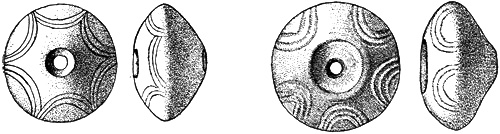
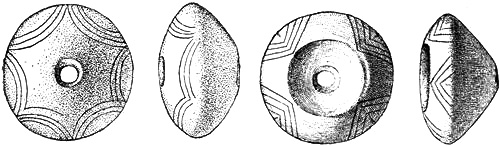
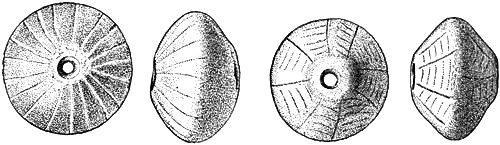
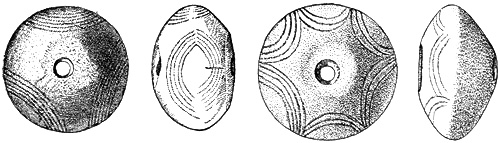
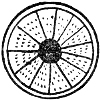
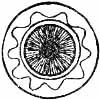
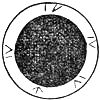
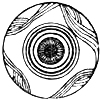
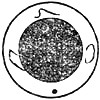
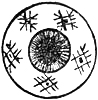
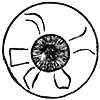
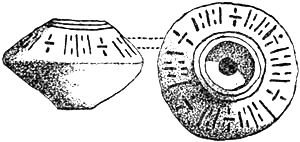
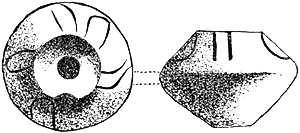
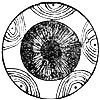
(Figs. 102 to 124.)
 |
|
 |
|
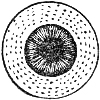 |
| 102. |
|
103. |
|
104. |
| |
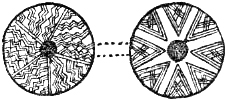 |
|
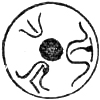 |
|
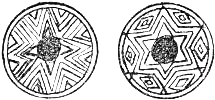 |
| 105. |
|
106. |
|
107. |
| |
 |
|
 |
|
 |
| 108. |
|
109. |
|
110. |
| |
 |
|
 |
|
 |
| 111. |
|
112. |
|
113. |
Figs. 102-113. TROJAN SPINDLE-WHORLS. Schliemann, “Ilios.”
 |
|
 |
|
 |
| 114. |
|
115. |
|
116. |
| |
 |
|
 |
|
 |
| 117. |
|
118. |
|
119. |
| |
 |
|
 |
|
 |
| 120. |
|
121. |
|
122. |
| |
 |
|
 |
| 123. |
|
124. |
Figs. 114-124. TROJAN SPINDLE-WHORLS. Schliemann, “Ilios.”
Leaden idol of Hissarlik.—Dr. Schliemann, in his explorations on the
hill of Hissarlik, at a depth of 23 feet, in the third, the burnt city,
found a metal idol (fig. 125), which was determined on an analysis to be
lead.[150] It was submitted to Professor Sayce who made the following
report:[151]
It is the Artemis Nana of Chaldea, who became the chief deity of
Carchemish, the Hittite capital, and passed through Asia Minor to the
shores and islands of the Ægean Sea. Characteristic figures of the
goddess have been discovered at Mycenæ as well as in Cyprus.
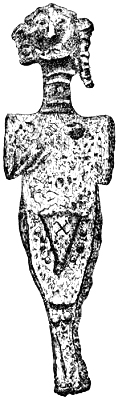
Fig. 125.
LEADEN IDOL OF
ARTEMIS NANA
OF CHALDEA,
WITH SWASTIKA.[153]
Third city. Depth, 23 feet.
Schliemann, “Ilios,” fig.
126. 1⅓ natural size.
In “Troja” Professor Sayce says:
Precisely the same figure, with ringlets on either side of the head,
but with a different ornament (dots instead of Swastika) sculptured on
a piece of serpentine was recently found in Mæonia, and published by
M. Salmon Reinach in Revue Archæologique. By the side of the goddess
stands the Babylonian Bel, and among the Babylonian symbols that
surround them is the representation of one of the terra-cotta whorls,
of which Dr. Schliemann found such multitudes at Troy.
The chief interest to us of Dr. Schliemann’s description of the idol lies
in the last paragraph:[152]
The vulva is represented by a large triangle, in the upper side of
which we see three globular dots; we also see two lines of dots to the
right and left of the vulva. The most curious ornament of the figure
is a Swastika, which we see in the middle of the vulva. * * * So far
as we know, the only figures to which the idol before us has any
resemblance are the female figures of white marble found in tombs in
Attica and in the Cyclades. Six of them, which are in the museum at
Athens, * * * represent naked women. * * * The vulva is represented on
the six figures by a large triangle. * * * Similar white Parian marble
figures, found in the Cyclades, whereon the vulva is represented by a
decorated triangle, are preserved in the British Museum. Lenorment, in
“Les Antiquités de la Troade” (p. 46), says: “The statuettes of the
Cyclades, in the form of a naked woman, appear to be rude copies made
by the natives, at the dawn of their civilization, from the images of
the Asiatic goddess which had been brought by Phœnician merchants.
They were found in the most ancient sepulchers of the Cyclades, in
company with stone weapons, principally arrowheads of obsidian from
Milo, and with polished pottery without paintings. We recognize in
them the figures of the Asiatic Venus found in such large numbers from
the banks of the Tigris to the island of Cyprus, through the whole
extent of the Chaldeo-Assyrian, Aramæan, and Phœnician world. Their
prototype is the Babylonian Zarpanit, or Zirbanit, so frequently
represented on the cylinders and by terra-cotta idols, the fabrication
of which begins in the most primitive time of Chaldea and continues
among the Assyrians.
It is to be remarked that this mark is not on the vulva, as declared by
Schliemann, but rather on a triangle shield which covers the mons
veneris.
Professor Sayce is of the opinion, from the evidence of this leaden idol,
that the Swastika was, among the Trojans, a symbol of the generative power
of man.
An added interest centers in these specimens from the fact that
terra-cotta shields of similar triangular form, fitted to the curvature of
the body, were worn in the same way in prehistoric times by the aboriginal
women of Brazil. These pieces have small holes at the angles, apparently
for suspension by cords. The U. S. National Museum has some of these, and
they will be figured in the chapter relating to Brazil. The similarity
between these distant objects is remarkable, whether they were related or
not, and whether the knowledge or custom came over by migration or not.
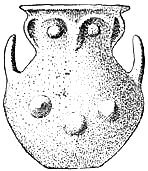 |
|
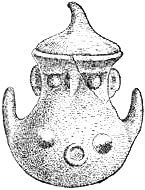 |
Fig. 126.
TERRA-COTTA VASE WITH MAMELON.
Fourth city. Depth, 16.5 feet.
Cat. No. 149676, U. S. N. M.
⅓ natural size. |
|
Fig. 127.
TERRA-COTTA VASE WITH CIRCLE OR RING.
Fourth city. Depth, 20 feet.
Schliemann, “Ilios,” fig. 988.
⅓ natural size. |
Owl-shaped vases.—It is also remarkable to note in this connection the
series of owl-shaped terra-cotta vases of the ruined cities of Hissarlik
and their relation to the Swastika as a possible symbol of the generative
power. These vases have rounded bottoms, wide bellies, high shoulders (the
height of which is emphasized by the form and position of the handles),
the mouth narrow and somewhat bottle-shaped, but not entirely so. What
would be the neck is much larger than usual for a bottle, and more like
the neck of a human figure, which the object in its entirety represents in
a rude, but, nevertheless, definite, manner. At the top of the vase are
the eyes, eyebrows, and the nose. It is true that the round eyes, the
arched eyebrows, and the pointed nose give it somewhat an owlish face, but
if we look at fig. 127, the human appearance of which is emphasized by the
cover of the vase, which serves as a cap for the head and has the effect
of enlarging it to respectable dimensions, we will see how nearly it
represents a human being. The U. S. National Museum possesses one of these
vases in the Schliemann collection (fig. 126). It has the face as
described, while the other human organs are only indicated by small knobs.
It and the three figures, 127, 128, and 129, form a series of which the
one in the Museum would be the first, the others following in the order
named. No. 2 in the series has the female attributes indefinitely and
rudely indicated, the lower organ being represented by a concentric ring.
In No. 3 the mammæ are well shown, while the other organ has the
concentric ring, the center of which is filled with a Greek cross with
four dots, one in each angle, the Croix swasticale of Zmigrodzki (fig.
12). No. 4 of the series is more perfect as a human, for the mouth is
represented by a circle, the mammæ are present, while in the other
locality appears a well-defined Swastika. The first three of these were
found in the fourth city at 20 to 22 feet depth, respectively; the last
was found in the fifth city at a depth of 10 feet. The leaden idol (fig.
125), with its Swastika mark on the triangle covering the private parts,
may properly be considered as part of the series. When to this series is
added the folium vitus of Brazil (pl. 18), the similarity becomes
significant, if not mysterious. But, with all this significance and
mystery, it appears to the author that this sign, in its peculiar
position, has an equal claim as a symbol of blessing, happiness, good
fortune, as that it represents the generative power.
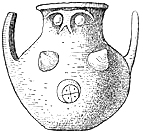 |
|
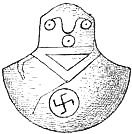 |
Fig. 128.
TERRA-COTTA VASE WITH CIRCLE OR
RING AND CROIX SWASTICALE.
Schliemann, “Ilios,” fig. 986.
⅙ natural size. |
|
Fig. 129.
TERRA-COTTA VASE WITH CIRCLE
OR RING INCLOSING SWASTIKA.
Schliemann, “Troja,” fig. 101.
⅖ natural size. |
From the earliest time of which we have knowledge of the thoughts or
desires of man we know that the raising up “heirs of his body” constituted
his greatest blessing and happiness, and their failure his greatest
misery. The first and greatest command of God to man, as set forth in the
Holy Bible, is to “Be fruitful, and multiply, and replenish the
earth.”[154] This was repeated after the Deluge,[155] and when He
pronounced the curse in the Garden, that upon the woman[156] was, “In
sorrow thou shalt bring forth children.” God’s greatest blessing to
Abraham, when He gave to him and his seed the land as far as he could see,
was that his seed should be as the dust of the earth, “so that if a man
can number the dust of the earth, then shall thy seed also be
numbered.”[157] “Tell the stars, if thou be able to number them * * * so
shall thy seed be. * * * As the father of many nations,” etc. We all know
the story of Sarai, how, when she and Abraham had all riches and power on
earth, it was as naught while they were childless, and how their greatest
blessing was the Divine promise of an heir, and that their greatest
happiness was over the birth of Isaac. This may be no proof of the
symbolism of the Swastika, but it shows how, in high antiquity, man’s
happiness in his children was such as makes the Swastika mark, in the
position indicated, equally a symbol of good fortune and blessing as it
was when put on the spindle-whorls of Hissarlik, the vases of Greece, or
the fibulæ of Etruria.
The age of the Trojan cities.—It may be well to consider for a moment
the age or epoch of these prehistoric Trojan cities on the hill of
Hissarlik. Professor Virchow was appealed to by Schliemann for his
opinion. He says:[158]
Other scholars have been inclined to ascribe the oldest cities of
Hissarlik to the Neolithic age, because remarkable weapons and
utensils of polished stone are found in them. * * * This conception is
unjustified and inadmissible. To the third century A. D. belongs the
surface of the fortress hill of Hissarlik, which still lies above the
Macedonian wall; and the oldest “cities”—although not only polished
stones but also chipped flakes of chalcedony and obsidian occur in
them—nevertheless fall within the age of metals, for even in the
first city utensils of copper, gold, and even silver were dug up. No
stone people, properly so called, dwelt upon the fortress hill of
Hissarlik, so far as it has been uncovered.
Virchow’s opinion that none of the cities of Hissarlik were in the stone
age may be correct, but the reason he gave is certainly doubtful. He says
they come within the age of metals, for, or because, “utensils of copper,
gold, and even silver were dug up among the ruins of the first city.”
That the metals, gold, silver, or copper, were used by the aborigines, is
no evidence that they were in a metal age, as it has been assigned and
understood by prehistoric archæologists. The great principle upon which
the names of the respective prehistoric ages—stone, bronze, and
iron—were given, was that these materials were used for cutting and
similar implements. The use of gold and silver or any metal for ornamental
purposes has never been considered by archæologists as synchronous with a
metal age. Indeed, in the United States there are great numbers of
aboriginal cutting implements of copper, of which the U. S. National
Museum possesses a collection of five or six hundred; yet they were not in
sufficient number to, and they did not, supersede the use of stone as the
principal material for cutting implements, and so do not establish a
copper age in America. In Paleolithic times bone was largely used as
material for utensils and ornaments. Bone was habitually in use for one
purpose or another, yet no one ever pretended that this establishes a bone
age. In countries and localities where stone is scarce and shell abundant,
cutting implements were, in prehistoric times, made of shell; and chisels
or hatchets of shell, corresponding to the polished stone hatchet, were
prevalent wherever the conditions were favorable, yet nobody ever called
it an age of shell. So, in the ruined cities of Hissarlik, the first five
of them abounded in stone implements peculiar to the Neolithic age, and
while there may have been large numbers of implements and utensils of
other materials, yet this did not change it from the polished stone age.
In any event, the reason given by Virchow—i. e., that the use,
undisputed, of copper, gold, and silver by the inhabitants of these
cities—is not evidence to change their culture status from that
denominated as the polished stone age or period.
Professor Virchow subsequently does sufficient justice to the antiquity of
Schliemann’s discoveries and says[159] while “it is impossible to assign
these strata to the stone age, yet they are indications of what is the
oldest known settlement in Asia Minor of a people of prehistoric times of
some advance in civilization,” and[160] that “no place in Europe is known
which could be put in direct connection with any one of the six lower
cities of Hissarlik.”
Professor Sayce also gives his opinion on the age of these ruins:[161]
The antiquities, therefore, unearthed by Dr. Schliemann at Troy,
acquire for us a double interest. They carry us back to the later
stone ages of the Aryan race.
AFRICA.
EGYPT.
A consensus of the opinions of antiquarians is that the Swastika had no
foothold among the Egyptians. Prof. Max Müller is of this opinion, as is
also Count Goblet d’Alviella.[162]
Waring[163] says:
The only sign approaching the fylfot in Egyptian hieroglyphics that we
have met is shown in fig. 3, pl. 41, where it forms one of the
hieroglyphs of Isis, but is not very similar to our fylfot.
Mr. Greg says:[164] “In Egypt the fylfot does not occur.” Many other
authors say the same. Yet many specimens of the Swastika have been found
in Egypt (figs. 130 to 136). Professor Goodyear[165] says:
The earliest dated Swastikas are of the third millenium B. C., and
occur on the foreign Cyprian and Carian (?) pottery fragments of the
time of the twelfth dynasty (in Egypt), discovered by Mr. Flinders
Petrie in 1889. (Kahun, Gurob, and Hawara, pl. 27, Nos. 162 and 173.)
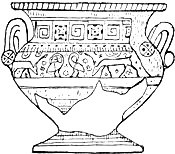
Fig. 130.
GREEK VASE SHOWING DEER,
GEESE, AND SWASTIKAS.
Naukratis, Ancient Egypt.
Sixth and fifth centuries, B. C.
Petrie, Third
Memoir, Egypt
Exploration Fund, part 1, pl. 4,
fig. 3, and Goodyear,
“Grammar of the Lotus,”
pl. 60, fig. 2.

Fig. 130
a.
DETAIL OF VASE
SHOWN IN THE
PRECEDING FIGURE.Naukratis.—Figs. 130 to 135, made after illustrations in Mr. W.
Flinders Petrie’s Third Memoir of the Egypt Exploration Fund (Pt. 1),
found by him in Naukratis, all show unmistakable Swastikas. It should be
explained that these are said to be Greek vases which have been imported
into Egypt. So that, while found in Egypt and so classed geographically,
they are not Egyptian, but Greek.
Coptos (Achmim-Panopolis).—Within the past few years great
discoveries have been made in Upper Egypt, in Sakkarah, Fayum, and Achmim,
the last of which was the ancient city of Panopolis. The inhabitants of
Coptos and the surrounding or neighboring cities were Christian Greeks,
who migrated from their country during the first centuries of our era and
settled in this land of Egypt. Strabo mentions these people and their
ability as weavers and embroiderers. Discoveries have been made of their
cemeteries, winding sheets, and grave clothes. These clothes have been
subjected to analytic investigation, and it is the conclusion of M.
Gerspach, the administrator of the national manufactory of the Gobelin
tapestry, Paris,[166] that they were woven in the same way as the
Gobelins, and that, except being smaller, they did not differ essentially
from them. He adds:
These Egyptian tapestries and those of the Gobelins are the result of
work which is identical except in some secondary details, so that I
have been able, without difficulty, to reproduce these Coptic
tapestries in the Gobelin manufactory.
Fig. 131.
POTTERY FRAGMENTS WITH TWO MEANDER SWASTIKAS.
Naukratis, Ancient Egypt. Petrie, Third Memoir of the Egyptian
Exploration Fund, part 1, pl. 5, figs. 15, 24.
Fig. 132.
FRAGMENT OF GREEK VASE WITH LION AND THREE MEANDER SWASTIKAS.
Naukratis, Ancient Egypt. Petrie, Sixth Memoir of the Egypt Exploration Fund,
part 2, fig. 7, and Goodyear, “Grammar of the Lotus,” pl. 30, fig. 2.
On one of these Coptic cloths, made of linen, reproduced in “Die Gräber- und
Textilfunde von Achmim-Panopolis,” by R. Forrer, occurs a normal
Swastika embroidered or woven, tapestry fashion, with woolen thread (fig.
136). It belongs to the first epoch, which includes portions of the first
and second centuries A. D. There were on these cloths an enormous amount
of decoration, representing many figures, both natural and geometric.
Among them was the Swastika variously applied and in different sizes,
sometimes inserted in borders, and sometimes adorning the corners of the
tunics and togas as a large medallion, as shown in the figure.[167]
Fig. 133.
FRAGMENT OF GREEK VASE DECORATED WITH FIGURES OF SACRED
ANIMALS AND SWASTIKAS, ASSOCIATED WITH GREEK FRET.
Naukratis, Ancient Egypt. Petrie, Sixth Memoir of the Egypt
Exploration Fund, part 2, pl. 6, fig. 1.
Fig. 134.
FRAGMENT OF GREEK VASE WITH FIGURES OF ANIMALS,
TWO MEANDER SWASTIKAS, AND GREEK FRET.
Naukratis, Ancient Egypt. Petrie, Sixth Memoir of the Egypt Exploration Fund,
part 2, pl. 8, fig. 1, and
Goodyear, “Grammar of the Lotus,” pl. 30, fig. 10.
Fig. 135.
GREEK VASE WITH DEER, AND MEANDER AND FIGURE-8 SWASTIKAS.
Naukratis, Ancient Egypt. Petrie, Sixth Memoir of the Egypt
Exploration Fund, part 2, pl. 5, fig. 1.
Fig. 136.
GREEK TAPESTRY.
Coptos, Egypt. First and second centuries, A. D. Forrer,
“Die Gräber- und Textilfunde von Achmin-Panopolis.”
ALGERIA.
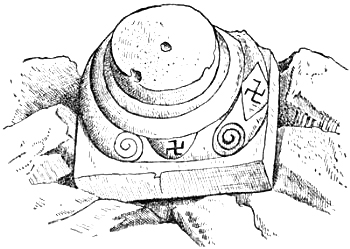
Fig. 137.
TORUS OF COLUMN WITH SWASTIKAS.
Roman ruins, Algeria. Waring, “Ceramic Art in
Remote Ages,” pl. 43, fig. 2, quoting from Delamare.
Waring, in his “Ceramic Art in Remote Ages,” discoursing upon the
Swastika, which he calls fylfot, shows in pl. 43, fig. 2 (quoting from
Delamare), the base of a column from a ruined Roman building in Algeria
(fig. 137), on the torus of which are engraved two Swastikas, the arms
crossing at right angles, all ends bent at right angles to the left. There
are other figures (five and six on the same plate) of Swastikas from a
Roman mosaic pavement in Algeria. Instead of being square, however, or at
right angles, as might ordinarily be expected from mosaic, they are ogee.
In one of the specimens the ogee ends finish in a point; in the other they
finish in a spiral volute turning upon itself. The Swastika has been found
on a tombstone in Algeria.[168]
ASHANTEE.
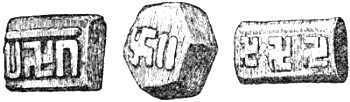
Fig. 138.
BRONZE INGOTS BEARING SWASTIKAS.Coomassee, Ashantee.
Mr. R. B. Æneas McLeod, of Invergordon Castle, Ross-shire, Scotland,
reported[169] that, on looking over some curious bronze ingots captured at
Coomassee in 1874, during the late Ashantee war, by Captain Eden, in whose
possession they were at Inverness, he had found some marked with the
Swastika sign (fig. 138). These specimens were claimed to be aboriginal,
but whether the marks were cast or stamped in the ingot is not stated.
CLASSICAL OCCIDENT—MEDITERRANEAN.
GREECE AND THE ISLANDS OF CYPRUS, RHODES, MELOS, AND THERA.
The Swastika has been discovered in Greece and in the islands of the
Archipelago on objects of bronze and gold, but the principal vehicle was
pottery; and of these the greatest number were the painted vases. It is
remarkable that the vases on which the Swastika appears in the largest
proportion should be the oldest, those belonging to the Archaic period.
Those already shown as having been found at Naukratis, in Egypt, are
assigned by Mr. Flinders Petrie to the sixth and fifth centuries B. C.,
and their presence is accounted for by migrations from Greece.
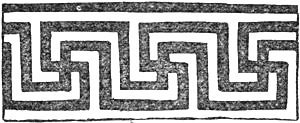 |
|
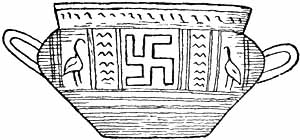 |
Fig. 139.
VARIATION OF THE GREEK FRET.
Continuous lines crossing each other at right angles
forming figures resembling the Swastikas. |
|
Fig. 140.
GREEK GEOMETRIC VASE IN THE LEYDEN MUSEUM,
WITH FIGURES OF GEESE AND SWASTIKA IN
PANEL.[170]
Smyrna. Conze, “Anfänge,” etc., Vienna, 1870,
and
Goodyear, “Grammar of the Lotus,” pl. 56, fig. 4. |
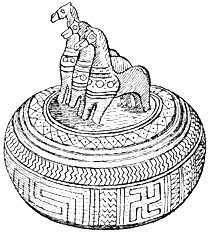 |
|
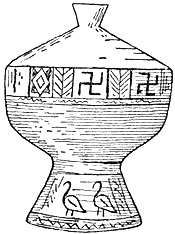 |
Fig. 141.
GREEK VASE WITH FIGURES OF HORSES,
GEOMETRIC ORNAMENTS AND
SWASTIKAS IN PANELS.
Athens. Dennis, “Etruria,” 1, p. cxiii. |
|
Fig. 142.
GREEK VASE WITH SWASTIKAS
IN PANELS.
Conze, “Anfänge,” etc., and
Goodyear, “Grammar of the
Lotus,” pl. 60, fig. 13. |
The Greek fret and Egyptian meander not the same as the
Swastika.—Professor Goodyear says:[171] “There is no proposition in
archæology which can be so easily demonstrated as the assertion that the
Swastika is originally a fragment of the Egyptian meander, provided Greek
geometric vases are called in evidence.”
Egyptian meander here means the Greek fret. Despite the ease with which he
says it can be demonstrated that the Swastika was originally a fragment of
the Egyptian meander, and with all respect for the opinion of so profound
a student of classic ornament, doubts must arise as to the existence of
the evidence necessary to prove his proposition.
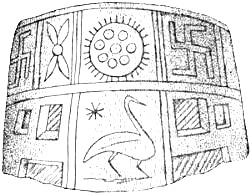 |
|
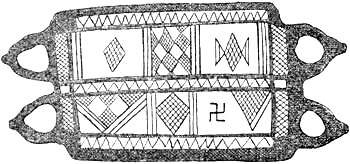 |
Fig. 143.
DETAIL OF ARCHAIC GREEK VASE WITH FIGURE
OF SOLAR GOOSE AND SWASTIKAS IN PANELS.
British Museum. Waring, “Ceramic Art in
Remote Ages,” pl. 41, fig. 15. |
|
Fig. 144.
CYPRIAN POTTERY PLAQUE WITH SWASTIKA IN PANEL.
Metropolitan Museum of Art, New York City.
Cesnola, “Cyprus, its Ancient Cities, Tombs,
and Temples,” pl. 47, fig. 40. |
| |
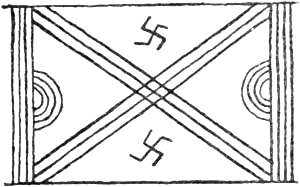 |
|
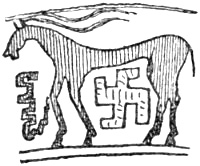 |
Fig. 145.
DETAIL OF CYPRIAN VASE WITH
SWASTIKAS IN TRIANGLES.
Goodyear, “Grammar of the Lotus,” pl. 1, fig. 11. |
|
Fig. 146.
DETAIL OF ATTIC VASE WITH FIGURE
OF ANTELOPE (?) AND SWASTIKA.
British Museum. Böhlau, Jahrbuch,
1885, p. 50, and Goodyear, “Grammar
of the Lotus,” pl. 37, fig. 9. |
| |
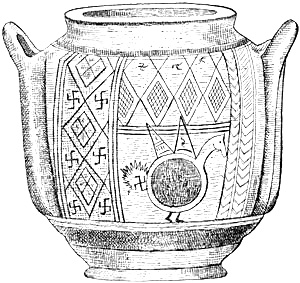 |
|
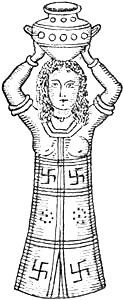 |
Fig. 147.
CYPRIAN VASE WITH SWASTIKAS.
Cesnola, “Cyprus, its Ancient Cities, Tombs, and
Temples,” appendix by Murray, p. 404, fig. 15. |
|
Fig. 148.
TERRA COTTA FIGURINE WITH
SWASTIKAS IN PANELS.
Cesnola, “Cyprus, its Ancient Cities, Tombs,
and Temples,” p. 300, and Ohnefalsch-Richter,
Bull. Soc. d’Anthrop., Paris, 1888, p. 691. |
| |
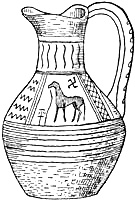 |
|
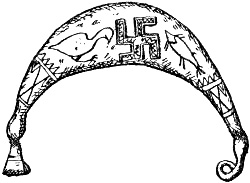 |
Fig. 149.
TERRA COTTA VASE WITH SWASTIKA
AND FIGURE OF HORSE.[172] |
|
Fig. 150.
BRONZE FIBULA WITH SWASTIKA AND
REPRESENTATIONS OF A GOOSE AND A FISH.
Bœotia, Greece. De Mortillet, “Musée
Préhistorique,” fig. 1265. |
Professor Goodyear, and possibly others, ascribe the origin of the
Swastika to the Greek fret; but this is doubtful and surely has not been
proved. It is difficult, if not impossible, to procure direct evidence on
the proposition. Comparisons may be made between the two signs; but this
is secondary or indirect evidence, and depends largely on argument. No man
is so poor in expedients that he may not argue. Goldsmith’s schoolmaster
“e’en tho’ vanquished, he could argue still.” The Greek fret, once
established, might easily be doubled or crossed in some of its members,
thus forming a figure similar to the Swastika (fig. 139), which would
serve as an ornament, but is without any of the characteristics of the
Swastika as a symbol. The crossed lines in the Greek fret seem to have
been altogether fortuitous. They gave it no symbolic character. It was
simply a variation of the fret, and at best was rarely used, and like it,
was employed only for ornament and not with any signification—not a sign
of benediction, blessing, or good luck, as was the Swastika. The
foundation principle of the Greek fret, so far as we can see its use, is
its adaptability to form an extended ornamental band, consisting of
doubled, bent, and sometimes crossed or interlaced lines, always
continuous and never ending, and running between two parallel border
lines. Two interlacing lines can be used, crossing each other at certain
places, both making continuous meanders and together forming the
ornamental band (fig. 139). In the Greek fret the two lines meandered
between the two borders back and forth, up and down, but always forming a
continuous line. This seems to be the foundation principle of the Greek
fret. In all this requirement or foundation principle the Swastika fails.
A row or band of Swastikas can not be made by continuous lines; each one
is and must be separated from its fellows. The Swastika has four arms,
each made by a single line which comes to an end in each quarter. This is
more imperative with the meander Swastika than with the normal. If the
lines be doubled on each other to be carried along to form another
Swastika adjoining, in the attempt to make a band, it will be found
impossible. The four lines from each of the four arms can be projected,
but each will be in a different direction, and no band can be made. It is
somewhat difficult to describe this, and possibly not of great need. An
attempt to carry out the project of making a band of Swastikas, to be
connected with each other, or to make them travel in any given direction
with continuous lines, will be found impossible. Professor Goodyear
attempts to show how this is done by his figure on page 96, in connection
with pl. 10, fig. 9, also figs. 173 and 174 (pp. 353 and 354). These
figures are given in this paper and are, respectively, Nos. 21, 25, 26,
and 27. Exception is taken to the pretended line of evolution in these
figures: (1) There is nothing to show any actual relationship between
them. There is no evidence that they agreed either in locality or time, or
that there was any unity of thought or design in the minds of their
respective artists. (2) Single specimens are no evidence of custom. This
is a principle of the common law which has still a good foundation, and
was as applicable in those days as it is now. The transition from the
spiral to the Greek fret and from the Greek fret to the Swastika can be
shown only by the existence of the custom or habit of the artist to make
them both in the same or adjoining epochs of time, and this is not proved
by showing a single specimen. (3) If a greater number of specimens were
produced, the chain of evidence would still be incomplete, for the
meander of the Greek fret will, as has just been said, be found impossible
of transition into the meander Swastika. It (the Swastika) does not extend
itself into a band, but if spread at all, it spreads in each of the four
directions (figs. 21 and 25). The transition will be found much easier
from the Greek meander fret to the normal Swastika and from that to the
meander Swastika than to proceed in the opposite direction. Anyone who
doubts this has but to try to make the Swastika in a continuous or
extended band or line (fig. 26), similar to the Greek fret.
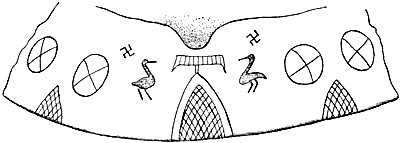
Fig. 151.
DETAIL OF GREEK VASE WITH SWASTIKAS AND FIGURES OF BIRDS.
Waring, “Ceramic Art In Remote Ages,” pl. 33, fig. 24, and
Goodyear, “Grammar of the Lotus,” pl. 46, fig. 5.
Fig. 152.
DETAIL OF CYPRIAN VASE.
Sunhawk, lotus, solar disk, and Swastikas.
Böhlau, Jahrbuch, 1886, pl. 8; Reinach, Revue Archæologique,
1885, II, p. 360; Perrot and Chipiez, “History of Art in
Phenicia
and Cyprus,” II; Goodyear, “Grammar of the Lotus,” pl. 45, fig. 3.
Fig. 153.
DETAIL OF GREEK GEOMETRIC VASE WITH SWASTIKAS AND FIGURES OF HORSES.
Thera. Leyden Museum. Goodyear, “Grammar of the Lotus,” pl. 61, fig. 4.
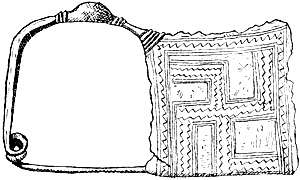 |
|
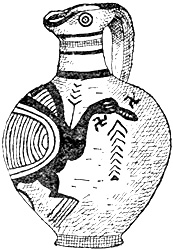 |
Fig. 154.
BRONZE FIBULA WITH LARGE SWASTIKA ON SHIELD.
Greece. Musée St. Germain. De Mortillet,
“Musée Préhistorique,” fig. 1264. ½ natural size. |
|
Fig. 155.
GREEK VASE, OINOCHOË, WITH
TWO PAINTED SWASTIKAS.
De Mortillet, “Musée Préhistorique,”
fig. 1244. ¼ natural size. |
| |
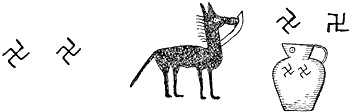 |
|
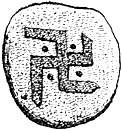 |
Fig. 156.
CYPRIAN VASE WITH SWASTIKAS AND FIGURE OF ANIMAL.[173]
Cesnola, “Cyprus, its Ancient Cities, Tombs,
and Temples,” pl. 45, fig. 36. |
|
Fig. 157.
ARCHAIC GREEK POTTERY FRAGMENT.
Santorin, Ancient Thera. Waring, “Ceramic
Art in Remote Ages,” pl. 42 fig. 2. |
Figs. 133 and 134, from Naukratis, afford palpable evidence of the
different origin of the Swastika and the Greek fret. Evidently Grecian
vases, though found in Egypt, these specimens bear side by side examples
of the fret and the Swastika, used contemporaneously, and both of them
complete and perfect. If one had been parent of the other, they would have
belonged to different generations and would not have appeared
simultaneously on the same specimen. Another illustration of simultaneous
use is in fig. 194, which represents an Etruscan vase[174] ornamented with
bronze nail heads in the form of Swastikas, but associated with it is the
design of the Greek fret, showing them to be of contemporaneous use, and
therefore not, as Professor Goodyear believes, an evolution of one from
the other. The specimen is in the Museum at Este, Italy.
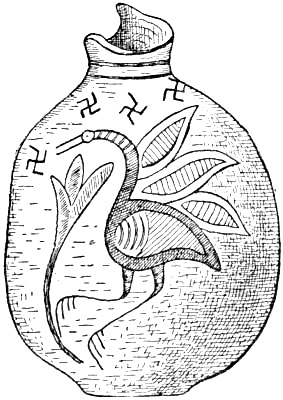
Fig. 158.
CYPRIAN VASE WITH LOTUS AND
SWASTIKAS AND FIGURE OF BIRD.
Metropolitan Museum of Art, New York City.
Goodyear, “Grammar of the Lotus,” pl. 60, fig. 15.
Fig. 159.
CYPRIAN VASE WITH TWO SWASTIKAS.
Cesnola Collection, Metropolitan Museum
of Art, New York City. Goodyear,
“Grammar of the Lotus,” fig. 151.
The Greek fret has been in common use in all ages and all countries
adopting the Grecian civilization. Equally in all ages and countries has
appeared the crossed lines which have been employed by every architect and
decorator, most or many of whom had no knowledge of the Swastika, either
as an ornament or as a symbol.[175]
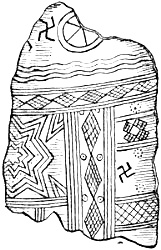
Fig. 160.
FRAGMENT OF TERRA
COTTA VASE WITH
SWASTIKAS, FROM
RUINS OF TEMPLE
AT PALEO-PAPHOS.Depth, 40 feet.
Cesnola, “Cyprus, its
Ancient Cities, Tombs,
and Temples,” p. 210.
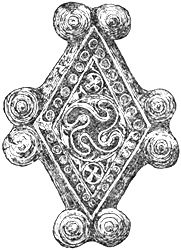
Fig. 161.
WOODEN BUTTON, CLASP,
OR FIBULA COVERED WITH
PLATES OF GOLD.
Ogee Swastika, tetraskelion
in center. Schliemann,
“Mycenæ,” fig. 385.
Swastika in panels.—Professor Goodyear, in another place,[176] argues
in a manner which tacitly admits the foregoing proposition, where, in his
endeavor to establish the true home of the Swastika to be in the Greek
geometric style, he says we should seek it where it appears in “the
largest dimension” and in “the most prominent way.” In verification of
this declaration, he says that in this style the Swastika systematically
appears in panels exclusively assigned to it. But he gives only two
illustrations of the Swastika in panels. These have been copied, and are
shown in figs. 140 and 142. The author has added other specimens, figs.
141 to 148, from Dennis’s “Etruria,” from Waring’s “Ceramic Art,” and from
Cesnola and Ohnefalsch-Richter. It might be too much to say that these are
the only Swastikas in Greece appearing in panels, but it is certain that
the great majority of them do not thus appear. Therefore, Professor
Goodyear’s theory is not sustained, for no one will pretend that four
specimens found in panels will form a rule for the great number which did
not thus appear. This argument of Professor Goodyear is destructive of his
other proposition that the Swastika sign originated by evolution from the
meander or Greek fret, for we have seen that the latter was always used in
a band and never in panels. Although the Swastika and the Greek fret have
a certain similarity of appearance in that they consist of straight lines
bent at right angles, and this continued many times, yet the similarity is
more apparent than real; for an analysis of the motifs of both show them
to have been essentially different in their use, and so in their
foundation and origin.
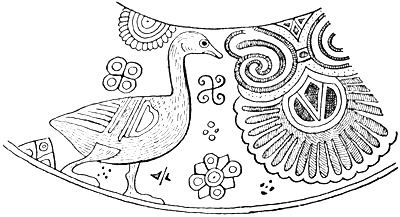
Fig. 162.
DETAIL OF GREEK VASE WITH FIGURE OF GOOSE,
HONEYSUCKLE (ANTHEMION), AND SPIRAL SWASTIKA.
Thera. “Monumenti Inedite,” LXV, p. 2, and
Goodyear, “Grammar of the Lotus,” pl. 46, fig. 7.
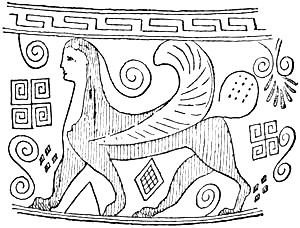 |
|
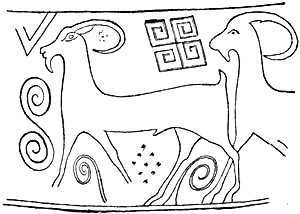 |
Fig. 163.
DETAIL OF GREEK VASE.
Sphinx with spiral scrolls, and two meander Swastikas (right).
Melos. Böhlau, Jahrbuch,
1887, XII, and Goodyear,
“Grammar of the Lotus,” pl. 34, fig. 8. |
|
Fig. 164.
DETAIL OF GREEK VASE.
Ibex, scroll, and meander
Swastika (right).
Melos. Böhlau, Jahrbuch, 1887, XII, p. 121, and
Goodyear, “Grammar of the Lotus,” pl. 39, fig. 2. |
Fig. 165.
DETAIL OF A GREEK VASE IN THE BRITISH MUSEUM.
Ram, meander Swastika (left), circles, dots, and crosses.
Salzmann, “Necropole de Camire,”
LI, and Goodyear,
“Grammar of the Lotus,” pl. 28, fig. 7.
Swastikas with four arms, crossing at right angles, with ends bent to the
right.—The author has called this the normal Swastika. He has been at
some trouble to gather such Swastikas from Greek vases as was possible,
and has divided them according to forms and peculiarities. The first group (figs. 140, 143,
146, 147, 148, and 150) shows the normal Swastika with
four arms, all bent at right angles and to the right. In the aforesaid
division no distinction has been made between specimens from different
parts of Greece and the islands of the Grecian Archipelago, and these,
with such specimens as have been found in Smyrna, have for this purpose
all been treated as Greek.
Fig. 166.
CYPRIAN VASE WITH SWASTIKAS AND FIGURES OF BIRDS.
Perrot and Chipiez, “History of Art in Phenicia and Cyprus,” II, p. 300,
fig. 237;
Goodyear, “Grammar of the Lotus,” pl. 48, figs. 6, 12; Cesnola,
“Cyprus, its
Ancient Cities, Tombs, and Temples,” Appendix by Murray, p. 412, pl. 44, fig. 34.
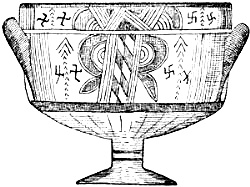
Fig. 167.
CYPRIAN VASE WITH LOTUS, BOSSES, BUDS,
SEPALS, AND DIFFERENT SWASTIKAS.
Cesnola Collection, Metropolitan Museum
of Art, New York City. Goodyear,
“Grammar of the Lotus,” pl. 48, fig. 3.
Swastikas with four arms crossing at right angles, ends bent to the
left.—Figs. 141, 142, 144, 149,
151, 152, 153, 154, 156, and 157
represent the normal Swastika with four arms, all bending at right angles,
but to the left. The vases on which they have been found are not described
as to color or form. It would be difficult to do so correctly; besides,
these descriptions are not important in our study of the Swastika. Fig.
155 represents a vase or pitcher (oinochoë, Greek—οῖνος, wine,
and χέω, to pour) with painted Swastika, ends turned to the
left. It is in the Museum of St. Germain, and is figured by M. De
Mortillet in “Musée Préhistorique.” Fig. 156 represents a Cyprian vase
from Ormidia, in the New York Museum. It is described by Cesnola[177] and
by Perrot and Chipiez.[178] Fig. 157 is taken from a fragment of archaic
Greek pottery found in Santorin (Ancient Thera), an island in the Greek
Archipelago. This island was first inhabited by the Phenicians, afterwards
by the Greeks, a colony of whom founded Cyrene in Africa. This specimen is
cited by Rochette and figured by Waring.[179]
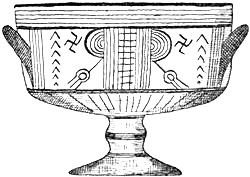
Fig. 168.
CYPRIAN VASE WITH LOTUS, BOSSES, LOTUS
BUDS, AND DIFFERENT SWASTIKAS.Cesnola Collection, Metropolitan Museum
of Art, New York City. Goodyear,
“Grammar of the Lotus,” pl. 48, fig. 15.
Swastikas with four arms crossing at other than right angles, the ends
ogee and to the left.—Figs. 158, 159, and 160 show Swastikas with four
arms crossing at other than right angles, many of them ogee, but turned to
the left. Fig. 161 is a representation of a wooden button or clasp, much
resembling the later gold brooch of Sweden, classified by Montelius (p.
867), covered with plates of gold, from Sepulcher IV, Mycenæ (Schliemann,
Mycenæ, fig. 385, p. 259). The ornament in its center is one of the ogee
Swastikas with four arms (tetraskelion) curved to the left. It shows a dot
in each of the four angles of the cross similar to the Suavastika of Max
Müller and the Croix swasticale of Zmigrodzki, which Burnouf attributed
to the four nails which fastened the cross Arani (the female principle),
while the Pramantha (the male), produced, by rotation, the holy fire
from the sacred cross. An almost exact reproduction of this Swastika will
be found on the shield of the Pima Indians of New Mexico (fig. 258).
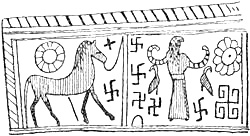
Fig. 169.
DETAIL OF EARLY BŒOTIAN VASE.
Figure of horse, solar diagram,
Artemis with geese, and Swastikas
(normal and meander,
right and left).
Goodyear, “Grammar of the
Lotus,” pl. 61, fig. 12.
Dr. Schliemann reports that the Swastika in its spiral form is represented
innumerable times in the sculptured ceiling of the Thalamos in the
treasury at Orchomenos. (See figs. 21 and 25.)
He also reports[180] that Swastikas (turned both ways) may be seen in the
Royal Museum at Berlin incised on a balustrade relief of the hall which
surrounded the temple of Athene at Pergamos. Fig. 162 represents a spiral
Swastika with four arms crossing at right angles, the ends all turned to
the left and each one forming a spiral.
Waring[181]
figures and describes a Grecian oinochoë from Camirus, Rhodes,
dating, as he says, from 700 to 500 B. C., on which is a band of
decoration similar to fig. 130. It is about 10 inches high, of cream
color, with ornamentation of dark brown. Two ibexes follow each other with
an ogee spiral Swastika between the forelegs of one.
Meander pattern, with ends bent to right and left.—Figs. 163, 164, and
165 show the Swastika in meander pattern. Fig. 163 shows two Swastikas,
the arms of both bent to the right, one six, the other nine times. The
Swastika shown in fig. 164 is bent to the right eight times. That shown in
fig. 165 bends to the left eight times.
Swastikas of different kinds on the same object.—The next group (figs.
167 to 176) is of importance in that it represents objects which, bearing
the normal Swastika, also show on the same object other styles of
Swastika, those turned to the left at right angles, those at other than
right angles, and those which are spiral or meander. The presence on a
single object of different forms of Swastika is considered as evidence of
their chronologic identity and their consequent relation to each other,
showing them to be all the same sign—that is, they were all Swastikas,
whether the arms were bent to the right or to the left, ogee or in curves,
at right angles or at other than right angles, in spirals or meanders.
Fig. 170.
DETAIL OF RHODIAN VASE.
Figures of geese, circles
and dots, and Swastikas (right and left).
British Museum. Waring, “Ceramic Art in Remote Ages,” pl. 27, fig. 9.
Fig. 171.
DETAIL OF RHODIAN VASE.
Geese, lotus circles, and
two Swastikas (right and left).
Goodyear, “Grammar of the Lotus,” p. 271, fig. 145.
Many examples of vases similar to fig. 172 are shown in the London, Paris,
and New York museums, and in other collections. (See figs. 149, 159.) Fig.
174 shows an Attic painted vase (Lebes) of the Archaic period, from
Athens. It is a pale yellowish ground, probably the natural color, with
figures in maroon. It belongs to the British Museum. It bears on the front
side five Swastikas, all of different styles; three turn to the right, two
to the left. The main arms cross at right angles, but the ends of four are
bent at right angles, while one is curved (ogee). Three have the ends bent
(at right angles) four times, making a meander form, while two make only
one bend. They seem not to be placed with any reference to each other, or
to any other object, and are scattered over the field as chance or luck
might determine. A specimen of Swastika interesting to prehistoric
archæologists is that on a vase from Cyprus (Musée St. Germain, No.
21537), on which is represented an arrowhead, stemmed, barbed, and
suspended by its points between the Swastika.[182]
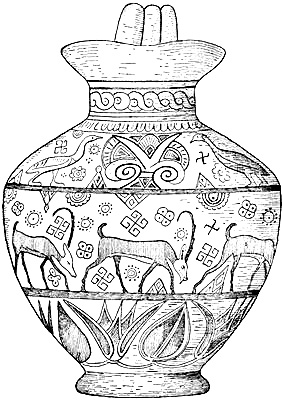
Fig. 172.
GREEK VASE OF TYPICAL RHODIAN STYLE.
Ibex, lotus, geese, and six Swastikas
(normal, meander, and ogee, all left).
Goodyear,
“Grammar of the Lotus,”
p. 251, pl. 39.[183]
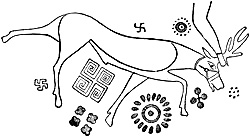
Fig. 173.
DETAIL OF GREEK VASE.Deer, solar diagrams, and
three Swastikas
(single, double, and meander, right).
Melos. Conze,
“Meliosche Thongefässe,”
and Goodyear, “Grammar of the Lotus,”
pl. 60, fig. 8.
Dr. Max Ohnefalsch-Richter presented a paper before the Société
d’Anthropologie in Paris, December 6, 1888, reported in the Bulletin of
that year (pp. 668-681). It was entitled “La Croix gammée et la Croix
cantonnée en Chypre.” (The Croix gammée is the Swastika, while the
Croix cantonnée is the cross with dots, the Croix swasticale of
Zmigrodzki.) In this paper the author describes his finding the Swastika
during his excavations into prehistoric Cyprus. On the first page of his
paper the following statement appears:
The Swastika comes from India as an ornament in form of a cone
(conique) of metal, gold, silver, or bronze gilt, worn on the ears
(see G. Perrot: “Histoire de l’Art,” III, p. 562 et fig. 384), and
nose-rings (see S. Reinach: “Chronique d’Orient,” 3e série, t. IV,
1886). I was the first to make known the nose-ring worn by the goddess
Aphrodite-Astarte, even at Cyprus. In the Indies the women still wear
these ornaments in their nostrils and ears. The fellahin of Egypt also
wear similar jewelry; but as Egyptian art gives us no example of the
usage of these ornaments in antiquity, it is only from the Indies that
the Phenicians could have borrowed them. The nose-ring is unknown in
the antiquity of all countries which surrounded the island of Cyprus.
Fig. 174.
ARCHAIC GREEK VASE WITH FIVE SWASTIKAS OF FOUR DIFFERENT FORMS.
Athens. Birch, “History of Ancient Pottery,” quoted by
Waring in
“Ceramic Art in Remote Ages,” pl. 41, fig. 15; Dennis, “The
Cities and Cemeteries of Etruria,” I, p. 91.
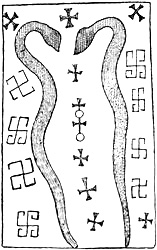
Fig. 175.
DETAIL OF ARCHAIC
BŒOTIAN VASE.Serpents,
crosses, and
Swastikas (normal, right,
left, and meander).
Goodyear,
“Grammar of
the Lotus,” pl. 60, fig. 9.
The first pages of his memoir are employed in demonstrating that the
specimens of the Swastika found in Cyprus, the most of which are set forth
in this paper (figs. 177-182), show a Phenician influence; and according
to his theory demonstrate their migration or importation. He does not
specify the evidence on which he bases his assertion of Phenician
influence in Cyprus, except in one or two particulars. Speaking of the
specimen shown in fig. 177 of the present paper, he says:
It represents the sacred palm under which Apollo, the god of light,
was born. * * * At Cyprus the palm did not appear only with the
Phenicians; it was not known prior to that time (p. 674).
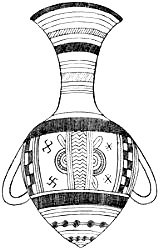
Fig. 176.
ATTIC VASE FOR PERFUME,
WITH CROIX SWASTICALE AND
TWO FORMS OF SWASTIKAS.
Ohnefalsch-Richter, Bull. Soc.
d’Anthrop., Paris, 1888,
p. 673, fig. 4.
The design shown in fig. 178 he describes as representing two birds in the
attitude of adoration before a Swastika, all being figured on a Greek cup
of the style Dipylon.[184]
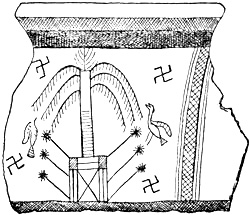
Fig. 177.
DETAIL OF CYPRIAN VASE.Swastikas with palm tree,
sacred to
Apollo. Citium, Cyprus.
Ohnefalsch-Richter, Bull. Soc.
d’Anthrop., Paris, 1888, p. 673, fig. 3.
Dr. Ohnefalsch-Richter adds:
On the vases of Dipylon the Swastikas are generally transformed into
other ornaments, mostly meanders. But this is not the rule in Cyprus.
The Swastika disappeared from there as it came, in its sacred form,
with the Phenician influence, with the Phenician inscriptions on the
vases, with the concentric circles without central points or tangents.
He says[185] that the Swastika as well as the “Croix cantonnée” (with
points or dots), while possibly not always the equivalent of the solar
disk, zigzag lightning, or the double hatchet, yet are employed together
and are given the same signification, and frequently replace each other.
It is his opinion[186] that the Swastika in Cyprus had nearly always a
signification more or less religious, although it may have been used as an
ornament to fill empty spaces. His interpretation of the Swastika in
Cyprus is that it will signify tour à tour the storm, the lightning, the
sun, the light, the seasons—sometimes one, sometimes another of these
significations—and that its form lends itself easily (facilement) to
the solar disk, to the fire wheel, and to the sun chariot. In support of
this, he cites a figure (fig. 179) taken from Cesnola,[187] in which the
wheels of the chariot are decorated with four Swastikas displayed in each
of the four quarters. The chief personage on the car he identifies as the
god of Apollo-Resef, and the decoration on his shield represents the solar
disk. He is at once the god of war and also the god of light, which
identifies him with Helios. The other personage is Herakles-Mecquars, the
right hand of Apollo, both of them heroes of the sun.
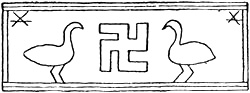
Fig. 178.
CYPRIAN VASE WITH FIGURES OF
BIRDS AND SWASTIKA IN PANEL.Musée St. Germain. Ohnefalsch-Richter, Bull.
Soc. d’Anthrop., Paris, 1888, p. 674, fig. 6.
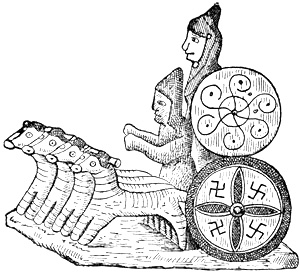
Fig. 179.
CHARIOT OF APOLLO-RESEF.
Sun symbol(?) on shield
and four Swastikas (two
right and two left) on quadrants of chariot
wheels.
Cesnola, “Salaminia,” p. 240, fig. 226, and
Ohnefalsch-Richter,
Bull. Soc. d’Anthrop., Paris,
1888, p. 675, fig. 7.
The supreme goddess of the Isle of Cyprus was Aphrodite-Astarte,[188]
whose presence with a preponderating Phenician influence can be traced
back to the period of the age of iron, her images bearing signs of the
Swastika, being, according to Dr. Ohnefalsch-Richter, found in Cyprus. In
fig. 180 the statue of this goddess is shown, which he says was found by
himself in 1884 at Curium. It bears four Swastikas, two on the shoulders
and two on the forearms. Fig. 181 represents a centaur found by him at the
same time, on the right arm of which is a Swastika painted in black, as in
the foregoing statue.
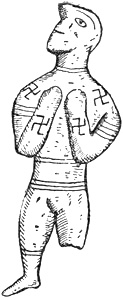
Fig. 180.
TERRA-COTTA STATUE
OF THE GODDESS
APHRODITE-ASTARTE
WITH FOUR
SWASTIKAS.[189]Curium, Cyprus.
Ohnefalsch-Richter,
Bull. Soc. d’Anthrop.,
Paris, 1888, p. 676,
fig. 8.
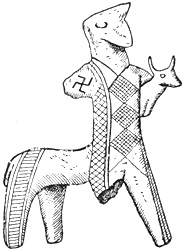
Fig. 181.
CYPRIAN CENTAUR WITH
ONE SWASTIKA.Cesnola,
“Salaminia,” p. 243,
fig. 230; Ohnefalsch-Richter,
Bull. Soc. d’Anthrop., Paris,
1888, p. 676, fig. 9.
We have found, in the course of this paper, many statues of human figures
bearing the mark of the Swastika on some portion of their garments. M.
Ohnefalsch-Richter, on page 677, gives the following explanation thereof:
It appears to me that the priests and priestesses, also the boys who
performed the services in the sacred places, were in the habit of
burning or tattooing Swastikas upon their arms. * * * In 1885, among
the votive offerings found in one of the sacred places dedicated to
Aphrodite-Astoret, near Idalium, was a stone statuette, representing
the young Adonis Kinyras in a squatting posture, with the Swastika
tattooed or painted in red color upon his naked arm.
And, says Richter, when, later on, the custom of tattooing had
disappeared, they placed the Swastika on the sacerdotal garments. He has
found in a Greek tomb in 1885, near Polistis Chrysokon, two statuettes
representing female dancers in the service of Aphrodite-Ariadne, one of
which (fig. 182) bore six or more Swastikas. In other cases, says he (p.
678), the Croix cantonnée (the Croix swasticale of Zmigrodzki)
replaced the Swastika on the garments, and he cites the statue of Hercules
strangling the lion in the presence of Athena, whose robe is ornamented
with the Croix cantonnée. He repeats that the two signs of the cross
represent the idea of light, sun, sacrifice, rain, storm, and the seasons.
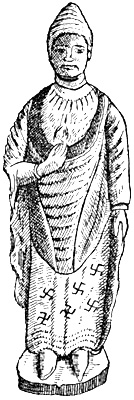
Fig. 182.
GREEK STATUE OF
APHRODITE-ARIADNE.Six Swastikas
(four right
and two left). Polistis
Chrysokon.
Ohnefalsch-Richter, Bull.
Soc. d’Anthrop., Paris,
1888, p. 677, fig. 10.
EUROPE.
BRONZE AGE.
Prehistoric archæologists claim that bronze was introduced into Europe in
prehistoric times from the extreme Orient. The tin mines of the peninsula
of Burma and Siam, with their extension into China on the north, Malacca
and the islands of the archipelago on the south, are known to have been
worked in extremely ancient times and are believed to have furnished the
tin for the first making of bronze. The latter may not be susceptible of
proof, but everything is consistent therewith. After it became known that
copper and tin would make bronze, the discovery of tin would be greatly
extended, and in the course of time the tin mines of Spain, Britain, and
Germany might be opened. A hundred and more prehistoric bronze foundries
have been discovered in western Europe and tens of thousands of
prehistoric bronze implements. If bronze came originally from the extreme
Orient, and the Swastika belonged there also, and as objects of bronze
belonging to prehistoric times and showing connection with the Orient,
like the tintinnabulum (fig. 29) have been found in the Swiss lake
dwellings of prehistoric times, it is a fair inference that the Swastika
mark found on the same objects came also from the Orient. This inference
is strengthened by the manufacture and continuous use of the Swastika on
both bronze and pottery, until it practically covered, and is to be found
over, all Europe wherever the culture of bronze prevailed. Nearly all
varieties of the Swastika came into use during the Bronze Age. The objects
on which it was placed may have been different in different localities,
and so also another variety of form may have prevailed in a given
locality; but, subject to these exceptions, the Swastika came into general
use throughout the countries wherein the Bronze Age prevailed. As we have
seen, on the hill of Hissarlik the Swastika is found principally on the
spindle-whorl; in Greece and Cyprus, on the pottery vases; in Germany, on
the ceintures of bronze; in Scandinavia, on weapons and on toilet and
dress ornaments. In Scotland and Ireland it was mostly on sculptured
stones, which are many times themselves ancient Celtic crosses. In
England, France, and Etruria, the Swastika appears on small bronze
ornaments, principally fibulæ. Different forms of the Swastika, i. e.,
those to the right, left, square, ogee, curved, spiral and meander,
triskelion and tetraskelion, have been found on the same object, thereby
showing their inter-relationship. No distinction is apparent between the
arms bent to the right or to the left. This difference, noted by Prof. Max
Müller, seems to fail altogether.
Greg says:[190]
About 500 to 600 B. C., the fylfot, (Swastika) curiously enough begins
to disappear as a favorite device of early Greek art, and is rarely,
if ever, seen on the regular Etruscan vase.
This indicates that the period of the use of the Swastika during the
Bronze Age in Europe lay back of the period of its disappearance in the
time of early Greek art, and that it was of higher antiquity than would
otherwise be suspected.
Dr. Max Ohnefalsch-Richter says:[191]
The Swastika makes absolute default in Cyprus during all the age of
bronze and in all its separate divisions according as the vases were
decorated with intaglio or relief, or were painted.
Etruria and Italy.—The Etruscans were a prehistoric people. The country
was occupied during the two ages of stone, Paleolithic and Neolithic, and
during the Bronze Age. The Etruscans were probably the descendants of the
Bronze Age people. The longest continued geographical discussion the world
has heard was as to who were the Etruscans, and whence or by what
route did they come to their country? It was opened by Herodotus and
Dionysius Halicarnassus in the fourth century B. C.; while Dr. Brinton and
the late President Welling have made the latest contributions thereto. The
culture of the Etruscans was somewhat similar to that of the Bronze Age
peoples, and many of the implements had great resemblance, but with
sufficient divergence to mark the difference between them. There were
different stages of culture among the Etruscans, as can be easily and
certainly determined from their tombs, modes of burial, pottery, etc.
The Swastika appears to have been employed in all these epochs or stages.
It was undoubtedly used during the Bronze Age, and in Italy it continued
throughout the Etruscan and into the Roman and Christian periods.
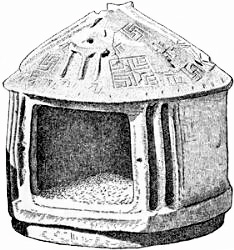
Fig. 183.
HUT URN IN THE VATICAN MUSEUM.“Burning altar” mark associated with
Swastikas. Etruria (Bronze Age).
While it may be doubtful if any specimen of Swastika can be identified as
having belonged to the Neolithic Age in Europe, there can be no doubt that
it was in common use during the Bronze Age. Professor Goodyear gives it as
his opinion, and in this he may be correct, that the earliest specimens of
Swastika of which identification can be made are on the hut urns of
central Italy. These have been considered as belonging definitely to the
Bronze Age in that country. Fig. 183 is a representation of one of these
hut urns. It shows upon its roof several specimens of Swastika, as will be
apparent from examination. There are other figures, incised and in relief.
One of them is the celebrated “burning altar” mark of Dr. Schliemann. This
specimen was found in the Via Appia near Rome, and is exhibited in the
Vatican Museum. Similar specimens have been found in other parts of
Etruria. The author saw in the Municipal Museum at Corneto many of them,
which had been excavated from the neighboring cemetery of the prehistoric
city of Corneto-Tarquinii. They were of pottery, but made as if to
represent rude huts of skin, stretched on cross poles, in general
appearance not unlike the cane and rush conical cabins used to this day by
the peasants around Rome. They belonged to the Bronze Age, and antedated
the Etruscan civilization. This was demonstrated by the finds at
Corneto-Tarquinii. Tombs to the number of about 300, containing them, were
found, mostly in 1880-81, at a lower level than, and were superseded by,
the Etruscan tombs. They contained the weapons, tools, and ornaments
peculiar to the Bronze Age—swords, hatchets, pins, fibulæ, bronze and
pottery vases, etc., the characteristics of which were different from
Etruscan objects of similar purpose, so they could be satisfactorily
identified and segregated. The hut urns were receptacles for the ashes of
the cremated dead, which, undisturbed, are to be seen in the museum. The
vases forming part of this grave furniture bore the Swastika mark; three
have two Swastikas, one three, one four, and another no less than eight.
Dennis figures a hut urn from Alba Longa,[192] and another from the Alban
Mount.[193] He says (note 1):
These remarkable urns were first found in 1817 at Montecucco, near
Marino, and at Monte Crescenzio, near the Lago de Castello, beneath a
stratum of peperino (tufa) 18 inches thick. They were embedded in a
yellowish volcanic ash and rested on a lower and earlier stratum of
peperino.[194]
Curiously enough, the three or four pronged mark, called “burning altar”
by Dr. Schliemann, is on both hut urns in Dennis’s “Cities and Cemeteries
of Etruria.” Dr. Schliemann argues strongly in favor of the relationship
between Swastika and the “burning altar” sign, but assigns no other reason
than the similarity of the marks on the two objects. He appears unable, in
“Ilios,” to cite any instance of the Swastika being found on the hut urns
in connection with the “burning altar” sign, but he mentions the Swastika
five times repeated on one of the hut urns in the Etruscan collection in
the museum of the Vatican at Rome.[195] The photograph of the hut urn from
the Vatican (fig. 183) supplies the missing link in Schliemann’s evidence.
The roof of the hut urn bears the “burning altar” mark (if it be a burning
altar, as claimed), which is in high relief (as it is in the Dennis
specimens), and was wrought in the clay by the molder when the hut was
made. Such of the other portions of the roof as are in sight show sundry
incised lines which, being deciphered, are found to be Swastikas or parts
of them. The parallelogram in the front contains a cross and has the
appearance of a labyrinth, but it is not. The other signs or marks,
however, represent Swastikas, either in whole or in part. This specimen
completes the proof cited by Schliemann, and associates the Swastika with
the “burning altar” sign in the Etruscan country, as well as on the hill
of Hissarlik and in other localities.
Dennis supposes the earliest Etruscan vases, called by many different
names, to date from the twelfth century B. C. to 540 B. C.,[196] the
latter being the epoch of Theodoros of Samos, whose improvements marked an
epoch in the culture of the country. He says:
These vases were adorned with annular bands, zigzag, waves, meanders,
concentric circles, hatched lines, Swastikas, and other geometric
patterns.
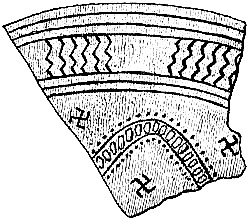
Fig. 184.
FRAGMENT OF ARCHAIC GREEK
POTTERY WITH THREE SWASTIKAS.
Cumæ, Italy. Waring, “Ceramic Art
in Remote Ages,” pl. 42, fig. 1.
A fragment of Archaic Greek pottery is reported by Rochette from the
necropolis of Cumæ, in the campagna of Italy, and is shown in fig. 184.
Rochette reports it as an example of a very early period, believed by him
to have been Phenician. When we consider the rarity of Phenician pottery
in Italy compared with the great amount of Greek pottery found there, and
that the Phenicians are not known to have employed the Swastika, this,
combined with the difficulty of determining the place of origin of such a
fragment, renders it more likely to have been Greek than Phenician. A
reason apparently moving Rochette to this decision was the zigzag
ornamentation, which he translated to be a Phenician sign for water; but
this pattern was used many times and in many places without having any
such meaning, and is no proof of his proposition.
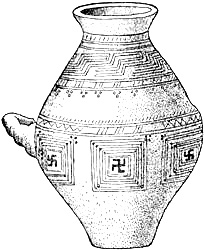
Fig. 185.
CINERARY URN WITH
SWASTIKAS IN PANELS.San Marino, near Albano,
Italy. Vatican Museum.
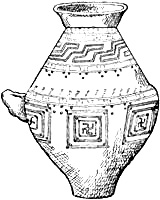
Fig. 186.
CINERARY URN WITH
SWASTIKAS INCLOSED BY
INCISED LINES IN INTAGLIO.
Cervetri, Italy. “Conestabile
due Dischi in Bronzo,” pl.
5, fig. 2. ⅙ natural size.
Figs. 185 and 186 represent the one-handled cinerary urns peculiar to the
Bronze Age in Italy. They are believed to have been contemporaneous with
or immediately succeeding the hut urns just shown. The cinerary urn shown
in fig. 185 was found at Marino, near Albano, in the same locality and
under the same condition as the hut urns. The original is in the Vatican
Museum and was figured by Pigorini in “Archæologia,” 1869. Fig. 186 shows
a one-handled urn of pottery with Swastika (left) in intaglio, placed in a
band of incised squares around the body of the vessel below the shoulder.
A small though good example of Etruscan work is shown in the gold fibula
(fig. 187). It is ornamented on the outside with the fine gold filigree
work peculiar to the best Etruscan art. On the inside are two Swastikas.
It is in the Vatican Museum of Etruscan antiquities. Fig. 188 represents
another specimen of Etruscan gold filigree work with a circle and
Swastika. It is a “bulla,” an ornament said to indicate the rank of the
wearer among the Etruscan people. It is decorated with a circle and
Swastika inside. The figure is taken from “L’Art pour Tous,” and is
reproduced by Waring.
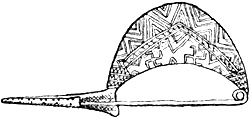
Fig. 187.
GOLD FIBULA WITH SWASTIKAS (LEFT).
Etruscan Museum, Vatican. Catalogue
of the Etruscan Museum, part 1,
pl. 26, fig. 6. ½ natural size.
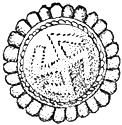
Fig. 188.
ETRUSCAN GOLD BULLA
WITH SWASTIKA
ON BOTTOM.
Waring, “Ceramic Art
in Remote Ages,”
pl. 42, fig. 4
a.
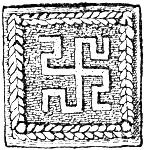
Fig. 189.
ORNAMENTAL SWASTIKA
ON ETRUSCAN SILVER BOWL.
Cervetri (Cære), Etruria.
Waring, “Ceramic Art in
Remote Ages,” pl. 41, fig. 13.
An ornamental Swastika (fig. 189) is found on a silver bowl from Cervetri
(Cære), Etruria. It is furnished by Grifi, and reproduced by Waring. This
specimen is to be remarked as having a small outward flourish from the
extreme end of each arm, somewhat similar to that made by the Jains (fig. 33),
or on the “Tablet of honor” of Chinese porcelain (fig. 31). Fig. 190
shows an Etruscan bronze fibula with two Swastikas and two Maltese crosses
in the pin shield. It is in the Museum of Copenhagen, and is taken from
the report of the Congrés Internationale d’Anthropologie et d’Archæologie
Préhistorique, Copenhagen, 1875, page 486. This specimen, by its rays or
crotchets around the junction of the pin with the shield, furnishes the
basis of the argument by Goblet d’Alviella[197] that the Swastika was
evolved from the circle and was a symbol of the sun or sun-god. (See p. 785.)
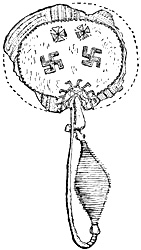
Fig. 190.
BRONZE FIBULA WITH
TWO SWASTIKAS AND
SUPPOSED RAYS Of SUN.[198]
Etruria. Copenhagen Museum.
Goblet d’Alviella, fig. 19
a,
De Mortillet, “Musée
Préhistorique,” fig. 1263.
¼ natural size.
Bologna was the site of the Roman city Bononia, and is supposed to have
been that of Etruscan Felsina. Its Etruscan cemetery is extensive.
Different names have been given to the excavations, sometimes from the
owner of the land and at other times from the names of excavators. The
first cemetery opened was called Villanova. The culture was different from
that of the other parts of Etruria. By some it is believed to be older, by
others younger, than the rest of Etruria. The Swastika is found throughout
the entire Villanova epoch. Fig. 191 shows a pottery vase from the
excavation Arnoaldi. It is peculiar in shape and decoration, but is
typical of that epoch. The decoration was by stamps in the clay (intaglio)
of a given subject repeated in the narrow bands around the body of the
vase. Two of these bands were of small Swastikas with the ends all turned
to the right. Fig. 192 shows a fragment of pottery from the Felsina
necropolis, Bologna, ornamented with a row of Swastikas stamped into the
clay in a manner peculiar to the locality.
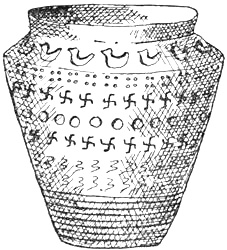
Fig. 191.
POTTERY URN ORNAMENTED WITH
SUCCESSIVE BANDS IN INTAGLIO, TWO OF
WHICH ARE COMPOSED OF SWASTIKAS.
Necropolis Arnoaldi, Bologna. Museum
of Bologna. Gozzadini, “Scavi
Archæologici,” etc., pl. 4, fig. 8.
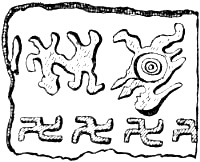
Fig. 192.
FRAGMENT OF POTTERY WITH
ROW OF SWASTIKAS IN INTAGLIO.
Necropole Felsinea, Italy. Museo
Bologna. Gozzadini, “Due Sepolcri,”
etc., p. 7. ½ natural size.
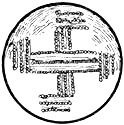
Fig. 193.
SWASTIKA SIGN ON
CLAY BOBBIN.
Type Villanova, Bologna.
De Mortillet, “Musée
Préhistorique,” fig. 1239.
Fig. 193 shows the end view of one of the bobbins from Bologna, Italy, in
the possession of Count Gozzadini by whom it was collected. The decoration
on the end, as shown by the figure, is the Swastika. The main arms are
made up of three parallel lines, which intersect each other at right
angles, and which all turn to the right at right angles. The lines are not
incised, as is usual, but, like much of the decoration belonging to this
culture, are made by little points consecutively placed, so as to give the
appearance of a continuous line.
Swastikas turning both ways are on one or both extremities of many
terra-cotta cylinders found in the terramare at Coazze, province of
Verona, deposited in the National (Kircheriano) Museum at Rome. (See figs.
380 and 381 for similar bobbins.)
The museum at Este, Italy, contains an elegant pottery vase of large
dimensions, represented in fig. 194, the decoration of which is the Greek
fret around the neck and the Swastika around the body, done with small
nail heads or similar disks inserted in the clay in the forms indicated.
This association of the Swastika and the Greek fret on the same object is
satisfactory evidence of their contemporaneous existence, and is thus far
evidence that the one was not derived from the other, especially as the
authorities who claim this derivation are at variance as to which was
parent and which, child. (See fig. 133.)
A Swastika of the curious half-spiral form turned to the left, such as
has been found in Scandinavia and also among the Pueblo Indians of the
United States, is in the museum at Este.
When in the early centuries of the Christian era the Huns made their
irruption into Europe, they apparently possessed a knowledge of the
Swastika. They settled in certain towns of northern Italy, drove off the
inhabitants, and occupied the territory for themselves. On the death of
Attila and the repulse of the Huns and their general return to their
native country, many small tribes remained and gradually became
assimilated with the population. They have remained in northern Italy
under the title of Longobards. In this Longobardian civilization or
barbarism, whichever we may call it, and in their style of architecture
and ornament, the Swastika found a prominent place, and is spoken of as
Longobardian.
It is needless to multiply citations of the Swastika in Roman and
Christian times. It would appear as though the sign had descended from the
Etruscans and Samnites along the coast and had continued in use during
Roman times. Schliemann says[199] that it is found frequently in the wall
paintings at Pompeii; even more than a hundred times in a house in the
recently excavated street of Vesuvius. It may have contested with the
Latin cross for the honor of being the Christian cross, for we know that
the St. Andrew’s cross in connection with the Greek letter P (fig. 6) did
so, and for a long time stood as the monogram of Christ and was the
Labarum of Constantine. All three of these are on the base of the
Archiepiscopal chair in the cathedral at Milan.[200]
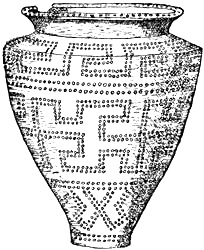 |
|
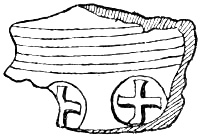 |
Fig. 194.
POTTERY VASE ORNAMENTED WITH
BRONZED NAIL HEADS IN FORM OF SWASTIKA.
Este, Italy. Matériaux pour l’Histoire Primitive
et Naturelle de l’Homme, 1884, p. 14. |
|
Fig. 195.
FRAGMENT OF POTTERY WITH
SWASTIKA STAMPED IN RELIEF. |
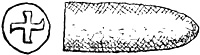
Fig. 196.
STAMP FOR MAKING SWASTIKA SIGN ON POTTERY.
Swiss lake dwelling of Bourget, Savoy.
Musée de Chambéry.
Chantre, “Age du
Bronze,” figs. 53, 55,
and Keller, “Lake Dwellings of Europe,” pl. 161, fig. 3.
Swiss lake dwellings.—Figs. 195 and 196 are interesting as giving an
insight into the method of making the sign of the Swastika. Fig. 195 shows
a fragment of pottery bearing a stamped intaglio Swastika (right), while
fig. 196 represents the stamp, also in pottery, with which the imprint was
made. They are figured by Keller,[201] and are described on page 339, and
by Chantre.[202] They were found in the Swiss lake dwelling of Bourget
(Savoy) by the Duc de Chaulnes, and are credited to his Museum of
Chambéry.
Fig. 197.
FRAGMENT OF CEINTURE FROM A TUMULUS IN ALSACE.
Thin bronze repoussé with Swastikas of various kinds. Bronze Age, Halstattien epoch.
De Mortillet, “Musée Préhistorique,” fig. 1255.
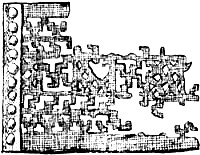
Fig. 198.
FRAGMENT OF A CEINTURE FROM THE
TUMULUS OF METZSTETTEN, WÜRTEMBERG.
Thin bronze open-work with intricate
Swastikas. Halstattien epoch. De Mortillet,
“Musée Préhistorique,” fig. 1257, and
Chantre, “Le Caucase,” II, p. 50, fig. 25.
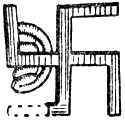
Fig. 199.
BRONZE FIBULA, THE
BODY OF WHICH
FORMS A SWASTIKA.
Museum of Mayence.
De Mortillet, “Musée
Préhistorique,” fig. 1266.
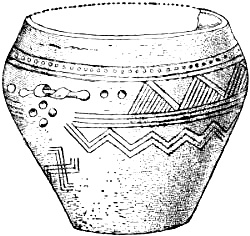
Fig. 200.
SEPULCHRAL URN WITH SWASTIKA.
North Germany. Waring, “Ceramic
Art in Remote Ages,” pl. 7, fig. 94.
Germany and Austria.—Fig. 197 represents a fragment of a ceinture of
thin bronze of the Halstattien epoch of the Bronze Age from a tumulus in
Alsace. It is made after the style common to that period; the work is
repoussé and the design is laid off by diagonal lines which divide the
field into lozenges, wherein the Swastika is represented in various forms,
some turned square to the right, others to the left, while one is in
spiral and is turned to the left. Other forms of the cross also appear
with dots in or about the corners, which Burnouf associates with the myth
of Agni and fire making, and which Zmigrodzki calls the Croix
swasticale. This specimen is in the collection Nessel at Haguenau.
Another ceinture was found at the same place and is displayed with it. It
bears representations of the cross of different forms, one of which might
be a Swastika with dotted cross lines, with the arms turned spirally to
the left. Fig. 198 represents another fragment of a bronze ceinture from
the same country and belonging to the same epoch. It is from the tumulus
of Metzstetten, Würtemberg, and is in the Museum of Stuttgart. It is not
repoussé, but is cut in openwork of intricate pattern in which the
Swastika is the principal motif. A bronze fibula (fig. 199) is in the
museum at Mayence, the body of which has the form of the normal Swastika.
The arms are turned to the right and the lower one is broken off. The
hinge for the pin was attached at one side or arm of the Swastika and the
retaining clasp for the point at the other. Fig. 200 represents a
prehistoric sepulchral urn with a large Swastika, the arms being indicated
by three parallel lines, after the same manner as the Swastika on the clay
bobbin from Bologna (fig. 193). It is reported by Lisch and Schröter,
though the locality is not given. It is figured by Waring. The form,
appearance, and decoration are of the type Villanova, thus identifying it
with northern Italy.
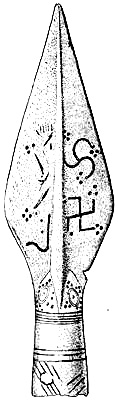
Fig. 201.
SPEARHEAD WITH
SWASTIKA (CROIX
SWASTICALE) AND
TRISKELION.
Brandenburg, Germany.
Waring, “Ceramic Art in
Remote Ages,” pl. 44,
fig. 21, and “Viking Age,”
I, fig. 336.
The Swastika sign is on one of the three pottery vases found on Bishops
Island, near Königswalde, on the right bank of the Oder, and on a vase
from Reichersdorf, near Guben;[203] on a vase in the county of Lipto,
Hungary,[204] and on pottery from the
Cavern of Barathegy, Hungary.[205]
Fig. 201 represents a spearhead of iron from Brandenburg, North Germany.
It bears the mark of the Swastika with the ends turned to the left, all
being at right angles, the ends ornamented with three dots recalling
Zmigrodzki’s Croix swasticale (figs. 12 and 13). By the side of this
Swastika is a triskelion, or three-armed ogee sign, with its ends also
decorated with the same three dots.
What relation there is between all these marks or signs and others similar
to them, but separated by great distances of both time and space, it would
be mere speculation to divine.
M. E. Chantre reports his investigations in certain Halstattien cemeteries
in Italy and Austria.[206] At San Margarethen, on the road between
Rudolfswerth and Kronau, Bavaria, he encountered a group of tumuli. Many
objects of the “bel age du bronze” were found; among others, a bronze pin
(fig. 202) with a short stem, but large, square, flat head, was found,
with a normal Swastika engraved with small dots, pointillé, such as has
been seen in Italy, Austria, and Armenia.
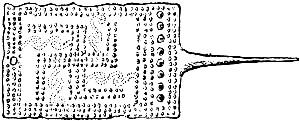
Fig. 202.
BRONZE PIN WITH SWASTIKA, POINTILLÉ,
FROM MOUND IN BAVARIA.
Chantre, Matériaux pour l’Histoire Primitive
et Naturelle de l’Homme, 1854, pp. 14, 120.
Belgium.—The Museum of Namur, Belgium, possesses a small object of
bone, both points of which have been broken; its use is somewhat
indeterminable, but it is believed by the curator of that museum and
others to have been an arrowhead or spearhead. In form it belongs to Class
A of stemmed implements, is lozenge-shaped, without shoulder or barb. It
is a little more than two inches long, five-eighths of an inch wide, is
flat and thin. On one side it bears two oblique or St. Andrew’s crosses
scratched in the bone; on the other, a figure resembling the Swastika. It
is not the normal Swastika, but a variation therefrom. It is a cross about
three-eighths of an inch square. The main stem lines cross each other at
right angles; the ends of each of these arms are joined by two incised
lines, which gives it the appearance of two turns to the right, but the
junction is not well made, for the lines of the cross extend in every case
slightly farther than the bent end. The variation from the normal Swastika
consists of the variation produced by this second line. This object was
lately found by M. Dupont, of Brussels, in the prehistoric cavern of
Sinsin, near Namur. Most, or many, of these caverns belong to Paleolithic
times, and one, the Grotte de Spy, has furnished the most celebrated
specimens of the skeletons of Paleolithic man. But the cavern of Sinsin
was determined, from the objects found therein, to belong to the Bronze
Age.
Scandinavia.—The evidences of prehistoric culture have great
resemblance throughout Denmark, Sweden, and Norway; so it is believed that
during the prehistoric ages their peoples had the same culture, and the
countries have been classed together as Scandinavia.
Fig. 203.
RUNIC INSCRIPTION CONTAINING A SWASTIKA.
Inlaid with silver on a bronze sword.
Saebo, Norway.
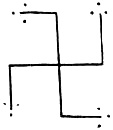 |
|
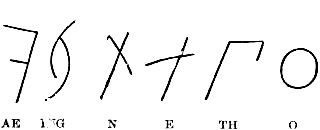 |
Fig. 204a.
SWASTIKA WITH DOTS.
Torcello, Italy. |
|
Fig. 204b.
RUNIC INSCRIPTION ON SPEARHEAD.
Torcello, Italy. |
| Du Chaillu, “Viking Age,” I, fig. 335. |
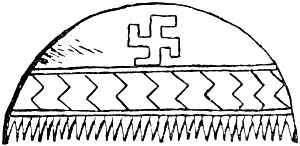
Fig. 205.
REDDING COMB WITH SWASTIKA.Scandinavia.
A bronze sword is reported by Mr. George Stephens[207] as having been
found at Sæbo, Norway, with runes and a Swastika inlaid with silver. This
specimen (fig. 203) was the subject of discussion before the International
Congress of Anthropology and Prehistoric Archæology,[208] at Budapest,
1876. Its runes were translated by Stephens, and being read from right to
left, “OH THURMUTH,” or “owns me Thurmuth.” But on the same page he gives
another sign for Thu and renders as Odin or (W)oden. In the discussion
before the congress it seems to have been agreed that the sign stood
for “blessing,” “good luck,” or some beneficent charm or benediction. A
spearhead has been for years displayed in the museum at Torcello, near
Venice, Italy, with a Swastika sign (fig. 204a) prominent as an engraved
sign.[209] Associated with it, but not a part of it, was an inscription
(fig. 204b), which has always been attributed to the Etruscans. Mr. I.
Undset, an archæologist in the museum of Christiania, made an extended
visit through Italy in 1883, and on seeing this spearhead recognized the
inscription as runic and belonging to Scandinavia. The arms of the
Swastika turned to the left, and the ends were finished with three dots of
the same style as those described employed in the Croix swasticale (fig.
12). Figs. 205 and 206 represent articles of dress or toilet, and bear the
Swastika. The first shows a redding comb, the Swastika on which turns to
the right. It was probably of bone or horn, as are those of modern times.
Fig. 206 shows a brooch, the interior decoration of which is a combination
of Swastikas more or less interlaced. It is of bronze and was used as a
dress ornament. Fig. 207 shows a large brooch, the bodies and bar of which
are almost covered with the tetraskelion style of Swastika. There are six
of the four-armed Swastikas, four of which turn to the left and two to the
right. Another is a triskelion, the arms of which turn to the right.
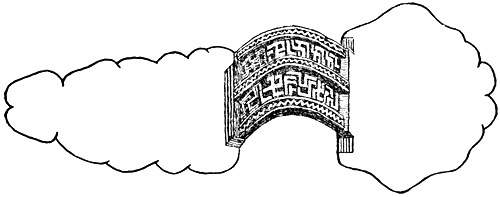
Fig. 206.
BRONZE BROOCH OR FIBULA WITH COMBINATION OF SWASTIKAS.
Scandinavia.
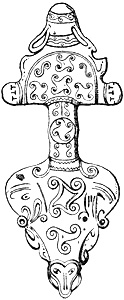
Fig. 207.
BRONZE BROOCH
WITH SWASTIKAS.Tetraskelions (right and left),
triskelion (left). Scandinavia.
Fig. 208.
PLACQUE FOR CEINTURE, WITH BUCKLE.Two ogee Swastikas (tetraskelions).
In Scandinavia more than in other countries the Swastika took the form of
a rectangular body with arms projecting from each corner and bending in a
spiral form, sometimes to the right, sometimes to the left. These are
found more frequently on fibulæ or brooches and on swords and scabbards.
In fig. 208 is shown a placque for a ceinture or belt, with a buckle to
receive the thong. It contains two ogee Swastikas (tetraskelions). In this
and fig. 207 the border and accessory decoration consist largely of ogee
curves, which, here represented separate, would, if placed together as a
cross, form the same style of Swastika as those mentioned. Figs. 209 and
210 show sword scabbards, with Swastikas turned both ways. Fig. 211 shows
two triskelions. Fig. 212 represents a gold brooch from a grave at Fyen,
reported by Worsaae and figured by Waring.[210] The brooch with ogee
Swastika bears internal evidence of Scandinavian workmanship. There are
other Swastikas of the same general form and style in distant localities,
and this specimen serves to emphasize the extent of possible communication
between distant peoples in prehistoric times. Fig. 213 represents a piece
of horse-gear of bronze, silver plated and ornamented with Swastikas. Two
of these are normal, the ends bent at right angles to the left, while the
other is fancifully made, the only specimen yet found of that
pattern.[211] It is not seen that these fanciful additions serve any
purpose other than decoration. They do not appear to have changed the
symbolic meaning of the Swastika. Fig. 214 represents a sword scabbard
belonging to the Vimose find, with a normal Swastika. Ludwig Müller
reproduces a Swastika cross from a runic stone in Sweden. In an ancient
church in Denmark, the baptismal font is decorated with Swastikas, showing
its use in early Christian times. (See p. 878 for continuation of Swastika
on Scandinavian or Danish gold bracteates.)
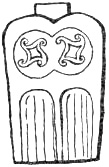 |
|
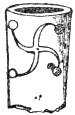 |
|
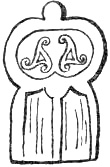 |
Fig. 209.
SCANDINAVIAN
SWORD SCABBARD.
Two ogee Swastikas
(tetraskelions),
right and left. |
|
Fig. 210.
SCANDINAVIAN
SWORD SCABBARD.
Ogee Swastika. |
|
Fig. 211.
SCANDINAVIAN
SWORD SCABBARD.
Two triskelions,
right and left. |
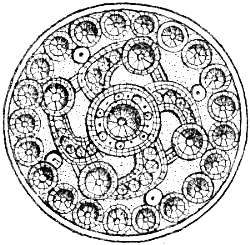
Fig. 212.
GOLD BROOCH WITH OGEE SWASTIKA.Island of Fyen. Waring, “Ceramic
Art in Remote Ages,” pl. 43, fig. 11.
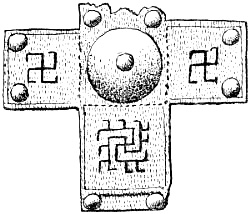
Fig. 213.
SCANDINAVIAN HORSE-GEAR.
Silver plated on bronze. Waring,
“Ceramic Art in Remote Ages,”
pl. 44, fig. 16; Du Chaillu,
“Viking Age,”
I, fig. 379.
Mr. Paul du Chaillu, in his “Viking Age,” mentions many specimens of
Scandinavian and Norse antiquities bearing Swastika marks of divers
styles: Bronze vessels (vol. 1, p. 100, note 1); iron spear point with
runes and Swastika inlaid with silver, discovered in a tumulus with burnt
bones, Muncheburg, fig. 336; another of the same, Volhynia, Russia, fig.
337; pottery vessel containing burnt bones, pointed iron knife, bronze
needle, and melted glass beads, Bornholm, fig. 210; iron spearhead, Vimose
bog find, (p. 207); border of finely woven silk cloth with gold and silver
threads, from a mound (vol. 2, p. 289, fig. 1150).
Scotland and Ireland.—Specimens of the Swastika have been found on the
Ogam stones in Scotland and Ireland (p. 797). In the churchyard of Aglish,
county Kerry, Ireland, stand two stones bearing Ogam inscriptions. At the
top of one is an ancient Celtic cross inclosed in a circle similar to fig. 7;
immediately under it are two Swastika marks of four arms crossing at
right angles, each arm bent to the right also at right angles. On two
corners of the stone are inscriptions of the usual Ogam characters. The
translation may be given, but seems to be unimportant and without apparent
bearing upon this question. They are somewhat obliterated and their
reading difficult. So far as made out, they are as follows: Maqimaqa and
Apiloggo.
Fig. 214.
SCANDINAVIAN SWORD SCABBARD WITH NORMAL SWASTIKA.
Vimose bog find.
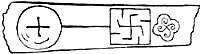
Fig. 215.
SCULPTURED STONE.
Greek cross in circle, normal Swastika in
square, and ogee Swastika in quatrefoil.
Ireland.
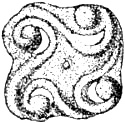
Fig. 216.
FRAGMENT OF THIN
BRONZE REPOUSSÉ.
Ogee Swastika. Ireland.
Munro, “Lake Dwellings
of Europe,” pl. 124,
figs. 20-22.
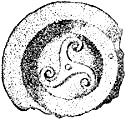
Fig. 217.
FRAGMENT OF THIN BRONZE.
Triskelion. Ireland. Munro,
“Lake Dwellings of Europe,”
p. 384, pl. 124, figs. 20-22.
In Scotland, the Newton stone, in the grounds of the Newton House, bears
an Ogam inscription, the meaning of which has no bearing upon the
subject. But on the upper part of one of its faces appears an inscription,
boldly and deeply incised, of forty-four characters arranged horizontally
in six lines. These are of so remarkable a type as to have puzzled every
philologist and paleographer who has attempted their decipherment. The
late Alexander Thomson, esq., of Banchory, Scotland, circulated a
photograph and description of this monument among antiquarians with a
request for their decipherment of it. Various readings have been given by
the learned gentlemen, who have reported it to be Hebrew, Phenician,
Greek, Latin, Aryan, Irish, and Anglo-Saxon respectively. Brash[212] gives
his opinion that the inscription is in debased Roman letters of a type
frequently found in ancient inscriptions, its peculiarities being much
influenced by the hardness of the stone at the time of cutting and of the
subsequent weather wear of ages. The interest of this monument to us is
that the third character in the fourth line is a Swastika. It is
indifferently made, the lines do not cross at right angles, two of the
ends are curved, and the two others bent at a wider than right angle.
There are four characters in the line closely following each other, (see
p. 797.)
The Logie stone, in Aberdeenshire, Scotland, bearing Ogam characters,
contains a figure or mark reported by George M. Atkinson as a
Swastika.[213]
On the Celtic crosses of Scotland certain marks appear which are elsewhere
found associated with Swastika, and consequently have some relation
therewith. The “Annam Stone” bears the mark of a Swastika (left) within
three concentric circles, around the outside of which is a circle of
dots.[214]
Fig. 218.
BRONZE PIN WITH SMALL NORMAL SWASTIKA ON HEAD.
Crannog of Lochlee, Tarbolton, Scotland.
Munro, “Lake Dwellings of Europe,” p. 417.
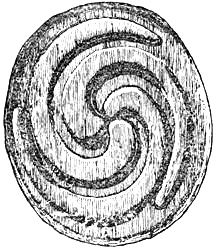
Fig. 219.
CARVED TRISKELION FOUND ON
FRAGMENT OF ASH WOOD.
Crannog of Lochlee, Tarbolton,
Scotland. Munro, “Lake
Dwellings of Europe,” p. 415.
Ludwig Müller reports the Swastika in Scotland and Ireland on Christian
tombs, associated with Latin crosses.[215]
A sculptured stone in Ireland (fig. 215) shows on the face three varieties
of the cross, a Greek cross in a circle, a Swastika with square ends
turned to the right, within a rectangle, and an ogee (tetraskelion) turned
to the right, inclosed in a quatrefoil.[216]
An Irish bowl showed a Swastika thus ![[symbol]](https://openoldbooks.sgp1.digitaloceanspaces.com/books/the-swastika/images/img_irish.jpg) .
Dr. R. Munro[217] reports
from the Crannog of Lesnacroghera country, Antrim, Ireland, two pieces or
disks of thin bronze, repoussés (fig. 216), bearing the sign of the
Swastika and having the four arms of the spirals turned to the left. The
similarity of this figure with those shown on the shields of the Pima
Indians of New Mexico and Arizona (figs. 257 and 258) is to be remarked.
Fig. 217 shows a triskelion of symmetric spirals turned to the right. In
the Crannog of Lochlee, near Tarbolton, a bronze pin was found (fig. 218),
the head of which was inclosed in a ring. On one side of the head was
engraved a Greek cross, on the other was a normal Swastika turned to the
right. The same crannog furnished a piece of ash wood five inches square,
which had been preserved, as were all the other objects, by the peat, on
which was carved a triskelion (fig. 219) after the form and style of those
on the Missouri mound pottery.
.
Dr. R. Munro[217] reports
from the Crannog of Lesnacroghera country, Antrim, Ireland, two pieces or
disks of thin bronze, repoussés (fig. 216), bearing the sign of the
Swastika and having the four arms of the spirals turned to the left. The
similarity of this figure with those shown on the shields of the Pima
Indians of New Mexico and Arizona (figs. 257 and 258) is to be remarked.
Fig. 217 shows a triskelion of symmetric spirals turned to the right. In
the Crannog of Lochlee, near Tarbolton, a bronze pin was found (fig. 218),
the head of which was inclosed in a ring. On one side of the head was
engraved a Greek cross, on the other was a normal Swastika turned to the
right. The same crannog furnished a piece of ash wood five inches square,
which had been preserved, as were all the other objects, by the peat, on
which was carved a triskelion (fig. 219) after the form and style of those
on the Missouri mound pottery.
GALLO ROMAN PERIOD.
France.—The employment of the Swastika in France did not cease with the
Bronze or Iron ages, but continued into the occupation of Gaul by the
Romans.
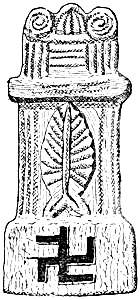
Fig. 220.
STONE ALTAR WITH
SWASTIKA ON PEDESTAL.
France. Museum of Toulouse.
De Mortillet, “Musée
Préhistorique,” fig. 1267.
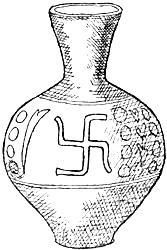
Fig. 221.
POTTERY BOTTLE OF DARK GRAY
WITH SWASTIKA AND
DECORATION IN WHITE BARBOTINE.
Gallo-Roman Epoch. Museum of
Rouen. De Mortillet, “Musée
Préhistorique,” fig. 1246.
Fig. 220 represents a stone altar erected in the south of France among the
Pyrenees about the time of the advent of the Romans. It has a Swastika
engraved on its pedestal. The upper arm has been carried beyond the body
of the sign, whether by intention is not apparent. Fig. 221 represents a
pottery bottle with another specimen of Swastika belonging to the same
(Gallo-Roman) epoch, but coming from the extreme north of Gaul, the
neighborhood of Rouen. It is to be remarked that the ends of this Swastika
give the outward curve or flourish similar to that noticed by Dr.
Schliemann on the spindle-whorl of Troy, and is yet employed in making the
Jain Swastika (fig. 33).
M. Alexander Bertrand[218] speaks of the discovery at Velaux, in the
department of Bouches-du-Rhône, of the headless statue of a crouching or
squatting guard which has a row of Swastikas across his breast, while
beneath is a range of crosses, Greek or Latin. The newest examples of the
Swastika, belonging to this epoch have been found at Estinnes, Hainaut,
and at Anthée, Namur, Belgium, on pieces of Roman tile; also on a
tombstone in the Roman or Belgo-Roman cemetery of Juslenville near
Pepinster.[219] This is a Pagan tomb, as evidenced by the inscriptions
commenced “D. M.” (Diis Manibus).[220]
ANGLO-SAXON PERIOD.
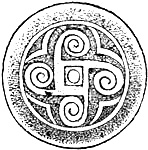
Fig. 222.
ANGLO-SAXON BRONZE
GILT FIBULA.[221]
Simulation of Swastika.
Long Wittenham,
Berkshire, England.
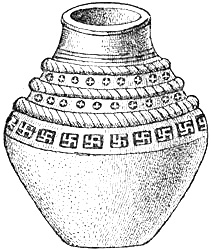
Fig. 223.
POTTERY URN.
Band of twenty hand-made Swastikas,
white, on blackish ground. Shropham,
Norfolk, England. British Museum.
Waring, “Ceramic Art in Remote
Ages,” pl. 3, fig. 50.
Britain.—Greg reports[222] a silver disk 1½ inches in diameter, with
a triskelion made by punched dots, in the same style as the pin heads from
Armenia (figs. 35 and 36). This was from grave 95 in an Anglo-Saxon
cemetery at Sleafors, England, excavated by George W. Thomas and sold at
Boston; bought by A. W. Franks and given to the British Museum. Grave 143
had a large cruciform fibula of bronze, partly gilt, similar to those from
Scandinavia, with a Swastika on the central ornament thus ![[symbol]](https://openoldbooks.sgp1.digitaloceanspaces.com/books/the-swastika/images/img_scand.jpg) . The
slight curve or flourish on the outer end of the bent arm of this specimen
resembles the Jain Swastika (fig. 33), though this bends to the left,
while the Jain Swastikas bend to the right. Fig. 222 shows an Anglo-Saxon
bronze gilt fibula with a peculiar form of Swastika leaving a square with
dot and circle in its center. It was found in Long Wittenham, Berkshire,
was reported in Archæologia,[223]
and is figured by
Waring.[224] A figure
having great similarity to this, even in its peculiarities and called a
Swastika, was found on a shell in Toco Mound, Tennessee (fig. 238). Fig.
223 represents an Anglo-Saxon urn from Shropham, Norfolk. Its decorations
consist of isolated figures like crosses, etc., arranged in horizontal
bands around the vessel, and separated by moldings. The lower row consists
of Swastikas of small size stamped into the clay and arranged in isolated
squares. There are twenty Swastikas in the band; though they all turn to
the right, they are not repetitions. They were made by hand and not with
the stamp. They are white on a blackish ground. The original, which is in
the British Museum, is cited by Kemble and figured by Waring.[225]
. The
slight curve or flourish on the outer end of the bent arm of this specimen
resembles the Jain Swastika (fig. 33), though this bends to the left,
while the Jain Swastikas bend to the right. Fig. 222 shows an Anglo-Saxon
bronze gilt fibula with a peculiar form of Swastika leaving a square with
dot and circle in its center. It was found in Long Wittenham, Berkshire,
was reported in Archæologia,[223]
and is figured by
Waring.[224] A figure
having great similarity to this, even in its peculiarities and called a
Swastika, was found on a shell in Toco Mound, Tennessee (fig. 238). Fig.
223 represents an Anglo-Saxon urn from Shropham, Norfolk. Its decorations
consist of isolated figures like crosses, etc., arranged in horizontal
bands around the vessel, and separated by moldings. The lower row consists
of Swastikas of small size stamped into the clay and arranged in isolated
squares. There are twenty Swastikas in the band; though they all turn to
the right, they are not repetitions. They were made by hand and not with
the stamp. They are white on a blackish ground. The original, which is in
the British Museum, is cited by Kemble and figured by Waring.[225]
THE SWASTIKA ON ANCIENT COINS.
There has been much ink and imagination used, most of which has been
wasted, in the discussion of this branch of this subject. The opinion has
been expressed by many persons that the triskelion which formed the
armorial emblem of the island of Sicily, and also of the Isle of Man, is
but an evolution from or modification of the Swastika. In the judgment of
the author this is based rather upon the similarity of the designs than
upon any likeness in their origin and history. The acceptance by modern
writers of this theory as a fact is only justified from its long-continued
repetition.
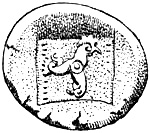
Fig. 224.
[226]LYCIAN COIN.
Triskelion with three
arms representing
cocks’ heads and necks.
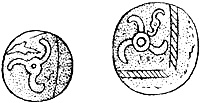
Figs. 225 and 226.
[226]LYCIAN COINS.
Triskelions with central dots and
circles. Waring, “Ceramic Art in
Remote Ages,” pl. 42, figs. 12, 13.
Triskelion, Lycia.—The triskelion on ancient coins first appears on the
coins of Lycia, in Asia Minor, about B. C. 480. It was adopted for Sicily
by Agathocles, B. C. 317 to 307. The coins of Lycia were first three
cocks’ heads and necks joined together equidistant in the center of the
field, as shown in fig. 224, while figs. 225 and 226 bear a center dot and
circle. This forms a hub and axle. Out of this hub spring three arms or
rays, practically equidistant, the outer ends being bent to the left. They
increase in size as they progress outward and are largest at the outer
ends. In fig. 226 there is a mint mark or counter mark of the same design
as the triskelion, except that it has but two arms or rays (diskelion).
Perrot and Chipiez,[227] speaking of Lycia, say:
The device of many of her coins is the “triskelis” or so-called
“triquetra” (literally, three-cornered, triangular), a name derived
from three serpents’ heads, which usually figure in the field, much
after the fashion of those supporting the famous tripod at
Delphi,[228] consecrated by the Greeks to Apollo after the battle of
Platæa. The number of heads is not constant, some coins having as many
as four, “tetraskelis,” while others have but two, “diskelis.”[229]
The Greeks connected the symbol with the cult of Apollo, which they
represented as very popular and of hoary antiquity in Lycia. The
three-rayed design appears to have gained the victory over the others, and
came into commoner use. It is found on Assyrian coins, and also as a
countermark on coins of Alexander, B. C. 333 to 323. A comparison of these
designs with the Swastika will, it is believed, show their dissimilarity,
and the non-existence of relationship. In the Lycian designs, whether with
two, three, or four rays, there is a central hub out of which the spokes
spring. In the center of the hub is the small circle and dot which might
represent the axle on which the machine revolved. In fact, the Lycian
design is a fair representation of the modern screw propeller, and gives
the idea of a whirling motion.
Compare these peculiarities with the Swastika. The Swastika is almost
always square, is always a cross at right angles or near it, and whatever
may become of the ends or arms of the cross, whether they be left
straight, bent at right angles, or in a curve, it still gives the idea of
a cross. There is no center except such as is made by the crossing of the
two arms. There is not, as in these triskelions, a central hub. There is
no dot or point around which the design or machine could be made to
revolve, as in these Lycian triskelions; nothing of the central boss, cup,
or nave, which forms what the Germans call the “Rad-Kreuz,” wheel cross,
as distinguished from the square cross.
In this regard Greg says:
If R. Brown’s lunar and Semitic or Asiatic origin of the triquetra,
however, should be established, then the entire argument of the
triquetra being derived from the fylfot, or vice versa, falls to the
ground. * * * That the device arose out of the triskele and triquetra
I do not think can be proved. It is clear the was a far older and
more widely spread symbol than the triskele, as well as a more purely
Aryan one.
Waring, explaining the tetraskelion (four-armed), declares it to have
preceded the triskelion (three-armed), and he explains its meaning,[230]
citing Sir Charles Fellows, as being a harpago, a grappling iron, a
canting sign for Harpagus, who conquered Lycia for Cyrus, circa, 564 B. C.
This, with the statement of Perrot and Chipiez
(p. 872 of this paper), is
a step in explanation of the adoption of the triskelion, and together they
suggest strongly that it had no relation to the Swastika. At the date of
the appearance of the triskelion on the Lycian coins the Swastika was well
known throughout the Trojan peninsula and the Ægean Sea, and the
difference between them was so well recognized that one could not possibly
have been mistaken for the other.
Fig. 227.
SICILIAN COIN WITH QUADRIGA AND TRISKELION.
British Museum. Barclay Head, “Coins of the Ancients,” etc., pl. 35, fig. 28.
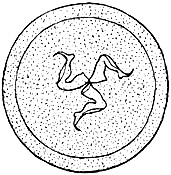
Fig. 228.
WARRIOR’S SHIELD.
From a Greek vase, representing
Achilles and Hector. Agrigentum,
Sicily. Waring, “Ceramic Art in
Remote Ages,” pl. 42, fig. 24.
Triskelion, Sicily.—Now we pass to the consideration of the triskelion
of Sicily. Fig. 227 represents a coin of Sicily. On the obverse the head
of Persephone, on the reverse the quadriga, and above, the triskelion.
Other specimens of the same kind, bearing the same triskelion, are seen in
Barclay Head’s work on the “Coinage of Syracuse” and his “Guide to the
Ancient Coins in the British Museum.” They belong to the early part of the
reign of Agathocles, B. C. 317 to 310. In these specimens the triskelion
is quite small; but as the coins belong to the period of the finest
engraving and die-sinking of Greece, the representation, however minute,
is capable of decipherment. Fig. 228 is taken from the shield of a warrior
on a Greek vase representing Achilles and Hector, in which the armorial
emblem of Sicily, the triskelion, occupies the entire field,[231] and
represents plainly that it is three human legs, conjoined at the thigh,
bent sharply at the knee, with the foot and toes turned out. Some of these
have been represented covered with mail armor and the foot and leg booted
and spurred. It is evident that these are human legs, and so were not
taken from the screw propeller of Lycia, while they have no possible
relation to the crossed arms of the Swastika, and all this despite their
similarity of appearance. This is rendered clearer by Waring,[232] where
the armorial emblem on a warrior’s shield is a single human leg, bent in
the same manner, instead of three. Apropos of Swastikas on warriors’
shields, reference is made to figs. 257 and 258, which represent two
shields of Pima Indians, New Mexico, both of which have been in battle and
both have the four-armed Swastika or tetraskelion. There is not in the
Swastika, nor was there ever, any central part, any hub, any axis, any
revolution. It is asserted that originally the triskelion of Sicily,
possibly of Lycia, was a symbol of the sun, morning, midday, and
afternoon, respectively. But this was purely theoretical and without other
foundation than the imagination of man, and it accordingly gave way in due
course. Pliny denies this theory and attributes the origin of the
triskelion of Sicily to the triangular form of the island, ancient
Trinacria, which consisted of three large capes equidistant from each
other, pointing in their respective directions, the names of which were
Pelorus, Pachynus, and Lilybæum. This statement, dating to so early a
period, accounting for the triskelion emblem of Sicily, is much more
reasonable and ought to receive greater credit than that of its devolution
from the Swastika, which theory is of later date and has none of these
corroborations in its favor. We should not forget in this argument that
the Swastika in its normal form had been for a long time known in Greece
and in the islands and countries about Sicily.
Among hundreds of patterns of the Swastika belonging to both hemispheres
and to all ages, none of them have sought to represent anything else than
just what they appear to be, plain marks or lines. There is no likeness
between the plain lines of the Swastika and the bent form of the human
leg, with the foot turned outward, incased in chain armor and armed with
spurs.
Whenever or however the triskelion occurred, by whom it was invented, what
it represented, how it comes to have been perpetuated, is all lost in
antiquity and may never be known; but there does not seem to be any reason
for believing it to have been an evolution from the Swastika.
Triskelion, Isle of Man.—The triskelion of Sicily is also the armorial
emblem of the Isle of Man, and the same contention has been made for it,
i. e., that it was a modification of the Swastika. But its migration
direct from Sicily to the Isle of Man can be traced through the pages of
history, and Mr. John Newton,[233] citing the Manx Note Book for January,
1886, has given this history at length, of which the following is a
résumé:
Prior to the thirteenth century the Isle of Man was under dominion of the
Norse Vikings, and its armorial emblems were theirs; usually a ship under
full sail. Two charters of Harold, King of Man (1245, 1246 in the Cotton
MSS.), bear seals with this device. Twenty years later, after the conquest
of the island by, and its cession to, Alexander III of Scotland, A. D.
1266, the Norse emblems disappeared entirely, and are replaced by the
symbol of the three legs covered with chain armor and without spurs. “It
appears then,” says Newton, “almost certain, though we possess no literary
document recording the fact, that to Alexander III of Scotland is due the
introduction of the ‘Tre Cassyn’ as the distinguishing arms of the Isle of
Man.” He then explains how this probably came about: Frederick II (A. D.
1197-1250), the Norman King of Sicily, married Isabella, the daughter of
Henry III of England. A quarrel between the King of Sicily and the Pope
led the latter to offer the crown to Henry III of England, who accepted it
for his son Edmund (the Hunchback), who thereupon took the title of King
of Sicily and quartered the Sicilian arms with the Royal arms of England.
The negotiations between Henry and the Pope progressed for several years
(1255 to 1259), when Henry, finding that he could no longer make it an
excuse for raising money, allowed it to pass into the limbo of forgotten
objects.
Alexander III of Scotland had married Margaret, the youngest daughter of
Henry III, and thus was brother-in-law to Edmund as well as to Frederick.
In 1256, and while these negotiations between Henry and the Pope
concerning Sicily were in progress, Alexander visited, at London, his
royal father-in-law, the King of England, and his royal brother-in-law,
the King of Sicily, and was received with great honors. About that time
Haco, the Norse king of the Isle of Man, was defeated by Alexander III of
Scotland, and killed, soon after which event (1266) the Isle of Man was
ceded to the latter. The Norse coat of arms disappeared from the
escutcheon of the Isle of Man, and, being replaced by the three legs of
Sicily, Mr. Newton inquires:
What more likely than that the King (Alexander III), when he struck
the Norwegian flag, should replace it by one bearing the picturesque
and striking device of Sicily, an island having so many points of
resemblance with that of Man, and over which his sister ruled as Queen
and her brother had been appointed as King?
However little we may know concerning the method of transfer of the coat
of arms from Sicily to the Isle of Man, we are not left at all in doubt as
to the fact of its accomplishment; and the triskelion of Sicily became
then and has been ever since, and is now, the armorial emblem of the Isle
of Man.
The Duke of Athol, the last proprietary of the Isle of Man, and who, in
1765, sold his rights to the Crown of England, still bears the arms of Man
as the fifth quartering, “The three human legs in armor, conjoined at the
upper part of the thigh and flexed in triangle, proper garnished,” being a
perpetuation of the triskelion or triquetrum of Sicily.[234]
The arms of the Isle of Man afford an excellent illustration of the
migration of symbols as maintained in the work of Count Goblet d’Alviella;
but the attempt made by others to show it to be an evolution from and
migration of the Swastika is a failure.
Punch marks on Corinthian coins mistaken for Swastikas.—But is the
Swastika really found on ancient coins? The use of precious metals as
money dates to an unknown time in antiquity. Gold was used in early Bible
times (1500 B. C.) among nearly every people as money, but it was by
weight as a talent, and not as minted coin. The coinage of money began
about 700 B. C. in Lydia. Lydia was a province on the western side of the
peninsula of Asia Minor looking out toward Greece, while Lycia, its
neighbor, was a province on the southern side looking toward the island of
Rhodes. The Lydians began coinage by stamping with a punch each ingot or
nugget of gold or silver, or a mixture of them called “Electrum.” In the
beginning these ingots were marked upon but one side, the reverse showing
plainly the fiber of the anvil on which the ingot was laid when struck
with the punch. But in a short time, it may have been two hundred years,
this system was changed so as to use a die which would be reproduced on
the coin when it was struck with a punch. The lion, bull, boar, dolphin,
and many other figures were employed as designs for these dies. Athens
used an owl; Corinth, Pegasus; Metapontine, a sheaf of wheat; Naples, a
human-headed bull. The head and, occasionally, the entire form of the gods
were employed. During almost the entire first period of nigh three hundred
years the punch was used, and the punch marks show on the reverse side of
the coins. These punch marks were as various as the dies for the obverse
of the coins, but most of them took a variety of the square, as it would
present the greatest surface of resistance to the punch. Even the
triskelion of the Lycian coins is within an indented square (figs. 225 and
226). A series of these punch marks is given for demonstration on pl. 9. A
favorite design was a square punch with a cross of two arms passing
through the center, dividing the field into four quarters. Most of the
punch marks on the coins of that period were of this kind. These punch
marks and the method and machinery with which they were made are described
in standard numismatic works.[235]
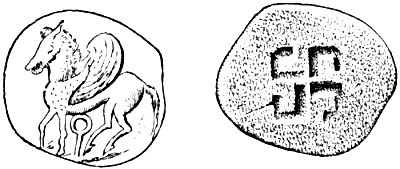
Fig. 229.
CORINTHIAN COINS.
Obverse and reverse. Punch mark resembling Swastika.
It is believed by the author that the assertions as to the presence of the
Swastika on these ancient coins is based upon an erroneous interpretation
of these punch marks. Fig. 229 shows the obverse and reverse of a coin
from Corinth. It belonged to the first half of the sixth century B. C. The
obverse represents a Pegasus standing, while the reverse is a punch mark,
said to have been a Swastika; but, examining closely, we will find there
is no Swastika in this punch mark. The arms of the normal Swastika consist
of straight lines crossing each other. In this case they do not cross. The
design consists of four gammas, and each gamma is separated from its
fellows, all forming together very nearly the same design as hundreds of
other punch marks of the same period. If each outer arm of this mark is
made slightly longer, the Swastika form disappears and the entire design
resolves itself into the square habitually employed for that purpose. If
the punch mark on this Corinthian coin be a Swastika, it depends upon the
failure to make the extreme end of the bent arm an eighth of an inch
longer. This is too fine a point to be relied upon. If this punch mark had
these arms lengthened an eighth of an inch, it would confessedly become a
square.
EXPLANATION OF PLATE 9.
| 1 |
2 |
3 |
| 4 |
5 |
6 |
| 7 |
8 |
9 |
| 10 |
11 |
12 |
Punch Marks on Reverse of Ancient Coins.
| Fig. |
1. |
Coin of Lydia. Electrum. Oblong sinking between two squares. Babylonian stater.
The earliest known coinage. Circa 700 B. C. |
| |
2. |
Phenician Half Stater. Electrum. Incuse square with cruciform ornament. |
| |
3. |
Silver Coin of Teos. Incuse square. Circa 544 B. C. |
| |
4. |
Silver Coin of Acanthus. Incuse square. |
| |
5. |
Silver Coin of Mende. Incuse triangles. |
| |
6. |
Silver Coin of Terone. Incuse square. |
| |
7. |
Coin of Bisaltæ.[236] Incuse square. Octadrachm. |
| |
8. |
Silver Coin of Orrescii.[236] Incuse square. Octadrachm. |
| |
9. |
Corinthian Silver Coin. Incuse square divided into eight triangular compartments.
The earliest coin of Corinth, dating B. C. 625 to 585. |
| |
10. |
Silver Coin of Abdera. Incuse square. |
| |
11. |
Silver Coin of Byzantium. Incuse square, granulated. |
| |
12. |
Silver Coin of Thrasos (Thrace). Incuse square. |
Plate 9.
Punch Marks on Reverse of Ancient Coins.
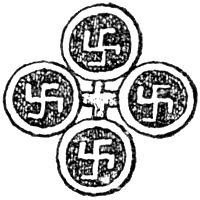
Fig. 230.
ANCIENT HINDU COIN IN THE FORM
OF A CROSS WITH A SWASTIKA ON
THE EXTREMITY OF EACH
ARM.[237]
Waring, “Ceramic Art in Remote
Ages,” pl. 41, fig. 13.
Swastika on ancient Hindu coins.—It is not to be inferred from this
opposition that the Swastika never appeared on ancient coins. It did
appear, but seems to have been of a later date and to have belonged
farther east among the Hindus. Fig. 230 shows an ancient (Hindu?) coin
reported by Waring, who cites Cunningham as authority for its having been
found at Ujain. The design consists of a cross with independent circles on
the outer end of each of the four arms, the circles being large enough to
intersect each other. The field of each of these circles bears a Swastika
of normal form. Other coins are cited of the same style, with small center
dots and concentric circles in the stead of the Swastika. What meaning the
Swastika has here, beyond the possible one of being a lucky penny, is not
suggested.
Other ancient Hindu coins bearing the Swastika (figs. 231-234) are
attributed to Cunningham by Waring.[238] These are said by Waring to be
Buddhist coins found at Behat near Scharaupur. Mr. E. Thomas, in his
article on the “Earliest Indian Coinage,”[239] ascribes them to the reign
of Krananda, a Buddhist Indian king contemporary with or prior to
Alexander, about 330 B. C.
The coins of Krananda,[240] contemporary of
Alexander the Great,[241] bear
the Swastika mark, associated with the principal Buddhist marks, the
trisula, the stupha, sacred tree, sacred cone, etc. Waring says[242] that
according to Prinsep’s “Engravings of Hindu Coins,” the Swastika seems to
disappear from them about 200 B. C., nor is it found on the
Indo-Bactrian, the Indo-Sassanian, or the later Hindu or subsequent
Mohammedan, and he gives in a note the approximate dates of these
dynasties: Early native Buddhist monarchs from about 500 B. C. to the
conquest of Alexander, about 330 B. C.; the Indo-Bactrian or Greek
successors of Alexander from about 300 to 126 B. C.; the Indo-Parthian or
Scythic from about 126 B. C.; the second Hindu dynasty from about 56 B.
C.; the Indo-Sassanian from A. D. 200 to 636, and subsequent to that the
Indo-Mohammedan from the eleventh to the close of the thirteenth century;
the Afghan dynasty from A. D. 1290 to 1526, and the Mongol dynasty to the
eighteenth century, when it was destroyed by Nadir Shah. (See p. 772.)
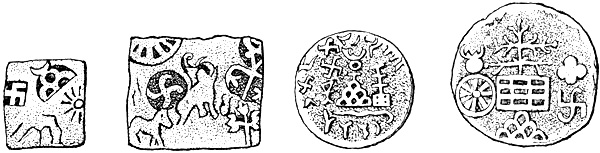
Figs. 231, 232, 233, and 234.
ANCIENT HINDU COINS WITH SWASTIKAS, NORMAL AND OGEE.
Waring, “Ceramic Art in Remote Ages,” pl. 41, figs. 20-24.
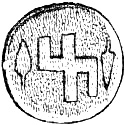
Fig. 235.
ANCIENT COIN WITH
SWASTIKA.
Gaza, Palestine. Waring,
“Ceramic Art in Remote
Ages,” pl. 42, fig. 6.
Swastika on coins in Mesembria and Gaza.—Mr. Percy Gardner, in his
article, “Ares as a Sun-god,”[243] finds the Swastika on a coin of
Mesembria in Thrace. He explains that “Mesembria is simply the Greek word
for noon, midday (μεσημβρία).” The coins of this city bear the
inscription ΜΕΣ, which
Greg[244] believes refers by a kind of
pun to the name of the city, and so to noon, or the sun or solar light.
The answer to this is the same given throughout this paper, that it may be
true, but there is no evidence in support of it. Max Müller[245] argues
that this specimen is decisive of the meaning of the sign Swastika. Both
these gentlemen place great stress upon the position which the Swastika
held in the field relative to other objects, and so determine it to have
represented the sun or sunlight; but all this seems non sequitur. A coin
from Gaza, Palestine, ancient, but date not given, is attributed to R.
Rochette, and by him to Munter (fig. 235). The Swastika sign is not
perfect, only two arms of the cross being turned, and not all four.
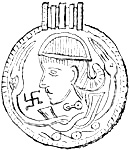
Fig. 236.
GOLD BRACTEATE
WITH JAIN SWASTIKA.
Denmark. Waring,
“Ceramic Art in Remote
Ages,” pl. 1, fig. 9.
Swastika on Danish gold bracteates.—Fig. 236 represents a Danish gold
bracteate with a portrait head, two serpents, and a Swastika with the
outer ends finished with a curve or flourish similar to that of the Jains
(fig. 33).
There are other bracteates with the Swastika mark, which belong to the
Scandinavian countries.[246] Some of them bear signs referring to
Christian civilization, such as raising hands in prayer; and from a
determination of the dates afforded by the coins and other objects the
Swastika can be identified as having continued into the Christian era.
The coinage of the ancient world is not a prolific field for the
discovery of the Swastika. Other specimens may possibly be found than
those here given. This search is not intended to be exhaustive. Their
negative information is, however, valuable. It shows, first, that some of
the early stamps or designs on coins which have been claimed as Swastikas
were naught but the usual punch marks; second, it shows a limited use of
the Swastika on the coinage and that it came to an end in very early
times. Numismatics afford great aid to archæology from the facility and
certainty with which it fixes dates. Using the dates furnished by the
coinage of antiquity, it is gravely to be questioned whether the prolific
use of the Swastika in Asia Minor (of which we have such notable examples
on specimens of pottery from the hill of Hissarlik, in Greece) did not
terminate before coinage began, or before 480 B. C., when the period of
finer engraving began, and it became the custom to employ on coins the
figures of gods, of tutelary deities, and of sacred animals. Thus the use
of the Swastika became relegated to objects of commoner use, or those
having greater relation to superstition and folklore wherein the possible
value of the Swastika as an amulet or sign with power to bring good luck
could be better employed; or, as suggested by Mr. Greg, that the great
gods which, according to him, had the Swastika for a symbol, fell into
disrepute and it became changed to represent something else.
UNITED STATES OF AMERICA.
PRE-COLUMBIAN TIMES.
Fains Island and Toco Mounds, Tennessee.—That the Swastika found its
way to the Western Hemisphere in prehistoric times can not be doubted. A
specimen (fig. 237) was taken by Dr. Edward Palmer in the year 1881 from
an ancient mound opened by him on Fains Island, 3 miles from Bainbridge,
Jefferson County, Tenn. It is figured and described in the Third Annual
Report of the Bureau of Ethnology,[247] as follows:
A shell ornament, on the convex surface of which a very curious
ornamental design has been engraved. The design, inclosed by a circle,
represents a cross such as would be formed by two rectangular tablets
or slips slit longitudinally and interlaced at right angles to each
other. The lines are neatly and deeply incised. The edge of the
ornament has been broken away nearly all around.
The incised lines of this design (fig. 237) represent the Swastika turned
to the left (though the description does not recognize it as such). It has
small circles with dots in the center, a style of work that may become of
peculiar value on further investigation, but not to be confounded with the
dots or points in what M. Zmigrodzki calls the Croix swasticale. The
mound from which this specimen came, and the objects associated with it,
show its antiquity and its manufacture by the aborigines untainted by
contact with the whites. The mound is on the east end of Fains Island. It
was 10 feet in height and about 100 feet in circumference at the base. In
the bed of clay 4 feet beneath the surface were found the remains of 32
human skeletons; of these, only 17 skulls could be preserved. There had
been no regularity in placing the bodies.
Fig. 237.
SHELL GORGET WITH ENGRAVED SWASTIKA, CIRCLES, AND DOTS.
Fains Island, Tennessee. Cat. No. 62928, U. S. N. M.
Fig. 238.
ENGRAVED SHELL WITH SWASTIKA, CIRCLES, AND DOTS.
Toco Mound, Monroe County, Tenn. Cat. No. 115624, U. S. N. M.
The peculiar form of this Swastika is duplicated by a Runic Swastika in
Sweden, cited by Ludwig Müller and by Count d’Alviella.[248]
The following objects were found in the mound on Fains Island associated
with the Swastika shell (fig. 237) and described, and many of them
figured:[249] A gorget of the same Fulgur shell (fig. 239); a second
gorget of Fulgur shell with an engraved spider (fig. 278); a pottery
vase with a figure of a frog; three rude axes from four to seven inches in
length, of diorite and quartzite; a pierced tablet of slate; a disk of
translucent quartz 1¾ inches in diameter and three-quarters of an inch
in thickness; a mass of pottery, much of it in fragments, and a number of
bone implements, including needles and paddle-shaped objects. The shell
objects (in addition to the disks and gorgets mentioned) were pins made
from the columellæ of Fulgur (Busycon perversum?) of the usual form and
about four inches in length. There were also found shell beads,
cylindrical in form, an inch in length and upward of an inch in diameter,
with other beads of various sizes and shapes made from marine shells, and
natural specimens of Io spinosa, Unio probatus.
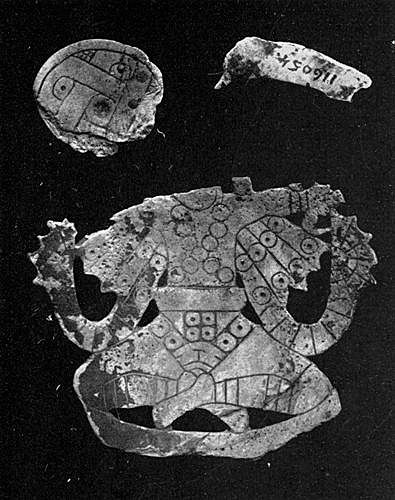
Plate 10. Engraved Fulgur(?) Shell, Resembling Statue of Buddha.
Toco Mound, Tennessee. Cat. No. 115560, U. S. N. M.
The specimen represented in fig. 238 is a small shell from the Big Toco
mound, Monroe County, Tenn., found by Mr. Emmert with skeleton No. 49 and
is fig. 262, Twelfth Annual Report of the Bureau of Ethnology, 1890-91,
page 383, although it is not described. This is a circular disk of
Fulgur shell, much damaged around the edge, 1½ inches in diameter,
on which has been engraved a Swastika. It has a small circle and a dot in
the center, around which circle the arms of the Swastika are interlaced.
There are also circles and central dots at each turn of the four arms. The
hatch work in the arc identifies this work with that of other crosses and
a triskelion from the same general locality—figs. 302, 305, and 306, the
former being part of the same find by Mr. Emmert. Fig. 222, a bronze gilt
fibula from Berkshire, England, bears a Swastika of the same style as fig.
238 from Tennessee. The circles and central dots of fig. 238 have a
similarity to Peruvian ornamentation. The form and style, the broad arms,
the circles and central dots, the lines of engravings, show such
similarity of form and work as mark this specimen as a congener of the
Swastika from Fains Island (fig. 237). The other objects found in the
mound associated with this Swastika will be described farther on.
There can be no doubt of these figures being the genuine Swastika, and
that they were of aboriginal workmanship. Their discovery immediately
suggests investigation as to evidences of communication with the Eastern
Hemisphere, and naturally the first question would be, Are there any
evidences of Buddhism in the Western Hemisphere? When I found, a few days
ago, the two before-described representations of Swastikas, it was my
belief that no reliable trace of Buddha or the Buddhist religion had ever
been found among the aboriginal or prehistoric Americans. This statement
was made, as almost all other statements concerning prehistoric man should
be, with reserve, and subject to future discoveries, but without idea that
a discovery of evidence on the subject was so near. In searching the U. S.
National Museum for the objects described in the Second Annual Report of
the Bureau of Ethnology under the title of “Art in Shell among the Ancient
Americans,” the writer discovered a neglected specimen of a mutilated and
damaged shell (pl. 10), marked as shown on the back, found by Mr. Emmert,
an employé of the Bureau of Ethnology, in the year 1882. Its original
field number was 267, Professor Thomas’s 6542, the Museum number 115562,
and it was found in the Big Toco mound, Monroe County, Tenn. It is not
figured nor mentioned in any of the Bureau reports. It is greatly to be
regretted that this shell is so mutilated. In its present condition no one
can say positively what it is, whether a statue of Buddha or not; but to
all appearances it represents one of the Buddhist divinities. Its
material, similar to the hundred others found in the neighborhood, shows
it to have been indigenous, yet parts of its style are different from
other aboriginal North American images. Attention is called to the slim
waist, the winged arms, the crossed legs, the long feet, breadth of toes,
the many dots and circles shown over the body, with triple lines of
garters or anklets. All these show a different dress from the ancient
North American. The girdle about the waist, and the triangular dress
which, with its decorations and arrangement of dots and circles, cover
the lower part of the body, are to be remarked. While there are several
specimens of aboriginal art from this part of the country which bear these
peculiarities of costumes, positions, appearance, and manner of work,
showing them to have been in use among a portion of the people, yet they
are not part of the usual art products. There is a manifest difference
between this and the ordinary statue of the Indian or of the mound builder
of that neighborhood or epoch.
It is not claimed that this shell proves the migration of Buddhism from
Asia, nor its presence among North American Indians. “One swallow does not
make a summer.” But this figure, taken in connection with the Swastika,
presents a set of circumstances corresponding with that possibility which
goes a long distance in forming circumstantial evidence in its favor.
M. Gustave d’Eichthal wrote a series of essays in the Revue Archæologique,
1864-65, in which he collated the evidence and favored the theory of
Buddhist influence in ancient America. Other writers have taken the same
or similar views and have attributed all manner of foreign influence, like
the Lost Tribes of Israel, etc., to the North American Indian,[250] but
all these theories have properly had but slight influence in turning
public opinion in their direction. Mr. V. R. Gandhi, in a recent letter to
the author, says of this specimen (pl. 10):
While Swastika technically means the cross with the arms bent to the
right, later on it came to signify anything which had the form of a
cross; for instance, the posture in which a persons sits with his legs
crossed is called the Swastika posture;[251] also when a person keeps
his arms crosswise over his chest, or a woman covers her breast with
her arms crossed, that particular attitude, is called the Swastika
attitude, which has no connection, however, with the symbolic meaning
of the Swastika with four arms. The figure [pl. 10], a photograph of
which you gave me the other day, has the same Swastika posture. In
matters of concentration and meditation, Swastika posture is
oftentimes prescribed, which is also called Sukhasana, meaning a
posture of ease and comfort. In higher forms of concentration, the
posture is changed from Sukhasana to Padmasana, the posture which is
generally found in Jain and Buddhist images. The band around the
waist, which goes from the navel lower on till it reaches the back
part, has a peculiar significance in the Jain philosophy. The
Shvetamber division of the Jain community have always this kind of
band in their images. The object is twofold: The first is that the
generative parts ought not to be visible; the second is that this band
is considered a symbol of perfect chastity.
There can be no doubt of the authenticity of these objects, nor any
suspicion against their having been found as stated in the labels
attached. They are in the Museum collection, as are other specimens. They
come unheralded and with their peculiar character unknown. They were
obtained by excavations made by a competent and reliable investigator who
had been engaged in mound exploration, a regular employé of the Bureau of
Ethnology, under the direction of Prof. Cyrus Thomas during several
years, and always of good reputation and unblemished integrity. They come
with other objects, labeled in the same way and forming one of a series of
numbers among thousands. Its resemblance to Buddhist statues was
apparently undiscovered or unrecognized, at least unmentioned, by all
those having charge of it, and in its mutilated condition it was laid away
among a score of other specimens of insufficient value to justify notice
or publication, and is now brought to light through accident, no one
having charge of it recognizing it as being different from any other of
the half hundred engraved shells theretofore described. The excavation of
Toco mound is described by Professor Thomas in the Twelfth Annual Report
of the Bureau of Ethnology, pages 379-384.
We can now be governed only by the record as to the objects associated
with this shell (pl. 10), which shows it to have been found with skeleton
No. 8, in Big Toco mound, Monroe County, Tenn., while the Swastika of
figure 238 was found with skeleton No. 49. Toco mound contained fifty-two
skeletons, or, rather, it contained buried objects reported as from that
many skeletons. Those reported as with skeleton No. 8 were, in addition to
this gorget: One polished stone hatchet, one stone pipe, and one bowl with
scalloped rim. Toco mound seems to have been exceedingly rich, having
furnished 198 objects of considerable importance. Association of
discovered objects is one of the important means of furnishing evidence in
prehistoric archæology. It is deemed of sufficient importance in the
present case to note objects from Toco mound associated with the Buddha
statue. They are given in list form, segregated by skeletons:
Skeleton No.
4. Two polished stone hatchets, one discoidal stone.
5. One polished stone hatchet.
7. Two large seashells.
8. One stone pipe, one polished stone hatchet, one ornamented shell
gorget (the Buddha statue, pl. 10), one ornamented bowl, with scalloped rim.
9. Two polished stone hatchets.
12. A lot of small shell beads.
13. Four bone implements (one ornamented), one stone pipe, two shell
gorgets (one ornamented), one bear tooth.
17. One polished stone hatchet.
18. Two polished stone hatchets, one stone pipe, one boat-shaped bowl
(ornamented), one shell gorget (ornamented), one shell mask, one shell
pin, one shell gorget, one bear tooth, lot of shell beads.
22. Two polished stone chisels, one stone disk.
24. One polished stone hatchet.
26. Two polished stone hatchets, one waterworn stone, two hammer stones.
27. One polished stone hatchet.
28. Two polished stone hatchets, one ornamented bowl.
31. One polished stone hatchet, one polished stone chisel.
33. Two polished stone hatchets, one two-eared pot, one small shell
gorget, three shell pins, fragments of pottery.
34. Three polished stone hatchets.
36. One discoidal stone.
37. One polished stone chisel, one stone pipe, one shell mask (ornamented).
41. One polished stone hatchet, one stone pipe, pottery vase with ears
(ornamented), one shell mask, one shell pin, four arrowheads (two with serrated edges), two stone perforators.
43. Lot of shell beads.
49. One polished stone hatchet, one spade-shaped stone ornament
(perforated), one spear-head, one stone pipe, one pottery bowl with
two handles, two shell masks (ornamented), twenty-seven bone needles,
two beaver teeth, one bone implement (raccoon), piece of mica, lot of
red paint, two shell gorgets (one ornamented with Swastika, fig. 238),
thirty-six arrow-heads, lot of flint chips, fragment of animal jaw and
bones, lot of large shells, one image pot.
51. One shell pin, one shell mask, one arrow-head, two small shell beads.
52. One shell mask, one shell gorget, one shell ornament.
These objects are now in the U. S. National Museum and in my department.
The list is taken from the official catalogue, and they number from 115505
to 115684. I have had the opportunity of comparing the objects with this
description and find their general agreement. Dr. Palmer, the finder, was
an employé of the Bureau of Ethnology, is a man of the highest character,
of great zeal as an archæologist and naturalist, and has been for many
years, and is now, in the employ of the Bureau or Museum, always with
satisfaction and confidence. Mr. Emmert was also an employé of the Bureau
for many years, and equally reliable.
The specimens of shell in this and several other mounds, some of which are
herein figured, were in an advanced stage of decay, pitted, discolored,
and crumbling, requiring to be handled with the utmost care to prevent
disintegration. They were dried by the collector, immersed in a weak
solution of glue, and forwarded immediately (in 1885), with other relics
from the neighborhood, to the Bureau of Ethnology and National Museum at
Washington, where they have remained ever since. There is not the
slightest suspicion concerning the genuineness or antiquity of this
specimen or of those bearing the Swastika as belonging to the
mound-building epoch in the valley of the Tennessee.
Fig. 239.
SHELL GORGET.
Two fighting figures with triangular breech-clout, garters and anklets, and dots and circles.
Fains Island, Tennessee. Third Annual Report of the Bureau of Ethnology, p. 452, fig. 128. Cat. No. 62930, U. S. N. M.
Other figures of sufficient similarity to the Swastika have been found
among the aborigines of North America to show that these do not stand
alone; and there are also other human figures which show a style of work
so similar and such resemblance in detail of design as to establish the
practical identity of their art. One of these was a remarkable specimen of
engraved shell found in the same mound, Fains Island, which contained the
first Swastika (fig. 237). It is described in the Second Annual Report of
the Bureau of Ethnology, page 301, under the name of McMahon’s mound. It
is a large polished Fulgur shell disk which, when entire, has been nearly
5 inches in diameter (fig. 239). A little more than one-third has crumbled
away, and the remaining portion has been preserved only by careful
handling and immediate immersion in a solution of glue. It had been
engraved on the concave side. The design represents two human figures
plumed and winged, armed with eagles’ talons and engaged in mortal
combat. The design apparently covered the entire shell, leaving no space
for encircling lines. The two figures are in profile and face each other
in a fierce onset. Of the right-hand figure, only the body, one arm, and
one leg remain. The left-hand figure is almost complete. The outline of
the face, one arm, and one foot is all that is affected. The right hand is
raised above the head in the act of brandishing a long knife pointed at
both ends. The other combatant, clutching in his right hand a
savage-looking blade with its point curved, seems delivering a blow in the
face of his antagonist. Of the visible portions of the figures, the hands
are vigorously drawn, the thumbs press down upon the outside of the
forefingers in a natural effort to tighten the grasp. The body, arms, and
legs are well defined and in proper proportion, the joints are correctly
placed, the left knee is bent forward, and the foot planted firmly on the
ground, while the right is thrown gracefully back against the rim at the
left, and the legs terminate in well-drawn eagles’ feet armed with curved
talons. The head is decorated with a single plume which springs from a
circular ornament placed over the ear; an angular figure extends forward
from the base of this plume, and probably represents what is left of the
headdress proper. In front of this—on the very edge of the crumbling
shell—is one-half of the lozenge-shaped eye, the dot representing the
pupil being almost obliterated. The ankles and legs just below the knee
and the wrists each have three lines representing bracelets or anklets. It
is uncertain whether the leg is covered or naked; but between the
waistband and the leggings, over the abdomen, is represented on both
figures a highly decorated triangular garment, or, possibly coat of mail,
to which particular attention is called.[252] In the center, at the top,
just under the waistband, are four circles with dots in the center
arranged in a square; outside of this, still at the top, are two
triangular pieces, and outside of them are two more circles and dots;
while the lower part of the triangle, with certain decorations of incised
lines, completes the garment. This decoration is the same on both figures,
and corresponds exactly with the Buddha figure. An ornament is suspended
on the breast which shows three more of the circles and dots. The earring
is still another. The right-hand figure, so far as it can be seen, is a
duplicate of the left, and in the drawing it has, where destroyed, been
indicated by dotted lines. It is remarkable that the peculiar clothing or
decoration of these two figures should be almost an exact reproduction of
the Buddha figure (pl. 10). Another interesting feature of the design is
the highly conventionalized wing which fills the space beneath the
uplifted arm. This wing is unlike the usual specimens of aboriginal art
which have been found in such profusion in that neighborhood. But it is
again remarkable that this conventionalized wing and the bracelets,
anklets, and garters should correspond in all their peculiarities of
construction and design with the wings on the copper and shell figures
from the Etowah mound, Georgia (figs. 240, 241,
and 242)[253]. Behind the
left-hand figure is an ornament resembling the spreading tail of an eagle
which, with its feather arrangement and the detail of their mechanism,
correspond to a high degree with the eagle effigies in repoussé copper
(fig. 243) from the mound in Union County, Ill., shown in the Fifth
Annual Report of the Bureau of Ethnology (p. 105) and in the Twelfth
Annual Report (p. 309).
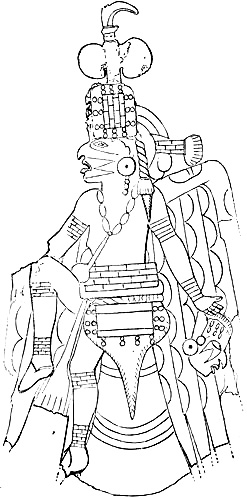
Fig. 240.
COPPER PLATE.
Entowah Mound, Georgia.
Fifth Annual Report of the Bureau of Ethnology,
fig. 42. Cat. No. 91113, U. S. N. M.
Fig. 241.
COPPER PLATE.
Repoussé work. Entowah Mound, Georgia.
Cat. No. 91117, U. S. N. M.
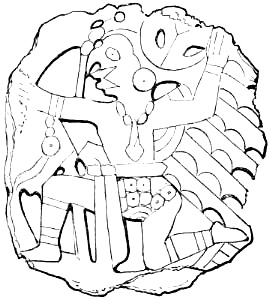
Fig. 242.
ENGRAVED SHELL.Triangular breech-clout with dots and circles.
Entowah Mound, Georgia.
Cat. No. 91443, U. S. N. M.
Hopewell Mound, Chillicothe, Ross County, Ohio.—A later discovery of
the Swastika belonging to the same period and the same general
locality—that is, to the Ohio Valley—was that of Prof. Warren K.
Moorehead, in the fall and winter of 1891-92, in his excavations of the
Hopewell mound, seven miles northwest of Chillicothe, Ross County,
Ohio.[254] The locality of this mound is well shown in Squier and Davis’s
work on the “Monuments of the Mississippi Valley” (pl. 10, p. 26), under
the name of “Clark’s Works,” here reproduced as pl. 11. It is the large
irregular unnumbered triple mound just within the arc of the circle shown
in the center of the plan. The excavation contemplated the destruction of
the mound by cutting it down to the surrounding level and scattering the
earth of which it was made over the surface; and this was done.
Preparatory to this, a survey and ground plan was made (pl. 12). I
assisted at this survey and can vouch for the general correctness. The
mound was surrounded by parallel lines laid out at right angles and marked
by stakes 50 feet apart. The mound was found to be 530 feet long and 250
feet wide. Squier and Davis reported its height at 32 feet, but the
excavation of the trenches required but 18 and 16 feet to the original
surface on which the mound was built. It was too large to be cut down as a
whole, and for convenience it was decided by Mr. Moorehead to cut it down
in trenches, commencing on the northeast. Nothing was found until, in
opening trench 3, about five feet above the base of the mound, they struck
a mass of thin worked copper objects, laid flat one atop the other, in a
rectangular space, say three by four feet square. These objects are unique
in American prehistoric archæology. Some of them bore a resemblance in
form to the scalloped mica pieces found by Squier and Davis, and described
by them in their “Ancient Monuments of the Mississippi Valley” (p.
240), and also those of the same material found by Professor Putnam in the
Turner group of mounds in the valley of the Little Miami. They had been
apparently laid between two layers of bark, whether for preservation or
mere convenience of deposit, can only be guessed.
Plate 11. Plan of North Fork (Hopewell) Works.
Ross County, Ohio. Smithsonian Contributions to Knowledge, Vol. I, Pl. X.
Plate 12. Plan of Hopewell Mound,
in which Aboriginal Copper Swastikas were Found.
Ross County, Ohio. Moorehead, “Primitive Man in Ohio,” Pl. XXXIV.
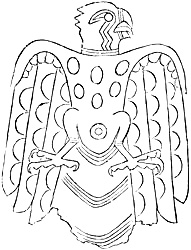
Fig. 243.
COPPER PLATE SHOWING
FIGURE OF EAGLE.Repoussé work. Union County,
Ill. Cat. No. 91507, U. S. N. M.
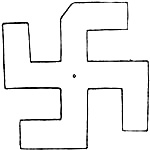
Fig. 244.
SWASTIKA CROSS OF
THIN COPPER.Hopewell Mound,
Ross County, Ohio.
¼ natural size.
Fig. 245.
FLAT RING OF THIN COPPER.Hopewell Mound,
Ross County, Ohio.
⅕ natural size.
Fig. 246.
STENCIL ORNAMENT OF THIN COPPER.Hopewell Mound, Ross County, Ohio.
⅛ natural size.
The following list of objects is given, to the end that the reader may see
what was associated with these newly found copper Swastikas: Five Swastika
crosses (fig. 244); a long mass of copper covered with wood on one side
and with squares and five similar designs traceable on the reverse;
smaller mass of copper; eighteen single copper rings; a number of double
copper rings, one set of three and one set of two; five pan lids or
hat-shaped rings; ten circular disks with holes in center, represented in
fig. 245, originally placed in a pile and now oxidized together; also
large circular, stencil-like ornaments, one (fig. 246) 7½ inches in
diameter; another (fig. 247) somewhat in the shape of a St. Andrew’s
cross, the extreme length over the arms being 8¾ inches.
About five feet below the deposit of sheet copper and 10 or 12 feet to the
west, two skeletons lay together. They were covered with copper plates and
fragments, copper hatchets, and pearl beads, shown in the list below, laid
in rectangular form about seven feet in length and five feet in width, and
so close as to frequently overlap.
There were also found sixty-six copper hatchets, ranging from 1½ to
22½ inches in length; twenty-three copper plates and fragments; one
copper eagle; eleven semicircles, bars, etc.; two spool-shaped objects;
four comb-shaped effigies; one wheel with peculiar circles and bars of
copper; three long plates of copper; pearl and shell beads and teeth; a
lot of extra fine pearls; a lot of wood, beads, and an unknown metal; a
lot of bones; a human jaw, very large; a fragmentary fish resembling a
sucker (fig. 248); one stool of copper with two legs; broken copper
plates; one broken shell; bear and panther tusks; mica plates; forty
fragmentary and entire copper stencils of squares, circles, diamonds,
hearts, etc.; copper objects, saw-shaped; twenty ceremonial objects,
rusted or oxidized copper; two diamond-shaped stencils, copper (fig. 249);
four peculiar spool-shaped copper ornaments, perforated, showing repoussé
work (fig. 250).
I made sketches of two or three of the bone carvings, for the purpose of
showing the art of the people who constructed this monument, so that by
comparison with that of other known peoples some knowledge may be
obtained, or theory advanced, concerning the race or tribe to which they
belonged and the epoch in which they lived. Fig. 251 shows an exquisite
bone carving of a paroquet which belongs much farther south and not found
in that locality in modern times. The design shown in fig. 252 suggests a
Mississippi Kite, but the zoologists of the Museum, while unable to
determine with exactitude its intended representation, chiefly from the
mutilated condition of the fragment, report it more likely to be the
head of the “leather-back” turtle. Fig. 253 probably represents an otter
with a fish in his mouth.
 |
|
 |
Fig. 247.
STENCIL ORNAMENT OF THIN COPPER.
Hopewell Mound, Ross County, Ohio.
¼ natural size. |
|
Fig. 248.
FISH ORNAMENT OF THIN COPPER.
Hopewell Mound, Ross County, Ohio.
⅙ natural size. |
Fig. 249.
LOZENGE-SHAPED STENCIL OF THIN COPPER.
Hopewell Mound, Ross County, Ohio. ¼ natural size.
Plate 13. Human Skull with Copper-covered Horns.
Hopewell Mound, Ross County, Ohio.
Moorehead, “Primitive Man in Ohio,” frontispiece.
Plate 14. Prehistoric Altar. Hopewell Mound, Ross County, Ohio.
Found near the copper Swastika shown in fig. 244.
Moorehead, “Primitive Man in Ohio,” Fig. XXXVII. Cat. No. 148662, U. S. N. M.
In trench No. 3, 15 skeletons (numbered 264 to 278, inclusive), were found
on the base line, all extended. Objects of coal, bone, shell, or stone,
had been placed with nearly all of them. Nos. 265 and 266 were laid on
blocks of burnt earth 3 inches higher than the base of the mound. One of
the skeletons in this mound (No. 248) is shown in pl. 13. It was a most
remarkable specimen, and forms the frontispiece of Prof. W. K. Moorehead’s
volume “Primitive Man in Ohio,” where it is described (p. 195) as follows:
At his head were imitation elk horns, neatly made of wood and covered
with sheet copper rolled into cylindrical forms over the prongs. The
antlers were 22 inches high and 19 inches across from prong to prong.
They fitted into a crown of copper bent to fit the head from occipital
to upper jaw. Copper plates were upon the breast and stomach, also on
the back. The copper preserved the bones and a few of the sinews. It
also preserved traces of cloth similar to coffee sacking in texture,
interwoven among the threads of which were 900 beautiful pearl beads,
bear teeth split and cut, and hundreds of other beads, both pearl and
shell. Copper spool-shaped objects and other implements covered the
remains. A pipe of granite and a spearhead of agate were near the
right shoulder. The pipe was of very fine workmanship and highly polished.
Fig. 250.
SPOOL-SHAPED OBJECT OF COPPER.
Repoussé and intaglio decoration. Hopewell Mound, Ross County, Ohio. Natural size.
While digging out skeletons 280 to 284, Professor Moorehead says they
touched the edge of an altar (pl. 14). It was on the base line and 15 feet
north of the copper find before described. On the 5th of January, 1892,
the altar was uncovered, and the earth, charcoal, and objects within it
put into five soap boxes and transported to headquarters, where the
material was assorted in my presence and with my aid. The mass on the
altar had been charred throughout. It contained, in part, mica ornaments,
beads, spool-shaped objects, whale, bear, and panther teeth, flint knives,
carved effigies of bone and stone, some of which were broken, while others
were whole. There were stone tablets, slate ornaments, copper balls,
fragments of cloth, rings of chlorite, quartz crystals perforated and
grooved, and a few pieces of flint and obsidian, with several thousand
pearls drilled for suspension. These objects were heaped in the cavity of
the altar without any regularity. All were affected by heat, the copper
being fused in many cases. The teeth and tusks were charred, split, and
calcined. There were no ashes. All the fuel was charcoal, and from the
appearance of the débris, especially the wood, earth, and bone, one might
suppose that after the fire had started it had not been allowed to burn to
ashes as if in the open air, but had been covered with earth, and so had
smoldered out as in a charcoal pit.
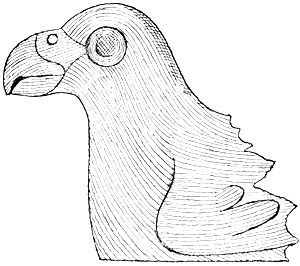
Fig. 251.
FRAGMENT OF ENGRAVED BONE
REPRESENTING A PAROQUET.Hopewell Mound, Ross County, Ohio.
Natural size.
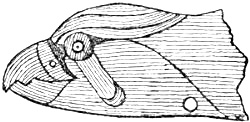
Fig. 252.
FRAGMENT OF ENGRAVED BONE PROBABLY
REPRESENTING A MISSISSIPPI KITE OR
LEATHER-BACK TURTLE.
Hopewell Mound, Ross County, Ohio.
Natural size.
Evidence was found of an extended commerce with distant localities, so
that if the Swastika existed in America it might be expected here. The
principal objects were as follows: A number of large seashells (Fulgur)
native to the southern Atlantic Coast 600 miles distant, many of them
carved; several thousand pieces of mica from the mountains of Virginia or
North Carolina, 200 or more miles distant; a thousand large blades of
beautifully chipped objects in obsidian, which could not have been found
nearer than the Rocky Mountains, 1,000 or 1,200 miles distant; four
hundred pieces of wrought copper, believed to be from the Lake Superior
region, 150 miles distant; fifty-three skeletons, the copper headdress
(pl. 13) made in semblance of elk horns, 16 inches high, and other
wonderful things. Those not described have no relation to the Swastika.
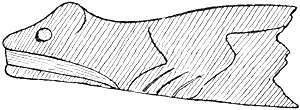
Fig. 253.
FRAGMENT OF ENGRAVED BONE PROBABLY
REPRESENTING AN OTTER WITH A FISH IN
ITS MOUTH. Natural size.
These objects were all prehistoric. None of them bore the slightest
evidence of contact with white civilization. The commoner objects would
compare favorably with those found in other mounds by the same and other
investigators. Much of it may be undetermined. It is strange to find so
many objects brought such long distances, and we may not be able to
explain the problem presented; but there is no authority for injecting any
modern or European influence into it. By what people were these made? In
what epoch? For what purpose? What did they represent? How did this
ancient, curious, and widespread sign, a recognized symbol of religion of
the Orient, find its way to the bottom of one of the mounds of antiquity
in the Scioto Valley? These are questions easy to ask but difficult to
answer. They form some of the riddles of the science of prehistoric
anthropology.
Fig. 254.
WATER JUG WITH FIGURE OF SWASTIKA.
Decoration, red on yellow ground. Poinsett County, Ark.
Cat. No. 91230, U. S. N. M.
Mounds in Arkansas.—A water jug in the collection of the U. S. National
Museum (fig. 254) was obtained in 1883 by P. W. Norris, of the Bureau of
Ethnology, from a mound in Poinsett County, Ark. It is of yellow ground,
natural color of clay, and decorated with light red paint. The paint is
represented in the cut by the darkened surfaces. The four quarters of the
jug are decorated alike, one side of which is shown in the cut. The center
of the design is the Swastika with the arm crossing at right angles, the
ends turned to the right, the effect being produced by an enlargement on
the right side of each arm until they all join the circle. A similar water
jug with a Swastika mark of the same type as the foregoing decorates Major
Powell’s desk in the Bureau of Ethnology.
Marquis Nadaillac[255] describes and figures a grooved ax from Pemberton,
N. J., on which some persons have recognized a Swastika, but which the
Marquis doubts, while Dr. Abbott[256] denounces the inscription as a
fraud.
NORTH AMERICAN INDIANS.
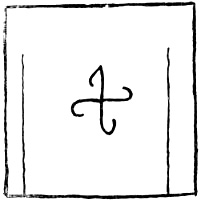
Fig. 255.
KANSA INDIAN WAR CHART.Swastika sign for winds and
wind songs. J. Owen Dorsey,
American Naturalist, July,
1885, p. 670.
The Kansas.—The Rev. J. Owen Dorsey[257] describes the mourning customs
of the Kansas Indians. In the course of his description he tells of a
council of ceremony held among these Indians to decide if they should go
on the warpath. Certain sacred songs were sung which had been arranged
according to a chart, which Mr. Dorsey introduces as pl. 20, page 676. The
outside edge of this chart bore twenty-seven ideographs, which suggest or
determine the song or speech required. No. 1 was the sacred pipe; No. 2,
the maker of all songs; No. 3, song of another old man who gives success
to the hunters; No. 4 (fig. 255 in the present paper) is the Swastika
sign, consisting of two ogee lines intersecting each other, the ends
curved to the left. Of it, Mr. Dorsey says only the following:
Fig. 4. Tadje wayun, wind songs. The winds are deities; they are
Bazanta (at the pines), the east wind; Ak′a, the south wind; A′k′a
jiñga or A′k′uya, the west wind; and Hnia (toward the cold), the north
wind. The warriors used to remove the hearts of slain foes, putting
them in the fire as a sacrifice to the winds.
In the Eleventh Annual Report of the Bureau of Ethnology (p. 525) Mr.
Dorsey repeats this statement concerning the names of the winds, and shows
how, in their invocations, the Kansas began with the east wind and went
around to the right in the order here given. His fig. 195 illustrates
this, but the cross has straight arms. In response to my personal inquiry,
Mr. Dorsey says the war chart[258] was drawn for him, with the Swastika as
represented, by Pahanle-gaqle, the war captain, who had official charge
of it and who copied it from one he had inherited from his father and his
“father’s fathers”; and Mr. Dorsey assured me that there can be no mistake
or misapprehension about this Indian’s intention to make the sign as there
represented. Asked if the sign was common and to be seen in other cases or
places, Mr. Dorsey replied that the Osage have a similar chart with the
same and many other signs or pictographs—over a hundred—but except
these, he knows of no similar signs. They are not in common use, but the
chart and all it contains are sacred objects, the property of the two
Kansas gentes, Black Eagle and Chicken Hawk, and not to be talked of nor
shown outside of the gentes of the council lodge.[259]
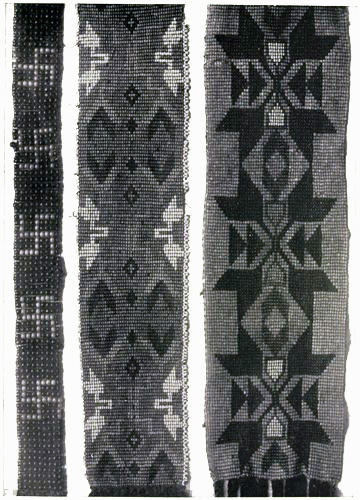
Plate 15. Ceremonial Bead Necklace
with Swastika Ornamentation.
Sac Indians, Cook County (Kansas) Reservation.
The Sac Indians.—Miss Mary A. Owen, of St. Joseph, Mo., sending some
specimens of beadwork of the Indians (pl. 15) from the Kansas Reservation,
two of which were garters and the third a necklace 13 inches long and 1
inch wide, in which the Swastikas represented are an inch square, writes,
February 2, 1895, as follows:
The Indians call it [the Swastika] the “luck,” or “good luck.” It is
used in necklaces and garters by the sun worshippers among the
Kickapoos, Sacs, Pottawatomies, Iowas, and (I have been told) by the
Winnebagoes. I have never seen it on a Winnebago. The women use the
real Swastika and the Greek key pattern, in the silk patchwork of
which they make sashes and skirt trimmings. As for their thinking it
an emblem of fire or deity, I do not believe they entertain any such
ideas, as some Swastika hunters have suggested to me. They call it
“luck,” and say it is the same thing as two other patterns which I
send in the mail with this. They say they “always” made that pattern.
They must have made it for a long time, for you can not get such beads
as compose it, in the stores of a city or in the supplies of the
traders who import French beads for the red folk. Another thing.
Beadwork is very strong, and this is beginning to look tattered, a
sure sign that it has seen long service.
These sun worshippers—or, if you please, Swastika wearers—believe in
the Great Spirit, who lives in the sun, who creates all things, and is
the source of all power and beneficence. The ancestors are a sort of
company of animal saints, who intercede for the people. There are many
malicious little demons who thwart the ancestors and lead away the
people at times and fill them with diseases, but no head devil. Black
Wolf and certain ghosts of the unburied are the worst. Everybody has a
secret fetish or “medicine,” besides such general “lucks” as
Swastikas, bear skins, and otter and squirrel tails.
Of the other cult of the peoples I have mentioned, those who worship
the sun as the deity and not the habitation, I know nothing. They are
secret, suspicious, and gloomy, and do not wear the “luck.” I have
never seen old people wear the “luck.”
Now, I have told you all I know, except that it [the Swastika] used in
ancient times to be made in quill embroidery on herb bags.
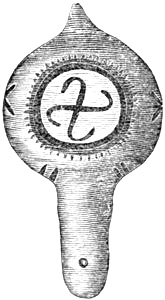
Fig. 256.
DANCE RATTLE MADE OF A
SMALL GOURD DECORATED
IN BLACK, WHITE, AND RED.Ogee Swastika on each side.
Second Annual Report of the
Bureau of Ethnology, fig. 526.
Cat. No. 42042, U. S. N. M.
Miss Owen spoke of other garters with Swastikas on them, but she said they
were sacred, were used only during certain ceremonies, and she knew not if
she could be able to get or even see them. During the prolongation of the
preparation of this paper she wrote two or three times, telling of the
promises made to her by the two Sac women who were the owners of these
sacred garters, and how each time they had failed. Yet she did not give
up hope. Accordingly, in the winter of 1896, the little box containing the
sacred garters arrived. Miss Owen says the husbands of these two Sac women
are Pottawatomies on the Cook County (Kans.) Reservation. They are sun
worshippers. These garters have been sketched and figured in pl. 16.
The Pueblos.—The Pueblo country in Colorado, Utah, New Mexico, and
Arizona, as is well known, is inhabited by various tribes of Indians
speaking different languages, separated from one another and from all
other tribes by differences of language, customs, and habit, but somewhat
akin to each other in culture, and many things different from other tribes
are peculiar to them. These have been called the “Pueblo Indians” because
they live in pueblos or towns. Their present country includes the regions
of the ancient cliff dwellers, of whom they are supposed to be the
descendants. In those manifestations of culture wherein they are peculiar
and different from other tribes they have come to be considered something
superior. Any search for the Swastika in America which omitted these
Indians would be fatally defective, and so here it is found. Without
speculating how the knowledge of the Swastika came to them, whether by
independent invention or brought from distant lands, it will be enough to
show its knowledge among and its use by the peoples of this country.
In the Annual Report of the Bureau of Ethnology for the year 1880-81 (p.
394, fig. 562) is described a dance rattle made from a small gourd,
ornamented in black, white, and red (fig. 256). The gourd has a Swastika
on each side, with the ends bent, not square, but ogee (the tetraskelion).
The U. S. National Museum possesses a large number of these dance rattles
with Swastikas on their sides, obtained from the Pueblo Indians of New
Mexico and Arizona. Some of them have the natural neck for a handle, as
shown in the cut; others are without neck, and have a wooden stick
inserted and passed through for a handle. Beans, pebbles, or similar
objects are inside, and the shaking of the machine makes a rattling noise
which marks time for the dance.
The Museum possesses a large series of pottery from the various pueblos of
the Southwest; these are of the painted and decorated kind common to that
civilization and country. Some of these pieces bear the Swastika mark;
occasionally it is found outside, occasionally inside. It is more
frequently of the ogee form, similar to that on the rattle from the same
country (fig. 256). The larger proportion of these specimens comes from
the pueblos of Santa Clara and St. Ildefonso.
Plate 16. Ceremonial Bead Garters with Swastikas.
Sac Indians, Cook County (Kansas) Reservation.
Dr. Schliemann reports:[260]
We also see a Swastika (turned to the left) scratched on two terra
cotta bowls of the Pueblo Indians of New Mexico, preserved in the
ethnological section of the Royal Museum at Berlin.
G. Nordenskiöld,[261] in the report of his excavations among the ruined
pueblos of the Mesa Verde, made in southwestern Colorado during the summer
of 1891, tells of the finding of numerous specimens of the Swastika. In
pl. 23, fig. 1, he represents a large, shallow bowl in the refuse heap at
the “Step House.” It was 50 centimeters in diameter, of rough execution,
gray in color, and different in form and design from other vessels from
the cliff houses. The Swastika sign (to the right) was in its center, and
made by lines of small dots. His pl. 27, fig. 6, represents a bowl found
in a grave (g on the plan) at “Step House.” Its decoration inside was of
the usual type, but the only decoration on the outside consisted of a
Swastika, with arms crossing at right angles and ends bent at the right,
similar to fig. 9. His pl. 18, fig. 1, represented a large bowl found in
Mug House. Its decoration consisted in part of a Swastika similar in form
and style to the Etruscan gold “bulla,” fig. 188 in this paper. Certain
specimens of pottery from the pueblos of Santa Clara and St. Ildefonso,
deposited in the U. S. National Museum (Department of Ethnology), bear
Swastika marks, chiefly of the ogee form.[262]
The Navajoes.—Dr. Washington Matthews, U. S. A., than whom no one has
done better, more original, nor more accurate anthropologic work in
America, whether historic or prehistoric, has kindly referred me to his
memoir in the Fifth Annual Report of the Bureau of Ethnology, comprising
82 pages, with 9 plates and 9 figures, entitled “The Mountain Chant; a
Navajo ceremony.” It is descriptive of one of a number of ceremonies
practiced by the shamans or medicine men of the Navajo Indians, New
Mexico. The ceremony is public, although it takes place during the night.
It lasts for nine days and is called by the Indians “dsilyídje
qaçàl”—literally, “chant toward (a place) within the mountains.” The
word “dsilyi” may allude to mountains in general, to the Carrizo
Mountains in particular, to the place in the mountains where the prophet
(originator of these ceremonies) dwelt, or to his name, or to all of these
combined. “Qaçàl” means a sacred song or a collection of sacred songs.
Dr. Matthews describes at length the myth which is the foundation of this
ceremony, which must be read to be appreciated, but may be summarized
thus: An Indian family, consisting of father, mother, two sons, and two
daughters, dwelt in ancient times near the Carrizo Mountains. They lived
by hunting and trapping; but the place was desert, game scarce, and they
moved up the river farther into the mountains. The father made
incantations to enable his two sons to capture and kill game; he sent them
hunting each day, directing them to go to the east, west, or north, but
with the injunction not to the south. The elder son disobeyed this
injunction, went to the south, was captured by a war party of Utes and
taken to their home far to the south. He escaped by the aid of Yàybichy
(Qastcèëlçi) and divers supernatural beings. His adventures in returning
home form the body of the ceremony wherein these adventures are, in some
degree, reproduced. Extensive preparations are made for the performance of
the ceremony. Lodges are built and corrals made for the use of the
performers and the convenience of their audience. The fête being
organized, stories are told, speeches made, and sacred songs are sung (the
latter are given by Dr. Matthews as “songs of sequence,” because they must
be sung in a progressive series on four certain days of the ceremony).
Mythological charts of dry sand of divers colors are made on the earth
within the corrals after the manner of the Navajo and Pueblo Indians.
These dry sand paintings are made after a given formula and intended to be
repeated from year to year, although no copy is preserved, the artists
depending only upon the memory of their shaman. One of these pictures or
charts represents the fugitive’s escape from the Utes, his captors, down a
precipice into a den or cave in which burnt a fire “on which was no wood.”
Four pebbles lay on the ground together—a black pebble in the east, a
blue one in the south, a yellow one in the west, and a white one in the
north. From these flames issued. Around the fire lay four bears, colored
and placed to correspond with the pebbles. When the strangers (Qastcèëlçi
and the Navajo) approached the fire the bears asked them for tobacco, and
when they replied they had none, the bears became angry and thrice more
demanded it. When the Navajo fled from the Ute camp, he had furtively
helped himself from one of the four bags of tobacco which the council was
using. These, with a pipe, he had tied up in his skin robe; so when the
fourth demand was made he filled the pipe and lighted it at the fire. He
handed the pipe to the black bear, who, taking but one whiff, passed it to
the blue bear and immediately fell senseless. The blue bear took two
whiffs and passed the pipe, when he too fell over unconscious. The yellow
bear succumbed after the third whiff, and the white bear in the north
after the fourth whiff. Now the Navajo knocked the ashes and tobacco out
of his pipe and rubbed the latter on the feet, legs, abdomen, chest,
shoulders, forehead, and mouth of each of the bears in turn, and they were
at once resuscitated. He replaced the pipe in the corner of his robe. When
the bears recovered, they assigned to the Navajo a place on the east side
of the fire where he might lie all night, and they brought out their
stores of corn meal, tciltcin, and other berries, offering them to him
to eat; but Qastcèëlçi warned him not to touch the food, and disappeared.
So, hungry as he was, the Indian lay down supperless to sleep. When he
awoke in the morning, the bears again offered food, which he again
declined, saying he was not hungry. Then they showed him how to make the
bear kethàwns, or sticks, to be sacrificed to the bear gods, and they
drew from one corner of the cave a great sheet of cloud, which they
unrolled, and on it were painted the forms of the “yays” of the cultivated
plants.
Plate 17. Navajo Dry Painting Containing Swastikas.
Dr. Washington Matthews, “The Mountain Chant: A Navajo Ceremony,”
Fifth Annual Report of the Bureau of Ethnology, 1883-84, Pl. XVII.
In Dr. Matthews’s memoir (marked third, but described on p. 447 as the
second picture), is a representation of the painting which the prophet was
believed to have seen at the home of the bears in the Carrizo Mountains.
This is here reproduced as pl. 17. In the center of the figure is a bowl
of water covered with black powder; the edge of the bowl is garnished with
sunbeams, while outside of it and forming a rectangle are the four
ca’bitlol of sunbeam rafts on which seem to stand four gods, or “yays,”
with the plants under their special protection, which are painted the same
color as the gods to which they belong. These plants are represented on
their left hand, the hand being open and extended toward them. The body of
the eastern god is white, so is the stalk of corn at his left in the
southeast; the body of the southern god is blue, so is the beanstalk
beside him in the southwest; the body of the western god is yellow, so is
his pumpkin vine in the northwest; the body of the north god is black, so
is the tobacco plant in the northeast. Each of the sacred plants grows
from five white roots in the central waters and spreads outward to the
periphery of the picture. The figures of the gods form a cross, the arms
of which are directed to the four cardinal points; the plants form another
cross, having a common center with the first, the arms extending to the
intermediate points of the compass. The gods are shaped alike, but colored
differently; they lie with their feet to the center and heads extended
outward, one to each of the four cardinal points of the compass, the faces
look forward, the arms half extended on either side, the hands raised to a
level with the shoulders. They wear around their loins skirts of red
sunlight adorned with sunbeams. They have ear pendants, bracelets, and
armlets, blue and red, representing turquoise and coral, the prehistoric
and emblematic jewels of the Navajo Indians. Their forearms and legs are
black, showing in each a zigzag mark representing lightning on the black
rain clouds. In the north god these colors are, for artistic reasons,
reversed. The gods have, respectively, a rattle, a charm, and a basket,
each attached to his right hand by strings. This basket, represented by
concentric lines with a Greek cross in the center, all of the proper color
corresponding with the god to whom each belongs, has extending from each
of its quarters, arranged perpendicularly at right angles to each other,
in the form of a cross, four white plumes of equal length, which at equal
distances from the center are bent, all to the left, and all of the same
length. Thus are formed in this chart four specimens of the Swastika, with
the cross and circle at the intersection of the arms. The plumes have a
small black spot at the tip end of each.
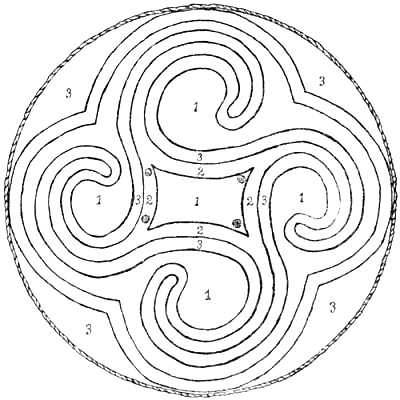
Fig. 257.
WAR SHIELD USED BY THE PIMA INDIANS.
Ogee Swastika (tetraskelion) in three colors: (1) blue,
(2) red, (3) white. Cat. No. 27829, U. S. N. M.
Fig. 258.
WAR SHIELD WITH OGEE SWASTIKA IN CENTER.
Pima Indians. The hole near the lower arm of the Swastika
was made by an arrow. Property of Mr. F. W. Hodge.
Dr. Matthews informs me that he has no knowledge of any peculiar meaning
attributed by these Indians to this Swastika symbol, and we
now not whether it is intended as a religious symbol, a charm of blessing, or good
luck, or whether it is only an ornament. We do not know whether it has any
hidden, mysterious, or symbolic meaning; but there it is, a prehistoric or
Oriental Swastika in all its purity and simplicity, appearing in one of
the mystic ceremonies of the aborigines in the great American desert in
the interior of the North American Continent.
The Pimas.—The U. S. National Museum possesses a shield (Cat. No.
27829) of bull hide, made by the Pima Indians. It is about 20 inches in
diameter, and bears upon its face an ogee Swastika (tetraskelion), the
ends bent to the right. The body and each arm is divided longitudinally
into three stripes or bands indicated by colors, blue, red, and white,
arranged alternately. The exterior part of the shield has a white ground,
while the interior or center has a blue ground. This shield (fig. 257) is
almost an exact reproduction of the Swastika from Mycenæ (fig. 161), from
Ireland (fig. 216), and from Scandinavia (figs. 209 and 210). Fig. 258
shows another Pima shield of the same type. Its Swastika is, however,
painted with a single color or possibly a mixture of two, red and white.
It is ogee, and the ends bend to the left. This shield is the property of
Mr. F. W. Hodge, of the Bureau of Ethnology. He obtained it from a Pima
Indian in Arizona, who assured him that the hole at the end of the lower
arm of the Swastika was made by an arrow shot at him by an Indian enemy.
COLONIAL PATCHWORK.
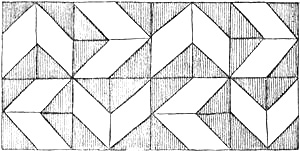
Fig. 259.
COLONIAL PATCHWORK WITH FIGURES
RESEMBLING SWASTIKAS.Scribner’s Magazine, September, 1894.
In Scribner’s Magazine for September, 1894, under the title of “Tapestry
in the New World,” one of our popular writers has described, with many
illustrations, the bedquilt patterns of our grandmothers’ time. One of
these she interprets as the Swastika. This is, however, believed to be
forced. The pattern in question is made of patches in the form of
rhomboids and right-angled triangles sewed and grouped somewhat in the
form of the Swastika (fig. 259). It is an invented combination of
patchwork which formed a new pattern, and while it bears a slight
resemblance to the Swastika, lacks its essential elements. It was not a
symbol, and represents no idea beyond that of a pretty pattern. It stood
for nothing sacred, nor for benediction, blessing, nor good luck. It was
but an ornamental pattern which fortuitously had the resemblance of
Swastika. It was not even in the form of a cross. The difference between
it and the Swastika is about the same there would be between the idle and
thoughtless boy who sporadically draws the cross on his slate, meaning
nothing by it, or at most only to make an ornament, and the devout
Christian who makes the same sign on entering the church, or the Indian
who thus represents the four winds of heaven. He who made the Swastika
recognizes an occult power for good and against evil, and he thereby
invokes the power to secure prosperity. She who made the quilt pattern
apparently knew nothing of the old-time Swastika, and was not endeavoring
to reproduce it or anything like it. She only sought to make such an
arrangement of rhomboidal and triangular quilt patches as would produce a
new ornamental pattern.
CENTRAL AMERICA.
NICARAGUA.
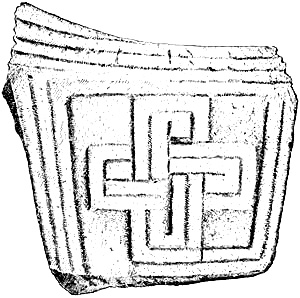
Fig. 260.
FRAGMENT OF THE FOOT OF A STONE
METATE WITH FIGURE OF SWASTIKA.Nicaragua. Cat. No. 23726, U. S. N. M.
The specimen shown in fig. 260 (Cat. No. 23726, U. S. N. M.) is a
fragment, the foot of a large stone metate from Zapatero, Granada,
Nicaragua. The metate was chiseled or pecked out of the solid. A sunken
panel is surrounded by moldings, in the center of which appears, from its
outline, also by raised moldings, a figure, the outline of which is a
Greek cross, but whose exterior is a Swastika. Its form as such is
perfect, except that one bent arm is separated from its stem by a shallow
groove.
“The Cross, Ancient and Modern,” by W. W. Blake, shows, in its fig. 57, a
Swastika pure and simple, and is cited by its author as representing a
cross found by Squier in Central America. The Mexican enthusiast, Orozco y
Perra, claims at first glance that it shows Buddhist origin, but I have
not been able as yet to verify the quotation.
YUCATAN.
Dr. Schliemann reports, in the Ethnological Museum at Berlin, a pottery
bowl from Yucatan ornamented with a Swastika, the two main arms crossing
at right angles, and he adds,[263] citing Le Plongeon, “Fouilles au
Yucatan,” that “during the last excavations in Yucatan this sign was found
several times on ancient pottery.”
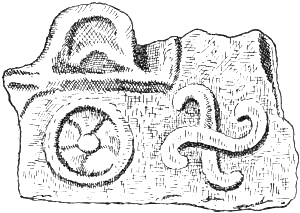
Fig. 261.
FRAGMENT OF STONE SLAB FROM THE
ANCIENT MAYA CITY OF MAYAPAN.
Ogee Swastika (tetraskelion). Proceedings of the
American Antiquarian Society, April 21, 1881.
Le Plongeon discovered a fragment of a stone slab in the ancient Maya city
of Mayapan, of which he published a description in the Proceedings of the
American Antiquarian Society. It contains an ogee Swastika (tetraskelion),
with ends curved to the left and an inverted U with a wheel (fig. 261).
Le Plongeon believed it to be an Egyptian inscription, which he translated
thus: The character, inverted U, stood for Ch or K; the wheel for
the sun, Aa or Ra, and the Swastika for Ch or K, making the whole
to be Chach or Kak, which, he says, is the word fire in the Maya
language.[264]
COSTA RICA.
A fragment of a metate (Cat. No. 9693, U. S. N. M.) found on Lempa River,
Costa Rica, by Capt. J. M. Dow, has on its bottom a Swastika similar to
that on the metate from Nicaragua. Specimen No. 59182, U. S. M. N., is a
fragment of a pottery vase from Las Huacas, Costa Rica, collected by Dr.
J. F. Bransford. It is natural maroon body color, decorated with black
paint. A band two inches wide is around the belly of the vase divided into
panels of solid black alternated with fanciful geometric figures, crosses,
circles, etc. One of these panels contains a partial Swastika figure. The
two main arms cross at right angles in Greek form. It is a partial
Swastika in that, while the two perpendicular arms bend at right angles,
turning six times to the right; the two horizontal arms are solid black in
color, as though the lines and spaces had run together.
SOUTH AMERICA.
BRAZIL.
The leaden idol (fig. 125) (Artemis Nana[265] of Chaldea, Sayce;
statuettes of the Cyclades, Lenormant) found by Dr. Schliemann in the
third, the burnt city of Hissarlik, Troy, was described (p. 829) with its
Swastika on the triangular shield covering the pudendum, with the
statement that it would be recalled in the chapter on Brazil.
The aboriginal women of Brazil wore a triangular shield or plaque over
their private parts. These shields are made of terra cotta, quite thin,
the edges rounded, and the whole piece rubbed smooth and polished. It is
supported in place by cords around the body, which are attached by small
holes in each angle of the triangle. The U. S. National Museum possesses
several of these plaques from Brazil, and several were shown at the
Chicago Exposition.
The consideration of the leaden idol of Hissarlik, with a Swastika, as
though for good luck, recalled to the author similar plaques in his
department from Brazil. Some are of common yellow ware, others were finer,
were colored red and rubbed smooth and hard, but were without decoration.
The specimen shown in pl. 18 (upper figure) was from Marajo, Brazil,
collected by Mr. E. M. Brigham. It is of light gray, slip washed, and
decorated with pale red or yellow paint in bands, lines, parallels,
geometric figures. The specimen shown in the lower figure of the same
plate, from the Caneotires River, Brazil, was collected by Prof. J. B.
Steere. The body color, clay, and the decoration paint are much the same
as the former. The ornamentation is principally by two light lines laid
parallel and close so as to form a single line, and is of the same
geometric character as the incised decoration ornament on other pieces
from Marajo Island. Midway from top to bottom, near the outside edges, are
two Swastikas. They are about five-eighths of an inch in size, are turned
at right angles, one to the right and the other to the left. These may
have been a charm signifying good fortune in bearing children. (See pp.
830-832.)
These specimens were submitted by the author to the Brazilian minister,
Señor Mendonça, himself an archæologist and philologist of no small
capacity, who recognized these objects as in use in ancient times among
the aborigines of his country. The name by which they are known in the
aboriginal language is Tambeao or Tamatiatang, according to the
dialects of different provinces. The later dialect name for apron is
reported as tunga, and the minister makes two remarks having a possible
bearing on the migration of the race: (1) The similarity of tunga with
the last syllable of the longer word, atang, and (2) that tunga is
essentially an African word from the west coast. Whether this piece of
dress so thoroughly savage, with a possible ceremonial meaning relating to
sex or condition, with its wonderful similarity of names, might not have
migrated in time of antiquity from the west coast of Africa to the
promontory of Brazil on the east coast of America where the passage is
narrowest, is one of those conundrums which the prehistoric anthropologist
is constantly encountering and which he is usually unable to solve.
The purpose of these objects, beyond covering the private parts of the
female sex, is not known. They may have been ceremonial, relating, under
certain circumstances, to particular conditions of the sex, or they may
have been only variations of the somewhat similar covers used by the male
aborigine. They bear some resemblance to the Ceintures de Chasteté,
specimens of which are privately shown at the Musée de Cluny at Paris.
These are said to have been invented by Françoise de Carara, viguier
imperial (provost) of Padua, Italy, near the end of the fourteenth
century. He applied it to all the women of his seraglio. He was beheaded
A. D. 1405, by a decree of the Senate of Venice, for his many acts of
cruelty. The palace of St. Mark contained for a long time a box or case of
these ceintures with their locks attached, which were represented as
des pieces de conviction of this monster.[266] Voltaire describes his
hero “qui tient sous la clef, la vertu de sa femme.”
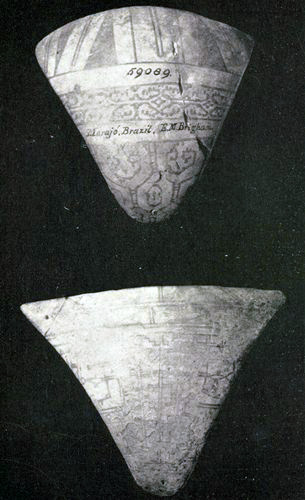
Plate 18. Folium Vitus (“Fig Leaves”).
Terra-cotta covers, “tunga.” Aborigines of Brazil.
Cat. Nos. 59089 and 36542, U. S. N. M.
Map showing Distribution of the Swastika.
PARAGUAY.
Dr. Schliemann reports that a traveler of the Berlin Ethnological Museum
obtained a pumpkin bottle from the tribe of Lenguas in Paraguay which bore
the imprint of the Swastika scratched upon its surface, and that he had
recently sent it to the Royal Museum at Berlin.
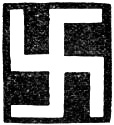
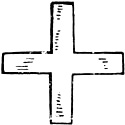
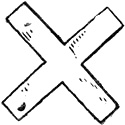
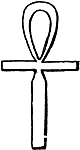
![[Y]](https://openoldbooks.sgp1.digitaloceanspaces.com/books/the-swastika/images/img_y.jpg) , on which the convicted person was fastened by the feet and hung
head downward. Another form
, on which the convicted person was fastened by the feet and hung
head downward. Another form ![[symbol]](https://openoldbooks.sgp1.digitaloceanspaces.com/books/the-swastika/images/img_sq_u.jpg) , whereon he was fastened by one foot
and one hand at each upper corner; still another form
, whereon he was fastened by one foot
and one hand at each upper corner; still another form ![[symbol]](https://openoldbooks.sgp1.digitaloceanspaces.com/books/the-swastika/images/img_t.jpg) , whereon
his body was suspended on the central upright with his arms outstretched
upon the cross beams.
, whereon
his body was suspended on the central upright with his arms outstretched
upon the cross beams.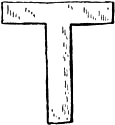
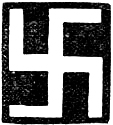
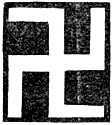
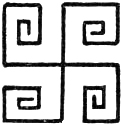
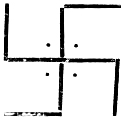
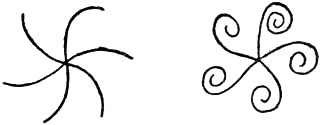
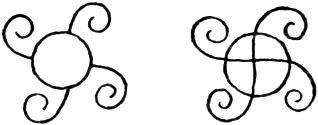
![[cross]](https://openoldbooks.sgp1.digitaloceanspaces.com/books/the-swastika/images/img_cross.jpg) ) occurs as
a sign for earth in certain ideographic groups. It was probably
intended to indicate the four quarters—north, south, east, west—or,
it may be, more generally, extension in length and breadth.
) occurs as
a sign for earth in certain ideographic groups. It was probably
intended to indicate the four quarters—north, south, east, west—or,
it may be, more generally, extension in length and breadth.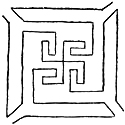
![[symbol]](https://openoldbooks.sgp1.digitaloceanspaces.com/books/the-swastika/images/img022.jpg) or
or ![[symbol]](https://openoldbooks.sgp1.digitaloceanspaces.com/books/the-swastika/images/img023.jpg) (ne), which
has the form
(ne), which
has the form ![[symbol]](https://openoldbooks.sgp1.digitaloceanspaces.com/books/the-swastika/images/img024.jpg) in the inscription of Golgi, and also with the
Hittite
in the inscription of Golgi, and also with the
Hittite ![[symbol]](https://openoldbooks.sgp1.digitaloceanspaces.com/books/the-swastika/images/img025.jpg) or
or ![[symbol]](https://openoldbooks.sgp1.digitaloceanspaces.com/books/the-swastika/images/img026.jpg) which Dr. Hyde Clarke once suggested to
me was intended to represent the organs of generation.
which Dr. Hyde Clarke once suggested to
me was intended to represent the organs of generation.