Chameleon.—Light Coloured Eggs.—Sitting Birds have no
Scent.—Forget-me-nots.—Trespassing.—The Owner.—A
Chase.—Capture.—Pintail Duck.—Drumming of Snipe.—Swallow-tail
Butterfly.—A Perilous Adventure.
The young voyagers had by this time discovered that sailing about in the
manner they were doing gave them tremendous appetites, and on this
particular morning they found they had run short of bread and butter, so
Jimmy was despatched to the little shop at Horning to procure some.
After breakfast they were lounging on deck waiting for a breeze. Dick
was sprawling on the roof of the cabin basking in the sun. Frank was
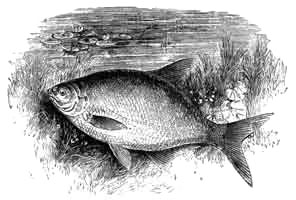
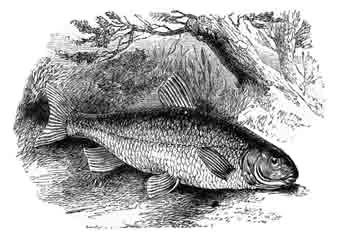
fishing for roach in the clear slow stream, and Jimmy was perusing the
newspaper in which the provisions had been wrapped. It was a still,
lovely morning. White clouds sailed quickly across the blue sky, but
there was no breeze to move the marsh grasses and reeds, or to ripple
the placid stream. A lark sang merrily far above them, filling the air
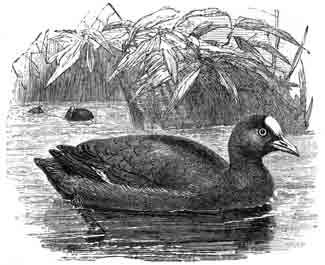
with melody. Small birds chirped in the sedges, and the water-hens and
white-headed coots sailed busily to and fro.
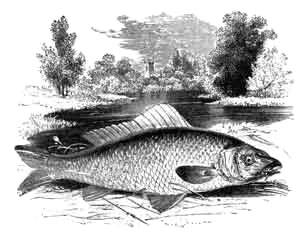
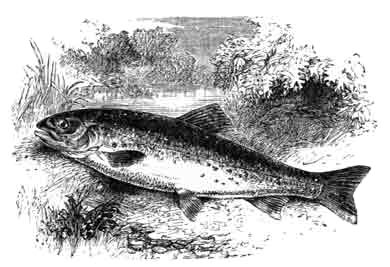
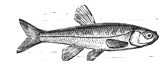
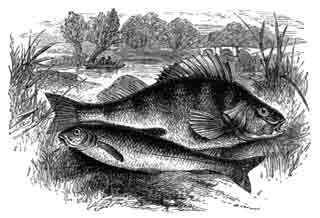
Roach.
Jimmy looked up from his paper just as Frank pulled in a good sized
roach, and said,—
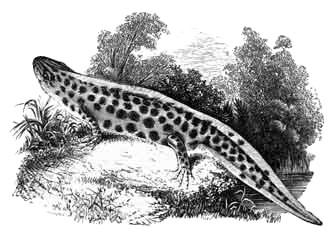
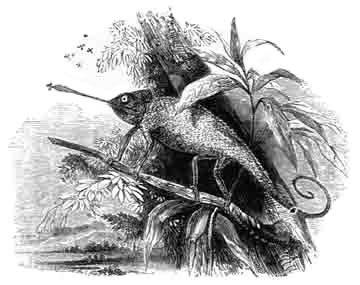
"Do either of you know how the chameleon changes its colour?"
Upon receiving an answer in the negative he read as follows from the
paper in his hand:—
"M. Paul Bert has laid before the French Academy a résumé of the
observations of himself and others on the colour-changes of the
chameleon. They appear to be due to change of place of certain coloured
corpuscles. When they bury themselves under the skin, they form an
opaque background to the cerulescent layer, and when they distribute
themselves in superficial ramifications, they either leave the skin to
show its yellow hue, or give it green and black tints. The movements of
the colour corpuscles are directed by two orders of nerves, one causing
their descending, and the other their ascending, motions. In a state of
extreme excitation the corpuscles hide below the skin, and do so in
sleep, anæsthesia, or death. The nerves which cause the corpuscles to go
under the skin have the greatest analogy to vaso-constrictor nerves.
They follow the mixed nerves of the limbs, and the great sympathetic of
the neck, and do not cross in the spinal marrow. The nerves which bring
the corpuscles upwards resemble in like manner the vaso-dilator nerves.
Luminous rays belonging to the blue-violet part of the spectrum act
directly on the contractile matter of the corpuscles, and cause them to
move towards the surface of the skin."
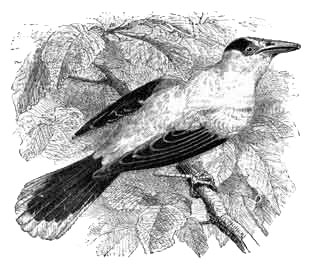
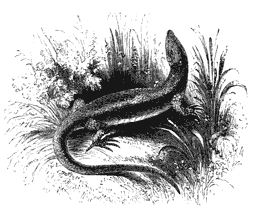
Chameleon.
"Now, can you tell me the plain English of that?"
"Read it again, Jimmy," said Frank.
Jimmy did so.
"Well, I am no wiser. Read it again more slowly."
Jimmy did so again.
"I give it up," said Frank. "What a thing it is to be a scientific man!"
"I take it," said Dick, rolling himself along the cabin roof towards
them, "that it means that different coloured rays of light have
corresponding effects upon coloured atoms in the skin of the chameleon.
The rays of light will be affected by the colour of the place where the
chameleon is, and the chameleon will be affected by the changed colour
of the rays of light, so that if the beast were on a green lawn his
colour would be green, and if on a brown tree-trunk his colour would be
brown."
"That is my idea," said Jimmy; "but what is the good of using such
stilted language, when the same thing might have been said in simple
English?"
"I wonder why that water-hen keeps dodging about us in such a fussy
manner," said Frank.
"I don't," replied Dick, "for there is her nest not a yard from our
bows."
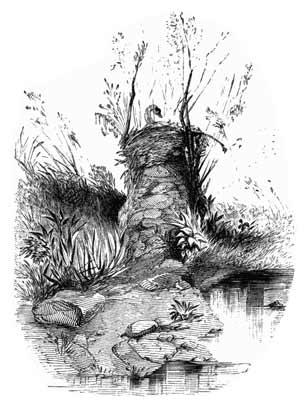
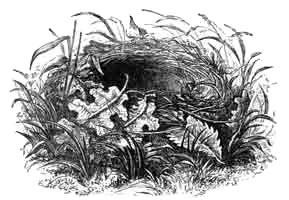
The mooring rope had parted the reeds, and discovered her nest, and
Dick, on going to the bows had seen it. It contained twelve eggs, one of
which was so light in colour as to be almost white, and one so small
that it was only half the size of the others. Dick asked if it were
because it was laid last, and if the pale one was so for a similar
reason. Frank replied,—
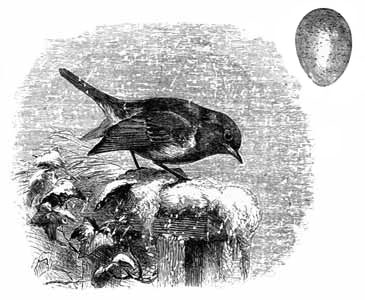
"It may be so in this case, but it does not always happen so. Last year
I tried an experiment with a robin's nest. I took out an egg each day,
as it was laid, and still the bird went on laying until I let her lay
her proper number, five. She laid fifteen eggs altogether, but they were
all the same colour and size. So I expect that it is only an accident
when the eggs are like these."
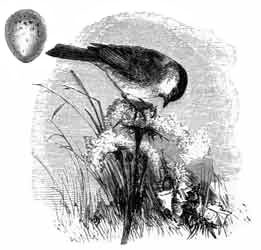
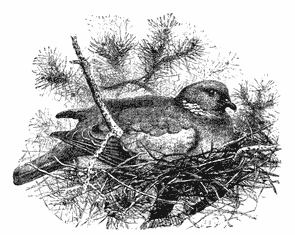
"Bell told me the other day that sitting birds have no scent," said
Dick. "Is that true?"
"I am not quite sure, but I am inclined to think that they have not so
strong a scent as at other times. This same robin which I have just been
telling you about built in a hedge-bank close by a house, and cats were
always prowling about, and I have seen puss walk right above the nest
while the old bird was on. If birds would only have the sense to shut
their eyes, we would often pass them over, but it is easy to see them
with their eyes twinkling like diamonds."
"How pretty that clump of forget-me-nots is on the opposite bank! They
seem to smile at you with their blue eyes," said Dick, who was keenly
alive to all that was beautiful. "But what is that flower a little lower
down, right in the water, with thick juicy stems and blue flowers. Is
that a forget-me-not?"
"No, it is a brooklime, but it is one of the speedwells. There are more
than a dozen sorts of speedwells, but the forget-me-not is the
prettiest. Another name for the forget-me-not is water-scorpion, but it
is too ugly a name for so pretty a plant," said Jimmy, full of his
recent learning.
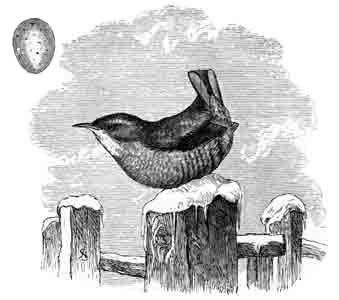
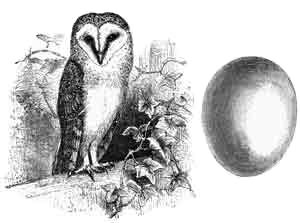
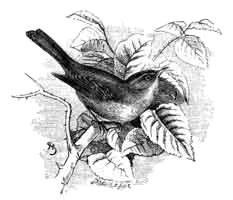
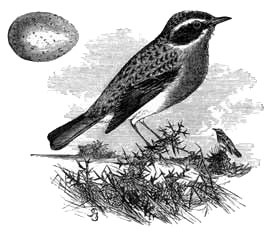
Redbreast and Egg.
"Here comes a breeze at last," cried Frank, as their blue flag
fluttered, and the reeds in the surrounding marsh bent their heads
together and sighed. "Shall we explore Ranworth Broad?"
"Yes, but let us take Hoveton Great Broad first, and then we can go to
Ranworth as we come back," answered Jimmy.
So they hoisted sail, and glided up stream with a freshening breeze,
while swallows dipped in the river and whirled about them as they
passed. While they were sailing steadily along with a breeze on their
starboard beam, the flag became fouled in the block through which the
halyard of the mainmast was rove, and Jimmy was sent up to put matters
right. He clambered up the mast as nimbly as a monkey, and shook loose
the flag from its ignominious position. When he had finished this he
looked about him, and from his greater height he could see much further
than his companions, whose view was limited by the tall reeds which shut
in almost every portion of the rivers and broads. The boys did not know
that they were near any of the latter, but Jimmy saw on their left hand
a sheet of water sparkling in the sun and studded with many reedy
islands. He cried out,—
"There is such a jolly broad to leeward! It looks so quiet and still,
and there are no end of water-fowl swimming about in it. A little
further on I can see a channel leading to it just wide enough for our
yacht. What do you say to paying it a visit?"
His friends had not the least objection. Its being unknown to them was
an additional reason for their including it in their voyage of
discovery. Jimmy said he should stay on his lofty perch for a time and
take the bearings of the country, but as they neared the entrance to the
broad and turned off before going down the narrow channel, the boom
swung further out, and the jerk dislodged Jimmy, who was only saved from
falling by clutching at the shrouds, down which he came with a run. They
surged along through the dyke with the reeds brushing their bulwarks,
and tossing and swaying in the eddies which followed their wake, and
after several twistings and windings they emerged upon the broad.
At the entrance to it was a pole with a notice-board upon it, which
stated that the broad belonged to Mr. ——, and that any persons found
trespassing upon it would be prosecuted.
"Hallo! do you see that?" said Dick.
"Yes, I see it," replied Frank, "but we could not turn back in that
narrow channel, and now that we are on the broad we may as well sail
about a bit. What a number of water-fowl there are!"
"I know Mr. —— by sight," said Jimmy. "He has a big blue yacht."
The little lake was so picturesque with its islands and "ronds" and
broad floating lily-leaves, that the boys sailed about for some time
before they thought of leaving it, and when they turned their faces
again towards the river, what was their surprise to see a large yacht
creeping along the connecting canal between them and the river. The
reeds hid the body of the yacht from them, but its sails betokened that
it was one of considerable size.
The boys wondered who it could be who had thought of paying the
sequestered little broad a visit, never for a moment thinking of the
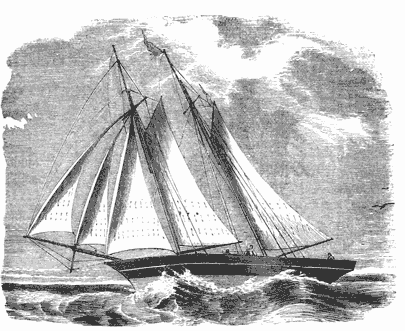
owner, when the yacht shot out into the open water, and lo! it was a
'big blue yacht.'
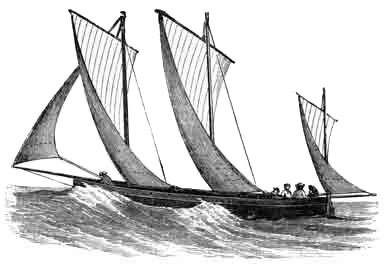
Yacht.
"It is Mr. ——," said Jimmy.
"Now we shall get into a row for trespassing," said Dick.
"They have got to catch us first. If we can only dodge them, and get on
to the river again, we can show them a clean pair of heels," said
Frank, taking a pull at the sheet and trying to creep up to windward of
the dyke. The blue yacht, however, stood by so as to meet them, and
Frank saw, by the way she went through the water, even when her sails
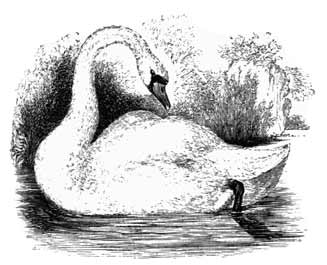
were hauled almost flat, that she could beat the Swan in sailing to
windward. A gentleman stood up in the strange yacht and called out,—
"Bear, up alongside, you young rascals, and give me your names and
addresses. I shall summon you for trespassing."
"Not if I know it," said Frank, bringing the Swan sharply round on her
heel, and scudding away before the wind, followed by the other in full
chase.
"Now, Jimmy and Dick, stand by the sheets, and when we get opposite the
bottom of that long island, we will bring her sharp round the other
side, and then they can't get across and meet us, and then we'll cut and
run for the dyke."
They executed this manœuvre very neatly, but the other was too quick
for them, and instead of following them round the island, they turned
back and made for the mouth of the dyke to intercept them, and at a much
better angle of the wind than that at which the Swan had to sail.
"We shall come into collision," said Jimmy, as he took a hearty pull at
the mizen sheet. "We cannot both get through the dyke."
"Never mind. We'll cram her at it. Stand by with the boat-hook to push
the blue 'un off, Dick!" but as Dick stood ready with the boat-hook to
push off, a man stood in the other yacht with his boat-hook to pull them
in, and as Dick pushed, his adversary pulled. The two boats ran
alongside for a few yards, and then were jammed together at the mouth of
the creek, and Mr. —— stepped on board.
"Now what is the meaning of this?" he exclaimed angrily.
"We came into the broad out of curiosity, sir," said Frank; "and we
could not see the notice-board until we were in the broad, and then we
thought we might as well take a turn round before going out, but we are
sorry you have caught us."
"Oh, are you really! Well, I want to preserve the broad for wild-fowl,
so I don't like it to be disturbed; but where did you get this strange
boat built?"
"We built it ourselves," answered the boys,—and then in reply to the
inquiries, they told him all about it, and their object, and by the time
all was explained to him they found that he was a very jolly sort of
fellow, and he found that they were very pleasant, unaffected lads, and
the end of it was that they lunched with him on board his yacht, and had
full permission to go on the broad whenever they liked.
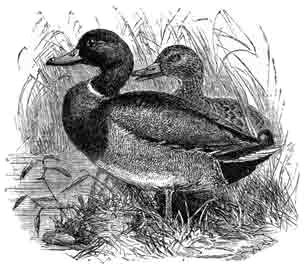
Frank's attention was arrested by a pretty, light grey duck swimming
about in the centre of the broad.
"Is that a pintail duck?" he inquired of Mr. ——.
"Yes, and the only one on the broad, I am sorry to say. Its mate has
been killed, and my man found the deserted nest with four eggs in it,
among the reeds on the other side of the broad. If he has not taken it
you may have it."
His man had not taken it, and in a few minutes the boys were the
possessors of the eggs of this rare duck. The nest and eggs were of the
usual duck type, and did not correspond in any degree with the extreme
prettiness of the duck, which, with its mottled grey back and red-brown
head and neck, is as fair to look at as it is good to eat.
The yachts were disengaged from their position without any damage, and
the boys took leave of their entertainer with a cheer, and made for the
river again.
"I hope all our adventures will end as nicely as that one," said Dick.
The wish was echoed by the others; but that very day they had an
adventure which startled them considerably, and might have had very
serious and fatal consequences. But of this anon.
Presently Dick said,—"I have noticed whenever we see a mud-bank that it
is almost sure to be perforated by a number of small holes. What is the
reason of that?"
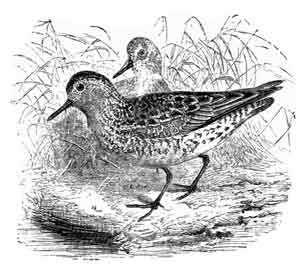
"Oh, that is done by the snipes, when boring in search of food.
Woodcocks will do it as well, and the woodcock's upper bill is so long
and flexible that it can twist and turn it about in the mud with the
greatest ease," answered Frank, who was always ready with an answer on
ornithological subjects.
By and by Dick was observed to be looking all about with a very puzzled
and curious air, peeping into the cabin, and scrutinizing the deck and
the banks with the utmost attention.
"What is the matter, Dick?" said Jimmy at length.
"What on earth is that buzzing noise? It seems to be close to us, and I
can't find out the cause of it. I did not like to ask before—it seemed
so simple. Is it a big bee, or wasp, or what?"
Frank and Jimmy laughed heartily, and the former said,—
"Look up in the air, Dick."
Dick did so, and saw a bird which he knew to be a snipe, hovering
somewhat after the manner of a kestrel, or windhover, as the country
people sometimes call it. It was evident now that the noise came from
it, but how was it produced, and why?
Frank could not answer either of these questions. It was a habit of the
snipes in breeding time to rise and 'drum' in that way.
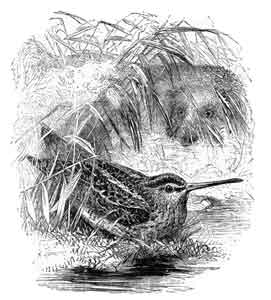
Common Snipe.
"No doubt he does it for a lark, and no doubt he thinks he does it as
well as a lark, but no one seems to be sure how the noise is produced.
The general opinion seems to be that it is caused by a vibration of the
tail-feathers."
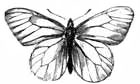
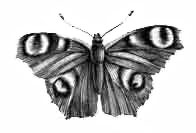
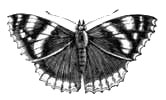
"Look!" cried Dick excitedly, diving into the cabin for his butterfly
net. Over the marsh there fluttered one of the grandest of English
butterflies, the swallow-tail. Large in size, being about four inches
across the wings, which are of a pale creamy-yellow, barred and margined
with blue and black, velvety in its appearance, and with a well-defined
'tail' to each of its under wings, above which is a red spot, the
swallow-tail butterfly is one of the most beautiful of all butterflies.
It is rare save in its head-quarters, which are the fens of Norfolk and
Cambridge, and is justly considered a prize by a young collector. Frank
immediately ran the yacht ashore, and Dick jumped out and rushed at the
gorgeous insect with his net. Alas! he struck too wildly and missed it,
and it rose in the air and flew far away, leaving Dick lamenting. Frank
laughed and said,—
"Ah, you went at it too rashly. You should have given it him with more
of the suaviter in modo and less of the fortiter in re. Here comes
another. Let me have a try!"
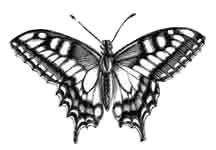
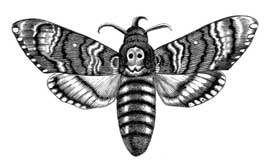
Swallow-tail Butterfly.
Dick yielded up possession of the net to him, and he advanced slowly and
cautiously to where the swallow-tail was sunning himself on an early
tuft of meadow-sweet, which the warm weather had tempted to bloom
earlier than usual, and to perfume the air with its strong fragrance on
the last day of May.
Frank's approach had too much of the suaviter in modo, for the
butterfly flew away long before he reached it. Frank forgot all about
the suaviter in modo then. He dashed after it at the top of his speed,
making frantic dashes at it with his net, and jumping over soft ground,
with utter disregard to all dangerous places. He followed it for some
distance, and then he suddenly disappeared, and to their dismay they
heard him shouting loudly for help.
"He has got into a bog-hole," said Jimmy, "come along as fast as you
can."
They ran with breathless speed to where he had disappeared, and so
deceptive are distances on flat surfaces, that they were surprised to
see how far he had gone. When they reached him they saw him up to his
waist in the soft bog, whose bright vivid green would have shown its
danger had he not been too eager in his pursuit of the butterfly to
notice it. He was rapidly sinking deeper into the mud, which held him
fast with cruel tenacity, and sucked him further into its horrid embrace
the more he struggled to get out of it. He had taken a big jump right
into the very middle of it, and he was too far from them to reach their
hands. His face was pale, but he was cool and collected.
"All right," he said, "don't be frightened. I've got the butterfly, and
if you will do what I tell you, I will soon get out of this fix. Dick,
do you run to the yacht and get a rope, and you, Jimmy, get some reeds,
and pitch them to me to put under my arms, and keep me from sinking
further into this fearful mess."
Dick sped off like an arrow, and Jimmy tore up a bundle of reeds and
threw them to his friend, who had now sunk up to his shoulders, and as
the reeds broke beneath his weight he sunk deeper still.
"I hope Dick won't be long, or it will be all up with me, Jimmy," he
said, and brave as he was, he could not keep his lips from quivering.
Jimmy was in an agony of excitement. He took off his coat, and threw one
end of it to Frank, but he could not reach him. Then he did what even
raised a smile on Frank's face, imminent as was his danger. He took off
his trousers and threw one leg to Frank, retaining the other in his
hand. Pulling hard at this improvised rope, he held Frank up until Dick
came tearing up with the rope trailing behind him.
"Thank God!" said Frank, and Jimmy then knew by his fervent tone how
great he knew the danger had been. Clinging to the rope, he was hauled
out by his companions, and so tightly did the mud hold him, that it took
all their strength to drag him out. They walked slowly and quietly back
to the yacht, and Frank changed his clothes, and lay down and was very
quiet for some time, and they none of them recovered their usual spirits
for some time after this occurrence.
The butterfly was set, and ever afterwards kept apart in Dick's
collection as a memento of this time.
Before they went home again they had got several specimens of this
handsome butterfly, and still better, they discovered numbers of the
bright green caterpillars and chrysalides on the meadow-sweet and wild
carrot, which grew in the marsh, and so were able to breed several fine
specimens, enough for their own collection and for exchange.