I had just returned
from attendance on my first course of medical lectures. Although not a
graduate, I had all the pruriency of a young neophyte, and felt very
desirous of an occasion wherein my Esculapian acquirements could be
exhibited, from call, visit, patient, disease, diagnosis, prognosis,
treatment, to cure; or else ominously and sorrowingly murmur to the
bereaved friends who are taking the measure—“if he'd only sent for
me sooner!” I wanted a case, the management all to myself, from comma to
period, white, black, old, young, maid, wife, widow, masculine, feminine,
old bachelor, or Indian, I cared not which; a patient was what I wanted,
and the shape in which it would come, however questionable, I was
indifferent to. The country adjacent to the village where I was studying,
is, on two sides, swamp of the vilest, muddiest nature imaginable, with
occasional tracts of fine land, generally situated on some bayou or lake;
frequently an “island” of tillable land will be found rising out of the
muddy swamp, accessible to footmen or horse only, when the river is within
its banks, varying in size from fifty to two hundred acres; and, wherever
existing, generally occupied by a small planter. Every farmer in
the South is a planter, from the “thousand baler” to the rough, unshaved,
unkempt squatter, who raises just sufficient corn and cotton to furnish a
cloak for stealing the year's supply.
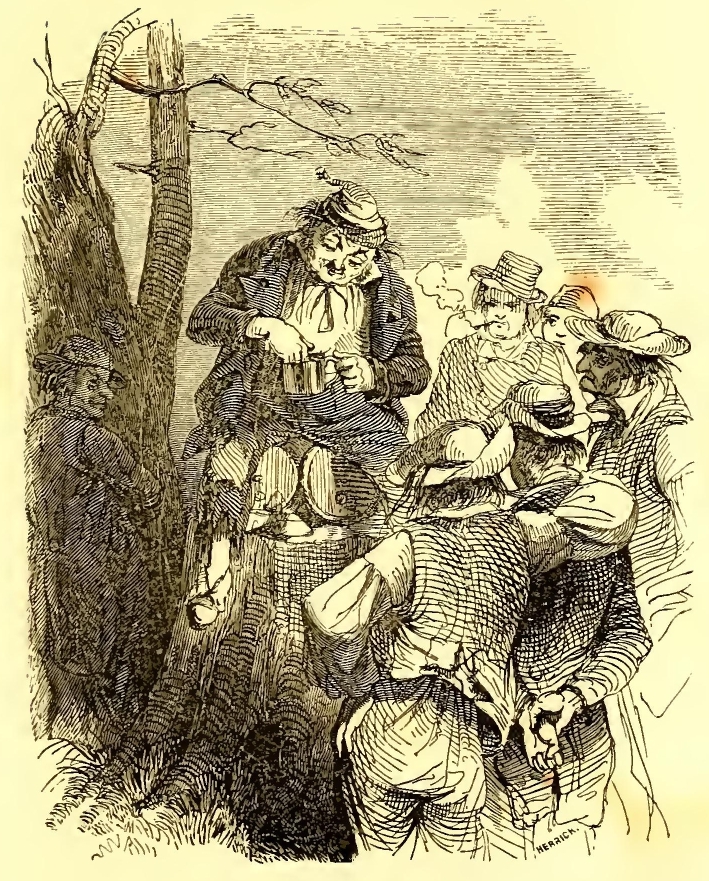
A few hours' ride from town was one of these islands, “pre-empted” by a
man named Spiffle, whose principal business was to fatigue him devising
ways and means to live without work. He would have scorned to hoe an hour
in his corn patch, and yet would not have hesitated a moment to pursue a
deer or bear for days, with all the indefatigability of a German
metaphysical philosopher studying an incomprehensibility. But hunting deer
and bear, though it brought more sweat and fatigue in an hour than the
hardest day's work, was sport; so was drinking whiskey, and between the
two, Jim Spiffle had little time to extend the limits of his demesnes, or
multiply the com forts of his household circle, wherein a wife and a dozen
children attested Jim's obedience to scripture.
It is a sultry day in June, and I am about describing the external
appearance of Jim's pre-emption. A small patch of green and waving corn,
surrounded by a brush fence, save where it is eked out, by the side of an
antiquated log-cabin, with a dirt chimney, around whose top the smoke is
lying in dense heaps, too lazy to curl; one or two bedraggled hens, by
noisy cackling, are endeavouring to inform the mistress that their diurnal
recumbencies are consummated—whilst the cock of the walk, desirous
of egging them on to increased exertions, struts majestically before them,
waving one feather, constituting his tail, and seriously meditates a crow;
but when he reflects that the exertion of flapping his wings must premise,
contents himself with a low chuckle of admiration. An old hound, mangy and
blear-eyed, is intent upon a deer's leg; and, as he gnaws its tough
sinews, tries to delude himself into the belief that it is a delectable
morsel from the ham. A boy of some thirteen winters, in full dress swamp
costume (a short, well-worn shirt), rifle in hand, at a short distance
from the house, is endeavouring to allay the mental and bodily disquietude
of a fox-squirrel, so that they both may be on the same side of a chunky
gum, up which the aforesaid squirrel, on the approach of the incipient
Nimrod, had incontinently retreated. Spiffle, jun., sneaks round to the
south side, but “funny” hangs on the north, east, and west—back to
the north and south, all in vain! All the points of the mariner's compass
are traversed, but still the cunning squirrel evades his foe, who, venting
his malediction, finally retires from the pursuit, muttering, “Cuss you! I
was only going through the motions; the rifle ain't loaded!” The lord of
the soil, extended to his full proportions, is lying on a log, beneath a
shady bush; a branch of which is bent down and so ingeniously arranged,
that when the breeze moves, it will scratch his head; his mouth is full of
tobacco—and as he sleeps, true to his nature, his right hand is
busily engaged stealing a couple of dimes and an old jack-knife out of his
own pocket; his jaws are relaxed, and the huge, well-chewed quid gleams
beautifully dark from the profundity of mouth; a gentle titillation on his
lips half arouses him, and, champing his jaws with an emphasis, his waking
senses are saluted by the yell of his eldest born, who, on the failure of
his squirrel enterprise, finding dad asleep, had made an heroic attempt to
hook his sire's quid out of the deep abyss. The poor boy pays dearly for
the attempted larceny—three fingers hanging by mere shreds of skin,
are the attestations of his dad's strength of jaw. The scream of the poor
devil, and the boisterous grief of the miserable squatter, who, though the
“Arab” of the swamp, has still a father's feelings, brings from the cabin
a form which, begrimed with dirt, and haggard with premature age, would
scarcely be taken for the best of God's works—a woman—but such
she was; and her tears and outcries also gave evidence that she, too,
amidst the heart-hardenings of poverty, contumely, and lowliness, had
still gushing up in her heart the pure waters of love.
“Lordy grashus!” she cried; “you have ruined the child! Oh! how could you
doit? You, a man grown, and him, your own son! Oh, Jim!”
“'Twasn't my fault, Betsy,” answered poor Jim, “'twasn't my fault! Oh!
what must I do? He's gwine into 'vulshuns.”
“Jump on the critter and git the doctor!” said Betsy. “Quick, Jim! Oh,
Lordy! only twelve children—and to lose one of them!” and the poor
mother sobbed as if her heart were rending; whilst Jim, jumping on a
belter horse than befitted his circumstances, made all haste for town,
whither he arrived about dinner-time—and dashing up with frantic
haste to the office-door, yelled out, “Doctor! oh, doctor! I've bit my
son's hand off, and he's dying, sarten! Come, quick! dear doctor! that's a
good old hoss!—oh, do!”
But the “good old hoss” not responding to his appeal, he dismounted, and
rushed in, repeating his cry.
“What's the matter? what's the matter? who's sick?” said I, rushing in
from a back room—one book open in my right hand, and a ponderous
tome under my left arm.
“Oh! young doctor, where's the old man? I've bit my son's arm off, and
he's gone into 'vulshuns, and I want the boss to come right out.”
“He's gone into the country, and won't be back before night,” replied I.
“Did your boy's arm bleed much?”—not reflecting on the absurdity of
a man biting a boy's arm off.
“Bleed! Yes, all three stumps bled like a stuck deer.”
“Three h—lls! Spiffle, you're drunk! How could you bite off three of
his arms?”
“Oh, doctor! I meant his fingers; he put them in my mouth when I war
asleep. Sens the old man's out, doctor, you must go. Jes' save his life,
doc, and you'll never want vensun or a good trout-hole while I'm in the
swamp! Be in a hurry, that's a good fellow.”
The chance was too good to be lost—a surgical and medical case
combined—amputation and convulsions. What could be more opportune?
Telling Spiffle I would go as soon as I got some medicine suitable to the
case, I put near half a peck of valerian in my coat pockets, and an ounce
vial of prussic acid in my vest; some calomel, assafoetida, lint, and
adhesive plaster, completed my preparations, and I was ready for business.
The horse I intended to ride was a favourite one of the old doctor's, but
one which, accomplished equestrian as he was, he dare not back, except
when the visit lay over some old beaten road; and as for riding him
through the devious path of the swamp—one moment on the horse's neck
to 'scape an impending limb, the next with the body at a right angle, to
avoid a gnarled and thorny tree—now on one side, now on the other,
and again on both—wading the backwater, jumping logs, swimming the
dark and sullen slough, or with feet raised to the pommel to clear the
cypress-knees, which on every side, as the path would cross a brake,
obtruded their keen points, ready to impale the luckless wight who there
might chance to lose his seat; to ride “Chaos” midst such paths as these,
the old doctor, I have said, would never have dreamed of doing, and, most
assuredly, had he been at home, would not have allowed me to undertake;
but such a ride, with its break-neck peril, chimed well with my youthful
feelings, which pursued the same reckless course that the heart's current
of the medical student has run in, from the time when “Chiron” was a
“grave rat,” to the Tyro of yesterday, who is looking in the dictionary
for the meaning of “artery.”
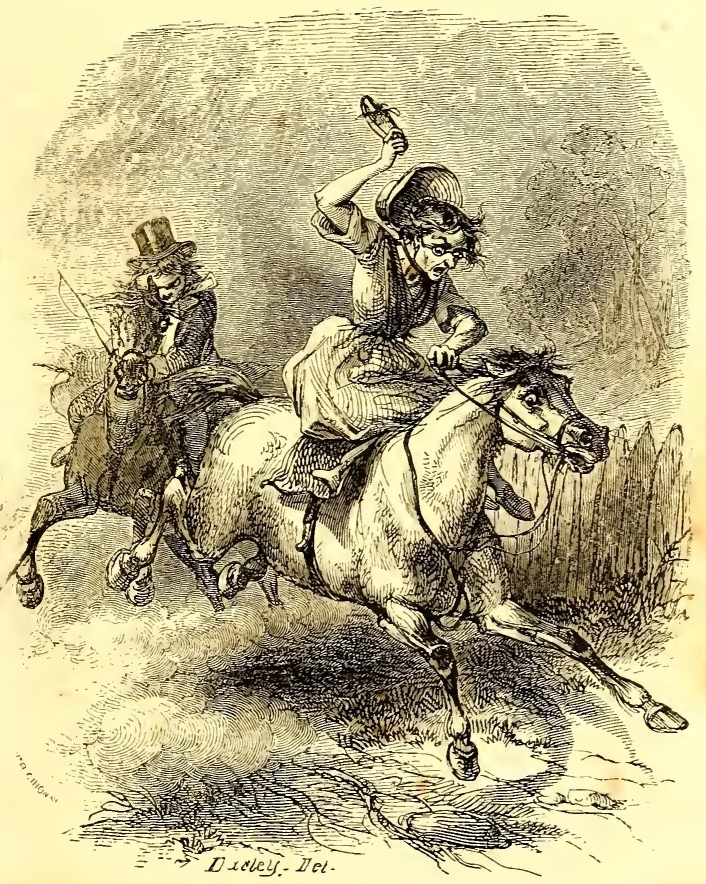
With all the seriousness naturally to be elicited by a responsible
mission, I mounted Chaos, and started at a speed that beplastered the
skeleton houses 011 each side of the way with mud, heaving a delectable
morsel, as I passed the “doggery,” full in the mouth of a picayune
demagogue, who, viewing the political sky with open mouth, was
vociferating vehemently on the merits of his side. “Hurrah!” for he had
just ejaculated, when the substance, which perhaps assisted in composing
an antediluvian megathaslopsyolamagosogiam, or, possibly, “imperial
Cæsar,” hit him “vim” in the patent orifice. Cleaning his throat, he
spluttered out, “Cuss the country, when a man can't holler for the feller
that he likes best, but the heels of every 'prentice saw-bone's horse must
fling clay in his teeth!”
But Chaos heeded him not; imagining I was for a jaunt over his usual road,
he gave way to only sufficient movement to indicate his mettle; but when
the end of the street was reached, where the roads diverged, one pursuing
its upward course over the towering hills—the first from its source
that steal down to gaze upon the wavelets of the “dark Yazoo”—the
other unobtrusively stealing its way a few hundred yards, and then
yielding its being 'neath the placid waters of a bright-eyed lake. Seeing
me turn to the latter, the noble horse gave a joyous neigh, and seemed to
be imbued with a new life as he viewed the waters stretching far away into
the forest, until wave and leaf were melted into one; and as he thought of
the wild luxuriance of a hidden dell, gemmed with a glistening spring, the
memory of which came floating up, fraught with the enjoyments of a month's
pleasure the year gone by, when, disdaining the stable, he had sought the
forest, and there, cropping the herbage, and roaming in all the wild
luxuriance of freedom, forgot he was a slave, until the insidious wiles of
Spiffle restored him to his owner.
Oblivious, apparently, of my weight, he sprung into the waters, and soon—dashing
his beautiful head until the spray covered me with delicious coolness—breasted
the sleepy lake; and when his feet struck the firm ground, like the fawn
from the hunters, away he sprang up the narrow path, which pursued its
tortuous way like a monstrous snake, amidst the nodding grass and fragrant
spice-wood, and old trees, fantastically interweaving their limbs.
But little cared my courser for those old trees, clothed with moss, with
the shadows of their arching boughs the pathway thrown across; he heeded
not the verdancy beneath the eye displayed, nor the gorgeous summer
mingling of the sunshine and the shade; the gentle voice of Eolus, as
dallying with the grove, came breathing gentle symphonies, but not on him
it wove the spell of soothing, subdued thought, such as the feelings
haunt, when its tones renew the memory of a long-forgotten chant. With eye
of dazzling brightness, with foam upon the breast, with mane back
flaunting on the air, and proud erected crest; with champing bit, and
eager bound, and earth-disdaining tread, and air, as if o'er battle-fields
victoriously he sped. Soho! Soft, Chaos! Quiet! Soho!
“Which way now, Spiffle?” said I, as the path appeared to cease at a
clear, deep, narrow “slough,” full of cypress “knees,” which did not come
to the surface, but seemed some few inches under.
“Right across,” was the answer.
“What! through those shoots? Why there's not room enough between them for
a dog to swim, let alone a horse,” said I.
“You'd be mighty out of breath 'fore you got through with the job, doc, if
you tried to swim 'tween them, seein' as thar ten foot under. I war fooled
here myself for mor'n a year; I'd take a 'bee' for home, an' come to this
slew, an' then have to head it, on 'count of the neas; 'till one day I got
on a 'bust' in town, an' my critter got loose and struck for home. I tract
him up to whar we is, and here they stopt—the trax and me I mean;
but on t'other side I seed them, and I knowed he must have swum. I war
clean bothered to know how he got over without leaving some of his innards
on the neas,—so I tuck a stick and puncht at one of them that war
near outen the water, to see if it war a real cypress nubbin. I missed it
clear, and kerchunk I went head foremost 'mongst their sharp points. Oh,
my 'viscera!' I yelled; but I'll be cust if I toch a nea; they war ten
foot under, and thar they stay, and thar they 'tend stayin', for they
ain't grown a lick sens that time, and that war so long ago, that the next
day I seed the fust steamboat that kum up the Yazoo skare an old buck to
death, makin' him jump so fast that he sprung plum through his skull, and
the last I seed of him, as he floated down the river, his head had hung on
his lines, and one ear on each horn war fluttering his dying elegy.”
By the time this veracious anecdote was over, we had crossed the slough,
and a ride of a few miles brought us to the cabin of my patron, who, now
elevated with whiskey, had lost his paternal solicitude, and giving way to
the garrulity of the drunkard, was making revelations concerning his past
history, which, if true, and he had his dues, would have swung him higher
than “Barn Poker,” of Coahoma, when the regulators were out.
I found my patient doing very well, Mrs. Spiffle having sent, before my
arrival, for one of those knowing old dames who match “'sperience agin
book larnin',” and detract so considerably from the physician's income.
The old lady, fortunately for the boy, had had sufficient knowledge of
surgery to replace the fingers and apply bandages.
Whether it was my naturally prepossessing phiz, or my ready acquiescence
in the correctness of her treatment, that softened the old dame, I know
not; but she appeared to take to me monstrously; and, after having had her
mind satisfied as to my name, natality, and genealogy, she reciprocated
intelligence, and, untying the scrap-bag of memory, proceeded to make a
patch-quilt for me, of a case that resembled the one we were ministering
to.
“Short arter I had kum from Georgy to Mass-ass-sip, a nere nabur—Miss
Splicer—had a darter—Miss Spiffle, you had better gin Boney
another sup of the sheep safurn—doctor, you said you had no
injections to it—what made a slide one day, and 'lowed her dad's axe
to fall on her foot, cutting her big toe clean off as sarcumstances would
permit. It bled 'mazinly, and the gal hollered out till her mammy, who war
splittin'—his throat, Miss Spiffle, a spoonful at a time—rails
at the far end of the clearin' (for she was a monstrous 'dustryus woman,
Miss Splicer was), heard the rumption and came to the house, lumbrin' over
the high logs like a big bull in—a little more whiskey in mine, Miss
Spiffle, if you please; what a pity it is that your husband drinks—a
small pastur' in the worst of flytime, as she told me arter, thinking some
of the town-boys had got hold of the gal.
“When she got there and seed the blood, and the toe excavated off,
a-trying to keep time with the stump which war quiverin' in the air, like
the gal had the 'skitters,' she memorized what a doctor had told her to do
in such cases—to displace the parts and heal them up by the fust
contention; so she slapt the toe on the foot agin, an' tide a rag on
tight, an' put the gal to bed. Well, everything went on monstrous nice—scat!
Miss Spiffle, the laws-a'-massy! that cat's tail come mity nigh toching
his hand; and 'twould never got well—an' in 'bout two weaks, Miss
Splicer axed me to come over and sister her getting the rag off, as she
hadn't been informed that far, for her husband had got drunk and run the
doctor off jist arter he had showed her how to put the thing up for
healin'.
“Well, I went over, and arter soaking her—stumak, Miss Spiffle, put
the goose grease on his stumak—foot in hot water, I peeled the rag
off; and the Lord be marsiful to a sinful world, fur I seed the toe had
grown fust-rate fast, but the poor ignerant creetur of a mother had put it
on with the nail turned down, and the poor gal's dancing were
'ternally spiled.”
Telling the people that I would not return unless they sent for me, and
the sun being low, I mounted my horse and dashed off for home. Coming to a
fork in the path, I took the one I thought I had come in the morning, and
gave myself no further concern about the road.
I mentioned that I had filled my pockets with Valerian on leaving home,
and on this simple thing depended two lives, as the sequel will show.
It is a root, when fresh, of a powerful and penetrating odour peculiar to
its species; permeable things, by remaining in contact with it, become
imbued with its characteristic odour, which they retain for a considerable
length of time. The root possesses great attraction for the cat tribe, who
smell it at a great distance, and resort to it eagerly, devouring its
fragrant fibres with great apparent relish. The panther of our continent
is closely allied to the domestic cat, susceptible, like it, of taming,
active, treacherous, and cunning,—only in proportion to its
increased size, resembling it in its tastes, and like it, fearless when
aroused by appetite or hunger.
I had proceeded some distance, when it began to appear to me that the path
I was travelling was not the one by which I had come in the morning, but
as it was some miles back to the fork, and as far as I could judge, I
seemed to be going in the right direction, I determined to proceed. So,
cheering myself with a song, I tried to banish disagreeable reflections,
and persuade myself that some recognised object would soon assure me I was
in the right track.
It was now near sunset, and, in despite of my endeavours to the contrary,
I was becoming somewhat anxious, as a gloom was already settling over the
swamp, when, to my joy, I found myself upon the bayou or slough, whose
illusory appearance I have noted. Not remarking that the path, instead of
crossing, turned up the bank, I gave my horse the rein and he sprang into
the stream; but what was my dismay, when I found, by the struggling of my
poor steed for releasement, that I was mistaken in the slough, and that in
this instance, the proximity of the “knees” to the surface was no
illusion. He had fortunately become wedged between two of the largest,
which sustained his weight, and saved him from being impaled upon those
beneath. I had nothing in the shape of a cutting instrument, except a
small penknife, which, under the circumstances, could afford me no aid.
Dismounting in the water, by main strength I released my horse, and, as
the sun withdrew its last lingering ray from the topmost boughs of the
trees—jaded, wet, and exhausted—we stood in the midst of the
swamp, on the banks of an unknown' slough, without food, fire, or weapon—lost!
lost! lost! I could form no idea where I was, and go as I would, it would
be hap-hazard if I went right, and the probabilities were that I would
have to spend the night in the drearisome place.
I soon discovered that it was losing time and gaining nothing to stand
there. So I determined, as I was mightily down in the mouth, my course
should accord with my feelings, so down the slough I started.
The land, as far as I could see, was uniform low swamp, subject to the
annual inundations of the Mississippi. The height to which the waters
usually attained was several feet above my head on horseback, which made
it more favourable to me, as the frequent submergings had in a great
measure destroyed the undergrowth, and thus facilitated passing between
the trees. I would not have cared for the night jaunt, had I only known
where I was, and whither I was going; but the uncertainty made my feelings
very disagreeable, and I mentally vowed that if I got home that once,
Spiffle, Sen., might chaw up Spiffle, Jun., inch by inch, before I would
come out to stop it.
I sped on as fast as I dared, the darkness growing profound, and my
anxiety—I will not say fear—increasing every moment. An
unusual stillness rested over the swamp, unbroken save by the tramp of my
horse; not even a frog or chichado was to be heard, and the wind had
assumed that low, plaintive wail amidst the leaves, that never fails to
cast a melancholy shadow over the heart, and awaken all the superstitions
of our minds. I was musing over the sad fate of an intimate friend who had
recently come to an untimely death, and reflecting how hard it was that so
much youthful ambition should perish, such a glorious sun go down shrouded
with darkness whilst it yet was day, when the ominous silence was broken
by a sound which, God grant, I may never hear again. Like a woman's
shriek, in the damning anguish of desertion and despair—lost and
ruined—was the long, piercing scream of the Panther, whose
awful yell palsied my heart, and curdled the blood within my smallest
veins. Again and again it arose, filling the solemn aisles of the darksome
swamp, till echo took up the fearful sound, and every tree, bush, and
brake, gave back the hellish, agonizing shriek.
It was evidently approaching us; my poor horse trembled like an aspen
beneath me, and seemed incapable of moving. Again, still nearer—the
fierce and harrowing scream fell on my shrinking ear; and I knew the
animal was upon my trail. Shaking off the lethargy into which I was fast
sinking, I struck my horse, and, twining my hands in his mane, lay down on
his neck, letting him go as he wished, as I did not know which way to
guide him. With a snort of terror he sprung off with a speed that seemed
miraculous, through the darkness and trees. I flattered myself that the
rate at which we went would soon distance the panther; when, God of
heaven! it arose more piercing and shrill, still nearer than before. I
began to despair, as I had no weapon, save the pen-knife; and the animal,
I knew, was one of the fiercest nature—else why did he follow for my
blood? (I never thought of the valerian.)
The speed of my horse, with the fearfulness of my situation, made me half
delirious, and my thoughts began to wander—colours of all hues,
shapes, arabesque and fantastical, danced before my eyes. I imagined that
I was in the midst of a well-contested battle, and in the wavering fight,
and covering smoke, and turmoil of the scene, I caught the emblem
emblazoned on the banner of my foe, and it was a panther couchant.
Making an effort to draw my sword, my hand came in contact with the vial
of prussic acid in my vest pocket with considerable force. This aroused
me; and, taking it out, I determined to commit suicide, should the panther
overtake me—preferring to die thus, to being devoured alive.
Again and again the awful scream of the infuriated animal arose, and fell
like the weight of a mountain on my trembling frame. Nobly my gallant
horse strove to save me; he required not the whip or spur; I gave him a
word of encouragement, and the animal,—which we term a brute,—returned
a low, whining neigh, as if he wished me to understand that he knew my
danger, and would do all in his power. I looked up as the horse suddenly
increased his speed, and found, to my delight, that we were in the right
track; I imagined I could almost see the lights in the windows—but
this I knew could not be. It was pleasant, however, to think that I was
going home, and that if my horse could only keep ahead a few miles
further, we would be safe; when—hist!—ha! ha! was it not
enough to raise the laugh? I heard the scream of the panther not two
hundred yards behind, and could almost hear his feet as they struck the
ground after his leaps. He seemed to be rejoicing over his approaching
feast—his screams arose fiercer—shriller—more horrid
than before. The heavens gave back the sound—it was caught by every
breeze—echoed from every dell; a hundred discordant voices joined in
the infernal melody, while the loud neigh of my horse, as if for help,
framed itself into a panther's shriek. I strove to breathe a prayer; but
my parched tongue clove to the roof of my mouth, and what I uttered served
but to add to the damning chorus of hellish sounds. I tore the neck of my
poor horse with my teeth, to incite him to greater speed; but my time had
come. Again I heard the panther's scream, so near that it pierced my brain
with its acuteness.. I heard his spring, as he threw himself over the
lowermost boughs of the trees, and shrank within myself, momentarily
expecting him to alight, with his sharp teeth in my heart. The thought
occurred to me, as, looking ahead, I really beheld the town lights
glimmering—if I kill my horse, may not the panther be satisfied with
his blood, and allow me to escape? There was reason in it; and,
though a pang shot through me as I thought of sacrificing the noble animal
who had borne me on thus far, yet the love of life overcame all scruples.
With my penknife I felt carefully for the carotid artery, and, when it was
found, plunged the blade in, inflicting a small but deadly gash. Giving a
terrible spring, the hot blood gushing all over me, he ran as none but a
noble horse, in the agonies of death, can run, and then, with a low,
reproachful moan, fell dead; whilst I, disengaging myself, at a full run
strove to make my escape.
I heard the yell of the panther as he reached the horse, and as he stopped
I thought myself safe; but not so long: for again his fierce scream came
ringing o'er the air, and I was too well aware of the habits of the animal
not to know that when the quarry is being devoured, their voice is still.
Suicide by poison, or a more awful death, were all that was now left me. I
heard the rapid leap of the panther, yelling at every spring. I uncorked
the vial, and was raising it to my lips, when, as if by inspiration, came
the blessed thought, that when the panther seized me, to pour the
instantaneous poison down his throat. I uttered a low, deep prayer to God,
and for one, who, if she had known my peril, would have sought to die with
me, and then bracing myself firmly against a tree, with the vial clenched
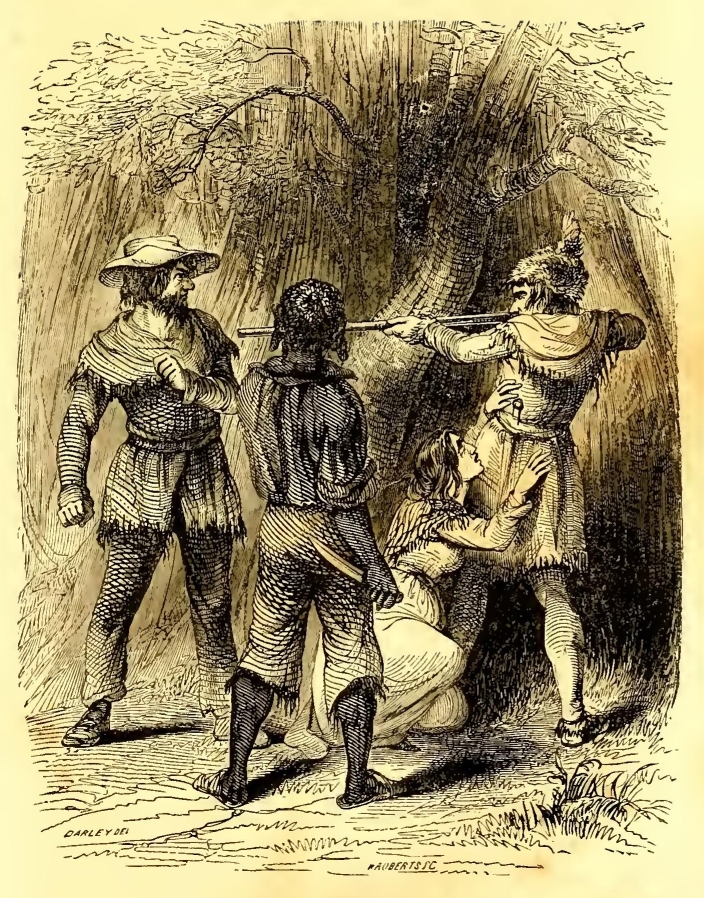
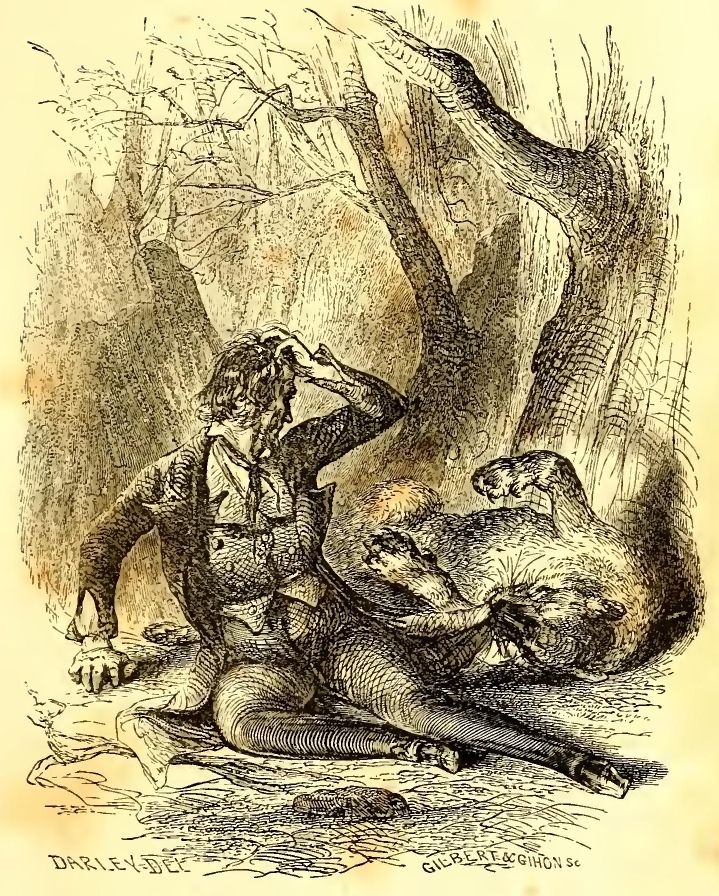
in my right hand, awaited the deadly foe. I heard his shriek, saw a huge
form flying through the darkness, felt a keen pang in my shoulder, and
then, pouring the acid in the mouth of the panther, fainted.
When I recovered consciousness the moon was shining in my upturned face,
and the huge form of the dead panther was lying by my side, with the
pocket holding the valerian firmly clenched in his teeth.
SEEKING A LOCATION
It was my
intention, after graduating, to return and locate myself in the small town
where I had studied my profession; but “circumstances,” which exerted such
a powerful influence over a late unsuccessful aspirant for political
honours, exercised a like power upon me.
The death of my preceptor, whilst I was absent attending my last course of
lectures, left a vacancy in the profession at home, which was speedily
filled, as far as numbers went, by a horde of new-comers. So I found I
would have to encounter, if I settled there, a greater competition,
without the assistance I calculated deriving from him, than my slender
means and already embarrassed finances qualified me to meet. Besides,
locating among those who had known me from boyhood, the probation I would
have to undergo before I secured their full confidence would be more
severe, and of much longer duration, than if I had landed in their midst a
perfect stranger. The transition from the boy to the man, and from the
mischievous student to the grave, serious physician, is so gradual and
imperceptible, that our old and intimate acquaintances do not realize it;
and when they should know us as doctor they still give us our youthful
appellatives, and regard us as boys. When I landed at home, proud of my
new-fledged honours and “sheepskin” as a young mother of her first babe, I
had, on meeting my former acquaintances, to fling my memory back to the
eventful examining period to convince myself that I was really a “doctor
of medicine;” for every one, even down to the children, called me
“Madison” as before, and none of them seemed a moment to consider that a
title, the acquisition of which had cost—both mental and pecuniary—as
much as mine, should be occasionally used.
In despite of these disadvantageous circumstances, and my own
disinclination, it was the opinion of some few friends, to whom I deferred
greatly, that I had better locate there; so procuring an office, and
having my name and title emblazoned on a sheet of tin, which I securely
fastened to the door, I shook off gaiety and the dust of my feet at the
lintel, and with a ponderous tome, and anatomically painted skull before
me, took my seat at my small green baize coloured table, to await cases
and patients.
I recollect distinctly, as no doubt every young professional man does in
his own case, my sensations upon the first few days succeeding the setting
of my trap, when I was constantly upon the look-out for some victim
approaching the bait.
I tried to address myself to the volume before me, but my busy imagination
had turned architect, and was erecting air-built tenements of the most
magnificent and gorgeous nature.
“Calls” innumerable flitted through my brain. Fevers, from simple
intermittents to congestive, were awaiting my curative dispensations;
whilst a trumpeter stood ready to peal forth my triumphs to the world, and
a quiet, unobtrusive grave, to cover the unsuccessful.
I had just performed a surgical operation, never before attempted, of the
most difficult and dangerous character, upon the “President,” with the
happiest results. The medical world was ringing with my name; and even the
trading community, partaking of the general enthusiasm, mingled me in
their thoughts, and spoke of my wonderful scientific achievements in the
same breath that told of the rise or decline of stocks, and a slight
improvement in the price of cotton. And the ladies, too—God bless
them! that their approving smiles sow the seeds of ambition in many
hearts; ay, even the soft, tender-lipped lady, made me a theme of
conversation, when her daily allowance of characters had been torn to
pieces, and scandal palled the tongue. Edinburgh and London were striving
which should obtain my services, as professor in one of their
world-renowned institutions; and the crown was moving from the brows of
Esculapius to my own; when—hark! “'Tis the cathedral pealing my
triumphs!”
“Listen how the solemn chant comes pouring up the mysterious aisle!”
“Pshaw! 'tis the supper-bell, a little negro ringing 'Jim along Josey.'”
I wrapped my cloak around me as if to shut out all the world, and strode
off moodily to my supper, mad at myself for having yielded to my fancy,
and almost allowing it to lead me astray.
One day passed without a call—six days died of marasmus, and never
the first patient crossed the threshold of my office. I could see other
physicians hurrying by, attending to their numerous calls; some of them as
youthful as myself; but, happily for them, they had the impress of the
exotic, whilst I was indigenous to the soil. I sat in my lonely office,
and could hear, as the busy noises of the town died away, and night
allowed care to come on the face, which, through the garish day, had
striven to appear mirthful, the hurried step of the messenger from the
sick; but they never stopped at my door—but on, on by, till distance
had eaten up their clanging tread. Mine is a temperament which, exalted to
almost delirium one moment, sinks into proportionate depression the next;
and even the short space of a week without employment made me
down-hearted, and assailed me with continual despondency. My debts,
contracted through the long years I had devoted to my profession—for
malicious tongues had estranged my preceptor almost from me before his
death, and determined me to repay him for all his pecuniary expenditures—knocked
continually against the door of my honour, and often, as I heard the saw
and hammer of the artisan ringing through the town, I almost cursed the
mistaken kindness of my friends, which had made a professional man of me,
and wished, like the mechanic, I could go forth and earn my sweet and
honest bread by the hot sweat of my brow.
By chance I learned that a good location for a young physician presented
itself in the Louisiana swamps. To resolve to seek it, to communicate my
resolution to my friends, to obtain the necessary letters of introduction,
and take passage on a steamer bound for Vicksburg, where I would have to
reship, was the work of a few hours.
The contemplated location was a short distance in the interior of the
parish of Madison, and my next destination after arriving at V————
would be Milliken's Bend, where I could obtain a horse and explore the
country.
Just at sunrise, a steamer of rather slender dimensions and shabby
appearance, came creeping along to V————.
As it was the first upward-bound boat that had arrived, a crowd of
passengers, who were there awaiting one, rushed on board to secure a
passage, myself among the number. Ascertaining how long she intended
remaining there, which was but a short time, I thought I would have time
to go up town and purchase some articles which I required, and had nearly
forgotten; I procured them, and heard, as I descended the levee, the boat
ringing her last bell; hastening my steps, I jumped on board just as she
was pushing out. On going up in the cabin, I found to my surprise that I
was the only passenger. She had brought none to Vicksburg, and of all the
crowd who rushed on there, none had remained save myself.
There was a mystery about the thing that I could not fathom, and did not
endeavour very hard to penetrate; for my future was a sufficiently
impenetrable enigma to employ all my penetration. Attributing the absence
of passengers to the poor accommodations that were visible, I gave myself
no further thought about the matter, but taking my cigar, ascended to the
hurricane-deck, and there seating myself, gazed abstractedly out upon the
waters, and gave myself up to my reflections. They were of a mixed nature;
joy and sorrow, pride and shame, struggling for the mastery through all my
recollections, and making too many compromises with each other for a
spirit that strove to be at peace with, itself.
There, in the same bold, impetuous torrent, coursed the majestic “Father
of Waters,” as it did ten long years ago, when the doctor, who was
ascending it, seeking for a home amidst strangers—his heart
care-worn and filled with anxiety, descended its current—a scullion.
My pride was gratified to think that I had risen as it were superior to my
station and opportunities, and, from a scullion, had become a member of an
honourable profession; and that, too, ere the beard had come on my face,
or years twenty-one stamped me a man.
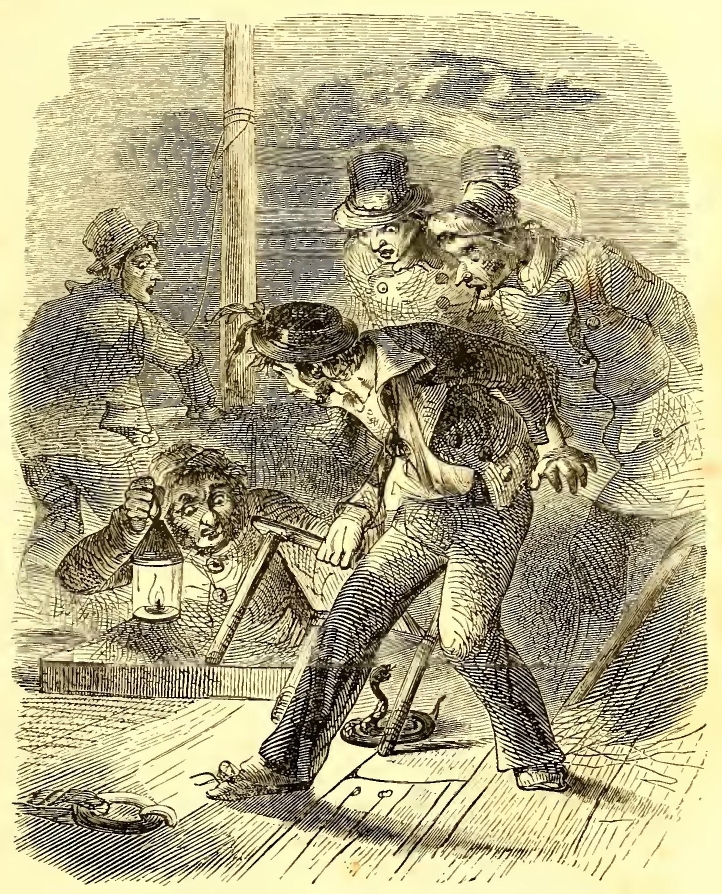
We were within two miles of the “Bend” when, as I descended from the upper
deck, being partly hidden by the wheel-house, I heard one of the officers
remark to the captain', in a laughing tone, “I wonder if that young fellow
up on the deck there, would smoke his cigar so unconcernedly if he only
knew he was seated over twenty thousand kegs of powder?”
I almost slipped overboard in my surprise. Twenty thousand kegs of powder!
Jehovah! how much of Madison Tensas, M. D., would be left, I wonder, after
that quantity of explosive material had ignited under him? One of the
finest instances on record of molecular disintegration would be presented,
I expect. This explains why the passengers left so summarily. “I must get
out of this.”
“I believe I will go ashore, captain; there is where I want to land,”
pointing to a house at least two miles below the “Stores.”
The boat landed; and, after getting ashore, I did not cease running until
I got considerable space and a large tree between her and myself. The
crew, suspecting from my movements that I had discovered the nature of
their cargo, gave vent to a hearty peal of laughter, with which sounding
in my ears, I gained the high-road. And this was my first introduction to
the state of my future adoption.
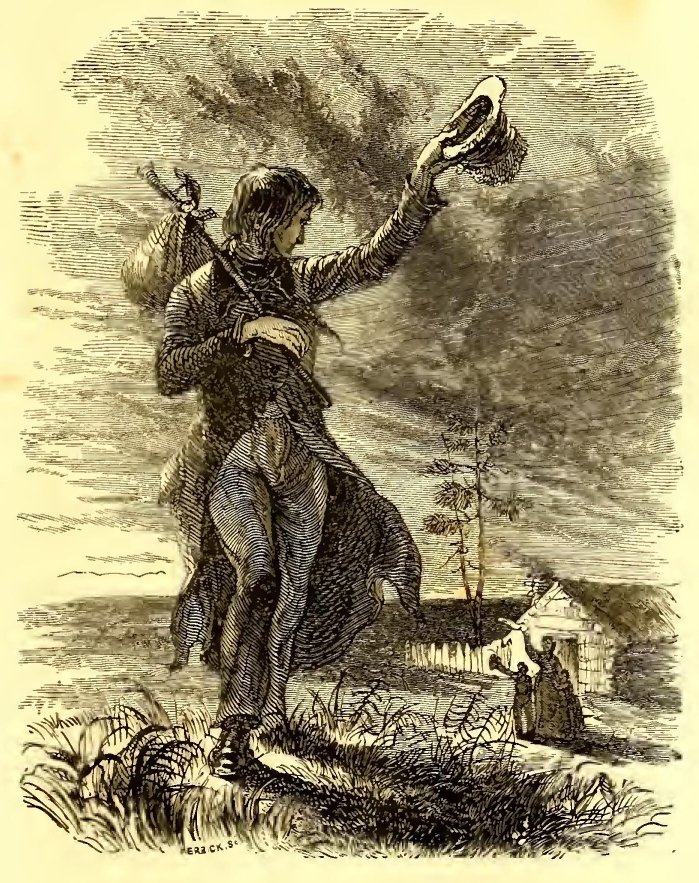
Having a letter of introduction for the principal physician in the “Bend,”
I slung my saddle-bags over my shoulder, and trudged along through the mud
to his house, the direction of which I obtained from a passer-by.
Upon presenting my letter to Doctor J————, I was
received with as much kindness and consideration as if I had been a
magnate of the land, rolling up in my carriage and four, instead of a poor
young doctor, saddle-bags on shoulder, seeking a home in the swamp.
Thine was a good, kind welcome, Doctor Tom, and the “Swamp Doctor,” I
assure you, often recurs to it with pleasure. Thine was the first
stranger's hand, in my adopted state, that I pressed, and found, ere it
had unclasped its pressure, that I held, a friend's. Thine was the first
roof in this land of hospitable homes that sheltered me; and oh! thy hands
compounded the first julep which for long, long months had
ecstasied my lips, thou hast to answer to old D———e for
the apostacy of one of his chosen disciples; and though I have felt
contrition for the fall, yet I forgive thee, Doctor Tom, cheerfully I
forgive thee. Would that one sat before me now, as I write in my lonely
bachelor den, the skies obscured with darkness, the rain pattering against
the casement, the single bed looking so cold, so cold, and the December
blast whistling through the chinks of the logs; would that I had one now!
winter as it is, though it were heaped with ice, if it came from thy
hands, thy warmth of heart would impart to it some of its cordial fire,
and kindle up a genial glow within my frame. Though I were thrice a Son of
Temperance, I could not refrain from a julep of thy mixing, and though my
lips might murmur, my heart would not dictate, “Deliver me from
temptation.” Oh! what a glorious barkeeper was spoiled when they made you
a doctor, Doctor Tom!
After partaking of a cold snack, it not yet being the dinner-hour, mounted
on a horse which the doctor loaned me, I obtained the necessary
directions, and turning my back on the Mississippi river, struck into the
interior, in search of the contemplated location.
The settlement to which I was destined, was situated on a small river
which, singular to relate, as I had never heard of any member of my family
having ever lived there, bore the same name as myself, being called the
“Tensas.” Looking upon this coincidence of names as a good omen, an
assurance at least that I would meet one acquaintance or kinsman there, I
surrendered my mind to a renewal of my day-dreams of future professional
success and distinction, and disregarding a proper notice of the road,
suddenly awakened and found myself lost—the road having given out in
a cypress brake.
To resolve to return was one thing, to do it another, for the timber roads
so crossed and interlaced each other that I frequently found myself
returning to the same point in the “brake” from whence I started. Well,
thought I, I hope my future lot will be a verification of the old adage,
that a “bad beginning makes a good ending,” for mine is bad enough. I
wandered about several hours, occasionally dismounting to assist my horse
out of some slough wherein he had bogged, and was about to give it up as a
bad job, when I had the good fortune to find a road, which, being over
knee-deep in mud, and dotted with the bones of deceased oxen, I judged to
be the main highway, which conjecture I soon verified on meeting a
traveller. After proceeding a few miles I reached Eagle Lake, which it was
necessary to cross in a shallow ferry flat. Here an accident occurred,
which came near preventing these pages from ever being written. The
current was running very strongly from a small bayou into the lake, and as
we approached the shore, suddenly striking the flat, it impelled it with
considerable force against a tree, which the high water had submerged for
ten or twelve feet. I was standing in the bow of the flat, holding my
horse by the rein, and the shock nearly prostrated us both. Before I could
recover, the horse plunged overboard. I would have been dragged with him
to almost certain death, as I could not swim, had not the ferry-man caught
me, and released my arm from the rein. The steed swam to shore; and after
a short time suffered himself to be mounted. Matters, so far, I must
confess, had not impressed me very favourably with the country—first
to be lost in a cypress brake, and then my life placed in jeopardy, looked
rather like discouraging treatment; but I had determined to bear up
against everything, and if these were the heaviest misfortunes I had to
encounter, to laugh at care.
Just as the sun was setting I reached the “Tensas,” striking it at the
“point,” to the owner of which, Mr. C————, I had a
letter of introduction. He received me very hospitably, and was profuse in
his offers of assistance, both by employing me himself, and favourably
recommending me to his friends.
The night passed off, and the next morning Mr. C——— and
myself started to visit the other families to whom I had letters of
introduction and recommendation; not two hundred yards from the house, it
became necessary to cross what was called the “Island shoot.” The current
was running swiftly, and it was nearly swimming. My companion, better
acquainted with the passage, forded it safely; but in following, my steed
got astride of a submerged log, and down we both went, head and ears,
under the muddy waters. I determined, if possible, not to dissolve the
union between horse and rider, and therefore held on to him, and at length
he scrambled out. I was thoroughly drenched, but I knew at the outset it
would never do to appear to mind such an accident before an “old swamper,”
like Mr. C———, and therefore joined him in his hearty
laugh at the dolesome plight of myself and horse. To make the matter
worse, I had only the suit of clothes I wore along, and was constrained to
borrow a change of apparel. I am above the average size, and both Mr. C———
and his overseer were considerably under; so a proper appreciation can be
had of the nature of the fit. Laying off my cloth, I donned a suit of
“swamp broad-cloth,”—yellow linsey—which clove to my
proportions as if it were an integral portion of my frame. This time we
had better luck crossing the “shoot,” and after spending the day, visiting
the neighbours, and making arrangements for securing the practice, we
returned to the “point.” My unique appearance created a good deal of mirth
and remark during the day; but as I laughed with the loudest, ridicule was
soon despoiled of his shaft, and my indifference at what would have
affected the majority of young men, very sensibly raised me
proportionately high in the opinion of the “swampers.”
The encouragement I had received, I thought sufficient to warrant me in
locating there; so the next morning I started, on my return, to procure a
horse, and have my books and medicines brought to my new home. The
settlement I designed locating in, was a very new one, the majority of the
residents holding their lands merely by pre-emption claims, little of the
country having been offered for sale by “Uncle Sam.” There was but one
frame house in the whole settlement, the dwellings with that exception
being composed of logs, some with the bark yet on them, others of split
trees, whilst a few, by their squared appearance, gave evidence of the
broad-axe, and a greater degree of refinement in their occupants.
Fortunately for me, as I thought at the outset, but unhappily, as the
sequel proved, the most influential, or rather the most numerous portion
of the settlers of my destined locality, were all of one family, or
otherwise closely connected. Being originally from Virginia, they had all
the proverbial clannishness of that highly favoured race, and the mortal
upon whom one of the “set” smiled was immediately sneezed upon with favour
by the rest. They all eat with the same tastes, and used the same pair of
spectacles to view men and measures. They were a hardy, vigorous,
industrious set, and, divested of their foolish clannishness,
irreproachable. The first year, I was a small saviour with them; the
second, having aroused the ire of one of them, the whole clan were as
strenuous to break me down, as the year before they had been solicitous to
advance my interests; but the “Swamp Doctor” had grown beyond their reach.
But I anticipate, and must return.
The lands were composed of rich alluvial, deposited by the turbid waters
of the Mississippi, and protected by embankments termed “levees,”
ungratefully thrown up to keep out the very cause to which the country
owed its existence. Whenever the levees proved insufficient, or happened
to break, chickens and garden-tools fell to a discount, and ducks and
cat-hooks rose to a premium.
The tillable land, varying in breadth from one hundred yards to several
miles, lay upon the water-courses, which ramified the surface of the
country, and formed, when swollen by rains or overflow, a perfect network
of watery communications. The land between the tillable or cane ridges,
was low swamp, almost quagmire, never thoroughly dry, and almost
impassable nine months out of the year.
In the height of summer the country appeared to a fair advantage,
surpassing any in the world for producing the great southern staple; but
at the time I first visited it, not expecting company, it had on almost
its worst garb. The mud was nearly saddle-skirt deep in the roads, and the
low lands utterly impassable.
I thought that never yet did country merit its name so well as it; the
whole of the Louisiana bottoms being indiscriminately known as the
“swamp,” and people, male and female, termed “swampers.”
The appearance of the country would have disgusted and deterred many from
settling, but it had the promise of being a sickly one, and highly
suitable for a doctor—and such was the locality I sought; besides, I
was certain of making a support, and to accomplish that, I would have
submitted to any and all privations.
I returned safely to the “Bend,” and being careful in my selection of a
boat this time, to see that she had not a government contract for
transporting powder, arrived at my former home, and commenced making
preparations for a speedy return to my adopted “swamp.”
In a few days, I had concluded my arrangements, and without a sigh or a
tear of regret turned my back on my student home, and sought my new
location, which I reached without further adventure.
CUPPING AN IRISHMAN.
During my last
year's attendance on the lectures, I became the inmate, for the purpose of
walking the wards, of a certain marine hospital, situated on a certain
western river—of which Randolph has recorded his opinion—where
the patients receive—paradoxical as it may seem—the kindest,
yet the grossest treatment imaginable.
There were four or five brother “Rats” besides myself residing in the
hospital, all candidates for graduation, and consequently all desirous of
obtaining sufficient medical lore to prevent us from being thrown higher
at the “ides of March.”
Never before—at least by any of us—was such assiduity
displayed; so much mental pabulum devoured; so many of the latent energies
of studiousness called into play, as then. No case, however disgusting,
was put in the objective; no symptom, however trivial, obscure, or
mysterious, could pass unnoticed; and the proudest soar of the bird of
Jove would have passed unheeded, had a sore of another description
occurred coincidently. Fingers which the previous session had never been
employed in higher surgery than forking a sleepy chum, or picking
needlepoints out of a pretty seamstress's hand, now gracefully adapted the
pliant bandage to the fractured limb, or drew the ruby with the lancet
keen. No longer the sweet vision of midnight oyster-suppers illumined the
mental horizon, obscured by the listening to of six long lectures daily.
No longer at the “wee short hours avant the twal” was our Ganymede
summoned to evoke the spirit of the whiskey jug. No longer musingly
reclining did we watch the airy genii of the best cigar, borne up
heavenward on the curling chariots of their consuming earthly tabernacles.
No longer—pshaw! to comprise the whole, we were studying for our
degrees, preparing for the opportunity of passing our opinion on the
question, “Whether the sheepskin of a young graduate, applied to his back,
would be a contiguous or a continuous membrane?”
Among the rest was Charley L———, a young fellow of
considerable talents—well aware, by the bye, of their possession—who
having heard of my reputation for cupping, was not long in bantering me to
a trial of skill, having some pretensions that way himself.
“Tensas,” said he one night, when we had all assembled in the apothecary's
shop of the establishment, to compare notes and discuss the day, “do you
think you could cup an Irishman?”
“Cup an Irishman!” repeated I, “yes, or a Dutchman, or an eel, or a buck
running, or a streak of slow lightning, or anything that wears four square
inches of skin. But why do you ask, Charley?”
“Why, I tried to-day, and it took me so long, and was not well done at
that, that I got in late to old D————'s lecture,
and he looked as sour at me as if he had caught one of the vice presidents
of the P. T. S., drinking something stronger than water.”
“Well, just show your Irishman to me, and if I don't scarify and cup him
in ten minutes I'll treat—that is, take notes for the whole crowd
to-morrow.”
“I'll give you half an hour, and you can't do it—scarify and put
twelve tumblers on him. I'll bet you a box of cig—hem—give you
choice of subjects at the next raising.”
“Done! when shall the trial come off?”
“Right off; everything is ready, Irishman and all.”
In the medical ward at that time was an Irishman, evidently not long
caught, whose greatest disease, from all external indications, was
poverty.
The weather being very inclement, and the hospital having the reputation
of keeping up good fires, and feeding its inmates pretty well, Pat took an
idea into his head that he would lay up within its friendly walls during
the severity of the winter; so going to the mayor of the city, whose
benevolent heart never allowed him to refuse an applicant for the city's
charities, he obtained by his piteous representations and obvious want, a
hospital permit, and was, in consequence of it, soon snugly ensconced.
Having the faculty of bending one knee, so that no efforts could
straighten the joint, he came in as a case of chronic rheumatism, and
manfully the rascal stood the kind exertions to relieve him, so as to
deceive the most experienced, and cause the putting of him down in the
books as one of the “incurables.”
Charley, however, having fine opportunities of investigating the case, had
his suspicions aroused as to the reality of Pat's disease, and,
determining to settle the matter, selected him as my cupping subject.
“Boys,” said he, “I believe Pat's shamming; suppose we tell him that old D————
has directed him to be scarified and cupped, and Tensas can apply the
remedy!”
“Agreed!” said all with one voice. Filling a tray with tumblers and a
bottle of alcohol, we proceeded in a body to the ward where the victim was
placidly reposing.
Seeing us approach with all the apparatus for “making a night of it,” Pat
imagined he was going to be put on a more stimulating course of treatment,
and his eyes fairly glistened, and his leg was, if possible, drawn still
more closely to his body as he took a mental view of his situation; no
work, good lodgings, pleasant medicine, liberal diet, and at last, to cap
the climax of his earthly felicity, the pure “Crame of the Valley.”
Well, Pat, my boy, how do you rise to-night?”.
“Faith, an' good troth, young docthurs, like Inglan's tare for the ould
counthry's misry, I don't rise at all at all—not aven the laste bit;
here is me stretched on me back like a nagur, unable to work for my
praties, or a wee drap of the crathur, ochone! ochone!”
“Don't you improve any? Can't you walk a bit?”
“Shure, not a bit! How am I to travel when my fut is bent up to where a
rich man's boot shakes hands with a puir man? ochone! Its 'frade I am I'll
be always here, instid of warkin', an' drinkin', an' votin', an' bein' a
fray-man, as me muther was to the fore.”
“I hope not, Pat,” said I, desirous of bringing the conversation to a
close, “old D———— has directed me to cup you, and
that is what has brought us up.”
“Cup me, is it? Well it's reddy I am—shure an' have been for the
long time; make it strong with the whiskey; bless the ould man, I tould
him the other day, when he was prachin' the could wather, that a good
strong cup would cure me as well!”
Great was Pat's consternation when he found that the tumblers, from which
arose the odoriferous scent of the alcohol, were to go on him, instead of
their contents going in him. He would have demurred, but he saw the
uselessness of the attempt, and therefore assented to the operation with
rather a lank visage, I must confess.
I soon repented the wager, and wished myself well rid of my bargain; the
rascal had perfect command of the muscles of his brawny chest, and no
sooner would a cup be exhausted and applied, than with a sudden
contraction of the muscles, he would send it, with a simmering noise,
rolling to the distant side of the bed. I tried every way, in the usual
manner, to make them retain their hold, but the task was fruitless;
occasionally one would flatter me it was going to remain, but scarcely
could I give my attention to the other side, when off it would come. The
half hour wanted but ten minutes of being out, and the cups were still
unapplied. I became almost desperate, and called up two long-nailed
Kentucky nurses, and made them hitch their fingers in the folds of the
integuments on either side, so as to hold the muscles tense until the cups
could adhere. This plan bid fair to answer, and the jeerings, remarks, and
shouts of laughter, at my apparent discomfiture, which had greeted me in
that unusual place for mirth, somewhat subsided; one minute of the
allotted time was left, and but one cup remained unapplied. Up to this
time, the steward of the hospital had been waiting upon me, pouring the
alcohol, with which to exhaust the cup, from a tumbler nearly full into an
empty glass, and then turning it out, he would hand it to me, and by the
time it was applied have another ready; but one remained, as I have said,
and I was waiting for it, when Charley, who had a finale for his test
which none of us anticipated, suddenly substituted for the empty glass,
the one nearly full of pure alcohol; suspecting no such trick, and there
being no time for critical examination, I stuck the candle to it, and
essayed as the blaze burst out, to apply it high up on the Irishman's
breast. With a rushing, roaring sound, out burst the flaming liquid all
over the poor devil's body.
With a loud scream, amidst the roars of involuntary laughter which
attended his advent, Patrick gave a spring nearly to the ceiling, and
dashing like fragile reeds the sturdy men who were holding him to the
floor, amidst the cries of fire! fire! curses in Irish, loud and long, and
the crash of the shivering tumblers, as he shed himself of them, took
refuge in a large bathing-tub full of water, which, fortunately for him,
stood in the ward.
The shouts of fire alarmed the whole hospital, and here, pell-mell, came
the patients to see where it was. Forms emaciated by consumption rustled
against others distended by dropsy. Four forms lay mixed up in the hall,
and all of them could only muster up two pairs of legs, a pair and a half
of eyes, and four arms. It was as though a false alarm had been given by
Gabriel, and only a partial resurrection had taken place.
In one of the upper apartments was a private patient, labouring under the
disease indifferently known as the blue-devils, red-monkeys, seeing
injuns, or man-with-the-poker, or rather that mysterious individual had
succeeded in overtaking his victim, and awful licks, to be sure, he was
giving. His delirium was, that he was an alligator, and that there was a
blood-thirsty minnow determined on taking his life at all hazards. Great
were his struggles to preserve himself, requiring the constant presence of
two keepers to restrain him from self-immolation.
Hearing the shouts of fire from below, they, acting on the conservative
principle, left their patient, and sought safety in flight, not long
unfollowed by the drunkard, who proceeded down stairs, until he came to
the ward from whence the shouts of laughter had not ceased to issue.
The door being open, in he marched, presenting a fearful aspect—nearly
naked, his eyes blood-shotten, and glaring with the light of delirium, his
teeth clenched, with the lips drawn apart, a slight foam resting on them,
blood dripping from a wound in his forehead, and brandishing a huge
medical appurtenance, acting on the principle of the force-pump, and
familiar to children on a small scale.
Seeing Pat in the tub, the cynosure of all eyes, the man with the
red-monkeys took an idea that he was the identical minnow aiming at the
vitality of his alligatorship, and this would be a good opportunity of
killing him off.
With a loud yell, he sprung towards poor Pat, who, perfectly bewildered,
let him get nearly on him, before he thought of getting out of the way.
“Hould him!” he yelled, “the crathur's gone clane out of his head! Holy
jabers! hould him! He'll be afther the killin' me!”
But no one having time, or showing a disposition to interfere, he found he
would have to bestir himself in his own behalf, and the biggest tracks,
and the fastest, and the more of them, were made by the man who, previous
to the time, had not moved a step for months. Through the long hall, down
the double steps, out of the yard, and over the commons he went, yelling
at every jump, whilst the “man with the poker's” friend, perfectly
satisfied at the result, fish-like squatted down in the tub, and then
quietly suffered himself to be led back to his room.
BEING EXAMINED FOR MY DEGREE.
Reader! have you
ever taken a shower-bath of a cold winter's morning? or felt a snake
crawling over you whilst in bed? or tried to sleep with a deadly fight
awaiting you in the morning? or tried to unite the oil of your nature with
the agua pura of a chattering damsel, and found no alkali to effect the
union—in other words, popped the question and been—refused? or
swallowed poison, and no stomach-pump about? or slept with a man with the
small-pox? or tried to write, with a couple of gabbling widows in the next
room? or run for a political office? or shook hands with the itch? or been
without a friend or dollar, thousands of miles from home, and a catch-pole
after you for your tavern bill? or had the toothache? or—think of
the most uneasy, miserable melancholy, dolesome action, sensation,
occurrence, or thought of your life. Read of nothing for two weeks but
earthquakes, famines, bankruptcy, murders, suicides, and distress in its
blackest form: work on your imagination until you feel yourself labouring
under all these combined misfortunes, and perhaps then you may have a
slight appreciation of how a young grave rat feels just before he is
examined for his degree. Examined, too, by seven old dried-up specimens of
humanity, who look as if they had descended for the occasion from some
anatomical museum, and who have looked on death, suffering, and annual
ranks of medical aspirants, until they have about as much softness of
heart as the aforesaid preparations.
The first course of medical lectures the student attends, is
generally distinguished by his devotion to everything but his studies. At
the commencement of the lectures he purchases a blank-book, for the
ostensible purpose of taking notes of the lectures; but unwittingly his
fingers, instead of tracing the chirographical characters, are engaged in
caricaturing the professor, who is endeavouring to beat into his and a few
hundred kindred heads, the difference between a dirty Israelite and the
'nasty moses of an artery. He devotes the midnight hour to dissecting—pigs-feet,
grouse, and devilled bones, or the delicate structure of the epicurean
oyster. He strengthens his voice by making the short hours of the
night-clad street alive with the agreeable annunciation, especially to
nervous invalids and sick children, that he “will not go home till
morning.” He astonishes the professor of chemistry when lecturing upon
electricity, by placing a few pounds of powder in communication with the
machine, and blowing the laboratory to atoms, when the experiments are
going on. He forms a pleasant surprise for his landlady by slipping into
the dining-hall when the meats are on the table, and slyly inserting a
dead baby, stolen from the dissecting-room, under the cover, in place of
the abstracted pig, producing a pleasant sensation when discovered, and
giving a good appetite to the boarders. He puts quick-lime into the young
ladies' puff-box, and gives them a wash of lunar caustic to allay the
irritation. He and the janitor go halves in raising game-cocks, and the
expenses of a whole winter's lectures are often bet on a main.
There is always some medical book that he wishes to purchase, of course
very expensive—and to obtain which he is always writing home for
money to parents or guardian. John Smith suffers, and always appears in
the police reports, when the first course student is put in the
watch-house, and let off by the kind-hearted mayor next morning, on paying
fees and promising to amend. To sum up the whole, the first course, with
few exceptions, conducts himself in such a manner, that but little
injustice is done him when he is classed with free negroes, rowdies, and
low-flung draymen. But the second course—phew! what a change comes
over the fellow! You would think, to see him, that when he was born,
gravity and soberness had given up the ghost, and their disembodied
spirits found a carnal habitation in his cranium.
He now endeavours, by unremitting attention, to retrieve lost time, and
impress the professors favourably in his behalf, for he is now a candidate
for graduation, and he dare not go home without his degree. His care-clad
face is now seen on the foremost bench, listening with a painful
absorption, and taking voluminous notes in a book—not the only thing
bound in calf-skin in the room, by long odds—and always asks, with
the utmost deference, long explanations on some favourite theory of the
lecturer, so dazzlingly original, that he did not perfectly understand it,
so bewildered was he by admiration. He smells of the dissecting-room, and
takes occasion, when in the presence of the professor of anatomy, of
jerking out his handkerchief, and with it the half cut up hand of a
subject. He eschews tobacco, whiskey, and women, joins the physiological
temperance society, and collects facts for a forthcoming work of the
professor of practice. He is a strong vitalist with “Old Charley,” and
lies-big with the Liebigian follower of acids and alkalies. He presents
the pelvis of the female that obeyed the Lord's ordinance twenty-six times
in ten years, to the professor of observations, and has a faculty of
making himself generally useful to the whole faculty. I, to return to
particularities, had followed after the manner of first coursers,
and would have been a fac simile of the candidate, or second course
student, had it not been for my habitual laziness, and perhaps an
overweening confidence in my natural powers of impudence to push me
through. I had had one or two fights the previous session, in the college,
which brought me favourably, of course, before the notice of the faculty,
as a quiet, studious gentleman, and removed all doubts from my mind of my
having a safe and honourable passage. I held a high head, but was
confoundedly frightened, and often wished that I were not an aspirant for
the privilege of being a hired assassin, a slayer, without the victim
having a chance to hit back. Many, I say, were my misgivings, as I saw the
ides of March, the time for examination, approach, that my want of medical
lore might knock me higher than the green baize of medicine could cluster—and
yet, never was poor mortal better entitled to write M.D. after his name
than I, miserable devil as I was. But fear would not keep back the evil
day. The bell sounded for class T to go up and be examined, and away we
went slowly, as to a summons for pistols and coffee for two, with feelings
resembling those of a gambler who has staked his whole pile, and found at
the call that he has been bluffing up against a greenhorn with
“three white aces.”
We were to be examined in separate rooms; our class, consisting of seven
members, by as many professors, fifteen minutes being allotted to each
professor in which to find out the qualifications of the candidate.
I have already indicated the course I intended to pursue in my examination—impudence
and assurance was a new method for a candidate, and might succeed
where-the old plan would be nearly certain to fail.
Entering boldly, without knocking, the room of one of the professors, who,
being a superannuated widower, affected youthfulness very much, and prided
himself very much, like a Durham stock raiser, on the beauty of his
calves, to his dismay I found him arranging a pair of elaborate false
ones, which showed a great disposition to work around to the front of his
spindle-shanks. I had him dead for his vote, sure. I held the calves,
whilst he adapted them to their places, and smoking a cigar during his
fifteen minutes—he congratulated me upon the progress, he had often
remarked, I was making in my studies, and at the expiration of his time,
as he conducted me to the door, assured me he would vote for me, adding,
“by-the-bye, Tensas, you needn't mention anything about the calves.”
Well! here's one vote, sure; would I had the other six as safe, thought I.
“Physiology, where are you? You are wanted!” said I, as the door enclosed
me with the professor of that branch, who, fortunately for me, was what is
called a vitalist—sticking up for nature, and bitterly denied
the Liebigian theory, which refers so many of the living phenomena to
chemistry. He and the professor of chemistry were nearly at daggers'
points upon the subject, and exceedingly excitable whenever it was
mentioned in their presence. I knew my cue.
“Take a seat, Mr. Zensas, you appear wondrous full of vivacity,” said the
professor, as I entered, singing “A was an artery,” &c. “Yes, sir, and
I can assure you it is vivacity of the same kind that a beneficent Creator
exhaled into the nostrils of the first-created—life in the sense in
which every reasonable man—every man with a proper appreciation of
the subject—every man of learning and intellect, and physiological
acquisition, regards the vital principle—and not that degraded
vitality of the Liebigian system, which makes man's assimilating functions
a chemical operation, and degrades his mighty nature to the level of the
ass”—“hideous doctrine,” broke in the old professor. “Mr. Tensas,
would that the whole class possessed your discriminative wisdom; then I
could descend to the grave with the proud consciousness that man held of
his existence the same exalted opinion that I have always tried to teach;
then would I see this chemical theory of life exploded. Theory which
degrades man lower than the brutes, makes the subtlest operations of his
nature a mere chemical effect, and the noble action of the lungs a
scape-pipe for extra heat; magnificent—” And the excited
physiologist, carried away by his feelings, burst into one of his wildest
harangues, battling for his favourite theory with more vigour than he had
ever displayed in the rostrum—and there never had stood his superior
for eloquence—until a knock at the door broke in upon his
declamatory current and dammed its waters.
“Bless me!” he exclaimed, rubbing his glasses and looking at his watch,
“is my time out? Why, I have done all the talking. But go, Mr. Tensas, the
views that you advocate attest your qualifications. You may depend upon my
vote and influence.”
“Two votes safe!” said I, as I regained the lobby, “and now for old 'Roots,'
as the professor of Mat. Med. was familiarly called by the class—he's
deaf, but thinks no one knows it but himself. I'll talk low, and he won't
know whether I am answering correctly or not.”
“Take a seat, Mr. Tensas. How are you to-day? I suppose you are ready for
being examined? What is calomel?” All this being said sotto voce.
“A drug, sir, that may be called the right bower of quackery, and the four
aces of medical murder; referred to by Shakspeare when he said, 'Throw
physic to the dogs,' and specifically mentioned by him, though a typo
graphical error has somewhat obscured it, evidencing its antiquity and
universal administration at his time in the lines, 'Be thou as pure as
ice, as chaste as snow, thou shalt not escape Calumel.'”
I spoke in a whisper, but moved my lips as if vociferating.
“Right, Mr. Tensas; but you need not holler so as to alarm the college; I
am not deaf. What is the usual dose in the South?”
“Half a pound for an infant, and the quadrature of the stomach's circle
for a grown negro!”
“What are its specific effects upon the system?”
“The free use of coffins, spit-boxes, mush-and-milk, and the invention of
new oaths with which to curse the doctor!”
“What diseases is it usually given in?”
“In all, and some others, from want of a clean shirt to the death-rattle!”
“Right, sir, right,” said the examiner, never doubting, from my aptitude
of reply and perfect seriousness, but that they were to the point. “What
are emetics?”
“Medicines, that a man who has dined badly, and wants to conceal it,
should never take!”
“What are the most certain?”
“The first cigar, the first quid, or a spoiled oyster!”
“What is their action?”
“That of money won at gambling; going back the way it came, and taking a
good deal more than it brought!”
“When should lobelia be given?”
“At elections, where the people are writing a man down an ass, and he
wants to be brought-up ahead!”
“What dose would you give it in?”
“If the patient was likely to leave a rich widow, I'd certainly give a
pound!”
“When would you think an emetic had acted sufficiently?”
“When I was in doubt whether it was the patient's tongue or his stomach
that was hanging out of his mouth!”
“What are purgatives?”
“Medicines, whose action bears the same relation to that of emetics, which
the possums did to the hollow where the dog was waiting to catch them—they
go the other way!”
“Suppose your patient had a diarrhoea, what medicine would you give?”
“A quart of brandy, for it would be sure to make him tight!”
“What are the most dangerous preparations of lead?”
“Congressional speeches in Washington, and buckshot in the Southern
States!”
“From what does hive syrup derive its name?”
“From the fact of bees living in hives, and there being honey in it!”
“Right, sir! all right! You have answered admirably. I see I must vote for
you. You can go, sir!”—and out I went.
“Three votes! Hurrah! Two more, and I'm safe. Now for Old Sawbones. I'm
sure of him, though;” for upon surgery I was prepared, and my intimacy
with that professor assured me he must be aware of it, and would attribute
the errors I might commit to natural trepidation under the circumstances.
He was a man of too much good sense to wheedle or fool with, and
notwithstanding my confidence in my good preparation, and his appreciation
of it, I anticipated a terrible time with him.
My heart sank as I entered his room. “Be seated, Mr. Tensas. Beautiful
weather for this season. Have an apple? Here is an instrument for
deligating the subclavian artery, that the maker has done me the honour to
call after me. How do you like it? Think I must order a dozen. Do to give
to acquaintances,” rattled on the kind-hearted professor, trying to
reassure me, which he failed to do, for I regarded his pleasantry as
somewhat akin to the cat sporting with its victim. “You never shave,
Tensas, I believe? Apropos, how old are you?” I jumped clear out of my
seat at the question. The institution required a candidate to be
twenty-one, which I was not, by several months.
“It's rather late in the day to inquire that, professor,” replied I, “you
should have asked that before I paid for your ticket.”
“Well, you are old enough to be examined for your degree, I expect, as
you'll be rejected, in all probability. How do you make chicken-soup?”
I began to get nettled, thinking he was sporting with me upon my
embarrassed condition; but a glance at his face told me he was, or
strongly pretending to be, in earnest.
“Professor————,” I said, “I came here, sir, to be
examined upon surgery; not to be insulted, sir. What chicken-soup has to
do with it, I cannot imagine. If you are disposed to twit me with my early
life and humble occupation, I can assure you, sir—”
“Stop! stop! No insult was intended, and though you, with your wisdom of
almost twenty-one years, cannot see the connexion between soup and
surgery, I can tell you, young man, that the success of the surgeon
depends very much upon kitchen medicine. Good soup is easily digested, and
strengthens the patient, but bad discomposes, and prevents the reparative
action of the system. But this is not answering my question. How do you,
sir, make chicken soup?”
Seeing that if he was not in earnest, it was the best imitation I had seen
lately, I vouchsafed to answer the subtle inquiry.
After I had concluded—“Mr. Tensas, you have left out a very
important item in the preparation of your soup: you forgot to mention in
the first instance whether you would kill the chicken or not.”
The glance I shot at him was too much for his gravity. Bursting into a
hearty laugh, he' said, “Tensas, I knew you were well prepared, but I
thought I would teach you that nothing that may be conducive to the
recovery of our patient, is too trivial to be remembered by the physician—also
to try your temper. You have too much of the latter. The sick-bed is a
fine moderator, however. Go, my dear fellow, study hard, and in ten years
I will hear from you.” Tears sprung into my eyes as I wrung his hand, and
thanked him, on leaving his room.
Four votes safe. One more, and the others may go to Hellespont. Now for
chemistry. “How do you do, Mr. Tensas? Be composed, sir. Take a chair.
Happy to have the opportunity of gratifying my chemical curiosity at your
expense. I expect you candidates think your professors a very inquisitive
set of fellows about this time. Ha! ha! Take a chair, sir.”
“Professor————, I am quite well, I am happy to
inform you, and desirous of appearing as composed as possible. I also
felicitate myself that it is in my power to display to you the fruits, as
elaborated in my mind, of those eloquent expositions of chemical science
which it has been my good fortune to receive, at such an inadequate
remuneration, from your lips. Here is a pamphlet, very denunciatory, I am
sorry to announce, of you, that I thought you would like to see. It is by
the professor of physiology, and appearing first in a distant city, I
thought you might not be aware of its publication; my admiration and
friendship for you, together with my anxiety for the promotion of the
Liebigian system, led me to procure a copy at an expense which, though
considerable in the present dilapidated condition of my finances, never
caused the least hesitation in its purchase, when the great good which
doubtless would result from your early acquaintance with its pernicious
principles was considered.”
It took me at least five minutes, in a slow, monotonous, and pompous
manner, to deliver this, and only ten were left to the examiner.
“Thank you, Mr. Tensas, thanks for your kind consideration for myself and
the system I am proud to advocate, even though it be through detraction
and vituperation. I will examine it at my leisure—we have now other
business before us. Give me an exposition, Mr. Tensas, of the Atomic or
Daltonian theory.”
Down below zero went my hitherto buoyant spirits—my scheme had
failed—I am gone, thought I, when up my heart bounded again as he
interrupted me with, “Ah! how did you say you obtained this atrocious
publication? Mr. Tensas, that gentleman, the author, is doing a great and
irremediable injury to the cause of truth and scientific controversy. In
arguing with a man of philosophical pretensions, it is to be expected that
he will combat only those principles which”—and in a tone of grieved
and wounded innocence, not giving me an opportunity of giving him the
required exposition of the Atomic or Daltonian theory, which I very
much regretted, the professor concluded the time allotted him for
examination, saying, as I bid him adieu, “Mr. Tensas, I shall be happy to
see you at my house to-night; you may rest assured of my vote.” I stood in
the lobby with perfect ease, confident that in having five votes out of
the seven—three being required to reject—I was soon to be
dubbed Doctor of Medicine. The examinations of the other two professors I
got through with very summarily, fainting away before one, and occupying
the fifteen minutes to restore me, and before the other, being seized with
a violent bleeding at my nose; but in justification of my own honour, I
must state that the representations by the rest of the faculty of the
splendid examination I had passed before them, influenced their votes, and
I obtained all; and, at the appointed time, received my degree, and a
square yard of sheepskin, as an attestation of the progress I had made in
medicine, giving me a free permit to kill whom I pleased without the fear
of the law.
STEALING A BABY.
I never was partial
to dogs (although I dined some years ago very heartily upon the haunch of
one, that a rascally Indian sold to the family for venison—the
scoundrel's back gave proof not long after, that it, to him at least, was
really dear meat); they have always been my aversion, and the antipathy of
my earlier years has not been in the least diminished by the part one took—not
only out of my leg—but in breaking off as pretty a love-scrape as
ever Cupid rejoiced at.
I was attending my last course of lectures, previous to graduation, in a
northern state, and as a matter of course had but very little leisure to
devote to amusement or love. But nevertheless, even amidst all my
occupation, I found time to renew and continue a friendship bordering
closely upon love, even then, which I had formed the previous winter, with
a young lady residing in the city.
We were both young—alas! that there similarity ceased—she was
beautiful—my ugliness was so apparent that I acknowledged it myself.
She was wealthy—I had nothing but my profession, it not then secure.
She was—but why continue the enumeration of our contrasts? suffice
it to say that we were fast approaching the condition when love in a
cottage, and thoughts of an annual searching for sentimental and beautiful
names occupy so much of the mind, when an infernal dog (not only of a
daddy—but a real caniner) jumped—like a swamp gal into a jar
of pickles—into the ring of our felicity, and left me to wail him
first, and myself afterwards.
I hated dogs, and the father of my beloved had an equal aversion to
Southerners, and according to the degree that class stood in his
estimation, the old man and myself disliked the same objects; so his
daughter and myself had to meet by stealth.
Twice a week the class of medical students attended clinical lectures at
the hospital, which was situated in a retired part of the town; thither
the young lady, on the appointed evenings, would repair, and awaiting the
departure of the class, we, on our walk homewards, could talk over our
love affairs without fear or interruption.
This pleasant arrangement had continued until nearly the close of the
session, and we had agreed that when graduated, if her father's obduracy
did not soften, we would elope, when some good-natured friend kindly
informed her father of our intimacy, and that even as he came then to
apprise him, he had met her going to keep her appointment.
Highly incensed, the old man started off to pursue her, out unfortunately
did not arrive to prevent, but only witness an occurrence which attracted
considerable attention at the time. Anatomy has been ever with me a
favourite branch of my profession; and when a student, I never let slip an
opportunity, time and material permitting, to improve myself in it by
dissection. It was a passion with me; and whenever I met with a person
extremely emaciated or finely developed, my anatomical eye would scan
their proportions, and instead of paying them the usual courtesies of
life, I would be thinking what glorious subjects they would be for museum
preparations or dissection; and even when my audacious lips were stealing
a kiss from the pulpy mouth of my lady-love, instead of floating into
ecstasies of delight, my anatomical mind would wonder whether, even in
death, electricity, by some peculiar adaptation, might not be able to
continue their bewitching suction. When holding her soft hand in mine, and
gazing into the star-lit ocean of her soul, I would wonder if there was
not some peculiarity in the formation of her optic nerve which gave her
eyes such brilliancy. My poetical rhapsodies were mingled with scraps of
anatomy, and in attempting to write her some verses, after writing the
first line,
“The clouds which clothed yon beauteous shore with garments
dark and hazy”—
to save me, the nearest approximation I could make to a rhyme, was:
“Pray use with me not the 'levator labii superioris alaque nasi?
To tell the truth, I was becoming clean daft upon the subject, and
consumptive people and orphan children began to look on me with suspicion,
but Lucy attributed my conduct-to the eccentricities of genius and love.
Connected with the hospital the class attended was a dead-house, as is
usual in such establishments, where such patients whose constitutions are
not strong enough to stand the treatment, are deposited after death for
forty-eight hours, in order that their friends may reclaim their bodies.
The morgue, in this institution, was directly under the lecture
room, but, as the door was kept locked, it was regarded as sufficiently
private.
On the day when my intended father-in-law was made acquainted with the
clandestine meetings of his daughter and myself, I had, as usual,
accompanied the class to the hospital, and, during the delivering of the
lecture, becoming suddenly very faint, I was forced to leave the crowded
room and seek the fresh air.
As I passed the door of the dead-house on my return, I noticed that it was
ajar, and curiosity prompting me to see what was within, I pushed it open
and entered, closing it behind me. There were several bodies, male and
female, cleanly arrayed upon the table; but the object that attracted my
attention the most was an infant a few weeks old lying by the side of its
dead mother; they were both so black in the face that I would have
suspected foul play, had it not been accounted for by the fact that they
were negroes. I strove to depart, but something formed a bond of
association between that dead nigger baby and myself, which held me to my
place, my gaze riveted upon it.
I wanted just such a subject—one I could carry up in my private room
and dissect whilst I was waiting for my meals—something to wile away
my tedious hours with—but how to get it was the thing; the rules of
the college and hospital were imperative, and I did not wish to be
expelled. I could not beg, borrow, or buy—there was but one way
left, and that was stealing.
The plan was simple and easily arranged. It was very cold weather, and
under the ample folds of my cloak the baby would be concealed effectually.
Separating it from its dead mother's embrace, I rolled it, tenderly as if
alive, into as small a space as possible, and tying it up in my
handkerchief, I placed it under my cloak, and left the dead-house.
Had I left immediately for home, on the baby's absence being discovered I
would have been suspected immediately; so, great as was the danger, I had
no other resource than to return to the lecture-room, and await our
regular dismissal, running the chances of detection. No one, on looking at
me then, would have accused me of feigning sickness; for, manfully as I
strove to be composed, the danger of discovery unnerved me completely, and
gave me such a tremor as would have passed for a creditable ague.
I have been often enough in imminent danger of my life, to know what cold
sweat and minutes appearing hours are; but the longest life, in the
shortest space of time I ever led, was when, in the midst of four hundred
students, I sat on those hard old benches, with the dead nigger baby under
my cloak, waiting for the lecture to conclude.
It had its end at last; and, waiting till the class had pretty well
dispersed, I sauntered slowly away towards my boarding-house, hoping that
the inclemency of the weather had kept Lucy from keeping our usual
appointment.
A sleety rain had fallen the preceding night, and, like Mrs.
Blennerhasset's tears, freezing as it fell, had covered the pavement with
a thin coat of ice, making the walking for pedestrians very insecure.
Surely, I thought, as a keen gust came round the corner, piercing my
marrow with its coldness, her tender frame will not be exposed on such a
day as this! 'tis a good thing, too; for she would be horrified if she
found what my burden was;—when her smiling face, with her beautiful
nose red as an inflamed eye, appeared, and told me I did not possess a
proper appreciation of the strength of a Kentucky gal's affection.
Somewhat vexed, and, for the first time in my life, sorry to see her, I
wished her (as it was so cold) in the hottest place I knew of; but
dissembling my feelings, I vowed, when she came up, that if I had received
the appointment of surgeon-general to the angels, it could not give me
more pleasure than to see her then. I appeared as unconcerned as I could,
and sedulously talked to her of such things as are very interesting to
lovers and old maids, but deuced tiresome to all other parties concerned.
We had nearly reached the street corner where we usually parted, when,
horror of horrors! who should we see coming round the identical corner but
the lady's father, accompanied by a man that bore a marvellous resemblance
to the city marshal!
Instead of fainting, Lucy uttered a stifled shriek, and gritting her teeth
dragged me into a house, the door of which stood invitingly open; one step
more, and if Fate had not been against me, these pages would never have
been written, that baby would have been anatomized, and in all
probability, instead of being an old rusty swamp doctor, “caring a cuss
for nobody, nobody caring for me,” I would have been the happy head of a
family, and, rolling in my carriage, describe the great operation of
extracting two jaw-teeth, I saw performed the last time I was in Paris.
But the beautiful hath departed, and never was.
A growl, a loud yell, bow! wow! wow! and with mouth distended like an
alligator catching his dessert of flies, a huge bull dog sprang at us,
placing us in rather a dilemma; it was the dog of a daddy on one hand, and
the daddy of a dog on the other.
Unlike Miss Ullin, who preferred meeting the raging of the skies to an
angry father, embarked in a skiff and got drowned, I preferred an angry
father to a mad bull dog; so seizing Lucy, I made a spring backwards,
forgetting in my haste the slippery pavement; our feet flew up, and down
we came in the open street, cross and pile, our inferior extremities
considerably intermingled, and her ankles not as well protected from the
heat as they might have been.
My cloak flew open as I fell, and the force of the fall bursting its
envelope, out, in all its hideous realities, rolled the infernal imp of
darkness upon the gaze of the laughing, but now horrified spectators.
The old man had witnessed the whole scene; springing to my feet, I
assisted the lady to rise, and handed her over to her father. As he
disappeared with her round the corner, I volunteered to whip the crowd,
individually or collectively, but nobody seemed disposed to accept of my
services. Picking up my baby, I explained the whole to a constable who was
on the point of arresting me for child-murder.
I sent the subject back to the dead-room, and came as near being expelled
from college as ever a lover of knowledge did, to miss it. I have never
seen Lucy since, and my haggard features and buttonless coat testify that
the swamp doctor is still a bachelor.
THE “SWAMP DOCTOR” TO ESCULAPIUS. — THE SWAMP DOCTOR TO ESCULAPIUS.
Behold me, then,
who late was a city physician of a week's duration, a veritable “Swamp
Doctor,” settled down quietly, far from the blandishments of fashionable
life, and awaiting, as when in town, though with not half of my then
anxiety, the “first call.”
A veritable “Swamp Doctor,” to whom French boots and broadcloth must be
obsolete ideas; the honest squatters thinking—and with propriety too—that
a doctor who could put broadcloth over their stiles, must have to charge
very high to support such extravagance. A charge to which 'it is almost
fatal for a doctor to lay himself liable to.
A pair of coarse mud boots enclose my feet; copperas-coloured linsey pants
occupy their proper position; a gaudy plaid vest with enormous jet
buttons, blanket-coat and cap, complete the equipment of my outer man.
Allow me to introduce you to my horse; for Charley occupies in my mind too
large a space to be passed over silently when the “Swamp Doctor” is being
described. Too poor to own but one, he has to perform the labour of
several, which the fine blood that courses through his veins easily
enables him to do; like his master, his external appearance is rather
unprepossessing; but would that thy master, Charley, possessed thy
integral virtues! Higli-spirited art thou, old friend—for age is
touching thee, Charles, though thou givest no indication of it, save in
the lock of gray which overhangs thy flashing eyes. Tall in thy
proportions, gaunt in thy outline, sorrel in thy hue, thou hast proved to
me, Charles, that there is other friendship and companioning besides human
kind; thou hast shared my lowly lot for many years, Charles—together
we have passed the lonely night, lost in the swamp—breasted many an
angry stream, and given light to many darksome hearts, when fever-stricken
they awaited my coming, and heard thy joyous neigh and eager bound. I did
not know thy good qualities, Charles, when first I bought thee, but the
years that have wasted away have taught thy true worth, and made me
respect thee as a man. But I must return, Charles, to when we first took
up our home within the “swamp.”
My residence is as humble as my pretensions or my dress, being composed of
split trees, and known in American parlance as a “log cabin.”
A lazy sluggish “bayou”—as all the small watercourses in this
country are Frenchifically termed—glorying in the name of the
“Tensas,” runs, or rather creeps, by the door, before which—on the
margin of the stream—stands one of those grand alluvial oaks which
could canopy an army.
The day is rather sultry; a soft wind is moving its branches, on the
topmost one of which is perched a mocking-bird; how wildly he carols, how
blithesome his every movement! Happy fellow! the barn-yard, the ploughed
ground, the berry-laden tree, all furnish him with food. Nature clothes
him annually, and the leafy branch be neath shields him from the cold,
when clouds and dark ness gather around. Happy fellow! he can sing with a
light heart; his wants are few, and easily supplied. Would that the “Swamp
Doctor” had as little care pressing upon him, that he might join you in
your song; would that his necessities were as few and as readily provided
for! Then, too, he could mock at the world, then, too, sing like thine a
joyous strain; but poverty, youthfulness, the stranger's want of loving
sympathy, chill the rising ardour of his song, and fling him back upon the
cold wave of the world.
But away, care, for the present! away, forebodings of the future! Be as in
former days, Swamp Doctor, joyful at heart—thou hast sung in strains
as wild as that winsome bird's! Let the harmony that pervades the air
paint for thee the future; and of bygones, “let the dead Past bury its
dead!”
Thou hast sung, Swamp Doctor! Then tune afresh thy harp, and give one
strain before thy “first call” shall still with its responsibilities thy
harp, and clothe with sober seriousness thy youthful heart.
Sayest thou so, fair bird? then will I obey. My seat is beneath thy oak—thine
I call it, for early residence hath given thee a pre-emption to it, surely—thy
song is pouring through my heart, the wave at my feet is glistening in the
morning sun, the soft branches overhead rustle and mingle in joyful
greenness, yet I cannot sing of these fair scenes; not of them can be the
burden of my song. Manhood had not set its seal upon my form; yet not
fifty holds an older heart than beats within my breast. In despite of
myself my thoughts are with my calling, with the sick and suffering who
are yet to cast their eyes upon my face, and from it draw their bright
hope or withering despair. What, then, so proper, since sing I must, as
breathing a soft prayer to the patron saint of the healing art, and
invoking his assistance in my future course?
Wrapt in the gloom of Superstition's age,
The trade of Chance and men of low degree,
Long lay the Art which teaches to assuage
The many pangs that mankind heirs, to be,
The Art which stills the maniac's fiery rage,
And bids the horrors of his vision flee;
Which soothes the pain its power cannot destroy,
And whispers hope, when hearts are reft of joy.
A Star arose amidst the heaven of gloom,
Which bended o'er this glorious Art divine;
It nobly strove the darkness to illume,
And place the Science on its proper shrine.
It shrank not from the strife, but dared the doom
That meets full oft the soul of high design;
It 'scaped this lot, was victor loud proclaimed,
And Esculapius with the gods was named.
Years have grown old, and Time's relentless hand
Has fallen on many a head of regal pride;
Full many a warrior born to use command
Has kiss'd the grave—that dark repulsive bride;
And many an arch whose fair proportions spanned
The heaving wave, has sunk beneath the tide;
Earth's mightiest things have triumphed over night,
Gleamed forth in splendour, then been lost to sight.
But not so thou; for thou hast never known
What 'twas to feel the waning love of them,
Who, once enchanted, drink in every tone,
Yet let Time chant their worship's requiem;
Forget how praises from their lips have flown,
And eager seek for matter to condemn:
None such thy friends—they prove with deed and heart
That Friendship is of Death a thing apart.
Oh! Patron Saint, sure thine's a brilliant doom!
We judge the future by the seasons past,
And judging thus, eternity will loom
Upon Creation ere thy name is classed
Among the things that were. Thou hast no tomb,
Time cannot say thy glory shall not last,
For it has mocked him from his earliest years
And as he darkens, still more bright appears.
Look on me, Patron Saint, with glance benign!
An humble follower, I bend the knee,
And pray thy knowledge's light may on me shine
In all its splendour and intensity!
So when in death my icy limbs recline,
My name lik'st thine may long remembered be
As one who sought the useful to pursue,
And ease the pangs his fellow-mortals knew.
Yes, let them write upon my lowly grave:
“A true Philanthropist is sleeping here!”
And I no other recompense will crave
To cheer me onward in my future sphere.
Such epitaph as that in truth to have
Were worth all wealth that man amasses here.
High Heaven!—Mock-Bird, the rest must stay unwrit!
“Come, quick, Mass' Doctor, ole Missus got a fit!”
MY FIRST CALL IN THE SWAMP.
Come quick, Mass'
Doctor! ole missus got a fit!” aroused me from my poetical revery, and
brought the invocation to Esculapius to an abrupt termination.
I was just apostrophizing “High Heaven” when the voice outspoke; laughing
at the ludicrous transition of sounds and ideas, I rolled up my manuscript
and turned to take a survey of the speaker.
He presented nothing remarkable in his appearance, being only a negro
messenger, belonging to a small planter living at the extremity of what I
regarded as my legitimate circuit of practice; from the appearance of the
mule he bestrode, he had evidently ridden in great haste.
Perceiving me to be laughing, and not knowing of anything in his
annunciation to create mirth, he thought I had not heard him when he first
spoke, and therefore repeated, “Come quick, Mass' Doctor! ole missus got a
fit, an' I 'spec is monstrus low, for as I cum by de lot, I hear Mass'
Bill holler to Mass' Bob, and tell him, arter he got dun knockin' de horns
off de young bull, to cum in de house an' see his gran'-mammy die.” But
still I laughed on—there was such an odd mingling of poetry,
Esculapius, missus, fit, Mass' Bob, and knocking the horn off the young
bull, as to strike full my bump of the ludicrous, and the negro, sitting
on his little crop-eared mule, gazed at me in perfect astonishment, as a
monument of unfeelingness.
Suddenly the recollection that this was my “first call,” came over and
sobered me in a second; my profession, with all its sober realities and
responsibilities, was again triumphant, and I stood a serious “Swamp
Doctor.” Ordering a servant to catch my horse, I began to prepare for the
ride, by questioning the negro as to the nature of the disease, age of the
patient, and other circumstances of the case, that might enable me to
carry medicines along suitable to the occasion, as my saddlebags were of
limited capacity, and none of the people kept medicines at home, except a
few of the simplest nature.
“You say your mistress has fits! Does she have them often?” The object of
my inquiries will be apparent to the professional reader.
“Not as I nose on, Mass' Doctor, although I did hearn her say when she
lived in Georgy, she was monstrus nar-vus-like at de full of de moon.”
“How old is your mistress? do you know, boy?”
“How ole! why, Mass' Doctor, she's a bobbullushunary suspensioner, an' her
hare is grayer dan a 'possum's. Ole missus ole for a fak!”
“Has anything happened lately that could have given your mistress the
fit?”
“Nuffin', Mass' doctor, as I nose on, 'cept pr'aps day 'fore yisterday
night ole missus private jug guv out, an' she tole wun of de boys to go in
de smoke-house and draw him full; de fule chile stuck de lite tu nere de
baril, de whiskey cotch, an' sich a 'sploshun never war herd as de ole
smoke-house guvin' up de goast!”
“Your old mistress drinks whiskey, then, and has been without any two
days?”
“Yes, Mass' doctor, an' 'I 'spec it's that what's usen her ip, for she'd
sorter got 'customed to de 'stranger.'”
I had learned enough of the case to give me a suspicion of the disease;
the verification must be deferred until I saw the patient.
She being very old, nervous, and excitable, accustomed to alcoholic
stimulation, suddenly deprived of her usual beverage, and brought under
the depressory influences of losing her smoke-house and barrel of whiskey,
was sufficient cause to produce a case of disease formed by an
amalgamation of sub-hysteria and quasi delirium tremens; a
not very flattering diagnosis, considered in a moral point of view, to the
old lady, whose acquaintance I was yet to make. Knowing how much depended
upon the success with which I treated my first cases, it was unnecessary
to give me a serious and reflective air, that I should remember how much
people judged from appearances, and that mine were anything but indicative
of the doctor; whiskers or beard had I none, and even when wearing the
most sober mask, a smile would lurk at the corner of my mouth, eager to
expand into a laugh.
But I must start. Labelling a bottle of brandy “Arkansas Fitifuge,” I
slipped it in my pocket, and mounting my horse, set off upon the
fulfilment of my “first call.”
When we reached the house, my horse reeking with sweat, from the haste
with which we had traversed the muddy roads, I introduced myself, as I had
never seen one of the family before, nor they me—as Doctor Tensas,
and required to be shown the patient. I saw from the countenances of the
assembly, which was more numerous than I had expected to find, that they
were disappointed in the appearance of the new doctor, and that my
unstriking and youthful visage was working fatally against me. In fact, as
I approached the bed, which was surrounded with women, I heard one old
crone remark “sotto voce,” “Blessed J———s! is
that thing a doctor? why, his face's as smooth as an eggshell, an'
my son John 'peers a heap older than him, an' he's only been pupped
ateen years; grashus nose sich a young lookin' critter as that shuddent
gin me doctor's truck; he can't have 'sperience, but sens he's here we'll
have to let him go on; half a 'pology is better 'an no commisseration in
an aggervated insult.”
Paying no attention to her depreciatory remarks, but determined to show
them that I knew a thing or two, I commenced examining the patient.
Had I not been prepared by the negro's description, I would have been
surprised at the example of longevity in that insalubrious country which
the invalid presented. Judging from external appearances, she must have
had the opportunity of doing an immensity of talking in her time; her hair
was whiter than the inside of a persimmon seed, and the skin upon her face
resembled a piece of corrugated and smoky parchment, more than human
cuticle; it clove tightly to the bones, bringing out all their
prominencies, and showing the course of the arteries and veins beneath;
her mouth was partly open, and on looking in I saw not the vestige of a
tooth; the great dentist, Time, had succeeded in extracting the last. She
would lie very quietly in a dull comatose condition for a few moments, and
then giving a loud screech, attempt to rub her stomach against the rafters
of the cabin, mumbling out something about “Whiskey spilt—smoke-house,
ruined—and Gineral Jackson fit the Injuns—and she haddent the
histericks!” requiring the united strength of several of the women to keep
her on the bed.
The examination verified my suspicion as to the nature of the disease, but
I had too much knowledge of human nature to give the least intimation to
the females of my real opinion. I had been told by an old practitioner of
medicine, “if you wish to ruin yourself in the estimation of your female
patients, hint that the disease they are labouring under is connected with
hysterics:” what little knowledge I had acquired of the sex during my
student life went to confirm his observations. But if the mere intimation
of hysteria produced such an effect, what would the positive pronouncing
that it was not only hysterics but a touch of drunken mania? I had not
courage to calculate upon such a subject, but hastily dismissed it.
Pronouncing that she had fits, sure enough, I commenced the
treatment. Brandy and opium were the remedies indicated; I administered
them freely at half-hour intervals, with marked benefit, and towards
midnight she fell into a gentle slumber. As I heard her quiet breathing,
and saw the rise and fall of her bosom in regular succession, indicating
that the disease was yielding to my remedies, a gleam of pleasure shot
over my face, and I felt happier by the bedside of that old drunken woman,
in that lowly cabin, in that obscure swamp, than if the many voices of the
city were shouting “laus” unto my name. I was taking the first round in
the race between medicine and disease, and so far was leading my
competitor.
It was now past midnight: up to this time I had kept my place by the
bed-side of the patient, and began to get wearied. I could with safety
transfer her care now to one of the old dames, and I determined to do so,
and try and obtain some sleep. The house consisted of a double log cabin,
of small dimensions, a passage, the full depth of the house, running
between the “pens.” As sleep was absolutely required for the preservation
of the patient, and the old dames who were gathered around the fire,
discoursing of the marvels of their individual experience, bid fair to
step over the bounds of proper modulation in their garrulity, I proposed,
in such a way that there was no withstanding the appeal, that we should
all, except the one nursing, adjourn to the other room. The old ladies
acquiesced without a single demurrer, as they were all dying to have a
talk with the “young doctor,” who hitherto, absorbed in his patient, had
shown but little communicativeness.
The male portion of the family had adjourned to the fodder-house to pass
the night, so my once fair companions and self had the whole of the
apartment to ourselves. Ascertaining by actual experiment that it was
sufficiently removed by the passage to prevent ordinary conversation from
being audible at the bed-side of the invalid, the old ladies, in despite
of my hints of “being very tired,” “really I am very sleepy,” and “I wish
I hadn't such a long ride to take to-morrow,” commenced their attack in
earnest, by opening a tremendous battery of small talk and queries upon
me. The terrible breaches that it made, had the effect of keeping mine
on, and I surrendered at discretion to the ladies, almost wishing,
I must confess, that they were a bevy of young damsels, instead of a set
so antiquated that their only knowledge of love was in seeing their
grand-children. Besides, they were only exacting from me the performance
of one of the prescribed duties of the country physician, performed by him
from time immemorial; and why should they not exact it of me? The doctor
of a country settlement was then—they have become so common now as
to place it in the power of nearly every planter to own a physician, and
consequently they attract little regard—a very important character
in the community. Travelling about from house to house, he became the
repository of all the news, scandal, and secrets of the neighbourhood,
which he was expected to retail out as required for the moral edification
of the females of his “beat;” consequently, his coming was an event of
great and exciting interest to the womenkind generally.
It is a trite observation, that when you have rendered yourself popular
with the wife, you are insured of the patronage of the husband apply it to
the whole sex of women, and it still holds good—married or single
they hold the men up, and without their support, no physician can succeed.
I had imagined, in my youthful simplicity, that when I entered the swamp,
I had left female curiosity—regarding it as the offspring of
polished society—behind; but I found out my mistake, and though I
was very sleepy, I loved my profession too well not to desire to perfect
myself in all the duties of the calling. I have often had a quiet laugh to
myself, when I reflect upon the incidents of that night, and what a
ludicrous appearance I must have presented to a non-participant, when, on
a raw-hide-bottomed chair, I sat in that log cabin, directly in front of a
cheerful fire—for though spring, the nights were sufficiently cool
to render a fire pleasant—the apex of a pyramid of old women, who
stretched in two rows, three on each side, down to the jambs of the
chimney.
There was Miss Pechum, and Miss Stivers, and Miss Limsey, on one side, and
Miss Dims, who, unfortunately, as she informed me, had had her nose bit
off by a wild hog, and Miss Ripson, and Miss Tillot, on the other. Six old
women, with case-hardened tongues, and only one poor humble “Swamp
Doctor,” whom the verdict of one, at first sight, had pronounced a thing,
to talk to them all! Fearful odds I saw, and seeing trembled; for the fate
of the adventurous Frenchman came fresh to my mind, who proposed for a
wager to talk twelve hours with an old widow, and who at the expiration of
the time was found dead, with the old lady whispering vainly “frog soup”
in his ear. There it was one against one, here it was six versus one, and
a small talker at that; but the moments were flying, no time was to be
lost, and we commenced. What marvellous stories I told them about things I
had seen, and what wonderful recitals they gave me in return! How, first,
I addressed my attention to one side of the pyramid, and then bestowed a
commensurate intensity upon the other! How learnedly we discoursed upon
“yarbs,” and “kumfrey tea,” and “sweet gum sav!” How readily we all
acquiesced in the general correctness of the broken-nose lady's remark,
“Bless Jesus! we must all die when our time kums,” and what a general
smile—which I am certain, had it not been for the propinquity of the
invalid, would have amounted to a laugh—went round the pyramid, when
Miss Pechum, who talked through her nose, snuffled out a witticism of her
youngest son, when he was a babe, in which the point of the joke lay in bite,
or right, or fight, or some word of some such sound, but
which the imperfection of her pronunciation somewhat obscured! How
intently we all listened to Miss Stiver's ghost-story! what upholding of
hands and lap-dropping of knitting, and exclamations of fear and horror
and admiration, and “Blessed Master!” and “Lordy grashus!” and “Well, did
you ever!” and “You don't say so!” and “Dear heart do tell!” and what a
universal sigh was heaved when the beautiful maid that was haunted by the
ghost was found drowned in a large churn of buttermilk that her mother had
set away for market next day! How profuse in my expressions of
astonishment and admiration I was, when, after a long comparison of the
relative sufferings of the two sexes, Miss Stivers—the lady who
talked through her nose, in reply to Miss Dims, the lady who had no nose
at all—declared that “Blessed Master permitting arter all their talk
'bout women's sufferings, she must say that she thought men had the
hardest time of it, for grashus know's she'd rather have a child every
nine months than scour a skillet, and she ought to know!” How we debated
'whether the 'hives' were catchin' or not?' and were perfectly unanimous
in the conclusion that “Sheep safern” were wonderful “truck!”
Suddenly one of those small screech, or horned owls, so common in the
South and West, gave forth his discordant cry from a small tree, distant
only a few feet from the house; instantaneously every voice was hushed,
all the lower jaws of the old women dropped, every eye was dilated to its
utmost capacity, till the whites looked like a circle of cream around a
black bean, every forefinger was raised to command attention, and every
head gave a commiserative shake, moderating gradually to a solemn
settling. After a considerable pause, Miss Ripson broke the silence. “Poor
creetur! she's gone, doctor, the Fitifuge can't cure her, she's knit her
last pair of socks! Blessed Master! the screech owl is hollered,
and she's bound to die, certin!”
“Certin!” every voice belonging to the females responded, and every head,
besides, nodded a mournful acquiescence to the melancholy decision.
Not thoroughly versed in the superstitions of the backwoods, I could not
see what possible connexion there could be between the screech of the owl
and the fate of the patient. Desirous of information upon the subject, I
broke my usual rule, never to acknowledge ignorance upon any matter to
ladies—from the first eruption of Vesuvius to the composition of a
plumptitudinizer—and therefore asked Miss Ripson to enlighten me.
I shall never forget the mingled look of astonishment and contempt that
the old lady, to whom the query was propounded, cast upon me as she
replied:—
“How dus screech owls hollerin' make sick people die? Blessed Master! you
a doctor, and ax sich a question! How is ennything fotch 'bout 'cept by
sines an' awgrese, an' simbles, an' figurashuns, an' hiramgliptix, and
sich like vareus wase that the Creator works out his desine to man's
intimashun and expoundin'. Don't spose there's con-jurashun an' majestix
in the matter, for them's agin scrip-tur; but this much I do no—I
never sot up with a sick body, and heard a screech owl holler, or a dog
howl, or a scratchin' agin the waul, but what they dide; ef they did-dent
then, they did 'fore long, which pruves that the sine war true; Blessed
Master! what weke creetur's we is, sure en'uf! I reculleck when I lived
down to Bunkum County, North Carliny—Miss Dims, you node Miss
Ply-ser, what lived down to Zion Spring?”—(Miss Dims, being the
noseless lady, snuffled out that she did as well as one of her own
children, as the families were monstrous familiar, and seed a heap of one
another). “Well, Miss Ply-ser war takin awfil sick arter etin a bate of
cold fride collards—I alwase tole her cold fride collards warn't
'dapted to the delicases of her constytushun, but the poor crittur war
indoost to them, and wuddent taik my device; an' it wood hav been a grate
dele beter for her ef she had, as the sekil wil pruve; poor creetur! ef
she oanly had, she mout bin a settin' here to-nite, fur her husband
shortly arter, sed ef sarkumstancis haddent altired his 'tarmynashun he
didn't no but wat he wood like to take a look at them Luzaanny botums,
wair all you had to do to clar the land, war to cut down all the trese and
wate fur the next overflow to wash them off; but pr'aps she wuddent
nethur, for arter all he dident cum, an' you no she cuddent kum 'cept with
him 'ceptin' she dun like Lizey Johnson's middle darter, Prin-sanna, who
left her husband in the state of Georgy, and kum to Luzaanny an' got
marred to a nother man, the pi sen varmint, to do sich as that and her own
laful husband, for I no that he borrerd a dollar of my sister Jane's
sister to pay for the license and eatables for the crowd—but Blessed
Master, where is I talking to!—well, as I sed, Miss Plyser made
herself monstrous sick etin cold fride collards; wen I got where she was
they had sent for the doctor, an' shortly arter I kum he cum, an' the fust
thins; he axed fur arter he got in the house war for a hanful of
red-pepper pods—it war a monstrous fine time for pepper and other
gardin truck that sesun—an' wen he got them he tuck a han-ful of
lobely an' mixt the pepper-pods with it an' then he poured hot bilin'
water over it, and made a strong decokshun. Jes as it was got reddy for
'ministering, but before it was guv, I heered a screech owl holler on the
gable end of the cabin. I sed then as I say now, in the present case, that
it war a sine and a forerunner that she was gwine to die, but the doctor,
in spite of my 'swadements, gin her a tin cup of the pepper and lobely'
but I nude it war no use—the screech owl had hollered, and she war
called fur; an' jes to think of a nice young 'ooman like her, with the
purtiest pair of twins in the world, and as much alike as two pese, only
one had black hare and lite ise, an' the other had black ise and lite hare—bein'
carrid to a grave by cold fride collards apeered a hard case, but the Lord
is the Heavens an' he nose! Well, the first dose that he gin her didn't
'fect much, so he gin her another pint, an' then cummenst stemin' her,
when the pirspirashun began to kum out, she sunk rite down, an' begun to
siken awful; the cold fride collards began to kum up in gobs, but Blessed
Master! it war too late, the screech owl had hollered, an' she flung up
cold fride collards till she dide, pooer creetur! the Lord be marsyful to
her poor soul! But I sed from the fust she wood die. Doctor, weed better
see how Miss Jimsey is; it's no use to waste the 'Futifuge' on her, the
screech owl has hollered, and she mus go though all the doctors of a king
war here; poor creetur! she has lived a long time, an' I 'speck her Lord
and Master wants her.”
And thus saying, the old lady preceded the way to the sick-room, myself
and the five other old women bringing up the rear.
Somewhat, I thought, to the disappointment of the superstitious dames, we
found the invalid still buried in a profound slumber, her regular, placid
breathing indicating that the proper functions of the system were being
restored. I softly felt her pulse, and it, too, showed improvement.
Leaving the room, we returned to the other cabin. I informed the family
that she was much better, and if she did not have a return of the spasms
by morning, and rested undisturbed in the meantime, that she would get
well. But I saw that superstition had too deep a hold on their minds for
my flattering opinion to receive their sanction. An incredulous shake of
the head was nearly my only reply, except from the owl enthusiast.
“Doctor, you're mistaken, certin. The screech-owl has hollered, and she is
boun to die—it's a sure sign, and can't fail!”
I saw the uselessness of argument, and therefore did not attempt to show
them how ridiculous, nay irreligious, it was to entertain such notions,
willing that the termination of the case should be the reply.
It would require a ponderous tome to contain all that passed in
conversation during our vigils that night. Morning broke, and I went
softly in to see if my patient still slept. The noise I made in crossing
the rough floor aroused, and as I reached the bed-side, she half raised
herself up, and to my great delight accosted me in her perfect senses.
“I s'pose, young man, you're a doctor, aint you?”
I assured her that her surmise was correct, and pressed her to cease
talking and compose herself. She would not do it, however, but demanded to
see the medicine I was giving her. I produced the Arkansas Fitifuge, and
as it was near the time that she should take a dose, I poured one out and
gave it to her. Receiving it at first with evident disgust, with great
reluctance she forced herself to drink a small quantity. I saw pleasure
and surprise lighting up her countenance; she drank a little more—looked
at me—took another sip—and then, as if to test it by the other
senses, applied it to her nose, and shaking the glass applied it to her
ear; all the results were satisfactory, and she drank it to the dregs
without a murmur.
“Doctor,” said she, “ef you're a mineral fissishun, and this truck has got
calomy in it, you needn't be afeard of salavatin me, and stop givin' it,
for I wont git mad ef my gums is a leetle touched!”
I assured her that the “Fitifuge” was perfectly harmless.
“It's monstrus pleasant truck, ennyhow! What did you say was the name of
it?”
“Arkansas Fitifuge, madam, one of the best medicaments for spasmodic
diseases that I have ever used. You were in fits last night when I
arrived; but you see the medicine is effecting a cure, and you are now out
of danger, although extreme quietude is highly necessary.”
“Doctor, will you give me a leetle more of the truck? I declare, it's
monstrous pleasant. Doctor, I'm mity nar-vous, ginerally; don't you think
I'd better take it pretty often through the day? Ef they'd sent for you
sooner I woodent bin half as bad off. But, thank the Lord, you has proved
a kapable fissishun, sent to me in the hour of need, an' I wont complane,
but trust in a mersyful Saveyur!”
“How do you feel now, sister Jimsey? do you think you're looking up this
morning?” was now asked by the lady of screech-owl memory.
“Oh, sister Ripson, thank the Lord, I do feel a power better this mornin',
an' I think in the course of a day or two I will be able to get about
agen.”
“Well, mersyful Master, wonders will never stop! las nite I thot sure you
cuddent stand it till mornin, speshully arter I heerd the screech-owl
holler! 'tis a mirrykul, sure, or else this is the wonderfulest doctor in
creashun!”
“Did the screech-owl holler mor'n wunst, sister Ripson?”
“No, he only screached wunst! Ef he'd hollered the second time, I'd defide
all the doctors in the created wurld to 'ad cured you; the thing would
have bin unpossible!” Now as the aforesaid screech-owl had actually
screeched twice, I must have effected an impossibility in making the cure;
but I was unwilling to disturb the old lady in her delusion, and therefore
did not inform her of that, which she would have heard herself, had she
not been highly alarmed.
I directed the “Fitifuge” to be given at regular intervals through the
day; and then, amidst the blessings of the patient, the congratulations of
the family for the wonderful cure I had effected, and their assurances of
future patronage, took my departure for home, hearing, as I left the
house, the same old lady who had underrated me at my entrance ejaculate,
“Well, bless the Lord I didn't die last yere of the yaller janders, or I'd
never lived to see with my own eyes a doctor who could cure a body arter
the screech-owl hollered!”
THE MAN OF ARISTOCRATIC DISEASES.
What a queer thing
is pride! Pride, that busy devil that breaks off the point of the lancet,
and lets human nature die of the big-head before common sense can bleed
freely. Pride, that sticks a pretty foot in a kid slipper in the dead of
winter, and the owner shortly in the grave. Pride, that keeps man from
acknowledging his error, and makes him a slayer of his kind, without being
justified by a doctor's degree. Pride—but enough of philosophy.
I have seen this trait of humanity illustrated in various ways, according
to the temperament, education, and habits of individuals, and thought I
knew something of the various workings of the foible; but until I saw
Major Subsequent, never did I know that man could find his chief glory in
the possession of loathsome and incurable afflictions. But such is the
fact, or rather was the fact, for the Major one day came in contact with
rather a familiar friend of mine, whose known liberality is such that he
never fails to give his visiters a fee simple to a small plantation. Yes,
the Major is no more! he died in my arms, or rather a portion of him did;
for my embrace, to have clasped the whole of his frame, muscle, and fat,
would have had to be as comprehensive as the recipe for boiling water.
Reader! in all probability you never knew him; if twoscore has not been
chalked up against you, I know you never did, for I am now an old,
bald-headed, wig-wearing Swamp Doctor, and he was buried when my natural
hair was long as a Yankee pedlar's remembrance of a small debt due him.
Major Billy Subsequent, F. F. Y. O. K. M. T. R. L. M.
H. M. A. M. J. O. G. First Family Virginia, Olways Kritical, Major third
regiment Louisiana Militia. His mother a Miss Jones of Georgia. Hic
Jackson. Yes, here is the grave!
“Major Billy Subsequent, here are some friends of mine that wish an
introduction to you. Will you rise? You're sleepy! Ah, Billy, you're a
grave subject. But my readers are anxious to know you. Read, then, your
biography from your posthumous memoirs. You haven't got your nap out yet?”
Reader, Billy won't rise, so I'll have to do as he directs, and call upon
your imagination to prepare him from the material I shall offer.
Major Billy Subsequent, to use rather an old witticism, was one of the
most classical men I ever knew. Byron must have had him in his eye—rather
a large one would have been required to hold him—when he wrote his
beautiful lyric, The iles of grease! the iles of grease! for Billy was fat
almost to fatuity; nature had set up in his inner man a laboratory to
convert everything that entered his mouth into adipose or fatty
corpuscles. He would have been a trump at euchre, for in an emergency he
could have been played as the right bower at clubs, to which important
personage he bore a striking resemblance. It would have been impossible to
have hung him, for he had no neck; his head was rather too hard to have
suspended him by, and I have yet to learn that a man can be strangulated
by tying the rope under his arms; so capital execution was not applicable
to him, except when fish, flesh, fowl, or vegetables were to be devoured,
and then his execution was capital. He had heard when very young that he,
like the balance of the human race, possessed feet; but such was his
abdominal rotundity grown to, that to verify the fact by ocular
demonstration, was a feat, to accomplish which he would have failed in
toto. When we beheld his hands, we were struck with their resemblance to a
pair of boiled hams, notched at the ends sufficiently to correspond to
fingers and thumbs. He never trusted but one finger in the performance of
friendship's manipulation, melancholy experience having demonstrated that
human friendship was grown too weak to be intrusted with an entire hand.
His face was coveted by every politician in the land, being broad enough
to smile upon all parties, and look lovingly to all quarters of the Union
at the same time. His wind, like a doctor's visits of charity, was short,
but not sweet, his oesophagus being contracted, the proximity of his
stomach being supposed to affect it in this respect. Set him to walking,
and his puff! puff! sent every inland planter who had cotton to ship to
the bayou directly.
Being the lineal descendant of a Scotch prince—who was hung as the
finale of an unsuccessful raid—and belonging to F. F. V., it is
natural to suppose that he shared in the modesty and personal humility
that distinguish his like favoured brethren; in fact, he rather externally
accomplished the thing, imitating them in every particular of common
glorification, and taking exclusive grounds in things that they never
dreamt of as forming subjects for self-gratulation. They referred to
tradition, genealogy, or other equally as creditable sources, to prove
their purity of blood and excellence of family; but Major Subsequent had
another test, which with him was indubitably decisive of the present and
past purity of his genealogical tree. Up to the time of my acquaintance
with him, his wife, children, and self, all were, and had been from youth,
in possession of various incurable and afflicting disorders, but according
to the Major's statement not one of them had ever had a plebeian or
unfashionable disease. This was the Major's chief source of glory and
honour. The blood of his family was so pure, that only aristocratic
diseases could make any morbific impression on their susceptible systems.
He prided himself upon his Ciceronian wart and bluff Harry the Eighth
proportions; every twinge of the gout was a thrill of exquisite pleasure,
for only high living and pure blood could have the gout. His eldest son
had the King's Evil—the King's Evil, mind you! Major Subsequent was
one of those that believed that kings existed in a perpetual atmosphere of
delight, and that consequently the King's Evil was only a play-synonyme
for the king's pleasure, so his eldest born had little of his sympathy.
His youngest son was terribly humpbacked, but this gave the Major no
uneasiness, for were not Alexander and Richard humpbacked kings? One of
his daughters was an old maid, “but then,” argued the Major, consoling his
child under this terrible disease, “Queen Elizabeth and Cleopatra died old
maids, and why not you?” Another had a perpetual leer upon her
countenance, “but then,” quoth the Major, turning to a volume of
Shakspeare, “there was a king Lear, a kingly precedent, Miss Subsequent;
so don't talk of being operated upon for strabismus.” His wife—but
enough, you know the man. The Major was very proud of his family, or
rather of his family's diseases, cherishing them in much the same spirit
that Jenner, the father of vaccination, did his experimental cow, for the
scab upon her.
I became a great favourite with the Major, not that I was diseased in any
way, but on the contrary always enjoyed good health, but he said that as I
was one of the chivalry, he was certain if I ever got sick, it would be a
gentlemanly disease, and none of your d——n plebeian,
chill-and-fever, poor folks' affections.
I used to visit the Major's house often, for the purpose of studying his
character, and getting a good dinner; for the Major fed well, all but
horses, and they had to trust the chances of a stray nubbin falling
through the chinks of the stable loft. Taking good care of a horse meant,
with him, tying him to a fence, with nothing to eat but the dead wood.
Taking extraordinary care signified hitching him to a green sapling, where
he could have the privilege of gnawing the bark.
My open admiration of his character soon elevated me to the post of family
physician—nearly a sinecure—for the Major was afraid to take
medicine, not wishing to part with his hereditary honours.
One day, I had just finished my dinner at home, and had taken, cigar in
mouth, my usual seat beneath a favourite oak, to indulge in a fit of
meditation, when I saw the dust up the bayou road shaken up by a
half-naked negro, who, having no pockets in his shirt, and being hat-less,
holding a letter in his teeth, was urging his mule along at the top of his
speed. At a glance, I knew it was the Major's boy, or rather mule, for no
one in the settlement save him owned an animal, the ribs of which could be
counted at almost any distance.
They arrived; and first asking me for a chaw of tobacco, the negro
delivered the note, which, true to my surmise, was from the Major, and
written apparently under high excitement, requesting me to come up
immediately, as he apprehended something terrible had either happened, or
was going to occur.
My horse being ready saddled, in a short time I was at the Major's, whom I
found waddling up and down his long gallery, his path distinctly marked by
the huge drops of sweat that had fallen from his brow.
“Doctor, I am truly rejoiced at your arrival; my worst apprehensions have
been excited upon a subject, upon which the honour of my family depends,
and the firm fame of my ancestors.”
Thinking from his language there was a lady in the case, I told him that
marriage would cure all indiscretions, and muttered something about
accidents and the best of families. The Major understood only the
conclusion.
“Best of families!” repeated he. “Yes, doctor, not only of the best, but
the very best. I pride myself upon my blood. Mine is no upstart claim of a
thousand years or so, but, doctor, drawn from the very creation, and
transmitted in a stream of pure brilliancy down to me. But, doctor,
something has occurred to-day, I fear, which, if it be as my darkest and
gloomiest thoughts suggest, will prove my death, bring ruin and disgrace
upon my house, and extinguish the ancient torch of the Subsequents like a
farthing dip. I have looked over my list of ancestors, from the creation
up, and find to my ineffable horror not one of them ever died with any but
a noble and kingly disease. I know I have received the stream in all its
pristine purity—and oh, doctor, on your honour as a man, on the
awful sanctity of your calling, never reveal to mortal the terrible
disclosure I am about to make. Doctor Tensas, I fear my eldest born has
got—faugh! I sicken at the thought—the chill and fever! Oh,
Lord, terrible! awful! horrible! Is it not enough to madden a man, to
think, after having only noble diseases in his family, for twenty thousand
years at least, that a cursed, plebeian, vulgar disease, which every negro
and low poor man can have, should dare present itself in the habitation of
aristocratic and kingly affections. Doctor, if it be as I fear, I shall go
deranged! I shall die! I will disinherit the rascal! He shall change his
name! To think of gout, king's evil, humpback, and their royal brethren,
to attest my purity of blood, and then for chi—faugh! it is too
horrible to be true! Go, doctor, examine him. Heaven grant my fears may be
groundless, or I shall certainly die. I cannot survive the disgrace.”
Going into the room where the patient lay, I examined him, and sure enough
chill and fever was there in all its perfection.
Fearing the effect the revelation might have upon the Major, I attempted a
pious fraud, and blundered out something about its being a strange,
singular, and anomalous affection, not laid down in the books—never
had seen anything like it before. Certainly not chill and fever, though
even if it were—ha! ha!—it was still a disease, though debased
very much in modern times, I must confess, not to be looked on with
coolness, as James the Second and Oliver Cromwell were said to have died
of it.
“Doctor Tensas, don't deceive me,” said the Major. I assured him that I
did not—that his son had not the chill and fever. I was not fully
assured of the nature of his disease, but he might rest easy, as far as
ague was concerned.
Reassured and comforted by my positive declaration and manner, the Major
heaved a deep sigh of relief, and asked me to stay all night. I would have
assented, but my old sorrel, remembering his well filled trough at home,
and fearing some such arrangement, put in an impatient and positive nay,
and I departed.
A day passed in quietude; but who knows what the morrow will bring forth?
I was summoned, in greater haste than before, to the Major's. On reaching
there, I found him writhing in pain, both bodily and mentally, with a
handful of buttons, and a couple of jaw-teeth with them, somewhat decayed.
“Doctor Tensas,” he thundered out, “by the Eternal you deceived me. My son
had the chill and fever. He has it now! Now, sir, now! Look at these
buttons off and these teeth shaken out, and then tell me if the blood of a
line of noble ancestors is not defiled, and my family disgraced forever?—my
son have the chill and fever!” and a shudder ran over his frame. “Chill
and fever! Ha! ha! ha!” a fit of hysterical, demoniacal laughter came over
him. “Chill and fever! Ha! ha! ha!” gurgled, mixed with the death-rattle
from his throat. I looked in his face—and thus died Major Billy
Subsequent, F. F. V. &c., of a chill and fever his son had!
THE INDEFATIGABLE BEAR-HUNTER.
In my round of
practice, I occasionally meet with men whose peculiarities stamp them as
belonging to a class composed only of themselves. So different are they in
appearance, habits, taste, from the majority of mankind, that it is
impossible to classify them, and you have therefore to set them down as
queer birds “of a feather,” that none resemble sufficiently to associate
with.
I had a patient once who was one of these queer ones; gigantic in stature,
uneducated, fearless of real danger, yet timorous as a child of
superstitious perils, born literally in the woods, never having been in a
city in his life, and his idea of one being that it was a place where
people met together to make whiskey, and form plans for swindling country
folks. To view him at one time, you would think him only a
whiskey-drinking, bear-fat-loving mortal; at other moments, he would give
vent to ideas, proving that beneath his rough exterior there ran a fiery
current of high enthusiastic ambition.
It is a favourite theory of mine, and one that I am fond of consoling
myself with, for my own insignificance, that there is no man born who is
not capable of attaining distinction, and no occupation that does not
contain a path leading to fame. To bide our time is all that is necessary.
I had expressed this view in the hearing of Mik-hoo-tah, for so was the
subject of this sketch called, and it seemed to chime in with his feelings
exactly. Born in the woods, and losing his parents early, he had forgotten
his real name, and the bent of his genius inclining him to the slaying of
bears, he had been given, even when a youth, the name of Mik-hoo-tah,
signifying “the grave of bears,” by his Indian associates and admirers.
To glance in and around his cabin, you would have thought that the place
had been selected for ages past by the bear tribe to yield up their
spirits in, so numerous were the relics. Little chance, I ween, had the
cold air to whistle through that hut, so thickly was it tapestried with
the soft, downy hides, the darkness of the surface relieved occasionally
by the skin of a tender fawn, or the short-haired irascible panther. From
the joists depended bear-hams and tongues innumerable, and the ground
outside was literally white with bones. Ay, he was a bear-hunter, in its
most comprehensive sense—the chief of that vigorous band, whose
occupation is nearly gone—crushed beneath the advancing strides of
romance-destroying civilization. When his horn sounded—so tradition
ran—the bears began to draw lots to see who should die that day, for
painful experience had told them the uselessness of all endeavouring to
escape. The “Big Bear of Arkansas” would not have given him an hour's
extra work, or raised a fresh wrinkle on his already care-corrugated brow.
But, though almost daily imbruing his hands in the blood of Bruin,
Mik-hoo-tah had not become an impious or cruel-hearted man. Such was his
piety, that he never killed a bear without getting down on his knees—to
skin it—and praying to be d——ned if it warn't a buster;
and such his softness of heart, that he often wept, when he, by mistake,
had killed a suckling bear—depriving her poor offspring of a
mother's care—and found her too poor to be eaten. So indefatigable
had he become in his pursuit, that the bears bid fair to disappear from
the face of the swamp, and be known to posterity only through the one
mentioned in Scripture, that assisted Elisha to punish the impertinent
children, when an accident occurred to the hunter, which raised their
hopes of not being entirely exterminated.
One day, Mik happened to come unfortunately in contact with a stray
grizzly fellow, who, doubtless in the indulgence of an adventurous spirit,
had wandered away from the Rocky Mountains, and formed a league for mutual
protection with his black and more effeminate brethren of the swamp. Mik
saluted him, as he approached, with an ounce ball in the forehead, to
avenge half a dozen of his best dogs, who lay in fragments around; the
bullet flattened upon his impenetrable skull, merely infuriating the
monster; and before Mik could reload, it was upon him. Seizing him by the
leg, it bore him to the ground, and ground the limb to atoms. But before
it could attack a more vital part, the knife of the dauntless hunter had
cloven its heart, and it dropped dead upon the bleeding form of its
slayer, in which condition they were shortly found by Mik's comrades.
Making a litter of branches, they placed Mik upon it, and proceeded with
all haste to their camp, sending one of the company by a near cut for me,
as I was the nearest physician.
When I reached their temporary shelter I found Mik doing better than I
could have expected, with the exception of his wounded leg, and that, from
its crushed and mutilated condition, I saw would have to be amputated
immediately, of which I informed Mik. As I expected, he opposed it
vehemently; but I convinced him of the impossibility of saving it,
assuring him if it were not amputated, he would certainly die, and
appealed to his good sense to grant permission, which he did at last. The
next difficulty was to procure amputating instruments, the rarity of
surgical operations, and the generally slender purse of the “Swamp
Doctor,” not justifying him in purchasing expensive instruments. A couple
of bowie-knives, one ingeniously hacked and filed into a saw—a
tourniquet made of a belt and piece of stick—a gun-screw converted
for the time into a tenaculum—and some buckskin slips for ligatures,
completed my case of instruments for amputation. The city physician may
smile at this recital, but I assure him many a more difficult operation
than the amputation of a leg, has been performed by his humble brother in
the “swamp,” with far more simple means than those I have mentioned. The
preparations being completed, Mik refused to have his arms bound, and
commenced singing a bear song; and throughout the whole operation, which
was necessarily tedious, he never uttered a groan, or missed a single
stave. The next day, I had him conveyed by easy stages to his pre-emption;
and tending assiduously, in the course of a few weeks, he had recovered
sufficiently for me to cease attentions. I made him a wooden leg, which
answered a good purpose; and with a sigh of regret for the spoiling of
such a good hunter, I struck him from my list of patients.
A few months passed over and I heard nothing more of him. Newer, but not
brighter, stars were in the ascendant, filling with their deeds the
clanging trump of bear-killing fame, and, but for the quantity of
bear-blankets in the neighbouring cabins, and the painful absence of his
usual present of bear-hams, Mik-hoo-tah bid fair to suffer that fate most
terrible to aspiring ambitionists—forgetfulness during life. The
sun, in despair at the stern necessity which compelled him to yield up his
tender offspring, day, to the gloomy grave of darkness, had stretched
forth his long arms, and, with the tenacity of a drowning man clinging to
a straw, had clutched the tender whispering straw-like topmost branches of
the trees—in other words it was near sunset—when I arrived at
home from a long wearisome semi-ride-and-swim through the swamp. Receiving
a negative to my inquiry whether there were any new calls, I was
felicitating myself upon a quiet night beside my tidy bachelor hearth,
undisturbed by crying children, babbling women, or amorous cats—the
usual accompaniments of married life—when, like a poor henpecked
Benedick crying for peace when there is no peace, I was doomed to
disappointment. Hearing the splash of a paddle in the bayou running before
the door, I turned my head towards the bank, and soon beheld, first the
tail of a coon, next his body, a human face, and, the top of the bank
being gained, a full-proportioned form clad in the garments which, better
than any printed label, wrote him down raftsman, trapper, bear-hunter. He
was a messenger from the indefatigable bear-hunter, Mik-hoo-tah. Asking
him what was the matter, as soon as he could get the knots untied which
two-thirds drunkenness had made in his tongue, he informed me, to my
sincere regret, that Mik went out that morning on a bear-hunt, and in a
fight with one had got his leg broke all to flinders, if possible worse
than the other, and that he wanted me to come quickly. Getting into the
canoe, which awaited me, I wrapped myself in my blanket, and yielding to
my fatigue, was soon fast asleep. I did not awaken until the canoe
striking against the bank, as it landed at Mik's pre-emption, nearly threw
me in the bayou, and entirely succeeded with regard to my half-drunken
paddler, who—like the sailor who circumnavigated the world and then
was drowned in a puddle-hole in his own garden—had escaped all the
perils of the tortuous bayou to be pitched overboard when there was
nothing to do but step out and tie the dug-out. Assisting him out of the
water, we proceeded to the house, when, to my indignation, I learnt that
the drunken messenger had given me the long trip for nothing, Mik only
wanting me to make him a new wooden leg, the old one having been
completely demolished that morning.
Relieving myself by a satisfactory oath, I would have returned that night,
but the distance was too great for one fatigued as I was, so I had to
content myself with such accommodations as Mik's cabin afforded, which, to
one blessed like myself with the happy faculty of ready adaptation to
circumstances, was not a very difficult task.
I was surprised to perceive the change in Mik's appearance. From nearly a
giant, he had wasted to a mere huge bony frame-work; the skin of his face
clung tightly to the bones, and showed nothing of those laughter-moving
features that were wont to adorn his visage; only his eye remained
unchanged, and it had lost none of its brilliancy—the flint had lost
none of its fire.
“What on earth is the matter with you, Mik? I have never seen any one fall
off so fast; you have wasted to a skeleton—surely you must have the
consumption.”
“Do you think so, Doc? I'll soon show you whether the old bellows has lost
any of its force!” and hopping to the door, which he threw wide open, he
gave a death-hug rally to his dogs, in such a loud and piercing tone, that
I imagined a steam whistle was being discharged in my ear, and for several
moments could hear nothing distinctly.
“That will do! stop!” I yelled, as I saw Mik drawing in his breath
preparatory to another effort of his vocal strength; “I am satisfied you
have not got consumption; but what has wasted you so, Mik? Surely, you
ain't in love?”
“Love! h—ll! you don't suppose, Doc, even if I was 'tarmined to make
a cussed fool of myself, that there is any gal in the swamp that could
stand that hug, do you?” and catching up a huge bull-dog, who lay basking
himself by the fire, he gave him such a squeeze that the animal yelled
with pain, and for a few moments appeared dead. “No, Doc, it's grief, pure
sorrur, sor-rur, Doc! when I looks at what I is now and what I used to be!
Jes think, Doc, of the fust hunter in the swamp having his sport spilte,
like bar-meat in summer without salt! Jes think of a man standin' up one
day and blessing old Master for having put bar in creation, and the next
cussing high heaven and low h—ll 'cause he couldn't 'sist in puttin'
them out! Warn't it enough to bring tears to the eyes of an Injun tater,
much less take the fat off a bar-hunter? Doc, I fell off like 'simmons
arter frost, and folks as doubted me, needn't had asked whether I war
'ceitful or not, for they could have seed plum threw me! The bar and
painter got so saucy that they'd cum to the tother side of the bayou and
see which could talk the impudentest! 'Don't you want some bar-meat or
painter blanket?' they'd ask; 'bars is monstrous fat, and painter's hide
is mighty warm!' Oh! Doc, I was a miserable man! The sky warn't blue for
me, the sun war always cloudy, and the shade-trees gin no shade for me.
Even the dogs forgot me, and the little children quit coming and asking,
'Please, Mr. Bar-Grave, cotch me a young bar or a painter kitten.' Doc,
the tears would cum in my eyes and the hot blood would cum biling up from
my heart, when I'd hobble out of a sundown and hear the boys tell, as they
went by, of the sport they'd had that day, and how the bar fit 'fore he
was killed, and how fat he war arter he was slayed. Long arter they was
gone, and the whip-poor-will had eat up their voices, I would sit out
there on the old stump, and think of the things that used to hold the
biggest place in my mind when I was a boy, and p'raps sense I've bin a
man.
“I'd heard tell of distinction and fame, and people's names never dying,
and how Washington and Franklin, and Clay and Jackson, and a heap of
political dicshunary-folks, would live when their big hearts had crumbled
down to a rifle-charge of dust; and I begun, too, to think, Doc, what a
pleasant thing it would be to know folks a million years off would talk of
me like them, and it made me 'tarmine to 'stinguish myself, and have my
name put in a book with a yaller kiver. I warn't a genus, Doc, I nude
that, nor I warn't dicshunary; so I detarmined to strike out in a new
track for glory, and 'title myself to be called the 'bear-hunter of
Ameriky.' Doc, my heart jumpt up, and I belted my hunting-shirt tighter
for fear it would lepe out when I fust spoke them words out loud.
“'The bar-hunter of Ameriky!' Doc, you know whether I war ernin' the name
when I war ruined. There is not a child, white, black, Injun, or nigger,
from the Arkansas line to Trinity, but what has heard of me, and I were
happy when”—here a tremor of his voice and a tear glistening in the
glare of the fire told the old fellow's emotion—“when—I take a
drink—Doc, I found I was dying—I war gettin' weaker and weaker—I
nude your truck warn't what I needed, or I'd sent for you. A bar-hunt war
the medsin that my systum required, a fust class bar-hunt, the music of
the dogs, the fellers a screaming, the cane poppin', the rifles crackin',
the bar growlin', the fight hand to hand, slap goes his paw, and a dog's
hide hangs on one cane and his body on another, the knife glistenin' and
then goin' plump up to the handle in his heart!—Oh! Doc, this was
what I needed, and I swore, since death were huggin' me, anyhow, I mite as
well feel his last grip in a bar-hunt.
“I seed the boys goin' long one day, and haled them to wait awhile, as I
believed I would go along too. I war frade if I kept out of a hunt much
longer I wood get outen practis. They laughed at me, thinkin' I war
jokin'; for wat cood a sick, old, one-legged man do in a bar-hunt? how
cood he get threw the swamp, and vines, and canes, and backwater? and
s'pose he mist the bar, how war he to get outen the way?
“But I war 'tarmined on goin'; my dander was up, and I swore I wood go,
tellin' them if I coodent travel 'bout much, I could take a stand. Seein'
it war no use tryin' to 'swade me, they saddled my poney, and off we
started.
“I felt better right off. I knew I cuddent do much in the chase, so I told
the fellers I would go to the cross-path stand, and wate for the bar, as
he would be sarten to cum by thar. You have never seed the cross-path
stand, Doc. It's the singularest place in the swamp. It's rite in the
middle of a canebrake, thicker than har oil a bar-hide, down in a deep
sink, that looks like the devil had cummenst diggin' a skylite for his
pre-emption. I knew it war a dangersome place for a well man to go in,
much less a one-leg cripple; but I war 'tarmined that time to give a deal
on the dead wood, and play my hand out. The boys gin me time to get to the
stand, and then cummenst the drive. The bar seemed 'tarmined on
disappinting me, for the fust thing I heard of the dogs and bar, they was
outen hearing. Everything got quiet, and I got so wrathy at not being able
to foller up the chase, that I cust till the trees cummenst shedding their
leaves and small branches, when I herd them lumbrin back, and I nude they
war makin' to me. I primed old 'bar death' fresh, and rubbed the frizin,
for it war no time for rifle to get to snappin'. Thinks I, if I happen to
miss, I'll try what virtue there is in a knife—when, Doc, my knife
war gone. H—ll! bar, for God's sake have a soft head, and die easy,
for I can't run!
“Doc, you've hearn a bar bustin' threw a cane-brake, and know how near to
a harrycane it is. I almost cummenst dodgin' the trees, thinkin' it war
the best in the shop one a comin', for it beat the loudest thunder ever I
heard; that ole bar did, comin' to get his death from an ole, one-legged
cripple, what had slayed more of his brethren than his nigger foot had
ever made trax in the mud. Doc, he heerd a monstrus long ways ahead of
the dogs. I warn't skeered, but I must own, as I had but one shot, an'
no knife, I wud have prefurd they had been closer. But here he cum! he bar—big
as a bull—boys off h—ll-wards—dogs nowhar—no knife—but
one shot—and only one leg that cood run!
“The bar 'peered s'prised to see me standin' ready for him in the openin';
for it war currently reported 'mong his brethren that I war either dead,
or no use for bar. I thought fust he war skeered; and, Doc, I b'leve he
war, till he cotch a sight of my wooden leg, and that toch his pride, for
he knew he would be hist outen every she bear's company, ef he run from a
poor, sickly, one-legged cripple, so on he cum, a small river of slobber
pourin from his mouth, and the blue smoke curlin outen his ears. I tuck
good aim at his left, and let drive. The ball struck him on the eyebrow,
and glanced off, only stunnin' him for a moment, jes givin' me time to
club my rifle, an' on he kum, as fierce as old grizzly. As he got in
reach, I gin him a lick 'cross the temples, brakin' the stock in fifty
pieces, an' knockin' him senseless. I struv to foller up the lick, when,
Doc, I war fast—my timber toe had run inter the ground, and I
cuddent git out, though I jerked hard enuf almost to bring my thigh out of
joint. I stuped to unscrew the infurnal thing, when the bar cum too, and
cum at me agen. Vim! I tuck him over the head, and, cochunk, he keeled
over. H-ll! but I cavorted and pitched. Thar war my wust enemy, watin' for
me to giv him a finisher, an' I cuddent git at him. I'd cummense
unscrewin' leg—here cum bar—vim—cochunk—he'd fall
out of reach—and, Doc, I cuddent git to him. I kept work-in'
my body round, so as to unscrew the leg, and keep the bar off till I cood
'complish it, when jes as I tuck the last turn, and got loose from the d———d
thing, here cum bar, more venimous than ever, and I nude thar war death to
one, out, and comin' shortly. I let him get close, an' then cum down with
a perfect tornado on his head, as I thought; but the old villin had learnt
the dodge—the bar-rel jes struck him on the side of the head, and
glanst off, slinging itself out of my hands bout twenty feet 'mongst the
thick cane, and thar I war in a fix sure. Bar but little hurt—no gun—no
knife—no dogs—no frens—no chance to climb—an' only
one leg that cood run. Doc, I jes cummenst makin' 'pologies to ole
Master, when an idee struck me. Doc, did you ever see a piney woods nigger
pullin at a sassafras root? or a suckin' pig in a tater patch arter the
big yams? You has! Well, you can 'magin how I jarkt at that wudden leg,
for it war the last of pea-time with me, sure, if I didn't rise 'fore bar
did. At last, they both cum up, bout the same time, and I braced myself
for a death struggle.
“We fit all round that holler! Fust I'd foller bar, and then bar would
chase me! I'd make a lick, he'd fend off, and showin' a set of teeth that
no doctor, 'cept natur, had ever wurkt at, cum tearin' at me! We both 'gan
to git tired, I heard the boys and dogs cumin', so did bar, and we were
both anxshus to bring the thing to a close 'fore they cum up, though I
wuddent thought they were intrudin' ef they had cum up some time afore.
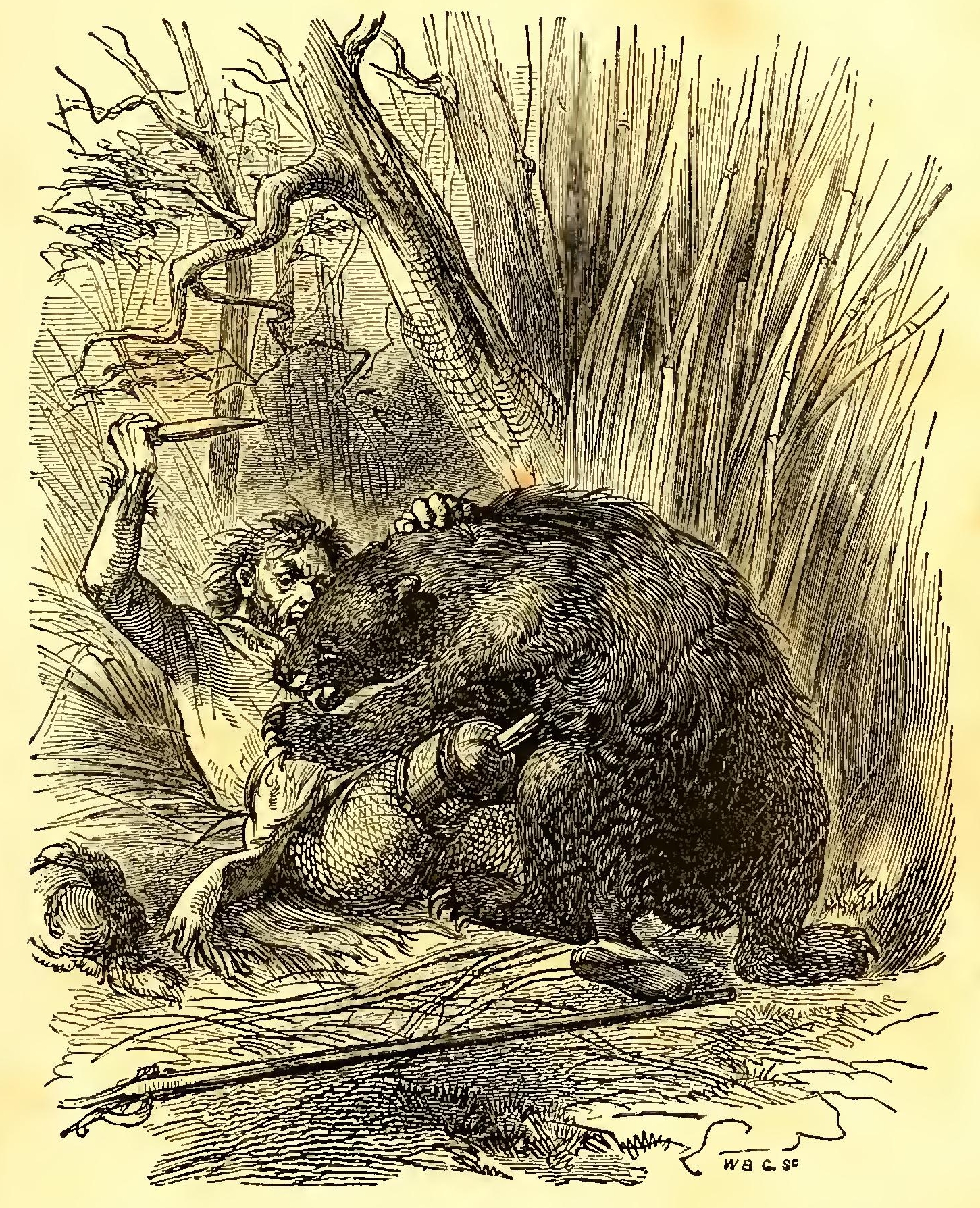
“I'd worn the old leg pretty well off to the second jint, when, jest 'fore
I made a lick, the noise of the boys and the dogs cummin' sorter confused
bar, and he made a stumble, and bein' off his guard I got a fair lick! The
way that bar's flesh giv in to the soft impresshuns of that leg war an
honor to the mederkal perfeshun for having invented sich a weepun! I
hollered—but you have heered me holler an' I won't describe it—I
had whipped a bar in a fair hand to hand fight—me, an old sickly
one-legged bar-hunter! The boys cum up, and, when they seed the ground we
had fit over, they swore they would hav thought, 'stead of a bar-fight,
that I had been cuttin' cane and deadenin' timber for a corn-patch, the
sile war so worked up, they then handed me a knife to finish the work.
“Doc, les licker, it's a dry talk—when will you make me another leg?
for bar-meat is not over plenty in the cabin, and I feel like tryin'
another!”
LOVE IN A GARDEN.
In the whole range
of human attributes there are not two more antagonistical qualities than
courage and cowardice; yet, how frequently we find them existing in the
same person, ensconced under the same coat of skin! In the form that
contains a spirit that would face with un-blenching eye the fiercest peril
of man's existence, we will often discover a timorous sprite, who hems and
hesitates, and falters and trembles, at an enemy no more formidable than a
pair of soft blue eyes, pouring their streams of liquid subduing
tenderness, or else a brace of piercing black orbits, which, like the fire
of the ancient Greeks, burn the fiercer for the water which love pours
over them, in the shape of tears.
And, odd as it may seem, this discordant association of heroism and
timidity is not found in weak effeminate nervous men, but in those whose
almost gigantic proportions, eagle eye, and dauntless bearing convey any
idea but that there is stuff for trembling in their stalwart frames. But
they are the ones who generally manifest the greatest cowardice—place
them before a battery of girls' eyes, and it proves literally a galvanic
battery, shocking them to such a degree that they usually do something
they never intended, and say things that they never meant. Let one of
these animals be in love, and what a mess he generally makes of the
affair! Did you ever know one to “pop the question” in a respectable
civilized manner?—That is, if he ever exalted his courage
sufficiently to get that near to matrimony. My word for it—never. No
suit for breach of promise could be ever brought against one of them—for
such is the non-committalism of their incoherency, that no woman, on her
oath, could avow, even were they conjugated at the time, that he
ever asked her to marry him; the intuitive feeling of her sex alone
enabled her to draw the idea that he was addressing her, from the mass of
his discordant, incoherent, lingual ramblings, when the question was being
popped.
This philosophizing is intended as a preface or premonitory symptom of a
story, illustrative of the trait; which, like measles, when repelled by
cold air, has struck in upon my memory, and which, carrying out the idea,
requires, like the aforesaid measles, to be brought to the surface in
order that I may feel relieved.
Among the many acquaintances that my profession enabled me to make in the
swamp, no one afforded me more pleasure than Jerry Wilson, the son of a
small planter resident some few miles from my shingle. There was
something so manly and frank in his bearing that our feelings were
irresistibly attracted towards him. In my case it proved to be mutual: he
seemed to take the same interest in me, and we soon became bosom friends.
A severe attack of congestive fever that I carried him through
successfully, riveted him to me for ever; and Jerry, upon all and every
occasion, stood ready to take up the gauntlet in my defence, as willingly
as in his own. Being very popular in the neighbourhood, he became of great
assistance to me, by advocating my cause, and extending, by his favourable
representations, my circle of practice.
The plantation adjoining Jerry's father's was possessed by an old,
broken-down Virginian, who, having dissipated one fortune in conforming to
the requirements of fashionable life, had come into the swamp, to endure
its many privations, in order that he might recruit his impoverished
finances.
Adversity, or something better, had taught him the folly of the prominent
foible of the Virginian—insane state pride, and consequent
individual importance. His mind was prepared to test men by the proper
criterion—merit, without regard to the adventitious circumstances of
birth, wealth, or nativity.
Major Smith deserves the meed, I believe, for being the first one of the
race to acknowledge that he was not an F. F.; which confession, showing
his integrity of character, proved to me that he really was one of the
very first of the land. But, in describing the father, I am neglecting by
far the most interesting, if not the most important character of the story—his
daughter—a sweet blooming girl of seventeen, at the time of which I
write. Ah! she was the bright exemplar of her sex! Look in her eye—so
luminous, yet so tender, and far down in its dreamy still waters, you
could see the gems of purity and feeling glimmering; listen to her voice—and
never yet forest bird, on the topmost leafy bough, gave forth such a gush
of melody, as when it rose and melted away in a laugh; her modesty and
timidity—you have seen the wild fawn, when, pausing on the brink of
some placid lake, it sees its beautiful image reflected in the waters—thus
shrank she, as if into herself, when voice of love, or praise, or
admiration stole into her ears—and yet, with all her maidenly
reserve and timidity, she loved and was beloved. Knowing that I am a
bachelor, think not, in this recital, that my swelling heart is tearing
open anew wounds which time and philosophy have just enabled me to heal.
No! my fair friend—for friend she was, and is—never kindled in
my heart the flames of love, or heard aught of the soft impeachment from
me; for, long before I had seen her, the “Swamp Doctor” had wedded his
books and calling—rather a frigid bride, but not an unprolific one,
and her yearly increase, instead of bringing lines of anxiety to my brow,
smooths the wrinkles that care and deep thought—certainly it cannot
be age—Lord! Lord! I have broken my wig spring—have dropped
upon my visage!
My friend Jerry was the favoured mortal, and, without doubt, in an equal
intensity reciprocated her love; but cowardice had hitherto prevented an
avowal upon his part, and the two lovers, therefore, dwelt in a delicious
state of uncertainty and suspense. No one, to know Jerry, as the majority
of men—going through the world with their noses either too elevated
or too depressed for observation—know their kind, would have thought
him a coward: but I knew, that, as respected women, a more arrant poltroon
did not exist. He would have met any peril that resolution, strength, or a
contempt for life could overcome, without fear of the consequences or the
least tremor; and yet he dared not for his life tell a pretty girl “that
he loved her, and would be highly pleased, and sorter tickled, too, if she
would marry him.” There was something more terrible in the idea of such an
avowal, than fighting bears, hugging Indians, or strangling panthers.
The poor girl, with the intuitive perception of her sex, had long
perceived that Jerry loved her as ardently as if the avowal on his part
had already been made. Almost daily she saw him, eagerly she awaited a
declaration, but poor Jerry never could get his courage to the sticking
point; like Bob Acres, it would ooze out at his fingers' points, in spite
of himself and his determination to bring things to the condition of a
fixed fact.
Matters were in this state when I became fully acquainted with them; she
was willing, he was willing, and yet, if they kept on in the way they were
pursuing, they both bid fair to remain in single blessedness for a long
time to come. Deeply interested in the welfare of both parties, I thought
I could not manifest my sympathy better than by kindly intervening and
producing that crisis which I knew would accord with the feelings of both.
A slight attack of fever of the lady's, not requiring medical aid, but
which a father's fears magnified, and would not be allayed until I had
been sent for, introduced me fully to the confidence of the daughter; and
a trite experiment, which I tried upon her, convinced me that all that my
friend Jerry had to do was to ask, and it would be given.
Holding my fair patient's hand, which, resting in mine, looked like a
pearl in a setting of jet, I placed my fingers upon her pulse, and, whilst
pretending to number it, accidentally, as it were, mentioned Jerry's name—the
sudden thrill that pervaded the artery assured me that she loved—lifting
my eyes to her face, I gave her an expressive look, which suffused her
beauteous countenance, as if she was passing into the second stage of
scarlet fever.
My next duty was to seek Jerry. I found him seated on a log, under a shady
willow by the edge of the bayou, pole in hand, assuming to be angling. The
tense state of his line, and an occasional quiver of the pole, indicated
that a fish was hooked. Passing unnoticed by him, a stranger would have
come to one of three conclusions: that he was deranged, in love, or a born
fool.
Walking up to him briskly, without his hearing me, although I made
considerable noise getting down the bank, I slapped him on the shoulder to
engage his attention, and, as I had several patients to visit, and time
was precious, without waiting for the usual salutations of the day.
commenced my address in a real quarter race manner:—
“Jerry, for a sensible man, and a fellow of courage, you are the d——dest
fool and coward unhung. You love a girl—the girl loves you. You know
that the old people are willing, and that the girl is only waiting for you
to pop the question, to say 'Yes!' and yet, instead of having the thing
over, like white folks, and becoming the head of a respectable family,
here you sit, like a knot on a tree, with the moss commencing to grow on
your back, pretending to be fishing, and yet not knowing that a big cat is
almost breaking your line to shivers.
“Now I want to do you a service, and you must take my advice. Jerk that
fish out, take the hook out of his mouth, and then put him back in the
bayou—perhaps his sweetheart was waiting for him when he got hung;
and as you are in a like predicament, you should be able to say to the
gal, 'That mercy I to others show, that mercy show to me!' Go home, put on
a clean shirt, shave that hair off your face and upper lip; for a sensible
woman never yet accepted a man, with nothing but the tip of his nose
visible from its wilderness of hair. Dress yourself decently, go up to old
Smith's, wait till you get rested, then ask the girl to take a walk in the
garden—gardens are a h—ll of a place to make love in—to
look at the flowers, to eat radishes, to pluck grapes—anything for
an excuse to get her there—and when you have got her under the
arbour, don't fall on your knees, or any of your fool novel notions, but
stand straight up before her, take both of her hands in yours, look her
dead in the eyes, and ask her, in a bold, manly way—as if you were
pricing pork—to marry you. Will you do it? Speak quick! I'm
interested in the matter, for if you don't do it to-day, by the Lord, I
will, for myself, to morrow. I have held off for you long enough; and if
you don't bring matters to a close, as I say, in the next twenty-four
hours, as cold weather is coming on, I'll try my hand myself in the
courting line—you know doctors are the very devil amongst the
women!”
This method of address alarmed Jerry, and he promised he would do as I
directed.
Accompanying him home, I saw him fairly dressed, and then left him, as the
demands of my patients were urgent.
Jerry mounted his steed, and set off at a brisk canter for Major Smith's.
It was only a mile and a half, and would have been travelled in a quarter
of an hour, had the steed kept his' gait. But, somehow, as the distance
shortened, the canter ceased, and a pace superseded it; the last half, his
rate had moderated to a walk; and when he made the last turn in the road,
his horse was browsing the grass and cane. Up to the last few hundred
yards, Jerry was as brave as a panther with cubs, and determined on
following out my prescription to the letter; but the moment the house,
with its white chimneys, commenced appearing round the bend of the bayou,
the white pin feathers began to peep out in his heart, and verily,
nothing, I believe, but my threat, if he proved recreant to-day, of
courting her myself on the morrow, kept him from giving up the chase, and
retracing his steps home.
But the house was reached, and the hearty voice of the Major, bidding him
alight, cut off all retreat. He was fairly in it.
Jerry got down, left the yard gate carefully open behind him, led his
horse up the Major's fine grass-walk to the steps, and was about bringing
him with him into the house, when a servant relieved him of the task by
carrying the steed to the stable. Not noticing the air of astonishment
with which the old Major was regarding him, he shook hands with the negro
for Major Smith, and bowing to a large yellow water-jar, addressed it as
“Miss Mary,” and then finished the performances by sitting down in a large
basket of eggs; the sudden yielding of his seat, and the laughter of both
father and daughter, aroused him to a full consciousness of how
ridiculously he was acting. His apologies and explanations only served to
render bad worse, and he therefore wisely determined to take a chair and
say nothing more. Dinner was shortly announced, and this he concluded in
very respectable style, without making any more serious mistake than
eating cabbage with a spoon, or helping the lady to the drum-stick of the
chicken. A cigar was smoked after dinner, and then the old Major, giving a
shrewd guess how the land lay, declared that he must take his afternoon
nap, and retired, leaving the field to Jerry and the daughter. “Now or
never,” was the motto with Jerry.
The old Major, in addition to planting cotton, and retrieving a dissipated
fortune, was a great dabbler in horticulture, and had bestowed great
attention upon the cultivation of the grape. By much care and grafting, he
had so improved upon the common varieties of the country as to render them
but slightly inferior to the choicest foreign specimens. An extensive
arbour was in the middle of the garden—the finest and most extensive
in the swamp—and this was literally covered with the ruddy clusters
of grapes, now in the fullest tide of ripeness.
“Now or never,” I say, was the word with Jerry. Making a desperate effort,
he faltered out, “Miss Mary, your father has a very fine garden! shall we
go look at the grapes? I am very fond of them, Miss Mary! do you like
grapes, Miss Mary? Ha! ha!”—the cold sweat bursting out from every
pore.
“Very much, Mr. Wilson, and pa's are really very fine, considering that
they have not the quality of being exotics to recommend them to our taste.
I will accompany you to taste them with much pleasure,” replied Miss Mary;
and tripping into the house, soon appeared, with the sweetest little
sun-bonnet on, that witching damsel ever wore.
Jerry, frightened nearly to death at the awful propinquity of the
“question popping,” could scarcely stand, for his agitation; and poor Miss
Mary, apprehending from Jerry's manner that the garden was destined to
become the recipient of some awfully horrible avowal—perhaps Jerry
had murdered somebody, and his conscience was forcing him to disclose; or
he had discovered that an insurrection of the negroes was contemplated; or—surely
he was not going to make a declaration—oh, no! she knew it was not
anything of that kind—began to participate in Jerry's embarrassment
and trepidation. More like criminals proceeding to execution, than young
people going to pluck grapes, they sought the garden; the gate was closed
behind them, and in a few moments more they stood under the arbour.
The grapes were hanging down upon all sides in the greatest profusion;
and, twining their purple masses together, seemingly cried out, “Come eat
us!”
Jerry was the very picture of terror. Oh! how he wished that he was safe
at home! But it was too late to retreat—he could only procrastinate.
But still, men had gone as far as walking in a secluded garden with a
lady, and then died old bachelors. But then that infernal doctor to-morrow—the
die was cast, he would go on. The question was, how should he approach the
subject, so as not to destroy life in the young lady, when the dreadful
business of his visit was announced? He must prepare her for it gradually—the
grapes offered an introductory—the impolite fellow, not to offer her
any during the long time they had been in the arbour—they had just a
second before reached it.
Plucking off a large bunch, he handed them to her, and selected a similar
one for himself. They were devoured in silence, Jerry too badly frightened
to speak, and Mary wondering what in the world was to come next. The
grapes were consumed, another pair of bunches selected, and the sound of
their champing jaws was all that broke the stillness. Jerry's eyes were
fixed on his bunch, and Mary was watching the motions of an agile snail.
The cluster was in process of disappearance, when Jerry, summoning his
whole energies, commenced his declamation: “Miss Mary, I have something to
impart”—here he came to a full stop, and looked up, as if to draw
inspiration from heaven; but the umbrageous foliage intercepted his view,
and only the grapes met his eye—and their juice requires to be gone
through with several processes, before much exhilaration or eloquence can
be drawn from it. Plucking a quantity, he swallowed them, to relieve his
throat, which was becoming strangely dry and harsh.
Miss Mary, poor girl, was sitting there, very much confused, busily eating
grapes; neither she nor Jerry knew, whilst continuing to eat, the quantity
that they had consumed: their thoughts were elsewhere.
“Miss Mary,” again upspoke Jerry, “you must have seen long before this—but
la! your bunch is eaten—have some more grapes, Miss Mary? I like
them very much”—and amidst much snubbling and champing, another
package of grapes was warehoused by the lovers.
Jerry's fix was becoming desperate; time was flying rapidly, and he knew
one subject would soon be exhausted, for he could eat but few more grapes.
Oh! how he wished that fighting a panther, fist-fight, had been made one
of the conventialities of society, and assumed to be declaratory of the
soft passion! how quickly would his bride be wooed!—but those
infernal words! he could never arrange them so as to express what he
meant. “Miss Mary, you must know that I saw Dr. Tensas, to-day, he told me—have
some more, Miss Mary, they won't hurt you. I have come expressly to ask
you—have another bunch, let me insist. I have come, Miss Mary, to
propose—another small bunch”—“Mary, I have come,” he almost
shrieked, “to ask you to have—only a few more—Oh! Lord!” and
he wiped the cold sweat off. Poor fellow! his pluck would not hold out.
Mary, frightened at his vehemence, said nothing, but eat on mechanically,
anxious to hear what it was that Jerry wished to disclose.
Again he marshalled his forces: the sun was declining in the west, and the
morrow would, perhaps, see the “Swamp Doctor,” with his glib tongue,
breathing his vows—“Miss Mary, I—I love—grapes—no,
you—grapes—will you have me—some grapes—marry me—no
grapes—yes, me! Oh! Lord! it is all over! You will—bless you—I
must have a kiss. You haven't consented yet—but you must!” The
barrier seemed to drop, the spell was lifted off his tongue, and Jerry, in
a stream of native eloquence, running the fiercer for being so long pent
up, plead his cause; could it be unsuccessful? Oh! no! Mary had made up
her mind long ago.
Side by side, now, all their diffidence vanished; they sat under the
blessed arbour, and discoursed of their past fears, and bright hopes for
the future! Jerry held the head of his mistress on his leal and noble
breast, and, as in a sweet and pure strain he pictured forth the quiet
domestic life they were to lead when married, Mary could scarcely believe
that the impudent fellow who now talked so glibly, and stole, in spite of
her rebukes, kisses unnumbered, was the timid nervous swain of a few
minutes before.
But lo! behold what a sudden transformation! Has Jerry struck some
discordant note in his sweet melody of the future—for Mary's
features are contracted, as if with pain, and her pretty face, in spite of
herself, wears a vinegar aspect. Rather early, I opine, for ladies to
commence the shrew—if I am wrong, lady reader, attribute the error
to the ignorance of an old bachelor. Jerry, too, seems to partake of the
sour contagion—he stamps upon the ground, writhes his body about,
and presses his hand upon his stomach, ignorant, I presume, of anatomy. He
meant to lay them over his heart, poor fellow! he got too Jow down. Mary,
too, is evincing the ardency of her affection; and with the same
deplorable ignorance of the locality of the organs. Verily, love is
affecting them, singularly. It may be a pleasant passion, but that couple,
who certainly have a fresh, I will not say genuine, article of lo\e, look
like anything but happy accepted lovers. What can be the matter? They have
just read an extract from one of Cowper's bu-colics—but can
poetry produce such an effect? They groan, and writhe their bodies about,
and would press their hearts, if they only lay where their digestive
apparatus certainly does. Can the grapes have anything to do with their
queer contortions? “Heavens!” Jerry cries, as a horrid suspicion flashes
over his mind, “The cholera! The cholera! Dearest, we will die together,
locked in each other's arms!” and Jerry sought to embrace his lady love;
but she was scrouched up, I believe the ladies term it, and as lie
had assumed the same globular position, approximation could not be
effected, and death had acquired another pang, from their having to meet
him separate.
Fortunately for them, the Major had got his sleep out some hours before,
and, becoming anxious at their prolonged stay, set out to seek them. As
the garden was a quiet, secluded place, he thought them most likely to be
there, and there he found them, labouring under the influence, not so much
of love as—the truth must out—an overdose of grapes: and you
know how they affect the system.
A boy was despatched post haste after me. Fortunately I was at home, and
quickly reached the spot. I reached the house, and was introduced
immediately to the apartment where both the patients lay. A glance at
their condition and position explained the cause fully of their disease. A
hearty emetic effected a cure; and the first child of Jerry and Mary
Wilson was distinctly marked on the left shoulder with a bunch of grapes.
HOW TO CURE FITS.
Not none of the
least difficult problems, in the practice of medicine, is the
distinguishing between cases of real disease, and those that are feigned.
It is a great stumbling block in the path of young practitioners, and even
the old members of the fraternity find a few chips of it in their way
occasionally. To such a degree may the art of dissimulation be carried,
that nothing but the eye of suspicion and blind presentiment will lead us
to detect the imposition. I have known a case of simulated disease, after
deceiving some of the first physicians in the South, and withstanding
almost every species of treatment, to be cured by an energetic, liberal
administration of the negro-whip. But this is a remedy that fearful
humanity will not allow us to use, and consequently I never resort to it,
but use equally as effective, but uninjurious means.
Shortly after I commenced practice, I was sent for in a great hurry to see
a case of fits in the person of a negro wench, belonging to a plantation a
few miles from where I was located. The fit was over when I reached the
place, and I found the patient resting very composedly and showing no
evidence of present or past disease; but the testimony of her master went
to show that she had had one of the worst fits he had ever seen, and he
ought to know something about fits, as he had lived several years in
Arkansas, where the doctors invariably throw every case into fits as
preliminary to a cure.
I made a prescription suitable to his description, and returned home, only
to be sent for in greater haste the next day, and so on every day for a
week, the fits seeming to increase in intensity under my treatment. I
remarked, as a peculiarity of her case, that on Sundays, and when rain
prevented her being put out to work, she escaped the attack; but hardly
could the hoe-handle salute her palm in the cotton-field, before she would
be screeching, yelping, and struggling like a friend of mine, who, camping
out, made his pillow of a fallen, but still tenanted hornets' nest.
I became desperate; the owner was becoming tired of sending for me, and my
reputation was suffering, for the patient was getting worse. I examined
her again thoroughly, but nothing could I find in her digestive, arterial,
nervous, muscular, or osseous systems, to indicate disease. I shaved all
the wool off her head to feel for depressed skull-bones, and commencing
the Materia Medica at Acetic Acid, administered through to Zingiber,
concluding the course by knocking her senseless with a galvanic battery;
but she stood fits, treatment, and everything else without change, and not
till a strong impression rested on my mind that she was feigning, did a
different course of treatment suggest itself to me. The plantation lay on
both sides of a deep bayou, the link of connexion a high wooden bridge. I
happened in one day at the house, when I perceived four negroes
approaching the bridge from the opposite field, bearing some object in a
blanket.
Finding, on inquiry, that my patient had that morning started to work in
that part of the plantation, I readily surmised that the blanket aforesaid
contained my case of fits.
Asking the overseer to accompany me, we advanced to meet the negroes, who
seemed to have great difficulty in keeping the object in the blanket; we
met them just as they reached the centre of the bridge, the water under
neath being some eight or ten feet deep.
“Who have you got there?” I asked.
“Hannah, sir, has got another of her fits,” replied one of the negroes.
“Put her down on the bridge and let me examine her.” It was done; it
required the united strength of the four negroes to hold her still whilst
I made the necessary examination, the result of which confirmed my
impression that she was simulating. I thundered almost in her ears, but
she gave no answer, and I determined to put in execution my new plan of
treatment.
“Pick her up and throw her in the bayou,” I said, very clearly and
precisely.
Knowing I rarely said what I did not mean, the negroes yet hesitated
somewhat at the singular command, afraid either to obey or refuse.
“Throw her in!” I yelled, giving a thundering stamp on the bridge.
No longer in doubt, the negroes picked up the blanket, and giving it a few
preliminary swings, to acquire momentum, were about to cast away, when,
with a loud yell, the case of fits burst from their hold and made tracks
for the cotton-field. I am pretty fleet myself, as were the negroes, but
that poor diseased invalid beat us all, and had hoed considerably
on a row before we reached her. A liberal flagellation completed the cure,
and she has never been troubled with fits since!
A STRUGGLE FOR LIFE. — THE END.
It was the spring
of 183-, the water from the Mississippi had commenced overflowing the low
swamps, and rendering travelling on horseback very disagreeable. The water
had got to that troublesome height, when it was rather too high for a
horse, and not high enough for a canoe or skiff to pass easily over the
submerged grounds.
I was sitting out under my favourite oak, congratulating myself that I had
no travelling to do just then,—it was very healthy—when my joy
was suddenly nipped in the bud by a loud hallo from the opposite side of
the bayou. Looking over, and answering the hail, I discerned first a mule,
and then something which so closely resembled an ape or an ourang outang,
that I was in doubt whether the voice had proceeded from it, until a
repetition of the hail, this time coming unmistakeably from it, assured me
that it was a human.
“Massa doctor at home?” yelled the voice.
“Yes, I am the doctor; what do you want?”
“Massa sent me with a letter to you.”
Jumping in the skiff, a few vigorous strokes sent me to the opposite
shore, where the singular being awaited my coming.
He was a negro dwarf of the most frightful appearance; his diminutive body
was garnished with legs and arms of enormously disproportionate length;
his face was hideous: a pair of tushes projected from either side of a
double hare-lip; and taking him altogether, he was the nearest essemblance
to the ourang outang mixed with the devil that human eyes ever dwelt upon.
I could not look at him without feeling disgust.
“Massa Bill sent me with a letter,” was his reply to my asking him his
business.
Opening it, I found a summons to see a patient, the mother of a man named
Disney, living some twenty miles distant by the usual road. It was in no
good humour that I told the dwarf to wait until I could swim my horse
over, and I would accompany him.
By the time I had concluded my preparations, and put a large bottle of
brandy in my pocket, my steed was awaiting me upon the opposite shore.
“Massa tole me to tell you ef you didn't mine swimming a little you had
better kum de nere way.”
“Do you have to swim much?”
“Oh no, massa, onely swim Plurisy Lake, and wade de back water a few mile,
you'll save haf de way at leste.” I looked at the sun. It was only about
two hours high, and the roads were in such miserable condition that six
miles an hour would be making fine speed, so I determined to go the near
way, and swim “Pleurisy slough.”
“You are certain you know the road, boy?”
“Oh, yes, massa, me know um ebery inch ob de groun'; hunted possum an'
coon ober him many a night. Massa, you ain't got any 'baccy, is you?”
“There's a chaw—and here's a drink of brandy. I'll give you another
if you pilot me safe through, and a good pounding if you get lost.”
“Dank you, Massa, um's good. No fere I lose you, know ebery inch of de
groun'.”
I had poured him out a dram, not considering his diminutive stature,
sufficient to unsettle the nerves of a stout man, but he drank it off with
great apparent relish; and by this time, everything being ready, we
commenced ploughing our way through the muddy roads.
We made but slow progress. I would dash on, and then have to wait for the
dwarf, who, belabouring his mule with a cudgel almost as large as himself,
strove in vain to keep up.
The road was directly down the bayou, for some miles. There were few
settlers on it then, and the extent of their clearing consisted of a
corn-patch. They were the pre-emptioners or squatters; men who settled
upon government land before its survey, and awaited the incoming of
planters with several negroes to buy their claims, themselves to be bought
out by more affluent emigrants. To one of the first-mentioned class—the
pre-emptioners—my visit was directed, or rather to his mother, who
occupied an intermediate grade between the squatter and the small planter,
inasmuch as she possessed one negro, the delectable morsel for whom I was
waiting every few hundred yards.
It wanted but an hour to sundown when we reached the place where it was
optional with me, either to go the longer route by the bayou, or save
several miles by cutting across the bend of the stream, having, however,
to swim “Pleurisy slough” if I did so.
The path across was quite obscure, and it would be dark by the time we
crossed; but the negro declared he knew every inch of the way, and as
saving distance was a serious consideration, I determined to try it and
“Pleurisy slough.”
Taking a drink to warm me, for the dew that had commenced to fall was
quite chilling, I gave one to the negro, not noticing the wild sparkle of
his eye or the exhilaration of his manner.
We pressed on eagerly, I ahead as long as the path lasted; but it giving
out at the edge of the back water, it became necessary for the negro to
precede and pilot the way.
I followed him mechanically for some distance, relying on his intimate
knowledge of the swamp, our steeds making but slow progress through the
mud and water.
When we entered the swamp I had remarked that the sun was in our faces;
and great was my astonishment, when we had travelled some time, on
glancing my eye upwards to see if it had left the tree-tops, to perceive
its last beams directly at my back, the very reverse of what it should
have been. Thinking perhaps that it was some optical illusion, I consulted
the moss on the trees, and its indication was that we were taking the back
track. I addressed the negro very sharply for having misled me, when,
instead of excusing himself, he turned on me his hideous countenance and
chuckled the low laugh of drunkenness. I saw that I had given him too much
brandy for his weak brain, and that he was too far gone to be of any
assistance to me in finding the way.
Mine was a pleasant situation truly. To return home would be as bad as to
endeavour to go on; it would be night at any rate before I could get out
of the swamp; and after it fell, as there was no moon, it would be
dangerous to travel, as the whole country was full of lakes and sloughs,
and we might be precipitated suddenly into one of them, losing our animals
if not being drowned ourselves.
It was evident that I would have to pass the night in the swamp, my only
companion the drunken dwarf. I had nothing to eat, and no weapons to
protect myself if assailed by wild beasts; but the swamp was high enough
to preclude the attack of anything but an alligator, and their bellow was
resounding in too close proximity to be agreeable.
Fortunately, being a cigar-smoker, I had a box of matches in my pocket, so
I would have a fire at least. My next care was to find a ridge
sufficiently above the water to furnish a dry place for building a fire
and camp. After considerable search, just at night-fall the welcome
prospect of a cane ridge above the overflow met my gaze; hurrying up the
negro, who by this time was maudlin drunk, I reached the cane, and forcing
my way with considerable difficulty through it until I got out of the
reach of the water, dismounted, and tying my horse, took the negro down
and performed the same office for his mule.
My next care was to gather materials for a fire before impenetrable
darkness closed over the swamp; fortunately for me, a fallen oak presented
itself not ten steps from where I stood. To have a cheerful blazing fire
was the work of a few minutes. Breaking off sufficient cane-tops to last
the steeds till morning, I stripped my horse—the mule had nothing on
but a bridle—and with the saddle and cane-leaves made me a couch
that a monarch, had he been as tired as I was, would have found no fault
with. As the negro was perfectly helpless, and nearly naked, I gave him my
saddle blanket, and making him a bed at a respectful distance, bade him go
to sleep.
Replenishing the fire with sufficient fuel to last till morning, I lit a
cigar, and throwing myself down upon my fragrant couch, gave myself up to
reflections upon the peculiarity of my situation. Had it been a voluntary
bivouac with a set of chosen companions, it would not have awakened half
the interest in my mind that it did, for the attending circumstances
imparted to it much of the romantic.
There, far from human habitation, my only companion a hideous dwarf,
surrounded with water, the night drape-ried darkly around, I lay, the
cane-leaves for my bed, the saddle for my pillow; the huge fire lighting
up the darkness for a space around, and giving natural objects a strange,
distorted appearance, bringing the two steeds into high relief against the
dark background of waving cane, which nodded over, discoursing a wild,
peculiar melody of its own. Occasionally a loud explosion would be heard
as the fire communicated with a green reed; the wild hoot of an owl was
heard, and directly I almost felt the sweep of his wings as he went
sailing by, and alighted upon an old tree just where the light sank
mingling with the darkness. I followed him with my eye, and as he settled
himself, he turned his gaze towards me; I moved one of the logs, and his
huge eyes fairly glistened with light, as the flames shot up with
increased vigour; the swamp moss was flowing around him in long, tangled
masses, and as a more vivid gleam uprose, I gazed and started
involuntarily. Had I not known it was an owl surrounded with moss that sat
upon that stricken tree, I would have sworn it was the form of an old man,
clad in a sombre flowing mantle, his arm raised in an attitude of warning,
that I gazed upon. A cane exploding, startled the owl, and with a loud “tu
whit, tu whoo,” he went sailing away in the darkness. The unmelodious
bellow of the alligator, and the jarring cry of the heron, arose from a
lake on the opposite side of the cane; whilst the voices of a myriad of
frogs, and the many undistinguish-able sounds of the swamp, made the night
vocal with discordancy.
My cigar being by this time exhausted, I took the bottle from my pocket,
and taking a hearty drink to keep the night air from chilling me when
asleep, was about to restore it to its place, and commend myself to
slumber, when, glancing at the dwarf, I saw his eyes fixed upon me with a
demoniac expression that I shall never forget.
“Give me a dram,” he said very abruptly, not prefacing the request by
those deferential words never omitted by the slave when in his proper
mind.
“No, sir, you have already taken too much; I will give you no more,” I
replied.
“Give me a dram,” he again said, more fiercely than before.
Breaking off a cane, I told him that if he spoke to me in that manner
again I would give him a severe flogging.
But to my surprise he retorted, “D——n you, white man, I will
kill you ef you don't give me more brandy!” his eyes flashing and
sparkling with electric light.
I rose to correct him, but a comparison of my well developed frame with
his stunted deformed proportions, and the reflection that his drunkenness
was attributable to my giving him the brandy, deterred me.
“I will kill you,” he again screamed, his fangs clashing, and the foam
flying from his mouth, his long arms extended as if to clutch me, and the
fingers quivering nervously.
I took a hasty glance of my condition. I was lost in the midst of the
swamp, an unknown watery expanse surrounding me; remote from any possible
assistance; the swamps were rapidly filling with water, and if we did not
get out to-morrow or next day, we would in all probability be starved or
drowned; the negro was my only dependence, to pilot me to the settlements,
and he was threatening my life if I did not give him more brandy; should I
do it or not? Judging from the effects of the two drinks I had given him,
if he got possession of the bottle it might destroy him, or at least
render him incapable of travelling, until starvation and exposure would
destroy us. My mind was resolved upon that subject; I would give him no
more. There was no alternative, I would have to stand his assault;
considering I was three times his size, a fearful adventure, truly,
thought I, not doubting a moment but that my greater size would give me
proportionate strength; I must not hurt him, but will tie him until he
recovers.
The dwarf, now aroused to maniacal fury by the persistance in my refusal,
slowly approached me to carry his threat into execution. The idea of such
a diminutive object destroying without weapons a man of my size, presented
something ludicrous, and I laughingly awaited his attack, ready to tie his
hands before he could bite or scratch me. Wofully I underrated his powers!
With a yell like a wild beast's, he precipitated himself upon me; evading
my blow, he clutched with his long fingers at my throat, burying his
talons in my flesh, and writhing his little body around mine, strove to
bear me to earth.
I summoned my whole strength, and endeavoured to shake him off; but,
possessing the proverbial power of the dwarf, increased by his drunken
mania to an immense degree, I found all my efforts unavailing, and, oh
God! horrors of horrors, what awful anguish was mine, when I found him
bearing me slowly to earth, and his piercing talons buried in my throat,
cutting off my breath! My eyes met his with a more horrid gleam than that
he glared upon me: his was the fire of brutal nature, aroused by desire to
intense malignancy; and mine the gaze of despair and death. Closer and
firmer his gripe closed upon my throat, barring out the sweet life's
breath. I strove to shriek for help, but could not. How shall I describe
the racking agony that tortured me? A mountain, heavier than any earth's
bosom holds, was pressing upon my breast, slowly crushing me to fragments.
All kinds of colours first floated before my eyes, and then everything
wore a settled, intensely fiery red. I felt my jaw slowly dropping, and my
tongue protruding, till it rested on the hellish fangs that encircled my
throat. I could hear distinctly every pulsation of even the minutest
artery in my frame. Its wild singing was in my ears like the ocean wave
playing over the shell-clad shore. I remember it all perfectly, for the
mind, through all this awful struggle, still remained full of thought and
clearness. Closer grew the gripe of those talons around my throat, and I
knew that I could live but a few moments more. I did not pray. I did not
commend my soul to God. I had not a fear of death. But oh! awful were my
thoughts at dying in such a way—suffocated by a hellish negro in the
midst of the noisome swamp, my flesh to be devoured by the carrion crow,
my bones to whiten where they lay for long years, and then startle the
settler, when civilization had strode into the wilderness, and the cane
that would conceal my bones would be falling before the knife of the
cane-cutter. I ceased to breathe. I was dead. I had suffered the last
pangs of that awful hour, and either it was the soul not yet resigned to
leave its human tenement, or else immortal mind triumphing over death, but
I still retained the sentient principle within my corpse. I remember
distinctly when the demon relaxed his clutch, and shaking me to see if I
were really dead, broke into a hellish laugh. I remember distinctly when
tearing the bottle from me, he pulled my limber body off my couch, and
stretched himself upon it. And what were my thoughts? I was dead, yet am
living now. Ay, dead as human ever becomes. My lungs had ceased to play;
my heart was still; my muscles were inactive; even my skin had the dead
clammy touch. Had men been there, they would have placed me in a coffin,
and buried me deep in the ground, and the worm would have eaten me, and
the death-rats made nests in my heart, and what was lately a strong man
would have become a loathsome mass. But still in that coffin amidst those
writhing worms, would have been the immortal mind, and still would it have
thought and pondered on till the last day was come. For such, is the
course of soul and death, as my interpretation has it. I was dead, all but
my mind, and that still thought on as vividly, as ramblingly, as during
life. My body lay dead in that murderer's swamp, my mind roamed far away
in thought, reviewing my carnal life. I stood, as when a boy, by my
mother's grave. The tall grass was waving over it, the green sod smiled at
my feet. “Mother,” I whispered, “your child is weary—the world looks
harsh upon him—coldness comes from those who should shelter the
orphan. Mother, open your large black eyes and smile upon your child.”
Again, I stood upon the steamer, a childish fugitive, giving a last look
upon my fleeing home, and mingling my tears with the foaming wave beneath.
I dragged my exhausted frame through the cotton-fields of the south. My
back was wearied with stooping—we were picking the first opening—and
as dreams of future distinction would break upon my soul, the strap of the
cotton-sack, galling my shoulder, recalled me to myself. All the phases of
my life were repeated, until they ended where I lay dead!—dead as
mortal ever becomes. I thought, What will my friends say when they hear
that on a visit to the sick, I disappeared in the swamp, and was never
heard of more?—drowned or starved to death? Will they weep for me?
for me?—Not many, I ween, will be the tears that will be shed for
me. Then, after the lapse of long years, my bones will be found. I wonder
who will get my skull? Perhaps an humble doctor like myself, who,
meditating upon it, will not think that it holds the mind of a creature of
his own ambition—his own lofty instincts. He will deem it but an
empty skull, and little dream that it held a sentient principle. But I
know that the mind will still tenant it. Ha, ha! how that foul ape is
gurgling his blood-bought pleasure. I would move if I could, and wrench
the bottle from him; but mine is thought, not action. Hark! there is a
storm arising. I hear with my ear, that is pressed on the earth, the
thunder of the hurricane. How the trees crash beneath it! Will it
prostrate those above me? Hark! what awful thunder! Ah me! what fierce
pang is that piercing my very vitals? There is a glimmering of light
before my eyes. Can it be that I the dead am being restored to human life?
Another thunder peal! 'tis the second stroke of my heart—my blood is
red-hot—it comes with fire through my veins—the earth quakes—the
mountain is rolling off my chest—I live!—I breathe!—I
see!—I hear!—Where am I? Who brought me here? I hear other
sounds, but cannot my own voice. Where am I? Ah! I remember the dwarf
strangled me. Hark! where is he? Is that the sunbeam playing over the
trees? What noisome odour like consuming flesh is that which poisons the
gale? Great God! can that disfigured half-consumed mass be my evil genius?
I rose up, and staggering, fell again; my strength was nearly gone. I lay
until I thought myself sufficiently recruited to stand, and then got up
and surveyed the scene. The animals were tied as I left them, and were
eating their cane unconcernedly; but fearfully my well-nigh murderer had
paid for his crime, and awful was the retribution Maddened by the spirits,
he had rushed into the flames, and, in the charred and loathsome mass,
nothing of the human remained; he had died the murderer's death and been
buried in his grave,—a tomb of fire.
To remain longer in the horrid place was impossible; my throat pained me
excessively where the talons had penetrated the flesh, and I could not
speak above a whisper. I turned the mule loose, thinking that it would
return home, and conduct me out of the swamp. I was not incorrect in my
supposition; the creature led me to his owner's cabin. The patient had
died during the night.
My account of the dwarf's attack did not surprise the family; he had once,
when in a similar condition, made an attack upon his mistress, and would
have strangled her had assistance not been near.
His bones were left to bleach where they lay. I would not for the universe
have looked again upon the place; and his mistress being dead, there were
none to care for giving him the rites of sepulture.