The Survey, Volume XXX, No. 3, Apr 19, 1913 — THE COMMON WELFARE — THE STRIKE OF THE JERSEY SILK WORKERS — CITY OFFICIALS ADOPT REPRESSIVE MEASURES — “A MAN’S FRIENDS” — BRIEUX’S “DAMAGED GOODS” PRESENTED — NEW YORK CHARITIES AND THE LAW MAKERS — BEDFORD REFORMATORY NOW FACING A CRISIS
Transcriber’s Note:
New original cover art included with this eBook is granted to the public domain.
81
For seven weeks the 27,000 workers in the
silk mills and dye houses of Paterson, N. J.,
have been on strike for improved conditions
and against a proposed change in method that
will, they declare, alter the character of the
industry.
The strike began with the broad silk weavers
as a protest against the introduction of the
three and four loom system. They were soon
joined by the ribbon weavers and the dye house
men, whose demands are for an eight-hour day
and a minimum wage of $12 a week. The dye house
men have been laboring in two shifts of
twelve hours each. Their work is often carried
on under unhealthful conditions of dampness,
high temperature and poor ventilation.
All the strikers joined the branch of the Industrial
Workers of the World which conducted
the Lawrence strike. This is one factor which
has caused tension in a situation, in which statutes
dating back to colonial days have been
brought to bear on a modern industrial struggle
till a Supreme Court judge denounced the
lengths to which the police have gone.
Back of the police incidents and the spreading
of the revolutionary doctrines of the Industrial
Socialists is a profound economic change involved
in the introduction of the four loom system.
This is not merely the substitution of machines
for skilled men due to invention, but the supplanting
of high-grade textile manufacture by
low-grade output because of the greater profits
in the cheap goods. It is as if a vineyard were
giving way to a hay farm—a change which seriously
affects the working population of Paterson.
In order to make the situation clear it is necessary
to take a brief look at the history of the
silk industry in this country. Twenty years or
so ago the competition between Pennsylvania and
New Jersey for the manufacture of cheap silks
was keen, but within a few years the battle was
over. Induced, it is said, by real estate companies,
the manufacture of cheap silk on a large
scale migrated to Pennsylvania. Great factories
were built and leased on easy terms, and these
were equipped with automatic looms, four of
which could be operated by one girl or boy.
There the wives and children of the coal miners
furnished a cheap labor supply.
Since this migration the best grade of silk
has been made in Paterson, and there has been
no competition to speak of that the Paterson
manufacturers needed to fear. Yet they have
been making only moderate profits while the
Pennsylvania manufacturers of cheap silk have
been making fortunes. Under the system of
multiple looms, the business of Pennsylvania,
has expanded 97 per cent in the last six years;
under the one and two loom systems of Paterson
its business has expanded only 22 per cent
in the same time. Therefore the Paterson manufacturers
propose to compete in the manufacture
of cheaper silks and consequently decided to introduce
the multiple loom system. To them this
is only a natural economic development, and the
opposition of the workers they feel is irrational,
as opposed to progress. This view is made apparent
in a statement issued by the silk manufacturers’
association:
“As regards the three and four loom system,
it is applicable only in the case of the very simplest
grade of broad silks and as a matter of
fact has for a long time been worked successfully
and on a very large scale in other localities.
Paterson cannot be excluded from this same
privilege. No fight against improved machinery
has ever been successful.”
The beginning of the change came in one of
the big Paterson mills about a year ago and the
strike of last spring[1] was at first against the four loom
system. The strike became general, however,
and this demand was completely lost sight
of before the strike came to an end. Since then
nine or ten other mills have installed the four
loom system and a score have begun to require
the weavers to tend three looms instead of two.
The strikers claim that the new system will
cause unemployment, as did the installation of
the two loom system together with other improvements
in the mechanical equipment of the
loom some years ago, and that the logical consequence
will be the employment of unskilled
women and children in place of the skilled weaver,
and a forcing down of the level of wages
until the Paterson average of $11.69, as given
in the federal report for the year 1908, becomes
as low as the Pennsylvania average of $6.56.
As the percentage of women employed in Paterson
82mills has increased in the last few years
and as the average of wages given out by the
manufacturers this year is under $10, there is
basis for these fears. Nor do the manufacturers
deny these possibilities; they claim that the
loss of skill is an inevitable accompaniment of
improved processes, and the replacing of men
by women and children is only in line with the
development in all the textile trades.
Some of the claims of the strikers are thus
summarized by the Paterson Evening News:
“The best information obtainable appears to
show that the alleged mechanical advantages of
the new system have not proved themselves sufficient
to offset the additional strain to which
the care of three or four looms subjects the
weavers; that the premium wages first paid as
an inducement to users of the system have been
pared down; that at present a day’s work under
the system is proportionately less well paid
than a day’s work at two looms; and, finally,
that the wages of two loom workers have been
depressed with the scaling down of the piece-rate
paid to the three and four loom workers.”
In spite of the fact that it is only the large
manufacturers who propose to install the new
system, the strike is general. The multiple
looms, which are large and equipped with automatic
devices, can only be installed in large
mills. By this system cheap silks alone can be
made; the smaller mills must use the Jacquard
or other small looms fitted to the making of
the fancy grades of silk for which Paterson is
famous. The small manufacturer, therefore,
does not fear the installation of the new system
in the large mills; but he does feel strongly
that he has a grievance toward the workers in
his mills who struck sympathetically for a wrong
not their own.
But it is a very real fear that the entire industry
will be undermined that has made the
workers stand together, regardless of individual
grievances.
While the desire to keep up with industrial
progress and to realize large profits is the reason
for the importing of the four loom system into
Paterson; the desire to save their present standard
of living and prevent their industry from
coming into the hands of women and children like
the other textile trades is the reason for the
workers’ opposition. Today Pennsylvania and
New Jersey present different phases of the industry,
and New Jersey has had a higher wage
standard; tomorrow with the triumph of the
four loom system they may tend to an equalization
of conditions.
The outstanding features in the strike now
in its seventh week are lack of violence and
disorder, the refusal of the employers to meet
or confer with the strikers, aggressive repression
by the police and the city government and
the efforts of citizens to bring about a settlement.
Although practically all the workers in
the major industry of the city are on strike,
there has been little disorderly conduct attributable
to the strikers. There have been reports of
the breaking of a window by a stone in a house
occupied by a boss dyer and at least one attempt
was made to damage a house by means of a
bomb, but responsibility for these acts has not
been fixed.
In striking contrast to the order maintained
by the rank and file of the strikers, there have
been actions on the part of the city officials that
leading newspapers outside of the strike district
have not hesitated to characterize as anarchical.
Soon after the strike began and it became
known that it was to be conducted under
the auspices of the I. W. W., the police began
to arrest strike leaders and others who addressed
meetings of strikers, regardless of whether they
had yet been guilty of any illegal act. Several
of them were held in jail for a time and then so
great was the outcry raised that for a period
of two or three weeks these tactics were abandoned.
On Sunday, March 30, however, the police resumed
their former tactics. William D. Haywood,
the leader of the strike, had announced
that he would speak at an open air meeting,
and a large crowd gathered to hear him. As
Haywood was going to the meeting place to
speak he was approached by members of the
police force. They told him that the chief of
police had issued an order forbidding any out-door
meeting. According to all reports, including
testimony given by the police authorities
themselves, Haywood acquiesced at once and
passed the word to the assemblage that the
meeting would take place in Haledon, an independent
borough just outside the city limits of
Paterson. Accordingly, Haywood started to
walk down the street in the direction of Haledon
and he was followed by the crowd. Just before
he reached the city limits, a patrol wagon
bore down upon him. Together with Lessig, another
strike leader, he was arrested, taken before
the Recorder’s Court, charged with disorderly
conduct and unlawful assemblage under
the English act of 1635. After being held in
jail in lieu of $5,000 bail, both were found guilty
of unlawful assemblage and were sentenced by
the recorder to six months’ imprisonment.
A writ of certiorari was immediately sought
by Haywood’s attorneys and a hearing on this
appeal was held by Supreme Court Justice Minturn.
When the evidence, most of it furnished
by the police department, was in, Justice Minturn
83ordered the release of Haywood and Lessig. He
was unable to find that there had been any unlawful
assemblage. The evidence tended rather to
show that Haywood was co-operating with the
authorities in an endeavor to carry out their
orders. At the time of this resumption of their
activity the police began also to arrest pickets.
From twenty to one hundred a day were taken to
headquarters. After Judge Minturn’s decision, all
those held in jail were discharged. Since then,
while the arrest of pickets has gone steadily on,
Recorder Carroll has refused to hold them.
Throughout the strike to date the manufacturers
have consistently refused to meet with a
committee of strikers or to discuss terms with
them in any way. At one time a delegation of
clergymen endeavored to get them to meet a
committee of strikers in order to discuss grievances.
This suggestion was instantly voted
down. Last week, when a public meeting of citizens
was held to consider whether or not the
strike could be brought to an end, the manufacturers,
through their representative, stated
their position in just two propositions: First,
the employers will refuse to meet any committee
of strikers “dominated as they are by the I. W.
W.”; second, they will meet any of their individual
employes “who are not dominated by the
I. W. W.”
All along there has been a lively public interest
in the strike. Ministers and public-spirited
citizens have at different times endeavored to
ascertain the underlying causes and to co-operate
in restoring harmonious relations. These efforts
reached their most formal stage when last
week at the call of the president of the Board
of Aldermen a public meeting was held in the
high school auditorium on Wednesday evening
to which employers, strikers, church organizations,
the board of trade, organizations of bankers
and professional men, and the general public
were invited. Representatives of the strikers
explained their grievances, a single representative
of the employers stated their position
as just quoted, and the ministerial association
came forward with a proposal for a legislative
investigation. Finally, a committee of the Board
of Aldermen proposed in a series of resolutions
that a committee of fifteen be appointed to discuss
a basis upon which the strike could be settled,
the committee to consist of five representatives
of the strikers, five representatives of employers
and five men to be appointed from the
membership of the Board of Aldermen. The
resolution was passed by the unanimous vote
of an audience two-thirds of which were strikers.
The strikers appointed their committee.
But the employers, in line with their official policy
which has been against any meeting with
any body of men even to discuss a settlement, refused
to do so.
“I don’t believe there is a man in the country
who will not put himself or some one he loves
above the whole nation if he is put to a hard
enough test.”
These words, spoken by one of the principal
characters, contain the essence of a new play,
A Man’s Friends, written by Ernest Poole and
recently presented in New York. Without
moralizing on the need for a wider social consciousness,
Mr. Poole seeks to show the limits
of the average man’s circle of human loyalty
and how far his loyalty to the whole people’s
welfare is inhibited by his devotion to his own
“crowd.” The play aims to point out that, however
much our attention has been focused on
graft in its great anti-social consequences, a
larger factor in thwarting social progress is our
restricted loyalty to groups which are less than
the whole people.
A district attorney fights a political machine
which, through bribery, has defeated a new
building code. He convicts the bribed alderman
but cannot obtain from him any information
as to the “men higher up.” At last he discovers
that his own son-in-law was the go-between in
the matter of the bribe. The intense loyalty of
wife to husband is shown by his daughter who
says to her father: “Your life and principles are
nothing now—promise me you’ll keep Hal out
of jail,” and by the wife of the guilty alderman
who declares “it is not a question of right
and wrong—it’s what I think of Nick.”
The play brings out the loyalty to one’s circle
of intimates, shown in the refusal of the convicted
alderman to divulge incriminating information;
and the loyalty to a political coterie
whose watchword is “You might as well be
dead as a squealer,” and concerning whom the
district attorney says: “It is the unwritten law
of your system to perjure yourself to save a
friend.” He further remarks to the boss, “You
won’t help those not in your crowd—and your
crowd is too small, even though you can call
a hundred thousand people in New York by
their first names.”
One element in the play is the definite human
appraisal of just what graft and disloyalty to
public welfare involve. It flashes out when the
boss after telling how he had given a few dollars
to a “down and outer” is silenced by the district
attorney’s daughter who points out that he
owns the gambling place in which the derelict
lost his money. It is again emphasized when
the district attorney says to those who appeal
for leniency toward the men responsible for the
defeat of the building code, “All right let’s be
human,” and then refers to the 149 factory
girls who lost their lives in a factory fire which
84the building code would have prevented. “People
vote,” he says at another time, “with the
man who laughs, but the laugh is too expensive.”
How the district attorney shows his own
human qualities in the end by saving his son-in-law
from prison, but in a way to render important
service to the 9,000,000 people of the state,
is the climax of the piece.
The play is intended to show how the absorption
of the average man in his own affairs and
in the interests of his small group of friends
is responsible for popular indifference which
often makes the conscientious public servant
lonely and disheartened. The district attorney,
as candidate for governor, has returned from
a campaign trip. “There are one million men
out for the graft and nine million who don’t
care,” he says. His daughter replies: “That
does not seem like you, father.” “Well,” he
adds, “you ought to have seen them all along
the line of my trip; big meetings, cheering, too,
plenty of enthusiasm. But the minute I left
each town I felt it all suddenly die right out.
Every man jack of them back to his business,
his job and his friends—the things he really
cares about—and I felt as though I had carried
on the cheers of each town. Each town throwing
it all at my head and shouting ‘Go on, be
a hero, save the country—only for God’s sake
leave us alone, we have not time, we are busy.’”
“I didn’t know” bids fair to become an obsolete
phrase in connection with the nature of the
social evil, if the ripples started by the production
of Brieux’s Damaged Goods in New York
this spring extend as far as its sponsors intend.
The Committee of the Sociological Fund of the
Medical Review of Reviews believe that syphilis
should no longer be regarded as a mysterious
disease, whose ravages are to be shunned but its
causes ignored.
Bernard Shaw’s preface to the Brieux play,
with its warning against the usual treatment of
the subject as taboo and its appeal for publicity
and legal assistance in coping with the evil, was
read by a clergyman well known for his human
contact with every-day social conditions. The
drama itself was simply staged and given a sympathetic
reading by a strong cast. Almost every
bearing of the menace on family and social life
is brought out in a way well calculated to meet
prejudice due to indifference, ignorance or tradition,
and to create a conviction that here is a
scourge to be conquered by publicity.
Those who saw the play had come with various
mental attitudes. Some were even vaguely
questioning whether they had come to see a play
or hear a sermon. Not a few of the theatrical
critics have dubbed it the latter, but to many
parents this very quality made it seem peculiarly
profitable for young men who are breaking
loose from home life. By some it was even felt
that the educational value of the piece would
justify its being given a special performance at
some holiday season, and that prevention
through knowledge would thus be promoted.
Convinced that the state charitable and correctional
institutions are facing a serious crisis,
New York social workers are protesting against
certain of the recommendations of Governor Sulzer’s
Committee of Inquiry which they fear the
Legislature may act upon. This committee,
which was appointed by the governor to
examine into the administration of the
state’s departments in the furtherance of economy,
has made recommendations, relative to
state charities and corrections, ranging from the
repeal of the act establishing the state industrial
farm colony for tramps to the refusal of
large part of the sums asked for repairs on
state institutions. The Prison Farm for Women,
Letchworth Village and the State Training
School for Boys are among the institutions that
would be most seriously affected. The Committee
of inquiry also recommended that the
State Probation Commission, a non-salaried body,
be merged with the Prison Commission.
All told, there are fourteen state hospitals for
the insane and sixteen state charitable institutions
with a total of 42,000 patients and inmates.
The Committee of Inquiry, partly on the alleged
ground that the state has little control
over the expenditures of these institutions, has
made sweeping recommendations for retrenchment
on projects to which the state has already
committed itself by legislation. Social workers
who dispute the findings of the commission point
out that it had but a few weeks in which to
gain an understanding of the workings and relations
of the state institutions to various supervisory
and administrative state bodies and
that its statements as to excessive cost of housing
the inmates are apparently made without a
comparison of the situation in other states.
The Committee of Inquiry recommends that
the state charitable institutions in some way
ought to be consolidated, This, social workers
urge, could not be done except by putting together
state wards of entirely different types
since the only institutions having a capacity of
less than 300 are the State Women’s Relief
Home, an institution for aged veterans and
their wives; the Thomas Indian School; the
State School for Blind: the State Hospital for
Crippled Children, and Letchworth Village for
the Feeble-minded.
For many years the state has been gradually
85building up a group of institutions for the care
of the insane and feeble-minded, the epileptic,
and delinquent cases requiring reformatory
treatment. The insane are increasing at the
rate of about one thousand a year. There is an
accumulation at the present time of 5,000 patients
in excess of the certified capacity of the
fourteen state hospitals. To delay appropriations
for new state hospitals already started, it
is claimed, is only to put off what must be eventually
done.
For the feeble-minded and epileptic New
York has provided four institutions in the central
and western part of the state which care
altogether for about 4,000 inmates and one,
Letchworth Village in the southeastern part of
the state, which as yet has less than 100 inmates.
This, when completed, will serve New York city
and vicinity where more than half the population
of the state centers.
The next largest group of institutions is the
reformatories of which there are two for women,
one at Bedford and one at Albion; one for
girls at Hudson; and two for boys, of which
the State Agricultural and Industrial School
at Industry is known the country over as a
model of its kind. This institution for caring
for boys outside the metropolitan district, social
Workers urge, should be paralleled without
further delay as suggested by the Committee
of Inquiry by one in Westchester County for
the boys of New York City and its vicinity.
The state has also undertaken to round out
its reformatory and penal system by providing
a state farm for women over thirty years of
age, the age up to which they may be received
in reformatories, and the state industrial farm
colony for tramps. These institutions are
planned to care for offenders who now cause
much expense to localities. Both of these institutions
were established after long study of
the subject by organizations and individuals expert
in dealing with dependents and delinquents
but the committee recommends the abandonment
of the second and further investigation as to
the desirability of the first.
After discussing the situation at a meeting
held in New York on April 3, a committee consisting
of Henry Morgenthau; Homer Folks,
secretary of the State Charities Aid Association;
John A. Kingsbury, general agent of
the New York Association for Improving the
Condition of the Poor; the Right Rev. N. G. R.
McMahon, supervisor of Catholic Charities, and
Mrs. John M. Glenn, was appointed to confer
with the governor who has given the committee
assurance that he is considering the situation
as a whole and will not make separate judgments
on each institution by itself.
A similar meeting was held in Buffalo. At
this delegates were also selected who have interviewed
the governor in behalf of the important
humanitarian projects undertaken by the state
in the last ten years which are now threatened.
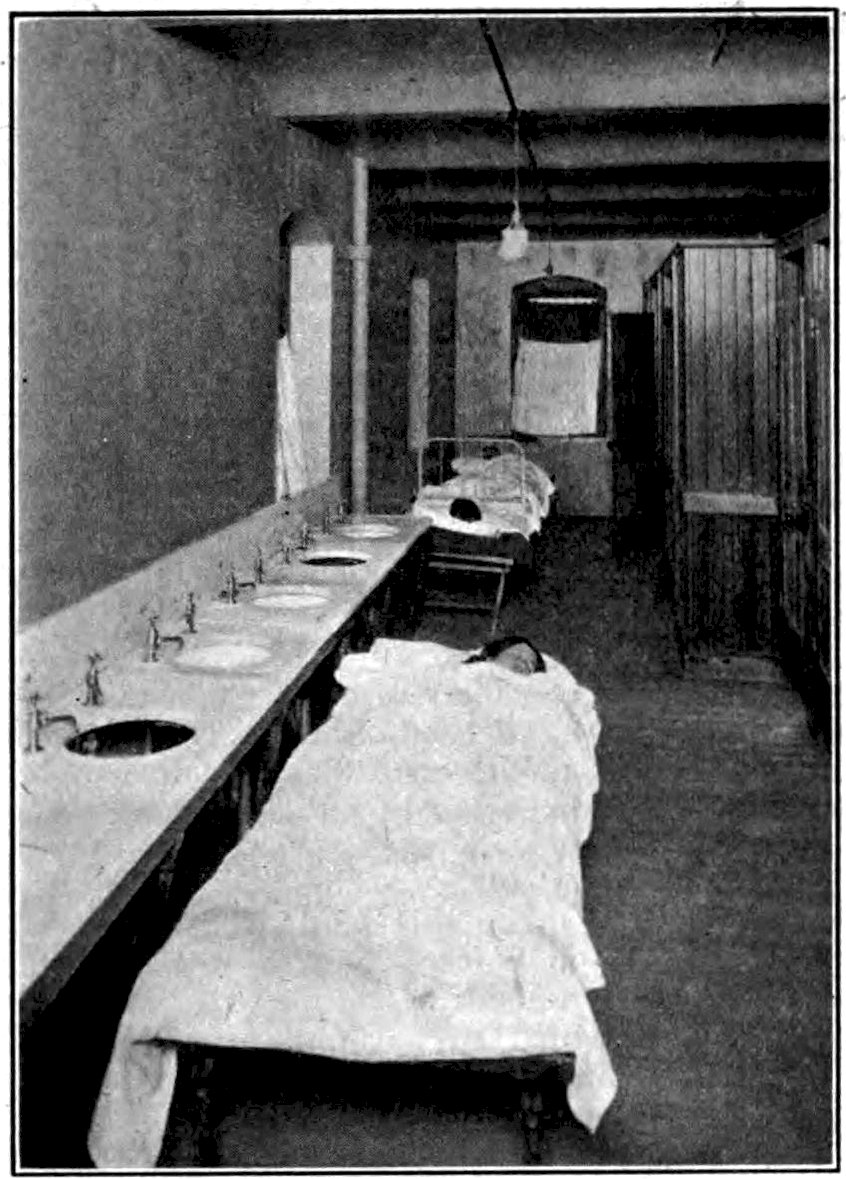
SLEEPING IN THE LAVATORY AT BEDFORD
It was not much more than a year ago that,
in connection with the founding of the Bureau
of Social Hygiene, the New York magistrates
began to make extensive use of Bedford Reformatory
for women as a means of saving the
young prostitute. And yet the reformatory is
already facing a crisis through overcrowding.
The Committee on Criminal Courts of the
New York Charity Organization Society has
appealed to the public to write, urging an appropriation
of $700,000 for this institution, to the
leaders of the Legislature: James J. Frawley,
chairman Finance Committee of the Senate;
Alfred E. Smith, speaker of the Assembly;
Robert F. Wagner, majority leader of the Senate;
Aaron J. Levy, majority leader of the Assembly.
This the committee believes to be a
conservative and economical estimate of what
will be needed to put up new cottages and other
buildings to accommodate present inmates, and to
provide for reasonable growth in the next few
years.
The letter sent out by the committee reads in
part as follows:
“Twelve years ago the state authorities established
Bedford Reformatory to care for women
86between the ages of sixteen and thirty, to try
and save some, at least, of the young girls who
were otherwise destined to a life of shame and
degradation. What Bedford means to the community,
the extraordinary work it is doing and
has done is set forth in the enclosed article by
Ida M. Tarbell.[2] That article is a challenge and
a call to every man and woman in the state.
2. Miss Tarbell’s article which appeared in the American
Magazine was reprinted as a pamphlet by the committee.
“Bedford Reformatory now faces a crisis.”
“Today there are 178 more girls there than
the place will hold. They are sleeping on cots
in the hallways, in parlors, in the gymnasium,
in the lavatories, in the linen room, everywhere
they can put a bed. Two girls in a room is the
rule instead of the exception, notwithstanding
the moral dangers of this.”
“Chief Magistrate McAdoo and Chief Magistrate
Kempner and their associates in New York
and Brooklyn have been asked not to commit
any more girls to the institution and the stream
has stopped for a moment. But the magistrates
are now at their wits’ ends. What are they to
do with first offenders? The young girl who
is just embarking on this kind of career—shall
they fine her and force her to work all the
harder at her unlawful calling to earn the
money with which to pay the fine? All are
agreed that this is objectionable. Fines neither
deter nor reform. Shall they send her then to
the work-house to mingle in close confinement
with the hardened offender, there to become embittered
and to have a prostitute’s life fastened
more firmly than ever upon her? They must
do this or discharge her to walk the streets
again.”
EDITORIAL GRIST — THE BATTLE LINES OF CHILD LABOR LEGISLATION — ETERNITY AND A PENNY PILL [4] — THE DAWN OF A BETTER DAY A MANUFACTURER SPEAKS
ANNA ROCHESTER
National Child Labor Committee
A majority of the twenty-nine state Legislatures
which have been considering child labor
laws this winter are still in session, so that
many of the most important bills are still
pending.
The campaign that is being waged against
the most outspoken opposition is on in Pennsylvania,
one of the two strongholds of glass manufacturers
who employ boys under sixteen at
night. With the single exception of West Virginia,
where a bill based on the uniform child
labor law was defeated this winter, night work
for youths under sixteen is no longer allowed in
the important glass-producing states. The uniform
law was introduced in the present Pennsylvania
Legislature by Representative Walnut
and referred to the Committee on Labor and
Industry. The committee reported it to the
House with several amendments. The House
rejected all but two of these. Now the uniform
law, with the street-trading age limit reduced
from twelve years to ten, and the age
limit for breaker boys reduced from sixteen to
fourteen, has reached its third reading in the
House. If its friends can still protect it from
the mutilations desired by the glass interests,
the telegraph companies, the textile manufacturers
and other opponents, Pennsylvania will be
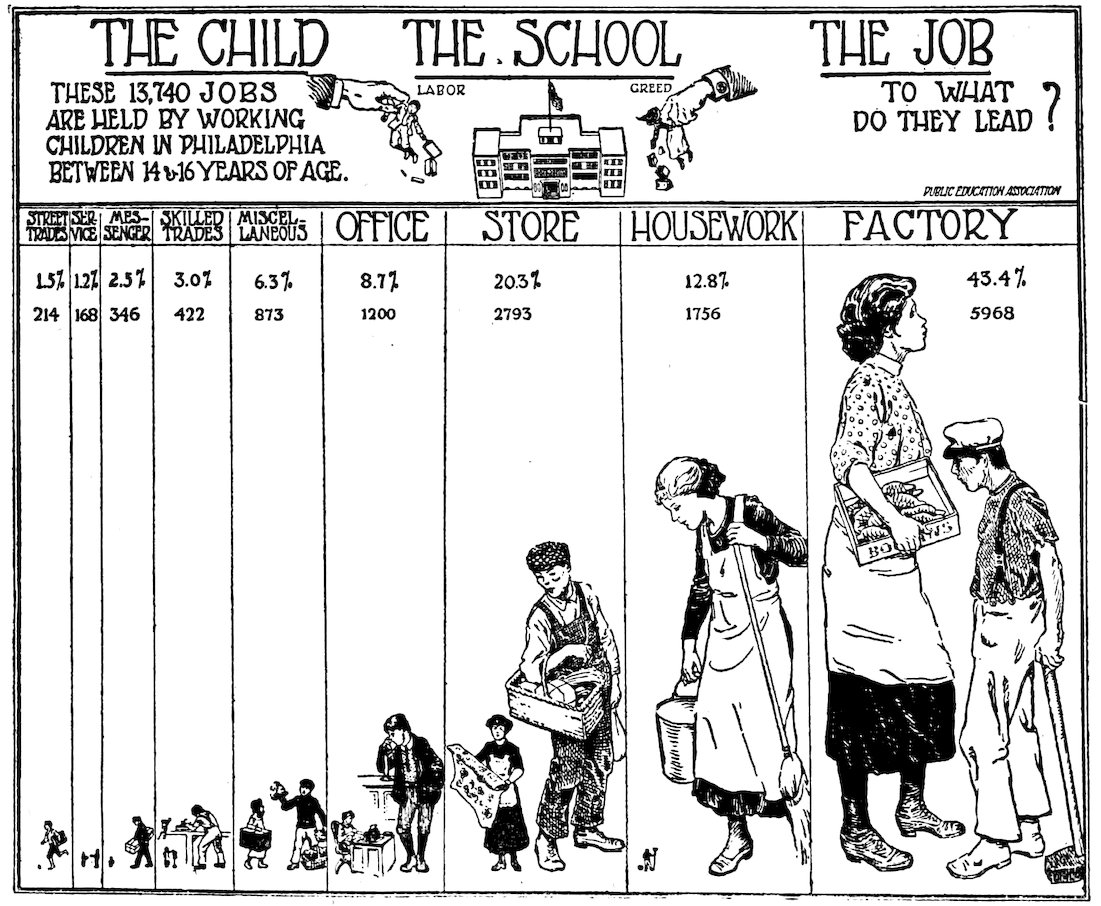
in a fair way to protect the 29,170 children employed
in manufactories in that state.
The uniform law is also pending in Massachusetts,
where it met no opposition in the hearing
before the Committee on Social Welfare.
Massachusetts has now a ten-hour day and the
uniform law would bring her into line with
Ohio, New York, Illinois, Mississippi and
twelve other states that have the eight-hour
day for all under sixteen.
But Massachusetts would lead the country in
one respect if another bill that is likewise before
the Committee on Social Welfare should pass.
This provides for a five-hour day and compulsory
school attendance for all workers under sixteen.
If this is put into effect it will set
a new standard for the Uniform Child Labor
Law, which has been drafted by the National
Child Labor Committee and endorsed by the
American Bar Association. It is based on the
best provisions of the best statutes now in force
in the several states. Yet the National Child
Labor Committee, fearing that two five-hour
shifts for certain minors might tend to fasten on
industry the ten-hour day for adults, would suggest
that Massachusetts go one step further and
fix a four-hour day for all under sixteen.
Connecticut, Ohio and Michigan will also advance
beyond the standard of the uniform law
if bills now pending are enacted. Michigan,
it is true, is not trying to reduce the working
day below nine hours, but merely to extend it
to include canneries and four other occupations
hitherto exempt. But Michigan and Ohio propose
to raise the general age limit for employment
from fourteen to fifteen, while Connecticut
is considering sixteen years. Ohio intends also
to increase the compulsory school attendance age
from fourteen to fifteen for boys and sixteen for
girls, and to require that boys of fifteen may not
go to work unless they have completed the sixth
instead of the fifth grade, the requirement of
the present Ohio law and of the uniform law.[3]
The Ohio bill includes, also, the street trading
provisions of the uniform law. Special
street trading bills are pending in Iowa, Nebraska,
New York and also, we understand, in
Michigan and Minnesota. Their outcome is
doubtful because the average legislator seems to
be blind to the bad results of street trading
87and cheerfully reflects the popular view that
these “sturdy, little merchants” are all supporting
widowed mothers and headed straight for the
White House.
Many states are coming to recognize the needs
of children over fourteen. This is evidenced
not only by the wide discussion of vocational
schools and the bills before the Legislatures of
Illinois, Indiana, Ohio, Massachusetts, New
York and other states, but also by the extension
of child labor laws. Thus California, having
proved the advantage of the eight-hour day for
women and boys under sixteen, is considering
the eight-hour limit for all under eighteen. Wisconsin
is proposing to enlarge the list of hazardous
occupations forbidden under eighteen
and to provide for continued revision in the future
by the Industrial Commission. The prohibition
of night messenger service for those under
twenty-one is included in the uniform law, as
pending in Pennsylvania and passed in Delaware,
but not in Massachusetts and Utah, where
it has already been enacted. In Connecticut, a
dangerous trades bill is pending and the bill for
a general sixteen year limit includes an age restriction
of twenty-one years for night messenger
service. The same night messenger prohibition
was included also in the bills based on the
uniform law that went down to defeat this year
in Utah, Idaho, Arkansas, Texas and West Virginia.
Iowa, the only other state in which a night
messenger law has been introduced this year,
proposes an eighteen year limit.
Regulation of hours for all under sixteen was
proposed in Nevada. In Tennessee, there is a
bill now before the House Committee on Labor,
providing for an eight-hour day under sixteen
instead of the present sixty-hour week. A second
measure adds mercantile establishments and
the stage to the occupations prohibited to children
under fourteen. Still another bill has
passed in Tennessee, enlarging the Factory Inspection
Department by adding a clerk and two
deputy inspectors. The matter of enforcement
has not received as wide consideration as it
deserved. Industrial commissions are under
discussion in many states, notably California and
Ohio. In Iowa it is proposed to create within
the Labor Department a bureau of women and
children. Montana’s educational bill would provide
for truant officers to enforce the child labor
law. In Wisconsin a bill is pending covering
some details of the issuing of employment certificates
and in Utah it was proposed to increase
the number of inspectors. Most important in this
connection is the bill in Missouri to extend the
jurisdiction of the Factory Inspection Department
over the entire state (it is now confined to
cities of 10,000 or more inhabitants) and to abolish
the present fee system.
Two of the bills recommended by the New
York Factory Investigating Commission and directly
affecting child labor are still pending: one
to prohibit work in cannery sheds by children
under fourteen, and the other to prohibit the
manufacture in tenement houses of dolls or
dolls’ clothing and articles of food or of children’s
or infants’ wearing apparel. Other bills
recommended by the commission and already
passed and signed standardize the issuing of employment
certificates throughout the state; give
the commissioner of labor power to inquire into
the thoroughness of this work as carried on by
local health officers; provide for physical examination
in factories of children fourteen to sixteen.
This last provision promises to be better than the
present Massachusetts law because it permits the
cancelling of employment certificates of children
whom the examination reveals to be physically
unfit for factory employment. Following
the recommendation of the commission the present
Legislature has also reorganized the Labor
Department, established an industrial board, increased
the number of inspectors and extended
the jurisdiction of the Labor Department to cover
the enforcement of the labor law concerning
women and children in mercantile establishments
in second class cities.
In a few states there is a fair record of progress
in the legislation already enacted this year.
New Jersey and Indiana have brought their
educational requirements and provisions for
working certificates up to the standard of the
uniform law. Vermont has established a nine-hour
day and Rhode Island a ten-hour day. The
Vermont law also does away with the twelve
year limit in certain occupations and substitutes
the provision that
“A child under sixteen years of age, who has not
completed the course of study prepared for the
elementary schools shall not be employed in
work connected with railroading, mining, manufacturing
or quarrying, or be employed in a
hotel or bowling alley, or in delivering messages,
except during vacation and before and after
school.”
Along with this the law has an absolute fourteen-year
limit in “mill, factory, quarry or workshop,
wherein are employed more than ten persons.”
In North Carolina a bill was introduced
with a fourteen-year age limit and a prohibition
of night work, but the age limit was immediately
amended back to the old thirteen (twelve for apprentices),
the increased appropriation for inspectors
was cut out, and only the night work
prohibition was passed. The Child Labor Commission
in Delaware drafted a bill based on the
uniform law, which, in a much mutilated form,
was finally passed and signed.
Only a few backward states show no progress
whatever. Georgia defeated a child labor bill
last summer. Alabama has no legislative session
88until January, 1915. The Florida Legislature has
just convened and a bill based on the uniform
law will be introduced. No child labor bill was
introduced in South Carolina but a compulsory
school attendance law was passed by the Legislature,
only to be vetoed by the governor.
The House passed it again over the governor’s
veto, but it failed in the Senate by two votes. In
New Hampshire, the only northern state with a
general twelve-year age limit, a bill providing for
a fourteen-year limit has been unanimously reported
to the House and there seems to be a
good chance of passing it.
The National Child Labor Committee is watching
the situation and helping where it can in
these campaigns. It hopes to report many more
victories when the legislative season closes.
Meanwhile it appeals to the citizens in every
state to aid in the enactment and the enforcement
of these laws.
RICHARD C. CABOT, M. D.
4. See Courses on Sex Hygiene. By Jane R. McCrady on
page 124 of this Issue.
There are some things (chocolate, for instance,
or tracts, or paper drinking-cups) that
can be shot out of a slot at you and hit their
mark. You can apply them to their uses at
once. It is the same with the facts fired at you
through the window of his booth by the railroad
information man. Such facts set you on your
track or your train at once.
But when people ask for clear directions
about the train to proficiency in violin playing,
belief in immortality, or understanding of sex,
they always miss their train. Sometimes they
complain of the officials.
After a course of lectures on sex last year
some workers of my acquaintance handed in
written questions beginning “What should I say
to a young girl who,” etc., and were disappointed
when no definite answer was forthcoming.
To illustrate the difficulties of an answer let us
ask a few parallel questions:
What paint shall I use for a Madonna?
What are the best words to use in a love
sonnet?
What is the best book on being a millionaire?
What kind of bread makes you popular and
handsome?
What liniment makes one’s sympathies most
supple?
People rush to lectures on “sex hygiene,”
sometimes for good reasons, sometimes to satisfy
morbid curiosity, but often with a pathetic
hunger for the bread of life. In the hope of
forestalling such disappointments the lecturer
should hang up before them a sign reading:
“This lecture will not solve fundamental problems.
Seek ye the Lord.”
Dudley D. Sicher
[This poem was read at a banquet of the Cotton
Garment Manufacturers of New York during the
last week of March. The author, a representative
manufacturer, dedicated these verses, reflecting a
new attitude toward employes, to his business
associates.—Ed.]
Do we purchase Toil at the lowest rate
As we buy our cloth and thread?
Do our workers labor long and late
For the price of their daily bread
In gloomy lofts where shadows frown,
In foul, unwholesome air,
Till Want and Weariness drag them down
Where—we neither know nor care?
If such things be, they must pass away
Ere we hail the Dawn of a Better Day.
Have they wrought us harm in the darker days,
Have they kept the whole truth hid?
Have they told false tales of our works and ways
And of wrongs that we never did?
Be not too wroth at the hiss of shame,
But pass old slanders by.
And cleanse your shirts of the taint of blame
Where e’er the blame may lie.
Old feuds, old sores be forgot for aye
In the hopeful Dawn of a Better Day.
Let us wipe the slate of the bitter score,
Let us turn the blotted page,
And grant that we owe our workers more
Than the dole of a “living wage.”
They give us more than their time and skill
In the health and strength they spend;
And earn the right to the kindly will
And helpful hand of a friend.
We must give them more than the coin we pay
Ere we hail the Dawn of a Better Day.
So, here’s a task that we may not shirk,
For the toiling thousands plead;
We must give them comfort while they work
And help in every need;
We must lend them strength if their souls are weak
And teach them how to live;
Nor let us, all to meanly seek
Return for all we give,
As we lift our eyes for the gladdening ray
Of the golden Dawn of a Better Day.
If this light that leads us shall not dim
They will see, ere the course is run,
That the worker’s weal and the weal of him
Who owns the shops are one.
Then each shall have his rightful gain
Ungrudged—and great and small
Shall give their best of hand and brain
For the good of each and all,—
And we’ll stand together, come what may
In the brighter Dawn of a Better Day!
CIVICS — THE SCHOOL CENTER — MUNICIPAL MUSIC IN NEW YORK — THE HOUSING PROBLEM AS IT AFFECTS GIRLS — JERSEY HOUSING ASSOCIATION FORMED — IOWA’S REMOVAL LAW
89
HENRY S. CURTIS
Daniel said to Nebuchadnezzar: “Thou, O
king, sawest and beheld a great image. His
head was of fine gold, his breast and his arms
were of silver, his belly and his thighs of brass,
his legs of iron, and his feet part of iron and
part of clay; and a stone smote the image upon
the feet that were of iron and clay and brake
them in pieces. Then was the iron, the clay,
the brass, the silver, and the gold broken in
pieces together.”
This image might represent America nearly
as well as the empire of “the great king.” In
the original democracies of Greece, the freemen
met together in the market place to elect
from their friends and acquaintances the officers
who determined the policy of the state.
The weakness of American democracy is that
we have not organized this primitive element or
demos on which it is supposed to stand.
Politics in our cities have been corrupt, because
there have been no meetings of the community
to discuss community affairs. The individual
has often been reckless in conduct, because
he was not acquainted in the section in
which he lived and consequently had no social
accountability to public opinion. Foreigners
have come among us and drifted in and out of
the city slum, bearing with them their racial
antipathies to each other, and casting no anchor
in the locality because at no time have they
become a real part of a community. We have
had no real city communities or neighborhoods
but mere districts of people in no way organized
or related to each other. The feet of the
image are of miry clay.
In the country sections the situation is little
better. In the days of the pioneer the early
settlers were drawn together by common dangers
and necessities into a brotherhood of the
wilderness. They assisted in erecting the cabin
of the newcomer. The women had their quiltings
and their sewing circles. The whole community
met together to marry the lovers and
bury the dead. The school house was the common
center, where Sabbath service, debate, music
school, and “spell down” were held.
These conditions have undergone an almost
complete change. The specializing of industry
and new machinery have made farmers independent
of their neighbors. The community
uses of the public school have fallen away.
The last few years have seen a rapid advance
in the principles of Democracy through
the initiative, referendum and recall, the presidential
primaries and other measures; but the
fundamental unit is still unorganized. The feet
are still of miry clay. To secure the democratic
control of the community or district is
the greatest problem of our democracy. This
result demands that some agora, forum, or
neighborhood center shall be restored to the
people.
If a neighborhood center is to be created,
the facilities which the neighborhood wishes to
use must be brought together in a single place.
Thus each facility offered will bring patrons,
not to itself alone, but to all the others as well,
as each department in a department store brings
customers to all the others.
A comparatively few years have seen the
cities take up as municipal undertakings the
public playground, the municipal gymnasium and
bath, the branch library, and a few scattered
beginnings in the way of municipal camps.
While the undertakings have been carried on
by the city and maintained by public funds, they
have not been really furnished to all the people
of the city, as a rule, because they have not
been accessible. They have not been placed in
communities, they have no definite clientele. They
cut across the lines of the existing organizations
of the people. The individual has no direct
touch with the community that brings him
into relationship with them. All of these facilities
are at least as much for the children as
adults, but they lie off the beaten paths of child
travel, and hence secure a minimum rather than
a maximum use.
The only public institution that is central to
each community is the school. If this can be
made the nucleus around which the other institutions
can be gathered, it may be possible to
create again a modern forum or market place,
that will serve the same purpose as did the old.
The large undertakings already under way for
the improvement of the school itself can not be
carried to full success without certain radical
improvements in the school equipment. The
playground activity demands larger playgrounds.
New York is now paying more than
a thousand teachers every summer to direct
the play in its school playgrounds; but there are
very few schools that have an out-door playground
fifty feet square. It is not the same
thing to play in a school basement that it is
to play in the open air. The school basement
is always sunless, and the air is not the same
as it is in the open. The French requirement
for the lighting of school buildings is that
there shall be no other building within a distance
equal to the height of the school. The
gymnastic work, to secure the best results, must
be done in the open air, and not in a dusty
gymnasium. In London, all the longer exercises
are always taken out of doors in pleasant
weather. Some foreign cities now require a
certain minimum playground space for every
child. In Munich this is twenty-five square feet.
90In London it is thirty square feet. This would
mean an acre of playground to 1,452 children,
not a large amount surely, and much less than
should be taken in the smaller cities. Throughout
the middle states and the West, now generally
a block for all new schools is given. In
some cases the usefulness of the ground is being
nearly destroyed by placing the school building
in the center, but where the building is placed
at the side or end, as it should be, this ground
becomes available for many school and community
uses.
This block should be shaded by trees. It
should have grass plots, if they have to be renewed
every year, as Jacob Riis says; and running
around the outside should be a narrow
space for children’s gardens where all the
nature work material of the school could be
grown. In one corner should be a school
menagerie and benches should be placed under
the trees.
During the school hours, the school park
should belong to the nurses and mothers with
baby carriages. From three to ten p. m. every
school day, and all through the summer, it
should be the playground of the children and
the social center of the adults. In the winter
it should be flooded for skating.
Each of the new public schools of New York
contains a gymnasium, but most of these are
on the top floor, and they have to equip another
in the basement for the play center. Each of
the new public schools of Cincinnati contains
a gymnasium and a swimming pool, and they
are generally on the ground floor or near it.
Most of the new high schools all over the country
contain a gymnasium at least and many of
them swimming pools as well. Wherever these
facilities are furnished, they are generally used
by the school during the day and by the public
at night. A number of cities are now building
municipal gymnasiums and baths also, but the
children want to use the gymnasium and swimming
pool during the day, the adults want to
use them at night, it is not evident that two sets
of gymnasiums and two sets of swimming pools
are necessary.
Berlin has an interesting solution of this
problem. They house the gymnasium in a separate
building in the yard. In this way the
noise and dust which is incident to exercise is
removed from the school, and it is possible to
give more freedom to the work. In most cases
there is a swimming pool in the basement where
the pupils are taught to swim. But the chief
advantage of the gymnasium’s being in a separate
building is that it is thus more accessible
to the general public as a free gymnasium and
bath at night.
Our public schools and especially our summer
schools are greatly hampered by the lack
of library facilities. The school in order to be
successful must create a love of reading. It
cannot do this without books. At present only
a small proportion of the children have access
to a library, and this is often so distant that
little use is made of it. The reason is simple,
the library is a strange place and its methods
are unknown. If the child, despite this, manifests
his desire to draw out books, he must
often first get some one to be his security for
their return, and this is not always easy for a
child of laboring or foreign parentage. But the
school may safely trust the child because he is
a member of the school and known and responsible,
when it would not be at all safe for the
public library to give out a book to him.
Parents often have little time or inclination
to go to libraries for books, but depend on their
children to provide them with reading. If the
library were a separate building in the school
yard or a part of the school, it would be no
task for the children to take out and return as
many books as might be desired in the home.
The growing use of the school as a social center
makes it increasingly important that the
branch libraries should be connected with it.
The theaters of Greece and Rome were public
institutions. Many of the best theaters of
Europe are subsidized. The dramatic form of
representation is the one that is nearest to
having the experience itself. The socialized
theater might undoubtedly be one of the greatest
agencies for good that could come into any
community.
In the past the expense of the public theater
has been almost prohibitive; but to the credit
of Thomas A. Edison be it said, that he has
brought the theater to every man’s door. Most
of our new schools contain auditoriums, and
the state and city departments of public instruction
will soon be required by public sentiment
to furnish educational moving-picture
films to every school in the state. With the
addition of the theater the success of the school
social center and the organization of community
life is assured.
Besides these activities which should be connected
directly with the school itself, the school
is the best dispenser of much of the social betterment
work for children. If each school had
a camp in the country, it could make a much
wiser selection of children to be sent there than
any fresh air agency can do. No one child
would be sent out successively by half a dozen
different societies to the exclusion of the needy
but timid child. Judging from a very limited
experience it has seemed to me that the children
are not at their best in the fresh air
camps. Often away from all their friends and
acquaintances they are homesick and feel that
this trip and this camp have no connection with
anything else in their lives.
Besides these great disadvantages under
which the present system works, there are corresponding
advantages that are lost to the
school. With such a camp, there would be an
opportunity for nature study and gardening of
a most approved kind. Athletics might be so
carried on as to supply many of the deficiencies
of the school year, and boy scout patrols might
be organized for all the older boys. But, best
of all, the children would then learn to meet
their teachers on a common footing and the
tone of the school would be improved.
This extension of the school would not mean
91for the most part a large increase in expense.
Already we are getting the larger playgrounds,
the auditoriums, the gymnasiums, and
the swimming pools in our new school buildings,
but the cities are also building municipal
baths and gymnasiums, small playgrounds and
public libraries in places that have no relationship
to any definite community. It is mostly a
question of locating without duplication the
facilities that all need in places where they will
be accessible to all.
We may well ask ourselves if the school is
competent to take these new responsibilities.
The answer must be that at present the average
school principal is certainly not competent
to take charge of these new phases, but that
men usually rise soon to new responsibilities
or new men appear to take their places. These
new relations would bring the school and the
home together, would make the school a part
of life, would give the pupil a new set of associations
with his teachers and with study, and
in every way would redound to the good of the
school and the community.
S. H. J. SIMPSON
When the sailing list of each trans-Atlantic
liner reads like the program of an all-star gala
performance, and conductors, managers and
husbands also sail, the small number of the
cultured rich who maintain music in New York
go likewise; but the city is not left empty. Then
the Metropolitan assumes a perpetually “morning
after” appearance; so, too, Carnegie Hall;
and the new piano emporium will serve as a
sounding board for band concerts across the
way. It is to these band concerts—not only in
Bryant Park but in almost every park and pier
in the city—that the reader’s attention is called.
The vastness of New York is one of the
greatest problems confronting any public spirited
enterprise which aims to reach that vague,
elusive faction—the people. The problem has
been met and fairly solved musically by the
three men who are responsible for the invasion
by band and orchestra of the city’s parks and
piers during the past three years. It is refreshing
to meet with a movement which aims toward
no tangible education, moral rescue or
poor relief, and to find a department of city
government frankly idealistic enough to organize
a force whose only aim is the presentation
of pure beauty. And it is curiously paradoxical
that this movement should have found its
opportunity in New York. It is, nevertheless,
true that New York supports more entirely
free summer concerts than any city in the
world.
At the beginning of the current municipal
administration the park and pier music in its
present form had its birth in the constitution
of a committee consisting of the commissioner
of docks and ferries, the commissioner of parks
and a new official designated as the supervisor
of municipal concerts in parks and recreation
piers. To the latter is due the lion’s share of
credit for the ideals, the organization and the
practical working of the system. To the commissioners
New York owes a debt for their
hearty co-operation, and in some cases, acute
personal interest in the problems of the undertaking.
Not only has the size of the music loving
population been considered in the multiplication
of concerts, but the varieties of appreciation
and the national tastes of different neighborhoods
have been sympathetically studied by
Arthur Farwell, the supervisor. The $100,000
annual municipal appropriation is divided between
the piers and parks, and provides for a
force of about seventy bands and conductors.
Extraordinarily interesting is the study of
neighborhoods in connection with the make-up
of programs. This is especially so among the
docks. The long pier at 129th Street, with an
orchestra attracts what the directors are
pleased to designate as the “high-brow” crowd.
The call there is for the best in operatic and
symphonic music—two and three movements of
symphonies are often given. Selections from
Italian opera flourish at East 112th Street, and
at East 3d Street, all sorts of Jewish religious
music is featured. The only crowd which has
given any trouble assembles at West 50th
Street, and the largest of the pier audiences is
found at East 34th Street. Probably the most
generally representative gathering is in the
Mall in Central Park, where seven concerts a
week are given in summer.
In thus cursorily reviewing the facts of the
condition of municipal music in New York, only
the smaller part of the situation is discussed.
The movement, under its present impetus, is
new, and to a large number of people, unknown.
Although it is beyond the scope of the present
article to consider, in any detail, the ethical
aspect of the situation, it is, nevertheless, appropriate,
in view of the comparative untriedness
of the idea, to answer a few questions
which are constantly brought up by those who
are interested in the conditions. Even so, it
seems that the time has come when the movement
may fairly be said to have passed the experimental
stage, if success may be measured
by popular approval.
It merely remains to count the numbers in
attendance. And here we find the answer to
the most frequent query as to whether there is
sufficient popular demand to warrant all this
effort. The question has been submitted to a
practical referendum. Do the people want it?
Although no formal count of the audiences has
been made it has been estimated that they ranged
during the summer of 1912 from 5,000 to 15,000,
in the various localities. In Central Park, every
seat in the Mall and on the terrace was filled by
92eight o’clock, and stragglers wandered about
the outskirts or stood packed between the
benches all the evening. Every spot within
hearing was filled, and it was with some difficulty
that aisles and passages were kept clear.
Nor is this audience a casual one. Any number
of habitues are noticeable, night after night, in
the same seats—jealous of their places—and
night after night, the same tired mothers are
there, with the same baby carriages. And
way off, along the driveways, or here and there
in a street near the docks, a policeman, a laborer,
a little street urchin, may sometimes be seen to
stop, and, “lifting his head in the stillness,” listen—and
pass on.
This attention is, with few exceptions, so
marked, that it, of itself, answers another question:
Isn’t all this stuff way above the heads of
the people? Again, the size of the audiences
furnishes the most convincing answer. Theoretically,
of course, the best, being the most
human, is above no one’s head. But even practically,
no genuine heterogeneous crowd of
“street-bred people” trails from the dark places
on a hot night—carrying or wheeling babies,
with small children tugging at the skirts or
clamoring to be carried—to hear such things as
are above its head.
The aim of the movement is distinctly not
educational in the instructive sense, nevertheless,
the popular interest in the programs has
been taken into consideration by Mr. Farwell in
his brief and readable program notes. These
give simple, important facts relating to composers
and compositions, and do not attempt any
detailed analyzation such as is familiar to the
average concert goer. That these find a place,
would seem to be proved by the knots of people
who gather, program in hand, under the lights.
Underlying the entire discussion of this, or
any purely artistic movement in this country,
there is often the question: What’s the use? Be
the reason what it may—personal gratification,
civic pride, or any other cause—it is almost safe
to say that no citizen grudges New York its
parks, its buildings, or its Metropolitan Museum
of Art. Why, then, its public music, which
gives innocent pleasure, rest, perhaps inspiration
to thousands? I do not think that this is grudged
to the people. Its neglect is simply a matter
of ignorance, rather than indifference, on the
part of many men who regularly pay their opera
and symphony subscriptions, and who have
watched with interest the efforts of several organizations
to bring the price of concert tickets
down to a low figure. But this philanthropic
effort does not strike at the root of the matter.
Ideally, music should not have to be offered to
the people as a commodity, nor as a charity, nor,
primarily, as an education. It should stand,
rather, as a temple, to which they may come
gladly and freely, and from which they may go
full hearted, carrying its best with them.
And this has been accomplished in the piers
and parks in the last three years. But the winter
contrast is striking. Fed up all summer, it
seems hardly fair that men should be starved all
winter. The daily papers printed, during September,
1912, a number of letters, asking why
these concerts could not be continued through
the winter months. There is but one solution
of the problem—the municipal orchestra—and in
this connection I cannot do better than quote a
letter, written by Mr. Farwell to the New York
Times, in response to the various suggestions
and inquiries:
“The Central Park concerts have shown once
for all that the greatest in music appeals directly
and powerfully to the people when it is given
to them under the right conditions. This is one
of the mysteries of music—its power to short
circuit an intellectual by a spiritual process. To
wait until some hypothetical time in the future
for the high gift of music to be given to the
people is to be both dilatory and blind. The
time for national initiative is at hand. What
the people of New York really need is a permanent
municipal symphony orchestra.”
Popular response to good music is no longer
an open question. The people have answered it
conclusively, and popular demand has become
a live issue.
EDITH M. HADLEY
President Chelsea House Association, New York
In a factory town, at the lunch hour, have you
ever consciously watched the girls and women
thronging down the steps and filling the streets
surrounding the workshop? Have you listened
to their noisy laughter and scraps of conversation
and tried to understand their meaning? In
1910, when the last Census of Manufactures was
taken, there were over 1,500,000 of these girls
and women—factory workers in the United
States.
In a large city at nightfall, when the lamps
are lighted, have you ever observed the streams
of girls flowing into the streets from the offices
and great department stores? Again at night,
have you seen the girls, waiting at the entrances
of tenement houses or on the street corners for
their “gentleman friends” who are to emancipate
them for a few hours from their cramped
and dingy environment? And have you asked
yourself where and how do these girls live?
During the last few years we have heard so
much about the discontent of the labor classes,
the “restlessness of the present age,” that the
phrases fall upon unheeding ears. But it takes
no Socialist to understand that, if a family
man’s expenses are $900 a year, and that working
to the best of his ability he can earn only
$700 to $800, and that if it costs a girl $8 a week
to live, and she cannot earn that much, there
must be discontent. It is time for the community
to regulate such conditions.
The question of wages is so closely allied to
the question of housing that a study of the latter
involves some knowledge of the former. Cost
of living and standard of living must be approached
from a fact basis. Studies by Robert
Chapin, Scott Nearing and the commission appointed
by Congress, indicate that a man, his
93wife and three children under fourteen, cannot
live and maintain efficiency under $900 a year
on the Island of Manhattan. This is not excessive
for Boston, Buffalo and Chicago. It is low
for Pittsburgh, a little high for Philadelphia and
Baltimore but a fair average for the great cities
east of the Mississippi and north of Virginia.
Investigations prove that there is no great
wage variation in different sections of the country.
In the West wages run slightly higher
than in the East, and in the larger cities than
in the smaller towns. From a study of 1,391
New York girls working in department stores,
the average earnings were reported as $4.69 a
week during the first year and $5.28 the second.
They increased in ten years, to $9.81, during
which period many fall out of the ranks. Buyers
and expert saleswomen remain. Their average
earnings mount up to $13.33. In factories
the average earnings of 3,421 girls showed $4.62
a week for the first year and $5.34 for the second
year. After ten years’ experience $8.48 was
reached.
The majority of girls at work live at home
and, in many cases, have to a certain extent the
protection of their family. But an ever-increasing
number of girls are entering the towns and
cities, quite alone and friendless, to earn their
way. These girls either keep house, live in
families, in boarding and lodging houses or in
the organized boarding house.
The girl who lives at home usually gives all
her earnings to her parents—over 84 per cent
working in shops, and 88 per cent in factories
in New York city, and a similar number in Chicago
and St. Louis. The parents rely upon their
daughters for an exact amount of income, so
that these girls are in no sense “pin money
workers.” The girl at home in New York city
usually lives in a three to five-room flat in a
tenement house, for which her father pays from
$10 to $35 a month; and into these cramped
quarters, one, two or more boarders are frequently
taken.
In New York, Chicago, Philadelphia, St.
Louis, Boston, Minneapolis and St. Paul, it has
been estimated that about 65,000 girls, exclusive
of stenographers, office girls, nurses and teachers,
are without homes, and entirely dependent
upon themselves for support. Girls with a low
standard of living can live more cheaply by
keeping house than in any other manner. This
means that several girls may join together and
rent a two or three room flat. After their daily
work of eight to twelve hours in factory, shop
or office, is over, they have the housework to do—cleaning,
cooking, washing and sewing. A girl
keeping house or living in lodgings may save on
food. She may go without breakfast or lunch,
or have bread and coffee for breakfast, bread
for lunch, and bread and soup or meat for dinner.
She may spend part of her evenings making
clothes, the material for which has been
bought with money saved from food. “Oh, my,
where would we get our clothes, if we bought
meat every day?” asked one girl. How long
do these girls remain economically efficient?
Fortunate is the girl who can find a home with
some respectable tenement house family. Here
she frequently underpays. Anna Friedman earns
$7 a week as cashier; she lives with Mrs. McCoy
in a $27 a month five-room flat. Anna pays
$3 a week for her accommodation, but considers
herself entirely self-supporting, as Mrs. McCoy’s
husband is absent part of the time, and
Anna’s companionship is of some value. She
therefore has a margin of $4 for clothes, laundry,
amusements, sickness and incidentals, and
is well off. Girls living in this way usually associate
with the family, using all rooms in common.
The most dangerous way in which a girl can
live is in a lodging, or as they are called “a furnished-room
house.” Investigations of forty-three
boarding and lodging houses in one city
showed that five were known to be houses where
fast women lived. “Not only were good and
bad houses on the same block, but good and bad
people were living in the same house.”
Freda Lippeg earned $3 a week, and paid
$1.50 for her room; her food, which she cooked
in her room, cost her $1.46. Seeing how easy
it is for them to get plenty to eat, pretty clothes
to wear, and to have “good times,” what temptations
are placed in the way of such girls living
in houses with immoral women!
While a landlady may prove to be a girl’s
best friend, giving her advice, trusting her when
she is unable to pay, even lending her money, in
the majority of cases the girl has no supervision
at all. With the exception of houses in Philadelphia,
where the wage earner’s standard of
respectability demands a sitting room, few
houses can afford to have one. As a lodging
house is now conducted, the landlady’s net
profits, are usually free rent of her room and
$150 a year. As the parlor is the best paying
room, the requirement of its use for lodgers
would mean a readjustment of rents, either of
house or rooms or both. So the girls receive
their “gentlemen friends” in their bed rooms.
For the young girl in a strange city, earning
moderate wages, no manner of life is so capable
of approaching that of the home as the organized
boarding house. Scattered throughout the
United States are a number of these houses, but
the supply can in no way approach the demand.
In many cases they are too expensive for the
poorer girl to afford. Few of these houses aim
to be self-supporting, which fact also deters
many self-respecting girls. The girl rightfully
wishes to be a customer at the boarding house,
and not an object of charity. The rules in some
of the houses are stringent; sometimes a closing
hour is enforced, and girls returning later may
be locked out. Nearly all have an age and a
wage limit. But they all have a drawing room
which is usually furnished with a piano, books
and magazines. Here girls may receive their
friends, and have the companionship of other
girls. Often warm friendships are formed.
The welfare of the house depends upon the
“housemother,” whose opportunities and responsibilities
are unbounded. To be able to keep a
clean, well ordered, full house; to supply an
ample amount of nourishing food; to receive
94enough board money from the girls to cover all
expenses without dunning them is no easy matter.
But in addition to this to be sympathetic
without being partial or sentimental; to be able
to care for the tired and sick; to be patient and
firm with the hysterical; to understand and direct
youth, gayety and extravagance; and to
help the girls who are in danger of losing their
“woman’s heritage,” a woman must give the best
that is in her. The Eleanor Clubs in Chicago;
the Ladies’ Christian Union Houses, the Chelsea
House Association and the Virginia in New
York; and the Girl’s Friendly Society Lodges
in New York, Providence and Louisville are
helping to solve the housing problem for girls.
But why have we not hundreds, instead of tens
of these houses? Can we not see the relationship
between unsanitary, overcrowded homes,
the loneliness and often vicious environment of
many lodging houses, and human waste and immorality?
“If, because of our privileges, because of our
warm, comfortable clean homes, we can not say
to these girls ‘My sister come home,’ surely it
rests upon us to do it in some community way.
And if we can not get the housing of girls taken
up as a community duty, then all the more must
we struggle by private enterprise to find out the
way. We must say there shall be no town
throughout the length and breadth of our land
where the girl can not find safe shelter, a place
which if her need is great, she may call home.”
One hundred and seventy-four delegates attended
the first state housing conference and
participated in the organization of the New
Jersey State Housing Association, in the City
Hall, Newark, last month. The conference and
the formal organization of the association had
its inception at the National Housing Conference
in Philadelphia in December, 1912, when
William L. Kinkead of Paterson and Captain
Charles J. Allen, secretary of the New Jersey
Tenement House Department, gathered the New
Jersey delegates and took the preliminary steps
which led to the recent action.
Among the speakers were John A. Campbell,
president of the State Board of Tenement
House Supervision; former Governor Franklin
Murphy, James Ford of Harvard University and
his brother George B. Ford of Columbia University,
who had just completed an exhaustive
survey of Newark, for the City Plan Commission;
Judge Harry V. Osborne, of the Essex
County Court of Common Pleas; Richard Stevens,
Miles W. Beemer and others.
The dominant note in the conference was the
proposed amendment to the present Tenement
House Law of New Jersey which Professor
George B. Ford referred to as “the best law of
its kind in America when enacted in 1901 and
not far behind the best laws of its kind at this
time.” The delegates were agreed that the
present law should be amended to include two
family houses, many of which it was agreed are
in worse condition than the tenement houses.
Another proposed amendment which practically
all the delegates favored was to require
that all tenement houses three stories high be
equipped with fire escapes. The law at present
reads that outside iron fire escapes be provided
on all non-fireproof tenement homes more than
three stories in height. It was stated that the
enactment of the proposed amendments would
necessitate a considerable increase in the staff
of the Tenement House Department and the delegates
pledged themselves to use every effort
to secure a larger appropriation for additional
inspectors and clerks.
In his address Col. Franklin J. Murphy, Jr.,
called attention to the fact that the city of
New York, with 104,000 tenement houses,
spends $800,000 annually for the tenement house
department, or $7.69 per house per year, while in
the last fiscal year New Jersey allowed $51,000
for the tenement department, with 71,000 houses,
or seventy-one cents per house per year.
The purposes of the association as set forth
in the constitution adopted by the conference
are as follows:
1. To improve housing conditions in every
practical way.
2. To bring to the attention of each community
the importance of right housing conditions
and the consequence of bad conditions.
3. To study in various cities and towns the
causes of congestion of population and bad
housing conditions and the methods by which
such conditions may best be remedied.
4. To aid all local housing committees by
advice and direction and to encourage the
formation of such committees where they do
not at present exist.
5. To act as a clearing house of information
for such agencies and committees and to
furnish advice and suggestions to those interested
in housing reform and generally to
promote popular interest in the subject.
6. To aid in the enactment and enforcement
of laws that will
a—Encourage the erection of proper types
of dwellings;
b—Secure their proper maintenance and
management;
c—Prevent the erection of unfit buildings;
d—Bring about a reasonable and practical
improvement of the older buildings;
e—Secure reasonable, scientific and economical
building laws.
7. To aid in defending such laws when enacted
and in correcting and amending them
from time to time to suit changing conditions.
Iowa claims to have in her “removal law”
the best recall of all. This law makes it the
duty of the attorney general, or, if he fails,
of the governor or any six citizens, to take
steps in the courts for the summary removal of
any officer of a town, city or county who neglects
to enforce any law.
EDUCATION — THE BEGINNINGS OF A NEW SCIENCE — THE WINTER’S FIGHT OVER VOCATIONAL TRAINING — FROM SCHOOL TO JOB IN PHILADELPHIA — ILLITERACY AND THE RURAL SCHOOL — WOMEN IN THE PUBLIC SCHOOLS — MOTHERHOOD AND TEACHING
95
If a man about town should drop into the
Harvard psychological laboratory and see an
operator in rough clothes slowly turning a small
crank and calling off disconnected letters of
the alphabet while a changing panorama of
squares and digits passed by beneath a glass
plate, he might think that this was the university’s
day off and that here was a new game for
the amusement of the employes. But if he
should ask “What’s the ante?” and want to sit
in, he would soon discover his mistake. He
would learn that he was looking at one of the
few experiments yet contrived for picking the
right man for the right job. He might even be
told that this was one of the wee beginnings
of a new science which, by systematically placing
the psychological experiment at the service
of education and industry, may some day prevent
the tragic waste of misfit starts in life
and go far toward solving the problem of vocational
guidance for the schools. The observer
would probably be warned, however, against
construing what he saw as any endorsement of
the social desirability of guiding children into
this vocation or that.
The device of the changing panorama is designed
to test a man’s fitness to be a motorman
on an electric street car. Worked out under the
direction of Prof. Hugo Munsterberg,[5] it is calculated
to discover powers of attention, discrimination
and adjustment with respect to rapidly
moving objects, some going at different rates
of speed parallel to the line of vision, others
crossing it from side to side. While Professor
Munsterberg undertook to transplant the activity
of the motorman into laboratory processes,
he did not try to reproduce a miniature of the
exact conditions under which the motorman
works. As the crank is turned, a series of
cards slips by under a glass plate, each card
having two heavy lines down its center to represent
a street car track. Along the sides of
this track, between it and the curbstone at the
edge of the card, are scattered various digits
which have arbitrarily fixed movements, like the
pieces on a chess board, though not so complex.
The job of the person being tested is
to pick out, as the cards slip by, the precise
points on the track which are threatened by
the moveable digits in the street. Some of
these numbers represent pedestrians, some
horses and some automobiles.
5. Psychology and Industrial Efficiency, by Hugo Munsterberg.
Houghton, Mifflin Co. 320 pp. Price $1.50:
by mail of The Survey $1.62.
Tried motormen, says Professor Munsterberg,
agree that they really pass through this experiment
with the feeling they have on the car.
Though the test is not regarded as yet perfected,
its results are thought to be fairly satisfactory
when compared with actual efficiency in service.
Efficiency, in this connection, means chiefly
ability to avoid accidents. Some electric railroad
companies have as many as 50,000 accident
indemnity cases per year which involve an expense
amounting in some instances to 13 per
cent of the annual gross earnings. Professor
Munsterberg believes that it may be quite advantageous
later on to subject applicants for
the position of motorman to tests based on the
principle involved in the one here described.
Even in this inadequate form, he thinks, the
test would be sufficient to exclude perhaps one-fourth
of those who are nowadays accepted for
service.
In a public address recently Leonard P. Ayres,
director of the Division of Education of the
Russell Sage Foundation, brought together all
the psychological tests in vocational guidance
which, so far as he has been able to discover,
are being used in any completed form. Besides
the simpler tests for vision, hearing and color
discrimination to which pilots, ship officers and
railroad employes are usually subjected, there
are only three, he said, which have for their
object the more difficult task of selecting from
among all the applicants those best fitted to perform
the work. One of these is Professor Munsterberg’s
test for motormen.
Another is a test used in a bicycle ball factory,
where girls inspect the small polished steel
balls for flaws by rolling them over and over on
one hand with the fingers of the other and examining
them under a strong light. S. E.
Thompson, the employer, soon recognized that
the quality most necessary in the girls, besides
endurance and industry, was a quick power of
perception accompanied by quick responsive action.
He therefore subjected his girls to the
laboratory test which measures in thousandths
of a second the time needed to react on an impression
with the quickest possible movement.
The final outcome was that thirty-five girls did
the work formerly done by 120; the accuracy
of the work was increased by 66 per cent; the
wages of the girls were doubled; the working
day decreased from 10½ to 8½ hours; and the
profits of the factory were increased.
The third example which Mr. Ayres found of
the application of psychological tests to the selection
of employes in industry is a series of tests
96for telephone operators. These also were conducted
by Professor Munsterberg at Harvard.
The American Telephone and Telegraph Company
employs 23,000 operators. Applicants for positions
are given a preliminary training of three months
in the company’s schools. During this time they
receive salaries. So many eventually prove unfitted
for the work that more than a third leave
within six months. Not only does this involve
financial loss to the company but it is a heavy
handicap to young girls who are trying to
fit successfully into the industrial life of the
day.
The object of the tests was to develop methods
whereby the unfit girls could be eliminated before
instead of after entering the service. The
girls were examined with reference to memory,
attention, general intelligence, space perception,
rapidity of movement, accuracy of movement,
and association. The results showed in general
that those who came out best in the tests were
most efficient in practical service, while those
who stood at the foot of the list failed later and
left the company’s employ.
“It seems fair to conclude,” says Mr. Ayres,
“that when such tests are perfected, short examinations
of a few minutes each will prevent
thousands of applicants from wasting months of
study and training in preparing for a vocation
in which they cannot succeed.”
While these three tests have been used only
on actual applicants for positions, a fourth test
has been applied to beginning students in stenography
and typewriting to determine which
ones possess the abilities likely to bring success.
This has been worked out under the direction
of Prof. James E. Lough of New York University
and consists chiefly of putting the subject
through slight movements with a view to
measuring his ability in habit formation.
In addition to actual tests Mr. Ayres found
that experimentation is going on with regard to
other occupations. Munsterberg is experimenting
on tests for marine officers. Ricker of Harvard
has constructed apparatus for testing chauffeurs.
Whipple of Cornell has done some work
with tests for motormen. Seashore of Iowa has
published a careful study of tests of the ability
of a singer. So far as is known, no work in
this field is being done in Europe.
By the extension and amplification of such
means as these Professor Munsterberg deems it
not at all unlikely that we may some day have
a real science of vocational guidance. That
there is need for a far more adequate way of
linking up young people to their work in life
he has no doubt. “Society relies instinctively,”
he says, “on the hope that the natural wishes
and interests will push every one to the place
for which his dispositions, talents and psychophysical
gifts prepare him.” But this confidence
he regards as unfounded. To quote further:
“In the first place, young people know very
little about themselves and their abilities. When
the day comes on which they discover their real
strong points and their weaknesses, it is often too
late. They have usually been drawn into the
current of a particular vocation, and have given
too much energy to the preparation for a specific
achievement to change the whole life-plan
once more. The entire scheme of education
gives to the individual little chance to find himself.
A mere interest for one or another subject
is influenced by many accidental circumstances,
by the personality of the teacher or the
methods of instruction, by suggestions of the
surroundings and by home traditions, and accordingly
even such a preference gives rather a
slight final indication of the individual qualities.”
On the other hand, Professor Munsterberg
recognizes that a valuable start toward enabling
young people to make wiser selection of their
work has been made by the agencies for vocational
guidance already existing in Boston
and elsewhere. But he says that most counselors
engaged in studying the qualities of boys and
girls about to enter industry seem to “feel instinctively
that the core of the whole matter
lies in the psychological examination,” and that
for this they must wait until the laboratories
can furnish them with really reliable means and
schemes. They may then, he thinks, become the
appropriate agencies for applying the methods
of psychology. He instances the long list of
questions which the late Professor Parsons,
usually referred to as the father of vocational
guidance, employed with the idea of finding out
something definite about the mental traits of
young people. Replies to questions of this kind
says Professor Munsterberg,
“can be of psychological value only when the
questioner knows beforehand the mind of the
youth, and can accordingly judge with what degree
of understanding, sincerity, and ability the
circular blanks have been filled out. But as the
questions are put for the very purpose of revealing
the personality, the entire effort tends
to move in a circle.”
Of course Professor Munsterberg does not undertake
to pass judgment on the social desirability
of vocational guidance of any sort. That,
he declares, is not the business of the psychologist.
His concern is with means solely, not with
ends. If the laboratory develops a way of telling
who are fit for stenography and who are
not, that does not mean that all the fit should
be urged to become stenographers. The vocation
may be overcrowded. Again, if a test be
devised for discovering what qualities are essential
to the successful operative in a particular
industry, it does not follow that all who want to
enter that industry and have the needed qualities
should be advised to do so. Conditions as
to health, wages, hours, and a score of other
things may suggest that another trade ought to
be chosen. So that vocational guidance, if it
shall ever be a closed and perfected system,
will yet demand the supplementary services of
the labor investigator, the sanitary expert, the
industrial technician and whoever else can contribute
to any phase of the problem of why this
calling should be followed instead of that.
97
The past winter has been perhaps the stormiest
season which the incipient movement for
vocational education has had to weather in this
country. Before state legislatures and national
Congress the battle has been fought. In Washington,
D. C. the Page and Lever bills granting
federal aid to industrial education in the states
inflicted mutual slaughter on each other and died
in conference. In Illinois a fight has waged over
two measures, one providing for the “dual”
system of administration and the other for the
“unit,” and the probability is that neither will
pass at this session.
But in spite of these casualties the war has not
been without its fruits. Indiana enacted practically
without opposition what is perhaps the
most comprehensive statute on this subject yet
passed. The Indiana Commission on Industrial
and Agricultural Education, appointed in 1911,
published during the closing days of 1912 a vigorous
report on the whole subject of vocational
training for youth. The reasons why boys and
girls need such training were put by the commission
as follows:
“The larger part of the boys and girls leave
school before the completion of the elementary
course, unprepared in anything which will aid
them in their immediate problem of earning a
living with their hands. From statistics available
in other states it is safe to estimate that
there are fully 25,000 boys and girls in this
state between fourteen and sixteen who have not
secured adequate preparation for life work in
the schools and who are now working in “dead
end” or “blind alley” jobs, or in other words,
jobs which hold no promise of future competence
or advancement. The investigations in
Massachusetts and New York city show that
not more than one out of five of the pupils leaving
school at fourteen do so because it is necessary
to help make a living. The conditions
are doubtless even better in Indiana. The remainder,
four out of five, leave school for a
variety of reasons, chief among which is the
feeling among pupils and parents that the schools
do not offer the kind of instruction which they
need for the work they expect to do and which
would justify them in foregoing wage earning
for a time in order to get it.”
The commission found no organized effort
in Indiana to put pupils in touch with the opportunities
for life work. The pupils are in the
main, it declares, left to their own resources in
choosing a vocation except where enterprising
teachers have been able to give personal advice.
It believes that every city and town should
survey the vocational opportunities within its
borders and place the information, together with
all information available on vocational work,
within reach of the pupil at the proper age.
Contrary to the claims of some of those who
are administering industrial education in other
states the commission found that the largest problem
in carrying out such training is the lack of
teachers competent to do the work. “If the
vocational subjects are to find and hold the place
that is due them in the common schools of the
state,” says the commission, “the teachers must
be educated to handle them more effectively than
they have been able to handle such subjects in
the past.”
The Indiana statute, which was signed by the
governor in March, established a state system
of vocational education and gave state aid for
training in industries, agriculture and domestic
science, through all-day, part-time, continuation
and evening schools. This work is to be carried
on either in separate schools or in special
departments of regular high schools. In every
case, the local control is vested in the regular
board of education for the community and the
laws are to be administered as a whole by the
State Board of Education. The state board has
been reorganized so that seven of its members
must be professional educators. The remaining
five may be laymen. Two of the laymen must
be citizens of prominence and three of them shall
be actively interested in vocational education.
One of these last three shall be a representative
of employes and one of employers. Attendance
upon day or part-time classes is restricted to persons
over fourteen and under twenty-five years
of age; and upon evening classes to persons over
seventeen years of age. The state superintendent
of public instruction is made the executive
officer and a deputy superintendent is to be
placed under him in charge of industrial and
domestic science education. The agricultural
work is carried on by another deputy.
Local communities are required to supply the
plant and equipment for carrying on the work.
When this has been approved by the State Board
of Education, the community is to be reimbursed
out of the state treasury to the amount of two-thirds
the salary of each teacher giving instruction
either in vocational or technical subjects.
In order to secure the benefit of the knowledge
and co-operation of the layman, local school
authorities are required to appoint, subject to
the approval of the State Board of Education,
advisory committees composed of members representing
local trades and industries, whose duty
it shall be to counsel with the board and other
officials in the conduct of the affairs of the
school.
In both Pennsylvania and New Jersey bills
creating state systems of vocational education
are likely to pass soon. The Pennsylvania measure
has already gone through the House by a
vote of 182 to 2. This latter bill is very similar
to the Indiana act. The State Board of Education
administers the act, with the state superintendent
of public instruction as the executive
officer.
The regular board of education is in charge
of the local schools. They are required to appoint
advisory committees composed of members
98representing local trades, industries and occupations,
to aid them in making the work practical
and effective.
In general the New Jersey measure is similar
to those of Indiana and Pennsylvania. There
also the work is to be administered by the State
Board of Education and local boards of education,
and may be carried on either in approved
schools or departments; these departments must
consist of separate courses, pupils and teachers.
Advisory committees are not provided for in
the act, but it is expected that these will be required
by the board of education under authority
conferred by previous legislation.
In Connecticut and New York, which have already
made some provision for vocational education,
laws are pending which considerably extend
the scope of the systems. In Washington
a measure establishing a “dual” system of vocational
schools is regarded as unlikely of passage.
In Massachusetts a pending amendment to a
former act authorizes school committees, with
the approval of the State Board of Education, to
require every child between fourteen and sixteen
years of age who is regularly employed not less
than six hours a day, to attend school at the rate
of not less than four hours per week, during the
school year. Another measure which will probably
become a law raises the compulsory school
age from fourteen to fifteen, for all children,
and for illiterates from sixteen to seventeen.
Attendance on a vocational school of children
fourteen years of age is accepted as school attendance.
A twentieth century verification of the scriptural
truth that “to him who hath shall be given”
is put forward by the Public Education Association
of Philadelphia, which recently completed a
study of the children in that city who leave
school at fourteen or fifteen to go to work.
There are in the Philadelphia public high
schools, says a pamphlet issued by James S.
Hiatt, secretary of the association, 13,039 boys
and girls. At the same time there is a like number,
13,740, who have been allowed to drop out
of school at fourteen and to fight their industrial
battle alone. For the former group, who
are really more able to take care of themselves,
the city pays $1,532,000 a year for further training
in citizenship and preparation for life. For
the latter group it pays nothing.
“Is this a square deal?” asks the association.
“Is it economy on the part of the city to permit
these child workers to go out untrained into
industry, to give their lives before they are mature
and then to become a burden upon the
community?”
With regard to these 13,740 between the ages
of fourteen and sixteen whom the school census
of June, 1912, found to be at work, the
study undertook to answer two questions: first,
are the occupations in which the boys and girls
are employed of such a nature that they will
train for a competence in later life? Second, is
the immediate wage received of sufficient importance
to counterbalance the tremendous loss
of power in those who face mature life unprepared?
As a continuation of this investigation
the Compulsory Education Bureau has followed
up since September of last year and will continue
to do so, every child who leaves school
to go to work. The kind of job taken, the exact
nature of the work done, and the wage received
will be learned. About 1,700 labor certificates
are issued in Philadelphia every month.
At the outset it was discovered that the problem
is not one of the immigrant child chiefly. The
percentage of American parentage was 50.2; of
foreign parentage, 48.1; of Negro parentage,
1.7 Nor is it a problem of boys chiefly, for
6,849, or 49.85 per cent of the total, were girls.
The Survey has already told how the Vocational
Guidance Survey of New York followed
a group of boys and girls from the day
they received their labor certificates through
all the different jobs which they held during
the next four or five months. The study emphasized
the hit-or-miss jumping from one line
of work to another which untrained youths are
sure to resort to, acquiring no training and
achieving no advance. The Philadelphia study
furnishes a cross section of the positions held
by this much larger group at a given moment.
Forty-three per cent of both boys and girls
were in the factory, where, says the report,
“the positions are largely mechanical and require
but short time in learning, little responsibility,
and great specialization of processes.
These positions offer an initial wage which is
alluringly high, but hold out little incentive for
growth and but slightly advanced wages for the
experienced operative.”
Twenty-nine per cent were in the store and
the office, “where a few may advance to higher
places, but it is evident that a majority must
hold low-grade positions which require little
preparation or skill.”
A comparison of the employments of both
sexes showed that there is no kind of work
which both boys and girls will not do. While
boys predominate in the store, the office, in
messenger service, street trades and skilled
trades, girls have the largest number in the
factory, in service and in house work. Yet
twenty-five girls were exposed to the dangers
of street trades and 118 boys were taken out
of school to do house work in their own homes
without pay. The diagram on the next page
shows the percentages and numbers of the total
engaged in the various lines of work, and the
relative proportion of boys and girls in each.
When it came to tabulating wages the surprising
discovery was made that with respect to
35.3 per cent of the total either no wage was
received or the amount of it was entirely unknown
99to the family. Twenty-two per cent received
between $2 and $4 a week, and 37 per cent
between $4 and $6. Smaller wage divisions are
shown here:
Male
Female
Wages
Number
Per cent
Number
Per cent
Unknown or zero
1,961
28.4
2,893
42.2
Under $2
19
.3
22
.3
$2 to $2.50
59
.8
75
1.0
$2.50 to $3
72
1.0
113
1.6
$3 to $3.50
728
10.5
581
8.4
$3.50 to $4
806
11.6
624
9.1
$4 to $4.50
1,338
19.4
1,130
16.1
$4.50 to $5
610
8.8
525
7.6
$5 to $6
874
12.6
600
8.7
$6 and over
424
6.1
286
4.1
Total
6,891
100.0
6,849
100.0
Split up by sexes these figures show that 42.2
per cent of the girls were found in the group
whose wages were unknown or zero, while only
28.4 per cent of the boys were in that group.
For both boys and girls the largest number of
those whose wages is known is found in the
group which receive $4.00 to $4.50. The detailed
comparison is here given:
Wages
Number
Per Cent
Unknown or zero
4,854
35.3
Under $2
42
.3
$2 to $2.50
134
.9
$2.50 to $3.00
185
1.3
$3 to $3.50
1,308
9.5
$3.50 to $4
1,430
10.4
$4 to $4.50
2,468
17.8
$4.50 to $5
1,135
8.2
$5 to $6
1,474
10.7
$6 and over
710
5.1
Total
13,740
100.0
The average wage for all boys who receive
between $2 and $6 is $4.26; that for girls $4.19,
the large number of girls who receive a comparatively
high wage in factories bringing their
average up.
The average increase, between fourteen and
fifteen years of age, of the workers noted is
thirty-seven cents. It is much less in some of
the industries. “Does such a slight return and
such a meager raise,” asks the report, “pay for
all the loss of mature power, as well as for that
efficiency which might be gained by longer continuing
in the proper kind of training?”
WHERE THE YOUNGSTERS WORK IN PHILADELPHIA
The figures and percentages refer to parts of the whole 13,740 boys and girls found in the lines of work named. The drawings show roughly the ratio of boys to girls in each line. “Housework” means housework in own home.
100The following conclusions are drawn by the
association as a result of its study:
“1. That the problem of the working child
is not an immigrant problem, since over 50
per cent of those reported as at work are
of the second generation of American birth.
“2. That this is not the problem of the
boy alone, since over 49 per cent of the
workers are girls.
“3. That the vast majority of children
who leave school at fourteen to enter industry
go into those kinds of employment which
offer a large initial wage for simple mechanical
processes, but which hold out little or
no opportunity for improvement and no competence
at maturity.
“4. That wages received are so low as to
force a parasitic life.
“5. That but slight advancement is offered
the fifteen-year-old over the fourteen-year-old
child worker.”
Hardly are we given time to grasp the Census
Bureau’s new facts about illiteracy in the United
States before the Bureau of Education gives
us its own interpretation of some of them.
Illiteracy, as viewed by the Census Bureau,
means inability to write on the part of those ten
years old and over. As a nation the number of
illiterates among us decreased from 10.7 per
cent of the population in 1900 to 7.7 per cent in
1910. In spite of this decrease a bulletin by
A. C. Monahan of the Bureau of Education refers
to the “relatively high rate of illiteracy”
in the country and says that this rate is due not
to immigration but to the lack of educational
opportunities in rural districts. The percentage
of rural illiteracy is twice that of urban, although
approximately three-fourths of the immigrants
are in the cities. Still more significant
is a comparison between children born in this
country of foreign parents with those born of
native parents. Illiteracy among the latter is
more than three times as great as that among
the former, “largely,” says Mr. Monahan, “on
account of the lack of opportunities for education
in rural America.”
The decrease in national illiteracy during the
decade 1900–1910 was not only relative but absolute,
despite the growth of the population. In
1900 the figure was 6,180,069. In 1910 it was
5,516,163. But while illiteracy among the total
population was decreasing, that among the foreign
born whites remained almost stationary. In
1900 the percentage was 12.9, in 1910 12.7.
Among the whites born in this country the decrease
during the decade was from 4.6 to 3 per
cent. Illiteracy among the Negroes showed a
decrease of almost one-third. In 1900 44.5 of
the whole Negro population could not write;
in 1910 the percentage was 30.4.
The distribution of illiteracy between the
sexes was very even. Among males it amounted
7.6 of the total, among females to 7.8. There
was less of it among white females, however,
than among white males, the percentage
for the former being 4.9, for the latter 5. White
girls and women born outside of this country
show more illiteracy than men and boys of the
same class, but those born in the United States
show less than native males, as follows:
Whites
Male
Female
Foreign born
11.8
13.9
Native
3.1
2.9
The New England and the Middle Atlantic
groups of states changed places in the illiteracy
column between 1900 and 1910. At the former
period New England was fifth and the Middle
Atlantic states, comprising New York, New Jersey
and Pennsylvania, fourth, but by 1910 New
England had displaced the latter group. In both
years the West North Central, comprising Minnesota,
Iowa, Missouri, North Dakota, South
Dakota, Nebraska and Kansas, showed the least
illiteracy of any of the geographical divisions,
while the East South Central, comprising Kentucky,
Tennessee, Alabama, and Mississippi, had
the worst record,
The section known as the West almost caught
up with the North during the decade, the respective
percentages being 4.4 and 4.3.
Mr. Monahan’s bulletin goes briefly into the
whole rural school problem. The author found
226,000 one-teacher schoolhouses in the United
States, of which 5,000 are log buildings still in
active use. Although more than 60 per cent of
the children in the United States are enrolled
in country schools, the rural aggregate attendance
is only 51 per cent.
With the help of recent appropriations made
by Congress the Bureau of Education has undertaken
to make a careful study of the needs of
the rural schools, and the bulletin just issued
is one of the first definite results of the work.
How women have advanced from the educational
ranks to the highest administrative positions
in the public schools is revealed in figures
just compiled by the United States Bureau of
Education. Four states, Colorado, Idaho, Washington,
and Wyoming, have women at the head
of their state school systems, and there are now
495 women county superintendents in the United
States, nearly double the number of ten years
ago.
In some states women appear to have almost
a monopoly of the higher positions in the public-school
system. In Wyoming, besides a woman
state superintendent and deputy superintendent,
all but one of the fourteen counties are directed
educationally by women. In Montana, where
there are thirty counties, only one man is reported
as holding the position of county superintendent.
The increase in the number of women county
superintendents is most conspicuous in the West,
but is not confined to that section. New York
reports forty-two women “district superintendents,”
as against twelve “school commissioners”
in 1900.
101
Motherhood and teaching collided in New
York three weeks ago when the Board of Education
refused to grant a year’s leave of absence
without pay to Katherine C. Edgell, a high
school teacher, who wanted to bear and rear
a child. The board recorded its opposition by
a vote of thirty-two to five. By a vote of
twenty-eight to nine it shut off discussion because
“too much had been published about this
affair already.”
Mrs. Edgell is still on the payroll of the
schools, although she has not been in attendance
since February first. Inasmuch as it is the custom
of the board to punish unexcused absence
by dismissal for neglect of duty, it seems to
have no alternative but to proceed to that extremity
against Mrs. Edgell. This is just what
was done recently in the case of Lily R. Weeks,
who was absent some time on account of the
birth of a child, though the board did not know
the nature of her illness. Mrs. Weeks appealed
her case to the state commissioner of education,
before whom it is now pending.
This demand of Mrs. Edgell that she be allowed
to continue in her profession though a
mother is, of course, only a symptom of the
world-wide movement of women into the gainful
occupations of life. It reveals how acute has
grown the feeling on this subject among some
of the women teachers of New York. Heretofore
any married woman teacher who wanted
leave of absence to bear a child carefully concealed
the nature of her illness from the Board
of Education. At length, one woman stood out
and asked that, as a matter of right, her position
be kept open for her while she brought a new
life into the world. Instantly scores of her colleagues
came to her defense. Women lawyers
passed resolutions in sympathy with her and
physicians publicly approved her stand.
The case of Mrs. Edgell is not the first time
that the New York Board of Education has expressed
its opinion with regard to married women
teachers. Until 1904 a by-law of the board provided
that the marriage of a woman teacher
should automatically cause her instant dismissal
without further action. But the Court of Appeals
decided in 1903 that a teacher could not
be dismissed for marrying and the by-law was
changed. Since then the board has apparently
not been altogether friendly toward the married
women in its employ. During the discussion
that has attended the Edgell case it has been
repeatedly asserted by principals and teachers
that there are hundreds of women in the schools
who have kept their marriages secret because
of the well-known policy of the board to make
it almost impossible for married women to secure
promotion or increase in salary.
A physician who is a member of the school
board and a member of the board of superintendents
are authorities for the sweeping
statement, that if this ruling is adhered to the
board of education is quite likely to be responsible
for 300 cases of deliberate abortion among
the public school teachers of New York every
year.
When the board, by its vote of twenty-eight
to nine, shut off discussion because “too much
has been published about this affair already,”
it did what was destined to provoke hotter
and longer discussion than ever. But underlying
that there is a very general feeling that
this subject presents many phases which should
be given profound consideration, not a snap verdict.
Would the distraction of a baby interfere
with class room work, or the absence of the
mother and teacher handicap her own children;
or would having children of her own add something
to a woman’s educative powers? What
effect would the widespread continuance of married
women in the schools have on men’s salaries?
What is there in the practice and experience
of other cities to help New York in
deciding so big a question as the interaction of
motherhood and teaching?
What protection should be thrown around the
prospective mother is a question that is only
beginning to be raised among professional and
salaried classes. Up to the present nearly all
women in these groups have resigned their positions,
if not at marriage then at childbirth. No
general policy of dealing with them seems to
have been adopted either by public or private
employers.
With women in the wage-earning class the
case is different. In at least twenty countries or
parts of countries in Europe legal protection is
thrown around the working woman who bears
a child. In Berne, Switzerland, all women “employed
for purposes of gain” are prohibited
from working for from four to eight weeks
after confinement. In Ticino, Italy, no woman
can work for six months after confinement. The
conception underlying this legislation is not that
mothers are not efficient workers, but that earning
a livelihood must be made easier for those
who want also to fulfill the other functions of
womanhood. In England the period of prohibition
is four weeks after, and in Germany six
weeks. In Servia no woman can work for six
weeks before nor six weeks after. In several
of these places the position must be kept open
for the woman while she is bearing her child.
Examples of such protection nearer at home
are not lacking. Both Massachusetts and New
York have laws declaring that specified periods
of absence shall be allowed to women in industrial
establishments at time of confinement.
A notable exception to the rule that no such
policy has been adopted toward salaried or professional
women is to be had in France. There
boards of education are not permitted to refuse
leave of absence to teachers who want to bear
children. Three years ago the government made
imperative the granting of at least two months’
vacation, together with full treatment, to teachers
expecting confinement. And in the following
year this protection was extended to the
female staff of the department of posts, telegraphs
and telephones.
INDUSTRY — NATION WIDE MOVEMENT FOR INDUSTRIAL SAFETY — INDUSTRIAL SERVICE MOVEMENT OF THE Y. M. C. A. — Enlisting Students the Service — Appreciation of the Work — Engineering Students Especially Interested — Larger Significance of the Movement — MAKING INCOME EQUAL OUTGO [7] WHAT THE STRUGGLE MEANS TO COTTON MILL WORKERS — JOTTINGS — DETROIT BOOSTING FOR SAFETY — TRADE SCHOOL FOR PRINTERS — SICKNESS INSURANCE IN WISCONSIN — MUNICIPAL MINIMUM WAGE — FULL CREW BILLS
102
FERDINAND C. SCHWEDTMAN
CHAIRMAN COMMITTEE ON ACCIDENT PREVENTION AND WORKMEN’S COMPENSATION NATIONAL ASSOCIATION OF MANUFACTURERS
There was a time when most employers and
employes thought that they were the only factors
to be considered in the adjustment of industrial
conditions. Enlightened employers and
employes long ago learned that in the final
analysis the public is the arbiter as to whether
conditions are just or unjust, right or wrong.
The National Association of Manufacturers,
in its work for compensation and prevention of
industrial accidents, started out with the theory
that the first essential requirement to the furtherance
of equitable conditions is a knowledge
of the facts—all the facts, for half knowledge
leads to wrong conclusions. To meet this requirement
we made a thorough study of foreign
compensation systems. The next requirement,
it was felt, was prompt action in line with sound
conclusions.
Voluntary systems of prevention and relief
have been established by numerous American
employers which compare favorably with
European conditions, but on the whole the
United States is far behind other civilized nations
in these matters. Employers are not more
nor less to blame for this condition than employes,
legislators or the public. We each and
all need education; we need to get in tune with
the times.
For many years much time and attention at
the board meetings of the National Association
of Manufacturers have been given to the consideration
of accident prevention and relief
plans. In common with other humane agencies,
the association has felt that the economic loss
due to accidents, enormous as it is, is as nothing
compared with humane considerations. It has
taken the stand further that prevention is even
more important than compensation.
Three years ago the conclusion was reached
that the time had passed when attention to these
problems in the abstract was to any extent effective,
and that results could be secured only by
practical campaign methods. Macaulay’s truism,
“The only knowledge that a man has is the
knowledge he can use,” has been the basis for
the efforts which the committee, formed at that
time and entrusted with this work, has carried
on during these three years.
The spirit in which the committee’s recommendations
have been received and acted upon
by members of the association reminds me of
Emerson’s statement: “Every good and commanding
movement in the annals of the world
is the triumph of enthusiasm.” We have found
enthusiastic support everywhere. Our misgivings
at the outset that the campaign would result
in the loss of the more conservative members
of the association proved to be groundless.
Our interrogation blanks, mailed to 20,000
American manufacturers early in the committee’s
work, brought forth the largest reply in
the association’s history. Ninety-nine per cent
of the members answering expressed themselves
emphatically in favor of an extended progressive
campaign for accident prevention and compensation
for injured workers. At the last three
annual conventions of the association, the greatest
attendance was during the reading of the
report of the Committee on Accident Prevention
and Workmen’s Compensation. Many meetings
in various parts of the country dealing especially
with the committee’s work have been so
well attended that no doubt exists today in the
mind of a single official as to the need for keeping
the committee’s work well at the head of
the association’s activities. The wonderful increase
in membership of the association during
the last three years is another proof that the
members desire to maintain an aggressive and
constructive part in settling the social and industrial
problems with which the United States
of America and other industrial nations are confronted.
Progressive employers know that social legislation
is not only desirable from a humanitarian
viewpoint, but necessary from an economic
standpoint. Thinking business men realize
that sound social legislation is both a human
duty and the best safeguard against militant
Socialism. Sound social legislation will bring
us the efficient, organized, co-ordinated industrial
peace of the bee-hive. Militant Socialism
will bring us the industrial peace of the grave.
The three years’ campaign of the National
Association of Manufacturers has been along
the following lines:
1. A strenuous campaign has been carried on
in all the states for laws providing automatic
compensation for injured workers or their dependents
and support has been given to all reasonable
bills, as the association realized that a
perfect and uniform workmen’s compensation
system for the whole United States can be secured
only step by step.
2. Members have been urged to support state
compensation laws wherever these are optional,
regardless of the fact that this means in many
103cases an increase of 300 to 1,000 per cent in insurance
rates.
3. Special efforts have been made to have manufacturers
organise their own relief association,
preferably in co-operation with their workers,
for the reason that such systems have most effectively
reduced accident rates as well as industrial
unrest.
4. Model workman’s compensation bills have
been prepared and widely distributed. These bills
are at present before the legislatures of six
states. While they cover the whole subject, the
committee urged an especially strong educational
campaign for the recognition of three essential
principles in compensation legislation, viz.: that
a good workmen’s compensation law must encourage
accident prevention; assure compensation,
preferably by compulsory insurance, and
cover all wage-workers. It also attempts to
provide that doctors’ and lawyers’ fees shall not
rob the injured.
Correspondence in connection with the campaign
with legislators, lawyers, insurance men,
employers and workmen amounted to an average
of twenty-eight letters a day for the last
year.
On the association’s suggestion, enlightened
insurance officials have adopted resolutions providing
for a limitation of business-getting expense
in workmen’s compensation laws.
So much for compensation work. Toward a
practical accident prevention campaign we have,
however, devoted our greatest energies. Two
experienced safety engineers have been placed at
the service of members and so great has been the
demand for their services that there are engagements
for more than six months ahead at this
time. As this service is charged for at a rate
which makes it self-sustaining, this means something
more than interest—it means enthusiasm on
the part of employers in our accident prevention
campaign.
The work of the safety engineers consists of
inspection of factories and making special reports
for improving existing conditions which
manufacturers have almost uniformly acted
upon; advice regarding safety devices, shop
safety organization and other means of preventing
work accidents; practical instructions to superintendents,
foremen, engineers and workmen
in regard to safety devices; and illustrated
talks with lantern slides and motion pictures
to workers, as well as employers,
especially to local organizations of both. An
important part of the campaign is the establishment
of local safety organizations with the work
in every plant inspected placed in the hands of
some one person.
Numerous employers and business men have,
as a result of our advice and practical work, engaged
safety engineers for their factories.
The campaign has so increased the demand for
experts that the supply is inadequate and open
letters have been written to engineering colleges
urging them to establish a special course of
training leading to the degree of “safety engineer.”
Local “safety revivals” have been conducted
in many parts of the country, with some member
of the committee present as the principal
speaker. James Emery, my associate in this
work, and I have spoken on the subject of accident
prevention or workmen’s compensation on
an average of once a week for the last three
years. We have constantly agitated for safety
museums.[6] A special effort has been made to
get in touch with factory inspectors and to urge
the keeping of statistics bearing upon accidents.
6. It is not betraying confidence when I call attention
to a movement inaugurated by Congressman Robert C.
Bremner of New Jersey and Lewis T. Bryant, labor
commissioner of the same state, to establish a national
safety museum at Washington. Letters and newspaper
clippings indicate that President Wilson is in favor
of such a museum and every voter of the country should
get behind Congress to give such a matter prompt and
favorable consideration. Every European nation has a
number of such safety museums where can be found on
exhibition safety devices for the protection of working
men in every field, not only for accident but for sickness.
A national safety museum in Washington would
materially stimulate the safety movement and it would
be a fitting monument to the spirit of the times.
The co-operation we have established with insurance
companies, both stock and mutual, promises
to be a most effective means of establishing
a system for rating risks which, in the same
manner as fire schedule rating, shall provide subtractions
and additions of insurance rates
contingent upon the accident prevention activities
of each insurer. Many insurance companies
are endeavoring to arrange for central inspection
bureaus for rating good and bad risks.
A colored “safety” supplement has been established
for American Industries, the official
monthly magazine of the association. The interest
of the members in this safety supplement
is shown by the fact that 5,000 extra copies were
ordered after the supplement’s first appearance.
Another effective means of educating for safety
is the use of motion pictures which have been
prepared partly at the expense of the National
Association of Manufacturers. These are distributed
through regular motion picture channels
all over the United States. Several thousand
lantern slides are being used for educational
lectures before the general public, interested
organizations and college classes.
The safety campaign was one of the factors
that led to the organization of the National
Council for Industrial Safety, which had its first
enthusiastic meeting four months ago. This new
organization plans an annual gathering to take
the form of a national “safety revival” and an
international safety convention during the San
Francisco exposition.
Every phase of the association’s work is being
supervised by members of the committee who
are divided into sub-committees. Although the
committee’s efforts are a work of love, the members
receiving no compensation whatever, the
association’s activity for workmen’s compensation
and accident prevention has cost approximately
$50,000 during the last three years. The
board of directors consider this money well spent
and, judging by present sentiment, will not only
continue, but increase their efforts in future.
Our safety campaign is too young and too
widely spread as yet to give accurate figures for
results. Perhaps the best sign of its success is
the mass of enthusiastic testimonials from association
104members to the value of our experts’ inspections
and advice. The following partial figures
will, however, at least give some idea of
concrete results:
Two hundred and seventy-six members of the
association have placed a special man in charge
of their shop safety organization during the last
year and a half.
Several dozen manufacturers claim to have reduced
their accidents in a campaign of from
one to two years from 10 per cent to 50 per
cent.
In more than fifty cases the safety campaign
has brought about a better appreciation of general
efforts in the direction of sanitation and
welfare work.
Twenty or more establishments have established
sickness insurance in co-operation with
their employes, as part of their safety campaign.
Old age and invalidity relief is being considered
by several dozen large manufacturers now
as part of the safety campaign.
A dozen or more mutual insurance and relief
associations have been established among certain
classes of manufacturers, such for instance, as
laundries, millers, etc., and accident prevention
is invariably one of the most important, permanent
features of such mutual organizations.
In another year the association hopes to make
a thorough survey of the 20,000 members originally
addressed in the safety campaign. This will
make it possible to show in figures the results
of the association’s efforts along these lines.
My experience of many years with associations
of manufacturers and business men convinces
me that, regardless of popular impressions,
the large majority of captains of industry
believe that “the gauge of their success is the
assistance they give others to succeed.” Unfortunately,
the every-day grind of their work
does not permit many well-intentioned business
men to know much about social legislation and
about the advantages of co-operation and good
will. I have found them exceedingly anxious to
secure information about these matters and to
act in accordance with sound advice.
The following extract from one of the committee’s
communications to the members indicates
our sentiments:
“Remember that the most important factor in
this endeavor is the right spirit. Without a
spirit of progressiveness, without co-operation
between the officers and members of organizations,
without harmony and co-operation between
yourself and your superintendents, foremen
and workers, it is useless to attempt a campaign
for safety. We manufacturers of the
United States of America have a reputation for
ability, energy and initiative all over the world,
and we cannot, we must not, fail to make good.”
Let me say in conclusion that I do not share
the prevailing pessimism as to the industrial
outlook in the United States. I repeat that
there has been an awakening in recent years.
Social legislation has made rapid progress. We
need to maintain and increase our attention to
these matters. Employer, employe and the public
need to get closer together and this can be
best brought about by a thorough knowledge of
industrial conditions and publicity without fear
or favor to any class. If we each and every one
strive to that end, then is being fulfilled Tennyson’s
worthy charge to
“Ring out the slowly dying cause
And ancient forms of party strife,
Ring in the nobler modes of life
With sweeter manners, purer laws.
“Ring in the valiant men and free,
The larger heart, the kindlier hand,
Ring out the darkness of the land,
Ring in the light that is to be.”
FRED H. RINDGE, Jr., M. A.
INDUSTRIAL DEPARTMENT, INTERNATIONAL Y. M. C. A.
Six years ago at Yale was started the industrial
service movement of the Young Men’s
Christian Association. There are at present 3,500
students from 150 colleges throughout the country
engaged in this service under the direction of
city and student association branches. Engineering
students particularly are enlisted in this
volunteer service for industrial workers which
presents an effective laboratory for practical
work, backed by the training, encouragement and
supervision of association officials whose co-operation
is extended to the larger efforts for
industrial and social betterment which students
engage in after graduation.
Among the forty different lines of service are:
teaching English, history, and citizenship to
foreigners; teaching drawing, electricity, manual
training, music and other subjects; conducting
men’s and boys’ clubs and boy scout and big
brothers work; giving noon shop talks in factories;
giving instruction in hygiene and first aid,
athletics, etc.; holding educational classes in labor
unions; conducting socials, entertainments, observation
trips and week-end camps; doing charity
organization work; investigating working,
living and recreative conditions, etc.
The idea is permeating the leading colleges and
universities. The old Yale boat house is being
used as a school for teaching English, civics, and
hygiene to foreigners. Students at the University
of Illinois, Indiana, Iowa, and Ames are
holding classes for foreign men and boys in railroad
box-cars. Men from Columbia, Harvard,
Williams, Brown, Pennsylvania, and other colleges
are conducting educational classes in labor
unions, talking in shop meetings, and leading
105clubs of working boys. University of Wisconsin
engineering students are instructing American
mechanics and boiler makers in the round house,
and convicts in the jail. Undergraduates of
Amherst, Massachusetts Agricultural College,
Princeton, Penn State and other institutions are
doing deputation work in rural industrial communities.
Men from Cornell, Worcester Polytechnic
Institute, McGill University, California
and the University of Puget Sound are visiting
the homes of immigrants and are teaching
groups in boarding houses. Students of South
Carolina, Furman, and other southern colleges,
are doing extension work in cotton mill villages.
CLASS OF RUSSIAN AND ROUMANIAN JEWS
Students have made possible unusual community
meetings. In New York city sixty classes in
English and civics for foreigners have been
taught by students, and on several occasions the
members of these classes, representatives of sixteen
nationalities, came together under their respective
flags to hear a lecture on American
citizenship, to tell what the work was doing for
them, to sing their national songs and to unite in
learning “America.” The Working boys’ clubs
came together on one occasion to hear addresses
by Ernest Thompson Seton and Dr. George J.
Fisher. In Pittsburgh, a foreign singing contest
was attended by several thousand people, and
a huge American flag of silk was awarded to the
winning group. In San Francisco a mass meeting
and entertainment was attended by men of
twenty-five nationalities.
In Tacoma last spring, the notable immigration
conference, attended by several hundred delegates,
including five state governors, a Canadian
premier and representatives of capital and labor,
was planned and promoted by the Y. M. C. A.
immigration secretary and his student workers.
The conference resulted in the formation of the
Coast-wide Immigration League, to cope with
the problems of Pacific immigration which will
be aggravated on the opening of the Panama
Canal. In April of this year a similar conference
was held in San Francisco. The man
who conceived and is promoting these conferences
acquired his first experience in teaching
foreigners English as a graduate student at college.
It was this effort that determined his life
work.
The interest that college men have in this
service which brings no financial compensation is
due to the natural sympathy that most students
have for those less fortunate than themselves.
To awaken that sympathy they need only to be
shown a real and definite job to do and how to
do it. They can also be shown that industrial
service is not only an altruistic privilege and patriotic
duty but also “blesseth him that gives and
him that takes.” This service affords an experience
which students need, for it enlarges a
man’s vision, increases his sympathy with “the
other half” and gives a knowledge of how to deal
with men.
The methods of enlisting students are interesting.
Lectures on industrial conditions and needs
and the college man’s responsibility are given before
students by carefully selected employers,
labor leaders, and social workers. Especially
prepared literature is distributed, articles are
written for student periodicals, and an industrial
library installed in the college Y. M. C. A. building.
Interested students meet weekly, often under
expert leadership, for a discussion of industrial
subjects. The student and city branches of
the Y. M. C. A. join hands in the movement, and,
in co-operation with churches, missions, social
106settlements, boys’ clubs, libraries, civic associations,
factories, labor unions, foreign societies,
etc., discover definite opportunities for industrial
service where students can be useful. Experience
has proved beyond a doubt that volunteer
service can be conscientious and efficient. A settlement
worker writes: “I don’t see how we
could have done without the splendid work of
those college men.” After a few men are put
to work, others become interested through observation,
and the movement naturally spreads.
A NOON CLASS CONDUCTED IN POLISH
In a three-day-campaign in New York, the industrial
service movement was presented to
selected classes of students at Columbia, New
York University, and the College of the City of
New York, with the result that 280 students
signified their hearty interest and 125 were willing
to undertake immediate work. In a single
year 165 undergraduates engaged in industrial
service in New York city, and the movement
has become of such importance that a secretary
gives all his time to it. This man was captain
of his university football team two years ago and
became interested at college. It is noticeable
that generally the strongest and most popular
students volunteer for service. A list of those
at work from Yale includes varsity football,
basketball, baseball, and track men, intercollegiate
debaters, class and fraternity officers, and
honor men. In many places the matter has been
presented to the various fraternities and has met
a most cordial response.
Recently at the University of Michigan the
movement was presented to 1,200 students in two
days, to employers of the city at a luncheon, to
labor leaders at a dinner in the city Y. M. C. A.,
and to a special meeting of engineering professors.
At Cornell University over 1,600 students
were addressed, and 525 signed up as interested
and willing to promote the ideas and ideals of
the movement. One hundred and thirty men
volunteered for definite service, and many are
already teaching in the homes of foreigners,
leading boys’ clubs, and doing other similar
work. Others will teach this summer where they
live and work. The movement was presented
also at meetings of engineering professors and
at a gathering of the Business Men’s Association.
The city and student branches of the Y. M. C. A.
are financing the scheme, and a strong
student committee is heading the work in the
university.
In practically every college the faculty heartily
supports the scheme, and the sentiment of many
professors was expressed when one said, “I hope
every one of my students will make a place in
his program for some volunteer altruistic service.
They will have opportunity to do a great
deal of good, but will gain far more than they
can give.” Recently at the University of Iowa
the movement was presented to a faculty meeting
which had not been addressed by any outsider
for nineteen years. A number of college
faculties have met to discuss the movement, and
to consider the re-adaptation of engineering
courses to give more attention to the “human
side of the engineering profession.” Already
many engineering schools have courses in
“management,” but professors feel increasingly
that even these courses have too much of the
“material” and not enough of the “human” element.
Such instruction supplemented by personal
friendly contact in service for industrial
workers will do much to remove prejudices
and promote mutual understanding between college
men and workingmen.
107
Some quotations from letters written by working
men show better than any other testimony
how they feel about this work:
“I have not found words to thank the best
friend I ever had on earth for all he has done
for me. I am a better man.”
“I have learn some English, got better job,
will be good American citizen. I am grateful
forever.”
A foreign convict writes: “Now I got good
chance to learn English to read and write because
I got long time to do in this prison, and if
I learn, that will help me when I get out from
here. I no like to work all my life with pick
and shovel.”
In the West a lumber company has provided
a room where its foreign employes can learn
English under student leadership. A newspaper
clipping tells the story in these headlines: “Slavonians
eager to acquire knowledge of English
after back-breaking work in mill.”
That American working men are also open
to friendliness of this kind is splendidly illustrated
by an experience with a large labor
union. When the students first spoke to the
members of the union, the men naturally wondered
and were suspicious of an ulterior motive.
But when they went down to the union rooms
two nights a week, often at considerable sacrifice,
and taught mathematics, mechanics, and
electricity, the men warmed up. As the students
proved that they were not “snobs” but good fellows,
the men unhesitatingly showed their appreciation.
The work was so successful that it
has been carried on for several years. The president
of the union testifies that the wages of some
of his men have been raised from $18 to $28 a
week, as a result of the instruction given. A
series of lectures has been given before 500 men
in the union and the men have now asked the
students to plan the entertainments for their social
meetings. This latter request is particularly
significant, as the class of entertainment formerly
enjoyed was of very low grade. The work
is spreading to unions in many other cities, and
the students are getting an entirely different
view of the rights of the workingman. In a number
of instances the labor union, sometimes the
Central Labor Union, has invited selected students
to act as fraternal delegates, with full power
to discuss and to introduce motions. This is
a remarkable development, and in no case have
the unions had cause to regret the step.
In one city the students discovered a Syrian
who spoke six languages fluently, had been a
school superintendent in his own country, but
because he knew no English, was sweeping out
a market for one dollar a day. The man was
befriended, educated and has become a power
for good among his countrymen.
An Italian lad lived in America four years
before an American treated him as a friend. By
that time he was so discouraged that he had
several times attempted suicide. A college student
met him on a street corner, invited him to
an English class in one of the settlements, helped
him, trained him for leadership, and he is
now a social worker of remarkable ability
among his people.
Social workers in our colleges have in many
instances found engineering students “too busy,”
and as a rule not so open to the altruistic appeal
as those in other departments of the universities.
Yet, it is a fact that 70 per cent of the
3,000 men engaged in industrial service are engineers.
The reason is obvious: A football
captain (an engineer) said the other day:
“This industrial work is the livest thing that’s
struck college since I’ve been here. It’s a real
job and it’s practical. Everyone of us who goes
into it is bound to acquire an experience in
dealing with men, which the curriculum can’t
give, and we need it!”
Indeed a prominent general manager, himself
a college graduate, recently said to the writer:
“The college graduates in my employ are frequently
a confounded nuisance. They come to
us with a splendid knowledge of books, but
when as foremen or superintendents, they get
out into the shop, and deal with working men,
they make a mess of it. A good part of my time
is spent in straightening out difficulties and restoring
harmony. They haven’t any real sympathy
with men and don’t know how to handle
them.”
Here then is a great need in the training of
an engineer, which the industrial service movement
is designed to meet. Engineering students
are quick to see the point. As they teach English
to foreigners or lead a club of working men
they come to understand these men, not as a
“class,” but as individuals. They get a friendly
insight into their working and living conditions
and a first-hand knowledge of how to deal with
them intelligently and sympathetically. Thus one
student writes:
“My class of Italians is the finest bunch of men
I’ve ever come into contact with—bright, keen,
appreciative to an embarrassing extent. They
have done me more good than I can ever do
them.”
Another says:
“My club of working men was the big thing
needed to complete my college education. It
taught me things I could have learned in no
other way, and as an engineer, I am already
deriving great benefit.”
It is also true that many a college man has
been kept straight and acquired higher ideals
because of the responsibility of some group of
men or boys who were looking up to him. One
such man, an engineer of promise, says:
“Before I undertook any of this work, my one
ideal in life was to make all the money I could,
108regardless of anyone under me. Since I gave
some of my time in volunteer service my ideals
have all changed. Now I don’t care where I
go or what my salary, so long as it is some place
where I can help my fellow men.”
AN ENGLISH CLASS FOR RUSSIANS AND POLES
This naturally raises the great question of what
these students will do with their experience
after they graduate from college.
As already indicated, after students have had
a real service experience, their changed attitude
toward the world’s needs and their sense of
responsibility is bound to lead to greater activity
in their larger spheres of influence after graduation.
Thus, it is not surprising that we have
in our central office a mailing list of 3000
graduates, most of them engineers who were
interested as undergraduates, and many of whom
are now in the forefront of movements for
social and industrial betterment. Here is what
some of them write from various parts of the
country:
“It is surely satisfactory to feel one is doing
something for the betterment of the human race.
You can count on me to co-operate in the work
wherever I go.”
“As a student I got interested in industrial
service and resolved that any men whom I might
later control should get a square deal. I’ve just
investigated the living conditions of the men in
this lumber camp, and found them sleeping on
old vermin-producing wooden bunks, that hadn’t
been changed in six years. I’ve had the whole
outfit burned up and an iron cot put in for
every man in camp.”
“I am sending you my personal check to cover
cost of equipment for English classes in my steel
mill.”
“We have put in a fine welfare club for our
men, with reading, writing and smoking rooms.
No gambling or liquor allowed. It certainly pays
and I am delighted with my share in it.”
“As foreman in the steel mill, I see that my
men get a square deal on the job, a better job
if they deserve it, and I have taken pains to
render personal service to many. We must get
rid of the seven-day, twelve-hour labor schedule
before we can have real men with real homes.”
“I have signed up eight hundred working men
for a Y. M. C. A. membership in our mining town.
After a thorough investigation, we feel that the
Association will meet the needs of the men better
than any other agency.”
“I am superintendent of schools here and am
putting in evening classes for the first time in this
city, and an using Roberts’ method of English
for foreigners.”
“Have just been elected president of the Social
Hygiene Society in this community.”
“I have been traveling all over the country and
have noticed that the heart has almost been educated
109out of some of my friends with degrees.
I am convinced that every undergraduate enlisted
in this volunteer work will have the broad field
of humanity opened before him. It’s great business.”
One of America’s greatest football captains, a
few months after graduation, wrote from a construction
camp in Colorado:
“Remembering what I learned in this movement
at Yale, when I became foreman I treated
my gang of Italians as men and not as dogs, and
it was really pitiful to see the way they returned
the little kindness I showed them. Each day I
was met with cheery words of greeting. When
the job was complete the men came to me in a
bunch, thanked me for the fair way I had treated
them, and said they would like to work for me
always.”
What greater satisfaction could an engineer
ask? And what may it not mean to the industrial
world of tomorrow, as hundreds and hundreds of
engineering and other students graduate from
college with a new vision of their service opportunities,
and a knowledge of how to help. In
one college town through the entire winter, the
son of a railway magnate, who has 25,000 men
under him, taught a group of foreign laborers
in one of the worst districts of the city. Who
can judge of that man’s influence a few years
hence?
This in brief is the story of the industrial service
movement, which heads up in the Industrial
Department of the Y. M. C. A. International
Committee, in which state committees and nearly
300 student and city associations co-operate, and
for which thousands of college men are conscientiously
working. From the central office of
the secretary a letter of news, suggestion and inspiration,
and quantities of helpful literature go
each month to the local secretaries who are co-operating.
Thus, quietly but rapidly, without undue advertising
has been advancing a great movement,
broad in scope, submerging creed and class in
altruistic service; deep in influence, reaching to
the very heart of many vital industrial problems
of the day. At a conservative estimate 3,500
undergraduates are reaching over 60,000 working
men and boys each week in definite constructive
service, which will make for better understanding,
the improvement of industrial and social conditions
and the transforming of individual lives.
No one can measure the helpful service of the
3,000 graduates who also are promoting the ideals
of the movement. As hundreds of men continue
to graduate with a new vision of their service
opportunities and responsibilities, who can foresee
their influence in maintaining industrial
righteousness and industrial peace?
MARGARET F. BYINGTON
CHARITY ORGANIZATION DEPARTMENT, RUSSELL SAGE FOUNDATION
7. See Federal Report on the Condition of Woman and
Child Wage Earners in the United States, 19 volumes.
Edited by Charles P. Neill. Volume XVI. Family Budgets
of Typical Cotton Mill Workers. By Wood F. Worcester
and Daisy Worthington Worcester.
Hidden in monotonous uniformity there is to
be found in the volumes of the federal report
on the Condition of Woman and Child Wage
Earners in the United States a most illuminating
analysis of the budgets of cotton mill
families. It is notable for simplicity rather than
for comprehensiveness. Budgets of twenty-one
families employed in southern cotton mills and
of fourteen in the cotton mills of Fall River,
Mass., have been secured and the conditions of
the families studied. Because the number is so
small no attempt is made to use the figures as
a basis for generalizations, but the full statement
of the circumstances as well as the expenditures
of each family gives the study a compensating
vividness.
The study of the fourteen families in Fall
River is not as satisfactory as the southern investigation
because the standards of English,
Italian, French Canadian, Portuguese and Polish
operatives are so different. Also it was not
possible, as it often was in the South, to get
an almost complete record both of family income
and expenditure through the books of the
companies where the families worked. For these
reasons the analysis of the southern families’
budgets is more deserving of attention.
Special interest attaches to the study of the
twenty-one southern families as it was the first
budget study of southern families, I believe. As
a background we may quote from the report a
brief description of life in a southern cotton
mill town:
“Certain conditions of the new industrial life
foster this isolation. The whole family—men,
women, and children—are engaged in the same
industry in which every other family in their
community is engaged. They have their own
churches and their own schools, in many cases
furnished by the mill owners. They live, with
few exceptions, in houses owned by the mill
company. They buy their provisions, in many
cases, from the company store. The cotton mill
is the center of their lives. Their present and
their future are bounded by it. In less isolated
industrial communities there is always the prospect
of working into some other and higher industrial
110group. The vision of the southern cotton
operative, however, is so limited by his surroundings
that this possibility rarely occurs to
him. In other industries the father may feel
that he can never hope for anything more for
himself, but he can at least plan and struggle for
a better life for his children. Here the mill
demands the children as well as the fathers.”
This dependence on the mills serves to make
the study more accurate than is usually possible.
The rent of company houses was, of course,
known and through the courtesy of the mill
owners the investigators were allowed to copy
from the books of the company not only the
detailed expenditures for food, clothing, etc.,
but what was of more importance, the actual
wage of the various members of the family from
week to week for an entire year. The total
income, in some cases practically every item of
expenditure, is therefore known.
The families chosen for study are considered
typical, though probably on the whole having
somewhat better than average conditions. This
necessity for making an arbitrary choice is, of
course, the one uncertain point in the study. As
the investigators, however, had taken part
in the larger investigation of the cotton mill industry
made by the Federal Bureau of Labor,
reliance can probably be placed upon their judgment
as to what families were representative.
Moreover the report states that the names of
the families working in one of the three mills
were furnished by a mill official as representative
families, and in another they were frankly
avowed by the mill officials to be among the
best. It may therefore be assumed that while
there is really no “typical family” and while
there are wide variations in circumstances, the
stories of these twenty-one families give an accurate
picture of the home life of cotton mill
employes.
In view of the discussion of the effects of the
work of young children in cotton mills it is
interesting to note that of the twenty-one
families studied not one was wholly dependent
on the wages of the man. The average number
of wage earners in these families was 3.6
and the average number of individuals 8.5.
Practically all the families live in company
houses for which they pay a low rent, usually
$.75 to $1 a room per month. A typical house
is “a one-story frame, built upon brick piers
instead of a solid foundation. It is rectangular
in form and divided into four rooms. The rooms
are about fourteen by sixteen or sixteen by
sixteen feet, and they are ceiled instead of
plastered. Two rooms have fireplaces or grates,
a third is arranged for a cooking stove, and the
fourth has no means of heating. The flooring
is of a single thickness and, as it is seldom
carpeted, furnishes little protection against the
cold.” Most of the homes are but meagerly
furnished and only partly heated.
In the discussion of food, the menus and daily
expenditures of many families are given and
repay careful study. As a standard for judging
the adequacy of the food supply, the dietary for
the federal prison in Georgia is used (20.5 cents
per man per day). Eleven of the twenty-one
families fell below even this meagre diet. “Corn
bread, biscuit, pork and coffee form a large
part of the diet of all families.”
In the matter of clothing the study is detailed
and brings out some interesting points as
to the different standards of dress for various
members of the same family. The daughter who
works in the mills spends many times as much
on clothes as does the mother who works at
home. In some cases, at least, the mother wears
the cast-off clothing of the daughter. One such
mother spent $1.98 for clothing in an entire
year, while her daughter of twenty-one who was
married that year spent $113.84; another daughter
of nineteen spent $77, and a third girl of
sixteen spent $86.
After giving the budgets of these twenty-one
families in full, the investigators attempt to
formulate a “minimum standard” and a “fair
standard” of living. For the former the food
cost is based on the prison dietary; the housing
standard on the rent of a mill house; and the
other items—clothing, furniture, fuel, light, and
sundries—on the least amount spent by any
family for each item, excluding those that were
manifestly impossibly low. On this basis the
“minimum standard” for a family consisting of
a man, his wife, and three children under twelve
was reckoned as possible at an expenditure of
$408.26 a year. This amount, the authors state,
is “so low that one would expect few families
to live on it.” Frankly, from the description of
what is included, I should be inclined to say that
no family could:
“If the family live upon this sum without
suffering, wisdom to properly apportion the income
is necessary. There can be no amusements
or recreations that involve any expense. No
tobacco can be used. No newspapers can be
purchased. The children cannot go to school,
because there will be no money to buy their
books. Household articles that are worn out
or destroyed cannot be replaced. The above sum
provides for neither birth nor death nor any illness
that demands a doctor’s attention or calls
for medicine. Even though all these things are
eliminated, if the family is not to suffer, the
mother must be a woman of rare ability. She
must know how to make her own and her children’s
clothing; she must be physically able to
do all of the household work, including the
washing. And she must know enough to purchase
with her allowance food that has the
proper nutritive value.”
Such a “standard of living” cannot be considered
adequate, falls far short of being scientific
and it seems to me doubtful wisdom to consider
as a “standard” at all a program so bankrupt
of actual family needs.
The “fair standard” is worked out on a similar
scheme. It includes somewhat more generous
provision of food and allowance for certain
other factors which “these people have come to
regard ... as essential to their every-day
111life.” This “fair standard” is estimated at
$600.74 for the average family.
CHART OF THE WEEKLY EARNINGS OF ONE OF THE TWENTY-ONE SOUTHERN FAMILIES
A series of novel diagrams is presented showing,
for each family, their earnings from week
to week, their average earnings for the year
and a comparison of this with the minimum and
fair standards.
An additional study was made of the wages
of seventy-five families for a year, the figures
being secured from the mill pay roll. The income
of fifteen families fell below even the
minimum; twenty-two had more than the fair
standard, and thirty-eight between the two. Of
the seventy-five families, fifty had fathers working
in the mill and only two of these fifty fathers,
both overseers, earned enough to support a wife
and three young children according to the fair
standard, and four according to the minimum.
A decent home life for the families of these men
would be impossible were it not for the wages
of the children or the income from boarders.
The great variations in incomes from week to
week would increase the difficulty of planning
household expenditures even when the average
indicates a living wage.
The results of this low standard of living on
physical vitality are shown by the fact that each
of the twenty-one families studied spent some
money for medicine or doctor. As illustrating
the amount of sickness in these families, with
its resulting loss of income and added expense
we may quote from the description of one family
which has suffered extensively: “The father was
injured in the mill twice during the year and
lost six weeks. The mother is ill with lung
trouble. The boy has tuberculosis, and the fourteen-year-old
girl is very frail and is constantly
taking patent medicines. During the year they
spent $108.25 on medicines and doctor’s bills.
The year before the fourteen-year-old girl,
whose earnings were a large share of the family
income, lost twenty-four weeks because of sickness.”
Another family, though in good general
health, suffered as a result of bad sanitary conditions:
“The members of the family appear
to be in good health. The daughter, aged eighteen,
had typhoid fever during the year and was
unable to work for eight weeks. The son, aged
sixteen, had malaria and lost from one to two
weeks at different times.”
This is the picture of southern cotton mill
life—a family living in a four-room mill-owned
house without running water and indoor toilets,
with but one room heated; a meager diet of pork
and beans, biscuit, coffee and syrup; an irregular
income, not allowing on an average enough for
a fair standard of living for most of the families,
yet tempting often to extravagance in those
weeks when it is high; a twelve-year limit permitted
by the child labor law, and adult wages
that necessitate the children’s going to work as
soon as that law allows; the father rarely earning
much more, and sometimes even less, than
the younger members of the family; scant
amusement, usually only the moving picture
show, possible on the meager income; poor
health with the doctor often an impossible
luxury.
The campaign for safety is taking firm root
in Detroit. The Detroit Manufacturers’ Association
has in its employ two safety inspectors
who are at the call of members for work in their
plants at any time. They are constantly hunting
for danger points and suggesting methods of
eliminating them.
More recently, following the enactment of the
Workmen’s Compensation Law, there has been
organized the Detroit Accident Prevention Conference.
There have been three meetings so far,
with such men as John Calder of the Cadillac
Motor Car Company and W. H. Bradshaw, safety
director of the New York Central lines as
speakers and papers by those members who were
equipped by reason of experience to give instructive
information. The meetings are held in the
evening in a down town hotel where a moderate
112priced dinner is served, the addresses and discussions
following. The average attendance has
been about one hundred. As no membership fee
is charged and as great enthusiasm is displayed
it is hoped that shortly the attendance will be
double this number.
In Printing Trade News the recently established
School for Printers’ Apprentices in New
York is described by A. L. Blue, director of the
school. The school is co-operative in the extreme;
it is managed by a joint committee of
employers (The Printers’ League), workmen
(the New York Typographical Union) and the
public (the Hudson Guild). Its headquarters
are at the guild. The courses, which are for
working apprentices, are so planned as to develop
individuality. Afternoon classes are held
for boys employed on the morning papers, evening
classes for others. The present enrolment is
ninety-six.
A bill marking the initial step towards the
establishment of state accident and sick benefit
insurance is pending in the Legislature of
Wisconsin. This is one of the first proposals
of the kind submitted in any state. Its insurance
features are modelled after the English act.
The bill applies solely to vocational diseases.
Both employer and employe are to contribute
toward the premiums. Single employes earning
less than $600 a year, who have someone dependent
upon them, are eligible to protection under
the provisions of the bill; no person may come
under its terms who earns over $900. Persons
earning $800 a year must have two dependent
upon them, and those earning $900 annually must
have four persons dependent upon them in order
to come within the proposed statute.
Employers are to be allowed to deduct 1 per
cent of the wages of employes and they must
add to this sum one-half of 1 per cent of the pay
roll, the entire sum to be paid into a state insurance
fund. When ill, the employe is to receive
65 per cent of his wages during the period
of his illness, but for not more than twenty-six
consecutive weeks nor more than thirty-nine
weeks in a single year. If the employe is sent
to a hospital, his regular wages are to be paid
to him weekly. The State Industrial Commission
is empowered to enforce the provisions of
the act in the event of its passage.
A minimum wage of 25s. ($6.08) a week for
all able-bodied men will henceforth rule, says
Life and Labor, in the municipal service in Glasgow.
It is now many years since the corporation
of Glasgow acknowledged the principle of a
minimum wage, the rate then introduced being
21s. ($5.11). Since that time improvements
have brought the wages up to an average minimum
of about 23s. ($5.60). so that the proposal
for a minimum of 25s., which was carried in the
town council, means an advance of about 2s.
($0.48 2–3) weekly to many of the lower-paid
workmen. To give effect to the proposal an
additional expenditure of $41,365 will, it is estimated,
be involved.
The position in Manchester is better, from the
workers’ point of view, than it will be in Glasgow
even when the minimum weekly wage is
raised to 25s. ($6.08). Seven years ago the
Manchester city council raised the minimum
wage to 25s. Early in the present year there
was an agitation for an increase of 2s.
($0.48 2–3) a week in view of the increased cost
of living. A special committee reported in favor
of an advance to 26s. ($6.33) a week, and this
the council agreed to. This sum is paid to all
the laborers (as distinct from skilled workers
in the several departments) throughout the city.
An unusual publicity campaign on the part of
railroads has resulted from the passage by the
state Legislatures of the so-called Full Crew
Bills in New Jersey and New York, regulating
the number of employes on trains. In the New
York newspapers for several days in succession
the railroads used three-quarter page advertisements
for a joint statement of their opposition.
In this space they urged the governor to veto
the bill, and the public to protest against its enactment.
It is claimed by the railroads that
the law will cost them $2,000,000 annually in the
state of New York without bringing any increase
in efficiency or safety. They point out
that Governors Hughes and Dix both refused
to approve similar measures on the ground that
such questions should logically be decided by the
Public Service Commission.
In their advertisements the railroads urged
that the matter be left to the state Public Service
Commissions, and promised to abide by their
decisions.
The Brotherhood of Railway Trainmen, which
is urging such legislation all over the country,
insists that it is necessary to promote safety.
The Railroad Trainman, organ of the brotherhood
says:
“Today our men are asking for legislation that
is no more of a departure from the beaten path
than the safety device legislation of twenty years
ago was. They have tried to regulate the car
limit of trains and the number of men to be
employed on them through their contracts. They
have failed in the first instance altogether and
for the most part in the other. They realize
that, operated as trains are, freight train service
is often performed under unsafe conditions. Two
men for an unlimited number of cars is the rule
for the most part. Because of it there are
freight trains running today averaging between
fifty and one hundred and thirty-five cars and
two men are in charge with the conductor.
“There will be trains, perhaps, on which the
extra man will not be needed, but if the companies
had been forehanded enough to put men
where they were needed they could have saved the
ones not needed, but they did not and legislation
does not find a way to discriminate as readily as
the exercise of common sense does.”
The bills have been signed and have become
laws in both New Jersey and New York.
CHURCH AND COMMUNITY — TERRE HAUTE’S LABOR PARLIAMENT — NEW RECOGNITION OF SOCIAL CHRISTIANITY — THE FIRST ORPHAN ASYLUM IN THE UNITED STATES [8] THAT OF THE URSULINE NUNS AT NEW ORLEANS — SOCIAL SERVICE OF THE PRESBYTERIAN CHURCH IN CANADA — SYNAGOGUE AND COMMUNITY — DR. HOWARD KELLY’S APPEAL FOR CHURCH CIVIC SERVICE
113
Edited by GRAHAM TAYLOR
BENJAMIN B. TOWNE
Failure on the part of the churches of Terre
Haute, Ind., to grasp the problems of its 11,000
workingmen led to the holding of a “labor parliament.”
This parliament, convened last May, was
directed by Harry F. Ward of the Methodist
Federation for Social Service. There were three
meetings in different churches, where the problems
of industry and Christianity were discussed
in an open and frank manner.
But the prime movers realized, early in April,
that to make this parliament a success much local
work would have to be done. As a stepping-stone,
the ministers adopted an industrial creed,
which was floated over the city, with the result
that the laboring man discovered that he and the
church had common ideals toward which to aim.
The local work in the churches was adapted to
the particular condition of the locality, all efforts,
however, being focused on the labor parliament
to be held in May. Shop meetings were held,
lantern slides of existing conditions were shown,
and mass meetings for working men and girls
conducted. Besides these features, the newspapers
helped this most interesting scheme along,
so that by the time set for the labor parliament,
all Terre Haute was prepared for the co-operative
discussion, which was to prove so beneficial
to the church and organized labor. The Central
Labor Union co-operated well with the movement
and appointed a committee of three prominent
labor men to help the ministerial committee.
The labor parliament was, indeed, a success. Dr.
Ward chose as his subjects, Industry and Social
Waste, Democracy in Industry, and the Industrial
Problem of Christianity. In all his talks
Dr. Ward opened the eyes of labor world and
church. One, he showed, could not be of full
benefit in its community without the co-operation
of the other. And now, nearly a year after this
industrial revival, what are the results? Are any
permanent effects apparent from these efforts, or
did the movement, swelling into the three days’
parliament, gradually fade away and become forgotten
by the laboring man? A few pointed
statements of those nearest the problem of both
the church and laboring man will show the result.
A. M. Powers, president of the Central Labor
Union, has this to say of its success. “The
movement has been beneficial, as far as I can
see, to both sides. When the church can show
that the laboring man is not an insect to be
placed upon a sociological dissecting table for
amused speculations of theologians, but a man to
be helped and to help advance the cause of the
brotherhood of man through the church, then the
antagonism will be replaced by a hearty co-operation
because this spirit of brotherhood is the
basis of the organized labor movement.
“I believe the churches of Terre Haute have
shown that this is the spirit of their activity in
their last year’s efforts, and as an individual I
endorse the movement and think that as long as
the same spirit is shown the labor unions will be
willing to work hand in hand with the church.”
George W. Greenleaf, secretary-treasurer of
District Lodge No. 72, International Association
of Machinists, and city councilman, says:
“The labor parliament and the preceding
church services held in Terre Haute last winter
were beyond the question of a doubt a benefit to
organized labor. The chief benefit derived, in
my estimation, consisted in the dispelling of the
popular prejudice against our organizations and
the placing of our cause on a higher plane in the
minds of the public.”
Terre Haute’s Industrial Creed
United we stand:
For equal rights and perfect justice to
all men.
For the principle of conciliation and
arbitration.
For the protection of workers from
dangerous machinery, occupational diseases,
injuries and mortality.
For the abolition of child labor.
For such regulations of conditions of
labor for women as shall safeguard the
physical and moral health of the community.
For the suppression of “the sweating
system.”
For a reasonable reduction of the hours
of labor to the lowest practical point with
labor for all and a reasonable degree of
leisure.
For release from employment one day
in seven, and whenever at all possible
that this be the Sabbath Day.
For the highest wage that each industry
can afford and for the most equitable division
of the profits of industry that can
be devised.
For the recognition of the Golden Rule
(Matt. 7:12) and the teachings of Christ
as the supreme law of society and the sure
remedy of all ills.
114The ministers of the city feel much the same
way about the effects of the parliament.
Rev. A. E. Monger, pastor of the largest Methodist
church in the city and one of the promoters
of the movement, says:
“Since the campaign there has been crystalized
in the churches a sentiment of responsibility for
the welfare of the laboring man. The laboring
men have found that the gospel does have a message
against the great sins under which they are
struggling.”
As a further evidence of the parliament’s lasting
effect, Rev. John G. Benson, another of its
promoters, may be quoted:
“We are getting requests from every quarter
for a repetition of the parliament.”
In religious periodical literature two high
notes of social significance have recently been
struck. The Constructive Quarterly has appeared
from the press of the George H. Doran Company
in America and Hodder & Stoughton in
England. It is planned to be a free forum where
all the churches of Christendom may frankly
and fully state their “operative beliefs” and
their distinctive work, “including and not avoiding
differences,” but making “no attack with
polemical animus on others.”
The purpose of this undertaking is to afford
opportunity for the churches, without compromise,
“to re-introduce themselves to one another
through the things they themselves positively
hold to be vital to Christianity,” “so that all
may know what the differences are and what
they stand for, and that all may respect them,
in order to cherish and preserve whatever is
true and helpful and to discover and grow out
of whatever is harmful and false.”
As it has no editorial pronouncements and
no scheme for the unity of Christendom to promote,
the Quarterly will depend upon the catholicity
and representative influence of its editorial
board, selected from all countries and communions,
to promote a fellowship of work and
spirit. The middle term of the Quarterly’s subtitle—a
journal of the Faith, Work and Thought
of Christendom—is likely to prove the basis for
the correlation of the other two. For long before
the faith and the thought of Christendom
may be correlated, the churches will surely co-operate
in their common work.
The Hibbert Journal, which for ten years has
been the ablest technical quarterly review of
theology and philosophy, announces a department
of social service. This policy was foreshadowed
by the editor as early as October, 1906, in a
notably direct and able protest against the church
standing aloof from “the world.” He stoutly
maintained that
“the alienation from church life of so much
that is good in modern culture, and so much that
is earnest in every class, is the natural sequel
to the traditional attitude of the church to the
world.”
How false and unintelligible, as well as untenable,
this attitude is appears in these categorical
imperatives:
“If by ‘the world’ we mean such things as
parliamentary or municipal government, the great
industries of the nation, the professions of medicine,
law, and arms, the fine arts, the courts of
justice, the hospitals, the enterprises of education,
the pursuit of physical science and its application
to the arts of life, the domestic economy
of millions of homes, the daily work of all
the toilers—if, in short, we include that huge
complex of secular activities which keeps the
world up from hour to hour, and society as a
going concern—then the churches which stand
apart and describe all this as morally bankrupt
are simply advertising themselves as the occupiers
of a position as mischievous as it is false.
“If, on the other hand, we exclude these things
from our definition, what, in reason, do we mean
by ‘the world?’ Or shall we so frame the definition
as to ensure beforehand that all the bad
elements belong to the world, and all the good
to the church? Or, again, shall we take refuge
in the customary remark that whatever is best
in these secular activities is the product of
Christian influence and teaching in the past?
This course, attractive though it seems, is the
most fatal of all. For if the world has already
absorbed so much of the best the churches have
to offer, how can these persist in declaring that
the former is morally bankrupt?
“Extremists have not yet perceived how disastrously
this dualistic theory thus recoils upon
the cause they would defend. The church in
her theory has stood aloof from the world. And
now the world takes deadly revenge by maintaining
the position assigned her and standing
aloof from the church.”
No better prospectus for the social work of
either of these great quarterlies could be framed
than the intention to demonstrate and bear home
to the intelligence, conscience and heart of the
churches these very affirmations. For, while
enough of church leaders and followers thus
face forward to warrant Professor Rauschenbusch
in declaring that it has at last become
orthodox to demand the social application of
Christianity, yet there is a sharp reaction within
every denomination, which threatens to retard
this hopeful movement of the churches to serve
their communities and thereby save themselves.
But the ultimate issue between those who are
thus fearlessly facing the present and those who
115persist in backing up into the future cannot be
doubtful. Social Christianity is not only demonstrably
orthodox, but has won its recognition
and its own place in any theological, philosophical,
historical or experiential conception of
Christianity that claims to be comprehensive,
not to say intelligent. Without a much larger
emphasis upon the social aims and efforts of
Christianity in the thought, belief and work of
the church, the need that is finding expression
in every parish and community cannot be met—that
which the Constructive Quarterly well
states to be “the need of the impact of the
whole of Christianity on the race.”
8. This account of the founding of our first orphanage
in the quaint language of the time was obtained for
The Survey from a friend of the institution by Albert
H. Yoder.
At the outset of the colonization of Louisiana
by the French, ten Ursuline nuns of France,
with noble generosity and self-sacrifice, volunteered
to go to New Orleans, there to instruct
the children of the colonists. They left Rouen
in January, 1727.
After great difficulties and countless perils,
they reached the mouth of the Mississippi whose
waters they ascended in pirogues. They finally
landed in the Crescent City on the morning of
August 7, 1727, after a sea voyage of nearly
six months. They had set sail from the port
of Havre on February 23, 1727 after a month
spent in Paris.
Arriving in New Orleans, they were met by
Bienville, governor of the province of Louisiana.
As there were no proper accommodations yet
provided, the governor vacated his own residence
and placed it at their disposal for a convent
and school. Immediately was begun the
erection of a new building which was completed
in 1734.
The Ursuline nuns upon its completion took
possession and occupied it till 1824 when they removed
to their present home below the city. This
structure, which is now the Archbishopric, or
official place for the transaction of the business
of the Archdiocese of New Orleans, is the oldest
building in Louisiana and also in the vast extent
of what was known as the Louisiana Purchase.
The Ursulines began their self-sacrificing work
immediately upon their arrival on August 8, 1727
and opened a free school to which were added a
select boarding school and then a little later a
hospital. Moreover, in order to inculcate principles
of civilization and, especially, of religion
in the hearts of the wives and daughters of the
Negroes and Indians, the nuns devoted one hour
each day to their instruction.
Shortly after their arrival a new field of labor
was open to their zeal in the shape of a poor
orphan whom Father de Beaubois, had withdrawn
from a family of dissolute morals. Although
their lodgings at the time were insufficient,
the nuns being still in Bienville’s house
(their new convent, the present old Archbishopric,
was not ready for occupancy until July
17, 1734), they adopted the child. This was the
tiny mustard-seed from which sprang the flourishing
orphanage which exists to the present
day. It proved a real providence for the country,
especially in colonial times, as may be gleaned
from history’s record of the Natchez massacre,
which took place on November 28, 1729.
After this frightful tragedy, so pathetically
described by Chateaubriand, the Indians, who
had spared only the young wives and daughters
of their French victims, were forced to give up
their hostages or to be massacred in turn. The
generous Ursulines then opened their home to
these unfortunate little ones and mothered them.
This act of disinterestedness and charity was
truly heroic, considering the great difficulties
usually attendant on the founding of a colony
and was highly commended by Rev. Father le
Petit, Jesuit, in a letter addressed, July 12, 1730,
to Rev. Father d’ Avaugour, procurator of the
American missions. Having given an account
of the appalling massacre of the French at Fort
Rosalie by the Natchez Indians, Rev. Father le
Petit adds:
“The little girls, whom none of the inhabitants
wished to adopt, have greatly enlarged the
interesting company of orphans whom the religieuses
[Ursulines] are bringing up. The
great number of these children serves but to
increase the charity and the delicate attentions
of the good nuns. They have been formed into
a separate class of which two teachers have
charge.
“There is not one of this holy community that
would not be delighted at having crossed the
ocean, were she to do no other good save that
of preserving these children in their innocence,
and of giving a polite and Christian education
to young French girls who were in danger of being
little better raised than slaves. The hope
is held out to these holy religieuses that, ere
the end of the year, they will occupy the new
house which is destined for them, and for which
they have long been sighing. When they shall
be settled there, to the instruction of the boarders,
the orphans, the day scholars, and the
Negresses, they will add also the care of the
sick in the hospital, and of a house of refuge for
women of questionable character. Perhaps later
on they will even be able to aid in affording
regularly, each year, the retreat to a large number
of ladies, according to the taste with which
we have inspired them.
“So many works of charity would, in France,
suffice to occupy several communities and different
institutions. But what cannot a great zeal
116effect? These various labors do not at all startle
seven Ursulines; and they rely upon being able,
with the help of God’s grace, to sustain them
without detriment to the religious observance
of their rules. As for me, I fear that, if some
assistance does not arrive, they will sink under
the weight of so much fatigue. Those who, before
knowing them, used to say they were coming
too soon and in too great a number, have
entirely changed their views and their language;
witnesses of their edifying conduct and great
services which they render to the colony, they
find that they have arrived soon enough, and that
there could not be too many of the same virtue
and the same merit.”
After giving details relative to the visit of the
Illinois chiefs, who had come to condole with
the French and to offer help against the Natchez,
Father Le Petit adds:
“The first day that the Illinois saw the religieuses,
Mamantouenza, perceiving near them
a group of little girls, remarked: ‘I see, indeed,
that you are not religieuses without an object.’
He meant to say that they were not solitaries,
laboring only for their own perfection. ‘You
are,’ he added, ‘like the black robes, our fathers;
you labor for others. Ah! if we had above
there two or three of your number, our wives
and daughters would have more sense.’ ‘Choose
those whom you wish.’ ‘It is not for me to
choose,’ said Mamantouenza. ‘It is for you who
know them. The choice ought to fall on those
who are most attached to God, and who love
him most....’”
The records make mention of Therese Lardas,
daughter of a Mobile surgeon. After her father’s
death, her mother brought her to the Ursuline
orphanage, where she intended leaving her
just long enough to make her first communion;
but, when she came to take her home, so earnestly
did the child plead to remain, that the
mother could not resist her entreaties. At the
age of sixteen, she entered the novitiate. She
led the life of an exemplary lay sister, and died
at the age of twenty-nine on November 22, 1786.
In testimony of the good education given to
all classes by the Ursulines, the Rt. Rev. Luis
Penalvery Cardemas said in a dispatch forwarded
to the Spanish court, November 1, 1795:
“Since my arrival in this town, on July 17,
I have been studying with the keenest attention
the character of its inhabitants, in order to
regulate my ecclesiastical government in accordance
with the information which I may obtain
on this important subject.... Excellent
results are obtained from the Convent of
the Ursulines, in which a good many young
girls are educated. This is the nursery of those
future matrons who will inculcate in their children
the principles which they here imbibe. The
education which they receive in this institution
is the cause of their being less vicious than the
other sex....”
Up to 1824, that is, for well nigh a century,
the Ursulines maintained their orphanage in
what is now the old Archbishopric. At this
period, New Orleans having spread considerably
and become too densely populated to afford
the advantages and charms of the country
so necessary to a large boarding school, the
institution was removed three miles lower down,
to the magnificent place which the Ursulines
hold to the present day. Owing to the encroachments
of the great Father of Waters,
they are to transfer again, within a year, to
another site.
After 1824, several asylums having been
founded for orphans of both sexes, the Ursulines
received but thirty or forty poor children. In
keeping with their sphere of life and future
career, these children are taught English, French,
geography, arithmetic, elementary history, and
some housekeeping, sewing and laundry work.
The nuns endeavor, above all, by religions instruction
and careful training, to inculcate in the
hearts and minds of their youthful charges principles
of duty, so as to form for the future
women of confidence, courage, self-sacrifice and
devotion.
J. G. SHEARER
The Presbyterian church in Canada does social
service work through its Department of
Social Service and Evangelism. Efforts are
directed along several lines.
Social surveys of both urban and rural communities
are conducted, considering not only religious
and moral, but also social and economic
conditions. An expert is employed who gives
all his time to the work. He secures the co-operation
of a large number of volunteer helpers,
many of whom are proficient in various
phases of social service work.
The problems of the city are studied and practical
solutions sought. This is attempted in the
following ways:
By evangelical social settlements, of which
there are one in Montreal, one in Toronto
and one in Winnipeg. Eight or ten others
in the not distant future are planned for
various other growing cities in the Dominion,
especially where non-Anglo-Saxon immigrants
are numerous. Our organizer and
supervisor of this work is Sara Libby Carson,
founder of Christodora House and various
other settlements in New York, St.
Christopher House, Toronto, and Chalmers
House, Montreal. We also have established
a training school for settlement workers, in
connection with St. Christopher House,
Toronto.
By securing the co-operation of churches
and sympathetic organizations in every
variety of general social betterment effort.
By establishing special redemptive and
social missions on the crowded thoroughfares.
The first of these was Evangel Hall,
Toronto, in which evangelistic work, as well
as various sorts of social work, is carried
on.
117The department has taken up in a large way
redemptive and preventive work in the interest
of girls, and associated with that educational
work along the line of sex teaching among boys
and men. There are five homes which are called
social service houses, in which girls and women
requiring special help are taken care of. Fifteen
trained Christian women give their time
to this phase of the department’s endeavor, and
there is also a large army of volunteer helpers.
In connection with this work an educational
campaign through pulpit and platform and the
distribution of literature throughout the Dominion
is carried on. From time to time legislation,
federal or provincial, for the more adequate
protection of girls and women is sought.
In co-operation with other interested bodies
the department keeps up a steady campaign for
the suppression of gambling, intemperance, sale
of immoral literature, unclean theatricals, the
social vice, and the promotion of the positive
virtues, the opposite of these.
Special attention is being directed to positive
effort and constructive work along all lines aiming
at social uplift, and a good deal of legislation
toward this end has been successfully put
through.
The department has established a lantern
slide and film service, and is endeavoring to
supply through illustrated means elevating entertainment
as well as information and inspiration.
All the evangelistic work of the Presbyterian
church is done through this department, so that
evangelism and social service are kept in close
association in all effort undertaken.
RABBI HORACE J. WOLF
Temple ‘Berith Kodesh’, Rochester, N. Y.
The changing relation of the synagogue and
the community is proving the truth of the hoary
platitude that history repeats itself. During the
Middle Ages the synagogue was the heart of the
secular as well as of the religious life of the community;
it was a social center as well as a house
of prayer. There the poor man found succor,
the stranger acquaintances, the children their
teachers, and the young people “their fates.”
It would be almost impossible to list all the private
and public interests which, clustering about
the synagogue, bore witness to the vital part
this institution played in medieval Jewish life.
This prominent role was due to the enforced
isolation of the Jewish community; thanks to
the Ghetto walls the Jewish group constituted
a city within a city. Once the Jewish population
was concentrated into separate quarters, the
synagogue became to the segregated community
what the home was to the individual family; it
was not only a place of meeting, but also a clearing house
for individual and communal joys
and sorrows.
But the intimacy was broken down by the
political emancipation that came to Jewry at the
end of the eighteenth century. Slowly, as the
old functions of the synagogue were taken over
by special institutions housed in their own
buildings, the synagogue began to be used purely
as a house of worship; aside from this, its sole
concern seemed to be the Sunday school. Applicants
for charity were referred to the charity
office across the street; social functions took
place at the clubs; legal disputes were no longer
decided by a rabbinical court. True, there
were few large cities in this country in which
the Jewish community did not point with pride
to its magnificent house of worship; but in the
majority of cases these gorgeous buildings (I
am writing throughout of the synagogues of the
reform wing) were dark six days and nights a
week. In this respect, they differed little from
the churches about them.
But the last decade, which has seen the rise
of the institutional church, is witnessing the
return of the synagogue to its former close relationship
to communal Jewish life. The change
is due to the same causes that made for the
broadening of the work of city churches. The
popular criterion of a social institution’s value,
it was seen, is its working efficiency. Men who
judged by concrete and tangible standards, and
their number is legion, were becoming indifferent
to religion because it appeared divorced from
life. The leaders of American Judaism began
to appreciate that it was insufficient to proclaim
from the pulpit that religion included charity,
social amelioration, good citizenship, as well as
morality and reverence; they began to insist that
the synagogue should “monument its claims.”
It was urged that the synagogue should not
only strive to touch the religious nature of the
people with the conventional methods of prayer
and praise and preachment, but should also bring
to bear a system of institutional activities, social,
educational and philanthropic which would
bring it into contact with its members’ physical,
mental and social nature as well.
As a result of this awakening there is hardly
a synagogue in the United States which has
not some form of institutionalism—be it only
a sewing circle. A questionnaire sent out by
the Committee on Social and Religious Union
of the Central Conference of American Rabbis
to its various members elicited ninety-seven replies.
In these answers seventy-one report
the existence of congregational libraries; eleven
congregations conduct classes for the teaching
of the English language and instruction in citizenship;
six maintain settlements; two have labor
bureaus; fifty list philanthropic activities,
glee and choral societies, athletic clubs, kindergartens,
industrial schools and dancing classes.
The committee in summarizing its report says:
“The majority [of our colleagues] feel that all
these institutional creations have helped to deepen
the interest of the members in the synagogue
and in each other; that they have helped to make
the temple a center for Jewish communal life; ... that they religionize social functions;
that they stimulate the Jewish consciousness;
that they prevent disintegration....”
Once again the synagogue is playing a splendid
role in Jewish communal life. Men are beginning
118to perceive that the ideal synagogue will
be in use at practically all hours every day in
the week, will never be dark and deserted. The
impressive appearing edifice that was tenanted
by silence and gloom on every day except the
Sabbath is becoming an anachronism. Our hope
is that the synagogues that continue to slumber
may awaken before it is too late, and take their
proper share in the work of communal uplift.
The demands for a better trained ministry and
membership in the churches are being strongly
emphasized by such statements of what the community
expects of them as Dr. Howard A. Kelly
of the Johns Hopkins University medical faculty
recently made in an address at the annual meeting
of the New York Probation and Protective
Association. In giving his consent to print some
of his remarks, he writes, with special reference
to his efforts against the social evil:
“I feel as though my own work in this field
were to bring the churches together for neighborhood
social interests. If we do not get the
churches actively to work, I believe all the social
developments of the last thirty years are destined
to failure. I fully believe that a few strong
men, say five or six in a city like Baltimore, can
effectively put persistent effort into the work of
amalgamating our churches for the expression
of the Christian life in the active service of
their fellow men.”
In his address in New York, after stoutly
combating, from his professional and public
points of view, the policy of segregating vice,
he declared that the social work of the church
is indispensable to progress, and that it is the
duty and the opportunity of the church to fulfil
the need in this direction. He spoke substantially
as follows:
“The most effective of all agencies in breaking
down the strongholds of vice and in building up
the national character is the church. For some
reason unknown and unfathomable, some of my
associates in this beneficent work who don’t go
to church fight shy of discussing any enlistment
of the churches everywhere. Not a few who
have never had any personal interests in the
church even stand ready to declare, with a distinguished
head of our public libraries, that the
church represents the largest outlay of capital
for the smallest return in interest the world has
ever seen.
“The utility of the church in the social field
is best defended perhaps by citing an investigation
of over 1000 social workers of all kinds
showing that over 90 per cent are church people,
and I venture confidently to affirm that if the
inspiration of the church direct and indirect is
taken away from our various social movements,
they will die outright in short order. I can
furthermore now aver what I could not have
said twenty years ago, of a group of splendid
humanitarian workers who have no church affiliations,
that this indefatigable but weary band
has at last come to realize that unless the church
comes to the front and does her duty this great
purifying work will never be done.
“The difficulty has been that our churches
have been too much afflicted with myopia, seeing
little beyond the confines of their own four
walls. They have also one and all slipped into
the easy ways of formalism, and worse still,
the laity have thrust the burden of their religious
obligations onto the shoulders of a groaning,
overladen clergy, trusting to discharge
their own personal responsibilities on a cash
basis by check. I am sure that the clergy are
well aware that there is much to be desired in
the social relations of the church to the community
and I believe no set of men will show
themselves more ready to advance on new lines
if they can see that the movement is really a
spiritual one and that a large service can thus
be inaugurated.
“There are many reasons why the churches
must be depended upon as the backbone of any
morals movement:
They are ideally distributed among the
people.
They have the intelligence and the means.
They have a source of continuous inspiration
needed in dealing with chronic distressing
problems.
They alone can guarantee perpetuity of
effort.
“In utilizing the church, the minister must be
the organizer and leader of his people. A new
relationship between pastor and layman will ensue,
and laymen, once drawn into a local work,
will soon branch out into all forms of civic
work for the weal of the community. Again,
the churches possess the community buildings
so much needed. The only other similar institution
capable of a similar co-operation on a
large scale is the public school which, while
valuable and necessary in this movement, has
not the independence and lacks the great inspiration.
“What, then, is the specific program for the
church? First, of all, she must not abate but
rather increase her dependence upon God. She
must never yield to temptation to abandon the
one really valuable quality she possesses by relegating
to the background the living fountains of
inspiration she holds in God’s word, for a mere
mundane horizontal social Gospel which makes
a religion of the human activities which are but
its appropriate outward expression. First a
glance upward, then outward to God for the
life, and to the human arena for the sphere in
which the life must be manifested. This does
not hinder but quickens the impulse to effective
service.
“The profounder my faith, the more am I
able to work in affectionate association and harmony
with the many who do not see eye to eye
with me here on earth; I cannot, however, continue
to work with any who demand as the price
of their help that I shall stifle all outward expression
of my faith. He who walks in the light
must sing of the light lest the light he has shall
fade into darkness, and he too shall be left to
flounder along the dead level of merely human
self-guided impulses.
119
A PRAYER FOR EFFICIENCY
O God, as to an earthly father, we bring thee each our yearning confession
of failure to realize to the full the powers thou hast given us as laborers
in thy kingdom on earth. May we learn through this, our mutual prayer,
to be charitable to one another’s shortcoming. Teach us, by love if it may be, by
bitter rebellion, if it must be, that our prayer may be answered only as we are firm
to lend a hand in mutual aid and sympathy to the less fortunate. Let each in
strength supply his neighbors’ weakness, and build up in him the efficiency which
is his birthright.
Thus, in humility of heart, we pray for justice to our overstrained and blighted
brothers who never catch up, who grind their lives into sieves of despair and deficit,
each grist the harder because there is less of life to spare. Think upon the handicapped
in body and in soul, for whose backwardness we are jointly responsible
through our inefficiency. May we give them health and leisure and knowledge and
so joy and inspiration so that, restored to themselves, they may in free good will
repay them a hundredfold, in deeds of brotherly gratitude and justice to others, for
thy sake.
And chiefly we pray for those in whom we have put our trust; that their
strength may be equal to the temptations of the power we have given them from
thee. May they realise that not their own gain, but social justice, must measure
the efficiency of their efforts. Bring home to their minds and hearts the far-reaching
power, for evil and for good, of industry and government, of church and
press; let them remember vividly the remote effects of indifference and negligence
in the web of modern life.
May the getters of gold give justice to its producers; may its earners have
charity toward its spenders; may the givers of gold be gifted with wisdom and
courage; and may all social workers feel the weight of an especial responsibility;
that the surplus wealth of which they are guardians may be husbanded for its true
purposes and not be betrayed, nor delayed, nor wasted in their hands; that thou mayst
have gratitude in turn toward all, for thy children’s sake. Thus may thy kingdom
grow on earth into fuller and more abundant life for each and all.—AMEN.
“The church must be a great, perennial fountain
of spiritual and moral energy to the whole
people in all the avenues of human interests.
She must realize her obligation to champion
the cause of the oppressed, whatever the cause
and whoever the oppressor, whether in her fold
or out of it. She must watch to prevent the rich
from grinding the faces of the poor. She must
when necessary provide for every legitimate desire
of the people. If politics are corrupt, then
she must enter aggressively into the field of
politics, only for purity and not for party. She
must fight all saloons and organize neighborhood
opposition to their continuance, but provide
too for some form of social life to replace them.
“The rich churches most be big sisters to the
poor, providing means and sending talented
workers wherever they are needed. If the
church needs money for neighborhood enterprise,
let her lop off her choirs and stained glass
windows and bells, expensive altars, and put the
money saved into human lives. She must discourage
all extravagances which give the poor
just cause for bitterness and arouse envy and
set up unworthy standards. Let the church
make a map of neighborhood conditions. This
will serve as an object lesson and as a basis
for action. In weekly classes she should then
study such social problems as:
Social teachings in the Bible.
Tuberculosis in our city.
Prostitution.
Housing the poor.
Amusements.
Wages paid in department stores and factories.
Near town places of recreation.
Hotels, saloons and rathskellers.
The laws of city and state affecting social questions.
Our prison system—what help have the men?
Our various relief agencies—how far do they co-operate?”
120
ONE OF DAYTON’S MENACES
A heap of dead horses awaiting skinning and rendering at the fertilizer plant
HEALTH — SANITATION AT DAYTON — THE FRIEDMANN CURE — COURSES ON SEX HYGIENE — A PLEA FOR COMFORT STATIONS — JOTTINGS — INFANT MORTALITY RATE IN N. Y. — HEALTH OF LONDON SCHOOL CHILDREN — INTERNATIONAL CONGRESS ON SCHOOL HYGIENE — 3 TO 1 FOR TUBERCULOSIS HOSPITAL
[The widespread flood disaster in Ohio during the last week of March led members
of the Pittsburgh Flood Commission to study the situation. Morris Knowles, a
member of the Engineering Committee of this commission, has had two assistants
in the field for this purpose. One of these, M. R. Scharff, who had previously been
employed by Mr. Knowles in making a sanitary survey of the coal-mining camps
in Alabama, paid particular attention to the sanitary conditions resulting from the
flood. The present article embodies observations made on this trip.—Ed.]
Following in the wake of great disasters which
descend from time to time upon our cities, paralyzing
the public services that make crowded
city conditions possible, is the outcropping of
disease that may, if unchecked, prove more disastrous
even than the catastrophe itself. This
tendency was discernible in the first reports of
the floods that have recently devastated Ohio,
Indiana and adjoining states, due to the heavy
rains of March 24–28. Nearly every flooded city
reported that its water works plant had been put
out of commission, or the water supply polluted,
which with the increased chance of infection,
and the general lowering of vitality presented a
situation of unusual menace and one demanding
complete and immediate handling.
The most serious situation is Dayton, for here
every sanitary problem presented at any other
point was involved. The complete, immediate
and effective organization to handle the situation
which was formed there was typical of the
effective work now done at such emergency
periods.
At Dayton the water works plant was incapacitated
by water that reached ten feet above
the boiler grates; there was unknown damage
to water distribution and sanitary sewerage and
drainage systems; storm sewers and catch basins
were clogged with filth and debris; dead animals
were strewn on every side; the population was
at high nervous tension, their vitality lowered
by shock, exposure, cold, and lack of food and
drink; hundreds of people were crowded for
days in single buildings or dwellings; thousands,
probably, had been exposed to intestinal infection
by drinking the dirty flood water as it
swirled through the streets; hundreds had only
wet cellars and rooms to return to, if their
homes were not altogether destroyed; and everywhere
on everything—walls, ceilings, floors,
furniture, streets and sidewalks—was a thick
coating of the black, sticky, slimy mud left by
the retreating waters. This in a measure pictures
the situation at Dayton as the flood waters
receded. And Dayton knew at once that the
toll of the flood would be as nothing compared
to the pestilence, unless attention and energy
were directed to these problems.
This appreciation of the paramount importance
of sanitation was a striking revelation of
the success of the campaign of sanitary education
that has characterized the last century. In
every phase of the work of recovery, in the warning
signs and directions on almost every post,
in the placards on the automobiles of the sanitary
department stating that “This car must
not be stopped or delayed day or night,” in the
daily exhortations in the free newspapers distributed
throughout the city, in a thousand ways,
Dayton declared again and again:
“Sanitation first and foremost. Then everything
else.”
Such was the spirit of the members of the
Dayton Bicycle Club, when they met as the
waters receded from their club-house to consider
what service they could best render to
their stricken city, and volunteered to remove
121the dead animals strewn it the streets. Such
also was the message reiterated by the Ohio
State Board of Health, the city health officials,
the representatives of the national government,
the Red Cross, the Relief Committee, the Ohio
National Guard, and every one of the splendid
organizations that are working shoulder to
shoulder to clean up Dayton and to prevent conditions
more costly in toll of life than the deluge
itself.
One of the remarkable features of the handling
of the relief work at Dayton was the entire
absence of red tape, the lack of conflict, and the
universal evidence of harmonious co-operation
between the various organizations at work, notwithstanding
that there was no complete centralization
of direction and that some of the organizations
were proceeding practically independent
of the others. “Results, not credit,” was the
watchword, and the results were such as to reflect
the most lasting credit upon all engaged in
the work.
The Dayton Bicycle Club showed wisdom in
volunteering to remove the dead animals from
the street. Nearly every horse in the more than
seven square miles of the city that was under
water—and this area contained all the important
livery stables—was drowned, and quick action
was needed to remove the bodies to prevent
serious results. A sanitary department was
organized, and as rapidly as automobile trucks
and wagons were volunteered, they were pressed
into service. Over 100 vehicles and about
600 men were engaged on this work. A rendering
company, which handles all the garbage
collected in the city, agreed to take care of the
horses and did so as fast as they came for a
time. When the carcasses came so rapidly that
it was necessary to heap them up on the grounds
of the plant, and then on a vacant field nearby,
the plant was a grewsome place indeed. Up
to the night of March 31, 1,002 had been received.
A number were picked up the next two
days, so that the final total was probably in
the neighborhood of 1,100.
At about the time this work was started,
a reconstruction department was organized,
under the Citizens Relief Committee, with divisions,
each under an engineer, assigned to
street cleaning, sewers and drains, streets, and
levees. By March 31, the removal of dead animals
had been practically completed, and the
organization and equipment of the sanitary department
were merged with those of the street
cleaning division of the reconstruction department.
Sanitary notices directed that all mud
and rubbish be deposited at the curb, the city
was divided into districts and collection progressed
rapidly, considering the wagons and
trucks available. More wagons could have
been put into service, but horses were lacking.
All mud and rubbish was hauled to one of the
half-dozen city rubbish dumps located in low
outlying sections, or was dumped off bridges into
the river. The employes of the city water
works department were able to get into the
pumping station on March 28 and the following
day pumping was resumed. Dayton’s water supply
comes from a number of deep drilled wells
along the Mad River. It is pumped direct into
the mains without storage, by means of a Holly
vertical, triple-expansion, crank and fly-wheel
engine. This pump has given rise to the local
name of “Hollywater” applied to the city supply.
It was feared at first that the distribution
system had been badly damaged, but investigation
showed that only three small mains
had been broken. Water, at reduced pressure,
was therefore possible, except in one or two
small sections.
AN IMPROVISED COMFORT STATION
Dayton water is exceptionally pure, but it
was feared that there might have been leakage
of flood water into the pipes while the pressure
was cut off and so notices to “boil all
water, even the Hollywater” were posted.
Samples were promptly taken for analysis
from various portions of the distribution system
by the chemist of the National Cash Register
Company, the bacteriologist of the city Board
of Health, and by the State Board of Health,
but the injunction to boil water was continued,
even though the first analysis was favorable.
The catch basins and storm sewers throughout
the city were badly clogged with wreckage
and filth, and early cleaning was imperative.
The city was divided into seven drainage
districts, and gangs of men and wagons assigned
to shoveling out catch basins and hauling the
rubbish to the dumps. At the same time systematic
inspection of the sanitary sewerage
system was begun. It had been expected that
the sewers would be clogged, like the storm
drains, and the early sanitary notices issued
contained these warnings:
122
IMPORTANT
Sanitary Notice
FOR YOUR OWN HEALTH
(1.) Do not use Sanitary sewers and Closets
until notified by the Board of Health. Even if
the hollywater system is on, the sewers are full
of mud and will clog. Burn or bury all excreta
garbage and filth. Add lime and bury deep.
Use disinfectant in out-door trenches also.
(2.) Thoroughly scrub, clean and dry your
cellar. Keep your cellar windows open. Remove
and burn or bury all rubbish. Sprinkle
lime around cellar, especially in damp places.
Sprinkle floor with disinfectant sent herewith
(two tablespoons-full to one quart of water.)
(3.) Thoroughly clean your in and out door
premises.
(4.) Place concentrated lye or a tablespoon of
disinfectant in each sink or trap in toilet, basement
and kitchen. Allow to stand over night.
Do this every evening.
(5.) Boil all water, even holly water, and
thoroughly cook all food. Boil all cooking utensils.
Do this for months to come.
(6.) Do not enter houses which have been
flooded until thoroughly cleaned and dried.
(7.) Keep your own self clean.
Do these things to avoid pestilence and sickness.
Do it for yourself.
Do it for Dayton.
Take care of yourself and you will take care of
Dayton.
Maj. L. T. Rhoades,
U. S. Army.
ONE OF THE EARLY NOTICES
“Do not use water closets. Contents will
reach cellars. Use vessels, disinfect, and bury
in back-yards. Disinfectants: carbolic acid,
chloride of lime, bichloride of mercury, and
creolin.”
“Do not use sanitary sewers and closets until
notified by the Board of Health. Even if
the “Hollywater” system is on, the sewers are
full of mud and will clog. Burn or bury all
excreta, garbage and filth. Add lime and bury
deep. Use disinfectant in out-door trenches
also.”
Inspection showed a much better condition
than was anticipated. In all but three districts,
the sanitary sewers were running freely and
the warnings were replaced by new notices:
“Sewers are open and ready for use. If the
water supply is not sufficient for flushing, fill
the tank of the closet with a bucketful of water,
and flush as usual.”
Wooden public convenience stations were also
established over sewer manholes in the business
sections and in residential sections without sewer
connections.
The three sewer districts that were out of
commission were the St. Francis, the North Dayton,
and the Riverdale low line. The St. Francis
sewer is a gravity line, and a manhole at the
lower end was completely choked up. It was
necessary finally to dynamite this manhole in
order to open the line. The two latter lines are
both low, and sewage has to be pumped into
the river by pneumatic ejectors. The air lines
from the compressor plant in the water works
pumping station were laid in the levees which
were washed out and at one point about 200
feet of pipe was lost. This was difficult to repair,
and these districts had to be left without
sewerage until April 2, when a by-pass on each
line into the storm drains was opened, and the
backed-up sewage lowered sufficiently to clear
most of the cellars and to permit the use of
water closets.
While this work was proceeding the organizations
devoting their energies to control of infectious
disease, inspection, and administration
had been far from idle. The State Board of
Health had three sanitary engineers and two
physicians, trained in public health work, in the
city before the waters receded. The city Board
of Health was one of the first in the field, and
the medical corps of the Ohio National Guard
promptly took up the work. Co-operating with
one another, under the direction of Major
L. T. Rhoades of the United States medical corps,
who was appointed chief sanitary officer, and
with the assistance of local doctors and nurses
and those furnished by the Red Cross, these
organizations soon established control of the entire
city in a comprehensive and effective manner.
The Ohio State Board of Health engineers
were assigned to assist in the water works, sewerage,
and general cleaning up. Then, in co-operation
with the city board and Major Rhoades,
the city was divided into sixteen sanitary districts,
with a physician in charge of each. These
physicians inspected their districts, reported to
headquarters, conditions requiring particular attention,
instructed people in sanitation and followed
up all reported cases of illness to guard
against contagion.
The city bacteriologist reestablished his laboratory,
which had been inundated, and took up
diagnostic and analytical work. The state
plumbing inspector and the state inspector of
workshops and factories established offices, and
joined with the city inspectors in pushing inspection
work rapidly. Men were sent out to
trace all contagious cases that were on the books
at the time of the floods, and the reporting of
infectious diseases and deaths were resumed as
rapidly as possible.
Four contagious disease wards were established
in addition to the tuberculosis and small-pox
hospitals, two in the St. Elizabeth and Miami
Valley Hospitals in the city and one each in
North Dayton and Riverdale. As fast as infectious
cases were reported or discovered, they
were removed to one of these wards, and the
houses placarded and disinfected.
A food inspection office was also opened, and
all food arriving on relief cars was inspected
before distribution to relief stations, that which
had already been distributed being inspected at
the stations.
123The medical corps of the Ohio National Guard
established a base field hospital in the new courthouse,
and a supply depot in the probate court
room of the old courthouse. In addition, seven
relief hospitals were established in Dayton View,
Miami City, Edgemont, South Park, the Davis
Sewing Machine Company’s plant, North Dayton,
and Riverdale, with a surgeon of the medical
corps of the National Guard and a corps of
civilian physicians and Red Cross nurses in
charge of each. These stations had maternity,
general, and infectious wards. Hospital and
proved infectious cases were promptly forwarded
to St. Elizabeth’s or the Miami Valley Hospital.
The base hospital received all cases
among the companies of the National Guard on
duty; those which would obviously not recover
in time for useful service were returned to their
homes. The supply depot of the field hospital
not only furnished the base hospital and the
seven field stations, but supplies were also furnished
to the sixteen stations of the sanitary
committee, at the request of Major Rhoades.
An efficiently manned hospital doing all
classes of work was established by the National
Cash Register Company and the American Red
Cross in the administration building at the National
Cash Register Company’s plant, and other
medical relief stations were maintained in the
city by the Red Cross.
Up to the close of the first week following the
flood no unusual prevalence of infectious disease
had developed. Some cases of diphtheria,
pneumonia, and measles were reported, but the
number was not substantially larger than that
previous to the flood. When the conditions that
prevailed during the first three days after the
disaster are considered, with the strain on the
entire population during the first days of reconstruction,
it seems impossible that Dayton will
escape without a considerable number of cases
of intestinal and exposure diseases, such as typhoid
and pneumonia. But the complete, efficient,
and harmonious system of public health
organization that has been established gives
promise that no epidemic will follow and that
the first cases, due to infection before control
was established, will be the last.
ALICE HAMILTON, M.D.
As the interest in Dr. Friedrich Franz Friedmann
and his tuberculin increases and a large
part of the world is anxiously waiting to have
its hopes confirmed that at last a real cure
for tuberculosis has been discovered, it will be
interesting to state what is positively known
about this treatment, to what extent it is a
new discovery and why the medical profession
has shown such hostility to its originator.
In the first place Friedmann’s remedy is not
a “serum.” Anti-toxins, such as those used
against diphtheria and lock-jaw are sera. An
antitoxin is the serum of an animal which has
been treated with toxin-forming germs till his
blood serum is full of defensive substances
against that toxin. An antitoxin, as its name
indicates, is an antidote to a poison.
Friedmann’s tuberculin belongs to the class
which we have of late begun to call vaccines,
a term formerly applied only to the virus of
cowpox but now made to cover all forms of
virus which are used to stimulate the production
of defensive substances. The real difference
between an antitoxin and a vaccine is that
the first contains an antidote and is an emergency
remedy for an acute disease, while the
second is a weak form of virus which causes the
body of the patient to manufacture its own
antidote.
What Friedmann claims as novel in his tuberculin
is that it consists of living tubercle bacilli,
while those in general use consist of dead
bacilli or their extractives. It has long been
known that living bacilli would call forth a more
rapid production of defensive substances than
dead. Dr. Trudeau of Saranac Lake demonstrated
this twenty years ago, experimenting on
rabbits with bacilli of bird tuberculosis. Later
several Americans confirmed his results, using
non-virulent strains of human tubercle bacilli.
Von Behring’s famous experiments on immunizing
calves were made with living bacilli. So
far therefore as is yet known, there is nothing
new in the principle Friedmann is following. As
to the details of his cure, we are in ignorance.
It will be long before any dependable word
can be given out as to the results of Friedmann’s
work in New York city. Every physician
knows that optimism, eagerness to grasp at
every hopeful sign, are characteristics of a fair
majority of consumptives. We shall need a
much longer period of observation before we
can be sure that this tuberculin has any superiority
to the many previously tested, almost all
of which have had initial success followed by
more or less disillusionment.
Still greater caution must be used in estimating
the immunizing properties of Friedmann’s
tuberculin. Friedmann treated over 300 children
eighteen months ago and states that during this
interval none of them have developed tuberculosis.
It will be at least fifteen years before
positive statements can be made concerning
these children and then only by comparing them
with a similar group of non-treated children living
in conditions as nearly as possible identical
with those of the treated children.
As to the attitude of American physicians
to Dr. Friedmann one can hardly accuse them
of unfairness and of narrow-minded professional
jealousy if one realizes that he has violated
three of the fundamental laws of medical
ethics and, however impatient the non-medical
world may be of much that comes under this
head, no one can think that secrecy, exclusiveness
124or self-advertisement are in accordance
with the best traditions of medicine.
A significant contrast could be drawn between
the methods pursued by Dr. Friedmann and
those pursued by Paul Ehrlich when he announced
his new cure for syphilis. No charge
of charlatanism or commercialism could ever
be brought against Ehrlich. From the first, the
medical world knew all about salvarsan, and
knew that it would be put into everyone’s hands
as soon as Ehrlich thought it safe to give it out
for general use. He insisted that it first must
be carefully tested, not by himself alone but
by approved clinicians, who would agree to use
it only on patients that could be kept under constant
supervision in hospitals, and who also
would agree to make detailed reports of these
cases. After this thorough trying out of the
new cure, it was given unreservedly to the
medical profession the world over. Undoubtedly
Ehrlich could have come to America and
reaped golden profits by keeping the cure in his
own hands, for thousands of cases were eager
to have it administered.
The Friedmann tuberculin may be what its
discoverer claims it is, but the confidence felt in
its promoter can never be the same as that
which Ehrlich has won.
JANE R. McCRADY
ELLIS MEMORIAL CLUB, BOSTON
Last spring I attended in Boston a course of
lectures on sex hygiene given expressly for social
workers. The course was given at the request
of a number who had been meeting for
some time previously to discuss “what women
social workers can do now to promote a better
knowledge of the meaning of sex in life.”
The course was planned by approaching the
subject from various aspects, physiological,
psychological, neurological, ideal and simply
human. Talks were given by people whose interest
in the subject was vastly different—physicians,
social workers and mothers, and all
showed a spirit of earnestness and willingness
to help.
The first few lectures were crowded—overcrowded,
in fact—which showed the great need
people feel in being aided and enlightened on a
subject which touches all to some extent.
When the course was over, there was a feeling
of disappointment among some who had attended
throughout. Many others had dropped
out because they “could not give the time as
they were not getting out of it what they hoped
for.” What did they hope for? The best answer
is that when the opportunity for written
questions came, nearly all the inquiries were
“What shall I say to so and so when she asks
so and so?” “What should be said to a young
man under such and such circumstances?” and
similar definite demands.
That was the point! People so often want
absolute information on subjects in which “circumstances
alter cases!” No human being can
tell any other human being what he or she
“should say” to a third person on any subject at
any given time. Each of us has to give of his
knowledge which is fed by his experience and
modified by his temperament. We give this
knowledge (if we are wise) to whomsoever happens
to need it in such language as shall appeal
to his knowledge, apply to his experience and
adapt itself to his temperament. We can not
learn how to do that at any lecture or set of
lectures, and just as long as we expect it on this
or any other subject, we are sure to be disappointed.
The great importance of a right knowledge
of sex is borne in upon social workers daily,
often hourly, on account of the many people
they meet whose lives are exposed to dangers
which with either wrong or incomplete knowledge
they are not fitted to meet safely. It is
frequently the duty of the social worker either
to supply the knowledge or help in the situation
brought about by lack of it. Often they feel
unequal to the task and become morbid over
the sorrows brought about by ignorance and
their own inability to help matters. Lectures or
books on sex hygiene are advertised; to them
they turn for assistance. All too often are they
disappointed, gaining no concrete knowledge of
how to give an answer to problems on their
minds at the time. Likewise some people go to
a lecture or course given by some one who has
been successful in connecting his or her knowledge
and experience and giving it out. Afterward
they come away thrilled and inspired and
proceed to repeat like parrots the words they
have heard.
Bitter disappointment at the lack of interest
on the part of the audience is the result. I knew
of some mothers who attended Laura B. Garrett’s
talks in Philadelphia, and came away
eager to instruct their children. In each case
the result was wholly unsatisfactory. They
tried to reproduce Miss Garrett’s words, instead
of simply getting knowledge and suggestion
from her talks. What they were imparting was
not a part of themselves, not their own, therefore
not theirs to give.
Miss Garrett has worked out her talks from
years of patient, earnest work and hours of
thought. She can tell us of her methods and
can illustrate, but if we are going to use her
methods we have to make them our own first.
We must adapt them to our own experience and
apply them to the experience of those to whom
we are giving them.
The same is true of any other speaker on this
subject. There is no fixed method by which a
right knowledge of sex in life can be universally
taught. We may learn how to teach biology or
physiology, or how to adapt the law of life and
125of coming to life in plants or animals to human
laws, but that does not necessarily qualify us
to meet the problems of sex in life or to teach
others to meet them. There are a few essentials
to the proper teaching of the meaning of sex
in life and if we possess these we ought to be
able to deal with our problems as they come,
if we are capable of using our possessions.
First, a real living belief that our bodies are
the “temples of the Holy Spirit,” a belief which
applies to all parts and functions of the body
and makes it a sacred duty to keep them healthy
and clean and strong.
Second, an intelligent knowledge of the body
as a machine so that we may use it and not
abuse it.
Third, a calm, moderate knowledge of the
more common perversions of sex and their relations
to other forms of nervous troubles, and
a belief in human ability to overcome weakness
and sin as well as to cure disease.
These things we can learn and keep on learning
at lectures, but how to give them out from
our personality to other personalities is for each
person his or her own individual problem. It
must be solved by bringing his or her own experience
of life, plus specific knowledge, plus
sympathy, plus common sense, to bear on each
problem and so to adapt it to the understanding
of the person in question that it will help the
existing need.
When the Wise Men of Bethlehem presented
gifts, each brought his own gifts, not another’s.
They were wise men. If we social workers
are wise, we shall cease to try to gain from
others words in which to express the knowledge
of the meaning of sex in life and will bend our
energies to gaining high ideals, simple workable
knowledge of the use of the body and the
evils of its abuse and an understanding heart
and common sense.
Then we shall be able to bring our gifts to
this subject and present it to those who need it
in such forms as to be practical and effective.
RELL M. WOODWARD
Surgeon United States Public Health Service
Travelers from almost all foreign countries
describe the public convenience stations of foreign
cities. In London there are many places
where crooked streets converge, leaving perhaps
an irregular open space or plaza. These
are not all occupied by statues, as the city has
attempted to provide comfort for the living as
well as honor to the dead. Two modest iron
stairways with suitable signs lead to two rooms
below ground, one for women, the other for
men, where toilets and urinals are found.
On the continent the provisions are usually
less complete and in many instances in the eyes
of Anglo-Saxon observers seem much too public.
For instance in Paris urinals for men are
located at convenient points, but some of them
only cover the user from the breast to the knees.
In Antwerp and Brussels urinals are attached
to posts at the edge of the narrow sidewalk, and
some of them have no screen at all. In Rotterdam
at frequent intervals scrolls of sheet iron
shaped somewhat like a letter C are located in
the gutters of the sidewalks; the open side of
the scroll facing the street. They reach from a
point above the head to about a foot from the
ground. In Italy there are places, notably
Naples, where two slabs of slate set in a wall
at an angle serve the purpose of a urinal. They
are usually at the entrance to a small street or
alley, and are not screened. The custom of
ages causes the natives to pass by these without
a glance, but to use them is embarrassing to
the tourist.
It is not the intention to advocate such crude
contrivances, but to present a plea for the establishment
at frequent intervals of convenience
stations designed for the use of both men and
women, and with such surroundings that one
may enter and leave without feeling the blush
of shame.
Many American cities have provided a few
such places, for instance in parks, and some
of these are admirable in conception and in
structure; but one cannot always remain near
a park, and in winter when the kidneys are most
active, these stations are often closed. One of
the most practical stations of this kind that I
have seen is in the Boston Common. It is underground
in a small hill, with a wide stairway
leading to it.
As one approaches it he sees that the room is
lighted and is lined with white tiling. There
are urinals, closets, washstands, and a shoe-blacking
establishment. It has the appearance
of a toilet room in a hotel, and the place is well
ventilated and kept clean. I do not recall how
it is heated, but such places could be heated with
steam from adjacent buildings or by stoves.
Cities must of course consider the economic
side of any new enterprise. I believe that such
stations, outside of the cost of original construction,
could be made almost if not quite self-supporting,
in the following way. Lease the
shoe-blacking privilege to an individual for a
good round fee, said individual to be subject to
certain rigid rules and regulations, and the place
to be subject to periodical inspections. The
lessee should be required to keep the place in
perfect sanitary condition. In addition to his
income from blacking shoes the lessee might
be allowed to rent a few closets, ordinarily kept
locked, and charge a small prescribed fee. If
the patronage of the station in Boston Common
is a criterion it would seem to me that the city
could demand a fee from the lessee that would
cover all ordinary running expenses.
A woman attendant in the ladies’ station
could be allowed the privilege of renting closets,
and could also be provided with pins, buttons,
and other necessaries such as are kept in the
ladies’ waiting rooms at department stores.
As a public health measure the subject must
be considered from two standpoints, the health
of the individual, and the health of the community.
Physiology teaches us that the normal adult
126bladder, when fully distended, holds twenty
ounces, but that a discomfort begins when it
contains more than four ounces. As one advances
in years prolonged retention of urine
causes ammoniacal decomposition, with consequent
irritation of the bladder. If the retention
is frequent, disease of the kidneys must
follow.
At present in most American cities there are
few convenience stations available to the public
outside of hotels and saloons. In nearly all hotels
one finds a sign stating that the toilet facilities
are for the exclusive use of the guests. This
makes a stranger feel unwelcome.
Saloons are open to the public, but one dislikes
to make use of the sanitary privileges
offered without purchasing something. To a
man of mature age, who is perhaps in the habit
of taking an occasional drink, this phase of the
subject has little importance; but for a young
man in a strange city, driven for lack of comfort
stations into a saloon the question assumes
a moral side. The only way to avoid the saloon
is to make use of an alley or other dark
place, thereby breaking a city ordinance and
creating a nuisance which gives the offence a
public health aspect. The frequency with which
this is done is evidenced by the familiar sign
“Commit No Nuisance.” In London I saw a
sign that to my mind was much less objectionable
and equally effective; it read simply
“Decency Forbids.”
The establishment of comfort stations at convenient
points would I think contribute greatly
to public health.
The January Bulletin of the Department of
Health in New York city shows that the
downward curve of the death rate during 1910
and 1911 was continued in 1912 and that the lowest
point ever recorded in the city has been reached.
In 1911 the death rate was 15.13 for 1,000,
while in 1912 it was 14.11. The difference of
1.02 between the two years means that 5,276
lives were saved in 1912, for, if the rate of 1911
had prevailed last year, New York’s death roll
would have been larger by just that number. In
analyzing the returns it is found that the decrease
has affected those diseases which the Department
of Health seeks to control; namely, the
acute infectious diseases, tuberculosis of the
lungs, and the diarrhoea of children. On the
other hand, there is a decided increase in the
mortality from those diseases which seem to
be peculiar to our modern society and which
are not under public health control, organic
heart disease and Bright’s disease.
The infant mortality rate is low. Calculated on
the basis of reported births the deaths of children
under one year number only 105 per thousand
born, and in all probability this is a little
too high, for New York city does not claim to
have more than from 90 to 95 per cent birth
registration. The record is encouraging when
compared with the figures for Great Britain
and Germany. The rate for England and
Wales in 1911 was 130; that for Berlin in 1910
was 157.
Only in the last few years has the law required
every child attending an elementary
school to be physically examined on entering
and leaving and, therefore, statistics on the
health of school children in England are only
now available. About a million and a half
children are now examined annually. The report
of Sir George Newman, chief medical officer
of the Board of Education for 1911, has
just been issued. It shows the condition of
186,652 children in thirteen counties and sixteen
urban areas and is far from satisfactory.
Only in one urban area did the percentage of
“good” nutrition reach 45, and from this figure
it ranged down as low as 3.8. Of 200,000 children
examined in London more than half were
found to be defective and over 78,000 were recommended
for treatment. According to this report
the malnutrition is due in the great majority
of cases to ignorance of the relative value
of foodstuffs and the means of using them
economically, and only in the minority to poverty.
About .5 per cent of the children are
feeble-minded and of these about one-seventh
are of such low grade as to be uneducable.
The preliminary bulletin of the Fourth International
Congress for School Hygiene announces
a meeting, which is to be held in Buffalo,
N. Y., August 23 to 30 next. The three
preceding congresses were held in 1904 in
Nuremberg; in 1907 in London, and in 1910
in Paris. The president of the congress is
Charles W. Eliot, president emeritus of Harvard
University; the vice-presidents are: Dr.
W. H, Welch, professor of pathology at Johns
Hopkins University and Dr. Henry P. Walcott,
chairman of the Massachusetts Board of Health.
The lists of vice-presidents and members of the
international committee includes the names of
some of the foremost men of science in Europe
and Asia. Buffalo has raised $40,000 to meet
the expenses of the Congress and to entertain
the delegates.
That the people are coming to favor taxing
themselves for public measures to control
tuberculosis is indicated by a referendum vote
on the establishment of a county tuberculosis
hospital in eight towns of St. Lawrence county,
New York. The public health committee of the
board of supervisors failed to draw up a question
to be voted upon in all the towns of the
county as instructed by the board. But eight
town supervisors took an informal vote on the
question. The question carried in all eight towns.
The ballots stood more than three to one in the
affirmative. This is the first time that this question
has been submitted to a vote of the people
in New York state. Three of the towns are distinctly
rural and only one of the eight communities
is a city.
CALENDAR OF CONFERENCES — CONFERENCES — April and May Conferences — LATER MEETINGS — International — National — State and Local — EXHIBITIONS — International — National — Local
127
Alabama Sociological Congress, Birmingham, Ala. April
22–24, 1913. William M. McGrath, Pres., Associated
Charities, Birmingham.
Baptist Convention, Northern, Detroit, Mich., May
13–20, 1913. Con. Sec’y. Rev. W. C. Bitting, St. Louis.
Boys, General Assembly of Workers with. Culver, Ind.,
May 17–30, 1913. Information may be secured from
the Boys’ Work Dept., Y. M. C. A., 124 E. 28th Street,
New York.
Charities and Correction, New York City Conference
on. May 14–15, 1913. Sec’y, John B. Prest, 287
Fourth Avenue, New York.
Charities and Correction, Semi-annual Conference,
Colorado State Board of. Denver. May 13, 1913. Sec’y,
William Thomas, Capitol Building, Denver.
Charities and Corrections, Arkansas Conference of,
Little Rock, Ark., May 13–15, 1913. Sec’y, Murray A.
Auerbach, Little Rock.
City Planning, National Conference On. Chicago, May
5–7, 1913. Sec’y, Flavel Shurtlett, 19 Congress Street,
Boston.
Conservation of Human Life, Conference on. Portland,
Ore., May 9–11, 1913. Information can be secured by
addressing Reed College, Portland.
Colored People, Fifth Annual Conference of National
Association for Advancement of. Philadelphia, Pa.,
April 23–25, 1913. Sec’y, May Childs Nerney, 26 Vesey
St., New York City.
Jewish Social Workers, Third Informal Conference,
National Association of. Atlantic City, N. J. May 29–30,
1913.
Mothers, National Congress of. Boston, May 15–20,
1913. Sec’y, Mrs. A. A. Birney, 806 Loan and Trust
Bldg., Washington, D. C.
Peace Conference, Fourth American. St. Louis, Mo.,
May 1–4, 1913. James E. Smith, Chairman. St. Louis.
Playground and Recreation Association of America.
Richmond, Va., May 6–10, 1913. Sec’y, H. S. Braucher,
1 Madison Avenue, New York.
Southern Sociological Congress, Atlanta, Ga., April
25–29, 1913. Gen. Sec’y, J. E. McCulloch, Nashville,
Tenn.
Women’s Clubs, New Jersey Federation of Atlantic City,
May 2 and 3, 1913. Sec’y, Mrs. Joseph M. Middleton,
46 Prospect St., Trenton.
Young Men’s Christian Association, International
Conference of. Cincinnati, May 15–18, 1913.
Blind, Fourth Triennial International Conference on the
London, England, 1914; probably July 20. Sec’y,
Henry Stainsby, 206 Great Portland St., London, W.
Children’s Welfare, International Congress for. Amsterdam,
Netherlands, 1914. President, Dr. Treub,
Huygenstraat 106, Amsterdam.
Christian Citizenship Conference, World’s. Portland,
Ore., June 29–July 6, 1913. Chairman, Rev. James
S. Martin, 209 9th St., Pittsburgh, Pa.
Farm Women, International Congress of. Tulsa, Okla.,
October 22–November 1, 1913. Sec’y, Mrs. John T.
Burns, Tulsa, Okla.
Housing, International Congress on. The Hague, Holland,
September 8–13, 1913. Sec’y, M. O. Veighe,
director general Ministry of Agriculture, Brussels.
Executive secretary section for United States, William
H. Tolman, 29 West 39th Street, New York.
Infant Mortality, English-speaking conference on.
London, England. August 4 and 5, 1913. Under
auspices of the British National Association for the
Prevention of Infant Mortality and for the Welfare
of Infancy, London.
Prison Congress, Quinquennial. London, Eng., 1915.
Sec’y, F. Simon Van der Aa, Groningen, Holland.
School Hygiene, Fourth International Congress on.
Buffalo, N. Y., Aug. 25–30, 1913. Sec’y Gen., Dr.
Thomas A. Storey, College of the City of New York.
Student Christian Federation, World’s, Lake Mohawk,
N. Y., June 2–8, 1913. Gen. Sec’y, John R. Mott,
124 East 28th Street, New York.
Students (“Corda Fratres”), Eighth International Congress
of. Ithaca, N. Y., August 20–September 13, 1913.
Information can be secured by addressing the Cornell
Cosmopolitan Club, Ithaca, N. Y.
Town Planning and Organisation of Municipal Life,
First International Congress on Art of. Ghent, Belgium,
Summer 1913. General Sec’y, Paul Saintenoy,
Brussels.
Unemployment, International Association on. Ghent,
Belgium, September 3–6, 1913. American Section secretary,
John B. Andrews, 121 East 23rd St., New York
City.
Charities and Correction, National Conference of.
Seattle, Wash., July 5–12, 1913. Sec’y, Alexander
Johnson, Angola, Ind.
Home Economics, American Association of. Ithaca,
N. Y., June 27–July 4, 1913. Information may be secured
from Marguerite B. Lake, Forest Hill, Md.
Infant Mortality, American Association for Study and
Prevention of. Fourth annual meeting. Kansas City,
Mo., Oct. 23–25, 1913. Exec. Sec’y, Gertrude B. Knipp,
1211 Cathedral St., Baltimore.
Medicine, American Academy of. Thirty-eighth Annual
Meeting. Minneapolis, Minn., June 13, 14, 1913.
Officials of Charities and Correction, American Association
of. Fourth Annual Meeting. Springfield, Ill.,
June 24–26, 1913. Sec’y, W. T. Cross, Columbia, Mo.
Prison Association, American, Indianapolis, Ind., Oct.
11–16, 1913. Sec’y, Joseph P. Byers, Trenton, N. J.
Social Insurance, First American Conference on. Chicago,
Ill., June 6–7, 1913. Sec’y, John B. Andrews, 131
East 23rd St., New York City.
Charities and Correction, Ohio State Conference of.
Akron, O., October, 1913. Sec’y, H. H. Shirer, 1010
Hartman Bldg, Columbus, O.
Panama-Pacific Exposition, San Francisco, Cal., Feb.
20–Dec. 4, 1915. Social Economy Department—Frank
A. Wolff, Washington, D. C.
Panama-California Exposition, San Diego, Cal., Jan. 1–Dec.
31, 1915. Director of Exhibits, E. L. Hewett,
San Diego.
Student Christian Federation World’s, Lake Mohawk,
N. Y., June 2–8, 1913. Exhibits including “social
study and service.” Gen. Sec’y, John R. Mort, 124
East 28th St., New York.
School Hygiene, Fourth International Congress on.
Buffalo, N. Y., Aug. 25–30, 1913. Chairman. Committee
on Scientific Exhibit, Dr. Fletcher B. Dressler,
Bureau of Education, Washington, D. C.
Child Welfare Exhibit, New Britain, Conn., April 25–May
2. Sec’y, E. W. Pelton.
Taxation in New Jersey. Charts prepared by the
Bureau of Municipal Research will be shown at the
New Jersey Federation of Women’s Clubs. Atlantic
City, May 2 and 3. Sec’y, Mrs. Joseph M. Middleton,
46 Prospect St., Trenton, N. J.
JOTTING — KENTUCKY SCHOOL LAW
A newly enacted state-wide compulsory school
attendance law brings Tennessee into line with
its neighbor Kentucky. Attendance at school is
required of all between the ages of eight and
fourteen and of all between fourteen and sixteen
who are not “actively and regularly and
lawfully” employed or who are unable to read
and write. This new law takes from the map
printed in The Survey of February 15 one of
the five gray southern states that have had compulsory
attendance only in certain counties.
Is the best Fire
Escape in the
world too good for
you or the children
in your care?
If not, tell your
School Board
about the
KIRKER-BENDER
THE SPIRAL SLIDE
in use all over the
United States.
Covered with eight
Patents.
Write for Catalogue
Dow Wire & Iron Works
INCORPORATED
Louisville, Kentucky
We Believe——
THAT home-making should be regarded as a profession.
THAT right living should be the fourth “R” in
education.
THAT health is the duty and business of the individual,
illness of the physician.
THAT the spending of money is as important as the
earning of the money.
THAT the upbringing of the children demands more
study than the raising of chickens.
THAT the home-maker should be as alert to make
progress in her life work as the business or professional
man.—American School of Home Economics.
NOTE—Send for 100–page handbook. “The Profession of Home-making,”
which gives details of home-study, domestic science courses,
etc. It’s FREE. Bulletins: “Freehand Cooking,” 10 cts.; “Food
Values,” 10 cts.; “The Up-To-Date Home,” 15 cts.
Address—A. S. H. E., 519 W. 69th. St. Chicago, Ill.
Take the Best of Europe Tour and other tours
with the University Travel-Study Club
High Grade—SYRACUSE, N. Y.—Medium price
THE SPIRIT OF HELPFULNESS
and co-operation pervades our work
for the poor. Without this spirit our
efforts would go for naught.
{ inspiration
A lack of { companionship
{ definite purpose
often lies behind the need for food
or clothing.
These it is the constant effort of
the Charity Organization Society to
supply through the personal encouragement
and friendly interest of forty-one
experienced visitors and one hundred
and eighty volunteer visitors.
The Charity Organization Society
105 EAST 22d STREET
NEW YORK
Supported Entirely by Voluntary Contributions
Two Social Tours
IN EUROPE
The pioneer party went last year. Its success will be increased this year.
SAILINGS
June 26
to Copenhagen
June 28
to Hamburg
Several have already enrolled. Full information
DR. E. E. PRATT, 225 Fifth Ave., New York
SAVE CONFUSION—File Manuscripts, Sermons,
Clippings, Correspondence. Splendid system. 20 Vol.
and Record Book. Free booklet. The Encyclopoedic
File, Cleveland, Ohio.
SITUATIONS WANTED
MAN—45—Single,—protestant—twenty years executive
in correctional, probation and boy’s work—now
engaged—distance not considered. Address 1105
Survey.
WORKERS WANTED
WANTED a trained a nurse to do visiting nursing
and work in the Settlement House. Must have experience
in both lines of work. Address 1106 Survey.
SOCIAL AND CIVIC TOURS OF EUROPE
Social Tour, June 28—$480
Civic Tour, July 2—$600
Send for Programs
First-hand observation of civic, social, and industrial affairs in Germany, France, Belgium, Holland and England
INTERNATIONAL CIVIC BUREAU
1 Madison Avenue, New York
HELP THE SURVEY BY MENTIONING US WHEN WRITING TO ADVERTISERS
TRANSCRIBER’S NOTES
P. 81, added title “The Survey, Volume XXX, No. 3, Apr 19, 1913.”
Silently corrected obvious typographical errors and variations in spelling.
Retained archaic, non-standard, and uncertain spellings as printed.