THE SURVEY, Volume 30, Number 2, Apr 12, 1913 — THE COMMON WELFARE — IN THE WAKE OF THE FLOOD — SMASHING THE LEASE SYSTEM IN ARKANSAS — GOV. FOSS URGES THREE PRISON REFORM BILLS — NEW ENGLAND CONFERENCES TO PROMOTE RURAL PROGRESS — ST. LOUIS WINS NEW TENEMENT HOUSE LAW — THE SEATTLE CONFERENCE OF CHARITIES AND CORRECTION — FAMILY DESERTER BROUGHT TO BOOK — THE ITALIAN AND THE SETTLEMENT
Transcriber’s Note:
New original cover art included with this eBook is granted to the public domain.
By the end of last week, according to reports from the Red Cross representatives in the flood district, the relief situation was being satisfactorily handled: and out of the chaos a careful survey was revealing more definitely the extent of the rehabilitation problem. This unfortunately does not shrink in magnitude, on the basis of later reports, as does the list of dead. It is clear that large sums will be needed. Every message from Red Cross agents emphasizes the urgent necessity for continuing and redoubling the efforts to secure funds.
The New York office of the Red Cross received a despatch at the end of the week from Ernest P. Bicknell, national director of the Red Cross at Columbus, which gives the most comprehensive, summary of the situation thus far received. He says:
“Have just returned from tour of flooded towns with Governor Cox and Flood Relief Commission. Governor and Commission have requested Red Cross to take charge of relief operations in Ohio and all money contributed through governor will be expended under direction of the Red Cross. This assures absolute freedom from conflict of authority or confusion in expenditure in Ohio.
“The emergency relief situation in each flooded district in Ohio is well covered. Dayton, Columbus, Cincinnati, Piqua, Troy, Ottawa, Sidney, Hamilton, Miamisburg, Middleton, Zanesville and Tiffin are covered by Red Cross representatives. Information is being rapidly accumulated on which to base rehabilitation. Am pushing men into other flooded towns as fast as water subsides and we can get the men. It has been most difficult to get reliable information; wires are still down and transportation extremely difficult. Further rains are impeding progress.
“The best information we can get indicates the following conditions throughout state. Four hundred sixty dead in Ohio. 4,200 homes destroyed, estimated 40,500 people temporarily homeless and 9,000 families, outside of Dayton, Columbus and Cincinnati, will need rehabilitation.
“Col. Miller, chief quartermaster, reports need of underwear of all sorts, as well as bedding and blankets. Some Ohio towns are just being heard from. At least thirty cities and towns are inundated in Ohio, twenty in Indiana and many in Illinois, Kentucky and West Virginia. Boundary line surrounding flooded territory more than two thousand miles long. Situation very serious in a number of Indiana cities. I am going to Indianapolis tomorrow at urgent request of Governor Ralston.
“Following report from Adjutant General F. S. Dickson of Illinois indicates gravity of situation in that state: ‘We have a flooded territory on the eastern side of the state along the Wabash River and its tributaries, and another through the heart of the middle western part of the state along the Illinois River and its tributaries, but the most serious situation confronting us is along the Ohio and Mississippi, particularly the Ohio. The entire territory from above Mount Carmel on the Wabash down past Cairo is either submerged or in grave danger of being submerged. Shawneetown has been abandoned and is now under water to the extent of approximately twenty-five or thirty feet.
“‘On duty there are two companies of national guard and a division of naval militia. People driven from their homes numbering approximately eight hundred to one thousand are in the hills back of the city and are appealing for shelter and food. Mounds City is making a desperate fight and there are four companies of national guard working on the levees. The saving of the people is in doubt because there is no high ground in their rear to which it is possible for them to go, they are entirely shut off in the rear by from fifteen to twenty-five feet of water. Cairo is practically an island and the water from the Ohio has driven people along the territory I have indicated, away from their homes and back into the hills to distances of ten to fifteen miles. This distance is entirely covered by water. The state is furnishing all the tentage at its command and food supplies to every possible point within our power. From the reliable reports from my officers who have personally visited these places, I would say that in the present flooded area in southern Illinois there are from eighteen to twenty thousand people homeless and in dire need of food.’”
When Governor Donaghey of Arkansas just before Christmas turned loose 360 convicts as one step in his effort to break up the system of hiring out prisoners to private contractors, nearly every editor in the country found space for the story. But when, last month, T. J. Robinson, the new governor, signed a bill which finally abolished the lease system and established in its place a state farm where prisoners are henceforth to be worked, the news was not so picturesque and only a few papers outside of the state of Arkansas thought it important enough to even publish the fact.
The new law brings to an end one of the most spectacular campaigns ever waged against the lease system.[1] “The penitentiary was not designed for a revengeful hell,” ex-Governor Donaghey said the day he pardoned 360 of the state’s convicts. This extreme measure was taken as the last means, before his retirement, of rousing the people of Arkansas to immediate action. By hiring out to contractors persons whom it is the state’s duty to protect and reform, declared the former executive, the state was in a way giving its sanction to cruelty and exploitation.
1. See The Survey for Dec. 28, 1912, page 383; also Jan. 4, 1913, page 410.
The new law replaces the former Board of Penitentiary Commissioners, which consisted of a number of state officials who had heavy duties in other directions, with a new Board of Penitentiary and Reform School Commissioners. This board has only three members and the law stipulates that two of these shall be experienced farmers. They are to give their entire time to their new duties.
The law declares that this commission “shall not hire out or lease or permit any person to hire out or lease any of the convicts of this state to any person or persons whomsoever.” Instead, it shall “use and work” all convicts on a state farm, which it is authorized to purchase. A farm of 8,000 acres is now being used for the purpose, and it is said that all of the prison population can be profitably employed there the year round.
Several reasons led to the selection of farm work for prisoners. One was that there is less competition with free labor in farm work than in other lines of production. Another was that it gives the men a great deal of healthful outdoor exercise. A third was that it will enable many of the men after release to take up work from which there is less chance that their prison records will exclude them than would be the case in many of the trades ordinarily followed in prison factories.
Three messages on prison reform in as many weeks were recently sent to the Massachusetts Legislature by Governor Foss. This is an unusual record even in these days when a growing list of state executives are trying to rouse their people to prison reforms. Attention has heretofore been centered mainly on Governor West of Oregon, whose use of the honor system among the prisoners of that state has been stamped by many as one of the two most notable advances during 1912 in the treatment of the criminal; Governor Hooper of Tennessee who spent one night in prison to experience some of the conditions of cell life; Governor Donaghey of Arkansas whose sensational pardoning of 360 convicts has just resulted in the legal abolition of the lease system in that state; and Governor Blease of South Carolina, known as the “pardoning governor,” who complained that Governor Donaghey’s release of 360 prisoners in one day had “lain him in the shade.”
Governor Foss’s last message was accompanied by three bills. One provides for new buildings for defective delinquents; another calls for the appointment of an expert alienist to assist in the proper treatment of female defective delinquents, and the third directs the prison commission to report upon the best method of providing institutional accommodations for those now in prison and state care for all convicted felons.
The first measure is designed to change the present policy of trying to reform feeble-minded people by the methods employed for normal persons. It has been established in recent years that large percentages of those convicted for law-breaking are irresponsible mentally. The following table showing the percentage of mentally deficient persons in seven correctional institutions has been published by the Russell Sage Foundation:
| Per cent. | |
|---|---|
| New York State reformatory, Elmira | 37 |
| New Jersey State reformatory, Rahway | 33 |
| New York reformatory for women, Redford | 37 |
| Massachusetts industrial school for girls, Lancaster | 50 |
| Maryland industrial school for girls, Baltimore | 60 |
| New Jersey state home for girls, Trenton | 33 |
| Illinois state school for boys, St. Charles | 20 |
Governor Foss believes, as do more and more people, that these persons, if left at large in the community, constitute one of our gravest social dangers. “But neither the prison nor the asylum,” he adds, “is adapted to their incarceration, and they are rarely capable of reform.” He therefore recommends that two special cottage buildings for male patients of this type be erected at the state farm. In these they can be under the medical direction of the hospital for the criminal insane. For female defectives he 55urges the erection of two or more cottages near the present reformatory for women at Sherborn.
Declaring that “the county prison has no place in a model prison system and no logical reason for continued existence,” Governor Foss suggests that all such jails be taken over by the state, “with complete disregard of the personal interests and protests of county officials, who depend largely for their political power and patronage on retaining the county system intact.” While recognizing that this perhaps can not be done at once, the governor sees no reason why there should not be an immediate reclassification of prisoners, so that long-term men can be located in one kind of institution, instead of in three as now. Likewise those amenable to instruction and remedial treatment he thinks should be confined by themselves. The present system, he says, was constructed mainly at a time when no attempt was made at such a classification. For these reasons he thinks new prison accommodations must be provided.
Until the county jails are taken over by the state, Governor Foss thinks they ought to be improved. Accordingly he is in favor of a bill now before the legislature providing for prison schools. This measure permits the prison commissioners to maintain, in not more than five houses of correction, schools for the mental and manual instruction of prisoners. The state board of education is directed to devise plans for the organization and administration of these schools and to maintain supervision over them. The teachers and instructors are to be appointed by the prison commissioners from civil service lists.
It is declared by many persons engaged in prison administration that this apparent division of responsibility between the State Board of Education and the prison commissioners is disadvantageous to the best administration of prison schools. It is said that while there ought to be close co-operation between the educational and prison authorities the actual supervision of the schools should be in the hands of the latter.
Conferences devoted to various aspects of rural community life were held in Boston during the first week in March. Perhaps the most important was that which drew together professors from the state colleges, representatives from the state boards of agriculture, directors of the experiment stations and men in charge of extension work, delegates of the state granges, and scores of farmers throughout New England interested in the promotion of agriculture.
This was the fifth annual New England Conference on Rural Progress. As an earnest of its purpose to do actual constructive work along some of the lines of rural betterment it has heretofore talked about, it changed its name to the New England Federation for Rural Progress. To further this purpose, the association enlarged its executive committee and created a working advisory council to include representatives from each of the New England states. The new constitution also provides for three classes of membership: first, state federations and state organizations; second, local, district and county organizations; third, individuals.
Some of the more important discussions were by H. W. Tinkham of the Rhode Island State Grange, urging the establishment of municipal markets; C. E. Embree, general manager of the Farmers’ Union of Maine, describing its plan to establish consumers’ stores in New York and other large cities; Leonard G. Robinson of the Jewish Agricultural and Industrial Aid Society, telling of credit to the sum of $1,500,000 given by the society to over 2,500 farmers in twenty-eight states; and Kenyon L. Butterfield, president of the Massachusetts Agricultural College, setting forth the program to which the organization should hold:
“To secure an adequate inventory of New England agricultural resources; to carry out educational campaigns for the best use of every acre of New England soil; to improve vastly our methods of marketing farm products; to gain a better system of rural schools and to inaugurate a comprehensive system of public agricultural education; to try to solve the problem of farm labor; and to maintain upon New England soil a class of people representing the best of American traditions—people who have sufficient means of wholesome recreation, who maintain strong churches, who develop a satisfying home life and who are content with the work and the life of the farm.”
This emphasis on the human side of the problem characterized the entire conference. For instance, Mr. Twitchell, after an exhaustive discussion of the financial aspects of marketing, proposed as the final word of his report:
“Success in agriculture must be measured not by the magnitude of the crops grown but by the quality of the men and women developed on the farm. The sucking power of the town has become a serious menace to our civilization, and only live organized effort can effect that readjustment of industrial conditions necessary for the stimulating of desire for mastery over rural conditions on the part of a steadily increasing number.... If you would make your cities safe, strong, secure and enduring, look well to the development of your only source of supply of fresh blood, the country boy and girl.”
The officers elected were: President, J. R. Hills, director Vermont Agricultural Experiment Station; vice-president, R. N. Bowen, treasurer Rhode Island Horticultural Society; secretary and treasurer, James A. McKebben, Secretary Boston Chamber of Commerce.
56The part the church plays in country life, particularly in recreation, in public health, and in community advancement, was under consideration in another conference. Ministers and teachers told what individual churches and schools were doing, and the general discussion indicated a growing realization of the whole problem as well as notable efforts to grapple with it.
The various sections of the School Garden Club met in Horticultural Hall, while at the Twentieth Century Club, under the joint auspices of the Massachusetts Federation of Women’s Clubs and the New England Home Economics Association, a mass meeting for home makers was held. The economic and hygienic aspects of markets were discussed by Mrs. Julian Health of New York, president of the Housewives’ League; Sarah Louise Arnold, dean of Simmons College; George C. Burington, manager of the Charles River Co-operative Society, and others.
St. Louis has just won an unremitting fight of five years for a tenement house law. Though there has during these years been much newspaper publicity, even an “extra” once when a public hearing ended in a riot, the final passage has been scarcely mentioned.
This law, social workers feel, marks a great advance for St. Louis. It requires running water on every floor of every tenement house, and a light from sunset to sunrise in every common hallway. Further provisions are that all halls of every tenement house must be kept by the owner in good repair and free from dirt, filth, ashes, or refuse, and that the rooms must be so maintained by the tenant. Fruit, vegetables, rags, junk, etc., may not be stored in a tenement house. For every tenement dwelling containing more than eight families there must be a caretaker or janitor.
Other provisions of importance are that cellars may never be used for living purposes and basements only under certain restricted conditions. Finally, no apartment nor any room of a tenement-house shall be occupied by more persons than will allow for each adult 500 cubic feet of air space, and for children 350 cubic feet each. This does not apply where the occupants make up a single family. It is designed especially to reduce the number of lodgers, whose presence results in so much overcrowding and immorality.
Those who have won this battle look back over as varied a struggle as social workers have ever encountered. In 1905 Charlotte Rumbold prepared for the Housing Committee of the Civic League a report on tenement-house conditions, so vividly written and illustrated that not only St. Louis but many other localities were stirred and eventually framed reform legislation. The St. Louis bill as first drawn was changed only in a few small details during its long career before passage. At the beginning it was fiercely fought by real estate men, who at one public hearing packed the house with pleaders, mostly tenement-house tenants, against the bill. Its defenders encountered hissing and hooting. All the lights were suddenly turned out, and half a riot followed. After this the crowd surged to the mayor’s office before it quieted down. The bill was defeated.
Shortly after the Civic League and the Real Estate Exchange held a conference and, to every one’s amazement, found that after all they disagreed only in certain minor matters. The same bill was re-introduced in 1911, but failed, owing to contention at the eleventh hour concerning certain legal aspects. When a new Board of Health was organized in 1912, its program included the passage of this bill. It was again introduced in September, 1912, and, in spite of repeated efforts of several legislative members to let it sleep to death, the constant prodding by other members brought the bill to final passage.
The committee on organization has been in many respects the keystone of the National Conference of Charities and Correction. The executive committee is, of course, the year-round authority, and has as its core the former presidents of the national body. The committee on organization has usually been appointed after the conference delegates are on the ground, but to it has been entrusted a two-fold responsibility to be mastered in a single week.
The proceedings of the conference are divided into six or seven main sections. Each section has a committee. Several of these sections have been more or less permanent, appearing again and again in the make-up of succeeding conferences. The trend, however, has been away from such a stereotyped organization. Each year new sections and committees have been devised to discuss new needs—committees on public health, on occupational standards, on probation and the like.
In other words, the temporary committee on organization has had practically to open the channels through which the conference of the succeeding year was to run, an exacting and fundamental piece of work. In addition, it has had the nomination of officers for the new year on its hands and all the turmoil of convention politics has descended on this committee. The result has been that usually a dozen of the most active and valuable members of the conference 57have been busy from early morning until midnight throughout the entire conference week, some of them scarcely taking part in the real proceedings at all.
At Cleveland last year a change was made and a by-law was passed providing that the work of the old committee on organization be handled by two committees, one on organization and one on nominations, and requiring that the first should be named by the president at least three months in advance of meetings. Frank Tucker of New York, president of the conference which meets in Seattle in June, has carried the reform a stage farther. The committee on nominations this year will not only have to choose a president and a slate of committee chairmen, but must find a successor to Alexander Johnson, who for eight years has been general secretary of the National Conference, and has resigned to become director of the new extension department of the Training School for Feeble-Minded at Vineland, N. J. Mr. Tucker has, therefore, named committees on organization, nominations, and time and place, in order that all three shall have ample time for their deliberations.
These three committees are given below:
| THE NEW COMMITTEES OF THE NATIONAL CONFERENCE OF CHARITIES AND CORRECTION | ||
|---|---|---|
| Committee on Organization | ||
| Kingsbury, John A., Chmn. | New York | Assn. for Improving Condition of Poor |
| Weir, L. H. (Capt.) | San Francisco | Playground Association |
| Field, Parker B. | Boston | Children’s Mission |
| Hubbard, C. M. | St. Louis | Provident Association |
| Magruder, J. W. | Baltimore | Federated Charities |
| McLean, Francis H. | New York | Assn. of Soc. for Organizing Charity |
| Miner, Maud E. | New York | New York Probation and Protective Assn. |
| Montgomery, J. B. | Coldwater, Mich. | State School, Children’s Inst. |
| Bowman, H. C. | Topeka | State Board of Control |
| Tilley, David F. | Boston | State Board of Charities |
| Deacon, J. Byron | Pittsburgh | Associated Charities |
| Abbott, Grace | Chicago | Immigrants Protective League |
| Amigh, Ophelia L. | Birmingham | Ala. Home of Refuge. |
| Committee on Nominations | ||
| Wilson, George S. Chmn. | Washington | Bd. Public Charities |
| Persons, W. Frank | New York | Charity Organization Society |
| Baldwin, Roger N. | St. Louis | Civic League |
| Krans, James R. | Memphis | Associated Charities |
| Murphy, J. Prentice | Boston | Children’s Aid Society |
| Ryan, Rev. John A. | St. Paul | St. Paul Seminary |
| Lovejoy, Owen R. | New York | Natl. Child Labor Committee |
| Little, R. M. | Philadelphia | Soc. for Organizing Charity |
| Taylor, Graham | Chicago | Chicago Commons |
| Committee on Time and Place | ||
| Bowen, A. L., Chmn. | Springfield, Ill. | State Charities Commission |
| Gates, W. Almont | San Francisco | State Bd. Char. & Correction |
| Almy, Frederic | Buffalo | Charity Organization Society |
| Fox, Dr. George | Fort Worth | Charities Commission |
| Wing, Frank E. | Chicago | Muncie Tuberculosis Sanatorium |
| Riley, Thomas J. | Brooklyn | Bureau of Charities |
| Glenn, Mary Willcox | New York | |
| Darnall, O. E. | Washington | Natl. Training School for Boys |
| Logan, Joseph C. | Atlanta | Associated Charities |
Probably the first check of its kind ever received by a charitable organization is for $755.43 reimbursed to the United Hebrew Charities from the bank account of a deserter who was brought to book through the action of the National Desertion Bureau.
Six years ago Elias Zepnick deserted his wife Yetta and their eight minor children in New York city, leaving them penniless. Their condition was so serious that the United Hebrew Charities gave rent, clothing and living expenses to the unfortunate family. For two years Zepnick kept under cover but in the latter part of 1910 he was located at St. Louis. He was defiant and the Legal Aid Bureau, in whose hands the case was at that time, brought proceedings under the Child Abandonment Law. The arrest of the offender and his extradition to New York quickly followed.
He was convicted and the court was about to pronounce sentence when it was discovered that the prisoner had a considerable sum of money upon deposit in a St. Louis bank. The judge pleaded with him to provide for his wife and his eight 58little ones and held out the hope of a suspended sentence. His refusal aroused the court and the maximum punishment, two years at hard labor in Sing Sing and a fine of $1,000, was meted out to him.
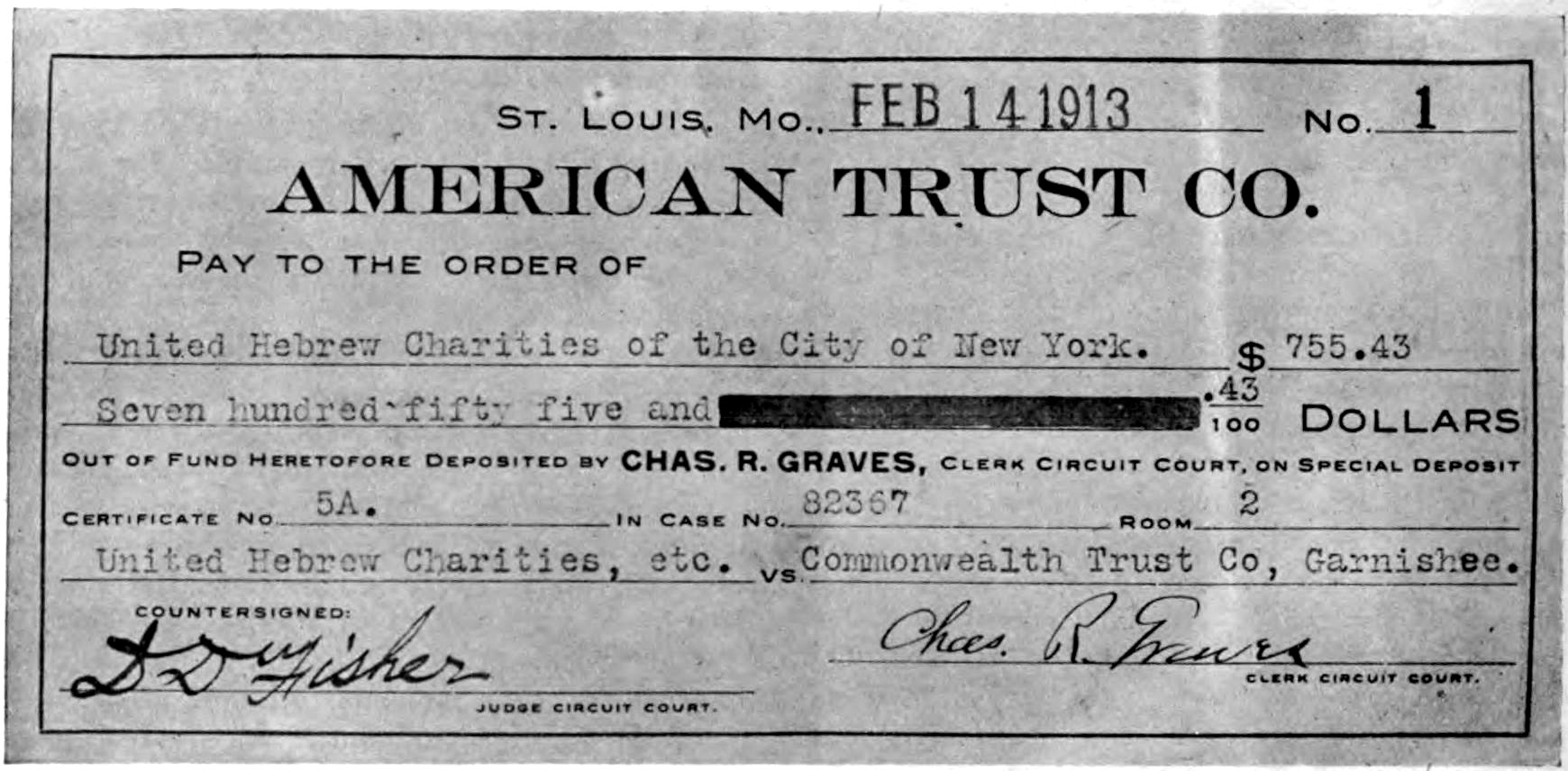
CHECK WHICH BROUGHT ONE DESERTER TO BOOK
This did not seem to unnerve him. He made repeated requests for release and the remission of the fine, but when reminded that he had money in the bank and should evidence his good will by applying part of the funds to his family, he became sullen and would not yield.
There was one point that Zepnick apparently overlooked. A husband and father is responsible for the necessaries furnished to the wife and children if he neglects to provide for them. Any stranger may make the necessary provision and hold the parent to account. In this case it was the United Hebrew Charities. After consultation with the National Desertion Bureau it was decided to institute a civil action and attach the money that Zepnick had in the St. Louis bank. The necessary papers were drawn by the desertion bureau. Then, through Bernard Greensfelder, a St. Louis attorney, a writ of garnishment was served upon the Commonwealth Trust Company and the money, amounting to $790, was attached.
Notice was served by the bureau’s representative upon Zepnick at Sing Sing Prison, and what a change! For once he became meek and tractable. Realizing the futility of opposition, he defaulted and confessed judgment. On February 11, of this year final judgment was entered against him in the sum of $790 which less court costs left a balance of $755.43. The United States Circuit Court of St. Louis sent a check for the money, which was at once turned over by the Desertion Bureau to the United Hebrew Charities. Although the struggle lasted for five years, some little redress has been secured and now the Zepnick family will be able to enjoy a legitimate gratuity. Zepnick himself, however, is still obdurate and is believed to be in London and thus beyond the jurisdiction of our courts.
Said an American afterward: “It was not a man who spoke but a bewildered people.” The speaker was Vittoria Racca, professor of political economy at the University of Rome, and his audience was a gathering of settlement workers in New York to whom he endeavored to interpret the protests of the Italian immigrant usually heard only as a grumbling in dialect. Professor Racca has a two years’ leave of absence in which to study the opportunities for his fellow country men and women in America and the efforts that are being made in their behalf. He purposes to write a book on the subject when he returns.
The speaker described the Italian parent in this country calling his children to his knee and crying in tragic amazement: “These are not like the children we had in Italy.” Whence, he asked, came this strange brood and how was it hatched out under the parents’ wings? With his explanation was bound up sane advice for many of his listeners.
More stress, said Professor Racca, should be laid on the building up of human personality by settlements. The buildings should not be so fine that the Italians do not feel at home. He went on:—
“The settlements should try to learn something about Italian customs, habits, employments, amusements, traditions—they should feel the spirit of the Italians and see things from the 59Italian’s point of view. For example, one headworker was discouraged because she had introduced basketry into a club of Italians and they did not like the work. It would be a good thing for a headworker in such a case to find out what parents do in Italy, and in that way she might easily find some handwork which Italians would like to do. The Italian mother should be enlightened as to what the settlement is doing, so that she may understand why her daughter is out after dark, which is quite against Italian custom. If these suggestions were followed, the settlement would be the center for the whole neighborhood, and not only for the boys and girls.”
Turning to what the Italian might gain from the land of his adoption, Professor Racca said:
“It would be a good thing if the young Italian could acquire something of the strong will of the American and could retain something of the geniality and taste of his Italian parents. As it is, fathers of boys who go to settlements make most extraordinary comments showing that they do not at all understand what is being done at the settlements. For instance, one says he is so sorry that the boys spend their evenings with those bad women there.
“The new life of the immigrant is sometimes a tragedy. They must adjust themselves to a totally different kind of economic life. Wages are seemingly high, but the cost of living is high also. It would be much easier for the immigrants if, on their arrival, they had to fight Indians than for them as now to combat the complexed social and economic conditions of a strange land. Amusements here are different. In Italy after work all meet in ‘the coffee house of misery,’ where there is little to eat or to drink, but where there is a flow of geniality and conversation. Here everybody stays by himself, and all wear beautiful hats and dresses, which hide the poverty of their lives. They are here ashamed to show their lack of success. They are exploited by employers, by employment agencies, by neighbors, by the Black Hand, by the police—by everybody with whom they have to do. They always get the worst of the law. If it is enforced, it is enforced against them. If it is for their protection, it is not enforced. The immigrant Italians feel that they are despised, which they often are, and so they congregate in villages, which makes matters worse, and they learn American conditions more slowly.
“Here the children learn much in the schools and in the settlements, but much more in the streets. In the schools they learn that the United Stales is the greatest nation in the world, and on the streets they learn that Italy is a despicable nation. So they think that everything Italian is to be thrown away. There is no family life, so the children acquire awful habits.”
Not in the school or settlement, but at home, said Professor Racca, we learn not to steal and lie. In Italy and Russia the home, he said, is the center of the intellectual and moral life. Therefore the responsibility is America’s if in America these homes crumble and the morals of the children crumble with them. To prevent family disruption the adults as well as the children must be adjusted to the new environment. This adjustment is to be made, he declared, through the right kind of settlement. And this is what a social settlement should be:
“It should be a small institution for all the poor, not merely for the children. At its head should be one boss—a man. He should be married or a widower, and have varied experience. He should not be a minister, for if he is of the same religion as the people he would duplicate the work of their minister, and if he proselytizes, the people will run away. He should not be a professor, because he sees through narrow academic spectacles, and he should not be an amateur who goes into the work for a few years. He ought to be a practical sociologist, not necessarily acquainted with the theories, but he should know the facts. He should be a psychologist. He should know America thoroughly. If he is working for Italians he should have lived at least two years in Italy in the very provinces from which immigrants come. He should know dialect. He should not think that he can learn to know the Italian and his traditions by “doing Italy”—by visiting museums, art collections and churches. He should work in a narrow field and should take the place of the priests in Italy.
“He should visit every person every day, and in this way really be their friend, father and brother. He should be connected with all their organizations, so that the settlement could be the bridge between the organizations and the workers. If he thus knows everybody, the bad elements would dread this headworker. He would know that certain men were not working, and he would know that if they were nevertheless getting a living they are probably blackmailing. He must know individuals so well that he can handle each in his own way; one through an appeal to pride, another through a command, and so on.”
Some headworkers, he said, are out of town several days a week. Social workers should not be “out” so much at lectures and parties. They should be at the disposal of the people of the neighborhood at every moment of the day and night. Educational work can be done better through chats than through lectures. “No one’s system of life is ever changed because he has heard a lecture,” he said. A headworker once made an appointment with him, he said, to explain to him what her settlement did and to take him around. Her telephone called her away every few minutes, and he had to content himself with reading a folder on the settlement’s work.
Another mistake, said Professor Racca, was to let Italians speak at the settlement. “Southern Italians speak marvelously before they are born,” 60he said; “though what they say may mean nothing. They always speak against America and praise the old country. And when poor people hear these hollow words they think this speaker worthy to be their leader.”
Professor Racca in his address expressed the opinion that volunteer workers should be avoided because they usually have little preparation and the settlements cannot command them as well as if they were paid. Not many girls, he thought, should do social work for young men, because young men, of southern races especially, although they have respect for women, “do not have enough respect to accept a woman as their leader as confidentially as they would a man.” For work with women and children he was of opinion there should be a woman as headworker. “She should be married and of mature age, so that she may have had varied experience. If possible, she should also be a nurse.”