The cover image for this eBook has been created by the transcriber using the original cover as the background and is thus entered into the public domain.
Obvious typographical errors have been corrected.
Inconsistencies in hyphenation have been standardized.
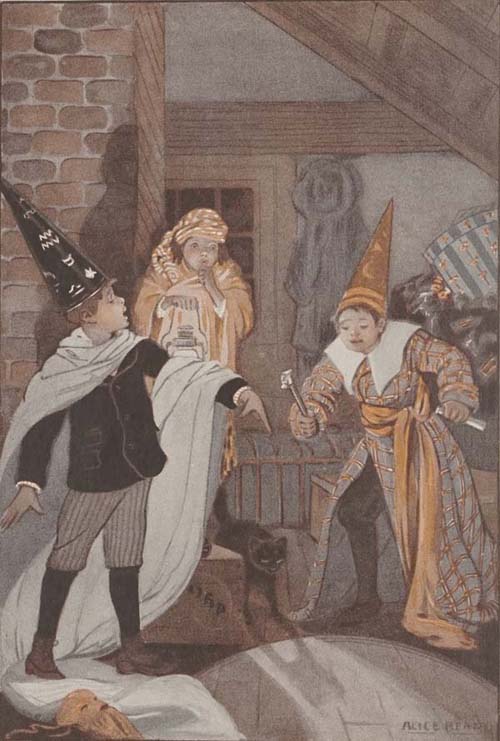
Marjorie might hold the lantern and he’d see what was there. (Page 167)
THE
SURPRISE BOOK
BY
PATTEN BEARD
Author of
“The Jolly Year,” “The Bluebird’s Garden”
“The Good Crow’s Happy Shop”
Illustrated by Alice Beard
THE PILGRIM PRESS
BOSTONCHICAGO
Copyright 1918
By PATTEN BEARD
THE PILGRIM PRESS
BOSTON
THIS BOOK OF STORIES ABOUT THE BOYS AND
GIRLS WHO ARE MY FRIENDS I DEDICATE TO
Nall Candler
BECAUSE HE HAS ENJOYED “THE BLUEBIRD’S
GARDEN” AND “THE JOLLY YEAR,” AND I WANT
HIM TO HAVE THIS BOOK FOR HIS VERY OWN
The Surprise Book was Marjorie’s, but
it really belonged to Dotty also, Marjorie
said. It was Dotty who had made
it once upon a time when she had not been
able to go to school because of a snowstorm
and a snuffy cold. The combination of cold
and snowstorm was more or less a lucky mixture,
so Marjorie argued. At any rate, if it
had not been for these, maybe there never
would have been Marjorie’s Surprise Book.
You shall hear about it.
It began just after Marjorie, wrapped in
storm-coat and arctics, had left for school.
Dotty was sitting upon a carpet hassock by
the fireside. The fire snapped and crackled
pleasantly but Dotty frowned. “I wanted to
go to school with Marjorie, too,” she said for
about the forty-eleventh time since nine
o’clock. “There isn’t anything to do!”
“Nothing to do!” exclaimed Mother. “Why
not make a Surprise Book, Dot?”
“How?” inquired Dotty, turning around to
face Mother in sudden interest. “How?”
“Oh, it’s quite simple,” Mother returned.
“You will find it ever so much fun. I used to
make Surprise Books when I was a little girl.
They’re made in scrapbooks. You know how
to make a scrapbook, Dot, don’t you?”
Dotty nodded. “I just take some brown
wrapping-paper an’ fold it ever so many times
an’ then I cut the folds into leaves. When I
have ever so many leaves, I cut a cover for ’em
an’ I tie the cover to the leaves with a ribbon.
It goes through the centre of the book an’ ties
at the back like a sash.”
Mother nodded. “That’s it. To make a
Surprise Book you first make a scrapbook
that way. Then, one at a time, you fold each
leaf of the scrapbook twice. You begin by
taking the first leaf. You fold its upper corner
down till its edge runs parallel with the
centre of the scrapbook’s leaves. Then you
take the lower corner and fold this up in the
same way. It makes a pocket and one can put
things into this pocket and seal them tight with
a pretty paper seal like those used to seal
Christmas packages.”
“What do you do it for?” asked Dotty.
“Why do you put things into the pockets and
seal them?”
Mother laughed. “Why, Dot,” she explained.
“You put the things into the pockets
as surprises because you give the Surprise
Book away to somebody that you love very
much. Every pocket holds a surprise when
it is sealed fast. You write on each pocket
the exact time when it is to be opened and the
one you love very much must open the pockets
and find the surprises only when the time falls
due. Do you see?”
Dotty beamed. “I see,” she chuckled.
“I’m going to make a Surprise Book right
away. What can I put into it for Marjorie
to find?”
There was a silence while Mother rocked
back and forth in the big old-fashioned rocker
as she ran her needle in and out of the hole she
was mending in Marjorie’s stocking, and
thought. “Suppose you cut nice stories out of
magazines and put one in each pocket,” she
suggested. “There’s a pile of story-papers
up in the attic. I’ll get them for you. You
might find twelve stories, one for every month
of the year, and you might make the Surprise
Book for Marjorie’s Christmas present.”
Dotty jumped up and down. “Oh, hurry,
hurry!” she begged. “I want to begin right
away. Marjorie will be coming home soon
and she mustn’t know anything about it. Can
I put other things into the pockets of the
Surprise Book too? What can I put in?”
“All manner of things that one could put
into small space like that—picture-cards,
paper dolls, transfer pictures, little verses and
games that you find in magazines—’most
everything that will lie flat. You can try it
and think of things to put into the Surprise
Book’s pockets.”
Hooray! That was an idea! Dotty knew
of a flat penwiper that she could make out of
flannel. That would go in flat—and there
might be a penny all wrapped up in paper,
maybe. Such a thing as this would be simply
a splendid surprise. Each pocket should hold
something new and wonderful except the
pocket that was to be for April Fool’s Day.
That pocket should hold only a blank piece of
paper folded up tight to feel as if it were
going to be a surprise. There’d be nothing at
all in it, when Marjorie broke the seal!
What a joke! And every month’s holiday
should have a pocket, too! Dotty chuckled.
Old Christmas cards would now find a new
use. Valentines and Easter gift cards would
go into the Surprise Book, too. And every
month there would be a story pocket in the
book! What fun! As soon as she had made
the brown paper scrapbook, she fell to work
folding its leaves—first, top corner over and
down; next, lower corner up toward it to
make a three-cornered pocket. The book had
twenty-four leaves, two surprises for every
month. First of all, Dotty put the penwiper
into the first pocket for a Christmas surprise.
She sealed it with a holly seal. Then into the
next pocket, she put a January surprise and
a January story followed. So it went through
all the year. It was exciting trying to find
stories that fitted the different months, but
the story-papers helped because Mother had
kept them in file, month by month. Dotty
had only to look the papers over and cut out
the story she imagined might best please
Marjorie. She worked very hard indeed. All
day she worked, while it snowed outside. It
seemed quite lucky, then, that Marjorie stayed
away so long. It wasn’t really lonely without
her!
And at last, with some help and suggestions
from Mother, the Surprise Book was done!
It was a big three-cornered book that seemed
quite bulky. As Dot held it, she felt that
Marjorie would surely like it and she couldn’t
bear to keep it till Christmas. Christmas was
so far away yet! There were four more days
till Christmas Eve! But, nevertheless, because
the Surprise Book was to be a Christmas
present, Mother and Dot did it up, finally,
in nice, fresh, white tissue paper and tied the
parcel together with bright red ribbon. It was
a splendid present!
When Christmas came, the Surprise Book
was placed under the tree and Dotty left all
her own presents while she urged Marjorie to
open the big package that was tied with red
ribbons. “You’ll like it,” she laughed. “I
made it for you. It’s a book of surprises that
last all through the year—it really is a Surprise
Book because there’s so much fun in it!”
Then Marjorie tore off the paper and red
ribbon. When she saw and understood jail
about it, she said she would make Dotty a
promise and the promise was that every time
there fell due a story, she’d read it aloud to
Dotty each month.
So, here in this book are the stories that
Marjorie read to Dotty, the stories that were
in Marjorie’s Surprise Book, together with
the penwiper, the Valentine, the St. Patrick’s
favor for March, the April Fool, the paper
May-basket, the four-leaf clover for June.
Beside these, there were a great many other
nice things that came in the pockets that were
not filled with the stories. You shall hear
about them all yourself, as you turn the pages
here.
II The Telephone Santa Claus
The Telephone Santa Claus
THE DECEMBER SURPRISE
Of course, you know as well as Dotty that
there was a penwiper in the first Christmas
pocket. The writing on that pocket said,
“Not to be opened till after you have seen
all your presents from the Christmas tree on
Christmas Eve.”
Marjorie liked the penwiper ever so much.
She said it could be used at school. It was
made of round red circles of cloth and had a
button sewed at its centre. The story pocket
was quite bulky and it said,
“Open on Christmas Eve for a bed-time
story.”
Marjorie read it aloud as she and Dot
curled up in a big cosy comfortable at bed-time.
They had to have a very special dispensation
from Mother. She said that the
Surprise Book story that came on Christmas
Eve might keep the bed-time light lit till it
was finished. So Marjorie read aloud, “The
Telephone Santa Claus.”
The shops were full of Christmas
toys. There were Christmas greens
and fir trees everywhere. Big ribbon-trimmed
holly wreaths began to appear in
front windows and everybody in the streets
carried Christmas bundles. At this time, too,
Mary Louise, who lived in the large and
beautiful house with mother and daddy, and
who was the only little girl they had, began
to plan what she should ask Santa Claus to
bring her.
Can anybody ever have too many toys?
Mary Louise had a whole toy closet full.
There were certain “very best toys” put by
nurse on the top shelf for special occasions
and there were countless “every day toys,”
some of them a bit broken, but a great many
of them quite whole and splendid, ever so
much nicer than the toys that Mary Louise’s
little friends had to play with. Still, Mary
Louise wanted more toys. The list that she
was now writing in her round, wiggly handwriting
had already covered several sheets of
large pad paper that nurse had given her.
Mary Louise sat at the big flat desk in the
library. Her velvet dress was almost lost in
the big arm-chair that was daddy’s favorite.
Behind her was a cheerful fire on the hearth
and it snapped and crackled joyously. Mary
Louise’s blue eyes travelled about the room as
if seeking fresh inspiration in the objects that
they rested upon. She already had everything,
but she wanted more, and so she put
the pencil on the paper and continued the
letter to Santa Claus.
“I want two new Teddy bears, the biggest
you have, Santa Claus,” the pencil said. “I
want one that is pure white like snow and
another that is furry and brown. Both should
have a squeak and if you have any that will
growl, I’d like that kind, too.
“I want a white doll carriage lined with
pink satin. They have them at Bunty’s
Department Store, for I saw them once and
they cost twenty-five dollars. I want a big
doll to go in it. I want a whole wardrobe of
clothes for it, a new doll cradle, and it must
have a pink silk dress, too. I want a doll that
will open and shut its eyes—one with real
hair. It must talk, too.
“You can bring me, beside this, a boy doll
with a sled and all the different kinds of
clothes that a little boy ought to wear. I want
a real toy automobile with a horn and a lamp—not
the kind that is like a tricycle, because I
already have one like that—I mean the real
kind that runs with gasoline. They cost a
hundred and twenty-five dollars, maybe a
little more, but I don’t think you mind what
they cost.
“I want a doll house that is nicer than the
one you gave me before. It ought to be big
enough for me to go into myself and I would
like to have it built up in the garden like a real
house. You can put it down by the greenhouses
because it will be too big to bring into
our house or carry down the chimney, I know.
And then too I want—”
Mary Louise’s blue eyes considered the ceiling
for a space of time: “I want a ring like
mother’s—one with a blue stone in it,” she
added. While she was trying to think of
something else to ask for, the door of the
library opened and in walked Mary Louise’s
big daddy. He glanced for a minute at Mary
Louise and he took up the telephone.
Mary Louise’s daddy was busy there several
minutes. He watched Mary Louise nibbling
the end of her pencil and he looked over her
shoulder at the letter. As he did so, a smile
crossed his face. “Writing to Santa Claus,
Mary Louise?” he asked when he put down
the receiver.
“I was wondering what to ask for next,”
Mary Louise informed him. “I think I’ll ask
for another pony. Nibbles is very nice, of
course, but I’d rather like one that will trot
faster. I think I’d like a white pony with a
white kid harness and a white basket-cart.”
“You’re asking for a great many things,
aren’t you?” daddy suggested. “Maybe it
might be well to close the letter now. I’ll take
it with me and mail it on the way down town—better
address the envelope.”
“I might think of something more,” remonstrated
Mary Louise. But she folded the six
sheets of pad paper and put them into the
envelope that daddy held out. Then she
addressed it to Mr. Santa Claus, Santa Claus
Land, Santa Claus Country, North Pole,
exactly as nurse had told her.
Daddy put it into his overcoat pocket as
Mary Louise had seen him put letters that he
posted for mother. Then as the library door
closed, she plumped herself down upon the
thick black fur rug in front of the fire to look
at a picture book.
She had not been there very long when the
telephone bell rang. James didn’t come as he
ought and Marie was upstairs, so Mary Louise
incommoded herself by getting up from the
rug to answer it. It had already rung three
times and she was quite ready to scold Marie
for not answering it. But she did not have
the chance as Marie still did not come. So
Mary Louise took up the receiver. “Hello!”
she called.
“Hello,” came a cheery answer.
“What is it?” inquired Mary Louise.
“I want to talk to Miss Mary Louise
Snow,” came the answer. “I’m Santa Claus.”
“Oh, I’m her!” gasped Mary Louise. “I’m—I’m
her!” Never before had Santa Claus
called Mary Louise up by telephone! Never
had she spoken to him except for a few brief
minutes at a Christmas party celebration.
“You are,” returned the voice. “Well, I’m
glad you are at home, Mary Louise. There’s
something very special that I want to talk
about. It’s almost time for me to receive your
usual Christmas letter. I suppose there are a
great many things that you will want. Have
you been a good little girl this year?”
“Sometimes,” Mary Louise faltered. “I
have tried very hard not to have tantrums.
Maybe I did once or twice but I tried not to
say things when Marie would unsnarl my
hair.”
“Have you learned your multiplication
tables?”
“Up to sevens,” answered Mary Louise.
“I think I can say them, but I can’t always remember
what seven times nine is and I forget
seven times twelve.”
“That sounds as if you had tried fairly
well,” the voice of Santa Clause commented.
“There are a great many Christmas presents
that you would like, I suppose?”
“Yes,” returned Mary Louise, “Oh, yes,
Santa Claus! I just wrote you my letter
and I hadn’t quite finished it when daddy
came in and took it to mail, so maybe I’ll write
another later on. I didn’t ask for any games
or things. I might send another letter when
I think of what I want. If you like, I will
tell you the things that I asked for in my first
letter if I can remember them. I want a big,
big doll that can talk, and it must have real
hair and shut and open its eyes and it must
have blue eyes and real eye-lashes too. I
asked for a pink silk dress and gloves, I think—I
can’t remember. And there were to be two
big Teddy bears with a growl and a squeak
both—very big bears, one pure white and the
other furry and brown. I want a white pony,
too, and a white cart and harness. The letter
will tell you all about that—I forget all that
I said in the letter,” she explained. “It was
’most six pages long of big pad paper.”
“That was rather long,” chuckled Santa
Claus.
“Yes,” smiled Mary Louise, “but I think I
forgot to say that I wanted gloves for the
doll.”
“I’m not sure I can bring the gloves,” Santa
Claus said. “I think, however, that I might
get the doll to you. Would you rather have
a doll than the two Teddy bears?”
“I want both,” replied Mary Louise. It
seemed strange that Santa Claus should not
understand a thing, as simple as that! “Teddy
bears are very po-pular, I know, but I guess
you must have ever so many and you’ve
usually brought me nicer things than you’ve
given other little girls that I know.”
“Well, maybe I can bring a Teddy bear, if
there’s one left over, Mary Louise, but I’m
not at all sure I can bring the pony this year,
you know. I’m afraid I’ve got to cut down
on your presents, Mary Louise. That’s why
I called up. I have something very, very
important to ask you. I want to know if you
can help me? I’m trying to distribute my gifts
more—more properly this year. You know,
of course, Mary Louise, that there are ever so
many little children that do not get Christmas
presents, especially in war time.”
“Are there?” inquired Mary Louise. “I
suppose it’s the children who have been
naughty.”
“Oh, no.”
“What is it, then?”
“It’s not because I forget them or because
they are naughty,” explained Santa Claus’
voice. “It’s because too many goodies go to
the rich little children. Then the poor little
children who would like toys—they have
nothing.”
“Oh,” gasped Mary Louise. “Then, I
suppose you’ve given me more than my
share?”
“I’m afraid so,” answered Santa.
“Don’t the poor children have anything?”
“Sometimes I’ve given to the wrong people,”
came the evasive answer. “You see, I
have a great deal to do. I ought to have a lot
of people to help me. How can one person do
it all! Sometimes I don’t find the right children
and I use up the things that grow in the
Santa Claus Land and then I have nothing
left after the long, long lists are made up for
the very particular little rich children.”
“Oh, dear!”
“Yes, that’s why. Do you want to give up
some of your things this year so that they can
go to the poor children?”
Mary Louise reflected. “Which?” she
asked. “Do you mean the doll or the pony or
the automobile or the new doll house?”
“You have about a hundred dolls, haven’t
you?”
“No,” corrected Mary Louise, “only just
seventy-six, counting the little bits of china
ones in the doll house. Without these there
are about forty—but only twenty are big
ones.”
“Well,” chuckled Santa Claus, “that seems
to me a good deal too many. You could give
up the doll, I think. Suppose that you were a
little girl who had never had any doll ever!”
“Well, but I’d like the pink doll—”
“I’ll tell you what,” Santa Claus suggested.
“You think things over. Maybe I’ll find that
I can spare a pink doll for you, after all. But
I want you to help me look out for some of the
poor children this year and I want you to buy
at least six presents out of your very own
money. I want you to find some children that
I ought to know about. I want you to help
them for me. I’ll telephone you some
addresses where there are little poor children
and you must write these down and keep them
and see that the boys and girls have proper
Christmas presents. Will you do it?”
“Oh, yes, Mr. Santa Claus, gladly,” returned
Mary Louise. “I have nineteen dollars
in my bank, I think. My daddy will help
me.”
“No, I don’t want your daddy to help you.
It’s to be your very own money!”
“All right. I’ll not ask him. Of course
I want to help you, Mr. Santa Claus. I’ll
love to do it.”
“Well, good-bye. If I can, I’ll come on
Christmas eve to your tree. You do the very
best you can, Mary Louise, and invite the poor
children to share your tree!”
The receiver was hung up at the other end
of the line and Mary Louise stood bewildered
before the library table where she had just
written her long Christmas list. She stood
there thinking it all over from beginning to
end. She, she had been asked to help Santa
Claus! It was a great distinction! Poor
overworked Santa Claus had appealed to her
as a very rich little girl who already had everything—and
she mightn’t get the pink doll at
all!
Then Mary Louise could not keep the secret
any longer and she dashed up the stairs to
mother’s room. She wouldn’t let mother go
out of the room till she had told her the whole
story and mother had a very important engagement
and was all ready to go out in the
car. Together they emptied Mary Louise’s
bank and counted out exactly nineteen dollars
and fifty-three cents. Mary Louise wanted
to take it and start right out in the car to buy
the presents, but with difficulty mother explained
that she had better wait till Santa
Claus sent in the names and she had found out
what the children wanted.
And Santa Claus did telephone the names.
Mary Louise was at dinner and James
answered the telephone. Mary Louise felt
badly that she had not been called, but there
was no need to take her away from dinner;
James had the addresses on the telephone pad,
mother said. She was sure they were right.
Mary Louise wished daddy were home. It
seemed to her that he would never come. As
she felt sure she would need to buy a tree for
the Christmas party, she got nurse to take her
to that shop in the afternoon. But it is wonderful
to think that a Christmas tree costs
money! Before this, Mary Louise had never
considered the subject. It was a very tall tree
and it was an expensive tree. The charge for
it ate into the nineteen dollars and fifty-three
cents considerably. The things that went
onto the tree must all be new. Santa Claus
must see that Mary Louise had bought new
ones to please him. So she bought ever so
many-stars and birds, and balls of red, yellow,
blue, green, white, silver, gold. And
there was need of tinsel. If Mary Louise had
had her own way, she would have spent almost
all the nineteen dollars and fifty-three cents
just on that tree without thinking of the consequences.
Why, if she had, how could she
have bought any presents for the poor
children?
Next day, after having told daddy all about
it, she wrote to the addresses that Santa Claus
had given her. She wrote the letters in ink
and used her very bestest best blue note-paper.
All the letters were sealed with a Santa Claus
sticker. It did take a great deal of time, I
assure you.
The invitations were to Mamie and Johnnie
and Toby Smith. They were to Tony Pettino
and Lily Wicks and Benny Wicks who lived
in a part of the city Mary Louise had never
seen. Nurse said it was a very sad part of the
city. When Mary Louise asked if she might
go there and see it and see the children, nurse
said she guessed Santa Claus didn’t know
what he was talking about—she guessed not.
Mary Louise insisted, but all in vain. Santa
Claus had told her what the children’s ages
were and left the gifts to Mary Louise’s
selection.
When daddy had taken the letters to the
poor children in his overcoat pocket to mail,
Mary Louise fell to planning about the gifts.
Only one little girl—all boys! How dreadful!
But mother helped Mary Louise by suggesting
things that little boys might like. From
her own playthings Mary Louise selected her
biggest doll for Lily and would have given
her ever so many other dolls, had not
mother thought that Mary Louise might add
other little girls to her Christmas list of poor
children and make the helping of Santa Claus
more equally distributed among those who
might otherwise be forgotten.
How fast the nineteen dollars and fifty-three
cents did go—just buying the tree and
the fixings, and the sled and the overcoat and
mittens, and skates, and carts, and baseball
bats! It was a tragic moment when Mary
Louise suddenly discovered that Benny had
been neglected and didn’t have as many gifts
as the others. She consulted daddy, as there
were no boys’ toys among her playthings and
nothing seemed right. Daddy said—well, he
said she might work and earn the money to
buy Benny a present.
Never in her life had Mary Louise worked
to earn money! “How can I earn money?”
she asked.
Daddy thought. “If you will learn the
seven times seven table, and the eight, and the
nine and any of the others, I’ll give you a
dollar for every one you can say perfectly.
That’s very special, Mary Louise, because it’s
Christmas, you know.”
Dear me! To think of having to sit down
quietly in all the excitement of Christmas rush
and learn horrid multiplication tables! If
anything was work, that surely was!
But where there’s a will there’s a way and
Mary Louise did it. She did it so well that
she remembered all of the seven table perfectly.
She also went on and learned the eight
and nine table and the ten table—that was
easy. Then, being quite enthusiastic, she
tried hard at the others and mastered the
twelve table after keeping at it a steady day.
With the proceeds of these earnings, paid
gravely by daddy, she was able to buy Benny
a game, and when she went to buy it and
found some little poor children right by the
car that stopped at the entrance of Bunty’s
Department Store, she was able to invite them
then and there and go right in and buy presents
for them. They needed woolen scarfs
and mittens, and Mary Louise had found
presents on the toy shelf among the toys kept
for very special occasions. These would do
for them.
When once Mary Louise had started to
help Santa Claus, there was no knowing where
she would end. Whenever she went out, she
saw little children whom she was sure Santa
Claus had forgotten because they looked so
wistfully in at shop windows. Some of them
nurse let her speak to and she added these to
her list for the party. There seemed to be no
table of thirteens to learn but daddy gave a
dollar for every poem she could recite and
Mary Louise knew ever so many and it was
easy to learn short ones.
Oh, dear! Oh, dear! How the time did fly!
Before Mary Louise knew it, Christmas Eve
was there! There had been all the fun of
fixing the tree and daddy and mother had
helped. Mary Louise hoped Santa Claus
wouldn’t disappoint her! She hoped that he
surely would come! She was very much relieved
when James came in and said that he
had just been asked to deliver a message that
came from Santa Claus over the telephone.
It was a telegram and it said:
Will be at your Christmas party Christmas
Eve eight o’clock.
Santa Claus.
After that, Mary Louise didn’t worry. She
let Marie take the tangles out of her hair and
help her into her very best pink silk dress
and then she dashed downstairs to wait for
all the guests who had been invited to come.
She wanted to play games with them and she
wanted to tell them all about Santa Claus and
she hoped they would like to sing carols
and dance around the tree—but most of all
she hoped that they would like the presents she
had arranged for them at Santa Claus’ suggestion.
Oh, wouldn’t it be fun to see Santa
Claus give out the big white Teddy bear and
the big brown fuzzy bear and the pink doll
and the cart and the skates and—and—
But here the doorbell rang and there was
a scuffle of happy feet. It was Lily and
Benny and Tony and all the rest. They were
as happy as happy could be. Mary Louise
greeted them all and then they beamed upon
her almost as if she were Santa Claus herself,
but I just wish you could have heard the
shrieks of delight when the front doorbell
rang and James ushered in Santa Claus himself!
It was just too bad that daddy wasn’t
there to see all the fun, though mother did
hope that maybe he might be able to come
later. Oh, what a good time they all did
have! It was the very best and happiest
Christmas that Mary Louise had ever, ever,
ever had! It was wonderful!
Why, Mary Louise had such a good time
that she forgot all about the pink doll till
Santa Claus came and gave it to her, after
giving out all the other gifts. It was the very
doll that Mary Louise had wanted, but she
asked Santa Claus to be sure he could spare
it and that he had neglected nobody else to
give her the doll. He said he guessed not—at
least he hoped not, and then they sat on the
sofa and ate ice cream together while Santa
Claus joked and told stories. But he couldn’t
stay very long, he said, and he had to go.
Then just afterwards, alas, in came daddy,
who might have met Santa Claus, if only he
had got there a wee bit sooner! And the
children danced around the tree and sang
carols. And then they all wished Mary
Louise a Happy Christmas and went home
with arms laden with packages that they
hugged tight and smiled and chuckled over.
After the children went, there was just
mother and daddy left. They both kissed
Mary Louise and vowed that they’d have
another party again next year, maybe. Then
daddy took Mary Louise upon his knee and
put a little blue ring upon her finger. It was
the kind of a ring that Mary Louise had
wanted—one just like mother’s, only little.
And mother told Mary Louise that her Christmas
present was the doll house. It was coming
as soon as possible. It was so big that one
could play inside and it was to be placed right
close to the garden greenhouses.
It was a Christmas that Mary Louise never
forgot and couldn’t forget, even if it had not
been for the blue ring and the multiplication
tables!
III The Penny Bank Window
The Penny Bank Window
THE JANUARY SURPRISE
The January surprise pocket had held a
little picture calendar. Marjorie had opened
it according to directions that said:
“Open sometime when you want to write a
letter.”
As there was a Christmas thank-you letter
to write upon the very first day of January,
Marjorie had opened that pocket and found
the calendar. Then she had looked to see just
when she might open the story pocket. The
writing on this one said:
“Open on some Saturday afternoon, when you
are sitting by the fire.”
The very first Saturday afternoon that
came in January, Marjorie took the Surprise
Book and went to the fireside. She could not
wait to find out what was in the story pocket.
She told Dotty that the time had come for the
story and Dotty curled happily at her feet on
the rug while she read “The Penny Bank
Window” that was the January story.
“That penny bank is to blame for it all,”
said Billy Williams. “If it hadn’t been
for the bank, nothing would have happened.”
The bank was quite full of pennies
that Billy had been saving carefully ever since
his birthday. It had been given him then with
nine times nine bright pennies to put into it.
That was because Billy was nine years old.
One afternoon Billy took up the china bank
and shook it to hear it rattle. Really, when
the bank rattled, it made Billy feel tremendously
rich. There was almost a whole dollar
in the bank by now! But right here, out fell
one dull penny and it rolled along the floor.
Billy let it roll till it stopped and the rattle
of the bank seemed quite as big without the
missing penny, so he suddenly decided to
spend it—but for what? Why, just at that
very minute, Billy felt hungry. Mother was
off at work and would not be home to get their
dinner till six. Billy was all alone in the
rooms over the drygoods shop where he lived
with his mother. He had eaten the bread and
butter that she left out for his lunch and he
was hungry. It suddenly dawned upon him
that he wanted a lollypop and that he could
find a nice, sweet, red one at the candy store
around the corner. “All right!” beamed Billy.
He put the dull penny in his pocket and raced
off to get the lollypop.
If it hadn’t been for the bank, there would
not have been the lollypop. If it had not been
for the lollypop, there would have been no
penny bank window. So, you see, the bank
was responsible. Hardly had Billy bought
the red lollypop and torn the paper off than
he became quite absorbed in eating it—and he
stepped down from the curb at the street corner
quite without looking. It was a careless
thing to do, for he didn’t see what was coming.
What was coming happened to be an automobile
that rounded the corner without tooting
its horn!
The doctor felt Billy all over and pronounced
him a very lucky boy indeed. “There
might have been nothing left of you, my son,”
said he. “But there happens to be a good deal
left in spite of the fact that your foot got
bumped into. You’ll have to keep quiet for
a while; then you’ll be as good as new.”
“I suppose I mightn’t be so lucky another
time,” grinned Billy, “but I guess I’ll be more
careful in crossing streets. It’s the fault of
the lollypop.” But it didn’t seem very lucky
to be hurt and have to sit all day in a chair
while mother was away. It was fearfully
lonely. Even though Mrs. Finger from the
next-door flat brought in magazines and two
picture books; even though, after school, some
of the boys came in to play checkers and dominoes
and they stayed as long as they could
when they really wanted to be outdoors with
the other kids. Even though Billy learned
to knit for the soldiers; even though he
snipped pillows for the Red Cross, it was
frightfully lonely till mother came home from
work.
After he watched the children pass on their
way to school one morning, his eyes roved
across the yard where the leafless trees beyond
shut off the view of the roofs of other houses.
Below in the quiet street hopped sparrows. It
was cold out there and they found nothing to
eat. Billy bent forward and lifted the window.
From his breakfast tray that mother
had left, he took a slice of bread and
tossed it far out. The sparrows darted for it
and chirped and twittered. Billy laughed.
“Don’t I wish they’d come up here to the
window,” he sighed. “Guess I’ll try it an’
see if they will.” And there was one venturesome
sparrow who did come! Billy was
still watching him when the doctor came for
his morning visit.
“If I were you, Billy Williams, I’d start a
bird window,” the doctor suggested. “My
little girl knows all about bird windows and
she’s made several at home. The birds come
every day. That foot looks as if it were doing
well—suppose I ask my little girl to come in
and make you a bird window?”
Billy said he’d like it jim dandy. It really
was awfully lonesome. Nothing ever passed
in the street. If there were birds to watch,
it would be fun. “You won’t forget about the
bird window,” he cautioned, as the doctor took
up his grip to go. And the doctor said he
surely wouldn’t.
Knitting progressed that day rather slowly.
All Billy’s bread went into the street to the
sparrows. But Billy had reached almost as far
as the end of his gray muffler in the afternoon—and
the boys had come in from school for a
hasty, “Hello, kid, we’re glad you’re alive and
gay! We can’t stop because—” Yes, of
course, they couldn’t come every day but it
was lonesome. Then there came a knock at
the door and in came a little girl. She was as
bright and cheerful as her crimson cloak.
“Hello,” she greeted. “If you’re the boy
that ate the lollypop and got run into, I know
all about you. I’m the doctor’s little girl. I
came to help you make a bird window—bird
windows are my specialty, you know,” she
laughed.
“I’ve got some money, if you need to buy
anything,” Billy announced. “I want a real
jim dandy window! You’ll make me a nice
one, won’t you? I like birds and animals,
don’t you? I never had any pets but I always
did want a bird or something. Maybe I can
tame the birds when they come to my window.
How do you fix it?”
“Well, you have to have a shelf of some
kind—a box that is shallow will make that,”
explained the doctor’s little girl. “I brought
some nails and a hammer with me and I
brought a lump of suet that the cook gave me.
She sometimes won’t give it to me but this
time I told her about you and she gave it
without another word. She says she’s sorry
for you and so’m I. I’m going to fix you
up a splendid window.”
The doctor’s little girl thrust up the sash
of Billy Williams’ window. “I’m awfully
hard up,” she pursued, “or I’d have bought
some sunflower seed to bring with me. You
ought to have sunflower seed to sprinkle on
your bird-shelf, for it brings the chickadees
and the purple finches and ever so many other
kinds of birds. The woodpeckers come for
the suet and if you have peanuts, beautiful
big blue jays will come and carry them off.
Could I have twenty cents to buy sunflower
seed, do you suppose? It costs ten cents a
pound at the druggist’s.”
Billy showed her the penny bank and they
shook it and shook it till there was really more
money than twenty cents—“If it hadn’t been
for the bank, I’d have been running about
now,” Billy grumbled. “That bank’s got to
give me something nice now anyhow!”
“Well, I’m shaking it to punish it,” laughed
the doctor’s little girl. “I’m shaking it ever
so hard. I don’t believe it likes to be shaken.
You did have ever so much money in it. I
don’t wonder that you wanted the lollypop!”
She slipped the money into her purse and
went off to make purchases. Billy told her to
get anything that the money would buy. He
wanted a bird window that would be the best
anybody could have. He waited anxiously
for her to come back and when she came, her
arms were full.
Billy had to laugh. She had a small evergreen
tree that she had bought for thirty-five
cents. She had two pounds of sunflower seed
that had cost twenty cents—oh, ever so much
seed comes for that price and it will last a
long time, too. She had a shallow grocery box
that was long and flat and without any cover.
It was about the length of Billy’s window
ledge. She had a package that came from the
ten cent store. When it was undone, it showed
two tin strainers at five cents apiece. Now,
what did all this mean?
The doctor’s little girl rolled up her sleeves
and put on Billy Williams’ mother’s blue
gingham apron. First, she took the shallow
grocery box and nailed it to the window ledge.
Billy was surprised to see that the doctor’s
little girl could drive a long nail almost as
well as he himself!
“That’s the bird-shelf,” she explained.
“You sprinkle sunflower seed on it every day.
The birds can light on its rim. Some days
you’ll have as many as twenty at a time. The
chickadees are darling and the purple finches
are beautiful and they sing too.”
She took a handful of striped gray and
white sunflower seed and sprinkled it on
Billy’s new bird-shelf. “You’ll have to wait
a while till the birds find out about the shelf,”
she said, “but it doesn’t take them long.”
Then she took the little green fir tree and some
stout cord. She tied the wee tree to one side
of Billy’s blind. She tied its trunk at top and
at bottom with several twists of heavy string.
It made the window pretty—almost as if one
were looking out over the top of a fir tree.
The doctor’s little girl paused after her work
and smiled at Billy. “I think that’s nice, don’t
you?” she asked.
Billy nodded. “What’s it for?” he inquired.
“You tie bits of suet lumps to its limbs,”
she explained. “The birds will light on the
branches. Suppose you cut up the suet into
two or three-inch lumps. Tie string around
each and tie the lumps to the different
branches. Can you do it?”
Yes, Billy could. The little girl had to help
a bit, but not so very much.
“The strainers are to be tacked up. You
put seed into them. When it rains, the seed
doesn’t get soaked. Birds don’t like the
soaked seed, you know.” The strainers went
at the other side of Billy’s blind, opposite the
fir tree.
It seemed as if the bird window was all
done but it wasn’t! The doctor’s little girl
took a good-sized tree-twig that she had
brought, and nailed this against the window
frame to make a perch. There were three
perches made this way. She put them near
the two strainers and tied suet to each perch.
She said that the woodpeckers would come to
these tree-perches; they didn’t come to the fir-tree
because—well, woodpeckers couldn’t.
When all this was done, the doctor’s little
girl took something else from her pocket. It
was what Billy thought—bird-seed. It was
a mixture of seed: millet, wheat, rape, cracked
corn. She said that one could get it mixed at
a grain store—eight cents a pound. If Billy
wanted her to, she’d buy some and bring it to
him tomorrow, but for today all was done.
It was twilight and almost dark by now, so
they shut down the window. The birds must
all have gone off to shelter. It was too late
to expect anything of the bird window that
day, but the doctor’s little girl promised to put
a bit of suet on a bush under Billy’s window
as she went home. It was to attract the birds
and call attention to the window.
That night when mother came home, she
thought the bird window a splendid thing.
Billy dreamed of it all night. Indeed, he
could not wait for morning to come. He
woke at four o’clock and kept wondering if
any birds would come. Then, because he was
so drowsy, he fell asleep. He woke with a
sudden start just at sunrise. Was it true?—Yes,
yes! Knock—knock—knock! What kind
of bird was it? There was a bird at the suet
that was tied to the perch at the window.
That must be it! Billy sat up in bed and bent
forward to look. There on the perch that was
highest was a black and white bird with a
bright scarlet cap—it was brother woodpecker
busy eating a breakfast of suet!
My, how exciting! Billy hardly dared to
draw a breath, he was so afraid that the woodpecker
would see him and fly away. Billy had
hardly been in his chair near the window for
more than a few minutes when there was a
flutter of wings and a strange little slate-gray
bird lit upon another perch and circled it,
making queer, cheerful little noises. The bird
had a black head and it seemed full of sociable
curiosity. Billy wondered what it was. He
did not remember ever to have seen a bird like
it before! He resolved to ask the doctor’s
little girl what it was. And then came wee
little birds that called dee—dee—dee. They were
the chickadees, little gray birds with black
hoods. They seemed very tame. They came
in a cluster and besieged the limbs of the little
green fir tree. While they were there, came
birds like sparrows, too. They were not
sparrows though—some of them were rosy red
in color. Oh, they must be what the doctor’s
little girl had called purple finches! My, how
exciting! How they quarreled! What fun!
They were all over the bird-shelf, eating the
striped sunflower seed in a very hungry way.
When a big blue jay came screaming toward
a near-by tree, they flew off in a hurry and
the blue jay with his crest acock carefully
reconnoitered the premises and decided to eat
from the bird-shelf too. Oh, wasn’t it gay!
When the doctor came, he quite agreed that
it was jolly and he brought a bird book from
his little girl and a package of the mixed seed
that he laughingly called “medicine.”
It must have been medicine, for Billy’s foot,
so the doctor claimed, grew well in a wonderfully
rapid manner from this time on. And the
time passed so quickly at the bird window
that really the days went by before Billy had
time to be lonely. The birds were great company.
The same ones came from day to day—the
little Miss Chickadees were the tamest.
They really learned to take shelled peanuts
from Billy’s fingers and to sit upon his warm
hand while they ate. Brother Woodpecker
and his wife came early. They needed no
alarm clock to wake them. Billy heard the
knock—knock before he was in his chair of a
morning. Then the curious little nuthatches,—those
strange little gray birds with the
funny noise that sounded like quack, quack—they
came, too, regularly. In snow and sleet
and rain and sun, Billy had his bird friends.
He had the doctor’s little girl, too, some days.
They sat by the window and played games
while she told him all she knew about birds.
Then, when his foot got so well that the doctor
let him go out, Billy’s first trip was to the
drugstore to buy more sunflower seed with
her.
Everybody came to see Billy’s window and
the fame of it spread far and wide. Billy
always declared afterwards that it had almost
been worth the red lollypop accident, but it
was the penny bank that really did it all, you
know!
IV Angelina’s Valentine
Angelina’s Valentine
THE FEBRUARY SURPRISE
Of course, anybody might guess that the
valentine card came in the first pocket of the
Surprise Book in February. It did! It was
a red heart cut from bright red paper and it
had a verse upon it, too. The story for February
was a valentine story, too. It was in a
pocket that was sealed with an embossed rose.
The writing said:
“Open after school at 3.30 on Valentine’s
Day afternoon.”
Marjorie and Dotty watched the clock till
the exact seconds had ticked. Then, with the
arm of her own Valentine about her, Marjorie
read aloud the story of “Angelina’s Valentine.”
The ten cent store was the first to show
valentines. On the very first day of
February, its windows were filled with
bright red hearts and wonderful pictures
made with lacy gilt papers. Some were of
little birds and some were of little boys and
little girls, and there was one that showed a
sleek gray pussy-cat like the one that belonged
to the Parillo family. Twice a day, coming
to school and returning home, Maria, Louisa
and Angelina passed by the beautiful valentines
in that window.
“Maria,” begged Louisa, “let us go in—just
a little minute! We need not go right
home today!”
“Please,” wheedled Angelina. “Please,
Maria, do let us!”
“Valentine’s Day is still a long way off,”
returned Maria. “There is work to be done
at home. I must see to the fire and wash and
iron Angelina’s dress and then get supper.
We cannot stop.” This was the way it happened
every afternoon that the three little
Italian girls passed homeward from school.
It was Maria who had taken her mother’s
place. She was the mother of the family now.
Was it not she who cooked, washed, cleaned?
Was it not she who with twelve years of
wisdom governed Louisa and Angelina? Did
not her father trust her to do the marketing?
Maria with her duties at home was superior
to valentines. Valentines were meant for
children. Maria was duty bound, and so every
day the three little Parillos marched past the
ten cent store without stopping to go in.
They lived in the three rooms of the brown
tenement on the outskirts of the town. There
was a corner to turn after one had passed by
the ten cent store. Often Louisa and little
Angelina hung back and peeped in at the
valentines, waiting till Maria should reach
the corner. Then they dashed after her lest
she turn and scold, “Angelina and Louisa,
come at once! There is no time to loiter. The
fire in the stove will have gone out if you do not
hurry. It will take time to build another and
the rooms will be cold—come, I say!”
“We saw them,” Louisa would announce,
almost out of breath, quite as if Maria were
interested. “If I were rich and had money I
would buy the valentine that is beautiful with
red roses. I would give it to my teacher at
school.”
“And I would buy more than one,”
Angelina would smile. “There is one of a
pussy-cat like ours. I would give it to
Marguerite Santos and I would give her many
others beside.”
“The idea!” Maria interrupted. “Marguerite
Santos! The unmannerly child! She is
a class behind you in school and you do not
know her. The Santos think themselves better
than the Parillos and they will not let her
play with you—all because their father has a
fruit store with candy and peanuts and a
telephone!”
“It is because Angelina has the cross teacher
this year that she wants to give valentines
to Marguerite,” suggested Louisa. “Her
teacher is not nice and Marguerite has a
beautiful red plush cloak—”
“She smiles at me,” defended Angelina. “I
like her. I would like to know her and play
with her. I do not think she is at all unmannerly,
Maria.”
But Maria was fitting the key into the home
lock and she took her time to reply. As she
hung over the kitchen stove to poke the
slumbering fire, she gave it more than one dig.
“The Santos child is unmannerly and I have
seen it,” she insisted. “She did a most unmannerly
thing only the other day as she
passed by on the road here going homeward
after school—”
Angelina’s eyes flashed. “Tell me,” she
broke in, “tell me what it was, for I do not
believe it!”
“She did! She said shoo, it was just like
that: she said it to our good gray cat who
was peacefully sleeping in the sun at the doorstone.
It was very unmannerly to shoo our
cat!”
Angelina sniffed. “That was nothing,”
she defended, “I shoo cats, too. Marguerite
likes cats even as I do, but I often say shoo,
shoo! I do it to see the cat blink its eyes and
look at me. Some cats will jump and run.
One does not know what they will do—and I
have seen Louisa—”
But here Maria put a hand over Angelina’s
mouth. “I do not care what Louisa has
done,” she admonished. “Go get me the soap
that is by the basin in the bedroom so that I
may wash the dress. There is no use to start
a quarrel. There is no money to buy valentines
at all, either for Louisa’s teacher or for
Marguerite Santos.”
But if the subject of valentines subsided
once in a while, it was sure to start again on
the next day when Maria, Louisa and
Angelina passed homeward by the wonderful
windows of the ten cent store. There was
never time to stop. Only a hasty glimpse did
Louisa and Angelina snatch. Oh, the joy of
going into the store to see the piles of candy
on the candy counter! Oh, the happiness of
gazing at bright colored ribbons and wonderful
toys! And the valentines that lay on the
counter in hundreds, what fun to see them,
even though one could not spend money to
buy any! Alas!
But it happened that Angelina had received
a good mark in spelling on the day
before Valentine’s Day and Maria wished to
reward it. “I promised,” she said. “It is
true, Angelina—tomorrow, on Valentine’s
Day, you and Louisa may stop at the store
and go in while I go home. You may stay
till the sun sets, but no longer. Today I must
hurry home and I need you to help with the
sweeping.”
The gray cat was on the doorstep in the
sun as they reached the brown tenement by the
roadside. Angelina lifted it in her arms and
Maria turned the key in the lock. They were
home again. Tomorrow would be the great
day to visit the store and see all of its splendor.
That night she dreamed of beautiful valentines
and of Marguerite Santos’ red plush
cloak.
The morning of Valentine’s Day dawned
with pink and gold happiness of sunlight.
On the way to school, Louisa and Angelina
sang and when school was out they dashed
into worn brown cloaks and caps to wait for
Maria, who took her time gathering books
and pencils for home-work at night. “Hurry,
hurry!” they implored. “It is four o’clock.
The sun will set by half past four and there
will be no time to see the valentines!” And
so Maria hurried. At the ten cent store they
left her—joy!
Hand in hand they pressed into the crowd.
“See, Louisa!” and “Look, Angelina!” they
called to each other every minute. But it was
Angelina who caught the first glimpse of the
valentines. There at the counter was the
beautiful red plush cloak of Marguerite
Santos bending over the valentines!
Together they pressed past the other children
who stood behind that beautiful red
plush cloak and they craned their necks to
see the valentines as Marguerite Santos,
absorbed in the selection of the most beautiful
one to be had, turned them over one by one.
But there was no envy in the heart of Louisa
and Angelina as they watched. It was happiness
that was there—of course, if one had
been rich like Marguerite Santos—but how
nice it was to be where they were! How gay
the music of the pianola sounded! Wasn’t it
amusing to watch Marguerite Santos buy
valentines! But right here she took up the
one of the gray pussy-cat!
Angelina nudged Louisa. “See, see!” she
whispered. “She likes the pussy-cat. It is
not true what Maria said. She is not unmannerly
at all. I would like to speak to her and
ask her to come to play with me—she has
smiled at me many times when I have met
her—”
But Louisa shook her head hard. “You
must not speak,” she insisted. “Maybe she
would not like to have you see what it was that
she bought.”
So, when Marguerite Santos wedged her
way out of the crowd, she saw neither
Angelina nor Louisa. She held her valentine
of the pussy-cat tight in its big white envelope—tight
upon the front of her red plush cloak.
She was concerned with the care of it, lest
some rude person bump into her and injure it.
Louisa and Angelina waited a moment and
then drifted out of the door after her. The
sky was all red and gold with the sunset. It
was like some wonderfully bright valentine
card, so beautiful! As they turned the
corner in the dusky twilight and came upon
the doorstone of the brown house that was
home, there knelt the beautiful red plush cloak
of Marguerite Santos! She was laying the
valentine upon the step and was about to
knock and run away!
It was Angelina who caught her as she
turned. Louisa was lagging behind, with her
eyes on the first evening star that flamed white
in the sky.
“Is it really for me?” asked Angelina.
With an arm around the beautiful red plush
cloak of Marguerite Santos, she smiled at the
big white envelope that lay unopened on the
stone. “I guess that it is a picture of a pussy-cat
like ours,” she beamed. “I have no valentine
to give you but I have always liked you,
Marguerite, and I have wanted you to like
me. Could I not give you a share of our gray
cat as a valentine, maybe? I know that you,
too, like cats, though you have none.”
But here, Louisa caught up and the door
opened.
“It was very mannerly of you to bring
Angelina the valentine,” spoke Maria. “I
thank you. Will you not come in and play
for a while? It must be lonely to have no
brothers and sisters. We would like you for
our friend, even though we have no candy or
peanuts or telephone. Angelina has for a
long time wanted to know you, Marguerite
Santos.”
V Buttinski, Peacemaker
Buttinski, Peacemaker
THE MARCH SURPRISE
There was a St. Patrick’s Day shamrock
favor in the pocket that was labelled:
“Open on the 17th of March at 6 A. M.”
Marjorie was afraid she might oversleep and
so miss opening that pocket entirely till the
next March 17th should come around. But
Dotty saw to that. She was always wide
awake, bright and early. She woke Marjorie
up even before 6 A. M.
The story pocket that came next was
marked:
“Open in March when the wind blows hard
and you have to stay indoors.”
As March came in like a lamb, Dotty kept
putting off the reading of this story to tease
Marjorie. When Marjorie begged to know
if she might open it, Dot would chuckle.
“The wind doesn’t blow hard enough yet,”
she would say.
But finally it did blow so hard that
Marjorie insisted. Then, together, they read
the story of “Buttinski, Peacemaker.”
Nobody would have expected it of
them. They were the very best of
friends, and Miss Allen, who was the
grade teacher, used to call them David and
Jonathan.
When mental arithmetic and English
classes had head and foot, Laura and Mary
made it a point not to know answers of questions
that came to them. So they kept together
at the foot of the class, side by side.
Miss Allen never said a word to them or to
anybody else, but she understood. Then the
classes stopped having head and foot. But
she let them sit side by side. Even their desks
were together.
Mary was always ready to laugh at a joke.
Laura couldn’t even see one a mile off. That
was how the trouble started and how little
Betty Peters started to play peacemaker.
Everybody called Betty Peters “Buttinski”
because she was always as interested in other
people’s affairs as she was in her own—perhaps
a little too much interested. She would
interrupt conversations and ask “What’re
you talking about?” Some of the girls
resented it.
It was in beginning German that Betty
Peters sat next to Mary. Laura took French
and wasn’t in the class at all. She did not
know one word of German from another. It
used to be one of Mary’s jokes to pretend that
she could speak fluently so she would rattle
off a long string of vocabulary with conversational
intonations to make Laura believe
she knew a great deal. Of course, Laura only
half believed, though she didn’t understand
the joke. Sometimes she really thought that
it was a German conversation and she didn’t
like to have Mary talk German to her because
she did not study it and couldn’t understand.
Betty Peters always helped Mary. She used
to enjoy the fun.
But one day, it ceased to be fun. Laura
always was a little jealous of Betty Peters.
She used to wait at the door of the German
room with Mary’s lunch-box because she herself
had a study-hour just before recess and
she could be there as soon as Mary’s class was
dismissed. Then Mary would always call out
to Betty Peters a long list of German words
that meant nothing and Betty Peters would
reply. On the memorable Friday when this
stopped being amusing, Laura was there waiting
when the two came out. Mary had been
full of mischief that day. “Promise not to
tell—I’m going to have a joke,” she whispered
as the class filed out into the hall, Betty behind
her.
Laura caught the words and saw Betty’s
nod of promise. Then Mary launched out,
“Die, der, der, die; das, des, dem, das,” she
jabbered to Betty. Of course, everybody
knows that this is feminine and neuter declension
of the definite article, but Laura thought
it was something confidential and jumped to
the conclusion that it was a personal remark
about her.
She turned upon her heel and walked
straight off downstairs. Mary simply hooted
with laughter and ran after her, but the
harder she and Betty Peters laughed, the
more indignant Laura grew. She put Mary’s
lunch-box down upon a bench and left it and
pushed Mary’s hand off her shoulder. Mary
fell back to get the box. “You’ve done it!”
declared Betty Peters.
“Nonsense!” replied Mary. “She ought to
know I was just joking. Maybe she’s merely
pretending to be angry.” But she wasn’t at
all sure.
“I think she is really angry,” insisted Betty
Peters.
“Well, what could she think I said?” inquired
Mary. “I didn’t say anything at all.”
“Perhaps she thought you said something
about her—”
“She ought to know me better,” declared
Mary. Then she carried her lunch-box to the
lunch-room with Betty Peters. There was a
crowd there. At first they did not see Laura
but when they did, there was no chance to
reach her in the crowd. “She did that on
purpose,” suggested Betty Peters. Mary
called to her, but either Laura didn’t hear or
pretended not to, even though some of the
other girls spoke to her and Betty Peters was
sure Laura must have been aware of the calls.
Such a thing as a quarrel between Mary and
Laura had never before happened. Nobody
knew what to make of it. Mary was mortified
and determined to reach Laura so as to explain
and make it all right, but when Betty
Peters and Mary reached her, Laura walked
right in the opposite direction. Mary called
after her that it was only a joke, but Laura
was icy. So at last, Mary decided that
Laura would have to find out for herself what
“Die, der, der, die and das, des, dem, das”
meant. “Two can play at that game,” she
snapped, as Laura disappeared. “If she
won’t speak to me, neither will I speak to
her!” Betty Peters ate her lunch in the lunch-room
but Mary took hers out into the garden.
It was snowy there and she was all alone. It
couldn’t have been a very nice place to eat
lunch! Where Laura went, nobody knew.
She was busy studying all the last part of the
recreation period. When Mary came in as
the bell rang, she never moved. Her back
was twisted around toward Mary’s seat.
Everybody in the class noticed it, but Miss
Allen said nothing. Perhaps she thought that
it would pass off by and by.
But the next week they did not speak either!
It was worse. Mary had to rub the chalk off
the blackboard with her handkerchief because
Laura, who was next to her, had the blackboard
eraser; and Laura kept it on her side and
Mary wouldn’t ask her for it. Miss Allen
took Mary’s book to give to a visitor who
came into history class, but Laura wouldn’t
pass half of hers over to Mary. When Miss
Allen saw that she said, “Laura!” in a sharp
voice. So Laura put the book upon the desk
between them and it stayed there. Nobody
turned its pages.
At lunch hour, Mary avoided Betty Peters.
Laura disappeared and Sallie Overton found
her eating her lunch off on the studio stairs—away
from everything. Mary ate hers alone
in the cold garden. It must have been that
Miss Allen realized how silly they were behaving,
for she tried to set matters right. She
found out from Betty where Mary was and
she put on her long blue cloak and went into
the garden after her. What happened in the
garden, nobody knew, though some of the
girls watched out of the windows and saw
Miss Allen talking and Mary using a handkerchief.
They came in together. Sallie
Overton told Miss Allen where Laura was
and the class thought Miss Allen had talked
to her, too. It was circulated that Miss Allen
had asked them to meet each other and shake
hands. But neither of them seemed to have
done it, for in class things went on as on
previous days. It seemed worse than a
Chinese puzzle to solve the difficulty. Some
of the girls talked to Mary and some talked
to Laura and begged them to make it up.
Both declared the other wrong and refused to
take the first step. “Please,” begged Betty
Peters, the Buttinski. “Please, Laura.” But
still nothing happened. Both seemed to feel
dreadfully. Both were about as blue as Blue
Monday. Miss Allen took time from study
hour and talked to the class about friendship
and what it meant in terms of self-sacrifice,
generosity and loyalty. Both Mary and
Laura wept, but still, after dismission, they
did not shake hands or speak. And both
walked home alone every day.
Miss Allen was correcting papers at her
desk as Betty Peters walked down the aisle
to go home. Betty Peters seemed as depressed
as Miss Allen. Indeed, she almost
acted as if she had been to blame for the whole
thing and she tried and tried to get Mary to
let her tell Laura what “Die, der, der, die and
das, des, dem, das” meant. Mary wouldn’t
let her tell. She said that Laura could find
out herself.
“Well, Betty?” smiled Miss Allen, looking
up from the papers she was correcting. It
seemed to Betty almost as if Miss Allen were
thinking of Laura and Mary. It sounded so.
“It seems a dreadfully hard problem to
solve, if two halves are separated,” suggested
Betty Peters, thoughtfully. She stopped beside
Miss Allen’s desk and watched the blue
pencil that was marking a cross upon Laura’s
written work.
“Do you mean David and Jonathan?” inquired
Miss Allen, with a twinkle in her eye
as she looked at Betty.
Betty nodded.
“How did they go home?”
“On different sides of the street.”
“Oh.”
“It’s really dreadful, isn’t it—and they
were such friends!”
“I asked them to overlook the mistake and
make it up without explanations—and with
them, if need be.”
“But they won’t do it. The girls have tried
to help and I’m sure I have, too!”
“Well,” smiled Miss Allen. “What’s at the
bottom of it, do you know, Betty?”
Betty nodded. Then Miss Allen pushed
aside the papers, “Frankly,” she said, “I don’t
know what to do. They’re both such splendid
girls but neither one of them will be the first
to make an apology. They’re very childish,
aren’t they?”
“It’s just a misunderstanding,” explained
Betty. “I can tell you. It was all because
Mary made a joke and Laura thought it was
a personal one. Mary said ‘die, der, der, die
and das, des, dem, das.’ Laura thought she
said something about her to me. Mary
wouldn’t let me explain. She said if Laura
thought that, she’d have to find out what the
words meant herself.”
“What sillies!” declared Miss Allen. “I
suppose they’ll keep this up eternally. I’ve
tried all manner of ways to stop it; have you
anything to suggest, Betty?”
Betty pondered. “I was wondering,” she
mused, “whether if you counted three and told
them both to speak when you came to that,
they’d speak?”
“I never thought of that,” laughed Miss
Allen. “We’ll try it.”
Next day, she did. She made both of the
girls stand and she told each one to say, “I’m
sorry” when she counted three and came to
the end. It really was a disgrace to the class
to have the quarrel go on and on. The girls
thought it horrid. But when Miss Allen said,
“Three,” all was silence. The two stood up
in the class and neither said a word! The
plan did not work! “Speak!” ordered Miss
Allen—but there was nothing but silence.
But Miss Allen was not going to give up,
“Mary,” said she, “you may decline for me
the feminine and neuter of the definite article
in German.”
Mary looked surprised but she said it,
“‘die, der, der, die, das, des, dem, das.’”
“Did you ever hear anything like that before?”
asked Miss Allen of Betty Peters.
“Yes,” replied Betty.
“Did you?” asked Miss Allen of Laura.
Laura said she thought so.
“Was that what Mary said on the memorable
day when she came out of German class?”
“I think so,” replied Laura, a little
ashamed.
“Was it, Mary?”
“Yes,” said Mary, loudly. She was glad to
say it, too. Some of the girls giggled.
“Take out your English books for grammar,
oral,” commanded Miss Allen. “Betty
Peters, you may conjugate the verb ‘to love.’”
So Betty began: “Present tense, indicative
mood: I love; thou lovest; he loves; we love;
you love,” and then with her eyes upon Mary
and Laura she ended, “they love.”
Everybody in the class laughed for there
was Laura with her arm around Mary and
both of them were laughing and crying, too.
“Buttinski did it,” smiled Miss Allen. “I
hope nobody else in this class will have a
quarrel. Now, we’re going to forget that
there ever was such a thing, aren’t we, Laura
and Mary?”
Together they both said, “Yes, I’m sorry!”
VI Angelina’s Bird-Flower
Angelina’s Bird-Flower
THE APRIL SURPRISE
Marjorie’s surprise for April was, first, a
fluffy Easter chicken card. The Easter story
pocket was another story about Angelina.
The pocket said:
“Open on the afternoon of Easter Day at
four o’clock.”
The two little girls let Mother read it aloud
to them. It was called “Angelina’s Bird-Flower.”
Where the little brown bird came
from, neither Maria nor Louisa nor
Angelina knew, but he doubtless lived
near, for he came every day to the window
of the old brown house where the little Italian
girls lived, lonely without their mother. It
was a year since she had died and the days
were long for Maria, Louisa and Angelina
after their father left for work at six in the
morning.
Maria was always up at five. In the early
winter, mornings are dark and it takes
courage to get up in a cold room and light
the lamp and make the fire and cook breakfast.
Maria was but twelve. She took her
mother’s place as best she could. She helped
her father. She tended Louisa and Angelina
and if it had not been that the aunts took the
two babies, she would have cared for them
gladly too.
Angelina and Louisa were, for the time,
Maria’s “babies.” She let them play and she
did the work herself. She had little time for
amusement; it was always either school or
housekeeping for her. There was breakfast
and clearing up in the morning; washing
and cleaning after school; dinner-getting and
cleaning again at night, beside a hundred and
one little things that a mother must see to,
mending, tidying, straightening all things.
At seven, the father came home tired. Then
there was bed in the cold rooms and a new day
of responsibility. Louisa and Angelina wore
washed and ironed hair-ribbons and well
done-up gingham dresses, mended as best
Maria could. They took off their shoes and
stockings when at home, to save the wear, and
did in general as Maria told them except for
the little brown bird. They would save their
crusts for him in spite of Maria’s scoldings.
He came first on one of the lonely mornings
before school time, when Maria was busy with
housework and Louisa and Angelina were
thawing the frosted window pane with their
warm breath to look out at the chilly snow-bound
road that led past the old brown house.
Louisa had thrown out a crust because she
had not wanted to eat it and there—why, there
was a little brown bird tugging at it in the
snow!
“What’re you two laughing at so?” demanded
Maria, looking up from dishwashing.
“Take a-hold somebody and help here! I
can’t take time to stand by the window an’
laugh at nothing when there’s work to be
done!” But, dish-rag in hand, curiosity got
the better of scolding and she peeped over
Louisa’s shoulder and saw the little brown
bird and his breakfast.
At first she smiled, too, then she frowned.
“Louisa,” said she, “you are bad. It is you
who threw out the crust of bread!”
There was no denial.
“And when bread costs money—and we
cannot get enough to buy Angelina new
shoes!”
“I would rather the bird had the crust,”
defended Angelina. “The holes are not yet
very big.”
But even as mother would have done,
Maria watched the family purse, and Louisa
ate crusts under her elder sister’s vigilant eye
each meal time. But there were always very
big crumbs at Angelina’s plate and medium
sized ones at Louisa’s. When it came time
to clear the table, Louisa and Angelina, with
a glance at each other, picked these up quickly
and threw them out on the snow. It was exciting.
Nobody knew when Maria would call
either little sister to account: “Louisa, give
me those crumbs. I will save them and make
a pudding.” Always there seemed to be
breakfast for the little brown bird in spite of
this. He came regularly. Sometimes Louisa
and Angelina had to pick the crumbs from
the coal-hod where Maria’s over hasty housekeeping
threw little ones; but always, always,
always, they kept watch for the little brown
bird. And the mornings before school time
were less lonely because of his cheer. Indeed,
as the days went by, he became very tame—tame
enough to hop close to the pane as
Louisa and Angelina breathlessly watched.
The mornings gradually grew lighter and
the days passed on to the latter part of
February. Louisa and Angelina talked much
of their pet. Where did the little brown bird
live? Could they make him so tame he would
come upon their hands? Would he learn to eat
from their fingers? Perhaps there might be
a nest with little bits of brown birds somewhere
near the house next spring! Then,
Angelina and Louisa might tame these perhaps!
Maria, busy with housework, had no
time to answer such questions. She merely
sniffed.
“You two are forever talking about that
little brown bird,” she said, “I have to think
of other things: I think whether there is wood
for the fire and whether there is enough food
in the house. You, too, Louisa and Angelina,
you have mouths to feed!”
It was true. There was not always enough.
Louisa and Angelina knew it. They could
well understand the little brown bird’s joy
at finding plenty to eat. It was good to have
a hearty meal. Then one day, before it was
time to go to school, Louisa and Angelina
missed the little brown bird! “Did you see
him this morning?” they asked each other.
“Maybe he has gone away and is making a
nest.”
But the next day came and no little brown
bird appeared. Another morning passed and
still no little brown bird! On their way home
from school that day Louisa whispered to
Angelina that she was going to hunt for him.
And when Maria was busy, they crept out of
the door and, barefoot in the cold mud, they
searched for nests by the roadside bushes.
They found none.
The search led them hither and thither on
and on up the hill near the brown house and
toward a cluster of cottages where the Irish
immigrants had formed a colony. Maria,
shaking her finger violently, as she did when
she wished to enforce a command, insisted
always that neither Angelina nor Louisa
should make friends or play with the Irish
children there. “They throw stones—they are
badly brought up,” she declared.
Up to this time, good little Angelina and
Louisa had never come so close to these other
tenements. But they wandered closer in
their search for the little brown bird. It was
Angelina who first spoke to the little boys
that they met flinging stones there. “Have
you seen a little brown bird?” she asked. “It
might be our little bird that we have lost.
Have you seen one anywhere, perhaps?”
But the little boys simply made up faces
and stuck out their tongues. No, they had
not seen any brown birds to tell of—nor did
they care. They would have thrown stones,
had not a little smile from Angelina prevented
it. Angelina felt sorry for the bad little boys
who were rude.
Louisa drew her away. “Come, Ange, we
will look in another place,” she urged. “If
he has been hurt we will find him, maybe. I
do not think they have hurt him,” she comforted.
But in her heart she feared it.
So they pattered back toward home through
the black chilly mud, searching the roadside.
Quite suddenly Louisa came upon him lying
limp and cold under a tree by the way.
He would never twitter or chirp again. He
would never come to the window or eat from
their fingers or build a nest in spring. The
two little sisters sat there by the roadside and
cried and then they carried the little brown
bird home and cried some more. Maria
stopped her work and tried to be comforting.
There was little to say. She did not scold
very hard about the trip abroad in bare feet.
They put him in the beautiful box that was
Maria’s treasure—a box with a picture on its
cover, a beautiful picture all red roses. They
took him to a sunny spot near the roadside
and gathered last autumn’s leaves to cover
him. One could see the place from the
window.
The mornings that came after the little
brown bird went away, Ange and Louisa
tried to enthuse over paper dolls that father
had brought them, cut from a Sunday newspaper—but
somehow they always drifted
toward the window, even though they knew
he would never come again.
And so time passed, long mornings, school
and home-coming. It began to be spring.
Grass came by the roadside bushes that
showed wee buds to break into soft colors.
Maria left the kitchen door open of a morning
and Angelina sat on the stone before the
doorway, thinking. Her eyes rested for a
moment upon the place where they had placed
the little brown bird under the leaves. She
called to Louisa, “Oh, come—come! Let us
see what the bird-flower is! We put him
under the leaves in the earth, and there is
grown from him a flower! It is a bird-flower—a
bird-flower, Louisa!”
They ran out to look at the little flower that
grew over the spot where the little brown bird
had been. “Is it so, Ange?” asked Louisa,
willing to believe.
Full of excitement, they ran back to busy
Maria. “Our little brown bird is grown to be
a bird-flower,” they cried. “Come, Maria,
come quickly and see! It is such a pretty
flower, all like a star and white!”
Maria shook her head. “There are no bird-flowers,”
she declared. But she followed them
out to the sunny spot where the grass was
growing green over the dead leaves and she
thought it a beautiful flower. She let Louisa
and Angelina talk of their bird-flower, but
she smiled to herself.
But why should not little birds who have
been stoned waken, with the flowers, in the
spring sunlight? Louisa and Angelina believed
in their bird-flower and they wondered,
too, if all spring flowers came from little
birds. At night when their father came home,
they asked him. At first he laughed and did
not understand. Maria explained.
“They are children,” she smiled, “and
they think a bird is like a bulb or seed.
They cannot understand the difference. They
watched the little brown bird all winter, and
Louisa gave it crusts that she ought to have
eaten. And they found it by the roadside
where the rude children up the hill had killed
it. We put the little bird under the leaves
there and now that a flower has come in the
place, they call it their bird-flower, father!”
Then he put a hand on each little head.
“My little girls,” he said, “is it true—then call
it your bird-flower if it comforts you. I will
tell you what I think: they say that there are
no little birds in heaven, for their souls do not
live, they say. Yet I know there are children
up there and that wherever the children are
there must be birds to sing to them—even the
angel children would want them. And I
know that your mother would miss them, too,
were they not there.”
In the stillness they heard a song sparrow
trill from the bushes on the hillside.
“I would like to have our little brown bird
sing to our mother,” Angelina suggested
softly.
“He might sing of us,” whispered Louisa.
But Maria was still.
“There are many birds left, my children.
You too should sing and not be sad, for that
is what is best. We will make happiness and
brightness, you, my Angelina, and you, my
Louisa. We will make a garden there in the
place where you have found your star flower!
I will get seeds. We will take Maria from
her kitchen to help and there will be plenty
to do in the early mornings before school
then. Such weeds as you will have to watch
for, to care for the beautiful flowers that I
will plant! Ah, then your mornings will be
so glad among the flowers!”
The three little girls smiled.
And the garden that grew up around
Ange’s bird-flower all three of them called
the garden of the little brown bird.
VII Marjorie’s Mystery
Marjorie’s Mystery
THE MAY SURPRISE
Marjorie’s May surprise was a paper May
basket, of course. You know all about that.
And the story pocket that came in May,
Dotty had labelled:
“Open on May Day, too.”
Marjorie opened it right after the first
pocket, but she had to keep the story till afternoon
to read. She read it to Dotty after they
came home. “I chose it because the little girl
in the story was named after you,” smiled
Dot. And so they had the funny story of
“Marjorie’s Mystery.”
Upon Marjorie’s list of good resolutions,
not-to-be-too-curious was a failing
hard to remember and conquer. In
the first place, Marjorie was very wide awake.
She always saw everything that was happening.
In the second place and in the third
place as well as the tenth and thirteenth place,
Marjorie couldn’t bear not to know everything
that she wanted to know. Sometimes,
she went quite too far in her attempts to find
out. At any rate, Daddy and Mother and
Mark and Dotty made fun of the failing
and Marjorie, when she stopped to think
twice—which wasn’t so very often—tried hard
to overcome unnecessary curiosity. Sometimes
it is a fine thing to be curious and again,
it’s bad. But upon a very memorable day in
May, once upon a time, something mysterious
came to pass at Marjorie’s home and this is
to be the story of The Great Mystery of
Curiosity, Unanswered.
It happened this way: Daddy was away;
Mark had gone off since Friday to make a
visit at a boy friend’s just out of town a little
way; Dotty had also gone away. She spent
the night with the little girl next door and
had not yet come home. It was a Monday
morning and May Day.
Marjorie had prepared a May Day basket
for her special friend, Mabel. She had been
out in the woods on Sunday afternoon and
as soon as she was through breakfast, the
bowl of May Day flowers came out—and in
arranging them they scattered all over the
floor as Marjorie selected the unwilted ones
to put into Mabel’s basket.
“Look out,” warned Mother. “Somebody
came last night when you were abed. Somebody
may be down to breakfast by and by—better
pick up, Marjorie! We don’t want a
disorderly floor.”
“Oh, did Daddy come home?” questioned
Marjorie.
“No, not Daddy.”
“Who?”
“Oh, just somebody who wants to keep
quiet this morning and rest.”
Wasn’t that enough to make a person
curious! Of course it was! Who? Who
could it be? “Is it uncle or aunt?” she insisted.
“Who’s ‘company’?”
But Mother only smiled. “You’ll find out
sometime,” she said. “Not now. If I told
you, you’d run right up to Mark’s room and
the person who came last night felt sick and
mustn’t be disturbed.”
Hump! The flowers were pushed into the
paper May basket and she began to pick up
the leaves and buds that had fallen on the
floor. “I think you might tell me,” she
begged. “I want to know who came.”
But Marjorie got no answer. She knew
it wasn’t much use to continue to tease, but
she resolved to find out who it was.
At school the question still pursued
Marjorie. Would Mark come home and
want his room and, if he did, would he know
who was there? After school she dashed
home and burst through the back door and up
the back stairs. Mark’s door was closed.
There was a paper pinned upon it. It was
Mother’s writing and it said, “Please don’t
disturb.”
So Marjorie passed by the door. She went
into Mother’s room and found Mother sewing.
“Isn’t company ever going to wake up?” she
asked. “Am I never to know who is there?”
But she received no answer only a smile.
Dotty was home now. Dotty didn’t know
who was in Mark’s room, but she wasn’t
curious about things. She was occupied in
cutting out paper dolls, sitting on the floor in
the sun beside the window.
“What happened at luncheon?” asked
Marjorie of Dotty who went to kindergarten
and came home at noon. “Did anybody talk
in Mark’s room when Mother took up the
tray? Did you hear anything?”
Dotty shook her head.
Deary me! Oh, dear! And the door was
closed! Marjorie decided to walk by it again.
She waited and she listened. She heard
nothing at all—no, not a sound, not a sound!
Then the telephone bell rang and she ran
down to answer it. The telephone call was
from Mabel. Mabel had been at school and
she wanted to know if Marjorie had solved
the mystery.
“Who came? Who is it?” she asked.
But Marjorie did not know. Mabel suggested
that it must be Marjorie’s aunt who
came from the West. “Probably that’s it,”
she said. “Why don’t you make a May
basket and go tie it on the door and—and say
something. You could tell from the voice, if
it answered you, whether it was your aunt or
not.” That was a good thought. Marjorie
set about making a paper May basket. She
heard Mother go up the front stairs and cross
to the back where Mark’s door was. Then,
having made the basket, she decided to
try Mabel’s suggestion. Mother went into
Mark’s room, came out and went downstairs
again. Marjorie waited.
Then she went upstairs softly. Mother was
in the living-room with Dotty now, playing
and helping her cut the dolls out of a big
magazine sheet. They seemed occupied.
May basket in hand, Marjorie tiptoed
toward Mark’s door and saw that the paper
had been taken off it. She hung the May
basket on the knob and knocked. There was
no answer. “May I come and bring you a
May Day gift?” she softly suggested to the
closed door.
But right here, who should appear but
Mother! “I’ll take the basket in for you,
dear,” she smiled. Marjorie was quite aware
of the wicked twinkle in her eye. “Dotty
wants you to help her downstairs,” she said.
So downstairs went Marjorie. She stopped
half way as Mother opened the mysterious
door and passed in with the May basket.
She saw nothing. She heard nothing. Now,
wasn’t that just dreadful! Marjorie’s curiosity
was much bigger than ever but she went
down to help darling little sister, Dotty, cut
paper dolls out of the fashion sheet.
But while she cut for Dotty, she kept
wondering and wondering and wondering.
She decided that she’d write a note upon some
paper and slip it under the door and say on
the paper:
Who are you, mysterious stranger? Please
answer? Are you Auntie? If you are Auntie,
let me know, please. I want to see you. If
you are Mother’s friend, Miss Phelps, please
tell me? Mother says you want to be quiet, so
I can’t come in, but I want to know who you are—please,
please put an answer under your door
for me.
Marjorie.
That was what she did do as soon as the last
doll had been cut out. At the time, Mother
was busy in the kitchen, getting tea. Dotty
was still playing with the dolls. Marjorie
slipped upstairs and tucked the paper beneath
the crack. As she came to the end of the
paper, she gave it a wiggle to attract attention.
She hadn’t dared to speak again as
Mother said the mysterious person must not
be troubled.
As the paper disappeared under the door
Mother appeared! She came bringing a
napkin and tray with something hot upon it.
She was going to take this into Mark’s room.
“Marjorie,” she reproved. “Are you still
so curious? Well, run away now.”
Marjorie waited in the hall and heard
Mother speaking—but nothing else! She
was almost ashamed to pursue the mystery so
openly but when Mother at last came out
bringing the tray and the empty dishes, she
laughingly handed Marjorie an answer to the
letter. It said in strange scrawls that betrayed
nothing of who had written them:
Please, I feel sick. You’ll see me sometime
when I am better. I just want to sleep now.
The Mysterious Mystery.
Marjorie laughed and then she frowned.
Now, why couldn’t that person-whoever-it-was
have signed a name! Why not!
“How long before the person in Mark’s
room will be well?” she asked.
“Oh, soon,” replied Mother. “I hope very
soon.”
“What time? Will I know who it is by tea-time?”
“Maybe.”
“Oh, deary me!” Marjorie sighed. “Well,
I’ve tried every way I can to find out,” she
said. “Perhaps I’d better forget about it.
I’m going to do my home-work for school so
I can forget about it.” And she sat down at
the library table with pencil, paper and books.
But still, nothing happened!
Then it grew twilight and the light was lit
in the dining-room. Marjorie rose and set
the supper-table as usual. “How many places
shall I set, Mother?” she inquired. “I don’t
really mean to be curious any more—but you
see, I must know. Mark will be home tonight
and there will be Daddy—he’ll be here—and
there’s you and there’s me and, I suppose The
Mystery will be down, will it?”
“The Mystery will be down,” answered
Mother, “but we’ll only need four places.”
But right here into the room came Mark.
“Hello,” he greeted Marjorie. “Say, that’s
one on you for curiosity, Marj! But the
May basket was a peach! I’d have called to
you only Mother said I mustn’t else you’d be
in and talk to me and I felt pretty sick, I tell
you! I got sick at Jimmie’s house and they
telephoned home here the night I went away
after you were asleep. Mother thought I’d
better come right home, if I was going to be
sick, so they sent me home late at night in
their car—it’s a joke on you, Marjorie. How
about a Mysterious Stranger?”
Mother laughed. And so, too, did
Marjorie.
VIII The Two Little Bates Girls
The Two Little Bates Girls
THE JUNE SURPRISE
The four-leaf clover that came in June’s
first pocket was a pressed four-leaf clover
marked, “To help in examination time.” The
story that came in the other June pocket was
“The Two Little Bates Girls” and it was
labelled:
“Read and open after your arithmetic examination
is over.”
They were not at all alike and they
were not even sisters—those two little
Bates girls. One had curly light hair
and the other had bobbed-off black hair. One
was slender and the other was plump. One
had blue eyes and the other had brown ones
and both were as different as different could
be, though the names of both came upon
Miss Kennedy’s school roll one after the
other; first Mamie and then Mary.
Mary had light curls that bobbed in a lively
way even in arithmetic class, where everything
was rather subdued by hard problems
that Miss Kennedy set. Mamie Bates had
bobbed black hair that had a way of falling
over her forehead when she was bending over
work—in brief, Mary Bates was lively and
Mamie Bates was not. Mamie Bates acknowledged
that arithmetic was about the hardest
thing in school but Mary Bates said it was
easy, even though Miss Kennedy’s blue pencil
went over her paper and made big blue crosses
that meant “Wrong” as often as they crossed
the papers of Mamie in the same way.
It ought not to have been so. Nevertheless
the first quarterly report that Miss Kennedy
made out for Mamie and Mary Bates ranked
them side by side—seventy-six percent!
That’s not a high mark; Miss Kennedy shook
her head over both marks. It was surely
nothing to be proud of!
Mary Bates refused to show her report.
Mamie Bates hung her head woefully and
explained that she had tried the best she knew
how—which was right. Both of them decided
to try even harder next quarter. And they
did try. Mamie Bates mounted up to eighty
percent, and in one examination, she achieved
eighty-three! “Next time,” urged Miss Kennedy,
“see if you can’t make it eighty-five!”
Mary Bates did not tell her mark. It may
have been that she was ashamed of it or it
may have been that she did not want to brag.
Nobody knew which.
But when Mamie Bates went home, she
told her daddy all about that eighty-three
percent and her daddy smiled and said,
“Well, if you’ll make the next one ninety instead
of eighty-five, and if you’ll keep all the
other marks above eighty-three after that, by
the end of the next quarter you shall have—What
do you want most?”
“A pony and a cart,” laughed Mamie.
“A pony and a cart,” repeated daddy. “A
real live pony and a basket cart!”
Hooray! Think of it! Think of it—a
pony and a pony cart! That was the way
things stood with Mamie Bates during the last
quarter of the year in Miss Kennedy’s room.
The black bobbed hair fell over her eyes more
industriously than ever as she bent over her
problems in arithmetic. In the margins of
Mamie Bates’s examination and test papers
each Friday there began to appear such
delectable written words as, “Well done,
Mamie.” But the big blue crosses didn’t quite
disappear—oh, no!
Mary Bates continued to keep her marks
to herself. Very rarely did she show any.
Those that she did show weren’t so bad as
some of the other girls’ papers. But there
never seemed to be “Well done, Mary,” on
any one of them. Even though there was
nothing of this kind, Mary Bates seemed
contented with them. She said she had received
ninety-five in deportment and that was
about the best mark that anybody could ever
receive. Miss Kennedy would never give a
higher deportment mark. Even Sallie Roberts
who was noted throughout the whole
class room for being “awfully good” never
received a higher mark than ninety-five—but
then, only the very bad scholars received less.
Mary Bates also said that she had a splendid
report in spelling. She didn’t say what, but
everybody knew that she could spell. So
could Mamie.
And so the time went by each week nearer
and nearer to Mamie Bates’s excited anticipation
of that pony! The marks, so far, had
been all right. Daddy would have to keep
the promise! Toward the end of the quarter
every girl in the class was wondering if she
were going to pass herself. It all depended
upon the final tests. Even Mary Bates admitted
that she was a little shaky but not
much. She thought she knew it all.
Mercy! How Miss Kennedy’s class did
drill! Over the old, old stumbling blocks they
went with long pieces of yellow scratch paper.
It did seem as if everybody must pass the
arithmetic test! Then the week of examinations
came and with it the worst dreaded of
all, arithmetic examination!
Over this, Mary Bates shook her curls
soberly. Mamie Bates struggled with black
hair falling over her forehead. And then the
time was up and papers had to be handed in.
Mamie Bates gave in her paper reluctantly.
Her cheeks were flushed. As soon as it had
gone, she asked if she might look at it again,
just for a minute. Miss Kennedy smiled.
She didn’t let her. “Time’s up, Mamie,” she
admonished. “What’s done must stay—it
isn’t fair to the rest, you know.”
“Yes, I know,” returned Mamie, “but you
see the pony and pony cart depend upon it.
The others aren’t working for so much.”
But Miss Kennedy passed on. Everybody in
the class knew of daddy’s promise and hoped
Mamie would win that percent in her arithmetic—everybody.
Mary Bates brought her paper to Miss
Kennedy’s desk without even waiting for it
to be collected. “I’m sure I got everything
right,” she chirped. “It was easy! I think
I’ll get ninety-five! There’s only one thing
that might be wrong.”
Sallie Overton nudged her neighbor. “I
don’t believe it,” she whispered. “She always
thinks that she knows everything. I think it
was hard, don’t you?”
Oh, dear! Everybody seemed depressed as
they left for home that afternoon—everybody
but Mary Bates who was quite sure of herself
always. Everybody compared notes with
everybody else on the way home but nobody
seemed sure. One had to wait till the reports
came in. It was dreadful to wait—at least
dreadful for little Mamie Bates who was
thinking about daddy’s promise and the pony.
One always made more mistakes than one
knew of, somehow, yet she had tried ever so
hard. She hoped she was right. She had
tried not to get excited. She had tried to stop
and think over rules and she thought she
ought to have done something she hadn’t done,
of course. It was fearfully hard to wait till
Monday. On Monday the report cards were
to be given out. Almost everybody was expecting
some kind of a surprise that day, but
the surprise that Miss Kennedy’s class anticipated
was one of percents, not of teachers.
When the class assembled, there in Miss
Kennedy’s chair and right at her desk making
out the report cards sat—a substitute
teacher! She would tell nobody what the
marks were and she just snapped. Really,
Miss Kennedy would have told Mamie Bates,
at least. She knew about the pony. But the
substitute teacher only said that there was no
hurry, they’d know fast enough. She didn’t
like to be asked questions at all. She said
Miss Kennedy might not come back at all—no,
of course not! Why should she? (At
this everybody looked more worried than ever.
All the class loved Miss Kennedy. Sallie
Overton had openly said that she didn’t want
to pass because if she did, next year, she’d
have to leave Miss Kennedy’s room.) But at
the end of the study period, before being
finally dismissed, the report cards were given
out, at last!
Mamie Bates grasped hers. She hardly
dared to look, but when she did, tears sprang
to her eyes and she had to shake the brown
bobbed hair over them. There it was seventy-six
percent! The schoolroom blurred—only
seventy-six percent! And how hard she had
tried to please daddy—and how she did want
that pony! Yet all hope was gone now because
the final mark had fallen below!
Mechanically she stood to be dismissed. Mechanically
she went to the cloak room, and
mechanically she walked toward home.
Seventy-six—not even eighty-three! And
the pony—the pony!
Daddy didn’t ask about reports. Mamie
Bates decided to wait and give the bad news
out when she herself was a little more used
to it. Perhaps next day, she could do it. Of
course, seventy-six would promote one into
the next grade, but it wouldn’t give the pony!
If Miss Kennedy had been there, she would
have explained to Mamie Bates all about her
mistakes, but the substitute kept the papers.
She didn’t seem to think much of anybody’s
mark—but substitutes never do seem to care.
Mamie hoped Miss Kennedy would come back
next day. She’d explain everything.
And the next day, sure enough, there
was Miss Kennedy at her desk, smiling.
As Mamie came in and passed her, she smiled.
“Mamie,” she smiled, “I’m glad about your
arithmetic. Are you?”
Mamie hung her head. “It wasn’t good,
Miss Kennedy,” she stated, trying hard not
to cry. “I thought I was doing it right but I
must have been careless. I really knew about
everything!”
“Let’s see your paper,” asked Miss Kennedy—but
the substitute had the paper.
Miss Kennedy didn’t know of any very bad
trouble. “Let’s see your card, then,” she
asked.
Mamie took it out of her book where it was
hidden, unsigned as yet by daddy. “It’s too
bad,” she sighed. “There can’t be any pony
at all now!”
“No pony? Why not?” And then Miss
Kennedy saw the seventy-six percent upon
the report card! “Why, why, Mamie Bates!”
exclaimed Miss Kennedy. “Your mark is
ninety-six, not seventy-six! I’ve just seen it
in the teacher’s book. That must be a mistake!
Wait a minute and I’ll see.” Off she
dashed to get the examination papers in the
next room. Mamie Bates’s heart went pit-pat.
She was sure Miss Kennedy was right—oh,
the pony!
Yes, of course, it was a mistake—a mistake
made by the substitute. She had mixed the
marks of the two little Bates girls, who were
no more alike than their arithmetic marks!
Mary Bates said she didn’t care so long as
she passed, so perhaps the change of her mark
didn’t matter so much. It was really Mamie
Bates who had worked hardest, anyhow.
But the really lovely thing that happened,
happened at the close of school that day.
When Mamie Bates came out of school, there
was a pony and a pony cart waiting by the
curb and daddy was in the cart! He—how
did he know about the arithmetic reports
being all right? But it didn’t take Mamie
Bates long to claim the pony! She wanted to
know if he had a name and when daddy said
he didn’t think so, he was called Arithmetic
right then and there. Miss Kennedy came
out to see him and had the first ride behind
him.
IX Arne’s Fourth of July Battle
Arne’s Fourth of July Battle
THE JULY SURPRISE
The July pocket that came first was opened
on July third at noon. It held a wee American
flag. The story pocket came later and it
held a Fourth of July story. They read it
sitting in the hammock on the porch. It was
called, “Arne’s Fourth of July Battle.”
Arne drove the white horse, Christopher,
into Danville every morning to
take the milk to the creamery. He
started from the farm as soon as the milk
was in the cans, just as Lyman or Leslie—whichever
it might happen to be—took the
cows to the wood pasture. It was a long
drive over the Prairie Road into Danville
Creamery. Most usually it was uneventful.
And every day, now that the last of June had
come, grew warmer and warmer. Some days
it was decidedly hot on the Prairie Road,
even though Arne and Christopher started so
early of a morning.
There were almost always errands to do in
Danville, after having been to the creamery.
Afterwards, Arne and Christopher had to
hurry back to the farm because there was
work to do there, too. The men needed
Christopher in the fields, and Arne, too.
There never was any time to idle along
the road. It seemed to Arne that work
never ended. He wanted some fun—that’s
what he wanted. The other boys didn’t
have to work all the time in summer—but
then, it wasn’t all of them that
owned thrift cards. Arne did. He already
had earned ten stamps. When he thought of
that, then he was rather glad he had the work
to do for his father. His father gave him a
thrift stamp every week that work was well
and satisfactorily done—and without shirking.
So far, Arne had only missed getting his
stamp once. That was when he slipped off
one day to go to the swimming-hole with
Jimmy Smith when he was supposed to be
working in the hay-field, raking. That was
last week.
As Arne reflected upon these things and
Christopher jogged into Danville that day
that was the very last day of June, he slapped
the reins and decided that he would lose no
more thrift stamps. He wore his knot of red,
white and blue ribbon pinned on his blue shirt
and he was “doing his bit” quite as much as
anybody, even though the other boys did have
more chance to have fun. Then he looked up
and saw—the circus poster!
Right then and there, he stopped Christopher
and sat gazing at it. The circus was
coming to Danville on the Fourth of July—twenty-five
cents admission. The picture
showed all manner of lovely ladies dancing on
the backs of black horses. It showed elephants
that played hoop; it pictured funny
clowns and monkeys riding dogs—in short,
everything that a circus ought to be seemed
suggested by the big circus poster. “I’m
a-goin’,” Arne resolved aloud. “Sure, I’m
a-goin’ to it, somehow!” Then he clucked to
Christopher and the wagon rattled onward
toward the creamery. Just that one afternoon
was the circus coming. It was a splendid kind
of Fourth of July treat. “I guess my father’ll
let me go,” he mused. “I guess so.”
When he reached Danville, all the lads
who were waiting for cans to be emptied
had gathered in a knot near the creamery
door. Everybody was talking about the circus.
Everybody was going.
Harold Sniffin’s cans were ready first. He
and Arne came the same road so he waited to
go home with him. They tied Christopher
to the back of Harold’s cart and the two sat together
and talked as they rode home over the
Prairie Road. Harold’s father let him buy
his own thrift stamps. Harold was going
without his weekly stamp and was going to
buy his circus ticket with the twenty-five
cents. As Arne had no money, Harold suggested
this method of getting a ticket.
Fourth of July did not always bring a circus.
This year there had been no spring circus at
all. Circuses couldn’t travel well on account
of the railroads needing the cars now. This
circus, it seemed, had gone from town to town
upon its own feet and in its own circus
wagons.
They had decided to go together and start
early when the road of Harold’s turning
came. Then they unhitched Christopher and
Arne whipped up and came clattering into
the red barn at home. “There’s a circus
coming to Danville on the Fourth,” he
laughed. “Guess that’s a fine way to celebrate
a Safe an’ Sane day!”
Only four more days to wait! Hooray!
All that afternoon, Arne sang happily as he
ran around the farm doing chores. He reflected,
as he hoed his patch late in the afternoon,
that farm work was really patriotic
work and that he, right there hoeing, was
doing his bit as much as if he were buying a
thrift stamp. Of course he was!
That night when he was coming from the
barn, after having fed the calves their bran
mixture, he met his father. He explained
about the circus. He wanted the money instead
of the stamp, he said.
“All right,” said father. There the matter
dropped. He did not ask about the circus at
all.
But Arne talked a great deal about it to his
mother. He talked about it to Lyman and
Leslie, who were helpers at the farm. When
it was dark and chores were done, he sat on
the flat stone at the doorstep and watched the
stars come out while he thought about it some
more—only four more days!
The morning of the first of July, Christopher
trotted into Danville at a pretty rapid
pace. Indeed, he was rather white around the
collar when they at last reached the circus
poster on the road to Danville. But he earned
his rest, for there Arne stopped and gazed at
all the wonderful things. The circus poster
promised many, many more than were pictured
there. It said a thousand thrills would
be felt by everyone who witnessed the daring
tight-rope walking. It spoke of the Wild
West and Indians that were a feature of the
performance. It was only a big poster but
one felt after looking at it, that one could
hardly wait three days more before the Fourth
should come! And going home from Danville,
Arne again sat beside Harold while
Christopher jogged behind. Again they
talked. Again they planned. Again they
undid Christopher from the rear of Harold’s
cart. Again at the crossroads, they parted
till the morrow. And again on the morrow,
the very same thing occurred.
Only one day more before the Fourth! In
the country few have firecrackers. Arne was
thinking chiefly about that circus. He and
Harold planned to go in time to see the parade
in the morning. Only one day more—
Then the next day it rained. It rained unexpectedly
in the afternoon when the hay was
all ready to pitch. They had to hurry out,
even in the rain, and stack it. Arne went with
the others. He was wet through when he
came in but his spirits were undampened by
the shower. Only one night more—and then,
Fourth of July and circus! Hooray! Hooray!
Hooray! Tomorrow! Tomorrow!
After he had fixed the bran mixture for the
calves that night, Arne hung around the barn
where Lyman and Leslie were milking. He
liked to hear them talk and joke together.
Tonight, he himself felt that there was only
one big subject of conversation and he
broached this as he came through with the
empty pails that had held the calves’ supper.
“I’m goin’ to the Danville circus tomorrow,”
he chirped. “Be you goin’ too?”
“You’re lucky, kid,” replied Leslie.
“How’d you get the money?”
“My week’s wages,” answered Arne. “The
thrift stamp money.” When he said it, somehow,
it sounded queer. It sounded—yes, it
sounded unpatriotic. But Arne felt it only a
second. He lifted himself with a jump to the
side of the hay-cart that stood near-by and
dangled his bare feet from denim overalls,
“I’m goin’ with Harold,” he amplified.
“We’re goin’ to hitch by the creamery an’ see
the parade.” He swung his legs and whistled.
The tune was The Star-Spangled Banner.
“I used to think more of firecrackers an’
that kind of thing when I was a kid,” said
Leslie. “But I guess all them firecracker
jiggers went over the other side when the war
come. ’Tain’t patriotic to spend money for
’em now, these days. There’ll be bangin’
enough to suit everybody this July Fourth, I
reckon, without firecrackers. We’re fightin’
for freedom in the same old way but our firecrackers
are bigger’n they used to be an’ it
takes our boys in the trenches to handle ’em.
Just as soon as I’m old enough, I’m goin’
over there to help, I am!”
“Me too,” said Lyman. “It’s all right doin’
one’s bit here on a farm but I’m goin’ to help
’em win the war!”
Leslie laughed. “Sounds as if you was
goin’ to do the whole of it,” he chuckled.
Arne laughed. “Wish I could go, too,” he
smiled. “I’d like it—oh, I’d like to be in a
big battle an’ hear the noise an’ see the guns
an’ get right at the enemy an’ plant a flag
where it’d wave for victory! It’d be great!
I’d rather fight in this war than any other
that ever was—more’n Bunker Hill or Lexington,
I would.” He stopped. Across his
mind there flashed the phrase he had so often
seen, “Help win the war.” It was on so many
posters that the government used, and weren’t
the thrift stamps helping to win the war?
Surely they were!
Lyman broke in upon these thoughts.
“You couldn’t go for a long time, kid,” he
teased. “You’re just a colt. You don’t have
to work in the field a-gettin’ that hay fixed
tomorrow! There’s circuses for you yet. It’s
work for us men, though, double-time work,
too. We’ll be doin’ our bit in the field on
Fourth of July. It mayn’t seem glorious as
a celebration but it’s all we can do till we’re
at camp for trainin’.”
No circus for Lyman and Leslie! Work
in the field on Fourth of July! Arne stopped
swinging his feet and looked thoughtful.
Maybe he wasn’t living up to the colors, after
all! How about the money for that thrift
stamp? Suppose every boy and girl should
buy a circus ticket instead of a thrift stamp—how
about Uncle Sam’s helping to win the
war with that money?
Nobody knew that there was a battle going
on. Nobody heard it. Nobody saw it. The
battle was between Uncle Sam’s need and
Arne’s love of fun. It was a hot battle.
Sometimes it went a little in favor of Arne’s
love of fun and then, again, it came back to
Uncle Sam’s need. Arne slid down from the
hay-wagon quietly and slipped off to the
house. He was quiet at supper time. At
sunset, he went out to take in the flag. It
always waved from the white flag-pole in
front of the house. As the colors touched his
hands, Arne knew which had won. It was
Uncle Sam, of course!
He jogged into Danville creamery on the
morning of the Fourth of July with Christopher’s
reins flapping hard as they passed by
the big poster. He met Harold. He told
him. “I guess this year I won’t go to the circus,
after all,” he explained. “I want to help
Uncle Sam win this war—’tain’t much I can
do but I can give the money for the stamp.”
And when he rattled into the big red
barn afterwards, he was whistling The Star
Spangled Banner. “I’ll bet we win this war!”
he shouted to Lyman who was bringing in a
load of hay. “I’m goin’ to work with you men
today—I’m not a-goin’ to any kid circus, I
ain’t!”
X The Blackberry Adventure
The Blackberry Adventure
THE AUGUST SURPRISE
Ever since the Surprise Book had come to
Marjorie, she had been wondering what was
in that first very lumpy big pocket that was
marked for August first. She had felt of it
repeatedly and guessed all manner of things
that Dotty said weren’t at all right. Indeed,
it would have been hard to guess for Dotty
had put the first August surprise into a flat
box. When the box was opened, there lay a
bright penny. Whoever would have guessed
it! That was a splendid surprise! The
August story was directed to be opened
“On a warm summer afternoon.”
As there were no other directions, Marjorie
opened it upon the first of August. That
truly was a hot day—a day to make one wish
to sit still and read of the happy adventures
of the little girls who went berrying in “The
Blackberry Adventure.”
They came upon the old house one day
when they were out blackberrying in
vacation time. It was the kind of
house that people used to build long ago. It
had a long, sloping roof behind and the roof
ran down almost to the ground. The house
was very weather-beaten and out of repair.
It looked battered and forlorn. Of course, it
had long been deserted. Weeds grew rank in
its front yard. It was far away from any
neighbors. Solita and Sue had wandered far
from the village. They hardly knew just how
they had reached the place where so many
berries grew, but they knew it was far from
where they were boarding that summer.
Nobody seemed to have lived in the house
for ever so long. Creepers covered the fence
and what was once a roadway, leading toward
the rear, was all overgrown. There were
blackberry bushes thick everywhere.
At first Solita and Sue didn’t think much
about the house, though it was rather a surprise
to have come upon it suddenly. They
had explored the different roads in the country
near White Farm but never a deserted
house had they found yet. At first both Solita
and Sue did not observe it because they were
all-absorbed in berry-picking. It was wonderful
how fast the pails filled up with big,
juicy, ripe fruit!
Solita had her pail full and was picking
more berries to fill her white canvas hat. She
didn’t stop to think that the berries would
ruin it—she just wanted to get as many berries
as possible! The hat was all she had to
use. Sue was racing with her and her basket
was nearly full. There must have been at
least three quarts. It was much more roomy
than the tin pail or Solita’s hat.
The rest of the children who had started
from White Farm with Sue and Solita were
lagging along the roadside in the rear. Just
how far away they were, the two leaders did
not bother to consider. There was Albert, the
baby, and he was bound to go slowly with
Matilda. Probably some of the children were
just fooling in the brook or sitting by the
wayside. It was not everybody who was as
energetic as Sue and Solita that hot day!
So Solita and Sue, proud to outdo all the
others, picked fast and furiously and did not
stop. Step by step they had progressed to
this wonderful, wonderful berry patch beside
the old house. All of a sudden, Solita shouted,
“I’ve won!” She made her way with difficulty
through the tangle, holding her hat, piled
high. The tin pail hung upon her arm and
dropped berries at every step.
“Let’s see?” Sue questioned. “I don’t believe
it; you come here an’ we’ll compare.”
So the two floundered around in the high
growth of weeds and made for the first clear
space that there seemed to be. They met at
the stone doorstep of the old house and put
their load of berries down there upon its
broad, flat tableland.
My! But they were a sight! Solita’s pink
gingham dress was torn in several places and
her arms were a sight to behold—all red
scratches. Her fingers were stained and
grimy and her cap, too, was a sight. As for
Sue, her green chambray was purple with
berry juice, although she seemed to have
escaped the rents from thorny creepers. But
the two were happy and they didn’t care much
how they looked. They simply dumped all
the berries on the doorstep and compared the
two piles. These seemed even, so the two
thought they would rest for a while and then
start back to tell the lagging children behind
and urge them to hurry up.
But Solita decided that it was no use to go
away back on the road to call the others.
They might be a mile or more back, she said.
“No, don’t let’s do that! Let’s try to pick all
there are and then go home and surprise
everybody.”
“But, Solita,” Sue suggested, “we haven’t
anything to put all the berries in. How could
we do that?”
“I could gather up my skirt,” Solita volunteered.
“We could pick into that. It’s
already all ruined so I don’t mind using it—it’s
an old last year’s frock.”
“Mercy me, Solita! What would your
mother say to that!” Sue exclaimed, aghast.
“The very idea! No, we’ll have to find something
else.”
“Do you suppose there’d be anything to
hold them if we were to look around here?”
questioned Solita. “Maybe we might find
something—an old pail or cooking pan that
has been thrown away.”
“There might be something inside the
house,” Sue mused. “That’s very likely, but
I don’t know if we could get in or not. We
can try. I’m going to push the door. Do you
suppose we can get in?” They had prowled
around the house to what must have been the
back door. But that back door wouldn’t give
at all. It was tight.
The windows seemed shut fast, too. Sue
said it made her feel like a burglar to try them,
but since the house had been without a tenant
for so long, of course it was not burglaring,
she said.
After they had investigated many nooks
and found nothing in the near-by shed, either,
Solita suggested that they try the front door.
“People always leave things behind when they
move,” she declared. “I’m sure, if we could
get in, we’d find a box or a pan or a basket.
Even an old sack might answer—anything
that is like a bag could be used.”
But when the two came to the front doorstone
where the two big piles of berries lay,
Solita sat down on one side and did not try
the door.
“You open the door, Sue,” she said.
“No, you try it!”
“You’re afraid something will jump out at
you!”
“No I’m not!” retorted Sue. “What’s
there to be afraid of, anyway?”
“I don’t know,” said Solita. “But it’s kind
of spooky, I think. Let’s go home.” But
with that Solita rose and pretended to try
the door. She didn’t push it at all.
“Oh, I can get it open! You’re not pushing,”
Sue exclaimed. “We’ll do it together.
You turn and I’ll push—what’s the use of
backing down? Let’s go in.” So the two together
pushed and pulled and the door suddenly
yielded. Its latch must have been very
old and rusty indeed!
The opening of the door came as a real
surprise, and it swung back against the wall
inside the house with a loud bang that echoed
through all the lonely darkness of the hallway.
There was only a little light that came from
the slats of broken blinds here and there in
the open room that was just off the hall.
Sue took the lead. Solita followed, ready
to run back at any minute. It was certainly
an adventure, this entering in upon the solitude
of that deserted house, long closed. “I
don’t think it’s at all nice to go into people’s
houses while they’re away,” she urged. “I’m
going back. I think we ought not to have
come in here at all—it’s ever so dark. I can’t
see anything—Where’re you, Sue?”
“I’m not a scare-cat,” replied Sue. “You
were the one who wanted to find the basket
for the berries. Come ahead! It isn’t dark—this
is lots of fun!”
“I’m going to use my dress, anyhow,” protested
Solita. “I don’t want any basket.”
But for the sake of company chiefly, perhaps,
she followed Sue, who was investigating the
empty house. Here and there she poked
under dusty furniture and into old, vacant
closets. There seemed to be no basket—not
even an old box or tin pan, rusty from disuse.
“Come ahead, Solita,” she kept saying. “Nobody’s
going to eat you up. If anybody
comes for such a purpose, they can begin and
eat up the blackberries that are on the doorstep.”
So she kept on hunting. Really, after
a while, when they were used to the noise that
their feet made and to the echo of their voices
in the dim, closed rooms, it was rather interesting.
All they found was a rusty hammer
downstairs, so Sue decided to go above and
look some more.
Everything there was rickety and the stairs
squeaked and frightened Solita but she
laughed—indeed, she was beginning to get
over her timidity and enjoy the quest.
The chambers opened into the hall upstairs
so that it looked like one big room except at
one end of the rear room where the roof
sloped. There was a real little bit of a room
that must have belonged to some child. There
were two little broken toy dishes in it on the
floor. They were all thick with dust, so Sue
did not pick them up. Solita was safely in
the rear near the stairs. She declared from
time to time that there was no basket and that
they’d better go home but Sue kept on. It
isn’t every day that one can have a real adventure.
She enjoyed the creepy feeling that
came with exploring dim corners.
“When my great-great-grandfather was a
little boy,” she mused, “he must have lived in
a house like this. Father told me a story
about how he used to slide down the roof and
land on the grass below just for fun. Fancy
doing a thing like that!”
Solita didn’t appear much interested. But
Sue went on, “It was during the American
Revolution that he and my great-great-grandmother
lived. He fought in it—I mean
his father, I guess,” rambled Sue. She hardly
knew what she was saying but she was chiefly
trying to keep Solita from deserting the quest.
“We might find a treasure in one of these
closets,” she suggested. “Wouldn’t that be
fine?”
“Nobody goes off and leaves a treasure in
an old house,” Solita snapped.
“But it might have been hidden here by
somebody and left till we came—”
“I don’t think so.”
“Oh, yes, it might!”
“Where—not up here!”
“Oh, maybe down cellar,” replied Sue, who
had about finished her explorations upstairs.
She had been peeping out of the window of
the wee little room at the back of the house
and had opened its window wide to let in the
sunlight and fresh air. It was only a little
window.
“You’re not going to get me to go down
cellar with you,” declared Solita. “I’m going
home. There wouldn’t be any baskets or
treasure there at all and there might be rats
and mice or other things—and I won’t go!”
“Then the treasure would be all my own, if
I found it,” returned Sue. “Suppose it was
a thousand dollars tied up in a bag!”
“If you go a step down cellar, I’m going
home,” said Solita stoutly. “I’m going this
minute anyhow—good-bye!” She started
toward the stairs.
Sue felt rather obstinate. She decided that
she would go down cellar even if Solita left
her. She tried to close the little window that
looked down the long slope of the roof but it
was hard to get it closed again. She looked
down the long slope and was half determined
to slide down it and see how it felt. If her
great-great-grandfather had done it, she
could, too! Why not! It would be fun to
creep out of the window and not follow Solita—just
slide down over the shingles to the
ground and run around to the front door and
hide till Solita came and then jump out and
call, boo! But at this minute, she heard
Solita scream and the scream was so terrified
that Sue jumped toward the stairs. Solita
was running toward her. “You can’t go down
the stairs—Oh, don’t go that way!” she
screamed. “A bear is sitting in the doorway.
He growled when he heard me come
down the stairs. He is on the doorstone—a
big, big bear! What shall we do! We can’t
get out! Oh, dear! Oh, dear! Why did we
ever come into this house!”
“A real bear?” questioned Sue, grabbing
fast to Solita’s torn frock. “Tell me—you
just imagined it—you couldn’t have seen
one! There aren’t any bears here!”
But Solita struggled to free herself. “Oh,
I saw him,” she insisted in a frightened wail.
“He may be up here any moment. He’s so
big he could push any door in and we’re
caught! We’re caught!”
Sue, half believing and against all entreaty,
peeped over the winding balustrade rail. Yes.
There was a bear! Her heart went pat-pat-pat.
A shiver ran down her back. She felt
cold all over and ready to sink down in a limp
heap upon the floor. But she put a warning
finger to her lips and motioned Solita to stop
crying. The first thing she thought of was to
get Solita quietly into that little back room
that had the open window that gave upon the
long sloping roof—that was it! They could
creep out quietly and then dash off over the
back yard and into the woods. Then, perhaps,
they could turn down and find the road
and warn the other children!
Solita stood there shivering, but Sue
dragged her toward the little room and closed
the door. Solita was stupefied with the fear
of that bear’s coming upstairs after them. At
first she did not understand about the window,
but Sue made her crawl through it first and
told her to run toward the woods when she got
down off the roof. “I’ll come right after you,”
she urged. “Go right on and I’ll follow. He
won’t see us!”
Poor Solita gathered her pink skirt about
her and slid miserably and cautiously down.
She was almost as afraid of falling suddenly
as she was of the bear. Sue, however, made
quick work of it, even as the great-great-grandfather
must have done, though there
were no bears after him. At the very end of
the slope, she landed in a blackberry bush
tangle, but she pulled herself free and helped
Solita. Then the two of them darted toward
the woods at the rear without a look back to
see if the big bear were following or not.
Solita was sure he was coming but Sue denied
it. At last, badly out of breath, they reached
the road, after plunging through thickets and
being badly torn and scratched, after one or
two excited tumbles over dead logs and much
worry about the bear.
As they turned the corner of the road near
the brook, they came upon the children with
little Albert. “Run, run!” they screamed,
“run, run quick! There’s a bear coming!”
Then, all in a crowd, they hurried on toward
the road that led to White Farm. They had
not gone very far when there appeared two
men coming toward them. They were talking
together in excited French. They stopped
and asked if anybody had seen a big bear.
“Oui, oui,” nodded Solita and she launched
out into a long talk in French that nobody else
understood. It seemed that that was really
the bear Sue and Solita had run away from
and he wasn’t a wild bear but a tame one that
would dance with a pole while the men sang
French songs. They had stopped to get a
drink of water at a farm and the bear had got
off someway, when their backs were turned.
They were delighted to know where he was
and Solita and Sue, reassured, offered to show
the way. So again they started toward the
funny, old-fashioned house in a crowd
together.
They came upon the bear, still eating blackberries
on the doorstone—he hadn’t budged!
And when the Frenchmen called him, he came
meekly. Then all the children stood around
in the dooryard while the bear that Solita and
Sue had escaped from danced and danced.
He turned somersets, too! It was fun.
And then the men took off their caps and
turned and went down the overgrown driveway
and off up the road. The children were
already busy with the blackberries. “I might
go down cellar now, Solita,” laughed Sue,
“but I don’t believe I want to. Maybe there’d
be another bear there. I’ve had enough of
one, even a tame one, haven’t you?”
Solita laughed. “Our blackberries are all
eaten,” she said. “We’d have to begin to pick
again to fill the basket and the pail. I move
we all go home, for I think it’s nearly lunch
time.”
But everybody wanted to go into the house
and slide down the roof, while little Albert
made believe he was the bear and said
“Grrr-r” on the doorstone. It really was a
blackberry adventure for a summer day!
XI Betty Crusoe
Betty Crusoe
THE SEPTEMBER SURPRISE
September was almost school time again.
There seemed to be a long, hard thing in the
September pocket that was not the story
pocket. Marjorie said it felt as if it were a
stick of candy. She had wanted to open the
surprise long before September 13th, the date
set, had come. But at last it was September
13th and she tore open the seals that held that
leaf of the Surprise Book’s pocket tight.
There was—why, a pencil! Why hadn’t she
ever guessed that! It was a pencil painted
pink and it had a rubber at its end. It had a
pretty card tied to it that said, “Use this when
you go to school tomorrow.” The story
Marjorie opened that evening after supper.
It was called “Betty Crusoe.”
All summer Betty had been in the city.
Then, the last day of September came
an eventful invitation from a school-friend
of her mother’s. “Dear Betty,” it ran,
“I know your mother can’t be persuaded to
leave daddy and the boys, but can’t you pack
up and spend the rest of the vacation with me
in my big house here at Riverby? I’m all
alone for October.” So, in two days, there
was Betty in Riverby!
Mrs. Roberts and she took long motor rides,
but the rest of the time—and much of the time—Betty
had to amuse herself. She was
always longing for a boat ride on the lovely
blue river that was within sight of the house,
but Mrs. Roberts never seemed inclined to
go out rowing. It was one day when she was
lonely and wishing for somebody her own age
to play with that she wandered through the
grounds down toward the shore. Some magic
must have been at work, for right there upon
the sandy beach sat a pink gingham dress
much like Betty’s own! It turned as Betty’s
white shoes crunched the coarse gravel.
“Hello,” she greeted. “I was just wishing I
had a girl to talk to and then you came!”
Betty laughed. “I was just wishing, myself,”
she smiled. “I’m staying with Mrs.
Roberts. Do you live next door?”
The pink hair-ribbon bobbed. “I’m staying
with my aunt,” it said. “I just came from
the West. I don’t know a soul my own age
here and it’s stupid. Now that you’ve come,
let’s have some fun together. My name’s
Lydia. What’s yours?”
It seemed to the two of them that they had
known each other always and, naturally, having
so begun, it appeared that the two of them
were longing to go out upon the river for a
row—and had been longing for that ever since
they came to Riverby.
“Don’t I wish we could find a boat!”
“Do you know where there is one?”
“No—and I’ve only rowed on the lake in
the park—”
“Well, never mind. You could row out a
little way, if we could find a boat! Let’s!”
“We wouldn’t go out very far—”
“No, not very far. I think we can find a
boat if we walk along the shore—”
So the two trotted along the sandy rim of
the river and, after a while, they did come
upon a boat drawn high up. There were oars
in it and it appeared to be waiting for the two,
just as Lydia had been waiting for Betty a
half hour before. They didn’t stop to think.
They merely accepted the boat as they had
accepted each other. It was part of the adventure,
of course. With frantic tugging,
they finally launched the boat and Betty took
the oars.
As she dipped them, “I’ve got to be back
by four,” she said. “Mrs. Roberts asked me
to go calling—pity me, Lydia, I’ll have to
come back and put on my best dress. I’d
rather stay on the river—I hope you’ve a
watch with you. I didn’t bring mine.”
“No, I haven’t any watch but I can tell time
by the sun,” reassured Lydia. “Do you know,
Betty, I’m longing to know what’s just
around the bend of the river. We can go that
far, can’t we?”
“Sure,” replied Betty, bravely. She did
not say that her arms were already rather
tired. She waited for Lydia to offer to take
the oars.
But when they reached the bend, right
there in the very center of the river was a big
wooded island. Its shore was overhung with
dark pine trees. It was a most fascinating
island!
“Oh, row over to the island, Betty,”
screamed Lydia. “I do so want to go there!
We can stop for a bit and then come back and
you’ll be home in time to dress for that call.”
So Betty, tired but very willing to prolong
the fun, rowed on.
They beached the boat near a rock, but
while they were beaching it, out fell an oar!
Before anybody could get it, it had floated
far out beyond reach! Oh dear! Oh dear!
Could anything ever be worse! Oh dear,
dear, dear!
They sat upon the beach there under the
pines and wondered what was going to
happen. What indeed? The island seemed
nothing but woods, and the boats that passed
by were too far away to hear what Betty and
Lydia screamed at them. They evidently
took the wild antics of the two pink dresses
on the island beach as just so much joyous
kind of greeting, nothing more. Neither
Lydia or Betty could swim. So there was
every reason to believe they would stay upon
that island forever.
“My aunt didn’t know I was going off anywhere,”
wailed Lydia. “She’d never think of
my being here!”
“And Mrs. Roberts is expecting me to be
dressed for calling at four!”
“I don’t know what we’re going to do!”
“Neither do I!”
It seemed so utterly hopeless that the two
put their arms around each other and cried
hard on each other’s pink gingham shoulders.
Yet, as crying did not mend matters, Betty
decided to make a petticoat flag and wade as
far out as possible to hail the next boat. There
was a rocky point that might be a good station.
So she and Lydia paddled out there, leaving
shoes and stockings on the shore.
The sun was gradually sinking toward the
West. Lydia insisted that it must be at least
half past four or five. She was sure they
would have to camp out upon the island all
night and was tearfully worrying about bears—“There
always are bears in the woods,
Betty,” she said. “I don’t want to stay here
all night, oh dear! Don’t you suppose that a
boat ever will come around the bend and see
our signal?” But it was long after that that
at last a launch sped by, leaving in its wake
a track of white foam. No use to scream!
The launch simply did not hear or see and
there were but two in it, a lady and a man who
was at the rear.
“Mrs. Roberts has a parasol exactly that
shade,” wailed Betty. “It might be her out
looking for me only she wouldn’t think I had
gone out on the river. Since I’ve been here,
we never have been boating. She’s probably
hunting for me in town or else she’s gone to
call without me by this time. Maybe she
thinks I forgot the call and went to walk.
Then, of course, she’d not be worrying or
looking for me till supper time.”
“But I should think they’d have stopped
the launch when they heard us scream, ‘Help!’
They must have heard!”
“No,” disagreed Betty. “Maybe they
never noticed or they thought we were just a
silly picnic party playing Robinson Crusoe.”
Alas!
“Well, we’ve got to stay here, Lydia.”
“It’s our punishment, I suppose.”
“Maybe we deserve it for taking a boat that
didn’t belong to us.”
They sat on the rock for a long time wondering
what more they could do and then
Betty realized that she was fearfully hungry.
Lydia, too, at the same time, longed for a
couple of sandwiches. “We might go look to
see if there are berries in the woods,” they
agreed.
There were no berries, of course. There
was only wintergreen and that wasn’t satisfying.
They found remnants of some picnic’s
old boxes—but that was all. The picnic must
have been there weeks ago for its boxes were
mere pulp now—oh dear!
Betty’s pink dress was torn and scratched
by brambly twigs that were in that woods.
Lydia’s hair had lost its ribbon and trailed
down her back in a loose tangle. The two of
them were begrimed like two tramps when,
finally, Betty discovered a footprint that
looked as if it were newly made. “Friday,
Man Friday,” she screamed, “Look! There
must be somebody on this island, if we can
only find the one to whom this belongs! Hooray,
maybe we’ll be rescued yet! Let’s follow
in the same direction and see if we do find another
picnic party—if they haven’t gone
home!”
“Oh, I hope they haven’t—I don’t want to
spend the night here with nothing to eat—Oh
dear!”
And then they found a path!
There was another footprint upon the path
too!
Betty and Lydia hurried on, their hearts
beating excitement. When they turned suddenly,
the woods ceased abruptly and they
found themselves in full view of a summer
camp!
With one wild shout, Betty ran forward to
its landing. There, there was a launch and in
it the two who had passed on the river and
beside them, too, were other people. The
launch was just about to start when Betty
with Lydia at her heels darted upon the dock
waving wild arms. “Stop, stop,” they cried.
And then Betty saw who the lady was—why,
why, it was—it was Mrs. Roberts! It was!
On the way home, Mrs. Roberts said that
she hoped Betty wouldn’t decide to play Robinson
Crusoe again. She looked very sober.
“Our call might have been planned for tomorrow,”
she smiled. “The camp would have
been closed then and whatever would you and
Lydia have done on the island all night!”
“I don’t know,” returned Betty. “I’m ever
so sorry. Lydia is too.”
XII The Magical Circle
The Magical Circle
THE OCTOBER SURPRISE
October’s first surprise was easy to guess,
as it was marked to open on Marjorie’s birthday,
which was the twenty-second. She said
it was a birthday present—but she did not
guess that the birthday present was a pretty
handkerchief as well as a birthday card! That
was fun! The story was a Hallowe’en story,
so it was marked to open on the afternoon
of October thirty-first. It was called, “The
Magical Circle.”
The family moved into the new house
about the first of October. It was the
first time that Mark and Marjorie had
ever moved and the event was full of novelty.
The new house was a big one in the country
and the two found much to explore in the first
weeks of arrival.
Mark was always romancing. He believed,
maybe, if he were to hunt long enough, he
might find something interesting that had
been left by former tenants. He was sure
that there were secret drawers in the old
desk that was in the barn and he spent hours
trying to find them. Then, too, he went about
tapping the walls of the house to see if they
emitted a hollow sound. He was sure, he
said, that there must be secret panels with
things hidden behind them.
Marjorie only laughed at Mark’s romancing.
She half believed in it. It was fun,
anyway. So she followed Mark’s tapping
and listened to the knocks. One day when
the paperers were busy, Mark went into a
store-closet that adjoined the room and somehow
he did find a place that was hollow. It
was back of a board shelf in the closet and,
when opened, was quite a hiding place. There
was nothing in it. Marjorie insisted that it
was where the gas pipes had been before electricity
was installed. But Mark called it
triumphantly the secret panel. He talked a
great deal about it and showed it to the neighbor’s
children, Eleanore and Mabel and Richard.
He even persuaded Mother to hide some
silver in the place for safe keeping. And she
did it, she said, laughingly, to please him.
One might have thought that Mark would
stop romancing, after having discovered a
secret panel, but he didn’t rest satisfied. Having
read a story about two boys who found a
lost will in a trunk in an old attic, Mark became
interested in the possibilities of their
newly acquired one. There were three rooms
up there, two of them used to store the
family’s trunks. The third room Mark
appropriated and made into what he called
his “den.”
The “den” had an old matting upon its
floor. The matting had been there when
Mark and Marjorie moved into the new
home. Mark always accepted it and had
never found any romantic suggestions coming
from that source till one night, Richard having
been allowed to spend a night with him,
they carried a mattress up there and slept on
the floor, “for fun,” they said. Mark had a
lantern and they talked till nearly two o’clock
telling stories to each other. It was really
great fun. Mark’s stories were full of adventure—some
of them even were creepy, as it
was nearing Hallowe’en day by day. And
what was more fitting than right in the middle
of Mark’s last thriller, there should be a
strange rattle and a clinking noise! It made
Mark hush and it made Richard jump. They
looked at each other in frightened silence for
a minute.
“What was it?” asked Mark, as soon as he
could breathe again calmly.
“Oh, a mouse, I guess,” returned Richard.
“A mouse, forsooth! Nay!” returned
Mark, talking in a romantic way. “Me-thinks
it is a strange noise, friend. It cometh
from under this matting. I will take up the
matting and if need be the floor and we shall
see—” Here he pulled up an end of old
matting.
Richard was willing to have another of
Mark’s adventures, so he helped. It wasn’t
hard to get it up—but when it was once up
the most astonishing thing came to light.
Even Richard was amazed. As for Mark, he
was in his element of discovery. There upon
the floor was a big round circle. The floor was
painted but the circle was not!
“What is it?” inquired Richard.
Mark debated. “I don’t know,” he mused.
“It’s evidently something!” He measured the
circle. It was about three feet in diameter.
He was for tearing up the flooring at once,
only Richard reminded him that it would
make a dreadful noise and wake everybody in
the house up. Surely a fortune and a lost will
must be under it! Richard silenced Mark’s
objection to waiting till daylight and after
school by saying that they would never be
allowed to sleep in the attic on a mattress
again, if the two of them got into trouble.
That was true. So they sat up, wrapped in
blankets, listening for the sound that seemed
to have gone away and also for other sounds
that did not come. And they wondered excitedly
how a circle like that should come to
be upon an attic floor, if not purposely put
there to mark something. Richard suggested
that it might be an old astrologer’s room and
that the circle was one upon which he might
have cast horoscopes. That sounded rather
fascinating but neither Mark nor Richard
knew anything about astrologers or even what
they did when they cast horoscopes. So this
was rather romantic and they talked a great
deal about it, once in a while switching off to
goblins and Hallowe’en. Mark and Richard
discussed, among other topics, what they
should do to make Hallowe’en truly exciting.
They were going to dress up like witches and
go to call upon some friends. Richard was
planning to carry his black cat in a bag and
they were going to wear masks. Probably
Marjorie would beg to go too—girls always
did want to go too—and they’d let her into
the secret about the circle on the attic floor too,
wouldn’t they?
Richard assented. He and Marjorie were
good friends.
“I tell you what!” exclaimed Mark, suddenly.
“After we’re dressed up, we’ll all
come up here early in the evening. Maybe
Mother and Daddy’ll have gone to the pictures.
Then we’ll take up the floor and see
what’s under the circle!” It seemed a thing
quite fit for the night of Hallowe’en.
Having decided this, they again unrolled
the mattress, hid themselves in blankets and
snored peacefully till dawn.
In the morning, Mark put the matting over
the very precious circle and the two went
downstairs hinting at wonderful secrets of
things they had found and strange noises they
had heard. Marjorie said it seemed to her
that she had heard a queer noise too—up overhead.
She said it sounded like Mark tapping
for secret panels. Then everybody laughed
because of the memory of how Mark was shut
up tight in the harness-closet once upon a
time, a victim of his love of mystery and
adventure. Then Richard said he thought
Mark had heard a mouse.
“Mouse! Does a mouse rattle?” inquired
Mark. “I guess you’ll find out!” And the
subject strung itself out all through the day
and on till Hallowe’en time came. Of course,
in between, Mark had visited the attic and
everybody had seen the circle. Everybody
declared that it was a mystery. Nobody had
ever seen anything like it upon an attic floor.
Mother laughed. She was used to Mark’s
imaginings. She said she didn’t connect it
with a little harmless mouse gnawing at a hole.
At the mention of a mouse gnawing, Mark
became almost dramatic. “It was no mouse!”
he declared. “Don’t I know what a mouse
sounds like!”
Hallowe’en came, but even the fun of dressing
up like witches lost the usual flavor.
Mark, Marjorie and Richard were worked up
to a pitch of excitement over the circle on the
attic floor. They talked of nothing else.
Mark had read up on astrology in the encyclopedia.
He hadn’t understood it all but he
talked as if he did and Marjorie was wonderingly
proud of his knowledge, while Richard
was willing to listen, though he corrected
Mark’s statements now and then, having read
up on the subject at the library himself.
It was lucky that the picture theatre
claimed Mother and Daddy that night. And
the strange thing was that neither Mark nor
Marjorie had begged to be taken too. They
had come in at eight o’clock sharp, according
to directions that Mother had insisted upon.
They kept on their weird garments of sheets
and shawls. Mark, lantern in hand, led the
way to the dark attic room and the others
followed.
Then there began to be a real noise in
that room as Mark hammered a chisel into
the flooring. It seemed to be a very thick
board flooring and it took time to get some
nails out. But they yielded finally, and the
end of one floor-board that crossed the circle
at its centre grew loose enough to be pried
up. (Mark had insisted that he choose the
centre of the circle. Nobody knew why,
though they trusted him. He said that the
centre was the middle of a thing and that
whatever was there would be exactly under it.
This sounded plausible.)
Then Mark had Richard take the chisel
and wedge up the board a bit. It wouldn’t
give very much, you know. He said Marjorie
might hold the lantern and he’d peep into the
darkness underneath and see what was there.
Really, the moment was very exciting. Nobody
knew what Mark might see—they felt
that he was brave to take the first look, for it
might be ’most anything down there where
Mark’s noise had come from!
They were silent while Mark, lying flat
down on the attic floor, peered under the lifted
end of the board. “I see gold pieces,” he
gasped. “Say, give me more light—it must
be buried treasure! Didn’t I say I’d find it!”
Marjorie and Richard looked at each other.
Was it true? “Let us see,” they urged. Richard
did peek. He said he couldn’t see very
clearly but that there was something there that
he thought looked like money. It was round
and there was something that looked like a bag
there—maybe a money bag! Marjorie was so
excited that she couldn’t keep still long enough
to see anything at all well. But she thought
she saw something that looked like a piece of
paper. Nobody else had seen that, so they all
peeped again. “It is a lost will,” declared
Mark. And they believed him.
Then they fell to opening the flooring in a
most reckless way. It really was dreadful—but
when one is expecting to get at a money
bag and a lost will, one does not stop to consider
the flooring. The board was whacked
beyond recognition. The hammer and chisel
fell to work and the flooring yielded to the
onslaught. Then—Mark lifted the board!
Ah!—Ah-ha!—
Richard held the lantern down so that
it shone full upon the treasure; Marjorie
gasped; Mark bent forward to see all there
was to see. There was a pile of broken glass
and some rags, corks—and buttons! Oh, yes,
and there was a piece or so of white paper—not
very large. The buttons were of metal,
round brass buttons, tarnished and old. The
paper was old white paper, yellow now. It
was not a lost will at all! No, the money bag
was just a round wad of cloth and Mark’s
noise was—Mark’s noise was evidently a rat
running around the rat’s nest that they had
found! Alas, alas! There was no more mystery!
The three had never seen a rat’s nest
before but Richard had heard about them.
He said, from the first, he’d said it was a
mouse—but everybody knows that a mouse is
very different from a rat!
After they had all recovered from the shock
of their disappointment, they laughed a little.
It really was funny—There they had been
planning what they would do with all the
money after it had been properly divided! Of
course, the lost will would have given the
money to the finders, you know.
Mark fingered the buttons, grimy with
much dust. “They don’t make buttons like
this any more,” he said. “They are very interesting.
I am glad I found them.” He
said that they had not yet come to the end of
the mystery. “Why is there a circle on the
attic floor?” he questioned. “Why?”
Nobody could say. Then they heard
Mother’s voice downstairs. “You’ll have to
tell about the floor,” Marjorie suggested.
“We can never get it down again.”
So they did. It was a sorry group that said
good-night, even after they had been forgiven.
Next day when Mark returned from school,
he heard the carpenter repairing the damaged
floor up in his den and he rushed up there.
“Say,” he said, “what do you suppose anybody
ever made a circle on the floor like that
for unless it was an astrologer?”
The carpenter laughed. “Sonny,” he
smiled. “I’ve been in this house when there
was a big cistern right here—Know what a
cistern is? It’s what the family used to depend
upon for water in the house. When
they took it down, the floor that was painted
all around it showed the circle where the cistern
had stood. That’s all. It wasn’t any
astrologer that made it.”
After that, somehow, the news about the
cistern’s having been Mark’s mysterious circle
in dim ages past, leaked out. Richard and
Marjorie and Mabel and Eleanore plagued
him forever after—but, anyway, Mark says,
some day when he does find a fortune and a
lost will, they’ll stop laughing at him. Maybe
that’s true.
XIII Ermelinda’s Family
Ermelinda’s Family
THE NOVEMBER SURPRISE
November’s first surprise pocket was
another strange mystery. Dotty always
chuckled when Marjorie asked her to tell
what it was. “I can’t,” she laughed. “It’s a
joke!” So poor Marjorie had to quiet her
curiosity and wait till the very day before
Thanksgiving. Then she ripped open the
Surprise Book’s surprise and undid the paper
that she found wrapped around that queer
lumpy-bumpy-feeling thing. You couldn’t
guess what Dotty had put in—it was a wish-bone.
“Good wishes for a fine Thanksgiving
dinner,” it send. As for the story, that was
dated to read on the evening before Thanksgiving.
It was called “Ermelinda’s Family,”
and it was a Thanksgiving story.
Ermelinda entered High School in
September. Then, too, she contributed
to the High School magazine. Going
to and from school she hunted for themes to
use in school compositions. She meant to
write a story some day! That was Ermelinda’s
ambition.
As she looked over magazines at home, she
imagined how her name would look printed.
Once when she was looking over a big fashion
paper, she turned to a department page and
found that there was a chance to correspond
with an editor lady. So she at once wrote and
between the two there grew up a friendly intercourse
upon paper. Ermelinda confided
her desire to write stories, and though none
were awarded prizes in the department, yet
Ermelinda regarded the editor lady as a
friend. And once she told her how the school
had solicited Liberty Bond subscriptions.
The boys and girls had volunteered for the
work, going together from house to house.
Ermelinda enjoyed the luck of selling nine
bonds on subscription and one fifty dollar one
outright. It was all very interesting indeed.
Ermelinda grew more and more enthusiastic
and her patriotism flamed hot. She went over
the territory assigned and then, on her own
hook, took up new territory. It was in rather
a shabby quarter of the town but one of the
girls was with her. So they entered a doorway
and went into a tenement. She was surprised
to see it so gray and destitute.
They knocked at the first landing, but
though they met with a fair reception, they
sold nothing. At the second landing it was
the same. Ermelinda caught glimpses of bare
poverty in the rooms as the door opened at her
knock. She had always known that such
things were, but the vivid picture of them had
never been presented. So she mounted to the
top floor and knocked. The door opened. It
was a thin little ragged boy who opened the
door and there were more thin little ragged
boys inside—yes, and little girls and a baby
and a mother and a father. All of them were
so poor and so unhappy! Ermelinda explained
her errand but, of course, it was hardly
any use! Ermelinda wrote to her editor about
it that evening. The editor answered, “Well,
wouldn’t it be rather jolly to surprise that
family with a basket of good things for
Thanksgiving Day?”
Oh, indeed it would! She could get the
girls at High School to help! She began to
plan what to put into the basket. On the way
to school the next day she told everybody she
met. Ermelinda had a most engaging way of
putting facts in story form. But though some
contributed five or ten or twenty-five cents,
there were others who drifted off as soon as
money was mentioned. Then Stella Wilkins
came by and Ermelinda grabbed her.
“Say, Stella,” she began, “don’t you want to
help, too? I’m getting up a basket for Thanksgiving
for a poor family I found in a tenement,
they are—” but right here she stopped
short. Stella’s expression was almost frightened.
For the first time, Ermelinda noticed
that Stella might be classed as “poor.”
Ermelinda had never thought much about
poverty before or noticed whether the boys
and girls who came to classes showed signs of
need. She had always liked Stella. “There
are some children,” went on Ermelinda.
“The little things look sick and hungry.
We’re planning to give them a perfectly
splendid Thanksgiving—I haven’t a cent to
my name but I’m nabbing everybody I see—”
Stella smiled. “Guess you know, Erm, I
really can’t, though I’d like to,” she said.
“But father lost his work this fall and we’ve
all had to do without things. I’m trying ever
so hard to get my little sister a winter coat.
She hasn’t any and she can’t go to school till
she has one—It’s awfully hard, Erm. I’m
glad you’re helping them!”
Ermelinda put an arm around Stella. “I’d
like to work, too, to get that coat,” she said.
“I’ve been lucky all my life and had things
done for me but I’d be mighty proud if I
could buy my little sister a coat if she needed
one!”
They walked toward the class together.
Somehow, they had become real friends.
She rushed home the next afternoon early
in order to go buy the basket with one of the
girls. Oh, Ermelinda’s family was to have
the dandiest Thanksgiving that there ever had
been!
She put a gay crêpe tissue paper table-set
into the basket. It had a tablecloth and napkins
with bright colored fruits upon it. Then
all the other things were packed tight and the
basket was very heavy and very tempting
when Ermelinda’s busy fingers had finished.
It was put away in the pantry closet to stand
there safely till the time should come.
Next day Ermelinda found Kitty Fowler,
who volunteered to help. “You see, Kitty, I
can’t carry that big basket all alone myself,”
she explained. “I do need somebody ever so
much.”
“Then I’ll help and I’ll be at the corner
waiting for you at four o’clock.”
When she reached the corner with tired
arms, Kitty was not there. Ermelinda waited.
It was frightfully windy and cold. It seemed
as if it might snow for there was penetrating
dampness and chill in the air. She thought of
Stella trying to buy the coat for a little sister—she
wondered if, by now, the little sister had
it. She hoped so. She wondered how Stella
had earned the money—Still Kitty did not
come. It was growing dusk.
Ermelinda decided that Kitty must have
forgotten. She was that kind—always ready
to help but not responsible. It was too late to
go home and get mother—beside that, mother
was tired. The boys were out skating. There
was no reason why she, Ermelinda, should not
go alone. So she tugged the big basket and
the bundle onward. Her arms ached and she
had to stop more than once to turn ’round
about, taking the basket in the other hand and
changing the bundle. Somehow she reached
the right street and the door that led to her
family up there on the top floor. Somehow
she reached the landing. She put the basket
down and knocked. She had planned how
nice it would be just to hand the basket in and
say, “Santa Claus came for Thanksgiving and
brought you this.” Then she would run away
and they would call, “Thank you! Thank
you!”
Maybe they had not heard; Ermelinda
knocked loudly again. No answer! She
knocked again. All was silent! Then a
woman in a blue apron came out upon the
second floor landing and screamed up at her,
“They’ve moved away. What d’you want
anyhow? That family went off last week—Nobody’s
there!”
At last, Ermelinda understood! But the
woman did not know where they had gone.
She suggested that Ermelinda ask the janitor
on the first floor.
It crossed Ermelinda’s mind that she might
give the basket to the woman on the second
landing, but as she came down the wide-open
door showed a table with food upon it. The
janitor didn’t know where that family had
gone—he said the man had work and they
had gone away. Yes, they had been in hard
straits for a while—didn’t pay rent at all, he
said. But now there was nothing for Ermelinda
to do about it. The bitter disappointment
of the expedition made a lump in Ermelinda’s
throat—why, if the fairy godmother
had come to help Cinderella and had not found
her, that is about how the fairy godmother
would have felt!
Little Lady Bountiful almost cried but she
took up the packages and walked home. She
told mother all the story and then she wept.
There were all those good things for somebody’s
happy Thanksgiving and where should
they go?
At last, mother suggested that she herself
would buy the things in the basket and that
Ermelinda might give the money to some
public charity. She wrote her editor and
asked what to do. The editor wrote back and
said she thought Ermelinda was right: that
the boys and girls might be told, perhaps, but
that since they had given the money without
sacrifice, it ought to be used to help
some need. Ermelinda received the letter
from the postman just as she started for
school. She opened it in the cloak-room and
there she met Stella, who was just hanging her
tam upon a neighboring hook.
They went into class. Suddenly in the
midst of her conjugating of a Latin verb, a
thought came to Ermelinda—Oh, how about
the coat for Stella’s little sister? She would
find out! At noon, she found Stella, eating
lunch upon a bench. “Say, Stella,” she began,
“we’re friends. Tell me, did you get it—that
coat for your little sister?”
Then Stella told her. No! There was no
coat. She couldn’t get that work. The little
sister had colds and Stella was worried. As
they talked, Stella told Ermelinda just how
bitterly blue everything was. They parted as
the bell rang for classes.
After school, Ermelinda labored over a
letter that it was rather fun to write. She
worked hard because of the fact that she was
trying to disguise her handwriting. The letter
was from Cinderella’s Fairy Godmother
to Stella and inside the envelope, sealed with
a blue bird seal, Ermelinda put the money!
Then she sent the letter inside another to her
editor in the city and asked her to mail it there.
She told her Cinderella’s fairy had asked her
to send this letter to somebody who mustn’t
know where the Fairy Godmother lived. And
the editor mailed the letter in the city. So the
deed was done.
It was about three or four days afterwards
that Stella came upon Ermelinda studying
hard, her head in a book. “I want to tell you,
you were so interested,” she beamed. “My
little sister’s got the coat, only I didn’t really
give it to her myself. The money came in a
letter that was mailed in the city. It was ever
such a dear letter and signed by Cinderella’s
Fairy Godmother. I think it must have been
from a real fairy, somehow, but I don’t know
who could have known about the coat—I don’t
know anybody else who might have sent it,
unless it was a real fairy!”
“I’m glad your little sister has the coat,”
Ermelinda chuckled.
XIV The Directory Santa Claus
The Directory Santa Claus
THE FIRST DECEMBER SURPRISE
When Dotty had made the Surprise Book
upon that memorable day when she had not
been able to go to school, she had calculated
wrongly, so Marjorie’s Surprise Book had
more than the usual number of leaves and it
lasted till the following Christmas. The first
surprise of that December which closed Marjorie’s
Surprise Book seemed very thick and
fat indeed. It proved to be two stories in place
of one and with them was a Christmas card.
“I’m sorry that the Surprise Book must end,”
sighed Marjorie. “Aren’t you, Dot?” And
of course, Dotty held out hopes that Santa
Claus might bring another! I shouldn’t wonder
if he did, for Santa Claus likes to make
surprises. Maybe it was he, himself, who had
told Mother how to make the first Surprise
Book, long ago. They each chose one of the
Surprise Book’s Christmas surprise stories
for Mother to read aloud on Christmas afternoon
when the stories were opened. Dotty’s
came first. It was “The Directory Santa
Claus.”
Christmas holidays had begun and
school was out. The scholars had
spoken Christmas pieces that told of
gift-giving and Santa Claus.
Rose Schneider and Lili Fifer, with school-books
under their arms, pushed open the heavy
oak door of the big city library and trotted
with one accord upstairs to join the line of
children waiting to get in.
“I got a dandy book,” Lili volunteered as
they wedged into the waiting line. “It was
all about a little girl that went to see Santa
Claus. I’m bringin’ it back now. Say, Rose,
you get it on your card. It’s an awfully nice
story.”
But Rose shook her head. The thin snub
of her nose turned up even higher than ever.
It added emphasis to her refusal. “There
ain’t any Santa Claus,” she said. “I never
had any Christmas presents from him.”
“Well,” Lili insisted, “I ain’t either but I
think there is a Santa Claus all right. He
don’t know us, maybe, but he’s awfully good to
some children. My cousin that goes to Sunday
School gets a doll, and a box of candy,
and an orange from him every Christmas. He
has a long white beard an’ he’s ever so jolly!”
“Salvation Armies, they make Santa
Clauses. They’re not real—only anybody
dressed up. Most likely your cousin’s Santa
Claus was like that,” Rose retorted. “The
Salvation Army Santa Clauses they always
stand by the street corners to catch Christmas
dinner pennies in their pails.”
“No. ’Twasn’t that kind of a Santa Claus!
He’s real!”
“Well, you won’t find him in no directory,”
Rose argued. “You just go an’ look. All real
folks’ names is in it an’ you won’t find Santa
Claus. There ain’t any!”
With this parting thrust, Rose squeezed
through a sudden opening in the line and
escaped into the reading room beyond.
Lili waited for her book to be discharged,
then she raised a questioning little hand
toward the lady at the library desk.
“Please,” she asked, “where is the directory
book?”
“Downstairs,” the librarian answered.
And downstairs Lili went.
The directory book was really very, very big
indeed. It was almost a pity that it couldn’t
be a story book, for one could never have done
with a story book that size. There’d always be
something new to read in it. When the fat
volume was opened on its desk, Lili studied it
at random trying to make out what it all
meant. She decided to begin at the very beginning,
so she commenced with A, turned on
to B, and ran her forefinger down page after
page. It took a great deal of time and
patience. The text was very small and Lili
was afraid she might overlook it. Down page
after page it travelled till it came to Claus—Oh,
there it was: Claus, Adolph, carpenter!
No. That couldn’t be Santa Claus—the
whole name wasn’t right. And beside that,
he wasn’t a carpenter, Lili felt sure.
How many people there were by the name
of Claus! Well, with patience, one might find
the right one! “Then I shall tell Rose that
there is a Santa Claus for sure,” thought Lili.
On down the list she went.
There was an S. T. Claus. That was the
nearest to it. Who knows what that S. T.
might mean in the way of abbreviation? The
address was not far from the library. Lili
decided to go down the avenue and find out if
it were where the real Santa Claus lived.
The long winter twilight was beginning
when Lili came out of the library. Already
the lights from the grocery and the drugstore
on the corner beyond warmed the cold gray
stone of the pavement with red light. Further
over, past the intersecting street, an arc lamp
made a misty star in the dimness. Toward the
star of light Lili made her way.
Yes, yes, she was on the right side of the
street—she was getting nearer, nearer! Lili’s
heart went pit-a-pat. Oh, there it was—There
it was! It was a little shop that bore
the number. Over its window was a sign,
S. T. Claus. Somewhere Lili thought she had
seen Santa Claus’ name written that way! It
was the very place, no doubt!
In the shop-window was a wee green tinsel-covered
tree. Toys were caught in the
branches. They overflowed onto the broad
base of the display-window—cats, dogs, carts,
steam-engines, dolls, baby-carriages, jumping-jacks—Oh!
Lili stood staring, transfixed with wonder,
for—for there in the store, visible through the
lighted window, was a small, jolly-looking,
white-bearded man—exactly like the picture
of Santa Claus in the story book! To be sure,
his white beard was not quite so long, and he
wore a gray knit coat instead of a bright red
one with white fur on it. But his occupation
of stringing Christmas tree chains was so very
Santa-Claus-like, there could be no mistake in
identity!
Just here, he came to the window and added
a box of gay candles to the display of toys.
He looked out at Lili through the frosty
panes and smiled. “Hello,” he called by way
of cheery greeting.
“Hello,” returned Lili, and, somehow, before
she knew it, she was standing in the shop
beside the worn counter, looking up into the
merry face of Mr. Claus.
“It was through the directory that I found
you,” she smiled. “Rose Schneider, she says
there ain’t no real Santa Claus—but I says
there is for sure! A lot of children must have
passed here an’ not known where Santa Claus
lived maybe! But I found you!”
Santa Claus doubled in a hearty chuckle.
“And here I am all the time,” he laughed,
“just every day.”
“Didn’t anybody know you was the real
Santa Claus?” Lili gazed confidently into the
old man’s bright eyes. “They had ought to
know by the sign,” she suggested.
“How should they?” the little man replied.
“Santa Claus—everybody knows he likes to be
an ordinary citizen. You won’t tell the kids,
will you?”
Lili hesitated. “No, not if you don’t want
I should. But there is Rose Schneider an’ she
says there ain’t any real Santa Claus. It was
through her saying that I found you in the
directory. She said there wasn’t no such name
there”—
There was a silence.
“I’ve got it,” he announced suddenly. “Just
why don’t Rose believe in Santa Claus—because
he never brought her any presents or
what?”
“I think it’s because you’ve forgot her
mostly,” returned Lili. “I says to her you forgot
me, too—but you didn’t know about us
maybe.”
He thought.
“Where do you two kids live?” he questioned.
She told him.
“I’ll tell you what I’ll do,” said he. “I don’t
want the other children to find it out that I
am the real Santa Claus, so you’d better not
tell them. You run home now an’ you keep it
quiet. Wait till real Santa Claus time at
Christmas! THEN, Rose will believe!”
Ah, yes. And she did! It was a wonderful,
wonderful Christmas for Lili and Rose. It
was better even than Rose’s cousin’s Christmas,
for they shared together a little tree that
was left on Christmas Eve “From Santa
Claus,” and each little girl had a doll, and
some candy, and a game. “It’s from the real
Santa Claus an’ I know him but you don’t,
Rosie Schneider!” Lili beamed.
And Rose retorted, “I do too believe in the
real Santa Claus!”
“I want a story about the real Santa Claus
and the little girl,” she demanded of the librarian
at the children’s reading room next day.
“Lili Fifer, she says it’s an awfully good story
and she likes I should know more about him.
It’s true for sure, ain’t it?”
And the librarian smiled.
XV Mary Elizabeth’s Soldierly Christmas
Mary Elizabeth’s Soldierly Christmas
THE SECOND DECEMBER SURPRISE
Marjorie’s Christmas story was called
“Mary Elizabeth’s Soldierly Christmas.”
She said she liked it better than the story
Dotty chose from the Surprise Book’s Christmas
pocket. You can tell what you think
about it for yourself, for here it is.
Mary Elizabeth looked up from
the soldier scarf she was learning to
knit. Her mother, in the rocker beside
Mary Elizabeth’s hassock, caught a bit
of anxious thought that rested between Mary
Elizabeth’s brown eyes. “What is it?” she
asked, putting her hand down upon Mary
Elizabeth’s to stop the knitting needles.
“I was thinking,” Mary Elizabeth sighed,
“just thinking, Mother. It’s going to be a
very soldierly Christmas this year, isn’t it?
But the children—they don’t realize it and
they’re thinking and talking about Santa
Claus. Are we going to have the tree this
year?”
Mary Elizabeth’s mother patted Mary
Elizabeth’s hand softly. “We’ve always had
one, haven’t we, daughter?” she said. “Can
you remember the time when we did not have
one?”
“No,” laughed Mary Elizabeth. “I suppose
it was when I was too small a baby ever
to have a tree or so little that I didn’t know
what the lights were and thought I would like
to play with their sparkles—but I do remember
the tree we had when I was a little bit
older. It was before any of the children came.
I was about three years old, I think. You told
me that the tree was made in honor of the little
Christ Child’s birthday and I always thought
you meant a little child like myself and expected
to see him—”
Mary Elizabeth paused. “Then I grew
bigger, and by and by there were all the children
and the baby, and I was the oldest and
we all thought that a funny friend who was a
jolly old man called Santa Claus brought us
the toys we found in our stockings. We
thought all the play was real—about his coming
down the chimney and about his sleigh
with the eight reindeer. It used to seem
strange that so big a man as Santa Claus could
squeeze down our chimney and by and by I
suspected it was all a play and you told me
that it was just a funny, jolly way to make
the very little children enjoy the fun of
Christmas surprises. You told me then that
I might help toward Christmas myself by
trimming the tree. That was to be my part:
each year I was to do it all myself and every
year I tried to make it some new and lovely
kind of a surprise. I always have loved to
fix the tree. I always have felt that it must
be the kind of a tree that the little Christ Child
would love if he came in the way that I used to
think you meant when I was still little.”
“Your tree has always been a beautiful
tree, Mary Elizabeth,” Mother smiled. “It
has always been a tree that shone with happiness.
Each year we have loved it so that the
children could not bear to part with it at New
Years, you know.”
Mary Elizabeth smiled. But her question
still remained unanswered. “Will there be a
tree this year?” she asked. “I’m afraid the
children would be sad without it, Mother.”
“I, too, have been thinking, Mary Elizabeth,”
said Mother. “It is indeed a soldierly
Christmas. What do you think we had better
do?”
“Well,” answered Mary Elizabeth,
thoughtfully. “We have the ornaments,
though I usually buy some new ones. I would
have to get candles. The tree would not cost
so very much, only it seems as if every penny
ought to go to the little French and Belgian
children—and there are the soldiers to send
things to—and when everything is the way it
is, why it really hardly seems like Christmas!”
“I know,” returned Mother. “But we sent
all the money in the children’s bank and all
your money and my money, Mary Elizabeth.
We have the soldiers’ things all done—almost.
I think we ought to have the tree for the children
and you can fix it up somehow, can’t
you?”
“Yes,” smiled Mary Elizabeth, but she was
thinking that she must somehow find a way to
make that tree as pretty as usual—even without
any money to buy things!
That day and the next, Mary Elizabeth
pondered the question. She thought of this
and of that but nothing seemed quite right.
There was no way to earn any money. And
the tree had no star for the top. It had been
lost, somehow. It was not with the tree fixings
in the box in the attic! How to get a new
star, that was one question. How to get the
candles was another. And Mary Elizabeth’s
tree had always been a tree that people came
in to look at and admire. It was not like any
other tree. It was always a surprise, somehow.
Money was needed to buy things to
make it wonderful. Money was needed to
make it a bright surprise as usual!
At school, Mary Elizabeth found herself
puzzling over this problem as vacation time
drew near. It was harder for her than any
arithmetic problem, for it could not be solved
at all. Twice she saved five cents by walking
home and that bought candles. But the problem
remained as usual. It was how to get
more money.
Then there came the day when the magazine
came. It was always something of an event
when the magazine came. It had new pictures
in it and often it had cut-out pages for the
little children. Once there had been a circus
with clowns to cut out and ever since that
time, Brother somehow got hold of the paper
as soon as Mother took it from its wrapper.
He was always hoping for more circus, you
know. He knew its pages by heart and
spelled out the titles and headings of the pictures.
When Mary Elizabeth came home one
day, he announced that the magazine had
come.
“What’s in it?” questioned Mary Elizabeth.
“Pictures,” Brother replied mysteriously,
“but not any of a circus. It’s a puzzle page.
You have to guess what the pictures are and
they’ll give a prize of five dollars to the one
who answers and tells what the pictures are.”
But Brother was still busy with the magazine
and Mary Elizabeth was called away to help
Mother with the little sister. She did not
see the page, though she thought about it and
wondered if she could answer all the questions
and get the money that way to trim the Christmas
tree. In the evening, after supper, after
the little children had gone off to bed and
Brother, too, with them, she found the magazine
and looked it over. Yes, it was a contest.
And the pictures were Mother Goose. It
seemed easy to guess them—Mary Elizabeth
guessed Simple Simon right away. It was
the picture of a funny doll fishing in a little
pail with a hook and line. She tried the others.
She was not so sure of all but she guessed them
with the help of the little children’s Mother
Goose to refresh her memory. She was so
excited that she felt the prize was already hers.
She was sure she must win!
Just think of it: the first prize was five
whole dollars and the second prize was two
whole dollars and there were eight other prizes
each of one whole big dollar—ten chances that
Mary Elizabeth might earn some money for
her Christmas tree! Her hands shook as she
took up pen and put it to paper. She used
her very best paper and three times or more
she discarded what she had written and tried
to do better. She wrote with extreme pains
and slowly. It took all the evening just
to write the short answer. She put it into its
envelope to mail on the way to school next
day, but she said nothing about it as she kissed
Mother good-night.
Nearer and nearer came Christmas time.
The little children talked more than ever about
Santa Claus. Brother planned what kind of
a stocking he would hang up. They talked
about the tree and asked Mary Elizabeth
what she supposed Santa Claus would make
as a tree surprise this year. At these times,
laughingly, Mary Elizabeth suggested that
there would be candles on the tree and that
perhaps there would be tinsel. She said that,
maybe, Santa Claus would send all his Christmas
to the little French and Belgian children
and not have much to make into a surprise
here at home. She told them stories about
Santa Claus and the Santa Claus Land. She
played with them to keep them amused but
she thought all the time of the Mother Goose
Contest and as time went on, she felt less sure
each day of having won. Once she passed by
the ten cent store and found a beautiful gold
star and wanted to buy it. Then one day
Mary Elizabeth actually found a ten cent
piece near a shop upon a busy sidewalk in
town. Her heart went thump at the sight of
it. She asked several persons if they had lost
anything and they replied, “No.” So Mary
Elizabeth went straight to the ten cent store
and bought a star, right away.
All this time, Mary Elizabeth watched
anxiously for the postman. The time set for
the close of the contest came and passed. No
letter was brought to Mary Elizabeth. She
knew that she would have had a letter if she
had won any prize, of course. But Mary
Elizabeth, with her heart heavy as lead, wondered
whether she had really ever believed she
would win. She admitted that she had. She
was sure her work was right—that is, all
answers were correct. The writing was neat.
There were no blots. She had done her very
best.
Mary Elizabeth was too soldierly to cry.
She told nobody. She set about planning
how she would cut paper ornaments out of
colored wall papers and paste them together.
She would make some paper dolls and dress
them like fairies with the tissue paper she had.
She would make wings with tissue paper, too.
She would ask Mother to let her make some
gingerbread animals and men to use on the
tree. She would gild some nuts and pinecones
maybe. There was the star. There was
the box of candles. Those were something!
But if only she did have money, she would
trim her tree with the emblems of all the
Allies and have a really soldierly Christmas tree!
Mary Elizabeth went into her room and
locked her door tight. She took the key of
her lower bureau drawer and sat down upon
the floor beside it and drew it out. In it lay
all the Christmas tree things with the box of
candles and the star. As she looked at the
bright Christmas things, a tear dropped upon
her lap—oh, it might have been so different!
Why is it that when one is just in the midst
of Christmas planning somebody comes to the
door and knocks? Did you ever spread all
your things out on a bed or a table or on the
floor and fail to have somebody come to knock
at your door and demand to be let in right
away? There came a knock at Mary Elizabeth’s—but
first, the latch had been tried. “Let me in, Mary
Elizabeth!” cried Brother.
“I can’t,” returned Mary Elizabeth.
“You can.”
Thump-thumpety-thump.
“Go ’way,” admonished Mary Elizabeth.
“I shan’t let you in! You can’t come in.”
“Well, you’ll be sorry,” said the muffled
voice of Brother. “You’ll be sorry,” but he
left off knocking at the door and ran away.
Mary Elizabeth wondered if perhaps he suspected
about the play of Santa Claus. He
was getting to be quite big. Maybe he knew
about the tree. Maybe he would have to be
let into the fun of Christmas planning next
year—but was it fun? Wasn’t it dreadful to
worry about the tree and plan how to make
it all new? No, it was not worry! No, it was
not! Mary Elizabeth denied this stoutly. It
was part of the self-sacrifice of Christmas to
think about it as she had—and there would be
a lovely tree! Yes, there would, somehow;
she’d manage to make a grand surprise of it.
Oh, yes, she would. Mary Elizabeth smiled
and was ashamed of that little hot tear. She
put the Christmas tree things back into the
drawer one by one and she closed and locked
the drawer. Then she went to the window
and looked out across the snow. She thought
maybe some cotton would look pretty and
snowy on the tree like that. She heard
Brother at the door again but she wasn’t quite
ready to let him in. She wanted to be alone
and think. She did not want to tell stories
about Santa Claus.
His little voice came plaintively, “Please,
Mary Elizabeth, let me in. I’ll tell you something
nice, if you’ll let me in.” But Mary
Elizabeth was not ready to hear what Brother
thought Santa Claus was going to bring.
She did not go to the door. Then she heard
his soft little footsteps trot away down the
hall and she felt sorry. She opened the door
to run after him and there, where Brother had
left it, there lay a big square envelope with
the name of the magazine upon it!
Mary Elizabeth gasped. She tore it open
and read:
Dear Mary Elizabeth:
Your good work has merited the reward
of the Second Prize of two dollars
offered in the Mother Goose Contest.
The money is enclosed and we hope that
it will bring with it a Very Happy
Christmas!
Happy Christmas! Hooray! Oh, how
fine! Happy Christmas—why, of course,
Happy Christmas! Wasn’t it splendid!
Wasn’t it a surprise! Waving the letter, she
hugged everybody that she met, Brother,
Mother and all the children. Something
splendid had happened, they all agreed.
Everybody congratulated Mary Elizabeth.
But only Mother really guessed why Mary
Elizabeth didn’t spend it all right then and
there the very first day in buying candy and
peanuts. That was what Brother and the
little children suggested.
But next day, after vacation had really
begun and when the little children and Brother
were safely out of the way, Mary Elizabeth
with her little red kid purse slipped out of the
house and off to buy the flags of the Allies to
use for the Christmas tree.
Mary Elizabeth had decided, too, what the
Christmas surprise was to be. Yes, it should
be a tree covered with flags and Old Glory
should be with the star at the top!
And then came tree-trimming! And the
tree was—oh, oh, it was ever so much more
wonderful than any tree had ever been before.
Everybody said so! The little children said
so. Brother said so! Mary Elizabeth herself
knew it was so! All the little poor children
who came to the tree said so!
It was Mother, however, who knew about
the very soldierly Santa Claus that had made
the tree so lovely. “It honored the little Christ
Child’s Birthday, dear,” she said as she kissed
Mary Elizabeth good-night. “It is the tree
of the soldiers who are fighting for all that
Christmas means.”
“The star was there,” replied Mary Elizabeth.
CONCLUSION The Last Leaf of the Surprise Book
The last leaf of Marjorie’s Surprise Book
was very, very thin. It did not make Marjorie
poke and feel and wonder what was inside its
pocket. It was marked to open at the Christmas
tree. So the first thing that she did was
to pull its Christmas seals off and read what
was written inside:
“I hope you will always be happy—
As happy as you can be,
As happy as all the happy times
That you have shared with me.”
“I made that up,” said Dotty, proudly. “I
did it all myself.” Really, I think that Marjorie’s
Surprise Book belonged to both little
girls, don’t you? But which one do you
suppose liked it best? Was it Marjorie or
was it Dotty? What do you think? For myself,
I think it was the one who made it and
gave it and thought it and planned it all. So,
maybe, there is somebody that you love to
whom, you, too, would like to give a Surprise
Book like this of Marjorie’s.
And because I myself love all you children,
I am giving you the story of a Surprise Book
right here—now!